/


Автор: Jones C.A. Ryan J.D.
Теги: encyclopedia history of religion hinduism religious studies indian culture
ISBN: 978-0-8160-5458-9
Год: 2007



Текст
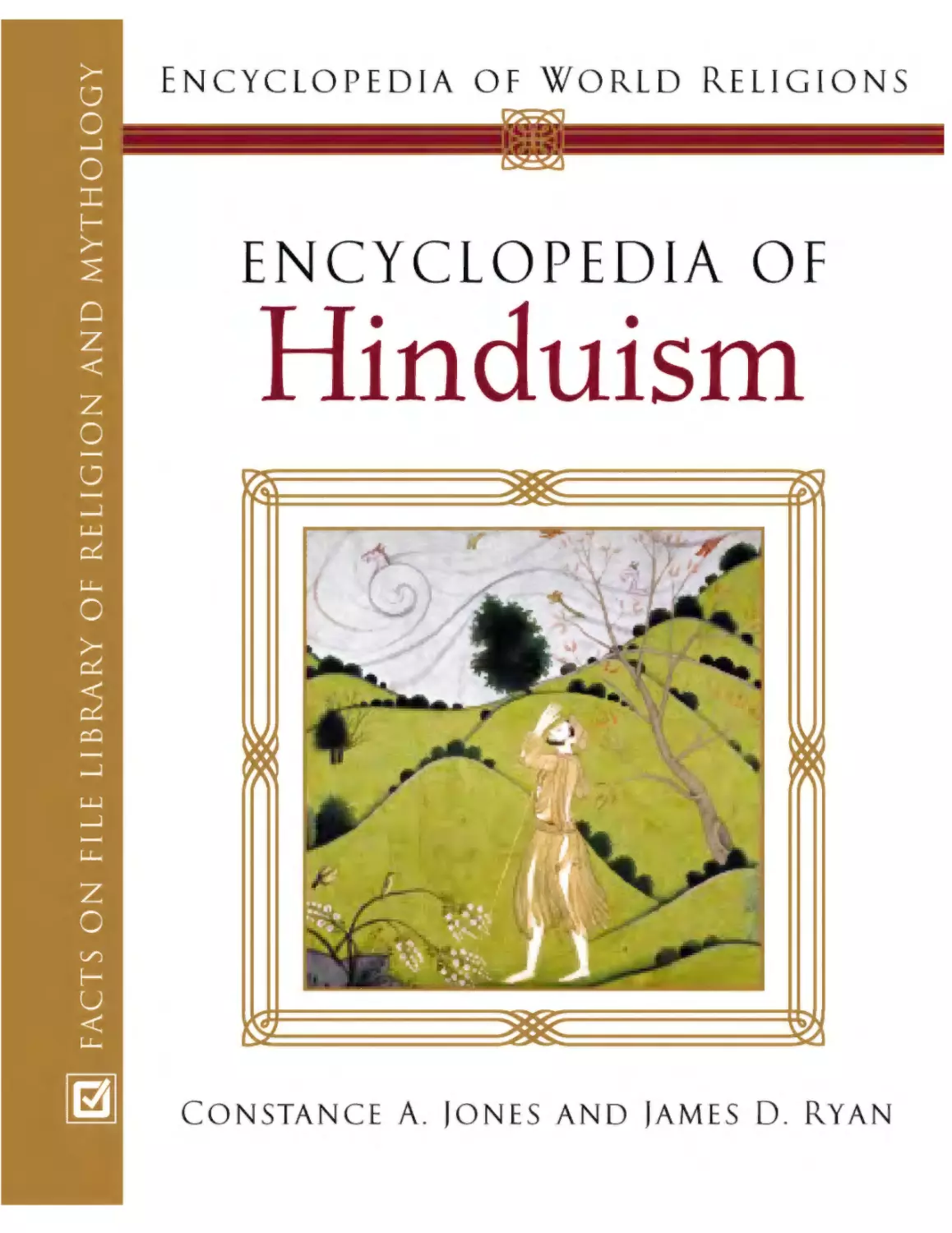
                    Encyclopedia of

Hinduism
AF
J:

Encyclopedia of Buddhism
Encyclopedia of Catholicism
Encyclopedia of Hinduism
Encyclopedia of Islam
Encyclopedia of Judaism
Encyclopedia of Protestantism

Encyclopedia of World Religions

nnnnnnnnnnn
Encyclopedia of

Hinduism
AF
J:
Constance A. Jones and James D. Ryan
J. Gordon Melton, Series Editor

Encyclopedia of Hinduism
Copyright © 2007 by Constance A. Jones and James D. Ryan
All rights reserved. No part of this book may be reproduced or utilized in any form or
by any means, electronic or mechanical, including photocopying, recording, or by any
information storage or retrieval systems, without permission in writing from the publisher. For information contact:
Facts On File, Inc.
An imprint of Infobase Publishing
132 West 31st Street
New York NY 10001
ISBN-10: 0-8160-5458-4
ISBN-13: 978-0-8160-5458-9
Library of Congress Cataloging-in-Publication Data
Jones, Constance A., 1961–
Encyclopedia of Hinduism / Constance A. Jones and James D. Ryan.
p. cm. — (Encyclopedia of world religions)
Includes index.
ISBN 978-0-8160-5458-9
1. Hinduism—Encyclopedias. I. Ryan, James D. II. Title. III. Series.
BL1105.J56 2006
294.503—dc22
2006044419
Facts On File books are available at special discounts when purchased in bulk
quantities for businesses, associations, institutions, or sales promotions. Please call
our Special Sales Department in New York at (212) 967-8800 or (800) 322-8755.
You can find Facts On File on the World Wide Web at http://www.factsonfile.com
Text design by Erika K. Arroyo
Cover design by Cathy Rincon
Printed in the United States of America
VB Hermitage 10 9 8 7 6 5 4 3 2 1
This book is printed on acid-free paper.

contents
K
About the Editor

vii

List of Illustrations

ix

Preface

xi

Acknowledgments
Note on Terms and Spelling
Introduction: Hinduism
Chronology
ENTRIES A TO Z

xiii
xv
xvii
xxvii
1

Bibliography

519

Index

525

about the editor
K
Series editor J. Gordon Melton is the director of
the Institute for the Study of American Religion
in Santa Barbara, California. He holds an M.Div.
from the Garrett Theological Seminary and a
Ph.D. from Northwestern University. Melton is
the author of American Religions: An Illustrated
History, The Encyclopedia of American Religions,
Religious Leaders of America, and several comprehensive works on Islamic culture, AfricanAmerican religion, cults, and alternative religions.
He has written or edited more than three dozen

books and anthologies as well as numerous papers
and articles for scholarly journals. He is the series
editor for Religious Information Systems, which
supplies data and information in religious studies and related fields. Melton is a member of the
American Academy of Religion, the Society for
the Scientific Study of Religion, the American
Society of Church History, the Communal Studies Association, and the Society for the Study of
Metaphysical Religion.

vii

list of illustrations
K

Amritanandamayi Ma 26
Sikh devotees outside the Golden
Temple in Amritsar 28
Anandamayi Ma 32
Sri Aurobindo 52
Devotional practice (bhakti)
is a central feature of
Hinduism 76
Birla Mandir, a temple devoted
to Vishnu 86
The Universal Peace Hall in
the Brahma Kumaris World
Spiritual Organization 90
Brahmin priest with sacred
thread at village temple 92
Haridas Chaudhuri 105
Gurumayi Chidvilasananda 108
Sri Chinmoy 111
Shantivanam 113
Goddess Durga slaying
Mahesha, the buffalo
demon 139
Eknath Easwaran 143
Brahmin householder performing water ablutions at
dawn on the banks of the
Ganges 148

Hindu sculpture at Ellora
Caves 149
Mohandas Karamchand
“Mahatma” Gandhi 158
Lord Ganesha, the elephantheaded god 161
Morning bathing on the steps
to the Ganges River 163
Hanuman 178
Baba Hari Dass 179
Harihara, iconic deity that
combines Vishnu and
Shiva 181
Woman worshipping her
personal divinity (ishta
devata) 203
Jain temple complex of white
marble 209
Ma Jaya Sati Bhagavati 213
Temple to goddess Kali where
Sri Ramakrishna served as
priest 221
Sant Keshavadas 233
Temple to the sun god, with
his chariot 236
Lord Krishna, an incarnation of Vishnu, with consort
Radha 239

Jiddu Krishnamurti 242
Swami Krishnananda 245
Main symbols of Lord Shiva:
lingam and trident 260
Monolithic stone architecture 267
Mahavira, 24th Tirthankara of
Jainism 271
Hindu temple in Kuala Lumpur, Malaysia 274
Wedding of Shiva and
Minakshi, goddess of
Madurai 284
Meher Baba 286
The Mother 292
Swami Muktananda 295
Naked hermit of Naga sect at
source of Ganges River 301
Guru Nanak 303
Nandi, divine bull 304
Neem Karoli Baba 310
Swami Bhagawan Nityananda 315
om 319
Parshvanath 325
Religious mendicants on pilgrimage 328
Sri Harilal Poonja 331
ix

K x Encyclopedia of Hinduism
Brahmin priest performing puja
to Lord Vishnu 336
Lord Krishna’s birthplace, where
his puranic tale begins 337
Rama, an incarnation of
Vishnu, with wife, Sita, and
his brother Lakshmana 347
Sri Ramakrishna 349
Ramana Maharshi 350
Baba Ram Dass 357
Yogi Ramsuratkumar 360
Raja Rammohun Roy 368
Sadhu and sacred cow dressed
for festival 371
Sai Baba of Shirdi 375
An ochre-robed wandering
sannyasi 381
Sri Sarada Devi 386

Entrance to the SelfRealization Fellowship
Headquarters 393
Major deity Shiva as Nataraja,
Lord of the Dance 406
Sikh Gurudwara 413
Sri Sri Nathji 421
Sthanakavasi Jain monk with
mouth covering to practice
ahimsa 423
Satguru Subramuniyaswami 425
Sunyata (Alfred Julius Emanuel
Sorensen) 427
Swaminarayan 430
Rabindranath Tagore 434
Typical Hindu temple tower,
Krishna Temple 440

Image of the Hindu trinity: Brahma, Vishnu, and
Shiva 453
Swaminarayan Temple 462
Hindu temple in Malibu,
California 463
Old Vedanta temple 464
Ramakrishna Temple 484
Lord Venkateshwara, popularly
known as Balaji, is one of
the manifestations of Lord
Vishnu 491
Swami Vivekananda 494
Sri Yantra, symbol of the Goddess and ritual design for
meditation 510
Paramahansa Yogananda 513

preface
K

The Encyclopedia of World Religions series has
been designed to provide comprehensive coverage
of six major global religious traditions—Buddhism,
Hinduism, Islam, Judaism, Roman Catholicism,
and Protestant Christianity. The volumes have
been constructed in an A-to-Z format to provide a
handy guide to the major terms, concepts, people,
events, and organizations that have, in each case,
transformed the religion from its usually modest
beginnings to the global force that it has become.
Each of these religions began as the faith of
a relatively small group of closely related ethnic peoples. Each has, in the modern world,
become a global community, and, with one notable exception, each has transcended its beginning
to become an international multiethnic community. Judaism, of course, largely defines itself
by its common heritage and ancestry and has an
alternative but equally fascinating story. Surviving
long after most similar cultures from the ancient
past have turned to dust, Judaism has, within the
last century, regathered its scattered people into a
homeland while simultaneously watching a new
diaspora carry Jews into most of the contemporary world’s countries.
Each of the major traditions has also, in the
modern world, become amazingly diverse. Buddhism, for example, spread from its original home

in India across southern Asia and then through
Tibet and China to Korea and Japan. Each time
it crossed a language barrier, something was lost,
but something seemed equally to be gained, and
an array of forms of Buddhism emerged. In Japan
alone, Buddhism exists in hundreds of different
sect groupings. Protestantism, the newest of the
six traditions, began with at least four different
and competing forms of the religious life and
has since splintered into thousands of denominations.
At the beginning of the 19th century, the six
religious traditions selected for coverage in this
series were largely confined to a relatively small
part of the world. Since that time, the world has
changed dramatically, with each of the traditions
moving from its geographical center to become a
global tradition. While the traditional religions of
many countries retain the allegiance of a majority
of the population, they do so in the presence of
the other traditions as growing minorities. Other
countries—China being a prominent example—
have no religious majority, only a number of
minorities that must periodically interface with
one another.
The religiously pluralistic world created by
the global diffusion of the world’s religions has
made knowledge of religions, especially religions
xi

K xii Encyclopedia of Hinduism
practiced by one’s neighbors, a vital resource in the
continuing task of building a good society, a world
in which all may live freely and pursue visions of
the highest values the cosmos provides.
In creating these encyclopedias, the attempt
has been made to be comprehensive if not exhaustive. As space allows, in approximately 800 entries,
each author has attempted to define and explain
the basic terms used in talking about the religion,
make note of definitive events, introduce the
most prominent figures, and highlight the major
organizations. The coverage is designed to result
in both a handy reference tool for the religious
scholar/specialist and an understandable work
that can be used fruitfully by anyone—a student,
an informed lay person, or a reader simply wanting to look up a particular person or idea.
Each volume includes several features. They
begin with an essay that introduces the particular
tradition and provides a quick overview of its historical development, the major events and trends
that have pushed it toward its present state, and
the mega-problems that have shaped it in the contemporary world.
A chronology lists the major events that have
punctuated the religion’s history from its origin to
the present. The chronologies differ somewhat in
emphasis, given that they treat two very ancient
faiths that both originated in prehistoric time, several more recent faiths that emerged during the last
few millennia, and the most recent, Protestantism,
that has yet to celebrate its 500-year anniversary.
The main body of each encyclopedia is constituted of the approximately 800 entries, arranged
alphabetically. These entries include some 200
biographical entries covering religious figures of
note in the tradition, with a distinct bias to the
19th and 20th centuries and some emphasis on
leaders from different parts of the world. Special
attention has been given to highlighting female
contributions to the tradition, a factor often
overlooked, as religion in all traditions has until
recently been largely a male-dominated affair.
Geographical entries cover the development
of the movement in those countries and parts

of the world where the tradition has come to
dominate or form an important minority voice,
where it has developed a particularly distinct
style (often signaled by doctrinal differences), or
where it has a unique cultural or social presence.
While religious statistics are amazingly difficult
to assemble and evaluate, some attempt has been
made to estimate the effect of the tradition on the
selected countries.
In some cases, particular events have had a
determining effect on the development of the
different religious traditions. Entries on events
such as the St. Bartholomew’s Day Massacre (for
Protestantism) or the conversion of King Asoka
(for Buddhism) place the spotlight on the factors precipitating the event and the consequences
flowing from it.
The various traditions have taken form as
communities of believers have organized structures to promote their particular way of belief and
practice within the tradition. Each tradition has a
different way of organizing and recognizing the
distinct groups within it. Buddhism, for example,
has organized around national subtraditions. The
encyclopedias give coverage to the major groupings within each tradition.
Each tradition has developed a way of encountering and introducing individuals to spiritual
reality as well as a vocabulary for it. It has also
developed a set of concepts and a language to
discuss the spiritual world and humanity’s place
within it. In each volume, the largest number
of entries explore the concepts, the beliefs that
flow from them, and the practices that they
have engendered. The authors have attempted to
explain these key religious concepts in a nontechnical language and to communicate their meaning
and logic to a person otherwise unfamiliar with
the religion as a whole.
Finally, each volume is thoroughly crossindexed using small caps to guide the reader to
related entries. A bibliography and comprehensive index round out each volume.
—J. Gordon Melton

acknowledgments
K

We are particularly indebted to colleagues who
have generously shared the products of their
research and have edited our work: Dev Ashish,
Bettina Baeumer, Mariana Caplan, Laura Cornell,
George Chryssides, Mark Dyczkowski, Gilles Farcet, Jennifer Saunders, and Stuart Sovatsky. We
are especially grateful to Gail Harley and Robert
Schimpelfenig, who wrote many entries on contemporary leaders and movements.
The assiduous research of our assistants, Maria
Albergato, Laura Amazzone, Kate Hendon, Erin
Johansen, Simmy Makhijani, Pei-hsuan Wu, and
Reuben Rutledge, added greatly to the inclusiveness of this volume.
Insight into specific movements, and photographs, have been provided by Arumugaswami

Sannyasi, knowledgeable sources Jennifer Burns,
Carol Lee Flinders, Nancy Friedberg, Nick and
Sultana Harvey, Krishnapriya Hutner, Sean and
Pervin Mahoney, Sundari Michaelian, Ravin
Nadarajah, Hema Patankar, Penelope Phipps,
Krishnakant, Paramacharya Palaniswami,
Hamsa Stainton, Madhu Tandan, Peter Walsh,
Indrani Weber, and Mary Young. Support on
many levels came from Dr. Ralph Ortiz and Dr.
Ching Chun Ou.
We are extremely grateful to J. Gordon
Melton, general editor of the series, who offered
expertise and encouragement at every step of
the way.
—Constance A. Jones and James D. Ryan

xiii

note on
terms and spelling
K
Because the spelling of Hindu terms today relies
upon transliteration from several different languages
from different language groups, perfect consistency
in English spellings is not possible. Moreover, alternate spellings of Hindu terms and names are in common use throughout the English-speaking world.
We have chosen in most cases to cite the academically accepted and/or current spellings, even
though these spellings may not be the same as common usage and/or historical usage. For example, the
name of one wife of Shiva, the goddess Minakshi,
is popularly rendered Meenakski, while scholars
predominantly favor the former spelling. Also, a
number of variations appear over time in the names
of cities, so that Banaras is now commonly spelled
Benares. Similarly, the honorific Sri is also spelled
Shri, Shrii, and Shree. When proper names such as
these appear in published volumes in bibliographical citations in this volume, the spelling follows
the Library of Congress listing exclusively. Consequently, there often appear differences between
spellings of names in text entries and spellings in
the further reading associated with those entries.

Another point of possible confusion is current
alternate spellings of Hindu terms such as sannyasi and sannyasin (meaning renunciant), which
are synonymous. A closely related term, sannyas,
is the vow that sannyasis or sannyasins take to
enter into their lives of austerity.
In the last 20 years, the names of several
important cities in India have been changed to
their historical pre-British names. In this work,
names of cities are generally left in the form
found in the scholarly literature of the period. In
most instances present-day changes are indicated
in the text, such as Madras (Chennai), Bombay
(Mumbai), Benares (Varanasi), and Calcutta
(Kolkata).
Due to the dissemination of Hindu ideas in
the West, many terms have become part of the
English language and are not italicized to indicate that they are foreign words. For example,
atman, bhakti, karma, maya, mudra, nirvana,
and various types of yoga (such as hatha,
jnana, ashtanga, and siddha yoga) are treated as
English words.

xv

introduction
hinduism

K

The Origins of Hinduism
Until the 19th century, Hinduism was considered the indigenous religion of the subcontinent
of India and was practiced largely in India itself
and in the places where Indians migrated in large
numbers. In the 21st century, while still centered
in India, Hinduism is practiced in most of the
world’s countries and can thus rightly be considered a world religion. Its creation, unlike that of
some world religions founded by known historical
leaders, reaches into prehistory; we do not know
the individuals who first practiced the religion
(or set of religions that have merged to constitute
present-day Hinduism) nor know exactly when its
earliest forms emerged.
Hindu is a term from the ancient Persians. The
Sindhu River in what is now Pakistan was called
the “Hindu” by the Persians (the first textual mention occurred perhaps in the last centuries before
the Common Era [C.E.]). The people who lived
in proximity to the Sindhu therefore came to be
called Hindus.
In academic terms the Hindu tradition, or
Hinduism, is usually referred to as Brahmanism
in its earlier phase, before circa 300 B.C.E., and
referred to as Hinduism after that. In common

usage, the term Hinduism is used for the entire
span of the tradition.
For at least two reasons the Hindu tradition
contains the greatest diversity of any world tradition. First, Hinduism spans the longest stretch of
time of the major world religions, with even the
more conservative views setting it as well over
3,000 years old. Throughout this expanse of time,
the Hindu tradition has been extremely conservative about abandoning elements that have been
historically superseded. Instead, these elements
have often been preserved and given new importance, resulting in historical layers of considerable
diversity within the tradition. Second, Hinduism
has organically absorbed hundreds of separate
cultural traditions, expressed in as many as 300
languages. As a result, Hindu tradition is metaphorically like the Grand Canyon gorge, where
the great river of time has sliced through the landscape, leaving visible successive historical layers.
Some practices of Hinduism must have originated in Neolithic times (c. 4000 B.C.E.). The
worship of certain plants and animals as sacred,
for instance, could very likely have very great
antiquity. The worship of goddesses, too, a part of
Hinduism today, may be a feature that originated
in the Neolithic.

xvii

K xviii Encyclopedia of Hinduism
The first attested elements that can be argued
to be “Hindu” are found in the Indus Valley
civilization complex, which lay geographically
in present-day Pakistan. This civilization complex, which is contemporaneous with Sumeria
and matches it in complexity and sophistication,
is dated 3600–1900 B.C.E. Many seals found at
Indus Valley sites were apparently used to mark
commercial goods and had engraved upon them
pictures that some have related to later Hinduism. One is the “proto-Shiva” seal, which shows
a person, seated in a cross-legged position, with
a headdress with horns on it and what appears to
be an erect phallus. The headdress is said to relate
to the later god Shiva’s title of “Lord of the Animals,” and the erect phallus is said to be related
to the common icon of Shiva, the lingam, which
is phallic in shape. Some see his seated posture as
being the yogic lotus position. Shiva is known for
his yogic practices.
Other Indus Valley seals seem to depict what
came to be known as the “Seven Mothers,” still worshipped in contemporary Hinduism. Additionally, B.
B. Lal, the most prominent Indian archaeologist of
the Indus Valley culture, argues that other artifacts
and fire sites of the Indus Valley complex appear
to be designed for rituals associated with the Vedic
ritual tradition, which is usually dated many centuries later.

The Sacred Texts of Hinduism:
The Vedas
Considerable debate exists with regard to the relationship of the Indus Valley civilization and the
later Vedic tradition that focused on fire worship.
The scholarly consensus for many years held that
the Aryans, people who migrated from the west
through Iran, arrived in India no earlier than 1200
B.C.E., much too recently to have participated in
the Indus Valley world. These people were, the
view holds, associated with the transmission of
the Vedas, India’s most sacred and revered texts.
This consensus has been challenged, primarily

from the Indian side, and continues to undergo
scrutiny. The alternative view rejects the notion
that the people who gave India the Vedas were
originally foreign to India and sees a continuity
between India’s earliest civilization and the people
of the Vedas.
The Rig Veda (c. 1500 B.C.E.), which everyone
agrees is the most ancient extant Indian text, is
the foundational text of Hinduism. It consists of
about a thousand hymns. The great majority of
the hymns are from five to 20 verses in length.
The Rig Veda contains hymns of praise to a pantheon of divinities as well as a few cosmogonic
hymns that tell of the creation of the universe.
These stories are extremely important for the
development of later Hinduism.
By far the greatest number of the thousand
plus hymns of the Rig Veda are devoted to Indra,
king of the gods, a deity connected with rain and
storms who holds a thunderbolt, and Agni, the
god of fire. The rest of the hymns are devoted
to an array of gods, most prominently Mitra,
Varuna, Savitri, Soma, and the Ashvins. Less frequently mentioned are the gods who became most
important in the later Hindu pantheon, Vishnu
and Rudra (one of whose epithets was shiva, the
benign). A number of goddesses are mentioned,
most frequently Ushas, goddess of the dawn, and
Aditi, said to be the mother of the gods. The goddess of speech, Vach (Vak), however, may be most
important, since speech is one of the most powerful sacred realities in Hindu tradition, although
there are not many references to her.
The religion of the Rig Veda has for a long time
been referred to as henotheistic, meaning that the
religion was polytheistic, but it recognized each
divinity in turn as, in certain ways, supreme. Certainly, later Hinduism continued and enriched this
henotheistic concept, and, through time, Hinduism has been able to accept even Christ and Allah
as being supreme “in turn.” The Rig Veda, though,
was the central text in a very powerful ritual tradition. Rituals public and private, with sacred fire
always a central feature, were performed to speak
to and beseech the divinities. Sacrifices of animals

Introduction xix

were a regular feature of the larger public rites of
the Vedic tradition.
Two other Vedas, the Yajur and Sama Vedas,
were based on the Rig Veda. That is, most of their
text is from the Rig Veda, but the words of the
prior text are reorganized for the purposes of the
rituals. Yajur Veda, the Veda of sacrificial formulas, which has two branches called the Black and
the White Yajur Vedas, contains the chants that
accompany most of the important ancient rites.
The Sama Veda, the Veda of sung chants, is very
much focused on the praise of the god Soma, the
personification of a drink taken at most rituals
that probably had psychedelic properties. Priests
of the three Vedas needed to be present for any
larger, public ritual. Later a fourth Veda, the
Atharva Veda, became part of the tradition. This
text consists primarily of spells and charms used
to ward off diseases or to influence events. This
text is considered the origin of Indian medicine,
the system of Ayurveda. There are also a number
of cosmogonic hymns in the Atharva Veda, which
show the development of the notion of divine
unity in the tradition. A priest of the Atharva
Veda was later included in all public rituals and
the tradition evolved to include four Vedas rather
than three.
Two important points must be understood
about the Vedic tradition. First, none of the Vedas
is considered composed by humans. All are considered to be “received” or “heard” by the rishis,
divinely inspired sages, whose names are noted at
the end of each hymn. Second, none of the text of
the Vedas was written down until the 15th century
C.E. The Vedic tradition was passed down from
mouth to ear for millennia and is, thus, the oral
tradition par excellence. The power of the word in
the Vedic tradition is considered an oral and aural
power, not a written one. The chant is seen as a
power to provide material benefit and spiritual
apotheosis. The great emphasis, therefore, was on
correct pronunciation and on memorization. Any
priest of the tradition was expected to have an
entire Veda memorized, including its nonmantric
portions (explained later).

J

Any of the four Vedas is properly divided into
two parts, the mantra, or verse portion, and the
Brahmana, or explicatory portion. Both of these
parts of the text are considered revelation, or shruti.
The Brahmanas reflect on both the mantra text and
the ritual associated with it, giving very detailed,
varied, and arcane explication of them. The Brahmanas abound in equations between ritual aspects, the
ritual performers, and cosmic, terrestrial, and divine
realities. Early Western scholars tended to discount
these texts, as being nothing but priestly mumbojumbo. But most recent work recognizes the central
importance of the Brahmanas to the development of
Indian thought and philosophy.
The name Brahmana derives from a central
word in the tradition, brahman. Brahman is generically the term for “prayer” but technically refers to
the power or magic of the Vedic mantras. (It also
was used to designate the one who prays, hence
the term Brahmin.) Brahman is from the root brih,
“to expand or grow,” and refers to the expansion
of the power of the prayer itself as the ritual proceeds; this power is understood as something to
be “stirred up” by the prayer. In later philosophy,
the term brahman refers to the transcendent, allencompassing reality.
The culmination of Brahmana thought is often
considered to be the Shatapatha Brahmana of the
White Yajur Veda. It makes explicit the religious
nature of the agnichayana fire ceremony, the largest public ritual of the tradition. Shatapatha Brahmana makes clear that this public ritual is, in fact,
a reenactment of the primordial ritual described
in Rig Veda X. 90, the most important cosmogonic
hymn of the Vedas. This myth describes the ritual
immolation of a cosmic “Man,” whose parts are
apportioned to encompass all of the visible universe and everything beyond it that is not visible.
That is, the cosmic “Man” is ritually sacrificed to
create the universe. Shatapatha Brahmana delineates how, at the largest public ritual in the tradition, the universe is essentially re-created yearly.
The Brahmana understands that, at its most perfect, the Vedic ritual ground is identical to all of
the universe, visible and invisible.

K xx Encyclopedia of Hinduism
Within the Brahmanas two subdivisions are
important in the development of later tradition.
One of the subdivisions is called the Aranyaka.
From its name one can understand that this portion of the text pertained to activity in the forest
(aranya). These specially designated portions of
the Brahmanas contain evidence that some Vedic
yajna, or ritual, was now performed internally, as
an esoteric practice. This appears to be a special
practice done by adepts, who would essentially
perform the ritual mentally, as though it were
being done in their own body and being. This
practice was not unprecedented, since the priests
of the Atharva Veda did not chant as other priests,
but rather were required at public rituals to perform mentally the rituals that other priests performed externally. But the Aranyaka notion was
distinctive in that the ritual was performed only
internally. From this interpretation originated the
notion that the ritualist himself was the yajna, or
ritual.
Last, the Brahmanas included (commonly
within the Aranyaka portion) the Upanishads, the
last of the Vedic subdivisions or literary modes
(no one really knows when these subdivisions
were designated). As do the Brahmanas, many
of these texts contained significant material that
reflected on the nature of the Vedic sacrifice. Thus
the division between Brahmana proper, Aranyaka,
and Upanishad is not always clear. The most
important feature of the Upanishad was the emergence of a clear understanding of the unity of the
individual self or atman and the all-encompassing
brahman, understood as the totality of universal
reality, both manifest and unmanifest.
The genesis of the Upanishadic understanding, that the self and cosmic reality were one, is
clear. First, the Shatapatha Brahmana stated that
the most perfect ritual was, in fact, to be equated
to the universe itself, visible and invisible. Second,
the Aranyakas made clear that the individual initiated practitioner was the ritual itself. So, if the
ritual equals all reality and the individual adept
equals the ritual, then the notion that the individual equals all reality is easily arrived at. The

Upanishads were arrived at, then, not by philosophical speculation, but by ritual practice. Later
Upanishads of the orthodox variety (that is, early
texts associated with a Vedic collection) omitted
most reference to the ritual aspect and merely
stated the concepts as they had been derived.
Most importantly, the concepts of rebirth (reincarnation) and the notion that actions in this life
would have consequence in a new birth (karma)
were first elaborated in the Upanishads.
This evidence shows that the concept of karma,
or ethically conditioned rebirth, had its roots in
earlier Vedic thought. But the full expression of
the concept was not found until the later texts, the
Upanishads, which are called the Vedanta, or the
end or culmination of the Vedas. Therefore, the
notion of reaching unity with the ultimate reality
was seen as not merely a spiritual apotheosis, but
also a way out of the trap of rebirth (or redeath).

Epic Hinduism and
Classical Hinduism
In the sixth century B.C.E., a large-scale revolt
against Vedic practice occurred in India. The Buddha, a great reformer, decried the supremacy of
Brahmins in Vedic practice and in Indian society
and called for a path that was open to all without
discrimination. He criticized the animal sacrifices
made by the Brahmins and their corruption in
monetary pursuits. He was joined in this era by
the Jain leader Mahavira. Both of these leaders
began movements on the eastern plain of the
Ganges valley, near the area of Benares (Varanasi),
which represented a shift in the center of the culture from the area of the Punjab, in what is now
present-day Pakistan, to eastern India.
Buddhism achieved supremacy in early India
through the influence of the empire of the great
king Ashoka in the third century B.C.E., but,
although it enjoyed periods of state glory over
the centuries, it never succeeded in supplanting
traditions that looked to the Vedas. Thus, the
culture and tradition represented by the great

Introduction xxi

epics Ramayana and Mahabharata showed the
emergence of the forms of religion called, in current academic terms, Hinduism. These specifically
show a contrast to the forms found in earlier Vedic
“Brahminism.”
In the Sanskrit epics, still widely known in
myriad versions in India today, the gods Shiva
and Vishnu begin to emerge as the focal points for
cultic worship. Shiva appears to be a god of the
Himalayas who was identified by the Brahmins
with the god Rudra of the Vedas. In all likelihood
the cultic Shiva was fashioned from an amalgam
of traditional sources over many centuries. This
pattern of taking local traditions and creating
direct connection of them with the Vedas was an
ongoing feature in the evolution of the Brahminical tradition.
Similarly, Vishnu and his numerous avatars
emerged from a mélange of cultural sources.
Vishnu in the Vedas was not at all a significant
divinity. But the cult of Vishnu was organized
around a sense of continuity with this Vedic divinity and the larger monistic philosophy that developed in the Vedic tradition. The epic Ramayana is
understood to be a story of the descent of Vishnu
to Earth in order to defeat the demons. Likewise,
Krishna, as warrior, another important avatar of
Vishnu, was central to the Mahabharata epic. In
both epics, stories of Shiva are also found scattered throughout.
A similar phenomenon occurs in the career
of the great Goddess, Shakti, in Hindu tradition.
Shakti forms the third large cultic center in Hinduism, whose worshippers, called shaktas, believe
in the supremacy of the goddess. The development of shakti worship began to take shape at the
beginning of the Common Era, some centuries
later than the developments in the other cultic
contexts.
The Bhagavad Gita (c. 100 B.C.E.), which is
found in the Mahabharata (MBh), identifies the
god Krishna with the brahman of the Upanishads.
The likelihood is that Krishna was a divinity of
certain western Indian groups, who had reached
such popularity that he could not be ignored. It

J

may have been that Krishna was originally a tribal
chieftain. In the Mahabharata itself he is spoken
of consistently as God only in the Bhagavad Gita,
which is clearly a later addition to the MBh. This
identification of a local god with the highest divinity (and further with Vishnu) shows a pattern that
leads to the incredible diversity of Hinduism. All
across India in the next thousand years numerous
local gods and goddesses are taken up into the
larger Hindu tradition.
Examples from as far away as South India,
the last area of India to accept the Aryan ethos,
demonstrate the process of absorption of local
divinities into the larger Hindu pantheon. Lord
Venkateshvara of Tirupati, in Andhra Pradesh,
a hill divinity who may have been worshipped
in the same spot for several thousand years, was
first identified with Shiva and then later identified as the god Vishnu himself. Tirupati thereupon became part of the Vaishnavite tradition
and a pilgrimage site of great importance. Similarly, the goddess Minakshi in the temple city of
Madurai, most probably a goddess of her home
region in Tamil Nadu for many, many centuries,
was associated with Shiva by being identified
as his wife. In fact, she appears late enough not
to be identified with Parvati, his usual spouse,
but as a separate wife. Likewise, the Tamil god
Murugan became identified as the youngest son
of Shiva and Parvati.
Over the era from perhaps 600 B.C.E. until as
late as the 14th century various local divinities
were slowly but systematically absorbed into the
Vedic or Brahmanical tradition. The Sanskrit texts,
the puranas, composed from the fourth to the 12th
centuries C.E., tell tales of the complicated and
varied lives of Vishnu, Shiva, and the Goddess,
but many local tales in local languages and Sanskrit tell the more hidden tales of how these local
godly kings and queens became part of the larger
tradition. The earliest additions to the pantheon
of Hinduism were clearly those gods and goddesses who formed the basis of the Vishnu and
Shiva cults. Parvati was likely a mountain goddess
who may have ruled the mountains on her own

K xxii Encyclopedia of Hinduism
at one time but became absorbed in the Shaivite
tradition. Likewise, Lakshmi, the wife of Vishnu,
has characteristics of a local nature divinity who
became identified with Sri of the Vedas.
Vedic ritual tradition saw a revival in the kingdoms of the Guptas during the fourth through
sixth centuries C.E. This period is often described
as a golden age of Indian tradition, when Sanskrit
literature flourished with such poets as Kalidasa,
and the kings patronized Brahmins and reestablished Vedic rites that had long languished.
Except for this passing phase, however, Vedic
ritual tradition lost its supremacy very early. By
the turn of the Common Era worship of the major
cults had expanded greatly and by the sixth century C.E. temples to these divinities began to be
created in stone.
Temple Hinduism represented a real shift in
worship from that of the Vedas. Vedic worship
had no permanent cultic sites, and no icons or
images, nor was it locally bound. Following the
traditions of the non-Aryan substratum in India,
temple Hinduism focused its worship around
icons placed in permanent temples. Most of these
temples were built at places that had been sites of
worship for hundreds of years. Part of the shift,
however, very much connected the new temple
sites with the Aryan tradition: the priests in the
major temples now were all Brahmins and they
all used Sanskrit in the rituals to the gods, where
other languages had been used exclusively.

Caste
In the transition from Vedic religion to Hinduism
proper, one important feature is the development
of the stratified social system that in India became
known as the caste system. Texts dating from the
late centuries before the Common Era, such as the
Laws of Manu, began to make clear that the four
classes found in the Vedas were now seen as stratified social entities. Rules and social laws began
to be passed down, not universally, but in terms
of each class or “birth” (jati) division. Brahmins,
here, were placed at the apex of the pyramid,

because of their priestly positions. (However,
they were also not allowed to accumulate large
amounts of wealth and could not hold positions
of direct political power.) Next were the warriors,
or Kshatriyas, who held kingly and administrative
power. The large body of the people, the Vish, or
Vaishya, were farmers or merchants. The lowest
class were the Shudras, born, it was thought, to
be servants.
As time went on and the tradition expanded
its reach into all parts of India, indigenous tribes
and other groups entering the society of Aryans
were absorbed at an even lower rung of the social
ladder. Eventually the concept of the untouchable
(contemporary Dalit) was created to refer to people whom the upper castes would not even allow
to be near or to touch them. Hinduism developed
into a society where people became ranked rigidly
by occupation. The sacerdotal position, or priestly
work, was considered purest. Work that involved
dealing with the dead, carrion, cleaning of sewers,
sweeping, and other such tasks, was considered
“unclean” and was performed only by hereditary
untouchables.

Islam
In the 11th and 12th centuries, Islam entered
an India that was flourishing. As the devotional
movements that embodied the new tendency of
the culture to worship the iconic divinity developed, saints emerged to sing poetry at the many
shrines. Cultic Hinduism displayed a vast array
of poet singers and wanderers who embodied the
devotion for which ordinary Hindus strove. The
ascetic wanderer had emerged even before Buddha, who was one of them. And through time
the developing tradition looked to the wandering
sadhu, or saint, to exemplify the purest devotion to the divine. The often eccentric holy man
remains a distinctive feature of Hinduism today.
Islam entered India with a vengeance and
stayed to rule. As Islamic presence expanded over
North India, the Mughal empire was established
in the 15th century C.E. For several centuries

Introduction xxiii

Islam presided over India. Its reach encompassed
nearly the entire country, although the far reaches
of the south were spared its iconoclasm and its
heaviest hand.
The Islamic era (c. 1100 to 1750 C.E.) produced religious interaction that may be unique
in the world. Many of the Muslims who entered
India were Turks, who often had an appreciation
for the Sufi traditions. Sufis were often patronized by the Islamic courts. As the Sufi wandering
holymen, many of whom were as otherworldly
and eccentric as their Indian counterparts, began
to meet with the local wanderers and saints,
new religious ideas began to develop. The long
tradition of Hindu saints who were lower caste,
anticaste, or anti-Brahminical were supplemented
by Sufi wanderers who held similar views. What
emerged were powerful spiritual traditions that
condemned all orthodoxy and were socially revolutionary in that they decried caste as spiritually
bankrupt and laughed at the Brahmins as scoundrels and worse. The Sant tradition of North India
that emerged in this era was well represented by
such people as Kabir, who spoke most radically
about the stupidity of untouchability and the foolishness of the orthodox.
The Sant and Sufi sentiments that developed
in this era merged in the tradition of Guru Nanak
(15th century) and the Sikhs, who eschew all
ritual, icons, and ritual leaders. For the Sikhs
there is no guru except the Granth Sahib, their
holy book, which has many verses from the poetsaints of this era.
Other movements, such as the Bauls, remained
less institutionalized than the Sikh tradition. They
too combined elements from devotional Hinduism,
Sufi love poetry and music, and anti-Brahminical
sentiments into cultic groups that exist today outside the orthodox umbrella of Hinduism.

British Era
By the beginning of the 18th century, the British had
arrived in India and had become powerful in Bengal. They succeeded in developing political power

J

through the use of intermediaries carefully chosen
from corrupt Muslim potentates and Hindu kings in
the chaotic aftermath of Mughal rule.
It is no accident that Hindu modernism begins
in Bengal, as it represented the longest contact
point between the Western ruler, Britain, and
its new subjects. English education became the
norm for well-educated Bengalis by the early 18th
century. When other parts of the country were
just becoming accustomed to the heavy hand
of the British, the Bengalis had already become
more than familiar with their views and ways.
What emerged were both a reform movement in
Hinduism and the roots of the Indian nationalist
movement.
Groups emerged in the late 18th century who,
influenced in part by Christian ideas, sought to
reform Hinduism. Groups such as the Brahmo
Samaj of Ram Mohan Roy sought to end child
marriage, to allow widows to remarry, to eliminate
the custom of widows’ burning themselves on the
funeral pyres of their husband, to eliminate caste,
and to end worship of icons. Many of these people
worked from a notion that India had been dominated by the British because the Indian culture
had become spiritually corrupt. They felt that if
they had had a stronger social sense and greater
solidarity, the British could not have so easily
gained preeminence. This view was held by nearly
every major fighter for Indian independence,
including Mahatma Gandhi and Sri Aurobindo.
The caste system received significant criticism
for more than two millennia by various groups
who argued from the point of view of a different
spiritual vision. The Buddha and Mahavira are the
first we know of, starting in 600 B.C.E., but the
Virashaivas of Karnataka, a South Indian state,
eliminated caste from their reform tradition in the
11th century C.E., and many groups of mendicant
wanderers such as the Siddhas routinely criticized
caste and Brahminical cultural dominance, from
the Buddha’s time forward. The medieval poetsaints of North India who followed the views of
Kabir were only maintaining a long countertradition. So when the “reformists” of Bengal began to

K xxiv Encyclopedia of Hinduism
attack the social evils of Hinduism their actions
must not be seen as merely a mimicking of Christians and the British. It should be noted, as well,
that the antiiconic view of the Brahmo Samaj of
Calcutta (Kolkata) were also not new. The Virashaivas were essentially antiiconic (except for the
Shiva lingam, which they kept in their personal
homes), and the traditional Vedanta of the Upanishads looked to brahman alone without characteristics (or icons) as the ultimate divinity. The
Brahmo Samaj takes its name, in fact, from this
brahman, spelled as Brahmo in Bengali.
In the rich matrix of Hindu reform in Bengal in
the 19th century emerged the great saint Ramakrishna and his student Swami Vivekananda. They
maintained the reformist notions that caste must
be uprooted, but Ramakrishna himself was not
opposed to worship of icons. What Ramakrishna
does, though, is round out the syncretic movements of the Sants, who melded Islamic and
Hindu notions while decrying orthodoxy. Ramakrishna directly experienced Islam and Christianity
and saw them as alternate paths to the one goal of
the Divine. Ramakrishna then takes Hinduism full
circle from its Vedic roots, where God could be
seen as having any face and still be God. But now
the social evils that had accrued in Hinduism over
the centuries were seen by many to be superfluous
to any religious need.

Post-Independence India
(after 1947)
The Indian Constitution was written by an
untouchable (now referred to as a Dalit), B.
R. Ambedkar. Dr. Ambedkar’s selection as the
person to head the Constitutional Commission was a sign that the reform values that the
Indian independence fighters held were going
to be instituted in law in independent India.
In the Indian Constitution, “scheduled castes
and tribes,” those “out-casted” by traditional
Hindu society, were given a specified percentage of guaranteed seats in the Indian Parliament

until such time as the Constitution could be
amended. (This guarantee was also instituted
in nearly every state of the new Indian Union.)
Additionally, separate electorates were established for Muslims to ensure that they would
have adequate representation in the new Indian
state. Along with these reforms, inheritance
and marriage laws established legal practices to
aid women and to counter long-held traditions
detrimental to women. Dowry, for instance,
a burden for every woman’s family, was outlawed. (This law, regrettably, has never been
rigorously enforced.) Most importantly, the new
state of India was declared a secular state with
its own unique definition: it was a state that
respected all religions and made accommodations for them, but a state that privileged no
single religion. This respect for religion went to
the extent of institution, by request of Muslim
leaders, of certain laws regarding marriage and
property that only applied in the Muslim community. (Muslims, for instance, were allowed
to maintain the practice of polygamy, in which
men may have as many as four wives.)
Independent India began in the chaos of partition. Many Muslims, Hindus, and Sikhs were
killed in the days after independence, when the
state of Pakistan was created. Millions crossed the
borders on India’s east and west to enter the state
that they felt would most protect their interests.
Blame has been assigned in many places for the
tragic fact of partition. Muslim leaders, Hindu
leaders, and the British certainly all bore some
share of the blame. Conflict ensued over the state
of Kashmir, where a Hindu king ceded his majority Muslim state to India at the last minute. This
began a long history of wars and disagreement
between Pakistan and India that continues in the
present day. (Pakistan itself was split in two in
1972, when the state of Bangladesh was created
from East Pakistan.)
For a long time these disagreements did not
greatly affect the relationship between Indian Muslims and the Hindu majority. In the 1980s a new
political movement emerged in India, based on the

Introduction xxv

assertion of Hindu majority privilege. It is often
referred to as Hindu fundamentalism, but this
phraseology glosses over the complexities and competing values it represents. Nation-states need to
justify their existence ideologically. Pakistan shaped
its identity from the beginning around Islam, and
Hindus and other religions found themselves marginalized there from the beginning. India, however,
had preserved the values of a secular state. Muslims
regularly held the office of president of India and
cabinet posts and were kept visibly in government
offices and in positions in the army.
It can be argued that the movement for privileging Hinduism in India and for a call to “Hinduize” India was directly related to the need for a
national ideology. Formation of national identity
for new nations is extremely complex, and flows
of power are difficult to track, but the emergence
of Hindu fundamentalism seems clearly related
to this need for the creation of national identity.
Hindu assertion was not new in India. Certain
groups, such as the Rashritriya Swayam Sevak
Sangh (The National Self-Help Organization),
who admired the fascists in Italy and Germany
and taught regimented military tactics for their
followers (along with hatred of Muslims), had
their roots in Hindu nationalist groups of the 19th
century. Suffice it to say that hatred of Muslims,
conversion of non-Hindu minorities (including
Christians), and reassertion of caste privilege were
all part of this larger movement. In the 1990s the
Bharatiya Janata Party (BJP) gained power with
this platform, and some of its officials presided
over a bloody anti-Muslim massacre in the Indian
state of Gujarat. In 2004 they were ousted from
power in favor of the Congress Party, the same
party that had led India to independence and created the secular state of India. In the interim, great
damage was done to relationships between Hindus and Muslims in India. Many Muslims began
to retreat into their own fundamentalisms, now
global in scope. Others simply left India, if they
could. This relationship is in deep crisis at this
time and will need skillful diplomacy and cultivation to be repaired, if it ever is.

J

Dissemination
Through European scholarship and interest,
Hindu texts and practices became known in
Western Europe and North America as early as
the 18th century. In the 19th century, German
philosophy, French scholarship, and the American
transcendentalist movement served to disseminate Hindu ideas among Western readers, without
contributions from Indian emigrants. A diaspora,
which involved the resettlement of significant
numbers of emigrants from India, began as early
as the 17th century and reached significant size in
the 18th through 20th centuries. The pattern of
the diaspora was first characterized by the arrival
of indentured laborers in Indonesia, Africa, and
the Caribbean region to work the fields of large
landowners. From the 20th century, Hindus from
India migrated to the West for education. From
the first days of the diaspora, groups of Hindus
have cohered to transfer their faith and practices
from native India to their new homes, temples,
and communities. Thus, the dissemination of
Hinduism around the world has followed two
main routes: the route of scholarship and study, as
the religion has been studied by non-Indians and
introduced to non-Indian populations, and the
route of immigration, as devoted Hindus have created Hindu homes and institutions in their places
of resettlement.
The acceptance of Hindu ideals and practices
in the West has depended upon a succession of
Hindu practitioners who visited the West. Beginning with P. C. Moozumdar and Swami Vivekananda at the World Parliament of Religions in
Chicago in 1893 and continuing through the residence of Paramahansa Yogananda in the United
States from the 1920s, the West has received everlarger numbers of Hindu teachers, especially since
new immigration laws that allowed South Asian
migration to the West.
Philosophical and theological ideas from
Hinduism have been incorporated into Western
thought on a large scale, primarily through the
publications and activities of the Theosophical

K xxvi Encyclopedia of Hinduism
Society and the teachings of many Hindu adepts
in the West. Today, every major form of Hindu
practice and belief has its Western form, which,
although modified from traditional Hinduism,
nevertheless contains the character of Hinduism.

An Encyclopedic Approach
In some 800 entries, Encyclopedia of Hinduism
explores the vast world of Hinduism that emerges
from prehistory and lives today in astonishing
variety. This volume focuses on the most significant groups within Hinduism, the religious and
cultural movements that enriched its history, significant teachers and their contributions, and the
diaspora of Hindu thought and practice around
the world. Two major religious traditions that
sprang from a Hindu milieu, Jainism and Sikhism,
have many entries; Buddhism, also a tradition that

evolved from within Hinduism, is the subject of
another encyclopedia in this series.
Inevitably, one volume cannot fully describe
a history of at least 3,000 years and a staggering diversity in the present. The authors had to
choose one topic over another and one person
over another. Yet, the Encyclopedia of Hinduism
represents major events, specific groups, central
concepts, and major teachers who have given
Hinduism its unique place as a world religion.
Importantly, the many women leaders and teachers who have been valued in the evolution of Hinduism retain a focus in these entries. This volume,
though selective, gives the interested reader a reliable window into the vast and enduring tradition
of Hinduism, and some of its sister traditions in
the land of India.
—Constance A. Jones and James D. Ryan

chronology
K
3600 B.C.E. to 1700 B.C.E.

1000

¶ Indus Valley civilization, including sites at
Mohenjodaro and Harappa, prospers. Archaeological finds include a seal that some scholars
identify as a proto-Shiva.

¶ End of compilation of the three original Vedas:
Rig, Yajur, and Sama.

950

2050

¶ Decline of Sanskrit as a spoken language occurs
over the next 300 years.

¶ Indo-Iranian people settle in Iran (Persia) and
Afghanistan.

800 to 400

1900
¶ Drying up of Sarasvati River due to climate
changes. End of Indus-Sarasvati culture; center
of civilization in ancient India relocates from the
Sarasvati River to the Ganges River.

1500
¶ Compilation of Rig Veda Samhita (the earliest
extant text in Hinduism).

¶ Orthodox Upanishads are compiled.

750
¶ Prakrits (vernacular or “natural” languages)
develop among India’s various cultures, as evidenced from later Buddhist and Jain works.

c. 600
¶ Death of Zoroaster, founder of Zoroastrianism,
original religion of the Persians. His Zend Avesta,
holy book of that faith, has much in common
with the Rig Veda, sharing many verses.

1350
¶ At Boghaz Koy, Turkey, stone inscription of the
treaty with Mitanni lists as divine witnesses
the Vedic deities Mitra, Varuna, Indra, and the
Nasatyas (Ashvins).

599
¶ Birth of Mahavira Vardhamana (c. 599–527),
24th Tirthankara, Jain master who stresses vegetarianism, asceticism, and nonviolence.
xxvii

K xxviii Encyclopedia of Hinduism

563
¶ Birth of Siddhartha Gautama (563–483), the
Buddha.

c. 500 to 200
¶ Over these 300 years numerous secondary
Hindu scriptures (smriti) are composed: Shrauta
Sutras, Grihya Sutras, Dharma Sutras, Mahabharata, Ramayana, puranas, and others.

cating prior high development of Tamil. Gives
rules for absorbing Sanskrit words. At this time
Tamil literature refers to worship of Vishnu,
Indra, Murugan, and Supreme Shiva.
¶ Pancharatra Vaishnavite sect is prominent. All
later Vaishnavite sects are based on the Pancharatra beliefs (formalized by Sandilya about
100 c.e.).

297 B.C.E.

c. 450

¶ According to Jain history, Emperor Chandragupta Maurya abdicates; becomes Jain monk.

¶ Panini composes his Sanskrit grammar, the
Ashtadhyayi.

273

c. 400
¶ Dharmashastra of Manu develops. Its verses
codify cosmogony, four ashramas, government,
domestic affairs, caste, and morality.
¶ The Ajivikas, an ascetic, atheistic sect of naked
sadhus reaches the height of its popularity.
Adversaries of the Buddha and the Jain Mahavira, they have a philosophy that is deterministic, holding that everything is inevitable.

305
¶ Chandragupta Maurya, founder of first panIndian empire. At its height under the Buddhist
emperor Ashoka (r. 273 b.c.e.–232 b.c.e.), the
Mauryan Empire includes all India except the
far south.

c. 302
¶ Kautilya (Chanakya), minister to Chandragupta Maurya, writes Arthashastra, a compendium of laws, procedures, and advice for ruling
a kingdom.

300 B.C.E. to 100 C.E.
¶ Tamil Sangam age begins. Sage Agastya writes
Agattiyam, first known Tamil grammar. Tolkappiyar writes Tolkappiyam, a summary of earlier
works on grammar, poetics, and rhetoric, indi-

¶ Ashoka, the greatest Mauryan emperor, grandson of Chandragupta, seizes power and rules
until 232. He converts to Buddhism. India’s
national emblem features the lion capital from
his pillar.

c. 200 B.C.E. to 200 C.E.
¶ Patanjali writes the Yoga Sutra.

c. 200 B.C.E. to 100 C.E.
¶ Jaimini writes the Mimamsa Sutra.

c. 75 C.E.
¶ A Hindu prince from Gujarat invades Java.

c. 80
¶ Jains divide, on points of rules for monks,
into the Shvetambara, “White-Clad,” and the
Digambara, “Sky-Clad.”

c. 100
¶ Birth of Kapila, founder of the Samkhya philosophy, one of six classical systems of Hindu
philosophy.
Birth
of Sandilya, first systematic promulga
tor of the ancient Pancharatra doctrines. His
Bhakti Sutras, devotional aphorisms on Vishnu,
inspire a Vaishnavite renaissance. By 900 c.e.

Chronology xxix

the sect has left a permanent mark on many
Hindu schools. The Samhita of Sandilya and his
followers embody the chief doctrines of present-day Vaishnavites.

c. 200

J

c. 570
¶ Birth of Shaivite saint Appar (c. 570–670).
¶ Birth of Shaivite saint Sambanthar (c. 570–670).

c. 600–900

¶ Hindu kingdoms are established in Cambodia
and Malaysia.

¶ Twelve Vaishnava Alvar saints of Tamil Nadu
flourish, writing 4,000 songs and poems praising
Vishnu and narrating the stories of his avatars.

c. 250

c. 700

¶ Pallava dynasty (c. 250–885) is established in
Tamil Nadu. They erect the Kamakshi temple
complex at the capital of Kanchipuram and
the great seventh-century stone monuments at
Mahabalipuram.

¶ Over the next hundred years the small Indonesian island of Bali receives Hinduism from
neighboring Java.
¶ Stone-carving and sculptural works completed
at Mahabalipuram.

320

c. 710

¶ Imperial Gupta dynasty (320–540) emerges.
During this “Classical Age” norms of literature,
art, architecture, and philosophy are established. This North Indian empire promotes
both Vaishnavism and Saivism and, at its
height, rules or receives tribute from nearly
all India. Buddhism also thrives under tolerant
Gupta rule.

¶ Death of Bhavabhuti, Sanskrit dramatist, second
only to Kalidasa.

c. 380
¶ Birth of Kalidasa (380–460), the great Sanskrit
poet and dramatist, author of Shakuntala and
Meghaduta

c. 400
¶ Vatsyayana writes Kama Sutra, the famous text
on erotics.
¶ Death of Karaikkalammaiyar, a woman, first of
the 63 Shaivite saints of Tamil Nadu.

c. 500
¶ Sectarian folk traditions are revised, elaborated, and recorded in the puranas, Hinduism’s encyclopedic compendium of culture and
mythology.

712
¶ Muslims conquer Sind region (Pakistan).

c. 750
¶ Rashtrakuta dynasty carves Kailasanatha Temple
out of a rock hill at Ellora.

788
¶ Shankara (788–820) is born in Malabar. The
famous monk-philosopher establishes 10 traditional monastic orders.

c. 800
¶ Birth of Vasugupta, modern founder of Kashmiri
Shaivism, a monistic, meditative school.
¶ Birth of Andal, girl saint of Tamil Nadu. Writes
devotional poetry to Lord Krishna, disappears
at age 16.

c. 825
¶ Birth of Tamil Shaivite saint Sundarar.

K xxx Encyclopedia of Hinduism

c. 850

1106

¶ Birth of Manikkavacakar, Tamil Shaivite saint.

¶ Birth of Basavanna (1106–1167), founder and
guru of the Virashaiva sect.

c. 880
¶ Birth of Nammalvar (c. 880–930), greatest of
Alvar saints. His poems shape beliefs of southern Vaishnavites to the present day.

c. 900
¶ Birth of Matsyendranatha, exponent of the Nath
sect emphasizing kundalini yoga practices.

950
¶ Birth of Kashmiri Shaivite guru Abhinavagupta
(950–1015).

c. 1130
¶ Birth of Nimbarka (c.1130–1200), Vaishnavite
teacher of Vedanta. Birth of Sekkilar, author
of Periya Puranam, epic hagiography of the 63
Tamil Shaivite saints.

c. 1150
¶ Khmer ruler completes Angkor Wat temple
(in present-day Cambodia), the largest Hindu
temple in Asia.

1197

960

¶ Birth of Ananda Tirtha Madhva (1197–1276),
venerable Vaishnavite dualist philosopher.

¶ Chola king Vira, after having a vision of Shiva
Nataraja, commences enlargement of the Shiva
temple at Chidambaram, completed in 1250
c.e.

c.1200
¶ Birth of Gorakhnath, famous Nath yogi.
¶ All of North India is now under Muslim
domination.

1001
¶ Turkish Muslims invade Afghanistan and the
Punjab, the first major Muslim conquest in
India.

1230 to 1260

c. 1010

c. 1300

¶ Tirumurai, Tamil devotional hymns of Shaivite
saints, is collected as an anthology by Nambiandar Nambi.

¶ Birth of Lalleshvari (c. 1300–1372) of Kashmir,
Shaivite renunciant and mystic poet. She contributes significantly to the Kashmiri language.

1025

1336

¶ Chola ruler Rajendra I sends victorious naval
expeditions to Burma, Malaysia, and Indonesia.

¶ Vijayanagara empire (1336–1646) of South
India is founded.

1077

1398/9

¶ Birth of Ramanuja (1077–1157) of Kanchipuram, Tamil philosopher-saint of Sri Vaishnavite sect.

¶ Tamerlane (Timur) invades India with 90,000
cavalry and sacks Delhi (1398) and Haridvar, a
Ganges pilgrimage town (1399).

¶ Temple to the Sun (Surya) is constructed at
Konarak, Orissa.

Chronology xxxi J

c. 1400

1556

¶ Birth of Kabir, Vaishnavite reformer who has
both Muslim and Hindu followers. His Hindi
songs remain immensely popular to the present day.

¶ Akbar (1542–1605), grandson of Babur, becomes
third Mughal emperor, promoting religious tolerance.

1595
¶ Birth of Mirabai (1450–1547), Vaishnavite
Rajput princess-saint devoted to Lord Krishna.

¶ Construction begins on Hall of a Thousand Pillars at famous Shaivite temple in Chidambaram
and is completed in 1685.

1469

1600

1450

1473

¶ Royal charter forms the East India Company, setting in motion a process that ultimately results in
the subjugation of India under British rule.
¶ Birth of Surdas (c. 1600), sightless Hindi bard
of Agra, whose hymns to Krishna are collected
in the Sursagar.

¶ Birth of Vallabhacharya (1473–1531), a saint
who teaches pushtimarga, “path of grace.”

1603

1486

¶ Guru Arjun compiles Adi Granth, Sikh scripture.

¶ Birth of Guru Nanak (1469–1539), founder
of Sikhism, a faith that rejects caste and
renunciation.

¶ Birth of Chaitanya (1486–1533), Bengali
founder of popular Vaishnavite sect that proclaims Krishna as Supreme God and emphasizes
group chanting and dancing.

1605

c. 1500

¶ Akbar’s son Jehangir succeeds his father as
fourth Mughal emperor.
¶ Sikh Golden Temple at Amritsar, Punjab, is finished; later covered with gold leaf.

¶ Shaivite Hindu princes resettle on Bali and construct a separate kingdom.

1608

1526
¶ Muslim conqueror Babur (1483–1530) occupies
Delhi and founds the Indian Mughal Empire
(1526–1761).

1532
¶ Birth of monk-poet Tulsidas (1532–1623),
author of Ramcharitmanasa (1574–77) (based
on Ramayana), which advances worship of
Rama.

¶ Birth of Tukaram (1608–1649), saint famed
for his poems to Krishna. Considered greatest
Marathi spiritual composer.

1647
¶ Shah Jehan completes Taj Mahal in Agra on the
Yamuna River.

1658
¶ Zealous Muslim Aurangzeb (1618–1707)
becomes Mughal emperor.

K xxxii Encyclopedia of Hinduism

1675
¶ Aurangzeb executes Sikh Guru Tegh Bahadur,
beginning the Sikh-Muslim tensions that continue to this day.

1708
¶ Gobind Singh, 10th and last Sikh guru, is assassinated.

1718
¶ Birth of Ramprasad Sen (1718–1780), Bengali
poet-saint and worshipper of goddess Kali.

1751
¶ Robert Clive is victorious in the British fight for
control of South India.

1764
¶ British defeat the weak Mughal emperor and
gain full control of Bengal, richest province of
India.

1781
¶ Birth of Sahajanand Swami (1781–1830),
Gujarati founder of the Swaminarayan sect
(with 1.5 million followers today).

1784
¶ Judge and linguist Sir William Jones founds
Calcutta’s (Kolkata’s) Royal Asiatic Society, first
such scholastic institution.

tuted the main bulwark of resistance to British
expansion in India.

1803
¶ Second Anglo-Maratha war results in British
capture of Delhi and control of large parts of
India.
¶ Birth of Ralph Waldo Emerson (1803–1882),
American poet who helps popularize Bhagavad
Gita and Upanishads in the United States.

1818
¶ Birth of Swami Shiv Dayal Singh (1818–1878),
founder of the esoteric reformist Radhasoami
Vaishnavite sect in Agra.

1820
¶ First Indian immigrants arrive in the United
States.

1824
¶ Birth of Swami Dayananda Sarasvati (1824–
1883), founder of Arya Samaj (1875), Hindu
reformist movement stressing a return to the
values and practices of the Vedas.

1828
¶ Rammohan Roy (1772–1833) founds Brahmo
Samaj in Calcutta (Kolkata). Influenced by
Islam and Christianity, he denounces polytheism and idol worship.

1831
1786
¶ Sir William Jones uses the Rig Veda term Aryan
(noble) to name the parent language of Sanskrit,
Greek, Latin, and Germanic tongues.

¶ Birth of Russian mystic Madame Helena P. Blavatsky (1831–1891), cofounder of Theosophical
Society in 1875. Introduces amalgam of psychism, Buddhism, and Hinduism to the West.

1792

1835

¶ Britain’s Lord Cornwallis, governor-general of
India, defeats Tipu Sultan of Mysore, the most
powerful ruler in South India, which consti-

¶ Mauritius receives 19,000 indentured laborers
from India. Last ship carrying workers arrives
in 1922.

Chronology xxxiii J

1836

1860

¶ Birth of Sri Paramahansa Ramakrishna (1836–
1886), God-intoxicated Bengali saint, devotee of
goddess Kali, and guru of Swami Vivekananda.

¶ First indentured servants from Madras (Chennai) and Calcutta (Kolkata) arrive in Durban,
South Africa to work on sugar plantations.

1837

1861

¶ Britain formalizes importation of Indian indentured laborers throughout the Commonwealth.

¶ Birth of Bengali poet Rabindranath Tagore
(1861–1941), awarded the Nobel Prize in literature in 1913.

1838
¶ Birth of Keshab Chunder Sen (1838–1884),
Hindu reformer.

1840s
¶ Hindus from India enter the Caribbean region as
indentured laborers.

1841
¶ First U.S. chair of Sanskrit and Indology established at Yale University.

1863
¶ Birth of Swami Vivekananda (1863–1902),
dynamic missionary to West and catalyst of
Hindu revival in India.

1869
¶ Birth of Mohandas Karamchand Gandhi
(1869–1948), Indian nationalist and Hindu
political activist, who develops the strategy
of nonviolent disobedience that leads to the
independence of India (1947) from Great
Britain.

1850
¶ First English translation of the Rig Veda, by H.
H. Wilson.

1872
¶ Birth of Sri Aurobindo Ghose (1872–1950), Bengali Indian nationalist and yoga philosopher.

1851
¶ Sir M. Monier-Williams (1819–1899) publishes
English-Sanskrit Dictionary.

1853
¶ Birth of Sri Sarada Devi (1853–1920), wife of
Sri Ramakrishna, lineage holder in the Ramakrishna tradition and inspiration for the Sarada
Math convent for women.
¶ Max Müller (1823–1900), German Sanskrit
scholar in England, advocates the term Aryan to
describe speakers of Indo-European languages.

1857
¶ First major Indian revolt against British rule, the
“Sepoy Mutiny.”

1873
¶ Birth of Swami Rama Tirtha (1873–1906), who
lectures throughout Japan and America spreading “practical Vedanta.”

1875
¶ Madame Blavatsky, with others, founds Theosophical Society in New York, later headquartered at Adyar, Madras (Chennai).

1876
¶ British queen Victoria (1819–1901) is proclaimed empress of India (r. 1876–1901).
¶ Birth of Dada Lekhraj (1876–1969), Hindu
founder of Brahma Kumaris, an international

K xxxiv Encyclopedia of Hinduism
social reform movement led by women that
stresses meditation and world peace.

1876 to 1890
¶ Max Müller (1823–1900), pioneer of comparative religion as a scholarly discipline, publishes
50-volume Sacred Books of the East, English
translations of Indian and other Asian scriptures.

1879
¶ First emigrant ship to Fiji adds 498 Indian
indentured laborers to the nearly 340,000
already working in other colonies of the British
Empire.
¶ Birth of Sri Ramana Maharshi (1879–1950),
Hindu advaita renunciant saint of Tiruvannamalai, South India.

1884
¶ Birth of Swami Ramdas (1884–1963), known as
Papa, Indian saint and devotee of Lord Rama.

1885
¶ Indian National Congress founded.

1893
¶ World Parliament of Religions in Chicago recognizes Eastern religious traditions through
presentations by representatives of Hinduism,
Buddhism, Jainism, and Sikhism. Swami Vivekananda receives acclaim as spokesperson for
Hinduism.

1894
¶ Birth of Meher Baba (1894–1969) of Poona,
silent sage whose mystical teachings stress love,
self-inquiry, and God consciousness.

1896
¶ Birth of Anandamayi Ma (1896–1982), Godintoxicated yogini and mystic saint of Bengal.
¶ Birth of Bhaktivedanta Swami Prabhupada
(1896–1977). In 1966 he founds International
Society of Krishna Consciousness (ISKCON) in
the United States.

1897
¶ Swami Vivekananda founds Ramakrishna Math
and Mission near Calcutta (Kolkata).

1886

1908

¶ René Guénon (1886–1951), first European philosopher of note to become a Vedantin, is born.

¶ Birth of Swami Muktananda (1908–1982), a
guru of the Kashmiri Shaivite school who
founds Siddha Yoga Dham to promulgate Indian
mysticism, kundalini yoga, and philosophy
throughout the world.

1887
¶ Birth of Swami Shivananda (1887–1963),
renowned universalist teacher, author of
200 books, founder of Divine Life Society in
Rishikesh, and guru to many teachers who
brought Hinduism to the West.

1912
¶ Anti-Indian racial riots on the U.S. West Coast
expel large Hindu immigrant population.

1888

1916

¶ Birth of Sarvepalli Radhakrishnan (1888–1975),
philosopher, eminent writer, and free India’s
first vice president and second president.

¶ Birth of Swami Chinmayananda (1916–1993),
Vedantist scholar, lecturer, teacher, and founder
of Chinmaya Mission.

Chronology xxxv

J

1917

1926

¶ Last Hindu Indian indentured laborers are taken
to British colonies of Fiji and Trinidad.
¶ U.S. government severely restricts Indian citizens from immigration. Restriction stands until
1965.

¶ Birth of Satya Sai Baba, charismatic Hindu guru,
educationalist, and worker of miracles.

1918
¶ Sai Baba of Shirdi (1856–1918), saint to Hindus
and Muslims, dies at approximately age 62.

1920
¶ Mohandas K. Gandhi (1869–1948) uses satyagraha, “truth power,” first articulated in South
Africa, as a strategy of noncooperation and nonviolence against India’s British rulers.
¶ Paramahansa Yogananda (1893–1952), famous
author of Autobiography of a Yogi, teacher of
kriya yoga and Hindu guru with many Western disciples, enters the United States, where
he founds the Self-Realization Fellowship
(1935).

1922
¶ Tagore’s school at Shantiniketan (founded
1901) is made into Visva Bharati University and
becomes a national university in 1951.

1923
¶ U.S. law excludes Indian nationals from naturalization.

1924
¶ Sir John Marshall (1876–1958) discovers relics
of Indus Valley pre-Hindu civilization. Begins
systematic large-scale excavations.

1927
¶ Shivaya Subramuniyaswami (1927–2001),
founder of Saiva Siddhanta Church and Hinduism
Today magazine, is born in Oakland, California.
¶ Maharashtra bars tradition of dedicating girls to
temples as Devadasis, ritual dancers. Karnataka,
Andhra Pradesh, and Orissa soon follow suit.
Twenty years later, Tamil Nadu bans devotional
dancing and singing by women in its temples
and in all Hindu ceremonies.

1928
¶ Hindu leader and future prime minister of India
Jawaharlal Nehru (1889–1964) drafts plan for a
free India; becomes president of Congress Party
in 1929.

1931
¶ Birth of Sri Chinmoy, yogi, artist, master of
self-transcendence, and United Nations peace
ambassador, in Bengal.
¶ Some 2.5 million Indian Hindus reside overseas;
largest communities are in Sri Lanka, Malaya,
Mauritius, and South Africa.

1934
¶ Paul Brunton’s popular A Search in Secret India
introduces Hindu teachers such as Ramana
Maharshi to the West.

1938
¶ Bharatiya Vidya Bhavan is founded in Bombay (Mumbai) by K. M. Munshi to conserve,
develop, and honor Indian culture.

1925
¶ K. V. Hedgewar (1890–1949) founds Rashtriya
Swayam Sevak Sangh (RSS), a militant Hindu
nationalist movement.

1947
¶ India gains independence from Britain on
August 15.

K xxxvi Encyclopedia of Hinduism

1948

1973

¶ Establishment of Sarva Seva Sangh, Gandhian
movement for new social order (sarvodaya).
¶ Mohandas Gandhi is assassinated on January
30 in retaliation for his embracing of Muslim
demands in India.
¶ The last British troops leave India on February
28.

¶ Neem Karoli Baba (1900–1973), Hindu mystic
and siddha, dies.

1949
¶ India’s new constitution, authored chiefly by
B. R. Ambedkar, declares there shall be no
“discrimination” against any citizen on the
grounds of caste, jati, and abolishes the practice
of “untouchability.”

1950
¶ India is declared a secular republic. Prime Minister Jawaharlal Nehru (r. 1947–64) is determined
to abolish caste and industrialize the nation.

1975
¶ Netherlands gives independence to Dutch Guyana, which becomes Suriname; one-third of
Hindus (descendants of Indian plantation workers) immigrate to Netherlands for better social
and economic conditions.

1979
¶ Shivaya Subramuniyaswami founds Hinduism
Today, international journal to promote Hindu
solidarity.

1980
¶ Hindu nationalist party, Bharatiya Janata Party
(BJP), is founded.

1964
¶ India’s Vishva Hindu Parishad (VHP), a Hindu
religious nationalist movement, is founded to
counter secularism.
¶ Rock group the Beatles practice Transcendental
Meditation (T.M.), making Maharshi Mahesh
Yogi famous.

1984
¶ Indian soldiers under orders from Prime Minister Indira Gandhi storm Sikh Golden Temple in
Amritsar and crush rebellion. Gandhi is assassinated later in the year by her Sikh bodyguards.
Her son Rajiv takes office.

1965
¶ U.S. immigration law is rewritten to cancel
racial qualifications and restore rights of naturalization to Asians. The first Hindu teacher to
benefit from the lifting of immigration quotas
is Bhaktivedanta Swami Prabhupada, famous
Vaishnavite guru and founder of International
Society of Krishna Consciousness. Annual
immigration from India shifts from 100 (1925)
to 170,000 (1985) per year.

1986
¶ Swami Satchidananda (1914–2002) dedicates
Light of Truth Universal Shrine (LOTUS) at
Yogaville, Virginia, in the United States.
¶ Jiddu Krishnamurti (1895–1986), Indian philosopher, lecturer, and author, known for his
teaching of radical self-awareness, dies.

1992
1966
¶ Jawaharlal Nehru’s daughter, Indira Gandhi,
becomes prime minister of India, world’s largest
democracy.

¶ Hindu radicals demolish Babri Masjid, built in
1548 on Rama’s birthplace in Ayodhya by Muslim conqueror Babur after he destroyed a Hindu
temple marking the site.

Chronology xxxvii

1993
¶ Chicago hosts centenary Parliament of World
Religions, in September.

1994
¶ Harvard University study identifies more than
800 Hindu temples open for worship in the
United States.

1998 to 2004
¶ Bharatiya Janata Party (BJP) serves as India’s
ruling party.

2001
¶ History’s largest human gathering, 70 million
people, worship at Kumbha Mela 2001, Alla-

J

habad, at the confluence of the Ganges and
Yamuna Rivers.
¶ Swami Amar Jyoti, 73, founder of four Jyoti ashrams in the United States and India, dies.

2006
¶ Hinduism continues to grow in most countries
of the old diaspora: Fiji, Guyana, Trinidad, Mauritius, Malaysia, and Suriname. Europe and the
United States continue to be destinations for the
current participants in the diaspora. Descendants maintain their faith and identity.

entries a to z
K

A
AF
J:
abhaya mudra
The abhaya mudra (see MUDRAS) is an important
gesture in Indian iconography. In it, the right
hand is raised and opened, straight up and
facing forward (divinities with more than two
hands raise one of their right hands). Abhaya
literally means “no fear,” and the gesture indicates blessing, protection, and reassurance. The
gesture is ancient and widespread and is found
in the iconography of Buddhists, Jains, and
Hindus.
The Buddha(s) and the TIRTHANKARAs are frequently seen using this hand gesture. The Lord
SHIVA in his NATARAJA, or divine dancer, pose has
his upper right hand in the abhaya mudra. In
fact, this mudra may be used when any divinity
is represented in Indian dance/dramas.
Further reading: Fredrick W. Bunce, A Dictionary of
Buddhist and Hindu Iconography, Illustrated: Objects,
Devices, Concepts, Rites, and Related Terms (New Delhi:
D. K. Printworld, 1997); Eva Rudy Jansen, The Hindu
Book of Imagery: The Gods and Their Symbols (Havelte,
Holland: Binkey Kok, 1995); Margaret Stutley, An
Illustrated Dictionary of Hindu Iconography (Boston:
Routledge & Kegan Paul, 1985).

Abhedananda, Swami (1866–1939) pioneer
Hindu leader in the United States
The Indian monk Swami Abhedananda founded
the New York City Vedanta Society at the end of
the 19th century, pioneering the spread of Hindu
thought in America.
Abhedananda was born Kaliprasad Chandra
in Calcutta (Kolkata). As a teenager, he was
interested in yoga, philosophy, and the religious
life and, though quite intelligent, did not attend
college. Rather, at the age of 18 he had his first
meeting with Sri RAMAKRISHNA, who immediately
recruited the youthful Kaliprasad to his inner
circle. Kaliprasad moved into the Ramakrishna
residence at Dakshineswar, where he lived until
Ramakrishna died two years later.
Shortly after Ramakrishna’s passing, Kaliprasad
joined the other men who had gathered around
the master in taking the vows of the renounced
life (see SANNYASI), at which time he took the name
Abhedananda. He spent the next several years
in concentrated study of the Hindu holy books
and in meditation. For a brief period he left his
brother monks to wander around India.
In 1893, one of his fellow monks, Swami VIVEKANANDA, traveled to America to address the WORLD

1

K 2 Abhidhyan Yoga Institute
PARLIAMENT OF RELIGIONS. Abhedananda organized
the celebration in Calcutta of the swami’s American
success, and three years later Vivekananda called
him to assist his work in the West. Abhedananda
remained in London for a year speaking and building a following for the Vedanta Society.
In 1897, Abhedananda began a 25-year stay
in New York City. He succeeded in organizing a
Vedanta Society (Vivekananda had failed to do
so), and built it into a relatively strong organization. He moved in the intellectual circles of
his day and was invited to speak at a number of
colleges and universities. He also made some 17
lecture tours in Europe. All his teachings and lecturing consistently reflected the ADVAITA VEDANTA
perspective of Ramakrishna; together with his
learned colleagues he argued for the unity of
Truth and the confluence of science and religion.
In 1921, Abhedananda returned to India,
where he was received as a celebrity. He went on
to establish two Ramakrishna centers, in Darjeeling (1923) and Calcutta (1929). Among his last
duties was presiding at the 1937 Parliament of
Religions in Calcutta, organized to celebrate the
Ramakrishna Centennial. Abhedananda died two
years later in 1939.
See also VEDANTA SOCIETIES/RAMAKRISHNA MATH
AND MISSION; UNITED STATES.
Further reading: Swami Abhedananda, Doctrine of
Karma: A Study in the Philosophy and Practice of Work
(Calcutta: Ramakrishna Vedanta Math, 1965); ———,
The Religion of the Twentieth Century (Calcutta: Ramakrishna Vedanta Math, 1984); ———, Spiritual Teachings
of Swami Abhedananda. Translated by P. Sheshadri Aiyer
(Calcutta: Ramakrishna Vedanta Math 1962); ———,
Swami Vivekananda and His Work (Calcutta: Ramakrishna Vedanta Math, 1968); Ashutosh Ghosh, Swami
Abhedananda, the Patriot Saint (Calcutta: Ramakrishna
Vedanta Math, 1967).

Abhidhyan Yoga Institute (est. 1991)
The Abhidhyan Yoga Institute, also called Modern Seers, headquartered at Swarthmore, Penn-

sylvania, is a training center for All Embracing
(Abhidhyan) Yoga, a somewhat rare form of
TANTRA that has survived within several lesserknown Hindu and Buddhist sects. All Embracing
Yoga incorporates the four major yoga paths:
JNANA YOGA, the path of study; BHAKTI YOGA, the
path of devotion to the Divine; KARMA YOGA,
the path of action; and RAJA YOGA, the path that
unites mind, heart, and body in pursuit of the
Divine.
The revival of All Embracing Yoga, and its
spread from India to the United States and several
other countries is attributed to Sri Acharya Abhidhyanananda Avadhuta (Anatole Ruslanov) (b.
May 5, 1965), a Russian computer scientist who
apprenticed in BENARES (Varanasi) India, with Sri
ANANDAMURTI (1921–90), founder of the ANANDA
MARGA YOGA SOCIETY. As a monastic student of
the guru, Anatole became a vital transmitter and
spiritual master of this largely overlooked form of
tantric practice.
A year after the death of Sri Anandamurti
(1990), Anatole established the Abhidhyanananda Yoga Institute with its headquarters in
the United States. He added his own teaching
methods to those of his teacher, synthesized
what he had learned during his monastic life in
India, and refined his tantric abilities. In 1998,
Anatole revealed to his students that he had had
a transformational experience that had lifted his
religious and practical focus to a higher level, thus
requiring a revision of the discipline required of
practitioners.
Students of All Embracing Yoga engage in
regular meditation, follow strict moral codes, and
practice postures (ASANAS) and breathing techniques (PRANAYAMA). Abhidhyanananda recommends solitary spiritual work for a year prior to
entering this specific yoga path.
The institute publishes a periodical, The Tantrik Path, at its headquarters in Nevada City,
California. No publications in book form are used
at the institute. Rather, all teachings are found
online on the Internet.

Abhishiktananda, Swami

Abhinavagupta (c. middle of 10th century
to middle of 11th century) Kashmiri Shaivite
philosopher
Abhinavagupta, who lived his entire life in the
northern Indian region of Kashmir, is one of the
giants of Indian philosophical and intellectual history. His work represents the pinnacle of the tantric
(see TANTRISM) school of KASHMIRI SHAIVISM, which
sees the world as both real and divine. He is also
recognized as one of India’s foremost theorists in
the field of aesthetics, or the appreciation of art.
Abhinavagupta interwove the diverse threads
of the earlier schools of Kashmiri Shaivism into a
coherent and cogent philosophy and practice. He
wrote numerous books and commentaries, all in
Sanskrit. Most well known is the magnum opus,
the massive Tantraloka; it deals with the philosophy, religion, and yogic practice of the Kashmir
Shaiva tradition.
Abhinavagupta’s exceptional work on the theory of art derives its interest from his belief in
the divinity of the senses and sense experience.
His most well known book in this area is his
commentary on the Dhvanyaloka, an important
text on aesthetics, which has become a source
book for much of later Indian aesthetic theory.
Abhinavagupta’s influence is most evident in the
traditions of Swami MUKTANANDA and his disciple
Swami CHIDVILASANANDA, two of the most prominent modern teachers in the Kashmiri Shaivite
tradition.
See also SHAIVISM.
Further reading: Raniero Gnoli, The Aesthetic Experience
According to Abhinavagupta (Varanasi: Chowkhamba
Sanskrit Series Office, 1968); Paul Eduardo MullerOrtega, The Triadic Heart of Siva: Kaula Tantricism of
Abhinavagupa in the Non-Dual Shaivism of Kashmir
(Albany: State University of New York Press, 1989);
K. C. Pandey, Abhinavagupta: An Historical and Philosophical Study (Varanasi: Chowkhamba Sanskrit Series
Office, 1963); R. Raghavan, Abhinavagupta and His
Works (Varanasi: Chokambha Orientalia, 1981); Y. S.
Walimbe, Abhinavagupta and Indian Aesthetics (Delhi:
Ajanta, 1980).

3 J

Abhishiktananda, Swami (1910–1973)
pioneer in Hindu-Christian monasticism
Born Henri Le Saux, Abhishiktananda was a pioneer in the field of spiritual and theological dialogue between Christianity and Hinduism.
He was born on August 30, 1910, at Saint
Briac in Brittany, France. At an early age he felt
a call to the vocation of a Roman Catholic priest,
and in 1929 he entered the Benedictine Monastery
of Saint Anne de Kergonan in Plouharnel. During his 19 years there he worked as librarian and
master of ceremonies. He served in the French
army during World War II and experienced a
miraculous escape after being captured by German troops in 1940.
Seeking a more radical path for living a spiritual life, Le Saux was attracted to India as early
as 1934. In Tamil Nadu state he met Father Jules
Monchanin, a Roman Catholic priest serving in a
Tamil village in southern India, who was formulating a path for living a contemplative life that
combined Indian asceticism (see SANNYASI) and
Christian practice. Le Saux joined Fr. Monchanin
in 1948 at Kulitalai; the two began a small ashram
near the CAUVERY RIVER at the village of Tannirpalli in Tiruchirappalli District, South India.
In 1950, they settled in Shantivanam (Forest of
Peace) and named their new foundation Saccidananda Ashram after the Hindu trinity.
In 1950 Le Saux adopted the dress of a Hindu
ascetic and changed his name to Swami Abhishiktananda (the Bliss of the Anointed One). He began
studying Tamil and Sanskrit and immersed himself in Indian traditions and practices. A meeting
in 1949 with RAMANA MAHARSHI (1879–1950) at
Ramana’s ashram in Tiruvannamalai had a strong
influence on his developing spirituality, and
between 1950 and 1955 he spent many months
in deep meditation in the caves near Ramana’s
ashram at the holy mountain Arunachala. After
Ramana’s death in 1950, he became a disciple of
Gnanananda Giri of Tirukoylur.
When the ailing Fr. Monchanin returned to
France and died in 1957, Abhishiktananda felt
a growing attraction to the north of India and

K 4 Abu, Mount
the Himalayas. He undertook several pilgrimages and often visited the holy city of BENARES,
(Varanasi), where he found others, such as Dr.
Raimon Panikkar, engaged in Hindu-Christian
dialogue. In 1968, he left Shantivanam under the
leadership of Father Bede Griffiths (1968–93)
and went to live in a hermitage in Uttarkashi in
the Himalayas. In 1980, Shantivanam, under the
leadership of Father Bede, was received in the
Camaldolese Congregation of the Benedictine
Confederation.
In 1969 Abhishiktananda participated in the
All-India Seminar on the Church in India Today
in Bangalore, the aim of which was to adapt the
principles of Vatican II to the Indian context.
There he was recognized as a pioneer in the field
of Hindu-Christian dialogue, whose life and
work inspired several religious communities,
such as Jyotiniketan Ashram formed in 1969 at
Bareilly.
Abhishiktananda’s books and teaching are
largely addressed to Christians, with the aim of
helping them discover the spirit and principles
of ADVAITA (non-dual) Hinduism. While always
remaining a Christian, he discerned elements of
Christianity in the spiritual wisdom of India that
helped him toward resolving for himself the tensions between the two religions and finding an
inner integration. His goal was to move beyond
the limits of institutional religions and churches
to encourage spiritual renewal, which he considered essential for human survival in the modern
world.
On July 14, 1973, Abhishiktananda suffered
a heart attack on the road in Rishikesh, where
he was on retreat with another French religious.
He died December 7, 1973, at Indore, Madhya
Pradesh.
See also CHRISTIAN-HINDU RELATIONS.
Further reading: Abhishiktananda, Saccidananda:
A Christian Approach to Advaitic Experience (Delhi:
I.S.P.C.K., 1974); ———, The Further Shore (Delhi:
I.S.P.C.K., 1975); ———, The Secret of Arunchala

(Delhi: I.S.P.C.K., 1979); ———, Guru and Disciple: An
Encounter with Sri Gnanananda (Delhi: I.S.P.C.K., 1990);
———, Swami Abhishiktananda: Ascent to the Depth of
the Heart: The Spiritual Diary (1948–1973). Edited
and selected by Raimon Panikkar, translated by David
Fleming and James Stuart (Delhi: I.S.P.C.K., 1998); H.
Ralston, Christian Ashrams: A New Religious Movement
in Contemporary India (Lewiston, N.Y.: Edwin Mellen
Press, 1987); James Stuart, Swami Abhishiktananda: His
Life Told through His Letters, rev. ed. (Delhi: I.S.P.C.K.,
1995).

Abu, Mount
Mount Abu is a small peak (some 4,000 feet
high) in the southwest of the Indian state of
Rajasthan that figures in Hindu legend. It is
especially holy to Jains (see JAINISM), who built
beautifully adorned temples there. It was once a
British hill station for retreat from the summer
heat.
According to one legend, the sage Vasishtha’s
cow Nandini was once trapped in a deep gorge
and could not free herself. The sage appealed to
Lord SHIVA for assistance. The Lord sent SARASVATI,
the divine stream, to help flood the gorge so that
the cow could float up. Vasishtha then decided
to ensure that such mishaps would not occur in
future. He asked the youngest son of HIMALAYA,
the king of mountains, to fill the chasm permanently. This he did with the assistance of Arbud,
the mighty snake. This spot came to be known as
Mount Arbud, and the name was later changed to
its present form—Mount Abu.
It is said that this mountain was visited and
blessed in the sixth century B.C.E. by MAHAVIRA,
the 24th and last Jain TIRTHANKARA of this half
of the cosmic era. It is known for its marble Jain
temples, two of which are famous. The first, built
in the 11th century, is devoted to RISHABHA, the
first Tirthankara of the line leading to Mahavira,
The other, from the 13th century, is dedicated
to Neminatha, the 22nd Tirthankara in the line.
The temples are not large but are known for their

adhvaryu

stunning and intricately carved statuary and
ornamentation.
Further reading: Lothar Clermont, Jainism and the
Temples of Mount Abu (New Delhi: Prakash Books,
1998); Sehdev Kumar, A Thousand Petalled Lotus: Jain
Temples of Rajasthan: Architecture and Iconography
(New Delhi: Abhinav, 2001); Jodh Singh Mehta, Abu
to Udaipur (Celestial Simla to City of Sunrise) (Delhi:
Motilal Banarsidass, 1970); Muniraj Jayanta Vijayi,
Holy Abu: A Tourist’s Guide to Mount Abu and Its Jaina
Shrines (Bhavnagar: Shri Yashovijaya Jaina Granthmala, 1954).

Acharanga Sutra (c. 300 B.C.E.–400 C.E.)
The Acharanga Sutra is the first of the 12 texts
accepted as canonical by SHVETAMBARA Jains. The
DIGAMBARA Jains believe that the original version
of this sutra was lost and reject the text held
sacred by the Shvetambaras. The sutra outlines,
with some details, the rigorous limitations that
Jain monks must observe and answers difficulties
that might occur in their struggle to prevent injury
to any creatures, including microscopic ones.
To cite some examples, the Acharanga Sutra
prohibits monks from digging in the earth (to
prevent injury to any earth being); bathing, swimming, wading, or walking in the rain (to prevent
injury to any water being); kindling or extinguishing any flame (to prevent injury to beings
that live in fire); waving the arms or making any
other sudden movement (to prevent injury to air
beings); and walking in any greenery or stepping
on any plant (to prevent injury to beings living
in plants). The sutra also demands the strictest
vegetarianism.
Further reading: Hermann Jacobi, trans., Jain Sutras,
Part 1, Sacred Books of the East, XVL (Delhi: Motilal
Banarsidass, 1964); P. S. Jaini, The Jain Path of Purification (Berkeley: University of California Press, 1979);
Bimala Churn Law, Some Jain Canonical Sutras (Bombay: Bombay Branch Royal Asiatic Society, 1949).

5 J

acharya
An acharya is any spiritual guide or teacher. In
ancient times the term referred specifically to the
one who initiated a student and taught him the
complete VEDA or sacred literature. In later times
it became a general honorific indicating great
learning and/or spiritual accomplishment. The
term was, for example, appended to the names
of all the great VEDANTA teachers: SHANKARA,
RAMANUJA, MADHVA, and NIMBARKA, become Shankaracharya, Ramanujacharya, Madhvacharya, and
Nimbarkacharya.
This practice is followed in the JAIN tradition
as well; for example, GUNABHADRA will be called
Gunabhadracharya. Furthermore, Jains honor acharyas in the panchanamaskara MANTRA, the central
mantra of the Jain faith, immediately after the ARHATS
and SIDDHAS; this indicates their exalted status.
Further reading: Brian K. Smith, “Ritual, Knowledge
and Being: Initiation and Veda Study in Ancient India,”
Numen 33, no. 1 (1986): 65–89.

achintya bhedabheda

See CHAITANYA, SRI

KRISHNA.

adhvaryu
The adhvaryu is the priest of the YAJUR VEDA at
the traditional Vedic public ritual. He oversees all
the ritual activity, carrying out most of the actions
himself. He prepares and uses the implements,
pours clarified butter, kills the ritual animal, and
recites the appropriate verses (of either the Black
or the White Yajur Veda) as the ritual actions
are performed. The priests of the RIG, SAMA, and
ATHARVA VEDAS are usually much less active on the
ritual ground.
Further reading: Julius Eggeling, trans., The SatapathaBrahmana, Part I, According to the Text of the Madhyandina School (Delhi: Motilal Banarsidass, 1982); Jan
Gonda, The Ritual Sutras (Wiesbaden: Otto Harrassow-

K 6 adhyasa
itz, 1977); Arthur B. Keith, trans., The Veda of the Black
Yajus School (Delhi: Motilal Banarsidass, 1967); J. Frits
Staal, The Science of Ritual (Poona: Bhandarkar Oriental
Research Institute, 1982).

adhyasa
Adhyasa, or “superimposition” of an unreal thing
upon a real one, is an important concept in the
ADVAITA (non-dual) philosophy of SHANKARA, the
renowned teacher of VEDANTA.
A pedestrian example would be a person looking at a rope in a dark place and briefly seeing a
snake. This sort of superimposition involves two
physical objects, but the central superimposition
or adhyasa in Shankara’s system is the ignorant
superimposition of the empirical world upon
the attribute-free BRAHMAN or ultimate reality.
Humans imagine that the empirical world is real,
but, just as the rope is not the snake, so is the
empirical world not the brahman. Shankara holds
that the phenomenal world is false (mithya) and
illusory (MAYA). Ignorance (AVIDYA), leads us to
see the world as real, but when knowledge (VIDYA
or JNANA) dawns, we see the truth: that the only
existence is brahman, the actionless, attribute-free
ground of being that can be described as SAT-CHITANANDA, being-consciousness-bliss.
Further reading: S. N. Dasgupta, History of Indian Philosophy, Vol. 1 (Delhi: Motilal Banarsidass, 1975); ——
—, History of Indian Philosophy, Vol. 2 (Delhi: Motilal
Banarsidass, 1975); Daya Krishna, New Perspectives in
Indian Philosophy (Jaipur: Rawat, 2001); Karl Potter,
ed., Encyclopedia of Indian Philosophies, vol. 3 (Delhi:
Motilal Banarsidass, 1981).

adhyatma

See VEDANTA.

Adi Da Samraj (1939– ) teacher of “Crazy
Wisdom”
Adi Da Samraj, a U.S.-born guru, teaches his
idiosyncratic philosophy and discipline to a small

but devoted international following, mostly in
English-speaking countries.
According to Adi Da Samraj’s autobiography,
he experienced a state of perfect awareness of ultimate reality from the day of his birth as Franklin
Jones on November 3, 1939, on Long Island, New
York. At age two he relinquished that state in order
to experience human limitations completely. From
1957 he studied philosophy at Columbia University in New York. Beginning in his college years
Jones engaged in a spiritual quest that led him to
Swami RUDRANANDA in New York City and eventually to Swami MUKTANANDA, the famous practitioner of Shaivism and siddha yoga. From childhood,
Jones reported many experiences of KUNDALINI
(awakening divine energy), mystical revelation,
astral travel, and superconscious identification
with higher beings, but he found that these powers
were not valuable because they were not expressions of his real nature. In 1970 at the Vedanta
temple in Hollywood, he experienced a reawakening and realization of his ultimate nature; he knew
his oneness with SHAKTI, divine energy. He left
Muktananda and became a devotee of Shakti.
In 1972, Jones began to teach his “radical”
understanding of a spiritual path that includes
devotion to a guru and self-observation. He
opened a small ashram in Los Angeles and began
to attract devotees. During a trip to India he
adopted the first of what would become many
new names for himself, Bubba Free John. At
first he worked with students in a traditional
way, but in the late 1970s he adopted the “Crazy
Wisdom” approach to spirituality. In 1979, he
changed his name to Da Free John. In 1986, his
name became Da Love-Ananda. In the late 1980s
he became Da Avabhasa (the Bright), in 1990 Da
Kalki, and finally, in 1995, Adi Da Samraj. The
completion of his work of revelation, he says, is
signified in this last change of name and his title
of AVATAR.
In 1983, he acquired an island in Fiji for
his community, then called the Johannine Daist
Communion. Today Adi Da’s spiritual movement
is named Adidam, or the Way of the Heart. A

Adishesha

7 J

central teaching of this path is that all seeking
requires constant activity, a factor that, in itself,
prevents conscious realization and perfect happiness. Because the means used on any path are
always changing, no method of seeking is ever
permanently successful. Adi Da asserts that he
has attained the Most Perfect Happiness and can
transmit this divine Self-realization to others.
Thus, a devotional relationship with Adi Da is the
source of divine Self-realization. The Way of the
Heart employs meditation, study, worship, communal living, and dietary and sexual disciplines
as means for “radical” understanding and communion with Adi Da.
The educational organization of Adidam is the
Laughing Man Institute, which propagates the
teaching of Adi Da around the world. Adidam also
has a publishing vehicle, the Dawn Horse Press,
which publishes The Adidam Revelation Magazine
and books about and by Adi Da.
At the turn of the 21st century Adidam reported
over 1,000 members worldwide, the majority of
whom live in the United States. Centers have been
opened in New Zealand, Australia, Great Britain,
and Fiji. Ashrams currently are located in Fiji,
Hawaii, and northern California.
See also BONDER, SANIEL.

The Adipurana is an important SANSKRIT text of the
DIGAMBARA Jains (see JAINISM). It records the lives of
the 63 great men of Jain history and myth (which
are also recorded later in the larger compendium of
HEMACHANDRA, The History of the 63 Famous Men).
It was begun in Karnataka state by JINASENA around
the ninth century C.E. and completed by one of his
students, GUNABHADRA, whose addition bears the
separate name of Uttarapuranam.
The Adipurana was the first major Jain text
that openly integrated elements of Hinduism into
the Jain philosophical framework. Jinasena provides for Jain BRAHMINS (who are not, however,
allowed the haughtiness and privilege of Hindu
Brahmins), the caste system (which in the Jain
view is a political institution, not a birthright),
various Hindu life transition rituals, and elements
of Hindu temple ritual, which are given different philosophical interpretations. For example,
Jinasena provided the first Jain fire rituals, which
are clearly Vedic, Brahmanical rituals revalorized
for the Jain context. Jinasena also establishes a set
of “traditional” Jain MANTRAs to mirror the Hindu
tradition.
See also JAINISM.

Further reading: Saniel Bonder, The Divine Emergence of
the World-Teacher Heart-Master Da Love-Ananda (Clearlake, Calif.: Dawn Horse Press, 1990); Adi Da Samraj,
Avatar Adi Da Samraj and the First 25 Years of His Divine
Revelation Work (Middletown, Calif.: Dawn Horse
Press, 1997); ———, The Knee of Listening (Clearlake,
Calif.: Dawn Horse Press, 1973); ———, See My Brightness Face to Face: A Celebration of the Rachira Buddha
(Middletown, Calif.: Dawn Horse Press, 1997).

Further reading: P. S. Jaini, The Jaina Path of Purification
(Delhi: Motilal Banarsidass, 1979); ———, “Jaina Puranas: A Puranic Counter Tradition.” In Purana Perennis:
Reciprocity and Transformation in Hindu and Jaina Texts.
Edited by Wendy Doniger (Albany: State University
of New York Press, 1993); George Ralph Strohl, “The
Image of the Hero in Jainism: Rsabha, Bharata and
Bahubali in the Adipurana of Jinasena” (Diss., University of Chicago, 1984); Moriz Winternitz, History of
Indian Literature (Delhi: Motilal Banarsidass, 1967).

Adidam

See ADI DA SAMRAJ.

Adi Granth See SIKHISM.
Adinatha See RISHABHA.

Adipurana

Adishesha (also Shesha or Ananta)
Adishesha, the divine thousand-headed serpent, is the couch for Lord VISHNU as he sleeps
between eras on the vast ocean of milk. When
the MILK OCEAN was churned by the demons
and gods to produce the nectar of immortality,

K 8 Aditi
Adishesha was the churning rope, according to
some versions of the story. It is also said that,
when time begins again in a new era, the world
sits on the head of Adishesha; whenever he stirs,
earthquakes result. At the end of each cosmic
era he vomits out the fire of destruction, which
incinerates the universe.
In the story of PRAHLADA and HIRANYAKASHIPU,
Prahlada prays to Adishesha when forced by his
father to eat poison and is saved. Other stories
associate Adishesha with cosmic poison in different ways.
Many different personages in Indian tradition
have been said to be incarnations of Adishesha,
most notably BALARAMA, the brother of Lord
KRISHNA. Adishesa is usually described as the son
of a rishi, a seer. However, as is common in Indian
mythology many contradictory stories exist, and
some say that he was born of SHIVA. He has even
been identified with the eternal, all-encompassing
BRAHMAN itself.
Further reading: Cornelia Dimmitt and J. A. B. van
Buitenen, Classical Hindu Mythology: A Reader in the
Sanskrit Puranas (Philadelphia: Temple University
Press, 1978); E. Washburn Hopkins, Epic Mythology
(Delhi: Motilal Banarsidass, 1986).

Aditi
Aditi (she who has no limit) is one of the few
goddesses mentioned by name in the RIG VEDA,
the earliest extant Indian text. There she is said
to be the mother of the ADITYAS, a group of seven
(sometimes eight or 12) important divinities,
including VARUNA and MITRA. However, the list of
her children varies in other texts; SURYA, the Sun
God; AGNI, the god of fire; or even INDRA, the king
of the gods, is referred to as aditya, that is, “having Aditi as mother.” Aditi is said to have sprung
from the RISHI DAKSHA (although in Rig Veda,
Daksha is also simultaneously her son). There is
no iconography of Aditi (see ICONS).

Further reading: Joel Peter Brereton, The Rgvedic
Adityas (New Haven, Conn.: American Oriental Society, 1981); Cornelia Dimmitt and J. A. B. van Buitenen,
Classical Hindu Mythology: A Reader in the Sanskrit
Puranas (Philadelphia: Temple University Press, 1978);
E. Washburn Hopkins, Epic Mythology (Delhi: Motilal
Banarsidass, 1986); M. P. Pandit, Aditi and Other Deities
in the Veda (Pondicherry: Dipti, 1970); W. J. Wilkins,
Hindu Mythology, Vedic and Puranic (Calcutta: Rupa,
1973).

Adityas
Aditya means “whose mother is ADITI,” the Vedic
goddess. The father of the Adityas is usually said
to be the RISHI Kashyapa, a famous Vedic rishi.
The Adityas are sometimes referred to as seven,
sometimes eight, and sometimes 12 in number.
The Vedic list is seven or eight. The list of seven
includes VARUNA, MITRA, ARYAMAN, BHAGA, DAKSHA, ANSHA, and SURYA or SAVITRI. The list of eight
sometimes includes Martanda, who is said to have
been excluded by his mother.
When 12 Adityas are listed, in later times,
they represent the 12 months of the year;
they are Dhatri, MITRA, ARYAMAN, RUDRA, SURYA,
Bhaga, VIVASVAT, PUSHAN, SAVITRI, TVASHTRI, and
VISHNU. In some lists AGNI, the god of fire, or
even INDRA, the king of the gods, is referred to
as an “Aditya.”
Further reading: Joel P. Brerton, The Rg Vedic Adityas
(New Haven, Conn.: American Oriental Society, 1981);
Pravesh Saxena, Aditya from Rgveda to the Upanisads
(Delhi: Parimal, 1992); W. J. Wilkins, Hindu Mythology,
Vedic and Puranic (Calcutta: Rupa, 1973).

adrishta
Adrishta literally means the “unseen,” a category
in MIMAMSA and VAISHESHIKA traditions.
In Mimamsa the term refers to any invisible
result of a ritual act that accrues to a person; it

advaita

bears fruit upon that person’s death. Adrishta
has lent itself to extensive commentary in the
Mimamsa literature. It is intangible and ineffable,
but also the instrument through which Vedic rites
come to fruition.
In Vaisheshika, the term is sometimes synonymous with adharma, the equally invisible negative
karmic accrual. In a larger sense in Vaisheshika,
adrishta is the unknown quality of things and of the
soul; it brings about the cosmic order and arranges
for souls according to their merits and demerits.
Further reading: Arthur B. Keith, The Karma-Mimamsa
(London: Oxford University Press, 1921); S. N. Klostermaier and K. Klaus, A Survey of Hinduism (Albany:
State University of New York Press, 1989); Karl H.
Potter, Indian Metaphysics and Epistemology: The Tradition of Nyaya-Vaisesika Up to Gangesa (Delhi: Motilal
Banarsidass, 1977).

advaita
Advaita (non-dual, from the root dvi, or two) is
a term used to describe the unitary philosophies
and religious movements in India. Rather than a
definition of these schools of thought as unitary
or monist, the negative description is generally
used. Advaita is usually translated as “non-dual.”
Duality would imply that there is more than one
reality; non-duality implies that there is nowhere
a second to the one reality.
A number of philosophies in Indian tradition
are conventionally called advaita. Their characteristics vary considerably. Best known is “absolute
advaita,” formulated by the Vedanta founder
SHANKARA, in which the individual self, and all
apparently separate selves, are understood to be
nothing but the ultimate Self, that is, non-dual
with it; there are no distinctions between selves. A
further aspect of Shankara’s advaita system is that
the world is false or MAYA, illusion. Only the one
BRAHMAN is true.
The views of RAMANUJA and VALLABHA are also
technically referred to as advaita or non-dualistic,

9 J

as both their systems maintain that individual
selves are nothing but the ultimate Self. However,
they both also include qualifying language to
show that they do not hold Shankara’s absolute
view. In their understanding, the highest Self or
brahman is God and therefore has certain inherent
characteristics that distinguish it from any other
self. No individual self can possess the power and
supremacy of the divinity; in fact, both Ramanuja
and Vallabha see the individual selves as being
distinct from each other. Similarly, Ramanuja and
Vallabha qualify their advaita belief that the world
or universe is in fact nothing but the divinity:
from another perspective the world is different
from the divinity.
Many other Vedantins similarly could be
called advaita with these sorts of reservations.
They sometimes use terms like Dvaitadvaita (nondualist and dualist) or BHEDABHEDA (both different
and non-different). Philosophically they are quite
similar to Ramanuja and Vallabha.
Finally, most TANTRIC philosophical systems are
also termed advaita or non-dual. In these cases,
the individual self is understood as being precisely
brahman, God or Goddess, with no reservations.
The power inherent in the divinity is understood
to belong to any individual, at the highest level
of realization. The world too is understood to be
non-dual with the divinity.
Further reading: M. M. Agarwal, The Philosophy of Nimbarka (Varanasi: Chaukhamba Surbharati Prakashan,
1983); Surendranath Dasgupta, A History of Indian Philosophy, 5 vols. (New Delhi: Motilal Banarsidass, 1975);
Julius J. Lipner, The Face of Truth: A Study of Mean
and Metaphysics in the Vedantic Theology of Ramanuja
(Houndmills: Macmillan, 1986); Unmesha Mishra,
Nimbarka School of Vedanta (Allahabad: Tirabhukti,
1966); G. V. Tagare, Brahma-vada Doctrine of Sri Vallabhacarya (New Delhi: D. K. Printworld, 1998); Swami
Tapasyananda, Bhakti Schools of Vedanta (Lives and
Philosophies of Ramanuja, Nimbarka, Madhva, Vallabha
and Chaitanya) (Madras: Sri Ramakrishna Math, 1990);
P. B. Vidyarthi, Divine Personality and Human Life in

K 10 advaita Fellowship
Ramanuja (New Delhi: Oriental, 1978); Ramnarayan
Vyas, The Bhagavata Bhakti Cult and the Three Acaryas,
Sankara, Ramanuja and Vallabha (Delhi: Nag, 1977).

advaita Fellowship See NISARGADATTA
MAHARAJ.

Africa, Hinduism in
Hinduism is practiced throughout the African
continent but is primarily focused in South Africa,
Kenya, Tanzania, and Ghana. According to 2000
census data, nearly 1 million Hindus live in South
Africa, the largest concentration of followers on
the continent.
India has had a long history of interaction with
East Africa, first recorded as trade during the time
of the Roman Empire, which exported products
and slaves from East Africa and imported Indian
cloth and spices. An Indian presence in Africa has
been discovered at archaeological sites in Zimbabwe and the Swahili coast. Remains of small
Indo-African colonies have also been identified
on Madagascar and Zanzibar. Zanzibar appears to
have been the center of South Asian mercantilism,
which predated the entry of the Europeans. Even
today words from Indian languages can be found
in the Swahili language.
The trade initiated by the Roman Empire
ebbed for centuries, but the onset of European
colonization of Africa and India, and particularly the British Empire, renewed communication
between East Africa and India, as Kenya, Uganda,
and South Africa became part of the British
Empire and began to be settled by South Asian
colonists. Europeans presided over a flourishing
of trade across the Indian Ocean that included
the German colony of Tanzania (German East
Africa), although they also suppressed the slave
trade. The Indian community in Zanzibar grew to
include Hindus, Muslims, Roman Catholics from
Goa, Buddhists from Sri Lanka, Sikhs, and Parsees
(Zoroastrians from India).

Construction by the British of the KenyaUganda railway generated another emigration of
South Asian workers to East Africa. First Muslims,
and later Hindus, arrived as construction laborers.
After completion of the railway, many remained
to create Indian bazaars and shops along the new
line. The British practice of separating different
ethnic groups into homogeneous colonies kept
Indian immigrants in segregated communities.
Racist attitudes and policies among the European
colonists prompted various South Asian groups
to organize politically. Schools were founded in
order to educate South Asians. After World War
II, nationalist movements among the indigenous
African population channeled resentment of the
financial success of the Asians and threatened the
South Asian communities. Even under duress,
South Asians continued to immigrate to East
Africa and to assist in the development of Hindu
communities there.
The majority of the Hindu population in East
Africa is from the Gujarat (70 percent) and Punjab
regions; all but the lowest castes are represented.
As a result of constant communication with India,
Hindus in East Africa practice the religion of the
subcontinent, although members of the different
castes interact more freely in East Africa than in
India. Various temples allow the Hindu population to worship their respective deities.
In 1972 Idi Amin expelled all Hindus from
Uganda. Twenty years later Uganda allowed the
Hindu population to return. Today there are two
Hindu temples in Uganda, and 65 percent of the
South Asian population in Uganda is Hindu.
The Hindu population continues to be separate from other ethnic and religious groups in
Africa, as the indigenous and European populations of Africa tend to be primarily Christian or
Muslim. Modern movements, such as the VEDANTA
SOCIETIES and RAMAKRISHNA MATH AND MISSION
and the SATYA SAI BABA movement can be found,
although traditional Hinduism and Hindu movements remain of interest to the immigrants and
their descendants.

Africa, Hinduism in

In contrast to free Hindu immigration in
Uganda, Hindus first appeared in South Africa,
Zimbabwe, and MAURITIUS as indentured servants
for the British Empire. It was the same indentured servant scheme that took other Indian
populations to Guyana and Trinidad and Tobago.
Hindus arrived at the South African port of Natal
in 1860 to work on plantations. The laborer
population increased over the following decades
with the construction of continental railroads.
Uttar Pradesh, Gujarat, and Tamil Nadu are
among the Indian states from which the first
Hindus emigrated. During the early decades,
Hindus preserved a broad array of rituals and
customs even through they shared temple space
across various sects. The temples became eclectic places of worship and helped to solidify a
cultural identity for Hindus living far away from
their Indian homes.
Most laborers remained in Africa after their
contracts of servitude ended and established permanent settlements. An Indian merchant class
soon formed around the developing communities. Revenues accumulated for the construction
and maintenance of the first temples, built on
plantations or at the outskirts of towns. Large
temples built as early as the 1880s still stand in
Durban at the Umgeni Road Temple Complex.
The Umbilo Shree Ambalavanaar Alayam Temple
of Durban, built in 1875, is recorded as the first
proper Hindu temple built on the continent.
After it was destroyed in 1905 by the flooding
of the Umbilo River, the temple was revitalized
in 1946 and was dedicated as a national monument in 1980. The Umbilo Temple continues
to operate as a favored place of Hindu worship,
celebrating the annual fire walking ceremony
each spring.
In 1913 laws were passed in South Africa
to curb immigration. Nevertheless, before strict
apartheid appeared, South Asians were relatively
free to travel and to own land. In response to the
policies of apartheid, MOHANDAS KARAMCHAND
GANDHI, during his 21-year residency in South

11 J

Africa, first developed his method of social
action and nonviolent protest. In 1947 the South
African government passed the Group Areas Act,
which enforced strict segregation of all people of
color. Previously, South Asians and indigenous
Africans had worked together and shared traditions through free intercommunication. The
Group Areas Act precluded the possibilities of
free communication and forced South Asians and
Africans to leave desirable locations and settle
in segregated townships in more undesirable
areas. Hindu congregations were scattered across
the country, isolated from each other and cut
off from India. Temples and community centers
were created in these highly segregated communities. Between 1968 and 1973 the government
of South Africa established a policy of conversion to Christianity for the Hindu population,
which left Hindu communities cut off from their
traditions and unable to socialize youth into the
Hindu heritage.
The ARYA SAMAJ movement fought the South
African policies of apartheid. The movement,
begun in India in 1875, entered South Africa in
1906 and Kenya and Tanzania later on. As a social
service and educational organization, the Arya
Samaj served poor Hindus, but it also affirmed
the Vedic tradition and established schools. The
movement effectively dissuaded Hindus from
converting to Christianity, despite the presence
of influential Christian missions. In Tanzania
the Hindu Mandal, established in 1910, offered
welfare programs, youth activities, and medical
services.
Other Hindus from diverse backgrounds
joined to retain their tradition in the face of significant challenges to its existence. With the end
of apartheid in the early 1990s, Hindus were again
able to travel and have contact with India.
A number of active Hindu missions countered the growing influence of Christian missionaries. One exemplary mission was begun
by Swami Shankarananda. The swami arrived
in South Africa in 1907 and helped organize

K 12 Africa, Hinduism in
Hindu practice, spread Hindu teaching, and
revive festivals. Schools were established under
his direction, focused on the study of traditional
Hindu scripture. In 1912 Shankarananda organized the first South African Hindu Conference,
which established the South African Maha Sabha,
which maintained ties among 44 institutes. Shankarananda’s work opened the way for other
missionaries, including Swami Adhyananda and
Pandit Rishi Ram, to establish their own work in
the country. The work of these early missionaries
inspired movements in the later decades of the
20th century.
Hindus entered Mauritius in the early 19th
century as indentured workers for French sugar
plantations. After Great Britain suppressed the
slave trade, the colonial French farmers needed a
new source of cheap labor. In time the population
of Indians in Mauritius grew considerably. Today
Hindus make up 68 percent of the total population. Most Hindus live in the rural areas and still
work on plantations. Arya Samaj is also active in
Mauritius.
Recently neo-Hindu movements have grown
in popularity on the continent. In both Kenya
and South Africa the INTERNATIONAL SOCIETY FOR
KRISHNA CONSCIOUSNESS became influential in the
latter part of the 20th century. The RAMAKRISHNA
MATH AND MISSION, and the Divine Life Society of Swami SHIVANANDA Saraswai have also
become popular. In Ghana, where Indian merchants arrived during the 20th century, a missionary known as the Black Monk of Africa founded
a monastery in Accra in 1977. With a small but
devoted following, the monastery provides services to Hindu communities. The ANANDA MARGA
YOGA SOCIETY has also established a popular following in Ghana. Only five Hindu families live in
Senegal at present.
The observance of Hindu festivals continues
in Africa largely unchanged from Indian sources.
Each year in October DIVALI, or the festival
of lights, is celebrated across Africa. In South
Africa, the popular festival lasts into Novem-

ber and includes both Hindu and non-Hindu
participants. In Kenya, Divali is recognized as
a national holiday. Communities in Tanzania
and Ghana also celebrate Divali. Other festivals
observed across Africa include the popular summer celebration HOLI, the festival of colors. Several local festivals are also observed according to
regional customs.
Although Hindus have maintained a cultural
identity and are generally respected throughout
Africa, some Hindus have become increasingly
alarmed over the tactics of Christian missionaries. Some of the growing numbers of American
and European Christian missionaries have instigated divisions among African communities. For
example, some Christian evangelicals have disseminated portrayals of Hindus as followers of
demonic gods and goddesses, fueling religious
tensions. In South Africa in recent years, several
Hindu organizations have petitioned Christian
evangelicals to condemn attempts to convert
Hindus and have protested against the use of
propaganda that depicts Hindus as devil worshippers. The tactics have ignited a new call for Hindu
unity and for peaceful efforts to counter Christian
evangelicalism.
See also CARIBBEAN REGION; DIASPORA.
Further reading: Crispin Bates, ed., Community, Empire,
and Migration: South Asians in Diaspora (New York: Palgrave, 2001); David Chidester et al., Islam, Hinduism,
and Judaism in South Africa: An Annotated Bibliography
(Westport, Conn.: Greenwood Press, 1997); George
Delf, Asians in East Africa (London: Oxford University
Press, 1963); Alleyn Diesel and Patrick Maxwell, Hinduism in Natal: A Brief Guide (Pietermaritzburg: University
of Natal Press, 1993); Dhram P. Ghai, ed., Portrait of a
Minority: Asians in East Africa (London: Oxford University Press, 1965); J. S. Mangay, A History of the Asians
in East Africa (Oxford: Clarendon Press, 1969); Martin
Prozesky and John W. De Gruchy, Living Faiths in South
Africa (New York: St. Martin’s Press, 1995); Steven
Vertovec, The Hindu Diaspora: Comparative Patterns
(London: Routledge, 2000).

Agastya

agama
In the tantric tradition (see TANTRISM) agama most
commonly means “authoritative scripture.” Different systems of tantric tradition may designate
different texts as agamas. In South India, for
instance, there is a tradition called Agamanta
SHAIVISM that relies upon 28 agamas. In this tradition, the VEDAS are referred to as NIGAMA.
Agamas tend to be fairly late texts (compared
to the Vedas); the earliest agama could hardly have
been written before the sixth century C.E. Though
many of the agamas of the diverse tantric traditions are philosophical, others focus on Shaivite
temple ritual, including the layout of temples, the
installation of icons, and the ritual forms to be
used. In this sense, they are foundational texts for
temple Hinduism.
In a more limited sense, an agama is a tantric
text that takes the form of a teaching by SHIVA to
PARVATI or another goddess. (In this context, a
Nigama is a text taught by the goddess to Shiva.)
Finally, agama is a linguistic term used in PANINI,
The great Sanskrit grammarian, for an augment
added to a base to form a complete word.
Further reading: J. A. B. van Buitenen, trans., Yamana’s
Agamapramanyam or Treatise on the Validity of Pancaratra (Madras: Ramanuja Research Society, 1971); Bruno
Dagens, Architecture in the Ajitagama and the Rauravagama: A Study of Two South Indian Texts (New Delhi:
Sitaram Institute of Scientific Research, 1984); Mark
Dyczkowski, The Canon of the Saivagama and the Kubjika Tantras of the Western Kaula Tradition (Albany: State
University of New York Press, 1988); Kamalakar Mishra,
Kashmir Saivism: The Central Philosophy of Tantrism
(Portland, Ore.: Rudra Press, 1993); S. K. Ramachandra Rao, Agama-Kosa: Agama Encyclopedia (Bangalore:
Kapatharu Research Academy, 1994).

Agastya (also Agasti)
Agastya was one of the Vedic RISHIs (inspired
poets); his name is given as the author of several
hymns in the first of the 10 chapters of the RIG

13 J

VEDA. He is said to be the son of both MITRA and
VARUNA, both of whose seed was emitted upon
sight of the celestial APSARAS URVASHI. Agastya then
was born in a water jar. (A similar story exists
about the conception of DRONA in a bucket.)
In the MAHABHARATA and later literature Agastya became an important rishi. In the Mahabharata
itself there are a number of stories about him.
One tale frequently mentioned in Indian literature relates how Agastya helped the gods destroy
demons who had hidden in the ocean by drinking up the entire ocean. In another tale Agastya
restores the world to order: the VINDHYA mountain
grew jealous of mount MERU, the central mountain
of our universe around which the Sun and Moon
always go, so he began to raise his head in order to
block the path of the celestial orbs. Agastya, GURU
of the Vindhya mountain, went to Vindhya and
forced him to lower his head in obeisance, and to
keep his head lowered while Agastya headed in
the southern direction. Agastya, however, never
returned.
This notion of the Vindhya’s bowing to
Agastya is associated with the migration of the
ARYANS and particularly the BRAHMINS to South
India. Agastya is venerated in the south of India,
where he is said to have been the first to organize
the Tamil grammar. Tolkappiyar, the author of
the oldest known Tamil grammar, is considered
one of Agastya’s 12 students. Agastya was also
said to have been a member of the first two
Tamil Sangams or literary academies, which were
inundated by the sea. (The literature of the third
and last Sangam is understood to be still extant,
but, of course, the Sangams are not historically
verifiable.)
In Tamil Nadu Agastya is mythologically associated with SHIVA, who it is said to have sent
Agastya to the south. In the tantric tradition of
the SRI VIDYA, Agastya is said to be the husband of
LOPAMUDRA, the female founder of one of the sri
vidya lineages.
In the Ramayana Agastya was visited at his
ASHRAM by RAMA and became an adviser to him. In

K 14 Agehananda Bharati, Swami
the end Agastya became a star—Canopus, which
shines in the southern sky in India.
Further reading: G. S. Ghurye, Indian Acculturation:
Agastya and Skanda (Bombay: Popular Prakashan,
1977); E. Washburn Hopkins, Epic Mythology (Delhi:
Motilal Banarsidass, 1986); K. N. Sivaraja Pillai, Agastya in the Tamil Land (New Delhi: Asian Educational
Services, 1985).

Agehananda Bharati, Swami (1923–1991)
Western Hindu monastic
Swami Agehananda Bharati was an Austrian-born
Hindu monk and an important scholar of Indian
culture and languages.
Leopold Fischer was born in Vienna, Austria,
on April 20, 1923, to a retired cavalry captain,
Hans Fischer, and his wife, Margarete. In a
youth of considerable privilege, Leopold and his
brother Hans were closer emotionally to their
governess, Frau Blumel, than to their parents,
who, according to Leopold, were not interested
in understanding and communicating with their
sons. At age 13 Leopold joined the Indian Club,
as he was already keen on India and all things
Indian, and began to study HINDI and classical
SANSKRIT; the next year he decided to become
a professional Indologist. On his 16th birthday,
after Hitler took over Austria, Fischer took an
oath to fight for India’s freedom and became
a member of Hitler’s “Free India” Legion, an
organization based on anti-British politics and
Aryan racist thought. Also on his birthday, he
took vows to become a Hindu by honoring the
five things of the cow (milk, buttermilk, butter,
urine, and dung) while renouncing the sixth
thing of the cow, namely, its flesh. He was given
the Hindu name Ramachandra by a traveling
Hindu preacher, Bhai Sachidanand. During the
war, he served with the Indian Legion of the German army in the European theater, expanding
his language skills to include several contemporary Indian languages.

In January 1949, Fischer landed in Bombay
(Mumbai), having written to many Indian contacts he had made in Europe. He lived in RAMAKRISHNA ashrams, first in Calcutta (Kolkata), then
in Almora. After two years, he decided that the
Ramakrishna Math was not his ordained path;
nor was its founder, Swami VIVEKANANDA (1863–
1902), his ordained teacher, and he became a
novice in a Hindu monastery. He was initiated
into the Dasanami SANNYASI order of Hinduism by
Swami Vishvananda Bharati on the banks of the
Ganges at BENARES (Varanasi), where he became
Agehananda Bharati (bliss through homelessness). In this initiation into monasticism (DIKSHA),
he became the first Westerner to embrace monastic Hinduism fully. He then began a 1,500-mile
trek of India on foot as a mendicant monk with a
begging bowl.
Agehananda Bharati continued his scholarly
activities in such diverse subjects as cultural
anthropology, South Asian studies, linguistics,
and comparative philosophy. He taught at Delhi
University, Banaras Hindu University, and Nalanda
Institute in India; at a Buddhist academy in Bangkok, Thailand; and at the University of Tokyo.
In 1956, Bharati immigrated to the United
States as a research associate for Washington
University. In 1957 he joined the anthropology
faculty at Syracuse University and became the
Ford-Maxwell Professor of South Asian studies.
He became a U.S. citizen in 1968. His publications include 500 articles, essays, and books that
report on Hindu monasticism and worldview and
have been widely read by scholars and general
readers alike.
His interpretation of Hinduism through anthropological and personal lenses have been influential
among Western Hindus as well as scholars.
Agehananda Bharati died of cancer at a friend’s
house in Pittsford, New York, on May 14, 1991, at
the age of 68.
Further reading: Swami Agehananda Bharati, The Tantric Tradition (London: Rider, 1965); ———, The Light

Agni

15 J

Aghora See AGHORI SADHUS.

KLM, 1995); Sadhus: India’s Holy Men, 3, Aghori, Living with the Dead (videorecording)/a Bedi Films/Denis
Whyte Films Production for BBC TV, Canal Plus,
Premiere (Princeton, N.J.: Films for the Humanities
and Sciences, 1995); Robert Svoboda, Aghora: At the
Left Hand of God (Albuquerque: Brotherhood of Life,
1986).

Aghori sadhus

Agni

Paradoxically named, the Aghori (“non-terrible”)
SADHUS are among the most strange and frightening of all the mendicants of India. Their practice
is similarly called aghora—“non-terrible.” They
inhabit cremation grounds, where they perform
their esoteric rituals. They eat the flesh of human
corpses and smear their bodies with ashes from
human cremations. They carry begging bowls
made from human skulls (they do not beg but will
not refuse anything) and eat their food from them.
They are popularly known as evil sorcerers who
command fearsome magic powers.
The practices of the Aghoris are calculated
to outrage; they are known copraphages (eaters
of human excrement), and folklore reports their
kidnapping and sacrificing children for their outrageously transgressive rites. They trace their sect
to the great guru of the NATHS, GORAKHNATH; they
embody the extreme left-handed tantra (see TANTRISM), which finds the divinity everywhere, and
they believe that complete release is to be found
in discovering the essence of the divinity in that
which is most horrific. They are often devotees of
the fierce aspect of the GODDESS, but also, of SHIVA.
Their origins are probably to be found in the
ancient SHAIVA cult of the Kapalikas. These sadhus are given a wide berth by most contemporary
Indians and are looked down upon as evil.

Agni, the god of fire, is one of the most central
divinities in the early Vedic tradition. There are
more hymns to Agni in the RIG VEDA, the earliest SANSKRIT text, than to any other divinity. Agni
is sometimes said to be the son of earth and sky.
He is also sometimes said to be the offspring of
BRAHMA. He is sometimes called the son of ADITI
and the RISHI Kashyapa. Finally, he is also sometimes called the son of the rishi Angiras.
Agni’s most important role is in the Vedic
ritual, where he is the messenger between humanity and the gods. He is called upon always to take
the gods to the ritual place so that they can hear
the pleas and praises of the chanters. In Vedic
poetry he is called a domestic priest, a poet, and
a sage, as though to identify him directly with the
RISHIS. There is a sense of his presence in every
home as the hearth fire, and there are a closeness and intimacy expressed in the Vedic poetry
with him that are lacking with many of the other
Vedic divinities. He is seen to extend protection
to humans in many ways and to grant wealth and
length of life.
Iconographically, in later times Agni is seen as
red or black in color, riding a ram. He is guardian of the southeastern direction among the eight
guardians of the directions. Fire is considered one
of the five elements (PANCHA BHUTAs).

Further reading: R. G. Bhandarkar, Vaisnavism, Saivism
and Minor Religious Systems (Banares: Indological Book
House, 1965); N. N. Bhattacharya, The History of the
Tantric Religion (Delhi: Manohar, 1982.); Shashibhusan
Das Gupta, Obscure Religious Cults (Calcutta: Firma

Further reading: Cornelia Dimmitt and J. A. B. van
Buitenen, Classical Hindu Mythology: A Reader in the
Sanskrit Puranas (Philadelphia: Temple University Press,
1978); Alfred Hillebrandt, Vedic Mythology (Delhi: Motilal Banarsidass, 1990); E. Washburn Hopkins, Epic

at the Center: Context and Pretext of Modern Mysticism
(Santa Barbara, Calif.: Ross-Erikson, 1976); ———,
The Ochre Robe: An Autobiography, 2d ed. (Santa Barbara, Calif.: Ross-Erikson, 1980).

K 16 agnichayana
Mythology (Delhi: Motilal Banarsidass, 1986); Sachidananda Mahapatra, Concept of Jatavedas in Vedic Literature
(Delhi: Eastern Book Linkers, 2003); W. J. Wilkins,
Hindu Mythology, Vedic and Puranic, 2d ed. (Calcutta:
Rupa, 1973).

agnichayana
The agnichayana, or “ritual of building the fire
altar,” was one of the grandest rituals in the
Vedic sacrificial tradition; it played an extremely
important role in the development of Hinduism.
It is most completely described in the sixth book
of the SHATAPATHA BRAHMANA, which is attached
to the YAJUR VEDA. The ritual involves building
a temporary shelter of posts and roof thatching
to serve as the site for the ritual and all of its
adjuncts, which last for more than two weeks.
Once the shelter has been created, a huge falcon
is built from consecrated bricks. This bird is
homologized or understood to be PRAJAPATI or the
PURUSHA, the Universal Being. Seventeen specialized priests are required for this most elaborate
of Vedic rituals. A sacrifice of 14 goats formed a
central part of the early ritual.
The agnichayana is understood as a renewal or
re-creation of the universe through ritual. A late
verse in the RIG VEDA recounts how the Primordial
Man offered himself in sacrifice to create all of the
universe; the agnichayana reenacts this process.
SOMA, the special drug taken by the Vedic BRAHMINS, was used during this ritual.
The agnichayana ritual, and the theory that
developed around it, helped define Indian notions
of ADVAITA or non-duality—the equation of the
individual self with the Universal Self or Reality. The Shatapatha Brahamana, where this ritual
is described, says that it must be understood as
the universe itself. As the later Vedic texts, the
Aranyakas, show, this Vedic ritual can be done
esoterically within the body and being of one
person. If the agnichayana is the Universal Reality
and a person’s being is the ritual, then one can
conclude that a person’s being is the Universal

Reality, or all that is. This insight leads to the
philosophical identification of the individual self
and the Ultimate Reality, later found explicitly in
the Upanishads.
Further reading: Julius Eggeling, trans., The SatapathaBrahmana, Part 1, According to the Text of the Madhyandina School (Delhi: Motilal Banarsidass, 1982); J. Frits
Staal, AGNI: The Vedic Ritual of the Fire Altar, 2 vols.
(Berkeley: University of California Press, 1983); Robert
Gardner and Frits Staal, Altar of Fire (videorecording)
(Cambridge, Mass.: Film Study Center at Harvard University, 1983).

Agni Yoga Society (est. 1920)
The Agni Yoga Society was founded in New York
in 1920 by the Russian artist Nicholas Roerich
(October 9, 1874–December 13, 1947) and his
wife, Helena (February 12, 1879–October 5,
1955), and was incorporated in New York City as
a nonprofit educational organization. The society’s
philosophy emphasizes the evolution of planetary
consciousness as a necessary and attainable goal
for humankind.
Agni Yoga, sometimes referred to as the teaching of “Living Ethics,” does not rely on a physical
or meditative discipline. It is rather a way of life
offering a practice and commitment to directing
thought and prioritizing actions for the common
good. It is reportedly practiced by thousands in
Russia and by several thousand others around the
world. Although the teaching reveres Hinduism,
Agni Yoga is not considered exclusively Hindu in
nature; rather, it involves a synthesis of religious
teachings of all ages from around the world.
Agni Yoga evolved from Nicholas Roerich’s
encounters in London with Mahatma Morya and
Mahatma Koot Hoomi (ascended masters in the
tradition of THEOSOPHY). In March 1920, Nicholas
produced the first of the group’s writings; they
were followed by several books by Helena. At
the request of the Mahatmas the Roerichs moved
to New York to share the teachings and to open

ahamkara

cultural centers in America. Several institutes and
museums were established, including the Agni
Yoga Society.
The society has published a set of books
called the Agni Yoga Series, which encapsulates
their philosophy, a teaching that integrates Eastern beliefs with Western spiritual and scientific
thought. Although the society does not offer
courses, it provides information on Agni Yoga and
welcomes correspondence.
Further reading: Agni Yoga Series (New York: Agni
Yoga Society, 1977); Ruth Drayer, Nicholas and Helena
Roerich: The Spiritual Journeys of Two Great Artists and
Peacemakers (Wheaton, Ill.: Theosophical Pub. House,
2005); Helena Roerich, Letters of Helena Roerich (New
York: Agni Yoga Society, 1954–67); Nicholas Roerich,
Altai-Himalaya: A Travel Diary (New York: Frederick A.
Stokes, 1929).

Ahalya
The wife of the RISHI Gautama, Ahalya was seduced
by INDRA while her husband was taking his morning bath. Indra took the form of her husband,
and though Ahalya knew that Indra was not her
husband, she consented to his advances. When
the rishi was returning to the hut Indra took the
form of a cat and escaped. The rishi, however,
knew through his supranormal powers what had
occurred. He cursed his wife, turning her to stone,
and put a curse on Indra as well.
In some versions of the Ahalya story Indra is
cursed with the testicles of a ram; in other versions he is cursed with 1,000 vaginas. In the later
tale, Indra beseeched the gods to relieve the curse
and the vaginas were transformed into 1,000 eyes.
This colorful story explains how Indra acquired
the epithet “thousand-eyed one.”
In the RAMAYANA, RAMA comes upon the stone
form of a woman, who, with the touch of his
foot, becomes alive again. She is Ahalya. This
well-known myth has generated many books and
novels in contemporary Indian languages.

17 J

Further reading: Wendy Doniger, Splitting the Difference: Gender and Myth in Ancient Greece and India (Chicago: University of Chicago Press, 1999); Stephanie W.
Jamison, Sacrificed Wife/Sacrificer’s Wife: Women, Ritual,
and Hospitality in Ancient India (New York: Oxford
University Press, 1996); C. Rajagopalachari, Ramayana
(Bombay: Bharatiya Vidya Bhavan, 1962).

aham brahmasmi

See MAHAVAKYAS.

ahamkara
Ahamkara means “ego” (literally, I-doing, or conceiving of everything in terms of I.) In nearly
every tradition of Hinduism ahamkara is considered the great spiritual enemy. In YOGA one transcends the ego through the calming of the mind
and eventually learns to ignore the pernicious pull
of ahamkara. In non-dual Vedantic practice, ego is
seen as false self, which must be rejected in favor
of the transcendent Self that is Ultimate Reality.
In the practice of BHAKTI, or devotional YOGA,
through chants and MANTRAS one connects to the
inner godhead and uproots the ego with service to
the Divine. Only in the tantric (see TANTRISM) traditions is Ahamkara seen as a positive word, but
there, also, it is understood that one’s ego must be
transformed into divine “I-ness,” where the mundane ego is totally supplanted in identification
with God. In Jain and SIKH traditions ahamkara
is seen also as a supreme negative; ego must be
controlled and finally eliminated.
Further reading: Usharbudh Arya, Philosophy of Hatha
Yoga (Glenview, Ill.: Himalayan Institute of Yoga Science and Philosophy of the U.S.A., 1977); Gasper M.
Koelman, Patanjala Yoga: From Related Ego to Absolute Self (Poona: Papal Athenaeum, 1970); Swami
Muktananda, So’ham Japa: A Meditation Technique for
Everyone (Ganeshpuri: Shree Gurudev Ashram, 1972);
Frank R. Podgorski, Ego-Revealer, Concealer: A Key
to Yoga (Lanham, Md.: University Press of America,
1984).

K 18 ahimsa

ahimsa
Ahimsa means “non-killing.” This is a concept
that seems to emerge in late Vedic times (c. 800
B.C.E.) and is primarily associated with the Jain
(see JAINISM) and Buddhist traditions at that time.
It gradually is taken into the Brahminical tradition
and becomes central to it up to the present day.
The notion of ahimsa is applied toward animal life
primarily but in Jain tradition is recognized in the
case of plants also.
Ahimsa understands that all animals (and for
the Jains certain plants) have souls and that the
killing of any animal (or certain plants) whether
for eating or not accumulates karmic (see KARMA)
demerit to the one who does it. The Jains were the
most radical in this regard, and their monks were
enjoined to sweep their path clear with whisks to
prevent stepping on insects and sometimes wore
(and wear) masks over their mouths to prevent
the breathing in and killing of small invisible
beings and insects. Jains would never eat meat
and would not countenance the eating of meat or
the killing of any animal for any reason in their
tradition.
Because Jains believe that there were small
invisible beings everywhere, monks were required
to walk and move extremely circumspectly and
slowly. Agriculture was traditionally forbidden to
all Jains because it involved violence to beings,
invisible and visible, who live in the ground.
Buddhists in India adhered to a strict notion of
ahimsa, but Buddhist monks would accept meat
if given it, while Jain monks would never do so.
The notion of ahimsa is the primary motive for
Indian vegetarianism and orthodox BRAHMINS too
avoid all meat, animal products, and eggs (which
are seen to be living embryos).
Because of ahimsa there are certain orthodox
Hindu ascetics who will not wear leather shoes
or sandals, but will wear only wooden shoes.
Mohandas Karamchand GANDHI expanded the
notion of ahimsa to the interpersonal realm and
developed it into a philosophy of personal action.
Gandhi took the word to mean “nonviolence” in

all its aspects, and, while he was very strictly vegetarian as part of his vow of ahimsa, he believed
that it should become a general principle of
human conduct, in all relations between people.
Particularly he trained people in the notion of
“nonviolent” response to all violence and provocation as a moral as well as a political matter. His
political use of ahimsa was adopted by many great
political leaders of the 20th century, including
Martin Luther King Jr.
Further reading: Christopher Key Chapple, Nonviolence
to Animals, Earth and Self in Asian Traditions (Albany:
State University of New York Press, 1993); Erik H. Erikson, Gandhi’s Truth on the Origins of Militant Nonviolence
(New York: Norton, 1969); Vilas Sangave, The Jain Path
of Ahimsa (Solapur: Bhagawan Mahavir Research Centre, 1991); Tara Sethia, ed. Ahimsa, Anekanta and Jainism (Delhi: Motilal Banarsidass, 2004); Unto Tahtinen,
Ahimsa: Non-Violence in Indian Tradition (London:
Rider, 1976); Koshelya Walli, The Conception of Ahimsa
in India Thought, According to Sanskrit Sources (Varanasi: Bharata Manisha, 1974).

Airavata (Airavana)
Airavata is the huge, four-tusked white elephant
who is the vehicle of the king of the gods, INDRA.
When the elephants of the eight directions are
listed, Airavata is the elephant of the western
direction. Airavata appears in the MAHABHARATA as
the mount of Indra, but is particularly referenced
in the RAMAYANA in the battle with the raksasas. In
this battle, he is attacked by the raksasas and loses
his tusks, whereupon he turns and gouges RAVANA, the demon king. In the myth of the churning
of the MILK OCEAN, Airavata emerges along with
many other auspicious beings and things. For this
reason, it is understood, he is named “the one
from the waters.”
Further reading: Cornelia Dimmitt and J. A. B. van
Buitenen, Classical Hindu Mythology: A Reader in the
Sanskrit Puranas (Philadelphia: Temple University

Ajanta
Press, 1978); E. Washburn Hopkins, Epic Mythology
(Delhi: Motilal Banarsidass, 1986); T. G. Gopinatha
Rao, Elements of Hindu Iconography, 4 vols. (Delhi:
Motilal Banarsidass, 1997); Margaret Stutley, An Illustrated Dictionary of Hindu Iconography (Boston: Routledge & Kegan Paul, 1985).

Aishtanemi See NEMINATHA.
Aitareya Upanishad
Aitareya is a matronymic or patronymic deriving
from the SANSKRIT root itara. It means “son of
itara” (either masculine or feminine), who would
be his mother or father. This is an ancient RIG
VEDIC sage who also goes by the name of Mahidasa. Credited to him are the Aitareya Brahmana,
the Aitareya Aranyaka, and the Aitareya Upanishad, all texts attached to the RIG VEDA. The Aitareya Upanishad is found in the Aitareya Aranyaka,
constituting chapters 4 to 6 of that work.
The Aitareya Upanishad begins with cosmological verses showing how the ultimate being,
the ATMAN or Self, created the worlds, the elements, and human beings. Important here is the
connection between each of the elements of the
divine PURUSHA, which is the template Person, and
the elements of nature aspects of the cosmos and
the human being. From the original Person fire,
air, Sun, the quarters of space, the Moon, death,
and water emerge. All of these elements again go
into making up the human being. Once this takes
place the Self enters into the human being that has
emerged as the result of his creation. This then
makes clear that the self of a human being is the
Ultimate Self, which is the source of everything.
Further reading: S. N. Dasgupta, A History of Indian
Philosophy, Vol. 1 (Delhi: Motilal Banarsidass, 1975);
Arthur B. Keith, The Aitareya Aranyaka (Oxford:
Clarendon Press, 1909); Swami Nikhilananda, trans.,
The Upanishads, Vol. 3 (New York: Ramakrishna-Vivekananda Center, 1975); S. Radhakrishnan, The Princi-

19 J

pal Upanishads (Atlantic Highlands, N.J.: Humanities
Press, 1994).

Aiyanar
Aiyanar is a demigod represented as a warrior
mounted on a horse who is the night guardian
in Tamil Nadu. He is sometimes accompanied in
iconography or painted representation by other
martial figures and dogs. He patrols the boundaries of fields, chasing away evil forces. Figurines
of horses and elephants are found in his shrines.
Horses in Tamil Nadu will be devoted to Aiyanar.
He is regarded as a local son of SHIVA.
Further reading: R. Srinivasan, Aiyanar’s Domain: Political and Social Conditions and Attitudes in Tamil Folk Literature (Bombay: Research Book Centre, 1993); Henry
Whitehead, The Village Gods of South India (Delhi:
SumitPublications, 1976).

Ajanta
At Ajanta in the Aurangabad District of Maharashtra are some of the most famous ancient
caves of India. Here are preserved some of India’s
most beautiful ancient painting and sculpturing.
The caves date from the second century B.C.E. to
seventh century C.E. There are 29 caves at Ajanta,
which are carved into solid stone halfway up a
large hill that curves gently away, to the left of the
visitor. In the middle of the steep incline is a walkway, which appears made on a natural cliff.
All of the caves at Ajanta were done by the
Buddhists. Some were clearly used as monastic
dwellings, and others were chaityas or shrine
rooms. Some of the caves have beautiful frescoes
depicting scenes from the Buddhist Jatakas (tales
of the life of the BUDDHA). The frescoes of Ajanta
show a development of nearly 1,000 years of
fresco art. Other caves have impressive figures of
the Buddha in high relief.
Further reading: Benoy K. Behl, The Ajanta Caves:
Ancient Paintings of Buddhist India (New York: Thames

K 20 Ajapa Yoga Foundation
& Hudson, 2004); Guide to the Ajanta Paintings (New
Delhi: Munshiram Manoharlal Publishers, 1999–2003);
Swati Mitra, ed., From Ajanta to Ellora: Travel Guide
(New Delhi: Eicher Goodearth Ltd., 2005); Lachu
Moorjani, Ajanta: Regional Feasts of India (Layton, Utah:
Gibbs Smith, Publisher, 2005); Walter Spink, Ajanta to
Ellora (Bombay: Marg Publications, 1967).

Ajapa Yoga Foundation (est. 1974)
The Ajapa Yoga Foundation was established in 1974
by followers of Guru Janardan Paramahansa (1888–
1980). It promotes ajapa, a breathing and meditation technique not widely known but practiced for
centuries by RISHIs (spiritual adepts) in India. Practitioners believe that it is the pure and original YOGA
and not a derivative of any prior teaching.
The primary teaching of the foundation is that
humans see themselves as living in a world of
suffering and desire because they have lost their
true sense of self. Through the practice of ajapa
yoga, they can realize their true identity. Today,
five ashrams are maintained in India, Bangladesh,
and California.
The modern teaching traces back to the 1860s,
when Swami Purnananda Paramahansa (1834–
1928) learned the ancient technique from Matang
Rishi at Siddhashrama, a remote Tibetan monastery. After five years of training, Purnananda
returned to Bengal and established ashrams with
the purpose of reintroducing ajapa.
Upon Purananda’s death, leadership passed to
Swami Bhumananda Paramahansa (1873–1958),
who was in turn succeeded by his disciple, Guru
Janardan. In the 1960s Janardan organized the
World Conference on Scientific Yoga in New
Delhi, where he made the acquaintance of many
Westerners. He then toured Europe and North
America and established ashrams and centers in
Hamburg, Montreal, New York, and California. In
1966, Janardan found a baby on the bank of the
Ganges River in India, named him Guru Prasad
(b. 1966), and raised him to be his successor as a
living master of ajapa yoga. Guru Prasad assumed

leadership of the ashrams and foundation at age
14 and continues to teach practitioners and to
maintain the ashrams and centers.
Further reading: Mitchell Radow, Search for Peace (New
York: Ajapa Yoga Foundation, 1983); Swami Shraddhanand, trans., Tattwa Katha: A Tale of Truth, Parts I
and II (New York: Ajapa Yoga Foundation, 1976–79).

Ajivikas
The Ajivikas were an ancient cult known mostly
through references in contemporaneous Buddhist
and Jain literature. The founder of the cult was
Maskariputra (d. 484 B.C.E.), who had learned
from earlier teachers in the tradition. The last element of Ajivika tradition died in India around the
15th century.
As did the followers of SAMKHYA, the Ajivikas did
not believe in a god or gods. They believed only in
KARMA and the round of births and rebirth, and were
strictly deterministic. Each of us, they thought,
must live through these cycles for a fabulously long
period of time—8,400,000 great eons; no amount of
good or bad deeds would make any difference. The
Ajivikas were criticized in some texts for licentiousness, but the evidence indicates that, compelled as
they believed by fate, they were devoted ascetics.
Further reading: B. M. Barua, The Ajivikas (Calcutta:
University of Calcutta, 1920); A. L. Basham, History
and Doctrine of the Ajivikas (London: Luzac, 1951);
———, The Wonder That Was India: A Survey of the
History and Culture of the Indian Sub-Continent before
the Coming of the Muslims (Calcutta: Rupa, 2001); R.
G. Bhandarkar, Vaisnavism, Saivism and Minor Religious Systems (New York: Garland, 1980); Shashibhusan Das Gupta, Obscure Religious Cults (Calcutta:
Firma KLM, 1995).

ajna chakra
The ajna (command) chakra is the sixth chakra
(energy center) from the base of the spine in the

Akka Mahadevi

systems. It is located between the
eyebrows. The realization of ajna chakra yields
undifferentiated cosmic awareness transcending
all emotion. Some take the “element” associated
with this chakra to be Prakriti, the source of the
natural world, and her three GUNAS, or strands.
Others associate this chakra with the elements of
consciousness—BUDDHI (higher mind), AHAMKARA
(ego), and MANAS (mind). In either case, the ajna
chakra’s presiding deity is ARDHANARISHVARA, the
form of SHIVA when he is half-goddess and halfgod. This form symbolizes the end of differentiation and the integration of the transcendent and
the worldly. The SHAKTI, or energy, of the chakra is
hakini. This chakra has two petals of luminescent,
translucent whiteness.
KUNDALINI YOGA

Further reading: Harish Johari, Chakras: Energy Centers
of Transformation (Rochester, Vt.: Destiny Books, 2000);
Swami Nityabodhananda Saraswati, Ajna Cakra (Monghyr: Bihar School of Yoga, 1973); Lilian Silburn, Kundalini:
The Energy of the Depths: A Comprehensive Study Based on
the Scriptures of Nondualistic Kasmir Saivism. Translated
from the French by Jacques Gontier (Albany: State University of New York Press, 1988); Sir John Woodroffe,
trans., The Serpent Power (Madras: Ganesh, 1978).

Akal Takht
“The Seat of the Eternal,” Akal Takht is the center of SIKH religious authority. It is located in the
Golden Temple compound in the Punjabi city of
AMRITSAR.
The Sikh community meets twice a year in
front of the Akal Takht. Decisions must be unanimous; once made they are then considered “decisions of the Guru” and must be observed by all
members of the Sikh community.
This tradition goes back to the 10th SIKH
GURU GOBIND SINGH, who decreed before his death
in 1708 that there would be no more personal,
human gurus and that the Sikhs should consider their sacred book—the Granth Sahib (Adigranth)—as their guru. Any disputes concerning

21 J

interpretations of tradition must be decided by the
entire community gathered together.
Further reading: W. H. McLeod, The Evolution of the
Sikh Community: Five Essays (Delhi: Oxford University
Press, 1975); ———, “Kabir, Nanak and the Early Sikh
Panth,” in David N. Lorenzen, ed., Religious Change and
Cultural Domination (Mexico City, Mexico: El Colegio
de Mexico, 1981).

akasha See ELEMENTS, FIVE.
Akka Mahadevi Virashaiva saint
Akka Mahadevi, a talented mystical poet who died
while still a young woman, is regarded as one of
the early saints of the VIRASHAIVA sect founded by
BASAVANNA.
Akka Mahadevi was born in the 12th century
in Karnataka. As a young and beautiful maiden,
she was seen by the then king Kaushika, who fell
hopelessly in love with her. Despite the attempts
of his ministers to distract him from marrying a
commoner, he persisted in asking them to arrange
for her to be his wife. Because the king was not
a SHAIVITE and she was a devotee of SHIVA Akka
Mahadevi persisted in refusing to marry the king.
Finally the king threatened her parents with death
if she did not marry him. Mahadevi could no
longer refuse, but she exacted a high price: she
was to be allowed to worship Shiva as she liked,
spend time with Shiva devotees as she liked, and
be with the king only as she liked. These conditions would be permanent; the king would have
the right to overrule them only three times.
Mahadevi sadly proceeded through the marriage rites. Once married, by day she would focus
on the Shiva LINGAM in prayer and spend time with
Shaivite teachers and devotees; at night she would
suffer the attentions of the king. Before she would
go to meet him she would remove all her jewelry
and makeup in order to appear bedraggled and
disheveled.

K 22 akshamala
Time passed; eventually the king in his impatience to be with his beautiful wife used up his
three exceptions by interfering with her devotions.
Mahadevi then abandoned the king and set out to
be near the form of Shiva on a mountain outpost
some distance away. There she worshipped continuously, abandoning all care for her body or for the
world. She had already begun to go naked in the
palace, uninterested in worldly things; her trip to
the mountain was also without clothes. Mahadevi
is depicted in all iconography as naked, her privacy protected by her long full hair. Her parents
begged her to return to the king, but she refused.
The king tried to lure her back by converting to
Shaivism, but this too failed.
Though the stories vary, it seems certain that
Mahadevi met Allamaprabhu of the Virashaivas
and joined the sect. She is said to have died after
her visit to the mountain, but there must have
been a long enough interlude for her to produce
her beautiful mystical poetry, in which she finally
found Shiva in a formless reality beyond even the
notion of God.
Further reading: Swami Ghanananda and Sir John
Stewart Wallace, eds., Women Saints East and West
(Hollywood, Calif.: Vedanta Press, 1979); K. Ishwaran,
Speaking of Basava: Lingayat Religion and Culture in
South Asia (Boulder, Colo.: Westview, 1992); A. K.
Ramanujan, trans. and introduction, Speaking of Siva
(New York: Penguin Books, 1973).

akshamala
An akshamala is a necklace of seeds or beads
used for keeping track of a prayer litany, in other
words, an Indian rosary. SHAIVITE akshamalas
are typically made of the rudraksha (Eleocarpus
ganitrus) seed—spherical, brownish red, with a
texture similar to that of a peach pit. VAISHNAVA
akshamalas are typically made of seeds of tulasi,
the Indian basil plant, sacred to Vaishnavites.
Akshamalas can also be made of coral, crystal, or
other gems; some TANTRICS use small skulls carved

of ivory. Many akshamalas have 50 beads to correspond with the number of letters of the alphabet.
Others have 108 or other numbers of beads.
Further reading: Kim Kaur Khalsa, Mala Meditation for
Physical, Mental, and Spiritual Prosperity: Yogic Use of
Malas (Prayer Beads) to Maintain a State of Union with
the Infinite Based on the Teachings of Yogi Bhajan (Los
Angeles: Sacred Gems, 1994).

Akshapada (Gautama) See NYAYA.
Allahabad (Prayag)
Prayag is the traditional name for the city of
Allahabad in Uttar Pradesh. Prayaga in SANSKRIT
means “confluence,” and it is the place where the
holy YAMUNA and the most sacred GANGES meet.
It is also understood that an ancient sacred river
mentioned in the VEDAS, the Sarasvati, invisibly
joins these two. Thus, this city is considered most
holy because these three rivers join there.
Prayag is one of the seven holy pilgrimage
cities of India. It is said that BRAHMA did the first
ashva medha or HORSE SACRIFICE there. Every 12
years during the month of Magha (January–February), the great KUMBHA MELA festival is held in
Prayag, attracting millions of pilgrims and devotees.
Further reading: S. K. Dubey, Kumbh City Prayag
(New Delhi: Centre for Cultural Resources and Training, 2001); Anne Feldhaus, Connected Places: Region,
Pilgrimage and Geographical Imagination in India (New
York: Palgrave Macmillan, 2003); Baidyanath Saraswati,
Traditions of Tirthas in India: the Anthropology of Hindu
Pilgrimage (Varanasi: N. K. Bose Memorial Foundation,
1983).

Alvars
The Alvars, “those who are immersed in God,” are
the 12 poet-saints of South Indian VAISHNAVISM.

Amarnath

They lived between the seventh and 10th centuries. Their devotional songs, written in the Tamil
language, were collected in the Nalayira Divya
Prabandham (The sacred collection of the four
thousand songs) by Nathamuni, the first of the
great Vaishnavite teachers of Tamil Nadu.
The songs of the Alvars are used today in
Tamil Vaishnava temples and in ritual contexts
alongside the sacred SANSKRIT recitations. They
praise Lord VISHNU in an intimate, highly passionate style, frequently referring to his incarnations
as RAMA, KRISHNA, and other deities. The acts and
adventures of all these incarnations are lovingly
recalled and praised. The poems frequently refer
to the well-known shrines of the Tamil country,
which were visited by the Alvars in their pilgrimages and travels.
The Tamil Alvars are Periyalvar, ANDAL,
Kulasekalvar, Tirumalisai, Tondaradipodi Alvar,
Tirupanalvar, Maturakavi, Tirumankai, NAMMALVAR, Poykai, Putam, and Pey. The latter three
are the earliest, dating from 650 to 700 C.E. Two
Alvars stand out for their brilliance: Periyalvar (c.
ninth century), who composed beautiful verses in
praise of Lord Krishna as a child, and Nammalvar
(c. 880–930 C.E.), who is the most prolific poet
in the Nalayira Divya Prabandham. Nammalvar’s
main work, the 1,102-stanza Tiruvaymoli (The
divine words from the mouth) was intended to
encapsulate the Vedas. The only female Alvar was
Andal; her poems expressing her love for Ranganatha, the form of Vishnu found at the most
sacred Tamil Vaishnavite shrine at Srirangam, are
used in Vaishnava wedding ceremonies in Tamil
Nadu.
Further reading: S.M.S. Chari, Philosophy and Theistic
Mysticism of the Alvars (Delhi: Motilal Banarsidass,
1997); Vidya Dehejia, Antal and Her Path of Love: Poems
of a Woman Saint from South India (Albany: State University of New York Press, 1990); Alkondavilli Govindacharya, The Holy Lives of the Azhvars or the Dravida
Saints (Bombay: Ananthacharya Indological Research
Institute, 1982); David N. Lorenzen, ed., Religious

23 J

Movements in South Asia, 600–1800 (Delhi: Oxford University Press, 2004); V. K. S. N. Raghavan, A Brief Study
of the Tirpallandu of Sri Periyalvar, the Tirupalliyeluchi of
Sri Sondaradippodiyarlvar, and the Kanninunsiruttambu
of Sri Madhurakaviyalvar (Madras: Sri Visishtadvaita
Pracharini Sabha, 1983); A. K. Ramanujan, trans.,
Hymns for the Drowning: Poems for Visnu by Nammalvar
(Princeton, N.J.: Princeton University Press, 1981);
Kamil Zvelibil, Tamil Literature. Vol. 10, fascicle 1, A
History of Indian Literature. Edited by Jan Gonda (Weisbaden: Otto Harrassowitz, 1974).

amangala
Amangala means “inauspicious” (See MANGALA). It
is one of four crucial terms in Indian culture; the
others are mangala (auspicious), SHUBHA (purity),
and ashubha (impurity).
Further reading: John B. Carman and A. Marglin, eds.,
Purity and Auspiciousness in Indian Society (Leiden: E. J.
Brill, 1985); B. Holland, compiler, Popular Hinduism and
Hindu Mythology: An Annotated Bibliography (Westport,
Conn.: Greenwood Press, 1963).

Amarnath
Amarnath is a famous shrine to SHIVA in Kashmir,
located some 80 miles from Shrinagar, in a mountain cave roughly 7,500 feet high. A Shiva LINGAM
shape of ice covered with snow is visible at the far
end of the cave. This is considered a “natural” or
“self-generated” Shiva lingam, created by nature.
It is said that Shiva revealed the secret of
immortality to PARVATI at this cave. Beneath the
tiger skin on which Shiva sat, pigeon eggs later
hatched. Those who do pilgrimage to this place
often see the immortal pigeons incubated by the
Lord Shiva himself. Some say that the first to make
the pilgrimage to this shrine was Bhrigu Rishi.
In modern times it is said that a Muslim shepherd, Buta Malik, was given a sack of coal by a
holy man at this site. When the shepherd returned
home, he discovered that the coal had turned to

K 24 Ambuvachi
gold; at the same time a Shiva lingam made of ice
had appeared in the famous cave. The principal
pilgrimage to this shrine is during the full moon
of Shravana (July–August). The full pilgrimage, a
widely observed custom since 1850, takes a total
of 40 days from the lowlands upward and back.
Further reading: F. M. Hassnain, Yoshiaki Miura, and
Vijay Pandita, Sri Amarnatha Cave, the Abode of Shiva
(New Delhi: Nirmal, 1987); Karan Singh, The Glory of
Amarnath (Bombay: Shanti Svarup Nishat, 1954).

Ambuvachi
Ambuvachi is a rite observed in most of North
and central India, but most elaborately in Bengal.
During four days in the Hindu month of Ashadha
(June–July), just before the rainy season is to
begin, the earth goddess is said to menstruate
in order to prepare herself for fertility. During
this period all plowing, sowing, and other farmwork are suspended. Widows may be required to
observe special taboos during Ambuvachi, as they
are not involved in procreation.
Further reading: Abbe J. A. Dubois, Hindu Manners,
Customs and Ceremonies. Translated from the French by
Henry K. Beauchamp (Oxford: Clarendon Press, 1959);
Swami Harshananda, Hindu Festivals and Sacred Days
(Bangalore: Ramakrishna Math, 1994).

American Meditation Society
The American Meditation Society was founded
in 1976 by Purushottam Narshinhran Valodia
(March 3, 1932–May 17, 1988), also known as
Gururaj Ananda Yogi. Its teaching is focused on
MEDITATION.
Drawn as a child to spiritual concerns, the
guru ran away from his home in Gujarat at age
five to visit temples. He wandered from village to
village for six months, until found by his parents.
As he wandered, he discovered that the temple
gods were lifeless and did not speak to him. Con-

tinuing his search into adulthood, he eventually
discovered that what he sought lay within himself.
After SELF-REALIZATION, he set about to become a
spiritual teacher in the West.
He moved from his native Gujarat to South
Africa and became a successful businessman. In
1975, he retired from business to become a fulltime spiritual teacher, founding the International
Foundation for Spiritual Unfoldment in 1975. By
1976, the organization had spread to nine countries in the British Commonwealth, Europe, and
America, where the American Meditation Society
was founded that year in California.
Gururaj Ananda Yogi taught that his path is not
a religion, but the basis that underlies all religions.
His teaching is to awaken each individual to the
same reality that he discovered, primarily through
the practice of meditation. The society offers courses
in meditation and the intonation of sound during
meditation. During his lifetime, students would
send pictures of themselves to Gururaj, who would
meditate upon the pictures and hear each person’s
unique sound in the universe, which became the
student’s personal mantra for meditation.
Further reading: Ted Partridge, Jewels of Silence (Farmborough, England: St. Michael’s Abbey Press, 1981); Savita
Taylor, The Path to Unfoldment (London: VSM, 1979).

American Yoga Association (est. 1968)
The American Yoga Association, the first nonprofit
organization in the United States dedicated to
yoga education, was founded by Alice Christensen
(no date of birth) in 1968. Located in Sarasota,
Florida, it serves as a resource center for both students and teachers, focusing on VEDANTA philosophy, HATHA YOGA, and MEDITATION techniques.
In 1953 Christensen began to have visionary
experiences of a white light followed by transcendental communications from Swami SHIVANANDA
SARASWATI (1887–1963) of Rishikesh. Subsequent
dreams encouraged her to pursue the path of yoga.
Sivananda became Christensen’s guru and they

Amrita Foundation

maintained their correspondence by mail until his
death. She then began to study with SWAMI RAMA
(1900–72) and to travel in India.
Christensen began to teach yoga in 1965. As a
student of Swami Rama she represented his teachings in the West. In 1968 she founded the Light
Society (known later as the American Yoga Association) in Cleveland Heights, Ohio. By 1972 11
yoga centers were established in India, Australia,
and the United States. During this time the first
book published by the association was released,
The American Yoga Association Beginner’s Manual.
After Swami Rama’s death in 1972, Christensen
continued to study yoga as a student of Sri LAKSHMANJOO (1907–92), a teacher of KASHMIRI SHAIVISM.
Christensen would remain his student, frequently
traveling to Kashmir, until his death in 1992.
The American Yoga Association provides educational services to program developers in healthrelated fields as well as writers seeking information
on yoga. During the late 1960s Christensen inaugurated a program called Easy Does It Yoga, which
the association continues to offer to seniors and
those with physical limitations. The program has
gained wide respect for its effectiveness in helping older adults regain independence. Following
the Kashmiri Shaivism system, the association
emphasizes a self-directed approach to yoga that
encourages its participants to engage in inner
awareness for the purpose of releasing potential
for self-knowledge. The association offers books
and videotapes by Christensen.
Further reading: Alice Christensen, The American
Yoga Association Beginner’s Manual (New York: Simon
& Schuster, 2002); ———, The American Yoga Association’s Easy Does It Yoga (New York: Fireside Books,
1999).

25 J

taken during certain rites to achieve transcendent
insight. Perhaps because the Moon is sometimes
called Soma, amrita in the Vedic context is said to
be found on the Moon; it feeds the Fathers in the
dark half of the Moon’s phases and the gods in the
bright half.
The story goes that the gods and antigods
(asuras) once joined together to churn the MILK
OCEAN to make amrita. A huge mountain was used
as a churning stick and the divine snake ADISHESHA
(or Vasuki) was used as the rope around the stick.
Many things emerged from the Milk Ocean at that
time including the special divine wish-giving cow
who appears in later mythology. Finally, the amrita
emerged held in a cup by the divine physician
Dhanvantari. The gods then plotted with VISHNU
so that the antigods (asuras) would not be able to
drink the nectar. Vishnu took on his form of the
dazzling maiden, MOHINI, and as he distracted the
asuras, the gods drank all the amrita themselves.
One story says that when the gods drank the
amrita it spilled at four sites: HARDVAR, Nasik,
Ujjain, and ALLAHABAD (Prayag). In esoteric HATHA
YOGA it is thought that amrita can be accumulated
in the skull above the posterior of the nasal passage. This amrita is understood to be transformed
semen that can create bodily immortality. By severing the frenulum, or skin attachment under the
bottom of the tongue, a yogi can force his tongue
backward into what is called the Khechara MUDRA,
in order to drink the amrita.
Further reading: Cornelia Dimmitt and J. A. B. van Buitenen, Classical Hindu Mythology: A Reader in the Sanskrit
Puranas (Philadelphia: Temple University Press, 1978);
Alfred Hillebrandt, Vedic Mythology (Delhi: Motilal Banarsidass, 1990); E. Washburn Hopkins, Epic Mythology
(Delhi: Motilal Banarsidass, 1986); W. J. Wilkins, Hindu
Mythology, Vedic and Puranic (Calcutta: Rupa, 1973).

amrita
Amrita is the term used in the VEDAS for SOMA,
comparable to the ambrosia of the Greeks. It is
considered a nectar of immortality of sorts and is

Amrita Foundation (est. 1970s)
The Amrita Foundation was founded in Dallas,
Texas, during the 1970s by former associates of the

K 26 Amritanandamayi Ma
SELF-REALIZATION FELLOWSHIP (SRF), who felt the
need for independent development and wanted to
publish their own version of the teachings of
Paramahansa YOGANANDA (1893–1952). Since the
1920s, SRF had taken prime responsibility for
publishing and circulating Yogananda’s writings,
but after his death some followers thought that
the SRF’s editing distorted the texts.
As SRF owned the copyrights to most of
Yogananda’s writings, the Amrita Foundation set
about reprinting materials that had passed into
the public domain, including the original editions
of Yogananda’s writings. Among the reprints were
the initial writings and essential teachings of the
infrastructure of Yogananda’s work—the lessons
on KRIYA YOGA distributed to students.
The home study course is a hallmark feature of the foundation’s services, making the
kriya lessons available to everyone. Issues are
sent out each month to subscribers. The focal
points of these lessons include the principles
of MEDITATION and concentration, as well as
physical practices designed to facilitate the
spiritual development that kriya yoga can help
achieve. Advice on diet and nutrition is also
promoted; an important aspect of kriya yoga is
promotion of a healthy body in order to awaken
KUNDALINI energy as the vehicle to spiritual bliss
(ANANDA).
The foundation has reprinted a substantial
number of the first editions of Yogananda’s early
writings, including The Second Coming of Christ,
Songs of the Soul, and Whispers from Eternity. The
foundation remains based in Dallas, Texas.

Hindu guru recognized as an incarnation of the
Holy Mother of Hinduism.
Sudhamani (her birth name) was born on
September 27, 1953, to a poor fisherman in the
small village of Parayakadavu in the state of Kerala, showing signs of divinity from the start. The
birth itself, which was foreseen by a wandering
religious mendicant, was said to be painless for
her mother, and the infant did not cry, beaming
a happy smile instead. At six months she began
speaking prayers and singing songs in praise of
Krishna. Her fervor increased, and by age six
she was found daily immersed in JAPA (MANTRA
recitation), devotional singing, and quiet MEDITATION. This practice estranged her from family and
friends who did not understand. She took refuge
in a deep spirituality.
In the mid-1970s she had a series of profound visions and meditative experiences, which
firmly established her intimate relationship with the
Divine Mother and set her on her present mission to

Further reading: Paramahansa Yogananda, Second Coming of Christ (Dallas: Amrita Foundation, 1984); ———,
Songs of the Soul (Dallas: Amrita Foundation, 1980).

Amritanandamayi Ma (1953– ) teacher
who embodies the Divine Mother
Ammachi (beloved Mother), as Amritanandamayi
Ma is affectionately known, is a world-renowned

Amritanandamayi Ma (b. 1953), a famous devotional
teacher from South India known for physically embracing all who go to her (Ma Amritananda Center, San Ramon,
California)

Amritsar

“Give solace to suffering humanity.” Her mission
has matured into a dynamic global congregation.
She runs an orphanage near her ASHRAM, housing
about 400 poor villagers. She has built hospitals in
Bombay and Ernakulam and industrial and computer training centers to help poor students learn
vocational skills. She advocates the establishment
of schools at every ashram to impart religious
education.
The house where Ammachi was born has
become an ashram and the headquarters of
Mata Amritananda Mayi Trust. The ashram,
Amritapuri, offers food and accommodations
for travelers, funds social services for indigents,
and sponsors humanitarian activities around the
world. Hundreds of devotees work there on social
service projects all day and attend daily sessions
with Ammachi. At each of her daily appearances,
Ammachi sits on a simple chair on stage with 30
male students, brahmacharis, seated on mats on
her right and 30 female students, brahmacharinis, seated on her left, all dressed in white. Each
DARSHAN, which can last for six to eight hours,
includes the singing of BHAJANS while each of the
attendees walks forward for a blessing and an
embrace from Ammachi, who remains on stage
until all have experienced her embrace.
Ammachi tours the globe with a constant
schedule of appearances held at major cities in
many countries. She does not deliver teachings
or speeches. Instead, she blesses all those who
go forward. Often thousands of admirers stand in
line for hours to be hugged by Ammachi. She says
that her life itself is her message and teaching. “An
unbroken stream of love flows from me towards
all beings in the universe,” she has said. “That is
my inborn nature.”
At gatherings she disappears behind a screen,
where she puts on the clothes of KRISHNA or DEVI,
the goddess. She returns to serve as a channel for
God, blessing the audience. She says, “The ATMAN,
or Self, that is in me is also within you. If you can
realize that Indivisible Principle ever shining in
you, you will become That.”

27 J

Ammachi has initiated 11 senior disciples into
the order of sannyas (renunciants), two of whom
are women. She has followed Hindu tradition by
having Swami Dhruvananda of the RAMAKRISHNA
MATH AND MISSION give the rites of sannyas to
Swami Amritaswarupananda, her first disciple to
renounce worldly life. Since then, Amritaswarupananda has performed the rites with Ammachi
in attendance.
In 1993 Ammachi was named one of three
presidents of Hinduism by the Parliament of the
World’s Religions in Chicago. That same year Hinduism Today bestowed a “Hindu of the Year” award
upon her. In 1995 she spoke at the interreligion
meeting of the United Nations. A movie, Darshan,
released in 2006, portrays her life and the services
organized by the headquarters of her trust.
Further reading: Amritanandamayi, Awaken Children:
Dialogues with Sri Sri Mata Amritanandamayi. Adaptation and translation by Swami Amritaswarupananda
3d ed. (Kerala: Mata Amritanandamayi Mission Trust,
1992); ———, Eternal Wisdom. Compiled by Swami
Jnanamritananda Puri. English translation from the
original Malayalam by M. N. Namboodiri (San Ramon,
Calif.: Mata Amritanandamayi Center, 1999); Swami
Amritaswarupananda, Ammachi: A Biography of Mata
Amritanandamayi (San Ramon, Calif.: Mata Amritanandamayi Center, 1991).

Amritsar
Amritsar is the sacred city of the SIKHS, located
in Punjab state. The land was given to the fourth
Sikh guru Ramdas by the Muslim Mughal emperor
Akbar, and Ramdas shortly thereafter, in 1577,
founded a city there. The city was built around
a sacred spring, called Amrita Saras, “the flow
[saras] of the nectar of immortality [AMRITA).”
The famous AKAL TAKHT or “eternal seat,”
of central importance in Sikhism, is located in
Amritsar within the GOLDEN TEMPLE. The Adigranth, or Granth Sahib, the sacred book of the
Sikhs, is enshrined in the temple; it is the sole true

K 28 anahata chakra
righteousness, sanctity, and an emerging clarity of
consciousness. Dedication, devotion, and calmness are also linked to the anahata chakra. Its
deity is a form of SHIVA, Isana Shiva. Its SHAKTI is
Kakini. It has 12 deep red petals.
Further reading: Harish Johari, Chakras: Energy Centers
of Transformation (Rochester, Vt.: Destiny Books, 2000);
Lilian Silburn, Kundalini: The Energy of the Depths: A
Comprehensive Study Based on the Scriptures of Nondualistic Kasmir Saivism. Translated from the French by
Jacques Gontier (Albany: State University of New York
Press, 1988); Sir John Woodroffe, trans., The Serpent
Power (Madras: Ganesh, 1978).

ananda

Sikh devotees outside the Golden Temple in Amritsar, the
international center for Sikh spirituality. (www.shutterstock.
com/Paul Prescott)

guide for the Sikh faith, which no longer recognizes any human gurus.
Further reading: J. S. Grewal, From Guru Nanak to
Maharaja Ranjit Singh (Amritsar: Guru Nanak University, 1982); W. H. McLeod, The Evolution of the Sikh
Community: Five Essays (Delhi: Oxford University
Press, 1975).

anahata chakra
The anahata CHAKRA, or the “chakra of the
unsounded sound,” is the fourth chakra (energy
center) from the base of the spine in KUNDALINI
YOGA systems. It is located on the spine at the
heart. The anahata chakra is associated with

Ananda literally means “bliss.” In Hinduism,
ananda is the bliss beyond comprehension that is
experienced when one is in communion with or
has realized in totality the Godhead.
Ananda is seen as an aspect of the Divine
and is often mentioned together with sat (divine
being) and cit (divine consciousness). The term
SAT-CHIT-ANANDA (divine being, consciousness,
bliss) often appears in Vedantic contexts (see
VEDANTA) and has become a proper name for
SWAMIs or holy men.
Many teachers also have “ananda” appended
to their names, such as Nikhilananda, “He who
has realized total divine bliss,” or Satyananda,
“He who has realized the divine bliss of the One
Truth,” or Muktananda, “He who has realized
the divine bliss in liberation from birth and
rebirth.”
Further reading: John Dudley Ball, Ananda—Where
Yoga Lives (Bowling Green, Ohio: Bowling Green University Popular Press, 1982); J. A. B. van Buitenen,
“Ananda, or All Desires Fulfilled,” in Studies in Indian
Literature and Philosophy: Collected Articles of J. A.
B. van Buitenen. Edited by L. Rocher (Delhi: Motilal
Banarsidass, 1988); Nalini Devdas, Ananda: The Concept

Ananda Ashrama and Vedanta Centre
of Bliss in the Upanisads (Madras: Christian Literature
Society for the Christian Institute for the Study of Religion and Society, 1974).

29 J

are nonsectarian and place an emphasis on selfawareness and meditation. The Baba Bhagavandas
Publication Trust was established by Brahmananda in 1993 to publish important works in philosophy, medicine, and yoga.

Ananda Ashram, Monroe, New York
(est. 1964)
Ananda Ashram was founded in 1964 in Monroe,
New York, as the headquarters of the Yoga Society
of New York, Inc., which was founded by Ramamurti S. Mishra, M.D. (1923–93), also known as
Swami Brahmananda Saraswati, a teacher of Raja
YOGA. The ashram serves as a spiritual retreat
and educational center that integrates principles
of yoga and VEDANTA with a commitment to an
East-West “cultural exchange.” The center offers
instruction in MEDITATION, Vedanta philosophy,
HATHA YOGA, SANSKRIT, dance, and music, as well
as regular workshops and retreats. Guest teachers
and artists from diverse traditions offer courses.
By the 1950s Mishra had gained renown in
the East and West for his expertise in Eastern
and Western medicine, including the system
of AYURVEDA. In 1966 he quit the practice of
Western medicine and left the United States. He
later returned as a doctor of acupuncture and
led a number of his ashrams into holistic health,
including Ayurveda. In 1984 he took the vow of
sannyas (renunciation) from Swami Gangeshvarananda and was given the name Brahmananda
Saraswati.
Sri Brahmananda Saraswati also established
the Brahmananda Ashram (the Yoga Society of San
Francisco, Inc.), in 1972, as well as several meditation centers in the United States and around the
world. He was a prolific writer who published
texts on yoga, a commentary on the writing of
the great ADVAITA philosopher Shankaracharya,
and translations of Sanskrit texts, in addition to
many essays and stories. Much of his teaching is
recorded in audio and video formats. Brahmananda died in 1993.
Ananda Ashram is open year round and offers
teachings to people of all faiths. Programs offered

Further reading: Ramamurti S. Mishra, Fundamentals
of Yoga (Monroe, N.Y.: Baba Bhagavandas Publication
Trust, 1996); ———, Self Analysis and Self Knowledge
(Monroe, N.Y.: Baba Bhagavandas Publication Trust,
1997); ———, The Textbook of Yoga Psychology (Monroe, N.Y.: Baba Bhagavandas Publication Trust, 1997).

Ananda Ashrama and Vedanta Centre
(est. 1923)
Ananda Ashrama of La Crescenta, California,
was founded in 1923 by Swami PARAMANANDA
(1884–1940) to facilitate a better understanding
between Eastern and Western spiritualities and
to disseminate VEDANTA philosophy. The 120-acre
retreat features Viswamandir, a temple established
in 1928 and dedicated to the world’s great religions. The ashram upholds a model of tolerance
and nonsectarianism. By upholding the teachings
of Sri RAMAKRISHNA and Swami Paramananda, the
ashram assists individuals in discovering principles for spiritual practice. It teaches the basic
tenets of the Vedanta tradition: God is one, human
nature is divine, all paths lead to the same goal,
and the purpose of life is the realization of God
in one’s soul.
In line with Paramananda’s belief in equality of
the sexes, he ordained women to teach Vedanta,
entrusting them to undertake major responsibilities in his work in India and the United States. In
both countries, he founded schools and orphanages to assist women and children in need. In
fact, he designated a woman, Sri Mata Gayatri
Devi (1906–95), to succeed him as director of the
ashram. As a result, the parent order in India, the
RAMAKRISHNA MATH AND MISSION, excommunicated
his centers. Nevertheless, for 55 years Gayatri
Devi continued teaching Vedanta in the tradition

K 30 Ananda Marga Yoga Society
of Sri Ramakrishna and Swami Paramananda. At
her death in 1995, Dr. Susan Schrager (1942– ),
known as the Reverend Mother Sudha Puri,
accepted the spiritual leadership of the ashram.
Residents of Ananda Ashrama are primarily
women monastics. MEDITATION classes, weekly
worship services, a lending library, and retreats
are offered to the public. Membership is offered to
anyone who attends regular services. Through its
company, Vedanta Centre Publishers, the ashram
publishes and sells books, compact disks, and cassette tapes by and about Swami Paramananda.
In addition to two ashrams in Calcutta, India,
and Ananda Ashrama, Swami Paramananda
founded the Vedanta Centre in Cohasset, Massachusetts, in 1929.
Further reading: Sister Devamata, Swami Paramananda
and His Work, 2 vols. (Crescenta, Calif.: Ananda Ashrama, 1926 and 1941); Sara Ann Levinsky, A Bridge of
Dreams: The Story of Paramananda, a Modern Mystic,
and His Ideal of All-Conquering Love (West Stockbridge,
Mass.: Lindisfarne Press, 1984); ———, Christ and
Oriental Ideals (Cohasset, Mass.: Vedanta Centre, 1912);
———, Creative Power of Silence (La Crescenta, Calif.:
Vedanta Centre; 1923); ———, Emerson and Vedanta
(Boston: Vedanta Centre, 1918); Swami Paramananda,
The Path of Devotion (New York: Vedanta Society, 1907).

Ananda Marga Yoga Society (est. 1955)
The Ananda Marga Yoga Society describes itself
as “an international socio-spiritual movement
involved in the twin pursuit of SELF-REALIZATION
and service to all of creation.” Ananda Marga,
through its educational and charitable affiliates
in over 160 countries, claims more than a million
followers worldwide.
The movement was founded in 1955 in the
state of Bihar, India, by Prabhat Ranjan Sarkar
(1921–90), better known as Marga Guru Sri SRI
ANANDAMURTI, which means “He who attracts
others as the embodiment of bliss.” He received
enlightenment quite early in his life—he is
reported to have been an accomplished yogi by

the age of four—and he attracted his first devotees
when he was only six. After marrying and getting
a job with the railway system, he founded Ananda
Marga. From then until his death he authored
more than 250 books as Sri Sri Anandamurti.
After founding Ananda Marga, Sarkar began to
train missionaries to carry his teachings beyond
India; today the society has a complex international organization. Three levels of membership
are offered: (1) acharyas—teachers and devotees
who devote their lives to the movement and may
be employed in many locales around the world;
(2) local full-time workers; and (3) margis—members who are initiated but hold jobs outside the
movement. The number of active members is not
known, but estimates run as high as several hundred thousand.
The teaching of the movement involves three
dimensions: the practice of tantra yoga, MEDITATION, and engagement in social service with the
goal of bringing about a more just and humane
world. Part of the movement’s discipline is
Sarkar’s Sixteen Points, a system of spiritual
practices that helps initiates balance the physical, mental, and spiritual aspects of life. Rituals
include KIRTAN (singing) and recitation of the
mantra Baba Nam Kevalam (the universal Father
is everywhere).
Ananda Marga stresses public service, including care of the sick and elderly. Service to others
is a means of transformation from the needs of
oneself to the needs of others, which is also the
path to enlightenment. Because of the movement’s
dedication to human service, many organizations
have been formed within its ambit. The Ananda
Marga Universal Relief Team (AMURT), founded
in 1965, and the Ananda Marga Universal Relief
Team Ladies (AMURTEL), founded in 1977,
address disaster relief around the world. Renaissance Universal, founded in 1958, encourages
intellectuals to design and create programs for
improving the human condition. The Education,
Relief, and Welfare Section (ERWS) is another
organization created to propagate Ananda Marga’s
agenda of social service.

Anandamayi Ma

Sarkar tried to conceptualize and mobilize
new ways of education. He advocated a form of
education that encourages simultaneous development of the physical, mental, and spiritual
aspects of humanity. His philosophy extends his
emphasis on human development to include
animals and plants. He established a global plant
exchange program and animal sanctuaries around
the world.
Sarkar proposed a political program in 1959,
called Progressive Utilization Theory (PROUT),
which calls for economic democracy and human
rights. He also advocated a global bill of rights,
constitution, and system of justice.
In India, Sarkar’s political activism generated
much controversy regarding the movement during the 1960s and 1970s. He ran unsuccessfully
for political office in 1967 and 1968, representing
the Proutist Bloc. Many in India saw the Proutists
as a terrorist organization, and both PROUT and
Ananda Marga were banned in India during the
period of national emergency declared by Indira
Gandhi. Sarkar was accused, convicted, and sentenced to life imprisonment for conspiring to
murder former members. In 1978 he won a new
trial and was acquitted of the charges.
Since the acquittal of its leader, Ananda Marga
has recovered slowly in India but has spread
widely outside India, including Germany, the
United Kingdom, Australia, and the United States.
Led by Acharya Vimala-ananda, the movement
entered the United States in 1969 and gained
many followers.
Ananda Marga has adherents and social betterment activities in more than 160 countries and
claims more than a million followers worldwide.
It supports a variety of schools, clinics, and children’s homes. It is attempting to put its larger economic program into effect through the formation
of cooperative communities, the largest of them
Ananda Nagar (the City of Bliss) in West Bengal,
and promoting rural development. International
headquarters of the movement is in West Bengal.
The society produces several periodicals,
including a monthly newsletter and a magazine.

31 J

Sadvipra, begun in 1973. A branch of Ananda
Marga, Renaissance Universal, is dedicated to
working toward a renaissance of social institutions
based on neohumanistic values. This renaissance
will involve a redesign of the major institutions of
society and will foster individual growth and selfrealization. Twice a year Renaissance Universal
organizes a worldwide forum on contemporary
issues. Its quarterly journal, New Renaissance, features articles on neohumanism, art, and science in
service of self-realization, and social justice.
Further reading: Shrii Shrii Anandamurti, Ananda
Marga in a Nutshell, 4 vols. (Calcutta: Ananda Marga,
1988); Acarya Vijayananda Avadhuta, The Life and
Teachings of Shrii Shrii Anandamurti (Calcutta: Aananda
Marga, 1994); Shrii P. R. Sakar and His Mission (Calcutta:
Ananda Marga, 1993); Way of Tantra: Ananda Marga
Yoga Philosophy (Calcutta: Ananda Marga, 1989).

Anandamayi Ma (1896–1982) mystic and
avatar of Shakti
Born Nirmala Sundari Bhattacharya in Vadyakuta,
East Bengal (now Bangladesh), on April 30, 1896,
Anandamayi Ma was a mystic considered by her
disciples as an AVATAR of SHAKTI, the manifest
energy of the divine, and as God in the form of
the goddess KALI.
Her father, Bipin Behari Bhattacharya, was
head of a poor Brahmin family and was often in
religious ecstasy as he sang songs from the Vaishnavite tradition. Her mother, Moksada Sundari
Devi, also experienced states of religious emotion
and reported visits by avatars and deities who
appeared surrounded by light. Moksada eventually took vows of renunciation.
As a child, Nirmala also behaved as an ecstatic.
She fell into trances, saw visions of religious figures, and gazed into space with eyes not focused
on physical objects. Her education was limited
and her writing skills minimal.
Married at age 13 to Ramani Mohan Chakravarti, she spent a few years living in her brotherin-law’s house, often in a trance. At age 18, when

K 32 Anandamayi Ma
her brother-in-law died, she went to live with her
husband; there she met a young man who was
impressed by her quiet way of being. He called her
Ma (mother in Bengali) and said that one day the
entire world would address her with that name.
Her marriage remained celibate because Nirmala’s body would grow stiff and faint when her
husband approached the topic of sexuality. She
would regain normal consciousness only after he
repeated MANTRAS. He eventually accepted her as
his GURU and took initiation from her.
Throughout her life, Nirmala exhibited bodily
states of trance, physical stiffness, and fainting.
She could hold difficult yogic positions (ASANAS)

Anandamayi Ma (1896–1982), a renowned 20thcentury mystic of Bengal and North India (Courtesy
Anandamayi Ma Ashram, Haridwar)

for long periods and form complex hand positions
(MUDRAS) and gestures. After examination by exorcists and physicians, she was diagnosed as having
a kind of god intoxication, a divine madness. Her
status as a holy woman was based entirely on her
spontaneous ecstatic states, as she did not receive
formal religious training or initiation from a guru.
Instead, she heard voices that told her which
spiritual practices to perform and which images to
visualize. She would variously shed profuse tears,
laugh for hours, talk at great speed, roll in the
dust, dance for long periods, and fast for days.
At age 26 Nirmala began a stage of spiritual
discipline (SADHANA) without a guru. She performed her own initiation (DIKSHA), spontaneously
visualizing the ritual and initiatory sacred words,
after which she entered three years of complete
silence. In 1925, Sri Jyotish Chandra Roy named
her Anandamayi Ma.
Although her parents worshipped KRISHNA,
Anandamayi is not properly placed in a specific
Hindu sect; rather, her influence was felt in many
religious traditions of India. She traveled widely,
staying at abandoned temples and other inhospitable sites, with little care for her physical body.
She taught detachment from the world, religious
devotion, and service to others. She was known
for her SIDDHIS, or yogic powers, particularly
telepathy, healing, and a variety of psychic states.
Her chaotic states of consciousness, she believed,
derived from spontaneous eruptions of the divine
will that arise out of the state of nothingness or
the void (mahasunya). She explained that her
emotional states were the play of the Lord acting
through her body, and that she as an individual
person did not exist. She died on August 27,
1982. The Sri Sri Anandamayi Sangha of Varanasi
coordinates many ASHRAMS built for her by her
disciples throughout India.
Further reading: Gopinath Kaviraj, ed., Mother as Seen
by Her Devotees (Varanasi: Shri Shri Anandamayee
Sangha, 1967); ———, Shri Shri Ma Anandamayi (Calcutta: Basyant Prakasani, 1982); Lisa Lassell Hallstrom,

Ananda movement
Mother of Bliss (Oxford: Oxford University Press, 1999);
Richard Lannoy, Anandamayi: Her Life and Wisdom
(Rockport, Mass.: Element, 1996); Alexander Lipski,
Life and Teachings of Shri Anandamayi Ma (Delhi: Motilal Banarsidass, 1977).

Ananda movement (est. 1968)
Ananda is a worldwide movement based on the
teachings of Paramahansa YOGANANDA (1893–1952)
and founded by Swami Kriyananda (b. 1926). The
Ananda World Brotherhood includes the Ananda
Church of Self-Realization, several Ananda communities around the world, educational institutions, and several publishing ventures.
When he was 22 years of age, Kriyananda
became a disciple of Yogananda, and he lived with
him until his death, receiving the vow of SANNYAS
(renunciation) from him in 1948. Until 1961
Kriyananda served in a variety of capacities—as
minister, director, lecturer, and vice president—at
the SELF-REALIZATION FELLOWSHIP (SRF) at Mount
Washington, California, the primary organization
founded by Yogananda. As a monk in Yogananda’s
order, he initiated students into KRIYA YOGA, traveled, and taught.
Along the way, Kriyananda received what he
perceived as a summons from God, calling him
to serve in another way. His intentions were perceived as divisive by officials of SRF and he was
asked to resign from the organization in 1962.
He left SRF to expand upon the meaning of
Yogananda’s teachings of kriya yoga. He initially
offered himself as teacher and leader to lay people
and students who wished to know his viewpoints.
In 1968, observing Yogananda’s vision of a world
brotherhood community, he constructed a retreat
center and house in Nevada City, California, on
750 acres of woodland and natural forest in the
Sierra foothills. At present Ananda Village has
almost 300 members, making it one of the largest religious communities in the United States.
The village and adjoining areas support about
600 people drawn from some 25 nationalities. All

33 J

residents of the village are also members of the
local congregation of the Ananda Church of SelfRealization.
Kriyananda saw himself as responding to
Yogananda’s plea to “cover the Earth with worldbrotherhood colonies, demonstrating that simplicity of living plus high thinking lead to the
greatest happiness.” Kriyananda took this mission
seriously and laid out the rationale for Ananda in
his booklet Cooperative Communities: How to Start
Them and Why (1968).
Members of Ananda Village work in a number
of capacities. Some own their own businesses; others work for Ananda. Residents operate the Ananda
Education-For-Life, a school for children through
the junior high school level. Youth then attend
Nevada City High School to complete their education. A governing village council is elected every
year. The Expanding Light, a guest facility, offers
retreats, a variety of special events, workshops, and
seminars. Residents engage in kriya yoga as taught
by Yogananda. They also sponsor a worldwide
outreach program for those interested in becoming
practitioners. The village includes a farm, a natural
food store, and a vegetarian restaurant.
Founded in 1990, Ananda Church of SelfRealization, similar in many ways to SRF, has
2,000 members who worship in the congregational way, quite different from temple worship,
where individuals go alone to commune with
God. The goal of the Ananda Church is to provide
fellowship and teaching to inspire others to find
spiritual nourishment in serving humanity. The
purpose is to engage in the practice introduced to
the West by Yogananda. The church has over 150
trained and ordained ministers who serve at home
or in missions abroad. There are five branches:
in Sacramento and Palo Alto, California; Seattle,
Washington; Portland, Oregon; and Assisi, Italy.
Ananda’s Crystal Clarity Publishers issues books
on yoga, including Kriyananda’s own writings,
and the periodical Clarity Newsletter. East-West
Bookstore in Palo Alto is a thriving business
begun by members of the Ananda Community.

K 34 Anandamurti, Sri
In the 1990s, Ananda went through a significant court struggle with SRF concerning
copyrights and trademarks related to Yogananda’s
writings and images and the name of the Ananda
Church of Self-Realization. The church prevailed
in most of the issues and is now free to use
pictures of Yogananda and reproduce his early
writings. On the other hand, the movement suffered from a lawsuit brought by a former member
claiming sexual abuse at the hands of an Ananda
minister. A court judgment in 2001 against the
minister and the church sent the Nevada City
community into bankruptcy, from which it is
only slowly recovering.
Further reading: John Ball, Ananda: Where Yoga Lives
(Bowling Green, Ohio: Bowling Green University Popular Press, 1982); Swami Kriyananda [Donald Walters],
Cooperative Communities: How to Start Them and Why
(Nevada City, Calif.: Ananda, 1968); ———, Crises in Modern Thought (Nevada City Calif.: Ananda,
1972); ———, The Path (Nevada City, Calif.: Ananda,
1977); Ted A. Nordquist, Ananda Cooperative Village
(Uppsala: Borgstroms Tryckeri, Ab, 1978); J. Donald
Walters, Awaken to Superconsciousness (Nevada City,
Calif.: Crystal Clarity, 2000); Paramahansa Yogananda,
Autobiography of a Yogi (Los Angeles: Self-Realization
Fellowship, 1971).

Anandamurti, Sri (1921–1990) founder
Ananda Marga Yoga Society
Sri Sri Anandamurti, the founder of the Ananda
MARGA YOGA SOCIETY, was born Prabhat Ranjan
Sarkar. His father died while Prabhat was still
a youth, putting an end to his formal education. As his father had, he took a job with the
railroad. However, he gradually developed a
discipline of YOGA and MEDITATION, and in 1955
he announced to his acquaintances that he had
achieved enlightenment. He resigned from his
job and founded the ANANDA MARGA (Path of
Bliss) YOGA SOCIETY. It was at this time that he
assumed his religious name, Anandamurti. In

1962, he initiated the first monks and four years
later the first nuns.
The new organization taught a form of tantric yoga but also became socially active. As it
expanded, it founded and supported several hundred elementary schools and homes for children.
The social activism was underlain by Anandamurti’s developing theories about the reorganization
of society. He had begun to feel that both capitalism and communism, the two main economic
and political options being debated in India, were
lacking the elements necessary to build the good
society. In 1958 he formally introduced his new
plan, which he termed Progressive Universal Theory (PROUT), and founded Renaissance Universal
as an organization to propagate his perspective.
PROUT was introduced in the context of widespread criticism of government corruption. As
Ananda Marga grew, it became involved in a number of violent clashes and was charged with illegal
political activities and terrorism. In 1967, five
members of the group were murdered. The new
government of Prime Minister Indira Gandhi (r.
1966–77) restricted the organization by issuing a
ban on government employees joining it. In 1971,
Anandamurti was arrested on what some say were
fabricated charges that he had ordered the murder
of some former adherents. In 1975, under severe
political pressure Gandhi declared emergency
rule. Ananda Marga was one of a number of organizations that were banned. The organization was
suppressed, its assets seized, and a number of its
leaders arrested. Gandhi was voted out of office
in 1977 and Anandamurti and his followers were
released when emergency rule ended.
After the drama of the Gandhi era, Ananda
Marga was reorganized in India and resumed its
program of propagating the spiritual and social
teachings of its founder. Controversy has surrounded Anandamurti and his movement since its
inception. In this period Anandamurti developed
his concept of Neo-Humanism, in reaction to the
neglect of the spiritual dimension of human life
that he saw in communism and capitalism. He

Anasuya Foundation

suggested that human beings were an expression
of the Supreme Consciousness. If this concept
were accepted, he believed, humanity would enter
a state of love toward all sentient beings. He died
in 1990.
Further reading: Didi Anandamitra, The Philosophy
of Shrii Shrii Anandamurti: A Commentary on Ananda
Sutram (Calcutta: Ananda Marga, n.d.); Shrii Shrii
Anandamurti, Baba’s Grace: Discourses of Shrii Shrii
Anandamurti (Los Altos Hills, Calif.: Ananda Marga,
1973); Ácárya Vijayánanda Avahuta, The Life and
Teachings of Shrii Shrii Ánandamúrti (Calcutta: Ananda
Marga, 1994); ———, Shrii P. R. Sakar and His Mission
(Calcutta: Ananda Marga, 1993); ———, The Spiritual
Philosophy of Shrii Shrii Anandamurti (Denver, Colo.:
Ananda Marga, 1981).

Ananda Yogi, Gururaj See AMERICAN
MEDITATION SOCIETY.

Ananta See ADISHESHA.
Anasuya Foundation (est. 1975)
The Anasuya Foundation (also known as the
Tripura Yoga Foundation) was created in 1975. It
was a response to a revelation of Lord Dattatreya
that Swami Punitachariji received while meditating on Mount Girnar in Gujarat state. Lord Dattatreya appeared as the Vedic trinity—the union
of BRAHMA, VISHNU, and SHIVA. His classic form of
three heads and six arms appeared as the supreme
being who is omnipresent, omnipotent, and omniscient.
Lord Dattatreya represents the divine spark
contained in true wisdom. He is a transmitter of
the secrets that when known empower others to
understand the universal energies and know the
meaning of life. In the vision, Swami Punitachariji
(also known as Bapu, a fond name for a grandfather figure) saw Lord Dattatreya seated on a large

35 J

rock. Legendary saints and holy people were worshipping him with flowers. Bapu recognized Lord
Dattatreya from traditional statuary and paintings
and knew that the Lord’s all-knowingness and
spiritual prowess could transform ordinary existence into divine life.
Lord Dattatreya gave Bapu a mantric chant:
“Hari Om Tatsat Jai Guru Datta, a mantra recited
for the effects of its sound, rather than its meaning.” From his own training in the Hindu tradition, Bapu believed that the world and everything
in it were created through sound. He believed
that repeated mantras of power make the invisible
creative planes of existence reverberate to enrich
and enhance the physical plane of the Earth. Bapu
believed that repetition of the mantra of Lord Dattatreya sends forth the Lord’s spiritual essence to
those who seek his divine wisdom. Through the
union of sound, between the visible and invisible
worlds, one’s spiritual teacher need not be on the
physical plane sharing an earthly life. Chanting
in this way allows spiritual interaction between
GURU and chela (student) without time constraints.
Bapu believed that Lord Dattatreya had specifically
given him this insight to promote the elevated
consciousness of humankind and to enhance the
spirituality of the people on the planet.
The religious beliefs of Bapu were exported
to North America in the late 1970s, when Shantibaba, an early devotee of Bapu, who wished to
share with students in other countries the mystical teachings about sacred sound, immigrated to
the United States. Not long afterward, teaching
centers were also founded in the United Kingdom
and Germany. Today there are centers located in
California, New York, Colorado, and New Jersey.
International headquarters are at Girnar Sadhana
Ashram in Gujarat state, India. The American
headquarters is the Tripura Yoga Foundation in
Snowmass, Colorado.
Further reading: Datta Mission. Available online. URL:
http://www.jaiguru.com. Accessed August 15, 2005;
“Mantras and Meditation,” Hinduism Today, August 1986.

K 36 ancestor worship
Available online. URL: http://www.hinduism-today.com/
archives/1986/08/1986-08-06.shtml. Accessed August
15, 2005; Emily Matulay and Shantibaba, Spontaneous
Meditation (Basalt, Colo.: Anasuya, 1983).

ancestor worship
Worship of the ancestors (pitris) is a tradition in
India dating to Vedic times (c. 1500 B.C.E.) Traditionally, a man is expected to offer libations of oil
and water to his deceased father, grandfather, and
great-grandfather. The anniversary of the deaths
of one’s mother and father must also be celebrated
with formalities, including the offering of balls of
rice to the ancestors. (Ancestors are presumed to
be in heaven but must be fed by their progeny.)
Funeral rituals always include a worship of ancestors with offerings of rice balls. Among five sacrificial rites that are enjoined daily for BRAHMINS,
worshippers must “sacrifice to the ancestors” by
ritually pouring out a glass of water to them.
There is an inherent paradox in this practice.
The very ancient Vedic rites assume that the
departed have gone to a heavenly realm. However, such notions have long been superseded
by the orthodox Hindu understanding that most
departed souls will be reincarnated in a new form
in this realm.
Further reading: Abbe J. A. Dubois, Hindu Manners,
Customs and Ceremonies. Translated by Henry K. Beauchamp. 3rd ed. (Oxford: Clarendon Press, 1959); Klaus
K. Klostermaier, A Survey of Hinduism (Albany: State
University of New York Press, 1994); Dakshina Ranjan
Shastri, Origin and Development of Rituals of Ancestor
Worship in India (Calcutta: Bookland, 1963).

Andal (c. ninth century C.E.)
Andal was the only woman among the ALVARS, the
12 Tamil Vaishnavite saints.
There are no reliable historical data on Andal,
only two hagiographies. Tradition says she was
born in Srivilliputtur in the southern state of

Tamil Nadu. Her father, Vishnucitta, who was
also a saint under the name Periyalvar, is said
to have found her as an infant girl while he was
hoeing his sacred basil (basil or TULSI is sacred to
VISHNU). The infant was recognized as an incarnation of Bhudevi, the goddess of the Earth, who is
consort and wife of VISHNU and a form of sri.
Andal’s father raised her as though she were
Sri herself. As a young girl, when her father was
absent, she would dress up as a bride and put on
the garland her father had set aside to be offered
to the Lord Vishnu. Any handling of PUJA flowers ordinarily makes them unfit for offering, and
when her father discovered her doing this, he
was very upset. He put the flowers aside and did
his puja without the garland. That night Vishnu
appeared to Periyalvar in a dream, saying that
Andal’s wearing of the garland had increased its
desirability to him.
After this time Andal became even more focused
on worship of Vishnu. She refused ordinary marriage,
wishing only to be a bride of Vishnu. She composed
Tiruppavai and Nacciyar Tirmoli, two poetic works
in devotion to Vishnu. Not knowing which form of
Vishnu his daughter was obsessed with, Periyalvar
sang songs to each of the 108 manifestations of
the Lord in various places. Andal responded to the
song to the Lord of SRIRANGAM, the most prominent
South Indian Vaishnavite (see VAISHNAVISM) shrine.
Once again, in a dream, Vishnu appeared to Periyalvar and said that he would accept Andal as his
bride. It is said that Vishnu himself arranged for
Andal to be taken from Srivilliputtur to Srirangam
with a fabulous marriage party. When she arrived
at the shrine she approached the reclining image of
Vishnu there and disappeared into his image, never
to be seen again.
Both of Andal’s short poems, which are
included in the Tamil Vaishnavite sacred text
Nalayira Divya Prabandhan, use Tamil motifs to
praise Vishnu. Her Nacciyar Tirumoli focuses
particularly on Vishnu’s forms as Krishna and
Venkatanatha (see TIRUPATI). The sixth hymn of
Nacciyar Tirumoli, which reenacts all the mar-

Anga

riage rites, is recited at all Vaishnavite weddings
in South India.
Further reading: S. M. S. Chari, Philosophy and Theistic
Mysticism of the Alvars (Delhi: Motilal Banarsidass,
1997); Norman Cutler, Consider Our Vows: An English
Translation of Tiruppavai and Tiruvempavai (Madurai:
Muthu Patippakam, 1979); Vidya Dehejia, Antal and
Her Path of Love: Poems of a Woman Saint from South
India (Albany: State University of New York Press,
1990); Alkondavilli Govindacharya, The Holy Lives of
the Azhvars or the Dravida Saints (Bombay: Ananthacharya Indological Research Institute, 1982).

Andhaka
Andhaka (Blind One) is the blind demon born to
SHIVA and PARVATI in the following way: Parvati was
joking with Shiva and covered up his three eyes with
her hands. As she did this, the entire cosmos fell
into darkness. Parvati’s hands began to sweat as they
covered Shiva’s potent third eye. From the sweat of
her hands, heated up by the third eye of Shiva, arose
Andhaka, an angry black blind demon.
Andhaka is thus considered the son of Parvati,
but when the childless demon king HIRANYAKSHA,
after performing strict austerities, requested a son
as a boon from Shiva, he gave him Andhaka. After
a short time, Hiranyaksha died and Andhaka
became the king of the demons. After horrific
austerities, in which he offered every ounce of
his own flesh to a sacrificial fire, Andhaka was
given a boon. His request was very strange: If he
were ever to desire the most desirable woman of
all, he asked to be destroyed. The “most desirable
woman of all,” however, could only have been his
own mother, Parvati. Eventually, he did in fact
manifest this desire, and he was impaled by Shiva
on his trident. Existing half-dead there, Andhaka
became purified and a complete devotee of Shiva
and Parvati and ceased being a demon.
Further reading: Cornelia Dimmitt and J. A. B. van
Buitenen, Classical Hindu Mythology: A Reader in the

37 J

Sanskrit Puranas (Philadelphia: Temple University
Press, 1978); E. Washburn Hopkins, Epic Mythology
(Delhi: Motilal Banarsidass, 1986); Stella Kramrisch,
The Presence of Siva (Princeton, N.J.: Princeton University Press, 1981).

Anekantavada
One of the underlying philosophical ideas in JAINISM is Anekantavada, “the assertation that everything is many-sided.” This historical Jain concept,
which for centuries remained largely at the level
of theory rather than practice, has received more
focused attention from many modern Jains, especially those in the diaspora. One must take a
position of Anekantavada when one realizes that
no ordinary human can have a full view of anything—as only the Omniscient SIDDHA or TIRTHANKARA can. It logically follows that all views are
partial and subject to many-sided analysis.
Further reading: Paul Dundas, The Jains (London:
Routledge, 1992); P. S. Jaini, The Jaina Path of Purification (Berkeley: University of California Press, 1979);
Bimal K. Matilal, The Central Philosophy of Jainism
(anekantavada) (Ahmedabad: L. D. Institute of Indology, 1981); Satkar Mookerji, The Jaina Philosophy of
Non-Absolutism, a Critical Study of Anekantavada (Calcutta: Bharati Mahvidyalaya, 1944).

Anga (c. 400 B.C.E. to 500 C.E.)
The Angas are the 12 main texts that are seen
as fundamental by all Jains (see JAINISM). SHVETAMBARA Jains believe that 11 of these are still
extant; DIGAMBARAS believe that none of the
original texts any longer exist and that the existing versions are not authoritative. The Angas
cover ecclesiastical law, doctrine, determination
of false views, and narratives for the laity. The
texts were all originally written in Jain Prakrit;
however, Jains most commonly refer to them by
their SANSKRIT names.
See also ACHARANGA SUTRA.

K 38 Anirvan, Sri
Further reading: Padmanabh S. Jaini, The Jaina Path
of Purification (Delhi: Motilal Banarsidass, 1990); Hermann Jacobi, trans., Jaina Sutras, Sacred Books of the
East Series, vols. 22 and 45 (Delhi: Motilal Banarsidass,
1964); K. C. Lalwanti, Sudharma Svami’s Bhagavati
Sutra: Prakrit Text with English Translation and Notes
Based on the Commentary of Abhayadeva Suri (Calcutta:
Jain Bhagwan, 1980); Jogendra Chandra Sikdar, Studies
in the Bhagawatisutra (Muzaffarpur: Research Institute
of Prakrit, Jainology and Ahimsa, 1964).

Anirvan, Sri (1896–1978) Baul and Samkhya
author and guru
Sri Anirvan was an important scholar and writer
of commentaries on traditional Hindu sacred
texts, a practicing BAUL, and a spiritual seeker who
espoused the SAMKHYA philosophy of Hinduism.
The future guru was born Narendra Chandra
Dhar on July 8, 1896, in Mymensingh, East Bengal (now Bangladesh). His parents, Raj Chandra
Dhar and Sushila Devi, were cultured, pious
middle-class Hindus of the Kayastha caste. Poor
but deeply committed to spiritual values, they
provided Narendra with an environment of love
and harmony. He learned PANINI’s SANSKRIT grammar at an early age and daily recited chapters
from the BHAGAVAD GITA. At the age of seven, he
had a vision of an exquisitely beautiful young
girl, whose image became for him a symbol of a
mystery to be addressed. This image was a benign
influence that deeply influenced his SADHANA
(spiritual path) and became a presiding deity of
his life. Later he recognized in this vision the
Divine Mother, born of perfect wisdom, the Uma
Haimavati of the Kenopanishad.
At age nine, in a state of SAMADHI (blissful consciousness), he experienced the boundless Void
and saw the sky (AKASHA) with its myriad stars enter
into him. The akasha became his symbol of freedom and detachment; his meditation on it became
part of his teaching. At age 16, upon completion
of his secondary education, he left Mymensingh
to live in Assam with his family’s guru, Swami

Nigamananda, who was building a new ashram
near Jorhat. Narendra worked on the building site
until he was awarded a state scholarship to study
Sanskrit and Indian philosophy. He specialized in
study of the VEDAS and stood first in the University
of Calcutta (Kolkata) Sanskrit examinations at
both the bachelor’s and the master’s levels.
At age 22, having completed his studies, Narendra returned to the ashram, where his guru
initiated him into sannyas (renunciation) and
gave him the name Nirvanananda. In 1920, at age
34, he left the ashram after serving as teacher and
administrator. He changed his name to Anirvan to
signify that he was no longer bound by the vows
of sannyas. He spent the next 12 years traveling widely in the Himalayas in quiet retreat and
MEDITATION.
In 1944 he began living in a house near
Almora, Uttar Pradesh, where he began to translate Sri AUROBINDO’S The Life Divine from English
to Bengali and began to write his own commentaries on the Vedas. Here he met a Swiss woman,
Lizelle Reymond, who became his pupil and
biographer. Her work became his line of transmission to the West, and they remained in intimate
contact for the rest of his life.
Living in Almora, Shillong, and finally Calcutta, Anirvan continued to write and to give
lectures on the UPANISHADS to small groups of disciples. Bedridden after a fall in 1971, he remained
in the care of two disciples in Calcutta. He continued to be a quiet seeker with a spiritual journey based on the teachings of PATANJALI and the
SAMKHYA philosophy of Hinduism. He identified
himself as a BAUL, although he did not belong to
a formal organization of Bauls. He especially liked
the freedom of spiritual expression taught by the
Bauls and some of his writing is collected as “Letters from a Baul.”
His statement of his mission was clear: “My
ambition is not very great. It is to live a life rich in
impressions, luminous to the end; to leave behind
a few books embodying my life-long search for
Truth, and a few souls who have caught fire. My

Anoopam Mission

aim? Simply to inspire people and give them the
most complete freedom to live their own life. No
glamour, no fame, no institution—nothing. To
live simply and die luminously.” Anirvan wrote
some 20 books, most of them commentaries on
the scriptures and philosophical systems of India.
All but two English volumes were published in
Bengali. Anirvan died on Fern Road in Calcutta
on May 31, 1978.
Further reading: Shri Anirvan and Lizelle Reymond,
To Live Within: Teachings of a Baul (North Yorkshire,
England: Coombe Springs Press, 1984); Sri Anirvan,
Inner Yoga (Antaryoga). Translated from the Bengali by
Simanta Narayan Chatterjee (New Delhi: Voice of India,
1988); ———, Buddhiyoga of the Bhagavad Gita and
Other Essays (Madras: Samata Books, 1991).

Annapurna
Literally “She who is abundant [purna] with food
[anna],” the goddess Annapurna is considered
a form of DURGA or sometimes of PARVATI, both
being wives of SHIVA. In her iconography she is
light colored and stands on a lotus or sits on a
throne. She has only two hands; in one she holds
a bowl of rice and in the other a spoon that is used
to stir rice while cooking it. Sometimes Shiva, as a
mendicant, is receiving alms from her. For many
Hindus she is a protecting deity; those who worship her are said never to want for food.
The most elaborate festival to Annapurna
takes place in BENARES (Varanasi) in the fall, when
she is celebrated as the sustainer of life. She is
also celebrated there in the springtime during the
annakuta or “food-pile” festival, in which a pile
of food fills her temple in worship to her. In the
spring, she is worshipped in association with the
new sprouts of rice in the fields; at that time her
temple is decorated with rice sprouts.
In the Linga Purana there is a story about
Annapurna that purports to tell how Shiva took
the form of ARDHANARISHVARA, or “half-man, halfwoman.” Once when Shiva was unable to do his

39 J

usual begging to support his family as a result of
marijuana intoxication, there was nothing in the
house to eat. Shiva thereupon went out to beg,
while Durga, his wife, in anger, started out for
her father’s house. On the way she and her children ran into the famous sage NARADA. Narada
told her that in her aspect as Annapurna she
should make it impossible for Shiva to get food
by begging. She did this and went home, still in
her aspect as Annapurna. When Shiva returned
home she offered him food. He was so pleased
that he merged his being with her, creating Ardhanarishvara.
The name of this goddess is given to one of the
highest peaks in the HIMALAYAS.
Further reading: John Stratton Hawley and Donna
Wulff, eds., The Divine Consort Radha and the Goddesses
of India (Berkeley, Calif.: Berkeley Religious Studies
Series, 1982); David Kinsley, Hindu Goddesses: Visions
of the Divine Feminine in the Hindu Religious Tradition (Berkeley: University of California, 1986); W. J.
Wilkins, Hindu Mythology, Vedic and Puranic (Calcutta:
Rupa, 1973).

Anoopam Mission (est. 1965)
The Anoopam Mission was founded in 1965 as an
independent branch of the SWAMINARAYAN MOVEMENT. It is dedicated to the worldwide spread of
the theistic devotional Hinduism (BHAKTI YOGA)
and strict moral code of Sri Sahajanand Swami,
better known to his followers as Swaminarayan
(1781–1830).
Swaminarayan believed that God was not the
impersonal deity portrayed in the writings and
oral tradition of VEDANTA. Saints and RISHIS (wise
souls) were teachers who had traveled to Earth to
help a suffering humanity find the way to God;
the swami considered himself to be an incarnation
of an earlier guru, Lord Swami Narayan, who was
believed by his followers to be God.
In the mid-20th century, His Supreme Holiness
Brahmaswarup Param Pujya Yogiji Maharaj (d.

K 40 anumana
1971) sent what he called the Anoopam Mission to
the United States. Its success was due to the dedication of a young man named Jashbhai, born on
March 23, 1940 in Sokhada, Gujarat, who had as
a young college student crossed paths with Yogiji
Maharaj. Yogiji was so impressed with the young
man that he called him Saheb, a term of great
respect. Saheb organized meetings and recruited
his peers onto the path of bhakti, especially as
expressed through the lineage of Yogiji Maharaj.
He encouraged the young men to live a life based
on spirituality, service to others, and positive assistance in their community.
Those attracted to his teachings developed a
new way to live as SADHUS. They did not renounce
the world but accepted it. They did not take vows
of chastity, obedience, and poverty; instead they
had families and participated in life on an everyday level but focused on a mission of service to
others. Their aim was to integrate the life of holy
people with that of lay people.
Saheb was expelled from the larger movement
in 1965, after a dispute with conservatives who did
not want women to become sadhus. He and his followers established the Brahmajyoti (light of God), in
Mogri, Gujarat, which became the new movement’s
international headquarters. Groups developed in
the surrounding countryside and areas adjacent to
the mother organization, with similar institutions
set up for community service. Followers began to
migrate to the United States in the 1960s, and Saheb
traveled to visit them in 1973.
The Anoopam Mission in the United States
encourages members to live frugally in a community atmosphere. The excess income they make in
their careers is saved to enhance and carry forth
the obligations of the mission. Over 100 American
members (called sadhaks) engage as a group to
work with devotees toward spiritual goals.
Sadhaks are distinguished by attire that reveals
their commitment. Blue shirts and cream colored
slacks are worn by the men. Cream is the symbol
of the Earth; blue is symbolic of the sky and the
greatest of spiritual attainments, which is to unite

with God into the bliss of Oneness. These colors
reflect the transformation of each person’s mission
from Earth-bound to spiritual-bound.
Members also wear a saffron and white badge
showing an eight-spoked wheel. The hub of the
wheel represents Saheb, while the spokes are the
internal purification rituals required in the movement. The spokes also represent eight brothers
who were blessed by Yogiji Maharaj as the leaders
of the mission.
Saheb has continued to extend the mission to
25 countries throughout the world. After beginning in India, the United Kingdom, the United
States, and Australia, the mission now has centers
in several countries in Europe, Africa, and the
Far East. The mission now sponsors educational
institutions, health-care organizations, social welfare programs, and relief programs for assistance
in floods, earthquakes, and water conservation.
The international headquarters remains in Mogri,
Gujarat, India.
Further reading: Saheb—Profile of a Guru and His Mission (Uxbridge, England: Anoopam Mission, 1989).

anumana
In Indian philosophies anumana or inference is
almost universally recognized as one of the valid
means for gaining knowledge. Buddhism and
VAISHESHIKA accepted only two valid means—anumana and direct perception (PRATYAKSHA). The
SAMKHYA school recognized direct perception,
inference, and verbal testimony (shabda). NYAYA
added a fourth: analogy (upamana). In JAINISM,
anumana is admitted as valid under the wider
category of “non perceptual” knowledge, which
includes other elements such as memory. Only
the CHARVAKAs or materialist philosophers denied
the validity of anumana, thinking truth could be
gained only by direct perception.
Further reading: S. N. Dasgupta, A History of Indian Philosophy, 5 vols. (Delhi: Motilal Banarsidass, 1975); Karl

apsaras
Potter, Presuppositions of India’s Philosophies (Englewood Cliffs, N.J.: Prentice Hall, 1963).

ap (also jala) See ELEMENTS, FIVE.
Apabhramsha
Sanskrit linguists use the term Apabramsha, “that
which is badly fallen,” to refer to the languages
spoken in North India between approximately
600 and 1200 C.E. These languages developed
from certain of the earlier Prakrits (themselves
evolutes of SANSKRIT), and evolved to become
the various modern languages of North India.
There are important extant Apabramsha texts,
particularly among the Jains. Examples of Jain
text are the Paumacariu of Svayambhu and the
Mahapurana of Pushpadanta. Some later Buddhist
sages also composed in this language; some of
their texts are still extant.
Further reading: H. C. Bhayani, Apabhramsa Language
and Literature: A Short Introduction (Delhi: B. L. Institute
of Indology, 1989); ———, Indological Studies: Literary
and Performing Arts, Prakrit and Apabhramsa Studies
(Ahmedabad: Parshva, 1998); Moriz Winternitz, History
of Indian Literature (Delhi: Motilal Banarsidass, 1967).

apana See PRANA.
Appar (Tirunavakkarasu) (c. 570–670 C.E.)
Tamil Shaivite poet and saint
APPAR was one of the three most prominent Tamil
Shaivite saints (see SHAIVISM, NAYANARS), whose
hymns appear in the central liturgical and literary
text of the the Tamil Shaivites, the TEVARAM.
Appar was born under the name Marunaikkiyar
to a Vellala (agricultural class) family in Tiruvamur.
His family were Shaivite but he converted to JAINISM as a youth, taking on the name Dharmasena.
Afflicted by a painful abdominal disease, the young

41 J

Jain monk turned to his sister, a Shaivite, for help.
At her request he put his faith in Shiva, and was
miraculously cured. He immediately converted
back to the faith of his birth. He began to sing
passionate hymns to Lord Shiva, which angered
his former Jain associates. It was said that he was
persecuted and even tortured by the angry Jains but
by the grace of Shiva was unharmed.
Appar is said to have led the Pallava king, who
had also converted to Jainism, back to Shiva. He
was recognized as a saint and spent his time traveling from one shrine to the next singing hymns at
each sacred location. Iconographically, Appar is
often showing holding a hoe, for he was known
for clearing the temple grounds of weeds and grass
in service to Lord Shiva. His beautiful lyrics and
speech earned him the name Tirunavakkarasu, “He
who is the king of eloquence.” It is said that he was
first called Appar (my father) by his younger contemporary SAMBANTHAR, who addressed him thus.
Further reading: Appar: A Sketch of His Life and Teachings (Madras: G. A. Natesa, n.d.); Ratna Ma Navaratnam, The Vision of Periyapuranam (Bombay: Bharatiya
Vidya Bhavan, 1987); Indira Viswanathan Peterson,
Poems to Siva: The Hymns of the Tamil Saints (Princeton,
N.J.: Princeton University Press, 1989); J. M. Nallaswami Pillai, trans., Periyapuranam (the Lives of the Saiva
Saints) (Madras: Rajan, 1955); T. N. Ramachandran,
trans., St. Sekkizhar’s Periya Puranam (Thanjavur: Tamil
University, 1990); Dorai Rangaswamy, The Religion and
Philosophy of Tevaram (Madras: University of Madras,
1958–59); G. G. Vanmikanathan, Appar (New Delhi:
Sahitya Akademi, 1983); ———, Periyapuranam, a
Tamil Classic on the Great Saiva Saints of South India
by Sekkizhar (Madras: Shri Ramakrishna Math, 1985);
R. Vijayalakshmy, An Introduction to Religion and Philosophy—Tevaram and Tivviyappirapantam (Chennai:
International Institute of Tamil Studies, 2001).

apsaras
The apsaras are celestial nymphs. These beautiful
young women appear first in the Vedic literature

K 42 Aranyaka
and play a role in the puranas. Late tradition
says that apsaras either were born from BRAHMA’s
fancy or are the daughters of the RISHI DAKSHA
or of Kashyapa. The Vedic apsaras born from
the daughters of Daksha are Menaka, Sahajanya,
Parnini, Punjakasthala, Gritasthala, Ghritachi,
Vishvachi, Urvashi, Anulocha, Pramlocha, and
Manovati. Other well known apsaras of later times
are Tilottama, Rambha, and Mishrakeshi.
The most famous apsaras is perhaps Urvashi,
whom King Pururavas fell in love with and begged
to stay with him. She agreed upon several conditions, one of which was that she never see him
undressed. As fate would have it, one night she
saw him without his clothes and was forced to
return to her celestial home. Pururavas was heartbroken and searched everywhere for her. One day
he was able to reach her abode and persuaded her
to promise that she would meet him yearly and
have his son. After he had gone to see her several
times she told him how he might obtain her as his
bride permanently. Through a ritual sacrifice he
was able to become a celestial (GANDHARVA singer)
and gain her as his bride forever.
Tilottama is also well known, as the apsaras
who tempted Lord BRAHMA when he was doing
austerities. She appeared before him in turn on all
sides and caused him to form heads in all directions. Eventually he was humiliated, because he had
been doing austerities to gain the throne of INDRA.
Apsarases are often depicted in temple architecture.
Further reading: Projesh Banerjee, Apsaras in India Dance
(New Delhi: Cosmo, 1982); E. Washburn Hopkins, Epic
Mythology (Delhi: Motilal Banarsidass, 1986); Kanwar
Lal, Apsaras of Khajuraho (Delhi: Asia Press, 1966); W. J.
Wilkins, Hindu Mythology (Calcutta: Rupa, 1973); J. C.
Wright, “Pururavas and Urvasi,” Bulletin of the School of
Oriental and African Studies 30 (1967): 526–547.

Aranyaka
The Aranyakas or “forest books,” originally part of
the BRAHMANA sections within the VEDAS, contain

esoteric interpretations of the Vedic rituals. They
show the ritual actors performing aspects of the
ritual internally and esoterically while meditating
in the forest. In the development of Indian tradition, the Aranyakas are in one sense transitional
between the typical Brahmana philosophy, which
explains the Vedic acts in practical terms, and the
UPANISHADS, which delve into the higher philosophical vision of the Vedas.
Only four Aranyakas have been preserved: the
Brhad Aranyaka in the SHATAPATHA BRAHMANA of
the White YAJUR VEDA, the Taittariya Aranyaka of
the Taittariya Brahmana of the Black Yajur Veda,
the Aitareya Aranyaka in the Aitareya Brahmana
of the RIG VEDA, and the Kaushitiki Aranyaka in
the Kaushitiki Brahmana, also in the Rig Veda.
Further reading: Julius Eggeling, trans., The Satapatha
Brahmana, According to the Text of the Madhyamdina
School (Delhi: Motilal Banarsidass, 1972); Jan Gonda,
Vedic Literature: Samhitas and Brahmanas, Jan Gonda,
ed., in A History of Indian Literature, Vol. 1, fascicle 1
(Wiesbaden: Otto Harrassowitz, 1975); Arthur B. Keith,
Aitareya Aranyaka (Oxford: Clarendon Press, 1969).

arati

See PUJA.

Ardhamagadhi
Ardhamagadhi is one of the Prakrit languages
that immediately descended from ancient SANSKRIT. The canonical works of the Jains (see JAINISM) were written in this language; the Jains only
later began to write in Sanskrit. Stray records of
Ardhamagadhi survive in the dialogue sections of
Sanskrit high literature, and some Ardhamagadhi
poetry is still extant.
Further reading: Siegfried Lienhard, A History of Classical
Poetry: Sanskrit, Pali, Prakrit. Vol. 3, Fascicle 1, History of
Indian Literature, edited by Jan Gonda (Wiesbaden: Otto
Harrassowitz, 1984); Moriz Winternitz, History of Indian
Literature (Delhi: Motilal Banarsidass, 1967).

Arjuna

43 J

Ardhanarishvara

arhat

Ardhanarishvara, “The Lord Who is Half Woman,”
is a form of SHIVA whose left half is the GODDESS
PARVATI or SHAKTI, with breast and sari drape.
The iconic image is a popular one at temples and
shrines to Shiva everywhere in India. Images were
present very early in the development of stone
architecture and are found at various rock cut
temples such as at MAHABALIPURAM.
It is said that BRAHMA, the creator god, tried
many times to create beings who would procreate properly. Usually the beings he created,
god or human, would take up asceticism and
not reproduce. Finally, he asked Lord Shiva to
separate out his female goddess aspect, so that
procreation could take place. Shiva did so; this
feminine aspect stood before Brahma and at
his request gave him the feminine energy that
allowed him to become the creator of the human
line.
Through this story all human beings are seen
to be descended from Brahma via his feminine,
procreative energy. The Ardhanarishvara depiction of Shiva as half goddess is a reminder of this
story.
A different explanation for the Ardhanarishvara is found in another story, in which the sage
Bhringi respectfully circumambulated Shiva every
day but ignored Parvati, unlike all the other rishis,
who customarily circumambulated them both. To
induce him to honor Parvati, Shiva and Parvati
joined together as one, but the stubborn sage
became a bee and bored between them so as only
to go around Shiva (explaining the name bhringa,
which means bee). Still other explanations exist
(see ANNAPURNA).

In the Jain tradition (see JAINISM), an arhat (one
worthy of worship) is an omniscient being who
teaches in the world. As Jains do not believe in
living liberated beings (jivanmukta), the arhat
while living is not released from the cycle of
birth and rebirth, but will be upon his/her death.
A person becomes an arhat when he or she has
destroyed nearly all KARMAs except those that
hold him or her in bodily existence. Technically,
one becomes an arhat at the 12th gunasthana
(progression level) out of the 14 that take one
to posthumous NIRVANA. All the TIRTHANKARAs in
the Jain pantheon are referred to in their texts
as arhats.
The term arhat is also used in the Buddhist
context, where it refers to someone who has
attained nirvana—who has attained enlightenment and will be released from the cycle of birth
and rebirth upon death. In the Buddhist tradition
also one can be referred to as an arhat before one
is dead.

Further reading: Ellen Goldberg, A Lord Who Is Half
Woman: Ardhanarisvara in Indian and Feminist Perspective (Albany: State University of New York Press, 2002);
Stella Kramrisch, The Presence of Shiva (Princeton,
N.J.: Princeton University Press, 1981); Neela Yadav,
Ardhanarisvara in Art and Literature (New Delhi: D. K.
Printworld, 2001).

Further reading: M. A. Dhaky, ed., Arhat Parsva and
Dharanendra Nexus (Delhi: Motilal Banarsidass, 1997);
P. S. Jaini, Jaina Path of Purification (Berkeley: University of California Press, 1979); K. C. Lalwani, Kalpa
Sutra (Delhi: Motilal Banarsidass, 1979); Kristi Wiley,
Historical Dictionary of Jainism (Lanham, Md.: Scarecrow Press, 2004).

Arjuna
Arjuna was one of the five PANDAVAS in the MAHABHARATA epic, all of them sons of Kunti by different
gods. Arjuna’s father was the king of the gods,
Indra, hence his prominent role in the epic.
It is Arjuna who won the Pandavas’ wife
Draupadi at her “self-choice” ceremony, where
the contestants competed in various challenges of
strength and skill. The rule was that each of the
five brothers would stay at night with Draupadi
alone. No other brother was to enter their chamber

K 44 Arsha Vidya Gurukulam
on penalty of exile. Arjuna broke this agreement
and was sent away from the other brothers for 12
years.
During his exile Arjuna had relationships with
many women. He married Krishna’s sister Subhadra, to whom was born their son Abhimanyu,
who played an important role in the Mahabharata
war. Arjuna at this time also met up with Parashurama, the BRAHMIN warrior and incarnation
of VISHNU; he taught Arjuna the use of magical
weapons. For helping the god AGNI and KRISHNA
burn down the Khandava forest, Arjuna received
his bow Gandiva, his most cherished weapon.
Returning home Arjuna was forced into solitary exile again for 13 years when his brother Yudhisthira lost everything to the Kauravas in a dice
game. In his wanderings he met a hunter—Shiva
in disguise—from whom he received the devastating Pashupata weapon. In the last year of his
exile he served Virata, king of the Matsya people,
disguised as a eunuch. There he taught music and
dance to the women. He also helped Virata fight
his enemies.
In the final battle of Kurukshetra, the conclusive battle of the Mahabharata, Krishna served
as Arjuna’s charioteer. The BHAGAVAD GITA details
Arjuna’s momentary failure of will as the battle
is about to begin and Krishna’s teachings to him.
After the victory, when the customary ashva medha
(HORSE SACRIFICE) was done, Arjuna followed the
sacrificial horse on its wide wanderings, fighting
many kings and claiming many countries for the
Pandavas. During these wanderings he encountered his own son Babhruvahana, whom he fought
and killed. The son was revived, however, by a
Naga princess (see NAGAS) who had once been his
lover.
After the war, in which most of Krishna’s
Yadava tribe were killed, Arjuna himself performed
the funeral rites for Krishna, who had accidentally
been killed by a hunter, and for Krishna’s father,
Vasudeva. Arjuna took the remnants of the Yadava
tribe and their women back to Hastinapura, the
Pandava capital.

In his old age Arjuna went to live in the Himalayas with his brothers and Draupadi, leaving the
kingdom to his grandson, Parikshit (Abhimanyu’s
son).
Further reading: J. A. B. van Buitenen, trans., The
Mahabharata. Vol. 1, The Book of the Beginnings, Vol. 2.,
The Book of the Assembly Hall, vol. 3., The Book of Virata
and the Book of Effort (Chicago: University of Chicago
Press, 1973–78); Ruth C. Katz, Arjuna in the Mahabharata: Where Krishna Is, There Is Victory (Columbia:
University of South Carolina Press, 1989); P. C. Roy,
trans., The Mahabharata of Krishna-Dwaipayana Vyasa,
12 vols. (Calcutta: Oriental, 1952–62).

Arsha Vidya Gurukulam (est. 1986)
The Arsha (from the RISHIS) Vidya (knowledge) Gurukulam (spiritual learning center and
residence) at Saylorsburg, Pennsylvania, was
founded in 1986 by SWAMI DAYANANDA SARASWATI (1930– ) in the tradition of the ancient
gurukulams of India. The institute is dedicated
to the traditional study of advaita VEDANTA, SANSKRIT, HATHA YOGA, AYURVEDA, Vedic chanting,
MEDITATION, astrology, and other classical Indian
disciplines. It offers courses in the UPANISHADS,
BHAGAVAD GITA, VEDANTA SUTRA, and other classical Vedic texts in English. The more than 15
teachers have all studied with Dayananda Saraswati. The center offers short- and long-term
study programs and on-site accommodations.
The 54-acre campus includes a temple dedicated
to Lord Dakshinamurti, considered the first
teacher of Vedic knowledge.
The Gurukulam also sponsors the All India
Movement (AIM) for Seva, established in New
Delhi in 2000, as its service outreach. It hopes
to unite Indian society through service and caring, in a way that promotes self-sufficiency and
dignity among those served. It seeks to transform
Indian society by bridging the gap between privileged and less-privileged people through a policy
of Indians’ caring for fellow Indians. AIM has 22

Art of Living Foundation

branches in different states of India and publishes
many books on various topics in Vedanta, including a Bhagavad Gita Home Study course and a
Vedic Heritage Teaching Program for children.
The Arsha Vidya bookstore in Pennsylvania has
over 3,000 publications on Vedanta, Hinduism,
Sanskrit, yoga, astrology, Ayurveda, philosophy,
and Indian history.
Further reading: Swami Dayananda Saraswati, Arsha
Vidya: The Vision of the Rishis (Rishikesh: Sri Gangadhareswar Trust, Swami Dayananda Ashram, 1999); —
——, Collection, Talks and Essays of Swami Dayananda
Saraswati (Rishikesh: Sri Gangadhareswar Trust, Swami
Dayananda Ashram, 2000).

artha See ENDS OF LIFE, FOUR.
Arthashastra (c. 300 C.E.)
The Arthashastra, the “Authoritative Treatise on
Worldly Affairs,” is generally attributed to Kautilya (Chanakya) (c. 300 B.C.E.), the minister
of the famous Chandragupta Maurya kingdom,
although it was apparently expanded at a later
time, as the received text includes references to
later phenomena.
The Arthashastra resembles in many ways The
Prince, written in the 16th century by the Italian
Nicolò Machiavelli. It is a complete and elaborate
treatise on statecraft and law, clearly designed for
use by a king. It includes sections dealing with
clans and tribes who do not belong to the state
proper, the conduct of ministers, government
officials, city government, taxation, law, punishments, spies, types of conquest, the army, slavery,
divorce, women’s property, indigent women, prostitutes, gambling, alcoholic drinks, and interest
rates, among other topics.
The book is part of the tradition of authoritative treatises (shastras; artha means “worldly
affairs”) that relate to the four ENDS OF LIFE. It
parallels the DHARMASHASTRA and the Kamashastra

45 J

(among which is the KAMA SUTRA). The fourth end
of life—MOKSHA—is not generally associated with
shastras; its subject, liberation from birth and
rebirth, relies on gurus instead.
Further reading: Roger Boesche, The First Great Political Realist: Kautilya and His Arthashastra (Lanham,
Md.: Lexington Books, 2002); Subhash C. Kashyap,
Concept of Good Governance and Kautilya’s Arthashastra
(New Delhi: Indian Council of Social Science Research,
2003); L. N. Rangarajan, trans., The Arthashastra by
Kautilya (New Delhi: Penguin Books India, 1992);
Sujata Reddy, Laws of Kautilya Arthasastra (New Delhi:
Kanishka, 2004); Manabendu Banerjee Sastri, ed.,
Occasional Essays on Arthasastra (Calcutta: Sanskrit
Pustak Bhandar, 2000); Bijay Dhari Singh, Bibliography
of Kautilya Arthasastra (Varanasi: Kishor Vidya Niketan,
2004).

Art of Living Foundation (est. 1982)
The Art of Living Foundation promotes the spiritual endeavors of Sri Sri Ravi SHANKAR (b. 1956)
(not to be confused with the prominent musician
of the same name). It focuses on the use of ancient
Hindu methods for reaching serenity.
Shankar is a native of Bangalore, India. As a
child he demonstrated great intellectual skills.
He could read and discuss BHAGAVAD GITA by the
age of four. In childhood he read Indian literature
and was able to grasp complex text material and
philosophy.
As an adult, Shankar traveled the world from
his home in India, teaching the methods revealed
in classical texts for developing a serene life, which
he called the Art of Living. Shankar’s teachings
emphasize ancient science, especially Sudharsha
Kriya, a meditative breathing technique that balances natural rhythms in mental, emotional, and
physical life. Sudharsha Kriya gained celebrity in
1998 and 1999 when scientific studies confirmed
its benefits. The meditative practice is used for
stress reduction, conflict resolution, and personal
development.

K 46 Arunachala
The Art of Living Foundation was officially
established in Bangalore, India, in 1982 as a nonprofit educational and humanitarian organization. It now has more than 4,000 chapters around
the world. Although the foundation claims no
religious affiliation, it upholds basic spiritual
tenets through its offering of compassionate
service around the world, including charitable
and educational programs in 142 countries.
It is a consulting nongovernmental organization (NGO) registered with the Economic and
Social Council (ECOSOC) of the United Nations.
Services include the 5-H program, a holistic
endeavor that focuses on homes, health, hygiene,
harmony in diversity, and human values. All
programs follow the general philosophy of the
foundation, emphasizing the practical and intellectual development of human values and the
potential of individuals to strengthen society.
The Art of Living Foundation has provided many
workshops over the years at United Nations
summits and conferences.
According to the foundation an estimated 2
million people around the world have benefited
from Sudharsha Kriya through Art of Living
courses. The foundation has also established the
Research and Health Promotion Center, which
provides scholarships for research into the health
benefits of Sudharsha Kriya. The foundation
publishes an online journal, Prana. A sister organization, the International Association for Human
Values, coordinates volunteer efforts for aid and
relief.
In 1995, the president of India recognized
Shankar’s spiritual accomplishments by giving
him the title of Yogi Shiromani (Supreme Flowering of Enlightenment) during a major World
Conference of Yoga.
The center in Bangalore, India, administers
the various programs to spread the spiritual precepts of the movement, heighten knowledge of
Vedic texts, and engage in community service. In
England, the United States, and Canada, the work
is pursued under the name Art of Living; in Europe

it is called the Association for Inner Growth. In January 2005 the Art of Living Foundation donated
over $34 million for tsunami relief. The foundation has also established orphanages for children
and homes for women in the affected areas of
India and Sri Lanka. Many of the services offered
by the foundation are provided almost entirely by
volunteers.
Further reading: François Gautier, The Guru of Joy:
Shri Shri Ravi Shankar and the Art of Living (New Delhi:
Books Today/The India Today Group, 2002); Ravi Shankar, Bang on the Door: A Collection of Talks (Santa Barbara, Calif.: Art of Living Foundation, 1990); ———,
Celebrating Silence (Santa Barbara, Calif.: Art of Living
Foundation, 2001); Ravi Shankar and Judith S. Clark,
Waves of Beauty (Santa Barbara, Calif.: Art of Living
Foundation, 1998).

Arunachala See RAMANA MAHARSHI.
Arundhati
Arundhati was the wife of the Rishi Vasishtha and
one of the nine daughters of Prajapati by his wife
Devahuti. Along with her husband, she is one of
the mythical seven rishis, for whom the seven stars
of the Great Bear or Pleiades are named. Vasishtha
is the middle of the three stars that form the tail.
Arundhati is the small faint star (Alcor) beside
it. Arundhati is considered the paragon of wifely
faithfulness. In the Hindu marriage rites, after the
main ceremony and after the marriage meal, the
priest takes the couple outside and points out the
star Arundhati to the bride.
Further reading: Abbé J. A. Dubois, Hindu Manners,
Customs and Ceremonies. Translated from the French
by Henry K. Beauchamp (Oxford: Clarendon Press,
1959); Alfred Hillebrandt, Vedic Mythology, 2 vols.
(Delhi: Motilal Banarsidass, 1990); E. Washburn
Hopkins, Epic Mythology (Delhi: Motilal Banarsidass,
1986).

Arya Samaj

Arya See ARYAN.
Aryaman
Aryaman (friend or companion) is a Vedic divinity listed among the ADITYAS. When invoked he
is usually paired with some other divinity. He is
chief of the “Fathers” or Manes, those who have
passed from this world and exist in heaven. There
are no MANTRAS in the Rig Veda that focus solely
on Aryaman.
Further reading: Paul Thieme, Mitra and Aryaman
(New Haven, Conn.: American Oriental Society, 1957).

Aryan (Arya)
In the VEDAS, the earliest Indian texts, the SANSKRIT word Arya had the sense of noble or worthy
person. It was used by the tribes or peoples who
recited the Vedas to distinguish themselves from
other peoples. Sometimes, in early Sanskrit the
term was used to refer to the “respectable” upper
three classes of the Indian tradition, to distinguish
them from the disreputable classes such as the
SHUDRAS and those below them, the untouchables.
Most Brahmins still refer to themselves as Aryas,
as do all Buddhists and Jains (see JAINISM).
The earliest text of the Vedic tradition, the RIG
VEDA, which is set in ancient India, has been dated
to around 1500 B.C.E. This rough estimate refers
to the time the text was compiled as an anthology.
Parts of the text may thus date back some centuries earlier, an indication that the Aryas were in
India as early as c. 2000 B.C.E.
Vedic references to the Aryas are thus synchronous with the theoretical migration of IndoEuropean-speaking peoples into India from the
northwest. Much scholarship and speculation
have been focused on this issue since at least the
18th century, when it was discovered that Sanskrit
was an Indo-European language related to Latin
and Greek, while the languages of southern India
seemed unrelated. The term Arya also appears in

47 J

ancient Persian texts (it is reflected in the name of
the country Iran), and in Hittite inscriptions from
the Middle East around 1500 B.C.E. The name
Ireland may also reflect the word, which would be
evidence for a simultaneous Aryan migration to
Europe. Recent attempts have been made in India
to refute the notion that the Aryans arrived from
outside the country. It is prudent to say that the
issue is not yet settled.
Within India itself there are various different
understandings of the nature of the Aryans. The
linguistic term Dravidian, referring to the tongues
spoken in South India, was sometimes used in the
20th century to designate a people or race different and distinct from the Aryans of the north. The
term Aryan was taken up in Europe in the 20th
century by the Nazis to designate a person of a
“superrace.”
Further reading: Edwin F. Bryant, The Quest for the
Origins of Vedic Culture: The Indo-Aryan Migration
Debate (Oxford: Oxford University Press, 2001); Madhav Deshpande and Peter Edwin Hook, eds., Aryan and
Non-Aryan in India (Ann Arbor: Center for South and
Southeast Asian Studies, University of Michigan, 1979);
George Erdosy, ed., The Indo-Aryans of Ancient South
Asia: Language, Material Culture and Ethnicity (Berlin:
Walter De Guyter, 1995); J. P. Malory, In Search of the
Indo-European Language, Archaeology and Myth (London: Thames & Hudson, 1991); Colin Renfrew, Archaeology and Language: The Puzzle of Indo-European Origins
(New York: Cambridge University Press, 1990).

Arya Samaj (est. 1875)
The Arya Samaj, formerly known as Arya Pratinidhi Sabha, is a reformist Hindu sect founded
in 1875 in Mumbai by Mul Shankara (1824–83).
It aims to synthesize ancient orthodox ritual
practice with modern anticaste and universalistic
principles.
Shankara was born a Brahmin and was educated into orthodox Brahminism in Gujarat state.
In 1948 he renounced ordinary life and took

K 48 asana
vows of a SANNYASI in the Saraswati Dandi Order
of Yogis. As Dayananda Saraswati, his name given
at initiation, he wandered all of India for 12 years,
finally taking residence in Mathura to study the
VEDAS under the scholar Varajananda. Dayananda
understood the Vedas to teach gender equality and rejection of caste, a message that clearly
opposed the orthodoxy of the day. The movement
grew among liberal, educated Indians and became
strong in the state of Punjab, where it remains
important.
The Arya Samaj seeks to restore the centrality of the Vedas to Hinduism and to reject much
of Hinduism’s SANATANA DHARMA (eternal way),
including worship of images and PUJA (traditional
rituals). The society teaches 10 basic principles:
(1) The source of all that is true is God. (2) God
is a single, eternal, fully conscious being. (3) All
true knowledge is contained in the Vedas. (4) All
people should be prepared to accept truth. (5) All
acts should be performed with righteousness and
duty. (6) The movement should promote physical,
spiritual, and social progress for all humans. (7)
All relations among humans should be guided by
love and justice. (8) Knowledge and realization
should be provided for all people. (9) The movement should work for the uplift of all, not only
personal development. (10) All members should
be devoted to the social good.
The Arya Samaj sponsors the Purohit Academy to train students in philosophy and in the
repetition of Sanskrit MANTRAS. After training,
practitioners are certified by the academy to perform traditional rituals and marriages.
With its message of social reform and the
universalization of spiritual truth, the Arya
Samaj has proselytized since its inception and
has become an important element of the Indian
DIASPORA around the world, including North
America, South America, Europe, Africa, Australia, and Oceania. Prominent countries in the
Indian diaspora all have multiple worship centers, although membership numbers are difficult
to estimate.

Further reading: Shiv Kumar Gupta, Arya Samaj and
the Raj, 1875–1920 (New Delhi: Gitanjali, 1991); Lala
Lajpat Rai, The Arya Samaj: An Account of Its Origin,
Doctrines, and Activities (New Delhi: Reliance, 1991); S.
S. Yoginder, “The Fitna of Irtidad: Muslim Missionary
Response to the Shuddhi of Arya Samaj in Early Twentieth Century India,” Journal of Muslim Minority Affairs
17, no. 1 (1997): 65–83.

asana
Asana is the term for a stance or posture in HATHA
YOGA. It is from the root as (to sit). Some say that
there were originally 8,400,000 asanas to represent the 8,400,000 births that each individual
must pass through before he or she becomes
liberated. There are said to be only a few hundred
in practice today; 84 is the number most often
presented to students.
An asana is a means to focus the mind so
that it becomes steady, calm, and quiet. It is not
intended as any sort of physical exercise per se,
despite being commonly understood that way in
the West. The various asanas are intended to open
up different subtle energy channels in the body
and the psychic centers (CHAKRAS) that run along
the spine. It is understood that the total command
of the body at both gross and subtle levels is a path
to the total command of the mind. Total command
of the mind can lead to the steady, calm, and quiet
poise of being, where the highest reality of self and
universe can be directly perceived. Breath control,
or pranayama, is always a part of asana practice.
Further reading: Nicolai Bachman, The Language of
Yoga: Complete A–Y Guide to Asana Names, Sanskrit
Terms and Chants (Boulder, Colo.: Sounds True, 2005);
B. K. S. Iyengar, Light on Yoga, rev. ed. (New York:
Schocken Books, 1979); Ajit Mookerjee, Tantra Asana:
A Way to Self-Realization (Basel: Ravi Kumar, 1971);
Swami Satyananda Saraswati, Asana Pranayama Mudra
Bandha (Bihar: Bihar School of Yoga, 1999); Jayadeva
Yogendra, Cyclopedia Yoga with Special Information on
Asana (Bombay: Yoga Institute, 1988).

Ashish, Sri Madhava

Ashish, Sri Madhava (1920–1997) Vaishnavite
guru
Sri Madhava Ashish was the successor to Sri
Krishna PREM as head of the Uttar Brindavan Ashram at Mirtola village, near Almora in the foothills
of the Himalayas in Uttaranchal state.
Alexander Phipps was born on February 23,
1920, to Protestant parents, Lt. Col. Henry Ramsey
Phipps and Lorna Campbell Phipps. His father
was an artillery officer and his great-grandfather,
a Scottish laird. Alexander attended Sherborne
Public School and the College of Aeronautical
Engineering at Chelsea, London. He was described
as an avid reader but “not successful at school.” In
general, he was shy and reserved. Before completing a degree, he went to India to help in the World
War II war effort as an aircraft engineer by repairing crashed planes at Dum Dum Airport, Kolkata.
While in India he met Sri Ramana MAHARSHI
in Tiruvannamalai. Fired by his meeting with the
South Indian saint, he decided not to return to
England after the war ended. He joined the Uttar
Brindavan Ashram (founded in 1929) at Mirtola
village in the Kumaon region of the Himalayas
as a BRAHMACHARYA under his guru, Sri Krishna
Prem. In 1947, Krishna Prem gave him the vows
of sannyas (renunciation) under the Gaudiya
Sampradaya (see GAUDIYA MATH) and named him
Madhava Ashish. The Gaudiya Sampradaya of
VAISHNAVISM is associated with Sri Radha Raman
Temple at BRINDABAN, the birthplace of Lord
KRISHNA; it follows strict vegetarianism and devotion to the deity Krishna.
After taking up discipleship, Ashish followed
a strict Vaishnavite regimen in food, dress, conduct, and sacramental worship. However, in 1957
he and his guru, Sri Krishna Prem, decided
to simplify the rigid framework of full Vaishnavite orthodox discipline, so that it would speak
directly to the seekers who increasingly visited
Mirtola for spiritual guidance. They advocated a
system of self-inquiry, which encouraged disciples
to search for the mystery at the root of their own
being and to find their essential nature apart from

49 J

the psychophysical ego personality. The attempt
was to merge individual consciousness with the
uniting source of all life, a higher center of awareness accessible to all.
Madhava Ashish oversaw a discipline that
included MEDITATION; service in the temple; assiduous self-inquiry through introspection, dream
analysis, self-remembering, and development of
a witnessing awareness in all activities in order to
harmonize the inner and outer life. In addition to
practices of the Vaishnavite tradition, his teaching
drew on the wisdom of others, including NISARGADATTA Maharaj and the Greek-Armenian teacher
G. I. Gurdjieff.
In addition to guiding disciples at Uttar Brindavan Ashram, Madhava Ashish served as a member of the Committee for Hill Development (of
the Himalaya region) for India’s premier planning
body. He was awarded the Padma Shree by the
government of India in 1993 for his contribution to scientific farming. He was also actively
involved with environmental work, including
sustainable farming, water harvesting, animal
husbandry, environmental education, and efforts
against deforestation.
After his death on April 13, 1997, leadership
of Uttar Brindavan Ashram was taken up by his
disciple Dev Ashish. The ashram does not have a
Web site; its address is P.O. Mirtola, Via Panwanaula, District Almora, Uttaranchal-263 623.
Further reading: Madhava Ashish, Man, Son of Man
(London: Rider, 1970); ———, Man, Son of Man in the
Stanzas of Dzyan (Wheaton, Ill.: Theosophical Publishing House, 1970); ———, Relating to Reality (New
Delhi: Banyan Books, 1998); ———, Relating to Reality:
Relating the Metaphysical Roots of Value to Their Applications in Every Field of Human Activity (New Delhi: Banyan Books, 1998); Seymour B. Ginsburg, In Search of the
Unitive Vision (Boca Raton, Fla.: New Paradigm, 2001);
Krishna Prem and Madhava Ashish, Man, the Measure
of All Things, in the Stanzas of Dzyan (London: Rider,
1969); Madhu Tandan, Faith and Fire: A Way Within
(New Delhi: HarperCollins, 1997).

K 50 ashram

ashram
The Sanskrit ashrama was a place for ascetics
to perform austerities (practices of renouncing
bodily and psychological comfort), usually at a
distance from and in isolation from the larger
world (shram, means to exert oneself strongly).
In later times the word came to designate a place
organized for spiritual practice, a refuge where
devotees could pursue their paths. Most often
the ashram would be under the tutelage and
guidance of a particular guru or lineage of teachers. Isolation is no longer the determining factor
of an ashram, though many are still deliberately
sited away from the hustle and bustle of everyday
life.
Further reading: Anne Cushman and Jerry Jones, From
Here to Nirvana: The Yoga Journal Guide to Spiritual
India (New York: Riverhead Books, 1998); R. P. Saxena, and Vinay Laksmi, eds., A Directory of Ashrams
in India and Abroad (Mathura, India: Ashram Publications, 1975) Susan Vickerman, “An Examination of
the Indian Ashram and Its Potential for Women’s Spiritual Fulfillment” (Ph.D. Diss., Graduate Theological
Union, 1990).

ashramas
The ashramas were the four traditional stages of
life that BRAHMIN males were expected to follow,
according to the authoritative Hindu texts. People
of other twice-born castes, such as Brahmins,
warriors, or merchants, could optionally take on
the ashramas. SHUDRAS and Dalits (Untouchables)
were not included in this system.
The four traditional ashramas are BRAHMACHARYA (studentship), grihastha (householder stage),
VANAPRASTHA (entering the forest), and SANNYASI
(mendicancy). Usually, one was permitted to leave
household life after one had seen one’s grandchildren. During the vanaprastha stage of life, which
ordained austerities in the forest or wildlands, one
could optionally be accompanied by one’s wife, as
long as chastity was maintained.

Further reading: Irina Glushkova and Anne Feldhaus,
House and Home in Maharashtra (New Delhi: Oxford
University Press, 1998); Patrick Olivelle, The Asrama
System: The History and Hermeneutics of a Religious
Institution (New York: Oxford University Press, 1993);
———, Manu’s Code: A Critical Edition and Translation of the Manava-Dharmasastra (New York: Oxford
University Press, 2005); ———, trans., Sannyasa Upanishads: Hindu Scriptures on Asceticism and Renunciation
(New York: Oxford University Press, 1992).

Ashtanga Yoga
Ashtanga (eight-limbed) Yoga is the system
devised by PATANJALI, author of the YOGA SUTRA.
As the name implies, eight practices are involved,
divided into two groups. The five outer practices
are YAMA, niyama, ASANA, PRANAYAMA, and pratyahara; the three inward-oriented practices are dharana, dhyana, and SAMADHI.
Ashtanga Yoga involved a sitting yoga, sometimes called raja yoga, focused on the breath.
As one watched the breath, one developed ways
of concentrating and eventually controlling the
mind. The ultimate goal, as in all yogas, was liberation from birth and rebirth, but in the practice
of Patanjali, the specific effort was to free the self
(PURUSHA) from its false attachment to the phenomenal world, or PRAKRITI.
ASANAS, or postures, play a central role in the
systems of Ashtanga Yoga that are disseminated
today, but in the Yoga Sutras themselves, “sitting,”
or “asana” is simply one of the eight “limbs.”
Many of the postures known today may have been
later additions to the practice or may have developed through separate practices that later merged
with the Patanjali school. There are strong resemblances between the practices found in Patanjali
and those of the Buddhist Pali canon, although
the practice postures were never an important
component in Buddhism.
Further reading: S. N. Dasgupta, The History of Indian
Philosophy, Vol. 1, The Kapila and the Patanjaal Sam-

atman
khya (Yoga) (Delhi: Motilal Banarsidass, 1975); Mircea
Eliade, Yoga, Immortality and Freedom. Translated from
the French by Willard R. Trask, Bollingen Series 56
(Princeton, N.J.: Princeton University Press, 1973);
Georg Feuerstein, The Yoga Sutra of Patanjali (Rochester, Vt.: Inner Traditions International, 1989); K. S.
Iyengar, Light on Yog: Yoga Pradipika (Boston: Unwin
Paperbacks, 1979); Sri K. Pattabhi Jois, Yoga Mala
(New York: North Point Press, 2002); Ian Whicher,
The Integrity of the Yoga Darsana: A Reconsideration of
Classical Yoga (Albany: State University of New York
Press, 1998).

51 J

P. Jog, Asvin: The Twin Gods in Indian Mythology, Literature and Art (Delhi: Pratibha Prakashan, 2005); W.
J. Wilkins, Hindu Mythology, Vedic and Puranic, 2d ed.
(Calcutta: Rupa, 1973).

asura

See DEMONIC BEINGS.

Atharva See VEDAS.
atman

ashva medha

See HORSE SACRIFICE.

Ashvins
The Ashvins (horsemen) are twin gods of the sky
in the VEDAS, depicted as young and beautiful
males. They seem to have been associated with
the predawn light. The Ashvins do not play a
great role in later epic and Puranic mythology (see
PURANAS), though they are ubiquitous as minor
characters. In the Vedas they are called the children of the Sun (SURYA) or of the sky. But they also
are said to emerge from the tears of AGNI or from
VISHNU. They are said to have a wife in common,
the daughter of another Sun divinity (SAVITRI);
they won her in a race contest.
Most commonly the Ashvins are known as
the physicians of the gods; they are everywhere
connected with healing. In the Vedas they make
an iron leg for Vishpala, restore Kanva’s eyesight,
and restore the youth of Cyavana (after trying
to seduce his wife). Through the latter feat they
are said to have earned the Vedic SOMA libation,
which is offered to them.
Further reading: Alfred Hillebrandt, Vedic Mythology
(Delhi: Motilal Banarsidass, 1990); E. Washburn Hopkins, Epic Mythology (Delhi: Motilal Banarsidass, 1986);
G. C. Jhala, Asvina in the Rgveda and Other Indological
Essays (New Delhi: Mushiram Manoharlal, 1978); K.

The atman is the self or soul. The word is derived
either from the root at (to move) or the root an (to
breathe). It is used both for the individual self or
soul and for the transcendent “Self” or “All-soul,”
which is all reality. Often the individual self is
referred to as the jivatman, “the life self,” and the
transcendent Self is referred to as the paramatman,
or “Ultimate Self.”
The Upanishads and Vedanta philosophy focus
on realizing the unity between the individual self
and the ultimate Self, by means of various practices. When one realizes (not just intellectually
knows) the unity of individual self and Ultimate
Self, one breaks the bonds of KARMA and escapes
from further rebirth.
Some sort of meditation or contemplation
is always necessary to realize the unity of Ultimate Self and individual self. Some Indian paths
emphasize “knowledge,” or transcendental realization; some paths emphasize devotion; some
look to combine devotion and action, or knowledge, action, and devotion, to reach this final goal.
Though ADVAITA (non-dual) Vedanta emphasizes a
total identity between the individual atman and
the large atman, other Indian traditions understand that there are an infinite number of totally
distinct individual selves or atmans that never
merge into each other at the highest level. VAISHNAVISM generally holds this view, as does SHAIVA
SIDDHANTA.

K 52 Aum
Further readings: J. A. B. van Buitenen, “The Large
Atman,” History of Religions 4 (1964): 103–114,
reprinted in L. Rocher, ed., Studies in Indian Literature
and Philosophy: Collected Articles of J. A. B. van Buitenen
(Delhi: Motilal Banarsidass, 1988); Jan Feys, A=B: An
Inquiry into the Upanishads’ Basic Insight (Calcutta:
Firma KLM, 1976); Swami Muktananda, Reflections
of the Self (South Fallsburg, N.Y.: SYDA Foundation,
1980); H. G. Narahari, Atman in Pre-Upanisadic Vedic
Literature (Madras: Adyar Library, 1944); A. S. Ramanathan, Vedic Concept of Atman (Jaipur: Rajasthan Patrika,
1997); Baldev Raj Sharma, The Concept of Atman in the
Principal Upanishads, in the Perspective of the Samhitas,
the Brahmanas, the Aranyakas and the Indian Philosophical Systems (New Delhi: Dinesh, 1972).

aum See OM.
Aurobindo, Sri (Aurobindo Ghose) (1872–
1950) philosopher sage of modern India and creator
of Integral Yoga
Aurobindo Ghose, later named Sri Aurobindo,
was one of the great sages of modern India. After
an influential political career in the cause of
Indian independence, he turned to the spiritual
and developed the very influential Integral Yoga
path, which combined practices from many different historic Indian yogas.
Ghose was born on August 15, 1872, in the
Indian state of Bengal to a surgeon, Dr. Krishnadhan Ghose, and his wife, Swarnalata Devi.
His father aimed to turn his fourth child into
an Anglicized gentleman, giving him the name
Aurobindo Ackroyd (he later dropped his middle
name) and sending him at the age of seven to
a convent school in Darjeeling. Shortly thereafter he was packed off to Manchester, England,
where he was educated at home for five years
and isolated from “Indian” influences. In 1889
he entered Cambridge, where he distinguished
himself in Latin, Greek, and French. In 1893
he returned to India and joined Baroda Col-

Sri Aurobindo (1872–1950), founder of Integral Yoga
(Courtesy Aurobindo Archives, Pondicherry)

lege, where he taught English and French and
eventually became vice principal. In 1901 he
married 14-year-old Mrinalini Bose, not long
after beginning his political activity in support
of Indian independence. Because of his absences
from home and spiritual pursuits, this marriage,
though affectionate, produced no children. Mrinalini died at the age of 32, just before her planned
move to the Pondicherry ASHRAM Aurobindo had
established.
In 1903 in Kashmir an important spiritual
event took place in Aurobindo’s life. Through
the aid of a teacher, Bhaskar Lele, he realized
the non-dual nature of the “characterless” divine

Aurobindo, Sri

(Nirguna Brahman). Moving to Bengal in 1906 he
plunged into revolutionary political activity, helping to found the journal Bande Mataram (Hail to
the Mother India!) and writing many articles for
it. As a result of these articles he was arrested on
August 16, 1907, on a charge of sedition; he was
arrested again in 1908 and spent a year in Alipore
jail awaiting trial.
Aurobindo Ghose is known in India more for
this political activity on behalf of India’s independence (years before Gandhi returned from South
Africa) than for his great spiritual work. It is only
among Bengalis that is he well known and honored as a sage. The year in Alipore Jail was a turning point for Aurobindo Ghose. There he read the
BHAGAVAD GITA, practiced yoga, and experienced
a vision of Krishna that was powerful and transformative. Not long after he was released from
jail he headed south to the French protectorate
of Pondicherry, in part to avoid rearrest by the
Indian police. In 1914 a Frenchman by the name
of Paul Richard persuaded Aurobindo to write
philosophy for a monthly journal called Arya.
Aurobindo had begun to develop a reputation as
a yogi and Richard was interested in his philosophy. All of Sri Aurobindo’s major works except
the epic poem Savitri were first published serially
in this magazine. As fate would have it, Richard’s
wife, Mirra Alfassa, was to find in Aurobindo the
fulfillment of her spiritual calling. In 1920 she
left her husband and joined Sri Aurobindo in his
spiritual quest; she would soon be dubbed the
Mother.
In 1920 Ghose began to accept the name Sri
Aurobindo, and he began delving more deeply
into the unique yoga that he had initiated. His
new ashram flourished after the arrival of Mirra
Richard. On November 24, 1926, Sri Aurobindo
announced that he had reached the “Overmind”
in his meditations and retired from active ashram
life. He left the external activities of the ashram
to the care of Mother, who attended to all its
affairs and developments until her death in 1973.
In 1928 Sri Aurobindo released his book, The

53 J

Mother, which declared to the doubters that the
consciousness of the Mother and his consciousness were one and the same. In 1939–40 the
ashram released the book Life Divine, one of Sri
Aurobindo’s masterpieces. On December 5, 1950,
Sri Aurobindo left his body.
Sri Aurobindo and the Mother’s yoga had
unique characteristics. Sri Aurobindo argued
that each of the yogas that had been developed
in India had its own important and positive elements, but that practicing any one of them solely
would lead to unbalanced spiritual development.
In his book Synthesis of Yoga he outlined how the
yogas of the Bhagavad Gita particularly could be
harmonized into a synthesis that would serve
the whole human being: the physical, emotional,
mental, psychic (soul), and spiritual levels, he
argued, all needed tending. The term for the yoga
that would involve all these levels of the human
being was in Sanskrit Purna Yoga, or “Complete
Yoga.” This term was translated by Sri Aurobindo
as Integral Yoga, which he adopted as the name
of his path.
Sri Aurobindo argued vehemently that the
world was real, rejecting the Indian philosophical
view that it was illusory. Equally importantly, he
believed the world was evolving toward a state of
perfection. He drew from science his belief that
life emerged from matter and consciousness from
life. He argued therefore that superconsciousness
or the “Supramental” stage must develop from
ordinary consciousness.
Sri Aurobindo’s yoga aimed at accelerating
the advance of this evolution toward “Supermanhood.” His and the Mother’s efforts were
entirely focused on engendering what they
called the “Supramental” manifestation, which
would transform not only all human beings,
but all life and even all matter. Their effort was
effectively to unlock the divine within matter
itself; thus, they referred to their philosophy as
Divine Materialism. This was the vision that was
developed in Sri Aurobindo’s massive book The
Life Divine.

K 54 Auroville
Sri Aurobindo acknowledged at his death in
1950 that he had not yet achieved the “descent of
the Supramental” and indicated that this would
occur through the efforts of the Mother. In 1956
Mother indeed announced that the descent had
occurred. In 1968 she inaugurated AUROVILLE, a
new utopian city in southern India dedicated to
the realization of her goals. It was intended as an
international city, belonging to “nobody in particular.” Along with the ashram in Pondicherry,
this city flourishes to this day and is still developing according to the Mother’s and Sri Aurobindo’s
principles and philosophy.
Significantly, Sri Aurobindo and Mother never
desired to create a new cult or religion. Their goal
was nothing less than the transformation of the
conditions of existence for all of humanity. As
a result, no successor was appointed to follow
Mother. A loose-knit but devoted group of admirers have continued to practice the yoga in creative
and ever changing ways. Perhaps the best known
admirer of Sri Aurobindo in America was Dr. Haridas CHAUDHURI, who in 1968 founded the California Institute of Integral Studies in San Francisco,
a graduate school dedicated to the development of
“mind, body and spirit.”
Ashrams devoted to Sri Aurobindo have been
established at several sites in the United States.
The first such ashram was the Cultural Integration Fellowship in San Francisco, founded by
Chaudhuri in 1951. Another important ashram
is Matagiri, founded by Sam Spanier and Eric
Hughes in 1968 in the Catskill mountains of New
York State. The name Matagiri means “Mother’s
mountain” in Sanskrit. A third developing ashram in America dedicated to the teachings of Sri
Aurobindo and the Mother is the Lodi, California, ashram founded in the 1990s, with its wellknown Auromere book outlet (books@auromere.
com), the main American source for books written by and about Sri Aurobindo and the Mother.
Further reading: Peter Hees, Sri Aurobindo: A Brief
Biography (Oxford: Oxford University Press, 1989);

Robert McDermott, ed., The Essential Aurobindo (New
York: Lindisfarne Press, 1987); Satprem, Sri Aurobindo
or the Adventure of Consciousness. Translated from the
French by Tehmi (Pondicherry: Sri Aurobindo Ashram,
1970).

Auroville
Planned as an international experimental township, Auroville was inspired by the evolutionary vision of SRI AUROBINDO and founded by
Mirra Alfassa, known as the MOTHER. The name
Auroville has the two meanings: “city of dawn,”
from the French aurore (dawn), and “city of
Aurobindo,” for the theorist who inspired its
foundation.
Auroville was inaugurated on February 28,
1968, in a ceremony attended by representatives
from 124 nations and all the states of India. In
a gesture symbolic of human unity, a boy and a
girl from each nation and state poured a handful
of soil from their homeland into a lotus-shaped
marble urn near the center of the city-to-be. Auroville has been endorsed by three resolutions of the
UNESCO general assembly and recognized as an
international trust by a unique parliamentary act
of the Indian government. Auroville welcomes
people from all parts of the world to live together
and explore cultural, educational, scientific, spiritual, and other pursuits in accordance with the
Auroville Charter.
The idea for Auroville began in the Mother’s
thinking as early as 1952, when she called for
an international center of education. She wrote:
“A synthetic organization of all nations, each
one occupying its own place in accordance with
its own genius and the role it has to play in the
whole, can alone effect a comprehensive and
progressive unification which may have some
chance of enduring.” She continued, “The first
aim then will be to help individuals to become
conscious of the fundamental genius of the
nation to which they belong and at the same
time to put them in contact with the modes of

Australia

living of other nations so that they may know
and respect equally the true spirit of all the
countries on the earth.”
Naturally, the Mother’s internationalist ideal,
embedded in the statement, was firmly joined
with her understanding that communal and individual progress must proceed simultaneously.
She imagined in this international center that the
individuals would all be in search of their highest
spiritual development, while they worked toward
collective “unification.” When in 1956 the Mother
finally experienced the “Supramental manifestation on earth,” which Sri Aurobindo and she had
anticipated, she understood that this was the
beginning of a new order on Earth. Her notion
of Auroville then was of a place where this new
order could take concrete form in an international
community with a charter and vision like none
before.
In 1972 the Mother wrote in regard to her
“dream” of Auroville:
There should be somewhere upon earth a
place that no nation could claim as its sole
property, a place where all human beings of
good will, sincere in their aspiration, could
live freely as citizens of the world, obeying
one single authority, that of the supreme
Truth, a place of peace, concord, harmony,
where all fighting instincts of man could
be used exclusively to conquer the sources
of sufferings and miseries, to surmount his
weakness and ignorance, to triumph over his
limitations and incapacities; a place where
the needs of the spirit and the care for progress would get precedence over the satisfaction of desires and passions, the seeking for
material pleasures and enjoyment.

There are four principles in the Auroville
Charter. In summary, they ask that each resident
see himself or herself as a servant of the “Divine
Consciousness,” that Auroville will be a place
of unending education, that Auroville will be a

55 J

place where the past and the future meet, and
that Auroville will be a site to realize “Human
Unity.”
The ideals for an Aurovillian emphasize the
INTEGRAL YOGA, the creative development of each
person as a unique point of the Divine, and the
synthesis of the yogas of knowledge, love, and
work. Auroville’s organization and administration are perhaps the most free and unbounded of
any similar township on Earth (it is a flourishing
community of about 3,000). It is a measure of
the success of this experiment in self-governance
(fully supported by the Indian government) that
Auroville has several citations from the United
Nations for its land use and ecological work. The
world’s largest solar kitchen provides meals. In
support of the Mother’s belief that the age of religions is past and is to be supplanted by a spiritual
age beyond religion, the Auroville Charter states
pointedly, “No religions.” Except for the stunning
hemispheric Matri Mandir (Mother’s temple), no
sign of any religious symbol or building can be
seen in Auroville.
Further reading: Alan and Tim, The Auroville Handbook
(Auroville: Abundance, 2003); Auroville, the First Six
Years: 1968–1974 (Auroville: Auropublication, 1974);
Robert N. Minor, The Religious, the Spiritual, and the
Secular: Auroville and Secular India (Albany: State University of New York Press, 1999); Satprem, trans. The
Mother’s Agenda. 10 vols. (Paris: Institut de recherches
évolutives, 1979–91).

Australia
Mass immigration of Hindus from India to Australia occurred later than in most other regions
of the British Commonwealth, largely because of
the 1901 Immigration Restriction Act, a policy
enacted by white Australians to limit the numbers
of nonwhite citizens.
Prior to the enforcement of immigration policies, small numbers of Indians had entered Australia as merchants, indentured laborers, and

K 56 avadhuta
domestic servants. The first immigrants from
India arrived in New South Wales in 1830 on
a trade ship from the Bay of Bengal to work as
laborers on cotton and sugar plantations. Others
followed sporadically until 1857, when a gold
rush on the continent attracted a steady flow of
Asian workers. Most Indian laborers were males,
who arrived without their families and returned
to India once their labor contracts were fulfilled.
Some, however, remained in Australia and made
a place for themselves and their families. Some
became prosperous, such as Sri Pammull, an
Indian merchant, who in the 1850s entered the
opal trade in Melbourne and established a successful family business that has continued for four
generations.
Approximately 1,000 Hindus resided in
Australia at the time immigration restrictions
were enacted. Most observed their religion privately at shrines within their homes, as formal
places of worship had not yet been established.
Although immigration restrictions limited the
number of immigrants from India, the laws did
not prevent adoption of Hinduism by white settlers. Between 1890 and 1920 an enthusiasm
for Eastern mysticism spread in Australia. Spiritual dissenters, intellectuals, and artists from
the middle class promoted the establishment
of centers of THEOSOPHY. In the 1890s Charles
Leadbeater founded the Theosophical Lodge
in Sydney, which eventually became one of the
largest Theosophical centers in the world. Theosophical lodges served as resource centers for
YOGA, sites for lectures on Eastern wisdom, and
sponsors of bookstores that disseminated works
on Buddhist and Hindu thought. Theosophical
lodges served as cultural centers for white Australians who sought introduction to and assimilation of Eastern spirituality.
After the immigration restrictions were lifted
in the 1960s and 1970s, the population of
Hindus, primarily from India, Sri Lanka, and
Fiji, grew dramatically. The new arrivals established strong communities and maintained tra-

ditional Hinduism. In 1977, Australia’s first
Hindu temple, Sri Mandir, was established by
Dr. Padmanabhan Shridhar Prabhu, Dr. Anand,
and Prem Shankar. Sri Mandir has served as a
center for Hindu festivals and has propagated
Hindu culture and philosophy among Indians
and non-Indians.
Today, many Hindu organizations and yoga
schools are part of the culture of Australia, including the VEDANTA SOCIETY, SIDDHA YOGA FOUNDATION, DIVINE LIFE SOCIETY, and the INTERNATIONAL
SOCIETY FOR KRISHNA CONSCIOUSNESS. Australianborn adherents have also participated in the propagation of Hindu teachings. John Mumford, known
as Swami Anandakapila, has become instrumental
in popularizing TANTRIC YOGA through the INTERNATIONAL YOGA FELLOWSHIP.
The current growth in Australia’s Hindu
population and the continuing interest in Hinduism among those of European origin have created a sort of renaissance of Hindu thought and
practice. In the 1990s Hinduism became one of
the country’s fastest growing religions. According to current census reports approximately
95,000 people in Australia identify themselves
as Hindu.
Further reading: Purusottama Bilimoria, Hinduism in
Australia: Mandala for the Gods (Melbourne: Spectrum,
1989); ———, Hindus and Sikhs in Australia (Canberra:
A. G. P. S., 1996); Marie M. De Lepervanche, Indians in
a White Australia (Boston: G. Allen & Unwin, 1984).

avadhuta
An avadhuta is a type of SADHU or wandering mendicant. The term refers to different populations
in different parts of India. In Bengal the BAULS are
referred to as avadhutas. In the NATH sect founded
by GORAKHNATH, the avadhuta is someone who has
reached the highest state of spiritual development.
In Maharashtra and in Gujarat the Avadhuta is the
single Guru-God DATTATREYA.

Ayodhya
Further reading: G. S. Ghurye with L. N. Chapekar,
Indian Sadhus (Bombay: Popular Prakashan, 1964);
Dolf Hartuiker, Sadhus: India’s Mystic Holy Men (London: Thames & Hudson, 1993).

Avalon, Arthur See WOODROFFE, SIR JOHN.

57 J

there, only a false or illusory reality. The only
thing real is the BRAHMAN, which underlies all
names and forms.
In Hindu tantrism the understanding of
avidya is different. In that tradition, avidya is
what makes us see the world as other than the
divinity. The word is used in theistic, nontantric
contexts in the sense of misperception of the
nature of things.

avatar
Avatar is a modern Hindi word from the SANSKRIT word avatara, which means “one who has
descended to the earthly realm.” The word in
both its Sanskrit and its Hindi forms is used
in VAISHNAVISM to refer to the incarnations of
Vishnu, which usually number 10. Technically,
Shiva never becomes an avatar. In recent times,
the word avatar has come to be used for any
enlightened teacher. It is, in effect, an honorific
bestowed upon the teacher by his or her disciples
or the larger community. One such example is
Avatar ADI DA SAMRAJ.

Further reading: Aditi De, The Development of the
Concept of Maya and Avidya with Special Reference to
the Concept of Vivarta: An Interpretation of Sankara
Philosophy (Patna: De, 1982); John Grimes, The Seven
Great Untenables (Delhi: Motilal Banarsidass, 1990);
Chandranarayan Mishra, The Problem of Nescience
in Indian Philosophy (Darbhanga: Kashinath Mishra,
1977); Swami Muktananda, From the Finite to the Infinite, 2d ed. (South Fallsburg, N.Y.: SYDA Foundation,
1994); Bashistha Narain Tripath, Indian View of Spiritual Bondage (Varanasi: Aradhana Prakashan, 1987).

Further reading: Antonio T. de Nicolas, Avatar, the
Humanization of Philosophy through the Bhagavad Gita
(New York: N. Hays, 1976).

Ayodhya

avidya
Avidya, or “ignorance,” is a centrally important
term in Hinduism. The term also has an important place in Buddhism. Avidya is the fundamental ignorance that causes us to misperceive
the phenomenal world. Ignorance causes us to
imagine that what we see is the only reality, when
this is not the case. There is an underlying reality that transcends the mundane sphere and also
underlies it, but which cannot be seen by ordinary vision.
In the VEDANTA of SHANKARA this misunderstanding or avidya is often equated with MAYA,
or illusion. According to Shankara avidya is the
perception of an actual reality when there is none

Ayodhya is located in North India on the Gogra
River (formerly the Sharayu), just east of Faizabad
in the Indian state of Uttar Pradesh. It is the city
where Lord RAMA, the AVATAR of VISHNU, was born
and where he ruled. Rama’s story is told in the
ancient Indian epic the RAMAYANA.
Since the time of the Ramayana story, Ayodhya
has been recognized as an important urban center
and both Hindu and Jain (see JAINISM) mythological literature mentions this city and its king often.
In modern times, Ayodhya has become a place of
controversy because of a medieval mosque that
is said to have been built upon the birth place of
Lord Rama. (Because of controversy over the site
the mosque had been decommissioned for many
years.) Encouraged by politics, this mosque was
destroyed in 1993 by fervent Hindus, commencing a time of sharpened conflict between Hindus
and Muslims in India.

K 58 Ayurveda
Further reading: Hans T. Bakker, Ayodhya (Groningen,
Netherlands: Egbert Forsten, 1986); Ramchandra Gandhi, Sita’s Kitchen (New Delhi: Wiley Eastern, 1994);
Philip Lutgendorf, “Imagining Ayodhya: Utopia and
Its Shadows in Ancient India.” International Journal of
Hindu Studies 1, no. 1 (1997), pp. 19–54.

Ayurveda
Ayurveda (from ayus, “life,” and veda, “knowledge”) is the ancient tradition of medicine in
India. It is said to originate in the ATHARVA VEDA.
The text Ayurveda, which is no longer extant, was
said to have been written by Dhanvantari, the
physician of the gods.
Ayurveda stresses the close observation and
diagnosis of the patient by the doctor. Medicines
are not prescribed so universally as in Western
allopathic medicine; when they are prescribed
they are tailored to the bodily tendencies of the
patient.
Much of Ayurvedic medicine is based on the
understanding of three humorlike systems in
the body called wind, bile, and phlegm. Imbalances in these humors are seen to be the cause of
various ailments of body and mind. Diet, herbs,
water, minerals, and other treatments are used for
cures. Some, but not all, of Ayurvedic treatment is
homeopathic. The ancient tradition of Ayurveda
was first put into textual form (the Charaka Samhita) by Charaka or Agnivesha, who claimed that
he drew on the Ayurveda of Dhanvantari.
Further reading: Ram Karan Sharma and Bhagwan
Dash, trans. and critical exposition, Agnivesa’s Carakasamhita. Chowkhamba Sanskrit Studies, Vol. 94
(Varanasi: Chowkhamba Sanskrit Series Office, 2002);
Vasant Dattatray Lad, Secrets of the Pulse: The Ancient
Art of Ayurvedic Pulse Diagnosis (Albuquerque, N. Mex.:
Ayurvedic Press, 1996); K. G. Zysk, Religious Medicine:
The History and Evolution of Indian Medicine (New
Brunswick, N.J.: Transaction, 1993).

Ayyappan
Lord Ayyappan of Sabrimali in Kerala is a divinity
with a synthetic character. He is said on the one
hand to be the son of SHIVA and MOHINI, VISHNU’s
female form. He is also said to be an incarnation
of the Buddha. Furthermore he is honored in
Kerala by Muslims. According to the myth, the
god transformed himself into a baby who was
found by the king Pandalam, who was childless.
Ayyappan was then adopted as his heir. After a
short time, Pandalam’s queen produced her own
son, and she tried afterward to get rid of Ayyappan. She pretended she was ill and said only tiger’s
milk could cure her.
Ayyappan went off to the forest and returned
riding a tigress. In his search for tiger’s milk,
Ayyappan had been sent to heaven by Lord Shiva
to kill a demoness, Mahishi. Ayyappan had succeeded in ejecting her from heaven and making
her fall to Earth. The demoness asked him to take
her as his wife, but, he, being celibate, decided not
to accept her. However, Mahishi is given a prominent place at the Ayyappan shrine.
In recent years a winter pilgrimage has been
instituted to the Ayyappan shrine; it takes place
between December 15 and January 15, depending on the lunar calendar. This men-only event
involves an arduous climb up the hills of the
Western Ghats and has become popular throughout India. Participants dress in black, take a vow
of celibacy for the duration of the celebration,
prepare for the pilgrimage by singing praises to
Ayyappan, and then head off on the long trek. All
castes and creeds are allowed to enter the Ayyappan, shrine, but women in their fertile years are
not permitted as Ayyappan is said to be “lord of
celibacy.” Ayyappan is sometimes also referred to
as Shasta, or “ruler of the realm.”
Further reading: E. Valentine Daniel, Fluid Signs:
Being a Person the Tamil Way (Berkeley: University of
California Press, 1984); Lord Ayyappan, the Dharma

Ayyappan
Sasta (Bombay: Bharatiya Vidya Bhavan, 1966); N. T.
Nair, The Worship of Lord Ayyappan (Singapore: Printworld Services, 1995); Radhika Sekar, The Sabarimalai
Pilgrimage and Ayyappan Cults (Delhi: Motilal Banar-

59 J

sidass, 1992); P. T. Thomas, Sabarimalai and Its Shasta
(Madras: Christian Literature Society, 1973); K. R.
Vaidyanathan, Pilgrimage to Sabari (Bombay: Bharatiya
Vidya Bhavan, 1978)

B
AF
J:
Baba
Baba is a word from the Hindi language that means
“father” and is used commonly as an honorific for
sages, gurus, and saints. A person called Baba may
or may not have taken the vows of renunciation
that are signified by the title SWAMI.

Babaji (birth possibly 203 C.E.) the eternal yogi
Babaji (Revered Father) is a legendary immortal
who is said to have instructed many of the
great historic yogis, in the service of his goal
of human spiritual evolution. He is particularly
associated with the modern yoga movement of the
SELF-REALIZATION FELLOWSHIP.
Historical information regarding Babaji is difficult to obtain. Paramahansa YOGANANDA, founder
of the fellowship and the first author to create
wide recognition of Babaji, dedicates one chapter of his book Autobiography of a Yogi to Babaji,
whose other names are Mahamuni Babaji Maharaj
(Supreme Ecstatic Master), Maha Yogi (Great
Yogi), and Trambak Baba or Shiva Baba (both
incarnations of SHIVA). According to Yogananda,
Babaji chooses to live in obscurity in the Himalayas, beyond a holy place called BADRINATH, and has
intentionally kept secret any information about
YOGI

his birthplace and date of birth, which is believed
to have occurred so long ago as to be beyond
consideration.
Babaji is said to work in the background to
guide the evolution of human consciousness;
at certain times he appears and initiates certain
people to advance their spiritual evolution and to
promote new paths for humanity. He is not normally accessible, appearing only when he desires,
often at melas (festivals). Babaji is not “religious”;
rather, his goal is to help everyone achieve SELFREALIZATION by means of several forms of the science of YOGA.
Babaji is said to have given yoga initiation
to the historical teachers SHANKARA (seventh
century C.E.) of the Swami Order and KABIR,
(15th century C.E.), the famous medieval Hindi
saint-poet. Around 800–900 C.E., he appeared as
GORAKHNATH and initiated disciples into HATHA
and KUNDALINI yoga disciplines. According to
Yogananda, around 1860 Babaji taught KRIYA YOGA
(the main teaching of the Self-Realization Fellowship), to LAHIRI MAHASAYA (1828–95), the GURU
responsible for reviving the discipline. Yogananda
claimed that Babaji also appeared to him early
in the 20th century and gave him his mission to
teach in the West.

61

K 62 Babaji
Stories attest to Babaji’s ability to become
invisible at will. Because of this and his implicit
instruction to his disciples to keep silent about
him, little is known about his life. He can speak
in any language but generally uses Hindi. His
body is forever young, immortal, and not in need
of food. Yogananda is said to have demonstrated
this ability by the incorruptibility of his own
body after his death in 1952, perhaps a capacity that develops after intense practice of kriya
yoga.
Since Yogananda’s death, many more stories
relating to Babaji have emerged. He has been identified with an unnamed person who lived in the
foothills of the Himalayas in the Kumaon region
from around 1890 to 1922. His followers, acting
on his statements, expected him to return after
his departure in 1922 and established a number
of ASHRAMS for him throughout India. Another
teacher, Mahendra Baba (d. 1969), throughout
the 1950s and 1960s predicted Babaji’s return.
Blessed from childhood with appearances from
Babaji, Mahendra Baba (d. 1969), a sainted figure
himself, devoted his life to facilitating the reappearance of Babaji. Mahendra restored the old
ASHRAMS, wrote books about Babaji, and asked
everyone to receive Babaji. However, Mahendra
died before Babaji returned.
In June 1970, a young man identified as Haidakhan (also spelled Hariakhan) Baba appeared
and moved among the Babaji ashrams for 14
years. From 1970 until his death on February
14, 1984, he traveled around India teaching and
healing as more ashrams were opened for him.
Tens of thousands of Hindus traveled to see him.
Haidakhan Baba/Babaji stayed in the countryside,
where he could teach the traditional sacred principles. He taught by example how to attain spiritual awakening silently. Babaji told his devotees
that he appeared in many incarnations to restore
the SANATANA DHARMA, the eternal truth of creation
that has manifested and operates in harmony with
Divine Will. He urged his students to live in truth
and simplicity, regardless of religious affiliation.

According to Babaji, true devotion will replace
material obsessions and will cultivate the presence of divine wisdom. He urged people at all
times to chant the name of God, using the mantra Om Namah Shiva, literally “I take refuge in
God.” Babaji’s followers sing a song to him each
morning and evening in a service called an arati.
They practice a fire ceremony called the yagya or
hawan. Babaji advocated above all things a dedication to serve humanity through karma yoga,
selfless action.
Leonard Orr and Sondra Ray, founders of the
“rebirthing” movement, were among his American disciples, and BABA HARI DASS of Santa Cruz,
California, published a book about stories collected about Haidakhan Baba, Hariakhan Baba
Known, Unknown.
The Haidakhan Samaj was established in 1980
near Nainital, Uttar Pradesh state, India, as a central headquarters for the teachings of Haidakhan
Baba/Babaji. The American headquarters of the
Haidakhan Samaj is located in Crestone, Colorado. American devotees publish American Haidakhan Samaj Newsletter. The movement counts
more than 8,000 members worldwide.
Another Indian teacher, S. A. A. Ramaiah,
independently of the Haidakhan Baba movement
and Self-Realization Fellowship, claimed that
in 1942 he and a journalist, V. T. Neelakantan,
became students of Babaji in spirit and received
directly from him the texts of three books, The
Voice of Babaji and Mysticism Unlocked, Babaji’s
Masterkey to All Ills, and Babaji’s Death of Death.
Ramaiah reports that Babaji revealed his actual
beginning in human form in 203 C.E. in Tamil
Nadu, India, as the son of a priest of Shiva.
Ramaiah reports that Babaji traveled during
the third century to the southern tip of Sri Lanka,
where he studied with a guru and had a vision of
Lord Muruga, son of Shiva. After studies in Tamil
Nadu, he eventually went to the Himalayas to
practice kriya yoga. Through his practice he was
transformed into a SIDDHA (a perfected person
with supernatural abilities) and his body became

Badarayana

free of the effects of aging, disease, and death.
Since that time, he has continued to exist, maintain a youthful appearance, and become the guide
and inspiration of many of India’s great spiritual
teachers.
In 1951 Ramaiah founded the INTERNATIONAL
BABAJI KRIYA YOGA SANGAM, which now has locations in 50 countries and teaches all of the kriya
yoga material that Yogananda deemed inappropriate for introduction to the West in the early 20th
century. Since Ramaiah’s death, the Babaji Kriya
Yoga Sangam has been led by Marshall Govindan,
who was initiated by Ramaiah in 1971.
Another guru, Swami Satyaswarananda of San
Diego, California, claims to have had contact with
Babaji. At Babaji’s instruction, he has republished
the writings of Lahiri Mahasaya in a series called
Sanskrit Classics.
Further reading: Shedha Goodman, Babaji, Meeting
with Truth at Hariakhan Vishvwa Mahadham (Farmingdale, N.Y.: Coleman, 1986); Marshall Govindan, Babaji
and the 18 Siddha Kriya Yoga Traditions. 2d ed. (Freiberg,
Germany: Hans Nietsch Verlag, 1999); Baba Hari Dass,
Hariakhan Baba Known, Unknown (Davis, Calif.: Shri
Rama Foundation, 1975); Leonard Orr and Makham
Singh, Babaji (San Francisco: Author, 1979); Swami
Satyeswarananda, Babaji. Vol. 1, The Divine Himalayan
Yogi, 3d ed. (San Diego, Calif.: Sanskrit Classics, 1993);
Paramahansa Yogananda, Autobiography of a Yogi (Los
Angeles: Self-Realization Fellowship, 1971).

Badami
Badami is an archaeological site in the Bijapur
District of the Indian state of Karnataka, capital
of the famed Chalukya empire from around the
sixth to the 11th century. Four sixth-century
temples carved into solid rock there show a combination of northern and southern architectural
styles. Generally they resemble the temples at
ELLORA.
To the left of the visitor climbing to the top of
the rocks is cave one, dedicated to SHIVA. It shows

63 J

a 14-armed Shiva on one side of the entrance and
a protection deity on the other side. Cave two is
dedicated to VISHNU. Its stone carvings tell the
full story of Vishnu’s incarnation as VAMANA, the
divine dwarf, to save the world from the ravages
of the demon king BALI. Vishnu’s boar incarnation
(VARAHA) is also depicted in the cave.
Cave three is the largest and most elaborate.
It contains large carved pillars and an extensive
interior. It too has several images of Vishnu—
standing, lying on the divine serpent ADISHESHA,
as the boar incarnation Varaha, as the man-lion
NARASIMHA, and as the divine dwarf Vamana. Each
depiction is approximately 10 feet high and elaborately carved.
The fourth cave temple is smaller and is Jain
(see JAINISM) in orientation. It depicts the 24
Jain TIRTHANKARAS, or divine teachers, on a wall
and on pillars in relief. The central image is of
PARSHVANATH. Gommateshvara, the son of the first
Tirthankara, RISHABHA; he is depicted in his standing, yogic pose, overgrown by carved stone vines.
Some distance below the caves near the tank
are two smaller shrines to Shiva and a small temple to the South Indian goddess Yellamma. These
later shrines are from the 11th century. There are
small caves scattered at the site down below, some
of which were used or dug by Buddhists between
the sixth and eighth centuries.
Further reading: Rakhal Das Banerji, Bas Reliefs of
Badami (Calcutta: Government of India Central Publication Branch, 1928); Michael W. Meister, ed., Essays
in Early Indian Architecture by Ananda K. Coomarswamy (New Delhi: Oxford University Press, 1992); S.
Rajasekhara, Karnataka Architecture (Dharwad: Sujata,
1985); K. V. Ramesh, Chalukyas of Vatapi (Delhi: Agam
Kala Prakashan, 1984); Henri Stierlin and Anne Stierlin, Hindu India: From Khajuraho to the Temple City of
Madurai (New York: Taschen, 1998).

Badarayana (Vyasa) Vedantic Philosopher
See VEDANTA SUTRA.

K 64 Badrinath

Badrinath
Badrinath is an important Hindu pilgrimage site
located in a glacial area some 10,000 feet high in
the central Himalayas, in the Chamoli District of
the Indian state of Uttar Pradesh. It is sometimes
said to be one of the four shrines that a Hindu
must visit in his or her lifetime to reach salvation.
It is also known as Badarikashrama and has been
an important pilgrimage site from ancient times,
mentioned in the MAHABHARATA epic. Badrinath
lies on the Alaknanda River, understood to be one
of the channels that the GANGA or Ganges took
when descending from heaven.
The town has a comparatively modern temple
built on a peak, dedicated to a form of VISHNU
called Badarinatha. The name—of the site and of
the god—is taken from the berry patch, badari
vana, that once existed there. The great ninthcentury sage SHANKARA established one of his four
famous centers at Badrinath.
Further reading: Anne Felhaus, Connected Places:
Region, Pilgrimage, and Geographical Imagination in
India (New York: Palgrave Macmillan, 2003); Dinesh
Kumar, The Sacred Complex of Badrinath: A Study of
Himalayan Pilgrimage (Varanasi: Kishor Vidya Niketan,
1991); Kanaiyalal M. Munshi, To Badarinath (Bombay:
Bharatiya Vidya Bhavan, 1953).

Bahubali
In Jain mythology Bahubali was the younger son
of RISHABHA, the first TIRTHANKARA (holy teacher)
in this half of the cosmic cycle, renowned for his
remarkable asceticism. In a contest for control
of their kingdom Bahubali defeated his older
brother, BHARATA, who then became a monk. Not
long afterward, Bahubali himself decided to take
vows of renunciation. His initial motive was just
to compete with his brother, whose asceticism he
envied. When his own austerities yielded no fruit,
he eventually concentrated on fierce renunciation.
On one occasion he was said to have stood on one
leg so long that vines and other plants grew up

around him and he became covered with ants. He
reached his goal of kevalajnana, highest knowledge, and has since been famed for it.
Bahubali is one of the 63 great beings in the
DIGAMBARA Jain pantheon. He is enshrined in
colossal statues, particularly in the state of Karnataka. One huge statue, the 10th-century Shravana
Belagola statue in Karnataka, rises nearly 60 feet
from its base atop a small mountain peak. On
special occasions this statue is given a huge ritual
bathing in milk along with massive offerings.
Another Bahubali, built in the 15th century in
Udipi District, Karnataka, is 40 feet high.
Further reading: Phyllis Granoff, ed. The Clever
Adultress and Other Stories: Treasury of Jain Literature
(Oakville, Canada: Mosaic Press, 1990); Jyotindra Jain
and Eberhard Fischer, Jaina Iconography (Leiden: E. J.
Brill, 1978); Helen M. Johnson, trans., Trisastisalakapurusacarita (Baroda: Oriental Institute, 1931–62); Vilas
Adinath Sangave, The Sacred Sravana Belagola (New
Delhi: Bharatiya Jnanapith, 1981).

Bailey, Alice Ann (1880–1949) Theosophical
teacher
Alice Ann Bailey was a prominent teacher and
leader in the Western Theosophical movement.
She founded Lucis Trust, the Arcane School, and
World Goodwill.
Bailey was born on June 16, 1880, in Manchester, England. She had a rather confined childhood.
A devout member of the Church of England, as
a young adult she went to India on its behalf to
work with the British army. There she met her
first husband, John Evans. The couple moved to
the United States, where he served as an Episcopal
minister, and had three children. The marriage
eventually ended in divorce.
About the time of her divorce during World
War I, she was introduced to the THEOSOPHICAL SOCIETY. At the society headquarters in Los
Angeles she saw a picture of a man in a turban,
whom she recognized as the same person who

Balarama

had appeared to her in England when she was
only 15 years old. She later learned that the figure
was Koot Houmi, one of the ascended masters
who had communicated with the society founder
Helena P. BLAVATSKY. Bailey went on to become an
active member of the society, where she met her
future husband, Foster Bailey.
While working with the society she was contacted by another of the masters, Djwhal Khul,
usually referred to as D.K., or simply the Tibetan.
Bailey began to channel writings from the Tibetan,
later compiled into 19 books. In an appendix to
her unfinished autobiography she explained her
method of receiving teachings and writing texts
in cooperation with the Tibetan. In the same book
she stated the founding principles of the school
she would later establish.
Bailey’s first book, Initiation: Human and Solar,
was initially well received. However, Annie Besant,
the international president of the society, frowned
upon writings independently received from the
masters, and both Alice and Foster were soon
relieved of their positions in the society.
The Baileys were married in 1921. Soon afterward they founded Lucis Trust and the Arcane
School, to publish and disseminate the writings
and teachings of the Tibetan and to facilitate
the work of interested students. These teachings
continued the synthesis of Western and Hindu
thought first articulated by Blavatsky that had
become the hallmark of Theosophy. The teachings
emphasized the divine plan for humankind, the
role of karma and reincarnation, and the existence
of a spiritual brotherhood or hierarchy, overseeing
the evolution and welfare of humanity. Of note is
Bailey’s prolific writing on the science of the Seven
Rays, first introduced by Blavatsky.
Bailey’s work also emphasized the practical
aspects of spiritual discipleship, applied on a
human level, in particular the importance of group
consciousness and world service. To this end, she
also founded World Goodwill, a nongovernmental
organization dedicated to the promotion of good
human relations on a global scale. The Lucis Trust

65 J

has consultative status at the United Nations,
and World Goodwill is affiliated with the United
Nations Department of Public Information. Bailey
also introduced a world prayer for peace, enlightenment, and spiritual assistance called the Great
Invocation, as well as a set of creative meditations
designed to be observed cyclically, primarily at the
time of each full Moon, in order to create human
alignment with the divine Plan.
In addition to the 19 titles written in cooperation with D. K., Bailey authored five books by
herself. All 24 books carry Bailey’s name. Bailey
continued to head the Arcane School until her
death on December 15, 1949, when Foster took
over to lead the organization for several additional
years. The Arcane School and the Lucis Trust,
together with the service activities World Goodwill and Triangles, continue to function today.
In addition, a number of other groups attempt to
perpetuate the Bailey teachings.
Further reading: Alice A. Bailey, The Externalisation of
the Hierarchy (New York/London: Lucis, 1957); ———,
Initiation, Human and Solar (New York/London: Lucis,
1922); ———, The Reappearance of the Christ (New
York/London: Lucis, 1948); ———, The Unfinished
Autobiography (New York: Lucis, 1951); John R. Sinclair, The Alice Bailey Inheritance (Wellingborough,
England: Turnstone Press, 1985); Thirty Years Work:
The Books of Alice A. Bailey and the Tibetan Master
Djwhal Khul (New York/London: Lucis, 1957).

Balarama
Balarama is the elder brother of KRISHNA. He is
depicted as having a light color in contrast to
Krishna’s dark skin; one legend says that Balarama
was created from a light hair of VISHNU, and
Krishna from a black hair. Sometimes Balarama is
seen as an AVATAR of Vishnu alongside his brother
Krishna; sometimes the two are considered to
share an avatar as two “parts” of the whole. He is
also sometimes seen as an incarnation of ADISHESHA, the divine serpent on whom Vishnu rested.

K 66 Bali, Hinduism in
Balarama’s mother, DEVAKI, was the wife of
VASUDEVA, minister to the evil king Kamsa. When
Kamsa learned that a son of Devaki’s would
eventually kill him, he had the couple guarded
and had six of Devaki’s children killed in succession. Miraculously, however, the seventh child,
Balarama, was transferred as an embryo into the
womb of Rohini, a second wife of Vasudeva.
When Krishna, the eighth child, was born, the
guards miraculously fell asleep, and Vasudeva was
able to deliver his new child to a woman from a
cowherd family, YASHODA.
There are few stories about Balarama independent of those that associate him with Krishna. He
is said to have gone to the ocean to meditate when
he was very old, when Adishesha emerged from
his mouth and returned to the ocean whence he
had emerged.
Iconographically, BALARAMA is known as “Rama
with the Plow” and carries a plow and axe in
either hand.
Further reading: Cornelia Dimmitt and J. A. B. van
Buitenen, Classical Hindu Mythology: A Reader in the
Sanskrit Puranas (Philadelphia: Temple University
Press, 1978); E. Washburn Hopkins, Epic Mythology
(Delhi: Motilal Banarsidass, 1986); N. P. Joshi, Iconography of Balarama (New Delhi: Abhinav, 1979).

Bali, Hinduism in
Bali, an island in the Indian Ocean immediately
east of Java, is today a part of the country of INDONESIA. Unlike the rest of predominantly Muslim
Indonesia, however, Bali is overwhelming Hindu.
Its unique history reaches back to the spread
of Hinduism to Java in the fourth century C.E.,
the rise of Hindu rulers on Java by the seventh
century, and the spread of Hinduism to Bali in
the 11th century. The Hindu Majapahit kingdom,
which emerged in eastern Java in the 13th century.
at its peak ruled all of Java, Bali, and Madura.
However, its upward trajectory was stymied by
the arrival and spread of Islam into the Indone-

sian islands. In the 15th century, Islam pushed
the Majapahits out of Java and the once-powerful
kingdom retreated to Bali, where it survived while
Java was divided among rival Muslim sultans.
Hindu rule of Bali lasted until the mid-19th
century, when the Dutch conquered the island.
They held it only until the establishment of
the Republic of Indonesia after World War II.
Much of the Hindu leadership remained in place
under Dutch rule. After the Dutch relinquished
administration of the island the Hindu culture
remained protected by the Indonesian government. A government-sponsored organization, the
Parishad Hindu Dharma Indonesia (PHDI), or
Hindu Council of Religious Affairs, is the highest religious body on Bali and has been given the
power to make decisions on all spiritual matters.
Since the 16th century, Hinduism in Bali has
developed somewhat in isolation from its roots
in India, at the same time absorbing a variety of
elements from the pre-Hindu indigenous religion
of the island. These two factors shaped a distinctive form of Hindu life and practice in the islands,
whose Hinduism is a blend of SHAIVISM, Buddhism, and ancient ancestor worship. The deity
SHIVA is primarily associated with the ancestors of
kings; consistently with the indigenous religion
of Bali, Hindus there do not distinguish between
the ancestors of rulers and the gods. The Balinese
do not hold to the vegetarian dietary practices of
India; instead, they eat such foods as beef, pork,
and dog.
Balinese Hindus believe in Sanghyang Widhi,
the omnipotent Supreme Being, who manifests
in three main forms as BRAHMA the Creator,
VISHNU the Preserver, and SHIVA the Destroyer.
However, this deity is not directly worshipped
through cult or prayer, and none of the Balinese
temples is dedicated to him. Among the deities
to whom worship is directed, Shiva is the most
prominent. He is usually worshipped in association with one or more local deities whose gender
is indicated by their name—Dewa (male) or Dewi
(female). The deities are acknowledged through

Bali, Hinduism in

daily offerings and participation in village and
temple events. Bali has become known in the
wider Hindu world for its frequent and dramatic
ceremonies, rather than for any intellectual or
spiritual leadership.
Unlike in India, the gods of Balinese Hinduism
are not seen as dwelling in their images; they live
atop the great volcano Gunung Agung, which is
identified with Mt. Meru, considered the axis of
the world in many stories of traditional Hinduism. During worship and festivals the gods are
called down from the mountain to enter their
statues and the masks worn by celebrants. When
the worship or festival ends, the gods return to
their abode.
The Balinese generally bury their dead; cremation is performed only for the more significant
members of society. When a cremation is performed, corpses of commoners who have died
since the last cremation are dug up and burned
along with the newly deceased. These cremations are elaborate events; a grandly built tower is
burned as part of the rite. The cremation is considered to purify the souls of the deceased.
Although the images of the gods are not
considered sacred, the temple sites are. Bali has
more than 20,000 temples. Each village usually
has three main temples: the Village Temple, the
Temple of Death (in memory of dead royalty), and
the Shrine of the Beginning.
At the Village Temple villagers congregate for
worship and meetings, which center on shared
sacred communal meals. The Temple of Death is
associated with the nether world and is dedicated
to the ancestors of rulers. In Bali, the dead are
perceived as dangerous until they are purified by
cremation; the temple keeps these negative forces
in check.
The most important temple is the Shrine of
the Beginning, dedicated to the Original Ancestor (the equivalent of Shiva) and His Consort.
Other temples are dedicated to specific functions:
water temples are responsible for irrigation and
adequate water supply, sea temples hold back the

67 J

forces of the underworld, and harvest temples
secure abundance of food. Temples are built with
inner courts containing shrines to the deities and
platforms for offerings, and outer courtyards for
more mundane purposes, such as the preparation of food. The inner courts also contain one
or more towers that represent Mt. MERU. Outside
most temples are sacred groves, usually banyan
trees, where demonic forces are propitiated. Each
household also contains a shrine known as the
“shrine of origin,” dedicated to ancestors and to
the Sun god SURYA. Shiva, in the form of Bhattara
Guru, the Divine Teacher, is included.
According to the Balinese, the Hindu gods
migrated to Bali. Indigenous deities such as
Ranga and Barong also have an extensive mythology, which has been grafted onto the tales of the
imported gods. Many Balinese live in a lively
world inhabited by spirits of all varieties and
ghostly entities, many of whom inhabit various animals, all existing alongside the deities of
the Hindu pantheon. They also fear witches
(malevolent sorcerers) who live among them
more or less openly. Evil spirits are still looked
upon as causes of illness and misfortune. Daily
offerings are designed, in part, to appease angry
spirit entities.
Balinese Hinduism distinguishes between two
types of priests: the pedandas and local pemangkus, or temple priests. The pedandas are always
male BRAHMINS; they perform duties and rituals
primarily for the higher castes. The pemangkus
are in charge of specific temples and daily rituals
and serve as priests for commoners. Pemangkus
are primarily men but can be women and can be
either of caste or without caste. Unlike pedandas,
pemangku priests are allowed to be possessed by
the gods.
Uma, sometimes called PARVATI, is the principal goddess of Bali; she is the Goddess of the
Mountain Gunung Agung, where she dwells as
the consort of Shiva, the Great Ancestor. She has
many manifestations. As Uma, she nourishes and
causes seeds to germinate. As DURGA, she is the

K 68 Bali, the asura
Goddess of Death and the Mistress of Demons. As
Devi Ganga and Devi Danu, she is the goddess of
both the lake Bator (the site of her chief temple)
and the second largest volcano, Gunung Bator. As
Sri, she is worshipped at the temples in the rice
paddies. As Ibu Petri, she is the Goddess of the
Earth. Her most wrathful form is that of Ranga,
goddess of the cemeteries.
Among the important temples on Bali is Gunug
Kawi, one of the island’s oldest, dating to the 11th
century. Carved out of local rock, it is located in
the Gianyar Regency. The most sacred site on the
island is the shrine Pura Besakih, located on the
slope of Mt. Agung.
Today, over 90 percent of Bali’s three million
inhabitants are Hindu, making the island the largest community of Hindus outside India.
Further reading: Jane Belo, Bali: Temple Festival (New
York: American Ethnological Society, 1953); ———,
Traditional Balinese Culture (New York: Columbia
University Press, 1970); ———, Trance in Bali (New
York: Columbia University Press, 1960); James A.
Boon, The Anthropological Romance of Bali, 1597–1972:
Dynamic Perspectives in Marriage and Caste Politics
and Religion (Cambridge: Cambridge University Press,
1977); R. Friederich, The Civilization and Culture of
Bali (Kolkatta: Sushil Gupta, 1959); Clifford Geertz,
Person, Time, and Conduct in Bali. South East Asia
Studies (New Haven, Conn.: Yale University Press,
1966); Hildred Geertz and Clifford Geertz, Kinship
in Bali (Chicago: University of Chicago Press, 1975);
Christiaan Hooykaas, Agama Tirtha, Five Studies
in Hindu-Balinese Religion (Amsterdam: Noord-Hollandsche Uitgaverij, 1964); ———, Cosmogony and
Creation in Balinese Tradition (The Hague: Martinus
Nijhoff, 1974); Leo Howe, Hinduism and Hierarchy in
Bali (Santa Fe, N. Mex.: School of American Research
Press, 2001); J. L. Swellengrebel, Bali: Further Studies in Life, Thought, and Ritual (The Hague: W. van
Hoeve, 1969); ———, Bali: Life, Thought, and Ritual
(The Hague: W. van Hoeve, 1960); Walter F. Vella, The
Indianized States of Southeast Asia (Honolulu: EastWest Center Press, 1968).

Bali, the asura
Bali is the asura (antigod) who plays the role of
villain in the story of VAMANA, the dwarf AVATAR
(incarnation) of Vishnu.
The story takes many different forms. In
the most common version the demon Bali succeeds, through religious austerities, in gaining
supreme power over the Three Worlds, Earth,
heaven, and the underworld. When he begins to
monopolize the offerings that previously went to
the gods, they go to Vishnu to ask for assistance.
He takes on the form of VAMANA and approaches
the arrogant demon with a plan to trick him. The
foolish demon king offers the dwarf a boon of territory—as much as he can cover in three paces.
Thereupon the dwarf takes one step to possess
the Earth, another to possess the sky, and another
to possess heaven itself. In some versions Vamana
takes two paces to step over the whole universe
and a third step that ends up on Bali’s head. Thus
did Vamana return the worlds to the gods.
Further reading: Cornelia Dimmitt and J. A. B. van
Buitenen, Classical Hindu Mythology: A Reader in the
Sanskrit Puranas (Philadelphia: Temple University
Press, 1978); Clifford Hospital, The Righteous Demon: A
Study of Bali (Vancouver: University of British Columbia Press, 1984).

Barry Long Foundation See LONG, BARRY.
Basavanna (1106–1167 C.E.) saint who helped
found Virashaivism
Basavanna was a saint devoted to SHIVA and was
the chief founder of the reformist VIRASHAIVA or
lingayat community. He was a social reformer
who opposed temple ritual and the caste system in
favor of an internal religious orientation.
Born in the village of Mangavalli in the state of
Karnataka to parents who apparently died when
he was young, he was raised by his grandparents,
and later by foster parents. He became learned in

Benares

Sanskrit and appears to have had a Brahmanical
initiation. Basavanna studied the VEDAS and was a
devotee of Shiva from an early age, but he was also
a political activist and social reformer. He believed
that the caste divisions and ritualism of traditional
Indian society should be abolished.
Basavanna became a powerful minister to a
king, while establishing a new religious movement
in which caste, class, and sex were disregarded
and only devotion to the Lord was important. He
rejected traditional ritualism; in place of temples
and icons to Lord Shiva, every Virashaiva was
required to wear the LINGAM, or sign of Shiva,
around the neck. Basavanna’s vacanas or poems
were pure expressions of BHAKTI, or devotion,
declaring that one’s own body was the true temple
of Shiva, not some stone shrine. Virashaivas decry
all external religion in favor of the religion of the
heart.
Further reading: K. Ishwaran, Speaking of Basava:
Lingayat Religion and Culture in South Asia (Boulder,
Colo.: Westview Press, 1992); L. M. Menezes and S. M.
Angadi, trans., Vacanas of Basavanna (Sirigere: Annana
Balaga, 1967); A. K. Ramanujan, Speaking of Shiva
(London: Penguin Books, 1973).

Baul sect
A loosely organized sect originating in Bengal around the seventh century C.E., the Bauls
sought escape from orthodox Hindu thought and
ritual practice, which they deemed lifeless, seeking ecstasy through music and dancing. They
are known for their unconventional manner, as
indicated by their name: the Bengali word baul
(Hindi: baur) is derived from the SANSKRIT vatula, meaning “mad,” or vyakula, meaning “perplexed.” Bauls are referred to as “madmen drunk
with God.” Songs are their unwritten scriptures,
yet they do not record either the words or the
music.
The original Baul devotees drew inspiration
from several religions that flourished at the time

69 J

in Bengal. They adopted practices from TANTRISM,
the non-dual or ADVAITA conception of the Absolute from VEDANTA, YOGA disciplines, elements of
Sufi dance and music, and the emphasis on the
love in the human heart found in VAISHNAVISM. To
these, the Bauls added a tenet that each individual
must remain free and individual, and each must
become a divinized subtle being.
Central to the spiritual path of Bauls is their
reverence for gurus. Each guru writes his own
songs from his personal experience, so that most
songs remain original and individual. Some songs
have become common to the community and are
repeated at yearly festivals, or melas, which are
held in Bengal, near Shanti Niketan, the university
founded by Rabindranath TAGORE (1861–1941). It
was Tagore who took the Baul sect out of obscurity by collecting the words of many of their songs
and many of their simple melodies. He felt that
these creations by the Bauls expressed the highest
truth in simple language.
Most Bauls are illiterate members of the poorer
classes. Others are learned Brahmins who have
been rejected by their caste, Muslims disaffected
with orthodoxy, and Sufis who fear persecution from Islamic law. Baul groups are scattered
throughout India but remain centered in Bengal.
Recently Baul musicians and dancers have
begun to tour Europe and the United States to
perform their songs.
Further reading: Charles Capwell, The Music of the
Bauls of Bengal (Kent, Ohio: Kent State University Press,
1986); Surath Chandra Chakravarti, Bauls: The Spiritual
Vikings (Calcutta: Firma KLM, 1980); Lizelle Reymond,
To Live Within: The Story of Five Years with a Himalayan
Guru (London: George Allen & Unwin. 1971).

Benares (Varanasi, Kashi)
Benares on the GANGES is the most visited pilgrimage destination in all of India. It is one of the
seven primary pilgrimage cities in India, one of
the 12 jyotir LINGAM (lingam of light) sites, and

K 70 Bernard, Pierre Arnold
a SHAKTI PITHA site sacred to the Divine Mother.
It is considered the most desirable place where a
Hindu can die and be cremated, as it is understood
that liberation from birth and rebirth is conferred
upon a person by the holiness of the city. Myth
says that the Ganges flows through the topknot
of Shiva down to Earth; for many it is understood
that those who bathe in it derive special blessings
from Shiva.
At Benares any act of devotion whatsoever, be
it the smallest offering, act of penance or charity, or chant, yields unlimited results. Benares
has been known at different times as Varanasi or
Kashi (the place of the supreme light). It has been
a great center of Shiva worship in particular and
has known more than 3,000 years of continuous
habitation. Only a few buildings are left from
before the 16th century, as Muslim armies from
the 12th century destroyed nearly every temple
there.
The city’s primary Shiva shrine, the Vishwanath
Temple, dates only from 1776, when it was rebuilt
across the road from its original ancient location.
The jnana vapi, or Well of Wisdom, is adjacent to
the site of the original temple and is the ritual center of Benares. The well is said to have been dug
by Shiva himself, and its waters carry the liquid
form of JNANA, the light of insight.
Benares contains so many hundreds of shrines
and temples that it is said a pilgrim would need
all the years of his or her life to visit them all.
Some of these temples are named after the
great pilgrimage centers, in other parts of India:
RAMESHVARAM, DVARAKA, Puri, and KANCHIPURAM.
In this way, visiting Benares is tantamount to visiting all the major shrines and temples of India.
Most pilgrims make only short visits of days or
weeks to Benares, but there are also many thousands who see it as the last port of call of their
earthly existence. There are nearly 100 cremation
spots in the six-mile expanse of the Ganges at
Benares.
A well-worn 50-mile pilgrimage path encircles
the holy city; pilgrims generally take five days to

complete the walk, visiting 108 shrines along the
way. A second important Benares pilgrimage route
takes two days to complete and has 72 shrines.
Bustling, dusty Benares was once an area of
sylvan wilderness. Sages and saints such as BUDDHA, MAHAVIRA, and TULSIDAS all at one time or
another prayed and meditated here. For centuries
Benares may have been the most often-visited
sacred place on the planet. In any case, for Hindus
there is no holier city on Earth.
Further reading: Winand Callewaert and Rober Schilder, Banaras: Vision of a Living Ancient Tradition (New
Delhi: Hemkunt Publishers, 2000); Diana Eck, Banaras:
City of Light (New York: Columbia University Press,
1999).

Bernard, Pierre Arnold (1875–1955) Western
tantric teacher
Born Peter Coons in Leon, Iowa, Pierre Bernard
created the Tantrik Order in America, in New
York City, in 1909, perhaps the first Hindu group
in the United States founded by a Westerner.
As a young man, Bernard moved from Iowa to
California, where he held odd jobs. At age 30 he
met Mortimer Hargis, with whom he formed the
Bacchante Academy in San Francisco to teach hypnotism and “soul charming,” a term that referred
to sexual practices. The earthquake of 1906 leveled the academy and Bernard moved east.
In 1909 Bernard founded the Tantrik Order
in America and gave himself the name Oom the
Omnipotent. He taught YOGA and tantric Hinduism, a branch of the religion that focuses on
sexual energies and consciousness. In 1910 he
was arrested on charges filed by two women in
his group that he was conducting sexual orgies
and was keeping women against their will. He
was allowed to continue operating his institute
but was kept under the eye of the local police. He
became legal guardian of his half sister, Ora Ray
Baker, later to become the wife of Hazrat Inayat
Khan, founder of the Sufi Order.

Besant, Annie Wood

Using the name Dr. Pierre Arnold Bernard,
he created the New York Sanskrit College and
opened a physiological institute. Around 1918,
he married Blanche DeVries, a woman of some
means in New York society and a cousin of Mary
Baker Eddy, founder of the Church of Jesus Christ,
Scientist. His wife provided an entrée for him into
society circles, and some wealthy socialites, Ann
Vanderbilt among them, became disciples.
In 1924, Bernard founded a center and an Oriental-Occult Library on his estate in Nyack, New
York. His 70-acre property included a mansion
that served as his headquarters and an adjacent
Inner Circle Theatre, which contained a library
of thousands of books on Eastern religion and
the occult. Here he hosted gurus and other visiting teachers of religious and occult subjects. He
became a prominent citizen, offering his estate
to refugees from Nazi Germany. His nephew,
Theos Bernard, lived at the Nyack estate and later
attended Columbia University, where in 1944 he
wrote a thesis on HATHA YOGA that has become a
classic text.
A colorful and intriguing character, Bernard
interpreted tantric practices in a manner uniquely
his own. His claims of having attained a teaching
degree in Hinduism in India are unsubstantiated.
His frequent name changes and questionable
credentials made him the object of ridicule in
journalistic reports of the day, but he did gain
an expertise in Hindu thought and practice that
made him an important figure in the growth of
interest in Hinduism in the United States, in part
through his connections with spiritual leaders and
occultists of his day.
Bernard died quietly after a brief illness on
September 27, 1955, in Nyack, New York.
Further reading: Pierre Bernard, “In Re Fifth Veda.”
International Journal of the Tantrik Order American
Edition (New York: Tantrik Press, 1990); Charles
Boswell, “The Great Fume and Fuss Over the Omnipotent Oom,” True (January 1965): 31–33, 86–91; Leslie

71 J

Shepard, Encyclopedia of Occultism and Parapsychology, 2d ed., 3 vols. (Detroit: Gale Research, 1984–85).

Besant, Annie Wood (1847–1933) English
socialist and president of the Theosophical Society
Annie Besant was an English socialist reformer
who converted to THEOSOPHY after reading the
works of H. P. BLAVATSKY. She became an influential figure in the growth of Theosophy as a worldwide movement and helped spread appreciation of
Hinduism in the West.
Annie Wood was born in London to a middleclass Irish couple on October 1, 1847. She was
raised after her father’s death by her mother in a
very religious environment. She followed convention by marrying a minister and schoolmaster,
Frank Besant, in 1867. They had two children, but
she left the marriage in 1893 and took the children with her in order to realize the ideals of her
emerging progressivism. The couple was legally
separated five years later.
Besant had begun to write while still with her
husband; once separated she started to air her
skeptical views in essays. She joined the National
Secular Society and lectured on feminist issues.
She joined forces with Charles Bradlaugh, the
atheist freethinker, to found the Free-thought
Publishing Company. In 1877, with Bradlaugh,
she was arrested for selling birth control pamphlets in London’s slums. They were convicted,
but the verdict was overturned and the trial
helped to liberalize public attitudes. In 1888 she
coordinated a strike of unskilled young women
laborers at a match factory, which shed light on
cruel and unsafe labor practices. She soon established a reputation as an orator, skeptic, and advocate for women’s rights.
During the 1880s, Besant became a friend
of George Bernard Shaw, who considered her
Britain’s and perhaps Europe’s greatest orator;
developing an interest in socialism she joined the
Fabian Society.

K 72 Bhadrabahu
In 1888, she read Blavatsky’s Secret Doctrine,
an event that changed her life. She later said that
she found in the revelations of Theosophy answers
to questions that she had not found in socialism,
free thought, or Christianity. She resigned from the
National Secular Society, renounced socialism, and
became an ardent spokesperson for Theosophy.
After Blavatsky’s death in 1891, Besant became
the powerful head of the Esoteric section of the
Theosophical Society. After a tour of the United
States, where she addressed the World Parliament of Religions in Chicago, she moved to India,
which became her home and headquarters until
her death. She succeeded H. S. Olcott as president
of the Theosophical Society in 1907 and retained
the office until her death in 1933; she presided
over a time of rapid expansion of the society, after
a period of stagnation.
In 1909 Besant organized the Order of the Star
in the East, in order to prepare for Theosophy’s
predicted appearance of a world teacher, who
would help all of humanity evolve to higher consciousness. When a young South Indian BRAHMIN
boy was found near the Theosophy compound
at Adyar, outside Madras (Chennai), she became
convinced that he, J. KRISHNAMURTI, would be the
instrument for the coming world teacher. After
receiving considerable grooming for the role of
Lord Maitreya, Krishnamurti abdicated the title
and suspended the Order of the Star in the East.
He continued to call Besant “mother,” but he
refused to accept the role of “world teacher” that
she felt he embodied.
Although she had abandoned her socialist
affiliations, Besant carried her social reform values
wherever she went. In India, the Theosophical
Society founded many schools in India, including
some of the first in the country for women. Politically, she fought for Indian independence from
British rule, and she was elected president of the
Indian National Congress in 1917.
To Blavatsky’s emphasis on Buddhism, Besant
added an emphasis on Hinduism to the Theosophical corpus. She wrote with C. W. Leadbeater,

a Theosophist who was also an Anglican priest
and later bishop of the Liberal Catholic Church,
about the gifts of Hinduism and the East to esoteric wisdom in the West. Besant died on September 21, 1933, at the Theosophy compound.
Further reading: O. Bennett, Annie Besant (London:
Hamish Hamilton, In Her Own Time Series, 1988); A.
W. Besant, The Ancient Wisdom (London: Theosophical Publishing House, 1910); ———, Autobiography
(Adyar, India: Theosophical Publishing House, 1939);
———, The Bhagavad Gita or the Lord’s Song. Translated
by Annie Besant (Madras: Theosophical Publishing
House, 1953); ———, Esoteric Christianity (New York:
J. Lane, 1902); ———, Theosophical Lectures (Chicago:
Theosophical Society, 1907); A. H. Nethercot, The
First Five Lives of Annie Besant (London: RupertHartDavis, 1960); Catherine L. Wessinger, Annie Besant and
Progressive Messianism (1847–1933) (Lewiston, N.Y.:
Edwin Mellen Press, 1988).

Bhadrabahu (c. 300 B.C.E.) early Jain leader
Bhadrabahu is revered by both DIGAMBARA and
SHVETAMBARA Jains (see JAINISM). Both sects regard
him as the last of the persons who knew all the
early sacred texts of the Jain tradition.
Bhadrabahu was born in Pundravardhan in
what is now Bangladesh, during the reign of
Chandragupta Maurya, the great Indian king.
According to the Digambara tradition he led a
large group of his adherents from North India
to Karnataka and thus introduced Jain tradition
to South India. That tradition further recounts
that on his return to Pataliputra (Patna) in the
north, he found that there had been an official
recension of the Jain scriptures; he and his
monk followers refused to accept this “new” Jain
canon. He also found that the northern monks
had taken up unacceptable practices, especially
the wearing of clothing, which is forbidden to
Digambara (sky-clad) monks. Bhadrabahu and
his adherents declared themselves to be the only
true Jains.

Bhagavad Gita

Another Bhadrabahu (c. sixth century) was
the author of the Shvetambara work KALPA SUTRA.
Further reading: Paul Dundas, The Jains (New York:
Routledge, 1992); P. S. Jaini, Jaina Path of Purification
(Delhi: Motilal Banarsidass, 1973).

Bhagavad Gita
Bhagavad Gita means “Song about God.” It is a
segment, dating from around 200 B.C.E., of the
MAHABHARATA, the classic Sanskrit epic traditionally ascribed to VYASA. It has 18 chapters totaling
approximately 700 verses. In the framework of a
legendary battle, the poem presents a philosophy
of life and states principles guiding the practices
of YOGA.
The framework story begins when the hero,
ARJUNA, asks his charioteer, KRISHNA, to pull the
chariot up between the two battling armies. On
one side are his own PANDAVAS who have the rightful claim to the kingship. On the other side are
their cousins, the KAURAVAS, who now are usurpers. Seeing that he is about to go into battle with
his own guru DRONA; his grandfather, BHISHMA;
and many of his cousins, Arjuna’s will fails and he
sits down, not wanting to fight.
Krishna scolds Arjuna and insists that he go
to battle; he then begins a lecture on the nature
of reality. Krishna, it eventually becomes clear, is
God himself, though he has taken a role here as
charioteer. He outlines several yogas that will help
Arjuna fight the battle of existence.
The first of the yogas is that of knowledge
(JNANA), which involves insight into the Truth of
Ultimate Reality, BRAHMAN. This practice involves
meditative focus on the Ultimate as beyond all
forms and categories. Next is the yoga of devotion
(BHAKTI), which involves focus on God—Krishna
himself, in this case—in a steady, yogic poise of
consciousness involving surrender to the Divinity,
the being that oversees the universe. The third
yoga is that of action (KARMA). Krishna explains
how one can act in the world yogically without

73 J

regard to the fruits of one’s actions. Underlying
all the three yogas is the fourth yoga, rajayoga, or
the yoga of MEDITATION (dhyana), which must be
practiced in order to do any of the others.
The Gita generally favors action in the world
and opposes leaving the world to become a renunciant. In the Gita, renunciation is redefined as giving up the fruits of actions, not leaving the world
to try to be actionless. The Gita also emphasizes
devotion to the iconic divinity with form and characteristics, although it does not deny that some
might pursue the path of realizing the transcendent
brahman that is beyond characteristics and action.
The Gita often cites the importance of developing what is called “steady mind,” which will
prevent perturbation of mind and wrong conduct
whatever course we choose to take. It must be
emphasized that though the Gita unfolds against
a backdrop of war, it is not to be considered a
prowar tract. All its commentators from earliest
times interpret the text metaphorically; it refers
to anyone’s battle against karma and for liberation
from the cycle of birth and rebirth.
The Bhagavad Gita was the favorite text of
Mohandas Karamchand GANDHI, the foremost
proponent of nonviolence. Today the Gita is
memorized and chanted as an aid to the realization of the essence of the yogas detailed therein.
Ideally, the entire text is committed to memory
and chanted daily.
Further reading: Sri Aurobindo, Essays on the Gita
(Pondicherry: Sri Aurobindo Ashram, 1993); Swami
Chinmayananda, trans., The Holy Geeta (Bombay: Central Chinmaya Mission Trust, 1968); S. N. Dasgupta, The
History of Indian Philosophy, Vol. 2 (Delhi: Motilal Banarsidas, 1975); Suryakumari Dwarakadas and C. S. Sundaram, Bhagavadgita Bibliography (Chennai: Kuppuswami
Sastri Research Institute, 2000); Eknath Easwaran,
trans., The Bhagavad Gita for Daily Living (Petaluma,
Calif.: Nilgiri Press, 1984); S. Radhakrishnan, trans.,
The Bhagavadgita (London: Aquarian, 1995); Robert N.
Minor, Bhagavad-Gita: An Exegetical Commentary (New
Delhi: Heritage, 1982); ———, Modern Indian Interpret-

K 74 Bhagavan
ers of the Bhagavadgita (Albany: State University of New
York Press, 1986).

Bhagavan
Bhagavan in Sanskrit means “one who is glorious,
illustrious, revered, divine, or holy.” It is the most
common word for “God” in Hinduism. In its sense
of “holy” or “divine” it is also used as an honorific for gurus and divine personages, for example,
Bhagavan Sri RAJNEESH.
Further reading: Thomas Hopkins, Hindu Religious
Tradition (Encino, Calif.: Dickenson, 1971); Klaus Klostermeier, Survey of Hinduism (Albany: State University
of New York Press, 1994).

Bhagavata Purana
The Bhagavata Purana is one of the 18 principal
PURANAS of Indian tradition; it may well be the
most popular of them all. Bhagavata means “that
which pertains to god” (in this case, VISHNU, and
more particularly his incarnation as KRISHNA); a
purana is a work describing the actions and history of a divinity. The Bhagavata Purana then is
the story about those who are devoted to God.
The work is sometimes attributed to VYASA, author
of the Mahabharata.
The Bhagavata Purana was probably composed in South India, as it makes reference to the
devotional ALVARAS Vaishnavite saints of the Tamil
country. There are 18,000 verses in this work,
332 chapters and 12 sections or books. The 10th
section, the most popular, recounts the tales of
Krishna’s life in BRINDAVAN—his killing of demons,
his childhood escapades, and his dalliances with
the GOPIS or cowherd girls.
The work exalts BHAKTI or devotion to God as
the highest of paths. Neither by knowledge alone
(JNANA) nor by action can one reach the supreme,
which requires only steadfast devotion. The poem
agrees with those VEDANTA philosophers who see
the supreme divinity as the embodiment of innu-

merable auspicious characteristics and see the
world as real and a manifestation of the godhead.
As do these philosophers, it equates the BRAHMAN
(Ultimate Reality) and the ATMAN (Ultimate Self)
of the UPANISHADS with Vishnu or Krishna.
According to the Bhagavata Purana, each individual soul is eternally distinct and real, even
when basking in the full effulgence of God after
liberation from birth and rebirth. Liberation gives
the soul its place in heaven, Goloka, where Lord
Krishna resides. Commentaries on the Bhagavata
Purana are numerous; the Vedanta (teachers) MADHVA and VALLABHA both wrote full commentaries.
Further reading: Subhash Anand, The Way of Love: The
Bhagavat Doctrine of Bhakti (New Delhi: Munshiram
Manoharlal, 1996); Anant Pai, Stories from the Bhagawat
(Mumbai: India Book House, 2000); James D. Redington,
trans., Vallabhacarya on the Love Games of Krishna (Delhi:
Motilal Banarsidass, 1983); T. S. Rukmani, A Critical
Study of the Bhagavata Purana with Special Reference to
Bhakti. Chowkhamba Sanskrit Series, vol. 77 (Varanasi:
Chowkhamba Sanskrit Series Office, 1970); J. M. Sanyal,
trans., The Srimad-Bhagavatam of Krishna-Dwaipayana
Vyasa, 2d ed. 5 vols. (Calcutta: Oriental, 1964–65); Graham M. Schweig and Graham M., trans., Dance of Divine
Love: The Rasa Lila of Krishna from the Bhagavata Purana,
India’s Classic Sacred Love Story (Princeton, N.J.: Princeton
University Press, 2005).

Bhairava
Bhairava (frightful or terrible) is a fearsome
manifestation of SHIVA, whose icon has long
fangs. He is sometimes also called Kalabhairava
or Kalaraja, Lord of Time (as KALI is seen to be
the Mistress of Time), and is seen to control time
and the world.
Bhairava’s frightful nature emerged when Lord
BRAHMA spoke to him arrogantly, and he severed
Brahma’s fifth upward-looking head with his fingernail. Because he had thus killed a BRAHMIN, the
skull could not be removed from his hand, where
it remained, until he was released from the curse
that befalls one who kills a Brahmin.

bhajans

Bhairava of the very dark complexion was
forced to travel the Earth begging alms with the
skull as begging bowl. It was he who wandered
through the three worlds to arrive at the Deodar
Forest where sages (RISHIS) dwelt with their wives.
The sages did not recognize Shiva in this naked,
fierce beggar, but he was irresistibly attractive to
their wives. In a final act of defiance against the
confounded rishis, Bhairava brandished his erect
penis before the wives to their delight and passion
(as he was the ruler of the universe). The rishis
put a curse on him to lose his penis, which flew
around the worlds like a missile, destroying everything in its path. Finally, they had to call upon the
Great Goddess to offer her YONI or vagina to hold
it in place and pacify it. This is the origin of the
Shiva LINGAM, which is always depicted as a phallus held in an encircling yoni.
Further reading: Don Handelman and David Shulman,
Shiva in the Forest of Pines: An Essay on Sorcery and SelfKnowledge (New Delhi: Oxford University Press, 2004);
Stella Kramrisch, The Presence of Shiva (Princeton, N.J.:
Princeton University Press, 1981); Wendy Doniger
O’Flaherty, Shiva the Erotic Ascetic (Oxford: Oxford University Press, 1981).

Bhajan, Yogi (1929–2004) Sikh guru
Harbhajan Singh Puri was instrumental in establishing the Sikh religion in North America. The
future guru was born on August 26, 1929, in what
is now Pakistan to a family headed by a medical
doctor. He spent a privileged youth in private
schools (he attended a Catholic convent school)
and summer retreats. At the age of eight he began
training in yoga with an enlightened teacher, Sant
Hazara Singh, who proclaimed Harbhajan a master of KUNDALINI yoga at the age of 16.
During the unrest of partition in 1947, the
young Harbhajan led thousands of villagers from
their residence near Lahore, Pakistan, to resettle
in New Delhi. He went on to study comparative
religion and Vedic philosophy and received a
master’s degree with honors in economics from

75 J

Punjab University and a Ph.D. in communications
psychology. He married Inderjit Kaur in 1952 and
they had two sons. He entered Indian government
service, employed in the internal revenue supervision and customs service.
In 1968 Harbhajan immigrated to the United
States, via Canada, with a vision of introducing YOGA
to the West. He announced that he had traveled to
the West “to create teachers, not to gain students.”
A devoted SIKH, he helped legally incorporate the
Sikh Dharma (order) in the United States in 1971.
That year Sant Charan Singh, president of the
governing body of Sikh Temples in India, named
Harbhajan Siri Singh Sahib, Chief Religious and
Administrative Authority for the Western Hemisphere. The Akal Takhat, the Sikh seat of religious
authority in Amritsar, assigned him responsibility
to create a Sikh ministry in the West. He redirected
young people who were experimenting with drugs
and altered states of consciousness to seek higher
consciousness, pointing to their deep desire to realize holistic and liberating states of mind.
In 1969, Yogi Bhajan created the HEALTHY,
HAPPY, HOLY ORGANIZATION (3HO) to integrate
kundalini yoga, MEDITATION, compassionate philosophy, and healthy living. It was one of the most
popular of the new religions in the United States in
the 1970s and 1980s. He died on October 6, 2004.
Further reading: Yogi Bhajan, Guide to Aquarian Pregnancy:
Birth and Child Care through Yoga (San Diego, Calif.: 3HO
Foundation, 1977); Yogiji Harbhajan Singh Khalsa, The
Inner Workout Manual: Kundalini Yoga (San Bernardino,
Calif.: Borgo Press, 1990); Yogiji Harbhajan Singh Khalsa,
Kundalini Yoga for Youth and Joy (San Bernardino, Calif.:
Borgo Press, 1990); Yogiji Harbhajan Singh Khalsa and
Harijot Kaur Khalsa, Owners Manual for the Human Body:
Kundalini Yoga (Eugene, Oreg.: KIT Catalog 1993).

bhajans
Bhajans are Hindu devotional songs, sung to a chosen deity. They are often sung in gatherings, sometimes led by a teacher or guru. The songs praise the
divinity, listing his or her aspects and virtues and

K 76 bhakti
recounting favored elements of his or her mythology. The songs are used to establish a closeness or
communion between the singers and the god.
Bhajan and KIRTAN singing are forms of BHAKTI
(devotion). They are aimed at focusing the consciousness on higher reality, in order to develop
the steadiness of mind that is needed to deal with
the troubles and difficulties of this life. They also
are seen to purify the consciousness so that one
can take a step toward ending one’s cycle of birth
and rebirth. Thus their purest goal is MOKSHA, liberation or release from that cycle.
Further reading: Pandit Jasraj, Hussaini Kanra: Bhajan (Sound recording) (San Anselmo, Calif.: Moment
Records, 1993); Donald S. Lopez, Religions of India in

Practice (Princeton, N.J.: Princeton University Press,
1995); Bhakti Vilas Tirtha Goswami Maharaj, ed.,
Vaishnavism and Nam-Bhajan/ Thakur Bhaktivinode
and Bhakti Siddhanta Saraswati Thakur (Madras: Shri
Gaudiya Math, 1968); Shanti Anantam Bhajan Songbook
(Agoura, Calif.: Vedantic Center, 1983); M. S. Subbalakshmi, Bhajan-Shri (Sound recording) (Calcutta: EMI:
His Master’s Voice, 1985).

bhakti
Bhakti (SANSKRIT bhaj, to adore, honor, worship)
is a central spiritual path in Hinduism, involving
devotion to and service of the chosen deity.
Vedic tradition, the chief religious practice
of Hinduism from around 1500 B.C.E. to roughly

Devotional practice bhakti is a central feature of Hinduism. Here a Brahmin priest and devotees are at worship in
Belur, Bengal. (Gustap Irani)

Bhaktivedanta, Swami A. C. Prabhupada

the start of the Common Era, relied on a ritual
process of chanting and making offerings to various divinities. Compared with the later practice
of bhakti, these divinities were not addressed with
intimacy and a sense of connection; furthermore,
they were never iconographically represented and
were not generally visualized in human form; the
humanity of the divinity became a very important
element in later bhakti.
The devotional practices of bhakti are very old,
probably originating with the non-ARYAN (thus
non-Vedic) population. As the Aryans gradually
spread beyond their original settlement in Northwest India and established cultural dominance
over the indigenous peoples of India, they rather
freely incorporated values and traditions from the
local substratum. This influence began to show an
obvious impact in the development of the bhakti
path within Hinduism.
The Sanskrit text the BHAGAVAD GITA, written
around 200 B.C.E., was the first true bhakti text
in the Indian tradition, in that case focusing on
the worship of KRISHNA. It depicts a very close,
personal relationship with God, one with a human
form and personality. However, bhakti is still seen
as a restrained, austere practice that takes the
form of a YOGA.
As bhakti began to emerge with full force in
the extreme south of India beginning in the third
century, the devotion to the gods VISHNU and
SHIVA and to the Goddess became a passionate,
emotional experience. Devotees such as the poetsaints who periodically emerged until the 17th or
18th century threw themselves into bhakti with
complete abandon. The quintessential devotee
took pride in being considered a mad person and
would be often completely lost in ecstatic song
and trance. One important reason why the bhakti
movement eventually swept all India and transformed the face of Hinduism was that the songs
of the saints were all in the local dialects and languages, not in the Sanskrit language of the priestly
elite. These works were lovingly remembered and
compiled by their followers.

77 J

Bhakti often involved PILGRIMAGE to and worship at sacred places where ICONS of the chosen
deity could be found. The temple tradition of
India developed on the basis of devotion to deities who took iconic shape in stone in temples
the length and breadth of the country. Devotees
yearned to see the deity and to have audience
with him or her. This audience is referred to as
DARSHAN, or “viewing,” and is the most special and
intimate aspect of the temple visit.
Further reading: Stephen P. Huyler, Meeting God: Elements of Hindu Devotion (New Haven, Conn.: Yale University Press, 1999); Klaus K. Klostermaier, A Survey of
Hinduism (Albany: State University of New York Press,
1989); Donald S. Lopez, Religions of India in Practice
(Princeton, N.J.: Princeton University Press, 1995);
Donald N. Lorenzen, ed., Bhakti Religion in North India:
Community, Identity and Political Action (Albany: State
University of New York Press, 1995); A. C. Bhaktivedanta Swami Prabhupada, The Nectar of Devotion: The
Complete Science of Bhakti (Los Angeles: Bhaktivedanta
Book Trust, 1982); Karine Schomer and W. H. McLeod,
ed., Sants: Studies in a Devotional Tradition of India
(Delhi: Motilal Banarsidass, 1987); Karel Werner, Love
Divine: Studies in Bhakti and Devotional Mysticism (Richmond, England: Curzon Press, 1993).

Bhaktivedanta, Swami A. C. Prabhupada
(1896–1977) Vaishnavite guru and founder of the
International Society for Krishna Consciousness
Bhaktivedanta Swami played a major role in interpreting Vedanta for modern Western readers and
in spreading the worship of Krishna outside India.
For several decades his followers’ chanting of the
Hare Krishna mantra and their public distribution
of literature became the face of Hinduism in the
West.
Abhay Charan De was born in Calcutta on September 1, 1896, the son of a pious cloth merchant
who would visit the Radha-Govinda Temple every
day. When Abhay was four, his father gave him a
small image of KRISHNA and taught him to worship

K 78 Bharat
the deity. Abjay entered Scottish Churches College
in 1916. While still a student he entered into an
arranged marriage with Padharani Satta in 1919;
his wife never shared his devotional aspirations.
He completed his college work but refused his
degree, in response to Mohandas Karamchand
GANDHI’s call to boycott British goods.
While working as manager of a pharmaceutical company. De met Sri Srimad Bhaktisiddhanta
Saraswati Goswami, head of the GAUDIYA MATH, an
India-wide CHAITANYA-VAISHNAVITE religious movement, who became his spiritual master. In 1932
Sri Saraswati initiated De into the Gaudiya Math
and gave him the name Abhay Charanaravinda,
meaning “one who fearlessly takes shelter at the
feet of the Lord.” The GURU told him to prepare
to spread the teachings of Krishna worship in the
West, but De put aside the suggestion. After his
guru’s death two decades later, he wrote his first
books: an Introduction to the Geetopanishad and
the Bhagavad Gita As It Is. For these publications,
a society called the Vaishnavites honored him
with the title Bhaktivedanta, meaning “devotion to
the knowledge of God.” He left his wife and family
in 1959 to study under another teacher, Acharya Goswami, at the Radha Damodara temple in
BRINDAVAN (Krishna’s birthplace), where he lived
austerely in a small room.
In 1965 Bhaktivedanta visited the United
States to proclaim the message of Krishna. In
1966 he founded the INTERNATIONAL SOCIETY FOR
KRISHNA CONSCIOUSNESS (known as ISKCON), to
propound the ancient tradition of Vaishnavism,
as taught in the first half of the 16th century by
the ecstatic Chaitanya, among modern seekers.
The followers of ISKCON have made BHAKTI YOGA
famous in the West through their ubiquitous
chanting of the Hare Krishna mantra. The organization has published new translations of many
ancient Vaishnavite scriptures, particularly the
BHAGAVAD GITA and the BHAGAVATA PURANA.
The movement became one of the most prominent of the alternative religions to emerge during
the 1970s in America, from which it has spread

to every continent. Before his death, Srila Prabhupada (an honorific) saw the building of many
temples, children’s schools, rural communities,
and major cultural centers around the world.
Since his death, the movement has diminished in
size and has fragmented.
On July 9, 1977, Bhaktivedanta Swami appointed
11 of his senior assistants to act as officiating
priests (ritviks) to initiate all future ISKCON
members on his behalf. After his death at Brindavan on November 14 that year, the appointees
claimed they were in fact chosen as successor
gurus, causing confusion and controversy within
the movement. ISKCON members believe that
Bhaktivedanta Swami still exerts his spiritual
influence on anyone who follows his teachings,
and that he remains a highly empowered devotee
of their God, Krishna. Effigies of Bhaktivedanta
Swami are installed in all ISKCON temples.
Today, in additon to ISKCON, a reform movement, the INTERNATIONAL SOCIETY FOR KRISHNA
CONSCIOUSNESS REVIVAL MOVEMENT (IRM), carries
on the teaching of Bhaktivedanta Swami.
Further reading: A. C. Swami Prabhupada Bhaktivedanta, Bhagavad-Gita As It Is (New York: ISKCon,
1972); ———, KRSNA, The Supreme Personality of
Godhead, 3 vols. (New York: Bhaktivedanta Book Trust,
1970); ———, The Science of Self-Realization (New
York: Bhaktivedanta Book Trust, 1977); Steven J. Gelberg, ed., Hare Krishna, Hare Krishna (New York: Grove
Press, 1983); Satsvarupa dasa Goswami, Srila Prabhupada-lilamrta: A Biography of His Divine Grace A. C.
Bhaktivedanta Swami Prabhupada, 3 vols. (Los Angeles:
Bhaktivedanta Book Trust, 1980–83); J. Stillson Judah,
Hare Krishna and the Counterculture (New York: John
Wiley & Sons, 1974).

Bharat (Bharata)
Bharat (Bharata or Bhaarata in Sanskrit) is the
Hindi name for India and the official name that
the country adopted at independence. Legend
traces the name to Bharata, the eponymous chief

Bharati, Baba Premanand

who headed the tribe from which all the people of
India are said to descend and who gave his name
to the MAHABHARATA. Bharata thus means “the
homeland of those descended from Bharata.”
See also RAMAYANA.
Further reading: R. C. Majumdar et al., The History and
Culture of the Indian People, 11 vols. (London: G. Allen
& Unwin, 1951–69); F. E. Pargiter, The Purana Text of
the Dynasties of the Kali Age (Oxford: Oxford University
Press, 1913).

Bharata See RAMAYANA.
Bharata Natyam
Bharata Natyam is one of the oldest dance forms
of India. It has been sustained in the temples
and courts of southern India since ancient times.
Its 108 poses are found carved on the walls of
the huge gateway of the CHIDAMBARAM temple in
Tamil Nadu. In the 19th century Bharata Natyam
was codified and documented as a performing art
by four brothers known as the Tanjore Quartet,
whose musical compositions form most of the
Bharata Natyam repertoire even today.
The dance was handed down from generation to generation under the DEVADASI system, in
which women were dedicated to temples to
serve the deity as dancers and musicians. These
highly talented artists and their male gurus
kept the art alive until the early 20th century,
although the devadasis were by now no longer
considered respectable. At that time, a renewal
of interest in India’s cultural heritage prompted
the educated elite to rediscover it. The revival of
Bharata Natyam by pioneers such as E. Krishna
Iyer and Rukmini Devi Arundale drew the dance
out of the temples and onto the stage. It did not
cease, however, to be a dance devoted to the
divinities.
Contemporary Bharata Natyam is based on
solo dances with musical accompaniment, includ-

79 J

ing singers and percussion. The dance unfolds
from a base stance with the body in a lowered
position with knees akimbo. From this stance
the legs are moved outward rhythmically, beating
tempo in play with the percussion. Most performances include a “pure dance” aspect, but hand
and facial gestures (MUDRAS) are also important;
they communicate, in a coded pantomime, the
story being told. The stories are almost always
about the gods SHIVA and VISHNU (in his various
incarnations) and their wives and families. The
narrative plays on familiar stories that almost
always express a devotional sentiment; it is a form
of choreographed worship.
Today Bharata Natyam is one of the most popular and widely performed Indian dance styles; it
is practiced by male and female dancers all over
India. Degree courses covering the practice and
theory of Bharata Natyam are at last available at
major universities of India. Important Bharata
Natyam dancers of the 20th century revival
include Balasaraswati, sometimes thought of as
the last devadasi; Rukmini Devi Arundale, and
Yamini Krishnamurti.
Further reading: Malati Iyengar et al., Dance and
Devotion: A Handbook on Bharatanatyam Dance and
Traditional Trayers for Students Pursuing Indian Classical Dance (Sherman Oaks, Calif.: Rangoli Foundation
for Art & Culture, 2004), R. Kalarani, Bharatanatyam
in Tamilnadu, after A.D. 1200 (Madurai: J. J., 2004);
Sandhya Purecha, Theory and Practice of Angikabhinaya
in Bharatanatyam (Mumbai: Bharatiya Vidya Bhavan,
2003).

Bharati, Baba Premanand (d. 1914)
pioneer Hindu leader in the United States
Baba Premanand Bharati was among the small
group of Hindu leaders who entered the United
States in the decades after the World’s Parliament
of Religions in 1893. He founded the Krishna
Samaj in New York City soon after the start of the
new century.

K 80 Bharatiya Janata Party
Born Surendranath Mukerji in India, Bharati
led a life prior to his arrival in the United States
in 1902 that is little known. He was a devotee
of Krishna and followed a form of Vaishnavite
BHAKTI YOGA similar to that popularized in the
1970s by the INTERNATIONAL SOCIETY FOR KRISHNA
CONSCIOUSNESS. He advocated the repetition of
the Hare Krishna mantra as a means of gaining
release from the wheel of reincarnation and gaining enlightenment.
Bharati first worked in New York City, where
he organized the Krishna Samaj. He lectured along
the East Coast for several years and then moved to
Los Angeles, where he built a temple and developed a youthful and loyal following. After only a
few years, in 1909, he returned to India, where he
died in 1914, still a relatively young man.
In the years after his death, Bharati was condemned by American nativists such as Elizabeth
Reed, who were mobilizing public support for the
Asian Exclusion Act, which passed in 1917. At
about that time the Krishna Samaj was shut down.
However, Bharati’s followers later formed several
other organizations with similar missions, including the Order of Loving Service, active only in the
1930s, and the AUM Temple of Universal Truth,
which continued to operate into the 1980s, reprinting Bharati’s writings in their periodicals and circulating his picture a half-century after his death.
Further reading: Baba Premanand Bharati, American
Lectures (Calcutta: Indo-American Press, n.d.); ———,
Shree Krishna (New York: Krishna Samaj, n.d.); Elizabeth A. Reed, Hinduism in Europe and America (New
York: G. P. Putnam’s Sons, 1914).

Bharatiya Janata Party (BJP)
The Bharatiya Janata Party (BJP), Peoples Party of
India, is one of the largest political parties in India,
serving as the governing party on the state and federal levels at various times in recent years.
The BJP is the political wing of the old RASHTRIYA SVAYAM SEVAK SANGH (RSS), the National

Organization for Self-help. It was formed as a
separate party in 1980 after internal differences
within the Janata Party resulted in the collapse of
its government in 1979. BJP held the prime ministership of India from 1998 to 2004 under the
leadership of Atal Bihari Bajpayee. In 2004 it was
defeated in parliamentary elections by a coalition
led by the Congress Party.
The Bharata Janata Party considers itself to
be a party of HINDU NATIONALISM; its ideology is
called Hindutva, defined not in terms of the Hindu
religion but as Indianness. The party points to the
original meaning of the word Hindu, coined by
Arab conquerors to refer to all the people living in
India. However, critics have labeled the BJP a Hindu
fundamentalist or even a Hindu fascist party.
The BJP rose to prominence during the turmoil surrounding the Babri Masjid Mosque in
the Uttar Pradesh city of AYODHYA. This mosque
was built in 1528 C.E. on a site claimed to be the
birthplace of RAMA, an AVATAR of Visnu. During
the 1940s RSS members erected an image of Rama
in the mosque, and the government later sealed
off the mosque. During the 1980s the RSS began
staging violent protests against its very existence.
Lal Krishnan Advani, the leader of the BJP and
a leader in the VISHVA HINDU PARISHAD (World
Hindu Council), was indicted on several occasions for leading the protests. This mosque was
destroyed in 1992 by RSS activists, prompting
nationwide riots that killed 3,000 people.
In 2006 BJP was voted out of office to a great
extent because of the Gujarat violence of 2003,
when 3,000 Muslims were killed, for which the
BJP chief minister, Narendra Modi, was held
responsible.
Further reading: Gwilym Beckerlegge and Anthony
Copley, eds. Saffron and Seva (Hinduism in Public and
Private) (New York: Oxford University Press, 2003);
Chetan Bhat, Hindu Nationalism: Origins, Ideologies, and
Modern Myths (Oxford: Oxford University Press, 2001);
Blom Thomas Hanson. The Saffron Way: Democracy and
Nationalism in Modern India. (Princeton, N.J.: Princ-

Bhave, Vinoba

81 J

eton University Press, 1999); Martin E. Mary and R.
Scott Appleby, eds., Religion, Ethnicity, and Self Identity:
Nations in Turmoil (Hanover, N.H.: University Press
of New England, 1997); Peter van der Veer, Religious
Nationalism, Hindus and Muslims in India (Berkeley:
University of California Press, 1994).

the earlier SHANKARA, but does not accept their
notion that the phenomenal universe, the everyday world, is illusory. He instead argues that the
universe is a real evolute of the Supreme Reality
BRAHMAN, regarded not as a person but as an entity.
Only one of his books is extant, a commentary on
the Vedantic text the VEDANTA SUTRA.

Bhartrihari (c. fourth or fifth century)

Further reading: S. N. Dasgupta, A History of Indian
Philosophy. Vol. 3 (Delhi: Motilal Banarsidass, 1975); A.
B. Khanna, Bhaskaracarya: A Study with Special Reference to His Brahmasutrabhasya (Delhi: Amar Granth,
1998).

grammarian and philosopher
Bhartrihari was a philosopher of language whose
work was seminal in the development of the
Indian theories of language and of MANTRA. There
are several extant accounts of his life, but none
seem to have a historical basis. He was primarily
known as a grammarian, but his works had great
philosophical impact as well.
Bhartrihari developed a philosophy that came
to be known as “word ADVAITA,” or non-dualism, based on the notion that the word (shabda)
is the transcendent reality. His idea of “Shabda
BRAHMAN,” or Ultimate Reality, as the basis of all
language, broke the barrier between grammar
and philosophy. He is best known for his work
Vakyapadiya (Treatise on words and sentences),
which formulates the sphota theory of linguistic
utterance, much debated in successive times.
Bhartrihari maintained that the study of Sanskrit
grammar alone could cause one to attain liberation from birth and rebirth.
Further reading: Sebastian Alackpally, Being and Meaning: Reality and Language in Bhartrihari and Heidegger
(Delhi: Motilal Banarsidass, 2002); Harold Coward,
Bhartrihari (Boston: Twayne, 1976); Gayatri Rath,
Linguistic Philosophy in Vakyapadiya (Delhi: Bharatiya
Vidya Prakashan, 2000).

Bhaskara (c. ninth century C.E.) Vedantic
philosopher
Bhaskara was one of the most important philosophers of VEDANTA. He accepts the notions of
non-duality—the unity of reality—as argued by

Bhavabhuti (early eighth century C.E.) Sanskrit
playwright
One of the greatest authors in Indian literature,
Bhavabhuti is most famous for his three surviving
Sanskrit dramas: Mahaviracharita (Adventures of
that great hero Rama), Uttararamacharita (The
later adventures of Rama), and Malatimadhava
(The story of Malati and Madhava). Mahaviracharita tells with considerable originality the full
story of RAMA from his birth to the defeat of his
enemy RAVANA. The Uttararamacharita is a story of
the children of Lord Rama as they grew up in the
forest, a story not told in the original RAMAYANAS.
Malatimadhava is basically a romance.
Further reading: Jan Gonda, ed., A History of Indian Literature. Vol. 1 (Wiesbaden: Otto Harrassowitz, 1976);
Chittenjoor Kunhan Raja, Survey of Sanskrit Literature
(Bombay: Bharatiya Vidya Bhavan, 1962).

Bhave, Vinoba (1885–1982) leader in the
Indian independence movement
Vinoba Bhave, a prominent nonviolent leader of
the Indian independence movement, was a prolific popular writer and a tireless organizer for
land redistribution and social reform. He continued to agitate on behalf of Gandhian social values
in the decades after independence.

K 82 Bhave, Vinoba
Vinayak Narahari Bhave was born on September 11, 1885, to a Brahmin family in the village of
Gagode in Maharashtra. Vinoba (an affectionate
nickname) studied the works of Maharashtra’s
saints and philosophers as a boy. He had a passion for mathematics, but as had Sri RAMAKRISHNA
before him, he seemed uninterested in the ordinary course of education. He spent two years in
college dissatisfied and adrift. Early in 1916, on
his way to Bombay (Mumbai) to appear for the
intermediate examination, he threw his school
and college certificate into a fire and decided to
change course for BENARES (Varanasi), the Hindu
holy city, to study Sanskrit.
At Benares, Vinoba encountered the views
of Mohandas Karamchand GANDHI. Enthusiastic
about Gandhi’s ideas of uplifting the poor and
purity of purpose he joined Gandhi’s ASHRAM at
Sabarmati near Ahmedabad in Gujarat state. At
Gandhi’s request he took charge of the ashram
at Wardha in Maharashtra in 1921. In 1923
he began to publish the monthly Maharashtra
Dharma in the regional Marathi language, to
which he contributed articles on Indian philosophy, including popular studies on the Abhangas
of the poet-saint TUKARAM. Later on, the monthly
became a weekly and continued to be published
for three years.
On December 23, 1932, Vinoba moved to
Nalwadi (a village about two miles from Wardha),
where he tried to implement his idea of supporting himself by spinning. When he grew ill in
1938, he moved to what he called Paramdham
Ashram in Paunar, which remained his headquarters. Vinoba was heavily involved in the freedom
movement throughout this period. In 1923, he
was jailed for several months at Nagda and Akola
for taking a prominent part in agitation at Nagpur. In 1925, he was sent by Gandhi to Vykon
in Kerala to supervise the entry of the Harijans
(Dalits, or untouchables) to the temple. In 1932,
he was jailed for six months for raising his voice
against British rule. In 1940, he was selected by
Gandhi as the first person to do “Truth Force”

(satyagraha), Gandhi’s nonviolent method of
social action, on his own.
Vinoba was jailed three times during 1940–41
for successively longer terms. He became known
nationally when Gandhi selected him for individual action, introducing him in a statement on
October 5, 1940. Vinoba took part in the Quit
India movement of 1942, for which he was jailed
for three years at Vellore and Seoni.
Jail for Vinoba had become a place for reading
and writing. He saw the proofs of his book Gitai (a
Marathi translation of the BHAGAVAD GITA) in the
Dhulia jail, where he lectured on the Gita to his
jailed colleagues; the talks were collected by Sane
Guruji and later published as a book. In Nagpur
jail he wrote Swarajya Shastra (the treatise of self
rule) and completed a collection of the bhajans
(religious songs) of the saints Gyaneshwar (see
JNANESHVARA), Eknath and Namdev. His popular
books eventually treated many diverse topics in
religion, philosophy, education, and the common
good.
In March 1948, Gandhi’s followers and workers met at Sevagram, to discuss the idea of
Sarvodaya Samaj (Society for the uplift of all).
Vinoba got busy with activities to soothe the
wounds of partition of the nation. In the beginning of 1950, Vinoba started several idealistic
reform movements.
In 1951 Vinoba launched the activity for which
he became most famous, the Bhudan (Gift of the
Land) movement. For the next 13 years he walked
from place to place around the country asking
large landowners and villages to offer land to the
poor, to help bridge the great divide between the
landed and landless. His efforts yielded surprising success by the time he returned to Paunar on
April 10, 1964.
Over the following several years he continued
in his travels, now campaigning against the various
divisions within Indian society: caste, language,
and class. In 1970, he announced his decision to
stay in one place. He observed a year of silence
from December 25, 1974, to December 25, 1975.

Bhima

In 1976, he undertook a fast to stop the slaughter
of cows. His spiritual pursuits intensified as he
withdrew from his practical work. He passed away
on November 15, 1982, at his ashram.
Vinoba’s contribution to the history of the
nonviolent movement remains significant. All his
life he campaigned for “people’s government,”
according to the Gandhian principle of extreme
decentralization. He believed, as Gandhi did, that
government and the economy should be built
from the village up, not from the capital city
down. Though his idealistic campaigns may have
fallen short of their goals, all who encountered
Vinaba saw a generous, committed, spiritually
directed person. He inspired a whole generation.
As a sign of respect for him and his spiritual
accomplishment, Vinoba Bhave was referred to
most commonly as ACHARYA, “the learned one.”

83 J

This point of view was expounded by BHASKARA
and by the CHAITANYA school, whose approach is
referred to as achintya bhedabheda. NIMBARKA’s
school refers to itself formally as Dvaitadvaita,
“duality and non-duality,” a different expression
of the same concept, although it too is sometimes
called bhedabheda.
Further reading: Madan Mohan Agrawal, Essence of
Vaisnavism: Philosophy of Bhedabheda (Delhi: Ajanta,
1992); Dasgupta, Surendranath. A History of Indian
Philosophy, 5 vols. (Delhi: Motilal Banarsidass, 1975);
Swami Tapasyananda, Bhakti Schools of Vedanta (Lives
and Philosophies of Ramanuja, Nimbarka, Madhva, Vallabha and Chaitanya.) (Madras: Sri Ramakrishna Math,
1990).

Bhima
Further reading: S. R. Bakshi and Sangh Mittra, Saints
of India (New Delhi: Criterion, 2002); Verinder Grover,
Political Thinkers of Modern India (New Delhi: Deep &
Deep Publications, 1990–93); Michael W. Sonnleitner,
Vinoba Bhave on Self-Rule and Representative Democracy
(New Delhi: Promilla, 1988); Marjorie Sykes, trans.,
Moved by Love: The Memoirs of Vinoba Bhave (Hyderabad: Sat Sahitya Sahayogi Sangh, 1994).

bhavyatva See JAINISM.
bhedabheda
Bhedabheda is a term used in some Vedantic philosophies to describe the relation between the
individual self and the divinity. Bheda means “difference,” abheda means “nondifference”; together
the term refers to things that are different and not
different at the same time. This school views the
individual self as nondifferent (abheda) from the
divinity, while recognizing that in certain respects
the divinity is different from the individual self
(for example, regarding its supremacy over the
universe).

Bhima (literally fearsome or terrible) is the second
of the five PANDAVA brothers, whose story is told in
the great epic MAHABHARATA.
The five Pandavas were all born of the same
mother, KUNTI, with different gods as their fathers.
That Bhima’s father was the wind god VAYU
explains his violence, temerity, and quickness to
anger. He is also known for overweening pride
and gluttony. Bhima was prodigiously strong and
a formidable, undefeatable wrestler.
From childhood, Bhima faced an angry rival in
his cousin DURYODHANA, who persistently plotted
to usurp the kingdom that rightfully belonged to
the sons of PANDU. One time Duryodhana poisoned Bhima and threw him into the GANGES. This
action backfired: the poison was neutralized by
the snake-people or NAGAS who lived in the river,
who also gave Bhima a magic potion to make him
superstrong. When Duhshana, one of the Kaurava
sons, tried to disrobe DRAUPADI, the wife of the
Pandavas, Bhima angrily vowed that he would
one day kill Duryodhana and drink the blood of
Duhshasana, a vow he eventually fulfilled. Bhima
married the demoness Hidimba and fathered a
son with her named Ghatokacha, who became a

K 84 Bhishma
fierce fighter in the war with the KAURAVAS. In the
final battle Bhima struck Duryodhana below the
waist; he was forever labeled an unfair fighter on
this account.
Further reading: J. A. B. van Buitenen, The Mahabharata, Vol. 1, The Book of the Beginnings, Vol. 2., The
Book of the Assembly Hall, Vol. 3., The Book of Virata
and the Book of Effort (Chicago: University of Chicago
Press, 1973–78); P. C. Roy, trans., The Mahabharata of
Krishna-Dwaipayana Vyasa, 12 vols. (Calcutta: Bhavata
Karyalya Press, 1888–96).

Bhishma
Bhishma, “the terrible,” is one of the most important characters in the great epic MAHABHARATA.
He was the son of the river goddess Ganga (see
GANGES) and the first son of the king Shantanu. In
his old age, Shantanu wished to take another wife,
Satyavati, but the woman insisted that any son
of hers become king. As a devoted son Bhishma
thereupon took a vow that he would never take
the throne; as a wise man, he also vowed never to
take a wife or father children.
Bhishma’s efforts to obtain wives for Satyavati’s
son Vichitravirya proved his undoing. When he
seized a woman named Amba as a potential bride,
she begged to be returned to her country to marry
another man, and Bhishma released her. However,
her chosen love rejected her, and she returned
to Bhishma. This time he refused to marry her
to Vichitravirya. Enraged, Amba vowed to kill
Bhishma one day, although he had earned the boon
that he could not be killed without his consent.
Amba angrily haunted the Earth, returning in male
form as Shikhandi to fight Bhishma in the great
war. Because of her presence Bhishma was killed in
that battle, as he resigned himself to death.
Bhishma’s half brother Vichitravirya failed
to produce an heir; after his death his widows
Ambika and Ambalika needed someone to father
their children. Bhishma learned of another half
brother, VYASA, the “author” (or compiler) of the

Mahabharata. Vyasa was a renunciant, but he consented to couple with the two women. They bore
PANDU and DHRITARASHTRA, the progenitors of the
two sets of cousins whose war over the land of
the Kurus is the subject of the great epic. Thus,
Bhishma is related through his father to both sides
in the conflict. He is called, therefore, great-uncle
to them, though he is not their direct progenitor.
Since Dhritarashtra was blind and Pandu died
when his children were very young, Bhishma
became a father figure to both the PANDAVAS and
the KAURAVAS. In the great battle Bhishma became
the general for the Kaurava side, the side of the
usurpers. He was mortally wounded when ARJUNA
stepped out from behind Shikandhi (Amba reincarnated) to shoot him. He lingered for 58 days
before dying, giving discourses to YUDHISHTHIRA
that make up the majority of the Shantiparvan
section of the Mahabharata. A chapter of the
Mahabharata called Bhishmaparvan recounts his
role in the story.
Further reading: Swami Veda Bharati, Introducing
Mahabharata Bhishma, Together with an English Translation of the Bhishma-Stava-Raja (Rishikesh: Swami Rama
Sadhaka Grama, 2002); J. A. B. van Buitenen, trans.,
The Mahabharata, Vol. 1, The Book of the Beginnings,
Vol. 2, The Book of the Assembly Hall, Vol. 3, The Book
of Virata and the Book of Effort (Chicago: University of
Chicago Press, 1973–78); P. C. Roy, trans., The Mahabharata of Krishna-Dwaipayana Vyasa, 12 vols. (Calcutta:
Bharata Karyalaya Press, 1888–96).

Bhubaneshwar
Bhuvaneshwar (Lord of the Worlds) is an ancient
city named for SHIVA that now serves as the capital
of the southern Indian state of Orissa. It is famous
for its many temples, mostly dedicated to the god
Shiva, all built in the Kalinga style of the region.
Most characteristic of this type of architecture are
the soaring, tapering towers that are decorated
so as not to interrupt their straight lines. Most
temples in Bhubaneshwar were built between

Birla Mandir

750 and 1250 C.E.; the most famous is Lingaraja,
a temple to Shiva, or Tribhuvaneshvara (Ruler of
the Three Worlds), built around 1100. Its tower is
over 100 feet high.
Further reading: Department of Tourism, Government
of Orissa, Tourist Map of Bhubaneshwar (Bhubaneshwar:
The Circle, 1986); P. R. Ramachandra Rao, Bhuvanesvara Kalinga Architecture (Hyderabad: Akshara, 1980).

85 J

out of which the universe developed. The Sanskrit
writing system uses a dot where the bindu can be
taken to represent the individual soul.
Further reading: From Bindu to Ojas (San Cristobal,
New Mexico: Lama Foundation, 1970); Swami Pratyagatmanananda Saraswati and Sir John Woodroffe, Sadhana for Self-Realization: Mantras, Yantras and Tantras
(Madras: Ganesh, 1963); Sir John Woodroffe, Introduction to Tantra Shastra, 2d ed. (Madras: Ganesh, 1952).

bija mantra
The concept of a bija (seed) MANTRA, originally
derived from TANTRA, is widely employed in every
sect of Hinduism. A bija is a short mantra, usually
of one syllable, which is understood to be the visible or audible form of a deity. A bija mantra ends
with the letter m. Examples are Aim for SARASVATI,
Shrim for LAKSHMI, Krim for KALI, and Gam for
GANESHA. It the tantric tradition such mantras are
given to initiates only. In KUNDALINI YOGA there
are bija mantras for each of the CHAKRAS; they are
recited in order to raise the kundalini, the divine
serpent energy coiled at the base of the spine.
Further reading: Harish Johari, Tools for Tantra (Rochester, Vt.: Destiny Books, 1986); Niramala Singha
Kalasi, Bija Mantra Darshana (Vancouver, B.C.: Kalsi
Technologies, 1996); Shree Rajneesh, Seeds of Revolution: 120 Immortal Letters. Translated by T. V. Parameshvar (Bombay: Life Awakening Movement, 1972).

bindu
The bindu (drop or dot) is an esoteric concept
denoting the spaceless, timeless point that is the
source of all manifestation. It also can denote the
silent point that is the source of all sacred sound.
Most YANTRAS, or ritual designs that denote particular divinities, have a dot or bindu at their center. Sometimes the ritual or devotional dot on the
forehead (see FACIAL MARKINGS) is considered to
represent the bindu. In that form the bindu may be
seen as the infinitely dense point of consciousness

Birla Mandir
One of the first temples built in modern India by
industrialists to celebrate their faith is the Birla
Mandir, built in 1938 by G. D. Birla. Appropriate to the status of his family as one of the most
wealthy in India the temple is dedicated to LAKSHMI, goddess of prosperity, and Lord VISHNU,
her husband. It is called the Lakshmi Narayan
Temple. The temple was opened by Mohandas
Karamchand GANDHI with the specific proviso
that there would be no caste restriction in regard
to entry. At that time (and even to some extent
today) Dalit (untouchables) were barred from
entering temples.
A special characteristic of the temple is that it
is explicitly (in a plaque at the front of the temple)
open to people of any faith or social class; the
inner carvings and statuary also pay tribute to the
Buddhists, Jains (see JAINISM), and Sikhs (see SIKHISM), as well as to the many Hindu gods.
The external surface of the temple is made to
resemble Delhi’s prolific Mughal architecture (c.
1500–1800 C.E.); it is made of red sandstone decorated with marble. As is any temple it is decorated
with many carvings showing scenes from Indian
myths. The ICONS of the temple were made by
specialists from BENARES (Varanasi). There were
101 experts employed in its construction, led by a
learned specialist, Vishvanath Shasti. The temple
was built in Orissan style, which features high,
curved turrets that show a ribbed motif at the top
of the temple tower.

K 86 Blavatsky, Helena Petrovna Hahn

Birla Mandir, a temple devoted to Vishnu, is an example of a modern Hindu temple in Delhi, India. (Constance A. Jones)

The highest tower of the temple is 160 feet.
It is eastward facing with a long stairway upward
that leads to the platform in which the inner sanctum is situated. The inner sanctum contains Goddess Lakshmi and Lord Narayana. Other shrines
display Lord SHIVA, GANESHA, and HANUMAN. In a
northern section is a shrine to KRISHNA.
Behind the temple there is a spacious area that
children love containing a stone version of the
chariot that Krishna and Arjuna rode in the MAHABHARATA. Several small rock temples are also found
there. Included is a statue of G. D. Birla himself,
facing the back of his great temple. The temple is
visited by thousands of people every day.
Further reading: M. L. Gupta, Performance Appraisal:
The Birlas (Jaipur: University Book House, 2003);

Medha M. Kudasiya, The Life and Times of G. D. Birla
(New Delhi: Oxford University Press, 2003).

Blavatsky, Helena Petrovna Hahn (1831–
1891) cofounder of the Theosophical Society
Better known by her initials, H.P.B., Helena Blavatsky was one of the most influential 19th-century writers in the fields of Theosophy and the
occult. As cofounder of the Theosophical Society
and frequent visitor to India, she also provoked
wide popular interest in the religious traditions
of India.
Born in Ekaterinoslav, Russia (now Dnepropetrovsk, Ukraine), on July 30, 1831, Blavatsky
grew up in an affluent Russian family in which
the occult and supernatural were not unknown.

Blavatsky, Helena Petrovna Hahn

As a teenager, she did automatic writing. Her
mother died when Blavatsky was 12 years old and
she went to live with her grandfather. At 16 she
married General N. V. Blavatsky; however, claiming that marriage did not accommodate her “free
spirit,” she left her husband and took residence in
Constantinople.
The trip to Turkey was the start of almost
two decades of extensive travel, taking her to
Egypt, England, India, and (it was claimed)
Tibet. She traveled around the world twice in the
decade 1851–61, continuing her investigations
in the occult, mediumship, and spiritualism. She
founded a spiritualist society in 1871 in Cairo,
but the organization failed almost immediately as
a result of some members’ assumptions that H.P.B.
had produced occult phenomena fraudulently.
H.P.B. arrived in New York in 1873 and
quickly became familiar with American spiritualism. She met the Eddy brothers, mediums who
conducted materialization seances. While visiting Vermont to demonstrate her own abilities at
materialization along with the Eddy brothers, she
met Henry Steel Olcott. In 1875, she and Olcott
were joined by the lawyer William Q. Judge to
found the Theosophical Society in New York City.
She began to research and write her first book, Isis
Unveiled, published in 1877.
To H.P.B., Theosophy superseded spiritualism. Whereas spiritualism claimed contact with
spirits of the ordinary dead, she contacted the
masters or mahatmas, teachers of occult wisdom
who resided in elevated planes. She appeared to
receive messages on paper from the mahatmas,
which arrived, as if from the sky or from within a
specially constructed cabinet, at the Theosophical
headquarters. The source of the “letters from the
mahatmas” continues to be debated—were they
created by H.P.B. or delivered from the psychic
realm?
H.P.B. and Olcott moved to India in 1878. The
following year they began publishing The Theosophist magazine. A donation of land at Adyar
near Madras (Chennai) in 1882 allowed them to

87 J

establish a center, which still conducts education
programs and retreats for members of the Theosophical Society.
After securing the land for the Theosophical
Society, H.P.B. returned to London, where in 1884
she demonstrated her powers before the Society for
Psychical Research. The viewers were impressed.
However, her assistant in India, Emma Cutting
Coulomb, destroyed this favorable impression by
charging that H.P.B.’s abilities were fraudulent. In
1885, the society commissioned Richard Hodgson
to investigate the charges. His report concluded
that she was indeed an accomplished fraud.
While attempting to live down the scandal,
H.P.B. took up residence in Germany after 1885
and returned to London in 1887. Her major work,
The Secret Doctrine, was written there and published in 1889. It remains one of the most influential occult works to appear in the West. Blavatsky
died in England on May 8, 1891. Her most famous
disciple, Annie BESANT, who became a convert to
THEOSOPHY after reading H.P.B.’s work, succeeded
her as head of the Theosophical Society.
Further reading: Blavatsky, H. P., Collected Writings, 2
vols. (Wheaton, Ill.: Theosophical Press, 1950–1991);
———, Isis Unveiled (New York: J. W. Bouton, 1877);
———, The Key to Theosophy (London: Theosophical
Publishing Society, 1889); ———, The Secret Doctrine: The Synthesis of Science, Religion and Philosophy
(London: Theosophical Publishing Company, 1888);
Robert S. Ellwood, Alternative Altars: Unconventional
and Eastern Spirituality in America (Chicago: University
of Chicago Press, 1979); Iverson L. Harris, Mme. Blavatsky Defended (San Diego, Calif.: Point Loma, 1971);
Marion Meade, Madame Blavatsky: The Woman behind
the Myth (New York: Putnam, 1980); Howard Murphet,
When Daylight Comes: A Biography of Helena Petrovna Blavatsky (Wheaton, Ill.: Theosophical Publishing
House, 1975); Charles J. Ryan, H. P. Blavatsky and the
Theosophical Movement (Pasadena, Calif.: Theosophical
University Press, 1975); Gertrude Marvin Williams,
Priestess of the Occult: Madame Blavatsky (New York:
Alfred Knopf, 1946).

K 88 Blue Mountain Center for Meditation

Blue Mountain Center for Meditation
See EASWARAN, EKNATH.

Bonder, Saniel (1950– ) contemporary
American teacher
Saniel Bonder, formerly a leader with ADI DA SAMRAJ, left that community in 1992 and has since
emerged as an independent spiritual teacher.
Bonder was born in 1950 in New York to a
Jewish family who moved to North Carolina in
1957. He was awakened to spiritual matters in
the later 1960s while a student at Harvard University. His turn toward Hinduism was influenced
by YOGANANDA’s Autobiography of a Yogi and by
an encounter in India with Ramana MAHARSHI.
In 1973 he learned of Da Free John (who is now
known as Adi Da Samraj), and he joined the small
community around him. He became a student of
the ADVAITA VEDANTA philosophy that underlies that
community.
By the beginning of the 1990s, Bonder decided
that the experiment in spirituality led by Adi
Da had failed, and in 1992 he withdrew from
the community. He began an intense period of
self-exploration with the assistance of a psychological therapist and a shaman. His experiences,
including an encounter with the Goddess, led
him to experience what he termed “Onlyness
of Being,” what traditional Hindu teachers term
SELF-REALIZATION. From that point he began to
conduct workshops and to lead daily MEDITATION
sessions. A small initial following has grown into
a new community organized around his teaching.
He discovered that the new relationships were
becoming what he called alchemical catalysts for
transformation.
Bonder has characterized his approach to
spirituality as “waking down.” He contrasts
his approach to the common idea that escape
from mundane existence is necessary in order
to become spiritual. He suggests that the ideal
is to “fall” into both one’s pure conscious nature
and one’s embodied personhood at the same

time. With this “fall” we realize that we already
are infinite transcendental Being incarnating as
human being. Bonder has described his approach
as “aspirant centered.” He tries to assist seekers in
realizing their divinity as a beginning point for a
life of transformation. He defines self-realization
as awareness and confidence in one’s basic integration of both infinite and finite natures.
Among those who found their way to Bonder,
a number of students, including his wife, have
emerged as teachers and adepts. They now assist
in leading the community that operates under the
name Waking Down in Mutuality. Activities are
carried out across the United States. Headquarters
are at the Ma-Tam Temple of Being in Portland,
Oregon. Bonder has written several books and
regularly teaches at Ken Wilber’s Integral Spiritual
Center.
Further reading: Saniel Bonder, The Divine Emergence
of the World-Teacher (Clearlake, Calif.: The Dawn Horse
Press, 1990); ———, Waking Down: Beyond Hypermasculine Dharmas—a Breakthrough Way of Self-Realization
in the Sanctuary of Mutuality (Portland, Ore.: Mt. Tam
Awakenings, 1998); John W. Parker, Dialogues with
Emerging Spiritual Teachers (Fort Collins, Colo.: Sagewood Press, 2000).

Brahma
Brahma is a divinity who makes his appearance
in the post-Vedic Indian epics (c. 700 B.C.E.–100
C.E.). He has an important role in the stories of the
great gods in the epics and PURANAS. He is often
listed in a trinity alongside Vishnu and Shiva,
where Brahma is the creator god, Vishnu is the
sustainer of the world, and Shiva is the destroyer
of the world. Brahma is generally considered the
creator of the universe, but there are many different accounts of this act within Indian mythology;
in fact, some stories credit other divinities or entities with the creation.
Unlike the other two members of the trinity (and to a lesser extent the Great Goddess),

Brahma Kumaris World Spiritual Organizations

Brahma has never had a wide following of exclusive devotees. There are only two temples in all
of India devoted solely to Brahma; one is at PUSHKARA Lake near Ajmer in Rajasthan and the other
is near Idar, on the border between Rajasthan and
Gujarat. Brahma is born in the lotus that emerges
from Vishnu’s navel as he lies on the primordial
MILK OCEAN. In this image he is the creator god,
but still quite subsidiary to VISHNU. Iconographically Brahma’s vehicle is the swan (Indian goose).
Brahma’s wife is SARASVATI, the goddess of the arts
and learning. He is depicted carrying a vessel that
pours water, prayer beads, and sometimes the
VEDAS.
Brahma is always depicted as having four
heads. The story is told that he was once in the
midst of extended austerities in order to gain the
throne of Indra, king of the gods, when the latter
sent a celestial dancing girl, Tilottama, to disturb
him. Not wanting to move from his meditative
position, when Tilottama appeared to his right, he
produced a face on his right; when she appeared
behind him, he produced a face behind his head;
when she appeared at his left, he produced a face
on the left, and when she appeared above him
he produced a face above. When SHIVA saw this
five-headed Brahma he scolded him for his lust
and pinched off his head looking upward, leaving
Brahma humiliated and with only four heads. He
did not attain the role of king of the gods.
There are a great many stories about Brahma
in Indian mythology. Most commonly he is known
as a boon giver who was required to grant magical
powers as a reward for ascetics, whether animal,
human, god, or demon. Often these beings, ascetics, gods, and the like would become problems for
the gods when they became too powerful.
Further reading: Greg Bailey, The Mythology of Brahma
(Delhi: Oxford University Press, 1983); Cornelia Dimmitt and J. A. B. van Buitenen, Classical Hindu Mythology: A Reader in the Sanskrit Puranas (Philadelphia:
Temple University Press, 1978); E. Washburn Hopkins,
Epic Mythology (Delhi: Motilal Banarsidass, 1986);

89 J

Rajani Mishra, Brahma-Worship: Tradition and Iconography (Delhi: Kanishka, 1989).

brahmacharya
Brahmacharya literally means “conducting oneself in accord with BRAHMAN.” Brahmacharya itself
has two important meanings. It refers to the
ancient practice of celibacy for men, considered
an indispensable aid for the most avid yogis and
seekers who wish to break the bonds of SAMSARA,
or worldly existence. Restraint of the senses has
always been an important aspect of Indian YOGAs;
complete restraint on sexuality is one of the most
difficult and spiritually powerful restraints.
Brahmacharya was also used to refer to the
student stage of a man’s life, in the Brahmanical tradition of life stages or ASHRAMAs. One was
expected to remain celibate during the 12 years
of Vedic learning with one’s guru, from the age of
12 to the age of 24, when one was to take up the
household life. These stages of life may never have
been precisely practiced by most BRAHMINS, but
the ideal was widely known and respected.
Further readings: Klaus K. Klostermaier, A Survey of
Hinduism (Albany: State University of New York Press,
1989); Patrick Olivelle, The Asrama System: The History
and Hermeneutics of a Religious Institution (New York:
Oxford University Press, 1993); ———, Manu’s Code: A
Critical Edition and Translation of the Manava-Dharmasastra (New York: Oxford University Press, 2005).

Brahma Kumaris World Spiritual
Organizations (BKWSO) (est. 1937)
A worldwide family of individuals from all walks
of life, the Bahma Kumaris World Spiritual Organizations offer education in human, moral, and
spiritual values.
The founder, Prajapita Brahma, or Dada
Lekhraj (1876–1969), was born into a humble
home, the son of a village schoolmaster. He was
brought up within the disciplines of the Hindu

K 90 Brahma Kumaris World Spiritual Organizations
tradition but was not particularly devout at an
early age. He entered the jewelry business and
earned a considerable fortune as a diamond
trader. At age 60, he decided to invest more time
in quiet reflection and solitude. In 1936, while
in a meditative state, he felt a warm flow of
energy surround him and experienced a series of
profound visions that revealed truths about the
nature of the soul and God, the Supreme Soul.
He decided to dedicate his life to understanding
the significance and application of the knowledge he received and to convey this understanding to others in service of world transformation.
In October 1937 he formed a managing commit-

The Universal Peace Hall, the main building of the
Brahma Kumaris World Spiritual Organization on
Mount Abu, Rajasthan, India (Constance A. Jones)

tee of eight young women, and in February 1938
he gave all of his property and assets to a trust
administered by them.
Although the BKWSO is not a women’s organization per se, it has been largely administered
by women from its inception. The organization
states that it is the need for the traditionally more
feminine qualities of patience, tolerance, sacrifice, and love that keeps women in leadership
positions.
The organization came into being under the
name Om Mandali. At first it consisted of a handful of men, women, and children living in Hyderabad. After one year the organization moved to
Karachi, Pakistan, where for 14 years, until after
the partition of India and Pakistan, a group of 300
individuals lived as a self-sufficient community,
spending their time in intense spiritual study and
meditation.
In 1950, the community moved to Mount Abu
in the state of Rajasthan, India. In 1952, Brahma
Baba, as Dada Lekhraj had become known, felt
that outreach was necessary to share the knowledge and experiences of the community. A few
sisters left Mount ABU and moved to Bombay
(Mumbai) and Delhi to serve by establishing
study centers where the knowledge of Raja Yoga
would be taught. The Madhuban community at
Mount Abu remains the nucleus of the Brahma
Kumaris centers worldwide and is a pilgrimage
place for study and retreat.
In 1969, Dadi Prakashmani, one of the original
eight trustees, was appointed chief administrative
head of the Brahma Kumaris. Under her leadership the organization has experienced tremendous
growth, expanding beyond India for the first time.
It now includes 3,200 centers with over 450,000
students in 70 countries. Since 1974, Dadi Janaki
has served as coordinator for all Brahma Kumaris
activities outside India.
Today the BKWSO offers a varied curriculum with classes and workshops on Raja Yoga,
stress-free living, MEDITATION training, community
organization, and development of communication

Brahmana

skills. As part of its 60th anniversary, the Brahma
Kumaris inaugurated the Academy for a Better
World as a place where men, women, and children
can reach their unique human potential and cultivate common human values. The Brahma Kumaris
World Spiritual University is a nongovernmental
organization in general consultative status with
the United Nations Economic and Social Council
(ECOSOC) and the United Nations Children’s
Fund (UNICEF).
Further reading: Liz Hodgkinson, Peace and Purity:
the Story of the Brahma Kumaris: A Spiritual Revolution
(Deerfield Beach, Fla.: Health Communications, Inc.,
1999); John Walliss, The Brahma Kumaris as a “Reflexive
Tradition”: Responding to Late Modernity (Burlington,
Vt.: Ashgate, 2002).

brahman (brahma)
Brahman is one of the most important terms in the
Vedic tradition, with a rich variety of meanings. It
derives from the root brih, which means to “swell”
or “grow,” and evidently first referred to the swelling or growing power of the sacrifice and its MANTRAS that expand out and create efficacy.
The most common early meaning of brahman
was simply “prayer.” It is from this term that the
word BRAHMIN, “one who prays,” or “priest,” is
derived. Certain Vedic text collections are called
BRAHMANAS; they are said to contain the secret of
prayer.
Eventually, the term brahman was developed
in the Upanishads to mean “the All” or “Ultimate
Reality.” An understanding developed that the
individual self, or ATMAN, was identical to the
brahman. These understandings developed in
later VEDANTA into both theistic views, in which
the brahman was tantamount to a god or goddess,
and nontheistic views, in which the brahman was
seen as an uncharacterized reality that constituted
or underlay everything.
Often brahman is spelled as brahma, in part
depending on grammatical context. Both forms

91 J

are commonly used in transliterating Sanskrit. In
the latter spelling the word must be carefully distinguished from BRAHMA, the creator god, whose
name is pronounced with a long final a.
Further reading: Jan Gonda, Notes on Brahman (Utrecht: J. L. Beyers, 1950); Stephen H. Phillips, Aurobindo’s
Philosophy of Brahman (Leiden: E. J. Brill, 1986.) G.
Sundara Ramaiah, Brahman: A Comparative Study of the
Philosophies of Sankara and Ramanuja (Waltair: Andhra
University 1974).

Brahmana
Brahmanas are texts that delineate the workings of the BRAHMAN in its oldest sense of the
power, efficacy, or energy of Vedic ritual. They
are considered SHRUTI or revelation and are part
of the VEDAS. They accompany the MANTRA text
of the four Vedas and are memorized along with
them; the Brahmana of the Black YAJUR VEDA is
interspersed with the mantras; the other three are
stand alone texts. All the Brahmanas are written
in prose.
The Brahmanas are designed to guide and
explain the ritual sacrifice (YAJNA). Much Vedic
mythology is found in the Brahmanas, explaining how particular rituals relate to the actions
of particular divinities. For example, the SHATAPATHA BRAHMANA explains that goat hair is to be
mixed with other ingredients for a ritual fire
(AGNI), because the gods once collected Agni
from among cattle. Brahmanas abound in much
obscure, esoteric material that is not easy for
the outsider to grasp, but that assure the efficacy and intelligibility of the Vedic ritual for
practitioners.
Further reading: S. N. Dasgupta, History of Indian
Philosophy. Vol. 1 (Delhi: Motilal Banarsidass, 1975;
Jan Gonda, Vedic Literature (Samhitas and Brahmanas).
Vol. 1, A History of Indian Literature (Wiesbaden: Otto
Harrassowitz, 1975).

K 92 Brahmananda Saraswati, Swami

Brahmananda Saraswati, Swami See
ANANDA ASHRAM, MONROE, NEW YORK; MISHRA,
RAMAMURTI.

Brahma Sutra See VEDANTA SUTRA.
Brahmin (Brahman)
A Brahmin is a member of the hereditary priestly
class of India. The term is derived from the Vedic
word BRAHMAN, which means (among other things)
“prayer.” In Sanskrit the same Vedic word designates prayer and the one who prays, the overseer
of the Vedic ritual and its MANTRAS. In the ancient
VARNA or class system the Brahmin was said to
emerge from the mouth of the divine being, the
warrior from his arms, the ordinary people from
his thighs, and the servants from his feet.
Originally, Brahminical status was ensured by
Vedic authority. Brahmins were responsible for
the transmission of the VEDAS over the centuries
via oral tradition within Brahminical families.
This assured Brahminical authority over all
ritual, since it was only through knowledge of
the Vedas that the rituals could be performed. All
public rituals had to be supervised by Brahmins
and all private rituals could be learned only from
Brahmins.
As the Brahminical tradition was challenged
over the centuries to include more and more
indigenous forms of religion, and the culture
began to move away from exclusive reliance
on Vedic ritual, Brahmins began to emphasize
“purity” as a new justification for their superior
status. This entailed special norms of conduct
including very strict vegetarianism. However,
they always maintained their dominant role in the
transmission of knowledge and, thereby, in realms
of social authority. Such knowledge extended far
beyond the Vedas themselves. If there is a stereotypical or ideal role for a Brahmin in the modern
world it is teaching. Transmission of knowledge is
the traditional role of the Brahmin and remains so

A Brahmin priest wearing sacred thread at a village temple near Benares (Varanasi), India (Constance A. Jones)

today. Brahmins continue to perform the rituals at
all the great temples in India, but the role of ritualist is now viewed as less important for Brahmins
than the role of teacher or preceptor.
Further reading: Louis Dumont Homo Hierarchicus:
The Caste System and Its Implications (Chicago: University of Chicago Press, 1980); Vasumath K. Duvvury,
Play, Symbolism and Ritual: A Study of Brahmin Women’s
Rites of Passage (New York: Peter Lang, 1991); Brian K.
Smith, The Ancient Indian Varna System and the Origins
of Caste (Oxford: Oxford University Press, 1994); Glenn
E. Yocum, “Brahman, King, Sannyasi and the Goddess
in a Cage: Reflections on the ‘Conceptual Order of Hinduism’ at a Tamil Saiva Temple,” Contributions to Indian
Sociology 20 (1986): 15–39.

Brahmo Samaj (est. 1828)
The Brahmo Samaj (The Society of Worshippers
of One God) was founded in Calcutta (Kolkata)

Brihadaranyaka Upanishad

India, in 1828 by Raja Rammohun ROY (1772–
1833), a Bengali Brahmin. Roy was a central figure in the “Indian Renaissance” and the “Bengali
Renaissance,” which introduced an emphasis on
rationality, women’s rights, and the uplift of lower
castes.
The society aimed to reform Hinduism by
banishing caste, idolatry, and other features it considered debased in favor of reinstituting what it
considered were the traditional elements of truth,
spirituality, and the unity of religion. Influenced
by Christian missionaries and Western ideas that
entered India during British colonialism, the society was firmly theistic, appealing to the worship of
one God, omniscient and omnipotent. Distinctly
Hindu, the society believes that all truth is from
God and that the prophets of all religions are to
be respected. Raja Rammohun Roy, Devendranath
Tagore (1817–1905), and Keshub Chunder Sen
(1838–84) were influential in creating the creed
and practice of the society.
After Roy’s death the society declined, but it
was revived by Devendranath Tagore, father of the
famous Indian poet Rabindranath TAGORE. Tagore
was opposed to Christian missions, but he did
not accept the infallibility of the Hindu scriptures.
Under Tagore, the society became an active Hindu
missionary organization, attracting educated Hindus
in a number of cosmopolitan centers in Bengal and
other states. Under Sen, the society became more
universal in outlook by drawing on world scriptures. While Sen was leader a number of schisms
emerged; as a result, the Brahmo Samaj movement
began to include several different organizations.
Today the movement continues to uphold
the Brahmo teachings of faith in a personal God,
congregational worship, and condemnation of
idol worship and widow burning. The society
operates the Brahmo Balika Shikshalaya, a school
for girls in Calcutta (Kolkata), which has stressed
the emancipation of women since its founding in
1890. The school began a Montessori Section in
1930, the first Montessori school in India. The
society sponsors the Raja Rammohun Roy Memo-

93 J

rial Museum in Calcutta. Although very small
today, the society provided a rational critique of
traditional ritualistic observances that became
part of the secularized democratic culture in
Indian society. The society retains its affiliation
with Unitarianism in Western countries.
See also UNITED KINGDOM; UNITED STATES.
Further reading: Piyus Kanti Das, Raja Rammohun Roy
and Brahmoism (Calcutta: Author, 1970); David Kopf,
The Brahmo Samaj and the Shaping of the Modern Indian
Mind (Princeton, N.J.: Princeton University Press,
1979); Spencer Lavan, Unitarians and India: A Study in
Encounter and Response (Chicago, Ill.: Exploration Press,
1991); Sivanath Sastri, History of the Brahmo Samaj, 2d
ed. (Calcutta: Sadharan Brahmo Samaj, 1993); Keshub
Chunder Sen, The New Samhita: The Brahmo Samaj
(Bombay: Navabidhan Chittabinodini Trust, 1980).

Brihadaranyaka Upanishad (c. 700 B.C.E.)
The Brihadaranyaka Upanishad is a classical UPAconnected to the White YAJUR VEDA. It is
probably the oldest of the classical Upanishads
and retains much material on ancient Vedic ritual,
which the later classical Upanishads ignore.
The work opens with a meditation on the
ashva medha, or HORSE SACRIFICE, seeing the horse
itself as universal reality in all its particulars. This
is a feature that is well established in the earlier
BRAHMANA literature, which focused on the deeper
meaning of ritual.
The Upanishad contains a cosmogony of the
Ultimate Self or ATMAN as it differentiates into
worldly reality. It also preserves several ancient
dialogues about the nature of the universe, the
atman, and the BRAHMAN. Particularly, it contains
the disquisitions or answers of the famous sage
YAJNAVALKYA to these questions.
In the course of this Upanishad, the doctrine
of the two forms of brahman, the formed and the
formless, is outlined (Bri. 2.3. 1–6). This doctrine is
repeated in later Upanishads and is a central issue
in the thought of later VEDANTA. Brihadaranyaka
NISHAD

K 94 Brihadishvara Temple
also presents for the first time the image of the
divine reality as a spider and the worldly reality its
spun web or threads (Bri. 2.1.20).
In the course of one of Yajnavalka’s dialogues,
the Brihadaranyaka Upanishad also outlines, perhaps for the first time, the three levels of consciousness: waking (jagarita), dreaming sleep
(svapna), and deep sleep (sushupti). (The fourth
level appears to be a later development: turiya, the
transcendent state of consciousness.) The work
also outlines (Bri. 4.4. 3–6) the first extended discourse on REINCARNATION and KARMA, as well as the
karmic paths of the Sun and Moon: liberation is
the path via the Sun and reincarnation is the path
via the Moon (Bri. 6.2. 16). Finally, it introduces
the negative description of the brahman as being
“Not thus, not thus” (NETI NETI) (Bri. 4.5.15.).
Further reading: S. N. Dasgupta, A History of Indian
Philosophy, Vol. 1 (Delhi: Motilal Banarsidass, 1975);
Swami Nikhilandanda, trans., The Upanishads, Vol. 1
(New York: Ramakrishna-Vivekananda Center, 1975);
S. Radhakrishnan, The Principal Upanishads (Atlantic
Highlands, N.J.: Humanities Press, 1974).

Brihadishvara Temple
The Brihadishvara (Great Lord) Temple was built
around 1009 C.E. by the emperor Rajaraja Chola
in the Chola capital of Tanjore (Tanjavur) and is
dedicated to Lord SHIVA. It is the tallest of all extant
premodern Indian temples and covers the largest
area. The round stone crown on top of its soaring
tower is estimated to weigh 20 tons; it could have
been moved to its current position, 120 feet in the
air, only by a construction ramp approaching from
a distance. The temple is also known for its 250
carved LINGAMs. The luxuriant and elegant artistry
of this temple has been praised over the centuries.
It is considered among the finest pieces of premodern Indian architecture still standing.
Further reading: R. Nagaswamy, “Iconography and
Significance of the Brhadisvara Temple, Tanjavur.” In

Discourses on Siva: Proceedings of a Symposium on the
Nature of Religious Imagery, edited by Michael Meister,
156–169 (Philadelphia: University of Pennsylvania
Press, 1984); Pierre Richard, Tanjavur Brhadisvara: An
Architectural Study (New Delhi: Indira Gandhi National
Centre for Arts, 1995).

Brihaspati (Brahmanaspati)
Brihaspati (Lord of Prayer) is the divine priest in
the VEDAS who sanctifies human rites. Later he
became priest of the gods, while Shukracharya
became priest for the ASURAS. He is also known
as Brahmanaspati, to whom several individual
hymns are addressed in the RIG VEDA.
In some myths Brihaspati is a RISHI, the son of
the Rishi ANGIRAS. His wife is carried off by the
Moon (SOMA), but is restored to him after a war.
She later bore a son, Budha (Mercury), who was
claimed by both her husband and the Moon. Still
later Brihaspati became identified with the planet
Jupiter, which is considered to be auspicious.
Iconographically, Brihaspati holds a sacrificial
pitcher and a rosary whose beads are from the
rudraksha plant.
Further reading: Saraswati Bali, Brhaspati in the Vedas
and the Puranas (Delhi: Nag, 1978); Ralph T. Griffith,
trans., Hinduism: The Rig Veda (New York: Book-of-theMonth Club, 1992).

Brihatkatha (c. 200 C.E.)
The Brihatkatha (Great Story) is a collection of
adventure tales ascribed to GUNADHYA and written
around 200 C.E. It is said to have been originally
composed in a dialect of the forest people, but if
so, the original was not preserved. Several Sanskrit
versions exist, the most famous the 11th-century
KATHASARITSAGARA (The ocean of the streams of
story) by Somadeva. Many of the stories of the
Brihatkatha complex have found their way into
the Jain tradition and reappear in such languages
as Kannada and Tamil.

Brunton, Paul

The stories tell of merchants and kings,
romance and adventure, quite unlike the traditional Sanskrit PURANAS. The central hero is
Naravahanadatta, the son of Udayana. Common
in these stories is the appearance of semidevine
wizardlike beings called Vidyadharas, who perform magic.
Further reading: J. A. B van Buitenen, Tales of Ancient
India (Chicago: University of Chicago Press, 1969); Jagdishchandra Jain, The Vasudevahindi: An Authentic Jain
Version of the Brhatkatha (Ahmedabad: L. D. Institute of
Indology, 1977); Sarla Khosla, Brihatkatha and Its Contributions (Delhi: Agam Kala Prakashan, 2003).

Brindavan
For KRISHNA worshippers, the Brindavan region
in Uttar Pradesh has for centuries been one of the
main pilgrimage sites, a center for various cultic
developments, and the focus of much Vaishnavite
devotion. No prayer or song to Krishna will fail
to mention it.
Although born in Mathura, Krishna spent his
childhood and young life in the beautiful environs
of Brindavan. There he encountered demons of
various sorts and defeated them while just a child.
There he became the butter thief who stole from
all the families in his neighborhood. And it was
there that he dallied with the cowherd maidens,
the GOPIS, choosing for his favorite RADHA. In Brindavan a pilgrim can visit, walking barefoot, all the
places of Krishna’s young life, and sense firsthand
his divine presence.
CHAITANYA’s followers moved from Bengal to
Brindavan to develop their philosophy and path.
The region also hosts a center for followers of
VALLABHA.
Further reading: Cornelia Dimmitt and J. A. B. van
Buitenen, Classical Hindu Mythology: A Reader in the
Sanskrit Puranas (Philadelphia: Temple University
Press, 1978); David L. Haberman, Journey through the
Twelve Forests: An Encounter with Krishna (New York:

95 J

Oxford University Press, 1994); John Stratton Hawley
and Shrivatsa Goswami, At Play with Krishna: Pilgrimage Dramas from Brindavan (Princeton, N.J.: Princeton
University Press, 1981).

Brunton, Paul (1898–1981) British philosopher
and spiritual teacher
Paul Brunton was a spiritual writer and philosopher. His self-appointed task was to interpret what
he learned in the East to Western audiences. He
became a major figure in the spread of Eastern
teachings in the West.
Brunton was born Raphael Hurst on November 27, 1898, in London. (When he first became
prominent as Brunton, he never explained why or
when he had changed his name.) His mother died
when he was young; his father remarried, and
when he too died Brunton took care of his widow.
At age 16 he had a mystical experience, and by
1923 he was a member of a small bohemian group
who were interested in spiritual matters. Recognizing that he had occult and clairvoyant powers,
he joined the Spiritualist Society of Great Britain.
He married Karen Augusta Tottrup and a son was
born in 1923. Barely three years later, Brunton
and his wife divorced and she married another
member of their circle who became a leader in the
Anthroposophical Society, another esoteric organization with roots in THEOSOPHY.
In 1930, Brunton traveled to India, where
he met yogis and sages. His popular account,
A Search in Secret India, introduced significant
Indian teachers of the time, particularly MEHER
BABA and RAMANA MAHARSHI, to a Western audience. His writings indicate that he practiced
Ramana’s technique of meditating on the question
“Who am I?” and gained some degree of peace of
mind and inner illumination from this discipline.
From 1934 to 1945, Brunton traveled even
more extensively throughout the East and wrote
six books about his experiences and his growing
commitment to create a complete spiritual teaching for the modern world. Most of his writings

K 96 Buddha
were in the form of organized notes and aphorisms on a host of subjects, comprising more than
7,000 pages withheld for posthumous publication. In his own words, these notes constituted an
evolving new East-West philosophy that emerged
to meet modern conditions. Brunton became a
spiritual teacher and had followers who studied
his ideas as well as his prophecies about world
affairs.
During the last 20 years of his life, Brunton
lived in Vevey, Switzerland, where he received
students and inquirers. He died there of a massive
cerebral hemorrhage on July 28, 1981.
In 1986, the Paul Brunton Philosophic Foundation (PBPF) was founded in Hector, New York,
as a resource for those seeking spiritual understanding. The foundation, under the leadership
of Brunton’s son, Kenneth Thurston Hurst, completed publication of the 16-volume compendium
of his notebooks; instituted a program for donating books to libraries, prisons, and world leaders;
and initiated a circulating library of published and
unpublished writings by Brunton.
Further reading: Paul Brunton, A Hermit in the Himalayas (London: Rider, 1936); ———, A Message from
Arunachala (London: Rider, 1936); ———, The Notebooks of Paul Brunton, 16 vols. (New York: Larson,
1984–89); ———, The Quest of the Overself (London:
Rider, 1937); ———, A Search in Secret India (London:
Rider & Company, 1934); ———, The Secret Path
(London: Rider, 1935); J. Godwin, ed., Paul Brunton:
Essential Readings (Wellingborough, England: Crucible,
1990); K. T. Hurst, Paul Brunton: A Personal View (New
York: Larson, 1989); J. M. Masson, My Father’s Guru:
A Journey through Spirituality and Disillusion (Reading,
Mass.: Addison-Wesley, 1993).

Buddha (c. 600 B.C.E.) founder of Buddhism
The Buddha (the Awakened One) is revered
among contemporary Hindus, who usually consider Buddhism to be another form of Hinduism.
The flag of India even shows the Dharma Chakra

or “wheel of the law,” which is a Buddhist symbol.
The places where the Buddha was born (Lumbini
in NEPAL), preached his first sermon (Sarnath near
BENARES [Varanasi]), where he died (Vaishali), and
where he reached enlightenment (Bodhgaya) are
still visited as holy places by Hindus. Additionally, many old sites in India that preserve Buddhist
sculpture and painting, such as Barhut, AJANTA,
and ELLORA, are preserved by India and are very
popular tourist places.
The story of the Buddha’s life is well known
to Hindus. The prince Gautama was shielded as
a child and young man from witnessing any sorrow: disease, old age, and death. The one time
he managed to elude the protection of his family
and went out to see the world, he was shocked
by what he saw. With the permission of his wife,
he left her and their son and ventured off as a
renunciant. He tried many different paths including severe asceticism, which withered his body
and nearly killed him. Eventually, he decided that
neither severe asceticism nor a worldly life of
indulgence was the true path, and he formulated
his famous “Middle-Way.”
Finally, under the sacred Bodhi tree in Bodhgaya, Gautama reached his enlightenment; he
spent the rest of his life as an awakened teacher
wishing to lead the ignorant out of the bonds
of karma into a release from birth and rebirth.
Though recent and contemporary India looks
upon the Buddha as an AVATAR and a holy being, in
past eras Indian tradition witnessed great conflict
between Buddhism and the Brahminical tradition. Hindu saints of South India, both Shaivite
and Vaishnavite, reviled the Buddhist monks and
accused them of following a false path. The great
BHAGAVATA PURANA, which depicts the 10 incarnations of VISHNU, shows Buddha as the ninth, but
in this account he has gone to Earth to preach a
creed designed to mislead the ASURAS, or antigods,
and not to save humanity.
Further reading: Edward Conze, Buddhist Thought in
India (Ann Arbor: University of Michigan Press, 1982);

buddhi
Richard H. Robinson, The Buddhist Religion (Belmont,
Calif.: Wadsworth, 1986).

97 J

buddhi

mately, however, liberation can occur only when
buddhi, too, is transcended (in consciousness), as
it too is part of the world of phenomena and, in
its own way, a hindrance to the highest spiritual
realization.

Buddhi is a technical term in the SAMKHYA YOGA
system that refers to discriminative intellect. Ultimately, one seeks to calm the mind so that the
discriminative intellect or buddhi will be able to
discern the clear division between the self or soul
and the whirling world of phenomena. This discernment is a crucial step in the liberation of the
self from the cycle of birth and rebirth. The buddhi
is considered to have the greatest predominance
of sattva (purity) of anything in existence. Ulti-

Further reading: S. N. Dasgupta, A History of Indian Philosophy. Vol. 1 (Delhi: Motilal Banarsidass, 1975); Gerald
Larson and Ram Shankar Bhattacharya, Sankhya: A Dualist Tradition in Indian Philosophy, Encyclopedia of Indian
Philosophies. Vol. 4 (Princeton, N.J.: Princeton University
Press, 1987); ———, Classical Sankhya: An Interpretation
of Its History and Meaning (Santa Barbara, Calif.: Ross/
Erikson, 1979); S. K. Saksena, Essays on Indian Philosophy (Honolulu: University of Hawaii Press, 1970).

C
AF
J:
Caribbean region
Hindus first entered the Americas from India as
settlers in the Caribbean region in the 1840s,
in what are now known as Guyana, Suriname,
and Trinidad/Tobago. Most were poor lower-caste
workers from the states of Eastern Uttar Pradesh
and Western Bihar who were hired as indentured
laborers to work on the British and Dutch sugar
plantations. After their contracts of indenture
ended, most of these workers remained. The
British and the Dutch treated their workers differently. The Dutch tended to keep a hands-off
policy toward their Hindu workers, with the
result that Hindus in Suriname tended to maintain Hindi as their primary language. The British
attempted to convert Hindus to Christianity and
to change their culture. The result is that Hindus
in Trinidad, Tobago, and Guyana speak primarily
English rather than Hindi. In Trinidad a form of
language known as Plantation Hindi developed,
as expressed in oral histories. Missionaries from
the ARYA SAMAJ countered the Christian missionaries in the 1940s. In Suriname a small number of immigrants from Java in INDONESIA, also
introduced as indentured servants, converted to
Hinduism. Today, approximately 27 percent of the

population of Suriname, 34 percent of Guyana,
and 24 percent of Trinidad and Tobago are Hindus. Smaller populations of Hindus live on the
islands of Jamaica, Grenada, St. Lucia, Martinique,
and Guadalupe. All are descendants of indentured
servants and have faced evangelization by Christian missionaries.
Hinduism in the Caribbean is primarily Vaishnavite and centers around devotion to the monkey
warrior HANUMAN. Other deities such as SHIVA,
DURGA, KALI, and GANESHA are also recognized. The
primary sacred texts recognized by the laity are not
the VEDAS or the UPANISHADS, but the RAMAYANA and
the BHAGAVAD GITA. Most homes have a small shrine
or prayer house that serves as a site for offerings,
devotion, chanting of BHAJANS, and meditation.
Because of the schedule of plantation work, the
Hindu communities have adopted Sundays as the
weekly time for PUJA. Once a year the communities
gather for the Ramayana Yajna and DIVALI. Arranged
marriages have become the norm among some
communities and serve to join Hindus around traditional culture. Apart from recognition of BRAHMIN
families and endogamy norms, caste observance has
largely disappeared from the region.
See also AFRICA; DIASPORA.

99

K 100 caste
Further reading: Crispin Bates, ed., Community, Empire,
and Migration: South Asians in Diaspora (New York:
Palgrave, 2001); Anil Mahabir, “Diaspora of Hindus
in South America,” Hinduism Today (January/February, 2001), p. 18. Steven Vertovec, The Hindu Diaspora:
Comparative Patterns (London: Routledge, 2000).

caste
The Indian term jati (birth) is usually translated
as “caste,” which is a Portuguese word. It refers to
the community into which one is born. In VEDIC
tradition the concept of VARNA stratified society
into four groups: BRAHMIN (priests), KSHATRIYA
(warriors), VAISHYA (common people, including
merchants), and SHUDRA (servant classes). The
simple stratification of the Vedic tradition became
the template for a much wider formal social stratification within Indian society.
In addition to the four classes of the earlier
scheme, a fifth class of people known as untouchables (now referred to as Dalits) emerged, possibly
when certain non-Aryan tribes began to be integrated into the larger ARYAN cultural framework.
“UNTOUCHABILITY” involved cultural concepts of
POLLUTION; “purer” classes and castes avoided eating food with certain other classes or taking food
that had been touched by certain other classes.
At its most extreme, this required that the lowest
castes not touch or have physical contact with
upper castes at all. The lowest strata often performed work that put them in contact with dead
animals, leather, and excrement, all of which were
considered polluting.
The loose array of four classes (somewhat
confused in the south of India, where the British
incorrectly classified many agriculturists as Shudras) sprouted additional castes that amounted
to guilds that protected certain occupations from
encroachment by other groups. An intricate
array of occupationally defined castes and subcastes emerged. Marriage between castes is very
restricted; even low-status castes jealously guard
against intermarriage with groups that are lower
in the hierarchy.

Brahmins are considered the purest in the
hierarchy, by virtue of their cultivation of the
ancient tradition of the Vedas and their strict vegetarianism. They may give food to any group, but
they will only accept food from or eat food with
other Brahmins. Certain Brahmins who are considered purer than others will not associate with
or marry those other Brahmins.
Caste ranking has never been and is not now
eternally fixed; however, it usually takes more
than a generation for a given caste to move up
or down the hierarchy. The primary means of
advancement is to restrict meat-eating. Vegetarianism is a highly valued sign of purity, and avoiding all meat has aided more than one caste in
gaining higher status, if the practice is sustained
and universal. Second in importance is avoidance
of marriage and association with groups that are
low on the caste scale. Third, members must find
different forms of employment that do not involve
polluting substances. Slipping in any of these
areas might cause a caste to lose status.
The Indian Constitution, which was written
by the untouchable B. R. Ambedkar, outlaws
caste. The national and state governments have
instituted strict affirmative action in the makeup
of parliaments (untouchables and disadvantaged
tribals are assured a percentage of seats) and in
government hiring. Many great strides have been
made in modern India to abolish the evil of caste,
but it is an ancient and deeply rooted system that
may take generations to abolish, just as it took
two centuries to dismantle discriminatory racial
laws in the United States.
Further reading: Christopher J. Fuller, ed., Caste Today
(New York: Oxford University Press, 1996); Richard
Lannoy, The Speaking Tree: A Study of Indian Culture
and Society (London and New York: Oxford University
Press, 1971); McKim Marriot, India through Hindu Categories (New Delhi: Sage, 1990); Brian K. Smith, Classifying the Universe: The Ancient Indian Varna System
and the Origins of Caste (New York: Oxford University
Press, 1994).

Chaitanya, Sri Krishna

Cauvery River
The Cauvery or Kaveri River begins at Talakaveri
in Kodagu in the Indian state of Karnataka and
flows about 600 miles, mostly through Tamil
Nadu to the Bay of Bengal. It is known as the GANGES of South India. Along its course are numerous
holy sites, the most important of which is SRIRANGAM, an island famous in VAISHNAVA tradition
where there is a shrine to Vishnu under the name
Ranganatha. The river is used as a symbol of Tamil
literature and culture (see VAISHNAVISM).
There are various legends about the river’s origin. One story says that there was once a sage Kavera who performed austerities in the mountains
near the source of the current river to propitiate
BRAHMA. Brahma gave him the daughter Lopamudra, who manifested herself as the river Cauvery.
Later, the sage AGASTYA married Lopamudra and
placed the great river in a water pot. As chance
would have it, one day a crow tipped over the pot
and the Cauvery flowed out.
Further reading: G. Michell with Clare Arni, eds., Eternal Kaveri: Historical Sites along South India’s Greatest
River (Mumbai: Marg, 1999).

Chaitanya, Sri Krishna (1486–1533)
Vaishnavite saint
Sri Chaitanya was born in Mayapur in what is now
West Bengal to a learned teacher of the tradition.
The written accounts of this great saint portray
him as a miraculous child who had adventures and
misadventures while still an infant that resemble
those found in the stories of KRISHNA, of whom Sri
Chaitanya was considered an incarnation.
As were many of the other great teachers of
Indian tradition, Sri Chaitanya was a master of
SANSKRIT. When he was only 16 he already knew
as much as professors at Sanskrit schools. That
same year his wife died of snake bite; he was then
married to a daughter of a wealthy and respected
teacher, a sign that his social standing was already
on the rise. On a trip to Gaya to perform rituals

101 J

for his ancestors he visited a Vishnu shrine and
there fell into a trance. He was caught before he
fell by a noted ascetic, Ishvara Puri, a practitioner
of devotional VAISHNAVISM. When Chaitanya came
to his senses he asked Puri to help him understand RADHA’s love for Krishna.
The stories of Radha’s love affair with Lord
Krishna were the backdrop for the intense Vaishnavite devotion that Chaitanya was to experience.
Radha’s passionate, uncontrollable love for her
lover Lord Krishna was the model for this devotional path. Receiving the Krishna MANTRA from
Puri, Chaitanya went into a prolonged and agonizing state of mystical longing; at times he was
ecstatic at realizing the presence of Lord Krishna
everywhere; at times he felt deep sorrow from losing this sense of passionate contact.
At this point Sri Chaitanya ceased being a
pandit or teacher, overwhelmed as he was with
intense moods of frenzy and mystic passion—the
passion of God-love. It was not long before he was
recognized as an incarnation of Krishna. He began
to attract followers with whom he would spend
his days singing praises of the Lord, dancing and
falling into trances. It is said that his passionate religiosity was so strong that he converted a
Muslim ruler of Bengal who had previously been
known to persecute Hindus as infidels.
At times Sri Chaitanya felt himself to be the
embodiment of Krishna; at other times he embodied the essence of Radha. He was an exemplar of
the most emotional type of devotion, wherein the
devotee loses sense of himself or herself in the
thrall of the mystic vision. This devotional attitude is precisely the one that SRI BHAKTIVEDANTA
PRABHUPADA, the founder of the Hare Krishna
movement in America, took to the shores of the
West to develop and spread. Sri Prabhupada is in
the direct lineage of Sri Chaitanya.
Further reading: S. N. Dasgupta, A History of Indian
Philosophy. Vol. 4 (Delhi: Motilal Banarsidass, 1975);
Edward C. Dimock Jr., Caitanya Caritamrta of Krsnadasa
Kaviraja: A Translation and Commentary (Cambridge,

K 102 chakra
Mass.: Department of Sanskrit and Indian Studies,
Harvard University, 1999); K. P. Sinha, Sri Caitanya’s
Vaisnavism and Its Sources (Kolkata: Punthi Pustak,
2001); Swami Tapasyananda, Bhakti Schools of Vedanta
(Madras: Ramakrishna Math, n.d.).

chakra
Chakra, literally, “wheel” or “discus,” is a term
used in KUNDALINI yoga to designate energy centers along the spine. These centers do not reside
in the gross body, at the physical level, but in what
is termed the “subtle body.” Though they have a
physical position, they have no definite physical
adjuncts or precise nervous system connections
as in the case of the Chinese system of meridians
in acupuncture. They are instead believed to be
connected to a network of channels in the subtle
body called NADIS.
The chakras are usually visualized as being
lotus flowers with differing numbers of petals.
Each of the chakras is a center of consciousness
of sorts, playing a role in the makeup of the full
human being (including his or her transcendent
aspect).
There are six basic chakras found in almost
every kundalini system with a seventh “highest
chakra” that technically is beyond the chakras,
but is often called “chakras” nonetheless. The
names of these chakras vary in different systems.
The most common system lists the following
chakras, moving from the base of the spine to a
place above the head: MULADHARA, SVADHISHTHANA,
MANIPURA, ANAHATA, VISHUDDHA, AJNA. In this system
the seventh level is usually called SAHASRARA, the
transcendent level, which is not in most systems
actually a chakra, but for convenience is sometimes designated as such.
Some accounts include an additional chakra,
the LALATA or soma chakra, between ajna and sahasrara. In kundalini yoga one raises the kundalini,
which is seen to be a coiled serpent, through
breath control and/or MEDITATIONS so that it pierces
in succession each of the chakras, giving the adapt

control or mastery over them. This movement
results in complete personal transformation and,
ultimately, access to the transcendent state.
Further reading: Haris Johari, Chakras: Energy Centers
of Transformation (Rochester, Vt.: Destiny Books, 2000);
John G. Woodroffe, The Serpent Power, 7th ed. (Madras:
Ganesh, 1964).

Chamunda
Chamunda is a fearsome goddess who accepts
human sacrifices and blood offerings. She is
now usually assimilated to KALI, and Chamunda
is an epithet for Kali. The first known historical
mention of Chamunda is in the Sanskrit poet
BHAVABHUTI’s drama Malatimadhava (eighth century C.E.), in which the heroine Malati is captured
by a female devotee of Chamunda to be sacrificed
to that goddess. Chamunda’s temple is depicted as
near a cremation ground. That story has the goddess dancing so wildly that the world shakes; she
has a gaping mouth and a garland of skulls and is
covered with snakes; flames shoot from her eyes
that could destroy the world, and she is encircled
by goblins.
Another, South Indian description of Chamunda has her holding a skull-head mace, a
snake, and a wine cup. She has a third eye, a
jackal chews on a corpse below her, and her eyes
show she has been drinking liquor. Another image
of Chamunda, at Jaipur in Orissa, depicts her as
emaciated; she holds a chopper and a pronged
weapon, a skull begging bowl, and a severed head
in her hands.
Chamunda is sometimes listed among the
matrikas or “Mother Goddesses.” The Markandeya
PURANA has Chamunda emerge from the forehead
of Amba or DURGA to kill two fierce demons,
Chanda and Munda, and her name is explained by
combining the names of these two demons.
Further reading: David R. Kinsley, Hindu Goddesses
(Berkeley: University of California Press, 1988); ———,

Chandra
The Sword and the Flute: Kali and Krsna, Dark Visions of
the Terrible and Sublime in Hindu Mythology (Berkeley:
University of California Press, 2000); June McDaniel,
Offering Flowers, Feeding Skulls: Popular Goddess Worship in West Bengal (New York: Oxford University Press,
2004).

Chanakya See ARTHASHASTRA.
Chandi
Chandi (the fierce) is a name for the goddess
DURGA, when she is killing the demon MAHISHASURA. This name is used primarily in the 700-verse
poem chanted in her honor. This poem, called
either Chandi Stotra (Praise of Chandi) or Durga
Saptashati (Seven hundred verses to Durga), forms
an episode of 13 chapters in the Markandeya
Purana, also known as the Devi Mahatmya (Glory
of the Goddess). It describes Durga’s victory over
Mahishasura, a demon with the head of a water
buffalo, and his demon hordes. It is read daily at
Durga temples and is always recited at the annual
celebration of Durga PUJA in the fall of each year.
Further reading: Thomas B. Coburn, Devi-Mahatmya:
The Crystalization of the Goddess Tradition (Delhi: Motilal Banarsidass, 1984); Swami Jagadisvarananda, The
Devi Mahatmyam, or, Sri Durga-Saptashati: 700 Mantras
on Shri Durga (Madras: Sri Ramakrishna Math, 1969);
Satya Nand Sarawati, trans., Candi (Martinez, Calif.:
Devi Mandir, 1989).

Chandogya Upanishad
The classical Chandogya Upanishad is part of
the Chandogya Brahmana, which is attached
to the SAMA VEDA. It is one of the oldest UPANISHADS. It retains much of the character of the
BRAHMANA from which it comes, in that it is
largely devoted to delineating the deeper meaning and significance of the elements of the Vedic
sacrifice or YAJNA (see VEDAS).

103 J

Much of the Chandogya Upanishad is devoted
to the true meaning of the Udigitha, the loud
chant of the Sama Vedic priest at the sacrificial
ritual. The Udgitha is said to be tantamount to OM
(Ch. 1.1.1–10) and is identified with the breath
(Ch. 1.2.1–14). The esoteric meaning of each of
the syllables in the word Udgitha is explicated
(Ch. 1.3.1–12). The Udgitha is also identified
with the Sun, with space as the ultimate, and with
divinities.
The Chandoga Upanishad goes on to coordinate the sounds of the fuller Sama Vedic chant
with cosmic and human entities. Through this
process, the elements of the Sama Vedic chant
are shown to encompass a wide range of human,
worldly, and cosmic entities; it is much more
important than a simple musical recitation.
Chapter three raises the familiar Upanishadic
theme of the identity of ATMAN (the individual
self) and the BRAHMAN (the Ultimate Reality). The
fifth chapter gives the famous teaching of Uddalaka Aruni to his son, Shvetaketu; in defining the
Ultimate Reality of the brahman he tells his son,
“You are THAT” (TAT TVAM ASI). This is one of the
most well known MAHAVAKYAS or “Great Sayings”
quoted in the VEDANTA.
Chapters seven and eight relate the nature of
the atman or individual self and show that it resides
within the human heart. They tell the famous tale
in which INDRA, king of the gods, at last learns the
nature of the brahman/atman identity.
Further reading: S. N. Dasgupta, A History of Indian
Philosophy, Vol. 1 (Delhi: Motilal Banarsidass, 1975);
Swami Nikhilandanda, trans., The Upanishads. Vol. 1
(New York: Ramakrishna-Vivekananda Center, 1975);
S. Radhakrishnan, The Principal Upanishads (Atlantic
Highlands, N.J.: Humanities Press, 1974).

Chandra
A rich Indian mythology addresses the Earth’s
Moon. In the VEDAS it was called Chandra (or candramas). The name SOMA, who in the Vedas was a

K 104 Charaka
god with special characteristics, later was used for
the Moon as well.
Chandra, too, is a god, one of the nine planets,
and the leader of the stars. Whereas in the West
the Moon’s appearance is likened to the face of
a man, in Indian mythology, the Moon has the
form of a rabbit. The Moon is understood to be
swallowed by a headless snake at the time of
eclipses and regurgitated again later. The nectar
of immortality (AMRITA) is found on the Moon in
plenty. The crescent Moon is found in the topknot
of SHIVA.
Further reading: John Dowson, Classical Dictionary of
Hindu Mythology, Religion, Geography, History, and Literature (Portland, Oreg.: Trubner, 2003); E. Washburn
Hopkins, Epic Mythology (Delhi: Motilal Banarsidass,
1986).

Charaka See AYURVEDA.
Charles, Master (1945– ) founder of
Synchronicity Foundation
Master Charles is a popular American meditation
teacher, who combines the teachings of Swami
MUKTANANDA (1908–82) with the insights provided
by contemporary psychology and parapsychology.
Master Charles Cannon was born on March
14, 1945, in Syracuse, New York, to Italian American parents and raised as a Roman Catholic. At
one point he seriously considered joining a Catholic religious order, but in his later teen years he
backed away from the church. He practiced Zen
Buddhism for a period and explored parapsychology. Then in 1970, some friends who had recently
returned from India showed him a photograph
of Swami Muktananda. Seeing the picture had an
immediate and intense effect upon him. In the
midst of the altered consciousness into which he
had moved, he had a vision of God as Mother (a
relic of his earlier devotion to the Virgin Mary),
and she instructed him to go to Muktananda.

He obtained a copy of the first of Muktananda’s
books, Guru, which had just been published in the
West, and soon afterward left for India.
Cannon settled in at Muktananda’s ashram
in Maharashtra (about 75 miles from Mumbai).
He remained in India with his guru for 12 years
and for a period he served as Muktananda’s private secretary. Halfway through his stay, he took
vows of renunciation (SANNYAS). Shortly before
his death, Muktananda instructed him to return
to the United States. His experience with Muktananda culminated in his reaching a state of pure
consciousness, which Master Charles described in
mystical language.
Back in America, he withdrew from the Siddha Yoga Dham, the organization that perpetuated
Muktananda’s work, and settled in rural Virginia.
He also dropped the garb of an Indian monk,
began wearing Western clothing, and began to
call himself Brother Charles. A small community gradually gathered around him. In 1983, he
founded Synchronicity Foundation to facilitate
his work and built a sanctuary to hold various
meetings and classes. As his leadership manifested
he assumed the name Master Charles.
Unique to Master Charles’s teaching activity
has been his mastery of contemporary data, generated by transpersonal psychology and parapsychology, concerning MEDITATION and altered states
of consciousness. He integrated this information
into the meditation he learned from Muktananda
to create what he termed the Synchronicity HighTech Meditation Experience.
Master Charles continues to teach and develop
his scientific form of meditation from the headquarters of the Synchronicity Foundation in Nellyford, Virginia. He publishes compact discs of
meditative music that use binaural-beat technology to induce meditative states.
Further reading: Master Charles, The Bliss of Freedom:
A Contemporary Mystic’s Enlightening Journey (Malibu
Calif.: Acacia, 1997); ———, Synchronicity Experience
(Nellyford, Va.: Synchronicity Foundation, 2002).

Chaudhuri, Haridas

Charvaka
Charvaka or Lokayata philosophy is an ancient
materialist tradition that is known to us only
through the texts of its myriad opponents. It
dates from approximately 400 B.C.E. The Charvaka motto can be approximately translated
as “Eat, drink, and be merry.” In addition to
being pure materialists, the Charvakas were
strict empiricists who believed that the only
valid source of knowledge is direct perception;
they believed only what could be seen by the
eyes directly. They rejected even inference as a
method of investigation.
Though none of their texts were preserved,
the Charvaka viewpoint was condemned in many
philosophical contexts over two millennia. The
RAMAYANA and MAHABHARATA both contained arguments against it. Nearly every subsequent Indian
philosophical system, including that of the Buddhists and Jains, formulated arguments to answer
them. Modern Marxists in India have sought to
make this ancient system better known.
Further reading: Debiprasad Chattopadhyaya and Mrinal K. Gangopadhyaya, eds., Carvaka/Lokayata: An
Anthology of Source Materials and Some Recent Studies
(New Delhi: Indian Council of Philosophical Research,
1990); S. N. Dasgupta, A History of Indian Philosophy,
5 vols. (Delhi: Motilal Banarsidass, 1975); Anil Kumar
Sarkar, Dynamic Facets of Indian Thought (New Delhi:
Manohar, 1988).

105 J

was orphaned at an early age. In 1929, he won
the Ramtanu Gold Medal in Bengali literature
upon graduating from high school. He received
his M.A. and B.A. with honors in philosophy
and religion from Vidyasagar College in Calcutta
(Kolkata). Dr. Chaudhuri married his wife, Bina,
in 1946. In 1949 he received his Ph.D. from the
University of Calcutta for a dissertation on Sri
Aurobindo’s philosophy, “Integral Idealism.” Dr.
Chaudhuri then became a professor and chair of
the department of philosophy at Krishnagar College in Krishnagar.
In March 1951, Dr. Chaudhuri immigrated to
the United States upon the direct recommendation
of Sri AUROBINDO, who had received a request from
Dr. Frederick Spiegelberg of Stanford University
to nominate someone for a position in the American Academy of Asian Studies in San Francisco,
which was just opening. He was followed in the
same year by his wife, Bina, and their two young
children. Dr. Chaudhuri taught at this college
for about 15 years along with several prominent
scholars, including Alan Watts, who was later to
become quite well known.

Chaudhuri, Haridas (1913–1975) follower of
the philosophy of Sri Aurobindo in the United States
A professor of philosophy in India and later in
California, Haridas Chaudhuri helped spark the
growing American interest in Asian religion, philosophy, and culture by founding the influential
Cultural Integration Fellowship and the California Institute of Asian Studies, both of which have
survived to the present day.
Chaudhuri was born in May 1913 in Shyamagram in eastern Bengal (now Bangladesh). He

Haridas Chaudhuri (1913–1975), scholar and founder
of the Cultural Integration Fellowship and California
Institute of Integral Studies (Cultural Integration
Fellowship)

K 106 Chetanananda, Swami
Three months after he arrived in the United
States Dr. Chaudhuri founded the Cultural Integration Fellowship in San Francisco, with the aim
of furthering universal religion, cultural harmony,
and creative self-development. This was the first
major ASHRAM in the country dedicated to the
values of Sri Aurobindo and the Mother. The Cultural Integration Fellowship in 2001 celebrated its
50th birthday and still flourishes under the guidance of Bina Chaudhuri.
In 1968 Dr. Chaudhuri founded the California
Institute of Asian Studies in San Francisco (which
in 1981 became the California Institute of Integral Studies). This graduate school is devoted to
the promotion of cultural understanding between
East and West, offering masters’ and doctoral
degrees in philosophy, psychology, Asian studies, and interdisciplinary studies. Dr. Chaudhuri
started an accreditation process for the school
that reached its fruition in 1981, six years after
his untimely death of a heart attack there in June
1975.
Dr. Chaudhuri wrote numerous books in
English. Among them are Modern Man’s Religion
(1966), Philosophy of Integralism (1954), The
Rhythm of the Truth (1958), Shri Aurobindo: Prophet
of the Life Divine (1959), and Integral Yoga: The
Concept of Harmonious and Creative Living (1965).
He wrote two lesser known books in Bengali: Ma
(1944) and Sri Auboinder Sadhana (1949).
Dr. Haridas Chaudhuri had a strong impact
on philosophical and religious studies and affairs
in the San Francisco Bay area and beyond. He
was host to Swami MUKTANANDA at the Cultural
Integration Fellowship on one of the Swami’s first
trips to the United States. He also played host
there to the American spiritual figures Alan Watts,
Ram Dass, and Sant Keshavadas. He hosted and
provided venues for such famous musicians as
Ravi Shankar and Ali Akbar Khan in their early
years of touring of the United States.
Among his students and those he strongly influenced can be counted Michael Murphy, cofounder
of Esalen Institute, and Michael Toms, founder

of New Dimensions radio, both in California. Dr.
Chaudhuri also kept up an active correspondence
with his Asian friend U Thant, secretary-general
of the United Nations in the 1960s.
Further reading: Haridas Chaudhuri, Integral Yoga: The
Concept of Harmonious and Creative Living (Wheaton,
Ill. The Theosophical Publishing House, 1965); ———,
Modern Man’s Religion (Santa Barbara, Calif.: J. F. Rowny
Press, 1966).

Chetanananda, Swami (1949– ) teacher of
Kashmir Shaivism and Trika Yoga
Swami Chetanananda is an American teacher in
the tradition of Swami RUDRANANDA. At his two
institutes, he propounds a SHAIVISM that generally
downplays asceticism and withdrawal from life
and draws on Tibetan and Kashmiri practice.
J. Michael Shoemaker was born in Kentucky
the son of a pharmacist and a nurse, both devout
Catholics, and he was raised in the Catholic
faith. He attended school in Connersville, Indiana, where he was a football player and swimmer. He attended but dropped out of Indiana
University.
Shoemaker studied with Swami Rudrananda
and lived in his ashram in Big Indian, New
York, until 1973, the year of Rudrananda’s death.
In 1971 he founded the Nityananda Institute
upon instructions from Rudrananda in Bloomington, Indiana, to foster Shaivite teachings. After
Rudrananda’s death, he traveled to India and was
initiated into SANNYAS (renunciation) by Swami
MUKTANANDA in Ganeshpuri, India, in 1978 and
given the name Chetanananda (the bliss of pure
awareness). He was also initiated into the ancient
Tibetan Buddhist ritual practices of Phowa and
Chod, and others from the Longchen Nyingthing
and Padampa Sangye Shi-je tradition.
After Rudrananda’s sudden death, Chetanananda read the Shiva Sutras, a text in the Trika
school of Kashmir Shaivism; he discerned a close
connection with the teachings of Rudrananda.

Chidambaram

From 1980 to 1986, he studied Kashmiri Shaivism
with Swami Laksmanjoo in Srinagar. In 1983, he
embraced the ancient KASHMIRI SHAIVITE practice
of Trika Yoga, the philosophical framework for
the practice of Kundalini YOGA. According to
Rudrananda, Trika Yoga denies that renunciation
is the superior path to spiritual development, but
instead embraces all ethnic lifestyles as avenues
to realization. Trika Yoga emphasizes a commitment to positive participation in life as a means
for developing spiritual discernment.
Swami Chetanananda, as an advocate of Trika
Yoga, teaches MEDITATION and the philosophy and
tantric practices of Kashmiri Shaivism. He oversees a translation program for both SANSKRIT and
Tibetan spiritual texts and has expertise in Indian,
Tibetan, and Indonesian art, history, and archaeology. He has studied ASANA (postures in HATHA
YOGA) practice, cranial osteopathy, homeopathy,
and acupuncture. He is the author of several
books on spiritual practice, published by Rudra
Press. Although he received initiation into SANNYAS
(renunciation), he does not give sannyas initiation
to others.
Chetanananda serves as abbot of Nityananda
Institute and Rudrananda Ashram, both of which
are now located in Portland, Oregon. He is spiritual teacher, mentor, and guide to students. The
institute emphasizes the role of the teacher in
promoting spiritual growth and the importance
of being engaged with a specified lineage within
which the teacher was trained. The Nityananda
Institute, under the imprint of Rudra Press, publishes books on Kashmir Shaivism, Trika Yoga,
and hatha yoga. The institute also includes the
Abhinavagupta Institute, which offers scholarly
translations of Kashmiri Shaivite texts.
Further reading: Swami Chetanananda, The Breath
of God (Portland, Ore.: Rudra Press, 1988); ———,
Dynamic Stillness. Part 1, The Practice of Trika Yoga
(Portland, Oreg.: Rudra Press, 1990); ———, Songs
from the Center of the Well (Portland, Ore.: Rudra Press,
1983).

107 J

Chidambaram
Chidambaram in the South Arcot District of the
Indian state of Tamil Nadu has been an important pilgrimage center for those devoted to SHIVA
since about the ninth century, when the site was
known as Tillai. Tradition says that a Kashmiri
king who was afflicted with an incurable disease
bathed in the temple tank 1,500 years ago and was
cured. He is said to have enlarged the temple in
appreciation. Chidambaram is known for its phallic-shaped LINGAMS of light (jyotirlingas), which
are set in bases of the vulvic goddess; they are a
primary iconic symbol of Shiva.
Chidambaram is best known as the center of
the cult of Shiva as the divine dancer or NATARAJA.
It is said that one of the Chola kings (ninth to
13th centuries), Vira Chola, saw a vision of Shiva
performing his cosmic dance near the shrine. He
then built the Golden Shrine with Shiva Nataraja
in it. In another section of the temple are the 108
dance postures found in Bharata’s NATYA SHASTRA,
sculpted in high relief in honor of Shiva the cosmic dancer. Shiva himself is said to have once
danced in the hall there.
The Goddess KALI was the first inhabitant of
Chidambaram, but Kali and Shiva entered into
a dance contest, whose loser was to leave town.
Shiva then defeated the Goddess by doing a dance
pose with his leg straight up in the air. Kali, out of
modesty, it is said, could not duplicate the feat and
left. Her shrine is found in a temple on the borders
of the town. Later South Indian kings expanded
the Chidambaram temple, which now is a sprawling complex with shrines to many other deities
besides Shiva. The great Tamil Shaivite saints
APPAR and SUNDARAR sang of the shrine, and SEKKILAR, the great compiler of the compendium of
the works of the Tamil Shaivite saints, the PERIYA
PURANAM, used to recite there; notables and even
kings traveled to hear him.
Further reading: B. Natarajan, The City of Cosmic
Dance: Cidambaram (New Delhi: Orient Longmans,
1974); Paul Younger, The Home of the Dancing Sivan:

K 108 Chidvilasananda, Swami
The Traditions of the Hindu Temple in Citamparam (New
York: Oxford University Press, 1995).

Chidvilasananda, Swami (Gurumayi)
(1955– ) Shaivite teacher and head of Siddha
Yoga Dham
Swami Chidvilasananda is a prominent international teacher, writer, and SIDDHA YOGA master. She
was chosen by Swami MUKTANANDA to be successor to his lineage.
Chidvilasananda was born on June 24, 1955,
in a village in Karnataka state, India. Following the Indian custom, the family GURU, Swami
Muktananda, gave her her name—Malti. She met
the swami for the first time at age five when she
visited his ASHRAM with her parents. That same
year Muktananda had a senior disciple take the
young child several times to the nearby village
of Ganeshpuri for the blessing of his own guru,
Bhagawan NITYANANDA, who at that point had only
a few months left to live.
From then on Malti was educated under the
guidance of her guru. She lived with her family
in Bombay (Mumbai) and spent weekends and
school holidays in Muktananda’s ashram, chanting scriptural texts, following the disciplines of
yoga, and attending to her guru. Even at a young
age, Malti possessed a longing to know God,
which fueled an intense focus on spiritual practice. When she was 13, Swami Muktananda gave
Malti SHAKTIPAT DIKSHA, the spiritual initiation that
awakens KUNDALINI energy.
Beginning in 1969, Malti traveled extensively
with Swami Muktananda in India and the West. In
1975, in Oakland, California, Muktananda asked
her to become his translator. She was 19 at the
time. Her role was to provide English translation
during Muktananda’s public lectures, which were
sometimes delivered to audiences that numbered
in the thousands, and at his private meetings with
students, dignitaries, and public officials from
East and West. Through her translation, Malti
learned to communicate the essence of Swami

Gurumayi Chidvilasananda (b. 1955), a Shaivite
teacher and the head of Siddha Yoga Dham (SYDA
Foundation)

Muktananda’s teachings. She was also called on
by her guru to perform a variety of other duties,
including performing administrative duties with
the newly formed Siddha Yoga Dham Association
(SYDA) Foundation, a global nonprofit organization; teaching courses; giving her own lectures on KASHMIRI SHAIVISM, VEDANTA, and other
philosophies fundamental to Siddha Yoga practice; assisting with the translation of his books;
and handling his correspondence with devotees
around the globe.
In April 1982, when Malti took vows of sannyas, Muktananda gave her the name Swami
Chidvilasananda, “the bliss of the play of consciousness.” Then he initiated and installed her

Chinmayananda, Swami

as a Siddha Yoga guru, the direct descendant in
his lineage. In the months that followed, in a final
act of tutelage, he sent Swami Chidvilasananda
to teach, on her own, in India and America. Her
personal skill as a teacher and her capacity to
fulfill the spiritual demands of the guru’s lineage
were thus consolidated and guaranteed. In October 1982, Swami Muktananda died (in traditional
Hindu terms, the guru “took mahasamadhi”).
Since then, as head of this lineage of meditation masters, Gurumayi Chidvilasananda has
taught Siddha Yoga meditation to students on
six continents. Gurumayi’s books, filled with her
teachings and poetry, have been translated into
12 languages. She has taken a special interest in
making the Siddha Yoga path available to children
and young people. Gurumayi’s teachings are disseminated by the SYDA Foundation.
The philanthropic aspect of Gurumayi’s work
is expressed through the PRASAD Project. Established by Gurumayi in 1992, this charitable organization offers aid in seven countries, administering
medical, dental, and nutrition assistance as well
as community development projects. In 1997,
Gurumayi founded the Muktabodha Indological
Institute, an educational foundation that preserves
endangered elements of India’s scriptural heritage
and the oral tradition of the VEDAS.
As a teacher, Gurumayi directs her students to
assume responsibility for making the effort needed
to succeed in their spiritual path. She emphasizes
the importance of spiritual practice and the necessity of integrating the fruits of practice into the
fabric of one’s worldly life. She imparts the Siddha
Yoga teachings in a way that makes them accessible and directly applicable to the challenges and
opportunities of modern life. Gurumayi teaches
Siddha Yoga students to live in the awareness of
the Self so that they can transform their world as
well as themselves. And she continues to awaken
spiritual energy in her students, through the
vehicle of the Siddha Yoga Shaktipat Intensive, a
course of study that teaches students a practice
and discipline and that introduces them to the

109 J

transmission of energy from Gurumayi to each
of them, the profound spiritual awakening of
kundalini SHAKTI (spiritual energy).
Further reading: Douglas Renfrew Brooks et al., Meditation Revolution: A History and Theology of the Siddha
Yoga Lineage (South Fallsburg, N.Y.: Agama Press,
1997); Gurumayi Chidvilasananda, Courage and Contentment (South Fallsburg, N.Y.: SYDA Foundation,
1999); ———, Kindle My Heart: Wisdom and Inspiration
from a Living Master GuruMayi Chidvilasananda, 2 vols.
(New York: Prentice Hall, 1989–1991); Swami Shantananda, The Splendor of Recognition: An Exploration of
the Pratyabhijna-Hrdayam, a Text on the Ancient Science
of the Soul (South Fallsburg, N.Y.: SYDA Foundation,
n.d.).

Ching Hai Wu Shang
Chinmaya Mission

See SANT MAT.

See CHINMAYANANDA,

SWAMI.

Chinmayananda, Swami (1916–1993)
founder of Chinmaya Mission
Swami Chinmayananda was an influential teacher
of Hindu scriptures. He gave public lectures, set
up ashrams, and preached to adults and children
around the world. His Chinmaya Mission has
worked to further Vedic education among adults
and children and runs a large network of charitable institutions.
Balakrishna Menon was born on May 8,
1916, the son of Parakutti and Kuttan Menon in
Ernakulam, Kerala, in South India. His aristocratic
family followed strict Kerala Hindu traditions.
Saints and sages often visited the family home
and paid attention to the young boy. A bright
student, he read widely and was good at sports.
An extrovert, he got along well with others and
exhibited a charming personality. He studied science in Cochin and later graduated in science at

K 110 Chinmoy, Sri
Madras University; he received a master’s degree
in literature from Lucknow University.
At Lucknow University he became active in
campus life. In 1942 he joined the Indian independence movement, writing and distributing
leaflets, organizing strikes, and giving speeches.
He became quite visible in the movement and the
British issued a warrant for his arrest. He went
into hiding but soon after returning was caught
and put in prison, where he spent several months
under difficult conditions. While in prison he
studied the works of major writers of contemporary Hindu thought and practice and was inspired
to follow a path of inquiry.
After working as a freelance journalist, he
decided to devote himself to the quest for SELFREALIZATION. He studied VEDANTA with Swami SIVANANDA at the Divine Life Society in Rishikesh for
a number of years and in 1949 was initiated into
SANNYAS (renunciation) by Swami Sivananda. His
name, Swami Chinmayananda Saraswati, means
the “one who revels in the bliss of pure consciousness.” At Sivananda’s suggestion, he studied with
Swami Tapovan Maharaj high in the Himalayas
at Uttarkashi. He accepted Swami Tapovan as his
guru and studied with him for seven years. In
1948 he made a trek to several traditional Hindu
pilgrimage centers in the Himalayas, recording his
account in My Trek through Uttarkhand.
In 1951, Chinmayananda started his mission
of teaching and preaching to public audiences, a
pattern that he followed until his death. He gave
discourses and held meditation camps in India
and abroad. In 1963 he set up his headquarters,
Sandeepany Sadhanalaya, in Bombay (Mumbai).
From there he established centers, ashrams, and
schools in many parts of India. He organized
children’s clubs to teach the principles of Hindu
religion and culture. The Chinmaya Mission,
which has grown considerably over the years,
sponsors 62 schools for elementary education,
nursing, and management in India that teach
normal school curriculum as well as the Vedic
heritage. The mission also sponsors free clinics,

hospitals, vocational schools, orphanages, and
retirement homes.
Chinmayananda was foremost a SANSKRIT pundit (scholar and teacher) and commentator on
Hindu scriptures. He expounded each scripture
verse by verse and then interpreted deeper levels
of meaning against a backdrop of both Hindu and
Western philosophy. He insisted that serious seekers find GURUS, teaching that a guru’s guidance is
necessary. He also taught that over time work with
an external guru changes into guidance by a more
pure and enlightened intellect within the student
himself.
An erudite and acclaimed teacher of ADVAITA
VEDANTA, Chinmayananda always stressed the
importance of BHAKTI or devotion, which he
defined as a consistent effort to raise the ego from
its entrenchment in false values to an appreciation
of selfhood. His centers contain temples and altars
to several Hindu deities.
Chinmayananda was elected president of the
Hindu Religion Section of the Centennial Conference of the Parliament of World Religions in
Chicago in 1993, where he was to receive recognition as a world-renowned teacher of Vedanta
and selfless servant of humanity. Unfortunately,
he died on August 3, 1993, before the conference
took place.
Further reading: Swami Chinmayananda, The Holy
Geeta: Commentary by Swami Chinmayananda (Bombay: Central Chinmaya Mission Trust, 1976); ———,
A Manual for Self-Unfoldment (Bombay: Central Chinmaya Mission Trust, 1985); ———, Meditation and Life
(Madras: Chinmaya Publications Trust, 1967); ———,
Self-Unfoldment (Piercy, Calif.: Chinmaya, 1992); Nancy
Patchen, The Journey of a Master: Swami Chinmayananda
(Berkeley, Calif.: Asian Humanities Press, 1989).

Chinmoy, Sri (1931– ) teacher of integral
yoga and peace activist
Sri Chinmoy has established centers and a following for his spiritual teachings, in the tradition

chit

of Sri AUROBINDO, in many countries around the
world. His teaching makes use of his own music
and art, and of sports, as well as MEDITATION.
Chinmoy Kumar Ghose was born, the youngest of seven siblings, on August 27, 1931, to a
Kshatriya family in Shakpura, a small village in
the Chittagong District of East Bengal (now Bangladesh). His father, Shashi Kumar, was a supervisor for the railroad and later a banker. Both
his father and his mother, Yogamaya Vishwas,
died before Chinmoy was 12 years old. In 1944,
the 12-year old child took residence at the Sri
Aurobindo Ashram in Pondicherry, South India,
where his eldest brother, a sannyasi (renunciant),
and some elder members of the family were
already living. Here he practiced meditation,
wrote poetry and essays, and created songs as
part of his spiritual practice. He also excelled in
sports.

111 J

The young Chinmoy studied in Pondicherry
for 20 years and often took the blessing of both
Sri Aurobindo and the MOTHER. After achieving
accomplishment in advanced states of meditation,
he moved to New York City in 1964 at the age of
32 to share the spirituality of India with seekers
in the West. He continues to travel widely, offering concerts, lectures, and public meditations. He
does not charge a fee for his spiritual guidance or
performances.
His teaching focuses on the heart’s aspiration as
the creative spiritual force that lies behind all great
advances in religion, culture, and science. Self-transcendence and living in the heart advance fulfillment
and attunement to the highest reality. His message is
consistent with the basic themes of Hinduism: that
God is inside each person and that God at every
moment is transcending his own reality.
Sri Chinmoy has centers in various parts of
the world where his students practice spiritual
disciplines according to his inspiration and guidance. Each Sri Chinmoy Centre is dedicated to
harmonizing the inner life of aspiration and the
outer life of dedication.
Chinmoy has been creative in several fields—
writing and performing songs and music, creating
visual art, and engaging in sports. He sponsors
many events in support of peace and international
cooperation, including the Sri Chinmoy OnenessHome Peace Run, a relay that covers more than 77
countries. His extensive Web site offers information about all of these activities.
Further reading: Sri Chinmoy, The Garland of NationSouls: Complete Talks at the United Nations (Deerfield,
Fla.: Health Communications, 1995); ———, Mother
India’s Lighthouse: India’s Spiritual Leaders (Blauvelt,
N.Y.: R. Steiner, 1973); ———, The Oneness of the
Eastern Heart and the Western Mind, Parts 1–3 (Jamaica,
N.Y.: Agni Press, 2003–4).

Sri Chinmoy (b. 1931), a popular yogi and peace activist,
who has a worldwide following (Courtesy Sri Chinmoy
Centre)

chit

See SAT-CHIT-ANANDA.

K 112 Chitrabhanu, Gurudev Sri

Chitrabhanu, Gurudev Sri (1922– ) Jain
monk and teacher of ahimsa
Gurudev Sri Chitrabhanu is a very popular Jain
preacher and advocate of nonviolence as a way of
life. He was the first Jain master to leave India to
preach and lecture in the West. Gurudev Sri Chitrabhanu was born on July 26, 1922, in Rajasthan,
India. After an experience of spiritual awakening
at the age of 20, he became sensitive to questions
of the purpose and meaning of life. His search for
answers led him to the JAIN religion. For 28 years
he lived the life of a monk, the first five years in
silence. Through his practice, Chitrabhanu came
to the realization that the purpose of life is to be
liberated from attachment and desire. Leaving
the monastery with this wisdom, he promoted a
message of enlightenment and became known to
millions across India.
Chitrabhanu became an advocate of AHIMSA
(nonviolence) during the same period that
Mohandas Karamchand GANDHI pursued his
nonviolent struggle for Indian independence.
After the upsurge of violence afflicting the Western world during the 1960s, Chitrabhanu made
a conscious decision to spread ahimsa around
the world. In 1970, he was invited to the Second Spiritual Summit Conference in Geneva. He
became the first Jain master ever to travel to the
West, excusing himself from the doctrine that
Jains should travel only by foot. The following
year he attended the Third Spiritual Summit
Conference at Harvard Divinity School and lectured at a number of universities in the eastern
United States. In 1974, he founded the Jain
Meditation International Center in the Ansonia
section of New York City.
The center follows the fundamental principles
of ahimsa, promoting the mission to create unity
within the diversity of humankind. Chitrabhanu
teaches that everyone must become his or her
own master, believing that the approach to peace
begins with oneself in everyday living. The mission of one’s life is to realize this inner mastery
and peace. The JAIN MEDITATION INTERNATIONAL

CENTER includes 67 centers across North America
as well as in England, Africa, Japan, and India.
Chitrabhanu has written over 25 books on
self-realization, liberation, and peace. He continues to give talks at various centers around the
world. Chitrabhanu and his wife, Pramoda, are
the main advisers for the Jain Meditation International Center.
Further reading: Gurudev Shree Chitrabhanu and
Leonard M. Marks, Realize What You Are: The Dynamics of Jain Meditation (New York: Dodd, Mead, 1978);
Gurudev Shree Chitrabhanu and Lyssa Miller, The Psychology of Enlightenment: Meditations on the Seven Energy
Centers (New York: Dodd, Mead, 1979); Gurudev Shree
Chitrabhanu and Clare Rosenfield, The Philosophy
of Soul and Matter (New York: Jain Meditation International Center, 1979); Gurudev Shree Chitrabhanu
and Clare Rosenfield, Twelve Facets of Reality: The Jain
Path to Freedom (New York: Dodd, Mead, 1980); Clare
Rosenfield, Gurudev Shree Chitrabhanu: A Man with a
Vision (Bombay: Divine Knowledge Society, n.d.).

chitta

See YOGA SUTRA.

Chittirai festival
The Chittirai festival that takes place in Tamil
Nadu state, in MADURAI and Alakar Kovil Temple
and points in between, is one of the largest South
Indian festivals. It takes place in the Sanskrit lunar
month of Chaitra (Tamil, Chittirai), corresponding to April or May. It brings together the Shaivite
and the Vaishnavite (see SHAIVISM; VAISHNAVISM)
communities of the region in a single, two-part
celebration. Apparently, this larger festival is in fact
a combination of two festivals that once took place
a few weeks apart. The joining of the two into one
festival was the work of the Telegu king of Madurai
Tirumala Nayak (1623–59).
The Madurai part of the celebration tells the
tale of MINAKSHI, the goddess of Madurai, and her
marriage to Sundreshvara (Shiva). It is focused on

Christian-Hindu relations

the monumental MEENAKSHI temple, with its four
100-foot towers, at the center of the city. Here,
the festival lasts 12 full days, but it is the 10th
day, when the huge temple car carrying Minakshi
and her husband, Shiva, is pulled by devotees on
the streets that encircle the temple, that is most
dramatic. This temple car is elaborate and grand
with wheels about 10 feet high and a canopy over
the divinities that reaches to 40 feet. Devotees vie
to pull on the heavy one-foot-thick ropes to convey the cart on a circumambulation of the temple.
This temple parade is carried out each year after
Minakshi and Sundereshvara (Shiva) are married.
The kings of Madurai were traditionally associated with the god Shiva. The festival’s marriage of the
god Shiva to Minakshi not only joins an indigenous,
non-Aryan goddess to an ARYAN and Brahmanical divinity, but symbolizes a link in sovereignty
between Shiva/king and the local population.
The second part of the festival starts in the
mountains 70 miles west of Madurai. There the
god Alakar, a form of Vishnu, proceeds toward
Madurai and the Vaikai River as part of his annual
outing. As it happens, VISHNU is the brother of
Minakshi and is going to give the bride away to
Shiva. Unfortunately, when he reaches the Vaikai
River, in sight of the great temple of his sister, he
discovers that he has arrived late at the wedding
and must return. The Kallar community, relatively
low-caste devotees of Vishnu, play a prominent
role in this part of the festival, which lasts nine
days.
Further reading: D. Dennis Hudson, The Two Chitra
Festivals of Madurai in Religious Festivals in South India
and Sri Lanka. Edited by Guy R. Welbon and Glenn E.
Yocum (Delhi: Manohar, 1982); William P. Harman,
The Sacred Marriage of a Hindu Goddess (Bloomington:
Indiana University Press, 1989).

Christian-Hindu relations
Christianity has existed in India for almost two
millennia. The Malakara Orthodox Church, head-

113 J

Shantivanam, a Christian ashram, in Tiruchchirapalli,
Tamil Nadu, India (Constance A. Jones)

quartered in Kerala, has provided a Christian
presence within the larger world of Hindu life.
This Orthodox community has generally lived
a peaceful existence over the centuries, but one
largely cut off from the mainstream of the Christian world. The Roman Catholic nation of Portugal claimed portions of India in 1498, and, once
a Catholic bishop was placed at the Portuguese
colony of Goa, an aggressive mission program
was initiated by the Jesuits. For a short time, the
Orthodox realigned with the Catholics but soon
saw their interests diverge and returned to an
independent status.

K 114 Christian-Hindu relations
A new era began in 1706 with the arrival of the
first Protestant missionaries, Lutherans who began
their missionary efforts from a base in Tranquebar.
They were joined by a few other efforts to evangelize the country, but mission work did not begin in
earnest until the early 19th century, when it won
the backing of British colonial authorities. The
number of conversions was modest, with occasional episodes of what were termed mass movements, when an entire community or caste would
suddenly convert to Christianity. Often, these
mass movements would originate among people
at the lowest levels of the caste system, especially
untouchables (Dalits), who had little to lose by
abandoning Hinduism. (See UNTOUCHABILITY.)
During the missionary era from the 18th century onward, Protestants adopted various plans
for developing a successful thrust into Indian
society, including the building of modern colleges
and hospitals, intellectual appeals to elites, and
enticing of Dalits and various fringe groups away
from lives devoid of privilege. The end result was
the development of the third largest religious
community in India (after Hindus and Muslims),
although today the 60 million Christians represent barely 6 percent of the population.
Throughout the 20th century before Indian
independence, Christianity enjoyed a favored
relationship with the colonial government and
often used that special status to engage in aggressive campaigns of proselytizing. Such aggressive
actions created a level of hostility among Indian
Hindu leaders, who developed an extended list
of grievances against the church, not the least
the missionaries’ use of their favorable status
and relative wealth to woo converts to their religion instead of teaching the merits of their faith.
Moreover, Hinduism was not a missionary faith,
and it saw itself at a disadvantage in the face of
aggressive proselytizing. Finally, Hindu leaders complained of the ways that the Christian
churches, often in league with colonial authorities, were disrupting a traditional and sacred
social order.

As native Indians, such as Vedanayagam Samuel Azariah (1874–1945), the first native Anglican
bishop, gained positions of authority in Indian
Christianity, they began to address some of these
issues. In particular, these native Indians criticized
Western missionaries for failing to distinguish
between the faith they expounded and the Western culture from which they emerged. Because of
ignorance or thoughtlessness, they complained,
missionaries frequently tried to impose Western
culture, provoking more opposition than they
would have if they had focused exclusively on the
religious message of Christianity, which was not
necessarily offensive to Indians. At the same time,
a new generation of more thoughtful Western
Christian missionaries, who were also students of
comparative religion, arrived in India; they were
willing to appropriate features of Hindu piety and
spirituality, and to shape a Christianity that incorporated as many elements of Indian thought and
practice as possible.
By the middle of the 19th century, Christians
attempted to initiate dialogue with Hindu believers, especially groups of liberal believers that
evolved from the Hindu Renaissance. Among the
first results of these early conversations was a
decision by the Unitarian Church that the BRAHMO
SAMAJ, founded in 1823 by Raja Rammohun ROY
(1772–1833), was actually preaching the same
basic doctrines as traditional Hinduism, uncorrupted (by sati [suttee], polygamy, and the worship of idols). The Unitarians, then, withdrew
from the field of proselytization and used their
missionary allocations to support the Brahmo
Samaj in various ways that continue to the present, including the opening of American Unitarian
seminaries to train leaders of the Brahmo Samaj.
Meanwhile, various Hindu leaders began to
develop a range of views on the nature of Jesus
Christ. Roy saw him as a moral and religious
reformer, Sri RAMAKRISHNA (1836–86) saw him as
an enlightened soul leading others to enlightenment. Swami VIVEKANANDA (1863–1902) developed
Ramakrishna’s advaitic (non-dualist) perspective

Christian-Hindu relations

by including the life of Christ in his teaching.
Roman Catholic thinkers such as Brahmabandhav
Upadhyaya (1861–1907) and currently Raimundo
Panikkar (b. 1918) attempted to integrate Hindu
concepts into an Indian Christian theology. In
1899, in spite of British attempts to suppress his
efforts, Upadhyaya established a Catholic ashram,
called Kasthalic Matha. These efforts at syncretism have contributed to the development of a
Christian theology that includes Hindu religious
categories. Such attempts have always had to
answer charges from both Western Christians and
Hindus that the process of articulating an Indian
Christianity distorts both faiths.
On a more practical level, two Frenchmen,
Jules Monchanin (1895–1957) and Henri Le Saux
(1910–73), the latter better known as ABHISHIKTANANDA, tried to combine elements of Western and
Eastern monastic practice. In 1950 they founded
Saccidananda Ashram in Tamil Nadu, South India.
The pair adapted Benedictine monasticism to the
Indian ascetic tradition, which resulted in what
has been termed Christian SANNYAS (renunciation).
Both Protestants and Catholics have found points
of connection with Hindu and Christian practice
and spirituality, ranging from the monastic experiments of Dom Bede Griffiths (1906–93) to the
philosophical and scientific contributions of Ravi
Ravindra to the ashram movement founded by the
Methodist E. Stanley Jones (1884–1973).
In the post–World War II environment, the
value of world faith communities to one another
has been an increasing theme in religious writings.
The World Council of Churches has emphasized
interreligious dialogue, although it has taken
second place to building intra-Christian relations.
In like measure, in 1964, in the midst of Vatican
II, the Roman Catholic Church established the
Pontifical Council for Inter-Religious Dialogue.
One of its major departments is designed to build
new levels of understanding and respect of Hinduism. The council supported Pope John Paul
II’s (1920–2005) periodical meetings with Hindu
and other religious leaders voicing his concern for

115 J

interreligious dialogue in which the followers of
the various religions can discover shared elements
of spirituality, while acknowledging their differences. As the 20th century came to a close, Pope
John Paul II offered an apology for the attitudes
of mistrust and hostility assumed by Catholics
toward followers of other religions, as part of a
broad papal acknowledgment of the failings of
Christians in pursuit of their missions.
Most recently, religious leaders in India have
led in initiating interreligious dialogue with the
founding of such organizations as the World Fellowship of Religions (1973) and the World Union
(1958). In the DIASPORA, Hindus have been very
active in many national interreligious councils
and have been especially prominent in the Council for a Parliament of the World’s Religions based
in Chicago, Illinois, which holds international
conferences in different parts of the world every
five years. Among North American organizations
that attempt to encourage and focus on dialogue
between Hindus and Christians is the Society
for Hindu-Christian Studies, which is currently
administered by scholars at Notre Dame, Indiana,
and Thiruvanmiyur, Madras (Chennai), India.
They also publish the Journal of Hindu-Christian
Studies.
As the new century begins, India has been
hit with a wave of anti-Christian activity fueled
by anger over the proselytizing activity of the
increasing number of missionaries. Occasionally, this has erupted in violence. These violent
incidents have only increased attempts by Hindu
and Christian leaders to pursue understanding
through dialogue.
Further reading: B. Animananda, The Blade: The Life
and Work of Brahmabandhab Upadhyay (Calcutta: Roy
& Son, 1945); Harold Coward, Hindu-Christian Dialogue (Maryknoll, N.Y.: Orbis Books, 1989); Stephen
A. Graham, Ordinary Man, Extraordinary Mission: The
Life and Work of E. Stanley Jones (Nashville, Tenn.:
Abingdon Press, 2005); Bede Griffiths, The Golden
String (New York: Kennedy, 1953); ———, The Other

K 116 Cohen, Andrew
Half of My Soul: Bede Griffiths and the Hindu-Christian
Dialogue. Compiled by Beatrice Bruteau (Wheaton,
Ill.: Theosophical Publishing House, 1996);———,
Vedanta and Christian Faith (Los Angeles: Dawn Horse
Press, 1973); Raimundo Panikkar, The Vedic Experience
(Berkeley: University of California Press, 1977); Ravi
Ravindra, Whispers from the Other Shore: A Spiritual
Search—East and West (Wheaton, Ill.: Theosophical
Publishing House, 1884); ———, The Yoga of the
Christ (Longmead, England: Element, 1990); Philip
St. Romain, Kundalini Energy and Christian Spirituality
(New York: Crossroads, 1991); James Stuart, Swami
Abhishiktananda: His Life Told through His Letters (Delhi:
ISPCK, 1989).

Cohen, Andrew (1955– ) teacher of
spirituality and evolutionary enlightenment
Cohen is an American spiritual teacher in the
tradition of H. W. L. POONJA. His influential publications and lectures focus on the evolution of
consciousness.
Born in New York City on October 23, 1955,
Cohen experienced a deep spiritual awakening
at age 16, without the help of any spiritual path.
Beginning in his early 20s, he studied and practiced martial arts, KRIYA YOGA, and Buddhism. He
met his guru, H. W. L. Poonja, in Lucknow, India,
in 1986 and experienced a life-changing awakening in his presence.
Cohen’s teaching centers around trying to
guide aspirants to a place in which the ego is
tamed, and each individual is more passionate
about the evolution of world consciousness than
about his or her individual liberation. According
to Cohen, the energy of enlightenment wants to
express itself as a force of evolution. Each individual can and should serve as a portal for that
energy to express itself.

In 1986 Cohen began giving teachings in
London. He then moved his headquarters to
Marin County, California, and now resides in
Lenox, Massachusetts. He travels the world giving public talks and holding retreats. His students have formed the International Fellowship
for the Realization of Impersonal Enlightenment;
it has centers in Europe, Asia, and the United
States and runs a retreat center in the Berkshire mountains in western Massachusetts where
Cohen lives.
Cohen’s magazine What Is Enlightenment?,
founded in 1992, features interviews with spiritual and cultural leaders of the age and addresses
questions of ecology, spirituality, and psychology. Since 2000, the magazine has sponsored a
speaker series with presentations by evolutionary thinkers from around the world. Known as
EnlightenNEXT since September 2005, it has
become a major publication in the spiritual community in the United States.
Further reading: Andrew Cohen, Autobiography of an
Awakening (Corte Madera, Calif.: Moksha Foundation, 1992); ———, Embracing Heaven and Earth: The
Liberation Teachings of Andrew Cohen (Lenox, Mass.:
Moksha Press, 2000); ———, Freedom Has No History
(Lenox, Mass.: Moksha Press, 1997); ———, Living
Enlightenment: A Call for Evolution beyond Ego (Lenox,
Mass.: Moksha Press, 2002); ———, An Unconditional
Relationship to Life (Larkspur, Calif.: Moksha Press,
1995); Moksha Foundation, What Is Enlightenment?
(Corte Madera, Calif.: Moksha Foundation, 1992).

creation myths See MYTHS OF CREATION.
cremation See FUNERAL RITES.

D
AF
J:
Da Avabhasa

See ADI DA SAMRAJ.

Daksha
Daksha is a RISHI, best known as the father-in-law
of SHIVA. He is the son of the god BRAHMA and
father of Shiva’s first wife, SATI.
Daksha is best known for the events surrounding a Vedic sacrifice that he sponsored without
inviting Shiva. When Sati found out that this
special sacrifice was going to take place, she confronted her father. He replied with verbal abuse,
which resulted in her death, because of a curse that
had been placed on him. When Shiva heard, he (or
his creation Virabhadra) cut off Daksha’s head and
destroyed the sacrificial grounds. Daksha was later
restored to life, with the head of a ram.
In the epic and PURANIC literature, Daksha
the rishi frequently appears in different cycles of
creation. He is said to have had 50 daughters, 13
of whom were married to the rishi Kashyapa. His
daughter Svaha was married to AGNI, god of fire;
Sati was married to Shiva; and the 27 remaining
daughters were married to the god of the Moon,
CHANDRA, and are identified with the lunar asterisms, stars that are seen to be astrologically related
to the Moon.

As a Vedic divinity Daksha is listed as one of
the ADITYAS—SONS OF ADITI—although he is sometimes said to be Aditi’s father. Thus, in some Vedic
literature he is considered to be the grandfather
of the gods and the asuras (antigods or demons),
who are all brothers in Vedic literature. (See
DEMONIC BEINGS; VEDAS.)
Further reading: Cornelia Dimmitt and J. A. B. van
Buitenen, Classical Hindu Mythology: A Reader in the
Sanskrit Puranas (Philadelphia: Temple University
Press, 1978); Stella Kramrisch, The Presence of Siva
(Princeton, N.J. Princeton University Press, 1981).

Dakshineshwar See RAMAKRISHNA, SRI.
dana
Since ancient times dana (giving, charity, or liberality) has been an important aspect of good conduct
(DHARMA). The DHARMASHASTRA of MANU states that
in this era of decline (KALI YUGA), dana is the most
important virtue, compared to past ages, when
TAPAS (spiritual power, knowledge, or the Vedic
sacrifice) was paramount. The text prescribes dana
as an important duty for all the three upper (twice-

117

K 118 Danielou, Alain
born) classes. In Vedic times a dana or gift was
given to BRAHMINS for remission of sins.
Further reading: Kala Acharya, Puranic Concept of Dana
(Delhi: Nag, 1993); Vijay Nath, Dana, Gift System in
Ancient India, c. 600 B.C.–c. A.D. 300: A Socio-Economic
Perspective (New Delhi: Munshiram Manoharlal, 1987);
Wendy Doniger O’Flaherty and J. Duncan M. Derrett,
The Concept of Duty in South Asia (New Delhi: Vikas
Publishing House, 1978).

Danielou, Alain (1907–1994) scholar of
Hindu music and literature
Alain Danielou was an accomplished musician
and artist who developed an intense interest in
Hindu music and literature. He won a respected
status in the West for classical Indian music; he
also wrote many popular books that expound
Hinduism and Indian culture.
Danielou was born on October 4, 1907, at
Neuilly-sur-Seine near Paris, France. As the son of
an aristocratic family, he spent much of his time in
the country being educated by tutors. He occupied
his time in the library, learning piano and painting. Danielou’s mother was a devoted Catholic,
who founded a religious order; his father was an
anticlerical politician. Danielou’s artistic abilities
took him to the United States, where he attended
school in Annapolis, sold paintings at exhibits,
and played piano at movie theaters. When he
returned to France he continued to study music
under Charles Panzera and Max d’Olonne.
In 1932 Danielou began to travel extensively
throughout North Africa, the Middle East, and Asia
with the Swiss photographer Raymond Burnier.
While in India he became fascinated with its traditional culture. He became acquainted with the
poet Rabindranath TAGORE, who employed him as
director of the school of music in Shantiniketan,
Tagore’s university. Danielou later moved to BENARES
(Varanasi) and met the Indian music master Shivendranath Basu. He remained in India for the next 30
years. During that time he learned both Hindi and

SANSKRIT. He was introduced to Swami Karpatri
and translated some of his works. Swami Karpatri
later initiated Danielou into Shaivite Hinduism (see
SHAIVISM) and gave him the name Shiva Sharan. He
continued a dialogue over the years with René Guénon, scholar of Sufism and ADVAITA VEDANTA, on the
philosophy of Hinduism. In 1954, he left Benares
to become director of the Adyar Library of Sanskrit
Manuscripts in Madras (Chennai).
Danielou became sympathetic to the Indian
independence movement. After India won its independence from Britain, he returned to Europe in
1963 and devoted himself to the mission of presenting a true understanding of Hinduism to the
West. He founded the Intercultural Institute of
Comparative Music Studies in Berlin and Venice,
which he led for decades. Through this institute he
organized concerts featuring Asian musicians and
began recording traditional Indian music through
an arrangement with UNESCO. Danielou is credited with raising the status of Indian classical music
in the West to that of a recognized art form.
Danielou is best known for his scholarship
on Hindu culture. He authored over 30 books on
topics ranging from music to religion. In 1971, he
published a Brief History of India, which has since
been translated and republished in 12 different
countries. His works on religion have significantly shaped the conversation on the relationship
between ancient Western culture and Hinduism.
In Gods of Love and Ecstasy: The Traditions of Shiva
and Dionysus, Danielou illustrates the similarities
in rites and beliefs between ancient Greek religion
and Shaivism. He claims further that the loss of
such rites has left humanity in the West alienated
from nature and the divine.
Danielou’s books continue to be a source of
great influence to those exploring Hindu culture.
His works, written in French, have been translated
into eight different languages, including English,
Italian, and Spanish. He has also written piano
arrangements to songs by Rabindranath Tagore.
In his later years, Danielou continued interpreting the music and philosophy of India to the

Dasha Mahavidya

West. In 1981 he received the UNESCO/CIM prize
for music and in 1987 the Kathmandu medal. In
1992 he was appointed member of the Indian
National Academy of Music, Dance and Theater.
He died on January 27, 1994.
Further reading: Alain Danielou, A Brief History of India
(Rochester, Vt.: Inner Traditions, 2003); ———, A Catalogue of Recorded Classical and Traditional Indian Music
(Paris: UNESCO, 1952); ———, Gods of Love and
Ecstasy: The Traditions of Shiva and Dionysus (Rochester,
Vt.: Inner Traditions, 1992); ———, The Myths and
Gods of India (Rochester, Vt.: Inner Traditions, 1985);
———, The way to the Labyrinth: Memories of East and
West (New York: New Directions, 1987); ———, While
the Gods Play: Shaiva Oracles and Predictions on the
Cycles of History and the Destiny of Mankind (Rochester,
Vt.: Inner Traditions, 1987).

darshan
Darshan is from the Sanskrit root drish, “to see.”
It refers to a most important element of Hinduism—the eye-to-eye contact between an iconic
divinity (see ICONS) or a divine personage (e.g.,
AMRITANANDAMAYI MA, SATYA SAI BABA) and the
devotee or worshipper. Darshan can by itself
confer grace upon a seeker and result in spiritual
benefit. So, Hindus eagerly visit temples as well as
divine persons for darshan. If during a festival an
icon is paraded through the streets, everyone vies
to catch sight of it, to receive its glance and grace.
No icon in the form of a person is considered an
active divinity until the ritual opening of its eyes.
Further reading: Diana Eck, Darsan: Seeing the Divine
Image in India, 3d ed. (New York: Columbia University
Press, 1998).

Dasha Mahavidya
The Mahavidyas (maha great, vidya knowledge)
are 10 (dasha) goddesses who are grouped together
in various literary, iconographic, and mythical

119 J

contexts in India. It is a tantric grouping, though
some of the goddesses are from a nontantric, normative context.
In TANTRISM, a VIDYA is equivalent to a MANTRA, but used for goddesses (the term mantra is
restricted to devotion to male divinities). It is
understood in the tantric context that the mantra
or vidya and the divinity are identical. Therefore
this group of 10 goddesses can be logically referred
to as the 10 vidyas. Each of these goddesses can in
fact grant the ultimate “knowledge” or vidya that
can lead to liberation from birth and rebirth.
The 10 goddesses constituting the Mahavidyas
are KALI, Tara, Tripura-sundari (Sri Lalita), Bhuvaneshvari, Chinnamasta, Bhairavi, Dhumavati,
Bagalamukhi, Matangi, and Kamala (LAKSHMI).
Kali is the fierce black goddess, the ruler over time
(kala), who helped DURGA defeat the demons in
order to restore order to the world.
Tara, known as “She who takes one across the
ocean of birth and rebirth,” is more prominent
in Buddhism. Iconographically, she very much
resembles Kali, as she is depicted seated or standing upon the supine SHIVA. She is associated with
the cremation ground and images of skulls. Tara
reveals, however, a nurturing aspect that is usually not found with Kali. At Tarapith in Birbhum,
Bengal, she is depicted nursing Shiva from her
breast.
Tripurasundari is none other than Sri Lalita,
the 16-year-old goddess who is the transcendent
One. She is usually shown with a benign aspect,
although she is in fact the incarnation of all goddesses, whether benign or fierce.
Bhuvaneshvari, who is often seen as the
embodiment of the physical world, is vermilion in
color, has three eyes, and wears a jeweled crown.
She has a smiling face and a crescent Moon on
her brow. She can be depicted with two, six, or
20 hands holding various objects including the
lotus and a bow. She is usually depicted sitting in
the cross-legged, “lotus position” yogic posture
and is generally shown without clothing. A goddess described in the text Prapancasara called

K 120 Dasha Mahavidya
Prapanceshvari appears to be identical to Bhuvaneshvari; this text is the fullest source for details
on Bhuvaneshvari. In most aspects she resembles
SARASVATI. In tantrism, her worship resembles in
many details the worship of Sri Lalita.
Chinnamasta has the most startling representation of all these goddesses. She stands,
self-decapitated, with her head in one hand and
the large cutting instrument in the other. On two
sides attendants drink her blood. She stands on
the recumbent, copulating couple of Kama, god of
love, and RATI, his mate. As does Kali she wears a
necklace of human skulls, and, as does SHIVA she
has a cobra encircling her upper body. Her body
is naked, except for ornaments. One myth has
Chinnamasta as a form of PARVATI, the consort of
Shiva. Another sees her as Parvati in the form of
CHANDI. In both myths the goddess is begged for
food by her attendants and cuts off her head to
offer them her blood. There are specific texts that
outline the worship of this goddess with mantras
and YANTRAS.
Bhairavi (the fierce goddess) is described as
wearing red silk and a garland of severed heads
(again as does Kali). Her breasts are said to be
smeared with blood. She has three eyes with a
crescent Moon on her forehead. She smiles, wearing a jeweled crown. She is shown with four or 10
hands. She holds a sword and a begging bowl in
two of them. She is sometimes shown in sexual
intercourse sitting astride Shiva. The literature
often regards Bhairavi as Mahadevi, or Supreme
Divinity. She is seen as supreme above even
the male divinities BRAHMA, Shiva, and VISHNU.
Unusual epithets call her “Fond of semen and
menstrual blood” and “She who dwells in the YONI
[the vagina].” Such epithets show her transgressive, tantric character.
Dhumavati, the widow goddess, is a rare and
unusual personage. She is seen as black in color,
ugly, old, and angry. She has hanging breasts, a
long nose, and dirty clothes. She rides a conveyance that has a banner with a crow on it. She has
only two arms. In one hand is a winnowing basket

and the other shows the “boon-granting” (VARADA
MUDRA) gesture. (But sometimes she will hold a
begging bowl made of a human skull and a spear.)
Dhumavati is only rarely found independently of
the Mahavidyas.
Dhumavati’s origin myths show her being
born from the smoke of the funeral pyre of
the prototypical self-immolated goddess, SATI.
Another myth shows her as a form of Sati, forced
to become a widow through a curse of Shiva. Her
separate temples are few. At her temples liquor,
meat, and a marijuana drink are offered in addition to the usual offerings. Though her mythological history seems to depict this goddess as
dangerous, she is approachable in temples and
offers boons and protections, as any other local
goddess.
Bagalamukhi is depicted on a lion throne. She
has a yellow complexion and wears a yellow dress
and yellow ornaments. She is surrounded and
covered with things of yellow. One myth shows
this goddess as a form of Sri Lalita. In a more
popular myth she stops a demon named Madan
who is killing people merely by speaking. She
grasps his tongue and he becomes her devotee
and therefore is not killed; there are iconographic
and pictorial depictions of this event. In another
myth Bagalamukhi is created by a curse of Shiva
upon Parvati.
Bagalamukhi is associated with magic and
occult power. She is often approached for magical
powers such as the ability to immobilize or attract
people. Sometimes, as with all of these tantric
deities, she is associated with sexuality and sexual
intercourse. As have several of the Mahavidyas,
she has aspects that belong to Kali and she is
sometimes said to sit upon a corpse, often while
holding on to the tongue of the demon described
in her myth.
Matangi is an unusual goddess who prefers
offerings that are “polluted” in the Hindu sense,
food that has been partially eaten or left over,
things that have menstrual blood on them or have
touched the dead. She is depicted as a 16-year-old

Davis, Roy Eugene

girl, with blue or greenish skin and three eyes,
wearing red clothing and accoutrements, seated
on a corpse. She has two or four hands. In one tale
she emerges from leftover food that Shiva, Parvati,
Vishnu, and Lakshmi have just eaten.
Another myth calls Matangi a sister of Shiva,
cursed by Parvati to be reborn in an untouchable
(Dalit) family, forced to survive on leftovers and
other polluted things. Matangi is also sometimes
associated with the giving of magical powers.
The final of the 10 Mahavidyas is Kamala. She
is identified with Lakshmi and carries Lakshmi’s
typical characteristics and iconography, except
that she is never shown in conjunction with her
husband, Vishnu.
Further reading: David Kinsley, Tantric Visions of the
Divine Feminine: The Ten Mahavidyas (Berkeley: University of California Press, 1997); Sarbeswar Satpathy,
Dasa Mahavidya and Tantra Sastra (Calcutta: Punthi
Pustak, 1992.)

Datta Yoga Center (est. 1986)
The Datta Yoga Center in West Sunbury, Pennsylvania, is a center of KRIYA YOGA practice and
teaching. It was founded in 1986 by Sri Ganapati
Sachchidananda Swami (b. May 26, 1942) as the
American branch of Avadhoota Datta Peetham
in Mysore, India (see AVADHUTA). The swami also
founded the Datta Temple and Hall of Trinity in
Baton Rouge, Louisiana, in 1997.
As a child, Sachchidananda was fond of the
religious life and became a devoted yoga practitioner. As a young adult he became known as a
healer in his home village of Mekedati, Karnataka,
in southern India.
To his devotees, Sachchidananda is considered
an avadhuta, or liberated one, following in the tradition of Lord DATTATREYA. His teachings emphasize kriya yoga, which focuses on breath as a
means of turning attention toward one’s inner self
and the realization of God. The Datta Yoga Center
is a nonmembership organization. Centers serve

121 J

as temples for worship services and dissemination
of the avadhuta’s message of love, peace, freedom,
and service and provide a place where devotees
can develop spiritual values.
Music, in the form of bhajans (songs) and
instrumentals, many of which have been composed by Sachchidananda, are a significant part
of worship services. He says, “Music is my religion, music is my language, music is my soul and
music is my expression.” Sachchidananda has
organized Music for Healing and Meditation concerts throughout the United States and Europe.
He is also an advocate of ayurvedic medicine (see
AYURVEDA) and the sponsor of a hospital for the
underprivileged in India.
The Datta Yoga Center publishes books by
Sachchidananda, a monthly newsletter called
Bhakti Mala, and CDs of Sachchidananda’s performances of his musical compositions.
Further reading: Swami Ganapati Sachchidananda,
Dattatreya the Absolute (Mysore: Sri Ganapathi Sachchidananda Ashram, 1984); ———, Sri Guru Gita
(Machilipatnam: Sri Ganapati Sachchidananda Publications Trust, 1988).

Davis, Roy Eugene (1931– ) founder of
Christian Spiritual Alliance
Roy Eugene Davis is an American teacher of
KRIYA YOGA. He is associated with the Christian
New Thought movement and teaches metaphysical Christianity along with Indian thought and
practice through lectures and a large publishing
program.
Born on March 9, 1931, in Leavittsburg,
Ohio, Roy Eugene Davis was raised on a farm.
He attended the Church of the United Brethren
as a child and early on became interested in yoga
through reading. In 1948, at age 18, while still
in school, he read the influential book Autobiography of a Yogi by Paramahansa YOGANANDA and
inwardly accepted Yogananda as his GURU. He
began to take the mail-order yoga lessons offered

K 122 Daya Mata, Sri
by Yogananda’s SELF-REALIZATION FELLOWSHIP
(SRF). After graduation from high school in 1949,
Davis went to the fellowship’s headquarters in Los
Angeles and became a student of Yogananda. He
relates that KUNDALINI was gradually awakened in
him after meeting Yogananda. He was ordained by
his guru in 1951 and appointed leader of the SRF
center in Phoenix, Arizona. He initiated students
into Yogananda’s practice of kriya yoga.
In 1953, after a stint in the U.S. Army Medical Corps at Fort Riley, Kansas, Davis became
an independent spiritual teacher and withdrew
from SRF. He founded New Life Worldwide in
St. Petersburg, Florida. In the early 1960s Davis
worked with Edwin O’Neal and the Christian
Spiritual Alliance (CSA) in Lakemont, Georgia.
He was associated with several New Thought
churches, including Unity School of Christianity
and Divine Science; joined the New Thought Alliance (INTA); and developed relationships with
other teachers in the Hindu tradition, including
SWAMI RAMA, SWAMI MUKTANANDA, and SATYA SAI
BABA. When O’Neal left CSA, Davis became both
chairman of the board and head of the publishing
house, which was renamed the Center for Spiritual Awareness.
Davis’s teaching combines metaphysical Christianity and kriya yoga, and he continues to give
kriya yoga initiation. He has published over a
dozen books, primarily with CSA publishers, on
spiritual development, MEDITATION, kriya yoga,
and AYURVEDA. He is the publisher of Truth Journal
and writes monthly lessons for CSA members. He
maintains a heavy schedule of lecturing to New
Thought churches around the world.
Further reading: Roy Eugene Davis, The Book of Life
(Lakemont, Ga.: CSA Press, 2000); ———, An Easy
Guide to Ayurveda: The Natural Way to Wholeness (Lakemont, Ga.: CSA Press, 1999); ———, God Has Given Us
Every Good Thing (Lakemont, Ga.: CSA Press, 1986);
———, Miracle Man of Japan (Lakemont, Ga.: CSA
Press, 1970); ———, This Is Reality (Lakemont, Ga.:
CSA Press, 1962).

Daya Mata, Sri See SELF-REALIZATION
FELLOWSHIP.

Dayananda Saraswati, Swami (1930– )
teacher and scholar of advaita Vedanta
Swami Dayananda Saraswati has contributed
greatly to the spread of knowledge of VEDANTA,
by training hundreds of teachers and through his
own study and teaching.
Natarajan Iyer was born on August 15, 1930,
the second son of Valambal and Gopala Iyer in the
small village of Manjakkudi in Thanjavar District
in Tamil Nadu, India. He was raised in a traditional Brahmin family who primarily made their
living selling coconuts. Described by family members as quiet, reflective, dispassionate, yet daring,
Natarajan helped to manage his family’s small plot
of land after his father died when the boy was only
eight. An excellent student, Natarajan excelled in
all subjects related to logic, including physics and
mathematics. He was known to be a voracious
reader, harboring a large collection of books in his
small home, where he regularly read until early
morning.
Forced to grow up rapidly, and unable to
afford college, Natarajan moved to Madras (now
Chennai) to find a job that would allow him to
continue his studies. He learned stenography and
typewriting and began a career as a journalist with
a job at a weekly, Dharmika Hind. When the paper
seemed to be failing, he joined the air force as a
combatant and was posted to the Ground Training Station in Bangalore; after military service, he
returned to journalism, with an interim period as
campaign manager for an independent candidate
for state assembly, when he fine-tuned his public
speaking skills.
In 1952 he was still waiting for his promised
position with the prestigious newspaper Indian
Express, when he accidentally met Swami CHINMAYANANDA during a 41-day public teaching. At the
end of the teachings Natrajan volunteered to organize the feeding of the poor, which traditionally

demonic beings

followed a period of study and sacrifice. Swami
Chinmayananda, attracted to Natrajan’s earnestness and organization skills, informed him that he
would return the following year for further teachings. The 22-year-old Natrajan was certain that
he was meant to pursue these teachings and thus
became an active member of the newly formed
Chinmaya Mission, an organization inspired by
the vision of Swami Chinmayananda. His previous
experience in journalism and editing put him very
close to Swami Chinmayananda.
In 1957 Natarajan gave up his work to follow
Swami Chinmayananda. In 1962 he was the second student to be initiated into SANNYAS (renunciation) by Swami Chinmayananda and was given
the name Swami Dayananda Saraswati. He would
later continue his development as a teacher under
the tutelage of several teachers, including Swami
Pranavananda of Gudiwada.
Known today as an authoritative teacher of
traditional ADVAITA VEDANTA and an accomplished
scholar of Hinduism, Swami Dayananda has conducted six three-year residential courses in both
India and the United Sates, producing well over
300 Vedanta teachers around the world.
He has established three institutions: two in
India, the ARSHA VIDYA GURUKULUM in Coimbatore,
which offers three-year residential courses, and
the Swami Dayananda Ashram in Rishikesh, a
retreat center and place for continued studies,
and the Arsha Vidya Gurukulam in Saylorsburg,
Pennsylvania, which serves as a retreat center and
venue for residential courses.
Swami Dayananda is known for his scholarship, his depth of understanding, and his appreciation for Western culture, attributes that give
him a wide appeal. He travels the world teaching in a variety of venues, including American
universities and international conventions. He
has presented papers at UNESCO and the United
Nations, where he participated in the Millennium
Peace Summit. In November 2001, in Delhi, he
convened the First World Congress for the Preservation of Religious Diversity, inaugurated by

123 J

the Dalai Lama and former Indian prime minister
Vajpayee. Swami Dayananda also actively participated in forming the Women’s Global Peace
Initiative, which convened at the United Nations
in Geneva in October 2002.
In addition to teaching, Swami Dayananda
emphasizes a commitment to peace and social
justice. He instituted the All India Movement
(AIM) for Seva, a public service organization that
provides medical, educational, nutritional, and
social support to villagers in remote rural Indian
communities.
Further reading: Padma Narasimhan, Swami Dayananda Saraswati (Madras: TT. Maps & Publications,
1990).

death ceremony See FUNERAL RITES.
demonic beings
Much of Vedic mythology, epic mythology, and
early Puranic mythology (see PURANAS) depicts
an ongoing war between the gods (devas) and
demonic beings, called usually asuras, but sometimes rakshasas (both terms now simply mean
a “demonic being”). Indian tradition, it must be
noted, does not see the demons in completely
polarized terms, as, for instance, in Christianity,
in which Satan is an absolutely evil counterpart to
God. The asuras are known to be the sons of the
same father as the gods, and both asuras and rakshasas finally go to heaven after their battle with
the different gods, its being understood that they
have played a role in the glorification of God by
being his (or sometimes her) opponents.
In the VEDAS a special role is played by the
demon (asura) Vritra, a serpent being who is
the enemy of god INDRA, king of the gods. Indra
strikes Vritra with a thunderbolt to force him to
release the terrestrial waters. Sometimes Vritra in
his mountain lair holds back the summer waters
of the “seven streams” of the INDUS River, so

K 124 Desai, Guru Amrit
important to the ARYANS; Indra must force him
to release them.
A later example of a demon or asura, found in
the epics and puranas, is BALI, who through severe
austerities usurped the throne of Indra himself
to perpetrate evil in all the worlds. VISHNU finally
must take incarnation as the VAMANA AVATAR, the
divine dwarf, to depose him.
Beginning with the epics, the demonic group
is enhanced by the addition of the rakshasas,
demons who are cannibilistic and blood-thirsty. In
the MAHABHARATA the PANDAVA brothers encounter
various such demons in their travels. BHIMA in fact
had a son named Hidimba by a female demon. The
most famous rakshasa must certainly be Ravana,
ruler of Lanka. He was depicted as having 10 heads
and 20 arms. It was he who abducted RAMA’s wife,
SITA, in the RAMAYANA; Rama destroyed him in the
end, as was the divine plan. Rashasas are seen in
later puranas (c. sixth through 16th centuries), as
they are in the epics, often attacking sages in the
wilderness and disrupting Vedic rites.
Further reading: William Buck, Ramayana (Berkeley:
University of California Press, 1976); Robert Goldman,
trans., Ramayana of Valmiki: An Epic of Ancient India,
Vol. 1 Balakanda (Princeton, N.J.: Princeton University
Press, 1984); Wash Edward Hale, Asura in Early Vedic
Religion (Delhi: Motilal Banarsidass, 1990); Alfred
Hillebrandt, Vedic Mythology, 2 vols. (Delhi: Motilal
Banarsidass, 1990); M. V. Kibe, Cultural Descendents of
Ravana. Poona Oriental Series No. 5 (Poona: Oriental
Book Agency, 1941); Ajoy Kumar Lahiri, Vedic Vrtra
(Delhi: Motilal Banarsidass, 1984); Wendy Doniger
O’Flaherty, The Origins of Evil in Hindu Mythology
(Berkeley: University of California Press, 1976); W. J.
Wilkins, Hindu Mythology, Vedic and Puranic, 2nd ed.
(Calcutta: Rupa, 1973).

Desai, Guru Amrit (1932– ) yogi and
founder of Kripalu Yoga Fellowship
Amrit Desai has been a prominent teacher of yoga
in the United States for several decades. His career

has survived expulsion from his own ashram on
charges of sexual misconduct.
Amrit Desai was born on October 16, 1932, in
Halol, Gujurat state, India. Little is reported about
his family or childhood. In 1948 at age 16, he met
Swami KRIPALVANANDA, student of Swami Kaivarohan, reputed to be the 28th incarnation of SHIVA.
Desai studied with Kripalvananda and taught
Sahaj Yoga with the SWAMI. In 1960, he traveled
to the United States to study art and design at the
Philadelphia College of Art, as he worked in factories to support himself. He created a successful
career in the arts and his wife and son joined him
in America.
In 1966 Desai founded the Yoga Society of
Pennsylvania, which drew a large following. In
1970, Kripalvananda called Desai back to India to
initiate him into SHAKTIPAT DIKSHA (energetic transference from master to student to awaken spiritual
energy). After his initiation, Desai experienced
what he called a spiritual implosion, in which
he instantaneously flowed from one ASANA (yogic
posture) to the next and felt powerful KUNDALINI
energy.
In 1972 Desai moved his fellowship to the
suburbs of Philadelphia and changed its name
to the Kripalu Yoga Fellowship. In addition to
teaching KRIPALU YOGA, Desai and his fellowship
became pioneers of holistic health. In 1983, the
ashram and fellowship moved to a 350-acre former Jesuit retreat in Lenox, Massachusetts. The
practice of yoga and the ASHRAM lifestyle were
strictly observed, including separation of genders,
silent meals, required SADHANA (practice) and
satsang (attendance at teaching sessions), and
BHAJANS (singing of devotional songs). In 1988,
Kripalu gained the legal status as a spiritual/volunteer organization and became a leading spiritual retreat center in the United States.
Throughout his teaching in the United States,
Desai was a charismatic and impressive GURU. Yet,
in 1994, his integrity was compromised by sexual
misconduct with members of the ashram and ashram guests and he was forced to leave the spiritual

Desjardins, Arnaud

center he founded. Many members of the community were saddened by the disclosure of Desai’s
behavior, but the Kripalu Yoga and Health Center
has remained a prominent, respected spiritual and
health center, reoriented around Desai’s teacher,
Swami Kripalananda.
Desai has returned to teaching and travels
throughout the United States, offering workshops
and teacher training. His new organization, Amrit
Yoga Institute, teaches the Amrit Method of Yoga
Nidra to provide tools for banishing unconscious
fears and habits. The institute also publishes
Sacred Pathways Magazine, a bimonthly journal of
yoga and higher consciousness. The Amrit Yoga
Institute is headquartered in Salt Springs, Florida.
Further reading: Richard Faulds, Kripalu Yoga: A Guide
to Practice on and off the Mat (New York: Bantam Books,
2006); Richard Faulds, Gurudev: The Life of Yogi Amrit
Desai (Lenox, Mass.: Kripalu Yoga Fellowship, 1982);
Kaviraj (Stephen Cope), Yoga and the Quest for the True
Self (Lenox, Mass.: Kripalu Yoga Fellowship, 2004).

Desai, Yogi Shanti (mid-20th
century) teacher of yoga and founder of Shanti Yoga
Institute
Born in Gujarat state, India, Yogi Shanti Desai
studied yoga and Hindu scriptures from an early
age. As a youth he met and was initiated by
Swami Kripalu, the inspiration of the Kripalu Yoga
Institute. After receiving a B.S. in India, Desai
immigrated in 1961 to the United States, where
he received an M.S. in chemistry from Drexel
University. He worked as a research chemist while
teaching yoga until 1972, when he turned to
teaching yoga full-time.
He opened the SHANTI YOGA INSTITUTE AND
YOGA RETREAT in Ocean City, New Jersey, in 1974
to provide instruction in yoga as a way of life.
From 1977 to 1985 he directed the Glassboro
(New Jersey) Ashram for spiritual communal living, and after 1981 he directed Prasad, a yogic
health food store and restaurant. He personally

125 J

directs the Ocean City facility with his wife, Nayana. The institute offers yoga classes, seminars,
and workshops.
Further reading: Yogi Shanti Desai, Dynamic Balanced
Living (Ocean City, N.J.: Shanti Yoga Institute, 1985);
———, Meditation Practice Manual (Ocean City, N.J.:
Shanti Yoga Institute, 1981).

Desjardins, Arnaud (1925– ) founder of
Hauteville Ashram
Arnaud Desjardins is a French teacher of ADVAITA
VEDANTA. After a successful career making documentaries about Indian and other Eastern religious leaders and traditions, Desjardins eventually
founded the first ASHRAM in France. He is the most
popular and influential spiritual teacher in the
francophone world.
Arnaud Guerin-Desjardins (he later dropped
Guerin) was born on June 18, 1925, into a devout
French Protestant family. His father, Jacques
Guerin-Desjardins, was a hero in both world wars,
and a prominent figure in Protestant circles. Close
to Baden-Powell, the founder of the scouting
movement, to whom Arnaud was introduced as a
young boy, Guerin-Desjardins wrote books, gave
lectures, and gave his two sons and one daughter
a strict religious education. He earned a middleclass living as an executive for Peugeot, while his
wife, Antoinette, also a devout Protestant, cared
for the children at home.
As a young boy, Arnaud, although afraid of
his father, was very interested in religious subjects, but was also tormented by questions rather
uncommon for most children of his age, such as
What about Catholics? Could they really be so
wrong? If he had been born a Catholic, would not
he be convinced that the truth lay in the Catholic
Church? At the end of his teens, having seen plays
given at the Comédie Française in Paris as part of
his cultural education, Arnaud developed a passion for theater and acting, learning whole plays
by heart. His parents very reluctantly consented

K 126 Desjardins, Arnaud
for him to attend the Cours Simon, at the time the
most reputed drama school in France. He eventually studied law and political science, but his heart
was with the Cours Simon, which opened a whole
new world for him. There, he met young men and
women, many of whom were to become famous
actors, who lived in a different, more relaxed and
open world than the one in which he had grown
up. His ambition was to join the Comédie Française as an actor, yet, when he passed the first
part of the exams at the national drama school,
the Conservatoire, his parents put tremendous
emotional pressure on him to renounce the theater. The young man finally gave in but became
depressed.
The future seemed grim when he joined a
bank but became bright when he fell in love
with a young Protestant woman, to whom he
was soon engaged. That beautiful dream came to
an abrupt end when Arnaud, age 24, was struck
with tuberculosis. His prospective father-in-law
broke the engagement and Arnaud was sent to a
sanatorium, never to see his fiancée again. Feeling abandoned and betrayed, he read voraciously
and discovered the teachings of G. I. Gurdjieff
and P. D. Ouspensky and learned about Hindu
gurus through Jean Herbert’s Spiritualité Hindoue,
in which the author recounted his meetings
with ANANDAMAYI MA, Sri AUROBINDO, RAMANA
MAHARSHI, and Swami RAMDAS.
After his recovery from tuberculosis, Desjardins returned to Paris, where he joined a Gurdjieff
group in the early 1950s and started working as
an assistant for the embryonic French television
system. In the Gurdjieff group, he met Denise, an
impressive young woman a few years his senior
who was an artist of growing reputation. They
were married in 1957.
In 1959, having become a television director
and filmmaker, Arnaud went through a difficult
time in his professional life. His projects were
refused one after the other, and he then decided
to travel to India by car, to see for himself whether
those masters he had read about lived up to Jean

Herbert’s description; he planned to film them
with a 16-millimeter camera.
In 1959 he traveled to India, where he met
and filmed Swami SHIVANANDA SARASWATI of
Rishikesh, Swami Ramdas, and Anandamayi
Ma. Back in France, his finished documentary
was shown on national television and very well
received by the public as well as critics. He then
specialized in documentaries on living spiritual traditions, filming with his 16-millimeter
camera, assisted only by his wife. They traveled
for extensive periods, taking their two children
with them. In 1965, Desjardins produced several
documentaries on the Tibetans, became close to
the Dalaï Lama, and went on to produce films on
Zen Buddhism in Japan and Sufi brotherhoods
in Afghanistan. Those films, available today
on DVD and videotapes, are considered unique
documents. The expeditions enabled Desjardins
to spend a lot of time in close contact with
some of the greatest teachers of the East and
to pursue his spiritual quest while developing
a growing reputation in France as a filmmaker
and lecturer.
In 1965, feeling that despite his devotion to
Anandamayi Ma, he could not really consider
himself as her student, he went, with her blessing,
to meet a swami he had only heard about, who
lived a reclusive life, away from spiritual curiosity
seekers, in the heart of Bengal. Sri Swami Prajnapad, while immersed in Hindu tradition, was
a very unorthodox teacher. He advocated a path
rooted in non-duality (advaïta) that takes modern
psychology into account. Swami Prajnapad was
an ardent admirer of Freud, whose works he had
studied as early as the 1920s, and had developed
an approach through which students could open
to their unconscious through private interviews,
which he offered every day to one or two students.
In that remote ashram, where the teacher was
very accessible, spoke fluent English, and had an
understanding of Western culture, Desjardins felt
he had found his spiritual path. He then embarked
on a very intense process with Swami Prajnapad,

deva

visiting him every year for one to three months
and applying his teaching in daily life.
In 1971, after going through a crisis in his
personal life, Desjardins went to Swami Prajnapad
and experienced a deep shift of inner perspective. Now aspiring to a quieter life, he planned
to end his professional career as an administrator
in French Television, but Swami Prajnapad saw a
different future for his student. The guru plainly
told him that his true calling lay in passing on
the teaching, even if only to a few people. Since a
group of people who had seen his films and read
his books wanted to embark on the path with him
as their guide, Desjardins started planning the
opening of what was to be the first French ashram, examining it in detail with Swami Prajnapad.
Having bought Le Bost, a large but modest house
hidden in the heart of Auvergne, Arnaud retired
from television and, in 1974, started welcoming
a few students, whom he trained in the spirit of
what he himself had experienced with Swami Prajnapad. A few weeks after Le Bost opened, Swami
Prajnapad passed away in India.
The ashram was not open to visitors or advertised. Nevertheless, word of mouth spread and
Desjardins was soon faced with an ever more
demanding schedule. Nine years after he had
opened Le Bost, after having experienced serious
signs of utter exhaustion, he decided to rest for a
few months and then open a new, more open ashram in the south of France. That was Font d’Isière,
which also lasted nine years. Despite the lack
of publicity, Arnaud’s reputation as teacher kept
growing. In 1987, he and Denise parted ways as
husband and wife, although their friendship and
collaboration in the work continue to this day.
In 1995, at the age of 70, Desjardins embarked
on a daring adventure—the foundation of a large
ashram under his leadership where others could
teach as well, and where many people could study
and practice at different levels.
Surrounding himself with a few senior students and staff, Desjardins founded Hauteville,
in the Ardèche, a place dedicated to traditional

127 J

SADHANA (spiritual discipline), interreligious dialogue, and sanctuary for spiritual aspirants. Desjardins has become the best-known and most
respected Hindu teacher in the French-speaking
world. Seekers from all over the world travel to
Hauteville for retreats where they meet not only
Desjardins himself, who still is available, but also
his senior students. In 1996, Desjardins married
Veronique Loiseleur, one of his long-term collaborators.
Today the words of Desjardins are published
by Hauteville’s publishing house, La Table Ronde,
in Paris. Desjardins travels widely, especially to
Quebec, where he has a thriving ashram. Only
two of his numerous books have been published
in English. He regularly participates in interreligious dialogue at Karma Ling in the Savoie
region of France with Lama Denis Teundroup, a
Frenchman given the title of lama in the Tibetan
tradition.

Further reading: Arnaud Desjardins, The Message of
the Tibetans. Translated from the French by R. H. Ward
and Vega Stewart (London: Stuart and Watkins, 1969);
———, Toward the Fullness of Life: The Fullness of Love
(Putney, Vt.: Threshold Books, 1990); ———, Yoga
et Spiritualité, l’hindouism et nous (Paris: La Palatine,
1969); Gilles Farcet, Arnaud Desjardins, ou, L’adventure
de la Sagesse (Paris: Table Ronde, 1987); ———, The
Anti-Wisdom Manual: A Practical Guide to Spiritual
Bankruptcy (Prescott, Ariz.: Hohm Press, 2005).

deva
Deva, from the Sanskrit root meaning “to shine,”
is the word for god in Indian mythology. There
are numerous gods in the VEDAS and PURANAS, so
the word has a polytheistic connotation. When
one calls out to a singular God one uses the term
BHAGAVAN. The gods of the Vedas are numerous;
the most important are INDRA, god of storms, and
AGNI, god of fire. Later VISHNU, SHIVA, and the
GODDESS or DEVI (feminine form of deva) became
the preeminent divinities.

K 128 devadasi

devadasi
Devadasi literally means, “a servant of god.” This
term was applied to women who lived in temples
as the wives of the male divinity there. Traditionally the women were married in a solemn ceremony to the divinity. The women were seen to
be the essential power and energy (SHAKTI) of the
divinity incarnate; men would offer great gifts to
the temple in order to have relationships and even
sexual intercourse with the devadasis. The devadasis were rigorously trained in the arts and were
very well educated. Several of the Indian dances
that are well known today were preserved and
developed by devadasis in the temples of India.
Most notable are BHARATA NATYAM and Odissi.
When the British arrived they regarded these
sacred women as nothing but prostitutes and
banned the institution of the devadasi in the late
19th century. The practice continued secretly,
however, for some time afterward.
Further reading: Saskia C. Kersenboom-Story, Nityasumangali (Delhi: Motilal Banarsidass, 1987); Frederique
Marglin, Wives of the God-King (New York: Oxford University Press, 1985).

Deva Foundation (est. 1980s)
Dr. Deva Maharaj (b. 1948) established the Deva
Foundation in Sweden and Beverly Hills, California, during the 1980s. Its mission is to provide
a space where Asian and Western ideas and philosophy about holiness can meet. The foundation
serves to educate individuals and groups in the
areas of transformation, enlightenment, and individual growth. It offers a variety of services and
treatments designed to facilitate personal growth
and healing. These methods include acupressure,
massage, nutrition, self-hypnosis, and SHAKTIPAT,
a technique that serves as the catalyst to awaken
the KUNDALINI energy believed to rest in a latent
state at the base of the spine. Often pictured as a
coiled serpent, this vibrant energy is believed to
stimulate the opening of the CHAKRAS (energy cen-

ters) located along the spine, serving to promote
spiritual enlightenment.
Dr. Deva established the foundation to serve
others, using the credentials he had earned in
India as a homeopathic and ayurvedic medical
practitioner (see AYURVEDA). Members of the foundation may also take classes at the Tantra House,
an auxiliary facility that functions as an esoteric
school. Students at Tantra House are taught that
the wedding of spirituality with sexuality hastens
enlightenment and that mastery of the mysterious
should be accompanied by holistic health practices. Through the years Dr. Deva has become a
frequent guest on radio and television, where he
demonstrates telepathy and clairvoyance. He travels often to teach and heal. In India, he frequents
the Yoga Center in New Delhi, an educational
center promoting his mission abroad.
The membership of the Deva Foundation
includes two groups in the United States and a
sole mission in Canada. The organization reports
some 1,000 members through North America and
at the several international centers.
Further reading: J. Gordon Melton, Encyclopedia of
American Religion (Detroit: Gale Group, 2001).

Devaki
Devaki is the mother of KRISHNA, whose birth was
assured by a miracle. Devaki’s husband, VASUDEVA,
was minister to the evil king Kamsa of Mathura.
The king was determined to kill Devaki’s children
to forestall a prediction that one of her sons would
assassinate him. He had the couple put under
guard and had the couple’s first six children killed.
The seventh child, BALARAMA, was miraculously
transferred while an embryo into the womb of
Vasudeva’s second wife, Rohini. By divine intervention, when the eighth child, Krishna, was
born, all of the king’s guards who kept watch over
the couple fell asleep, and Vasudeva was able to
deliver Krishna to his foster mother, YASHODA,
with whom he was raised.

Devayani and Yayati
Further reading: Kenneth E. Bryant, Poems to the
Child-God: Structures and Strategies in the Poetry of
Surdas (Berkeley: University of California Press, 1978);
Cornelia Dimmitt and J. A. B. van Buitenen, Classical Hindu Mythology: A Reader in the Sanskrit Puranas
(Philadelphia: Temple University Press, 1978); E.
Washburn Hopkins, Epic Mythology (Delhi: Motilal
Banarsidass, 1986).

Devanagari
Devanagari (“of the city of the gods”) is the script
that is used for Hindi, Sanskrit, and Marathi. It
developed out of the earlier Brahmi script toward
the end of the last millennium B.C.E. It has been
used regularly for Sanskrit ever since. When Hindi
was recognized and developed as a separate written language in the 19th century, Devanagari was
the script chosen for it.
As with most other scripts that derive from
Brahmi, Devanagari uses a system of abbreviated
vowel markings to show vowels after consonants, when the vowels are not the first letter of
the word. Full vowel forms are made beginning
a word. There are 48 to 51 letters in the Devanagari alphabet depending on whether certain
unusual vowels are included and whether one
includes conjunct consonants at the end. Typically the Devanagari alphabet begins with a and
ends with h.
Further reading: K. C. Aryan, Rekha, a Book on Art and
Anatomy of Indian Languages and Symbols (Delhi: Rekha
Prakashan, 1952); India, Central Hindi Directorate,
Devanagari through the Ages (New Delhi: Central Hindi
Directorate, 1967); P. Visalakshy, Nandinagari Script
(Thiruvanathapuram: Dravidian Linguistics Association, 2003).

Devayani and Yayati
Devayani and Yayati are the romantic protagonists in an old and popular myth, which also considers them to be ancestors of KRISHNA. Devayani,

129 J

daughter of the famous rishi Ushanas Kavya,
was swimming in a pond with Sharmishtha, the
daughter of the king of the asuras (antigods or
demons) and a student of Ushanas Kavya. In
those days such interchange took place between
gods and asuras. When Lord Shiva happened by
they rushed to get their clothes. Sharmishtha
took Devayani’s clothes by mistake. Devayani
upbraided Sharmishtha severely, and the latter in
anger threw her friend into a well and took her
clothes.
King Yayati, who was hunting, happened by
and rescued Devayani. When he touched her
hand, she announced that she would never touch
another man’s hand. Kavya gave his daughter
to the king; following Devayani’s wish he also
handed over Sharmishtha as her slave, admonishing the king never to have carnal relations with
the daughter of the asuras.
Devayani soon bore the king glorious sons,
one of them Yadu, an ancestor of Krishna himself. Sharmishtha became jealous and managed to
seduce the king to break his promise to Kavya.
When Devayani heard this she went home
to her father. The king followed, chastised, and
sought her return. When he reached her home,
her father, Kavya, cursed the king with immediate
old age as an antidote to his uncontrolled lust.
The king begged a way out of the curse and was
allowed to transfer the curse to someone else. He
convinced his youngest son to take the curse of
old age, and the son became a ruler while for a
thousand years Yayati enjoyed the pleasures of
love with Devayani. Finally, tiring of the life of the
senses, the king took back his old age from the
son and renounced the world.
Further reading: C. R. Devadhar, ed. and trans., Yayaticarita: A Drama in Seven Acts (Poona: Bhandarkar Oriental Research Institute, 1965); Cornelia Dimmitt and J.
A. B. van Buitenen, Classical Hindu Mythology: A Reader
in the Sanskrit Puranas (Philadelphia: Temple University
Press, 1978); E. Washburn Hopkins, Epic Mythology
(Delhi: Motilal Banarsidass, 1986).

K 130 devi

devi

See GODDESS.

Devi, Indra (1899–2002) Western hatha yoga
teacher
Indra Devi was a highly popular Russian-born
yoga teacher. In her long, active life she established
a series of learning centers in several countries on
three continents, popularizing yoga among celebrities and ordinary people around the world.
Eugenie Peterson was born on May 12, 1899,
in Riga, Russia, the daughter of a Russian noblewoman and a Swedish bank director. In 1920
Eugenie and her mother escaped the turmoil of
the Russian Revolution and settled in Berlin, Germany. She joined a theatrical company as an actor
and dancer and toured throughout Europe.
In 1927, she toured India as a member of
the performing troupe and remained there for
12 years. She married Jan Trakaty, a Czechoslovakian diplomat in Bombay (Mumbai), and
became a movie star in Indian films, taking the
stage name Indra Devi. She met many leaders and
teachers in India, including Jiddu KRISHNAMURTI,
RABINDRANATH TAGORE, Jawaharlal Nehru, and the
maharaja and maharani of Mysore. The maharaja
requested that she be allowed to study with him.
He accepted his first non-Indian female student.
At the palace at Mysore, Eugenie met Tirumalai
Krishnamacharya, a yoga master, whose students
included B. K. S. IYENGAR.
Devi, also known as Mataji (revered mother),
discovered her passion in life. She stayed in India,
studying and practicing yoga until 1939. Healed of
a serious heart condition through her practice, she
became an avid student. She followed her teacher’s
methods of HATHA YOGA, which advocated a unique
practice for each individual body. She studied
PRANAYAMA (breath work) and dhyana (MEDITATION).
She continued her studies in the Himalayas after the
death of her first husband. She adopted the name
Indra Devi for her persona as yoga teacher.
In the late 1940s, Devi traveled to Southern
California. She founded a yoga studio in Holly-

wood and taught many people, including celebrities. In 1953, she married Dr. Sigrid Knauer,
a physician and humanitarian. They bought a
ranch in Tecate, Baja Mexico, which served as a
home, school, and retreat center for 24 years. She
traveled throughout the world teaching yoga and
lecturing.
In 1966, Devi met SATYA SAI BABA, who profoundly affected her subsequent practice and
instruction. She developed Sai Yoga, a system of
moving through ASANAS (yogic postures) with
spiritual consciousness.
In 1985, she moved to Argentina and established the Indra Devi Foundation. She traveled
all around the world and included many famous
people as her students, including Gloria Swanson,
Greta Garbo, Jennifer Jones, Olivia de Haviland,
and Madame Chiang Kai-shek. She popularized
yoga and meditation in Hollywood in the 1940s
and 1950s and, through a series of books and
innovative classes, helped to promote yoga in
China, the Soviet Union, and Latin America. She
remained active well into her 90s, teaching two
classes daily. She died on April 25, 2002, at the
age of 102.
Further reading: Indra Devi, Forever Young, Forever
Healthy (Englewood Cliffs, N.J.: Prentice Hall, 1962);
———, Renew Your Life through Yoga (New York:
Paperback Library, 1969); ———, Yoga for Americans: A
Complete 6 Weeks’ Course for Home Practice (Englewood
Cliffs, N.J.: Prentice Hall, 1959); ———, Yoga for You
(Salt Lake City: Gibbs Smith, 2002).

Devi Mandir See MAA, SHREE.
dharana

See YOGA SUTRA.

dharma
Dharma is a complex and multifaceted term in
Hindu tradition. It can be translated as “religious

Diaspora

law,” “right conduct,” “duty,” and “social order.”
Its root, dhri, means “to hold up.”
The social concept of dharma emerges from
the VEDIC notion of RITA or “cosmic order.” In this
worldview, dharma (the social order) is maintained by dharma (right conduct and the fulfillment of duty and religious law). Social activity
was traditionally very much circumscribed by
tradition; following dharma meant doing what
was required.
Starting as early as the fourth century B.C.E., a
voluminous literature in Sanskrit was created called
DHARMASHASTRA (authoritative texts on dharma).
These included the Dharmasutras (aphoristic texts).
Dharma later became personified as a god in
mythology and literature. His son was YUDHISHTHIRA,
one of the five PANDAVAS in the MAHABHARATA story.
In the Jain tradition, dharma refers to the
complex of duties required of a Jain. Jains recognize 10 forms of dharma that monks are to follow
(see JAINISM). The word dharma can be used in
association with any religion or faith, such as the
Zoroastrian dharma.
Further reading: Wendy Doniger and Brian K. Smith,
trans., The Laws of Manu (New York: Penguin Books,
1991); P. V. Kane, History of the Dharma Shastra, 5 vols.
(Poona: Bhandarkar Oriental Research Institute, 1968);
Wendy Doniger O’Flaherty, J. Duncan, and M. Derrett,
The Concept of Duty in South Asia (New Delhi: Vikas
Publishing House, 1978).

Dharmashastra
The Indian literary genre of Dharmashastra
(authoritative scripture prescribing the rules of
right conduct) began around the fourth century
B.C.E. It included the subgenre of Dharmasutras,
or aphoristic works about DHARMA. Traditionally,
the LAWS OF MANU (Manusmriti or Manavadharmashastra) is considered the first and most authoritative text, written by the legendary MANU.
Dharmashastra literature prescribes the laws,
norms, rules, and regulations of life for both the

131 J

individual and the community. It covers social
norms, ethics, and moral tenets but also includes
direction on the proper performance of rituals and
ceremonies. It is usually quite specific concerning
diet, domestic law, the proper conduct of kings,
and, most important, the proper conduct of each
caste. Major Dharmashastras were written by
Apastamba, Gautama, Baudhayana, and Vasishtha,
among others.
Further reading: Wendy Doniger with Brian K. Smith,
The Laws of Manu (London: Penguin Books, 1991); P.
V. Kane, History of the Dharmasastra (Ancient and Medieval Religious and Civil Law in India), 5 vols. (Poona:
Bhandarkar Oriental Research Institute, 1968); Patrick
Olivelle, The Dharmasutras (Oxford: Oxford University
Press. 1999).

Dhumavati

See DASHA MAHAVIDYA.

dhyna See MEDITATION.
Diaspora
Although there is some disagreement about the
term Hindu Diaspora, most members of the worldwide Hindu community use it to describe the
millions of Hindus of South Asian origin who live
outside India. While the majority of the world’s
Hindus reside in India, those living abroad have
established Hindu practices and communities in
places such as AUSTRALIA, Canada, the CARIBBEAN
REGION, the UNITED KINGDOM, Fiji, MAURITIUS, and
the UNITED STATES of America. The practices of
overseas Hinduism have had a significant influence within India, because of frequent travel and
contact between family members and institutions
located in India and abroad.
While exact numbers of overseas Hindus are
difficult to determine, partly because of census
restrictions (for example, the United States census does not record religious affiliation), scholars

K 132 Diaspora
have estimated the number of Hindus living in
particular countries. For example, the sociologist
Prema Kurien suggests that Hindus accounted for
approximately 65 percent of more than 800,000
people of Indian origin reported in the 1990
United States census. Using the same calculation on the 2000 U.S. census figure of almost 1.7
million people of Indian origin, one arrives at a
figure of approximately 1.1 million Hindus in the
United States. Mauritius, a small country with a
long history of Indian migration, is home to more
than half a million Hindus, 48 percent of its total
population.
Indians have been migrating since premodern
times, both inside and outside India. The largescale migration of the modern period, according
to the historian Roger Daniels, may be the result
of the British abolition of the slave trade and then
of slavery itself during the first half of the 19th
century. Without slaves, the British began to rely
on indentured servants and contract laborers to
work their plantations from Fiji to the Caribbean.
The Indian subcontinent provided much of this
cheap labor, and the British transported these
workers throughout their empire. Some of these
laborers eventually returned to India, but most of
them remained in these distant colonies. Bhikhu
Parekh, a political theorist, estimates that approximately three-quarters of the indentured laborers
during the period from 1834 to 1924 were Hindu.
Many Hindus were among the farmers and skilled
laborers from Punjab and merchants from Gujarat
who migrated as individuals to destinations such
as East Africa and Canada.
Because purity and pollution are significant
concerns for many classes of Hindus, orthodox
Hindus, especially in the early period, were skeptical of travel abroad. At the least, international
travel meant living among people who would be
considered polluting. Further, many felt it would
be difficult for Hindu sojourners to resist engaging in polluting activities such as MEAT-EATING or
drinking alcohol. Members of the upper castes did
begin to travel abroad, often for higher education,

but significant numbers did not settle abroad until
the last half of the 20th century.
The patterns of global dispersal among Hindus have shifted since World War II as members
of the middle and upper rungs of Hindu society
began settling abroad in increasing numbers. Great
Britain faced a labor shortage after the war and
immigrants from India filled labor needs in the
1950s and 1960s. At first, these migrants were
mostly single men, but women joined them and
helped establish families there in the 1970s and
1980s. Although migration directly from South
Asia slowed in Britain during the 1970s and 1980s,
many East Africans of South Asian origin decided
to migrate to Britain when political pressures
forced them to leave Africa. Having lived abroad for
multiple generations, those Hindus among them
had already established Hinduism in the Diaspora
and took strong orthodox traditions to Britain.
This newer wave of South Asian migrants
began to arrive in the United States in the late
1960s. After decades of racist immigration laws
that discriminated against Asians, among others,
Lyndon Johnson signed the Immigration Act of
1965, drastically altering U.S. immigration policy.
This act replaced an immigration quota based on
national origins with preferences for relatives of
residents of the United States and members of
certain professions. The new law also increased
the limits on immigrants from countries outside
the Western Hemisphere. Many of the earliest
post-1965 Indian immigrants were well-educated,
English-speaking professionals, who tended to
be from upper castes. On the basis of the family
preferences in the new law, many of their relatives
began to join them in the 1980s and 1990s.
These different historic immigration patterns
affected religious communities in different ways.
Parekh notes, for example, that the Hindus in
French colonies such as Mauritius faced assimilation policies and many adopted Christianity, albeit
in a hybridized form. Hindus in East Africa, by
contrast, often remained connected to India and
lived in more independent, homogeneous settle-

Digambara

ments, retaining strong Hindu traditions. There
are, however, some common patterns of Hinduism in the sites where Hindu immigrants more
recently settled, such as the United Kingdom and
the United States.
In these countries the home often remains a
central site of Hindu practice. Families frequently
set aside space in the home for a PUJA (worship)
room, in which they install images of the deities.
Worship there may range from daily practice to
rituals associated with important Hindu festivals
and life events. Because religious specialists are
harder to find outside India, many Hindus living
abroad learn how to perform practices for which
they would have hired a priest if they had been
living in India.
Members of the community often believe
that their children need to see people outside the
family engaged in Hindu practice. This is one of
several reasons why many overseas Hindus regularly participate in one or more religious activities
outside the home. Some participate in informal
groups of families from similar backgrounds who
meet to perform the same ritual on a regular basis.
Many overseas Hindus also participate in temple
activities, which may encompass the traditions of
a wider variety of Hindu practices. Transnational
religious movements such as the SWAMINARAYAN
group have highly developed organizations that
tend to the needs of members living both in
India and abroad. Other, smaller organizations
send gurus abroad to tend to the needs of Hindu
householders and their communities. Hindus
living abroad often return to India for short periods, most often for visits to family members, but
sometimes for religious pilgrimages.
It is important to note that the Hindu Diaspora
properly speaking includes people who are not
of South Asian descent but who have accepted
Hindu practices as integral to their lives. This
includes, for example, the many members of the
INTERNATIONAL SOCIETY FOR KRISHNA CONSCIOUSNESS, popularly known as the Hare Krishnas, who
are not of South Asian descent.

133 J

See also AFRICA; BALI; EUROPE; INDONESIA;
MALAYSIA; SCANDINAVIA; SOUTH EAST ASIA.
Further reading: Roger Ballard, ed., Desh Pardesh: The
South Asian Presence in Britain (London: Hurst, 1994);
Crispin Bates, ed., Community, Empire, and Migration:
South Asians in Diaspora (Basingstoke: Palgrave, 2001);
H. Coward, J. R. Hinnells, and R. B. Williams, eds., The
South Asian Religious Diaspora in Britain, Canada, and
the United States (Albany: State University of New York
Press, 2000); Roger Daniels, History of Indian Immigration to the United States: An Interpretive Essay (New
York: Asia Society, 1989); John Kelly, “Fiji’s Fifth Veda:
Exile, Sanatan Dharm, and Countercolonial Initiatives
in Diaspora.” In P. Richman, ed., Questioning Ramayanas: A South Asian Tradition (Berkeley: University
of California Press, 2001); Madhulika S. Khandelwal,
Becoming American, Being Indian: An Immigrant Community in New York City (Ithaca, N.Y.: Cornell University
Press, 2002); Prema Kurien, “Becoming American by
Becoming Hindu: Indian Americans Take Their Place
at the Multicultural Table.” In R. A. Warner and J. G.,
Wittners, eds., Gatherings in Diaspora: Religious Communities and the New Immigration (Philadelphia: Temple
University Press, 1998); ———, “Gendered Ethnicity:
Creating a Hindu Indian Identity in the United States.”
American Behavioral Scientist 42, no. 4 (1999): 648–
670; Bhikhu Parekh, “Some Reflections on the Hindu
Diaspora.” New Community 20, no. 4 (July 1994):
603–620; Ronald Takaki, Strangers from a Different
Shore: A History of Asian Americans (New York: Penguin
Books, 1989); Raymond Brady Williams, Religions of
Immigrants from India and Pakistan: New Threads in the
American Tapestry (Cambridge: Cambridge University
Press, 1988); Raymond Brady Williams, ed. A Sacred
Thread: Modern Transmission of Hindu Tradition in India
and Abroad (Chambersburg, Pa.: Anima, 1992).

Digambara
Digambara is one of the two main divisions of
the Jain tradition (see JAINISM). It literally means
“those wearing the sky as a garment,” a reference to the complete nudity of the monks of this

K 134 diksha
branch. The Digambara Jains, who are relatively
few in number, are concentrated in the south of
India, while the SHVETAMBARAS (those wearing
white garments) are concentrated in the west and
north.
The Digambaras hold that during a famine in
the north around 300 B.C.E., the teacher BHADRABAHU led a group of Jain monks southward to Karnataka. Years later, when he and his community
returned north, they were shocked to find that the
community of monks had deviated from the true
tradition and had begun to wear white garments.
The Digambara Jains believe that all of the original texts of the Jains, the PURVAS and the ANGAS,
were completely lost; any text claimed by the
Shvetambaras is at best a corruption of the original knowledge. (The Shvetambaras also accept
that the Purvas have been lost.) Both groups agree
that Bhadrabahu was the last to know all the
original texts.
The oldest Digambara sacred text is Shatkhandagama, “Scripture of six parts,” written in
Prakrit. It is said to have been composed by the
monk Dharasena (c. second century C.E., who
summoned two monks, Pushpadanta and Bhutabali, to a cave to record scriptural knowledge that
he feared was dwindling away; the pair later put
together the Kasayapahuda, “Treatise on passion.”
These two texts constitute the earliest and most
sacred Digambara scripture. Another very important text for Digambaras is the Tattvarthasutra,
“Aphorisms on the meaning of the constituent
aspects of the universe” by the monk Umasvati.
This text, coincidentally, is the only Digambara
text that is also accepted by the Shvetambaras.
It appears that the differences between the two
branches of Jain tradition are due to their separate
development, rather than to any direct disputation. The most important difference concerns the
nudity of Digambara monks. Digambaras understand that if a monk is to be truly possessionless
and therefore truly detached, he (there are no
female monks) must not possess even a garment.
Following this rigorous logic Digambara monks

were never allowed to carry even begging bowls
and were forced to beg only with their hands.
Doctrinally, this concept has consequences for
the potential of women to become liberated from
the cycle of rebirth. Since women cannot take
the final step into nudity, Digambaras judge that
females cannot reach liberation until born in a
male body.
Shvetambaras think that women can reach
liberation in the female body. In fact Mallinatha,
one of the TIRTHANKARAS, enlightened teachers, is
understood by the Shvetambaras to be female, and
by the Digambaras to be male. This is the only disagreement in the lists of Tirthankaras maintained
by the two sects.
Until this day, there is little interchange
between these two divisions of Jains, even though
they share most of their doctrines. They have
actively contended against each other for control
of several important shrines in India, and in certain localities they are not on good terms. Generally, however, where both are present they tolerate
each other, although they do not mix in festivals
or in other spiritual contexts.
Further reading: Paul Dundas, The Jains (London:
Routledge, 1992); P. S. Jaini, The Jaina Path of Purification (Delhi: Motilal Banarsidass, 1990); U. K. Jain, Jaina
Sects and Schools (Delhi: Concept, 1975).

diksha
A diksha is an initiation, of which there are many
sorts in the Hindu context. For instance, many
sects and traditions require the transmission of a
MANTRA to members, in some cases by one’s father,
in other cases by the GURU. Most mendicant orders
require a formal ordination that involves a ritual
that is also called a diksha. A SANNYASI, one who
renounces the world, is required to undergo a diksha that includes rituals usually done at a person’s
cremation after death. The Hindu ceremony at
which the SACRED THREAD is invested on young
boys is also formally called a diksha.

Divali

A person may quite easily undergo several
dikshas during his or her lifetime. TANTRIC practitioners, for instance, will almost always have an
initiation after leaving their original traditions and
a second one when entering a tantric circle.
Further reading: Sanjukta Gupta, Dirk Jan Hoens, and
Teun Goudriaan, Hindu Tantrism (Leiden: Brill, 1979);
Brian K. Smith, “Ritual, Knowledge and Being: Initiation and Veda Study in Ancient India,” Numen 33, no.
1 (1986): 65–89.

Dinshah, H. Jay (1933–2000) leader in
vegetarian movement in United States
H. Jay Dinshah was an American proponent of
the vegan diet. He buttressed his arguments with
Hindu concepts of nonviolence and respect for
animals.
H. Jay Dinshah was born in Malaga, New Jersey,
on November 2, 1933, and raised as a lactovegetarian by his parents, Irene Grace Hoger Dinshah and
Dinshah P. Ghadiali, an Indian who immigrated
from Bombay (Mumbai) to the United States in
1911. Ghadiali was a scientist and health educator
and an early advocate of the vegetarian lifestyle.
He educated his son on the value of a vegetarian
diet from the time he was a small child. The boy
was home-schooled by both parents.
When Dinshah was 23, out of curiosity, he
visited a slaughterhouse on Front Street in Philadelphia. His wife, Freya Smith Dinshah, later recalled
that the experience changed his life forever. In 1956
Dinshah read the influential book Why Kill for Food?
by Geoffrey L. Rudd, published by the Vegetarian
Society in England. Dinshah became an advocate of
vegetarianism and sold copies of the book via classified ads. After reading literature from the Vegan
Society in England, Dinshah stopped consuming
dairy products and refused to wear leather. In 1957,
he became a vegan, restricting himself to fruits, vegetables, salads, legumes, and nuts.
Dinshah founded the American Vegan Society
in 1960 and served as its president for 40 years.

135 J

His efforts contributed to the steady growth of
veganism throughout North America. Individuals
seeking knowledge on veganism were welcome to
stay at his home as long as a month to learn the
ethics of veganism and ways to maintain a healthy
diet. In the mid-1970s, the society purchased
an office building in Malaga, New Jersey, and
expanded its services.
Dinshah rooted the American Vegan Society in
the doctrine of AHIMSA, a Sanskrit concept meaning no killing, no injury, and no harm, which was
central to the work of both Mohandas Karamchand GANDHI and JAINISM. Dinshah did not view
veganism as a mere dietary choice, but rather as
an ethical responsibility to all living creatures. He
taught the principles of ahimsa through an anagram: (1) abstinence from animal products; (2)
harmlessness with reverence for life; (3) integrity
of thought and deed; (4) mastery over oneself;
(5) service to humanity, nature, and creation; (6)
advancement of understanding and truth.
Dinshah was an accomplished orator and
writer. He gave lectures and talks around the
world on veganism and the mistreatment of
animals. In 1975 he helped organize the World
Vegetarian Congress at the University of Maine.
He authored and self-published several books
and was also chief editor of the American Vegan
Society’s periodical Ahimsa, which is now called
American Vegan. He died on June 8, 2000.
Further reading: Freya Dinshah, The Vegan Kitchen
(Malaga, N.J.: American Vegan Society, 1987); Jay H.
Dinshah, Out of the Jungle (Malaga, N.J.: American
Vegan Society, 1968); ———, Song of India (Surrey,
England: Vegan Society, 1973); ———, Steps in Vegetarianism (Malaga, N.J.: American Vegan Society, 1993);
William Harris and Freya Dinshah, Veganism: Getting
Started (Malaga, N.J.: American Vegan Society, 1998).

Divali (Dipavali)
Divali may be the most popular Indian festival.
Unlike some other festivals, such as RAM LILA, it

K 136 Draupadi
is celebrated in all parts of India. It starts on the
14th day of the lunar month of Ashvayuja and
extends to the second day of the lunar month of
Kartikka. It usually falls around the end of October and the beginning of November.
The origin of the festival of Divali cannot be
traced, but it is known to be at least 1,000 years
old. As a “festival of lights” it resembles many
other festivals in the world with quite ancient
roots. On the first day of the festival one makes
an offering to the god of death, YAMA, after praying for expiation of sins. One lights a lamp to “the
underworld” where Yama lives. After feasting,
rows of lamps are lighted in the evening on ledges
and external places of houses. Temples and public
places are also illuminated the same way. On the
second day LAKSHMI, the goddess of wealth, is
worshipped; in Bengal KALI is worshipped instead.
Lights are also lit on this day, when late at night
a huge racket is created with drums and such to
drive away Alakshmi, Lakshmi’s (or Kali’s) inauspicious counterpart. In fact, by tradition every day
of Divali is filled with the sounds of firecrackers.
The third day is devoted to the unusual worship of a demon, BALI, the demon king who was
vanquished by VISHNU. One is to stay awake the
whole night. On the day of Bali it is common for
people to gamble, since many believe that this was
the day that PARVATI defeated her husband, SHIVA,
in a game of dice. On this third day cows and bulls
are also worshipped, as is a pile of food that represents the hill Govardhana, which KRISHNA lifted
to protect his people from storm. People also pass
under a rope of grass tied to a pole and tree in
order to assure safe journeys. The final day is a
brother and sister day, when brothers are invited
to the homes of their sisters for feasting.
Further reading: Jagadisa Ayyar, South India Festivities
(Madras: Higginbothams, 1921); M. P. Bezbaruah, with
Krishna Gopal and Phal S. Girota, eds., Fairs and Festivals of India, 5 vols. (Delhi: Gyan Publishing House,
2003); H. V. Shekar, Festivals of India: Significance of the
Celebrations (Louisville, Ky.: Insight Books, 2000).

Draupadi
Draupadi is the joint wife of the five PANDAVA
brothers in the Indian epic MAHABHARATA. Her
name derives from her father, King Drupada, of
the Panchalas.
Draupadi and her brother, Dhristhadymna,
were born from the sacrificial fire in the altar of
the house of Drupada. She was a partial incarnation of the goddess SRI, who is associated with
kingship and kingly success. As she was supremely
attractive and desirable her father decided to hold
a “self-choice” festival, where, after a competition of her kingly, princely, and other suitors,
she would be able to choose her husband. In the
competition, whoever among the suitors could hit
a revolving, fish-shaped object suspended from a
tall pole would receive Draupadi in marriage.
KRISHNA and BALARAMA, the two AVATARS of
VISHNU, participated in the contest, but it was the
Pandava ARJUNA who successfully hit the target
and was garlanded by Draupadi. The five Pandavas, accustomed to sharing travails and rewards,
argued on the way home as to who should receive
this lovely woman as his wife. When they arrived
at home and announced that they had obtained a
prize, their mother, distracted with another task,
absentmindedly told them that they should share
it as brothers. Because holding to one’s word was
more important than anything in those times, the
mother, KUNTI, could not release them from her
command; nor could they refuse a mother’s direct
requirement. Therefore, Draupadi became the
wife for all five. Henceforth, she stayed two days
with each husband in turn.
Draupadi figures prominently in the famous
“dice scene” in the MAHABHARATA. YUDHISHTHIRA,
trying to win his kingdom back from his evil
cousins the KAURAVAS, wagers everything he
owns—and loses. Finally he offers his wife,
Draupadi, as a wager. He loses her as well. Draupadi, in menstruation, was rudely taken from her
quarters into public view by the Kauravas. Draupadi argues that since Yudhishthira has already
lost himself in the dice game and has become a

Dravidian

slave, he can no longer be considered in possession of her and his wager was invalid. Angered at
this “arrogance,” DURYODHANA, eldest of Kauravas, commands Duhshana, one of the Kauravas,
to disrobe Draupadi in order to humiliate her.
As Duhshasana grasps her sari, Draupadi prays
to Krishna for protection. Krishna answers her
prayers and her sari becomes an endless garment
that cannot be removed.
The disrobing of Draupadi is one of the most
popular and reenacted parts of the Mahabharata.
For this act Draupadi swears that she will not
adorn her hair again until the blood of Duryodhana and Duhshasana flows in defeat on the
battlefield. Draupadi accompanies her husbands
through their exiles and experiences everything
along with them. In the great war all five of her
sons die, but she does eventually see the day when
she can adorn her hair once again.
In regional mythology Draupadi is often considered the Great Goddess. This tradition is particularly well developed in the Tamil country, where
she takes on not only the role of the goddess Sri,
but also exhibits the characteristics of KALI and is
celebrated in many shrines, rituals, and dramas.
The dramas are often accompanied by possession
rituals and walking on burning coals.
Further reading: J. A. B. van Buitenen, trans. The
Mahabharata, Vol. 1, The Book of the Beginnings. Vol. 2,
The Book of the Assembly Hall. Vol. 3, The Book of Virata
and the Book of Effort (Chicago: University of Chicago
Press, 1973–78); Alf Hiltebeitl, The Cult of Draupadi.
Vol. 1, Mythologies: From Gingee to Kuruksetra (Chicago and London: University of Chicago Press, 1988);
———, The Cult of Draupadi. Vol. 2, On Hindu Ritual
and the Goddess (Chicago and London: University of
Chicago Press, 1991).

Dravidian
The adjective Dravidian defines a family of Indian
languages that differs from the other families,
mainly the Indo-Aryan, Munda, and Tibeto-Bur-

137 J

man. In the 19th and 20th centuries people speaking these languages in South India began to see
themselves as possessing a separate culture, and
a movement to create a separate Dravidian state,
which was particularly strong between the 1930s
and the 1970s, emerged.
The term itself is from the Sanskrit terms
dramila, dramida, and dravida, referring in different contexts to peoples of the south of India,
the South Indian region, and Tamil, one of the
major Dravidian languages. The term is also
sometimes used to refer to the people who speak
the Dravidian languages; this usage is somewhat
misleading in that it implies a racial designation such as ARYAN, while in fact there are many
ethnicities represented by speakers of Dravidian
languages. In the ongoing debate regarding the
cultural nature of the ancient Indus Valley civilization, some believe its script reflects a Dravidian
language and connect the Indus Valley peoples to
contemporary Dravidian speakers. Others believe
the language of the script is Indo-Aryan.
There are 26 Dravidian languages, spoken by
some 250 million people. All but two of them are
spoken in India; Brahui is spoken on the AfghanPakistani border in Baluchistan, and Kurux is
spoken in Nepal. They are also spoken by old
diasporic communities in Sri Lanka and Malaysia, and in newer DIASPORA countries around the
world.
The largest Dravidian languages are Tamil
and Telegu, each with about 70 million speakers,
and Kannada and Malayalam, each spoken by
about 40 million people. Other far South Indian
dialects include Tulu and Toda, a tribal language.
Other tribal Dravidian languages of southern
and central India include Gondi, Kulumi, and
Kurukh.
Great literatures have developed in all of the
four major Dravidian languages. Tamil literature,
however, has the most impressive corpus of extant
ancient literature, dating from the second century
B.C.E., as well as a large corpus of literature dating
from the sixth century to the 12th century, when

K 138 Drona
Telegu and Kannada begin their literary records.
Malayalam literature developed later. Scholars
of Dravidian linguistics important for reference
include M. B. Emeneau and T. Burrow. There are
many scholars of Dravidian literatures; George
Hart (Tamil), Velcheru Narayana Rao (Telegu),
and A. K. Ramanujan (Tamil and Kannada) are
important translators and scholars in this area.
Further reading: Robert L. Hardgrave, The Dravidian Movement (Bombay: Popular Prakashan, 1965);
Stanford B. Steever, The Dravidian Languages (London:
Routledge, 2004).

Drona
Drona (Bucket) is a Brahmin who played an
important role in the Mahabharata epic. His
unusual name derives from the fact that he was
conceived in a bucket from the semen of his
father, the RISHI Bharadvaja, who had been excited
when the nymph Ghritaci accidentally showed
herself to him naked. Drona was a descendant of
Angiras, an ancient rishi, and the grandson of BRIHASPATI, a god. Drona’s GURU was Agnivesha, son of
the famous rishi AGASTYA.
Drona taught martial techniques and military
science to both the PANDAVAS and the KAURAVAS,
but he joined the latter in the great war between
the two groups. After their great uncle, BHISHMA’s,
death, he became their commander. This was
considered unusual, as he was a Brahmin and
not a warrior by birth. In the battle Drona killed
Drupada, the father of the Pandavas’ wife, DRAUPADI. In turn he was killed by Drishtadyumna,
Drupada’s son and brother to Draupadi.
Further reading: J. A. B. van Buitenen, trans. and
ed., The Mahabharata, 3 vols. (Chicago: University of
Chicago Press, 1973–78); E. Washburn Hopkins and
E. Washburn. Epic Mythology (Delhi: Motilal Banarsidass, 1986); D. A. Sadarjoshi, Acharya Drona: A Human
Drama from the Mahabharat (Calcutta: Alpha-Beta,
1963).

Duce, Ivy O. (1895–1981) founder of Sufism
Reoriented
Ivy O. Duce was an American proponent and
leader of Sufism. She spread the universalist
teachings of MEHER BABA.
Ivy Duce was born Ivy Judd and raised in the
Episcopal Church. She served in the American Red
Cross during World War I and after the war married and became a mother. During the 1930s she
became interested in astrology. Around 1940, she
became fascinated with the chart of Rabia Martin
(aka Ada Ginsberg, 1871–1947) and decided to
meet her. It turned out that Martin was the successor in America of the Indian Sufi teacher Hazrat
Inayat Khan (1882–1927), who had offered an
Islamic mysticism largely devoid of the peculiarities of Islamic thought. Duce became a follower of
Martin’s Sufi movement and eventually succeeded
her as the leader in 1947.
In 1948, Duce met the Indian teacher MEHER
BABA, of whom she had already developed a
positive opinion from conversations with Martin.
Over the next several years she adopted his perspectives, and he worked out a plan to redirect
the Sufi movement she headed. Thus in 1952,
Duce founded Sufism Reoriented, which was
seen as the creation of Meher Baba. From this
point on Duce viewed Sufism not as a form of
Islam but as what she termed Universal Truth.
She considered anyone who had reached God
realization a Sufi. Meher Baba named her spiritual director or murshida of the organization,
identified her as a seventh-plane master, and
promised that her successors would be of an
equally high status. He also promised that Sufism
Reoriented would be a pure channel for God for
the next 700 years (until his next incarnation as
an AVATAR).
Duce was the only person in the West whom
Meher Baba ever appointed as a spiritual teacher.
Though head of a relatively small organization,
she was widely recognized by the loosely organized movement that grew up around Meher
Baba. Duce served for almost three decades.

Durga

Shortly before her death in 1981, she appointed
James Mackie (b. 1932) as her successor.
Further reading: Ivy Duce, How a Master Works (Walnut Creek, Calif.: Sufism Reoriented, 1975); ———,
What Am I Doing Here? (San Francisco: Sufism Reoriented, 1966); Ivy Duce and James Mackie, Gurus and
Psychotherapists: Spiritual versus Psychological Learning
(Lafayette, Calif.: Searchlight Seminars, 1981).

Durga
Durga (One who is hard to approach) is one of
the major Indian goddesses, named perhaps for
her ferocious nature. Her role is to intervene on
behalf of the gods to defeat demons who threaten
the cosmos.
The Devimahatmya, the most famous text
to extol Durga’s deeds, shows her intervening
on three major occasions on behalf of the gods:
against the demons Madhu and Kaitabha, against
the demons Shumbha and Nishumbha, and,
most famously, against Mahishasura, the buffalo
demon.
In the first case, Durga fought on behalf of
Lord BRAHMA and VISHNU. The story goes that
Madhu and Kaitabha were born from Vishnu’s
ear wax. They threatened to kill Lord Brahma. As
Vishnu was sleeping at the time, Brahma calls on
Durga to come forth out of Vishnu as the goddess
of sleep, so that Vishnu can awaken and kill the
demons. She does so and Vishnu kills them.
In the case of Shumbha and Nishumbha, the
two demons performed austerities that compelled SHIVA to give them riches and strength
that would surpass that of the gods. Thereupon,
they began a war against the divinities. Finally,
the gods had to perform religious austerities to
Durga to obtain her blessing. Hearing of Durga’s
charms (though usually ferocious in aspect, she
could change her form at will), Shumbha sent
his deputies one after another to win her favor.
After she easily destroyed the deputies Chanda
and Munda she was forced to confront their com-

139 J

mander, Raktabija, who had the power sprout
up from his own blood whenever wounded.
The angry Durga then sprouted KALI from her
forehead; Kali went forward and systematically
drank up the blood from Raktabija’s wounds
until he was defeated. Finally Shumbha himself,
along with Nishumbha, stepped forward, and
they too were defeated.
The DURGA PUJA fall festival celebrates particularly Durga’s defeat of the buffalo-headed
demon Mahishasura. The story of this ASURA
(antigod) begins when he becomes lord of heaven
after defeating all the other gods—he had won

The goddess Durga slaying Mahesha, the buffalo
demon (calendar print)

K 140 Durga Puja
the boon that he could not be defeated by any
male god or demon. When the defeated gods
approached Shiva, Vishnu, and Brahma for help,
the three divinities became so angry that the light
of their anger combined, taking the powers of all
the gods with it to create the most formidable
power (Mahashakti)—the goddess Durga.
Durga will be able to defeat the demon because
she is female. Armed by the gods she begins a
horrific battle with the buffalo-headed demon
and eventually defeats him by driving her spear
through him—a scene often depicted in her iconography. She is always represented in superior
position over the demon, sometimes putting her
foot on his neck.
Durga is the goddess of the universe, overseeing every realm. Durga’s primary characteristics
are that she dwells in inaccessible places and
relishes meat, blood, and intoxicating drink.
Durga is probably a form of the goddess from the
tribal, non-Aryan realm of India, who came to be
respected and adopted as the great goddess in the
Brahminical tradition. Perhaps her early character
is revealed in her association with the growth of
plants and fertility.
The Durga Puja is held from the first through
the ninth days of the first half of the month of
Ashvin (September and October), as part of the
NAVARATRI ceremonies in most parts of India. A
bundle of nine plants is worshipped as representative of the goddess. The festival celebrates her
battle against Mahishasura and her role as killer
of that buffalo-headed demon. She is also cast as
a married daughter, returning during the festival
time from her home far away. She is particularly
feted as the wife of Shiva and may be seen by some
as an aspect of PARVATI. In the texts, as opposed to
popular and local mythologies, her role as wife is
not important.
Durga is said to have been asleep for several
months when she is awakened to be worshipped at
Durga Puja. The ritual of the festival includes recitation of parts of the Devimahatmya, an important
goddess text.

Further reading: Robert T. Browne, The Golden Book of
Mother Durga (New York: Hermetic Society for World
Service, 2001); Sudeshana Banerjee, Durga Puja: Yesterday, Today and Tomorrow (New Delhi: Rupa, 2004);
David Kinsley, Hindu Goddesses (Berkeley: University of
California Press, 1988).

Durga Puja See NAVARATRI.
Durvasas
Durvasas is a sage in Indian mythology known
for his irascibility and for his curses. In the
story of the churning of the MILK OCEAN, told
in the PURANAS, Durvasas offers a beautiful garland to AIRAVATA, INDRA’s white elephant. The
elephant picks up the garland with its trunk and
throws it on the ground. Indra tries to placate
the furious sage but he will not relent, saying
that he is known for his implacability and lack
of forgiveness. He curses the gods to have ill
fortune. It is a result of this ill fortune that they
must eventually stir the Milk Ocean to obtain
good results.
Another story, from the last chapter of the
RAMAYANA, pits Durvasas against Lakshmana.
The latter is guarding the entranceway to his
palace while his brother, RAMA, talks with the
god of death, YAMA. Yama has demanded that
the meeting remain uninterrupted and has made
Rama swear that he would kill anyone who interrupts them. Unfortunately, the perpetually angry
Durvasas arrives at the entranceway and insists
that he receive hospitality. Lakshmana asks for
his patience but he has none. Durvasa threatens
to curse all the kingdom, including Rama and
Bharata, if he is not received. Lakshmana therefore tells Rama of Durvasa’s arrival, knowing that
Rama will be obliged to kill him. In the end Rama
merely exiles Lakshmana, claiming that banishment and death are the same to noble men.
Numerous tales are told in the mythology
about the angry Durvasas, but one story in the

Dvapara Yuga

Mahabharata credits him with giving Kunti a boon
for treating him as a proper guest—she will have
children by five gods. These five gods are the true
fathers of the five PANDAVAS.
Further reading: Cornelia Dimmitt and J. A. B. van
Buitenen, Classical Hindu Mythology: A Reader in the
Sanskrit Puranas (Philadelphia: Temple University
Press, 1978); E. Washburn Hopkins, Epic Mythology
(Delhi: Motilal Banarsidass, 1986).

Duryodhana
Duryodhana was the eldest of the 100 KAURAVAS,
the evil sons of Dhritarashtra in the MAHABHARATA story. He was the chief conspirator among
the Kauravas against their cousins the PANDAVAS, whose kingdom they tried to seize. He was
a fierce fighter, as his Sanskrit name implies:
duryodhana means “tough in battle.” He had
a particular rivalry with BHIMA, physically the
strongest of the Pandavas.
When Duryodhana’s cousin YUDHISHTHIRA was
designated as heir to the throne, he persuaded his
father to banish the Pandavas to a city where he
had them placed in a house made of wax, where
he planned to burn them to death. They escaped
and went into hiding for some time. Later he
challenged the Pandavas to a dice game in which
he had the game fixed. After Yudhishthira lost
everything in this game the Pandavas’ wife, DRAUPADI, was publicly humiliated. The dice game was
replayed and the Pandavas lost again and went into
exile for 13 years.
After they returned from exile, Duryodhana
refused to split the kingdom with them and the
great Mahabharata war began. Duryodhana was
slain by his lifetime rival Bhima, and the Kauravas
were defeated.
Further reading: Manorama Bhavanagara, Duryodhana (Delhi: Anila Prakashan, 2000); J. A. B. van
Buitenen, trans., The Mahabharata, 3 vols. (Chicago:
University of Chicago Press, 1973–78); William Buck,

141 J

trans., The Mahabharata (Berkeley: University of California Press, 1973).

dvaita
Dvaita (from dvi, two) is usually translated as
“dualist.” In theological terms it refers to the
notion that God is completely separate and different from the human soul.
Abrahamic traditions in their normative form—
Judaism, Christianity, and Islam—would be seen
as dvaita or dualistic because they believe that the
human soul is a separate entity and reality from
God. Normative Hinduism tends toward forms of
ADVAITA, non-dualism, the opposite of dvaita. But
there are some Indian systems that are truly dvaita
in nature. One form of VEDANTA, championed
by MADHVA, a 12th-century sage, is authentically
dvaita. Also, the South Indian tradition of Shaiva
Siddhanta can be classified as dvaita.
Further reading: S. N. Dasgupta, History of Indian
Philosophy, 5 vols. (Delhi: Motilal Banarsidass, 1975);
Ananta Sharan Tiwari, Vedic Myth, Ritual, and Philosophy: A Study of Dvaita Interpretation of the Veda by Madhva (Delhi: Pratibha Prakashan, 2001).

Dvapara Yuga
In the Indian tradition the YUGAS, or ages, refer to
throws in an ancient dice game. Dvapara is named
after the throw “two” (dvi), which is the third best
throw or the second worst throw. Dvapara Yuga is
864,000 years in duration. In Dvapara the deterioration in human and worldly life continues. Passion, strife, greed, and war develop, and truth is
no longer adhered to in the same way. In Dvapara
Yuga, the once-unified VEDA was divided into four
parts by VYASA. Because differences of opinion
had arisen, the different Vedas (RIG, SAMA, YAJUR,
ATHARVA) developed distinctions. Death arose
among humankind, as well as disgust with existence, calamity, suffering, and disease. In dvapara
a notion of “wisdom” became necessary as a result
of the perception of the faults that now existed.

K 142 Dvaraka
Whereas in the Treta Yuga SATTVA, the pure aspect
of nature (PRAKRITI) tended to prevail, in Dvapara
Yuga, rajas (impure) and tamas (contaminated)
aspects of nature emerged. Ritual sacrifice became
a predominant feature of Dvapara; it had not been
important before. VISHNU is said to preside over
Dvapara, because of the need for order.
Further reading: Cornelia Dimmitt and J. A. B. van
Buitenen, Classical Hindu Mythology: A Reader in the
Sanskrit Puranas (Philadelphia: Temple University
Press, 1978); W. J. Wilkins, Hindu Mythology, Vedic and
Puranic, 2nd ed. (Calcutta: Rupa, 1973).

Dvaraka
Dvaraka is one of the seven sacred cities of India;
for Vaishnavites (see VAISHNAVISM) it is also one of

the four places renowned for the special presence
of god (the other three are BADRINATH, RAMESHVARAM, and Puri). KRISHNA is said to have fled here
to escape from the evil Mathura king Kamsa, who
had tried so often to kill him, and the city is considered the capital of Krishna’s kingdom.
Dvaraka is on the sea in Saurashtra, a region of
Gujarat. Krishna’s birthday, the HOLI festival, and
DIVALI are three special festival days at Dvaraka.
There is a huge temple complex devoted to
Krishna. The city is also the site of one of the four
monastic centers established by the great sage
SHANKARA in the eighth century.
Further reading: E. Washburn Hopkins, Epic Mythology (Delhi: Motilal Banarsidass, 1986): S. R. Rao, The
Lost City of Dvaraka (New Delhi: Aditya Prakashan,
1999).

E
AF
J:
Easwaran, Eknath (1910–1999) founder of
Blue Mountain Center of Meditation
An Indian-born proponent of MEDITATION, Eknath
Easwaran was the first to teach the practice in
an American academic setting. For four decades
he taught nonsectarian techniques of meditation
through courses, lectures, and more than two
dozen books.
Eknath Easwaran was born on December 17,
1910, into an ancient matrilineal family in Kerala,
India. He grew up under the guidance of his
grandmother, whom he was later to honor as his
spiritual teacher. From her he learned the traditional wisdom of India’s ancient scriptures. When
he was a boy, she sent him to the temple priest to
learn SANSKRIT from one of the purest traditions
in India.
Easwaran fell in love with English literature
in high school. At 16 he left home to attend a
Catholic college. Here he excelled in debate and
read columns by Mohandas Karamchand GANDHI (1869–1948) in Young India. Easwaran spent
his 20s as a journalist in Secunderabad, Andhra
Pradesh, where he soon became recognized as a
public speaker. During this time he visited the
ASHRAM of Mahatma Gandhi, where Gandhi’s
teaching impressed him greatly, particularly Gan-

Eknath Easwaran (1910–1999), scholar and founder
of the Blue Mountain Center of Meditation, Petaluma,
California (Blue Mountain Center of Meditation)

143

K 144 Eckankar
dhi’s insistence on transforming oneself before
trying to transform others.
Easwaran earned graduate degrees in law and
English from Nagpur University. In 1946 he began
teaching at Amravati in Maharashtra. With articles
appearing in the Times of India and the Illustrated
Weekly of India, his reputation spread. He was
soon promoted to full professor at Nagpur University and won acclaim as a writer and lecturer.
In February 1948, when his grandmother died,
Easwaran recalled, “All my success had turned to
ashes.” Meditating on passages from Bhagavad
Gita gave him peace. He developed a regular meditation practice and created a method to share his
experience. He developed an Eight Point Program
of meditation for solving physical and emotional
problems, releasing deeper resources, and pursuing life’s highest goal, SELF-REALIZATION.
Easwaran immigrated to America in 1959
through the Fulbright exchange program. Attending the University of California at Berkeley, he lectured on India’s spiritual heritage and soon attracted
a dedicated group of people who studied his teachings. Among them was his future wife, Christine,
who helped him establish the Blue Mountain Center of Meditation, now in Petaluma, California.
In January 1968, at Berkeley, he inaugurated a
course on meditation, believed to be the first of its
kind offered at any major university in the United
States. In 1970 the Blue Mountain Center of Meditation moved to Marin County and Easwaran transferred his teachings there. Nilgiri Press, a small
publisher operating out of Oakland, began printing
many publications including the Bhagavad Gita for
Daily Living (1975), Laurel’s Kitchen (1976), and
his best-selling Meditation (1978), which sold over
200,000 copies. Easwaran’s writings include 26
books about meditation and the classics of world
mysticism, which have been translated into 26 languages, with over 1 million copies in print.
Until the end of his life, despite chronic ailments, Easwaran continued to hold regular retreats
and deliver talks, drawing students from around
the world. He taught nonviolence, concern for

endangered species, and meditation. He died on
October 26, 1999.
The Blue Mountain Center of Meditation
preserves Easwaran’s teachings through the leadership of Christine Easwaran. A nonprofit and
nonsectarian organization, the center has a mission to share Easwaran’s teachings through a
quarterly journal, The Blue Mountain, Nigiri Press
books, and video and audio products.
Further reading: Eknath Easwaran, The Bhagavad Gita
for Daily Living (Petaluma, Calif.: Nilgiri Press, 1979);
———, Dialogue with Death: The Spiritual Psychology
of the Katha Upanishad (Petaluma, Calif.: Nilgiri Press,
1981); ———, Gandhi, the Man (Petaluma, Calif.:
Nilgiri Press, 1978); ———, The Mantram Handbook:
Formulas for Transformation (Berkeley, Calif.: Nilgiri
Press, 1977); ———, Meditation: Commonsense Directions for an Uncommon Life (Petaluma, Calif.: Nilgiri
Press, 1978).

Eckankar (est. 1965)
Eckankar or ECK, the “Religion of the Light and
Sound of God,” was founded in 1965 by former
journalist Paul Twitchell (c. 1909–70). During the
1950s Twitchell became a student of numerous
esoteric and spiritual movements. He studied L.
Ron Hubbard’s Scientology for a time before finding a place in Swami Premananda’s Self Realization Church of Absolute Monism. Later, Twitchell
was initiated into Ruhani Satsang (fellowship of
true seekers) in the RADHASOAMI movement, and
received formal training from its founder, Sant Mat
Master Kirpal Singh. Eventually he departed from
Radhasoami after a disagreement and established
his own teaching. He moved to San Francisco and
began lecturing, writing, and practicing a form of
surat shabda yoga, which involves contact with
inner light and sound.
In 1956 Twitchell revealed that he had experienced “God-realization” after being trained by the
Order of the Vairagi Masters, spiritual teachers.
According to Twitchell, these beings have secretly

Eckankar

imparted the teachings of ECK to individuals
throughout history. Twitchell believed that he
was entrusted by these masters to disseminate
ECK teachings to the modern world. In 1965 he
proclaimed himself as the Living ECK Master and
the 971st Mahanta. He founded Eckankar later
that year and established its headquarters in Las
Vegas, Nevada.
Twitchell spent the next few years working
with his wife, Gail, to build a following for the
movement. He also wrote several books on the
teachings of Eckankar. In 1969 Twitchell published
Eckankar: The Key to Secret Worlds. During the same
period Brad Steiger wrote a biography on Twitchell
entitled In My Soul I Am Free. Both books increased
the popularity and notoriety of the movement.
Eckankar is an eclectic religious movement.
The Light and Sound of God has been described
as the science of soul travel, in which the soul
departs from the body in an ascent to invisible
worlds. ECK beliefs and practices resemble the
teachings of Radhasoami as well as the Western
occult teachings of Rosicrucians. The other fundamental teachings of ECK appear to be similar
to the teachings of KIRPAL SINGH (1894–1974),
teacher in the SANT MAT tradition.
It was revealed after his death that Twitchell
may have plagiarized teachings from Julian P. Johnson, a disciple of the Radhasomai Satsang. Eckankar maintains in response that ECK teachings have
permeated various teachings throughout history,
and that Twitchell has made them more accessible
for the modern world. Twitchell also used different
terminology than Sant Mat. Eckankar teaches that
God is the source of all being flowing, from the
transcendent downward to the material world. The
Light and Sound of God (ECK) is the energy current from which life flows and can be understood
as the Holy Spirit in Christian terms. The numerous practices offered by ECK masters aim to guide
individuals to the realization of God and their
place as coworkers with God. A primary means
of attaining realization is through the chanting of
HU, an ECK name for God.

145 J

After Twitchell’s death in 1971, Gail Twitchell
announced Darwin Gross as successor and the
972nd Living ECK Master. The choice of Gross
was controversial. He was a recent inductee of
the movement and his eventual marriage to Gail
Twitchell fueled suspicion. Despite the loss of several devotees (known as chelas), ECK continued
to grow. Headquarters were moved to Menlo Park,
California.
Gross relinquished his position as the Living
ECK Master in 1981 and named Harold Klemp as
the 973rd Mahanta. Gross’s status of ECK master
was revoked in 1984, and he is no longer affiliated
with Eckankar. Lengthy litigation over the use of
the name Eckankar ensued between Gross and the
organization, and Eckankar eventually prevailed.
Harold Klemp was born in 1942 in Wisconsin
and raised on a small family farm. He had a religious upbringing at a Milwaukee boarding school
and later attended college, where he studied religion. After enlisting in the U.S. Air Force he was
assigned to a military installation in Japan. It was
here that he first encountered Eckankar. Under
Klemp’s direction, Eckankar headquarters were
moved to its present location in Minneapolis,
Minnesota. In 1990, he established the Temple
of ECK, the spiritual center of the movement.
Klemp has authored over 40 books and routinely
attends Eckankar conferences and seminars. Since
his induction as Living ECK Master, Klemp has
redirected the emphasis of ECK teachings toward
divine love and service to others in daily life.
Eckankar maintains 164 centers in the United
States and over 360 worldwide. The organization
includes a publishing company called Illuminated
Way Press, located in Crystal, Minnesota. Publications include books by Twitchell, Klemp, and other
ECKists. An annual ECKANKAR Journal is also
published. Eckankar has the status of a nonprofit
religious organization and church with members in
130 countries. Its mission as an educational organization is to promote the knowledge of soul and
God realization. The organization offers courses in
dream interpretation, soul travel, and life service.

K 146 ecology and Hinduism
Further reading: Darwin Gross, Your Right to Know
(Menlo Park, Calif.: Illuminated Way Press, 1979);
Harold Klemp, The Art of Spiritual Dreaming (Minneapolis, Minn.: Eckankar, 1999); ———, Autobiography
of a Modern Prophet (Minneapolis, Minn.: Eckankar,
2000); Paul Twitchell, Dialogues with the Master (Las
Vegas, Nev.: Illuminated Way Press, 1970); ———,
ECKANKAR: The Key to Secret Worlds (San Diego, Calif.:
Illuminated Way Press, 1969).

ecology and Hinduism
The beliefs and practices of Hinduism have been
a resource in ecological and environmental movements both within and outside India. Hindu religious stories, imagery, and symbolism are used to
support the view that the universe is divine in all
of its aspects and nature is sacred in its essence.
Aspects of nature including mountains, seas, rivers, trees, flowers, animals, and even the elements
of soil, water, and air have often been personified
in Hindu myth as divine beings to be worshipped
and cared for. Various forms of vegetarianism have
been practiced widely among different Hindu
groups for centuries. The deep respect for all forms
of life in the beliefs and practices of Hinduism provides a natural alignment of Hindus with any concerted effort against environmental degradation.
In India, the traditional home of Hinduism,
over 950 nongovernmental organizations work
for environmental causes that address ecological
problems from rural deforestation to urban pollution. As record rates of industrialization and
urbanization press upon the limited resources
of India, groups have mobilized to find ecologically sound practices in residential settlements,
farming, mining, fishing, and water management.
Threats to India’s land, rivers, and seas, and air and
the displacement of millions of people through
construction of dams and mines are heightened
by population expansion and the consumerism of
a burgeoning middle class.
Traditionally India relied upon ecologically
sound management practices in its rural areas

and included a religiously based cultural order
that respected the sacredness of all life. Mohandas
Karamchand GANDHI’s activities in the movement
for Indian independence gave political legitimacy
to the religious and ecological sensibilities of India,
particularly Hinduism, Buddhism, and Jainism. His
dedication to the values of nonviolence (AHIMSA),
holding to truth (SATYAGRAHA), personal asceticism, minimal consumption, self-reliance, simplicity, sustainability, and community-based economics
was based on his interpretation of Hindu values.
However, since the days of Gandhi, the political
leadership of the country has stressed secularization and growth so that India has continued to
industrialize, urbanize, and modernize at a rapid
rate. Loss of arable land, deforestation, water pollution, unplanned urbanization, dam construction,
and pesticide pollution are critical problems being
addressed by various ecological movements that
draw on the Hindu devotion to life and the sacred.
Two locally based movements in India demonstrate the application of Hindu precepts to economic and environmental challenges: the Bishnois
and the Chipko movement. The Bishnois are a
small Rajasthani community who view environmental conservation as a religious duty. Their
leader, Guru Maharaj Jambaji (b. 1451 C.E.), witnessed a severe drought and the cutting of trees as
food for animals, which resulted in the desolation
of both animals and plants. He constructed a program that prohibited the cutting of any tree and
the killing of any animal. The ethic of the guru
endured over centuries and the area became lush
with vegetation. In the 18th century, the king of
Jodhpur sent loggers to cut down the Bishnois’
trees for construction of a new palace. The villagers protested, and, when their protests were not
heeded, they protected the trees by surrounding
the trees with their bodies. Upon hearing of the
villagers’ dedication, the king granted them state
protection and their protection of trees and animals persists today. The Bishnois’ tactic of encircling trees to protect them inspired the Chipko
movement of the 20th century.

ekadashi

In March 1973 in Gopeshwar, Uttar Pradesh, a
sports equipment factory marked trees near the village for harvesting. The villagers encircles the trees,
as had the Bishnois before them, and provided a
human shield against deforestation. The strategy
was repeated in several villages in the Himalayas,
creating the Chipko movement, which exists today
as a grassroots ecodevelopment movement.
Both the Bishnoi and the Chipko movements
demonstrate how environmental conservation is
aligned with Hindu religion and culture. Hindu
scriptures contain implicit environmental ethics
that encourage respect for and stewardship of a
sacred universe. The central concepts of DHARMA
(right conduct) and KARMA (action in the world)
have been used to support initiatives for environmental protection. Ecological writers call for a
partnership between Hindu religious leaders and
ecological activists to join the insight and devotion
of traditional Hindu thought in collaboration with
scientific strategies of sustainable development.
A series of 10 conferences on the world’s religions and ecology was held at the Harvard Divinity
School Center for the Study of World Religions from
1996 to 1998. Subsequently, the Forum on Religion
and Ecology and its Web site were announced
by the founders, Mary Evelyn Tucker and John
Grim, during a report to the United Nations and
subsequent press conference in 1998. In both the
initial conferences and the continuing activities
of the forum, scholars and practitioners promote
a dialogue on the global environmental crisis and
efforts to create public policy in alignment with the
teachings of the world’s religions. The relationship
of Hinduism and ecology has become one focus of
the Forum on Religion and Ecology.
Scholars and religious leaders have made presentations about Asian religious traditions and
ecology at the Parliament of World Religions.
The Green Yoga Association, founded by Laura
Cornell in Oakland, California, in 2004, seeks
to promote an ecological ethic in its practice of
traditional yogic techniques and to interpret yogic
texts, such as PATANJALI’S YOGA SUTRAS, in terms of
environmental ethics.

147 J

Further reading: David Landis Barnhall and Roger S.
Gottlieb, eds., Deep Ecology and World Religions: New
Essays on Sacred Ground (Albany: State University of
New York Press, 2001); J. Baird Callicott and Roger T.
Ames, eds., Nature in Asian Traditions of Thought: Essays
in Environmental Philosophy (Albany: State University
of New York Press, 1989); Christopher Key Chapple,
Nonviolence to Animals, Earth, and Self in Asian Traditions (Albany: State University of New York Press, 1993);
Christopher Key Chapple and Mary Evelyn Tucker, eds.,
Hinduism and Ecology: The Intersection of Earth, Sky, and
Water (Cambridge, Mass.: Harvard University Press,
2000); David L. Gosling, Religion and Ecology in India
and Southeast Asia (London: Routledge, 2001); Lance E.
Nelson, ed., Purifying the Earthly Body of God: Religion
and Ecology in Hindu India (Albany: State University of
New York Press, 1998); Helaine Selin, ed., Nature across
Cultures: Views of Nature and the Environment in NonWestern Cultures (Lancaster, England: Kluwer Academic
Publishers, 2003); Mary Evelyn Tucker, Worldly Wonder:
Religions Enter Their Ecological Phase (La Salle, Ill.: Open
Court, 2003).

ekadashi
Ekadashi (11th) denotes the 11th day of both the
waxing and the waning lunar cycles. It is observed
as a fast day by many Hindus and is an obligatory
day of fasting for Vaishnavites, worshippers of
VISHNU, as it is associated with his worship. When
one observes ekadashi as a result of a vow, one
must stay awake that night and worship Vishnu
(as is done with SHIVA during MAHASHIVARATRI), as
well as fast. The ekadashi in the bright half of the
month of Margashirsha (November–December) is
known as “heaven ekadashi,” in reference to the
heavenly abode of Vishnu. It is a very important
temple day, as those who go through the temple
doors on this day are believed to go to heaven.
Further reading: Abbe J. A. Dubois, Hindu Manners,
Customs and Ceremonies. Translated from the French by
Henry K. Beauchamp (Oxford: Clarendon Press, 1959);
Swami Harshananda, Hindu Festivals and Sacred Days
(Bangalore: Ramakrishna Math, 1994).

K 148 Elan Vital

Elan Vital See RAWAT, PREM.
elements, five
In Hindu science, the five gross elements that
make up the universe are ether/space (akasha),
wind/air (vayu), fire (tejas or agni), water (ap or
jala), and earth (PRITHIVI). They are enumerated
among the 24 categories of all reality of SAMKHYA,
a philosophical system originating in c. 500 B.C.E.,
and YOGA. These elements are in fact accepted as
the basic elements of all material reality by the
Hindu tradition in general. Though they seem
simple elemental categories, one must see them as
abstractions that contain in elemental terms much
more than they signify as individual words. Via

the TANMATRAS, or subtle elements, the five basic
elements relate directly to the five senses in order:
hearing (ether), touch (wind), sight (fire), taste
(water), smell (earth).
Further reading: Benimadhab Barua, A History of PreBuddhistic Indian Philosophy (Delhi: Motilal Banarsidass, 1970); Frits Staal, Concepts of Science in Europe
and Asia (Leiden: International Institute for Asian
Studies, 1993).

Elephanta
The famous SHIVA cave temple at Elephanta, a
small island in the harbor of Bombay (Mumbai),
is hollowed out from solid rock. It was created

A Brahmin householder performing water ablutions at dawn on the banks of the Ganges River in Benares
(Varanasi) (Constance A. Jones)

Ellora

149 J

A Hindu sculpture at Ellora Caves, c. 900, C.E., in Aurangabad, Maharastra (Constance A. Jones)

around the sixth century C.E. It is not known
which dynasty built the temple.
The temple is famous for a colossal sculpture of
Shiva with three heads, one each of Shiva, VISHNU,
and BRAHMA. This sculpture thus presents Shiva as
supreme among divinities and embodies the Hindu
Trimurti, or trinity. It has been said that this sculpture with its serene aspect is the most beautiful piece
of religious architecture in all of India. The statue is
flanked by two other figures of Shiva as ARDHANARISHVARA and Shiva as the “bearer of the GANGES.”
The inner sanctum of the temple holds a
typical LINGAM. Also depicted are Shiva as cosmic
dancer and a depiction of the killing of the demon
ANDHAKA.
Further reading: Stella Kramrisch, “The Great Cave
Temple of Siva in Elephanta: Levels of Meaning and

Their Form,” in Discourses on Siva: Proceedings of a
Symposium on the Nature of Religious Imagery (Philadelphia: University of Pennsylvania, 1984), pp. 156–
169. Wendy Doniger O’Flaherty, George Berkson, and
Carmel Berkson, Elephanta, the Cave Temple of Shiva
(Princeton, N.J.: Princeton University Press, 1983).

Ellora
Ellora in the state of Maharashtra is a rich
archaeological site containing caves, cave art,
and monolithic rock architecture dating from
the fifth to the eighth century C.E. Most of the
work is Hindu, but some is associated with Jains
(see JAINISM) and Buddhists. There are a total of
34 caves at Ellora. Some, cut out of solid rock,
were used as dwelling places for Buddhist or Jain
monks.

K 150 ends of life, four
The most elaborate monument at Ellora is the
Kailasanatha Temple (to Shiva who resides on
Mount KAILASH), built by the Rastrakuta emperor
Krishna I (c. 756–773 C.E.). This entire temple,
cut from solid rock, includes a shrine room, hall,
gateway, votive pillars, lesser shrines and cloisters.
There are many carved divine figures and narratives on the walls. The ground plan is said to be
about the same size as the Parthenon in Athens,
Greece.
The facades for the caves inhabited by the Jain
monks, as well as the Jain temples cut into the
rock, exhibit sculptures featuring the full panoply of Jain religious imagery. There are images of
the TIRTHANKARAS (great personages), gods and
goddesses (subordinate to the Tirthankaras in
importance in the Jain context), and scenes from
traditional Jain stories.
Further reading: Doris Clark Chatham, “Myth, Cult,
and Cetana at the Kailasa Temple, Ellora,” in Michael
Meister, ed., Discourses on Siva: Proceedings of a Symposium on the Nature of Religious Imagery (Philadelphia:
University of Philadelphia Press, 1984), pp. 156–169;
Jose Pereira, Monolithic Jinas: The Iconography of the
Jain Temples of Ellora (Delhi: Motilal Banarsidass,
1977).

ends of life, four
The four ends of life or purusharthas (goals of
man) represent a traditional scheme that has been
maintained in its current form for over 2,000
years. The four are artha (prosperity, worldly
well-being), kama (pleasure, erotic satisfaction),
DHARMA (right conduct, adherence to social law),
and moksha (liberation from the rounds of birth
and rebirth). They offer a balanced approach to
the world. Though Indian tradition is known to
focus upon transcendence and the search beyond
the world, VEDIC tradition always emphasized
family, prosperity, pleasure, and well-being as
worthy goals, as long as they are not pursued or
cultivated in the extreme.

Further reading: Samiran Chandra Cakrabarti, The Value
System as Reflected in the Vedas: The Concept of Purusarthas
(Ujjain: Maharshi Sandipani Rashtriya Ved Vidya Pratishthan, 2000); Klaus Klostermaier, A Survey of Hinduism, 2d
ed. (Albany: State University of New York Press, 1994);
Rajendra Prasad et al., Studies on the Purusarthas (Bhubaneswar: Utkal University, 1994); Ludwik Sternbach,
Bibliography on Dharma and Artha in Ancient and Medieval
India (Wiesbaden: Otto Harrassowitz, 1973).

Europe
Excluding Great Britain and the Netherlands,
Europe has had little immigration from India
and today has a small Hindu population. Great
Britain and the Netherlands had colonies into
which South Asian laborers migrated. Many
Hindus from Guyana (see CARIBBEAN REGION) and
Kenya (see AFRICA) left the struggling economies
and racial persecution of those countries to enter
Great Britain. Over 65,000 South Asians were
exiled from Uganda under the directive of Idi
Amin in the 1970s and nearly all fled to Britain.
In Britain today, Hinduism flourishes in a
variety of practices, and many temples exist (see
UNITED KINGDOM). Because these Hindus remain
close to their native land through Commonwealth
ties, they have imported influential political and
religious movements from India. Most neo-Hindu
movements as well as the Vishwa Hindu Parishad
are active in Great Britain.
The Netherlands also has a sizable South
Asian community, populated largely by Hindus
who fled economic and political hardship in Suriname. As in Great Britain, they remain in contact
with Hindu movements in India and reflect the
traditional practices as well as the conflicts represented in contemporary Indian Hinduism.
Eastern Europe remains the main residence for
the Gypsies or Romany, who were originally Hindus from the Punjab and Afghanistan. The language and customs of the Gypsy ethnicity retain
vestiges of a Hindu past, even though the Gypsy
population is not considered a Hindu movement.

Europe

In the last century, native Europeans have
supported an entire array of contemporary Hindu
movements, particularly the INTERNATIONAL SOCIETY FOR KRISHNA CONSCIOUSNESS, the SATYA SAI
BABA movement, various forms of hatha yoga, and
individual teachers of Hindu practices.
See also DIASPORA; SCANDINAVIA.

151 J

Further reading: Martin Baumann, Migration, Religion,
Integration: Buddhist, Vietnamese, and Hindu Tamils in
Germany (Marburg: Diagonal-Verlag, 2000); Knut A.
Jacobsen and P. Pratap Kumar, eds., South Asians in
the Diaspora: Histories and Religious Traditions (Leiden:
Brill, 2004).

F
AF
J:
facial markings
Various facial markings are used in India to denote
sectarian affiliations or to serve other ceremonial
purposes.
The most common Vaishnavite (see VAISHNAVISM) forehead marking is a large U-shaped
mark with a vertical dot or line placed precisely
in its center, not touching the bottom of the U.
Variations include a more square U, and different
placement of the center vertical line (which is
sometimes made of a series of dots). Some Vaishnavite markings show only two parallel, vertical
lines with or without a center dot, or three parallel
vertical lines, sometimes with a dot placed on the
middle line, or just above or below it.
Shaivite (see SHAIVISM) facial markings are
most commonly three, equidistant, parallel lines
on the forehead in varying patterns.
A dot or line of red saffron or ash might be
placed on the forehead by anyone after a PUJA
to mark an enhanced devotional state, or by a
GURU or teacher at all times as a sign of devotion. In either case, the dot represents the opening of the third eye, which indicates heightened
consciousness.
Women in India often wear a dot on the forehead, sometimes as a conventional decoration,

but sometimes as protection from the evil eye. It
might also be interpreted as a recognition of the
existence of the third eye of consciousness.
Some women in North India put a mark of red
saffron on the part of the hair to signify that they
are married.
Further reading: Eva Rudy Jansen, The Book of Hindu
Imagery: The Gods and Their Symbols (Havelte, Holland:
Binkey Kok Publications, 1993).

fasting See VOWS.
Foundation of Revelation (est. 1970)
In 1968, a young American woman, Charlotte Wallace (no b. date), attended the Spiritual Summit
Conference in Calcutta (Kolkata), India, and there
met an unnamed Indian beggar. Enamored by his
knowledge of life, Wallace and some of her friends
followed the holy man home to his native village
of Gorkhara to stay with his family and learn his
teachings. The holy man was born in 1913 into a
Brahmin family. As a youth he spent many years
studying modern knowledge but deemed this
study limited and illusory. On January 14, 1966,
153

K 154 funeral rites
the fire of knowledge (AGNI) vanquished all of his
previous learning, and in September 1966 cosmos
and consciousness became concentrated in him as
the destroyer, SHIVA. Foundation devotees believe
that the holy man’s experience ushered in the era
of Shiva Kalpa, the period of Lord Shiva’s omnipotent imagination.
In 1969, the holy man took up residence in
San Francisco. One year later, the foundation was
established there and centers began to be created
around the world. The purpose of the foundation
is to break through religious, national, and racial
boundaries to create a harmonious relationship
of nations. The foundation reveres Shiva as the
creator of all things, the destroyer of ignorance,
and the force that moves each person to strive for
perfection.
The foundation, still headquartered in San
Francisco, has over 5,000 members in the United
States. In 1997 it claimed 25,000 members
worldwide. It has 21 centers in 10 countries,
including India, England, France, the Netherlands, and Australia. Audio CDs of Sunday
meetings and other events are sold through the
foundation archives.

funeral rites
Indian anyeshti (funeral rites or final sacraments)
are formally outlined in the Dharmashastra law
books and other texts, including a special section of Garuda Purana. Actual practice, however,
frequently diverges from the textual tradition.
There are rituals to be performed before
death, those that relate to the disposition of the
body, those that take place after death to prevent
the soul from taking on the form of a ghost, and
those done later when the person is honored as
an ancestor. A person will almost always be cremated at death, unless he or she is an infant or a
mendicant, in which case the body is most often
buried. Part of the postdeath ritual involves

placing the body on a bier, in either a sitting or
a lying position, to be carried to the cremation
ground by relatives or taken in a bullock cart or
other conveyance.
At least part of this trip will be accompanied
by ritual singing. The body is then lain on the
funeral wood, always facing southward, as the
south is the direction of death. The eldest son
is the lay officiant at the cremation. After circumambulating the body, he pours oblations of
water on it, cracks the skull to release the soul,
and lights the funeral pyre. The funeral party will
most often wait until the body is almost completely consumed.
Once the cremation is complete the funeral
party returns home to do expiations, using mantras and other rituals, in order to ward off “death
pollution” or the effects of being in proximity
to a corpse. BRAHMINS in particular observe a
period of 10 days when no one in the family is
allowed to leave the house after a death. After
a day or two the eldest son will return to the
burning grounds to retrieve the ashes and bones.
The ashes are usually put into an urn and either
buried or poured into a sacred river such as the
Ganges or Cauvery, thus guaranteeing liberation
or heaven for the deceased. Often an 11-day
ritual is performed to provide a spiritual body
for the deceased, in order to prevent the deceased
from becoming a ghost and wandering homeless
for eternity. Later, the shraddha or ancestor rites
are performed yearly to sustain the person in the
other world.
Brahminical mendicants or SADHUS are buried
in a special rite. The body is placed in a deep
hole in yogic, sitting position. It is then covered
in salt from bottom to chin, and the whole is
covered with earth. Saints in India are usually
buried in tombs. Often the tomb’s covering
protrudes above ground so that the constituted
SAMADHI or grave site becomes a place of holy
pilgrimage.

funeral rites
Further reading: Gian Giuseppe Filippi, Mrtyu: Concept of Death in Indian Traditions: Transformation of
the Body and Funeral Rites. Translated by Antonio
Rigopoulos. Reconstructing Indian History and Culture, 11. New Delhi, D. K. Printworld, 1996; R Beena

155 J

Ghimire Poudyal and Binod Ghimire, Hindu Death
Rites: Antyeshti Samskar (Kathmandu: Barsha Ghimire,
1998; New Delhi: D. K. Printworld, 1996); Ramashray
Roy, Samaskaras in Indian Tradition and Culture (Delhi:
Shipra, 2003).

G
AF
J:
ganadhara

See JAINISM.

gandharvas
The gandharvas are celestial singers and musicians. They are mentioned in the VEDAS and also
play a minor role in the epics (RAMAYANA; MAHABHARATA) and PURANAS. They are minor but ubiquitous characters in Indian mythology.
KUBERA, the god of wealth, is considered the
lord of the gandharvas. Etymologists have traced
the word gandharva to gandha, or “scent.” Perhaps
this is why the gandharvas are sometimes said to
have emerged from the creator god’s nose. Other
sources say their father is the rishi Kashyapa and
their mothers are the daughters of another rishi,
DAKSHA. Gandharvas are all said to have sweet
voices, and they are seen as radiant, graceful,
and beautiful. They are known to sing on various
mountains including MERU, the central mountain
of the earthly portion of the cosmos, but they are
also heard in the sky and woods. They usually
live in a sky world. The kinnaras, another class of
beings who are sometimes considered the best of
musicians, are also classified as gandharvas. The
gandharvas are known to Buddhist and Jain traditions (see JAINISM) as well as to Hinduism.

Further reading: Cornelia Dimmitt and J. A. B. van
Buitenen, Classical Hindu Mythology: A Reader in the
Sanskrit Puranas (Philadelphia: Temple University
Press, 1978); E. Washburn Hopkins, Epic Mythology
(Delhi: Motilal Banarsidass, 1986).

Gandhi, Mohandas Karamchand
(Mahatma) (1869–1948) leader of the Indian
independence struggle
Mahatma Gandhi was the greatest political leader
in 20th-century India. He led the Indian independence movement to success and fought for religious and social reforms as well as restoration of
preindustrial cultural traditions. His philosophy
of nonviolent political action has been considered
an inspiration for various opposition movements
around the world.
Mohandas Karamchand Gandhi was born on
October 2, 1869, in the village of Porbandar in
Gujarat, into a Hindu merchant family. As a young
man of 13, he was married, as was the custom, to
Kasturba Makharji, who was then 12 years of age.
Their first son, however, was not born until 1888.
He and Kasturba had three more sons.
Gandhi was considered a somewhat mediocre student; he barely won admission into the
157

K 158 Gandhi, Mohandas Karamchand
University of Bombay in 1887. Since his father
had a high position in government, and wanted
the same for his son, Mohandas was persuaded
to study law in England.
In 1889 at the age of 19 Mohandas entered
University College at the University of London.
Before he left he promised his mother to observe
the strict precepts of his family’s VAISHNAVISM,
which forbade consumption of meat and alcohol.
Once in England he made a study of vegetarianism to justify his vow intellectually and joined
the Vegetarian Society, where he met various
Theosophists interested in Buddhist and Hindu

scriptures. It was through them that he first
read the BHAGAVAD GITA, which later became his
moral guidebook. Ironically, his first study of it
was in English translation. He also became interested in other religions at this time, particularly
Christianity.
After admission to the British bar, Mohandas returned to India to set up a law practice in
Bombay (Mumbai). He was not able to establish
a practice, and after brief stints in various jobs,
he took a one-year contract to work for an Indian
firm in South Africa. Until this point he was not
apparently interested in politics, but the treatment

Mohandas Karamchand “Mahatma” Gandhi (1869–1948), leader in the Indian independence movement, is known
for his nonviolent tactics and dedication to truth. (Snark/Art Resource, NY)

Gandhi, Mohandas Karamchand

he received from whites in South Africa, including several famous incidents, began to change his
thinking.
Gandhi was forced off a train to Pretoria after
he refused to leave a first-class berth to accommodate a white passenger. Another time he was forced
to travel on the footboard of a stagecoach to accommodate a white passenger. He decided to remain in
South Africa, just at this time the Natal legislature
was taking up a bill to deny the vote to Indians.
Gandhi was asked by the Indian community
to lead the opposition to this bill. He failed to
stop the measure, but he did draw attention to
the grievances of Indians in South Africa. In 1894
he formed the Natal Indian Congress to fight for
the rights of Indians. This organization became a
great force in South African politics. In 1896 Gandhi went back to India to take his wife and children to Africa with him. In 1897 in South Africa
he was attacked and nearly lynched by a white
mob, but by then he had abandoned his legalistic
views in favor of a stricter ethical approach, and
he refused to press charges against the men who
attacked him.
At the beginning of the South African War
(the Boer War), Gandhi thought that Indians
must support the war effort in order to legitimize their claims to full citizenship. He helped
organize a volunteer ambulance corps of 300 free
Indians and 800 indentured laborers. At the end
of the war, however, conditions for Indians did
not improve. In 1906 the Transvaal government
passed a new act compelling the colony’s Indian
population to register. In Johannesburg that year
Gandhi held a mass protest. For the first time he
articulated his philosophy of satyagraha or “Truth
Force,” asking his fellow Indians to defy the new
law nonviolently. In seven years of difficult struggle, Gandhi was imprisoned several times, and
many other Indians were jailed, shot, or beaten
for refusing to register. Finally, however, the government was forced to negotiate a compromise
with Gandhi because of the negative publicity the
campaign had generated.

159 J

During his years in South Africa, from 1893
until 1914, Gandhi continued to study the Bhagavad Gita. He was also influenced by Leo Tolstoy,
who himself pursued an interest in Indian philosophy. Gandhi corresponded with Tolstoy for
two years. Gandhi was also influenced greatly by
Henry David Thoreau’s essay on civil disobedience. In 1914, at the outbreak of World War I,
Gandhi returned to India to begin a new phase in
his life and imbue new vigor in the Indian independence struggle.
Gandhi initially supported the British war
effort in World War I and the recruitment of Indians into the British army. However, when the Rowlatt Act of 1919, which allowed the government to
imprison Indians without trial was passed, Gandhi launched a new call for satyagraha, nonviolent
disobedience, his first such effort on Indian soil.
The government response to this disobedience
was violent, resulting in the Amritsar Massacre of
Indians by the British army. The deaths shocked
Gandhi and forced him to halt the agitation, but
he had succeeded in organizing Indians to stand
up against the British rulers.
In 1920, Gandhi was elected president of the
All-India Home Rule League; the following year
he became head of the Indian National Congress. Under his leadership congress became more
militant, adopting the goal of self-rule in its new
constitution. Gandhi helped transform congress
from an elite organization to one with mass membership and mass appeal. He began to develop
a policy of boycotting all foreign-made goods,
especially British goods, as a way both to pressure
the government and to build Indian economic
self-reliance.
An enduring symbol of this policy was Gandhi’s promotion of home-spun cloth in place of
foreign-made fabric. The spinning wheel, which
Gandhi began to use to spin thread for cloth for
all his own clothing, became the symbol of the
Indian independence movement. The boycott
that Gandhi had begun was expanded to British
educational facilities, and even to a refusal to pay

K 160 Gandhi, Mohandas Karamchand
taxes. Once again the agitations in 1918 ended
with violent reprisals by the British, and Gandhi
called off the agitation before he was jailed by the
British for six years for sedition. He served two
years of this sentence and was released for health
reasons in 1924.
Gandhi did not play a central role in the independence movement in the early 1920s. However,
he stepped forward again in 1928. The British government had appointed a constitutional
reform commission with not a single Indian on
it. Gandhi presented a resolution at the Calcutta
Congress in 1928 asking the British government
for dominion status in one year. With no response
by the British in the year 1929, Gandhi launched
a new nonviolent resistance campaign, this time
against the tax on salt.
Gandhi’s famous campaign against the salt tax
included his 250-mile Dandi March from Ahmedabad to the seaside village of Dandi, where he symbolically made his own salt. This campaign gained
huge attention and participation from the Indian
populace; 60,000 people were imprisoned during
the salt tax protest. The government in response
signed the Gandhi-Irwin pact of 1931, agreeing to
free all political prisoners in return for suspension
of the agitation. Additionally, Gandhi was invited
to the Round Table Conference in London, as the
only representative of the Indian National Congress. The conference failed to yield gains for the
movement; it was followed by further repression
by the new head of government in India.
In 1932 Gandhi began a campaign to improve
the lot of India’s untouchables (now called Dalits;
see UNTOUCHABILITY), whom he renamed harijans,
“children of God.” In 1933 he fasted for 21 days
to protest the Indian government’s treatment of
Indians, the first in a series of important political
fasts. In 1934 three attempts were made by the
British on Gandhi’s life.
In 1934 Gandhi, discouraged at the lack of
commitment of those in the Indian National
Congress to his program of nonviolence as a way
of life for the new India, resigned as party leader

and left the congress. Jawaharlal Nehru became
the new leader. Gandhi disagreed with Nehru but
at the same time saw him as preferable to other
potential leaders of the movement. At this point
Gandhi threw himself totally into efforts to educate rural India, fight against untouchability, and
promote the manufacture of homespun clothing
and other village-level cottage industries. For five
years he lived very humbly in Sevagram, a village
in central India. Gandhi was jailed by the British
from 1942 to 1944 for this agitation.
Gandhi believed in cooperation between the
Hindu and Muslim communities in India and
maintained many friendships across religious
lines. He was adamantly opposed to any partition. Eventually, however, the Indian National
Congress acceded to a partition agreement that in
1947 created two states out of British India: India
and Pakistan.
Gandhi personally was able to quell terrible
riots between Muslims and Hindus on the eastern
border between India and the new Pakistan, but
when he returned to New Delhi to try to calm the
communities there on January 30, 1948, he was
assassinated by Nathuram Godse, a Hindu radical
who opposed Gandhi’s embrace of Muslims. The
long journey of the champion of nonviolence was
ended with a gunshot. Gandhi’s last words were
said to be a call to his chosen deity, “Ram.” In
the process of partition, millions had to flee their
homes, and perhaps a million or more people
were slaughtered in communal riots.
Gandhi, critical of all organized religion, also
saw the value in every tradition. He once said that
he was a Hindu, a Christian, a Muslim, and a Jew.
More than religious, though, Gandhi was deeply
spiritual and saw the search for truth and nonviolence in every aspect of life as the secrets to God.
Gandhi was given the name Mahatma, or, “great
soul,” by India. He is considered the father of the
modern Indian nation. More than that he was a
giant on the world stage.
India was one of the few countries freed from
colonial domination that relied primarily on the

Ganesha

161 J

path of nonviolence; this was due to the enormous power and prestige of the humble, homespun cloth–clad Mahatma Gandhi. He inspired
a generation of people to pursue political ends
through nonviolence alone and had a tremendous
impact on other great political leaders of the postwar world, notable among them Martin Luther
King Jr. of the American civil rights movement.
Further reading: K. S. Bharathi. The Social Philosophy
of Mahatma Gandhi (New Delhi: Concept, 1991); Nimal
Kumar Bose, Selections from Gandhi (Ahmedabad: Navjivan Publishing House, 1948); Peter H. Burgess, ed., The
Sayings of Mahatma Gandhi (Singapore: Graham Brash,
1984); M. K. Gandhi, The Story of My Experiments with
Truth (Ahmedabad: Navajivan Press, 1927–29); Ved
Mehta, Mahatma Gandhi and His Apostles (New York:
Penguin Books, 1977); B. R. Nanda, Mahatma Gandhi:
A Biography, Complete and Unabridged (Delhi: Oxford
University Press, 1996).

Ganesha
Ganesha, lord of beginnings and remover of
obstacles, is probably the most worshipped divinity of the Hindu pantheon. With the head of an
elephant and a human body that shows a protruding belly—the sign of Ganesha’s fondness for
sweets—the god is a central figure in the cult of
SHIVA, as the elder son of Shiva and PARVATI. He
is also worshipped as a deity on his own, as is
shown in Ganesha PURANA. Nearly every Indian
PUJA or worship service commences with verses
to and adoration of Ganesha. The figure of the
sitting Ganesha and his incongruous vehicle, the
rat, is found near the entranceway or one of the
entranceways of many, many Hindu temples.
As is usual in Hindu mythology and lore, there
are many and various stories about the events of
Ganesha’s life. The most common story of his origin is that he was made by Parvati, who rubbed off
material from her skin and formed it into a shape
of a person. She set this “child” Ganesha to guard
her shower or inner chamber. Shiva, unaware of

Lord Ganesha, the elephant-headed god, is the son of
Lord Shiva and known as remover of obstacles. (Saiva
Siddhanta Church, Kapaa, Kauai, Hawaii)

this, found Ganesha at his post and thinking that
he was a lover or intruder he cut off the child’s
head. Scolded by an angry Parvati, Shiva hastily
rushed off to find a new head for the child and
returned with the head of an elephant.
In one popular story Parvati declares a race
around the universe between the ponderous Ganesha and his younger brother, Skanda or KARTTIKEYA.
The younger boy takes off on his swift peacock
vehicle swift as lightning, leaving the slow Ganesha with his pitiful rat vehicle far behind. Thinking
a moment, Ganesha realizes that his mother and
father themselves constitute the entire universe.
He simply walks around his mother and father

K 162 Gangaji
and wins the race. Ganesha is also said to have
written down the MAHABHARATA epic as quickly as
its reciter VYASA was able to tell it. For this Ganesha broke off one of his tusks to use as a stylus. In
South India Ganesha is known as a bachelor, but in
other parts of India he is seen as married.
Iconographically Ganesha appears in many
poses and forms, but he is most often sitting,
accompanied by the rat, with one tusk broken. Most
often he is shown with two arms, but he is also
depicted with several pairs. In his hands are sweets,
his tusk, an axe, a noose, or an elephant goad.
After his popularity had been well established
in the Brahminical tradition, Ganesha appeared
in Jain tradition as well (see JAINISM), in which he
was seen as a remover of obstacles. Outside India
Ganesha is found in Buddhist contexts as a TANTRIC deity, with sometimes unbenign characteristics. He is found in Southeast Asian art, in Tibet,
in China, and even in Japan.
The cult of Ganesha is probably quite old,
originating in the worship of the elephant, but its
actual origin is difficult to determine. The cult is
visible in extant sources dating from the fourth
century C.E. He is not mentioned at all in earlier
texts such as the Mahabharata or the RAMAYANA, in
which Shiva and VISHNU and their emerging cults
are developing.
Further reading: Robert L. Brown, ed., Ganesh: Studies
of an Asian God (Albany: State University of New York
Press, 1991; Paul Courtright, Ganesha: Lord of Obstacles, Lord of Beginnings (New York: Oxford University
Press, 1985); Satguru Sivaya Subramuniyaswami, Loving Ganesha, Hinduism’s Endearing Elephant-Faced God
(Kapaa, Hawaii: Himalayan Academy, 1996).

Gangaji (1942– ) teacher of advaita Vedanta
The American-born Gangaji is a popular international teacher of VEDANTA in the tradition of Sri
Harilal POONJA.
Antoinette Robertson Palmer was born on
June 11, 1942, in Mississippi and graduated the

University of Mississippi. She married Eli Jackson
Bear, himself a spiritual teacher, and began a quest
for spiritual fulfillment. She moved in 1972 to San
Francisco, where she participated in several forms
of Buddhist practice. She practiced Japanese Zen
Buddhism and South Asian vipassana (insight)
MEDITATION and helped manage a Tibetan Buddhist
meditation center. She also took the bodhisattva
pledge, in which a person vows to help humanity until all people reach enlightenment. Later
she studied acupuncture and became a licensed
acupuncturist.
Still on a quest to find a deeper level of being,
Palmer went with her husband to meet the
teacher of enlightenment POONJAJI in Haridwar
on the GANGES River in northern India. There she
found realization of the Self in the presence of her
teacher, a fulfillment that he confirmed. He gave
her the spiritual name Ganga, for the Hindu goddess of the Ganges River. Poonjaji asked her to
introduce his teachings to the West.
As a popular teacher of ADVAITA (non-dualist)
Vedanta, Gangaji does not base her teachings on
any specific scriptures, but on her own experience
of the Self. She holds regular satsangs (teachings)
at her center in northern California and appears
weekly on public access television. She travels
widely and gives retreats in many places around
the world. Her foundation’s Prison Program provides books, audiotapes, and videotapes and organizes visits to prisons by volunteers.
Further reading: Gangaji, Freedom and Resolve: The
Living Edge of Surrender (Ashland, Ore.: Gangaji Foundation, 1999); ———, Just Like You: An Autobiography
(Mendocino, Calif.: D.O., 2003); ——— You Are That!
Satsang with Gangaji (Boulder, Colo.: Satsang Press,
1995).

Ganges (Ganga)
The Ganges or Ganga is India’s most sacred river.
It is 1,557 miles long and sweeps a valley or basin
200 to 400 miles wide. Its scientific source is in

Ganges

163 J

Morning bathing on the steps to the Ganges River in Benares (Varanasi) (Constance A. Jones)

glaciers on the southern slopes of the HIMALAYAS,
some 10,300 feet above sea level, but its traditional source is the glacial site Gangotri. Its major
flow begins where the Alaknand and Bhagirathi
rivers meet at a site called Devprayag. It is joined
by the YAMUNA River at ALLAHABAD (known traditionally as Prayag) in Uttar Pradesh and then

flows eastward through Bihar, traversing the holy
city of BENARES (Varanasi), the city of Patna, and
Calcutta (Kolkata) before entering the Bay of
Bengal.
Although the Ganges has long been the most
sacred of Indian rivers, it is mentioned unambiguously only twice in the RIG VEDA, the oldest extant

K 164 Garuda
Indian text. Its prominent mention and sacred
status are fully established only in the PURANAS,
Indian texts of mythology. There the river is said
to have descended from heaven, taken down to
Earth by the prayers of the sage Bhagiratha to
sanctify the ashes of the sons of his progenitor
Sagara. The latter had dug out a huge hole looking for a lost horse, but the Ganges filled this vast
expanse to form the ocean. Descending from Lord
VISHNU’s toe, the river might have inundated all
the Earth, had not SHIVA agreed to let it first flow
through his topknot. Shiva has since that time
been depicted with the Ganges flowing through
his hair.
Ganga is considered a goddess, the eldest
daughter of HIMAVAT (the Himalayas). Ganga’s
husband is Shantanu; their son BHISHMA plays an
important role in the MAHABHARATA epic, as great
uncle of both the warring factions. Ganga’s water is
always pure and purifying, and pilgrims take flasks
and casks home for rituals and blessings. It is every
Hindu’s wish to have his or her ashes thrown into
the Ganges after cremation. It is widely believed
that such an act confers heaven or liberation on
the dead person. Because of the sacredness of the
Ganges and its importance to Hinduism India has
made great efforts to try to clean up this very heavily polluted waterway. Activist movements have
for decades agitated for cleaning up this valuable
resource.
Further reading: Jagmohan Mahajan, The Ganga Trail:
Foreign Accounts and Sketches of the River Scene (New
Delhi: Clarion Books, 1984); Sudhakar Pandey, Ganga
and Yamuna in Indian Art and Literature (Chandigarh:
Indra Prakashan, 1984); Raghubir Singh, The Ganges
(London: Thames Hudson, 1992).

Garuda
Garuda is both the mount of VISHNU and the king
of birds. He is depicted with the body of a man
and the face of an eagle. He is considered the son
of the RISHI Kashyapa and his wife, Vinata.

Garuda is known to be an enemy of snakes,
a natural characteristic of a bird of prey such as
the eagle. In his case the enmity is attributed to a
rivalry between his mother and her sister Kadru,
mother of the serpents. Kadru had taken Vinata
captive but agreed to set her free if she would give
her the nectar of immortality (AMRITA). Garuda
was successful in going to heaven and defeating
the two snakes who guarded it there. It was this
deed that gained him the reward of being Vishnu’s
mount.
The story did not end at this, however. INDRA,
ruler of heaven, wanted his nectar returned.
Finally, he allowed Garuda to feed on snakes, the
traditional food of eagles, in exchange for returning the nectar of immortality. Sometimes Garuda
is iconographically represented holding a pot of
ambrosia (amrita).
Further reading: Shanti Lal Nagar, Garuda, the Celestial
Bird (New Delhi: Book India, 1992); Margaret Stutley,
An Illustrated Dictionary of Hindu Iconography (Boston:
Routledge & Kegan Paul, 1985); W. J. Wilkins, Hindu
Mythology, Vedic and Puranic (Calcutta: Rupa, 1973).

Gaudapada (c. 750–800 C.E.) Vedantic
philosopher
Gaudapada is best known as the guru of Govinda,
guru of the famous philosopher SHANKARA. He
is the earliest writer in the movement to revive
the UPANISHADIC tradition of non-dual (ADVAITA)
philosophy. His is author of a commentary on
the MANDUKYA Upanishad, called the Mandukyakarika, which consists of four segments or books.
This work was commented on in turn by Shankara. Notable in the text of Mandukyakarika is
the use of Buddhistic terminology. This has been
shown to reflect not Buddhist influence on the
VEDANTIC tradition, but rather an attempt to proselytize the Buddhists.
Further reading: T. M. P. Mahadevan, Gaudapada: A Study
in Early Advaita (Madras: University of Madras, 1952).

Gaudiya Vaishnavite Society

Gaudiya Math (est. 1930s)
The Gaudiya Math (monastery) is an organization founded in the 1930s to promote Chaitanya
VAISHNAVISM in India, and later around the world.
The modern revival of the BHAKTI (devotional)
yoga tradition of Sri Chaitanya Mahaprabhu
(1486–1534) is generally attributed to the efforts
of Srila Bhaktivinode Thakur (born Kedarnath
Dutta, 1838–1914). A lifelong follower of the
devotion to Lord KRISHNA, he concentrated his last
decades on creating various programs to spread
the devotion, especially the Nama Hatta program
designed to promote the chanting of the holy
name. Among his accomplishments, along with
his colleague Srila Jagannath das Babaji, was the
rediscovery of the birthplace of Sri Chaitanya.
Bhaktivinode Thakur’s work was carried forward by his son, Srila Bhaktisiddhanta Sarasvati
Thakur (1874–1937). Bhaktisiddhanta, together
with Kuñja Babu and other devotees, founded
the Gaudiya Math in the 1930s. He emphasized
the personal nature of the godhead, in distinction to the view that had become dominant
in eastern India, that the divine was basically
impersonal. He also worked to build the preaching centers established by his father into full
ashrams. Most importantly, he tried to put into
effect the desire of his father to send Vaishnavite
disciples to the West.
The first center of bhakti yoga in England
opened in 1933 as the Gaudiya Mission Society of
London; on July 20, representatives of the Gaudiya Math had an official meeting with the king. A
second European preaching center was opened in
Berlin. Meanwhile, additional centers were being
established across India, with a concentration in
Bengal and along the route of the GANGES River
to BRINDAVAN. A conscious effort was made to
establish centers in the places known to have been
visited by Chaitanya. An active publishing program was developed. Besides its own accomplishments, the rise of the Gaudiya Math was seen as
a stimulus to other organizations that continued
Chaitanya’s teachings.

165 J

The math has become best known through
the Western Mission started by one of his former
members, A. C. Bhaktivedanta Swami Prabhupada
(1896–1977), a disciple of Bhaktisiddhanta. The
later told Prabhupada in 1936 to prepare himself
for a mission in the West. In 1965, already of
advanced years, he moved to the United States
and began the INTERNATIONAL SOCIETY FOR KRISHNA
CONSCIOUSNESS (ISKCON). Though independent
of the math, ISKCON would become the most
effective instrument in carrying out the goals of
the math’s founder. In the last decades of the 20th
century, in spite of numerous ups and downs, it
was still teaching devotion to Krishna in many
countries of the world.
ISKCON’s success spawned more than 20
new organizations that follow Krishna devotion.
In the 1990s, most of these organizations joined
with the surviving Gaudiya Math in India to
create the World Vaisnava Association, as part
of an attempt to coordinate and unify the global
mission.
Further reading: Shukavak N. Dasa, Hindu Encounter
with Modernity: Kedarnath Datta Bhaktivinoda Vaishnava Theologian (Los Angeles: Sri, 1999); Swami B.
A. Paramadvaiti, “Our Family the Gaudiya Math: A
Study of the Expansion of Gaudiya Vaisnavism and
the Many Branches Developing around the Gaudiya
Math.” Vrindavan Institute for Vaisnava Culture and
Studies. Available online. URL: http://www.vrindavan.
org/English/Books/GMconded.html. Accessed August
15, 2005; Steven Rosen, Contemporary Scholars Discuss
the Gaudiya Tradition (Brooklyn, N.Y.: Folk Books,
1992); Sri Srila Bhaktivinode Thakura, The Bhagavat: Its
Philosophy, Its Ethics and Its Theology (Navadwip: Shri
Goudiya Samiti, 1986); ———, Jaiva Dharma (Mad: Sri
Gaudiya Math, 1975).

Gaudiya Vaishnavite Society
The Gaudiya Vaishnavite Society developed in
the 1980s. It arose in part as a result of differences among followers of the late Swami A.C.

K 166 Gaudiya Vaishnavite Society
Prabhupada BHAKTIVEDANTA, the founder of the
INTERNATIONAL SOCIETY FOR KRISHNA CONSCIOUSNESS (ISKCON). Within ISKCON, one group
of conservative thinkers wanted to venerate all
teachers in the organization as GURUS. A reform
faction led by B. V. Tripurari opposed other ISKCON gurus’ accepting veneration in the same
manner as had been shown Prabhupada. Eventually Tripurari led many of the reform group away
from the original organization and this group
formed the Gaudiya Vaishnavite Society.
Tripurari Swami first met Prabhupada, a saintly
holy man, when he visited the United States in
September 1965. He became a student of the
master and after a short time became a sannyasi,
one who renounces the world to live a holy life.
Amid the turmoil that follow Prabhupada’s death
in 1977, Tripurari remained loyal to his lineage,
pointing reformists to honor Bhakti Rakshak Sridhara Maharaj (1895–1988), Prabhupada’s godbrother (meaning that they had received their
initiations from the same guru).
While Prabhupada had concentrated on the
development of a mission in the United States.
Sridhara Maharaj had developed an international
following related to the work he had started
through the Sri Chaitanya Saraswati Math in West
Bengal, India. As knowledge of his work spread,
he had built up communities abroad that supported his mission.
Several challenges emerged when the Gaudiya
Vaishnavite Society became active in missionary
efforts. In 1986, the city of San Francisco forbade
society members to pass out their literature on the
streets. The Gaudiya Society took the case to court
and won. In 1988, the organization began to print
its periodical The Clarion Call, similar in design
and perspective to ISKCON’s main magazine, Back
to Godhead. This periodical was able to cross religious boundaries and reach far beyond the followers of the society. It especially addressed a variety of
issues important to the New Age community, such
as human and animal rights, reincarnation, holistic
health ideas, vegetarianism, and spirituality.

The Gaudiya Vaishnavite Society remains in
harmony with the religious beliefs and principles
initially articulated by ISKCON. The major issue
originally confronting ISKCON was resolved as its
members spiritually realigned to Sridhara Maharaj
as their leader. There was never any problem with
remaining loyal to the spiritual ideal promoted
by ISKCON. Society members, however, now
trace their lineage from Sridhara Maharaj and not
Prabhupada.
The Gaudiya Vaishnavite Society teaches a form
of BHAKTI (devotional) yoga that encourages members to engage in temple worship, in contrast with
other forms of Hinduism that focus on worshipping
at a home altar. Precepts include belief in a theistic
(personal) deity. The society’s views thus differ from
the traditional perspective of ADVAITA (non-dualist)
VEDANTA, which supports a monist perspective in
which the ultimate divine is conceived in impersonal terms. The Gaudiya Vaishnavite Society (and
related groups such as ISKCON) build their relationship with God through personal devotion. A
major element in that devotional activity concerns
the frequent repetition of the following MANTRA that
calls upon the name of God: Hare Krishna, Hare
Krishna, / Krishna, Krishna, Hare, Hare, / Hare Rama,
Hare Rama, / Rama, Rama, Hare, Hare.
The mantra is chanted several hours daily by
devotees as a means of elevating their consciousness, quickening enlightenment, and hastening
progress to SAMADHI, an elevated state of consciousness.
Further reading: Srila Bhakti Raksaka Sridhara Deva
Goswami, The Golden Volcano of Divine Love (San Jose,
Calif.: Guardian of Devotion Press, 1984); ———, The
Hidden Treasure of the Absolute (West Bengal: Sri Chaitanya Saraswati Math, 1985); Srila Bhaktivinode Thakur,
Sri Chaitanya Mahapradhu: His Life and Precepts (Brooklyn, N.Y.: Gaudiya Press, 1987); Swami B. V. Tripurari,
Ancient Wisdom for Modern Ignorance (Eugene, Ore.:
Clarion Call, 1994); ———, Rasa, Love Relationships
in Transcendence (Eugene, Ore.: Gaudiya Vaishnava
Society, 1993).

goddess

Gautama See NYAYA-VAISHESHIKA.
Gayatri Mantra
Gayatri is a VEDIC MANTRA to the Sun; it is chanted
each morning by twice-born Indian men—those
who have been invested with the sacred thread,
whether BRAHMINS, KSHATRIYAS, or VAISHYAS. In
later times Gayatri was sometimes considered the
wife of BRAHMA.
The mantra is from RIG VEDA (3.62.10) to the
god of the Sun SAVITRI. Some think it the most
important Vedic mantra. It translates: “OM, Earth,
Sky, Heavens! May the most excellent effulgence
of the Sun-god (Savitri) inspire higher consciousness.” Orthodox Indians chant the mantra three
times during the day, in the morning, at noon, and
at night. Gayatri is technically a Vedic meter with 24
syllables—considered the most elegant of meters.
Currently, a movement and ASHRAM are organized around the healing benefit of repeating the
mantra. It operates as Gayatri Pariwar in HARIDVAR, India.
Further reading: Sadguru Sant Keshavadas, Gayatri:
The Highest Meditation, 2d rev. ed. (Delhi: Motilal
Banarsidass, 1990); I. K. Taimini, Gayatri: The Daily
Religious Practice of the Hindus, 2d ed. (Wheaton,
Ill.: Theosophical Publishing, 1974); Bhagavati Sri Sri
Vijayeswari Devi, Sri Gayatri: The Inner Secrets Revealed,
2 vols. (New York: Sri Matrudevi Visvashanti Ashram
Trust, 2002).

167 J

up of 12 chapters containing 24 songs, the Gitagovinda traces the passionate love affair of the young,
handsome cowherd Krishna and his married lover
RADHA, a young woman who also herds cows
(GOPI). Both sacred and profane, the work details
the love play of the fickle god with Radha, Radha’s
pain in separation from him, his eventual pain in
separation from her, and their passionate reunion.
In theological terms, Radha is the devotee who
seeks God, tastes the sweet pleasure of mystic
union, and then is abandoned only to have the
love renewed in further mystical experience. In
later Vaishnavite theology Radha was seen as an
extension of the fullness of the divine, who was
(mysteriously) both identical and separate from
him. Radha, then, becomes the energy of Krishna
that allows him to experience and impart joy.
This explains why in Gitagovinda god himself is
seen to yearn for the devotee (Radha) in parting.
Krishna needs the devotee nearly as much as the
devotee needs Krishna.
Gitagovinda is a masterpiece of Sanskrit
literature that was very influential among the
Vaishnavites of Bengal. It was considered to be
CHAITANYA’s favorite work, and stories tell of his
relish for the songs of this book. It also influenced
the Vaishnavite Sahajiyas, a tantra-influenced sect
that saw sexuality as an expression of Krishna’s
liaisons with Radha. The Sahajiyas esoteric practice joined a man with a woman not his wife as
part of the realization of the mysterious union of
Radha and Krishna.

Ghose, Aurobindo See AUROBINDO, SRI.

Further reading: Barbara Stoler Miller, ed. and trans.,
Love Song of the Dark Lord: Jayadeva’s Gitagovinda
(New York: Columbia University Press, 1977); Lee
Siegel, Sacred and Profane Dimensions of Love in Indian
Traditions as Exemplified in the Gitagovinda of Jayadeva
(Delhi: Oxford University Press, 1978).

Gitagovinda

goddess

Gitagovinda (KRISHNA in songs) is a SANSKRIT poem
written by the 12th-century poet JAYADEVA. Made

The worship of the goddess in India probably began
in Neolithic times. There are several figurines from

Gayatri Pariwar, Haridwar

See GAYATRI

MANTRA.

K 168 goddess
the INDUS VALLEY CIVILIZATION (c. 3600–1900 B.C.E.)
that appear to be goddess figurines and indicate a
focus on the divine feminine.
In the RIG VEDA (c. 1500 B.C.E.), the oldest of
India’s extant texts, the primary divinities AGNI
and INDRA are male, as are the great majority of
divinities mentioned. Some important goddesses,
however, are also cited. Perhaps most important is
VACH, goddess of speech. Since speech in its form
as MANTRA is the locus or primary source of ritual
power in the VEDIC context, the goddess of speech
is all-encompassing. In fact, in Rig Veda (X.125) a
verse to this goddess of speech shows her to be an
all-encompassing reality, surpassing all the male
gods. Other important goddesses in the VEDAS are
USHAS, RATRI, and ADITI. Ushas is the goddess of
the early dawn light, possibly before sunrise. Ratri
is her sister, who is the goddess of the night. Aditi
is understood to be the mother of the male gods.
Another goddess, SARASVATI, is hailed in the Rig
Veda as an important river. She gains later fame,
beginning with late Vedas when the same name
is used for the goddess of learning. Finally, Shaci,
the wife of Indra, is frequently mentioned and
sometimes taken to be all-powerful.
Hinduism developed by mythically interlinking the male gods VISHNU and SHIVA, among others, to various local divinities throughout India.
Vishnu is found in the Vedas, where shiva (the
auspicious) was an epithet of the god RUDRA. As
theistic Hinduism developed, these gods emerged
as a sort of cultural meeting place for various local
mythic traditions. They are, in essence, amalgams
of characteristics derived from different, and
perhaps sundry, cultural sources. As the ARYANS
moved east and south, many local divinities were
identified with these greater divinities. Some of
them, such as GANESHA, the elephant-headed god,
for instance, became members of a larger family;
Ganesha became the son of Shiva.
In this context, local goddesses were understood to be wives of Shiva and Vishnu. It is possible that SATI, Shiva’s first wife, derived from just
such a local non-Aryan cultural complex. PARVATI,

his second wife and the daughter of the Himalaya
mountain, may well have been a distinct divinity in ancient times. Later, as DURGA and KALI
became recognized as wives of Shiva, many of the
local goddesses lost some or all of their original
character and began to be understood as Durga or
Kali under other names. Parvati was probably the
model, here, as many local goddesses under other
names are identified with her, too—for example
MINAKSHI of Madurai.
As was the case with Shiva, certain goddesses
became identified with Vishnu’s wife, Lakshmi;
they may be seen as Rukmini or Radha the wife
and lover, respectively, of Vishnu in his form as
KRISHNA. Some are identified with SITA, the wife of
RAMA, another AVATAR of Vishnu.
Vishnu and Shiva are the main divinities for
VAISHNAVISM and SHAIVISM, respectively (the goddess-oriented sect of SHAKTAS is discussed later).
They are both loosely related to the divinity
BRAHMA, who has a clear post-Vedic development.
Very few male divinities around India become
associated with him, but there are many goddesses
who are identified with his wife SARASVATI, goddess of wisdom and learning.
The development of the two main Hindu
cults to Vishnu and Shiva began with the great
India epics (c. 700 B.C.E. to 100 C.E.). In the
early centuries of the Common Era, additional
texts recounting their deeds, incarnations, and
adventures began to emerge, called PURANAS. At
about this time the cult of Mahadevi, or the Great
Goddess, began to develop as well; texts such as
the Markandeya Purana (c. 300–600 C.E.) actually
praised the goddess as the supreme being above
Shiva and Vishnu. This represented the beginning
of the cult of the Shaktas, who focus their worship
on the goddess as SHAKTI (supreme divine energy).
Undoubtedly, Vedic divinities such as Vac helped
form the model for this development, but the cultural roots of the Great Goddess must be seen to
be in the pre-Aryan substratum of Indian culture,
in which goddesses were probably worshipped
from Neolithic times.

Gorakhnath

Kali or Durga became the main object of worship for goddess-oriented Hindus, but it must be
understood that there are many, many goddesses
throughout India of independent origin who are
identified with these “greater” divinities. In the
Shakta context TANTRIC forms of worship are more
likely to be found, though the Shaivites have
also always had a well-developed set of tantric
cults drawing on the same prehistorical sources
in Indian culture. There are also rare cults of
Vaishnavite tantra. Sometimes these tantric cults
took up the worship of the DASHA MAHAVIDYA,
a pantheon of goddesses joined for specialized
worship. These included well-known goddesses
such as Kali and Lakshmi, who are worshipped
alongside specialized cult goddesses such as SRI
LALITA or other more unusual divinities such as
Dasha Mahavidya, who is worshipped with polluted things such as cloth that has been stained by
menstruation (see PURITY/POLLUTION).
In Shaktism ferocious, frightening forms of
the divine feminine are common; they often are
worshipped with the understanding that since the
goddess is all of reality, we must learn to love her
in the most frightening, dark forms to understand
her totality. In tantrism this realization about the
divinity takes the form of engaging in activities in
a ritual context that are usually forbidden, such as
eating beef or having sex with someone to whom
one is not married. This is done in order to comprehend the divinity beyond all social or mental conception. This sort of tantric practice involves only a
very small minority of goddess worshippers.
Further reading: N. N. Bhattacharya, The History of the
Tantric Religion (Delhi: Manohar, 1982); Cornelia Dimmitt and J. A. B. van Buitenen, Classical Hindu Mythology: A Reader in the Sanskrit Puranas (Philadelphia:
Temple University Press, 1978); John Stratton Hawley
and Donna Wulff, eds., The Divine Consort Radha and
the Goddesses of India (Berkeley: Graduate Theological
Union, 1982); David Kinsley, Hindu Goddesses: Visions
of the Divine Feminine in the Hindu Religious Tradition (Berkeley: University of California Press, 1986);

169 J

———, Tantric Visions of the Divine Feminine (Berkeley:
University of California Press, 1997).

Golden Temple See AMRITSAR.
gopi
A female cowherd. The gopis figure in the story
of Lord KRISHNA as divine lover. When Krishna
went to the woods alone at night to play on his
seductive flute, the cowherds, all married women,
secretly left their houses to rendezvous with
him. They would dance the Rasa Lila (loosely,
the divine play of the essence of divinity); with
Krishna standing in the middle, each gopi thought
he was dancing with her alone. Some versions of
the story say that Krishna multiplied himself so
that he could dance intimately with each of the
cowgirls simultaneously.
The gopi becomes the symbol, in the theology of Krishna worship, of the devotee who is
willing even to flout convention to go to her or
his passionate “assignation” with the divine. In
later versions, Radha appears as the favored gopi
of Krishna. She, then, becomes the symbol of the
passionate devotee. The love of Krishna and Radha
is frequently depicted in literature, painting, and
dance and is a central theme in Hindu devotion.
Further reading: Edward C. Dimock, The Place of the
Hidden Moon: Erotic Mysticism in the Vaisnava Sajiya Cult
of Bengal (Chicago: University of Chicago Press, 1966);
Friedhelm Hardy, Viraha-Bhakti: The Early History of
Krsna Worship in South India (Delhi: Oxford University
Press, 1983); Milton Singer, ed., Krishna: Myths, Rites, and
Attitudes (Chicago: University of Chicago Press, 1966).

Gorakhnath (c. 12th century) Nath yogi
and philosopher
Gorakhnath (Sanskrit, gorakshanatha) (c. 12th
century) is the most important figure in the NATH
YOGI sect. In the North Indian Nath tradition,

K 170 gotra
Gorakhnath is variously considered the third to
fifth in a series of 12 authoritative gurus.
Originally centered in western India, the
practice spread throughout northern India, with
both Buddhist and Hindu offshoots. Several early
teachers in the lineage, including Gorakhanath,
are included in Tibetan Buddhist TANTRIC lineages. Known to both is Mastyendranath, who is
seen in North Indian Nath Yoga to be the guru of
Gorakhnath.
There is a vast literature attributed to Gorakhanath, including several important SANSKRIT
texts and numerous poems in Hindi, Bengali,
and Rajasthani. A rich mythology emphasizes his
magical, divine powers: he was known for being
able to raise the dead at will.
The Nath Yoga practices in the tradition of
Gorakhnath are tantric in orientation, but they
did not involve any of the sexual practices of tantrism, as the Naths generally took a misogynistic
view of women. They adopted antisocial behavior
as a norm; as in earlier Shaivite sects, it was part
of their esoteric practice to smear themselves with
ashes from the cremation ground and even human
feces, to eat disgusting things, and to act in outrageous, antisocial ways (see SHAIVISM).
Gorakhnath and his followers to this day are
known for their propensities toward magic and
their use of oxides of mercury and other secret
substances and potions meant to create bodily
immortality. Their practice generally conforms
to that of the SIDDHAS, tantric yoga specialists, of
India over many centuries.
In terms of yoga practice, those in the Gorakhnath tradition perfect forms of HATHA YOGA;
they concentrate on an invisible web of bodily
channels called NADIS, through which one can
channel breaths to gain both occult powers and
liberation from birth and rebirth. Philosophically
the views of the followers of Gorakhnath varied
from region to region, but generally they had a
non-dual (ADVAITA) tantric character, which saw
the divine as not merely a transcendent reality, but
an immanent, worldly reality as well.

Further reading: Akshaya Kumar Banerjea, Philosophy
of Gorakhnath with Goraksha Vacana Samgraha (Delhi:
Motilal Benarsidass, 1988); George W. Briggs, Gorakhnath and the Kanphata Yogis (New Delhi: Motilal Banarsidass, 1982); David Gordon White, The Alchemical
Body (Chicago: University of Chicago Press, 1996).

gotra
A gotra is an exogamous kinship division within a
jati, or subcaste. Members of the same gotra within
a subcaste are not allowed to marry among themselves; of course, they must marry within their jati.
Gotra literally means “the place of the cows”; the
concept may thus date back to very ancient times,
when kin shared the same cow herds. BRAHMINS
particularly will often trace their particular gotra
back to one of the seven RISHIS of Vedic times.
Further reading: Morris G. Carstairs, The Twice-Born
(Bloomington: Indiana: University Press, 1967); Purosottama Pandita, The Early Bramanical System of Gotra
and Pravara, a Translation of the Gotra-Pravara-Manjari
(Cambridge: Cambridge University Press, 1953).

Govardhana

See KRISHNA.

Grace Essence Fellowship (est. 1970s)
Grace Essence Fellowship of Taos, New Mexico,
owes its development to Larry C. Short, an American with training in psychological counseling,
bodywork, martial arts, MEDITATION, and YOGA. He
has synthesized a path between yoga and Tibetan
ideas, which he calls the Way of Radiance, a modern esoteric work school.
The fellowship was established in the late
1970s after Short discovered Swami RUDRANANDA
(1928–73), the founder of the Nityananda Institute. Rudrananda was one of the first Hindu
teachers to introduce KUNDALINI training to the
United States. Short studied kundalini yoga with
him until his death in 1973, then decided to

Gunadhya

study with his Holiness Dilgo Khyentse, a Tibetan
master. He also synthesized aspects of Zen and
Taoism. Rudrananda had predicted that an integration of these paths would be a universal system
of spiritual work.
The synthesis, called the Way of Radiance,
teaches that life is a gift and that struggling is not
necessary to achieve a full and harmonious life.
The goals of these teachings are to live in each
moment, to dedicate one’s self to growth and freedom beyond rules and regulations that squelch
growth, and to transcend the struggles with ourselves, the culture, and the environment. Short has
woven together strands of mindfulness practice
with TANTRA to produce a novel path.
Students of the Way of Radiance have the
opportunity to grow and choose their way of relating. Some become teachers, seminarians, or practitioners. Study groups for the Way are found in
the United States, Venezuela, and Canada. Their
headquarters are in Newton, Massachusetts.
Further reading: Martin Lowenthal, “Grace Essence
Fellowship: Supporting Growth and Freedom,” Tantra
9 (1994): 64–65; Martin Lowenthal, Lars Short, and Eli
Goodwin, Opening the Heart of Compassion: Transform
Suffering through Buddhist Psychology and Practice (Boston: Charles E. Tuttle, 1993).

Granth Sahib See SIKHISM.
grihastha

See ASHRAMAS.

Grihya Sutra See VEDAS.
Gross, Darwin See ECKANKAR.
guna
In the SAMKHYA YOGA tradition, which originated
around the fifth century B.C.E., the gunas were the

171 J

strands or fabric of nature or PRAKRITI; they eternally evolved into new universes, which would
be destroyed only to reemerge. Prakriti itself was
seen to be eternal.
There are three gunas: sattva, rajas, and tamas.
Sattva is that aspect of nature that is lucid, white,
and placid. Rajas is that part of nature that is muddied, reddish, and agitated. Tamas is that part of
nature that is impure, dark, and inert. Everything
in worldly reality is made of the three gunas in
lesser or greater proportions. Sattva predominates
in discriminative intellect (BUDDHI), while tamas
predominates in earth.
Samkhya yogic practice seeks to realize the
self that is beyond and untouched by the three
gunas of worldly existence. Samkhya became the
philosophical basis for later yoga practice that
focused on breath control and postures.
Further reading: S. N. Dasgupta, The History of Indian
Philosophy. Vol. 1 (Delhi: Motilal Banarsidas, 1975);
Gerald Larson and Ram Shankar Bhattacharya, eds.,
Samkhya: A Dualist Tradition in Indian Philosophy
(Princeton, N.J.: Princeton University Press, 1987);
Ian Whicher, Patañjali’s Metaphysical Schematic: Purusa
and Prakrti in the Yogasutra (Adyar: Adyar Library and
Research Centre, 2001).

Gunadhya
Gunadhya is the author of a lost work, the BRIHATKATHA, a vast collection of tales dating from the
early centuries of the Common Era. The stories
generally had a secular character and imparted
nuggets of wisdom.
Nothing is definitively known about Gunadhya’s life, but legends do exist. One well-known
legend tells the fabulous story of how the book
came to be written. Gunadhya was made a minister of the great king Satavahana. One warm
day, the king and his wives began to bathe in
the lake. When the king splashed water on his
wives, one of them asked him to stop in the SANSKRIT language. In response to her request, the

K 172 Gunadhya
king ordered sweets. His wife laughed, saying,
“I never knew I had such an ignorant husband!
How can we eat sweets when we are so wet? You
don’t understand Sanskrit well enough to know
that I said, ‘Stop splashing me!’ ‘Stop splashing’
in Sanskrit sounds like ‘bring sweets’ if you don’t
understand the simple grammatical rule that two
words often run together!”
The king thereupon returned to his palace
and shut himself in his rooms. For the rest of the
day he sat silently staring into space, refusing all
food. When his two wisest ministers, Sarvavarma
and Gunadhya, arrived to help, the king broke
his silence, asking, “How long, my ministers, will
it take me to learn Sanskrit if I work hard? What
good is it to be a king, to have all this wealth,
all these wives, these lands, if I am ignorant?”
First Sage Gunadhya answered: “Most people
need 12 years to learn Sanskrit grammar, but I
will teach you in six years!” Sarvavarma jealously
retorted, “The king does not have time to spend
six years in such hardship. I will teach you in six
months!” Gunadhya made this vow: “Sarvavarma,
if you accomplish such an impossible feat, I shall
renounce Sanskrit, Prakrit, and all the vernacular
languages.” Sarvavarma replied angrily, “And if I
don’t accomplish this, I shall carry your shoes on
my head for 12 years!”
The king was happy, feeling he would soon
be rid of his ignorance. Sarvavarma knew that
what he had promised was impossible. He prayed
to SARASVATI, goddess of learning. As a result of
her intervention Sarvavarma was able to teach
the king Sanskrit very quickly. The king bowed
down to Sarvavarma, calling him “great teacher.”
Gunadhya, having lost the bet, left the kingdom
with two of his disciples.
Gunadhya traveled in silence since he had
vowed to give up all known languages. During
his wanderings, he entered a wild forest, where
he met a group of Paishachas, demons who spoke
their seemingly incomprehensible demon language, used only in remote parts of India. The
sage was able to learn this unusual language and

begin speaking again, since the language was not
one of the three types he had sworn to give up.
Gunadhya was now able to understand the
words of a wild-looking old forest dweller. This
man greeted Gunadhya joyfully as if he had been
awaiting this moment for many years, and in fact
he had. He was a celestial who had been cursed to
become a man, but he knew the curse would be
lifted if he told a certain story to Gunadhya, who
had been the cursed man’s companion in a previous life. The curse would end if Gunadhya could
make the story famous.
When Gunadhya realized the man’s true identity, he appealed to him: “Tell the story told by
SHIVA so that our curses will all end!” As the man
recounted the divine tale, which comprised seven
stories in the Paishachi language, the area where
he sat seemed covered with a canopy of celestial
beings hovering as they listened in the air above
his head. Finishing his story the forest man
returned to the celestial realm.
For the next seven years, Gunadhya recorded
the story he had heard in 700,000 couplets, using
the demon language. Since he had no ink and no
paper, the great poet wrote the story’s verses on
tree bark in his own blood. When he finished he
sent it to the king Satavahana, so that it would
spread through the world. But when the king,
who now knew Sanskrit, saw this disgusting book
written in blood in a low language, he ordered it
thrown away.
Gunadhya grew sad and depressed. He went
with his students to the top of a hill and made a
sacred fire. He had saved the last seventh of the
tale, consisting of 100,000 verses, because his students loved it. As he was reading this tale aloud
and beginning to burn its pages, every animal in
the surrounding area listened and wept.
In the meantime, the king had fallen ill and
needed meat, but because all the animals were listening to Gunadhya and not eating, they were too
lean to kill. When the king heard this, he asked the
hunters to lead him to the man telling the tale. He
recognized Gunadhya, who appeared to be a forest

guru

dweller with long matted hair, sitting in the midst
of the circle of weeping animals. Gunadhya then
told the king the curse and the circumstances that
caused the great story to descend to Earth. The
king then knew that Gunadhya was a celestial. He
begged him for the full story, but, unfortunately,
only one-seventh remained. The king took the
great story, called the Brihatkatha, and went to his
palace. He had the work translated into Sanskrit,
and that is how the story indeed became famous
throughout the world.
Further reading: Sarla Khosla, Brhatkatha and Its Contributions (Delhi: Agam Kala Prakashan, 2003); S. N.
Prasad, Studies in Gunadhya (Varanasi: Chaukhambha
Orientalia, 1977); Arshia Sattar, trans., Tales from the
Kathasaritsagara (New Delhi: Penguin Books, 1994).

Guptas (320–550 C.E.)
The Guptas were a powerful dynasty who ruled
most of North India early in the Common Era.
They patronized Jains (see JAINISM) and Buddhists
(see BUDDHA) as well as Hindus. The famous Buddhist monastic university of Nalanda (a site now
in western Pakistan) was founded by the Gupta
kings and associates. Other Buddhist sites such as
Bodh Gaya and Sanchi also benefited from Gupta
attention and largesse.
The Gupta rulers were known for their adherence to traditional VEDIC norms in ritual and
conduct. While patrons of the heterodox Buddhists and Jains, they were devotionally attached
to VISHNU and remained Hindus by faith. Chandra
Gupta I (320–34 C.E.) began the dynasty by consolidating power in the eastern Gangetic heartland. His successor, Sumudra Gupta (355–76 C.E.),
made Pataliputra (now Patna) the center of a great
empire reaching from Assam in the east to the Punjab in the west. He took tribute from other kings
in the west, notably those of Rajasthan, and conquered much of the eastern Indian coastline down
to KANCHIPURAM. Though he withdrew his armies,
he remained overlord of southeastern India.

173 J

Chandra Gupta II (c. 376–415 C.E.) defeated
the western Shaka armies and extended the rule
of the empire up to the Indus River, controlling
everything to the east. Chandra Gupta II ushered
in a new era of cultural magnificence, becoming
patron to the great poet KALIDASA and other poets
and scholars. He may have had the title Vikramaditya cited by Kalidasa. During his reign the
Chinese traveler Fa-shien, a Buddhist, traveled to
India to record the wonders of the land. Chandra
Gupta’s son, Kumara Gupta I (c. 415–54), was
killed in battles defending western India as fierce
invaders, the Central Asians known as Hunas,
challenged Gupta rule there. Kumara Gupta was
known for his worship of SHIVA. Skanda Gupta
(c. 455–67) took power upon Kumara’s death.
He fended off the invaders, but Gupta power had
begun to weaken. The rest of Gupta rule was
spent in fending off attacks from the west. The
empire succumbed completely when it lost control of Bengal in 550 C.E.
Further reading: Ashvini Agrawal, Rise and Fall of the
Imperial Guptas (Delhi: Motilal Banarsidass, 1989);
A. L. Basham, The Wonder That Was India, 3d rev. ed.
(Calcutta: Rupa, 1997); Kathryn Hinds, India’s Gupta
Dynasty (New York: Benchmark Books, 1996).

guru
The SANSKRIT word guru (“weighty” or “heavy” or
“father”) is said to derive from gu (the darkness
of ignorance) and ru (driving away)—thus, “the
one who drives away the darkness of ignorance.”
The notion of the guru began in VEDIC times; a
student would live with a master for 12 years to
acquire the Vedic learning. He treated the guru as
his father and served his household as well. Today,
a guru is a person’s spiritual father, who is entitled
to special deference, as are his wife and daughter.
The guru is a spiritual guide. Almost all traditions understand that spiritual progress and
liberation from birth and rebirth cannot occur
without the aid of a guru. In many contemporary

K 174 Gurupurnima
Indian traditions he is seen to be God himself and
is treated as such; thus, his disciples may often
refer to their devotion to the “feet of the guru” or
their fealty to the “sandals [paduka]” of the guru.
(Touching of the feet in India is a sign of deep
respect.) So important is the guru that every year a
holiday, Gurupurnima, is celebrated. It takes place
on the full Moon in the lunar month of Ashadha
(June–July). It was dedicated originally to the sage
VYASA, who compiled the VEDAS and the MAHABHARATA, but it is observed by worship or honoring
of one’s teachers and gurus.
The SIKH tradition, which was founded by
Guru Nanak in the 16th century, honors a line
of 10 gurus whose teachings form the core of the
tradition. The teachings were eventually gathered together along with the teachings of certain
Indian saints into the Sikh sacred scripture, the
Granth Sahib or Guru Granth. Since then the
book has became the true “guru” for the Sikhs,
and none other has been recognized.
Further reading: M. G. Gupta, The Guru in Indian Mysticism (Agra: M. G., 1994); Swami Muktananda, The
Perfect Relationship: The Guru and the Disciple, 2d ed.
(South Fallsburg, N.Y.: SYDA Foundation, 1999).

Gurupurnima See GURU.
Guyana
Guyana was the first country in the Western Hemisphere to receive Hindu immigrants from India.
On May 5, 1838, the British ship Whitby docked
at Guyana’s Berbice Colony with 249 immigrants
on board, 164 of whom were East Indians bound
for the sugar plantations of Davidson, Barclay and
Company in Highbury and Waterloo. As many
immigrants to the Caribbean were, these East
Indians were contracted as indentured laborers to
fill the labor shortage that resulted from Britain’s
abolition of slavery in 1833. As newly freed Africans demanded higher wages and entered dif-

ferent labor markets, colonial officials turned to
India as a source of cheap labor.
Guyana attracted many from western Bihar,
eastern Uttar Pradesh, and other regions in northern India that had been affected by famine and
poverty. Between 1838 and 1917, 238,960 Indian
men, women, and children immigrated to Guyana. Most were farmers, but a small number of
educated Brahmins also arrived, despite British
policies aimed at preventing their passage. British
officials believed that Brahmins would incite dissent among workers. As many as 75,000 indentured servants returned to India at the completion
of their contracts. The rest remained and settled in
permanent colonies.
Hindus endured unfair treatment on the plantations and were pressured to convert to Christianity. Work in the fields had no regard for the
needs of Hindu prayer, ritual, or religious ceremonies. Hindus were sequestered, placed on separate
plantations, and allowed to leave designated areas
only with a validated pass. Long days in the field
left little time for other activities; workers quickly
adapted to certain patterns of Christian worship
and adopted Sunday as a day for Hindu prayer
and ritual.
During the 1850s Christian missionaries frequently visited the settlements of Indians in
attempts to convert Hindus to Christianity. In
order to counter conversions Brahmin priests
began providing spiritual rites to all Hindus
regardless of caste. The rate of conversion to
Christianity slowed, but a breakdown of the traditional Indian caste system followed.
Official policy of the British colony barred
Hindus from employment in the civil service
unless they first became Christian; many Hindus
converted for this reason but privately continued
to practice Hinduism. Discrimination against Hindus gradually subsided in the 1930s as the social
status of Indian immigrants improved.
Hindus who immigrated to Guyana took many
of the traditional forms of their religion. Although
these traditions were altered to suit the conditions

Guyana

and circumstances of living in a multicultural
society, the fundamental differences among sects
found in India were reestablished in Guyana. The
most popular traditions in Guyana remain VAISHNAVISM and SHAIVISM. The largest Hindu organization in the country, Guyana Sanathan Dharma
Maha Sabha, sustains most of the temples. Other
organizations such as the Guyana Pandits Society maintain the tradition of Hindu orthodoxy
in Guyana. In the Vaishnaivite tradition, the
Ramayana is the main text of Hindus in Guyana;
it supports devotion to the deity HANUMAN and
an annual observance of Ramayan YAJNA. Among
Shaivite practitioners, daily observances include
bathing a SHIVA LINGAM. Small shrines and prayer
houses appear in front of homes throughout the
country. Temples are the sites of chanting, MEDITATION, ritual, and worship.
As in Trinidad, DIVALI, the festival of lights, is
a national holiday in Guyana. Families and communities prepare special foods and decorate their
homes and neighborhoods. Another Hindu celebration, HOLI, is also a national holiday. The holiday commemorates the lore about a traditional
king who was killed by his son. It represents the
triumph of good over evil and features the throwing of red dye on family and friends, representing
the blood of the king.

175 J

Smaller groups following the Hindu faith have
emerged over recent decades, including the INTERNATIONAL SOCIETY FOR KRISHNA CONSCIOUSNESS, the
SATYA SAI BABA movement, and the ARYA SAMAJ.
Most notable is the Guyana Sevashram Sangha,
which was established in the mid-20th century
by Swami Purnananda (no dates). Purnananda
went to Guyana to foster Hinduism by teaching
the Hare Krishna mantra and publishing Aum Hindutvam, a book to help guide Hindus in Guyana.
The Guyana Sevashram Sangha serves as the only
institution in the Caribbean that trains young
brahmacharis (spiritual students; see BRAHMACHARYA) and is the first to produce its own swami,
Swami Vidyarand.
Approximately 280,000 Hindus make Guyana
their home. It is the second largest religion in the
country, after Christianity.
Further reading: D. A. Bisnauth, The Settlement of Indians in Guyana, 1890–1930 (London: Peepul Tree, 2000);
Hugh Desmond Hoyte, Hinduism, Religious Diversity
and Social Cohesion: The Guyana Experience (Georgetown, British Guyana: Dynamic Graphics, 1987); Clem
Seecharan, India and the Shaping of the Indo-Guyanese
Imagination, 1890s–1920s (Leeds: Peepal Tree, 1993);
Steven Vertovec, The Hindu Diaspora: Comparative Patterns (New York: Routledge, 2000).

H
AF
J:
Haidakhan Samaj (est. 1980) See BABAJI.
Hanuman
The monkey god Hanuman is one of the most
universally worshipped divinities of the Hindu
pantheon. He is the son of Anjana, an APSARAS
(nymph) who was herself born as a monkey, and
VAYU, the god of the wind. In the RAMAYANA story,
Hanuman is a friend to Lord RAMA, the incarnation of VISHNU. He is equally worshipped by Vaishnavites (worshippers of VISHNU) and Shaivites
(worshippers of SHIVA).
It is said that Hanuman as a child saw the Sun,
thought it was a fruit, and leaped up 300 leagues
to catch it. BRAHMA once gave him the boon that
he would not be slain in battle.
In the Ramayana, Hanuman flies over to the
island of LANKA to see whether Rama’s wife, SITA, is
there. He finds her, but she dissuades him from taking her back lest he besmirch Rama’s reputation. In
a scene famous in Indian mythology, he is captured
on Lanka by the demons (rakshasas). They march
him through the streets to his execution, humiliating him by tying an oil-soaked cloth to his tail and
lighting it. Furious, he jumps from building to
building and sets the capital city on fire.

Hanuman fought bravely in the battle against
the demons; he is remembered for going off to
find herbs to revive LAKSHMANA, Rama’s slain
brother. Not knowing which herbs to collect
he took a whole mountain of them; from them
medicine was found that restored Lakshmana to
life. Hanuman follows Rama back to AYODHYA to
serve him; the god gives him the boon of everlasting youth and longevity. Hanuman is seen as the
foremost of the devotees of Rama.
Hanuman is also found in one passage of the
MAHABHARATA, where he meets BHIMA, another son
of his father, Vayu. Bhima, known for his power,
fights with Hanuman and is defeated. Only afterward do they realize they are half brothers.
Hanuman is known for his superhuman powers, his celibacy (though in some parts of India he
is seen as married), his ability to expand and contract himself, and his learning, including grammar
and the Vedic sciences. He is often regarded as
a village protector and is the special divinity of
wrestlers and acrobats.
Iconographically Hanuman is usually depicted
with only two hands, carrying a club, but other
images give him eight hands that hold several
weapons and a shield, for fighting in the war
against the demons. In one hand he holds the

177

K 178 Hanuman Foundation

Hanuman, monkey god, servant of Lord Rama
(Courtesy Vedanta Society, San Francisco)

Sanjivini mountain, the mountain of herbs that
saved Laksmana’s life.
Further reading: K. C. Aryan and Subhashini Aryan,
Hanuman in Art and Mythology (Delhi: Rekha Prakashan,
1975); Devdutt Pattnaik, Hanuman: An Introduction
(Mumbai: Vakils, Feffer & Simons, 2001).

After working with psychedelics with Timothy Leary at Harvard University and being dismissed with Leary, from their teaching positions
there, Alpert went to India in 1967 and met his
GURU, NEEM KAROLI BABA. Neem Karoli gave him
the spiritual name Ram Dass (servant of God)
and introduced him to Hindu spirituality. In his
time with Neem Karoli, he learned about HANUMAN, the deity depicted as a monkey who is a
symbol of selfless service in the Hindu tradition.
Ram Dass became an affectionate devotee of
Hanuman.
The Hanuman Foundation was incorporated
in 1974, after Ram Dass’s pilgrimage to India in
order to supply information from the teachings
of Neem Karoli Baba, who, although deceased,
still teaches. Ram Dass founded the Neem Karoli
Baba Hanuman Temple, located in Taos, New
Mexico, in a remodeled adobe building. The
central focus of the temple is a 1,500-pound
marble carving of Hanuman imported from
India. This temple primarily serves some 300
Indian families spread between Albuquerque
and Denver. Major services featuring chanting
and singing are held every Tuesday (as that
is considered Hanuman’s day). Neem Karoli
Baba’s mahasamadhi (death/liberation day) is
celebrated in September.
The foundation has become over time a
central archive and headquarters of a number
of projects. The Orphalese Foundation controls
a tape library and the ZBS Foundation (also
known as Amazing Grace) has released several
recordings on spiritual topics with the assistance
of Steven Levine. The foundation also works
closely with the Seva Foundation, founded by
Larry Brilliant (b. 1946), a devotee of Baba, on
social service projects, especially the eradication
of blindness.

Hanuman Foundation (est. 1974)
The Hanuman Foundation is one of the creations
of the American spiritual teacher Baba RAM DASS,
born Richard Alpert, April 6, 1931, in Boston,
Massachusetts.

Further reading: Inside Out (Nederland, Colo.: Prison
Ashram Project/Hanuman Foundation, 1976); Timothy
Leary, Ralph Metzner, and Richard Alpert, The Psychedelic Experience (New Hyde Park, N.Y.: University

Hari Dass, Baba
Books, 1964); Baba Ram Dass, Be Here Now (New York:
Crown, 1973); ———, Grist for the Mill (Santa Cruz,
Calif.: Unity Press, 1977); ———, Still Here: Embracing Aging, Changing and Dying (New York: Riverhead
Books, 2000); Baba Ram Dass with Paul Gorman, How
Can I Help?: Stories and Reflections on Service (New
York: Alfred A. Knopf, 1985).

Harappa See INDUS VALLEY CIVILIZATION.
Hargobind

See SIKHISM.

179 J

North America, and he has continued to work
in India, Canada, and the United States. He and
his teachings have inspired the Mount Madonna
Center near Santa Cruz, California; the Dharmasara Satsang Society/Salt Spring Center near
Vancouver; the Ashtanga Yoga Fellowship in
Toronto; and the Sri Ram Ashram in Haridwar,
India, all organizations dedicated to yoga education, retreats, service projects, and publishing.
The California-based Hanuman Fellowship was
formed in 1974.
In 1987, he founded (and continues to fund) a
unique orphanage near HARIDVAR, Uttar Pradesh,
that provides a family life for its residents,

Hari Dass, Baba (1923– ) teacher of
Ashtanga Yoga
For over 50 years, Baba Hari Dass has been teaching ASHTANGA YOGA and instituting organizations
for social service in the United States, Canada,
and India, while maintaining vows of monastic
silence.
Born in 1923 near Almora, India, in the foothills of the Himalayas, Baba Hari Dass left home
at age eight to join a sect of renunciants in the
jungles of the lower Himalayas. In 1942, he took
initiation as a monk in the VAIRAGI Vaishnavite
order. After years of MEDITATION, he decided in
1952 to become a MUNI SADHU, a monk who practices continual silence. The observance of silence
is aimed at gradually quieting the mind and eliminating unwanted thoughts. He writes on a small
chalkboard to communicate his teachings. Despite
this vow, he has been able to implement his plans
for the extension of his version of religion and
spirituality, while developing ASHRAMS and teaching YOGA.
In addition to teaching classical Ashtanga
Yoga (the Yoga of the Eight Limbs, originally
codified by PATANJALI), Baba Hari Dass is an
author, builder, philosopher, sculptor, and proponent of AYURVEDA (the ancient Indian system
of health and healing.) In 1971, he traveled to

Baba Hari Dass, silent monk, teacher of Ashtanga
Yoga, author, and founder of several retreat centers and
social-service organizations (© Hanuman Fellowship)

K 180 Haridvar
emulating the life of a home with parents and
siblings. The orphanage now houses more than
35 children. His Hanuman Fellowship sponsors
weekly gatherings, or satsangs, and periodic
retreats at their centers. Sri Rama Foundation/
Publishing, established in 1971, publishes the
writings of Hari Dass.
Hari Dass presides at weekly sessions on the
YOGA SUTRA, the BHAGAVAD GITA, Ashtanga Yoga,
and related subjects. He also writes commentaries on the principal yoga scriptures and teaches
classes on yoga. Each Sunday he leads community
gatherings that include singing, meditation, and
yoga.
Further reading: Baba Hari Dass, Ashtanga Yoga Primer
(Santa Cruz, Calif.: Sri Rama: Hanuman Fellowship,
1981); ———, Between Pleasure and Pain: The Way of
Conscious Living (Sumas, Wash.: Dharma Sara, 1976);
———, Fire without Fuel: The Aphorisms of Baba Hari
Dass (Santa Cruz, Calif.: Sri Rama, 1986); ———,
Hariakhan Baba: Known, Unknown (Davis, Calif.: Sri
Rama Foundation, 1975); ———, Silence Speaks:
From the Chalkboard of Baba Hari Dass (Santa Cruz,
Calif.: Sri Rama Foundation, 1977); ———, Sweeper
to Saint: Stories of Holy India (Santa Cruz, Calif.: Sri
Rama, 1980).

where Bhagiratha is said to have taken the GANGES
down to Earth in order to bless the ashes of his
ancestors; pilgrims annually honor the descent of
the Ganges. They also perform the special shraddha FUNERAL RITES for deceased loved ones. Pilgrims visit a stone footprint of Vishnu and bathe
nearby. The three major gods, BRAHMA, Shiva; and
Vishnu, have been said to visit the city.
Numerous temples to both Shiva and Vishnu
grace the city. There are also temples to the goddess, including the Mayadevi temple, considered
one of the SHAKTI PITHAS where the heart (or
navel) of the goddess is said to have fallen. Notable also is the temple to DAKSHA, father-in-law
of Shiva; Daksha performed his famous sacrifice
here without inviting Shiva, thus provoking a
quarrel and eventually the death of his daughter
SATI. Haridvar/Hardvar is one of the sites for the
KUMBHA MELA and the larger Maha Kumbhamela
festivals.
Further reading: Reeta and Rupinder Khullar, Gateway
to the Gods, Haridwar-Rishikesh: Yamunotri-GangotriKedarnath-Badrinath (Dehradun: Uttaranchal Tourism,
2004); Survey of India, Haridwar Guide Map (New
Delhi: Author, 1978).

Harihara
Haridvar (Haridwar; Hardvar; Hardwar)
Haridvar (dvar, doorway, to Hari, a name for
VISHNU) is one of the seven sacred cities of Hindu
India. SHIVA followers call the city Hardvar (Har, a
name for Shiva).
Haridvar is located in the northern state of
Uttaranchal, in the Himalayan foothills. The city
has been called Mayapur, Gangadwar, and Kapila
at different times in its history. It has been mentioned in scripture and other writings from the
time of the BUDDHA (600 B.C.E.).
The city is considered the starting point for a
PILGRIMAGE path that includes BADRINATH, KEDARNATH, Gangotri, and Yamanotri. It is the place

Harihara is an iconic deity who combines the
forms of VISHNU (Hari) and SHIVA (Hara). He is
revered by a syncretic cult based mostly in South
India. There is a Harihara image in BADAMI in Karnataka that is dated to the sixth century.
The South Indian kings of the VIJAYANAGARA
(1336–1565) patronized Harihara’s temples. Some
of their kings even took his name. A number of
Harihara temples still exist in the Indian state of
Karnataka today.
Harihara also appears in the iconography
of Nepal. Though a minority cult, the Harihara
phenomenon demonstrates the elasticity and syncretic character of Hinduism.

Healthy, Happy, Holy Organization

Harihara, iconic deity that unites Vishnu and Shiva
(calendar print)

Further reading: Michael W. Meister with M. A. Dhaky,
eds., Encyclopedia of Indian Temple Architecture (Philadelphia: University of Pennsylvania Press, 1983).

Hariharananda Giri, Swami See KRIYA
YOGA CENTERS.

Har Rai

See SIKHISM.

181 J

bined. Its origins are obscure, but it is likely that
the system began to develop in the early centuries
of the Common Era.
Hatha yoga includes basic practices that can be
found in ASHTANGA YOGA, which relies on the YOGA
SUTRA of PATANJALI. It includes different arrays of
postures (ASANAS), joined to various TANTRA practices. The term hatha originally meant “violent,”
and it is possible that this style of YOGA originated
in certain types of severe yoga that were later softened for protection of the body.
Some types of hatha yoga include or even focus
on KUNDALINI practice. Here the focus of breath
control is on the “serpent” or “Goddess Energy”
at the base of the spine, which must be awakened
and forced upward to pierce the psychic centers or
chakras that run parallel to the spine. The NADIS,
or subtle bodily channels, are used to guide breath
into the central spinal channel to help the raising
of the kundalini through the centers. Finally, the
kundalini meets SHIVA at a point above the head
called SAHASRARA CHAKRA. This meeting provokes
absolute enlightenment.
Traditionally, hatha yoga has encompassed a
wide range of practices including those of such
sects as the NATH YOGIS, who sought bodily
immortality through the ingestion (and transformation) of poisons such as oxides of mercury and
practiced a physical alchemy. Today, in the West,
hatha yoga is typically confined to postures and a
simple focus on the breath; more advanced practitioners may begin to focus on the kundalini and
the channeling of the breath in the nadis.
Further reading: Elsy Becherer, trans., and Hans-Ulrich
Rieker, commentary, The Yoga of Light: Hatha Yoga Pradipika, India’s Classical Handbook (New York: Herder
& Herder, 1971); B. K. S. Iyengar, The Concise Light on
Yoga: Yoga Dipika (New York: Schocken Books, 1982).

Healthy, Happy, Holy Organization
hatha yoga
Hatha yoga is an amalgam of yogic practices that
may have emerged separately and were later com-

(est. 1969)
Yogi BHAJAN (1929–2004) inaugurated the Healthy,
Happy, Holy Organization (3HO) in the United

K 182 heaven
States and India in 1969, with the declaration
“Happiness is your birthright.” The mission of
3HO is to assist the interested public in developing a happy, healthy, and holy lifestyle to meet the
challenges of the modern world. Based on ancient
yogic techniques taught by Yogi Bhajan, 3HO
offers KUNDALINI YOGA, MEDITATION, information
on a healthy diet, tantric practices, and a compassionate philosophy.
3HO is an affiliate of the larger religion of the
Sikh Dharma. There are over 300 3HO centers in
39 countries including the United States, Canada,
Mexico, Russia, Australia, South Africa, and countries in Europe. 3HO centers offer holistic health
treatments including books, tapes, videos, and
health supplements. 3HO publishes a quarterly
journal called the Aquarian Times, featuring tips and
tools for health and happiness. The organization’s
headquarters are located in Espanola, New Mexico.
Yogi Bhajan established the 3HO after traveling to the United States and seeing a need for
yoga in the West. He reached out to the youth of
the 1960s, recognizing that their experimentation
with drugs expressed a need for liberation and
wholeness. Yogi Bhajan introduced many young
people to kundalini yoga as a natural and healthy
alternative. As word of his teachings spread, the
organization grew and centers were established
throughout the United States. Since then the 3HO
has become a popular and dynamic community
dedicated to personal growth and sharing of the
ancient techniques upon which the organization
is founded. The organization has fulfilled one of
Yogi Bhajan’s stated intentions, “I did not come to
collect students, but to train teachers.”
The practice of kundalini as taught by Yogi
Bhajan is based on kriyas (ritual action). It is an
integrative and authentic system that combines
physical exercise, breath control, and meditation. These yoga techniques constitute a spiritual
technology that expands awareness, opens the
potential of mind, and draws forth one’s inner
being. The benefits of kundalini, as cited by 3HO,
include the strengthening of the nervous system,

the reduction of stress, self-awareness, concentration, and peace of mind.
Further reading: Yogi Bhajan, Guide to Aquarian Pregnancy: Birth and Child Care through Yoga (San Diego:
3HO Foundation, 1977); Yogiji Harbhajan Singh Khalsa,
The Inner Workout Manual: Kundalini Yoga (San Bernardino, Calif.: Borgo Press, 1990); ———, Kundalini
Yoga for Youth and Joy (San Bernardino, Calif.: Borgo
Press, 1990); Yogiji Harbhajan Singh Khalsa and Harijot Kaur Khalsa, Owners Manual for the Human Body:
Kundalini Yoga (Eugene, Oreg.: KIT Catalog 1993).

heaven
Heaven and hell (NARAKA) have been known to
Hinduism since ancient times. VEDIC Hinduism
conceived of a realm beyond the sky called svar
or svarga, a realm of immortality and happiness
beyond this world. One reached it through proper
performance of the Vedic duties, especially the
rituals (YAJNA).
In later mythology, beginning in the epics
RAMAYANA and MAHABHARATA, svarga began to be
understood as the realm of INDRA, king of the
gods. His paradise contained the sacred wish-giving tree and the cow who grants all wishes. The
beautiful courtesans of the gods (APSARASES) reside
there, along with the divine musicians (GANDHARVAS). There all desires for pleasure are instantly
satisfied.
Later Hindu traditions, starting around 400
B.C.E., considered svarga or heaven to be only a
waystation in the transmigrating life. One could
enjoy one’s accumulated KARMIC merit there but
would still be reborn into the physical world. In
Shaivite tradition, SHIVA resides in Kailash, a paradise of sorts located at an actual mountain in the
HIMALAYAS, but one was only meant to visit this
site once in a lifetime. It generally was not seen as
a place for souls to go after death.
Among Vaishnavites (VISHNU devotees), the
ancient realm that once belonged to INDRA remains
as a goal, to be reached after liberation from birth

Himalayan International Institute of Yoga Science and Philosophy

and rebirth. Vishnu and his wife, Lakshmi, preside
over this paradise, where souls may live in effulgent bliss eternally, in proximity to the divinity
himself.
Further readings: J. A. Dowson, A Classical Dictionary
of Hindu Mythology (Portland, Oreg.: Trubner, 2003).

Hemachandra (c. 1200 C.E.) Jain yogi and
philosopher
Hemachandra was one of the foremost Jain SHVETAMBARA sages and teachers. He is known for his
many writings, including the vast Jain PURANA in
Sanskrit, which catalogued the lives and adventures of the 63 venerated personages in the tradition of JAINISM. Included among the 63 are all
the TIRTHANKARAS, enlightened teachers, of the
current half-era, plus the story of BAHUBALI, one of
the sons of the first Tirthankara, and even a Jain
version of the story of KRISHNA. This work was
highly influential in popularizing and spreading
the Jain faith.
Hemachandra’s Yogashastra is one of the best
sources for some of the lost practices of Jain YOGA.
In the area of philosophy Hemachandra wrote Pramanamimamsa and Anyayogagavyavacchedika,
which are widely studied as Jain contributions to
the Indian logical school of the NYAYA. The second
of the two is famous for its commentary by Mallishena, entitled Syadvadamanjari, which laid out a
sophisticated Jain relativistic philosophy.
Further reading: Helen M. Johnson, trans., The Lives
of the Sixty-Three Illustrious Persons, 6 vols. (Baroda:
Oriental Institute, 1962); E. Windsch, trans., “Hemachandra’s Yogasastra,” Zeitschrift der Deutschen Morgenlandishcen Gesellshaft no. 28 (Leipzig, 1874).

Himalayan International Institute of
Yoga Science and Philosophy (est. 1971)
The Himalayan International Institute of Yoga
Science and Philosophy was founded in 1971 by

183 J

Swami Rama (1925–96); first based in Illinois,
headquarters were moved to Honesdale, Pennsylvania, in 1977. The institute promotes its
founder’s teachings on mind-body consciousness.
Courses in holistic health, HATHA YOGA, RAJA YOGA,
MEDITATION, and psychology are offered there.
Raja yoga, considered the royal road of yoga, is
promoted as a prime way to balance mind, body,
and spirit. Swami Rama always aimed to awaken
the nascent consciousness, bolster its energy, and
raise spiritual intensity so that the individual
blends with the Universal Self. He advocated what
he termed super conscious MEDITATION, a system
that included relaxation, prana (breathing), ASANAS (postures), and chants, or MANTRAS.
After being orphaned at an early age, Swami
Rama was raised by an accomplished yogi from
Bengal. He spent time as a child and young man in
the cave monasteries of the HIMALAYAS. He was an
adept pupil eager to learn, and in 1949 he attained
the level of Shankaracharya, a title that was considered a great honor. He gave up his title in 1952
and committed himself to an arduous discipline in
order to prepare himself for attaining and teaching
the highest spirituality.
In 1969 Swami Rama ventured to the United
States; he became a research consultant for the
Menninger Foundation Research Project, which
viewed his project on voluntary control of external states as worthy of research. Little was known
about how to induce the body to override the
involuntary, autonomous nervous system. Swami
Rama began to work with the husband-and-wife
team of Elmer and Alyce Green, the on-site psychologists. He demonstrated an uncanny ability
to control physical feats and body functions. His
extraordinary skills offered significant material for
laboratory analysis of mind-body connections.
The Himalayan Institute has published over
80 books on meditation and philosophy. It also
publishes the bimonthly Yoga International. There
are 37 branches, serving an international market,
with affiliated centers in the United States, Canada, India, Germany, Italy, Great Britain, Trinidad,

K 184 Himalayan Mountains
Curaçao, and Malaysia. In 2002, there were 1,500
members in the United States alone. Swami Rama
died on November 13, 1996, without naming a
successor. The institute carries on his work.

tionary of Hindu Mythology (Portland, Ore.: Trubner,
2003); Swami Sundaranand, Himalaya through the Lens
of a Sadhu (Gangotri: Tapovan Kuti Prakashan, 2001).

Further reading: Swami Rama, Freedom from the Bondage of Karma, 2d ed. (New York: Himalayan Institute
Press; n.d.); ———, Living with the Himalayan Masters
(New York: Himalayan Institute Press, 1978); ———,
Path of Fire and Light, Vol. 1, Advanced Practices of Yoga
(New York: Himalayan Institute Press, 1986); ———,
Sacred Journey: Living Purposefully and Dying Gracefully (Detroit: Lotus Press, n.d.); ———, Samadhi: The
Highest State of Wisdom, Vol. 1, Yoga the Sacred Science
(Detroit: Lotus Press., n.d.).

Himavat

Himalayan Mountains
Himalaya (the abode of the snows) is a vast mountain range spreading across six countries: India,
Pakistan, Nepal, Bhutan, China, and Tibet (ruled
by China). Geographically it separates the Indian
subcontinent from the Tibetan plateau. Fourteen
of the highest peaks in the world are found in the
Himalayas. The sources of several of the rivers
of India are found here. Both the Indus River of
Pakistan and the GANGES of India begin in these
snow-covered mountains.
The Himalaya is an important mythological
site for Indian tradition. Lord SHIVA and his wife,
PARVATI, are said to live on the peak KAILASA, an
important pilgrimage site in Tibet just across the
border from Nepal. The Himalayas are personified
as HIMAVAT, the father of SATI, Shiva’s first wife.
The Himalayan lake Mansorovar is said to be the
source of the Ganges. HANUMAN the monkey god
was said to have gone to the Himalaya to get the
mountain of herbs that saved LAKSHMANA’s life in
the RAMAYANA story.
Further reading: Cornelia Dimmit and J.A. B. van
Buitenen, eds. and trans., Classical Hindu Mythology:
A Reader in the Sanskrit Puranas (Philadelphia: Temple
University Press, 1978); J. A. Dowson, A Classical Dic-

Literally “possessed of snow,” Himavat is the
personification of the Himalayas found in Indian
literature and mythology. His wife is Mena.
Many stories are told of Himavat, his wife,
and their family. One story holds that the couple
had three daughters, Ragini, Kutila, and KALI,
and one son, Sunabha. The first daughter, Ragini,
was reddish colored and dressed in red. The second daughter, Kutila, was fair and wore garlands
and clothes of white. The last daughter was the
dark Kali.
Six years after each girl’s birth they all began to
practice austerities. Successful in her austerities,
Kutila was taken to heaven by certain divinities to
meet BRAHMA, as there was a need for someone to
bear a son to SHIVA to save the universe from torment by the demons. Brahma told the divinities
that this fair girl could not bear such a son, but
in her temerity she insisted to Brahma that she
could. This incurred his anger and he cursed her
to become the river in his land (later to be taken
to earth in the form of Ganga or the GANGES).
The second, ruddy, daughter, Ragini, did austerities and was also cursed by Brahma when she
too became angry at him. Because of her ruddy
complexion, she was turned into the twilight.
Finally, it was time for the dark one, Kali, to
go to heaven because of her austerity. At this point
Mena, in anguish at the prospect of losing yet
another daughter, shouted out, “u! ma!” (Sanskrit
for Oh, no!). UMA is another name for PARVATI,
and at this point her name was officially changed.
She, of course, was successful in becoming Shiva’s
wife.
There are many stories of Himavat’s encounters with his divine son-in-law, Shiva. Usually, they
show him and his wife to be uncomfortable with
the antisocial ascetic with whom their daughter

Hindu nationalism

had fallen in love. In one example, Himavat has
a ragged beggar thrown from his house only to
learn later that this was Parvati’s beau Shiva, with
whom she had become enthralled.
Further reading: Cornelia Dimmitt and J. A. B. van Buitenen, Classical Hindu Mythology: A Reader in the Sanskrit
Puranas (Philadelphia: Temple University Press, 1978);
E. Washburn Hopkins, Epic Mythology (Delhi: Motilal
Banarsidass, 1986).

Hinduism Today (est. 1979)
The quarterly magazine Hinduism Today was
founded on January 5, 1979, by Satguru Sivaya
SUBRAMUNIYASWAMI (1927–2001) as part of the
nonprofit educational activity of the Himalayan
Academy, the publishing and research organization of the SAIVA SIDDHANTA CHURCH. The publication is produced by a small monastic community
on Kauai Island in Hawaii to “inform and inspire
interest in Hinduism, dispel popular myths surrounding the religion, foster solidarity among
sects and lineages, maintain respect for the Vedas,
promote the continuing renaissance of Hinduism and serve as an educational resource for the
promotion of Sanatana Dharma.” It employs over
100 reporters and dozens of photographers. It is
distributed across 39 countries, reaching millions
of readers.
In 1951 the Himalayan Academy began publishing a series of books on Hinduism and metaphysics. The quarterly emerged in response to a
growing need in the late 1970s for a nontechnical publication accessible to a wide audience
that could serve as a central resource for those
maintaining the faith outside India. In addition
to articles directly relating to Hindu philosophy,
the Hindu DIASPORA, and international news of
Hindu communities and temples, the publication
includes topics ranging from AYURVEDA medicine
to VEGETARIANISM and YOGA. Interviews with popular Hindu teachers, reformers, and activists appear
regularly.

185 J

The publication has become a reputable source
on the Hindu way of life for many outside the religious community. Governments, libraries, theologians, and scholars use it to research the beliefs,
practices, and contexts of Hindu groups around
the world.
Hinduism Today has changed from its first distribution in 1979 as a black and white newsletter
to the current full-colored magazine and Internet
journal. In 1996, the publication expanded to
include a CD-ROM called Dharma Graphics, containing 1,500 illustrations of village arts and crafts
selected from 20 years of images.
Further reading: Himalayan Academy, Himalayan Academy, 1957–1968 (Virginia City, Nev.: Himalayan Academy, 1967).

Hindu nationalism
Hindu nationalism is a contemporary movement
with religious, cultural, and political aspects,
oriented toward creation of a Hindu state in India
and a monolithic Hindu identity, based on Hindutva (Hinduness).
Critics charge that these nationalists define
Hindu to emphasize Brahminical and upper-caste
values, ethics, and practices. The movement also
includes extremists and Hindu supremacists who
have targeted the economic and political rights of
cultural and religious minorities. Supporters point
out crimes Muslims have committed against India
and the depredations of the Christians in the form
of the British and call for an uprooting of “nonHindu” elements in India as much as possible.
Hindutva declares Christians and Muslims
to be “foreign” to India because their faiths have
holy lands outside the boundary of the modern
Indian nation-state. Critics point out that the
ideology of Hindutva supports violence against
religious and cultural minorities, including sexual
violence against women of minority groups and
Hindu women who defy Hindutva’s mandates.
Further, the Hindutva agenda for nation building

K 186 Hindu nationalism
subordinates the lives and livelihoods of adivasis
(indigenous tribal peoples), Dalits (economically
disadvantaged, former “untouchable” castes), and
the poor to higher-caste Hindus. In general,
Hindutva is not sympathetic to the historical
and present struggles for the human rights of
spiritually and politically distinct groups, such
as tribal groups, Buddhists, Jains, and Sikhs, as
these groups are understood to be antinational
and anti-Hindu.
Hindutva’s tenets were first described by V. D.
Savarkar in his text Hindutva: Who Is a Hindu?,
published in 1922. Hindutva’s agenda is carried
out by various groups, including the SHIV SENA
and the Sangh Parivar, a network of organizations.
The Sangh’s major parties are Rashtriya Swayamsevak Sangh (RSS); National Volunteer Corps,
formed in 1925, which provides social service
and militant training; Vishwa Hindu Parishad
(VHP); World Hindu Council, formed in 1964,
which frames the Sangh’s cultural and religious
agenda and works to spread the Hindu nationalist
agenda on an international level; and the Bajrang
Dal, the militant youth group. Hindu nationalist political parties took various forms through
the 20th century, and the BHARATIYA JANATA PARTY
(BJP), “Indian People’s Party,” created in 1980, is
the most recent incarnation of the Sangh’s political wing. While the BJP advocates a clear Hindu
supremacist agenda, other political parties also
empathize with and support “soft” Hindutva,
which contains certain aspects of Hindutva that
shun violence. The Sangh also operates through a
vast network of development groups and service
and education organizations, such as Ekal Vidyalayas, Sewa Bharti, Utkal Bipanna Sahayata Samiti,
and Vanvasi Kalyan Ashrams.
The rise of Hindu nationalism can be traced
to anticolonial movements during the late 19th
century, when Hindus mobilized to fight British
rule. Some of these movements protected the
privileges and rights of the Hindu middle and
upper classes against the struggles for equal rights
of other minorities and lower-class and tribal

peoples. Scholarly analysis shows that Hindutva
drew upon the ethnic and cultural nationalisms
of Germany and Italy in the early 20th century,
to promote physical training conducted in cells
called shakhas and ideological training that linked
“Hindu pride” to the subjugation of perceived
enemies, such as the Christians and Muslims. The
rise of Hindu nationalism is thus framed by the
inequalities and struggles in India’s history.
When India and Pakistan became independent
nations in August 1947, divided along religious
differences, widespread violence between and
within religious communities accompanied the
massive displacement of people across newly
drawn national borders. Large groups of Muslims
moved into Pakistan (a self-proclaimed Islamic
state), and non-Muslims moved into India (a selfproclaimed secular state). Official estimates put
the displacement at about 12 million and deaths
at several million. More than 75,000 women were
abducted and raped by members of their own or
other communities. The forms of violence that
struck within and across religious lines during
the Partition still fill the social memory of India
and provide rationale for mutual resentment and
anger between Hindus and Muslims.
On January 30, 1948, Nathuram Godse, a
former member of the RSS, shot and killed M. K.
GANDHI. At the time, Hindu nationalists expressed
intense dissatisfaction with what they termed
Gandhi’s “appeasement” of minorities, especially
Muslims. Though Godse was not an official member of the RSS at the time, the RSS was banned for
approximately a year. The language of “minority
appeasement” continues to be a mobilizing rhetoric for Hindu nationalism.
In 1984, with Indira Gandhi’s assassination
as a trigger, Sikh communities were targeted by
large-scale violence, concentrated in Delhi. It is
widely accepted that the violence was largely the
responsibility of Hindutva, abetted by the Congress government’s complicity in not prosecuting
instigators. In 1992, leaders of the BJP, VHP, and
RSS incited Hindu nationalist crowds to destroy

Hindu nationalism

the 400+-year-old Babri Mosque at AYODHYA in
Uttar Pradesh. According to the Sangh’s mythology and grievance, the mosque stands upon the
ruins of a Hindu temple, rumored to be the birthplace of RAMA, a Hindu god. The destruction of
the mosque was accompanied by systematic antiMuslim violence throughout India, concentrated
in Mumbai, for which the Srikrishna Commission
has held Hindu nationalists responsible.
The BJP gained power in India at the national
level at the head of a coalition of political parties
called the National Democratic Alliance (NDA).
The NDA controlled the national government
until 2004, when the Congress-led United Progressive Alliance won elections at the national
level, though the BJP continued to rule in various
states, alone or within political coalitions.
In the spring of 2002, the torching of 58
Hindutva activists on a train near the town of
Godhra, Gujarat, set off a systematic and government-backed massacre of Muslims throughout
the state. Immediately after the train fire, some of
the local-language press and state-level BJP leaders insisted that local Muslims had conspired to
burn the train, though the Banerjee Commission
later declared this allegation to be unfounded.
Starting on February 28, violence broke out in
16 of Gujarat’s 24 districts, attributed by most to
Hindu nationalist groups. Muslim homes, businesses, and places of worship were destroyed
by large mobs armed with swords, tridents,
kerosene, and liquid gas canisters. Both girls and
women were subjected to sexual atrocities: gang
rape and collective rape, as well as sexual mutilation with swords and sticks, before being burned
to death.
Independent fact-finding groups have placed
the number of dead at no fewer than 2,000, and
the number of displaced at 200,000, most of
whom were Muslims. Human rights observers
classified the events in Gujarat as “genocide” by
the standards of the United Nations Genocide
Convention of 1948. India’s National Human
Rights Commission charged the state government

187 J

with complicity at the “highest levels.” Police and
high-level BJP officials, according to fact-finding
reports, supported the violence through inaction
or active participation, including leaking electoral
rolls indicating the locations of Muslim residences
and businesses. Since the violence in Gujarat,
impunity has reigned, as reported by Amnesty
International and Human Rights Watch. Several
high-profile cases were moved out of the state by
the Indian Supreme Court, because of the court’s
lack of confidence in the ability of Gujarat’s judicial system to deliver justice for the survivors.
Since these incidents in Gujarat, groups in
India and the DIASPORA have begun to trace international political and financial support for Hindu
nationalist organizations. Two reports tracked the
funding of Hindu nationalist activities: the Campaign to Stop Funding Hate released one report
on the activities of the India Development and
Relief Fund, a United States–based charity, and
Awaaz South Asia Watch released another report
on the Hindu Swayamsevak Sangh, a United Kingdom–based charity.
Sangh leaders have been quoted as promising
to strengthen the Hindutva movement in Orissa,
a state in eastern India, and in other parts of the
country. In Orissa, as of 2005, Hindutva already
has a strong network of Sangh organizations and
activists, who are reportedly carrying out forced
conversions of Christians and tribals to Hinduism,
destroying churches, committing selective murders, imposing social and economic boycotts of
minorities, and imposing a ban on cow slaughter,
which threatens the livelihoods of poor Muslims
and Dalits.
Further reading: Partha Chatterjee, The Nation and Its
Fragments: Colonial and Postcolonial Histories (Princeton, N.J.: Princeton University Press, 1993); Angana
P. Chatterji, “Memory—Mournings: The Biopolitics of
Hindu Nationalism,” in Angana P. Chatterji and Lubna
Nazir Chaudhry, eds. Contesting Nation: Gendered Violence in South Asia: Notes on the Postcolonial Present
(New Delhi: Zubaan Books, 2006); Thomas Blom

K 188 hiranyagarbha
Hansen, The Saffron Wave (Princeton, N.J.: Princeton
University Press, 1999); Zoya Hasan, ed., Forging Identities—Gender, Communities and the State (Delhi: Kali for
Women, 1994); Romila Thapar, Cultural Pasts (New
Delhi: Oxford University Press, 2001).

the term takes on various meanings depending
on the lineage and tradition expounding upon
it. In this tradition it is often associated with a
state of consciousness rather than an entity per
se. For example, in Shankara’s own commentaries
hiranyagarbha is considered synonymous with the
manifest universe, which is the product of MAYA.

hiranyagarbha
Hiranyagarbha (hiranya, gold; garbha, seed, egg,
womb, embryo) is the Golden Embryo, Golden
Egg, or Golden Womb identified in the Rig Veda
(X.121) as the cause of the universe. Paradoxically,
it has both a masculine and a feminine aspect. It
is referred to as “he,” but it is also the “womb” of
manifest reality.
From the beginning the term hiranyagarbha
has had multivalent and sometimes contradictory
meanings. In Rig Veda X.82 it is the cosmic egg
that separates into two hemispheres, in the beginning of the world, its upper portion forming the
sky and its yolk becoming the Sun. This vision is
elaborated in the PURANAS, where other elements
of the egg make up elements of the manifest universe: the water in the cosmic egg, for instance,
becomes the ocean.
Various Hindu traditions have offered various and quite different understandings of this
ancient image, even within the same tradition.
Influenced by SAMKHYA concepts, some say that
the PURUSHA (the transcendent divine) with the
cooperation of PRAKRITI (nature) made the cosmic egg from which the world emerges. In one
context BRAHMA, the creator, emerged from the
egg to create the universe. In other contexts,
however, Brahma is himself the hiranyagarbha;
the word can be used as an epithet or alternate
name of Brahma.
In Shaivite (see SHAIVISM) contexts hiranyagarbha is seen as a creation of SHIVA that
embodies aspects of him. From hiranyagarbha,
in turn, Brahma or the universe can emerge. In
Vaishnavite (see VAISHNAVISM) mythology, VISHNU
inspires or creates the hiranyagarbha, from which
the universe derives. In the VEDANTA of SHANKARA

Further reading: Cornelia Dimitt and J. A. van Buitenen, eds., and trans., Classical Hindu Mythology: A
Reader in the Sanskrit Puranas (Philadelphia: Temple
University Press, 1978); O’Flaherty, Wendy Doniger, Rig
Veda (London: Penguin Books, 1981).

Hiranyakashipu
Hiranyakashipu means “he who wears a golden
robe” and is the name of an arrogant asura, or
demon king, who ruled over and tormented all
the worlds. Unfortunately, he had earned boons
from the gods so that he could not be killed
by man or beast, by day or night, indoors or
outdoors. He had become so powerful through
boons that he had usurped the sovereignty of
Indra, the king of the gods. VISHNU was called
to take on an incarnation to deal with this cruel,
ignorant tyrant.
According to the myth Hiranyakashipu felt
disgraced that his son, PRAHLADA, loved and worshipped Vishnu. He tried to force his son to reveal
Vishnu’s whereabouts. Knowing that VISHNU was
everywhere, Prahlada pointed to a pillar. The
demon king brashly kicked the pillar and out
sprang the man-lion or (Narasimha) incarnation
of Vishnu (see NARASIMHA AVATAR), who ripped
him apart. He was able to be killed here because
the pillar was in the doorway (neither indoors nor
outdoors), it was twilight (neither day nor night),
and in the Narasimha form, Vishnu was neither
man nor beast.
Further reading: Cornelia Dimmitt and J. A. B. van
Buitenen, eds. and trans., Classical Hindu Mythology:
A Reader in the Sanskrit Puranas (Philadelphia: Temple

Hittleman, Richard
University Press, 1978); W. J. Wilkins, Hindu Mythology,
Vedic and Puranic (Calcutta: Rupa, 1973).

Hiranyaksha
Hiranyaksha (lit. he with golden eyes) was a
demon in the story of VISHNU’s VARAHA AVATAR
(incarnation in the form of a boar). Hiranyaksha
had in a previous life been doorkeeper at Vishnu’s
palace in heaven. Because he had refused admission to many sages, they cursed him, and he was
reborn as the son of Diti, the mother of the ASURAS
or antigods. His father was the RISHI Kashyapa and
his brother was the demon HIRANYAKASHIPU, who
was killed by Vishnu in the incarnation as manlion or NARASIMHA AVATAR.
When the Earth was at the bottom of the sea
in ancient times, Vishnu took the form of an enormous boar to lift it up to the surface of the waters
with his tusk. As Vishnu rose to the surface Hiranyaksha tried to take the Earth away from him so
he could rule over it; as was his brother, he was
killed by Vishnu.
Further reading: J. A. Dowson, A Classical Dictionary of
Hindu Mythology, 7th ed. (London: Trubner, 2003); W.
J. Wilkins, Hindu Mythology: Vedic and Puranic, 2d ed.
(Calcutta: Rupa, 1973).

Hittleman, Richard (d. 1991) pioneer hatha
yoga instructor
Richard Hittleman was an American writer and
teacher who popularized YOGA to a mass audience
starting in the late 1950s.
Hittleman was born in New York City and
raised in the city’s Jewish community. He initially
encountered yoga through a Hindu maintenance
man who worked for his parents. He sought out
additional teachers and during the 1940s developed his own system of HATHA YOGA, which he
began to market as “Yoga for Health.” In 1957 he
opened the American Academy of Yoga in Coral
Gables, Florida, but within a few years he relo-

189 J

cated to California. In 1961 he initiated the first
yoga television show. Through the show and more
than a dozen books, he introduced the practice of
yoga ASANAS (postures) to a huge audience. Over
the next decades he would sell more than 8 million books.
In 1964, in his small volume Yoga Philosophy
and Meditation, he noted that many who had been
attracted to yoga as exercise had also requested
to know more about the teachings from which
the practice arose. The request led to his writing
several additional books on yoga philosophy and
meditation, including Guide to Yoga Meditation
(1969) and Yoga: The 8 Steps to Health and Peace
(1976). These volumes, never as successful as his
hatha yoga texts, exemplified ways hatha yoga
could be used as an introductory tool to Hindu
life and thought.
In 1977, Hittleman established the Yoga
Universal Church, based in Rapid City, South
Dakota. He had accepted ordination and chartered
his church through the Universal Life Church
in Modesto, California, the famous mail-order
denomination set up by Kirby Hensley. Hittleman
closed the Yoga Universal in the early 1980s. He
subsequently formed a new organization, Yoga
Universal, in 1982, not connected with the Universal Life Church. Yoga Universal continues to
offer yoga-based events through Hittleman’s associates John Roddy and Mary Conley.
Hittleman remained active into the 1980s. He
died in 1991. His last years were spent fighting
the Internal Revenue Service about back taxes. He
died before the matter was settled, and the tax bill
remains in litigation with his estate.
Further reading: Richard Hittleman, Guide to Yoga
Meditation (New York: Bantam Books, 1969); ———,
Yoga: the 8 steps to Health and Peace (New York: Bantam
Books, 1976); Richard Hittleman’s Guide for the Seeker
(New York: Bantam Books, 1978); ———, Richard Hittleman’s 30 Day Yoga Meditation Plan (New York: Bantam Books, 1978); ———, Yoga for Total Fitness (New
York: Bantam Books, 1982); Ami Chen Mills, “Death

K 190 Holi
and Taxes,” Available online. http://www.metroactive.
com/papers/metro/11.22.95/yogi-9547.html. Accessed
August 16, 2005.

Holm Community See LOZOWICK, LEE.
Holy Shankaracharya Order (est. 1974)

Holi
The Holi festival takes place on full Moon day in
the Indian month of Phalguna (February–March)
in most North Indian areas. It is very ancient,
probably celebrated (with the name Holika) before
the Common Era began.
One early form of the celebration was a rite
for married women to celebrate the happiness and
well-being of their families. In some areas today,
the rite acquires sexual and erotic elements that
may point to an origin in spring fertility rites.
Sexually explicit songs may be sung and men may
brandish penis-shaped objects. One of the names
for the Holi festival is Kamamahotsava or the celebration for the God of Love.
The most popular feature of the Holi festival
is the throwing or shooting of colored water on
everyone. Celebrants wear white garb so that all
the varied colors are visible. In villages it was not
uncommon in years past for men to imbibe large
quantities of bhang, a potent marijuana drink.
Three stories are told to explain the festival.
In the first it is said that Holi is the day that SHIVA
opened his third eye and turned the god of love
into ashes. In another story Holika, the sister of
the demon HIRANYAKASIPU, took PRAHLADA on her
lap to kill him that day, but the devotee of VISHNU
survived unharmed. Finally it is said that there
was an ogress Dhundhi who troubled children in
an ancient kingdom, until the shouts of the mischievous boys of the town (something heard often
on the festival of Holi) made her run away, since
she was, through a curse, made vulnerable to the
taunts of children.
Further reading: Meenal Pandya, Here Comes Holi: The
Festival of Colors (Wellesley, Mass.: MeeRa, 2003); H. V.
Shekar, Festivals of India: Significance of the Celebrations
(Louisville, Ky.: Insight Books, 2000).

The Holy Shankaracharya Order was founded in
1974 by Swami Lakshmy Devyashram (d. 1981),
a disciple of Swami SHIVANANDA SARASWATI (1887–
1963). Swami Lakshmy had started on a spiritual
path alone when she met the late Shivananda,
who taught her the techniques to enter samadhi
(the highest state of mystical consciousness). The
meeting occurred in a vision, which convinced
her that she should travel to the Poconos and continue under his tutelage there. In 1969, she took
the vows of the renounced life and was ordained
by Swami Swanandashram into the Holy Order of
Sannyasa, the same spiritual order in which Shivananda had been ordained.
In the early 1970s, Swami Lakshmy established contact with the ancient SHANKARACHARYA
ORDER headquarters at its monastic complex in
Sringiri, India. In 1974 she was selected Mahamandaleshwari or great overlord of the Holy
Shankaracharya Order in the United States. By
this time a small group of Indian Americans had
begun to attend services at the temple’s property
in rural Pennsylvania. Having purchased property
in Virginia, she began building a second ashram-temple there, completed in 1977. In 1978,
Jagadguru Shankacharya Abhinava Vidyateertha
Maharaj traveled from his seat at the Shankaracharya Order at Sringiri to visit and satisfy
himself of the accomplishments of the American Shankacharya Order. Subsequently, additional
Indian families began to accept the leadership
provided by Swami Lakshmy.
Responding to a request by the order in Sringiri, Swami Lakshmy established a shakti peetam
(monastery), called Sri Rajarajeshwari Peetam. As
Swami Lakshmy attracted students to her teachings the ashram grew, and new instructors and
teachers were ordained. They serve the order as
guides for the different activities and programs
developed to serve others. In 1978 a Hindu Heri-

horse sacrifice

tage Summer Camp program was initiated. The
success of this undertaking further convinced
Indian Hindus that although an American, Swami
Lakshmy could lead. Her leadership has also paved
the way for more women to become accepted as
leaders in other spiritual camps.
In 1981, Swami Saraswati Devyashram, a
disciple of Lakshmy, was ordained as her successor. She assumed authority shortly before Swami
Lakhsmy died. A trailblazer herself, she, much as
Swami Lakshmy had, maintained and enriched the
outreach program. Swami Saraswati is responsible
for a new center in Tucson, Arizona. During 1982,
a winter heritage camp was established there.
In 1988, Saraswati Devyashram retired and
passed her lineage to Swami Parvati Devyashram.
In early 1991, she moved the Holy Order from
Pennsylvania to Rush, New York (near Rochester). It continues as a small organization of primarily Indian American Hindus.
Further reading: Andrew Rawlinson, The Book of
Enlightened Masters: Western Teachers in Eastern Traditions (La Salle, Ill.: Open Court Press, 1997).

horse sacrifice
The (horse sacrifice) ashva medha was one of
the most important and elaborate royal rituals

191 J

in ancient India. The exact requirements for its
performance are detailed in the 13th chapter of
the SHATAPATHA BRAHMANA. The sacrifice could be
performed for various purposes, but it was usually
a means to demonstrate the king’s power.
The chosen horse would be left to run loose
for one year. The horse would be followed by a
large contingent of the king’s army, which would
be charged to subdue whatever land the horse
entered. At the end of the year, the horse would
be sacrificed at a large festival.
The BRIHADARARANYAKA UPANISHAD within the
Shatapatha Brahmana begins with a meditation
upon the sacrificed horse as the universal reality
and dwells upon the esoteric interpretation of this
sacrifice. This sacrifice was performed by many
kings throughout Indian history, probably for the
last time in the 18th century.
Further reading: Julius Eggeling, trans. The Satapatha
Brahmana, According to the Text of the Madhyamdina
School (Delhi: Motilal Banarsidass, 1972); Steven Fuchs,
The Vedic Horse Sacrifice in Its Cultural-Historical Relations (New Delhi: Inter-India, 1996); J. C. Heesterman,
The Inner Conflict of Tradition: Essays in Indian Ritual
Kingship and Society (Chicago: University of Chicago
Press, 1985.); Wendy Doniger O’Flaherty, Sexual Metaphors and Animal Symbols in Indian Mythology (Delhi:
Motilal Banarsidass, 1981).

I
AF
J:
icons
The worship of images of divinities is probably
very ancient among the original inhabitants of
the Indian subcontinent. In the VEDAS of the ARYANS there is no mention of image worship, and it
seems unquestionable that the image worship of
later Hinduism is a Brahminization or Vedicization of a common indigenous practice.
In India, icons are made from special materials—specially selected and shaped stone, metal,
or wood. Icons are installed in temples or other
locations with special rituals. First, the icon is
consecrated and brought to life. Usually, this
involves the transfer of the power of the divinity
from a container, a clay pot with water and a palm
frond in it, through a string that is tied to the icon.
MANTRAS are used to empower the icon or bring
the divinity to life within it.
Bare stone is not by itself an icon; only when
the deity has been implanted within it does the
image gain potency. Once the life breath (PRANA)
has been established in the iconic deity, its eyes
are painted in or finally formed; this prepares
the icon for DARSHAN, the meeting of its eyes with
those of its worshippers. An anthropomorphic
icon is treated in its context as a royal human
being—awakened early in the morning, sung to,

bathed, clothed, fed, fanned, and entertained.
Such activity is carried out throughout the day
until the deity is put to bed. Icons that do not have
a basically human form, such as the SHIVA LINGAM,
are usually treated the same way, as though the
god where present in them.
When a temple or icon is decommissioned,
another careful ritual must be performed to
remove the life from the image, lest it become
angry at not being treated properly.
Further reading: Jitendra Nath Banerjea, The Development of Hindu Iconography (New Delhi: Munshiram
Manoharlal, 1985); T. G. Gopinatha Rao, Elements of
Hindu Iconography, 4 vols. (Delhi: Motilal Banarsidass,
1997); Eva Rudy Jansen, The Hindu Book of Imagery: The
Gods and Their Symbols. (Holland: Binkey Kok, 1995);
Margaret Stutley, An Illustrated Dictionary of Hindu Iconography (Boston: Routledge & Kegan Paul, 1985).

ida

See NADI.

Ilankovatikal (c. second century C.E.)
Ilankovatikal (Venerable ascetic prince) was the
author of the Tamil Jain classic Silappatikaram

193

K 194 Indian calendar
(see JAINISM), written around the second century
C.E. and considered one of the five great ancient
Tamil epics.
Tamil tradition says that the author was
the younger brother of the well-known Cheral
(Kerala) king Senguttavan. By his name he would
seem to have been a Jain monk. There is no reliable historical account of the author’s life.
In the poem, he indicates that he had
renounced the world upon hearing that he and
not his elder brother would succeed the great king
Imayavarampan Netuncharalathan (169–78 C.E.)
He left the palace and joined a Jain monastery on
the outskirts of Vanci.
Further reading: Parthasarathy, trans., The Cilappatikaram of Ilanko Atikal: An Epic of South India (New York:
Columbia University Press, 1993).

Indian calendar See TIME IN HINDU TRADITION.
Indo-American Yoga-Vedanta Society
(est. 1971)
The Indo-American Yoga-Vedanta Society was
founded in 1971 when His Holiness Sri Swami Satchidananda Buaji (b. 1890) settled in the United
States. The swami had been visiting and teaching
in North America and Europe since 1948.
Satchidananda was born with a crippling
birth defect, for which there was no medical
treatment at the time. His parents were told he
would not survive to adulthood. However, they
allowed their son to be raised by a teacher and
yogi, Swami Maharaj. Maharaj treated him with
herbal remedies while teaching him HATHA YOGA
in incremental stages to straighten out his disfigurement. Buaji began to heal. By the time he
was a young man he had been successfully cured
of his disability and was also a master of YOGA.
He dedicated his life for a number of years to the
Divine Life Society founded by Swami SHIVANANDA SARASWATI.

When he began to travel he allowed himself
to be the subject of scientific studies researching
how the body functions. He revealed considerable
prowess in masterful demonstrations of yoga for
the public. As an elderly man he settled in the
United States and founded the Indo-American
Yoga-Vedanta Society, headquartered in New York.
Well over 100 years old, Swami Bua continued
actively teaching as of 2005.
Further reading: Bhakta Wallace, “The Mysterious
Story of Swami Bua (Buaji),” VNN Vaishnava News,
January 25, 2002. Available online. URL: http://www.
vnn.org/editorials/ET0201/ET25-7120.html. Accessed
August 30, 2005.

Indonesia
For approximately 1,500 years the chain of islands
today known as Indonesia were a part of what
was known in the subcontinent as Farther India.
Indian merchants began trading Indonesian spices
with the West during the days of the Roman
Empire. Indian-style royal courts were established
on several of the Indonesian islands, with major
courts in Java and Sumatra. Hinduism developed
(and declined) differently on the islands of Borneo, BALI, Java, and Sumatra.
As early as the fourth century C.E., both Borneo and Sarawak were centers of both Buddhist
and Hindu worship, as evidenced by statues from
this period created in the Tamil style. Unlike Java
and Sumatra, Borneo never developed a significant dynasty, and most of the surviving cultures
there have until recently retained their indigenous
forms. Hinduism can be found only among the
few Indians who live there.
During the 14th century the Majapahit dynasty
of Java occupied land outside its borders and
extended the scope of Hindu influence to a southern portion of Borneo. On other islands, indigenous populations remained virtually untouched.
Papua-New Guinea/Irianjaya and the Philippines
were untouched by the Indianization of Indone-

Indra

sia. True Brahminic Hinduism was to be found
only among the aristocracy of Java, Sumatra, and
Borneo. The common people either retained their
indigenous folk religions or blended them with
Hindu features. The result was a form of Hinduism quite different from that in India.
The arrival of Islam caused the Hindu states to
collapse. The royal courts of Java fled to Bali, leaving Bali as the only remaining Hindu state, even
though pockets of Hindu belief and practice can
still be found on Java and Sumatra.
After the collapse of Hindu states, Javanese Hinduism survived without a Brahminic tradition and
became an amalgam of older indigenous religions,
Shaivite Hinduism (see SHAIVISM), and Mahayana
Buddhism. The result is a type of Hinduism that is
similar in some ways to the folk religion found in
Bali. However, Hinduism in Java has lacked a royal
court and a Brahmin caste for centuries and has
become primarily a folk religion in Hindu guise.
All priests are laymen and not Brahmin.
Javanese Hinduism includes ancestor worship
and belief in nature spirits, both malevolent and
benevolent. The latter are often associated with
ancestors and tend to be the ancestor spirits of
each immediate family. Shiva is associated with
the god of the Bromo volcano. The various gods
are not seen to dwell in the temples, but rather on
the mountains; the gods are ritually called out of
the mountains into the temples.
Popular culture in Indonesia often includes
puppet plays enacting scenes from the RAMAYANA
and the MAHABHARATA. Recently a resurgence of
Hinduism has appeared throughout Indonesia,
resulting in the Pasek movement, the SATYA SAI
BABA movement, and the Forum Hindu Dharma
Indonesia. These new movements are more consistent with forms of Hinduism found in India,
including several types of yoga; the older traditions with their emphasis on ancestor worship are
considered backward by many.
Further reading: George Coedes, The Indianized States
of Southeast Asia. Edited by Walter F. Vella, (Honolulu:

195 J

East-West Center Press, 1968); Clifford Geertz, The
Religion of Java (New York: Free Press, 1960); Robert
W. Hefner, Hindu Javanese (Princeton N.J.: Princeton
University Press, 1985).

Indra
Indra is the king of the gods in the VEDIC pantheon. He is a symbol of strength and has the
character of a warrior. He is associated with the
thunderstorm and is said to hold a lightning bolt
in his hand. Many early Vedic hymns tell of his
battle with the snake demon, Vritra, in the course
of which Indra splits a mountain to release the
terrestrial waters that Vritra has held back. Indra
also fights a demon named Vala in order to release
the “cows of the dawn,” perhaps indicating that he
was the creator of daylight.
Indra’s enemies are the Dasas and Dasyus;
these have often been taken to refer to the indigenous tribes of India, but the context is not at all
clear. At times the terms can best be translated as
“enemy,” and at times they are seen to be mythological beings. In the Vedas Indra is also known as
a great drinker of Soma, an intoxicant used in the
Vedic ritual. SOMA itself is seen as a god.
Indra is frequently invoked ritually in Vedic
ritual. There are more hymns to him in RIG VEDA
than to any other god. Sometimes he is invoked
along with AGNI (the god of fire), probably linking the main divinity of the heavens, Indra, with
a primary terrestrial deity, Agni, who is also the
messenger of the gods.
The Vedic tradition often mentions Indra’s
wife, Indrani. Post-Vedic mythology gives Indra
the white elephant AIRAVATA as a mount to ride.
Eventually Indra loses his supremacy and begins
to be challenged and even ridiculed. KRISHNA protects his village from Indra by holding a mountain
up as an umbrella to keep away his rains. Indra is
cursed for consorting with a sage’s wife (AHALYA)
and is afflicted, in one version of the story, with
1,000 vaginas, which are then changed into 1,000

K 196 Indus
eyes to justify his common Vedic epithet “thousand-eyed one.”
Further reading: Jan Gonda, trans., The Indra Hymns
of the Rig Veda (Leiden: E. J. Brill, 1990); Alfred Hillebrandt, Vedic Mythology. Translated from the German
by Sreeramula Rajeswara Sarma, Vol. I (Delhi: Motilal
Banarsidass, 1990); W. J. Wilkins, Hindu Mythology,
Vedic and Puranic. 2d ed. (Bombay: Rupa, 1973).

Indus
The Indus River is the longest river in Pakistan.
It flows south from its sources in the HIMALAYAS.
Its original Sanskrit name was Sindhu. This river
became Indos in Greek and eventually gave its
name to the country of India. The ancient Persians pronounced the name as Hindu, so that the
people living there came to be called Hindus. The
Indus was one of the two largest rivers mentioned
in the VEDAS; it was included in the ancient list of
the “seven rivers” praised by the Vedic sages.
It was along the Indus River in 1924 that
Sir John Marshall, director general of the British
Archaeological Survey, unearthed a previously
unknown culture, which was dubbed the INDUS
VALLEY CIVILIZATION. Later work by Sir R. E. Mortimer Wheeler at Harappa and others at MohenjoDaro showed it to be an extensive and elaborate
city-centered culture dating from as far back as
3600 B.C.E.
Further reading: Shane Mountjoy, The Indus River
(Philadelphia: Chelsea House, 2005).

Indus Valley civilization
The Indus Valley civilization (c. 3600 B.C.E. to
1900 B.C.E.) was one of the largest civilization
complexes in the ancient world. Excavations at
the primary sites of Mohenjo-Daro and Harappa
show that the civilization stretched at least from
the lower to the middle reaches of the Indus River,
now almost entirely in Pakistan. First excavated

by Sir Mortimer Wheeler in 1921, the remains
show a highly developed city culture with granaries, bath houses, city planning, sculpture, and a
form of writing.
Most important for the history of Hinduism,
there are elements that foreshadow later developments in the religion. Several artifacts seem to
indicate goddess-oriented worship. These godlike
forms, interestingly, closely resemble those excavated in Neolithic Europe.
Among the Indus Valley artifacts are numerous seals, possibly used for commercial purposes,
which depict animals, humans, and possibly gods
and goddesses. One of these seals seems to show a
female divinity being worshipped in a tree, resembling very much the later worship of YAKSHAS, or
tree beings.
One artifact that has garnered a lot of attention
is a depiction of a seated figure with an erect penis
and a buffalo style headdress. This figure has been
called Proto-SHIVA and linked to the later concept
of Shiva as Pashupati or lord of the animals.
The relationship between the Indus Valley
remains, later VEDIC culture, and the ARYANS
has been the subject of much controversy. Most
modern Western scholarship dates the Rig Veda,
India’s oldest extant text, to around 1500 B.C.E.,
comfortably after the fall of the Indus Valley civilization. Some, particularly in India, however, seek
to find in the Indus Valley the earliest Aryan and
Vedic culture.
Two facts complicate this claim of a Vedic
Indus Valley civilization. First, the Rig Veda barely
mentions city life. Most Vedic hymns dwell on
horses and herds of cows; none of them even mentions a large building, let alone any feature that
might be associated with advanced city life. More
importantly, the Vedas frequently mention large
horses pulling men in chariots. Archaeological
research indicates that large horses are not indigenous to India, but are of Middle Eastern genetic
stock. Large horse remains have been found in
the northern Punjab, where the Vedic people are
believed to have lived, but not a single verifiable

International Babaji Kriya Yoga Sangam

find has been made at any Indus Valley site—only
remains of the smaller native Indian horse.
Undoubtedly, certain Hindu traditions may
trace back to the Indus Valley civilization. Recent
research has shown that elements of Indus Valley culture survived and spread in western and
central India several centuries after 1900 B.C.E.,
previously believed to be the end date for the
civilization. Additional research will probably
find more examples of continuities in Indian
traditions, particularly ceramic and pottery traditions. Cities did not emerge again in India until
800 B.C.E., so there is no reason to believe that the
historical cities owed their existence to this early
civilization.
Further reading: Bridget and Raymond Allchin, The
Rise of Civilization in India and Pakistan (Cambridge
and New York: Cambridge University Press, 1982);
B. B. Lal, The Earliest Civilization of South Asia: Rise,
Maturity, and Decline (New Delhi: Aryan Books International, 1997); Gregory L. Possehl, The Indus Civilization: A Contemporary Perspective (Walnut Creek, Calif.:
AltaMira Press, 2002).

Integral Yoga

See AUROBINDO, SRI.

Integral Yoga Institutes See SATCHIDANANDA,
SWAMI.

Intercosmic Center of Spiritual
Awareness See MISHRA, RAMAMURTI.
Intergalactic Culture Foundation
(est. 1981)
The Intergalactic Cultural Foundation was
founded in Los Angeles in 1981 by Sri Swami
Shyam Paramahansa Mahaprabho, an Indian guru
with a mission to the United States. The foundation was initially known as the Lovetrance Civili-

197 J

zation Center, but the name was changed in 1986
to reflect the institute’s new focus. Four sections
were created to advise students along specific
paths of spiritual aspiration, defined by personal
proclivities and strengths: the path of the heart,
the path of intellect, the path of action, and the
path of reflection.
The foundation has published prolifically. Its
periodicals include Hindu Digest, Golden India,
and Enlightenment Connoisseurs Newsletter. Their
publications catalog includes over 100 books, as
well as correspondence courses, videos, and audio
cassettes. Sri Swami Shyam has made speaking
and teaching tours across the United States and
has created the International Galactic Chronicles
lecture series. By 2002, Swami Shyam had produced 2,000 pages of his own commentary on
the Srimad Bhagavatam and 1,500 pages of his
viewpoints on Yoga Vasistha, Viveka Chudamani,
and the UPANISHADS, and 70 audio discourses on
the Bhagavat Katha.
The headquarters of the foundation in the
United States is in San Pedro, California. International headquarters is in Rishikesh, India. A
number of electronic books are free.
Further reading: Swami Prem, Galactic Chronicles Lecture Program (Harbor City, Calif.: Aum Namo Bhagavate
Vasudevay, 1995); ———, What Is ILCC? (Hawthorne,
Calif.: Intergalactic Lovetrance Civilization Center,
1983); Swami Prem Paramahansa and His Message
(Hawthorne, Calif.: Intergalactic Lovetrance Civilization Center, 1983); Who Is Swami Prem Paramahansa
Mahaprobho? (Hawthorne, Calif.: Intergalactic Lovetrance Civilization, n.d.).

International Babaji Kriya Yoga
Sangam (est. 1951)
The International Babaji Kriya Yoga Sangam was
founded in Imperial City, California, in 1951 by
Yogi S. A. A. Ramaiah, who had inherited a South
Indian KRIYA YOGA lineage directly from Kriya
Babaji Nagaraj, the group’s official GURU. BABAJI is

K 198 International Foundation for Spiritual Unfoldment
a semimythical figure reputedly born in 203 C.E.
in the seaport town of Porto Novo, Tamil Nadu,
India. After a life of adventure and spiritual
accomplishment, he emerged as a master of YOGA
and KUNDALINI. He then spent years in retreat in
the HIMALAYAS and emerged, having overcome the
limitations of death. He would become known
over the centuries as the immortal Babaji (the
same personage introduced to the West by Paramahansa YOGANANDA in his Autobiography of a
Yogi).
According to S. A. A. Ramaiah, in 1944 Babaji
saw the need for an organization through which
he could contact his devotees throughout the
world. Thus, in 1951 the International Babaji
Krija Yoga Sangam was established with Ramaiah
as chief administrator.
Ramaiah became a model in the 1960s for
those interested in yogic methods; he traveled to
the United States and demonstrated in scientific
tests that he had control of a variety of bodily
functions. For example, he could vary his body
temperature by 15 degrees in either direction
from the norm of 98.6 degrees. Ramaiah founded
a mission in America with monks and disciples
from India. They opened their headquarters in
Norwalk, California. Kriya centers, sometimes
called sadhana centers, were established for the
more highly developed forms of yoga that had a
rigorous method. These were generally set up in
rural locations so as to enhance the experience of
contemplation and MEDITATION for attendees.
In Imperial City, California, Ramaiah founded
a shrine to Ayyappa Swami, a holy figure from
the PURANAS, ancient sacred Hindu stories. Since
1970, each December the disciples conduct an
annual pilgrimage from the shrine to Mount
Shasta in Northern California, a distance of some
500 miles.
In India the Sangam operates the KBYS Holistic Hospital and Colleges of Yoga Therapy and
Physiotherapy, located in Athanor, Tamil Nadu.
There are over 50 centers for the Sangam throughout the world.

Further reading: Yogi S. A. A. Ramaiah, Shasta Ayyappa Swami Yoga Pilgrimage (Imperial City, Calif.: Pan
American Babaji Yoga sangam, n.d.)

International Foundation for Spiritual
Unfoldment See AMERICAN MEDITATION
SOCIETY.

International Mahavir Jain Mission

See

JAINISM.

International Meditation Institute
(est. 1970s)
The International Meditation Institute in Kulu,
Himachal Pradesh, India, was founded by Swami
Shyam (b. 1924), an Indian teacher who taught
meditation in Canada in the early 1970s. There
he developed a following of enthusiastic devotees
who returned with him to India. They bestowed
upon him the unofficial title of SWAMI, although he
is a householder, with a wife and five children.
When Shyam was a young man, he experienced an altered spiritual state that left him
forever a changed person. That space of pure
consciousness, which he named Shyam Space,
was described as pure existence and pristine
consciousness where one drops the mortal self,
becomes detached from the mundane world, and
identifies with the pure Self. This perspective is
usually expressed of terms of ADVAITA (non-dual)
Vedanta, a form of Hindu thought that forms
the infrastructure of various yoga techniques for
enlightenment.
Today, disciples of the institute live in independent group houses near the MEDITATION center,
which they visit for meditation and teaching.
Swami Shyam’s teachings have been taken to other
areas of the world. Centers now exist in Taiwan,
the United States, Europe, New Zealand, Israel,
and Japan. The North American headquarters is
in Montreal.

International Society for Krishna Consciousness Revival Movement
Further reading: Anne Cushman and Jerry Jones, From
Here to Nirvana: The Yoga Journal Guide to Spiritual India
(New York: Riverhead Books, 1998).

International Society for Krishna
Consciousness (ISKCON) (est. 1966)
The International Society for Krishna Consciousness (ISKCON) was founded in 1966 by the Krishna
devotee and Vedic scholar Swami Prabhupada
BHAKTIVEDANTA (1896–1977). He entered New York
City at age 69 in 1965, when the U.S. quotas on
immigration from Asia were abolished, and quickly
attracted a following of young men and women by
chanting the Hare Krishna mantra (Hare Krishna /
Hare Krishna / Krishna Krishna / Hare Hare, / Hare
Rama / Hare Rama / Rama Rama / Hare Hare).
The first ISKCON temple was established in
a tiny New York storefront at 26 Second Avenue,
and from here the movement spread quickly, first
throughout North America, London, and Hamburg, and then all over the world. In just over
a decade Bhaktivedanta Swami had established
108 Krishna temples and published 70 volumes
of books, more than 100 million copies of which
were distributed by his disciples, who in the late
1970s numbered in the thousands.
ISKCON’s teachings are based exclusively on
Bhaktivedanta Swami’s translations and explanations of classical Hindu scripture, particularly the
BHAGAVAD GITA and the BHAGAVATA PURANA. ISKCON sees itself theologically as representing the
monotheistic central core of Hinduism. According
to this position the absolute truth is a supremely
powerful being, KRISHNA, and all individual souls
are of the same spiritual nature as Krishna, but
never equal to him. By chanting the Hare Krishna
mantra, which was introduced 500 years ago by
Sri Krishna CHAITANYA (1486–1533), believed to
be an incarnation of Krishna, the individual soul
can reawaken its dormant love for God and at the
time of death return to the spiritual realm to serve
Krishna eternally in full bliss and knowledge. All
other Hindu deities are seen as either subservient

199 J

demigods, such as DURGA, SHIVA, and BRAHMA, or
direct expansions of Krishna, such as VISHNU and
Narayana.
Members of ISKCON are strict lactovegetarians and offer their food to Krishna before
eating. Such offered food is called prasadam or
the Lord’s mercy. Practitioners living in temple
ashrams are expected to rise early for religious
observances (known as aratis) in the temple, the
first starting at 4:30 A.M. During these ceremonies
devotees sing Sanskrit songs while dancing before
elaborately decorated forms of Krishna and his
consort, Radha. After chanting the Hare Krishna
mantra on beads and worshipping a form (or
murti) of Bhaktivedanta Swami, the morning program ends with a class based on a verse from the
Bhagavat Purana. Ceremonies and observances
are standardized in all temples throughout the
world.
ISKCON grew rapidly in the 1970s and 1980s
but has seen a recent decline in membership,
attributed by some observers to the controversies
surrounding the leadership succession after Bhaktivedanta’s death and the creation of subsequent
reform movements.
See International Society for Krishna Consciousness Revival Movement (IRM).
Further reading: Swami A. C. Bhaktivedanta Prabhupada, Bhagavad-Gita As It Is (New York: Bhaktivedanta
Trust, 1972); ———, KRSNA, The Supreme Personality
of Godhead, 3 vols. (New York: Bhaktivedanta Trust,
1970); ———, The Science of Self-Realization (New
York: Bhaktivedanta Trust, 1977); Steven J. Gelberg,
ed., Hare Krishna, Hare Krishna (New York: Grove
Press, 1983); J. Stillson Judah, Hare Krishna and the
Counterculture (New York: Wiley, 1974).

International Society for
Krishna Consciousness Revival
Movement (IRM) (est. 2000)
The ISKCON Revival Movement (IRM) was
formed in 2000 as a pressure group to revive and

K 200 International Society of Divine Love
reform ISKCON on the basis of an interpretation
of the directives for succession given by Swami
Prabhupada BHAKTIVEDANTA (1896–1977), the
founder of ISKCON.
According to IRM, the founder revealed, in a
philosophical treatise called “The Final Order”
issued on July 9, 1977, a signed directive appointing 11 of his senior managers to act as ritviks
(officiating priests) to initiate new recruits into
the ISKCON movement on his behalf. According
to IRM, all future disciples within ISKCON were
supposed to revere Bhaktivedanta Swami as their
GURU, not any successor. However, shortly after
Bhaktivedanta Swami’s demise on November 14,
1977, these ritviks ignored the directive; instead,
they divided the world into 11 zones, each claiming to be the guru or spiritual successor in a different area. By early 1978 the 11 ritviks had begun
to initiate disciples on their own behalf, acting as
gurus for the movement.
Over time, a number of the gurus suffered lawsuits, suicide, and other problems. The movement
was plunged into confusion and acrimony. By
the mid-1980s the Governing Body Commission
(GBC), which managed ISKCON, issued a new
interpretation of Bhaktivedanta Swami’s directive. What he had really wanted, it said, was for
all disciples to become initiating gurus, not just
the 11 ritviks. Today new gurus are added to the
roster via a majority vote by the GBC at its annual
meetings in Mayapur. Currently ISKCON gurus
number around 80.
IRM contends that both the zonal guru system
and its replacement multiple-guru system are
unauthorized innovations. Citing GBC resolutions and management directives approved by
Bhaktivedanta Swami, the IRM insists that ISKCON will continue to flounder as long as it fails
to comply with the orders of Bhaktivedanta Swami
Prabhupada.
The IRM has grown quickly in the few years
of its existence, claiming members and temples
on every continent, including the ISKCON temple
in Bangalore, the largest ISKCON temple in the

world. It publishes an international magazine,
Back to Prabhupada, and an electronic newsletter.
They have also met with considerable opposition
from those supporting the current multiple-guru
system in ISKCON.
The IRM’s followers consist of both current
and former ISKCON members, ISKCON Life
Members, and members of the Hindu community
at large. The IRM’s ultimate goal is to rebuild an
ISKCON movement operating just as Bhaktivedanta Swami intended, with him as the sole guru
and authority.
Further reading: Swami A. C. Bhaktivedanta Prabhupada, Bhagavad-Gita As It Is (New York: Bhaktivedanta
Trust, 1972); Krishnakant Desai, The Final Order (London: Printed privately, 1996; Bangalore: International
Society for Krishna Consciousness, 2001).

International Society of Divine Love
(est. 1975)
Swami H. D. Prakashanand Saraswati (b. 1929)
was born into a BRAHMIN family in AYODHYA, India.
His early life was fraught with intense religious
feelings, and as a youth he became a reclusive
mystic so that he might find God in the silence.
He took the vows of SANNYAS (renunciation) at
age 20 from his guru, Jagadguru Krupalu Swami
of Pratapgarh. He spent the next 20 years as a
wandering mendicant in the Himalayas and in the
forests of central India, ending in Braj, the reputed
earthly home of Lord KRISHNA. In 1975, emerging
from his solitary life, he established the International Society of Divine Love. Later on he traveled
to America and founded a home for devotees and
disciples. By 1981 Swami Prakashanand, who had
begun to be thought of as a distinguished sage
and a saint, conceived of creating a global mission
movement.
Swami Prakashanand is of the lineage of the
great Vaishnavite sage of West Bengal Sri Krishna
CHAITANYA (1485–1553). Followers of VAISHNAVISM, as well as other schools of Hinduism,

International Yoga Fellowship

understand that a great GURU can teach disciples
even after the guru is no longer in a physical
body. Communication between the visible and
invisible is taken for granted and is an essential
factor in many types of Hindu devotion. Chaitanya is assumed to be in charge of his lineage
even today.
Devotees of the society believe Krishna to be
the ultimate and highest God. Krishna is written
about in the Mahabharata and, especially, in the
BHAGAVAD GITA. According to the Gita, Krishna
has the divine ability to disguise himself and
give teaching and counsel while appearing to be
someone else. His teaching to ARJUNA in the Gita
has become one of the sacred texts of the path of
BHAKTI YOGA, which emphasizes his loving activity; dedication to Krishna is considered a devotional pathway to enlightenment. This devotional
approach is expressed in Prakashanand’s writings
based on the Vedas, Upanishads, and Bhagavata
Purana. Among the significant practices of this
approach is chanting the name of God while
offering oneself to Krishna as a devotee.
The society has members in India, England,
Ireland, Singapore, New Zealand, and Australia.
During the 1990s the Society of Divine Love
constructed its main Western temple and ashram
complex in Austin, Texas, which was dedicated on
October 8, 1995.
Further reading: The Deity Establishment of Shree Rasehwari Radha Rani of Barsana Dham, October 7–8 (Austin Tex.: International Society of Divine Love, 1995);
H. D. Prakashanand Saraswati, The Path to God (Austin
Tex.: International Society of Divine Love, 1995);
———, The Philosophy of Divine Love (Auckland, New
Zealand: International Society of Divine Love, 1982);
———, The Shikchashtek (Philadelphia: International
Society of Divine Love, 1986).

International Yoga Federation (est. 1965)
The International Yoga Federation is a loose confederation of YOGIS and YOGA associations; it is

201 J

administered by the World Yoga Council, founded
in 1965 by Mahavatar Kirsha Kisore Das at Bengal, India. The council is composed of grand yoga
masters for each continent: Asia, America, Africa,
Europe, and Oceania. The presidency rotates
across continental representatives. In 2005, the
executive office was located in Buenos Aires,
Argentina. After 2006, the executive work rotates
to Europe.

International Yoga Fellowship (est. 1980s)
The International Yoga Fellowship has grown out
of the work of Swami Satyananda Saraswati (b.
1923), a former disciple of Swami Shivananda
Saraswati (1887–1963).
Satyananda took the vows of the renounced
life (sannyas) in 1943 and subsequently spent 12
years at Shivananda’s Divine Life Society based
in Rishikish, India. He then spent nine years
wandering India in pursuit of divinity. In 1964,
the year after Shivananda’s death, Satyanananda
founded the Bihar School of Yoga, and to honor
his guru and his teachings, established the Shivananda Ashram on the shores of the GANGES. Here,
Satyananda continued to pursue his guru’s ideas
that everyone should have access to YOGA and
spirituality, despite caste, marital status, or other
challenges. He also explored the possibilities of a
tantric path to God (see TANTRISM).
As did his guru, Satyanananda believed in
outreach programs to share their teachings. His
missionary focus took him far and wide, first
throughout India, then to other destinations.
During the 1970s, he founded 10 ashrams in
India. However, his more significant missionary
activity occurred outside India. The development of the ashrams abroad had begun after his
1968 world tour to disseminate his teachings.
Leaving India he encouraged missionary activity in Ireland, England, Greece, France, Sweden,
Colombia, Australia, and Indonesia. Encouraged
by the response, he founded the International
Yoga Fellowship.

K 202 Isha Upanishad
Satyananda’s work entered the United States
prior to his world tour. First, Llewellyn Publications in St. Paul, Minnesota, published a major
work by Swami Anandakapila (aka John Mumford), who had been a major supporter and student of Satyananda in Australia. The publication
of Sexual Occultism became the springboard of
Mumford’s 1976 tour to teach tantra and promote its study. Not long afterward, a New York
publisher released Yoga, Tantra and Meditation by
Janakananda Saraswati, a teacher of Satyananda’s
work in Scandinavia.
Meanwhile, in 1965, students and disciples of
Satyananda began to migrate to the United States,
taking their teachings with them from India. The
new immigrants formed small gatherings. In the
1980s, Swami Niranjannan Saraswati (b. 1960)
began to organize ASHRAMS for the International
Yoga Fellowship in the United States. On October
28, 1980, he formed Satyanandan Ashrams USA
as an affiliate of the mother organization in India.
Niranjananda stayed in America to help build
the work. In the summer of 1982, the American
group was visited by Swami Amritananda, a major
female leader in the fellowship. Her trip was followed not long afterward by Satyananda’s first
tour of North America.
By the time of Satyananda’s American tour,
he had long since developed his idea to include
a complete system of tantric yoga, which begins
with awakening of the KUNDALINI energy and
includes sexual intercourse as a means of blending
the male and female energies. Bliss is the ultimate
reward for successful disciples of the so-called
left-hand path.
The International Yoga Fellowship is reported
to be one of the largest organizations teaching
yoga. It is not always easy to find practitioners in
the West, as most members live quietly in ethnic
communities, but there may be tens of thousands
of people affiliated in North America. International headquarters remain at the Bihar School of
Yoga in Bihar, India, where the fellowship’s journal, Yoga, is published.

Further reading: John Mumford, (Swami Anandakapila), Sexual Occultism (St. Paul, Minn.: Llewellyn,
1975); Swami Janakananda Saraswati, Yoga, Tantra and
Meditation (New York: Ballantine Books, 1975); Swami
Satyananda Saraswati, Sure Ways to Self-Realization
(Mungyar: Bihar School of Yoga, 1982); ———, Teachings of Swami Satyananda Saraswati (Mungyar, Bihar:
Bihar School of Yoga, 1981).

Isha Upanishad
The Isha Upanishad appears in the White Yajur
VEDA; it constitutes the Veda’s last chapter (unlike
most Upanishads, which are found within the
BRAHMANAS of the Veda). Isha literally means
“lord” or “ruler,” and the Upanishad clearly has
theistic overtones. It is a short Upanishad of only
18 stanzas.
The Isha opens with a stanza describing the
world as “indwelt by the Lord” (ishavasya).
Stanza 5, frequently quoted, describes the BRAHMAN or ultimate reality: “It moves. It moves not.
It is far and it is near. It is within all this; it
is outside all this.” This attempts to show the
incomprehensible infinitude of the ultimate.
Also quoted often is verse 11, which states that
the path of ritual and the path of knowledge of
brahman are complementary. The cryptic verses
9, 12, 13, and 14, which speak of the relationship between higher knowledge and ignorance,
have been frequently explicated by the classical
commentators.
Further reading: Sri Aurobindo, Isha Upanishad (Pondicherry: Sri Aurobindo Ashram, 1965); S. Radhakrishnan, ed. and trans., The Principal Upanishads (Atlantic
Highlands, N.J.: Humanities Press, 1992).

Isherwood, Christopher (1904–1986)
British novelist and Western Hindu pioneer
Christopher William Bradshaw-Isherwood, a
prominent Anglo-American novelist and early
gay activist, was also an outspoken apologist for

ishta devata

the VEDANTA SOCIETY and its ADVAITA (non-dualist)
VEDANTA perspective.
Isherwood was born into a well-to-do family in Cheshire, England. He was educated at
Repton School and Corpus Christi College at
Cambridge, though he did not finish his degree
program. In 1925 he reestablished a friendship
with his fellow writer W. H. Auden, whom he
had met in prep school, and, along with Stephen Spender, would constitute the so-called
Auden Gang of angry young writers who made
their mark on the English literary scene in the
1930s. Isherwood’s initial contributions were
his novels, All the Conspirators (1928) and The
Memorial (1932).
In 1939 Isherwood moved to the United States
and began to write for Hollywood films. At this
time he became associated with the VEDANTA
SOCIETY and became a disciple of Swami Prabhavananda, who headed the Los Angeles center. An
emergent pacifism, fed by his experience in Germany during the 1930s, was integral to his adopting advaita VEDANTA as a philosophical-religious
perspective. Over the next several decades, he
assisted Prabhavananda in preparing translations
of Hindu texts and wrote several books on Vedanta
himself. His edited volume, Vedanta for the Western
World (1945), later issued as Vedanta for Modern
Man, was arguably his most lasting contribution.
Among his later works was an autobiographical
volume describing his relationship with his teacher,
Prabhavananda, My Guru and His Disciple (1980).
Beginning in 1953, Isherwood lived with his
significant other, Don Bachardy. His 1964 autobiographical novel A Single Man represented his public
acknowledgment of his gay life. He later became
involved in various gay-rights efforts. His last novel
mixed his Hindu and gay experience. A Meeting by
the River (1967) tells the story of a bisexual movie
producer who tries to stop his younger brother
from taking vows as a Hindu monk.
Further reading: Christopher Isherwood, An Approach
to Vedanta (Hollywood, Calif.: Vedanta Press, 1963); —

203 J

——, Essentials of Vedanta (Hollywood, Calif.: Vedanta
Press 1969); ———, My Guru and His Disciple (New
York: Farrar, Straus, Giroux, 1980); Christopher Isherwood, ed., Vedanta for the Western World (Hollywood,
Calif.: Marcel Rodd, 1945).

ishta devata
Ishta devata (desired divinity) is an important
concept in theistic Hinduism. It is understood
that each person has a divinity that best fits
his or her personal inclinations and way of life.
Usually, the ishta devata will be chosen within
the sectarian context—a person who has grown

A woman worships her personal divinity (ishta devata)
at the Ganesh shrine in Belur, Bengal. (Gustap Irani)

K 204 Ishvarakrishna
up in a Shaivite family, for example, is likely to
chose a Shaivite divinity, for example Subramuniya, youngest son of SHIVA, as one’s personal
favorite.
It is not infrequent, however, for people to
choose divinities outside their sectarian context.
A Bengali Vaishnavite (devotee of VISHNU) might
chose KALI, the fierce goddess, as ishta devata.
This was precisely what Sri RAMAKRISHNA did.
Further reading: Klaus Klostermeier, Survey of Hinduism (Albany: State University of New York Press, 1994);
Thomas Hopkins, Hindu Religious Tradition (Encino,
Calif., Dickenson, 1971).

Ishvarakrishna See SAMKHYA.
Iyengar, B. K. S. (1918– ) yoga teacher
Bellur Krishnamachar Sundararaja Iyengar was
born on December 14, 1918, in the small village
of Bellur in the Kolar District of Karnataka state in
India, during the worldwide influenza pandemic.
His mother had an attack of influenza while carrying and birthing Bellur. Both of them miraculously survived, but the child was left with a weak
constitution, and he often suffered from malaria,
typhoid, and tuberculosis.
Bellur was the 11th of 13th children, 10 of
whom survived. His schoolteacher father, Sri
Krishnamachar, died of untreated appendicitis
when Bellur was nine years old, leaving his family
in a state of poverty. His mother, Sheshamma, was
known to be simple, kind-hearted, and religious
in a highly orthodox way. Bellur’s poor health and
lack of financial resources affected his education.
He struggled to stay well enough to pass exams
and to collect funds to pay for his high school
education.
In 1934, at age 15, he went to live with his sister in Mysore. His brother-in-law, the famous YOGI
Sri T. Krishnamachar, was in need of someone to
perform yoga ASANAS (postures) at the Yogashala,

the school of yoga. Bellur was initiated into the
GAYATRI MANTRA and began to learn yoga practice
from his brother-in-law, which slowly helped
him to overcome his maladies. He began to train
students at the school and soon ended his formal
education in order to devote his energy to yoga
instruction. He won certificates in the elementary,
intermediate, and advanced diploma courses in
yoga.
In 1937, Krishnamachar sent the young Bellur
to Pune, India, to teach yoga. His commitment to
a disciplined practice grew, as did his conviction
not to publicize or beg for work or recommendations. He was devoted to living a yogic life as long
as God willed.
In 1943, Iyengar married Ramamani; they
had five daughters and one son. Although the
1950s continued to be financially challenging,
Iyengar began to have contact with eminent
personalities, such as the spiritual leader J.
KRISHNAMURTI, the freedom fighter Jayaprakash
Narayan, Achyut Patwardhan (commandant of
the National Defense Academy), Prime Minister Nehru, and the violinist Yehudi Menuhin.
Iyengar trained Menuhin in yoga, which helped
him to have better control over his violin. This
special friendship, begun in 1952, continued
over time and gained Iyengar great respect in the
West. From the 1960s onward, Iyengar traveled
abroad regularly to train students and perform
demonstrations.
In 1975, Iyengar opened the Ramamani Iyengar Memorial Yoga Institute (RIMYI) in Pune,
named after his wife. His eldest daughter, Geeta,
and son, Prashant, are actively involved in teaching yoga there.
Iyengar has based his teachings on the traditional eight limbs of yoga as presented in the YOGA
SUTRAS by PATANJALI, written over 2,500 years ago.
His first book, Light on Yoga, explains Patanjali’s
philosophy while introducing Iyengar’s emphasis
on body, mind, and spirit integration. This work,
first published in 1966, has been translated into
18 languages.

Iyengar, B. K. S.

Today, Iyengar is known to be one of the most
influential yoga practitioners in the world.
Further reading: B. K. S. Iyengar, Light on Life: The Yoga
Journey to Wholeness, Inner Peace, and Ultimate Freedom
(Emmaus, Pa.: Rodale, 2005); ———, Light on Yoga

205 J

(New York: Schocken Books, 1979); ———, Yoga: The
Path to Holistic Health (London: Dorling Kindersley,
2001); B. K. S. Iyengar and 60th Birthday Celebration
Committee, Iyengar: His Life and Work (Porthill, Idaho:
Timeless Books, 1987).

J
AF
J:
Jagannath Temple, Puri
The Jagannath temple at Puri, in Orissa on the Bay
of Bengal, is one of the most famous in India. Lord
Jaggannath (Lord of the Universe) is a form of
KRISHNA. Each year in the bright half of the lunar
month of Ashadha (June–July) he is honored in a
huge festival. The image of Jagannath is placed in
a massive temple cart, 45 feet in height with 16
wheels, each seven feet high. Behind him in conveyances nearly as high are his brother, BALARAMA,
and his sister, Subhadra, images constructed by
youth of the area. (The English word juggernaut
derives from the name Jagannath, as associated
with these massive conveyances.)
Further reading: Anncharlott Eschmann, Hermann
Kulke, and Gaya Charan Tirupathi, The Cult of Jagannath and the Regional Tradition of Orissa (New Delhi:
Manohar, 1978); Chris Fuller, The Camphor Flame:
Popular Hinduism and Society in India (Princeton, N.J.:
Princeton University Press, 1993).

jagrat (jagarita) See STATES OF CONSCIOUSNESS.
Jaimini (c. 200 B.C.E.) Indian philosopher
Jaimini is one of the great philosophers of the
MIMAMSA tradition. His Mimamsa Sutras was a

complete exposition of the views of one school of
Mimamsa; he argued against other schools, which
are no longer extant. Mimamsa is a basis for the
Vedic ritualistic worldview (see VEDA), and the formation of the Hindu tradition in general. No biographical information about Jaimini has survived.
Further reading: S. N. Dasgupta, History of Indian Philosophy. Vol. 1 (Delhi: Motilal Banarsidass, 1975).

Jain festivals
True to their more austere nature and image, the
festivals of the Jains (see JAINISM) are much less
exuberant celebrations than those of the Hindus.
Jains in fact distance themselves from the more
raucous festivals of Hinduism such as HOLI.
One of their religious days is devoted entirely to
silence—Maun Ekadashi, or the eleventh of the
month. This observance is celebrated in the bright
part of the lunar month Margashirsha (November–December). It should be noted that there are
also Hindu festivals, such as the Magha Mela at
Prayag (ALLAHABAD), which are observed with
vows of silence.
Both the DIGAMBARA and the SHVETAMBARA
Jain communities observe the birthday of MAHAVIRA (Mahavira Jayanti). which takes place in the
207

K 208 Jainism
bright half of the month of Chaitra (March–April).
Shvetambaras celebrate “Knowledge Fifth” (Jnana
Panchami) on the fifth day of the bright half of
Karttika (October–November), while Digambaras
celebrate “Scripture Fifth” (Shrutapanchami) on
the fifth day of the bright half of the month of
Jyeshtha (May–June). In both these festivals books
are cleaned and repaired and manuscripts are
recopied.
Most important for the Jain festival cycle is
the time called Chaturmas, the four months of the
rainy season, when Jain monks traditionally do
not travel, so as to prevent injury to water beings
and other small creatures that emerge only in the
monsoon. Paryushan is an eight-day observance
for Shvetambaras during these four months. It is
a time of fasting and concentration on purification for the lay person. One of the central events
of Paryushan is the recitation of the Kalpa Sutra
by monks. The final day of the festival includes
a ceremony of communal confession and asking
of forgiveness of creatures for the harm that may
have been inflicted over the year.
The Digambara equivalent to Paryushan is
called Dashalaksanaparvan, the Festival of the 10
Religious Virtues. It is conducted in the temples.
The TATTVARTHA SUTRA is recited and homilies are
delivered relating to the 10 virtues outlined in
that text.
Divali (Dipavali) is celebrated by Jains, but the
lights of the festival are intended to commemorate the final liberation of Mahavira. As among
the Hindus, however, worship of LAKSHMI is performed (by laypeople only) in order to promote
prosperity.
Another festival celebrated by both major
sects of Jains is Akshayatritiya (Undying Third),
celebrated in the bright half of Vaishakha (April–
May). It is a commemoration of a gift of “undying
merit” to RISHABHA, the first TIRTHANKARA in our
half-era.
Further reading: John E. Cort, Jains in the World: Religious Values and Ideology in India (New York: Oxford

University Press, 2001); Paul Dundas, The Jains (London: Routledge, 1992).

Jainism
The name Jain derives from jina (victory); Jainism
is thus the religion of the “victorious one”—any
human being who by his or her own effort has
conquered the lower passions and thus become
free of attachments to things. Most Jains believe
that their faith was founded by a lineage of 24
teacher/saints, the TIRTHANKARAS. The Tirthankaras have provided human beings with a means
to cross the ocean of SAMSARA (the cycle of existence) by providing a vessel, namely, the DHARMA,
or teachings.
Most scholars consider the 24 Tirthankaras
to be mythical or at best semimythical beings.
For example, one of the 24, Nemi, is said to
have lived for 1,000 years. They believe that Jain
history really begins with PARSHVANATHA (c. 900
B.C.E.), the son of the ruler of BENARES (Varanasi).
A successful soldier and husband, at the age of 30
Parshvanatha withdrew from his elite existence to
become an ascetic. As he wandered India, he gathered followers to whom he advocated four laws of
life—do not take life, do not lie, do not steal, and
do not own property. He built the first Jain monastery on Mount Sammeda, where he died; it is a
prominent pilgrimage site for Jains.
More important for the development of Jainism was Vardhamana (c. 599–c. 527 B.C.E.), later
known as MAHAVIRA, the last of the 24 Tirthankaras. Mahavira lived most of his life without
clothes, the most visible symbol of the renounced
life. After some 12 years as an ascetic, he managed
to overcome worldly passions and become the
Victor. Jains describe his state of mind as kevalajnana, or perfect perception, knowledge, power,
and bliss. He lived another 30 years traveling
around India and attracting people to his life. A
large lay community emerged to supplement the
small monastic community created three centuries before by Parshvanatha. Mahavira reorganized

Jainism

209 J

Jain temple in Palitana, Gujarat, a complex of white marble (Gustap Irani)

the Jain movement with followers assuming one
of four roles: monks (sadhu), nuns (sadhvi), laymen (shravak), and laywomen (shravika).
Mahavira articulated the primary principles
by which Jains live: nonviolence (AHIMSA), or the
refusal to cause harm to any living things; truthfulness (satya), or the speaking only of harmless
truth; nonstealing (asteya), not to take anything
not properly given; chastity (brahmacharya), or
refusal to indulge in sensual pleasures; nonpossession (aparigraha), or detachment from people,
places, and material things. Monks took these as
their law of life, while laypeople simply adopted a
less austere existence. Several hundred years after
Mahavira, the oral tradition that had until then
guided the Jain community began to be written.

According to Jain tradition, Mahavira had 11
chief followers, or ganadharas. All these disciples
are said to have achieved omniscience after 12
years of mendicancy. The last of the 11 to reach
omniscience were Indrabhuti Gautama and Sudharman, who were left to lead the fledgling Jain
community. It is they who probably created the
various rescensions of the extant Jain canon; they
also figure prominently as the chief questioners of
Mahavira in the canonical dialogues.
Around 300 B.C.E, Jainism split into two basic
communities, the SHVETAMBARAS (clothed) and the
DIGAMBARAS (unclothed). Each subsequently divided
into a number of sectarian bodies. The movement
took a great leap forward in the 12th century C.E.
when the ruler of Gujarat was converted and

K 210 Jainism
turned his realm into a Jain state. In the next century, Muslim expansion in India stopped further
Jain growth, but Gujarat remains the home to the
largest Jain community worldwide.

JAIN BELIEFS
Jains picture a three-story universe with humans
residing in the middle level. The earthly realm is
the realm of human action. Humans should be
seeking the state of MOKSHA (liberation), pictured
spatially as the top of the universe; there they can
remain in a state of eternal bliss and peace. However, the average person goes to the lower realm
at the end of earthly existence, to be punished for
his or her misdeeds.
Each being has a jiva, or soul: humans, animals, and even some plants. This soul accumulates KARMA as dust clings to an object. Karma is
considered a physical reality and can be removed
only by the most concerted right conduct, which
must eventually include strict asceticism. Only
then can the karmic matter be scraped off the soul
so that the soul may go to the top of the universe
and exist in eternal effulgence forever. The three
“jewels,” main tenets of Jainism, are right knowledge (samyagjnana), right action (samyakcaritra),
and right view (samyagdarshana).
One important concept for Jains is bhavyatva—
a special quality that most souls possess that
makes it possible to reach salvation through a
permanent escape from the bonds of KARMA and
rebirth. Bhavyatva is viewed as something of an
inert possibility, which may or may not be triggered by the karma of the person who possesses
it. The Jains, unlike most Hindus, accept the idea
that some souls will never escape the round of
birth and rebirth; they may lack bhavyatva, or they
may lack the ability to activate it.
Today, a person wishing to adhere to the Jain
community must profess belief in the teachings
of the jinas and simultaneously renounce his or
her attachment to any other religion. The convert then vows (1) not intentionally to take life
(ahimsa); (2) not to lie or exaggerate (satya);

(3) not to steal (achaurya); (4) to refrain from
marital unfaithfulness and unchaste thoughts
(brahmacharya); (5) to limit accumulation of
possessions and give away extras (aparigraha);
(6) to put bounds on oneself so as to decrease
the possibility of committing transgressions
(dik); (7) to limit the number of both consumable and nonconsumable items in one’s possession (bhoga-upbhoga); (8) to avoid unnecessary
evil (anartha-danda); (9) to observe periods of
MEDITATION (samayik); (10) to observe periods of
self-imposed limitations (desavakasika); (11) to
live periodically as an ascetic/monk (pausadha);
and (12) to support the monastic community
(atithi samvibhaga).
The vows imply that Jains will be vegetarians
(most do not even consume eggs) and will refrain
from vocations that include the taking of life. The
more strictly observant would not, for example,
take up farming, which might lead to killing of
living creatures (worms, insects, etc). Jains prefer
business and various intellectual activities. The
monastic life is most preferred.
Jains see themselves as following a path to
SELF-REALIZATION. Steps along the path include the
gaining of right perceptions (mati), clear scriptural knowledge (sruta), supernatural knowledge
(avadhi), clear knowledge of the thought of others (manahparyaya), and omniscience (kevala).
Those few who attain kevala are considered to be
perfected ones (siddhas). The path generally takes
many lifetimes. Ultimately, the fully realized soul
moves to the top of the universe to reside forever
in a karma-free condition.
The many Jain temples are sites of worship
and veneration of the jinas, which assist on the
road of SELF-REALIZATION. These may be identified
with the Jain symbol, a swastika above which are
three dots and a half Moon. The symbol predates
the German Nazi swastika by many centuries and
bears no relation to it. Inside the temples one
generally finds statues of one or more of the Jain
saints, who in Digambara temples are usually pictured in the nude.

Jainism

DIVISIONS WITHIN THE
JAIN COMMUNITY
The major division in the Jain community arose
in the fifth century B.C.E. and became formalized
around 300 B.C.E., when the Jain scripture was
written. The division between monks who wore
clothes and those who did not eventually resulted
in the separation of the Digambaras from the
Svetambaras.
The Digambaras teach that nudity is integral
to the teachings of Mahavira; they believe that
monks should be devoid of any possessions,
including clothes, and should not want to protect their bodies from the elements. They depict
Mahavira in complete nudity, without any ornamentation, with downcast eyes. They also teach
that Mahavira never married and was celibate
throughout his earthly existence.
Digambaras also teach that the words of
Mahavira, reputedly contained in the 11 ANGAS
of the Jain canon, were lost forever at the end of
the fourth century B.C.E. That loss, they believe,
caused the Jains to write the rest of their scriptures. They refuse to accept the 11 angas that
are considered canonical by the Svetambaras,
which now form part of the 41 sutras. Finally, the
Digambaras do not allow women to join the order
of the renounced life, as women are not believed
to be qualified for the austerity demanded of
renouncers.
In contrast, the Svetambaras teach that some
of the original Tirthankaras lived as clothed persons. They emphasize that Parshvanath, the saint
immediately prior to Mahavira, wore white robes.
Mahavira, they note, did not become an ascetic
until his parents died and he fulfilled his necessary family duties. The Svetambara believe that
the words of Mahavira were not lost and may be
found in the 11 surviving Angas of the Jain canon.
They also believe that women can attain sainthood, noting that at least one of the Tirthankaras,
Malli, was a female.
Today the Digambaras are found mostly in the
southern part of India, especially in Mysore state,

211 J

while the Svetambaras are primarily to be found
in Gujarat and Rajasthan. Meanwhile, the modern
Indian government has made various attempts to
limit public nudity by the Digambara monks.

CONTEMPORARY JAIN COMMUNITIES
Today, in India, most Jains are found in business
and trade. Unlike SIKHS and BUDDHISTS, they have
not attempted to distinguish themselves from
Hindus, and the two communities have a working
relationship.
The austere Jain lifestyle tended to slow the
spread of the community beyond India. Besides,
many taught that travel by monks by any means
other than foot was immoral. One of the earliest
appearances of a Jain outside India occurred in
1893, when Virchand Gandhi made a presentation
at the WORLD PARLIAMENT OF RELIGIONS in Chicago. A few other individuals, such as Champat
Rai Jain, who traveled to England in the 1930s,
appeared in the West through the early 20th century, but real communities did not emerge until
the 1950s, when migration to England began. By
the end of the century there were some 30,000
Jains in the United Kingdom, most from Gujarat,
who organized the Federation of Jain Organisations in the United Kingdom.
Migration to North America followed in the
1970s, and now centers can be found throughout
the eastern half of the United States plus Texas and
California. These joined with Canadian centers
in the Federation of Jain Associations in North
America. Several Jain teachers in the United States
founded organizations that attempt to spread Jain
teaching among non-Indians: the International
Mahavir Jain Mission is centered in New Jersey
and the JAIN MEDITATION INTERNATIONAL CENTER
with several branches in the United States and
Canada. Jains may also be found in Australia, Singapore, Hong Kong, and Japan.
Further reading: John E. Cort, Jains in the World:
Religious Values and Ideology in India (Oxford: Oxford
University Press, 2000); ———. Open Boundaries: Jain

K 212 Jain Meditation International Center
Communities and Cultures in Indian History (Albany:
State University of New York Press, 1998); Paul Dundas, The Jain (New York: Routledge, 1992): Prem
Suman Jain, Essentials of Jainism (Boston: Jain Center of
Greater Boston, 1984); A. K. Roy, History of the Jainas
(Colombia, Mo.: South Asia Books, 1984).

Jain Meditation International Center
See JAINISM

Janakananda, Swami Rajasi See SELFREALIZATION FELLOWSHIP.

japa See MANTRA.
Jayadeva (late 12th–early 13th centuries)
Sanskrit poet
As with most poets, scholars, and saints in the
Indian tradition, very little is verifiably known
about the life of Jayadeva, the prolific Sanskrit
writer best known for the devotional work GITAGOVINDA. All that we know is gleaned from hints
in the author’s poetry, hints that often are subject
to several interpretations. Some say that he was
born in Kenduli village on the Ajaya River in
the Birbhum District of West Bengal. Others say
his birthplace was Kenduli village on the Praci
River in the Puri District of Orissa. Other claims
are made for the same village in Bihar and Maharashtra. It is evident that the poet was a Vaishnavite. Jayadeva’s patron while he composed the
Gitagovinda was King Lakshmanasena of Bengal
(1179–1209 C.E.).
Jayadeva, as did many poets before him,
became a saint for Vaishnavites. In the 17th century Nabhadas wrote a Hindi text called Bhaktamala, which retold the lives and miracles of many
poet-saints, including Jayadeva. The stories are
meant to inspire worship of VISHNU, while showing that the poet-saints, as ideal devotees, were

themselves worthy of worship. In fact, they refer
to the poet-saints as AVATARS of Vishnu, in the
looser sense of the term—they are incarnations of
the god for the purpose of showing all people the
way to devotion.
The following is a selection from the hagiography:
1. When Jayadeva was still a child, his parents had to surrender their house to a
neighbor. One day it caught fire; as soon
as the boy ran inside, the fire extinguished
itself.
2. It is said that Jayadeva was left as an
orphan as a child. He lived in rags and
survived on water alone, but he sang the
praises of God wherever he went. He was
said to be so ascetic that he preferred not to
write poetry, but instead to perfect his soul.
It is said that he did not even carry writing
implements, which he felt were luxuries.
He would not even sleep under the same
tree two nights in a row, lest he become
too attached to earthly delights and fail to
think of God.
3. In order to lure him away from asceticism
and to get him to write the Gitagovinda,
God arranged for Jayadeva to marry a wife,
Padmavati. She taught him human love, so
that he could write about the divine love of
Radha and KRISHNA.
4. Once in devotion to Krishna Jayadeva
made a pilgrimage to Puri. On the way he
fell down, fainting from thirst. It is said
that Krishna in the form of a cowherd
rescued him, gave him water and milk,
and fanned him. It is said that Jayadeva
composed his poem, the Gitagovinda, after
having a direct vision of Krishna playing
his flute.
5. Once Jayadeva went to the home of a
merchant to be his GURU or teacher. On
the way home he was accosted by two

Jaya Sati Bhagavati, Ma

thieves. Jayadeva told them to take what
they wanted. They did so and then cut off
his hands and feet and threw him into a
pit. Jayadeva went into a trance, worshipping God and thinking of the irrelevance
of the body. The king happened to pass
by as the mutilated Jayadeva was singing
the songs of the Gitagovinda from the pit.
When the king got him out of the pit and
asked how he had come to have his hands
and feet amputated, Jayadeva said that he
had been born that way. The king asked
to become Jayadeva’s disciple then began
making obeisance to every devotee, giving
service and alms to every SADHU or holy
man. The thieves who had robbed Jayadeva
heard of the king’s generosity and went
to him. Jayadeva asked the king to take
special care of them. The thieves, fearing a
stategem, told the king that Jayadeva had
lost his hands and feet in another court
because of the evils he had committed
there. Krishna could not bear hearing this
calumny against Jayadeva and the earth
opened up and swallowed the thieves
before everyone’s eyes.

213 J

but did not graduate. At age 15, she married Salvatore DeFiore, an Italian Catholic businessman. She
became a housewife and mother of three children.
In 1972, Joyce learned a yogic breath discipline in a YOGA class and practiced the breath
for seven days consistently. As a result, she was
awakened to spirituality by a vision of Jesus
Christ, who told her, “Teach all ways, for all
ways are mine.” She was visited by Swami NITYANANDA of Ganeshpuri, not in physical form, who
became a teacher to her. In 1973 her guru NEEM
KAROLI BABA appeared to her, also not in physical
form, and gave her teachings. As she deepened
her appreciation of the teachings of these two
Hindu masters, a group of students began to
grow around her and she became known as Ma,
or mother.
In 1976 she founded Kashi Ashram in Sebastian, Florida, where she continues to teach in the
Shaivite (see SHAIVISM) lineage of Swami Nityananda. The ashram is a residential community
with members living on the campus and nearby.
In addition to interfaith services, the ashram

Further reading: Lee Siegel, Sacred and Profane Dimensions of Love in the Indian Traditions as Exemplified in
the Gitagovinda of Jayadeva (London: Oxford University
Press, 1978).

Jaya Sati Bhagavati, Ma (1940– )
American guru
Joyce Green was born on May 26, 1940, the youngest of four children in a working-class Jewish family
in Coney Island, Brooklyn, New York. Her father,
Harry Green, ran a stand selling hot corn, and her
mother was a legal secretary. The family was often
impoverished and the mother died when Joyce was
13 years old. Joyce attended Lincoln High School

Ma Jaya Sati Bhagavati (b. 1940), American guru and
founder of Kashi Ashram in Sebastian, Florida (Kashi
Church, Sebastian, Florida)

K 214 jewels of Jainism, three
provides a school for its own children as well as
children from the larger community. First drawn
to Hinduism by the inclusiveness of its tenets,
Ma has incorporated many Hindu practices in
an interfaith setting at Kashi Ashram. Temples
devoted to GANESHA, HANUMAN, SHIVA, DURGA,
KALI, LAKSHMI, SARASWATI, KRISHNA, the DASHA
MAHAVIDYAS, and Ma’s teachers are on the grounds
of Kashi. Spiritual practices include MEDITATION,
KALI YUGA, KIRTAN, and DARSHAN from Ma, and
celebration of Hindu holy days. Kashi community also includes temples and shrines devoted to
Judaism, SIKHISM, Christianity, and Buddhism.
In 1990, Ma founded the River Fund, Kashi’s
service organization, and inspired the founding
of Mary’s House, a home for children who have
acquired immunodeficiency syndrome (AIDS).
In 1994, she founded the River House, a respite
for those with AIDS and other life-challenging
illnesses. She and her students work with individuals who suffer from AIDS, homelessness, and
abuse and those near death. She has become an
advocate for those who have human immunodeficiency virus/AIDS (HIV/AIDS), for gay rights, and
for the rights of women and minorities. Through
the River Fund, which she founded in 1990, she
and her students engage in service to communities around the world.
In 1996, Ma founded the Dattatreya Kali
Saraswati Order of monks and SANNYASIS (renunciants). She has developed the teaching of Kali
Yoga, a system of ASANAS (postures) drawn from
ancient roots and adapted for modern times, as
well as spiritual teachings in the traditions of
KUNDALINI and tantric yoga (see TANTRISM). Kali
Yoga emphasizes the divine feminine and selfless
service to humanity.
Ma teaches internationally and regularly gives
satsang group teaching in Florida, California, and
New York. Her interest in joining people of diverse
faiths led to her nomination as a trustee in the
Governing Council of the Parliament of the World’s
Religions. She has worked with Tenzin Chogya,
brother of the Dalai Lama, to establish World Tibet

Day to honor the culture of Tibet and to raise
awareness of the plight of the Tibetan people.
Ma has taken an active role in the interfaith
movement and is a delegate to the United Religions Initiative. She serves on the advisory boards
of the Institute of Religion and Public Policy and
Equal Partners in Faith.
Also an artist, Ma Jaya has created works illuminating Hindu themes that have been shown in
numerous galleries and museums. In 2004 Ma Jaya
was honored by inclusion in the International Hall
of Honor at Morehouse College, and she received
the Inter-Parliamentary Paradigm of Peace Award,
ratified by 26 governments around the world.
Further reading: Ma Jaya Sati Bhagavati, “Kali Who
Swallows the Universe,” Parabola, Summer 1998, pp.
18–21; ———, “There Are No Throwaway People: The
Journey from Brooklyn to God.” One Heart Magazine,
November 2000, pp. 32–35; ———, “Teach All Ways
for All Ways Are Mine,” Journal of the Communal Studies
Association (2002); ———, “How the AIDS Pandemic
Changed My Life” in Awakening the Spirit, Inspiring the
Soul (Sebastian, Fla.: Skylight Paths, 2004); Andrew
Cohen, “Compassion in Action.” What Is Enlightenment? Spring/Summer 2001, pp. 66–67; Lavina Melwani, “The Selfless Life of Serving Siva in All: Ma
Jaya Sati Bhagavati, AIDS Angel of Kashi.” Hinduism
Today, February 1999, pp. 37–38; Regina Sara Ryan,
The Woman Awake: Feminine Wisdom for Spiritual Life
(Prescott, Ariz.: Hohm Press, 1998), 192–202; Wayne
Teasdale, The Mystic Heart (Novato, Calif.: New World
Library, 2001).

jewels of Jainism, three See JAINISM.
jiva

See JAINISM; VEDANTA.

jivanmukta
A jivanmukta (living liberated one) is a person
who has succeeded in escaping from the cycle of

Jyoti, Swami Amar

birth and rebirth but remains alive. Most Shaivite
traditions, and the VEDANTA of SHANKARA, accept
the possibility of jivanmukti (living liberation).
Other Hindu traditions, such as VAISHNAVISM, do
not accept the concept; they insist that full liberation occurs only at death. Neither Jains nor Sikhs
believe in jivanmukti.
Historically, many of the earlier philosophies
of India, such as SAMKHYA, had no place for the
idea. A strict reading of YOGA SUTRA would not
allow for it either.
Further reading: Andrew O. Fort, Jivanmukti in Transformation: Embodied Liberation in advaita and Neo-Vedanta
(Albany: State University of New York Press, 1998).

jivatman

See VEDANTA.

jnana
Jnana (from the root jna, “to know”) literally
means “knowledge” but is better translated as
“gnosis” or “realization.” Specifically, it is the
knowledge of the unity between the highest reality, or BRAHMAN, and the individual self, or JIVATMAN.
The role of jnana is developed in the philosophy
of the UPANISHADS and most clearly outlined in the
ADVAITA (non-dualist) philosophy of SHANKARA.
Much thought and writing have focused on
the nature of jnana in Indian tradition. Some see
it as a cognitive function: once one understands
the truth of the unity of brahman and the self
intellectually, that is enough. Others require a
realization of a mystic sort. VEDANTA has often
been characterized as interested only in gaining
jnana, but it has many paths that stress BHAKTI
or devotion as the first step on the path toward
the ultimate. Jnana yoga is one of the three major
yogas mentioned in the BHAGAVAD GITA.
Further reading: S. N. Dasgupta, History of Indian
Philosophy, vols. 1 and 2 (Delhi: Motilal Banarsidass,
1975).

215 J

Jnanasambanthar See SAMBANTHAR.
jnana yoga
jnanedriya

See BHAGAVAD GITA.

See SAMKHYA.

Jnaneshvara (1275–1296) poet-saint
Jnaneshvara was a Vaishnavite (see VAISHNAVISM)
poet-saint from Maharashtra, who wrote hymns
of praise to VITHOBA and RUKMINI, the Maharashtran forms of KRISHNA and RADHA who are
worshipped at Pandharpur. He is most famous
for his commentary on the BHAGAVAD GITA written in old Marathi, a beloved and revered text
in Maharashtra. It is said that Jnaneshvara died
at the age of 22, at Alandi on the Krishna River.
This is now an important pilgrimage site; his
shrine is visited there at the time of the poet’s
death in November.
Further reading: P. V. Bobde, trans., Garland of Divine
Flowers: Selected Devotional Lyrics of Saint Jnanesvara
(Delhi: Motilal Banarsidass, 1987); Manu Subedar,
trans., Gita, the Mother: Commentary by Dhyaneshwar
Maharaj (New Delhi: Kalyani, 1972).

Jyoti, Swami Amar (1928–2001) Indian guru
and ashram founder
Swami Amar Jyoti was a humanitarian activist,
who founded Jyoti Ashram, Sacred Mountain
Ashram, the Desert Ashram, and the Truth Consciousness movement. Born in northwest India
on May 6, 1928, in a small town close to the
banks of the Indus River, Swami Amar Jyoti was
named Rama by his parents. As a child he was
interested in science, math, writing, cycling,
drama, and sports. The partition of India in 1947
interrupted his college education, causing him
to transfer to a university in Bombay (Mumbai).
Just a few months prior to his graduation he left

K 216 Jyotipriya
school in order to obtain the remainder of his
education from the world itself. At 19, without
money or a destination, he took a train to Calcutta (Kolkata).
Political tensions and mass violence had broken out in India at the time, and refugees were
flooding into West Bengal by the thousands.
During this time Rama worked for an aviation
company in Calcutta; when offered a partnership
in the company, he decided to leave and instead
volunteer his services to help the refugees. During this time he lived on a railway platform somewhere close to the border of India and East Bengal
(now Bangladesh). He soon became the leader of
the entire volunteer effort, working more than
20 hours per day. A year later, as the inflow of
refugees began to subside, Rama moved back to
Calcutta. Here he turned down a government
position in order to work for the rehabilitation
of refugees.
Rama chose to live alone on the fringes of
Calcutta in an ASHRAM, where he learned classical music, sitar, religious studies, and prayer. In
the contemplative atmosphere he began to have
visions. His MEDITATION, YOGA, and PUJA practices
increased, and soon he knew where his life’s work
was leading him. He lived in silence for close to a
decade, focused on the goal of God realization. In
those years he made many pilgrimages throughout India, but his “awakening” is attributed to the
time he spent in a temple village near the source
of the GANGES River.
In 1958, Rama was initiated into Vidyut Sannyas (lightninglike monasticism) in BADRINATH in
the HIMALAYAS and given the name Swami Amar
Jyoti (eternal light). Now he was ready to communicate to the world. He founded his first center,
Jyoti Ashram, in Pune, in the state of Maharashtra close to his mother’s home. In 1961 he was
invited to the United States by a devotee; on this
trip he gained a degree of popularity. In 1974, he
set up the Sacred Mountain Ashram near Boulder,

Colorado. A few years later he established the
Desert Ashram in Tucson, Arizona, under Truth
Consciousness, a nonprofit organization created
to disseminate Swami Amar Jyoti’s teachings. He
continued to travel and teach until his death on
June 13, 2001.
Jyoti Ashram is a pilgrimage site. It contains
a memorial temple housing the remains of the
swami.
Further reading: Swami Amar Jyoti, Immortal Light: The
Blissful Life and Wisdom of Swami Amar Jyoti (Boulder,
Colo.: Truth Consciousness, 2004);———, Spirit of
Himalaya: The Story of a Truth Seeker (Boulder, Colo.:
Truth Consciousness, 2001).

Jyotipriya

See TYBERG, JUDITH M.

Jyotirmayananda Saraswati, Swami
(1931– ) advaita teacher and educator
Swami Jyotirmayananda Saraswati founded the
Yoga Research Foundation.
Born in Dumari Buzurg on February 3,
1931, in the state of Bihar, the boy who would
become Swami Jyotirmayananda was a calm,
reflective, and successful student. He studied at
the Science College of Patna, where he first met
Swami SIVANANDA of Rishikesh. He traveled to
the Divine Life Society in Rishikesh, where his
GURU, Sivananda, put him to work teaching others. In February 1953, he took the vow of SANNYAS (renunciation) from Sivananda and began
to teach at the Yoga Vedanta Forest Academy
as a professor of religion. He became the editor
of the Hindi journal of the Divine Life Society,
Yoga-Vedanta.
In 1962, after many requests, he traveled to
the West, staying two years in Puerto Rico, where
he founded the Sanatan Dharma Mandir. In 1969
he opened his center in Miami, Florida, where he

Jyotirmayananda Saraswati, Swami

set up a publishing center and the Yoga Research
Foundation. Branches of this organization now
exist throughout the world. In 1985, he founded
an ashram near New Delhi that offers yoga classes,
publishes the Hindi journal Yoganjali, and assists
the needy through a medical clinic. The ashram
also runs a school for children, the Bal Divya Jyoti
Public School.

217 J

Jyotirmananda teaches and lectures on integral yoga and sponsors a monthly magazine, International Yoga Guide.
Further reading: Swami Jyotirmayananda Saraswati,
Meditate the Tantric Yoga Way (London: Allen & Unwin,
1973); ———, The Art of Positive Thinking (Miami:
Yoga Research Foundation, 1988).

K
AF
J:
Kabir (c. 15th century) medieval Hindi saint-poet
Kabir, a poor, illiterate man, was one of the great
saint-poets of northern India. He is revered by
Muslims, Hindus, and Sikhs, although his work
includes much social and religious criticism of
Islam and Hinduism.
The poet was born in BENARES (Varanasi) into
a weaver family who had recently converted to
Islam. As with other poet-saints such as RAMPRASAD and TUKARAM, the actual details of his life
are not known for certain; it is not even known
which of the poems attributed to him were
authentically his. Indian poet-saints, particularly
those who relied upon song to communicate, very
quickly became legendary figures, the possessions
of everyone. More important than the concrete
details of these people’s lives or the verses that
may be authentically theirs is the collective imagination of them, which makes them part of the
cultural consciousness and makes their writings a
collective possession.
It is understood from his verses that Kabir
was illiterate, but in India this is less important
than in the bibliophilic West. Real Indian tradition, the culture that occupied the center of
Indian consciousness, was always oral and aural
first. Written texts were the abode of scholars and

pundits but less important for the transmission
of tradition.
Kabir was the disciple of the GURU Ramananda,
a famous c. 15th-century teacher. A story tells
how Kabir, a convert to Islam, tricked this orthodox Hindu into accepting him as a student. Kabir
is said to have lain upon the steps that the guru
always took in the morning to do his bathing and
ablutions in the river. Tripping in the dark over
the supine Kabir, the guru in fear uttered, “Ram!
Ram!” This is, in fact, a MANTRA in and of itself, and
so the crafty Kabir insisted he must be accepted as
a disciple since he had heard the guru’s mantra.
(It should be added that Kabir’s understanding of
the mantra RAMA is not an orthodox one. For him
the word did not designate the AVATAR of VISHNU
of that name, but was a divine “name” that leads
one to an undifferentiated ADVAITA (non-dual)
consciousness.)
There exists a story, probably apocryphal and
invented by Hindus, that Kabir was actually born
of a BRAHMIN woman and set afloat in a basket
on a pond to be found by a Muslim couple. Both
Hindus and Muslims still claim Kabir as their
own (while his words are included in the sacred
books of the Sikhs, the Guru GRANTH SAHIB.) It is
said that when Kabir died, Muslims and Hindus

219

K 220 Kailasanatha Temple
confronted each other, each wanting to take the
body for their own rituals. Before they could come
to blows, however, they pulled up the shroud only
to find there a heap of flowers, which they happily
divided in half.
There is hardly a person who grew up in North
India over the last 400 years who has not been
able to recite many verses of “Kabir” by heart. His
work is deeply ingrained in the culture of North
India. This said, his poetry combines highly esoteric NATH YOGI symbolism, highly mystical nondual devotion that envisions a “divinity” beyond
any form or description, a deep criticism of the
orthodoxy of both Muslims and Hindus, and a
strong social critique of the hierarchy of Hindu
society. In his poetry he again and again evokes
the watchword Ram without any sectarian content. It is a mantric word used to point toward the
highest consciousness that sees beyond the veil or
MAYA of this world.
Kabir’s poems are found in the Guru Granth
Sahib of the Sikhs (see SIKHISM); in the Panchvani,
a compilation of sayings of five northern saints;
and in the Bijak, an anthology attributed to Kabir
alone. All of these were first published around the
17th century, although the Guru Granth Sahib
in its formative stages may have contained these
poems earlier.
Further reading: P. D. Barthwal, The Nirgun School of
Hindi Poetry (Benares: The Indian Bookshop, 1936);
Linda Hess and Shukdev Singh, trans., The Bijak
of Kabir (San Francisco: North Point Press, 1983);
David Lorenzen, Kabir Legends and Ananda-Das’s Kabir
Parachai (Albany: State University of New York Press,
1991); Karine Schomer and W. H. McCleod, eds., The
Sant Tradition of India (Berkeley: Berkeley Religious
Studies Series and Motilal Banarsidass, 1987); Charlotte
Vaudeville, trans., Kabir, 2 vols. (Oxford: Oxford University Press, 1974).

Kailash, Mount (Mount Kailas or Mount
Kailasha)
Kailash (from kelasa, crystal) is the name of a
mountain peak about 18,000 feet up in the HIMALAYAS. It is sacred to both Hindus and Tibetan
Buddhists. In Indian mythology it is seen as the
abode of the Lord SHIVA and of KUBERA, the god of
wealth and of the northern direction. Mythology
places it to the south of Mount MERU. Kailash is
sometimes also said to be the source of the GANGES
River. Throughout history it has been an important Hindu pilgrimage site.
Further reading: Bhagavan Hamsa, The Holy Mountain,
Mansarovar, and Mount Kailas: Being the Story of a Pilgrimage to Lake Marias and of Initiation on Mount Kailas
(London: Faber & Faber, 1934); Veena Sharma, Kailash
Mansarovar: A Sacred Journey (New Delhi: Lotus Collection, Roli Books, 2004).

kaivalya
Kaivalya (from SANSKRIT kevala, sole or only) literally means “isolation” and refers to the liberated
state of the self, when it is “isolated” completely
from the pulls and distortions of PRAKRITI, or
natural reality. The term originated in the ancient
SAMKHYA tradition and is important in the yoga
tradition of PATANJALI. Both living and dead persons may be in the state of kaivalya. It is a unique
state where one becomes absorbed in the rootconsciousness of the Self (purusha) alone. Bliss is
not an element of traditional kaivalya.
Further reading: M. N. Parthasarathi, Journey to Aloneness: Commentaries on the Kaivalya Upanishad (Mumbai:
Eeshwar, 2001); Ian Whicher, The Integrity of the Yoga
Darsana: A Reconsideration of Classical Yoga (Albany:
State University of New York Press, 1998).

Kali
Kailasanatha Temple See ELLORA.

The name Kali has two derivations. In the sense of
“she who is black” it is from kala (black). In the

Kali

sense of “she who is the ruler of time” it derives
from kala (time, spelled slightly differently in
SANSKRIT letters).
Kali is the most frightening of the goddesses
and the most misunderstood by non-Hindus.
Mythologically, she originates in the fury of the
goddess DURGA and emerges physically from that
goddess’s forehead. She has a terrible, frightening
appearance. She is originally very black (though
in modern depictions she is often lighter), usually
naked, emaciated, with long disheveled hair. She
wears a skirt of severed arms, earrings made of
the corpses of children, and a necklace of human
skulls. In one hand she holds a cutting instrument, in another the severed head of a man. She
has long sharp fangs, bloody lips, and a bloody
lolling tongue.
In iconography Kali is often depicted as standing upon the chest of the supine corpse of SHIVA,
her nominal husband. She is known to frequent
the burning grounds where burned and unburned
corpses abound, where she is always accompanied
by female jackals. She, as does DURGA, likes liquor,
meat, and blood.
There is little doubt that Kali is a fierce
autochthonous non-Aryan goddess who has been
absorbed into the larger Brahminized pantheon of
Hinduism. Kali first appears in developed literary form in the Devibhagavatam of the 11th to
12th centuries, where she is seen to be PARVATI,
wife of Shiva, who becomes completely black out
of fury when battling the demons Shumbha and
Nishumbha. She also appears in the 16th-century
Devimahatmya, part of the Markandeya Purana;
this is the source of the story that Kali emerged
from the enraged Durga.
Kali is most associated with eastern India,
particularly Bengal. Her devotional literature
and cultic followings began to proliferate as
early as the 13th and 14th centuries. Bengal is
the only state to worship Kali during the allIndia festival of DIVALI. The medieval Bengali
poet Ram Prasad is best known for his Bengali
hymns in devotion to “Mother Kali,” and the

221 J

The temple to the goddess Kali, in Dakshineshwar,
Bengal, where Sri Ramakrishna served as a priest
(Constance A. Jones)

modern Bengali Saint RAMAKRISHNA, who had
perhaps the greatest influence in the West of any
Indian spiritual figure, was known as a devotee
of Kali alone.
Devotion to Kali requires the utmost surrender
and the ability to see that her chaotic and fearsome
visage is only a barrier placed before the devotee,
who must have the courage to seek the inner
depths of her compassion and the SHAKTI or universal power she represents. When one has accomplished this step, one can learn to become Kali, as
Sri Ramakrishna so clearly demonstrates. When
one has learned to be her truth, then one’s consciousness and being are completely transformed

K 222 Kalidasa
and one can live in her endless bliss for longer and
longer periods.
Kali has been associated with tantric religious
forms. TANTRISM in this context focuses on the
cremation ground; normative elements and practices are frowned upon or forbidden. When one
realizes the divinity within even the lowest realities, within the rotting corpse, within the dark of
the cremation ground, then one has learned to
find the limit of time and one can began to see the
secrets buried in the depths of reality. Then one
can begin to experience Kali as the sweet, compassionate, nurturing mother that she is.
Iconographically it is understood that Kali’s
nakedness symbolizes the stripping away of illusion; the severed head is a symbol of her cutting
away of the ignorance that binds one to the cycle
of birth and rebirth. Kali’s lolling tongue is most
often taken to indicate her anger, but some in
India have taken it to be a gesture, like “biting the
tongue” in shame.
Further reading: David Kinsley, Hindu Goddesses:
Visions of the Divine Feminine in the Hindu Religious Tradition (Berkeley: University of California Press, 1988);
———, The Sword and the Flute: Kali and Krsna, Dark
Visions of the Terrible and the Sublime in Hindu Mythology
(Berkeley: University of California Press, 1975); Rachel
Fell McDermott and Jeffrey J. Kripal, eds., Encountering
Kali: In the Margins, at the Center, In the West (Berkeley:
University of California Press, 2003).

Kalidasa (circa fourth or fifth century C.E.)
Sanskrit poet
Kalidasa is considered one of the greatest SANSKRIT
dramatists and poets.
Little is known for certain about the life of
the poet and dramatist Kalidasa. He appears to
have lived in the time of the imperial GUPTAS,
perhaps in central India, in what is now called
Madhyapradesh. Three dramas are attributed
to him: Malvikagnimitra, Vikramorvashiya, and
Shakuntala.

Malvikagnimitra begins as a story of political
alliances toward the end of the Mauryan dynasty,
but the political aspect is eventually equaled
or overshadowed by the love affair between
the princess Malvika and the prince Agnimitra.
The drama Vikramovashiya tells how one of the
celestial nymphs, or ASPARAS, Urvashi goes to live
with her lover Pururavas thanks to his prowess
or vikrama. It has been called a drama of “luster
and brilliance” with no plot or real action. In the
skeleton story the celestial nymph Urvashi falls in
love with an earthly king, Pururavas. She loses her
celestial status but is allowed to live with him. The
play is graced with nature description, beautiful
poetry, and supernatural effects.
Abhijnanasakuntalam sometimes abbreviated
to Shakuntala, is recognized as its author’s masterpiece. The heroine Shakuntala is the daughter
of the celestial nymph Menaka and the sage Vishvamitra. She is abandoned by her parents and
is raised by the caring sage Kanva in his forest
hermitage. The king Dushyanta finds the hermitage and falls in love with the beautiful, simple
maiden. In Kanva’s absence the lovers consummate a permitted “love marriage.” The king has
to leave but gives Shakuntala his signet ring and
promises to send someone for her in a few days.
Shakuntala soon realizes that she is pregnant.
While Shakuntala daydreams about her lover, the
irascible sage DURVASAS visits; enraged at being
ignored, the sage curses her that her lover will
forget her. Shakuntala loses the king’s signet ring,
her only proof of their meeting. She visits the
king in her pregnancy, but he swears he has never
seen her. Finally the ring is discovered in the
belly of a fish and is taken to the king, who then
remembers. Eventually the king flies back to the
hermitage in a celestial chariot provided by INDRA
and sees a boy playing there who he recognizes
must be his son. The drama ends happily.
Among Kalidasa’s great poems is Raghuvamsha,
a look back at the dynasty of RAMA, the hero of the
RAMAYANA. The poem describes the lives of all of the
ancient progenitors of his line. He also wrote Kuma-

Kamadeva

rasambhava, a consummate masterpiece about SHIVA
and PARVATI and their young son, Kumara. Another
of his great works is Meghaduta (Cloud messenger),
a charming poem about the God Kubera’s sending
a message of consolation to his lover far away by
means of a cloud messenger. Nature here is beautifully described. Finally, Ritusamhara, a short lyric
uncertainly ascribed to Kalidasa, includes a beautiful description of the four seasons and the amorous
moods appropriate to each.
Further reading: Chittenoor Kuhan Raja, Survey of
Sanskrit Literature (Bombay: Bharatiya Vidya Bhavan,
1962); Moriz Winternitz, History of Indian Literature
(Delhi: Motilal Banarsidass, 1964–67).

223 J

a period of decline. It was preceded by the ages of
gold, silver, and bronze. After the end of the KALI
YUGA and a short hiatus, a new age will begin:
the age of truth (KRITA YUGA), when all the wickedness, strife, and dissension of this era will be
replaced by righteousness. It is understood that
this age will be ushered in by Kalki, the future
incarnation or AVATAR of VISHNU, riding on a magnificent white horse.
Further reading: Shakti M. Gupta, Vishnu and His
Incarnations (Bombay: Somaiya, 1993); Pandrimalai
Swamigal, The Ten Incarnations: Dasavatara (Bombay:
Bharatiya Vidya Bhavan, 1982).

kalpa
Kali Yuga
All of the YUGAS or ages in the Indian tradition
refer to throws in an ancient game of dice. Kali
(spelled differently in Sanskrit from the goddess
of that name) is the “four,” the worst throw of the
dice, comparable to “craps” in the Western dice
game. Our age is understood to be the Kali Yuga,
in which TAMAS, the worst aspect of nature, predominates. Trickery, envy, and even the murder of
holy persons are the norm in this era, as are fatal
disease, fatal hunger, fear, and instability.
Kings in the Kali Yuga are angry and debauched.
People are short-lived and short in stature. Money,
power, pleasure, and falsehood reign. BRAHMA,
VISHNU, RUDRA, and the Sun are all worshipped in
the Kali Yuga.
Further reading: Cornelia Dimmitt and J. A. B. van
Buitenen, Classical Hindu Mythology: A Reader in the
Sanskrit Puranas (Philadelphia: Temple University
Press, 1978); W. J. Wilkins, Hindu Mythology, Vedic and
Puranic, 2d ed. (Calcutta: Rupa, 1973).

Kalki Avatar
Indian tradition speaks of YUGAS or ages of history. Today we are in the KALI YUGA, or Iron Age,

A kalpa is a traditional Indian eon or unit of time,
an eon. Sources differ as to its exact length, but
a common measure is that a kalpa is made up of
1,000 MAHAYUGAS, or 4,320,000,000 years. This
is considered to be a day in the life of the god
BRAHMA.
Further reading: Cornelia Dimmitt and J. A. B. van
Buitenen, Classical Hindu Mythology: A Reader in the
Sanskrit Puranas (Philadelphia: Temple University
Press, 1978); W. J. Wilkins, Hindu Mythology, Vedic and
Puranic, 2d ed. (Calcutta: Rupa, 1973).

kama See ENDS OF LIFE, FOUR.
Kamadeva (Kama)
Kamadeva or Kama is the Indian cupid, the god
of love. He is found in the VEDAS as a divinity, but
his character was developed in the Indian epics
and PURANAS. Most famously Kamadeva is known
to have been burned to ashes by the third eye of
Lord SHIVA. In that tale, Shiva was in a state of
MEDITATION and ascetic withdrawal. The gods desperately wanted him to marry and have progeny,
because they knew that his offspring would be

K 224 Kamakhya
able to defeat the demon Taraka who was plaguing
them. They sent the god of love to awaken sexual
desire by shooting him with his flower arrows.
Shiva became angry at Kamadeva for his presumption and he incinerated him with his third eye.
Upon the mournful request of Kamadeva’s wife,
RATI, Shiva relented and restored the god of love
to life, but without a body. This is why he is invisible. In other versions of the story, Kama is not
revived, but rather reborn as Pradyumna, the son
of KRISHNA.
Further reading: Catherine Benton, God of Desire:
Tales of Kamadeva in Sanskrit Story Literature (Albany:
State University of New York Press, 2005); Cornelia
Dimmitt and J. A. B. van Buitenen, Classical Hindu
Mythology: A Reader in the Sanskrit Puranas (Philadelphia: Temple University Press, 1978); E. Washburn
Hopkins, Epic Mythology (Delhi: Motilal Banarsidass,
1986).

Kamakhya
Situated near the top of Nilachal Hill in Guwahati, overlooking the majestic Brahmaputra River,
Kamakhya Temple is a famous pilgrimage site. It is
the most important of the SHAKTI PITHAS, or centers
of devotion for the GODDESS. According to Hindu
mythology, when SHIVA carried the body of his
wife, SATI, her YONI fell to Earth, where the Kamakhya Temple stands today. According to local
mythology, it is here that Shiva descends to unite
with the goddess’s yoni. Thus, Nilachal Hill is the
symbolic site of Shiva and the goddess’s eternal
sexual union and is the primordial or original seat
of the goddess.
This association points to Kamakhya Temple’s
strong tantric tradition (see TANTRISM). It remains
one of the holiest pilgrimage sites in India for
tantra practitioners, who associate it with the
powerful creative force of the mother goddess.
It is a center of tantric worship and transmission
of tantric traditions by devotees, adepts, and
GURUS.

The image of the goddess Kamakhya (also
called Kamarupa, the shape or form of desire) at
the shrine is actually a stone, the matri yoni or
“Mother’s mound of Venus.” Steep stone steps
lead from the entrance of the temple to a cave
deep in the earth, where Ma Kamakhya sits alongside stones of Matangi (SARASVATI) and Kamala
(LAKSHMI).
Kamakhya herself is a form of Shodashi, or
Tripura-Sundari, one of the DASHA MAHAVIDYAS,
each of whom has a dedicated temple on the hill.
Kamakhya is also associated through various
Hindu and tantric traditions with SRI LALITA and
PARVATI.
In June, during the height of monsoon season,
the spring that flows inside the cave is said to turn
to menstrual blood, signifying the start of one of
the holiest festivals in India. In fact, the water
that washes over the stone at this time of year has
a reddish color due to its chemical components.
During AMBUVACHI (Ameti) Festival, the temple
is closed for three days, as are all the temples in
the area; then it is believed to be inauspicious to
start new ventures, cook food, study scripture,
plant seeds, or till the earth. On the fourth day,
the doors open to tens of thousands of scarletclad pilgrims, who carry flowers, sweets, and
other offerings. The goddess’s blessing is given in
the form of angadhak (ritu), the water that is the
menstrual blood of the goddess, and angabastra, a
piece of the red sari draped over the stone during
its menstruation.
The origins of the first temple on this site are
shrouded in mystery. Some say it was built by the
demon Narakasura, whom KRISHNA fought when
he tried to marry the beautiful goddess Kamakhya
(she foiled his plans by outwitting him). The original temple was destroyed in the 16th century by
Mughal invaders and then rebuilt in 1665 by King
Nara Narayana. This temple has a beehivelike
structure, surrounded by carved panels picturing figures such as GANESHA, CHAMUNDA, temple
dancers, animals, and women menstruating and
giving birth. Harkening back to its origins as an

Kama Sutra

ancient sacrificial site, goats are sacrificed to the
goddess daily, particularly during the height of
festival seasons.
Further reading: Subhendugopal Bagchi, Eminent Indian
Sakta Centres in Eastern India: An Interdisciplinary Study
in the Background of the Pithas of Kalighata, Vakresvara,
and Kamakhya (Calcutta: Punthi Pustak, 1980); David
Kinsley, Tantric Visions of the Divine Feminine: The Ten
Mahavidyas (Berkeley: University of California Press,
1997).

Kama Sutra
The Kama Sutra (Aphorisms on love) by Vatsyayana, probably the most widely known of Indian
texts, was written around the second century
C.E. It consists of 1,250 verses. It is divided into
seven parts, divided into 36 chapters, and further
divided into 64 paragraphs.
Legend says that the author Nandi originally
wrote the Kama Sutra in 1,000 chapters, later
abbreviated to 500 chapters by the poet Shvetaketu. Babhravya, a descendent of the Panchalas
(whose homeland is south of Delhi), abridged it
still further to 150 chapters under seven heads
or parts: Desire or Kama as a part of life; Sexual
Intercourse; Acquisition of a Wife; the Wife; Wives
of Other People; Courtesans and Prostitutes;
the Arts of Seduction. The sixth of these parts
was expounded by Dattaka at the request of the
prostitutes of Pataliputra (Patna); the other parts
were explained by Charayana (first part), Suvarnanabha (second part); Ghotakamukha (third
part); Gonardiya (fourth part); Gonikaputra (fifth
part); and Kuchumara (seventh part). Given this
confusion of authors, and the length and difficulty
of the original material, Vatsyayana decided to
compose his own work as a sort of condensation
of all the previous efforts.
A quote from the introduction to the Kama
Sutra says that “this treatise was composed,
according to the precepts of the VEDAS, for the
benefit of the world, by Vatsyayana, while leading

225 J

the life of a religious student at BENARES [Varanasi], and wholly engaged in the contemplation
of the Deity. This work is not to be used merely as
an instrument for satisfying our desires. A person
acquainted with the true principles of this science,
who preserves his DHARMA [virtue or religious
merit], his artha [worldly wealth] and his kama
[pleasure or sensual gratification], and who has
regard to the customs of the people, is sure to
obtain mastery over his senses. In short, an intelligent and knowing person attending to dharma
and artha and also to kama, without becoming
the slave of his passions, will obtain success in
everything that he may do.”
The Kama Sutra’s audience is clearly male
and it is oriented toward the fulfillment of male
desires, particularly the sexual. Even the chapter on courtesans is intended to guide them on
how males are best pleasured. Parts of the book
give details on how men might increase women’s
sexual pleasure, but even this is framed in a malecentered way.
A brief summary of the seven parts of Vatsyayana’s Kama Sutra is as follows: In Part I,
Vatsyayana justifies the study of Kama, desire,
against those who feel that it is not appropriate.
They may argue, for instance, that the pursuit
of prosperity, another of the sanctioned goals of
life, requires giving up the pursuit of pleasure.
Vatsyayana argues that pleasure is necessary for
the natural maintenance of the body, although he
adds that it must be sought in moderation. Part
one also tells of 64 arts relating to pleasure that
a young woman (and a wise man) should know;
gives a detailed account of the pleasures and
amusements of a citizen, such as gambling; and
tells men what sort of women are appropriate for
sexual intercourse.
Part II gives all the details of sexual intercourse
and its elements, such as kissing, biting, and role
playing. Part III discusses courtship and marriage.
Part IV prescribes the conduct of a wife in her
husband’s absence and how she should act toward
his other wives. Part V describes how a man might

K 226 Kamban
gain the confidence of and seduce women other
than his own wife. Part VI discusses the duties and
activities of courtesans and prostitutes and advises
them on how to earn more money; it also discusses
the different classifications of prostitutes. Part VII
discusses additional methods of seduction, including aphrodisiacs.
There are two well-known commentaries on
the Kama Sutra. Jayamangala or Sutrabhasya was
written between the 10th and 13th centuries;
Sutravritti was written somewhat later.
Further reading: Haran Chandra Chakladar, Social
Life in Ancient India: Studies in Vatsyanana’s Kama Sutra
(New Delhi: Asian Educational Services, 1990); Wendy
Doniger and Sudhir Kakar, trans., Kamasutra of Vatsyayana Mallanaga: A New, Complete English Translation of
the Sanskrit Text with Excerpts from the Sanskrit Jayamangala Commentary of Yashodhara Indrapada and the
Hindi Jaya Commentary of Devadatta Shastri (New York:
Oxford University Press, 2002).

Kamban (c. ninth to 12th century) classical
Tamil author
Kamban is the author of the Tamil language Iramavataram (The Avatar of Rama), perhaps the
most ornate and aesthetically pleasing of all the
many versions of the RAMAYANA written in the
regional languages of India.
The details of Kamban’s life, as those of many
other classical Indian authors, are uncertain. Even
his name, which is not his given name, can
be interpreted in different ways. The traditional
account has him the son of Adita, a resident of
Muvalur village in Tanjore District of Tamil Nadu.
He belonged to either the drummer CASTE or the
caste of hereditary priests in the KALI temples. He
mentions his patron, Sataiyan, in his verses. A contemporary Chola king is said to have given him the
fief of a place called Kambanatu (a possible source
for his name) and the title of “king of poets.” Some
believe that the poet was murdered by the Chola
king himself out of jealousy for his fame.

The extant manuscripts of the Iramavataram,
varying from 10,000 to 12,000 verses in length,
probably include interpolations. From the very
beginning of the poem RAMA is presented as the
AVATAR of VISHNU; he is referred to by Vishnu’s
epithets throughout. This is quite different from
the SANSKRIT version of VALMIKI, in which Rama
is clearly associated with Vishnu only in the first
and last chapters.
In other ways, the story as told by Kamban
is very much along the lines of Valmiki; in many
places it is clear that the author is familiar with
the Sanskrit version. Among the noticeable variations is that Kamban omits the entire final chapter
of the Sanskrit version (the Uttarakanda) of the
Ramayana, which recounts a tale of Rama’s children and the history of the demon king RAVANA.
When Kamban’s Ramayana ends Rama and SITA
live happily in the ideal kingdom.
Also, although Kamban relates Sita’s abduction
by Ravana, in his version Ravana cannot touch
Sita, who is protected by a deadly curse. Finally,
in the story of AHALYA, the maiden who was turned
to stone on account of her dalliance with INDRA,
the curse that was put upon Indra varies between
the two versions: in the Sanskrit tale he is cursed
with the testicles of a goat; in the Tamil version he
is cursed with 1,000 vaginas (which he begs the
gods to transform into eyes—thus his epithet “the
one with 1,000 eyes.”)
Further reading: George L. Hart and Hank Heifetz,
trans., The Forest Book of the Ramayana of Kampan
(Berkeley: University of California Press, 1988); Kamil
V. Zvelibil, Tamil Literature. Vol. 10, Fascile 1, A History
of Indian Literature. Edited by Jan Gonda (Wiesbaden:
Otto Harrassowitz, 1974).

Kamsa See KRISHNA.
Kanada (c. 600 B.C.E.) See NYAYA-VAISHESHIKA.

Kapila

Kanchipuram
Kanchipuram, located about 40 miles southwest
of Madras (Chennai), is one of the seven sacred
cities of India. It has been an important South
Indian religious and cultural center since well
before the Pallava dynasty of the sixth to eighth
centuries, when it served as the capital city. It also
served as one of the Chola capitals in the ninth to
13th centuries and as a secondary Pandyan capital
around 1000.
The city has been influenced by VAISHNAVISM,
SHAIVISM, and JAINISM. Between the fourth and seventh centuries Kanchipuram was also known as
one of the great centers for Buddhism, and there
are still vestiges there of the Buddhist presence.
SHANKARA (c. seventh century) established one
of his five original Mathas or site for monks in
Kanchipuram. The city has a sizable Jain population today concentrated in an area known as Jain
Kanchi, where there are many Jain shrines and a
few quite remarkable ancient Jain temples.
The oldest Hindu temples in Kanchipuram,
dating from the seventh and eighth centuries, are
the Kailasanatha temple devoted to SHIVA, and the
VAIKUNTHA Perumal temple devoted to VISHNU, both
built by the Pallavas. Additionally, the Kamakshi
Temple, dedicated to the goddess Kamakshi, dates
from the same period. Notable also are two temples
in the later VIJAYANAGARA style (circa 14th through
16th centuries): one of them dedicated to Varadararaja (Vaishnavite) and also to Shiva in LINGAM form,
and the other known as the Ekambaranatha temple,
which has an ancient mango tree on its grounds.
Kanchipuram is also famous for its beautiful saris.
Further reading: T. V. Mahalingam, Kanchipuram in
Early South Indian History (London: Asia Publishing
House, 1969).

Kanya Kumari
Kanya Kumari (Virgin maiden) is a town of
approximately 200,000 people at the tip of India
at the meeting place of the Arabian Sea, the Indian

227 J

Ocean, and the Bay of Bengal. The local goddess
Kanya Kumari is considered by some to be a form
of DURGA.
The story goes that the god of Suchindram,
a nearby town, was going to marry the goddess.
The gods did not like this—if she married she
would lose her powers to fight demonic forces.
They asked the RISHI NARADA to solve the problem. When Suchindram was on the way to the
ceremony, Narada made the call of a rooster.
Thinking that he had departed too late for the
ceremony Suchindram returned home and left
the goddess in her virgin state. Because of this
she was able to kill the demon Bana and protect
her land.
The seashore temple of Kanya Kumari is one
of the most visited PILGRIMAGE sites in India today.
Offshore, a newer temple to memorialize Swami
VIVEKANANDA has also been created. The town has
been a pilgrimage site since very ancient times,
since it is mentioned in the aranyaka parvan of
the MAHABHARATA, which took its current form by
the second century C.E. (with some sections going
back to perhaps the fifth century B.C.E.).
Further reading: Francis X. Clooney, Divine Mother,
Blessed Mother: Hindu Goddess and the Virgin Mary (New
York: Oxford University Press, 2005).

Kapila (c. 100 C.E.) philosopher
The sage Kapila is the legendary founder of
SAMKHYA tradition, and thus a key figure in the
history of yoga. He is said to have passed on his
knowledge to Asuri, who in turn passed it on to
Panchashikha. According to the oldest commentary on the samkhya karika, a later text, Kapila
was a “wise ascetic, . . . born of heaven, . . . and
innately endowed with the four fundamental dispositions of virtue, knowledge, renunciation, and
supernatural power.”
The story is told that Kapila, out of pity for suffering humanity, selected a BRAHMIN householder,
Asuri, as an appropriate person to whom to reveal

K 228 karma
the knowledge of Samkhya. Kapila approached
him as he was performing sacrifices (as he had
been doing for thousands of years). Asuri would
not listen. Only after being approached two more
times did he relent and become Kapila’s student.
Some sources say Kapila is the son of Svambhuva’s daughter, MANU, and PRAJAPATI’S son, Kardama.
Other sources say that he may be an incarnation
of VISHNU who learned his wisdom directly from
SHIVA; as such he would then be known as HIRANYAGARBHA, or lord of the world. There are numerous
references to Kapila in the epics and later texts,
which give him various powers and statuses.
Further reading: John Davies, Hindu Philosophy: An
Exposition of the System of Kapila (New Delhi: Cosmo,
1981).

karma
In ancient VEDIC tradition karma (action) simply
referred to the Vedic rites. Indian philosophy often
contrasts the karma kanda (action aspect) of tradition with its jnana kanda (knowledge aspect). Later,
the term karma came to refer to the “law of action.”
According to this ethical concept, the actions or
karmas of individuals in their current births shape
their lives in their next births. Finally, in the context of the BHAGAVAD GITA, karma yoga refers to
a YOGA of action in the world without regard to
its fruits. Mohandas Karamchand GANDHI made
the term karma yoga well known, as his political
actions were all undertaken under this name. The
Indian traditions of Hinduism, JAINISM, Buddhism,
and SIKHISM all accept the notion of karma.
Further reading: C. F. Keyes and E. Valentine Daniel,
Karma: An Anthropological Inquiry (Berkeley: University
of California Press, 1983); Wendy Doniger O’Flaherty,
ed., Karma and Rebirth in Classical Indian Traditions
(Berkeley: University of California Press, 1980).

karmendriyas

See SAMKHYA.

Karttikeya
Karttikeya is the younger son of SHIVA and PARVATI;
GANESHA is the elder son. There are many versions
of his life story, as is usual in Hindu tradition. In
the best known version, from the PURANAS, Shiva
accidentally spills his semen into fire (AGNI). The
fire is distressed because of the semen’s incredible power and asks the GANGES River for help.
She agrees and the semen is thrown into her cool
waters.
The Ganges waits 5,000 years for the seed to
gestate and produce a child, but none comes forth.
She goes to BRAHMA to ask for advice. He tells
her to leave the seed in a vast grove of reeds for
10,000 more years. After that long period a child
is indeed born in the reeds. As he cries out, the
six krittika goddesses (the Pleides) vie with each
other to be the first to nurse him. Because of their
quarreling he develops six faces around his head
to look at all of them at once. As he is reared by
these six goddesses, he receives the name Karttikeya, from their names.
Once the word spreads that this child is born,
the god of fire suddenly renews his interest and
wants to claim him. The Ganges also wants
him. They go to Shiva and Parvati to settle the
dispute, but this only creates complications, as
the couple also want the child. They all agree
to ask the child and to accept his choice. The
boy, loving them all, becomes four versions of
himself. The one named Karttikeya became son
of Shiva, the one named Kumara becomes son of
the Ganges, the one named Skanda becomes son
of Parvati, and the one named Guha becomes the
son of fire.
Karttikeya is depicted iconographically with
a peacock vehicle, some sort of weapon in his
hand, and a rooster on his banner. At times he
is considered unmarried, while other stories give
him a wife named Devasena; in South India he has
a second wife, Valli. Karttikeya is very popular in
South India, where he takes the name Murugan
along with his other traditional names.

Kashmiri Shaivism
Further reading: Cornelia Dimmitt and J. A. B. van
Buitenen, Classical Hindu Mythology: A Reader in the
Sanskrit Puranas (Philadelphia: Temple University
Press, 1978); E. Washburn Hopkins, Epic Mythology
(Delhi: Motilal Banarsidass, 1986); W. J. Wilkins, Hindu
Mythology, Vedic and Puranic, 2d ed. (Calcutta: Rupa,
1973).

Kashi Church Foundation See JAYA SATI
BHAGAVATI, MA.

Kashmiri Shaivism (est. ninth century)
Kashmiri SHAIVISM includes the philosophies and
practices of the ADVAITA (non-dual) Shaivite traditions that flourished in Kashmir from approximately the ninth to the 13th centuries C.E.
Kashmiri Shaivism describes ultimate reality as
Paramashiva, or supreme Shiva, and teaches that
nothing exists that is not one with Paramashiva.
All of reality, with all of its diversity and fluctuation, is the play of this single principle. The two
aspects of this single reality are inseparably united:
SHIVA and SHAKTI. Shiva is the self-luminous, static
consciousness, and Shakti is the dynamic, blissful
power of awareness. Through their union, the
universe is constantly established, sustained, and
withdrawn.
Kashmiri Shaivism also teaches that Paramashiva is the true nature and Self of every
human being. Through self-effort and divine
grace individuals can know both their Self and
the world around them as supreme Shiva. A being
who lives with the constant experience of this is
jivanmukta, liberated in this lifetime.
Within Kashmiri Shaivism, the most crucial
element of this journey to liberation is the relationship between the GURU and the disciple. The disciple receives SHAKTIPAT, the descent of divine grace
or power, from the guru. This essential initiation
awakens the dormant spiritual energy within the
individual called KUNDALINI Shakti, and ultimately
leads to the realization of Paramashiva.

229 J

The earliest texts of Kashmiri Shaivism have
no known human authors and are considered
revealed sacred texts. According to tradition, in
the ninth century C.E. Shiva revealed to Vasugupta
the Shiva Sutra, a text composed of aphorisms that
presents the early teachings of Kashmiri Shaivism.
The Spanda Karika, whose authorship is attributed
to either Vasugupta himself or his disciple Kalattabhatta, expands upon the teachings in the Shiva
Sutra. In particular, the Spanda Karika describes
the nature of Paramashiva as spanda, the divine
pulsation or vibration. Paramashiva’s nature is to
expand and contract, and thereby to emanate and
withdraw the universe on both a cosmic and a
mundane level. A disciple can thus realize Shiva
as his or her own nature by perceiving vibration as
part of his or her own experience.
Somananda and his disciple Utpaladeva
developed Kashmiri Shaivism further by establishing the teaching of pratyabhijna, the recognition of Shiva as one’s own Self. They describe
the experience of liberation as this recognition.
Somananda first introduced this teaching in his
work Soma Drishti, and Utpaladeva systematically presented it in his writings, including the
Pratyabhijnakarika.
Kashmiri Shaivism reached its creative climax
with the teachings of ABHINAVAGUPTA and his disciple Kshemaraja in the 10th and 11th centuries.
In his magnum opus, Tantraloka, Abhinavagupta
encompasses almost every aspect of Kashmiri
Shaivism and gives the most sophisticated and
comprehensive expression of its teachings. Kshemaraja continued his work and made Kashmiri
Shaivism more accessible to wider audiences
through commentaries and digests.
Kashmiri Shaivism has continued to influence
and inspire people in India and throughout the
world. Leading modern exponents include Swami
LAKSHMANJOO (1907–91), who was raised and
taught in the oral tradition of Kashmir, and Swami
MUKTANANDA (1908–82), who traveled throughout the world sharing the teachings of Kashmiri
Shaivism.

K 230 Kathakali
Further reading: J. C. Chatterji, Kashmir Shaivism
(Albany: State University of New York Press, 1986); Mark
Dyczkowski, The Doctrine of Vibration: An Analysis of the
Doctrines and Practices of Kashmir Shaivism (Albany: State
University of New York Press, 1987).

Kathakali
Kathakali (katha, story, kali, performance) is a
special type of Indian dance-drama. It originated
in the state of Kerala in South India more than 500
years ago. It combines drama, dance, music, and
ritual. Characters with vividly painted faces and
elaborate costumes reenact stories from the epics
MAHABHARATA and RAMAYANA and the Puranas. The
most popular stories enacted are “The Death of
DURYODHANA,” “The Story of Nala,” “The Fight
between ARJUNA and SHIVA,” and “The Story of
Devayani and Kacha.”
As has happened for centuries new stories
are added to the Kathakali repertoire from time
to time when they become sufficiently popular.
In recent times stories from the Bible or Shakespeare have been added to appeal to modern
audiences.
The dramatic form is based, somewhat as
opera is, on the notion that the audience is fully
familiar with the stories being told. In the play
the elaborately costumed actors (all male, even
for female roles) do not speak; they pantomime
the dialogue, while accompanists sing the lyrics.
The language is an amalgam of Malayalam and
SANSKRIT. The traditional Kathakali show begins
at night and lasts till dawn; in the modern urban
context in India and abroad the plays last only
several hours.
The actors in Kathakali are always accompanied by drummers and singers; the lead singer
controls the entire show with a special rhythm
instrument. The story is conveyed purely through
hand gestures (MUDRAS), facial expressions, and
body movements. Complete control over facial
muscles is a prerequisite for this demanding
dramatic art form. It takes a minimum of eight

to 10 years for a Kathakali dancer to become
fully trained. The training is very demanding
and includes the study of one of the traditional
martial arts of Kerala to create stamina, concentration, and physical flexibility. It also, not
incidentally, prepares the actors for the many
dramatic fight scenes in the epics. There are 24
main mudras in Kathakali and a number of less
commonly used ones.
Kathakali uses a set “color code” for the
makeup of the characters. Noble characters such
as ARJUNA have their faces painted green. Evil
characters who have heroic roles will have green
makeup with red marks on the cheeks. Very angry
or very evil characters will have red makeup and
a red beard. Women and mendicants have yellow
painted faces. Hunters and forest dwellers have
primarily black painted faces. As in most other
classical Indian forms, such as BHARATA NATYAM,
facial expressions for Kathakali actors accord with
the nine RASAS (sentiments): love, humor, compassion, fear, disgust, anger, wonder, valor, and
tranquility.
With elaborate costumes projecting largerthan-life images, loud music with a heavy percussive element, and very vigorous dance steps that
require great stamina and balance, the Kathakali
is the most powerful of dramatic instruments:
the audience is left not merely enthralled but
often completely mesmerized. This art form had
its roots in shamanic costumed possessions that
were taken up by Sanskritic culture and adapted
to the Sanskrit language and sensibility. The primordial element, surviving from traditional preARYAN Kerala culture, is quite palpable in these
performances.
Further reading: David Bolland, A Guide to Kathakali
(New Delhi: National Book Trust, 1980); Clifford R.
Jones and Betty True Jones, Kathakali: An Introduction
to the Dance-Drama of Kerala (San Francisco: American Society of Eastern Arts, 1970); Phillip Zarrilli, The
Kathakali Complex: Actor, Performance and Structure
(New Delhi: Abhinav, 1984).

kaula

Kathasaritsagara
The Kathasaritsagara, The Ocean of the Rivers of
Story, by the Kashmiri writer Somadeva (c. 11th
century), is one of the most important collections of tales deriving from the lost BRIHATKATHA
of GUNADHYA. The work is the source for dozens
of stories that have since been repeated over and
over in various forms and versions within the
Indian literary tradition, both in Sanskrit and in
the vernacular languages.
The work itself consists of 22,000 verses, more
than the Iliad and Odyssey combined, divided into
18 books. The first section tells stories about how
the collection itself was created—for example, the
story of Gunadhya and the story of king Satavahana. Among the many popular tales in the later
sections are the story of Indra and King Shibi, the
story of Urvashi and Pururavas (see APSARAS), the
story of AHALYA (which appears in another form in
the RAMAYANA), and the story of the BRAHMIN and
the mongoose. Still other tales include the story of
Udayana, the story of Kadambari, and the story of
the 10 princes (Dasakumaracarita).
In the collection are stories of animals such
as The Mouse Merchant; The Ichneuman, the Owl,
the Cat and the Mouse, the Crane and the Crocodile,
the Lion and the Hare; The Parrot Who Was Taught
Virtue by the King of the Parrots; and The Ass in
the Panther’s Skin. Many of these stories closely
resemble Aesop’s fables in their structure and
moral objectives. However, a large proportion of
the hundreds of stories in this work are dedicated
to the lives and adventures of kings, some of
whom may have been historical, such as Satavahana and Vikramaditya.

231 J

Bharatiya Vidya Bhavan, 1963–64); ———, Vetalapanchavimsati: Twenty-five stories of a Vampire from
Somadeva (Bombay: Jaico, 1956).

Katha Upanishad
The Katha Upanishad is part of the Black YAJUR
VEDA. It is based on an ancient story of a young
man, NACHIKETAS, who is mistakenly sent to hell
by his father after he questions his father’s generosity. When the boy reaches the realm of the god
of death (YAMA), he finds no one at home. Since
he, as a guest, is kept waiting, Yama offers the
young, but very wise, boy three boons.
The story of the three boons of the god of
death forms the narrative core of this Upanishad. The first boon the boy asks for is that he
be returned to the upper world to live with his
father. The second boon he asks for is the secret
of preserving good works. His final request is to
learn the secret of overcoming continuous rebirth.
Death gladly assents to the first two requests, giving the boy the Nachiketas fire, named for him, to
fulfill the second wish. When asked for the secret
of ending rebirth, however, Death tries to dissuade
the boy with offers of wealth and other boons.
When Nachiketas persists he is given the secret of
Ultimate Reality or the BRAHMAN.
Further reading: Swami Nikhilananda, trans., The Upanishads (New York: Ramakrishna-Vivekananda Center,
1975); S. Radhakrishnan, The Principal Upanishads
(Atlantic Highlands, N.J.: Humanities Press, 1994).

kaula
Further reading: Aparna Chattopadhyay, Studies in the
Kathasaritsagara (Varanasi: A. Chattopadhyay, 1993);
N. M. Penzer, ed., The Ocean of Story: Being C. H.
Tawney’s Translation of Somadeva’s Katha Sarit Sagara
(or Ocean of Streams of Story), 10 vols. (Delhi: Motilal
Banarsidass, 1968–84); J. S. Speyer, Studies about the
Kathasaritsagara (Wiesbaden: M. Sandig, 1968); C.
H. Tawney, trans., Stories of Vikramaditya (Bombay:

Kaula is a tantric practice (see TANTRISM) that seeks
unity with the kula, an esoteric term best understood to signify SHIVA (but often the menstrual
blood of the goddess), sometimes focusing on
Shiva as the ultimate and sometimes on SHAKTI.
It includes a variety of different acts and has no
definitive boundaries. It is known to make use of
practices such as the PANCHA MAKARA or Five M’s,

K 232 Kauravas
which involve practicing sexual rituals, eating
beef, and drinking alcohol. It focuses on raising
the KUNDALINI serpent at the base of the spine
up through the CHAKRAS toward the place above
the head where it meets its lover Shiva to create
ADVAITA (non-dual) consciousness and bliss.
Further reading: J. C. Chatterji, Kashmir Shaivism
(Albany: State University of New York Press, 1986);
Mark Dyczkowski, The Doctrine of Vibration: An Analysis of the Doctrines and Practices of Kashmir Shaivism
(Albany: State University of New York Press, 1987).

Further reading: Peter Brook, director, The Mahabharata (videorecording), produced by Michael Propper (Chatsworth, Calif.: Image Entertainment, 2002);
William Buck, trans., The Mahabharata (Berkeley:
University of California Press, 1973); J. A. B. van
Buitenen, trans., The Mahabharata, 3 vols. (Chicago:
University of Chicago Press); P. C. Roy, trans., The
Mahabharata, 12 vols. (Bombay: Bharata Karyalaya,
1888–1896).

Kautilya (Chanakya) (c. 300 B.C.E.) See
ARTHASHASTRA.

Kauravas
The 100 Kauravas (descendants of KURU) are the
chief villains in the great Indian epic the MAHABHARATA. They also descend from the ancient king
Bharata. These sons of the blind king Dhritarashtra,
led by Duryodhana, the eldest, conspire to steal
the throne of the land from its rightful heirs, their
cousins the PANDAVAS. Kaurava is only a convenient
designation, as the Pandavas are also descendents
of King Kuru via Pandu, Dhritarashtra’s brother.
The story tells that Dhritarashtra’s wife, Gandhari, receives a boon that she will bear 100 sons.
She is pregnant for two years, when she hears
that Kunti, wife of Pandu, has given birth. She
then aborts herself, yielding a hard ball of flesh.
The ball is sprinkled with water and severed into
101 parts, which are incubated and put into separate pots. From these come forth the 100 sons of
Gandhari and Dhritarasthra, plus one daughter
named Duhshala. (Dhritarashtra also incidentally
has one bastard son, Yuyutsu.)
After his older brother Pandu dies, Dhritarashtra becomes regent and his sons (always
called “the 100” although in actuality 101), led
by Duryodhana, begin plotting to destroy their
cousins, the five Pandavas. The story of the epic
revolves around the struggle for the kingdom
between these sets of brothers, culminating in the
“Mahabharata” war, in which the Pandavas are
triumphant, but with frightening losses.

Kaveri River See CAUVERY RIVER.
Kedarnath
Kedarnath is a famous Shaivite (see SHAIVISM) PILGRIMAGE site in the Indian state of Uttar Pradesh;
one of India’s svamyambhu, or “Self-generated”
LINGAMS is located there. As in Amarnath the focus
is upon an ice lingam. Pilgrimage can take place
only during the middle of the summer, because of
the inaccessibility of the mountainous location.
Kedarnath has been a pilgrimage site at least
since the 12th century; it is listed in the eighth
chapter of the text Krityakalpataru of Bhatta
Lakshmidhara, a chief minister to King Govindachandra of the Gahadvala dynasty of Kanauj. It
is usually said that there are four abodes of sanctity in all of India: BADRINATH, Puri (see JAGANNATH TEMPLE, PURI), RAMESHVARAM, and DWARAKA.
In North India alone Kedarnath is considered
one of the additional three abodes of sanctity; the
other two are Yamnotri and Gangotri.
Further reading: Anne Feldhaus, Connected Places:
Region, Pilgrimage, and Geographical Imagination in
India (New York: Palgrave Macmillan, 2003); Subhadra
Sen Gupta, Badrinath and Kedarnath, the Dhaams in the
Himalayas (New Delhi: Rupa, 2002).

Keshavadas, Sant

Kena Upanishad
The Kena Upanishad or “By Whom [Kena] Upanishad,” takes its name from its first words, which
ask the question, Who impels mind, breath and
speech? Its subsidiary name, the Talavakara Upanishad, is from the Talavakara BRAHMANA of the
SAMA VEDA, in which this Upanishad is sometimes
found. The answer to the initial question is found
in the second stanza: “That which is the hearing
of the ear, the thought of the mind, the voice of
speech and also the breathing of breath, and the
sight of the eye” is the thing by which everything
comes about.
This short Upanishad, with about 34 stanzas,
tells a story (vss. 14–28) about the gods’ first
encounter with the BRAHMAN. They approached
the unknown being to see whether they could
overpower it, but all were defeated. INDRA himself
could not overcome it, but on his way back the
goddess Uma told him that the being was brahman. He passed on this information to the rest of
the gods, and was recognized as the greatest of the
gods because of this knowledge. Uma somehow
does not get the credit.

233 J

the world. At age 11, he received a mystical vision
of Lord VISHNU, which inspired him to sing the
word of God wherever he went in order to spread
sanatana DHARMA “the eternal way”—a synonym
for Hinduism—across the world.
In 1956, Radha-Krishna earned a B.A. from
Mahatma Gandhi Memorial College, and two
years later he received an L.L.B. at the Udipi Law
College. After graduation he married Srimathi
Rama Mataji, who joined him in his mission and
helped him establish an ashram in Bangalore,

Further reading: Sri Aurobindo, Kena Upanishad (Pondicherry: Sri Aurobindo Ashram, 1952); S. Radhakrishnan, The Principal Upanishads (Atlantic Highlands, N.J.:
Humanities Press, 1994).

Keshavadas, Sant (1934–1997) advaita
Vedanta teacher
A prolific writer, composer, and international
teacher, Sant Keshavadas founded the Temple of
Cosmic Religion to advance his belief in the mystical unity of all religions.
Sant Keshavadas was born on July 22, 1934,
on the Hindu holy day of Ekadashi, in Bhadragiri,
a small village near Mysore in southern India. He
was named Radha-Krishna by his parents, Venkataramana Pai and Rukmini Bai, At his birth, a
priest cast his horoscope and predicted that the
child would spread the devotion of God around

Sant Keshavadas (1934–1997), prominent teacher of
Vedanta philosophy and yoga, known for his entrancing music and storytelling (Courtesy Temple of Cosmic
Religion, Oakland)

K 234 kevalin
Karnataka, in the 1960s. Between 1959 and 1966,
Keshavadas made 47 pilgrimage tours of India,
singing and speaking about his teaching.
In 1966, at the KUMBHA MELA festival in
Allahabad, Keshavadas met the immortal BABAJI,
who encouraged Keshavadas to go to the West
to establish a following for the cosmic religion.
Keshavadas and his wife (called Guru Mata)
took this advice and traveled that year to Germany, England, and New York City to spread
the message of sanatana dharma. Their message
was received enthusiastically in the West and
Keshavadas continued to make frequent trips
across the world over the next 30 years. He
established several ashrams in India, including
his headquarters at the Vishwa Shanti Ashram
in Bangalore, an ashram in Trinidad, and one in
Oakland, California.
Keshavadas taught that mysticism or direct
experience of God is the future of religion. On
the basis of this belief he established the Temple
of Cosmic Religion. He believed that humanity
is preparing itself for cosmic consciousness, but
that the ego prevents each person from reaching
transformation to a higher consciousness. His
main teaching focused on overcoming doctrinal differences by emphasizing unity among all
religions. He offered many different approaches
to unity but taught that the path to enlightenment requires repetition of God’s holy name. His
teachings include BHAKTI, deity worship, JNANA
YOGA and VEDANTA as understood through Swami
VIVEKANANDA.
Keshavadas was an accomplished composer
who wrote and recorded over 6,000 songs. He
often used music, storytelling, philosophy, and
humor in his teachings. He spoke eight languages
and lectured widely to audiences in the East and
West. He also authored over 50 books including The Bhagavad Gita and the Bible, a work that
explores the teachings of love and wisdom in
Hinduism and Christianity. During the 1980s
he organized construction of the Bhagavad-Gita
Mandir (temple) near his Bangalore ashram. All

700 stanzas of the Bhagavad Gita are carved in
black marble there, in English, Sanskrit, Hindi,
and Kannada.
On December 4, 1997, at the age of 63, Keshavadas passed away while on a lecture circuit in
Visakhapatnam. His work of unity and peace is
continued by Guru Mata, who assumed responsibility for her husband’s mission.
Further reading: Satguru Sant Keshavadas, Essence of
Bhagavad-Gita and Bible (Oakland, Calif.: Temple of
Cosmic Religion, 1982); ———, Life and Teachings of
Sadguru Sant Keshavadas (Southfield, Mich.: Temple
of Cosmic Religion, 1977); ———, Mystic Christ
(Bangalore: Dasashrama Research, 1972); ———, Self
Realization (Southfield, Mich.: Temple of Cosmic Religion, 1976); Mukundadas (Michael Allan Makowsky),
Minstrel of Love: A Biography of Satguru Sant Keshavadas
(Nevada City, Calif.: Hansa, 1980).

kevalin

See JAINISM.

Khajuraho
Khajuraho is a small village near Jhansi in the
state of Madhya Pradesh. Some 22 temples are
located around the village; they are considered
the finest of the medieval period and are known
for their erotic art.
The temples were constructed between 950
and 1050 C.E. under the Chandel empire. They
show murals and a profusion of sculptures that
depict explicit scenes from the KAMA SUTRA. Some
have explained their frank depiction of myriad
sexual positions as being tantric in origin, as TANTRISM is known to stress sexual ritual.
One legend gives a more personal explanation
of the erotic artwork. The mother of the king who
built the temple had been seduced by the Moon god
and became a social outcast. When the boy grew up
to become king, he had a dream visitation from his
mother; she asked him to show all the passions of
love in order that people would learn the goodness

Klein, Jean

of sexuality and not condemn it. The temples of
Khajuraho above all celebrate the feminine form.
Women in every pose and posture, sexual and otherwise, are depicted with great care and art.
Though the temples are variously dedicated as
Vaishnavite, Shaivite, GODDESS, and Jain (see JAINISM), they all appear quite similar; on the exterior
one sees only women and men in sexual postures,
and the sectarian identities are not apparent. Carvings and pictures in these temples show a dizzying
profusion; every wall and ceiling is covered with
painting and sculpture.
Further reading: Devagana Desai, Khajuraho (New
Delhi: Oxford University Press, 2000); Krishna Deva,
Temples of Khajuraho (New Delhi : Archaeological Survey of India, 1990).

khalsa See SIKHISM.
Kirpal Light Satsang See RADHASOAMI
MOVEMENT.

kirtans
Kirtans are songs to the glories of a god. They are
usually sung in groups of people, accompanied
by an accordionlike instrument called the harmonium. Percussive instruments are sometimes used
as well. Kirtan singing may be the most common
form of collective devotional worship in India.
Both men and women participate. Singing alternatively slows down and speeds up until the singers
are in a trance, ideally experiencing the presence of,
or even union, with the divinity. Both kirtans and
BHAJANS are songs of worship sung in devotion.
Further reading: Gobind Singh Mansukhani, Indian
Classical Music and Sikh Kirtan (San Bernardino, Calif.:
Borgo Press, 1985); Hansadutta Swami, Kirtan: Ancient
Medicine for Modern Man (Hopland, Calif.: Hansa
Books, 1984).

235 J

Klein, Jean (c. 1916–1998) Western teacher of
yoga and advaita Vedanta
Jean Klein was an important 20th-century teacher
of non-dual VEDANTA, who focused on the direct
experience of the Self rather than the gradual,
progressive method of enlightenment.
Klein was born around 1916 into a family that
loved music, painting, and art. He describes the
family as “harmonious.” His childhood was spent
in Brno (Czechoslovakia), Prague, and Vienna.
He studied music and medicine in Vienna and
Berlin, where he explored the relationships among
thought, feeling, and muscle function.
He became a physician, and undertook the
study of Eastern philosophies, particularly the
works of Mohandas Karamchand GANDHI, Lao
Tse, Chuang Tsu, Tagore, Coomaraswamy, J.
KRISHNAMURTI, and Sri Aurobindo. After reading
Gandhi, he became a vegetarian. He also read
Dostoevsky, Nietzsche, and the Western Sufi René
Guénon. Guénon’s writing on cosmology and tradition proved a turning point in Klein’s life. What
struck him was the distinction Guénon made
between traditional and tradition—the principle
transmitted from teacher to disciple through initiation: “This awoke in me the feeling that it was
actually humanly possible to become fully integrated and awake in the whole.”
He left Germany in 1933 and spent World War
II in France secretly helping thousands escape
from Germany. After the war, he left Europe for
India seeking an environment that would welcome self-inquiry. There he met a Pandit, a professor of SANSKRIT in Bangalore, Atmananda Krishna
Menon, who became his teacher and who initiated him into the wisdom of ADVAITA (non-dual)
VEDANTA. He also deepened his long study of YOGA
by spending several months with Krishnamacharya, the famous hatha yoga teacher of South India.
Although Klein could do ASANAS (postures) quite
well, he was not attracted to yoga of the physical
body. He wanted to understand how the body
can become more subtle, more energized, more
expanded; he began to see that the real body is

K 236 Klemp, Harold
energy and light, not the bone-muscle structure
that we assume to be the body. As Klein taught
asanas and yoga, he always gave the energy body
priority, stressing that all postures could be done
independently of the physical body. After he had
lived intensely with this understanding, one day
the teaching became a lively reality, a bright and
integrated truth.
Klein’s teaching sprang from his insight into
the nature of being and existence. He is regarded
as a prominent teacher of advaita in the 20th
century and an embodiment of the non-dual
awareness he taught. His teaching is “direct,”
cutting through all experiences, states, and paths
of purification that depend upon progressive or
sequential methods. He encourages students to
experience existence directly. According to Klein,
the progressive way may produce many delightful experiences, but all these are support for the
ego, which is thus kept alive in a more and more
subtle way. Klein’s direct approach says that our
real nature cannot be known or experienced as
an object. When this is clearly understood there
is a letting go, a giving up of trying to achieve, to
become, to find, or to understand. This letting go
is the beginning of real maturity and openness to
our true nature.
For 40 years, Dr. Klein responded to invitations from all over the world to share his knowledge. He lived in Europe and the United States
and died in February 1998 in Santa Barbara,
California. He is the author of several books in
English and other languages.
Klein created the nonprofit Jean Klein Foundation in 1989 to help in the process of disseminating his teaching. Based in Santa Barbara, the
foundation holds meetings that are open to the
public and continues to publish newsletters. It has
published Klein’s journal Listening and plans to
publish several books and dialogues of Klein’s.
Further reading: Jean Klein, Be Who You Are (Longmead, England: Element, 1989); ———, The Ease of
Being (Durham, N.C.: Acorn Press, 1984); ———,

Transmission of the Flame (Santa Barbara, Calif.: Third
Millenium, 1990).

Klemp, Harold See ECKANKAR.
Konarak
Konarak in the state of Orissa is the site of the
largest temple to the sun god in India. It was built
around the 13th century C.E. The main building
represents the sun god’s chariot, which in mythology was pulled across the sky each day by fierymaned horses. The chariot has 24 massive wheels.
Pulling the chariot are seven carved horses. The

Temple to the sun god, with the god’s chariot, in
Konarak, Orissa (Constance A. Jones)

Kripalvananda, Swami Sri

temple was decorated with erotic sculpture resembling that at KHAJURAHO. Its tower appears to have
fallen but is said to have been 200 feet high.
Further reading: A. Boner, S. R. Sarma, and R. P. Das,
New Light on the Sun Temple of Konarka: Four Unpublished Manuscripts Relating to the Construction History
and Ritual of the Temple (Varanasi: Chowkhambha Sanskrit Series Office, 1972).

Kripalu Center for Yoga and Health
See DESAI, AMRIT.

Kripalu Yoga
Kripalu Yoga is a form of HATHA YOGA originally
developed by Amrit DESAI (b. 1932) in the United
States. The Indian-born Desai had been teaching yoga in the United States through the 1960s.
However, in 1970, a significant development
occurred in his work. Immediately after a visit to
his teacher, Swami KRIPALVANANDA (1913–81), and
while engaged in his regular practice, he experienced a spontaneous flow of yoga postures. He
attributed this occurrence to the intelligence of
the life force, which performed the postures without willful direction. He studied his experience
and discovered the means of leading others into
the same experience. As he began to teach this
technique to others, he named it in honor of his
guru, Sri Kripalvananda.
Kripalu Yoga begins with the eight aspects of
Ashtanga Yoga derived from Patanjali’s YOGA SUTRA.
The postures (ASANAS) are learned in a three-step
progress. One first learns the asanas consciously
and practices them until some mastery of the
positions is gained. In the second stage, as the
practitioner holds each position, she or he withdraws attention from the outward world (in this
case, the posture) and focuses attention inward on
the accompanying body sensations. At this stage,
one generally encounters a variety of psychological barriers and works to release all blockages on

237 J

physical, mental, and spiritual levels. In the third
stage, one learns to participate in “meditation
in motion,” allowing the wisdom of the body to
move itself into the postures apart from any conscious willing. Though simply described in three
stages, each stage requires a significant amount of
both physical and psychological work.
Desai began teaching his new variation on
yoga in 1972 through the Kripalu Yoga Fellowship, in Somneytown, Pennsylvania, which he
founded. The fellowship trained and commissioned many teachers of Kripalu Yoga. In 1994,
after the discovery that Desai had had sexual
relations with several of his students, the board of
the Kripalu Center for Yoga and Health in Lenox,
Massachusetts, the showcase center of the fellowship, asked him to leave. Subsequently, the fellowship became organized as an educational institute
without a focus on one teacher.
The Kripalu Center hosts a variety of programs, including yoga retreats, healing arts training, leadership instruction, and yoga teacher
certification.
Further reading: Stephen Cope, Yoga and the Quest for
the True Self (New York: Bantam, 2000); Amrit Desai,
Kripalu Yoga: Meditation in Motion (Lenox, Mass.: Kripalu Yoga Fellowship, 1981); Richard Faulds, Kripalu
Yoga: A Guide to Practice on and off the Mat (New York:
Bantam, 2005); Deva Parnell, “Kripalu Yoga: Theory
and Practice.” Available online. URL: http://www.
discoveryyoga.com/KYTheory.htm. Accessed August
17, 2005.

Kripalvananda, Swami Sri (1913–1981)
Popular Gujarati yogi and inspiration for kriya yoga
His Holiness Swami Sri Kripalvananda, whose
teachings inspired the popular form of HATHA
YOGA known as KRIPALU YOGA, was born in 1913 in
Gujarat, India. His childhood was marked by several attempts to commit suicide, but after his last
attempt, he met his GURU, known affectionately as
Dadaji, in a visionary experience. He later learned

K 238 Krishna
that Dadaji was Lakulish, the 28th incarnation of
Lord SHIVA.
The vision transformed his life and, after eight
months, he took initiation into sannyas, renunciation, from Dadaji and was guided by Dadaji for
the rest of his life. Dadaji then disappeared until
1952, when Kripalvanandji saw him as a young
man. In his later appearances he encouraged Kripalvananda to develop and continue intense 10hour-a-day practice of KUNDALINI meditation that
he continued for the rest of his life.
At Kayavarohan, Gujarat, Kripalvananda was
inspired to build a temple to Lord Lakulish and to
reestablish the town of Kayavarohan as a center of
spiritual culture and learning.
As his own practice matured, Kripalvananda
became the guru of two brothers, SHANTI and
AMRIT DESAI (b. 1932), both of whom would later
go to America and begin organizations teaching
the type of kundalini and hatha yoga that inspired
Kripalvananda. In 1977, Amrit Desai invited Kripalvananda to go to America, where he would stay
for more than three years. In those years he was a
significant influence on the emerging community
of KRIYA YOGA in the United States. He returned to
India shortly before his death at the end of 1981.
Further reading: Yogi Amrit Desai and Shri Kripalvananda, The Passion of Christ: A Discourse (Lenox, Mass.:
Kripalu, 1983); Shri Kripalvanandiji, Krpalupanisad
(St. Helena, Calif.: Sanatana Publication Society, 1979);
———, Pilgrimage of Love, Books 1–3 (Lenox, Mass.:
Kripalu, 1992); ———, The Stages of Kundalini Yoga
(Lenox, Mass.: Kripalu, 1976); Swami Rajarshi Muni,
Infinite Grace: The Story of My Spiritual Lineage (Vadodara: Life Mission Publications, 2002).

Krishna
The god Krishna is understood to be an incarnation of VISHNU. None of the other incarnations of
Vishnu has attracted as passionate and widespread
a devotion in India as Krishna. There is some evidence that Krishna was originally a historical fig-

ure. Krishna is technically the black god, since the
Sanskrit word krishna means “black.” However,
he is generally depicted with blue skin.
Krishna appears in the MAHABHARATA epic
as a friend to the PANDAVA brothers. In that epic
Krishna is rarely referred to with divine epithet,
or as a divinity. It is only in the BHAGAVAD GITA,
the famous text that recounts the teaching of
Krishna to ARJUNA just before the battle, that the
divinity of Krishna is clearly detailed. Some have
suggested that the worship of Krishna in this context may constitute a form of euhemerism, or the
deification of a famous warrior.
A second role of Krishna is as the divine lover,
dancing at midnight with the cowherd maidens
(GOPIS), who are drawn to his beauty, his beautiful music, and the magic of his divine presence.
According to tradition he eventually favors Radha
among the gopis; the passionate love of Radha
for her furtive, often unavailable lover becomes
the paradigm for Krishna devotionalism. Finally,
Krishna appears as a child and youth, mischievous, naughty, and beloved of every mother who
lays eyes upon him.
The god was born in Mathura, where his father,
VASUDEVA, was minister to the evil king Kamsa.
Kamsa discovered that Vasudeva’s wife, DEVAKI,
was to give birth to a son who would eventually
kill him. Therefore, he kept Vasudeva and Devaki
under guard and killed their first six children.
The seventh child, BALARAMA, was miraculously
transferred to the womb of Vasudeva’s other wife,
Rohini. When the eighth child, Krishna, was
born, a profound slumber fell upon Vasudeva’s
guards and the father was able secretly to take the
child across the YAMUNA River to BRINDAVAN and
consign him to the cowherd Nanda and his wife,
YASHODA, who became Krishna’s foster mother.
As a child, Krishna was extremely mischievous, stealing milk and butter (one of his epithets
is “butter thief”), overturning wagons, and felling
trees with strength far beyond that of an ordinary
child. Once Yashoda tied him to a huge mortar
used for grinding things. Krishna, even though

Krishna

239 J

Lord Krishna, an incarnation of Vishnu, with consort Radha (Institute for the Study of American Religion, Santa
Barbara, California)

a baby, dragged it out of the house and used it to
fell two trees.
Once when Yashoda caught him eating mud,
she forced him to open his mouth; within, she saw
the entire universe. Krishna’s magic made her forget this incident, lest she not be able to treat him
as an ordinary child.
In two stories of his childhood he outwits evil
forces. Putana, a witch, was sent by the evil king
Kamsa to kill the infant by suckling him with poisonous milk. Krishna was completely unharmed,
but he sucked so ferociously at her breast that the

demon’s innards were sucked out and she died. In
a later incident the snake demon Kaliya poisoned
the drinking water in the Yamuna River, threatening the lives of the cowherds and the cows.
Krishna found the pool where Kaliya was hiding
and danced a furious dance upon him until he
was killed.
In another tale the young Krishna asked people to worship the mountain Govardhana, rather
than the great king of the gods Indra. Indra, learning this, sent terrible rain storms to wash away the
cowherds who had defied him. Krishna with his

K 240 Krishna, Gopi
divine strength lifted up the mountain, Govardhana, to use as an umbrella to protect the people
and thus defeated Indra himself.
As a young man, Krishna began to attract
the interest of the cowherd women as he played
his magical flute day and night. He would flirt
with them and play tricks on them. Once when
the cowherd girls were bathing he took all their
clothes and put them up into a big tree. When the
women left the water and begged him for their
garments, he bent the tree down and let them
retrieve their clothes.
Particularly at night Krishna would work his
divine magic. The women would yearn to see
him and could not find him. They would begin
to think of all his magical deeds and praise him.
When they finally found him, they began to dance
with him; he became many Krishnas, pairing with
each woman as though she were the only one.
This is referred to as the Rasalila dance and is the
metaphor for the way that god is intimate with
each soul while it is only one. Finally, in the stories of later times (c. 10th century) one cowherd
woman alone, named RADHA, becomes Krishna’s
favorite. Her passionate love for him, her yearning when he does not appear at their assigned
spot, and their loveplay are all celebrated in the
passionate liturgy of Krishna worship, where the
devotee sees himself or herself as Radha seeking
passionate union with god.
After the death of Kamsa, Krishna becomes an
ally of the Pandavas. He assists them in every way
fair and foul and helps them triumph; the BHAGAVAD GITA makes clear that this was divine aid.
We are left here with the mystery of Krishna,
a divinity who is mischievous and naughty as a
child, naughty as a young man—playing games
with the hearts of many women—and who in
war does not hesitate to use stratagems that the
SHASTRAS the authoritative texts, might find inappropriate for a warrior. Krishna effects his LILA, his
divine game, in ways that humans cannot grasp,
except through complete devotion. Krishna must
eventually die, as must all the other AVATARS of

Vishnu. While in the forest doing YOGA then, he is
accidentally pierced in the foot with a spear by a
hunter who mistook his foot for a deer’s foot. He
blesses the man who threw the spear that will take
him to heaven.
Many devotional Vaishnavite movements in
India focus on worship of Krishna only. Most
famous of these are the followers of Saint CHAITANYA of Bengal, whose Goswamis, or followers
of Chaitanya’s tradition, moved to Brindavan to
be closer to the place where Krishna lived. The
followers of Chaitanya include Sri Swami Prabhupada BHAKTIVEDANTA, who traveled to the United
States to found the Hare Krishna movement. As
do many Krishnaites, they worship in ecstatic
devotion, while chanting MANTRAS to their god.
Further reading: W. G. Archer, The Loves of Krishna in
Indian Painting and Poetry (London: Allen & Unwin,
1957); Cornelia Dimmitt and J. A. B. van Buitenen,
eds. and trans., Classical Hindu Mythology: A Reader in
the Sanskrit Puranas (Philadelphia: Temple University
Press, 1978); David Haberman, Journey through the
Twelve Forests: An Encounter with Krishna (New York:
Oxford University Press, 1994); John S. Hawley, Krsna
the Butter Thief (Princeton, N.J.: Princeton University
Press, 1983); Alf Hiltebeitel, “Krsna and the Mahabharata,” Annals of the Bhandarkar Oriental Research
Institute 60 (1979): 65–107.

Krishna, Gopi (1903–1984) master of
Kundalini Yoga
Gopi Krishna was an influential teacher whose
impact depended on conveying his own transformative KUNDALINI YOGA experiences. He was
known for his clear exposition of the awakening
of kundalini. However, he never had his own spiritual teacher, was not initiated into any spiritual
lineage, and did not himself train disciples.
Gopi Krishna was born in Kashmir in 1903 as
an only son. In his childhood, his father renounced
the world to lead a religious life and left his wife to
care for three children. Since he was the only son,

Krishnabai, Mother

he bore responsibility for his family’s welfare. He
did not attend university because he did not pass
a major examination. In reaction to his father’s
decision to leave the world, he vowed to live as
a householder. And in shame over his failure at
examination, he took on a practice of MEDITATION
in order to refine his concentration.
While employed by the Indian government,
he practiced meditation for 17 years and developed the ability to sit for hours in concentration
without discomfort. In 1937, while meditating
and imagining a lotus at the crown of the head,
he felt a roar like a waterfall and felt a stream of
liquid light entering the brain through the spinal
cord. This was his first experience of the serpent
power of kundalini, a power said to reside as a
latent force at the base of the spine that can be
awakened so that it travels through and opens the
seven CHAKRAS (energy centers along the spine).
His report of this episode, for which he was totally
unprepared, described a vast circle of consciousness in which the body was but a point, bathed
in light and in a state of happiness impossible to
describe.
Shortly after the initial experience, he experienced a continuous “luminous glow” around his
head. He began to have a variety of psychological
and physiological problems and even thought he
was becoming mad. Although he read accounts
of this phenomenon, he found no one who could
help him through this difficult period. The mental
and emotional destabilization lasted for several
years. Aware that a fundamental change had taken
place in him, he believed that his entire nervous
system would be slowly reorganized and transformed. He viewed this energy, once activated,
as an intelligent force over which one has little
control.
His autobiography records this experience and
its aftermath in one of the most detailed accounts
of the unleashing of a psychospiritual power and
spiritual transformation. He describes the difficulties and dangers of the spiritual path and the
pressure that it can exert on the physical body.

241 J

However unbalanced his experience, he maintained in all of his subsequent writings that the
awakening of kundalini is the means of spiritual
evolution for humanity.
Gopi Krishna was not a GURU in the classical
sense of one who has disciples. He did not found
a movement or a sect but remained a seeker who
later became a teacher. He documented his experiences in a number of books that attempted to
teach the reality of the kundalini experience and
to help others who encounter this extraordinary
phenomenon. He died on July 31, 1984.
Further reading: Gopi Krishna, The Awakening of
Kundalini (New York: E. P. Dutton, 1975); ———, Higher
Consciousness: The Evolutionary Thrust of Kundalini
(New York: Julian Press, 1974); ———, Kundalini: Evolutionary Energy in Man (London: Robinson & Watkins,
1971); ———, The Secret of Yoga (New York: Harper
& Row, 1972).

Krishnabai, Mother (1903–1989) teacher
who embodied the love of service
The child who later became known as Mother
Krishnabai was born in 1903, although little else
is known of her childhood. The first years of her
life were turbulent. When she was 10 her father
died. At age 13 she married K. Laxman Rao, who
passed away seven years later, in 1926, leaving her
a young widow.
In 1928 she encountered Swami RAMDAS, who
provided uplift from her sorrows. Krishnabai
became a devoted disciple and attained self-realization by strictly following the swami’s teaching.
As the foremost disciple and successor of Swami
Ramdas, she embodied the love of service and
provided for the spiritual and material needs of
the poor. Under Swami Ramdas’s guidance she
helped to establish Anandashram in Kerala, South
India. She worked with her beloved teacher there,
becoming a mother to all who went to the ashram. In 1963, upon the death of Swami Ramdas,
she assumed leadership of Anandashram. In spite

K 242 Krishnalila
of poor health she propagated Swami Ramdas’s
teachings and served the poor until her death on
February 12, 1989.
Further reading: Mother Krishnabai, Guru’s Grace
(Kahnangad: Anandashram, 1963); Swami Ramdas,
Krishna Bai (Ramnagar: Anandashram, 1940); Swami
Satchidananda, Viswamata Krishnabai (Kahnangad:
Anandashram, n.d.); Sriram, With the Divine Mother
(Kahnangad: Anandashram, n.d.).

Krishnalila See RASA LILA.

thought, particularly Buddhist and Hindu cosmologies, to form a worldview that included a
complex cosmology, an esoteric psychology, and
an evolutionary scheme that encompassed eons.
Drawing upon many religious traditions and
prophecies, the Theosophical Society at the time
of Krishnamurti’s youth was actively looking for a
messiah, a world teacher, who would destroy evil
and restore righteousness.
In his early teen years, Krishnamurti was
chosen by the Theosophists as the young world
teacher and appointed head of the Order of the
Star in the East, an organization devoted to realizing his teaching mission. For a number of years
he traveled and addressed audiences, maturing in

Krishnamurti, Jiddu (1895–1986) spiritual
teacher of radical self-observation
Chosen while still a child as the new messiah,
or World Teacher, by the THEOSOPHICAL SOCIETY, the Indian J. Krishnamurti acquired world
fame as he traveled and lectured on the society’s
universalist teachings. After a personal spiritual
transformation, he rejected the society and its
occultism and went on to teach his philosophy
of free inquiry toward the goal of understanding
the self.
Born on May 12, 1895, in Madanapalle, near
Madras (Chennai) in colonial India, Krishnamurti
(the image of Krishna) grew up in an orthodox
BRAHMIN family steeped in tradition, ritual, and
a sacred view of the world. After the death of his
mother when he was only 10 years old, he moved
with his father and siblings to the compound of
the Theosophical Society, a rapidly growing spiritual movement, in Adyar, near Madras.
The Theosophical Society, founded in 1875 in
New York City, began as an organization dedicated
to a synthesis of science, religion, and philosophy with the credo “There is no religion higher
than truth.” Theosophical teaching includes the
exploration of clairvoyant powers for discovering the hidden mysteries of nature and the
esoteric powers of humanity. The Theosophists
drew freely from their understanding of Eastern

Jiddu Krishnamurti (1895–1986), philosopher and
teacher of radical self-observation (Krishnamurti
Foundation America)

Krishnamurti, Jiddu

his understanding of the order, the Theosophical
Society, and his role in each.
Over many months in 1922–23, Krishnamurti
experienced a profound transformation. Begun as
MEDITATION, Krishnamurti’s “process” contained
moments of great beauty and clarity offset by periods of physical pain, even agony. He would fall
unconscious, converse with nonphysical entities,
and speak from several personas. Krishnamurti’s
account is consistent with other reports of mystical non-dualist transformations. His personality dissolved into communion with all that lay
beyond him. In his words, “I was in everything,
or rather everything was in me, inanimate and
animate, the mountain, the work and all breathing things.”
After “the process” was complete, he experienced a growing dissatisfaction with the authority structure of the Theosophical Society and
its emphasis on occultism. At the death of his
brother, which the occultists of the Theosophical Society did not foresee, his dissatisfaction
became overwhelming. He declared himself in
revolt against Theosophy and against all forms of
spiritual authority, advising every person, “Be a
light unto yourselves.” He disbanded the Order of
the Star in the East in 1929, declaring, “Truth is a
pathless land.”
From then until his death in 1986, Krishnamurti traveled around the world teaching his
insights. He became a champion of freedom and
inquiry and a relentless advocate of the discovery
of truth without the aid of any organization, religion, or belief system. His teaching emphasized
the necessity of developing awareness of one’s
conditioning and one’s bondage to thought, fear,
and time. His goal was to make people “unconditionally free” and, to this end, he invited
those who listened to him to observe their inner
selves, including their motives and the functions
of thought. With each audience, Krishnamurti
inquired into the basic nature of humanity and
found that real self-transformation involves an
instantaneous awareness of the psyche and its

243 J

workings. Accompanied by simplicity and humility, this awareness can open a person to the reality
of oneself.
The Krishnamurti Foundation of America
was founded in 1969 to preserve and disseminate
his teachings. Activities include the Oak Grove
School, the Krishnamurti Archives, the Krishnamurti Study Center, the Krishnamurti Library,
and Krishnamurti Publications of America. The
Krishnamurti Foundation of England, begun in
1968, oversees the Brockwood Park School. The
Krishnamurti Foundation of India sponsors the
Rishi Valley School, the Krishnamurti Study Centre in Varanasi, Vasanta College of Rajghat, and
other centers.
During his lifetime Krishnamurti created
schools for children and young adults in India,
the United States, England, and Switzerland.
These alternative schools continue today in their
mission to provide a new definition and practice
of education, free of the conditioning and authority structures prevalent in modern educational
institutions.
In his later years, Krishnamurti joined the
physicist David Bohm in an exploration of the
human condition through a series of dialogues.
Both men recognized the limitations of traditional
didactic teaching and sought a way in which truth
and insight might be discovered within individuals and small groups. The dialogue process, practiced today in all Krishnamurti Foundations in
the United States, India, and England, encourages
individual inquiry without didactic formalism
and authority structures. Krishnamurti and Bohm
predicted that the actual structure of the human
brain could change as a result of increased awareness and open inquiry.
Krishnamurti died on February 18, 1986, in
Ojai, California, among his students.
Further reading: S. Holroyd, The Quest of the Quiet
Mind: The Philosophy of Krishnamurti (Wellingborough,
England: Aquarian Press, 1980); Pupul Jayakar, J.
Krishnamurti: A Biography (New York: Penguin, 1986);

K 244 Krishnamurti, U. G.
Constance Jones, “Krishnamurti Foundations,” in J.
Gordon Melton and Martin Baumann, eds., Religions
of the World (Santa Barbara, Calif.: ABC-Clio, 2002);
J. Krishnamurti, Commentaries on Living, from the
Notebooks of J. Krishnamurti. Edited by D. Rajagopal, 3
vols. (Wheaton, Ill.: Theosophical Publishing House,
1960); ———, Education and the Significance of Life
(San Francisco: Harper, 1953); ———, The First and
Last Freedom (San Francisco: Harper, 1954); ———,
Freedom from the Known (San Francisco: Harper, 1969);
———, Talks and Dialogues of J. Krishnamurti (New
York: Avon, 1968); J. Krishnamurti and David Bohm,
The Ending of Time (San Francisco: Harper, 1985); Mary
Lutyens, Krishnamurti, 3 vols. (New York: Farrar, Straus
Giroux, 1988).

Krishnamurti, U. G. (1918– ) unorthodox
teacher of philosophy of “no self”
U. G. Krishnamurti is an original teacher in the
Hindu tradition, who believes that conscious
thought is the enemy of true knowledge.
Born into a BRAHMIN family on July 9, 1918, in
Andhra Pradesh, India, U. G. Krishnamurti was
exposed by his family to many forms of Hinduism as well as the philosophy of the THEOSOPHICAL SOCIETY. His childhood home was visited by
monks, SWAMIS, pundits, GURUS, and religious
scholars, who engaged in constant conversations
on philosophy, religion, occultism, and metaphysics. He studied classical yoga with Swami SIVANANDA of Rishikesh and visited Sri RAMANA MAHARSHI
in Tiruvannamalai.
At the University of Madras (Chennai), U. G.
Krishnamurti studied philosophy and psychology. He married in his 20s and had four children.
He became a public speaker and delivered orations for the Theosophical Society, becoming
acquainted with J. KRISHNAMURTI (no relation),
the person chosen in 1914 by Theosophists as the
“world teacher.”
U. G. Krishnamurti’s teaching centers around
a radical notion that so-called SELF-REALIZATION
is actually the discovery that there is no self to

discover. There is a “natural state” for humans
that simply happens, without thought and without effort. Thought is an enemy because thought
cannot touch anything living and cannot capture,
contain, or express the quality of life. Further,
religious and spiritual teachings that reduce the
quality of life to thought and systems of thought
are polluting to the spirit of humanity. Anything
based on knowledge through thought is an illusion. Any moment of experience cannot be captured or given expression. Once the moment is
captured, it is made a part of the past. In this
way, U. G. Krishnamurti challenges the way that
society is organized, in its political ideologies,
legal structures, and religious institutions. What is
necessary for survival of the human organism are
an intelligence of the body and awareness of the
moment of existence.
U. G. Krishnamurti continues to teach in Switzerland, India, and the United States.
Further reading: Mahesh Bhatt, U. G. Krishnamurti—a
Life (New Delhi: Penguin India, 2001); U. G. Krishnamurti, Mind Is a Myth—Disquieting Conversations with
the Man Called U. G. Edited by Terry Newland (Volant:
Dinesh, 1988); ———, The Mystique of Enlightenment:
The Unrational Ideas of a Man Called U. G. Edited
by Rodney Arms, 3d ed. (Bangalore: Sahasramana
Prakashana, 2001); ———, Thought Is Your Enemy:
Mind-Shattering Conversations with the Man Called U. G.
Edited by Anthony Paul Frank Noronha and J. S. R. L.
Narayana Moorty (Bangalore: Sowmya, 1991).

Krishnananda, Swami (1922–2001)
philosopher of advaita Vedanta
Swami Krishnananda was a great scholar of Sanskrit scripture, who shared his learning in many
books and lectures. He served the Divine Life
Society in Rishikesh as secretary for 40 years.
Subbaraya, later named Swami Krishnananda,
was born on April 25, 1922, the eldest of six
siblings in an orthodox Madhva BRAHMIN family.
Raised through the example of his father’s holi-

Krishnananda, Swami

ness and piety, Subbaraya learned to maintain his
family’s religious tradition with earnestness. He
became versed in SANSKRIT as a young boy and
was a passionate learner of scripture. Subbaraya
attended school in Puttur, where he excelled in
all subjects, rising to the top of his class. Aside
from his usual studies, he spent time reading and
memorizing Sanskrit scriptural texts. At age 16
he memorized the entire BHAGAVAD GITA by heart,
reciting it each day.
Subbaraya’s self-study of major Hindu scriptures led him to an acceptance of ADVAITA (nondual) philosophy. His growing interest pushed
him toward a renunciation of the material world,
even as he was pressured by his father and uncle
to seek employment and earn money. Subbaraya
accepted a government post at the Hospet Government Training School in Bellary District in 1943
but soon fell ill and returned home. Succumbing
to his desire for the religious life, he traveled to
Rishikesh in 1944 to join the Sivananda ashram.
In 1946 Swami SIVANANDA initiated Subbaraya
into SANNYAS (renunciation), giving him the name
Swami Krishnananda.
Swami Krishnananda was employed at the
ashram as a letter writer and editor of books.
Sivananda later gave him the job of handwriting
and typing manuscripts. In 1948, at Sivananda’s
request, Krishnananda began to write books on
philosophy and religion. He accepted the task
with great zeal and wrote his first book, The Realization of the Absolute, in a mere two weeks. He
spent the remainder of his life writing commentaries on Hindu scriptures and delivering lectures
on Eastern and Western philosophy and religion.
In 1957, Krishnananda became secretary of
the ashram and focused his attention on managing
finances. In 1961, he was nominated by Sivananda
to the position of general secretary of the Divine
Life Society. Krishnananda retained this position
for the next 30 years until his death on November
23, 2001.
Swami Krishnananda is recognized for his
knowledge of scriptures, his balance of KARMA

245 J

Swami Krishnananda (1922–2001), scholar, teacher,
and secretary of Divine Life Society, Rishikesh (Courtesy
Divine Life Society, Rishikesh)

(action) and JNANA (learning) YOGA, and his ability
to communicate complicated concepts to students.
He was a regular lecturer, teaching three-monthlong courses at the Yoga-Vedanta Forest Academy
of the Divine Life Society. His literary skill was
used in varying degrees throughout Sivananda’s
organizations. He was made president of the Sivananda Literature Research Institute because of his
understanding of all 300 of his guru’s works. He
was later made president of the Sivananda Literature Dissemination Committee, which worked
on translating Sivananda’s books into the major
Indian languages.
Swami Krishnananda wrote over 40 books of
his own, including works of poetry. His topics
included yoga, MEDITATION, traditional scriptures,
mysticism, and philosophy. Many of these books
convey an essential message of peace, wisdom,
and SELF-REALIZATION, which the Divine Life Society continues to spread.
Further reading: Swami Krishnananda, An Introduction to the Philosophy of Yoga (Shivanandanagar: Divine
Life Society, 1982); ———, Meditation, Its Theory
and Practice (Shivanandanagar: Divine Life Society,
1974); ———, The Philosophy of the Bhagavad-Gita

K 246 Krishna Prem, Sri
(Shivanandanagar: Divine Life Society, 1980); ———,
The Realization of the Absolute (Rishikesh: Divine Life
Society, 1972).

Krishna Prem, Sri (1898–1965) Western-born
Vaishnavite guru
British-born Sri Krishna Prem was a prominent
GURU in the orthodox Vaishnavite tradition.
Ronald Nixon was born in Cheltenham,
England, on May 10, 1898; served as a pilot
in World War I while still a teenager; and later
graduated in philosophy from King’s College,
Cambridge. While at Cambridge, he studied Theosophy, Buddhism, and Pali and took a Buddhist
initiation.
In 1921, after graduation from Cambridge,
he went to India to take a position as lecturer in
English at Lucknow University and to continue his
spiritual search. The vice-chancellor of Lucknow
University, Dr. G. N. Chakravarti, was a Theosophist, who had known Madame BLAVATSKY and was a
friend of Annie BESANT, then president of the THEOSOPHICAL SOCIETY. During a party at the home of Dr.
Chakravarti and his wife, Monica, Nixon observed
Monica in a meditative and devotional state in front
of an image of Lord KRISHNA. In 1924, she became
his guru and gave him initiation into VAISHNAVISM
(the worship of incarnations of VISHNU).
In 1928, Monica took the vow of SANNYAS
(called vairagya in the GAUDIYA Vaishnavite tradition) and assumed the name Yashoda Ma. Soon
after, Nixon took vairagi vows from her and was
given the name Krishna Prem. They looked for a
place to start a community and found a rural area
near Almora; they founded the Uttar Brindaban
Ashram and dedicated a temple to Radha and
Krishna there in 1931. The ASHRAM began and
has continued to be aligned with strict orthodox Vaishnavism, including total vegetarianism,
thrice-daily PUJAS, and a sacramental attitude
toward all of life.
Yashoda Ma died in 1944, leaving Krishna
Prem as her successor. He initiated two people

before her death: her daughter, Moti, and an
Englishman he had known at Cambridge. The
ashram grew and eventually included other Indian
disciples, some of whom built their own cottages
near the temple.
Krishna Prem traveled little, but in 1948 he
visited Sri RAMANA MAHARSHI and Sri AUROBINDO
and the MOTHER. At his death on November 14,
1965, leadership of the ashram passed to Sri
Madhava ASHISH, another Englishman, who collaborated with Krishna Prem on publications and
edited some of his work posthumously.
Further reading: Krishna Prem, Initiation into Yoga: An
Introduction to the Spiritual Life (Bombay: B. I., 1976);
———, The Yoga of the Bhagavat Gita (Longmead,
England: Element Books, 1988); Krishna Prem and
Madhava Ashish, Man, the Measure of All Things, in the
Stanzas of Dyzan (London: Rider, 1969); Dilip Kumar
Roy, Yogi Sri Krishnaprem (Bombay: Bharatiya Vidya
Bhavan, 1968).

Krita Yuga
All of the YUGAS, or ages, in the Indian tradition,
refer to throws in an ancient game of dice. Krita
(“the one that made it!”) is the best throw—a 4.
The Krita Yuga, which like all ages has appeared
an infinite number of times and will return an
infinite number of times, is also called Satya Yuga,
or the age of truth. It is 1,728,000 years long. In
Krita Yuga the highest virtue is said to be MEDITATION. In this age, BRAHMA is god. Eternal DHARMA is
said to have all its four feet in this age, while in the
others it progressively has three, two, and one. In
the Krita age there is no distinction between the
best and worst of creatures. Their life, happiness,
and attractiveness are all equal. They are also free
of sorrow, completely good, and enjoy solitude,
rather than crowds. They are devoted to MEDITATION, active in spiritual restraints and austerities,
and act always without self-interest. They are
always joyful and have no permanent homes, but
live in the mountains or by the oceans.

Kriyananda, Swami
Further reading: Cornelia Dimmitt and J. A. B. van
Buitenen, Classical Hindu Mythology: A Reader in the
Sanskrit Puranas (Philadelphia: Temple University
Press, 1978); W. J. Wilkins, Hindu Mythology, Vedic and
Puranic, 2d ed. (Calcutta: Rupa, 1973).

Kriyananda, Goswami See TEMPLE OF
KRIYA YOGA.

Kriyananda, Swami (1926– )
kriya yoga guru
Swami Kriyananda is the founder of the ANANDA
MOVEMENT of religious and communal organizations, designed to spread the teachings of KRIYA
YOGA and the principles of cooperative living.
James Donald Walters was born in Toleajen,
Romania, to American parents. As a youth he
was sent to boarding schools in Switzerland and
England and later attended Haverford College,
a Quaker school in Pennsylvania, and Brown
University. He left school before completing his
degree and settled in South Carolina.
In South Carolina, he had his first serious
contact with Hinduism, when he read the Bhagavad Gita followed by Autobiography of a Yogi by
Paramahansa YOGANANDA. At about the same time
he became a vegetarian. In 1948, he moved across
the continent to meet Yogananda and offer himself
as a disciple. He quickly moved into a leadership
position with Yogananda’s relatively small organization, the SELF-REALIZATION FELLOWSHIP (SRF),
and within a year was lecturing on its behalf. His
leadership role increased after Yogananda’s death,
and in 1955 he was named the main minister at
the center in Hollywood. It was at this time he
took the vows of the renounced life and became
known as Kriyananda.
In 1960 he was selected as a member of SRF’s
board of trustees and named its vice president.
However, by this time he had become focused on
exploring the communal aspects of Yogananda’s
thought, and in 1962 he resigned all posts with

247 J

SRF and decided to put his time into realizing the
development of several small economically independent communities. He wrote several books
underscoring the rationale for such communities,
including Cooperative Communities: How to Start
Them and Why (1968). His lectures from this time
would later be compiled and published as Crises
in Modern Thought (1972).
In 1967 he purchased land in the foothills of
the Sierra as a site for the first Ananda Cooperative Community. The next decade would be spent
in building the community, making it a center for
teaching the kriya yoga he had learned with Yogananda, and writing.
In 1983, Kriyananda abandoned his vows of
SANNYAS (which included celibacy) and became
a lay believer/teacher. He began using his birth
name again and married in 1985. Members of the
community accepted this change with relative
ease. In 1990, he led in the establishment of a new
religious community, the Ananda Church of SelfRealization, part of the ANANDA MOVEMENT.
The progress of Ananda has been punctuated
by several traumatic events. First, in 1976, a forest fire swept through the Ananda Village in the
Sierras, destroying almost all its structures and
threatening the survival of the community. However, it was rebuilt. After the incorporation of the
church, Ananda began a lengthy litigation with
SRF over usage of the term SELF-REALIZATION. SRF
also sought to deny Ananda the use of a number
of Yogananda’s books and images. Ananda won
most of the issues being litigated, although the
community faced a huge bill for more than a
decade of legal work. When a former member
successfully sued Ananda claiming sexual harassment, Ananda was thrown into bankruptcy, from
which it is slowly recovering.
Most recently, Walters has resumed his vows
of sannyas and is once again known as Swami
Kriyananda. In November 2003, he and several
leaders in Ananda moved to Delhi, India, and
opened an Ananda branch in India. He has continued to turn out numerous books as well as music

K 248 kriya yoga
(his role as a composer is one of the less known
aspects of his career). The Ananda movement has
also established a center in Assisi, Italy.
Further reading: Swami Kriyananda, The Essence of
the Bhagavad Gita (Nevada City, Calif.: Crystal Clarity,
2006); J. Donald Walters, The Art and Science of Raja
Yoga (Nevada City, Calif.: Crystal Clarity, 2002); ———
, Cooperative Communities: How to Start Them and Why
(Nevada City, Calif.: Ananda, 1968); ———, Crises in
Modern Thought (Nevada City, Calif.: Ananda, 1972); —
——, The Path: Autobiography of a Western Yogi (Nevada
City, Calif.: Ananda, 1977); Ted A. Nordquist, Ananda
Cooperative Village: A Study in the Beliefs, Values, and
Attitudes of a New Age Religious Community. Religionhistoriska Institutionen Monograph Series (Uppsala,
Sweden: Uppsala University, 1978).

kriya yoga
The “yoga of ritual action,” kriya yoga is contrasted with jnana (learning) YOGA and equated
with KARMA (action) yoga in the Trishikhi-Brahmana Upanishad. The practice of kriya yoga
involves concentrating the mind upon a particular
object that transmutes energy and experience.
Kriya yoga is said to obliterate the subliminal
activators (SAMSKARAS) through asceticism (TAPAS),
study (svadhyaya), and devotion to God.
Kriya yoga is based on specific breathing patterns. Through PRANAYAMA (disciplined breathing) the devotee’s focus leaves ordinary reality
as it begins to climb in order to merge with the
divine. It is important that the practitioner leave
thoughts of mundane reality behind because
such thoughts interfere with the ability to focus
concentration on the other-worldly. This ability to turn inward to receive spiritual energy
is believed to lead the disciple to God realization. As each CHAKRA (invisible energy wheel)
is opened through MEDITATION, the KUNDALINI
energy is released to travel from the base of
the spine, where it is coiled in latency, through
the glands of the body to release the energy of

transformation. The culmination of the process
occurs when the crown chakra is energized and
opened to receive energy from the divine. The
process of kriya yoga transmutes the life force
or energy that connects the physical body and
the subtle anatomy described in the Hindu
scriptures.
In the last century, BABAJI, LAHIRI Mayasaya,
Sri YUKESWAR, and Paramahansa YOGANANDA have
been responsible for a renewed interest in kriya
yoga.
Further reading: Georg Feuerstein, Encyclopedic Dictionary of Yoga (New York: Paragon House, 1990).

Kriya Yoga Centers
The Kriya Yoga Centers are a set of related
ashrams founded by Swami Hariharananda Giri
(1907–2002), a god-brother to Swami Paramahansa YOGANANDA. Both swamis learned KRIYA YOGA
under the tutelage of Sri YUKTESWAR (1855–1936),
who made his home in Puri, Orissa, and who built
an ASHRAM (religious community) there in 1906.
Yukteswar passed his lineage to Yogananda, who
left India and took the concepts of kriya yoga to
the United States. In India, the lineage passed first
to Sreemat Swami Satyananda and then in 1970
to Swami Hariharananda Giri. Hariharananda was
chosen from among the members and disciples
who had remained close to the ashram through
the years.
Born Rabindranath Bhattacharya in Habibpur,
West Bengal, on May 27, 1907, Hariharananda
took initiation in the path of JNANA yoga from Sri
Bijaykrishna Chattopadhyaya. In 1932, he met Sri
Yukteswar, who initiated him into kriya yoga and
gave him charge of the ashram in Puri. In 1935,
Swami Yogananda gave him a second initiation
into kriya yoga. In 1938 he renounced the world
and spent 12 years in seclusion in Puri. In 1949,
he had a vision of the eternal yogi BABAJI, who
prophesied that he would spread the message
of kriya yoga to the world. In 1951, Yogananda

Kriya Yoga Tantra Society

empowered him to give initiation to others. In
1959, he took formal monastic vows from the
Shankaracharya of Puri and was given the name
Hariharananda Giri.
After assuming leadership, Hariharananda promoted the work of the ashram throughout India,
creating affiliations with other ashrams. Believing
that the kriya path should be shared with other
peoples around the world, he proceeded to make
formal visits to promote knowledge of kriya yoga
as the clearest path to enlightenment around the
world.
By 1974, Hariharananda had made the decision to go west, initially with plans to develop
ashrams in Switzerland. He continued to found
ashrams and centers throughout Europe. His
decision to start an organization in New York City
introduced the work to the United States, much
as Yogananda’s mission had evolved into the SELFREALIZATION FELLOWSHIP.
The United States headquarters of the Kriya
Yoga Centers is located in Homestead, Florida.
The international headquarters is in Orissa, India.
The center publishes a periodical, Soul Culture: A
Journal of Kriya Yoga.
Further reading: Swami Hariharananda Giri, Isa Upanishad (Homestead, Fla.: Kriya Yoga Ashrams, 1985);
———, The Laughing Swami: Teachings of Swami Hariharananda (Washington, D.C.: Yes International, 2005);
———, Secrets and Significance of Idol Worship among
the Hindus (Puri: Karar Ashram, 1984).

Kriya Yoga Tantra Society
The Kriya Yoga Tantra Society is one of the many
tantric movements (see TANTRISM) that entered
the West from their spiritual homeland in India
in the later decades of the 20th century. The
society was founded by Andre O. Rathel, more
commonly known by his spiritual name, Sunyata
Saraswati.
The American tantric groups have developed
through several independent sources. Sunyata was

249 J

a student of the esoteric sciences, tantra, and the
martial arts. During his travels he went to India,
where he studied with Satyananda Saraswati,
the most significant tantric teacher of the 20th
century and the founder of the Bihar School of
Yoga (now the International Yoga Fellowship) in
Bengal. After completing his course of tantra and
MEDITATION he returned to the United States and
founded Beyond/Beyond in Los Angeles, California, which eventually evolved into the Kriya Yoga
Tantra Society.
Sunyata availed himself of a number of teachers and teachings in order to be more fully
informed about a variety of esoteric topics. He
made an independent evaluation of different tantric teachers and studied with several Taoist masters in Hong Kong. From his studies he selected
tantra as the most powerful of all paths to liberation and enlightenment. His central and primary
path is the system called KRIYA YOGA, originally
popularized by Paramahansa YOGANANDA (1893–
1952), which was thought to be the original tantra of the legendary BABAJI, who is believed to live,
after many centuries, in the HIMALAYAS.
Although Yogananda occasionally taught from
the perspective of tantra, he did not stress lefthand tantra, the system that Sunyata adopted.
According to the teachings of Sunyata, tantra
promotes intense sexual energy through touch
and yogic practices. The intense energy that is
developed unleashes the KUNDALINI energy, a latent
energy believed to be resting at the base of the
spine. Once released, this power travels the spine,
opening each CHAKRA (seven invisible wheels of
energy along the spine) to the top of the head,
when a person reaches moksha (spiritual liberation) or enlightenment.
Sunyata travels widely offering seminars in
his method of tantric enlightenment. Retreats are
offered by the society in relatively secluded areas
in order to preserve the sacredness of the teachings and the privacy of the attendees. Headquarters are in San Francisco, California. The society
publishes the periodical Jyoti.

K 250 K’s, Five
Further reading: Andre O. Rathel and Annette B.
White, Tantra Yoga: The Sexual Path of Inner Joy and
Cosmic Fulfillment (Hollywood, Calif.: Beyond Beyond,
1981); Sunyata Saraswati, Activating the Five Cosmic
Energies (San Francisco: Kriya Jyoti Tantra Society,
1987); Sunyata Saraswati and Bodhi Avinsha, The Jewel
in the Lotus: The Art of Tantric Union (San Francisco:
Kriya Jyoti Tantric Society, 1987).

K’s, Five

See SIKHISM.

Kshatriya
The Kshatriyas are the warrior/kingly class in the
ancient fourfold class system of India. They are
second in the hierarchy beneath the BRAHMINS.
Their duty was to protect and rule. They were
always allied with Brahmins in their role as kings
and overlords, but they vied for control of the top
of the social hierarchy. In the sixth century B.C.E.
the heterodox movements of Buddhism and JAINISM, which opposed Brahminical orthodoxy, were
founded by men of Kshatriya lineage, respectively,
Siddhartha Gautama (later, BUDDHA) and Vardhamana (later, MAHAVIRA).
As do Brahmins, Kshatriyas receive the SACRED
THREAD, making them “twice-born.” Up to the
GUPTA era (c. 600 C.E.) they learned SANSKRIT and
to some degree the scriptures. The UPANISHADS
give examples of Kshatriya kings who teach Brahmins the highest wisdom.
Kshatriyas play a significant role in Indian literature, along with the Brahmins. Both the RAMAYANA and MAHABHARATA are essentially Kshatriya
epics dealing with issues of kingly succession.
They also, of course, highlight the two Kshatriya
heroes RAMA and KRISHNA, both recognized as avatars of Lord VISHNU.
Further reading: Shanta Anand, Ksatriyas in Ancient
India: A Socio-Economic and Religious Study (Delhi:
Atma Ram, 1985); Bimla C. Law, Ancient Mid-Indian

Ksatriya Tribes (Varanasi: Bharatiy Publishing House,
1975); C. T. Metcalfe, The Rajpoot Tribes (New Delhi:
Cosmo, 1982).

Kubera
Kubera is the early god of wealth in India. However, he did not develop a large cult following
and perhaps was overshadowed by the goddess
LAKSHMI, whose attributes and realm of power
were similar.
There are different stories about Kubera’s birth
and upbringing. Generally he is said to have ruled
over Lanka (Sri Lanka) until the demon Ravana
gained the power to steal some of his magical
belongings and exile him. Both Kubera and Ravana are seen as descendents of the mind-born son
of BRAHMA, Pulastya. Kubera apparently took up
residence in the north; he is seen as the guardian
of the northern direction, while INDRA guards the
east, YAMA the south, and VARUNA the west. In all
these stories he is always heralded as the lord of
gold and riches.
Further reading: Cornelia Dimmitt and J. A. B. van
Buitenen, Classical Hindu Mythology: A Reader in the
Sanskrit Puranas (Philadelphia: Temple University
Press, 1978); E. Washburn Hopkins, Epic Mythology
(Delhi: Motilal Banarsidass, 1986); W. J. Wilkins, Hindu
Mythology, Vedic and Puranic (Calcutta: Rupa, 1973).

Kumar, Guru Sushil (1926–1994) Jain
teacher
Guru Sushil Kumar was a teacher of Jain tradition
and of interreligious understanding. He broke
with Jain convention by traveling abroad in pursuit of his mission, and he founded the International Jain Mission (see JAINISM).
Sushil Kumar was born on June 15, 1926, into
a Hindu Brahmin family in the small village of
Sikhopur in Hariyana, India. The village was later
renamed Sushalgarh in his honor. When he was a
very young boy, a deceased Jain YOGI and enlightened master, Sri Roop Chandji Maharaj, appeared

Kumbhakarna

to him in a vision and told the young Sushil to
become a monk. At age seven, he left his family
and village to live with a Jain monk, Sri Chotelal
Maharaj, who became his guru. In 1941, at age 15,
Sushil took initiation (DIKSHA) and became a monk
in the STHANAKVASI sect of Jainism.
Sushil pursued an academic career in classical
Indian and yogic philosophies, while experiencing
directly the topics he was studying. His abilities to
teach and share his experiences attracted disciples,
who recognized him as a source of wisdom, truth,
and understanding. He actively promoted peace
and harmony throughout India and worked to
establish a sense of universal brotherhood among
the country’s conflicting religious traditions.
In 1975 he began a controversial international
tour, which broke with the Jain tradition’s requirement that monks travel only by foot. He broke the
ancient restraint against traveling by plane in order
to share the Lord MAHAVIRA’s message of nonviolence, peace, and oneness of all living beings.
His teaching of the Arhum Yoga system involves
mastery of the inner self through watchfulness
and direct perception. Arhum yoga includes the
eight limbs of PATANJALI’s yoga system, sound
vibration, healing, awakening of the KUNDALINI,
energy, holistic health, and the teachings of Jainism. The main text he used was the Matrika Yidya
of the Namokar Mantra, a foremost mantra in the
Jain tradition.
Sushil presided over a number of world religion conferences and was director and president
of many organizations devoted to intercultural
and interreligious cooperation, world peace, universal brotherhood, animal and environmental
protection, and nonviolence. He was a founding
member of the VISHWA HINDU PARISHAD.
Sushil motivated the Sikh leader Tara Singh
to participate in dialogue with the Indian government to solve the animosities that were threatening the state of Punjab.
He also founded many spiritual organizations,
including the World Fellowship of Religions in
1950, Vishwa Ahimsa Sangh in 1957, International

251 J

Jain Mission in 1978, Arhat Sangh in 1979, and the
World Jain Congress in 1981, and World Center of
Nonviolence. He died on April 22, 1994.
Sushil’s main ashram is Siddhachalam, in
Blairstown, New Jersey, established in 1983, the
first Jain pilgrimage site (tirtha) established outside India. Siddhachalam is a residential community for monks, nuns, and laymen and laywomen,
as well as a retreat center. It serves as headquarters
for the International Jain Mission, the World Fellowship of Religions, and the World Jain Congress. The ashram is also a wildlife sanctuary.

kumbhaka See PRANAYAMA.
Kumbhakarna
Kumbhakarna (He with karna, ears [as big as],
kumbha, pots) is a rakshasa, a demon, the brother
of Ravana (see DEMONIC BEINGS). He plays a part
in the RAMAYANA story and he is burned yearly
in effigy during the Ramlila celebration, when
the victory of Lord RAMA over the evil demons is
remembered.
The story goes that Kumbhakarna was a very
powerful demon, and naturally strong. Other
demons, rakshasas, acquired their powers as the
result of austerities and boons, but he alone had
the natural power to kill any god, man, or being.
Once Kumbakarna was besting INDRA, the king of
the gods himself, in battle. Indra, along with other
gods, RISHIS, and various beings went to BRAHMA to
ask for aid. Brahma cursed Kumbhakarna at that
moment, to sleep forever. Ravana, his brother,
pleaded with Brahma to soften his curse and
Brahma then cursed him to sleep for six months
at a time, after which he would voraciously eat for
one day, and then would go back to sleep again.
This curse was meant to hold him in control so
that he would not conquer all the worlds.
In the RAMAYANA, when the rakshasas have
begun their war with RAMA, Lakshmana, and the
monkeys, there is a rather humorous scene that

K 252 Kumbha Mela
takes place when Ravana tries forcibly to wake
Kumbhakarna to fight. They beat him and scrape
him in every way; they have elephants drag him;
they beat a thousand drums; and so on, but
Kumbhakarna continues to snore. Finally, hit
with trees and doused by thousands of pitchers of
water, Kumbharakarna awakes. This done, he is
asked to fight and agrees, but first he must be fed
vast wagon loads of food, which he takes whole
into his voracious mouth. His endless hunger
sated, he goes into battle. After wreaking havoc, he
eventually is slain by Lord Rama himself.
Further reading: S. P. Bahadur, trans., The Complete
Works of Gosvami Tulsidas (Varanasi: Prachya Prakashan,
1978–2005); Robert Goldman, ed., The Ramayana of
Valmiki, 6 vols. (Princeton, N.J.: Princeton University Press, 1984–2005); C. Rajagopalachari, Ramayana
(Bombay: Bharatiya Vidya Bhavan, 1972).

Kumbha Mela
The Kumbha Mela (pot festival) is held once every
three years, moving in rotation among four riverside sites in India: Prayag (ALLAHABAD), HARIDVAR,
Ujjaini, and Nasik. The first two of these locations are in Uttar Pradesh, Ujjaini is in Madhya
Pradesh, and Nasik is in Maharashtra.
The Kumbha Mela may have originated in
great antiquity when various seeds were taken
to river banks, dipped into the water, and then
sown for a bountiful harvest. One myth of the
festival’s origin begins with a pot of the nectar of
immortality; it was carried away by Jayanta, the
son of INDRA, with the gods and demons in hot
pursuit. As he carried the pot for 12 divine days
(12 human years) a little was dropped in each of
the four festival locations. Hence the name Pot
Festival.
The Kumbha Mela festival at Allahabad
(Prayag), held every 12th year and called the
Maha (great) Kumbha Mela, is the largest festival
in India and perhaps in the world. According to
astrologers, the Maha Kumbha Mela takes place

when the planet Jupiter enters Aquarius and the
Sun enters Aries. Millions of people assemble
together at this sacred site for ceremonial processions, devotional singing, religious discourses, and
other special activities for the religious. Monks
and holy men and women from every Hindu sect
converge together at this site to participate in this
sacred and festive gathering.
Further reading: Jack Hebner and David Osborn,
Kumbha Mela: The World’s Largest Act of Faith (La Jolla,
Calif.: Ganesh, 1990); D. K. Roy, Kumbha: India’s Ageless
Festival (Bombay: Bharatiya Vidya Bhavan, 1955).

kundalini
The kundalini is envisioned in Tantric Yogic practice as a serpent at the base of the spine with her
head turned downward. She is the embodiment
of the GODDESS. When the practioner has learned
to control the breath in its channels (NADIS) in
the proper way, the serpent is made to turn her
head upward and begin the ascent up the spine,
piercing as she goes the energy centers or CHAKRAS
in their various locations along the spine. This
piercing activates energies of the body to create
occult powers and spiritual awakening. When the
kundalini goes beyond the body to a place 12 fingers above the head called SAHASRARA, or the place
of the thousand lotuses, it joins in erotic embrace
Lord SHIVA, engendering complete enlightenment
and liberation in this world.
Further reading: Harish Johari, Chakras: Energy Centers
of Transformation (Rochester, Vt.: Destiny Books, 2000);
Sir John Woodroffe, trans. and ed., The Serpent Power,
4th ed. (Madras: Ganesh, 1950).

Kundalini Research Foundation (est. 1971)
A number of gurus have introduced KUNDALINI
methods to the United States for dissemination.
One such yogi is Gopi KRISHNA (1903–84), who
led a life of MEDITATION in search of liberation

Kurukshetra

(moksha) and enlightenment (samadhi). He experimented with several types of yoga for 17 years
before achieving enlightenment. After his experience with the awakening of KUNDALINI energy, he
became a prolific writer, speaker, and teacher of
spiritual kundalini yoga.
Kundalini energy is believed to be a wellspring of spiritual energy that is coiled at
the base of the spine. Seven invisible wheels
of energy (CHAKRAS) along the spine are the
sites of powers that must be accessed to allow
enlightenment to occur. Teachers of yoga, such
as Gopi Krishna, frequently speak of opening
these chakras with special breathing techniques
so that the life force (prana) can be utilized to
transform consciousness into a state of enlightenment (samadhi).
Gopi Krishna, with a wealth of knowledge
about yoga, wrote 17 books about various aspects
of the awakening of kundalini. In 1970, an American, Gene Kietter, realized the significance of
what Gopi Krishna had learned and founded the
Kundalini Research Foundation in New York in
1971 in order to promote his work. The foundation, now headquartered in Darien, Connecticut,
seeks to promote the scientific investigation of
enlightenment, inspiration, genius, and the evolution of consciousness.

253 J

repeated in Sanskrit epics, the PURANAS, and story.
There, the story goes that the fate of the gods
took a bad turn when the king of the gods, INDRA,
was cursed by the sage DURVASAS for slighting
him. The gods asked Vishnu his advice on how
to restore their good fortunes. Vishnu suggested
that they churn the Milk Ocean, from which they
might obtain the nectar of immortality. They were
advised to do this in concert with their enemies
the ASURAS or antigods (demons), since the task
was monumentally difficult. When they stirred
the Milk Ocean, they used the divine serpent
Vasuki as the churning stick. Vishnu offered himself as a huge tortoise (kurma) upon which to rest
the churning stick.
Further reading: Cornelia Dimmitt and J. A. B. van
Buitenen, Classical Hindu Mythology: A Reader in the
Sanskrit Puranas (Philadelphia: Temple University
Press, 1978); Shakti M. Gupta, Vishnu and His Incarnations (Bombay: Somaiya, 1993); E. Washburn Hopkins,
Epic Mythology (Delhi: Motilal Banarsidass, 1986);
Pandrimalai Swamigal, The Ten Incarnations: Dasavatara
(Bombay: Bharatiya Vidya Bhavan, 1982); W. J. Wilkins
Hindu Mythology, Vedic and Puranic (Calcutta: Rupa,
1973).

Kurukshetra
Further reading: Darrell Irving, Serpent of Fire: A Modern View of Kundalini (York Beach, Maine: Samuel Weiser,
1994); Gopi Krishna, Awakening of Kundalini (New
York: E. P. Dutton, 1975); ———, The Biological Basis of
Religion and Genius (New York: Harper & Row, 1971);
———, The Goal of Consciousness Research (Darien,
Conn.: Friends of Gopi Krishna, 1998); ———, The
Wonder of the Brain (Norton Heights, Conn.: Kundalini
Research Foundation, 1987).

Kurma Avatar
The Kurma Avatar or tortoise AVATAR (incarnation) of VISHNU plays a small role in the myth of
the churning of the MILK OCEAN, which is widely

Kurukshetra (province of the Kurus) is a tract of
land south of present-day Delhi and is the site of
the great war depicted in the MAHABHARATA epic.
The Kurus were a great clan, including both the
PANDAVAS and the KAURAVAS, the main contenders
in that war. Both groups were descended from an
ancient progenitor named Kuru.
The place-name also appears in the first line of
the BHAGAVAD GITA, where it takes on a metaphorical significance. The battle, as the Gita understands, actually takes place in the consciousness
of every human being, who must ascertain right
action (dharma) in relation to God. In the simplest terms this battle is between right and wrong,
or, yogically, between higher and lower states of

K 254 Kurus
being. Kurukshetra has been an important pilgrimage site from ancient times (perhaps since the
time of the Mahabharata). It is mentioned as such
in different PURANAS.
Further reading: J. A. B. van Buitenen, trans., The
Mahabharata, Vol. 1, The Book of the Beginnings, Vol. 2,
The Book of the Assembly Hall, vol. 3, The Book of Virata
and the Book of Effort (Chicago: University of Chicago
Press, 1973–78); Cornelia Dimmitt and J. A. B. van

Buitenen, Classical Hindu Mythology: A Reader in the
Sanskrit Puranas (Philadelphia: Temple University Press,
1978); E. Washburn Hopkins, Epic Mythology (Delhi:
Motilal Banarsidass, 1986); P. C. Roy, The Mahabharata
of Krishna-Dwaipayana Vyasa, 12 vols. (Calcutta: Bharata
Karyalaya, 1888–96); W. J. Wilkins, Hindu Mythology,
Vedic and Puranic (Calcutta: Rupa, 1973).

Kurus See MAHABHARATA.

L
AF
J:
Lahiri Mahasaya (1828–1895) kriya yoga
teacher
Sri Lahiri Baba, also called Yogiraj, was a modest but intensely pious and learned man. He was
a disciple of the legendary BABAJI, an honored
teacher of KRIYA YOGA, and a pioneer in women’s
education in India.
Born as Shyamacharan Lahiri to Gourmohan
and Muktakeshi Lahiri on September 30, 1828,
in the village of Ghurani in the Punjab, Lahiri
Mahasaya was raised in a pious family of devout
followers of Lord SHIVA. Gourmohan Lahiri was a
recognized pundit and scholar of King Krishnanagar’s court. In early childhood, Shyamacharan’s
mother would find him smeared in ashes and sitting in MEDITATION with his eyes closed. The most
significant of these events took place when both
mother and son were completely absorbed in the
worship of Lord Shiva in the temple. Muktakeshi
opened her eyes upon hearing “mother” from an
unknown voice. Standing before her was a monk
draped in a saffron cloth with locked and matted
hair. The monk was the immortal yogi, Babaji. He
told her that he had initiated her son for the purpose of liberating both saints and householders
from worldly suffering using simple techniques
of SELF-REALIZATION. He assured her that her son

would remain in the world and would be a highly
respected being committed to the God-realization
of others.
In 1832, a flood destroyed the family home
and killed his mother. Shyamacharan moved with
his father and sister first to Calcutta and then to
BENARES (Varanasi), a city holy to Lord Shiva. As
a boy, he was humble, quiet, calm, and detached.
He attended an English school and studied SANSKRIT, Hindi, Urdu, Farsi, and English. At age 12
he entered Sanskrit University in Benares. In 1848
he completed a degree in English, with significant
study of Indian philosophy and literature, as well
as Western philosophy. He studied the VEDAS with
the noted Maharashtrian Sanskrit scholar Pundit
Nagabhatta. He later continued Sanskrit study
under the tutelege of Pundit Devanarayan Ghosal Vidya Vachaspathi from Bengal. Gourmohan
was proud of his son’s achievement, but was also
concerned that his quiet nature would lead him
to asceticism, so he arranged for a marriage. The
wedding took place in 1846; Shyamacharan was
18, and Kashimoni was 10, as was common practice of that time. During their 47-year marriage,
she remained completely loyal and supportive of
her husband’s goal of self-realization. They lived
a simple, impoverished life in the early years of

255

K 256 Lakshmana
their marriage. As Kashimoni grew older, she
became an advocate of the education of women
at a time when it was unpopular. Her husband
taught her to read.
One day, Kashimoni had a profound vision
and saw her husband to be none other than an
incarnation of Lord Shiva himself. From this point
onward, her commitment to God was intensified
and her support for her husband’s work increased.
From 1851 to 1888, he worked as a clerk in
public works and tutored children of kings and
merchants. Some of these students would later
take YOGA initiation from him. In 1888, he opened
a Bengali school, of which he remained secretary
throughout his life. He later established a school
exclusively for women, an unprecedented action
for the time.
On November 27, 1861, BABAJI called on
him. Leaving his wife in Kashi (or Benares) he
set out on a journey to Ranikhet, not knowing why. There he met Babaji, who claimed
to have been waiting for him for quite some
time. With just an extension of his hand onto
Shyamacharan’s head, an electromagnetic force
passed through his body, and slowly he started
to remember his past life as an ascetic. He now
fully recognized Babaji and the place where they
were. With their reunion, Shyamacharan’s path
was clearly defined, and thus began his life as
Sri Lahiri Baba, also called Yogiraj. He went on
to initiate many students, including his wife, in
the lost practice of kriya yoga. This technique
integrates the use of mantras and meditation to
endow calmness and control on the body and
mind. In his lifetime, Lahiri Baba did not author
any books, but his teachings, when imparted,
inspired many books by his disciples. He died on
September 26, 1895.
Further reading: Paramahansa Prajnanananda, Lahiri
Mahasaya: Fountainhead of Kriya Yoga (Orissa: Graphic
Art Offset Press, 1999); Paramahansa Yogananda, Autobiography of a Yogi (Los Angeles: Self-Realization Fellowship, 1969).

Lakshmana See RAMAYANA.
Lakshmi
Lakshmi is the wife of VISHNU and the GODDESS of
wealth and happiness. She also is associated with
beauty. Lakshmi sometimes goes by the name of
Sri, though in very early times Sri seems to have
had an independent identity and was only later
conflated with her.
Laksmi is most often depicted seated on a
lotus. She is golden or white in complexion. She
has four arms; in two hands she holds lotuses and
with an upraised hand and downward pointing
hand she gives gestures that indicate well-being
and prosperity. She is commonly depicted in
her iconography being bathed by two celestial
elephants holding a pot of water. When she
stands beside VISHNU, her husband, she is generally shown with only two hands. Lakshmi is an
extremely popular goddess.
Further reading: Upendra Nath Dhal, Goddess Laksmi:
Origin and Development (New Delhi: Oriental, 1978);
Niranjan Ghosh, Concept and Iconography of the Goddess of Abundance and Fortune in Three Regions of India
(Burdwan: University of Burdwan, 1979); David Kinsley, Hindu Goddesses (Berkeley: University of California
Press, 1986).

Lakshmanjoo (1907–1991) teacher of
Kashmiri Shaivism
Rajanaka Lakshmana, known as Lakshmanjoo,
was a popular and widely respected scholar and
yoga master in the tradition of KASHMIRI SHAIVISM.
He was the last living representative of the great
lineage of teachers of Kashmir Shaivism, and the
only remaining repository of its oral teachings.
Born in Srinagar, Kashmir, on May 9, 1907,
Lakshmana was raised by his father, Sri Narayandas Raina, and his mother, Shrimati Aranyamali,
both of whom were devotees and disciples of
Swami Ram Joo. Sri Narayandas was a well-known

Lakshmanjoo

builder of houseboats in Srinagar who had similar
aspirations for his son. Yet, in early childhood,
the boy exhibited actions of a spiritual nature
and appeared to be on the path of becoming a
yogi. At the age of three he made a clay Shiva for
his worship. He spent long hours in MEDITATION,
which caused him to act oddly. Out of concern for
his well-being, his parents approached the family
guru, Swami Ram Joo, who assumed care for the
boy’s spiritual education.
Lakshmana learned the discipline of Shaivism
first under the guidance of Swami Ram, and then,
when the latter died, under Swami Mahtab Kak.
His father’s illness forced him to look after the
family business while still a teenager. He ended
his formal education but continued to practice
YOGA and study under Mahtab Kak. During this
time he began to learn the Shaiva Sastras.
Lakshmana endured great struggles with his
family as his spirituality developed. At the age of
13, he refused his parents’ request for an arranged
marriage. When he experienced SELF-REALIZATION
for the first time at the age of 20, he became
uninterested in his family’s business and felt a
strong urge to practice his SADHANA (spiritual
search) in solitude. He left home and traveled
to Sadha-malyun Ashram in Handawara, Kashmir. His parents searched frantically for him and
eventually found him at the ashram. His father
convinced him to return home only after promising to build an ashram for him. Four months later
he moved into an ashram located on the slopes
of a mountain opposite Srinagar. Lakshmanjoo
continued his studies of the Shaivite Sastras
for the next seven years under the guidance of
the scholar Maheshuvar Nath Razdan. During
this time he accepted the daughter of Sri Jai Lal
Sopori, Sharika Devi, as a student and taught her
the practice of Shaivite YOGA. After she attained
self-realization under his guidance, the ashram
attracted other devotees.
During the 1930s, Lakshmanjoo traveled
throughout India, making the acquaintance of
Mohandas Karamchand GANDHI in Sevagram, Sri

257 J

AUROBINDO at Pondicherry, and RAMANA MAHARSHI
at Tiruvannamalai.
In 1957, Lakshmanjoo commissioned a new
ashram, Ishvara Ashrama, in the village of Ishaber,
where his public teachings attracted a large number of devotees. Disciples began to call him Swami
Ishvara Svarupa, a name given to him by Sharika
Devi. Lakshmanjoo taught the Shaivite tantras
(see TANTRISM) and other texts of the tradition
to his disciples and to scholars from India and
Europe. He gave Sunday talks on Shaivite yoga
and received other spiritual teachers and scholars.
As the last in an unbroken lineage of masters of an
“oral tradition,” he dedicated his life to the sacred
teachings of Kashmiri Shaivism. He also established the Ishwara Ashram Trust and, in 1982,
the Universal Shaivite Trust, which served as the
foundation for the Universal Shaivite Fellowship.
Lakshmanjoo embodied the full yogic tradition, on both the practice side and the theoretical
side. During his life he experienced all the transformative disciplines of the Shaivite tradition—he
was a jnani (realized sage).
The knowledge of Kashmir Shaivism was traditionally passed along by oral communication or
other unseen means, directly from master to disciple. Some material was written from the eighth
century, but the texts were often intentionally
obscure in an effort to prevent misunderstanding
and misuse. The texts dealt with yogic experiences that are extremely individual and difficult
to describe in words, and the practices involved
are emotional. A living master, founded in the oral
tradition, was always needed for guidance.
To forestall the loss of these oral traditions,
Lakshmanjoo published works in Sanskrit, Hindi,
and English. He was universally recognized for his
scholarship as well as his perfection in Shaivite
yoga. He received an honorary doctoral degree in
1965 from the Varanaseya Sanskrit University for
his contribution to Sanskrit and to tantra. He is
best known for reviving Kashmiri Shaivism as a
vital philosophy. His influence on the scholarship
of Shaivism extended into Europe and the United

K 258 lalata chakra
States. He made his only trip to the United States
in 1991 just months before his death on September 27, 1991.
Further reading: Vijnana Bhairava, The Practice of
Centering Awareness: Commentary by Swami Laksman
Joo (Varanasi: Indica Books, 2002); John Hughes, SelfRealization in Kashmir Shaivism: The Oral Teachings of
Swami Lakshmanjoo (Albany: State University of New
York Press, 1994); Swami Lakshman Jee, Awakening to
the Supreme Consciousness. Edited by Jankinath Kaul
(Delhi: Utpal, n.d.); ———, Kashmir Shaivism: The
Secret Supreme (Albany, N.Y.: Universal Shaiva Trust,
1988); ———, Self Realization in Kashmir Shaivism.
Edited by John Hughes (Albany: State University of
New York Press, 1994); Shiva Sutras: The Supreme
Awakening, Revealed by Swami Lakshmanjoo. Edited by
John Hughes (Albany, N.Y.: Universal Shaiva Fellowship, 2002).

lalata chakra
The lalata (forehead) chakra is the seventh
CHAKRA from the base of the spine in some systems of KUNDALINI YOGA. It is located at the crest
of the forehead. A place of peace, calm, and contentment, the lalata chakra takes the YOGI to the
verge of the highest consciousness, giving him
or her every supranormal power. The associated
deity is SHIVA himself or, in certain systems, Shiva
and his consort in erotic embrace. The SHAKTI,
or energy, of this chakra is the highest Shakti,
or goddess herself. This chakra has eight bluish
white petals.
Further reading: Harish Johari, Chakras: Energy Centers
of Transformation (Rochester, Vt.: Destiny Books, 2000);
John G. Woodroffe, The Serpent Power, 7th ed. (Madras:
Ganesh, 1964).

Lalleshvari (14th century) poet-saint
Lalleshvari was a 14th-century poet-saint of the
Kashmir region of India. Her songs are beloved

among Kashmiris to this day. Her philosophical
standpoint is in alignment with the tantric traditions of Kashmiri SHAIVISM.
Lalleshvari was born to the family of a Kashmiri BRAHMIN pandit in the village of Pandrenthan,
four miles south of Srinagar. According to legend,
she married the son she had borne in a previous
life in the same village. In that life, when it was
time for the 11-day purification ceremony after
the son was born, Lalla (her given name) asked
the priest, “What relation is this child to me?” The
priest, amazed at the question, answered that the
child was her son.
The mother answered that this was not the
case. She said that she would soon die and be born
as a female horse with certain obvious markings
that the priest would know. If he were to find this
foal, he would learn who her son really was. That
very moment the woman died.
The priest hurried to the place where he was
told the horse would be. He indeed found her,
but when the foal told him she would soon be
reborn as a puppy, the priest gave up the search.
Lalla underwent six births in the animal world
before she was finally reborn as a girl, who grew
up to become the wife of the very son she had
borne. When the same priest arrived to perform
the wedding ceremony, Lalla confided in him the
full story.
Lalla thus became the daughter-in-law of her
former husband, who had remarried, and she
went to live with the family. She was badly mistreated there, and after 12 years she left to become
a disciple of the Shaivite SIDDHA Sri Kantha, the
family priest she had known in her previous
life. He lived in the village of Pampur and was a
direct disciple of one of the founders of KASHMIRI
SHAIVISM, Vasugupta.
Lalleshvari became a wandering yogini, going
about naked, despite the ridicule and criticism she
received. As the yogic scriptures state, she took
praise and blame equally, not being swayed by
either. She went about the Kashmir countryside
and towns singing and dancing in mystical ecstasy

lila

and died, it is said, at an advanced age in Brijbihara, some miles southeast of Srinagar.
Her verses in the old Kashmiri language
constitute a major contribution to the somewhat
limited Kashmiri literature. They reveal a mystic
perception that the notion of a god with characteristics and form, approaching a monistic absolute
that comprehends infinity, both visible and invisible. She says:
In that place not even Shiva reigns supreme
Nor the Shakti that belongs to him
Only is the Unknown, like a dream,
There pursuing a hidden sway
Further reading: R. N. Kaul, Kashmir’s Mystic Poetess,
Lalla Ded, Alias, Lalla Arifa (New Delhi: S. Chand,
1999); Swami Muktananda, trans., Lalleshwari: Spiritual Poems by a Great Siddha Yogini (South Fallsburg,
N.Y.: SYDA, 1981); Jaishree Kak Odin, The Other Shore:
Lalla’s Life and Poetry (New Delhi: Vitasta, 1999); B. N.
Parimoo, trans., The Ascent of Self: A Re-Interpretation of
the Mystical Poetry of Lalla Ded (Delhi: Motilal Banarsidass, 1978); B. N. Parimoo, Lalleshwari (New Delhi:
National Book Trust, India, 1987).

Lanka See RAMAYANA.
Laws of Manu (c. 200)
The Laws of Manu is a seminal text in Indian
social history. It gives greatest attention to the
social obligations of BRAHMINS, whose supremacy
in the social order is assumed, but it also outlines
the obligations of rulers and other castes. It was
the first of many systematizations of Hindu social
law.
The book begins with the history of the
world and the creation by the divine being of
the social order, with the Brahmins at the top.
It then outlines the elements of VEDIC education
that are required in the BRAHMACHARYA or student
stage of life. It gives an idealized description of

259 J

the householder stage of life, dealing with marriage, children, ceremonies for ancestors, virtues
such as generosity and merit, and a listing of the
permitted occupations for a twice-born person,
a person of the three top castes. Among other
topics are the acceptance of food from various
people, the types of foods that can or cannot
be eaten, and things that will pollute a Brahmin
by contact. It also discusses the forest dweller’s
(VANAPRASTHA’s) duties and behavior that would
be taken up when the householder reached that
stage of life.
Two chapters deal extensively with the proper
conduct of kings. There is a chapter on women
that has become notorious for its call for their
complete submission to men, and other sections
on issues of inheritance and kingly justice. The
book outlines the four-CASTE system and discusses
the various mixed of castes. It has a chapter
on restitution for various crimes; a lower-caste
person is to be punished more severely than an
upper-caste person. Finally it discusses issues of
transmigration and KARMA.
Further reading: Wendy Doniger, with Brian K. Smith,
The Laws of Manu (London: Penguin Books, 1991);
Urmila Rustagi and Sudesh Narang, Manu/Manu Smrti:
An Appraisal (Delhi: J. P., 1995).

Lekhraj, Dada See BRAHMA KUMARIS.
lila
A common notion in Indian tradition is that there
is no logical “reason” for things as they are in the
universe; everything is merely the lila (play) of
the divinity. This term is used only in association
with a deity who can be seen as overseeing all of
the universe. This would most often be VISHNU (or
one of his incarnations), SHIVA, or the great GODDESS. Any such divinity will be said to have his or
her divine lila.

K 260 lingam
Further reading: Harish Johari, Leela: The Game of Selfknowledge (Rochester, Vt.: Destiny Books, 1993).

lingam
The lingam or SHIVA LINGAM is a phallic-shaped
icon that is a primary object of Shiva worship.
The lingam always stands on a round base,
which is representative of the YONI or vagina of
the GODDESS.
The origin story for this cult object is well
known. Shiva in his guise as a mad ascetic,
naked, smeared with human ashes, and disheveled, appeared in the Pine Forest (deodar forest) where sages had retired with their wives to
meditate. Mischievous and powerful, he began

to brandish his erect penis before the women.
Because of his divine power, the women were
enthralled. However, the rishis were appalled
and cursed the god so that he would lose his
penis.
Instead of falling, Shiva’s penis took off at
lightning speed and fearsome energy and began
rocketing around the universe causing endless
destruction. The frightened rishis went to the
gods to see how they could save the universe
from destruction. The gods called upon the devi
or goddess to offer her yoni as a safe place for the
Shiva lingam to rest; thus it is that every Shiva
lingam rests on a representation of the vagina of
the goddess.

Main symbols of Lord Shiva: lingam and trident, in Gujarat (Constance A. Jones)

Long, Barry
Further reading: Wendy Doniger O’Flaherty, Siva the
Erotic Ascetic (New York: Oxford University Press,
1981); Stella Kramrisch, The Presence of Siva (Princeton, N.J.: Princeton University Press, 1981).

Lingayat sect

See VIRASHAIVAS.

Lokenath Divine Life Mission
Lokenath Divine Life Mission is an outgrowth of the
work of Swami Shuddhananda (b. 1949), who has
become a holy figure serving the poor of Calcutta
(Kolkata), much as his late Roman Catholic counterpart Mother Teresa. His fellowship carries out its
social and religious service in the areas where there
are poverty and sickness. He has played a major
role in developing schools and medical facilities, as
well as economic activity, to provide nourishment,
homes, and education for the underprivileged. The
mission offers courses to transform stress into a
positive power that produces success, peace, and
harmony. The mission also sponsors programs to
foster women’s empowerment and sustainable rural
development in India.
The fellowship is named for Baba Lokenath
(1730–1890), who reportedly lived for 160 years
as an embodiment of love, compassion, and
humility. He taught his disciples that he would
guide and help them forever, even after his death.
The Lokenath Fellowship calls upon this promise
and assumes that the enlightened sage watches
over the social service organization devoted to his
work in life.
As a young man, Shuddhananda emerged from
school and university as a professor in business at
Hyderabad University. Concerned about the religious and social service needs of underprivileged
people he eventually left the academic arena and
sought refuge in the Himalaya Mountains. He
remained there several years searching his soul
about how to help others.
As a very young man he had had visions of the
19th-century rishi and saint Baba Lokenath. The

261 J

memories of the visions never left him. After his
pilgrimage in the Himalayas he founded a social
service and religious center where he could nurture those in need. The design of his mission and
the scope of his services, from medicine to social
support, are reminiscent of the work of Swami
SHIVANANDA SARASWATI of Rishikish, the founder of
the Divine Life Society.
During the 1990s Swami Shuddhananda traveled to the United States to share his spirituality
and to talk about the way he has designed his
social service mission. A small number of disciples
have joined to learn from him and help with his
charitable work in India. The Fellowship in the
United States is located in Louisiana. The International Mission has headquarters in Calcutta.
Further reading: Anne Cushman and Jerry Jones, From
Here to Nirvana (New York: Riverhead Books, 1998).

Long, Barry (1926–2003) Australian teacher
of realization
Barry Long was a spiritual teacher from Australia
whose realization of immortality in 1965 transformed his life and advanced him to realization of
a higher consciousness.
Born in Sydney, Australia, in 1926, Long pursued a career in newspaper editing and politics.
At the age of 31 he experienced a death of self
and a dawning of a new sense of existence. The
event sparked in him a lifelong quest for truth
and self-knowledge. In the 1970s he traveled to
London to secure publication of his experiences.
There he continued writing and began meeting
regularly with small groups of people interested
in his teachings. In the 1980s he started holding
meetings and meditation classes with larger audiences. His first widely circulated book, The Origins of Man and the Universe, published in 1984,
increased his public recognition.
The Barry Long Foundation was established as
an educational charity in England in 1985. Later
that year, he founded the Barry Long Centre on

K 262 Lozowick, Lee
the Gold Coast of Queensland. In England, North
America, Australia, and New Zealand he taught
seminars in his increasingly popular Course in
Being. In 1993 Long began teaching a 16-day event
called the Master Session, which took place annually in New South Wales. His teachings emphasize
the living of truth and the realization that no duality exists between one’s self and the greater power.
Long’s seminars introduce the stillness of being
and the attainment of an inner place from which
people can live their daily lives. The Barry Long
Foundation headquartered in Australia does not
have formal membership but continues to publish
and distribute Long’s written works through its
publication branch, Barry Long Books.
Long died of prostate cancer on December 6,
2003.
Further reading: Barry Long, Knowing Yourself: The
True in the False (London: Barry Long Foundation,
1996); ———, Only Fear Dies (London: Barry Long
Foundation, 1994); ———, The Origins of Man and
the Universe (London: Routledge & Kegan Paul, 1984);
———, Wisdom and Where to Find It (London: Barry
Long Foundation, 1994).

Lozowick, Lee (1943– ) Western Baul teacher
Lee Lozowick is an American teacher of the YOGA
practices and syncretic Buddhist-Hindu philosophy of the BAUL SECT of Bengal. He is a prolific
poet and writer, whose practice strongly emphasizes music—he and his followers have performed
around the world.
Born on November 18, 1943, in Brooklyn,
New York, to Russian Jewish parents, Lozowick
describes his early life as “completely ordinary.”
His grandfather had been a tzaddik, or religious
teacher, and his father, Louis, a successful artist.
In 1970, while living in New Jersey, Lozowick
became a teacher of Silva Mind Control and studied the human potential movement in depth. In
1975, after reading the works of ADI DA SAMRAJ
(known at the time as Bubba Free John), which

he recognized as true, he became enlightened, or
as he puts it, “woke up.” He describes the process
as completely impersonal and not the result of
any training or discipline. In 1977, Lozowick
went to India and met Yogi RAMSURATKUMAR, who
was living at the ashram of RAMANA MAHARSHI in
Tiruvannamalai, South India. Lozowick called the
yogi his “father.”
Lozowick relates that since 1975 he has been
teaching in the Western Baul tradition. The Bauls
of Bengal are a 500-year-old sect of ecstatic singers, love poets, and wandering minstrels who
sprang from the folk tradition of rural Bengal.
The Bauls blend tantric Buddhism and devotional
Hinduism with music, dance, and yoga of sexual
energy and breath, to form a path to God-realization through the body. Lozowick has adapted this
tradition to serve spiritual seekers in the West.
Lozowick’s teachings emphasize the practice
of guru yoga, which he himself practiced for 25
years when his own guru was alive and continues
to practice since his death. Lozowick functions
as both guru and disciple. He has published over
1,000 poems to his master, Yogi Ramsuratkumar.
After awakening, Lozowick formed a small
community called Hohm in New Jersey and began
to teach spiritual devotees. In 1980, the community moved to Arizona, where both the Hohm
Sahaj Mandir (temple) and Hohm Community
are located. Lozowick also founded two ashrams,
in France and India. Hohm Press has issued a
number of publications on spiritual topics, natural health, Eastern religion, poetry, and parenting.
Lozowick himself has written 18 books.
Lozowick is known for the poetry and music
he has produced in the past 20 years. He is the
lead singer in Sri, a blues band composed of
members of his community that has produced
nine albums and performs yearly tours to large
audiences throughout Europe and the United
States. His community also has a theater company,
a gospel choir, a children’s school, a publishing
company, and several published authors. He is a
passionate advocate for children and teaches prac-

Lust, Benedict

tices for conscious parenting. For Lee Lozowick
and his students, spiritual maturity is expressed in
and through all aspects of life, and service to the
divine is expressed through service of humanity.
Further reading: Georg Feuerstein, Holy Madness:
The Shock Tactics and Radical Teachings of Crazy-Wise
Adepts, Holy Fools, and Rascal Gurus (New York:
Arkana, 1990); Lee Lozowick, Alchemy of Transformation (Prescott, Ariz.: Hohm Press, 1996); ———, The
Book of Unenlightenment/The Yoga of Enlightenment
(Prescott Valley, Ariz.: Hohm Press, 1980); ———, In
the Fire (Tabor, N.J.: Hohm Press, 1978); ———, Spiritual Slavery (Tabor, N.J.: Hohm Press, 1975).

Lust, Benedict (1872–1945) founder of
naturopathy
Benedict Lust was a pioneer in what has come
to be called holistic medicine and a facilitator of
the dissemination of YOGA in the United States.
Lust was born in Michelbach, Baden, Germany.
As a youth, he became ill and was cured by Fr.
Sebastian Kneipp, a famous advocate of the water
cure, a popular form of healing in the 19th century. He eventually traveled to the United States
as Kneipp’s official representative and in the late
1890s organized the water cure movement, especially among the many first generation German
Americans.
Meanwhile, Lust studied osteopathy and various schools of healing that eschewed the use of
drugs and surgery. By 1900, Lust was looking

263 J

toward a new synthesis of nonintrusive healing
arts, which he termed naturopathy (a name he
actually purchased from a colleague).
In 1919, by which time Lust had launched
his long-term battle to have the government
recognize naturopathy, Lust met Sri YOGENDRA, a
yogi who had traveled to New York from Bombay
(Mumbai). Yogendra was a pioneer in reviving
HATHA YOGA as a discipline for body and mind in
India and had gone to the United States to conduct a set of scientific tests with the Life Extension Institute in New York. Lust quickly saw the
value that hatha yoga might have in his repertoire
of healing tools.
In 1924, Yogendra returned to Bombay. The
restrictive, discriminatory immigration laws that
went into effect at the time prevented him from
making any return visits. Thus, Lust, through
his naturopathy, was to become the major disseminating force for yoga in the next generation.
Only after World War II did Asian teachers arrive
in the United States once more to help popularize
hatha yoga.
Lust died in 1945. Subsequently yoga has
been deemphasized by naturopaths, and Lust’s
role in introducing yoga in America largely forgotten. The Benedict Lust Publication Company
still offers books on naturopathy, health, and
healing.
Further reading: Benedict Lust, The Fountain of Youth
(New York: MacFadden, 1923); Paul Wendall, Standardized Naturopathy (Brooklyn, N.Y.: The Author, 1951).

M
AF
J:
Maa, Shree (1950– ) teacher of bhakti yoga
After spending her childhood and early adult
years meditating and worshipping virtually in
solitude, Shree Maa emerged in the 1980s as a
teacher and religious singer in India. In 1984 she
founded the Devi Mandir temple in California and
began spreading her teachings through worldwide
tours and music recordings.
Shree Maa was born in Assam in northeastern
India around 1950. Although no records exist
for her name and date of birth, she reportedly
was born in the year a great earthquake shook
the region. She is from a family, that included
businessmen as well as advanced yogis and is a
descendant of the 18th-century Bengali poet-saint
and KALI devotee Ramprasad Sen. She received
her early education from her grandmother, whose
attentiveness to worship in daily activities made a
great impression upon her. She spent much of her
childhood in meditation at the local temple and in
the family shrine room.
In her early teens, Shree Maa spent many
hours in solitude and worship, both at home and
in the nearby caves of the Himalayas. She knew
as a child that the 19th-century priest of Kali,
Sri RAMAKRISHNA, would be her personal GURU.
In high school and college she continued to live

introspectively and to worship in seclusion, showing little interest in family and social gatherings.
After completing college she left home and traveled to KAMAKHYA, the famous pilgrimage site in
the foothills of the HIMALAYAS. She spent the next
eight years wandering in the area living the life
of an ascetic. Villagers always found her in deep
meditation. She spoke very little and ate only basil
leaves and sandal water. Devotees claimed that she
reached SAMADHI, the highest state of consciousness, and gave her the name Shree Maa, Respected
Holy Mother.
Breaking her solitude in the late 1970s, Shree
Maa began worshipping in temples and singing publicly, exposure that drew an increasing
audience of devotees. In 1980, at a temple in
Bakreswar, West Bengal, Shree Maa met Swami
Satyananda Saraswati, an American-born traveler who had been studying under a number of
gurus in India since the 1960s. The two traveled
together throughout India, performing religious
rituals wherever they were invited.
In the early 1980s, Shree Maa received divine
instruction from Sri Ramakrishna to move to
America and teach the meaning of DHARMA, the path
of righteousness. In 1984, with few possessions
and almost no money she and Swami Satyananda

265

K 266 Madhva
Saraswati arrived in California. Refusing to advertise or promote their presence, the two established
a temple, Devi Mandir, in Martinez, California,
and undertook the CHANDI YAJNA, a three-year fire
ceremony. As word spread, people traveled from
around the world to worship at the temple. In the
early 1990s as a regular congregation formed, Devi
Mandir moved to Napa Valley, California.
Since 1992, Shree Maa and Swami Satyananda
have traveled much of the world offering programs and teachings of devotion and inspiration,
while maintaining Devi Mandir. Shree Maa has
recorded compositions inspired by Ramprasad
and has produced several instructional videos
demonstrating systems of worship. Following the
tradition of Ramakrishna, she encourages worship
and devotion in all places, insisting that all action
can be a service to the divine.
Further reading: Linda Johnsen, Daughters of the Goddess: The Women Saints of India (St. Paul, Minn.: Yes
International, 1994); Shree Maa and Swami Satyananda
Saraswati, Shree Maa: The Guru and the Goddess (Napa,
Calif.: Devi Mandir, 1996); Swami Satyananda Saraswati, Shree Maa: The Life of a Saint (Napa, Calif.: Devi
Mandir, 1997).

Madhva (c. 1197 to 1276 C.E.) Vedanta
philosopher
Madhva was a brilliant, prolific scholar of
VEDANTA who developed his own DVAITA or dualist philosophy.
Madhva was born near Udipi in Karnataka in
a village called Rajapitha, which may be the modern Kalyanapura. He was born into an orthodox
Vaishnavite BRAHMIN family. He became the disciple of Acutyapreksha, a great teacher.
Madhva studied the writings of SHANKARA,
the great non-dual (ADVAITA) philosopher, but
concluded by rejecting his teachings. In fact, he
eventually wrote tracts opposing 21 important
philosophers in order to establish his own philosophy of dvaita or dualist VEDANTA. He made a

circuit of the south of India, going first to Trivandrum and staying in RAMESHVARAM, the famous
Vaishnavite holy city in Tamil Nadu. As he spoke,
he would argue against the various existing philosophical schools. He later traveled in North India,
living in such places as HARIDVAR and Badarika. He
is said to have converted many followers of Shankara in his travels. Eventually, he even converted
his own GURU.
Madhva produced a massive corpus of work
including commentaries on all the 13 orthodox
Vedic Upanishads, the Vedanta Sutra, and the
Bhagavad Gita. In these works he relentlessly
argued for the idea that God and the human self
or soul were completely distinct from each other,
and that the world also was completely distinct
from God. His profound dualism was a challenge
to the non-dualist thinkers who preceded and followed him, who represent by far the largest school
of Vedanta. He argued that only the grace of God,
in the form of KRISHNA, could save a human being
from the endless round of birth and rebirth, and
only BHAKTI, or devotion to the divinity, could rescue humans from the abyss of successive rebirth.
Further reading: S. N. Dasgupta, The History of Indian
Philosophy (Delhi: Motilal Banarsidas, 1975); Vasudeva
Rao, Living Traditions in Contemporary Contexts: The
Madhva Matha of Udupi (New Delhi: Orient Longman,
2002); B. N. K. Sharma, Dvaita Philosophy as Expounded
by Sri Madhvacarya (Madras: University of Madras,
1996); Swami Tapasyananda, Bhakti Schools of Vedanta
(Madras: Sri Ramakrishna Math, n.d.).

madya

See PANCHA MAKARA.

Mahabalipuram (Mamallapuram)
Mahabalipuram was an ancient port city, known
to Greek traders, which served as a provincial
capital under the Pallava dynasty (sixth through
eighth centuries). It is known for its extraordinary
rock carvings.

Mahabalipuram

267 J

Monolithic stone architecture in Mahabalipuram, Tamil Nadu (Constance A. Jones)

The city served as the port for the chief Pallava capital at KANCHIPURAM. It was situated at the
mouth of the Palar River, 32 miles south of Madras
(Chennai). The river long ago changed course.
A granite hill about 100 feet high and a half a
mile in length, and a smaller granite outcropping
farther south, provided the site and the raw material for the sculptures. Each work is carved out of
solid stone, without the use of any brick or mortar, and without assembly of individual pieces.
The technique was also used at the Kailasanatha
temple at ELLORA TEMPLE contemporaneously.
The most dramatic carving, “Descent of the
GANGES” (also known as ARJUNA’S Penance),
covers an entire cliff 30 feet high and 60 feet
wide. It shows the Ganges’s descending from

heaven, flanked on both sides by NAGAS and
Deities, human beings, and animals
all face the fissure in the rock where the Ganges descends in attitudes of adoration. A small
shrine immediately to the left has a standing
SHIVA image, before which bows Bhagiratha, who
was responsible for the Ganges’s descent. Above
the temple Bhagiratha is shown doing penance,
emaciated, holding his arms above his head, as
was on the orthodox ascetic practice. There are
monumental elephants to the right of him and
a cat, delightfully imitating the ascetic posture
of the sage. Mice are depicted at his feet and
nearby are remarkably realistic carvings of deer
and a monkey plucking fleas from its mate. The
“ascetic” cat is faking asceticism to get mice, a

NAGINIS.

K 268 Mahabharata
not so subtle jab at renunciants who have not
truly left behind desire.
The hills contain 10 carved-out mandapas
(temple areas) with pillars. The largest is 25 feet
wide and 15 to 20 feet high, with a depth of about
25 feet. The mandapas contain reliefs and statues
of VARAHA and VAMANA (AVATARS of VISHNU), the
Sun God SURYA, DURGA, and the special LAKSHMI,
Gajalakshmi, a form showing her being bathed by
celestial elephants.
Several rathas (chariot-shaped temples) can
be found as well—the granite copying in every
detail the shape and form of wooden buildings,
although without finished interiors. They are
dedicated variously to DRAUPADI, Arjuna, BHIMA,
Dharmaraja, and Sahadeva. Some of these are of
the oblong chaitya type, most often associated
with Buddhist architecture.
Finally, there is an elaborate shore temple,
with two towers, all carved from solid granite. It
contains images of both SHIVA and Vishnu, quite
unusual in Indian temples of any era.
Further reading: Michael Lockwood, Mamallapuram: A
Guide to the Monuments (Madras: Tambaram Research
Associates, 1993); M. Purushothama Rao, K. Lalitha,
and M. C. Subramanyam, Mahabalipuram (Madras,
Maps and Atlases Publications, 1970); C. Sivaramamurti, Mahabalipuram (New Delhi: Archaeological Survey of India, 1978).

Mahabharata
The Mahabharata (MBh), is one of the two great
Indian epics (the other is the RAMAYANA). It tells
the story of the descendents of BHARATA, the legendary leader of the early Indian tribes. It is the
world’s largest epic, containing at least 100,000
verses. It is often said in India that there is nothing that is not in the MBh and that which is not in
the MBh is to be found nowhere. The story is said
to have been dictated to the god GANESHA by the
sage VYASA. Vyasa is the teller of the tale for our
own era, but it is considered to have existed long

before. From time to time Vyasa himself plays an
important role in the epic.
The epic recounts a dynastic struggle that took
place near Delhi in northern India. The eldest
son in the dynasty of the Kurus is Pandu, whose
wife, Kunti, has five sons (considered Pandu’s
sons, although each was fathered by a different
god): YUDHISHTHIRA, ARJUNA, BHIMA, Nakula, and
Sahadeva. Collectively they are known as the
PANDAVAS. Because of a curse on Pandu that he
will die if he has sexual intercourse with either
of his wives (Kunti and Madri), Pandu is forced
to give up his claim to the throne in favor of his
blind brother, Dhritarashtra. Dhritarashtra has
100 sons, the oldest of whom is DURYODHANA.
They are known collectively as the KAURAVAS.
Dhritarashtra becomes regent until Pandu’s
sons are of age, when one of them will rightfully
assume the throne. Dhritarashtra is weak-willed
and cannot resist his son Duryodhana’s attempts
to usurp power. The plotting of Duryodhana and
his Kauravas against the Pandavas forms the central dynamic in this intriguing story. When their
plot to murder the five Pandava brothers fails, they
fleece them at dice and drive them into exile.
Finally, events culminate in open warfare
between the two camps. The Pandavas are forced
to fight against not only their evil cousins and
uncles, but their venerable guru DRONA and their
grand-uncle BHISHMA. In fact, part of the epic’s
greatness is that the story is not pure black and
white, but instead shows shades of gray on both
sides.
The god KRISHNA serves as the noncombatant
charioteer of the brave Pandava, Arjuna. As the
two pull up to look at the opposing armies before
the war begins, Krishna recites the celebrated
BHAGAVAD GITA, a profound poem that summarizes
Hindu philosophy. On the battlefield of KURUKSHETRA a terrible carnage ensues, as the Pandavas
eventually triumph and gain the kingdom.
This epic story is known to all Indians, many
of whom are named for its heroes; place names
in every part of India are taken from this story as

mahavakyas

well. There are versions in every one of the local
Indian languages, as well as simplified folk dramas
that act out its tales for those who cannot read.
Further reading: Peter Brook, director, The Mahabharata (videorecording), produced by Michael Propper
(Chatsworth, Calif.: Image Entertainment, 2002); William Buck, The Mahabharata (Berkeley: University of
California Press, 1973); J. A. B. Buitenen, The Mahabharata, 3 vols. (Chicago: University of Chicago Press,
1973–78); Alf Heiltebeitl, The Cult of Draupadi, 2 vols.
(Chicago: University of Chicago Press, 1988–91).

Maha Kumbha Mela See KUMBHA MELA.
Maharaj Ji, Guru See RAWAT, PREM.
Mahashivaratri
The 14th day of the dark half of every lunar
month (when the Moon is waning) is called
Shivaratri (Shiva night). The Shivaratri of the
month of Magha (February–March) is designated
as Mahashivaratri (Great Shiva night) and is celebrated with a festival.
Several stories in the Skanda, Lingam, and
Padma Puranas describe this festival, and the
power associated with it. Once, it is said a hunter
unknowingly fasted, watched over, and bathed a
Shiva LINGAM all night, not knowing it was the
Mahashivaratri time. For this simple deed he was
rewarded by being taken directly to the abode of
Shiva.
Mahashivaratri is the one major Hindu celebration that is not accompanied by revelry
and gaiety. It is a solemn event that emphasizes
restraint; devotees make vows such as forgiveness, truth telling, and noninjury to beings, which
must be honored for the full 24 hours. Fasting and
staying awake all night to worship Shiva are also
important aspects of this observance. One spends
the night reciting the MANTRA of SHIVA—om namah

269 J

shivaya—and praying for forgiveness. If the rites
are performed faithfully one is rewarded with
worldly success and the heavenly realm of Shiva.
The festival and its vows probably originated
around the fifth century C.E. In mythological
terms the Mahashivaratri observance is often
attributed to an episode that occurred on that
day: when Shiva manifested himself as the fiery
lingam (jyotir lingam), BRAHMA set off on his swan
vehicle to find the lingam’s top, and Vishnu set
out in the form of a boar to root for its bottom.
Neither of the two divinities was successful, thus
proving that Shiva was supreme. In another story,
Mahashivaratri was the day when Shiva, in order
to save the world from destruction, drank the terrible poison that emerged when the MILK OCEAN
was churned by the gods and demons to produce
the nectar of immortality.
Further reading: Swami Harshananda, Hindu Festivals
and Sacred Days (Bangalore: Ramakrishna Math, 1994);
Nath Sharma, Festivals of India (New Delhi: Abhinav,
1978); Guy Welbon and Glenn Yocum, eds., Religious
Festivals in South India and Sri Lanka (Delhi: Manohar,
1982).

mahat See BUDDHI.
mahavakyas
The mahavakyas (maha, great; vakya, sayings)
are usually a series of brief statements extracted
from the UPANISHADS that are said to sum up their
philosophy. Occasionally, they are from commentaries on the Upanishads or other sources that
express Upanishadic philosophy. They are subjected to extensive exposition and exegesis in the
different schools of VEDANTA.
Most commonly, only four mahavakyas are
counted. These four statements are from the
YAJUR, SAMA, RIG, and ATHARVA VEDAS in order.
Some Vedic systems cite five, six, or even seven
mahavakyas.

K 270 Mahavira
The first of the basic four is from BRIHADAUPANISHAD I. 4. 10: “Aham brahmasmi”
(I [aham] am [asmi] the ultimate reality [the
brahman]). In other words, the individual self
is identical to the ultimate reality of the brahman. From the CHANDOGYA UPANISHAD VI. 8. 7
is the second phrase, “Tat tvam asi” that [tat]
(is what) you [tvam] are [asi]. That refers to the
brahman, while you refers to the ATMAN, the individual soul or self within every human being. In
Vedanta the atman as ultimate self and the brahman are seen to be one. This particular phrase
is used in succession eight times in chapter 6
of the Chandogya Upanishad, and once each in
sections 8 through 16, when Aruni, the father,
is teaching his son the truth of the Atman, the
Ultimate Self.
The third mahavakya is “ayam atma brahma”
(This [ayam] self [atma] is brahma.) This means
that the individual self is the Ultimate Reality, the
All, the brahman. This phrase is found verbatim
in MANDUKYA UPANISHAD I. 2 and is the logical
conclusion of statements made by YAJNAVALKYA
to two different questioners in Brihadaranyaka
Upanishad, II.4. 1; II.4.2 and II. 5.1. The fourth
phrase is taken from AITAREYA UPANISHAD, III.3.13:
“prajnanam brahma.” The Ultimate Reality is wisdom (or consciousness [prajnanam]).
Another mahavakya from the Upanishads
that is sometimes cited is “sarvam khalu idam
brahma” (All indeed is that [60]) (CHANDOGYA
UPANISHAD III.14.1 and Maitri Upanishad IV.6 2).
Other mahavakyas commonly cited are from the
commentaries of specific Vedanta philosophers
such as SHANKARA or from still other sources.
The word can be used generically to refer to the
“Great Sayings” of any particular person, for
example, SAI BABA OF SHIRDI.
RANYAKA

Further reading: Jan Gonda, Notes on Brahman (Utrecht: J. L. Beyers, 1950); M. P. Pandit, Gleanings from the
Upanishads (Pondicherry: Dipti, 1969). R. Puligandla,
“That Thou Art”: The Wisdom of the Upanishads (Fremont, Calif.: Asian Humanities Press, 2002).

Mahavira (c. 599–527 B.C.E.) Jain Arhat
(omniscient being)
Mahavira (great spiritual hero) is considered by
Jains to be the last of the great disseminators of
their faith in this half-era (see JAINISM). His life is
celebrated in legends and festivals and is considered a model for all Jains to imitate.
He was born in 599 in Kundagrama, a large
city near the modern city of Patna. His father,
Siddhartha, belonged to the Jnatri clan, and his
mother, Trishala, was the sister of the king of the
area. The texts say they were followers of the earlier
Jain TIRTHANKARA and teacher PARSHVANATH. They
named their child Vardhamana, “he who brings
prosperity.” The SHVETAMBARA Jains believe that
Mahavira was originally conceived by a Brahmin
couple, Rishabhadatta and Devananda, and that the
embryo was transferred into Trishala’s womb magically. DIGAMBARA Jains do not accept this story.
Before Mahavira’s birth Trishala had a series of
auspicious dreams. Of the two major Jain sects,
the SHVETAMBARAS say there were 14 dreams; the
DIGAMBARAS say 16. In these dreams she saw (1) a
white elephant, (2) a white bull, (3) a lion, (4) the
Goddess Sri, (5) garlands of mandara flowers, (6)
the full Moon, (7) the rising Sun, (8) a large and
beautiful flag, (9) a vase of fine metal, (10) a lake
full of lotuses, (11) an ocean of milk, (12) a celestial house in the sky, (13) a huge heap of gems,
and (14) a blazing fire. Digambaras add (15) a
lofty throne and (16) a pair of fish cavorting in a
lake. Jains today recall and reenact these dreams
when they celebrate the five auspicious moments
of Mahavira’s life.
It is said that Vardhamana remained very
quiet inside the womb, exhibiting the Jain virtue
of AHIMSA or noninjury. He only moved when by
his powers he learned that his mother worried
he was not alive. His birth was accompanied by
many marvels as all beings celebrated the birth
of the Tirthankara, the karmically special unique
teacher, of this half-era.
Not much is known of his childhood. There
is a story of his subduing a ferocious snake by his

Mahavira

courage and calm. The Shvetambaras and Digambaras disagree about what occurred once Mahavira
reached a marriageable age. The Shvetambaras
say that he fulfilled his duties as a householder,
married a princess called Yashoda, and fathered
a daughter called Priyadarshana. They say that
he did not become a mendicant until his parents
died. The Digambaras believe that Mahavira never
married. They stress the notion that he had an
aversion to worldly matters from an early age.
When Mahavira was 30 years of age some
gods went to him and urged him to renounce
the world. A great ceremony took place when
he embarked on his renunciation in a large park
under an ashoka tree. According to the Digambaras he removed all his clothes and pulled out

271 J

all his hair in five bunches (as is the norm for Jain
monks and nuns even today), becoming a naked
ascetic.
The Shvetambaras accept most of these details,
but they believe he wore a small loincloth given to
him by INDRA, king of the gods. They say that he
wore this cloth for 13 months, when out of complete disregard for such things he let it fall from
him and proceeded as a naked mendicant.
Mahavira wandered for 12 years, abstaining for long periods from water or food or both,
ignoring all bodily pains or pleasures, not caring
whether he was in the burning sunshine or the
pouring rain. (Digambaras, however, believe he
observed a vow of silence and solitude for these
12 years.) According to the Shvetambaras, he

Mahavira, 24th Tirthankara of Jainism, in Palitana, Gujarat (Constance A. Jones)

K 272 mahayuga
was approached during this period by the AJIVIKA
ascetic Makkhali Gosala, who, upon seeing his
magical yogic powers, became his disciple and
companion. Unfortunately, they report, Gosala
eventually broke away and declared himself a jina
or spiritual victor, cursing Mahavira when the latter contradicted his claim.
After an amazingly difficult and extended
period of austerity, in which Mahavira showed
no concern for any bodily insult or trial, he
ascended to kevalajnana enlightenment—an infinite supreme knowledge and intuition. He then
became the 24th and final Tirthankara of the current half-era.
When he became enlightened and omniscient,
the gods built him a vast assembly hall, where he
sat quietly and uttered a divine sound that carried
the essence of the Jain teaching. The Digambaras
believe that the message was heard by all beings of
every sort—heavenly beings, hell beings, humans,
animals, and gods—all of whom gathered there
in amazement; they also believe that Mahavira
no longer ate, drank, slept, or aged, as a sign of
his pure state. Shvetambaras believe that only the
gods and a select few disciples heard his teaching. A Jain community began to form around him
from that moment, though he made no effort to
create it.
After his enlightenment, Mahavira lived for 30
years as an omniscient being, traveling from place
to place. At the age of 72, after undergoing a series
of ever more rigorous fasts, he took his death. He
passed from this world, his soul heading toward
the top of the universe, where it remains eternally
in unlimited consciousness and bliss.
Historians believe that a Jain community of
monks, nuns, and lay people emerged during
Mahavira’s lifetime. Nuns always outnumbered
monks in the community by a significant margin.
Further reading: Paul Dundas, The Jains (London:
Routledge, 1992); P. S. Jaini, The Jaina Path of Purification (Delhi: Motilal Banarsidass, 1990); L. C. Lalwani,
Kalpa Sutra (Delhi: Motilal Banarsidass, 1979).

mahayuga
A Mahayuga or “great age,” is a traditional Indian
unit of TIME In Hindu tradition. It consists of four
YUGAS in descending order, totaling 4,320,000
years.
Further reading: Cornelia Dimmitt and J. A. B. van
Buitenen, Classical Hindu Mythology: A Reader in the
Sanskrit Puranas (Philadelphia: Temple University
Press, 1978); W. J. Wilkins, Hindu Mythology, Vedic and
Puranic, 2d ed. (Calcutta: Rupa, 1973).

Mahendranath, Sri (Lawrence Amos
Miles) (1911–1991) tantric teacher
Sri Mahendranath was a British-born student of a
great variety of Eastern religious movements. He
founded an ashram to teach his syncretic system
of twilight YOGA. Lawrence Amos Miles was born
on April 29, 1911, in London, England. As a child,
he was interested in spiritual questions and the
pagan way of life, and as a young man he had
a series of unique experiences that forecast his
devotion to the inner life.
In his early 20s Miles met Aleister Crowley
(1875–1947), who suggested that he study the I
Ching with Asian adepts. Miles went to India in
1953 and was initiated into SANNYAS (renunciation) by Sadguru Lokanath, a teacher in the Adinath branch of the Nath Sampradaya School (see
NATH YOGIS). This tantric order (see TANTRISM) is
unorthodox in its practices, which include wandering and nudity. During his 30 years as a renunciant in India, Miles studied with other GURUS and
was initiated into two other schools, the Kaula
and the Sahajiya, both of which are “left-handed”
tantric sects, meaning that they use the impurities
of life as a means of SELF-REALIZATION. He also went
to Bhutan, where he was initiated into Tibetan
Buddhism; to Malaysia, where he became a Taoist priest; and to Sri Lanka, where he became a
Theravadin monk.
In 1975, he founded an ashram in Gujarat
and began to teach a spiritual system called

Mahesh Yogi, Maharishi

twilight yoga, which included elements of the I
Ching, Tibetan Buddhism, Zen Buddhism, and
SHAIVISM. In 1978 he established an East-West
tantric order, the Arcane Magickal Order of the
Knights of Shambhala/AMOOKOS. As a sannyasi,
Mahendranath traveled to Sri Lanka, Southeast
Asia, and Australia. He died at his ashram near
the Vatrak River in the state of Gujarat on August
30, 1991.
Further reading: Lokanath Maharaj, “The Guru of
Twilight Yoga,” Yoga Today 6, no. 10 (February 1982):
10–12; Sri Gurudev Mahendranath, The Amoral Way
of Wizardry (Oxford: Mandrake, n.d.); Muz Murray, Seeking the Master: A Guide to the Ashrams of
India (Spearman Jersey, the Channel Isles: Spearman,
1980).

Mahesh Yogi, Maharishi (b. 1911 or
1917) founder of Transcendental Meditation
The Maharishi Mahesh Yogi played an important
role in spreading the theory and practice of MEDITATION in the West. During the height of the Western “counterculture,” he acquired a large degree of
fame and notoriety.
Little is known about the Maharishi’s early
life. Mahesh is his family name, and Maharishi in
Sanskrit means “great sage or saint.” His date of
birth has been variously given as either October
18, 1911, or January 12, 1917. Acquaintances
in India claim that he is a native of Uttarkashi, a
small town in the HIMALAYAS, and the son of a local
income tax collector. According to his official
biography, he received a degree in physics from
Allahabad University in 1942 and then worked
in a factory before studying SANSKRIT and Indian
philosophy.
According to his biography, the Maharishi
studied ADVAITA (non-dual) VEDANTA for 13 years
under Swami Brahmananda Saraswati, Jagadguru
and Shankaracharya of Jyotir Math, Himalayas
(1870–1953). Upon the death of Brahmananda,
he withdrew to a cave near Uttarkashi for two

273 J

years. On a visit to South India in 1955, he gave
his first talks and became a popular lecturer on
the wisdom of Hinduism.
In 1958 at a lecture in Madras (Chennai), the
Maharishi spoke of his vision for the “spiritual
regeneration of all mankind,” which received a fiveminute ovation. The next evening he announced
the formation of the Spiritual Regeneration movement, dedicated to the accomplishment of that
goal. Soon after, he began the first of more than 12
world tours. He first left India to settle in London,
where he established the International Meditation
Society. He taught primarily out of a small apartment in London’s Knightsbridge section, as well as
private homes and hotels.
He arrived in the United States in 1959 teaching a technique called TRANSCENDENTAL MEDITATION
(T.M.), a practice that draws from Vedic science
and employs a MANTRA, or chant, that is given to
each student in an initiatory ritual. Each person’s
mantra is meant to saturate the mind and allow a
peaceful state of mind, absent of thought. Initiates
are encouraged to practice at least a half-hour in
the morning and a half-hour in the evening. T.M.
is well suited to life in the secular, technological
West, as the practice does not require devotion or
faith and claims a scientific rather than religious
basis. In the 1960s the Beatles were his most celebrated followers.
In addition to the Spiritual Regeneration movement founded in 1958, the Maharishi formed the
Students International Meditation Society and the
International Meditation Society in the 1960s.
In 1971, Maharishi International University was
founded by the Maharishi in Iowa to train teachers of T.M.
The Maharishi returned to India in the late
1970s and moved to the Netherlands in 1990. His
organization includes ashrams, clinics, schools,
universities, and Vedic study centers. His teachings have stimulated a broad array of interest in
Vedic literature. With over 5 million initiates,
T.M. has expanded the reach of traditional yoga
and Vedic philosophy.

K 274 maithuna
Further reading: Martin Ebon, Maharishi: The Guru:
The Story of Maharishi Mahesh Yogi (Bombay: Pearl,
1968); Jack Forem, Transcendental Meditation (New
York: Dutton, 1974); Paul Mason, The Maharishi: The
Biography of the Man Who Gave Transcendental Meditation to the World (Rockport, Mass.: Element, 1994);
Helena Olsen and Roland Olsen, Maharishi Mahesh
Yogi: A Living Saint for the New Millennium (Herndon,
Va.: Lantern Books, 2001); Khushwant Singh, Gurus,
Godmen and Good People (Bombay: Priya Adarkar, Orient Longman, 1975).

maithuna See PANCHA MAKARA.

were culturally Tamil, although significant numbers were Telugu and Gujarati. SIKHS from the
Punjab served in the military and police forces.
The Tamil financier caste introduced worship of
the deity Murugan, or KARTTIKEYA son of SHIVA,
who became the principal deity recognized in
Malaysia.
Today South Asians compose 8 percent of
the population of the Malay Peninsula. Most
Hindus do not practice orthodox Hinduism, but
rather Tamil folk religion. Recently, Brahminical
practices have become more popular, a process
called Sanskritization. Hindu fundamentalism
was growing among a minority, as in India, at the
close of the 20th and beginning of the 21st cen-

Malaysia
The earliest Hindu state to appear on the Malay
Peninsula was Kamalanka, which emerged during the seventh century C.E. It appears to have
developed out of the earlier kingdom of LangLa-Tsiu, a dependency of the Cambodian kingdom of Funan. Eventually the Malay Peninsula
became part of the Hindu kingdoms of Srivijaya
(Sumatra) and Majapahit (Java). Hinduism as
well as Buddhism were practiced throughout
the peninsula, which became in 1957 the Federation of Malaya. Malaysia was formed in 1963
when the former British colonies of Singapore
and Sabah and Sarawak (on Borneo) joined the
federation.
Malaysia became a British colony during the
19th century; from the start, the colony accepted
Hindu immigrants. Immigration from India continued until World War II, with peak numbers
entering Malaysia during the Great Depression
of the 1930s. The movement of laborers to
Malaysia constituted one of the largest Indian
out-migrations in history. Unlike in earlier periods (the era of Hindu expansion), emigrants
were primarily from the lower castes, recruited
to work in the sugar and rubber plantations, or
in the fishing, forestry, and mining industries.
Most migrants were from the state of Madras and

Hindu temple in Kuala Lumpur, Malaysia (Institute for
the Study of American Religion, Santa Barbara, California)

mangala

turies. Hindus have been very active in politics
in Malaysia.
See also DIASPORA; INDONESIA.
Further reading: Crispin Bates ed., Community, Empire,
and Migration: South Asians in Diaspora (New York:
Palgrave, 2001); George Coedes, The Indianized States
of Southeast Asia. Edited by Walter F. Vella (Canberra:
Australian National University Press, 1968); K. S.
Sandhu, Indians in Malaya: Some Aspects of Their Immigration and Settlement (1786–1957) (London: Cambridge University Press, 1969); K. S. Sandhu and
A. Mani, eds., Indian Communities in Southeast Asia
(Singapore: Times Academic Press and Institute of
Southeast Asian Studies, 1993); Steven Vertovec, The
Hindu Diaspora: Comparative Patterns (London: Routledge, 2000).

Mallinatha See TIRTHANKARAS.
mamsa See PANCHA MAKARA.
manas
Manas (mind) is the term for the mental capacity
in the 24 categories that define reality in SAMKHYA
and YOGA. It is seen to oversee the five capacities
of action and the five capacities of perception
directly. Above mind in the schema are the ego
(ahamkara) and the intellect (buddhi). While
manas is essential for the proper functioning of
the human being, it is always understood to be
subject to the whims of ego under the disguise
of instinct or in terms of ego’s role in creating the
“grasping” self.
Further reading: S. N. Dasgupta, History of Indian Philosophy, Vol. 1 (Delhi: Motilal Banarsidass, 1975).

mandala See YANTRA.

275 J

Mandukya Upanishad
The Mandukya is a short UPANISHAD (12 small
stanzas) in the Atharva Veda, one of the most
important for the ADVAITA (non-dual) VEDANTA of
SHANKARA. Shankara’s guru, GAUDAPADA, wrote a
commentary on the Mandukya Upanishad that
became important in that tradition.
In its first stanza the Upanishad establishes the
supremacy of the syllable om, equating it to the
ultimate BRAHMAN. Stanzas 3 through 7 outline the
four STATES OF CONSCIOUSNESS. Stanzas 9 through
12 establish that the four parts of om (esoterically understood as a, u, m, and a fourth, which
is beyond parts) are identical to the four states of
consciousness, thus establishing om as the ATMAN
or self.
Further reading: Patrick Olivelle, trans., The Early
Upanishads (New York: Oxford University Press, 1998);
S. Radhakrishnan, The Principal Upanishads (Atlantic
Highlands, N.J.: Humanities Press, 1994); Thomas E.
Wood, The Mandukya Upanisad and the Agamasastra: An
Investigation Into the Meaning of the Vedanta (Honolulu:
University of Hawaii Press, 1990).

mangala
Mangala is the name for the planet Mars in Indian
tradition; in North Indian languages it is used as
the name for Tuesday. Its widest meaning, however, is “auspicious.” Along with its opposite,
amangala, the term is constantly heard on a daily
basis in Indian culture.
A number of factors can contribute to making something auspicious in India. It may be an
astrological issue—the stars and conjunctions of
planets can indicate that a particular day, month,
or year will be mangala or amangala. Certain
individuals are by definition mangala, such as
GURUS, saints, and other holy men. Additionally,
certain events can be described as auspicious,
for instance, the arrival of an unexpected guest.
Places, including rivers, mountains, and shrines,
also can be seen as mangala, or auspicious, and

K 276 Manikkavacakar
yield benefits in both spiritual and worldly terms
if they are visited.
A wide variety of places, times, locations, or
objects can be described as mangala. In Jain tradition the ashtamangala or eight auspicious things
are taken out for special occasions. They include
a mirror and a pot full of water. In fact, the potential for auspicious or inauspicious occurrences
is practically unlimited on a day-to-day basis in
Indian tradition.
Further reading: John Carman and Frederique Apffel
Marglin, eds., Purity and Auspiciousness in Indian Society
(Leiden: E. J. Brill, 1985).

Manikkavacakar (c. ninth century) Tamil
poet-saint
Manikkavacakar is often considered the Tamil
people’s most revered Shaivite poet-saint, even
though he is not included in the traditional
grouping of 63 saints. His works, Tirukkovaiyar
and TIRUVACAKAM, form the eighth book of the
Tamil Shaivite canonical work TIRUMURAI. There is
hardly a Tamil Shaivite who does not know a line
from these two poems, which express devotion to
Lord SHIVA with great beauty and fervor.
Manikkavacakar was born in a Tamil Brahmin
family in Tiruvatavur, a village on the Vaikai River,
which also runs through the city of Madurai, and
thus he has the proper name of Tirvatavur (He
Who Belongs to the Sacred Village of Tiruvatavuras). But he is best known, Manikkavacakar (he
whose utterances [vacaka] are like rubies [manikkam]). His father was an adviser to the Pandya
king. The son followed in his father’s footsteps
and became chief minister to the Pandya monarch
Arimarttanar.
The story goes that Manikkavacakar was sent
by the monarch to a port city with a huge sum of
money to buy horses. There Manikkavacakar, who
was inclined to renounce the world, met his GURU,
who was in fact a form of SHIVA himself. There he
took teaching from the guru and asked to be taken

as a devotee. He surrendered to his guru all the
treasure entrusted to him by the king. When the
king found out, he imprisoned Manikkavacakar.
Forced to stand in the hot sun so that he would
agree to return the money, the saint prayed to
Shiva, and a herd of beautiful horses was delivered to him to give to the king. Unfortunately,
the horses were jackals who had been magically
transformed and reverted to their former nature
during the night.
The king again tormented Manikkavacakar
in the hot sun. Eventually, when Shiva revealed
himself to the king, Manikkavacakar was released.
He was ordered by Shiva to go to three shrines to
teach and to defeat the Buddhists in debate.
One of these shrines was the famous Shiva
shrine of CHIDAMBARAM. It was there that most of
the hymns that formed the Tiruvacakam were first
sung (and probably written by his followers). It
is said that the Buddhists there heard of the saint
and sent someone to debate him. Manikkavacakar
completely vanquished the Buddhists in debate,
invoking SARASVATI to strike them dumb. The Buddhists then all became devotees of Shiva. Eventually, Shiva himself wrote all the poet’s works, and
the saint disappeared into the icon of Shiva in
Chidambaram.
Further reading: G. U. Pope, The Tiruvacakam (Oxford:
Clarendon Press, 1900); K. Ravi, Saint Manikkavasagar’s
Verses of Wisdom: A Bio-Cosmic Worldview (Madras:
Anand Jothi, 2002); Glenn Yocum, Hymns to the Dancing Siva: A Study of Manikkavacakar’s Tiruvacakam
(Columbia, Mo.: South Asia Books, 1982).

manipura chakra
The manipura or “City of Jewels” CHAKRA is the
third chakra from the base of the spine in the
KUNDALINI YOGA system. It is situated on the spine
at the level of the navel. This chakra is associated
with the drive for power and accomplishment.
Arrogance and vanity are the emotions that manifest from it. Its element is fire (see PANCHA MAHAB-

mantra
HUTAS). Its deity is RUDRA. Its SHAKTI, or presiding
female divinity, is LAKINI, sometimes also called
Bhadrakali. It has 10 blue petals.

Further reading: Harish Johari, Chakras: Energy Centers of Transformation (Rochester, Vt.: Destiny Books,
2000).

mantra
A mantra is a specially empowered spoken or
chanted utterance, usually in SANSKRIT, although
there are utterances called mantras in every Indian
language. Mantras vary in size from one short
syllable to a long chant, such as found in the
“mantras” of the RIG VEDA. Etymologically mantra
comes from the man, “think,” and tra, “instrument,” making a mantra literally an “instrument
of thought,” or more truly an “instrument of consciousness.”
In the VEDAS the mantras were understood to
be of superhuman origin, eternal and uncreated,
and were received and recited by seers and reciters
in order to call to divine powers. They were used
for the removal of sins, diseases, and misfortune;
the conquest of enemies; and innumerable other
purposes.
In post-Vedic Hinduism the word mantra
acquired a philosophical meaning. It was said to
be derived from man (think) and tra (protect);
a mantra then is that which conditions or protects consciousness and helps lead to liberation.
All the old Vedic usages remained throughout
Indian tradition, but the use of mantras to purify
consciousness, identify with the divinity, and
lead one toward liberation was always highly
valued.
Mantras are used in India for building temples, for installing icons, and for worshipping
them. Those who enter various orders are often
given initiation mantras. Any Indian tradition has
its mula, or basic mantra. Recitation of this mantra
in japa or repetitive utterance is efficacious for all
purposes. The Shaivite traditions use the mantra

277 J

om namah shivaya for this purpose. The Jains
have what is called the mantra of five salutations,
which is used for giving blessings and for asking
for good fortune. Since Buddhism grew up on
Indian soil, mantras are part of every sect of Buddhism, although their usage and interpretation
may vary from those of the various Hindu sects.
The bija mantra, or seed mantra, is used most
often in rituals. It is a one-syllable mantra, almost
always ending with an m sound, which embodies
the full power of a divinity. For instance, gam is
the bija mantra for GANESHA and is always used in
chanting to him.
All Hindu sects have slightly different philosophies of mantra, and all sects have long litanies
of names of their divinities that can be recited
for any purpose, including liberation. There is
the famous VISHNU sahasranama, for instance, the
Thousand Names of Vishnu, that VAISHNAVITES
faithfully recited for all purposes.
In Hindu TANTRA it is common to understand
the mula mantra, the basic mantra, as being the
ultimate form of the divinity, more powerful and
efficacious than either the yantra (the esoteric
graphic form) or the image of the divinity itself.
When one does a tantric mantra, one literally
becomes the divinity, as the mantra is the divinity. Finally, according to tantra belief, by chanting the mula mantra or the litany of mantras to
the divinity one can realize the ajapa mantra, or
mantra that constantly recites itself. That is, the
mantra begins to repeat itself in one’s consciousness without further external utterance, thus
totally transforming the adept. In the SHAKTA
forms of tantra the Goddess mantras are called
VIDYAS (wisdom), and the term mantra is reserved
for utterances that relate to the male divinities
only.
Behind the power and significance of mantra
in India is the understanding that the universe
itself is constituted of nothing but sound. The
world is from nada BRAHMAN or ultimate sound.
A mantra then is not a mere utterance, but must
be understood to be intimately connected to the

K 278 Manu
substance of the universe itself, and hence yields
power when recited.
See also GAYATRI MANTRA.
Further reading: Harvey P. Alper, Mantra (Albany:
State University of New York Press, 1989); Guy Beck,
Sonic Theology: Hinduism and Sacred Sound (Columbia:
University of South Carolina Press, 1993); Sharon
Brown, Om Namah Shivaya: A Mantra Experience
(Ganeshpuri: Shree Gurudev Ashram, 1977); Harold
G. Coware and David J. Goa, Mantra: Hearing the
Divine in India and America (New York: Columbia University Press, 2004); Jan Gonda, “The Indian Mantra,”
in Selected Studies: History of Ancient Indian Religion
(Leiden: E. J. Brill, 1975), 4:248; Andre Padoux, Vâc:
The Concept of the Word in Selected Hindu Tantras.
Translated by Jacques Gontier (Albany: State University of New York Press, 1990); A. C. Bhaktivedanta
Swami Prabhupada, Chant and Be Happy—the Story of
the Hare Krishna Mantra (Los Angeles: Bhaktivedanta
Book Trust, 1982); Ravi Shankar, Chants of India
(sound recording) (New York: Angel Records, 1997);
Swami Sivananda, Japa Yoga: A Comprehensive Treatise
on Mantra-Shastra (Sivanandanagar: Divine Life Society, 1967).

Manu
Manu is the name of the first man in each of the
designated ages or MANVANTARAS in Indian tradition, a progenitor somewhat akin to the Western biblical Adam. There have been an infinite
number of ages in the past, as there will be in
the future. Therefore the Manus are infinite in
number.
According to TIME calculations in Hindu traditions, there are 14 MANVANTARAS in each eon
or KALPA, which constitutes a day in the life of
BRAHMA or 4,320,000,000 years. The first Manu
of our kalpa was Svayambhuva Manu, who Indian
tradition says composed the LAWS OF MANU,
the famous text on social law. In all there have
already been seven Manus in the current kalpa,
each one leading off his designated age, includ-

ing the Manu who began the age we live in today,
who is known as Vaivasvata. There will be seven
more Manus in the remaining ages until our kalpa
is ended.
Further reading: Cornelia Dimmitt and J. A. B. van
Buitenen. Classical Hindu Mythology: A Reader in the
Sanskrit Puranas (Philadelphia: Temple University
Press, 1978); W. J. Wilkins, Hindu Mythology, Vedic and
Puranic, 2d ed. (Calcutta: Rupa, 1973)

manvantara
A manvantara is one of the divisions of time in
Hindu tradition, made up of 71 YUGAS. Fourteen
manvantaras make up one KALPA, which constitutes one day in the life of the god Brahma or
4,320,000,000 years. Each manvantara has its
associated MANU, or human progenitor. Each
manvantara also has seven RISHIS (saints/seers),
certain deities, and its own INDRA (king of the
gods).
Further reading: Cornelia Dimmitt and J. A. B. van
Buitenen, Classical Hindu Mythology: A Reader in the
Sanskrit Puranas (Philadelphia: Temple University
Press, 1978); W. J. Wilkins, Hindu Mythology, Vedic and
Puranic, 2d ed. (Calcutta: Rupa, 1973).

Mariyamman
Mariyamman is the smallpox GODDESS of Tamil
Nadu. She compares to SHITALA in other regions
of India. Every village in Tamil Nadu has a
temple to Mariyamman. It was understood that
smallpox was both caused and cured by this
goddess.
There were those who understood the disease
to be in some way a blessing of the goddess upon
them, with the white pustules seen as auspicious
markings. However, the worship of Mariyamman
was almost always intended to ward off the disease or to alleviate its effects. Because smallpox
has been eliminated, Mariyamman is propitiated

Mata, Sri Daya

in the case of chickenpox and other diseases
today.
Further reading: Pia Srinivasan Buonomo and S. A.
Srinivasan, The Goddess Mariyamman in Music and
Sociology of Religion (Reinbek: Dr. Inge Wezler Verlag für Orientalische Fachpublikationen, 1999); Paul
Younger, Playing Host to Deity: Festival Religion in the
South Indian Tradition (New York: Oxford University
Press, 2002).

marriage

See ASHRAMAS.

Maruts
The Maruts were originally the storm and wind
gods of the RIG VEDA. They accompanied INDRA,
king of the gods, who holds a lightning bolt. In
various references they are said to be 27, 49, or
180 in number. They throw thunderbolts, churn
up wind, and cause the Earth to quake with their
fury.
In the Puranas the Maruts are instead seen
as the sons of Kashyapa and Diti. Having no
child, Diti asked her RISHI husband for a boon.
She wanted a child who could defeat Indra. Her
husband said this could happen if she carried
the son in her womb for 100 years while remaining completely pious and pure. At the 99th year,
she is said to have faltered and Indra, anxiously
observing, split the embryo into seven parts to
become the seven Maruts. The name Marut was
given to them by Indra when he told them not to
cry (rut).
Further reading: Cornelia Dimmitt and J. A. B. van
Buitenen, Classical Hindu Mythology: A Reader in the
Sanskrit Puranas (Philadelphia: Temple University
Press, 1978); E. Washburn Hopkins, Epic Mythology
(Delhi: Motilal Banarsidass, 1986); W. J. Wilkins, Hindu
Mythology, Vedic and Puranic, 2d ed. (Calcutta: Rupa,
1973).

279 J

Mata, Sri Daya (1914– ) prominent
American Hindu leader
Sri Daya Mata is the American-born third president of the SELF-REALIZATION FELLOWSHIP (SRF).
Faye Wright was born in Salt Lake City, Utah,
and grew up in an environment of the Church of
Latter-Day Saints (Mormons). As an elementary
school student she first learned about India and
quickly developed an emotional attachment that
stayed with her as she grew up. Her reading of the
BHAGAVAD GITA as a teenager set her on a quest for
God that only began to be satisfied in 1931 when
she attended a lecture given by Paramahansa
YOGANANDA in her hometown.
Wright saw in Yogananda a person with a
relationship to the divine that she wanted for
herself; she resolved to follow him. Because of an
illness that kept her out of school she was able
to attend some of his classes, her face bandaged.
During one class Yogananda approached her and
announced that she would be healed within a
week. His prophecy materialized. Two weeks later,
with the permission of her parents, she entered
Yogananda’s ashram in Los Angeles.
Wright became one of Yogananda’s closest
associates in his Self-Realization Fellowship
(SRF). She took vows of renunciation and was
given a new name, Daya Mata. At the time of
Yogananda’s death, she was placed in charge of
the movement’s headquarters at Mount Washington, California, and James Lynn (Swami Rajasi
Janakananda) was placed in charge of the SRF
organization. Lynn died three years later. In 1955,
Daya Mata succeeded Lynn as the third president
of Self-Realization Fellowship, a position she has
retained for decades.
She has been very active as president, overseeing a growing international organization, meeting
frequent speaking engagements, and authoring
several books. On March 5, 2005, she celebrated
her 50th anniversary as the leader of SRF.
Further reading: Daya Mata, Enter the Quiet Heart (Los
Angeles: Self-Realization Fellowship, 2005); ———,

K 280 Matagiri
Finding the Joy within You: Personal Counsel for GodCentered Living (Los Angeles: Self-Realization Fellowship, 2002); ———, God Alone: The Life and Letters
of a Saint (Los Angeles: Self-Realization Fellowship,
1998); ———, Only Love: Living the Spiritual Life in a
Changing World (Los Angeles: Self-Realization Fellowship, 1976).

Matagiri See AUROBINDO, SRI.
math
Math is a word for monastery in the Hindi language. Many Hindu traditions established maths
as austere residences where monks could live
and study. Most famous are the four maths established by the great VEDANTA teacher SHANKARA
(circa eighth century): BADRINATH in far northern
India, DVARAKA (Dwarka) in Gujarat, Shringeri in
Karnataka, and Puri in Orissa. Monks from the
Dashanami order following Shankara’s teachings
now live at these locations. The abbot of each of
these maths is referred to as the Shankaracharya
(while Shankara himself is referred to as the Adishankaracharya, or first Shankaracharya).
Further reading: Austin B. Creel and Vasudha Narayanan, Monastic Life in the Christian and Hindu Traditions:
A Comparative Study (New York: Edwin Mellen Press,
1990); Ram Niwas Pandy, The Mathas of the Dasanami
Sanyasis of Lalitpur, Kathmandu Valley (Kathmandu:
Royal Nepal Academy, 2002); Vasudeva Rao, Living traditions in Contemporary Contexts: The Madhva Matha of
Udupi (New Delhi: Orient Longman, 2002).

matsya

See PANCHA MAKARA.

Matsya avatar
The Matsya (fish) AVATAR of VISHNU is said to have
preserved the world from a cataclysmic flood in
a previous cycle of time. According to the story,

the MANU (primordial man) of that era was a great
king. He came upon a tiny fish as he was washing
himself in the morning. The fish, speaking in a
human voice, beseeched the king to save him. He
promised to reward Manu by saving him in turn
from an impending flood.
Manu agreed. He first put the fish in a bowl
of water, but the fish grew very quickly and
outgrew it. Then Manu put the fish in a pitcher,
but it became too big for it overnight. Manu successively put it into a well, pond, and then the
GANGES, but it outgrew them all. Finally, he put
it in the ocean, where it became very huge. Once
in the ocean the fish instructed Manu that after
certain cataclysms a flood would wipe out all of
the beings on Earth. The fish instructed Manu to
build a huge boat, put the world’s creatures in it,
and tie a rope to it in preparation for that time.
When the flood arrived, Manu attached the rope
to the fish’s horn and the fish took him to the
northern mountain, where he attached the boat
to a tree. Thus were all creatures rescued by the
Matsya incarnation of VISHNU.
Further reading: Cornelia Dimmitt and J. A. B. van
Buitenen, Classical Hindu Mythology: A Reader in the
Sanskrit Puranas (Philadelphia: Temple University
Press, 1978); E. Washburn Hopkins, Epic Mythology
(Delhi: Motilal Banarsidass, 1986); W. J. Wilkins, Hindu
Mythology, Vedic and Puranic, 2d ed. (Calcutta: Rupa,
1973).

Mauritius
The British acquired the island nation of Mauritius in the Indian Ocean from the French in 1814
as part of the Treaty of Paris. Sugar production
on the island flourished under the British, who
imported large numbers of African slaves to work
on plantations. Prior to 1835, almost 70 percent
of the population of Mauritius was of African
descent. After the abolition of slavery, British
officials began in 1835 to employ indentured servants from India to fill the labor shortage on the

Mauritius

island. Since that time, the migration of Indians
to the island has steadily increased. Indians of all
faiths now constitute about 68 percent of the total
population.
Most Hindus in Mauritius were from Bihar
and Uttar Pradesh in northern India and Tamil
Nadu and Andhra Pradesh in southern India.
Many migrated to escape the drought and poverty
that had ravaged regions of India during much
of the mid-19th century. Others were enticed by
the prospects of owning land. Large numbers of
migrants from India continued to enter Mauritius
until 1922, when contracts of indentured servitude were discontinued.
From their first days in Mauritius, Hindus
were much more organized and had greater political leverage than their compatriots in other colonies with sizable Indian populations. Conditions
for the indentured laborers were deplorable, but
Hindus did not face severe persecution because
of their religion. Throughout their residence in
Mauritius, Hindus established temples, gained
recognition of their religious festivals as public
holidays, and maintained frequent contact with
the Indian homeland. When MOHANDAS KARAMCHAND GANDHI visited Mauritius in the early 20th
century he was impressed by the social justice and
activism of the Hindu population on the island.
Overall, Hinduism has enjoyed success and longevity there.
The earliest temples were constructed in the
mid-1880s on the sugar estates by traders and
indentured laborers. They were dedicated to
Annam and KARTTIKEYAN, or Murugan. At present
there are over 250 Hindu temples on Mauritius.
Temples serve as centers for many traditional
Hindu festivals. MAHASHIVARATRI, SHIVA’S Great
Night, is one of the largest. The annual celebration is designated a national holiday for those
of North Indian descent. The festival involves
a nine-day ceremony of fasting that concludes
with a night-long worship service to Shiva.
Other popular festivals in Mauritius include Thai
Pusam, a celebration of the South Indian God

281 J

Murugan. The festival is recognized officially as
a Tamil holiday, but Hindus of all origins join
the celebration of the deity. DIVALI, the festival
of lights, is another popular festival proclaimed
as a national holiday, in which both Hindus
and non-Hindus celebrate. During the height of
Divali observances, Hindu temples and Christian
churches are lit with many earthen lamps to symbolize dispelling the darkness of ignorance. The
festival of Divali represents religious solidarity
across ethnic barriers.
Hindus in Mauritius have established strong
traditions of both VAISHNAVISM and SHAIVISM. Additionally, reform movements such as ARYA SAMAJ
have increased in popularity over recent years. In
2000, a celebration of the 125th anniversary of
Arya Samaj drew over 15,000 people to more than
165 fire rituals.
Other organizations that have made their
home in Mauritius over the decades include
the INTERNATIONAL SOCIETY FOR KRISHNA CONSCIOUSNESS, the VEDANTA RAMAKRISHNA SOCIETIES
MATH AND MISSION, the Chinmayananda Mission, and the Swami Lakshmanacharya Vishwa
Santi Foundation. In 1983, Swami Krishnananda
converted an infirmary established in 1888 in
Calebassus into an ASHRAM and AYURVEDIC health
care center that houses over 200 poor and needy
residents.
Hindus in Mauritius still frequent pilgrimage
centers in India, even as several sites have been
established on the island for pilgrimages. One
such destination is Spiritual Park, established in
1999 by Satguru Sivaya SUBRAMUNIYASWAMI, to
house worship, music, education, and other activities. The park features three eight-foot statues
of GANESHA, Dakshinamurti, and Lord Murugan
(KARTTIKEYAN), hand-carved in MAHABALIPURAM,
India.
Hinduism remains the dominant religion of
Mauritius. A 2000 census estimated that there are
over 500,000 Hindus on the island, making up to
44 percent of the total population.
See also DIASPORA.

K 282 maya
Further reading: Somdath Bhuckory, Profile of the
Hindu Community (Port Louis, Mauritius, n.p. 1972);
Marina Carter, Voices from Indenture: Experiences of
Indian Migrants in the British Empire (New York: Leicester University Press, 1996); Chand S. Seewoochurn,
Hindu festivals in Mauritius (Quatre Bornes, Mauritius:
Editions Capuchins, 1995).

maya
The term maya has several senses. In the VEDAS
the term referred to the magic or power of the
divinity. The term is still used in this sense in
theistic branches of Hinduism to refer to the
delusive and enthralling power of the personal
divinity.
In SHANKARA’S ADVAITA VEDANTA the term developed a specialized meaning of “illusion,” specifically, the illusory nature of the world of
phenomena. It is an alternative term for avidya
or ignorance—that is, ignorance of the unitary
character of the ultimate reality. Maya in this context is the veil of illusion over the BRAHMAN or the
highest reality. It neither exists nor nonexists, but
is something that cannot be defined. Maya, the
world as we sense it and know it, is thought to
disappear as a fog does when the light of knowledge of the singular nature of the ultimate reality
moves forward in consciousness.
In the SHAKTA traditions of GODDESS worship,
the goddess as supreme divinity is sometimes
called Maya or Mahamaya. In this case the word
has no negative connotations, but simply refers to
the goddess’s supreme magic and power.
Further reading: Paul David Devandan, The Concept of
Maya (London: Lutterworth Press, 1950); Margaret Dev
and Neena Dev, Maya: The Divine Power (Piercy, Calif.:
Chinmaya, 1999); L. Thomas O’Neil, Maya in Sankara:
Measuring the Immeasurable (Delhi: Motilal Banarsidass,
1980); Tracy Pintchman, The Rise of the Goddess in the
Hindu Tradition (Albany: State University of New York
Press, 1994).

Ma Yoga Shakti International
Mission (est. 1979)
The Ma Yoga Shakti International Mission, with
ashrams and centers in India, the United Kingdom, and the United States, is dedicated to the
spread of YOGA in the West. It offers instruction in
a variety of yoga paths.
Ma Yoga Shakti (no birth name available) was
born April 6, 1927, and raised in the holy city of
BENARES (Varanasi), India. She spent her youth fascinated by high ideals and devoted herself to the
quest of finding solutions to life’s mysteries. She
obtained an M.A. in political science and became
principal of an all-women’s college in Bihar, India.
In 1956 she founded the Annie Besant Lodge of
the THEOSOPHICAL SOCIETY in Chapra. In 1965, she
took vows of SANNYAS, renouncing the worldly life,
and became a paramadesa SANNYASI, or one who
becomes a monastic without being initiated by
another SANNYASI. She does not acknowledge any
one GURU or Hindu lineage. She took the name
Ma Yoga Shakti Saraswati. In 1969 she was given
the name Shakti Sant Shiromani by several monastic orders of India at the KUMBHA MELA. She was
given the title Maha Mandleshwar in 1974 by the
Niranjani Akhara, one of India’s largest orders of
monks.
In 1979, following her intention to spread
yoga to the West, she established the Ma Yoga
Shakti International Mission, with ashrams in
South Ozone Park, New York, and Palm Bay, Florida. Other ashrams are active in London and in
five cities in India. Following the teaching of Ma
Yoga Shakti, the mission emphasizes four forms
of yoga—HATHA, raja, KARMA, and BHAKTI—and
instructs students to pursue the yogic path that
is most accessible to their inclinations and abilities. The mission publishes books by Ma Yoga
Shakti in English and Hindi and offers a monthly
periodical, Yoga Shakti Mission Newsletter. Each
of the movement’s ashrams offers retreats, devotional services, yoga and MEDITATION classes, and
workshops.

meditation
Further reading: Guru Chetanshakti, Guru Pushpanjali
(Calcutta: Yogashakti Mission Trust, 1977); Ma Yoga
Shakti, Prayers and Poems from Mother’s Heart (Melbourne,
Fla.: Yogashakti Mission, 1976; ———, Yoga Syzygy, 2d
ed. (Melbourne, Fla.: Yogashakti Mission, 1982); ———,
Yoog Vashishtha (Gondia: Yogashakti Mission, 1970).

meat-eating
Meat-eating was apparently well established for all
classes and castes in very ancient India. The VEDAS
show BRAHMINS and others eating beef as well as
an assortment of other meats. With the rise of the
notion of AHIMSA (nonharm), first introduced by
the Jains (see JAINISM) and Buddhists, meat-eating
became less sanctioned.
In the Manu Smriti or Manavadharma Shastra
(LAWS OF MANU) (c. 400 B.C.E.), a transitional stage
can be seen; meat, including beef, that is killed
as part of a Vedic ritual is allowed for Brahmins.
However, non–ritually killed meat was not to be
eaten by them. Eventually orthodox Brahmins
adopted a Jain-like scrupulous VEGETARIANISM that
became a cultural ideal of the faith.
However, many sectors of society in India still
eat meat and fish. The most common meat eaten
in India by Hindus is chicken, followed by lamb
and goat. Water buffalo meat is also sometimes
eaten. Only the lowest sectors of Hindu society eat
pork or beef. Pork is raised by Dalit (untouchable)
communities as a regular food source. Dalits also
eat beef, taken as carrion.
Under British rule, tensions arose between
Muslims and Hindus over the issue of beef. Muslims do not eat pork but do eat beef. Tensions
have persisted into postindependence India. Particular offense can be taken if Muslims cook beef
on a Hindu holiday, or in an area where Hindus
can smell the process. Some cities, such as Delhi,
have simply banned the slaughter of cows entirely.
McDonalds, Wimpy’s, and other international
hamburger outlets have been open in India for a
long time, but they never serve beef, usually substituting the meat of water buffalo.

283 J

Further reading: Sandria Freitag, Collective Action and
Community: Public Arenas and the Emergence of Communalism in North India (Berkeley: University of California
Press, 1989); D. N. Jha, The Myth of the Holy Cow
(London: Verso, 2002); Brian K. Smith, “Eaters, Food
and Social Hierarchy in Ancient India.” Journal of the
Academy of Religion 58, no. 2 (1990): 177–205; Francis
Zimmerman, The Jungle and the Aroma of Meats (Berkeley: University of California Press, 1987).

meditation
The term dhyana (meditation) is used by Jains (see
JAINISM), Buddhists, and Hindus, with somewhat
different technical meanings.
The Jains may very well have been the first
to practice meditation. Their tradition does not
preserve a great deal of information about the
early practice; there is no mention of PRANAYAMA
or breath control, but dharana (focus), as known
to the PATANJALI Yoga tradition, was apparently
included.
Jain tradition has four types of dhyana: artadhyana (focus on things unpleasant or sorrowful), raudradhyana (focus on cruel and perverse
things), dharmyadhyana (virtuous concentration),
and shukladhyana (pure concentration). Most
literature on the SIDDHA (perfected beings) and
TIRTHANKARAS (most exalted personages) refers
to the shukladhyana state, which involves intense
concentration.
In the Hindu tradition, the term dhyana first
appears in the Upanishads, in a handful of places,
used as a rather generic term. By the time of the
epics (c. seventh century B.C.E. to third century
C.E.), dhyana was a well-established practice. Most
later Hindu YOGA traditions derive from raja yoga
or Patanjali Yoga, where dhyana is a refined meditative practice that is taken up after one has mastered pranayama, or breath control, and dharana,
“mental focus.” It is a deeper concentration of
the mind, eventually leading to the SAMADHI state,
which involves highly concentrated focus on the
highest reality (or realities).

K 284 Meenakshi Temple, Madurai

Wedding of Shiva and Minakshi, goddess of Madurai, Madurai Temple, Tamil Nadu (Constance A. Jones)

In other yogic traditions, those practicing dhyana focus on a MANTRA (recited word or phrase);
a YANTRA, or sacred diagram; or an ISHTA DEVATA, or
chosen divinity.
Further reading: Harold H. Bloomfield, Michael Peter
Cain, Dennis T. Jaffe, and Robert B. Kory, TM*: Discovering Inner Energy and Overcoming Stress (New York:
Delacorte Press, 1975); Georg Feurstein, The YogaSutra of Patanjali: A New Translation and Commentary
(Rochester, Vt.: Inner Traditions International, 1989);
P. S. Jaini, The Jaina Path of Purification (Delhi: Motilal
Banarsidass, 1990).

Meenakshi Temple, Madurai
The Meenakshi Sundareshvarar Temple at Madurai, dedicated to the goddess Meenakshi (MINAKSHI)

and to SHIVA as the beautiful lord (Sundareshvarar), is one of the largest in India. The original
temple was built by Kulasekara Pandyan, a king,
sometime in the first millennium C.E., but it fell
into ruins. The current structure was laid out by
Viswanath Nayakar, a later monarch of Madurai,
in the 16th century and was completed by Tirumalai Nayakar in the 17th century.
The original site was dedicated exclusively to
the goddess Minakshi, whose presence in the area
is very ancient. The current temple also contains,
in addition to the inner sanctum with Minakshi’s
image, a LINGAM (phallus) for Shiva worship, as
well as a striking, huge NATARAJA (Shiva as Lord of
Dance) in one of its larger halls. Most notable are
the 120-foot towers at each of the four entranceways. These are all elaborately decorated with
myriad stucco-covered stone carvings of scenes

Meera, Mother

from mythology, beautifully painted in bright
colors.
Points of interest include the arched area of
the eight SHAKTIS; the golden lotus pond near the
Minakshi shrine, where people descend to bathe;
the hall of the parrots, where parrots sing praises
of the two divinities, Shiva and Minakshi; the
1,000-pillared hall; and the wall paintings that
depict scenes from the Purana telling the story
of the holy acts of Shiva. Each year during the
CHITTIRAI FESTIVAL in April–May the wedding
of Shiva and Minakshi is celebrated. Because
VISHNU is said to be the brother of Minakshi
and takes part in the wedding, the temple also
houses depictions and sculptures representing
Vishnu.
Further reading: Chris Fuller, A Priesthood Renewed:
Modernity and Traditionalism in a South Indian Temple
(Princeton, N.J.: Princeton University Press, 2003);
———, Servants of the Goddess: The Priests of a South
Indian Temple (New York: Cambridge University Press);
William P. Harman, The Sacred Marriage of a Hindu Goddess (Bloomington: Indiana University Press, 1989).

Meera, Mother (1960– ) embodiment of the
Divine Mother
Mother Meera is considered by her followers as an
AVATAR of the Divine Mother. She is a silent teacher,
primarily offering DARSHAN (eyegazing) to visitors
to help them achieve health and happiness.
Born Kamala Reddy on December 26, 1960,
Mother Meera was raised in the village of Chandrapalle in southern India. Her parents were
not religious and raised her under no particular
tradition. She was described as an unusual child,
who often spoke of mysterious lights that visited
her. She would later reveal that she received
much of her love and spiritual guidance from
visions. At the age of six she experienced her first
SAMADHI, higher state of consciousness. Her uncle
recognized the child’s gift and invited her to stay
with him in Pondicherry. In 1974 she visited

285 J

SRI AUROBINDO’s ashram, attracting considerable
attention there, and soon began giving DARSHAN,
her own blessings to others. Her presence in
Pondicherry attracted many and her popularity
grew.
Devotees throughout the world consider
Mother Meera an avatar of the Divine Mother, who
has previously incarnated in other forms, such as
KALI and the Virgin Mary. The appearance of the
Mother is believed to offer people of the world
healing, protection, and transformation in a time
of crisis. Mother Meera has stated that the world
is now in crisis and that her role is to give the
transformative light of Paramatman, the Supreme
Self, to everyone around the world. The light that
she speaks of is the Supreme Being, which is an
untapped energy permeating the world. Mother
Meera believes that the ignition of supreme energy
will give health, joy, and happiness to anyone who
is open to it.
In 1982, Mother Meera married a German by
the name of Herbert and relocated to Schaumburg,
Germany. Thousands have met with her there and
receive her darshan. Her teaching is not through
words, but through silence. She greets all devotees
who arrive for her blessing with an intense gaze.
Looking into their eyes, she encounters every
corner of their being in order to determine what
help she can give.
Mother Meera meets with hundreds of visitors
each year and offers regular darshan. She requires
no devotion and is open to all individuals regardless of their religion. She continues to draw the
interest of devotees from around the world.
Further reading: Martin Goodman, In Search of the
Divine Mother: The Mystery of Mother Meera (London:
Thorsons, 1998); Sonia L. Linebaugh, At the Feet of
Mother Meera: The Lessons of Silence (United States:
XLibris, 2003); Mother Meera, Answers (Ithaca, N.Y.:
Meeramma, 1991); ———, Bringing down the Light:
Journey of a Soul after Death (Ithaca, N.Y.: Meeramma,
1990); Adilakshmi Olati, Mother Meera (Thalheim, Germany: Mother Meera Publications, 1987).

K 286 Meher Baba

Meher Baba (1894–1969) God-Realized master
said to be avatar of the age
Meher Baba considered himself to be an AVATAR, a
being who ushers in a new cosmic age.
Born Merwan Sheriar Irani to Persian parents
on February 25, 1894, in Poona, India, Meher
Baba (compassionate father) was exposed to a
number of faiths early in life. His father, Sheriar
Irani, was a devout Zoroastrian. Merwan went to a
Christian high school in Poona and later attended
Deccan College.
According to Meher Baba, five perfect masters
exist in the world at all times. These masters can

Meher Baba (1894–1969), God-realized master from
western India, said to be the avatar of the current age
who bridged Hinduism and Sufism (Courtesy Avatar
Meher Baba Trust)

summon an avatar when needed to assist the
world. Although they appear to be five different
individuals, they are actually Satgurus, who are
in the unity of the one God. They “bring down”
the avatar so that the world can escape MAYA, the
cage of illusion, and experience reality. While in
college, in 1913, Irani met the first perfect master, Hazrat Babajan, an Islamic woman saint who
kissed him on the forehead and showed him indescribable bliss, which continued for about nine
months. In 1914, Babajan gave him instant Godrealization and made him aware of his spiritual
calling and destiny.
Another perfect master, Upasni Maharaj, a
Hindu who resided in Sakori, gave Merwan
gnosis or divine knowledge over the course of
seven years. Through these experiences he gained
spiritual perfection. In 1921 his spiritual mission began when his first close disciples gathered
around him. His disciples gave him the name
Meher Baba.
After years of teaching disciples, Meher Baba
founded a colony near Ahmednagar, called Meherabad. The colony included a school, hospital,
dispensary, and shelter for the poor. From its
inception, Meherabad did not recognize caste
distinctions in training its students or serving
the needy. Another important part of the work
begun by Meher Baba is work with the masts, the
advanced souls or “God-intoxicated” individuals
who live perpetually in awareness of the highest
realm of consciousness. He sought out masts and
took care of their physical needs, which the masts
themselves often ignored. He also washed the feet
of and fed lepers and the destitute of India.
From July 10, 1925, Meher Baba observed
silence, communicating with others and giving
discourses only through dictation on an alphabet
board. Much later, he abandoned the alphabet
board and communicated through hand gestures
unique to him.
He asserted that he was the Ancient One who
had returned to redeem humankind from its
bondage to ignorance and to show to all their true

Metamorphosis League for Monastic Studies

Self, which is God. He was acknowledged by his
followers to be the avatar of the age.
In 1959, when he was 65 years old, Meher
Baba established the Avatar Meher Baba Trust to
provide for disciples who were dependent on him
and to care for his tomb and property. The trust
oversees charitable activities in India and the
United States and has created a development plan
for Meherabad, the site of Meher Baba’s tomb.
Meher Baba traveled to the United States six
times between 1931 and 1958. His center in the
West is located at Myrtle Beach, South Carolina.
He left his body on July 31, 1969.
Further reading: Meher Baba, The Everything and the
Nothing (Berkeley: Beguine Library, 1963); ———, God
Speaks (New York: Dodd, Mead, 1973); ———, The
Path of Love (Ahmed Nagar: Awakener Press, 1986); C.
B. Purdom, The God-Man: The Life, Journeys and Work
of Meher Baba with an Interpretation of His Silence and
Spiritual Teaching (Crescent Beach, S.C.: Sheriar Press,
1964); Kevin Shepherd, Meher Baba, an Iranian Liberal
(Cambridge: Anthropographia, 1986).

Meru, Mount
In ancient Indian cosmology Mount Meru is a
golden mountain, supporting the heavens, located
at the center of the known universe. Its location is
at the center of the continent of Jambudvipa (the
island of the rose-apple tree). The part of Jambudvipa south of the mountain is called Bharatavarsha,
which is identified with historical India. BRAHMA,
SHIVA, and VISHNU are understood to reside on the
summit of Mount Meru, accompanied by sages
praising the gods, apsarases (celestial dancers),
and GANDHARVAS (celestial musicians). The pole
star is seen to shine directly over the summit of
Meru.
The GANGES falls from heaven to the peak of
Meru, where it is channeled to the four regions
below. There are numerous mythological stories
associated with this mountain. One says that
Mount Meru and the god of the wind (VAYU) were

287 J

good friends. However, the mischievous sage
Narada approached Vayu and instigated him to
humble the mountain. Vayu blew with full force
for one full year, but Meru did not yield. However,
after a year Meru relaxed for a while, and taking
advantage of this opportunity, Vayu increased in
intensity. The top of the mountain was broken off
and it fell into the sea. Thus was the island of Sri
Lanka born.
Further reading: Cornelia Dimitt and J. A. van Buitenen, eds. and trans., Classical Hindu Mythology: A
Reader in the Sanskrit Puranas (Philadelphia: Temple
University Press, 1978); E. Washburn Hopkins, Epic
Mythology (Delhi: Motilal Banarsidass, 1986).

Metamorphosis League for Monastic
Studies (est. 1987)
The Metamorphosis League for Monastic Studies
was founded by Kailasa Chandra Das (born Mark
Goodwin) in 1987, in response to disputes within
the INTERNATIONAL SOCIETY FOR KRISHNA CONSCIOUSNESS (ISKCON) between the leadership and
some other disciples who had been trained and
initiated by the founder, Swami A. C. Prabhupada
BHAKTIVEDANTA. The stated goal of the league is to
help define norms for a valid devotional Vaishnavite organization. These norms suggest that a
GURU, teacher; YOGI, or spiritual guide must be a
self-realized Vaishnavite, that is, a devotee of
VISHNU who has traveled the spiritual path to
enlightenment and God. This person also must
have realized the supreme personality of the godhead, KRISHNA.
Those who seek help from the league are
advised to leave any guru who attracts disciples
by charisma only. The charismatic personality, the
league believes, may not always follow spiritual
rules and may succumb to the illusion of power
and self-aggrandizement, which would mislead
disciples on the path to SELF-REALIZATION. On the
other hand, there is a danger that an institutional
guru, with a following of disciples who have

K 288 Milk Ocean
accepted him in a leadership role, might succumb
to empty ritualism, devoid of spirituality. A genuine guru, according to this view, is modeled on the
prototype of Bhaktivedanta Swami Pradhupada,
who was said to derive his authority from God
and to live his life in the purity of spirit.
The league upholds the paradigm of Pradhupada and advises that devotees be very careful about proclaiming allegiance to a guru who
does not have a direct lineage to the godhead.
The league follows the beliefs and principles of
Prabhupada. Members must abide by all rules,
including VEGETARIANISM, repetition of the Hare
Krishna mantra, and abstinence from intoxicating
substances. Members are also required to refrain
from associating with members of ISKCON and
consorting with “fake gurus” who are merely
charismatic or who receive their status from a
group that does not promote the truth as the
league sees it. The league is headquartered in Beaverton, Oregon.

Milk Ocean
Between cosmic eras, Lord VISHNU is said to lie
asleep on a couch made of the great snake Adishesha, who in turns floats upon a primordial ocean
of milk. This ocean appears in another well-known
Hindu myth: the churning of the MILK OCEAN by
the gods and the ASURAS (the antigods).
The story goes that the irascible sage Durvasas
once obtained a beautiful garland from a woman.
Seeing Indra, king of the gods, go by on his white
elephant Airavata, the sage offered the garland to
him. INDRA placed the garland on the head of his
elephant, who immediately took it with his trunk
and tossed it on the ground.
Durvasas was outraged at this insult. He
cursed Indra with the loss of his power to the asuras, who then triumphed over the gods. The gods
went to Lord Vishnu to ask his help. Vishnu suggested that they go to the Milk Ocean along with
the demons to churn out the powerful elixir of
immortality (amrita). The demons agreed to this

cooperative task, which could be accomplished if
they all worked together.
At Vishnu’s command, they gathered some
herbs to throw into the ocean; took Mount Mandara, which props up Mount Meru, as a churning
stick; and used Vishnu himself, incarnated as a
tortoise, as the base for churning. They used the
divine serpent Vasuki as the churning rope and
began to churn.
In some versions of the story, the first thing to
emerge from the churning ocean was a poison that
could consume all the worlds. The gods begged
SHIVA to control it, and he drank it up in one gulp.
His wife, PARVATI, fearing for his life, grabbed his
throat so the poison would not enter his stomach;
the burn on his throat can be seen in his iconography as a dark blue marking. Fortunately, the next
things to emerge from the Milk Ocean were more
salubrious: Surabhi, the wish-fulfilling cow, came
forth, followed by Sri, the goddess of prosperity
and fortune (see LAKSHMI); Dhanavantari, the physician of the gods; the Kaustubha gem that always
adorns Vishnu’s chest; and other wondrous things
and beings, until finally, the nectar of immortality
was churned out.
Knowing that the demons would want to seize
the nectar, Vishnu took the form of the enchantress MOHINI, and, while the demons were mesmerized with her beauty, she served the nectar to the
gods alone. As only the gods were now immortal,
when the demons attacked them they were easily
routed; the world was once again in the hands of
the gods.
Further reading: Guruseva Dasi, Churning the Milk
Ocean: A Young Reader’s Edition of the Classic Story from
the Puranas of Ancient India (LaCrosse, Fla.: Bhavani
Books, 2002); Cornelia Dimitt, and J. A. van Buitenen,
eds. and trans., Classical Hindu Mythology A Reader in
the Sanskrit Puranas (Philadelphia: Temple University
Press, 1978); E. Washburn Hopkins, Epic Mythology
(Delhi: Motilal Banarsidass, 1986); W. J. Wilkins, Hindu
Mythology: Vedic and Puranic, 2d ed. (Calcutta: Rupa,
1973).

Minakshi

Mimamsa
Mimamsa (inquiry) is one of the six traditional
orthodox schools of Indian philosophy. The
Mimamsa SUTRAS of Jaimini (c. third century C.E.)
is the first extant text of the tradition.
Mimamsa in its earliest form (Purva [early]
Mimamsa) preserves a strict Vedic tradition; it
sees the Vedas as eternal, divine texts that should
guide all life and action. According to early
Mimamsa one must do one’s ritual duties and
worldly duties precisely according to the Vedas.
The Mimamsa texts, therefore, aim to clarify the
precise meaning of each Vedic injunction, so that
devotees can reach the heavenly realm after death.
The Mimamsakas argue very strongly that even
the UPANISHADS, valued by so many for their philosophy, should be read only to learn any requirements for action that they may contain.
Mimamsa cannot be said to be theistic or oriented toward gods in a true sense; the gods are at
the beck and call of humans thanks to the power
of the Vedic MANTRAS. Gods exist, but the Vedas
supersede all. The soul or self is understood to
exist in Mimamsa, as in all six orthodox Brahminical systems.
Early Mimamsa preserved the ancient Vedic
understanding of the afterlife: after death, a
person went to a heavenly realm somewhat like
the earthly one, where one remained in a happy
state, being fed by one’s family. There is no overt
mention of reincarnation in the Vedic mantras
themselves, with the exception of the late ISHA
UPANISHAD, which is appended to the mantras
of the YAJUR VEDA. Salvation itself in Mimamsa
put the soul in an inert state, liberated from the
bonds of earthly existence through proper performance of Vedic duty. As Mimamsa developed
and changed around the seventh century with
the commentary of Shabaraswamin, it accepted
the notion of karma and rebirth. In this respect it
converged, as did YOGA, with the other VEDANTIC
schools.
Two lines of teachers, drawing upon Prabhakara and Kumarila (eighth and ninth centuries),

289 J

refined the doctrine further, using careful philosophical analysis of perception, causation, and the
like, for the purposes of this school. This precise
investigation was replicated in the commentary
on the Upanishads that developed into VEDANTA.
Because it was seen as an extension of the earlier
Mimamsic investigative method, Vedanta is often
called Uttara Mimamsa, or “later Mimamsa.”
Further reading: Francis X. Clooney, Thinking Ritually:
Rediscovering the Purva Mimamsa of Jaimini (Vienna:
Institut für Indologie, 1990); S. N. Dasgupta, A History
of Indian Philosophy, Vol. 1 (Delhi: Motilal Banarsidass,
1975).

Minakshi
Minakshi is the GODDESS of the city of Madurai. Her
shrine is the site of one of India’s most spectacular
temples, the Meenakshi Sundareshvarar Temple.
Her name (mina, fish; aksha, eye) is understood
to mean “she whose eyes are the shape of lovely
fishes,” the translation of her original Tamil name,
Ankayalkanni.
There is little question that Minakshi was
the overseer of Madurai from very ancient times.
However, as the Brahminical influence entered
Tamil Nadu she was assimilated into the larger
Brahminical culture as the wife of SHIVA.
The story goes that Minakshi’s father and
mother performed a special ritual to get a son.
Instead of a son, a girl child emerged from the fire
with three breasts. The parents were told to treat
her as a prince would be treated and have her
assume rulership. She was a powerful warrior and
defeated all beings in all the directions. One day,
however, she contended with SHIVA himself; upon
seeing him, she fell in love. As this happened, she
suddenly became bashful and timid (no doubt
a patriarchal addition to the story!) and lost her
third breast. She and Shiva were ceremoniously
married, and he then became the king of Madurai
and she the queen; the temple is now dedicated to
both deities.

K 290 Mirabai
The kings of Madurai have retained their
connection with Shiva, seeing themselves as ruling in his line. However, in the temple precincts
Minakshi retains pride of place in the inner sanctum, which contains a small image of her.
Each year the CHITTIRAI FESTIVAL (in the lunar
month of Chittirai) commemorates the marriage
of Minakshi and Shiva. It is is marked by 10
days of pageantry and celebration; a huge temple
chariot bearing the festival images of Minakshi
and Shiva is paraded around. Because of her status
in Madurai, a great many businesses there, from
tire companies to restaurants, are named after the
goddess.
Further reading: Chris Fuller, A Priesthood Renewed:
Modernity and Traditionalism in a South Indian Temple
(Princeton, N.J.: Princeton University Press, 2003);
———, Servants of the Goddess: The Priests of a South
Indian Temple (New York: Cambridge University Press);
William P. Harman, The Sacred Marriage of a Hindu Goddess (Bloomington: Indiana University Press, 1989).

Mirabai (c. 1450–1547) mystic poet and devotee
of Krishna
Mirabai is one of the great mystic poets of India.
A princess of the Rajput warrior clan in the Indian
state of Rajasthan, she married a great prince of
the famous town of Udaipur but was so devoted to
Lord KRISHNA that she could not play the role of a
proper wife. She eventually became the disciple of
Raidas, a low-caste Hindu who was himself later
worshipped as a saint.
Mirabai was persecuted by her husband and
his family; it is said that they even gave her poison
to drink, which failed to kill her. Finally Krishna
appeared to her and told her to abandon family
life and go to BRINDAVAN, his most sacred shrine.
After spending some time there she settled at last
in Gujarat in Dvaraka, where she died. Legend has
it that she disappeared into the icon of Krishna in
order to avoid a delegation from Rajasthan that
was pleading for her to return.

Mirabai’s works, written in the Hindi dialect
Braj, show a passionate all-consuming devotion
to Lord Krishna as the divine lover. As was the
case with so many Vaishnavite (see VAISHNAVISM)
saints, her songs often depict the agony of separation from God (Lord Krishna), who only rarely
visits in mystical union. The mode of Mirabai
very much resembles that of St. John of the Cross
in his famous “Dark Night” (Noche Oscura).
Mira’s songs are known all over India but are
sung particularly in Rajasthan.
Further reading: Robert Bly and Jane Hirshfield, Mirabai: Ecstatic Poems (Boston: Beacon Press, 2004); Rita
Dalmiya, Meerabai (Calcutta: Writers Workshop, 1988);
John Stratton Hawley, Three Bhakti Voices: Mirabai,
Surdas, and Kabir in Their Time and Ours (New Delhi:
Oxford University Press, 2005).

Mishra, Ramamurti (1923–1993) (Swami
Brahmananda Saraswati) teacher of raja yoga
Ramamurti Mishra was an Indian-born yogi
who founded the ANANDA ASHRAM in Monroe,
New York. He wrote many books on YOGA and
AYURVEDA and he commented upon many SANSKRIT texts.
Ramamurti Mishra was born in Benares (Varanasi), India, on March 6, 1923, into a religious Brahmin family. His mother was a spiritual
teacher with many disciples and his father was
a high court judge and practitioner of astrology.
From an early age, Ramamurti was immersed
in the study of Sanskrit, MEDITATION, and YOGA.
At the age of six, he became ill and apparently
died—for 36 hours, no vital signs of life, including respiration, were detected. As his father was
about to light the fire for his cremation, the child
sat upright and declared that he was alive. Ramamurti always considered this date, March 6, was
his real birthday.
At a young age he left home to pursue the
study of Sanskrit and medicine. He completed his
first medical degrees in Ayurveda and Western

Mohini

medicine at Banares Hindu University. In 1955, he
left India to study medicine in the United States
and served as a resident in neurosurgery at Bellevue Hospital in New York City.
In 1964, he founded Ananda Ashram in Monroe, New York, where figures such as Timothy
Leary and RAM DASS visited and taught. The ASHRAM continues to function as a year-round retreat
for spiritual practice.
In 1966, Mishra resigned from his medical
career to devote himself to spiritual discipline
and the teaching of raja yoga, with a focus on the
question, Who am I? Convinced that the cause
of suffering is not in the body or the mind, but
rather in ignorance of the true Self, he began to
teach and explore the path to discovery of the “I
AM” consciousness that he believed to be eternal
and ever present.
In 1984 he was initiated into the vow of sannyas (renunciation) by Swami Gangeshvarananda
and was given the name Brahmananda Saraswati.
He was a prolific writer who published texts on
yoga, meditation, raja yoga, Ayurveda, and commentaries on Sanskrit texts. He died on September
19, 1993.

291 J

the Veda Vyasa’s authoritative commentary to the
YOGA SUTRA of PATANJALI.
Further reading: S. N. Dasgupta, History of Indian Philosophy, 5 vols. (Delhi: Motilal Banarsidass, 1975).

Mitra
Mitra is a minor deity often mentioned in the
Vedic hymns, especially in association with VARUNA. Many hymns and offerings are given to the
pair Mitra-Varuna in the Vedic rituals. Some
believe that Mitra was a form of Sun god who
lost his ancient character. The Iranian Avesta has
a prominent god named Mithra, who is clearly
related historically to the Mitra of the VEDAS.
Further reading: Gonda, Jan. The Vedic God Mitra (Leiden:
E. J. Brill, 1972).

Mohenjodaro (Mohenjo Daro) See INDUS
VALLEY CIVILIZATION.

Mohini
Further reading: Ramamurti S. Mishra, Fundamentals
of Yoga (Monroe, N.Y.: Baba Bhagavandas Publication
Trust, 1996); ———, Self Analysis and Self Knowledge (Monroe, N.Y.: Baba Bhagavandas Publication
Trust, 1997); ———, The Textbook of Yoga Psychology
(Monroe, N.Y.: Baba Bhagavandas Publication Trust,
1997).

Mishra, Vachaspati (c. 840 C.E.) Hindu
scholar and commentator
Vachaspati Mishra was a philosopher particularly
celebrated for his Bhamati, a subcommentary on
SHANKARA’S commentary on the VEDANTA SUTRA.
He was a prolific scholar and writer whose name
is attached to commentaries on NYAYA (logic),
SAMKHYA, YOGA, and other subjects. Another of
his well-known works was a subcommentary on

The enchantress Mohini was a form that VISHNU
took during the churning of the MILK OCEAN. The
demons and gods had cooperated in churning
the ocean to produce the nectar of immortality
(AMRITA). Knowing that the demons would want to
seize the nectar for themselves, Vishnu assumed
the form of MOHINI, mesmerizing the demons with
her beauty while she served the nectar to the gods
alone. As only the gods were now immortal, when
the demons attacked they were routed, and the
world was once again in the hands of the gods.
Further reading: Guruseva Dasi, Churning the Milk
Ocean: A Young Reader’s Edition of the Classic Story from the
Puranas of Ancient India (LaCrosse, Fla: Bhavani Books,
2002); Cornelia Dimitt, and J. A. van Buitenen, eds. and
trans., Classical Hindu Mythology A Reader in the Sanskrit
Puranas (Philadelphia: Temple University Press, 1978).

K 292 moksha

moksha
In a literal sense, moksha is the desire to be
released from birth and rebirth, but the term has
come to mean the release itself. It is used interchangeably with mukti. Moksha is the highest
spiritual goal in the Hindu tradition (the term is
used in JAINISM and SIKHISM as well). Traditional
Hinduism recognizes four primary ENDS OF LIFE
and moksha is the last in the list.
While every Hindu tradition sees moksha as
the ideal, there are different understandings of its
nature. Some traditions believe that one can be
liberated while still alive—JIVANMUKTA. Some see
liberation as a merging into a characterless BRAHMAN, while others see liberation as simply becoming one with God, or being liberated near God.
Further reading: M. C. Bharatiya, trans. and ed., Moksa
the Ultimate Goal of Indian Philosophy (Ghaziabad:
Indo-Vision, 1984); Balbir Singh, Atman and Moksha:
Self and Self-Realization (Atlantic Highlands, N. J.:
Humanities Press, 1981).

Mother, The (Mirra Richard) (1878–1973)
revered utopian yoga teacher
French-born Mirra Alfassa was a revered teacher
of YOGA in a modern context and of utopian social
thought. The title Mother was given to her by her
associate, the great Indian sage Sri AUROBINDO. It
indicated that she was considered a form of the
GODDESS.
Mirra Alfassa was born to an Egyptian mother
and Turkish father in Paris on February 21, 1878.
Though she lived in a strictly atheistic household,
young Mirra began to have spiritual and occult
experiences as a young girl. She would often fall
into a silent trance for minutes at a time. As she
grew older she had experiences of distance sight
and astral projection. As a young woman she took
full advantage of the cultural excitement of Paris
at the turn of the 20th century. Her first husband,
with whom she had her only child, was an artist
associated with the burgeoning modern art scene.

The Mother (1878–1973), spiritual partner of Sri
Aurobindo and founder of Auroville Community, Tamil
Nadu (Courtesy Sri Aurobindo Archives, Pondicherry)

At the age of 28 Mirra went to Algeria to
study occultism under a little-known teacher,
Max Theon, and his wife, Alma, but decided in
the end that Theon was not a pure master. She
felt that he was ego driven and self-centered. On
a 1914 trip to India with her second husband, the
diplomat Paul Richard, she met Sri Aurobindo,
who had recently taken refuge in Pondicherry. She
describes this visit dramatically in her diaries. She
had dreamed of just such a person, with flowing
robes and beard, when she was much younger
and she felt that she had met a person of pure and
powerful spirit. She relates how she was enveloped
in his presence in the most profound silence of the

Mother India

mind. She did not, however, join Sri Aurobindo at
that time, but went with her husband to Japan.
After leaving Japan and spending some time
in Europe, Mirra Richard abandoned married life
and joined Sri Aurobindo as his spiritual partner
in 1916. At first there were questions about her
status at his ASHRAM from people close to Sri
Aurobindo, but he quelled them by declaring
that his consciousness and the Mother’s consciousness were one; it was he who gave her the
important spiritual title, Mother. In his book On
the Mother he explained her spiritual role in the
new world.
The yoga that she and Sri Aurobindo practiced
was worldly. Rather than the isolated transcendence of the renunciant in a cave, it was a transformative yoga aimed at changing all of reality in
its wake. They wanted to bring to earth the divine
superconsciousness, termed the supramental, by
Aurobindo, which would, they thought, alter
the nature of reality itself. The Integral Yoga, or
complete yoga, of Sri Aurobindo and Mother was
designed to orient its devotees yogically toward a
life in the world that would progressively become
divine.
In 1926 Sri Aurobindo went into seclusion in
the ashram and left Mother in charge of day-today affairs. He declared that he had reached the
Overmind in his yogic work and needed seclusion to work with the powerful forces in order
to expand this into a supramental manifestation.
Mother from then on managed all ashram affairs,
designed the movement’s educational programs,
and provided inspiration to the burgeoning
group of followers who began to attend more
regularly.
Sri Aurobindo died in 1950 without completing his spiritual project. He declared that it was
the Mother herself who would succeed in bringing
about the supramental manifestation that would
begin the transformation of all life, all matter, and
all the cosmos toward perfect consciousness and
bliss. In 1956 Mother announced that she had
succeeded in bringing down the supramental and

293 J

proceeded from that day to prepare the world for
the power of a new consciousness that she felt
would now inevitably manifest.
Mother had already, in the early 1950s, envisioned a utopian ground where all nations could
join to manifest the unity on Earth that she felt
would accompany the new consciousness. This
early vision of an international center for education gradually changed into the idea of a city
to be built in South India under her auspices.
In 1968 she broke ground for this city—AUROVILLE—which was to be a guide for the new
earthly transformation. People from around the
world flocked to the city to begin the new spiritual experiment.
Mother died in 1973 at the age of 95 and was
buried in a tomb beside her beloved spiritual
partner, Sri Aurobindo. She left a legacy of practice and commitment that few women spiritual
teachers in the 20th century could match. Her
writings were not vast as her mentor’s were, but
her words and wisdom were dutifully recorded by
her student Satprem, who transformed them into
a many-volume series, The Mother’s Agenda.
Further reading: Kireet Joshi, Sri Aurobindo and the
Mother: Glimpses of Their Experiments, Experiences, and
Realisations (New Delhi: Motilal Banarsidass, Delhi,
1989); Satprem, Mother’s Agenda, 12 vols. (Paris: Institut
de recherches évolutives, 1991); George Van Vrekhem,
The Mother: The Story of Her Life (New Delhi: HarperCollins Publishers India, 2000).

Mother India (1927)
Mother India was a controversial book, written in
1927 by Katherine Mayo, an American medical
missionary and journalist, that condemned Hinduism as a cause of India’s suffering.
The book was inspired by Mayo’s encounters
with Indian women and customs during her
travels to the country in 1925 and 1926. It raised
consciousness of important gender and caste
issues that needed to be addressed; however, it

K 294 Mount Abu
also served as an indictment against Indian society
and Hinduism in general.
Mayo claimed that Hindu customs were dangerous not only to India but to the entire world.
She believed the customs weakened the human
“stock” with poverty, disease, and physical and
mental frailties. Historians have interpreted the
book as a racist tract that emerged from the age
of British and American imperialism. The book
negatively influenced popular Western perceptions of India for decades and hindered support
and sympathy for Indian independence around
the world.
The main thesis of Mother India was an assertion that Hindu practices made Indians weak,
incapable of self-rule, and unable to become economically self-sufficient. A primary indictment
concerned the roles of women. Mayo charged
that the Hindu religion enslaved women, forced
them to be sexually subservient to men, and
demanded that they follow social patterns that
produced impoverishment and ignorance. Mayo
cites factors such as child marriage, lack of education, the burdens of having many children,
child widowhood, prostitution, and epidemics
of venereal disease as significant problems for
women in India.
Some American feminists during the 1970s
revered Mayo as a pioneer who created awareness
of the plight of Indian woman. Indian critics,
by contrast, dispute Mother India’s representation of all Indian women as weak, passive, and
incapable of resistance. Mayo made no mention
of the Indian women’s movement or of efforts by
the Indian National Congress to support women’s
rights. While depicting Indian women as helpless
victims, the book lauds the British imperialists as
a civilizing force, saving India from the customs of
a decadent religion.
The book prompted outrage and criticism
from Indian nationalists. Mohandas Karamchand
GANDHI referred to it as a “gutter inspector’s
report,” and it received further condemnation
from Indian women’s organizations. In Britain,

however, Mother India received enthusiastic
reviews. Indignant Hindus in America rebutted
the publication with many books and pamphlets;
they tried to turn the tables by condemning
American society as rampant with crime, political
scandal, and marital infidelity.
The book did succeed in raising awareness of
some issues and fostering British reforms in India,
such as the Child Marriage Act of 1929. Ironically, Mother India also contributed to an alliance
between Indian nationalists and women’s movements, which organized to refute and neutralize
Mayo’s indictments. The alliance helped to pass
the Sarada Act, a law enforcing a minimal age for
marriage.
Mother India continues to influence Western
perceptions of Hinduism and India. Its wholesale rejection of Hindu beliefs and practices and
its depiction of a sexually deviant culture have
influenced popular media to represent India as
exotic, forbidden, and dangerous. Yet, Mother
India remains inspirational to others who use
its thesis to promote heightened awareness for
reform in India.
Further reading: Elizabeth Bumiller, May You Be the
Mother of a Hundred Sons: A Journey among the Women of
India (New York: Random House, 1991); W. Estep, An
American Answers Mother India (Excelsior Springs, Mo.:
Super Mind Science, 1929); Katherine Mayo, Mother
India (New York, Harcourt, Brace, 1927); ———, The
Isles of Fear; The Truth about the Philippines (New York:
Harcourt, Brace, 1925); Mrinalini Sinha, Colonial Masculinity: The “Manly Englishman” and the “Effeminate
Bengali” in the Late Nineteenth Century (New York: Manchester University Press, 1995).

Mount Abu See ABU, MOUNT.
Mount Kailasa See KAILASA, MOUNT.
Mount Meru See MERU, MOUNT.

Muktananda, Swami

mudra

See PANCHA MAKARA.

mudra
Mudra is a technical term used in both YOGA and
Indian dance. In yoga the mudras are particular
hand gestures or bodily attitudes that have spiritual or yogic meaning or purpose. In Indian dance
the mudras are hand gestures accompanied by
particular bodily stances. For example, in BHARATA
NATYAM, the Indian national dance, mudras are
used to communicate the moods of characters and
their dramatic interactions.
Further reading: Mudras in Symbols: Bharatnatya Manual Primer (Madras: Centre for Promotion of the Traditional Arts, 1988); Swami Satyananda Saraswati, Asana
Pranayama Mudra Bandha (Bihar: Bihar School of Yoga,
1999).

295 J

ashram, he studied VEDANTA, took vows of sannyas (renunciation), and received the name Muktananda (the bliss of freedom). In 1930, a year
after Siddharudha’s passing, Swami Muktananda
began an extended period of wandering.
Muktananda once said that he walked across
India three times. He traveled mostly on foot,
carrying only a water bowl and staff as he moved
from one teacher to the next. During this time he
studied all of the major texts of the Hindu scriptural canon; he became adept at HATHA YOGA and
AYURVEDIC medicine, and he met scores of holy
beings. He became a renowned teacher in his own
right, and still he kept searching.
In his spiritual autobiography, Play of Consciousness, Muktananda calls August 15, 1947,

Muktananda, Swami (1908–1982)
Shaivite guru
Swami Muktananda was an influential teacher
who formulated the Siddha Yoga philosophy and
helped spread it around the world.
Muktananda (his birth name was Krishna)
was born on May 16, 1908, into a prosperous
farming family. His father was the headman of
a village near Mangalore in Karnataka state. His
mother, deeply pious, had prayed for the birth
of a son, and from his earliest years she provided
him with a strong religious foundation. While still
in his teens he had several encounters with the
wandering spiritual adept, Bhagawan NITYANANDA,
who would later become his GURU. At the age of 15
Krishna decided to dedicate his life to attaining a
direct experience of God and adopted one of the
traditional Indian paths to that experience, that of
a wandering SADHU, mendicant.
In the early 1920s, shortly after his travels
began, Krishna went to Hubli in northern Karnataka, to the ASHRAM of Siddharudha Swami,
a renowned VIRASHAIVA yogi. In Siddharudha’s

Swami Muktananda (1908–1982), Shaivite teacher,
scholar, and founder of Siddha Yoga Dham (© SYDA
Foundation)

K 296 mukti
“the most auspicious of all auspicious days”, it
was the day that Bhagawan Nityananda, by then
living in Ganeshpuri, gave him shaktipata DIKSHA,
spiritual initiation. This was followed by nine
years of intense meditation under Nityananda’s
direction, until the guru declared that Muktananda was “one with BRAHMAN.” In 1956 Bhagawan Nityananda installed Muktananda in a tiny
ashram just down the road from his own. That
spot, where Swami Muktananda’s tomb and shrine
now stand, remains the heart of what has become
an international center for spiritual learning and
the Siddha Yoga “mother” ashram, Gurudev Siddha Peeth.
Shortly before Nityananda’s death in 1961, he
made Swami Muktananda his spiritual successor.
After his guru’s passing, Muktananda began formalizing Nityananda’s teachings, which he called
the Siddha Yoga path. Siddha Yoga is the way of
an enlightened, or SIDDHA, master; the practice
is to follow the master’s guidance and teachings
with the aid of the master’s enlivening grace.
For all siddha yogis, the path begins as it did for
Muktananda, with shaktipata diksha, spiritual initiation. The goal is permanent dwelling in a realization of the divinity that exists within and as
everything. Muktananda’s emblematic teaching,
one that he repeated again and again throughout the two decades of his teaching mission, is
“Meditate on your own Self. Worship your Self.
Respect your Self. God lives within you as you.”
By the capitalized s of Self, he emphasized that he
was referring not to one’s individual ego but to an
expanded identification of the Self with supreme
consciousness.
Baba Muktananda, as he became known, traveled throughout India and completed three world
tours, initiating and guiding students of Siddha
Yoga meditation. He created the Siddha Yoga
Shaktipat Intensive as the ideal environment for
spiritual awakening. He founded ashrams around
the world, established the SYDA Foundation to
manage the Siddha Yoga mission, and created
the canon of Siddha Yoga philosophy through his

own writings and his synthesis of the teachings of
VEDANTA, KASHMIRI SHAIVISM, and the writings of
the BHAKTI poet-saints.
In 1982, Muktananda named his disciple
Swami CHIDVILASANANDA to carry the Siddha Yoga
lineage forward. The ceremony that announced
and enacted this transmission was held publicly
in Gurudev Siddha Peeth in May 1982. On October 2, 1982, on the full Moon night of Sharadpurnima, Baba Muktananda left his body (took
mahasamadhi).
“Baba Muktananda’s shakti [energy] is sat
[being],” Guru Chidvilasananda has said. “It was
experienced strongly in the past; it is powerfully
with us now; and it will continue to be so in the
future. His shakti awakens an ever-new life in all
those it touches.” Through his teachings, his ashrams, and the exemplary story of his own spiritual life related in Play of Consciousness, people
continue to receive transmission of energy and
spiritual awakening, which are the basis of his
spiritual mission.
One of the first American disciples to receive
shaktipat from Muktananda was Albert Rudolph
(1928–73), who became Swami RUDRANANDA, a
teacher of Shaivism in the United States. Later,
Franklin Jones became a disciple of Muktananda
and returned to the United States to become a
spiritual teacher called Bubba Free John (now ADI
DA SAMRAJ).
Further reading: Douglas Renfrew Brooks et al., Meditation Revolution: A History and Theology of the Siddha
Yoga Lineage (South Fallsburg, N.Y.: Agama Press,
1997); Swami Muktananda, from the Finite to the Infinite,
2d ed. (South Fallsburg, N.Y.: SYDA Foundation, 1994);
———, Play of Consciousness: A Spiritual Autobiography
(South Fallsburg, N.Y.: SYDA Foundation, 2000); [Pratibha Trivedi] Amma, Swami Muktananda Paramahansa
(Ganeshpuri: Shree Gurudev Ashram, 1971).

mukti See MOKSHA.

myths of creation

297 J

muladhara chakra

myths of creation

In the muladhara (basic foundation) CHAKRA at
the base of the spine rests the coiled KUNDALINI
serpent, who awaits her awakening through
YOGA to begin the journey upward to meet her
transcendent counterpart SHIVA at the SAHASRARA
juncture above the head. This chakra is associated with the most basic urge for survival and
gross physicality. It is the site of the lower emotions, such as anger and greed. Its element is
earth, the densest of the elements (see PANCHA
BHUTAS). Its deity is BRAHMA and its ruler GANESHA. Its SHAKTI or energy power is dakini. It has
10 blue petals.

The Hindu myths of creation are many and varied.
The VEDAS, the most ancient scriptures, include
several striking creation hymns. One hymn sees
creation as emerging from a divine person, the
PURUSHA, who is sacrificed in order for time to
begin; creation results directly from his body and
being. Another account, in the RIG VEDA, suggests
that no one knows what existed before this world;
only the one in the highest heaven knows, and
perhaps not even he! Still another hymn speaks of
a Golden Embryo that precedes all creation, out of
which everything emerges.
The UPANISHADS, part of the Vedas, contain
numerous cosmogonic (creation) stories. Several
of them relate that the world was emitted from the
supreme Self or ATMAN, which pervaded all reality.
Others speak of reality’s emerging from the one
BRAHMAN, or ultimate all. Still others speak of the
creation’s beginning with PRAJAPATI, a male creator
god or principle.
In the Puranas, written from about 400 C.E.
to 1000 C.E., the god BRAHMA is usually said to be
responsible for creation. He is depicted emerging
from a lotus in the navel of VISHNU, who is sleeping on the primordial MILK OCEAN between eras.
However, worshippers of either Vishnu or SHIVA
often credited their chosen god with creating the
entire universe.

Further reading: Harish Johari, Chakras: Energy Centers of Transformation (Rochester, Vt.: Destiny Books,
2000).

muni
A muni is a saint, sage, ascetic, or hermit. This
is a traditional term found in the epics and the
Puranas, superseding the earlier VEDIC term RISHI.
It is still used in modern Hinduism, although
somewhat less than the terms sadhu and swami.
The Jain tradition (see JAINISM) uses the term muni
for a respected monk.
Further reading: Patrick Olivelle, trans., Sannyasa Upanishads: Hindu Scriptures on Asceticism and Renunciation
(New York: Oxford University Press, 1992).

Murugan See KARTTIKEYA.

Further reading: Cornelia Dimmitt and J. A. B. van
Buitenen, Classical Hindu Mythology: A Reader in the
Sanskrit Puranas (Philadelphia: Temple University
Press, 1978); F. B. J. Kuiper, Ancient Indian Cosmogony
(New Delhi: Vikas, 1983).

N
AF
J:
Nachiketas
In the BRAHMANAS, the explanatory portions of
the ancient VEDAS, nachiketas was a special kind
of fire. The word later became personalized as a
character in the KATHA UPANISHAD. There, Nachiketas was a boy banished by his father’s curse to
the underworld. He arrived at the house of YAMA,
the god of death, but was not greeted as a proper
guest. When Yama returned, he offered Nachiketas three boons because he had neglected him.
Nachiketas asked to return to his father, to be
restored to life, and to learn the secret of death—
or rather deathlessness. Yama tried to dissuade
Nachiketas from the third request, but the wise
young man persisted. Yama then gave him a teaching on the nature of the BRAHMAN, the ultimate reality, and the nature of the Self, or universal soul.
Further reading: Eknath Easwaran, Dialogue with
Death: A Journey into Consciousness, 2d ed. (Tomales,
Calif.: Nilgiri Press, 1992); Mysore Sivaram, Death and
Nachiketas (New Delhi: Vikas, 1981).

nadi
In certain YOGA systems, a nadi is a subtle bodily
channel used to redirect PRANA (the life force

found within the breath). The goals are to alter
consciousness, strengthen the body, and help
bring about the transformation needed for liberation from the cycle of births.
In HATHA YOGA, prana is forced through these
channels to aid in raising the KUNDALINI at the
base of the spine. The most commonly known
nadi is the sushumna nadi, which travels up the
spinal cord. The ida and pingala nadis are depicted
as widely rippling waves that intersect at each
CHAKRA (psychic center), exactly mirroring each
other as they ascend around sushumna.
Further reading: Swami Sivananda Radha, Hatha Yoga,
the Hidden Language: Symbols, Secrets and Metaphor
(Boston: Shambala, 1989); Pancham Sinh, trans., The
Hatha Yoga Pradipika (New Delhi: Munshiram Manoharlal, 1975).

Nagapanchami
The Nagapanchami snake-worshipping festival
takes place on the fifth day of the lunar month of
Shravana (July–August). The worship focuses on
the cobra, to thank the snake for its auspicious
presence and to palliate the serpent world so that it
will not bite. The mythical and mysterious power

299

K 300 nagas
of the serpent is recognized the world over; this
festival is an ancient Indian tribute to its semidivine power, as a being that moves between this
world and the powerful underworld.
On Nagapanchami, images of mythological
serpents such as Vasuki are worshipped and given
milk, considered a favored food of snakes (of
course, Indian villagers often offer milk to live
cobras on a daily basis). Figures of snakes may
be drawn on walls with cow dung or on boards
with red powder to be worshipped. Also, people
go to abandoned termite hills and other places
were snakes live to make offerings. Snake charmers may be invited to perform on this day, and in
certain areas there are huge processions of men
(and some women) who handle cobras in fulfillment of vows.
Further reading: Balaji Kundkur, The Cult of the Serpent: An Interdisciplinary Survey of Its Manifestations and
Origins (Albany: State University of New York Press,
1983); Binod Chandra Sinha, Serpent Worship in Ancient
India (New Delhi: Books Today, 1979).

nagas
The term naga appears in different contexts in
Indian tradition. Its basic meaning is “serpent”
or “snake,” usually the cobra. NAGAPANCHAMI, for
instance, is a snake festival celebrated on panchami,
the fifth day of the lunar month of Shravana. The
nagakal in South India are “snake stones,” stone
images of cobras placed under PIPAL (ashvattha) or
neem trees. They are commonly worshipped by
women who desire to have offspring.
The snake or naga plays a very important role
in Indian folk religion. Villagers make shrines of
abandoned termite hills, where snakes take up
residence, give them offerings, and feed them
milk. In southwestern India people have a naga
shrine or grove in the corner of a garden. Most
often the snakes are seen as protective, but they
also connote immortality and fertility.

A divine, semidivine, or demonic naga is
associated with all the foremost personages and
divinities in the Buddhist, Jain, and Hindu traditions. The BUDDHA was said to have been guarded
once by a semidivine serpent. The Jain TIRTHANKARA (saint) PARSHVANATH is depicted in his iconography protected by a huge multiheaded cobra
being, or naga. SHIVA, too, has a naga or serpent
around his neck as a necklace. VISHNU reclines
on the divine serpent Ananta or ADISHESHA on the
primordial MILK OCEAN. The huge serpent Vasuki
was used as a churning rope when the gods and
demons churned the Milk Ocean to get the nectar
of immortality. KRISHNA, when he was young, vanquished the evil serpent Kaliya.
The term naga also denotes a category of
semidivine creatures, the top half human and the
bottom half snake, who guard precious gems and
ores underground, similar to dragons in some
Western mythology, but without their ferocity.
Occasionally, these nagas can take fully human
form; famous personages such as Nagarjuna are
said to be their descendants.
Myths usually place the half-human nagas
under the Earth, but they may also live under
water or in mountain caves. They are beautiful and opulently attired. Their human heads
are overarched by cobra hoods emerging out
from the back of the neck. They have great
wisdom and superhuman powers and indulge
in pleasures that are the envy of the human
world. These demigods play an important role
in Buddhist, Jain, and Hindu traditions and are
frequently encountered in the mythology of all
three religions.
Further reading: James Fergusson, Tree and Serpent
Worship (Delhi: Oriental Publishers, 1971); O. C.
Handa, Naga Cults and Traditions in the Western Himalaya (New Delhi: Indus, 2004); E. Washburn Hopkins,
Epic Mythology (Delhi: Motilal Banarsidass, 1986); Jean
Philippe Vogel, Indian Serpent Lore or the Nagas in Hindu
Legend and Art (Varanasi: Prithivi Prakashan, 1972).

namarupa

301 J

Naga sect
The Naga is a sect of SADHUS or holy men devoted
to SHIVA. Many of its followers go about naked,
as the word naga implies. In doing this they follow the example of Lord Shiva, who was himself
a naked mendicant. They often live in mountain
caves completely naked, with the mountain snows
outside. Following the example of Shiva, Naga
sadhus smear their entire bodies with ashes from
cremation grounds and wear dreadlocks. As does
Shiva, they smoke great quantities of hashish, particularly when singing praises to that god.
The Nagas are also known as ascetic warriors.
Though most Indian holy men are known as
peaceful seekers of truth and higher consciousness, Nagas have been known to be extremely
militant. In the past they have taken up arms
against other sects of ascetics, Muslims, and the
British.
Today Naga sadhus still carry weapons as they
wander the countryside—sticks, spears, swords,
and most especially the trident (which is a symbol
of Shiva). At the KUMBHA MELA (festival) at ALLAHABAD, these sadhus are usually the first to have
the honor of entering the confluence of the waters
of the YAMUNA and GANGES.
Further reading: Shashi Bhushan Dasgupta, Obscure
Religious Cults, 2d rev. ed. (Calcutta: Firma K. L. Mukhopadhyay, 1962); Dolf Harsuiker, Sadhus: Holy Men
of India (London: Thames & Hudson, 1993); John
Campbell Oman, The Mystics, Ascetics, and Saints of
India: A Study of Sadhuism with an Account of the Yogis,
Sanyasis, Bairagis, and Other Strange Hindu Sectarians
(New Delhi: Cosmos, 1984).

Nakula

See PANDAVAS.

namarupa
Namarupa (from nama, name, and rupa, form)
is a term used in Hindu philosophy to refer to

Naked hermit of Naga sect at source of Ganges River,
Gomulkh, near Gangotri, in the foothills of the
Himalaya Mountains (Constance A. Jones)

the phenomenal world, the world of finiteness
and limited nature, as opposed to the transcendent reality of the BRAHMAN or god. In Hindu
thought, reality begins as an unmanifest infinity devoid of any manifestation or “thing.” As
things emerge that acquire a “name” and take a
shape or “form,” the manifest world or namarupa
appears. Most Hindu traditions see liberation
from birth and rebirth as a release or escape from
the clutches of name and form, or namarupa. The
term namarupa also appears in Buddhism with a

K 302 namaste
quite different meaning, referring to the mindbody complex.
Further reading: Maryla Falk, Nama-Rupa and DharmaRupa: Origin and Aspects of an Ancient Indian Conception (Calcutta: University of Calcutta, 1943); Wilhelm
Halbfass, ed., Philology and Confrontation: Paul Hacker
on Traditional and Modern Vedanta (Albany: State University of New York Press, 1995).

namaste
Namaste is the common greeting and farewell in
every part of India except Tamil Nadu. It is derived
from the word namas (from the root nam, to bow)
and te (to you). Thus it is understood as “obeisance,” “homage,” or “salutation.” It is said to mean
“I honor the god that is within you.” If one wishes
to be slightly more formal, one says “Namaskar,”
with essentially the same meaning. The statement
“Namaste” is accompanied, usually, by a gesture
placing the palms of the hands together in front of
one. (Even in Indian areas where the word namaste
is not used, this gesture is found.)
Further reading: C. J. Fuller, The Camphor Flame:
Popular Hinduism and Society in India (Princeton, N.J.:
Princeton University Press, 1992); Richard Lannoy,
The Speaking Tree: A Study of Indian Culture and Society
(New York: Oxford University Press, 1974).

Nammalvar (c. 880–930 C.E.) Tamil Vaishnavite
poet-saint
Nammalvar, “Our Own Alvar,” was the 11th and
greatest of the 12 ALVARS, the poet-saints, of Tamil
VAISHNAVISM. He composed four works, of which
the 1,100-verse Tiruvaymoli is most influential.
Also celebrated are Tiruviruttam and Periyatiruvantati.
According to legend Nammalvar was born
in a Vellala family (technically SHUDRA or servant class) to his father, Kariyar, and mother,
Utaiyanankaiyar, in Kurugur (Tirunagari) in the

Tirunelveli District of Tamil Nadu. The pair had
prayed for a child at a temple at Tirukkurungudi
and were told there that the child would be a
part of VISHNU himself. Vishnu sent his minister
Vishvaksena (theologically a part of Vishnu) to be
incarnated as the child.
Maran (the later Nammalvar) was born only 43
days after KRISHNA himself passed from the world.
As a baby, he is said never to have cried or drunk
milk, but to have been possessed of a beatific,
divine smile. After 11 days the parents took this
divine child and placed him in the creche of a
tamarind tree. The child, in a deep trance, opened
neither mouth nor eyes for 16 years.
As Nammalvar was in this trance, the 10th
of the Alvars, Mathurakavi, was traveling in the
north of India. One night he saw a vision of
blazing light in the south, which told him that
a saint had been born there. He managed to find
the young person seated in MEDITATION, looking
impervious to the outside world. To see whether
he could distract Nammalvar he dropped a stone
on the ground and Nammalvar opened his eyes.
Mathurakavi tested him with a difficult riddle;
when he answered insightfully the older saint
bowed down and accepted Nammalvar as his master. At this moment the transcendent vision overwhelmed Nammalvar and he began to pour forth
his devotional songs in a continuous stream.
Further reading: John Carman and Vasudha Narayanan,
The Tamil Veda: Pillan’s Interpretation of the Tiruvaymoli
(Chicago: University of Chicago Press, 1989); Alkondavilli Govindacharya, The Holy Lives of the Azhvars or
the Dravida Saints (Bombay: Ananthacharya Indological
Research Institute, 1982); A. K. Ramanujan, Hymns for
the Drowning (Princeton, N.J.: Princeton University
Press, 1981).

Nanak, Guru (1469–1539) founder of the
Sikh religion
Guru Nanak was a charismatic religious and social
reformer. He tried to bridge the gap between

Nanak, Guru

Hindus and Muslims but instead founded a new
religion, SIKHISM. Guru Nanak was born on April
15, 1469, in Talwandi-Rai-Bhoe in the district of
Shekhupur, now in Pakistan. His father, Mehta
Kalu, was a land surveyor and small farmer of the
Khatri caste of the Bedi tribe.
In his early life Nanak showed great devotion
to God and was often enveloped in spiritual meditation while watching over cattle. From age five he
began to utter mysterious sayings; at seven, when
taken to a teacher to learn to read, he would lapse
into silence. Myths of miracles have been associated with his childhood. In response to such signs
of withdrawal the local community suggested to
his parents that he be married. His wife, Sulakhani,
a Khatri of the Chona subcaste, eventually gave
birth to two sons, Lakhmi Das and Siri Chand.
Nanak studied reading and writing in the
local dialect, traditional scripture in SANSKRIT,
and poetry in Persian. Throughout his life he had
many mystical experiences; one story recounts
how he went to the river to bathe and was visited by “messengers of God” who took him to a
divine court and fed him nectar. For three days
he remained missing, and upon his return he
declared that there are no Hindus or Muslims,
that all people are equal. His inner experiences
gave him equanimity. He taught love, equality,
justice, selfless service, and the worship of God.
His teaching renounced religious hypocrisy.
Guru Nanak was considered to be a leader in
the BHAKTI (path of devotion) movement but was
also active in calling for reform of Indian social
and religious customs that he saw as unjust. He
was outspoken against caste oppression, discrimination, and injustice and committed to awakening
the consciousness of people.
Guru Nanak criticized what he considered
the empty rituals and sacrifices of Hinduism in
his time. Working in the villages near his own he
founded and developed the SIKH tradition, which
integrated Buddhist, Hindu, and Islamic ideals of
the virtuous life and enlightenment. According

303 J

to Nanak, the process of realization involves the
grace of both God and GURU. the spiritual master. The Sikh tradition maintains that the goal of
all human beings is to achieve self-perfection in
their lifetime and to help others do the same. Sikh
philosophy states that self-transformation occurs
through guru, guru’s grace, guru’s will, devotion,
discernment, and detachment. He composed the
Adi Granth, the sacred text later revered by Sikhs
as the last guru. Today the Adi Granth is the only
guru honored among traditional Sikhs. Guru
Nanak died on September 7, 1539.

Guru Nanak (1469–1539), founder of the Sikh religion
(Erich Lessing/Art Resource, NY)

K 304 Nandi

Nandi, the divine bull and vehicle of Lord Shiva (www.shutterstock.com/Arteki)

Further reading: Anil Chandra Banerjee, Guru Nanak
and His Times (Patalia: Punjabi University, 1971);
Prithipal Singh Kapur, ed., The Divine Master: Life and
Teachings of Guru Nanak (Jalandhar, India: ABS, 1988);
W. H. McLeod, Guru Nanak and the Sikh Religion (London: Oxford University Press, 1968); Gurbachan Singh
Talib, Guru Nanak: His Personality and Vision (Delhi:
Gur Das Kapur & Sons, 1969).

Nandi
Nandi is the divine white bull who is the
vehicle of SHIVA. He is the son of Kashyapa, a
well-known RISHI (sage), and Surabhi (the wishgiving cow). In his form as Nandikeshvara,

represented as a human with a bull’s head, he is
believed to be one of the great masters of music
and dancing. He is a prominent iconic figure in
many Shiva temples. Particularly notable is the
massive 10-ton Nandi lying on his belly that
greets all those who arrive at the BRIHADISHVARA
TEMPLE in Tanjore.
Further reading: John Dowson, A Classical Dictionary
of Hindu Mythology and Religion, Geography, History, and
Literature, 12th ed. (Ludhiana: Lyall Book Depot, 1974);
Margaret Stutley, An Illustrated Dictionary of Hindu Iconography (Boston: Routledge & Kegan Paul, 1985); W.
J. Wilkins, Hindu Mythology, Vedic and Puranic, 2d ed.
(Calcutta: Rupa, 1973).

Narayan, R. K.

Narada
The RISHI (sage) Narada appears in numerous
contexts in Indian mythology. Though he is often
taken to be the son of BRAHMA, there are varying
accounts of his birth and exploits. In some contexts he is seen very positively: he is considered
the inventor of the vina or Indian lute, and the one
who revealed the DHARMASHASTRAS, or tracts on
law. In other contexts he is seen as something of a
troublemaker. It is Narada who informed Kamsa,
the king who desired to kill KRISHNA, about Krishna’s impending birth. Narada is also said to have
cursed his own father, Brahma, to be worshipped
by very few, to repay him for a curse that Brahma
had placed on him.
Further reading: John Dowson, A Classical Dictionary
of Hindu Mythology and Religion, Geography, History,
and Literature, 12th ed. (Ludhiana: Lyall Book Depot,
1974); B. L. Raina, Legends and Teachings of the Greatest
Hindu Divine Sage Narada (Mumbai: Bharatiya Vidya
Bhavan, 1999); W. J. Wilkins, Hindu Mythology, Vedic
and Puranic, 2d ed. (Calcutta: Rupa, 1973).

Narasimha avatar
Narasimha is the man-lion AVATAR of VISHNU. His
story has many versions, all relating to the demon
HIRANYAKASHIPU. The latter had undergone severe
austerities to make himself superior to the gods
and nearly invincible. BRAHMA had given him the
boons that he could not be killed by man or beast,
at night or during the day, outdoors or indoors.
The gods beseeched Vishnu to intervene and put
an end to the demon’s depredations in the worlds.
Vishnu took up the man-lion form (neither
man nor beast) and confronted Hiranyakashipu
at the threshold of his palace (neither indoors
nor outdoors) at twilight (neither day nor night).
Thus he was able to kill Hiranyakashipu. The
common iconographic depiction of Narasimha
shows a sitting creature with a man’s body and a
lion’s head, ripping into the supine demon lying
on his knees.

305 J

Further reading: John Dowson, A Classical Dictionary
of Hindu Mythology and Religion, Geography, History, and
Literature, 12th ed. (Ludhiana: Lyall Book Depot, 1974);
Margaret Stutley, An Illustrated Dictionary of Hindu Iconography (Boston: Routledge & Kegan Paul, 1985); W.
J. Wilkins, Hindu Mythology, Vedic and Puranic, 2d ed.
(Calcutta: Rupa, 1973).

Narayan, R. K. (1906–2001) novelist of
Hinduism
R. K. Narayan was one of India’s most celebrated
modern novelists. Writing in English, he created
works that are gentle evocations of small-town
Indian life, the life of everyday Hindus.
Rasipuram Krishnaswami Ayyar Narayanaswami, better known by his pseudonym, R. K.
Narayan, was born in the Prasawalkam section
of Madras (Chennai) on October 10, 1906, and
died May 13, 2001, at the age of 94. His father,
R. V. Krishnaswami Iyer, moved the family to
Mysore, where he became a schoolteacher and
later headmaster of Maharajah’s Collegiate High
School. R. K. was not an outstanding student but
managed to receive his bachelor of arts degree at
the University of Mysore in 1923. Once he had
graduated his natural path was to take a government job, but R. K. had already decided that he
wanted to be a writer.
R. K.’s first published works appeared in magazines and in the newspaper Hindu. He eventually
worked for that paper’s Sunday edition. In 1934
he married for love, an unconventional move very
much in line with his writing. His wife, Rajam,
gave him one daughter, Hema, before she tragically passed away of typhoid in 1939, leaving him
with a three-year-old daughter.
Most of R. K. Narayan’s novels take place in
the imaginary South Indian village of Malgudi,
portrayed with brilliance and charm. He gives
English readers who do not know his country a
glimpse into the foibles and joys of the simple life
and everyday piety of Hindu culture in India. He

K 306 Narayana
is also popular in India, where readers revel in
seeing the India they know so brilliantly evoked
in his deceptively simple prose.
There is always a breezy, easy quality to Narayan’s work. It is not fraught with high philosophy
or complex themes, but rather blessed with an
accessibility that takes great skill to produce.
His extraordinary productivity included many
short stories and articles as well as his novels. On
request, Narayan wrote popular versions of both
the Ramayana and the Mahabharata.
In the late 1980s R. K. Narayan was elected
to India’s upper house of parliament, the Rajya
Sabha. He was also honored with many literary
awards, including India’s Sahitya Akademi Award
(for The Guide), the Royal Society of Literature’s
Christopher Benson Award, and Indian’s second
highest literary award, the Padma Vibhushan, in
2000. He also made the short list for the Nobel
Prize in literature.
He died in 2001 after his own daughter’s sad
early demise, still working on another novel.
Narayan was a great figure in world literature,
whose own personal humility and desire to avoid
pretense may have made him less widely known
than he deserved.
Further reading: A. L. McLeod, ed., R. K. Narayan:
Critical Perspectives (New Delhi: Sterling, 1994); R. K.
Narayan, An Astrologer’s Day, and Other Stories (Mysore:
Indian Thought, 1968); ———, The Bachelor of Arts
(Chicago: University of Chicago Press, 1980); ———,
Gods, Demons and Others (New York: Viking Press,
1964); ———, The Guide (London: Bodley Head,
1970); ———, The Mahabharata: A Shortened Modern
Prose Version of the Indian Epic (London: Heinemann,
1978); ———, Malgudi Days (London: Heinemann,
1982); ———, My Days: A Memoir (Hopewell, N.J.:
Ecco Press, 1999); ———, A Story-Teller’s World (New
Delhi: Penguin Books, 1990).

Narayana See VISHNU.

Narayanananda, Swami (1902–1968)
pioneer Hindu teacher in Scandinavia
Swami Narayanananda established VEDANTA centers throughout Europe and North America.
He was born in Coorg, a village in the state of
Karnataka, in southern India. A bright boy, from
an early age he showed a marked tendency to
spiritual matters. He never married and at the age
of 27 took the vows of the renounced life (sannyas) and began searching for a GURU. His pilgrimage around India eventually took him to the Belur
Math of the VEDANTA/RAMAKRISHNA MATH AND
MISSION, where he met Swami Shivananda, who
became his teacher. Several years later, he was
instructed by his guru to spend time alone in the
Himalayas to strengthen his spiritual practice. In
February 1933 he had a deep spiritual experience,
which he described as merging into the formless
aspect of God, that is, nirvikalpa samadhi.
He remained in seclusion until the partition
of India in 1947. The violence of the period convinced him to dedicate his life to helping people;
he left his retreat and began to accept disciples. In
1955, as a step toward building a more formal following, his devotees established a printing press
and began to publish Narayananda’s writings. It
would be another 12 years, however, before the
swami would consent to incorporating an organization, the Narayanananda Universal Yoga Trust.
The first ASHRAM was opened in Denmark in 1967.
The first ashram in the United States was opened
in Chicago in the early 1970s.
Initially, the leaders of the rapidly expanding
movement were all monks who had trained with
Narayanananda in India, but in the course of the
1970s a number of Westerners took vows of sannyas and took on leadership roles. As in India, the
monks live a life of celibacy and follow a spiritual
discipline that includes twice-daily MEDITATION
sessions with the community and the practice of
HATHA YOGA.
Narayanananda died in 1988. His movement
continues from its international headquarters in
Gylling, Denmark, and the ashram in Chicago.

Nathdwara

The various centers offer a range of instruction in
hatha yoga and the teachings of Narayanananda.
Further reading: Swami Narayanananda, The Ideal
Life and Moksha (Freedom) (Gylling, Denmark: N. U.
Yoga Trust & Ashrama, 1979); ———, The Mysteries
of Man, Mind, and Mind-Functions: A Masterly Treatise
on Psychology (Rishikesh: Narayanananda Universal
Yoga Trust, 1965); ———, A Personal Guide to Samadhi (Rishikesh: Narayanananda Universal Yoga Trust,
1966); ———, The Primal Power in Man: Or, the
Kundalini Shakti (Rishikesh: Narayanananda Universal Yoga Trust, 1970); ———, The Secrets of Prana,
Pranayama and Yoga-Asanas (Gylling, Denmark: N. U.
Yoga Trust & Ashrama, 1979).

Nataraja
Nataraja, or Lord of the Dance (nata, dance; raja,
king or lord), is one of the most popular iconic
forms of SHIVA (the most common is the LINGAM).
In his cosmic dance he creates, sustains, and eventually destroys the universe. When Shiva’s dance
is seen as symbolizing only the end of time, it is
called the Tandava dance.
Nataraja is depicted in a pose from the BHARATA
NATYAM dance, with his left leg raised and his right
leg resting on a dwarflike being representing ignorance and delusion, sometimes called Apasmara
(forgetfulness [of the truth of the divine]). He
has four arms. In his upper right hand he holds
the “shake-drum” (damaru) that can be sounded
with one hand, a tethered ball striking either end
of a small two-sided drum. His lower right hand
is formed into the ABHAYA MUDRA, a gesture that
removes fear. His upper left hand holds the flame
that symbolizes the end of creation. His lower left
hand points toward his upraised left foot. Around
his head and in the circular frame to which he is
attached is a halo of flames that show his divine
energy.
Among Shiva’s many celebrated dances: he
danced in the sky with VISHNU; once he danced
in the cremation ground to please KALI, his

307 J

female counterpart; once he danced as a beggar
for PARVATI’S hand; once he danced a mad, erotic
dance in the deodar forest for the wives of the
RISHIS there; and he danced after the destruction
of DAKSHA’S sacrifice. The great shrine at CHIDAMBARAMI in South India is perhaps the most famous
one depicting Shiva’s Nataraja form. There is also
an awe-inspiring 20-foot-high Nataraja in black
stone in the Meenakshi Temple at Madurai.
Further reading: Ananda K. Coomaraswamy, The Dance
of Siva: Essays on Indian Art and Culture. Foreword by
Romain Rolland (New York: Dover, 1985); Cornelia
Dimmitt and J. A. van Buitenen, eds. and trans., Classical Hindu Mythology: A Reader in the Sanskrit Puranas
(Philadelphia: Temple University Press, 1978); Stella
Kramrisch, The Presence of Siva (Princeton, N.J.: Princeton University Press, 1981); Margaret Stutley, The
Illustrated Dictionary of Hindu Iconography (Boston:
Routledge & Kegan Paul, 1985).

Nathdwara
Literally, “the doorway to the Lord,” Nathdwara
is a sacred town near Udaipur in the Indian state
of Rajasthan; it is the principal seat of the cult of
Sri Sri NATHJI and of the VALLABHA sect. The town
itself is sometimes called Sri Nathji.
Sri Sri Nathji is a form of KRISHNA. His image
was taken to Nathdwara from Mathura in 1669
to prevent its destruction by the armies of the
iconoclastic Mughal Muslim king Aurangzeb. The
chief temple of Nathdwara enshrines the image of
Krishna taken in 1669, which holds Govardhana
Mountain, recalling the myth in which Krishna
protected the cowherds of BRINDAVAN from storms
caused by INDRA, king of the gods, by holding up
this mountain as an umbrella.
Further reading: Amit Ambalal, Krishna as Shrinathji:
Rajasthani Paintings from Nathdvara (Ahmedabad:
Mapin, 1987); H. S. Verdia, Religion and Social Structure in a Sacred Town, Nathdwara (Delhi: Researchco,
1982).

K 308 Nath Yogis

Nath Yogis

Natya Shastra

The Nath Yogis emerged in the 12th and 13th
centuries C.E. as a confederation of devotees of
Shaivite (see SHAIVISM) and SIDDHA practices. The
sect honors a legendary group of nine exemplars,
called the nine Naths, or “lords,” who give the
sect its name. The nine exemplars are listed
with a wide variety of names, but they usually
include Matsyendranath and GORAKHNATH (with
somewhat varying forms). These quasi-historical Naths are considered the original sources for
the various Nath lineages. The forerunners of
the Nath Yogis were probably the various radical
Shaivite groups that arose in the early centuries of
the Common Era.
The Nath Yogis were outsiders and very
unconventional. They often adopted outrageous
practices such as eating offal and public cursing, in order to emphasize their lack of fealty
to any convention. They were extreme ascetics,
practicing under the umbrella of TANTRISM, which
sought above all to emphasize the dark and negative aspects of existence as the source of spiritual
power and transformation. However, the Naths
abstained from the sexual practices generally associated with tantrism, as they generally avoided
women entirely.
Alchemy was an important element of Nath
Yogi practice. Usually, this included not only
changing base metals into gold via mercury, but
also changing the body by the use of oxides of
mercury to create an immortal body. This esoteric
practice is combined with HATHA YOGA and the
effort to raise the KUNDALINI at the base of the
spine to effect complete spiritual transformation.

Natya Shastra, “the authoritative scripture [shastra] regarding drama [natya],” is often considered
the “fifth VEDA.” It was composed by the teacher
Bharata around the second century C.E. Made up
of over 5,000 verses, it delineates the art form
of dance-drama of its time. The revived BHARATA
NATYAM dance-drama form of modern India still
follows the guidelines of this text.
The Natya Shastra claims that drama was
created by the creator god BRAHMA himself. The
text outlines every aspect of the drama, including the dress of the actors, the music, the stage,
and the construction of the theater building.
Indian drama has always relied greatly on dance;
thus the steps, rhythms, and hand gestures or
MUDRAS are carefully detailed. The text also suggests the most common themes that the drama
can present, such as the battle between the gods
and demons and the adventures of the individual
gods. From a philosophical standpoint the two
most important chapters are those that outline
the principles of aesthetics in dramatic presentations. They present the distinctive theory of
RASAS, the emotional “essences” that are communicated via the drama.

Further reading: Akshaya Kumar Banerjea, Philosophy of Gorakhnath with Goraksha Vacana Samgraha
(Delhi: Motilal Benarsidass, 1988); George W. Briggs,
Gorakhnath and the Kanphata Yogis (New Delhi: Motilal Banarsidass, 1982); David Gordon White, The
Alchemical Body (Chicago: University of Chicago
Press, 1996).

Further reading: The Natya Sastra of Bharatamuni
(Delhi: Sri Satguru, 2003); Vasanta Vedam, A Handbook
of Natya Sastra (Chennai: Vasanta Vedam, 2003).

Navaratri
The Navaratri (Navaratra) or Nine Nights festival
is celebrated for nine days in the lunar month of
Ashvin (September–October). It is a pan-Indian
festival that takes different forms in different
regions.
In most Hindi-speaking areas of North India
Navaratri is celebrated as Rama Lila (the mysterious divine magic of Lord Rama), a commemoration of the RAMAYANA epic. Each day features
readings from the medieval Hindi TULSIDAS Ramayana; in most places plays are presented depicting

Nayanmars

scenes from the Ramayana story, sometimes on a
grand scale.
The largest of the Rama Lila plays is staged
across the river from the holy city BENARES
(Varanasi), where the kings have established an
immense field as a stage for the Ramayana story.
Actors go from station to station on different
days as the story develops. On Vijayadashami,
the day after Navaratri, effigies of Rama’s enemies—the demon king RAVANA, his son Meghanada, and his brother KUMBHAKARNA—are burned
to celebrate the victory of Rama over the demons
or Rakshasas.
In Bihar, Bengal, and Assam Navaratri is celebrated as a DURGA festival. The festival begins by
awakening Durga, who is asleep, and continues
by manufacturing a temporary image of her that
is enlivened for the purpose of the festival. PUJAS
or worship services are performed for Durga on
the last three days of the festival. On Vijayadashmi the image of Durga is taken in a great
procession to be immersed and left in a tank, a
river, or the ocean.
In South India SARASVATI, goddess of learning
and the arts, is worshipped on the seventh day of
the festival and Durga on the eighth day. On the
ninth day there is a worship of instruments and
implements of livelihood, which are taken out to
be honored with mantras and small offerings.
Further reading: Diana L. Eck, Banaras, City of Light
(New York: Columbia University Press, 1999); H. V.
Shekar, Festivals of India: Significance of the Celebrations
(Louisville, Ky.: Insight Books, 2000).

Nayanmars
A Nayanmar or Nayanar is a “leader” or “master.”
In the Tamil devotional tradition the Nayanmars
were poet-saints who spread the message of
devotion to SHIVA throughout Tamil Nadu. Tradition makes them 63 in number, but some of
the names are probably legendary figures. The
real Nayanars lived from roughly the sixth to

309 J

the eighth century C.E. They sang the praise and
love of Shiva at numerous holy places, shrines,
and temples throughout the region, opposing
the Jains, Buddhists, and VAISHNAVITES in their
efforts to advance everyone to the grace of their
Lord Shiva. They apparently participated in
India’s first known popular devotional movement, as all their verses are sung in Tamil, the
spoken language of the local people, and not in
SANSKRIT.
The last of the Nayanars, SUNDARAR, was
granted a revelation by Lord Shiva himself at Tiruvarur, of the lives of the 62 saints who preceded
him. His work is the first to give the entire list,
to which his own name was later added. Nambi
Andar Nambi (c. 1000 C.E.) is said to have compiled the songs of all of the Nayanars, adding to
them the works of several other famous poetsaints, including MANIKKAVACAKAR, to form the
basis of the TIRUMURAI, the basic Tamil Shaivite
sacred canon. It consists of 12 books, 11 of them
assembled by Nambi.
Included in Tirumurai is Nambi Andar Nambi’s own account of the “holy labors” of the 63
saints, as well as his own story and verses. The
12th and final book is SEKKILAR’s PERIYA PURANAM
(c. 1200 C.E.); its more than 4,000 verses summarize and add to the earlier Nayanar compendiums
and include the works of some other Shaivite
saints.
The three best-known and most prolific of
the Nayanars are APPAR, SAMBANTHAR, and Sundarar. Their hymns make up the TEVARAM, which
serves as the primary liturgical scripture for
Tamil Shaivites. These songs are strongly oriented
toward particular sacred places, shrines, and
temples that were visited by the three peripatetic
saints as they pursued their PILGRIMAGE in order
to sing Shiva. In Shaivite temples in Tamil Nadu
today the Tevaram songs are sung in ritual worship, along with Sanskrit MANTRAS.
Most Nayanars were men, but a few were
women. The most famous of the women saints is
the first on the list of 63, Karaikal Ammaiyar. The

K 310 Neem Karoli Baba
saints were from every class and trade, from Brahmin (Sundarar and Sambanthar) to Dalit (untouchables) (Tirunalaipovanar, alias Nantanar).
Further reading: Vidya Dehejia, Slaves of the Lord:
The Path of the Tamil Saints (New Delhi: Munshiram
Manoharlal, 1988); Indira Viswanthan Peterson, Poems
to Siva: The Hymns of the Tamil Saints (Princeton, N.J.:
Princeton University Press, 1989); Kamil V. Zvelibil,
Tamil Literature (Leiden: E. J. Brill, 1975).

Neem Karoli Baba (c. 1900–1973) bhakti
yoga teacher
Neem Karoli Baba, popularly known as Maharaji, is one of the most influential GURUS from
India to encounter the West. Although he never
visited America or wrote any books, he graced
the lives of many devotees during the 1960s and
1970s. Baba RAM DASS was particularly inspired
by Maharaji and Ram Dass’s works were among
the first to introduce Eastern wisdom on a large
scale to the West, particularly through portrayals
of experiences with Neem Karoli.

Neem Karoli Baba (c. 1900–1973), teacher known for
his dedication to devotion and service; guru of Baba
Ram Dass (Kashi Church, Sebastian, Florida)

Neem Karoli was born Lakshmi Narayan
Sharma to a BRAHMIN family in Akbarpur in
Uttar Pradesh, India. In his childhood he was
described as detached from desires of the material world. When he was 11 his family arranged
a marriage with a girl from another Brahmin
family. After the wedding, the groom left home
and wandered the country as an ascetic for several years. His father, Sri Durga Prasad Sharma,
eventually found him in the village of Neem
Karoli (hence his name) and demanded that his
son return home. The young man complied and
spent the remainder of his life in dual roles as
householder and saint.
Neem Karoli always considered the world as
his larger family and stated that the key to attaining salvation is to love all, serve all, and feed all.
Devotees who were close to him describe the GURU
as one who radiated love. He based his teachings
on a form of BHAKTI YOGA, emphasizing service and
unconditional devotion to God. His techniques
have been described as both subtle and literal,
and his teachings varied from individual to individual. His advice was determined by the needs of
the student, even though he always asserted that
one’s focus in life should be toward the welfare of
others.
Neem Karoli established two ashrams, at
Kainchi in Uttachal and at BRINDAVAN in Uttar
Pradesh. Over 100 temples have also been
founded in his name. American devotees, including Ram Dass, gathered together in 1977 to form
a common place of worship in honor of Neem
Karoli. The group proposed the construction
of a statue representing HANUMAN, a deity most
revered by Neem Karoli. The statue was commissioned in India and completed in 1978. It
found its permanent home in Taos, New Mexico.
Devotees formed the Neem Karoli Baba Ashram
around the Hanuman figure and have since held
annual celebrations in September, marking the
mahasamadhi (death) of Neem Karoli Baba on
September 11, 1973.

new moon/full moon ceremonies
Further reading: Ram Dass, Miracle of Love: Stories
about Neem Karoli Baba (New York: Dutton, 1979);
Sudhir Mukerjee, By His Grace: A Devotee’s Story (Santa
Fe, N. Mex.: Hanuman Foundation, 1990).

Neminatha
Neminatha was the 22nd TIRTHANKARA (Jain saint)
of our era, or, more precisely, half-era, as there are
always 24 Tirthankaras in each half of a longer era.
Unlike the 23rd Tirthankara in our time, PARSHVANATH, and the 24th, MAHAVIRA, both historical figures, Neminatha is not a historical figure.
Neminatha is said to have had his previous
incarnation in the celestial abode. He was born to
the king Shauripura and his wife, Shiva Devi. His
birth was accompanied by many auspicious signs,
including the appropriate auspicious markings on
his body to indicate his special status. He never
undertook the householder life. At the death of
own parents he resolved to take up the path of a
Jain renunciant, to the acclaim of the gods. He distributed his vast worldly wealth to the indigent.
As Neminatha ascended his royal palanquin
for the last time to go to his place of renunciation,
all beings hailed him and shouted their praises
and encouragement. He arrived at a park named
Revika and there removed all his garlands and
ornaments and tonsured himself in the fashion of
Jain monks by removing all his hair in five handfuls. At that time he took the vow of taking food
only once every third day until he entered the
order of the wandering monks.
For 54 days Neminatha lived completely
ignoring his body in every way. On the 55th day
on top of Mount Ajjinta, after reducing his food
to once every fourth day, he attained to supreme
knowledge and the status of a kevalin, having
unobstructed wisdom. He attained, afterward, the
status of a Tirthankara, a crosser of the ford, and
omniscience, knowledge of all that occurred in
the world at all times.
At this time he had a community of 18,000
monks, 40,000 nuns, 169,000 laymen, and 369,000

311 J

laywomen. With him were 400 monks who had
achieved the highest wisdom short of being perfected and many other monks whose knowledge
was developing. They say that Neminatha lived
for 300 years as a bachelor, 54 days as a monk,
and 700 years as an omniscient being. Thereupon,
taking food once every month he fasted until he
left his body and achieved NIRVANA. More than
84,000 years has elapsed since this event.
Further reading: Paul Dundas, The Jains (London:
Routledge, 1992); P. S. Jaini, The Jaina Path of Purification (Delhi: Motilal Banarsidass, 1990); K. C. Lalwani,
Kalpa Sutra (Delhi: Motilal Banarsidass, 1979).

new moon/full moon ceremonies
New moon (amavasya) and full moon (purnima)
observances and rituals have been held in India
since VEDIC times at least. Many festivals and
holy days occur on these days in contemporary
India.
The following are some of the full moon
celebrations: (1) Chaitra (or Chitra) Purnima is
celebrated to recognize Chitragupta, assistant to
the god of death YAMA. It is thought that if he is
honored while people are alive he may be more
lenient with them after death. (2) The full moon
of the month of Ashvina (September–October)
is a day for worshipping LAKSHMI for wealth. A
vow is taken on that day to stay awake all night.
(3) The full moon in the month of Shravana
(July–August) is the time when certain BRAHMINS
change their sacred threads. In the celebration
of RAKSHABANDHAN sisters generally put a thread
wristlet on brothers for good luck. (4) On the full
moon in the month of Jyeshtha (May–June) occur
the bathing of the images of the Jagannatha for the
festival at Puri, and the observance of a fast day by
married women in recognition of the devotion of
SAVITRI, who retrieved her husband from the jaws
of death. (5) In Chaitra (March–April) the birthday of HANUMAN, the monkey god, is observed on
the full moon.

K 312 Nimbarka
The following are some of the new moon
observances: (1) In the month of Bhadrapada
(August–September) the 15 days of the dark half
of the Moon are for worshipping ancestors. (2)
During the month of Magha (January–February) a
day of silence is observed on the new Moon day; it
is one of the important days of the Maha KUMBHA
Mela (festival) at ALLAHABAD.
Further reading: Swami Harshananda, Hindu Festivals
and Sacred Days (Bangalore: Ramakrishna Math, 1994);
Hindu Festivals (Bombay: Central Chinmaya Mission
Trust, 1989).

Nimbarka (c. 12th century) Vedanta
philosopher
Nimbarka was a philosopher of the VEDANTA,
who founded a sect of VAISHNAVISM centered in
Mathura, North India, that focused on RADHA and
KRISHNA.
Nimbarka was born in Andhra Pradesh; his
name has been traced by some to the village
Nimba or Nimbapura in the Bellary District. One
myth explains his name more colorfully: once
a wandering mendicant visited Nimbarka, who
offered him food. Because the Sun had already
set, the ascetic refused, saying that he had vowed
not to eat after the Sun had set. Thereupon the
philosopher took the last rays of the Sun (arka)
and put them up in a neem tree (nimba tree) until
food could be prepared and the ascetic could eat.
Formally, Nimbarka’s Vedantic philosophy is
called dvaitavaita, “both dualist and non-dualist,”
which makes it quite similar (but not identical) to
the philosophy of RAMANUJA and his VISHISHTADVAITA, “non-dualism via differencing.” Dvaitadvaita, as does non-dualism, understands that all is
the divinity. All souls and all matter are the stuff
of the divine. In this sense there is non-duality
between the selves, between materiality and the
ultimate. At the same time no individual soul (let
alone matter) can ever be as supreme or sublime
as the divine, so in that sense there is duality (a

difference) between the divinity and the world.
Unlike SHANKARA’S VEDANTA, Nimbarka saw the
world as real and not an illusion.
Less scholarship has been done on Nimbarka’s
philosophy than on several of the other major
Vedanta philosophers. Eight major works in SANSKRIT are attributed to him but only three are
available in published form: Vedanta-parijata-saurabha, his commentary on the Vedanta Sutra; a
work called Dasasloki, which has only 10 verses;
and Krishna-stava-raja, a devotional work. Several
subcommentaries have been written on his work
on the Vedanta Sutra.
Nimbarka’s system took Krishna to be god,
while the devotee took the role of Krishna’s consort, Radha, in adoring him and serving him.
Nimbarka is perhaps best known to modern India
through the Vaishnavite sect named after him,
the Nimbarki sect, which is also referred to as the
Sanakadi or Hamsa sect of Vaishnavites, centered
in Mathura.
Further reading: M. M. Agarwal, The Philosophy of Nimbarka (Varanasi: Chaukhamba Surbharati Prakashan,
1983); Unmesha Mishra, Nimbarka School of Vedanta
(Allahabad: Tirabhukti, 1966); Swami Tapasyananda,
The Bhakti Schools of Vedanta (Madras: Ramakrishna
Mutt, 1990).

Nirankari movement (est. 1851)
The Nirankari movement developed within the
larger Sikh community as an effort to revive a
faltering SIKHISM. The founder, Baba Dyal (1783–
1855), denounced new rites and rituals being
introduced into Sikhism at the time, which he
said were an indication that Sikhism was being
absorbed into the more dominant Hinduism. The
movement gained its name from his emphasis on
Nirankar, or God the formless one.
In 1851, Baba Dyal formally organized his
small following as the Nirankari Darbar. He was
succeeded four years later by his son, Baba Dar-

nirvana

bara Singh. Among the emphases of the movement was abstinence from alcohol.
The movement remained small but received
a boost in the 1930s from Boota Singh (1883–
1944), who sought to revitalize it. He began to
preach against all regulations based upon external
habits and appearances, including all rules about
what one wears, eats, or drinks (including the
prohibition of alcohol).
Boota Singh received initiation from the SANT
MAT lineage that looks back to Jaimal Singh
(1838–1903). He not only passed the lineage to
the present leader of the movement but also added
the practice of jnana, the giving of knowledge by
the GURU (or his representative) to each member
of the movement. The giving of knowledge is a
confidential aspect of the Nirankari faith, and
members agree not to divulge its nature. Members
also agree not to discriminate against people in
respect to caste, sex, color, religion, or worldly
status; not to criticize anyone because of his or
her diet or dress; and to make no renunciation of
the world.
Boota died in 1944, and he passed leadership
of his small following within the larger Nirankari
movement to Avtar Singh (1899–1969). The latter saw the partition of India and the movement
of many Hindus from what is now Pakistan back
into Indian territory. Operating from Delhi, he
began to gather a following especially among
the newly migrating Sikhs. In 1947 he formally
organized the Nirankari Sant Mission, which held
its first annual meeting (Samagam) the next year.
The growth was such that Avtar Singh’s following
constituted the main body of Nirankaris.
In 1969, Avtar Singh was succeeded by Gurbachan Singh (1930–80), who would oversee
significant growth of the movement outside India
through the British Commonwealth and the
United States. A major stimulant for growth was
Gurbachan Singh’s world tour the year before he
became the head of the movement. Once in his
leadership role, he formed a foreign section to
stimulate further growth around the world. In

313 J

1971, he traveled to North America and organized
the work in the United States and Canada. He also
authored Avtar Bani, which serves as a holy book
for the Nirankaris.
Gurbachan Singh asserted his belief that
Nirankaris were Sikhs, in spite of their separate
organization. Many Sikhs disputed these claims;
against the tense background of Sikh demands
for independence from India, intra-Sikh violence
occasionally erupted. In 1980, Gurbachan Singh
was assassinated. He was succeeded by Hardev
Singh Ji Maharaj (b. 1954), who continues as head
of the movement, now known as the Nirankari
Sant Samagam of the Nirankari Universal Brotherhood Mission. Assisting Hardev Singh Ji Maharaj
are seven men chosen by him and known as the
Seven Stars.
Further reading: J. S. Chugh, Fifty Years of Spiritual
Bliss: Commemorative Souvenir of the Golden Jubilee
Nirankari Sant Samagam, November 6–10, 1997 (Delhi:
Sant Nirankari Mandal, 1997); C. L. Gulotti, A Mission for All (Delhi: Sant Nirankari Mandal, 1997);
Krishnan Lal, The Mission and the Missionaries (Delhi:
Sant Nirankari Mandal, 1987); Nirankari Baba Hardev
Singh, Stream of Thoughts (Delhi: Sant Nirankari Mandal, 1994).

Nirmala Devi, Mataji
See SAHAJA YOGA CENTER.

nirvana
Nirvana is the term used to refer to the state of
liberation from the cycle of birth and rebirth, from
worldly existence. The term probably originated
within Buddhism. It literally means a “blowing
out”—of the fires of worldly existence. In the
early Buddhist context this implied the recognition that nothing is permanent and that there is
no permanent self, but only a shifting combination of aspects that constitute themselves so as
to make us believe in a permanent “self” or soul.

K 314 Nisargadatta Maharaj
Early Buddhists tried not to describe this state
elaborately as it is beyond human conception.
The Jain tradition also adopted the word to
refer to the blissful, powerful, superconscious
state of liberation from birth and rebirth. In the
Brahminical tradition it came to mean union with
the ultimate reality. This implies a realization of
the infinite being, consciousness, and bliss of the
godhead.
Further reading: George S. Arundale, Nirvana: A Study
in Synthetic Consciousness (Adyar: Theosophical Publishing House, 1978); Muni Shivkumar, The Doctrine
of Liberation in Indian Religion: With Special Reference
to Jainism (New Delhi: Munshiram Manoharlal, 1984);
Heinrich Zimmer, Philosophies of India (Princeton, N.J.:
Princeton University Press, 1974).

Nisargadatta Maharaj (1897–1981)
advaita teacher
Maharaj Nisargadatta was a Bombay (Mumbai) merchant and householder, whose ADVAITA
VEDANTA teachings and JNANA YOGA practices drew
him a large following. His conversations, recorded
by disciples and translated into English, ensured
that his ideas would continue to spread after his
death.
Born in Bombay in March 1897, Maruti (his
birth name) was raised on a small family farm
near Kandalgaon in Maharashtra. As a boy he
became familiar with spiritual topics by listening to his parents discuss the spiritual life with a
BRAHMIN friend, Vishnu Haribha Gore. When his
father died in 1915, Maruti and his elder brother
became responsible for supporting the family.
They left home to seek employment in Bombay.
Here, Maruti opened a shop selling bidis, handmade cigarettes. He became prosperous in the
trade and established several more shops across
Bombay. In 1924, Maruti married Sumatibai, and
they later became the parents of a son and three
daughters.

At age 34, Maruti began to seek answers to
universal questions. His friend took him to Sri
Siddharameshwar Maharaj, a teacher in Bombay
in the Navnath Sampradaya, who gave Maruti a
MANTRA and instructions on MEDITATION. Maruti
quickly developed a practice, giving attention to
nothing else than the sense of “I am.” Soon, Maruti
began to have visions and to experience trance
states. Between 1933 and 1936, he experienced
SELF-REALIZATION and reported that he lived in full
awareness of the transcendent reality. He named
himself Nisargadatta (One Given True Being).
After Sri Siddharameshwar’s death in 1936,
Nisargadatta left his family and business to live
the renounced life of a SADHU, a wandering monk
who owns nothing and begs for food, in the HIMALAYAS. His journey was short-lived, after a fellow
disciple convinced him that his spiritual intentions would be more fruitful at home. Returning
to Bombay he found his business in shambles. He
reestablished one bidi shop, which sustained him
and his family. Nisargadatta spent the remainder of his life tending his business and devoting
himself to a strict discipline of daily observances
and veneration of his GURU. He meditated and discussed his master’s teachings with all who visited
his bidi shop and did not visit saints or temples.
As he began to speak to others, larger and larger
groups of inquirers and students went to his shop
to learn from his eloquence and wisdom.
Nisargadatta’s teachings are based on jnana
yoga and advaita Vedanta, a non-dualistic philosophy. His teachings emphasize the individual’s
direct experience with the eternal in the here and
now. His typical recommendation to new students
was to practice with discipline and follow the
same instruction provided to him, which fostered
SELF-REALIZATION. Nisargadatta encouraged seekers to draw attention to “I am.” In doing so, he
asserted that the practitioner’s mind would soon
gain self-realization in thought and feeling. Nisargadatta died in Bombay on September 8, 1981.
Ramesh S. Balsekar became one of Nisargadatta’s closest disciples. Balsekar, a graduate of

Nityananda, Swami Bhagawan

315 J

London University and retired banker, met Sri
Nisargadatta in 1970. He became entrusted with
recording the conversations of Nisargadatta, the
guru’s primary method of teaching. Many of these
were later published in the book I Am That (1972),
which has become a classical treatise on how one
person can realize the non-dual reality outside
time and space. As more Westerners encountered
Maharaj they furthered his teachings by translating his conversations into English, publishing
them throughout North America and Europe.
After Nisargadatta Maharaj’s death, Balsekar
continued his guru’s teachings and established the
ADVAITA Fellowship in 1987. Since that time he has
made annual visits to America and has become
esteemed as a teacher of advaita Vedanta. The
fellowship has its headquarters in Bombay (Mumbai), India, and in Redondo Beach, California.
Further reading: Ramesh S. Balsekar and Sudhakar S.
Dikshit, Explorations into the Eternal: Forays from the
Teaching of Nisargadatta Maharaj (Bombay: Chetana,
1987); Ramesh S. Balsekar and Sudhaker S. Dikshit,
Pointers from Nisargadatta Maharaj: Maharaj Points to
the Eternal Truth That Is Before Time Ever Was (Durham,
N.C.: Acorn Press, 1990); Jean Dunn and Nisargadatta
Maharaj, Seeds of Consciousness: The Wisdom of Sri
Nisargadatta Maharaj (New York: Grove Press, 1982);
Nisargadatta Maharaj, I Am That. Translated by Maurice
Frydman (Bombay: Chetana, 1973).

Nityananda, Swami Bhagawan (c. 1900–
1961) Shaivite siddha yogi
Swami Bhagawan Nityananda was an inspiring
teacher of siddha yoga MEDITATION, who attracted
thousands of followers and disciples.
The early years of Bhagawan Nityananda are
shrouded in mystery of the sort that often characterizes the life of a saint from village India. From
interviews with people who knew him in his early
years, it appears that he was born near the turn
of the 20th century in the town of Qualandi in
Kerala state, South India, to parents who worked

Swami Bhagawan Nityananda (c. 1900–1961),
renowned devotee of Lord Shiva and siddha yogi
(Kashi Church, Sebastian, Florida)

as servants in the house of a lawyer, Ishwara Iyer.
His childhood name was Ram.
Even as a child Ram lived in an exalted state.
Swami MUKTANANDA, Nityananda’s successor,
wrote of his GURU, “Beyond a shadow of a doubt
he was a born SIDDHA [a person who is spiritually
perfected]. Even though he was a self-born siddha
still he had to have a guru. . . . It is the spiritual
law—one has to have a guru.” Nityananda considered his teacher to be Ishwara Iyer, who was not
only his patron but also a devout BRAHMIN and a
proficient YOGI. It was he who gave Nityananda his
name. The story is that after spending a number
of years in the HIMALAYAS, Nityananda returned to
Qualandi to see Iyer, who was ill and praying for
him to return. When Iyer saw the young yogi, he

K 316 Nivedita, Sister
said, “Ah, my Nityananda has come!” From that
point forward, he was known by that name, which
means “eternal bliss.”
Nityananda began manifesting miraculous
powers while still in his teens, and he was a
wandering SADHU (mendicant) before he was 20.
There are accounts from Kerala and Karnataka
states of the “sky-clad” (naked) yogi who traveled
only on foot and ate only what was handed to
him. In his presence, people had profound experiences of meditation and healing, both physical
and spiritual. In the 1920s Nityananda built the
Kanhangad Ashram around some jungle caves
near the town of Kanhangad in Kerala, which is
maintained to this day. By the 1930s, however, he
left the region, again on foot. In 1936, Nityananda
arrived in Ganeshpuri, the Maharashtrian village
that was to be his home for the rest of his life. On
the day he arrived, the caretaker of the local SHIVA
temple built him a hut, and within a few years that
kutir was enlarged to become Vaikuntha Ashram,
the very spot where Bhagawan Nityananda’s SAMADHI shrine stands today.
Bhagawan Nityananda is recognized in Ganeshpuri not only for his spiritual power but also for
the material help he provided to the local people,
who at that time were often living at a subsistence
level. He distributed the offerings given to him,
providing for the villagers food and clothing and
establishing a local school and hospital and the
Balbhojan (children’s food) Center, which still
functions in Ganeshpuri.
In the last two decades of his life, thousands of
pilgrims traveled to Ganeshpuri for Nityananda’s
blessings and the experience of his DARSHAN.
Swami Muktananda writes, “In his presence,
everyone meditated spontaneously.” Nityananda’s
hallmark teaching is “The heart is the hub of all
sacred places. Go there and roam.”
Shortly before Nityananda took mahasamadhi
(died) on August 8, 1961, he passed on the guru’s
gaddi, the seat of power of his spiritual lineage,
to Swami Muktananda, just as, years later, Swami
Muktananda would pass it on to his disciple,

Gurumayi CHIDVILASANANDA, who has been carrying forward what is now known as the Siddha
Yoga mission since 1982.
Further reading: Douglas Renfrew Brooks et al.,
Meditation Revolution: A History and Theology of the
Siddha Yoga Lineage (South Fallsburg, N.Y.: Agama
Press, 1997); Swami Muktananda, Bhagawan Nityananda of Ganeshpuri (South Fallsburg, N.Y.: SYDA
Foundation, 1996); Shakti Smriti Interview Collection, Unpublished oral history manuscripts held by
Shakti Punja, the SYDA Foundation archives, South
Fallsburg, New York.

Nivedita, Sister (Margaret Noble) (1867–
1911) supporter of women’s education in India
Sister Nivedita, an Irish-born convert to VEDANTA,
became a social activist and supporter of women’s
education in India.
Margaret Noble was born on October 28,
1867, to Samuel Noble and Mary Hamilton in
Dunganon, Northern Ireland, in county Tyrone.
Before Margaret was a year old, Samuel moved
to Manchester, England, where he enrolled as
a theological student of the Wesleyan church.
The young baby was left with her maternal
grandmother in Northern Ireland, where she
enjoyed a happy childhood while her father studied and became ordained. At four years of age, she
returned to live with her father, unhappy to leave
her grandmother’s home.
With her sister, she attended Halifax College,
run by the Congregationalist Church. She learned
personal sacrifice from the headmistress of Halifax, a member of the Plymouth Brethren. After
her father was appointed minister of a church,
she liked to listen to him preach and to imitate his
expressions.
Margaret was a thoughtful girl who asked
many questions. She had learned about the character of a nation from her paternal grandfather in
his fight for home rule for Ireland. At age 18, in
1884, she received a post as teacher and became

Nyaya-Vaisheshika

engaged in the movement to foster child-centered
learning in schools. In 1885, she opened the
Ruskin School in Wimbledon, for adults as well
as children who wished to study modern educational methods. She was a cofounder of the Congress of Modern Pedagogy, centered on the child’s
experience of school. She also served as a welfare
worker, while championing the underprivileged
by writing pamphlets in London.
After Swami VIVEKANANDA’s famous appearance at the WORLD PARLIAMENT OF RELIGIONS in
Chicago in 1893, he stayed for three months
in London; in 1885, Margaret met him and
declared herself his disciple, calling him “Master.” Through Vivekananda, she found a religion
whose elements could be discussed scientifically
and whose goal was expressed in terms of spiritual freedom rather than, as she thought, sindefined slavery. While the swami was in England
she followed his teaching assiduously, attending
lectures four times a week. When Vivekananda
left England in November 1895, Margaret began
to study the swami’s philosophical ideas in preparation for meeting him again, declaring herself
a “monk.”
In 1898 Margaret traveled to India to start
her new life of service to education and women.
In March of that year, she was initiated by Vivekananda and given the name Nivedita (she who
had been dedicated). He asked her to live in an
orthodox Hindu way. She opened a school for
Indian girls in 1898 in a single room of her house
in a poor section of Calcutta (Kolkata). While a
plague raged in Calcutta, she nursed the sick and
dying. She lectured on KALI, goddess of destruction and plagues, to audiences of thousands. She
met and worked with Sri RAMAKRISHNA’s widow,
Sri SARADA DEVI (1853–1920), who was revered
by the Ramakrishna monks as the embodiment of
the Holy Mother.
In 1902 she left the Ramakrishna Order, after
Vivekananda’s death, because her political activities for Indian independence were declared incompatible with her status as a Hindu renunciant

317 J

(brahmacharini). The remainder of her life was
spent in India working on behalf of Indian women.
She died on October 13, 1911, in Calcutta.
Further reading: Atmaprana, Sister Nivedita of Ramakrishna-Vivekananda (Calcutta: Ramakrishna Math,
1999); Barbara Foxe, Long Journey Home: A Biography of Margaret Noble (London: Rider, 1975); Swami
Ghambhirananda, History of the Ramakrishna Math and
Mission (Calcutta: advaita Ashrama, 1957); Nivedita,
My Master As I Saw Him, 10th ed. (Calcutta: Udbodhan Office, 1966); ———, The Complete Works of
Sister Nivedita (Calcutta: Ramakrishna Sarada Mission,
1967); Lizelle Reymond, The Dedicated: A Biography of
Nivedita (Madras: Samata, 1985).

niyama

See YOGA SUTRA.

nonviolence See AHIMSA.
Nyaya-Vaisheshika
Nyaya and Vaisheshika represent two of the six
“orthodox” systems of Indian philosophy. Orthodox here simply entails an acceptance of the VEDAS
as an ultimate authority. In practice, even this
requirement is observed only nominally in the
case of one system, the SAMKHYA.
For many centuries these two schools have
been integrated in a single philosophical system.
However, certain of their distinctive and separate
features are worth noting.
Vaisheshika, from the term vishesha (distinction), is usually thought of as the earlier of the
two systems. There is strong evidence that this
system began to take shape as early as 400 B.C.E.,
though the earliest extant texts are probably a
little later. The 10 chapters of the Vaisheshika
Sutra, by the sage Kanada, date around the second century C.E. They teach that salvation can be
obtained only by “real knowledge” of things, as
outlined in this SUTRA.

K 318 Nyaya-Vaisheshika
Vaisheshika admits of six philosophical categories, with a seventh controversial category
added later. The six original categories are (1)
substance, which consists of nine eternal realities
that compose the foundation of the universe; substance is divided into (a) “atoms” of each of the
five main elements or MAHABHUTAS and (b) time,
ether, space, and soul; (2) attribute, of which
there are 24; (3) karma, action or motion; (4)
samanya, “generality,” that which characterizes
all the members of a given class; (5) vishesha or
particularity, which distinguishes one member
of a class from another; and (6) samavaya, “relation,” or combination, that is, the relationship
that exists between substance and its qualities. A
seventh category, “non-existence” (abhava), was
added later to deal with certain philosophical difficulties of the system.
Most important in the system of Vaisheshika is
the understanding of the atomic nature of all the
elements. This philosophy was originally realist
and nontheistic in orientation. Only later was the
notion of God imputed to it.
Nyaya was founded by Gautama (or Gotama)
(c. 100 C.E.), who composed the Nyaya Sutra.
Other famous philosophers of the Nyaya school
are Vatsyayana and Gangesha. Nyaya can be
loosely translated as “logic” or “argumentation,”
which is indeed the central thrust of the Nyaya
tradition. Because it also had a strong realist bias,

it was easily merged with the earlier Vaisheshika
school.
Whereas the focus of Vaisheshika was the
nature of things and how to categorize them, the
focus of Nyaya is on the method of argument, syllogism, and the reliable means for knowing. The
syllogisms that Nyaya constructed were similar,
but not identical to those of Aristotle. Whatever
the similarities, Nyaya developed a rigorous philosophical basis that makes it quite comparable to
Western analytical philosophy.
The school of Navya Nyaya, or New Nyaya,
that emerged in eastern India around the 14th
century was particularly sophisticated philosophically. Nyaya developed proofs of the existence of
God (which are not found in the Vaisheshika),
which compare quite well to those developed in
Christian theology. Though Nyaya-Vaisheshika
has very few adherents today, it developed philosophical tools that all the other Hindu traditions
used. They were particularly useful in refuting the
heterodox Jains and Buddhists.
Further reading: Kisor Kumar Chakrabarti, Classical
Indian Philosophy: The Nyaya Dualist Tradition (Albany:
State University of New York Press, 1999); S. N. Dasgupta,
A History of Indian Philosophy, Vol. 1 (Delhi: Motilal Banarsidass, 1975); Wilhelm Halbfass, On Being and What There
Is: Classical Vaisesika and the History of Indian Ontology
(Albany: State University of New York Press, 1992).

O
AF
J:
om
Om is the most important MANTRA in Hinduism.
CHANDOGYA UPANISHAD discusses the significance
of om. There it is given the highest value, equivalent to the RIG VEDA and SAMA VEDA combined; it is
said to be speech and breath combined. Om is also
said to be the Sama Vedic chant encapsulated.
In TAITTIRIYA UPANISHAD 1.8 om is variously
said to be BRAHMAN or the entire world. The MANDUKYA UPANISHAD outlines the esoteric aspects of
om. It is said to be all that is—past, present, and
future—and to transcend time. Om is said to be
the Self (ATMAN). Esoterically, it is said to encompass the four STATES OF CONSCIOUSNESS: the waking,
dreaming, deep-sleep, and transcendent states.
For this purpose, using SANSKRIT grammar, the letter o in the word om is understood to constitute
an a and a u. A is the waking state, u the dreaming
state, m the deep-sleep state; the fourth state has
no external marker and is the non-dual reality.
Later texts understand om to encompass all
visible and invisible worlds, and these are enumerated. It is seen to be the three gods: BRAHMA,
VISHNU, and SHIVA; it is seen to be this world, the
sky world, and the world of heaven; its letters are
seen to be the manifest and unmanifest world;
and so on. One of the most common MANTRAS

Om, the most revered syllable and mantra in Sanskrit, is believed to encompass all visible and invisible
worlds. (www.shutterstock.com/Junji Takemoto)

using om is om tat sat: “om is that reality: all that
exists.”
For a YOGI, to focus on the mantra om is
to focus on the ultimate reality. If the yogi pronounces om, it reaches the crown CHAKRA; if the
319

K 320 Omkara
yogi becomes absorbed meditationally in om, he
becomes eternal. Om, too, is understood as the
essence of the word brahman (shabda brahman)
and is therefore, via its transcendent sound, the
source of all manifest reality, where reality is
known to be nothing but the congealing of sound.
No mantra begins without om and most Vedic
mantras end with om as well. Om is often referred
to as Omkara (the kara, a meaningless marker),
added to make it easier to distinguish visually in
Sanskrit script. It is also called pranava, which
literally means, “That which resounds.”
Further reading: Cornelia Dimitt and J. A. van Buitenen, eds. and trans., Classical Hindu Mythology: A
Reader in the Sanskrit Puranas (Philadelphia: Temple
University Press, 1978); S. Ranganath, Aum-Pranava in
Indian Tradition (Delhi: Eastern Book Linkers, 2001).

Omkara

See OM.

Omkarananda, Swami (1930–2000)
Vedanta teacher
Swami Omkarananda was a VEDANTA teacher who
founded the first Hindu ASHRAM in Switzerland.
As a 16-year-old in South India the person
later known as Swami Omkarananda suddenly
left his home and traveled north to RISHIKISH in
the foothills of the HIMALAYAS. There, the next
year, he was initiated into the renounced life
(sannyas) by Swami Sivananda Saraswati. He
remained at Rishikish for study and in 1954 was
awarded a degree by the Yoga Vedanta Forest
University. In the following years he met and
studied with several other prominent Indian
teachers, but from 1962 to 1965 he entered a
period of retreat.

In 1965, at the request of several Swiss intellectuals, he traveled to Switzerland to teach.
He made a second visit in 1966; at that time he
founded the Omkarananda International Ashram
at Winterthur, Switzerland (near Zürich), the first
permanent Hindu ashram in the country. The ashram grew and purchased a number of houses in
Winterthur, identified by being painted blue.
By 1975, tension had developed in the town
between the members of the ashram and their
neighbors. As the tension increased, some members of the ashram bombed the home of a member
of the government of the canton of Zürich.
The perpetrators were arrested, and the swami
was also taken into custody and charged with
complicity. He pleaded innocent but was convicted. After seven years in jail, he was released
but banished from Switzerland. He settled in
Austria, near the Swiss border, and resumed his
teaching work. His followers initiated actions to
have his conviction overturned and to restore his
reputation, but he died in 2000 before that could
be achieved.
In spite of the setback caused by the events
of 1975, the ashram in Winterthur continues to
operate, as does its sister branch in Rishikesh.
Omkarananda wrote a number of books, many of
which have been placed online at the Internet site
posted by the ashram.
Further reading: Omkarananda Ashram Himalayas. Available online. URL: http://www.omkarananda-ashram.
org/. Accessed August 16, 2005.

om tat sat See OM.
Osho See RAJNEESH, SRI.

P
AF
J:
pancha makara
In Hindu TANTRISM of the “left-handed” sort, the
pancha makara or “Five M’s” (SANSKRIT words
that begin with that letter), sometimes called the
“five forbidden things (pancha tattva),” are the
elements in a special esoteric ceremony. They
are mamsa (meat, usually beef), matsya (fish),
madya (wine), mudra (parched grain), and maithuna (sexual intercourse.) These five elements
are meant to involve the participants (there may
be one or more pairs in a tantric ritual circle) in
forbidden actions that aid in realizing the divinity of mundane existence. By taking “forbidden”
elements, they are confronted with the fact that
even those things beyond the pale in human terms
partake in the truth of the divinity, usually characterized as the goddess.
Beef is forbidden to all caste Hindus. It is
highly polluting, and eating it is condemned by
society. Fish is also not taken by most BRAHMINS
and is believed to have aphrodisiac qualities.
Parched grain also is known to stimulate sexual
appetite and therefore is not considered desirable.
Alcohol is probably the foremost of Brahminical prohibitions. In the DHARMASHASTRA of MANU
drinking liquor is equated with killing a Brahmin.
Sexuality outside marriage is looked upon as a

negative thing. The female sexual partner in tantric sexuality is preferably of very low caste and not
the male partner’s wife.
Further reading: Agehananda Bharati, The Tantric
Tradition (New York: Grove Press, 1975); N. N. Bhattacharyya, History of the Tantric Religion: A Historical,
Ritualistic and Philosophical Study (Delhi: Manohar,
1982); Sanjukta Gupta, Dirk Jan Hoens, and Teun Goudriaan, Hindu Tantrism (Leiden: E. J. Brill, 1979).

Pancharatra
The Pancharatra (pancha, five; ratra, nights) sect
was one of the early traditions that developed into
VAISHNAVISM, the worship of VISHNU. It probably
dates to the last centuries before the Common
Era. The name may derive from the SHATAPATHA
BRAHMANA XIII.6, where the god Narayana, the
primordial and all-encompassing divinity, performs a special “five nights” sacrifice in order
to transcend and encompass all beings. In later
Vaishnavism Narayana became the name of the
highest divinity; he was said to transcend BRAHMA,
SHIVA, and even VISHNU.
In the Pancharatra system, creation emerges
through vyuhas (arrangements) of the manifesta321

K 322 Pandavas
tions of the godhead. VASUDEVA, or KRISHNA, is the
highest changeless god; Sankarshana is the Lord
over all life; Pradyumna predominates over mind;
and Aniruddha presides over ego. From Aniruddha derives BRAHMA, who then creates the physical
universe. From Vasudeva on down, each of the
phases or forms of the godhead derives from the
previous form. The doctrine in certain ways is
reminiscent of the Christian trinity, whereby the
one god takes on different aspects.
The Pancharatra doctrines were elaborated
in several important texts. The Bhaktisutras of
Shandilya were central. The Pancharatra AGAMAS
specified the temple cult, iconography, and ritual;
they are no longer extant. Important extant Pancharatra texts are the Sasvatasamhita Ahirbudhnya Samhita and the Ishvara Samhita, which deal
primarily with worship rituals.
Vedic sacrificial worship, the earliest known
phase of Hinduism, did not involve permanent
structures (temples) or icons. Those features
emerged only after a long process of development,
and both the Shaivite and Vaishnavite traditions
had to develop texts to explain and justify these
innovations in Vedic terms. The Pancharatras
were the primary agents that performed this task
for Vaishnavism.
Further reading: S. N. Dasgupta, A History of Indian
Philosophy, vol. 3 (Delhi: Motilal Banarsidass, 1975);
Sanjukta Gupta, trans., Laksmi Tantra: A Pancaratra
Text. Orientalia Rheno-Trajectina, Vol. 15 (Leiden: E.
J. Brill, 1972); S. Rangachar, Philosophy of Pancaratras
(Mandya: Sridevi Prakashana, 1991).

Pandavas
The five Pandava brothers, among whom ARJUNA
and YUDHISHTHIRA are best known, are central
characters in the great Indian epic the MAHABHARATA. Their name is a patronymic derived from
their father’s name, Pandu. Through Pandu they
descend from the ancient king Kuru and the
more ancient progenitor BHARATA. Although they

are considered Pandu’s sons, they were not his
natural sons, since a curse had been placed upon
their father that he would die if he had sex with
a woman. Their mother, Kunti (also known as
Pritha, an aunt of KRISHNA), used boons she had
previously received to bear children with several
of the gods.
Kunti bore YUDHISHTHIRA, the eldest, by the god
DHARMA; BHIMA by the wind god; and ARJUNA by
INDRA. Kunti gave her remaining boons to Madri,
Pandu’s junior wife; the latter bore the youngest
and least famous Pandavas, Nakula and Sahadeva,
by the divine celestial twins, the ASHVINS. The five
Pandavas shared a secret brother, Karna, who was
born to Kunti by the Sun god, before her marriage
to Pandu. Karna had been put into a reed basket
and left to float away on a river.
After Pandu died while attempting intercourse with Madri, his brother Dhritarashtra,
though blind, became regent. Pandu’s sons were
still considered the legitimate heirs, but Dhritarashtra’s 100 sons, known as the KAURAVAS
(descendants of Kuru—as were the Pandavas)
and led by the eldest son, DURYODHANA, began
plotting to destroy their cousins, the five Pandavas. Duryodhana, for instance, tried to poison
Bhima but failed. The story of the epic revolves
around the struggle for the kingdom between
the Pandavas and their cousins. The conflict
culminates in the great Bharata war, in which the
Pandavas are triumphant, but with frightening
losses.
Further reading: Peter Brook, director, The Mahabharata (videorecording), produced by Michael Propper (Chatsworth, Calif.: Image Entertainment, 2002);
William Buck, The Mahabharata (Berkeley: University
of California Press, 1975); J. A. B. van Buitenen, The
Mahabharata, 3 vols. (Chicago: University of Chicago
Press, 1973–78).

Panikkar, Raimundo
RELATIONS.

See CHRISTIAN-HINDU

Paramananda, Swami

papa
In the KARMA system, papa is karmic demerit,
often translated as “sin.” All Hindu and Buddhist
traditions used this term, which is the opposite of
PUNYA or karmic merit. An accumulation of papa
over a lifetime causes a rebirth into a status that
accords with the sin. The various types of papa, or
sins, are detailed in the texts on proper conduct or
DHARMA. MANU’S DHARMASHASTRA, for example, has
long lists of sins and transgressions. In the Indian
context, however, there is no universal notion of
sin. Instead, sin is determined by one’s social place
and rank.
A BRAHMIN committing a crime, for instance,
will not be punished in any way as strictly as a
SHUDRA (person of the servant class) would be for
the same crime. On the other hand, a Brahmin
who would use alcohol or eat beef would be seen
to be committing a much greater sin than a Shudra who did.
Further reading: Wendy Doniger and Brian K. Smith,
trans., The Laws of Manu (New York: Penguin Books,
1991); Wendy Doniger O’Flaherty, Karma and Rebirth
in Classical Indian Traditions (Berkeley: University of
California Press, 1980).

Paramananda, Swami (1884–1940) pioneer
teacher of Vedanta in the United States
Swami Paramananda was a leading teacher of
Vedanta in the United States. He founded the
ANANDA ASHRAMA AND VEDANTA CENTRE, which
carried on his teachings, including his respect for
women as spiritual leaders.
Born on February 5, 1884, to an affluent East
Bengali family in the village of Banaripara in
what is now Bangladesh, Suresh Chandra Guhu
Thakurta, the person who would later become
Swami Paramananda, was cherished by his parents, Brahmamoyee and Ananda Mohan. His
mother died when Suresh was only nine years old.
When his father’s second wife died, Suresh turned
to an inner search. He began to read in his father’s

323 J

library and was introduced to the spirituality of
Sri RAMAKRISHNA. He visited the RAMAKRISHNA
MATH AND MISSION at Belur Math near Calcutta
(Kolkata) and studied the life of the Bengali saint.
In 1900, only four years after the death of Ramakrishna, Suresh ran away from home and joined
the monastery. In 1902 he was initiated into the
renounced life of sannyas by Swami VIVEKANANDA,
student of Sri Ramakrishna and founder of the
Ramakrishna Math and Mission.
Paramananda then spent four years in Madras
(Chennai) with Swami Ramakrishnananda. While
there he received a vision of a mission to the West.
In 1906 he accompanied Swami ABHEDANANDA
to New York and served as his assistant at the
VEDANTA SOCIETY. He succeeded Abhedananda as
director of the New York Vedanta Center and later
founded Vedanta centers in Boston and Washington, D.C. While in New York, he became close to
Sister Devamata (Laura Franklin Glenn) (1867–
1942), who in the 1920s published his biography.
He traveled widely and was a popular and sensitive spokesman for the message of VEDANTA.
As was his teacher Vivekananda, he was committed to including women in the spiritual life.
His first disciple, Sister Devamata, was given
considerable responsibility for giving talks and
spiritual guidance when he was away. Her talks
were published along with those of Paramananda.
Some of the Boston students regarded her, rather
than the SWAMI, as their spiritual teacher. Another
of his students, Sister Daya (Georgina Jones Walton) (1882–1955), as did Sister Devamata, gave
talks and spiritual guidance when Paramananda
was not in town.
Beginning in 1915, Paramananda began to
lecture and teach in Los Angeles, dividing his time
between that city and Boston. In 1923 he opened
the Ananda Ashrama at La Crescenta, California,
and in 1929 opened a second ashram at Cohasset,
Massachusetts.
Swami Paramananda died on June 21, 1940,
at his Cohasset, Massachusetts, center. During his
life, his three centers, in Boston, La Crescenta, and

K 324 paramatman
Cohasset, were closely associated with the larger
Vedanta Society in the United States, although
organizationally independent. Since his death, the
leadership of the ASHRAM has been held by women:
Sister Devamata, Srimata Gayatri Devi, and Sister
Sudha. The three centers, distrusting the attitude
of some swamis toward women, refused to accept
the new swamis sent by the Ramakrishna Math to
lead their community. They applied to the Ramakrishna Math to be allowed to operate as a sisterhood, but no such permission was granted. In
1953 the Sarada Math, an order of women nuns,
was founded in India, finally allowing women in
the Ramakrishna-Vedanta tradition to take vows
of renunciation. When the Paramananda community still refused to accept new male swamis as
leaders, the parent order severed relations.
The Cohasset center and Ananda Ashrama
continue to conduct daily shrine worship, give
public services and classes, and publish Paramananda’s books.
Further reading: Sister Devamata, Swami Paramananda
and His Work, 2 vols. (La Crescenta, Calif.: Ananda
Ashrama, 1926 and 1941); Sara Ann Levinsky, A Bridge
of Dreams: The Story of Paramananda, a Modern Mystic,
and His Ideal of All-Conquering Love (West Stockbridge,
Mass.: Lindisfarne Press, 1984); Swami Paramananda,
Christ and Oriental Ideals (Boston: Vedanta Centre,
1912); ———, The Path of Devotion (Boston: Vedanta
Centre, 1907); ———, Emerson and Vedanta (Boston:
Vedanta Centre, 1918).

paramatman

See VEDANTA.

associated with the founding of the areas demarcated by the Indian state of Kerala.
The story goes that ARJUNA, hero of the
MAHABHARATA, seized a cow from Jamadagni, the
father of Parashurama. When the son returned
to his father’s hermitage, he became furious and
went out after the great hero. In a dreadful and
bloody battle he eventually beheaded Arjuna.
The sons of Arjuna, bent on revenge, went to
the hermitage and killed Jamadagni. The furious
Parasurama determined to extirpate the warrior race once and for all. This is when he first
launched his 22 campaigns.
In another story, Parasurama’s mother went to
fetch water and became enamored of a king bathing there. So enthralled was she that she forgot
to return to do her requisite sacrifices. When she
finally returned, Jamadagni ordered his sons to kill
their mother. When they refused, he ordered Parashurama to kill both his brothers and his mother.
Knowing the power of his father, he did as ordered
and received a boon in return. His wish, ironically,
was that his brothers and mother be restored to
life and that he forget all that had occurred. His
father agreed. Other versions of this matricidal
story are found in Indian folk tradition.
Further reading: Cornelia Dimmitt and J. A. B. van
Buitenen, Classical Hindu Mythology: A Reader in the
Sanskrit Puranas (Philadelphia: Temple University
Press, 1978); John Dowson, A Classical Dictionary of
Hindu Mythology and Religion, Geography, History, and
Literature, 12th ed. (Ludhiana: Lyall Book Depot, 1974);
Swami Bangovind Parampanthi, Bhagawan Parshuram
and Evolution of Culture in North-East India (Delhi: Daya
Publishing House, 1987).

Parashurama avatar
Parashurama was an incarnation of VISHNU who
fought the warrior class, who had tried to lord it
over the Brahmins. It is said that Parasurama has
wielded his fierce axe 22 times in different eras to
destroy all the warriors on Earth—however, a few
always managed to escape. Parashurama is also

Parshvanath (c. 900 B.C.E.) Tirthankara in the
Jain tradition
Parshvanath was the 23rd TIRTHANKARA (saint) of
our cosmic half-era, in the Jain tradition (see JAINISM). MAHAVIRA, the partly historical promulgator
of Jain tradition, was the 24th and last for our

Parthasarathi Rajagopalachari, Sri

Parshvanath, 23rd Jain Tirthankara of this era, in
Benares (Varanasi) (Constance A. Jones)

half-era. There are indications that Parsvanath,
too, was a historical figure, who preached an
early version of the Jain doctrine of strict worldly
renunciation and very strict noninjury to creatures as the only means to liberation from birth
and rebirth.
The Kalpa Sutra of BHADRABAHU (c. 500 C.E.)
of the SHVETAMBARA Jains tells the story of the life
of Parshvanath. It is said that he lived as a householder for 30 years, as a monk for 83 nights, and
as an omniscient being for a little less than 70
years, for a total of 100 years.
In his previous life Parshvanath was a divinity
in heaven (in the Jain tradition one cannot reach
liberation as a divinity, but only as a human).

325 J

When that life ended he descended into the womb
of Vama Devi, the wife of a king of the warrior
caste, in the city of BENARES (Varanasi). It is said
that on the night he was born the world was
bright with the ascending and descending of gods
and goddesses with sounds of beings inquiring
what grand event was taking place.
Possessed of immense knowledge and faith, at
the age of 30 Parshva took up the life of a renunciant, giving away his massive princely wealth
to indigents. Outside the city in a park under an
Ashoka tree he took off his finery and pulled out his
hair in five handfuls (the custom when one becomes
a Jain monk). He began vows of severe fasting and
joined the community of homeless monks.
For 83 days, they say, he gave up the care
of his body completely and bore every hardship
as though it were not hardship. He adopted all
the circumspect practices of the monk—careful
movement, measured speech, guarded desires,
restraint of his mind and physical activities—so
as to leave the ego behind completely. During
these 83 days he reached omniscience and proceeded to terminate the bonds of KARMA. Eight
major followers joined him and he created a
community of 350 monks, which grew and
grew as his perfection affected more and more
people. After 70 years as an omniscient being,
he adopted the vow of taking food without water
once a month on Mount Sammeta and became
perfected (a SIDDHA) and liberated, his soul going
to the top of the universe to dwell in effulgence
forever.
Further reading: P. S. Jaini, The Jaina Path of Purification
(Delhi: Motilal Banarsidass, 1990); Kastur Chand Lalwani, Kalpa Sutra of Bhadrabahu Svami (Delhi: Motilal
Banarsidass, 1979).

Parthasarathi Rajagopalachari, Sri
(1927– ) teacher of sahaja yoga
Sri Parthasarathi Rajagopalachari is the leader of
the SRI RAM CHANDRA MISSION.

K 326 Parvati/Uma
Born in 1927 near Madras (Chennai) in the
village of Vayalur, the boy who was to become
Sri Parthasarathi Rajagopalachari became devoted
at age 18 to the teachings of the Bhagavad Gita,
and experienced a spiritual awakening as he read
the ancient book. He went on to graduate from
Banaras Hindu University with a B.S. and followed
a career as a chemical engineer and executive until
his retirement in 1985.
In 1964 he discovered Sri Maharaj RAM CHANDRA and became a student of sahaja (spontaneous
or innate) YOGA as the teaching had been handed
down from Sri Ram’s guru, Sri Ram Chandraji of
Fategarh.
Parthasarathi Rajagopalachari, referred to as
Chariji, travels widely teaching a message of spiritual awakening and enlightenment through sahaja
yoga. He conducts public seminars throughout
the world on a regular schedule.
Further reading: Parthasarathi Rajagopalachari, The
Principles of Sahaj Marg, vol. 8 (Shahjahanpur: Shri
Ram Chandra Mission, 1994); ———, Revealing the
Personality (Shahjahanpur: Shri Ram Chandra Mission,
1993); ———, Role of the Master in Human Evolution
(Munich: Shri Ram Chandra Mission, 1986).

Parvati/Uma
In Hindu mythology Parvati (she who belongs to
the mountains) is the daughter of HIMAVAT and
Mena, and the wife of the ascetic god SHIVA. She
is considered the REINCARNATION of Shiva’s first
wife, SATI. She also goes by the name Uma. The
first textual mention of Parvati/Uma is in the
KENA UPANISHAD (c. 600 B.C.E.). Many scholars
believe that Parvati was a mountain goddess of the
indigenous, non-Aryan people of India who was
absorbed into the Brahminical tradition.
Parvati is born, according to most stories, to
lure Shiva away from asceticism so that he will
produce a son. The gods are desperate for this to
happen, since only a son of Shiva can kill the otherwise invincible demon Taraka. However, Shiva

ignores all of Parvati’s seductions. The gods send
the god of love to make Shiva lustful, but Shiva
opens his third eye and destroys him.
Parvati then sets out on a quest to gain Shiva’s
love by doing austerities of her own. She does
the most difficult austerities, such as standing
on one leg for many years, and gains great merit.
The gods, noticing the tremendous power that
Parvati is accruing, ask Shiva to grant her wish to
marry him. Shiva, impressed by Parvati’s devotion
and steadfastness, agrees to marry her. The marriage is often described, depicted, and enacted in
Indian literature and tradition. All the gods take
part in the wedding party. The stories all include
a humorous interlude when Shiva’s mother-in-law,
Mena, is outraged at his ascetic appearance—he is
smeared with ashes from the cremation ground,
and wears a garland made of a serpent and other
disreputable items.
Shiva and Parvati go to live in Mount KAILASA.
Some folklore shows Parvati as dissatisfied with
living in a mountain cave instead of a proper
house. Nevertheless, the lovemaking of Shiva and
Parvati is so intense that it shakes the cosmos.
One story recounts that Shiva’s amorous enthrallment with Parvati turns all the animals, insects,
and plants in the pleasure grove where they make
love female. A hapless king who enters the grove
also turns into a woman, although he wins a
partial remission of this condition. (He is only
required to be female half of any month.)
As fate would have it, just as Shiva is about to
impregnate Parvati, the gods interrupt them and
his semen flies off, leaping from one container to
another till it finds a safe place only in the GANGES
River, which thus becomes the mother of Shiva’s
son, KARTIKKEYA. GANESHA, a second son, is born in
a similarly unconventional way: Parvati rubs her
arms, covered with sweet powder, before her bath;
takes the residue; and forms a child of it. Parvati
then has the child guard her bath (sometimes
bedchamber). Unknowingly, Shiva encounters the
child and thinks it an intruder. He cuts its head
off. When Parvati emerges she chastises Shiva

Periya Puranam

and has him find another head immediately. In a
rush he gets a newly severed elephant head, and
thus the younger son Ganesha has the head of an
elephant.
Parvati is often said to play dice with Shiva,
and she always wins. She argues with him about
his constant smoking of marijuana (a staple of
Shaivite mendicants). Some stories connect Parvati with KALI, saying that she was originally dark
in color but because of Shiva’s teasing she changed
to a light color. In other stories, Parvati is actually
the left half of Shiva in his form as ARDHANARISHVARA. As with other female divinities, Parvati is
sometimes conflated with the great goddess or
creator and protector of all the universe; she gains
supremacy in some mythological contexts.
Further reading: Cornelia Dimmitt and J. A. B. van
Buitenen, Classical Hindu Mythology: A Reader in the
Sanskrit Puranas (Philadelphia: Temple University
Press, 1978); John Stratton Hawley and Donnie Marie
Wulff, eds., The Divine Consort: Radha and the Goddesses
of India (Boston: Beacon Press, 1986); David R. Kinsley,
Hindu Goddesses (Berkeley: University of California
Press, 1988).

Pashupati See SHIVA.
Patanjali (c. second century B.C.E.) author of
Yoga Sutra
In Indian tradition two books are ascribed to
Patanjali: the Mahabhashya (the primary commentary to the grammar of Panini) and the commentary on the YOGA SUTRA. Western scholarship,
however, dates the first work to around 200 B.C.E.,
and the Yoga Sutra to around 200 C.E., making it
impossible for the two Patanjalis to be the same.
Tradition has it that Patanjali was an incarnation of the divine serpent ADISHESHA, upon whom
VISHNU reclines between ages on the MILK OCEAN.
Patanjali’s name, it is said, is from this serpent,
which in very tiny form fell (pat) onto the palm

327 J

(anjali) of either Panini himself or his mother,
Gonika, or fell from her womb (anjali) (the word
anjali has many meanings). Patanjali is sometimes
also referred to as Gonikaputra (son of Gonika).
Iconographically, Patanjali is depicted with the
lower body of a snake and a canopy of five serpent
heads over his head. He is shown offering anjali
MUDRA with his palms joined. This clearly refers to
the second element of his name.
Further reading: Georg Feuerstein, trans., The YogaSutra of Patanjali (Rochester, Vt.: Inner Traditions,
1990); F. Kielhorn, Katyayana and Patanjali: Their Relation to Each Other and to Panini (Varanasi: Indological
Book House, 1963); Baij Nath Puri, India in the Time of
Patanjali (Bombay: Bharatiya Vidya Bhavan, 1957); Ian
Whicher, The Integrity of the Yoga Darsana: A Reconsideration of Classical Yoga (Albany: State University of
New York Press, 1998).

Periya Puranam
The Tamil Periya Puranam of SEKKILAR forms the
12th and final book of the TIRUMURAI, the Tamil
Shaivite sacred canon. Periya Puranam means
“Great Purana,” or great ancient story. It comprises over 4,200 stanzas.
Composed in the 12th century, the book tells
the stories of the 63 NAYANMARS or Shaivite saints.
These stories were originally recorded by the
eighth-century poet SUNDARAR in the Tondartokai,
or “compendium of the lives of the saints.” At
royal order the list of saints was expanded in the
10th century by Nambi Andar Nambi. Sekkilar, a
minister of the Chola empire, provides the most
complete compendium in his Periya Puranam. It
is said that he was inspired to create the work to
wean the Chola king Anapaya Chola away from
reading the highly erotic but heretical Jain text
Jivaka Cintamani. Sekkilar is said to have recited
this work at the Shaivite sacred shrine of CHIDAMBARAM.
The book has 13 chapters. The longest story is
about Sambanthar (1256 quatrains), followed by

K 328 pilgrimage
the account of Appar (429 verses). The writing follows a simple lively style and was probably designed
to be sung. It contains beautiful descriptions of each
saint’s village or town; the longer stories dwell on
the spiritual development of the saints.
Further reading: G. Vanmikinathan, Periya Puranam,
a Tamil Classic on the Great Saiva Saints of South India
(Madras: Ramakrishna Math, 1985); Kamil V. Zvelibil,
“Tamil Literature,” in Jan Gonda, ed., The History of
Indian Literature, Vol. 10, Fascicle 1 (Wiesbaden: Otto
Harrassowitz, 1974).

pilgrimage
Visiting holy sites is one of the central activities
in Hinduism. Many pilgrims visit shrines, rivers,

sacred mountains, and sacred groves to obtain
spiritual benefits; others go to achieve the worldly
benefits that can also accrue from visiting a holy
place. Women commonly vow to visit the shrine
of a certain saint or god in order to have a child,
especially a son. Some may visit a shrine and
shave their heads there in order to win success at
an exam or important business deal.
All sects in Hinduism do pilgrimage. SHAIVITES,
SHAKTAS, and VAISHNAVITES alike have myriad
important sites. Vaishnavites target the many
places where RAMA or KRISHNA visited or lived,
as well as the many temples where other forms
of VISHNU are enshrined. Mathura, BRINDAVAN,
and DVARAKA are particularly important for the
devotees of Krishna, while AYODHYA is visited as
the birthplace of Rama. Shaivites visit the many

Religious mendicants on pilgrimage in Sonnamarg, Kashmir (Constance A. Jones)

pollution/purity

temples and shrines with SHIVA LINGAM, in addition to many other temples to Shiva that can
be pilgrimage destinations. SHAKTAS or goddess
worshippers have 53 shrines where parts of the
goddess are said to have fallen when she was cut
into pieces.
Among important pilgrimage cities are Gaya,
BENARES (Varanasi), HARIDVAR, and Ujjain. Important rivers are GANGES, YAMUNA, Godavari, Narmada, and CAUVERY.
Perhaps the most significant pilgrimage site
for Hindus is Benares. The primary aim of pilgrims in Benares is to bathe in the holy Ganges,
which is said to confer heaven upon those who
bathe in her. People nearing the end of their lives
often go there, so that their ashes can be thrown
into the river, and they can reach liberation from
birth and rebirth.
Further reading: Anne Feldhaus, Connected Places:
Region, Pilgrimage and Geographical Imagination in India
(New York: Palgrave Macmillan, 2003); Baidyanath
Saraswati, Traditions of Tirthas in India: The Anthropology of Hindu Pilgrimage (Varanasi: N. K. Bose Memorial
Foundation, 1983); Man Mohan Sharma, Yatra: Pilgrimages in the Western Himalayas (Noida: Trishul, 1989).

pingala

See NADI.

pipal tree
The fig or pipal tree is foremost among the sacred
trees of Indian tradition. This lush tree can grow
to a huge size with a large canopy. It has large,
rather thin leaves that make a rustling sound in
a breeze, which tradition compares to the sound
of the lute or veena. No one is allowed to cut
down, remove branches, or tear off leaves from
a pipal tree.
Some associate the pipal tree particularly
with VISHNU, who is said to have been born under
one. Often a pipal tree is officially “married” to
a margosa tree when they are planted together.

329 J

A solemn ceremony mimicking an actual marriage ceremony is performed, often before an
entire village. Sometimes the tree is also invested
with the sacred thread, as a BRAHMIN is. The tree
plays a role in certain brahminical rituals, and
sometimes in marriage ceremonies. Branches of
pipal wood were used in the VEDIC fire ritual. It
was under a pipal tree that the BUDDHA reached
his enlightenment. Many legends, myths, and
stories in Indian literature refer to events and
occurrences that take place under this, the most
sacred of Indian trees.
Further reading: James Fergusson, Tree and Serpent
Worship (Delhi: Oriental, 1971); P. Thomas, Hindu
Religion Customs and Manners, 3d ed. (Bombay: D. B.
Taraporevala Sons, 1956).

pitri

See ANCESTOR WORSHIP.

pollution/purity
Pollution and purity have been important social
and religious concepts in Hinduism from ancient
times. Pollution often entails substances related to
birth, death, blood, bodily processes, and leftover
food.
The concepts of purity and pollution are central to the notion of caste in India. People whose
traditional occupations put them in contact with
leather, dead animals, toilets and sewers, and
sweeping (leftover substances) are usually considered outcastes or UNTOUCHABLES (Dalit). At the
other social extreme are BRAHMINS, who never
have contact with such substances and, ideally, deal only with learning, books, or temple
rituals. They are considered pure. Middle castes,
which sometimes have contact with polluting
substances in their traditional work, have an
intermediate purity status. For example, barbers,
who have contact with bodily substances as they
cut people’s hair, are seen as lower caste, though
not untouchable.

K 330 Pongal
For Brahmins, purity is maintained by tradition and occupation and reinforced by vegetarianism. In Vedic times Brahmins were avid meat
eaters and even ate beef. As the traditional specialists in ritual sacrifice, they were entitled to the
leftover meat from each animal offering.
As new ideas of purity began to develop,
Brahmins became the strictest vegetarians, even
eschewing eggs in most regions of India. When
they became the measure of purity, those who
did eat meat were given lower status. Because
of their purity, Brahmins may offer cooked food
to anyone; thus, they are often hired as cooks in
restaurants. Conversely, Brahmins can accept food
from and eat together with only a very limited
group of people, their own subcaste of Brahmins.
Commensality—eating food together—is a sign of
an equal level of purity. People who by tradition
have different levels of purity traditionally would
not eat in the same place or from the same source.
Furthermore, any food that has been eaten by
anyone else is highly polluting, unless that person
is one’s infant child or husband; beef is always
considered the most impure and reviled of foods.
In villages, different castes still draw water from
different wells.
In social contexts feet are considered the most
polluting body part and must never touch someone else. However, people do touch the feet of a
mother, father, elder brother, GURU, or god out of
honor, respect, or worship. Any association with
blood or death is considered polluting.
Further reading: G. Morris Carstairs, The Twice-Born
(Bloomington: Indiana University Press, 1967); Brian
K. Smith, Classifying the Universe: The Ancient Indian
Varna System and the Origins of Caste (New York:
Oxford University Press, 1994).

Pongal
Pongal is an important festival in the Tamil region,
celebrated in the Tamil month of Tai (January–February). Technically, the month starts when

the Sun enters the sign of Capricorn. Pongal is a
celebration of the harvest, which in Tamil Nadu
occurs when the rainy season ends in December.
The word Pongal is from the Tamil root pongu,
which means to boil. During the festival, a pot is
filled with rice, ghee, milk, and sugar or jaggery
(palm sugar) and is heated to boiling. The pot
is supposed to boil over to show the abundance
of the harvest. The day before Pongal old implements and clothing are discarded to be replaced
by new ones. On this day cows and other cattle
are directly worshipped and are allowed to run
free. Bullfights are staged, and young men chase
wild bulls, in a somewhat gentler version of the
running of the bulls in Pamplona, Spain.
Further reading: M. Arunachalam, Festivals of Tamil
Nadu (Tiruchitrambalam: Gandhi Vidyalayam, 1980);
Anita Ganeri, Hindu Festivals throughout the Year
(Mankato, Minn.: Smart Apple Media, 2003).

Pongala
Pongala, which means “prosperity,” is a 10-day
festival celebrated at the Attukal Amma Temple
in Tiruvananthapuram (Trivandrum) in Kerala.
It begins in the month of Kumbham (February–
March). The main festival ritual, the boiling of
rice in a pot, is connected to the Sunday ritual to
the Sun in ancient Dravidian culture, and to the
Tamil New Year celebration of Pongal, which has a
similar name because the basic ritual is the same.
The Pongala ritual has become the largest gathering of women for festival purposes in the world.
A high point of the festival is the recitation
of the song of Kannaki, found in classical form
in the ancient Tamil text Cilappatikaram. In this
version, a boy is sacrificed and Kannaki tears off
a breast to destroy the city of Madurai. On the
ninth day, when the boy is sacrificed and Kannaki
tears off her breast, the Pongala ritual fire is lit
in the temple. All the women who are gathered
simultaneously light their fires to cook rice. The
overflow of the rice pot (or, in the case of BRAH-

Poonja, Sri Harilal

331 J

MINS, the near overflow) indicates that the woman
has received the grace of the goddess. No men are
directly involved.
As part of the festival young boys ritually (and
painlessly) pierce their skin with silver needles,
to honor the goddess Attukal Amma. Unmarried girls under the age of 12 offer plates of rice,
coconut, areca nut, and flowers to the goddess, to
ensure that they remain healthy and protected.

Further reading: Dianne Jenett, “Red Rice for Bhagavati: Pongala Ritual at the Attukal Temple in Kerala,”
ReVision 20, no. 3 (1998): 37–43. Vikraman Kokkanathala, The Glory of Attukal. Translated by Kamala
Bai (Thiruvananthapuram: Sunce Publishing Division,
1997); K. R. Vaidyanathan, Temples and Legends of
Kerala (Bombay: Bharatiya Vidya Bhavan, 1994).

Poonja, Sri Harilal (Poonjaji, Papaji)
(1910–1997) teacher of enlightenment
Sri Harilal Poonja was a prominent spiritual
teacher in Lucknow who had a number of influential students.
Born on October 13, 1910, in an area of the
Punjab now a part of Pakistan, H. W. L. Poonja
was part of a family of devotees. His mother was
a devoted follower of the Lord KRISHNA, and his
maternal uncle was Swami RAMA TIRTHA, a celebrated saint. At age eight, the boy had his first
transcendental experience, became a devotee of
Lord Krishna, and began a MANTRA practice day
and night.
At age 20, he entered into an arranged marriage and later had two children. He served in the
army for less than two years, leaving to pursue
his spiritual quest. While living in his father’s
house with his wife and children, he received
a vision of Bhagavan Sri RAMANA MAHARSHI,
an enlightened master, who directed him to
Ramana’s ashram in Tiruvannamalai in southern
India.
During the partition of India, Poonjaji moved
his family from the Punjab to Lucknow, Uttar

Sri Harilal Poonja (Poonjaji), teacher of advaita Vedanta
(Courtesy of Eli Jaxon-Bear)

Pradesh, where he worked as a salesman and mining manager. He later became a revered teacher in
Lucknow, giving daily satsangs (teachings). His
home and a nearby community building have
been visited by hundreds of spiritual seekers and
students. The main characteristic of his teaching
was his capacity to awaken seekers to their true
Self in his presence. The American teachers of
enlightenment GANGAJI and Andrew COHEN are
two of his best-known students.
In 1993, the Avadhuta Foundation was set up
to further the teachings of Poonjaji and to archive
and distribute audiotapes and videotapes of meetings with him. He died in Lucknow on September
6, 1997.
Further reading: David Godman, Nothing Ever Happened:
Biography of H. W. L. Poonja, 3 vols. (Boulder, Colo.:

K 332 Prahlada
Avadhuta Foundation, 1993); H. W. L. Poonja, Wake Up
and Roar: Satsang with H. W. L. Poonja (Kula, Hawaii:
Pacific Center, 1992).

Mythology: A Reader in the Sanskrit Puranas (Philadelphia: Temple University Press, 1978); John Dowson, A
Classical Dictionary of Hindu Mythology and Religion,
Geography, History, and Literature, 12th ed. (Ludhiana:
Lyall Book Depot, 1974).

Prahlada
Prahlada, son of the demon HIRANYAKASHIPU,
whom VISHNU slew in his “man-lion” incarnation
(NARASIMHA), is known as one of the great devotees of Vishnu.
The story goes that Prahlada would admit,
upon being questioned by his demonic father
in his father’s court, that he was a devotee of
Vishnu, his father’s sworn enemy. At one point,
Hiranyakashipu became enraged and ordered his
courtiers to kill his “traitorous” son. But God
protected Prahlada, who was not harmed by the
many weapons thrown at him. Further enraged,
Hiranyakashipu commanded serpents to fall upon
his disobedient son. The serpents too could not
harm him.
Then Prahlada was made to endure the crushing feet of celestial elephants and again was
unharmed. Hiranyakashipu then sent ferocious
fire upon his son, to no effect, followed by equally
inefficacious poison and a fiery magical female
being. Summoned to the court to explain how
he had survived these ordeals, Prahlada claimed
no work of magic but only the blessing of Lord
Vishnu. His father resumed his efforts, having
the son thrown from the top of the palace and
having an enchanter put a deadly spell on him;
neither attempt succeeded. Prahlada was tossed to
the bottom of the ocean and covered with rocks;
he did not die. Somehow after all this the father
and son were reconciled, though the son continued to testify that he had Vishnu “within his
heart.” When Vishnu eventually killed his father,
Prahlada became the head of the demons.
Further reading: A. C. Bhaktivedanta Swami Prabhupada, Transcendental Teachings of Prahlada Maharaja
(Los Angeles: Bhaktivedanta Book Trust, 1991); Cornelia Dimmitt and J. A. B. van Buitenen, Classical Hindu

Prajapati
Prajapati, “lord of all born beings,” was a Vedic
divinity of some importance. In the period of the
BRAHMANAS his status rose even higher, as he was
ritually identified with the cosmic PURUSHA, the
source of all reality.
In the Rig Veda, the cosmic Purusha allowed
himself to be dismembered to create all reality.
This story was ritually reenacted each year in
the AGNICHAYANA—the ritual building of the fire
altar—but in the ritual Prajapati’s name is substituted for Purusha’s. Prajapati retained his aggrandized status in the UPANISHADS, but in later Hindu
mythology he reverts to the status of “lord of all
born beings.” In some cases, BRAHMA, the creator
god, takes on his role.
Further reading: Jan Gonda, Prajapati’s Relations with
Brahman, Brihaspati and Brahma (Amsterdam: North
Holland, 1989); Frits Staal, C. V. Somayajipad, and M.
Itti Nambudri, Agni: The Vedic Ritual of the Fire Altar
(Delhi: Motilal Banarsidass, 1986).

prakriti
In the list of 24 categories of reality in SAMKHYA
and YOGA, prakriti refers to nature or the phenomenal universe. It is seen as an eternal reality that
always existed and always will exist. That is to say,
phenomenal reality is not a created entity but is an
eternal real that always was and always will be.
Prakriti is seen as an unconscious force that
creates and dissolves universes; when a universe
is dissolved, prakriti becomes an inert unmanifest
reality, which will once again come forward to
produce a new creation. The task of Samkhya and
most yogas is to learn how to dissociate the intel-

pranayama

lect, the highest discriminatory faculty, as much
as possible from the whirl of prakriti, phenomenal
existence.
This task requires the devotee to develop an
immunity of sorts to the pulls and pushes of manifest reality. Meditative practice and other yogic
practices are designed to firm up the discriminative faculty against the pull of the fluctuations
of reality. A yogi learns not to be influenced by
either the good or the bad that comes her or his
way, but to remain calm and steady in the face of
all phenomena. When the highest discrimination
(viveka) is awakened in the intellect, then the
dormant consciousness or PURUSHA becomes fully
aware that it is not of the stuff of prakriti or nature
but is a conscious eternal entity of its own sort.
Then occurs release from prakriti and the cycles
of birth and rebirth, though one may remain in a
bodily state afterward.
Further reading: Knut A. Jacobsen, Prakrti in SamkhyaYoga: Material Principle, Religious Experience, Ethical
Implications (New York: Peter Lang, 1999); Gerald
Larson and Ram Shankar Bhattacharya, eds., Encyclopedia of Indian Philosophies: Samkhya a Dualist Tradition
in Indian Philosophy, vol. 4 (Princeton, N.J.: Princeton
University Press, 1987); Kapila Vatsyayan, ed., Prakrti:
The Integral Vision, 5 vols. (New Delhi: Indira Gandhi
National Centre for the Arts, 1995).

pralaya See TIME IN HINDU TRADITION.

333 J

scripture. The CHARVAKAS, the Indian materialists,
believed that only direct perception or pratyaksha
was valid and there is no point in trying to draw
any conclusions by analogy or any other way. The
MIMAMSA school, on the other hand, saw shruti or
the Vedic scripture to be the most important pramana. NYAYA-VAISHESHIKA, the most philosophical
school, strongly relied on inference, or anumana.
Further reading: S. N. Dasgupta, The History of Indian
Philosophy (Delhi: Motilal Banarsidass, 1971–75); R. I.
Inagalalli, Sabda Pramana, an Epistemological Analysis
(Delhi: Sri Satguru, 1988).

prana
Prana is the vital air or life’s breath. According
to older yogic theory there are five breaths or
pranas. The breathing breath is called prana; the
breath that goes downward out the anus is called
apana (but sometimes apana is used to refer to
the “out-breath” in contrast to the “in-breath”
of prana); the digestive breath is called samana;
the breath that is diffused throughout the whole
body is called vyana; and the breath that goes
up the throat and enters into the head is called
udana. These five breaths, or pranas, resemble the
humors of earlier Western medicine.
Further reading: Benimadhab Barua, A History of PreBuddhistic Indian Philosophy (Delhi: Motilal Banarsidass, 1970); Swami Naranjananda Saraswati, Prana,
Pranayama, Prana Vidya (Munger: Bihar School of Yoga,
1994).

pramana
A pramana is a criterion for valid argument in
Indian philosophy. From its earliest days Indian
philosophy sought to delimit the grounds upon
which valid argument could be made. Different
philosophical schools varied widely as to which
grounds they accepted, but they all had from one
to six or more explicit pramanas.
Examples of pramanas are pratyaksha, or direct
perception; ANUMANA, or inference; and SHRUTI, or

pranayama
Pranayama (lit. breath control) is one of the
elements in the eightfold path of YOGA found
in PATANJALI’s YOGA SUTRA and other sources.
Watching the breath is an element of virtually
every yoga that emerged in India, whether Hindu,
Buddhist, or Jain. The practice of PRANAYAMA is
one of not only focusing on the breath but learn-

K 334 Prana Yoga Ashram
ing to control it in its three phases of inhalation
(puraka), exhalation (recaka), and suspension of
breath between the two (kumbhaka). Each must
be controlled so that the three fill equal durations
of time. One must gradually develop the ability to
prolong all three.
Further reading: Swami Narayananda, The Secrets of
Prana, Pranayama and Yoga-Asanas, 5th rev. ed. (Gylling, Denmark: Narayanananda Universal Yoga Trust
& Ashrama, 1979); Swami Naranjananda Saraswati,
Prana, Pranayama, Prana Vidya (Munger: Bihar School
of Yoga, 1994).

(asanas) and the practice of PRANAYAMA (regulation
of breathing patterns). Through a prescribed pattern
of breathing and bodily postures, prana or spiritual
energy is generated and dispersed throughout the
nervous system. The effect is cleansing, healing,
and energizing to the entire body.
The ashrams publish the periodical Prana
Yoga Life through their headquarters in Berkeley,
California.
Further reading: Prana Yoga Centers, International.
Available online. URL: http://www.proliberty.com/
pranayoga/. Accessed August 16, 2005; Swami Sivalingam, Wings of Divine Wisdom (Berkeley, Calif.: Prana
Yoga Ashrams, 1977).

Prana Yoga Ashram (est. 1975)
Prana Yoga Ashram is one of several centers
founded by Swami Vignanananda (Who Has the
Bliss of Wisdom), who represents the lineage of
Swami SHIVANANDA of Rishikesh.
Swami Vignanananda (previously known as
Swami Sivalingam), a devotee of Swami SHIVANANDA
Saraswati, was born in Thinnanore, Trichy District, in Tamil Nadu on June 14, 1932. He studied with Shivananda at his Yoga Vedanta Forest
Academy on the banks of the GANGES River in
Rishikesh, beginning his spiritual journey there
with four years of intense study of HATHA YOGA,
from 1959 to 1963.
Upon leaving the academy, he began mission
work outside India to disseminate the teaching
and practice of Sivananda. In 1963, he left on a
mission to Asia, establishing Sivananda Yoga Centers in Japan and Hong Kong. After teaching in
Japan for 10 years, he entered the United States in
1973 and founded the Prana Yoga Foundation in
1974, the Prana Yoga Ashram in Berkeley in 1975,
the Prana Yoga Center in 1976, and the Ayodhyanagar Retreat in 1977. During 1975 he traveled
to Canada and established his work there. In all,
he established nine centers in North America.
Vignanananda has passed on the synthesis
of yoga teachings he learned at the academy. His
teaching centers on HATHA YOGA with its postures

prasada
Prasada (to sit inclined toward someone) means
“grace.” It derives theologically from VAISHNAVISM
but is used in other contexts as well. In theistic
Hinduism the grace of God can free one from the
bonds of KARMA, the cycle of birth and rebirth.
Also, grace can give one blessings in life.
Grace can be conferred by visible means in a
number of ways. Most commonly food or flowers will be offered to the divinity in a temple or
shrine; once the deity has partaken of and blessed
the offering, it is distributed to devotees and called
prasada. Another very common way of receiving
grace is from the arati lamp or PUJA lamp that is
waved before the divinity. One can put one’s hands
over the flame and then touch one’s head and/or
face to receive the blessing of the divinity. Things
given to a person by a guru or other religious personage also can confer grace. In fact, any object
placed before an icon in order to be blessed may
be given prasada, or grace.
Further reading: R. N. Dandekar, “God in Hindu
Thought,” Annals of the Bhandarkar Oriental Research
Institute 48–49 (1968), 433–625; Klaus Klostermaier,
A Survey of Hinduism (Albany: State University of New
York Press, 1994); Richard Lannoy, The Speaking Tree:

PROUT
A Study of Indian Culture and Society (London and New
York: Oxford University Press, 1971).

pratyahara

See YOGA SUTRA.

pratyaksha

See PRAMANA.

Prayag

See ALLAHABAD.

Premananda, Swami See SELF-REVELATION
CHURCH OF ABSOLUTE MONISM.

prithivi
Prithivi is earth, one of the five ELEMENTS (mahabhutas) of reality. The word is also a name of the
earth goddess in the Vedas. In the RIG VEDA and
ATHARVA VEDA prithivi, or the “Earth,” is called
the mother, while the sky is considered father.
Together they are frequently called parents, or
even the parents of the gods; frequently the Sun
is mentioned as their child. The Earth is seen as
protecting, sustaining, and nourishing but is only
rarely referred to without reference to the sky.
In later Hindu mythology the earth goddess was
called Bhumi Devi.
Further reading: Ralph R. T. Griffith, The Rig Veda
(New York: Motilal Banarsidass, 1992); Marta Vannucci, Ecological Readings in the Veda (New Delhi: D. K.
Print World, 1994).

PROUT (est. 1959)
PROUT is an acronym for PROgressive Utilization
Theory, a socioeconomic philosophy developed by
Prabhat Ranjan Sarkar (1923–90), better known
to the world as Sri Sri ANANDAMURTI, the founder
of the ANANDA MARGA YOGA SOCIETY. Sarkar saw
PROUT as an alternative to both capitalism and

335 J

communism, the major economic systems of the
20th century. Sarkar suggested that both capitalism
and communism had failed to address the mental
and spiritual needs of humankind. He called for
a balance between more abstract concerns, such
as economic growth, social development, and
environmental sustainability, and individual and
collective human interests.
Sarkar assumed that humanity is heading
toward the experience of a higher consciousness
as part of the essence of the race’s evolution. Material and intellectual gains lose their significance
unless accompanied by spiritual progress. He
advocated a decentralized economy with decision
making in the hands of local people. The democratization of economic power implied that there
would be strict limits on the individual accumulation of wealth.
Alongside the decentralization of economic
life, Sarkar saw the need for a world governance
system, including a global bill of rights, constitution, and common penal code. Such a world
government would institute many of the values
he advocated, such as guaranteed necessities of
life for all people, moral and principled leaders
dedicated to the service of society, individual
freedom, cultural diversity, and equal rights for
women.
The PROUT system has gained some support
from a few intellectuals, but has yet to find implementation on a large scale.
Further reading: Ravi Batra, The Downfall of Capitalism and Communism: Can Capitalism Be Saved?
(Richardson, Tex.: Liberty Press, 1990); ———, Great
American Deception: What Politicians Won’t Tell You
about Our Economy and Your Future (New York: John
Wiley & Sons, 1996); Dada Maheshvarananda, After
Capitalism: PROUT’s Vision for a New World (Washington, D.C.: Proutist Universal Publications, 2003);
Prabhat Ranjan Sarkar, Universal Humanism: Selected
Social Writings of P. R. Sarkar. Edited by Timothy G.
Anderson (Washington, D.C.: Proutist Universal Publications, 1983).

K 336 puja

puja
Puja, or “worship,” is perhaps the central ceremonial practice of Hinduism. A puja minimally
entails an offering and some MANTRAS. It can take
place at any site where worship can occur, either
of a divinity, a GURU, or SWAMI, a being, a person
(such as a wife, husband, brother, or sister), or
spirit. It can take place in a home or a temple, or
at a tree, river, or any other place understood to
be sacred.
Incense, fruit, flowers, leaves, water, and
sweets are the most common offerings in the puja.
Also, common is the arati or waving of a lighted
lamp. The most elaborate puja, the temple puja
before the icon, includes the following elements
accompanied by the appropriate mantras (usually
in SANSKRIT): invitation to the deity, offering of a

seat to the divinity; greeting of the divinity; washing of the feet of the divinity; rinsing of its mouth
and hands; offering of water or a honey mixture;
pouring of water upon it; putting of clothing upon
it (if it has not been already clothed for the day);
giving of perfume, flowers, incense, lamps, or
food; prostration; and taking of leave.
In temples the iconic image of the divinity
is always treated as a person of royalty would be
treated. Therefore, a puja will be done in early
morning accompanied by songs to awaken the deity.
The deity is then bathed, dressed, and fed, and then
more fully worshipped. Pujas go on throughout the
day to the deity, as local traditions require.
In the Jain tradition temple puja is actively
done only among the SHVETAMBARAS, but it can
take on a different aspect. When the puja is done
to the main image of the temple, a TIRTHANKARA
or ARHAT (saint), no grace can be expected in
exchange, as the Tirthankara is a released being
only and not a god. Shvetambara Jains do other
pujas to subsidiary gods and goddesses and spiritual personages other than the arhats, which can
confer desired results.
Further reading: John Cort, Jains in the World: Religious
Values and Ideology in India (New York: Oxford University Press, 2001); Klaus Klostermaier, A Survey of
Hinduism (Albany: State University of New York Press,
1994); Donald S. Lopez, ed., Religions of India in Practice (Princeton, N.J.: Princeton University Press, 1995);
Hillary Peter Rodrigues, Ritual Worship of the Great Goddess: The Liturgy of the Durga Puja with Interpretations
(Albany: State University of New York Press, 2003).

punya

Brahmin priest performing puja to Lord Vishnu, in
Belur, Bengal (Constance A. Jones)

Punya is karmic merit. Its opposite is PAPA, sin or
karmic demerit. This is a pervasive and important
concept in Indian culture. Punya originally was
accrued by sponsoring or performing sacrifices,
by giving to BRAHMINS, or by giving of appropriate
charity to others. As Hinduism developed, fasting and pilgrimages became additional means of

puranas

337 J

Lord Krishna’s birthplace, where his puranic tale begins, in Mathura, Uttar Pradesh (Constance A. Jones)

acquiring punya, along with general good works.
Generally punya was accrued in order to gain a
better birth in the next life, although it could also
help in the longer path to liberation. The term
is used in a general sense in the Jain tradition,
too, where the term punya-karma is used to mean
“wholesome karma.”
Further reading: Wendy Doniger and Brian K. Smith,
trans., The Laws of Manu (New York: Penguin Books,
1991); Wendy Doniger O’Flaherty, Karma and Rebirth
in Classical Indian Traditions (Berkeley: University of
California Press, 1980).

puraka

See YOGA SUTRA.

puranas
A purana is a story about the deeds and life of a
divinity. These stories supply a rich backdrop to
Hinduism, and, together with the epics, the RAMAYANA and MAHABHARATA, form the mythological
infrastructure of the culture. Jains have their own
puranic literature, but it dwells on the lives of the
great teachers, the TIRTHANKARAS and other holy
personages who have broken the bonds of karma,
rather than on the gods.
There are 18 traditional puranas in Hinduism, all written in SANSKRIT. Though their names
could be taken to indicate a sectarian focus (as,
for example, the Shiva Purana), most often they
contain both SHAIVITE and Vaishnavite stories. At
times stories outline the supremacy of the GODDESS,

K 338 Pururavas and Urvashi
such as those in the Markandeya Purana, but even
these are juxtaposed with stories from the other
two sects.
Included in the category of purana are very
important local stories, usually in Sanskrit, but
sometimes in local languages. In particular, the
Tamil language of South India contains many stories like this. These sthala puranas, or puranas of
“place,” tell the origin stories of the vast number of
local divinities who populate the Indian landscape.
An example of this would be the Tiruvilayadal
Puranam, written in Tamil in the 16th century,
which tells the story of MINAKSHI from the Brahminical point of view, showing how she became
subordinated to SHIVA, who became her husband.

purushas merged with the ultimate self, or ATMAN,
when they achieved liberation. In current yoga,
the term purusha is just another term for atman
or “worldly self.”

Further reading: Vettam Mani, Puranic Encyclopaedia:
A Comprehensive Work with Special Reference to the
Epic and Puranic Literature (Delhi: Motilal Banarsidass,
2002); David Shulman, Tamil Temple Myths: Sacrifice
and Divine Marriage in the South Indian Saiva Tradition
(Princeton, N.J.: Princeton University Press, 1980).

Purvas (c. 700 B.C.E.)
The Purvas are 14 Prakrit (a language derived from
SANSKRIT) language works that are understood to
be the original texts of the Jain canon; they are no
longer extant. BHADRABAHU (c. 300 B.C.E.) is said to
be the last Jain teacher to know all 14 of these texts
by heart. Brief descriptions of the Purvas appear in
later literature. They must have included cosmology, speculations on the karmic substance that
holds a soul in transmigration, polemics, astrology,
astronomy, and disquisitions on esoteric powers
and YOGAs. The Purvas were transmitted orally
and preached by MAHAVIRA, the last TIRTHANKARA
(saint) of our half-era.

Pururavas and Urvashi

See APSARAS.

purusha
The term purusha has two meanings. In the
ancient RIG VEDA, X. 90, the Purusha (usually
spelled in English with a capital P) is the divine
being who existed before time and was sacrificed
to create both the transcendent and the material
realms. The major Vedic ritual, the AGNICHAYANA,
was seen as a reenactment of this primordial creation, and Purusha was seen as being sacrificed
once again to mirror the myth. In that context the
Purusha began to be called PRAJAPATI.
The second sense of the word purusha is found
in the SAMKHYA and YOGA traditions, where purusha is the individual self. In the early understanding the purushas were infinite in number and all
eternally distinct from one another. In the later
understanding, affected by VEDANTIC thinking, the

Further reading: S. N. Dasgupta, History of Indian Philosophy, 5 vols. (Delhi: Motilal Banarsidass, 1971–75;
Klaus Klostermaier, A Survey of Hinduism (Albany: State
University of New York Press, 1994); Heinrich Zimmer,
Philosophies of India (Princeton, N.J.: Princeton University Press, 1974).

purusharthas See ENDS OF LIFE, FIVE.

Further reading: Padmanabh S. Jaini, The Jain Path of
Purification (Delhi: Motilal Banarsidass, 1990).

Pushan
Pushan is a Vedic divinity associated with the Sun.
He is the guardian of travelers and herd animals.
He is frequently linked in the VEDAS to SOMA
(who in addition to being a divine drink taken by
BRAHMINS at the Vedic ritual is also the god of the
Moon). Pushan is known to be an escort on the
path to the next world. He is often listed as one of
the 12 ADITYAS.

Pushkara

339 J

Pushkara

ing all other pilgrimage sites. The current shrine
appears to have been built in the 1970s. It is
known today for its huge annual camel festival,
held on the full Moon in the month of Karttika
(October–November). Thousands of camels are
taken to the site to be consecrated, displayed,
and raced.

Pushkara (Blue Lotus) is the site of the only large
shrine to the god BRAHMA, the creator god. (A smaller
shrine to Brahma exists at Itar on the border of Rajasthan and Gujarat). It is located at a blue lotus pond
near Ajmer in Rajasthan in western India. The site
was referred to in the MAHABHARATA as a place for
the worship of Brahma; thus, it has probably been a
pilgrimage site for nearly 2,000 years.
Some sources consider Pushkara a premier
pilgrimage place, visiting which is equal to visit-

Further reading: Tarapada Bhattacharya, The Cult
of Brahma (Varanasi: Chowkhamba Sanskrit Series
Office, 1969); C. Cesary, Indian Gods, Sages and Cities
(Delhi: Mittal, 1987); Diwan Bahadur Har Bilas and
P. Seshadri, Ajmer: Historical and Descriptive (Ajmer:
Fine Art Printing Press, 1941); Trilok Chandra Miupuria, Erwan Shrine and Brahma Worship in Thailand:
With Reference to India and Nepal (Bangkok: Techpress
Service, 1987).

Further reading: Samuel Atkins, Pusan in the Rig Veda
(Princeton, N.J.: Princeton University Press, 1941); Jan
Gonda, Pushan and Sarasvati (Amsterdam: North-Holland, 1985).

R
AF
J:
Radha
Radha is a popular female figure in Hindu mythology and literature. She is usually presented as the
primary consort of KRISHNA; their passionate love
has served as a spiritual model and inspiration in
Indian culture.
Radha appears in association with Krishna in
textual fragments dated as early as the third century C.E., although she is not mentioned by name
in the authoritative Vishnu Purana (c. fifth century
C.E.) or in the equally important BHAGAVATA PURANA
(10th century C.E.). By the 12th century, however,
her role as Krishna’s consort was assured, as in the
magnificent GITAGOVINDA of Jayadeva.
The more Krishna became associated in the
devotional literature with a divine “sweetness,”
the more his sweet, poignant love of the cowherd
woman Radha and her reciprocal love became the
guide for devotees to the god everywhere in India.
As the Gitagovinda describes Radha’s shifting
moods of love, anticipation, pique, disappointment, and eventual union, the writer evokes a
passion that seems to extend to the elements of
nature, the trees, the wind, and the Moon. Radha
is love incarnate.
Theologically, the Gitagovinda presents Radha
as an energy, a SHAKTI (the Hladini Shakti), of

Krishna himself. In the Bengali Vaishnavite tradition, which eventually extended its influence to
BRINDAVAN and beyond, one has the sense that
Krishna too cannot exist without the love of
his counterpart. The devotee becomes, in effect,
essential to God. Sometimes the tradition goes so
far as to say (in devotional hyperbole) that it is
better to worship the devotee than God himself.
Occasionally, in the Vaishnavite tradition,
Radha is actually portrayed as Krishna’s wife and
partner. This attempt to sanitize their relationship distorts it: the power of their attraction is
theologically understood to reside in her unavailability: she is married to someone else. Krishna
and Radha are eternal paramours and not spouses.
It should not go unsaid that Radha is not just a
cowherd woman, but the goddess herself. Some
elements of the great GODDESS (Mahadevi) can be
found in her literary image.
Further reading: Edward C. Dimock, The Place of the
Hidden Moon: Erotic Mysticism in the Vaisnava Sajiya
Cult of Bengal (Chicago: University of Chicago Press,
1966); Lee Siegel, Sacred and Profane Dimensions of Love
in the Indian Traditions as Exemplified in the Gitagovinda
of Jayadeva (London: Oxford University Press, 1978);
John Stratton Hawley, The Divine Consort: Radha and

341

K 342 Radha, Swami Shivananda
the Goddesses of India (Berkeley: Religious Studies Series
and Delhi: Motilal Banarsidass, 1982); Donna Marie
Wulff, “Radha, Consort and Conqueror of Krishna,”
in John Stratton Hawley and Donna Marie Wulff, eds.,
Devi: The Goddesses of India (Berkeley: University of
California Press, 1996).

Radha, Swami Shivananda (1911–1995)
kundalini yoga teacher
The German-born Swami Shivananda Radha
helped to spread KUNDALINI YOGA and other Indian
teachings in Canada. She founded the Yasodhara
Ashram Society in British Columbia, an important
spiritual center.
Sylvia Hellman was born in Berlin, Germany.
Before World War II, she established a successful career as a dancer and writer. She and her
husband helped the persecuted escape Nazi Germany during the war. Her husband eventually
lost his life in this cause. After the war Hellman
remarried, but misfortune struck again when her
second husband had a sudden stroke and died
in 1949. Distraught over her losses, Hellman
relocated to Montreal, Quebec, in 1951 with
the intention of starting a new life. It was during this period of mourning that Hellman began
questioning the meaning of life and pursuing
a spiritual practice. In 1954, while at the SELFREALIZATION FELLOWSHIP, founded by Paramahansa YOGANANDA, she experienced a vision of
Swami SHIVANANDA SARASWATI. Feeling compelled
by this vision, she traveled to RISHIKESH, India, in
1955 to meet and study with the swami. After
only a few months, Swami Shivananda gave her
MANTRA initiation and gave her the name Swami
Shivananda Radha. From that moment forward,
she devoted herself completely to studying
Indian wisdom and introducing what she had
learned to the West. While in Rishikesh, she
encountered the eternal yogi BABAJI, the famous
guru in Yogananda’s line of KRIYA YOGA gurus,
and received an intense experience of light and
expanded consciousness.

After six months in Rishikesh, Swami Radha
returned to Canada at the request of her guru.
In 1956 she formed the Shivananda Ashram in
Vancouver, British Columbia, which was later
to become the Yasodhara Ashram in Kootenay
Bay, British Columbia. The ashram has served
as a major center in the West for the teaching
of KUNDALINI practices and has remained independent of the various branches of Shivananda’s
Divine Life Society.
Swami Radha’s teachings rely on practical
techniques that make spirituality accessible to
modern everyday life. Kundalini and other forms
of yogic practice are used to direct individuals
toward holistic development and independence.
Radha taught what she learned from encounters
with Babaji; her methods used visualized healing
and divine energy. She often merged yogic teachings with Western psychology and symbolism,
effecting an understanding between the Eastern
and Western mind.
The Yasodhara Ashram Society publishes an
internationally recognized yoga magazine called
Ascent, which Swami Radha instituted in 1969.
Timeless Books publishing company was established by Radha in 1978. Located today in Spokane, Washington, Timeless Books publishes
works on kundalini, MEDITATION, mantras, and
dream analysis.
In 1992, Swami Radha oversaw the completion of the Temple of Divine Light Dedicated to
All Religions located in Kootenay Bay. She also
founded the Association for the Development of
Human Potential, dedicated to helping individuals achieve their spiritual path. Over 100 members
have joined the Yasodhara Ashram Society with
affiliated centers called Radha houses located
throughout Europe and North America. The
centers serve as a continuing resource for Swami
Radha’s teachings.
Further reading: Julie McKay, Glimpses of a Mystical
Affair: Spiritual Experiences of Swami Sivananda Radha
(Spokane, Wash.: Timeless Books, 1996); Swami Siva-

Radhakrishnan, Sarvepalli
nanda Radha, Hatha Yoga: The Hidden Language: Symbols, Secrets and Metaphor (Spokane, Wash.: Timeless
Books, 1995); ———, Kundalini Yoga for the West: A
Foundation for Character Building, Courage, and Awareness (Spokane, Wash.: Timeless Books, 1993); ———,
Mantras: Words of Power (Spokane, Wash.: Timeless
Books, 1994); ———, Realities of the Dreaming Mind
(Spokane, Wash.: Timeless Books, 1994).

Radhakrishnan, Sarvepalli (1888–1975)
philosopher and political figure
Sarvepalli Radhakrishnan was one of the great philosophers and thinkers of modern India. He wrote
prolifically and held distinguished academic positions in both the East and the West. As was the
case for many of his compatriots, he participated
in the movement for India’s independence and
held several distinguished positions in the new
government of independent India, including the
post of president of India.
Sarvepalli Radhakrishnan was born on September 5, 1888, at Tiruttani, near Madras (Chennai), in South India. His early years were spent
there and in Tirupati, both famous as pilgrimage
centers. As was the custom, he married young, at
the age of 16; he and his wife, Sivakamuamma,
had five daughters and one son. He graduated
with a master’s degree in arts from Madras Christian College in 1908. In partial fulfillment of his
M.A. degree, Radhakrishnan wrote a thesis, The
Ethics of the Vedanta and Its Metaphysical Presuppositions, which was a reply to the charge that
the Vedanta system had no room for ethics. This
thesis was immediately published as a book, when
he was still only 20 years old.
In 1909, Radhakrishnan took a position in the
Department of Philosophy at the Madras Presidency College. In 1918, he was appointed professor of philosophy in the University of Mysore.
Three years later, he was appointed to the most
important philosophy chair in India, King George
V Chair of Mental and Moral Science in the University of Calcutta (Kolkata).

343 J

Radhakrishnan represented the University of
Calcutta at the Congress of the Universities of the
British Empire in June 1926 and the International
Congress of Philosophy at Harvard University.
In 1929, he took a post at Manchester College,
Oxford, and from 1936 to 1939 served as Spalding Professor of Eastern Religions and Ethics at
Oxford. In 1939, he was elected fellow of the British Academy. From 1939 to 1948, he was the vice
chancellor of Banaras Hindu University.
S. Radhakrishnan later held distinguished
positions in government. He was the leader of the
Indian delegation to UNESCO during 1946–52
and served as ambassador to the Soviet Union in
1949–52. He was the vice president of India from
1952 to 1962 and the president of the General
Conference of UNESCO from 1952 to 1954. He
held the office of the chancellor at the University
of Delhi from 1953 to 1962. From May 1962 to
May 1967, he was the president of India. Sarvepalli Radhakrishnan passed away on April 17,
1975. In India, September 5 (his birthday) is celebrated as Teacher’s Day in his honor.
Radhakrishnan devoted his life to making
India’s philosophical and religious riches known
to the world. As had the great ACHARYAS of VEDANTA
before him, he translated and commented on the
UPANISHADS, VEDANTA SUTRA, and BHAGAVAD GITA;
all of those works remain in print.
Radhakrishnan, by training, was the rare philosopher who could genuinely appreciate and
compare Eastern and Western philosophy. In
nearly every book he wrote he included detailed
comparisons of various philosophical views, with
the understanding that all spiritual paths have certain commonalities at their core. Part of his mission was to assess and evaluate both traditions on
their own terms. He always remained, however, a
true student of the Vedanta and saw the limits of
approaches that do not at some point transcend
the rational.
As did his compatriot MOHANDAS KARAMCHAND
GANDHI, Radhakrishnan believed in an India that
was spiritually aware and grounded in its ancient

K 344 Radhasoami Movement
spirituality, but not bound by inherited social
conventions destructive of freedom and justice.
As others did, he criticized Indian traditions such
as the caste system and customs that degraded
women, and he fought to establish a pluralistic
and democratic society that would fulfill the highest ideals of Indian tradition.
Further reading: Sudarshan Agarwal, ed., Sarvepalli
Radhakrishnan: A Commemorative Volume, 1888–1988
(New Delhi: Prentice Hall of India, 1988); Anjan Kumar
Banerji, ed., Sarvepalli Radhakrishnan: A Centenary
Tribute (Varanasi: Banaras Hindu University, 1991–92);
S. S. Rama Rao Pappu, ed., New Essays in the Philosophy
of Sarvepalli Radhakrishnan (Delhi: Sri Satguru, 1995);
Glyn Richards, ed., A Source-Book of Modern Hinduism
(London: Curzon Press, 1985); Paul Arthur Schilpp,
ed., The Philosophy of Sarvepalli Radhakrishnan (LaSalle,
Ill.: Open Court, 1991).

Radhasoami Movement (est. 1861)
The Radhasoami Movement began in Agra, India,
in the 1860s with the teachings of Swami Shiv
Dayal Singh. He himself reflected a variety of
Hindu influences, including devotion to KABIR,
SIKHISM, NATH YOGA, and the Vaishnavite tradition. Each of these emphasized the importance
of sacred words and the guidance of a spiritual
master in transforming the self.
Singh became known as Soamiji Maharaj,
because he was believed to be the incarnation of
the Supreme Being Radhasoami Dayal (or Merciful Radhasoami). In 1861, Shiv Dayal Singh began
holding satsangs (gatherings) in Agra, preaching
Radhasoami as the true name of God. Although
Singh himself was greatly influenced by Guru
NANAK, the founding teacher of Sikhism, the Radhasoami movement is not to be understood as an
offshoot of Sikhism. It is often considered heretical by orthodox Sikhs because it does not adhere
to the Adi Granth, the Sikh scripture, as the only
guru. Orthodox Hindus treat the movement with
suspicion because of its disregard of caste.

The Radhasoami tradition blends progressive leadership with esoteric beliefs and spiritual
practices, a contradiction that gives this movement a unique personality. Radhasoamis practice
a type of yogic meditation known as surat-shabd
(spirit-sound), which they believe is based on
scientific principles alone, not faith. The experience of shabd, or sound current, is an internally
heard vibration from God that allows for spiritual
evolution. The movement accepts a hierarchy of
leadership with one major teacher in charge at
all times; a Sant Sat Guru is considered to be a
human being who has taken birth from the highest spiritual plane and has reached an exalted state
by practice of surat-sabd yoga. A Sadguru is next
in this structure, having received understanding
from the Sant Sat Guru and practice of surat-sabd
yoga. A Satsangi is a follower who learns the
practice of surat-sabd yoga under the direction of
a Sadguru.
Singh’s students were mostly members of the
urban merchant caste community, both householders and ascetics. After his death in 1878, there
were many splits in the movement due to the lack
of a clearly established method for selecting a
successor. The succeeding masters gave birth to
over 20 Radhasoami lineages, most of which have
disappeared. Today the most famous branches
include Radhasoami Agra, Radhasoami Dayal
Bagh, and Radhasoami Beas.
Radhasoami Agra occupies the original site
at Soami Bagh in Agra, where a memorial shrine
for the founder, Soamiji Maharaj, has been in
construction since 1904. Soamiji Maharaj’s fourth
successor, Babuji Maharaj, died in 1949, leaving
the community to await the coming of the sixth
Sant Sat Guru. A spacious residential colony and
institution are administered by the movement’s
Central Administrative Council, which was originally established in 1902 by Maharaj Saheb (second successor).
The Dayal Bagh branch was founded by Kamta
Prasad Sinha at Ghazipur in 1907. In 1913 Sinha’s
successor, Anand Swarup, moved the organiza-

Rajneesh, Bhagwan Sri

tion’s headquarters to Agra, directly across from
Soami Bagh. The two communities have remained
separate, each maintaining a large residential colony, shops, post office, and bank. Satsangs (gatherings) are held every evening, drawing crowds in
the hundreds.
The Beas branch was created in 1892 under
Baba Jaimal Singh and is located in Punjab. Further splits in this group have produced the Ruhani
Satsang founded by Kirpal SINGH, known as Kirpal
Light Satsang; the movement became popular in
the United States under the leadership of Kirpal’s
successor, Thakar Singh. The colony at Beas is a
utopian city unto itself and draws thousands of
attendees annually. Satsangs of this group gather
near the Beas River and in Delhi and Bombay with
thousands of people in attendance.
The movement at large claims over 1 million
initiates in South Asia and tens of thousands more
throughout the rest of the world.
See also SANT MAT MOVEMENT.
Further reading: Mark Juergensmeyer, Radhasoami
Reality: The Logic of a Modern Faith (Princeton, N.J.:
Princeton University Press, 1991); Om Prakash Kaushal,
The Radha Soami Movement: 1891–1997 (Jalandhar: ABS
Publications, n.d.); David Christopher Lane, The Radhasoami Tradition: A Critical History of Guru Successorship (New York: Garland, 1992).

rajas

See GUNA.

rajasuya
The rajasuya was an important VEDIC ritual used
for the installation of a king (raja). It proclaimed
the sovereignty of the king and invoked the fealty
of his subjects. A number of SOMA offerings were
made that could take as long as two years to complete. The king would take symbolic steps in four
directions to assure sovereignty everywhere. He
would ride a chariot about and shoot at a mockup of a rival, to show his kingly prowess. The

345 J

rite ended with a throw of the dice; the winning
throw would assure the king’s good luck in the
future. A losing throw would make him cautious
in his rule.
Further reading: Jan Gonda, Ancient Indian Kingship
from a Religious Point of View (Leiden: E. J. Brill, 1969);
J. C. Heesterman, The Ancient Royal Consecration: The
Rajasuya Described According to the Yajus Texts and
Annotated (Gravenhage: Mouton, 1957).

raja yoga

See YOGA SUTRA.

Rajneesh, Bhagwan Sri (1931–1990) guru
who taught a syncretic path to enlightenment
Sri Bhagwan Rajneesh was a controversial guru
whose syncretic teachings and antinomian philosophy attracted a wide following in India and
the United States. Legal problems eventually led
to expulsion from the United States.
Born Rajneesh Chandra Mohan on December
11, 1931, in Kuchwara, a small village in central
India, Rajneesh was the eldest of 12 children.
His parents, Swami Devateerth Bharti and Ma
Amrit Saraswati, practiced JAINISM, and Rajneesh
remained a strict vegetarian throughout his life in
consonance with Jain teachings. Interested since
childhood in philosophical questions and the
matter of death, he developed critical skills and
studied philosophy at Jabalrur University. After
receiving a master’s degree in philosophy he taught
for several years at Madhya State University.
In 1966, Rajneesh received enlightenment
and began to travel throughout India instructing
students and gaining a following. From 1969 to
1974 he taught at Mount ABU in Rajasthan. In
1974 he opened the Rajneesh Ashram in Poona.
Here many Americans and other Western devotees attended his satsangs (gatherings) and lived
in residence. Some have estimated that 50,000
sought enlightenment with him in Poona. In
1981, he fled Poona because of tax evasion

K 346 Rakshabandhan
charges and opened an ASHRAM on the 65,000acre Big Muddy Ranch near Antelope, Oregon,
in the United States, which he named Rajneeshpuram. Trouble dogged the ashram, including
charges of poisoning, arms stockpiling, and
antinomian sexual practices among top aides,
although not by Rajneesh himself. The ashram
was closed and Rajneesh sought sanctuary in
North Carolina but was arrested there for visa
violations. He was given a suspended sentence
and a fine on condition that he leave the United
States. He returned to Poona, where his health
continued to fail. Here he abandoned the name
of Rajneesh and adopted Osho, a name derived
from the expression oceanic experience coined by
William James. He died in Poona on January 19,
1990.
Rajneesh was well versed in the scriptures and
teachings of many world religions. He created a
syncretic spiritual path that combined elements
of Hinduism, Jainism, Buddhism, Taoism, Christianity, Greek philosophy, humanistic psychology,
and modern forms of therapy and meditation.
Basically he taught the non-dualism of ADVAITA
Hinduism, believing that all reality is one in
essence. Consistently with advaita, he taught that
souls experience REINCARNATION until they receive
enlightenment and the realization of the God that
is within each person.
He was known as the “sex guru” because he
espoused open sex and freedom from inhibitions.
He initiated his disciplines into “neo-sannyas”
that did not require the total renunciation of traditional Hindu sannyas. Men were given the title
Swami and women were called Ma. He favored
dismantling the nuclear family and wanted it
replaced with alternate forms of community and
methods of child care. Prior to 1985, disciples
wore red robes and a mala (necklace) of 108 beads
with a picture of Rajneesh attached.
The movement at its peak claimed about
200,000 members and 600 centers around the
world. It was targeted by anticult groups as an
evil organization bent on mind control. Before his

death, Osho appointed a group of 21 individuals
to administer the meditation resort in Poona and
the organization. They now operate 20 meditation
centers worldwide and publish the On Line Osho
Times newsletter. The current organization, Osho
International, sponsors a number of Web sites and
local communities.
Further reading: James S. Gordon, The Golden Guru
(Lexington, Mass.: Stephen Green Press, 1987); Osho,
Autobiography of a Spiritually Incorrect Mystic (New
York: St. Martin’s Press, 2000); ———, Meditation: The
First and Last Freedom (New York: St. Martin’s Press,
1997); Bhagwan Sri Rajneesh, Words Like Fire (San
Francisco: Harper & Row, 1976).

Rakshabandhan (Rakhibandhan)
The Raksabandhan festival, which takes place on
the full Moon of the lunar month of Shravana
(July–August), is one of the most popular in India.
On this day sisters tie an amulet of red or yellow
threads on their brother’s wrists to guard them
for the year. If they are more learned, they may
utter a well-known SANSKRIT MANTRA. The brothers
then offer them presents. The observance is said
to have originated after INDRA, king of the gods,
was defeated in battle by the asuras, or antigods.
It is said that he was able to regain his sovereignty
when his wife, Shaci, put an amulet on his hand
after performing some austerities.
Further reading: Stanley A. Freed and Ruth S. Freed,
Hindu Festivals in a North Indian Village, (Seattle:
University of Washington Press, 1998); C. J. Fuller,
The Camphor Flame: Popular Hinduism and Society
in India (Princeton, N.J.: Princeton University Press,
1992); Anita Ganeri, Hindu Festivals throughout the Year
(Mankato, Minn.: Smart Apple Media, 2003).

Rama (Ram)
Rama is a god worshipped over all of India. He
is considered to be an AVATAR or descended form

Rama

of Lord VISHNU. Rama’s full story is told in the
RAMAYANA epic.
In that famous epic, the gods ask Vishnu to
incarnate in the world as a man, in order to kill
the demon Ravana, who was tormenting all the
worlds. Ravana has a boon that he cannot be
killed by any god or demon, but, in his arrogance,
he never imagines he can be killed by a human.
Thus the avatar of Rama is arranged.
Rama is born to Dasharatha, king of AYODHYA,
and his wife, Kaushalya. In his youth Rama is
sent to the sage Vishvamitra’s hermitage to help

347 J

defend it from beings who are trying to disrupt the
sacred Vedic rites. There he slays the female being
Tataka who was tormenting the sages. He receives
certain celestial weapons and is obliged to kill the
demons Marica and Subahu.
Rama later wins a contest to bend the bow of
SHIVA; as his prize he wins the hand of SITA, daughter
of the king of VIDEHA. In Ayodhya another wife of
Dasharatha, Kaikeyi, plots to have her son, Bharata,
put on the throne in place of Rama. As a result
Rama is forced into exile for 14 years. His wife, Sita,
and his brother, Lakshmana, follow him.

Rama, an incarnation of Vishnu, with his wife, Sita (right), and his brother, Lakshmana (left) (Institute for the Study
of American Religion, Santa Barbara, California)

K 348 Rama, Swami
During his exile Rama’s wife, Sita, is abducted
by the demon king Ravana and taken to the
island of Lanka. Making friends with a group of
monkeys, including the faithful HANUMAN, Rama
carries out his divine duty in defeating Ravana
and winning back his wife. When he doubts
her faithfulness, Sita passes a trial by fire. She is
taken back, and the rule of Rama begins in all
its perfection. Some versions of the Ramayana,
such as the Kambaramayanam in Tamil, end at
this point.
In other versions the story continues. New
questions are raised concerning Sita’s faithfulness, and Rama has his brother Lakshmana take
her to the forest. He does not realize that she is
pregnant with twins. Rama’s sons Kusha and Lava
are born in the forest ASHRAM of Valmiki. Eventually, they end up in a war with Rama’s troops and
defeat them.
At this point Rama realizes he has sons and
wants Sita to return to live with him. She goes
before him and in disgust at her two rejections
asks the Earth to swallow her up. Rama continues
his just rule and dies, as all avatars must, being
human forms of the divinity. Rama is worshipped
throughout India and celebrated in regional
folklore and high culture alike. Sita is always
included, and Hanuman and Lakshmana are
rarely omitted in any iconographic or pictorial
presentation.
Further reading: Ashok K. Banker, Prince of Ayodhya
(New York: Time Warner Book Group, 2004); P. Bannerjee, Rama in Indian Literature, Art and Thought, 2
vols. (Delhi: Sundeep Prakashan, 1986); Stuart Blackburn, Inside the Drama-House: Rama Stories and the
Shadow Puppets in South India (Berkeley: University of
California Press, 1996); J. L. Brockington, Righteous
Rama: The Evolution of an Epic (Delhi: Oxford University Press, 1985); Vidya Dehejia, ed., Legend of Rama:
Artistic Visions (Bombay: Marg, 1994); Frank Whaling,
The Rise of the Religious Significance of Rama (Delhi:
Motilal Banarsidass, 1980).

Rama, Swami See HIMALAYAN INTERNATIONAL
INSTITUTE.

Ramacharaka, Yogi (1862–1932) yoga
popularizer
The American-born Yogi Ramacharaka was a
popular author in the New Thought movement in
the United States. He later became the first major
popularizer of Hindu thought in America.
Born in Baltimore, Maryland, to William and
Emma Atkinson, William Walker Atkinson was an
important and influential figure in the early days
of the New Thought movement, which included a
number of religious organizations devoted to the
application of metaphysical principles to healing.
He married Margaret Foster Black of Beverley,
New Jersey, in 1889 and they had two children.
He pursued a business career from 1882 onward,
and in 1894 he was admitted as an attorney to the
Pennsylvania Bar. The pressures of his profession
caused a complete physical and mental breakdown
and financial disaster. He sought healing, and in
the late 1880s, he discovered New Thought,
through which he attained health, mental vigor,
and prosperity. By the early 1890s Chicago had
become a major center for New Thought, mainly
through the work of Emma Curtis Hopkins, and
Atkinson decided to move there, where he became
an active promoter of the movement as an editor
and author.
In 1889 Atkinson’s article “A Mental Science
Catechism” appeared in Charles Fillmore’s new
periodical, Modern Thought. In 1900, he became
editor of Suggestion, a New Thought periodical,
and he continued to write for and edit another
periodical, New Thought. He founded a Psychic
Club and the Atkinson School of Mental Science
and became a prominent metaphysical writer,
publishing ten books on psychic, occult, and
New Thought topics between 1901 and 1911. His
Mental Science included lessons in personal magnetism, psychic influence, thought-force, concentration, will-power, and practical Mental Science.

Ramakrishna, Sri

While performing his New Thought editorial job,
Atkinson became interested in Hinduism. He met a
pupil of the late Yogi Ramacharaka, Baba BHARATI,
who had become acquainted with Atkinson’s writings. Atkinson and Bharati shared similar ideas.
They collaborated, and with Bharati providing the
material and Atkinson the writing talent, they wrote
a series of books, which they attributed to Yogi
Ramacharaka as a measure of their respect. Beginning in 1903, Atkinson eventually wrote 13 books
under this pseudonym. All the titles were published
by the Yogi Publication Society in Chicago; they
reached a wider audience than Atkinson’s New
Thought works ever had. All of his books on yoga
are still in print; their continued popularity is a
credit to both Baba Bharati and Atkinson.
Under the name Yogi Ramacharaka, Atkinson
became the first popularizer of Hindu thought and
practice in the United States. He also continued
his career as an attorney, being admitted to the
Illinois Bar in 1903, and he continued to write
well-received books on New Thought. In 1916
he began writing articles for Elizabeth Towne’s
magazine The Nautilus, and from 1916 to 1919 he
edited the journal Advanced Thought. For a time
he was honorary president of the International
New Thought Alliance.
William Walker Atkinson died on November
22, 1932, in California.
Further reading: William Walker Atkinson [Yogi Ramacharaka], Dynamic Thought (Los Angeles: Segnogram,
1906); ———, Hatha Yoga (Chicago: Yogi Publication
Society, 1931); ———, The Mastery of Being (Holyoke,
Mass.: Elizabeth Towne, 1911); ———, Raja Yoga (Chicago: Yogi Publication Society, 1905).

Ramakrishna, Sri (1836–1886) influential
mystic and priest of goddess Kali
Recognized as one of the greatest spiritual geniuses
of modern Hinduism, Sri Ramakrishna was influential through his own example and through the
work of his disciple Swami VIVEKANANDA.

349 J

Sri Ramakrishna (1836–1886), Bengali mystic and
famous exponent of universal religion (Courtesy Vedanta
Society, San Francisco)

Sri Ramakrishna was born on February 18,
1836, as Gadadhar Chattopadhyay to a poor
Bengali BRAHMIN family. He had his first spiritual
experience at the age of six or seven and entered
into trancelike states throughout his childhood.
He neglected his studies, preferring to spend his
time in solitary MEDITATION, singing, and performing of Hindu stories. For much of his life he
served as priest at the KALI Temple at Dakshineshwar near Calcutta, living a life of renunciation,
but he stopped performing priestly functions
when the “divine madness” took over his conscious awareness.
Sri Ramakrishna married SARADA DEVI, whom
he viewed as the GODDESS incarnate; she looked

K 350 Ramakrishna Math and Mission
upon her husband as her GURU, or spiritual
teacher. He did not found a movement or establish
an organization, although he was the inspiration
of a generation of Indian Hindus. His influence spread throughout the world through the
VEDANTA SOCIETIES/RAMAKRISHNA MATH AND MISSION, founded by Swami Vivekananda.
He remained devoted to the goddess Kali
throughout his life, and he was also initiated into
tantric practice (see TANTRISM). His teacher Tota
Puri taught him ADVAITA VEDANTA and the practice
of absorption in the formless, which he quickly
achieved. His whole life was an uninterrupted
contemplation and union with God. His life and
teaching appeal to seekers in all religions, as he
taught that the revelation of God can take place
at all times and that God-realization is not the
monopoly of any one religion or faith. He took up
various disciplines associated with other religions,
specifically Christianity and Islam, and taught
that all paths lead to the same God-realization. His
message of the harmony of religions was based
on unity in diversity and a fellowship of religions
based on their common goal of God-consciousness. Sri Ramakrishna died on August 16, 1886.
His famous disciple Swami Vivekananda
founded the Ramakrishna Math and Mission at
Belur Math, near Calcutta (Kolkata) to propagate the teachings of his guru. Sarada Devi, his
widow, also began to assert the leadership role
that Ramakrishna had specified for her, and she
became known as the mother of the movement
that Ramakrishna inspired. These missions offer
spiritual, medical, and educational services to the
people of India. Outside India, in 18 countries on
five continents, the same organization is known
as the Vedanta Society and is headed by swamis
initiated and trained at Belur Math.
Further reading: Swami Ghanananda, Sri Ramakrishna
and His Unique Message (London: Ramakrishna Vedanta
Centre, 1937); Christopher Isherwood, Ramakrishna
and His Disciples (Calcutta: advaita Ashrama, 1965); Sri
Ramakrishna, The Gospel of Sri Ramakrishna. Translated

by Swami Nikhilananda (New York: Vedanta Society,
1907); Romain Rolland, The Life of Sri Ramakrishna
(Calcutta: advaita Ashrama, 1944).

Ramakrishna Math and Mission See
VEDANTA SOCIETIES/RAMAKRISHNA MATH AND MISSION.

Ramana Maharshi (1879–1950) advaita
Vedanta teacher and mystic
Ramana Maharshi was a GURU of international
renown from southern India who taught the nondual philosophy of ADVAITA VEDANTA.
Ramana was born on December 30, 1879, as
Venkataraman Ayyar at Tiruchuli near Madurai

Ramana Maharshi (1879–1950), widely recognized
teacher, mystic, and foremost exemplar of advaita (nondual) consciousness (Courtesy Sri Ramanashramam, Tiruvannamalai, Tamil Nadu)

Rama Navami

in the state of Tamil Nadu. He was the son of
Shundaram Ayyar, a scribe and country lawyer.
The family was religious, giving ritual offerings
to the family deity and visiting temples. As a
child, Ramana was largely uninterested in school;
throughout his life he showed a marked inclination toward introspection and self-analysis.
In 1896, at age 17 he entered an altered state of
consciousness that had a profound effect on him.
He experienced what he understood to be his own
death and return to life. Without any training by
a teacher or any personal discipline, he attained
a profound experience of the true Self and realized that the body dies but consciousness is not
touched by death. He saw the real “I” as immortal
consciousness, as a powerful living truth experienced directly. Thereafter, all attention was drawn
to this “I” or Self and he remained conscious of his
identity with the absolute at all times. All fear of
death was permanently extinguished.
Ramana ran away from home to the holy
mountain Arunachala near Tiruvannamalai. He
spent 10 years in silent Self-absorption at the
temple there, at the foot of the mountain, and
in various caves on the mountain. Throughout
these years he remained silent and maintained
disciplines of spiritual purification and nonattachment. Against the pleas of his family, he refused to
return home. His absorption in higher consciousness was so deep that he neglected care of his
body and was at times famished and chewed by
insects. Disciples began to gather around him to
take care of his physical needs and to gain awareness of his non-dual state of consciousness. His
disciples gave him sacred books, and he became
conversant with the religious traditions of South
India.
When Ramana broke his silence, he responded
to questions about Self-consciousness. His teaching was given largely through conversations with
guests who visited him on the mountain, where
his ASHRAM began to develop. His advice to those
who sought SELF-REALIZATION was to direct them to
the question “Who am I?”—a self-inquiry that he

351 J

insisted be used tirelessly as each student discovered deeper and deeper levels of awareness. The
aim of this inquiry was for each person to find an
awareness of non-duality, in which the oneness of
the Self and cosmos could be perceived. He taught
that a person who is not attached to the results of
action can live in the world as an actor who plays
a role in a drama but is immune to emotional disturbance, because the person realizes that action
is only play acting on the stage of life.
Ramana remained at Arunachala for the duration of his life, welcoming visitors from East and
West, while becoming a living example of nondual consciousness. He died there of cancer on
April 14, 1950, sitting in a lotus position.
The Ramanashramam exists today as a sanctuary that houses Ramana’s grave, his cave residence,
and accommodation for many visitors.
Further reading: Paul Brunton, A Search in Secret India
(Bombay: B. I., 1934); David Godman, Be As You Are:
The Teachings of Sri Ramana Maharshi (New York: Penguin, 1989); Arthur Osbourne, Ramana Maharshi and
the Path of Self-Knowledge (New York: S. Weiser, 1970);
Arthur Osbourne, ed., The Collected Works of Ramana
Maharshi (New York: Samuel Weiser, 1970); Talks with
Sri Ramana Maharshi (Turuvannamalai: Sri Ramanashramam, 1984).

Rama Navami
Rama Navami is a special day of worship of Lord
RAMA. It takes place on the ninth day of the bright
half of the lunar month Chaitra (April–May),
considered the birthday of Lord RAMA; he was
born at noon. All devotees of Rama must perform
this worship, and others may do it optionally. It
is accompanied by a vow of fasting beginning the
previous night. If one performs the veneration
properly, one is said to have one’s sins destroyed
and may even acquire MOKSHA or release from birth
and rebirth.
Rama Navami is a popular observance. After
a night of fasting, the following day the devotee

K 352 Ramanuja
performs worship before an image of Rama and
makes a fire offering for Rama in a small specially
created shrine; the celebration continues with a
japa, or repetition of the MANTRA to Rama, the second night. Once the observance is complete the
image is given to a learned BRAHMIN.
Only the most orthodox perform the full ritual
these days. It is, however, observed en masse in
places significant for Rama such as AYODHYA and
Rameshvaram.
Further reading: C. J. Fuller, The Camphor Flame: Popular
Hinduism and Society in India (Princeton, N.J.: Princeton University Press, 1992); Anita Ganeri, Hindu Festivals Throughout the Year (Mankato, Minn.: Smart Apple
Media, 2003); Swami Harshananda, Hindu Festivals and
Sacred Days (Bangalore: Ramakrishna Math, 1994).

Ramanuja (Ramanujacharya) (1077–
1157 C.E.) (dated by his tradition from 1017
to 1137) philosopher of Vedanta
Ramanuja was the founder of the philosophical
school known as Vishistadvaita or “special nondualism.”
Ramanuja was born in the city of KANCHIPURAM near present-day Chennai (Madras). His
father was a Vedic BRAHMIN who was known as
a brilliant student of the SANSKRIT scriptures. His
first GURU, Yadava Prakasha, had a system that
was not to the liking of this student genius. It
soon became clear that he would develop his own
system, which would challenge that of his teacher.
Ramanuja’s guru is said to have arranged to have
him killed, while luring him on a PILGRIMAGE to
the holy city of BENARES (Varanasi) on the GANGES.
Ramanuja was miraculously saved and eventually
his guru bowed to his feet and accepted Ramunuja
himself as his teacher.
Ramanuja’s system of VEDANTA combines the
view of a unitary divinity found in the UPANISHADS
with the theism of later Hinduism. For Ramanuja
the divinity is endowed with innumerable auspicious attributes, as opposed to the view of SHAN-

KARA,

who saw the ultimate reality or BRAHMAN
as completely beyond characteristics or characterization. Where as Shankara’s brahman was
an inert, transcendental reality upon which the
world was lain as a false conception, Ramanuja’s
brahman was the Lord VISNHU, who was the soul
to the universe, which was seen as his body.
Along with many philosophic works in Sanskrit, Ramanuja wrote incisive Sanskrit commentaries on the BRAHMA SUTRAS and the BHAGAVAD GITA
in his effort to refute the earlier and well-accepted
school of Shankara. In his work, he validated the
mystical vision of the Vaishnavite saints of Tamil
Nadu, the ALVARS, whose Tamil songs were later
collected as the main text for Tamil Vaishnavites,
the Nalayiradivyaprabandham.
The movement in India that follows the teachings of Ramanuja and the Alvars is known as Sri
Vaishnavism. It is a tradition of temple worship,
in which both Tamil and Sanskrit scriptures are
recited in the temples. The most important site
for this tradition is the temple to Lord Ranganatha
(Vishnu) at Shrirangam in Tamil Nadu. There is a
secondary shrine in the smaller community of Sri
Vaishnavites at Melkote in Karnataka.
Further reading: John Carman, The Theology of
Ramanuja: An Essay in Interreligious Understanding (New
Haven, Conn.: Yale University Press, 1974); Julius J.
Lipner, The Face of Truth: A Study of Mean and Metaphysics in the Vedantic Theology of Ramanuja (Houndmills,
England: Macmillan, 1986); Swami Tapasyananda,
Bhakti Schools of Vedanta (Madras: Sri Ramakrishna
Math, n.d.); P. B. Vidyarthi, Divine Personality and
Human Life in Ramanuja (New Delhi: Oriental, 1978).

Rama Tirtha, Swami (1873–1906) devotee
of Krishna and Vedanta philosophy
In his brief life, Swami Rama Tirtha managed to
spread the teaching of Vedanta philosophy and
spirituality in India and around the world.
Gossain Tirtha Rama was born at Murariwala, a village in the district of Gujranwala in

Ramayana

the Punjab, to a family of Gosain BRAHMINS,
distant descendants of the famous author of the
RAMAYANA, Gosain TULSIDAS. When he was only
a few days old his mother died and young Rama
was reared by his father, his aunt, and his elder
brother, Gossain Gurudas. Throughout his childhood he demonstrated unusual intelligence, a
contemplative nature, and a love of solitude. He
listened to recitations of scripture and discussed
spiritual topics with religious teachers. At age 10,
Rama was put under the care of his father’s friend
Bhakta Dhana Rama, a teacher who taught simplicity and purity to the young Rama.
A good student, Rama demonstrated a love
of mathematics and achieved high marks at the
undergraduate and master’s levels. After completing college, he served as professor of mathematics
at Forman Christian College in Lahore and, for
a short time, reader at Lahore Oriental College.
He began to read the BHAGAVAD GITA and became
an ardent devotee (bhakta) of Lord KRISHNA. He
could read Persian, English, Hindi, Urdu, and
SANSKRIT literature. He studied VEDANTA with
Sri Madhava Tirtha of the Dwaraka Math. His
meeting with the famous Swami VIVEKANANDA in
Lahore was decisive in turning Rama toward the
vow of SANNYAS (renunciation) and wearing of the
ochre robe.
In 1900, he went to Brahmapuri, on the banks
of the GANGES near RISHIKESH in the foothills of
the Himalayas, to become a forest dweller with
his wife, his two children, and a few others.
Because of ill health, his wife soon left the forest
with one of the children. In the forest, he realized the all-inclusive bliss of SATCHITANANDA, or
SELF-REALIZATION. Then he returned to the plains
to teach Vedanta. He traveled to Japan, America,
and Egypt and spent a year and a half in San
Francisco, where he founded the Hermetic Brotherhood, dedicated to the study of Vedanta. In St.
Louis, he spoke at the Religious League of the
St. Louis Exhibition. Hailed as a torch of divine
knowledge, he lectured in Christian churches all
over the United States.

353 J

On his return to India, he continued to teach
in the plains, but his health grew worse. He
returned to the Himalayas and took residence at
Vasishtha Ashram, where he died at age 33 on the
banks of the Ganges River on October 17, 1906.
Considered a saint of modern India, Swami
Rama taught the oneness and all-pervasive nature
of God. He began as a devotee of BHAKTI YOGA,
devoted to the image of Krishna, but he became
more and more an ascetic and mystic who experienced the non-dual nature of reality consistent
with Vedanta.
Under the guidance of a direct disciple of
Swami Rama, Sri R. S. Narayana Swami, the Rama
Tirtha Publication League was established in
Lucknow; it has published most of Swami Rama’s
writings in several volumes.
Further reading: Rama Tirtha Publication League,
Swami Rama: Various Aspects of His Life by the Eminent
Scholars of India (Lucknow: Dayal Printing Works,
1939); Swami Rama Tirtha, In Woods of God-Realization:
The Complete Works of Rama Tirtha, 19 vols. (Lucknow:
Rama Tirtha Publication League, 1909–48).

Ramayana
The Ramayana, the story of the “adventures”
(ayana) of RAMA, is one of the two great Hindu
epics. It was composed originally in SANSKRIT in an
epic of about 25,000 verses. The author, VALMIKI,
is called the “first poet” of India and the Ramayana is considered the first long poem composed
by humans (as opposed to the VEDAS, which are
much older and are considered to be eternal and
uncreated).
The SANSKRIT Ramayana dates to 600 to 400
B.C.E. Told in seven chapters, the story is in brief
as follows: the gods ask VISHNU to take a human
incarnation in order to fight the demon king
RAVANA, who gained powers by extreme austerities and cannot be defeated by a god. Vishnu
agrees to incarnate as RAMA. Rama is born to King
Dasharatha and his wife, Kaushalya. Dasharatha

K 354 Ramayana
has three other sons: Bharata, Lakshmana, and
Shatrughna.
While Dasharatha is joyfully preparing to
retire from the world and leave the kingdom
to his virtuous oldest son Rama, a second wife
of his, Kaikeyi, demands, as the fulfillment of
a boon he had given her, that her own son,
Bharata, be raised to the throne and that Rama
be exiled in the forest for 14 years. Dasharatha,
true to his word, must grant her wish, but he
dies soon after of a broken heart. Rama, the most
obedient of sons, accepts his father’s request
with equanimity and prepares to go to the forest.
Lakshmana, his younger brother, will go with
him. Sita, his wife, is asked to stay behind, as
travel in the forest will involve great travail, but
she argues strongly that she wants to be at her
husband’s side. Rama relents and allows her to
go with him.
As they enter the forest, they are found by
Bharata. Bharata insists he has no desire for the
kingdom and asks that Rama give him his sandals
to put on the throne during his absence, as a sign
that it is Rama who is king. Wandering in the
forest, Rama and Lakshmana meet Shurpanakha,
sister of the demon king Ravana. She becomes
smitten with Rama and changes her horrific form
into that of a beautiful maiden.
Rama sees through Shurpanakha’s guise, but
to play a joke on his brother he tells her that
while he himself is married, Lakshmana is not.
When she approaches Lakshmana with passion,
Lakshmana enters into the joke by sending her
back to Rama, saying he is unworthy of her. Shurpanakha then returns to Rama and jealously tries
to kill Sita. At this Lakshmana cuts off her nose
and ears.
Eventually, Surpanakha persuades her brother
Ravana to try to steal Sita away from Rama.
Ravana has the demon Maricha take the form of
a golden deer. When Rama chases after the deer,
by means of ruses Ravana carries off Sita in his
flying chariot and takes her to his island kingdom
of Lanka.

In a frantic search for Sita, Rama and Lakshmana befriend the monkey Sugriva and his
friends, including the virtuous and faithful
HANUMAN. Hanuman is sent to Lanka to reconnoiter. He finds Sita but is caught by the demon
Rakshasas. They put a cloth on his tail and set it
afire, but he escapes and burns Lanka by jumping from building to building with his tail in
flames.
Hanuman returns to Rama, and they make a
plan to defeat Ravana and his demon hordes and
get Sita back. They are successful and Sita returns,
but Rama and others question her fidelity. She
offers to undergo a trial by fire, passes the test, and
joins Rama on the throne.
The last and final chapter, omitted in some
vernacular versions, tells of the origin of the
rakshasas, the demon hordes, and the history of
Ravana. It also tells of Hanuman’s childhood and
other diverse tales. Sita’s faithfulness, however, is
once more questioned.
Sita is forced to flee to the forest while pregnant with Rama’s two sons. She goes to live at the
ashram of none other than Valmiki himself, the
author of the RAMAYANA story. Some years later,
while Rama is conducting an ashva medha (HORSE
SACRIFICE), Valmiki arrives with his two disciples,
Kusha and Lava, the sons of Rama. They recite the
Ramayana story for Rama and he learns of their
existence. He calls Sita back to court, where she
admonishes him and asks the Earth to swallow
her up rather than that she return to a husband
who has wronged her.
The Ramayana story is an ocean from which a
vast array of stories, myths, plays, and celebrations
have emerged in Sanskrit and every vernacular. It
is one of the central narratives of Indian culture;
every region of the country has a variety of sites
for pilgrimage and visitation that are connected
to its characters—Rama, Lakshmana, Hanuman,
and the others.
Celebrated versions of the Ramayana have
been written in nearly every Indian language,
including the Islamic-associated Urdu. Among

Ram Chandra, Sri Maharaj

such notable and beloved vernacular Ramayanas
are the Krittivas Ramayana in Bengali, the Tulsidas
Ramcaritmanas in Old Hindi, the Tamil Kambaramayanam, the Pampa Ramayana of Nagachandra
in Kannada, Ranganatha’s Ramayana in Telugu,
and the Vilanka Ramayana in Oriya. Numerous
Sanskrit versions of the story have also been composed, including the Adhyatma Ramayana and
Yogavasishtha Ramayana.
Tales in Sanskrit about the Rama dynasty
both before and after the events in the Ramayana have proliferated, such as Raghuvamsha
and Uttararamacharita. The Jains as well tell
stories of Rama, Ravana, and other characters
from the Ramayana in Sanskrit and other languages. Every year in northern India the Ram
Lila festival is celebrated, culminating in a grand
burning of the effigies of Ravana, his son, and
his brother.
The Ramayana story also traveled widely outside India. Thai and Indonesian versions are still
popular.
Further reading: S. P. Bahadur, trans., The Complete
Works of Gosvami Tulsidas (Varanasi: Prachya Prakashan,
1978–2005); J. L. Brockington, Righteous Rama: The
Evolution of an Epic (Delhi: Oxford University Press,
1985); Harry M. Buck, The Figure of Rama in Buddhist
Cultures (Bhubaneswar: Mayur, 1995); Robert Goldman,
trans. and ed., The Ramayana of Valmiki, 6 vols. (Princeton, N.J.: Princeton University Press, 1984–2005);
George L. Hart and Hank Heifetz, trans., The Forest Book
of Kampan (Berkeley: University of California Press,
1988); Phillip Lutgendorf, The Life of a Text: Performing the Ramcaritmanas of Tulsidas (Berkeley: University
of California Press, 1991); Shantilal Nagar, trans., Jain
Ramayana-Paumacariu (Delhi: B. R., 2002); Sheldon
I. Pollock, Ramayana, book 2, Ayodhya by Valmiki
(New York: New York University Press, JJC Foundation, 2005); Paula Richman, ed., Many Ramayanas: The
Diversity of a Narrative Tradition in South Asia (Berkeley:
University of California Press, 1991); Paula Richman,
ed., Questioning Ramayanas: A South Asian Tradition
(Berkeley: University of California Press, 2001).

355 J

Ram Chandra, Sri Maharaj (1899–1983)
teacher of raja yoga
The boy who became Sri Ram Chandra later in
life was born in Shahjahanpur, Uttar Pradesh
state on April 30, 1899, into a BRAHMIN family. Following in the footsteps of his scholarly
father he began his education with a particular
interest in philosophy, literature, and geography.
Reports indicated that he was not an outstanding scholar but could hold his own intellectually. He joined the judicial services, married,
and raised children.
On July 3, 1922, he sought out Guru Sri Ram
Chandra of Fategarh, who preserved and followed
an ancient form of yoga called Pranahuti (divine
transmission), which the younger Ram Chandra
perceived to be superior to the newer methods. He
himself had been practicing a form of PRANAYAMA
or breathing technique for the previous seven
years, but he abandoned this and adopted the
spiritual practices of his new guru, who died in
1931.
Sri Ram Chandra felt that he had absorbed the
teachings from his spiritual leader and was qualified to carry on his inspiration. He believed that
he and his guru had spiritually merged. In 1932,
he received a powerful transmission of spiritual
energy from his guru. In 1944, he had a vision
of white light that revealed Lord KRISHNA’s true
nature. He knew that his mission was to carry on
the work of his master.
Sri Ram Chandra founded the Sri Ram Chandra Mission in 1945 in honor of his guru and in
1976 built an ashram in Shahjahanpur. Throughout these years he taught raja yoga and gave spiritual guidance to many.
Sri Ram Chandra Maharaj died on April 19,
1983, after many years of service to raja yoga. The
lineage is preserved through his disciple Sri Parthasarathi Rajagopalachari of Madras (Chennai),
who assumed the mantle at his bedside and is now
the president of Sri Ram Chandra Mission. He is
affectionately known as “Chariji.”

K 356 Ram Das
Further reading: Sri Ram Chandra, Complete Works
of Ram Chandra, Vol. 1 (Pacific Grove, Calif.: Sri Ram
Chandra Mission, 1989); ———, Down Memory Lane,
Vol. 1 (Shahjahanpur: Sri Ram Chandra Mission, 1993);
———, Truth Eternal (Shahjahanpur: Sri Ram Chandra
Mission, 1986).

Ram Das

See SIKHISM.

Ramdas, Swami (1884–1963) devotee of Ram
and founder of Ananda Ashram
The child Vittal Rao was born in 1884 at Hosdrug,
in the South Indian state of Kerala, to a devout
couple, Sri Balakrishna Rao and Srimata Lalita Bai.
As a child, he exhibited an extraordinary luster
in his eyes and considerable wit. Largely uninterested in formal schooling, he completed high
school but did not pursue higher education. With
his marriage in 1908 he became a householder,
and he remained so until age 36. As a young husband and father, he vacillated between periods of
employment as a spinning master in a cotton mill
and periods of unemployment and idleness.
In 1920, in response to a number of trials and
challenges in his worldly life, he began to inquire
into the meaning of life and to chant the name
of God, RAM. An intense spiritual transformation occurred: he realized the futility of worldly
pursuits and the higher need for everlasting peace
and happiness. He became convinced that God
alone can give eternal peace and happiness. He
decided on a life of self-surrender, as attachments
to family, friends, and business dropped away. At
that time, his father gave him the Ram MANTRA,
Om Sri Ram Jai Ram Jai Jai Ram, to recite, and
his detachment from worldly pursuits increased
as the mantra took a place in his life. He then
renounced the life of the world and became a
wandering mendicant, a SADHU. He began his life
of pilgrimage in December 1922, vowing to accept
everything that happened as proceeding from the
will of Ram alone. At Srirangam, he bathed in

the CAUVERY RIVER and offered up his old white
clothes to the river. He donned the ochre robes of
a SANNYASI and took the name Ramdas. He never
referred to himself in the first person again.
In 1922, he met the sage of Arunachala mountain, RAMANA MAHARSHI, and spent 20 days near
Ramana in a cave there, chanting his mantra. He
emerged from the cave and saw a strange light
with a landscape completely changed: everything
was Ram.
In 1931, after his years of traveling in faith,
his devotees established Anandashram for him in
Kanhangad, Kerala, where he lived with Mother
KRISHNABAI, a realized saint of South India.
Together they worked to improve the living conditions of the local people, founded a children’s
school, established a medical clinic, and formed
a cooperative for weavers. They toured India
together and conducted a world tour in 1954–55,
with the purpose of sharing a message of universal
love and service. Swami Ramdas died on August
2, 1963.
Ramdas wrote many books, all currently in
print.
Further reading: Swami Ramdas, God-Experience (Bombay: For Anandashram by Bharatiya Vidya Bhavan,
1963); ———, In Quest of God: The Saga of an Extraordinary Pilgrimage/Swami Ramdas (San Diego, Calif.:
Blue Dove Press, 1994); Swami Satchidananda, The
Gospel of Swami Ramdas (Bombay: For Anandashram by
Bharatiya Vidya Bhavan, 1979).

Ram Dass (1933– ) American psychologist and
teacher of Hinduism
Ram Dass was an important figure in the American counterculture of the 1970s. He drew wide
public attention to yoga and Hindu spirituality
and has continued his teachings since.
Richard Alpert was born in Boston, Massachusetts, on April 6, 1933, the son of a prominent
corporate attorney who also served as president
of the New York–New Haven Railroad and was a

Ram Dass

Baba Ram Dass (b. 1933), popular American guru and
founder of Hanuman Foundation (Photo by Richard Alpert.
Courtesy of Hanuman Foundation)

founder of Brandeis University. Richard grew up
on the New Hampshire estate of his father.
A student of psychology, Alpert received a
B.A. degree in 1952 from Tufts University, an
M.A. from Wesleyan University in 1954, and a
Ph.D. in 1957 from Stanford University. From
1958 to 1963, Alpert taught and conducted
research at the Department of Social Relations
and the Graduate School of Education at Harvard University. In 1961, he first took psilocybin with his Harvard colleague Timothy Leary
(1920–96) and became an integral part in the
Harvard Psilocybin Project. With Leary and

357 J

Ralph Metzner, he wrote The Psychedelic Experience, a recapitulation of the Tibetan Book of the
Dead intended to be a manual for establishing an
appropriate setting for experiencing psychedelic
drugs such as lysergic acid diethylamide (LSD),
psilocybin, mescaline, and dimethyltryptamine
(DMT). While at Harvard, Alpert began research
into human consciousness and, with Timothy
Leary, Aldous Huxley, Allen Ginsberg, and others,
conducted research into LSD and other psychedelics. Because of the controversial nature of this
research, Alpert and Leary were dismissed from
their teaching positions at Harvard in 1963.
Alpert continued his collaboration with
Leary on psychedelics. He became involved with
attempts to realize a utopia as presented in Island
by Aldous Huxley, and the Glass Bead Game by
Hermann Hesse. He participated in utopian organizations, including the Zihuatanejo Project and
the International Foundation for Internal Freedom. During the mid-1960s he lived for a while
at the Millbrook estate in New York, a center for
psychedelic religion, together with Leary and
Swami Abhayananda (Bill Haines).
In 1967, he traveled to India, where he met
Baba HARI DASS (b. 1923) and NEEM KAROLI BABA
(d. 1973), both noted gurus who provided disciplined study on a spiritual path. They became
role models for him and he replaced his attraction
for drugs with a higher spiritual calling induced
through MEDITATION and yoga. Neem Karoli Baba,
also called Maharaji, gave Alpert his spiritual
name Ram Dass (servant of God) and taught him
raja yoga, a form of yoga that utilizes meditation
as the primary means of moving from mundane
reality to the invisible supersensible world of
higher consciousness (SAMADHI). Ram Dass says
that Neem Karoli allowed him for the first time
to see his life in spiritual terms. Overall, he spent
nearly two years with Neem Karoli before Neem
Karoli’s death in 1973. His Miracle of Love is a
collection of stories about Neem Karoli, from
the homely to the miraculous. Not a devotee of
any one particular philosophy or method, Neem

K 358 Ram Dass
Karoli tried to inculcate in others the path of love
and service.
Upon returning to the United States, Ram Dass
wrote his most famous book, Be Here Now (1971),
which suggested that one can live only in the
present moment. The past has vanished into history and the future is not yet here. In order to be
fully present in one’s life, Ram Dass advocated the
simple proposition of residing in and being aware
of the present moment and position in the world.
Ram Dass believes that all people are on a spiritual
path to enlightenment. Each has individual needs,
including GURUS (teachers) of different kinds;
some gurus may not be in the physical body,
but meditation allows one access to the invisible
world and communication with those gurus who
no longer have a physical body. His book offered
an alternative to psychedelics in his emphasis on
gurus and spiritual pathways to guide one out of
immersion in the drug culture. Be Here Now propelled Ram Dass into a role as a major teacher of
the New Age counterculture and remains in print
to the present time.
In the 1970s, Ram Dass took on a vigorous
schedule of speaking, teaching, and traveling
from his base in New Hampshire. Various organizations emerged around his many interests. For
example, he and Bo Lozoff developed the Prison
Ashram Library, which distributed literature to
prison populations. It particularly taught lessons
in meditation for inmates who wanted to live a
life of service while incarcerated. This service
has grown to include halfway houses and mental
health programs.
In the mid-1970s, Ram Dass had become
involved with several female gurus—Hilda Charlton (d. 1988) and Joya Santana (now known as
Ma JAYA SATI BHAGAVATI of the Kashi Ashram). His
interaction with them led to a spiritual crisis that
he discussed in a famous Yoga Journal article, “Egg
on My Beard.” He assumed a low profile for a
brief period but soon reemerged as a major writer
and speaker. Before the decade was out, he had
produced three important books: The Only Dance

There Is (1976), Grist for the Mill (1977), and Journey of Awakening (1978).
Ram Dass instituted the Hanuman Temple
in Taos, New Mexico, to implement worship of
HANUMAN, the god of service, and to honor his
guru, Neem Karoli Baba.
In pursuit of the goals of KARMA YOGA, Ram
Dass initiated several organizations devoted to
service and community development. In 1974,
he organized the HANUMAN FOUNDATION inspired
by the devoted servant of the Hindu god RAM in
the RAMAYANA, which is the organizing vehicle for
Ram Dass’s lectures and workshops and administers many social projects, including the Prison
Ashram Project, designed to help inmates grow
spiritually during incarceration, and the Living Dying Project, designed to foster conscious
dying.
He is cofounder, with Larry Brilliant (b. 1946),
and board member of the Seva Foundation, an
international organization dedicated to relieving
suffering in the world (seva means “service” in
SANSKRIT). Seva sponsors diverse activities, including programs in India and Nepal to erase curable
blindness, Guatemalan programs to restore the
agricultural life of impoverished villagers, and
programs in the United States to call attention
to the issues of homelessness and environmental
degradation.
On February 19, 1997, Ram Dass suffered a
massive cerebral hemorrhagic stroke in his left
brain. The stroke left him with extensive right
side paralysis, expressive aphasia, and a number
of recurring and threatening health problems.
Since this event he has returned to a limited
schedule of appearances and talks. He lives in San
Anselmo, California, and Hawaii.
Mickey Lemle’s documentary Ram Dass: Fierce
Grace documents the biography of Ram Dass
through friends’ and family members’ reminiscences and archival footage of his days of communal living. It shows the physical and psychological
effects of the stroke and the spiritual lessons he
has learned from his disability.

Ramsuratkumar, Yogi
Further reading: Richard Alpert, Timothy Leary, and
Ralph Metzner, The Psychedelic Experience: A Manual
Based upon the Tibetan Book of the Dead (New York:
University Books, 1964); Ram Dass, Be Here Now (Albuquerque, N. Mex.: Lama Foundation, 1971); ———,
Miracle of Love: Stories about Neem Karoli Baba (New
York: Dutton, 1979); ———, The Only Dance There
Is (New York: J. Aronson, 1976); ———, Still Here:
Embracing Aging, Changing, and Dying (New York: Riverhead, 2000); Ram Dass with Mirabai Bush, Compassion in Action: Setting Out on the Path of Service (New
York: Bell Tower, 1992); Ram Dass with Paul Gorman,
How Can I Help: Stories and Reflections on Service (New
York: Alfred A. Knopf, 1985); Ram Dass with Steven
Levine, Grist for the Mill (London: Wildwood House,
1977).

359 J

the spot from which Rama allegedly shot his
bow to destroy the bridge to Lanka after the
war.
Further reading: Anne Feldhaus, Connected Places:
Region, Pilgrimage and Geographical Imagination in India
(New York: Palgrave Macmillan, 2003); N. Vanamamali
Pillai, Temples of the Setu and Rameswaram (Delhi: Kunj,
1982); Baidyanath Saraswati, Traditions of Tirthas in
India: the Anthropology of Hindu Pilgrimage (Varanasi:
N. K. Bose Memorial Foundation, 1983).

Ram Lila See NAVARATI.
Ramprasad See SEN, RAMPRASAD.

Rameshvaram
Rameshvaram is an island off the coast of Tamil
Nadu whose name, “Rama the god,” indicates
its sacred status. It is told in the RAMAYANA that
Lord RAMA, wishing to purify himself after killing his enemy, the demon king RAVANA, stopped
at Rameshvaram. He sent HANUMAN, the monkey
god, to BENARES (Varanasi) to get a SHIVA LINGAM
for him to worship. While Hanuman was gone,
Rama’s wife, SITA made a lingam out of sand and
began to worship it. When Hanuman returned,
Rama ordered him to get rid of the sand lingam
and install his own. Hanuman could not dislodge
the lingam created by Sita. The second lingam
then was set up beside the first so that both could
be worshipped.
Rameshvaram is one of the most visited PILGRIMAGE sites in India and is accepted in Hinduism as one of the four major sites in India to visit
(along with BADRINATH, Puri, and DWARAKA). The
main temple on the island is dedicated to Shiva
and is said to have been established by Rama
himself. Historically, the present temple bears
the architecture of the seventh through 13th
centuries. There are a number of sacred places
on the island associated with Rama, including

Ramsuratkumar, Yogi (1918–2001)
enlightened yogi from South India
The revered South Indian beggar saint Yogi Ramsuratkumar attracted a large following through his
ascetic piety and God-intoxication.
Ramsurat Kunwar was born on December 1,
1918, in a small village on the GANGES River five
miles from BENARES (Varanasi) in Uttar Pradesh.
The son of a devout rural BRAHMIN family, he was
a natural mystic and brilliant student, who graduated from Ewing Christian College in ALLAHABAD
with a B.A. in English literature in 1939. Pressured by his family to assume the responsibilities
of family life, he was married in 1938. For some
years he taught high school English in Bihar state,
but he was consumed by a passionate longing for
the divine that finally compelled him to make,
in 1947, the first of many trips to South India to
search for his GURU.
Yogi Ramsuratkumar said he had three “spiritual fathers” who initiated him into the spiritual
path: Sri AUROBINDO, RAMANA MAHARSHI, and Swami
(Papa) RAMDAS. After the deaths of the first two,
Ramsurat returned to Swami Ramdas at Anandashram in 1952. At that time Ramdas initiated him

K 360 Ramsuratkumar, Yogi

Yogi Ramsuratkumar (1918–2001), enlightened
beggar yogi of South India (Yogi Ramsuratkumar Ashram,
Tiruvannamalai)

into the MANTRA, Om Sri Ram Jai Ram Jai Jai Ram;
after a week of repeating the mantra, Ramsurat
was permanently cast into a state of God-intoxication. Referring to this permanent annihilation of
his personal identity in the divine, he often said,
“In 1952 Ramdas killed this beggar; this beggar is
no more.”
Swami Ramdas sent Ramsurat Kunwar away
from Anandashram, telling him, “You cannot live
in the ashram. . . . Remember, under a big tree,
another big tree cannot grow. Go and beg.” A
divine madness similar to that of Sri CHAITANYA
had taken over Ramsurat Kunwar, and at the cost
of great personal anguish, he was compelled to
enter the life of a wandering mendicant beggar.
For seven years (1952–59) he traveled throughout
India, finally arriving in 1959 at the foot of holy
Mount Arunachala in Tiruvannamalai, where he
lived for the remainder of his life.
Ramsurat would often visit Ramanashram,
the ashram of Ramana Maharshi. One of Ramana
Maharshi’s senior disciples, T. K. Sundaresan
Iyer, recognized the divine state of the unusual
40-year-old beggar and gave him the name Yogi
Ramsuratkumar. For many years Yogi Ramsuratkumar was a “hidden saint,” living on the streets
of Tiruvannamalai and subsisting entirely on the

food and clothing that were given to him by local
people who recognized his radiance and sanctity.
The sublime countenance of the beggar yogi, his
spontaneous outbursts—ecstatic song, chanting
of the name of God, and blessing of all who were
drawn to him—began to capture the hearts of
seekers. By 1980 he had become widely recognized by countless numbers of people, including
the American spiritual teacher Lee LOZOWICK, who
became an ardent disciple.
In 1994 the Yogi Ramsuratkumar Ashram at
Tiruvannamalai was built by his devotees. Dressed
in the ragged shawls and stained dhotis of a beggar, with nothing but a country palm fan and
coconut bowl, Yogi Ramsuratkumar gave DARSHAN
twice a day in the temple of his ashram from 1994
through 2001. He did not teach by linear discourse, but through transmission of divine presence, instructing his disciples to repeat the name
of God, using his name, Yogi Ramsuratkumar, as
a mantra to invoke divine blessings. His vision of
the unity of all life was often given in his words
“My Father alone exists! There is nothing else,
nobody else—past, present, future—here, there,
everywhere, anywhere!
Today, darshan, chanting, Vedic rituals, and
celebrations are regularly observed at the Yogi
Ramsuratkumar Ashram. The mahasamadhi
(tomb) of Yogi Ramsuratkumar is housed there.
Farther south, a temple complex dedicated to
Yogi Ramsuratkumar is situated near the ocean at
Kanya Kumari in the small village of Kanimadam.
Completed in 1993, this temple conducts daily
BHAJANS, worship, and Vedic rituals.
Lee Lozowick has established ashrams in the
United States, France, and India where the name
of Yogi Ramsuratkumar is chanted.
Yogi Ramsuratkumar died on February 20,
2001.
Further reading: Vijayalakshmi, Waves of Love (Tiruvannamalai: Yogi Ramsuratkumar Ashram, 2002); M.
Young, As It Is: A Year on the Road with a Tantric
Teacher (Prescott, Ariz: Hohm Press, 2000); ———,

Rashtriya Swayam Sevak Sangh
Yogi Ramsuratkumar: Under the Punnai Tree (Prescott,
Ariz: Hohm Press, 2003).

rasa
Rasa (taste) is an important Indian aesthetic concept applied to literature, drama, and occasionally
mythology. Literally, rasa is the taste, savor, or
essence of something. In aesthetics rasa is the
essential sentiment embedded in a work of art that
evokes a corresponding emotion in the reader,
listener, or viewer.
Works of art are often classified according to
their predominant rasa. The literature variously
lists eight to 11 of them. The most common listed
are 10: shringara (love), hasya (mirth), karuna
(pity), raudra (anger), vira (heroism), bhayanaka
(fear), bibhatsa (disgust), and adbhuta (wonder); some add shanta (tranquillity) and vatsalya
(parental fondness).
Further reading: Hari Ram Mishra, The Theory of Rasa
in Sanskrit Drama, with a Comparative Study of General
Dramatic Literature (Bhopal: Vindhyachal Prakashan,
1964); Tapasvi S. Nandi, The Origin and Development
of the Theory of Rasa and Dhvani in Sanskrit Poetics
(Ahmedabad: Gujarat University, 1973); V. Raghavan,
Abhinavagupta and His Works (Varanasi: Chaukhambha
Orientalia, 1980); ———, The Number of Rasas, 3d
rev. ed. (Madras: Adyar Library and Research Centre,
1975).

rasa lila
The rasa lila, “round of passion” or “play of
passion,” is the circle dance performed by Lord
KRISHNA with the cowherd women (GOPIS). Krishna
stood at the center of the circle and multiplied
himself so that he could dance individually with
each of them. Devotees of Krishna understand this
dance as a metaphor for the relationship between
God and the individual soul. God is complete and
isolated unto himself, while also residing intimately at the center of everyone’s soul.

361 J

Further reading: Graham M. Schweig, trans., Dance of
Divine Love: The Rasa Lila of Krishna from the Bhagavata
Purana, India’s Classic Sacred Love Story (Princeton,
N.J.: Princeton University Press, 2005); B. V. Tripurari,
Aesthetic Vedanta: The Sacred Path of Passionate Love
(Eugene, Ore.: Mandala Publishing Group, 1998).

Rashtriya Swayam Sevak Sangh (RSS)
(est. 1925)
The Rashtriya Swayam Sevak Sangh (National
Volunteer Corps) was for decades the most important organization advocating cultural and political
HINDU NATIONALISM. It still wields influence and
has been involved in a number of violent disputes
with ethnic or religious minorities.
The RSS was first formed in 1925, but the
movement has its origins in the ideology of Bal
Gangadhar Tilak, who was convicted of murdering several British officials at the turn of the 20th
century. Tilak had been influenced by the reformist goals of the reformer Rammohun ROY, but not
by the liberal means that Roy championed.
The RSS was formed as a cultural and social
organization, whose goal was to transform India
from a secular state into a Hindu nation. Some
call it “Hindu fundamentalist,” but in actuality the
ideology of Hindutva, or Hinduness, only relates
to certain aspects of Hinduism. For example,
while the RSS extols many of the achievements of
the Indian past, its doctrines are not based on the
four VEDAS, the most ancient Hindu sacred texts.
The RSS has argued that India fell under British
rule because it lacked discipline and aggressiveness. It promotes a hypernationalistic, militaristic
agenda seeking the expulsion of Muslims and the
establishment of Hindu supremacy in India.
RSS rejects the pluralism found in traditional
Hinduism. Instead, it has a goal of creating a single Hindu doctrine for India. It also wants to eliminate Islam and opposes Buddhism and JAINISM. It
opposes preferences that the Indian government
has extended to the lower CASTES; some of its support can be attributed to a reaction by higher-caste

K 362 Rati
Hindus to the government’s equalization policy. In
fact, its supporters generally are from the upper
castes. While they criticize the distortions of the
caste system (which they blame on Muslim influence), critics believe they really want to return to
a time when caste was rigidly enforced.
RSS members conduct daily drills of martial
arts wearing khaki uniforms, mimicking the Italian and German fascists they have long admired.
Their disciplined members are often the first to
arrive at the site of natural disasters, a practice
that earns them support. The women’s wing of the
RSS is the Rashtriya Sevika Samiti; its structure is
not unlike the male sections.
The political wing of the RSS is the BHARATIYA
JANATA PARTY. It was founded in 1951 on a platform of an undivided India and aimed to unify
all Hindus under a single doctrine, whereas in
the past Hindus have tolerated a wide diversity of
thought, and has rejected what it sees as European
influences on modern Hindu thought and practice. At first it also rejected industrialization, but
that orientation was eventually discarded.
During the 1940s M. S. Golwalker transformed
the RSS into the most powerful of all the nationalist movements in India. Their influence expanded
over time through missionary work. In February
1983 the RSS was implicated with nationalists and
local police in Assam in a massacre of Muslim
immigrants. The rioters also killed local Hindus
who coexisted with the Moslems.
The RSS was also involved, along with the SHIV
SENA movement and Bharatiya Janata Party, in the
controversy that arose around the Babri Masjid
Mosque in the Uttar Pradesh city of AYODHYA.
This mosque was built in 1528 on a site that is
believed to be the birthplace of RAMA, the AVATAR
of VISHNU.
As early as the 1940s RSS members managed
to erect an image of Rama in the mosque. Later
the government sealed off the mosque to try to
dampen the dispute. In the 1980s, the RSS started
to protest the very existence of the Babri Mosque.
Lal Krishnan Advani, a leader of the VISHVA HINDU

PARISHAD (another nationalist group) led the protests; he was recently indicted for his role in the
affair. The RSS protesters eventually attacked and
destroyed the mosque in 1992. Nationwide communal riots resulted, in which 3,000 people were
killed.
Further reading: Gwilym Beckerlegge and Anthony
Copley, eds., Saffron and Seva (Hinduism in Public and
Private) (New York: Oxford University Press, 2003);
Chetan Bhatt, Hindu Nationalism: Origins, Ideologies,
and Modern Myth (Oxford: Oxford University Press,
2001); Gerrie ter Haar and James J. Busuttil, eds., The
Freedom to Do God’s Will: Religious Fundamentalism
and Social Change (London: Routledge, 2003); Blom
Thomas Hanson, The Saffron Way: Democracy and
Nationalism in Modern India (Princeton, N.J.: Princeton
University Press, 1999); Santosh C. Saha, ed., Religious
Fundamentalism in the Contemporary World: Critical
Social and Political Issues (Lanham, Md.: Lexington
Books, 2004); Santosh C. Saha and Thomas K. Carr,
eds., Religious Fundamentalism in Developing Countries
(Westport, Conn.: Greenwood Press, 2001); Peter van
der Veer, Religious Nationalism, Hindus and Muslims in
India (Berkeley: University of California Press, 1994).

Rati
In Indian mythology Rati, Desire, is the wife of the
god of love KAMADEVA. Some stories say that she
was created from the sweat of the RISHI DAKSHA,
SHIVA’s future father-in-law. Other stories make her
the daughter of BRAHMA, who killed herself when
Brahma, ashamed of his own lust, killed himself.
Both were revived by Vishnu and she then was
given to Kamadeva, the god of love, in marriage.
Rati’s most celebrated achievement was to
persuade Shiva to revive her husband, after he
had burned him to ashes with his third eye. In the
best known version of this story, Shiva restores
Kamadeva to life but makes him invisible. In other
versions, Rati tries to revive her husband by feats
of asceticism but is stopped by the rishi NARADA,
who forces her to serve as a demon’s housemaid,

Rawat, Prem

under the name Mayavati. In still other versions,
Rati, in the guise of Mayavati, raises Kamadeva to
life and they are married once again.
Further reading: Cornelia Dimmitt and J. A. B. van
Buitenen, Classical Hindu Mythology: A Reader in the
Sanskrit Puranas (Philadelphia: Temple University
Press, 1978); John Dowson, A Classical Dictionary
of Hindu Mythology and Religion, Geography, History,
and Literature, 12th ed. (Ludhiana: Lyall Book Depot,
1974).

Ravana

See RAMAYANA.

Rawat, Prem (Guru Maharaj Ji) (1957– )
head of Divine Light Mission and creator of Elan Vital
Prem Rawat, or Guru Maharaj Ji, is a teacher in
the Sant Mat tradition who won a large following in the United States in the 1960s and early
1970s.
Prem Rawat was born on December 10, 1957,
near Dehra Dun in Uttaranchal state, India, the
youngest son of Sri Han Maharaj Ji, an established
spiritual teacher. Prem received formal education
at St. Joseph’s Academy, but his spiritual direction
was from his father. At age three, he began speaking to audiences about inner peace. When his
father died in 1966 he became spiritual leader of
the Divine Light Mission (DLM), a foundation Sri
Han had established in the 1930s.
Under his leadership the mission continued to
teach his father’s main techniques, derived from
the SANT MAT tradition. The tradition teaches
that knowledge, as the energy and source of life,
is obtained through four forms of MEDITATION,
each of which focuses attention on inner life.
Maharaj Ji presented the teaching as a cultivation of inner peace through maintaining silence,
watching the process of breathing, and focusing
the senses inward. Devotees who take initiation
into DLM are said to “gain knowledge” and are
called “premies.”

363 J

Many members of the counterculture in the
United States were impressed by Maharaj Ji’s message of peace during his tours in the later 1960s,
when he was still a teenager. In 1971, after his
visits to Los Angeles and Boulder, Colorado, the
United States DLM was established in Denver,
Colorado. By 1972 the movement spread across
the country. Ashrams were established in major
cities and the publications Divine Times and It is
Divine distributed.
In 1973 the DLM rented the Houston Astrodome for a gathering of peace coinciding with the
birthday of Sri Han. The event failed to generate
large attendance and became a financial loss. Programs and ASHRAMS were soon closed in order to
pay off debt and many premies began to leave the
movement. In 1974 Guru Maharaj Ji married a
Western premie named Marolyn Johnson, a marriage that created conflict between Maharaj Ji and
his mother. The fracture caused further troubles
for the DLM when his mother returned to India
and reestablished the DLM under her eldest son’s
name.
In the late 1970s the DLM reorganized and
moved its headquarters to Miami, Florida. Maharaj Ji distanced himself from the religious association to make his teachings more universal.
In the 1980s he encouraged followers to leave
the monastic life and to regard him simply as a
humanitarian leader. By 1983, he had ordered all
Western ashrams to close.
In the mid-1980s, the DLM was renamed
the Elan Vital and discarded all religious affiliation. Guru Maharaj Ji changed his name to Prem
Rawat, believing that the divinity ascribed to him
obstructed his message. Elan Vital became a much
smaller organization. He increased his speaking
engagements and produced video and sound
recordings to spread his ideas.
Elan Vital, now headquartered in Agoura Hills,
California, retains its status as a charitable organization, organizing events for Prem Rawat, raising
funds, producing and distributing tapes of his
messages, and archiving the history of his work.

K 364 rechaka
Supported largely by volunteer staff and sales of
his products, Elan Vital is active in the United
States, Britain, and Australia.
At present, Rawat continues to give talks on
knowledge throughout the world. According to
the Elan Vital, his teachings have spread to more
than 80 countries and its publications are available in 60 languages.
Prem Rawat lives with his wife in Malibu,
California.
Further reading: Charles Cameron, Who Is Guru Maharaj Ji? (New York: Bantam Books, 1973); Sophia Collier, Soul Rush: The Odyssey of a Young Woman of the ’70s
(New York: Morrow, 1978); James V. Downton, Sacred
Journeys: The Conversion of Young Americans to Divine
Light Mission (New York: Columbia University Press,
1979); Guru Maharaj Ji, The Living Master: Quotes
from Guru Maharaj Ji (Denver: Divine Light Mission,
1978).

rechaka See PRANAYAMA.
reincarnation/rebirth
The Indian belief in the “cycle of lives” has
ancient origin. Souls are believed to cycle through
human or animal lives until they are liberated and
merge with a higher reality. On rare occasions the
tradition refers to reincarnation into a plant or
stationary object.
The concept appears to have emerged in late
Vedic times. Some argue that the idea was present
in the Vedic tradition from the beginning, but little
evidence can be found in any of the Vedic collections of MANTRAS, and only very occasional references are found in the BRAHMANAS, the explanatory
portions of the Vedic collections. By the time of
the UPANISHADS the notion of reincarnation seems
to have become centrally important.
Some sects in ancient times appear to have
believed that every soul must travel through a
fixed number of births; one text puts the num-

ber at 8,400,000. The Ajivika sect believed that
these births were all inevitable and could not be
escaped; one could reach liberation only after they
were all completed.
Many early sects adopted extreme ascetic
practices, avoiding any taint of worldly passion,
in order not to add to the accumulation of KARMA
that had occurred from previous lives. Later Hinduism, as well as Buddhism and JAINISM, made
the notion of reincarnation central to spiritual
and religious practice, enshrining the notions
of karma and SAMSARA (the round of birth and
rebirth) in Indian culture and practice.
In these traditions, reincarnation results from
one’s actions in one’s previous life, one’s karma.
In the process of time one might endure a huge
number of highly undesirable births; samsara, or
worldly existence, was thus a trap one tried to
escape.
Such escape of rebirth has been the primary
obsession of all practice in nearly all Indian traditions (except Islam) up to the present day. MOKSHA or NIRVANA, the liberation or release from this
cycle, became the highest goal in all the major
traditions. Release could occur in several ways.
One path was severe, world-denying asceticism;
even today there are such practitioners hidden
away in mountain caves. Meditative yoga was
seen as another way, which allowed one’s mind
or consciousness to remove itself from attachment to worldly life and thereby pave the way to
liberation. Alternatively, a focus upon God could
earn the grace of the divinity and God could
help break the bonds of karma. Traditionally it
has been said in Hinduism, too, that a true GURU
can literally strip away one’s karma, and thus
devotion to gurus has become a strong feature
of Hinduism.
Further reading: C. F. Keyes and E. Valentine Daniel,
Karma: An Anthropological Inquiry (Berkeley: University of California Press, 1983); Wendy O’Flaherty, ed.,
Karma and Rebirth in Classical Indian Traditions (Berkeley: University of California Press, 1980).

Rig Veda

Rig Veda
The Rig Veda is the earliest of the four VEDAS
central to the Brahminical tradition. According to
tradition it was compiled by VYASA. It is usually
dated from 1500 to 1000 B.C.E., but since it is an
anthology, some of its more than 1,000 hymns
might well be older. The great majority of the
hymns are from five to 20 lines in length; very few
exceed 50 lines in length.
The Rig Veda contains hymns of praise to a
pantheon of divinities. It also includes some cosmogonic hymns—hymns that tell of the creation
of the universe—that are extremely important for
the development of later Hinduism. By far the
greatest number of the hymns of the Rig Veda
are devoted to INDRA, king of the gods, a deity
connected with the storms and rain who holds a
thunderbolt, and AGNI, the god of fire. The rest of
the hymns are devoted to an array of gods, most
prominently MITRA, VARUNA, SAVITRI, SOMA, and
the ASHVINS.
Less frequently mentioned in Rig Veda are
the gods who became most important in the
later Hindu pantheon, VISHNU and RUDRA (one of
whose epithets was SHIVA, the benign). A number of goddesses are mentioned, most frequently
USHAS, goddess of the dawn. ADITI (she without
limit) is a goddess who is said to be the mother
of the gods.
The Rig Veda, as are the other Vedas, is understood to be “composed by no man” (apaurasheya).
It was considered to be an eternal text that is
rediscovered during each new cosmic era. Commonly, the Rig Veda is divided into eight cycles,
or mandalas, but in it is also traditionally learned
in 10 books.
The RISHIS, poet-sages, are said to be responsible for “seeing” or hearing the verses in their
divine form and recording them. Each Rig Vedic
hymn has a rishi’s name attached and some full
books or partial books are said to have been
received by a single rishi. Prominent among
the rishis are Vishvamitra, Atri, Bharadvaja,
Vasishtha, Kashyapa, Jamadagni, and Gautama.

365 J

Many of the other rishis are descendants of these
major rishis.
Book III of the Rig Veda, for instance, is said
to be received by Vishvamitra and his descendants. Nearly all the hymns of book VI are said
to be from Bharadvaja. All the hymns of book
VII are from Vasishtha. Most of book IV is said
to have been received by the rishi Vamadeva, the
son of the rishi Gotama. All of book II is said to
have been received by the rishi Gritsmada. There
were apparently some women who received Vedic
hymns, including Apala of the Atri family; Ghosha, grand-daughter of Dirghatamas; Romasha;
and Shashvati. The great majority of rishis were
Brahmins and Kshatriyas, the two highest castes,
but some verses were received by others.
Scholars believe books I and X were recorded
later than the others. Book X contains several
cosmogonic hymns such as the PURUSHA Sukta, the
Hymn of the Divine Man (Rig Veda X. 90), which
highlight the theme of cosmic unity. The hymns
were very influential in later Indian thought. Most
hymns of the Rig Veda, however, are not philosophical; rather, they are directed toward various
divinities as part of a ritual cult, which is explicitly detailed in the BRAHMANAS. There are very few
hymns of the Rig Veda that do not involve reference to some ritual.
The Rig Veda, as the other Vedas, was passed
down from mouth to ear for millennia. It was forbidden to write them, as they were the exclusive
preserve of those authorized and qualified to use
them properly. Much as in a shamanistic tradition,
the Vedas were shared only among initiates who
learned from a Vedic GURU. The earliest written
texts appeared around the 15th century C.E.
Further reading: S. N. Dasgupta, History of Indian Philosophy, vol. I (Delhi: Motilal Banarsidass, 1975); J. C.
Heesterman, The Broken World of Sacrifice: An Essay on
Ancient Indian Ritual (Chicago: University of California
Press, 1993); ———, The Inner Conflict of Tradition:
Essays in Indian Ritual, Kingship and Society (Chicago:
University of Chicago Press, 1985); Ralph T. H. Griffith,

K 366 Rishabha
trans., Sacred Writings. Edited by Jaroslav Pelikan, vol.
5, The Rig Veda (New York: Book-of-the-Month Club,
1992); Wendy O’Flaherty, The Rig Veda: An Anthology
(Baltimore: Penguin, 1982); J. Frits Staal, AGNI: The
Altar of Fire, 2 vols. (Berkeley, Calif.: Asian Humanities
Press, 1983).

Rishabha
Rishabha was the first Jain TIRTHANKARA (saint) of
our half-era (see JAINISM). He was followed by 23
others, the last of whom was MAHAVIRA.
Rishabha’s life was marked by four auspicious
events, which all took place when the Moon was
in conjunction with the same star: he entered the
womb after a previous life in a heavenly realm, he
was born into the world, he left the life of a householder, and he attained infinite knowledge.
In the land of Kosala, he entered the womb of
Marudevi, wife of Nabhi, a member of a warrior
class family on the fourth day in the dark half of
the month of Ashadha (June–July). His mother, as
was customary for those who would bear a future
ARHAT, an enlightened being, had had 14 auspicious dreams, such as seeing a white elephant and
an ox. In the eighth day of the dark half of the
month of Chaitra (March–April), he was born.
Gods, goddesses, animal divinities, and others
descended to greet this great birth and showered
down jewels, gold, and silver.
Rishabha lived as a prince and as a monarch
for thousands of years. Even as a monarch he
was known for his many virtues and for his great
teachings of the various arts. In his kingly life
his children included the famed BHARATA and
BAHUBALI.
In the month of Chaitra (March–April), he
gave away all his wealth, mounted his kingly
palanquin for the last time, and went to his place
of renunciation to become a monk. He sat under
a sacred tree; took off all his clothes, finery, and
ornaments; and pulled out all his hair in five tufts,
as was the custom for one who was to become a
Jain monk.

For 1,000 years Rishabha ignored his body
in every way, enduring every hardship without
complaint or acknowledgment. He would walk
very slowly, talk very quietly, and move about very
lightly so as not to harm any being visible or invisible. He saw offal and gold as the same and would
accept only that which had not been prepared
specially for him.
Rishabha spent 1,000 years contemplating
himself and doing penance in right conduct on
the road to liberation. Finally, taking water only
once every four days, he sat under a tree and
reached the ultimate insight of full knowledge.
Thereupon he became a spiritual victor, a jina, and
became omniscient. At this time the gods and all
other beings went to listen to him preach the Jain
doctrine in an awesome and beautiful pavilion
they built.
It is said that the Tirthankara Rishabha had 84
disciples who were very close to him and another
84 who assisted him. He had a total of 84,000
monks and 300,000 nuns. He remained seating
in a lotus position, omniscient, for 100,000 years.
Finally he met his death and his soul ascended
to the top of the universe to exist there in eternal
effulgence and bliss.
Further reading: Champat Rai Jain, Rishabha Deva, the
Founder of Jainism (Allahabhad: Indian Press, 1929); P.
S. Jaini, The Jaina Path of Purification (Delhi: Motilal
Banarsidass, 1990); K. C. Lalwani, Kalpa Sutra (Delhi:
Motilal Banarsidass, 1979).

rishi
A rishi in its most ancient Vedic sense was a seer
and an inspired poet. The original rishis were
those who saw or called forth the eternal verses
of the VEDAS. The Vedas were not seen as written by anyone; the rishis were conduits for them.
Most of the Vedic MANTRAS include the name
of the rishi who recorded them. Seven of these
ancient rishis are seen as the starting points for
the orthodox BRAHMIN lineages: Kashyapa, Atri,

Roy, Raja Rammohun

Vasishtha, Vishvamitra, Gautama, Jamadagni, and
Bharadvaja.
In the later epics and Puranas, or mythical
lore, rishis inhabited ASHRAMS or retreat places in
the wilderness, where they performed their austerities. These rishis were sages, not necessarily
connected with the transmission of the Vedas.
Some of them were composers or compilers of
the epics, such as the rishi VALMIKI who compiled
the RAMAYANA, and the rishi VYASA who gave us
the MAHABHARATA. The rishis encountered in this
later literature often are known for the frightening curses they imposed upon those who had not
treated them with due deference and respect.
Rishi today is an honorific term, for instance,
in the case of MAHARISHI (great rishi) Mahesh Yogi,
who founded the TRANSCENDENTAL MEDITATION
movement. Few such people today are considered
comparable to the great rishis of the past.
See also SAPTA RISHI.
Further reading: John Dowson, A Classical Dictionary
of Hindu Mythology and Religion, Geography, History, and
Literature, 12th ed. (Ludhiana: Lyall Book Depot, 1974);
John E. Mitchiner, Traditions of the Seven Rsis (Delhi:
Motilal Banarsidass, 1982); C. Sivaramamurti, Rishis in
Indian Art and Literature (New Delhi: Kanak, 1981).

Rishikesh
Rishikesh (the RISHI’s hair, or possibly a corruption of, Hrishikesha, an epithet of ARJUNA) is an
important Indian PILGRIMAGE center. Many SWAMIS
taught or lived there, including SWAMI SHIVANANDA
and the MAHARISHI MAHESH YOGI, who founded the
TRANSCENDENTAL MEDITATION movement.
Rishkesh lies in northern Uttar Pradesh in the
foothills of the HIMALAYAS, on the GANGES. At the
Triveni Ghat, the steps down to the Ganges, many
offerings are made and ablutions done, for the
Ganges is the purest of rivers, and at Rishikesh
its water is very cold and fast. At sunset there is a
custom there of setting little lamps adrift on the
Ganges in worship to Ganga Devi, the river GOD-

367 J

DESS.

Rishikesh is filled at all times with swamis,
mendicants, and peregrinating pilgrims
who seek this holy shrine for purification and
devotion. Rishikesh is not far from HARIDVAR and
is a waystation for pilgrims going farther up the
Himalayas to BADRINATH.
SADHUS,

Further reading: Augusthy Keemattam, The Hermits
of Rishikesh: A Sociological Study (New Delhi: Intercultural, 1997); Reeta Khullar and Rupinder Khullar,
Gateway to the Gods: Haridwar, Rishikesh, Yamunotri,
Gangotri-Kedarnath-Badrinath (Dehradun: Uttaranchal
Tourism and UBS Publisher’s Distributors, 2004).

rita
Rita is a VEDIC concept that means “cosmic order.”
VARUNA was most specifically charged with its
maintenance, but many other gods such as AGNI
and INDRA were sometimes also said to maintain
rita. It was understood that the Vedic rituals
were necessary to maintain the cosmic order. In
fact the greatest of the ancient Vedic rituals, the
AGNICHAYANA, or fire ritual, was seen to re-create
the entire cosmic order each year. The concept of
rita is most important as a precursor to the notion
of DHARMA, although the latter was extended into
social law and social organization as well.
Further reading: Madhu Khanna, ed., Rita, the Cosmic
Order (New Delhi: D. K. Printworld in association with
the Indira Gandhi National Centre for the Arts, 2004);
Jeanine Miller, The Vision of the Cosmic Order in the
Vedas (London: Routledge & Kegan Paul, 1985).

Roerich, Nicholas and Helena See AGNI
YOGA SOCIETY.

Roy, Raja Rammohun (1772–1833) founder
of Brahmo Samaj
Rammohun Roy was a central figure in the
Bengal Renaissance of the late 19th century and

K 368 Roy, Raja Rammohun
the founder of the reform movement BRAHMO
SAMAJ.
He was born in Radhanagar, Bengal, on May
22, 1772, to a Bengali BRAHMIN, but religiously
diverse family. His father worshipped VISHNU,
while his mother was a devotee of the GODDESS.
He was raised in Patna, a center of Muslim learning, and was influenced by Islamic teachings
against images. Later, in Calcutta (Kolkata), he
was exposed to Christianity. A scholar, he knew
Bengali, SANSKRIT, and other Indian languages,
as well as Arabic, Persian, Hebrew, Greek, and
Latin. With his liberal education, he was inclined
to reject the traditional orthodoxy of Hinduism

Raja Rammohun Roy (1772–1833), “Founder of
Modern India” and creator of the Brahmo Samaj
movement (Victoria and Albert Museum/London/Art
Resource, NY)

and to accept the common aspects of different
faiths, including Buddhism, JAINISM, Hinduism,
and Christianity.
Although he read many of the world’s scriptures in their original languages, he sought a
way to free his own tradition, Hinduism, from
superstition and prejudice. He claimed that the
unifying doctrines he sought were contained in
the UPANISHADS. With this renewed appreciation
of the teachings of the Upanishads, he advocated
that Indians learn their own tradition as well as
science, philosophy, and modern perspectives.
He adamantly rejected image worship, burning of
widows (SATI), and the power that the Brahminic
priesthood had over the populace. These practices
he considered superstitious, prejudiced, and contrary to rationality. Once he became acquainted
with Unitarianism through missionaries in India,
he allied his movement with the principles of Unitarian philosophy.
Known for his work toward the abolition of
sati, the immolation of widows on their husbands’s
funeral pyre; the disadvantages of polygamy; and
challenges to the authority of the Hindu priesthood, Roy became a voice of tolerance and a continuing influence on traditional Indian practices.
The first president of India, Jawaharlal Nehru,
called Roy a “pioneer of modern India,” and
Swami VIVEKANANDA extolled Roy’s love, which
extended to Muslims as well as Hindus.
In 1831, he traveled to the United Kingdom
and visited France. He died on September 27,
1833.
See also UNITED KINGDOM; UNITED STATES.
Further reading: Piyus Kanti Das, Raja Rammohun Roy
and Brahmoism (Calcutta: Author, 1970); David Kopf,
The Brahmo Samaj and the Shaping of the Modern Indian
Mind (Princeton, N.J.: Princeton University Press,
1979); Spencer Lavan, Unitarians and India: A Study in
Encounter and Response (Chicago: Exploration Press,
1991); J. Tuckerman, “Is Rammohun Roy a Christian?”
The Christian Examiner 3, no. 5 (September–October
1826): 361–369.

Rudrananda, Swami

Rudra
Rudra, “the howler,” is the father of the MARUTS,
the storm gods of the RIG VEDA, but is also known
for causing disease and for healing. The epithet
SHIVA, “the benign,” is given to him in the Rig
Veda (though he is most often fierce), and thus he
is conflated in Indian tradition with Shiva himself.
In scholarship the term Rudra-Shiva is commonly
used in the description of Shiva. The explicit identification of Rudra and Shiva as Lord is first made
in the SHVETASHVATARA UPANISHAD of perhaps the
fourth century B.C.E.
Uncharacteristically honored alone and not
in concert with other divinities, as so many Vedic
divinities are, Rudra causes diseases of cattle and
men with his bow and arrows and is propitiated
and appeased rather than loved. In his fierceness
he is associated with desolate and distant places.
Further reading: Cornelia Dimmitt and J. A. B. van
Buitenen, Classical Hindu Mythology: A Reader in the
Sanskrit Puranas (Philadelphia: Temple University
Press, 1978); Stella Kramrisch and Praful C. Patel, The
Presence of Siva (Princeton, N.J.: Princeton University
Press, 1981).

Rudrananda, Swami (1928–1973) American
teacher of Shaivism and Siddha Yoga
Swami Rudrananda, a Brooklyn-born disciple
of the Shaivite GURU NITYANANDA, was a popular
spiritual teacher in the United States.
Born Albert Rudolph in Brooklyn, New York,
Swami Rudrananda grew up in the Depression era
without a father. He relates that as a child he demonstrated psychic gifts and could go into trance and
tell fortunes. At the age of six he saw two Tibetan
lamas materialize and prophesy that the spiritual
gifts they were implanting in him would be realized
at age 31. As a young adult, he owned and operated
an Oriental art shop in New York City.
In 1958 at age 30, Albert traveled to India to
find a spiritual teacher. There he met his guru,
Swami NITYANANDA, at Ganeshpuri, near Bombay

369 J

(Mumbai). The meeting with Nityananda was to
change the course of his life. Nityananda was a
mahasiddha, always in a state of bliss and trance,
who did not write or found any organization. His
teachings were his direct transmission of spiritual
force, and his utterances given in a profoundly
immersed state were recorded by his pupils.
Nityananda transmitted the creative life force or
SHAKTI directly to disciples. Through this transmission or shaktipat, the power of kundalini was
aroused in the disciple, who could experience an
identity with the divine.
Albert had many extraordinary experiences
with Nityananda, who even after his death appeared
to Rudi and transmitted Shakti to him. However, it
was Swami MUKTANANDA, one of the primary disciples of Nityananda, who initiated him into SANNYAS in 1966 and gave him the name Rudrananda
(affectionately shortened to Rudi). Rudi was Muktananda’s first Western disciple, and it was Rudi
who took Muktananda to the United States. In
1971 Rudi broke with Muktananda, who wanted
him to turn over his ASHRAMS and students.
Rudi’s practice, as was that of Nityananda and
Muktananda, was in essence Shaivite, although he
did not focus on the philosophical aspects. Instead
he was concerned to extract the content from the
container. His entire teaching was centered on
providing spiritual nourishment to his students,
to insist that they develop a real practice so that
they could create their own internal spiritual
mechanism and connection to higher spiritual
forces. Rudi was known for assuming his student’s
KARMA or spiritual tension, a negative energy that
prohibits spiritual growth. This appropriation of
others’ karma he called spiritual cannibalism (the
title of his autobiography). Rudi was said to have
removed cancer from one disciple by taking on
that person’s karma.
In 1973 Rudi died in the crash of a small
plane, en route to a lecture.
Rudi taught from his own center in New York
City and opened his first ashram in the United
States in Big Indian, New York. Eventually nine

K 370 Ruhani Satsang
Rudrananda Ashrams were established in seven
states. He directly initiated several persons to
become teachers in his practice, including Swami
Khecaranatha, Swami CHETANANANDA, and Stuart
Perrin.

Swami Rudrananda (Arlington, Mass.: Neolog, 1984);
J. Mann, Rudi: 14 Years with My Teacher (Cambridge,
Mass.: Rudra Press, 1987).

Ruhani Satsang See RADHASOAMI MOVEMENT.
Further reading: Rudi, Spiritual Cannibalism (Woodstock, N.Y.: The Overlook Press, 1978); J. Mann, ed.,
Behind the Cosmic Curtain: The Further Writings of

Rukmini See KRISHNA.

S
AF
J:
sacred cow
The English idiom sacred cow was coined with reference to the veneration of cows that is common
in India, but it reflects a degree of misunderstanding. Hindus do venerate and respect cows, but
they do not regularly worship them; nor do they
consider them in the category of icons or sacred
objects. Bulls do have some sanctity, as a bull is
the iconic vehicle of Lord SHIVA.
The weight of academic evidence shows that
in VEDIC times (c. 1500–800 B.C.E.) bulls and
barren cows were sacrificed by BRAHMINS, who
then ate the animals. Other Indians also regularly
ate beef. It was the Jains, and to some extent the
Buddhists, who impressed Indian tradition with
the notion of AHIMSA, the avoidance of harm to
any being. Only gradually did society, led by the
orthodox Brahmins, embrace VEGETARIANISM as the
ideal diet and abandon the eating of meat almost
completely.
The only Hindus who still regularly eat beef
are the Dalit (UNTOUCHABLE) carrion gatherers. As
ahimsa became the ideal the cow began to assume
an iconic role and could not be killed. Since
ancient times cow’s milk has been a food staple;
cow’s milk and clarified butter are still used in
ritual worship.

A sadhu and a sacred cow dressed for a festival in
Mathura, Uttar Pradesh (Gustasp Irani)

371

K 372 sacred thread
The mythological wish-giving cow Surabhi is
an indication of the magic inherent in the species.
A late Atharva Vedic hymn (c. 300 B.C.E.) does
treat the cow as holy, proclaiming it the universe
itself—the Sun, the Moon, the rain. The imagery
recalls the first verses of the BRIHADARANYAKA UPANISHAD, which gives sacred, cosmological meaning
to the HORSE SACRIFICE as an object of MEDITATION.
No one knows exactly how the cow gained its
special status in India, but it is believed that the
development of ahimsa combined with the neartotemic status of the cow made the animal inviolable. Cows are often allowed to wander the streets to
forage. Extreme consequences occur when a cow is
struck by a vehicle (the driver might be physically
attacked), so cows are scrupulously given the right
of way on the somewhat anarchic Indian roadways.
Even ownerless bulls are given similar deference.
India, because of its monsoon climate, possesses no pastureland to compare with that of
North America, Europe, Argentina, or Australia.
As a result, the raising of beef is not economical (although many ecologists claim that feeding
grain directly to people is more efficient anywhere
than converting it to beef). Therefore, the preservation of all cows for the dairy industry (and for
their dung) has local economic logic. When cattle
die they are considered carrion and may be taken
away and eaten by Dalits (untouchables), who
may be desperately poor, lack other food sources
and process the skin for leather.
Further reading: M. K. Gandhi, How to Serve the
Cow (Ahmedabad: Navjivan, 1954); Alan Heston, “An
Approach to the Sacred Cow of India.” Current Anthropology, 12 (1971): 191–210; D. N. Jha, The Myth of the
Holy Cow (London: Verso, 2002); Brian K. Smith, “Eaters, Food and Social Hierarchy in Ancient India,” Journal
of the Academy of Religion 58, 2 (1990): 177–205.

sacred thread
The sacred thread is a cord worn by upper-caste
Hindu males over the right shoulder, running

across the chest and around the left side of the
body. It consists of three strands before marriage and six or more thereafter. This thread
can be worn by any of the three upper castes
(jatis), BRAHMIN (priestly), KSHATRIYA (warrior),
or VAISHYA (merchant). In practice, Brahmins (the
priestly caste) commonly wear the thread, while
Kshatriya (warriors) and Vaishya (merchants)
wear it less often.
For Brahmins the investiture of the thread
traditionally marks the beginning of the “student
life” and is a very important ceremony. It is usually done at a young age (eight–12 years) and is
considered a “second birth.”
Further reading: Klaus K. Klostermaier, A Survey of
Hinduism (Albany: State University of New York Press,
1989); Abbé J. A. Dubois, Hindu Manners, Customs and
Ceremonies. Translated from the French and edited by
Henry K. Beauchamp, 3d ed. (Oxford: Clarendon Press,
1959); V. Pandian, Upanayana in Social Perspective
(Madras: Vijaya Vanamahdevi, 1980).

sadhaka
A sadhaka (from the SANSKRIT root sadh, complete,
accomplish) is anyone who is accomplished in a
special skill, or striving to be so. For example,
one may be a “literary sadhaka.” The term is often
used to describe a spiritual seeker. In certain
contexts the term is translated as “adept,” but
“spiritual aspirant” is also a good translation. The
term is particularly used in TANTRA, where it refers
to someone who is devoted to the path, but other
traditions use it as well, for example, the tradition
of SRI AUROBINDO and THE MOTHER.
Further reading: Agehananda Bharati, The Tantric Tradition (New York: Grove Press, 1975); Rachel Fell McDermott, Mother of My Heart, Daughter of My Dreams: Kali
and Uma in the Devotional Poetry of Bengal (New York:
Oxford University Press, 2001); Swami Narayananda, A
Word to Sadhaka: Spiritual Aspirant, 3d rev. ed. (Gylling,
Denmark: N. U. Yoga Trust & Ashrama, 1979).

Sahaja Yoga Center

sadhana
Sadhana (from the SANSKRIT root sadh, complete,
accomplish) is used generically for any spiritual
practice but is most frequently used to refer to
Hindu TANTRIC practice.
Further reading: Pandit Madhav Pundalik, Bases of
Tantra Sadhana (Pondicherry: Dipti, 1972); Sir John
Woodroffe and Swami Pratyagatmananda, Sadhana for
Self-Realization: Mantras, Yantras and Tantras (Madras:
Ganesh, 1963).

sadhu
A sadhu (from Sanskrit fisadhvi, “good”) is a
renunciant, most commonly a mendicant who
wanders in search of alms. Such people are
regarded as good, pure, and religiously devoted.
The terms sadhu and SANNYASI (more rarely their
feminine forms sadhvi and sannyasini) are generally used interchangeably for wandering mendicants. The name SWAMI is also sometimes used.
Customs and characteristics vary greatly
among sadhus and depend upon the sect to which
they belong. They may be devoted to any divinity
or to the BRAHMAN, the ultimate reality. Celibacy is
universally required. Sadhus who worship Lord
SHIVA may freely partake of hashish and marijuana
to inspire their devotional chanting; for all others
such drugs are strictly forbidden. Sadhus are very
often devoted to a particular GURU (almost always
a man) and follow his dictates strictly.
The sadhu or wandering mendicant is a very
familiar feature of the Indian landscape and a
distinctive aspect of Hinduism. While they are
typically welcomed, there has always been some
skepticism about their authenticity as well.
Further reading: Ramesh Bedi and Rajesh Bedi, Sadhus:
The Holy Men of India (New Delhi: Brijbasi Printers,
1991); Agehananda Bharati, The Ochre Robe: An Autobiography, 2d ed. (Santa Barbara, Calif.: Ross-Erikson,
1980); Robert Lewis Gross, The Sadhus of India: A Study
of Hindu Asceticism (Jaipur: Rawat, 1992); Dolf Hartsui-

373 J

ker, Sadhus: India’s Mystic Holy Men (London: Thames
& Hudson, 1993).

Sahadeva

See PANDAVAS.

Sahaja Yoga Center (est. 1970s)
Sahaja Yoga was founded by Sri Mataji Nirmala
Devi (b. March 21, 1923), an Indian girl born
to a Christian family in Chindawara, India. Her
parents, Prasad and Cornelia Salve, were direct
descendants of a royal household in India. She is
said to have been born with complete self-realization and to have known from childhood that
she had a spiritual mission to help humankind.
Early in her life, she displayed great wisdom,
intelligence, and an understanding of the human
nervous system and it energetic components.
Her parents were active in the Indian independence movement. Her father was a renowned
scholar, a close associate of MOHANDAS KARAMCHAND GANDHI, who served on the Assembly of
Free India; he helped to draft India’s Constitution. As a child, Nirmala lived with her parents
in Gandhi’s ashram and served as a youth leader
in the independence movement. Gandhi recognized her spiritual gifts and often engaged
with her in conversation about the principle of
Sahaja Yoga (the union with the divine innate
in all people). Both agreed that fundamentalism and religious competition were obstacles to
SELF-REALIZATION.
Nirmala studied medicine and psychology at
the Christian Medical College in Lahore, Pakistan.
In the late 1940s she married C. P. Srivastava, a
member of the Indian Civil Service and later a
diplomat. They had two daughters.
In May 1970, Nirmala had a transformative
experience. She felt an opening in the crown
CHAKRA at the top of her head. The KUNDALINI
energy coiled at the base of the spine began to
uncoil and to open the other energy centers along
the spine. Empowered with this spiritual energy,

K 374 sahasrara chakra
she decided to assume the role of GURU and teach
others how to experience this divine energy.
She is believed to be a direct channel for divine
power and energy, which flow directly through
her. In her teaching she offers self-realization as a
beginning process of spiritual or yogic practices.
She is said to cause the rising of kundalini in her
students when they are in her presence, triggering
the awakening of the kundalini spiritual power
in masses of individuals simultaneously. The goal
of her personal appearances is to guide the individual practitioner to immediate and spontaneous
enlightenment.
Since 1970, Nirmala has traveled the world to
teach the techniques of Sahaja Yoga meditation.
She does not charge fees for her lectures or for the
experiences that students have in her presence.
The Sahaja Yoga Center has locations in the
United States, Canada, India, and England and
issues a periodical, Nirmala Yoga. Nirmala has created a number of nongovernmental organizations,
including an international hospital in Bombay
(Mumbai), an international cancer research center
there, an international music school in Nagpur,
and a charity house for the poor in Delhi.
Further reading: Shri Mataji Nirmala Devi, Meta Modern Era (Delhi: Nirmala Yoga, 1992); ———, Sahaja
Yoga (Delhi: Nirmala Yoga, 1992); “The Russians’ Love
for Yoga: Nirmala Devi Shares Her Adventure,” Hinduism Today 12, no. 10 (October 1990): 1, 7.

sahasrara chakra
The sahasrara (sahasra, thousand; ara, petaled)
CHAKRA is not, properly speaking, a chakra (energy
center along the spine). This “eighth chakra” in
the KUNDALINI YOGA system represents the highest
transcendent state that a practitioner can reach. It
is depicted as a lotus with many petals floating 12
fingers above the head.
Sahasrara chakra is the meeting place of the
divine feminine in the form of the kundalini with
paramashiva, or highest SHIVA. Here the full inte-

gration of the transcendent and the earthly takes
place, and the yogi can experience all of reality as
divinity. The deity of this chakra is paramashiva.
The SHAKTI is mahashakti, or the highest form of
the GODDESS. The 1,000 petals are said to be of
every color.
Further reading: Harish Johari, Chakras: Energy Centers
of Transformation (Rochester, Vt.: Destiny Books, 2000);
John G. Woodroffe, The Serpent Power, 7th ed. (Madras:
Ganesh, 1964).

Sai Baba of Shirdi (c. 1856–1918) revered
ascetic
Sai Baba was a highly charismatic ascetic and
teacher of the early 20th century, whose influence
carries to the present.
The early life of this Indian holy man is
almost completely unknown. It is believed that
he was born to a BRAHMIN family in a village in
Hyderabad state, India, but the particulars of his
family and lineage have not been discovered. He
left home when he was eight to follow a Muslim
teacher. When this teacher died, he associated
with a Hindu guru named Venkusa. At age 16
he appeared in Shirdi, a village in Maharashtra
state, where he kept to himself, remained silent
except in response to questions, and begged for
food.
After he had for some years appeared in
public in Shirdi, people reported miracles and
spontaneous ecstasy in his presence. He reportedly visited people in their dreams and healed
the sick. In 1908 he began to be worshipped as
a god.
Sai Baba’s teaching emphasized devotion to
a guru. He advocated VEGETARIANISM, taken from
Hinduism, but also used Muslim MANTRAS and
prayers. He advised all to remain in the faith in
which they were born but to attend the festivals
of other religions.
Sai Baba’s grave in Shirdi is a shrine and place
of pilgrimage. He is considered one of India’s

Saiva Siddhanta

375 J

Sai Baba of Shirdi (c. 1856–1918), the shrine of a holy man and miracle worker in Maharashtra (Gustasp Irani)

most famous holy men. His influence extends
through several spiritual teachers who were
influenced by him. MEHER BABA spent time with
both Sai Baba and one of Sai Baba’s followers, Sri
Upasani Baba. SATYA SAI BABA considers himself
the reincarnation of Sai Baba of Shirdi. Both
Meher Baba and Satya Sai Baba have worldwide
movements.
Further reading: Arthur Osborne, The Incredible Sai
Baba (New Delhi: Orient Longmans, 1957); P. D. Sham
Rao, Five Contemporary Gurus in the Shirdi (Sai Baba)
Tradition (Madras: Christian Literature Society, 1972);
Kevin R. D. Shepherd, Gurus Rediscovered: Biographies
of Sai Baba of Shirdi and Upasni Maharaj of Sakori (Cambridge: Anthropographia, 1986).

Saiva Siddhanta
Saiva Siddhanta is a form of SHAIVISM practiced in
Tamil-speaking regions, particularly Tamil Nadu
and northern Sri Lanka. It is based on the 28
Shaivite AGAMAS, authoritative texts that interpret
and extend Vedic knowledge, and on the teachings
of the 63 NAYANMARS, the Tamil Shaivite saints.
Other authorities include MANIKKAVACAKAR, who
wrote the beloved TIRUVACAKAM (Sacred utterances) (c. 10th century), and Meykanda, with his
Sivajnanabodham (Awareness of the knowledge of
Siva) (c. 13th century).
Saiva Siddhanta focuses on the three categories of pati, pashu, and pasha. Pati is SHIVA,
transcendent and pristine. Though he takes on
a manifest aspect to enter the world, the world

K 376 Saiva Siddhanta Church
is always and eternally separate from Shiva. One
can realize one’s Shiva nature at the core of one’s
soul, but souls are eternally separate from one
another and separate from Shiva. In this sense
Saiva Siddhanta is a completely dualistic system.
Pashu is the individual self that strives to realize
its “Shiva nature.” Pasha are the bonds of KARMA
that hold one. Knowing one’s Shiva nature confers
liberation from birth and rebirth. Shiva can be
realized only by worship, knowledge, and the aid
of a GURU.
Saiva Siddhanta is characterized by its abject
devotion and the sense of helplessness of the individual self in the face of a supreme that it can only
understand, but with which it can never merge.
Grace plays an important role in Saiva Siddhanta.
There is an element of the system that speaks of
Shiva/SHAKTI, or the divine masculine/divine feminine, which constitutes the totality of Shiva; this
differs from the similar tantric idea, in which there
is a complete identity between the level of the soul
and the ultimate.
Further reading: S. N. Dasgupta, History of Indian
Philosophy, vol. 5 (Delhi: Motilal Banarsidass, 1975);
T. M. P. Mahadevan, The Idea of God in Saiva-Siddhanta
(Madras: Annamalai University, 1955); S. N. Singaravelu, Glimpses of Saiva Siddhanta (Madras: Saiva Siddhanta Perumanram, 1992).

Saiva Siddhanta Church (est. 1957)
Founded in 1957 in San Francisco, California,
by Satguru SUBRAMUNIYASWAMI (1927–2001), the
Saiva Siddhanta Church promotes temple worship
and propagates the teachings of SHAIVITE Hinduism through a temple/school complex.
The church serves Shaivism worldwide by
initiating monks, publishing the writings of Subramuniyaswami and other Shaivite teachers, leading pilgrimages to holy sites of Shaivism, and
promoting the study of Hinduism among Hindus
and non-Hindus. Since 1957, centers have been
established throughout the world. The Sri Subra-

muniya Ashram in Alaveddy, Sri Lanka, begun in
1949 by Subramuniyaswami, serves the needs of
the Shaivite community near Jaffna.
In the first years of the church in San Francisco, monastics lived in apartments near the
church on Sacramento Street and were self-supporting. Later, as the church grew, monks were
able to live lives of cloistered study.
At their inception, the temple and school in
San Francisco offered Hindu education through
classes taught by Subramuniyaswami. The church
transcribed and printed the lectures and sermons
of their leader and disseminated these in a series
of lessons, called the San Marga Master Course.
As part of its mission to promote contemporary
understanding of Shaivism’s scriptures and teachings, the church also established the Himalayan
Academy, its publishing house. Today the SANNYASIS (renunciants) of the church design, typeset,
and illustrate the publications of the Himalayan
Academy in Kapaa, Hawaii.
Temple worship is fundamental to Shaivite
practice and has been central in the history of the
church. Worshippers are encouraged to develop
devotion (BHAKTI) to the congregation in each
family’s shrine room, and in daily life. In addition to the Ganesha Temple, dedicated in 1957
in San Francisco, California, Subramuniyaswami
founded Kadavul Hindu Temple at Kauai Aadheenam on the island of Kauai on March 12, 1973.
A number of images of deities from the Shaivite
tradition are in the temples, and PUJA is celebrated
several times each day. All major Shaivite festival
days are observed through the year.
Publications include a partial translation in
American English of Saint Tiruvalluvar’s Tirukural, a book on Lord GANESHA, a progressive
four-part series of premonastic and monastic vows
concluding with the vow of SANNYAS (total renunciation), and a catechism and creed for Shaivite
Hindus, which are Lessons One and Two of the
San Marga Master Course.
In the early years of the church, families lived
largely in and around the city of San Francisco,

samadhi

but, with increasing publications and dissemination of the teaching, the church has expanded to
other areas, including Hawaii, Canada, and New
York. As of 1980, two Dharmasalas, formally
organized groups of church families, were in existence—one in Flushing, New York, and the other
in San Francisco, California. Following the patterns of the American church structure, members
of the Dharmasala work together to strengthen
their lives through education, religious observance, shared culture, and economic cooperation.
Their organization is overseen by a senior group
of elders and a council on ministries.
A core group of church members formed in
Alaveddy, Sri Lanka, the site of Subramuniyaswami’s first ASHRAM. The ashram serves the Sri
Lankan community through its children’s school
of religion, English classes, courses in Shaivite
culture, and a full-fledged religious and cultural
center for adults. At present, the church has members in many countries, including England, Mauritius, Canada, Sri Lanka, Thailand, India, South
Africa, and Australia. The entire church membership now is made up of approximately 70 percent
born Shaivites and 30 percent converts.
Further reading: Hinduism Today (1979–present); Satguru Sivaya Subramuniyaswami, Dancing with Siva:
Hinduism’s Contemporary Catechism (Concord, Calif.:
Himalayan Academy, 1993); ———, Loving Ganesa:
Hinduism’s Endearing Elephant-Faced God (Kapaa,
Hawaii: Himalayan Academy, 1996); ———, Merging
with Siva: Hinduism’s Contemporary Metaphysics (Kapaa,
Hawaii: Himalayan Academy, 1999).

samadhi
Samadhi refers to the highest state of concentration and absorption in YOGA; the term in used
in various yoga traditions. In some systems it is
accompanied by a trance, whereby the yogi is
completely detached from any external stimuli.
Samadhi is a technical term in the yoga of PATANJALI, describing the next stage for the adept

377 J

after concentration skills (dharana) have been
developed and deep involvement in MEDITATION
(DHYANA) has been achieved.
There are two levels of samadhi: samprajnata
samadhi, in which the yogi is still aware of a
degree of worldly differentiation, and asamprajnata samadhi, in which there is a full realization
of the self, or PURUSHA, and its consciousness, and
there is no involvement in worldly differentiation.
Samprajnata samadhi is said to retain the “seeds”
of awareness of the external world of differentiation, while aprajnata samadhi is said to be “seedless”: it no longer engenders thoughts tied to the
external world. Neither of these states can be precisely described, because both take consciousness
beyond language into indescribable realms.
Samprajnata samadhi is seen by Patanjali to
have four steps. At the savitarka step the adept can
look directly into the essence of real things, but
only at the gross level. This step is still bound by
conventional understandings, such as that time is
divided into past, present, and future.
The second step is nirvitarka. At this point,
conventional understandings, verbal and logical
associations, cease. One transcends the cognitive
or perceptive act itself, and one’s consciousness
meets directly with true reality. However, this
meeting is still at a gross and not a subtle level.
At the third or savichara level consciousness is
able to go beyond the surface of reality to its subtle level. One is still, however, bound by a certain
residue of time and space (not as a felt experience,
but as categories). Experience at this subtle level
engenders the fourth step in this type of samadhi, the nirvichara level, in which consciousness
descends into the very essence of the real world,
no longer mediated by “concept.”
Beyond the fourth stage of samprajnata samadhi
is true asampranjata samadhi, in which concept is
lost completely; there is a direct realization of the
consciousness power of the self, with no limitation. This is sometimes also called dharma-meghasamadhi. Here one becomes completely aware that
the self and its power of consciousness are not the

K 378 Sama Veda
body. All “knowledge” and all “consciousness”
merge into an undifferentiated awareness that is
absorbed in being itself. This does not mean that
the person cannot and does not exist and act in the
world as before. It merely implies that that person’s
awareness is no longer in any way affected or perturbed by that worldly reality. The yogi is then in
the “isolated state” (kaivalya) and functions on a
level beyond ordinary categories.
Further reading: Swami Hariharananda Aranya, Yoga
Philosophy of Patanjali: Containing His Yoga Aphorisms
with Vyas’s Commentary in Sanskrit and Translation with
Annotations Including Many Suggestions for the Practice
of Yoga. Translated into English by P. N. Mukherji
(Albany: State University of New York Press, 1983); Sri
Chinmoy, The Summits of God-life: Samadhi and Siddhi
(Jamaica, N.Y.: Agni Press, 1974); Ian Whicher, Cognitive Samadhi in the Yoga Sutras (Chennai: Adyar Library
and Research Centre, 1997).

Sama Veda
Sama Veda, or “VEDA of the sung chants,” is one
of the three original Vedas that form the foundation of Hindu tradition (a fourth Veda was added
sometime later). Most of its hymns are devoted
to the god SOMA. This god was invoked in many
Vedic rituals and was particularly honored by
the preparation of a psychedelic substance that
took the same name as the god: Soma. The
honoring of the god and the preparation of the
drug were the particular realm of the Sama Vedic
priests.
Any public Vedic ritual required the recitation
of passages from the Sama Veda. Many public rites
also required the consumption of the Soma drug.
The priests of the Sama Veda were known for their
sonorous chanting, which is considered the origin
of Indian music.
Further reading: Barend Faddegon, Studies on the
Samaveda (Amsterdam: North-Holland, 1951); S. V.
Ganapati, trans., Sama Veda (Delhi: Motilal Banarsidass,

1992); G. H. Tarlekar, Saman Chants, in Theory and
Present Practice (Delhi: Sri Satguru, 1995).

Sambanthar ( Jnanasambanthar)
(c. 570–670 C.E.) Tamil Shaivite poet-saint
Sambanthar (he connected to God through divine
wisdom) is among the trio of most prominent
Tamil SHAIVITE saints whose hymns appear in the
central liturgical and literary text of the Tamil
Shaivas, the TEVARAM.
Born to a BRAHMIN family in Cirkali, Tamil
Nadu, near the famous Shaivite shrine of CHIDAMBARAM, Sambanthar was a child prodigy; it was
said that he began composing hymns in praise of
SHIVA when he was just a child. He is said to have
mastered Vedic learning at age three and received
by a miracle the ability to compose sacred poetry
from Shiva himself.
While still quite young Sambanthar completed four great pilgrimages to shrines of the
Tamil region, accompanied by other devotees. A
minstrel who accompanied him on these journeys set his hymns to music—or, most likely,
simply recorded the melodies that the young
saint spontaneously sang; they are still sung by
devotees today.
Sambanthar’s hymns frequently condemn the
Buddhists and Jains (see JAINISM). He is said to
have converted the Pandyan king of Madurai from
JAINISM to Shaivism. Many miracles are associated
with his life. Legend says that when his parents,
at last, arranged his marriage, Shiva appeared as a
great blaze of light and invited the saint to merge
with him. The wedding party and bride joined the
saint in final union with God, before his marriage
could be finalized.
Further reading: A. Kandiah, Mystic Love in the Tevaram
(Colombo: A. Kaniah, 1987); Indira Viswanathan Peterson, Poems to Siva: The Hymns of the Tamil Saints
(Princeton, N.J.: Princeton University Press, 1989); P. S.
Somasundaram, Tirujnanasambandhar: Philosophy and
Religion (Madras: Vani Patippakam, 1986).

samsara

Samkhya (Sankhya)
Samkhya is one of the six orthodox systems of
Hinduism that were first developed in ancient
times. It is traditionally believed to have originated with the sage KAPILA (c. 500 B.C.E.); its
most authoritative text is the Samkhya Karika of
Ishvarakrishna (c. 200 C.E.). Today the system has
few adherents, and many of its ideas are preserved
in YOGA traditions, including modern-day HATHA
YOGA. (The word samkhya means “enumerate,”
a reference to the precise categories within the
philosophy.)
Samkhya was dualist: the everyday world of
matter and the world of the soul or self were considered to be two completely separate and distinct
realms. Early Samkhya was nontheistic; it did not
include any divine being or god.
In Samkhya PRAKRITI—nature or the manifest
universe—was understood to be eternal. It had
always existed and would always exist, though it
might from time to time contract into an unmanifest form, awaiting the next manifestation. The
selves or souls, which were also eternal but shared
nothing in common with nature, were called
PURUSHAS. There was an infinite number of them,
and they were all separate and distinct from one
another.
Each self or soul contained an inexplicable
magnetism, which drew prakriti to collect or
aggregate around it and give it life, a body, and
birth. KARMA, the actions committed in the previous birth, would determine each new aggregation.
In spiritual terms, this was seen as a constantly
renewed trap for the self; the purpose of Samkhya
was to show a way to escape the trap.
With the right state of mind, one could move
one’s point of view above the whirl of nature so
that one’s consciousness could focus on the soul
itself and not be distracted by the pull of phenomena. The earthly realm of elements was considered
to be characterized by inertia (tamas); the organs
of action such as hands and feet were seen to constitute a realm of self-binding action (rajas); but
the senses, mind, and intellect pointed toward the

379 J

realm of purity (SATTVA). These three aspects of
nature, the GUNAS, were experienced only in combination, with one or another mode predominating at any one moment.
MEDITATION could help one rise above the
gunas or intertwined characteristics of nature.
Intellect, or higher mind (BUDDHI), was the purest aspect of the human being and so was used
as an instrument for the transcendence of matter.
But even mind needed to be left behind for total
release. Release occurred when the soul was freed
from the body into its own self-reflective consciousness.
Yoga soon emerged as the practical way to
realize the ideals of Samkhya. PATANJALI’s YOGA
SUTRA showed the practices that could be used
and delineated the various stages of the process.
By the first century C.E. the system was practically
combined into one, and called Samkhya-Yoga.
Further reading: S. N. Dasgupta, History of Indian Philosophy, Vol. 1 (Delhi: Motilal Banarsidass, 1975); Gerald Larson and Ram Shankar Bhattacharya, Samkhya: A
Dualist Tradition in Indian Philosophy (Princeton, N.J.:
Princeton University Press, 1987); Heinrich Zimmer,
Philosophies of India (Princeton, N.J.: Princeton University Press, 1974).

samsara
Samsara is the round or cycle of birth and rebirth
that all beings are subject to in the Hindu worldview. By extension it is often used to designate the
world, where birth and rebirth are the human destiny. The term is also used in JAINISM, Buddhism,
and SIKHISM.
The negative evaluation of samsara, so prevalent in Hindu belief, began to color the ancient
VEDIC tradition only in the era of UPANISHADS,
some of which begin to show attitudes that would
directly lead to the development of world-denying philosophies. The Vedic MANTRAS themselves
are life-affirming and envision a peaceful, joyful
heaven as the result of merit in one’s life. There

K 380 samskara
is no trace in them of REINCARNATION, of the
hopeless mire of birth and rebirth. Reincarnation
appears in the Upanishads, the small texts that
were appended to the prose portions (BRAHMANAS)
of the Vedas, along with the first evidence of the
sense of entrapment in a web of endless births.
The Buddhist and Jain traditions also focus on
KARMA and the hopeless trap of the world.

Further reading: R. B. Pandy, Hindu Samskaras: SocioReligious Study of the Hindu Sacraments (Delhi: Motilal
Banarsidass, 1969); Prem Sahai, Hindu Marriage Samskara (Ahmedabad: Wheeler, 1993).

samyagdarshana
samyagjnana

Further reading: Rajeshwari Vijay Pandharipande, The
Eternal Self and the Cycle of Samsara: Introduction
to Asian Mythology and Religion, 3d ed. (Needham
Heights, Mass.: Simon & Schuster Custom, 1996);
Heinrich Zimmer, Philosophies of India (Princeton, N.J.:
Princeton University Press, 1974).

samskara
Samskaras (from the Sanskrit samskri, refined, the
source of the word SANSKRIT) are ritual ceremonies that mark and purify life cycle events. Every
samskara requires a BRAHMIN priest to preside and
includes prayers, oblations, offerings, and a fire
ritual.
Rituals are performed to encourage impregnation and to obtain a male child. A special
rite is performed at birth. The annaprashana is
usually performed at the sixth month after birth
to mark the feeding of the first solid food. The
investiture of the SACRED THREAD, the upanayana
ceremony, is performed for twice-born (highcaste) Hindu males when they are between ages
eight and 12.
Perhaps the two most important samskaras
for Hindus are the wedding ceremony and the
sraddha, or death ceremony. The sraddha can be
performed only by a male child. It ensures that a
soul does not remain as a ghost but goes on either
to liberation or to its next birth. A yearly ritual
is performed to feed the deceased, in particular
Brahmins, lest they fall from heaven. This ancient
ritual of feeding the ancestor seems to conflict
with the belief that nearly everyone is reincarnated, and that few proceed directly to heaven.

See JAINISM.

See JAINISM.

samyakcharitra

See JAINISM.

sanatana dharma
Sanatana dharma (eternal way) is a term created
in 19th-century India as a more meaningful synonym for Hinduism. The word Hindu, after all,
was not indigenous to the culture, but was coined
by ancient Persians (based on their pronunciation of Sindhu, the Indus River). Indian spiritual
traditions had typically described themselves as
“the DHARMA.” Dharma admits of many English
translations; it refers to an essential set of rules
and prescriptions that make up a given religious
path. Those who coined the term sanatana dharma
wanted to emphasize the Indian sense that their
“way” was an eternal one that had had no beginning in time.
Because of the universality of certain Hindu
notions, and the acceptance of a wide diversity
of spiritual paths within the Hindu fold, the term
sanatana dharma sometimes is taken to mean the
ancient truth behind all religions (not just those of
India), the truth that all seek in their own unique
ways. In that sense, the santana dharma is not
merely the religions practiced by the inhabitants
of India who look upon the VEDAS as the supreme
wisdom, but the “way” of all who seek the highest
truth, whatever their religion.
Further reading: Balasubramania N. Aiyer, Principles
and Practice of Hindu Religion, Sanatana Dharma Sastra:
A Comparative Study of the Ancient Tradition and the
Perennial Philosophy (Mumbai: Bharatiya Vidya Bhavan,

Sanskrit
1999); Param Dayal Faqir, Satya Sanatan Dharam: Or,
True Religion of Humanity. Translated by B. R. Kamal
and Swami Yogeshwar Ananda Saraswati (Hoshiarpur:
Manavta Mandir, 1978); Swami Rama Tirtha, Sanatan
Dharma (Lucknow: Rama Tirtha Pratisthan, 1990).

sannyas

See SANNYASI.

sannyasi (f. sannyasini)
A sannyasi is a male renunciant who has “thrown
everything down.” (Rarely, there will be female

381 J

sannyasinis.) Many sects in India have sannyasis,
men who are seen as no longer a part of the everyday world (only a very few allow women renunciants). The rules or vows vary in the different
traditions, but until modern times, sannyasis were
expected to shun worldly occupations, living only
through alms or in a monastic environment.
The vows for sannyasis all entail dietary
restrictions that limit the number and size of
meals, avoidance of women, prohibition on use
of alcohol, and a focus on the divine at all times.
Sannyasi is the fourth stage of life or ASHRAMA FOR
BRAHMIN males, the point at which they ideally
throw down all conventional life and take up a life
of wandering as they focus on God or BRAHMAN.
Further reading: Patrick Olivelle, “Contributions to the
Semantic History of Samnyasa,” Journal of the American
Oriental Society 101 (1981): 265–274; ———, Renunciation in Hinduism: A Mediaeval Debate, 2 vols. (Vienna:
University of Vienna, 1986–87).

Sanskrit (Samskritam)

An ochre-robed wandering sannyasi in Benares
(Varanasi) (Constance A. Jones)

Sanskrit (sam, complete; krita, done, i.e., that
which is done completely, the perfected, the
refined) is the ancient liturgical or ritual language
of India. In the Sanskrit language itself the language is called Samskritam.
Sanskrit is the oldest extant Indo-European
language. It is linguistically related to such European languages as English, French, and German
and such Asian languages as Persian. The earliest evidence for Sanskrit is in the ancient Indian
texts, the VEDAS, the earliest of which, the RIG
VEDA, dates from approximately 1500 B.C.E. The
Vedas were received as divine revelation by seers
called RISHIS, who recorded them. The Sanskrit of
the Vedas is noticeably different from its classical
form, as defined authoritatively by the grammarian Panini around 450 B.C.E.
After Panini, virtually no changes were
accepted into the language. Today Sanskrit is still
spoken by pandits (scholars) and those learned

K 382 Sanskrit
in Indian philosophy. There are several Sanskrit
universities today in India, where all classes are
conducted in that language. There are a few million Indians who can truly speak Sanskrit today
in a population of over a billion or more; none of
them speaks Sanskrit only.
There are many theories regarding the Sanskrit
language; the different philosophical schools and
sects in India have developed their own viewpoints. Most of them believe that the Vedas themselves are eternal and always existed; therefore,
Sanskrit itself is similarly eternal, rather than an
arbitrary language created by humans; it is the
“language of the gods” (devavani).
When JAINISM and Buddhism began to develop
scriptures and liturgies that departed from the
Vedic ritual tradition, they made use of the Prakrits,
the regional vernacular languages that had begun
to develop out of Sanskrit. In that era (c. 800 to
0 B.C.E.), Sanskrit was still the spoken language
of the educated classes and the language of Vedic
high culture. By the turn of the millennium, however, even Buddhists and Jains began to write their
works in Sanskrit, an indication that the cultural
force of developing Hinduism had overwhelmed
these heterodox traditions at least in that respect.
Sanskrit, thus, is the cultural link language
of India. It has been used as the language of
high culture for nearly 3,000 years. The body of
extant writing in the language is vast. The Vedas,
which are basically collections of MANTRAS, are
accompanied by the BRAHMANAS, the ARANYAKAS,
and the classical UPANISHADS. Hundreds of later
texts called “Upanishads” exist independently of
the Vedas.
The Sanskrit epics, the RAMAYANA and the
MAHABHARATA, were written somewhat later.
The Ramayana is itself about 40,000 verses in
length and the Mahabharata over 100,000 verses.
Included alongside the epics are the 18 Puranas
that tell the tales of the divinities. There are
also 18 minor Puranas and hundreds of Sthalapuranas or local works that tell the tales of local
divinities.

Other prolific genres emerged over the long
history of Sanskrit. There are hundreds of plays,
longer poems, and other classical literary forms.
There are works on aesthetics, erotics, medicine,
philosophy and theology, and logic; there are
devotional hymns, dictionaries, works on astronomy and astrology, works on mathematics, ritual,
law, architecture, TANTRISM, history, music, sculpture, and painting. Additionally, there is much
panegyric literature and many inscriptions. Every
one of these Sanskrit genres has examples in the
Jain tradition as well. All told, there are hundreds
of thousands of texts and manuscripts, most of
which have not been studied for centuries and are
not edited, let alone translated.
Sanskrit is written in the DEVANAGARI script,
which is made up of 48 to 51 letters, depending
on the precise system. The script appears to have
been devised during the Gupta era (fourth to sixth
centuries C.E.).
Most Indian languages rely on Sanskrit-derived
vocabulary. Even in a Dravidian language such as
Telegu, more than 50 percent of the vocabulary is
derived from Sanskrit.
At about the time of the arrival of the Muslims
in India in the 13th century, Sanskrit learning
began to decline. The vital and central role that
Sanskrit had played in Indian culture for 3,000
years began to fade, and the vernacular languages
began to develop as literary alternatives. (In South
India, Tamil has long had a developed literature,
still extant, dating to before the Common Era.)
Even then Sanskrit did not die out. Many texts
continued to be written in the language through
the 18th century; in fact, many works are still
composed in Sanskrit. On Indian television and
radio one can hear Sanskrit newscasts and bulletins. There also are a few Sanskrit newspapers.
Further reading: K. C. Aryan, The Little Goddesses
(Matrikas) (New Delhi: Rekha, 1980); T. Burrow, The
Sanskrit Language (London: Faber, 1973); Jan Gonda,
ed., A History of Sanskrit Literature, 10 vols. (Wiesbaden: Otto Harrosowitz, 1975–82); John Grimes, A

Sant Mat movement
Concise Dictionary of Indian Philosophy: Sanskrit Terms
Defined in English (Albany: State University of New
York Press, 1989); Arthur Berriedale Keith, Classical
Sanskrit Literature (Calcutta: Y. M. C. A. Publishing
House, 1947); ———, A History of Sanskrit Literature
(London: Oxford University Press, 1920); Diana Morrison, A Glossary of Sanskrit from the Spiritual Tradition
of India (Petaluma, Calif.: Nilgiri Press, 1977); Sheldon
Pollock, ed., Literary Cultures in History: Reconstructions from South Asia (Berkeley: University of California
Press, 2003); M. N. Srinivas, The Cohesive Role of Sanskritization and Other Essays (Delhi: Oxford University
Press, 1989); Judith M. Tyberg, The Language of the
Gods: Sanskrit Keys to India’s Wisdom (Los Angeles:
East-West Cultural Centre, 1970).

Sant Mat
The Sant Mat (View of the Saints) was a heterogeneous group of travelling poet-saints dating from the 14th to 17th centuries who had a
profound impact on the religion of northern and
central India. These poets included KABIR, Surdas,
TUKARAM, and Ravidas. Their most important
characteristics were a desire for social reform and
a criticism of ritualism and caste. They stressed
that the pursuit of spirituality was not limited to
religion. The search for truth could be guided by
any authentic experience of the One, however
defined.
These teachers often ignored religious boundaries and mingled easily with Muslim Sufis. The
Sant spirit was carried forward in the Sikh tradition by GURU NANAK, who had gone on pilgrimage and on the Hajj to show that the true God
belonged to no particular religion. The Kabir tradition, in particular, has survived to the present,
although it does not have the creative vigor and
openness it once had; it seems to have become
another sect of Hinduism.
Further reading: Daniel Gold, The Lord as Guru: Hindi
Saints in North Indian Tradition (New York: Oxford University Press, 1987); David N. Lorenzen, ed., Religious

383 J

Movements in South Asia 600–1800 (New York: Oxford
University Press, 2004); Karine Schomer and W. H.
McCleod, eds., The Sant Tradition of India (Berkeley:
Berkeley Religious Studies Series and Motilal Banarsidass, 1987).

Sant Mat movement (est. 1861)
The Sant Mat movement, also known as the
RADHASOAMI MOVEMENT, emerged in the middle of
the 19th century in the Punjab, as one of several
movements that sought to revitalize the Sikh
community after its government was defeated
and replaced by the British. The new movement
was introduced by Shiv Dayal Singh (1818–78),
generally known as Soami Ji, and was distinctive
because its leader was a living master, a person
serving as an initiating GURU (a structure previously foreign to SIKHISM).
The new guru aimed to teach his followers
surat shabd (sound current) yoga, as a technique
to overcome kal, the negative forces that rule this
world, and contact the divine. God had created
the world by his word; therefore, through the
repetition of MANTRAS (japa yoga), humans could
establish contact with God. Soami Ji’s teachings
resonated with devotion to the name of God
(bhakti nam), which had always been important
in the Sikh tradition.
Shiv Dayal Singh introduced surat shabd yoga
in 1861 at Agra, Uttar Pradesh, in northern India.
He initiated some 4,000 people and then passed
leadership to Rai Salig Ram (1829–98). At the
same time, he also sent Jaimal Singh (1838–1903)
to spread the movement in the Punjab.
The relocation of Jaimal Singh to Beas in the
Punjab divided the movement; the Beas center
became the larger of the two. Jaimal Singh’s
successor, Sawan Singh (1858–1948), built the
Beas branch into the largest of what by then had
become several segments of the original movement. He initiated over 125,000 people. However,
his career was eclipsed by that of one of the 20thcentury Beas leaders, Charan Singh (1916–90),

K 384 Sant Mat movement
who was said to have initiated over a million
disciples.
Throughout the 20th century, the Sant Mat
movement emerged into both an important
minority movement in India and a global movement with centers throughout the West. At the
same time, it splintered into a variety of separate
groups, each of which professed to have the true
lineage from Soami Ji. More often than not, when
a lineage holder died, several claimants to successorship emerged and vied for the allegiance of
his following. In some cases, those who did not
receive the official sanction as the successor have
been able to win large followings. Such was the
case for Kirpal Singh (1896–1974), founder of the
Ruhani Satsang.
The Indian-based Sant Mat groups all teach
largely the same doctrine. In the West, some
of the more prominent Sant Mat teachers have
been Darshan Singh (1921–89), Rajinder Singh,
and Thakur Singh (b. 1929). The American
scholar David Christopher Lane has catalogued
the dozens of Sant Mat gurus and the movements they led.
Some of the most interesting developments
in the Sant Mat tradition have been created by
non-Indian leaders who have assumed the role
of living master and have built independent
movements. For example, Master Ching Hai Wu
Shang Shih, one of the very few women leaders
in Sant Mat, learned the teachings from Thakur
Singh. She has moved on to build a Chinese Sant
Mat organization and changed the name of surat
shabd yoga to the Quan Yin Method of Sound
and Light Meditation, in order to present the
teaching to a Buddhist Chinese-speaking audience; as her work has grown, it has expanded
to include people from a variety of backgrounds
and languages.
In the United States, a Westernized Sant Mat
group called ECKANKAR (ECK) was started by Paul
Twitchell (1909–70), a former student of Kirpal
Singh. Twitchell ignored Kirpal Singh’s lineage
and proclaimed himself the 971st ECK Master, the

recipient of a previously unknown tradition said
to reach back into prehistory. Eckankar, Twitchell’s organization, has spawned several groups.
A somewhat similar group is the Movement for
Spiritual Inner Awareness, formed by John-Roger
Hinkins. “JR,” as he is affectionately known,
mixed elements of Christianity and Western esotericism with the Sant Mat teachings, resulting in
a new eclectic perspective.
Indian religions have been carried into Africa
in a similar manner by immigrants throughout
the 20th century. A new branch of Sant Mat
emerged in Uganda in 1957. It was founded by Dr.
Jozzewaffe Kaggwa Kaguwa Kaggalanda Mugonza,
more popularly known as simply Bambi Baaba.
While he traveled to India and met with various
Sant Mat teachers, he claims an entirely independent revelation of the teachings in a direct manner. In the 1970s, under the government of Idi
Amin, he was charged with introducing a foreign
religion in the country and forcing his members
into a VEGETARIAN and alcohol-free diet.
Another interesting Sant Mat teacher in the
West is Guru Maharaj Ji (PREM RAWAT) (b. 1957),
who entered the United States in the early 1970s
while still a teenager. His organization, originally
called Divine Light Mission, now is identified as
Elan Vital. He sees his teachings as independent of
cultures, religion, beliefs, and lifestyles. Though
adopting a secular overlay, he continues to present the Sant Mat teachings and to offer people
initiation into the secret knowledge revealed only
to initiates.
Further reading: Marvin Henry Harper, Gurus, Swamis,
and Avatars: Spiritual Masters and Their American Disciples (Philadelphia: Westminster Press, 1972); Mark
Juergensmeyer, Radhasoami Reality (Princeton, N.J.:
Princeton University Press, 1991); David Christopher
Lane, The Radhasoami Tradition: A Critical History of
Guru Successorship (New York and London: Garland,
1992); Karine Schomer and W. H. McLeod, eds., The
Sants: Studies in a Devotional Tradition of India (Delhi:
Motilal Banarsidass, 1987).

Sarada Devi, Sri

saptamatrika
The saptamatrika (sapta, seven; matrika, mothers)
are a grouping of seven goddesses found in the
VEDAS, and possibly cited on seals of the ancient
INDUS VALLEY CIVILIZATION. They are worshipped in
both India and Nepal and have their own iconography. Their names only appear in the post-Vedic
period. Six of the seven are considered wives of
Hindu gods, as reflected in their names: Brahmani, Maheshvari, Kaumari, Vaishnavi, Varahi,
and Indrani are married, respectively, to BRAHMA,
SHIVA, Kumara (KARTTIKEYA), VISHNU, VARAHA, and
INDRA. CHAMUNDA, the seventh, is most often seen
as a form of DURGA.
Further reading: Shivaji K. Panikkar, Saptamatrka
Worship and Sculptures: An Iconological Interpretation of
Conflicts and Resolutions in the Storied Brahmanical Icons
(New Delhi: D. K. Printworld, 1997).

sapta rishi (saptarshi)
The sapta rishi were a grouping of seven (sapta)
RISHIS (seers), who are said to have received some
of the most important books and verses of the
VEDAS. They are considered to be the progenitors
of the orthodox BRAHMIN lineages (GOTRAS). They
are usually listed as Kashyapa, Atri, Bharadvaja,
Vishvamitra, Gotama, Jamadagni, and Vasishtha.
(There is another tradition that lists the chief
rishis as Marici, Atri, Angiras, Pulastya, Kratu,
Bhrisu, and Vasishtha; in that tradition, they are
not necessarily the source for the Brahminical
lineages.)
Those in the first list are frequently encountered in the epics and PURANAS, the Indian mythological literature. In the month of Bhadrapada
(August–September) the seven rishis are honored
on the fifth day of the bright half of the month,
when the Moon is waxing. The ritual in their
honor can be performed by anyone. Worship is
offered to images of the seven, and celibacy and
a vegetarian diet are observed for the celebration.
The images of the rishis (often fashioned by hand)

385 J

are offered to Brahmins alongside seven pots. This
observance guarantees happiness, progeny, and
freedom from sin and other difficulties.
The second list of rishis are usually worshipped
in the seven days that begin on the first day of the
bright half of the month of Chaitra (March–April),
the New Year’s month. Fruits, flowers, and cow’s
milk are offered to the saptarshi. A single meal is
to be taken, only after sundown.
Further reading: Ravi Prakash Arya and Ram Narain
Arya, Vedic Concordance of Mantras as Per Devata and
Rsi (Rohtak: Indian Foundation for Vedic Science,
2003); John E. Mitchiner, Traditions of the Seven Rishis
(Delhi: Motilal Banarsidass, 1982).

Sarada Devi, Sri (1853–1920) incarnation of
Holy Mother
Sri Sarada Devi, wife of the Kali priest Sri RAMAKRISHNA, was a very popular teacher in her own
right, considered to be an incarnation of Holy
Mother. She became an important activist in helping the poor and in advancing educational opportunities for women.
Sarada Devi was born in the rural village of
Jayrambati, west of Kamarpurkur in Bengal, on
December 22, 1853. The eldest of seven children
of Ram Chandra Mukhopadhyay and Shyamasundari Devi, Sarada was raised in a poor BRAHMIN
household where she assisted her parents in
household duties, worked in the fields, and cared
for her younger siblings. She was described as a
gentle, humble, hardworking, and diligent child.
When time permitted, she attended school and
learned to read and write.
At the age of five, Sarada married Sri RAMAKRISHNA, a Bengali priest of goddess KALI who was
17 years her senior. By that time, Sri Ramakrishna
had experienced his first vision of the divine
mother, the goddess KALI, and was living in an
ecstatic state of communication with the divine.
His mother, concerned with his strange behavior,
sought to restore him to worldly life by finding

K 386 Sarada Devi, Sri

Sri Sarada Devi (1853–1920), wife of Sri Ramakrishna,
incarnation of Holy Mother, and inspiration for Sarada
Math/Monastery (Courtesy Vedanta Society, San Francisco,
California)

him a suitable spouse. She found Sarada Devi in
a neighboring village. After the marriage, Sarada
Devi returned to her family and Sri Ramakrishna
continued his spiritual practice and priestly
duties at Dakshineswar Temple near Calcutta
(Kolkata).
At the age of 18, hearing rumors that her
husband was suffering from mental illness, she
went to him at the temple. Finding him deeply
engaged in spiritual disciplines, she became his
first disciple and began her own spiritual journey
under his direction and care. He instructed her
in the spiritual life as well as the importance of
household duties and their role in the meditative
life. Ramakrishna considered her an embodied
representative of the Divine Mother. From this
time forward, Sarada Devi became known as the
Holy Mother and spent the rest of her life sharing the wisdom and insight of Sri Ramakrishna’s
teachings to all who went to her.

Sri Ramakrishna died in 1886, leaving the
33-year old Sarada Devi as the lineage holder
of the Ramakrishna Order. In addition to teaching and caring for her disciples, she guided the
activities of the Ramakrishna Organizations,
spending most of her time in service to rural
communities in Bengal and the disciples of the
Ramakrishna Order in Calcutta. Serving the poor
and disadvantaged women of Bengal, she became
committed to advancing the education of women
to promote women’s independence and social
awareness.
From 1886 until her death, Sarada Devi
touched the lives of hundreds of devotees through
her simple and pure devotion to the spiritual life.
As Holy Mother, she never turned away anyone in
need. She valued equality and did not discriminate among disciples by caste, religion, gender,
or nationality. Her unconditional compassion
inspired a new spiritual movement. The core of
her teaching, as of Ramakrishna’s, was the recognition of the divine in everything. She died in
Calcutta on July 21, 1920, 34 years after the death
of her husband.
The Sri Sarada Math, the world’s largest independent women’s monastic order, was established in 1954 as the women’s complement to the
VEDANTA SOCIETIES RAMAKRISHNA MATH AND MISSION,
to perpetuate the teachings of Sri Ramakrishna, Sri
Sarada Devi, and Swami VIVEKANANDA. The math is
located on the bank of the GANGES River near Dakshineswar Temple, where Sri Ramakrishna served
as priest. Sri Sarada Math has nuns in residence in
centers throughout the world.
See also NIVEDITA.
Further reading: Amalaprana, Eternal Mother (Calcutta: Kolkata Paperback, 2004); Atmaprana, Sri
Sarada Devi and Sri Sarada Math (New Delhi: New
Delhi Paperbacks, 2003); Swami Gambhirananda,
Holy Mother Shri Sarada Devi (Mylapore: Ramakrishna
Math, 1955); Swami Nirvedananda, The Holy Mother
(Calcutta: Calcutta Paperbacks, 1983); Lizelle Reymond, The Dedicated: A Biography of Nivedita (Madras:

Satchidananda, Swami
Samata, 1985); Swami Tapasyananda, Sri Sarada Devi:
The Holy Mother (Mylapore: Sri Ramakrishna Math,
1958).

Sarasvati
The Sarasvati was one of the great rivers of RIG
VEDIC times and was worshipped as a divine goddess in the VEDAS. A handful of verses in the Vedas
also associate her with the stream of the dead,
which is crossed by all who die.
The river Sarasvati dried up in ancient times.
However, it is said still to be flowing invisibly,
joining the GANGES and YAMUNA at Prayag (ALLAHABAD), one of the sites of the KUMBHA MELA
festival.
In a stray verse or two of RIG VEDA, Sarasvati
is seen as the goddess of knowledge—all the
arts and sciences; this later becomes the primary
identification of the name. She is iconographically
represented as holding a vina or lute in her hands.
She is the wife of BRAHMA. Her vehicle is the swan
or peacock.
Further reading: Kanailal Bhattacharyya, Sarasvati: A
Study in Her Concept and Iconography (Calcutta: Saraswat Library, 1983); N. N. Godbole, Rig Vedic Sarasvati
(Jaipur: Government of Rajasthan, 1963); Jan Gonda,
Pushan and Sarasvati (Amsterdam: North-Holland,
1985); David R. Kinsley, Hindu Goddesses (Berkeley:
University of California Press, 1988).

sat See SAT-CIT-ANANDA.
Satchidananda, Swami (1914–2002) founder
of Integral Yoga Institutes and Yogaville
Swami Satchidanada was a great popularizer of
yoga both within India and around the world.
His interfaith emphasis and his organizational
efforts, especially in the United States, continue
to bear fruit.

387 J

Ramaswamy was born on December 22, 1914,
to a devout family in Chettipalam, near Coimbatore in Tamil Nadu state. His father, Sri Kalyanasunderam, was the village’s unofficial headman
and his mother, Sri Velammai, entertained the visiting poets, musicians, philosophers, and astrologers who frequented the family home. As a youth,
Ramaswamy met SADHUS and SANNYASIS (holy men
and penitents) in his own home, as he pursued
skills in agriculture, mechanics, electronics, and
cinematography.
At age 28, he began a full-time spiritual quest
that included meeting RAMANA Maharshi and
Sri AUROBINDO. He became a disciple of Swami
SIVANANDA of RISHIKESH and took SANNYAS initiation from him in 1949. He taught as a professor
of HATHA and raja YOGA at Sivananda’s Vedanta
Forest Academy in Rishikesh and made extensive
lecture tours throughout the world. He spread
the teachings and the organization of Sivananda’s
Divine Life Society in many parts of Asia, particularly Sri Lanka, Malaysia, Singapore, Hong Kong,
Japan, and the Philippines. In 1958 he completed
a pilgrimage to Mount KAILASH in Tibet.
In 1966, Satchidananda made his first global
tour, sponsored by an American devotee. The
intended two-day visit to New York extended to
five months as he was surrounded by hundreds
of students, eager for his teachings and guidance.
The Integral Yoga Institutes were founded under
his direction, and today there are Integral Yoga
Institutes and Centers throughout the world. In
1976, he became a U.S. citizen.
Satchidananda has been named patron and
adviser to various organizations around the world,
including the European Union of National Yoga
Federations, the International Association of Yoga
Teachers, Unity in Yoga, and the Temple of
Understanding. He received many honors for his
service, including: the Martin Buber Award for
Outstanding Service to Humanity, the Juliet Hollister Interfaith Award, the B’nai Brith Anti-Defamation League’s Humanitarian Award, the Albert
Schweitzer Humanitarian Award, and the U Thant

K 388 sat-chit-ananda
Peace Award. He was also the recipient of several
honorary doctorates and honorary titles.
Satchidananda’s teaching centers around the
principle “Truth Is One, Paths Are Many.” He
sponsored many interfaith symposia, retreats, and
worship services around the world. In 1986, he
created a center dedicated to the light of all faiths
and to world peace, called the Light of Truth Universal Shrine (LOTUS), located at Satchidananda
Ashram at Yogaville in Virginia. Yogaville serves as
the international headquarters of the Integral Yoga
Institutes and Centers.
He died on August 19, 2002, in his native
Tamil Nadu, South India.
Further reading: Sita Wiener, Swami Satchidananda: His
Biography (San Francisco: Straight Arrow, 1970).

sat-chit-ananda (sacchidananda)
Sat-chit-ananda is a philosophical term used in
VEDANTA and other Hindu systems; it describes
the ultimate reality or the ultimate character of a
god or goddess.
In Vedanta, words can convey only a conventional description of the brahman or ultimate reality,
which is beyond any characterizing or characteristics. Nevertheless, the combination of sat (Being as
an ultimate category), chit (unlimited consciousness), and ananda (unlimited bliss) is often used
to describe the ultimate. Those who achieve the
highest level in YOGA, who realize oneness with
the ultimate, are believed to be capable of knowing
these categories beyond the words. Therefore, many
realized SWAMIS use this appellation for themselves.
The use of these terms to identify the supreme
BRAHMAN began in the UPANISHADS (c. 600 B.C.E.);
it became a common practice as later Vedanta
developed.
Further reading: Troy Wilson Organ, The One: East
and West (Lanham: University Press of America, 1991);
Swami Sachchidanand, My Experiences. Translated by P.
J. Soni. (Ahmedabad: Gurjar Prakashan, 1989).

Sati
Sati is the first wife of SHIVA, later reincarnated as
PARVATI or Uma. She is the daughter of the sage
DAKSHA, himself the son of BRAHMA. Brahma was
concerned that the human universe would not
come about if Shiva did not take a wife, so he compelled Daksha to produce a daughter, Sati, who
was a form of the Great Goddess. He arranged to
have her marry Shiva. To seduce Shiva, who was
devoted to asceticism and did not want to marry,
Sati practiced austerities and won his attention.
They were quickly married with Brahma serving
as the marriage priest.
Daksha was not happy to have Shiva as his
son-in-law. He held a great Vedic sacrifice and
pointedly did not invite his daughter and sonin-law. When Sati complained to her father, he
upbraided her. There are two versions of the succeeding events. In one, she immolated herself in a
fire. The later Hindu practice of a widow’s immolating herself on her husband’s funeral pyre took
on the name of sati (suttee).
In the second version, Daksha had been under
a curse, that if he were to show disrespect to his
daughter, she would die; when he upbraided her
she simply fell to the ground dead. Shiva rushed
to the site of the sacrifice, killed Daksha, and
destroyed the entire ritual sacrifice ground. Both
Daksha and the sacrifice were later restored in
some versions—but not Sati. Shiva lifted Sati’s
body and mournfully began to carry it about
India. Since a dead body is considered highly
polluting, Lord VISHNU followed Shiva, gradually cutting off pieces of Sati as they went along.
Everywhere a piece of her fell, a shrine was established to the Great Goddess. These are variously
said to number 54, 108, or some other number.

sati (suttee) widow self-immolation
Sati, the practice of burning widows on their husbands’ funeral pyres (as had happened with the
goddess Sati), developed in post-Vedic India, as
the rights of women, especially widows, greatly

Satya Sai Baba

deteriorated. Widows were almost considered to
be dead. They had to shave their heads and dress
in white with no decoration. They were considered inauspicious and were often confined to the
home.
Because of the practice of marriage outside
one’s clan in North India, spouses generally
were from distant villages. As all marriages were
patrilocal, a woman whose husband had died
would find herself living with unrelated in-laws,
who often did not look upon her kindly. If the
woman had several children and particularly a
son, she might draw comfort and status from
them, but if she were newly married with no children, she looked forward to a life of ascetic denial
and loneliness as remarriage was strictly forbidden. As a result, many women succumbed to the
social pressure of self-immolation on the fires of
their husbands; it is documented that many others were coerced to do so. As an added incentive,
in certain regions, the woman who became a sati
was deified.
In the 19th century the British colonial administrators outlawed sati. Independent India also
outlawed the practice, and it largely fell into disuse after independence. However, the debate over
the practice never completely ceased. With the
modern Hindu revival some have argued that this
traditional practice should be encouraged; this
idea has spurred furious opposition from secularists and women’s groups.
Further reading: John Stratton Hawley, ed., Sati, the
Blessing and the Curse: The Burning of Wives in India
(New York: Oxford University Press, 1994); John S.
Hawley and Donna M. Wulff, eds., Devi: Goddesses of
India (Berkeley: University of California Press, 1996);
Stella Kramrisch, The Presence of Siva (Princeton, N.J.:
Princeton University Press, 1981); Rajeswari Sunder
Rajan, Real and Imagined Women: Gender, Culture, and
Postcolonialism (London/New York: Routledge, 1993).

sattva

See GUNAS.

satyagraha

389 J

See GANDHI, MOHANDAS

KARAMCHAND.

Satyananda Saraswati, Swami See INTERNATIONAL

YOGA FELLOWSHIP.

Satya Sai Baba (1926– ) popular spiritual
teacher and miracle worker
Satya Sai Baba was born Satyanarayana Raju in
the village of Puttaparthi, Andra Pradesh, to a
pious KSHATRIYA family on November 23, 1926.
At the age of 14 he quit school and disclosed to
his parents that he was in fact the incarnation of
SAI BABA OF SHIRDI, the revered South Indian saint
of the late 19th and early 20th centuries. He left
his family and stayed in the house of a BRAHMIN
neighbor during adolescence; there he began to
receive devotees.
In 1950, the first ashram dedicated to the
work of Satya Sai Baba was established near Puttaparthi. Later, other ashrams were established
near Bangalore and Ootakamund.
Satya Sai Baba is well known for his miraculous healings and materializations, and some
claim that he has even raised the dead. He is
known for materializing in his right hand objects
such as rings, lockets, amulets, and fruits out of
season. Devotees report that his photos in their
homes in different parts of the world are repeatedly covered with holy ash, vibhuti, even when he
is not nearby.
Satya Sai Baba has built several schools,
universities, and one modern hospital in India.
He is responsible for a number of social work
programs: colleges for both boys and girls,
educational courses on spirituality, community
building projects, welfare programs for the
poor, and clean water projects for South Indian
communities.
Claiming to be a full incarnation of KALKI, avatar of the KALI YUGA, Sai Baba says that his task is
to behave in a human way so that humankind can

K 390 Satyavan
feel kinship with him, yet to rise to superhuman
heights to protect the virtuous and destroy evil.
Quoting Lord KRISHNA’s words in the BHAGAVAD
GITA, Sai Baba says that whenever disharmony
overwhelms the world, the Lord will incarnate in
human form to establish peace and to reeducate
the human community.
Sai Baba’s influence is considerable; active
devotees and centers organized around his work
and message exist throughout the world. His personal conduct, however, has been the subject of
numerous charges, including sexual misconduct
and fraud. His international headquarters are in
Puttaparthi, Andra Pradesh, India.
Further reading: Roy Eugene Davis, The Teachings of Sri
Satya Sai Baba (Lakemont, Ga.: CSA Press, 1991); Satya
Pal Ruhela, In Search of Sai Divine: A Comprehensive
Research Review of Writings and Researches on Sri Sathya
Sai Baba Avatar (Delhi: Print House, n.d.); T. B. Singh,
Satya Sai Baba: Godman of India Today (Delhi: Hind
Pocket Books 1976); Brian Steel, The Satya Sai Baba
Compendium: A Guide to the First Seventy Years (New
York: Weiser, 1997).

Satyavan
Satya Yuga

See SAVITRI.

final day approaches Savitri furiously engages in
prayers and penances to stave off the inevitable.
On the final day she follows her husband closely
into the woods where he has gone to fetch wood.
Her husband soon collapses as the frightening
figure of YAMA, god of death, appears before them
with a noose in his hand.
Yama removes Satyavan’s soul and heads
toward his domain, with Savitri in desperate pursuit. Yama asks her to turn back, but she insists
that she will follow him even to the underworld.
Seeing her great devotion, Yama grants her any
boon but that of having her husband restored to
life. She takes this boon but insists on following
farther. She gains two more similar boons but will
not relent. Finally, Yama offers her a boon without exception and she asks that her husband be
restored to life. The boon is granted and Satyavan
returns to life.
SRI AUROBINDO wrote an elegant and enchanting epic poem celebrating this story, in which he
outlines his conception of Integral Yoga and the
power of the MOTHER to effect the complete supramental transformation of the universe.
Further reading: Sri Aurobindo, Savitri: A Legend and
a Symbol (Pondicherry: Sri Aurobindo Ashram, 1951);
Aaron Shepard with Vera Rosenberry, Savitri: A Tale of
Ancient India (Morton Grove, Ill.: A. Whitman, 1992).

See KRITA YUGA.

Savitri Vedic divinity
Savitri mythic princess
The story of Savitri and Satyavan, told in the
Mahabharata, is one of the most poignant in
Indian literature. The beautiful maiden Savitri
falls in love with a hermit’s son, Satyavan, and
marries him. Savitri learns from his father that
unbeknown to Satyavan the boy has only one
year to live. Savitri forebears from telling Satyavan, in order to preserve their precious days of
happiness.
The pair live in great delight as the bride tries
to forget the curse that threatens their love. As the

Savitri is one name for the Vedic god of the Sun.
Several gods in the RIG VEDA seem to be associated with the Sun, probably indicating that the
Sun had different names at different times of
the day or seasons of the year, or for different
purposes. Savitri was often used in conjunction
with SURYA, and the two may have been interchangeable.
Savitri is used in the famous GAYATRI MANTRA,
recited every morning by BRAHMINS and others.
In the Rig Veda, Savitri is connected with several
important rites. It is said that those who desire

Scandinavia

heaven should do the AGNICHAYANA, or “building of
the fire altar,” ritual for Savitri.
The name is derived from the SANSKRIT su (to
incite or impel). Savitri thus brings to life or compels thoughts and action. This seems only natural
for the Sun, who wakens the world and keeps it
alive by its life-giving rays.
Further reading: Alfred Hillebrandt, Vedic Mythology
(Delhi: Motilal Banarsidass, 1990); P. Pandit, Aditi and
Other Deities in the Veda (Pondicherry: Dipti, 1970); W.
J. Wilkins, Hindu Mythology, Vedic and Puranic (Calcutta: Rupa, 1973).

Sawan Kirpal Ruhani Mission See SANT
MAT MOVEMENT.

Scandinavia
The Scandinavian countries were preponderantly
Christian until the middle of the 20th century; the
Lutheran Church had been the established religion
for centuries. While a spectrum of Christian sects
appeared during the 19th century, the first break in
the Christian consensus appears to have occurred
early in the 20th century with the spread of THEOSOPHY to Scandinavia and the subsequent formation
of several esoteric groups such as the Martinus
Institute, founded in Denmark in the 1940s.
Hinduism was introduced into Scandinavia
in 1967 as a result of the teachings of Swami
NARAYANANANDA (1902–88), a YOGA teacher from
Bengal. He had been discovered by some Danes
who were traveling in India and they created the
first ashram for his work in Gylling, Denmark.
In 1969 they erected a house for Swami Narayanananda, who made his first trip to Europe in
1971. He regularly visited Europe throughout the
rest of his life, and the Narayanananda Universal
Yoga Ashrams spread to the other Scandinavian
countries.
As a youth, a Dane later known as Swami
Janakananda (b. 1939) began practicing YOGA

391 J

and MEDITATION. Then in 1968 he met Swami
Satyananda Saraswati (b. 1923), founder of the
INTERNATIONAL YOGA FELLOWSHIP MOVEMENT, and
went to India to study at the Bihar School of
Yoga. He became a SWAMI, was given his spiritual
name, and returned to his homeland two years
later to found the Scandinavian Yoga and Meditation School in Copenhagen. Shortly thereafter
he published Yoga, Tantra and Meditation in
Daily Life, later translated into nine languages.
In 1977, Janakananda organized “Meditation
Yoga 77,” an international yoga congress held
in Stockholm. He invited an international list
of speakers, reflecting the many Indian teachers
who would visit the Scandinavian school in succeeding years. He later opened a retreat center in
southern Sweden. As did Narayanananda’s movement, the school spread to the other Scandinavian
countries. The first affiliated Norwegian school
opened in 1983. In more recent years, other yoga
centers, such as the Ashtanga Yoga Center of Helsinki, have opened in major Scandinavian urban
centers.
Already in the 1970s, the expansive INTERNATIONAL SOCIETY FOR KRISHNA CONSCIOUSNESS targeted the Scandinavian countries. They opened
their first center in Sweden and eventually spread
to Denmark and Finland. Today they maintain a
large temple in Grodinge, some 25 miles south of
Stockholm.
In 1974, Sri CHINMOY (b. 1931) visited Iceland
and subsequently formed the only Hindu community on the island. Chinmoy, noted for his physical feats, once lifted the prime minister of Iceland
as part of a weightlifting demonstration.
In the 1980s, a small number of Indians
began to find their way to Denmark and Sweden.
By the beginning of the 21st century, there were
some 1,500 Hindus in Sweden and around 3,500
in Denmark. Wherever concentrations of immigrants settled, temples and community organizations began to appear, among the first the
Hindu Union in Jönköping, Sweden, founded
in 1974. The larger community in Stockholm

K 392 Sekkilar
now sponsors two temples, both of which were
opened early in the new century. The VISHVA
HINDU PARISHAD has also formed as a coordinating organization for the various Hindu centers.
The Hindu community is just completing its
first generation in Scandinavia, and forecasting its future is difficult. It may also be noted
that Indian migration to Scandinavia has also
included some Sikhs; as of 2005 five gurudwaras
were operating, two in Norway, two in Sweden,
and one in Denmark.
Further reading: Swami Narayanananda, The Ideal
Life and Moksha (Freedom) (Gylling, Denmark: N. U.
Yoga Trust & Ashrama, 1979); Swami Janakananda
Saraswati, Experience Yoga Nidra: Guided Deep Relaxation (Copenhagen: Bindu, 2003); ———, Yoga,
Tantra and Meditation in Daily Life (Westminster,
Md.: Ballantine Books, 1976); Margareta Skog, Det
religiosa Sverige (Örebro, Sweden: Bokforlaget Libris,
2001).

Sekkilar (12th century)
Sekkilar, whose given name was probably Ramatevar, is the author of PERIYA PURANAM, the 12th
and final book of the Tamil Shaivite scripture,
the TIRUMURAI. He was a Vellala, a high middlecaste designation. He is also known as Arunmolitevar, Sevaikkavalar, and Sekkilarnayanar
(Sekkilar the saint).
Sekkilar was born in the village of Kundratur
in northeastern Tamil Nadu. He was chief minister of the Chola emperor Anapaya Chola. He
is said to have recited the Periya Puranam to the
retired Chola king at the Shaivite sacred shrine of
CHIDAMBARAM.
Further reading: G. Vanmikinathan, Periya Puranam,
a Tamil Classic on the Great Saiva Saints of South India
(Madras: Ramakrishna Math, 1985); Kamil V. Zvelibil,
“Tamil Literature,” in Jan Gonda, ed., The History of
Indian Literature, Vol. 10, Fascicle 1 (Wiesbaden: Otto
Harrassowitz, 1974).

self-realization
Self-realization, or living in constant awareness of
the real Self, ATMAN, is considered the goal of most
Hindu study and practice. Hinduism recognizes
that individual abilities and interests vary considerably among people, so it acknowledges that
self-realization can be achieved through devotion,
study, faith, work in the world, or meditation. In
this way, Hinduism includes disciplines for mind,
emotions, body, and action in the world—all as
valid ways to realization of ultimate reality, the
atman.
See also MOKSHA; SAMADHI.

Self-Realization Fellowship (est. 1935)
The Self-Realization Fellowship (SRF) is an international religious organization founded in 1935
by Paramahansa YOGANANDA (1893–1952) to
introduce people of all races, cultures, and creeds
to the ancient science and philosophy of YOGA
and MEDITATION. Through its worldwide service,
the society seeks to foster a spirit of greater harmony and goodwill among the diverse people and
nations of the world, and a deeper understanding
of the underlying unity of all religions.
SRF traces its beginning to 1861 and the work
of the legendary mahavatar BABAJI, who is said by
Yogananda to have revived the ancient science of
KRIYA YOGA. According to Yogananda, Babaji chose
him to take the teachings to the West. In 1917,
Yogananda founded the Yogoda Satsanga Society
(YSS) of India, headquartered in Dakshineswar
(near Calcutta [Kolkata]). Today the YSS has
more than 20 educational and medical facilities,
including a college of liberal arts and business,
a medical college, several schools for boys and
girls, and both allopathic and homeopathic hospitals and clinics. In 1920 Yogananda traveled
to the United States to attend the tercentenary
anniversary of the International Congress of Religious Liberals convening in Boston. One of the
last Indians to enter America before the change in
immigration laws limited Asian immigration, he

Self-Realization Fellowship

decided to stay in the United States. He formed
a center of the Yogoda Satsang in Boston, Massachusetts, and traveled widely in the eastern
United States.
In 1924, Yogananda made his first trip across
the country and founded the headquarters for
his work at Mt. Washington in Los Angeles,
California. He lectured in the principal cities
of the United States, wrote inspirational works,
and worked on a home study course on kriya
yoga. After the founding of SRF in 1935, other
centers were opened in California at Encinitas,
San Diego, Hollywood, Long Beach, and Pacific
Palisades, with smaller groups in other cities in
the United States.

Entrance to the Self-Realization Fellowship Headquarters in Encinitas, California (Institute for the Study of
American Religion, Santa Barbara, California)

393 J

During Yogananda’s years in the United States,
he initiated thousands of men and women into
the teachings and methods of yoga and meditation. Central to his teaching and that of SRF is a
yogic way to bliss (ANANDA) or SELF-REALIZATION,
or God realization. The way to bliss is through
scientific methods of concentration, including an
advanced technique called kriya yoga as taught and
passed down by the yogi Babaji. This technique is
a system of awakening and energizing the psychic
centers or CHAKRAS located along the spinal column.
Through deep regular meditation, spiritual cosmic
energies are focused and direct perception of the
divine is experienced. The blood is decarbonized
and recharged with oxygen, the atoms of which
are transmuted into “life current” to rejuvenate
the brain and spinal centers. The practice makes
it possible to withdraw one’s energy and attention
from the usual turbulence of thoughts, emotions,
and sensory perceptions. In the stillness that is discovered, one is able to experience peace and attunement with God. The term “Self-realization” as used
by Yogananda, signifies realization of one’s true Self,
or soul—the individualized expression of the one
universal spirit that animates and informs all life.
SRF also emphasizes the essential unity of
Eastern and Western religious teachings. Services
in SRF organizations include interpretations of
parallel scriptural passages from the BHAGAVAD
GITA and Christian scripture, especially the New
Testament.
Yogananda was succeeded by Swami Rajasi
Janakananda (James J. Lynn), who died in 1955
and was succeeded by Sri DAYA MATA (b. 1914),
the current head of the fellowship.
SRF is coordinated by members of its monastic
order. These monks and nuns serve Yogananda’s
vision through worldwide spiritual and humanitarian work, including over 100 meditation centers, retreats, youth programs, publishing and
translating programs, temple services, and coordination of the Worldwide Prayer Circle, a network
of groups and individuals dedicated to praying for
those in need.

K 394 Self-Revelation Church of Absolute Monism
Under the direction of Sri Daya Mata SRF
publishes the writings, lectures, and informal
talks of Paramahansa Yogananda and of his close
disciples. SRF also distributes audio and video
recordings of Yogananda’s teachings. SRF has a
temple or center in 49 states in America and 49
countries in the world. The Yogoda Satsang Society of India has 32 centers and operates a variety
of charitable facilities.
Further reading: Sri Daya Mata, Only Love (Los Angeles: Self-Realization Fellowship, 1976); Paramahansa
Yogananda, Autobiography of a Yogi (Los Angeles:
Self-Realization Fellowship, 1971); ———, Descriptive
Outlines of Yogoda (Los Angeles: Yogoda Satsang Society,
1928); ———, Man’s Eternal Quest (Los Angeles: SelfRealization Fellowship, 1975); ———, Self-Realization
Highlights (Los Angeles: Self-Realization Fellowship,
1980); ———, Whispers from Eternity (Los Angeles:
Self-Realization Fellowship, 1986).

Self-Revelation Church of Absolute
Monism (est. 1928)
The Self-Realization Church of Absolute Monism
was founded by Swami Premananda (1903–95),
who was called in 1925 by Paramahansa YOGANANDA to move to the United States. While independent of Yogananda’s primary organization in
the United States, the Self-Realization Fellowship,
the Church of Absolute Monism has much the
same teaching focus. Both stress ADVAITA (nondualist) VEDANTA, the life and philosophy of
Mohandas Karamchand GANDHI, the unity of all
religions, the practice of kriya yoga, and cultural
appreciation. The name absolute monism refers to
the ancient philosophy of advaita Vedanta, which
affirms that ultimate reality is non-dual.
The church has linkages to the Mahatma Gandhi Memorial Foundation and has an accent on
education and culture. The current leader of the
church and of the Gandhi memorial center is Sri
Mata Kamalananda. She was ordained a minister
in the Swami Order in 1973, and a full swami in

1978. The group publishes the Mystic Cross and
the Gandhi Message periodicals.
Further reading: Swami Premananda, Light on Kriya
Yoga (Washington, D.C.: Swami Premananda Foundation, 1969); ———, The Path of the Eternal Law
(Washington, D.C.: Self-Realization Fellowship, 1942);
———, Prayers of Realization (Washington, D.C.: SelfRealization Fellowship, 1943).

Sen, Keshab Chunder (1838–1884) social
reformer and philosopher
Keshab Chunder Sen was a philosopher and social
reformer, whose career reflected the variety of
responses to the modern world that emerged in
Hindu society.
Sen was born on November 19, 1838, into a
wealthy family in Calcutta (Kolkata) who were
very involved in both Bengali and Western cultural movements. He was recruited at age 19 by
Debendranath Tagore, father of the poet RABINDRANATH TAGORE, to the celebrated BRAHMO SAMAJ
reform movement, which attempted to purify
Hinduism from practices such as caste, child marriage, purdah (seclusion of women), ill treatment
of widows, and particularly idol worship. He
became secretary of the movement in 1859. Sen
broke away in 1865 because of personal disagreements and formed the Brahmo Samaj of India.
This organization also split after Sen married
his daughter to a maharajah when she was only
14 years old, an action that was seen as a major
betrayal of the movement’s principles.
In 1878 Sen formed the Sadharan Brahmo
Samaj. His views had changed under the influence of the teacher RAMAKRISHNA, who persuaded
him to accept image worship and see the Hindu
pantheon in a new light, as a way for the ordinary
devotee to engage the divinity concretely.
His New Dispensation, which he announced
in 1879, has often been taken as tantamount
to his conversion to Christianity, but it is more
complicated. He considered his movement to be

Sen, Ramprasad

on a par with the Jewish and Christian traditions
and as a fulfillment of Christ’s prophecy. He also
believed that his movement would lead to the
harmonization of all religions. Though he referred
to himself as Jesudas, servant of Jesus, he emphasized Christ’s Asiatic character and saw Christ in a
VEDANTIC light as the one god, who is worshipped
under different names by all those who worship
God.
He died on January 8, 1884.
Further reading: Keshub Chunder Sen in England: Diaries, Sermons, Addresses and Epistles (Calcutta: Writers
Workshop, 1980); Glyn Richards, ed., A Source Book of
Modern Hinduism (London: Curzon Press, 1985); David
C. Scott, ed., Keshub Chunder Sen: A Selection (Madras:
Christian Literature, 1979).

Sen, Ramprasad (c. 1718–c. 1780) Bengali
poet-saint and Kali devotee
Ramprasad Sen, who is often referred to by his
first name alone, was a beloved Bengali poet-saint,
whose songs are known to every Bengali.
As for many of the poet-saints of India the
details of his life are intermixed with myth. Similarly, as with KABIR, his name and fame impelled
other writers to compose many beautiful verses
in homage to his works, particularly his collection of songs known as Padabali. His other major
attributed works are Bidyasundar, Kalikirttan, and
Krishnakirttan.
Ramprasad was probably born to a highercaste Vaidya family of traditional physicians,
possibly BRAHMINS. He was educated in SANSKRIT
and in Persian in addition to Bengali. He is said to
have lived in the village of Kumarhatt, also known
as Halishore, on the banks of the GANGES not far
from Calcutta (Kolkata). It seems certain that he
was patronized by the contemporary king, Maharaja Krishnachandra Ray Bahadur.
Ramprasad started out as a clerk for a wealthy
household in or near Calcutta. It is said that
he was constantly distracted from his duties by

395 J

thoughts of the GODDESS DURGA or KALI. Legend
says that one of his employers, upon seeing his
beautiful verses to the goddess in his account
books, told him to cease being an accountant and
offered him a salary simply to continue composing devotional verse.
Legend also says that when Ramprasad was a
little over 60 years old, he announced that on the
day when the goddess was going to be immersed
in the Ganges (either Kali or Durga Puja day), he
also would be immersed with the Divine Mother.
It is said that he slowly descended into the river,
singing some of his farewell songs. He died singing a song to the goddess Tara.
In one of the amazing stories associated with
Ramprasad he accompanied the maharajah on
a journey on the Ganges. As usual he was singing his devotional songs. The Muslim ruler of
the area happened to overhear the song and was
enchanted by it. The ruler requested Ramprasad
to sing for him so Ramprasad sang a song in Muslim style. The Nawab, the Muslim ruler, was not
pleased and asked him to sing a song to Kali. The
Muslim was moved to tears and offered patronage and high rank to Ramprasad, who declined
them.
Most importantly Ramprasad is a central figure in the revival of Shaktism (see SHAKTA) or
goddess worship in late 18th-century Bengal. His
works typically show him drunk or mad with the
goddess, and he cannot live without her. His work
shows strong TANTRIC influence.
Ramprasad’s poems to the goddess see her as
a daughter, as a fierce wife of SHIVA, as the Divine
Mother, and as his own mother. His sentiment
in regard to her is very close to that of another
famous Bengali, RAMAKRISHNA.
Further reading: Lex Hixon, Mother of the Universe:
Visions of the Goddess and Tantric Hymns of Enlightenment (Wheaton, Ill.: Quest Books, 1994); Malcolm
McLean, Devoted to the Goddess: The Life and Work
of Ramprasad (Albany: State University of New York
Press, 1998); J. McDaniel, Madness of the Saints:

K 396 Shaiva Siddhanta
Ecstatic Religion in Bengal (Chicago: University of Chicago Press, 1989).

Shaiva Siddhanta See SAIVA SIDDHANTA.
Shaivism
Shaivism is the formal name for the group of traditions that worship SHIVA as the supreme divinity.
A person who worships Shiva will be called a
Shaiva in India or a Shaivite in academic parlance.
This loose sect, which encompasses by far the
large majority of Hindus, probably began to form
around the fifth or fourth century B.C.E. Worship
of Lord Shiva is mentioned in both the RAMAYANA
and MAHABHARATA epics.
The first Shiva LINGAM authenticated archaeologically dates from about the first century C.E.,
but it is likely that this type of worship was already
many centuries old. Scholars often point to a very
ancient Indus Valley seal showing a seated figure with a water-buffalo-horned headdress and,
apparently, an erect penis, both evocative of Shiva.
It is called the Pashupati figure, “Lord of the Animals,” which is also a later designation of Shiva.
However, there is no other evidence to indicate
worship of a Shiva-like being in the INDUS VALLEY
CIVILIZATION. Some even discern a “yogic” seating
posture in the figure, although Indians do traditionally sit in that cross-legged pattern.
The Shiva lingam is actually a sexual symbol
showing the coitus of the divine male with the
female. The sexual organ of the GODDESS is found
in the surrounding circular stone that almost
always encases the lingam. It is probably because
of this primordial association of Shiva with the
goddess that from his first appearance in mythology he is seen with a wife, SATI, who tragically
dies. She is afterward reincarnated as PARVATI. At
times Shiva is also associated with DURGA and
KALI. With Parvati the divine family develops with
an older son, the elephant-headed GANESHA, and a
younger son, KARTTIKEYA.

The first formal Shaivite text may well be a
Tamil text relating the worship of the younger son
of Shiva, Murugan, another name of Karttikeya,
dating from approximately the third century C.E.
The first known Shaivite saint, a female ascetic,
Karaikkalammaiyar, dates from around the fourth
century. Not long after, stone temples were built
to Shiva in South India, around the sixth century.
As later all around India the central shrine was
almost always a Shiva lingam.
In a challenge to the Jains in Tamil Nadu, a
group of great Shaivite saints began to wander
from shrine to shrine and temple to temple singing the praises of Lord Shiva. The three great
saints associated with the Tamil Shaivite scripture
TEVARAM date to the sixth to eighth centuries.
They helped make Shaivism the most influential
tradition in the region. The pattern repeated itself
farther north in later centuries, as poet-saint devotees spread the word of Lord Shiva and popularized devotional worship.
Shaivite puranas were first written in SANSKRIT
around the sixth century. They told extraordinary
stories of the ascetic-erotic Lord Shiva, the chaotic
Lord, who resisted household life and children
and made trouble for the world and the gods.
These puranas form the Sanskrit backbone for the
Shaivite cult.
By the 12th century Shaivism (as had VAISHNAVISM) in the Tamil country had fully assimilated
the Sanskritic tradition of the north into the local
traditions. Thus Shaivism developed a clear sense
of continuity with northern Vedic Brahminism.
Both Sanskrit and Tamil were honored as holy
languages. Shiva undoubtedly had a northern
Indian provenance. All the shrines that the southern Shaivite saints frequented were originally
associated with local divinities, whom the saints
recognized as forms of Shiva.
Farther north, the VIRASHAIVA tradition developed in the 12th century in Karnataka. The Virashaivas did not accept icons and eschewed Vedic
worship entirely. They were devoted only to Shiva
as a formless indefinable divinity. Each Virashaiva

Shakta

would simply wear a lingam around the neck to
show devotion. Caste was outlawed and women
were made equals to men in the tradition. Their
path was devotional, and their desire was to realize the divine truth that was Shiva.
Shaivite icons and temple artifacts appear
much later in the north than in the south,
but Shaivism was flourishing earlier nonetheless.
Smaller shrines with Shiva lingams were apparently the norm, places where mendicants gathered, often to smoke hashish and sing the praises
of the Lord who was everywhere.
Between the eighth and 12th centuries the
NATH YOGIS became prominent among the Shaivite
wandering mendicants. Famed among these was
the great GURU GORAKHNATH. These wild, ascetic
mendicants were antisocial and often frightening in appearance, carrying begging bowls made
of skulls and smearing themselves with human
ashes to mimic the chaotic Lord himself. They
practiced alchemy in an attempt to achieve
immortality. When in the south an organized
literature, liturgy, and temple culture had already
emerged, North India Shaivism seemed to move
along different lines. The Shaivite temple cult
began to develop in North India around the ninth
or 10th century, but truly dramatic temples were
not built until some 600 years after they had
appeared in the south.
In the 12th century the great ABHINAVAGUPTA
wrote his texts outlining KASHMIRI SHAIVISM, a
TANTRIC tradition that relied on personal transformation and ritual to realize the total oneness of
Shiva, rather than on a temple culture. His texts
were no doubt based on traditions that had been
maturing for centuries.
Further reading: C. V. Narayan Ayyar, Origin and Early
History of Saivism in South India (Madras: University of
Madras, 1936); R. G. Bhandarkar, Vaisnavism, Saivism,
and Minor Religious Systems (New York: Garland Publishing, 1980); R. Nagaswamy, Siva Bhakti (New Delhi:
Navrang, 1989); Moti Lal Pandit, Saivism, a ReligioPhilosophical History (New Delhi: Theological Research

397 J

and Communication Institute, 1987); S. Shivapadasundaram, The Saiva School of Hinduism (London: George
Allen & Unwin, 1934).

Shaivite (Shaiva) See SHAIVISM.
Shakta
The term Shakta refers both to the practitioner/devotee and to the faith, a female-centered
religious tradition that evolved out of prehistoric
Mother Goddess worship found in civilizations
across the globe. The word Shakta derives from
the divine feminine power or SHAKTI and indicates
a worshipper of the Goddess primarily. Evidence
of this Earth-based and female-centered tradition
on the Indian subcontinent dates back perhaps
as early as the INDUS VALLEY CIVILIZATION (3500
B.C.E.–1500 B.C.E.), where numerous Harrapan
seals portraying female figures associated with
vegetative symbolism have been found.
The pre-Vedic Hindu tradition, with its Goddess-centered worldview, is often traced to the art
and archaeological remains of the Harrapan and
Mohenjo-daro civilizations. Although the point
is contested, many scholars believe these findings
definitively point to an early Earth-based, female/
goddess-centered religious tradition.
Evidence for this tradition is clear as early
as the fourth century, although Shakta itself is a
relatively late post–eighth century term applied
to those cults, scripture, or persons associated
with the worship of the Goddess as Shakti.
Before this time the term used for this type of
Goddess worship was kula or kaula, a word also
used to refer to clans of a female lineage, as well
as to menstrual and female sexual fluids. It seems
that this belief system whether called Kaula or
Shakta, centered on the Goddess and her YONI,
or sexual organ, as the primordial force of Earth
and cosmos.
A Shakta views the female principle as the animating, dynamic force behind all existence while

K 398 Shakta
the male principle, especially in the later medieval
tantric traditions, is considered to be the quiescent, receptive force. In the Shakta tantric worldview, the masculine principle is a complementary
force to the all-pervading female power. “Shiva
without Shakti is but a corpse, it is said.”
Central to Shakta theology is recognition of
the interrelationships among the agricultural,
lunar, and female reproductive cycles. All of
existence is conceived as the power, wisdom,
knowledge, and action of a Great Goddess. Shaktas perform magical rites in order to ensure the
continuation of both humans’ and Earth’s fertility. Stones, trees, water, and iconic and aniconic
images all are worshipped as embodiments of
Shakti or the power of Goddess. Ritual practices
also focus on placating deities in order to prevent
natural disasters and illness. To a Shakta, the mysteries of death as well as birth are considered the
Goddess’s domain, stemming from the belief that
we all originate from and will eventually return to
the great Mother Goddess.
From earliest times Shaktas have worshipped
deities in multiple as well as singular form; they
believe that the collectives are ultimately just different aspects or manifestations of the supreme
Goddess herself. These deities have strong associations with the natural and human landscape:
trees, mountains, hills, bodies of water, and
the female body—in particular the sex organs
and sexual fluids. Yakshis and YAKSHAS (tree and
nature spirits), Grahanis, Matrikas, and Yoginis
(goddesses and semigoddesses who are always
depicted with animal totems/vehicles) embody
both benevolent and malevolent qualities. These
deities are connected to the threshold experiences
of women’s existence: childbirth, menstruation,
sex, illness, and death.
Devotees share the belief in the great goddess,
Mahadevi, who assumes many forms to defeat
any forces that are threatening the natural equilibrium of the Earth and cosmos. Each of these
forms carries benevolent as well as malevolent
qualities and all have crucial roles in the birth,

fruition, preservation, and inevitable destruction
of existence.
Within the Brahminic fold, Shaktas today worship goddesses such as PARVATI, Gauri, Ganga, LAKSHMI, SARASVATI, and Uma for their pacific natures.
At the same time the wrathful, often destructive
goddesses such as DURGA, KALI, CHAMUNDA, and
the Matrikas and Yoginis are propitiated, revered,
and especially held in awe.
Within the Shakta worldview all women are
regarded as inherently divine. The ebb and flow
of women’s menstrual cycles in accordance with
the 28-day lunar cycle are important to this tradition. The potency of kula, menstrual blood or
other female fluids, plays a central role in rites and
practices. The blood is revered for its vibrational
potency and is offered to deities such as Kali,
Durga, and the Matrikas as a means to pacify as
well as worship.
Although in orthodox practices animal sacrifice has in some cases apparently replaced
menstrual blood offerings, no female animals are
offered to the deities. In many of the tantra texts
relevant to this tradition, one finds descriptions
of women that honor and revere their female
nature; for example: “Women are divinity, women
are vital breath. Women are goddess, women are
life. Be ever among women in thought.” This
is the nature of a Shakta. Contrary to the later
Brahminic traditions’ immaterial conception of
the universe as BRAHMAN, the Shakta views the
divinity as both immanent and transcendent.
Further reading: Narendra Nath Bhattacharya, History
of the Shakta Religion (New Delhi: Munshiram Manoharial, 1996); ———, History of the Tantric Religion
(New Delhi: Manohar, 1999); Vidya Dehejia, Yogini Cult
and Temples: A Tantric Tradition (New Delhi: National
Museum, 1986); Jadunath Sinha, Shakta Monism: The
Cult of Shakti (Calcutta: Sinha Publishing House,
1966); David Gordon White, Kiss of the Yogini (Chicago
and London: University of Chicago Press, 2003); Sir
John Woodroffe, Sakti and Sakta: Essays and Addresses
(Madras: Ganesh, 1965).

Shakti

Shakti
Shakti is the primordial creative, sustaining and
destructive power of all existence. Although conceived as female in nature, Shakti is not an individual goddess, but rather a dynamic quality that
all goddesses (and even all women, at least within
the SHAKTA TANTRIC tradition) are said to possess.
Unbridled, uncontainable, spontaneous, ecstatic,
blissful, and fierce, Shakti flows from manifestation to dissolution. She is the power to give forth
and to withdraw.
The concept of Shakti is an ancient one and
has pre-VEDIC, prepatriarchal origins. She is often
traced to archaeological discoveries from the
INDUS VALLEY CIVILIZATION (3500–1700 B.C.E.) and
to other prehistoric cultures throughout western
and central Asia. In India the belief and worship
of her all-pervading nature were pushed underground during the Vedic period. Shakti regains
importance in classical and medieval Hinduism,
in which in many cases this primordial power is
personified as Devi, the GODDESS, and held in even
higher regard than the male deities. Epic texts
such as the Devi Bhagavata, Devi Purana, Kalika
Purana, Markandeya Purana, and Mahabhagavata
Purana accept and worship Shakti as the supreme
nature of reality.
From earliest times the concept of Shakti
appears in discussions of fertility as well as in
reverence of the divine as mother of nature and
cosmos. In the RIG VEDA the term Shakti is not
mentioned; however, various goddess manifestations (Ratri, USHAS, ADITI, PRITHIVI, Vac-Sarasvati,
goddesses) indicate the presence and influence
that would later develop into the central figures of
the Shakti cult (KALI, DURGA, Ambika, Uma) that
are worshipped today.
The later Shakta Upanishads and tantras (see
TANTRISM) contain philosophical references to
Shakti that equate her with BRAHMAN. In these texts
the dynamic, all-pervading nature of brahman
and Shakti as the fabric underlying all existence
cannot be separated into two. In the Shakta UPANISHADS as well as in the later Shakta tantras we

399 J

find references to Shakti’s independent omnipotent nature where the complementary receptive
qualities of the masculine force as Shiva are “but a
corpse” without her activating power.
In the epic RAMAYANA, Shakti does not have
the independent cult status that we find in the
later epics; however, she is held in high regard.
In the MAHABHARATA, Shakti once again regains
the agency and importance that are evident in
the prepatriarchal traditions. Here we learn of her
invincible power as Durga and the Matrikas. She
is also referred to as Kalika, Ambika, Bhadrakali,
Parvati, Mahadevi, and by other names.
Shakti continues to gain importance in the
puranic texts, the earliest of which, the Markandeya Purana, with its 13 chapters called the
Durga Saptasai and Devi Mahatmya, elaborate the
primordial all-pervading power of Devi. Here she
is philosophically conceived as pure consciousness; the creator, preserver, and destroyer; the one
and the many manifestations of supreme divinity.
Shakti is both immanent and transcendent, illusive and manifest, moving and unmoving. She is
knowledge, will, and action behind all existence.
Here we find Goddess as the absolute reality,
and yet she incarnates from time to time to help
the gods to carry out her divine work. She also
appears to help her devotees conquer the bonds of
human suffering and the limitations of the physical realm in order to achieve liberation.
In the Markandeya Purana, the goddess is
identified with PRAKRITI, the natural sustaining
power of existence. She takes on various roles
as mother, nurturer, warrior, lover to experience
the LILA (play) of her divine consciousness. In
the Devi Bhagavata Purana, Shakti is divided
into three forms or qualities of existence: sattva
(purity), rajas (passion), tamas (inertia).
As Mahasarasvati, Mahalakshmi, Mahakali,
the Goddess takes the universe from creation
to destruction and back to creation again. The
Goddess’s distinct iconographic forms are expressions of her multiple nature. She has both benevolent and pacific as well as wrathful and terrifying

K 400 shaktipat
qualities. Her benevolent manifestations include
Uma, Gauri, Parvati, Lakshmi, Sarasvati; her terrifying ones include Chamunda, Kali, Durga, the
Mahavidyas, the Yoginis, and Matrikas.
In the Shakta tantras Shakti becomes Parashakti, the supreme reality who before manifesting through the physical world remains in a
state of unmanifest repose. In this respect she is
ineffable and indescribable. She is worshipped as
Mahamaya or Mahadevi in addition to the numerous epithets that emphasize the myriad facets of
her all-pervading nature.
The acknowledgment and worship of the
nature of reality as female, as the mobilizing
energizing primordial force called Shakti, speaks
strongly to the inherently autonomous nature of
women. This concept of divinity as female ultimately lies in the biological reality of the female
body, in particular the power of the womb. Today
statues, YANTRAS, and other iconic objects of Shakti
worship are not mere representations of Goddess
and her ultimate power, but rather embodiments
of her Shakti.
Further reading: Narendra Nath Bhattacharya, History of the Shakta Religion (New Delhi: Munshiram
Manoharial, 1996); Pushpendra Kumar, Shakti Cult
in Ancient India (Varanasi: Bhartiya Publishing House,
1974); Ajit Mookerjee, Kali: The Feminine Force (New
York: Destiny Books, 1988); Jadunath Sinha, Shakta
Monism: The Cult of Shakti (Calcutta: Sinha Publishing
House, 1966); Jagdish Narain Tiwari, Goddess Cults in
Ancient India (with special reference to the first seven centuries A.D.) (Delhi: Sundeep Prakashan, 1985); David
Gordon White, Kiss of the Yogini (Chicago and London:
University of Chicago Press, 2003); Sir John Woodroffe, Sakti and Sakta: Essays and Addresses (Madras:
Ganesh, 1965).

shaktipat
Shaktipat (pat, descent, of Shakti, spiritual energy)
is an act found in TANTRISM and tantric-derived traditions such as that of Swami MUKTANANDA’S SID-

YOGA, in which the GURU confers the grace of
spiritual transformation upon the adept through
touching. This touch is intended to awaken and
make the KUNDALINI force rise from the base of the
spine. The touching is usually done by the hand,
but sometimes with a feather or other object,
upon the adept’s head.
DHA

Further reading: Swami Muktananda, Kundalini: The
Secret of Life South (Fallsburg, N.Y.: SYDA Foundation,
1983); ———, Play of Consciousness: Chitshakti Vilas:
A Spiritual Autobiography, 3d ed. (South Fallsburg, N.Y.:
SYDA Fdn., 2000); Swami Sivom Tirth, A Guide to Shaktipat (Thune: Devatma Shakti Society, 1985).

shakti pithas
Shakti pithas (seats or altars of the SHAKTI) are
sites sacred to the divine mother that are embedded in the Indian landscape. Legends around
these sites can be found in the puranas and tantras
(see TANTRISM), however, the stories and number
of actual pithas vary; most commonly shakti pithas
are located in India, Nepal, Tibet, Pakistan, and
Bangladesh.
The most popular story of how these pithas
were created is found in the Puranas and tantras
(Devibhagavata, VII, ch. 30; Kalika Purana, XVIII)
and dates to the late medieval period. In this later
development of a much earlier legend, the god
DAKSHA is hosting a YAJNA (fire sacrifice) but does
not invite his daughter, SATI, because she has married the ascetic god SHIVA, and Daksha does not
approve of Shiva’s antisocial qualities.
When Sati learns that all the other deities have
been invited to this ceremony and only she and
her husband have been excluded, she is outraged
and confronts her father at his temple. Staying
true to his socially defiant ways, Shiva shows no
concern about this family insult and refuses to go
with her.
Sati arrives alone and confronts her father.
According to this version of the myth, Daksha
grossly insults both his daughter and her wayward

shalagrama

husband. To assuage her grief, Sati throws herself
on the fire. She dies but her body does not burn
up in the flames. Hearing of the loss of his wife,
Shiva becomes mad with grief. Inconsolable, he
wanders the Earth carrying his beloved on his
shoulder.
In order to stop Shiva’s dance of destruction
and to relieve him of the burden of his grief, the
gods BRAHMA and VISHNU decide someone must
intervene. Vishnu, the great preserver, follows
Shiva and cuts away at Sati’s body. The fallen
pieces of her body and limbs create over 50 shakti
pithas, which today are worshipped as sites sacred
to one of the many manifestations of DEVI such as
Kameshvari, Tara, Ambika, and Gauri. A bhairava
or fierce form of her beloved Shiva is often associated with each of these sites. These pithas have
also been associated with the 51 letters of the
Sanskrit alphabet.
The earliest mythological explanation of the
pithas can be found in the RIG VEDA (X.61.5–7).
Here we find the earliest association between the
sacrifice and desecration of body parts that later is
central to the Sati dismemberment myth.
Other legends tell of four important pithas that
are associated with the four cardinal directions.
These four sites (Kamarupa, Uddiyana, Jalandhara, Purnagiri) have been important pilgrimage
centers to yoginis and yogis. Some legends speak
of seven pithas; others speak of as many as 108
across the subcontinent.
Clearly these sites point to local cults of worship of the goddess in various manifestations.
Today many of these places have become pilgrimage centers to the goddess as Shakti: Ambika,
Parvat, Sati, Durga, Kaliet, and others. The various
legends in the tantras and Puranas are later mythological explanations for what were originally
sacred Goddess sites.
For millennia the Goddess has been embedded in the natural landscape. Lakes, ponds, or
pools have been conceived as her yoni; double
hills or mountains, her breasts. The pitha associated with the Goddess’s breasts at Jalandhara-

401 J

giri, and her yoni or sexual organ at KAMAKHYA
remain two of the most frequented and revered
sites for contemporary pilgrims. To ancient peoples the Earth itself was the divine mother, and
the popularity of these sites reflects an attempt
of later cultures to integrate these earlier traditions into their worship in order to attract more
followers.
At the pithas the Goddess is usually worshipped in an iconic form. Often she is revered as
a stone that has been painted red (red is the color
of Shakti). Sometimes eyes and other anthropomorphic features are added. Originally these sites
were worshipped under various names of the
local tribal deities that later became syncretized
into the Brahminic fold of goddesses. This is
evident, in part, from the great variations in the
lists of shakti pithas and the names connected
with them.
Further reading: K. C. Aryan, The Little Goddesses
(Matrikas) (New Delhi: Rekha Prakashan, 1980); D.
C. Sircar, The Sakta Pithas (Delhi: Motilal Banarsidass
Publishers, 1973).

Shakuntala See KALIDASA.
shalagrama
The shalagrama is a small stone sacred object,
usually three or four inches across with several
holes, used by devotees of VISHNU in their home
worship. It is made of black ammonite, from
Mount Gandaki in Nepal. A story in the BHAGAVATA PURANA (c. 1200 C.E.) explains why this black
stone is used for worship; another account is in
the TULSIDAS Ramcharitmanas (c. 1600 C.E.).
In the worship, water is dripped on the stone
and collected beneath. The water is later drunk
by the worshipper. Sometimes the shalagrama is
shown to dying persons to ensure that they go to
Vishnu’s heaven Vaikuntha, as it is seen to have
sacred power.

K 402 Shankar, Sri Sri Ravi
Further reading: Abee J. Dubois, A. Hindu Manners,
Customs and Ceremonies. Translated and edited by
Henry K. Beauchamp, 3d ed. (Oxford: Clarendon
Press, 1959); W. J. Wilkins, Hindu Mythology, Vedic and
Puranic, 2d ed. (Calcutta: Rupa, 1973).

Shankar, Sri Sri Ravi

See ART OF LIVING

FOUNDATION.

Shankara (seventh century C.E.) founder of
Vedanta philosophy
Shankara was the great seventh-century philosophical genius who created the first widely
known school of VEDANTA. He is also known as
Shankaracharya.
Shankara was born in Kerala to a family of
Nambudiri BRAHMINS, a strict Vedic group. Legend
has it that when he was eight years old he wanted
to become a renunciant, but his mother would not
hear of it. Not long afterward, he was attacked by
a crocodile. He cried out to his mother to allow
him to renounce the world a moment before
death so that he could reach liberation from birth
and rebirth. His mother consented, and Shankara
was miraculously released from the mouth of the
crocodile.
He then proceeded to tour India and debate
all those whom he encountered. Eventually he
became known as the most brilliant philosopher
of his time. Following the lineage of his GURU’s
guru Gaudpada, he argued that the BRAHMAN of the
UPANISHADS was the only reality. He saw the world
as a mere trifle, an illusion, or MAYA, unreal from
the point of view of the ultimate.
Shankara wrote commentaries on the VEDANTA
SUTRA, the Upanishads, and the BHAGAVAD GITA. In
a thoroughgoing analysis he found that they all
expressed the understanding that only the path
of knowledge, the true knowing of the brahman,
could lead to liberation. Devotion and works
were only secondary pursuits. He initiated a tradition of renunciant yogis (the SHANKARACHARYA

ORDER) who sought the full realization of the
brahman in a state of being, consciousness, and
bliss (SAT-CHIT-ANANDA). Shankara’s name is also
connected strongly to SHAIVISM and to the worship of the GODDESS, through texts that were later
attributed to him.
Shankara’s system of Vedanta is known as the
ADVAITA, or non-dual, VEDANTA, or more properly,
Kevala (absolute) advaita Vedanta.
Further reading: S. N. Dasgupts, History of Indian
Philosophy, 5 vols. (Delhi: Motilal Banarsidass, 1975);
Swami Gambhirananda, trans., Eight Upanisads with
the Commentary of Sankaracarya, 2d ed. (Calcutta:
advaita Ashrama, 1965–66); Karl Potter, Encyclopedia
of Indian Philosophies. Vol. 3, Advaita Vedanta Up to
Sankara and His Pupils (Delhi: Motilal Banarsidass,
1981).

Shankaracharya Order (est. seventh
century C.E.)
The Shankaracharya Order is an order of renunciants said to have been founded by the great
seventh-century VEDANTA philosopher SHANKARA
(also known as Shankaracharya). It is formally
known as the Dashanami (10 Names) Order,
because its renunciants or SANNYASIS all take one
of 10 names: Aranya, Ashrama, Bharati, Giri,
Parvata, Puru, Sarasvati, Sagara, Tirtha, and Vana.
They also add the affix ANANDA (transcendent
bliss). Examples would be Brahmananda (he who
has realized the bliss of BRAHMAN) Sarasvati and
Agehananda (he who has realized bliss in homelessness) Bharati.
Shankaracharya’s aim was to establish a rigorously disciplined, intellectually capable group of
mendicants who could challenge and defeat the
Buddhists of his time and who would debate the
theistic Hindus who clung to Vedic orthodoxy.
He established four centers or MATHS in four
parts of India for this purpose: the Vimala Pitha
at Puri in Orissa, the Jyoti Matha in BADRINATH
in the HIMALAYAS, the Kalika Pitha in DVARAKA in

Shanti Yoga Institute and Yoga Retreat

Gujarat, and the Sharada Pitha in Shringeri in
Karnataka.
It is still said that the Dashanamis of the Shankaracharya Order are the most respected group
of religious mendicants in India. They are highly
learned in SANSKRIT and VEDANTA philosophy and
often are educated in English as well. The order is
devoted to noninjury and nonviolence; however,
they hired militant mendicants carrying tridents
to defend them against attacks by militant Vaishnavite SADHUS or mendicants. Battles between
these groups are famous for their carnage. There
are currently six “regiments” of Dashanami NAGAS,
special naked renunciants who defend the faith.
The heads of the four maths are all named
Shankaracharya. They oversee extensive organizations with schools and social outreach centers.
These schools rely on a network of locally trained
Sanskrit pandits, experts who train students in
the traditions of Hinduism, making these maths a
valuable cultural resource.
Further reading: Austin B. Creel and Vasudha Narayanan, eds., Monastic Life in the Christian and Hindu
Traditions: A Comparative Study (Lewiston, N.Y.: Edwin
Mellen Press, 1990); Klaus K. Klostermaier, A Survey of
Hinduism (Albany: State University of New York Press,
1990).

shanti
Shanti (peace or calm) is an oft-repeated word in
Hindu texts. The reference is not to world peace,
but to the spiritual peace that is understood to
accrue to an individual with MEDITATION and even
more so with higher realization. Many MANTRAS
in SANSKRIT end with the chant om shantih shantih
shantih, or “OM, peace, peace, peace.”
Further reading: Puran Bair, Living from the Heart:
Heart Rhythm Meditation for Energy, Clarity, Peace, Joy,
and Inner Power (New York: Three Rivers Press, 1998);
Clint Willis, ed., Why Meditate? (New York: Marlowe,
2001).

403 J

Shanti Mandir (est. 1987)
The Shanti Mandir (Temple of Peace) was established by Swami Nityananda (b. 1962), brother of
Gurumayi Chidvilasananda, not to be confused
with Swami Nityananda, the guru of Swami MUKTANANDA, in 1987, to promote the Shaivite teachings of Swami Muktananda, head of the popular
Siddha Yoga Dham. Shanti Mandir now has centers
in Atul, Gujarat, India; Kankhal, Uttarandchal,
India; and Walden, New York.
Prior to his death in 1982 Muktananda had
chosen a brother and sister team—Nityananda
and Swami CHIDVILASANANDA, to coadminister
the huge worldwide organization he had built.
In 1986 Nityananda withdrew from Siddha Yoga
Dham amid tension, controversy, disruption, and
questions about his ability to administer the
group. He renounced his vows of SANNYAS, entered
private life, and set up a MEDITATION practice in
California.
In July 1987, he established Shanti Mandir
(Temple of Peace), over the objections of Siddha
Yoga Dham devotees who questioned his authenticity and authority. After two years of building
Shanti Mandir on December 26, 1989, Nityananda
took a quick plunge in the GANGES near HARIDVAR
and reaffirmed his vows of sannyas and commitment to Muktananda.
The Mandir in all three of its locations offers
courses and meditation intensives and initiates
students, using the chanting of MANTRAS as a primary practice. Nityananda also holds seminars,
retreats, and workshops in the United States, Australia, and Europe.
Further reading: “Nityananda, One of Swami’s Muktananda’s Successors, Retakes Sannyasin Vows,” Hinduism Today 12, no. 14 (April 1990): 28.

Shanti Yoga Institute and Yoga
Retreat (est. 1974)
Shanti Yoga Institute was founded in the United
States by Yogi Shanti DESAI, a younger brother

K 404 Shashthi
of Amrit DESAI, who founded the center for KRIPALU YOGA in Lenox, Massachusetts. Both Desai
brothers were students of Swami Kripalu and
accomplished in yogic disciplines as well as the
application of yogic principles to everyday life.
Shanti traveled to the United States to pursue graduate work at Drexel University. He was
awarded his M.S. in 1964 and subsequently
worked as a chemist until 1972, when he realized
that yoga was his life’s path. He returned to India
and accepted a SHAKTIPAT initiation from his guru.
Shaktipat involves an energy transfer from the
guru to the student that releases the KUNDALINI
believed to lie latent at the base of the spine.
Shanti Desai founded his institute upon his
return from India. In Ocean City, New Jersey, he
opened the doors of the Yoga Retreat, in 1974 and
Prasad, a holistic health food store and restaurant
in 1981. Shanti has designed his yoga teaching
especially to address American perspectives. His
writings are published by the Shanti Yoga Institute.
Further reading: Yogi Shanti Desai, The Complete Practice Manual of Yoga (Ocean City, N.J.: Shanti Yoga Institute, 1976); ———, Meditation Practice Manual (Ocean
City, N. J.: Shanti Yoga Institute, 1981).

child’s birth. A wife must make offerings to her
after the child’s third month. Women who do not
have children go to her to ask for children; many
other gods are also approached for this purpose.
Further reading: Donald S. Lopez Jr., ed., Religions of
India in Practice (Princeton, N.J.: Princeton University
Press, 1995); Akos Ostor, The Play of the Gods: Locality,
Ideology, Structure and Time in the Festivals of a Bengali
Town (Chicago: University of Chicago Press, 1980).

shastra
Shastra (from shas, to order or enjoin) is a term
for any authoritative scripture in the Brahminical
or Hindu tradition. For example, the ARTHASHASTRA is an authoritative scripture on artha (worldly
action) as it relates to a king. The DHARMASHASTRA is authoritative scripture concerning DHARMA
(right conduct).
Further reading: A. L. Basham, The Wonder That Was
India (Calcutta: Rupa, 1997); Klaus K. Klostermaier,
A Survey of Hinduism (Albany: State University of New
York Press, 1989).

Shatapatha Brahmana
Shashthi
Shashthi, “the sixth,” is a GODDESS meant to represent the sixth day after the birth of a child, when
it is understood that danger to both the child and
the mother has ended. She is believed to protect
children from evil and illness. Shashthi is best
known in Bengal, where she is worshipped by
married women who desire children. She is represented as a golden-complexioned woman with a
child in her arms, riding on a cat.
There is a Bengali belief that women should
never harm a cat because doing so will incur the
anger of Shashthi. Festivals are held several times
a year to honor this goddess. The husband of a
family must worship her on the sixth day after a

The Shatapatha Brahmana (c. 700 B.C.E.) is one
of the most important texts for the interpretation
of late Vedic ritual (see VEDAS). Its treatment of
certain ritual ideas may have strongly influenced
later Hindu philosophical developments. This
BRAHMANA is attached to the White YAJUR VEDA.
The most important part of the Shatapatha
Brahmana is its elaboration on the grandest of
public Vedic rites, the AGNICHAYANA or “building of the fire altar.” It explains this ritual as a
reenactment of the sacrifice of the primordial
man or PURUSHA, which created the universe. The
ritual thus becomes a cosmic process transcending every mundane action. The various BRAHMINS
performing the ritual identify themselves in turn
with various aspects of the universe; one Brah-

Shitala

min is water, another the Sun, another the wind,
and so on.
This was the first Brahmana in the Vedas to
make explicit the central notion that the ritual
itself could represent all of reality, both seen and
unseen. Over the centuries, as the ritual actors
identified more and more with the ritual itself, an
esoteric or highly secret form of ritual emerged,
carried out within the body of the Brahmin rather
than on a public ground. The priest (a highly
initiated Brahmin) began to identify himself not
only with the ritual, but with all reality. Thus was
created the background for the philosophy of the
UPANISHADS, in which the identity of the individual
self merged with the ultimate reality, the BRAHMAN.

ally rejects them in favor of the self or soul within
the heart. Another, more holistic view, sees the
spiritual effort as a process of full realization of
these sheaths, and their integration with the realized self, the secret foundation of the sheath that
consists of bliss.
Further reading: Swami Nikhilananda, trans., Selfknowledge (Atmabodha): An English Translation of
Sankaracharya’s Atmabodha (New York: RamakrishnaVivekananda Center, 1946); S. Radhakrishnan, The
Principal Upanisads (Atlantic Highlands, N.J.: Humanities Press, 1992).

Shesha
Further reading: G. V. Devasthali, Religion and Mythology of the Brahmanas: With Particular Reference to
the Satapatha-Brahmana (Poona: University of Poona,
1965); Naama Drury, The Sacrificial Ritual in the Satapatha Brahmana (Delhi: Motilal Banarsidass, 1981);
Julius Eggeling, trans., The Satapatha-Brahmana: According to the Text of the Madhyandina School, 5 vols. (Delhi:
Motilal Banarsidass, 1963).

sheaths, five
The five sheaths, also called the pancha kosha,
are five coverings of the soul or self enumerated in the TAITTIRIYA UPANISHAD. The outermost
sheath, which coincides with the human body, is
the “food” sheath, the grossest aspect of being.
Within that in the body at a subtler level is the
“breath” or “life” sheath, which assures bodily
sustenance, along with food. Within that in the
body at another level is the “mind” sheath, which
guides grosser instinctual functions and the surface aspects of nervous activity. Within this sheath
is the sheath of “understanding,” which overlooks
higher and more refined mental functioning.
Finally, there is the “bliss” sheath, which is the
covering for the soul itself.
Some VEDANTA philosophies see these sheaths
as simply “not-soul”; the spiritual process gradu-

405 J

See ADISHESHA.

Shitala
Shitala is the GODDESS of smallpox. Her name
in Sanskrit means “cold” and refers to chill
that accompanies the fever of smallpox. Though
smallpox has been eradicated, Shitala is still worshipped in India to prevent or allay any serious
disease.
Shitala is understood both to cause disease and
to cure it. Sometimes her worshippers paint marks
on their faces to mimic the pox. In a way that is
not completely clear, the disease itself is seen as
grace of the goddess—and her grace removes the
disease as well.
Shitala is worshipped all over northern India.
In South India the same goddess is called MARIYAMMAN. Shitala’s shrines are mainly found in the
countryside. Her iconography is a golden-complexioned female sitting on a lotus or riding on an
ass. She is dressed in red clothes. When Shitala is
worshipped, presents are made to her to gain her
favor. If a person is cured, a larger gift is given.
Her flower offerings are sometimes put in the hair
of children after worship, to protect them against
disease. A seriously ill individual might be placed
directly in front of the image of Shitala to aid in
the cure.

K 406 Shiva
Further reading: Ruth S. Freed and Stanley A. Freed,
The Two Mother Goddess Ceremonies of Delhi State in
the Great and Little Traditions (Albuquerque: University
of New Mexico Press, 1962); Donald S. Lopez Jr., ed.,
Religions of India in Practice (Princeton, N.J.: Princeton
University Press, 1995); Subrata Kumar Mukhopadhyay, Cult of Goddess Sitala in Bengal: An Enquiry into
Folk Culture (Calcutta: Firma KLM, 1994).

Shiva
Shiva, “the beneficent one,” is the divinity at the
center of the largest Hindu religious sect. The tradition identifies Shiva with the Vedic god RUDRA,
a fierce divinity who caused diseases of cattle and
men and was propitiated out of fear. Rudra was
known by the epithet shiva (as he was known to
relent).
Shiva as a separate divinity first appears in the
RAMAYANA (c. 600–300 B.C.E.) and MAHABHARATA
(c. 700 B.C.E.–100 C.E.) epics; he is cited in the
SHVETASHVATARA UPANISHAD (c. 300 B.C.E.) as the
highest divinity. Clearly Shiva has ancient roots in
North India. Some see his form in a seal from the
INDUS VALLEY CIVILIZATION (c. 2600 B.C.E.) showing
a seated figure with a buffalo-horned headdress
and an erect penis.
It is clear that the worship of Shiva is quite
ancient, many centuries more ancient than the
first extant SHIVA LINGAM, which dates to the first
century C.E. The LINGAM is an erect penis; it is the
aniconic form that represents Shiva in the inner
sanctum of virtually all temples dedicated to him.
The lingam is nearly always shown surrounded
by a circular stone rim that represents the YONI,
or sexual organ, of the goddess, indicating his
association with the divine feminine from a very
early time.
In the stories of Shiva he is found first with
his wife, SATI, who tragically dies, and then with
Sati’s reincarnated form PARVATI. His divine family
includes the amusing elephant-headed god GANESHA, Shiva and Parvati’s elder son, and KARTTIKEYA,
the eternal youth with his peacock vehicle.

The major deity Shiva as Nataraja, Lord of the Dance
(HIP/Art Resource, NY)

The basic Shiva myth depicts him in his youth
as a fierce, ascetic naked wanderer with matted
locks and smeared with ashes from human cremation grounds. He gads about willfully, not observing any social convention.
This all changes after the gods learn that only
a son of Shiva can defeat the demon that is trying
to usurp their power. They send Parvati to seduce
him and then send the god of love to induce him
to succumb. The uncooperative Shiva simply
burns the god of love to ashes.
Eventually, however, Shiva does take to Parvati, and their lovemaking is famous in the literature. As they make love in a beautiful pleasure
grove, his passion is so strong that everything in
the grove becomes female—including an unfortunate king who happens into the grove. Shiva’s
son was actually born by accident when he spilled
his semen into fire. The fire could not contain the
energy and so gave the seed to the GANGES. She,
with all her coolness, could not contain it either,

Shivananda Saraswati, Swami

so she abandoned it in a bank of reeds. There
Karttikeya was born, so named because he was
weaned and raised as a child by a group of female
stars called the Krittikas. The demon was eventually defeated.
Shiva is famed as Lord of the Dance; as such
his NATARAJA form is known to all India and found
in grand representation in many temples. He is
also the Lord of chaos, who destroys all the universe with his final dance. But of course he may
dance that same universe into existence again, if
he so chooses.
Further reading: Stella Kramrisch, The Presence of Shiva
(Princeton, N.J.: Princeton University Press, 1981);
Wendy Doniger O’Flaherty, Siva: The Erotic Ascetic
(New York: Oxford University Press, 1973).

Shivananda Saraswati, Swami (1887–
1963) founder of Divine Life Society
Swami Shivananda Saraswati was an Indian saint,
YOGA teacher, and author of more than 200 books
on spirituality. Through his disciples, he played
a major role in spreading Hinduism and YOGA
throughout the world.
Kuppuswami Iyer was born on September 8,
1887. His father was a pious Hindu government
official who sent him to college and to medical
school. His father died before he finished medical training and Kuppuswami was forced to leave
school. Nevertheless, he maintained his interest
in medicine and began a medical journal that
specialized in preventive medicine and the Indian
AYURVEDIC system of health. He administered a
hospital in Malaya, where his meeting with a
wandering holy man inspired his own spiritual
search.
Returning to India he began a pilgrimage
around the country. He settled in the holy city
of RISHIKESH, where he was initiated into SANNYAS
(renunciation) by Swami Viswananda Saraswati
and given the name Swami Shivananda Saraswati.
Living at Swargashram on the GANGES River, he

407 J

devoted himself to MEDITATION, study, and giving
of spiritual guidance to a growing group of disciples. He emphasized BHAKTI YOGA and KARMA YOGA
and opened a dispensary to serve the residents of
the ASHRAM.
In 1934 he established his own ashram,
Ananda Kutir (Abode of Bliss), across the river
in Rishikesh. It had a dispensary and meditation
rooms for silent retreats. In 1936 he founded the
Divine Life Trust with the goal of spiritualizing
all of India. The Divine Life Society was begun as
an auxiliary to the trust, and a monthly periodical was begun. Swami Shivananda also began the
Forest Academy to train students in his teaching.
He died on July 14, 1963.
Although Swami Shivananda’s health prevented him from visiting the West, he became
one of the most influential forces in the dissemination of Hinduism and yoga throughout
the world through his students and disciples. His
student Swami Shivananda RADHA (Sylvia Hillman) founded the YASODHARA ASHRAM SOCIETY in
Vancouver. Another student, Swami Vishnudevananda, founded a chain of SHIVANANDA YOGA
VEDANTA CENTERS in the United States and Canada. In 1959, Swami Chidananda, Shivananda’s
successor as head of the Divine Life Society, organized the society in the United States. Another
student, Swami JYOTIRMAYANANDA, founded the
Yoga Research Society in 1962, and SWAMI SATCHIDANANDA created the Integral Yoga Institute
in 1966. His disciple and secretary of the Divine
Life Society, Swami KRISHNANANDA, although he
did not travel to the West, wrote extensively and
welcomed seekers from the West to the ashram
in Rishikesh.
Further reading: Wami Krishnananda, Swami Shivananda and the Spiritual Renaissance (Shivanandanagar:
Divine Life Society, 1959); Shiva Shivananda, Sadhana
(Shivanandanagar: Divine Life Society, 1958); ———,
Science of Yoga, 18 vols. (Shivanandanagar: Divine Life
Society, 1977); ———, Yoga Asanas (Shivanandanagar:
Divine Life Society, 1969); Swami Venkateshananda,

K 408 Shivananda Yoga Vedanta Centers
Gurudev Shivananda (Shivanandanagar: Divine Life
Society, 1961).

Shivananda Yoga Vedanta Centers
(est. 1958)
Shivananda Yoga Vedanta Centers were founded
by Swami Vishnudevananda (1927–93), based
on the teachings of his GURU Swami Shivananda
SARASWATI (1887–1963) of RISHIKESH. Shivananda
developed an integral system of YOGA, joining
the four traditional paths (BHAKTI, KARMA, JNANA,
and raja) with the addition of japa (repetition of
a mantra). He established an ASHRAM and dispensary in Rishikesh, India, and later established the
Divine Life Society there.
Swami Vishnudevananda became a disciple of
Swami Shivananda in 1947 after reading Sivananda’s books. Over the course of a decade Vishnudevananda was personally trained by Shivananda
and became one of his most accomplished yoga
students, adept at hatha yoga and raja yoga. In
1957 Shivananda instructed Vishnudevananda
to spread his teachings in North America. Vishnudevananda established headquarters the following year in Montreal, Quebec, and continued
to found centers across the United States. In 1962
the Shivananda Ashram Yoga Camp in Quebec
was formed and in 1967 Vishnudevananda established the Sivananda Ashram Yoga Retreat in the
Bahamas. He also founded the True World Order,
a peace mission that began in 1969 to organize
demonstrations for nonviolent struggle. The organization is known for conducting air drops of
leaflets and flowers over conflict-filled areas in
the world. The most notable mission occurred in
Belfast in 1970.
Although Shivananda never traveled to North
America, Vishnudevananda assured the spread
of his message. Sivananda’s system of yoga continues to be a central teaching at the Vedanta
centers, with an emphasis on hatha yoga and raja
yoga. There are currently about 80 ashrams and
centers around the world, including 14 in the

United States. Over 10,000 teachers have been
trained. The Shivananda Yoga Vedanta Centers
have earned the reputation of preserving the quality and tradition of yoga.
Shivananda Yoga Vedanta Centers have published several books including Vishnudevananda’s
The Complete Illustrated Book of Yoga, which has
sold millions of copies. The center also produces a
periodical, Yoga Life, that is available free through
the organization’s Web site, www.sivananda.org.
Further reading: Sivananda Yoga Vedanta Centers, The
Sivananda Companion to Yoga (New York: Simon &
Schuster, 2000); ———, The Yoga Cookbook: Vegetarian
Food for Body and Mind (New York: Simon & Schuster,
1999); ———, Yoga Mind and Body (New York: D.K.,
1996); Vishnudevananda, Swami, The Complete Illustrated Book of Yoga (New York: Harmony Books, 1988);
———, Meditation and Mantras (New York: OM Lotus,
1978); ———, The Sivananda Companion to Yoga (New
York: Simon & Schuster, 2000).

Shivaratri See MAHASHIVARATRI.
Shiv Sena (est. 1966)
Shiv Sena is a Maharastrian nationalist group
founded in 1966 as a response to a wave of immigrants to the state and the city of Bombay (Mumbai) from Tamil Nadu, Gujarat, and Punjab. The
movement tries to protect the interests of middleclass Maharashtrians in the conflict for resources
and power. Shiv Sena is primarily a political and
ethnic movement, not a religious movement.
However, it uses some religious doctrines to support its political and ideological claims.
The founder of the movement is Balasaheb
(Bal) Thackeray (he currently uses the name
Don Balasaheb), who is also editor of the Marathi
newsletter Marmik, which promotes the group’s
ideology. By 1968, Shiv Sena turned their struggle
against communists and Muslims. Their tactics
are largely political, but they have not eschewed

Shudra

armed conflict. More recently Shiv Sena has begun
to recruit members of the lower castes, particularly Dalits.
In 1992 Shiv Sena boasted that it played a
central role in the destruction of the Babri Masjid
Mosque in AYODHYA. In fact, Shiv Sena activists arrived after the demolition, but they were
heavily involved in the riots that followed in
Mumbai.
More recently Shiv Sena has formed an alliance with the BHARATIYA JANATA PARTY (BJP). Since
the BJP losses in the 2004 election the alliance
appears to be collapsing. As Bal Thackeray ages,
much of the leadership has fallen to his sons, a
condition that has weakened the group as a political force.
Further reading: Sikata Banerjee, Warriors in Politics:
Hindu Nationalism, Violence and the Shiv Sena in India
(Boulder, Colo.: Westview Press, 2000); Julia M. Eckert, The Charisma of Direct Action: Power Politics and
the Shiv Sena (Oxford: Oxford University Press, 2003);
Dipankar Gupta, Nativism in the Metropolis: The Shiv
Sena in Bombay (New Delhi: Manohar, 1982); Mary
Fainsod Katzenstein, Ethnicity and Equality: The Shiv
Sena Party and Preferential Politics in Bombay (Ithaca,
N.Y.: Cornell University Press, 1979).

shraddha

See FUNERAL RITES.

shrauta sutra

See VEDAS.

Shrirangam
Shrirangam is an island in the CAUVERY River in
Tamil Nadu, near Trichinopoly (Tirucchirappalli),
where Lord Ranganatha, a form of VISHNU, resides.
The Vaishnavite saint RAMANUJA taught and oversaw the temple here, as did the saint Periyalvar,
whose daughter ANDAL reached sainthood here.
The site has a long tradition and is a popular PILGRIMAGE center.

409 J

Further reading: V. N. Hari Rao, History of the Srirangam Temple (Tirupati: Sri Venkateswara University,
1976); M. Somasundaram, The Island Shrine of Sri Ranganatha (Tiruchirappalli: St. Joseph’s Industrial School
Press, 1965).

shruti
Shruti (from shru, to hear) refers to sacred texts
that are received through a kind of revelation,
rather than written by humans. Shruti texts are
the primary authority in Hinduism; they are
complemented, but never superseded, by smriti,
or human-made texts.
Shruti texts are understood to be heard from a
transcendent source. The VEDIC MANTRA texts and
their adjuncts, the BRAHMANAS, which include in
them the ARANYAKAS and UPANISHADS, are accepted
by all as being shruti. These texts are considered
to have been “heard” or “seen” by the Vedic RISHIS
(seers). Other texts are sometimes given the status
of shruti by certain groups or regional traditions,
such as the BHAGAVAD GITA, the Tamil TEVARAM, or
the TANTRIC AGAMAS.
Further reading: Kalus K. Klostermaier, A Survey of
Hinduism (Albany: State University of New York Press,
1989); M. Winternitz, History of Indian Literature.
Translated by S. Ketkar (New York: Russell & Russell,
1971).

Shudra
The term Shudra originates in the ancient RIG
VEDA; it refers to the servant class, as the lowest
group in a four-part division (VARNA) of human
society. It is used in present-day India for castes
that are low in the social hierarchy, such as barbers, washermen, and others who perform personal services.
Each region of India has its own notions of
what constitutes a Shudra. Below the Shudras in
the informal caste hierarchy (the caste system
was legally abolished after independence) are the

K 410 Shurpanakha
Dalits, untouchables, who are sometimes referred
to as the “fifth” and “unclean” stratum of society.
Many of them are employed as sweepers, refuse removers, and leather workers (See UNTOUCHABILITY).
Further reading: Maurice Carstairs, The Twice Born
(Bloomington: Indiana University Press, 1967); R. S.
Sharma, Sudras in Ancient India, 2d ed. (Delhi: Motilal
Banarsidass, 1980).

festivals or sacred events. The Shvetambaras celebrate their major festival Paryushan around the
recitation of the Kalpa Sutra. In the past, the two
communities have fought bitterly over control of
certain shrines, but in general they live in comity
in places where they overlap.
Further reading: Paul Dundas, The Jains (London: Routledge, 1992); Uttam Kamal Jain, Jaina Sects and Schools
(Delhi: Concept, 1975); P. S. Jaini, The Jaina Path of
Purification (Delhi: Motilal Banarsidass, 1990).

Shurpanakha See RAMAYANA.
Shvetashvatara Upanishad
Shvetambara
Shvetambara is one of the two branches of JAINISM.
The name, which means “one who wears white garments,” refers to the fact that its monks may wear
clothing, as opposed to the DIGAMBARA monks, who
are required to be nude. The Shvetambaras prevail
among the Jains of northern and western India.
There is little doubt that MAHAVIRA, the great
leader and promulgator of the Jain tradition, was a
naked ascetic, as were his early followers, but the
scriptures that are recognized by the Shvetambaras
do not require nudity. The Shvetambaras accept
the extant version of the early Jain scriptures,
the ANGAS, and they follow, study, and preach its
teachings. The Digambaras believe the authentic
versions have been lost. The only text mutually
accepted by both Shvetambaras and Digambaras
is the TATTVARTHA SUTRA.
Shvetambaras also believe that women may
attain liberation. Because women are not allowed
to be naked ascetics, Digambaras believe that they
cannot reach the level of detachment needed to
become liberated; a woman must be reborn in
a male body to reach liberation. Shvetambaras
believe that Mallinatha, one of the 24 TIRTHANKARAS
(saints) of our half-era (avasarpini), was a woman.
In general Digambaras (who predominate in
southern India) and Shvetambaras are in nearly
complete doctrinal agreement, but their communities developed separately and do not share

The Shvetashvatara Upanishad is generally dated
around the third century B.C.E., making it one
of the later UPANISHADS. It is the only orthodox
Upanishad that refers to a sectarian divinity, in
this case RUDRA-SHIVA. It understands Shiva to be
the same as the BRAHMAN, the ultimate reality, who
had not previously been characterized in purely
theistic terms. The text equates the terms PURUSHA,
which is the person from whom the world evolved
in the Vedas, ATMAN (soul or self), BRAHMAN, and
God, so as to make clear the identity of all designations for the highest. The theistic quality of
this text is developed in later Hindu theism and
in theistic or God-oriented VEDANTA.
Further reading: Swami Lokeshwarananda, trans., Svetasvatara Upanisad (Calcutta: Ramakrishna Mission
Institute of Culture, 1994); Swami Nikhilananda, The
Upanishads: Katha, Isá, Kena, Mundaka, Sv’etasv’atara,
Prasña, Mandukya, Aitareya, Brihadaranyaka, Taittiriya,
and Chhandogya, 4 vols. (New York: Harper & Row,
1964); Patrick Olivelle, trans., The Early Upanisads
(Oxford: Oxford University Press, 1988).

Siddha
Siddha ([The] Perfected) refers to a historic group
of YOGIS who achieved all of the SIDDHIS, or occult
powers, and attained liberation from the cycle of
birth and rebirth in the body (JIVANMUKTA).

Siddhaswarupananda, Jagad Guru

The tradition of the Siddhas preserves a list
of 84 masters of the lineage. Several of the names
are shared in a corresponding Tibetan Buddhist
Siddha tradition. The most famous Siddha master
was GORAKHNATH (Gorakshanatha); his name is
included in both Tibetan and Indian lists. In India
he is supposed to have been born between 900
and 1200 C.E.
The Siddhas practiced alchemy, ingesting poisonous oxides of mercury to achieve bodily
immortality. They were known for their extreme
asceticism, antisocial behavior, frightening appearance, and supernatural powers. They were often
also associated with magical healing. The Siddhas
were tantric and accepted membership from any
caste. The modern tradition of SWAMI MUKTANANDA
refers to itself as Siddha Yoga; it reveres a lineage
of Siddha masters who have characteristics in
common with Siddhas elsewhere, but of course
also the 84 Siddhas of tradition.
The Tamil Shaivite tradition has a body of literature dating from as early as 600 C.E. tracing what is
called a Sittar tradition (the word is from the same
Sanskrit root), which resembles the larger Siddha
cult. The first of these Sittars was considered to
be TIRUMULAR, who wrote Tirumantiram, perhaps
the first important tantric text, outlining KUNDALINI
YOGA and describing other tantric practices.
Further reading: George Weston Briggs, Gorakhnath
and the Kanphata Yogis (New Delhi: Motilal Banarsidass,
1982); John Campbell Oman, The Mystics, Ascetics and
Saints of India (Delhi: Oriental, 1983); David Gordon
White, The Alchemical Body: Siddha Traditions in Medieval India (Chicago: University of Chicago Press, 1996);
Kamil V. Zvelebil, The Poets of the Powers (London:
Rider, 1973); ———, The Siddha Quest for Immortality
(Oxford: Mandrake, 1996).

Siddhaswarupananda, Jagad Guru
(1948– ) independent bhakti yogi
The American-born yogi Jagad Guru Siddhaswarupananda was a teacher in the INTERNATIONAL

411 J

SOCIETY FOR KRISHNA CONSCIOUSNESS (ISKCON)
before forming his own offshoot organization.
Chris Butler was born in 1948 in New Orleans,
Louisiana, but moved to Hawaii as an infant and
grew up in the islands. His interest in religion in
general and YOGA in particular emerged during his
last years of high school. He studied with the YOGA
teachers available to him and experienced SAMADHI sublime consciousness. As a young man, he
founded the Haiku School of Nirvana Yoga (also
known as the Haiku Meditation Center) on the
island of Maui, where he taught ASHTANGA YOGA
and KUNDALINI YOGA.
Around 1970 he met Srila BHAKTIVEDANTA
SWAMI PRABHUPADA, the founder of ISKCON. Butler
accepted Bhaktivedanta’s teaching of devotional or
BHAKTI yoga and his emphasis on a personal deity,
as opposed to Butler’s previous belief in an impersonal divinity. Butler closed his work in Hawaii
and accepted an initiation from Bhaktivedanta to
join his movement. He remained with ISKCON
until after Prabhupada died in 1977.
In the year after Bhaktivedanta died, Butler
concluded that his GURU had emerged as a nonappointed pure devotee who held his status by
virtue of his own spiritual attainment, not via his
relationship to the GAUDIYA MATH center. Shortly
before his death Bhaktivedanta, following the
example of his guru, Bhaktisiddhanta, appointed
12 men to manage the math. Similarly, Bhaktivedanta appointed 12 men to manage ISKCON.
None of these appointees was a guru by virtue of
this appointment; each could be a guru only as an
unappointed, but accomplished, devotee.
Butler assumed that he was such an unappointed guru, and, in 1978, as Jagad Guru Siddhaswarupananda, he began to initiate disciples.
He founded the Science of Identity Foundation as
a vehicle to facilitate his teachings. He has led a
rather low-key existence, traveling constantly and
staying in various locations for relatively short
periods as he is invited by his initiates. He has
written several short books and produced a variety of video and audio materials for his followers.

K 412 Siddha Yoga Dham
The Science of Identity Foundation (originally
the Hari Nama or Holy Name Society) is located in
Honolulu, Hawaii. Siddhaswarupananda became a
founding member of the WORLD VAISHNAVITE ASSOCIATION.
Further reading: Jagad Guru Siddhaswarupananda,
God: Supremely Lovable (Honolulu: Science of Identity
Foundation, 1989); ———, The Holy Name Real Protection (Honolulu: Science of Identity Foundation, n.d.);
———, Reincarnation Explained (Honolulu: Science of
Identity Foundation, 1987).

Siddha Yoga Dham

See CHIDVILASANANDA,

SWAMI.

siddhi
Siddhi (attainment) is a special power attained
through YOGA or refined practice. Traditionally, there are eight siddhis: (1) the ability to
grow extremely small, (2) the ability to become
extremely light, (3) the ability to become extremely
heavy, (4) the ability to touch any object however
distant, (5) irresistible will, (6) supremacy over
body and mind, (7) dominion over the elements,
(8) ability to fulfill all desires. Numerous other
powers are also listed in the tradition, such as the
ability to fly, physical immortality, the ability to
enter another’s body, and knowledge of the past,
present, and future.
PATANJALI’s system and certain other yoga
systems such as that of the Theravada Buddhists
downplay siddhis as distractions from the path
of liberation; adepts are warned not to indulge
themselves in these powers, lest they be sidelined
in their spiritual progress. Certain systems such
as the TANTRA, though, encourage the attainment
of siddhi and allow its usage to a greater or lesser
degree, depending upon the particular sect.
Further reading: Sri Chinmoy, The Summits of God-life:
Samadhi and Siddhi (Jamaica, N.Y.: Agni Press, 1974);

H. C. Mathur, Siddhi: The Science of Supernatural Powers
(New Delhi: Shree, 1998).

Sikhism
The Sikh religion emerged at the beginning of
16th century C.E. in the Punjab, a territory hotly
contested by Hindus and Muslims at the time. It
aimed to find the truths common to both faiths,
placing less emphasis on laws and rituals and
soon emerged as a third, well-organized, Indian
religious community.
Though raised as a Hindu, Sikhism’s founder,
NANAK (1469–1539), began his adult life in the
employ of a Muslim, as was his father. A thoughtful and inwardly oriented youth, he spent periods
each morning and evening as a young man in
MEDITATION. In his 30th year, his communion with
the divine led to an intense experience of God in
which he experienced God as the one creator. As
a result of the encounter, he quit his job and gave
away all his possessions. He began to proclaim
his unique message that there is no Hindu and
no Muslim. Sikhism would emerge as he began
to articulate his message, drawing together what
he saw as the best from both faiths. He shared the
message in a set of hymns.
His message sought to discover what he
saw to be the essence of the religious teachings around him. In the place of many religious
acts, from praying on a prayer mat or living as a
renunciant, he called upon people to cultivate the
virtues these actions symbolized. For example,
he suggested that the essence of asceticism was
to remain pure amid impurities. He also called
for a casteless society without distinctions based
on the family into which one is born. He traveled
from Sri Lanka to Tibet spreading his message,
although Kashmir and the Punjab proved most
receptive.
Before his death in 1539, Nanak selected
a disciple whom he had named Angad (1504–
52) as his successor. Angad would be followed
by eight additional GURUS who were selected

Sikhism

to lead the Sikh community: Guru Amar Das
(1479–1574), Guru Ram Das (1534–81), Guru
Arjan Dev (1563–1606), Guru Hargobind (1595–
1644), Guru Har Rai (1630–61), Guru Harkrishan
(1656–64), Guru Tegh Bahadur (1621–75), and
Guru Gobind SINGH (1666–1708).
Each of the 10 gurus made his contribution
to the development of the faith. For example, the
fourth guru began construction on what would
become the Golden Temple in AMRITSAR, the physical center of the Sikh community. The formation
of the Sikh community, the Khalsa (the pure
ones), was completed by the 10th guru, Gobind
Singh. He saw to the baptism of new members

413 J

into the Khalsa by sprinkling with sweetened
water stirred with a sword. At the time, each male
adopted the name Singh (lion) as his family name.
As a visible sign of membership in the community,
each male also began to wear the five K’s: (1) kesh,
long hair; (2) kangh, a comb; (3) kach, short pants
(for quick movement); (4) kara, a steel bracelet;
and (5) kirpan, a knife.
Through the years, the writing of the gurus
were compiled in a book, the Adi Granth. The
fifth guru, upon the completion of the Golden
Temple, formally installed the volume in the
temple, much as Hindus installed statues of deities in their temples. After the death of Gobind

Sikh Gurudwara (temple) in Hong Kong (Institute for the Study of American Religion, Santa Barbara, California)

K 414 Sikhism
Singh, his contributions were added to the Adi
Granth, and then the book was declared to be
the new guru for the community. Since that time,
while there are teachers of Sikhism who convey
the faith to each new generation, there is no
human to whom the status of GURU (teacher) is
formerly ascribed.
Wherever Nanak traveled, he established local
groups called manjis. Over the years, these would
mature as gurudwaras, seats of the guru or Adi
Granth, the worship centers in which Sikh communities gather on a weekly basis.
While it had been Nanak’s goal to create a
synthesis that would dissolve the differences
between Muslim and Hindu, both faiths continued and Nanak’s work had the effect of creating
a new religion. A minority community, Sikhs
were frequently forced to defend themselves and
emerged with a reputation as great warriors. At
times aligned with the British, they served with
distinction in battles throughout the 19th century,
in both India and abroad.
Since the death of the last guru, temporal
authority in the community passed to the Sri
AKAL TAKHT Sahib, a name used to refer to both
a building close to the Golden Temple and the
Sikh leader who operates from the building. All
the issues of import to Sikhs are debated there,
and the decrees issued from it are considered
binding on the entire community internationally.
Another important structure in the community is
the Shromani Gurdwara Parbandhak Committee
(S.G.P.C.). It oversees the administration of the
worship centers (gurudwaras) in India and carries on an extensive publication and education
program. In the 1930s, the S.G.P.C. assembled
the most noted Sikh scholars and theologians to
produce a consensus statement on the standards
of Sikh belief and conduct. The result was the
Reht Maryada, a defining document of Sikhism,
which offers guidelines for conduct both inside
the gurudwaras and in the daily life of Sikhs.
The Sikh community declined in the 19th
century, in part because of the attractiveness of

some of the new movements of the Hindu renaissance, such as the BRAHMO SAMAJ, which shared
many affirmations (such as the idea of one God)
with the Sikhs. Many Hindus looked upon the
Sikhs as just another sect of Hinduism, a position
not accepted by most Sikhs. Several revitalization
efforts appeared, including the NIRANKARI and
SANT MAT movements, but with limited appeal.
However, it was the Singh Sabha, the governing body that oversees Sikh communities, that
seemed to have the greatest effect with its calling
the entire community to a new understanding
of itself and its heritage. It called for a new allegiance to the writings of the gurus and an end to
encroachments by Christianity and Hinduism into
the gurudwaras.
The reemergence of the Sikh community was
viewed with alarm in some quarters. Some saw it
as a challenge to government authority (i.e., British rule). The growing popularity of Sikhism set
the stage for the development of Sikh nationalism, with its demands that the Punjab, territory
in which the Sikhs predominated, be separated
from Hindu India. In the decades since World War
I, the tension between the Sikhs and the British,
and later the Indian, government has waxed and
waned. More extreme elements among the Sikhs
responded to government attempts to suppress
nationalist aspirations with violence, followed by
retaliation by the Indian government.
The most significant event in the ongoing battles between the government and the Sikh community occurred in June 1984. Sant Jarnail Singh
Bhindranwale, a militant Sikh leader, and his followers took refuge in the Golden Temple. Unable
to persuade him to surrender, under orders from
Prime Minister Indira Gandhi, the Indian army
invaded the temple, with significant damage to
the sacred property and loss of life. The event was
a call to arms for the community. Among other
consequences, Sikhs living outside India formed
the World Sikh Organization. Then in October,
Sikhs who served as Indira Gandhi’s bodyguards
turned on her and assassinated her. Though the

Singapore

assassins were later executed, they became heroes
to Sikhs.
Sikhs had largely been confined to India until
the 20th century. Their migration outward was in
part motivated by the same factors that sent other
groups to the West, but was also stimulated by the
tensions created in the Punjab as the community
revived. Many Sikhs targeted by the government
for their activity as Sikh nationalists migrated
to continue their efforts from a base outside
India. Before immigration was curtailed, several
thousand Sikhs immigrated to western Canada
and the United States. Others took advantage of
regulations that allowed free movement through
the British Commonwealth to settle in the United
Kingdom.
Migration by Sikhs into the United States
increased considerably after anti-Asian immigration laws were rescinded in 1965. Today, several
hundred thousand Sikhs reside in North America.
American Sikhs hosted Sikh leaders in 1984 for
the founding of the World Sikh Organization,
which took place in New York City. As the American Sikh community grew, it organized the Sikh
Foundation in the 1970s, which has more recently
been succeeded by the Sikh Council of North
America. The council seeks to coordinate and provide communication among the many gurudwaras
across the continent.
As the Sikh community expanded in the
1970s, it was faced with a new and different phenomenon. A man popularly known as Yogi BHAJAN
arrived in Los Angeles and claimed to be a Sikh
teacher, but also a teacher of HATHA and KUNDALINI
and TANTRIC yoga. He organized a movement of
mostly young adult men and women, which he
called the Sikh Dharma, though it was better
known through its educational arm, the HEALTHY,
HAPPY, HOLY ORGANIZATION (3HO). After a period
of controversy, the Sikh Dharma was recognized
as a valid expression of Sikhism, but because of
its growth through conversion of individual members, rather than growth through heredity, it has
remained a separate organization.

415 J

Further reading: W. Owen Cole, Teach Yourself Sikhism
(Chicago: NTC Publishing Group, 1994); K. S. Duggal, The Sikh People Yesterday and Today (New Delhi:
UBSPD, 1993); Max Arthur Macauliffe, The Sikh Religion, Its Gurus, Sacred Writings and Authors, vols. 1–6
(New Delhi: S. Chand, 1985); Nikky-Guninder Kaur
Singh, Sikhism (New York: Facts On File, 1993); H. S.
Singha and Satwant Kaur, Sikhism: A Complete Introduction (New Delhi: Hemkunt Press, 1994).

Singapore
Indian migrants began to arrive in what was British Malaya during the 19th century, primarily
with the intent of finding employment on the sugarcane and rubber plantations that British entrepreneurs had established. The Crown Colony of
Singapore served as an initial point of arrival for
Indian migrants, most of whom quickly moved
north. However, many chose to stay on the island.
Most were from lower-caste families, and more
than 60 percent from Tamil Nadu state. By 1900
some 16,000 had arrived.
By the beginning of the 20th century, four
Hindu temples had been established in Singapore.
The oldest of these, Sri Mariammam, was started
in 1827; the present structure was erected in
1843 and dedicated to the goddess MARIYAMMAN,
revered for her healing powers. In 1905, after
complaints of mismanagement affecting a variety
of religious institutions, administration of the
temples was turned over to the Mohammedan
and Hindu Charitable Endowments Board. That
board continued to exist until 1969, when it was
split into two boards, one for each religion. In
1915, a second structure, the Hindu Advisory
Board, was established to advise the government
on Hinduism. Both boards continue to the present. In the meantime the number of temples had
grown to around 30 and the number of Hindus
of Indian extraction had risen to about 225,000.
The Indian community is now the third largest
ethnic group in Singapore behind the Chinese
and Malays.

K 416 Singh
Hindu activity in Singapore is dominated by
the majority Tamil-speaking community. Local
temples tend to be home to devotees of both
SHAIVISM and VAISHNAVISM and the major deities
each reveres. It is also not uncommon to see Buddhist and even Christian images in the temples.
This syncretism is promoted in line with official
government policies focused on building religious
harmony in the very diverse religious community
of Singapore. In 1978, the community established
the Hindu Center to facilitate the transmission of
Hinduism to the younger generation.
The annual life of the community in Singapore
is punctuated by several festivals, all of which
have become public events attended by many
non-Hindus. Especially notable is the annual
Thaipusam festival, a Shaivite festival celebrating
the birthday of Lord Subramaniam, the younger
son of Lord SHIVA, which occurs toward the end
of January each year. Interestingly, this festival
was outlawed in India for many years because of
bloody hook swinging and body piercing and Singapore is one of the few places where it survives.
The week-long festival culminates in an all-day
procession in which young men carry a heavy
structure honoring the deity from one temple to
another through Singapore.
Since the 1930s, the Hindu community in
Singapore has witnessed impulses for reform,
including resistance to BRAHMIN domination of the
temples, elevation of the status of women, and the
social equity of different castes.
Further reading: Jean Pierre Mialaret, Hinduism in
Singapore: A Guide to the Hindu Temples of Singapore
(Singapore: Asia Pacific Press, 1969); Jagat K. Motwani
et al., eds., Global Indian Diaspora: Yesterday, Today and
Tomorrow (New York: Global Organisation of People
of Indian Origin, 1993); K. S. Sandhu and A. Mani,
eds., Indian Communities in South East Asia (Singapore:
Times Academic Press, 1993); Vineeta Sinha, A New
God in the Diaspora? Muneeswaran Worship in Contemporary Singapore (Honolulu: University of Hawaii
Press, 2005).

Singh

See SIKHISM.

Singh, Charan See SANT MAT MOVEMENT.
Singh, Guru Gobind (1666–1708) 10th Sikh
guru
Guru Gobind Singh was the 10th and final Sikh
GURU in the lineage of Guru NANAK, the founder
of SIKHISM. He established the beliefs and practices that the community follows to this day,
including the devotion to scripture as the only
GURU.
Gobind Rai was born on December 22, 1666,
to Guru Tegh Bahadur, the ninth Sikh guru, and
Mata Gujari in Patna in Bihar state. The young
boy was taught the language of Bihari and Gurumukhi script as a child and was schooled in the
life and deeds of the previous gurus. He was
given a comprehensive education of India: the
historical, social, religious, and political context.
In keeping with the Sikh tradition he was also
trained in music, prayers, and the use of weapons.
He was raised in a family who held close relations
with both Hindus and Muslims. He spent much of
his childhood playing on the banks of the GANGES
River and was said to be bold, with all the makings of a leader.
Guru Gobind’s father met a violent death
when the boy was less than 10 years old; Sikhs
claim he was executed by Emperor Aurangzeb,
Mughal ruler of India, as part of a campaign to
convert India to Islam. Controversy surrounds the
details, but the martyrdom of Guru Tegh Bahadur
remains part of the Sikh belief system.
In 1675, the family made a long journey to
Punjab, and in November of that year Gobind
Rai was initiated as the 10th Sikh guru. Although
still a child, he was said to be very self-aware. He
continued to train in philosophy, politics, and
weaponry. The popularity of the Sikh tradition
continued to spread across India, drawing both
Muslim and Hindu disciples.

Singh, Kirpal Maharaj

Guru Gobind Singh had three wives. His first
marriage was to Mata Jeeto of Lahore, who gave
birth to three sons, Jujhar, Zoravar, and Fateh.
He later married Mata Sundari of Lahore, who
gave birth to another son, Ajit. She survived
Singh and was revered as a great teacher by Sikhs
after her husband’s death. His last wife, Mata
Sahib Devi of the Jehlam District, went to Guru
Gobind after vowing to marry no one else. He
did not wish to marry but agreed to a platonic
relationship in which she could share her life
with him.
Singh taught the oneness of humankind,
love and worship of God, self-awakening, and
social justice, all part of the Sikh heritage. His
unique contribution, however, was to organize
the Khalsa (pure ones) order in 1699, probably
in response to his father’s martyrdom decades
before. The purpose of the Khalsa was to promote sacrifice for DHARMA, the right way of living. Members were enjoined to resist any form
of slavery based on class, caste, or religion and
to prioritize their commitment to social justice.
Guru Gobind even advocated the use of arms
when in resistance to oppression. He also instituted the five K’s, observed by male Sikhs to
the present day: (1) kesh, long hair; (2) kangh,
a comb; (3) kach, short pants (for quick movement); (4) kara, a steel bracelet; and (5) kirpan,
a knife.
Guru Gobind Singh declared that upon his
death the line of individual gurus would end and
the authority of the guru would rest solely in
the scripture—the Adi Granth (called the Guru
Granth Sahib)—and in the Khalsa, the fellowship
of pure followers. Guru Gobind Singh died on
October 7, 1708.
Further reading: Surinder Singh Johar, Guru Gobind
Singh (New Delhi: Enkay, 1987).

Singh, Jaimal See RADHASOAMI MOVEMENT;
SANT MAT MOVEMENT

417 J

Singh, Kirpal Maharaj (1894–1974) teacher
of Sant Mat and Radhasoami
Kirpal Maharaj Singh was a dynamic and influential reformer and international champion of interfaith cooperation. He helped disseminate the Sant
Mat teachings in India and around the world.
Kirpal Singh was born on Februrary 6, 1894,
in Sayyad Kasran in the Rawalpindi District of
the Punjab in what is now Pakistan. He was
educated at the Edwards Church Mission High
School in Peshawar. In January 1912 he signed up
for government service in the Military Accounts
Department, an occupation that he pursued until
retirement in 1947 as deputy assistant controller of military accounts. Throughout his early
life he studied the basic scriptures of the Sikhs,
Christians, Muslims, Buddhists, and Zoroastrians and began to believe that various religious
philosophies communicate the same basic truth,
which is the need for each person to attain both
self-knowledge and God-knowledge.
In 1917 he first had contact with his teacher,
Baba Sawan Singh of the Beas lineage of RADHASOAMI teachers. He was later married and became
the father of two sons. In February 1924 he
was formally initiated by Baba Sawan Singh and
given the name Naam, “the word.” It is said that
his teacher Sawan Singh passed all his spiritual
knowledge onto his disciple through one look in
the eyes. In 1935 he began writing and composing
his text, Gurmat Sidhant. On April 2, 1948, after
the death of his teacher, he began his ministry in
the Radhasoami lineage. At the end of that year
he started his mission and began giving regular
initiations.
In June of 1951 he founded the Sawan Ashram
in Shakti Nagar, Delhi. Four years later he went
on his first world tour. In 1956 in Delhi, he gave
the inaugural address to the Ninth General Session of UNESCO. In 1957 he became the founding
president of the World Fellowship of Religions; he
later presided over four World Religious Conferences over a period of 14 years. In 1962 he was
the first non-Christian to be honored with the

K 418 Singh, Sawan
Order of St. John of Jerusalem, Knights of Malta.
His interfaith efforts reached a climax when he
convened the first World Conference on Unity of
Man in Delhi in February 1974, which inspired
the Unity of Man movement.
His extensive knowledge of major religious
faiths along with his dedication to teaching led
to Kirpal Singh’s wide acceptance in the West. He
popularized Sant Mat teachings in India and the
West and became one of the most well known
teachers of Radhasoami. He died on August 21,
1974.
See also SANT MAT MOVEMENT.
Further reading: David Christopher Lane, The Radhasoami Tradition: A Critical History of the Guru Successorship
(New York: Garland, 1992); Bhadra Sena, ed., Ocean of
Grace Divine (Bowling Green, Va.: Sawan Kirpal, 1976);
Kirpal Singh, The Crown of Life (Delhi: Ruhani Satsang,
1967); ———, Surat Shabd Yoga: The Yoga of the Celestial Sound (Berkeley: Images Press, 1975).

Singh, Sawan

See SANT MAT MOVEMENT.

Singh, Shiv Dayal See RADHASOAMI MOVEMENT;
SANT MAT MOVEMENT.

Sita
In the RAMAYANA Sita is the wife of RAMA. Sita
means “furrow,” and it is said that she was not
born to her father Janaka, but was ploughed up
by him during a sacrificial rite to gain progeny.
Sita was won by Rama in a contest by bending
SHIVA’s bow.
Sita is considered the model for wifely fidelity and purity in India (though modern Indian
women have begun to rebel against this model).
In the epic, she was kidnapped by the demon king
Ravana and taken to Lanka. Because of a curse
he was unable to violate her, and she refused his
advances. Her husband fought successfully for

her freedom. However, he doubted that she had
remained faithful and cruelly rejected her, saying
he had only fought against Ravana to clear his
name.
To clear her name, Sita underwent a “trial
by fire” (agnipravesha), which she survived
unscathed. Several vernacular versions of the
Ramayana indicate that the real Sita never actually
went into the fire, sending a substitute instead;
in fact, in these versions she was not even really
kidnapped, but had only been in hiding. These
versions seem to show a later discomfort with the
original SANSKRIT story.
After her trial by fire, Sita was then accepted
by Rama, until people once more began to challenge her faithfulness and Rama asked Lakshmana
to take her away to the forest, in exile once more.
He did not know that she was pregnant with his
two sons, Kusha and Lava. She gave birth to her
sons in the ASHRAM of the very VALMIKI who is
cited as the author of the epic.
On one occasion Rama initiated a HORSE SACRIFICE; in that ritual, a horse is allowed to roam
at will for a year, followed by the king’s soldiers.
Whatever land the horse covers becomes part of
the ruler’s kingdom. Kusha and Lava as it happens captured the king’s horse and defeated the
king’s army when it arrived, thus defeating, in
an act of poetic justice, their father. When Rama
heard from VALMIKI that these were his own sons
he asked that they be taken to court, where they
sang the Ramayana story. He then called for Sita to
return and declared her innocence in open court.
Sita, however, refused to return and asked Mother
Earth, from which she had been born, to take her
back, whereupon she disappeared.
Further reading: Jacqueline Suthren Hirst and Lyn
Thomas, eds., Playing for Real: Hindu Role Models,
Religion and Gender (New Delhi: Oxford University
Press, 2004); C. Rajagopalachari, Ramayana (Bombay:
Bharatiya Vidya Bhavan, 1972); Paula Richman, ed.,
Many Ramayanas: The Diversity of Narrative Tradition
in South Asia (Berkeley: University of California Press,

Soma
1991); Paula Richman, ed., Questioning Ramayanas: A
South Asian Tradition (Berkeley: University of California
Press, 2001).

Skanda

See KARTTIKEYA.

smriti
Smriti (from smri, to remember) is a term in
the Hindu tradition used to refer to revered textual sources that were composed by humans, as
opposed to those that are eternal and appeared
through revelation (SHRUTI).
These texts were composed by men but usually memorized rather than committed to writing. They were considered authoritative, but less
so than the shruti, or “heard,” texts such as the
VEDAS, which had been received by RISHIS (seers)
during divine trances.
Because of the diverse nature of Hindu tradition there have been disagreements between
sects as to what texts can be considered smriti.
Some hold, for instance, that the BHAGAVAD GITA
is shruti, divinely received, whereas others hold
that it is smriti.

419 J

include the wisdom originally found in the VEDAS
and codified in the 19th century as the SANATANA
DHARMA, and Ch’an (Zen) Buddhism, as developed during China’s T’ang dynasty. Following
the knowledge imparted by Ramana Maharshi,
the society emphasizes self-inquiry and selfknowledge to further the realization that no
difference exists between one’s nature and the
absolute. The teachings proclaim that the true
identity of self resides in God. The society does
not observe any religious ritual, formal meditative technique, or code of conduct. Rather, SAT
relies on developing skills of self-observation so
that one can experience the unity of self and the
highest divinity. SAT holds that in awakening to
true formless nature one will find peace, happiness, and freedom.
Nome and Russell Smith, who have backgrounds in advaita Vedanta and Zen Buddhism,
respectively, offer spiritual leadership, weekly
teaching sessions, and satsangs (meetings) in
Santa Cruz, California. SAT publishes translations
of ancient SANSKRIT texts and books relating to
Ramana Maharshi’s life. Membership is primarily concentrated in Santa Cruz, but devotees are
present throughout the world. SAT welcomes the
general public to participate in its events.

Further reading: A. L. Basham, The Wonder That Was
India (Calcutta: Rupa, 1997); Ram Kishore Gupta,
Political Thought in the Smrti Literature (Allahabad:
University of Allahabad, 1968); Klaus K. Klostermaier,
A Survey of Hinduism (Albany: State University of New
York Press, 1989); L. Sternback, Hindu Legends of Justice: Pancatantra and Smrti (Delhi: Global Vision Publishing House, 2002).

Further reading: The Journey Home (Santa Cruz, Calif.:
Avadhut, 1986); Ramana Maharshi, Be As You Are: The
Teachings of Sri Ramana Maharshi (Boston: Arkana,
1975); ———, The Spiritual Teaching of Ramana
Maharshi (Berkeley: Shambala, 1972); ———, Teachings of Ramana Maharshi (Madras: Affiliated East-West
Press, 1990).

Society of Abidance in Truth

Soma

The Society of Abidance in Truth (SAT) was
formed in 1974 by devotees of RAMANA Maharshi
(1879–1950). The purpose of the nonprofit society is to disseminate the teachings of ADVAITA
(non-dual) VEDANTA. SAT follows two ancient
traditions with roots in India and China. These

Soma was a divine, intoxicating drink favored by
INDRA, king of the gods, according to the Vedas.
It was made from a celestial plant taken to Earth
by an eagle and was said to confer immortality on
gods and humans. BRAHMIN priests in Vedic times
oversaw its preparation, offered it to the gods,

K 420 Sri
and drank it themselves at their rituals. The drink
was used in such quantities that the YAJUR VEDA
includes a chant to alleviate the effects of excessive Soma drinking.
Soma was most used by the priests of the SAMA
VEDA. A majority of hymns in the Sama Veda itself
praise the Soma, personified as a god. In fact,
Soma is said to have inspired the composition
of Vedic hymns. The drink is said to be sweet
and milky. Various attempts have been made to
identify the Soma plant. Today it is the name of
a vine that does not appear to have intoxicating
properties.
The Vedic god Soma acts as the husband of the
dawns, supports the Earth and sky, and makes the
Sun light up. In late Vedic times Soma was connected to the Moon. In modern Hindu mythology
Soma is the Moon god and the lord of all plants.
Scholars identify the beverage Soma with the
Haoma, which was also offered to the gods in the
Avesta, the scripture of the ancient Persians.
Further reading: Alfred Hillebrandt, Vedic Mythology.
Translated from the German by Sreeramula Rajeswara
Sarma. Vol. 1 (Delhi: Motilal Banarsidass, 1990); J.
Stevenson, trans., Translation of the Samhita of the Sama
Veda (Varanasi: Indological Book House, 1961); David
Stophlet and Martin Schwartz, Haoma and Harmaline:
The Botanical Identity of the Indo-Iranian Sacred Hallucinogen “Soma” and Its Legacy in Religion, Language,
and Middle-Eastern Folklore (Berkeley: University of
California Press, 1989).

Sri See LAKSHMI.
Sri Chaitanya Saraswat Mandal (est. 1980)
The Sri Chaitanya Saraswat Mandal is an offshoot of the INTERNATIONAL SOCIETY FOR KRISHNA
CONSCIOUSNESS (ISKCON), popularly known in
North America as the Hare Krishna movement.
The Mandal was founded in 1980 by Bhakti
Rakasa Sridhara Deva Goswami (1895–1988) to

carry on the teachings of his god-brother Swami
A. C. Prabhupada BHAKTIVEDANTA (1896–1977),
founder of ISKCON.
Before he died Prabupada is said to have told
his disciples that if dissention occurred in the
movement, it should be resolved by Sridhara; they
were “god-brothers,” as both received their initiation from Bhaktisiddanthanta Sarawati Takir in
the GAUDIYA MATH in India. This group had been
the central Krishna Consciousness organization
in Bengal.
Prabhupada’s death was in fact followed by
intense infighting and theological unrest. Disputes were frequent and solutions hard to obtain.
When some members of the upper ranks turned
to Sridhara, as they had been advised to do, the
eventual solution was the founding of a new
order. The Sri Chaitanya Saraswat Mandal was
formed as the branch that would serve the mission
in the United States while remaining affiliated
with the Gaudiya Math.
Since its founding the mandal has flourished
and has engaged in an expansive publishing program. Guardian of Devotion Press has published a
variety of Sridhara’s literature in the field of religion
and spirituality. There are affiliated centers in Mexico, Brazil, England, Venezuela, South Africa, Italy,
the Netherlands, Australia, Austria, and Hungary.
Further reading: Sridhara Deva Goswami (Bhakti Raksaka), Bhakti Parpanna Jivanmarta: Lifenectar of the
Surrended Souls: Nabadwip Dham (West Bengal: Sri
Chaitanya Saraswat Math, 1988); ———, The Search for
Sri Krsna, Reality the Beautiful (San Jose, Calif.: Guardian of Devotion Press, 1983).

Sri Krishna Chaitanya See CHAITANYA.
Sri Lalita See SRI VIDYA.
Sri Lanka

See RAMAYANA.

Sri Sri Nathji

Sri Ram Chandra Mission (est. 1945)
Sri Ram Chandra Mission in India was founded by
His Holiness Sri Maharaj RAM CHANDRAJI of Shahjahanpur, in 1945. He was popularly known as
“Babuji.” The mission was in memory, honor, and
testimony to his teacher, Samarth Guru Mahatma
Sri Ram Chandriji Maharaj of Fatehgar, Uttar
Pradesh, who is devotedly referred to as “Lalaji.”
Today, the work is being carried forward by Sri
PARTHASARATHI RAJAGOPALACHARI (b. 1927).
The mission’s objectives are to educate and
teach the masses in the art and science of YOGA,
tailored for the modern world, and to encourage
feelings of unconditional love to everyone inclusive of all castes, creeds, and colors. In addition,
the mission seeks to establish research centers
whose focus is the study of YOGA, helping those
who wish to carry forth the mission.
Practice and life in the mission include rising
before dawn for daily PUJA (worship to divinity through offerings such as incense or rice) or
spiritual MANTRAS (chants). The honor code of
devotees includes being truthful and harmless
to others and being free from resentful motives.
Typically, members assume a peaceful lifestyle that
gives harmony and serenity to their surroundings.
The disciples try to live a plain and simple lifestyle
devoted to spirituality. The mission has several
hundred centers around the world. The president
of each center is responsible for the transmission
of divine wisdom. More than 1,000 people have
been trained to assist these presidents with the
authenticity of the raja path or the royal road to
divine wisdom.
The international headquarters of the mission
is in Madras (Chennai), India, and the United
States headquarters is in Molena, Georgia. Sahaj
Sandesh is a service that periodically broadcasts
news via e-mail about SRCM activities worldwide.
Further reading: Ram Chandra Maharaj, Shri, Heart to
Heart, vol. 3 (Shahjahanpur: Shri Ram Chandra Mission, 1993); ———, Letters of the Master. Vols. 1 and

421 J

2 (Shahjahanpur: Shri Ram Chandra Mission, 1992);
———, Letters of the Master, vol. 3 (Shahjahanpur: Shri
Ram Chandra Mission, 1996).

Sri Rama Foundation (est. 1971) See NARI
DASS, BABA.

Sri Sri Nathji
Sri Sri Nathji (the Lord of Sri) is a form of KRISHNA
worshipped at NATHDWARA near Udaipur in Rajasthan. Nathdwara is one of the main shrines of the
cult of the Hindu saint VALLABHA. The image has
different forms, one of which shows Sri Sri Nathji

Sri Sri Nathji, a special icon of Lord Krishna revered by
the Vallabha sect of Krishna devotees (calendar print)

K 422 Sri Vidya
lifting up the Govardhana mountain, which is part
of the Krishna mythology.
The image here is treated as Krishna himself
and the worship follows a cycle of the events of
Krishna’s life. The image was taken from Mathura
in 1669 to preserve it from destruction by the
iconoclastic Muslim Mughal king Aurangzeb.
Further reading: Amit Ambalal, Krishna as Shrinathji:
Rajasthani Paintings from Nathdvara (Ahmedabad:
Mapin, 1987); Anne-Marie Gaston, Krishna’s Musicians:
Musicians and Music Making in the Temples of Nathdvara,
Rajasthan (New Delhi: Manohar, 1997).

South India has a particularly strong cult of
Sri Lalita, where the initiates tend to be BRAHMINS.
Thus, though there are tantric aspects to this ritual, there is no consumption of forbidden things
such as beef or alcohol, as in the left-handed rites.
Substitutes are used to make the rites palatable to
Brahmin practitioners. The philosophical system
involved is a tantric ADVAITA non-dual system,
understanding that the manifest world is real and
an aspect of the supreme Goddess.
Further reading: Douglas Renfrew Brooks, Auspicious
Wisdom (Albany: State University of New York Press,
1992); ———, The Secret of the Three Cities (Chicago:
University of Chicago Press, 1990).

Sri Vidya
Sri Vidya is an all-India cult of the worship of the
GODDESS Sri Lalita or Tripurasundari. It initiates in
the right-handed tantric tradition (see TANTRISM),
which emphasizes Sri Lalita as the Great GODDESS.
Iconographically, she is seen as a beautiful 16-year
old with a parrot on her shoulder; however, this
is just her gross form. Her subtle form is the Sri
YANTRA or Sri CHAKRA, which is a geometric design
around a basic point, showing four entranceways
at its outer portion that are representative of
temple entranceways.
The highest form of Sri Lalita is the 16-syllable MANTRA that is chanted in worship of her.
As is the tantric norm, she is the mantra and one
who chants the mantra becomes the goddess. She
in effect enters that person and becomes that person. The Sri Vidya PUJA (worship and offering) is
done at homes and not publicly. The devotee first
burns his or her self up symbolically, readying for
the transformation into the goddess. “One must
become the Goddess to worship the Goddess” is
the operative phrase. Doing ritual worship to the
diagram of the Sri Yantra, one places mantras on
one’s body to transform it into the body of the
goddess. The reverse is done when the puja is
coming to a close. At the end of the ritual proper
the 1,000 names of goddess Sri Lalita are usually
chanted.

Sri Yantra See YANTRA, SRI.
states of consciousness
There are four states of consciousness outlined
in the MANDUKYA UPANISHAD, one of the classical Vedic UPANISHADS often cited in VEDANTA and
other Indian traditions. The four states are jagarita (jagrat), the waking state; svapna, the dreaming state; sushupti, the deep sleep state; and turiya,
the transcendent state beyond conventional consciousness, in which one realizes the BRAHMAN or
ultimate reality. Some early Upanishads conflate
the last two states.
Further reading: Swami Krishnananda, The Mandukya
Upanishad: An Exposition (Shivanandanagar: Divine Life
Society, 1977); Swami Nikhilananda, trans., Self-Knowledge (Atmabodha): An English Translation of Sankaracharya’s Atmabodha (New York: Ramakrishna-Vivekananda
Center, 1946); S. Radhakrishnan, The Principal Upanisads
(Atlantic Highlands, N.J.: Humanities Press, 1992).

Sthanakavasi
The Sthanakavasis are a minority sect within the
Jain community founded by a Jain layperson from

stotra

423 J

His community, which still exists today, adopted the
practice of meeting only in halls (sthanaka) and not
in temples, hence the name Sthanakavasi (inhabiters of halls). Lonka Shaha’s fanatical opposition to
the worship of icons may have been influenced by
the iconoclastic Islam of his era. As a distinguishing
feature, Stanakavasi monks wear a mouth covering
to prevent injury to invisible beings that might be
breathed in and killed.
Further reading: John E. Cort, Jains in the World: Religious Values and Ideology in India (New York: Oxford
University Press, 2001); Paul Dundas, The Jains (London: Routledge, 1992); A. K. Roy, History of the Jainas
(Colombia, Mo.: South Asia Books, 1984).

stotra

Sthanakavasi, a Jain monk with mouth covering to
practice ahimsa, in Gujarat (Constance A. Jones)

Gujarat, Lonka Shaha, who in 1451 C.E. decided
to form a new community based on a return to
traditional values. He is said to have gained access
to the basic texts of the Shvetambaras, which traditionally only the monks could read. In reading
the texts he was stunned at the laxity shown by
the monks of his day. He was convinced that the
rituals performed by monks in the Jain temples
had nothing to do with the Jain ideals; he felt that
even the act of digging in the ground to establish
temples and images involved such injury to Earth
beings that it was in and of itself a violation of the
Jain sacred principle of ahimsa or noninjury.
Shaha started a movement assisted by influential
Jains to reexamine Jain life in view of the scriptures.

Stotras (from stu, to praise) are shorter or longer
chants in praise of various divinities, gurus, and
personages. They have been a timeless feature in
all native Indian traditions, including Hinduism,
Buddhism, JAINISM, and SIKHISM. There are stotras
of 1,000 verses, such as Vishnu Sahasranama (in
praise of Vishnu) and Lalita Sahasranama (in
praise of Sri Lalita), that consist of 1,000 verses;
many others consist of 108 verses, but verses of
almost any length can be found.
From very early times Hindus believed that
chanting stotras could induce the gods to grant
benefits in this world and, if done with sufficient
devotion and frequency, lead to liberation from
birth and death. By contrast, in JAINISM and early
Buddhism stotras could not gain benefit from spiritual teachers such as MAHAVIRA or BUDDHA, because
such yogis (unlike gods) did not confer grace; stotras were merely capable of calming the mind.
Further reading: Jan Gonda, Medieval Religious Literature in Sanskrit. Vol. 2, Fascicle 1, History of Indian Literature (Wiesbaden: Otto Harrassowitz, 1977); Nancy Ann
Nayar, Poetry as Theology: The Srivaisnava Stotra in the
Age of Ramanuja (Wiesbaden: Otto Harrassowitz, 1992);
Nancy Ann Nayar, trans., Praise-Poems to Visnu and Sri:

K 424 Subramaniya
The Stotras of Ramanuja’s Immediate Disciples (Bombay:
Ananthacharya Indological Research Institute, 1994).

Subramaniya See KARTTIKEYA.
Subramuniyaswami, Satguru (1927–2001)
American founder of the Saiva Siddhanta Church
The American-born Satguru Subramuniyaswami
was an important teacher in the Saiva SIDDHANTA
tradition. Through his organizational work, fundraising, and many books he helped spread Hindu
teaching in America and around the world.
Born in Oakland, California, on January 5,
1927, and orphaned in 1938 at age 11, Robert
Hansen spent his childhood and youth in the San
Francisco Bay area and was, before he renounced
the world, a lead dancer in the San Francisco Ballet
Company. He was raised by a family friend who,
as a student of Indian art, dance, and culture, had
lived as a guest of the maharaja of Mysore, India.
As a child, he wore Indian clothing and learned to
appreciate many elements of Indian culture. As a
teenager, he was exposed to Swami VIVEKANANDA’s
writings and the lectures of other SWAMIS. He
relates that he studied MEDITATION and classical
YOGA disciplines with several teachers.
At age 21 Hansen traveled to India and Sri
Lanka, searching for a spiritual teacher. In Sri
Lanka he studied with Shaivite elders and pundits (see SHAIVISM), one of whom, a member of
the Chettiar caste, adopted him into his extended
family and introduced him to temple worship. He
meditated in the jungle caves at Jalani and attained
SELF-REALIZATION by experiencing the absolute reality of SHIVA, which transcended all time, space, and
form. This experience of Self-Realization became
the cornerstone of his mystical teachings. Also in
Sri Lanka, he met his GURU, Jnanaguru Yoganathan,
also known as Shiva Yogaswami (1872–1964) who
initiated him into the Shaivite tradition of siddha
yoga and named him Subramuniya. Yogaswami
was a direct descendent of the original gurus of

this Sri Lankan lineage known as the Nandinatha
Sampradaya, a tradition that has its roots in the
2,200-year-old sacred text Tirumantiram, by the
saint TIRUMULAR. He followed his initiation with
years of spiritual practice (SADHANA) and began to
be referred to as Satguru, or “one who has attained
God-realization and assumes responsibility for the
spiritual life of his disciples.” Upon the passing
in 1964 of Shiva Yogaswami, Subramuniya (or
Gurudeva, as he was affectionately known) became
the spiritual successor of the lineage.
In 1950, he returned to the United States and
continued his spiritual path, developing various
psychic powers, including clairvoyance and clairaudience. In 1957, at age 30, he began his public ministry by founding the Subramuniya Yoga
Order and the Christian Yoga Church, both in San
Francisco, California. During the 1960s, the latter
was disbanded; in 1970 the Subramuniya Yoga
Order moved to Hawaii, where it was renamed
the Wailua University of the Contemplative Arts.
In 1973, the organization became the Saiva Siddhanta Yoga Order, and later the Saiva Siddhanta
Church. Subramuniya called the Church the
“first Hindu church, organized according to the
American church system.” In an attempt to sustain Shaivite orthodoxy, the church recognizes the
celibate monk as the ideal spiritual practitioner
and requires at least 12 years of adherence for a
man to become a SANNYASI. Women may follow the
celibate life of the BRAHMACHARINI, but they are not,
strictly speaking, monastics in this church.
In addition to the church, Gurudeva created
the Himalayan Academy, an educational publication house, and Hindu Heritage Endowment, a
public service trust begun in 1995 to establish
and maintain permanent sources of income for
Hindu institutions worldwide. These organizations serve the growing Hindu DIASPORA. Local
missions are on five continents. Subramuniya was
instrumental in founding and building 37 Hindu
temples around the world, including his own Iraivan Sivalingam temple on the island of Kauai, the
first all-granite Agamic (built to Shaivite canoni-

Sukul, Deva Ram

cal specifications) temple ever built in the Western world. He founded Kauai’s Hindu Monastery,
known officially as Kauai Aadheenam, the first
orthodox Shaivite monastery in the West.
Throughout his years of teaching, Subramuniyaswami traveled widely and met leaders of many
faiths and heads of state. He participated in the
World Parliament of Religions in Chicago in 1993.
In 1995, he named three of his longtime initiated
swamis as his consecutive successors, beginning
with the present satguru, Bodhinatha Veylanswami.
Subramuniya wrote over 30 books explaining
Hindu philosophy to adherents and others. His

425 J

lessons on Shaivism are designed to preserve the
teachings among youth, and his illustrated Master
Course trilogy—three inspired 1,000-page texts—
summarize the religion, culture, and metaphysics
of Hinduism.
The academy’s quarterly magazine, Hinduism
Today, originally begun as a newsletter in 1979,
seeks to promote Hindu solidarity in the face of
global pluralism and educate Hindus around the
world about their heritage. It covers the practices
and beliefs of all lineages and traditions within the
Hindu fold, and addresses the issues of the day in
light of orthodox Hindu teaching. The Web site
Hindu Resources Online, a public service inspired
by the message of Subramuniyaswami, is another
vehicle for dissemination of Shaivite teachings.
According to the teachings of Subramuniyaswami, Shaivism is ageless, the SANATANA DHARMA
or eternal faith. An enduring spirituality innate
in every man and woman, it is the source of all
religions on Earth.
Subramuniya died on November 12, 2001, at
age 74.
Further reading: Sivaya Subramuniya, Dancing with
Siva, 4th ed. (San Francisco: Himalayan Academy,
1993); ———, Hindu Catechism (San Francisco: Himalayan Academy, 1987); ———, Merging with Siva:
Hinduism’s Contemporary Metaphysics (Kapaa, Hawaii:
Himalayan Academy, 1999); ———, Raja Yoga (San
Francisco: Himalayan Academy, 1973).

Sufism Reoriented See DUCE, IVY O.
Sugriva

See RAMAYANA.

Sukul, Deva Ram (fl. 1920s–1940s) teacher
Satguru Subramuniyaswami (1927–2001), founder of
Saiva Siddhanta Church and Hinduism Today (Siva Siddhanta Church, Kapaa, Kauai, Hawaii)

of raja yoga in the United States
Deva Ram Sukul, founder of the Yoga Institute
of America, was one of a handful of independent
Hindu teachers active in the United States during

K 426 Sundarar
the years when the Asian Exclusion Act was in
effect (1924–65).
Little is known of Deva Ram Sukul’s early
years, the work of his institute, or even his death.
He emerges out of obscurity only as the author of
a few books (Yoga and Self-Culture and Yoga Navajivan) and as a teacher of the American actress
Mae West.
As director of the Yoga Institute, Sukul had
become an acquaintance of the lawyer James A.
Timony. At one point in the late 1920s, West
became ill in reaction to the stress of several lawsuits against her. Timony introduced her to Sukul,
who was able to heal her at their first meeting.
Sukul subsequently joined her entourage and
traveled with her through the next decade. West
would later credit him with assisting her in developing a philosophy of life, although she was also
interested in astrology and spiritualism.
In later years, Sukul lectured on raja yoga and
taught the GAYATRI MANTRA. He also knew the
pioneer San Francisco HATHA YOGA teacher Walt
Baptiste (1917–2001) and he taught raja yoga in
Baptiste’s center in the 1940s.
Further reading: Deva Ram Sukul, India and Tibet: Pilgrimage Lessons (New York: Yoga Institute of America,
1941); ———, Yoga and Self-Culture: Higher Laws of
Spiritual Dynamics Including Outline of Philosophy of the
Vedas, Upanishads, Bhagavad Gita, and the Six Systems of
Hindu Philosophy (New York: Yoga Institute of America,
1947); ———, Yoga Navajivan (Path to New Life and
Divine Realization): Introduction to Raja Yoga System of
Self-Culture as Taught by Deva Ram Sukul (New York:
Yoga Institute of America, 1947); Jill Watts, Mae West:
An Icon in Black and White (New York: Oxford University Press, 2001); Mae West, Mae West on Sex, Health
and ESP (London: W. H. Allen, 1975).

Sundarar (c. end of seventh and beginning of
eighth centuries C.E.) Tamil Shaivite poet-saint
Sundarar (also known as Nambi Arur and Suntharamurtti) is among the trio of the most prom-

inent Tamil Shaivite saints (NAYANMARS) whose
hymns appear in the central liturgical and literary text of the Tamil Shaivites, the TEVARAM.
Sundarar, “the Handsome One,” was born a
Shaivite BRAHMIN in Tirunavalur. SHIVA claimed
Sundarar as his devotee, it is said, on Sundarar’s
wedding day, before his marriage could be completed. However, Sundarar later married a temple
dancer, Paravai, whom he often mentions in his
hymns, and a non-BRAHMIN, upper-caste woman,
Cankili.
Sundarar lived in the Shaivite city of Tiruvarur, although as the other saints of the Tevaram
did, he often traveled to other shrines to sing
his devotion of Shiva. He also sang the praises
of kings and local chieftains who were his benefactors. Sundarar, they say, went to heaven on a
white elephant (perhaps the white elephant of
Indra), accompanied by a Chera king. Sundarar
is depicted in iconography with his two wives.
His courtly life contrasted with the more austere
life of his contemporaries APPAR and SAMBANTHAR,
the others of the sacred trio of saints in Tamil
Shaivism.
Further reading: Indira Viswanathan Peterson, Poems
to Siva: The Hymns of the Tamil Saints (Princeton, N.J.:
Princeton University Press, 1989); M. A. Dorai Rangaswamy, The Religion and Philosophy of Tevaram, with
Special Reference to Nampi Arurar (Sundarar) (Madras:
University of Madras, 1990).

Sun Temple

See KONARAK.

Sunyata (Alfred Julius Emanuel Sorensen)
(1890–1984) Danish-born sadhu and teacher
The youngest of three children on a small farm
in northern Denmark, Emmanuel (indwelling
God, the name he favored for himself) Sorensen
worked during his childhood on his family’s farm
and attended school only to the eighth grade.

Sunyata

When he was 14, the family farm was sold and he
entered four years of apprenticeship in horticulture. He had jobs in France and Italy and settled in
England in 1911 and took up gardening on large
estates. At one of those estates he met Rabindranath TAGORE, who was impressed with the quality
of Emmanuel’s silence. Tagore invited the young
Dane to visit Shanti Niketan, Tagore’s school in
India, to “teach silence.”
Sorensen arrived in India in 1930 at the age
of 40 and began to teach. Immediately he was
given the titles of BABA, saint, and GURU, but
his gift to the people he met was not captured
by these titles. In the four decades he spent in
India, he traveled widely and offered his gift of
“being” to those who went to him. In 1936 he
met RAMANA MAHARSHI (1879–1950) at Arunachala and noted Ramana’s quality of self-radiance,
which nourished all around him. Ramana later
called Sorensen a “rare-born mystic.” On his
third visit, Sorensen received a telepathic message from Ramana, “We are always aware SUNYATA.” Sorenson wrote that he experienced the
words as a “recognition, initiation, MANTRA, and
name.” Sorensen thereafter referred to himself
and his hut as sunyata (a Buddhist term for void
or emptiness). He acquired Indian citizenship in
1953.
Sunyata first lived in Haridvar, on a small
island in the GANGES River, but eventually built
himself a stone hut in the foothills of the HIMALAYAS near Almora. He accepted a small sum
from the Birla Foundation in New Delhi, whose
purpose is to assist saints and SADHUS (spiritual
aspirants). He knew many teachers and saints of
his day, including Lama Anagarika Govinda, Walter Evans-Wentz, Mohandas Karamchand GANDHI,
Jawaharlal Nehru, Yashoda Ma, KRISHNA PREM, Sri
ANIRVAN, J. KRISHNAMURTI, ANANDAMAYI MA, and
NEEM KAROLI BABA. He remained uninterested in
power, fame, or money, preferring nature, his own
company, and silence. He did not heal, was not
psychic, and did not perform miracles. He simply
reminded all he met of the identity of each person

427 J

Sunyata (1890–1984), Danish sadhu and teacher
(Courtesy Sunyata Society)

and the divine in the words Tat tvam asi—thou
are That.
Sunyata’s dog Sri Wuji (Chinese for “a full
emptiness”) was his constant companion. The
saint Anandamayi Ma accepted the dog along with
Sunyata into her ashram with the words “Wuji is
not a dog.”
In 1973, a group of Americans from the Alan
Watts Society invited Sunyata to California. At
age 84, he arrived in California, where he gave
DARSHAN (blessings) at Esalen and Palm Springs. In
1978 he moved to California permanently at age
88 and spent the last six years of his life there. At
age 93, in 1984, he was struck by a car in Fairfax,
California, and died soon afterward on August

K 428 Surdas
13, 1984. The Sunyata Society of San Anselmo,
California, publishes articles and books about his
life and teaching.
Further reading: Betty Camhi and Elliott Isenberg,
eds., Sunyata: The Life and Sayings of a Rare-Born Mystic
(Berkeley, Calif.: North Atlantic Books, 1990); Sunyata
Society, eds., Sri Wuji, vols. 1 and 2 (Berkeley: North
Atlantic Books, 1990).

Further reading: Kenneth E. Bryant, Poems to the ChildGod: Structures and Strategies in the Poetry of Surdas
(Berkeley: University of California Press, 1978); John
Stratton Hawley, Three Bhakti Voices: Mirabai, Surdas,
and Kabir in Their Time and Ours (New Delhi: Oxford
University Press, 2005); Usha Nilsson, trans. and ed.,
Surdas: Poems (New Delhi: Sahitya Akademi, 1982).

Surya
Surdas (Late 15th to late 16th century) Hindi
poet-saint
Surdas was a poetic of mythic status in North
India born in a village called Sihi, which was probably near BRINDAVAN, judging from the Braj dialect
of his poems. Most of the biographical details of
Surdas’s life are in question.
Surdas is credited with writing Sursagar (The
Ocean of Sur), a song of about 5,000 verses. As
with many poet-saints in India, most of his poetry
was written to be sung at public events; it is likely
that these “songs” changed for each performance.
His extant work is probably the careful textual
recording of students and admirers. As is also
the case in Indian tradition, his work may well
include compositions of genius written by other
authors that seemed worthy of inclusion among
his. In the end this lack of clear biographical detail
matters little in the perspective of the brilliant
work represented under the name of Sur.
All the stories of his life agree that Surdas was
blind, but there they part company. One story puts
him at the court of the great Muslim king Akbar.
In the other he was a follower of VALLABHA, the
great devotee of KRISHNA, of Brindavan. It is said
that Vallabha encouraged Sur to write about the
child Krishna’s divine play.
Sur’s poetry is one of pure devotion. Millions
of people in North India know his songs. His
poetry is used for the temple liturgy of the Vallabhites. Classical vocalists always include his works
in their repertoire, as do village singers. Many others read, recite, or sing his verses.

Surya is the most common of the names for the
Sun in the VEDAS, which all seem to refer to different aspects of this divine body. (SAVITRI is the next
most frequent Vedic Sun name.) The Sun is seen
as crossing the sky each day on a chariot pulled by
horses. In the Vedas Surya is sometimes said to be
the son of ADITI and sometimes that of Dyaus (the
heavens). Sometimes he is said to be the son or
the husband of USHAS, the dawn. In the era of the
PURANAS, Surya is seen as the son of Aditi and the
sage Kashyapa. The Sun (under the name Savitri)
is the object of worship each morning by twiceborn (confirmed), upper-caste Hindu males who
chant the GAYATRI MANTRA.
Further reading: Shakti M. Gupta, Surya, the Sun God
(Bombay: Somaiya, 1977); Alfred Hillebrandt, Vedic
Mythology (Delhi: Motilal Banarsidass, 1990); P. Pandit, Aditi and Other Deities in the Veda (Pondicherry:
Dipti, 1970); W. J. Wilkins, Hindu Mythology, Vedic and
Puranic (Calcutta: Rupa, 1973).

sushumna See KUNDALINI.
sushupti See STATES OF CONSCIOUSNESS.
sutra
A sutra (line, thread, or string) is a text (on any
subject) composed of short, aphoristic verses,
usually only of a few words. Most often the sutra
form was used to facilitate easy memorization, as

Swaminarayan movement

knowledge in India was most frequently communicated from memory. Because of the extreme conciseness of the lines of text, most verses are not
comprehensible without reference to some sort
of commentary. Buddhist and Jain traditions (see
JAINISM) also frequently used this method in their
texts (e.g., Acharanga Sutra of the Jains). Among
the many such texts are the Dharma Sutra, YOGA
SUTRA, and Vedanta Sutra.

429 J

Further reading: Pagal Baba, Temple of the Phallic Kin:
The Mind of India, Yogis, Swamis, and Avataras (New
York: Simon & Schuster, 1973); Swami Agehananda
Bharat, The Ochre Robe (Garden City, N.Y.: Doubleday,
1970); Marvin H. Harper, Gurus, Swamis and Avataras:
Spiritual Masters and Their American Disciples (Philadelphia: Westminster Press, 1972).

Swami Kuvalayananda Yoga Foundation
Further reading: M. Winternitz, History of Sanskrit Literature, 3 vols. (Delhi: Motilal Banarsidass, 1963).

suttee See SATI.
svadhishthana chakra
The svadhishthana CHAKRA is the second chakra
(energy center) in KUNDALINI YOGA systems. It is situated on the spine in the genital region. It governs
sexuality, excitement, and more refined physical
sensation. It is associated with the element water. Its
deity is VISHNU. Its SHAKTI is Rakini. All chakras are
considered lotuses; svadhisthana has six red petals.
Further reading: Harish Johari, Chakras: Energy Centers of Transformation (Rochester, Vt.: Destiny Books,
2000).

svapna

See STATES OF CONSCIOUSNESS.

swami
A swami (one who has his own) is anyone who
has proprietary rights, an owner, a lord, or a
master. By extension, a person who is master
of himself or herself, who has developed perfect yogic self-control, is a spiritual swami. Any
religious or spiritual being of the highest order
is called a swami. The word is usually added to
proper names, for example, Swami MUKTANANDA
or Swami SACCIDANANDA.

(est. 1972)
The Swami Kuvalayananda Foundation (SKY) of
Philadelphia is devoted to the study and practice
of HATHA YOGA. It was founded in 1972 as a nonreligious organization by Dr. Vijayendra Pratap, who
received a Ph.D. in applied psychology from Bombay University. Dr. Pratap studied YOGA as a student of Swami Kuvalayananda (1883–1966), who
founded the noted yoga center Kaivalyadhama
in Bombay, where Pratap was assistant director
before moving to America.
The SKY Foundation holds HATHA YOGA
classes, from basic to the most advanced levels;
trains teachers; and focuses on teachings from
the ASHTANGA YOGA system of PATANJALI. One of
the significant objectives of the foundation is to
investigate the ancient as well as the more recent
developments of yoga as they interface with
contemporary times. Dr. Pratap’s foundation has
sponsored academic conferences to review what
is known about science and yoga. At this point,
he and his supporters consider the foundation an
academic and research organization seeking ways
that science and yogic practice can work together
for the good of all humanity. The headquarters are
in Philadelphia over the Garland of Letters bookstore, which is sponsored by the foundation.
Further reading: Vijayendra Pratap, Beginning Yoga
(Rutland, Vt.: Chares E. Tuttle, 1997).

Swaminarayan movement
The Swaminarayan movement is a major worldwide Hindu movement. It is the contemporary

K 430 Swaminarayan movement
expression of a religious revival started by Sri
Sahajanand Swami (1781–1830), a monk generally
known to his followers as Lord Swaminarayan.
Sahajanand was born at Chhapaiya, near
AYODHYA in northern India. A precocious child, he
showed an early inclination to the religious life.
Upon his parents’ deaths, when he was 11 years
old, he adopted the life of a renunciant and pursued his spiritual quest. His seven-year PILGRIMAGE
around India ended at Gujarat, where he spent
a year with Muktanand Swami, who confirmed
that Sahajanand was an incarnation of KRISHNA.

Swaminarayan (1781–1830), monk and founder of
Swaminarayan movement, pointing to Lord Vishnu
(Courtesy Swaminarayan Headquarters, Bombay [Mumbai])

Eventually Sahajanand assumed leadership of the
devotees of Muktanand Swami.
Sahajanand began to reform the movement
by recruiting a group of young SANNYASIS (renunciants) who were dedicated to his vision of
uplifting humankind and involved themselves in
various social service activities. He imposed five
rules on the sannyasis: they were to avoid greed,
worldly desires, attachments, and ego and live
a life of celibacy. He also started holding large
ceremonies called Vishnu Yajna with the goal of
abolishing the popular sacrifice of animals. His
actions attracted a large following throughout
Gujarat. The non-sannyasi (householder) members were asked to avoid alcohol and intoxicating
drugs, meat, food from improper sources, stealing,
and debauchery.
Sahahanand authored the Shikshapatri, a work
summarizing a code of conduct for his followers.
As the movement expanded, followers began to
affirm that Sahajanand was the incarnation of
Lord Purushottama Narayana (i.e., Krishna).
Swaminarayan promoted a form of BHAKTI
YOGA, the devotional path to God. He and the
movement he founded believe God to be a person
and focus their primary attention on Vishnu/
Krishna. Nevertheless, they fall within the larger
scope of traditional Hinduism by affirming a philosophy of unity in diversity and acknowledging
the common history and language of Hinduism.
Swaminarayan has been followed as head of
the movement by a succession of leaders: Gunatitanand Swami (1785–1867), Bhagatji Maharaj
(1829–97), Shastriji Maharaj (1865–1951), Yogiji
Maharaj (1892–1971), and Pramukh Maharaj (b.
1921). In 1907 Shastriji Maharaj founded the
Bochsanwasi Shri Akshar Purusottam Sanstha,
which gave the movement its present corporate
structure. He also exported the movement outside
India, to East Africa. Later, in the 20th century,
Pramukh Swami Maharaj carried the movement to
the West, establishing the first center in England
and subsequently overseeing the vast international

SYDA Foundation

spread of the movement through the post–World
War II Indian DIASPORA.
At the beginning of the 1970s, Yogiji Maharaj sent four monks to America in response to
a request from some immigrants from Gujarat.
In 1972 the group who assembled in response
to their visit established a center and purchased
a temple on Long Island, New York. Pramukh
Swami Maharaj in 1974 made the first of what
were to be many journeys to the United States. He
installed a group of deities for the community and
has held similar ceremonies across North America
in subsequent visits.
Today, international headquarters for the
movement is in Ahmedabad, India. The group
supports several institutions of higher learning
such as the Pramuch Swami Medical College, the
School of Architecture at S. P. University, and the
Pramukh Swami Science College, all in Gujurat.

431 J

Internationally the movement has a following
in Tanzania, Uganda, South Africa, Australia,
Belgium, Germany, England, Canada, the United
States, Singapore, and Thailand. Worldwide there
are more than 3,000 centers.
Further reading: H. T. Dave, Life and Philosophy of Shree
Swaminarayan (London: George Allen & Unwin, 1974);
Sadhu Shantipriyadas, Mandir Traditions and Belief
(Amdavad, India: Swaminarayan Aksaharpith, 1998);
Sadhu Vivekjivandas and Sadhu Amrutvijaydas, Basic
Concepts of Swaminarayan Satsang (Amdavad: Swaminarayan Aksaharpith, 2002); Raymond Brady Williams,
A New Face of Hinduism: The Swaminarayan Religion
(Cambridge: Cambridge University Press, 1984).

SYDA Foundation See CHIDVILASANANDA,
SWAMI.

T
AF
J:
Tagore, Rabindranath (1861–1941) poet
and writer
Rabindranath Tagore, one of the great literary figures of the world and a fighter for social reform,
was the first modern Indian writer to win a reputation around the world. He was the first Asian to
win the Nobel Prize in literature.
Tagore was born May 7, 1861, in the Jorasanko
District in Calcutta (Kolkata) in the state of Bengal, to the celebrated Hindu reformer Debendranath Tagore and Sarada Devi. His father’s father
had been a prominent, highly educated businessman and a supporter of the BRAHMO SAMAJ, the
Hindu reform sect founded by RAMMOHUN ROY.
His father had maintained this affiliation.
Rabindranath was the youngest of 14 children,
all of whom were well educated, including the
girls, in keeping with the newly emerging Bengali
progressive tradition. Most of the children were
educated in both Bengali and English and used
their knowledge to publish magazines, write
plays, and sponsor the arts; young Rabindranath
had rich surroundings to allow his talent to grow.
In 1878, at the age of 17, Rabindranath went
to England for a year to study in an elite public
school in Brighton, and then at University College, London. He did not, however, complete his

degree. In 1883, he married Mrinalini Devi, and
the couple had two sons and three daughters. By
this time he had begun to develop a literary reputation based on several Bengali works, including
a long poem in the Maithili regional linguistic
style originated by Vidyapati, the authorship of
which he initially attempted to hide, and the
poetry anthology, Sandhya Sangit (Twilight song),
which he wrote in 1882. This work includes the
famous poem Nirjharer Svapnabhanga (The Cry of
the Waterfall).
In 1890, Tagore began to manage the family
estates at Shelaidaha, a riverine region in what
is now Bangladesh. There he lived modestly on
a houseboat on a tributary of the Padma River.
Works of poetry from this period include Sonar
Tari (1894), Chitra (1896), and Katha O Kahini
(1900). He also began to be known for his essays,
plays, and short stories, often set in the local village and river life.
In 1901, Tagore moved to Shantiniketan, in
west Bengal, where he started a pioneering educational experiment championing the outdoor
classroom run in the ancient Indian way with one
teacher and a very few students. Today this school
is run by the government of India under the name
Vishva Bharati. There he wrote Naivedya (1901)

433

K 434 Tagore, Rabindranath

Rabindranath Tagore (1861–1941), Bengali poet, educator, and Nobel Prize laureate (Courtesy Library of Congress)

and other works. Here, his wife died young and
he lost a son and a daughter. His profound grief
affected the tone of his work.
Tagore had developed a large following among
Bengali readers; some English translations of his
work had been made, but they were not of high
quality. At the urging of some of his English admirers he started translating some of his own poems
in free verse. In 1912, he went to England to read
some of these. It was his fortune to be heard at
these readings by the celebrated Irish poet William Butler Yeats. The English version of Gitanjali
(Song Offerings) (1915) was later published by the
India Society with an admiring preface by Yeats.

In November 1913 Tagore was awarded the Nobel
Prize in literature, based on the attention that this
translation had drawn.
His literary fame established at the age of 60,
Tagore began to paint and exhibit his paintings in
India and Europe. He painted in a wistful modernist style that was as impressive as his literary
work. Deeply beloved in his home of Bengal,
Tagore is the only person in the world to have
composed two national anthems, India’s and
Bangladesh’s. His love for his country, India, was
well known and he joined others of his generation
in doing what he could to contribute to the great
struggle for independence. He carried on a cor-

tanmatra

respondence, too, with Mohandas Karamchand
GANDHI and they were mutual admirers.
As a result of his refined aesthetic sensibilities, his love of nature, and his extensive travels
in Europe, America, the Middle East, and the Far
East, Tagore developed a philosophy of universal
brotherhood and cultural exchange. Above all he
believed in the immanence of the divinity and the
reflection of that divinity in human beings. As a
result he is known and read as a philosopher as
well as a literary figure. Perhaps because of his
openness of spirit, Tagore’s literature and philosophy have found an audience in realms far away
from the quiet beauty of the Bengal of his time of
which he so passionately wrote.
Further reading: Mohit Cakrabarti, The Philosophy of
Education of Rabindranath Tagore: A Critical Evaluation (New Delhi: Atlantic and Distributors, 1988); Jose
Chunkapura, The God of Rabindranath Tagore: A Study
of the Evolution of His Understanding of God (Kolkata:
Visva-Bharati, 2002); Vijay Dharwadkar and A. K.
Ramanujan, eds., Oxford Anthology of Modern Indian
Poetry (New York: Oxford University Press, 1994);
Krishna Dutta and Mary Lago, eds., Selected Short
Stories of Rabindranath Tagore (London: Macmillan,
1991); Kalyan Sen Gupta, The Philosophy of Rabindranath Tagore (Burlington, Vt.: Ashgate, 2005); Uma Das
Gupta, Rabindranath Tagore: A Biography (New Delhi:
Oxford University Press, 2004); Vishvanath Naravane,
An Introduction to Rabindranath Tagore (Delhi: Macmillan Company of India, 1977); Rabindranath Tagore,
Collected Poems and Plays of Rabindranath Tagore (New
York: Macmillan, 1949); ———, Gitanjali (Song Offerings) (London: Macmillan, 1926); ———, The Religions
of Man (London: Unwin Books, 1970).

435 J

The second section is named for its description
of the ANANDA (infinite bliss) of the BRAHMAN
(ultimate reality). While in passing, defining the
terms self and ultimate reality, it introduces the
five SHEATHS that make up a human being. These
are the sheath of food, the sheath of breath, the
sheath of mind, the sheath of understanding, and
the sheath of bliss.
In the final section, named after the teacher
Bhrigu, these five levels of being are fully described:
the sheath of food describes the external body and
the sheath of bliss lies in the core of the heart, as
the ultimate Self or brahman. The Upanishad concludes with a memorable chant, the vision of the
sage who realizes brahman: “I am food; I am food; I
am food. I am the food-eater; I am the food-eater; I
am the food-eater. . . . Earlier than the gods; at the
navel of immortality . . . [I see] the golden light!”
The food is the manifest universe. The food-eater
is the transcendent reality. The sage understands
that in SELF-REALIZATION he encompasses all the
manifest and unmanifest world.
Further reading: Swami Chinmayananda, Discourses
on Taittiriya Upanishad (Madras: Chinmaya Publication
Trust, 1962); Swami Gambhirananda, trans., Eight Upanishads with the Commentary of Sankaracarya (Calcutta:
advaita Ashrama, 1972–73); Patrick Olivelle, trans.,
The Early Upanishads (New York: Oxford University
Press, 1998); S. Radhakrishnan, The Principal Upanishads (Atlantic Highlands, N.J.: Humanities Press,
1994).

tamas See GUNAS.
tanmatra

Taittiriya Upanishad
The Taittiriya Upanishad is an UPANISHAD of the
Black YAJUR VEDA. It is considered one of the oldest Upanishads. It consists of three sections.
The first section is devoted to teaching; it outlines elements of the sacred study of the VEDAS.

The tanmatras (subtle elements) are categories in
the SAMKHYA and YOGA list of 24 categories; they
mediate between the five ELEMENTS (panchabhuta)
and the five powers of knowing. The subtle elements are sound, touch, form, taste, and smell.
Among the elements sound is connected to ether

K 436 tantra
(akasha), contact is connected to air (vayu), form
is connected to fire (tejas or agni), taste is connected to water (ap or jalam) and smell is connected to earth (prithivi).
Further reading: Lallanji Gopal, Retrieving Samkhya
History: An Ascent from Dawn to Meridian (New Delhi:
D. K. Printworld, 2000); Gerald Larson, Classical Samkhya: An Interpretation of Its History and Meaning (Delhi:
Motilal Banarsidass, 1969); Jonn Mumford, Magical
Tattwas: A Complete System for Self-Development (St.
Paul, Minn.: Llewellyn Publications, 1997).

tantra See TANTRISM.
tantric See TANTRISM.
tantric ritual sex See TANTRISM.
tantrism
Tantrism is a philosophical and religious stream
that can be found in Buddhism, JAINISM, and Hinduism.
Tantrism derives from the term tantra, which
in certain usages defines systems and texts that
contrast themselves with the Vaidika or VEDIC
tradition. While elements common to the tantric
traditions can easily be enumerated and analyzed,
the boundary between a system that is tantric and
one that is not is not so easily defined.
Philosophically, most Hindu tantric systems
focus on “desire” as a path of liberation. This
involves a sophisticated reversal process that
transforms what is commonly understood in
Hinduism as a barrier to liberation, that is, desire,
into an instrument for liberation. This method
can be applied to numerous aspects of normative
life and tradition that are purposely inverted or
ignored in order to harness the “lower” aspects of
existence and make them servants of liberation.

For instance, a tantric devotee might ritually eat
beef, forbidden in normative Hinduism, in order
to facilitate realization.
To be sure, many “tantric” elements infuse
ordinary ritualistic, temple-oriented Hinduism.
But the key to identifying tantrism are the distinctive rituals and practices that form a complex,
usually taught to small groups of adepts by a special GURU. These rituals and practices are almost
always practiced in secret, away from mainstream
society. Thus tantrism as a fuller, secret complex
contains an element, more or less obvious, that
runs counter to the overt “sanctioned” philosophical streams.
Hindu tantrism seeks both supernatural powers (most often considered a distraction from the
goal of liberation) and liberation, worldly enjoyment and release from the bonds of birth and
rebirth. It does this by embracing what is usually
eschewed. It takes the world, which is seen to be
nothing but a barrier to liberation, as divine and
by fully realizing its divinity learns to be its master, living in it in the full presence of the divine.
For the purposes of transformation, the transcendent is often seen as a passive masculine
reality, and the feminine is seen as the same transcendent power in action. Using the polarity of
masculine and feminine tantrics seek to realize
both poles, finally embracing a totality that fuses,
so to speak, that which is beyond with that which
is here, or, more accurately, realizes that the two
are already fused.
Once one understands the unity of the manifest and unmanifest, one also understands that
the human is the microcosm of the macrocosm;
the human is the universal. The tantric sexual
ritual, maithuna, is based on these understandings. Sexual intercourse ritually replicates the
truth of existence, that the masculine is the transcendent divinity and the feminine the immanent
divinity, with two human bodies. But this ritual
need not be practiced directly; many forms of tantrism practice maithuna metaphorically or simply
understand it at a philosophical level.

tantrism

Hindu tantrism can be understood as a marriage of practices and beliefs from the pre-ARYAN
Goddess-oriented cults with the larger and more
philosophically encompassing Aryan Vedic (but
more directly UPANISHADIC) traditions. Tantrism
as a distinct tradition has its beginnings with the
settlement of the Aryans in fringe areas of India
(e.g., Kashmir, Bengal, Tamil Nadu). As the two
cultural complexes began to merge in the centuries before and after the start of the Common Era
(with the Aryan Vedic always retaining its cultural
supremacy), the forms of tantric practice began to
become formalized.
Because of their derivation tantric practices
are neither purely Vedic nor purely indigenous,
but a fusion of the two. It is well known, for
instance, that some contemporary non-Hindu
tribal people of India still practice sexual rituals
and even orgies in fields to promote agricultural
(and human) fertility. This is a very ancient ritual,
found all over the world in conjunction with early
agriculture. It is based on the understanding that
the female is the Earth and the male is the sky
(and its rain). The two join in sexual embrace to
create the fundaments of life. The use of sexual
ritual in tantrism most surely derives from this
precise process, but it is philosophically aggrandized or at least explicitly philosophized (as it
may not have been before), as the union of God
and Goddess.
Likewise it is well known that many subgroups
in India, both Hindu castes and non-Hindu tribal
people, worship the Goddess with alcohol, which
is a most despised substance in Brahminical Hinduism. Vedic tradition does record the usage of
very small quantities of alcohol in certain obscure
rituals, but the drink is in general condemned. It
is obvious again that the use of alcohol in certain
tantric rituals, in which it is in fact ritually given
to the female (the Goddess or SHAKTI) before
sexual intercourse, is a remanent of the pre-Aryan
traditions.
The ritual egalitarianism of tantrism, which
does not observe caste divisions in ritual, also

437 J

is probably a substratum tribal value taken up
into the main complex, as mainstream Hinduism
itself is highly oriented toward social stratification. Because the combination of pre-Aryan and
Vedic needed philosophical interpretation, certain
tantric practices such as the eating of beef can
be derived only through philosophical reversal.
Non-Hindu tribal people are not beef eaters, but
they do eat and ritually use buffalo meat. Beef, of
course, became the most forbidden substance for
all Hindus. Therefore, the ritual eating of beef in
tantric ritual is neither Aryan nor non-Aryan, but
a philosophically constructed practice.
Perhaps ironically, tantrism as a system only
became consolidated after BRAHMIN practitioners
had written numerous texts in SANSKRIT to give it
a certain orthodox sanction. Because Hinduism
itself is a mixture of the same elements as tantrism, even some of its normative aspects can be
said to have tantric roots.
Vedic tradition was not associated with place,
probably because of the pastoral nature of society
in the era of the Vedas. It was also quite clearly
aniconic—not using visible, external forms of the
divinities. Temple Hinduism, however, is placebased and uses ICONS. It is quite likely that the
notions of a specific place that divinities inhabit
is a non-Aryan notion. It is undoubtedly the
case also that stone or wood images or symbols
of divinities are also non-Aryan. It is thus no
coincidence that the ritual texts that lay out the
principles for temple design, the AGAMAS, are tantric in character and form part of the large tantric
tradition.
The three most important tantric sects are the
Vaishnavite tantrics, who have VISHNU as transcendent divinity; the Shaivite tantrics, who have
Shiva as transcendent divinity; and the SHAKTA
tantrics, who have the Goddess as the transcendent divinity. The last two are often difficult to
distinguish as they use similar terminology and
frameworks. The Ganapatyas (worshippers of
GANESHA) constitute another, small tantric sect.
Historically, there was a group of tantrics called

K 438 tantrism
Sauras or Sun (SURYA) worshippers, but these do
not appear to have an active sectarian presence
in India.
There are numerous textual classifications and
subclassifications of tantric groups and practice,
but these seem to be more descriptive than practical. Any regional differences that once existed
have by now disappeared.
The most important tantric system may be
that of Kasmiri Shaivism, which has received the
most study and has reached the West through
teachers such as Swami MUKTANANDA. Generally, there is a tremendous amount of intentional
obscuration and abstruseness in tantric texts to
protect them from noninitiates. The Kashmiri
Shaivite tradition, however, led by exemplars
such as ABHINAVAGUPTA, seemed to make an effort
to create philosophical systems that could vie
with more orthodox or normative systems in
the philosophical arena. Therefore, the Kashmiri
Shaivite systems seem to be more clear and open
than many others.
A second important subsystem is the SRI VIDYA
Goddess-oriented tradition. This is, in fact, a
modified and highly Brahminized tradition whose
textual history has begun to attract significant
scholarship.
Mention must also be made of SAIVA SIDDHANTA, a South Indian and Sri Lankan tantric
system. Here, there is a significant body of literature not only in Sanskrit but also in Tamil. In fact,
some of the texts originated around 600 C.E.
The various systems, while they share a common sexual paradigm to portray the relationship
between the manifest and unmanifest worlds, are
not philosophically uniform. Kashmiri Shaivism,
for instance, is completely non-dual (ADVAITA), or
monistic, whereas Shaivite Siddhanta is purely
dualistic; one can realize oneself as a “small
Shiva,” but Paramashiva, or transcendent Shiva,
is beyond the reach of the soul in transformational terms. That is, the highest Shiva is eternally
distinct from the souls. The system of Bengali
Vaishnavite Sahajiya, alternatively, retains the

Vaishnavite “quasi-non-dualistic” aspect, representing a third philosophical stream.
Tantric systems are divided into two tendencies that are referred to as left-handed and righthanded. The left-handed is most probably the
original practice. It can be shockingly antinomian
or antisocial. The AGHORIS are an example of this.
These wanderers eat excrement and in other ways
try to outrage people in public arenas in order to
use the “reversed” energy to gain supernatural
powers.
The extreme left-handed practices dating
from very early in the history of tantrism have
made the word tantric as despised in India as
in the normative West. Formalized left-handed
practice uses the PANCHA MAKARA, or five forbidden substances: meat, wine, sexual intercourse,
parched grain, and fish. These are combined in a
ritual context.
Right-handed practice could be considered a
Brahminization of the left-handed stream. There,
accepted entities or practices are substituted for
the “forbidden” ones to align the practice more
closely with social norms. This substitution
might be a mental visualization of the practice
rather than the practice itself; physical substitution, for instance, eating a particular vegetable
instead of beef; or complete avoidance of any of
the elements in favor of a purely philosophical
approach.
Some important notions used in Hindu tantric practice include SADHANA, or adept practice;
DIKSHA, the necessary initiation (distinct from
the Vedic initiation); MANTRA, a distinctive usage
of mantra practice; YANTRA, abstract designs used
for ritual worship and MEDITATION; and MUDRAS,
special hand gestures used in conjunction with
meditation and ritual. KUNDALINI yoga is by
definition a tantric practice and is a central part
of many tantric systems. SHAKTIPAT (Shakti initiation) is also a practice done by some tantric
gurus, who can transform an adept, or initiate
him or her, by merely a touch that transfers the
guru’s Shakti, or grace, to the adept. Most tantric

Tattvartha Sutra

sects also develop a range of divinities or special
powers that are worshipped only in the context of
their particular cult.
There is some evidence of tantrism in Jain
tradition, mostly limited to the use of tantric style
mantras and certain hints of tantric sexuality. No
full tantric practice is known to have emerged in
JAINISM. This was primarily due to the severity of
Jain asceticism, and the nature of reality according to Jainism, which left no room for pursuit of
enlightenment through desire.
Further reading: Agehananda Bharati, The Tantric
Tradition (New York: Grove Press, 1975); N. N. Bhattacharyya, History of the Tantric Religion: A Historical,
Ritualistic and Philosophical Study (Delhi: Manohar,
1982); Douglas Renfrew Brooks, Auspicious Wisdom:
The Texts and Traditions of Sri Vidya Sakta Tantrism
(Albany: State University of New York Press, 1992);
John Cort, “Worship of Bell-Ears the Great Hero, a Jain
Tantric Deity,” in David Gordon White, ed., Tantra in
Practice (Princeton, N.J.: Princeton University Press,
2000); Shashibhusan Dasgupta, Obscure Religious Cults
(Calcutta: Firma KLM, 1995); Edward C. Dimock,
The Place of the Hidden Moon: Erotic Mysticism in the
Vaisnavasahajiya Cult of Bengal (Chicago: University
of Chicago Press, 1966); Michael Dyczkowski, The
Doctrine of Vibration: An Analysis of the Doctrines and
Practices of Kashmir Shaivism (Delhi: Motilal Banarsidass, 1975); Sanjukta Gupta, Dirk Jan Hoens, and
Teun Goudriaan, Hindu Tantrism (Leiden: E. J. Brill,
1979); Mohanlal Bhagwandas Jhavery, Comparative
and Critical Study of Mantrasastra (with Special Treatment of the Jain Mantravada) (Ahmedabad: Sarabhai
Manilal Nawab, 1944); Paul Muller-Ortega, The Triadic
Heart of Siva (Albany: State University of New York
Press, 1969); Lilian Silburn, Kundalini, the Energy of the
Depths: A Comprehensive Study Based on the Scriptures
of Nondualistic Kasmir Saivism. Translated by Jacques
Gontier (Albany: State University of New York Press,
1988); Sir John Woodruffe (Arthur Avalon), Introduction to Tantra Shastra, 2d ed. (Madras: Ganesh, 1952);
———, Sakti and Sakta, 6th ed. (Madras: Ganesh,
1965).

439 J

tapas (tapasya)
Tapas (heat) or tapasya is a concept of great
importance in Hindu practices of austerity. The
word refers to the sacred heat that is generated
by bodily mortifications and ascetic denial. Tapas
confers wondrous powers and abilities upon the
YOGI and makes it easier for the adept to break the
bonds of attachment to worldly life.
In a very literal example of tapas, ancient
orthodox yogis used to sit surrounded by five fires
under the noonday Sun in order to absorb the heat
and gain spiritual power. Other ascetics doing
tapasya would endure lengthy fasts or extreme
bodily mortifications. There is some indication
that the notion of tapasya developed within the
Brahminical tradition as a result of association
with the fires of the Vedic sacrifice.
Further reading: Walter O. Kaelber, Tapta Marga:
Asceticism and Initiation in Vedic India (Albany: State
University of New York Press, 1989); Klaus K. Klostermaier, A Survey of Hinduism (Albany: State University
of New York Press, 1990); David M. Knipe, In the Image
of Fire: Vedic Experiences of Heat (Delhi: Motilal Banarsidass, 1975).

tat tvam asi

See VEDANTA.

Tattvartha Sutra (c. 200 C.E.)
The Tattvartha Sutra was composed by the great
Jain Acarya (Saint) Umasvami (or Umasvati). It is
the first text of JAINISM written in SANSKRIT (the earlier ones, which are no longer extant, were written
in Prakrit, the vernacular tongue that developed
from Sanskrit). The Tattvartha Sutra is the first
extant text of the Jains, and it systematizes the
canonical teachings into an integrated philosophical school. It is written in the concise aphoristic
style typical of Indian texts designated as SUTRAS.
The Tattvartha Sutra plays a similar authoritative role in Jain tradition as the VEDANTA SUTRA
of BADARAYANA or the YOGA SUTRA of PATANJALI in

K 440 Tegh Bahadur
orthodox Hindu culture. In approximately 350
short verses, Umasvami surveys basic Jain doctrine. He discusses salvation; states of the soul; the
human, celestial, and infernal realms; insentient
reality; the nature of KARMA, karmic bondage, and
the acquisition and removal of karma. The Tattvartha Sutra is the only Jain text that is accepted
by both of the two main sects, the SHVETAMBARA
and the DIGAMBARA.
Further reading: P. S. Jaini, Jaina Path of Purification
(Delhi: Motilal Banarsidass, 1990); Nathmal Tatia,
trans., That Which Is: Tattvartha Sutra by Umasvami:
With the Combined Commentaries of Umasvami, Pujyapada and Siddhasenagani (San Francisco: HarperCollins,
1994).

Tegh Bahadur
tejas (Agni)

See SIKHISM.

unimportant. As Hinduism developed, it borrowed from other modes of worship, and both
location and iconography became central features.
Often geography determined temple location: high
places that jut out from the countryside would
usually have at least small temples at their summits, as would river junctions. In addition, places
traditionally associated with events in the lives of
a deity would often be marked with temples. The
temple at RAMESHVARAM, for example, marks the
place where RAMA had his monkey armies build
a bridge to cross over and fight the demon king
Ravana, according to the RAMAYANA.
Today, ICON worship is central to Indian temple worship. The stone itself is not worshipped.
The icon is merely the place the divinity inhabits.
A complex ritual must first be performed to install
the divinity in the image. Thereafter, the image is
treated as the divinity itself would be: it is bathed,
dressed, sung to, fed, and feted each day. For
SHAIVITES, most often the icon is the SHIVA LINGAM,

See ELEMENTS, FIVE.

temple
The temple is the center of Hindu worship. It
can vary in size from a small shrine with a simple
thatched roof to vast complexes of stone and
masonry.
During most times of the year the temple is
devoted to individual or family worship or to
greeting of the divinity. Since many houses in
India have their own shrines set up for worship,
the temple is reserved for special worship or for
requests to the divinity, often by people who have
made PILGRIMAGES. At festival times temples are
given over to group worship, as devotees sing
BHAJANS or KIRTANS, or to various rituals that commemorate special events in the life of the divinity, for example, the marriage of MINAKSHI at the
Meenakshi Temple in Madurai.
The early worship of the VEDAS took the form
of a ceremony around a fire or fires, without any
permanent structures or icons. Location was

A typical Hindu temple tower. Shown here is the
Krishna temple in Kanchipuram, Tamil Nadu.
(Constance A. Jones)

temple

the erect phallus symbol of Shiva surrounded by
the round YONI representing the goddess’s sexual
organ. For Vaishnavites the icon is a full representation of VISHNU in one of his forms; for SHAKTAS it
is an image of the great GODDESS.
Often the inner sanctum of the temple, its
most holy spot, holds a small, typically modest
icon. The more elaborate statues and images are
usually located in the larger temple precincts.
Large temples often boast a huge array of images of
gods and goddesses, usually depicting a particular
event in their story. One might see, for instance,
NARASIMHA, the man-lion AVATAR of Vishnu, ripping apart his demon foe HIRANYAKASHIPU, or see
Shiva in his pose as the divine dancer, NATARAJA.
PUJA, the regular worship service including
offerings and rites, is usually performed before
the central icon at fixed times during the day.
For a donation, devotees can dedicate certain
features of a regular puja, such as the recitation
of a particular MANTRA. They may also pay for
pujas to be conducted by BRAHMIN priests at other
times, simple or elaborate at their discretion, in
support of certain prayers or pleas to the divinity.
A woman might want to have a son, a man might
want to gain success in business, or a student
might seek success in exams. All worldly and salvational requests are taken to the divinity of the
temple; popular temples are thronged with people
year round.
The puja consists, at the minimum, of fruit,
water, and flower offerings to the divinity, accompanied by the appropriate mantras. No puja is
done without the ARATI, or waving of a lighted
lamp before the divinity. At the end of the ritual
people may step forward and waft the smoke
from the lamp over their head or face to receive
the blessing of the divinity. In certain temples
one may receive a little of the food that had been
offered to the divinity, called PRASADA, which will
confer blessing when eaten.
Most temples in India, including all of the
well-known temples, allow only Brahmins to
perform the rituals. There are smaller and larger

441 J

shrines all over the country, however, who have
non-Brahmin and even SHUDRA (low-caste) priests.
These are usually temples serving a smaller local
community. By law, any member of any caste
may enter any temple in India. Nevertheless, in
practice Dalits (UNTOUCHABLES) are often barred.
Certain temples admit only Hindus; Muslims and
Christians will be excluded if they are identified. A
famous case of temple exclusion took place when
Indira Gandhi, prime minister of India, visited
the JAGANNATH temple at Puri. She was excluded
because she was married to a non-Hindu.
Many great Hindu temples deserve mention:
the VISHVANATHA TEMPLE to Shiva in the holy city
BENARES (Varanasi); the famous KALI temple at
Kali Ghat in Calcutta (Kolkata); the JAGANNATH
TEMPLE to KRISHNA in Puri; the temple for the goddess Kamakshi at KANCHIPURAM; the BRIHADISHVARA
temple to Shiva in Tanjore; the MEENAKSHI TEMPLE
to the goddess Minakshi and the Shrirangam
temple to VISHNU, both in Tamil Nadu.
Most Jains also worship at temples. These
can be quite elaborate, as at MT. ABU, or smaller
buildings. The puja is similar to the Hindu puja in
these Jain contexts, but since the TIRTHANKARAS,
the exalted personages who are worshipped, are
not gods, but human beings, there is no PRASADA or
“blessed food” given, and technically no blessing
can be given by the image or personage. Instead,
worship is aimed largely at instilling values that
will lead devotees toward the yogic perfection of
the Tirthankara being worshipped.
Sikhs have only the Golden Temple at AMRITSAR, where the holy book of the Sikhs, Granth
Sahib, is enshrined. Sikhs also have gurudwaras,
or “entranceways to the guru,” all over the world.
These meeting places welcome anyone, but there
is no iconic worship or puja there.
Recently many Hindu temples, Jain temples,
and Sikh gurudwaras have been established in the
West. They often have unusual features, as at the
Shiva-Vishnu Temple in Livermore, California,
where both Shiva and Vishnu are worshipped side
by side. The Western temples are usually built in

K 442 Temple of Cosmic Religion
very traditional fashion, under the guidance of
Brahmins and temple experts and artisans from
India. However, each has its own unique style.
Further reading: Vasudeva S. Agrawala, Evolution of
the Hindu Temple and Other Essays (Varanasi: Prithivi
Prakashan, 1979); R. Champakalakshmi and Usha Kris,
The Hindu Temple (New Delhi: Roli Books, 2001); Stella
Kramrisch and Raymond Burnier, The Hindu Temple
(Delhi: Motilal Banarsidass, 1976); George Mitchell, The
Hindu Temple: An Introduction to Its Meaning and Forms
(Chicago: University of Chicago Press, 1988); Malory
Nye, Place for Our Gods: The Construction of an Edinburgh
Hindu Temple Community (Richmond, England: Curzon
Press, 1995); Paul Younger, The Home of Dancing Shiva:
The Traditions of the Hindu Temple in Citamparam (New
York: Oxford University Press, 1995).

Temple of Cosmic Religion
In 1966, while attending the KUMBHA MELA, a
much-celebrated festival of ritual bathing at the
confluence of the YAMUNA and GANGES rivers in
ALLAHABAD, Lord Panduranga Vittala, an incarnation of KRISHNA, approached Satguru Sant KESHAVADAS (1934–97), an independent teacher of
various paths of Indian philosophy, and told him,
“Go to the West: spread the cosmic religion.”
Later, after returning home to Delhi, Keshavadas
experienced a vision in which he understood
the spiritual reason for such a journey. The key
VEDANTA principle that there is only one truth, he
realized, should be used to include, not exclude,
others. Religion could be a force to gather together
the sacred bonds that unite humanity.
The next year, 1967, Keshavadas toured
Europe, the Middle East, and the United States.
In 1968 he founded a small center in Washington,
D.C., that would become the American headquarters of the Dasashram International Center,
as it was known in India. In the mid-1970s he
relocated the center to Southfield, Michigan, near
Detroit, and changed its name to the Temple of
Cosmic Religion.

Keshavadas had a primary goal of introducing
the wisdom of Hinduism to the West. He wanted to
usher in a cosmic religion founded on the principles that truth is one and that all paths lead to God.
Keshavadas taught YOGA and MEDITATION as a way to
know God and encouraged his followers to dance,
sing, and chant. Central to Keshavadas’s beliefs are
the precepts of KARMA and REINCARNATION.
The world headquarters of the Temple of Cosmic Religion is now located in Bangalore, India;
there are five other centers in India. The U.S.
headquarters is currently in Oakland, California.
Since the death of Keshavadas in 1997, the temple
has been led by his widow, Guru Mata Keshavadas. The temple also has centers in Trinidad
and England.
Further reading: Sant Keshavadasji, The Doctrine of
Reincarnation and Liberation (Bangalore: Dasashrama
Research, 1970); ———, The Purpose of Life (New
York: Vantage Press, 1978); ———, Satguru Speaks
(Washington, D.C.: Temple of Cosmic Religion, 1975);
Mukundadas (Michael Allen Makosky), Minstrel of Love
(Nevada City, Calif.: Hansa, 1980).

Temple of Kriya Yoga
The Temple of Kriya Yoga was established on the
North Side in Chicago in the 1960s by the American Goswami Kriyananda (b. 1930), who had
been teaching yoga since the 1940s. The headquarters of the temple is still located in Chicago.
Goswami was born Melvin Higgins; he is not to be
confused with his compatriot Swami KRIYANANDA
of the ANANDA MOVEMENT.
Kriyananda studied YOGA and was initiated by
his first GURU, Sri Shelliji, a disciple of Paramahansa YOGANANDA, founder of the SELF-REALIZATION
FELLOWSHIP. Kriyananda, an excellent astrologer,
also opened the College of Occult Sciences, which
offered many courses in esoteric traditions.
During the 1970s Kriyananda established a
retreat in South Haven, Michigan, and in 1977
founded the Kriyananda Healing Center as a

Thailand

holistic health facility. The center teaches nontraditional methods of healing, including biofeedback, MEDITATION, yoga, fasting, nutrition, and
massage.
Kriyananda instructs students in Yogananda’s
KRIYA YOGA path of supreme bliss (samadhi); he
teaches the oneness of God and a non-dual VENDANTIC cosmology. He has written several books
about kriya yoga, astrology, and meditation.
The temple publishes a periodical, The Flame
of Kriya, and maintains a Web site.
Further reading: Goswami Kriyananda, The BhagavadGita: The Song of God (Chicago: Temple of Kriya Yoga,
n.d.); ———, Pathway to God-Consciousness (Chicago:
Temple of Kriya Yoga, 1970); ———, Yoga, Text for
Teachers and Advanced Students (Chicago: Temple of
Kriya Yoga, 1976).

Tevaram
The Tevaram is the collected hymns of the three
most prominent NAYANMARS or Tamil SHAIVITE
saints, APPAR, Jnanasambanthar (also known as
SAMBANTHAR or Tirujnanasambanthar), and SUNDARAR (Suntharamurtti), whose lives spanned
the sixth through eighth centuries C.E. These
hymns, in the Tamil language, are considered
by Tamil Shaivites to be equal in sanctity to
the SANSKRIT VEDAS as scripture and MANTRA;
in a sense, the Tevaram is a Veda. The text is
memorized and sung by a hereditary community
called Otuvars during daily temple rituals and
ceremonials.
The hymns of the Tevaram celebrate SHIVA
with passionate devotion, dwelling on the many
tales of Shiva; his wives, SATI and PARVATI; and his
two sons, GANESHA and KARTTIKEYA. They lovingly
describe the deity’s physical attributes and recount
his visitations to famous devotees at the sites of
many important Shaivite shrines in Tamil Nadu.
Further reading: Indira Viswanathan Peterson, Poems
to Siva: The Hymns of the Tamil Saints (Princeton, N.J.:

443 J

Princeton University Press, 1989); R. Vijayalakshmy, An
Introduction to Religion and Philosophy—Tevaram and
Tivviyappirapantam (Chennai: International Institute of
Tamil Studies, 2001); Kamil V. Zvelebil, Tamil Literature
(Leiden: Brill, 1975).

Thailand
Contemporary Thailand is a predominantly Theravada Buddhist country, where Hinduism, animism, Islam, and Christianity are also practiced.
The Hindu minority constitutes only about 1
percent of the population. Nevertheless, the historic influence of Hinduism is still apparent. The
king of Thailand is always referred to as RAMA,
the name of the title character of the Ramakien
(the local version of the SANSKRIT RAMAYANA), and
he is considered an AVATAR of VISHNU. Though
the Thai monarchies date to the formation of the
kingdom of Sukothai, the first king to take the
title of Rama was Phraphutthayotfa Chulalok,
who was named Rama I during the 18th century.
The most famous Thai king was Rama V, also
known as King Chulalongkorn, who defended
Thailand’s independence from European colonizers and introduced democracy. The West knows
of him primarily as the child prince of King Mongkut (Rama IV) in the book Anna and the King
of Siam. The current king, Adulyadej the Great,
who rose to power in 1946, is called Rama IX.
The Ramakien is a central part of Thai culture. The epic is illustrated in the artwork of
many temples and is often performed in dance
and puppet plays. The best known image is a
massive fresco painted on the wall of the Royal
Temple (Temple of the Jade Buddha). Other
Hindu imagery, such as YAKSHAS, who act as
guardians of the doors, can be found within many
Buddhist temples.
Monuments to the Hindu gods SHIVA and
Vishnu are found in Thai Buddhist temples. The
Royal Temple has a small group of BRAHMINS to
conduct royal rituals, as Buddhist monks cannot
preside over these rites. Thai Buddhism shares

K 444 Theosophical Society
many beliefs with its parent religion Hinduism,
most particularly the belief in liberation from the
cycle of births, the cosmology of Hinduism, and
the four major eras or YUGAs. Many of the laity
fuse Hindu belief and ritual with Buddhist religion. Several Hindu temples exist in Thailand and
most of the major deities are recognized. There
are even temples and PUJAS (worship services)
dedicated to the creator god BRAHMA alone, a rarity
in India itself.
Further reading: Eliezer B. Ayal, ed., The Study of Thailand: Analysis of Knowledge, Approaches, and Prospects
in Anthropology, Art History, Economics, History, and
Political Science (Athens: Ohio Center for International
Studies, South East Asia Program, 1978); John M.
Cadet, The Ramakien: The Thai Epic: Illustrated with the
Bas-Reliefs of Wat Phra Jetubon (Tokyo: Kodansha International, 1971); Georges Coedès, The Indianized States
of Southeast Asia. Edited by Walter F. Vella translated
by Susan Brown Cowing (Honolulu: East-West Center
Press, 1968); Rajiv Malik, “Thailand Hinduism,” Hinduism Today (July–August–September 2003); Stanley
J. O’Conner, Hindu Gods of Peninsular Siam (Ascona,
Switzerland: Artibus Asiae, 1972).

Theosophical Society (est. 1875)
The Theosophical Society was founded in 1875
in New York City by Helena Petrovna BLAVATSKY,
Henry Steel Olcott, and William Q. Judge. The
founders sought to promote the study of insights
from various world religions, investigate spiritualist and other occult phenomena, and foster the
brotherhood of all humankind. Olcott became
the first president (1875–1907), although the
writings and teachings of Blavatsky became synonymous with the teachings of the society. The
society accepted her self-description as a disciple
of highly evolved beings, mahatmas, who had
instructed her in the ancient wisdom, the secret
doctrine, the wisdom religion, or Theosophy. She
claimed to have contacted an occult brotherhood
of these mahatmas in her travels in the Far East,

particularly in Tibet. Their perennial philosophy
became the basis of her writings.
Although Theosophy has no official dogma,
it sees itself as a body of truths that are the basis
of all valid religions. It is not a religion per se,
but rather a restatement of the essence of religion
itself. The three stated objectives of the society
are (1) to form a nucleus of the Universal Brotherhood of Humanity without distinction of race,
creed, sex, caste, or color; (2) to encourage the
study of comparative religion, philosophy, and
science; and (3) to investigate unexplained laws of
nature and the powers latent in humans.
To Theosophists, the universe is a manifestation of one eternal, infinite reality, the divine,
which underlies and pervades everything. Each
person is a spark of the divine, a microcosm of
the macrocosm, born in order to evolve from
latent divinity to perfection. Through many incarnations, a soul entity or monad of the divine
becomes perfect enough to be free from the cycle
of birth and death.
Blavatsky expounded a cosmological scheme
and description of the human body and soul,
involving levels and hierarchies that express relationships among humanity, the angelic realms,
and ultimately, the divine. Theosophical ideas are
largely drawn from the cosmological and psychological teachings of Hinduism and Buddhism and
are portrayed in an amalgam of Hindu and Buddhist terminology.
In 1879 Blavatsky and Olcott settled in India;
in 1882 they established Theosophical Society
headquarters at Adyar, near Madras (Chennai).
In 1895, Judge, who headed the American section, severed its relations with the British and
Indian branches. In 1896 Judge died and was succeeded by Katherine A. TINGLEY, who moved the
American section’s headquarters to Point Loma
(San Diego), California. Further schisms of the
Theosophical Society in America produced the
Temple of the People (from the Syracuse, New
York, branch) and the Theosophical Society of
New York.

Therapanthi

After Blavatsky’s death in 1891, the Theosophical movement experienced a decade of internal
dissent. Annie BESANT, an Englishwoman who
joined the society after reading Blavatsky’s work,
succeeded her as head of the Esoteric Section, a
small group who experimented with occult principles. When Olcott died in 1907 Besant became
the new president of the society.
The first decades of the movement saw widespread interest in Theosophical principles in
America, Europe, and India. The synthesis of East
and West, religion and science, and esoteric and
exoteric understanding made Theosophy compelling to cosmopolitan, liberal people, regardless
of nationality, who had been disappointed by
the dogmatism of both religion and science and
sought to unite the diverse peoples of the world in
a peaceful brotherhood.
Around the turn of the 20th century the
movement had begun to decline, but under
Besant’s leadership many lodges in Europe, America, and India revived. In the Netherlands in
1926 Besant announced to the world gathering
of Theosophists that the world teacher whom the
society had anticipated since Blavatsky’s time had
been located. This teacher was the young Jiddu
KRISHNAMURTI.
The occult formulations and esoteric teachings of the society have influenced many Western
teachers and movements that do not use the
name Theosophy, including Alice BAILEY and the
Lucis Trust; Guy Ballard and the “I AM movement”; Elizabeth Clare Prophet and the Church
Universal and Triumphant; and Rudolph Steiner
and Anthroposophy. Theosophical publishing
houses are responsible for making available to
the general public many texts and writings of
Hinduism.
Today the Theosophical movement includes
the Judge-Tingley-dePurucker branch called the
Theosophical Society, headquartered in Altadena,
California. This organization sponsors the Theosophical Press, which publishes the periodical Sunrise and operates a large library. The Theosophical

445 J

Society in America, part of the larger International
Theosophical Society in India, is headquartered in
Wheaton, Illinois. This organization sponsors the
Theosophical Publishing House and Quest Books,
publishes the American Theosophist and Discovery,
and operates the Olcott Library at Wheaton. The
Theosophist, founded in 1979, is still published at
Adyar, India.
The United Lodge of Theosophy, founded in
1909 by Robert Crosbie, former member of the
Point Loma community, is headquartered in Los
Angeles and sponsors Theosophy Company, its
publishing house. This organization publishes Theosophy, a monthly periodical. All of the Theosophical organizations cited here maintain Web sites.
Although current membership statistics are
not available, adherents to the formal structure
of Theosophy are becoming fewer. Yet its historic
role in introducing Eastern thought and philosophy to the West remains secure.
Further reading: Bruce F. Campbell, Ancient Wisdom
Revisited (Berkeley: University of California Press,
1980); Emmett A. Greenwalt, California Utopia: Point
Loma, 1897–1942 (San Diego: Point Loma, 1978);
Howard Murphet, When Daylight Comes: A Biography of
Helena Petrovna Blavatsky (Wheaton, Ill.: Theosophical
Publishing House, 1975); Josephine Ransom, A Short
History of the Theosophical Society 1875–1937 (Adyar:
Theosophical Publishing House, 1938); Charles J. Ryan,
H. P. Blavatsky and the Theosophical Movement (Pasadena, Calif.: Theosophical University Press, 1975); The
Theosophical Movement, 1875–1950 (Los Angeles: Cunningham Press, 1951).

Therapanthi
The Therapanthis are a schismatic movement
within the the STHANAKAVASI sect of Jains (see
JAINISM). It emerged from the attempt by the 18thcentury monk Bhikanji to deal with the perennial conflict faced by Jain monks: to eschew all
worldliness or to work actively for the welfare and
salvation of all beings.

K 446 Thind, Bhagat Singh
Bhikanji’s solution, radical for Jains, was that
renunciation was more important than saving of
an animal’s life. He argued that if one were, for
instance, to save the life of a dog, one would then
be responsible for the violent KARMA of that animal
in the rest of its life. Other Jains, shocked at this
conclusion because of its apparent rejection of the
Jain notion of AHIMSA or noninjury, predicted that
Bhikanji would never have even 12 disciplines.
Therefore, when the sect did in fact take hold, it
became known as the Therapantha (the way of
the 13).
Further reading: V. G. Nair, Jainism and Therapanthism
(Bangalore: Adinatha Jaina Shvetambara Temple, 1970);
Muni Nathmal, Acarya Bhiksu: The Man and His Philosophy (Churu: Adarsa Sahitya Sangha, 1968).

Thind, Bhagat Singh (1892–1967) teacher
of Sant Mat in the United States
Bhagat Singh Thind, an Indian-American disciple
of the reformist SANT MAT movement, became the
subject of a court case in the 1920s that had farreaching consequences for the American Indian
community.
Thind, born in AMRITSAR, Punjab, and initiated by Sant Mat Satguru Sawan Singh (1858–
1948), migrated to the UNITED STATES in 1913. He
attended the University of California and earned
his living, as did many Punjabis, working in the
lumber mills in Oregon. During World War I he
served in the U.S. Army. In 1920 he applied for
and was granted citizenship.
Thind’s move to become a naturalized citizen
occurred in the wake of the passage of the Asian
Exclusion Act of 1917, which included provisions
that blocked further immigration from India.
India’s inclusion in the definition of “Asians” to
be excluded had in part been prompted by the socalled “Hindoo riots” that occurred in Washington, Oregon, and northern California protesting
the many jobs that were given to Punjabi men in
the lumbering industry.

After the final approval of Thind’s citizenship,
a naturalization examiner challenged the court’s
decision. That challenge initiated a three-year
court process that rested on a provision of an
earlier 1790 law, which had opened citizenship
to any “free white person” not otherwise encumbered. Thind argued that he was a “Caucasian”
and hence a “white person.” The case went to
the United States Supreme Court, which in 1923,
in an opinion written by Justice George Sutherland, ruled that not all Caucasians were white
in the common understanding of that term and
revoked Thind’s citizenship. That ruling also led
to the withdrawal of a number of other previous
grants of citizenship to Indian Americans. The
ruling in the Thind case stood as federal policy
until changes were enacted in immigration law
in 1965.
In the meantime, Thind remained in the United
States and maintained his vocation as a Sant Mat
teacher, though generally describing himself as a
Sikh (see SIKHISM). He lectured widely across the
United States, primarily to non-Indian audiences,
and authored a number of books and booklets. He
educated himself on American religion and argued
for his faith, comparing it to transcendentalism
and Christianity. In his mature years, cut off from
the Sant Mat community, he developed his own
unique, eclectic spiritual system.
He later married a French American, Vivian
Davies, who worked for many years to introduce
Indian culture into the United States. They had
one son, David, who keeps his father’s writings
in print.
Further reading: David Christopher Lane, The Radhasoami Tradition: A Critical History of Guru Successorship
(New York and London: Garland, 1992); Bhagat Singh
Thind, The Bible of Humanity for Supreme Wisdom (New
York: Author, n.d.); ———, Divine Wisdom, 2 vols.
(New York: Author, n.d.); ———, Radiant Road to Reality (New York: Author, 1939); “United States vs. Bhagat
Singh Thind, Decided February 19, 1923,” Supreme
Court Reporter 43, no. 10 (April 1, 1923).

Tingley, Katherine

time in Hindu tradition
Time in Hinduism is a cyclical concept. The universe arises and disappears in an infinite series of
cycles.
In this time scheme, every “Great Age” (MAHAYUGA) encompasses four successive Ages (YUGAS),
beginning with an Age of Truth (KRITA, or Satya,
YUGA) and progressively declining until an Age of
Corruption (Kali Yuga, which has no relation to
the goddess Kali, spelled differently in SANSKRIT).
A long series of such oscillating Great Ages eventually plays out, until the universe dissolves and
remains absent for a time equal to its previous
presence. Then, it once again emerges into a new
round of Great Ages. The Jain tradition shares this
notion of cycles, defined somewhat differently.
Buddhism has its own version of endless time,
stretching in both directions, past and future.
Different traditions or puranas describe the
story of time in varying ways. In one version, after
the long night of BRAHMA, equal to 4,320,000,000
years, when the universe is in dissolution, the
Supreme Being, VISHNU, stimulates the ever-present
nature, or PRAKRITI (who exists in potential form
while the universe is gone), to reemerge as the
universe. The universe then begins a new Krita,
or Satya, Yuga, now seen as a Golden Age, followed by a Treta (Silver) Age, a Dvapara (Bronze)
Age, and finally a Kali (Iron) Age, the final Age
of Corruption. We are currently in one such final
age. Each Mahayuga, or Great Age, equals 12,000
god-years, each of which lasts 360 human years,
for a total of 4,320,000,000 human years.
The Yugas decrease in duration: a Satya Yuga is
1,728,000 years, Treta is 1,296,000 years, Dvapara
is 864,000 years, and Kali is 432,000 years. During this decline human stature, longevity, and
morality also progressively decline.
One thousand Mahayugas, or cycles of four
Yugas, make up a kalpa (eon), a day in the life of
Lord BRAHMA, 4,320,000,000 years. Each kalpa is
followed by a time of calamity and disaster, on the
Earth and in all the worlds. All beings perish. Fire
overtakes all of the worlds, followed by a massive

447 J

flood. Finally all the elements return to the seed
of primordial nature, or prakriti, and time itself
ends, only to reemerge when the cosmic night
has ended.
Within these cycles is another classification
of time called the MANVANTARA, each of which is
ruled by a MANU, or “first man,” the progenitor
of the human race in that period. Because the
universe dissolves and reappears again and again,
there are an infinite number of such figures. Each
kalpa sees 14 Manus reign in succession. This
means that a manvantara takes up approximately
71 Yugas. One manvantara thus lasts 367,020,000
years. Each manvantara has seven RISHIS (VEDIC
seers), certain deities, an INDRA, and a Manu. The
Manu of our era is known as Vaivasvata. He is the
seventh Manu of our kalpa, or eon.
We are currently in the Kali Yuga, but there is
no agreement among the sources as to precisely
where we are in this 432,000-year cycle and when
this age will end.
Further reading: Cornelia Dimmitt and J. A. B. van
Buitenen, Classical Hindu Mythology: A Reader in the
Sanskrit Puranas (Philadelphia: Temple University
Press, 1978); F. B. J. Kuiper, “Cosmogony and Conception: A Query,” History of Religions 10 (1970): 91–138;
W. J. Wilkins, Hindu Mythology, Vedic and Puranic, 2d
ed. (Calcutta: Rupa, 1973).

Tingley, Katherine (Augusta Westcott)
(1847–1929) American Theosophical leader
Katherine Augusta Westcott served as the head of
the American Theosophical Society after it broke
with Annie Wood BESANT (1847–1933).
Westcott was born in Newburyport, Massachusetts. Privately educated, she became interested in social work and founded the Society of
Mercy, a relief organization on New York City’s
impoverished East Side.
Through her social work, she met William Q.
Judge (1851–96), cofounder of the Theosophical Society. In 1891, another cofounder, Helena

K 448 Tirthankara
Petrovna BLAVATSKY (1831–91) died. Previously,
she and the third co-founder, Henry Steel Olcott
(1832–1907), had moved to India, where each
had absorbed elements of the Indian spiritual
environment. Through the early 1890s, Judge
challenged the role of Besant, a relatively new
member of the society who emerged as head
of its important Esoteric Section, in which Blavatsky had taught psychic development and
occult practices.
Judge’s challenge of Besant led the majority of
the American section to break with the international society. Before he died in 1896 Judge designated Tingley, whom he had seen as a capable and
dedicated leader, as his successor. Tingley stepped
into her role immediately and traveled the globe
on a World Crusade for Theosophy. When she
returned to America, she set up headquarters at
Point Loma at San Diego, California, where she
founded the School for the Revival of the Lost
Mysteries of Antiquity.
Tingley led the Theosophical Society in an
interesting direction, mixing esoteric teachings with an experiment in communal living at
Point Loma and developing a variety of outwarddirected programs in the community. Among the
more interesting programs was a relief work effort
in Cuba that included taking a group of Cuban
children to Point Loma.
Theosophy is basically a Western esoteric
teaching, but it resonated with Hinduism at
a variety of points. Most notably, it shared an
understanding of the individual as essentially
a substantial soul that reincarnated in different
bodies through time. The youth division of the
school at Point Loma was designated the Raja
Yoga College, a designation Tingley took from the
SANSKRIT sense of “royal union.” She saw true education to consist in the harmonious development
and balancing of all human faculties. As taught at
the school, raja yoga was a system for developing
psychic, intellectual, and spiritual powers and
a union with one’s higher self (the inner divine
source of all).

The Tingley-led Theosophical Society opposed
the emphasis placed on the role of Jiddu KRISHNAMURTI (1895–1986). Besant’s designation of
Krishnamurti as the vehicle of the World Savior
in the 1920s attracted many new supporters to the
international Theosophical Society, though most
left when in 1929 Krishnamurti rejected his connection with Theosophy. Tingley’s organization
was crippled by Tingley’s death in July 1929 in an
automobile accident in Germany, and by the collapse of the stock market in October that year that
plunged the world into an economic depression.
Tingley led every activity at Point Loma, and
during her life the society flourished, though her
inability to delegate authority and her neglect
of the organization’s other centers became evident after her death. The society remained vital
through the 1930s but lost the land at Point Loma
during World War II. In the later half of the 20th
century, the International Theosophical Society
recovered the support of the majority of American
Theosophists.
Further reading: Bruce F. Campbell, A History of the
Theosophical Movement (Berkeley: University of California Press, 1980); Emmet A. Greenwalt, California
Utopia: Point Loma, 1897–1942 (San Diego: Point Loma,
1978); Katherine Tingley, Theosophy: The Path of the
Mystic (Pasadena, Calif.: Theosophical University Press,
1977); ———, The Wine of Life (Point Loma, Calif.:
Woman’s International Theosophical League, 1925);
———, The Wisdom of the Heart: Katherine Tingley
Speaks. Compiled by Emmet Small (Point Loma, Calif.:
Point Loma, 1978).

Tirthankara
The Tirthankaras (ford crossers), those who have
crossed the ocean of birth and rebirth and have
been released from the bonds of KARMA, are the
central objects of devotion for Jains (see JAINISM).
A Tirthankara is a karmically select being, not a
god, but a perfected YOGI who has reached enlightenment. At rare intervals, such people appear in

Tirumurai

this world to teach and promulgate the tradition
of the Jains. Technically, no one can become completely released from karma until death; Jains use
the term Tirthankara in anticipation of the liberation from karma that these venerated beings have
earned.
In each “half-era,” 24 Tirthankaras manifest.
Such events have transpired for an infinite number of eons and will do so in the future; thus,
there have been an infinite number of Tirthankaras, in theory. Besides, Jain cosmology posits
numerous other realms beyond our Earth where
other Tirthankaras manifest, so it is understood
that though we have no living Tirthankara here
on Earth, there is always one alive somewhere in
the universe.
In Jain temples the Tirthankara is often the
central icon in the shrine, usually depicted at
his or her moment of enlightenment and first
teaching, surrounded above and around by all
the gods, humans, and animals present to hear
the teaching. The 24 Tirthankaras of the current
half of a cosmic cycle: RISHABHA, Ajita, Sambhava,
Abhinandana, Sumati, Padmaprabha, Suparshva,
Chandraprabha, Suvidhi/Puspadanta, Shitala,
Sreyamsa, Vasupujya, Vimala, Ananta, Dharma,
Shanti, Kunthu, Ara, Malli, Munisuvrata, Nami,
Nemi, PARSHVANATH/MAHAVIRA.
DIGAMBARA and SHVETAMBARA Jains agree on
this list; however, the Shvetambara believe that
Malli was a woman, while the Digambaras do not
accept that women can achieve enlightenment or
release from karma in a female birth. Most often
the names of the Tirthankaras are followed by the
term Natha, or “Lord,” for example, Parshvanath.
The final Tirthankara of our half of a cosmic cycle,
MAHAVIRA, however, is generally not addressed
this way. In iconography, the first Tirthankara and
the last three are by far the most commonly seen.
Further reading: Jyotindra Jain and Eberhard Fischer,
Jaina Iconography, 2 vols. (Leiden: E. J. Brill, 1978); P.
S. Jaini, The Jaina Path of Purification (Delhi: Motilal
Banarsidass, 1979); T. G. Kalghatgi, Tirthankara Parsva-

449 J

natha: A Study (Mysore: Dept. of Jainology and Prakrits,
University of Mysore, 1977).

Tirumular (c. sixth century) Tamil Shaivite saint
Tirumular has a unique position in the Tamil
literature. He is one of the 63 orthodox Shaivite
(see SHAIVISM) saints of the Tamil pantheon, while
also considered the first of the mysterious Sittars
(SIDDHAS in Sanskrit), the antinomian, antiorthodox YOGIS of that tradition. Tirumular is so called
because he entered his mula (body) by the grace
of Tiru (the sacred one), the designation of SHIVA’s
bull NANDI. He says in one of his verses, “God created me, so that I might recreate Him in Tamil.”
Tirumular is known for his sixth-century poem
Tirumanthiram, which forms the 10th book of the
Tamil Shaivite canon, the TIRUMURAI.
Further reading: B. Natarajan, trans., Tirumantiram,
a Tamil Scriptural Classic by Tirumular (Madras: Sri
Ramakrishna Math, 1994); Kamil V. Zvelebil, Tamil
Literature (Leiden: E. J. Brill, 1975).

Tirumurai
The Tirumurai is the Tamil Shaivite (see SHAIVISM)
canon. This set of sacred texts, written in Tamil,
holds a place in that tradition at least equal to
the SANSKRIT texts about SHIVA. It is a collection
of devotional hymns and stories of holy men and
women, written over the course of 600 years by
the 63 Tamil Shaivite poet-saints.
The entire 12-volume canon was assembled
between 1080 and 1100 by Nambi Antar Nambi.
Nambi began with the seven-volume TEVARAM, his
collection of hymns by the three great saints SAMBANTHAR, APPAR, and SUNDARAR. Nambi then added
MANIKKAVACAKAR’s poems, the Tirukkovaiyar and
TIRUVACAKAM, as the eighth book, and collected
28 hymns by nine other saints into the ninth
book. He made the Tirumanthiram of TIRUMULAR
the 10th book. The 11th book has two parts; the
first contains 40 hymns by 12 other poets, and

K 450 Tirupati
the second contains his own contribution, the
Tirutontar Tiruvantathi. This work recounts the
lives and achievements of the 63 saints, offers the
story of his own life and work, and records some
of his own hymns. Finally, Nambi made SEKKILAR’s
PERIYA PURANAM, a larger summary of the lives and
works of the Shaivite saints, the 12th book.
Thus, the Tirumurai is a vast heterogeneous
collection. It spans the centuries from the first
Shaivite saint, the woman Karakkal Ammaiyar (c.
500 C.E.), to Sekkilar in the 12th century. For a
fuller list of the Shaivite saints see NAYANMARS.
Further reading: T. N. Ramachandran, trans., Tirumurai
the Sixth: St. Appar’s Thaandaka Hymns (Dharmapuram:
Dharmapuram Aadheenam, 1995); V. C. Sasivalli, Mysticism of Love in Saiva Tirumurais (Madras: International
Institute of Tamil Studies, 1995); Kamil V. Zvelebil,
Tamil Literature (Leiden: E. J. Brill, 1975).

Tirupati
Tirupati (also known as Tirumala) is a site in
southern Andhra Pradesh where a TEMPLE to
VISHNU in the form of Venkateshvara stands on top
of a sacred hill. It is one of the major PILGRIMAGE
sites in India and may be India’s richest temple.
People go to see Venkateshvara for practical ends,
with wishes for children, wealth, or success in
education. It is very common for people to have
their head shaved in the town of Tirupati, to
fulfill a vow to the deity, who has been humbly
beseeched.
As many as 30,000 pilgrims a day walk the
long narrow winding roads to the top of Tirumala
hill to the modest-sized temple there. There are
rest houses along the walking route. A bus ride
to the summit takes approximately one hour
from the bottom. The summit is a dramatic 2,100
feet over the city of Tirupati. As are most Vaishnavite temples Tirupati is known for its delicious
PRASADA, or “grace food,” which is given to all who
visit the Lord. The food is symbolically offered to
God and divinely eaten by him before it is given

to the worshippers to take home. The temple is
known both for allowing non-Hindus into its
inner sanctum and for keeping the eyes of the
image covered—its look is considered too potent
for people to bear.
The temple is located amid the famous seven
hills of the Sheshacalam mountain range, said to
represent the seven hoods of the divine serpent
ADISHESHA, the couch for the recumbent VISHNU
as they float on the MILK OCEAN between eras.
The oldest part of the temple dates to the ninth or
10th century. There is a credible tradition that the
temple was originally a MURUGAN or SHIVA temple
that was converted to Vishnu by the famous
Vaishnava Acharya RAMANUJA in the 12th century.
The temple was enlarged considerably under the
VIJAYANAGARA kings, who took Venkateshvara as
the patron deity of the royal family.
Further reading: Nandith Krishna, Balaji, Venkateshwara, Lord of Tirumala-Tirupati—an Introduction (Mumbai: Vakils Feffer & Simons, 2000); Velcheru Narayana
Rao and David Shulman, God on the Hill: Temple Poems
from Tirupati (New York: Oxford University Press,
2005).

Tiruvacakam
The Tiruvacakam is the celebrated collection of
hymns by the Tamil Shaivite poet-saint MANIKKAVACAKAR. Together with the shorter poem Tirukkovaiyar, it forms the eighth book of the Tamil
Shaivite canon TIRUMURAI. Tiruvacakam contains
51 hymns comprising a total of 3,414 lines. The
hymns range in length from eight to 400 lines and
show a significant variety of metrical forms, with
14 subvarieties of meter. The hymns are usually
rhymically recited or sung rather than read.
The work includes some unusual themes.
Some have a woman in the role of devotee to the
Lord, singing songs appropriate for playing games
or doing village chores. One interesting poem is
meant to be sung to awaken the divinity in the
temple in the morning (a common part of Indian

Transcendental Meditation

temple ritual). Because of its sacredness, Tiruvacakam has no traditional commentaries attached
to it.
Manikkavacakar’s most important theme is
the shadow of KARMA, which hovers over all as
a specter. The poet calls to God to remove the
bonds of karma and free him. He also speaks of
impurity that takes him on the long road; when
impurity has been removed, he becomes a slave to
Lord SHIVA. (For both Shaivites and Vaishnavites,
the truest devotee is often called a “slave to the
feet” of the divinity.) Most importantly he asks
for Shiva’s grace to escape the hold of the senses,
which lead one to impurity and destruction. Manikkavacakar is not, in the end, antisensual, but is
wary, as many renunciants are, of the pull of the
unrestrained senses.
Further reading: Ratna Navaratnam, A New Approach to
Tiruvacagam, 2d ed. (Annamalainagar: Annamalai University, 1971); Radha Thiagarajan, A Study of Mysticism
in the Tiruvacakam (Madurai: Madurai Kamaraj University, 1983); Glenn Yocum, Hymns to the Dancing Siva:
A Study of Manikkavacakar’s Tiruvacakam (Columbia,
Mo.: South Asia Books, 1982).

Transcendental Meditation
Transcendental Mediation (T.M.) is a meditation
practice taught first in the 1940s by Maharishi
MAHESH YOGI, a disciple of Swami Brahmananda
Saraswati (1869–1953), affectionately known as
Guru Dev.
Maharishi has refused to discuss his early life
and little has been discovered. It is known that
he was born Mahesh Prasad Varma and that he
graduated with a bachelor’s degree from Allahabad
University. Beginning in the 1940s, he spent 13
years in silent retreat with Guru Dev. After the
death of Guru Dev in 1958, Maharishi started
teaching publicly and began to gather disciples.
He taught what he had learned from Guru Dev
and added some of his own ideas to strengthen
the work. His movement began to attract global

451 J

attention when celebrities such as Mia Farrow,
Jane Fonda, and the Beatles became involved.
In T.M., each student is given a private, individual MANTRA or sound for silent repetition. The
overall strategy of Maharishi is revealed in his
book The Science of Being and Art of Living, in
which he spells out the groundwork for creating
worlds of unmanifest being, with the goal of realizing God.
The theoretical base on which T.M. operates
is termed the Science of Creative Intelligence
(SCI); practitioners maintain that their objective
is scientific and not religious; the basic technique
for SELF-REALIZATION is derived from VEDIC science
and technology. T.M. claims that its effectiveness has been scientifically proved in therapeutic
settings involving criminals, drug abusers, and
alcoholics.
The technique is described as a simple mental
exercise that initiates deep relaxation and rest. It
is generally practiced for 15 to 20 minutes in both
the morning and evening. Although the technique
was inspired by Vedic practices, instructors in
T.M. and the Maharishi do not consider the practice to be specifically Hindu, as it does not require
either belief in or devotion to a deity. The benefits of this practice (lowering of blood pressure,
decreased effects of stress, and rehabilitation from
dysfunctional habits) are said to have been verified by more than 500 scientific studies conducted
at 214 independent universities and research
institutes in over 27 countries. The research has
been published in scientific journals in India,
Europe, Canada, and the United States.
Transcendental Meditation has received
acclaim for improving physiological functioning,
developing mental potential, improving concentration, improving health, preventing disease, and
bringing about positive effects on social behavior.
In 1977, T.M. announced its SIDDHA program
to help initiates achieve paranormal abilities,
including levitation of the body. A former teacher
of the Siddha program eventually sued the council, claiming that these manifestations of unusual

K 452 transmigration
phenomena could not be achieved. He won a
judgment of $138,000.
T.M. was largely introduced to the West
through two organizations, the Spiritual Regeneration Movement and the Student International
Meditation Society. In 1971, Maharishi purchased
the defunct Parsons College in Fairfield, Iowa, and
turned it into Maharishi International University,
which in 1974 was renamed the Maharishi University of Management [of the Universe]). The school
awards bachelor’s, master’s, and doctoral degrees in
consciousness-based education. Currently, almost
800 students are enrolled in programs structured
one course at a time in small classes over a period
of four weeks. Degrees are granted in science, the
humanities, and Vedic science.
In 1972, Maharishi revealed a World Plan
to guide the nations of the world in using the
insights derived from the practice of T.M. and the
Science of Creative Intelligence. The World Plan
includes a wide spectrum of activities for cultural
renewal, health, freedom from war, and personal
development. Over the last generation, a number
of different organizations have been formed to
implement the plan’s ambitious goals.
According to the World Plan Council, T.M.
is not a new religious group, but some observers disagree. In the United States controversy
arose as T.M. teachers were receiving government
funds to teach T.M. in places such as the public
schools and the armed forces. In 1978, a federal
district court in Newark, New Jersey, ruled that
T.M. was indeed a religious practice and could
not receive public funds; nor could government
agencies promote its teachings and practice. After
this ruling, the sharp upward trajectory of growth
for the movement fell sharply, though it remains a
substantial movement worldwide.
The New Jersey ruling pointed to the use of
MANTRAS as a form of japa yoga; to T.M. initiations,
which include traditional religious acts (most of
which were never explained to Westerners); and
to the acceptance of the movement in India as a
form of SHAIVITE Hinduism.

Millions of people have taken T.M. courses.
There are currently more than 7,000 authorized
teachers working at 400 teaching centers. As the
movement has grown, it has become to a large
extent decentralized. In the United States, a Vedic
City is being planned on land adjacent to the
Maharishi University of Management. The many
T.M.-related bodies are described in Web sites
sponsored by the global movement.
During the 1980s the council introduced a
line of AYURVEDIC medical products and opened a
center adjacent to the university to promote them.
The writer and physician Deepak Chopra emerged
as a leading exponent of Maharishi’s Ayurvedic
(see AYURVEDA) program but has in recent years
distanced himself from the organization.
Further reading: William Sims Bainbridge and Donald
H. Jackson, “The Rise and Decline of Transcendental
Meditation,” in Rodney Stark and William Sims Bainbridge, eds., The Future of Religion (Berkeley: University of California Press, 1985); Harold H. Bloomfield,
Michael Peter Cain, and Dennis Jafee, T.M.: Discovering Inner Energy and Overcoming Stress (New York:
Delacorte Press, 1975); Martin Ebon, Maharishi: The
Guru (The Story of Maharishi Mahesh Yogi) (Bombay:
Pearl, 1968); Jack Forem, Transcendental Meditation
(New York: Dutton, 1974); Maharishi Mahesh Yogi,
Life Supported by Natural Law (Washington, D.C.: Age
of Enlightenment Press, 1986); ———, Transcendental
Meditation (New York: Signet, 1968); Paul Mason, The
Maharishi: The Biography of the Man Who Gave Transcendental Meditation to the West (Shaftesbury, England:
Element, 1994).

transmigration See REINCARNATION.
Treta Yuga
All of the Yugas, or Ages in the Indian tradition,
refer to throws in an ancient dice game. Treta
Yuga is named after the 3, the second best throw.
It always follows the KRITA, or SATYA, YUGA (the

Trinidad

453 J

Golden Age of Truth). It is 1,296,000 years in
duration. The Sun God is its presiding divinity.
Where in Krita Yuga pleasure was spontaneous,
this ends in Treta Yuga. Where there were no permanent homes in the Krita Yuga, in the Treta Yuga
trees become the homes for people. A beautiful
honey (not made by bees) could be found in holes
in the trees and was all the food people needed.
People were all happy, well fed, and healthy.
However, passion and greed began to increase
in this age. People remained truthful, but they
focused on worldly success. As people cycled
between greed and virtue, the trees would disappear and reappear. In their absence, people
suffered from cold and heat and had to build
shelters.
Toward the end of the Yuga, people grew more
angry and more greedy, and men tried to possess
each other’s wives and wealth. In response, Lord
BRAHMA emitted the warrior class, the KSHATRIYAS,
to set limits in the world. Equality vanished as
classes were formed.
Further reading: Cornelia Dimmitt and J. A. B. van
Buitenen, Classical Hindu Mythology: A Reader in the
Sanskrit Puranas (Philadelphia: Temple University
Press, 1978); W. J. Wilkins, Hindu Mythology, Vedic and
Puranic, 2d ed. (Calcutta: Rupa, 1973).

Image of the Hindu trinity: Brahma, Vishnu, and Shiva,
Elephanta Caves, Bombay (Mumbai) (Constance A. Jones)

trimurti

the trimurti is a much looser concept and was not
emphasized theologically or theorized upon in
any way as the Trinity was in Christianity.

Trimurti (tri, three; murti, forms) is a common
term in Hindu texts, referring to the triad of
divinities BRAHMA, VISHNU, and SHIVA. Brahma is
the creator god, Vishnu is seen as the sustainer
of the world, and Shiva is seen as its destroyer.
In theistic Hinduism these three are often seen as
aspects of one divinity, either Shiva or Vishnu.
Shiva and Vishnu are the two divinities around
which the two great Hindu sects, SHAIVISM and
VAISHNAVISM, constellate. Brahma is not a sectarian
divinity, and there are only two temples dedicated
solely to Brahma in all of India. Though it resembles the trinitarian conceptions of Christianity,

Further reading: Anant Ramchandra Kulkarni, Buddha,
the Trimurti, and Modern Hinduism (Nagpur: Kulkarni,
1980); Kurian Mathothu, The Development of the Concept
of Trimurti in Hinduism (Palai: Sebastian Vayalil, 1974);
Margaret Stutley, The Illustrated Dictionary of Hindu Iconography (Boston: Routledge & Kegan Paul, 1985).

Trinidad
Hinduism first arrived on the Caribbean island of
Trinidad on May 30, 1845, with a group of 197

K 454 Trinidad
indentured workers, who had endured a monthlong voyage from Calcutta (Kolkata) aboard the
Fatal Kazack. Trinidad had become a British
colony in 1802, after a takeover from Spain. After
Britain abolished slavery in 1833, African slaves
left the sugar and cocoa plantations to pursue
employment as free workers in urban areas. To
fill the labor shortage on plantations, British officials developed a scheme to introduce indentured
servants from India. Between 1845 and 1917
approximately 140,000 such workers arrived in
Trinidad. Most were from Uttar Pradesh, Bihar,
and Calcutta in northern India; others were
from Madras (Chennai) in the south. About 60
percent of them were males. The majority left
their homes in India to escape decades of famine,
while others sought to escape increased British
repression in India after the 1857 Sepoy Mutiny,
the first of several revolutionary outbreaks of
Indian nationalism.
Indentured servants were originally contracted
to work five years, yet the majority remained in
Trinidad and formed permanent settlements. They
were enticed by the offer of free land and did not
want to return to India, where conditions had not
yet improved. Settlers soon converted the landscape, renaming streets and villages with familiar
references to their Indian home.
Colonial officials initially sought Indian workers from the lower castes, claiming that BRAHMINS
had “soft hands” for the hard work of the cane
fields. British policy soon explicitly denied passage to the well educated in an effort to prevent
Brahmins from stirring resistance among lowercaste workers. Nevertheless, approximately 10
percent of workers entering Trinidad were Brahmins, who secured passage by concealing their
caste status and changing their name. Many
arrived in response to the urgent plea for spiritual
guidance. As more Hindus settled permanently
on the island, Brahmins were able to practice
their religious duties more openly. By 1870, public Hindu rituals were common in villages that
had large populations of Indians.

Hindus in Trinidad followed the diverse forms
of traditional worship and rituals common in
their homeland. Over time, exposure to multicultural experiences and pressure by Brahmin
leaders to make Hinduism a respected religion on
the island combined to transform Hindu practices
and make them distinct from Indian Hinduism.
In the early 20th century the Brahmin caste consolidated and standardized doctrines and ritual
practices in an official, organized orthodoxy now
defined by the Sanatana Dharma Maha Sabha,
the largest Hindu organization in Trinidad. This
central organization prescribes congregationally
centered practices, BHAKTI rituals (devotions),
and the study of scriptures. The specification of a
Hindu orthodoxy has placed Hinduism on a par
with other religions, compatible with Christianity
and Islam.
Changes in Hindu observance include the
elimination of caste. Nevertheless, the Brahmin
priest is recognized for ritual purposes. Brahmins
were once considered to have lost their caste
status once they traveled across the ocean, but
the general population of Hindus today receive
Brahmins with reverence as unique practitioners
of essential and inherent duties. Today, many
Brahmins in Trinidad are not full-time pandits
(teachers) or priests but rather rely upon secular
jobs for their income.
Hinduism has also made its impact on the
larger culture of Trinidad. The popular Hindu festival DIVALI has become recognized as a national
holiday in Trinidad with the growing influence
of Hindu representation in government. Divali,
also known as the festival of lights, is a much
anticipated week-long event that honors LAKSHMI,
the goddess of light, wealth, and prosperity. It is
celebrated in the same way as Hindu communities observe Divali internationally: families and
communities join together, homes are decorated
with traditional clay lamps, and festive meals
and sweets are prepared for the celebration. The
climax of the holiday occurs with the lighting
of the lamps, which are arranged in homes, on

Tukaram

porches, along streets, and throughout villages.
The thousands of lamps are lit to dispel darkness
and ignorance.
In the 1920s, buildings known as koutias
became a regular feature in the country’s landscape. The structure, found throughout the Bhojpur region in India, traditionally served to house
the temple caretaker. In Trinidad, koutias became
additions to traditional temple structures and
served as congregational halls. Many koutias were
built in communities where there were no traditional temples, in order to attract visits from SWAMIS. The congregational halls became converted
into central places of worship and began housing
numerous Hindu deities. By the 1950s, the koutia
temple became a unique feature of Trinidad’s Hinduism. The structure of the koutia includes a long
rectangular body with a flat or low-angled roof.
When attached to a traditional temple it appears
with a decorative dome at its front entrance. The
temple typically holds up to 100 worshippers,
who use the structure for congregational rituals,
seminar talks with visiting swamis, and general
worship services.
At present, approximately 300,000 Hindus
reside in Trinidad and Tobago. They make up
about 23 percent of the country’s population
and represent the second largest religion in the
country after Christianity. Hinduism continues to
thrive. Despite the incursion of secular influences,
many young people remain interested in their
faith and continue to support the preservation of
Hindu traditions.
Further reading: K. O. Laurence, A Question of
Labour: Indentured Immigration into Trinidad and British Guiana, 1875–1917 (New York: St. Martin’s Press,
1994); Ashram B. Maharaj, The Pandits in Trinidad: A
Study of a Hindu Institution (Trinidad: Indian Review
Press, 1991); Steven Vertovec, The Hindu Diaspora:
Comparative Patterns (New York: Routledge, 2000);
———, Hindu Trinidad: Religion, Ethnicity and SocioEconomic Change (London: Macmillan Caribbean,
1992).

455 J

Tukaram (1608–1649) Maharashtran poet-saint
Tukaram was a Maharashtran poet-saint, who
sang Marathi songs in praise of Vithoba or Vitthala, a local incarnation of KRISHNA.
He appears to have been low-caste in birth,
probably SHUDRA. As with many of the poet-saints
little is known of him for certain, and most of that
is taken from autobiographical snippets found in
his verses. The primary hagiographies, the Bhaktililamrita and the Bhaktavijaya, were both written
by one Mahipati. They contain many miraculous
events and much information that is probably not
factual.
Poet-saints sometimes find the corpus of their
works expand over the years as others mimic
their style and wish to have verses of their own
composition appear under the respected name of
a saint. This phenomenon is evident in the case of
Tukaram. Thus, there is no possibility of issuing a
critical edition of Tukaram’s words, though many
editions and sets of verses have been attributed
to him.
The hagiographical biography is as follows:
Tukaram is born as an AVATAR of the Mahatrastran
saint-poet Namdev at the behest of VISHNU himself, after his parents, Vaishnavite Bolhoba and
Kanakai, sincerely entreat God for a saintly son.
When Tukaram reaches manhood, his father gives
him responsibility in his business. Because his
first wife is feeble, Tukaram’s father arranges a second for him. Tukaram proves inept at business, as
he has otherworldly concerns; when he does have
a successful venture he gives away all his profits
to a needy BRAHMIN.
Tukaram falls into severe poverty and his elder
wife starves to death. Then his eldest son dies. At
this, Tukaram renounces the world and retires to
a mountain to worship Vithoba. There Vithoba
reveals himself to him. Tukaram’s second wife
continues to serve him as her husband but complains bitterly of his otherworldly nature.
Tukaram is known for his kindness and caring
for all. He feeds the hungry by miracles, he aids
a lame woman, he repairs a temple. Gradually, he

K 456 tulsi
attracts disciples and gains fame in his worship of
Vithoba at Pandharpur. The famous Maratha king
Shivaji visits Tukaram, who tells him to return to
kingship and not renounce the world. Tukaram
performs many miracles, including turning iron
into gold. After many visitations, God himself
escorts the glorious Tukaram to heaven.
Further reading: Justin Abbott, Life of Tukaram (Delhi:
Motilal Banasidass, 1980); Ajit Lokhande, Tukarama,
His Person and His Religion: A Religio-Historical, Phenomenological and Typological Enquiry (Frankfurt: Peter
Lang, 1976); Eleanor Zelliot, “Four Radical Saints
of Maharastra,” in Milton Israel and N. K. Wagle,
eds., Religion and Society of Mahatrastra. South Asian
Papers, No. 1 (Toronto: Centre for South Asian Studies, University of Toronto, 1987); Eleanor Zelliot and
Maxine Berntsen, The Experience of Hinduism: Religion
in Maharastra (Albany: State University of New York
Press, 1988).

tulsi (tulasi)
Tulsi (Ocymum sanctum) is a species of plant
resembling European basil that is sacred to the
Vaishnavites (worshippers of VISHNU) and is cultivated by them for use in PUJAS (worship services)
and offerings. It is often put on a four-sided pedestal placed in a special location in one’s house or
near a place of worship. It is sometimes seen to be
the wife of Vishnu, LAKSHMI herself.
One popular legend explains its origin: once
Lakshmi and SARASVATI quarreled and cursed
each other. Sarasvati’s curse turned Lakshmi into
a tulsi plant and forced her to live on Earth forever. Vishnu, however, intervened and modified
the curse, saying that Lakshmi would remain on
Earth as tulsi until the river Gandaki flowed from
her body.
In another story tulsi is understood to be the
plant incarnation of Vrindadevi, the primary and
archetypal “forest goddess.” She beautifies the
flora and fauna of the ultimate spiritual forest,
Vrindavana (BRINDAVAN). She appears in this world

so that her leaves may be used in the worship of
KRISHNA.
Tulsi is offered daily in Vaishnavite pujas,
whether in the temple or at home. When an
orthodox Vaishnavite BRAHMIN male dies, a tulsi
plant is worshipped and a bit of root is placed in
his mouth and leaves are placed on his face and
eyes; he is sprinkled with a tulsi sprig that has
been dipped in water. This ritual is said to guarantee heaven. Some say that even looking at this
sacred plant confers release from sins.
Any illness or pollution from contact with polluting people or substances is said to be removed
by worship of the plant. Tending the tulsi plant
is said to assure liberation from birth and rebirth.
Sprigs of tulsi are offered to Vishnu especially in
the month of Karttika (October–November). Tulsi
dipped in saffron will please Vishnu. A twig of
tulsi given to someone can lift his or her troubles
and anxieties.
Tulsi leaves are aromatic, and the plant is
thought to help with coughs; it is taken as a folk
medicine. Orthodox Vaishnavite Brahmins take
it after meals to help digestion. It is also taken
before and after rituals.
Further reading: Abbé J. A. Dubois, Hindu Manners,
Customs and Ceremonies. Translated by Henry K. Beauchamp, 3d ed. (Oxford: Clarendon Press, 1959); Yash
Rai, Holy Basil, a Herb: A Unique Medicinal Plant. Translated by K. K. Sata (Ahmedabad: Gala, 1992).

Tulsidas (1532–1623) greatest Hindi poet
It can be said without reservation that Tulsidas is
the greatest poet to write in the Hindi language.
Tulsidas was a BRAHMIN by birth and was believed
to be a reincarnation of the author of the SANSKRIT
RAMAYANA, VALMIKI.
Tulsidas was born in the village of Rajpur in
Uttar Pradesh in 1532 C.E. He died in 1623 C.E. at
the age of 91 at Asighat in BENARES (Varanasi). His
father’s name was Atmaram Shukla Dube and his
mother’s was Hulsi. Tulsidas’s birth name was Tul-

Turiya

siram. The story of Tulsidas’s life is not historically
verifiable and many details clearly are intended to
enhance the understanding that he was a saint. For
example, he did not cry at birth and was born with
32 teeth. His early life was fraught with sorrow
because his parents died when he was still young.
Some say that his foster parents also passed away
when he was young. We know he was married to a
woman named Buddhimati or Ratnavali. It is said
he had a son named Tarak.
Tulsidas was inordinately fond of his wife. One
day she went to her father’s house without telling
her husband. When Tulsidas found out, he could
not stay away from her and went to sleep with her
in her father’s house. Buddhimati, trying to resist
his advances in embarrassment, said that if Tulsidas had half the love for Lord RAMA that he had
for her lowly body, he would most certainly reach
liberation from birth and rebirth. Shamed by this,
Tulsidas resolved to leave the householder life and
become an ascetic.
He spent the next 14 years visiting the various PILGRIMAGE sites of North India. Living in the
wilderness, Tulsidas would spill the excess water
after his ablutions on the root of a particular
tree. This pleased the being within the tree, who
offered Tulsidas a boon. Tulsidas asked for a direct
vision of Lord Rama. The being told Tulsidas to
go to a particular temple where HANUMAN, the
monkey god, visited regularly in the form of a
leper. He was told to approach Hanuman for his
request. This he did, and he received DARSHAN of
Lord Rama.
Tulsidas wrote 12 books, but, by far, the most
important is the Ramcharitmanas (The Holy Lake
of the Acts of Ram), a Ramayana written in old
Hindi (Avadhi) couplets. The book was written
under the direction of Hanuman himself. It is
read all over North India, and particularly during
the time of the Ramlila. It is sung aloud in large
groups for devotional purposes. Vinaya Patrika is
another excellent book said to be written by Tulsidas, who also authored Gitavali (1571), Kavitavali
(1612), and Barvairamayana (1612)

457 J

Several stories demonstrate Tulsidas’s special
spiritual status. Once some thieves went to his
ASHRAM to steal. They were frightened off by a
dark-complexioned guard holding a bow and
arrow in his hand. The next morning they asked
Tulsidas about this unusual-looking guard. Tulsidas realized that it had been Lord Rama and was
overcome with devotion. In thanks, he gave away
all his wealth to the needy.
In another story it is said that Tulsidas, while
visiting BENARES, was greeted by a murderer, asking
alms in the name of Lord Rama. Tulsidas invited
him to his house and gave him PRASADA, sacred
food, from the worship of Rama. The BRAHMINS were
angered; they thought it improper to give a criminal
such a blessing and to sit and eat with him. The
Brahmins challenged Tulsidas; they said they could
approve giving alms to a murderer only if the temple icon of NANDI, Shiva’s bull mount, would accept
food from the hand of this murderer. Tulsidas took
them up on this challenge, and the temple Nandi
did indeed eat from the murderers hands.
In another tale saint Tulsidas restores a poor
woman’s husband to life. Finally, Tulsidas is said
to have been jailed by the Mughal emperor; when
he was freed by a band of monkeys, friends of
Hanuman, the emperor himself, though a Muslim,
recognized Tulsidas as a saint.
Further reading: A. G. Atkins, trans., The Ramayana
of Tulsidas (New Delhi: Hindustan Times, 1954); S. P.
Bahadur, The Ramayana of Goswami Tulsidas (Bombay:
Jaico Publishing House, 1972); S. P. Bahadur, trans.,
Complete Works of Gosvami Tulsidas (Varanasi: Prachya
Prakashan, 1978); S. R. Bakshi and Sangh Mitra, eds.,
Saints of India (New Delhi: Criterion, 2002); Ramdat
Bharadwaj, The Philosophy of Tulsidas (New Delhi:
Munshiram Manoharlal, 1979); Sant Vani: Hindi Devotionals from Saint Poets (Dum Dum: EMI: His Master’s
Voice, 1975); Devendra Singh, Tulsidas (Bombay: India
Book House, 1971).

Turiya

See STATES OF CONSCIOUSNESS.

K 458 Turiyasangitananda, Swami

Turiyasangitananda, Swami (Alice
Coltrane) (1937– ) jazz pianist and
spiritual teacher
Swami Turiyasangitananda combined her spiritual
learning and musical talent to create a unique
teaching in the YOGA tradition.
Born in Detroit, Michigan, on August 27,
1937, Alice MacLeod was a rare female jazz
instrumentalist, playing piano, organ, and harp.
She married the famous jazz musician John Coltrane in 1965. In 1968 she received a spiritual
awakening and received initiation into SANNYAS
(renunciation). She traveled to India with Swami
SATCHIDANANDA, founder of the INTEGRAL YOGA
INTERNATIONAL and studied his teachings. She
began publishing books and recording devotional
music, reflecting her spiritual life. In 1975 she
was given the name Swami Turiyasangitananda
and began to establish a small following in the
United States. In 1983 she established the Vedantic Center on 48 acres of land in the Santa Monica
Mountains near Agoura, California, and built an
ASHRAM to serve its growing membership. The
ashram was renamed Sai Anantam Ashram in
Chumash Pradesh in 1994.
Sai Anantam incorporates both the teachings
of Swami Satchidananda and Western spirituality.
Music and singing have a central role at the ashram. Devotional compositions influenced by Turiyasangitananda’s musical talents mix traditional
BHAJANS with modern Western features. Studies at
the center include readings from the VEDAS and
the Hindu scriptures as well as Christian, Islamic,
and Buddhist texts.
Sai Anantam is open to seekers of all faiths.
Turiyasangitananda emphasizes basic Vedic principles including the advancement of human life,
self-purification, selfless service, and unity with
God. The center has primarily African American
members. Approximately 30 residents live at Sai
Anantam and others from the surrounding community attend regular worship services. Activities
at the ashram include Sunday school for children,
weekly worship, chanting of services, and prayer.

The ashram has a bookstore and a vegetarian restaurant. Radio and television programs are also
produced by the center. Avatar Book Institute
of Agoura Hills distributes Turiyasangitananda’s
writings and recordings.
Further reading: Alice Coltrane-Turiyasangitananda,
Endless Wisdom (Los Angeles, Calif.: Avatar Book Institute, 1981); ———, Monument Eternal (Los Angeles,
Calif.: Vedantic Book Press, 1977).

Twitchell, Paul See ECKANKAR.
Tyberg, Judith M. (1902–1980) Theosophist
and U.S. Sri Aurobindo disciple
Judith Tyberg was a convert to Hinduism who
worked to introduce the faith to the West.
Judith was born on May 17, 1902, in California. Her parents were both Danish Theosophists;
her mother reportedly chanted a Vedic hymn to
the entering soul throughout her pregnancy carrying Judith. Her parents sent her to the THEOSOPHICAL SOCIETY’s Point Loma Raja Yoga School and the
Theosophical University. She earned an M.A. and
Ph.D. in Religion and Philosophy with a concentration in Oriental thought and SANSKRIT studies.
While working on her degrees, she began to teach
at the Raja Yoga School. In 1932 she became its
assistant principal, a position she left to become
the dean of studies at the Theosophical University
in 1935.
As a scholar, she began to work on the SANSKRIT terms that had been introduced into Theosophical teachings. Her first book, Sanskrit Keys to
the Wisdom-Religion, appeared in 1940.
In 1947, Tyberg moved to India to pursue further studies at Benares Hindu University and to
follow a spiritual quest that was leading her from
Theosophy to Hinduism. Soon after her arrival, she
was introduced to the writings of SRI AUROBINDO.
Impressed, she traveled to Pondicherry and met the
MOTHER, who related to Judith that both she and

Tyberg, Judith M.

Aurobindo had awaited her arrival. At the touch
of the Mother’s hand, Judith felt electric forces go
through her being. Judith asked the Mother for
a spiritual name and was given a piece of paper
on which, in Aurobindo’s handwriting, was written Jyotipriya (lover of light). While she would
encounter a number of prominent Indian teachers
over the next years, including ANANDAMAYI MA,
Swami SHIVANANDA of RISHIKESH, Sri KRISHNA PREM,
and RAMANA MAHARSHI, she had found her gurus in
Aurobindo and the Mother.
Jyotipriya returned to the United States in
1950 and opened the East-West Cultural Center
in Los Angeles in 1953, the first Aurobindo center
in America. Eminent teachers from India, including Swami RAMDAS, Mother KRISHNABAI, Jagadguru
Shankaracharya of Puri, Dilip Roy, Indra DEVI,
Swami MUKTANANDA, Swami SATCHIDANANDA, and

459 J

Swami VISHNUDEVANANDA, visited and lectured
there. Besides offering regular meetings to share
Aurobindo’s teaching, the center became a welcoming place for Indian teachers to meet Westerners and to offer initial presentations of their ideas
and practices.
She continued to work in Los Angeles until her
death on October 3, 1980. The East-West Cultural
Center evolved into the Sri Aurobindo Center of
Los Angeles and continues to the present.
Further reading: Judith Tyberg, First Lessons in Sanskrit
Grammar and Reading (Covina, Calif.: Theosophical
University Press, 1944); ———, The Language of the
Gods: Sanskrit Keys to India’s Wisdom (Los Angeles,
Calif.: East-West Cultural Centre, 1970); ———, Sanskrit Keys to the Wisdom-Religion (Point Loma, Calif.:
Theosophical University Press, 1940).

U
AF
J:
udgatri See VEDAS.
Uma See PARVATI.
Umaswami (Umasvati) See TATTVARTHA
SUTRA.

United Kingdom
The National Census of April 2001 reported
559,000 Hindus living in Britain, approximately
1 percent of the population, making Hinduism
Britain’s third largest religion. In 1977, 70 percent of Hindu residents were Gujarati, 15 percent
Punjabi, and others originating from other Indian
locations, such as Uttar Pradesh, Tamil Nadu,
Maharashtra, as well as Sri Lanka.
The presence of Hinduism in Britain goes back
at least to the early 19th century, when Rammohun
ROY (1772–1833), founder of the BRAHMO SAMAJ,
visited England toward the end of his life and
died in Bristol in 1833. In 1870, Keshab Chunder
SEN, another representative of the Brahmo Samaj,
visited London and initiated the transmission of
Hindu thought and practice to the West. Only

later, in 1911, was a branch of this Hindu reformist organization established in London.
The substantial presence of Hindu communities in Britain can be traced to the late 1950s and
1960s, often the result of enforced alienation,
rather than employment. Hindus now have a
noticeable presence in numerous major British
cities. At the early stages of settlement, Hindu
communities rented premises for PUJA (worship
services). A decade later, during the late 1960s
and 1970s unused churches and some private
houses were converted into Hindu TEMPLES, and
a few temples were built dating from the 1990s.
There are some 150 mandirs (temples) in Britain:
the earliest is the Sri Geeta Bhawan in Birmingham (1967), and the largest is the Sri Swaminarayan Mandir in Neasden, completed in 1995.
Hinduism’s main traditions are reflected in
Britain’s religious landscape: Vaishnavite, Shaivite,
and SHAKTA, as well as some presence of the
NATH tradition. Within the Vaishnavite tradition,
the SWAMINARAYAN sect enjoys some prominence.
Although followers speak a variety of languages,
the use of SANSKRIT in worship is prevalent. All
major Hindu festivals are celebrated.
Hinduism has inevitably undergone adaptation in the DIASPORA. The most notable changes

461

K 462 United Kingdom
have occurred in worship, as increasing emphasis
is placed on congregational activity, scheduled to
accommodate Western working hours. Rites of
passage have undergone some change. Initially
temples were not registered for the solemnization
of marriage, thus necessitating a civil ceremony as
well as a religious one. Hindu temples, however,
are now formally recognized as places of worship, although the ceremony must incorporate
elements necessitated by British law. FUNERAL
rites have undergone some modification, to make
them more compatible with crematorium arrangements. The CASTE system continues to prevail and
remains relevant to POLLUTION, marriage, and eating prescriptions.

A number of umbrella organizations have been
formed to champion the interests of British Hindus. These include the National Hindu Students
Forum UK (founded 1993), the Hindu Council of
the UK (founded 1994), and the National Council
for Hindu Temples. The last of these was set up
in the late 1980s, mainly by the INTERNATIONAL
SOCIETY FOR KRISHNA CONSCIOUSNESS (ISKCON), to
enlist the support of the wider Hindu community
for ISKCON’s activities.
Few indigenous Britons have converted to Hinduism in its traditional forms. However, a number
of Hindu-related movements have emerged within
the country and have proved attractive to Westerners. One early example was the RAMAKRISHNA

Swaminarayan Temple, completed 1995, in suburban London, England (Institute for the Study of American Religion, Santa
Barbara, California)

United States

VEDANTA CENTRE, founded by Swami Ghanananda
in 1948. The MAHARISHI MAHESH YOGI lectured on
TRANSCENDENTAL MEDITATION in London in 1960.
In 1969 the Beatles hosted Swami A. C. Bhaktivedanta PRABHUPADA in London, and in 1973 George
Harrison purchased Bhaktivedanta Manor for the
International Society for Krishna Consciousness
(ISKCON).
Other more recent Hindu groups include
ANANDA MARGA YOGA SOCIETY (founded by P. R.
Sarkar), BRAHMA KUMARIS WORLD SPIRITUAL ORGANIZATION (founded by Dada Lehraj), Prem RAWAT’s
movement (previously known as the Divine Light
Mission and now called Elan Vital), Sahaja Yoga
(led by Sri Mataji), the SELF-REALIZATION FELLOWSHIP (brought by YOGANANDA), Siddha Yoga Dham
(founded by MUKTANANDA), and Sri CHINMOY centers. SATYA SAI BABA’s movement remains controversial; SHIRDI SAI BABA (1838–1918), his allegedly
previous incarnation, is followed in his own right
by some of Britain’s Asian community, who regard
Satya Sai Baba as an imposter.
Western interest in Hindu spirituality has
given rise to a number of Western GURUS who
teach in the Indian tradition. The best known are
Baba RAM DASS (born Richard Alpert, 1931), Avatar ADI DA SAMRAJ (born Franklin Jones, 1939),
and Andrew COHEN (b. 1955).
See also UNITED STATES.
Further reading: R. Ballard, Desh Pardesh: The South Asian
Presence in Britain (London: Hurst, 1994); G. Parsons, ed.,
The Growth of Religious Diversity: Britain from 1945, Vol.
1, Traditions (London: Routledge, 1993); T. Thomas, ed.,
The British: Their Religious Beliefs and Practices 1800–1986
(London: Routledge, 1988); S. Vertovek, The Hindu Diaspora: Comparative Patterns (London: Routledge, 2000);
P. Weller, Religions in the U.K.: A Multi-Faith Directory
(Derby, England: University of Derby, 2003).

United States
The dissemination of Hindu thought and practice
in the United States began before any Hindu teacher

463 J

Hindu temple in Malibu, California, a popular site for
American Hindus (Institute for the Study of American
Religion, Santa Barbara, California)

entered America. Ironically, the assimilation of
immigrants from India has not been a primary
vehicle for the introduction or popularization of
Hindu teachings. The development of appreciation
for Hindu traditions followed a standard American
pattern—dependence on European scholarship
and interpretation in the 17th, 18th, and 19th
centuries and independent experimentation and
selectivity in the 20th and 21st. During the 17th
century, colonists and missionaries set up relationships with India that led to translation into English
of some Hindu sacred texts. The BHAGAVAD GITA,
translated in 1785, became important to Emerson,
Thoreau, and other leaders of the transcendentalist
movement early in the 19th century.

K 464 United States
Before the transcendentalists, Americans
showed little understanding of or sympathy for
India and Hinduism. Cotton Mather, spokesman
for militant Christianity, maintained a keen interest in the East, but only as a field in which Christian missionaries might preach, teach, and convert
the “heathen.” In 1721, Mather’s India Christiana
outlined the methods he felt were best suited to
drawing Hindus into the flock of Christ.
Later in the 18th century, tangible evidence
of contact with India reached American eyes.
In 1784, the ship United States sailed to Pondicherry and returned to stock Boston, Salem, and

Providence with cloth, teas, spices, and crafts.
By 1799, William Bentley, minister of the Second
Congregational Church of Salem, Massachusetts,
set up the East India Marine Society and became
the first notable collector in America of Oriental
art and artifacts.
The first attempts to understand Hinduism
and the East were those of American thinkers who
were inheritors of the spirit of the Enlightenment,
a time in which redefinition of religion was central. In Europe, Voltaire hailed Confucius as one
of history’s great men, and English deists found
Oriental religions of equal merit with Christianity.

Old Vedanta temple in San Francisco, California, dedicated in 1905 (Constance A. Jones)

United States

Attuned to this new thought, Benjamin Franklin
maintained a friendship with Sir William Jones,
the English Orientalist, who introduced the study
of SANSKRIT to Western scholars. In the 1780s,
while occupying a judgeship in Bengal, Sir William established the Asiatic Society and translated
the Laws of Manu and Kalidasa’s Sakuntala.
Joseph Priestley, scientist, scholar, and founder
of English Unitarianism, traveled to America in
1794 and spent the last decade of his life there. His
works of philosophy, science, and theology reveal
a new understanding and respect for the Hindus,
a people of “superior wisdom and civilization.”
Praising the culture, control, and traditions of the
Hindus, Priestley stopped short of extolling their
religion, which he dismissed as “absurd notions”
and “complicated polytheism.” As a reader of the
translations of Sir William Jones, Priestley looked
back toward European thinking and scholarship. As a resident in America, he exerted direct
influence on John Adams, who heard the elderly
Priestley lecture in Philadelphia in 1796. Adams,
in turn, referred Thomas Jefferson to Priestley’s
writings.
At the turn of the century, Hannah Adams’s
A View of Religion (1801) encouraged greater
acceptance of non-Christian faiths. In her study,
Adams devotes considerable attention to Hinduism, describing the voluntary suffering to which
the Indian submits in order to fulfill religious
obligations and labeling Indian religion “the most
tolerant of all.” The open-mindedness of A View
of Religion reflects a new liberality willing to dispute the supremacy of Christianity and to make
religious questions and religious toleration a standard, at least among the informed.
Spreading this new liberality of interpretation
was Unitarianism, with its emphasis on tolerance
and the centrality of monotheism. In India, Hindus were responding to the impact of Christianity.
Among the reformist movements in India was
the BRAHMO SAMAJ, a movement based upon the
assumed monotheism of the UPANISHADS and the
abandonment of all image worship. The founder,

465 J

Hindu Rammohun ROY, found spiritual affinity
with Unitarianism and sought to apply Unitarian
standards to Hinduism and to focus the attention of Unitarians on India. By 1820, Roy had
published several Hindu texts in English and had
developed his ideas on Hindu reform in articles
and speeches, which were featured prominently
in Unitarian periodicals published in the United
States. Roy’s writings and talks explaining Asia
and Hinduism were the first expressions by a
Hindu in Unitarian terms to which Americans
had access. In the 1850s the Unitarian Charles
Dall and the Brahmo Samaj’s Keshub Chunder SEN
developed a friendship that initiated a relationship
between the two organizations that is still bearing
fruit.
Later in the 19th century, leaders of the transcendentalist movement read newly translated
Hindu scriptures and incorporated their ideas in
an American philosophy. Emerson stressed eclectic theology; Thoreau, the immersion in nature;
and Bronson Alcott, an interest in universal scriptures. Influenced by Emerson, Walt Whitman
wrote poetry that expressed a remarkable similarity to Asian thought. In his writing he admits he
had read “the ancient Hindoo poems,” and he
mentions BRAHMA and Hinduism in his “Song of
Myself.” While these figures created an intellectual climate receptive to the ideas of Hinduism,
transcendentalism did not attempt to represent all
of Hindu teachings, but rather selected elements
consistent with their worldview.
Another American group, the Free Religious
Association, made up largely of Quakers, Unitarians, and transcendentalists, turned to world
religions to support their rejection of a faith based
solely on the Bible. Their publications and meetings featured the works of the Oriental scholar
Max Muller and championed the idea of a world
Bible. Through this organization, active from 1865
through the late 1880s, the American consciousness was exposed to comparisons and contrasts of
Christianity and Hinduism. In its 17 years of publication, The Index, journal of the Free Religious

K 466 United States
Association, issued more than 500 separate works
explaining and describing the East.
Beginning in 1875, the THEOSOPHICAL SOCIETY
took to the United States an appreciation of Hinduism and Buddhism, interpreted through the lenses
of its Western leaders, HELENA PETROVNA BLAVATSKY,
Charles Leadbeater, and ANNIE WOOD BESANT,
who traveled to India and took home firsthand
impressions. Theosophists directly proclaimed an
adherence to Asian thought but included elements
of occultism and psychism as well. As a result of
this synthesis, the contribution of Theosophy to
the developing American consciousness was an
amalgam of Hinduism, Buddhism, spiritualism,
and rationalism. Helena Blavatsky’s Isis Unveiled
claimed direct revelation from Eastern adepts,
called Mahatmas, and celebrated the traditional
Hindu concepts of REINCARNATION and KARMA. In
spite of its original association with spiritualism,
Theosophy exerted a major influence in both India
and the United States. By 1884, in addition to its
success in the United States, over 100 branches
of Theosophy flourished in India. Continuing
until the present, various Theosophical publishing houses have been important disseminators in
the United States of Hindu texts, commentaries,
and histories. Much of what Americans grasp of
Hinduism has been a result of the popularity of
Theosophical publications.
Uniquely American religions, including New
Thought and Christian Science, took up Hindu
concepts. The New Thought churches, which
include Religious Science, Divine Science, Unity
School of Christianity, Mind Cure, and Applied
Metaphysics, concentrated on VEDANTA philosophy and the concepts of REINCARNATION and KARMA.
Indebted to the research of the Theosophists,
exponents of New Thought gained for Hinduism
a new kind of acceptance, however narrow, in the
United States. No longer were the doctrines of the
East damned as pagan nonsense; they were now
incorporated into American religion. Christian
Science, with its radical monism, its doctrine of
eternal mind, its disavowal of the ultimate reality

of the world, and its unorthodox interpretation
of Christ, demonstrated a mixture of Eastern and
Western views of reality. The sources of the Christian Science founder Mary Baker Eddy’s ideas
remain in debate, but the result is clear: the incorporation in an organized American church of at
least some of the ideas and values of Hinduism.
While religious movements and philosophical schools offered their interpretations of Hinduism, scholars were examining the East from
their own perspective. The American Oriental
Society, founded in 1842, provided a forum for
scholarly exchange. It established a library and
published the Journal of the American Oriental
Society, which ran bibliographic essays reporting
on Vedic research occurring in Germany, translations of religious texts that exposed ideas formerly
unavailable to American readers, and essays on the
philosophy of Hindu scriptures and on the various
schools of Hinduism. These scholarly efforts lifted
cultural, religious, and linguistic barriers. Leaders
in the society were Edward Salisbury; William
Dwight Whitney, who became America’s greatest
Oriental scholar; and Charles Rockwell Lanman,
who, among other contributions, edited the Harvard Oriental Series.
Attempts to understand and explain surfaced
in the general press as well. Although popular
magazines did not carry reliable information
about Asia, serious reviews served to foster escape
from American isolation by looking analytically at
Hindu ideas and scholarship. The North American
Review, as did the Edinburgh Review, touched on
many aspects of Indian culture and the Hindu religion. Book publishing reflected the new interest
in the East. The popularity of Sir Edwin Arnold’s
Light of Asia (1879) and his free translation of
the Bhagavad Gita (1885) drew the author to the
United States for a lecture tour.
In 1883, the first Hindu GURU visited America.
Protap Chunder Mozoomdar, a representative of
the BRAHMO SAMAJ, delivered his first American
address at the home of Ralph Waldo Emerson’s
widow in Concord, Massachusetts. He returned

United States

in 1893 to attend, along with many representatives of the religions of Asia, the WORLD PARLIAMENT OF RELIGIONS in Chicago. The congress was
the first international gathering of representatives of the major Eastern and Western faiths.
Speakers gave formal recognition to non-Christian faiths and made clear that Western thought
had always drawn heavily on the East, and that
Hinduism was a source of tolerance, introspection, self-discipline, and the opportunity for a
full religious life, not mere idol worshipping or
polytheism. This 17-day conference, which drew
crowds far larger than any forecast, permitted
non-Christians to speak about their own faiths
and created an appreciation of the offerings of
Eastern traditions. The experience affirmed that
an interest in comparative religions was not
simply the province of a few specialized or elite
groups.
Swami VIVEKANANDA, another representative
of Hinduism and a young disciple of the late Sri
RAMAKRISHNA, was one of the parliament’s most
impressive speakers. He was hailed by the American press as the most persuasive speaker of the
parliament. In several eloquent presentations,
Vivekananda rejected formalism and delivered
a universal gospel of unity in diversity by quoting from the sacred books of India. He chose to
cite, “Whoever comes to Me, through whatsoever
form, I reach him,” and “All men are struggling
through paths which in the end lead to Me.” He
spoke of the gods of all faiths, not only the God of
a respective religion (Rolland, 1931).
His popularity established, Vivekananda followed the parliament session with a two-year
tour of the United States. In 1895, he founded
the first Hindu organization in the United States,
the VEDANTA SOCIETY, and, upon his return to
India, he organized the scattered disciplines of
Sri Ramakrishna into the RAMAKRISHNA MATH AND
MISSION. Two disciples, Swami ABHEDANANDA and
Swami Turiyananda, traveled from Calcutta (Kolkata) to head the Vedanta centers in New York and
San Francisco, respectively.

467 J

Establishment of the Vedanta centers coincided with the first small wave of immigrants from
India to America, in the 1890s—a phenomenon
that evoked riots and vitriolic reaction against
a “Hindu invasion.” But reason also existed and
prompted a growing interest in Hinduism among
non-Indians, the establishment of various societies, and the arrival of Indian teachers, partly to
serve the immigrants. Among them, in 1902, was
a young monk, Swami RAMA TIRTHA, who lectured
for two years throughout the United States on the
reasonableness of Hinduism—and the evils of the
Indian CASTE system. In 1904, a Bengali Vaishnavite, Baba Premanand BHARATI, began a five-year
tour, during which he formed the Krishna Samaj;
in 1909, Swami PARAMANANDA, another member of
the Ramakrishna Math in India, arrived, eventually to form another group of Vedantins.
From the time of the parliament onward, the
United States saw the establishment of Hindu
organizations and an expanding interest in the
teachings of the religion. In large cities such as
New York and Chicago, the press chronicled the
exploits of visiting teachers from India. Emulating these emissaries, some Americans adopted
the role of Hindu teacher and helped disseminate
Hindu ideas through publications and formation
of groups. In 1903, William Walker Atkinson, a
New Thought teacher, assumed the title Yogi RAMACHARAKA and published widely on various YOGAs
and Hindu philosophy. His many books remain in
print a century later. Around 1909, PIERRE ARNOLD
BERNARD, calling himself “Oom the Omnipotent,”
founded the Tantrick Order of America and demonstrated flamboyant stagecraft while dressed in
Eastern garb. In spite of the demise of his movement after a few decades, his nephew, Theos Bernard (1908–47), wrote several texts on YOGA that
remain reliable resources.
After two decades of growing interest in Hinduism from 1895 to 1915, the growth of Hindu
groups waned during and after World War I. A
string of American occultists created in the public
mind the image of SWAMIS as fortune tellers and

K 468 United States
charlatans. After Sara Bull left the greater part of
her half-million-dollar estate to the Vedanta Society, her daughter called for testimony of family
servants, who reported frequent visits of swamis,
a MEDITATION room, and séances. On the basis of
their testimony, the court overturned Bull’s will
and awarded the money to her daughter. A series
of articles in the press spewed forth, complaining
that Americans, particularly women, were duped
by Indian “holy men” and were forsaking the
true Christian faith. A recurring theme was that
Hinduism appealed to bored older women who
had sizable fortunes to bequeath to their teachers. In 1914, Elizabeth Reed’s Hinduism in Europe
and America attacked alleged exploiters of naïve
Westerners and blamed the tenets of Hinduism
for their crimes.
Anti-Asian sentiment had direct political effect
as well. Following immigration exclusion acts in
1882 and 1914 directed primarily against Chinese
and Japanese immigrants, the Asian Exclusion Act
of 1917 specifically denied immigration to Asians
from India. By denying entry into the United
States from most Asian countries, including India,
the act effectively cut off immigration for several
generations and halted what would have been,
most probably, a significant growth of Hinduism. Several years later, the Supreme Court of the
United States ruled that Indians were not eligible
for citizenship and that the citizenship granted to
previous Indian immigrants would be revoked. By
1921, a quota system allowed immigration from
countries in proportion to each nationality’s percentage in the United States. The quota for India
was approximately 100 annually. This federal act
of exclusion significantly curtailed the growth of
Hindu movements. Of the organizations formed
before 1917, only the Vedanta Society remained.
In 1927, Katherine Mayo’s best-selling MOTHER
INDIA damned all things Indian and heaped opprobrium on the worship of KALI. Mayo characterized
Indians as inert, helpless, and weak: in all, slaves
to superstition and oppressors of women and
minorities. Perhaps no other writing damaged

Indo-American understanding so severely and
so prejudiced an entire generation of Americans.
From the early 1920s until 1960, anti-Indian
feeling was strong, although Hinduism itself was
not perceived as a political threat. This period
includes two world wars, American isolationism after World War I, intense hatred of things
Eastern because of Pearl Harbor, and the Korean
conflict. That attacks on India and Indian traditions occurred is hardly surprising. What may be
surprising are the viability and growth of interest
in Hinduism throughout this period.
The Hindu community grew very slowly after
the passage of the exclusion act. Teachers who
immigrated prior to the exclusion act continued
to lead and write. A Bengali playwright, Besudeb
Bhattacharya, took the name Pundit Acharya and
founded the Temple of Yoga, the Yoga Research
Institute, and Prana Press in New York. Paramahansa YOGANANDA, charismatic teacher and author
of the still-popular Autobiography of a Yogi, arrived
in the United States in 1920 and organized the
Yogoda-Satsang in 1926. Now known as SELFREALIZATION FELLOWSHIP, Yogananda’s organization
has been extremely influential in disseminating
Hindu thought through home correspondence
courses and initiation into KRIYA YOGA disciplines.
Other teachers from India created organizations,
taught Hindu ideas and practices, and fostered
interfaith cooperation, including A. K. Mozumdar
(The Messianic World Message), Swami Omkar
(Shanti Ashrama), Sri DEVA RAM SUKUL (Dharma
Mandal), Kedarnath Das Gupta (Fellowship of
Faiths), Sant Ram Mandal (Universal Brotherhood
Temple and School of Eastern Philosophy), Rishi
Krishnananda (Para-Vidya Center), and Swami A.
P. Mukerji (Transcendent Science Society).
Theosophy continued to contribute to the
dissemination of Hindu ideas through its growing number of lodges and its reliable editions of
Hindu and Buddhist texts. Theosophy also gained
increasing popularity through its promotion of
Jiddu KRISHNAMURTI as the vehicle for the coming
world teacher, prophesied by spiritual adepts in

United States

the East. Krishnamurti, a poor BRAHMIN boy from
South India, had been selected by the Theosophists to be groomed for acceptance of a higher
consciousness that the world would need in the
current era. He lectured throughout the 1920s as
the anointed messiah but became disillusioned
with the Theosophical enterprise and, in 1929,
renounced the organization founded in his name.
Upon leaving the Theosophical fold, he began his
own career as an independent teacher, founding
educational institutions in England, the United
States, and India and lecturing until his death in
1986. Although Krishnamurti rejected any claim
to represent Hinduism (or any organized religion),
he nevertheless taught a form of self-analysis and
self-observation that was congruent with Hindu
and Buddhist disciplines. And, in his later years,
after having shunned the study of sacred texts
throughout his life, he became enamored of the
VEDAS and the UPANISHADS. Americans who became
familiar with Krishnamurti’s teaching were drawn
closer to Hindu thought and practice, although
they did not identify themselves as “Hindu.”
Later, in 1951, a Bengali philosopher, Haridas
CHAUDHURI, founded the Cultural Integration Fellowship in San Francisco, which represented the
first American influence of the famous philosopher and mystic Sri AUROBINDO. Chaudhuri was
a charismatic proponent of Aurobindo’s approach
to integralism in philosophy and yoga, adding his
own insights to his teacher’s message through collaboration with other scholars of the East. In the
1960s Chaudhuri founded the California Institute
of Asian Studies, an educational organization that
exists today under the name California Institute of
Integral Studies.
In the fall of 1965, the Asian Exclusion Act
was repealed and immigration quotas for Asia
became comparable to the quotas for Europe. The
number of Indian immigrants rose dramatically.
Between 1871 and 1965, only 16,013 Indians
had been admitted to the United States. Between
1965 and 1975, over 96,000 were admitted, and
the 1980 Census reported 387,223 Indians in the

469 J

United States (Melton, 1985). By 1965, most large
American cities had at least one Hindu center
where lectures could be heard, texts purchased
or read, and courses taught in Hindu philosophy.
Although relatively small, these groups were significant in their stability and in their attempts to
make Hindu literature available. Popular figures
such as Edgar Cayce (1877–1945) made traditional Hindu concepts, such as reincarnation and
karma, almost standard fare for spiritual seekers not bound to traditional denominations. But
popularization has been accompanied by charges
of violence, fraud, drug misuse, and emotional
abuse leveled against some Indian and American
promoters and leaders of Hindu and related New
Age groups. Hinduism, in its various guises in the
United States, has provided inspiration to spiritual
seekers, an entry into countercultural pursuits,
and groups who have experienced backlash from
conservative quarters.
Most immigrants from India have not been
teachers of Hinduism, but rather Hindu lay people
seeking traditional venues and methods of practicing their religion. Unable to fund conventional
structures, such as temples and shrines appropriate to their respective sects, they have joined other
Hindus to create temples that serve several modes
of Hindu worship—SHAIVITE, Vaishnavite, and
SHAKTA—within one structure. Groups of Hindus
have cooperated to recruit traditionally trained
priests to the United States to preside over ritual
activities at these temples.
Since the 1960s, elements of Hinduism have
entered popular culture as components of various
forms of spirituality, health practices, cosmetics,
bumper stickers, and medical and psychological
therapies. Somewhat independent of its source
in Hinduism is the popular practice of HATHA
YOGA, almost pervasive throughout the country
in a variety of forms. Romain Rolland, French
student of Vedanta, spoke in 1931 of the “strange
moral and religious mentality of the modern
United States” that was both cause and effect of
the appropriation of Hindu thought in the 19th

K 470 United States
century. Simultaneous with stringent efforts to
preserve traditional Hindu teachings intact and in
toto is the more dominant American practice of
eclecticism, which combines elements of any (or
all) religions into idiosyncratic fusions designed
to serve the individual.
See also DIASPORA; UNITED KINGDOM.
Further reading: Hannah Adams, A View of Religion
(Boston: Manning & Loring, 1801); S. E. Ahlstrom, A
Religious History of the American People (New Haven,
Conn.: Yale University Press, 1972); Mrs. Gross Alexander, “American Women Going after Heathen Gods,”
Methodist Quarterly Review 62 no. 3 (July 1912): 495–
512; Leona B. Bagai, The East Indians and the Pakistanis
in America (Minneapolis: Lerner, 1967); J. H. Barrows,
The World’s Parliament of Religions: An Illustrated and
Popular Story of the World’s First Parliament of Religions
Held in Chicago in Connection with the Columbian Exposition of 1893, 2 vols. (Chicago: Parliament, 1893); Theos
Bernard, Hatha Yoga: The Report of a Personal Experience
(New York: Columbia University Press, 1944); S. C.
Bose, The Life of Protap Chunder Mozoomdar. Vol. 2 (Calcutta: Nababidhan Trust, 1927); Charles S. Braden, ed.,
These Also Believe: A Study of Modern American Cults and
Minority Religious Movements (New York: Macmillan,
1951); Charles S. Braden, ed., Varieties of American Religion (Chicago: Willett, Clark, 1936); A. F. Buchanan,
“The West and the Hindu Invasion,” Overland Monthly
51, 4 (April 1908): 308–312; B. F. Campbell, Ancient
Wisdom Revived: A History of the Theosophical Movement
(Berkeley: University of California Press, 1980); Arthur
Christy, The Asian Legacy and American Life (New York:
Greenwood Press, 1968); ———, The Orient in American Transcendentalism: A Study of Emerson, Thoreau, and
Alcott (New York: Columbia University Press, 1932); R.
K. Das, Hindustani Workers on the Pacific Coast (Berlin:
Walter de Gruyter, 1923); Robert S. Ellwood Jr., Alternative Altars: Unconventional and Eastern Spirituality in
America (Chicago: University of Chicago Press, 1979);
W. Estep, An American Answers Mother India (Excelsior
Springs, Mo.: Super Mind Science Pubs., 1929); S. Gottschalk, The Emergence of Christian Science in American
Religious Life (Berkeley: University of California Press,

1973); J. W. Hanson, ed., The World’s Congress of Religions (Chicago: The Monarch Book, 1894); Hinduism
Comes to America: A Brief Account of the Purpose, Origin, and Spiritual Significance of the Vedanta Movement
in America (Chicago: Vedanta Society, 1933); Carl T.
Jackson, The Oriental Religions and American Thought:
Nineteenth Century Explorations (Westport, Conn.:
Greenwood Press, 1981); Spencer Lavan, Unitarians and
India (Boston: Skinner House, 1977); T. Jackson Lears,
No Place of Grace: Antimodernism and the Transformation of American Culture 1880–1920 (New York: Pantheon Books, 1981); Gurinder Singh Mann, Paul David
Numrich, and Raymond Williams, Buddhists, Hindus,
and Sikhs in America (Oxford: Oxford University Press,
2001); Katherine Mayo, Mother India (New York: Blue
Ribbon Books, 1927); J. Gordon Melton, A Bibliography
of Hinduism in America Prior to 1940 (Evanston, Ill.:
Institute for the Study of American Religion, 1985); P.
C. Mozoomdar, The Faith and Progress of the Brahmo
Samaj (Calcutta: Calcutta Central Press, 1882); F. Max
Muller, India: What Can It Teach Us? (London: Longmans, Green, 1883, 1919); Jacob Needleman, The New
Religions (Garden City, N.Y.: Doubleday, 1970); Joseph
Priestly, Disquisitions Relating to Matter and Spirit, 1777
(New York: Garland Pub., 1976); ———, Letters to a
Philosophical Unbeliever, 2d ed. (Birmingham, England:
J. Johnson, London, 1787); ———, A Comparison
of the Institutions of Moses with Those of the Hindoos
and Other Ancient Nations (Northumberland, Penn.:
Printed for the author by A. Kennedy, 1799); H. G.
Rawlinson, Intercourse between India and the Western
World (Cambridge: University Press, 1916); H. G. Rawlinson, Intercourse between India and the Western World
(Cambridge: University Press, 1916); J. P. R. Rayapati,
Early American Interest in Vedanta (New York: Asia Publishing House, 1973); E. A. Reed, Hinduism in Europe
and America (New York: G. P. Putnam’s Sons, 1914);
———, Hinduism Invades America (New York: G. P.
Putnam’s Sons, 1914); Dale Riepe, The Philosophy of
India and Its Impact on American Thought (Springfield,
Ill.: Charles C Thomas, 1970); Romain Rolland, The
Life of Vivekananda and the Universal Gospel (Almora:
advaita Ashrama, 1931); Cybelle Shattuck, Dharma in
the Golden State: South Asian Traditions in California

Upanishads
(Santa Barbara, Calif.: Fithian Press, 1996); Wendell
Thomas, Hinduism Invades America (New York: Beacon Press, 1930); W. S. Urquhart, Vedanta and Modern
Thought (New York: Oxford University Press, 1928);
Paramahansa Yogananda, Autobiography of a Yogi (Bombay: Jaico Publishing House, 1946).

untouchability
The concept of untouchability has long played
a role in the Hindu CASTE system of socioeconomic organization. Members of certain lowstatus castes were considered polluting and not
allowed to touch any person of the upper castes,
particularly BRAHMINS and members of the warrior
and merchant castes. This practice was exaggerated even further in parts of South India, where
certain people were considered unseeable and had
to stay out of sight of the upper castes.
The history of untouchability no doubt tracks
the rise of ARYAN cultural domination of India.
There is evidence to suggest that certain tribal
groups and peoples last integrated into the Aryan
fold became classified as “out-castes” or the “fifth
caste” (where the Aryans had a fourfold class
system from great antiquity). The custom is supported by a very complex social conception of
“POLLUTION” related to occupation. Purity is seen
to reside in certain types of activity such as teaching and recitation of the VEDAS, and in habits such
as VEGETARIANISM, while such essential social tasks
as sweeping, the collecting of refuse, the removal
of carrion animals, and the production of leather
are considered severely polluting.
Caste, more properly jati, or birth, is in fact
directly related in most cases to occupation, so
untouchability is generally conferred by birth.
(However, certain polluting situations within the
family context, such as having someone recently
die in the household, make any person, whatever
the caste, polluting or “untouchable” for a limited
time.)
It should be noted that almost all of the major
freedom fighters in India who sought indepen-

471 J

dence from Britain denounced the notion of caste
and called for the abolition of untouchability.
MOHANDAS KARAMCHAND GANDHI was most notable
in this regard. He coined the term harijan (those
born of God) to relieve the stigma from untouchables. The constitution of India was written by an
untouchable (who also became a Buddhist), Dr.
Babasaheb R. Ambedkar (1891–1956). In the setting up of India’s central and state governments,
untouchables were given designated quotas of
positions, including parliamentary seats, to guarantee their advancement.
Today, India’s untouchables have taken an
increasingly militant political stance. They prefer
to call themselves Dalit (the oppressed). Many of
them have converted to Buddhism, following Dr.
Ambedkar’s conversion in late life. Buddhism was
always opposed to caste notions and preached
spiritual equality.
Further reading: B. R. Ambedkar, What Congress and
Gandhi Have Done to the Untouchables (Bombay: Thacker,
1946); Mark Jurgensmeyer, Religion as Social Vision: The
Movement against Untouchability in 20th Century Punjab (Berkeley: University of California Press, 1982); J.
Michael Mahar, ed., The Untouchables in Contemporary
India (Tucson: University of Arizona Press, 1972); Eleanor Zelliot, “Dalit—New Cultural Context of an Old
Marathi Word,” in Clarence Maloney, ed., Language and
Civilization Change in South Asia. Vol. 11, Contributions
to Asian Studies (Leiden: E. J. Brill, 1978), pp. 77–97.

upanayana See SACRED THREAD.
Upanishads
There are thousands of texts referred to in Indian
tradition as Upanishads. They all take this name
to gain the authority of the original Upanishads,
about 14 in number, which are considered part
of the BRAHMANA or commentaries that are associated with the four VEDAS. (Each of the four is
divided into a MANTRA portion, which consists of

K 472 Urvashi and Pururavas
the chants themselves, and a BRAHMANA, or commentary. Both portions are considered SHRUTI, or
revelation.)
Within the Brahmana portion of the Vedas are
two classes of passages that later took the names
ARANYAKA and Upanishad. The Aranyaka portions
often closely resemble the Brahmana but often
contain esoteric interpretations of the Vedic rituals. The further sections, sometimes within these
Aranyaka sections, were termed Upanishads. While
included in the Vedic literature, the Upanishads
were composed somewhat later, roughly in the seventh to third centuries B.C.E., although they exist in
the same ancient literary SANSKRIT.
Upanishad in its literal definition means “to
sit down near.” They represented secret teachings
reserved for those who sat near their GURU in the
forest. They contain a wide range of material. Some
of it is indistinguishable from the rest of the Brahmana or Aranyaka, but other sections discuss the
creation and nature of the universe. Most often,
the discussions concern the BRAHMAN, or ultimate
reality; the ATMAN, the ultimate self or soul; or their
relationships with the individual self or soul.
In many places these Upanishads make clear
that the individual self, seen from the highest
consciousness, is nothing but the ultimate reality
in all its glory. The exact relationship between the
ultimate reality and the souls became the subject
of centuries of discussion and mystic insights into
the nature of things. The most commonly listed
Upanishads are ISHA, KENA, KATHA, Prashna, Mundaka, MANDUKYA, TAITTARIYA, AITAREYA, CHANDOGYA, BRIHADARANYAKA, Pingala, and Jabala.

Further reading: S. M. Srinivas Chari, The Philosophy
of the Upanisads: A Study Based on the Evaluation of the
Comments of Samkara, Ramanuja, and Madhva (New
Delhi: Munshiram Manoharlal, 2002); S. N. Dasgupta,
The History of Indian Philosophy. Vol. 1 (Delhi: Motilal
Banarsidas, 1975); S. Radhakrishnan, trans., The Philosophy of the Upanisads (London: G. Allen & Unwin,
1935); ———, The Principal Upanishads (Atlantic
Highlands, N.J.: Humanities Press, 1994).

Urvashi and Pururavas

See APSARAS.

Ushas
Ushas is the Vedic goddess of the dawn. The
night goddess, Ratri, is often called her sister.
Some of the most beautiful hymns of the VEDAS
are addressed to Ushas. Sometimes she is seen
as the mother of the Sun god and sometimes his
wife. She travels in a shining chariot drawn by red
horses or cows.
She is seen as very beautiful, dressed in ornaments and fine raiments. She gives life and health
to all beings. She is called the “life of all life” and
the “breath of all breaths.” She is a great power
who revivifies Earth each day and makes all life
that we know possible.
Further reading: Alfred Hillebrandt, Vedic Mythology.
Translated by Sreeramula Rajeswara Sarma. Vol. 1
(Delhi: Motilal Banarsidass, 1990); W. J. Wilkins, Hindu
Mythology, Vedic and Puranic, 2d ed. (Bombay: Rupa,
1973).

V
AF
J:
Vach (Vak)

vairagya

Vach or Vak is Hindu goddess of speech, and the
most prominent and important goddess in the
VEDAS. In later times she becomes identified with
SARASVATI, the goddess of learning, and loses her
separate character, except in linguistic philosophy.
In Vedic tradition the words of SANSKRIT have a
divine character. Words are not arbitrary or mere
names, but are the essential truth of the object
they represent. The sounds of the word tree, for
instance, form the essence of a tree. All of reality
can be seen as mere congealed speech.
Vedantic theory sees four levels of speech:
(1) the transcendent level, where speech is the
divine silence out of which emerges the manifest universe; (2) speech as it becomes incipient
thought looking toward manifestation; (3) speech
expressed as thought, but before external expression; and (4) speech as uttered words.

Vairagya, freedom from any attachment, or renunciation, has been a central theme in Hinduism
throughout the centuries. It was understood that
attachment to worldly desires and ends can result
only in continued rebirth, a continued circuit on
the wheel of SAMSARA or worldly life.
The period from the eighth to the sixth centuries B.C.E., when JAINISM and Buddhism first
emerged along with the UPANISHAD era within
the VEDIC tradition, saw a great expansion in
mendicancy and ascetic orders and a flowering of
traditions of renunciation. The Vedas themselves,
in their ancient MANTRA sections, upheld a very
different, world-affirming point of view.
Ever since in India, it has been those who left
the ordinary world behind and abandoned worldly
concerns who have been credited with the greatest
spiritual accomplishments. Vairagya in one form
can mean simple avoidance of worldly externals,
but in its most difficult form it might mean bodily
mortification. In either case it is a central feature
of Hindu religious life.

Further reading: Alfred Hillebrandt, Vedic Mythology, 2
vols. (Delhi: Motilal Banarsidass, 1990); Andre Padoux,
Vac: The Concept of the Word in Selected Hindu Tantras.
Translated by Jacques Gontier (Albany: State University
of New York Press, 1990).

vaikuntha

See HEAVEN.

Further reading: Robert Lewis Gross, The Sadhus
of India: A Study of Hindu Asceticism (Jaipur: Rawat,
1992); Patrick Olivelle, “Contributions to the Semantic

473

K 474 Vaisheshika
History of Samnyasa,” Journal of the American Oriental
Society 101 (1981): 265–274; ———, Renunciation in
Hinduism: A Mediaeval Debate, 2 vols. (Vienna: University of Vienna, 1986–87).

Vaisheshika

See NYAYA-VAISHESHIKA.

Vaishnavism
Vaishavism is the name for the group of traditions
that adhere to the worship of VISHNU. An adherent of Vaishnavism is a Vaishnavite, “One who
belongs to Vishnu.”
Vishnu can be worshipped alone as Mahavishnu or “Supreme Vishnu,” but Vaishnavites
more commonly worship one of the two most
prominent AVATARS or manifestations of the godhead, RAMA or KRISHNA, along with their respective consorts, SITA or RADHA. To be sure, every
Vaishnavite reveres all 10 of Vishnu’s avatars.
As all Hindu traditions do, Vaishnavism traces
itself back to the VEDAS and honors them as the
ultimate authority. Vishnu, “The All-Pervading,” is only a minor divinity in the Vedas, but
the roots of a devotional cult that can be called
Vaishnavite had been established by the later
Vedic period in the sixth or fifth century B.C.E.
The MAHABHARATA and RAMAYANA epics are both
primarily Vaishnavite documents, highlighting
the stories of Krishna and Rama, respectively.
The BHAGAVAD GITA within the Mahabharata
is a sophisticated philosophical text that outlines
the Vaishnavite path of devotion in the context of
Vedic and UPANISHADic visions of the divinity. The
later temple-oriented Vaishnavism is based largely
on the ancient PANCHARATRA tradition.
The followers of Vaishnavism are many fewer
than those of Shaivism, numbering perhaps 200
million. If there is a distinctive character to Vaishnavism, aside from its doctrine of the avatar, it is
in its commitment to the life of a householder.
There are far fewer renunciants in the Vaishnavite

sect than among the Shaivites. (Vishnu, after all,
is the “preserver” of the world, whereas Shiva
himself is a naked renunciant who is the world
destroyer.)
Six sects of the Vaishnavites are prominent:
the Shrivaishnavas founded in SHRIRANGAM in
Tamil Nadu, best known for their great 12th-century teacher RAMANUJA; the Gaudiya Vaishnavites
of Bengal, founded by the great 15th-century
devotional mystic CHAITANYA; the Vallabhas or
Rudrasampradaya founded at BRINDAVAN in the
north by the great teacher VALLABHA around the
15th century; the MADHVA sect founded in the
state of Karnataka at Udipi in the 13th century;
the NIMBARKA, or Nimbarki sect, based in Govardhana and founded by the 15th-century Vedantin
philosopher Nimbarka; and the Sri sect founded
by Ramananda, who was strongly influenced by
the Ramanuja lineage, at AYODHYA.
Textually, Vaishnavites revere, in addition to
the Vedas and Upanishads, the epics, the BHAGAVAD GITA, the Vishnu Purana, the BHAGAVATA
PURANA, and the hymns of the ALVARS or other
poet-saints of Vaishnavism. They focus, as does
Shaivism, on temple worship, with, of course,
their own distinctive ritual elements. PRASADA
in the form of “blessed food” is typically distributed at Vaishnavite temples and shrines and
festivals after being offered to the divinity. This
giving of blessed food is less common in Shaivite
contexts.
Further reading: R. G. Bhandarkar, Vaishnavism, Saivism
and Minor Religious Systems (Varanasi: Indological Book
House, 1965); Manju Dube, Conceptions of God in
Vaishnava Philosophical Systems (Varanasi: Sanjay Book
Centre, 1984); Jan Gonda, Aspects of Early Vishnuism
(Utrecht: A. Oosthoek, 1954); ———, Vishnuism and
Sivaism: A Comparison. Jordan Lectures in Comparative
Religion, no. 9 (London: Athlone Press, 1970); T. Rengarajan, Dictionary of Vaishnavism (Delhi: Eastern Book
Linkers, 2004).

Vallabha

Vaishnavite (Vaishnava) See VAISHNAVISM.
Vaishya
Vaishya is the term used in the ancient fourfold
class (VARNA) system of India for the common people, including merchants and agriculturists. The
earlier VEDIC term was Vish, from which the term
Vaishya derived. They were “twice-born” as were
the KSHATRIYAS (warriors) and BRAHMINS (priests),
being invested with the sacred thread at eight to
12 years of age to symbolize a new birth into society. They were allowed to learn the VEDAS, though
they probably studied them much less than the
upper two classes. Vaishya merchants were known
for their early support of JAINISM and Buddhism (c.
800 to 500 B.C.E.).
Further reading: Klaus K. Klostermaier, A Survey of
Hinduism (Albany: State University of New York Press,
1994); Utsa Patnaik, Peasant Class Differentiation: A
Study in Method with Reference to Haryana (Delhi:
Oxford University Press, 1987); T. Ramaswamy, Merchant Class: South India, 1336–1665 (Madurai: Mathi,
1997).

Vallabha (1473–1531) Vedanta philosopher
Vallabha was one of the great exponents of devotional VEDANTA. He was born in 1473 to a Telegu
BRAHMIN, Lakshmana Bhatta, and his wife, Yellamma Garu, a member of an influential South
Indian family. Her father had been a priest at the
VIJAYANAGARA court.
Vallabha’s father is said to have fled BENARES
(Varanasi) while his wife was pregnant with Vallabha, because of a rumored Muslim invasion.
While he hid in the forest near modern Raipur
in Chattisgarh state, Vallabha emerged from his
mother stillborn—but miraculously came to life.
When the Muslim invasion did not take place,
Vallabha’s father returned.
As were many of the Vedantic ACHARYAS, or
scholar-teachers, Vallabha was a precocious child

475 J

who learned all the VEDAS and all the philosophical systems in four years of study. After his father
died when he was just 11, Vallabha spent the next
20 years wandering India’s sacred sites, remaining unmarried. At a mere 12 years old, he is said
to have entered into a debate at the Vijayanagara
court. He emerged victorious against the views of
SHANKARA’s Vedanta (absolute non-dualist) on the
one hand and the views of MADHVA’S supporters
(dualist) on the other.
Vallabha stayed at the Vijanagara court for
some three years, learning the BHAGAVATA PURANA
and becoming familiar with the Madhva tradition
(which he did not accept). By now he had followers of his own, as his debating victory had greatly
enhanced his status.
At the age of 15 he set out on a long pilgrimage to a great many of India’s sacred sites.
One story relates that at Kaundiya Ashrama (see
ASHRAM), Vallabha had a vision of the rishi (seer)
Kaundinya, who preached to him the path of
devotion, or BHAKTI; even the Vedas and the gods
do not know VISHNU, Kaundinya said; only the
one who concentrates his consciousness upon
Vishnu and serves him every moment can merit
that knowledge.
It is said that Vallabha spent time at the important centers of RAMANUJA’s followers and Madhva’s
followers, learning all the nuances of the different
philosophies. Heading north, Vallabha arrived in
BRINDAVAN, the center of KRISHNA worship in India.
Here he made Krishna his Lord and received the
vision to establish a new sect, the Pushti Marga.
The last leg of this long pilgrimage took him
to the HIMALAYAS. After returning to stay with
his mother for one year, he headed to Maharashtra and Pandaripura, where he encountered
the special form of Krishna, Vitthala. Here he
received the divine command to marry, as he had
up till now been a celibate, though not a SANNYASI (renunciant). When he arrived in Benares in
about 1500, he encountered a man who offered
him his daughter in marriage.

K 476 Vallabha
Vallabha’s marriage produced two sons, one of
whom was central in building his sect. While in
the town of Gokula, near Mathura, Vallabha took
the vow to establish his new sect. This new tradition was all his own, as he had never accepted
anyone as his GURU. The initiatory MANTRA of
his sect was Sri Krishna Sharanam Mama, “Shri
Krishna is my refuge.”
An auspicious miracle soon occurred near
Gokula. An image of Krishna in his pose lifting the mountain Govardhana appeared out of a
cave. It was said that Krishna would only accept
food from the hand of Vallabha. On this spot Vallabha built a small temple, later supplanted by a
large complex. The temple’s image later had to
be moved to Udaipur in Rajasthan, because of
the Muslim invaders. There it is known as SRI SRI
NATHJI.
Vallabha now embarked on a journey around
the country that might be described as evangelical. He would debate the proponents of other
systems, sharpen his own principles, and gain followers. His message resonated particularly in the
area of Gujarat, thanks to the support of a famous
devotional singer there.
There are many stories of Vallabha’s meeting
with his contemporary SRI CHAITANYA. Both made
the BHAGAVATA PURANA the primary authority and
both took Krishna as the fullest expression of
divinity on Earth. The contrast was between Vallabha the intellectual, who prescribed worship of
the child Krishna or the cowherd Krishna, and
Chaitanya the ecstatic mystic, who preached “Love
Devotion” based on the relationship between
Krishna and his lover RADHA.
In all Vallabha wrote 17 books in SANSKRIT and
five in medieval Hindi (Braj). All but one of his
Sanskrit “books” were actually brief manuscripts.
His longest book was in Sanskrit, Essays on the
Light of Knowledge, a full exposition of his theology. Others of his books in Sanskrit are Vyasa
Sutra Bhashya, Jaimini Sutra Bhasya, Bhagavata
Tika Subodhini, Pushti Pravala Maryada, and Siddhanta Rahasya.

In the last year of his life Vallabha took
vows of renunciation from the world. He wandered as a mendicant for only one year. The
story has it that he plunged into the G ANGES
at H ANUMAN Ghat in Benares and disappeared
in 1531.
The philosophical system of Sri Vallabhacharya (to call him by his honorific) was technically
called Shuddhadvaita (pure non-dualism). He
did not believe that the world was illusory—all
the universe was Krishna alone. The worldly,
then, is a lower aspect of the divine, but still
an expression of the being of the divinity. In
Vallabha’s system Krishna, as BRAHMAN, or the
ultimate reality, was called Purushottama, the
highest personage.
In practical terms, the Vedanta of Vallabhacharya was similar to that of both RAMANUJA and NIMBARKA. God is permanently transcendent; souls
can reach union with God but remain distinct
even in liberation.
Distinctive in Vallabha’s system is the notion
of inherent distinctions among souls. There are
privileged souls who are destined for union with
the divine, and other souls who are destined
for eternal reincarnation without attainment of
liberation (this Vallabha has in common with
Madhva).
His Pushti Marga, or path of grace, is unique.
Pushti literally means “nourishment,” and later
in the sect’s history, this word began to be taken
more literally, and the eating of vast amounts of
PRASADA or sacred food became a sign of the sect.
However, Vallabha seemed to intend “spiritual
nourishment” or “grace.” This effectively means
that human efforts to reach the divine are secondary; primary are the will and grace of the
divine.
Thus, in terms of the YOGAs of the BHAGAVAD
GITA, the yoga of action (KARMA YOGA), the yoga
of knowledge (JNANA YOGA), and even meditative
yoga (raja yoga) are of almost no importance to
Vallabha. Devotional yoga (BHAKTI YOGA) alone is
enjoined to gain the grace (PUSHTI) of the divine.

vanaprastha

This devotion is best developed through total service to the divinity and his servants.
Further reading: Richard Barz, The Bhakti Sect of
Vallabhacarya (Faridabad: Thomson Press, 1976);
G. H. Bhatt, Sri Vallabhacharya and His Doctrines
(Delhi: Butala, 1980); Sharad Goswami, Manual of the
Devotional Path of Pusti. Translated by M. R. Paleja
(Gujarat: Sri Vallabhacarya Trust, 2002); James D.
Redington, The Grace of Lord Krishna: The Sixteen
Verse Treatises (Sodasagranthah) of Vallabhacharya. Sri
Garib Das Oriental Series, no. 257 (Delhi: Satguru,
2000); Natvar Lal Gokal Das Shah, A Life of Shri Vallabhacharya (Baroda: Shri Vallabha, 1984); Jethlal G.
Shah, Shri Vallabhacharya: His Philosophy and Religion
(Nadiad: Pushitmargiya Pustakalaya, 1969); Brajnath
R. Shastri, Shrimad Vallabhacharya and His Doctrines.
Sri Vallabha Studies, no. 5 (Baroda: Shri Vallabha,
1984); G. V. Tagare, Brahma-Vada Doctrine of Sri
Vallabhacarya (New Delhi: D. K. Printworld, 1998);
Swami Tapasyananda, The Bhakti Schools of Vedanta
(Madras: Ramakrishna Mutt, 1990).

Valmiki author of the Ramayana
Valmiki is the mythological author of India’s great
epic the RAMAYANA. His authorship, however, consisted simply in putting into a lasting composition
a story that was related to him by the ancient RISHI
(seer) NARADA.
Valmiki is said once to have seen a hunter
shoot a male bird as it was making love to its
mate. The female bird, seeing her mate bleeding and in distress, cried out piteously. In grief
and sorrow, Valmiki uttered a poetic verse of
two lines that upon reflection made a special
meter. Because he received the line in sorrow
(shoka), Valmiki termed the meter shloka. It is
in this meter, suitable to be accompanied by the
Indian lute (vina), that most of the Ramayana
was composed.
Further reading: J. L. Brockington, Righteous Rama: The
Evolution of an Epic (Delhi: Oxford University Press,

477 J

1985); Ilapavuluri Panduranga Rao, Valmiki (New
Delhi: Sahitya Akademi, 1994).

Vamana Avatar
There are many versions of the stories about
VISHNU’s Vamana AVATAR (incarnation), as there are
about his other manifestations.
In the best-known Vamana story, the avatar
appeared in order to fight the asura (demon or
antigod) Bali, who had succeeded by his religious
austerities in gaining supreme power over the
three worlds. Because of his own powers he was
depriving the gods of the offerings that ordinarily went to them. They went to Vishnu to ask for
assistance. He took on the form of a dwarf (vamana
means “dwarf” in SANSKRIT) and approached the
arrogant demon, BALI. The foolish demon king
offered the dwarf the boon of having whatever
territory he could cover in three paces. Thereupon
the dwarf, who was Vishnu himself, took one step
to possess the Earth, another to possess the sky,
and another to possess heaven itself. (In some
versions Vamana takes two paces to step over the
whole universe and the last step onto Bali’s head.)
Thus did Vamana return the worlds to the gods.
Further reading: Nanditha Krishna, The Book of Vishnu
(New Delhi: Viking, 2001); A. K. Ramanujan, Hymns
for the Drowning (Princeton, N.J.: Princeton University
Press, 1981); Pandrimalai Swamigal, The Ten Incarnations: Dasvatara (Bombay: Bharatiya Vidya Bhavan,
1982).

vanaprastha
In the orthodox Brahminical stages of life for
men, vanaprastha, going into the forest, is the
third stage or ASHRAMA. After he has completed his
studentship and fulfilled his duty in life (when he
has seen his children’s children), the man enters
the forest with or without his wife to devote himself to celibacy, austerity, study of the VEDAS, Vedic
sacrifices, and spiritual discipline. This stage is

K 478 varada mudra
also called the stage of SADHU. The man must wear
animal skins, bark, or rags; leave his hair and
nails uncut; and eat pure food. He may beg food,
if necessary. The final stage is SANNYASI or mendicancy, when he emerges from the forest to wander
alone, seeking alms. The vanaprastha and the sannyasi stage were clearly the most ideal course of
conduct and were probably never followed completely by all BRAHMINS or other upper-CASTE men,
for whom they were primarily intended.

The boar dives down to the bottom of the ocean
and takes the Earth to the surface again so that life
can reemerge.

Further reading: Patrick Olivelle, The Asrama System:
The History and Hermeneutics of a Religious Institution
(New York: Oxford University Press, 1993).

Varanasi See BENARES.

Further reading: Nanditha Krishna, The Book of Vishnu
(New Delhi: Viking, 2001); A. K. Ramanujan, Hymns for
the Drowning (Princeton, N.J.: Princeton University Press,
1981); Pandrimalai Swamigal, The Ten Incarnations: Dasvatara (Bombay: Bharatiya Vidya Bhavan, 1982).

varna
varada mudra
The varada (giving boons) mudra (see MUDRAS)
is an important iconic gesture, with the fingers
pointing downward and the palm facing straight
outward from the body. The open palm indicates
that the divinity or personage will bestow blessings upon the person who looks upon him or
her with respect or devotion. Many iconic divinities, particularly those who have more than two
hands, give this gesture with a left hand. This
ancient mudra is found in the iconography of the
Buddhists, Jains (see JAINISM), and Hindus. The
BUDDHAS and the Jain TIRTHANKARAS are frequently
seen using this hand gesture. This, as may any
other mudra, may be used in any Indian dance
when divinities are represented.
Further reading: Eva Rudy Jansen, The Hindu Book of
Imagery: The Gods and Their Symbols (Havelte, Holland:
Binkey Kok, 1995); Margaret Stutley, An Illustrated
Dictionary of Hindu Iconography (Boston: Routledge &
Kegan Paul, 1985).

Varaha Avatar
At the commencement of a new eon, when the
Earth is covered by water in every direction,
Vishnu takes the form of a huge boar (varaha).

Varna (color) is the Vedic word for social class, in
the class scheme found in Rig Veda X. 90. There
the divine being is said to have offered himself in
sacrifice to create reality. It is said that his mouth
became the BRAHMIN, or priestly class; his arms
became the Rajanya (KSHATRIYA), or warrior class;
his thighs became the Vish (VAISHYA), or merchants, farmers; and his feet became the SHUDRAS,
or the servant class.
The “mouth” of society is symbolically important in India because of the power of divine
speech through the SANSKRIT language. The arms
are obviously symbolic of the strong arms of the
warrior. The thighs symbolize the ability to procreate and create prosperity for society. Feet have
long been associated with impurity in Indian
tradition, but it is a fact that no body can move
without its feet.
There has been some debate about whether the
use of the word color to denote class reflects an
ancient racist system. At the present day Brahmins
in any part of India tend to have slightly lighter skin
than other classes, while the poorest elements of
society often have much darker skin. When colors
are traditionally assigned to the classes, white is for
the Brahmin, red for the warrior, yellow for the merchants and farmers, and black for the servants.
This verse of the Vedas, which may in fact
have been simply an ideal scheme for an inte-

Vasudeva

grated society, which could not function without
any of its constituents, became the religious justification for the later concept of caste. Caste itself is
a Portuguese word adopted into English; the more
proper word for this type of social class is jati, or
“birth.” Nothing in this Vedic verse implies that
varna is fixed at birth or that people can never
alter their varna. It is well known, for instance,
that the RISHI (seer) Vishvamitra, though born a
warrior, became a Brahmin.
Further reading: Bharat Jhunjhunwala, Varna Vyavastha:
Governance through Caste System (Jaipur: Rawat, 1999);
Laurie L. Patton, ed., Authority, Anxiety and Canon:
Essays in Vedic Interpretation (Albany: State University
of New York Press, 1994); Brian K. Smith, The Ancient
Indian Varna System and the Origins of Caste (Oxford:
Oxford University Press, 1994).

479 J

on the fifth day of the bright half of the lunar
month of Magha (January–February), the beginning of spring in India. It is dedicated to the worship of SARASVATI, the goddess of learning and fine
arts. The worship is performed to a fashioned clay
image, which is then put into a body of water such
as a river or a tank. This festival is particularly
popular in Bengal.
Some call this festival Sri Panchami and equate
Sarasvati (who is usually the wife of Brahma) with
LAKSHMI or Sri, the wife of VISHNU. Part of the day’s
observance is a preparation for the HOLI festival,
which falls 40 days later. The devotee places a
flammable image of the demoness Holika (after
whom Holi is supposedly named) on a log, with
an inflammable image of PRAHLADA (the great
devotee of VISHNU) on her lap. During the 40 days
people throw twigs and other flammable objects
on the log, which is set on fire before the Holi
festival commences.

Varuna
Varuna is a sky god of the VEDAS who has many,
sometimes contradictory traits. He is the Indian
counterpart of the Greek Ouranos. Varuna is
paired with several deities in rituals and hymns,
most commonly with MITRA. By himself, Varuna
is seen as a guardian over the cosmic order. He is
called the sovereign ruler of the universe, but this
is said of other Vedic gods. Later he becomes the
Indian god of the ocean.
Further reading: John Dowson, A Classical Dictionary
of Hindu Mythology and Religion, Geography, History,
and Literature, 12th ed. (Ludhiana: Lyall Book Depot,
1974); Alfred Hillebrandt, Vedic Mythology, 2 vols.
(Delhi: Motilal Banarsidass, 1990); Heinrich Luders,
Varuna, 2 vols. (Gottingen: Vanderhoeck & Ruprecht,
1951–59); W. J. Wilkins, Hindu Mythology, Vedic and
Puranic, 2d ed. (Calcutta: Rupa, 1973).

Vasanta Panchami
Vasanta Panchami festival, literally “The ‘Fifth
Day of the Moon’ in the Springtime,” is celebrated

Further reading: Swami Harshananda, Hindu Festivals
and Sacred Days (Bangalore: Ramakrishna Math, 1994);
H. V. Shekar, Festivals of India: Significance of the Celebrations (Louisville, Ky.: Insight Books, 2000).

Vasudeva
In Hindu mythology Vasudeva is the father of
KRISHNA. He was particularly popular in the Jain
tradition (see JAINISM), whose PURANAS abound
with stories about his life. Krishna himself is
known by the epithet Vasudeva (with a long a as
the second letter, indicating that he is the son of
Vasudeva).
Vasudeva was the chief minister of the evil
king Kamsa of Mathura. Kamsa had learned that
Vasudeva’s wife, DEVAKI, was destined to bear a
son who would eventually kill him. He kept the
couple under constant guard and had their first
six children killed. The seventh child, BALARAMA,
was miraculously transferred to the womb of
Vasudeva’s other wife, Rohini. When the eighth
child, KRISHNA, was born, a profound slumber fell

K 480 Vatsyayana
upon the guards, and Vasudeva was able to sneak
the child across the YAMUNA River and leave it
with the cowherd Nanda and his wife, YASHODA,
who thus becomes Krishna’s (foster) mother.
The Jain puranas credit Vasudeva with 26
wives. The most complete story of the life of
Vasudeva is found in the Jain text Vasudevahindi
(c. third century C.E.), a work in the Prakrit language. The text was an adaptation of the earlier
BRIHATKATHA story cycle, an ancient Indian story.
Further reading: Cornelia Dimitt and J. A. B. van Buitenen, eds. and trans., Classical Hindu Mythology: A Reader
in the Sanskrit Puranas (Philadelphia: Temple University
Press, 1978); Jagdishchandra Jain, The Vasudevahindi:
An Authentic Jain Version of the Brhatkatha. L. D. Series
59 (Ahmedabad: L. D. Institute of Indology, 1977).

Vatsyayana (c. 400–500 C.E.) See KAMA SUTRA.
Vayu
Vayu is the god of the wind in Indian mythology.
He makes his first appearance in the VEDAS. He is
associated with INDRA, king of the Vedic gods. He is
seen as moving along in a chariot pulled by many
horses. Most importantly he is regarded as the
father of the monkey god HANUMAN. BHIMA, one of
the five PANDAVA brothers in the MAHABHARATA, is
said to be the son of Vayu. The term vayu is also
used for one of the five elements in Hindu physics;
in that context it is best translated as “air.”
Further reading: Cornelia Dimitt and J. A. B. van Buitenen, eds. and trans., Classical Hindu Mythology: A Reader
in the Sanskrit Puranas (Philadelphia: Temple University
Press, 1978); Alfred Hillebrandt, Vedic Mythology, 2
vols. (Delhi: Motilal Banarsidass, 1990).

Veda(s)
Veda is derived from the word, vid, “to know.” A
Veda, then, would literally be a compendium of

knowledge. In Indian tradition the four Vedas
(sometimes collectively referred to as “the Veda”)
are the ancient scriptural texts that are considered
the foundation for all of Hinduism. The four are
the RIG, SAMA, YAJUR, and ATHARVA VEDAS.
The Rig Veda (c. 1500 B.C.E.), the most ancient
extant Indian text, is the most important of the
four. It consists of over 1,000 hymns, the great
majority of them from five to 20 verses long.
Very few exceed 50 verses. The hymns praise a
pantheon of divinities. A few of them are cosmogonic—they tell of the creation of the universe;
these were extremely important in the later development of Hinduism.
By far the greatest number of hymns in the
Rig Veda are devoted to INDRA, king of the gods, a
deity connected with storms and rain who holds a
thunderbolt, and AGNI, the god of fire. The rest of
the hymns are devoted to an array of gods, most
prominently MITRA, VARUNA, SAVITRI, SOMA, and
the ASHVINS. The most important gods in the later
Hindu pantheon, VISHNU and SHIVA (in his Vedic
guise as RUDRA), were far less frequently mentioned in the Rig Veda. A number of goddesses are
mentioned, most frequently USHAS, GODDESS of the
dawn. ADITI is said to be the mother of the gods.
Scholars have categorized the religion of the
Rig Veda as henotheistic: that is, it was polytheistic, but it recognized each divinity in turn as
supreme in certain ways. Later Hinduism maintained and enriched this henotheistic concept; in
time Hindus have even been able to accept Christ
and Allah as supreme “in turn.”
A very powerful ritual tradition was central to
the Rig Veda, with fire always a central feature.
At public and private rituals (YAJNAS) worshippers
spoke to and beseeched the divinities. Animal sacrifices were a regular feature of the larger public
rites in the Vedic tradition.
Two of the other Vedas, the Yajur and Sama,
were based on the Rig Veda. That is, it supplied
most of their text, but the words were reorganized
for the purposes of the rituals. Yajur Veda, the
Veda of sacrificial formulas, has two branches, the

Veda

Black and the White Yajur Vedas; it contains the
chants that accompanied most of the important
ancient rites. The Sama Veda, the Veda of sung
chants, is largely focused on the praise of the
god Soma, the personification of a sacred drink
imbibed during most rituals that probably had
psychedelic properties. Priests of the three Vedas
needed to be present for any larger, public ritual.
The Atharva Veda became part of the greater
tradition somewhat later. It consists primarily
of spells and charms used to ward off diseases
or influence events. This text is considered the
source document for Indian medicine (AYURVEDA).
It also contains a number of cosmogonic hymns
that show the development of the notion of divine
unity in the tradition. A priest of the Atharva Veda
was later included in all public rituals. From that
time tradition spoke of four Vedas rather than
three.
In the Vedic tradition, the Vedas are not considered to be human compositions. They were
all “received” by RISHIS or seers whose names are
frequently noted at the end of a hymn. Whatever
their origin, none of the texts was written until
the 15th century C.E. They were thus passed
down from mouth to ear for at least 3,000 years.
It is an oral tradition par excellence. The power
of the word in the Vedic tradition is considered
an oral and aural power, not a written one. The
chanting itself has the power to provide material
benefit and spiritual apotheosis. Great emphasis,
therefore, was laid on correct pronunciation and
on memorization. Any priest of the tradition
was expected to have an entire Veda memorized,
including all its components, as detailed in the
following.
Each of the four Vedas is properly divided
into two parts, the MANTRA, or verse portion, and
the BRAHMANA, or explicatory portion. Both parts
are considered revelation or SHRUTI. The Brahmanas comment on both the mantra text and the
rituals associated with it, in very detailed, varied,
and esoteric fashion. They repeatedly equate the
rituals and those performing them with cosmic,

481 J

terrestrial, and divine realities. Early Western
scholars tended to discount these texts as priestly
mumbo-jumbo, but later scholarship has recognized the central importance of the Brahmanas to
the development of Indian thought and philosophy. It is not known when the various subdivisions of the Vedas were identified and named.
The name Brahmana derives from a central
word in the tradition, BRAHMAN. Brahman is generically the name for “prayer,” specifically the power
or magic of the Vedic mantras. (It also was used
to designate the “one who prays,” hence the term
BRAHMIN for priest). Brahman is from the root brih
(to expand or grow) and refers to the expansion
of the power of the prayer itself as the ritual proceeds. The brahman is said to be “stirred up” by
the prayer. In later philosophy, brahman was the
transcendent, all-encompassing reality.
The culmination of Brahmana philosophy is
often said to be found in the SHATAPATHA BRAHMANA of the White Yajur Veda, which explicates
the AGNICAYANA, the largest public ritual of the
tradition. Shatapatha Brahmana makes clear that
this public ritual is, in fact, a reenactment of the
primordial ritual described in Rig Veda, X. 90, the
most important cosmogonic hymn of the Vedas.
That hymn describes the ritual immolation of a
cosmic “man,” who is parceled out to encompass
all of the visible universe and everything beyond
that is not visible. That is, the cosmic “man” is
ritually sacrificed to create the universe. Through
the annual agnichayana, the universe is essentially
re-created every year. The Brahmana understands
that, at its most perfect, the Vedic ritual ground is
identical to all the universe, visible and invisible.
The Brahmanas contained two important subdivisions that were important in the development
of later tradition. The first is called the ARANYAKA;
this portion of the text apparently pertained to
activity in the forest (aranya).
The Aranyakas contain evidence of an esoteric version of Vedic yajna, or ritual practice,
that was done by adepts internally. They would
essentially perform the ritual mentally, as though

K 482 Vedangas
it were being done in their own body and being.
This practice was not unprecedented, since the
priests of the Atharva Veda, though present at all
public rituals, perform their role mentally and do
not chant. However, the esoteric Aranyaka rituals
were performed only internally. From this we can
see the development of the notion that the adept
himself was yajna or ritual.
The UPANISHADS, a second subdivision within
Brahmanas, were the last of the Vedic subdivisions, commonly found within the Aranyakas.
Many of these texts, as did the Brahmanas in
general, contained significant material reflecting
on the nature of the Vedic sacrifice. In fact, the
divisions among Brahmana proper, Aranyaka, and
Upanishad are not always clear. The most important feature of the Upanishads was the emergence
of a clear understanding of the identity between
the individual self, or ATMAN, and the all-encompassing brahman, which now was understood as
the totality of universal reality, both manifest and
unmanifest.
The genesis of this Upanishadic view that the
self was in unity with cosmic reality can be clearly
traced. Firstly, Shatapatha Brahmana explained
that the most perfect ritual was to be equated to
the universe itself. More accurately it was the universe, visible and invisible. Second, the Aranyakas
began to make clear that the initiated practitioner
was to be equated to the ritual itself. So, if the
ritual equals all reality, and the individual adept
equals the ritual, one easily arrives at the idea that
the individual equals all reality. The Upanishads,
then, were the outgrowth not of philosophical
speculation, but of self-conscious ritual practice.
The later orthodox Upanishads (those physically
associated with a Vedic collection) barely mention
the rituals; they merely state the derived abstract
concepts.
Another key breakthrough in the Upanishads
was the explicit discussion of REINCARNATION
and the theory of KARMA, the notion that actions
in this birth would have consequence in a new
birth. There is evidence that karma, or ethi-

cally conditioned rebirth, had its roots in earlier
Vedic thought. But its full expression in VEDANTA
(Hindu philosophy) had to wait for the Upanishads. There, the earlier notion of reaching unity
with the ultimate reality was seen not merely as a
spiritual apotheosis, but also as a way out of the
trap of rebirth (and redeath).
Many texts have called themselves the “fifth
Veda” to emphasize their importance in the tradition. The ARTHASHASTRA, the NATYASHASTRA, and
the MAHABHARATA all have claimed that designation. Sometimes the TANTRA also refers to itself as
the fifth Veda.
Tamil SHAIVITES or the Tamil Vaishnavites refer
to their sacred texts, respectively, the TEVARAM
and the Nalayira Divya Prabantham, as the Tamil
Veda. Other local traditions in various languages
do likewise.
The term Veda is also sometimes used generically in other fields of knowledge. Medicine,
for example, is referred to as the “Veda of Life”
(AYURVEDA), and the study of war is the “Veda of
the Bow” (Dhanurveda).
Further reading: Faddegon Barend, Studies in the
Samaveda (Amsterdam: North-Holland, 1951); S. N.
Dasgupta, History of Indian Philosophy. Vol. 1 (Delhi:
Motilal Banarsidass, 1975); Jan Gonda, Vedic Literature
(Samhitas and Brahmanas): A History of Indian Literature, Vol. 1, no. 1 (Wiesbaden: Otto Harrassowitz,
1975); Thomas Hopkins, The Hindu Religious Tradition
(Encino, Calif.: Dickenson, 1971); J. C. Heesterman,
The Broken World of Sacrifice: An Essay on Ancient Indian
Ritual (Chicago: University of Chicago Press, 1993);
Brian K. Smith, Reflections on Resemblance, Ritual and
Religion (New York: Oxford University Press, 1989);
Frits Staal, AGNI: The Altar of Fire, 2 vols. (Berkeley,
Calif.: Asian Humanities Press, 1983).

Vedangas
The Vedangas, or “branches of the VEDA,” are
six ancillary sciences of traditional Brahminical
learning: shiksha (proper pronunciation), kalpa

Vedanta Societies/Ramakrishna Math and Mission

(mastery of the ritual details), vyakarana (SANSKRIT grammar), nirukta (etymology or derivation
of Sanskrit words), chandas (prosody or verse
metrics), and jyotish (astronomy/astrology). The
adept had to know all these to be considered fully
educated.
Further reading: Klaus K. Klostermaier, A Survey of
Hinduism (Albany: State University of New York Press,
1994); Jagadguru Shankaracharya, The Vedas and Vedangas (Kumbakonam: Sri Kamakoti Research Centre,
1988).

Vedanta
Vedanta, literally the end or conclusion (anta)
of the VEDA, is the most important philosophical
school in Indian tradition. It is a wide and capacious field that includes those who adhere to a
strict non-dualist (ADVAITA) perspective, those who
believe in a non-dualism with certain reservations, and those who believe in the type of dualism (DVAITA) that states that God and the human
soul will never be one.
The one basic requirement of Vedanta is that
it rest upon the three basic texts: the UPANISHADS,
the VEDANTA SUTRAS, and the BHAGAVAD GITA. Most
commonly known in both India and the West is
the Vedanta of SHANKARA, the seventh-century
philosophical savant. This Vedanta understands
that the world is illusory, MAYA, and only the
transcendent ultimate reality, the BRAHMAN, is real.
That brahman has no characteristics and does not
act in any way. It is a pure plenum or totality that
is sometimes characterized as infinite being (sat),
infinite consciousness (cit), and infinite bliss
(ANANDA). (See SAT-CHIT-ANANDA.)
A second type of Vedanta might best be
described as BHAKTI Vedanta or devotional Vedanta.
Here the oneness of the godhead is also understood, but the world is seen to be real and permeated by God in the form of VISHNU, usually, or
his incarnations RAMA or KRISHNA. (Vedantas that
emphasize SHIVA in this way are rare.) There is no

483 J

duality of soul, world, and God, but God is seen
as supreme and all other realities as subsidiary. It
is non-dualism with the reservation that the godhead has supreme power to act.
Finally, there is the rare minority sect of
Vedanta championed by Sri MADHVA, who argues
that the soul, the world, and God are all separated
from each other eternally and will never be one.
All is dependent upon the radically transcendent
God.
In the Neo-Vedanta of the followers of RAMAKRISHNA, reality is still one, but “God” may be
characterized as “Allah” or “Christ” as well as in
the usual Hindu ways. Because of the power of
the word Vedanta, even systems like that of SRI
AUROBINDO that resemble the TANTRA will be characterized as Vedanta. His followers have sometimes called his system Integral Vedanta.
All systems of Vedanta (except that of Aurobindo)
agree that the highest goal is to break the bonds of
KARMA and realize mukti, or liberation.
Further reading: Surendranath Dasgupta, The History
of Indian Philosophy, 5 vols. (Delhi: Motilal Banarsidas,
1975); Swami Tapasyananda, Bhakti Schools of Vedanta
(Lives and Philosophies of Ramanuja, Nimbarka, Madhva,
Vallabha and Chaitanya) (Madras: Sri Ramakrishna
Math, 1990).

Vedanta Centre/Ananda Ashrama See
PARAMANANDA.

Vedanta Societies/Ramakrishna Math
and Mission
The Vedanta Societies are part of a missionary
movement created by the monastic disciples of Sri
RAMAKRISHNA Paramahansa (1836–86), the Indian
saint of ADVAITA (non-dual) VEDANTA, who was
considered an incarnation of God. Ramakrishna’s
message was that truth can be found in all of the
world’s religions. The basic tenet of Vedanta is
that reality is non-dual and that one divine reality

K 484 Vedanta Sutra

Ramakrishna Temple, in Ramakrishna Math, Belur,
Bengal (Constance A. Jones)

encompasses all. Swami VIVEKANANDA, a disciple
of Sri Ramakrishna, first introduced Ramakrishna’s ideas of Vedanta to the UNITED STATES when
he addressed the WORLD PARLIAMENT OF RELIGIONS
in Chicago in 1893. His message was so well
received that he lectured throughout the country and founded the first Vedanta Society in the
United States in New York City in 1896.
Other swamis or monastics in the order
founded other Vedanta Societies in major cities. Swami ABHEDANANDA served the New York
society and taught throughout the United States
from 1897 to 1921. In San Francisco, Swami
Trigunatita oversaw the construction of the first
Hindu temple in the United States in 1906.
Swami PARAMANANDA (1885–1940) lectured all
over the United States and established centers in
Los Angeles and Boston. In 1923 he established
ANANDA ASHRAMA at La Crescenta, California.
Swami Nikhilananda founded a center in Manhattan in 1933. Swami Prabhavananda (1914–76)
established centers in Portland, Oregon, and Hol-

lywood, California. The Vedanta Society in Hollywood became the Vedanta Society of Southern
California, with several monasteries, a convent,
and the Vedanta Press. The writers Gerald Heard
(1889–1971), Aldous Huxley (1894–1963), and
Christopher ISHERWOOD (1904–86) were disciples
of Prabhavananda.
The Vedanta Societies remain under the authority of the central monastery, the Ramakrishna
Order, headquartered in Belur Math, India. The
larger organization, the Ramakrishna Math and
Mission, administers a network of Ramakrishna
Missions in major cities and some rural areas of
India. Missions sponsor hospitals in addition to
religious services. SWAMIs are trained at the math
and are sent to direct Vedanta centers outside
India. At present, all swamis are male, although
nuns are part of the organization and convents
are provided for nuns through the Sarada Math,
named for SARADA DEVI, the wife of Ramakrishna.
Several swamis have left the Vedanta Society
because of its traditional authority structure.
Further reading: Swami Gambhrananda, History of the
Ramakrishna Math and Mission (Calcutta: Advaida Ashrama, 1957); Christopher Isherwood, Ramakrishna, and
His Disciples (New York: Simon & Schuster, 1965); Carl
T. Jackson, Vedanta for the West: Ramakrishna Movement
in the United States (Bloomington: Indiana University
Press, 1994); Romain Rolland, The Life of Ramakrishna
(Mayavati: advaita Ashrama, 1931); ———, The Life of
Vivekananda and the Universal Gospel (Mayavati: advaita
Ashrama, 1931); ———, Prophets of the New India.
Translated by E. F. Malcolm-Smith (New York: Albert
& Charles Boni, 1930); Catherine Wessinger, “Hinduism Arrives in America: The Vedanta Movement and
the Self-Realization Fellowship,” in Timothy Miller, ed.,
America’s Alternative Religions, 173–190 (Albany: State
University of New York Press, 1995).

Vedanta Sutra (first century C.E.)
The Vedanta Sutra is said to have been composed by VYASA, but it is also known as Vedanta

vegetarianism

Sutra and as such is attributed to Badarayana, an
ancient sage. A SUTRA is a short aphoristic line of
text; Vedanta Sutra can thus be translated as “lines
relating to the VEDANTA.” There are about 560
lines in this text.
The work was composed to resolve difficulties in the interpretation of the UPANISHADS and
to refute the views of certain opposing schools.
Chapter I systematically and with great specificity discusses the Upanishad passages dealing with
BRAHMAN (the universal reality) and ATMAN (the soul
or self). Chapter II is devoted to a refutation of the
other interpretations, as presented by the schools
of SAMKHYA, YOGA, NYAYA, VAISHESHIKA, MIMAMSA,
CHARVAKA, Buddhism, and JAINISM. Chapter III discusses the PRAMANAS, the valid methods of obtaining knowledge (such as perception, inference, or
scripture) in order to understand the brahman and
atman. The fourth and final chapter discusses the
results of brahman realization.
The Vedanta Sutra, Upanishads, and BHAGAVAD
GITA form the traditional foundational texts for
Vedantic philosophy. As a result, Vedanta Sutra
has attracted numerous and varied commentaries. SHANKARA, RAMANUJA, and MADHVA all wrote
extensive commentaries, which strongly disagree
with one another, largely because the extremely
concise style of the individual lines often admits
to varied interpretations.
Further reading: V. M. Apte, trans., Brahma-Sutra,
Shankara-Bhashya: Badarayana’s Brahma-Sutras with
Shankaracharya’s Commentary (Bombay: Popular Book
Depot, 1960); Swami Gambhirananda, trans., BrahmaSutra-Bhasya of Sri Sankaracarya (Calcutta: advaita
Ashrama, 1965); S. Radhakrishnan, trans., The Brahma
Sutra, the Philosophy of Spiritual Life (New York: Greenwood Press, 1968); S. S. Raghavachar, Sri Bhashya on
the Philosophy of the Brahma-Sutra (Bangalore: Sri Lakshmi Hayagreeva Seva Trust, 1986).

Vedantic Center
SWAMI.

See TURYASANGITANANDA,

Vedic

485 J

See VEDA(S).

vegetarianism
Vegetarianism is highly valued in Indian culture. In general orthodox BRAHMINS will eat
neither meat nor eggs. Castes who desire to gain
respect and perhaps eventual advancement in
the hierarchy will adopt vegetarianism as a way
to “Sanskritize” or become more Brahminical.
Hindus who are on any spiritual quest in India
will remove meat and other things such as spices
from their diet in order to ensure spiritual purity.
Meat is considered to be tamasic (see GUNAS),
or spiritually negative, and is believed to cause
excessive desire for sexuality and a tendency
toward violence.
Most scholars agree that vegetarianism was
not originally part of the Vedic or Brahminical system, though this remains a controversial
conclusion. The solid evidence of the Vedic texts
themselves as well as authoritative DHARMA (right
conduct) texts such as the DHARMASHASTRA of
Manu, indicate quite clearly that meat, including
beef, was eaten by all sectors of Indian society
including Brahmins.
The Jains (see JAINISM) and Buddhists, however, were extremely critical of the Brahminical
animal sacrifices and of the habit of eating meat.
The Jains were most radical in this regard; Jain
monks (and to a lesser degree the laity) practiced
AHIMSA (noninjury) from as early as 900 B.C.E., as
did the BUDDHA from around 600 B.C.E.
For the Jain monks, every motion of the body
had to be calculated to minimize its effect on
invisible microscopic beings that were believed
to exist in air, water, fire, and earth. (This may
have been the first human conception of microorganisms.) All the more did they refrain from
slaughtering and eating large animals. Strict
vegetarianism was required for monks, and the
laity followed their example. One could never be
a Jain in India, then or now, and eat meat or eggs.
Buddhists were vegetarian in their monasteries

K 486 vehicles of the divinities
but were allowed to eat meat received as alms.
They were less absolute, but they too discouraged MEAT-EATING.
The Brahminical tradition began to move in
the direction of ahimsa toward the end of the last
millennium before the Common Era. Law codes
such as the Manu Smriti or the Dharmashastra of
Manu allow Brahmins to eat the meat of sacrificial
animals, but other meat eating is discouraged.
The influence of ahimsa is clear in the argument
that ritually sacrificing an animal is not himsa, or
“killing” per se.
As time went on, and Vedic ritual began to
recede in importance in the culture, Brahmins
took on strict vegetarianism as a sign of purity.
They also followed the Jains and Buddhists in preventing any needless killing of any being. While
Jainism and Buddhism remained localized or
minority traditions, Brahmin conduct was always
the model for the Hindu majority. Vegetarianism
soon became the pan-Indian ideal.
Further reading: D. N. Jha, The Myth of the Holy Cow
(London: Verso, 2002); Brian K. Smith, “Eaters, Food
and Social Hierarchy in Ancient India,” Journal of the
Academy of Religion 58, no. 2 (1990): 177–205; Francis
Zimmerman, The Jungle and the Aroma of Meats (Berkeley: University of California Press, 1987).

vehicles of the divinities
In the post-Vedic iconography of India, gods
and goddesses are commonly seen in association with what is described in SANSKRIT as their
vahana (vehicle). Often they are pictured astride
an animal; at other times there is a depiction of
the animal standing alone in the foreground or
background. Vedic divinities did not have such
mounts, but mounts were created for them in later
times to make their images accord with those of
the non-Vedic gods.
The vehicle of VISHNU is the man-eagle
GARUDA; the vehicle of SHIVA is the bull NANDI;
DURGA is often depicted astride a lion or tiger;

SARASVATI is seen in association with a swan or
peacock; KARTTIKEYA, the younger son of Shiva
and PARVATI, has a peacock vehicle; GANESHA, the
elephant-headed divinity, is seen in association
with the lowly rat. LAKSHMI is unique in having
a lotus that she is always shown seated upon,
which serves as her vehicle.
There are, however, many prominent divinities who do not have iconographic vehicles. These
include RAMA and SITA, PARVATI and KRISHNA.
Among the Jains the TIRTHANKARAS (perfected
beings) were usually depicted in association with
particular animals, perhaps in imitation of the
Hindu notion. However, since the Jain tradition is
so old, it is quite possible that the practice originated with them.
Further reading: Cornelia Dimitt and J. A. B. van
Buitenen, eds. and trans., Classical Hindu Mythology:
A Reader in the Sanskrit Puranas (Philadelphia: Temple
University Press, 1978); Margaret Stutley, An Illustrated
Dictionary of Hindu Iconography (Boston: Routledge &
Kegan Paul, 1985).

Videha
Videha was an important region or country of
ancient India, located in what is now northern Bihar state. With its capital Mithila it was
mentioned in both the MAHABHARATA and the
RAMAYANA. King Janaka of Videha was famous
for his daughter SITA, who became Lord RAMA’s
wife, and for reaching a perfected state through
action alone, as recounted in the BHAGAVAD GITA.
The king is also mentioned in the UPANISHADS as
a knower of BRAHMAN. Videha is also mentioned
in the Buddhist Jataka stories and the Majjhima
Nikaya; the Buddha traveled there. MAHAVIRA,
the great Jain TIRTHANKARA (perfected being), was
born in this country.
Further reading: Yogendra Mishra, History of Videha:
From the Earliest Times to the Foundation of the Gupta
Empire, A.D. 319 (Patna: Janaki Prakashan, 1981).

Vijayanagara

vidya
Vidya (knowledge) from the SANSKRIT root “to
know” is an important philosophical term in Hindu
tradition. Initially it connoted the knowledge of
the Vedic MANTRAS and ritual, and it bestowed great
power. When the UPANISHADS concluded that Vedic
rituals alone could not help break the cycle of birth
and rebirth, Vedic knowledge began to be called
the “lower knowledge” (apara vidya) while the
Upanishadic knowledge was called the higher or
liberating knowledge (para vidya). Buddhism also
used the term to refer to knowledge of the path
that breaks the cycle of birth and rebirth.
Further reading: Thomas Hopkins, The Hindu Religious
Tradition (Encino, Calif.: Dickenson, 1971); Klaus K.
Klostermaier, A Survey of Hinduism (Albany: State University of New York Press, 1994).

Vidyaranya (c. 1450 C.E.) Vedantic philosopher
Vidyaranya was a well-known philosopher in the
tradition of SHANKARA. He is thought to be the
brother of Sayana; Sayana is the commentator on
the VEDAS. Vidyaranya composed several texts.
The Sarvadarshanasangraha is a discussion of
different philosophical views. The Panchapadikavivarana is considered an excellent and thorough
summary of the non-dualist philosophical perspective; Vivarnaprameyasangraha explores the
same theme in a more scholarly fashion.
Vidyarana’s Jivanmuktiviveka discusses those
beings who have already been liberated from the
cycle of birth and rebirth but remain in embodied
existence. Finally, Panchadashi is a popular compendium in verse of Vedantic thought, known for
its clarity and accessibility. Here he outlines his
own understanding of the nature of the ultimate
brahman, describing the maya or illusory world
appearance as being in a sense a power of the
BRAHMAN. Brahman is the underlying pure reality,
while all names and forms are the false discoloration over the pure whiteness, as it were, of the
ultimate reality.

487 J

Further reading: S. N. Dasgupta, History of Indian Philosophy, 5 vols. (Delhi: Motilal Banarsidass, 1975); T. M.
P. Mahadevan, The Philosophy of Advaita, with Special
Reference to Bharatitirtha-Vidyaranya (London: Luzac,
1938); Swami Tejomayananda, Pancadasi of Svami
Vidyaranya, chaps. 5, 10, and 15 (Mumbai: Central
Chinmaya Mission Trust, 1999).

Vijayadashami See NAVARATRI.
Vijayanagara (1336–1630)
Vijayanagara, the “City of Victory,” was a fortress
city founded by an alliance of kings as a bulwark
against the Muslims in the south of India. Its
vast ruins can still be seen at the site of Hampi in
Karnataka.
The city was the capital of a sprawling empire
that controlled almost all of India south of the
Krishna and the Tungabhadra Rivers at its height
under King Krishnadevaraya. The empire took the
name of the city, the Vijayanagara empire.
Vijayanagara played a key role in Hindu history,
by successfully fending off many Muslim invasions
and preserving and promoting Hindu culture for
nearly 300 years, at a time when the rest of India
was suffering complete Muslim domination. Two
princes, Harihara and Bukka, created the kingdom
in 1336. Harihara I (1336–57) planned and built
the great new city of Vijayanagara, which became
the capital of the empire in 1343. In 1346, the
Hoysalas, the last remaining South Indian rivals to
the Vijayanagara kingdom, were defeated.
The city covered 20 square miles and had
seven concentric lines of fortifications. It had at
its height a population of 500,000 people. It was
an international city with wide trade ties, which
helped finance beautifully carved and embellished
buildings. The culture saw a flowering of South
Indian civilization with support for all the sects
of Hinduism, including Vaishnavite, Shaivite, and
the GODDESS, and for the heterodox Jains as well
(see JAINISM).

K 488 Vimalananda
Further reading: K. A. Nilakanta Shastri, A History of
South India from Prehistoric Time to the Fall of Vijajanagar (Madras: Oxford University Press, 1996); Burton
Stein, Vijayanagara (Cambridge/New York: Cambridge
University Press, 2005).

Vimalananda (1942– ) founder of Yoga
House Ashram
Vimalananda, founder of Yoga House Ashram
and a former member and teacher of the ANANDA
MARGA YOGA SOCIETY, currently teaches yoga
throughout northern California.
Dadaji, as he in known to his friends and
disciples, was born in 1942 to a BRAHMIN family
in Badwel in South India. He had spiritual experiences as a young boy and at age six experienced
a bright light filling his room and a voice urging him to commit himself to the inner path of
enlightenment. Dadaji answered the call of the
inner life; by the time he was 16 he was adept as
a YOGA instructor.
In 1962 he developed a relationship with
Sri ANANDAMURTI, founder and creator of the
ANANDA MARGA YOGA SOCIETY. He delighted in
the services the society provided for the sick,
the poor, and the elderly. Very quickly he was
promoted to yoga teacher. In 1966 Dadaji felt
the need to spread the words and programs of
the society to help humanity. He left India as
an emissary of the society to found centers in
Thailand, Singapore, Indonesia, Malaysia, Singapore, Hong Kong, and the Philippines. He was
honored by the United Nations for his heroic
work in the aftermath of the great earthquake
that struck Manila in 1968.
In 1969 Dadaji went to the UNITED STATES
and assisted in developing the Ananda Marga
Society there. However, in the mid-1970s he left
the society, created the Yoga House Ashram, and
developed his own following. He settled in the
San Francisco area and continued to teach that
service to humanity was as important as yoga or
MEDITATION. His life has been devoted to bridging

the rivers that separate the East and West through
traditional yoga techniques.
Further reading: Dadaji Vimalananda, Yogamritam (The
Nectar of Yoga) (San Rafael, Calif.: Yoga House Ashram,
1977).

Vindhya Mountains
The Vindhya Mountains, 1,000 to 3,500 feet in
elevation, are a range of hills forming a natural
barrier between northern and southern India.
They mark the northern edge of the central Indian
or Deccan plateau. From Gujarat state on the
west, they extend about 675 miles across Madhya
Pradesh state to touch on the GANGES River valley
near BENARES (Varanasi) in Uttar Pradesh. These
mountains are mentioned in the Indian epics and
are mythologically associated with numerous personages including AGASTYA, who is said to have
caused them to bow down permanently in his
travels to South India. DURGA is sometimes said to
have her home in the Vindhyas in the form of the
goddess VINDHYAVASINI.
Further reading: John Dowson, A Classical Dictionary of
Hindu Mythology (New Delhi: Oriental Books Reprint,
1973); History to Prehistory: Contribution of the Department to the Archaeology of the Ganga Valley and the Vindhyas (Allahabad: Department of Ancient History, Culture,
and Archaeology, University of Allahabad, 1980).

Vindhyavasini
Vindhyavasini (she who dwells in the VINDHYA
MOUNTAINS) is an example of a local indigenous
GODDESS who was incorporated in the larger tradition of the great Goddess in ingenious ways.
Among the many Hindu local goddesses she is
rare in maintaining the face of a bird and not a
human, in keeping with non-Aryan tribal notions
of divinity.
Vindhyavasini is depicted with the face of a
bird and the body of a woman, having four arms.

Virashaivas

In her hands are a conch, a club, a war discus, and
the “fear not” gesture of the hand (ABHAYA MUDRA).
Her vehicle is a lion. She is also depicted as KALI
is with a garland of human skulls. To her right is
the elephant GANESHA and to her left is a yogini, a
demigoddess, seated on an elephant. Vindhyavasini
is mentioned in the Devi Mahatmya, an important
text that presents the various incarnations or forms
of the great Goddess (Mahadevi). She is also mentioned in an early 19th-century local text called the
Vindhya Mahatmya. In both she is understood to
be the BRAHMAN, or ultimate reality, in its totality.
She is also assimilated to Mahalakshmi, or LAKSHMI,
conceived of as the ultimate divinity.
Vindhyavasini is primarily connected with the
Vaishnavite tradition. The story goes that when
KRISHNA was given to his foster mother Nanda
to escape being killed by the evil king Kamsa, in
exchange VASUDEVA, Krishna’s father, received a
divine child, Vindhyavasini. Kamsa, getting word
that a birth might have occurred, went to Krishna’s mother DEVAKI’s house and tried to seize the
new girl child. She escaped the king’s grasp and
prophesied, before returning to the Vindhyas, that
Kamsa would be killed by Krishna.
A different account of Vindhyvasini’s birth
(resembling the tale that KALI emerged from
PARVATI) tells of a goddess, Kaushiki, who was
formed when Parvati shed her dark complexion to
become golden or light in color (earning her the
standing epithet Gauri, or white one). Kaushiki
immediately went to the HIMALAYAS to take up her
role as Vindhyavasini.
There is an active and elaborate PILGRIMAGE to
Vindhyavasini around the village of Vindhyachal
at the northern foothills of the Vindhyas, where
they touch the GANGES between ALLAHABAD and
BENARES (Varanasi). The temple of Vindhyavasini
has elements that resemble those of Kali, and animal sacrifices are performed.
Further reading: John Stratton Hawley and Donna
Marie Wulff, eds. Devi: Goddesses of India (Berkeley:
University of California Press, 1996).

489 J

Virashaivas
The Virashaivas are a BHAKTI, or devotional, movement in the southern Indian state of Karnataka
that was founded in the 12th century by their
leader, BASAVANNA. The Virashaivas were socially
radical, condemning all forms of caste, establishing equality of the sexes, and rejecting ritual of
all kinds as empty posturing. Most important
for them were the GURU, the saints as a group, a
personal relationship with Lord SHIVA, and high
regard for the wandering seeker who embraces
poverty and defies convention. One Virashaivite
saint, for example, AKKA MAHADEVI, was a woman
who wandered about naked.
Virashaiva orthodoxy has eight elements: (1)
the GURU who leads the self to Shiva; (2) the LINGAM, the sole symbol of Shiva, worn on a necklace
by anyone; among the Virashaivas there is no
indication that the lingam is considered a phallic
symbol; (3) the jangama, the male or female wandering religious teacher who is considered God
incarnate; the guru, lingam, and jangama all have
sanctifying power; (4) the holy water that has
touched the feet of the guru and been drunk as a
sign of devotion; (5) PRASADA (grace), food blessed
by the guru; devotees take this food from the feet
of the guru together; commensality and community sharing occur regardless of CASTE, in defiance
of ordinary social behavior in Indian tradition;
(6) holy ash, which is worn as a sign of Shiva; (7)
rudraksa beads, a necklace made of seeds from
a special plant and worn as a sign of Shiva; they
are sacred to all who worship Shiva; and (8) the
five-syllable MANTRA, Om Nama Shivaya; this is an
important mantra for all Shaivites.
The Virashaivas recognize a number of important saints born from the 10th to the 12th centuries. The poem-songs of these saints are sung
and recited as part of devotion. These saints are
Basavanna, Akka Mahadevi, Allama Prabhu, and
Devara Dasimayya.
Further reading: Vinaya Chaitanya, Songs for Siva:
Vacanas of Akka Mahadevi (Lanham, Md.: Alta Mira

K 490 Vishishtadvaita
Press, 2005); K. Ishwaran, Speaking of Basava: Lingayat
Religion and Culture in South Asia (Boulder, Colo.: Westview, 1992); A. K. Ramanujan, trans., Speaking of Siva
(New York: Penguin Books, 1973).

Vishishtadvaita
The term Vishishtadvaita is very commonly misinterpreted as “qualified” (or “modified”) (vishishta)
non-dualism (ADVAITA). A more accurate (though
still imprecise) translation is “non-duality with
differentiation.” This reflects Vishishtadvaita’s
understanding of the three reals: Ishvara (God),
cit (consciousness) and acit (unconsciousness).
The conscious and unconscious existence are real
aspects or attributes of God, non-dual or non-different from God from the point of view of God,
but they are also eternally distinct (differentiated),
in that they are attributes only.
God or BRAHMAN and the world are seen to
have the relation of soul and body. The manifest
universe is the body of God, but in his plentitude
he is also an unchangeable infinity beyond the
world, untouched in any way by the negatives or
impurities of the world of manifestation.
Vishishhadvaita tradition begins with the 12
ALVARS, the mystic poet-singers of Tamil Nadu
who date from the eighth to the 10th centuries.
The songs of these Alvars inspired and shape
the tradition of Vishishtadvaita. The philosophy
expressed in these songs was first systematically
explored by the teacher Nathamuni, probably in
the ninth century C.E. Nathamuni is said to have
received the verses of NAMMALVAR, which he put to
music in Vedic style. These verses are still sung in
the temples of Tamil Nadu, in addition to verses
in SANSKRIT, and are part of the Vaishnavite VEDA
in Tamil.
Nathamuni is credited with composing three
Sanskrit texts that still inform the tradition. He
had 11 disciples, the most important of whom were
Pundarikaksha, Karukanatha, and Shrikrishna Lakshminatha. Pundarikaksha’s student Rama Mishra
became the guru of the famed Yamunacharya, who

was also the grandson of Nathamuni. Yamunacharya was probably born in the early 10th century.
He was a king who renounced everything to go to
SRIRANGAM, one of the most important shrines for
the Sri Vaishnavite tradition, which supports the
philosophy of Vishishtadvaita.
Yamunacharya had many disciples, of whom
21 became prominent. RAMANUJA (born at the
end of the 11th century), the greatest ACHARYA of
the lineage, was born to the elder sister of one
of Yamunacharya’s disciples, Mahapurna. Yamunacharya composed six important Sanskrit works
developing the philosophy of Vishishtadvaita. As
with other great acharyas of the Vishishtadvaita
tradition he was a great devotee, as well as a great
scholar; one of the six works he composed was a
praise poem to Lord KRISHNA.
Yamunacharya apparently lived to a ripe
age but died before he could meet Ramanuja.
Ramanuja’s own guru understood that his student would one day outshine him and tried to
have him killed, but Ramanuja was miraculously
saved from this attempt. Eventually, Ramanuja
took Mahapurna, his uncle, to be his guru and
followed him to Srirangam. He arrived just after
Yamunacharya died.
From seeing three of Yamuna’s fingers twisted,
after death, he learned that he should do three
things: (1) convert the people to the Vaishnavite
doctrine of surrender, (2) write a commentary to
the VEDANTA SUTRA, and (3) write extensively on
Sri Vaishnavism. All these things he did. Not long
afterward, he renounced the householder life and
went to Srirangam to head the order and devote
himself to the divinity of that shrine. Ramanuja is
famed for his Sri Bhashya, his commentary on the
Vedanta Sutra, but he also wrote a commentary
on the BHAGAVAD GITA and several other major
Vedantic works.
All Ramanuja’s works were written in Sanskrit.
Two important philosophers followed Ramanuja,
Parashara Bhattar, who wrote a Sanskrit commentary on the Sanskrit Thousand Divine Names
of Vishnu, and Pillan or Kurukesha, who wrote a

Vishnu

Tamil commentary on the hymns of the Alvars,
which became a philosophical backbone for later
Vishishtadvaita thought. The most prolific later
teacher among many later philosophers in this
lineage was Venkatanatha of the 15th century, who
wrote numerous works in Sanskrit and Tamil.
Most significant in the philosophy of Sri
Vaishnavism is a vision of a personal divinity that
is worshipped with great passion and devotion. At
the same time that divinity, Vishnu, is understood
to be the transcendent brahman of the UPANISHADS.
The Alvar’s faith was passionate and mystical.
Ramanuja’s commentaries were subtle philosophy
that sought to legitimate their path in terms of
Vedanta. The two paths together constitute what
Sri Vaisnavas call the “Double Vedanta” (Ubayavedanta), which relies on both Sanskrit and Tamil
textual bases.

491 J

Era, and with the god Narayana of the Vedic BRAHMANA literature. By the time of the MAHABHARATA
and RAMAYANA epics his prominence was assured.
He was identified both with the gods KRISHNA,
hero of the Mahabharata, and RAMA, hero of the
Ramayana.
Eventually, Vishnu’s cult reached full development when he was recognized as Mahavishnu
(great Vishnu), preserver of the universe, who
entered into the world when needed in successive AVATARs or “descents.” Before the world is
created, Vishnu sleeps on the cosmic MILK OCEAN
on the back of the divine serpent ADISHESHA. Out
of his navel grows a lotus from which BRAHMA the
creator god emerges to create the universe. Once

Further reading: John Braisted Carmen, The Theology
of Ramanuja (New Haven, Conn.: Yale University Press,
1974); S. N. Dasgupta, A History of Indian Philosophy,
vol. 3 (Delhi: Motilal Banarsidass, 1975); A. K. Ramanujan, Hymns for the Drowning (Princeton, N.J.: Princeton
University Press, 1981); Arvind Sharma, Visistadvaita
Vedanta: A Study (New Delhi: Heritage, 1978).

Vishnu
Vishnu in his various forms is one of the most
worshipped gods in the Indian pantheon. His
tradition, known as VAISHNAVISM, constitutes the
second largest sect within Hinduism.
Vishnu first appears in the VEDAS as a rather
insignificant divinity, with only minor ritual importance. There are only 64 mentions of him in the RIG
VEDA, most of them in passing, with only a handful
of hymns addressed to him alone. He is celebrated
in the Vedas mostly for his “three steps” that saved
the world, in his incarnation as VAMANA AVATAR.
Vishnu first gains prominence in the later
Vedic period, apparently after being identified
with VASUDEVA, a non-Vedic god popular in western India in the last centuries before the Common

Lord Venkateshwara, popularly known as Balaji, is one
of the manifestations of Lord Vishnu. (Institute for the
Study of American Religion, Santa Barbara, California)

K 492 Vishnudevananda, Swami
the world is created Vishnu reigns in his heavenly
realm of Vaikuntha.
Iconographically, Vishnu is depicted as being
of dark blue color with four arms. He is seated
on a throne. In his four hands he holds a conch,
a war discus, a mace, and a lotus. He wears the
Kaustubha gem around his neck and has a tuft of
hair on his chest called Shrivatsa. His vehicle is
the man-eagle GARUDA. His spouse is LAKSHMI, or
Sri. In the highest understanding he exists as all
things and also transcends them.
Vishnu as the sustainer divinity takes human
or animal incarnations when needed to maintain
or defend the world. The BHAGAVAD GITA says that
whenever there is a decrease in righteousness
and an increase in unrighteousness in the world,
Vishnu (there KRISHNA) sends himself forth. Only
Vishnu among the gods is seen to take on incarnations as part of a divine duty. Other gods such
as SHIVA and the Goddess will be found in various
forms, but these will not be referred to in general
as avatars or incarnations.
There are different lists of avatars or incarnations of Vishnu in different texts and traditions,
variously containing 10, 12, or 22 god names.
The most common list of avatars is MATSYA
(fish), KURMA (tortoise), VARAHA (boar), Narasimha (man-lion), VAMANA (dwarf), PARASHURAMA
(RAMA with the axe), Rama of the RAMAYANA,
KRISHNA, BUDDHA, and KALKI (his future incarnation). Sometimes Krishna’s brother BALARAMA is
made the 11th avatar and sometimes both Krishna
and Balarama are classified as one avatar.
Whenever Vishnu takes an avatar, he is subject
to birth and death just as a human is. Krishna of
the MAHABHARATA, for instance, dies by being shot
in the heel.
Further reading: R. G. Bhandarkar, Vaisnavism, Saivism,
and Minor Religious Systems (Poona: Bhandarkar Oriental Research Institute, 1982); K. Bharadvaja, A Philosophical Study of the Concept of Visnu in the Puranas
(New Delhi: Pitambar, 1981); Kalpana S. Desai, Iconography of Visnu (In Northern India, up to the Mediaeval

Period) (New Delhi: Abhinav Publications, 1973); Cornelia Dimitt and J. A. B. van Buitenen, eds. and trans.,
Classical Hindu Mythology: A Reader in the Sanskrit
Puranas (Philadelphia: Temple University Press, 1978);
J. Gonda, Aspects of Early Visnuism, 2d ed. (Delhi:
Motilal Banarsidass, 1969); ———, Visnuism and Sivaism: A Comparison (London: Athlone, 1970); Nanditha
Krishna, The Book of Vishnu (New Delhi: Viking, 2001);
Sushil Kumar Patel, Hinduism in India: A Study of Visnu
Worship (Delhi: Amar Prakashan, 1992); A. K. Ramanujan, trans., Hymns for the Drowning: Poems for Visnu
by Nammalvar (Princeton, N.J.: Princeton University
Press, 1981); Margaret Stutley, An Illustrated Dictionary
of Hindu Iconography (Boston: Routledge & Kegan Paul,
1985); Pandrimalai Swamigal, The Ten Incarnations:
Dasvatara (Bombay: Bharatiya Vidya Bhavan, 1982).

Vishnudevananda, Swami (1927–1993)
See SHIVANANDA YOGA VEDANTA CENTERS.

vishuddha chakra
The vishuddha chakra is the fifth CHAKRA (energy
center) from the base of the spine in the KUNDALINI
YOGA system. It is located on the spine at the
throat area. At this chakra worldly emotions are
transcended and higher spiritual qualities begin
to emerge, particularly higher spiritual insight
(JNANA). Accordingly, its element is the refined
element ether (see ELEMENTS, FIVE). Its deity is
Panchavaktra Shiva or five-faced SHIVA. Its SHAKTI
or energy is shakini, the embodiment of purity. It
has 16 bluish gray petals.
Further reading: Harish Johari, Chakras: Energy Centers
of Transformation (Rochester, Vt.: Destiny Books, 2000);
John G. Woodroffe, The Serpent Power, 7th ed. (Madras:
Ganesh, 1964).

Vishva Hindu Parishad
The Vishva Hindu Parishad (VHP or World Hindu
Council) is one of the most visible of several

Vishvanath Temple, Benares

Hindu nationalist groups. It arose as the religious
wing of the militant RASHTRIYA SVAYAM SEVAK
SANGH (RSS).
The VHP was founded in 1964, in order to
redefine Hindutva, or Hinduism, in a simplified
but rigorous form that could compete with other
world religions. It is an attempt to create a single,
unified Hindu culture. Two leaders of the SHANKARACHARYA ORDER were present at its formation.
The VHP devised a uniform religious practice,
which it publicized in the 1980s. All Hindus were
expected to worship SURYA (the Sun) at dawn and
dusk, wear the OM symbol around their neck, keep
a copy of the BHAGAVAD GITA in their home, maintain a shrine to their personal deity, and attend
temple services.
The VHP’s writings give no importance to the
four VEDAS, which have always been considered
the most sacred Hindu scripture. Instead, they
exalt the military ethos of the BHAGAVAD GITA
and RAMAYANA. The focus of worship for the VHP
has been on BHAKTI (devotional) practices, combined with sacrifices and PILGRIMAGES, with little
attention to SELF-REALIZATION or renunciation.
A unique practice introduced during the 1980s
was the worship of bricks with the name of RAMA
inscribed upon them. Bricks like these were used
as weapons against Muslims in the murderous
riots of 1992 and 2002 (see HINDU NATIONALISM).
Though the VHP courts the lower castes, it exalts
the KSHATRIYA or warrior caste.
In North America the VHP operates secretly.
Its visual presence is best seen through the affiliated Hindu Student Congress.
Further reading: Gwilym Beckerlegge and Anthony
Copley, eds., Saffron and Seva (Hinduism in Public and
Private) (New York: Oxford University Press, 2003);
Chetan Bhatt, Hindu Nationalism: Origins, Ideologies,
and Modern Myth (Oxford: Oxford University Press,
2001); Gerrie ter Haar and James J. Busuttil, eds., The
Freedom to Do God’s Will: Religious Fundamentalism and
Social Change (London: Routledge, 2003); Martin E.
Mary and R. Scott Appleby, eds., Religion, Ethnicity, and

493 J

Self Identity: Nations in Turmoil (Hanover, N.H.: University Press of New England, 1997); Raheem Quraishi,
The Assam Bloodbath: Who Is Responsible? (Indianapolis:
Trust, 1984); Santosh C. Saha, ed., Religious Fundamentalism in the Contemporary World: Critical Social and
Political Issues (Lanham, Md.: Lexington Books, 2004);
Santosh C. Saha and Thomas K. Carr, eds., Religious
Fundamentalism in Developing Countries (Westport,
Conn.: Greenwood Press, 2001); Peter van der Veer,
Religious Nationalism, Hindus and Muslims in India
(Berkeley: University of California Press, 1994).

Vishvakarma
Vishvakarma, “the one who does all action,” is
the architect and artisan among the Vedic gods.
He fashions buildings for them and makes their
weapons and implements. On Earth he is said
to have fashioned the entire world, including
men and women. He shares in sacrifices made by
people to the other gods. The Ribhus, who make
chariots and other objects for the gods, are said to
be his pupils.
Vishvakarma persists in the mythology of the
PURANAS, where he maintains his role as divine
architect and artisan. There he is the son of
BRAHMA and is said to have three eyes, a club, a
gold crown, and a gold necklace, though there is
no proliferation of iconography of him.
Further reading: John Dowson, A Classical Dictionary
of Hindu Mythology, 12th ed. (Ludhiana: Lyall Book
Depot, 1974); Alfred Hillebrandt, Vedic Mythology, 2
vols. (Delhi: Motilal Banarsidass, 1990); W. J. Wilkins,
Hindu Mythology, Vedic and Puranic, 2d ed. (Calcutta:
Rupa, 1973).

Vishvanath Temple, Benares
The Vishvanath Temple to Lord SHIVA in BENARES
(Varanasi) replaced a temple destroyed in the
17th century by the Mughal emperor Aurangzeb,
who built a mosque on the same site. The temple
was rebuilt beside that mosque in 1776 by Rani

K 494 Vithoba
Ahalyabai of Indore. Its magnificent 70-foot spire
is totally covered with over a ton of gold plate,
giving it its popular name of the Golden Temple.
It enshrines a Shiva LINGAM that is considered one
of the 12 jyotirlingas, or lingams of divine light,
in India.
Further reading: Diana L. Eck, Banaras, City of Light
(New York: Columbia University Press, 1999); Stella
Kramrisch and Raymond Burnier, The Hindu Temple
(Delhi: Motilal Banarsidass, 1976); K. K. Moorthy,
The Lord Shiva to Be Adored: A Mini-Compendium of
300 Saivite Shrines, Inclusive of the Dwadasa Jyotirlinga
Kshetras, Pancabhutashtas, Pancharamas Plus Those
Situated in Nepal Srilanka and Vietnam and Indonesia
(Tirupati, Andhra Pradesh: Message, 1995).

Vithoba (Vitthoba, Vitthala)
Vithoba is a form of VISHNU or KRISHNA; his main
shrine is in Pandharpur, Maharashtra. This was
the favored shrine of the Maharasthran saint
TUKARAM, whose poetic songs are often addressed
to this divinity. Vithoba is worshipped in Maharashtra and in Karnataka (where he is called Vitthala). The god is generally depicted standing on
a brick (his name derives from the Marathi word
for brick) with his arms resting on his hips. In one
hand is a pouch with pebbles in it and in his other
hand is a conch.
It is said that Krishna, accompanied by the
RISHI (seer) NARADA, once went to visit a certain
Pundalika to observe his devotion to his elderly
parents. They arrived while he was taking care of
his parents. Without stopping his work, he threw
a brick at Krishna and asked him to wait.
Further reading: G. A. Deleury, The Cult of Vithoba
(Poona: Deccan College, Postgraduate and Research
Institute, 1960); Kusumawati Deshpande and M. V.
Rajadhyaksha, History of Marathi Literature (New Delhi:
Sahitya Akademi, 1988); Eleanor Zelliot and Maxine
Bertsen, The Experience of Hinduism: Religion in Maharastra (Albany: State University of New York Press, 1988).

Swami Vivekananda (1863–1902), founder of the
Vedanta Society in the United States and the Ramakrishna Math and Mission in India (Courtesy Vedanta
Society, San Francisco)

Vivekananda, Swami (1863–1902)
founder of Vedanta Society and Ramakrishna Math
and Mission
Swami Vivekananda was a great teacher of Hinduism for the modern world. His missionary
work played a major role in the consolidation
of ADVAITA VEDANTA in India and its spread to the
West. He founded the VEDANTA SOCIETY in the
United States and the RAMAKRISHNA MATH AND
MISSION in India.
Narendranath Datta was born on January
12, 1863, in Calcutta (Kolkata), West Bengal,
to aristocratic Bengali parents: Viswanath Dutta
and Bhuvaneswari Devi. He meditated from a
very early age and entertained spiritual questions from childhood. His inquiries about God

Vivekananda, Swami

led him as a youth to the BRAHMO SAMAJ, a reform
movement founded by Rammohun ROY, but he
was not satisfied with the spirituality of the
movement.
In November 1881, while studying at Calcutta University, he visited Sri RAMAKRISHNA, the
famous mystic and priest at the KALI temple of
Dakshineswar near Calcutta. Narendra was fascinated by Ramakrisha’s claim that he saw God
clearly, and he wanted to know more. Although
responsible for the care of his poverty-stricken
family upon the death of his father, Narendra
continued his work at the university and his
study with Ramakrishna. He spent five years in
training with Ramakrishna, during which he
became committed to renouncing all of life in
quest of God-realization. Ramakrishna died of
throat cancer in August 1886. Then Narendra
and a small group of Ramakrishna’s disciples took
vows to become monks and renounce the world.
In 1887 he took the vow of SANNYAS and became
Swami Vivekananda (bliss of discernment).
With some other young monks, Vivekananda
wandered all over the subcontinent, begging for
food and lodging. In his travels he learned firsthand of the imbalances in Indian society and the
inhumanity of the CASTE system. He began to see
the need for social service for millions of poor
Indians, not traditionally an interest of spiritual
seekers in India.
In 1893 Vivekananda attended the WORLD
PARLIAMENT OF RELIGIONS in Chicago, with the
intent of representing the message of Hinduism
to the West. He was the most popular speaker
at the parliament, giving classical, erudite dispositions on the nature and value of Hinduism,
which excited many. From this success he began
a tour of the United States, lecturing in the
Midwest and New York City, where in 1895 he
founded the Vedanta Society of New York, the
first Hindu organization founded in the United
States.
Upon his return to India in 1897, he found
that his success in the West had increased his

495 J

renown. He gathered his brother monks and
founded the Ramakrishna Math and Mission,
whose very name emphasized Ramakrishna’s unification of the monastic life with social service.
He found a site for the monastery at Belur and
began relief work in nearby Calcutta. He worked
with SARADA DEVI, Sri Ramakrishna’s widow, to
serve the poor. The Ramakrishna Math and Mission is today one of the largest monastic orders
in Hinduism.
His teaching centered around advaita Vedanta
and he constantly pointed to the identity of each
person with the highest BRAHMAN. He believed
that no one could be free until all are free. Even
the desire for personal salvation should be relinquished in favor of tireless work for the salvation
of others.
Vivekananda wanted to raise the inferior status of women in Hinduism by including them in
spiritual life. He worked with many women in
India, including Sarada Devi and Sister NIVEDITA,
and with many Western disciples in promoting the education of and service to women. He
insisted that the women of India must be able to
meet the modern age with adequate education; it
was the topic of one of his many books.
Vivekananda made a second visit to the West
in 1899–1900, during which he founded other
Vedanta Centers.
He was only 39 when he died on July 4, 1902,
at Belur Math near Calcutta.
Further reading: Marie Louise Burke, Swami Vivekananda in America: New Discoveries (Calcutta: advaita
Ashrama, 1958); Sailendra Nath Dhar, A Comprehensive Biography of Swami Vivekananda, 2 vols. (Madras:
Vivekananda Prakashan Kendra, 1975); Reminiscences
of Swami Vivekananda by His Eastern and Western
Admirers (Calcutta: advaita Ashrama, 1961); Romain
Rolland, The Life of Vivekananda and the Universal
Gospel (Mayavati, Almora: advaita Ashrama, 1944);
Swami Vivekananda, The Complete Works of Swami
Vivekananda, 12 vols. (Calcutta: advaita Ashrama,
1965).

K 496 vows

vows (vratas)
Vows or vratas are a central feature of Hinduism
and JAINISM. They are undertaken for myriad
reasons, but always with the desire of pleasing
the divinity. Vows are often taken to do a particular thing in exchange for help from God.
For instance, a mother might promise to donate
a sum of money to a certain divinity’s temple,
if her gravely ill child should recover. A person
might carry out a vow to shave his or her head
and make a PILGRIMAGE to a god’s temple in
exchange for success on exams or to get a male
child.
In times past very severe vows were sometimes taken. People were known to starve
themselves to death in exchange for a divinity’s
promise to remove a curse on their family; others vowed that if a son were born they would
offer him up to a renunciatory order upon his
coming of age. Indian mythology records innumerable severe vows. Ravana the demon king,
for instance, took a vow to stand on one toe for
10,000 years in order to win overlordship of the
universe.
Most vows in modern times involve fasting, celibacy, pilgrimage, study of sacred books,
feeding of BRAHMINS or mendicants, or limited
vows of abstention. Vratas can be classified in
different ways. One classification divides them
into those that are bodily, those that pertain
to speech, and those that pertain to the mind.
Another type of classification is related to duration and timing of the vow, whether for a day,
several years, until the fortnight is over, or until
a certain star appears. A third classification is
according to the divinity for whom the vow is
performed. Last are vows that are specific to
certain CASTES or communities.
To be valid, vows must almost always begin
in a condition of ceremonial purity. Most vows
begin early in the morning. Festivals, in general,
often entail vows taken by various family members; typically they involve fasting, but they may

also involve celibacy, service to the divinity, and
pilgrimage.
There is a long list of special days appropriate
to specific vows, usually entailing particular obligations of worship and observances. A devotee
might vow to worship the Sun and fast on the day
of Acalasaptami; to worship LAKSHMI at the base of
a tree during Navaratri; to abstain from plowing
on AMBUVACHI; to abstain from fish on Bakapancaka; or to bathe three times and make special
offerings to the ancestors on Bhismapanchaka.
Certain days of the month are auspicious for particular vows. The 11th of the month is observed
as a fast day by many Hindus. The Caturvargacintamani of Hemadri (c. 13th century) lists nearly
700 such vows.
Further reading: Sudhir Ranjan Das, A Study of VrataRites. Foreword by Nirmal Kumar Bose (Calcutta: S. C.
Kar, 1953); Swami Harshananda, Hindu Festivals and
Holy Days (Bangalore: Ramakrishna Math, 1994); Anne
Mackenzie Pearson, Because It Gives Me Peace: Ritual
Fasts in the Religious Lives of Hindu Women (Albany:
State University of New York Press, 1996).

vratas

See VOWS.

Vrindavan

See BRINDAVAN.

Vyasa (or Vedavyasa)
Vyasa (arranger or compiler) is the sage or
RISHI who compiled all the VEDAS. He did not
“write”them—they are eternal MANTRAS that are
received by different rishis in different eras, as
the world is re-created. He is identified with
the Vyasa who recited the ancient MAHABHARATA
story to the god GANESHA, who wrote it down.
In the Mahabharata Vyasa is also called Krishna
Dvaipayana. The Vedavyasa who composed the
most commonly consulted Sanskrit commentary

Vyasa

on the YOGA SUTRA is also considered to be the
same person.
Further reading: Bruce Sullivan, Krsna Dvaipanaya
Vyasa and the Mahabharata: A New Interpretation
(Leiden: E. J. Brill, 1990); ———, “The Religious

497 J

Authority of the Mahabharata: Vyasa and Brahma in
the Hindu Scriptural Tradition,” Journal of the American
Academy of Religion 62, no. 2 (1994): 377–401; ———,
“The Unworshipped Avatar: Vyasa’s Relationship to
Vishnu and Brahma,” Journal of Vaisnava Studies 4
(Summer 1996): 57–64.

W
AF
J:
women and Hinduism
Hinduism, because of its extreme diversity
throughout the ages, has encompassed complex
systems of thought and social hierarchies, which
defy any simple generalizations. This overview
of the status and role of women in Hindu India,
and of the culture’s attitudes toward them, reflects
that variety. It should be born in mind that social
correlates of gender, such as CASTE, class, stage of
life, age, and family membership, are all variables
that significantly affect the position of women in
Hindu society, so that women in Hinduism demonstrate significant differences in their lives.
It is the case that in prehistory everywhere
there were significantly more autonomy and sexual freedom for women (and men) than in later
times. There are indications, certainly, that in
pre-Vedic times in India (before 1500 B.C.E.), such
freedom and autonomy existed among the preARYAN tribal people who inhabited every corner
of India. Tribal groups such as the Santals to this
day do not restrict women’s sexuality and action
in any way as their more staid counterparts in the
larger culture do. Ancient Tamil poetry, dated as
early as 300 B.C.E., shows women freely choosing
sexual partners before marriage and relying upon
love marriages rather than family arrangements.

Also, groups such as the Nayars show that matriliny and matrilocality, which must be associated
with more supportive lives for women, were
probably fairly common in the Indian, pre-Aryan
substratum that provides the cultural undergirding for much of later Hinduism.
A pattern develops, visible in the Brahminical
texts, of women’s having roles in the early Vedic
culture (1500–800 B.C.E.) that began to be denied
them even in the late Vedic period. Some RISHIs,
for instance, were arguably women, and in the
White YAJUR VEDA there are chants that can be
performed only by a woman who knows Sanskrit.
Though Hindu tradition even up to the present
day understands that women were never allowed
to recite the VEDAS or even witness a Vedic ritual,
these examples indicate that this rule was not
strictly observed in early Vedic tradition.
When hierarchies of society begin to be created
in association with the creation of historical cities
worldwide (in India beginning around 800 B.C.E.),
such social developments generally result in the
restriction of the rights of women. So was it in
India, where women began to be subjugated more
and more to family and husband and began to lose
their role as independent actors. But as soon as the
early urban period had come to fruition, perhaps

499

K 500 women and Hinduism
as early as 400 C.E., women began to participate
as direct actors in the devotional movements and
play important roles there. A good example is
Karaikkal Ammaiyar (400 C.E.), who became the
first of the 63 Shaivite saints.
Movements like these pointed toward spiritual
equality for women and, though the women saints
form the exception to the rule of social constraints
for women, they were prominent and numerous
for many centuries leading up to the modern era.
More than one movement, such as the VIRASHAIVAS of Karnataka in the 11th century, called for
spiritual equality for women and equal access to
spiritual leadership. Sikhs, starting in the 15th
century, held similar views, and the saint-poets of
North India directly questioned the notion that
gender should have any role in determining spiritual development or accomplishment.
When modernity comes forward in the 18th
through 20th centuries and radically changes
traditions such as child marriage, dowry, the
ban on widow remarriage, and the custom of the
childless wife’s burning herself on the funeral
pyre of her older husband, it must be understood
that these traditions had not been unchallenged
and contested in different regions and different
movements within Hinduism’s large umbrella. It
is important to emphasize that modern India’s
legal rectification of these negative cultural sanctions upon women was complete, even though
legal actions have not completely solved these
problems. Histories of oppression are not solved
overnight by the passing of just laws, but these
bold legal measures are significant for a young
postcolonial, independent nation.

MODERNIZATION
Modernization is dramatically affecting the social
and religious lives of women in India. Since independence, India has sought to throw off the cloak
of traditional prejudices related to caste, race, religion, and gender. While traditional practices that
contribute to the low status of women in India,
such as child marriage, sati (widow self-immola-

tion), dowry, and female infanticide, are illegal,
these practices continue in some areas and among
groups who have low socioeconomic status.
Traditional Indian cultural practices have usually been given religious justification, even when
the scriptural bases for such practices were nonexistent, as was often the case with women’s
issues. In the extremely heterogeneous society
that is India today, cultural practices cannot easily
be distinguished from the religiously sanctioned
prescriptions and proscriptions of Hinduism.
Hindu women in India occupy a broad range
of statuses, varying from the most modernized,
educated, and independent to some of the most
traditional, least educated, and subordinate.
Within India today, social class is more important
in determining the status of women than is caste
membership. Educated, urbanized women often
marry outside caste, religion, and nationality. It
is becoming more common for newly married
couples to choose their own place of residence
after marriage, so that they are not within the joint
family system. As a result, many elderly women
and men no longer receive care from younger
generations but are being placed in nursing homes
where neglect can be a problem.

FEMINISM
On the whole, Indian women, even proponents
of women’s rights and equality, resist the term
feminist, which is often associated with aggressiveness, sexual permissiveness, immodesty, and a
lack of womanly virtues; feminists are assumed to
be against motherhood, family values, and men.
For many the image of feminism is too directly
discordant with the image of the “ideal woman” in
Hindu society as defined in the Brahminic scriptures or puranas. Even filmmakers, writers, and
artists whose work aims to castigate male privilege
and sexist attitudes often reject the label feminist.
Modern reform movements to improve the status of women first arose in the 19th century, after
the country had entered the mainstream of world
civilization under British imperial rule. Both

women and Hinduism

women and men worked together to improve the
conditions of women’s lives. Reform was strongest
in Bengal and Maharashtra and tended to focus on
ideals of family and society, rather than the independence and autonomy of women.
A new women’s movement emerged in India in
the 1970s, unaligned with any political parties and
uninfluenced by foreign or government funding.
Primarily composed of female volunteers, these
women have sought to highlight the misogynist
aspects inherent within Hinduism, advocate for
women’s rights over their own bodies and sexuality, and undermine tolerance for domestic violence.
They have had to contend not only against nationalist elements, but also against Leftist resistance to
discussing the oppression of women.
The opening up of the domestic economy to
liberalization and globalization since the early
1990s has affected the outlook of the feminist
movement in India. Various nongovernmental
organizations funded by foreign aid have shown
interest in some of the demands of the women’s
movement.

WOMEN AND THE SACRED
Hindu women have the feminine divine before
them all the time, as the Hindu tradition preserves
a worship of the GODDESS that probably dates
from the Neolithic. Many divine tales recount
the supremacy of the female aspect of the divine
over the masculine. Through this access, women
gain power in being and bearing; yet, in the social
sphere, women have generally not been given
freedom to reflect the powerful goddesses overtly.
In Hindu society one can often hear a man say
that his sister or wife is the “goddess” and, therefore, should be treated well and respected. Social
conditions, however, support significant oppression of Indian women, especially those of lower
social standing.
The goddesses who become role models for
Indian women are not those that show autonomy
and independence but those that embody subordinate roles. SITA, the obedient wife of Lord Rama,

501 J

is the traditional role model for Hindu women.
Women understand that the fierce goddesses
(which Western women often view as inspiring)
are goddesses that are not to be imitated. Uncontrolled by society and convention, powerful goddesses are not seen as role models. One of the
greatest insults to an Indian woman is to be called
a KALI.
As is the case in most of the world, women
in India have throughout the centuries been the
main cultural transmitters of myths and story and
simple religious practices. While history records
the lives of great male SWAMIS and teachers, little
is recorded of the prayers, vows, and devotions of
Hindu women who take on the tasks of assuring
the welfare of their families by asking for divine
intercession and aid. Yet, it is this integrative function performed by women that connects the everyday world to the cosmic order, even as it sacralizes
the universe—an essential Hindu practice. While
males, in the main, were free to develop philosophies and movements, women, forced into more
limited roles, creatively reached out to the forces
of the universe to preserve and protect their loved
ones and provide for a harmonious and fruitful society. For every wandering ascetic who did
his renunciation for higher spiritual gain, one
could count, contemporaneously, thousands of
individual women who practiced vows, fasts, and
disciplines to ensure the welfare of those around
them. This role of women as powerful religious
and spiritual actors, although recognized in the
culture, is largely unrecorded. The paucity of
women saints in the history of Hindu tradition
belies the agency that women have exerted in the
temples, shrines, and households of India over
the centuries. This agency has been central to the
continuity of Hinduism over time.
Further reading: Frederique Apfel-Marglin, Wives of
the Godking (Delhi: Oxford University Press, 1985);
Mandakranta Bose, ed., Faces of the Feminine in Ancient,
Medieval, and Modern India (Oxford: Oxford University
Press, 2000); Thomas Coburn, Encountering the God-

K 502 Woodroffe, Sir John
dess: A Translation of the Devi Mahtamya and a Study of
Its Interpretation (Albany: State University of New York
Press, 1991); Vidya Dehejia, Yogini Cult and Temples:
A Tantric Tradition (New Delhi: National Museum,
1986); Rita M. Gross, Feminism and Religion (Boston:
Beacon Press, 1996); John Stratton Hawley and Donna
Marie Wulff, eds., The Divine Consort: Radha and the
Goddesses of India (Boston: Beacon Press, 1982); Alf
Hiltebeitel and Kathleen M. Erndl, Is the Goddess a
Feminist? The Politics of South Asian Goddesses (New
York: New York University Press, 2000); Donna Jordan,
“A Post Orientalist History of the Fierce Shakti of the
Subaltern Domain.” (Ph.D. diss., California Institute
of Integral Studies, San Francisco, 1999); Julia Leslie,
ed., Roles and Rituals for Hindu Women (Delhi: Motilal
Banarsidass, 1991); Sara S. Mitter, Dharma’s Daughters (New Brunswick, N.J.: Rutgers University Press,
1991); Vasudha Narayanan, “Brimming with Bhakti,
Embodiments of Shakti: Devotees, Deities, Performers, Reformers, and Other Women of Power in the
Hindu Tradition,” in Arvind Sharma and Katherine
K. Young, eds., Feminism and World Religions (Albany:
State University of New York Press, 1999); Lucinda Joy
Peach, Women and World Religions (Upper Saddle River,
N.J.: Prentice Hall, 2002); David Smith, Hinduism and
Modernity (Malden, Mass.: Blackwell, 2003); Katherine
Young, “Hinduism,” in Arvind Sharma, ed., Women in
World Religions (Albany: State University of New York
Press, 1987).

Woodroffe, Sir John (Arthur Avalon)
(1865–1936) scholar of tantric texts
Sir John Woodroffe was an Englishman, Indian
civil servant, and scholar who pioneered the modern study of the tantric literary tradition.
Woodroffe was born December 15, 1865, the
eldest son of James T. Woodroffe, advocate-general of Bengal and occasional member of the government of India, and his wife, Florence. John was
educated at Woburn Park School and University
College, Oxford, where he studied law. He was
called to the Bar by the Inner Temple in 1889. He
soon served as advocate of the Calcutta (Kolkata)

High Court and was made a fellow of Calcutta
University and appointed Tagore Professor of Law.
He served as judge on the High Court and in 1915
served as chief justice.
In addition to his practice and writing on
jurisprudence, Woodruffe studied SANSKRIT and
Hindu philosophy extensively, particularly TANTRIC literature. As a result of long and assiduous
study of classical texts and contacts with tantric
pundits of Bengal, he translated important tantric texts and added his own commentary and
introductions. His publication The Garland of
Letters is a clear and authoritative exposition of
the Mantra Shastra and includes his explanation
of the philosophy underlying tantric philosophy
and practice.
Around 1910, Woodroffe was initiated by Shivachandra Vidyarnava. He did not take students,
but rather remained a scholar, intent upon providing clear and authoritative translations and expositions that would be appreciated only decades
after his death.
His publications have left an enduring legacy
of original resources translated into English and
valuable commentary on tantra. He collaborated
with a fellow initiate, Atal Behari Ghose, in producing the first translations and interpretations
of tantra in a Western language. Because Ghose
remained anonymous in his publications, Woodroffe also published under a pseudonym, Arthur
Avalon. Under the name Avalon, he published
Shakti and Shakta, commentaries on the Shakta
Tantra Shastra, and under the name Woodroffe, he
published The Garland of Letters, a commentary
on the Mantra Shastra. He lectured in England
and India, including addresses to the Royal Asiatic Society and the Vivekananda Society. After
retirement from legal work in India, he returned
to England and served as reader in Indian law at
the University of Oxford. He died there on January 18, 1936.
Further reading: Arthur Avalon, (Sir John Woodroffe),
Shakti and Shakta, 2 vols. (Madras: Ganesh, 1959);

World Parliament of Religions
———, The Tantra of the Great Liberation (Mahanirvana
Tantra) (London: Luzac, 1913); Shiva Chandra Vidyarnava Bhattacharya, Principles of Tantra, edited by Sir
John Woodroffe, 5th ed. (Madras: Ganesh, 1978); Purnananda, The Serpent Power. Translated by Arthur Avalon, 4th ed. (Madras: Ganesh, 1950); Sir John George
Woodroffe (Arthur Avalon), Bharata Shakti: Collection
of Addresses on Indian Culture, 3d ed. (Madras: Ganesh,
1921); ———, The Garland of Letters (Varnamala):
Studies in the Mantra Shastra, 3d ed. (Madras: Ganesh,
1955); ———, Introduction to Tantra Shastra, 2d ed.
(Madras: Ganesh, 1952); ———, The World as Power:
Reality, Life, Mind, Matter, Causality and Continuity, 3d
ed. (Madras: Ganesh, 1966).

World Parliament of Religions
(Chicago, 1893)
The World Parliament of Religions was the first
interfaith religious convention in the West to introduce major Eastern religions to a public audience.
Held in conjunction with the Chicago World’s Fair,
the opening ceremonies were attended by 4,000
people in the newly opened Hall of Columbus.
Originally the idea of Charles Carroll Bonney, a
Chicago attorney with an interest in comparative
religion, the parliament was organized by a Presbyterian minister, John Henry Barrows (1847–1902),
as one of 20 congresses covering a number of
topics, including women’s progress, temperance,
commerce, literature, music, and agriculture. Representatives of the Roman Catholic Church, Greek
Orthodox Church, Confucianism, Buddhism, JAINISM, Hinduism, and Protestantism addressed the
audiences over the course of two weeks, creating a
climactic event for the closing of the 19th century.
A number of Christian faiths refused to send representatives to a forum that would valorize “false
faiths.”
Unprecedented attention was given to Asian
religions; their beliefs and practices were explained
directly by adept practitioners from the Orient.
Hinduism was represented by Swami VIVEKANANDA
and Nara Sima Charyar; JAINISM by Virchand R.

503 J

Gandhi; the BRAHMO SAMAJ by Protap Chunder
Mozoomdar and B. B. Nagarkar; and THEOSOPHY
by G. N. Chakravarti. The largest Asian contingent was made up of representatives of Buddhism,
from Sri Lanka and Japan. The goal was to have a
personal spokesperson for every religion, an ambitious and impossible ideal to meet. In fact, major
Asian religions were represented by practitioners
of only one or two sects within each larger religious complex. In the case of Hinduism, Swami
Vivekananda’s remarks represented VEDANTA philosophy and practice but gave no understanding of
popular forms of SHAIVISM or VAISHNAVISM.
Most presentations and papers focused on the
areas of agreement between Western and Eastern
religions. Several problems between East and
West were addressed repeatedly, particularly the
misrepresentations of Oriental religions in the
West and the destructive ardor and arrogance of
Christian missionaries in the East. The entire September 22 session was “Criticism and Discussion
of Missionary Methods.” Both negative and positive assessments of the parliament were made by
missionaries, yet, whatever the final evaluation,
missionary delegates revealed a new awareness
of the appeal of Asian religion and the need for
changes in missionary methods.
Protap Chunder Mozoomdar, representative
of the Brahmo Samaj, while vociferously condemning the social abuses of India, explained the
“world’s religious debt to Asia.” He cited a higher
view of nature, recognition of the value of introspection, and the crucial roles of devotional activity and self-discipline in a full religious life. His
prominence at the world parliament was the second time he had influenced American audiences
with his words of tolerance. His visit in 1883–84
to the United States preceded the parliament by a
decade and constituted the first visit of a Hindu
teacher to the United States.
Swami Vivekananda, with fluency in the
English language and a commanding stage presence, was a sensation with all of his addresses.
He became a celebrity as he adroitly rejected, in

K 504 World Plan Executive Council
memorable phrases and stories, Western notions
of Hinduism as polytheistic and idolatrous. Vivekananda’s clear exposition of tolerance toward
other faiths as the essence of Hinduism was a revolutionary addition to the West’s understanding.
The press noted the masterful oration and
erudition of Oriental delegates and commented
on the arrogance of Western churches that sent
partially educated students of theology to instruct
the wise and accomplished spiritual leaders of the
East. One missionary to India for many years, the
Reverend Thomas Slater of the London Missionary Society, observed, “The Hindus, by instinct
and tradition, are the most religious people in the
world.”
A number of delegates from the East had been
or were in 1893 members of the Theosophical
Society. Peppered throughout the remarks from
Asian representatives were ideas about synthetic
religion, a clear influence from Theosophy. Theosophists termed the parliament a “distinctly
Theosophical step.”
Although most of the population of the UNITED
STATES and the West in general were unaware of
the proceedings of the parliament, the concluding
remarks of the session lauded the event as perhaps the most important religious gathering ever
assembled. The parliament encouraged a growing
conviction that the features that believers held
in common were essential characteristics of all
religions, and that tolerance and charity among
all religions were more important than differences
in belief. Most certainly, the parliament created a
new appreciation of Oriental religions.
Further reading: John Henry Barrows, ed., The World’s
Parliament of Religions, 2 vols. (Chicago: Parliament,
1893); Charles C. Bonney, “The Genesis of the World’s
Religious Congresses of 1893,” New Church Review
1 (January 1894): 73–100; Walter R. Houghton, ed.,
Neely’s History of the Parliament of Religions and Religious Congresses of the World’s Congress Auxiliary of the
World’s Columbian Exposition, Chicago, 1893, 2 vols.
(Chicago: Rand McNally, 1893); Carl T. Jackson, The
Oriental Religions and American Thought: Nineteenth-

Century Explorations (Westport, Conn.: Greenwood
Press, 1981); Clay Lancaster, The Incredible World’s Parliament of Religions at the Chicago Columbian Exposition
of 1893: A Comparative and Critical Study (Fontwell,
England: Centaur Press, 1987); Richard Hughes Seager, The World’s Parliament of Religions: The East/West
Encounter, Chicago, 1893 (Bloomington: Indiana University Press, 1992).

World Plan Executive Council

See

TRANSCENDENTAL MEDITATION.

World Vaishnavite Association (est. 1994)
The World Vaishnavite Association was formed
in 1994, in large part to heal the splintering that
had occurred around the International Society for
Krishna Consciousness (ISKCON) in the years
following the death of its founder, Srila A. C
Bhaktivedanta Swami PRABHUPADA (1896–1977).
ISKCON taught a form of devotional (BHAKTI)
yoga in the tradition of CHAITANYA Mahaprabhu
(1486–1533). ISKCON had been the leader and
role model for this form of worship in the 20th
century. It rapidly expanded during the 1960s,
but in the years since Prabhupada’s death in 1977,
the organization has faced a variety of leadership
problems and experienced a number of schisms
in different parts of the world. Additionally, new
organizations emerged in India from the GAUDIYA
MATH, the spiritual home of Prabhupada prior to
his founding of ISKCON.
The World Vaishnavite Association was formed
to address issues and heal the divisions that had
occurred within the movement. Despite unity of
faith and practice, numerous differences concerning organization and the nature of leadership
existed. Some groups thought that the leadership
style followed by Sri Prabhupada should continue
and that current SWAMIS should be venerated in
the same exalted manner as Prabhupada. Others
thought Prabhupada unique and eschewed any
veneration of the current GURUS. More than two
dozen factions emerged.

World Vaishnavite Association

Efforts began in the 1980s to gather together
the factions. Gradually the idea of forming an
association emerged. At a meeting in 1994, the
group convinced the 97-year-old Srila B. P. Puri
Maharaj to take charge of the association. They
also invited the leaders of splinter groups to participate. In February 1994, they published the
initial copy of a periodical. The World Vaisnava
Association Newsletter was distributed to every
group from the Gaudiya Math lineage to keep
them apprised of developments. In November
1994 a founding meeting was held with 120
participants. Twenty-eight ACHARYAS and SANNYASIS
became founding members.
The WVA does not facilitate guru-student relationships; nor does it create ASHRAMS. Its role is to

505 J

promote the teaching and spiritual enhancement
of SANATANA DHARMA, the vital and legitimate teachings of Hinduism. Its theological approach is theist, a belief in a personal deity that deserves love
and veneration. The WVA tries to help communities through troubling times in the regions where
it has a presence and to promote missionary
efforts outside India. The WVA attempts to mediate between affiliated groups. Any ISKCON-based
group can join. The headquarters of the association is in the sacred city of BRINDAVAN, India, the
mythological home of KRISHNA.
Further reading: World Vaisnava Association. Available online. URL: http://www.wva-vvrs.org/. Accessed
August 16, 2005.

Y
AF
J:
yajna
Yajna is from the SANSKRIT root yaj, “to honor a
god with oblations.” A yajna is a ritual involving
oblations in the Vedic tradition. It may be simply
an offering of clarified butter into a fire, or it may
involve 17 priests in an elaborate 12-day ritual
including the building of a large fire altar as in
the AGNICHAYANA. The ritual of the yajna always
includes a fire, Sanskrit MANTRAS, and some sort
of offering. In the larger public rituals a sacrifice
of some animal or animals has been common.
The word yajna is frequently translated roughly
as “sacrifice.”
Further reading: Jan Gonda, Vedic Literature (Samhitas
and Brahmanas): A History of Indian Literature, Vol. 1,
no. 1 (Wiesbaden: Otto Harrassowitz, 1975); Thomas
Hopkins, The Hindu Religious Tradition (Encino, Calif.:
Dickenson, 1971); Frits Staal, AGNI: The Altar of Fire, 2
vols. (Berkeley, Calif.: Asian Humanities Press, 1983).

Yajnavalkya (c. 700 B.C.E.)
Yajnavalkya was the most prominent sage named
in the UPANISHADS. He was a student of Aruni.
His teachings are recorded in dialogues in the
BRIHADARANYAKA UPANISHAD and the CHANDOGYA

UPANISHAD. In one teaching he is asked how many
gods there are and he answers: “Three hundred
and three and three thousand and three.” Pressed
to be clearer he says there are 33. He is questioned
again and again and eventually arrives at the statement that there is only one “God,” the BRAHMAN,
or all. In another dialogue one of his wives asks
him whether wealth could make her immortal and
he propounds a notion that everything that exists
is underlain by one reality, which is what is to be
held dear, not wealth.
Yajnavalkya was said to have been the source
for the White YAJUR VEDA. The Yajnavalkya whose
name is attached to an important text of DHARMASHASTRA is unlikely to be the same individual.
Further reading: Swami Brahmananda, The Philosophy
of Sage Yajnavalkya: A Free Rendering of the Yajnavalkya
Kanda of the Brihadaranyaka Upanishad as Expounded
in the Atma Purana (Shivanandanagar: Divine Life
Society, 1981); Shoun Hino and K. P. Jog, eds. and
trans., Suresvara’s Vartika on Yajnavalkya’s Dialogue
with Artabhaga and Others (Delhi: Motilal Banarsidass,
1999); Swami Satchidanandendra Sarasvati, The Vision
of Atman: Yajnavalkya’s Initiation of Maitreyi into the
Intuition of Reality (Holenarsipur: Adhyatma Prakasha
Karyalaya, 1970).

507

K 508 Yajur Veda

Yajur Veda
The Yajur Veda is the VEDA of the sacrificial formula,
the YAJUS. The priest of the Yajur Veda, the ADHVARYU,
is responsible for the major sacrificial duties at the
Vedic ritual, including pouring oblations and killing the sacrificial animals in the prescribed way.
The formulas from the Yajur Veda must be uttered
in proper fashion at the proper times.
The Yajur Veda consists to a large extent of
passages from the RIG VEDA rearranged for sacrificial purposes. The Yajur Veda has two recensions:
the White and the Black. The White Yajur Veda
consists of hymns alone, numbering around 800.
The Black Yajur Veda includes the exact same
hymns, but it intersperses the explanatory. BRAHMANA sections among the hymns. It is apparently
this “muddied” or mixed aspect of the Veda that
caused it to be named the Black Yajur Veda.
Further reading: J. Gonda, Vedic Literature (Samhitas
and Brahmanas): A History of Indian Literature, Vol.
1, no. 1 (Wiesbaden: Otto Harrassowitz, 1975); R. T.
Griffith, trans., The Hymns of the Yajurveda (Benares:
Chowkhamba, 1957); Arthur Berriedale Keith, The Religion and Philosophy of the Veda and Upanishads (Westport,
Conn.: Greenwood Press, 1971); ———, trans., The
Veda of the Black Yajus School, Entitled Taittiriya Sanhita
(Cambridge, Mass.: Harvard University Press, 1914).

yaksha (fem. yakshi)
In the VEDA a yaksha was a deity or divinity. Later
the term designated certain semidivine beings.
These yakshas could change form at will; they
lived in caves, mountains, forests, trees, bodies of
water, and even magic cities in the sky. They are
roughly analogous to gnomes, fairies, or sprites
in the European tradition. Yakshas or yakshis
were often associated with sacred trees in villages.
Indian temple iconography often depicts trees
with beautiful yakshis sensuously entwined.
Such yakshas and yakshis turn up in the MAHABHARATA and the RAMAYANA, and in greater numbers
in the PURANAS and in the works of such great SAN-

SKRIT poets as KALIDASA and BHAVABHUTI. The earliest
Indian sculptures, which tend to be Buddhist (c.
200 B.C.E.), are replete with yaksas and yakshis; they
are well known in Buddhist literature as well.
Yakshas also appear in Jain sculpture and
literature (see JAINISM). Some Jain temples show
yakshis particularly in subsidiary shrines. Finally,
in the Hindu puranas, yakshas are also frequently
encountered. In physical form they tend to be
very handsome or beautiful, and they are very
prosperous as well. KUBERA, the god of wealth, is
always depicted as attended by yaksas.

Further reading: Ananda K. Coomaraswamy, Yakshas
(New Delhi: Munshiram Manoharlal, 2001); Ram Nath
Misra, Yaksha Cult and Iconography (New Delhi: Munshiram Manoharlal, 1981).

Yama
Yama is the Indian god of death and the underworld. He is the son of Visvasvat, the Sun. In the
VEDAS he is seen as the first mortal to die and
thereby becomes king of the world of the dead.
According to the Atharva Veda, he is accompanied by two four-eyed dogs in his realm. There he
dwells with the ancestors, who receive offerings of
food from men.
In the Vedic context, the realm of the dead is
quite unlike the Christian hell; it is an afterworld
of satisfaction and pleasures. One verse of the RIG
VEDA mentions Yama’s twin sister, Yami, who asks
him to mate with her to create the human race.
Yama refuses.
The ancient Iranian Avesta knows Yama by the
name Yima. In later puranic descriptions Yama’s
realm is depicted less pleasantly; karmic retributions are even meted out (see KARMA). Yama in his
role as guardian of the realm of the dead appears
in many contexts in Indian tradition. In the KATHA
UPANISHAD he offers the wisdom of BRAHMAN,
ATMAN, and liberation to the young NACHIKETAS. In
the MAHABHARATA he plays an important role in the
story of SAVITRI and Satyavan.

yantra
Further reading: John Dowson, A Classical Dictionary of Hindu Mythology and Religion, Geography, History, and Literature, 12th ed. (Ludhiana: Lyall Book
Depot, 1974); Alfred Hillebrandt, Vedic Mythology
2 vols. (Delhi: Motilal Banarsidass, 1990); Kusum
P. Merh, Yama, the Glorious Lord of the Other World
(New Delhi: D. K. Printworld, 1996); W. J. Wilkins,
Hindu Mythology, Vedic and Puranic, 2d ed. (Calcutta:
Rupa, 1973).

yama
The eightfold path (ASHTANGA) of Patanjali’s yoga
stresses observance of the “five yamas” or moral
restraints: AHIMSA, avoiding causing pain or injury
to any creature; satya, speaking the truth; asteya,
not stealing; BRAHMACHARYA, sexual abstinence;
and aparigraha, not being acquisitive. All of these
restraints are developed to ever higher levels as
YOGA progresses, so that “speaking the truth”
becomes a struggle to avoid even the desire to lie.
Though some say that these constrants are not
part of yoga per se, in fact a focus on these constraints is a common yogic practice. Furthermore,
the other branches or elements of the eightfold
path such as “concentration” (dharana) are seen
as enhancing and perfecting the yamas.
Further reading: Swami Hariharananda Aranya, Yoga
Philosophy of Patanjali (Albany: State University of New
York Press, 1983); M. N. Dvivedi, trans., The YogaSutras of Patanjali: Sanskrit Text and English Translation
Together, with an Introduction and an Appendix, and Notes
on Each Sutra Based upon Several Authentic Commentaries (Delhi: Sri Satguru, 1980); Ganganatha Jha, trans.,
The Yoga-Darshana, Comprising the Sutras of Patanjali—with the Bhasya of Vyasa (Madras: Theosophical
Publishing House, 1934).

Yamuna (Jumna) River
The Yamuna River flows past Delhi and past the
sacred sites of Mathura and BRINDAVAN and meets
the GANGES at ALLAHABAD (Prayag). The deity

509 J

Yamuna is seen as a GODDESS mounted on a tortoise,
carrying a blue lotus, a fly whisk, and a water pot.
(A beautiful sandstone statue of her is found at
Aihole in Karnataka, dating from the seventh century.) Sometimes Yamuna is understood to be the
sister of the god of death, YAMA. One of the greatest
Indian festivals, the KUMBHA MELA, is celebrated at
the conjunction of the Yamuna and the Ganges.
Further reading: David L. Haberman, River of Love
in an Age of Pollution: The Yamuna River of Northern
India (Berkeley: University of California Press, 2006);
Sudhakar Pandey, Ganga and Yamuna in Indian Art and
Literature (Chandigarh: Indra Prakashan, 1984).

yantra
A yantra is a meditative and ritual drawing or
design used particularly in Indian TANTRIC YOGA.
It is almost always drawn with colored powder on
the floor or ground in a ritual process. It it usually
a geometric pattern, with flowers or flower petals.
Once it is completed, a MEDITATION is performed,
focusing on the center of the yantra, which is
most often the BINDU, a condensed point of consciousness out of which the universe is seen to
evolve.
The yantra is usually seen as the subtle form of
the divinity; when one creates a yantra one manifests an alternative form of the totality of the divinity for more focused ritual and worship. In ritual
and meditation, one moves outward from the bindu
to the other aspects and junctures of the design.
Or, one may begin at the outer edge of the design
and work inward toward the bindu. The yantra may
in certain circumstances be worshipped in and of
itself and in other circumstances will form a part of
a much larger ritual. As with most tantric rituals,
these are rarely performed in public.
Sometimes yantras are referred to as mandalas.
The SRI YANTRA is sometimes called Sri Chakra.
Buddhism and JAINISM also use yantras, though
in Buddhism they will generally be referred to as
mandalas.

K 510 Yantra, Sri
Further reading: Madhu Khanna, Yantra, the Tantric
Symbol of Cosmic Unity (Rochester, Vt.: Inner Traditions, 2003); P. H. Pott, Yoga and Yantra: Their Interrelation and Their Significance for Indian Archaeology.
Translated from the Dutch by Rodney Needham (The
Hague: M. Nijhoff, 1966); S. K. Ramachandra Rao,
Sri-Chakra: Its Yantra, Mantra, and Tantra (Bangalore:
Kalpatharu Research Academy, 1982).

Yantra, Sri
The Sri YANTRA, or Sri Chakra, is an important
cult object for the SRI VIDYA tradition of TANTRISM.
It is understood as being the subtle form of the
goddess Sri Lalita.
The yantra’s geometric design combines five
downward-pointing triangles representing the
Goddess, or SHAKTI, with four upward-pointing
triangles representing SHIVA. In the “nine circuits,”
all the parts of the design are worshipped in turn:
the junctures of the triangles, the central BINDU,
certain outlying features such as circles of lotus

petals, and the outer border that looks like a set of
four entrances to a temple. The process can either
begin with the bindu and work out to the edge, or
follow the opposite path.
A new Sri Chakra is always carefully drawn
whenever a PUJA to Sri Yantra is performed. The
pujas that are done in this tradition are always performed privately, except for pujas done to the few
large Sri Yantras found in select temples. An example is the KANCHIPURAM temple to Kamakshi, who is
sometimes identified with Sri Lalita. In this temple
there is a very large Sri Yantra that is worshipped
by a designated priest in a secret way. This ritual is
never witnessed by anyone, except the priest.
Further reading: Madhu Khanna, Yantra, the Tantric
Symbol of Cosmic Unity (Rochester, Vt.: Inner Traditions, 2003); S. K. Ramachandra Rao, Sri-Chakra: Its
Yantra, Mantra, and Tantra (Bangalore: Kalpatharu
Research Academy, 1982); S. Shankaranarayanan, Sri
Chakra (Pondicherry: Dipti, 1970).

Yashoda
Yashoda is the cowherd woman, wife of Nanda,
who became the foster mother of KRISHNA. The
evil king Kamsa had determined to kill the first
male child of Krishna’s mother, DEVAKI, wife of
his minister VASUDEVA, to avoid a prophecy that
he would die at the hand of a son of Devaki. By
divine intervention, when Krishna was born, all of
the king’s guards who kept watch over the couple
fell asleep and he was delivered to Yashoda, who
raised him. Yashoda has a special place in Krishna
worship; poems and songs to her and of her can
be found in every part of India.

Sri Yantra, symbol of the Goddess and ritual design for
meditation

Further reading: Cornelia Dimmitt and J. A. B. van
Buitenen, Classical Hindu Mythology: A Reader in the
Sanskrit Puranas (Philadelphia: Temple University
Press, 1978); John Dowson, A Classical Dictionary
of Hindu Mythology and Religion, Geography, History,
and Literature, 12th ed. (Ludhiana: Lyall Book Depot,
1974); John S. Hawley, At Play with Krishna: Pilgrim-

yoga
age Dramas from Brindavan (Princeton, N.J.: Princeton
University Press, 1981).

Yasodhara Ashram Society See RADHA,
SWAMI SHIVANANDA.

Yayati

See DEVAYANI AND YAYATI.

yoga (yogi, yogini)
Yoga is an ancient Hindu practice and belief
system that aims at releasing the adept from the
bonds of the endless cycle of birth and rebirth.
The word yoga is derived from the root yuj, “to
yoke,” probably because the early practice concentrated on restraining or “yoking in” the senses.
Later the name was also seen as a metaphor for
“linking” or “yoking to” God or the divine.
The earliest form of yoga may have been the
Jain yoga (c. 900 B.C.E.), which involved severe
sensual denial and restraint (see JAINISM). To free
the soul from birth and rebirth Jains felt it was
necessary to restrain the senses completely so as to
be beyond both “love” and “hate,” or more accurately, beyond any positive or negative emotion.
The early Jain monks and TIRTHANKARAS (perfected
beings) would train themselves to ignore the body
completely and to train the mind to ignore even
the strongest positive and negative stimuli. The
details of these ancient Jain practices are lost to
us. Jain yoga today is focused more on restraining
oneself to prevent injury to any living being, which
was always a concern in that tradition.
An element of worldly denial has always been
part of all yoga, and even today yogis can be found
who perform extreme feats of restraint. Yoga of
this sort is ultimately about controlling all bodily
functions, so that even the autonomic nervous
system can be under the adept’s control. When
SWAMI RAMA first traveled to the United States in
the 1970s, he demonstrated such control by stopping his heart completely for more than a minute
while being attached to a heart monitor.

511 J

The BUDDHA’s yoga (c. 600 B.C.E.) was created
specifically to counter the earlier push toward
complete bodily denial. He declared that mental
control was the final object of yoga and did not
need to be accomplished by hurting the body.
Central to his yoga were watching of the breath
and observing of the sensations of the body.
The UPANISHADS (c. 900–300 B.C.E.) do not discuss yoga per se, but they point toward a mental
practice that aims to realize the unity of one’s own
self with the ultimate Self. This yoga is known
as JNANA YOGA, sometimes called “the Yoga of
Knowledge.” Nothing is said about postures and
only one Upanishad speaks of sitting in a quiet
place to meditate. A form of MEDITATION, however,
seems to have been central to this type of yoga. A
number of passages in the Upanishads imply both
bodily denial and attention to the breath.
The BHAGAVAD GITA (c. 200 B.C.E.) makes the
first mention of a yoga that uses focus on God as
the central practice (in the later YOGA SUTRA, a
focus on God is an adjunct practice to the central
disciplines). The yoga developed in the Bhagavad Gita was called “devotional yoga,” or BHAKTI
YOGA. One focused one’s mind in the same yogic
way as in other practices, but one used God as a
focus point for all consciousness. Nowadays the
chanting of the Gita itself or other texts will be
part of the practice.
The Bhagavad Gita also contains the earliest
reference to KARMA YOGA—in which the focus is
on good conduct in the world. One acts in a disinterested way without regard to the fruits of one’s
actions. This makes everyday life a form of yoga.
MOHANDAS KARAMCHAND GANDHI considered this
the most important yoga; he wrote extensively
about this practice.
The ASHTANGA (eight-limbed) YOGA of PATANJALI (c. second century C.E.) involved a sitting
yoga, sometimes called raja yoga, which focused
on breathing. As one observed the breath, one
developed ways of concentrating the mind and
eventually controlling the mind. ASANAS, or postures, are well developed in today’s versions of

K 512 Yogananda, Paramahansa
PATANJALI yoga, but his Yoga Sutra does not list
any postures; these may have been later additions to the practice, or they may have developed
separately and then merged with the Patanjalian
school. There are strong resemblances between
the practices found in the early Buddhist texts and
those found in Patanjali.
HATHA YOGA is an amalgam of practices that may
have emerged separately and were later combined.
It includes the basic practices that can be found in
Patanjali as well as postures. The term hatha originally meant “violent,” and it is possible that this
style of yoga originated in certain types of severe
yoga that were softened for protection of the body.
In some systems hatha yoga includes KUNDALINI
YOGA as part of its path. The focus of breath control becomes the “serpent” or “Goddess Energy”
(kundalini) at the base of the spine, which must
be awakened and forced upward to pierce the
psychic centers or CHAKRAS that run parallel to
the spine. The NADIS or subtle bodily channels are
used to guide breath into the central spinal channel to help the raising of the kundalini through the
centers. Finally, the rising kundalini meets the god
SHIVA at a point above the head called SAHASRARA
CHAKRA. This meeting provokes absolute enlightenment. Kundalini yoga practice itself can vary; the
kundalini methods used in hatha yoga are somewhat different from those used in TANTRA yoga.
Tantra is the most esoteric of all of the yogas.
All yogas, and in fact all paths toward spiritual
advance in the Indian tradition, depend upon
the guidance of a GURU. However, the tantra yoga
practices are so complicated and often dangerous that a guru is of the utmost importance.
The basic realization of tantra yoga is that the
phenomenal world is nothing but the divine
truth—the transcendent and the earthly divinity
are one and the same. Whereas other yogas look
toward a retreat from the sensual, tantra plunges
into the dangers of the senses in order to reach
the highest realization.
This is true in particular of the notorious
practices of “left-handed” tantra. In the process of

worship the devotee (most often a male) drinks
alcohol, eats the forbidden beef, and has sexual
intercourse with a low-caste partner or “goddess.”
The sexual union is seen as the union of the divinity in its transcendent form with the divinity in
its mundane aspect. The practice aims to produce
an understanding of the divinity in its totality.
Alcohol too helps teach about the “bliss” of the
infinite. Eating forbidden beef and other acts normally thought as “polluting” teach that even the
dirt and refuse in the world are essentially divine.
“Right-handed” tantra yoga does not resort to
these forbidden practices. It includes much ritual
and chanting of MANTRAS to guide the consciousness to its chosen goal.
Apart from these general categories of yoga, many
specialized disciplines have emerged, including
KRIYA YOGA and Integral Yoga (see Sri AUROBINDO).
Further reading: S. N. Dasgupta, The History of Indian
Philosophy (Delhi: Motilal Banarsidass, 1975); Georg
Feuerstein, The Yoga Sutra of Patanjali (Rochester, Vt.:
Inner Traditions International, 1989); Trevor Leggett,
Realization of the Supreme Self: The Bhagavad Gita
Yogas (New York: Kegan Paul International, 1995);
Robert Svoboda, Aghora: At the Left Hand of God
(Albuquerque, N. Mex.: Brotherhood of Life, 1998);
Ian Whicher and David Carpenter, eds., Yogas: The
Indian Tradition (New York: Routledge Curzon, 2003);
Sir John Woodroffe, Sadhana for Self-Realization: Mantras, Yantras and Tantras (Madras: Ganesh, 1963); Vivian Worthington, A History of Yoga (Boston: Routledge
& Kegan Paul, 1982).

Yogananda, Paramahansa (1893–1952)
kriya yoga teacher and founder of Self-Realization
Fellowship
The founder of the influential SELF-REALIZATION
FELLOWSHIP (SRF), Paramahansa Yogananda was
one of the most successful missionaries for yoga
in the West.
Born Mukunda Lal Ghosh on January 5, 1893,
into an affluent Bengali family in Gorakhpur,

Yogananda, Paramahansa

Paramahansa Yogananda learned Hindu spirituality early in life. His father, a railway executive, was
a disciple of LAHIRI MAHASAYA, one of those who
revived KRIYA YOGA in the 20th century. Mukunda
relates that, as a child, he was healed by a photograph of Lahiri. After high school, Mukunda joined
a hermitage in BENARES (Varanasi), the Sri Bharat
Charma Mahamandal, where he met Sri YUKESWAR
Giri. Sri Yukeswar gave him the vows of SANNYAS
(renunciation) in the Shankaracharya Order, Giri
branch, in 1914 and he became Yogananda, meaning the “bliss that comes from yoga.”
In 1916 he discovered the techniques of
Yogoda, a system of life-energy control for physical and spiritual development, which, combined
with traditional yoga, became the central concern
of his teachings. Yogananda expressed a sustained
interest in education. He attended Scottish Church
College and later transferred to Serampore College to be near Yukteswar. In 1917, he founded a
school for boys, Yogoda San-Sanga Brahmacharya
Vidyalaya, at Dihik, Bengal, and in 1918 moved
the school to Ranchi. His school included high
school subjects as well as yoga and MEDITATION.
In 1920 Yogananda went to the United States
to speak at the International Congress of Religious Liberals in Boston, where he remained to
teach for three years. In 1924 he conducted a
lecture tour of the United States that resulted in
the establishment of several centers in his name.
An American headquarters for these centers was
set up at Mount Washington in Los Angeles. His
personality was extremely effective in relaying
his message and the ancient wisdom of India to a
Western audience.
Yogananda taught kriya yoga, which he
describes as a scientific technique for God-realization. The practice is conveyed in an initiation
ceremony and involves meditation and visualization. His approach to kriya yoga is presented as a
form of raja yoga but also includes concepts and
exercises similar to those of KUNDALINI YOGA.
Yogananda originally called his work the
Yogoda Satsang Society, but, in 1935, he incorpo-

513 J

Paramahansa Yogananda (1893–1952), master of
kriya yoga and founder of Self-Realization Fellowship
(Courtesy Self-Realization Fellowship, Encinitas, California)

rated his organization as the Self-Realization Fellowship. His lectures were collected into a home
correspondence course for students to study in
any location. Also in 1935, he visited India for
the last time and was given the title Paramahansa,
meaning “great swan,” because his guru recognized that Yogananda had reached the state of
nirvikalpa samadhi (irrevocable God-union).
Once back in the United States, Yogananda
wrote his most famous book, Autobiography of
a Yogi, perhaps the most widely read account
of a Hindu teacher, published in 1946. His
account is an absorbing story of a search for
truth, interwoven with explanations of the subtle
laws by which yogis perform miracles and attain
self-mastery. He describes his years of training
in India under Swami Sri Yukteswar Giri and
his meetings with exceptional persons of the

K 514 Yoga Sutra
age, including Mohandas Karamchand GANDHI,
Luther Burbank, Therese Neumann, and Rabindranath TAGORE. In 1942 he opened the Church
of All Religions in Hollywood and later the SelfRealization Lake Shrine and Mahatma Gandhi
World Peace Memorial in Pacific Palisades, California. Self-Realization Fellowship is currently
headed by Sri Daya MATA at Mount Washington,
California.
His death on March 7, 1952, was noted by his
disciples as an extraordinary event because of the
“absence of any visual signs of decay in the dead
body of Paramahansa Yogananda . . . even twenty
days after his death, according to a notarized testimony from Forest Lawn Mortuary in Glendale,
California.”
Further reading: Paramahansa Yogananda, Autobiography of a Yogi (Los Angeles: Self-Realization Fellowship,
1971); ———, Whispers from Eternity (Los Angeles:
Self-Realization Fellowship, 1958); ———, Yogoda
(Boston: Yogoda Satsang Society, 1924); Paramahansa
Yogananda, in Memoriam (Los Angeles: Self-Realization
Fellowship, 1958).

Yoga Sutra
The Yoga Sutra of PATANJALI outlining ASHTANGA
YOGA is the earliest and most important text of
the HATHA YOGA, or “posture yoga,” tradition. It is
dated around the second century C.E. The SUTRA
designation refers to the text style: a collection of
very concise lines that often need further explanation to be understood fully. The Yoga Sutra
totals 195 sutras divided into four books: Book I
is on concentration; Book II outlines the practice
and means of reaching the highest goals; Book
III details powers gained in the practice of yoga,
including supranormal powers; Book IV describes
various aspects of the nature of things but particularly the nature of the liberated state. Scholars
believe the four chapters may have been written
at different times, but all the hatha yoga traditions
consider them to be a single authoritative text.

Book I begins with a definition: “Yoga is the
practice of ceasing the false identification with
the fluctuations of the mind.” It then lists the
types of mental fluctuations and discusses how to
curb their influence on the self, soul, or PURUSHA.
It deals with types of concentration (dharana),
the obstacles that get in the way, and methods of
overcoming them. Finally, it discusses God as a
special self and presents the goal of a stable mind
and attaining undisturbed calm.
Book II begins with methods for overcoming
the mental “afflictions,” things that cause distractions. It discusses the origin of KARMA, the causes
of sorrow or pain, how to escape these through
yoga, the eight branches of yoga (Ashtanga Yoga),
abstentions (yama), observances (niyama), postures (asana), breath control (pranayama), and
withdrawal of sense organs from their objects
(pratya hara).
Book III begins by discussing the internal
practices of yoga, including MEDITATION (dhyana)
and various levels of concentration, including
SAMADHI, the highest. It goes on to discuss seedless concentration (i.e., concentration without
an object) and different categories of mental
tranquility. Finally it discusses the attributes and
powers one can achieve though these practices,
including supernormal powers.
Book IV discusses philosophy, including arguments against other Indian philosophical systems.
It ends with a discussion of the highest state of
liberation and tranquility.
The Yoga Sutra is usually studied together with
the ancient commentary of Vedavyasa (VYASA),
which expands in detail upon each of the subjects
covered in the brief sutras. Most yoga schools rely
on this commentary explicitly or implicitly. There
are many subcommentaries to the commentary of
Vedavyasa, which are used by different schools in
support of their particular practices.
Further reading: Swami Hariharananda Aranya, Yoga
Philosophy of Patanjali (Albany: State University
of New York Press, 1983); Ian Whicher, Patañjali’s

yoni
Metaphysical Schematic: Purusa and Prakriti in the
Yogasûtra, Adyar Library Pamphlet Series, no. 55
(Chennai: Adyar Library and Research Centre, 2001);
Ian Whicher and David Carpenter, eds., Yogas: The
Indian Tradition (New York: Routledge Curzon, 2003);
James Haughton Woods, The Yoga-System of Patanjali,
Harvard Oriental Series, Vol. 17 (Delhi: Motilal Banarsidass, 1972).

Yogendra, Sri (1897–1989) pioneer teacher of
hatha yoga
Sri Yogendra was one of the important figures in
the modern revival of HATHA YOGA, both in India
and in the UNITED STATES. He founded the Yoga
Institute and helped provide a scientific basis for
the practice of yoga.
Yogendra was born on November 18, 1897, as
Manibhai Harihai Desai in rural Gujarat, India.
As a student at St. Xavier’s College in Bombay
(Mumbai), he met his GURU, Paramahansa Madhavadasaji. After several years, however, he ceased to
be a disciple. Desai did not wish to lead a celibate
life; instead, he wished to find out whether there
could be a scientific underpinning for the practice
of hatha yoga. In 1918 he founded the Yoga Institute of India.
In 1919, Desai, who had by this time assumed
the name Yogendra, moved to the United States
to work with several medical doctors who shared
his interest in the yogic arts. Among the people
he met was Benedict LUST (1872–1945), founder
of the new medical system called naturopathy.
Lust saw the value of hatha yoga for his work
and studied it with Yogendra. Along with the
early experiments on yoga, Yogendra completed
his first books while in America: Light on Hatha
Yoga and a volume on Rabindranath TAGORE.
In 1922 Yogendra returned to India. He
planned a second visit to the United States in
order to continue the research, but in 1924
Congress passed new immigration laws that
prevented Asians from entering the country and
Yogendra was not allowed to visit again. Lust

515 J

was left to spread the practice of hatha yoga on
his own.
Unable to continue his work in America,
Yogendra threw himself into the task of building
his Yoga Institute. He provided his own funding
with royalties from his invention of a new type of
boot polish. He found a helpmate in the form of
Sita Devi, whom he married in 1927.
The 1930s became a time of significant expansion. A magazine, the Journal of the Yoga Institute
(now Yoga and Total Health), was launched, and
Yogendra wrote several books on the basics of
hatha yoga, a practice that had largely disappeared
over the centuries in India. Yogendra continued
his efforts to present hatha yoga practice to the
United States by working with an American student, Theos Bernard (1908–47), whose Ph.D. dissertation for Columbia University was eventually
published as Hatha Yoga: The Report of a Personal
Experience (1943). (See BERNARD, PIERRE ARNOLD.)
Aftr the disruptions of World War II, Yogendra
purchased land in Mumbai as a permanent home
for the institute. In the 1950s, the institute began
to build a global reputation through the steady
arrival of Westerners to study there. Yogendra
continued to write, turning out a series of books.
He was active well into his eighties, but in 1985
turned over directorship of the institute to his
eldest son, Dr. Jayadeva Yogendra.
Further reading: Santan Rodrigues, The Householder
Yogi: Life of Sri Yogendra (Bombay: Yoga Institute,
1982); Sri Yogendra, Hatha Yoga Simplified (Bombay:
Yoga Institute, 1958); ———, Yoga Asanas Simplified
(Bombay: Yoga Institute, 1939).

Yogoda Satsang Society

See YOGANANDA,

PARAMAHANSA.

yoni
The yoni (vagina or womb), seen as the embodiment of the great GODDESS, is worshipped in

K 516 yoni
emblematic form in many Indian traditions. It
can take the form of a pot or other vessel, a cleft
rock, or a pond, lake, or pool. In certain esoteric
rituals, a human vagina is worshipped directly.
The association of female genitals with the divine
female principle, and the correlation of women’s
reproductive and sexual cycles with the Earth’s
seasonal and vegetative cycles, have given the yoni
cosmological significance.
Considered the gateway between life and
death, as well as the generative force behind all
existence, the yoni has had special importance
particularly in the KAULA, SHAKTA, and TANTRA traditions. However, even ordinary Shaivite devotees
worship the yoni together with the SHIVA LINGAM
(phallus); the popular icon consists of a rounded
stone shaft placed upright on a horizontal circular
base that forms the yoni.
All of these practices are probably based
on pre-Vedic, prepatriarchal civilizations. Many
female figurines have been discovered in a preHarappan site in the Zhob Valley dating to the
midfourth millennium B.C.E. Many of these figures had pronounced breasts and yonis, perhaps
signifying their generative function. Cowry shells,
a common representation of the vulva, were also
found at these sites. Scholars believe women
most likely used these objects in rituals, perhaps
together with their own menstrual and sexual fluids, in order to ensure a fruitful harvest.
Numerous seals, ritual objects, and yoni/lingam structures from the later INDUS VALLEY CIVILIZATIONS of Mohenjo-daro and Harappa also
point to an early understanding of the sanctity
of female sexuality and its association with the
Earth’s fertility. Reverence of the female principle
and the belief that it controls the perpetuation of
the human and vegetative life cycles seems to lie
at the base of these civilizations.
In the fourth century C.E., the cult of the goddess Lajja Gauri arose across the subcontinent.
The most well-known images depict a woman
with her legs bent and open and her vulva completely exposed. Often, her head has been replaced

with a pot filled with vegetation. In some depictions vegetation emerges from her yoni. These
iconographical representations of the Goddess
seem to have originated in the early Indus Valley,
or even pre-Indus Valley civilizations. Lajja Gauri
and another goddess of vegetation, Sakhambari,
are worshipped today as the embodiment and
generator of fertility, fortune, abundance, and lifeforce energy, qualities that are also associated with
the yoni. The Goddess in general is conceived as
the elemental source of all animal and plant life,
as creative power personified.
Creative female sexual power is represented
in various symbols even today. The lotus has
become a quintessential symbol of the yoni. In
SHAKTA and TANTRA texts, the yoni, as is the lotus,
is a symbol of perfection, symmetry, and beauty.
In Hindu cosmology waters are considered the
perennial source and equated with the Goddess’s
womb. As the lotus rests on the water and
remains unsaturated by water, not soiled by mud,
to Shakta tantrics, so the yoni remains perpetually pure.
In Hindu architecture, the temple is conceived as a microcosmic representation of the
macrocosmic whole. The inner sanctum of Hindu
temples, regardless of religious sect, is called the
garbhagriha, which means “womb-house.” In
Guwahati, Assam, at the site of the Kamarupa
Temple, the Goddess in her form as the Great
Yoni is worshipped. Here she is worshipped in
aniconic form as a dark wet rock over which a
natural spring flows. Each summer this water
turns red and is worshipped as the Goddess’s
menstrual blood.
KAMAKHYA, in Assam, is a PILGRIMAGE site to
Shaktas, Kaulas, and Tantrikas who worship a
woman’s menstrual blood as the sacred and potent
elixir of life. In these traditions, women’s menstrual cycles relate to processes of the universe.
The body itself is considered the link between
earth and cosmos, a microcosmic representation
of the macrocosmic whole. In Kaula, Shakta, and
tantric cosmogony women play a divine role due

Yuga

to the nature of their sex. In these ideologies liberation (MOKSHA) is possible to humans within this
lifetime, but only through ritual sexual practices
and the worship of the yoni, female sexual fluids,
and menstrual blood.
In the first section of the Yoni Tantra, Shiva
tells DEVI, the Goddess, that all gods and their
power of creation, maintenance, and destruction originate in the yoni. In the Yoni Tantra the
Mahavidyas, 10 tantric goddesses of spiritual
liberation, are each associated with different parts
of the yoni.
The tantric Sri Chakra cult also gives special
importance to the yoni. The main iconic emblem
of the Goddess, the SRI YANTRA, is composed of
interlocking triangles. Five of these, symbolizing
the yoni, point downward; the other four, symbolizing the LINGAM, point upward, in reference to
the union of feminine and masculine qualities
and representing the mysteries of creation and
destruction.
Further reading: Arthur Avalon, The Serpent Power: The
Secrets of Tantric and Shaktic Yoga, 7th ed. (New York:
Dover, 1974); N. N. Bhattacharya, History of the Tantric
Religion (New Delhi: Manohar, 1999); Carol Radcliffe
Bolon, Forms of the Goddess Lajja Gauri in Indian Art
(Delhi: Motilal Banarsidass, 1997); Madhu Khanna,
Yantra: The Tantric Symbol of Cosmic Unity (London:
Thames & Hudson, 1979); Michael Magee, The Yoni
Tantra, Vol. 2 (Harrow, England: Worldwide Tantra
Project, 1995); Ajit Mookerjee, Kali: The Feminine
Force (New York: Destiny Books, 1988); David Gordon
White, Kiss of the Yogini (Chicago and London: University of Chicago Press, 2003).

Yudhishthira
Yudhishthira, “he who is steadfast in war,” is the
oldest of the five PANDAVAS brothers of the MAHABHARATA story. He is the son of Kunti by the god
Dharma. Yudhisthira has a prominent place in the
story. He is addicted to gambling and, therefore,
the source of sorrow for his brothers and their

517 J

mutual wife DRAUPADI. Twice he loses in dice to
the brothers’ rivals the KAURAVAS; on the second
occasion he loses everything, forcing the Pandavas
and their wife into 13 years of exile. Generally,
however, Yudhishthira is regarded as wise, righteous, and pure and is given the title “king of the
right” (dharmaraja).
Further reading: Peter Brook, director, The Mahabharata (videorecording), produced by Michael Propper (Chatsworth, Calif.: Image Entertainment, 2002);
William Buck, The Mahabharata (Berkeley: University
of California Press, 1973); J. A. van Buitenen, The
Mahabharata, 3 vols. (Chicago: University of Chicago
Press, 1973–78); E. Washburn Hopkins, Epic Mythology
(Delhi: Motilal Banarsidass, 1986).

Yuga
In Hindu cosmology a Yuga, or “Age,” is the
smallest unit of cosmological time. Four Yugas
make up one MAHAYUGA, or Great Age: the
Golden Age (KRITA, or Satya, YUGA), the Silver
Age (TRETA YUGA), the Bronze Age (DVAPARA
YUGA), and the Iron Age (KALI YUGA, no connection with the goddess Kali). The Yugas are
named after an ancient dice game, in which a
1, or kale, was the worst throw and a 4, or krita
(literally, the one that makes it!), is the best.
The Yugas decrease in duration: Satya Yuga
lasts 1,728,000 years, Treta 1,296,000 years,
Dvapara 864,000 years, and Kali 432,000 years.
The figures are sometimes given in “god-years,”
each divine year equal to 360 human years.
Then the Satya Yuga is 4,800 divine years; the
Treta Yuga 3,600 divine years; the Dvapara Yuga
2,400 divine years; and the Kali Yuga 1,200
divine years. Each Mahayuga totals 12,000
divine years.
As the Yugas follow one another, every aspect
of human life suffers a decline, including human
height, longevity, and morality. We are currently
in the Kali Yuga, the most corrupt of the ages. At
its end, a new Satya Yuga will begin. Mahayugas

K 518 Yukteswar, Sri
follow one another cyclically; after a long series, the
universe undergoes a dissolution, or pralaya. After
this interlude, the progression of the Yugas resumes.
The process goes on to infinity. Jain tradition has a
similar progression of ages with different names.
Further reading: Cornelia Dimmitt and J. A. B. van
Buitenen, Classical Hindu Mythology: A Reader in the
Sanskrit Puranas (Philadelphia: Temple University
Press, 1978); F. B. J. Kuiper, “Cosmogony and Conception: A Query,” History of Religions 10 (1970): 91–138;
W. J. Wilkins, Hindu Mythology, Vedic and Puranic, 2d
ed. (Calcutta: Rupa, 1973).

Yukteswar, Sri (1855–1936) kriya yoga
teacher
Sri Yukteswar was an important link in the lineage
that revived KRIYA YOGA, especially through his
pupil Paramahansa YOGANANDA.
Priya Nath Karar was born in 1855 in Serampore, a suburb of Calcutta (Kolkata). He received
his primary education at a modern English school
and was later admitted into Calcutta University
but left the university when he found his physics
teacher to be incompetent. He continued to study
informally by auditing classes in physics, chemistry,
biology, physiology, and anatomy at the Calcutta
Medical College. Especially talented in mathematics, he also studied astronomy and astrology. He
would later become a famous spiritual teacher and
astrologer. He married, but his wife died after giving birth to his daughter. As a widower, he cared for
his daughter and widowed mother.
In 1883 he met LAHIRI MAHASAYA, who initiated
him into the practice of kriya yoga. Kriya means
“work,” in this case a specific set of mental and
physical practices for SELF-REALIZATION. He mastered the system and soon became a guru of kriya
yoga himself.
Having been raised in Serampore, a center for
Christian missionaries, Priya Nath was greatly
influenced by the teachings of the Holy Bible and
Jesus Christ. He wrote his own interpretation of

the Bhagavad Gita and also drew comparisons
between the teachings of KRISHNA and the teachings of Christ.
In 1894 Priya Nath went to ALLAHABAD for the
KUMBHA MELA, a PILGRIMAGE festival that occurs
four times every 12 years, attended by millions
of people from all over the world. Here he first
met BABAJI, his teacher’s teacher, a semilegendary
saint who appeared and reappeared at long intervals. Although not yet a SANNYASI (renunciant), he
was honored as such by Babaji. In this encounter,
Babaji encouraged Priya Nath to write about the
similarities in the Hindu and Christian traditions,
certain that the West could benefit from learning
of these connections. Babaji assured him that they
would meet again when the book was finished;
indeed, when Kaivalya Darshanam, the Holy Science, was published, Babaji appeared under a tree
near where Priya Nath took his daily bath in the
GANGES River.
By the early 1900s Priya Nath was teaching to
wider audiences; in 1902 he established Sat Sanga
Sabha, a religious cultural institution that offered
educational, social, and spiritual programs, including courses in kriya yoga and the Yogashastras. At
this time, he received the vows of SANNYAS and
was given the name Swami Sri Yukteshvar Giri
(union with God) by Swami Krishna Dayal Giri.
In 1913, he met his student Mukunda Lal, later
known as YOGANANDA, and later bestowed on him
the title of Paramahansa (great swan). Yukteswar
took mahasamadhi (died) in 1936 while meditating in the lotus position. His body is buried in his
ASHRAM; his tomb has become a sacred place for
initiates of kriya yoga.
Further reading: Sailendra Bejoy Das Gupta, Kriya Yoga
and Swami Sriyukteshvar (Calcutta: Uccharan, 1979);
Swami Hariharananda Giri, Kriyayoga: The Scientific
Process of Soul-Culture and the Essence of All Religions
(Orissa: Karar Ashram, 1977); Paramahansa Yogananda,
Autobiography of a Yogi (Los Angeles: Self-Realization
Fellowship, 1971); Sri Yukteswar, The Holy Science (Los
Angeles: Self-Realization Fellowship, 1968).

bibliography
K
Ali, Syed Mohammed. Hinduism: A Select Bibliography.
Gurgaon: Indian Documentation Service, 1984.
Ashby, Phillip H. Modern Trends in Hinduism. New York:
Columbia University Press, 1974.
Axel, Michaels, and Barbara Harshav. Hinduism: Past
and Present. Princeton, N.J.: Princeton University
Press, 2004.
Babb, Lawrence A. Redemptive Encounters: Three Modern
Styles in the Hindu Tradition. Berkeley: University of
California Press, 1986.
Bahadur, Om Lata. The Book of Hindu Festivals and Ceremonies. New Delhi: UBS, 1995.
Baird, Robert D., ed. Religion in Modern India. New
Delhi: Manohar, 1995.
Basham, A. L. The Origins and Development of Classical
Hinduism. Boston: Beacon Press, 1989.
———. The Wonder That Was India. New York:
Taplinger, 1968.
Benjamin, Walker. The Hindu World: An Encyclopedic
Survey of Hinduism. 2 vols. New York: Praeger,
1968.
Bhardwaj, S. M. Hindu Places of Pilgrimage in India.
Berkeley: University of California Press, 1973.
Bhattacharyya, Narendra Nath. Ancient Indian Rituals
and Their Social Contents. London: Curzon Press,
1975.
Bishop, D. H., ed. Indian Thought: An Introduction. New
York: John Wiley, 1975.

Brockington, John L. Hinduism and Christianity. Houndmills, England: Macmillan, 1992.
———. The Sacred Thread: Hinduism in Its Continuity
and Diversity. Edinburgh: Edinburgh University
Press, 1981.
Camphausen, Rufus C. The Encyclopedia of Sacred Sexuality: From Aphrodisiacs and Ecstasy to Yoni Worship
and Zap-Lam Yoga. Rochester, Vt.: Inner Traditions,
1999.
Carpenter, David, and Ian Whicher. Yoga: The Indian
Tradition. New York: Routledge, 2003.
Chandola, Anoop. The Way of True Worship: A Popular
Story of Hinduism. Lanham, Md.: University Press
of America, 1990.
Chaudhuri, Nirad C. Hinduism, a Religion to Live By.
New York: Oxford University Press, 1979.
Cole, W. Owen, and Piara Singh Sambhi. A Popular
Dictionary of Sikhism. Calcutta: Rupa Paperback,
1990.
Copley, Anthony, ed. Gurus and Their Followers: New
Religious Reform Movements in Colonial India.
Oxford: Oxford University Press, 2000.
Dandekar, R. N. Universe in Hindu Thought. Bangalore:
University of Bangalore, 1972.
Danielou, Alain. Hindu Polytheism. New York: Pantheon, 1964.
Dasgupta, Shashi Bhushan. Obscure Religious Cults. Calcutta: KLM, 1976.

519

K 520 Encyclopedia of Hinduism
Dasgupta, Surendranath. A History of Indian Philosophy. 5
vols. Cambridge: Cambridge University Press, 1922–55.
Davidson, Linda Kay, and David M. Gitlitz. Pilgrimage from the Ganges to Graceland: An Encyclopedia.
Santa Barbara, Calif.: ABC-Clio, 2002.
Day, Harvey. Yoga Illustrated Dictionary. New York:
Barnes & Noble, 1971.
Dell, David J. Guide to Hindu Religion. Boston: G. K.
Hall, 1981.
de Michelis, Elizabeth. A History of Modern Yoga. London: Continuum, 2004.
Deussen, Paul. The Philosophy of the Upanishads. New
York: Dover, 1966.
Deutsch, Eliot, and J. A. B. van Buitenen, eds. A Source
Book of Advaita Vedanta. Honolulu: University of
Hawaii Press, 1971.
Dhavamony, Mariasusai. Hindu-Christian Dialogue:
Theological Soundings and Perspectives. New York:
Rodopi, 2002.
Dimmitt, Cornelia, and J. A. B. van Buitenen, eds. and
trans. Classical Hindu Mythology: A Reader in the
Sanskrit Puranas. Philadelphia: Temple University
Press, 1978.
Dimock, Edward C. The Sound of Silent Guns and Other
Essays. Oxford: Oxford University Press, 1989.
Doniger, Wendy, ed. Purana Perennis: Reciprocity and
Transformation in Hindu and Jaina Texts. Albany:
State University of New York Press, 1993.
Dowson, John. A Classical Dictionary of Hindu Mythology and Religion, Geography, History, and Literature.
London: Routledge & Kegan Paul, 1961.
Dubois, Abbe J. A. Hindu Manners, Customs and Ceremonies. 2d ed. Calcutta: Rupa, 1993.
Dundas, Paul. The Jains. New York: Routledge, 1992.
Eliot, Charles. Hinduism and Buddhism: An Historical
Sketch. New York: Barnes & Noble, 1954.
Ellwood, Robert S. Alternative Altars: Unconventional
and Eastern Spirituality in America. Chicago: University of Chicago Press, 1979.
Embree, Ainslee T., ed. The Hindu Tradition. New York:
Random House, 1966.
Farquhar, J. N. An Outline of the Religious Literature of
India. Delhi: Motilal Banarsidass, 1967.
Fenton, John Y. Transplanting Religious Traditions: Asian
Indians in America. New York: Praeger, 1988.

Feuerstein, Georg. Encyclopedic Dictionary of Yoga. New
York: Paragon House, 1991.
———. The Shambala Encyclopedia of Yoga. Boston:
Shambhala, 1997.
Fischer-Schreiber, Ingrid, Franz-Karl Ehrhard, Kurt
Friedrichs, and Michael S. Diener, eds. The Encyclopedia of Eastern Philosophy and Religion: Buddhism,
Hinduism, Taoism, Zen. Boston: Shambhala, 1989.
Flood, Gavin D. The Blackwell Companion to Hinduism.
Malden, Mass.: Blackwell, 2003.
———. An Introduction to Hinduism. Cambridge: Cambridge University Press, 1996.
Ghurye, G. S. Indian Sadhus. Bombay: Popular Prakashan,
1964.
Goodall, Dominic, ed. and trans. Hindu Scriptures. Berkeley: University of California Press, 1996.
Griswold, Henry DeWitt. Insights into Modern Hinduism.
New York: Henry Holt, 1934.
Guénon, René. Introduction to the Study of Hindu Doctrines. New Delhi: Munshiram Manoharlal, 1993.
———. Man and His Becoming According to the Vedanta.
New Delhi: Oriental Books, 1981.
Hartsuiker, Dolf. Sadhus: Holy Men of India. Singapore:
Thames & Hudson, 1993.
Harvey, Andrew. Teachings of the Hindu Mystics. Boston:
Shambala, 2001.
Hawley, John Stratton, and Donna Marie Wulff. Devi:
Goddesses of India. Berkeley: University of California Press, 1997.
Hemenway, Priya. Hindu Gods: The Spirit of the Divine.
San Francisco: Chronicle Books, 2003.
Holland, Barron, comp. Popular Hinduism and Hindu
Mythology (An Annotated Bibliography). Westport,
Conn.: Greenwood Press, 1979.
Hopkins, Thomas J. The Hindu Religious Tradition.
Encino, Calif.: Dickenson, 1971.
Huyler, Stephen P. Meeting God: Elements of Hindu Devotion. New Haven, Conn.: Yale University Press, 1999.
Jackson, Carl T. The Oriental Religions and American
Thought: Nineteenth-Century Explorations. Westport, Conn.: Greenwood Press, 1981.
Jackson, Robert, and Dermot Killingley. Approaches to
Hinduism. London: John Murray, 1988.
Jain, Muni Uttam Kamal. Jaina Sects and Schools. Delhi:
Concept, 1975.

Bibliography 521
Jarrell, Howard R. International Yoga Bibliography 1950
to 1980. Lanham, Md.: Scarecrow Press, 1981.
Johnson, Linda. Daughters of the Goddess: The Women
Saints of India. St. Paul, Minn.: Yes International,
1994.
Kamath, M. V. The United States and India, 1776–1976.
Washington, D.C.: Embassy of India, 1976.
Kapoor, S., ed. Encyclopaedic Dictionary of Hinduism: Its
Mythology, Religion, History, Literature and Pantheon.
New Delhi: Cosmo, 2004.
Keith, Arthur Berriedale. The Religion and Philosophy of
the Veda and Upanishads. Cambridge, Mass.: Harvard University Press, 1925.
Kinsley, David. Hindu Goddesses: Visions of the Divine
Feminine in the Hindu Religious Tradition. Berkeley:
University of California Press, 1986.
———. Hinduism: A Cultural Perspective. Englewood
Cliffs, N.J.: Prentice Hall, 1993.
———. The Sword and the Flute: Kali and Krishna,
Dark Visions of the Terrible and the Sublime in Hindu
Mythology. Berkeley: University of California Press,
1975.
Klostermaier, Klaus K. Hindu Writings: A Short Introduction to the Major Sources. Oxford: One World,
2000.
———. Hinduism: A Short History. Oxford: One World,
2000.
Knipe, David M. Hinduism: Experiments in the Sacred.
San Francisco: Harper, 1991.
Knott, Kim. Hinduism, A Very Short Introduction. New
York: Oxford University Press, 1998.
Krishnamurthy, Visvantha. Essentials of Hinduism. New
Delhi: Narosa, 1989.
Lane, David Christopher. “Radhasoami Parampara in
Definition and Classification.” M.A. thesis, Graduate Theological Union, Berkeley, Calif., 1981.
———. The Radhasoami Tradition: A Critical History of
Guru Successorship. New York: Garland, 1992.
Lele, Jayant, ed. Tradition and Modernity in Bhakti Movements. Leiden: E. J. Brill, 1981.
Liebert, Gosta. Iconographic Dictionary of the Indian
Religions: Hinduism, Buddhism, Jainism. Leiden: E.
J. Brill, 1976.
Macauliffe, Max Arthur. The Sikh Religion. 6 vols. New
Delhi: S. Chand, 1978.

J

Madan, T. N., ed. Religion in India. New York: Oxford
University Press, 1991.
Mann, Gurinder Singh, et al. Buddhists, Hindus and Sikhs in
America. New York: Oxford University Press, 2001.
Marriot, McKim. India through Hindu Categories. New
Delhi: Sage, 1990.
McKean, Lise. Divine Enterprise: Gurus and the Hindu
Nationalist Movement. Chicago: University of Chicago Press, 1996.
McLeod, W. H. Historical Dictionary of Sikhism.
Metuchen, N.J.: Scarecrow Press, 1995.
———. The Sikhs. Oxford: Clarendon Press, 1989.
———. Who Is a Sikh? Oxford: Clarendon Press, 1989.
Melton, J. Gordon. The Encyclopedia of American Religions. 7th ed. Detroit: Thomson/Gale, 2003.
———. The Encyclopedic Handbook of Cults in America.
New York: Garland, 1992.
———. Religious Leaders of America. Detroit: Gale
Research, 1991.
Melton, J. Gordon, and Martin Baumann, eds. Religions
of the World: A Comprehensive Encyclopedia of Beliefs
and Practices. 4 vols. Santa Barbara, Calif.: ABCClio, 2002.
Melton, J. Gordon, Aidan A. Kelly, and Jerome Clark. New
Age Encyclopedia. Detroit: Gale Research, 1990.
Mishra, Vibhuti Bhushan. Religious Beliefs and Practices
of North India during the Early Medieval Period.
Leiden, Netherlands: E. J. Brill, 1973.
Mittal, Sushill, and G. R. Thursby. The Hindu World.
New York: Routledge, 2004.
Mitter, Sara. Dharma’s Daughters: Contemporary Indian
Women and Hindu Culture. New Brunswick, N.J.:
Rutgers University Press, 1991.
Mokashi, Digambar Balkrishna. Palkhi: An Indian Pilgramage. Albany: State University of New York
Press, 1987.
Morgan, Kenneth W. The Religion of the Hindus. New
York: Ronald Press, 1953.
Morinis, E. Alan. Pilgrimage in the Hindu Tradition: A
Case Study of West Bengal. New York: Oxford University Press, 1984.
Nakamura, Hajime. A History of Early Vedanta Philosophy. Delhi: Motilal Banarsidass, 1983.
Narayanan, Vasudha. Hinduism: Origins, Beliefs, Practices, Holy Texts, Sacred Places. New York: Oxford
University Press, 2004.

K 522 Encyclopedia of Hinduism
Nath, Rakhal Chandra. The New Hindu Movement, 1886–
1911. Columbia, Mo.: South Asia Books, 1982.
O’Flaherty, Wendy Doniger. Karma and Rebirth in Classical Indian Traditions. Berkeley: University of California Press, 1980.
———. The Origins of Evil in Hindu Mythology. Berkeley: University of California Press, 1976.
Organ, Tory Wilson. Hinduism: Its Historical Development.
Woodbury, N.Y.: Barron’s Educational Series, 1974.
Pandey, Raj Bali. Hindu Samskara: A Socio-Religious
Study of Hindu Sacraments. New Delhi: Motilal
Banarsidass, 1969.
Pararignanar, Saiva Ilakkia. The Development of Saivism
in South India. Kanchipuram: Dharmapuram Adhinam, 1964.
Pereira, Jose. Hindu Theology. Garden City, N.Y.: Doubleday, 1976.
Pintchman, Tracy. The Rise of the Goddess in the Hindu
Tradition. Albany: State University of New York
Press, 1994.
Radhakrishnan, Sarvepalli, and Charles A. Moore, eds.
A Sourcebook in Indian Philosophy. Princeton, N.J.:
Princeton University Press, 1957.
Raghavan, V. The Great Integrators: The Saint-Singers
of India. Delhi: Publications Division, Ministry of
Information and Broadcasting, 1966.
Rai, Ram Kumar, comp. Encyclopedia of Indian Erotics.
Indological Reference Series 3. Varanasi: Prachya
Prakashan, 1983.
Raju, P. T. The Philosophical Tradition of India. Pittsburgh: University of Pittsburgh Press, 1972.
Ramachandra Rao, S. K. Encyclopedia of Indian Iconography, Hinduism, Buddhism and Jainism. 3 vols. New
Delhi: Sri Satguru, n.d.
Rawlinson, Andrew. The Book of Enlightened Masters.
Chicago: Open Court, 1997.
Renou, Louis. The Nature of Hinduism. New York: Walker,
1962.
Rice, Edward. Eastern Definitions: A Short Encyclopedia
of Religions of the Orient with Terms from Hinduism,
Sufism, Buddhism, Islam, Zen, Tao, the Sikhs, Zoroastrianism and Other Eastern Religions. Garden City,
N.Y.: Doubleday, 1978.
Richards, Glyn. A Sourcebook of Modern Hinduism. London: Curzon, 1985.

Rinehart, Robin. Contemporary Hinduism: Ritual, Culture
and Practice. Santa Barbara, Calif.: ABC-CLIO, 2004.
Rosen, Steven. The Six Goswamis of Vrindavan. Brooklyn, N.Y.: Folk Books, 1991.
Roy, Ahim Kumar. A History of the Jainas. New Delhi:
Gitanjali Press, 1984.
Rukmani, T. S., ed. Hindu Diaspora: Global Perspectives.
Montreal: Concordia University, 1999.
Santucci, James A. An Outline of Vedic Literature. Missoula, Mont.: Scholars Press, 1976.
Saraswati, Swami Prakashanand. The True History of the
Religion of India: A Concise Encyclopedia of Authentic Hinduism. Austin, Tex.: International Society of
Divine Love, 2000.
Sharma, Arvind. Classical Hindu Thought: An Introduction. Oxford: Oxford University Press, 2000.
———. Hinduism for Our Times. Delhi: Oxford University Press, 1996.
Sholapurkar, G. R. Religious Rites and Festivals of India.
Delhi: Bharatiya Vidya Prakashan, 1990.
Singer, Milton. When a Great Tradition Modernizes: An
Anthropological Approach to Indian Civilization. Chicago: University of Chicago Press, 1972.
Singh, Harbans. Encyclopedia of Sikhism. n.p.: Punjabi
University, 1995.
Smith, Bardwell L. Hinduism: New Essays in the History
of Religions. Leiden: E. J. Brill, 1976.
Smith, David. Hinduism and Modernity. Malden, Mass.:
Blackwell, 2003.
Srinivas, M. N. Caste in Modern India and Other Essays.
Bombay: Asia Pub. House, 1962.
Stutley, Margaret, and James Stutley. A Dictionary of
Hinduism: Its Mythology, Folklore and Development
1500 B.C.–A.D. 1500. London: Routledge & Kegan
Paul, 1977.
Sugirtharajah, Sharada. Imagining Hinduism: A Postcolonial Perspective. New York: Routledge, 2003.
Sullivan, Bruce M. The A to Z of Hinduism. Lanham,
Md.: Scarecrow Press, 2001.
———. Historical Dictionary of Hinduism. Lanham, Md.:
Scarecrow Press, 1997.
Tatla, Darshan Singh. Sikhs in America: An Annotated
Bibliography. New York: Greenwood Press, 1991.
Thapar, Romila. Interpreting Early India. New York:
Oxford University Press, 1992.

Bibliography 523
Tripathi, B. D. Sadhus of India. Bombay: Popular Prakashan,
1978.
Uban, Sujan Singh. The Gurus of India. London: Fine Books,
1977.
Vertovec, Steven. The Hindu Diaspora: Comparative Patterns. London: Routledge, 2000.
Werner, Karel. Popular Dictionary of Hinduism. Chicago:
NTC, 1997.
Wheeler, Robert Eric Mortimer. Civilizations of the Indus
Valley and Beyond. New York: McGraw-Hill, 1966.
Whitehead, Henry. The Village Gods of South India. New
York: Oxford University Press, 1916.
Williams, George M. Handbook of Hindu Mythology.
Santa Barbara, Calif.: ABC-CLIO, 2003.
Williams, Raymond. Religions of Immigrants from
India and Pakistan: New Threads in the American Tapestry. Cambridge: Cambridge University
Press, 1988.

J

Wilson, H. H. Religious Sects of the Hindus. Calcutta:
Susil Gupta, 1958.
Wuthnow, Robert. After Heaven: Spirituality in America
since the 1950’s. Berkeley: University of California
Press, 1998.
Younger, Paul. Playing Host to the Deity: Festival Religion
in the South Indian Tradition. New York: Oxford University Press, 2002.
Zaehner, R. C. The Concise Encyclopedia of Living Faiths.
Boston: Beacon Press, 1959.
———. Hinduism. London: Oxford University Press, 1970.
Zimmer, Heinrich. Artistic Form and Yoga in the Sacred
Images of India. Princeton, N.J.: Princeton University Press, 1984.
———. Myths and Symbols in Indian Art and Civilization.
Washington, D.C.: Bollingen Series, Pantheon, 1946.
———. Philosophies of India. Princeton, N.J.: Princeton
University Press, 1951.

index
K
Page numbers in italic indicate
illustrations. Page numbers
in boldface indicate major
treatment of a subject. Page
numbers followed by c
indicate chronology entries.

A
abhaya mudra 1
Nataraja 307
Vindhyavasini 489
Abhedananda, Swami 1–2
Swami Paramananda 323
United States 467
Vedanta Societies 484
Abhidhyan Yoga Institute 2
Abhijnanasakuntalam
(Kalidasa) 222
Abhinavagupta xxxc, 3
Kashmiri Shaivism 229
Shaivism 397
tantrism 438
Abhishiktananda, Swami 3–4,
115
absolute monism 394
Abu, Mount 4–5
Brahma Kumaris World
Spiritual Organization 90
Bhagwan Sri Rajneesh 345
Acharanga Sutra 5
acharya 5
Vinoba Bhave 83
Sarvepalli Radhakrishnan
343
Vallabha 475
World Vaishnavite
Association 505
acquired immunodeficiency
syndrome (AIDS) 214
adhvaryu 5–6, 508

adhyasa 6
Adi Da Samraj 6–7
avatar 57
Saniel Bonder 88
Lee Lozowick 262
Swami Muktananda 296
United Kingdom 463
Adi Granath xxxic
Guru Nanak 303
Radhasoami Movement
344
Sikhism 413, 414
Adipurana 7
Adishesha (Shesha; Ananta)
7–8
amrita 25
Badami 63
Balarama 65, 66
nagas 300
Patanjali 327
Vishnu 491
Aditi 8
Adityas 8
Agni 15
Daksha 117
goddess 168
Rig Veda xviii, 365
Shakti 399
Surya 428
Veda(s) 480
Adityas 8
Aditi 8
Aryaman 47
Daksha 117
Pushan 338
adrishta 8–9
advaita xxxivc, 9–10
Swami Abhedananda 2
Ananda Ashram, Monroe,
New York 29

Arsha Vidya Gurukulam 44
atman 51
Baul sect 69
Bhartrihari 81
Saniel Bonder 88
Swami Chinmayananda
110
Alain Danielou 118
Swami Dayananda
Saraswati 123
Arnaud Desjardins 125
dvaita 141
Gangaji 162
Gaudapada 164
Gaudiya Vaishnavite
Society 166
Gorakhnath 170
International Meditation
Institute 198
Christopher Isherwood
203
jnana 215
Kashmiri Shaivism 229
kaula 232
Jean Klein 235, 236
Swami Krishnananda 245
Madhva 266
Maharishi Mahesh Yogi
273
Mandukya Upanishad 275
maya 282
Nisargadatta Maharaj 314,
315
Sri Ramakrishna 350
Ramana Maharshi 350
Self-Revelation Church of
Absolute Monism 394
Shankara 402
Society of Abidance in
Truth 419

Sri Vidya 422
tantrism 438
Vedanta 483
Vedanta Societies 483
Vishishtadvaita 490
Swami Vivekananda 494
Afghanistan xxviic
Africa, Hinduism in xxxiiic,
10–12
Diaspora 132, 133
Europe 150
and immigration xxv
agama 13
Pancharatra 322
Saiva Siddhanta 375
shruti 409
tantrism 437
Agastya (Agasti) 13–14
Cauvery River 101
Drona 138
Vindhya Mountains 488
Agattiyam xxviiic
Agehananda Bharati, Swami
14–15
Aghori sadhus 15, 438
Agni 15–16
Aditi 8
Adityas 8
Arjuna 44
Brahmana 91
Daksha 117
deva 127
Foundation of Revelation
154
goddess 168
Indra 195
Karttikeya 228
Rig Veda xviii, 365
rita 367
Veda(s) 480

525

K 526 Encyclopedia of Hinduism
agnichayana xix, 16
Prajapati 332
purusha 338
rita 367
Savitri (Vedic divinity)
391
Shatapatha Brahmana 404
Veda(s) 481
yajna 507
Agni Yoga Society 16–17
Agra xxxic
Ahalya 17
Indra 195
Kamban 226
Kathasaritsagara 231
ahamkara 17, 21
ahimsa 18
Gurudev Sri Chitrabhanu
112
H. Jay Dinshah 135
ecology and Hinduism
146
Jainism 209
Mahavira 270
meat-eating 283
sacred cow 371, 372
Sthanakavasi 423
Therapanthi 446
vegetarianism 486
yama 509
Ahmedabad 431
AIDS (acquired
immunodeficiency
syndrome) 214
AIM. See All India Movement
(AIM) for Seva
air 148
Airavata (Airavana) 18–19
Durvasas 140
Indra 195
Aitareya Upanishad 19, 270
Aiyanar 19
Ajanta 19–20, 96
Ajapa Yoga Foundation 20
Ajivikas xxviiic, 20, 272
ajna chakra 20–21, 102
Akal Takht 21
Amritsar 27
Sikhism 414
akasha 38
Akbar xxxic
Akka Mahadevi 21–22, 489
akshamala 22
alcohol 132
Allah xviii
Allahabad (Prayag) xxxviic,
22
amrita 25
Ganges 163
Jain festivals 207
Kumbha Mela 252
Naga sect 301
new moon/full moon
ceremonies 312

Yogi Ramsuratkumar 359
Sarasvati 387
Temple of Cosmic Religion
442
Vindhyavasini 489
Yamuna River 509
Sri Yukteswar 518
All India Movement (AIM)
for Seva
Arsha Vidya Gurukulam
44–45
Swami Dayananda
Saraswati 123
Alvars xxixc, xxxc, 22–23
Andal 36
Bhagavata Purana 74
Nammalvar 302
Ramanuja 352
Vishishtadvaita 490, 491
amangala 23
Amarnath 23–24
Ambedkar, B. R. xxiv, xxxvic
Ambuvachi 24
Kamakhya 224
vows 496
American Meditation Society
24
American Yoga Association
24–25
Amin, Idi 10
amrita 25
Amritsar 27
Chandra 104
Garuda 164
Mohini 291
Amrita Foundation 25–26
Amritanandamayi Ma 26,
26, 27
Amritsar xxxic, 27, 28, 28.
See also Golden Temple in
Amritsar
Akal Takht 21
Mohandas Karamchand
Gandhi 159
Sikhism 413
temple 441
Bhagat Singh Thind 446
anahata chakra 28, 102
ananda 28–29
Self-Realization Fellowship
393
Shankaracharya Order
402
Taittariya Upanishad 435
Vedanta 483
Ananda Ashram, Kanhangad,
Kerala 356
Ananda Ashram, Monroe, New
York 29, 290, 291
Ananda Ashrama and Vedanta
Centre 29–30
Swami Paramananda 323,
324
Vedanta Societies 484

Ananda Marga Yoga Society
30–31
Abhidhyan Yoga Institute
2
Africa, Hinduism in 12
Sri Anandamurti 34
PROUT 335
United Kingdom 463
Vimalananda 488
Anandamayi Ma xxxivc,
31–33, 32
Arnaud Desjardins 126
Sunyata 427
Judith M. Tyberg 459
Ananda movement 33–34
Swami Kriyananda 247,
248
Temple of Kriya Yoga
442
Anandamurti, Sri 34–35
Ananda Marga Yoga
Society 30, 31
PROUT 335
Vimalananda 488
Ananta. See Adishesha
Anasuya Foundation 35–36
ancestor worship 36
Andal xxixc, 36–37
Alvars 23
Shrirangam 409
Andhaka 37, 149
Anekantavada 37
Anga 37–38
Digambara 134
Shvetambara 410
Angiras 94
Angkor Wat xxxc
Anglicans 114
Anglo-Maratha war xxxiic
Anirvan, Sri 38–39, 427
Annapurna 39
Anoopam Mission 39–40
Ansha 8
anumana 40–41, 333
Apabhramsha 41
apartheid 11
Appar (Tirunavakkarasu)
xxixc, 41
Chidambaram 107
Nayanmars 309
Periya Puranam 328
Sundarar 426
Tevaram 443
Tirumurai 449
apsaras 41–42
Agastya 13
Hanuman 177
heaven 182
Kathasaritsagara 231
Aranyaka xx, 42
Sanskrit 382
shruti 409
Upanishads 472
Veda(s) 481–482

arati
Babji 62
temple 441
Ardhamagadhi 42
Ardhanarishvara 43
ajna chakra 21
Annapurna 39
Elephanta 149
Parvati/Uma 327
arhat 43
acharya 5
puja 336
Rishabha 366
Arjun, Guru xxxic
Arjuna 43–44
Bhagavad Gita 73
Bhishma 84
Birla Mandir 86
Draupadi 136
International Society of
Divine Love 201
Kathakali 230
Krishna 238
Mahabalipuram 267
Mahabharata 268
Pandavas 322
Parashurama avatar 324
Rishikesh 367
Arsha Vidya Gurukulam 44,
123
artha 150
Arthashastra xxviiic, 45
shastra 404
Veda(s) 482
Art of Living Foundation
45–46
Arundhati 46
Aryaman 8, 47
Aryan (Arya) xxxiic, 47
Agastya 13
arrival of xviii
bhakti 77
caste xxii, 100
Chittirai festival 113
demonic beings 124
Dravidian 137
goddess 168
icons 193
Indus Valley civilization
196
Kathakali 230
tantrism 437
untouchability 471
women and Hinduism
499
Arya Samaj xxxiic, 47–48
Africa, Hinduism in 11
Caribbean region 99
Guyana 175
Mauritius 281
asana 48
Abhidhyan Yoga Institute
2
Anandamayi Ma 32

Index
Ashtanga Yoga 50
Swami Chetanananda 107
Guru Amrit Desai 124
Indra Devi 130
hatha yoga 181
Himalayan International
Institute 183
Richard Hittleman 189
B. K. S. Iyengar 204
Ma Jaya Sati Bhagavati 214
Jean Klein 235
Kripalu Yoga 237
yoga 511–512
Yoga Sutra 514
Ashish, Sri Madhava 49, 246
Ashoka (king) xx, xxviiic
ashram 50
Agastya 13
Amritanandamayi Ma 27
Anandamayi Ma 32
Sri Aurobindo 52–54
Babji 62
Haridas Chaudhuri 106
Swami Chidvilasananda
108
Guru Amrit Desai 124
Arnaud Desjardins 125,
127
Eknath Easwaran 143
Gayatri Mantra 167
International Yoga
Fellowship 202
Ma Jaya Sati Bhagavati
213–214
Swami Amar Jyoti 216
Swami Jyotirmayananda
Saraswati 217
Sant Keshavadas 233, 234
Sri Krishna Prem 246
Kriya Yoga Centers 248
Laksmanjoo 257
Mauritius 281
Ramamurti Mishra 290,
291
The Mother 293
Swami Muktananda 295
Swami Narayanananda
306–307
Swami Omkarananda 320
Swami Paramananda 323,
324
Swami Shivananda Radha
342
Bhagwan Sri Rajneesh 346
Rama 348
Ramana Maharshi 351
Sri Maharaj Ram Chandra
355
Prem Rawat 363
rishi 367
Swami Rudrananda
369–370
Saiva Siddhanta Church
377

sannyasi/sannyasini 381
Swami Satchidananda 388
Satya Sai Baba 389
Swami Shivananda
Saraswati 407
Shivananda Yoga Vedanta
Centers 408
Sita 418
Tulsidas 457
Vallabha 475
World Vaishnavite
Association 505
Sri Yukteswar 518
ashramas 50
brahmacharya 89
vanaprastha 477
Ashtadhyayi xxviiic
Ashtanga Yoga 50–51
Baba Hari Dass 179, 179,
180
hatha yoga 181
Jagad Guru
Siddhaswarupananda
411
Swami Kuvalayananda
Yoga Foundation 429
yoga 511–512
Yoga Sutra 514
Ashvins xxviic, 51
Pandavas 322
Rig Veda 365
Veda(s) 480
Asian Exclusion Act 468, 469
asparas 222
asuras
Brihaspati 94
Buddha 96
Daksha 117
demonic beings 123
Durga 139, 140
Hiranyakashipu 188
Hiranyaksha 189
Kurma Avatar 253
Milk Ocean 288
Atharva Veda xix, xx
adhvaryu 5
Ayurveda 58
Dvapara Yuga 141
mahavakyas 269
prithivi 335
Veda(s) 480, 481
atman 51–52
Aitareya Upanishad 19
Amritanandamayi Ma 27
Bhagavata Purana 74
brahman 91
Brihadaranyaka Upanishad
93
mahavakyas 270
Mandukya Upanishad 275
myths of creation 297
om 319
purusha 338
self-realization 392

Shvetashvatara Upanishad
410
Upanishads xx, 472
Veda(s) 482
Vedanta Sutra 485
Yama 508
Aurangzeb xxxic, xxxiic
Aurobindo, Sri (Aurobindo
Ghose) xxxiiic, 52, 52–54
Sri Anirvan 38
Auroville 54
Haridas Chaudhuri 106
Sri Chinmoy 111
Sri Krishna Prem 246
The Mother 292, 293
Yogi Ramsuratkumar 359
sadhaka 372
Swami Satchidananda 387
Savitri (mythic princess)
390
Judith M. Tyberg 458, 459
United States 469
Vedanta 483
view on spiritual
corruption xxiii
Auroville 54–55
Sri Aurobindo 54
The Mother 293
Australia 55–56, 131
Autobiography of a Yogi
(Yogananda) xxxvc, 61, 513
avadhuta 56–57, 121
Avalon, Arthur 502–503
avatar xxixc, 57
Anandamayi Ma 31
Ayodhya 57
Balarama 65
Bali, the asura 68
Bharatiya Janata Party 80
Buddha 96
Draupadi 136
goddess 168
Jayadeva 212
Kabir 219
Kalki Avatar 223
Kamban 226
Krishna 240
Kurma Avatar 253
Matsya avatar 280
Mother Meera 285
Meher Baba 286
Narasimha avatar 305
Rama 346
Rashtriya Swayam Sevak
Sangh 362
temple 441
Thailand 443
Tukaram 455
Vaishnavism 474
Vishnu 491, 492
avidya 6, 57
Ayodhya 57–58
Bharatiya Janata Party 80
Hindu nationalism 187

527 J

International Society of
Divine Love 200
pilgrimage 328
Rama 347
Rashtriya Swayam Sevak
Sangh 362
Swaminarayan movement
430
Ayurveda xix, 58
Ananda Ashram, Monroe,
New York 29
Arsha Vidya Gurukulam
44
Datta Yoga Center 121
Roy Eugene Davis 122
Deva Foundation 128
Baba Hari Dass 179
Hinduism Today 185
Mauritius 281
Ramamurti Mishra 290,
291
Swami Muktananda 295
origins of xix
Swami Shivananda
Saraswati 407
Transcendental Meditation
452
Veda(s) 481, 482
Ayyappan 58–59

B
Baba 61, 427
Baba Dyal 312
Babaji 61–63
kriya yoga 248
Kriya Yoga Centers 248
Kriya Yoga Tantra Society
249
Lahiri Mahasaya 255, 256
Swami Shivananda Radha
342
Self-Realization Fellowship
392, 393
Babaji Nagaraj 197–198
Babri Masjid Mosque xxxvic
Bharatiya Janata Party 80
Hindu nationalism 187
Rashtriya Swayam Sevak
Sangh 362
Shiv Sena 409
Babur xxxic, xxxvic
Badami 63, 180
Badarayana 439
Badrinath 64
Babji 61
Dvaraka 142
Haridvar 180
Swami Amar Jyoti 216
Kedarnath 232
math 280
Rameshvaram 359
Rishikesh 367
Shankaracharya Order 402

K 528 Encyclopedia of Hinduism
Bagalamukhi 120
Bahadur, Guru Tegh xxxiic
Bahubali 64, 183
Bailey, Alice Ann 64–65, 445
Balarama 65
Adishesha 8
Devaki 128
Draupadi 136
Jagannath Temple, Puri
207
Krishna 238
Vasudeva 479
Vishnu 492
Bali, Hinduism in xxixc, xxxic,
66–68, 194
Bali, the asura 68
Badami 63
demonic beings 124
Divali 136
Vamana Avatar 477
Bambi Baaba 384
Bangladesh xxiv
Basavanna xxxc, 68–69
Akka Mahadevi 21
Virashaivas 489
Baul sect 69
Sri Anirvan 38
avadhuta 56
Lee Lozowick 262
Be Here Now (Ram Dass) 358
Benares (Varanasi; Kashi)
69–70
Abhidhyan Yoga Institute 2
Swami Abhishiktananda 4
Swami Agehananda
Bharati 14
Annapurna 39
Vinoba Bhave 82
Birla Mandir 85
Buddha 96
Buddhism xx
Alain Danielou 118
Ganges 163
Jainism xx, 208
Kabir 219
Lahiri Mahasaya 255
Ma Yoga Shakti
International Mission
282
Navaratri 309
Parshvanath 325
pilgrimage 329
Ramanuja 352
Rameshvaram 359
Yogi Ramsuratkumar 359
temple 441
Tulsidas 456, 457
Vallabha 475
Vindhya Mountains 488
Vindhyavasini 489
Vishvanath Temple 493
Bengal xxxic, xxxiic
Ambuvachi 24
British in xxiii

reform movement xxiii,
xxiv
Rabindranath Tagore
433–435
Bentley, William 464
Bernard, Pierre Arnold 70–71,
467
Besant, Annie Wood 71–72
Helena Petrovna Hahn
Blavatsky 87
Sri Krishna Prem 246
Theosophical Society 445
Katherine Tingley 447
United States 466
Bhadrabahu 72–73
Parshvanath 325
Purvas 338
Bhaga 8
Bhagavad Gita xxxiic, 73–74
Sri Anirvan 38
Arjuna 44
Arsha Vidya Gurukulam
44, 45
Art of Living Foundation
45
Sri Aurobindo 53
bhakti 77
Swami A. C. Prabhupada
Bhaktivedanta 78
Vinoba Bhave 82
Caribbean region 99
Mohandas Karamchand
Gandhi 158, 159
Baba Hari Dass 180
International Society of
Divine Love 201
ISKCON 199
jnana 215
Jnaneshvara 215
karma 228
Krishna xxi, 238, 240
Swami Krishnananda 245
Kurukshetra 253
Mahabharata 268
Sri Daya Mata 279
Sarvepalli Radhakrishnan
343
Ramanuja 352
Swami Rama Tirtha 353
Satya Sai Baba 390
Self-Realization Fellowship
393
shalagrama 401
Shankara 402
shruti 409
smriti 419
United States 463
Vaishnavism 474
Vallabha 476
Vedanta 483
Vedanta Sutra 485
Videha 486
Vishishtadvaita 490
Vishnu 492

Vishva Hindu Parishad
493
yoga 511
Bhagavan 74, 127
Bhagavata Purana 74
Swami A. C. Prabhupada
Bhaktivedanta 78
Buddha 96
ISKCON 199
Radha 341
Vaishnavism 474
Vallabha 475, 476
Bhairava 74–75
Bhairavi 120
Bhajan, Yogi 75
Healthy, Happy, Holy
Organization 181, 182
Sikhism 415
bhajans 75–76
Amritanandamayi Ma 27
Caribbean region 99
Guru Amrit Desai 124
kirtans 235
Yogi Ramsuratkumar 360
temple 440
bhakti 76, 76, 77
Abhidhyan Yoga Institute
2
ahamkara 17
Anoopam Mission 39
Basavanna 69
Bhagavad Gita 73
Bhagavata Purana 74
bhajans 76
Baba Premanand Bharati
80
Swami Chinmayananda
110
Gaudiya Math 165
Gaudiya Vaishnavite
Society 166
International Society of
Divine Love 201
Sant Keshavadas 234
Madhva 266
Ma Yoga Shakti
International Mission
282
Neem Karoli Baba 310
Swami Rama Tirtha 353
Saiva Siddhanta Church
376
Swami Shivananda
Saraswati 407
Shivananda Yoga Vedanta
Centers 408
Swaminarayan movement
430
Trinidad 454
Vallabha 476
Vedanta 483
Virashaivas 489
Vishva Hindu Parishad
493

World Vaishnavite
Association 504
yoga 511
Bhakti Sutras xxviiic
Bhaktivedanta, Swami A. C.
Prabhupada xxxivc, xxxvic,
77–78
Sri Krishna Chaitanya
101
Gaudiya Vaishnavite
Society 165–166
IRM 200
ISKCON 199
Krishna 240
Metamorphosis League for
Monastic Studies 287,
288
Jagad Guru
Siddhaswarupananda
411
Sri Chaitanya Saraswat
Mandal 420
United Kingdom 463
World Vaishnavite
Association 504
Bharat (Bharata) (country)
78–79, 366. See also India
Bharata (ruler)
Bahubali 64
Bharat 78–79
Mahabharata 268
Pandavas 322
Bharata Natyam 79
devadasi 128
Kathakali 230
mudra 295
Nataraja 307
Natya Shastra 308
Bharati, Baba Premanand
79–80, 349
Bharatiya Janata Party (BJP)
xxxvic, xxxviic, 80–81
Hindu nationalism xxv,
186, 187
Rashtriya Swayam Sevak
Sangh 362
Shiv Sena 409
Bharatiya Vidya Bhavan xxxvc
Bhartrihari 81
Bhaskara 81, 83
Bhavabhuti xxixc, 81, 102
Bhave, Vinoba 81–83
bhedabheda 9, 83
Bhikanji 445, 446
Bhima 83–84
Duryodhana 141
Hanuman 177
Mahabalipuram 268
Mahabharata 268
Pandavas 322
Vayu 480
Bhishma 84
Bhagavad Gita 73
Drona 138

Index
Ganges 164
Mahabharata 268
Bhubaneshwar 84–85
Bhunvaneshvari 119–120
bija mantra 85
bindu 85
yantra 509
Sri Yantra 510
Birla Mandir 85–86, 86
Bishnois 146, 147
BJP. See Bharatiya Janata Party
BKWSO. See Brahma Kumaris
World Spiritual Organization
Black Yajur Veda xix
Brahmana 91
Taittariya Upanishad 435
Veda(s) 481
Yajur Veda 508
Blavatsky, Helena Petrovna
Hahn xxxiic, xxxiiic, 86–87
Alice Ann Bailey 65
Annie Wood Besant 71,
72
Sri Krishna Prem 246
Theosophical Society 444,
445
Katherine Tingley 447–
448
United States 466
Blue Mountain Center for
Meditation 144
Bodhi tree 96
Boghaz Valley, Turkey xxviic
Bonder, Saniel 87
Boota Singh 313
Brahma 87–88
Agni 15
Allahabad 22
Anasuya Foundation 35
apsaras 42
Ardhanarishvara 43
Bali, Hinduism in 66
Bhairava 74
brahman 91
Cauvery River 101
Daksha 117
Dasha Mahavidya 120
Durga 139
Elephanta 149
Gayatri Mantra 167
goddess 168
Hanuman 177
Haridvar 180
Himavat 184
hiranyagarbha 188
ISKCON 199
Kali Yuga 223
kalpa 223
Karttikeya 228
Krita Yuga 246
Kubera 250
Kumbhakarna 251
Mahashivaratri 269
Manu 278

Meru, Mount 287
muladhara chakra 297
myths of creation 297
Narada 305
Narasimha avatar 305
Natya Shastra 308
om 319
Pancharatra 321, 322
Prajapati 332
Pushkara 339
Ramanuja 352
Rati 362
saptamatrika 385
Sarasvati 387
Sati 388
shakti pithas 401
Thailand 444
time in Hindu tradition
447
Treta Yuga 453
trimurti 453
United States 465
Vishnu 491
brahmacharya 88
Sri Madhava Ashish 49
ashramas 50
Guyana 175
Laws of Manu 259
Satguru
Subramuniyaswami 424
yama 509
Brahma Kumaris World
Spiritual Organization
(BKWSO) xxxiic–xxxivc,
88–91, 90, 463
brahman (brahma) 91, 482
adhyasa 6
Adishesha 8
advaita 9
antiiconic view xxiv
avidya 57
Bhagavad Gita 73
Bhartrihari 81
brahmacharya 89
Brahmana 91
Brahmin 92
Brihadaranyaka Upanishad
93
Isha Upanishad 202
jnana 215
Katha Upanishad 231
Kena Upanishad 233
Mandukya Upanishad 275
mantra 277
maya 282
moksha 292
Swami Muktananda 296
myths of creation 297
Nachiketas 299
namarupa 301
om 319, 320
origins of term xix
sadhu 373
sannyasi/sannyasini 381

sat-chit-ananda 388
Shakta 398
Shakti 399
Shankara 402
Shankaracharya Order
402
Shatapatha Brahmana 405
Shvetashvatara Upanishad
410
states of consciousness
422
Taittariya Upanishad 435
Upanishads 472
Vallabha 476
Veda(s) 481
Vedanta 483
Vedanta Sutra 485
Videha 486
Vidyaranya 487
Vindhyavasini 489
Vishishtadvaita 490
Swami Vivekananda 495
Yajnavalkya 507
Yama 508
Brahmana xix, xx, 91
Aranyaka 42
Chandogya Upanishad
103
Isha Upanishad 202
Kena Upanishad 233
Nachiketas 299
Prajapati 332
reincarnation/rebirth 364
Rig Veda 365
samsara 380
Sanskrit 382
shruti 409
Upanishads 471, 472
Veda(s) 481, 482
Vishnu 491
Yajur Veda 508
Brahmin (Brahman) 92
Adipurana 7
Agastya 13
agnichayana 16
ahimsa 18
ancestor worship 36
Arjuna 44
ashramas 50
Bali, Hinduism in 67
Bhairava 74
brahmacharya 89
brahman 91
Caribbean region 99
caste xxii, 100
dana 118
funeral rites 154
Gayatri Mantra 167
gotra 170
Guyana 174
International Society of
Divine Love 200
Kabir 219
Kapila 227

529 J

Kathasaritsagara 231
Jiddu Krishnamurti 242
U. G. Krishnamurti 244
Swami Krishnananda
244–245
Kshatriya 250
Lalleshvari 258
Laws of Manu 259
Madhva 266
meat-eating 283
Nayanmars 310
Neem Karoli Baba 310
Swami Bhagawan
Nityananda 315
pancha makara 321
papa 323
pipal tree 329
pollution/purity 329, 330
Pongala 330–331
priest 92
punya 336
Pushan 338
Sri Ramakrishna 349
Rama Navami 352
Ramanuja 352
Swami Rama Tirtha 353
Sri Maharaj Ram Chandra
355
rishi 366
Raja Rammohun Roy 368
sacred thread 372
Sai Baba of Shirdi 374
Sambanathar 378
samskara 380
sannyasi/sannyasini 381
sapta rishi 385
Sri Sarada Devi 385
Savitri (Vedic divinity)
390
Ramprasad Sen 395
Shankara 402
Shatapatha Brahmana
404, 405
Singapore 416
Soma 419–420
Sri Vidya 422
Sundarar 426
tantrism 437
temple 441
Thailand 443
Trinidad 454
Tukaram 455
tulsi 456
Tulsidas 456, 457
United States 469
untouchability 471
Vaishya 475
Vallabha 475
vanaprastha 478
varna 478, 479
Veda(s) 481
vegetarianism 485
vows 496
water ablutions 148

K 530 Encyclopedia of Hinduism
Brahminism (Brahmanism)
xvii, xxi, 193
Brahmo Samaj xxiii, xxxiic,
92–93
antiiconic view xxiv
Christian-Hindu relations
114
Raja Rammohun Roy
367–368, 368
Keshab Chunder Sen 394
Sikhism 414
Rabindranath Tagore 433
United Kingdom 461
United States 465, 466
Swami Vivekananda 495
World Parliament of
Religions 503
breath control. See pranayama
Brihadaranyaka Upanishad
93–94
horse sacrifice 191
mahavakyas 270
sacred cow 372
Yajnavalkya 507
Brihadishvara Temple 94
Nandi 304
temple 441
Brihaspati (Brahmanaspati)
94, 138
Brihatkatha 94–95
Gunadhya 171, 173
Kathasaritsagara 231
Vasudeva 480
Brilliant, Larry 358
Brindavan 95
Sri Madhava Ashish 49
Bhagavata Purana 74
Swami A. C. Prabhupada
Bhaktivedanta 78
Gaudiya Math 165
Krishna 238
Nathdwara 307
Neem Karoli Baba 310
pilgrimage 328
Radha 341
Surdas 428
tulsi 456
Vallabha 475
World Vaishnavite
Association 505
Yamuna River 509
Britain. See United Kingdom
British colonialism xxiii–xxiv,
xxxic–xxxvic
Africa, Hinduism in 10
Mohandas Karamchand
Gandhi 159–161
Guyana 174
Rashtriya Swayam Sevak
Sangh 361
sati (suttee) 389
Brunton, Paul xxxvc, 95–96
Buddha xxviiic, 96–97
abhaya mudra 1
Ajanta 19

Ayyappan 58
Benares 70
caste system xxiii
Haridvar 180
Kshatriya 250
nagas 300
pipal tree 329
as reformer xx
stotra 423
varada mudra 478
Vishnu 492
yoga 511
buddhi 97
ajna chakra 21
guna 171
Samkhya 379
Buddhism xxviiic, xxixc,
xxxivc
ahimsa 18
Ajanta 19
anumana 40
arhat 43
Aryan 47
avidya 57
Badami 63
Andrew Cohen 115
Dasha Mahavidya 119
Ellora 149
gandharvas 157
Gorakhnath 170
Guptas 173
Jainism 211
karma 228
nagas 300
namarupa 301–302
nirvana 313, 314
papa 323
Rashtriya Swayam Sevak
Sangh 361
reincarnation/rebirth 364
Raja Rammohun Roy 368
samsara 379, 380
stotra 423
supremacy of xx–xxi
sutra 429
tantrism 436
Thailand 443–444
vairagya 473
Vaishya 475
Vedanta Sutra 485
vegetarianism 485–486
vidya 487
World Parliament of
Religions 503
yantra 509
bull 304, 304
burial
Bali, Hinduism in 67
funeral rites 154
Burma xxxc

C
Calcutta Royal Asiatic Society
xxxiic
Cambodia xxixc

Canada 131, 132
Caribbean region xxxiiic,
99–100
Diaspora 131, 132
Europe 150
Guyana 174–175
immigration to xxv
caste xxii–xxiii, xxxic,
xxxvic, 100. See also
Brahmin; Kshatriya; Shudra;
untouchability; varna
Hindu nationalism xxv
Indian Constitution xxiv
Kamban 226
Laws of Manu 259
pollution/purity 329, 330
Rashtriya Swayam Sevak
Sangh 361–362
reform movement xxiii
sacred thread 372
Sufi wanderers xxiii
temple 441
United Kingdom 462
United States 467
Vaishya 100, 167, 372,
475, 478
vanaprastha 478
vegetarianism 485
Virashaivas 489
Swami Vivekananda 495
vows 496
women and Hinduism
499, 500
Catholicism 113, 115
Cauvery River 101
Swami Abhishiktananda 3
pilgrimage 329
Swami Ramdas 356
Shrirangam 409
caves
Ajanta 19
Amarnath 23–24
Chaitanya, Sri Krishna xxxic,
101–102
Swami A. C. Prabhupada
Bhaktivedanta 78
bhedabheda 83
Brindavan 95
Gitagovinda 167
International Society of
Divine Love 200, 201
ISKCON 199
Krishna 240
Yogi Ramsuratkumar 360
Vaishnavism 474
Vallabha 476
World Vaishnavite
Association 504
chakra 102
ajna chakra 20–21, 102
anahata chakra 28, 102
asana 48
bija mantra 85
Deva Foundation 128
ialata chakra 258

kaula 232
Gopi Krishna 241
kriya yoga 248
Kriya Yoga Tantra Society
249
kundalini 252
Kundalini Research
Foundation 253
lalata chakra 258
manipura chakra 102,
276–277
muladhara chakra 102, 297
nadi 299
om 319
Sahaja Yoga Center 373
sahasrara chakra 181,
252, 297, 374, 512
Self-Realization Fellowship
393
Sri Vidya 422
svadhishthana chakra 102,
429
vishuddha chakra 102, 492
yoga 512
Chamunda 102–103
Kamakhya 224
saptamatrika 385
Shakta 398
Chandi 103, 120
Chandi Yajna 266
Chandogya Upanishad 103
mahavakyas 270
om 319
Yajnavalkya 507
Chandra 103–104, 117
Chandra Das, Kailasa 287
chanting xxxic
Atharva Veda xx
bhakti 77
ISKCON 199
Veda(s) xix
charity. See dana
Charles, Master 104
charms xix
Charvaka 105
anumana 40
pramana 333
Vedanta Sutra 485
Chaudhuri, Haridas 105, 105,
106
Sri Aurobindo 54
United States 469
Chetanananda, Swami 106–
107, 370
Chidambaram xxxic, 107–108
Bharata Natyam 79
Manikkavacakar 276
Nataraja 307
Periya Puranam 327
Sambanathar 378
Sekkilar 392
Chidvilasananda, Swami
(Gurumayi) 108, 108–109
Abhinavagupta 3
Swami Muktananda 296

Index
Swami Bhagawan
Nityananda 316
Shanti Mandir 403
Chinmayananda, Swami
xxxivc, 109–110, 122, 123
Chinmoy, Sri xxxvc, 110–111,
111, 391
Chinnamasta 120
Chipko movement 146, 147
Chitrabhanu, Gurudev Sri 112
Chittirai festival 112–113
Meenakshi Temple,
Maduri 285
Minakshi 290
Cholas xxxc
Christ, Jesus
acceptance of xviii
Christian-Hindu relations
114
Christensen, Alice 24–25
Christian-Hindu relations
Africa, Hinduism in 11, 12
Caribbean region 99
Guyana 174
Hindu nationalism xxv,
185–187
Self-Realization Fellowship
393
Shantivanam ashram 113,
113–116
United States 464, 465
World Parliament of
Religions 503
Christianity xxxiic
Roy Eugene Davis 121,
122
Ramakrishna and xxiv
Keshab Chunder Sen
394–395
Sikhism 414
trimurti 453
Christian Science 466
Christian Spiritual Alliance
(CSA) 122
The Clarion Call (magazine)
166
Clive, Robert xxxiic
Cohen, Andrew 116
Sri Harilal Poonja 331
United Kingdom 463
colonialism, British. See British
colonialism
Coltrane, Alice 458
Common Era xxi, xxii, 173
Congress Party xxv
Constitution (Indian) xxiv
Cornwallis, Lord xxxiic
cosmic “Man” xix
cowherd (female). See gopi
cows
Vinoba Bhave 83
gotra 170
Hindu nationalism 187
Pongal 330
Rudra 369

sacred 136, 371, 371, 372
sacred cow 371, 371, 372
creation of the universe
hiranyagarbha 188
Rig Veda xviii
cremation
Bali, Hinduism in 67
funeral rites 154
CSA (Christian Spiritual
Alliance) 122

D
Daksha 117
Aditi 8
Adityas 8
apsaras 42
gandharvas 157
Haridvar 180
Nataraja 307
Rati 362
Sati 388
shakti pithas 400
Dalits. See untouchability
dana 117–118
dancing xxxic
Bharata Natyam 79
Nataraja 307
Danielou, Alain 118–119
darshan 119
bhakti 77
icons 193
Ma Jaya Sati Bhagavati 214
Mother Meera 285
Yogi Ramsuratkumar 360
Tulsidas 457
Dasha Mahavidya 119–121
goddess 169
Ma Jaya Sati Bhagavati
214
Kamakhya 224
Dasharatha 353, 354
Dattatreya, Lord
Anasuya Foundation 35
avadhuta 56
Datta Yoga Center 121
Datta Yoga Center 121
Davis, Roy Eugene 121–122
Dayananda Saraswati, Swami
44, 122–123
death ceremony 380
Delhi xxxc–xxxiic
demonic beings 123–124
Andhaka 37
Bali, Hinduism in 67
Gunadhya 172
Hiranyakashipu 188
Kumbhakarna 251–252
Denmark 391, 392
Desai, Guru Amrit 124–125
Kripalu Yoga 237
Swami Sri Kripalvananda
238
Shanti Yoga Institute and
Yoga Retreat 404

Desai, Yogi Shanti 125,
403–404
desired divinity 203
Desjardins, Arnaud 125–127
deva 123, 127
devadasi 79, 128
Deva Foundation 128
Devaki 128–129
Balarama 66
Krishna 238
Vasudeva 479
Vindhyavasini 489
Yashoda 510
Devanagari 129, 382
Devayani and Yayati 129
Devi
Amritanandamayi Ma 27
yoni 517
Devi, Indra 130
shakti pithas 401
Judith M. Tyberg 459
Devi, Sarada 350
dharana 283
dharma 130–131
dana 117
Dharmashastra 131
ecology and Hinduism
147
ends of life, four 150
Kama Sutra 225
Sant Keshavadas 233, 234
Krita Yuga 246
Shree Maa 265
Pandavas 322
papa 323
rita 367
sanatana dharma 380
shastra 404
Guru Gobind Singh 417
vegetarianism 485
Dharmashastra xxviiic, 131
Arthashastra 45
dana 117
dharma 131
Narada 305
pancha makara 321
papa 323
shastra 404
vegetarianism 485, 486
Yajnavalkya 507
Dhritarashtra 84
Dhumavati 120
dhyana
meditation 284
samadhi 377
Diaspora xxxvc, xxxviic,
131–133
Arya Samaj 48
Christian-Hindu relations
115
Dravidian 137
Hinduism Today 185
Hindu nationalism 187
Mauritius 281
spread of Hinduism xxv

531 J

Satguru Subramuniyaswami
424
Swaminarayan movement
431
United Kingdom 461–462
dice
Divali 136
Draupadi 136–137
Parvati/Uma 327
Treta Yuga 452
Digambara xxviiic, 133–134
Acharanga Sutra 5
Adipurana 7
Anga 37
Bahubali 64
Bhadrabahu 72
Jain festivals 207
Jainism 209, 211
Mahavira 270–272
Shvetambara 410
Tattvartha Sutra 440
Tirthankara 449
diksha 134–135
Swami Agehananda
Bharati 14
Anandamayi Ma 32
Swami Chidvilasananda
108
Guru Sushil Kumar 251
Swami Muktananda 296
Dinshah, H. Jay 135
Dipavali. See Divali
Divali (Dipavali) 135–136
Africa, Hinduism in 12
Caribbean region 99
Dvaraka 142
Guyana 175
Jain festivals 208
Kali 221
Mauritius 281
Trinidad 454–455
Divine Life Society xxxivc
Australia 56
Swami Krishnananda 245
Lokenath Divine Life
Mission 261
Swami Shivananda
Saraswati 407
Divine Light Mission (DLM)
Prem Rawat 363
Sant Mat movement 384
divinities (local) xxi
DLM. See Divine Light Mission
dowry
outlawing of xxiv
women and Hinduism
500
Draupadi 136–137
Arjuna 43, 44
Bhima 83
Drona 138
Duryodhana 141
Mahabalipuram 268
Yudhishthira 517
Dravidian 47, 137–138

K 532 Encyclopedia of Hinduism
Drona 138
Agastya 13
Bhagavad Gita 73
Mahabharata 268
dualism 141
Duce, Ivy O. 138–139
Durga 139, 139, 140
Annapurna 39
Bali, Hinduism in 67–68
Caribbean region 99
Chamunda 102
Chandi 103
Dasha Mahavidya 119
goddess 168, 169
ISKCON 199
Ma Jaya Sati Bhagavati 214
Kali 221
Kanya Kumari 227
Mahabalipuram 268
Navaratri 309
saptamatrika 385
Ramprasad Sen 395
Shaivism 396
Shakta 398
Shakti 399, 400
vehicles of the divinities
486
Vindhya Mountains 488
Durvasas 140–141
Kalidasa 222
Kurma Avatar 253
Duryodhana 141
Draupadi 137
Kathakali 230
Mahabharata 268
Pandavas 322
the Dutch 66
dvaita 141
Madhva 266
Vedanta 483
Dvapara Yuga 141–142, 517
Dvaraka (Dwaraka) 142
Benares 70
Kedarnath 232
math 280
pilgrimage 328
Rameshvaram 359
Shankaracharya Order
402–403

E
earth 148
East Africa 10
East India Company xxxic
Easwaran, Eknath 143, 143,
144
Eckankar (ECK) 144–146, 384
ecology and Hinduism
146–147
economy 335
education
Diaspora 132
and immigration xxv
ego 17

ekadashi 147
Elan Vital
Prem Rawat 363–364
Sant Mat movement 384
elements, five 148, 148
prithivi 335
tanmatra 435–436
vishuddha chakra 492
Elephanta 148, 149
Ellora xxixc, 149, 149–150
Badami 63
Buddha 96
Mahabalipuram 267
Emerson, Ralph Waldo xxxiic
ends of life, four 150
Arthashastra 45
moksha 292
England. See United Kingdom
ether/space 148
Europe xxv–xxvi, xxxviic,
150–151. See also specific
countries

F
facial markings 85, 153
farmers xxii
feminism 500–501
festivals
Chittirai festival 112–113
Divali 135–136
Holi 190
Jain festivals 207–208
Kumbha Mela 252
Nagapanchami 299–300
Navaratri 308–309
Pongal 330
Pongala 330–331
vows 496
Fiji xxxivc, xxxvc, xxxviic
Adi Da Samraj 6, 7
Diaspora 131, 132
fire
Agni 15
elements, five 148
Indus valley civilization
xviii
pipal tree 329
Pongala 330
Shatapatha Brahmana xix
Forum on Religion and
Ecology 147
Foundation of Revelation
153–154
Franklin, Benjamin 465
funeral rites 154–155
Bali, Hinduism in 67
Haridvar 180

G
gandharvas 157
apsaras 42
heaven 182
Meru, Mount 287

Gandhi, Indira xxxvic
Sri Anandamurti 34
Sikhism 414–415
Gandhi, Mohandas
Karamchand (Mahatma)
xxxiiic, xxxvc, xxxvic,
157–161, 158
Africa, Hinduism in 11
ahimsa 18
Bhagavad Gita 73
Swami A. C. Prabhupada
Bhaktivedanta 78
Vinoba Bhave 82, 83
Birla Mandir 85
Gurudev Sri Chitrabhanu
112
H. Jay Dinshah 135
Eknath Easwaran 143,
144
ecology and Hinduism
146
Hindu nationalism 186
karma 228
Jean Klein 235
Lakshmanjoo 257
Mauritius 281
Mother India 294
Sarvepalli Radhakrishnan
343
Sahaja Yoga Center 373
Self-Revelation Church
of Absolute Monism
394
Sunyata 427
Rabindranath Tagore
435
untouchability 471
view on spiritual
corruption xxiii
yoga 511
Paramahansa Yogananda
514
Gandhi, Rajiv xxxvic
Ganesha 161, 161–162
bija mantra 85
Birla Mandir 86
Caribbean region 99
goddess 168
Ma Jaya Sati Bhagavati
214
Kamakhya 224
Karttikeya 228
Mahabharata 268
mantra 277
Mauritius 281
Parvati/Uma 326–327
Saiva Siddhanta Church
376
Shiva 406
Tevaram 443
vehicles of the divinities
486
Vindhyavasini 489
Vyasa 496
Gangaji 162, 331

Ganges (Ganga) xxviic, xxxc,
xxxviic, 162–164, 163
Allahabad 22
Badrinath 64
Benares 69, 70
Bhima 83
Bhishma 84
Cauvery River 101
Elephanta 149
Gangaji 162
Gaudiya Math 165
Haridvar 180
Himalayan Mountains
184
Himavat 184
International Yoga
Fellowship 201
Swami Amar Jyoti 216
Kailash, Mount 220
Karttikeya 228
Mahabalipuram 267
Matsya avatar 280
Meru, Mount 287
muladhara chakra 297
Naga sect 301
Parvati/Uma 326
pilgrimage 329
Ramanuja 352
Swami Rama Tirtha 353
Yogi Ramsuratkumar
359
Rishikesh 367
Sri Sarada Devi 386
Ramprasad Sen 395
Shanti Mandir 403
Shiva 406
Swami Shivananda
Saraswati 407
Guru Gobind Singh 416
Sunyata 427
Temple of Cosmic Religion
442
Vallabha 476
Vindhya Mountains 488
Vindhyavasini 489
Yamuna River 509
Garuda 164
vehicles of the divinities
486
Vishnu 492
Gaudapada 164, 275
Gaudiya Math 165
Swami A. C. Prabhupada
Bhaktivedanta 78
Jagad Guru
Siddhaswarupananda
411
Sri Chaitanya Saraswat
Mandal 420
World Vaishnavite
Association 504, 505
Gaudiya Vaishnavite Society
165–166
Gautama (Gotama) 318

Index
Gayatri Mantra 167
B. K. S. Iyengar 204
Savitri (Vedic divinity)
390
Deva Ram Sukul 426
Surya 428
genocide 187
Ghana 12
Gitagovinda 167
Jayadeva 212, 213
Radha 341
globalization 501
goddess 167–169
Aditi 8
Aghori sadhus 15
Ardhanarishvara 43
Dasha Mahavidya 119–121
deva 127
Draupadi 137
Durga 139, 139, 140
Kamakhya 224, 225
Khajuraho 235
kundalini 252
Lakshmi 256
lila 259
Mariyamman 278
maya 282
Minakshi 289–290
The Mother 292
Neolithic times xvii
puranas 337
Radha 341
Sri Ramakrishna 349
Rig Veda xviii
Raja Rammohun Roy 368
sahasrara chakra 374
saptamatrika 385
Sarasvati 387
Ramprasad Sen 395
Shaivism 396
Shakta 397–398
Shakti 399–400
Shankara 402
Shashthi 404
Shitala 405
Sri Vidya 422
temple 441
Ushas 472
Vach 473
Veda(s) 480
Vijayanagara 487
Vindhyavasini 488–489
women and Hinduism 501
Yamuna River 509
yoni 515–517
Golden Temple in Amritsar
xxxic, xxxvic
Akal Takht 21
Amritsar 27, 28, 28
Sikhism 413, 414
temple 441
gopi 169
Gitagovinda 167
Krishna 238, 240
rasa lila 361

Gorakhnath xxxc, 169–170
Aghori sadhus 15
avadhuta 56
Babji 61
Nath Yogis 308
Shaivism 397
Siddha 411
Gotama 318
gotra 170, 385
Grace Essence Fellowship
170–171
Granth Sahib xxiii
Akal Takht 21
Amritsar 27
Kabir 219, 220
Great Britain. See British
colonialism; United
Kingdom
greeting 302
Gross, Darwin 145
Group Areas Act 11
Guénon, René xxxivc
Gujarat massacre xxv, 187
guna 171
ajna chakra 21
Samkhya 379
Gunabhadra
acharya 5
Adipurana 7
Gunadhya 171–173
Brihatkatha 94
Kathasaritsagara 231
Guptas xxixc, 173
Kalidasa 222
Kshatriya 250
Vedic ritual xxii
guru xxxvc, 173–174
Agastya 13
Babji 61
Swami A. C. Prabhupada
Bhaktivedanta 78
Swami Chidvilasananda
108
Roy Eugene Davis 121
Guru Amrit Desai 124–
125
diksha 134
Drona 138
facial markings 153
Gaudiya Vaishnavite
Society 166
Hanuman Foundation
178
International Babaji Kriya
Yoga Sangam 197
International Society of
Divine Love 201
Jayadeva 212
Swami Jyotirmayananda
Saraswati 216
Kashmiri Shaivism 229
Swami Sri Kripalvananda
237
Gopi Krishna 241
U. G. Krishnamurti 244

Madhva 266
Sri Mahendranath 272
mangala 275
Manikkavacakar 276
Ma Yoga Shakti
International Mission
282
Metamorphosis League
for Monastic Studies
287
Swami Muktananda 295
Guru Nanak 303
Swami Narayanananda
306
Neem Karoli Baba 310
Nirankari movement
313
Nisargadatta Maharaj
314
Swami Bhagawan
Nityananda 315, 316
pollution/purity 330
puja 336
Sri Ramakrishna 350
Ramana Maharshi 350
Ramanuja 352
Ram Dass 358
Yogi Ramsuratkumar 359
reincarnation/rebirth 364
Rig Veda 365
sadhu 373
Sahaja Yoga Center 374
Saiva Siddhanta 376
Sant Mat movement 383
Shaivism 397
shaktipat 400
Shankara 402
Shivananda Yoga Vedanta
Centers 408
Jagad Guru
Siddhaswarupananda
411
Sikhism 412–414
Satguru
Subramuniyaswami
424
tantrism 436
Temple of Kriya Yoga
442
United Kingdom 463
United States 466
Upanishads 472
Virashaivas 489
World Vaishnavite
Association 504
yoga 512
Sri Yogendra 515
Gurudwara temple (Hong
Kong) 413
Gurumayi. See
Chidvilasananda, Swami
Guyana xxxvic, xxxviic, 99,
174–175
Gypsies (Romany) 150

533 J

H
Hanuman 177, 178, 178
Birla Mandir 86
Caribbean region 99
Guyana 175
Hanuman Foundation 178
Himalayan Mountains 184
Ma Jaya Sati Bhagavati
214
Neem Karoli Baba 310
new moon/ full moon
ceremonies 311
Rama 348
Ramayana 354
Ram Dass 358
Rameshvaram 359
Tulsidas 457
Vallabha 476
Vayu 480
Hanuman Foundation 178–
179, 358
Harappa 196
Hardvar. See Haridvar
Hare Krishna
Baba Premanand Bharati
80
ISKCON 199
Krishna 240
Hari Dass, Baba 179, 179, 180
Babji 62
Ram Dass 357
Haridvar (Haridwar; Hardvar;
Hardwar) xxxc, 180
amrita 25
Gayatri Mantra 167
Baba Hari Dass 179
Kumbha Mela 252
Madhva 266
pilgrimage 329
Rishikesh 367
Shanti Mandir 403
Harihara 180, 181, 181
Hariharananda, Swami
248–249
hatha yoga 181
American Yoga Association
24
amrita 25
Ananda Ashram, Monroe,
New York 29
Arsha Vidya Gurukulam
44
asana 48
Babji 61
Pierre Arnold Bernard 71
Swami Chetanananda 107
Indra Devi 130
Europe 151
Gorakhnath 170
Himalayan International
Institute 183
Richard Hittleman 189
Indo-American YogaVedanta Society 194

K 534 Encyclopedia of Hinduism
hatha yoga (continued)
Kripalu Yoga 237
Swami Sri Kripalvananda
237, 238
Benedict Lust 263
Ma Yoga Shakti
International Mission
282
Swami Muktananda 295
nadi 299
Swami Narayanananda
306, 307
Nath Yogis 308
Prana Yoga Ashram 334
Samkhya 379
Swami Satchidananda 387
Sikhism 415
Deva Ram Sukul 426
Swami Kuvalayananda
Yoga Foundation 429
United States 469
yoga 512
Yoga Sutra 514
Sri Yogendra 515
Hauteville Ashram 125, 127
Healthy, Happy, Holy
Organization (3HO)
181–182
Yogi Bhajan 75
Sikhism 415
heaven 182–183
Hemachandra 183
henotheistic concept xviii
Himalayan International
Institute of Yoga Science and
Philosophy 183–184
Himalayan Mountains 184
Annapurna 39
Ganges 163, 164
heaven 182
Himalayan International
Institute 183
Himavat 184
Indus 196
International Babaji Kriya
Yoga Sangam 198
Swami Amar Jyoti 216
Kailash, Mount 220
Kriya Yoga Tantra Society
249
Shree Maa 265
Maharishi Mahesh Yogi
273
Swami Narayanananda
306
Nisargadatta Maharaj 314
Swami Bhagawan
Nityananda 315
Swami Omkarananda 320
Rishikesh 367
Shankaracharya Order
402
Vallabha 475
Vindhyavasini 489

Himavat 184–185
Ganges 164
Himalayan Mountains 184
Parvati/Uma 326
Hindi language xxxic
Swami Agehananda
Bharati 14
Baba 61
Babji 62
Caribbean region 99
Hindu fundamentalism
emergence of xxv
Vishva Hindu Parishad 493
Hinduism
dissemination of xxv–xxvi
emergence of xxi
Epic/Classic xx–xxii
origins of xvii–xviii
sanatana dharma 380
texts of xviii–xx
usage of term xvii
Hinduism Today 185
Hindu nationalism xxxvc,
xxxvic, 185–188
Bharatiya Janata Party 80
Hindu xxv
Rashtriya Swayam Sevak
Sangh 361
Shiv Sena 408–409
Vishva Hindu Parishad
493
Hindutva. See also Hindu
nationalism
Rashtriya Swayam Sevak
Sangh 361
Vishva Hindu Parishad
493
Hinkins, John-Roger 384
hiranyagarbha 188, 228
Hiranyakashipu 188–189
Adishesha 8
Hiranyaksha 189
Holi 190
Narasimha avatar 305
Prahlada 332
temple 441
Hiranyaksha 37, 189
Hittleman, Richard 189–190
Holi 190
Guyana 175
Vasanta Panchami 479
Holy Shankaracharya Order
190–191
homespun clothing 159–161
horse sacrifice 191
Allahabad 22
Arjuna 44
Brihadaranyaka Upanishad
93
Indus Valley civilization
196, 197
Ramayana 354
sacred cow 372
Sita 418

Hubbard, L. Ron 144
hymns
Rig Veda xviii
Veda(s) xix

I
ialata chakra 258
I Am That (Nisargadatta
Maharaj) 315
icons 193
Agni 15
bhakti 77
Birla Mandir 85
darshan 119
shakti pithas 401
tantrism 437
temple 440
Tirthankara 449
worship of xxiv
Ilankovatikal 193–194
immigration xxxiic–xxxvic
Africa, Hinduism in 10, 11
Australia 55–56
Diaspora 132
Europe 150
Guyana 174–175
United States 468, 469
indentured laborers xxxiic,
xxxvc
Africa, Hinduism in 11,
12
Caribbean region 99
Diaspora 132
Fiji xxxivc
Trinidad 454
India xxxiic–xxxvic
Arayans xviii
British colonialism
xxiii–xxiv
ecology and Hinduism
146
Mohandas Karamchand
Gandhi 157–161, 158
Hindu nationalism 186
independence of xxxiiic,
xxxvc, xxxvic, 81–83,
160
Islam xxii–xxiii
partition of xxiv–xxv
post-independence
xxiv–xxv
Indian National Congress
xxxivc
Indo-American Yoga-Vedanta
Society 194
Indonesia xxixc, xxxc,
194–195
Bali, Hinduism in 66–68
Caribbean region 99
immigration to xxv
Indra xxviic, xxviiic, 195–196
Aditi 8
Adityas 8

Ahalya 17
demonic beings 123, 124
deva 127
Durvasas 140
Garuda 164
goddess 168
heaven 182
Kalidasa 222
Kena Upanishad 233
Krishna 239, 240
Kubera 250
Kumbhakarna 251
Kumbha Mela 252
Mahavira 271
manvantara 278
Milk Ocean 288
Nathdwara 307
Pandavas 322
Rakshabandhan 346
Rig Veda xviii, 365
rita 367
saptamatrika 385
Soma 419
time in Hindu tradition
447
Vayu 480
Indus 196
Indus Valley civilization
xxviic, xxxvc, 196–197
goddess 168
Indus 196
origins of Hinduism xviii
saptamatrika 385
Shaivism 396
Shakta 397
Shakti 399
Shiva 406
yoni 516
inheritance xxiv
Integral Yoga
Sri Aurobindo 52, 53
Auroville 55
Integral Yoga Institute
Swami Satchidananda 387
Savitri (mythic princess)
390
Swami Turiyasangitananda
458
intellect 97
Intergalactic Culture
Foundation 197
International Babaji Kriya Yoga
Sangam 63, 197–198
International Meditation
Institute 198–199
International Society for
Krishna Consciousness
(ISKCON) xxxivc, xxxvic,
199. See also Bhaktivedanta,
Swami A. C. Prabhupada
Africa, Hinduism in 12
Australia 56
Baba Premanand Bharati
80

Index
Diaspora 133
Europe 151
Gaudiya Math 165
Gaudiya Vaishnavite
Society 166
Guyana 175
IRM 200
Mauritius 281
Metamorphosis League for
Monastic Studies 287,
288
Scandinavia 391
Jagad Guru Siddhaswarupananda 411
Sri Chaitanya Saraswat
Mandal 420
United Kingdom 462, 463
World Vaishnavite
Association 504
International Society for
Krishna Consciousness
Revival Movement (IRM)
78, 199–200
International Society of Divine
Love 200–201
International Yoga Federation
201
International Yoga Fellowship
201–202
Australia 56
Scandinavia 391
Iran xviii
IRM. See International Society
for Krishna Consciousness
Revival Movement
Isha Upanishad 202, 289
Isherwood, Christopher 202–
203, 484
ishta devata 203, 203, 204, 284
ISKCON. See International
Society for Krishna
Consciousness
Islam xxii–xxiii, xxxiic. See
also Muslims
Bali, Hinduism in 66
Indonesia 195
Ramakrishna and xxiv
Rashtriya Swayam Sevak
Sangh 361
Iyengar, B. K. S. 204–205

J
Jagannath Temple, Puri 207
Kedarnath 232
temple 441
Jaimini xxviiic, 207
Jain festivals 207–208
Jainism xxxivc, 208–212. See
also Mahavira; Tirthankara
Abu, Mount 4
Acharanga Sutra 5
acharya 5
Adipurana 7

ahamkara 17
ahimsa 18
Anekantavada 37
Anga 37
anumana 40
Appar 41
Ardhamagadhi 42
arhat 43
Aryan 47
Ayodhya 57
Badami 63
Bahubali 64
beliefs of 210
Bhadrabahu 72–73
Birla Mandir 85
Gurudev Sri Chitrabhanu
112
communities divisions
in 211
contemporary
communities 211
dharma 131
Digambara 133–134
H. Jay Dinshah 135
Ellora 149, 150
gandharvas 157
Ganesha 162
Guptas 173
Hemachandra 183
Ilankovatikal 194
Kanchipuram 227
karma 228
Kshatriya 250
Guru Sushil Kumar
250–251
meat-eating 283
meditation 283
moksha 292
muni 297
nagas 300
nirvana 314
Parshvanath 324–325
puja 336
punya 337
Purvas 338
Bhagwan Sri Rajneesh 345
Ramayana 355
Rashtriya Swayam Sevak
Sangh 361
reincarnation/rebirth 364
Rishabha 366
Raja Rammohun Roy 368
Sambanathar 378
samsara 379, 380
Sanskrit 382
Shvetambara 410
Sthanakavasi 422, 423, 423
stotra 423
sutra 429
tantrism 436, 439
Tattvartha Sutra 439, 440
temple 441
temple in Palitana 209
Therapanthi 445–446

vairagya 473
Vaishya 475
varada mudra 478
Vasudeva 479, 480
Vedanta Sutra 485
vegetarianism 485, 486
vehicles of the divinities
486
vows 496
World Parliament of
Religions 503
yaksha 508
yantra 509
yoga 511
Yuga 518
Jain Meditation International
Center
Gurudev Sri Chitrabhanu
112
Jainism 211
japa
Amritanandamayi Ma 26
Shivananda Yoga Vedanta
Centers 408
Java xxviiic, 194, 195
Jayadeva 167, 212–213
Jaya Sati Bhagavati, Ma 213,
213, 214, 358
Jehan, Shah xxxic
Jehangir xxxic
Jinasena 7
jivanmukta 214–215
moksha 292
Siddha 410
jnana 215
Abhidhyan Yoga Institute 2
adhyasa 6
Benares 70
Bhagavad Gita 73
Sant Keshavadas 234
Swami Krishnananda 245
Kriya Yoga Centers 248
Nisargadatta Maharaj 314
Shivananda Yoga Vedanta
Centers 408
Vallabha 476
vishuddha chakra 492
yoga 511
Jnaneshvara 215
John Paul II (pope) 115
Johnson, Lyndon 132
Jones, Sir William xxxiic
Jumna River. See Yamuna
(Jumna) River
Jyoti, Swami Amar xxxviic,
215–216
Jyotirmayananda Saraswati,
Swami 216–217, 407

K
Kabir xxiii, xxxic, 219–220
Radhasoami Movement
344

535 J

Sant Mat 383
Ramprasad Sen 395
Kailasanatha Temple 150
Kailasa temple xxixc
Kailash, Mount (Mount Kailas
or Mount Kailasha) 220
Ellora 150
Himalayan Mountains 184
Parvati/Uma 326
Swami Satchidananda 387
kaivalya 220
Kali xxxiic, 220–222
Anandamayi Ma 31
Bhairava 74
bija mantra 85
Caribbean region 99
Chamunda 102
Chidambaram 107
Dasha Mahavidya 119,
120
Divali 136
Draupadi 137
Durga 139
goddess 168, 169
Himavat 184
ishta devata 204
Ma Jaya Sati Bhagavati
214
Kamban 226
Shree Maa 265
Mother Meera 285
Nataraja 307
Sister Nivedita 317
Parvati/Uma 327
Sri Ramakrishna 349
Sri Sarada Devi 385
Ramprasad Sen 395
Shaivism 396
Shakta 398
Shakti 399, 400
temple 441
temple of 221
United States 468
Vindhyavasini 489
women and Hinduism
501
Kalidasa xxixc, 222–223
Guptas 173
yaksha 508
Kali Yuga 214, 223
dana 117
Kalki Avatar 223
Satya Sai Baba 389
time in Hindu tradition
447
Yuga 517
Kalki Avatar 223
Satya Sai Baba 389
Vishnu 492
kalpa 223
Manu 278
manvantara 278
Kalpa Sutra 73
kama (pleasure) 150

K 536 Encyclopedia of Hinduism
Kamadeva (Kama) 223–224,
362, 363
Kamakhya 224–225
Shree Maa 265
shakti pithas 401
yoni 516
Kamakshi temple xxixc
Kamala 121
Kama Sutra xxixc, 225–226
Arthashastra 45
Khajuraho 234
Kamban 226
Kanchipuram xxixc, 227
Benares 70
Guptas 173
Mahabalipuram 267
temple 441
Sri Yantra 510
Kannada language 137, 138
Kanya Kumari 227
Kapila xxviiic, 227–228, 379
Karaikkalammaiyar xxixc
karma 228
Abhidhyan Yoga Institute
2
ahimsa 18
Ajivikas 20
arhat 43
atman 51
Babji 62
Bhagavad Gita 73
Brihadaranyaka Upanishad
94
ecology and Hinduism 147
heaven 182
Jainism 210
Swami Krishnananda 245
kriya yoga 248
Laws of Manu 259
Ma Yoga Shakti
International Mission
282
papa 323
Parshvanath 325
prasada 334
punya 336
Ram Dass 358
reincarnation/rebirth 364
Swami Rudrananda 369
Saiva Siddhanta 376
Samkhya 379
samsara 380
Swami Shivananda
Saraswati 407
Shivananda Yoga Vedanta
Centers 408
Tattvartha Sutra 440
Temple of Cosmic Religion
442
Therapanthi 446
Tirthankara 448, 449
Tiruvacakam 451
United States 466
Upanishads xx

Vallabha 476
Veda(s) 482
Vedanta 483
Yama 508
yoga 511
Yoga Sutra 514
Karnataka xxxvc
Karttikeya 228–229
Ganesha 161
Malaysia 274
Mauritius 281
Parvati/Uma 326
saptamatrika 385
Shaivism 396
Shiva 406, 407
Tevaram 443
vehicles of the divinities
486
Karttikeyan 281
Kashi. See Benares
Kashmiri language xxxc
Kashmiri Shaivism xxixc,
xxxc, xxxivc, 229–230
Abhinavagupta 3
American Yoga Association
25
Swami Chetanananda
106, 107
Swami Chidvilasananda
108
Laksmanjoo 256, 257
Lalleshvari 258, 259
Swami Muktananda 296
Shaivism 397
tantrism 438
Kathakali 230
Kathasaritsagara 94, 231
Katha Upanishad 231
Nachiketas 299
Yama 508
kaula 231–232, 516–517
Kauravas 232
Bhagavad Gita 73
Bhima 84
Bhishma 84
Draupadi 136
Drona 138
Duryodhana 141
Kurukshetra 253
Mahabharata 268
Pandavas 322
Kautilya xxviiic
Kedarnath 180, 232
Kena Upanishad 233, 326
Keshavadas, Sant 233, 233,
234, 442
Khajuraho 234–235, 237
King, Martin Luther, Jr.
ahimsa 18
Mohandas Karamchand
Gandhi 161
kirtans 235
Ananda Marga Yoga
Society 30

bhajans 76
temple 440
Klein, Jean 235–236
Klemp, Harold 145
Konarak xxxc, 236, 236, 237
Kripalu Yoga 237
Guru Amrit Desai 124–
125
Swami Sri Kripalvananda
237
Shanti Yoga Institute and
Yoga Retreat 404
Kripalvananda, Swami Sri
237–238
Guru Amrit Desai 124
Kripalu Yoga 237
Krishna xxixc, xxxic, 238–
240, 239
Adishesha 8
Alvars 23
Amritanandamayi Ma 27
Arjuna 44
Balarama 65, 66
Bhagavad Gita 73
Bhagavata Purana 74
bhakti 77
Swami A. C. Prabhupada
Bhaktivedanta 77–78
Baba Premanand Bharati
80
Birla Mandir 86
Brindavan 95
Sri Krishna Chaitanya 101
Devaki 128
Devayani and Yayati 129
Divali 136
Draupadi 136, 137
Dvaraka 142
Gaudiya Math 165
Gitagovinda 167
goddess 168
gopi 169
Hemachandra 183
Indra 195
International Society of
Divine Love 200
ISKCON 199
Jagannath Temple, Puri
207
Jayadeva 212
Ma Jaya Sati Bhagavati
214
Jnaneshvara 215
Kamadeva 224
Kamakhya 224
Kshatriya 250
Madhva 266
Mahabharata xxi, 268
Metamorphosis League for
Monastic Studies 287
Mirabai 290
nagas 300
Nammalvar 302
Narada 305

Nathdwara 307
Nimbarka 312
Pancharatra 322
Pandavas 322
pilgrimage 328
Sri Harilal Poonja 331
Radha 341
Swami Rama Tirtha 353
Sri Maharaj Ram Chandra
355
rasa lila 361
Satya Sai Baba 390
Sri Sri Nathji 421, 422
Surdas 428
Swaminarayan movement
430
temple in Kanchipuram
440
Temple of Cosmic Religion
442
Tukaram 455
tulsi 456
Vaishnavism 474
Vallabha 475, 476
Vasudeva 479, 480
Vedanta 483
vehicles of the divinities
486
Vindhyavasini 489
Vishishtadvaita 490
Vishnu 492
Vithoba 494
World Vaishnavite
Association 505
Yashoda 510
Sri Yukteswar 518
Krishna, Gopi 240–241, 252,
253
Krishnabai, Mother 240–242
Swami Ramdas 356
Judith M. Tyberg 459
Krishnamurti, Jiddu xxxvic,
242, 242–244
Annie Wood Besant 72
B. K. S. Iyengar 204
Jean Klein 235
U. G. Krishnamurti 244
Sunyata 427
Theosophical Society
445
Katherine Tingley 448
United States 468–469
Krishnamurti, U. G. 244
Krishnananda, Swami 244–
246, 245, 407
Krishna Prem, Sri 246
Sri Madhava Ashish 49
Sunyata 427
Krita Yuga 246–247
Kalki Avatar 223
time in Hindu tradition
447
Treta Yuga 452, 453
Yuga 517

Index
Kriyananda, Swami 247–248
Ananda movement 33
Temple of Kriya Yoga
442
kriyas 182
kriya yoga 248
Amrita Foundation 26
Ananda movement 33
Babji 61–63
Andrew Cohen 115
Datta Yoga Center 121
Roy Eugene Davis 121,
122
International Babaji Kriya
Yoga Sangam 197
Swami Sri Kripalvananda
238
Swami Kriyananda 247
Kriya Yoga Centers
248–249
Kriya Yoga Tantra Society
249
Lahiri Mahasaya 255, 256
Swami Shivananda Radha
342
Self-Realization Fellowship
392, 393
Self-Revelation Church of
Absolute Monism 394
Temple of Kriya Yoga
442–443
United States 468
yoga 512
Paramahansa Yogananda
513
Sri Yukteswar 518
Kriya Yoga Centers 248–249
Kriya Yoga Tantra Society
249–250
Kshatriya xxii, 250
caste 100
Gayatri Mantra 167
sacred thread 372
Satya Sai Baba 389
Treta Yuga 453
Vaishya 475
varna 478
Vishva Hindu Parishad
493
Kubera 250
gandharvas 157
Kailash, Mount 220
yaksha 508
kula 397, 398
Kumar, Guru Sushil 250–251
Kumbhakarna 251–252, 309
Kumbha Mela xxxviic, 252
Allahabad 22
Haridvar 180
Sant Keshavadas 234
Ma Yoga Shakti
International Mission
282
Naga sect 301

new moon/full moon
ceremonies 312
Sarasvati 387
Temple of Cosmic Religion
442
Yamuna River 509
Sri Yukteswar 518
kundalini xxxc, xxxivc, 252
ajna chakra 21
anahata chakra 28
Babji 61
Yogi Bhajan 75
bija mantra 85
chakra 102
Swami Chidvilasananda
108
Guru Amrit Desai 124
Deva Foundation 128
Grace Essence Fellowship
170
hatha yoga 181
Healthy, Happy, Holy
Organization 182
International Babaji Kriya
Yoga Sangam 198
International Yoga
Fellowship 202
Ma Jaya Sati Bhagavati 214
Kashmiri Shaivism 229
kaula 232
Swami Sri Kripalvananda
238
Gopi Krishna 240–241
kriya yoga 248
Kriya Yoga Tantra Society
249
Guru Sushil Kumar 251
Kundalini Research
Foundation 253
lalata chakra 258
manipura chakra 276
muladhara chakra 297
nadi 299
Nath Yogis 308
Swami Shivananda Radha
342
Sahaja Yoga Center 373,
374
sahasrara chakra 374
shaktipat 400
Siddha 411
Jagad Guru
Siddhaswarupananda
411
Sikhism 415
svadhishthana chakra 429
tantrism 438
vishuddha chakra 492
yoga 512
Kundalini Research Foundation
252–253
Kunti
Bhima 83
Draupadi 136

Kurma Avatar 253, 492
Kuru 232
Kurukshetra 253–254, 268

L
Lahiri Mahasaya 255–256
Babji 61
kriya yoga 248
Paramahansa Yogananda
513
Sri Yukteswar 518
Lakini 277
Lakshmana 347
Durvasas 140
Hanuman 177, 178
Himalayan Mountains
184
Rama 348
Ramayana 354
Lakshmanjoo (Lakshmanjoo)
256–258
American Yoga Association
25
Kashmiri Shaivism 229
Lakshmi xxii, 256
bija mantra 85
Birla Mandir 85
Dasha Mahavidya 119
Divali 136
goddess 168, 169
heaven 183
Jain festivals 208
Ma Jaya Sati Bhagavati 214
Kamakhya 224
Kubera 250
Mahabalipuram 268
Milk Ocean 288
new moon/ full moon
ceremonies 311
Shakta 398
Trinidad 454
tulsi 456
Vasanta Panchami 479
vehicles of the divinities
486
Vindhyavasini 489
Vishnu 492
vows 496
Lakshmy, Swami 190, 191
Lal, B. B. xviii
lalata chakra 258
Lalleshvari xxxc, 258–259
language xxviic, xxxiic
Apabhramsha 41
Gunadhya 172
Hindi xxxic, 14, 61, 62, 99
Kannada 137, 138
Kashmiri xxxc
Malayalam 137
Sanskrit 381–383
Tamil xxviiic, 137, 338,
499
Telegu 137, 138

537 J

Lanka 177
Laws of Manu 259
caste xxii
Dharmashastra 131
Manu 278
meat-eating 283
Leary, Timothy
Ramamurti Mishra 291
Ram Dass 357
Lekhraj, Dada xxxiiic, 89, 90
life’s breath 333
Light of Truth Universal
(LOTUS) xxxvic
Light on Yoga (Iyengar) 204
lila 259–260
Krishna 240
Shakti 399
lingam 260, 260, 261. See
also yoni
Akka Mahadevi 21
Amarnath 23, 24
Basavanna 69
Benares 69
Bhairava 75
Brihadishvara Temple 94
Chidambaram 107
Elephanta 149
Guyana 175
icons 193
Kanchipuram 227
Kedarnath 232
lingam 260
Mahashivaratri 269
Meenakshi Temple,
Maduri 284
Nataraja 307
pilgrimage 329
“proto-Shiva” seal xviii
Rameshvaram 359
Shaivism 396, 397
Shiva 406
temple 440, 441
Virashaivas xxiv, 489
Vishvanath Temple,
Benares 494
yoni 516, 517
Lokenath Divine Life Mission
261
Long, Barry 261–262
Lopamudra 13
LOTUS (Light of Truth
Universal) xxxvic
Lozowick, Lee 262–263, 360
Lust, Benedict 263, 515
Lutherans 114

M
Maa, Shree 265–266
Machiavelli, Nicolò 45
Madhva xxxc, 266
Bhagavata Purana 74
dvaita 141
Vaishnavism 474

K 538 Encyclopedia of Hinduism
Madhva (continued)
Vallabha 475
Vedanta 483
Vedanta Sutra 485
Madurai
Chittirai festival 112
Minakshi 289–290
magic 120
Mahabalipuram
(Mamallapuram) xxixc,
266–268, 267
Ardhanarishvara 43
Mauritius 281
Mahabharata xxi, xxviiic,
268–269
Agastya 13
Airavata 18
Arjuna 43, 44
Badrinath 64
Bhagavad Gita 73
Bharat 79
Bhima 83
Bhishma 84
Birla Mandir 86
Charvaka 105
demonic beings 124
dharma 131
Draupadi 136, 137
Drona 138
Durvasas 141
Duryodhana 141
Ganesha 162
Ganges 164
guru 174
Hanuman 177
heaven 182
Indonesia 195
Kanya Kumari 227
Kathakali 230
Kauravas 232
Krishna 238
Kshatriya 250
Kurukshetra 253
R. K. Narayan 306
Pandavas 322
Parashurama avatar 324
puranas 337
Pushkara 339
rishi 367
Sanskrit 382
Shaivism 396
Shakti 399
Shiva 406
Vaishnavism 474
Vayu 480
Veda(s) 482
Videha 486
Vishnu 491, 492
Vyasa 496
yaksha 508
Yama 508
Yudhishthira 517
Mahabhutas 318

Mahadevi
goddess 168
Shakta 398
Shakti 400
Maharaj Ji, Guru. See Rawat,
Prem
Maharashtra xxxvc
Maharshi Mahesh Yogi xxxvic
Mahashivaratri 269, 281
mahatmas 87
mahavakyas 103, 269–270
Mahavira xx, xxviic, xxviiic,
270–272, 271
Abu, Mount 4
Benares 70
caste system xxiii
Jain festivals 207–208
Jainism 208, 209, 211
Kshatriya 250
Guru Sushil Kumar 251
Neminatha 311
Parshvanath 324–325
Purvas 338
Rishabha 366
Shvetambara 410
stotra 423
Tirthankara 449
Videha 486
mahayuga 272
kalpa 223
time in Hindu tradition
447
Yuga 517–518
Mahendranath, Sri (Lawrence
Amos Miles) 272–273
Mahesh Yogi, Maharishi
273–274
rishi 367
Rishikesh 367
Transcendental Meditation
451, 452
United Kingdom 463
Mahishasura 103
Malakara Orthodox Church
113
Malayalam language 137
Malaysia xxixc, xxxc, xxxviic,
274, 274–275
Malvikagnimitra (Kalidasa) 222
manas 21, 275
Mandukya Upanishad 275
Gaudapada 164
mahavakyas 270
om 319
states of consciousness
422
mangala 23, 275–276
Manikkavacakar xxxc, 276
Nayanmars 309
Saiva Siddhanta 375
Tirumurai 449
Tiruvacakam 450, 451
manipura chakra 102,
276–277

mantra 277–278
acharya 5
Adipurana 7
ahamkara 17
Amritanandamayi Ma 26
Anandamayi Ma 32
Aryaman 47
Arya Samaj 48
Bhartrihari 81
bija mantra 85
brahman 91
Brahmana 91
Brahmin 92
Sri Krishna Chaitanya
101
Dasha Mahavidya 119
diksha 134
Gaudiya Vaishnavite
Society 166
Gayatri Mantra 167
goddess 168
Himalayan International
Institute 183
icons 193
ISKCON 199
Kabir 219, 220
Krishna 240
Lahiri Mahasaya 256
Mahashivaratri 269
Maharishi Mahesh Yogi
273
meditation 284
Mimamsa 289
Nayanmars 309
Nisargadatta Maharaj 314
om 319
Sri Harilal Poonja 331
puja 336
Rakshabandhan 346
Rama Navami 352
Swami Ramdas 356
Yogi Ramsuratkumar 360
reincarnation/rebirth 364
rishi 366
Sai Baba of Shirdi 374
samsara 379
Sanskrit 382
Sant Mat movement 383
shanti 403
Shanti Mandir 403
shruti 409
Sri Vidya 422
Sunyata 427
tantrism 438, 439
temple 441
Tevaram 443
Transcendental Meditation
451, 452
Upanishads 471–472
vairagya 473
Vallabha 476
Veda(s) xix, 481
vidya 487
Virashaivas 489

Vyasa 496
yajna 507
yoga 512
Manu xxviiic, 278
Dharmashastra 131
Kapila 228
manvantara 278
Matsya avatar 280
pancha makara 321
papa 323
time in Hindu tradition
447
manvantara 278
Manu 278
time in Hindu tradition
447
Mariyamman 278–279
Shitala 405
Singapore 415
marriage
gotra 170
reforms xxiii, xxiv
samskara 380
sati (suttee) 389
women and Hinduism
500
Mars (planet) 275–276
Marshall, Sir John xxxvc
Maruts 279, 369
masts 286
Mata, Sri Daya 279–280
Self-Realization Fellowship
393, 394
Paramahansa Yogananda
514
Matangi 120–121
math 280
Shankaracharya Order
402
Jagad Guru
Siddhaswarupananda
411
Mather, Cotton 464
Matsya avatar 280, 492
Matsyendranatha xxxc
Mauritius xxxiic, xxxvc,
xxxviic, 280–282
Africa, Hinduism in 11,
12
Diaspora 131, 132
Mauryan Empire xxviiic
maya 282
adhyasa 6
advaita 9
Meher Baba 286
Shankara 402
Vedanta 483
Mayo, Katherine 293–294
Ma Yoga Shakti International
Mission 282–283
McDonald’s 283
meat-eating 283
ahimsa 18
Bali, Hinduism in 66

Index
caste 100
Diaspora 132
pancha makara 321
pollution/purity 330
sacred cow 371, 372
vegetarianism 485, 486
yoga 512
medicine. See Ayurveda
meditation xxxivc, 283, 284.
See also mantra
American Meditation
Society 24
American Yoga Association
24
Amritanandamayi Ma 26
Ananda Ashram, Monroe,
New York 29
Ananda Ashrama and
Vedanta Centre 30
Ananda Marga Yoga
Society 30
Sri Anandamurti 34
Sri Madhava Ashish 49
atman 51
Bhagavad Gita 73
Yogi Bhajan 75
Brahma Kumaris World
Spiritual Organization
90
chakra 102
Master Charles 104
Swami Chetanananda 107
Sri Chinmoy 111
Roy Eugene Davis 122
Indra Devi 130
Eknath Easwaran 143,
144
Gangaji 162
Grace Essence Fellowship
170
Baba Hari Dass 179
Healthy, Happy, Holy
Organization 182
Himalayan International
Institute 183
International Babaji Kriya
Yoga Sangam 198
International Meditation
Institute 198
Ma Jaya Sati Bhagavati
214
Swami Amar Jyoti 216
Kamadeva 223
Gopi Krishna 241
Jiddu Krishnamurti 243
Swami Krishnananda 245
Krita Yuga 246
kriya yoga 248
Kriya Yoga Tantra Society
249
Kundalini Research
Foundation 252–253
Lahiri Mahasaya 255, 256
Lakshmanjoo 257

Maharishi Mahesh Yogi
273
Ma Yoga Shakti
International Mission
282
Ramamurti Mishra 290
Nammalvar 302
Swami Narayanananda
306
Nisargadatta Maharaj 314
Swami Bhagawan
Nityananda 315
prakriti 333
Swami Shivananda Radha
342
Radhasoami Movement
344
Bhagwan Sri Rajneesh
346
Sri Ramakrishna 349
Ram Dass 357
Prem Rawat 363
reincarnation/rebirth 364
sacred cow 372
samadhi 377
Samkhya 379
Scandinavia 391
Self-Realization Fellowship
392
shanti 403
Shanti Mandir 403
Swami Shivananda
Saraswati 407
Sikhism 412
Satguru Subramuniyaswami
424
tantrism 438
Temple of Cosmic Religion
442
Temple of Kriya Yoga 443
Vimalananda 488
yantra 509
yoga 511
Yoga Sutra 514
Meenakshi Temple, Maduri
284, 284–285
Chittirai festival 113
temple 441
Meera, Mother 285
Meghaduta xxixc
Meher Baba xxxivc, 286,
286–287
Paul Brunton 95
Ivy O. Duce 138
Sai Baba of Shirdi 375
Menninger Foundation
Research Project 183
merchants xxii
Meru, Mount 287
Agastya 13
Bali, Hinduism in 67
gandharvas 157
Kailash, Mount 220
Milk Ocean 288

Metamorphosis League for
Monastic Studies 287–288
migration
Diaspora 131–133
Sikhism 415
Singapore 415, 416
spread of Hinduism xxv
Trinidad 454
Milk Ocean 288
Adishesha 7
Airavata 18
amrita 25
Brahma 89
Durvasas 140
Kurma Avatar 253
Mahashivaratri 269
Mohini 291
myths of creation 297
nagas 300
Patanjali 327
Tirupati 450
Vishnu 491
Mimamsa xxviiic, 289
adrishta 8–9
pramana 333
Vedanta Sutra 485
Minakshi xxi, 289–290
Chittirai festival 112,
113
goddess 168
Meenakshi Temple,
Maduri 284, 285
puranas 338
temple 440
Mirabai xxxic, 290
Mishra, Ramamurti 290–291
Mishra, Vachaspati 291
Mitra xxviic, 291
Aditi 8
Adityas 8
Rig Veda 365
Varuna 479
Veda(s) 480
Mohenjo-Daro 196
Mohini 291
Ayyappan 58
Milk Ocean 288
moksha 292
Arthashastra 45
bhajans 76
ends of life, four 150
Jainism 210
Rama Navami 351
reincarnation/rebirth 364
yoni 517
Monier-Williams, Sir M.
xxxiiic
Moozumdar, P. C. xxv
Mother, The 292, 292–293
Sri Aurobindo 53, 54
Auroville 54–55
Haridas Chaudhuri 106
Sri Chinmoy 111
sadhaka 372

539 J

Savitri (mythic princess)
390
Judith M. Tyberg 458–
459
Mother India 293–294, 468
Mother Teresa 261
Mount Abu. See Abu, Mount
Mount Kailash. See Kailash,
Mount
Mount Meru. See Meru, Mount
mudra 295
abhaya mudra 1
amrita 25
Anandamayi Ma 32
Bharata Natyam 79
Kathakali 230
Natya Shastra 308
tantrism 438
varada mudra 478
Mughal Empire xxii–xxiii,
xxxic, xxxiic
Muktananda, Swami xxxivc,
295, 295, 296
Abhinavagupta 3
Adi Da Samraj 6
Master Charles 104
Haridas Chaudhuri 106
Swami Chetanananda
106
Swami Chidvilasananda
108–109
Roy Eugene Davis 122
Kashmiri Shaivism 229
Swami Bhagawan
Nityananda 315
Swami Rudrananda 369
shaktipat 400
Shanti Mandir 403
Siddha 411
swami 429
tantrism 438
Judith M. Tyberg 459
muladhara chakra 102, 297
Müller, Max xxxiiic, xxxivc
Mumford, John 56
muni 179, 297
Munshi, K. M. xxxvc
Murugan xxi, 450
music
Alain Danielou 118–119
Datta Yoga Center 121
gandharvas 157
Muslim-Hindu relations
xxxvic
Ayodhya 57
Mohandas Karamchand
Gandhi 160
Gujarat massacre xxv
Hindu nationalism
185–187
and Hindu nationalism
xxv
post-independence
xxiv–xxv

K 540 Encyclopedia of Hinduism
Muslim-Hindu relations
(continued)
Rashtriya Swayam Sevak
Sangh 361, 362
separate electorates for xxiv
Muslims xxixc–xxxiic, xxxvic.
See also Islam
Ayyappan 58
and Sufism xxiii
myths of creation 297

N
Nachiketas 299
Katha Upanishad 231
Yama 508
nadi 299
Gorakhnath 170
hatha yoga 181
kundalini 252
yoga 512
Nagapanchami 299–300
nagas 300
Arjuna 44
Bhima 83
Mahabalipuram 267
Naga sect 301
Naga sect 301, 301, 403
namarupa 301–302
namaste 302
Nambi xxxc, 450
Nammalvar xxxc, 302
Alvars 23
Vishishtadvaita 490
Nanak, Guru xxiii, xxxic,
302–304, 303
guru 174
Sant Mat 383
Sikhism 412, 414
Guru Gobind Singh 416
Nandi 304, 304
Tirumular 449
Tulsidas 457
vehicles of the divinities
486
Narada 305
Annapurna 39
Kanya Kumari 227
Rati 362
Valmiki 477
Vithoba 494
naraka 182
Narasimha avatar 305
Badami 63
Hiranyakashipu 188
Hiranyaksha 189
Prahlada 332
temple 441
Narayan, R. K. 305–306
Narayanananda, Swami 306–
307, 391
Nataraja 307
abhaya mudra 1
Chidambaram 107

Meenakshi Temple,
Maduri 284
Shiva 407
temple 441
Nathdwara 307, 421
Nath Yogis xxxc, 308
Aghori sadhus 15
avadhuta 56
Gorakhnath 169–170
hatha yoga 181
Kabir 220
Sri Mahendranath 272
Radhasoami Movement
344
Shaivism 397
national identity xxv
nationalism. See Hindu
nationalism
naturopathy 263, 515
Natyashastra 482
Natya Shastra 107, 308
Navaratri 140, 308–309
Nayanmars 309–310
Periya Puranam 327
Saiva Siddhanta 375
Sundarar 426
Tevaram 443
Tirumurai 450
Nazis 47
Neem Karoli Baba xxxvic, 310,
310–311
Hanuman Foundation 178
Ma Jaya Sati Bhagavati
213
Ram Dass 357–358
Sunyata 427
Nehru, Jawaharlal xxxvc,
xxxvic, 160
Neminatha 311
Neolithic times xvii
goddess 167–168
Indus Valley civilization
196
Nepal 96
the Netherlands xxxvic, 150
neti, neti 94
new moon/ full moon
ceremonies 311–312
Nigama 13
Nilgiri Press 144
Nimbarka xxxc, 312
acharya 5
bhedabheda 83
Vaishnavism 474
Vallabha 476
Nirankari movement 312–
313, 414
Nirmala Devi, Sri Mataji 373,
374
nirvana 313–314
Neminatha 311
reincarnation/rebirth 364
Nisargadatta Maharaj 49,
314–315

Nityananda, Swami Bhagawan
315, 315–316
Swami Chidvilasananda
108
Ma Jaya Sati Bhagavati 213
Swami Muktananda 295,
296
Swami Rudrananda 369
Shanti Mandir 403
Nivedita, Sister (Margaret
Noble) 316–317, 495
Nobel Prize xxxiiic, 433, 434
Noble, Margaret. See Nivedita,
Sister
North America. See also
Canada; United States
Diaspora 131
Hindusim in xxv–xxvi
Nyaya-Vaisheshika 317–318
anumana 40
Hemachandra 183
Vachaspati Mishra 291
pramana 333
Vedanta Sutra 485
nymphs 41–42

O
Olcott, Henry Steel
Annie Wood Besant 72
Helena Petrovna Hahn
Blavatsky 87
Theosophical Society 444,
445
Katherine Tingley 448
Old Vedanta temple (San
Francisco, California) 464
om 319, 319–320
Gayatri Mantra 167
Mandukya Upanishad 275
shanti 403
Omkarananda, Swami 320
oral tradition xix
Osho. See Rajneesh, Bhagwan
Sri

P
Pakistan xxixc
Hindu nationalism 186
Indus Valley civilization
xviii
Islam xxv
partition of xxiv–xxv
Persians xvii
Pallava dynasty xxixc
pancha makara 321
kaula 231–232
tantrism 438
Pancharatra xxviiic, 321–322,
474
Pandavas 322
Arjuna 43
Bhagavad Gita 73

Bhima 83–84
demonic beings 124
dharma 131
Draupadi 136
Drona 138
Durvasas 141
Duryodhana 141
Kauravas 232
Krishna 238, 240
Kurukshetra 253
Mahabharata 268
Vayu 480
Yudhishthira 517
pandits
Sanskrit 381
Shankaracharya Order
403
Trinidad 454
Pandu
Bhima 83
Bhishma 84
Panini xxviiic
agama 13
Sri Anirvan 38
papa 323, 336
Paramananda, Swami 323–324
Ananda Ashrama and
Vedanta Centre 29, 30
United States 467
Vedanta Societies 484
Parashurama avatar 324, 492
Parliament (Indian) xxiv
Parshvanath 324, 325, 325
Badami 63
Jainism 208, 211
Mahavira 270
nagas 300
Tirthankara 449
Parthasarathi Rajagopalachari,
Sri 325–326, 421
partition of India/Pakistan
xxiv–xxv
Mohandas Karamchand
Gandhi 160
Hindu nationalism 186
Parvati/Uma xxi–xxii,
326–327
agama 13
Amarnath 23
Andhaka 37
Annapurna 39
Ardhanarishvara 43
Bali, Hinduism in 67
Dasha Mahavidya 120,
121
Divali 136
Durga 140
Ganesha 161
goddess 168
Himalayan Mountains 184
Himavat 184, 185
Kali 221
Kalidasa 223
Karttikeya 228

Index
Kena Upanishad 233
Milk Ocean 288
Nataraja 307
Sati 388
Shaivism 396
Shakta 398
Shakti 400
Shiva 406
Tevaram 443
vehicles of the divinities
486
Vindhyavasini 489
Patanjali xxviiic, 327
Sri Anirvan 38
Ashtanga Yoga 50
Baba Hari Dass 179
hatha yoga 181
B. K. S. Iyengar 204
kaivalya 220
Kripalu Yoga 237
Guru Sushil Kumar 251
meditation 283
Vachaspati Mishra 291
pranayama 333
samadhi 377
Samkhya 379
siddhi 412
Swami Kuvalayananda
Yoga Foundation 429
Tattvartha Sutra 439
yama 509
yoga 511–512
Yoga Sutra 514
Periya Puranam xxxc,
327–328
Chidambaram 107
Nayanmars 309
Sekkilar 392
Tirumurai 450
Persia (Persians) xvii, xxviic
pilgrimage 328, 328, 329
Amarnath 24
Badrinath 64
Benares 70
bhakti 77
Haridvar 180
Kanya Kumari 227
Kedarnath 232
Nayanmars 309
punya 336, 337
Ramanuja 352
Rameshvaram 359
Rishikesh 367
Shrirangam 409
Swaminarayan movement
430
temple 440
Tirupati 450
Tulsidas 457
Vindhyavasini 489
Vishva Hindu Parishad 493
vows 496
yoni 516
Sri Yukteswar 518

pipal tree 300, 329
pithas 400–401
pleasure 150
pollution/purity 329–330
caste 100
goddess 169
United Kingdom 462
untouchability 471
polygamy xxiv
Pongal 330
Pongala 330–331
Poonja, Sri Harilal (Poonjaji;
Papaji) 331, 331–332
Andrew Cohen 115
Gangaji 162
Prahlada 332
Adishesha 8
Hiranyakashipu 188
Holi 190
Vasanta Panchami 479
Prajapati 332
agnichayana 16
Kapila 228
myths of creation 297
purusha 338
Prajnapad, Sri Swami 126–
127
prakriti 332–333
Ashtanga Yoga 50
Dvapara Yuga 142
guna 171
hiranyagarbha 188
kaivalya 220
Samkhya 379
Shakti 399
time in Hindu tradition
447
pramana 333, 485
prana 333
icons 193
nadi 299
Prana Yoga Ashram 334
pranayama 333–334
Abhidhyan Yoga Institute
2
asana 48
Ashtanga Yoga 50
Indra Devi 130
kriya yoga 248
meditation 283
Prana Yoga Ashram 334
Sri Maharaj Ram Chandra
355
Prana Yoga Ashram 334
prasada 334–335
temple 441
Tirupati 450
Tulsidas 457
Vaishnavism 474
Vallabha 476
Virashaivas 489
Pratap, Vijayendra 429
pratyaksha 40
Prayag. See Allahabad

priest, Brahim 92, 336
Priestly, Joseph 465
prithivi 335
elements, five 148
Shakti 399
PROgressive Utilization
Theory. See PROUT
prosperity 150
Protestantism 114, 115
proto-Shiva xviii, xxviic, 196
PROUT (PROgressive
Utilization Theory) 335
Ananda Marga Yoga
Society 31
Sri Anandamurti 34
puja 336, 336
Andal 36
Arya Samaj 48
Caribbean region 99
Chandi 103
Diaspora 133
facial markings 153
Ganesha 161
Swami Amar Jyoti 216
Sri Krishna Prem 246
Navaratri 309
prasada 334
Saiva Siddhanta Church
376
Sri Vidya 422
temple 441
Thailand 444
tulsi 456
United Kingdom 461
Sri Yantra 510
Punjab xxxc
punya 323, 336, 337
puranas xxi, xxviiic, xxixc,
337, 337–338
apsaras 42
Ashvins 51
Bhagavata Purana 74
Brahma 88
Brihatkatha 95
Chamunda 102
Daksha 117
demonic beings 123, 124
deva 127
Durvasas 140
gandharvas 157
Ganesha 161
Ganges 164
goddess 168
hiranyagarbha 188
International Babaji Kriya
Yoga Sangam 198
Kamadeva 223
Karttikeya 228
Kurma Avatar 253
Kurukshetra 254
rishi 367
Sanskrit 382
sapta rishi 385
Shaivism 396

541 J

Shakti 399
shakti pithas 400
Surya 428
time in Hindu tradition
447
Vasudeva 479, 480
Vishvakarma 493
yaksha 508
purdah 394
Puri 142
purusa 333
purusha 338
agnichayana 16
Aitareya Upanishad 19
hiranyagarbha 188
myths of creation 297
Prajapati 332
Rig Veda 365
samadhi 377
Samkhya 379
Shatapatha Brahmana 404
Shvetashvatara Upanishad
410
Yoga Sutra 514
Purvas 134, 338
Pushan 8, 338–339
Pushkara 89, 339
pushti 476

R
Radha 239, 341–342
Brindavan 95
Sri Krishna Chaitanya
101
Gitagovinda 167
goddess 168
gopi 169
Krishna 238, 240
Nimbarka 312
Vaishnavism 474
Vallabha 476
Radha, Swami Shivananda
342–343, 407
Radhakrishnan, Sarvepalli
xxxivc, 343–344
Radhasoami Movement
344–345. See also Sant Mat
movement
Eckankar 144, 145
Kirpal Maharaj Singh 417
rajas
Dvapara Yuga 142
guna 171
Samkhya 379
Shakti 399
rajasuya 345
raja yoga
Abhidhyan Yoga Institute
2
Himalayan International
Institute 183
meditation 283
Ramamurti Mishra 291

K 542 Encyclopedia of Hinduism
raja yoga (continued)
Sri Maharaj Ram Chandra
355
Swami Satchidananda 387
Shivananda Yoga Vedanta
Centers 408
Vallabha 476
Rajendra I xxxc
Rajneesh, Bhagwan Sri
345–346
Rakshabandhan
(Rakhibandhan) 311, 346
rakshasas
demonic beings 123, 124
Kumbhakarna 251
Rama (Ram) xxxic, xxxivc,
xxxvic, 346–348, 347
Agastya 13
Ahalya 17
Alvars 23
Ayodhya 57
Bharatiya Janata Party 80
Bhavabhuti 81
demonic beings 124
Durvasas 140
goddess 168
Hanuman 177
Hindu nationalism 187
Kabir 219, 220
Kalidasa 222
Kamban 226
Kshatriya 250
Kumbhakarna 251, 252
pilgrimage 328
Rama Navami 351, 352
Ramayana 353, 354
Swami Ramdas 356
Rameshvaram 359
Rashtriya Swayam Sevak
Sangh 362
Sita 418
Thailand 443
Tulsidas 457
Vaishnavism 474
Vedanta 483
vehicles of the divinities
486
Videha 486
Vishnu 492
Vishva Hindu Parishad
493
women and Hinduism
501
Rama, Swami
American Yoga Association
25
Roy Eugene Davis 122
Himalayan International
Institute 183, 184
yoga 511
Ramacharaka, Yogi 348–349,
467
Ramakrishna, Sri xxxiiic, 349,
349–350

Swami Abhedananda 1
Swami Agehananda
Bharati 14
Ananda Ashrama and
Vedanta Centre 29, 30
Vinoba Bhave 82
Christian-Hindu relations
114
Kali 221
Shree Maa 265
Sister Nivedita 317
Swami Paramananda 323
reform xxiv
Sri Sarada Devi 385, 386
Keshab Chunder Sen 394
Ramprasad Sen 395
United States 467
Vedanta 483
Vedanta Societies 483
Swami Vivekananda 495
Ramakrishna Math and
Mission. See Vedanta
Societies/Ramakrishna Math
and Mission
Ramakrishna Vendanta Centre
462, 463
Ramana Maharshi xxxivc,
xxxvc, 349, 350, 351
Swami Abhishiktananda 3
Saniel Bonder 88
Paul Brunton 95
U. G. Krishnamurti 244
Sri Krishna Prem 246
Lee Lozowick 262
Sri Harilal Poonja 331
Swami Ramdas 356
Yogi Ramsuratkumar 359
Swami Satchidananda 387
Society of Abidance in
Truth 419
Sunyata 427
Judith M. Tyberg 459
Rama Navami 351–352
Ramanuja (Ramanujacharya)
xxxc, 352
acharya 5
advaita 9
Nimbarka 312
Shrirangam 409
Tirupati 450
Vaishnavism 474
Vallabha 475, 476
Vedanta Sutra 485
Vishishtadvaita 490, 491
Rama Tirtha, Swami xxxiiic,
352–353
Sri Harilal Poonja 331
United States 467
Ramayana xxi, xxviiic,
353–355
Ahalya 17
Airavata 18
Ayodhya 57
Bhavabhuti 81

Caribbean region 99
Charvaka 105
demonic beings 124
Durvasas 140
Ganesha 162
Hanuman 177
heaven 182
Himalayan Mountains 184
Indonesia 195
Kalidasa 222
Kamban 226
Kathakali 230
Kathasaritsagara 231
Kshatriya 250
Kumbhakarna 251
Mahabharata 268
R. K. Narayan 306
Navaratri 308, 309
puranas 337
Rama 347
Swami Rama Tirtha 353
Ram Dass 358
Rameshvaram 359
rishi 367
Sanskrit 382
Shaivism 396
Shakti 399
Shiva 406
Sita 418
temple 440
Thailand 443
Tulsidas 456
Vaishnavism 474
Valmiki 477
Videha 486
Vishnu 491, 492
Vishva Hindu Parishad
493
yaksha 508
Ram Chandra, Sri Maharaj
355–356
Sri Parthasarathi
Rajagopalachari 326
Sri Ram Chandra Mission
421
Ramcharitmanasa xxxic
Ramdas, Swami xxxivc, 356
Arnaud Desjardins 126
Mother Krishnabai 241,
242
Yogi Ramsuratkumar 359,
360
Judith M. Tyberg 459
Ram Dass 356–359, 357
Hanuman Foundation 178
Ramamurti Mishra 291
Neem Karoli Baba 310
United Kingdom 463
Rameshvaram 359
Benares 70
Dvaraka 142
Kedarnath 232
Madhva 266
temple 440

Ramsuratkumar, Yogi 262,
359, 360, 361
rasa 361
Kathakali 230
Natya Shastra 308
rasa lila 361
Rashtrakuta dynasty xxixc
Rashtriya Swayam Sevak Sangh
(RSS) xxxvc, 361–362
Bharatiya Janata Party 80
Hindu nationalism xxv,
186
Vishva Hindu Parishad
493
Rati 362–363
Dasha Mahavidya 120
Kamadeva 224
Ratri 168
Ravana
Airavata 18
Bhavabhuti 81
Kamban 226
Navaratri 309
Ramayana 353, 354
Rameshvaram 359
Rawat, Prem (Guru Maharaj Ji)
363–364
Sant Mat movement 384
United Kingdom 463
reform movement xxxiiic
and British era xxiii–xxiv
post-independence xxiv
women and Hinduism
500–501
reincarnation/rebirth 364
ancestor worship 36
Brihadaranyaka Upanishad
94
ends of life, four 150
jivanmukta 215
Mimamsa 289
nadi 299
nirvana 313–314
Parvati/Uma 326
punya 337
Bhagwan Sri Rajneesh 346
Samkhya 379
samsara 379–380
Temple of Cosmic Religion
442
United States 466
Upanishads xx
Veda(s) 482
religion. See also specific
religion, e.g.: Jainism
henotheistic xviii
Hindusim as world xvii
renunciants 381
rice 330, 331
Richard, Mirra. See Mother, The
Rig Veda xviii–xix, xxviic,
xxxiic, 365–366
adhvaryu 5
Aditi 8

Index
Agastya 13
Agni 15
agnichayana 16
Aitareya Upanishad 19
Aranyaka 42
Aryan 47
Brihaspati 94
Dvapara Yuga 141
fire ceremony xix
Ganges 163–164
Gayatri Mantra 167
goddess 168
hiranyagarbha 188
Indra 195
Indus Valley civilization
196
mahavakyas 269
mantra 277
Maruts 279
myths of creation 297
om 319
Prajapati 332
prithivi 335
purusha 338
Rudra 369
Sanskrit 381
Sarasvati 387
Savitri (Vedic divinity)
390
Shakti 399
shakti pithas 401
Shudra 409
Veda(s) 480, 481
Yajur Veda 508
Yama 508
Rishabha 366
Abu, Mount 4
Badami 63
Bahubali 64
Jain festivals 208
Tirthankara 449
rishi xix, 366–367
Aditi 8
Adityas 8
Agastya 13
Agni 15
Ahalya 17
Ajapa Yoga Foundation 20
apsaras 42
Ardhanarishvara 43
Arundhati 46
Bhairava 75
Brihaspati 94
Daksha 117
Drona 138
Garuda 164
gotra 170
Hiranyaksha 189
Kanya Kumari 227
Kumbhakarna 251
lingam 260
manvantara 278
Maruts 279
muni 297

Nandi 304
Narada 305
Nataraja 307
Rati 362
Rig Veda 365
Rishikesh 367
Sanskrit 381
sapta rishi 385
shruti 409
smriti 419
time in Hindu tradition
447
Vallabha 475
varna 479
Veda(s) 481
Vyasa 496
Rishikesh 367
Swami Shivananda Radha
342
Swami Rama Tirtha 353
Swami Shivananda
Saraswati 407
rita 131, 367
rituals
funeral rites 154
Holi 190
Indus valley civilization
xviii
public xviii, xix
Rig Veda xviii–xix
samskara 380
Vedic xx
Roman Catholic Church 115
Roman Empire 10
Romany 150
Roy, Raja Rammohun xxxiic,
367–368, 368
Brahmo Samaj 93
Christian-Hindu relations
114
Rashtriya Swayam Sevak
Sangh 361
Rabindranath Tagore 433
United States 465
Swami Vivekananda 495
RSS. See Rashtriya Swayam
Sevak Sangh
Rudra 369
Adityas 8
goddess 168
Kali Yuga 223
manipura chakra 277
Rig Veda xviii, 365
Shiva 406
Shvetashvatara Upanishad
410
Veda(s) 480
Rudrananda, Swami 369–370
Adi Da Samraj 6
Swami Chetanananda 106
Grace Essence Fellowship
170
Swami Muktananda 296
Rukmini 215

S
Sachchidananda, Sri Ganapati
121
sacred cow 136, 371, 371, 372
sacred thread 372
diksha 134
Kshatriya 250
samskara 380
sacrifice. See also horse
sacrifice
Buddha xx
Daksha 117
Rig Veda xviii–xix
sadhaka 372
sadhana 373
Anandamayi Ma 32
Sri Anirvan 38
Guru Amrit Desai 124
Arnaud Desjardins 127
Laksmanjoo 257
Satguru
Subramuniyaswami 424
tantrism 438
sadhu xxii, xxviiic, 373
Aghori sadhus 15
avadhuta 56
funeral rites 154
Baba Hari Dass 179
Jayadeva 213
Swami Muktananda 295
muni 297
Naga sect 301
Swami Ramdas 356
Swami Satchidananda 387
Sunyata 427
vanaprastha 478
Sahajanand, Sri xxxiic, 430
Sahaja Yoga Center 373–374
sahasrara chakra 374
hatha yoga 181
kundalini 252
muladhara chakra 297
yoga 512
Saheb 40
Sai Baba of Shirdi xxxvc, 374,
375, 375
mahavakyas 270
Satya Sai Baba 389
United Kingdom 463
Saiva Siddhanta 375–376, 438
Saiva Siddhanta Church 185,
376
salt tax march 160
samadhi 377–378
Sri Anirvan 38
Ashtanga Yoga 50
funeral rites 154
Gaudiya Vaishnavite
Society 166
Shree Maa 265
meditation 283
Mother Meera 285
Swami Bhagawan
Nityananda 316

543 J

Ram Dass 357
Jagad Guru
Siddhaswarupananda
411
Sama Veda xix, xxviic, 378
adhvaryu 5
Chandogya Upanishad
103
Dvapara Yuga 141
Kena Upanishad 233
mahavakyas 269
om 319
Soma 420
Veda(s) 480, 481
Sambanathar
(Jnanasambanthar) xxixc,
378
Appar 41
Nayanmars 309
Sundarar 426
Tevaram 443
Tirumurai 449
Samkhya (Sankhya) xxviiic,
379
Ajivikas 20
Sri Anirvan 38
anumana 40
buddhi 97
elements, five 148
guna 171
hiranyagarbha 188
jivanmukta 215
kaivalya 220
Kapila 227
manas 275
Vachaspati Mishra 291
Nyaya-Vaisheshika 317
prakriti 332
purusha 338
tanmatra 435
Vedanta Sutra 485
samsara 379–380
brahmacharya 89
Jainism 208
reincarnation/rebirth 364
vairagya 473
samskara 248, 380
Samskritam. See Sanskrit
sanatana dharma 380–381
Arya Samaj 48
Babji 62
Society of Abidance in
Truth 419
Satguru
Subramuniyaswami 425
World Vaishnavite
Association 505
Sandilya xxviiic, xxixc
Sangh Parivar 186, 187
sannyasi (f. sannyasini) 381,
381
Swami Abhedananda 1
Swami Abhishiktananda 3
Amritanandamayi Ma 27

K 544 Encyclopedia of Hinduism
sannyasi (continued)
Arya Samaj 48
ashramas 50
Master Charles 104
Swami Chetanananda
106, 107
Christian-Hindu relations
115
Swami Dayananda
Saraswati 123
diksha 134
International Society of
Divine Love 200
International Yoga
Fellowship 201
Ma Jaya Sati Bhagavati
214
Swami Jyotirmayananda
Saraswati 216
Swami Krishnananda 245
Sri Krishna Prem 246
Swami Kriyananda 247
Sri Mahendranath 272,
273
Ma Yoga Shakti
International Mission
282
Swami Muktananda 295
Swami Rama Tirtha 353
Swami Ramdas 356
Swami Rudrananda 369
sadhu 373
Saiva Siddhanta Church
376
Swami Satchidananda 387
Shankaracharya Order 402
Shanti Mandir 403
Swami Shivananda
Saraswati 407
Satguru Subramuniyaswami
424
Swaminarayan movement
430
Swami Turiyasangitananda
458
Vallabha 475
vanaprastha 478
Swami Vivekananda 495
World Vaishnavite
Association 505
Paramahansa Yogananda
513
Sri Yukteswar 518
Sanskrit (Samskritam) xxviic–
xxixc, xxxiic, 381–383
Adipurana 7
Swami Agehananda
Bharati 14
Agni 15
Aitareya Upanishad 19
Allahabad 22
Alvars 23
Ananda Ashram, Monroe,
New York 29

Anga 37
Sri Anirvan 38
Ardhamagadhi 42
Arsha Vidya Gurukulam
44
Aryan 47
avatar 57
Baul sect 69
bhakti 76, 77
Bhartrihari 81
Bhavabhuti 81
Sri Krishna Chaitanya 101
Swami Chetanananda 107
Swami Chinmayananda
110
Alain Danielou 118
Eknath Easwaran 143
Gitagovinda 167
Gorakhnath 170
Gunadhya 171–173
guru 173
kaivalya 220
Kali 221
Kalidasa 222
Kamban 226
Kathakali 230
Jean Klein 235
Krishna 238
Swami Krishnananda 244,
245
Kshatriya 250
Maharishi Mahesh Yogi
273
mantra 277
Ramamurti Mishra 290,
291
Guru Nanak 303
Nayanmars 309
Nimbarka 312
om 319, 320
pancha makara 321
puja 336
puranas xxi, 337, 338
Purvas 338
Rakshabandhan 346
Ramanuja 352
Ramayana 353, 355
Ram Dass 358
Raja Rammohun Roy
368
sadhaka 372
sadhana 373
samskara 380
Savitri (Vedic divinity)
391
Ramprasad Sen 395
Shaivism 396
shakti pithas 401
Shankaracharya Order
403
shanti 403
Sita 418
Society of Abidance in
Truth 419

tantrism 437
Tattvartha Sutra 439
Tevaram 443
Thailand 443
time in Hindu tradition
447
Katherine Tingley 448
Tirumurai 449
Tulsidas 456
Judith M. Tyberg 458
United Kingdom 461
Upanishads 472
Vach 473
Vallabha 476
Vamana Avatar 477
varna 478
Vedangas 483
vehicles of the divinities
486
vidya 487
Vishishtadvaita 491
yajna 507
yaksha 508
Sant Mat 383
Eckankar 145
Nirankari movement 313
Prem Rawat 363
Kirpal Maharaj Singh
417–418
Sant Mat movement 383–384
Sikhism 414
Bhagat Singh Thind 446
Sant tradition xxiii
saptamatrika 385
sapta rishi 385
Sarada Devi, Sri xxxiiic, 385–
387, 386
Sister Nivedita 317
Sri Ramakrishna 349
Vedanta Societies 484
Swami Vivekananda 495
Sarada Math xxxiiic
Sarasvati xxviic, 387
Abu, Mount 4
bija mantra 85
Brahma 89
Dasha Mahavidya 120
goddess 168
Gunadhya 172
Kamakhya 224
Manikkavacakar 276
Navaratri 309
Shakta 398
Shakti 400
tulsi 456
Vach 473
Vasanta Panchami 479
vehicles of the divinities
486
Sarasvati, Swami Dayananda
xxxiic
Saraswati 214
Saraswati, Swami Satyananda
201, 202

Saraswati, Swami Sivananda
Arnaud Desjardins 126
Holy Shankaracharya
Order 190
Swami Omkarananda 320
Sarva Seva Sangh xxxvic
SAT (Society of Abidance in
Truth) 419
Satchidananda, Swami xxxvic,
387–388
Indo-American YogaVedanta Society 194
Swami Shivananda
Saraswati 407
Swami Turiyasangitananda
458
Judith M. Tyberg 459
sat-chit-ananda (sacchidananda)
388
adhyasa 6
ananda 28
Swami Rama Tirtha 353
Shankara 402
Vedanta 483
Sati 388
Daksha 117
Dasha Mahavidya 120
goddess 168
Haridvar 180
Himalayan Mountains 184
Kamakhya 224
Parvati/Uma 326
Shaivism 396
shakti pithas 400, 401
Shiva 406
Tevaram 443
sati (suttee) 388–389
Raja Rammohun Roy 368
Sati 388
women and Hinduism
500
satsang
Guru Amrit Desai 124
Radhasoami Movement
345
Bhagwan Sri Rajneesh 345
sattva
guna 171
Samkhya 379
Shakti 399
Sattva Yuga 142
satya 509
satyagraha
Vinoba Bhave 82
ecology and Hinduism
146
Mohandas Karamchand
Gandhi 159
Satya Sai Baba xxxvc, 389–390
Africa, Hinduism in 10
Roy Eugene Davis 122
Indra Devi 130
Europe 151
Guyana 175

Index
Indonesia 195
Sai Baba of Shirdi 375
United Kingdom 463
Satya Yuga
time in Hindu tradition
447
Treta Yuga 452
Savarkar, V. D. 186
Savitri (mythic princess) 390
new moon/ full moon
ceremonies 311
Yama 508
Savitri (Vedic divinity) 390,
390–391
Adityas 8
Ashvins 51
Gayatri Mantra 167
Rig Veda 365
Surya 428
Veda(s) 480
Scandinavia 391–392
seals xviii, 196
secular state xxiv, xxv
seed mantra 85
Sekkilar xxxc, 392
Chidambaram 107
Nayanmars 309
Periya Puranam 327
Tirumurai 450
self 296. See also atman
self-realization 392
American Meditation
Society 24
Ananda Marga Yoga
Society 30
Babji 61
Saniel Bonder 88
Swami Chinmayananda
110
Eknath Easwaran 144
Jainism 210
U. G. Krishnamurti 244
Swami Krishnananda 245
Lahiri Mahasaya 255
Laksmanjoo 257
Sri Mahendranath 272
Meher Baba 286
Metamorphosis League for
Monastic Studies 287
Nisargadatta Maharaj 314
Ramana Maharshi 351
Swami Rama Tirtha 353
Sahaja Yoga Center 373
Self-Realization Fellowship
393
Satguru
Subramuniyaswami 424
Taittariya Upanishad 435
Temple of Kriya Yoga 442
Transcendental Meditation
451
Vishva Hindu Parishad
493
Sri Yukteswar 518

Self-Realization Fellowship
(SRF) xxxvc, 392–394,
393. See also Yogananda,
Paramahansa
Amrita Foundation 26
Ananda movement 33, 34
Babji 61, 62
Roy Eugene Davis 122
Swami Kriyananda 247
Kriya Yoga Centers 249
Sri Daya Mata 279
Swami Shivananda Radha
342
United Kingdom 463
United States 468
Self-Revelation Church of
Absolute Monism 394
Sen, Keshab Chunder xxxiiic,
394–395, 465
Sen, Ramprasad xxxiic,
395–396
“Sepoy Mutiny” xxxiiic
servants xxii
seva 358
“Seven Mothers” seal xviii
shabda 81
Shaivism xxixc–xxxic,
396–397
Aghori sadhus 15
Akka Mahadevi 21
akshamala 22
Appar 41
atman 51
Bali, Hinduism in 66
Swami Chetanananda 106
Chittirai festival 112
Alain Danielou 118
facial markings 153
goddess 168, 169
Gorakhnath 170
Guyana 175
hiranyagarbha 188
Indonesia 195
Ma Jaya Sati Bhagavati
213
Kanchipuram 227
Kashmiri Shaivism
229–228
Kedarnath 232
Sri Mahendranath 273
Mauritius 281
Nath Yogis 308
Pancharatra 322
pilgrimage 328, 329
puranas 337
Swami Rudrananda 369
Saiva Siddhanta 375–376
Saiva Siddhanta Church
376–377
Sambanathar 378
Shankara 402
Singapore 416
Satguru Subramuniyaswami
424, 425

temple 440
Tevaram 443
Tirumular 449
Tirumurai 449
Tiruvacakam 451
Transcendental Meditation
452
trimurti 453
United States 469
Vaishnavism 474
Veda(s) 482
World Parliament of
Religions 503
Shakta xxi, 397–398
goddess 168, 169
mantra 277
maya 282
pilgrimage 328, 329
Ramprasad Sen 395
Shakti 399
tantrism 437
temple 441
United Kingdom 461
United States 469
yoni 516–517
Shakti 399–400
Adi Da Samraj 6
ajna chakra 21
anahata chakra 28
Anandamayi Ma 31
Ardhanarishvara 43
Swami Chidvilasananda
109
cultic worship xxi
devadasi 128
goddess 168, 169
Kali 221
Kashmiri Shaivism 229
kaula 231
lalata chakra 258
manipura chakra 277
Meenakshi Temple,
Maduri 285
muladhara chakra 297
Radha 341
Swami Rudrananda 369
sahasrara chakra 374
Saiva Siddhanta 376
Shakta 397
shakti pithas 400
svadhishthana chakra
429
tantrism 437
vishuddha chakra 492
Sri Yantra 510
shaktipat 400
Swami Chidvilasananda
108
Guru Amrit Desai 124
Deva Foundation 128
Kashmiri Shaivism 229
Shanti Yoga Institute and
Yoga Retreat 404
tantrism 438

545 J

shakti pithas 400–401
Benares 70
Haridvar 180
Kamakhya 224
Shakuntala (Kalidasa) xxixc,
222
shalagrama 401–402
Shankar, Sri Ravi 45, 46
Shankara xxixc, 402
acharya 5
adhyasa 6
advaita 9
avidya 57
Babji 61
Badrinath 64
Bhaskara 81
Dvaraka 142
Gaudapada 164
hiranyagarbha 188
jivanmukta 215
jnana 215
Kanchipuram 227
Madhva 266
mahavakyas 270
Mandukya Upanishad 275
math 280
maya 282
Vachaspati Mishra 291
Nimbarka 312
Ramanuja 352
Shankaracharya Order
402
Vallabha 475
Vedanta 483
Vedanta Sutra 485
Vidyaranya 487
Shankaracharya Order 402–
403
Holy Shankaracharya
Order 190
Shankara 402
Shankarananda, Swami 11–12
shanti 238, 403
Shanti Mandir 403
Shantivanam ashram 113
Shanti Yoga Institute and Yoga
Retreat 125, 403–404
Sharmishtha 129
Shashthi 404
shastra 240, 404
Shatapatha Brahmana xix,
404–405
agnichayana 16
Aranyaka 42
Brahmana 91
horse sacrifice 191
Pancharatra 321
Veda(s) 481, 482
Shatkhandagama 134
sheaths, five 405, 435
Shesha. See Adishesha
Shitala 278, 405–406
Shiva xxviiic, xxxc, 406,
406–407

K 546 Encyclopedia of Hinduism
Shiva (continued)
abhaya mudra 1
Abu, Mount 4
Adishesha 8
agama 13
Agastya 13
Aghori sadhus 15
Aiyanar 19
ajna chakra 21
Akka Mahadevi 21, 22
Amarnath 23, 24
anahata chakra 28
Anasuya Foundation 35
Andhaka 37
Annapurna 39
Appar 41
Ardhanarishvara 43
Arjuna 44
Ayyappan 58
Babji 61
Bali, Hinduism in 66, 67
Basavanna 68, 69
Benares 70
Bhairava 74, 75
bhakti 77
Bharata Natyam 79
Bhubaneshwar 84, 85
Birla Mandir 86
Brahma 88, 89
Brihadishvara Temple 94
Chandra 104
Chidambaram 107
Chittirai festival 112, 113
cultic worship xxi
Daksha 117
Dasha Mahavidya 119–
121
deva 127
Devayani and Yayati 129
Divali 136
Durga 139, 140
Elephanta 148, 149
Ellora 150
Foundation of Revelation
154
Ganesha 161, 162
Ganges 164
goddess 168
Gunadhya 172
Guptas 173
Hanuman 177
Haridvar 180
Harihara 180
hatha yoga 181
heaven 182
Himalayan Mountains
184
Himavat 184, 185
hiranyagarbha 188
Holi 190
Indus Valley civilization
196
ishta devata 204
ISKCON 199

Ma Jaya Sati Bhagavati
214
Kailash, Mount 220
Kali 221
Kalidasa 223
Kamadeva 223, 224
Kamakhya 224
Kanchipuram 227
Kapila 228
Karttikeya 228
Kashmiri Shaivism 229
Kathakali 230
kaula 231, 232
Swami Sri Kripalvananda
238
kundalini 252
Lahiri Mahasaya 255, 256
lalata chakra 258
lila 259
lingam xxiv, 260
Mahabalipuram 268
Mahashivaratri 269
Malaysia 274
Manikkavacakar 276
Mauritius 281
Meenakshi Temple,
Maduri 284, 285
Meru, Mount 287
Minakshi 289, 290
muladhara chakra 297
myths of creation 297
nagas 300
Naga sect 301
Nandi 304
Nataraja 307
Nayanmars 309
Swami Bhagawan
Nityananda 316
om 319
Pancharatra 321
Parvati/Uma 326, 327
“proto-Shiva” seal xviii
puranas 338
Rama 347
Rati 362
Rig Veda 365
Rudra 369
sacred cow 371
sadhu 373
sahasrara chakra 374
Saiva Siddhanta 375, 376
Sambanathar 378
saptamatrika 385
Sati 388
Ramprasad Sen 395
Shaivism 396, 397
Shakta 398
shakti pithas 400, 401
Shvetashvatara Upanishad
410
Singapore 416
Sita 418
Sundarar 426
tantrism 438

Tevaram 443
Thailand 443
Tirumular 449
Tirumurai 449
Tirupati 450
Tiruvacakam 451
trimurti 453
vehicles of the divinities
486
Virashaivas 489
Vishnu 492
vishuddha chakra 492
Vishvanath Temple,
Benares 493, 494
Sri Yantra 510
yoni 516, 517
Shivananda Saraswati, Swami
xxxivc, 407–408
Africa, Hinduism in 12
American Yoga Association
24
Indo-American YogaVedanta Society 194
Lokenath Divine Life
Mission 261
Prana Yoga Ashram 334
Swami Shivananda Radha
342
Rishikesh 367
Shivananda Yoga Vedanta
Centers 408
Judith M. Tyberg 459
Shivananda Yoga Vedanta
Centers 407, 408
Shiv Sena 408–409
Hindu nationalism 186
Rashtriya Swayam Sevak
Sangh 362
Short, Larry C. 170, 171
Shrirangam 409
shruti 409
Brahmana 91
pramana 333
smriti 419
Upanishads 472
Veda(s) xix, 481
shubha 23
Shudra xxii, 409–410
Aryan 47
caste 100
Nammalvar 302
papa 323
temple 441
Tukaram 455
varna 478
Shvetambara xxviiic, 410
Acharanga Sutra 5
Anga 37
Bhadrabahu 72, 73
Digambara 134
Hemachandra 183
Jain festivals 207
Jainism 209
Mahavira 270–272

Parshvanath 325
puja 336
Tattvartha Sutra 440
Tirthankara 449
Shvetashvatara Upanishad 410
Rudra 369
Shiva 406
Shyam, Sri Swami
Intergalactic Culture
Foundation 197
International Meditation
Institute 198
Siddha xxxvic, 410–411
acharya 5
Anekantavada 37
Babji 62
Swami Chidvilasananda
108
Gorakhnath 170
Lalleshvari 258
meditation 283
Swami Muktananda 296
Nath Yogis 308
Swami Bhagawan
Nityananda 315
Parshvanath 325
Tirumular 449
Transcendental Meditation
451–452
Siddhanta
atman 51
Satguru
Subramuniyaswami 424
Siddhaswarupananda, Jagad
Guru 411–412
Siddha Yoga xxxivc
Australia 56
Swami Chidvilasananda
108, 109
Swami Muktananda 295,
296
shaktipat 400
siddhi 412
Anandamayi Ma 32
Siddha 410
Sikhism xxxic, xxxiic, xxxivc,
xxxvic, 412–415. See also
Nanak, Guru
ahamkara 17
Akal Takht 21
Amritsar 27, 28
Yogi Bhajan 75
Birla Mandir 85
emergence of xxiii
guru 174
Gurudwara temple 413
Hindu nationalism 186
Jainism 211
karma 228
moksha 292
Nirankari movement
312–313
Radhasoami Movement
344

Index
samsara 379
Sant Mat movement 383
Guru Gobind Singh
xxxiic, 21, 413, 414,
416–417
stotra 423
temple 441
Bhagat Singh Thind 446
sin 323
Singapore 415–416
Singh, Guru Gobind xxxiic,
416–417
Akal Takht 21
Sikhism 413, 414
Singh, Kirpal Maharaj 417–418
Eckankar 144, 145
Radhasoami Movement
345
Sant Mat movement 384
Singh, Shiv Dayal xxxiic, 383
Sita 347, 418–419
demonic beings 124
goddess 168
Hanuman 177
Kamban 226
Rama 347, 348
Ramayana 354
Rameshvaram 359
Vaishnavism 474
vehicles of the divinities
486
women and Hinduism
501
Sivananda, Swami
Swami Chinmayananda
110
Swami Jyotirmayananda
Saraswati 216
U. G. Krishnamurti 244
Swami Krishnananda 245
Swami Satchidananda 387
smallpox 405
smriti 419
snakes. See also nagas
Garuda 164
Nagapanchami 299–300
social class xxii–xxiii. See also
caste
Society of Abidance in Truth
(SAT) 419
Soma xix, 419–420
agnichayana 16
amrita 25
Ashvins 51
Brihaspati 94
Chandra 103–104
Indra 195
Pushan 338
rajasuya 345
Rig Veda 365
Veda(s) 480
songs xxxic
bhajans 75–76
kirtans 235

Sorensen, Alfred Julius
Emanuel. See Sunyata
South Africa xxxiiic, xxxvc
Africa, Hinduism in 11,
12
Mohandas Karamchand
Gandhi 158, 159
speech xviii
spells xix
SRF. See Self-Realization
Fellowship
Sri Chaitanya Saraswat Mandal
420
Sri Lalita
goddess 169
Kamakhya 224
Sri Lanka xxxvc
Sri Ram Chandra Mission 325,
326, 421
Srirangam
Andal 36
Cauvery River 101
Vishishtadvaita 490
Sri Sri Nathji 307, 421, 421,
422
Sri Vidya 422
Agastya 13
tantrism 438
Sri Yantra 510
states of consciousness 422
Mandukya Upanishad 275
om 319
Sthanakavasi 422–424, 423
Guru Sushil Kumar 251
Therapanthi 445
stotra 423
Subramuniyaswami, Satguru
xxxvc, xxxvic, 424–425, 425
Hinduism Today 185
Mauritius 281
Saiva Siddhanta Church
376, 377
Sufism xxiii, 138
Sukul, Deva Ram 425–426,
468
Sun, the. See also Surya
Kali Yuga 223
Pushan 338
Surya 428
Sundarar xxixc, 426
Chidambaram 107
Nayanmars 309
Periya Puranam 327
Tevaram 443
Tirumurai 449
Sunyata (Alfred Julius Emanuel
Sorensen) 426–428, 427
surat shabda yoga
Eckankar 144
Radhasoami Movement
344
Sant Mat movement 383,
384
Surdas xxxic, 428

Suriname xxxviic, 99
Sursagar xxxic
Surya xxxc, 428
Aditi 8
Adityas 8
Ashvins 51
Bali, Hinduism in 67
Mahabalipuram 268
Savitri (Vedic divinity) 390
tantrism 438
Vishva Hindu Parishad
493
Sutherland, George 446
sutra 428–429
Mimamsa 289
Nyaya-Vaisheshika 317
Ramanuja 352
Tattvartha Sutra 439
Vedanta Sutra 485
Yoga Sutra 514
svadhishthana chakra 102, 429
swami 429
ananda 28
Baba 61
U. G. Krishnamurti 244
muni 297
puja 336
Rishikesh 367
sat-chit-ananda 388
Scandinavia 391
Satguru
Subramuniyaswami 424
United States 467–468
Vedanta Societies 484
women and Hinduism
501
World Vaishnavite
Association 504
Swami Kuvalayananda Yoga
Foundation 429
Swaminarayan movement
xxxiic, 429–431, 430
Anoopam Mission 39
Diaspora 133
United Kingdom 461
Swaminarayan Temple
(London, England) 462
Sweden 391–392

T
Tagore, Rabindranath xxxiiic,
xxxvc, 433–435, 434
Baul sect 69
Brahmo Samaj 93
Alain Danielou 118
Keshab Chunder Sen 394
Sunyata 427
Paramahansa Yogananda
514
Sri Yogendra 515
Taittiriya Upanishad 435
om 319
sheaths, five 405

547 J

Taj Mahal xxxic
tamas
Dvapara Yuga 142
guna 171
Kali Yuga 223
Samkhya 379
Shakti 399
Tamerlane xxxc
Tamil(s) xxviiic, xxxc
Alvars 23
Appar 41
Tamil language xxviiic
Dravidian 137
puranas 338
women and Hinduism
499
Tamil Nadu xxixc, xxxvc
Mariyamman 278
Singapore 415
Tamil Sangam age xxviiic
tanmatra 148, 435–436
tantrism 436–439
Abhidhyan Yoga Institute
2
advaita 9
agama 13
Aghori sadhus 15
ahamkara 17
akshamala 22
Ananda Marga Yoga
Society 30
Australia 56
avidya 57
Baul sect 69
Pierre Arnold Bernard
70–71
bija mantra 85
Dasha Mahavidya 119
diksha 135
Ganesha 162
Gitagovinda 167
goddess 169
Gorakhnath 170
Grace Essence Fellowship
171
hatha yoga 181
International Yoga
Fellowship 201, 202
Ma Jaya Sati Bhagavati
214
Kali 222
Kamakhya 224
kaula 231–232
Khajuraho 234
Kriya Yoga Tantra Society
249
kundalini 252
Laksmanjoo 257
Sri Mahendranath 272
mantra 277
Nath Yogis 308
pancha makara 321
Sri Ramakrishna 350
sadhaka 372

K 548 Encyclopedia of Hinduism
tantrism (continued)
sadhana 373
Sanskrit 382
Ramprasad Sen 395
Shakti 399, 400
shaktipat 400
shakti pithas 400
shruti 409
siddhi 412
Sikhism 415
Sri Vidya 422
Veda(s) 482
Vedanta 483
yantra 509
Sri Yantra 510
yoga 512
yoni 516–517
Taoism 171
tapas (tapasya) 248, 439
Tara 119
tat tvam asi 103
Tattvartha Sutra 439–440
Jain festivals 208
Shvetambara 410
Telegu language 137, 138
temple(s) xxxc, xxxic, xxxvc,
xxxviic, 440–442. See also
Golden Temple in Amritsar
Africa, Hinduism in 11
Australia 56
Bali, Hinduism in 67, 68
Benares 70
Bhubaneshwar 84–85
Birla Mandir 85, 86, 86
Brahma 89
Brihadishvara Temple 94,
304, 441
Diaspora 133
Elephanta 148, 149
Gurudwara temple 413
Hindusim xxii
ISKCON 199
Jagannath Temple, Puri
207, 232, 441
Kailasanatha Temple 150
Kailasa temple xxixc
Kamakshi temple xxixc
Khajuraho 234–235
Konarak 236, 236, 237
Krishna 440
Malibu, California 463
Meenakshi Temple,
Maduri 113, 284, 284–
285, 441
Old Vedanta 464
puja 336
Saiva Siddhanta Church
376
Shanti Mandir 403
Swaminarayan Temple 462
Tirupati 450
United Kingdom 461
Vishvanath Temple,
Benares 441, 493–494

Temple of Cosmic Religion
442
Temple of Kriya Yoga 442–443
Teresa, Mother 261
Tevaram 443
Appar 41
Nayanmars 309
Sambanathar 378
Shaivism 396
shruti 409
Sundarar 426
Tirumurai 449
Veda(s) 482
Thackeray, Bal 408, 409
Thailand 443–444
Thakur, Bhaktivinode 165
Theosophical Society xxxiic,
xxxiiic, 444–445. See also
Blavatsky, Helena Petrovna
Hahn
Australia 56
Alice Ann Bailey 64–65,
445
Annie Wood Besant
71–72, 87, 246, 445,
447, 466
Paul Brunton 95
Jiddu Krishnamurti 242,
242, 243
U. G. Krishnamurti 244
Sri Krishna Prem 246
Ma Yoga Shakti
International Mission
282
Henry Steel Olcott 72, 87,
444, 445, 448
spread of Hinduism
xxv–xxvi
Judith M. Tyberg 458
United States 466, 468,
469
World Parliament of
Religions 503, 504
Therapanthi 445–446
Thind, Bhagat Singh 446
Thoreau, Henry David 159
time in Hindu tradition 272,
447
Tingley, Katherine (Augusta
Westcott) 447–448
Tirthankara 448–449
abhaya mudra 1
Abu, Mount 4
Anekantavada 37
arhat 43
Badami 63
Bahubali 64
Digambara 134
Ellora 150
Hemachandra 183
Jain festivals 208
Jainism 208, 211
Mahavira 270
meditation 283

nagas 300
Neminatha 311
Parshvanath 324
puja 336
puranas 337
Purvas 338
Rishabha 366
Shvetambara 410
temple 441
varada mudra 478
vehicles of the divinities
486
Videha 486
yoga 511
Tirumular 449
Siddha 411
Satguru
Subramuniyaswami 424
Tirumurai 449
Tirumurai xxxc, 449–450
Manikkavacakar 276
Nayanmars 309
Periya Puranam 327
Sekkilar 392
Tirumular 449
Tiruvacakam 450
Tirunavakkarasu. See Appar
Tirupati 450
Tiruvacakam 450–451
Manikkavacakar 276
Saiva Siddhanta 375
Tirumurai 449
T.M. See Transcendental
Meditation
Tobago 99
Tolkappiyam xxviiic
Tolkappiyar xxviiic
Transcendental Meditation
(T.M.) xxxvic, 451–452
Maharishi Mahesh Yogi
273
rishi 367
Rishikesh 367
United Kingdom 463
Treta Yuga 452–453, 517
Trika Yoga 107
trimurti 453, 453
Trinidad xxxvc, xxxviic, 99,
453–455
Tripurasundari 119
Tukaram xxxic, 455–456
Vinoba Bhave 82
Sant Mat 383
Vithoba 494
tulsi (tulasi) 36, 456
Tulsidas xxxic, 456–457
Benares 70
Navaratri 308
Swami Rama Tirtha 353
shalagrama 401
Turiyasangitananda, Swami
(Alice Coltrane) 458
Turkey xxviic, xxxc
Tvashtri 8

Twitchell, Paul
Eckankar 144, 145
Sant Mat movement 384
Tyberg, Judith M. 458–459

U
Uganda 10
Uma. See Parvati/Uma
UNESCO (United Nations
Educational, Scientific, and
Cultural Organization)
Auroville 54
Alain Danielou 118, 119
Swami Dayananda
Saraswati 123
Sarvepalli Radhakrishnan
343
Kirpal Maharaj Singh 417
Unitarianism
Christian-Hindu relations
114
Raja Rammohun Roy 368
United States 465
United Kingdom 461–463. See
also British colonialism
Diaspora 131–133
Europe 150
Swaminarayan Temple
462
United Nations Educational,
Scientific, and Cultural
Organization. See UNESCO
United States xxxiic, xxxivc–
xxxviic, 463–471
Ananda Marga Yoga
Society 31
Anoopam Mission 40
Diaspora 131–133
Old Vedanta temple 464
temple in Malibu,
California 463
Bhagat Singh Thind 446
Vedanta Societies 484
Vimalananda 488
Swami Vivekananda 495
World Parliament of
Religions 504
Sri Yogendra 515
untouchability xxxvic, 471
B. R. Ambedkar xxiv
caste 100
Christian-Hindu relations
114
development of xxii
Mohandas Karamchand
Gandhi 160
Indian Constitution xxiv
meat-eating 283
Nayanmars 310
pollution/purity 329
sacred cow 371, 372
Shudra 410
temple 441

Index
Upadhyaya, Raimundo 115
Upanishads xx, xxviic, xxxiic,
471–472
Aitareya Upanishad 19
Sri Anirvan 38
Aranyaka 42
Arsha Vidya Gurukulam
44
Bhagavata Purana 74
Caribbean region 99
Chandogya Upanishad
103
Gaudapada 164
Intergalactic Culture
Foundation 197
jnana 215
Kshatriya 250
mahavakyas 269
Mandukya Upanishad 275
Mimamsa 289
myths of creation 297
Prajapati 332
Sarvepalli Radhakrishnan
343
Ramanuja 352
reincarnation/rebirth 364
Raja Rammohun Roy 368
samsara 379, 380
Sanskrit 382
sat-chit-ananda 388
Shakti 399
Shankara 402
Shatapatha Brahmana 405
shruti 409
Shvetashvatara Upanishad
410
Taittariya Upanishad 435
tantrism 437
United States 465, 469
vairagya 473
Vaishnavism 474
Veda(s) 482
Vedanta 483
Vedanta Sutra 485
Videha 486
vidya 487
Vishishtadvaita 491
Yajnavalkya 507
yoga 511
Urvashi 13
Ushas 472
goddess 168
Rig Veda xviii, 365
Shakti 399
Surya 428
Veda(s) 480

V
Vach (Vak) 473
goddess 168
Rig Veda xviii
Vaikuntha 227
vairagya 473–474

Vaishnavism xxviiic–xxxic,
474
adrishta 8, 9
akshamala 22
Alvars 22–23
Andal 36, 37
Sri Madhava Ashish 49
atman 51
avatar 57
Baul sect 69
Bhagavata Purana 74
Swami A. C. Prabhupada
Bhaktivedanta 78
Cauvery River 101
Sri Krishna Chaitanya 101
Chittirai festival 112
Dvaraka 142
facial markings 153
Mohandas Karamchand
Gandhi 158
Gaudiya Math 165
goddess 168
Guyana 175
Baba Hari Dass 179
heaven 182
hiranyagarbha 188
International Society of
Divine Love 200
jivanmukta 215
Jnaneshvara 215
Kanchipuram 227
Sri Krishna Prem 246
mantra 277
Mauritius 281
Mirabai 290
Nammalvar 302
Nayanmars 309
Nimbarka 312
Pancharatra 321, 322
pilgrimage 328
prasada 334
puranas 337
Radha 341
Ramanuja 352
Singapore 416
Tiruvacakam 451
trimurti 453
United Kingdom 461
United States 469
Veda(s) 482
Vedanta Sutra 485
Vishnu 491
World Parliament of
Religions 503
Vaishya 475
caste 100
Gayatri Mantra 167
sacred thread 372
varna 478
Vak. See Vach
Vallabha 475–477
advaita 9
Bhagavata Purana 74
Brindavan 95

Nathdwara 307
Sri Sri Nathji 421
Surdas 428
Vallabhacharya xxxic
Valmiki 477
Kamban 226
Ramayana 353, 354
rishi 367
Sita 418
Tulsidas 456
Vamana Avatar 477
Badami 63
Bali, the asura 68
demonic beings 124
Mahabalipuram 268
Vishnu 491, 492
vanaprastha 477–478
ashramas 50
Laws of Manu 259
varada mudra 120, 478
Varaha Avatar 478
Badami 63
Hiranyaksha 189
Mahabalipuram 268
saptamatrika 385
Vishnu 492
Varanasi. See Benares
varna 478–479. See also caste
Brahmin 92
caste 100
Shudra 409
Vaishya 475
Varuna xxviic, 479
Aditi 8
Adityas 8
Agastya 13
Kubera 250
Mitra 291
Rig Veda 365
rita 367
Veda(s) 480
Vasanta Panchami 479
Vasudeva 479–480
Balarama 66
Devaki 128
Krishna 238
Pancharatra 322
Vindhyavasini 489
Vishnu 491
Yashoda 510
Vasugupta xxixc
Vatsyanyana xxixc
Vayu 480
Bhima 83
Hanuman 177
Meru, Mount 287
Veda(s) xviii–xx, xxviic,
xxxiic, 480–482
acharya 5
agama 13
Allahabad 22
amrita 25
Sri Anirvan 38
Aranyaka 42

549 J

Aryan 47
Arya Samaj 48
Ashvins 51
Basavanna 69
Brahma 89
Brahmana 91
Brahmin 92
Brihaspati 94
Caribbean region 99
caste 100
Chandra 103
demonic beings 123
deva 127
dharma 131
Dvapara Yuga 141
ends of life, four 150
gandharvas 157
Gaudapada 164
Gayatri Mantra 167
goddess 168
Guptas 173
guru 173, 174
icons 193
Indra 195
Indus 196
Indus Valley civilization
196
Isha Upanishad 202
Jaimini 207
Kamadeva 223
Kama Sutra 225
karma 228
Lahiri Mahasaya 255
Laws of Manu 259
mantra 277
meat-eating 283
Mimamsa 289
Mitra 291
muni 297
myths of creation 297
Nachiketas 299
Natya Shastra 308
new moon/full moon
ceremonies 311
Nyaya-Vaisheshika 317
pipal tree 329
Pushan 338
rajasuya 345
Ramayana 353
Rashtriya Swayam Sevak
Sangh 361
reincarnation/rebirth 364
Rig Veda 365
rishi 366
rita 367
sacred cow 371, 372
Sama Veda 378
samsara 379, 380
sanatana dharma 380
Sanskrit 381, 382
saptamatrika 385
sapta rishi 385
Sarasvati 387
Shakti 399

K 550 Encyclopedia of Hinduism
Veda(s) (continued)
Shatapatha Brahmana
404, 405
shruti 409
smriti 419
Surya 428
Taittariya Upanishad 435
tantrism 436, 437
temple 440
Tevaram 443
Swami Turiyasangitananda
458
United States 469
untouchability 471
Upanishads 471
Ushas 472
Vach 473
vairagya 473
Vaishnavism 474
Vaishya 475
Vallabha 475
vanaprastha 477
Varuna 479
Vayu 480
Vedangas 482
Vedanta 483
Vidyaranya 487
Vishnu 491
Vishva Hindu Parishad
493
Vyasa 496
women and Hinduism
499
Yajur Veda 508
yaksha 508
Yama 508
Vedangas 482–483
Vedanta xx, xxxc, xxxiiic,
xxxivc, 483
Swami Abhedananda 2
acharya 5
adhyasa 6
American Yoga Association
24
ananda 28
Ananda Ashram, Monroe,
New York 29
Anoopam Mission 39
Arsha Vidya Gurukulam
44, 45
atman 51
avidya 57
Baul sect 69
Bhagavata Purana 74
Bhaskara 81
Saniel Bonder 88
brahman 91
Brihadaranyaka Upanishad
93
Chandogya Upanishad
103
Swami Chidvilasananda
108
Alain Danielou 118

Swami Dayananda
Saraswati 122, 123
Arnaud Desjardins 125
dvaita 141
Gangaji 162
Gaudiya Vaishnavite
Society 166
hiranyagarbha 188
Christopher Isherwood
203
jivanmukta 215
jnana 215
Sant Keshavadas 234
Jean Klein 235
Madhva 266
mahavakyas 269
Maharishi Mahesh Yogi
273
Mandukya Upanishad
275
math 280
maya 282
Mimamsa 289
Swami Muktananda 295,
296
Swami Narayanananda
306
Nimbarka 312
Nisargadatta Maharaj 314,
315
Sister Nivedita 316
Swami Omkarananda
320
Swami Paramananda 323
purusha 338
Sarvepalli Radhakrishnan
343
Sri Ramakrishna 350
Ramana Maharshi 350
Ramanuja 352
Swami Rama Tirtha 353
sat-chit-ananda 388
Self-Revelation Church of
Absolute Monism 394
Keshab Chunder Sen
395
Shankara 402
Shankaracharya Order
402, 403
sheaths, five 405
Shvetashvatara Upanishad
410
Society of Abidance in
Truth 419
states of consciousness
422
temple, San Francisco,
California 464
Temple of Cosmic Religion
442
Temple of Kriya Yoga 443
United States 466
Vallabha 475
Veda(s) 482

Vedanta Societies 483, 484
Swami Vivekananda 494
World Parliament of
Religions 503
Vedanta Societies/Ramakrishna
Math and Mission xxxivc,
483–484, 484
Swami Abhedananda 2
Africa, Hinduism in 10,
12
Amritanandamayi Ma 27
Ananda Ashrama and
Vedanta Centre 29
Australia 56
Christopher Isherwood
203
Mauritius 281
Swami Narayanananda
306
Swami Paramananda 323,
324
Sri Ramakrishna 350
Sri Sarada Devi 386
United States 467, 468
Swami Vivekananda 494,
495
Vedanta Sutra 484–485
Arsha Vidya Gurukulam
44
Bhaskara 81
Vachaspati Mishra 291
Sarvepalli Radhakrishnan
343
Shankara 402
Tattvartha Sutra 439
Vedanta 483
Vishishtadvaita 490
Vedavyasa. See Vyasa
vegetarianism xxviic, 485–486
ahimsa 18
Brahmin 92
caste 100
H. Jay Dinshah 135
ecology and Hinduism
146
Mohandas Karamchand
Gandhi 158
Hinduism Today 185
ISKCON 199
meat-eating 283
Metamorphosis League for
Monastic Studies 288
pollution/purity 330
sacred cow 371
Sai Baba of Shirdi 374
Sant Mat movement 384
untouchability 471
vehicles of the divinities 486
Venkateshvara, Lord xxi
VHP. See Vishva Hindu
Parishad
Victoria (queen of England)
xxxiiic
Videha 347, 486

vidya 487
adhyasa 6
Dasha Mahavidya 119
Vidyaranya 487
Vijayanagara xxxc, 487–488
Harihara 180
Kanchipuram 227
Tirupati 450
Vallabha 475
Vimalananda 488
Vindhya Mountains 488
Agastya 13
Vindhyavasini 488
Vindhyavasini 488, 488–489
Vira xxxc
Virashaivas 489–490
Akka Mahadevi 21, 22
Basavanna 68–69
caste system xxiii
Swami Muktananda 295
Shaivism 396–397
Shiva lingam xxiv
women and Hinduism
500
Vish (Vishya) xxii
Vishishtadvaita 312, 490–491
Vishnu xxviiic, xxixc, 491,
491, 492
Adishesha 7
Adityas 8
Alvars 23
amrita 25
Anasuya Foundation 35
Andal 36
Ayodhya 57
Ayyappan 58
Badami 63
Badrinath 64
Balarama 65
Bali, Hinduism in 66
Bali, the asura 68
Bhagavata Purana 74
bhakti 77
Bharata Natyam 79
Birla Mandir 85
Brahma 88, 89
Buddha 96
Chittirai festival 113
cultic worship xxi
Dasha Mahavidya 120
demonic beings 124
deva 127
Divali 136
Draupadi 136
Durga 139, 140
Dvapara Yuga 142
Elephanta 149
Ganesha 162
Ganges 164
Garuda 164
goddess 168
Guptas 173
Hanuman 177
Haridvar 180

Index
Harihara 180
heaven 182, 183
hiranyagarbha 188
Hiranyakashipu 188
Hiranyaksha 189
Holi 190
ishta devata 204
ISKCON 199
Jayadeva 212
Kabir 219
Kali Yuga 223
Kalki Avatar 223
Kamban 226
Kanchipuram 227
Kapila 228
Sant Keshavadas 233
Krishna 238
Sri Krishna Prem 246
Kshatriya 250
Kurma Avatar 253
Lakshmi 256
lila 259
Mahabalipuram 268
mantra 277
Matsya avatar 280
Meenakshi Temple,
Maduri 285
Meru, Mount 287
Metamorphosis League for
Monastic Studies 287
Milk Ocean 288
Mohini 291
myths of creation 297
nagas 300
Nammalvar 302
Narasimha avatar 305
Nataraja 307
om 319
Pancharatra 321
Parashurama avatar 324
pilgrimage 328
Prahlada 332
Rama 347
Ramanuja 352
Ramayana 353
Rashtriya Swayam Sevak
Sangh 362
Rig Veda xviii, 365
Raja Rammohun Roy 368
saptamatrika 385
Sati 388
shakti pithas 401
shalagrama 401
Shrirangam 409
svadhishthana chakra 429
temple 441
Thailand 443
time in Hindu tradition
447
Tirupati 450
trimurti 453
Tukaram 455
tulsi 456
Vaishnavism 474

Vamana Avatar 477
Vasanta Panchami 479
Vedanta 483
vehicles of the divinities
486
Vithoba 494
Vishnudevananda, Swami 459
vishuddha chakra 102, 492
Vishva Hindu Parishad (VHP)
xxxvic, 492–493
Bharatiya Janata Party 80
Rashtriya Swayam Sevak
Sangh 362
Scandinavia 392
Vishvakarma 493
Vishvanath Temple, Benares
441, 493–494
Vishwa Hindu Parishad 251
Vithoba (Vitthoba; Vitthala)
215, 494
Vivasvat 8
Vivekananda, Swami xxxiiic,
xxxivc, 494, 494–495
Swami Abhedananda 1–2
Swami Agehananda
Bharati 14
Christian-Hindu relations
114–115
Kanya Kumari 227
Sant Keshavadas 234
Sister Nivedita 317
Swami Paramananda 323
Sri Ramakrishna 349
Swami Rama Tirtha 353
reform xxiv
Raja Rammohun Roy 368
Sri Sarada Devi 386
Satguru
Subramuniyaswami 424
United States 467
Vedanta Societies 484
World Parliament of
Religions xxv, 503–504
Voltaire, François-Marie Arouet
de 464–465
vows (vratas) 496
Vritra 123–124
Vyasa (Vedavyasa) 496–497
Bhagavad Gita 73
Bhagavata Purana 74
Bhishma 84
Dvapara Yuga 141
Ganesha 162
guru 174
Mahabharata 268
Rig Veda 365
rishi 367
Vedanta Sutra 484
Yoga Sutra 514

W
Wallace, Charlotte 153
wanderers (ascetic) xxii, xxiii

warriors xxii
water 148, 148
Watts, Alan 105, 106
The Way of the Heart 6–7
the West xxxiic, xxxvc. See
also Europe; North America;
United Kingdom; United
States
Hindusim in xxv–xxvi
temple 441–442
World Parliament of
Religions 504
Paramahansa Yogananda
512–513
Westcott, Augusta. See Tingley,
Katherine
Wheeler, R. E. Mortimer
Indus 196
Indus Valley civilization
196
White Yajur Veda xix
Aranyaka 42
Brihadaranyaka Upanishad
93
Shatapatha Brahmana
404
Veda(s) 481
women and Hinduism
499
Yajnavalkya 507
Yajur Veda 508
Whitman, Walt 465
widows
sati (suttee) 368, 388–
389, 500
Keshab Chunder Sen 394
women and Hinduism
500
Wilson, H. H. xxxiiic
wind 148
women and Hinduism xxxvc,
499–502
Brahmo Samaj 93
devadasi 128
Mother India 293, 294
Sister Nivedita 317
pilgrimage 328
post-independence reforms
xxiv
sati (suttee) 368, 388–
389, 500
Swami Vivekananda 495
women and Jainism
Digambara 134
facial markings 153
Gorakhnath 170
Woodroffe, Sir John (Arthur
Avalon) 502–503
World Council of Churches
115
World Fellowship of Religions
Christian-Hindu relations
115
Kirpal Maharaj Singh 417

551 J

World Parliament of Religions
xxv, xxxivc, xxxviic,
503–504
Swami Abhedananda 1–2
Jainism 211
Sister Nivedita 317
Satguru Subramuniyaswami
425
United States 467
Vedanta Societies 484
Swami Vivekananda 495
World Vaishnavite Association
(WVA) 412, 504–505
WVA. See World Vaishnavite
Association

Y
yajna 507
Brahmana 91
Chandogya Upanishad
103
Guyana 175
heaven 182
shakti pithas 400
Veda(s) 480
Yajnavalkya 507
Brihadaranyaka Upanishad
93
mahavakyas 270
Yajur Veda xix, xxviic, 508
adhvaryu 5
agnichayana 16
Aranyaka 42
Brahmana 91
Brihadaranyaka Upanishad
93
Dvapara Yuga 141
Katha Upanishad 231
mahavakyas 269
Mimamsa 289
Soma 420
Veda(s) 480–481
women and Hinduism
499
Yajnavalkya 507
yajus 508
yaksha (f. yakshi) 508
Indus Valley civilization
196
Shakta 398
Thailand 443
Yama 508–509
Divali 136
Durvasas 140
Katha Upanishad 231
Kubera 250
Nachiketas 299
new moon/full moon
ceremonies 311
Savitri (mythic princess)
390
yama 50, 509

K 552 Encyclopedia of Hinduism
Yamuna (Jumna) River xxxic,
xxxviic, 509
Allahabad 22
Ganges 163
Krishna 238, 239
Naga sect 301
pilgrimage 329
Sarasvati 387
Temple of Cosmic Religion
442
Vasudeva 480
yantra 509–510
bindu 85
Dasha Mahavidya 120
meditation 284
Shakti 400
Sri Vidya 422
tantrism 438
Yantra, Sri 510, 510
yantra 509
yoni 517
Yashoda 510–511
Balarama 66
Devaki 128
Krishna 238, 239
Mahavira 271
Vasudeva 480
Yashoda Ma 246
Yasodhara Ashram Society
407
yoga (yogi, yogini) xxxc,
xxxivc, xxxvc, 511–512. See
also Ashtanga Yoga; hatha
yoga; kriya yoga; raja yoga
Abhidhyan Yoga Institute
2
ahamkara 17
Ajapa Yoga Foundation
20
ajna chakra 21
Sri Anandamurti 34
Anoopam Mission 39
Sri Aurobindo 53
Babji 61, 62
Baul sect 69
Pierre Arnold Bernard 70
Bhagavad Gita 73
Yogi Bhajan 75
bhakti 77
Baba Premanand Bharati
80
bija mantra 85
buddhi 97
Swami Chetanananda 107
Swami Chidvilasananda
108
elements, five 148
Grace Essence Fellowship
170
guna 171

Healthy, Happy, Holy
Organization 182
Hinduism Today 185
Richard Hittleman 189
Indo-American YogaVedanta Society 194
International Babaji Kriya
Yoga Sangam 198
International Yoga
Federation 201
Ma Jaya Sati Bhagavati
213, 214
Swami Amar Jyoti 216
karma 228
Sant Keshavadas 234
Krishna 240
Swami Krishnananda 245
Guru Sushil Kumar 250
Lahiri Mahasaya 256
Lakshmanjoo 257
lalata chakra 258
Lee Lozowick 262
Benedict Lust 263
Sri Mahendranath 272
manas 275
manipura chakra 276
Ma Yoga Shakti
International Mission
282
meditation 283
Metamorphosis League for
Monastic Studies 287
Mimamsa 289
Ramamurti Mishra 290
Vachaspati Mishra 291
The Mother 292, 293
mudra 295
muladhara chakra 297
nadi 299
Nisargadatta Maharaj 314
Swami Bhagawan
Nityananda 315
om 319, 320
Sri Parthasarathi
Rajagopalachari 326
prakriti 332, 333
pranayama 333
purusha 338
Swami Shivananda Radha
342
Swami Rama Tirtha 353
Ram Dass 358
Yogi Ramsuratkumar 360
reincarnation/rebirth 364
sahasrara chakra 374
samadhi 377–378
Samkhya 379
Swami Satchidananda
387
sat-chit-ananda 388

Scandinavia 391
Self-Realization Fellowship
392
Shiva xviii
Swami Shivananda
Saraswati 407
Shivananda Yoga Vedanta
Centers 408
Siddha 410, 411
Jagad Guru
Siddhaswarupananda
411
Sikhism 415
Sri Ram Chandra Mission
421
surat shabda yoga 144,
344, 383, 384
sutra 429
svadhishthana chakra 429
Swami Kuvalayananda
Yoga Foundation 429
tanmatra 435
tapas 439
Temple of Cosmic Religion
442
Temple of Kriya Yoga 443
Tirthankara 448
United States 467
Vallabha 476
Vedanta Sutra 485
vishuddha chakra 492
yama 509
yantra 509
Yoga Institute of America 425,
426
Yoga International (journal)
183
Yogananda, Paramahansa
xxxvc, 512–514, 513
Amrita Foundation 26
Ananda movement 33, 34
Babji 61, 62
Saniel Bonder 88
Roy Eugene Davis 121,
122
International Babaji Kriya
Yoga Sangam 198
Swami Kriyananda 247
kriya yoga 248
Kriya Yoga Centers 248,
249
Kriya Yoga Tantra Society
249
Sri Daya Mata 279
Swami Shivananda Radha
342
Self-Realization Fellowship
392–394
Self-Revelation Church of
Absolute Monism 394

spread of Hinduism xxv
Temple of Kriya Yoga 442,
443
United Kingdom 463
United States 468
Sri Yukteswar 518
Yoga Sutra xxviiic, 514–515
Ashtanga Yoga 50
Baba Hari Dass 180
hatha yoga 181
B. K. S. Iyengar 204
jivanmukta 215
Kripalu Yoga 237
Vachaspati Mishra 291
Patanjali 327
pranayama 333
Samkhya 379
Tattvartha Sutra 439
Vyasa 497
yoga 511
Yogaville, Virginia 388
Yogendra, Sri 263, 515
yoni 515–517. See also lingam
Bhairava 75
Kamakhya 224
lingam 260
Shakta 397
shakti pithas 401
Shiva 406
temple 441
Yudhishthira 517
Bhishma 84
dharma 131
Duryodhana 141
Mahabharata 268
Pandavas 322
Yuga 517–518
Dvapara Yuga 141–142
Kali Yuga 223
Kalki Avatar 223
Krita Yuga 246
mahayuga 272
manvantara 278
Thailand 444
time in Hindu tradition
447
Yukteswar, Sri 518
kriya yoga 248
Kriya Yoga Centers 248
Paramahansa Yogananda
513

Z
Zanzibar 10
Zen 171
Zend Avesta xxviic
Zoroaster xxviic