/


Автор: Tøllefsen I.B. Lewis J.R.
Теги: history of religion religious studies scandinavia paganism neopaganism
ISBN: 978-90-04-29244-4
Год: 2015



Текст
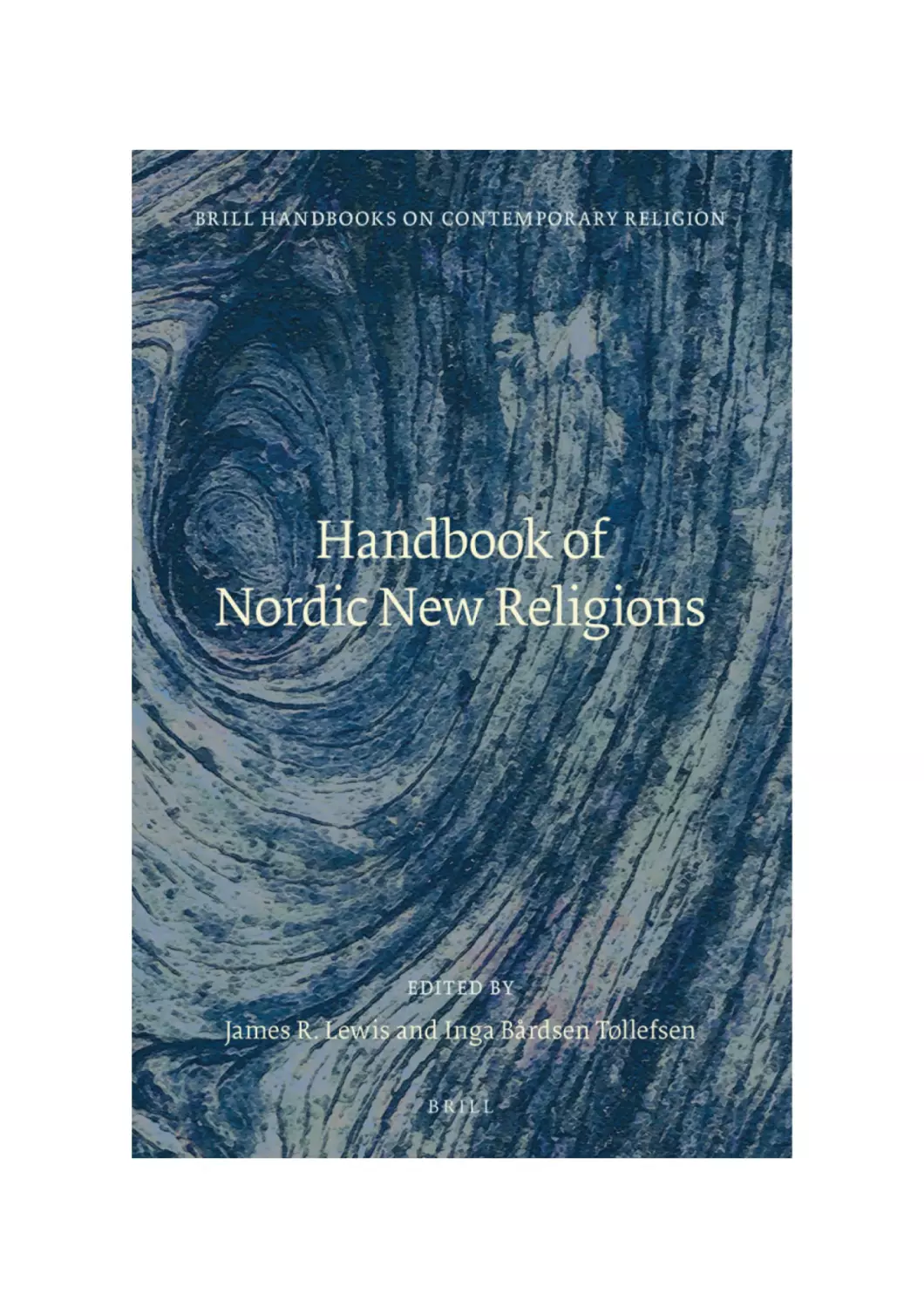
Handbook of Nordic New Religions
Brill Handbooks on
Contemporary Religion
Series Editors
Carole M. Cusack (University of Sydney)
James R. Lewis (University of Tromsø)
Editorial Board
Olav Hammer (University of Southern Denmark)
Charlotte Hardman (University of Durham)
Titus Hjelm (University College London)
Adam Possamai (University of Western Sydney)
Inken Prohl (University of Heidelberg)
VOLUME 11
The titles published in this series are listed at brill.com/bhcr
Handbook of Nordic
New Religions
Edited by
James R. Lewis
Inga Bårdsen Tøllefsen
LEIDEN | BOSTON
Library of Congress Cataloging-in-Publication Data
Handbook of Nordic new religions / edited by James R. Lewis, Inga Bardsen T0llefsen.
pages cm. -- (Brill handbooks on contemporary religion, ISSN 1874-6691 ; VOLUME 11)
Includes bibliographical references.
ISBN 978-90-04-29244-4 (hardback : alk. paper) -- ISBN 978-90-04-29246-8 (e-book) 1. Scandinavia-Religion. 2. Cults--Scandinavia. I. Lewis, James R., editor.
BL860.H245 2015
200.948--dc23
2015009906
This publication has been typeset in the multilingual “Brill” typeface. With over 5,100 characters covering
Latin, ipa, Greek, and Cyrillic, this typeface is especially suitable for use in the humanities.
For more information, please www.brill.com/brill-typeface.
ISSN 1874-6691
ISBN 978-90-04-29244-4 (hardback)
ISBN 978-90-04-29246-8 (e-book)
Copyright 2015 by Koninklijke Brill nv, Leiden, The Netherlands.
Koninklijke Brill nv incorporates the imprints Brill, Brill Hes & De Graaf, Brill Nijhoff, Brill Rodopi and
Hotei Publishing.
All rights reserved. No part of this publication may be reproduced, translated, stored in a retrieval system,
or transmitted in any form or by any means, electronic, mechanical, photocopying, recording or otherwise,
without prior written permission from the publisher.
Authorization to photocopy items for internal or personal use is granted by Koninklijke Brill nv provided
that the appropriate fees are paid directly to The Copyright Clearance Center, 222 Rosewood Drive,
Suite 910, Danvers, ma 01923, usa.
Fees are subject to change.
This book is printed on acid-free paper.
Contents
List of Figures and Tables ix
Notes on Contributors x
Introduction 1
PART 1
Denmark
1 The Study of New Religions in Denmark: A Brief and Subjective
Research History 1985–2014 13
Mikael Rothstein
2 Old New Religions in Scandinavia 36
Olav Hammer
3 misa and Natha: The Peculiar Story of a Romanian Tantric Yoga
School 62
Sara Møldrup Thejls
4 The Baha’is of the North 77
Margit Warburg
5 Danish Dianetics: Scholarship on the Church of Scientology in
Scandinavia 93
Kjersti Hellesøy and James R. Lewis
PART 2
Finland
6 The Study of New Religious Movements in Finland: An Overview
of Previous Research 111
Tommy Ramstedt
7 From Western Esotericism to New Spirituality: The Diversity
of New Age in Finland 126
Jussie Sohlberg and Kimmo Ketola
vi
Contents
8
Diversification, Mainstreaming, Commercialization and
Domestication – New Religious Movements and Trends in
Finland 141
Måns Broo, Marcus Moberg, Terhi Utriainen and Tommy Ramstedt
9
Combining Christianity and New Age Spirituality: Angel Religion in
Finland 158
Terhi Utriainen
PART 3
Norway
10
A Study of New Religiosity in Norway 175
Ingvild Sælid Gilhus and Lisbeth Mikaelsson
11
Royal Angels in the News: The Case of Märtha Louise, Astarte
Education and the Norwegian News Press 190
Siv Ellen Kraft
12
The Spiritist Revival: the Raising Voice of Popular Religion 203
Anne Kalvig
13
Studying Up, Down, Sideways and Through: Re-presenting Seeking in
a Norwegian Setting 221
Ann Kristin Eide
14
The Art of Living Foundation in Norway: Indigenization and
Continuity 239
Inga Bårdsen Tøllefsen
15
Acem: Disenchanted Meditation 254
Margrethe Løøv
16
Norwegian ‘Conspirituality’: A Brief Sketch 268
Asbjørn Dyrendal
17
Approval of the Shamanistic Association: A Local Norwegian
Construct with Trans-Local Dynamics 291
Trude Fonneland
Contents
vii
PART 4
Sweden
18
New Religious Movements and Alternative Spirituality as an
Academic Research Field in Sweden – Some Reflections 313
Liselotte Frisk
19
The New Religious Movements – What Happened to Them?
A Study of the Church of Scientology, The Children of God, iskcon,
The Unification Church and The Rajneesh Movement and Their
Development over Time 325
Liselotte Frisk
20
The Spiritual Revolution, the Swedish Way 343
Peter Åkerbäck
21
The Ahmadiyya Mission to the Nordic Countries 359
Brian Arly Jacobsen, Göran Larsson and Simon Sorgenfrei
22
Heralds of the Cosmic Brotherhood: The Story of the Swedish
Contactee Sten Lindgren 374
Erik A. W. Östling
23
Are the Space Brothers Socialists? Swedish Indigenization of the ufo
Mythical Complex 390
Jessica Moberg
PART 5
Baltic States and Outside Perspectives
24
Lithuanian Occulture and the Pyramid of Merkinė: Innovation or
Continuity? 411
Milda Ališauskienė and Massimo Introvigne
25
The “Back to Nature” Worldview in Nature-based Spirituality
Movements: The Case of the Anastasians 441
Rasa Pranskevičiūtė
Contents
26
Activities of Hindu-Related Movements and Western Esoteric Groups
in Latvia 457
Anita Stasulane
27
New Religious Movements and New Age in Estonia 478
Ringo Ringvee
28
Fire and Ice in Midvestjard: American Religion and Norse Identity in
Minnesota’s Heathen Community 495
Murphy Pizza
Index 503
List of Figures and Tables
Figures
4.1
24.1
24.2
24.3
24.4
24.5
24.6
24.7
24.8
24.9
24.10
Growth in membership in four Nordic countries. 89
Massimo Introvigne and Povilas Žėkas outside the Pyramid. 412
Inside the Pyramid. 415
Trinity Crosses at the Pyramid’s 417
Švilpiai by A. Mončys, Antanas Mončys Museum, Palanga. 422
Čiurlionis’ Home in Druskininkai. 425
Čiurlionis, Vision (1905). 427
Čiurlionis, Sonata of the Stars: Andante (1908). 430
Čiurlionis, Sonata of the Pyramids: Allegro (1909). 434
Čiurlionis, Fairy Tale of the Kings (1908–1909). 435
The Cupola in Merkinė. 436
Tables
4.1 Number of Baha’is in the Nordic countries, 2013. 78
21.1 Members in the Ahmadiyya communities in Norway, Sweden and Denmark.
362
Notes on Contributors
Milda Ališauskienė
is a postdoctoral fellow at the Center for Oriental Studies at Vilnius University
and associate professor at Department of Sociology, Vytautas Magnus
University, Kaunas. Her research interests include secularization, religious
diversity, religious fundamentalism, new religious movements, New Age, and
contemporary Hinduism. She has published several articles on contemporary
religiosity in Lithuania, focusing on New Age, the Art of Living Foundation,
and Satanism, which are based on the material collected during her fieldwork.
Together with Ingo W. Schröder she co-edited Religious Diversity in Post-Soviet
Society Ethnographies of Catholic Hegemony and the New Pluralism in Lithuania,
published by Ashgate in 2011.
Dr. Måns Broo
is a senior lecturer at the Department of Comparative Religion at Åbo Akademi
University, where he received his PhD with a dissertation on the guru institution in Vaishnava Hinduism (2003). He has published several translations of
classic Sanskrit texts in Finnish and Swedish. Apart from such philological
work, his research interests include modern, middle-class Hinduism as well as
forms of contemporary yoga in the West.
Asbjørn Dyrendal
is Professor in History of Religion at the Norwegian University of Science and
Technology, Trondheim, Norway. His research interests revolve around contemporary religion in society, particularly Satanism, popular occulture and
conspiracy culture. He is also editor of the Norwegian sceptic’s journal, Skepsis.
Ann Kristin Eide
holds a dr. polit. degree in social anthropology from the University of Bergen.
She currently holds a position as senior researcher at Nordland Research
Institute, Bodø, Norway. A governing idea in her work has been processes of
marginalization in the welfare state, embracing issues of pain, communication
and power relations. Her work lends support to the usefulness, and necessity
of, assuming new angles in our research, using multiple, non-hierarchical
points of entry and exit in data-representation and interpretation.
Trude Fonneland
is Postdoctoral Fellow at the Department of History and Religious Studies at
the University of Tromsø. She defended her doctoral thesis in 2010 on Sami neo
N otes on Contributors
xi
shamanism in Norway. Her postdoctoral project “Spiritual Entrepreneurship in
Northern Scandinavia” deals with tourism entrepreneur businesses who promote a New Age philosophy and spiritual values such as “self-development,”
“holism” and “deep-values,” and who present a vision of crossovers between
religion, local development and tourism, combining local traditions with
global trends.
Liselotte Frisk
has been Professor of Religious Studies at Högskolan Dalarna since 2006. She
has written several books about new religious movements and new age, and
conducted several research projects in the same area of study. She is currently
researching children in minority religions together with Peter Åkerbäck. Frisk
is also chairperson of Finyar (the Nordic network for research on new religiosity) and issnr (International society for the study of new religions), and coedits ijsnr (International journal for the study of new religions) and Aura (The
Nordic journal for the study of new religiosity).
Ingvild Sælid Gilhus
is Professor of Religion at the University of Bergen, Norway. She is VicePresident of the International Association for the History of Religions (until
2015). Gilhus works in the areas of religion in late antiquity and new religious
movements. Her primary publications include Lauging Gods, Weeping Virgins:
laughter in the history of religions (1997) and Animals, Gods and Humans:
changing attitudes to animals in Greek, Roman and early Christian ideas (2006).
She is book review editor of Numen and is an editorial board member of
Temenos.
Olav Hammer
Professor of the Study of Religions at the University of Southern Denmark, has
published extensively in English and Swedish on New Age, and on religious
innovation from the 19th century to the present. He is at present editor (with
Henrik Bogdan) of an encyclopedic work on Western esotericism in the
Scandinavian countries.
Kjersti Hellesøy
is a graduate student at the University of Tromsø, currently researching independent Scientology. She holds degrees in Religious studies and in Russian language and literature. In religious studies she has a special interest in new
religious movements, religion and violence, Christianity and Islam. Recent
publications include, “Scientology: The Making of a Religion,” in Controversial
New Religions (2nd edition 2014).
xii
Notes on Contributors
Massimo Introvigne
is professor of Sociology of Religion and Sociology of Religious Movements at
the Pontifical Salesian University in Torino, Italy, and managing director of
cesnur, the Center for Studies on New Religions. The author of some 60
books in Italian, some of them translated in French, English, German, Spanish,
and other languages, in 2011 he served as the Representative of osce, the
Organization for Security and Co-operation in Europe, for combating racism,
xenophobia, and religious discrimination against Christians and members of
other religions, and from 2012 as chairperson of the Observatory of Religious
Liberty established by the Italian Ministry of Foreign Affairs
Brian Arly Jacobsen
is Assistant Professor in sociology of religion at the Department of CrossCultural and Regional Studies, University of Copenhagen, Denmark. His most
recent publications include “Politics of Mainstream and Extremist Parties on
Integration of Immigrants and Minorities – Denmark,” in Radko Hokovský and
Jiří Kopal (ed.), Politics and Policies of Integration in Austria, Hungary, Czechia,
Denmark and at the eu Level. League of Human Rights & European Values
Think-Tank (2013) pp. 104–133 and “Myths and Facts on the Future Number of
Muslims-a Danish Case Study.” Journal of Muslims in Europe 2 (2013) 1–18.
Anne Kalvig
is Associate Professor of Religious Studies, Department of Cultural Studies and
Languages, University of Stavanger, Norway. Her main research interests are
new religious movements, alternative spirituality, popular culture, alternative
and folk medicine, death, and gender studies. Her latest publications include
the monograph Spiritual Health. Views of life among alternative therapists
(Høyskoleforlaget, 2012), “Facing Suffering and Death: Alternative therapy as
post-secular religious practice” (in Post-secular religious practices, Donner
Institute, 2012), “Séances and the Memory of the Dead” (Kirke og Kultur, 2012)
and “Alternative Folk Medicine? Roots and Shoots in the South-Western Field
of Holistic Health” (Tidsskrift for kulturforskning, 2012). She co-edited the
anthology Traces: Memory Studies II (Wigestrand, 2012).
Kimmo Ketola, PhD
is a senior researcher in the Church Research Institute of the Evangelical
Lutheran Church of Finland. His research has focused on new religious movements, new spirituality, and religious diversity in Finland. He has published
several articles and books in Finnish and English. His most important English
monograph is The Founder of the Hare Krishnas as Seen by Devotees: A Cognitive
Study of Religious Charisma (Brill, 2008).
N otes on Contributors
xiii
Siv Ellen Kraft
is professor of the History of Religions, University of Tromsø, Norway. Kraft has
written extensively on Theosophy, New Age spiritualities and religious revival
among the Sami, including a number of articles, four edited books and four
monographs. Recent books include Religion i pressen (with Cora Alexa Døving,
Universitetsforlaget 2013) and Hva er nyreligiøsitet (Universitetsforlaget 2011).
Göran Larsson
is a professor of religious studies at the Department of Literature, History of
Ideas and Religion at the University of Gothenburg, Sweden. His most recent
publication is Muslims and the New Medias: Contemporary and Historical Debates
(Ashgate 2011). He has also published Islam and Muslims in Sweden: Integration
or Fragmentation? A Contextual Study with lit Verlag (2007), and edited (with
Åke Sander) Islam in the Nordic and Baltic Countries (Routledge 2009).
James R. Lewis
is a highly published scholar in the field of New Religious Movements and
Professor of Religious Studies at the University of Tromsø (Norway). He currently co-edits three book series and is the general editor for the Alternative
Spirituality and Religion Review and for the Journal of Religion and Violence.
Recent publications include Violence and New Religious Movements. (2011), (coedited with Olav Hammer) Religion and the Authority of Science (2011), Cults: A
Reference and Guide (2012), (co-authored with Diana Tumminia) The Movement
of Inner Awareness (2013) and Sects & Stats (2014).
Margrethe Løøv
is a PhD fellow at the Department of Archaeology, History, Cultural Studies
and Religion at the University of Bergen. She holds a ma in Religious Studies
from the University of Oslo and has previously studied in Hyderabad,
Heidelberg and Montpellier. She has also been involved in a book project on
the preface to the mission among the Sami people in Norway. Her research
interests include the New Age movement and nrms in general, quantitative
approaches in the study of religion, the history of missions and the adaptation
of Hindu/Buddhist meditation in the West.
Lisbeth Mikaelsson
is professor emerita of Religion at the University of Bergen, Norway. Her
research has focused on Christianity and nrm, and she has published numerous works about Norwegian mission literature, women and mission, religion
and locality, pilgrimage, Theosophy, and New Age. Among her publications are
xiv
Notes on Contributors
Kallets ekko. Studier i misjon og selvbiografi (2003), and co-edited with Ingvild
Sælid Gilhus, Religion i skrift. Mellom mystikk og materialitet (2013).
Jessica Moberg
is a postdoctoral researcher at Gothenburg University. Her main interests are
contemporary religiosity, and aspects such as narratives and rites. Her doctorate focused on contemporary charismatic Christianity in Stockholm, with a
special emphasis on religious practice on the level of individual believers.
Moberg is also interested in New Religious Movements, particularly the field of
Swedish ufo-religiosity.
Marcus Moberg
is Academy of Finland Postdoctoral Researcher at the Department of
Comparative Religion at Åbo Akademi University in Turku, Finland. He also
works as a researcher in the Åbo Akademi Centre of Excellence in Research
project Post-Secular Culture and a Changing Religious Landscape in Finland
(pccr). His main research interests lie in the sociology of religion and religion,
media and culture-studies.
Murphy Pizza
is adjunct faculty in Liberal Arts at Minneapolis College of Art and Design, St.
Catherine University, and in Humanities at Minnesota School of Business. She
has published work on Modern Paganism and African Diaspora religions in
America, and is co-editor/contributor with James R. Lewis of The Handbook of
Contemporary Paganism.
Rasa Pranskevičiūtė
is a researcher on contemporary alternative religiosity, focusing on the subjects of nature-based spirituality, contemporary Paganism, post-Soviet cultural
heritage, youth, religious and other subcultures, and alternative social projects.
She is currently a postdoctoral research at the Uppsala Religion and Society
Research Centre, Uppsala University (Sweden). Pranskevičiūtė has published
several articles based on the material collected during her fieldwork on postSoviet religiosity – Vissarionite and Anastasian communities in Baltic countries and Russia, Hare Krishna communities in Lithuania, Pagan Romuva, and
diverse subcultures in Lithuania.
Tommy Ramstedt
is a doctoral student at the Department of Comparative Religion at Åbo
Akademi University in Finland. He is presently working on his doctoral thesis
N otes on Contributors
xv
on the Finnish alternative spiritual milieu. The main focus of his research is on
intersections between popular culture and alternative spirituality.
Ringo Ringvee
is historian of religion with special interest on contemporary religious diversity, minority religions, and religion-state relations. His publications include
articles in books and journals on minority religions and on the legal situation
concerning religious communities in Estonia and in other Baltic countries. He
is member of the research group in religious studies at the Center of Excellence
in Cultural Theory at the University of Tartu, and he currently holds the post of
adviser at the Religious Affairs Department at the Estonian Ministry of the
Interior.
Mikael Rothstein, PhD
is Associate Professor of the History of Religions, University of Southern
Denmark (sdu). He is also tenured Visiting Professor at the Vytautas Magnus
University, Lithuania. He is author and editor of several volumes on new religions and comparative religion in general. Among his English language publications are Belief Transformations (1996), Secular Theories in the Study of
Religion (edited with Tim Jensen, 2000), New Age and Globalization (edited volume, 2001), The Cambridge Companion to New Religious Movements (co-ed.
with Olav Hammer, 2012), and Handbook of the Theosophical Current (also
co-ed. with Olav Hammer, 2012).
Jussi Sohlberg
is a research coordinator at the Research Institute of the Lutheran Church in
Finland (MTh in Comparative Religion from the University of Helsinki). He
has published and lectured in the areas of contemporary paganism, esotericism, and alternative spirituality. He produces content for and manages the
website of the Religions in Finland Project.
Simon Sorgenfrei
is lecturer in the Study of Religions at Södertörn University in Stockholm,
Sweden. His primary academic interests are Islam and Sufism, past and present. The title of his thesis is American Dervish: Making Mevlevism in the United
States of America (University of Gothenburg, 2013).
Anita Stasulane
(1962) is Professor of history of religions at Daugavpils University, Latvia. She
graduated from the University of Latvia (1985) and the Pontifical Gregorian
xvi
Notes on Contributors
University in Rome, Italy (1998). She has been working mainly on the history of
western esotericism. Editor-in-chief of “Kultūras Studijas” (Cultural Studies).
Member of Latvian Council of Science Expert Committee for Philosophy,
Theology and Religious Sciences.
Sara Møldrup Thejls
(M.A. University of Amsterdam 2007 and University of Copenhagen 2008, both
in Religious Studies) is an external lecturer at the Department of History of
Religions at the University of Copenhagen. Her main research focus is kabbalah in various guises and the relation to the field of Western esotericism
from the middle ages till present. Other topics of interest are method and theory in the study of religions and New Religious Movements, particularly the
role of tradition and science in the processes of legitimization.
Inga Bårdsen Tøllefsen
(M.A. University of Tromsø 2012) is a PhD student at the University of Tromsø.
Her research interests are New Religious Movements (especially Indianoriented movements), religion and gender, the New Age, and religion and
nature. Recent publications include, “Transcendental Meditation, the Art of
Living Foundation and Public Relations: From Psychedelic Romanticism to
Science and Schism” in Controversial New Religions (2nd edition 2014).
Terhi Utriainen
is Adjunct Professor of Study of Religions and Gender Studies and Senior
Lecturer in Study of Religions at the University of Helsinki. Her research interests include women’s lived religion, embodiment, healing and rituals. She is
co-editor of Post-Secular Society (Transactions 2012).
Margit Warburg
is Professor in Sociology of Religion, Department of Cross-Cultural and
Regional Studies, University of Copenhagen. Among her publications are New
Religions and New Religiosity (Aarhus University Press 1998, edited with Eileen
Barker); Religion and Cyberspace (Routledge 2005, edited with Morten T.
Højsgaard); Citizens of the World. A History and Sociology of the Baha’is from a
Globalisation Perspective (Brill, 2006); Holy Nations and Global Identities. Civil
Religion, Nationalism and Globalisation (edited with Annika Hvithamar and
Brian Jacobsen), Leiden, E.J. Brill, 2009; Religion in the 21st Century. Challenges
and Transformations, (edited with Lisbet Christoffersen, Hans Raun Iversen
and Hanne Petersen), Ashgate, 2010.
N otes on Contributors
xvii
Erik A. W. Östling
works as a study counselor and administrator for the history of religions at the
department for ethnology, history of religions and gender studies at Stockholm
University. At Stockholm University he has been studying the history of religions, social anthropology and philosophy. Recent publications include,
“‘Those who came from the sky’: Ancient astronauts and creationism in the
Raëlian religion,” in Controversial New Religions (2nd edition 2014).
Peter Åkerbäck, PhD
history of religion, Stockholm University. His dissertation dealt with suicide
cults. Now researching children in minority religions together with Liselotte
Frisk (funded by Vetenskapsrådet 2012–2015). Board member of Finyar.
Introduction
New Religious Movements (nrms) came into being as a distinct subfield of
academic study in the 1970s in response to the explosion of non-traditional
religious movements that took place in the waning years of the sixties counterculture. These movements initially attracted the attention of American and
European sociologists of religion largely because of the controversy that arose
in response to their expansion. Religious studies – which at the time was still in
the process of establishing itself as a legitimate discipline distinct from theology and traditional biblical studies – was only too happy to leave nrms to sociology. This situation gradually changed, however, so that at present more
scholars of nrms come from religious studies backgrounds than come from
the social sciences.
nrm studies endured marginal status in the religious studies academy for
many years. Thus the experience that Liselotte Frisk recounts in her chapter on
the study of nrms in Sweden, in which her professor rejected her thesis topic
on grounds that the study of nrms simply did not belong in religious studies,
is not untypical of the attitude many of us faced in those early years. It was, in
fact, only after the series of incidents of mass violence in the 1990s – involving
the Branch Davidians, the Solar Temple, Aum Shinrikyo and Heaven’s Gate –
that the academy was compelled to recognize nrms as a legitimate area of
specialization.
And the field continues to mature. This is reflected in the existence of three
academic journals focused on nrms, Nova Religio, the International Journal for
the Study of New Religions, and the Alternative Spirituality and Religion Review.
Additionally, at present there are at least three book series dedicated to New
Religions. Another indicator is the annual CENSUR conferences that have
been held continuously since the 1980s. Yet another is the recent formation of
an academic association devoted to the study of nrms, the International
Society for the Study of New Religions (issnr), which was founded in Sweden
in 2009. It should also be mentioned that courses on nrms are popular offerings in most religious studies programs of any size.
However, despite the growth of this field of study, some new religious movement scholars, at least in North America, have expressed the opinion that the
longer range prospects for our area of study are bleak. This judgment is based,
in part, on the perception that relatively few younger scholars are choosing to
become nrm specialists. Instead, it seems that the great bulk of new research
continues to be produced by the same people who were active in the field back
in the seventies and eighties.
© koninklijke brill nv, leiden, 2015 | doi 10.1163/9789004292468_002
2
Introduction
The senior editor of the current collection was aware of this evaluation of
the nrm field when he first moved to Norway in late 2009. Though he already
had a number of close Scandinavian colleagues, he was nevertheless unprepared to discover that so many scholars in Nordic countries had active interests in new religions and in the new age subculture (referred to jointly in this
region of the world as ‘new religiosity’). In fact, over the past dozen years or so,
an increasingly disproportionate percentage of new religions scholars have
arisen in Nordic countries and teach at universities in Denmark, Finland,
Norway, Sweden and the Baltic countries.
The current volume surveys this rich field of study, focusing on the scholarship on new religiosity being produced by scholars in this region of northern
Europe. To keep the project within reasonable bounds, Nordic researchers
working on new religions in other areas of the world have not been included in
this collection. We have grouped contributions into sections according to the
home country of each researcher’s institution. The four major sections are
introduced by chapters that survey the history of the study of new religiosity in
Denmark, Finland, Norway and Sweden. (Largely because the editors are based
at an institution in Norway, the Norwegian section is a bit longer than for the
other nations.) In part because the Baltic nations are sometimes considered
Nordic, we have also included a fifth section that presents papers from
Lithuania, Latvia and Estonia, together with a paper that examines Nordic
re-constructionist religions in North America.
1
The academic, non-theological study of religion has a very long history in
Denmark, but new religions were not integrated into the subject area of historians of religions and sociologists of religion until approximately 1985 when a
few scholars began their nrm research. This development is discussed by
Mikael Rothstein in his “Nordic New Religions: History of Research in
Denmark.” As he shows, by the beginning of the 1990s, research networks had
been formed, and international contacts established. Although there were
conflicts between apologetic theologians and academics, nrm studies
expanded and became increasingly more popular. Book series were launched,
conferences held and for at time the prospect for a strong scholarly milieu was
positive. However, from the year 2000 public interest in new religions declined
as political nationalism rose, and everything was focused on Islam. Presently
only few scholars study new religions, and even fewer contribute regularly
with chapters, articles and books on the international scene.
Introduction
3
The rapid increase in religious alternatives in the 1970s and up to the present
is not unprecedented in Nordic history. Olav Hammer’s “Old New Religions in
Scandinavia” provides a historical background to the recent cohort of new religions, and presents brief sketches of the various ‘alternative’ forms of religiosity
that were available in the Nordic countries from the end of the 18th century
and up to the mid-20th century. Hammer briefly introduces a number of
Mesmerist, Spiritualist, Theosophical and Occultist writers and movements.
Just as in contemporary processes of globalization, movements imported from
other countries were often adapted to local concerns. Several such homegrown
versions of international religious currents are presented.
The tantric yoga organization misa (Movement for Spiritual Integration in
Absolute) has become one of the most successful European yoga schools. The
teachings of misa present a doctrine of synthesis wherein elements from
Orthodox Christianity, esoteric Traditionalism, conspiracy theories and New
Age ideas are combined with Tantric philosophy and practice. Sara Møldrup
Thejls’ “misa and Natha: The Peculiar Story of a Romanian Tantric Yoga School”
presents (1) an exposition of the political intrigues and agendas surrounding
the movement, and (2) the teachings of misa as they appear in the outer and
inner circles of the movement, taking the case of their Danish headquarters as
an illustrative example.
The Baha’is belong to one of the ‘old new religions’ of the Nordic countries.
As discussed by Margit Warburg in “The Baha’is of the North,” during the two
decades up to World War I proselytising Baha’is succeeded in establishing viable Baha’i communities in the West. In the Nordic countries, the very first few
converts were gained in the 1920’s, and after World War II American Baha’i missionaries sparked an effective growth in membership. Today, well-established
Baha’i communities are part of the landscape of new religions in all five Nordic
countries, numbering a total of about 1,500 registered members. Baha’i rituals
like daily prayers and a yearly fast are clearly Islamic in origin, but in most
other respects the religion has moved beyond the House of Islam, and by far
the majority of Baha’is have a non-Muslim background.
L. Ron Hubbard, the founder of Scientology, began establishing the Church
of Scientology outside of the United States as early as 1956. He later moved
his headquarters to England in 1959. However, the church that was opened in
Copenhagen in June of 1968 became the center of Scientology activities in continental Europe. This was well before ‘New Religious Movements’ became
established as a distinct field of study. As a consequence, it would be more
than a dozen years before Scandinavian academicians turned their attention
to Scientology. When they did, it was Danish researchers who took the lead, in
part because of the proximity of the major Scientology center to the University
4
Introduction
of Copenhagen in the country’s capital. In “Danish Dianetics: Scholarship on
the Church of Scientology in Scandinavia,” Kjersti Hellesøy and James R. Lewis
survey the scholarship that has been produced on Scientology in Scandinavia,
emphasizing Danish contributions.
2
The study of new religions in Finland remains a small and quite fragmented field in need of more clearly articulated general aims, firmer crossdisciplinary consolidation and long-term systematic gathering of empirical
data. Overall, the academic study of new religions and alternative spiritualities
in Finland has gone hand in hand with the general public visibility of new
religions in Finnish society at any one time. In “The Study of New Religious
Movements in Finland: A Review of Previous Research,” Tommy Ramstedt provides a comprehensive overview of the scholarship on new religions and religious currents in Finland since the mid-1970s, and presents Finnish institutions,
networks and projects in which research on new religious phenomena in
Finland has been conducted. In addition, it also aims to comprehensively survey relevant journal articles, book chapters, doctoral dissertations and masters
theses that have been produced the field. The chapter concludes by outlining
some particular areas in need of further attention and inquiry for the advancement of the study of new religions and alternative spiritualities in contemporary Finland.
In “From Western Esotericism to New Spirituality: The Diversity of New Age
in Finland,” Jussie Sohlberg and Kimmo Ketola provide an overview of New
Age spirituality in Finland. After first briefly describing its rise and development in Finland, they estimate its current size and popularity. On the basis of
the systematic documentation and mapping of all religious and spiritual communities in the city of Helsinki, conducted in 2008 by the authors, it is possible
offer a rough picture of the relative prominence of the New Age milieu in the
capital of Finland. Additionally, they analyze the beliefs and ideologies that
characterize the Finnish New Age milieu. This is done through an analysis of a
questionnaire survey of readers of one of the most prominent New Age magazines in Finland by the national Church Research Institute. In examining
the results, the authors focus especially on the relationship of characteristic
New Age beliefs to more traditional Christian beliefs and various secular
stances. The analysis will also shed light on the issue of how important sources
of inspiration – the Theosophical, Spiritualist, and other strands of Esoteric
thinking – are in the Finnish New Age milieu.
Introduction
5
Similar to the other Nordic countries, the religious climate of Finland
has long been marked by a slow general decline in institutional religion, progressively weakening mechanisms of traditional religious socialization, and
increasing religious privatization and diversification. Different types of alternative spiritualities and new religious movements have constituted a small but
visible part of the Finnish religious landscape since the early 1970s. However,
although there is evidence of a steadily growing general interest in alternative
religious and spiritual teachings and ideas in Finland, the numbers of people
actively involved in alternative spiritual groups and new religious movements
has so far remained low, and many of the most visible new religious
movements have stagnated in terms of supporters and social influence.
In “Diversification, Mainstreaming, Commercialization and Domestication:
New Religious Movements and Trends in Finland,” Måns Broo, Marcus Moberg,
Terhi Utriainen and Tommy Ramstedt explore some notable contemporary
developments in the Finnish new religious scene in relation to broader social
and cultural developments which are currently transforming the face of religion in the West.
The New Age can be approached as a particular style of thinking and acting
within the religious field. This style can be found among many members of the
Evangelical Lutheran church in Finland: it modifies Christianity into a fluid
and flexible lived religion to meet the demands of Modernity. A useful example
of how this modification works is contemporary interpretations of angels.
Angels are Christian figures and symbols but some of the ways they are
approached is clearly outside standard Christian thinking. Through interviews
with female members of the Evangelical Lutheran Church of Finland, in
“Combining Christianity and New Age Spirituality: Angel Religion in Finland,”
Terhi Utriainen explores what happens to Christian and Lutheran angels – and
relations between humans and the transcendent – when they are fashioned in
a more New Age way in today’s angel boom.
3
In Norway, Research on New Religions began in the 1970s. As Lisbeth Mikaelsson
and Ingvild Sælid Gilhus explain in “A Study of New Religiosity in Norway,”
a special focus has been on the type of New Religions/New Age that is ‘thinly
spread,’ meaning that the degree of organization is low, such as in Satanism
and in the Theosophical movement. There has also been a focus on the
relationship between New Religions/New Age and the Church of Norway.
Different research groups have had different perspectives and made different
6
Introduction
evaluations of this type of religion, depending on whether they belong to
humanistic or theological faculties.
The story of Norwegian princess Märtha Louise’s and co-partner Elisabeth
Samnøy’s ‘Angel School’ was one of the most profiled media-stories of 2007,
and probably the most profiled New Age story in Norwegian media ever. In
“Royal Angels in the News: The Case of Märtha Louise, Astarte Education and the
Norwegian News Press,” Siv Ellen Kraft attempts to make sense of the fuss, the
scope and the proportions of the case. Additionally, she also throws light on
the status of New Age spiritualities in the Norwegian news media. Scandals say
something about the normality from which they deviate. This particular scandal speaks to the existence of a hierarchy of more or less valuable religion, and
related notions of what religion is and should be. It also speaks to a link
between national identity and religion. The controversial status of New Age is
not unique to the Norwegian news press, but was in this case shaped by the
royal dimension and perceived threats to national dignity. Finally, this case
speaks to a gap between New Age representations in the news media and in
the popular media.
The Spiritist revival is a significant part of the Norwegian religious landscape, but academic analysis of this trait of late modern religious life is rare.
Mediumship conveyed in séances, in therapeutic techniques, in the entertainment and media genre involve large numbers of participants and big audiences,
with a clear female majority. In “The Spiritist Revival: the Raising Voice of
Popular Religion,” Anne Kalvig outlines some general features of Norwegian
contemporary spiritism and associated spiritual practices. The material, gathered from both field work (interviews and participant-observation) and textual studies, including media, is qualitative and analyzed with a discourse
oriented perspective. The primary research questions of this chapter are: in
what ways can spiritism and related practices be said to be central parts of
Norwegian, contemporary religious-spiritual life? Does spiritism challenge our
academic understandings of religion and spirituality, and if so, why? Do we
find connections and continuations between folk religious practices and
today’s spiritism, and is gender an analytical category worth exploring here?
And finally, how has ‘the establishment,’ including the Norwegian Church,
responded to the spiritist revival, in terms of reactions, negotiations and possible adapations?
Ann Kristin Eide’s “Studying Up, Down, Sideways and Through: Re-presenting
Seeking in a Norwegian Setting” adds to other contemporary analyses the
caution against assuming ‘New Age’ is a sui generis movement or milieu.
Using Norwegian Buddhist Centres as strategic points of intervention, the
Introduction
7
phenomenon of spiritual seeking is explored as it is narrated by, and manifesting itself among, people visiting these centres. We are indeed dealing with a
complexity of intertwining and conflicting discourses, criss-crossing, fusing
and colliding, in ways that have implications for what we can understand as
constituting a social environment, for what we can understand as constituting
context, for what we can understand as ‘New Age.’
In “Art of Living Foundation in Norway: Indigenization and Continuity,”
Inga Bårdsen Tøllefsen investigates the Art of Living movement both globally
and locally, focusing especially on the movement in Norway, and in its founding country India. Art of Living is localized as a New Religious Movement
(nrm) within the larger framework of Hinduism and contemporary new religiosity. The chapter traces the movement’s key practices and the courses and
initiatives they offer, as well as presenting a short biography of the movement’s
founder Sri Sri Ravi Shankar. A selection of the most important legitimization
strategies utilized by the Art of Living are discussed, along with an analysis of
Ravi Shankar as a religious entrepreneur.
Acem is a group that began life as a part of Maharishi Mahesh Yogi’s tm
movement. Like the early tm, Acem emphasizes that it teaches a scientific meditation technique. In “Acem: Disenchanted Meditation,” Margrethe
Løøv sheds light on the early emergence of Acem as the Norwegian branch of
the Academic Meditation Society within Maharishi’s Spiritual Regeneration
Movement. How did what originated as a New Religious Movement come to
vehemently oppose any association with religion? What were the tensions that
caused the original ams to crack up and create a definitive fissure between
Acem and the Maharishi movement? Following developments up to the present, the chapter also tells the unique story of a Nordic movement that not only
has re-wrapped meditation – but also re-exported it to India and several other
non-Western countries.
The term ‘conspirituality’ was recently suggested for an allegedly new
phenomenon: the conflation of new spirituality and conspiracy culture.
The phenomenon is, however, complex. As an emergent movement or semiseparate trend within the broader ‘alternative mainstream,’ conspirituality may
be construed as fairly recent. The values and structure of the cultic milieu
means that conspiracy theory is both hard to avoid and seen as partially problematic, and within the Norwegian scene, the conflation has become a topic
straining internal cohesion. In “Norwegian ‘Conspirituality’: A Brief Sketch,”
Asbjørn Dyrendal traces the development of conspirituality as a visible trend
within the Norwegian cultic milieu. The chapter shows both the internal relations that identify it as a natural part of the discourse and practices within the
8
Introduction
self-identified ‘alternative’ movement, and shows the internal, discursive
strands that produce the strains which make it contested as a ‘sectarian’ movement that attempts to shove it to the side as less relevant.
In 2012, a local shamanic association concerned with the preserving of Sami
and Norse shamanic traditions was granted status as a separate religious community by the County Governor of Troms, northern Norway. This means,
according to the laws regulating religions in Norway, that they can perform religious ceremonies like baptism, weddings, and funerals – and, additionally,
obtain financial support from the state according to the size of their membership. Interestingly, this shamanic association appears to have been created in
order to meet the criteria required for obtaining the rights of Norwegian religious communities; national jurisdiction thus inspired a diverse group of professional entrepreneurs to join forces and organize themselves. Through
interviews with some of the entrepreneurs behind the creation of this local
shamanic association, in “Approval of the Shamanistic Association: A Local
Northern Norwegian Construct with Trans-Local Dynamics,” Trude Fonneland
focuses on the stories, images and products that are highlighted or set aside in
the religious-making processes that are currently taking shape. What kinds
of local, national, and global trends or discussions have formed this particular
local group, and in what way do secular institutions value what the association
puts into production?
4
In “New Religiosity as a Research Field in Sweden: Some Reflections,” Liselotte
Frisk presents the academic field of new religious movements and the more
diffuse and less organized “new Age” and its development in Sweden. Trends
and characteristics are discussed based on doctoral dissertations and research
projects in Sweden, the earliest being from the 1990s, thus making Sweden a
rather late adept to this academic field. The research field has been quite small
in Sweden and to a large part reflecting international trends.
Liselotte Frisk follows up her overview chapter with “The New Religious
Movements: What Happened to Them? A Study of the Church of Scientology,
The Children of God, iskcon, The Unification Church and The Rajneesh
Movement and Their Development over Time.” Based on a research project
funded by Riksbanken in 2004–2007, this chapter deals with five new religious
movements which became both well-known and controversial in the sixties
and seventies. Over the course of more recent decades, however, they have not
been in the headlines as much as before. The analysis in this chapter describes
Introduction
9
how these movements have changed since their inception four or five decades
ago. The focus is on the decades after 1980, as several representations about the
decades before that exist. The movements are discussed in a global perspective, but with emphasis on the Western world. Sweden is used as a local
example.
In “The Spiritual Revolution, The Swedish Way,” Peter Åkerbäck presents the
principal results of a research project which was funded by the Swedish
Research Council in 2008–2011. The project maps religious expressions in a local
area of Sweden, Dalarna, with a special focus on the holistic or spiritual milieu.
The project argues that new religious venues have emerged in the Western
world in the border areas between religion and other cultural venues, in connection with social changes such as globalization, individualism and secularization, and that boundaries that were previously taken for granted today are
negotiated and transgressed. Additionally, this has implications for the way we
understand and use the concept of religion. The project also discusses how
many people are engaged in the holistic milieu.
The aim of Brian Arly Jacobsen, Göran Larsson and Simon Sorgenfrei’s
“The Ahmadiyya Mission to the Nordic Countries” is to present the history
of the Ahmadiyya community and its arrival in Nordic countries. The text
covers when and where the movement was first introduced and how the establishment of the movement was organised. Even though this is one of the first
Muslim communities that settled in the Nordic countries – that is Sweden,
Norway, Denmark and Finland – there is hardly any information on this movement and its importance for the early establishment of Islam and Muslims in
this part of the world. The chapter pays special attention to the history of the
movement in Sweden, but also provides information on the establishment in
Denmark, Norway and Finland. Besides an overview of the history of the movement in the Nordic countries, the chapter also provides a short presentation of
the theology of the Ahmadiyya community.
The 1950s saw the advent of the contactees, persons claiming contact and
communication (both in person and through telepathy) with, and often delivering messages from, extraterrestrial human beings. Starting with Americans
such as George Adamski, Daniel Fry and Howard Menger (among others) the
ideas spread and similar claims began being made by persons from other parts
of the world. In “Heralds of the Cosmic Brotherhood: The Story of the Swedish
Contactee Sten Lindgren,” Erik A.W. Östling examines a group of people within
Swedish ufology centering around the contactee Sten Lindgren. Lindgren
claimed multiple contacts since the late 1950s and that he, together with other
Swedish contactees, were in contact with an extraterrestrial culture labeled
the Cosmic Brotherhood (abbreviated as cbh); a culture about 800,000 years
10
Introduction
ahead of terrestrial humans and according to Lindgren the same beings
encountered by the Americans mentioned above. The aim of the study will be
to analyze and describe the cosmology held by the group centered around Sten
Lindgren and to contextualize this group within the broader field of contactee
based ufo religions.
In recent decades, our knowledge of ufo-oriented religiosity has increased
immensely. In “Are the Space Brothers Socialists? Swedish Indigenization
of the ufo Mythical Complex,” Jessica Moberg aims to add further this field of
knowledge, in two ways. First, it presents new material. Secondly, it focuses on
an often neglected area of research; namely the ways in which ufo-religiosity
may adapt to local contexts by taking up specific local features. The examples
provided are taken from the Swedish setting and consist of material produced
by the Swedish ufo movement. The chapter deals mainly with ufo narratives,
which are approached from the perspective of myth theory. Focusing on adaption to the Swedish environment, attention is concentrated on two levels in
the narratives; the historiographic and the ideological. The argument is that
alterations in (mainly American) narratives are visible on both of these levels.
5
In “Lithuanian Occulture and the Pyramid of Merkinė: Innovation or
Continuity?” Milda Ališauskienė and Massimo Introvigne focus on historical
and recent developments within the field of Lithuanian ‘occulture’ and New
Age spirituality. The authors discuss the Pyramid of Merkinė in Lithuania, built
in 2002 by Povilas Žėkas. The first part is based on the analysis of the writings
of Povilas Žėkas, media reports, personal observations and interviews with
Žėkas and visitors to the place during 2010–2012, conducted separately by both
authors. The chapter then presents the doctrine, rituals and location within
the religious field of Lithuania of the Pyramid movement. The second part discusses the location of the phenomenon of the Pyramid of Merkinė within the
wider geographical and historical context of Lithuanian occulture. It is based
on the analysis of various sources, with a special reference to modern art. The
authors conclude that the phenomenon of the Pyramid of Merkinė is an innovation within the religious field of Lithuania, yet at the same time it is in continuity with a tradition of Lithuanian alternative spirituality including leading
cultural figures such as Mikalojus Konstantinas Čiurlionis, Oscar Milosz, and
Antanas Mončys.
Rasa Pranskevičiūtė’s “‘Back to Nature’ Worldview in Nature-based
Spirituality Movements: The Case of the Anastasians” presents a research into
Introduction
11
the implementation of environmental and spirituality ideas of alternative
communitarian movements through the establishment of rapidly spreading
nature-based spirituality communities and their settlements in the post-Soviet
region. It focuses on the Anastasia ‘spiritual’ movement, classifiable as New
Age, which emerged in Russia in the aftermath of the collapse of the Soviet
Union, and since has spread to East-Central Europe and beyond – concerning
expressions of nature-based spirituality in the movement. The linkage with
Nature and the Earth, and the importance of harmony are characteristic of the
subcultural ‘back to Nature’ worldview. Such ideas are realized in the process
of sacralizing space (creating Anastasian love spaces), which is fundamental to
the self-understanding of this subculture.
Anita Stasulane’s chapter covers the “Activities of Hindu-Related Movements
and Western Esoteric Groups in Latvia.” She provides a general picture of new
religious movements (nrms) in Latvia by examining them as a historical phenomenon without trying to evaluate their religious message or the social consequences of this phenomenon. In order to come to a comprehension of the
variety of new religious groups, the author undertakes two tasks: (1) to identify
new religious movements present in Latvia; (2) to classify new religious groups.
On the basis of the mapping of new religious movements, the author estimates
there are from 50 to 70 such groups in Latvia. There are the normal empirical
difficulties in applying broad typologies to specific cases. However, the author
distinguishes four main currents of the nrms in Latvia: (1) Hindu-related new
religious groups; (2) Western Esoteric groups; (3) Post-Christian movements;
(4) Neopagan groups. Within each current, the member bodies share a common heritage, a doctrine and lifestyle. In the present chapter, Stasulane examines groups in the first two categories.
Ringo Ringvee’s focus in “New Religious Movements and New Age in Estonia”
is on the nrms and New Spirituality/New Age (ns/na) that have arrived and/or
emerged in Estonia after the collapse on the Soviet Union. During the Soviet
period, Estonia became a spiritual center for some of the nrms operating in
the Soviet Union. At the same time, the esoteric and spiritual scene during that
period laid the foundations for the acceptance of the ns/na in present day
Estonia. The chapter focuses on general trends concerning the nrms and
ns/na in c ontemporary Estonia, and also on responses from state, society,
media, and mainstream religions to the nrms and ns/na.
Nordic religion in the us takes the form of Heathenry, or Norse Paganism.
Ranging from formal organizations like Asatru to eclectic mixes of Norse lore
and Wiccan practice, Heathenry is a dynamic construction of Nordic religious
and cultural identity in the midst of an increasingly ethnically pluralistic
society. In Murphy Pizza’s “Fire and Ice in Midvestjard: American Religion
12
Introduction
and Norse Identity in Minnesota’s Heathen Community,” she provides ethnographic sketches of Heathen paths in Minnesota – a state notable for its large
historically Scandinavian/Germanic cultural makeup – and explores how
Heathenry is a way for Minnesotans to re-identify and redefine Nordic culture
and identity in American terms.
James R. Lewis and Inga Tøllefsen, eds.
PART 1
Denmark
∵
chapter 1
The Study of New Religions in Denmark: A Brief
and Subjective Research History 1985–20141
Mikael Rothstein
Introduction
The interest in new religions in Denmark can perhaps be traced back to Pastor
Lauritz Minis of the island of Funen (Fyn). At the end of the 17th century, it was
difficult to get common people to eat potatoes, and Minis writes: “Getting
peasants to enjoy Potatoes is a Question of no little difficulty…it would perhaps
be easier to introduce a new religion than to introduce Potatoes.”2 Certainly
the issue of peasants’ nutrition has no direct bearing on the phenomenon of
new religions, but it is clear that the caring pastor must have experienced how
difficult it was to introduce a new religion. Regardless of the nominal
Christianity among peasants, it is not inconceivable that Pastor Minis refers to
hardships of his own mission efforts. As is well known, in pre-industrial times,
a strong folk religion was thriving as an unofficial parallel to the traditional
teachings of the Church, and it would not be strange if a priest of those days
would have had great difficulties in getting myths and rituals established in
exactly the way he felt best.
The potato drama, however, does not enlighten us further on the matter.
On the other hand, it is certain that today’s new religions became a matter of
interest for Pastor Minis’ later day kindred spirits – theologians, reverends,
missionaries – before it became a research issue for historians of religions,
sociologists of religion, folklorists etc. The study of new religions in Denmark
is thus involved in the same struggle, which the humanistic and social scientific study of religion in general was facing in its earliest stages: the showdown
1 The first version of this article was published in Danish in the journal Aura – tidsskrift för
akademiska studier av nyreligiositet vol. 4, s. 46–77 as: “Studiet af nye religioner i Danmark:
Kortfattet og subjektiv forskningshistorie 1985–2012.” As I had no possibility of rendering my
text into English at the required time, a draft translation of my article was generously made
by Ellen Dobrowski, to whom I extend my sincere thanks. The final version, however, is my
own responsibility. The article is reprinted (albeit in an edited and partly rewritten version)
with the kind permission of Aura’s editors.
2 cf. <http://www.kartoffelmuseum.dk/kartoflens_historie.htm>.
© koninklijke brill nv, leiden, 2015 | doi 10.1163/9789004292468_003
16
Rothstein
with theology. Unfortunately the project was only half completed, with the
result that the study of new religions in Denmark, from a historical point of
view, only gradually has become a subject in its own right within the humanities and social sciences. Attitudes, strategies and interests within the field have
simply been too dissimilar to ensure a definitive detachment from theology
in time.
The study of new religions has become an established international research
topic with its own journals, its own conferences, its own online discussion fora,
and a steady stream of highly specialized publications. However, there is no
common focus that characterizes the field, and no common ground to make
the many different contributions cohesive. Researchers from diverse disciplines and backgrounds frequently contribute to the study of new religions,
which leads to a theoretically and methodologically pluralistic field without
clear strategies and clear professional ambitions. As a consequence, any single
coherent research strategy should not be expected, but rather an academic
area, or field of study, where sharp demarcations and ideological rivalry belong
to the order of the day. For the same reason, it is impossible to write objectively
on the history and status quo of nrm-research in Denmark, so I will refrain
from trying. On the contrary, I shall consider my own subjectivity as a
necessary virtue.
Obviously in-depth empirical analysis of specific new religions is the backbone for any serious academic venture into this subject area, but only when
the new religions are contextualized precisely as religions in la longue durée
of the history of religions, they may be properly understood. Consequently,
I see the overall perspective of Comparative Religion in my work as being more
important than the issues specifically relating to various new religions. While I
happily include sociological and anthropological theories and methods in my
research, I reject theological perspectives, programmatically apologetic or not,
altogether. Other researchers approach these issues differently, and no academic agreement on how to proceed should be expected. In my opinion, however, as researchers, we owe it to our colleagues and students to explicitly state
our methods and objectives, and to position ourselves in our work. What follows is my attempt to do just that. The reader should also note that I find it
difficult to not incorporate my own work and personal views in this article
since, of all the scholars of religion in Denmark, I have produced the most on
new religions. Olav Hammer, who has worked in Denmark since 2005 and prolifically contributed to the elevation of Danish nrm-research to a high international level, similarly occupies an important position in the field, and his work
will therefore also be referred to regularly. In my discussion of the study of new
religions in Denmark, I shall refer to research conducted at Danish research
The Study of New Religions in Denmark
17
institutions, not necessarily research conducted by Danish researchers. Danish
researchers, who are working abroad, however, should also be mentioned. This
applies first and foremost to historian of religion Jesper Aagaard Petersen, who
is employed at the University of Trondheim, Norway. He is one of the leading
researchers in the subject area of Satanism, but his works are usually credited
as belonging to the Norwegian research community rather than to the Danish
one (see Aagaard Petersen 2009 and 2011 as well as contributions in Hammer &
Rothstein 2012), and Markus A. Davidsen, who holds a teaching position at the
University of Leiden. Davidsen specializes in so-called fiction based religion
(a strange term, what religion is not?), and his work is becoming increasingly
important (Davidsen 2014). As mentioned below, two promising Danish
scholars have obtained PhD-scholarships in Sweden during the past two years
(2013 on-going).
The Organizational Framework: A Historical Review
From a historical point of view the study of new religions came about as part
and parcel of the humanistic and social-scientific study of religion as such. It
was not introduced as a subject-appendix, but from the inception of nrmstudies in the mid 1980’s recognized as a natural element in the bulk of subjects
discussed by scholars of comparative religion and sociologists of religion alike.
Well, at least formally. And it took some time. The Study Board at the department where I was a student, had to be persuaded, and certain administrative
adjustments had to be made before I could proceed with my plans. Some, however, did not agree that the host of deviant religious movements emerging in
the wake of World War II, with a peak during the 1970’s and 1980’s, were at all
relevant. As I completed my extended Master thesis on Transcendental
Meditation in 1989, for instance, a historian of religions specializing in the
philological unravelling of ancient Indian texts, asked me on what grounds
I would justify considering “that parody of real advaita-vedanta” a religion?
My answers did not satisfy him, and when I tried to show that all components
usually linked with the concept of “religion” were present in that group, he
discharged my argument by stating that their cosmogony was “fake,” as it
was to be found in no ancient texts. My arguments, however, prevailed and
I became the first scholar of comparative religion to specialize in the study
of new religions in Denmark. The first professional research in Denmark –
on Scientology – was, however, conducted by sociologist of religion Merethe
Sundby Sørensen (1942–1997) five years earlier (see further below). My own
discipline, comparative religion, was established in Denmark at the Faculty of
18
Rothstein
Humanities, University of Copenhagen, in the year 1900. Since the earliest days
of the discipline a very broad knowledge of the world’s religions was considered a virtue, although historical-philological approaches were preferred. On
that basis it was not very difficult to introduce a new subject area. In hindsight
the opposition was rather weak. The other relevant discipline, sociology of religion, was a later invention which partly built on what was already prevalent,
but primarily incorporated a social-scientific perspective that allowed new
approaches to emerge. It was not, however, until the early 1990’s that sociologists of religion were more forcefully engaged in the study of new and emerging religions. My earliest recollection (applying “auto memory ethnography” as
my methdology) of an academic meeting where new religions were deliberated was hosted by Religionshistorisk Forening (the Association for the History
of Religions) at the university premises. I believe it was in 1987 or 1988. Knowing
very little, but instinctively avoiding apologetic contributions, a graduate student presented Roy Wallis’ 1984 book The Elementary Forms on the New
Religious Life, and somebody else brought forth James A. Beckford’s Cult
Controversies from 1985. I am unable to remember what was said more precisely, but I do remember that the library, where we were, was very crowded. At
some later point, perhaps the year after, the same association invited representative of the Unification Church to present themselves. Accusations against
the group were quite outspoken, and the need for a more balanced view was
articulated. However, the Unificationists saw the academic scene as a venue
for missionary work, and apart from loads of flyers and books for my growing
collection, nothing much came out of the arrangement. These, and subsequent
meetings of similar kinds, were, of course, the result of academic curiosity, but
the real trigger was probably the media. “Religion” was no real topic, but sects,
cults and deviant social movements were. Recognizing that the religious
underground was part of society’s “religion” just as much as the institutionalized churches, academics developed a growing urge to understand the
phenomenon, and Danish researchers took on the challenge.
The study of new religions and religious movements in Denmark has never
followed a single track. It is true that over the last 25 years there have been
attempts to focus research into a more cohesive product, but these efforts have
not succeeded as the differences in researchers’ interests and methodologies
have simply been too great. The most important attempt to join research forces
was the set-up of the Research Network on New Religions (RENNER), an internationally oriented project, based at the University of Copenhagen, which operated from 1994 to 2002. The RENNER project became possible as the Danish
Research Council allocated funds specifically for the study of new religions.
The announcement spurred the interest among historians and sociologists of
The Study of New Religions in Denmark
19
religion working in the humanities and social sciences, who promptly submitted an application. The interest among theologians was also piqued, and they
too applied for funding. The theological application was led by the missionary
and apologist Johannes Aagaard (1928–2007) of the University of Aarhus,
which was, at the time, a notoriously known opponent of new religious movements, the undisputed leader of a missionary enterprise, the Dialouge Centre
(see further below), and one of the strongest and most prolific counter-cultists
around (his wife, also a theologian, was, by the way, on the Research Council’s
Board). The Research Council ruled that funding would be granted on the condition that all parties, i.e. both projects, would form a joint project. Personally,
I was against this move, and today I regret that I was part of a project that
granted Christian missionaries and apologetics academic legitimacy. However,
it was my only way of entering Academia following my Ph.D.-position, but I
sadly admit, that it was the wrong thing to do. At any rate, I took part in the
work throughout the entire duration of the project, and can now look back on
a series of meetings, seminars, and conferences which (if we ignore the conflicts and theological absurdities that corrupted our scientific endeavours)
gave access to new knowledge and new professional relationships. The project
enabled us to come into contact with leading international researchers, mainly
within sociology of religion, who were willing and able to share in the debate
on the status and functioning of new religions in Western society. Some of the
most important contacts we made were with Eileen Barker, J. Gordon Melton,
James Richardson, Massimo Introvigne, and Jean-Francois Mayer. Additionally,
the project allowed us to establish close and lasting contact with colleagues in
other Scandinavian countries, such as Ingvild Gilhus, Lisbeth Mikaelsson,
Liselotte Frisk, and Tore Ahlbäck, just to name a few. At the same time, however, the project allowed counter-cultists such as Thomas Gandow, and absolutely non-academic anti-cultists such as the theologian Aleksander Dvorkin,
to promote their cause in happy unity with Johannes Aagaard and his followers. In fact it was an academic scandal, but very few people seemed to care,
even if the joke of the day was that the Dialouge Center itself was a sect or a
cult, and Aagaard its charismatic leader. The RENNER project led to a number
of publications, most notably the eight volume series “RENNER Studies in New
Religions” (Aarhus University Press), which would significantly influence the
field of new religion studies. Some of the most frequently and continually referenced volumes of the series include New Age Religion and Globalization
(Rothstein 2001b) and New Religious and Globalization (Geertz et al., 2008,
which was published after a seven-year delay). Also published was a less pretentious but equally successful Danish book series, launched in cooperation
with Gyldendal Publishers in Copenhagen, which struck a certain balance in
20
Rothstein
the relationship between literature on new religious, and the theological propaganda that flowed merrily from the apologetic church people. The RENNERinitiative also lead to the publication of a small book on methodology in the
study of new religions edited by sociologist of religion Margit Warburg. This
publication was devoted to interdisciplinary ecumenism and thus allowed
the theology of apologetic missionaries to appear in line with the scholarship of historians and sociologists of religion (Warburg 1995). This, also, was
very unfortunate, and should not have happened. Above all, it should be
remembered that the Danish anti- or counter-cult organization, The Dialogue
Centre, was headed by Johannes Aagard, who had created a very tight symbiosis between his missionary organization and the Department of Mission
Theology – which included the Centre for New Religious Studies – at the
University of Aarhus, where he was employed.
RENNER’s leadership (executives had to be tenured, I only held a scholarship but was a member of the board) invented “the Danish idea” as an expression of special respect and tolerance between different religious and scholarly
positions, but it was merely rhetoric (see Pade 1999: 8). Most sociologists of
religion seem to go well with apologetic theologians, but I was unpleasantly
affected by the arrangement throughout RENNER’s working years. Since then,
my scepticism of theology has only been reinforced. It was for that reason that
I chose not to participate in the University of Copenhagen’s large-scale action
“Religion in the 21st Century,” which was launched as a four-year (2003–2007)
interdisciplinary project which was initially supposed to include scholarship
on new religions, given that they certainly are a part of religion the this century. Once again, however, this project provided a common cause for sociologists and theologians, which was reflected in how the project profile was
constructed: A highly problematic theological bias. Despite all deliberations
on contemporary religion in meetings and seminars, out of the 37 books published through this project, not a single one was about new religions. To be fair,
I had been offered a grant for activities on this topic (a seminar and a subsequent publication), but I refused the grant (ca. 13.000 us$), and left the project
before it got started. And so, the largest-ever, very high-profiled Danish research
project in the field of religion never produced any works on new religious, even
though the project was specifically designed to cover religion in the 21st century, a time period which was, of course, a major supplier of new religions. In
the spring of 2012, the same group of sociologists of religion, jurists, and theologians began developing a new project entitled “The Future Danish Religious
Model.” The wording suggests a primary interest in the Christian church and
Christianity in Denmark, but presumably implies the whole legal basis for the
administration of religion in this country. One may assume that new religions
The Study of New Religions in Denmark
21
will be discussed theologically, legally, and sociologically, but I know nothing
in detail about this project. As any other major theological project, this one
also received a major grant from the Danish Research Council in 2014, while
non-theological and non-sociological applications regarding religion were
again ignored.
Currently in Denmark, there is only one academic venue where the topic
of new religions is somewhat covered, and not surprisingly the work is carried out as an ideological (albeit not organizational) extension of what was
launched during the “Religion in the 21st Century”-project, the Centre for
Contemporary Religion at Aarhus University. Although the centre is an ordinary university facility, it is sometimes difficult to distinguish between research
conducted in the service of secular scholarship, and efforts to promote
Protestant missionary work. The Centre for Contemporary Religion has been
regarded as a forum for multidisciplinary projects, but is has reformulated
Johannes Aagaard’s project of mapping the “New Religious Denmark” and thus
continued what was clearly the establishment of a missionary platform of
knowledge. The centre, first and foremost, like “Religion in the 21st Century” is
a predominantly theological-sociological collaboration whose focus is more
on demographic and sociological recording rather than on the production
of monographs and comparative analysis. A presentation booklet from the
Centre (without year, but probably from 2011) outlines in its introduction some
of the questions and issues that are being researched (p. 4). Some examples
include:
How many religions exist in Denmark? Where are they located (urban or
rural)? How many people belong in certain key religions, and are there
different degrees of membership in these groups? How do they organize
themselves? How do they finance their activities? And most importantly:
have there been changes to these religions in recent years, and it is
possible to spot new trends within world religions today?
The Centre’s interest is also oriented toward the descriptive rather than the
analytical. Researchers looking for numbers, addresses, et cetera, are well serviced by the canter’s website, but one will largely look in vain for deep analysis.
Moreover, the Centre focuses chiefly on changes in the Christian cultural environment, including the development of “church life” and in the broad, popular,
layered religious interests, and religion amongst immigrants in the country. It
remains a fact, though, that the arrow usually points inward, towards the
Christians; there is no specific interest in new religions in the Centre’s planning, as far as I can judge. A publishing house, Forlaget Univers, which has a
22
Rothstein
close association with the Centre, was founded in 2004. Only two books out of
25 have been on new religions (namely Ahlin 2007, and Dybdal Pedersen 2005),
both of which are predominantly descriptive. On the whole, it seems that
theological and sociological interests follow whatever is dominant in society,
which is why the somewhat exotic interest in strange minorities like new
religions has been replaced by a renewed interest in the larger minorities
(specifically Muslim and Buddhist immigrant communities), with the study of
“ourselves” always at the centre.
This also explains what I see as a declining interest in the exotic more generally. It seems as though a narcissistic tendency has snuck into certain corners of
Danish research on religion. I believe (despite my own contributions to this
development) that comparative religion, as a counterweight, should reinforce its
traditional interest in the exotic, and emphasize studies of the very old and the
very strange in conjunction with the present, including studies of new religions
in the past and in distant cultures, in order to balance the many studies on typical Danish religion. The work at the Centre for Contemporary Religion is summarized in an obliging homage to missionary and theologian, Viggo Mortensen,
who has been the centre’s director for a number of years (Thomsen and Borup
2012). Additionally, it should perhaps be mentioned that there are no scholars of
religion affiliated with the Knowledge and Research Centre for Alternative
Medicine, a state-funded institution under the Ministry of Health. Given that
the centre’s work involves a wide range of therapies and treatments that are typically classified as “New Age”-phenomena, the absence of expertise on religion is
indeed strange. The perspective through which the centre conducts its analyses
of these phenomena apparently is strictly one of medical science.3
It is sad to note that apart from the aforementioned institutions, there are
no forums for collaboration on new religions in Denmark. The research done on
these groups is not a focused and well-funded effort, but rather the product
of individual researchers’ scattered work and occasional cooperation. In general, we note that the number of researchers interested in new religions is very
low in Denmark, and there seems to be no sign of that changing. Perhaps the
journal Aura can be used as a kind of barometer for Danish interest in
new religions. There have been (until the time of writing) four issues published
with, overall, 21 articles. Of these, five were written by Danes, all of whom are
historians of religions, but only two of the authors have tenure at a university
(myself (two articles) and Olav Hammer (one article) who, by the way, is
Swedish, but employed, as myself, at the University of Southern Denmark,
Odense). The remaining two Danish authors have different jobs, and cannot
3 jf. <http://www.vifab.dk> (visited March 19th, 2012).
The Study of New Religions in Denmark
23
devote themselves to full-time research. Not a very impressive contribution.
Nova Religio and The International Journal for the Study of New Religions (ijsnr)
exhibit the same pattern. In the latter only one professional Danish scholar has
contributed so far (Rothstein 2014). Graduate students wrote two other articles.
When researchers at Danish universities contribute internationally on recent
religious developments, it is usually with sociological articles on modernity, globalization, the awkward issue of “civil religion,” church and state etc. As far as I
am aware, only Olav Hammer and myself are continuously publishing on new
religions (more on this below).4 As for my own work, my ambition was initially
two-fold: I wanted to contribute to the simple mapping, as well as deeper understanding, of new religions through ethnographically- and philologically oriented descriptions, focusing on religious texts, myths, rituals, iconography etc.
The same applies to Olav Hammer, whose work is more likely than my own to
emphasize historical aspects, especially with regard to Europe’s esoteric-occult
traditions’ procreation in modern New Age religions. Secondly, I have identified
new religions, and religious innovation in completely different societies (see,
for example, Rothstein 2011a; 2011b), while Olav Hammer, whose contribution to
the field cannot be underestimated, has been working on analyses of religious
innovations in the past (see Hammer 2009 and Lewis & Hammer 2007).5
Politics
The debate on new religions in the 1990s left one lasting mark in Denmark:
The RENNER project stimulated discussions on new religions, not least the
debate over the formal recognition of these groups – in effect the question of
Government approval of religious groups’ tax deduction options, and marriage
authorizations. At that time, the Lutheran Bishop of Copenhagen, a leading
Church official, was the Government’s official consultant on questions regarding other religions, but as a consequence of the increasing interest in new religions, and a growing concern regarding partiality and religious bias, policies
were changed; in 1998 a special panel of experts was appointed instead. Armin
W. Geertz, a historian of religions, and Ole Riis, a sociologist of religion (now
4 Olav Hammer’s bibliography is available here: <http://findresearcher.sdu.dk:8080/portal/da/
persons/olav-hammer(237ae60f-b56b-46de-919e-7e15e4cb853f )/publications
.html?filter=research> and my own here: <http://findresearcher.sdu.dk:8080/portal/da/
persons/mikael-rothstein(378f6a74-c74a-4347-b2b3-9a2d017d4d7b)/publications
.html?filter=research>.
5 See also our sections in Gyldendals Religionshistorie (Hammer and Rothstein 2011).
24
Rothstein
retired from a position in Norway), came to sit on the committee, and were
joined by a scholar of law, and a Church historian. Ole Riis was later replaced
by another sociologist of religion, Margit Warburg, who, like Armin W. Geertz,
has remained on the committee. Armin W. Geertz has served as chairman
since the committee’s inception. The committee members have, in legal terms
quite curiously, formulated the premises for their work themselves, but final
decisions are formally made by the Minister of the Interior (who, as far as
I know, always follow the suggestions presented by the committee). Scholars of
religion will hardly be in agreement regarding the committee’s work (among
other things matters of definition are blurred), but, as a matter of principle, it
must be considered a significant achievement that this type of advisory assignment does not include representatives of majority religions, but instead privileges the knowledge of professionals in the study of religion.6 In reality,
however, there is no public interest in the committee’s work. In fact only those
who are particularly interested know of the committee’s existence.
Unlike other countries, including Sweden and Norway, Denmark has never
established a commission for the investigation of matters relating to new religions. You could say that Denmark’s official stance on new religions is that current policies are good enough as they are, and that there is no reason to do
more investigation or research. Admittedly, some politicians have, over the
years, argued that the existence of new religions does pose a problem, and,
indeed, some scholars of religion (Dorthe Refslund Christensen and myself)
have been described as dangerous and subversive by right-wing politicians
from the parliament rostrum, because our studies include Scientology, and
because our research could not confirm the propaganda of Church apologists.7
That was around 1997. In general Danish politicians have remained very low
key on the subject of new religions. Despite the Dialogue Centre’s intention
to reignite the discussion after the demise of Johannes Aagaard, nothing
happened, and the organization gradually dissolved, and new religions have
remained a peripheral topic in the public debate ever since. The 1990s
witnessed a heated debate, but not at all to the extent we have witnessed in
other European countries. Over the past decade, the debate has turned into
6 The committee’s work basis (6th rev. edition, August 2011) can be found at: <http://www
.familiestyrelsen.dk/fileadmin/user_upload/Trossamfund/Vejledende_retningslinjer
_trossamfund.pdf>. For a critical commentary, see Tim Jensen’s talk: <http://teo.au.dk/csr/
rel-aarbog10/tj/>. Furthermore, Margit Warburg, who has a seat on the committee, is a main
character in all the projects mentioned above.
7 Dorthe Refslund Christensen has since left the topic of religion in favor of a broader interest
in popular culture, experience economy, etc.
The Study of New Religions in Denmark
25
complete silence. Even during the days of the approaching new millennium,
when one could expect some millennium-embossed excesses, the coverage
was only slight. My colleague Tim Jensen and I were in brief contact with the
Police Intelligence Service (pet) in order to spot possible trouble, but everything was quite peaceful. In practice, the critical interest in new religions in the
period from the late 1990s onward, was replaced by a growing concern with
Islam – a development that went hand in hand with a growing Protestant dominated nationalist self-assertion led by the Danish People’s Party (Dansk
Folkeparti) which for ten years (until 2011) formed the parliamentary basis for
a right-wing government. A large number of Danish researchers study Islam in
Denmark, and while public funding for their work is almost as solid as the millions pouring into theologically inclined projects focusing on Christianity,
there has, to my knowledge, been allocated nothing for the study of new religions for many years. It is easy to see that religious and political fads have a
direct impact on what research is privileged, and how funding is allocated. But
not only research in new religions is laying low. After almost 25 years of continuous participation in the media, I can assert that the societal interest in the
subject has never been lower. For instance, there was no “cult awareness” when
in 2007 the Christian sect, Faderhuset (“House of the Father”) led by the
prophet Ruth Evensen, gave indirectly rise to riots and violent conflicts in
Copenhagen, when the group, through legal measures, forced a band of longtime squatters out of their home and cultural centre (the Faderhus-people
considered them “Satanists”). The media simply did not show any interest in a
professional analysis of the movement’s mythology, practices, and political
stance. Neither did the fact that Faderhuset was headed by a charismatic personality cause particular interest (see Rothstein 2009). Within the past five
years I have received only a few enquires about new religions from reporters
and journalism students, and their questions have usually been in tune with
contemporary social or political interests. For example, during the u.s. presidential election in 2012, a few reporters asked me about the Republican
presidential candidate, Mitt Romney, who is a Mormon (Mormonism being
somewhat a new religion). Similarly, following the death of Steve Jobs, founder
of Apple Computers, in October 2011, reporters wanted to understand the big
fuss surrounding his personality, and the enthusiasm for Apple products. They
believed, and rightfully so, that the events were indicative of sectarian behaviour, and that Jobs had been a kind of cult leader. The only thing to cause a mild
attention lately (2014) is the fact that Scientology’s main centre for Europe and
Africa is located in Copenhagen, and that the facility has expanded in various
ways, even if membership numbers seem to drop. Otherwise, there has been
nothing much to report.
26
Rothstein
This decline in public interest is, I presume, closely linked with the waning
interest in research. Only a few Danish scholars remain faithful to the subject.
There is a huge difference between the opportunistic interest in the phenomenon, as expressed in the RENNER project, and the steady, on-going endeavours by the devoted scholar, working on the myths, rituals, history, iconography
and general phenomenology of new religions. Indeed, the study of new religions in Denmark today, predominantly appears in line with the study of
Hittite religion, the emperor cult in Rome, iconography in Bali, or the relationship between ritual and rhetoric – themes, or subjects, that will never, or rarely,
motivate scientific mass meetings, or larger collective research efforts. And so
be it. The study of new religions has had its time as a dominant research theme
in the eyes of the public. What matters now, from a scientific perspective, is
that the subject survives as an integral part of the history of religions, not for its
own sake, but for the sake of comparative religion. New religions take up so
much of the history of religions, and are so important to humanity’s total production of religion, that we, as scholars, must commit ourselves to the subject
in order to understand the very phenomenon of religion. New religions appear
everywhere, at all times in history, inside and outside of the great traditions,
sometimes aggressively claiming universal dominance, at other times thriving
discreetly, or fighting for simple survival – but always as a key factor in the
overall picture, we, as scholars, are trying to draw and understand: Human’s
unfailing ability to produce and consume religion.
The Main Releases
When my own book, Gud er blå. De nye religiøse bevægelser (God is Blue: The
New Religious Movements), was published in 1991, it was the first of its kind
(Rothstein 1991). It sold better than expected, totalling about 10,000 copies. It
was published in several editions, and translated and adapted for the Swedish
market. However, ten years later in 2001, when I published Gud er (stadig) blå
(God is (Still) Blue) (Rothstein 2001), interest was minimal. Almost no reviews,
no publicity, and very few readers. The book’s first print run of 800 copies was
the only one. This lack of success was annoying, not simply because it was a
much better book than the first, but because the indifference evidently, had to
do with the fact that Islam had become the new religion of fear and disgust. My
2001-book came to late to do anything good for the debate on new religions,
and it was of no real relevance to the rising, and largely misconceived, debate
on Islam. Both books, however, formed the basis for later scholarship in
Denmark, and although my writings have been viewed with great scepticism
The Study of New Religions in Denmark
27
among theologians, they have not been ignored. The same applies to Olav
Hammer’s book about New Age religion that, after a few successful years in
Sweden, was translated into Danish in 1997 under the title På sporet af helheden
(In Search of the Whole) (Hammer 1997). While I focused on organized new
religions, Hammer’s attention was drawn to non-institutionalized religious
interests, and its roots in Euro-American esotericism and occultism. It should
be noted that Hammer’s book had a total sale of astonishing 25,000 copies in
Sweden, while sales of the Danish translation never exceeded a few hundred
copies. Evidently, while New Age-religion flourished in Denmark, the interest
in a scholarly elaboration of the phenomenon was very limited.
RENNER’s book series, which has already been mentioned, attracted some
international interest. Eight volumes were published in the period of 1995–2008,
demonstrating the network’s strange mixture of high-level scientific professionalism, and useless apologetics. The books follow no real pattern, but reveal that
the Danish contributions were very mediocre, even though Denmark was the
hub of the work. One volume has a single author (Rothstein 1996), while the rest
are anthologies, of which Danish writers only wrote eleven chapters out of 79 –
which amounts to scanty 8.7 per cent. Also noteworthy is the fact that the
Danish contributions are written by the same few individuals; five of the eleven
chapters were written by the same person, Margit Warbug. Similarly, it was the
same few individuals who edited the volumes, including two representatives of
the apologetic, theological project. At the local, Danish level, RENNER’s cooperation with Gyldendal Publishers in Copenhagen was not flashy, but managed
to produce a series of books that reached the desired audience, the non-professional interested reader, including journalists, school teachers, and civil servants. The books are quite different overall, but all targeted the topics that were
of general interest to the public. Most importantly, Refslund Dorthe Christensen’s
Scientology: Fra terapi til religion (Scientology: From Therapy to Religion) (1997)
was a very significant work, as it was the first of its kind to explain the belief
system of Scientology. It was published during a period of heavy debate regarding Scientology, in which the agenda was being set by apologetic propaganda.
Helle Hinge’s book on Jes Bertelsen, a prolific leader and spiritual model, and
his movement, New Age på dansk. Jes Bertelsen bevægelsen (Jes Bertelsen
Movement: New Age the Danish way) (1995) was also read with some interest, as
was my own work on religions based on the belief in ufos and extra terrestrials,
ufoer og rumvæsener. Myten om de flyvende tallerkener (ufos and Extraterrestrials.
The Myth of the flying Saucers) (2000), which, based on comparative religion,
adopts a historical an thematic perspective on the ufo interest (the book was
also published in Swedish and Italian). Armin W. Geertz and Ole Riis co-wrote
and edited a fourth book in the series, Gennem regnbuefarvede briller (Through
28
Rothstein
Rainbow Colored Spectacles) (1999), which summarizes the main theoretical
and methodological positions held by historians of religons, sociologists of religion, and theologians with regard to new religions. In order to exemplify the
differences, representatives from all three disciplines each produced an analysis
of an iconographic representation of The Family’s eschatological vision. I myself
covered comparative religion, Morten Warmind sociology of religion, and Helge
Kjær Nielsen theology. Again the intention was to unite, but the RENNER project, as stated previously, came to demonstrate more differences than similarities. The last book in the series was written by the archivist at Johannes Aagaard’s
material collection, Mikkel Pade. The book Nye religiøse bevægelser i Danmark
(New Religious Movements in Denmark) is a respectable work, but unfortunately
bears the unmistakable stamp of its connection to apologetic theology (Pade
1999). Additionally, the series includes a book based on a thesis from the
University of Aarhus by Lise Debel Christensen on ethics in New Age contexts
(1996). Following that publication, there was a long period during which virtually no books on new religious were published – only a smattering of school
books and the like written by priests or church-oriented school teachers were
produced, but barely merits discussion.
In 2012 and 2013, two books aimed at an international audience were published, both with Olav Hammer and myself as editors and co-authors. In an
effort to maintain a high level in the study of new religions, we put together an
anthology, which aimed to summarize international research and provide analytical perspectives on new religions within comparative religion and sociology og religion. One book was published by Cambridge University Press under
the title, The Cambridge Companion to New Religious Movements. This type of
anthology has, of course, appeared before, but not with the same perspective.
It is worth nothing that in his chapter, David Bromley, a leading sociologist of
religion, calls for comparative and historical studies reaching beyond the usual
scope of nrm-scholarship, and extending beyond the Euro-American scene –
a perspective which is obvious to scholars of comparative religion, but not necessarily well manifested in nrm-studies as such. The new book emphasizes
what has previously been pursued in Bilde & Rothstein (1999), where a number
of Scandinavian scholars, contributed with comparative analyses of new religions past and present. Furthermore, Olav Hammer and I have focus on textual
studies, as particularly relevant in the study of old and new religions (Hammer
& Rothstein 2012). In 2013 we published the first ever anthology of the most
important religious innovation in recent times, Theosophy. We invited some of
the best scholars in the field, with the intention of creating a solid overview
of the development from the inception of Theosophical Society in 1875 to
the present. This book was published in the series “Brill Handbooks on
The Study of New Religions in Denmark
29
Contemporary Religion” under the title Handbook of the Theosophical Current
(Hammer & Rothstein 2013). The Danish contributions for this work, apart
from our own, were limited to historian of religions Tim Rudbøg’s two chapters. These books have, to some extent, grown from Olav Hammer’s and mine
joint chapter on new religions in Gyldendals Religionshistorie (3rd ed., Hammer
& Rothstein 2011), and Hammer’s treatment of the Euro-American esotericoccult traditions in the same work (Hammer 2011). The first (1994) edition of
Gyldendals Religionshistorie included a long section on new religions (1994:
530–584) by myself, including a chapter on Candomblé by anthropologist
Inger Sjørslev. Similarly Politikens håndbog i verdens religioner (Politiken’s handbook of religions of the world), published in 2000 (second ed. Rothstein 2003),
held several contributions from myself, Morten Warmind on Ahmaddyyia Islam,
and Margit Warburg on Baha’i, in a sense a new religion, which she had been
studying for a long time (subsequently summed up in Warburg 2006). What was
new in these publications was not the subject areas that were included, but
rather the fact that the academic approach had become more nuanced and
developed: The new religions were incorporated into the history of religions as
such, and not treated as a kind of appendix. It is worth noting that Danish
research on new religions is continuously being represented in international
anthologies, including a number of forthcoming volumes, though it is almost
always the same authors, who contribute. Denmark is, unfortunately, unable to
present the same batch of promising young scholars as Norway and Sweden.
Over the years, Danish researchers have, with particular success, contributed to the study of Scientology. Based on the late sociologist of religion
Merethe Sundby-Sørensen’s study of Danish Scientologists (which she began
in 1986), Peter B. Andersen, Sørensen’s colleague, developed her work into an
on-going project, which is (on and off) in its third decade. This project has
provided two or three young sociologists of religion with the opportunity to
publish, but no real research group has been formed throughout its duration.
In the field of comparative religion, Refslund Dorthe Christensen and I have
contributed with analyses of Scientology’s cosmologies, hagiographies, ritual
systems, etc. (most recently, Rothstein 2014). These results have been published
internationally, for example in James Lewis’ anthology on Scientology (Lewis
2009). Hammer and I continue the investigation of Scientology in our chapter
on new religions in Gyldendals Religionshistorie (2011: 717–733).
The absolute biggest victory of the study of new religions in Denmark has
been the integration of the topic of “new religions” into the general picture of
the world’s religions, as indicated by the structure of the two handbooks, and
the edited scholarly volumes, mentioned above. Certainly we often operate
under the heading “new religions” or “new religious movements,” but that title
30
Rothstein
serves only to identify the specific topic being studied; new religions have
become a part of the history of religions in general, and the new religions,
included in comparative studies, are valued and viewed as being in line with all
other religions. We have also seen an explicit overlap between the study of
modern new religions and those of the past. Together with Per Bilde, I published a book on new religions today and in Hellenistic-roman times, and in
2001 Bilde presented a book on the earliest phases of what would develop into
Christianity, En religion bliver til (The Becoming of a Religion), in which he uses
current theories on new religions in his analysis (Bilde 2001). Bilde continued
on this track, and in 2011 he published another book, this time about the historical Jesus, using several perspectives, which have famously been applied to
modern sect leaders. In this case, distinctly historical research has managed to
contribute significantly to the study of new religions, thereby demonstrating –
obviously – that “new religions” is not just a contemporary phenomenon, but
something that can, and should be, contextualized and studied historically as
well. I myself have attempted this in Gud er (stadig) blå (God is (still) Blue)
(Rothstein 2001), but not at all as comprehensively as the issue requires (unfortunately Per Bilde died in 2014, and so did our plans for future collaborations).
I believe this is a point that cannot be overstated. Early Islam, early Buddhism,
early Christianity, and early Sikhism, to name a few examples, are, in and of
themselves, examples of new religions and, as such, any research done on
those religions in their early stages is a form of “nrm study.” This perspective
has tremendous comparative value. The anthology Den gamle nyreligiøsitet
(The Ancient Neo-Religiosity) (Buchardt & Böwadt 2003), published in Denmark,
moved a step in the same direction, but, unfortunately, without including
Danish scholars of religion. Bilde’s work recently inspired me to write a larger
article about Jesus as a cult leader. The comparative analysis shows that the
Biblical figure shares a variety of significant features with his contemporary
peers. This in itself demonstrates how the study of new religions may well be
historical-philological, and how comparative analysis can bring something
new to well-researched topics (Rothstein 2012). With the appointment of Olav
Hammer to the University of Southern Denmark, Odense, in 2004, this diachronic perspective was strongly supported, as Hammer always entrenches the
study of contemporary religious innovations in history. Hammer’s study of
New Age-religion is central to this research, not least his book Claiming
Knowledge (Hammer 2001), but his international releases in general have a distinguished role in emphasizing history as a clear requirement for any analysis
of contemporary religion. This perspective cannot be stressed enough.8
8 The idea of analyzing new religions through the same scientific models used in analyzing all other religions is not confined to historians of religion in Denmark. On the
The Study of New Religions in Denmark
31
It should also be noted that Olav Hammer’s excellent efforts as an editor has
enabled and promoted researchers of religion worldwide. This should, in my
opinion, be considered a relevant spin off from Danish research and communication efforts.
What, apart from the abovementioned, comes to mind is the following: At
the University of Aarhus, René Dybdahl Petersen, now in another line of work,
for a few years represented a predominantly descriptive and records-based
work, while Lars Ahlin, a sociologist of religion, studies New Age ideas in contemporary Western society. Kristine Munk’s 2007 PhD thesis (from the
University of Southern Denmark, Odense cf. Munk 2009) on astrology in the
modern world, is somewhat a rarity, simply because major works of this kind in
Denmark remain very few. At the University of Southern Denmark, Olav
Hammer has, as mentioned, centred his work on Europe’s occult-esoteric traditions, new religious and New Age in the broad sense, in the history of ideas and
perspective; Britt Istoft, formerly affiliated with the same university, has given
attention to religious aspects of fantasy literature and movies, and neo-paganism
(Istoft 2010); Annika Hvithamar has published a single, rather descriptive, sociological chapter on the Jehovah’s Witnesses (Hvithamar 2007), and Mikael
Aktor has produced work investigating aspects of Soka Gakkai (Aktor 2011).
Apart from Olav Hammer, however, none of these researchers specialize in the
study of new religions, and one should not assume that their ventures into the
subject of new religions will be followed up on a larger scale. At the University
of Copenhagen Peter B. Andersen continues his statistical study of Scientology
on and off (Andersen was on leave from his position from 2012–2015). As for
myself, I am working on projects covering monographic studies of religious
innovation, as well as more thematic and comparative issues. In order to esta
blish a more workable comparative context, I am currently focusing on new
religions in Hawai’i (Rothstein 2011b) and religious innovations amongst
hunter-gatherers in the interior of Borneo (Rothstein 2012). The study of new
religions, through such measures, gains a wider geographical and anthropological perspective. Indeed new religions outside of the Euro-American context are important, and some previous work has already attempted to build a
bridge between the familiar and the exotic, particularly (Rothstein 2000;
Jensen, Podemann Sørensen & Rothstein 1994; Hammer & Rothstein 2011).
While it has been difficult to spread this perspective amongst Danish researchers, Norway has thoroughly pursued the topic through targeted surveys of the
c ontrary, this type of analysis is now common-place in Norway, especially where Ingvild
Gilhus has conducted research combining antiquity with the present, while Lisbeth
Mikaelsson has also highlighted various important innovations in Christianity and the
Christian church.
32
Rothstein
innovative aspects of Sami religion. Nothing in Denmark approaches an indigenous minority of a similar kind, but Morten Warmind offers occasionally the
Danish devotees of the pre-Christian Norse gods sociological attention.
A number of young, promising researchers, with no permanent employment at research institutions, have provided valuable and interesting studies,
but miserable job opportunities and financial shortcomings has meant that
most of their work is not followed up. In this context, high-school teacher Sara
Møldrup Thejls’ studies of new religions with esoteric orientations should be
mentioned, not least her work on the Damanhur community close to Turin,
Italy. As mentioned, two promising scholars of comparative religion, Rune
Hjarnøe Rasmussen and Tao Thykier, who were unable to find PhD-positions
in Denmark, but were selected as the best when applying in Sweden, one at the
University of Uppsala (since 2013), the other at the University of Lund (since
2014). Rasmussen is working on the globalization of Afro-American and AfroBrazilian religions, while Thykier is studying neo-pagans and the resurgence/
reinvention of pre-Christian Greek cults in Greece.
In sum, it is easy to see that the Danish contribution to the study of new
religions has mainly been chapters to anthologies through international publishers. The number of specialized composite works is, however, quite large,
and Danish researchers, despite being quite few, have been rather prolific.9
It should, perhaps, also be mentioned that Danish researchers regularly review
books on new religions for both leading and more peripheral journals.
Danish Participation in International and Nordic Cooperative Efforts
Whereas Danish cooperation at the local level is not something to brag about,
the individual Danish researchers’ working relations with scholars from
Norway and Sweden have been very fruitful. The project Myte Magi og Mirakel
i Møte med det Moderne (Myth Magic and Miracles in Meeting with the Modern)
(mmmmm), based in Bergen and founded in 1995 with participation by myself
and Dorothe Refslund Christensen, has been active and thriving thanks to
on-going funding. The project, which manifests itself through regular seminars, has released several publications and inspired a wide range of studies
within comparative religion, sociology of religion and folklore. Similarly,
finyar, Föreningen Forskning och Information om Nyreligiositet (Association
for Information and Research on New Religious Movements and Alternative
Spirituality),10 and thus the circle of researchers behind the journal Aura, have
established a happy and successful partnership, where seminars at the Sigtuna
9
10
For reasons of space, this article does not include references to these articles here.
<http://www.finyar.se/index.php?option=com_content&view=article&id=8&Itemid=11>.
The Study of New Religions in Denmark
33
Foundation have been especially important. Olav Hammer, Markus Davidsen
and myself have regularly participated in these seminars, and our work outcomes have been included not just in aura but also in The International Journal
for the Study of New Religions (ijsnr), which partly was started on the initiatives of key finyar researchers. The link to Finland has, at times, been a bit
scattered, but the Donnerske Institute (The Donner Institute) in Åbo (Turku),
whose professional interests have always revolved around Theosophy and its
offshoots, has hosted many seminars, which have also involved scholars from
Denmark. Finally it should be mentioned that researchers from Danish universities (guess who!) over the years very often have acted as opponents, committee members, etc. in connection with PhD defences in Norway and Sweden,
and that this work has been a significant element in Scandinavian cooperation
on new religions. In the absence of a crop of domestic partners, while waiting
for the hot potato to heat up again, it is a great pleasure to cooperate and collaborate with like-minded people in our brother countries. Especially because
funding for projects based on comparative religion, with no theological
participation, currently seems to be almost impossible in Denmark.
References
Aagaard Petersen, Jesper (ed.), Contemporary Religious Satanism. A Critical Anthology,
Farnham and Burlington: Ashgate 2009.
Aagaard Petersen, Jesper, Between Darwin and the Devil: Modern Satanism as Discourse,
Milieu, and Self, Ph.D.-dissertation, ntnu Trondheim 2011.
Ahlin, Lars, Krop, sind – eller ånd? Alternative behandlere og spiritualitet, Århus: Forlaget
Univers 2007.
Aktor, Mikael, “Det flydende religionsbegreb: Soka Gakkai International, religion eller
humanisme?” i: Torben Hammersholt & Caroline Schaffalitzky de Muckadell (red.),
At kortlægge religion: Grundlagsdiskussioner i religionsforskningen, Højbjerg:
Forlaget Univers 2011, pp. 59–74.
Bilde, Per, En religion bliver til. En undersøgelse af kristendommens forudsætninger og
tilblivelse indtil år 110, København: Anis 2001.
Bilde, Per & Mikael Rothstein (eds.), Nye religioner – i hellenistisk-romersk tid og i dag,
Religionsvidenskabelige Skrifter nr. 3, Århus: Aarhus Universitetsforlag 1999.
Buchardt, Mette & Pia Rose Böwadt (red.), Den gamle nyreligiøsitet. Vestens glemte kulturarv, København: anis 2003.
Christensen, Lise Debel, New Age etik, København: Gyldendal 1996.
Davidsen, Markus, The Spiritual Tolkien Milieu. A Study of Fociton Based Religion. Ph.d.dissertation, Leiden: University of Leiden 2014.
34
Rothstein
Dybdal Pedersen, René, I lysets tjeneste – nye religiøse og spirituelle grupper i Danmark,
Århus: Forlaget Univers 2005.
Geertz, Armin W. & Ole Riis (red.), Gennem regnbuefarvede briller – studiet af nye
religiøse bevægelser [med bidrag af Helge Kjær Nielsen, Mikael Rothstein og Morten
Warmind], København: Gyldendal 1999.
Geertz, Armin, Margit Warburg & Dorthe Refslund Christensen (eds.), New Religions
and Globalization, Århus: Aarhus University Press 2008.
Hammer, Olav, På jagt efter helheden. New Age – en ny folketro? København: Gyldendal/
Fremad 1997.
Hammer, Olav, Claiming Knowledge. Strategies of Epistemology from Theosophy to the
New Age, Leiden: Brill 2001.
Hammer, Olav (ed.), Alternative Christs, Cambridge: Cambridge University Press 2009.
Hammer, Olav, “Vestens esoteriske traditioner,” in: Tim Jensen, Mikael Rothstein &
Jørgen Podemann Sørensen (red.), Gyldendals Religionshistorie. Ritualer. Mytologi.
Ikonografi, 3. rev. udg. København: Gyldendal 2011, pp. 297–328.
Hammer, Olav & Mikael Rothstein, “Canonical and Extracanonical Texts in New
Religions,” in: Olav Hammer & Mikael Rothstein (eds.), The Cambridge Companion to
New Religious Movements, Cambridge: Cambridge University Press 2012, pp. 113–132.
Hammer, Olav & Mikael Rothstein, “Nye religioner,” i: Tim Jensen, Mikael Rothstein &
Jørgen Podemann Sørensen (red.), Gyldendals Religionshistorie. Ritualer. Mytologi.
Ikonografi, 3. rev. udg. København: Gyldendal 2011, pp. 717–744.
Hammer, Olav & Mikael Rothstein (eds.), The Cambridge Companion to New Religious
Movements, Cambridge: Cambridge University Press 2012.
Hammer, Olav & Mikael Rothstein (eds.), Handbook of the Theosophical Current, Brill
Handbooks on Contemporary Religion Series, Leiden: Brill 2013.
Hinge, Helle, Jes Bertelsen-bevægelsen – New Age på dansk, København: Gyldendal 1995.
Hvithamar, Annika, Danske verdensreligioner – kristendom, København: Gyldendal 2007.
Istoft, Britt, “Avatar Fandom as Nature Religious Expression,” Journal for the Study of
Religion, Nature and Culture Vol. 4, No. 4, 2010. pp. 394–414.
Jensen, Tim, Mikael Rothstein & Jørgen Podemann Sørensen (red.), Gyldendals
Religionshistorie. Ritualer. Mytologi. Ikonografi, København: Gyldendal 1994/3. rev.
enlarged ed. København: Gyldendal 2011.
Lewis, James R. (ed.), Scientology, Oxford: Oxford University Press 2009.
Lewis, James R. & Olav Hammer (eds.), The Invention of Sacred Tradition, Cambridge:
Cambridge University Press 2007.
Munk, Kirstine, “Det hypotetiske liv: Om brugen af astrologi i senmoderne tid,” aura
vol. 1. 2009, pp. 1–19.
Pade, Mikkel, Nye religiøse bevægelser i Danmark, København: Gyldendal 1999.
Refslund Christensen, Dorthe 1997. Scientology. Fra terapi til religion, København:
Gyldendal 1998.
The Study of New Religions in Denmark
35
Rothstein, Mikael, Gud er blå. De nye religiøse bevægelser, København: Gyldendal 1991
[m. flg. udgaver].
Rothstein, Mikael, Belief Transformations. Some Aspects of The Relation Between Science
and Religion in Transcendental Meditation (tm) and The International Society for
Krishna Consciousness (iskcon), Århus: Aarhus University Press 1996.
Rothstein, Mikael, ufoer og rumvæsener – Myten om de flyvende tallerkener, København:
Gyldendal 2000.
Rothstein, Mikael, Gud er (stadig) blå, København: Aschehoug 2001a.
Rothstein, Mikael (ed.), New Age Religion and Globalization, Århus: Aarhus University
Press 2001b.
Rothstein, Mikael, Politikens håndbog i verdens religioner, København: Politikens forlag
2000/2. rev. ed. 2003.
Rothstein, Mikael, “Kosmisk kamp på Nørrebro: De mytologiske forudsætninger bag
kampen om Ungdomshuset,” Chaos nr. 51, 2009, pp. 89–104
Rothstein, Mikael, “En ny religion i Borneos regnskov,” aura – tidsskrift för akademiska
studier av nyreligiositet vol. 3, 2011a, pp. 1–32.
Rothstein, Mikael, “Pele, Hale-ma’u-ma’u og de forbandede turister. Narrativtopografisk begrebskonstruktion på Hawai’i,” Chaos nr. 54, 2011b, pp. 9–30.
Rothstein, Mikael, “Sektlederen Jesus – og alle de andre. Katalog og komparation. Et
halvt projekt,” Chaos – Skandinavisk tidsskrift for religionshistoriske studier nr. 56,
2012, pp. 81–117
Rothstein, Mikael, “Emblematic Architecture and the Routinization of Charisma in
Scientology,” The International Journal for the Study of New Religions (ijsnr), vol. 5,
no. 1, 2014, pp. 51–75
Thomsen, Marie og Jørn Borup, Samtidsreligion. Levende religion i en foranderlig verden,
Århus: Forlaget Univers 2012.
Warburg, Margit (ed.), Studying New Religions, Copenhagen: RENNER/Department of
History of Religions, University of Copenhagen 1995.
Warburg, Margit, Citizens of the World. A History and Sociology of the Baha’is from a
Globalisation Perspective, Leiden: Brill 2006.
chapter 2
Old New Religions in Scandinavia
Olav Hammer
Introduction
The study of new religious movements (nrms) developed as an effort to understand the emergence of numerous religious organisations and currents in the
period after the Second World War. The fact that a set of specific historical
developments provided the original impetus for creating the field, rather than
sustained theoretical reflection on the nature of religious innovation as such,
has resulted in unsolved and perhaps unsolvable definitional problems. How
different from the dominant religious tradition does a movement need to be in
order count as a new religious movement? How recent should it be in order to
qualify as new? How organised must it be, in order to be counted as a movement? Is there anything uniting this “disparate collection of organisations”
(Barker 1989: 9), that makes them a clearly bounded set distinguishable from
other types of religious phenomena? Or does the whole sub-field of new religious studies, as Kocku von Stuckrad (2006: 1320) suggests, dissolve into the
study of phenomena that are just as relevant in other sectors of the study of
religion: pluralism, migration, modernity, secularisation, and so forth?
Rather than basing itself on an attempt to formulate necessary and sufficient criteria for what constitutes an nrm, the study of new religious movements thus crystallised around a set of prototypical cases: Scientology, iskcon,
the Unification Church, and others that arose in the 1950s and 1960s, or were
imported to the West around that time. As these three examples show, the
groups that were counted as relevant data for the new discipline were quite
diverse: the creation by a single charismatic individual of something distinctly
novel (Scientology), an imported religion with roots in a distant past in other
parts of the globe (iskcon), and a more or less radical reformulation of wellknown elements of a major, mainstream religious tradition (the Unification
Church).
The fact that an entire cohort of often quite controversial religions seemed
to originate at roughly the same time should not make us oblivious to the fact
that religious innovation is a perennial phenomenon. Firstly, old and large
religious traditions, including Christianity, were themselves at one time
new, small, and controversial. In Scandinavia, Christianity was a foreign import
that around the eleventh century supplanted the local religion, and the
© koninklijke brill nv, leiden, 2015 | doi 10.1163/9789004292468_004
Old New Religions In Scandinavia
37
sixteenth-century Reformation represented yet another radical religious innovation. Second, the mainstream religion of post-Reformation Scandinavia has
actually been an utterly malleable entity, which over the centuries has transmuted almost beyond recognition. What seemed perfectly orthodox to a seventeenth-century Swedish cleric such as bishop Jesper Svedberg (revelatory
dreams, visions of angels, battles with the devil, belief in hell as a physical destination for sinners, exorcisms; cf. Benz 2002: 3–19) would seem thoroughly
eccentric to most modern-day Lutheran priests in Scandinavia. Each new
interpretation of Lutheranism risks, when compared to its predecessors, looking like a radical innovation. Third, although Christianity in various societally
sanctioned forms has throughout much of its history been seen as a religion
that demands exclusive allegiance from its adherents and stresses doctrinal
purity, there have been many attempts to formulate theologically non-mainstream alternatives. Just as in the contemporary period, some have been innovative creations launched by individual religious entrepreneurs, others have
been imported traditions from other parts of the world, and yet others were
reinterpretations of existing religious concepts and rituals. Fourth, these older
movements have all the characteristics that scholars have identified as typical
for nrms: charismatic leadership, a novel reworking of existing doctrines and
rituals, emotional effervescence, high levels of tension with surrounding society, and so forth. In a sense, “new” religious movements have been around for
a very long time.
The attempt by the Christian majority churches to dominate the religious
ecology, and their ultimate failure to achieve monopoly, have had decisive
effects on the emergence of such older new religious movements. In a
Scandinavian setting, three partly overlapping phases of religious innovation
can be roughly distinguished. In the earliest period, that is, approximately up
to the end of the seventeenth century, religious alternatives were formulated in
writing and were disseminated among the literate elites, but never transmuted
into concerted social action and close-knit movements. In the middle period,
the eighteenth and early nineteenth century, the first dissenting groups organised, and their doctrines and practices were generally conceived of as innovations within a Christian framework. The final period saw the development of
alternative religions that were both tightly organised and largely freed from
any Christian context. In this third phase, a variety of innovative movements
and currents could operate in increasing freedom, supplementing the Christian
reformist or revivalist groups that continued to multiply and spread. In the
uppermost echelons of Scandinavian society, members of the royalty and aristocracy were largely immune to the repression exerted by the state Churches,
and religious experimentation was rife already at the end of the eighteenth
38
Hammer
century. Beginning in the late nineteenth century, Christian hegemony was
ultimately broken, and from then on post-Christian movements proliferated
also among the common people.
This chapter will present a sample of such innovations from all three
periods, that is, from the sixteenth century and up to the first half of the twentieth century when nrms in the modern sense arose. The remainder of this
volume deals with nrms in the contemporary sense, which makes a cut-off
point around the middle of the twentieth century a reasonable one for the
present purposes. Finally, two caveats are in order: in the interest of brevity
the survey is far from a complete inventory of religious innovations in the
period 1550–1950; and although all three Scandinavian countries are touched
upon, the main focus is on the Swedish situation, simply because it is the one
I know best.1
The story of religious nonconformity in Scandinavia has only partially been
written. Standard works on religious history tend to be Church histories. The
present chapter is dependent not only on scholarship in print at the time of
writing, but to a considerable extent also on ongoing research by other scholars, and in particular offers a thumbnail sketch of material presented in much
greater detail by the many contributors to Western Esotericism in the Nordic
Countries (Bogdan and Hammer, forthcoming).
The Earliest Phase
Church Monopoly
The Reformation in Sweden was enforced by King Gustav Vasa, and established
a single state Church for all of Sweden – a Church that was subservient to
the law of the country, not to canon law.2 Effectively, beginning in the 1520s
and 1530s, a religious monopoly was gradually enforced. An official Church
ordinance stipulating correct Lutheran doctrine was prescribed at a church
meeting in 1572. In 1593, it was finally specified that all citizens in Sweden had
1 This chapter deals only with Scandinavia, and not all the Nordic countries: the religious history of Finland is left out of the picture because most of the relevant literature is written in
Finnish, and therefore inaccessible to me.
2 For a basic introduction to Swedish Church history of the period, see Tegborg 1998–2005,
esp. vols. 3 (on the Reformation), 4 (on the establishment of a Lutheran orthodoxy) and
5 (on the beginnings of religious and especially radical Pietist, dissent). Here, as elsewhere in
this chapter, most references are to works in Scandinavian languages, since books and articles in English on many aspects of the history of religions in Scandinavia are almost
non-existent.
Old New Religions In Scandinavia
39
to belong to the Lutheran state church. Children of parents belonging to other
denominations than the Lutheran were baptised by force, and in 1624 two people who had converted to Catholicism were executed (Andersson and Sander
2009: 29). The reason for these increasingly draconian measures was the
perceived need to enforce a uniform state ideology. By 1700, at the height of
this period of religious hegemony, Sweden was a thoroughly militarised country. The Church was a mouthpiece and tool of the state, an instrument used
to boost morale and make the common people accept the heavy sacrifices
involved in being a belligerent regional power. Any dissent could be construed
as sympathising with an enemy nation. Small groups of foreigners living and
working in Sweden were granted a very modest degree of religious independence. Swedish citizens were required by law to remain in the state Church,
until laws passed in 1860 and in 1873 made it possible to leave on condition that
one entered another religious organization. A full and unconditional religious
freedom was not to be established until 1952.
Similar developments took place in the other Scandinavian countries.3 In
the united double kingdom of Denmark-Norway, the reformation led in 1536
to the establishment of Lutheran orthodoxy. Gradually, more and more restrictions were introduced: those who had received an education abroad, in schools
that were potentially too un-Lutheran, were not eligible for positions in the
administration; several prominent Calvinists were fired from their jobs; and a
series of laws stipulated that Catholics could not inherit, hold public office, or
even settle in Denmark (Lausten 2004: 142–3). With the enforcement of absolute monarchy in 1660, the king was in complete control over the state Church.
Denmark had by then been devastated by wars, and foreign know-how and
capital were seen as part of the solution to the domestic crisis. A complete ban
on non-Lutheran religion would have been counterproductive, and among the
immigrants, a modicum of religious freedom was tolerated. When the laws
against religious dissent were finally repealed in 1849, there were tiny communities of Baptists, Quakers, Catholics, and Jews. Nevertheless, an almost complete
religious monoculture had reigned: all of these groups taken together amounted
to less than a half per cent of the population in Denmark (Paulsen 2012: 12).
Early Heterodoxies
The Scandinavian situation mirrors that of the European continent. The early
modern period was, as we have seen, a time when the rulers over a territory
dictated the religion that their subjects should follow. Doctrinal monopoly
3 For the situation in Denmark, see Lausten 2004, 2011 and for Norway, see Amundsen et al.
2005.
40
Hammer
was, nevertheless, never entirely enforced. Although numerically a minuscule
segment of the population, proponents of various quite heterodox forms of
religiosity could navigate the difficult political waters of Church hegemony.
Hermetic and kabbalistic currents flourished among the rarefied intelligentsia,
astrology and magic were discussed in learned works, and to a lesser extent
pursued as a practice, while alchemy and Paracelsian medico-theology became
part and parcel of the cultural repertoire of the best-educated classes.4 The
Scandinavian countries were located at the utmost geographical and cultural
periphery, and were reached by these currents when they became more fully
integrated into a European cultural milieu. In the Danish case, this began in
the late sixteenth century with luminaries such as Tycho Brahe (1546–1601),
who was active as an astronomer as well as astrologer (the two not being distinguished at this time). In Sweden, these developments came later, especially
in the seventeenth century, as the country transformed from a remote and
insignificant outpost to a militarily aggressive regional superpower. The academic and aristocratic elites, but also some professionals, such as medical doctors, pharmacists, and experts in metallurgy, became increasingly aware of
continental intellectual culture, and became involved in alchemy, Christian
theosophy, astrology, kabbalah, and related pursuits.
One of the most original syntheses of these currents was created by Johannes
Bureus (1568–1652) (Karlsson 2010). Inspired by studies in various “occult”
fields and by a revelatory experience in 1613, Bureus attempted to show that the
Nordic rune alphabet had mystical qualities and in effect constituted a northern kabbalah. Bureus was considered a heretic by the Church, but could avoid
being persecuted for his views because of his connections: he was private
teacher at the royal court, and tutor of King Gustavus Adolphus. As far as one
can tell, Bureus’ efforts had little influence on his contemporaries, and his
world view never took the decisive step from innovative religious speculation
recorded in texts to new religious movement. Among the very few writers on
whom Bureus exerted any discernible influence, the most important was the
father of Swedish literature Georg Stiernhielm (1598–1672), whose interest in
neo-Platonic and Hermetic ideas was inspired in part by Bureus (Karlsson
2010: 255–258).
The “occult sciences,” alchemy and astrology in particular, required considerable background knowledge in the physics and cosmology of the time.
Unsurprisingly, these topics were therefore pursued by members of the
best-educated social strata. Among the leading Swedish alchemists one finds
4 There is an increasing body of literature on pre-modern esoteric currents in Scandinavia.
Major English-language works on the topic include Åkerman 1998 and Shackelford 2004.
Old New Religions In Scandinavia
41
professor of chemistry at Uppsala University, Johannes Franck (1590–1661).5
For a time, alchemy even found royal patronage under the reign of Swedish
queen Christina (1627–1689). In Denmark, as well, alchemy was pursued by
academics and by members of the court. Ole Borch (1626–1690), professor
of chemistry and a confidant of King Frederik III, was one of the main conduits
of alchemical doctrine and practice from the European continent to Denmark.
In Denmark, astrology held a privileged position throughout the sixteenth
and early seventeenth century, not least because the celebrated astronomer
Tycho Brahe was in favour of celestial prediction. His insistence that astrology
could predict political changes came to the attention of the Danish King
Frederic II, who rewarded Brahe handsomely for his services as court astrologer. The medical profession, as well, relied on astrological concepts, and there
was a near consensus that the heavenly bodies affected the development and
outcome of diseases. Since astrology seemed to contradict such basics of
Lutheran doctrine as free human will, clerical resistance mounted, and in 1633
King Christian IV banned the practice of making astrological forecasts.
Astrology was also a concern for the highest echelons of Swedish society,
but celestial divination was also regarded as very controversial, and only one
professional astrologer from the early modern period is known to us: Sigfrid
Aron Forsius (ca. 1550–1624).6 Between 1608 and 1610 he was professor of
astronomy in Uppsala, where he also taught astrology. His astrological insights
were used to develop an apocalyptic world view that included the idea of an
alchemical saviour and of the rise of a new age. The clerical authorities summoned him to defend his astrological opinions, but Forsius appears to have
had impeccable connections to the social elite, and could make his heterodox
views known in a sizeable written output despite the religious intolerance of
the Church authorities. Astrology nevertheless remained marginal, not only
because it was roundly condemned by the clerics, but also because it contradicted Aristotelian cosmology as taught at Swedish universities.
The Middle Phase: Pietism, Revivalism, and Beyond
Radical Pietism
The brief description of heterodoxy in the earliest post-Reformation period
illustrates the two main reasons why religious innovation did not lead to the
5 For information on alchemy in early modern Sweden, see Edenborg 2002, forthcoming; for
the situation in Denmark, see Fink-Jensen, forthcoming.
6 On astrology in early modern Sweden, see Kjellgren 2011; Lekeby forthcoming.
42
Hammer
formation of anything more substantial than a corpus of speculative writings
read by loose networks of literati. Heterodox religiosity required an educational background available only to the most rarefied intellectual stratum of
Scandinavian society, and could result in dire consequences unless one had
personal connections to positively disposed members of the royal family or the
aristocratic elite. All of this changed in the eighteenth century, which saw the
development of organised new religious movements. The main impetus
behind this development is the import, from Germany, of Pietist Christianity.
Pietism is generally seen as a religious orientation within the Lutheran
church that originated in seventeenth-century Germany, preaching that the
essence of religion was inner edification and a contact with the divine, and
advocating the right for each Christian to teach and to preach. The step would
seem small to declaring that each of us can receive insight into the divine by
turning inwards and that the established churches are either irrelevant, or
impediments to the true Christian life. A moderate Pietism that combined loyalty to the state Church with a greater emphasis on personal conversion and
piety posed few problems. More radical forms were seen as perfidious innovations that threatened ideological unity.
Pietism reached Sweden in the years around 1700. The wars in which the
country was involved had the double effect of on the one hand making
the state insist on religious monopoly, and on the other of facilitating contacts
with religious currents abroad. Pietism was well-known in Church circles, and
was welcomed by some and rejected as heretical by others. Sympathisers,
mainly located in the Stockholm area, would gather in private homes for religious meetings. The Swedish political administration saw the rise of unchurched
Pietism as a threat, and a law against religious dissent, named konventikelplakat, prohibiting all unsanctioned religious gatherings, was enforced in 1726.
In 1735, it was further stipulated that not only were religious gatherings and
religious proselytism forbidden, it was also a punishable offence to hold “erroneous” ideas. The laws on religious monopoly were reformulated in a milder
form in 1858, but the konventikelplakat act was only completely lifted in 1868.
Pietist movements were, however, by no means stamped out by the new
legislation. One of the most radical German Pietists, Johann Konrad Dippel,
visited Stockholm in 1726 in order to proselytise, but was expelled by the
authorities in 1728. His ideas – that all external authorities were illegitimate,
and only the “inner light” of each believer was important – spread throughout
the capital. A protracted power struggle broke out between a number of
Swedish Pietists who had been inspired by Dippel, and representatives
of Lutheran orthodoxy who tried to forbid the German Pietist’s works. The very
act that was meant to stamp out dissent drove the radical Pietists to isolate
Old New Religions In Scandinavia
43
themselves, and to see the threat from surrounding society in apocalyptic
terms. Several religious organisations arose in the wake of these conflicts.
In the 1730s a number of Swedish converts to radical Pietism formed a religious movement known as Gråkoltarna (“the Grey Frocks”) (Odenvik 1936).
Members of the group had apocalyptic visions, and preached that in these last
days, the luxurious apparel of Swedish urban life should be abandoned and
simple clothing worn, whence the name of the movement. The movement
was forbidden and several members were sentenced to harsh prison sentences. Another Pietist organisation was the so-called Filadelfiska Societén
(“Philadelphian Society”), a group of some ten to fifteen people who lived a
communal lifestyle and followed a Quaker-like practice of letting anybody
speak at religious gatherings who felt inspired to do so.7 Just as the Grey Frocks,
this movement attracted the attention of the authorities, and draconian prison
sentences were meted out. Their leader, Sven Rosén, was sentenced to exile, first
settling in the city of Altona near Hamburg and finally moving to Pennsylvania.
The most long-lived of these eighteenth-century movements was Skevikarna
(“the Skevik Group”), named after the site of the commune located on an island
off the Stockholm coast, where the core members lived.8 Two Pietist brothers
from Swedish-speaking western Finland had come to Stockholm in 1733 with a
small group of followers. After a self-imposed exile (in order to avoid legal
repercussions) the community returned to Sweden in 1745. A wealthy benefactor donated a property on the island of Värmdö, where the Skevik Group
remained settled, living a communal lifestyle. Toward the end of the eighteenth century, the community entered a period of economic decline, and the
movement had died out around 1830.
Pietism also became a major factor in Danish religious life in the early years
of the eighteenth century. A moderate expression of Pietism reached Denmark
from neighbouring Germany in the late seventeenth century, and was accepted
by even the highest social circles (including, to some degree at least, by Danish
King Frederic IV, and more whole-heartedly by his successor, Christian VI).9
The more radical sectors of the Pietist movement, however, interpreted the call
7 On this movement, see the biographies of the two most prominent members in Svenskt
Biografiskt Lexikon, available online. On Sven Rosén, see <http://www.nad.riksarkivet.se/sbl/
Presentation.aspx?id=6890>, and on Carl Michael von Strokirch <http://www.nad.riksarkivet
.se/sbl/Presentation.aspx?id=34551>. Both sites were accessed on 3 June 2013.
8 This chapter has, for information on the Skevik group, had to rely on older literature, and in
particular Cornelius 1886–1887: 112–120.
9 For the history of Pietism in Denmark, with background information on the Danish Church
history of the period, see Lausten 2004: 170–186. For Sweden, see Tegborg 1998–2005, vol. 5:
20–31, 47–77. On Bølle and the Zionite movement, see Amundsen et al. 2005: 298–301.
44
Hammer
for personal spiritual renewal as a forceful critique of the established Lutheran
organised churches. Just as in Sweden, radical Pietism was by the Danish
Church authorities seen as a dangerous competitor to government-controlled
religious ideology, and legal steps were taken to contain it. In Denmark-Norway
a law, also here called konventikelplakat, was promulgated in 1741 by Christian VI,
outlawing all religious gatherings that had not received authorisation by the
local parish priest. The law was challenged by a series of revivalist movements
throughout the late eighteenth and nineteenth centuries, but prohibitions
against the practice of non-Lutheran religion remained in force until a new
constitution was adopted in 1849.
These radical Pietist movements would fall under most definitions of New
Religious Movements: they were led by charismatic figures, existed in a considerable state of tension with surrounding society, and entailed new, and often
emotionally intense, versions of the mainstream Lutheran tradition from
which they emerged. The Zionite movement of Norway, for instance, was
founded by a student of theology, Søren Jensen Bølle (d. after 1780), who
rejected fundamental doctrines and rituals of the state Church, including the
rituals of infant baptism, church weddings and funerals, and therefore left the
state Church to found his own group in the early 1740s. Members were accepted
in this community, the New Zion, by complete immersion into the local river.
The Norwegian authorities reacted to the new movement by incarcerating
Bølle in the Norwegian capital of Christiania.10 Upon release, he and some of
his followers left for Altona, where the movement soon died out.
Revivalist Movements
The 1800s were a period of transition. Although the konventikelplakat act
remained in force during the first half of the century, revivalist movements
gradually broke up the religious monopoly of the state church. An early example was a group that gathered around the Swedish preacher Jacob Otto Hoof
(1768–1839).11 The movement was mainly characterised by its ascetic lifestyle,
and although it was led by lay preachers it never distanced itself formally from
the state Church. A somewhat later Swedish revival movement was inspired by
the Pietist-inspired preacher Fredrik Gabriel Hedberg (1811–1893). These and
other nineteenth-century revivals stressed the inner life of the individual
believer and called for moral reform, but were still very moderate in their
response to the orthopraxy of state-based Lutheranism. A much more radical
10
11
Renamed Oslo in 1925.
On Hoof and his group, see Cornelius 1886–1887: 220–222. For the Hedbergian group, see
Cornelius 1886–1887: 210–214.
Old New Religions In Scandinavia
45
group was Roparrörelsen (“the Shouter Movement”), a short-lived ecstatic
movement active in southern Sweden in the 1840s (Carlsson 1978). The Shouter
preachers appealed to the poorest segments of Swedish society, people whose
social and economic problems were often compounded by alcohol abuse, and
called for a sober and pious life. The connection between religious dissent
and crusades against excessive drinking would remain a typical feature of
Scandinavian revivalist movements. Once again, the reaction from the authorities was harsh. In the province of Närke, where the Shouters could attract thousands to open-air meetings, the conflicts culminated in the summer of 1843 in
violent riots between Shouter sympathisers and the police.
Besides the members of the Shouter movement, thousands of others were
gripped by successive outbreaks of revivalism (in the 1840s and 1860s in particular). In the 1840s, lay people in the southern province of Småland were
involved in a movement facetiously called Hopparesekten (“the Jumping Sect”)
by outsiders. Members congregated in secret in private homes, and after a ritual of casting out the devil (often by physically chasing him out of the house
with the aid of sticks and stones) would jump and dance until they collapsed
from exhaustion. In other parts of the country, as well, people were seized by
convulsions, fell into trance-like states, had visions, and on the basis of their
experiences congregated in order to sing and dance ecstatically, preach apocalyptic messages, and call for moral reform. Not unlike the anti-cult reactions to
nrms in modern times, uncomprehending outsiders could attempt to explain
these puzzling developments as the result of mental disorder. Nineteenthcentury sources discuss the perils of a mysterious “preaching illness” that supposedly gripped these ecstatic revivalists.12
The other Scandinavian countries had similar charismatic, lay-based revivalist movements.13 Denmark experienced several waves of revivalism. Jutland
was the scene for emotionally intense revival movements as early as the 1790s,
and again after 1800. Several similar movements also arose on the island of
Funen around 1800 and again in the 1820s. The authorities reacted by labelling
these movements as dangerous sects and the members as fanatics. Whereas
Danish revivalism was characterised by several short-lived local folk movements, in Norway, revivalism and the state opposition to religion outside the
church is particularly linked to one immensely influential person, Hans Nielsen
Hauge (1771–1824). A farm boy with little formal education, Hauge’s religious
12
13
See the encyclopaedia Nordisk Familiebok published in 1911, s.v. “Hopparesekten” and
“Predikosjukan.”
For Denmark, see Lausten 2004: 209–215. For the Haugian movement in Norway, see
Amundsen et al. 2005:309–316.
46
Hammer
career was prompted by a mystical experience in 1796. He became a prolific
and widely read writer of pious books and an itinerant preacher of astounding
energy. A main pillar of his message was that the official church represented
a false Christianity, and that only his own followers were true believers.
Unsurprisingly, Hauge was prosecuted and repeatedly imprisoned. These
experiences left their mark on Hauge, and his later writings show him to be a
considerably less separatist and sectarian preacher. Studies of modern nrms
demonstrate how intensely emotional religiosity tends to become more sedate
as a movement grows older, and how new splinter groups emerge, calling for
an increased religious fervour. Hauge’s group in the early nineteenth century
experienced such schisms: some of his followers rejected the founder’s conciliatory message, and preached eschatological messages inspired by visions.
The Bishop Hill Movement
The lack of religious freedom in Scandinavia led quite a few religious dissenters to emigrate, and many found a haven in North America. Among these emigrants was a Swedish pastor who had fallen out with the state church, and was
forced to flee. He established a utopian commune in Illinois, and after his
departure for North America thus technically no longer belongs to the topic of
this chapter. Nevertheless, the first years of his religious career illustrate the
problems faced by opponents of Lutheran orthodoxy.
Erik Jansson (1808–1850) began his calling as a preacher in the Pietist tradition. His teachings were not unlike those of other Pietists: the sacraments were
superfluous rituals, reading the Bible was in itself sufficient to achieve the
remission of sins. In the mid-1840s his views became increasingly radical, and
Jansson now declared that he was an infallible prophet. He and other leaders
of the new movement were persecuted for breaking the law prohibiting private
religious meetings, and Jansson decided to leave Sweden together with his
flock. In December 1846 they arrived in Illinois, where they formed a religious
community in the township of Bishop Hill. For a brief time the community
flourished, but financial problems and personal tensions soon led to a decline
of the young movement, and Jansson was murdered by one of his earlier disciples in 1850. The community remained in existence for a few more years, but
was disbanded in 1861.14
The Korpela Movement
The Korpela Movement and its history illustrate the problem of what to consider a new religious movement and what to see as just another component of
14
For information on the Bishop Hill commune, see Wejryd 2002; Fontander 2011.
Old New Religions In Scandinavia
47
an established tradition.15 Is there not an element of subjective taste
involved here: groups that seem middle-of-the-road are tacitly left out of the
picture, while others that on equally subjective grounds seem more extravagant are singled out as nrms – that is, by using a politer version of the old
sects-and-cults terminology?
The Korpela Movement began as a splinter group within the quite mainstream Laestadian revival. The latter was founded by a priest in the Church of
Sweden working in the far northeast of the country, Lars Laestadius (1800–
1861). One of the main purposes of the Laestadian revival was to counteract
widespread alcohol abuse. Gatherings were held in private homes, but participants kept their membership in mainline churches. After Laestadius’ death
and that of his successor Johan Raattamaa, the Laestadian revival underwent
several schisms. The main organisations that resulted were still recognizably
within the same Lutheran tradition as the mother body. One of the schismatic
groups, the Korpela Movement, would move in a very different direction.
In the 1920s, Toivo Korpela, a farmer who had been born and raised in a
Laestadian family, began preaching in the towns of northernmost Sweden. He
fell out with the Laestadian leadership over an organisational detail: the
Laestadian leadership insisted that preachers should always travel in pairs, an
order Korpela disregarded. Nothing indicated that the contents of his sermons
were heterodox in any significant way. This changed dramatically when other
charismatic individuals joined the entourage around Korpela. One of them, a
young man by the name of Sigurd Siikavaara, had received an apocalyptic
prophecy in a dream. The Bible had recently been retranslated in a new Finnish
version, and Siikavaara was informed in his dream revelation that this new
translation, by departing from the well-known older version, was an abomination and a sign of the imminent end of times. Another follower of Korpela,
Artur Niemi, came forward and announced that he had had a similar prophetic
experience. Siikavaara and Niemi consulted the prototypical millenarian
passages in the Bible – the Book of Daniel and Revelation – and were able
to construct a detailed end-time scenario. As for Toivo Korpela, he became
increasingly sceptical of the new teachings and withdrew from preaching. The
name “Korpela Movement” is thus strictly speaking a misnomer, but one which
is universally found in the literature on the group.
The eschatological myth that emerged from Siikavaara’s and Niemi’s visions
and Scriptural reading is uncannily reminiscent of modern ufo-based revelations. Based on their understanding of Revelation 11:19 (“Then God’s temple in
15
The Korpela Movement has mainly generated sensationalist literature. A notable exception is the sober and carefully researched study by Lennart Lundmark (1985).
48
Hammer
heaven was opened, and within his temple was seen the ark of his covenant.
And there came flashes of lightning, rumblings, peals of thunder, an earthquake and a severe hailstorm”) the two prophets explained that those who
were faithful in their belief in the new dispensation would soon be picked up
by a celestial silver ark and miraculously transported to Jerusalem. This event
would initiate the Scriptural scenario ending in the apocalypse. There was
some hesitation about the exact chronology, but the supernatural move to the
Promised Land was expected to take place in the spring of 1935.
In the months up to the arrival of the silver ark, the movement attracted
hundreds, perhaps thousands of people, and the most receptive fell into trance
states, began shouting and jumping ecstatically, had visions, or received new
revelations confirming that the apocalypse was nigh. But time passed and no
ark arrived. Like other leaders of apocalyptic movements, Siikavaara explained
that the predicted events were to be understood in a spiritual sense. Christ had
in a sense returned, but was represented in the person of Siikavaara. The apocalypse was still to be expected, and in these last days there were no longer any
sins. Everything was henceforth allowed, including four acts to which the
Laestadian mother organisation was vehemently opposed: drinking alcohol,
having promiscuous sex, dancing, and playing cards. Meetings of the group
were held in secret, and it is difficult to distinguish what really went on from
the rumours of immorality that tend to surround unconventional religions. It
seems clear, however, that the four acts declared to be no longer sinful were
carried out communally, and Siikavaara openly declared that he had been
drunk at many of these gatherings, and had had sex with at least thirty women
beside his wife.
The group expressed its tenets in Scriptural terms, based its practices and
beliefs on well-known Christian mythological motifs, and can be seen as an
extremely divergent member of the Christian family of religions. For the state,
this degree of divergence could only be interpreted in criminological and pathological terms, and in 1939 the Swedish authorities reacted by arresting
Siikavaara. The Korpela Movement dissolved almost instantly after the arrest
of their prophet. As a result of the police investigation, Siikavaara was declared
insane and confined in a mental hospital. He was only released from psychiatric
custody in the 1950s and died in 1965.
Missionaries from Abroad
Impulses from abroad and home-grown developments fed into the increasingly pluralistic religious milieu of nineteenth-century Scandinavia. The truly
diverse religious culture of North America led to the rise of several distinct movements with roots in the Christian tradition but with their own
Old New Religions In Scandinavia
49
characteristic doctrines and rituals. Several of these are strongly proselytising movements, which saw Scandinavia as a field for mission efforts. Mor
monism, for instance, attracted a fair number of converts in Denmark after
mission efforts had begun in 1850, immediately after the adoption of the new,
more religiously tolerant constitution. The first translation (published in 1851)
of the Book of Mormon into any foreign language was into Danish (Paulsen
2012: 62).
Later, missionary work brought a diverse range of other Christian and
Christianity-based movements such as Pentecostalism, Adventism, Christian
Science, and the Jehovah’s Witnesses to Scandinavia. Adventism was established in Sweden in 1880 (Aldrin 2008), Christian Science in 1907 (Åkerbäck
2008), and the Jehovah’s Witnesses in 1909 (Gustafsson 2008). In some cases,
new movements from other parts of the globe could arrive in Scandinavia after
a remarkably short time due to the increasing availability and affordability of
intercontinental travel. Pentecostalism, which in its modern form is usually
traced back to a revival movement in a church in Los Angeles in 1906 (the
Azusa Street revival) was brought to Sweden already in the same year by the
Swedish-American Andrew G. Johnson, and a month later to Norway thanks to
the efforts of Norwegian pastor Thomas Ball Barratt (Alvarsson 2008). Religious
movements have continued to be imported from other parts of the world up to
the present day, a trend documented in the remainder of the present volume,
as well as in works such as Svanberg and Westerlund 2008 (for Sweden), Dybdal
Pedersen 2005 (for Denmark) and Amundsen et al. 2005: 457–490 (for Norway).
The Latest Phase: Post-Christian Scandinavia
Aristocratic Occultism
The political nature of the ban on religious meetings outside the control of the
Lutheran state Church is particularly evident from the situation in late eighteenth-century Sweden. Whereas the religious activities of commoners were
strictly supervised, and dissenters could be sent to jail or forced to flee the
country in order to preserve their religious freedom, the uppermost social
strata were experimenting with forms of religiosity far outside the bounds of
Christian orthodoxy (Lekeby 2010).
One of the earliest esoteric orders active in Sweden was Metatron (Bogdan
and Hammer 2008: 41; Lekeby 2010: 24). This highly secret order was probably founded in the 1720s. According to a few surviving manuscripts (now at
the masonic archives of the Swedish Grand Lodge), Metatron was a hermetickabbalistic order that was critical of the Order of Freemasonry, which they
50
Hammer
considered to have revealed too much of the arcane sciences. Although at one
point led by a priest of the Lutheran church, who served at the royal court, the
group seems to have performed some highly unorthodox rituals, in particular
attempts to communicate with higher beings such as angels.
Together with the various currents already known to esotericists of earlier
generations, two new sources of influence were most important in the mid-tolate eighteenth century: the Swedish visionary Emanuel Swedenborg (1688–
1772), and the development of freemasonry. Swedenborg, who was well-known
as a natural scientist, had experienced a series of religious crises in 1743–1744.
In a number of books published in the last three decades of his life, Swedenborg
presented a complex cosmology based on his visionary experiences, in which
he conversed with angels and spirits. Swedenborg travelled widely, and his theology was at first more influential abroad, especially in England (where the
first Swedenborgian church-like group was founded in Manchester in 1782;
Mayer 2005: 1105) and the United States, than in his native Sweden. Paradoxically,
the Swedenborgian New Church was thus an import from abroad with a diminutive number of members, even though it was based on the teachings of a
Swedish mystic. In his home country, Swedenborg’s experiences were at first
often seen as a source of inspiration, the idea being that if Swedenborg could
converse with spirits, so could others. In the 1770s, Duke Charles (later, King
Charles XIII) gathered around himself a small group of people, who met at the
royal castle in order to contact spiritual beings. This group functioned as a
highly secret masonic-style order. One of the members in particular, Baron
Gustaf Adolf Reuterholm (1756–1813), painstakingly recorded the activities of
the group, which included magic, alchemical experiments, divination, kabbalistic speculations, and communicating with beings on other planes, such as
spirits of the dead and angels. Necromancy, invocating the dead, was of particular interest to the participants; Reuterholm describes rituals where a skull
and the collarbone, preferably from the corpse of a young boy, were used to
provoke reactions from the spirit world, and how strange sounds and lights
were experienced by the necromancers (Lekeby 2010: 53).
Another secret society from roughly the same time was D-E-L-U, an acronym of Det Eviga Ljusets Utvalde, that is, “The Elected of the Eternal Light”
(Bogdan and Hammer 2008: 41). This group was founded by the mason and
esotericist Carl Adolf Boheman in 1802. Boheman was for a number of years
the confidant of Duke Charles, and shared with him an interest in magic,
alchemy, kabbalah, and high degree Freemasonry. D-E-L-U differed from more
traditional forms of Freemasonry in that it accepted both men and women –
something which remains unacceptable in most masonic systems to this day.
The symbolism of the rituals was taken from alchemy and Christian kabbalah,
Old New Religions In Scandinavia
51
and although the organisation existed for only a short period of time at least
two lodges were founded, the Yellow Rose and the White Rose.
Mesmerism
In the last years of the eighteenth century, Mesmerism became a new influence on post-Christian Scandinavian religions (Johannisson 1974). This current
had been created by the German medical doctor Franz Anton Mesmer (1734–1815)
as a method of healing by ostensibly manipulating invisible forces flowing
through the body of the patient. Mesmerism was soon to be transformed into
a more religious pursuit by Mesmer’s followers, especially by ArmandMarie-Jacques de Chastenet, Marquis of Puységur (1751–1825), who discovered
that some of his most sensitive patients experienced trance states and what
seemed to be paranormal phenomena. Newspaper reports as early as the late
1770s prepared the way for the first visit to Sweden by a French mesmerist, a
certain M. Marais, in 1785. Per Gustaf Cederschjöld (1782–1848), professor of
medicine at the prestigious Karolinska Institute, was particularly important in
making Mesmerism known. A range of purportedly paranormal phenomena
described in German mesmerist literature showed up in his treatments, from
clairvoyance to the presumed contact with a spirit world.
Mesmerism as a more decidedly religious practice also attracted considerable attention outside medical circles. In 1786 the teachings of Swedenborg
and the trance-inducing practices of Mesmer were combined in the activities
of a Swedish group called Exegetiska och Philantropiska Sällskapet (“The
Exegetic and Philanthropic Society”). The spread of the Romantic movement,
with its interest in the dark or irrational sides of the human mind, prepared the
way for an ever more approving attitude to the many strange phenomena associated with mesmerism. Whereas the paranormal or occult had largely been an
interest for the higher classes (or at least, sources documenting such interests
among the lower classes are lacking), mesmerism was also a source of popular
fascination. Travelling shows could demonstrate mesmerist phenomena for a
paying audience. In Scandinavia, this kind of popular interest was in particular
catered to by Danish magnetiser Carl Hansen (1833–1897), who put on “magnetic” and hypnotic performances in Copenhagen and other Danish towns
(Bak-Jensen forthcoming).
By the mid-nineteenth century, the ban on private religious gatherings
was no longer upheld, and religious innovations with little or no connection
to the Christianity of the state churches could now be practiced openly. Two
of the most important new non-Christian religious movements of that
period were local, Scandinavian versions of global religions: Spiritualism and
Theosophy.
52
Hammer
Spiritualism
Although, as we have seen, séances where spirit beings were contacted were
already known in Sweden in the late eighteenth century, the international spiritualist movement is generally traced back to 1848, with reports by two sisters
in the city of Rochester that they had heard mysterious rapping sounds made
by the spirit of a person who long ago had lived in their house. In the years that
followed, the very loosely organised spiritualist movement developed in different directions. Roughly, an Anglo-American Spiritualist trend, involving mysterious and purportedly paranormal phenomena, can be distinguished from a
French Spiritist current that centred on the cosmological messages, notably
involving the doctrine of reincarnation, imparted from the spirit word to the
medium Allan Kardec (1804–1869). Both spiritualist trends found their way
also to Scandinavia, with the Anglo-American form of Spiritualism being the
most successful.
In Sweden, a Spiritualist organisation was founded in 1877.16 Interest surged
after the British medium William Eglington visited Stockholm two years later,
and his séances had been covered by the Swedish press. Over the next years,
numerous spiritualist associations were formed, publications appeared, and
spiritualist books were translated from English and other languages. Only
in the 1970s did a Kardec-based form of Spiritism take hold in Sweden. In
Denmark, the situation was roughly similar, but with a more notable interest
in French Spiritism after several of Kardec’s books had been translated into
Danish. Thus, his best-known work, Le livre des esprits, appeared in Danish as
Mediernes bog as early as 1866. In the late 1880s a sizeable Danish network of
Spiritualists had formed. Over the years, numerous new organisations, private
circles, and a large number of spiritualist journals appeared. In all Scandinavian
countries, Spiritualism has continued to exist to this day, on the one hand
merging into the broader “New Age” phenomenon, and on the other receiving
new attention when mediums publish widely sold books or appear on
television.
Kardec heralded what was to become a major innovation in Spiritualist literature: the transmission from a putative superhuman source of elaborate
mythologies and cosmologies. By the late nineteenth and early twentieth century, several revelatory texts had appeared in the English-speaking world, most
importantly Oahspe (1882), The Aquarian Gospel of Jesus the Christ (1908), and
the Urantia Book (compiled over many years, beginning in the 1920s). The
Scandinavian Spiritualist milieu saw the production of at least one such
16
On the Spiritualist/Spiritist currents in Sweden, see Sanner 1995 and Carleson, forthcoming. For Denmark, see Kragh, forthcoming. For Norway, see Mehren, forthcoming.
Old New Religions In Scandinavia
53
revealed or “channeled” text. The Danish author Michael Agerskov (1870–1933)
and his wife Johanne (1873–1946) had for many years been part of the
Spiritualist milieu, and especially Johanne Agerskov had evinced mediumistic
talents. Over the years 1913 to 1918 a dictation was received from a superhuman
source, and the resulting text was published in 1920 as a hefty volume with the
title Vandrer mod lyset (“Toward the Light”).
Although God and Jesus appear as characters in the cosmological narrative,
Vandrer mod lyset is quite distinct from any Biblical narrative. The myth of creation, for instance, has little to do with the story found in Genesis. The story as
a whole is complex and far too extensive to summarize here, but the first stages
of cosmic history consist roughly of the following events. God appears here as
the result of two abstract principles, Thought and Will, that moved toward a
pole of light and ultimately coalesced. In the process a group of twelve servants
of God also appeared. God and his servants lived together for a vast period of
time in a paradise of God’s creation. In further waves of creative activity, two
categories of angels appeared, the universe was formed, and living beings were
created to populate it and through spiritual evolution gradually approach the
light. Vandrer mod lyset has interested enough readers to make the trust that
owns the copyright reprint the book numerous times over the years, but no
religious movement has emerged to adopt it as its key scripture.
Fin-de-siècle Occultism
With the major exception of the Theosophical movement, to be explored
below, fin-de-siècle occultism in Scandinavia is a virtually unexplored field of
research (Bogdan and Hammer 2008: 44). In Sweden, two international occultist orders, the Martinist Order and The Hermetic Brotherhood of Luxor, had
established local chapters at the end of the nineteenth century. Supposedly,
the Martinist Order had no less than seven lodges in Sweden, and was also present in Norway and Denmark, but the details await archival research.
The considerably better-documented Theosophical Society, founded in 1875,
promoted what its spokespersons saw as a universal wisdom-tradition, predicated on the concept of universal evolution towards ever greater heights of as yet
hidden or occult knowledge, and transmitted by a spiritually evolved group
of beings known as Masters or Mahatmas.17 The chief conduit for the teachings of
the Masters was Helena Blavatsky (1831–1891). The top leadership of the new
17
For general information on the Theosophical and post-Theosophical currents, see
the chapters in Hammer and Rothstein 2013, and the literature cited there. For the
Scandinavian situation, see Sanner 1995, Petander, forthcoming a, (Sweden), Pedersen,
forthcoming a, (Denmark), and Kraft, forthcoming (Norway).
54
Hammer
movement travelled widely, and the Theosophical wisdom-tradition took hold
in many countries around the world, including all of Scandinavia. Local lodges
were founded in Stockholm (1889), Christiania (Oslo), Copenhagen (in both
cities in 1893), and in regional towns. Theosophy attracted some of the most
prominent people in Scandinavian society. In Sweden, for instance, the nationally famous author Viktor Rydberg (1828–1895) was instrumental in introducing Theosophy, and Countess Constance Wachtmeister (1838–1910) who knew
Blavatsky personally, actively promoted Theosophy via public lectures in much
of the country.
After Blavatsky’s death in 1891, a crisis of succession set in, and as a result the
Theosophical movement split into two main branches and a number of smaller
splinter groups. One branch continued to build on Blavatsky’s more occultist foundations, and was led by Annie Besant (1847–1933) and Charles W.
Leadbeater (1854–1934). The other main branch emphasised the social and
political component of the Theosophical message, and was led by Katherine
Tingley (1847–1929). Both branches had advocates in the Scandinavian
countries.
The Theosophical movement worldwide reached peak membership in the
1920s, and Scandinavia was no exception. Thus, the small country of Denmark
had no less than fifteen lodges in 1928. Ideologically, as well, Scandinavia played
a considerable role. Shortly after the schism between the American and Adyar
theosophists, many Swedish theosophists had sided with the American society. Katherine Tingley was the head of a utopian Theosophical community in
the San Diego area, and had planned to open a second, European, commune in
Sweden. As part of her ambitions to strengthen ties to Sweden, a Theosophical
peace congress was organised on the island of Visingsö. In Denmark, as well,
Theosophy was in the spotlight of public attention. Besant visited the country
for the last time in 1927, and there was such a degree of general interest that
various national news media followed the events.
Theosophy would nevertheless soon enter a period of decline. First, Besant
and Leadbeater had promoted a young Brahmin from India, Jiddu Krishnamurti,
as a messianic figure who would usher in a radically new phase of spiritual
evolution. When Krishnamurti in 1929 publicly declared that he did not wish
to take on this role, many left the Theosophical Society. Second, all of the most
prominent figures in both branches died in the years around 1930, leaving no
charismatic leaders to take up the challenge of leading the various Theosophical
branches. Third, the American section had spent more money on its facilities
in San Diego and Visingsö than it could afford, and was after Tingley’s death
unable to continue its operations. Most of the plans for Visingsö had not yet
been carried out when Tingley died, and the sole functioning institution, a
Old New Religions In Scandinavia
55
Theosophical school which had opened in 1924, was closed and the site abandoned. The Theosophical Society continues to exist in one organisational form
or another in all three Scandinavian countries, but has not managed to regain
its former prominence.18
Movements in the Wake of Theosophy
The Theosophical Society was a hotbed of religious entrepreneurship.
Numerous new religious movements and trends emerged, either because
members of the Theosophical Society left the organisation and set off on a
religious career of their own, or because the Theosophical message inspired
individuals with a religiously innovative talent to create their own version of
the myth of the perennial wisdom revealed through cosmic consciousness or
imparted by wise Masters. These post-Theosophical innovations affected the
Scandinavian religious landscape in two ways. Movements from abroad were
imported, and new home-grown religions in the wake of Theosophy saw the
light. Most of these innovations have come to Scandinavia (or were created
there) in the last few decades, and fall outside the confines of this chapter.
Only a few have older roots. Whether older or more recent, most such postTheosophical creations have had a rather minor impact on the religious
landscape.19
The Liberal Catholic Church, a syncretistic Christian-Theosophical organisation founded in 1916 by Charles W. Leadbeater and James I. Wedgwood (1883–
1951), has branches in the Scandinavian countries. A Danish branch was
established in 1925 in Copenhagen by Otto Viking (1882–1966), who for years
had been a prominent member of the Theosophical Society in Denmark. In
1946 he was elected as the church’s first Scandinavian bishop. A Swedish branch
was established in Stockholm, also in 1925. Membership figures are probably in
the low hundreds, and the wider cultural impact is modest.
Hylozoics is a religious innovation in the Theosophical family created by the
Swede Hugo von Zeipel (1882–1971) (Arlebrand 1995: 176–177). von Zeipel
joined the Theosophical Society in 1917, and was after a mystical experience in
1931 inspired to write his first book, De vises sten (“The Philosophers’ Stone,”
only published in 1950) under the pseudonym Henry T. Laurency. Hylozoics,
which is clearly indebted to Theosophy, is technically an audience cult, that is,
it is not an organisation with members, but a doctrine presented in books and
18
19
See, however, Pedersen 2009, for evidence of a potential Theosophical revival in presentday Denmark.
For information on post-Theosophical currents in Scandinavia, see Petander, forthcoming
b (Sweden), Pedersen, forthcoming b (Denmark), and Gilhus, forthcoming a (Norway).
56
Hammer
study courses, and it is not easy to get a picture of how widely read or how
influential his books have been.
Two post-Theosophical movements stand out as much more culturally significant. The first of these, Anthroposophy, is an imported movement, to which
we will return in the next section. The second is a locally created innovation,
Martinus Cosmology, which will be the topic of the last section.
The Anthroposophical Movement
As we have seen, the Theosophical Society was plagued by schisms, but most
of these resulted in the emergence of daughter organisations that were seen by
their members as the true heirs of the Theosophical tradition, not as new and
divergent movements. One of the most important schisms did, however, lead
to the formation of a distinct nrm.
Rudolf Steiner, born in 1861 in a region of the Austrian Empire that today
belongs to Croatia, began his career as an intellectually eclectic writer. He published works on subjects as diverse as Ernst Haeckel’s monist philosophy, Max
Stirner’s radical and atheist individualism, the works of Friedrich Nietzsche,
and Goethe’s philosophy of nature.20 Steiner established a brisk lecture activity on a variety of topics, and found that Theosophical circles were some of the
most receptive audiences despite the fact that Steiner was not overtly sympathetic to the Theosophical message. In a rather surprising about-face, Steiner
nevertheless became a member of the Theosophical Society in 1902, and rose
meteorically through the hierarchy of the movement. There nonetheless
remained significant ideological differences between him and the international leadership. Annie Besant promoted a form of occultism tinged with
Indian terms and concepts, and supported the eschatological mythology that
saw Krishnamurti as the vehicle for the coming World Teacher. By contrast,
Steiner advocated a Western path, and was strongly critical of the plans
concerning Krishnamurti. Steiner was over the years increasingly hostile
toward Besant’s Orientalising Theosophy, but the differences were at this point
still fought out as internal battles within the Theosophical organisation.
In December 1912, Steiner finally broke with the mother organisation, and
formed his own Anthroposophical Society. Especially in the German-speaking
countries, Anthroposophy attracted many Theosophists who were eager to
embrace a world view that combined Western intellectual and artistic culture,
20
For information on Anthroposophy, see the monumental survey by Helmut Zander
(2007), a briefer monograph by Geoffrey Ahern (2009), or the introductory chapter Brandt
and Hammer 2013. For the Scandinavian situation, see Lejon 1997 (Sweden), Pedersen,
forthcoming c (Denmark) and Gilhus, forthcoming b (for Norway).
Old New Religions In Scandinavia
57
occultism, and social reform. World-wide, some 2500 Theosophists followed
Steiner into the new movement (Frisk 1993: 137). In Scandinavia, allegiances
were divided, and the new society was at first only moderately successful. In
Denmark, the split only affected one of the Danish lodges (the Steiner lodge in
Copenhagen) and a relatively low number of members (approximately fifty)
left the Theosophical Society. In Sweden, a Stockholm lodge similarly left
the Theosophical Society, but most Theosophists remained loyal to either the
Adyar or the Point Loma based branches. In Norway, as well, one lodge (with
some forty members) joined the Steiner-based movement.
Despite this modest start, the movement over the ensuing decades consolidated its activities and became a major factor in the religious landscape. A fundamental reason for this development was the gradual shift in the 1930s and
beyond, from a largely lecture-based intellectual activity (an audience cult, to
adopt modern terminology), to a social movement that mobilised resources in
practical domains such as education, health care, and farming. In Sweden, for
instance, these activities were centrally organised, with a national headquarters in Ytterjärna, a small community some 50 km south of Stockholm. The
township is profoundly marked by the presence of the Anthroposophical
Society: the movement’s distinctive architecture dominates the landscape,
there is a centre for Anthroposophical complementary medicine (Vidarkliniken),
a teaching seminar for prospective teachers at Anthroposophically-based
Waldorf schools (Rudolf Steiner Seminariet), a biodynamic mill and bakery
(Saltå Kvarn), and a church of the Anthroposophic-Christian denomination,
the Christian Community (Kristofferuskyrkan). Organisationally, these practical manifestations are kept separate from the Anthroposophical Society, but in
terms of doctrinal content there are close links.
In Norway, as well, Anthroposophy has had a major impact. Thus, in proportion to the total population Norway has the highest number of people who
have been educated at Waldorf schools. There is a large Christian Community,
an Anthroposophical institution for the mentally disabled (Vidaråsen), a
nation-wide chain of health food stores that has made biodynamic products
known to the general public, and even a bank based on Anthroposophical principles (Cultura Sparebank). Denmark, too, has its network of Waldorf schools,
health food shops with biodynamic products, and its own Anthroposophical
bank (Merkur Bank).
Whereas the Theosophically inspired or occultist message of Steiner’s many
books and speeches may hold relatively little interest for the general public,
and active members of the Anthroposophical Society are relatively few, the
broader cultural impact of Steiner’s legacy is considerable. Especially via its
well-known Waldorf schools and its widely sold biodynamic agricultural
58
Hammer
products, the practical applications of Anthroposophy reach well beyond the
confines of the membership of the movement.
Martinus Cosmology21
The Dane Martinus Thomsen (1890–1981), generally referred to by his first
name only, is a household name for many Scandinavians interested in “alternative” forms of religiosity.22 Over a period of several decades, beginning in the
1930s, Martinus produced a corpus of texts outlining a complex cosmology and
anthropology. This doctrinal corpus shows signs of combining a variety of elements current in the cultural repertoire of the early twentieth century, especially themes from the Theosophical and Christian traditions. Thus, according
to Martinus, the entire cosmos is a living being, striving to evolve towards ever
higher spiritual levels. Human beings participate in this evolutionary process,
the concepts of brotherly love, karma, and reincarnation being central in
Martinus’ understanding of spiritual evolution. Another contemporary parallel is the then current positivistic philosophy: Martinus Cosmology is variously
described in his publications and in those of his followers as a logical description of the cosmos, a mathematical world analysis, and as a spiritual science.
Yet another is the non-figurative art of the period. Martinus gave visual representation to what he understood to be the basic structure of the universe by
means of a series of abstract paintings in vivid colours.
Like so many other authors who base their teachings on visionary insight,
Martinus expressed his views in a massive written output. Martinus’ many
books provide detailed descriptions of the human senses, the will, memory,
the reason for the existence of two genders, the characteristics of physical
death, the mechanism of reincarnation, the nature of time and space, the
place of war in human history, the function of prayer, the symbolism of the
story of Adam and Eve, the true meaning of the sacraments, our relations with
animals, the nature of psychic phenomena, and a host of other topics. Martinus’
work is in this sense truly an all-encompassing cosmology.
Much of this cosmology is expressed in a scholastic style with few concessions to the more casual reader. For truly interested followers, there are specialised channels of diffusion, including a journal, Kosmos, launched in 1933, and a
study centre established in 1935, then called Kosmos Koloni and later renamed
Martinus Center. Like other post-Christian religious authors, Martinus’ work
21
22
The worldview created by Martinus Thomsen is in English texts disseminated by the
movement referred to as Martinus Cosmology without a possessive ’s.
The non-partisan literature on Martinus is surprisingly meager. See Pedersen 2005: 74–95;
Hammer 2009.
Old New Religions In Scandinavia
59
has also, and perhaps more commonly, been selectively read and specific elements of his work have been combined with a host of influences. From the
1970s and beyond, Martinus Cosmology has entered into the common cultural
pool of resources from which modern “spiritual seekers” can pick and choose.
This “New Age” style of bricolage brings us up to the contemporary age, and
beyond the temporal confines of this chapter. For this part of the story of alternative religion in Scandinavia, the reader is referred to other chapters of the
present volume.
References
Ahern, G. 2009. Sun at Midnight: The Rudolf Steiner Movement and Gnosis in the West.
2nd ed. Cambridge: James Clarke & Co.
Åkerbäck, P. 2008. “Kristen vetenskap.” In J. Svanberg and D. Westerlund, eds, Religion i
Sverige. Stockholm: Dialogos, 206–207.
Åkerman, S. 1998. Rose Cross over the Baltic: The Spread of Rosicrucianism in Northern
Europe. Leiden: Brill.
Aldrin, V. 2008. “Sjundedagsadventism.” In J. Svanberg and D. Westerlund, eds, Religion
i Sverige. Stockholm: Dialogos, 196–197.
Alvarsson, J-Å. 2008. “Pingströrelsen.” In J. Svanberg and D. Westerlund, eds, Religion i
Sverige. Stockholm: Dialogos, 179–183.
Amundsen, A.B., et al. 2005. Norges religionshistorie. Oslo: Universitetsforlaget.
Andersson, D., and Sander, Å. 2009. Det mångreligiösa Sverige. Ett landskap i förändring. Lund: Studentlitteratur.
Arlebrand, H. 1995. Det okända. Om ockultism och andlighet i en ny tidsålder. 2nd ed.
Örebro: Libris.
Bak-Jensen, S. Forthcoming. “Mesmerism in Denmark.” In H. Bogdan and O. Hammer,
eds, Western Esotericism in the Nordic Countries. Leiden: Brill.
Barker, E. 1989. New Religious Movements: A Practical Introduction. London: HMSO.
Benz, E. 2002. Emanuel Swedenborg: Visionary Savant in the Age of Reason (transl.
Nicholas Goodrick-Clarke). West Chester, PA: Swedenborg Foundation.
Bogdan, H., and Hammer, O. 2008. “Research on Western Esotericism in Scandinavia.” In
T. Ahlbäck, ed, Western Esotericism: Based on papers read at the Symposium on Western
esotericism held at Åbo, Finland, August 15–17, 2007. Åbo: Åbo Akademi, 38–49.
———. Forthcoming. Western Esotericism in the Nordic Countries. Leiden: Brill.
Brandt, K. and Hammer, O. 2013. “Rudolf Steiner and Theosophy.” In O. Hammer and
M. Rothstein, eds, Handbook of the Theosophical Current, Leiden: Brill, 113–133.
Carleson, R. Forthcoming. “Spiritualism in Sweden.” In H. Bogdan and O. Hammer, eds,
Western Esotericism in the Nordic Countries. Leiden: Brill.
60
Hammer
Carlsson, D. 1978. Roparna. Gävle: Skandinaviska bokförlaget.
Cornelius, C.A. 1886–1887. Svenska kyrkans historia efter reformationen. Senare delen
(1693–1886). Upsala: Almqvist & Wiksell.
Edenborg, C.-M. 2002. Alkemins skam. Den alkemiska traditionens utstötning ur offentligheten. Stockholm: Caudex.
———. Forthcoming. “Alchemy in Sweden.” In H. Bogdan and O. Hammer, eds, Western
Esotericism in the Nordic Countries. Leiden: Brill.
Fink-Jensen, M. “Alchemy in Denmark.” In H. Bogdan and O. Hammer, eds, Western
Esotericism in the Nordic Countries. Leiden: Brill.
Fontander, B. 2011. De lydiga kreaturen i Bishop Hill. En religiös fanatikers uppgång och
fall. Stockholm: Carlsson.
Frisk, L. 1993. Nya religiösa rörelser i Sverige. Relation till samhället/världen, anslutning
och engagemang. Åbo: Åbo akademis förlag.
Gilhus, I.S. Forthcoming a. “Post-Theosophical Movements in Norway.” In H. Bogdan
and O. Hammer, eds, Western Esotericism in the Nordic Countries. Leiden: Brill.
———. Forthcoming b. “Anthroposophy in Norway.” In H. Bogdan and O. Hammer, eds,
Western Esotericism in the Nordic Countries. Leiden: Brill.
Gustafsson, G. 2008. “Jehovas vittnen.” In J. Svanberg and D. Westerlund, eds, Religion i
Sverige. Stockholm: Dialogos, 198–201.
Hammer, O. 2009. “Danish Esotericism in the 20th Century: The Case of Martinus.” In
W.J. Hanegraaff and J. Pijnenburg, eds, Hermes in the Academy: Ten Years’ Study of
Western Esotericism at the University of Amsterdam. Amsterdam: Amsterdam
University Press, 91–102.
Hammer, O., and Rothstein, M. 2013. The Brill Handbook of the Theosophical Current.
Leiden: Brill.
Johannisson, K. 1974. Magnetisörernas tid: den animala magnetismen i Sverige.
Dissertation, Uppsala University.
Karlsson, T. 2010. Götisk kabbala och runisk alkemi: Johannes Bureus och den götiska
esoterismen. Dissertation, University of Stockholm.
Kjellgren, M. 2011. Taming the Prophets: Astrology, Orthodoxy and the Word of God in
Early Modern Sweden. Lund: Sekel Bokförlag.
Kraft, S.-E. Forthcoming. “Theosophy in Norway.” In H. Bogdan and O. Hammer, eds,
Western Esotericism in the Nordic Countries. Leiden: Brill.
Kragh, J. Forthcoming. “Spiritualism in Denmark.” In H. Bogdan and O. Hammer, eds,
Western Esotericism in the Nordic Countries. Leiden: Brill.
Lausten, M.S. 2004. Danmarks kirkehistorie. 3rd ed. Copenhagen: Gyldendal.
———. 2011. Reformationen i Danmark. 3rd ed. Frederiksberg: Anis.
Lejon, H. 1997. Historien om den antroposofiska humanismen. Den antroposofiska bildningsidén i idéhistoriskt perspektiv 1880–1980. Stockholm: Almqvist & Wiksell.
Old New Religions In Scandinavia
61
Lekeby, K. 2010. Gustaviansk mystik. Sala & Södermalm: Vertigo.
———. Forthcoming. “Pre-Modern Astrology in Sweden.” In H. Bogdan and
O. Hammer, eds, Western Esotericism in the Nordic Countries. Leiden: Brill.
Lundmark, L. 1985. Protest och profetia. Korpela-rörelsen och drömmen om tidens ände.
Lund: Arkiv förlag.
Mayer, J.-F. 2005. “Swedenborgian traditions.” In Wouter J. Hanegraaff et al, eds,
Dictionary of Gnosis and Western Esotericism, Leiden: Brill, 1105–1110.
Mehren, T. Forthcoming. “Spiritualism in Norway.” In H. Bogdan and O. Hammer, eds,
Western Esotericism in the Nordic Countries. Leiden: Brill.
Odenvik, N. 1936. Gråkoltarna – en bild från den pietistiska väckelsen i Sverige under
1700-talet. Stockholm: Filadelfia.
Paulsen, J.S. 2012. De danske mormoners historie. n.p.: Broberg.
Pedersen, R.D. 2005. I lysets tjeneste. Nye religiøse og spirituelle grupper i Danmark.
Århus: Univers.
———. 2009. “The Second Golden Age of Theosophy in Denmark: An Existential
‘Template’ for Late Modernity?” Aries 9, 233–262.
———. Forthcoming a. “Theosophy in Denmark.” In H. Bogdan and O. Hammer, eds,
Western Esotericism in the Nordic Countries. Leiden: Brill.
———. Forthcoming b. “Post-Theosophical Movements in Denmark.” In H. Bogdan
and O. Hammer, eds, Western Esotericism in the Nordic Countries. Leiden: Brill.
———. Forthcoming c. “Anthroposophy in Denmark.” In H. Bogdan and O. Hammer,
eds, Western Esotericism in the Nordic Countries. Leiden: Brill.
Petander, E. Forthcoming a. “Theosophy in Sweden.” In H. Bogdan and O. Hammer, eds,
Western Esotericism in the Nordic Countries. Leiden: Brill.
———. Forthcoming b. “Post-Theosophical Movements in Sweden.” In H. Bogdan and
O. Hammer, eds, Western Esotericism in the Nordic Countries. Leiden: Brill.
Sanner, I. 1995. Att älska sin nästa liksom sig själv. Om moraliska utopier under 1800-talet.
Stockholm: Carlsons.
Shackelford, J. 2004. A Philosophical Path for Paracelsian Medicine: The Ideas, Intellectual
Context, and Influence of Petrus Severinus (1540/2–1602). Copenhagen: Museum
Tusculanum Press.
Svanberg, I., and Westerlund, D., eds, 2008. Religion i Sverige. Stockholm: Dialogos.
Tegborg, L., ed, 1998–2005. Sveriges kyrkohistoria, 8 vols. Stockholm: Verbum.
von Stuckrad, K. 2006. “New Religions.” In idem (ed.) The Brill Dictionary of Religion,
Leiden: Brill. Vol.III, 1319–1320.
Wejryd, C. 2002. Läsarna som brände böcker – Erik Janson och erikjansarna i 1840-talets
Sverige. Uppsala: Stiftshistoriska komm.
Zander, H. 2007. Anthroposophie in Deutschland. Theosophische Weltanschauung und
gesellschaftliche Praxis 1884–1945. 2 vols. Stuttgart: Vandenhoeck & Ruprecht.
chapter 3
Misa and Natha: The Peculiar Story of a Romanian
Tantric Yoga School
Sara Møldrup Thejls
Introduction
In 2004, one of the most extensive operations of the Romanian police since
the fall of the communist regime took place in Bucharest. It involved searching
16 locations inhabited by members of the yoga group, Movement for Spiritual
Integration into the Absolute (misa). The police confiscated computers,
mobile phones, papers and books, and the residents were taken to the police
station. Among these was the founder of misa, Gregorian Bivolaru, who usually goes by the name Grieg. Charges ranged from tax evasion, organized
crime – including drugs and human trafficking – to money laundering and
prostitution. Most of the yoga practitioners were released relatively quickly,
some after being compelled to sign prepared statements about misa. Grieg
and a seventeen-year-old girl, Madalina Dumitru, were held and a charge of a
sexual relationship between the two was made. Dumitru gave a testimony
composed under pressure from the prosecutors stating that there was an intimate relationship between herself and Grieg. Later the prosecutors linked
this testimony to the purported fact that Grieg was her teacher; therefore
an eventual sexual relationship would be illegal. Dumitru later withdrew her
statement in front of the Swedish Supreme Court, affirming that it had been
made up by the prosecutors and signed under pressure.
This incident was the culmination of many years of persecution of misa by
the Romanian secret service, Securitate, a persecution initiated under the communist regime that continued into the post-communist period. Eventually
Grieg fled from Romania to Sweden where, following a lengthy trial, he was
granted political asylum on 31 December 2006. To my knowledge, Grieg has
made no public appearances since then and communicates with the members
of misa through letters and personal contacts with the highest ranking members, in particular the leader of the Danish branch, Mihai Advaitananda Stoian.
However, the latest development in the case took place on June 14th 2013, when
the Romanian Supreme Court of Justice sentenced Grieg to six years of prison
for sex with a minor, namely the aforementioned Madalina Dumitru, who does
not herself support any charges against Grieg. Since Grieg’s flight to Sweden,
© koninklijke brill nv, leiden, 2015 | doi 10.1163/9789004292468_005
Misa and Natha
63
the Romanian government has tried to have him extradited without success.
Whether this will eventually happen is currently uncertain.
It is not within the scope of this paper to try to determine whether the different charges aimed at misa are fact or fiction. But the persecution of misa,
whether merited or not, is crucial to understanding their self-perception and
their worldview which will be the focus of the present chapter. Throughout the
following pages I will outline the different strands of religious thought and
practice in misa with primary focus on the Danish branch, Natha. misa presents a peculiar mixture of modernized tantric yoga and conspiracy theories,
while saturated with a strong scent of orthodox Christianity and New Age rhetoric. As will be argued, misa can fruitfully be viewed as an example of conspirituality that is a combination of an esoteric epistemology and conspiracy
discourse.
Background
misa was founded in January 1990, immediately following the fall of the communist regime in Romania. The organization was the official culmination of
years of yoga practice and teaching by Grieg. Due to the prohibition of yoga
during the Ceausesco reign, Grieg was forced to practice in secret; nevertheless, he was arrested twice and once detained in a psychiatric clinic. Apart
from teaching yoga, he was also under rigorous surveillance by the Securitate
because of his correspondence with the exiled Mircea Eliade, a prominent
scholar of religion who was also a vehement critic of the communist regime.
As noted above, the persecution of Grieg and misa culminated in 2004 and led
to Grieg’s exile in Sweden. However, the discrimination against misa and its
adherents did not end there, as the case continues in the Romanian courts and
the group is repeatedly harassed by the media. The media campaign is not
restricted to Romania, but is rather taking place on an international scale as
well. In Denmark, the misa branch Natha has been under heavy attack by
newspapers and television programs which, have presented a rather one-sided
view of the group. So, what is it that makes Natha/misa so provocative and
dangerous as to invite legal prosecution and an aggressive media campaign?
The key to the question is probably to be found in the structure of the movement and their characteristic religious eclecticism.
Natha is divided into several branches or circles which are mutually
entwined but which also serve the practical purpose of allowing students of
Natha to easily choose their degree of involvement and paths of interest. They
have a branch of ordinary yoga classes, including yoga for pregnant women, a
64
Thejls
branch of theoretical and practical courses on tantra and a wide array of different workshops, spiritual retreats and courses on meditation, ayurvedic medicine, Kashmir Shaivism, angels, theater and music.
Most of the participants at Natha only attend the yoga classes and maybe a
few workshops now and then – like a fitness center with a spiritual twist. But
the core of Natha’s activities is the tantric courses. Of course tantra and yoga
are intermingled, and much of the tantric teachings would not make sense
without the yogic practice, so participants in tantra workshops and courses are
usually also attending the yoga courses. However, it is at the retreats and in the
seminars that core participants have the possibility of participating in the full
range of religious discourses and practices offered by the school.
In the following I will map out the three main strands of religious thought
prevalent in Natha. Special attention will be given to a conspiracy discourse
which forms a stable foundation for the self-perception of core members.
Tantra in the Eyes of misa
In contemporary New Age culture tantrism is being “celebrated as a
much-needed liberation of sexuality, a glorification of the human body,
and an empowerment of women […] with its apparent union of spirituality and sexuality, sacred transcendence and material enjoyment.”
urban (2000: 269–270)
This perception of tantrism is on the mark when it comes to Natha. Here traditional Eastern tantrism is taught as a spiritual tool to be used to enhance happiness, health and success in everyday life. As Natha states in the their
descriptive dvd, The Mysteries of Tantra: “Tantra is a set of spiritual practices
from the ancient wisdom adapted to modern life. This is the root of many spiritual systems, developed long before religions were born. […] Tantra is the true
science of life.”1 And the following from a website article: “Tantra is a philosophy of life and a system of spiritual evolution, based on profound or initiatic
knowledge of the fundamental laws of the Universe.”2 This statement is typical
of contemporary New Age cultural discourse with its emphasis on the scientific
nature of the teaching, ancient origins and its link to modern life – and, not the
least, the opposition between religion and spirituality. At some of the daily
1 <http://www.nathapublishinghouse.com/index.php/our-shop/dvd/mysteries-of-tantra>.
2 <http://nathayogacenter.com/category-blog/89-tantra/90-the-tantric-approach-of-the
-couple-relationship>.
Misa and Natha
65
tantra courses, people are taught practical exercises to transform their ordinary sexuality into part of their spiritual quest. The exercises in class, apart
from theoretical lectures, involve meditation and yoga, while the erotic exercises are to be practiced as homework. The major practical goal of the classes
on sexuality is for the man to master sexual continence in order to experience
orgasms without ejaculation. But the underlying idea is broader than this, as
the practice of tantra is said to influence all aspects of life and bring the practitioner good health and harmony on the physical, emotional and mental
planes.3 The woman has the easier part in that she is automatically induced
into a state of sexual continence if she is with a man who masters it himself. By
doing this, the couple will be able to experience a transformation of the sexual
energy into a sublimated spiritual energy, which in tantric language is called
the awakening of the kundalini. And thus, “through perfect sexual continence
the two lovers realize a state of divine infinite love.”4 According to Grieg, one
of the benefits for the woman is that successful practice will reduce menstruation to three or four times per year, lasting only a few days, and increasing the
size of her breasts.5 The emphasis on individual happiness and health and the
focus on a better relationship is offered as a path to a fulfilled way of living
one’s ordinary life. It should be noted, however, that the courses on sexuality
are only a minor part of the vast number of tantric classes offered by Natha and
many of the students will not necessarily be engaged in those classes.
You can maintain the engagement with Natha at this basic level, and that is
what most of their members do. But if you choose to participate in the more
advanced level of yoga classes, extra workshops, meditations and retreats, a
much more elaborate religious structure unfolds. There is a fixed curriculum
for the ordinary yoga and meditation classes that depend on the number of
years of engagement, whereas the events at the retreats and holiday camps are
not as strictly scheduled, and can change from time to time. Most students
only participate in the daily classes; only about 15 percent take part in the
retreats and holiday camps.6
At the retreats, participants can seek initiations, depending on their individual level of yoga practice and earlier initiations. Besides the initiations, women
can participate in the controversial “Miss Shakti contest” held every year at
the summer camp in Costinesti, Romania. These contests are purportedly held
3
4
5
6
<http://nathayogacenter.dk/kurser/intensiv-tantra>.
<http://www.yogaesoteric.net/content.aspx?lang=EN&item=4303>.
<http://www.yogaesoteric.net/content.aspx?lang=EN&item=4303>.
Information is based on personal communication with Mihai Advaita Stoian, December
2014.
66
Thejls
in order to help the participants enhance their female sexual energy – their
“shakti” energy – and thus reach higher spiritual levels. The actual event is
secret, and there are restrictions regarding who is allowed to participate as audience members. Judging from pictures of the event from 2002, the contest has
been a very explicit erotic show, with naked women as actresses entering a big
scene between the legs of a giant Shakti statue adorned with big breasts, with
Grieg, Mihai Stoian and Stoian’s wife, Adina, among the judges. A picture from
the 2010 contest shows a single pole-dancing girl clad in a black net suit and
high heels.7 Due to the secrecy of the event it is difficult to find reliable information on what is actually taking place and what the contest is used for. According
to misa itself, participation in the contest is a unique opportunity for a woman
to experience a creative part of herself, to overcome shyness and to develop a
loving kind of eroticism while invoking her inherent Shakti energy.8 Both at the
beginning and closing of the event, a consecration is made, implying “the total,
unconditional offering or consecration of the fruits of the contest to Shiva or to
one of the 10 Great Cosmic Powers or to other divine aspects of manifestation.”9
For those who are not participating in the full retreat in Romania, it is possible
to enroll in a minor Shakti contest at the Danish retreat center.
Much criticism of the Miss Shakti contest has been voiced by ex-members
of the group, who accuse Grieg of using the contest to pick the most beautiful
women for his special harem and for participation in erotic movies. As a former misa yogi says,
While it is well-known that it is an event centered around eroticism, with
the participants engaging in erotic dancers from the very first night of the
show, what is less known is that there is both a secret night, on which
the participants will have to do an erotic dance entirely nude before a
restricted audience and share an erotic fantasy; and a secret trial, which
one must take an oath not to divulge, which is the “urinary orgasm” trial.
Women are required to masturbate and urinate while filmed on camera,
without any audience, the tapes being sent to Bivolaru for judging. They
are told that this is entirely normal, even spiritual. Some of these tapes
later ended up in pornographic films, without the women’s consent,
which caused a scandal. misa insists that this was a setup done by the
authorities.
sarshi (2011)
7 <http://www.exmisa.org/viewtopic.php?f=3&t=608&start=40>.
8 <http://sivasakti.com/articles/woman/miss-shakti-art132.html>.
9 <http://sivasakti.com/articles/woman/miss-shakti-art132.html>.
Misa and Natha
67
The urinary orgasm movies have been the topic of other ex-misa
yogis’complaints about the movement. Apparently they were filmed during
one of the retreats in Costinesti, but were never meant to be published, according to misa. As explained in a letter by Grieg, the movies were confiscated
during the 2004 raids in Bucharest 2004 and somehow distributed from there
through the intermediacy of the Danish (now former) member of Natha,
Mikael Eriksson (Bivolaru 2008). At least this much is also confirmed by
another former member of misa, Iacob Duch, who in a post on the ex-misa
internet forum explains how he was asked to help Mikael Eriksson deliver the
films to a Danish publisher. However, in this post Mihai Stoian was also said to
be involved (Duch 2010), an accusation he rejects.10 The letter by Grieg was
published as a reply to an open letter by former member Mihaela Frincu to the
International Yoga Federation (iyf) of which misa was part. She accused misa
of distributing porno movies made without consent of participants and Grieg
of intentionally spreading sexual diseases (Frincu 2008), an accusation Grieg
also vehemently rejected. Whatever the truth behind the story, a consequence
of this dispute was that misa and Natha as organizations, and Grieg and Mihai
Stoian as individuals, were expelled from the iyf in 2008.11 This was a culmination of a long struggle between misa and its supporters on one side and the iyf
on the other over the contents and purpose of yoga as an either spiritual activity or a sports activity.12
This case is but one of the scandals around this yoga school. Other major
cases involved human trafficking, in which misa has been accused of sending
female yogis to Japan to work as erotic dancers in clubs, involvement in sex
chats on the internet where women allegedly living in ashrams had to work in
video sex chats to pay the rent. When going through the vast archives of the
ex-misa internet forum,13 I noted that several of these cases were written primarily by the same small handful of people. The question remains whether
these activities took place as a result of the women’s own choices or whether
they were manipulated into doing so.
The cases stated above were mainly Romanian, but the scandals have spread
to the Danish branch, as the above mentioned instance of the movie illustrates.
In Denmark the main criticism against Natha has been that they have recorded
10
11
12
13
Personal communication with Mihai Stoian, December 2014.
<http://www.mail-archive.com/exmisa@yahoogroups.com/msg00015.html>.
The conflict was long and complicated. It is told in length on the blog of Mihai Stoian:
<http://www.advaitastoian.com/unknown-truths-regarding-the-international-yoga
-federation/>.
And here I refer only to the part in English. There is even more in Romanian.
68
Thejls
porn movies in their teaching facilities, the rent of which are partly covered by
the Copenhagen Township. When confronted with this issue, Mihai Stoian
explains first of all that the movies were recorded long after Natha left the
building and that the pictures on the cover showing Natha students are taken
from ordinary classes, having nothing to do with the erotic movies in question.14 Secondly, he vigorously explains that the movies are not porn movies
but movies about Tantric lovemaking. He goes on to explain the difference
between the two, making the point that, “Tantric lovemaking movies are motivated by the magic of sharing and giving from the wonderful richness of their
relationship to all the others. Material gain is not an issue. In pornography the
only motivation is money and personal interests” (Stoian 2013). Stoian continues to emphasize that there is no connection between the movies and the
Natha organization, and that the whole thing is a private project by Stoian, his
wife Adina and other yogis. The same explanation is given when it comes to
other activities, such as the Tantra Temple in Copenhagen offering Tantric
massage and erotic dance shows by some of the female teachers in the company “Wild Venus.” In light of the statement quoted from Hugh Urban at the
beginning of this chapter in mind, this way of using tantra should come as no
surprise. It might be the most obvious result of combining traditional tantric
teaching with New Age culture and late modernity. But what might be surprising at a time when sexual freedom is celebrated, is the extremely hostile attitude which Natha has faced in the media. Beginning with a campaign in the
Danish newspaper Jyllandsposten in May 2009, written by the usually excellent
journalist Orla Borg, Natha was presented in the context of a one-sided story,
warning young people not to become involved in this “sex-cult.” Mihai Stoian’s
view of the various stories was only presented afterwards, and the single
so-called scholar of religion the journalist consulted was from the Danish
Christian anti-cult group, Dialogcentret, who published their own article on
Natha called “Natha – en hellig vej til Gud eller prostitution” (“Natha – a holy
path to God or prostitution”) (Frederiksen 2004). Recently, the different accusations reappeared in newspapers and especially in a tv program, Danmark
ifølge Bubber (Denmark according to Bubber). The program was part of a series
in which the tv host visited different religious groups such as Scientology and
the Jewish community (who have all complained more or less about the resulting programs). The Natha part was split into two and called Sekten (the Sect); it
presented exactly the same accusations as the newspapers four years earlier,
even using the same persons as witnesses and informants. This time one of the
responses from Natha was to produce the movie Natha: at vende hvidt til sort og
14
Personal communication with Mihai Stoian, December 2014.
Misa and Natha
69
sort til hvidt (Natha: to turn white to black and black to white). The movie is
directed by Joachim Porslund, and is produced by the group “Sandhedsseminar”
(“Truth seminar”), a private initiative closely linked to Natha by being arranged
through the society Concordia Esoterica, a Natha group. It is not that Natha
tries to hide its different associations, but it appears that they find that if they
present the different parts of their network as something autonomous, it will
provide Natha the credibility they find they lack when confronted with media
accusations. A similar case can be observed with the International umbrella
organization of which Natha is part, namely atman – the International
Federation of Yoga and Meditation (sometimes called the World Federation of
Yoga and Meditation), which was formed by misa teachers in 2005 but which
is presented as an independent organization.15
The media cases described here are by no means exhaustive. Several
newspaper articles have been written and, as mentioned above, there has
been much debate going on in internet fora. Additionally, one other tv documentary, “Te og tantra i Tisvilde” (Tea and Tantra in Tisvilde), has appeared.
Common to all of them is a negative and unbalanced view of Natha, though
the latest mentioned program appears to be the most balanced portrait of the
yoga school.
This atmosphere of constant defamation (whether or not any of it is true)
has led to an underlying dualistic view of the world as a battlefield between
demonic and divine forces in which misa plays a crucial role.
Evil Freemasons and Benevolent Extraterrestrials: Time
to Choose Sides
Freemasons consider Gregorian Bivolaru as a JAN VAN HELSING16 of
Romania, who disturbs them more and more with his public disclosures
of “terrifying” secrets that only the top of Freemasons know’.17
To an ordinary Yoga student in Natha, this statement would probably come as
quite a surprise as one will not encounter anything like it on the Danish Natha
15
16
17
<http://www.worldfederationofyoga.org/about-us/>. The organization accepts other schools
of yoga that practice a set of teachings which is in accordance with misa.
Jan van Helsing is the penname of a German author who have written several conspiracy
theory books, some of which have been forbidden in Germany due to its anti-Semitic
content. misa refers to this as Masonic censorship (Bivolaru 2004).
<http://www.yogaesoteric.net/content.aspx?lang=EN&item=2067>.
70
Thejls
website. However, on the Romanian site a whole section is entitled “Unmasking
Freemasonry” in which a full superconspiracy is developed, to borrow a term
from Michael Barkun (Barkun 2006: p. 6). Throughout a whole archive of
articles, the conspiracy is expanded to explain the role of the freemasons
(primarily) in the world.
Freemasonry is portrayed as a satanic and evil group of powerful people
who try to control the whole earth and use diverse sinister methods to keep the
rest of humanity in oblivion. To misa, this also explains the persistent persecution, since Grieg is exposing all of their secrets in books, interviews and on
his website:
The campaigns of denigration and destruction of the Romanian yoga
school, misa, and its mentor, Gregorian Bivolaru, were ordered from the
shadows by the satanic Masonic group. Freemasons manipulate from the
shadows the press and television, misinforming systematically and inciting people to excessive hatred and violence.
kareva
According to Grieg, the present goal of the masons is to reduce the population
of the earth drastically to one billion people, for the simple reason that it will
be easier to stay in control. In order to do this, Grieg explains, the Masons artificially developed aids, sars and other viruses and spread them throughout
the world through deliberately infected syringes and vaccines (Bivolaru 2004).
Grieg also explains how the Masons have kept a brilliant micro-biologist prisoner at the infamous Area 51. The Masons developed a new deadly virus which
is to be released against humankind, but they needed the scientist Dr. Burisch
because he worked on a secret project, developing “the Ganesh particle.” This
is said to be able to heal and cure everything, as stated in the article: “This is
some universal medicine, a kind of ‘fountain of youth’.”The reason they need
this research is that
if they could, the freemasonry elite that rules the world and who at present aims only evil goals (together with diabolic groups of extraterrestrial
with whom they cooperate) would inoculate themselves with this panacea particle of life and then ruthlessly exterminate, in cold blood −5 or
6 billion human beings, who have no immunity against the mortal disease they have recently produced.18
18
<http://www.yogaesoteric.net/content.aspx?item=2062&lang=EN>.
Misa and Natha
71
Grieg continues his expose by stating that homosexuality is also spread by the
freemasons because, as he says, “people can’t procreate in this way and at
the same time they become perverse. And a perverse man can no longer be in
connection with God” (Bivolaru 2004). The diabolical Masons are naturally
very concerned about leading people astray from God, since “a person who has
a genuine spiritual inclination towards God can no longer be manipulated”
(Bivolaru 2004). This last sentence provides an insight into misa’s perception
of their role in this cataclysmic struggle. Since they19 (according to themselves)
offer a tradition which is among the few “authentic” spiritual teachings available, they have direct contact with God and thus can see the truth and not be
manipulated. As such their yoga school has a purpose which extends beyond
mere spiritual education. Rather, it serves as the single path to truth and salvation for all humankind. This soteriological purpose is twofold in misa. The first
part is the one just described which involves exposing the Masonic secret
plans and spreading them to as many people as possible. The second part is
more directed towards the Earth as such. Just as the Freemasons, as seen above,
supposedly have contacts with malefic extraterrestrials, misa has contact with
benevolent extraterrestrials, working together with “the Supreme Galactic
Council” (Bivolaru 2013a).
At the annual retreat in Herculane in 2013, a special collective meditation
session was initiated20 called the “Supreme and efficient method” – The human
being becomes a channel of divine energy, transferring divine love to the whole
planet through a specific picture and a specific yogic posture. To invoke the
energies, one has to ask for help from an archangel, one’s guardian angel and
from God the Father, inviting them to use the human being as a transmitter of
the divine energy.21 According to misa, the positive effect of this method was
proven by an incident in February 2013 when an asteroid exploded above
Russia. They state that it was an extraterrestrial ufo that came to rescue
Planet Earth and humanity from a great catastrophe, and their benevolence
was a direct consequence of the continuous practice of the “supreme and
efficient method” throughout the world. The specific meditation session in
19
20
21
And with “they” I mean the small inner circle of people who actually agree to these lines
of thought. As shortly noted above, the average yoga student does not have much contact
with these ideas. Still they will meet DVDs about the links between Freemasonry and
Communism at the reception in the Danish headquarters.
<http://misayogacamps.net/action-of-expressing-gratitude-to-the-beneficial
-extraterrestrials/>.
<http://www.youtube.com/watch?v=pwFzGwUyLPg&list=FL3ve5EF3jsLaN3gL0ZVKjfg
&index=2>.
72
Thejls
Herculane was meant to thank the extraterrestrials and the Supreme Galactic
Council.22 This method is to be practiced simultaneously throughout the world
eight times a day in order to avert the fulfillment of a prophecy by the Virgin
Mary:
if we remember the Virgin Mary’s prophecies, we can immediately realize that these prophecies have been offered to us so that we (those who
are aware enough about the possibility of such a terrifying alternative,
and who are responsible enough) can act now, before it is too late, in
order to make this frightening possibility disappear for us, Earth’s inhabitants. The prophecies offered at Fatima are, and will always be, a warning
for this planet and it is essential that from now on we take them into
account. Moreover, it is necessary to aim to do what the Virgin Mary has
advised us, because with God’s help it is possible to stop this catastrophe
before it starts”.
bivolaru (2013b)
This dual focus on correspondences in and through everything and an emphasis on secrecy and revelation of higher knowledge is a core feature of both conspiracy culture and esoteric discourse, the relation between which has been
the focus of a recent article by Asbjørn Dyrendal and Egil Asprem. Their point
of departure is a term introduced by two other scholars of religion, Charlotte
Ward and David Voas, namely “conspirituality” (Ward and Voas 2011). They discuss how Ward and Voas find the combination of conspiracy theory and New
Age spirituality to be a new and paradoxical phenomenon, and they argue persuasively that this is neither new nor necessarily paradoxical (Dyrendal and
Asprem 2013: 32–37). In fact, I would go even further and argue that conspiracy
theory is inherent esoteric in its epistemology. As Dyrendal and Asprem
explain:
Esoteric epistemology in this sense is already a form of the hermeneutics
of suspicion: One already knows that higher knowledge is out there, but
also that it is hidden and requires disclosure. This basic premise has
consequences that connect esotericism and conspiracy theory. It also
points to interesting historical antecedents and developments that put
22
<http://www.youtube.com/watch?v=pwFzGwUyLPg&list=FL3ve5EF3jsLaN3gL0ZVKjfg&
index=2>.
Misa and Natha
73
the allegedly “new” synthesis between occulture and conspiracy theory
into considerably older contexts.23
However, the term “conspirituality” is interesting since it automatically implies
a specific soteriology present in the combination of conspiracy theory and
contemporary spirituality. And when it comes to misa, conspirituality seems
to be the point. But what is special about misa and similar movements is that
the esoteric knowledge is twofold. The most simple and common conspiracy
theories or conspiritualities have an exoteric side, handing out knowledge and
information about evil, esoteric entities. But in the misa case, the esoteric
structure is prevalent on both side of the cosmic battle. misa is in itself an
esoteric system with initiatory degrees and secret knowledge, just like they
claim for their opponents, the Freemasons. This might explain why their arguments tend to wind up in endless spirals and dialectics of secrecy and revelation. As such, one could argue that the following citation against the ancient
Christians would work both ways in the misa case. It is the apparent secrecy
which makes misa suspicious in the eyes of the media and likewise it is secrecy
which is a major problem for the Freemasons.
The outsider’s suspicion against the alleged initiates is presented as
knowledge, even about the initiates’ knowledge and the alleged (and
apparently unsuccessful) secrecy contained in the evidence chain.
Modern conspiracy theories could without problem cite Minucius Felix’s
“evidential” rhetoric from similar accusations against the early Christians:
“Precisely the secrecy of this evil religion proves that all of these things, or
practically all, are true.”24
23
24
“Den esoteriske epistemologien er i denne forstand allerede en form for mistankens hermeneutikk: Man vet allerede at høyere viten finnes der ute, men også at den er skjult og
krever avsløring. Dette grunnleggende premisset får konsekvenser som knytter det esoteriske og konspirasjonsteoretiske sammen. Det peker også til interessante historiske forløpere og utviklinger som setter den angivelig så “nye” syntesen mellom okkultur og
konspirasjonsteori inn i atskillig eldre sammenhenger” (Dyrendal and Asprem 2013:50).
“Den utenforståendes mistanker mot angivelig innviede presenteres som kunnskap, også
om deres kunnskap, og det angivelige (og like angivelig mislykkede) hemmeligholdet
inngår i beviskjeden. Moderne konspirasjonsteorier kunne uten videre sitert Minucius
Felix ‘bevisføring’ for lignende anklager mot tidlige kristne: ‘Precisely the secrecy of this
evil religion proves that all of these things, or practically all, are true’ (i Cohn 1993 [1975]:2)”
(Dyrendal and Asprem 2013:50).
74
Thejls
Concluding Remarks
The purpose of this chapter has been to sketch out the complex story of misa
and Natha and to try to present an outline of their complex story and religious
content. misa is an esoteric yoga school with a fixed initiatory hierarchy and
several circles of adherents, making up a complex system of beliefs and practices ranging from simple yoga practices to a full-blown conspiratorial worldview. The conspiracy theory proposed by misa comes in handy for their
self-perception in processing and understanding the persistent persecution
the school has suffered. Even Bubber, the Danish tv host, can be interpreted as
being under masonic influence. And with the introduction of extraterrestrials
on both sides, an extra trans-empirical dimension is added, which elevates the
battle from being just a human affair into a cosmic drama. In this way misa
can see themselves (and particularly Grieg) as a soteriological key in the eschatological struggle between good and evil. It is not a coincidence that misa
often hints that Grieg is something close to being the new Messiah – a person
who bears structural similarities to Jesus, as being persecuted though innocent, having a certain secret knowledge of Divine affairs and being able to
conduct miracles. Part of this becomes clear in misa’s telling of the raid in
March 2004 after the students has just watched Mel Gibson’s The Passion of
Christ, and this leads them to state that:
When Grieg was arrested, the development and media coverage of
Operation Christ25 made us wonder, as it was analogous with the events
of 2000 years ago: How far will they go? Many of us probably wondered if
Grieg knew these things beforehand, and if he did why did he not do
anything to avoid them, and to save himself and us? “The Passion of the
Christ” can help us discover many answers. The fact that the movie was
shown was a warning in itself and, for those who have eyes to see, it
reveals a certain divine integration of Grieg, which made it so that God
indicated through signs the coming events.26
Grieg is also the one who has contact with the extraterrestrials, the Supreme
Galactic Council and transmits the new meditation techniques to the students.
Furthermore, he can telepathically lead the group meditations from his secret
Swedish exile.
25
26
The name the Romanian government gave the operation against misa.
<http://www.mihaistoian.net/interesting-and-revealing-aspects-of-operation-christ-2nd
-part/>.
Misa and Natha
75
It would probably not be too bold to state that the persecution by the
authorities and the media is crucial for misa’s self-perception. Their persecution is what makes them extraordinary compared to “common” yoga schools
and it serves as a strong unifying discourse for its members by upholding the
radical dichotomy between good and evil/us and them. misa and Grieg are
intangible entities and one easily gets lost in the accounts of harassment or
abuse from both within and without misa’s borders.
The misa case requires a lengthy enquiry and I cannot possibly do it justice
in an article like this. Lacking any prior research on the case, its complexity and
the large amount of material, the present chapter can be no more than an overview and introduction. Furthermore it is important to point out that the conspiracies and sexual controversies are a minor part of the vast teachings
practiced by the yoga school, and thus this overview is a very eclectic study of
a specific part of the group. But I hope this might serve as an invitation for delving deeper into the content of the Tantric conspirituality of misa, a combination which seems unprecedented in contemporary Western spirituality.
References27
Barkun, Michael 2006: A Culture of Conspiracy: Apocalyptic Visions in Contemporary
America, University of California Press, Berkeley, Los Angeles.
Bivolaru, Gregorian NN: “The shocking testimony of a microbiologist, currently captive
in the famous Area 51” <http://www.yogaesoteric.net/content.aspx?lang=EN&item
=2062>.
———, 2004: “The breaking disclosures made by Gregorian Bivolaru [Paris, February,
2004]” <http://www.yogaesoteric.net/content.aspx?lang=EN&item=3399>.
———, 2008: “Reply of Yoga Teacher Gregorian Bivolaru Regarding The Letter of
M.I.S.A Ex-Yoga Teacher Mihaela Frincu,” blogpost: <http://www.mihaistoian
.net/reply-of-yoga-teacher-gregorian-bivolaru-regarding-the-letter-of-misa-ex-yoga
-teacher-mihaela-francu/>.
——— 2013a: “Special message from Grieg,” <http://nathayogacenter.dk/home/
nyheder/137-special-message-from-grieg>.
——— 2013b: The Planetary Program for Urgent Action: “No to the Apocalypse!!!,”
<http://no-to-the-apocalypse.net/the-booklet/>.
Danmark ifølge Bubber: Sekten I & II, Eyeworks Production, TV2 Denmark 2013.
Duch, Iacob 2010: Post on the ex-misa internet forum, <http://www.exmisa.org
/viewtopic.php?f=2&t=8&p=50271&hilit=exaltation+of+pee#p50271>.
27
All websites have been accessed October 10th, 2013.
76
Thejls
Dyrendal, Asbjørn and Egil Asprem 2013: “Sorte brorskap, mørke korrespondanser
og frelsendeavsløringer. Konspirationsteori som esoterisk diskurs,” DIN 2:2013,
pp. 32–61.
Frederiksen, Tom Thygesen (2004): “Natha – en hellig vej til Gud eller prostitution,”
<http://www.dialogcentret.dk/index.php?option=com_content&view=article&id
=1226:natha-en->.
Frincu, Mihaela 2008: Letter to the International Yoga Foundation: <http://www
.mihaistoian.net/letter-of-m-i-s-a-ex-yoga-teacher-mihaela-frincu/>.
Kareva, Emilia nn: “Freemasonry Using Eoteric Knowledge for Maleficent Purposes”
<http://www.yogaesoteric.net/content.aspx?item=4368&lang=EN>.
Sandhedsseminar 2013: Natha: at vende hvidt til sort og sort til hvidt. (Natha: to turn
white to black and black to white) <http://concordia.tv/>.
Sarshi 2011: <http://theothersarshi.deviantart.com/art/Religious-Sect-Violence-MISA
-203802749?q=gallery%3Atheothersarshi%2F29455215&qo=14>.
Stoian, Mihai 2013: Blogpost: Let’s Set the Record Straight: It’s Tantric Lovemaking!
<http://www.mihaistoian.net/lets-set-the-record-straight-its-tantric-lovemaking
-2/all-comments/#comments>.
Urban, Hugh 2000: “The Cult of Ecstasy: Tantrism, the New Age, and the Spiritual Logic
of Late Capitalism,” History of Religions. 39: 3, pp. 268–304.
Ward, Charlotte and David Voas, 2011. “The Emergence of Conspirituality,” Journal of
Contemporary Religion. 26:1, 103–121.
chapter 4
The Baha’is of the North
Margit Warburg
In August 2013 some 350 young Baha’is from Denmark, Greenland, Norway,
Sweden, and Finland convened for a three day conference in the peak of
the short Nordic summer. The conference was the Baha’i Helsinki Youth
Conference – one out of 114 parallel conferences held all over the world from
July to October 2013.1 Towards the end of the conference a participant said,2
I used to be a shy and quiet person. But here I experienced that we all
share the same vision of Bahá’u’lláh. We have risen to give our life to serving the community, by being role models for the younger ones, being
spearheads of learning. We have become a unified group.
These Baha’i youth conferences, which serve the purpose of socialising the rising generation into common ideals, are but one indicator of the Baha’i religion
being a well-organised, global-spanning religion. The holding of the Helsinki
conference also indicates that it is meaningful to discuss the Baha’is of the
Nordic countries together. The Nordic countries are perceived as culturally
very similar to each other, and there are also striking parallels in the way in
which the Baha’i religion was established and promoted in the Nordic countries. In all the countries the very first individuals converted in the 1920s and
the 1930s, and after World War II American Baha’i missionaries sparked an
effective growth in membership. Today, well-established Baha’i communities
are part of the landscape of new religions in all five Nordic countries, numbering a total of about 3,800 registered members, see Table 4.1.
On a world basis the Baha’is claim some five million adherents.3 The majority live in South Asia, Africa, and South America. The Baha’is do not publish
membership statistics for different regions or individual countries; however,
by triangulation of numbers obtained from various sources I have estimated
the number of Baha’is in Europe to at least 40,000 in 2001 (Warburg 2006: 226). It
is possible that the number today has reached 50,000 but not much above that.
1 <http://news.bahai.org/community-news/youth-conferences/>. Accessed 21 February 2014.
2 <http://news.bahai.org/community-news/youth-conferences/helsinki.html>. Accessed 21
February 2014.
3 <http://info.bahai.org/>. Accessed 21 February 2014.
© koninklijke brill nv, leiden, 2015 | doi 10.1163/9789004292468_006
78
Warburg
Table 4.1
Number of Baha’is in the Nordic countries, 2013.
Denmarkb Norway Sweden Finlandc Iceland
Approximate number of Baha’isa 375
Million inhabitants
5.61
Baha’is per million inhabitants
67
1200
5.05
238
1080
9.56
113
775
5.46
142
360
0.322
1118
a According to information given to the author by e-mail in February 2014 from the respective
national Baha’i communities. The numbers include children of Baha’i families.
b Not including Greenland and the Faroe Islands.
c Not including 76 Baha’is living in the North Calotte region of Sweden and Norway who are
administratively under the Finnish national spiritual assembly.
In the light of this, the figure of 3,800 Baha’is in the five Nordic countries is well
above the European average, considering that the 26 million inhabitants of the
Nordic countries constitute only about four per cent of the European population excluding Russia.
Literature
A systematic literature survey carried out in connection with the writing of
this chapter showed that apart from occasional unpublished ba and ma theses, academic studies of the individual Baha’i communities in the Nordic countries are sparse and largely represented by works of the present author
(Warburg 1991; Warburg 1995; Warburg 2006: 229–423). Furthermore, Per-Olof
Åkerdahl has written an entry on Baha’i in the handbook Religion i Sverige
(2008); this book contains a section on the Swedish Baha’i community, including a brief history and some statistics. Lise Quistgaard Raben has authored a
history of the Danish Baha’i community (2012). Her detailed account has a personal perspective on many events, and it places local history tightly within the
global development of Baha’i as seen by a veteran, informed insider.
My own primary research has included field studies, interviews, and archival studies concentrating on the Danish Baha’i community and on the Baha’is
globally. However, I have also visited the national Baha’i centres in Reykjavik
(25 August 1992), Stockholm (26 May 1995) and Oslo (19 October 2000), and
here I interviewed Baha’i representatives on the history and demography of
these three Nordic Baha’i communities.
The Baha’is Of The North
79
General, sociologically-oriented monographs on the Baha’i religion are
Peter Smith, The Babi and Baha’i Religions. From Messianic Shi‘ism to a World
Religion (1987), Michael McMullen, The Bahá’í. The Religious Construction of a
Global Identity (2000), and Margit Warburg, Citizens of the World. A History and
Sociology of the Baha’is from a Globalisation Perspective (2006). The last one
provides much of the material for this chapter. Smith, Warburg and Moojan
Momen have also published various introductory books on the Baha’i religion –
five of these books are reviewed by Denis MacEoin who is one of the most
knowledgeable and productive scholars in Babism and early Baha’i (MacEoin
2013). A major encyclopaedic entry is (Warburg 2009). The early history of the
Babi and Baha’i religions is extensively covered by many authors, in particular,
Abbas Amanat, Denis MacEoin, Moojan Momen and Juan Cole (See Warburg
2006: 45–49 for a brief overview of these authors’ contributions). Quite a few
Ph.D. dissertations deal with individual Baha’i communities around the world,
but the number of senior academics having Baha’i as their major field of
research is surprisingly small, considering the relative age and worldwide position of this religion compared with most other new religions.
History of the Baha’i Religion
The Baha’i religion grew out of the millenarian Babi movement in Iran in a
period of general public unrest in the 1840s. The founder and leader of the
movement was Muhammad Ali Shirazi (1819–1850). He was called the Bab
which means the “gate” (to divine authority). From the late 1840s the Babi
movement radicalised its religious views, challenging the authority of the
Shi’ite clergy. This radicalisation culminated in 1848 when the Bab declared
that he was a new prophet and that the time of Islam was over. The Iranian
government now began to perceive the Babi movement as a revolutionary
threat and launched a military campaign against them. The Bab was imprisoned and executed in 1850, and the Babi movement was eventually crushed in
1852–1853.
After the defeat a few surviving Babi leaders, among them Mirza Husayn-Ali
Nuri (1817–1892), later called Baha’u’llah, were exiled from Iran, first to Baghdad
and later to various other places in the Ottoman Empire. Finally in 1868
Baha’u’llah arrived in the area north of Haifa in present-day Israel. He was first
imprisoned, and when he was released from prison in 1870, the Ottoman
authorities still kept him under surveillance and travel restrictions for the rest
of his life.
80
Warburg
In exile Baha’u’llah soon emerged as an effective leader and built up a network between him and the scattered remnants of the Babi movement in Iran.
During the 1860s Baha’u’llah gradually strengthened his position as a religious
leader and claimed prophetic authority which legitimised his revival and
renewal of the Bab’s doctrines and millenarian visions. Baha’u’llah’s position as
a new prophet after the Bab was accepted by a large majority of the Babis who
soon became known as Baha’is (followers of Baha). New converts joined the
Baha’is in Iran during the 1870s and 1880s. The Baha’is also had some success in
proselytising among other religious minority groups in Iran, specifically among
Zoroastrians and Jews, as well as in expatriate Iranian communities in Iraq,
Turkey, Syria, Egypt and India.
Baha’u’llah’s son and successor, Abdu’l-Baha (1844–1921) initiated a systematic mission activity to expand the Baha’i religion outside its Shi’i environment.
Baha’i missionaries went to the usa and Canada in the 1890s and to Western
Europe around 1900. The mission had some success in the usa, and by 1926
the American Baha’i community had grown to about 1,500 members (Warburg
2006: 197). In Europe the number of Baha’is was considerably smaller, and
in the 1920s and 1930s most of the European Baha’is were too few to establish local Baha’i communities but lived as isolated Baha’is in their home
countries. They maintained a lively contact with each other and formed a
kind of extended, transnational, European Baha’i community (Warburg 2006:
193, 233).
During the years 1908–1910 Abdu’l-Baha moved his home and the administrative centre of the Baha’i religion to its present location in Haifa, where the
Baha’is had bought land on the slopes of Mount Carmel. The Baha’is gradually
cultivated the area into a complex of terraces and gardens with a golden dome
mausoleum for the Bab as the central edifice. The site is now a major tourist
attraction in Haifa. Next to the mausoleum but separate from the public Baha’i
gardens lies the Baha’i World Centre; its five white buildings house the world
leadership and administration of the Baha’i religion.
After World War II Abdu’l-Baha’s grandson and successor Shoghi Effendi
(1897–1957) organised a systematic Baha’i mission campaign in Europe. The
mission was coordinated by the usa-based European Teaching Committee
and carried out mostly by American Baha’is who came to Europe as Baha’i missionaries or pioneers in Baha’i terminology. The mission was concentrated on
ten European “goal countries”: Denmark, Norway, Sweden, The Netherlands,
Belgium, Luxembourg, Switzerland, Italy, Spain, and Portugal. The Baha’i missionaries soon succeeded in establishing viable Baha’i communities in all of
these countries. In Denmark, for example, 32 new Baha’is enrolled in the period
between 1947-1950 (Warburg 2006: 202).
The Baha’is Of The North
81
Shoghi Effendi died in 1957, sixty years old. As he was childless and had not
appointed any successor, an interim collective leadership took over. In 1963
they established the present supreme ruling body of the Baha’i religion, the
Universal House of Justice. The Universal House of Justice continued Shoghi
Effendi’s expansive mission policy, and the growth of the Baha’i religion worldwide was carefully planned and orchestrated through a series of year plans.
The number of Baha’is grew at a remarkable rate from less than half a million
in 1963 to about four and a half million in the late 1980s after that the growth
levelled off to a little above five million.
Baha’i Beliefs and Religious Practices
The following summary of contemporary Baha’i beliefs and religious practices
is an idealised abstraction that does not include individual variations or variations due to time and place. Such variations are ubiquitous – in this respect,
Baha’is are no different from followers of other religions.
The Baha’i religion is strictly monotheistic. According to Baha’i doctrines,
the founders of major scriptural religions, such as Moses, Zoroaster, Buddha,
Jesus, Muhammad, the Bab, and Baha’u’llah, are human manifestations of an
invisible and indescribable deity who is usually called God by the members of
these religions. The belief in the Bab and Baha’u’llah as manifestations of God
is a fundamental tenet of Baha’i, and it is precisely this belief which places
Baha’i outside the realm of Islam, both in the eyes of Baha’is and in the eyes of
Muslims. Abdu’l-Baha is not a new manifestation of God, but he is recognised
by the Baha’is as the authoritative and divinely inspired interpreter of his
father’s writings, and together with the writings of the Bab and Baha’u’llah,
Abdu’l-Baha’s writings make up the Baha’i canon of sacred texts.
According to Baha’i teachings, human souls exist because of God’s love, and
in return, humans must love God. The soul continues to exist after biological
death in a new non-material form of existence in the Abha Kingdom, but concerns about the hereafter do not occupy a prominent position in the Baha’i
teachings. It is a Baha’i principle that every individual has a free will and the
right and duty to pursue truth independently.
The core activities in Baha’i religious life are the compulsory daily prayers
and reading of the sacred texts, but it is also important to participate in
communal religious life, to donate to the cause, and to proselytise. Prayer and
meditation are acknowledged ways of reaching spiritual insight, whereas spiritual techniques like asceticism or self-torture are rejected. Baha’i law forbids its
followers to drink alcohol and take drugs, and it prescribes a yearly fasting
82
Warburg
period, but otherwise the Baha’is have retained none of the dietary prohibitions of Islam. Collective rituals are few: a brief wedding vow to be said aloud
and a communal prayer for the dead. In fact, the Baha’is generally discourage the development of collective worship into formalised rituals. There is
no priesthood in Baha’i and services are conducted in turn by individual
members.
The Baha’i calendar was devised by the Bab and has nineteen months, consisting of nineteen days. A new day begins at sunset following the tradition of
the Muslim and Jewish calendars. However, unlike the Muslim calendar which
is a lunar calendar, the Baha’i calendar is a solar calendar like the traditional
Persian calendar. Since 19 times 19 make 361, four or five days are added to complete the solar year of 365 days, or 366 days in leap years. The New Year is the
traditional Iranian New Year, Naw-Ruz, and is celebrated by all Iranians, independent of creed, at the vernal equinox on 21st March.
Social Teachings
The Baha’is believe that with Baha’u’llah’s manifestation, God had decided to
unify all mankind, both politically and religiously, into a future world civilization, The World Order of Baha’u’llah which is based on world peace and the
enforcement of international law (Shoghi Effendi 1991). The Baha’is further
claim a number of social and ethical principles that support this doctrine. For
example, they condemn racial prejudice and praise cultural pluralism, and pictures of people representing the most diverse ethnic groups are favourite
Baha’i icons. They also stress the principle of equal rights and opportunities for
men and women, and they insist on compulsory education and the elimination of the extremes of poverty and wealth. The Baha’is are strong supporters
of the United Nations, and they have consultative status here as a NonGovernmental Organisation. The Baha’is have been active and visible at a
number of un events since the 1970s, including the series of world summits
between 1990 and 1996.
Baha’i Organisation
The basic governing body in the Baha’i organisation is called a local spiritual
assembly; its nine members are elected once a year among all the Baha’is in a
town or municipality. At the national level, the Baha’is elect a nine-member
national spiritual assembly The election takes place at an annual national
The Baha’is Of The North
83
convention by voting among the delegates. The world leadership is in the
hands of the Universal House of Justice, a body of nine men (women are not
eligible to that body) elected for five-year periods by delegates from all national
spiritual assemblies. The Universal House of Justice has the supreme religious
and administrative authority in the Baha’i religion.
The local spiritual assembly arranges nineteen day feasts, usually on the first
day of each Baha’i month. The nineteen day feasts form the backbone of Baha’i
religious life, and they consist of three parts: first a devotional session, followed
by an administrative part, and finally a social gathering with a light meal or just
tea and coffee. Only Baha’is are allowed to participate in the nineteen-day
feasts, whereas other Baha’i feasts are open to visitors.
Persecutions
The Baha’is’ belief in the Bab and Baha’u’llah as prophets and manifestations
of God is in conflict with the central Islamic doctrine of Muhammad as the
seal of the prophets. The Baha’is are, therefore, considered heretics by many
Muslims, both Shi’ites and Sunnis, and the Baha’is have severe problems in
many Muslim countries. In Iran, the Baha’is are seen as a continuation of the
Babi movement nourished by imperialist powers hostile to Iran (MacEoin
1989: 6). This has legitimised regular persecutions, torture and arbitrary killings of Baha’is in Iran.
In the first years after the Iranian revolution in 1979, the Khomeini regime
unleashed new ruthless persecutions resulting in the dismissal of thousands of
Baha’i public employees, widespread destruction of Baha’i property and about
two hundred killings (Warburg 1985; Warburg 2006: 160–165). This led to a massive stream of Baha’i refugees to usa and Canada, in particular, but also to the
Nordic countries. The Iranian authorities have, on several occasions, openly
declared that the Baha’is are not tolerated in the Islamic Republic of Iran
(Sanasarian 2000: 114–123). The persecutions are also nourished by widespread
anti-Baha’i popular feelings and prejudices in Iran (Warburg 2012). In addition
to being apostates, the Baha’is’ better education, international outlook, and
the fact that their international centre by historical coincidence is in Israel,
make them easy targets for accusations of being imperialists and Zionist
agents. The persecutions are regularly denounced in international fora, primarily in the United Nations and not without effect as the number of killings
has dropped. However, the persecutions of the Baha’is have not stopped, the
Baha’is are still deprived of nearly all civil rights, and many Baha’is are held in
prison, sometimes for years, without trial.
84
Warburg
The First Baha’is in the Nordic Countries
For many years the Baha’i religion was embodied in the Nordic countries by
solitary Baha’is, or in the case of Sweden by one Baha’i couple. In Sweden,
Baha’i was introduced in 1920 by August Rudd, a Swedish-American Baha’i who
returned to Sweden to proselytise (Åkerdahl 2008). He married a teacher
who also became a Baha’i (Anon. 1986).4 After his death in 1926 his wife, Anna
Rudd continued his mission and translations.
In Denmark the first Baha’i was Johanne Sørensen (later Høeg), a hospital
nurse who had become a Baha’i in 1925 during a stay in Honolulu.5 She returned
to Denmark that same year, and since she was the only Baha’i in the country,
she started corresponding with Shoghi Effendi in order to seek advice and support. Stimulated by Shoghi Effendi’s emphasis on translating Baha’i literature,
she spent much of her time, money and efforts translating Baha’i literature into
Danish and publishing it in Denmark.
In Norway the first Baha’i was a nurse, Johanna Schubarth, who became a
Baha’i in 1919 in the usa and returned to Norway in 1927.6 In Iceland, the
first Baha’i was Hólmfrídur Arnadóttir, a teacher and Theosophist, who became
a Baha’i in the 1930s (Warburg 2006: 230). In 1938 Pastor Väinö Rissanen became
the first Baha’i of Finland (Cameron and Momen 1996: 253).
Common to all the first Baha’is in Denmark, Norway, Sweden and Iceland
was their engagement in translating Baha’i literature into their native languages.
However, none of them had much success in gaining new converts. I have elsewhere discussed possible reasons for Johanne Sørensen’s lack of success and
pointed to a combination of two factors: she had no training in proselytising,
and she lacked the personal qualities needed to express authority and convince others of the new religion – in other words she had little charisma
(Warburg 1991). The scarce information that I have on the first Norwegian,
Icelandic, and Swedish Baha’is indicates that they also lacked the necessary
training in proselytising, and none of them appeared to possess strong personal charisma.
The coordinated American mission after World War II showed, indeed, the
importance of the training, organisation and personal qualities of missionaries
in order for a proselytising religion to be successful. As mentioned, in Denmark
the American Baha’i missionaries succeeded in converting 32 new Baha’is
in the period from 1947–1950. Among the American Baha’i missionaries, in
4 See also <http://www.bahai.no/313.0.html>. Accessed 21 February 2014.
5 Interview by Margit Warburg with Johanne Høeg (born Sørensen), 11 March 1980.
6 <http://www.bahai.no/329.0.html>. Accessed 21 February 2014.
The Baha’is Of The North
85
particular Dagmar Dole (in Denmark from 1947–1951) and Eleanor Hollibaugh
(in Denmark from 1947–1948) had the greatest influence on the first Danish
Baha’is. My interviews with the Danish Baha’is who knew Dagmar Dole and
Eleanor Hollibaugh indicated that the two Americans were highly extrovert
personalities.
Issues of Translation
Johanne Sørensen’s work with translations is interesting from the perspective
of religious studies by raising pertinent questions about the definition of
authoritative texts and “original language”. Johanne Sørensen began her translations shortly after her arrival in Denmark in 1925 (Warburg 2006: 234–237).
She was dedicated to this cause and decided to make new translations of central Baha’i texts, rather than using indirect translations from English. Shoghi
Effendi supported her desire to have Baha’u’llah’s Kitab-i-Iqan translated, provided she could find someone who could do it well. Johanne Sørensen then
established contact with the later Danish professor in Iranian Philology at the
University of Copenhagen Dr. Kaj Barr who agreed to do the translation. Time
went by, however, and not until 1949 was the work finished.
This delay proved to be problematic, because at that time Johanne Sørensen
(now Høeg) was no longer in authority to publish her translations but had to
send Barr’s manuscript to the newly formed Baha’i local spiritual assembly in
Copenhagen for approval. In spite of the fact that she was, at that time, a member of the translation committee, the spiritual assembly did not approve
of Barr’s translation and was supported in this decision by the European
Teaching Committee in the usa. Judging from the correspondence, the scholarly translation by Dr. Barr was felt to be wrong in comparison with Shoghi
Effendi’s old-fashioned style translation modelled on the seventeenth century
Authorized King James Version (Warburg 2006: 199–200, 236).
Frustrated by this decision Johanne Høeg appealed to Shoghi Effendi, but in
vain. Through his secretary he instructed her that she would have to accept the
decision made by the European Teaching Committee. Shoghi Effendi’s motives
for this were probably not only that he wished to uphold the authority of the
Baha’i administration, but it is also likely that he had realised the need for better control of translations. Involving a non-Baha’i expert like Professor Barr in
the translation of core Baha’i texts meant that central Baha’i ideas might not
necessarily be presented in a way that Shoghi Effendi himself would have preferred. However, it would be difficult for him to do much about it, unlike the
situation if Barr had also been a Baha’i.
86
Warburg
This situation is not particular to the Baha’i religion. Any religious leadership claiming to have the highest religious authority needs to authorise translations of the sacred texts, since different versions of the same texts may create
confusion and disagreements. Today’s Baha’i policy regarding translations of
the sacred Arabic or Persian texts is that the manuscripts are not released in
their original as authoritative texts. Instead the manuscripts are carefully
edited and translated into English before they are endorsed by the Universal
House of Justice and released as authoritative texts. These English translations
are then the basis for further translations into other languages, even including
texts translated back into Arabic and Persian. Although the original Arabic and
Persian manuscripts are regarded with much reverence by the Baha’is, the
authorised English editions have become the “original texts” to be consulted as
sources if one is studying Baha’i theology of today.
The use of indirect translations via English has, however, the inherent drawback that the leadership’s authority of interpretation of the official texts can be
challenged by unofficial, direct translations of the same texts which in some
cases might appear more original, uncompromised, and therefore more “true.”
Fresh translations of some of Abdu’l-Baha’s talks have, for example, been published on the Internet by critical Baha’i academics (Cole 2002). Such intellectual endeavours are discouraged by the Baha’i authorities. A parallel historical
case is, that one of the important themes of the Protestant reformation was the
reformers’ emphasis on using translations from the “original” Greek versions of
the evangelical texts instead of the version rendered in the official Catholic
Vulgata Bible.
Developing the Nordic Baha’i Organisations
In 1948 the Swedish Baha’is could elect their first administrative body, the local
spiritual assembly of Stockholm – thus forming a real self-governing Baha’i
community (Cameron and Momen 1996: 277). The local spiritual assembly of
Oslo was formed in the same year. In Denmark, the first local spiritual assembly of Copenhagen was elected in 1949 (Cameron and Momen 1996: 278). The
local spiritual assembly of Helsinki, Finland was established in 1953, and that
of Reykjavik in 1965 (Cameron and Momen 1996: 293, 368).
In Denmark the rapid initial growth dropped during the 1950s, and there
was a period of stagnation or only slow growth in membership. One major
reason was that Dagmar Dole had left for Italy, and the Danish Baha’is were
more or less on their own, without the dynamics and central authority which
she represented. Another factor was that Shoghi Effendi requested most of the
The Baha’is Of The North
87
European Baha’i communities to organise according to the municipal boundaries of their home countries. For the Danish Baha’i community this policy
meant that the Baha’is of Copenhagen were split into six different municipalities, each with their own Baha’i locality, but mostly with less than the required
nine members to form their own local spiritual assembly. This led to considerable frustration among the Danish Baha’is and also spurred a policy of moving
around in order to fill the gaps rather than concentrating on the proselytising.
The growth in number of assemblies enabled the formation of one regional
spiritual assembly of Scandinavia and Finland in 1957 (Cameron and Momen
1996: 331). This body functioned as a joint national spiritual assembly for the
four countries. In 1962 the regional spiritual assembly was superseded by
national spiritual assemblies in all four countries (Cameron and Momen 1996:
355–356). In Iceland the national spiritual assembly was formed in 1972
(Cameron and Momen 1996: 391).
Changing Demography – the Danish Case
Until 1960 the members of the Danish Baha’i community were nearly all converted Danes except for a few foreign Baha’is missionaries who were staying in
the country at that time. In 1960 there were 59 Baha’is in Denmark two of whom
were foreigners (Warburg 2006: 256). A new phase began in 1961 with the arrival
of 17 Iranian Baha’is. This was part of Shoghi Effendi’s mission strategy, and in
the 1960s Iranian Baha’is also came to many other European countries. The
Iranian Baha’is not only boosted the Danish Baha’i community quantitatively
but they also represented to the Danes an internalised Baha’i knowledge and
lifestyle. From then on, Iranian expatriates made up a sizeable contingent of
Baha’is in Denmark as they do in most other Western countries, including
Sweden (Åkerdahl 2008) and Norway (Warburg, field trip 19 October 2000).
Growth was resumed, and in particular in the first half of the 1970s the
Danish Baha’i community experienced an extraordinary growth in membership. Eighty Danes converted to Baha’i in just three years from March 1971 to
March 1974, and the overwhelming majority of these new Baha’is were young
and single (Warburg 2006: 247, 274). This increase in enrolments was part of an
international trend which affected all Western Baha’i communities and must
be ascribed to the growing interest in religious renewal that came in the wake
of the youth rebellion in 1968–1969 (Warburg 2006: 215–216). However, some of
the gain was lost in subsequent years, and the late 1970s was a stagnation
period which was followed by a slow but relatively steady growth up until
today.
88
Warburg
I have examined the changing demography of the Danish Baha’i community
more closely in the period from 1980 to 1999 (Warburg 2006: 264–284). In this
period the number of members grew steadily from 176 to 252 which is
an increase of 43 per cent. The increase was, however, solely due to a growth
in number of members of non-Danish background, while the number of
native Danish Baha’is remained constant. Overall, this meant that native
Danish Baha’is made up 73 per cent of all Baha’is in Denmark in 1980 but only
50 per cent in 1999.
This was a remarkable change in the demography of the Danish Baha’i community. The major cause for this change was the different migration patterns
of the native Danish Baha’is compared to the non-Danish-born Baha’is. Among
the native Danish Baha’is there was a net emigration of people who usually
went to do pioneering work (mission). Among non-Danish-born Baha’is, both
Iranian and third-nationality Baha’is, there was a considerable net immigration in the period (Warburg 2006: 269).
This pattern is typical of the Baha’is – they move around frequently in
response to the mission and relocation policy devised by Shoghi Effendi and
continued by the Universal House of Justice (Warburg 1995). If we compare the
migration data for the Danish Baha’i community with migration data from
Statistics Denmark for the Danish population at large during 1980–1999, we
find that the average emigration rate for native Danish Baha’is was 0.9 per cent
per year – more than double the emigration rate of 0.4 per cent per year for
Danish citizens in general.
The different migration patterns for native Danish Baha’is and non-Danish
born Baha’is mean that in the long run the Danish Baha’i community will gradually lose its predominantly Danish character and become more and more
multinational, dominated by first-generation immigrants. This prospect is
probably in compliance with Baha’i ideology but it may put the Danish Baha’i
community in a less favourable position with regard to attracting proselytes
among the majority population (Warburg 2006: 279). The fate of Ahmadiyyah
may illustrate this trend: in the first ten years of Ahmadiyyah in Denmark (the
first Dane converted in 1955), it was a group of largely Danish converts, but now
it has become an almost all-Pakistani immigrant religious group (Jacobsen et
al. 2014).
Growth Patterns in the Nordic Countries Compared
Figure 4.1 shows the growth in number of Baha’is per million inhabitants of the
Baha’i religion in Norway, Sweden, Finland, and Denmark respectively during
89
The Baha’is Of The North
the 1980s and the beginning of the 1990s. The period is characterised by a
steady growth in all four countries, but there is also a distinct difference in the
growth rates. Norway outpaces the other countries, and Denmark exhibits the
slowest growth. The data from Table 4.1 (page 78) compared with Figure 4.1
show that the general growth has continued, because all four national Baha’i
communities count considerably more members per million inhabitants in
2013 than in the early 1990s.7 The relative position of the four countries has
hardly changed to the present day. As shown in Table 4.1, Norway has the highest number of Baha’is per million inhabitants, Sweden comes next, then
Finland and finally Denmark.
The figure is redrawn from data and graph in Warburg 1995, Figure 3. Only
Baha’is aged 15 years and above are included.
Iceland, which is not included in Figure 4.1, is an extraordinary case, because
the growth in membership, counted as number of Baha’is per million inhabitants, by far dwarfed any other European country (Warburg 1995). In the early
1990s there were 800 Baha’is per million inhabitants in Iceland. There is
no obvious sociological explanation for this, except perhaps the fact that the
Number of Baha is per million inhabitants
120
Norway
100
80
Sweden
Finland
60
Denmark
40
20
0
1980
1985
1990
Year
Figure 4.1 Growth in membership in four Nordic countries.
7 To make the data comparable, the data in Figure 4.1 should be increased by 15–18 per cent to
account for children (Warburg 2006: 227), but even if this correction is made, the conclusion
of general growth is still valid.
90
Warburg
population of Iceland seems to be more receptive to religion and unconventional spirituality compared to the other Nordic populations (Petursson
1988).
Among the four major Nordic countries Norway stands out as the country in
which Baha’i is most successful, while Denmark is definitely lagging behind
the other three countries. In Baha’i circles, the unofficial reputation is that
“Denmark is the ‘dark heart’ of Europe. Bahá’ís consider it a ‘hardship post’ for
Bahá’í pioneers” (Piff 2000: 340). The Danes are considered to be materialistic,
racist, reluctant to establish contacts with foreigners, and not interested in
anything spiritual (Piff 2000: 563–564). To some extent I can recognise this
gloomy picture of a stony mission field in Denmark from my own interviews
with Danish Baha’is (Warburg 2006: 315–318). Many of them told me that their
family and friends often expressed a liking for the social and ethical principles
of Baha’i; what they did not like was that these principles were put into a religious frame. In line with this, in his interview study of Danes and Swedes Phil
Zuckerman found that in general they appeared to be surprisingly irreligious
(Zuckerman 2008).
Conclusion
Back in 1980–1981 I had the opportunity to interview eight of the veteran
Danish Baha’is who were members during the founding years after World War
II (Warburg 2006: 548). That is a generation ago, and most, if not all, are
dead now.
The taking over and continuation of a viable new religious community after
the first generation is often a critical phase, and the number of new religions
which become defunct by far exceed those who manage to go on. In Denmark,
by far the majority of new religious groups have not managed to grow since the
1990s (Pedersen 2005: 196–198).
From this perspective the Baha’is seem to be among the successful minority
of new religions. As the statistics show, the Nordic Baha’i communities have all
demonstrated the ability to attract members and grow for at least two generations now. And gathering 350 young Nordic Baha’is at the Baha’i Helsinki Youth
Conference in August 2013 is quite a feat, indeed the number corresponds to
nine per cent of all registered Baha’is in the five Nordic countries. The statement in the introduction that well-established Baha’i communities are part of
the landscape of new religions in all five Nordic countries therefore probably
holds true, also in any foreseeable future.
The Baha’is Of The North
91
References
Anon. 1986. “August Rudd: The First Bahá’í Pioneer to Sweden,” The Bahá’í World
1979–1983, vol. 18: 980–982. Haifa: Baha’i World Centre.
Åkerdahl, Per Olof. 2008. “Bahai.” In Ingvar Svanberg and David Westerlund, eds,
Religion i Sverige. Stockholm: Dialogos, 297–301.
Cameron, Glenn and Wendi Momen. 1996. A Basic Bahá’í Chronology. Oxford: George
Ronald.
Cole, Juan R.I. 2002. “‘Abdu’l-Baha on Democracy and the Separation of Religion and
State,” Translations of Shaykhi, Babi and Baha’i Texts. vol. 6, no. 2. <http://www.h-net
.org/~bahai/trans/vol6/absiyas2.htm>. Accessed 21 February 2014.
Jacobsen, Brian Arly, Göran Larsson and Simon Sorgenfrey. 2014. “The Ahmadiyya
Mission to the Nordic Countries.” This Volume.
MacEoin, Denis. 1989. A People Apart: The Baha’i Community of Iran in the Twentieth
Century, Occasional Paper 4. London: School of Oriental and African Studies,
University of London.
———. 2013. “Making the Invisible Visible: Introductory Books on the Baha’i Religion
(the Baha’i Faith).” Religion. 43: 160–177.
McMullen, Michael. 2000. The Bahá’í. The Religious Construction of a Global Identity.
New Brunswick: Rutgers University Press.
Pedersen, René Dybdal. 2005. I lysets tjeneste. Nye religiøse og spirituelle grupper
i Danmark. Højbjerg: Univers.
Petursson, Pétur. 1988. The Relevance of Secularization in Iceland. Social Compass. 35:
107–124.
Piff, David Michael. 2000. Baha’i Lore. Oxford: George Ronald.
Raben, Lise Quistgaard. 2012. Nye horisonter. Hellerup: Dansk bahá’í Forlag.
Sanasarian, Eliz. 2000. Religious Minorities in Iran. Cambridge: Cambridge University
Press.
Shoghi Effendi. 1991. The World Order of Bahá’u’lláh. Selected Letters. Wilmette (il):
Baha’i Publishing Trust.
Smith, Peter. 1987. The Babi and Baha’i Religions. From Messianic Shi‘ism to a World
Religion. Cambridge: Cambridge University Press, and Oxford: George Ronald.
Warburg, Margit. 1985. Iranske dokumenter. Forfølgelsen af bahá’íerne i Iran. Copen
hagen: Rhodos.
———. 1991. “The Circle, the Brotherhood, and the Ecclesiastical Body: Bahá’í in
Denmark, 1925-1987.” In Armin W. Geertz and Jeppe Sinding Jensen, eds, Religion
Tradition and Renewal. Aarhus: Aarhus University Press, 201-221.
———. 1995. “Growth Patterns of New Religions: The Case of Baha’i.” In R. Towler, ed.,
New Religions and the New Europe. Aarhus: Aarhus University Press, 177-193.
92
Warburg
———. 2006. Citizens of the World. A History and Sociology of the Baha’is from a
Globalisation Perspective, Leiden: Brill.
———. 2009. “Baha’i Faith.” InPeter Clarke and Peter Beyer, eds, The World’s Religions.
Continuities and Transformations, 2nd ed. London: Routledge, 40–54.
———. 2012. “Baha’is of Iran: Power, Prejudices and Persecutions.” In Anh Nga Longva
and Anne Sofie Roald, eds, Religious Minorities in the Middle East. Domination, SelfEmpowerment, Accommodation. Leiden: Brill, 195–218.
Zuckerman, Phil. 2008. Samfund uden Gud. Højbjerg: Univers.
chapter 5
Danish Dianetics: Scholarship in the Church of
Scientology in Scandinavia
Kjersti Hellesøy and James R. Lewis
L. Ron Hubbard, the founder of Scientology, began establishing the Church of
Scientology (CoS) outside of the United States when he established a center in
Dublin in 1956. He later moved his headquarters to Saint Hill near East
Grinstead, Sussex, in England in 1959. Though French Scientologists had established an early organization in Paris during the same year, the church that was
opened in Copenhagen in June of 1968 became the center of Scientology activities in continental Europe. Scientology was introduced into Sweden as well in
1968. This was well before “New Religious Movements” became established as
a distinct field of study. As a consequence, it would be more than a dozen years
before Scandinavian academicians turned their attention to CoS. When they
did, it was Danish researchers who took the lead, in part because of the proximity of the major Scientology center to the University of Copenhagen in the
country’s capital. In this chapter, we will survey the scholarship that has been
produced on Scientology in Scandinavia, emphasizing Danish contributions.
Denmark
Merethe Sundby-Sørensen
The study of Scientology in Denmark started after the Church asked Arild
Hvidtfeldt, then Professor of Sociology of Religion at the University of
Copenhagen, to make a statement for one of their court cases. Hvidtfeldt subsequently introduced another sociologist of religion at Copenhagen, Merethe
Sundby-Sørensen, to Scientology. Sundby-Sørensen followed up by conducting
two surveys of Danish Scientologists in 1982 and 1992, and was preparing a
third when she died from a heart attack in 1997.1 Peter B. Andersen, another
sociologist of religion at the University of Copenhagen, completed this third
survey in 1999.2
1 Obituary notice, “Merethe Sundby-Sørensen 19.11.1942 – 11.3.1997” in Chaos. Dansk-norsk
tidsskrift for religionshistoriske studier, 1997, Vol 28, pp. 205–208.
2 Notes on the data collected by these three surveys included at the end of this article.
© koninklijke brill nv, leiden, 2015 | doi 10.1163/9789004292468_007
94
Hellesøy and Lewis
Her 1991 chapter, “Scientologi,” in Tim Jensen’s Minoritetsreligioner –
religionssociologisk set was a survey piece that provided information on the
group’s historical background, ideas and rituals, demography, and relations
with mainstream society. Additionally, she included a number of primary texts
as well as source material from media.
Sundby-Sørensen also wrote a short piece, “Danish Members’ Perceptions of
the Founder of the Church of Scientology,” for Eileen Barker and Margit
Warburg’s edited volume, New Religions and New Religiosity (1998). In that
chapter, she refers to Roy Wallis’s discussion of how, in term Weberian terms,
L. Ron Hubbard, the founder of Scientology, moved from being a magician to a
mystagoque and, eventually, to an exemplary prophet (1976, 252). She then goes
over findings from her second survey which indicated that, rather than regarding Hubbard as being primarily the Founder, a Philosopher or other options
(based on the categories found in CoS’s internal literature), members of the
Church regarded him primarily as a Researcher – a finding Sundby-Sørensen
attributes to the fact that most Danish Scientologists continued to be members
of the Danish National Evangelical Lutheran Church, regarding Scientology as
a form of therapy and self-development rather than as a religion.
Finally, Merethe Sundby-Sørensen examined how women’s roles were
understood and communicated in three different nrms. She asked if this can
explain why women are a minority in nrms in her 1989 article “Køn, kvinder og
de ‘nyreligiøse’” [Gender, women and the “new religions”]. With respect to CoS,
she quotes Scientology texts in which women are portrayed as subordinate to
the men, but also points out that men and women are trained together and
evidently have the same possibilities of obtaining leading positions in the
Church. The uneven gender balance in these groups must thus have other
explanations than that of nrms’ view on women.
In recent years, the data on Danish Scientologists that Sundby-Sørensen
and, later, Peter B. Andersen collected has been utilized by James R. Lewis as
one component of a larger argument regarding the increasing age of new converts to alternative religions (Lewis 2014a) and, in another article, to support
the contention that the Church of Scientology is declining in numbers (Lewis
2014b). Finally, Inga B. Tøllefsen and James R. Lewis used the same data set to
argue that, in contrast to the great majority of other religious groups,
Scientology seems to recruit a majority of male members (Tøllefsen and Lewis,
forthcoming).
Peter B. Andersen
Peter B. Andersen, another sociologist of religion, worked with SundbySørensen to gather demographic data on Danish Scientologists. In “Kilder til et
Danish Dianetics
95
ikke eksisterende fællesskab” [Sources for a non-existent community],
Andersen and Rie Wellendorf examine whether or not it is possible to refer to
a Scientology “community” in sociological terms. They focus their article on
five sets of questions from the surveys conducted by Sundby-Sørensen and
Andersen to shed light on expressions of community in Danish Scientologists’
attitudes and actions. Scientology requires that each individual work their
way up the Bridge (Scientology’s spiritual path) on their own, gradually acquiring knowledge. Thus, the Scientology equivalent of a traditional Sunday
service is not so relevant for Scientologists, and so one has to look for expressions of community elsewhere. Andersen and Wellendorf find that the sense
of affinity is strong among Scientologists, and that this is reflected in,
among other things, shared beliefs and how they chose their friends and life
partners. Points made in this article were elaborated in their 2009 piece,
discussed below.
Andersen examines how Scientologists reacted after 9/11 in his article
“Scientology og 11. September 2001” (Scientology and September 11 2001). He
analyzes how Hubbard’s pacifist message influences the Church of Scientology’s
official stand as critics of the War on Terror. Moreover, Scientology thinking
about “Dynamics” and the idea that war is a result of aberrated thinking, made
it natural for CoS to channel its response by pushing recruitment of new members who could be cleared and thus became a buffer against irrational and
destructive behavior such as war. Andersen concludes that this gives a new
perspective on CoS’s expansion strategy. He sees it as a clear proof of Hubbard’s
influence on how CoS responds to problems in the world.
Andersen and Wellendorf’s “Community in Scientology and Among
Scientologists” (2009) examines belief, commitment, and community among
Scientologists on the basis of a survey among core Scientologists in Denmark.
The authors use a number of indicators of belief and social attitudes that are
suitable for an analysis of individualism and utilitarian attitudes among
Scientologists in Denmark – values that are lauded in Hubbard’s writings.
The article also discusses the social situation of CoS in Denmark, which has
become an insular community that has not experienced remarkable growth
for some time.
Andersen’s most recent piece, “Modernitetens pæne kønsroller som de
kendes fra Scientologi” [Modern gender roles as they are understood within
Scientology, 2012] argues that Hubbard’s system originated in modernity rather
than high modernity or post modernity. One consequence is that, in contrast
to certain other new religions, CoS’s gender roles are conceived in terms of
traditional patriarchy. Nevertheless, because of Hubbard’s stress on gender
equality, the ratio of men to women in Church leadership positions is roughly
96
Hellesøy and Lewis
equal – a finding that cautions against drawing simplistic generalizations
between societal and organizational or individual levels of analysis.
Dorthe Refslund Christensen
Dorthe Refslund Christensen wrote both her Masters (1994) and her PhD (1999)
papers at Aarhus University on Scientology, where she is currently associate
professor in the Department of Aesthetics and Communication (Scandinavian).
Her 1999 doctoral dissertation, “Rethinking Scientology: Cognition and
Representation in Religion, Therapy and Soteriology,” contains two important
chapters that present significant studies of Scientology. Chapter Three, “Therapy
and religion in the process of representational redescription: A chronological
analysis in a new framework,” traces the development of Hubbard’s thinking
about his therapeutic/soteriological system. Chapter Four, “L. Ron Hubbard
as represented by the Church of Scientology,” examines the development and
utilization of Hubbard’s hagiography by the Church.
Her fourth chapter was published in 2005 as “Inventing L. Ron Hubbard:
On the Construction and Maintenance of the hagiographic Mythology on
Scientology’s Founder,” as a chapter in the first (2005) edition of James R. Lewis
and Jesper Aagaard Pedersen’s anthology, Controversial New Religions. This
piece presents a basically Weberian analysis of the constantly-recreated hagiography of L. Ron Hubbard, which the Church of Scientology appeals to as the
source of its legitimacy. In Christensen’s words:
In Scientology today, Hubbard remains the religious leader and, in many
ways, the organizational head…. The crisis which religions are often
exposed to after the death of the founder and/or prophet seems to have
been avoided by Scientology. In fact, more than a decade after his death,
Hubbard’s power seems undiminished. This is no coincidence. When it
comes to keeping Hubbard as the head of the religion the initiatives
taken by the Church and its different suborganizations are immense. He
is not a figurehead with no significance; he is the only ultimate source
and legitimizing resource of the religious and therapeutic claims of the
Church.
2005, 227
Christensen’s third chapter presents an equally significant study, though it has
not yet appeared in a readily-accessible publication. This is in part because its
length (34,000+ words) prevents it from appearing as an article or as a book
chapter, and in part because Christensen never published her dissertation as a
monograph.
Danish Dianetics
97
Some years ago, the Church of Scientology gathered together all of Hubbard’s
technical bulletins and all of his policy statements and published them in two
large, multivolume sets. The former consists of thirteen volumes containing bulletins about Scientology processing (particularly about auditing) in chronological order as Hubbard issued them. There are also four subject volumes and one
index, thus comprising a total of eighteen volumes of approximately 12,000 pages.
These are called the red volumes because their covers are red and because major
parts of the text are printed in red ink. The set of volumes containing Hubbard’s
policy statements are referred to as the green volumes for the same reason.
As the basis for her third chapter, Christensen studied Hubbard’s early
Dianetics books and then read through the first thirteen red volumes in an
effort to understand the evolution of Hubbard’s thinking. Clearly this was a
painstaking and time-consuming task that few other researchers are likely to
undertake, making her analysis all the more important. Christensen’s analysis
uncovers the development of Hubbard’s notions, the points at which he added
new ideas, the manner in which he re-described what he was doing, and how
he wavered between placing emphasis on his therapeutic system (roughly, the
Dianetics aspect) or on his soteriological system (the Scientology aspect). She
also traces these changes as they are reflected in changes in the “Bridge to Total
Freedom” chart. As the “stable datum” (to use Scientology jargon) holding
these changing representations together, Christensen notes that Hubbard’s
“representational redescriptions” are united by a single basic idea, “that ‘man is
miserable and something can be done about it’” (Christensen 1999, 72).
In addition to writing general treatments of Scientology for larger collections (for example, Christensen 2002), she also contributed a piece on the
Scientology system as a source for constructing narratives about the self and a
bibliographic essay to James R. Lewis’s Scientology (2009) anthology. The latter
is a revamped version of the second chapter of Christensen’s dissertation. In
the former, “Scientology and Self-Narrativity: Theology and Soteriology as
Resource and Strategy,” Christensen reflects on how a rigid soteriological organization does not necessarily lead to a uniformity in the representations made
by the individuals engaged in the system. In the case at hand, Scientologists
share certain representations that make it possible for them to feel part of a
group, but these representations are fewer than one might expect. In fact,
Christensen argues, there are only three basic ideas shared by all Scientologists,
allowing for significant flexibility in their self-narratives.
Mikael Rothstein
As a broad-ranging scholar of new religious movements, Mikael Rothstein –
currently at the University of Southern Denmark, though for many years at the
98
Hellesøy and Lewis
University of Copenhagen – has included discussions of Scientology within his
more general treatments, such as in his first (1991) book, Gud er blå. De nye
religiøse bevægelser [God is blue: The new religious movements]. Scientology
was as one of four examples used throughout. There was a similar utilization of
Scientology in his 2001 book, Gud er (stadig) blå [God is (still) blue], in the nrm
chapters in his 2003 edited volume, Politikens håndbog i verdens religioner
[Politiken’s handbook of the world’s religions], in the Introduction and the
chapter “Canonical and extracanonical texts in new religions” (co-authored
with Olav Hammer) of the 2012 anthology, The Cambridge Companion to New
Religious Movements, and in numerous other publications.
Rothstein discusses Scientology as a religion with ufological inclinations in
his 2000 book, ufoer og rumvæsener. Myten om de flyvende tallerkener [ufos
and aliens. The Myth of the Flying Saucers] and in his contribution to
Christopher Partridge’s 2003 anthology, ufo Religions. Rothstein argues that
ufo mythology is something which Scientologists can draw from when they
try to make sense of their earlier life stories, but that ufos in themselves are
not necessarily what interests them. Rather, their focus is on clearing themselves of the traumatic memories Scientologists refer to as engrams. Hubbard’s
sci-fi literature is a common reference for the majority of Scientologists, and
members of the organization thus tend to have rather consistent experiences
from earlier lives because the therapy and the mythological framework lead
them in the same direction. Dianetics and Scientology were developed at
around the same time as the prominent ufo contactees entered the scene in
1950s, and Hubbard was probably both inspired by – and his work inspiring
to – the contactees.
Rothstein compares Scientology with various ancient religions in some
of his contributions to his and Per Bilde’s 1999 collection, Nye religioner –
i hellenistisk-romersk tid og i dag [New religions in the Hellenistic-Roman era
and today], and compares Jesus with Hubbard and certain other nrm leaders
in his 2012 article, “Sektlederen Jesus – og alle de andre. Katalog og komparation. Et halvt projekt” [Jesus, the Sect Leader – and all the Others. Catalogue
and Comparison. Half of a Project].
Rothstein has also written a number of texts focused exclusively on the
Church of Scientology. Thus, in his contribution to James R. Lewis and Olav
Hammer’s 2007 anthology, The Invention of Sacred Tradition, he examines the
exclusive role of L. Ron Hubbard in the creation of the Church of Scientology.
Similar to Christensen’s analysis, he notes that Scientology bases its legitimacy
squarely on Hubbard, portrayed as humanity’s savior and ultimate genius.
Though Hubbard undoubtedly wrote the larger part of the writings ascribed
to him, Rothstein argues that he simply could not have written everything.
Danish Dianetics
99
Additionally, while the Church makes a big deal about not making any changes
in the words of the founder, critical observers have documented how different
editions of the same texts reflect changes. Nevertheless, the Church of
Scientology claims that Hubbard’s texts are unchanging. They have further
constructed vaults outside of Trementina, New Mexico, where “behind fences
and protected by armed guards, beneath a luxury mansion, copies of Hubbard’s
texts are kept in order to preserve them for all time. The texts…have been
transferred to special paper and platinum plates, and are stored in carefully
designed titanium boxes with advanced lock systems” (Rothstein 2007, 25).
A more controversial piece was Rothstein’s 2009 piece, “ ‘His name was
Xenu. He used renegades…’: Aspects of Scientology’s Founding Myth,” which
appeared in James R. Lewis’s Scientology anthology. This chapter was the first
extended academic treatment of the Xenu narrative, which was famously lampooned by the cartoon program “South Park.” Though the Xenu story is at the
heart of Scientology’s vision of the universe, it is part of the Church’s secret,
inner teachings, reserved for members initiated into the Operating Thetan levels. In addition to analyzing the cultural influences informing Hubbard’s religious vision, Rothstein also provides a compelling argument for why scholars
should legitimately be able to discuss Xenu – in large part because critics have
broadcast the Xenu narrative all across the Internet. He also discusses the central role this narrative has played in efforts to debunk Scientology. Rothstein’s
conclusion about the Xenu story is that,
Indeed, it is much more difficult to make a new myth catch on than it is
to carry on with myths that are thousands of years old, well institutionalized, and already subjected to long-standing interpretations. In the case
of Hubbard’s mythological creativity, the important thing is that
Scientologists will confer meaning to the Xenu narrative, even if it is literarily poor, incomplete, and confusing. They are doing so in order to
engage themselves in their own soteriological process, in order to uphold
the dogmatics they have been taught, and in order to revere the saint that
made this insight possible. As time goes on, the myth about Xenu and the
thetans may become as respectable and uncontroversial as so many other
fantastic accounts in the history of the world’s religions.
rothstein 2009, 383–384
Elisabeth Tuxen Rubin
Elisabeth Tuxen Rubin researched former members of the Church of
Scientology in Denmark for her Master’s degree is religious studies at
the University of Copenhagen, Eks-medlemmer af Scientology Kirken-En
100
Hellesøy and Lewis
religionssociologisk undersøgelse af mennesker, der har forladt Scientology med
særligt henblik på at belyse og diskutere deres religiøse adfærd og attitude, 2010
[Ex-members of the Church of Scientology, a sociology of religion study of
people who have left Scientology with a particular focus on illustrating and
discussing their religious behaviour and attitudes]. A condensed version of her
thesis was later published as “Disaffiliation Among Scientologists: A Sociological
Study of Post-Apostasy Behaviour and Attitudes” (Rubin 2011). Studying two
groups of people who had disaffiliated from the Church of Scientology in
Denmark, Rubin found that, even twenty years later, these former members
continued to practice Scientology and to self-identify as Scientologists. On the
basis of her findings, Rubin further argued for a sharper distinction between
people who disaffiliate and people who abandon the beliefs and practices of
their former organization.
Sweden
Liselotte Frisk
Liselotte Frisk, Professor of Religious Studies at Dalarna University College,
wrote her doctoral dissertation on nrms in Sweden and their relationship to
the wider community in 1993 – Nya religiösa rörelser i Sverige: Relation till samhället/världen, anslutning och engagemang [New religious movements in
Sweden: Their relation to the community/world, accessibility and involvement]. She interviewed 41 Swedish Scientologists for her dissertation. Her
hypothesis was that the relation to different aspects of society is correlated
with the way in which members are expected to participate in the movement
and to what degree they are expected to dedicate their time to the nrm.
In De nya religiösa rörelserna – vart tog de vägen? [The new religious movements. Where did they go?]. Frisk (2007) examines the development of five
nrms, among them Scientology. Her discussion shows that the movements
went through many changes in the first decades of their formation, both ideological and organizational, and that these changes followed certain patterns:
less tension with society; lower degree of engagement; and a move away from
a charismatic to a rational-legal structure.
Jonas Alwall
Jonas Alwall, who teaches sociology of religion at Malmö University College,
discusses Scientology and its relationship to the wider society in Sweden in his
chapter “Scientologerna och samhället: Dialog eller konflikt?” [Scientologists
and society: Dialogue or conflict?] in the anthology Gudars och gudinnors
Danish Dianetics
101
återkomst, edited by Carl-Gustav Carlsson and Liselotte Frisk (2000). Alwall
presents some of the controversies which have surrounded CoS in Sweden,
among them a Scientology advertisement about the e-meter and the publication of the “Scientology Bible” on the Internet, appearing on a homepage of a
Swedish citizen in 1996. Alwall argues that controversies between CoS and
other institutions or individuals in society often is compounded as a result of
fundamental miscommunications: “We are all part of a system, but not necessarily the same system, and conflict is always potentially present when we do
not understand each other, when we – in the deepest sense of these words –
speak different languages” (my translation).
Henrik Bogdan
Henrik Bogdan, who teaches in the religious studies department of the
University of Gothenburg, wrote an overview of “The Church of Scientology in
Sweden” (2009). International new religious movements such as the Church of
Scientology are usually discussed in the light of the context in which they originated, and often little attention is given to the variations that tend to develop
within the movements when they are established in other parts of the world.
In this piece, Bogdan provides an overview of the Church of Scientology in
Sweden from its inception in 1969 to the present, and discusses how it adapted
to the Swedish religious climate.
Peter Åkerbäck
Peter Åkerbäck’s 2008 chapter, “Scientologikyrkan,” was a general overview of
Scientology for a survey of religion in Sweden.
Norway
James R. Lewis
James R. Lewis is in the department of history and religious studies at Tromsø
University. Before moving to Norway, he had carried out relatively little
research on Scientology, despite editing the 2009 anthology, Scientology. In
addition to critiquing Rodney Stark’s model of religious “success,” his chapter
in that collection, “The Growth of Scientology and the Stark Model of Religious
‘Success’” examined census and survey data from various Anglophone countries which indicated that the Church of Scientology was growing.
In addition to providing a general overview of Scientology, his contribution
to Olav Hammer and Mikael Rothstein’s Cambridge Companion to New Religious
Movements (2012), “Scientology: Up Stat, Down Stat,” examined the ways in
102
Hellesøy and Lewis
which the Church of Scientology’s efforts to control what people said and
wrote about them consistently backfired. In Lewis’s words,
In the majority of conflicts, the Church of Scientology has proven to be
its own worst enemy. Thus, for example, the covert infiltration of u.s.
government agencies has been responsible for generating some of the
Church’s worst publicity. The Church has also frequently employed
the strategy of attempting to block publications – both popular and
scholarly – judged to be critical of Scientology. Once again, this aggressive tactic has produced far more negative publicity than if the Church
had simply ignored these publications.
lewis 2012, 140
Lewis’s article, “Free Zone Scientology and Movement Milieus: A Preliminary
Characterization” (2013), focuses primarily on elaborating the notion of “movement milieus.” However, he also summarizes the formation and structure of
the so-called “free zone” – the subculture constituted by the independent
Scientology organizations and individual Scientologists who are no longer part
of the original Church of Scientology.
His most recent article, “The Dwindling Spiral” (2014), continues his exploration of the growing independent Scientology movement by analyzing the
defection of the Church of Scientology’s mission in Haifa, Israel. In his analysis
of the Church’s legitimation crisis, Lewis draws on ideas he earlier articulated
in discussions of how new religions seek and construct legitimacy. At the end
of the article, he also speculates by providing a set of scenarios for how the
Church of Scientology’s declining fortunes might play out.
Finally, in “Scientology: Sect, Science, or Scam?,” forthcoming in Olav
Hammer and Timothy Jensen’s special issue of NUMEN, Lewis tackles the old
issue of whether or not Scientology should be considered a religion, though he
confines most of his discussion to the legal arena. In the closing sections of the
chapter, he refers to Hubbard’s adoption of what the latter called, at the time,
“the religion angle,” implying a cynical donning of a religious guise. Ironically
however, as Lewis points out, many of Hubbard’s ideas were actually religious
and not, as he thought, scientific: “Thus while Hubbard thought he was doing
science while pretending to be the leader of a religion, from the very beginning
he was actually doing religion while imagining that he was doing hard science
(Lewis, forthcoming).” He also argues that, as long as followers sincerely believe
they are following the religion of Scientology, the intentions of the founder are
irrelevant – a criterion which is particularly relevant to the legal arena that is
the focus of his paper.
Danish Dianetics
103
Kjersti Hellesøy
Kjersti Hellesøy is a graduate student in the history and religious studies
department of Tromsø University. Her contribution to the forthcoming second
edition of James R. Lewis and Jesper Aagaard Petersen’s Controversial New
Religions, “Scientology: The Making of a Religion” (2014), is an overview of the
beliefs, practice and history of the group, with emphasis on the organization’s
quest for recognition as a bone fide religion.
Hellesøy’s article, “Scientology Schisms and the Mission Holders Conference
of 1982” (2013) provides an overview of the Mission Holders Conference in San
Francisco in October 1982 that was pivotal for the emergent groups that subsequently schismed-off from the Church of Scientology in the years that followed. Her article proposes to demonstrate how the conference was decisive
for understanding the schisms that followed. With L. Ron Hubbard out of the
picture, access to means of legitimation shifted from a single source to many,
which facilitated the exit of numerous people who had formerly been dedicated to CoS.
Inga B. Tøllefsen
Inga B. Tøllefsen is currently a PhD student in the history and religious studies department at the University of Tromsø. Her co-authored article with
James R. Lewis, “The Cult of Geeks” (2015, forthcoming), examines census data
from Anglophone countries plus Danish data compiled by Sundby-Sørensen
and Andersen as the basis for discussing why, in contrast to almost all other
religious groups, the Church of Scientology should attract more males than
females. Her and Lewis’s hypothesis is that Scientology is attractive to the same
subpopulation that is attracted to science fiction, ufology and the technical
side of computing – subcultural milieus composed predominantly of men.
References
Åkerbäck, Peter. 2008. “Scientologikyrkan” [Church of Scientology] in Ingvar Svanberg
and David Westerlund, eds. Religion i Sverige. Stockholm: Dialogos Förlag.
Alwall, Jonas. 2000. “Scientologerna och samhället: Dialog eller konflikt?” [Scientologists
and Society: Dialogue or Conflict?] In Carl-Gustav Carlsson and Liselotte Frisk, eds.
Gudars och gudinnors återkomst: studier i nyreligiositet. Umeå: Institutionen för
religionsvetenskap, Umeå Universitet.
Andersen, Peter B. 2006. “Scientology og 11. September 2001.” Chaos: Dansk-norsk
Tidsskrift for Religionshistoriske Studier, Thematic issue on “Religion og Krig”
[Religion and War] 45, 115–128.
104
Hellesøy and Lewis
———. 2012. “Modernitetens pæne kønsroller som de kendes fra Scientologi” [Modern
gender roles as they are understood within Scientology / The Church of Scientology].
Chaos Skandinavisk Tidsskrift for Religionshistoriske Studier, 57:1, 129–140.
Andersen, Peter B., and Rie Wellendorf Riis. 2009. “Community in Scientology and
among Scientologists.” In James R. Lewis, ed. Scientology. New York: Oxford
University Press, 143–163.
Bogdan, Henrik. 2009. “The Church of Scientology in Sweden.” In James R. Lewis, ed.
Scientology. New York: Oxford University Press, 335–344.
Christensen, Dorthe Refslund. 1994. Fra Terapi til Religion. En religionshistorisk analyse af centrale begreber i henholdsvis Dianetics og Scientology med særligt henblik
på forskellene i diskurs og mål. Department for the Study of Religion, Aarhus
University.
———. 1997a. Scientology. Fra Terapi til Religion. Copenhagen: Gyldendal.
———. 1997b. Scientology, en ny religion. København: Munksgaard (in the Series:
Levende religioner – tradition og fornyelse).
———. 1997c. “Legenden om L. Ron Hubbard: et eksempel på en moderne hagiografi.
Om konstruktionen af et mytologisk livsforløb og brugen af det i Scientology.”
Chaos: dansk-norsk tidsskrift for religionshistorie, 28.
———. 1999. Rethinking Scientology. Cognition and Representation in Religion,
Therapy, and Soteriology. [Aarhus University: PhD Dissertation]
———. 2005. “Inventing L. Ron Hubbard: On the Construction and Maintenance of
the hagiographic Mythology of Scientology’s Founder.” In James R. Lewis and Jesper
Aagaard Pedersen, eds. Controversial New Religions. New York Oxford University
Press, 1st edition, 227–259.
Frisk, Liselotte. 1993. Nya religiösa rörelser i Sverige : relation till samhället/världen,
anslutning och engagemang. [New religious movements in Sweden: relationship to
society/world, connection and commitment] Åbo : Åbo akademis förlag.
———. 2007. De nya religiösa rörelserna – vart tog de vägen?: en studie av Scientologikyrkan, Guds Barn, Hare Krishna-rörelsen, Moon-rörelsen och Bhagwan-rörelsen och
deras utveckling över tid [The New Religious Movements – what happened to them?: a
study of the Church of Scientology, Children of God, Hare Krishna movement, Moonies
and the Rajneesh movement and their development over time.] Nora: Nya Doxa.
Hammer, Olav, and Mikael Rothstein. 2012. “Introduction to New Religious Movements”
(1–12); “Canonical and Extracanonical Texts in New Religions” (113–133). In Olav Hammer
& Mikael Rothstein, eds. The Cambridge Companion to New Religious Movements
(Cambridge Companions to Religion). Cambridge: Cambridge University Press.
Hellesøy, Kjersti. 2013. “Scientology Schisms and the Mission Holders Conference of
1982.” Alternative Spirituality and Religion Review 4:2, 216–227.
———. 2014. “Scientology: The Making of a Religion.” In James R. Lewis and Jesper
Aagaard Petersen, eds. Controversial New Religions. New York: Oxford University
Press, 2nd edition.
Danish Dianetics
105
Lewis, James R. 2009. “The Growth of Scientology and the Stark Model of Religious
‘Success.’” In James R. Lewis, ed. Scientology. New York: Oxford University Press,
117–140.
———. 2012. “Scientology: Up Stat, Down Stat.” In Mikael Rothstein and Olav Hammer,
eds. The Cambridge Companion to New Religious Movements, Cambridge University
Press, 133–149.
———. 2013. “Free Zone Scientology and Movement Milieus: A Preliminary
Characterization.” Temenos: Nordic Journal for the Study of Religion 49:2, 255–76.
———. 2014a. “The Youth Crisis Model of Conversion: An Idea Whose Time
Has Passed?” Numen: International Review for the History of Religions.
Forthcoming.
———. 2014b. “The Dwindling Spiral.” Alternative Spirituality and Religion Review 4:2,
55–77.
———. 2015. “Scientology: Sect, Science, or Scam?” In Olav Hammer and Timothy
Jensen, eds. NUMEN 2/3. Brill, Forthcoming.
Rothstein, Mikael. 1991. Gud er blå. De nye religiøse bevægelser [God is blue: The new
religious movements]. Copenhagen: Gyldendal.
———. 2000. ufoer og rumvæsener. Myten om de flyvende tallerkener, [ufos and aliens.
The Myth of the Flying Saucers] Copenhagen: Gyldendal.
———. 2001. Gud er (stadig) blå [God is (still) blue]. Copenhage: Aschehoug,
København 2001.
———. 2007. “Scientology, Scripture, and Sacred Tradition.” In James Lewis & Olav
Hammer, eds. The Invention of Sacred Tradition. New York: Cambridge University
Press, 18–37.
———. 2009. “‘His Name was Xenu. He Used Renegades…’ Aspects of Scientology’s
Founding Myth.” In James R. Lewis, ed. Scientology. New York: Oxford University
Press, 365–388.
———. 2012. “Sektlederen Jesus – og alle de andre. Katalog og komparation. Et halvt
projekt” [Jesus, the Sect Leader – and all the Others. Catalogue and Comparison.
Half of a Project] Chaos – Skandinavisk tidsskrift for religionshistoriske studier 56,
81–117.
Rothstein, Mikael, and Per Bilde, eds. 1999. Nye religioner – i hellenistisk-romersk tid og
i dag [New religions in the Hellenistic-Roman era and today] Religionsvidenskabelige
Skrifter nr. 3, Århus: Aarhus Universitetsforlag.
Rubin, Elisabeth Tuxen Rubin. 2010. Former Members of the Church of Scientology: A
sociological Study of People Who Have Left Scientology with Emphasis on the
Illumination and Discussion of Their Religious Behaviour and Attitudes. Master’s
Thesis, University of Copenhagen.
———. 2011. “Disaffiliation Among Scientologists: A Sociological Study of PostApostasy Behaviour and Attitudes.” International Journal for the Study of New
Religions 2:2, 201–224.
106
Hellesøy and Lewis
Sundby-Sørensen, Merethe. 1989. “Køn, kvinder og ‘De Nyreligiøse’” [Gender, Women
and the “new religions”], Chaos – Skandinavisk tidsskrift for religionshistoriske
studier 56, 69–80.
———. 1991. “Scientologi.” In Tim Jensen, ed. Minoritetsreligioner –
religionssociologisk set. Copenhagen: Columbus,179-204.
———. 1998 “Danish Members’ Perceptions of the Founder of the Church of
Scientology.” In Eileen Barker and Margit Warburg, eds. New Religions and new
Religiosity. Aarhus: Aarhus University Press, 165–171.
Tøllefsen, Inga B., and James R. Lewis. 2015. “‘The Cult of Geeks’: Religion, Gender,
Scientology.” In Kjersti Hellesøy and James R. Lewis, eds. Handbook of Scientology.
Leiden: Brill. Forthcoming.
Wallis, Roy. 1976. The Road to Total Freedom: A Sociological Analysis of Scientology. New
York: Columbia University Press.
Danish Data Archives on Scientologists
In an email to the authors, Andersen notes,
The surveys were all carried out during the period indicated in the title
and then published from the Danish Data Archives after the surveys were
prepared for other scholars – hence the problems with the dates of some
of the different surveys. The three surveys under the theme Scientology
as an identity were initiated by Merethe Sundby-Sørensen in 1986 and
after her death in 1997 carried on by Peter B. Andersen.
Datamateriale DDA-1494: Scientology som identitet og institution: kernemedlemmer 1986–87. Primæry investigator: Merethe Sundby-Sørensen. DDA-1494,
1. edition (prepared by Jens Wagner og Per Nielsen). Odense, Dansk Data Arkiv
1989.
The material consists of 1 datafile (380 respondents, 200 variables) with
electronic documentation (127 pp.).
Datamateriale DDA-1605: Scientology som identitet II, 1991–92. Primary
investigators: Merethe Sundby-Sørensen and Jesper Demian Korsgaard.
DDA-1605, 1. edition (prepared by Karsten Boye Rasmussen og Jens Wagner).
Odense, Dansk Data Arkiv 1997.1 datafile (450 respondentes, 383 variables)
(c222 pp.).
Datamateriale DDA-5680: Scientology som identitet III, 1999. Primary
investigators: Peter Birkelund Andersen. (Survey founded by Merethe Sundby
Danish Dianetics
107
Sørensen) DDA-5680, 1. edition (prepared by James Mc Corkindale, Jens
Wagner og Birgitte Grønlund Jensen). Odense, Dansk Data Arkiv 2000.
1 datafile (526 respondents, 525 variables) with electronic documentation
(313 pp.).
Datamateriale DDA-13095: Scientology som identitet I, II og III, 1986–1999.
Primary investigators: Peter B. Andersen and Merethe Sundby Sørensen.
(Based on the full datasets of the three earlier surveys)
PART 2
Finland
∵
chapter 6
The Study of New Religious Movements in Finland:
An Overview of Previous Research
Tommy Ramstedt
Introduction
The study of New Religious Movements (nrms) in Finland began in the 1970s,
gaining increasing attention in the 1990s. In this chapter I aim to shed light on
the history of the study of nrms in Finland. I will present the major institutions, networks and actors who conduct research in the field and discuss the
main areas that have been focus of scholarly inquiry. Although research into
new religious movements in Finland cannot be described as a major field of
study, there has been a fair amount of scholarly work done in the area since the
1970s. The study of nrms in Finland can be described as diverse; there is no
major area that has dominated the research. One trend is visible, though;
mainly that research has tended to focus on movements and phenomena that
have been visible in Finnish public life and mainstream media.
As space does not allow for a completely comprehensive account of the
work that has been produced in the field, I will instead focus on major actors
and publications. This chapter should thus not in any way be considered a
complete account of the academic research about nrms in Finland. I have
deliberately omitted research made at Finnish universities about nrms outside Finland (e.g. Granholm 2005). As many titles of doctoral dissertations in
the field are in either Finnish or Swedish I have translated the titles into English
followed by the original title in parentheses. I will end this chapter by summarizing the scholarship of nrms in Finland and discussing the future of the field.
Background
Academic interest in new religious movements goes hand in hand with the
diversification of the Finnish religious landscape and the increased visibility of
alternative religious beliefs and practices. Although many new religious currents arrived in Finland in the late nineteenth century, such as Theosophy,
Spiritualism and Mormonism, it is in the beginning of the 1970s, with the
arrival of movements basing their teachings on Buddhism and Hinduism, that
© koninklijke brill nv, leiden, 2015 | doi 10.1163/9789004292468_008
112
Ramstedt
new religious movements gained wider scholarly interest in Finland (Heino
1997: 25–27, 355). This was also at this time when New Age spirituality was
introduced to Finnish society. After the fall of the Soviet Union Finland suffered an economic crisis as a result of diminished trade with the east. The 1990s
was a period that witnessed an increasing interest in New Age spirituality and
ufology. During the 1990s Finnish media also reported about vandalism on
graveyards and Finland experienced a wave of satanic panic (Hjelm 2005).
Finland has three universities with departments for religious studies. The
department of Comparative Religion at Åbo Akademi University was founded
in 1961 with funding from the Donner Institute for Religious and Cultural
History. A professorship in comparative folklore studies and religion was
founded at Turku University in 1963, and in 1970 religious studies was introduced at the University of Helsinki. While scholarship in the field of nrms
mostly have been conducted by persons active at the abovementioned universities, none of these departments specialize in the study of nrms. The need for
education in the area of nrms has been noted at Åbo Akademi University as in
2011 the curriculum for the ba and ma programs in Comparative Religion was
updated to include a mandatory course in nrms and contemporary religious
currents.
Already in 1958 the Church Research Institute was founded with the purpose to examine how broader societal changes affect the position and activities of the Finnish Evangelical Lutheran Church. While qualitative research
has been conducted at the abovementioned universities, the Church Research
Institute has to a great extent contributed with quantitative data and analyses
on overall changes in Finnish religious life and the emergence of alternative
religious groups and practices.
The Donner Institute for Religious and Cultural History has organized conferences in religious studies since 1962. Through the years, the institute has
organized four conferences specifically focused on new religious currents: New
Religions (1974), Western Esotericism (2007), Post-modern Spirituality (2008)
and Post-secular Religious Practices (2011). The presentations from the annual
conferences are compiled into conference proceedings volumes (Biezais 1975,
Ahlbäck 2007; Ahlbäck 2008; Ahlbäck 2011). The institute also maintains a special library which is the largest library in the Nordic countries for the academic
study of religion. The library also has an extensive collection of Anthroposophical
literature.
The Finnish Society for the Study of Religion is a registered association
founded in 1963 with the purpose of functioning as an umbrella organization
for the academic study of religion in Finland. The society publishes the journal
Temenos: Nordic Journal of Comparative Religion which comes out two times a
Study of New Religious Movements in Finland
113
year. The Society also organizes two annual events, The Tvärminne-seminar
and The Day for the Study of Religion. The Tvärminne-seminar, which is held in
the autumn at the Tvärminne Zoological Station, is an event intended for doctoral students at the university departments of religious studies. Senior scholars and various experts on religion are invited to the seminars where doctoral
students have an opportunity to present their own projects. In 1980 the theme
of the seminar was nrms in Finland, and the presentations constituted the
basis for the anthology Current Religious Movements in Finland (1981) (Aktuella
religiösa rörelser i Finland). The Day for the Study of Religion gathers scholars,
students, media representatives and members of the general public interested
in the study of religion to discuss relevant questions about religion.
usva ry, The Research Network for New Religions (Uusien uskontojen tutkijaverkosto, usva ry) was founded in 1999. The purpose of the network is to bring
together scholars, students and people in general interested in the study of
nrm’s. The network, which is mainly active in the Helsinki metropolitan area,
organizes lectures with national and international experts on nrm’s as well as
visits to different new religious groups and organizations.
Quantitative Research
Under the leadership of Harri Heino (1944–1999) The Church Research
Institute conducted a series of quantitative studies mapping the Finnish religious landscape. These studies resulted in the books What does Finland Believe
in? (1986) (Mihin Suomi Uskoo) and What does Finland Believe in today? (1997)
(Mihin Suomi Tänään Uskoo). These books offer an overview of the religious
landscape of Finland, describing different religious denominations and groups
as well as their historical roots. In 2003 the project Religion in Finland was initiated by the institute and usva ry. The aim of this ongoing project is to maintain and continuously update an open online database over religious
organizations and groups in the country. At the time of writing the database
lists 1035 different religious groups in their registry (<http://www.uskonnot
.fi/>). Furthermore, the database updates information about current scholarly
research on different religious groups. The Religion in Finland-database has
evolved into an important resource for scholars, private citizens and media
representatives searching for information about religious organizations in
Finland.
Between 2007–2010 the Church Research Institute conducted an extensive
mapping of the religious landscape of the Helsinki region. The research was
motivated by the notion that larger cities are often sites where religious change
114
Ramstedt
is most rapid and from where it often tends to spread to other parts of
the country. Almost all religious groups active in the country are also represented in the capital or its immediate vicinity. About 11 percent of the population in this region is to some degree engaged in some form of religious
organization. The highest amount of religious participation is found in free
Christian congregations (e.g. free-churches and Pentecostal congregations)
and in revivalist movements within the Lutheran Church. In comparison with
a similar type of study led by Heino in 1984 one can conclude that the number
of religious organizations has almost doubled in the past 25 years. If the religious groups outside Christian, Muslim and Jewish organizations are classified
as a form of “alternative spirituality,” 1.5 percent of the population are active in
some type of alternative spiritual group or association (Ketola & Sohlberg 2011:
208–213).
The situation in the Helsinki area resembles some of the findings in the
British town of Kendal explored by the Kendal Project at Lancaster University.
Conducted by Linda Woodhead, Paul Heelas et al., the findings of the Kendal
project revealed that 1.6 percent of the town’s population were active in what
was dubbed the “holistic milieu” (Heelas & Woodhead, 2005: 45). Although
the percentage of people active in the holistic milieu in Kendal correspond
well to the number of people active in the alternative spiritual milieu in
Helsinki, Finnish scholar of religion Kimmo Ketola is skeptical towards the
claims made by Woodhead and Heelas et al. that a “spiritual revolution” is
under way in the West, at least concerning the situation in Finland. In his article “Spiritual Revolution in Finland? Evidence from Surveys and the Rates of
Emergence of New Religious and Spiritual Organisations” (2007) Ketola uses
the extensive quantitative material gathered by the Church Research Institute
to show how the Finnish religious landscape has changed since the 1970s. New
religious movements and currents have grown significantly during the last 40
years, but concomitantly with these developments charismatic and evangelical denominations have witnessed an even more striking growth. According to
Ketola it is premature to talk about a “spiritual revolution,” at least concerning
the situation in Finland. He instead argues that one can see a shift from more
authoritarian, “non-democratic” forms of religion to more “democratic” and
individual-focused types of religiosity (Ketola 2007: 38).
In 2011 the Church Research Institute conducted a quantitative study about
alternative spirituality in Finland. A questionnaire was distributed through the
magazine Ultra, which is the oldest still running magazine for alternative spirituality in Finland. The magazine, which has a circulation of 5000 copies, can be
described as the most diverse in its field as it covers a wide spectrum of alternative spiritual topics, ranging from aliens and angels to conspiracy theories,
Study of New Religious Movements in Finland
115
healing and different health diets. The questionnaire contained questions
about what traits are ascribed to concepts such as spirituality and religion.
Among questions dealing with spiritual practices and therapies there were
also questions about respondents’ attitudes towards Lutheran doctrines and
about participation in political elections. A total of 556 responses were
received. The attitudes towards Lutheran teachings seem to be more positive
among people in the alternative spiritual milieu than among the general population. For example, a large amount of respondents regarded the teachings of
Jesus as relevant in today’s society and the Bible as a source for spirituality.
(Ketola & Sohlberg 2012: 10–13).
In the 1980s and 1990s the religious diversity of the city of Turku was studied
by Martti Junnonaho (1981) and Tuomas Martikainen (1996). Junnnoaho’s work
The Religious Supply of Turku (1981) (Turun uskonnollinen tarjonta) maps the
religious diversity of Turku. Martikainen’s work The Turku of many values: A
handbook of religious, ideological and ethnical societies (1996) (Moniarvoinen
Turku: Käsikirja uskonnollisista, maailmankatsomuksellisista ja etnisistä
yhteisöistä) is a handbook dealing with different religious and ideological
groups in the city. The books offer a basic overview of the different groups,
their teachings and practices as well as contact information. Junnonaho’s and
Martikainen’s work also offer the historical context necessary for understanding how, when, and why different religious groups organized themselves in
Finnish society.
In his doctoral dissertation Immigrant Religions in Local Society: Historical
and Contemporary Perspectives in the City of Turku (2004) Martikainen provides
an updated overview of the different religious denominations and organizations in Turku. Although the main focus of the thesis is on immigrant religions,
such as Islam and Judaism, Martikainen also discusses the spectrum of nrms
found in the city.
Qualitative Research about nrms
As noted, the presentations at the Tvärminne-seminar in 1980 constituted
the basis for the anthology Current Religious Movements in Finland (1981)
(Aktuella religiösa rörelser i Finland). The anthology has chapters on fourteen
new religious movements or phenomena. The book is divided into three parts
with chapters on movements based on eastern teachings, movements with a
Christian background and movements such as Thesophy and Antroposophy,
labelled “spiritual science-movements” (from the German word geisteswissenschaft). The practice of Yoga and Transcendental meditation are some of the
116
Ramstedt
phenomena discussed in the section dealing with movements basing their
practices on eastern teachings. The chapters on movements with a Christian
background cover movements such as Jehova’s Witnesses, charismatic movements and The Salvation Army.
Overall, research on nrmʼs in Finland has focused on a wide range of phenomena, which can be seen in the variation of doctoral dissertations. The subjects vary from movements with a basis in Hinduism, ufology and the history
of the Church of Jesus Christ of Latter Day Saints in Finland.
Martti Junnonaho makes an analysis of three religious movements with
their roots in Hinduism in his doctoral dissertation New Religions: countercultures and alternatives. A research on tm, dlm, and the Hare Krishna movement in
the Finnish Religious Landscape, 1996. (Uudet uskonnot: vastakulttuuria ja vaihtoehtoja. Tutkimus tm-, dlm- ja Hare Krishna-liikkeistä suomalaisessa uskonmaisemassa). The thesis is a work in the field of the anthropology of religion
and it relies heavily on interview material with people active in the different
movements. The main question of the thesis is whether these persons see the
values and ideas of the organization they represent as being somehow in opposition to or in conflict with mainstream society. The interview material shows
that the majority of people active in these movements describe their membership as the result of a deliberate choice.
The doctoral thesis The Introduction of Mormonism to Finnish Society
(1840–1900) by Kim Östman (2010) is historical study of the Church of Jesus
Christ of Latter Day Saints in Finland. Östman analyzes the activities of Mormons
as well as the reactions of the authorities and the Finnish Evangelical Lutheran
Church. Mormon missionary work in Finland was started in 1875 by Mormons
from Sweden. The general public had, however, been introduced to Mormonism
through the press at an early stage, which often described Mormonism as
immoral and corrupted. In his thesis Östman highlights the importance of social
networks as a key factor in the spreading of the lds-church.
Jaakko Närvä analyzes the religious dimensions of ufo-belief and ufology
in his dissertation Ufology and ufo-experiences as religious phenomena. A theorethical research (2008) (Ufologia ja ufokokemukset uskonnollisina ilmiöinä.
Teoreettinen tutkimus). According to Närvä religious studies has much to
offer the understanding ufology and ufo-experinces, as these can be analyzed through historical, comparative, historical and sociological perspectives.
Närvä uses books and other written material by ufologists and contactees. The
dissertation discusses ufology in Finland, but if one wants a thorough historical account of the history of ufology in Finland in English I recommend
Närvä’s chapter “The Finnish ufo-tradition” in the book ufo Religions (Partridge
2003).
Study of New Religious Movements in Finland
117
The project Post-secular Culture and a Changing Religious Landscape in
Finland (pccr) is based at the department of Comparative Religion at Åbo
Akademi University in Turku. pccr has the status of center of excellence in
research during the period 2010–2014. The aim of the project is to conduct
qualitative and ethnographic studies of the Finnish religious landscape
(<http://web.abo.fi/fak/hf/relvet/pccr/>). Within the project there are three
case studies dealing with new religious phenomena. The focus of Terhi
Utriainen’s study is angels and angel practices in a Finnish context. The belief
in angels has in recent years become a major trend in the alternative spiritual
milieu. The interest in angels can also be seen in the popularity of books dealing with angels, as for example the bestselling book Angels in my hair (2008) by
Lorna Byrne. Except the large number of people who claim to communicate
with angels on a daily basis there are also therapists and artist incorporating
angels into their practice.
Måns Broo is investigating the practice of Yoga in Turku. Yoga provides an
interesting example of how a practice may be attributed both explicitly religious aspirations, vaguely spiritual elements or simply be seen as a form of
physical exercise. In my own doctoral thesis I explore relationships between the
alternative spiritual milieu and popular cultural products such as tv-series and
films dealing with esoteric themes. In my thesis I investigate if popular cultural
products are ascribed spiritual significance by people in leading positions in the
alternative spiritual milieu, such as authors, lecturers and magazine editors.
The anthology What is Wicca? (Mitä Wicca on?) from 2005 is a collaboration
between scholars of religion and practicing wiccans. The book, edited by Titus
Hjelm, strives to place Wicca and neo-paganism in an historical context and to
discuss the place of Wicca in Finnish society. Wicca gained the attention of
Finnish media in 2001 as the Ministry of Education rejected the plea of the
registered organization Finland’s Free Wicca Association (Suomen vapaa
wicca-yhdyskunta) to become recognized as an official religious community.
The chapters written by scholars of religion discuss Wicca and its relationship
to western esotericism, witchcraft in popular culture and the process of trying
to obtain legal status as a religious community. The chapters in the second part
of the book, written by practicing wiccans, provide insights to how wiccans
themselves view their religious and magical practices.
Satanism and Devil Worship
The wave of satanic panic that swept over the country in the 1990s has given
rise to two doctoral dissertations. In his thesis Devil worship, media and Finnish
118
Ramstedt
Society (2005) (Saatananpalvonta, media ja suomalainen yhteiskunta) Hjelm
analyzes how the image of devil worship was constructed in Finnish media
between 1990–2002. Merja Hermonen, on her part, analyzes how people who
identified themselves as either Satanists or devil worshippers in the 1990s
describe their beliefs and practices in her thesis The Glow of the Dark: Devil worship and Satanism in Finnish youth culture in the 1990s (2006) (Pimeän Hehku:
Saatanpalvonta ja satanismi 1990-luvun suomalaisessa nuorisokulttuurissa).
As gravestones and other monuments were vandalized in Finnish cemeteries
in the 1990s, media started asking what the possible motivations behind these
actions could be. According to Hjelm (2005) Finnish media was quick to construct a hegemonic view of the acts of vandalism as a result of an extensive
social problem, namely devil worship. When addressing the question of the desecrations of graves media almost exclusively used a small number of evangelical
Christians as their experts. As this group analyzed the vandalism on cemeteries
through their own religious lenses the activities were interpreted in terms of
devil worship. Finnish press continued throughout the 1990s to report about the
desecration of graves as sinister rituals of a religious nature. By only using a
small number of evangelical Christians as their experts Finnish media ruled out
any other explanations about the possible motivations behind the vandalism.
Hermonen’s (2006) thesis is based upon interviews with people who selfidentified as Satanists or devil worshippers. Hermonen’s usage of the term
“devil worship” signifies a worldview in which the devil is seen as a real personal force, alive and living, perverted and perverting, while the term “Satanism”
is used to denote an atheistic philosophy that celebrates individual freedom
and self-fulfillment. In Hermonen’s biographical material, among the informants who self-identified as devil worshippers there were many recurring
themes, such as stories about mental illness, family problems, and substance
abuse. The interviewees saw themselves as either strong survivors or as passive
victims. Another recurring theme was that a mythical struggle between the
forces of light and the forces of darkness was taking place in the world. Among
the persons who identified themselves as “Satanists” there was often a sense of
being unique and different from other people. Both the self-identified devil
worshippers and Satanists described themselves as having a deep interest in
philosophical and religious questions.
Esotericism in Finland
The study of esotericism in Finland has received some attention by scholars,
but the field still remains largely unchartered. The rise of Spiritualism is
Study of New Religious Movements in Finland
119
Finnish society is an area that has not been studied to any greater extent by
historians of religion. Spiritualism’s main spokesperson in Finland was the
author and translator Helmi Krohn (1871–1967) whose life and literary production has been of interest to literary historians, but the focus has not been on
her spiritualistic worldview or organization of the Finnish Spiritualistic Society
(Hjelt 2004: vii–viii).
In the early days of Theosophy in Finland, it had a strong spiritualistic character. Spiritualistic themes were discussed at the meetings of the Finnish
Theosophical Society for some months until spiritualism apparently for some
reason was suddenly abandoned. Although Theosophy itself highlights
the importance of the comparative study of religion, meetings at Finnish
Theosophical lodges concentrated almost exclusively on Judeo-Christian
themes, discussing them in an open, un-dogmatic way. (Viitikko 1981: 61&69).
Tore Ahlbäck’s book The Founding of the Theosophical Society in Finland (1995)
(Uppkomsten av Teosofiska Samfundet i Finland) examines the circumstances
surrounding the early days of Theosophy in Finland. Ahlbäck discusses
how Theosophy was treated in the Finnish press and the establishment of
the first Finnish lodges. The book also provides a presentation of the
Theosophist Pekka Ervast (1875–1934) who remains an important figure in
Finnish Theosophy to this day.
Reijo Ahtokari’s doctoral dissertation Secrecy and oaths. Freemasons in
Finnish society and publicity (2000) 1756–1996 (Salat ja valat. Vapaamuurarit
suomalaisessa yhteiskunnassa ja julkisuudessa 1756–1996) is a historical study of
the position of freemasonry in Finnish society. Since its arrival from Sweden in
the 1750s freemasonry has been the subject of several conspiracy theories.
When Finland was under Russian rule freemasonry was prohibited by the Tsar
only to spring up again after Finnish independence in 1917. Allegations against
freemasonry have figured in the Finnish press since the founding of the first
Masonic lodges in the country. During the building of the subway system in
Helsinki during the 1980s a court case was made against two freemasons who
were accused of having embezzled money from the project. As it was revealed
that the judge preceding over the case was also a freemason, a heated debate
started about freemasonry in Finnish media.
“The hidden land of the seven brothers. The presence of the ideas of
Emanuel Swedenborg in the work Seven Brothers by Aleksis Kivi” (2010)
(Seitsemän veljeksen salattu maa. Emanuel Swedenborgin ideoiden läsnäolo
Aleksis Kiven Seitsemän veljestä-teoksessa) is an article by Tiina Mahlamäki
in which she discusses possible Swedenborgian influences on the works of
national author Aleksis Kivi. As the Swedish mystic Emanuel Swedenborg
was considered having suffered from mental illness, Finnish literary historians
120
Ramstedt
during the first part of the 20th century were reluctant to consider his influence on Finnish literature. Through an intertextual reading Mahlamäki iden
tifies the presence of many Swedenborgian motifs, such as the teaching of
correspondence and descriptions of Heaven, in Kivi’s work Seven Brothers.
Kennet Granholm contextualizes the peculiar mix of racism, devil worship,
Jewish mysticism and ufology in the worldview of the infamous Finnish neoNazi occultist Pekka Siitoin in his article “Worshipping the Devil in the name
of God” (2009). Siitoin (1944–2003) is one of the most controversial and eccentric personas in the history of Finnish occultism. He authored ten esoteric
books, founded the Society for Spiritknowledge in Turku and was a disciple of
the nationally known psychic Aino Kassinen. After he became interested in
Nazism he was excluded from the wider alternative spiritual milieu. Although
Siitoin never had many followers, his small but visible political demonstrations
in Nazi uniforms and his extreme political statements made large headlines in
Finnish media.
Masters Theses
Especially since the 1990s, a growing number of students in religious studies
have made their ma thesis about nrms or alternative spiritual practices and
worldviews. I shall not discuss ma thesis extensively, but instead provide a
brief overview of areas that have been of interest to students.
Particularly Wicca and neo-paganism seem to be popular ma thesis subjects. Katariina Krabbe (2004) and Hanna Maria Lång (2007) analyze how
Finnish wiccans express their belief and identity on the internet. The ma
thesis of Anna-Kaisa Jaakkola (2004) provides an in-depth analysis of the
identity and worldview of one Finnish wiccan, while Kitti Nurmi (2004)
explores the differences between Finnish wiccans. Anja Lukkarinen (1998)
analyzes the neo-shamanistic worldview and healing practices of the Finnish
healer Tapio Kaitaharju.
Eclectic forms of spirituality, which is often go under the label “New Age,”
grew in Finland during the economic depression of the 1990s. In Finland the
Finnish word “fringe-knowledge” (rajatieto) is used to refer to a wide spectrum
alternative spiritual worldviews and practices, ranging from parapsychology
and ufology to channeling and meditation. Anneli Auerjärvi (1994) and Tarja
Heikkilä (1998) have analyzed discourses about what fringe-knowledge is
among alternative spiritual lecturers and practitioners. Mirva Takanen (2001)
has explored the still largest alternative spiritual fair, The Fair for Spirit and
Knowledge (Hengen ja Tiedon Messut) using an questionnaire handed out at
Study of New Religious Movements in Finland
121
the fair. Ulla Kurkinen (1997) and Cecilia Mattson (2000) have studied New Age
therapies and events in the city of Turku.
Ufology and belief in ufos has received some attention from ma students.
Marko Kananen, who is the editor in chief of the alternative spiritual magazine
Ultra, has written his ma thesis (1998) in history about the arrival of the so-called
ancient astronaut theories in Finland. Sirpa Virtanens study is also historical as
she analyzes how ufo-phenomena were treated in Finnish newspapers from
the 1940s to the 1990s. Kirsi Hänninen (2002) analyzes stories about meetings
with extraterrestrials and the focus of Risto Salos study is the meeting between
ufologists and skeptics.
nrms basing their teachings on “eastern” religions have been the focus of
Ulla Eskelinen (1987) and Shweta Singlas thesis (2008). Eskelinens thesis is an
analysis of members in the movement Ananda Marga. Singla has studied
isckon in Finland, making a comparison between views of members,
ex-members and researchers.
Students often tend to focus on contemporary religious phenomena that are
visible in society and that are treated as controversial in mainstream media.
Especially Wicca and neo-paganism seem to have increased in popularity as
topics since the early 2000s.
Summary and Discussion
The academic initiative to research nrms in Finland coincided with the establishment and increased visibility of new religious organizations in the country.
The study of nrms can be seen as going hand in hand with broader societal
changes. Especially new religious phenomena which have gained visibility in
Finnish media have attracted scholarly attention for both ma- and PhD students. Especially ma students have been interested in Wicca and neo-paganism, and the wave of satanic panic in the 1990s was explored in two doctoral
dissertations. Otherwise the study of nrms in Finland has been diverse. Areas
of interest for scholars studying nrms have been the history of the Church of
Jesus Christ of Latter Day Saints, Theosophy in Finland, movements with their
roots in Hinduism etc. But although the study of nrms has been diverse there
are also several areas that have hardly been touched upon by scholars of religion, such as Spiritualism in Finland or nrms in Finnish media.
The Church Research Institute has done valuable work in that they have
continuously gathered information about religious beliefs and practices and
the attitudes towards the Lutheran Church among the Finnish population. The
extensive material and analyses provided by the institute makes it possible to
122
Ramstedt
get a birds-eye view of the Finnish religious landscape and of how societal
changes have impacted on the religious climate over time. The in-depth study
of religiosity in the Helsinki region could be complemented by further quantitative studies of religiosity in one or several other smaller Finnish towns.
Comparisons between the capital and smaller population centers would provide insights to how new religious currents spread and how broader societal
changes affect religiosity in more rural areas of living.
As in the beginning of the study of nrms in the 1970s, the future of the study
of nrms will surely be affected by broader societal changes. The study of nrms
in the West began with the visibility and establishment of movements that
were new and foreign to Western society. As Ketola and Jussi Sohlberg have
noted, the number of religious organizations in the Helsinki area has almost
doubled during the last twenty-five years (Ketola & Sohlberg 2011: 208–213).
A growing diversity of the religious landscape will no doubt increase the
need for scholarship in religious studies in general and the study of nrms in
particular.
But although the number of nrms in the West and in Finland has grown
since the 1970s, the numbers of people involved in new religious organizations
have still remained relatively low. In the Helsinki region about one point five
percent of the population are active members of some “alternative spiritual”
organization (Ketola & Sohlberg 2011: 208–213). The future of the study of
nrms will no doubt also be influenced by how nrms are viewed and treated by
media and in society at large. Whether nrms are viewed as dangerous groups,
as signs of larger societal changes or simply as curious but essentially marginal
clusters of people, this will impact the future study of nrms and the focus
of research.
In the 1990s the activities of a few nrms culminated in either mass suicide
or murder. These were the cases of, for example, The Order of The Solar Temple
in 1994, Aum Shinrikyo in 1995 and Heaven’s Gate in 1997. During the aftermath
of the siege of the compound belonging to The Branch Davidians in Waco,
Texas in 1993, the fbi recognized the need for academic expertise in the field
of nrms. Since the 1990s however, nrms have made no large headlines like the
incidents mentioned above. According to J. Gordon Melton, us media and government bodies seemed to shift their focus from nrms to foreign terrorism and
Islamism following the terrorist attacks on the United States in 2001 (Melton
2013). The need for information about nrms is tied to how society in general
views religion and religiosity. As mentioned earlier, the diversification of
the religious landscape in the West and in Finland should make the study of
nrms and new religious currents relevant. Information about nrms is necessary for several institutions and actors such as universities, government
Study of New Religious Movements in Finland
123
agencies, media and people in general who need information about new
religious phenomena. These needs have been noted by several actors who
conduct scholarship in religious studies in Finland: the universities, The
Church Research Institute and among ma and PhD students to name a few
examples.
References
Ahlbäck, Tore. 1995. Uppkomsten av Teosofiska Samfundet i Finland. Religions
vetenskapliga skrifter nr 28. Åbo: Åbo Akademi.
Ahlbäck, Tore, ed. 2008. Post-modern Spirituality: Based on Papers Read at the
Symposium on Post-modern Held at Åbo, Finland on Spirituality 11–13 June 2008.
Scripta Instituti Donneriani Aboensis (21). Åbo: Donner Institute for Research in
Religious and Cultural History.
Ahlbäck, Tore, ed. 2011. Post-secular Religious Practices: Based on Papers Read at the
Symposium on Post-secular Religious Practices Held at Åbo, Finland on 15–17 June 2011.
Scripta Instituti Donneriani Aboensis (24). Åbo: Donner Institute for Research in
Religious and Cultural History.
Ahlbäck, Tore, ed. 2007. Western Esotericism: Based on Papers Read at the Symposium on
Western Esotericism Held at Åbo, Finland on 15–17 August 2007. Scripta Instituti
Donneriani Aboensis (20). Åbo: Donner Institute for Research in Religious and
Cultural History.
Ahtokari, Reijo. 2000. Salat ja valat. Vapaamuurarit suomalaisessa yhteiskunnassa ja
julkisuudessa 1756–1996. Bibliotheca Historica 54. Helsinki: sks.
Auerjärvi, Anneli. 1994. Tiede ja tieto neljän rajatiedon ammattilaisen maailmankuvassa.
Pro gradu -tutkielma. Helsinki: Helsingin yliopisto. Uskontotieteen laitos.
Biezais, Haralds, ed. 1975. New Religions, Based on Papers Read at the Symposium on
New Religions Held at Åbo, Finland on 1–3 September 1974, Scripta Instituti Donneriani
Aboensis (7), Stockholm: Almqvist & Wicksell.
Byrne, Lorna. 2008. Angels in my Hair. Random House. New York: Random House.
Eskelinen, Ulla. 1987. Ananda Margan jäsenten elämäntavasta. Pro gradu -tutkielma.
Turku: Turun yliopisto. Uskontotiede.
Granholm, Kennet. 2005. Embracing the Dark. The Magic Order of Dragon Rouge: Its
Practice in Dark Magic and Meaning Making. Åbo: Åbo Akademis Förlag.
Granholm, Kennet. 2009. “‘Worshiping the Devil in the Name of God’. Anti-Semitism,
Theosophy and Christianity in the Occult Doctrines of Pekka Siitoin.” In Journal for
the Academic Study of Magic 5, 256–286.
Heelas, Paul & Woodhead, Linda. 2005. The Spiritual Revolution: Why Religion is Giving
Way to Spirituality. Oxford: Blackwell Publishing.
124
Ramstedt
Heikkilä, Tarja. 1998. Katsaus rajatieto-diskurssioon ja sisäryhmän käsityksiä rajatiedosta. Pro gradu -tutkielma. Helsinki: Helsingin yliopisto. Uskontotieteen laitos.
Heino, Harri. 1984. Mihin Suomi uskoo. Juva: wsoy.
Heino Harri. 1997. Mihin Suomi tänään uskoo. Juva: wsoy.
Hermonen, Merja. 2006. Pimeä hehku. Satanismi ja saatananpalvonta 1990-luvun suomalaisessa nuorisokulttuurissa. Väitöskirja, Helsingin yliopisto, Nuorisotutki
musverkosto & Nuorisotutkimusseura. Helsinki: Loki-kirjat.
Hjelm, Titus. 2005. Saatananpalvonta, media ja suomalainen yhteiskunta. Helsinki:
Yliopistopaino.
Hjelm, Titus, ed. 2005. Mitä Wicca on? Helsinki: Like.
Hjelt, Marjut ed. 2004. Helmi. Helmi Krohnin kirjeitä läheisilleen 1884–1936. Heslinki:
sks.
Holm, Nils G., Suolinna Kirsi & Alhbäck Tore. 1981. Aktuella religiösa rörelser i Finland.
Meddelanden från Stiftelsen för Åbo Akademis forskningsinstitut (65). Åbo: Åbo
Akademi.
Hänninen, Kirsi. 2002. Yliluonnollisen ilmeneminen ufokontaktikerronnassa. Pro gradu
-tutkielma. Jyväskylä: Jyväskylän yliopisto. Kulttuurien tutkimuksen laitos.
Folkloristiikka.
Jaakkola, Anna-Kaisa. 2004. Erään suomalaisen noidan muotokuva-tutkimus Saaga
Laakson wicca-identiteetistä. Pro gradu -tutkielma. Turku: Turun yliopisto.
Kulttuurien tutkimuksen laitos. Uskontotiede.
Junnonaho, Martti. 1981. Turun Uskonnollinen tarjonta, Turku: Turun yliopisto.
Junnonaho, Martti. 1996. Uudet uskonnot. Vastakulttuuria ja vaihtoehtoja. Tutkimus tm-,
dlm- ja Hare Krishna -liikkeistä suomalaisessa uskonmaisemassa. Helsinki: sks.
Kananen, Marko. 1998. Ancient astronaut-teorioiden tulo Suomeen. Pro gradu -tutkielma. Tampere: Tampereen yliopisto. Historiatieteen laitos.
Ketola, Kimmo. 2007. “Spiritual Revolution in Finland? Evidence from Surveys and
the Rates of Emergence of New Religious and Spiritual Organisations,” In Nordic
Journal of Religion and Society. Trondheim: Tapir Akademisk Forlag, 2007 20(1),
pp. 29–40.
Ketola, Kimmo & Sohlberg, Jussi. 2011. “Helsingin uskonnot: Uskonnollisuuden muutos
yhteisökartoituksen valossa.” In Teologinen Aikakauskirja, 3/2011, pp. 208–231.
Ketola, Kimmo & Sohlberg, Jussi. 2012. Tähän Ultran lukijat uskovat Henkisyystutkimuksen tuloksia. In Ultra 7–8/2012, pp 10–13. Orivesi: Kustannus Oy
Rajatieto.
Krabbe, Katariina. 2004. Miten minusta tuli noita. Uuspakanuutta harjoittavien naisten
elämänkertomukset Internetin kotisivuilla. Pro gradu -tutkielma. Helsinki: Helsingin
yliopisto. Kulttuurien tutkimuksen laitos. Folkloristiikka.
Kurkinen, Ulla. 1997. Vaihtoehtolääkintä Turussa. Pro gradu -tutkielma. Turku: Turun
yliopisto. Kulttuurien tutkimuksen laitos. Uskontotiede.
Study of New Religious Movements in Finland
125
Lukkarinen, Anja. 1998. Henkiparannuksen ja shamanismin yhtäläisyyksien ja erojen
tarkastelua henkiparantaja Tapio Kaitaharjun maailmankuvan kautta. Pro gradu –
tutkielma. Turku: Turun yliopisto.
Lång, Hanna-Maria. 2007. “Wicca = …”: Sosiaalisen identiteetin vaikutus wiccan määrittelyyn Suomiwicca keskustelulistalla. Pro gradu -tutkielma. Helsinki: Helsingin
yliopisto. Uskontotieteen laitos.
Mahlamäki Tiina. 2010. “Seitsemän veljeksen salattu maa. Emanuel Swedenborgin ideoiden läsnäolo Aleksis Kiven Seitsemän veljestä – teoksessa.” In Sananjalka 52, 2010,
pp. 163–180.
Martikainen, Tuomas. 1996. Moniarvoinen Turku. Käsikirja uskonnollisista, maailmankatsomuksellisista ja etnisistä yhteisöistä. Åbo: Åbo Akademi.
Martikainen, Tuomas. 2004. Immigrant Religions in Local Society. Historical and
Contemporary Perspectives in the City of Turku. Åbo: Åbo Akademi.
Mattson, Cecilia. 2000. Att utveckla sig själv. New Age-relaterade program och aktiviteter
i Åbo. Avhandling pro gradu i religionsvetenskap. Åbo: Åbo Akademi.
Melton J. Gordon. 2013. “Today’s nrm – Tomorrow’s Religions.” Paper presented at the
issr Conference, 27–30 June 2013. Turku, Finland.
Nurmi, Kitti. 2004. “Kaikki wiccalaiset ovat noitia, mutta kaikki noidat eivät ole wiccoja.”
Wiccalaisuuden monimuotoisuudesta, uskonnonharjoittajien identiteeteistä ja
sijoittumisesta yhteiskuntaan ja laajempaan uskonnolliseen kenttään. Pro gradu
-tutkielma. Turku: Turun yliopisto. Uskontotiede.
Närvä, Jaakko. 2003. “The Finnish ufo Tradition, 1974–94,” in Christopher Partridge (ed.),
ufo Religions. London: Routledge, pp. 194–218.
Närvä, Jaakko. 2008. Ufologia ja ufokokemukset uskonnollisina ilmiöinä. Teoreettinen tutkimus. Helsinki: Helsingin Yliopisto. Uskontotieteen laitos.
Östman Kim. 2010. The Introduction of Mormonism to Finnish Society (1840–1900). Åbo:
Åbo Akademis Förlag.
Post-secular Culture and a Changing Religious Landscape in Finland. 2013. <http://
web.abo.fi/fak/hf/relvet/pccr/>. Accessed 1/8.2013.
Singla, Shweta. 2008. Kvinnans ställning i ISCKON. En jämförande analys av forskares,
medlemmars och ex-medlemmars åsikter. Avhandling pro gradu i religionsvetenskap. Åbo Akademi.
Takanen, Mirva. 2001. Suomalainen uushenkisyys. Hengen ja Tiedon messut. Uskonnon
sosiaalinen muutos suomalaisessa yhteiskunnassa. Pro gradu -tutkielma. Helsinki:
Helsingin yliopisto. Uskontotieteen laitos.
Uskonnot Suomessa. 2013. Religion in Finland. <http://www.uskonnot.fi/>. Accessed
1/8/2013.
Viitikko, Yrjö. 1981. “Teosofine liike Suomessa.” In Holm, Nils G., Suolinna Kirsi &
Alhbäck Tore, eds, 1981 Aktuella religiösa rörelser i Finland. Meddelanden från
Stiftelsen för Åbo Akademis forskningsinstitut (65). Åbo: Åbo Akademi, 61–83.
chapter 7
From Western Esotericism to New Spirituality:
The Diversity of New Age in Finland
Jussi Sohlberg and Kimmo Ketola
Introduction
‘New Age’ is a slippery concept. Despite more than three decades of research,
there still seems to be no consensus on the broader cultural significance of the
various phenomena the concept encompasses. By the 1990s the label itself lost
popularity both among its adherents and also among scholars; some have even
predicted the downfall or at least the stabilization of the New Age culture
(Melton 1992). On the other hand some scholars have seen New Age in terms
of a much broader cultural change that they have more recently characterized
as “spiritual revolution” and which is said to involve the biggest religious and
cultural change in Europe since Christianization (Tacey 2004; Heelas & Wood
head, et al. 2005; Heelas 2008). There are also less enthusiastic scholars who
describe the popular discourse of spirituality as a ‘silent takeover’ of the
religious by the contemporary capitalist ideologies and neoliberalism (Carrette
& King 2005), or as an integral part of consumer culture (see Gauthier &
Martikainen 2013).
Depending on one’s approach and points of emphasis, the whole phenomenon may appear in very different light. For instance, Wouter J. Hanegraaff
(1996) has argued in his thorough survey of New Age literature that all the
important New Age ideas stem from the nineteenth century Western esotericism. In such a view, New Age appears as the latest outgrowth of an esoteric
subculture that has deep roots in Western civilization. However, when one
casts the net on a wider set of writers and organizations, as Gordon Lynch
(2007) has done, the picture that emerges is of an emerging spiritual trend
that cuts across many religious traditions, including mainstream Christian
churches. Rather than holistic or alternative spirituality, Lynch therefore
speaks about “progressive spirituality,” which aims to incorporate the key values of liberal democracies (equality, tolerance, individuality), empowers
women, accommodates scientific knowledge, and is ecologically responsible.
Taking an even larger perspective, Colin Campbell (1999; 2007) has argued
that the whole Western civilization is undergoing a change in which the
previously dominant cultural features are in the process of being replaced
© koninklijke brill nv, leiden, 2015 | doi 10.1163/9789004292468_009
From Western Esotericism to New Spirituality
127
by features that have been more characteristic of Eastern civilizations. At the
fundamental level the change involves a rise of a monistic view of reality,
where man and nature, mind and body, spiritual and physical, come to be
conceived as unitary, rather than as opposed in a hierarchical relationship.
Campbell argues that especially since the 1960s new interpretations in theology, political thought and science all provide evidence of a far-reaching “easternization” of the West.
Much of the confusion stems from the fact that New Age as a label seems
to cover diverse and often contradictory beliefs, practices and worldviews.
Michael York (2004), for instance, has distinguished between three different orientations within the category of the New Age. The first, the occult
or esoteric orientation emphasizes the supernatural and is often preoccupied
with apocalyptic visions of the coming transition to the new era. The spirit
guides, channeled messages and angelic lore are typical features of this
orientation. The second, the spiritual orientation, takes more or less the
opposite approach and emphasizes human capacities and efforts to achieve
spiritual growth and individual wellbeing in this life through various holistic methods involving body and mind. Here, the typical practices include
meditation, yoga, bodily manipulations and various psychophysical therapies often linked to the Human Potential movement. The conception of the
coming era, if any such is explicitly present, typically involves an idea that
collective change will be brought about not through supernatural intervention, but if and when sufficient numbers of people change their consciousness first. The third orientation identified by York puts more emphasis on
external social, humanitarian and ecological goals and sometimes aims at
changes in educational and other institutions envisioned from a more holistic
perspective.
Empirical studies of New Age also suggest that the scene is in the process of
diversification. In his analysis of survey data from Norway, Botvar (2007) has
argued that those who are attracted to popular New Age beliefs, such as astrology, fortune telling, and reincarnation, can be distinguished from those who
are seeking a richer spiritual life, who value new emotional experiences, and
who want to explore things that enrich their inner life. Botvar also shows that
whereas the popular New Age is most widespread among those with lower
social status, the experiential spirituality is more evenly distributed in society
and is associated with stronger involvement in voluntary organizations, social
networks and other indicators of increased social capital. Through an analysis
of the age profiles of these two groups Botvar argues that there is a transition
from New Age to spirituality. Interest in New age seems to decline with age
while the opposite is the case with spirituality.
128
Sohlberg and Ketola
Here we aim to document the history and the characteristic features of New
Age spirituality in the Finnish context. New Age culture in Finland is deeply
shaped by the esoteric milieu and currents that stem from the turn of the
twentieth century. To understand the nature and special characteristics of New
Age and alternative spirituality in Finland today, it is therefore essential to first
take a look at those esoteric currents and movements that have shaped Finnish
alternative milieu. Then we discuss the emergence and also the social reception of the New Age movement in Finland in the early 1980s. After the historical overview we turn to look at the beliefs of Finnish New Agers through the
lens of a quantitative survey that was conducted among readers of the first
Finnish New Age magazine. These findings are then contrasted with the results
of a nationally representative survey to get a view of the broader acceptance of
New Age ideas among the Finns. Through examining these various sources of
data, we aim to draw an empirically grounded picture of the New Age and spiritual scene in Finland, which also enables us to evaluate the different theoretical lenses through which the New Age has been interpreted.
The Esoteric Background
Unlike other European countries like Italy, German speaking countries and
England, Finland (which was part of the Sweden until 1809) never experienced
the Hermetic-Platonic esoteric revival which emerged from Italy since the fifteenth century. However, teachings of the famous Christian theosophist and mystic Jacob Boehme can be traced in Finland as early as the turn of the eighteenth
century. The Boehmist influences were important in the loosely structured mystic
movement called the mystics of Osthrobotnia. The movement’s ideas reappeared
later during the nineteenth century and they had some influence on middle and
upper class culture (Mansikka 2008: 114; 118–119). Freemasonry also came to
Finland already in the mid-eighteenth century. The first lodge of the Freemasonry
was founded in 1759. However, Freemasonry was prohibited during the Russian
regime (1809–1917). After Finland gained independence, Freemasonry was reorganized again in the early 1920s (Heino 1995: 11). Today (2013) the Grand Lodge
of Finland has around 7,000 members.
Theosophy arrived in Finland at the end of the nineteenth century. The first
unofficial Theosophical society was founded already in 1894. Theosophical
ideas were embraced by some Finnish Socialists and also some Socialist newspapers spread Theosophical ideas, but the connection between Theosophy
and Socialism was short-lived. Finnish Theosophists aimed to found their own
branch of national Theosophical Society which then took place in 1907. Its first
From Western Esotericism to New Spirituality
129
chairman and one of the founding members was Pekka Ervast (1875–1934). He
was a very prolific writer and his influence has been very significant in the
Finnish field of alternative spirituality even until today. Ervast aimed to create
a synthesis of Christianity and the Finnish folk-traditions. The Finnish national
epoch Kalevala had a special place in his spiritual world view.
Ervast criticized strongly the established Lutheran Church for its narrow
dogmatism. He held the opinion that the Lutheran Church represented merely
formal religiosity without a genuine spiritual insight. He had in his mind what
he called “reformed Christian esotericism.” It can be said that Theosophy was
the first modern religious movement in Finland whose supporters openly challenged conventional Christian dogma (Harmainen 2010: 30–39).
Theosophy aroused some interest among the educated classes and the
artists who were inspired by Romanticism in the late nineteenth century.
Theosophy seemed to offer a liberal milieu in which to exchange ideas. Wellknown Finnish artists like Akseli Gallen-Kallela (1865–1931) were fascinated by
Theosophical ideas. The notion of initiated masters, for instance, can be seen
in some of Gallen-Kallela’s artworks. His interpretations of Jesus, as GallenKallela himself told, were very different from those of the Lutheran Church.
When living in Paris, Gallen-Kallela had contacts with the famous occultist
j. Péladan (1858–1918). Finnish artists drew upon Theosophical writings, but
also writings of Swedenborg, Tolstoy and Nietzsche influenced their world
views. (Kokkinen 2011: 46–51).
Finnish Theosophical Society also had a role in the process of how
Anthroposophy landed in Finland. The society invited Rudolf Steiner to keep
lectures in Helsinki. Steiner visited in Finland during 1912–1913, and at the same
time the first Anthroposophical study group started its activities in Helsinki.
The Anthroposophical Society of Finland was founded a decade later, in 1923.
The language conflict between Finnish and Swedish speaking population was
the reason why Finnish speaking people founded their own branch of the society. Today the organization is known as the Anthroposophical League of
Finland. During the 1970s the Anthroposophical movement had increasing
activities and it gained some visibility in the media. In the history of Finnish
Anthroposophy, a very important phase was started in 1980, when a private
college called the Snellman College was founded (after the famous Finnish
nineteenth century politician and philosopher) in Helsinki. The Snellman
College provides seminars, courses and lectures of humanistic studies, psychology and Anthroposophy (Sohlberg 2008: 206–207). The Anthroposophical
League has around 800 members (2013).
The Finnish Theosophical Society has spawned numerous splinter organisations. The Finnish Rosy Cross was born due to schism inside the Finnish
130
Sohlberg and Ketola
Theosophical Society in 1920 with Pekka Ervast as its founder. The schism was
due to the fact that Ervast did not accept Krishnamurti’s authority as a spiritual
teacher and he also objected to the political activities of the Theosophical
Society. Ervast’s version of Theosophy grew closer to Christianity while the
Theosophical Society started to lean more strongly towards Indian spirituality.
Ervast had a profound experience of the spiritual presence of Christ in his life.
He also supported the ideas of the Russian author Leo Tolstoy and he put a
special emphasis on the ethics and meaning of the Sermon of the Mount.
Ervast was also one of the founders of the International Co-Freemasonry Le
Droit Humain in Finland. The Finnish Theosophical Society has around 400
members and The Finnish Rosy Cross around 250 members (2013).
Theosophical offshoot called kristosofia (“Christosophia,” Wisdom of Christ)
was born due to schism inside of the Finnish Rosy Cross. Christosophical
Society was founded in 1940 around the teachings of J.R. Hannula (1873–1956)
who was promoting new interpretations of Rosicrucian and Theosophical traditions. Another movement with ties to Theosophy is the Liberal Catholic
Church, which was registered in Finland as an official religious community in
1929 (Sohlberg 2008: 205–206). The Church has officially 135 members (2013).
Spiritualism also came to Finland along gradually growing interest in the
Fin de-Siècle occultism. The first known Spiritualist séances were held in the
beginning of twentieth century and some Spiritualist groups were founded at
the turn of the century. Swedish parapsychological society was established in
1907. There was interest among some academics to study paranormal, especially Spiritualist phenomena in the 1920s. During the 1960s the society clearly
shifted from the academic focus and spiritual, occult and mystical themes
became more important in its activities (Sohlberg 2008: 207). The Spiritualist
Society of Finland was founded in 1946 and has around 2,000 members (2013).
An association called the Via had also roots in the Theosophical and Finnish
Rosicrucian currents. Two ladies influenced by those currents created their
own system and technique for spiritual growth, which they named Raja Yoga
and established a correspondence course in it in 1955. The Via Association was
founded in 1977. According their own estimation, around 4,000 people have
participated in their correspondence courses since its founding (Religions in
Finland 2013: Via ry).
The Fourth Way (often known simply “The Work”) is religious tradition
created foremost by G.I. Gurdjieff (1866?–1949). His teachings consist of elements of Orthodox Christianity, Buddhism, Kabbalah and Sufism and various
influences of Eastern and Western occult traditions. Scientist J.G. Bennett
(1897–1974) also formulated his own versions the Fourth Way. This Bennett’s
line of teaching came to Finland in the early 1970s while the Ouspensky’s line
From Western Esotericism to New Spirituality
131
of teaching arrived a little earlier in the late 1960s. The group in the Bennett
line started to publish Bennett’s translated works in 1969. The Gurdjieff line of
teaching arrived in Finland in 2001 and at this moment (2013) the Gurdjieff line
is the main Fourth Way tradition in Finland. Two groups based on this tradition were established in 2001, in big towns of southern part of country, Helsinki
and Turku. Gurdjieff Society of Finland was founded in 2003 (Iitti 2008: 78;
83–86).
Elements of Christianity seem to be very prominent in the Finnish esoteric
milieu, while purely non-Christian esotericism is marginal. Esoteric interpretations of Christianity have a significant role especially in the Rosicrucian
groups, Anthroposophical League of Finland, Helsinki Summit Lighthouse,
Spiritualist Association of Finland, Liberal Catholic Church of Finland and the
Swedish Freemasonry. Also it must be remembered that many members of
organizations representing Western esotericism, are also members in the
Evangelical Lutheran Church.
The Arrival and Reception of the New Age
The associations with roots in Western esotericism have been very influential
in shaping the field of Finnish alternative spirituality. However, since the 1960s
and 1970s various other international influences have had an equally strong
role. Countercultural influences reached Finland by the early 1970s. The modern ufo culture had a strong impact in the 1960s in Finland as the ufo sightings were discussed in many popular magazines. Founding of the magazine
called Ultra (originally Ufo Aika, “Ufo Age”) in 1974 was an important landmark
in the history of Finnish alternative spirituality. Since the early 1960s several
groups were founded that aimed to disseminate information about the ufos
and ufology. Finnish Ufo Research Association was founded in 1973 and it has
been the prominent organization in the field of Finnish ufology (Religions in
Finland 2013: Suomen ufotutkijat ry).
Also eastern spirituality has important and visible place in the Finnish field
of alternative spirituality. Wider popular interest in the practice of yoga started
in the 1960s, and the number of eastern religious and meditation movements has increased steadily in Finland since the 1970s. The Transcendental
Meditation became a very popular meditation movement in the turn of the
1970s and the tm movement was organized in Finland in 1971. When looking at
those religious movements in Finland with roots in Hinduism, the Amma
movement that came to Finland in the 1990s, is at present the most significant
one. The movement is centered around Amma (Mata Amritanandamayi Devi,
132
Sohlberg and Ketola
1953–). The Finnish Amma Center was established in 1998 and from that year
on, Amma has visited almost every year in Finland, gathering around 8,000
people in each visit. In the field of Buddhism, especially interesting and noteworthy has been arrival of Tibetan Buddhism during the 1990s, although many
Buddhist movements were organized already during the 1970s and 1980s.
(Ketola and Sohlberg 2011: 217–221).
More characteristic New Age milieu started to emerge in the early 1980s. The
annual fair called Hengen ja Tiedon Messut (“Spirit & Knowledge Fair”) was
organized for the first time in 1983 in Helsinki. It was modeled after the Mind,
Body & Spirit Festival in the uk. The event has had a strong impact in the scene
alternative spirituality by bringing the many like-minded groups into contact
with each other and by bringing the concept of New Age into public notice.
The fair is run by an organization that was created as a co-operation forum for
the groups representing alternative spirituality and it originated from a small
working group founded in 1975. When the fair was organized for the first time,
there were 40 different exhibitors and the number of the attendants was
around 1,500 (Takanen 2001: 17–18). In recent years the number of attendants
has varied between 3,000–5,000 with around 200 exhibitors. Nowadays, there
are several same kinds of fairs organized in different parts of the country.
Bookstores specialized in the spiritual and esoteric subjects have also played
a significant role in disseminating the ideas of alternative spirituality. The first
this type of bookstores were opened in the early 1980s in Helsinki. Today there
are several such bookstores and even more specialized ones such as ones
that are specialized in left hand path type of esotericism.
One of the earliest New Age group in Finland was an association called
Valonkantajat (“Lightbearers”). The association was founded in 1987 by group
of people who had their background mostly in parapsychology and Spiritualism.
The inspiration for the founding this group came from the channeled messages coming from the uk. Especially in the early phase of the community, the
members were focused on the arrival of New Age and they saw themselves as
heralds of the forthcoming new era. Channeling and healing have been the
community’s main activities through its history. Channeled massages are
interpreted as coming from different supernatural entities often just called
“beings of light” from higher spiritual level (Udd 2006: 26; 45–50). The group is
still active today with around 200 members.
Distinct communities like the Valonkantajat are, however, rare. A much
more prevalent phenomenon is to connect various New Age therapies to businesses offering different kinds of wellness services and alternative treatments.
Complementary and alternative medicine (cam) is integral part of the New
Age and the larger holistic milieu. cam consists of a diverse set of systems of
From Western Esotericism to New Spirituality
133
diagnosis, treatment, and prevention based on philosophies and techniques
other than those used in conventional Western academic medicine. To get a
general picture of all multiple forms of cam and distribution of them in
Finland, a mapping of service providers in this area was done in 2010 (Sohlberg
2010). In that mapping a sample of 550 cam enterprises and communities was
listed from different parts of Finland. Of those 550 enterprisers 90–100 can be
classified into New Age category. The enterprises were categorized as belonging
to the New Age if the practices were based on beliefs concerning metaempirical realities, energies and entities; used methods like channeling, transmitting
healing power of angels, ascended masters or universal divine energy; involved
purifying the chakras or other energy fields; or involved past life therapies or
tarot consulting.
Almost 40 percent of those 550 firms were located in the 10 biggest towns,
which means that over half of them were working in small towns and in the
countryside. Japanese and Buddhist origin Reiki-healing was offered by 128
(23%) service providers in this sample. Reiki-tradition landed in Finland
already in the 1980s, but it has become more well-known since the 1990s. Some
Reiki-healers are working in the New Age context, but there are many who are
specializing only at Reiki-healing (Sohlberg 2010).
The Evangelical Lutheran Church of Finland has had a strong cultural influence in Finland and it has often expressed criticisms and suspicion of the new
and alternative spiritualities. New Age as a phenomenon was noticed in the
Church administration in the 1990s. It was part of the growing concern in the
Church about the new religious movements that had arrived in Finland
(Rikkinen 2002: 103–111; 145–151). More generally, new religious movements
were discussed four times during the 1990s in the Synod of the Evangelical
Lutheran Church. Those debates of the Synod indicated that the new religious
movements and different forms of (non-Christian) new spirituality were seen
as a genuine threat to the Church and Christianity (Rikkinen 2002:116–130). In
the material published by the Office of the Global Mission the writers aimed
first of all to describe and define New Age and its main ideas, and evaluate
them from the Christian perspective. This material was also widely used in the
parishes. Besides these reactions, some Evangelical organizations published
books like Douglas Groothuis’ Unmasking the New Age that presented New Age
as very deceitful and dangerous heresy.
At the same time there also emerged critical voices from a more scientistic
perspective. An association called Skepsis was founded in 1987 in the model of
the csicop (Committee for the Scientific Investigation of Claims of the
Paranormal) and similar organizations. The association promotes rationalistic
and critical research and attitude towards paranormal phenomena, alternative
134
Sohlberg and Ketola
medicine and what was seen as pseudoscience. The organization’s activities
gained publicity as they presented criticism on subjects that had gained popularity. Through their public criticisms both the Lutheran Church and Skepsis
may have influenced the public image of the New Age to a considerable degree.
The concept “New Age” itself became gradually used in pejorative ways in public discourse and today it has been broadly replaced among the New Age practitioners with the word “spirituality” (Finn. henkisyys) so that very few people
identify themselves as “New Agers.”
New Age -activities take typically their forms in the courses, lectures and
services provided by centers like Nouseva Aurinko (“Rising Sun”). A systematic
survey of religious and spiritual organizations in Helsinki in 2008 indicated
that total number of the clients or participants in 15 New Age communities
and enterprisers were around 1,000 per month (Ketola and Sohlberg 2011:
223–224).
World View and Spirituality among the Finnish New Agers
The Finnish New Agers have not been studied extensively and particularly
quantitative studies on people participating in New Age milieu are scarce. In
2011 a readership survey was conducted in which the readers of the magazine
Ultra (see above) were targeted (see Ketola & Sohlberg 2012). Although the
response rate was rather low (13%; N = 556), respondents turned out to be quite
characteristic of the participants in alternative spirituality more broadly: three
quarters (76%) of the respondents were female and the mean age was 58
(median 61, range 18–87). However, the relatively high mean age may also
reflect the fact that Ultra is the oldest New Age magazine in Finland and may
therefore have loyal subscribers in the older age groups.
As Melton and Hanegraaff have emphasized, the belief in the forthcoming
New Age is one of the defining features of the New Age spirituality. The survey
showed this belief to be still very much alive the Finnish New Age: 80 per cent
of the respondents at least somewhat agreed with the statement that “the
world is in the process of transition into New Age, or the Age of Aquarius.”
Also, 61 per cent of the respondents at least somewhat agreed with the statement that “during the year 2012 things and events will become known that will
change the whole human history.” In other words, the apocalyptic themes
evoked by the Mayan prophesy around the year 2012 enjoyed a wide popularity
among Finnish New Agers during the year 2011. Even if things might be different today with regard to Mayan prophesy, it is clear that speculations about the
coming new era are very prominent in the Finnish New Age milieu.
From Western Esotericism to New Spirituality
135
In spite of this interest, when given the option of choosing from a set of various spiritual and religious identities (Christian, religious person, New Age follower, spiritual person, mystic, esotericist, non-religious, pagan/shaman), an
overwhelming majority, 62 per cent of respondents, chose the expression “spiritual person” as their primary choice of identity label, while only three per cent
chose the label “New Age follower.” This finding confirms the impression that
the term “New Age” has acquired strong negative connotations in the Finnish
public discourse, and therefore few people who subscribe to typical New Age
beliefs like to use the term. This in turn accounts for the use of the more
encompassing term “spirituality.”
However, there is a stronger case to be made that there is indeed emerging a
new kind of spirituality in the West, variously called “new spirituality” or “progressive spirituality” (Lynch 2007), which is not synonymous with the New Age
of the 1980s. Rather, it can be argued that it is a broader trend that is emerging
within and across many different religious traditions. To examine more closely
the relationship of New Age beliefs to this new spirituality, and also to more
traditional Christian beliefs, three scales (composite measures) were developed for the survey to measure each of these dimensions. The first scale consisted of nine items derived from the description of new spirituality by Gordon
Lynch (2007). This scale included statements relating to monistic conception
of the divine, ecological concerns and sacrality of nature, pluralistic theology of
religions and perennialism, the importance of personal experience as opposed
to ecclesiastical and scriptural authority, criticism of patriarchy and the importance of listening to one’s inner voice. The second set consisted of seven
statements that reflect fairly traditional ideas in Christian spirituality such as
atonement by the crucifixion, importance of repentance and divine grace,
need for an outside authority, long history as a guarantee for spiritual authenticity, the nature of God as a person, and the holiness of traditional religious
rituals. The third contained ten items that measured popular New Age beliefs
relating to the coming New Age and the year 2012 (see above), spiritual theory
of illness and legitimacy of alternative treatments, the usefulness of contacting
disincarnate entities, the use of astrology, ideas relating to the special powers
of crystals and human artifacts, accessibility of past-life memories, and thisworldly benefits of the practice of spirituality. All items were measured through
a 7-point scale from total agreement to total disagreement.
As expected, the scale measuring new spirituality correlated very highly
with the scale measuring the acceptance of popular New Age beliefs in this
sample (B = 0.76, p = 0.000) even when controlling for age, gender, living area
(urbanity), and membership in the Lutheran Church. One would expect that
traditional spirituality, which is built upon a more dualistic conception of
136
Sohlberg and Ketola
human relationship with the divine, would be inversely related to both popular New Age beliefs and to new spirituality items. However, the results show
that this is not the case. In fact there is no statistically significant correlation
between the New Age belief scale and the Christian spirituality scale (B = 0.04,
p = 0.357). The same observation applies to the new spirituality scale and the
Christian spirituality scale (B = −0.04; p = 0.204). Again, in both cases the effects
of age, gender, living area and Church membership were controlled for.
The responses to items measuring new spirituality generally got very high
mean values. The mean value for all items was 5.97 (sd = 0.74) on a seven point
scale where highest value indicated complete agreement with the statement.
The mean for the popular New age scale was slightly lower, 5.32 (sd = 0.95), yet
still clearly on the side of agreement. However, in the case of items measuring
Christian spirituality, the responses got very close to the neutral stance in the
middle of the scale. The mean value for the Christian spirituality scale was 3.75
(sd = 1.15), going slightly over to the side of disagreement (middle value for the
scale being 4). This indicates that people felt very much less sure about these
items and often chose the values in the middle of the response scale.
To see more precisely the relationship of New Age and Christianity, a fourth
scale was devised to measure the acceptance of traditional Christian beliefs as
expressed in the confessions. The scale included items measuring belief in
Jesus as a Son of God, virgin birth, heaven, hell, and last judgement and substitutionary atonement of sins on a four-point scale from total disbelief to total
conviction (M = 2.39; sd = 0.82). Again, the results showed that there was no
statistically significant correlation between acceptance of Christian dogma
and popular New Age beliefs (B = 0.06, p = 0.261). However, Christian beliefs
were indeed slightly negatively correlated with beliefs relating to new spirituality (B = −0.13, p = 0.001). In both analyses age, gender, area of living and level
of education were controlled for.
What all this means is that at the heart of Finnish New Age there are beliefs
that stem from monistic view of existence, emphasize individual experience,
and encourage personal effort in reaching the unitary experience. It is from
this perspective that the Christian teachings are being reinterpreted, rather
than rejected altogether in favor of some completely different tradition. This
is, in essence, what it means to be “spiritual,” rather than conventionally religious, at least within the New Age circles. The books that are currently popular in the Finnish New Age milieu confirm this picture. In the survey there
was a question that asked the respondents to name a book that they had read
recently and which had made a strong impact on them. The books that were
mentioned most often were Conversations with God series of books by Neale
Donald Walsch and A Course in Miracles (acm, 1976) by Helen Schucman.
From Western Esotericism to New Spirituality
137
Both books represent so called channeled writings with their focus on personal and inner experience and monistic view of the divinity. While there are
many themes in these books that resonate with Eastern spirituality, it is
important to note that the voice that Schucman heard was identified as Jesus
and also Walsch came from Catholic background, although he claimed to
receive the teachings simply from God. The acim is characterized by J.
Gordon Melton and Wouter J. Hanegraaff to be an obvious choice for a text
that is sacred in the New Age (Hanegraaff 1996: 37–38). The book was published in Finnish in 2002 and there is also an association named Ykseys
(“Unity”) which started its activities in 2003 in order to promote the teachings
of acim. Today (2013) the association has around 20 study groups in different
parts of Finland.
New Spirituality and New Age Beliefs among the
General Population
According to various surveys, there are few countries in Europe in which people would be more skeptical than the Finns towards various popular beliefs,
such as astrology, spiritual healing or lucky charms (Ketola 2011). Similarly, the
beliefs concerning the coming of the New Age are not very popular among the
population in general. The Gallup Ecclesiastica 2011 survey (N = 4,930) showed
that less than one in ten (9%) Finns at least somewhat agreed with the statement that “the world is in the process of transition into New Age, or the Age of
Aquarius.” Approximately same amount (10%) at least somewhat agreed with
the statement that “during the year 2012 things and events will become known
that will change the whole human history.” About similar amount of people
(11%) believe that one can obtain knowledge of the future by divination. There
are, however, slightly more of those who believe that “alternative medicine is
often a better remedy for illnesses than traditional western medicine.” More
than a quarter (26%) of Finns agree with this belief.
Things are, however, markedly different if we look at the beliefs characteristic of new spirituality. For instance, according to the Gallup Ecclesiastica 2011
survey, almost four fifths (79%) of Finns at least somewhat agree with the statement that “established religions are too tied up with obsolete patriarchal beliefs
and practices” (91% in the case of the New Ager sample discussed above). More
than three quarters (70%) of Finns at least somewhat agree with the statement
according to which “the choices and decisions in life should be made by listening only to one’s own inner voice” (86% in the case of the New Ager sample).
Again, the statement according to which “unmediated and personal experience
138
Sohlberg and Ketola
of the divine is more important than what religions and sacred scriptures teach”
was at least somewhat agreed upon by more than three fifths of Finns (64%;
88% in the case of the New Ager sample discussed above). Almost as many
(60%) agree to the statement “the origin of all religions is found in the same
inner spiritual experience” (89% in the case of New Ager sample).
As one would expect, in the general population the acceptance of Christian
doctrines is statistically significantly negatively correlated (B = −0.34, p = 0.000)
with the beliefs relating to new spirituality as measured by a scale (Cronbach’s
alpha = 0.68) consisting of the four items mentioned above and the scale
consisting of six Christian beliefs (Cronbach’s alpha = 0.97). Age, gender, education, population and degree of urbanity were all controlled for.
Conclusion
The observations presented above support the view that today’s New Age culture cannot be characterized as a unitary phenomenon. Instead we can detect
multiple streams or orientations within a broader category that should perhaps rather be called “alternative spiritualities.” There seems to be a wide
acceptance of beliefs characteristic of new spirituality, while at the same time
the beliefs that are more strongly associated with the occult or esoteric orientation in the New Age, are very widely rejected. As the survey among the readers of Ultra shows, these two types of beliefs are highly correlated among the
core group of active New Agers. Among the general population, however, the
beliefs represented by these two orientations elicit very different attitudes.
This suggests that we may be witnessing two different phenomena altogether.
On the one hand, there is a separate subculture which has grown out of the
Western esoteric tradition, and which has its own distinctive characteristics
stemming from the interest in supernatural realities and apocalyptic speculations concerning the coming of new era. According to nationally representative surveys, this stream is, however, fairly small, consisting of about one tenth
of the population at most. On the other hand, a loose spiritual orientation
which emphasizes monistic conception of the divine and pluralistic theology
of religions, and which values individual experience and exhibits skepticism
towards the organized religions, is increasingly popular in the broader cultural
climate. It is, however, doubtful whether such attitudes stem solely from the
esoteric or New Age background. It is highly unlikely that such views have been
acquired solely through contact with esoteric or New Age literature or materials. Items measuring themes reflecting inner-life spirituality were agreed upon
by at least three fifths of the population. It is more likely that they reflect the
individualization of late modern culture more generally.
From Western Esotericism to New Spirituality
139
The results give support to Botvar’s (2007) claim that the popular New Age and
spirituality should be distinguished more carefully and that there is a process
where spirituality is gaining ground while New Age, more strictly conceived, may
be stagnating or declining. Whether this development should be characterized as
“easternization of the West” (Campbell 1999), the emergence of “progressive spirituality” (Lynch 2007), or the growth of “spiritualities of life” (Heelas 2008), is still,
however, an open question that the materials presented here cannot answer.
References
Botvar, P.K. 2007. “Why New Age Is Giving Way to Spirituality: The Silent Revolution
within Alternative Spirituality.” In I. Furseth and P. Leer-Salvesen, eds., Religion in Late
Modernity. Essays in Honor of Pål Repstad. Trondheim: Tapir Academic Press, 87–100.
Campbell, C. 1999. “The Easternisation of the West.” In B. Wilson & J. Cresswell eds.,
New Religious Movements: Challenge and Response. London: Routledge, 35–48.
Campbell, C. 2007. The Easternization of the West: A Thematic Account of Cultural
Change in the Modern Era. London: Paradigm Publishers.
Carrette, J. & King, R. 2005. Selling Spirituality: The Silent Takeover of Religion. London:
Routledge.
Gallup Ecclesiatica 2011. [computer file] Version 1.0 (22.10.2012). Helsinki: TNS Gallup
[data collection]. Tampere: Church Research Institute.
Gauthier, F. & Martikainen T. eds., 2013. Religion in Consumer Society: Brands, Consumers
and Markets. Farnham: Ashgate.
Hanegraaff, W.J. 1996. New Age Religion and Western Culture: Esotericism in the Mirror of
Secularism. Leiden: Brill.
Harmainen A. 2010. “Modernin mystikot. Teosofian ulottuvuudet Pekka Ervastin ja
Eino Leinon maailmankuvissa 1902–1908”. MTh. University of Tampere, Finland.
Heelas, P. 2008. Spiritualities of Life: New Age Romanticism and Consumptive Capitalism.
Oxford: Blackwell.
Heelas, P. and Woodhead, L. with Benjamin Steel, Bronislaw Szernyski and Karin
Tusting 2005. The Spiritual Revolution: Why Religion Is Giving Way to Spirituality.
Oxford: Blackwell.
Heino, H. 1995. Mihin vapaamuurari uskoo? Suomalaisten vapaamuurarien arvot, etiikka
ja uskonnollisuus. Tampere: Kirkon tutkimuskeskuksen A-julkaisusarja Nro 65.
Iitti, V. 2008. “The Fourth Way in Finland.” In T. Ahlbäck, ed., Western Esotericism.
Turku: The Donner Institute for Research in Religious and Cultural History, 78–87.
Ketola, K. 2011. “Suomalaisten uskonnollisuus.” In: Ketola, K.; Niemelä, K.; Palmu, H. &
Salomäki, H.: Uskonto suomalaisten elämässä: uskonnollinen kasvatus, moraali,
onnellisuus ja suvaitsevaisuus kansainvälisessä vertailussa. Tampere: Finnish Social
Science Data Archive, 7–24.
140
Sohlberg and Ketola
Ketola K. and Sohlberg, J. 2011. “Helsingin uskonnot: Uskonnollisuuden muutos
yhteisökartoituksen valossa.” Teologinen Aikakauskirja 116(3): 208–231.
Ketola, K, & Sohlberg, J. 2012. “Tahan Ultrap lukijat uskovat.” Ultra July–August.
Kokkinen, N. 2011. “The Artist as Initiated Master.” In Wahlroos, T., Kokkonen J. and
Vainonen V., eds., Fill Your Soul! Paths of Research into the Art of Akseli Gallen-Kallela.
Espoo: Akseli Gallen-Kallela Museum.
Lynch, G. 2007. The New Spirituality: An Introduction to Progressive Belief in the Twentyfirst Century. London: I.B. Tauris.
Mansikka, T. 2008. “Did the Pietist become esotericists…?” In Tore Ahlbäck, ed., Western
Esotericism. Turku: The Donner Institute for Research in Religious and Cultural
History, 112–123.
Melton, J.G. 1992. “New Thought and the New Age.” In James R. Lewis & J. Gordon
Melton, eds., Perspectives on the New Age. New york: suny Press, 15–29.
Ultra 2011. Spirituality among the Readers of the New Age Magazine ‘Ultra’ 2011 [computer
file]. FSD2837, version 1.0 (2013-07-22). Tampere: Church Research Institute [data
collection], 2011. Tampere: Finnish Social Science Data Archives [distributor], 2013.
Religions in Finland -database (The Church Research Institute). Via ry. At <http://
www.uskonnot.fi/yhteisot/view.php?orgId=19>. Accessed 17/11/2013.
Religions in Finland -database (The Church Research Institute). Suomen ufotutkijat ry.
At <http://www.uskonnot.fi/yhteisot/view.php?orgId=568>. Accessed 17/11/2013.
Rikkinen, M. 2002. Yhteisön nimeen: kirkon identifikaatio uususkontokeskusteluissa.
Helsinki: University of Helsinki.
Schucman, Helen. 1976. A Course in Miracles. New York: Viking: The Foundation for
Inner Peace.
Sohlberg, J. 2008. “The Esoteric Milieu in Finland Today.” In Tore Ahlbäck, ed., Western
Esotericism. Turku: The Donner Institute for Research in Religious and Cultural
History, 204–216.
Sohlberg, J. 2010. “Mapping the Institutions of Alternative Medicine, New Age
Spirituality and Western Esotericism in Finland.” Paper presented to Nordic
Sociology of Religion Conference, University of Agder, Kristiansand, 4/8/10.
Tacey, D. 2004. Spirituality Revolution. The Emergence of contemporary Spirituality.
London: Routledge.
Takanen, M. 2001. “Suomalainen uushenkisyys: Hengen ja Tiedon Messut. Uskonnon
sosiaalisen muodon muutos suomalaisessa yhteiskunnassa.” MTh. University of
Helsinki, Finland.
Udd, H. 2006. “Kaikki vastaukset löytyvät ihmisen sisimmästä. Epistemologinen
individualismi ja kanavoinnin tulkinnalliset viitekehykset uushenkisessä
Valonkantajat-yhdistyksessä.” MTh. University of Helsinki, Finland.
York, M. 2004. New Age Traditions. In C. Partridge ed., Encyclopedia of New Religions.
Oxford: Lion Publishing, 308–312.
chapter 8
Diversification, Mainstreaming,
Commercialization, and Domestication – New
Religious Movements and Trends in Finland
Måns Broo, Marcus Moberg, Terhi Utriainen and Tommy Ramstedt
Introduction: A Brief Overview of Religion in Finland
It has become almost a truism to state that the general religious climate of
much of the Western world, and Western Europe in particular, remains marked
by a general decline of institutional, organized religion as evidenced by the
steady, long-term decrease in the memberships of most long-established institutional churches, increasingly widespread disinterest in traditional church
teachings and practices, progressively weakening mechanisms of religious
socialization, and a general privatization of religion and religious life. It has
also been argued that, as a consequence of these developments, people’s religious literacy has weakened, leading to the position of “non-belief” becoming
the increasingly common “default position” for growing numbers of people
(Brown and Lynch 2012: 336–340).
However, concurrently with significant evidence supporting general claims
about an ongoing general “un-churching” or “de-Christianization” of Western
European populations (Brown and Lynch 2012: 338), there is also ample evidence of a growing visibility and presence of religion and religious actors and
voices in the public sphere. In relation to this development, as some sociologists of religion have argued, Western European societies now appear to be
undergoing processes of “de-differentiation” (e.g., Davie 2007: 224–236), or
even “de-secularization” (e.g. Woodhead 2012: 3–12), resulting in a gradual
blurring of previously clearly marketed boundaries between “religious” and
“secular” societal and cultural spheres. These (in many ways still insufficiently
empirically substantiated) developments also constitute part and parcel of
more recently emergent debates on the “post-secular” (e.g., Nynäs et al. 2012;
Gorski et al. 2012).
Similar to other Nordic countries, Finland has not remained unaffected
by the abovementioned processes of religious change that have come to mark
the contemporary Western European religious landscape. Membership rates
in the institutional Evangelical Lutheran Church (the national “folk” church
that still retains many important structural connections to the state and is
© koninklijke brill nv, leiden, 2015 | doi 10.1163/9789004292468_010
142
Broo et al.
henceforth referred to as the “Church”) have seen steady long-term decline
over many decades. Similar trends have been thoroughly documented with
respect to other common sociological indicators of religiosity, such as frequency of Church attendance and adherence to Church beliefs, particularly
among the young (Mikkola, Niemelä and Petterson 2007: 80–83; 94–95; Gallup
Ecclesiastica 2011). But although the Church is facing mounting challenges, it
has nevertheless thus far, albeit with increasing difficulty, managed to retain its
dominant position on the Finnish religious scene. It should also be noted that,
since the early 1990s in particular, the Church has actively begun to rethink its
societal and cultural position and started to transform itself into a more independent service- and civil-society oriented actor (Kääriäinen, Niemelä and
Ketola 2005: 172).
Generally speaking, as is widely agreed among Finnish scholars of religion,
Finnish religiosity has slowly but surely become more privatized (Kääriäinen,
Niemelä and Ketola 2005: 168). But in spite of this, compared to Europe in general, Finns nevertheless still score quite high on most conventional sociological indicators of religiosity. For example, on January the 31st of 2012, 77.2
percent of the Finnish population still remained members of the Church. To
take another example, a 2004 survey of the religiosity of young Finnish adults
in the Helsinki metropolitan area revealed that 69 percent of respondents
identified as “spiritual” while 45 percent identified as “religious,” and 50 percent of respondents agreed with the statement that “God exists” while an additional 30 percent reported believing in a “higher power.” Conversely, only 14
percent of respondents agreed with the statement that “only one religion is
true” (Ketola 2007: 31–32). Thus, while Church-religiosity is clearly on the
decline, quantitatively measured, Finns still display quite high degrees of private religiosity. This leads Kimmo Ketola to argue that recent surveys of the
religiosity of Finns “give striking support to the overall picture of silent religious transformation” (Ketola 2007: 31). Other available quantitative data on
the religiosity of Finns, such as that derived from the 2005 World Values Survey,
as well as additional surveys conducted by the Church Research Institute in
Finland reveal that approximately one in seven Finns report having practiced
something they would regard as “meditation” or a “method of spiritual development” at some point in their lives. As Ketola asserts, recent survey data on
the religiosity of Finns therefore clearly point to “an ever more inclusive and
relativistic attitude towards religious matters” (Ketola 2007: 33).
Though Finland still remains notably religiously homogenous when compared to most other European countries, the Finnish religious landscape has
nevertheless been slowly diversifying. More recently, growing religious pluralism can be attributed to the growth of the Muslim population in Finland,
DIVERSIFICATION, MAINSTREAMING, AND DOMESTICATION
143
following increasing immigration during recent decades. However, a smaller
number of internationally spread non-Christian religious groups had established a presence in Finland during the first part of the twentieth century.
These include The Church of Jesus Christ of Latter-day Saints, which was initially established in the city of Vaasa as early as 1876 (Uskonnot Suomessa
2014a) and the Jehovah’s Witnesses, who commenced their activities in 1910.
Both of these communities have become more widely known to the Finnish
general public through their missionary activities. Other notable non-Christian groups established during this time include The Finnish Theosophical
Society (Teosofinen seura ry) which was established in 1907 (and re-founded in
1933), the Anthroposophical Society of Finland (Suomen antoposofinen seura)
in 1923, and The Spiritualist Association of Finland (Suomen spiritualistinen
seura) in 1946 (Sohlberg 2008: 205–210; Kääriäinen, Niemelä and Ketola 2005:
63–67).
The counter-cultural trends of the 1960s and 1970s played a notable role
in bringing about an increased awareness of alternative religions and spiritualities among Finns. This can partly be attributed to the arrival of international
new religious movements, such as Transcendental Meditation which was
introduced on the Finnish religious scene through the establishment of
the Finnish tm-Association (tm-liitto) in 1972 (from which a larger number
of local associations subsequently developed). iskcon arrived in Finland
in 1979 through the missionary efforts of Swedish members. The movement
originally established centres in three Finnish cities. Currently, however,
the movement’s only temple is located in Helsinki. In 2009 the movement
had 82 registered members (Uskonnot Suomessa 2014b). The Unification
Church (Maailman kristinuskon yhdistämisseura ry, later Perheiden Maailman
rauhanjärjestö) was established in Finland in 1973. The number of adherents is
unknown but unlikely exceeds a handful of people. The Church of Scientology
started missionary activities in Finland in 1978. The Finnish Scientology
Association (Suomen Scientologia-yhdistys) was established in 1982. Dianeticscenters have also been established in the cities of Helsinki and Lahti. In 2008,
the association had 82 registered members. As illustrated by these examples,
notwithstanding there being ample evidence of a steadily growing general
interest in alternative religious and spiritual teachings and ideas among Finns,
the numbers of people actively involved in new religious movements has
remained very low, with most of the more internationally visible new religious
movements having stagnated in terms of supporters and social visibility and
influence (cf., Sohlberg 2008: 211–215).
In relation to the above, it is also worth noting that there never existed a
firmly established or influential anti-cult movement in Finland. The only
144
Broo et al.
association of any significance in this regard would be the Cult Information in
Finland Association (Uskontojen uhrien tuki ry) which was established in 1987.
This association does not, however, have a proactive policy. Rather, according
to the association’s own website, its primary aim is to provide “help and support to those who feel that they have been abused, mistreated or deceived by
an authoritarian religious community or ‘cult’”(Uskontojen uhrit 2013). There
have, in any case, only been a few isolated instances of public, organized resistance towards new religions in Finland, most of which have been orchestrated
by certain sections of conservative Christian groups, and none of which have
been particularly concentrated or long-lived.
By contrast, when looking at the proliferation of different kinds of alternative spiritualities more broadly in Finland since the early 1970s, a somewhat
different picture emerges. Since the early 1970s, the number of registered associations offering some kind of alternative spiritual teachings or practices has
been increasing at a rate of approximately four groups per year (Ketola 2007: 35).
Even so, the general religious landscape of Finland remained fairly stable
until the late 1980s. But since the early 1990s – which was also a period of deep
economic depression – the number of non-Christian religious associations has
increased drastically. The strongest growth can be found among associations
mainly focused on some therapeutic forms of “Indian” or “Eastern” religiosity
or some form of Western Esotericism (Ketola 2008: 338–342). It should be
noted, however, that the growth of alternative religious associations does
not even come close to approximating the growth of Pentecostalism and
neo-charismatic Christianity since the early 1970s (Ketola 2007: 35–36). Rising
interest in alternative spiritualities can also be seen in the growth of alternative bookstores and magazines during recent decades. Alternative spirituality
fairs such as the annual Spirit and Knowledge Fair (Hengen ja Tiedon messut)
have also been steadily growing ever since its establishment in 1983. The
Religions in Finland-project (Martikainen & Ketola 2013) online database currently lists a total of 1035 associations and groups which are somehow focused
on religion or spirituality, or which offer some kind of religion or spiritual
teachings or practices (some of the groups listed also operate as unregistered
associations or commercial companies).
Fringe-knowledge
Let us from this general introduction now turn to a new religious or spiritual
phenomenon that appears to have been steadily growing in Finland in recent
years and that is also somewhat peculiar to the Finnish context: the so-called
DIVERSIFICATION, MAINSTREAMING, AND DOMESTICATION
145
“fringe-knowledge” scene. The term fringe-knowledge derives from the
Finnish word rajatieto and is most commonly used to refer to a wide variety of
fringe sciences such as ufology, parapsychology alternative history and archaeology, as well as different ideas inspired by belief systems such as theosophy,
spiritualism and various esoteric currents. The term came into being the late
1970s, as persons active in the broader Finnish alternative spiritual milieu
wanted to establish an umbrella association for smaller alternative associations that already existed. As the group was thinking of an appropriate name,
the German-born priest Hemmo Tietti proposed a translation of the German
word grenzwissenschaft. A direct translation would have been rajatiede, meaning fringe-science. However, the group did not consider the word “science” suitable
for all the beliefs and ideas they wanted to include. So instead they coined
the word rajatieto – “fringe-knowledge” – as they founded the Fringe-area
Cooperation Group in 1976. Back then the term was simply defined as “different sciences and worldviews that deal with so called extrasensory phenomena” (Ultra extra 2012: 3). The group became a registered association in 1990
and changed its name to the Fringe-knowledge Cooperation Association
(Rajatiedon Yhteistyö ry). In its own words, its primary current goal is to “Map
the spaces outside the boundaries of human knowledge and to map national
and foreign associations and researchers who work in these fields” (Ultra extra
2012: 3).
The association has been very active ever since its inception. Having taken
over the publishing of the magazine Ultra in 1974 – the oldest continuously
running alternative spiritual magazine in Finland – the association thereafter
also founded The Fringe-knowledge Publishing House in 1976. In addition to its
publishing activities, the association also hands out grants for research in the
field of fringe-knowledge, and runs a free telephone-service called The Fringeknowledge help-line intended to assist people who feel frightened or confused
by paranormal phenomena or who have trouble finding information about
some areas of fringe-knowledge. But most significantly with respect to the
increasing general public visibility of alternative religious and spiritual ideas in
Finland, the Fringe-knowledge Cooperation Association has played a major role
in the establishment of many of Finland’s largest and most widely known
annual alternative religious/spiritual events and fairs, such as the annual fourday Ultra-Days event (established in 1976) and the abovementioned Spirit and
Knowledge Fair (established in 1983).
In addition to these, individual members of the association have also been
instrumental in the more recent establishment of new events such as the socalled Cosmic Para-Days (Kosmiset parapäivät) and 2012 NOW Conferences
(2012 nyt-konferenssit), both of which have been planned and structured as
146
Broo et al.
tours, with more or less the same event and main speakers travelling to different cities throughout the country. In contrast to the much more general and
encompassing focus of events like the Spirit and Knowledge Fair, these latter
two events are both decidedly more narrowly fringe-knowledge focused. For
example, the main stars of the Cosmic Para-Days events were the Finnish
medical doctor, ufo-lecturer, and grand conspiracy theorist Rauni-Leena
Luukanen-Kilde (1939–2015) and Juhan af Grann (b. 1944), director and producer of ufo-documentaries. Although the 1990s witnessed a notable but
temporary upsurge in interest in ufos and alternative spiritual ideas in Finland
(Närvä 2003), in recent years, wider interest has clearly increased as illustrated
by the establishment, growing popularity, and indeed economic viability, of
events such as the Cosmic Para-Days.
Viewed in the context of the broader Finnish alternative religious milieu
(discussed in more detail below), the contemporary fringe-knowledge scene
constitutes a small but nevertheless highly visible, more firmly demarcated
and more easily identifiable “cultic network” (Partridge 2004: 62). The Finnish
fringe-knowledge scene thus serves as an apt illustration of the ways in which
people in different national contexts may coalesce into cultic networks that
are characterized by an expressed interest in a more specific set of religious/
spiritual themes. Curiously, and perhaps mirroring the more recent rise of
national populist politics throughout Europe, a small but visible section of the
contemporary Finnish fringe-knowledge scene has recently become focused
on ideas related to national heritage and different notions about a mythical
Finnish past (Ramstedt 2012). Moreover, the fringe-knowledge scene can also
be described as a milieu that, despite the ebbs and flows in wider interest in
ufo-and fringe science-related ideas and beliefs during the past couple of
decades, still remains firmly dedicated to the exploration and dissemination of
such ideas and beliefs. Lastly, it is also important to note that the peculiar character of the Finnish fringe-knowledge scene needs to be understood in light of
the peculiarities of the current general religious landscape in Finland.
The Diversification of Alternative Spirituality
The fringe-knowledge scene may be committed to its beliefs despite varying
degrees of wider interest, but that does not mean that it has remained
unchanged. In the following, we will trace some of the more important trends
in the field of alternative spirituality. Firstly, this spirituality has diversified and
spread into popular culture in Finland in various ways. This can be seen, for
instance, in the widespread use of the terms “holism” and “spirituality” as well
DIVERSIFICATION, MAINSTREAMING, AND DOMESTICATION
147
as in the growing diversity of ways in which present-day religiosity/spirituality
is organized – largely as associations, networks and enterprises. We will present this theme in the following by concentrating firstly on the center, fair, shop
and magazine Minä olen (I am), and secondly on the magazine Voi hyvin (Be
well). These cases show how fringe-knowledge has become more diffuse and
mainstream. We will also discuss some new actors in the mainstreaming of
spirituality – many functioning more or less commercially and highlighting
the increasingly therapeutic value of religion.
The first issue of Minä olen magazine was published in 1996; that is, more
than twenty years later than Ultra (1974). According to Pauliina Mikkonen
(2000, 259), its basic themes are positive and alternative lifestyle and the meetings of different cultures and religions. Compared to Ultra, Minä olen is much
less centered on fringe-knowledge issues. In 2013, the circulation of the magazine was 10 000–15 000 copies. It features all kinds of subjects, such as channeling and mediums, energy-, stone- and wellness treatments, life coaching and
regression counseling, Reiki, herbs, information medicine, Tibetan bowls,
healing art and organic cosmetics. Both Minä olen and Voi hyvin (below) can be
seen to contribute to the gradual mainstreaming and mixing of spirituality
with the overall cultural emphasis on wellbeing and therapy.
Minä olen center operates as a publishing house as well as an Internet shop
and an organizer of an annual fair, various kinds of seminars and courses and
diverse healing services. The products sold in the Minä olen internet store are
mostly books, cds and oracle cards. The topics of the seminars and courses
provided in the spring of 2013 include an ancient Incan shamanic prayer
ceremony, a soul-body-fusion technique, the art of ascension technique for
awakening consciousness, Vedic art, crystal healing, Quantum touch, Reiki,
homeopathy, clairvoyance, energy therapy, hypnosis, Ayurveda, aroma therapy,
regression therapy and traditional forms of Finnish folk healing. The center
operates as a coordinator for independent teachers, healers and other actors
both from within Finland and internationally. The focus is very much on the
multitude of healing methods and techniques originating from various
cultures around the world.
Minä olen fair competes with the Spirit and Knowledge Fair as being the largest annual fair for alternative spirituality in Finland (numbers vary). It was created following the model of the Mind-Body-Spirit fair originating in London in
1977 and it has always invited several international speakers to its two-day
event. The fair presently takes place in a large conference center (Dipoli)
located in the capital area of Finland and in 2013 it gathered 4000 paying visitors and over 200 exhibitors. The theme of the fair 2013 was “Body-Mind-Spirit,”
and the lectures, seminars and workshops included such topics as learning
148
Broo et al.
from dreams, voice therapy, the use of intuition, yoga, and the bringing of the
sacred into everyday life. The cover of the brochure for the fair promises that
on the spot it is possible to find over half a kilometer of “… books, crystals,
jewelry, drums, herbal and flower remedies, aura images, Feng Shui, organic
products, art, clothing, therapies and treatments, clairvoyants, Tarot-reading,
etc.…” The program is a good example of the present-day variety of spiritual
goods and services.
One example of actors present at the fair is Elämän Reppu (Rucksack of life).
This is a small enterprise located in Tampere and run by one woman, RiittaMarja Gauffin. It offers a rich variety of products from workshops on the Mayan
calendar and galactic journeys to angel readings (providing the angels’ perspectives on one’s life). Courses are also offered on the regulation of emotions,
senses and sensibility. This particular enterprise, like many others, also sells
art, jewels and oracle cards, and offers personal consultations by telephone. It
is also visibly linked to other actors and activities in the field (Elämän Reppu
2014).
Additionally, Christian meditation is offered at the fair by the Evangelical
Lutheran Church of Finland and a new kind of individually-designed Christian
praying service by the Prayer Clinics provided by the Healing Rooms Finland
Association (Hovi 2012). Thus traditional religions, when they want to fit into
this kind of field and setting, design their presence and offer their services basically in the same format as the other actors.
Voi Hyvin (Be Well) was launched ten years earlier than Minä olen in 1986.
Mikkonen (2000) found the following four basic themes in both of the magazines: (1) the human body in relation to health; (2) relations of the self to social
and otherworldly others; (3) the development of the self with the help of both
human and spiritual guides; and (4) providing methods of spiritual growth.
Despite many similarities, the focus and range of Voi hyvin is clearly more open
to secular well-being issues than Minä olen. Voi hyvin also reaches a much
wider audience than both Ultra and Minä olen, since the number of the issues
sold in 2012 was 45,000; the magazine’s own estimate is that it reaches 217 000
readers. The magazine is published by a major publishing company (A-lehdet),
specializing in lifestyle magazines.
Voi hyvin presents itself as “the largest well-being magazine in Finland”
and as an important lohas (Lifestyles of health and sustainability) magazine focusing on sustainability and healthy life: green products, ecological
tourism, organic clothing and food, self-development and gentle exercise.
The headings in issue 3/2013 include: Does the law of coincidence work?;
Jarno Mäkelä the yoga-teacher; Fatherhood; A better world through design;
and Marketta Rantti is guided by angels. There are also articles on food,
DIVERSIFICATION, MAINSTREAMING, AND DOMESTICATION
149
beauty, physical exercise, psychology and social relations. Thus the topics
include both spirituality and more conventional health and well-being
issues. Complementary and alternative medicine is presented side by side
with conventional medicine and not as competing with each other. All of
this might be argued to illustrate a certain level of mainstreaming of alternative spirituality and healing, and how it has entered or blended with the
wider cultural mainstream.
New collective and individual actors can be seen entering the field of spirituality and well-being in Finland. Interestingly enough, many of the latter
seem to be women – a detail suggesting that this field provides women with
more new positions of agency than traditional religion (c.f. Woodhead &
Sointu 2008). One interesting case in point is the production company
Freeflowfactory. It was founded in 2009 by two women, Uma Kangas and
Catarina Degerman, who state that they have a joint interest “in the human
being and the mystery of life.” They are linked to the spiritual book store Era
Nova that was opened in Helsinki in 1983. The first large production by
Freeflowfactory was a book promotion tour for the Irish angel healer and writer
Lorna Byrne. Her books – and in particular the first book Angels in My Hair –
was published by Otava, the largest commercial Finnish publishing house in
2010, and it sold over 80,000 copies, which is very good for a non-fiction book
in Finland. Byrne has visited Finland three times and all of her lectures have
sold more than 1000 tickets. The audience has consisted mostly of middle-age
middle-class women, as shown by Utriainen’s survey (N263). Freeflowfactory
has also organized Byrne’s visits to other Nordic countries, which means that
this Finnish company is active on an international scale. Other productions by
the company include family constellation therapy, a new fair called the Fair of
Joy and Light (Ilon ja Valon markkinat) in Helsinki, communication with animals and package tours to Findhorn (Freeflowfactory 2014).
The wide and mainly positive interest in Lorna Byrne and her angel-books
serves as a case study that testifies to how spirituality linked to overall wellbeing has presently become a theme of some relevance and importance to many
different actors. Behind this relevance and interest we can find many complex
trends and features of present-day Finnish society that blur conventional
boundaries between religious and secular activities and institutions. One
example is that Reiki healing courses and the like can be found in the curriculum of many traditionally strictly secular adult education centers in Finland,
and that they have become quite popular (Pohjanheimo 2012).
An important factor behind the present-day alternative spiritual scene is a
changing enterprise culture – for instance, some spiritual treatments are presently offered by beauty shops and spas. Another one is the interest paid to
150
Broo et al.
religion by the secular media; for instance Lorna Byrne’s visits to Finland
have aroused much interest in several media outlets, including television
news, major newspapers and women’s as well as lifestyle magazines (Utriainen
2013). Indeed, according to Ann Gresaker (2013), secular women’s magazines
and other lifestyle magazines devote an increasing amount of space to
“unclassified” religiosity – such as spirituality – in all of the Nordic countries.
They also customize the topic of religion and spirituality to fit their target
readers.
Yoga as an Illustrator of and Contributor to Religious Change
From the spirituality of women’s magazines we move on to yoga as a concrete
example of religious change in Finland today. As in many other European
countries, it is with the Theosophists that the history of yoga in Finland begins.
However, even though theosophical authors did deal with yoga at length in
their publications, their yoga was very different from what people generally
regard as yoga today (Ahlbäck 1995: 144). hp Blavatsky and others were very
critical of the physical practices of what they called “Hatha Yoga,” understanding the Raja Yoga of Patañjali as “real” or “uncorrupted” yoga. For them, yoga
meant an internal, meditative practice.
What Elisabeth de Michelis (2004) has dubbed modern postural yoga arrived
in Finland with the translation of Yogi Ramacharaka’s (William Walker
Atkinson’s) books, the first of which was published as early as 1911.
Institutionalized teaching of yoga began in the late 1950’s and what is today
known as the Yoga Federation of Finland was founded in 1967. Scholars have
noted the importance of the Federation’s decades of work for the popularization of yoga in Finland (e.g., Ketola 2008). Its extensive and dedicated network
of people teaching yoga in their spare time means that yoga classes are available all over the country and for a very low price.
As in some other European countries, Finland’s yoga scene today is bifurcated between an older and a newer style of practice. What we could call the
old style is represented by the Yoga Federation of Finland. The so-called Hatha
Yoga taught by this group has been explicitly severed from its Hindu roots to
create a type of completely secular form of yoga held to be uniquely suited for
Finnish people. Within the Yoga Federation of Finland, yoga is typically taught
by volunteers in adult education facilities. Somewhat like the British Wheel of
Yoga, the Yoga Federation of Finland does not follow any particular Indian guru,
and the style of yoga taught is very gentle and soft so as to suit anyone, regardless of age or physical condition. Perhaps as a consequence of the rising median
DIVERSIFICATION, MAINSTREAMING, AND DOMESTICATION
151
age of its teachers, the gentleness of the Yoga Federation’s style of practice has
increased in recent years.
The newer style of yoga is represented by the commercial, international
brands of yoga that started arriving in earnest in Finland in the 1990s. The
dominant position is held by K. Pattabhi Jois’ Astanga Vinyasa Yoga method,
but most international styles of yoga can be found in Finland today. These
schools are urban, often celebrate their Indian roots, cater mainly to young
people, and operate along commercial lines. This type of yoga is clearly a transnational cultural product (Strauss 2005: 9).
From the early 1990s, again, the popularity of yoga in Finland has increased
exponentially, so that scholars even talk of a “yoga boom” (e.g., Ketola 2010: 45).
According to a recent study, there are some 100,000–200,000 practitioners
of different forms of yoga in Finland (Gallup Ecclesiastica 2011). Relative to
population size, this seems to correlate with the percentage of practitioners
in other European countries, for example Germany and The United Kingdom
(Lamb 2004).
While many yoga practitioners do identify their practice with some kind of
often vaguely defined “spirituality,” the relationship between yoga practice and
explicitly spiritual, let alone religious, aspirations is a contested issue in yoga
circles in Finland (Broo 2012: 23–25). Here, we will focus on two cases in which
yoga illustrates and indeed contributes to religious change in contemporary
Finland, by bringing previously Hindu or nrm material to the attention of new
and larger audiences.
The quarterly yoga magazine Ananda is the first case. Ananda, founded in
2005, is not Finland’s only yoga magazine – the Yoga Federation of Finland has
had its own in-house publication since the late 60s, and there have been some
other short-lived attempts as well – but Ananda is the only one geared towards
a general yogic audience. Semi-professionally produced, Ananda has a circulation of around 2500 copies and prints only original material, almost exclusively
by Finnish authors, photographers and illustrators (Ananda 2013). Since
Ananda is counted as a cultural magazine (making it eligible for support from
the Finnish Ministry of Education and Culture), and since it is produced largely
on a pro-bono basis, it is not dependent on advertising and is thus much less
commercial and streamlined than for example Yoga Journal.
In practical terms, this means that the magazine can deal with its stated topics of “yoga, spirituality and vegetarianism” in a fairly comprehensive way.
A recent issue, for instance, includes feel-good articles on yoga in Wadi Rumi
in Jordania, vegetarian recipes, book reviews and interviews with yoga teachers and practitioners, but also a fairly philosophical text by a Hindu Swami,
a lengthy discussion about the relationship between yoga and religion, a
152
Broo et al.
serialized commentary on a classic yoga text, an article on prāṇāyāma, as well
as a description of a fairly advanced yoga posture (Ananda 2012).
Even in a Finnish context, a magazine with a circulation of 2500 copies is a
small publication. What is noteworthy here is that Ananda has been twice
awarded cultural magazine of the year, once by the Finnish Association for
Cultural, Scientific and Advocacy Magazines, Kultti ry (Kulttuurivihkot 2007),
and more recently and more importantly by the Ministry of Education and
Culture (2012). That a yoga magazine receives such a prestigious government
award is a good indication of the cultural shift that has taken place in Finland
since the early 90s. Yoga is today quite simply much more socially acceptable
than it was only a few decades ago, and teachings and practices previously considered exclusively Hindu or nrm do not raise many eyebrows – particularly
when packaged in the style of a glossy women’s magazine.
Our second case is that of kirtan (from the Sanskrit kīrtana), a form of Hindu
musical worship or group devotion. In a South Asian context, kirtan usually
consists of a verse sung by a soloist and then repeated by the audience, often to
the accompaniment of various instruments. Participation often cuts across
social boundaries. The singing may include recitations of religious poems or
the repetition of God’s name (nāma-kīrtana). A kirtan session may last for
several hours, often leading participants into a state of religious exaltation,
sometimes expressed through dancing (see e.g., Slawek 1988: 77). While the
practice of kirtan is popular in South Asia, in Finland it has until recently been
confined to Hinduism-based or -inspired New Religious Movements, such as
iskcon (the Hare Krishna-movement) or Ananda Marga, and has generally
been perceived a purely religious activity. While iskcon Finland regularly
conducts public kirtan processions, they can hardly be called popular in the
sense of drawing in new participants. Rather, from a sociological point of view,
their function seems to be primarily one of bonding and strengthening group
identity.
In recent years, however, kirtan has become a standard feature at yoga
retreats, seminars, and evening programs in Finland, achieving an outreach
unimaginable in earlier years. The largest yoga school in Helsinki offers kirtan
twice a week (Helsingin Astanga joogakoulu 2013). Often billed as “musical
meditation,” one practitioner maintains that it opens up the “heart and throat
chakras,” and compares it to the chants of the Kalevala (Omkaarnath 2006).
The increased general acceptance and indeed growing popularity of kirtan sessions among yoga practitioners in Finland is part of a global (Western) trend
emanating from Los Angeles and New York (witness Julia Roberts singing kirtan in Eat, Pray, Love), where yoga practitioners have been actively engaging in
kirtan for decades, so much so that “there is even talk of it becoming a Grammy
DIVERSIFICATION, MAINSTREAMING, AND DOMESTICATION
153
category” (Goldberg 2010: 336–337). Such “talk” is still far away in Finland,
where the numbers of practitioners is much smaller and no professional
opportunities exist as of yet, although kirtan sessions may draw up to a hundred participants at yoga retreats.
A kirtan session at a Finnish yoga school follows the same outlines one will
find elsewhere in the Western world. The organizers and musicians will often
have a link to a Hindu guru or a New Religious Movement, where they will have
received their basic training, but the kirtan itself will not be explicitly linked
to any organization. In a recent session at a popular yoga school, most of
the musicians were affiliated with the well-known Indian female guru Mata
Amritanandamayi (1953–), but others with the Ananda Marga movement. The
audience, a small group of around 15 people, consisted of both students of the
yoga school hosting the event and of more general seekers, that is, people who
would drop in at similar events at other locations as well. Around 60% were
women; some students, but most what could be called young urban professionals. The instruments used were both Indian and Western. The same held true
for the chanting itself: along with mantras for Krishna, Shiva, Ganesh and Kali,
Jesus and Allah were also praised. In introducing the session, the main singer
spoke a few words on the unity of all the names of God, and thus of all religions,
quoting and then singing an explicitly universalistic hymn by Paramahansa
Yogananda (1893–1952). In contrast to a kirtan at the Hare Krishna-temple, for
example, the participants were not facing an altar or the image of a god, but
rather sat in a circle. Likewise, while the participants did sing along, clap their
hands and move their upper bodies a little, there was nothing of the wild abandon of the Krishna temple kirtan. Apart from an Indian Ananda Marga monk,
nobody wore particularly religious apparel, and there was no proselytizing
after the session; people basically just got up and left (Broo 2013).
What has happened here, then, is the explicitly Hindu religious practice
of kirtan being made a “spiritual” and universalistic practice suitable for
modern Finnish yoga practitioners. The mechanics are interesting: the main
actors are affiliated with Hindu gurus and nrms, but they have been successful
in bringing their practice out into a new sphere of interest. How? Firstly,
by skillfully toning down the Hindu side of kirtan, instead making it a universal
practice suitable for everyone – here of course following the well-established
inclusive presentation of Hinduism common since the late 19th century
(Halbfass 1990: 407–418) – and also by what could be called domestication.
Gone are the weird robes and the shouting and jumping of the Hare Krishnas.
Sitting down peacefully in a circle is not only less scary; it also better conforms to Western stereotypes of what a spiritual activity is “supposed to”
look like.
154
Broo et al.
Secondly, the kirtan actors have tapped into the general interest in “Indian
spirituality” popular in the yoga world. Such an interest was not commercially
created in Finland; rather, it is a part of a transnational current of ideas originating in India, but heavily filtered and adapted by especially American intermediaries before reaching Finland through visiting teachers and returning
students. In this case, the role of yoga magazines, books and movies as mediators needs to be stressed. (van Elteren 2011: 160).
Conclusion
After sketching the history of new religious movements in Finland within a
broader Finnish religious landscape and describing the important local category of “fringe-knowledge,” we have shown how the contemporary alternative spiritual scene in Finland is dominated by the (sometimes opposing)
tendencies of diversification, privatization, mainstreaming, commercialization and domestication. Other minor trends could no doubt be noted –
there is for example the above-mentioned trend of nationalism, bordering
on the xenophobic, within some alternative spiritual circles – but we
believe that these four paint an accurate general picture of a current development towards what could arguably be called a post-secular’ society
in Finland. While this term should not be used without weighty caveats,
we do hold that it here better captures ongoing developments than terms
such as “de-Christianization” (Brown & Lynch 2012) or “de-secularization”
(Woodhead 2012) It should be emphasized that this development is by no
means unique to Finland. Much of Western Europe is undergoing a renegotiation of the position of religion in civil society. Where this development
will lead us is no doubt a question of interest to many, but that is, as they
say, another story.
References
Ahlbäck, T. 1995. Uppkomsten av Teosofiska Samfundet i Finland. Åbo: Åbo Akademi.
Ananda. 2012. Ananda 4:2012.
Ananda. 2013. Website of Ananda Magazine. <www.anandalehti.fi>. Accessed 1/3/2013.
Broo, M. 2012. “Yoga in Cyberspace? The Web Pages of Yoga Studios in Turku/ Åbo.”
Approaching Religion. 2:2, 18–26.
Broo, M. 2013. Field notes from a kirtan session at Helsingin Astanga Joogakoulu,
Annankatu 29 B, Helsinki, 2.2.2013. Kept in the author’s personal archives.
DIVERSIFICATION, MAINSTREAMING, AND DOMESTICATION
155
Brown, C, and Lynch G. 2012. “Cultural Perspectives.” In L. Woodhead and R. Catto, eds,
Religion and Change in Modern Britain. Oxon: Routledge, 329–351.
Davie, G. 2007. The Sociology of Religion. London: Sage.
De Michelis, E. 2004. A History of Modern Yoga: Patanjali and Western Esotericism. New
York: Continuum.
Elämän Reppu 2014. “Eväitä henkiseen kasvuun.” Elämän Reppu. <http://www.elaman
reppu.net/>. Accessed 26/5/2014.
Freeflowfactory 2014. “Tapahtumia, jotka jättävät jäljen.” <http://www.freeflowfactory
.com/>. Accessed 27/5/2014.
Gallup Ecclesiastica 2011. Poll conducted by Kirkon tutkimuskeskus (The Research
Centre of the Finnish Evangelical Lutheran Church), kept in their archives.
Goldberg, P. 2010. American Veda. From Emerson and the Beatles to Yoga and Meditation
– How Indian Spirituality Changed the West. New York: Harmony Books.
Halbfass, W. 1990. India and Europe. An Essay in Philosophical Understanding. Delhi:
Motilal Banarsidass.
Gorski, P.S.; Kim, D.K.; Torpey, J. and VanAntwerpen, J. 2012. The Post-Secular in
Question. New York: New York University Press.
Gresaker, A.K. 2013.“Making Religion Relevant? Representations of Religion in
Nordic Popular Magazines 1988–2008.” Nordic Journal of Religion and Society. 26:1,
63–84.
Helsingin Astanga joogakoulu. 2013. Aikataulu. <http://www.astanga.fi/helsinki/
aikataulut/>. Accessed 28. 2.2013.
Hovi, T. 2012. “Clinical Services instead of Sermons”. In Ahlbäck T.,ed, Post-Secular
Religious Practices. Turku: Donner Institute for Research in Religion and Cultural
History, 128–144.
Ketola, K. 2007. “Spiritual Revolution in Finland? Evidence from Surveys and the Rates
of Emergence of New Religious and Spiritual Organisations.” Nordic Journal of
Religion and Society. 20:1, 29–40.
Ketola, K. 2008. Uskonnot Suomessa: Käsikirja uskontoihin ja uskonnollistaustaisiin liikkeisiin [Religions in Finland: Handbook of Religions and Religion-based
Movements]. Tampere: Church Research Institute.
Ketola, K. 2010. “Uusi henkisyys arvomuutoksen ilmentäjänä: modernisaatio ja uskonnon tulevaisuus.” Futura. 2:10, 37–50.
Kultturivihkot 2007. “Vuoden laatulehdet ovat Ananda ja Libero.” <http://www
.kulttuurivihkot.fi/jutut/211007kultti.html>. Accessed 1/3/2013.
Kääriäinen, K, Niemelä, K, and Ketola, K. 2005. Religion in Finland: Decline, Change and
Transformation of Finnish Religiosity. Tampere: Church Research Institute.
Lamb, T. 2004. “Yoga Statistics and Demographics.” International Association of Yoga
Therapists. <http://www.iayt.org/site_vx2/publications/Bibliographies_Members/
stats.pdf>. Accessed 28.2.2013.
156
Broo et al.
Martikainen, T. and Ketola, K. 2013. The Religions in Finland Project. <http://www
.uskonnot.fi/english>. Accessed 7.3.2013.
Mikkola, T, Niemelä, K, and Petterson, J. 2007. The Questioning Mind: Faith and Values
of the New Generation. Tampere: Church Research Institute.
Mikkonen, P. 2000. “New Age in Finland: A View through Finnish New Age Magazines.”
In Kapplan, J., ed, Beyond the Mainstream – The Emergence of Religious Pluralism in
Finland, Estonia and Russia. Helsinki: The Finnish Literature Society, 255–271.
Ministry of Education and Culture. 2012. “Arhinmäki jakoi kulttuurilehtien
laatupalkinnot.” <http://www.minedu.fi/OPM/Tiedotteet/2012/10/kulttuurilehtien
_laatupalkinnot.html>. Accessed 1/3/2013.
Nynäs, P.; Lassander, M. and Utriainen, T. 2012. Post-Secular Society. New Brunswick, nj:
Transaction Publishers.
Närvä, J., 2003 “The Finnish ufo Tradition, 1974–94,” In Partridge, C., ed, ufo Religions.
London: Routledge, 194–218
Omkaarnath. 2006. “Kirtan.” Discussion forum entry at 18:28 on the 22nd of March.
<http://jooga.meditaatio.fi/viewtopic.php?t=704&highlight=kirtan>. Accessed
28/2/2013.
Slawek, S.M. 1988. “Popular Kīrtan in Benares: Some ‘Great’ Aspects of a Little Tradition.”
Ethnomusicology. 32:2, 77–92.
Partridge, C. 2004. The Re-enchantment of the West vol. 1: Alternative Spiritualities,
Sacralization, Popular Culture and Occulture. London: T & T Clark International.
Pohjanheimo, O. 2012. “The Enrichment of Magical Thinking through Practices among
Reiki Self-healers”. In Ahlbäck, T., ed, Post-Secular Religious Practices. Turku: Donner
Institute for Research in Religion and Cultural History, 289–312.
Ramstedt, T. 2012. “Nationalism and Interest in National Heritage within the Alternative
Spiritual Milieu in Finland.” Paper presented to the 1st International Conference on
Contemporary Esotericism, Stockholm, Sweden, 27–29.8. 2012.
Sohlberg, J. 2008. “The Esoteric Milieu in Finland Today.” In Ahlbäck, T., ed, Western
Esotericism. Turku: The Donner Institute for Research in Religious and Cultural
History, 204–216.
Strauss, S. 2005. Positioning Yoga. Balancing Acts Across Cultures. Oxford: Berg.
Ultra extra magazine 2010.
Ultra extra magazine 2012.
Uskonnot Suomessa. 2014a. “Myöhempien Aikojen Pyhien Jeesuksen Kristuksen
Kirkko.” Uskonnot Suomessa. <http://www.uskonnot.fi/yhteisot/view?orgId=92>.
Accessed 26/5/2014.
Uskonnot Suomessa. 2014b. “Krishnaliike/ iskcon Suomessa.” Uskonnot Suomessa.
<http://www.uskonnot.fi/yhteisot/view.php?orgId=29>. Accessed 26/5/2014.
Uskontojen uhrit 2013. “In English.” Cult Information in Finland. <http://www
.uskontojenuhrientuki.fi/in-english>. Accessed 7/3/2013.
DIVERSIFICATION, MAINSTREAMING, AND DOMESTICATION
157
Utriainen, T. 2013.“Uskontokiinnostusta ja enkelinsiipiä naistenlehdissä: kaksi
tapausta.” Media ja viestintä, 2: 40–52.
Van Elteren, M. 2011. “Cultural Globalization and Transnational Flows of Things
American.” In Pachura, P., ed, The Systemic Nature of Globalisation. Rijeka: InTech,
149–172.
Woodhead, L. 2012. “Introduction.” In Woodhead, L. and Catto, R., eds, Religion and
Change in Modern Britain. Oxon: Routledge, 1–33.
Woodhead, L. and Sointu, E. 2008. “Spirituality, Gender, and Expressive Selfhood.”
Journal for the Scientific Study of Religion. 47: 259–276.
chapter 9
Combining Christianity and New Age Spirituality:
Angel Relation in Finland
Terhi Utriainen
In the trendy Finnish lifestyle magazine Image (November 2012), which targets
young, urban adults, there is a cover image of a beautiful young woman with
the wind blowing her long dark hair over her face. Under her sensuous features
we read: “Angels and Demons: In Angel Therapy with Manuela Bosco.” Bosco
has become a public figure during the last few years: she is the daughter of a
Finnish mother and an Italian father, a former champion sportswoman, an
actor and nonfiction writer who has told her partly tragic life story through
various media. Recently, she has become an angel healer.
The magazine article is titled “Wounded Angel,” a direct allusion to one of
Finland’s most popular paintings, made in 1903 by the beloved artist Hugo
Simberg. This painting, now over one hundred years old, depicts a very young
girl angel in a bloodstained skirt being carried by two boys through an agrarian
landscape in the early spring. The magazine article includes a two-page photograph of Bosco dressed in a sleeveless white T-shirt and feathery wings. The
text tells of her traumas and how she healed herself with the help of angels –
the kind of angel therapy she gives to the journalist writing her story, and how
she now lives her life with angels.
“Angels are present in Bosco’s daily life. She does not see men with wings but
instead she hears words and sees lights” (Karstenpää 2012: 38). This statement
brings up some common ideas about angels in the popular imagination,
namely, that they are beautiful, they often have wings, and, when seen by
women, they tend to be male – a picture that echoes the countless depictions
of the Annunciation of Mary in Western Christian art as well as in many, much
later romantic films. In the article on Manuela Bosco and its headline borrowed from Simberg’s paintings, we encounter both continuity and change:
the change of the spiritual landscape in Finland from agrarian Christian to
urban spiritual. However, what continues, even if in a twisted way, is the powerful idea of the angel and the juxtaposition of the female with sensitivity, sensuality, and vulnerability with regard to life and religion.
This depiction indicates that present-day angel culture and spirituality are
not totally banal and shallow, but in many ways are related to longstanding
cultural and religious traditions. It also suggests that angels are not part of
© koninklijke brill nv, leiden, 2015 | doi 10.1163/9789004292468_011
COMBINING CHRISTIANITY AND NEW AGE SPIRITUALITY
159
private piety of elderly women only, but something that can credibly be presented in a magazine targeting young urbanites. Indeed, when I began my
fieldwork on angel practices in Finland in 2010, my first observations and earliest interviews were made in Helsinki in a Tantra yoga school in connection
with their annual angel week. These yoga practitioners, most of whom were
very young, learned about old Christian angel hierarchies and meditated in
front of pop-up altars made for Michael, Gabriel, Raphael and other angels.
This experience demonstrates that angel spirituality can be found in many
contexts and integrated into many kinds of spirituality. Today angels are very
much a cross-religious phenomenon, something that comes from the long history of Christianity, but which is imaginatively combined with many spiritual
traditions and practices. Present-day angels are also extremely popular figures
in film and fiction, and the number, shape, and style of angel objects and ornaments on market – for instance angels sold as gift objects – is beyond count
(see, e.g., Gardella 2007). Indeed, one of my interviewees reported having over
two hundred angel figures at home. Even though this situation may seem very
“American,” its ideas have come to the northernmost corners of Europe –
though in Finland, modern angels have to fly through secularised Lutheran air
(about angels in Norway, see Gilhus 2012, and in Estonia, Uibu 2013).
Contemporary angel spirituality, which has become increasingly popular in
Finland, particularly since the dawn of the twenty-first century – at least
according to my interviewees – is a phenomenon mostly attractive to women.1
According to a questionnaire (N263) given to an audience of over 1,000 who
came to listen to Lorna Byrne, a well-known Irish-born angel writer and healer,
in Helsinki in 2011, such women angel believers came from many walks of life.
They are often (73.8%) members of the Evangelical Lutheran Church of
Finland, even though many of them “struggle with it.” Their favorite selfidentity is as a “spiritual person,” with only five self-identifying as a “follower of
New Age Spirituality.” In terms of ethnicity, gender, and class, the picture is as
follows: believers are mostly native white Finns and predominantly (94%)
women;2 they come from working class to middle-class backgrounds with educational and professional training in such fields as commerce and administration, education and social and health services; the age groups range from
20 to 70, with most over 35.
1 See also Uibu (2013) concerning an Internet Angel Forum in Estonia, and Draper & Baker
(2011) on American beliefs in angels. Both studies report a clear predominance of women.
2 This is a noteworthy percentage since Trzebiatowska and Bruce (2012), for instance, state that
most often the proportion of women in religions is 2/3.
160
Utriainen
Besides the information from the questionnaire, this article draws on my
fieldwork, which consisted of individual and group interviews, observations,
media material, books, and miscellaneous artifacts that circulate in the global
and local angel culture.3 This qualitatively focused mixed-method approach
cannot produce a coherent picture of “the angel religion”; in fact, I am doubtful
that such a religion even exists. Instead, what I can provide are possibilities
within present-day worlds that include enchanted practices with angels.
Attraction and Challenge
The questionnaire distributed in Helsinki in 2011 posed two open questions
concerning the attraction and appeal of angel spirituality and other alternative
spiritualities. Answers to these questions included such expressions as: help,
support, well-being, health, hope, inspiration, energy, faith and confidence, better
knowledge of one’s self and emotions. It is worth noting that these answers were
almost totally lacking any specifically Christian language. Instead, what we
read is an existential language that we might encounter in many self-help and
popular therapeutic and philosophical texts. One respondent, a crisis therapist
by profession, observed that she had come to see and listen to Lorna Byrne, the
above-mentioned Irish angel mystic, because she has clients who increasingly
seek help for their crises in the spiritual healing culture, including angels, and
she wanted to learn more about this culture. Some of the interviewees reported
that, at difficult times in life, they had sought help from both the secular health
and social sectors, as well as from Lutheran congregations, but eventually
found much more support in alternative spirituality and angels.
Angel spirituality is saturated with therapeutic language and imagery – so
much so that it is possible to talk about globalizing therapeutic religion in the
neoliberal late modern world (Utriainen 2014a; see also Uibu 2013). This is also
evident if we look at the literature and other material coming from the global
market to Finland. Some of the most influential names in angel healing and
therapy are Diane Cooper (u.k.), Doreen Virtue (u.s.), and Maria Zavoe
(Greece). The Norwegian princess, Märta Luise (see Kraft in this volume) was
less often mentioned. Among most popular of these international angel gurus
in Finland has been Cooper and probably the above-mentioned Lorna Byrne.
Byrne’s books, which have been quickly translated into many languages,
provide an interesting case in that her emphasis has become increasingly
3 The research was part of a larger project called “Post-secular culture and a changing religious
landscape in Finland” carried out at Åbo Akademy University in Åbo (Turku), Finland.
COMBINING CHRISTIANITY AND NEW AGE SPIRITUALITY
161
cross-religious and therapeutic book by book (2008; 2010; 2012), beginning with
a mostly Christian emphasis in her early autobiographical work Angels in my
Hair (Byrne 2008). In this change of style and vocabulary from Christian to
more inclusively spiritual Byrne could be taken as an example of how global
demand and ethos can change the religious landscape.
Byrne’s popularity in Finland in particular might be partly due to a lack of
religious intermediaries and imagination in Lutheran society, which is also, on
average, a very mildly and passively religious society (Ketola et al. 2011, 23).
There is also, however, very concrete entrepreneurial activity behind Byrne’s
popularity since her repeated visits to Finland have been efficiently organised
by the new production company Freeflowfactory4 run by two women who
together have participated in considerable spiritual training in Finland prior to
starting their enterprise. This company has also organised Byrne’s visits to
Stockholm and Copenhagen and thus promoted her popularity in Scandinavia.
Additionally, it is noteworthy that the Finnish translations of Byrne’s books
have been published by a major secular Finnish publishing house (Otava), and
the sales have been a great success. Byrne and her agent have been interviewed
on evening news, in women’s and lifestyle magazines, in a leading secular
newspaper, as well as in the country’s leading economic journal. These interviews have portrayed her in a very positive light (Utriainen 2013a). This suggests that interest in (as well as the credibility of) angel spirituality presently
crosses many boundaries, including secular and religious boundaries as well as
private and public ones in Finland.
Since angel interest is still in a state of formation in Finland, it is impossible
to predict its future success and proportions. It may prove to be a trend that
comes and goes, or it may become a current of modern folk religion that to
some extent challenges and changes what we know as Christianity. A comparison may be made with Norway with the help of Ingvild Gilhus’s research (2012).
In Norway, the Lutheran church, as well as the wider culture including the
media, finds the popular angel phenomenon perplexing since it is both like and
unlike ordinary Lutheranism, as Kraft brings out in her chapter. The Evangelical
Lutheran Church of Finland has likewise taken note of the growing interest in
angels in its self-report Haastettu kirkko (The Challenged Church 2012: 40);
recently: “A telling example of religious phenomena that emphasise experience
and cross-religiosity is the growth of international angel spirituality. Many
surveys in European countries have shown the growth of angel religion and
the topic has been increasingly emphasised in popular culture.” For the
Church, angel spirituality is very much part of the New Age-type of alternative
4 <http://www.freeflowfactory.com/> Accessed 25/8/2013.
162
Utriainen
spirituality that seem to attract many passive adherents, who, in the words of
one of the interviewees, “struggle with” being members of the Lutheran Church.
Angel interest, however, differs slightly from other forms of New Age spirituality in coming so close to more standard Christianity by taking one of its cherished images and symbols – namely, the figure of the angel5 – and updating it
to fit the needs and desires of the modern world. This is understandable since
the 2007 Church Monitor revealed that 46.1 percent of Finns have at least some
degree of faith in the existence of angels. Meanwhile, the Lutheran Church (in
Finland, but also in Norway) had gradually eliminated the importance of
angels from its theology and rituals over the course of the twentieth century
(Miettinen 2012; Gilhus 2012). This may be why angel spirituality merits special
attention and is also cause for some real concern in the Church today. One
interesting perspective on this concern is that in Finland there are Lutheran
male theologians and writers who, observing the popular (and very much
women-dominated) interest in angels, have started to write about their reactions and provide corrective measures.6 Too much magic (in the sense of activity as well as self- and human-centeredness), too superficial and infantile
seems to be their overall judgment. But what are angel spirituality practices
like in more detail, as documented in my data? There are large-scale angel
events, but, even more, there are events that take place in intimate circles and
networks and in private contexts. One point of interest is the various ways in
which these events and practices are communicated and mediated – socially,
ritually, and technologically.
Seeing, Healing, and Other Angel Practices
Lorna Byrne is famous for seeing angels everywhere and with everyone. When
she gives her lecture, for instance, in the spacious Finlandia Hall in Helsinki,
5 In Finnish popular piety, there have been two particularly powerful instances of the guardian
angel: one in an originally German print of an angel looking after two small children, which
has often appeared in bedrooms and Sunday schools; another is a song called “The Guardian
Angel,” from the turn of the twentieth century. Furthermore, in the study of folk religion, the
angel is a subcategory of supernatural beings along with ghosts, guardian spirits, poltergeists,
extraterrestrials, Jesus, etc. The angel’s place both in traditional as well as contemporary
popular Finnish experience comes out in the study by Kirsi Haenninen 2009.
6 The books by Olli and Ullamaija Seppälä (1995; 1999; 2003) and Esko Miettinen (2012) have
been published by the best- known and largest Lutheran publishing house in the country
(Kirjapaja). Sammeli Juntunen (2009) and Kari Kuula (2009; 2011) have written columns and
blogs in which they remind readers of the Lutheran theological understanding of angels.
COMBINING CHRISTIANITY AND NEW AGE SPIRITUALITY
163
she tells the audience that the room is packed with angels who have come to
accompany the audience of over one-thousand Finnish women and a few
men. The multitude of angels makes her smile (as she reiterates from time to
time throughout the evening) by being so beautiful, funny, and compassionate.
This angelic event is a collective one, since when asking about their personal
angels – what they look like – the audience is very actively supporting this
presence. Byrne describes the accompanying angels in detail, both in her
words and with her hands, as can be seen and heard in the video clip on
YouTube.7
The interest in seeing angels is strong, as can be seen in the media interview
with Manuela Bosco, even when it was said that she could not see these beings.
In fact, it often seems that most people are not able to see angels, yet there are
many other ways of seeking and learning to be in contact with them. These
contacts can be made by means of any of the human senses, such as hearing,
touch, or intuition and imagination – just as contacts with the supernatural
may happen in folk religion in Finland even today (Haenninen 2009: 64). The
new angel culture also creates and offers many kinds of (ritual) practices with
which such contacts can be made. Healing, which in Finnish is called “angel
care” (enkelihoito), is one important means of contact. Angel healers provide
their services to clients, and there are also angel healing courses available.
Angel healing courses teach ritual techniques with which to heal both the self
and others. The technique that was taught in the course where I did my participant observation was based on learning the kinds of healing energies embodied in different angels and on passing this energy through the healer to the
client. One important ritual gesture was the imitation of angels’ wings by the
way of opening and closing the arms of the healer over the person’s body (see
also Utriainen 2015).
Other ritual practices, for instance, are meditations (often guided journeys
to meet one’s own angel), angel oracle cards, inviting angels to visit, and various kinds of “angel magic.” Meditations were used largely for the same purposes as healing, mostly to gain support and insight in critical phases in life or
in difficult decision-making situations. Two women told me how, through
angel meditation, they found a way to cut themselves free from dysfunctional
childhood emotional bonds with their families; one of these women received
a sword from her angel to do this.
Angel visitation is a means of bringing angels into everyday life. This was a
practice that circulated on the Internet in the form of chain letters. The visitation began with the practitioner providing a small altar, specifically, a table
7 <https://www.youtube.com/watch?v=H9YIva9-Gm0> Accessed 20/3/2015.
164
Utriainen
covered with a white cloth and on it a white candle and a white flower. Before
the angels arrived, the one inviting the angels wrote three wishes on a piece of
paper and sealed the paper in an envelope (to be opened later). At a precise
time in the evening the candle was lit, and the door opened for the angels to
enter. The angels stayed for five nights, and every evening the candle was
lighted. On the last night the angels were thanked and let out to go to their next
host or hostess. The way the evenings were spent with the visiting angels varied; some of my interviewees reported sitting beside the table thinking about
their wishes and what they learned about themselves through them; others
had strongly sensed the benevolent presence of angels (or “something”), while
still others merely lit the candle and worked on their home duties. This variation reveals that the degree of seriousness with which people engage in this
kind of spiritual culture varies. The degree of realness or metaphoricity of how
angels are understood likewise varies greatly.
Two of my interviewees presented to me what was for them an important
practice, namely, photographing the angels. They showed me their remarkable
collections of digital photographs in which angels appeared as balls of light
called orbs. I was told that these apparitions were a special way of seeing angels
and learning about them and their messages. This interpretive practice might
take transnational routes: one of the women had sent her collection of photographs to the famous u.k. angel specialist Diane Cooper to be interpreted; she
even showed me the comments by this famous guru, who has written a book
Ascension Through Orbs (Cooper & Croswell 2009). In one of the photographs,
orbs were seen hovering over the heads of a newly married couple, an extremely
good omen. Another woman told me how her dog came barking to tell her
when angels had landed in her garden so that she would be able to capture
them in photographs; as a souvenir, she gave me a print of a blue ball of light
depicting the archangel Michael. A third woman reported that she was going
to see a certain new house for her family on the basis of having seen a yellow
orb around an advertised picture of the house in the newspaper. For these
women, the digital camera and its images had become an innovative means to
see angels when they could not be perceived with the naked eye. The camera
was also taken as “objective” proof of the existence and credibility of the
otherworld.
Some women talked about how they purified their homes or work places
with the energy of angels. One, a nurse by profession, told me how she would
enter the hospital operating room with her angels and clean the walls and
floors with their purifying “flame”; her colleagues would say that when she
arrived she brought the sun with her. Another woman, a young mother of a
COMBINING CHRISTIANITY AND NEW AGE SPIRITUALITY
165
blended family with four small children, told about the methods she used to
clean her house, including Tibetan bells, incense, and angelic energy. She said
that proper cleaning is necessary, particularly after a party, in order to balance
the energies. She stressed that, even if she was on a spiritual path, she “definitely couldn’t bear to be on it 24/7.” For her, it was important to have her spiritual and earthly lives in balance. Another of her important angel practices was
to dress her children in the imaginary protective covering provided by the
archangel Michael. This was something like a creative form of prayer.
Among minimal angel practices was sign-reading. Many events and things
might be taken as signs of angels. It might be a light breeze on the skin or
through the hair. It might also be irresistibly being drawn by particular colors
(archangels have their respective colors and energies; for instance, Michael’s
color is blue, Raphael’s, green and Gabriel’s, white). One of my interviewees told
how she was once suddenly surrounded by vibrating blue light and understood
that it was Michael who had come to protect and empower her. Probably the
most common minimal and iconic sign of an angel is a feather (see also Uibu
2013). Once, when I was leaving an “angel evening” with one of the participating
women, she saw a small gray feather on the ground in front of the house – as we
had many times been told we might, if we kept our eyes open; she said it was
definitely the sign of an angel. During Lorna Byrne’s lecture, there were white
feathers on the floor of the entrance hall and on the stairs in Finlandia Hall.
A Lot of Old and Something New
My Finnish research participants reported taking angels into their lives so
that they could cope, recover from traumas and crises – such as divorces or
depression – move freely, care for their families, and stay creative. Some artistic women described how they had rediscovered their creative talents with the
help of angels. Angels thus helped them both to bear and to enjoy their lives.
Along with angels, however, these women had other help, support and inspiration. I want briefly to portray two of the women interviewees and their worlds
in some detail, because one of the things these portraits reveal is the individual
combination of elements from different religious traditions:
Paula8 is a woman in her mid-fifties with a husband and three children.
She lives in a small rural community in southern Finland. She comes from a
home in which revivalist Christianity became important for her parents in
8 Names and some of the personal information of the research participants have been changed.
166
Utriainen
recovering from personal problems. Personally, Paula was not attracted to this
kind of religiosity, but she reports having always been interested in many kinds
of spirituality, including Anthroposophy, Reiki healing, reincarnation, meditation and stone therapy, and also, most recently, Catholicism. She strongly
believes in intuition and guidance and uses her own healing energies in her
family and work at school as well as in healing polluted nature. She occasionally goes to visit alternative spirituality fairs in Helsinki, and she is an avid
reader of spiritual books, giving me several tips on what to read. Her reading
included historical books, as well as books on Celtic Christianity, fairies, unicorns, and orbs. She had read two books by Lorna Byrne but found Byrne too
limited and Christian to her taste. However, Paula highly appreciated Byrne’s
ability to see angels since Paula herself was passionately, even though only
mentally, aware of them. At the time of the interview Paula was seeking a way
to practice her spirituality as an entrepreneur; she thought it might be related
to healing and nature.
Mai is a single woman in her thirties. She is a singer and angel healer who is
also an active follower of the female Hindu guru Mother Amma and has her
own spiritual blog. She comes from a Lutheran family, had a nationally successful singing career when she was young, but later suffered burnout, depression, and went through a divorce. She eventually recovered with the help of
spirituality and angels. Mai reported in her interview how, after a long period
during which she was unable to produce or perform music, she suddenly
sensed music flowing through her and realised that it came from outside herself. Since that experience, she feels that all of her music is channeled through
her by angels and that even her mundane love songs can be read as spiritual
poetry. By the time of the interview, she was emphasizing that her relation to
angels had a very playful aspect, and she liked to tell how they used to both
trick her and help her with all kinds of everyday matters. One detail of her
story is a cat that sees angels.
The angelic world of these and other women is a collage of Biblical,
Apocryphal, Occultist, Anthroposophic, Eastern and New Age elements; these
traditions are emphasised in different ways in different women’s accounts,
depending on, for instance, how important Lutheranism is to them.9 Some of
my interviewees considered themselves very ordinary Lutherans for whom an
angel was basically the same guardian figure that they remembered on their
childhood bedroom wall or from Sunday school. One group interview held
9 Angel literature also accentuates these traditions differently. For instance, Lorna Byrne’s
books are more Christian, whereas Diane Cooper’s are more oriented towards New Age.
Cooper (1996) binds angels in a multilayered web of cosmic correspondences.
COMBINING CHRISTIANITY AND NEW AGE SPIRITUALITY
167
with three women of Lutheran identity who had taken part in the angel visitation chain letter revealed that people can be quite selective and also relatively
conservative, even though they may experiment a little with alternative spirituality. Only one of these three women was at all interested in alternative spirituality and only she had heard about Lorna Byrne. Nevertheless, their interview
shows how angel practices are something that may attract committed Lutheran
women, probably more than other kinds of New Age practices might. With
these three, the issue of angels bonding with departed loved ones was emphasised more than in many of the other interviews.10
Biblical angels are messengers of God who sometimes appear in human
form, and in Christian theology they are often depicted in a hierarchical structure – a structure that is very apparent and highly valued in the present-day
angel culture and studied, for instance, in the angel-healing training course.
However, perhaps since – especially in Lutheran theology – angels are relatively loosely defined figures, they can easily be taken out of their Christian
context and adapted to several more or less metaphorical uses.11 For these
Finnish women, however, angels are something more than just metaphors.
They are also spirits, helpers, and often (imaginary) best friends (cf. Gilhus
2012: 237). This is something both similar to and different from what Tanya
Luhrmann (2004) found among some u.s. Evangelicals, who have God as their
best “pal” with whom they can share their most intimate details and mundane
activities. My Finnish research participants, even those who considered themselves Christian, clearly found angels much easier to approach and deal with
than God.
The most important angels for the women I encountered were archangels
and guardian angels – the latter were often described as “personal/one’s own
angels.” Archangels include Michael, Raphael and Gabriel and a few others,
such as Uriel, Jofiel and Chamuel. All archangels have individual attributes,
particular fields of action and energy, and often appear in distinct colors, as
mentioned above. Guardian angels are considered to be the closest to humans,
and they appear in more idiosyncratic ways and forms than archangels. I was
sometimes told how women learned the names and special characteristics of
these very personal angel friends in, for instance, meditations. These personal
guardian angels are said to follow each individual from birth to death and, for
10
11
Tony Walter’s (2011) research on online mourning in the u.k. revealed that angels is a very
vivid topic in relation to death, even today.
Gilhus (2012: 232–236, 242); Isaiasz (2008: 181–182). Also Uibu (2013) shows how many
divergent views are found about angels among Estonians on the Internet Forum.
168
Utriainen
those who believe in reincarnation,12 even through several lives – which
would mean that angels can provide continuity in the midst of the many
unpredictabilities of modern living. As best friends, angels are never judgmental, but always unconditionally accepting and approving, a feature that appears
throughout the material. However, angels do not appear in human form
to everyone, and some women insisted that they are pure cosmic or divine
energy.
Traditionally, Christian angels have appeared to relatively passive human
receivers. This was, and still is, more or less the case in traditional miracle stories that report angelic interventions, especially in the context of accidents or
acute illnesses or on the deathbed (e.g., Seppälä & Seppälä 1999). The women I
worked with often seemed to take a much more active role in their encounters
with angels. Instead of waiting for God to send angels to them, they reach for
angels and ask them to interact with them. Furthermore, the number of activities in which angels can become participants is surprisingly wide. These range
from the quite mundane, such as the need to find parking places to protecting
the home and family members, from clarifying one’s emotions to recovering
from depression. These women also interact with angels in order to gain selfknowledge, undertake spiritual journeys, and, more rarely, to “channel” the
angelic knowledge, contact other worlds, galaxies and universes. Angels are
also understood as proof of the existence of another world from which they
bring the message that death does not destroy one’s connections with deceased
loved ones (Walter 2011; also Grönlund & Huhtinen 2011: 68). For some of the
women angels are clearly linked to the source of life they call God. One
interviewee said that, after having learned to work with angels, “…my life has
changed so that I do everything with them. It is not like that I wouldn’t have
angels and God present: they are here all the time.”
Women Updating Christianity to a (Post-)Secular Culture?
Angel religion is something that attracts individuals and challenges traditional
religious structures in countries like Finland and Norway. I propose that angel
spirituality can be viewed as an important window on the mixed landscape of
Christianity, secularity and alternative spirituality. Precisely because of this
hybrid nature, it offers creative possibilities to potentially religious modern
subjects by articulating and providing rituals and practices for humans’ many
12
17% of Finns claim a belief in reincarnation (Ketola et al. 2011: 14). Most of my interviewees spontaneously expressed this belief, and only one explicitly denied it.
COMBINING CHRISTIANITY AND NEW AGE SPIRITUALITY
169
desires and frustrations, in ways often not touched upon by mainstream
religions.
This fluid, flexible, and sometimes playful religiosity seems to provide support in both care and choice-making – both very important, especially in the
lives of many modern women. Women still carry much of the responsibility for
the care – particularly emotional care – of others as well as for themselves (e.g.,
Sointu and Woodhead 2008). However, women must also act as modern individuals who need to make choices in often complex situations, surrounded by
multiple structural pressures. With angels, my research participants felt able to
bridge the modern neoliberal ideal and imperative of individual’s own choice
with the more traditionally religious idea that the individual subject is not left
completely alone, but is guided and supported in the midst of all the hazards
and banalities of life (or even in the chain of several lives for those who believe
in reincarnation).
Angel practices might be seen as providing a religious interface that may
become practical and welcome to modern (female) subjects and agents. The
particular and welcome in-betweenness, ambiguity or liminality of the angel
figure itself (Gilhus 2012: 237; Walter 2011; Uibu 2013; see also Serres 1993) may
provide one key to the popularity of this spiritual practice. With one wing
safely in Christianity, the other wing in alternative spirituality, the angel figure
becomes a link and transition device to newer and more exciting non-Christian worldviews. By taking part in angel practices, one does not have to abandon the safety and familiarity provided by Christianity. Instead, a person can
hold on to something very central and very familiar, while also extending
Christianity beyond its official and routinised forms; this would be a lived-religion way of reforming and reliving the Christian tradition.
Should we look at angel practices as an example of the Christianization of
the New Age or the New Age version of Christianity? Perhaps both; it partly
depends on individuals and their positions in the field of religion (that is, how
much they are committed to Christianity or invested in it in their lives). If we
emphasise the latter (the New Age version of Christianity), then we might see
here one form of alternative Christianity (see also Bowman 2000). This focus
would enable us to view angel practices as providing opportunities for reforming and updating some very central assets of Christianity, such as the relation
of the individual vis-à-vis the transcendent, but also to theism. Angel practices
seem to me to build one flexible room to move between theistic and holistic
interpretations and orientations (see also Eccles 2008).
This kind of spirituality also combines more literal and metaphorical religious understandings of “something other” (see Utriainen 2013b; Csordas
2004.) Indeed, as Gilhus (2012: 242) writes: “Religious language is demanding.
170
Utriainen
Angels fluctuate between reality and metaphor…” Many of my research participants recounted situations in which they had to be careful whether to talk
about their angel beliefs with other people in the secular society and if so, how
openly. Some said that the workplace was one of the arenas where they seldom
discussed the issue. Some felt that they could not easily talk about angels with
their friends or families. Several also mentioned that church was a place where
speaking of angels clearly was taboo.
Angels can be approached both as spirits and as metaphors and they
often oscillate between these two possibilities. This would mean that, in a
secular context, angels could safely be taken up in the metaphorical sense.
Thus, fluid and flexible angel practices as described in this article may enable
some people to navigate religious, secular and post-secular (see Nynäs et al.
2012) experience and possibly to bridge these experiences in a society like
present-day Finland. Furthermore, commercial and popular culture – films,
music, and artifacts – very much favors the figure of the angel and thus
supports its status as a momentary (see Gilhus 2012: 237) and volatile (post)
secular god.
References
Bowman, M. 2000. “More of the Same? Christianity, Vernacular Religion and
Alternative Spirituality in Glastonbury.” In S. Sutcliffe and M. Bowman, eds, Beyond
New Age, Exploring Alternative Spirituality. Edinburg: Edinburgh University Press,
83–104.
Byrne, L. 2008. Angels in My Hair. London: Century.
———. 2010. Stairways to Heaven. London: Hodder & Stoughton.
———. 2012. A Message of Hope from the Angels. London: Hodder & Stoughton.
Cooper, D. 1996. A New Light on Angels. Findhorn: Findhorn Press.
Cooper, D. and Kathry Crosswell. 2009 Ascension through Orbs. Findhorn: Findhorn
Press.
Csordas, T. 2004. “Asymptote of the Ineffable. Embodiment, Alterity, and the Theory of
Religion.” Current Anthropology 45:2, 163–185.
Draper, S. and Baker, I.O. 2011. “Angelic Belief as American Folk Religion.” Sociological
Forum 26:3, 623–643.
Eccles, J. 2008. “Speaking Personally: Women Making Meaning through Subjectivised
Belief.” In A. Day, ed, Religion, and the Individual. Belief, Practice, Identity. Ashgate, 19–31.
Gardella, P. 2007. American Angels: Useful Spirits in the Material World. Lawrence ks:
University of Kansas.
COMBINING CHRISTIANITY AND NEW AGE SPIRITUALITY
171
Gilhus, I. 2012. “Angels in Norway: Religious Border-crossers and Border-markers.” In
M. Bowman and Ü. Valk, eds, Vernacular Religion in Everyday Life: Expressions of
Belief. Sheffield: Equinox, 230–245.
Haastettu kirkko. Suomen evankelisluterilainen kirkko vuosina 2008–2011. 2012. Tampere:
Kirkon tutkimuskeskuksen julkaisuja 115.
Haenninen K. 2009. The Construction of Self in Finnish First-person Supernatural
Encounter Narratives. Unpublished doctoral dissertation. Ohio State University,
Graduate programme in comparative studies.
Isaiasz, V. 2008. “The Devil in Spandau: Demonology between Religion and Magic at
the End of the Sixteenth Century.” In H. Bock, J. Feuchter and M. Knecht, eds,
Religion and Its Other. Secular and Sacral Concepts and Practices in Interaction.
Frankfurt/New York: Campus Verlag, 165–184.
Juntunen, S. 2009. “Hyvistä enkeleistä.” At <http://sammelijuntunen.kotisivukone
.com/59>. Accessed 25/8/2013.
Karstenpää, T. 2012.“ Haavoittunut enkeli.” Image 194, 34–41.
Ketola, K., Niemelä, K., Palmu, H. and Salomäki H. 2011. Uskonto suomalaisten elämässä.
Uskonnollinen kasvatus, moraali, onnellisuus ja suvaitsevaisuus kansainvälisessä
vertailussa. Tampere: Yhteiskuntatieteellisen tietoarkiston julkaisuja 9.
Kuula, K. 2009. “Enkelit – ikiaikaiset auttajat taivaasta.” At <http://www.karikuula
.com/128>. Accessed 25/8/2013.
Kuula, K. 2011. “Mikkelinpäivä: enkeleillä on kahdet kasvot.” At <http://evl.fi
/EVLUutiset.nsf/0/20F97EDC1A8F71CFC225791000314D35?opendocument&lang
=FI>. Accessed 25/8/2013.
Luhrmann, T.M. 2004. “Metakinesis: How God Becomes Intimate in Contemporary u.s.
Christianity.” American Anthropologist 106: 3, 518–528.
Miettinen, E. 2012. Enkelit – taivaalliset auttajat. Hesinki: Kirjapaja.
Nynäs, P., Lassander M., and Utriainen, T. 2012, eds. Post-secular Society. New Brunswick
Transaction Publishers.
Seppälä, O. 1995. Näkymättömän hipaisu. Enkelit ennen ja nyt. Helsinki: Kirjapaja.
———. 2003. Enkeli: Taivaallinen sanansaattaja. Helsinki: Kirjapaja.
Seppälä, O. and Seppälä, U., eds, 1999. Enkeli tuli luokseni. Suomalaisia kokemuksia.
Helsinki: Kirjapaja.
Serres, M. 1993. La légende des Anges. Paris: Flammarion.
Sointu, E., and Woodhead L. 2008. “Spirituality, Gender, and Expressive Selfhood.”
Journal for the Scientific Study of Religion 47:2, 259–276.
Trzebiatowska, M. and Bruce, S. 2012. Why are Women More Religious than Men?
Oxford: Oxford University Press.
Uibu, M. 2013. “Creating Meanings and Supportive Networks on the Spiritual Internet
Forum ‘The Nest of Angels’.” Journal of Ethnology and Folkloristics 6: 2, 69–86.
172
Utriainen
Utriainen, T. 2013a. “Uskontotaidetta ja enkelinsiipiä: kaksi tapausta suomalaisissa
naistenlehdissä.” Media & Viestintä 2, 40–52.
———. 2013b. “Doing Things with Angels: Agency, Alterity and Practices of
Enchantment.” In S.J. Sutcliffe, and I.S. Gilhus, eds., New Age Spirituality: Rethinking
Religion. Durham: Acumen, 242–255.
———. 2014a. “Angels, Agency and Emotions: Global Religion for Women in Finland?”
In T. Utriainen and P. Salmesvuori, eds., Finnish Women Making Religion: Between
Ancestors and Angels. New York: Palgrave McMillan, 237–254.
Utriainen, T. 2015. “Healing Enchantment: How Does Angel Healing Work?”. In H. Basu,
R. Littlewood and A. Steinforth, eds., Religion, Spirituality, and Psychiatry: Negotiating
Healthy Minds – Unsettling Clinical Practices. New York: Berghahn (forthcoming).
Walter, T. 2011. “Angels Not Souls: Popular Religion in the Online Mourning for British
Celebrity Jane Goody.” Religion 4: 1, 29–51.
PART 3
Norway
∵
chapter 10
The Study of New Religiosity in Norway
Ingvild Sælid Gilhus and Lisbeth Mikaelsson
New religiosity in Norway has grown into an important phenomenon, both in
cultural and religious terms. A great many centres, clinics and alternative
shops in Norwegian cities offer remedies that allegedly improve health, stimulate spiritual growth and bring enchantment and magic into people’s lives.
Mainstream bookshops have shelves upon shelves of New Age literature, both
translated and English-language volumes. During the last decade the royal
princess Märtha Louise has become the nation’s controversial, but successful
standard-bearer of alternative, entrepreneurial religion (Kraft 2008b; Gilhus
2012a). While traditional folk religion to some degree has been integrated in
this development, new religiosity in Norway is clearly a result of foreign
impulses, especially from Britain and the us, and the overall impression is that
of a late modern phenomenon similar to that found in many Western societies
nowadays.
Research on new religiosity began tentatively in the 1970s and was still
rather limited in Norway in the 1980s. In the 1990s, the field was rapidly growing. Relevant courses were initiated at the University of Bergen in 1992, and
later at the three other “old” universities in Norway, especially at the Norwegian
University of Science and Technology (ntnu) in Trondheim and the University
of Tromsø. Since 2000 there have been books, articles, doctoral dissertations
and, not least, master-theses in the subject (Gilhus and Mikaelsson 2011; Gilhus
and Mikaelsson 2012).1 This remarkable outpouring in itself testifies to the significance of the phenomenon. Still, the number of scholars who have produced
the great bulk of this work is quite limited.
The concept “new religiosity” is contested. The Danish expert on new religious movements, Mikael Rothstein, has for instance repeatedly insisted that it
should be avoided. However, in the Norwegian scholarly milieu the concept
has become quite well established. Gilhus and Mikaelsson’s book Kulturens
refortrylling (1998b [2005])2 distinguishes between three organized levels of
1 The bibliographical articles referred to give a much more complete overview of Norwegian
research in the field of new religions/new religiosity than what is presented in this chapter.
For instance, a considerable amount of master theses have been produced which are not
listed here.
2 “The re-enchantment of culture”.
© koninklijke brill nv, leiden, 2015 | doi 10.1163/9789004292468_012
176
Gilhus and Mikaelsson
new religiosity, i.e. organized new religions with memberships, New Age activities with network types of organization, and free-flowing new religiosity mediated through the mass media, popular culture and commercial enterprises
(Gilhus and Mikaelsson 1998b [2005]: 11–12). As it is, the concept tends to be
applied to the two last categories, and the interest of Norwegian scholars has
primarily been directed at types of new religiosity for which the degree of organization is low (Gilhus and Mikaelsson 2000). Siv Ellen Kraft’s introductory
book Hva er nyreligiøsitet (2011)3 is a case in point.4
In the present contribution we will provide an overview of the history and
current state of the study of new religiosity in Norway. Since space is limited,
we have selected four main themes that have preoccupied scholars in this
country, i.e. Theosophy, New Age/alternative spirituality, Satanism, and the
relationship between new religiosity and the Church of Norway. Our text does
not, however, provide a complete bibliography of what has been written on
these themes. It should thus be noted that scholars in Norway have contributed to the research on relevant topics that are not commented on here, such
as esotericism (Asprem 2012; Asprem and Granholm 2013), conspiracy culture
(Dyrendal 2013; Pettersen and Emberland 2003), and connections between
neo-paganism, occultism and Nazism (Emberland 2003a, Emberland 2003b;
Emberland 2009). Readers interested in a more exhaustive list of scholarly
works are referred to Gilhus and Mikaelsson 2011; Gilhus and Mikaelsson 2012.
Theosophy
The Norwegian Theosophical Society was created in 1897. Its offshoot,
Anthroposophy, gained ground in 1913 when the first Anthroposophical lodge
was established. In spite of the lasting impact this movement has had on
Norwegian society, especially in the form of Steiner schools, scholarly interest
in it has been quite modest.
Research on Theosophy started rather accidentally when a local Theosophist
offered a loan of books to the Department of the History of Religions at the
3 “What is new religiosity”
4 Geir Uldal and Geir Winje’s book, Hekser og healere: Religion og spiritualitet i det moderne
[“Witches and Healers: Religion and Spirituality in the Modern [World]”] (2007) displays the
same tendency, but avoids the concept of new religiosity. Torunn Selberg’s book, Folkelig
religiøsitet. Et kulturvitenskapelige perspektiv [“Popular Religiosity: A Cultural Studies’
Perspective”] (2011) integrates the research of new religiosity phenomena in the overall concept of folk religiosity.
STUDY OF NEW RELIGIOSITY IN NORWAY
177
University of Bergen. The Theosophical library that came about in this way
then became the basis of a collaborative project titled “Theosophy in Norway”
(1992–1998). Actually, this was the start of engagement with new religiosity
more generally among key scholars in the department. The result of the cooperation was several master theses and one anthology, Skjult visdom – universelt
brorskap. Teosofi i Norge (Gilhus and Mikaelsson 1998a).5 In the project, we
were able to throw light on neglected aspects of Norwegian religious history in
the decades before and after 1900. It was ascertained that Theosophy in Norway
had a certain influence during the earlier part of the twentieth century, but the
development after World War II saw a dwindling membership in Theosophical
lodges and the overtaking of its ideas by later movements, in particular the
New Age. In an extension of this project, Siv Ellen Kraft defended her doctoral
thesis on a general topic connected to the international Theosophical movement, i.e. the engagement with gender issues among leading figures, cf. The Sex
Problem. Political Aspects of Gender Discourse in the Theosophical Society
1875–1930 (Kraft 1999). In addition to her many publications on various aspects
of new religiosity, Kraft has also continued her research in Theosophy (cf. Kraft
2002; Kraft 2004a; Kraft 2008a; Kraft 2013b). In spite of its impact and richness,
scholarship on Theosophy as a cultural and religious current in the western
world is undeveloped. Theosophy may for instance well be called a literary
movement, with members focused on texts and reading. Theosophists have
expressed themselves in popular fiction literature which has disseminated
ideas about spiritual and supernatural dimensions in life (cf. Gilhus and
Mikaelsson 2013).
Theosophical history and the central tenets of this movement have been
part of the premises for the later development of New Age spirituality, and this
continuation was paralleled at the University of Bergen, where some of the
scholars involved in the Theosophy project took up New Age studies.
New Age/Alternative Spirituality
Beginning around the end of the 1960s, new religious practices and ideas were
introduced through several small, marginal groups in Norway. In the 1970s a
variety of magazines and periodicals were vehicles for alternative thought,
most of them short-lived. Nora Ahlberg described and analyzed this phase in
her licentiate thesis, Religiøs motkultur i Norge (1967–1978) (Ahlberg 1980).6
5 “Hidden wisdom – universal brotherhood. Theosophy in Norway.”
6 “Religious counter-culture in Norway.”
178
Gilhus and Mikaelsson
Since the late 1980s, systematic networking activity among people and
groups representing New Age/alternative spirituality has taken place. A general circulation of alternative ideas and practices in society has been going on
as well, reflecting the commercial and entrepreneurial character of this movement. The first joint effort to study New Age/alternative spirituality was the
project “Myth, Magic and Miracle Meet Modernity” (mmmmm), which was
funded by the Norwegian Research Council in the period 1994–1997, a testimony to the fact that this kind of religion was now being taken seriously. The
project was a co-operative endeavor between Bente Alver and Torunn Selberg
from Cultural Studies and scholars of religion Ingvild Sælid Gilhus and Lisbeth
Mikaelsson, all working at the University of Bergen. The commercial and fluent character of new religiosity, its links with traditional folk religiosity as well
as with central New Age topics were brought into focus. The impact of New
Age in Norway was seen in relation to the international movement. The fundamental perspective of the project was to study new religious phenomena outside or across institutionalized religion, including purely superficial religious
references, for instance in advertising, which we labeled “religion thinly
spread” (Gilhus and Mikaelsson 1998b [2005]: 12). Due to its fresh perspectives,
the project was to have lasting effects on the study of new religiosity and popular culture in Norway. Contacts and networks with Nordic scholars were established thanks to the annual conferences that were arranged. Beside individual
articles and master theses, several books were the outcome of the mmmmm
project (Alver et al. 1999; Gilhus 1997; Gilhus and Mikaelsson 1998b [2005];
Mikaelsson 1996; Selberg 1997).7
The first doctoral thesis about New Age in Norway was produced by Per
M. Aadnanes, historian of ideas and theologian at Volda University College.
Det nye tusenårsriket. New Age som livssyn (1996)8 gives a broad overview of the
New Age, sketches its historical roots and concentrates on key New Age figures,
texts and themes in the international movement. The messianic world view of
the New Age is characterized as “apocalyptic positivism” in tune with modern
culture.
The popularity of alternative medicine in New Age circles is also reflected in
the Academy. A doctoral dissertation in Nursing Science by Berit Johannessen
at the University of Agder discusses the question of why so many professional
nurses in Norway quit their jobs in the public health service and start offering
7 Not associated with the Bergen milieu, Audhild Skoglund published a study of New Age that
emphasized some of the same features (Skoglund 1999).
8 “The new millennium. New Age as view of life”.
STUDY OF NEW RELIGIOSITY IN NORWAY
179
complementary and alternative treatment in private clinics. Johannessen
understands their choice with reference to the influence of New Age and the
ideas of holism and self-development, cf. Sykepleiere i alternativ behandling
(2006).9 At the University of Stavanger, religion scholar Anne Kalvig analyses
alternative therapists’ view of life in her doctoral project, cf. Åndeleg helse.
Ein kulturanalytisk studie av menneske-og livssyn hos alternative terapeuter
(2011, 2013).10 Siv Ellen Kraft has also contributed to the research on alternative
medicine in Norway in several works (cf. Kraft 2004b; Kraft 2006).
Gender and the body are central themes in New Age/alternative spirituality.
Though such subjects are touched upon in many works, as well as fully treated
in Salomonsen’s research (see below), scholarly contributions concentrating
on them are quite few (cf. Fonneland 2011; Gilhus 2001; Kalvig 2001; Kalvig 2008;
Kraft 2000; Kraft 2013a; Mikaelsson 2004). Most notable is Siv Ellen Kraft’s book
Den ville kroppen. Tatovering, piercing og smerteritualer i dag (2005).11
To a large extent, New Age spirituality is socially organized as a commercial
market, both in Norway and elsewhere. How its market structure interacts
with modern values and influences “the spirit of New Age” is currently an
urgent issue in this field of research. Lisbeth Mikaelsson has discussed the economic dimension in several articles, featuring a local investigation of alternative shops and centres in the city of Bergen (Mikaelsson 2000), the
spiritualization of money in New Age (Mikaelsson 2001), the Norwegian alternative market (Mikaelsson 2011) and the function of the energy concept as a
cognitive currency in New Age capitalism (Mikaelsson 2013). In the last-mentioned article it is argued that creating spiritual commodities and passing
them off as vehicles of energy transmissions able to serve all kinds of purposes
are interdependent processes which stimulate the current expansion of New
Age capitalism.
It is notoriously problematic to draw sharp dividing lines between New Age
and neopaganism. A prominent scholar in this field since the 1980s has been
theologian Jone Salomonsen at the University of Oslo. Informed by a feminist
perspective, she has concentrated on the goddess and witchcraft movement,
and carried out field-work at the Reclaiming collective in San Francisco, which
has been the base for Starhawk, a leading figure in contemporary paganism. In
her doctoral dissertation, “I am a Witch – A Healer and a Bender”: An Expression
9
10
11
“Nurses in alternative treatment”.
“Spiritual health. A cultural-analytic study of the views on humans and life among alternative therapists”.
“The wild body. Tattooing, piercing and rituals of pain today”.
180
Gilhus and Mikaelsson
of Women’s Religiosity in Contemporary usa (1996), Salomonsen focuses on the
interpretation of symbols and rituals. She later published Enchanted Feminism:
Ritual, Gender and Divinity among the Reclaiming Witches of San Francisco
(2002).
The northern part of Norway is a multi-ethnic region mainly inhabited
by ethnic Norwegians and indigenous Sami people. Among the Sami, neoshamanism has gained a certain foothold. Trude Fonneland from Cultural
Studies analysed identity construction and value formation in Sami neoshamanism in her doctoral thesis Samisk nysjamanisme: i dialog med ( for)tid
og stad. Ein kulturanalytisk studie av nysjamanar sine erfaringsforteljingar –
identitetsforhandlingar og verdiskaping (Fonneland 2010).12 At the University
of Tromsø, Siv Ellen Kraft has interpreted contemporary Sami indigenous spirituality as being on a par with the global movement of indigenous religion, and
discussed it as an instrument in Sami nation building (Kraft 2009a; Kraft 2009b;
Kraft 2010; see also Fonneland and Kraft 2013). Entrepreneurship and tourism
in northern Norway involving Sami neo-shamanic spirituality are discussed in
recent articles by Fonneland (Fonneland 2012; Fonneland 2013).
ufo religion is another point of intersection with New Age. It has received
little attention from Norwegian scholars, but one doctoral dissertation has
thus far been produced about ufo interest and spiritual responses in
Norway. Jan Bertil Heilund’s thesis, Spenninger, syntese og spiritualitet i norsk
ufo-bevegelse, særlig eksemplifisert i organisasjonen netis forestillingsunivers
(Heilund 2005),13 focuses particularly on the organization Norsk organisasjon
for studiet av ekstraterrestriell intelligens (neti),14 which cooperates with
Steven M. Greer’s organization, cseti (Center for the Study of Extra Terrestrial
Intelligence).
New religiosity/alternative spirituality belongs primarily to the domain of
popular culture and everyday religion. In Dag Øistein Endsjø and Liv-Ingborg
Lied’s Det folk vil ha. Religion og populærkultur (Endsjø and Lied 2011),15 the
religious elements in such areas as the Eurovision Song Contest, advertising,
pleasure parks, film and interior decoration are discussed.
12
13
14
15
“Sami neo-shaminism: in dialogue with the past and with place. A cultural-analytic study
of experience narratives by neo-shamans – identity negotiations and formation of
values”.
“Tensions, synthesis and spirituality in the Norwegian ufo movement, especially exemplified in the universe of ideas in the organization neti”.
“Norwegian organization for the study of extraterrestrial intelligence”.
“What people want. Religion and popular culture”.
STUDY OF NEW RELIGIOSITY IN NORWAY
181
Satanism
While the study of Sami new religiosity is a specialty at the University of
Tromsø, expertise on Satanism has been concentrated at ntnu in Trondheim,
where religion scholar Asbjørn Dyrendal has been the driving force both in
Satanism studies and the wider fields of conspiracy theories and new religiosity. His doctoral thesis looks at the construction of Satanism in polemics
against it among Evangelicals in America, cf. True Religion versus Cannibal
Others? Rhetorical Constructions of Satanism among American Evangelicals
(2003). Dyrendal’s many contributions have mainly concentrated on various
aspects of Satanism (cf. Dyrendal 2008; Dyrendal 2009a; Dyrendal 2009b;
Dyrendal 2012).16 Another researcher in the same field at ntnu has been the
Danish scholar of religion Jesper Aagard Petersen. Recently Petersen defended
his doctoral thesis at ntnu, Between Darwin and the Devil: Modern Satanism
and Discourse, Milieu, and Self (2011). Here Satanism is treated as a variety of
“self-religious” practices and discourses in what Petersen calls “a heterogenous
satanic milieu.” In addition, Petersen has edited two anthologies on Satanism
(Petersen 2009; Faxneld and Petersen 2013), and with James R. Lewis he has
produced an encyclopedia of Satanism (Lewis and Petersen, 2008).17
New Religiosity, Christianity and the Church of Norway
Arild Romarheim at mf Norwegian School of Theology was among the
first who realized the significance of the field of new religiosity in Norway,
and, as a theologian, he saw it as a religious challenge. In his book Moderne
religiøsitet (1977),18 he maps thirty movements and groups that were active
in Scandinavia in the 1970s. A focus of his research has been the Christian
flavor of parts of new religiosity, highlighted in his study of the “Aquarian
Christ” (Romarheim 1988). Romarheim has also documented the importance
of popular magazines and literature in the spread of folk religiosity and New
16
17
18
The Nordic cooperation in the field of Satanism is seen in Dyrendal and Lap 2008,
Dyrendal et al. 2009, Dyrendal and Søderlind 2009.
The appointment of American expert in new religious movements James R. Lewis at the
University of Tromsø means that this research field has been greatly strengthened. In
addition to being a prolific researcher, Lewis has initiated research projects and edited
international volumes on new religiosity; for instance J.R. Lewis and O. Hammer eds,
Religion and the Authority of Science (2010).
“Modern religiosity”.
182
Gilhus and Mikaelsson
Age themes (cf. Romarheim 2001; Romarheim 2004; Romarheim and Holter,
1993).
New Age and “occultism” have been treated as dangerous threats and devilish conspiracies by many Christian apologists (Mikaelsson 2008). The relationship between new religiosity, Christianity and the Church of Norway has
increasingly become a matter of interest for scholars with a background in
theological disciplines, and initiatives towards discussions with scholars in
religion have been taken. The anthology Troen er løs. Bidrag til belysning av
forholdet mellom folkereligiøsitet, nyreligiøsitet og kristen tro (Engedal and
Sveinall 2000)19 is the first major publication exhibiting this interest. Here a
great number of different phenomena are treated, ranging from local and historical forms of religion, to music, channeling, as well as theoretical and theological reflections. The question of whether new religiosity is a challenge to the
Church of Norway, and, if so, in what ways, is considered and reflected upon by
Per M. Aadnanes in Gud for kvarmann: Kyrkja og den nye religiøsiteten (2008).20
This comprehensive study presents the encounter between new religiosity and
church religion in Norway since 1970 and up to 2000. The early phase of new
religiosity, how it was covered in the media, and how it was received by spokesmen of church religion are discussed. The book was made the point of departure for a large multidisciplinary seminar arranged by the Egede Institute for
Missionary Study and Research, an institution connected with the Church of
Norway. Papers from this seminar were published in Engelsviken et al. Nye
guder for hvermann? Femti år med alternative spiritualitet (2011).21
Political scientist and sociologist of religion På Ketil Botvar, employed by
kifo Stiftelsen Kirkeforskning in Oslo, is a prolific researcher in new religiosity
and the relationship between this type of religion and Christianity. Botvar’s
book, Religion uten kirke: Ikke-institusjonell religiøsitet i Norge, Storbritannia og
Tyskland (1993),22 analyses the results from a Norwegian survey under the
direction of the International Social Survey Programme (issp). The results can
be summed up in a series of assertions, among them: non-institutional religion
is privatized, mixes Christian and non-Christian conceptions, is not hostile to
Christianity, gives meaning to life, but has few consequences for how people
act. In his doctoral thesis, Skjebnetro, selvutvikling og samfunnsengasjement:
19
20
21
22
“Faith is let loose. Contributions to elucidate the relationship between folk religiosity,
new religiosity and Christian faith”.
“God for everyman: the Church and the new religiosity”.
“New gods for everyman? Fifty years with alternative spirituality”.
“Religion without church: non-institutional religiosity in Norway, Great Britain and
Germany”.
STUDY OF NEW RELIGIOSITY IN NORWAY
183
Den politiske betydningen av ulike former for religiøsitet blant norske velgere
(2009),23 Botvar analyses the political significance of different forms of religiosity among Norwegian voters. His typology includes church-oriented religiosity and two forms of alternative religiosity. Botvar problematizes conceptions
of the alternative movement as a uniform social movement, and makes a distinction between a New Age-orientation (astrology, fortune telling, reincarnation) and a Spirituality-orientation (spiritual experiences, finding one’s inner
god, holism) in alternative religiosity. In an article discussing finds from the
Norwegian survey Religion 2008 – a part of The International Social Survey
Programme (issp) – Botvar and theologian Jan-Olav Henriksen make a similar,
rather sharp division between “(new) spirituals” (people with a spiritual profile
separating them from church religion) and “alternative believers” (people who
try available spiritual products and who do not constitute a particular group)
(Botvar and Henriksen 2010). This division is questioned by religion scholars
Margrethe Løøv and Knut Melvær, whose basis is a questionnaire survey
undertaken at the large Alternative fair in the Oslo area. The data obtained in
this way does not indicate any such division in alternative religiosity as Botvar
and Henriksen suggest (Løøv and Melvær 2014). An obvious conclusion to this
divergence is that the question, which is both important and complex, should
be followed up in further research.
The Church of Norway, whose membership comprises approximately 77
percent of the country’s five million inhabitants, has no rules or practices that
prevent people from participating in new religious activities. Consequently,
many people behave as “multi-religious actors” (Gilhus and Mikaelsson 2000)
or “religious commuters” (Botvar and Gresaker 2013): They use the church for
rituals of passage, but rarely attend services, and feel free to go to alternative
fairs, try meditation techniques, and use crystal healing and other remedies.
Botvar has conducted an investigation of people that alternate between the
Christian milieu and the alternative milieu which indicates that this kind of
religious commuting is motivated by an intellectual drive for answers to spiritual questions (Botvar and Gresaker 2013).
From a religious studies perspective, Ingvild Sælid Gilhus has written about
the New Age reception of angels in Norway and the confrontation between the
country’s Lutheran majority church and the broader spiritualization and individualization of religion. Gilhus argues that New Age should be placed in perspective in relation to a more complete and dynamic conception of
contemporary religion (Gilhus 2012b; Gilhus 2013; Sutcliffe and Gilhus 2013b).
23
“Fatalism, self-development and social commitment: The political importance of different kinds of religiosity among Norwegian voters”.
184
Gilhus and Mikaelsson
Final Comments
As elsewhere, one major interest in Norwegian research on new religiosity has
been to demarcate “‘new age’ phenomena within wider cultural formations”
(Sutcliffe and Gilhus 2013b: 6). The mmmmm project had its focus in this direction, establishing new religiosity as part and parcel of contemporary culture.
Theoretical perspectives in Norwegian research are generally based on social
theories about secularization, re-enchantment, re-sacralization, modernity,
postmodernity and individualization. As this overview indicates, there has
been a lack of interest in “classical” historical research and in mapping more
accurately developments in Norway, even if the Theosophical project did
something of this kind. Besides, research on institutionalized movements and
groups in Norway has only been done to a limited degree. To a certain extent
this can be explained by such circumstances as small and unstable membership in new religious groups, and the integration of alternative spirituality into
popular culture and economic enterprises, such as the fifty alternative fairs
that have attracted about 100,000 visitors per year. The direction of research is
related to the fact that new religiosity with a low degree of organization so far
has had a notable impact in Norwegian society and majority culture.
References
Aadnanes, P.M. 1996. Det nye tusenårsriket New Age som livssyn. Dr. Philos. Dissertation,
University of Oslo.
———. 2008. Gud for kvarmann. Kyrkja og den nye religiøsiteten. Oslo:
Universitetsforlaget.
Ahlberg, N. 1980. Religiøs motkultur i Norge, 1967–1978. Dissertation in the History of
Religions, University of Oslo.
Alver, B.G., Gilhus I.S., Mikaelsson, L. and Selberg, T. 1999. Myte, magi og mirakel i møte
med det moderne. Oslo: Pax Forlag.
Asprem, E. 2012. Arguing with Angels: Enochian Magic and Modern Occulture. usa:
suny Press.
Asprem, E. and Granholm K. 2013. Contemporary Esotericism. Sheffield: Equinox
Publishing.
Botvar, P.K. 1993. Religion uten kirke: Ikke-institusjonell religiøsitet i Norge, Storbritannia
og Tyskland. Oslo: Diakonhjemmets høgskolesenter.
———. 2009. Skjebnetro, selvutvikling og samfunnsengasjement: Den politiske betydningen av ulike former for religiøsitet blant norske velgere. Ph.D. Dissertation, Department
of Political Science, University of Oslo.
STUDY OF NEW RELIGIOSITY IN NORWAY
185
Botvar, P.K. and Gresaker, A.K. 2013. Når troen tar nye veier: En studie av pendling
mellom kristne og nyåndelige miljøer. kifo Rapport 2013:1. Oslo: kifo Stiftelsen
Kirkeforskning.
Botvar, P.K. and Henriksen, J.O. 2010. “Mot en alternativreligiøs revolusjon?” In
P.K. Botvar and U. Schmidt eds, Religion i dagens Norge. Mellom sekularisering og
sakralisering. Oslo: Universitetsforlaget, 60–80.
Dyrendal, A. 2003. True Religion versus Cannibal Others? Rhetorical Constructions of
Satanism among American Evangelicals. Acta Humaniora Nr. 174. Unipub forlag,
Universitetet i Oslo.
———. 2008. “Devilish Consumption: Popular Culture in Satanic Socialization.”
Numen 55:1, 68–98.
———. 2009a. “Satanism and Popular Music.” In C. Partridge and E. Christianson eds,
The Lure of the Dark Side. Satan and Western Demonology in Popular Culture. London:
Equinox, 25–38.
———. 2009b. “Darkness within. Satanism as Self-Religion.” In J. Aa Petersen ed,
Contemporary Religious Satanism. Oxford: Ashgate, 59–74.
———. 2012. “Satan and the Beast. The Influence of Aleister Crowley on Modern
Satanism.” In H. Bogdan and M.P. Starr eds, Aleister Crowley and Western Esotericism.
An Anthology of Critical Studies. Oxford: Oxford University Press, 369–394.
———. 2013. “Hidden Persuaders and Invisible Wars. Anton LaVey and Conspiracy
Culture.” In J.Aa. Petersen and P. Faxneld eds, The Devil’s Party. Satanism in
Modernity. Oxford: Oxford University Press, 123–140.
Dyrendal, A. and Lap, A.O. 2008. “Satanism as News Item in Norway and Denmark.
A Brief History.” In J.R. Lewis and J.Aa Petersen, eds, Encyclopedic Sourcebook on
Satanism. Buffalo: Prometheus Books, 327–360.
Dyrendal, A. and Søderlind, D. 2009. “Social-Democratic Satanism? Some Examples of
Satanism in Scandinavia.” In J.Aa. Petersen ed, Contemporary Religious Satanism.
Oxford: Asgate, 153–170.
Dyrendal, A., Hjelm, T., Petersen, J.Aa. and Bogdan H. 2009. “Nordic Satanism and
Satanism Scares. The Dark Side of the Secular Welfare State.” Social Compass 56:4,
515–529.
Emberland, T. 2003a. Religion og rase. Nyhedenskap og nazisme i Norge 1933–1945. Oslo:
Humanist forlag.
———. 2003b. “Tibetanske SS-menn fra det underjordiske rike. Okkultisme og
fascisme i det kultiske miljø.” In A. Pettersen and T. Emberland eds, Konspiranoia.
Konspirasjonsteorier fra 666 til wtc. Oslo: Humanist forlag, 169–212.
———. 2009. “Antroposofi, völkisch-tenkning og nazisme – ideologisk naboskap og
rivalisering i det kultiske miljø.” Din. Tidsskrift for religion og kultur 2–3, 54–75.
Endsjø, D.Ø. and Lied, L.I. 2011. Det folk vil ha: Religion og populærkultur. Oslo:
Universitetsforlaget.
186
Gilhus and Mikaelsson
Engedal, L.G. and Sveinall, A.T. eds. 2000. Troen er løs. Bidrag til belysning av forholdet
mellom folkereligiøsitet, nyreligiøsitet og kristen tro. Trondheim: Tapir Akademisk
Forlag.
Engelsviken, T., Olsen, R. and Thelle N.R. eds. 2011. Nye guder for hvermann? Femti år
med alternativ spiritualitet. Trondheim: Tapir Akademisk Forlag.
Faxneld, P. and Petersen, J.Aa. eds. 2013. The Devil’s Party: Satanism in Modernity.
Oxford: Oxford University Press.
Fonneland, T. 2010. Samisk nysjamanisme: i dialog med ( for)tid og stad. Ein kulturanalytisk studie av nysjamanar sine erfaringsforteljingar – identitetsforhandlingar og
verdiskaping. PhD Dissertation in Cultural Science, University of Bergen.
———. 2011. “Kjønn i samisk nysjamanisme: fortida som premissleverandør for nye
kjønnskonstruksjonar.” Din. Tidsskrift for religion og kultur 3–4, 27–47.
———. 2012. “Spiritual Entrepreneurship in a Northern Landscape: Spirituality,
Tourism and Politics.” Temenos 48:2, 155–178.
———. 2013. “Sami Tourism and the Signposting of Spirituality: The Case of Sami
Tour – A Spiritual Entrepreneur in Contemporary Experience Economy.” Acta
Borealia: A Nordic Journal of Circumpolar Societies 30:2, 190–208.
Fonneland, T. and Kraft, S.E. 2013. “Sami Shamanism and Indigenous Spirituality.” In
S. Sutcliffe and I.S. Gilhus eds, New Age Spirituality: Rethinking Religion. London:
Acumen, 132–145.
Gilhus, I.S. ed. 1997. Miraklenes tid. Oslo: Norges forskningsråd.
———. 2001. “The Gnostic Myth and the Goddess Myth: Two contemporary Responses
to Questions of Human Identity.” In M. Rothstein ed, New Age Religion and
Globalization. Aarhus: Aarhus University Press, 131–144.
———. 2012a. “Religious Border Crossers and Border Markers: Angels in Norway.” In
M. Bowman and Ü. Valk eds, Expressions of Belief: Vernacular Religion in Everyday
Life. London: Equinox, 230–246.
———. 2012b. “Post-secular Religion and the Therapeutic Turn: Three Norwegian
Examples.” In T. Ahlbäck and B. Dahla eds, Post-secular Religious Practices. Åbo:
The Donner Institute of Research, 62–75.
———. 2013. “‘All Over the Place’: The Contribution of New Age to a Spatial Model of
Religion.” In S. Sutcliffe and I.S. Gilhus eds, New Age Spirituality: Rethinking Religion.
London: Acumen, 35–49.
Gilhus, I.S. and Mikaelsson, L. eds. 1998a. Skjult visdom – universelt brorskap: Teosofi i
Norge. Oslo: Emilia.
———. 1998b [2005b]. Kulturens refortrylling. Nyreligiøsitet i moderne samfunn. Oslo:
Universitetsforlaget.
———. 2000. “Multireligiøse aktører og kulturens refortrylling.” Sosiologi i dag 30,
3–22.
STUDY OF NEW RELIGIOSITY IN NORWAY
187
———. 2011. “Nyreligiøsitet i Norge – En bibliografisk oversikt.” Din. Tidsskrift for
religion og kultur 3–4, 125–148.
———. 2012. “Bibliografisk oversikt over nyreligiøsitetsforskningen i Norge.” Aura 4,
21–45.
———. 2013. “Theosophy and Popular Fiction.” In O. Hammer and M. Rothstein eds,
Handbook of the Theosophical Current. Leiden and Boston: Brill, 453–472.
Heilund, J.B. 2005. Spenninger, syntese og spiritualitet i norsk ufo-bevegelse, særlig eksemplifisert i organisasjonen netis forestillingsunivers. Dr. Art. Dissertation in
Religious Studies, University of Bergen.
Johannessen, B. 2006. Sykepleiere i alternativ behandling. Dissertation in Cultural
Science. Universitety of Bergen in cooperation with Agder University College.
Kalvig, A. 2001. “Himmelske samtalar om sex – friske fråsegn og gammalt grums.” Din.
Tidsskrift for religion og kultur 2–3, 30–37.
———. 2008. “Sjel og ånd eller chakra og energi? Fellestrekk og mangfald i alternativterapeutisk antropologi.” Din. Tidsskrift for religion og kultur 2–3, 20–31.
———. 2011. Åndeleg helse: Ein kulturanalytisk studie av menneske-og livssyn hos alternative terapeutar. PhD Dissertation, University of Bergen.
———. 2013. Åndelig helse: Livssyn og menneskesyn hos alternative terapeutar.
Kristiansand: Cappelen Damm Akademisk, 2013.
Kraft, S.E. 1999. The Sex Problem. Political Aspects of Gender Discourse in the Theosophical
Society 1875–1930. Dissertation in Religious Studies, University of Bergen.
———. 2000. “New Age, sykdom og kroppsbilder i endring.” In L.G. Engedal and
A.T. Sveinnall eds, Troen er løs: Bidrag til belysning av forholdet mellom folkereligiøsitet, nyreligiøsitet og kristen tro. Trondheim: Tapir Akademisk Forlag, 41–53.
———. 2002. “‘To Mix or Not to Mix’: Syncretism/Anti-syncretism in the History of
Theosophy.” Numen 49, 142–177.
———. 2004a. “Madame Blavatsky, teosofi og kroppens millenarisme.” In J. Børtnes,
S.E. Kraft and L. Mikaelsson eds, Kampen om kroppen, Kristiansand: Høyskole
forlaget, 227–243.
———. 2004b. “Alternativ medisin i Norge. Et kritisk blikk på nyere forskning og
offentlige strategier.” Din. Tidsskrift for religion og kultur. 4, 3–12.
———. 2005. Den ville kroppen: Tatovering, piercing og smerteritualer i dag. Oslo: Pax
Forlag.
———. 2006. “Medisin eller religion? nafkam og det nyreligiøse landskapet.” In
A. Dyrendal, A. Pettersen and D. Søderlind eds, Åpent sinn eller høl i hue. Oslo:
Humanist Forlag, 175–200.
———. 2008a. “Kjøtt og kjønn. Vegetarianisme i den tidlige teosofien.” Chaos. DanskNorsk tidsskrift for religionshistoriske studier. 38, 41–55.
———. 2008b. “Märthas engler.” Nytt Norsk Tidsskrift 25:2, 122–134.
188
Gilhus and Mikaelsson
———. 2009a “Kristendom, sjamanisme og urfolksspiritualitet i norsk Sápmi.” Chaos.
Skandinavisk tidsskrift for religionshistoriske studier 51, 29–52.
———. 2009b. “Sami Indigenous Spirituality. Religion and Nation Building in
Norwegian Sápmi.” Temenos. Nordic Journal of Comparative Religion 45:2, 179–206.
———. 2010. “The Making of a Sacred Mountain. Meanings of ‘Nature’ and ‘Sacredness’
in Sápmi and Northern Norway.” Religion: An International Journal 40, 53–61.
———. 2011. Hva er nyreligiøsitet. Oslo: Universitetsforlaget.
———. 2013a. “Med kroppen som lerret. Senmoderne tatovering.” In I.S. Gilhus and
L. Mikaelsson eds, Religion i skrift: Mellom mystikk og materialitet. Oslo:
Universitetsforlaget.
———. 2013b. “Theosophy, Gender and the ‘New Woman’.” In O. Hammer and
M. Rothstein eds, Handbook of the Theosophical Current. Leiden and Boston: Brill,
357–374.
Lewis, J.R. and Hammer, O. eds. 2010. Religon and the Authority of Science. Leiden:
Brill.
Lewis, J.R. and Petersen, J.Aa. eds. 2008. The Encyclopedic Sourcebook of Satanism. New
York: Prometheus Books.
Løøv, M. and Melvær, K. 2014. “Spirituell, religiøs eller åndelig? Om selvbetegnelse i det
norske alternativfeltet.” Din. Tidsskrift for religion og kultur, 113–133.
Mikaelsson, L. ed. 1996. Myte i møte med det moderne. Oslo: Norges forskningsråd.
Mikaelsson, L. 2000. “Det bergenske alternativmarkedet.” In L. Mikaelsson ed,
Religionsbyen Bergen. Bergen: Eide forlag, 133–157.
———. 2001. “Homo Accumulans and the Spiritualization of Money.” In M. Rothstein
ed, New Age Religion and Globalization. Aarhus: Aarhus University Press, 94–112.
———. 2004. “Den holistiske energikroppen.” In J. Børtnes, S.E. Kraft and L. Mikaelsson
eds, Kampen om kroppen: Kulturanalytiske blikk på kropp, helse, kjønn og seksualitet.
Kristiansand: Norges forskningsråd og Høyskoleforlaget, 313–345.
———. 2008. “Regnbuens skjulte farer – trusselen fra New Age.” In T. Hägg ed, Kjetterne
og kirken fra antikken til i dag. Oslo: Scandinavian Academic Press/Spartacus forlag,
223–240.
———. 2011. “Salg av spiritualitet.” In T. Engelsviken, R. Olsen and N.R. Thelle eds, Nye
guder for hvermann? Femti år med alternative spiritualitet. Trondheim: Tapir
Akademisk Forlag, 71–86.
———. 2013. “New Age and the Spirit of Capitalism: Energy as Cognitive Currency.” In
S. Sutcliffe and I.S. Gilhus eds, New Age Spirituality: Rethinking Religion. London:
Acumen, 160–173.
Petersen, J.Aa. ed. 2009. Contemporary Religious Satanism: A Critical Reader. Farnham:
Ashgate Publishing.
Petersen, J.Aa. 2011. Between Darwin and the Devil: Modern Satanism and Discourse,
Milieu, and Self. Thesis for the Degree of Philosophiae Doctor, Norwegian University
STUDY OF NEW RELIGIOSITY IN NORWAY
189
of Science and Technology (ntnu), Faculty of Humanities, Department of
Archeology and Religious Studies.
Pettersen, A. and Emberland, T. eds. 2003. Konspiranoia: Konspirasjonsteorier fra 666 til
wtc. Oslo: Humanist forlag.
Romarheim, A. 1977 [1979]. Moderne religiøsitet, en oversikt over ca. 30 nyere bevegelser
og retninger som arbeider aktivt i dagens Skandinavia. Oslo: Aschehoug.
———. 1988 [1994]. Kristus i Vannmannens tegn. Nyreligiøse oppfatninger av Jesus
Kristus. Oslo: Credo Forlag.
———. 2001. “Mangfold og trend. Religiøse tendenser innenfor forskjellige deler av
norsk ukebladvirkelighet.” Religion og livssyn 4, 11–21.
———. 2004. “Nyhedendom eller kristendom: Er ukebladene til hinder eller til hjelp i
kirkens selvpresentasjon overfor ‘folk flest?’” In T. Engelsviken and K.O. Sannes eds,
Hva vil det si å være kirke? Trondheim: Tapir forlag, 173–189.
Romarheim, A. and Holter, M. 1993. Margit Sandemo og den mystiske Lucifer: Okkult
verdensbilde i pocketformat. Oslo: Credo forlag.
Salomonsen, J. 1996. “I am a Witch, a Healer and a Bender”: An Expression of Women’s
Religiosity in Contemporary usa. Dissertation in Theology, University of Oslo.
———. 2002. Enchanted Feminism. Ritual, Gender and Divinity among the Reclaiming
Witches of San Fransisco. London: Routledge.
Selberg, T. ed. 1997. Utopi og besvergelse. Magi i moderne kultur. Oslo: Norges
forskningsråd.
———. 2011. Folkelig religiøsitet: Et kulturvitenskapelig perspektiv. Oslo: Scandinavian
Academic Press/Spartacus Forlag.
Skoglund, A. 1999. Jakten på en indre Gud: New Age som religionsform og samfunnsstrømning. Oslo: J.W. Cappelens Forlag.
Sutcliffe, S. and Gilhus, I.S. eds. 2013a. New Age Spirituality: Rethinking Religion. London:
Acumen.
Sutcliffe, S. and Gilhus, I.S. 2013b. “Introduction: ‘All Mixed Up’ – Thinking about
Religion in Relation to New Age Spiritualities.” In S. Sutcliffe and I.S. Gilhus eds, New
Age Spirituality: Rethinking Religion. London: Acumen, 1–16.
Uldal, G. and Winje G. 2007. Hekser og healere. Religion og spiritualitet i det moderne.
Kristiansand: Høyskoleforlaget.
chapter 11
Royal Angels in the News: The Case of Märtha
Louise, Astarte Education and the Norwegian
News Press
Siv Ellen Kraft
In August 2007, “Astarte Education” welcomed its first students for a three year
course focusing on healing, readings and angels, organized and taught by
Norwegian princess Märtha Louise and co-partner Elisabeth Samnøy. Norway’s
largest celebrity magazine (Se og Hør) revealed their plans on 24th of July, thus
initiating one of the most profiled media-stories of the year and probably the
most profiled New Age story in Norwegian media ever.
An attempt to make sense of the fuss, the scope and the proportions of the
case, this chapter also seeks to throw light on the status of New Age spiritualities in the Norwegian news media. Scandals say something about the normality from which they deviate. This particular scandal speaks to at least three
related concerns. It implies, first, the existence of a hierarchy of more or less
valuable religion, and related notions of what religion is and should be. It
speaks, secondly, to a link between national identity and religion. The controversial status of New Age is not unique to the Norwegian news press, but was
in this case shaped by the royal dimension and perceived threats to national
dignity. Third, this case speaks to a gap between New Age representations in
the news media and in the popular media. The latter offers extensive quantities of New Age-related ideas and practices, usually presented as facts or entertainment. The news media, in contrast, commonly represents them as strange,
exotic and marginal.
Märtha’s angels were debated across the Norwegian media-scape, including
tv, radio, newspapers and social media. In this chapter I draw primarily on the
printed news press between 2007 and 2013. I am concerned with the role played
by journalists, on the one hand, and on the debates they help create, on the
other. The latter includes the articulation of issues which are usually mute and
taken for granted, including the relationship between the monarchy, church
and Norwegian-ness, and boundaries between the state church and alternative
spiritualities.
In theoretical terms, I draw upon perspectives from critical discourse analysis, particularly as developed in regard to news studies, and with a focus on
news values and discourses connected to the construction of “bad religion.”
© koninklijke brill nv, leiden, 2015 | doi 10.1163/9789004292468_013
Royal Angels in the News
191
News Values and the Royal Context
The combination “princess–angel school” registered on most if not all recognized “news values” – factors assumed to impact the selection of news, and
through which certain “facts” are judged more newsworthy than others
(Bednarek and Caple 2012). Negativity, conflict, impact and novelty are commonly referred to as the primary news values, along with prominence and
proximity/nearness – culturally and/or geographically. New Age rarely makes
headlines in the Norwegian news. It was the royal status of Märtha rather
than the content of her religiosity that placed it in the news, and made
other prominent people (politicians, celebrities, scholars and church leaders)
debate it publicly. As a princess, moreover, Märtha belongs not only to the
a-level of Norwegian celebrities, but to the symbolic and cultural core of
Norwegian-ness.
The proximity dimension of royalty implies that its members are followed
closely, and evaluated according to their ability to live up to their roles.
Christianity belongs to this level of prescribed performances. The Norwegian
monarchy has lost its status as a divine arrangement with the king as God’s
representative on earth, but it is hardly a secular institution. Rather, the relationship between the Norwegian State Church and the monarchy has traditionally been one of mutual legitimation (Lundby 2006: 44). The King is
subjected to a so-called confessional duty (bekjennelsesplikt), meaning that he
is obliged, by law, to be a Lutheran Protestant. He is referred to in the constitution as sacred and chose, like his father before him, to undergo a ritual blessing
in connection with his initiation as king. He was, until a constitutional amendment in 2012, the formal head of the Norwegian state church. He is still the
formal head of state government, and along with his family participates regularly in high profile ceremonial and symbolic events.
It is not, this context considered, surprising then that Märtha’s angel school
was met with interest by the press. More or less anything the royal family does
is considered newsworthy; here one of its members departed from what has
thus far been the religious backbone of the monarchy. The proportions of
the media response were nevertheless surprising. Religion is not, scholars
have claimed, important to the national identity of Norwegians (Brekke 2010).1
The news media, moreover, takes pride in adhering to secular premises, including a principle of equal treatment of different religions. One could thus
expect a moderate scandal, comparable to excessive spending, infidelity or
1 A value survey from 2008 indicates that Christianity is not important to national identity
(Brekke 2010).
192
Kraft
controversial political statements – all of which are common in news coverage
of Europe’s royals. One could even, these premises considered, expect the confession duty on the part of the king to be equally, if not more, problematic than
belief in angels on the part of his daughter. The former belongs to the constitution, and collides with basic human rights of religious freedom; the latter
exemplifies the use of such rights, and is neither particularly rare nor deviant
in the Norwegian setting.
The extent of the news coverage of Märtha’s angel school indicates a more
complex picture than expressed in mission statements of the press and public
survey results. The mainstream press is “not in the business to preach,” and
may – as Danish scholar of religion Stig Hjarvard has claimed – be “anxious not
to give preferential treatment to any specific religious movements or belief”
(Hjarvard 2011). They nevertheless do, both in this particular case and on a
more general level (Døving and Kraft 2013).
Frames, Angels and Discourses – the Making of a Bad Religion
The immediate media-response to the angel school was that of shocked disbelief. Journalists seemed surprised that such things as belief in angels actually
exist, puzzled as to how to make sense of it, and amazed in regard to what
many of them explicitly referred to as odd, strange and bizarre. As a profiled
political commentator put it in the national tabloid Dagbladet, in connection
to an interview with Märtha on national television: “The angels landed in
prime time with Princess Will-Not as air traffic controller. Things could hardly
be stranger” (Egeland, Dagbladet 12 August 2007).
A lack of expertise in New Age and new religious movements may to
some extent explain the disbelief of journalists. The quality of religious
reporting has improved during the last decades, particularly in regard to
Islam, but New Age is not covered by this development (Døving and Kraft
2013). Adding to their confusion, New Age does not look like the religions
with which journalists are familiar, and is accordingly situated in a grey
zone between the religious and the secular – as clearly religious (in the sense
of supernatural beliefs) but not as proper religion. For this same reason, perhaps, it tends to be exempted from the ideals of neutral and respectful
treatment.
In their search for answers, journalists turned to the above mentioned corpus of bad religion-discourses. The Finnish historian of religion Titus Hjelm
has suggested a five-part typology for such discourses, namely healthiness, heresy, rationality, pseudo-religion and ethics (Hjelm 2006).
Royal Angels in the News
193
Ethics
Claims of deviance “are eventually moral claims,” since they imply that something is wrong, and therefore “should be restricted or even prohibited” (Hjelm
2006: 66–67). Explicit versions of such claims correspond poorly with the
notion of objective and neutral reporting, and is for that reason usually left for
outside informants and sources (Bednarek and Caple 2012). The choice of
cases and angles constitute further opportunities for indirect moral reporting,
along with the overall framing of particular cases, including what Norman
Fairclough refers to as value assumptions and existential assumptions;
“assumptions about what is good or desirable” and “assumptions about what
exists” (Fairclough 2003: 55).
News press coverage of the angel school was from the start shaped along
moral lines, with the claim that this is wrong, bad and deviant as the ever-
present but rarely explicitly-stated premise of headlines, reportages and interviews. This started as a typical disclosure, was from the beginning presented as
a sensation and a scandal, and was consistently framed as such – both through
a number of front-page articles and through close monitoring in the form of
news and background articles, features and interviews. There are, as we shall
later see, examples of explicit moral judgments by journalists in this case, but
such claims were more often left to commentators from outside, many of
which were invited to respond within the frames of interviews and features.
Politicians and church leaders dominated among these outside experts and
contributors, along with representatives of the organisation Skepsis (scepticism) – the most vocal critic of religion in the Norwegian public.
The moral frame was not only clear, but unusually univocal, over time and
across different news media. Alternative voices were not excluded or denied,
but were framed by the woman and religion they expressed sympathy with.
Meanwhile, the digital age has made links to “most read” and “relevant articles”
a common feature, thus allowing for canon-like lists of “important” texts. In
the case of Märtha’s angels, the establishment of such a canon meant that the
same articles were distributed on several sites, and – in line with the news values of negativity and conflict – the most critical and hostile contributions were
most widely circulated.
Pseudo-religion
Status as “new” has rarely been positive in religious contexts. Rather, the branding of new religions as fake or pseudo is a fairly stable trait, dating back to
antiquity (Warmind 1989). New Age spiritualities are particularly likely to be
presented in terms of this label. In addition to being “new,” these lack many of
the established markers of religion, such as church-like institutions, clear-cut
194
Kraft
authority structures and settled theologies. Equally important, perhaps, their
connection to the economic sector is obvious. A notion of “authentic religion”
as free of cost is commonly taken for granted in public discourse. Price tags on
religious goods imply, from this perspective, that they are in reality a cover for
money making interests. Although not exclusive to Norway, the state church
system, along with state financing of registered religions, may have strengthened and solidified this notion (Kraft 2011).
Märtha’s position as already rich does not seem to have undermined suspicions of economic motives as the driving force behind the establishment of
the angel school. As a princess, Märtha clearly has alternative means of easy
money making, including state-provided appanage. In 2002, she gave up her
royal income in order to start her own business: Prinsesse Märtha Louises kulturformidling (Princess Märtha Louise’s cultural dissemination), an enterprise
which initially consisted of writing of children’s fairy tales. Märtha Louises kulturformidling prompted a public debate regarding the possibility of “commercial abuse of the royal position,” an issue that reappeared in the wake of Astarte
Education – now with renewed vigour and of far greater proportions. Fairy
tales were not lucrative enough, her most fierce critic, the editor of Finansavisen
Trygve Hegnar, claimed; thus the turn to angels (Finansavisen 20 February 2012,
Hegnar). Hegnar through his editorials, in talk show and in interviews, accused
Märtha of fraud and greediness, claiming at one point that this is neither madness nor silly flirtation with supernatural beings, but rather cynical and strategic business, and in addition potentially illegal. Angels do not exist, Hegnar
informed the Norwegian public, and are therefore simply not available for
communication. To charge money for angel school attendance accordingly
contravenes the demand of consumer law regarding correct information.
Hegnar’s charges stood out as the most hard-hitting and hostile approach
from journalists, and was accordingly included in the aforementioned news
media canon. More moderate contributions include a more or less constant
focus on estimated income, and frequently stated assumptions that big money
was involved. Norway’s largest tabloid vg, for instance, in 2007 pictured the
princess under the headline “makes 100 million kroner,” adding in the text that
a New Age wave is flooding the country and that the angel market alone is
worth more than 100 million kroner. At this point Astarte Education’s income
was rather meagre, according to reports by the same media. By 2009, lucrative
income from the sale of books could be reported (Skarsgård 2009, Hegnar
online 9 November). Märtha Louise and angel-partner Elisabeth Samnøy in
2009 published Møt din skyttsengel (Meet your guardian angel), and two years
later: Englenes hemmeligheter. Deres natur, språk og hvordan du åpner opp for
dem (The secrets of angels: Their nature, language and how you open up for
Royal Angels in the News
195
them, 2012). The latter sold 100 000 copies within four months of its release, in
eight different countries.
Healthiness
Health-discourses in news about religion can be connected to broader medicalization trends, manifested “in a significant change from explicitly moral language to an appreciation of religion and religious practices according to their
healthiness or un-healthiness” (Hjelm 2006: 68).2 Although not a primary
theme in media reporting of Märtha’s angels, concerns for her mental health
and the mental health of customers were occasionally raised. A lawyer suggested, to mention some of the more extreme comments, that her ability to
take care of her three children should be considered, and the famous Swedish
author Jan Guillou made the front pages of Norwegian tabloids for claiming
that the princess is obviously mad, not only in the sense of silly and strange,
but literally sick and mentally disturbed (Stianj 2007, Hegnar Online 13 August).
The angel school was also linked to addictions of various sorts, including
what journalists referred to as “divination addiction” (spådomsavhengighet).
More precise details of such connections were never presented, but experts
claimed that an increase in addictions had been documented and warned
against contagion in the wake of royal support of angels. Widespread images of
alternative religiosity as connected to mental instability may have added credibility to what otherwise could appear as far-fetched speculations. Although
usually limited to “cults” and maximalist versions of new religious movements,
such stereotypes have been nourished by the “cult controversies” internationally as well the Norwegian Satanist scare of the 1990s. It could thereby, in combination with the role model position usually included among royal duties, lift
the issue of angels to the level of societal concerns and social responsibilities.
Rationality
Hjelm describes the explicit trivializing of religious beliefs and practices as
typical of rationality discourse, with religion presented as “irrational and thus
funny, foolish, or a waste of time” (Hjelm 2006: 70). The angel school was represented along these lines. The extent of ridicule seemed, moreover, to be connected to a scale of irrationality, starting with ideas and beliefs and ending in
physical manifestation and direct encounters of the paranormal kind. Meet
your guardian angel, Märtha and Samnøy’s first published book, belongs to the
former end of this scale, while The Secrets of Angels belongs to the latter
2 So-called brainwashing is the perhaps best known example of such tendencies, and so-called
cults have been the main target.
196
Kraft
extreme, with channelled messages from named angels and tangible evidence
in the form of angel feathers. The feathers proved a media favourite. Several
newspapers covered, for instance, a bird expert’s offer to dna test the feathers,
and thus – once and for all – determine their origin (Skogrand 2012, Dagbladet
19 February).
Personal accounts of paranormal experiences are rare in the Norwegian
news media, partly – one may assume – because they tend to be ridiculed.
What Døving and Kraft have referred to as a “secular watch dog function” on
the part of journalists implies that secularist premises are checked and monitored, and that violations – in the form of dogmatic argumentation or supernatural experiences – are punished with ridicule or critique (Døving and Kraft
2013). Märtha was punished on both accounts, and the feathers were positioned on the irrational extreme.
This scale, however, does not seem to be applied to religion in general, or at
least not to the same degree. Rather, the religious dimension of mainstream
Christianity is rarely brought up, discussed or explicitly referenced. Indicative
of a broader media tendency in regard to perceptions of Christianity on the
one hand, and New Age on the other, an editorial in Bergens Tidene claimed
that the princess should give up her title, since it should not be used for commercial concerns, particularly not in connection with “a highly unusual religion” (Anon 2007, Bergens Tidene 13 August). Belief in angels is no stranger
than beliefs in the holy spirit, the editor added, but the latter belongs to a constitutional religion, which “in addition is not taken literally by many people.”
Why, from a secular perspective, it helps to belong to a constitutional religion
is not clear. Nor is it clear whether the “many people” refer to Norwegians in
general or to Norwegian Christians.
Heretical
The news media focused on hard-hitting secularists on the one hand and, on
the other hand, those who scored highest on the journalist scale of absurdities
and curiosa. The latter included evangelical and fundamentalist Christians
and anti-New Age rhetoric of the demonic kind, a discourse that is rarely represented in the news media, partly – one may assume – because it scores highly
on the secular watch dog-parameter (Døving and Kraft 2013).3 However, faced
with the news of Astarte Education, representatives of these milieus chose to
come forward, and to do so in religious terms. This resulted in a new series of
front page-headlines, with titles like “Märtha is a representative of hell” – this
3 For a study of Christian anti-New Age-literature internationally, see Saliba (1999). For a study
focusing on the Norwegian context, see Mikaelsson (2008).
Royal Angels in the News
197
according to the profiled pastor Jan Hanvold, first stated in a tv-sermon, later
repeated and quoted by several newspapers (Røyseland 2007, vg 25 July).
Märtha’s choice of “the hideous fertility goddess Astarte”4 was, by Hanvold and
fellow believers, taken as a sign that the princess had chosen the other side –
that demonic forces were involved and that this was more or less a form of
Satanism. Others accepted the existence of angels, and perhaps even Märtha’s
ability to communicate with them, but questioned – as one critic phrased it –
her ability to “navigate in supernatural waters”; to distinguish between angels
and their darker counterparts and to protect herself against the lures of the
dark side. Both options belong to a broader genre of anti-New Age rhetoric,
dating back to the 1980s and based mostly on evangelical and fundamentalist
sources (Saliba 1999; Kraft 2014).
Representatives of the mainstream church were more or less absent from
the debate. Few of the bishops contributed, and those who did proffered low
key comments. Their silence probably had several causes, which together
made this a difficult issue to deal with in the news media. First and foremost,
Norwegian church leaders worry less about demons and fertility goddesses
than with the lack of church attendance and competition from the New Age.
To “keep the door wide” has been the official State Church strategy in relation
to New Age and similar movements (Aadnanes 2008). At the same time,
Church leaders clearly disagree in regard to the issue of “how wide.” Angels
belong to the most cumbersome aspects of this dispute, due partly to their
ambiguous position within the church. Angels are completely absent from the
priestly education at the Norwegian Faculty of Theology and within the critical-hermeneutical thinking that has dominated its grounds. They appear as
non-existent or irrelevant to the church’s official life and teachings, but are, at
the same time, ubiquitous in everything from sacred texts and church decorations to hymns and lullabies. They have traditionally been a part of folk religious practices. They are common in evangelical and fundamentalist circles,
and interest among mainstream Lutherans seems to be growing (Henriksen
and Pabst 2013). Faced with this rather complex situation, silence or vague
statements must have appeared as a sensible strategy, at least within the framework of public media. Too much excitement would have filled the theological
blank with a distinct New Age profile. Too much criticism would have collided
with the open door policy, as well as offended Christian angel-supporters and
perhaps even be taken as indicating support of fundamentalist and evangelical
perspectives.
4 Astarte is in the Old Testament depicted as one of God’s primary opponents.
198
Kraft
Interestingly, a brief passage on spiritism proved the last straw among liberal church leaders. At a press conference on September 15th 2010, Märtha
noted that “it is possible to communicate with the dead,” adding that such
communication is not a part of the angel school activities. With this, to quote
Martin Kolberg, a high-profile member of the Labour party, “she had crossed
the line” (Tjernshaugen 2010, Aftenposten 15 September). Several liberal church
leaders publicly agreed, along with a number of politicians and celebrities.
Charges ranged from warnings against voodoo-like conditions and a witch in
the royal house (Haugan 2010, tv 2 Nyheter 15 September), to an increased risk
of suicide (Anon 2010, Dagbladet 15), and several voices called for the princess
to be excluded from the royal line of succession, so as to exclude the (hypothetical) possibility of a New Age queen of Norway. The princess herself was
widely condemned as not only delusional, but insensitive, cruel and royally
detached from ordinary reality.
The church’s traditional “ownership” over death may have shaped these
reactions. At a time when many of its services have lost hold, most Norwegians
let the church bury their dead.5 In contrast to the ambiguous position of angels,
moreover, death is a settled issue in Christian circles. Communication with the
dead – whether considered a possibility or not – is commonly placed outside
the limits of the church. From a secular perspective, established hierarchies of
more or less worthy religions may have informed perceptions. The Christian
funeral ritual can draw upon the dignity of its surroundings – the venerable
materiality of church buildings and the ancient traditions that enfold it. New
Age spiritualities lack corresponding frames. From a secular perspective it is,
moreover, a silly religion, and accordingly not appropriate in the face of death,
dying and existential depths.
Märtha as the “Enemy Within”
The Norwegian news media tends to frame religion with respect to national
identity – to the issue of what “belongs here” (Døving and Kraft 2013).
Christianity, moreover, tends to be presented as integral to this notion of a
national we, particularly in the sense of “values” and “heritage.” “Our Christian
cultural heritage,” a concept born in the early 1990s and widespread since the
turn of the century, is a particularly clear-cut example of this tendency (Døving
and Kraft 2013). Norwegian discourse on Christian heritage is consistently used
in the sense of national roots and premises – as that which has shaped the
5 95% in 2001.
Royal Angels in the News
199
nation, which guarantees its moral premises and secures the notion of a
national we. The royal family belongs to the core of this discourse, as symbolic
images of Norwegian-ness, rooted in national history and traditions of the
past, including the Christian traditions that presumably have shaped us. Like
the “Christian cultural heritage,” moreover, the royal family is ambiguously
connected to religion as faith and experience. “Our Christian cultural heritage”
is a discourse focusing on values, morals and national identity, none of which
violate the secular demands of the Norwegian news media. Meanwhile, the
royal family is formally connected to the church, and its members are expected
to participate in its ritual events, but they have tended to keep private their
beliefs and experiences.
The angel school challenged this regime in a least two ways. Märtha broke
the royal silence on matters pertaining to personal faith and paranormal experiences, and she did so within the frame of a different religion, one which
scores poorly on the established hierarchy of authenticity and respectability, at
least from the perspective of journalists. Her favoured religion constitutes,
moreover, a “proximate other”; the most troublesome of all the “others” of religious discourse. Difference or otherness, Jonathan Smith has argued, can be
evaluated as either “like us” or “not like us.” It becomes problematic,
when it is too much like us. It is here that the real urgency of the theories
of the “other” emerges, called forth not so much by a requirement to
place difference, but rather by an effort to situate ourselves. This, then, is
not a matter of the “far” but preeminently of the near. The deepest intellectual issues are not based upon perceptions of alterity, but, rather, of
similarity at times, even of identity.
smith 2004: 245
Islam is in the Norwegian context too different to be problematic in this sense.
The angel debate did not involve Muslim voices, nor was the issue of Muslim
beliefs in angels raised or made relevant. In contrast, New Age, is near in several meanings of term, and in addition lacks clear-cut boundaries. It is visible
and vocal in the form of alternative centers, shops, courses and festivals; it permeates phenomena like (alternative) medicine, tourism and coaching, and by
far outranks Christianity in popular culture (Kraft 2011). It is near, moreover, in
the sense that many New Agers are members of the church and that many
Christians are interested in its offerings – in whole or in part.
Studies indicate that these border-zone people constitute a substantial
“group” (Henriksen and Pabst 2013, Botvar and Gresaker 2013, Gilhus and
Mikaelsson 2000). In a recent report, Botvar and Gresaker refer to them as
200
Kraft
“switchers” (pendlere) – “switching between Christian and alternative milieus”
(Botvar and Gresaker 2013). Ingvild Gilhus and Lisbeth Mikaelsson have suggested the term “multi-religious actors,” thus indicating a more stable integration of ideas and practices from both camps (Gilhus and Mikaelsson 2000).
Paranormal ideas and activities constitute what is perhaps the most freefloating part of these border-zones. Recent studies indicate that interest in the
paranormal have increased among mainstream, Lutheran Christians
(Henriksen and Pabst 2013), including not only angels, but healing, clairvoyance, spiritism etc. As with angels, these are more or less absent from the official teachings of the church, but at the same time increasingly accepted, even
– granted that New Age-markers are not too obvious – by Christian leaders.
What in these Christian circles constitute ambiguous, and still somewhat
taboo ideas and experiences, belong to the core of New Age ideas and practices. This, then, is a field in which the “proximate other” has much to offer, a
contact zone which is to some extent dominated by New Age theology. Märtha
is the proximate other par excellence, as not only “too much like us” (in Smith’s
terms), but a representative of us – the big we of Norwegian-ness and church
traditions. She is, due to these same measures, the enemy within – situated at
the core of the traditions she is accused of changing and defiling.
References
Aadnanes, P.M. 2008. Gud for kvarmann. Kyrkja og den nye religiøsiteten. Oslo:
Universitetsforlaget.
Anon 2007. “Dropp prinsessetittelen Märtha.” Bergens Tidene. August 13.
Anon 2010. “Advarer mot Märtha.” Dagbladet. September 15.
Bednarek, M. and Caple, H. 2012. News Discourse. Chennai: Continuum.
Botvar, P.K. and Gresaker, A.K. 2013. Når troen tar nye veier. En studie av pendling
mellom kristne og nyåndelige miljøer, foreløpig utgave 24.06.13, kifo Rapport
2013:1.
Brekke, T. 2010. Frihet og religion. Oslo: Civita.
Brurås, S., ed, 2012. Nyhetsvurderinger. På innsiden i fem redaksjoner. Oslo: Ij-forlaget.
Døving, C.A. and Kraft, S.E. 2013. Religion i pressen. Oslo: Universitetsforlaget.
Egeland, J.O. 2007. “Englestøv på hjernen.” Dagbladet. August 12.
Fairclough, N. 2003. Analysing Discourse. Textual Analysis for Social Research. London:
Routledge.
Gilhus, I.S. 2012. “Angels in Norway: Religious border-crossers and border-markers.” In
M. Bowman and V. Ulo, eds, Vernacular Religion in Everyday Life: Expressions of
Belief. Sheffield: Equinox Publishing, 230–245.
Royal Angels in the News
201
Gilhus, I.S. and Mikaelsson, L. 2000. “Multireligiøse aktører og kulturens refortrylling.”
Sosiologi i dag. 2, 5–22.
Haugan, O. 2010. “Stempler prinsesse Märtha som heks.” TV2 nyhetene. September 15.
Hegnar, T. 2012. “Leder.” Finansavisen. February 20.
Henriksen, J.O. and Pabst, K. 2013. Uventet og ubedt. Paranormale erfaringer i møte med
tradisjonell tro. Oslo: Universitetsforlaget.
Hjarvard, S. 2011. “The mediatisation of religion: Theorising religion, media and social
change.” Culture and Religion. 12:2, 119–135.
Hjelm, T. 2006. “News of the Unholy. Constructing Religion as a Social Problem in the
News Media.” In J. Sumiala-Seppänen, K. Lundby and R. Salokangas, eds, Implications
of the Sacred in (Post)Modern Media. Göteborg: Nordicom, 63–78.
Jensen, T. 2006. “Religion in the Newsrooms. Policies and Attitudes of Danish Editors
and Journalists.” In J. Sumiala-Seppänen, J.K. Lundby, and R. Salokangas, eds,
Implications of the sacred in (post)modern media. Göteborg: Nordicom.
Kirkerådet, Den norske kirke 1999. Kirken i møte med den åndelige lengsel i vår tid.
Betenkning til Kirkemøtet 1999. Kirkerådet nou-utredningen.
Knott, K., E. Poole and Taira, T. 2013. Media Portrayals of Religion and the Secular Sacred.
Representation and Change. Burlington: Ashgate.
Kraft, S.E. 2008. “Märthas engler.” Nytt norsk tidsskrift. 2, 122–134.
———. 2011. Hva er nyreligiøsitet. Oslo: Universitetsforlaget.
———. 2014, In press. New Age Spiritualities. In J. Lewis and J. Petersen, eds,
Controversial New Religions. Leiden: Brill.
Lundby, K. 2006. “Contested Communication. Mediating the Sacred.” In J. SumialaSeppänen, K. Lundby and R. Salokangas, eds, Implications of the Sacred in (Post)
Modern Media. Göteborg: Nordicom, 43–62.
Marshall, P., Gilbert, L. and Ahmanson, R.G., eds, 2009. Blind Spot. When Journalists
don’t get Religion. Oxford: Oxford University Press.
Märtha, Louise and Nordeng, E. 2012. Englenes hemmeligheter. Deres natur, språk og
hvordan du åpner opp for dem. Oslo: Cappelen Damm.
Märtha, Louise and Samnøy, E. 2009. Møt din skyttsengel. Oslo: Cappelen Damm.
Mikaelsson, L. 2008. “Regnbuens skjulte farer: Trusselen fra New Age.” In T. Hägg, ed,
Kjetterne og kirken. Fra antikken til i dag. Fagernes: Scandinavian Academic Press.
Mitchell, J., and Gower, O. (eds.) 2012. Religion and the News, Farnham Ashgate.
Morsund, K. 2010. Åndelig lengsel. Nyreligiøsitet og subjektiv erfaring i Den norske kirke,
Masteroppgave, Institutt for Kulturstudier og orientalske språk, Universitetet i Oslo.
Retriever Norge A.S. (2007): Om retriever, last accessed 12 September 2014. <http://
www.retriever-info.com/about_us.php?section=about&lang=no>.
Røyseland, H. 2007. “Märtha Louise er en representant fra helvete,” vg Nett 25 July.
Saliba, J.A. 1999. Christian Responses to the New Age Movement. London: Chapman/
Cassell.
202
Kraft
Skarsgård, M.L. 2009. “Englene kan gi Märtha millioner.” Hegnar Online. November 9.
Skogrand, M. 2012. “Han vil dna-teste Märthas engle-fjær.” Dagbladet. February 19.
Smith, J. 2004. Relating religion. Essays in the study of religion. Chicago: Chicago
University Press.
Stianj 2007. “Kjendisforfatter ber Märtha Louise søke legehjelp.” Hegnar Online.
August 13.
Stout, D.A. 2012. Media and religion. Foundations of an emerging field. London:
Routledge.
Tjernshaugen, K. 2010. “Begge går over streken.” Aftenposten. September 15.
Warmind, M. 1989. “Holdninger til ‘nyreligiøse’ i fortid og nåtid.” Chaos 12:2, 17–23.
chapter 12
The Spiritist Revival: The Rising Voice of Popular
Religion
Anne Kalvig
The spiritist revival is evidently a part of the Norwegian religious landscape,
but analysis of this trait of late modern religious life within the science of religion is relatively rare. Mediumship conveyed as séances, as therapeutic techniques, as entertainment and media genre involve large numbers of participants
and big audience, with a clear female majority. In this chapter I outline some
characteristics of contemporary Norwegian spiritualism1 and associated spiritual practices. My main research questions are: In what ways can spiritualism
and related practices be said to be central parts of Norwegian, contemporary
religious-spiritual life? Does spiritualism challenge our academic understandings of religion and spirituality, and, if so, why? Do we find connections and
continuations between folk religious practices and today’s spiritualism, and is
gender an analytical category worth exploring? How has “the establishment,”
including the Norwegian Church, responded to the spiritist revival, in terms of
reactions, negotiations and possible adaptations? The material, gathered from
both fieldwork (interviews and participant-observation) and textual studies,
including media such as web sites and social media, is mainly qualitative and
analyzed from a discourse-oriented perspective. In addition to sketching a
map of contemporary spiritualism in Norway, I thus discuss the way spiritualism is situated and negotiated within a sociocultural hierarchy focused on
spiritual concepts and practices, examining who is in powerful, discursive
positions here, and who is not.
1 Spiritualism refers here to the activities of mediums, their clients and audiences, and the
world views thus conveyed, in various settings, including the more institutionalized version
of the same, in for example spiritualistic churches and congregations. In Norway, however,
these various fields are (inconsequently) distinguished by two terms, spiritisme (activities of
mediums, the cultural current of spiritualism) and spiritualisme (the more organized/institutionalized field, often with organizational bonds to other countries as well, not least the uk).
In English, such a distinction, however clarifying for the Norwegian case, would too easily be
confused with the distinction between Kardecism (spiritism) and Anglo-American spiritualism, which to a lesser degree is relevant here. Hence I use the category of spiritualism in
general, in what follows.
© koninklijke brill nv, leiden, 2015 | doi 10.1163/9789004292468_014
204
Kalvig
Introduction: Classical Spiritualism as Backdrop
When classical spiritualism is considered, one thinks of the spirit communication activities and their associated worldviews in the mid-nineteenth century and later, in Europe and on the American continent (Owen 1989, Braude
2001). It has been described by some (Gilhus and Mikaelsson 1998:46) as a
wildfire, spreading from the initial activities of the Fox sisters in Hydesville,
New York, in 1848 to Europe and Latin America within a few decades. An
important question should be why it ceased to be in vogue, and why communication with the dead is once again in high demand. The explanations that
are most commonly offered regarding its beginnings and popularity focus on
spiritualism as a response to the materialism of the modern age, as a spiritual
answer to Darwinian evolutionism, with Swedenborgianism and Mesmerism
as important forerunners and reservoirs of ideas. Initially, many saw spiritualism – and, more generally, occultism – as an essential synthesis between science and religion, at a time when fundamental, critical questions were raised:
Due to the industrial revolution, colonialist knowledge of “the other,” and
various social and political, new movements as part of the breakthrough of
modernity, the status of the church and biblical truths were being debated.
The invention of mass media played an important role here, including the
spread of the idea of the synthesizing of the spiritual and the scientific, and
the fame of mediums.
The way spiritualism was practiced was appropriate for both upper and
lower classes – as séances within the draped salons for the well off, and as
shows for larger, paying audiences, providing working class mediums with an
income. Female mediums would be both confined by and able to benefit from
the gender ideology of the Victorian era; having a limited scope of action
within the hegemonic, gendered sociocultural structures of the time, spiritist
women could be said to confirm the idea of the feminine being more fragile
and hence more easily invaded by spirits, and thus mediumistically more
skilled and successful. This notion was one of the key ideas confining (bourgeois and upper class) females to the private sphere; it also warranted the
threat of incarceration in Victorian lunatic asylums to mediumistic women
(Owen 1989). Simultaneously, acting out as mediums gave these women the
opportunity to transcend the passivity and narrowness of Victorian femininity,
as mediumistic performances in “the darkened room” could be “improper,”
coarse and sexually explicit (Owen 1989:202 ff.). For some women it meant an
income that could possibly provide some economic independence. In many
respects, the spiritists of the 19th century comprised a radical, alternative
movement, with healing, vegetarianism, family planning, and feminism among
The Spiritist Revival
205
its ideals and practices (Gilhus and Mikaelsson 1998:48, Braude 2001, Mehren
2011).
In Norway, spiritualism also attracted women and “alternative” people with
modern and “scientific” ideas. The Norwegian Spiritist Association was founded
in 1887, with the name changing into The Norwegian Spirit Society the following year. The membership was low, but the influence of spiritualism was generally substantial (Gilhus and Mikaelsson 1998:51, Mehren 2011:118).2 After the
great loss of lives during the American Civil War (1861–65) and World War
I (1914–18), the services of mediums were sought on both the American and
European continents. During the heydays of classical spiritualism, however,
criticism was also severe, and the movement faded out after wwi, with its
impulses being taken up by other cultural currents and movements. Antagonists
claimed mediums to be lunatics (especially female mediums) and frauds, and
many were exposed as such. In addition to scandals, spiritualism’s weak, variegated organization also contributed to its decline. The division between the
more theatrical and exotic séances on the one side, and attempts at sound,
scientific investigations through parapsychology on the other side, added to
the fragmentation and temporary deterioration of spiritualism. Theosophy,
with its inclusion of spiritualism, was to be one of the paramount sources for
later, alternative spirituality. Today, however, it is spiritualism, and not theosophy, which is again in vogue among a large audience.
Contemporary Spiritualism in Norway
Although the “classical” spiritualism of the nineteenth century can be presented in a rather straightforward manner, it is probably relevant to categorize
it in a variety of ways: as a new religion, as an alternative and progressive movement, as vernacular or folk religion, as a cultural current or integral part of the
2 A strange criminal case, the Køber case of the 1930’s, adds to the fame of classical spiritualism
in Norway: Ingeborg Køber, renowned medium and daughter of urban district court judge
Ludvig Dahl, was the only witness when her father drowned. The investigation revealed that
this drowning had been foreseen by Ingeborg in several séances. Ingeborg and her mother
were suspected to be the culprits of an ingenious murder, but the case was dropped on
account of insufficient evidence (Gilhus and Mikaelsson 1998:52). The case was the theme of
a recent publication, The Mysterious Ingeborg Køber: A True Story of Spiritualism, Love, and a
Possible Murder (de Figueiredo 2010, original title: Mysteriet Ingeborg Køber: En sann historie
om spiritisme, kjærlighet og et mulig mord), which was both a success among reviewers and a
commercial success, an illustration of the persistent public interest in and fascination with
spiritualism.
206
Kalvig
culture of its age, as entertainment, as philosophically and scientifically oriented experimentations, as a craze – and yet other factors and perspectives
could be emphasized. This, of course, points to the challenges of constructing
our proper object of study, be it new religions, religiosity, vernacular religion,
spirituality or the category of religion “itself.” I delineate “religion” as an object
of study to include “mediated experiences, conceptions and practices, in various combinations, referring to a spiritual dimension of relevance to man and
all other things existent,” thereby covering both religion and spirituality, new
and old. The definition’s reference to mediation points to the communicative, mediational and mediatizational aspects of religion, today vital parts of
religion and its study (Gilhus and Mikaelsson 2001, Hjarvard 2008, Lundby
2010; 2011).3
If the rise and fall of classical spiritualism is explained as briefly sketched
above, how come late modern spiritualism has risen and not yet fallen?
Pointing out an exact “starting point” for the present spiritist revival is difficult,
if not impossible. It rather seems to have processed its way through the New
Age movement’s rise in late modern era, with channeling and body-mindfocus somehow opening up for a healing communication with not only spiritual entities and other dimensions, but with the deceased – a practice that was
probably always there, but which has again surfaced and undergone various
developments. Perhaps communication with the dead is now in vogue because
it somehow thrives as “medialized and mediatized faith” to a higher degree
than do both traditional religion and various forms of alternative spirituality?
The characteristics of classical spiritualism still hold for the phenomena of
contemporary spiritualism, with, naturally, some new developments. When
attending séances in real life or online, watching spiritualism on television, or
talking to mediums, we realize that the communication with the dead revolves
around aspects that could be categorized as: comfort, reconciliation and therapeutically-oriented spiritualism; preaching spiritualism (channeling); shamanistic spiritualism; parapsychological spiritualism.4 The shamanistic turn is
of newer date,5 and the inclusion of spiritualism in the women’s movement
3 The distinction between mediation and mediatization of religion can be explained as:
“Mediation as the use of media in socio-cultural communication is an inherent and normal
practice of religion. However, when the adoption of new media technologies and formats
transform religious meanings and practices, this is to be regarded as a process of ‘mediatization’.” (Lundby 2011:49–50).
4 See Kalvig 2013b for an analysis of conceptualizations of contemporary spiritism.
5 See Kalvig 2013c for an analysis of the shamanistic turn within contemporary spiritism
and/or spiritist shamanism.
The Spiritist Revival
207
has ended. Women are no longer hospitalized for being mediums, and the
media’s role and the vernacular elements seem more central today. Today’s
mediumistic communication takes place within a spiritual, conceptual universe where communication and interaction between the spiritual and earthly
planes, and the dead and the living, is possible and desirable, with effects that
are thought to be of importance to both the individual and society, resembling
a cultural practice known as the cult of ancestors. Still, contemporary spiritualism seems to challenge our understandings of religion and spirituality “as such,”
since it is only to a small degree part of the discourse of religious studies.
The Norwegian Spiritualist Union
Norwegian spiritualism is a huge phenomenon, and is part of a worldwide
movement. As with classical spiritualism, it is far from uniform. It is also highly
criticized by opponents, involving accusations of fraud, psychiatric disorders,
and abuse. However, we lack numbers of who and how many can be said to
“adhere” to spiritualism in Norway today. This is due to the lack of registration
and lack of membership-based activities characterizing the field of New Age
and alternative spirituality/new religiosity in general. It is, rather, part of a
broader cultural field, a vernacular, everyday religion, an integral part of late
modern culture, network-based, market-oriented and so on.6 Still, as with most
new religions, spiritualism in Norway is also considered to be – and registered
as – a religious community, namely the Norwegian Spiritualist Church, Norsk
6 Attempts at categorizing and analyzing the field have recently been carried out by sociologist
of religion Botvar (2009) and by Botvar and Henriksen (2010), in which they claim to find a
clear division between “alternative believers” and “neo-spirituals,” based on statistical material, relating their findings to Ahlin (2005) and his bifurcated view of New Age spirituality,
among others. The division focuses on whether people could be said to be “profoundly” spiritual and “convinced” (neo-spirituals), as opposed to “experimental” alternative believers.
However, historians of religion Gilhus and Mikaelsson, together with folklorists Alver and
Selberg, at an early point demonstrated how the new religiosity could be seen as an integral
cultural trait within the late modern society (Alver et al. 1999), favoring a flexible, cultural
perspective of people adhering to shifting views and practices, over a static categorization of
people belonging to social-religious “groups.” Gilhus and Mikaelsson (2000) also launched
the term “multireligious actors” as a succinct description of how people relate to shifting
world views within late modern society, for example by being members of the Norwegian
(then) state church and at the same time finding alternative spirituality meaningful and
rewarding. Botvar and Gresaker (2013) employ the term “religious commuting” for people
who belong to both church and alternative spirituality.
208
Kalvig
Spiritualistisk Trossamfunn (nst). Formerly known as Norsk Spiritualist Kirke,
it was established in 2007, with a forerunner in the small town of Tønsberg in
2005. Today nst is a branch within a larger, rather complex organization for
spiritist activities and spiritualism, the Norwegian Spiritualist Union, along
with the Norwegian Spiritualist Union Healing Association and the Norwegian
Spiritualist Union Medium Association as well. However, in spite of its diverse
subgroups, the Norwegian Spiritualist Community or nsf (Norsk Spiritualistisk
Forening), as the umbrella, is said to have 1136 members on their web pages.7 In
terms of numbers, this is quite marginal, even in a small country as Norway (of
5 million inhabitants). However, compared to other attempts at organizing
neo-spiritual, holistic or alternative spiritual activities in Norway, it is perhaps
not that insignificant, since for example the Norwegian Holistisk Forbund,
Holist Society, with more general and ambitious aims, actually has approximately the same number of members as the somewhat narrower nsf. The
aims of nsf are (to quote from their web page)8 to promote: the spiritualist
way of thinking in Norway, to live a life based on light and love, the knowledge
that life is not over when you die, but that you transcend to a spiritual dimension, that we have eternal life, and the possibility of reincarnation, to help our
fellow men, animals, and nature, through healing and the proofs of eternal life
(channeling), to gather skilled mediums and healers in Norway who wish to
work with spiritualism. The religious community follows the seven principles
of spiritualism, which are said to have been developed by the Welsh social
reformer and spiritualist Robert Owen (1771–1858), who, as a spirit, gave these
principles to the renowned spiritualist Emma Hardinge Britten (1823–1899).
The Norwegian Spiritualist Union is inspired by spiritualist churches in the uk
and by the work of snu, The Spiritualists’ National Union.
Spiritualism as a Cultural Field
The organized part of what I have called the spiritist revival is a minor part of
the larger phenomenon of popular spiritualism (see also Kalvig 2013b, 2012).
We should note that participants in the organizational expressions prefer the
label spiritualism (spiritualisme), although spiritism, spiritisme, is more commonly used in Norwegian (not referring to Kardecism), being as they are representatives of an attempted integral world view shared by members of a spiritual
community. Spiritisme could be understood as pointing to the practice of
7 <http://www.spiritualist.no/>.
8 <http://www.spiritualist.no/medlemskap-147>.
The Spiritist Revival
209
mediumship in a narrower, or less “committed” way. The spiritist revival
includes people without a so-called thorough or dedicated attitude towards
the spirituality represented by spiritualism. What would be the numbers pertaining to people interested in this larger variety of experiences, concepts and
practices focusing on the communication with the dead and the healing results
of this communication? Numbers from viewer audiences are suggestive: The
Norwegian tv series “The power of the spirits,” a spiritist-mediumship based
house-cleansing concept starring four famous female mediums, has for years
now had nearly half a million viewers each week – outnumbering by far other
programs with a religious or spiritual content (Kalvig 2009). This clearly indicates its popularity, but of course not all of these viewers would consider a
séance an option, though they find this tv series entertaining and interesting.
By watching it, however, they contribute to the general impact of spiritualism
in a sociocultural context. A further example of spiritualism’s foothold in
Norway is Lisa Williams, world-famous usa-based medium, for whom this little country is one of her core impact areas – a glance at her web site shows that
in 2013 she performed throughout Australia in June, in Chicago and New York
in July, and in August and September, in Norway.9 In my city, Stavanger, with
approximately 128,000 inhabitants in 2011, Williams sold out two concert hall
shows, meaning 2200 people paid a considerable amount of money to experience her mediumship and channeling. If we add a few hundred attending
smaller séances throughout the year, we arrive at a rather modest percentage
of real life spiritist participation of perhaps 2–3%. However, this number does
not correspond with the number of people in Norway claiming they believe in
a spiritual power, the existence of spirits and ghosts, of the possibility of communicating with the dead, reincarnation and other concepts characterizing
spiritualism (including Kardecian-inspired spiritism). We would then estimate
numbers of up to 30–47%, being higher among the young and generally higher
numbers of women (which also goes for other kinds of religiosity).10 Also, each
time Williams visits Norway, both regional and national newspapers give her
ample attention, adding to the communication and mediation of spiritualism
in particular, and alternative spirituality in general.
Séances are today an integral part of every alternative fair in Norway (offered
in substantial numbers, in rural districts as well as in cities), and is also part of
the general alternative therapeutic market, where communication with the
dead and spirits can constitute vital parts of diverse practices, not least in
the field of clairvoyance and divination. Spiritist activities are in themselves
9
10
<http://www.lisawilliams.com/lisalive/>.
From surveys Religion 2008 and Eurobarometer Poll 2005.
210
Kalvig
understood to have healing qualities. The offerings in this field are also provided via social media like Facebook, where one of my informants, Anita Helen
Rasmussen, offers free healing séances by creating a weekly event on her
Facebook page that people can attend (called Free Distance Healing). For 40
minutes, Rasmussen will channel communications from the dead and/or spirits and angels, and later post them on Facebook for the attendees to read and
respond to. During these 40 minutes, all those who have signed up for the event
are supposed to meditate, relax and receive healing energy from the spiritist
and healing activities of Rasmussen.11 The technology of social media in this
case becomes paramount to both communication with the dead (and with
angels, in this case), and the further, healing mediation of this transboundary
communication to the “sitters” (social media partakers). This is indeed mediatized spirituality, fundamentally shaped by the “room” offered by the Facebook
enterprise.
Spiritualism and Popular Culture
In Norwegian popular culture, the impact of spiritism has been substantial.
The docudrama “The Power of the Spirits” has already been mentioned, and
quite a few other nationally produced series of the spiritist or mediumship/
clairvoyance-centered kind exist (“From Soul to Soul” and “The Quest For the
Sixth Sense,” among others), and are either Norwegian versions of international series concepts or original creations, but also fictional drama has taken
up spiritist trends. In 2012–2013, one of the heaviest investments of the
Norwegian Broadcasting System, nrk, was in an original series called “The
Deceased” (Dauinger) developed from a book series by the same title, by novelist and screenwriter Arne Berggren, that was meant for elder children and
teens. “The Deceased”’s main protagonist is a dying boy lying in coma after an
accident, and the action is all about his soul’s (in the appearance of the boy
himself) communication and interaction with both this and the other side –
that is, with the realms of both the living and the dead. His father is a medium
of an exorcist kind, communicating with his son’s soul/spirit and trying to
11
Free distant healing services on Facebook are provided by several healers. The biggest
audience is probably that for “dh,” an anonymous healer (dh is short for “Distant Healer”)
claiming 40 years of experience and success with nearly 64,000 “likes.” Rasmussen, on the
other hand, by organizing her services as Facebook events, has a “closer” contact with
those attending, as it requires participant activity and enables more direct response from
attendees (see Kalvig 2014).
The Spiritist Revival
211
prevent him from passing over to the other side for good. As uncanny as this
may sound, the series has been a great success, both in its printed and broadcast versions. It was awarded a Media Trade price (Gullruten) in 2013, is sold to
hbo in Latin America and Berggren says a motion picture is planned.12 The
spiritist content of the series was only debated to a small degree in media, even
though mediumship and spiritualism in general has received harsh criticism.
This is all the more peculiar considering the fact that the “ethos of spiritualism”
here is directed towards children, where one would suspect its impact to be
potentially profound. Berggren has converted to Catholicism in predominately
Lutheran Norway because he found that his interest in life after death didn’t
resonate with The Norwegian Church’s teaching, since it “has defined away the
soul,” as he formulates the issue in an interview.13
Another example of how communications with spirits and the dead are
popular and remarkably mediated though hardly noted by religious studies is
when Norway’s most popular blogger in 2009, a girl called “Voe” (at the age of 14)
published a detailed piece on how she and her girlfriends used an Ouija board
three nights in a row and almost lost control of it.14 One of the most interesting
parts of her story (which recounts several extraordinary events like flying
objects in the room and electrical power failure during a séance) was the girls’
panicking when the assumed spirits started giving them aggressive messages.
Voe then phones her mother for help. The adult woman is described as guiding
them through a mature closure of the spirit communication ritual, which is
presented as otherwise potentially resulting in chaos and a take-over by dark
forces.15 The spiritual guidance from mother to daughter within the field of
spiritualism indicates an interaction and overlap between the juvenile and
adult, vernacular spiritual life worlds which should also be investigated from
the perspective of religious studies.
12
13
14
15
Wærhaug 2014.
<http://hcfan.blogg.no/1372695094__det_spker_i_hotel_cs.html>.
Voe had 1.6 million hits in, for example, August 2009, according to Nettavisen: <http://
www.side2.no/livsstil/article2702990.ece>. Voe’s spiritist story is found here: <http://www
.voeblogg.no/2009/07/13/spiritisme/>. The low number of commentaries is due to the
blog having been moved from one site to another, with the posts, but not the commentaries, being imported. A quick browse (of for example “voe” + “spiritisme”) shows that her
addressing of the phenomenon lead to an increase in youth trying to communicate with
spirits and the dead and posting results on the internet in 2009.
<http://www.voeblogg.no/2009/07/13/spiritisme/>.
212
Kalvig
Spiritualism as a Challenge to the Academic Understandings
of Religion and Spirituality
Browsing contemporary scholarship within religious studies and related disciplines, one gets the impression that historical spiritualism has been more worthy of study than its contemporary expressions, and the conclusion that
contemporary spiritualism somehow challenges our academic understandings
of religion and spirituality thus seems probable. Classical spiritualism was, as
noted earlier, also a variegated sociocultural field. So present-day spiritualism’s
lack of fixed boundaries with adjacent fields of concepts and practices does
not explain why investigations from the perspective of religious studies are
relatively sparse today – not least when compared to the huge popularity of
this phenomenon among people, or compared to the centrality of studies of
religion and of medialization and popular culture. Considering how many
scholars who have specialized in the more marginal Satanism and dark occulture, for example, this is striking. Consider also that a number of academics
studying modern Paganism have even “gone native.” There thus seems to be
something about contemporary spiritualism that repels academics. Nowadays,
studying alternative spirituality is no longer the despised activity it once was
not too long ago. Studying mediumship as a historian of religion (and not, say,
within media studies or theology, where some research has been done)16 is
perhaps avoided because its expressions are perceived as shallow, entertaining, cynical, or speculative, and so forth. But we all recognize that such normative characteristics, which still prevail in judgments against New Age or
alternative spirituality in general, do not prevent academic studies or interest.
Similarities between various cults of ancestors and spiritism might also be
expected to warrant analyses of contemporary spiritism within an ancestor
worship perspective.17
Perhaps the seemingly high proportion of the not-so-educated within spiritualism has something to do with the relative academic ignorance about
this phenomenon. But the fact that a surprisingly high proportion of spiritists
are former hairdressers, does not, of course, imply that the study of
16
17
A recent contribution with a joint theological and folkloristic perspective is Henriksen
and Pabst (2013), and Hill (2011) examines the “paranormal turn” within media.
One example is Day 2012: “Extraordinary relationality: ancestor veneration in late EuroAmerican society.” In Kalvig (2012) I compare contemporary spiritism with the soothsaying and cult of ancestors of the Viking era, epitomized by the volva, the female
soothsayer, and I use a memory perspective to align the contemporary and past
practices.
The Spiritist Revival
213
contemporary spiritualism is unnecessary or uninteresting.18 The folk elements of spiritualism – the resemblance of cult of ancestors, and vernacular
interpretation of signs and omens – seem to have lent it treatments by folklorist researchers to some degree, and important contributions have been made
from this field of study, though often with a greater focus on, for example, life
stories. The historian of religion nevertheless has a job to do in this field if we
are to take our task as analyzers of contemporary spirituality seriously.19
Communication with the dead focuses on experience, sensation and oral
tradition, and to a lesser degree on belief and scripture. However, a lot of mediums do write; they publish books, especially within the genre of autobiography;
they’re interviewed in alternative magazines; they star in popular television
series and they provide spiritist activity, statements and stories online. One can
discern, as mentioned before, that contemporary spiritualism has a certain
intersection with neo-shamanism, which is consciously or perhaps subconsciously employed by some mediums to avoid the confines of and prejudices
against spiritualism. For example, one of Norway’s most famous mediums, GroHelen Tørum, refers to herself a shaman (Kalvig 2013c). Michael Harner’s latest
publication, Cave and Cosmos (2013), also has a spiritistic bent, more so than his
earlier writings. If contemporary spiritualism isn’t perceived as a “worthy” or
worthwhile object of study, it has perhaps something to do with class and gender, neither of which are self-evident or sound reasons for not plunging into
contemporary spiritualism as popular religion/spirituality in the making, intersecting with a whole range of other, academically interesting fields of study.
Spiritualism as Folk Religious and Gendered Practice
Folk religious practices are by definition non-hegemonic kinds of practices,
the superstition of “the other.” A vernacular turn in academic discourse is
18
19
Anita Helen Rasmussen (who gained national fame in the Norwegian tv series “The Quest
for the Sixth Sense”) is a former hairdresser. So are medium celebrities Lena Ranehag
(Sweden), Benny Rosenqvist (Sweden) and Gordon Smith (uk), to name but a few. An
analysis of the relevance of this professional background for the medium role could focus
on economic and social class. But with the specificity of the profession of hairdressing in
this respect, I’m inclined to believe that the relational situation of hairdresser and client,
communicating in an often confident way via a mirror, is somehow significant in explaining why such a disproportionate number of hairdressers later become mediums.
The forthcoming Handbook of Spiritualism and Channeling (Guiterrez, ed.) is thus a
highly welcome contribution. An important, recent, multidisciplinary anthology is
Jenzen and Munt (eds.) 2013.
214
Kalvig
welcome, and exemplified by the recent publication Expressions of Belief:
Vernacular Religion in Everyday Life (Bowman and Valk 2012), which uses the
concept of genres (oral, performative, and written) to illuminate faith and
practice.20 As early as 1995, however, the historians of religion Gilhus and
Mikaelsson, and folklorists Alver and Selberg, investigated what they called
myth, magic and miracle’s meetings with (late) modernity, focusing on a divine
relocated from the celestial spheres to the personal sphere, and where the academic gaze is “directed towards diversity and variety, where high and low, “we”
and “the others” are intertwined, as in modern popular culture where a multitude of cultural expressions are blended” (Alver et al. 1999:11).21 This has also
been my point of departure when examining the various aspects of contemporary spiritualism.
As is well known, caring for the dying and the dead, the ability to communicate with spirits of the dead, of interpreting signs and omens, traditionally
have been considered feminine areas, although men are by no means excluded
from or unfamiliar with them. But when official and unofficial, hegemonic and
non-hegemonic expressions of religion are on the agenda, we usually see gender come into play as a category. From my research into the world views of
alternative therapists, male and female, I also know that gender in an emic
sense isn’t necessarily considered central or important (Kalvig 2013a), though
gender may also be given “cosmic” value and importance. However, in my
interviews, both from the field of alternative therapy in general and from spiritualism, it is women who claim to have “the vision,” the clairvoyance, and who
represent folk healing practices. At the same time, some of the most famous
folk healers from my district have been men, so with respect to gender, it’s an
equivocal situation. We see that today’s most famous mediums in Norway are
women, whereas absolutely the most famous folk healer, the Snåsamannen
(Joralf Gjerstad), is a man, nearly ninety years old, standing in a (male-defined)
tradition of famous, male folk healers across the past two hundred years
(Kolloen 2008:224). He has gained his fame from a long life of healing within a
Christian context, though, of course, also from male authors’ interest in him, as
20
21
On the challenges of a vernacular turn: “Vernacular beliefs not grounded in institutionalized truths but in individual creativity, expressed in a variety of local and social contexts
and shaped by the power of tradition, present a challenge for scholars for different disciplines who need firm conceptual ground and an international theoretical language for
mutual dialogue. At the same time, expressions of vernacular beliefs form rich, dynamic
and inspiring source material with which to develop more flexible theoretical frameworks and new knowledge about humans as social beings” (Bowman and Valk 2012:17).
My translation from Norwegian. The project was launched in 1995, as Myth, Magic, and
Miracle Meeting the Modern, with funding from the Norwegian Research fund 1995–1998.
The Spiritist Revival
215
well as his own frequent auto-biographies (Kolloen 2008, Kraft 2010, Gjerstad
2012).22 The female mediums claiming to do healing as well do not have a high
standing within the evaluative system of religion as mediated to the public,
where old, free of charge, and quiet are qualities safeguarding the “kinderegg”
(a kind of children’s candy) version of religion (Døving and Kraft 2012:74). Even
though they could be said to represent an old tradition, it is (concerning the
communication with the dead part of their healing) a despised tradition
within a world dominated by Christian hegemony, and the women themselves
are seldom aged like the -honored Snåsamannen; rather, they are typically
middle-aged. They’re more often than not selling their services for money, and
they’re not quiet. They appear on stages, and quite a few of them are heavily
adorned as well, and starring in television programs.
Women claiming public space and attention, claiming to have a message or
something important to say, may face obstacles men don’t, even in supposedly
egalitarian Norway. The Norwegian princess, Märtha Louise, is an example:
She is the co-founder of the so-called Angel School, a spirituality and selfdevelopment enterprise focusing on communication with angels (and formally registered as Astarte Inspiration). Märtha Louise has been harshly
ridiculed for this, but the ridicule was never as harsh as when she publicly
claimed to be able to talk with the dead. It was a comment apparently made
passingly in an interview with a newspaper in my region in connection with
the Angel School running a course outside of Stavanger (Gudmestad 2010), but
it caused great national stir and worry, and politicians, bishops, and various
experts commented critically. Disrespect, insanity, necromancy, charlatanry
and more was claimed in this context, and the princess had to promise she wouldn’t
communicate with the dead when she came to Stavanger for the angel course.
Otherwise, she would not be allowed to use the premises she had rented, as
22
A contrast to the massive exposure of Snåsamannen is the book Bergit. Helbredende hender (Bergit. Healing Hands) by journalist Anne Karine Strøm (2013), presenting the female
folk healer Bergit Loen Hatlenes, who has healed people with great success her whole life,
and who in this book confronts Snåsamannen’s claim that the healing abilities are a gift
from God. Healing is not from God, it’s a natural ability, according to Loen Hatlenes, and
she prefers to align herself to Sami healers and the Sami shamanistic tradition, with
which she has had close cooperation across the decades. She claims “Miracle-Mikkel,”
Mikkel Gaup (a famous Sami healer) to be the greatest of healers in Norway in modern
times. Included in the book is the story of “a most disappointing meeting with
Snåsamannen,” who also is said to expect money from his consultations, revealed from “a
gaze that tells more than words” (Strøm 2013:123). Strøm’s story is clearly challenging the
hegemony of Snåsamannen and his supporters, and points to interesting aspects of a
struggle for power and influence within the folk healing field in Norway.
216
Kalvig
they were – to make the case even more sensational – owned by the Norwegian
Mission Society. High social status, even royal status, is in this case no protection against harsh criticism. Rather, it probably intensified it, and is paralleled
by an underlying patronizing attempt to park the princess’s interests and activities by characterizing them as girlish, banal and deranged (see also Kalvig
2013b, Døving and Kraft 2013:43–46). Gro-Helen Tørum has also had the same
charges leveled against her, and the skeptics in Norway, together with the
Humanist Association (Human-Etisk Forbund), have for years campaigned
against mediums and other representatives of alternative spirituality – among
other platforms, through the campaign “Nobody Likes To Be Fooled” (Ingen
liker å bli lurt).23 Anita Helen Rasmussen, with her weekly free healing séances
on Facebook, has been starkly criticized for doing so and marketing her
services by the skeptic’s organization and forum Skepsis.no (“Skepticism.no”).24
The Spiritist Revival and the Norwegian Church
The overall condemnation of the princess has more to do with the Angel
School and the princess’s royal status in general than with communication
with the dead, although the mediumship incident clearly revealed the limits of
the “tolerance” of the Norwegian press and public. Märtha Louise is also
praised and embraced by large groups, though not often those writing books or
editorial pieces. Apart from a stir created when on Facebook the Angel School
suggested sending angels to earthquake- and tsunami-ridden Japan in 2011, suffering and death hasn’t been a major thematic field in the mediated teachings
from the Angel School. Gro-Helen Tørum, on the other hand, hosted a 2010
tv-program called “From soul to soul,” which is purely a spiritist series in which
people apply for the possibility of getting in touch with their deceased loved
ones, and the séances and the teary-eyed reactions of the sitters are the content of the program. This program was scorned by a few experts before it aired,
but there has not been a great fuss about it since, perhaps because it aired in
only one season. Because of her format, Lisa Williams is not easy to ignore, and
the newspapers always write critical reports about her tours – though in later
years with a somewhat more interested, cultural-analytical perspective.
Experts from religious studies are sometimes consulted. While some attempt
to provide a “neutral” explanation of what the spiritist current might imply,
other scholars sometimes voice strong criticisms.
23
24
<http://ingenlikerablilurt.no/>.
<http://skepsis.no/index.php?page=vis_nyhet&NyhetID=1522>.
The Spiritist Revival
217
The Norwegian church is in this respect an interesting case. Within the
church one can find quite differing attitudes towards people’s hunger for communication with the dead. As is well-known, this communication is banned in
the Biblical scripture, and the church has for centuries had a monopoly concerning the handling of death in our culture, institutionally and ideologically
and/or spiritually. However, the church is also profoundly interested in coming
to terms with “the spiritual longing of our time” as they call it.25 Candle lighting
on graves, pilgrimage, and lighting of candles, processions, and quiet contemplation in the church room and so forth are to an increasing degree becoming elements of the churchly services. Michaelsmas has been reintroduced to answer
people’s propensity to angel belief and communication, as well as Halloween
being a time for visiting the graves and praying for the dead in church. In addition to answering journalists writing pieces on the spiritist revival and the
church’s attitude towards this, churchly and theological milieus themselves
have delved into the thematic, both by academic studies26 and in public debate.
In October 2010, The School of Mission and Theology in Stavanger (educating
vicars for service in the Norwegian Church) and the regional paper Stavanger
Aftenblad, launched a large panel meeting with the title “Can or should we contact angels and the dead?” as a response to the mentioned stir when the princess revealed her mediumistic skills prior to her angel course in the region. The
intensity of the public debate was nuanced by churchly representatives explaining how they related to, and came to terms with, people’s belief in angels and
communication with the dead, not least in the missionary field.
The latest and most renowned attempt by The Norwegian Church to take people’s lived religiosity and spiritual experiences seriously, is the inclusion
of a new liturgy into the churchly repertoire, called “Liturgy for the blessing of
house and home,” passed this year and modeled after a Sami liturgy that has been
in use since 2007. It is, in fact, a house-cleansing, exorcist kind of liturgy, lengthy
as well, meant to have the same result as that accomplished by the mediums of
“The power of the spirits” mentioned earlier. The new liturgy was passed with
25
26
Areopagos is an example of a Christian organization cooperating with The Norwegian
Church, with focus on religious dialogue, especially towards alternative spirituality.
Areopagos, The Norwegian Church, The Norwegian Church Aid and The Norwegian
Ecumenical Council (Mellomkirkelig Råd) together also have established churchly dialogue centers in several Norwegian cities, with dialogue between alternative spirituality
and Christianity among the centers’ aims.
An example is Anne Austad who did her PhD-work within psychology of religion, on
grieving people’s experiences of communication with the dead at Diakonhjemmet
University College, a diaconal, Norwegian private Lutheran educational institution
(Austad 2014). See also Henriksen and Pabst 2013.
218
Kalvig
some debate, in which a few of the synod delegates had uttered their concern in
advance that the church was opting for a “ghost liturgy.” Still, when it came to the
vote, only one voted against; the rest, 115 voters, were in favor of a liturgy that
would “offer people a safe alternative,” as one of the representatives explained.27
Conclusion
The reaction of the establishment towards contemporary spiritualism is a variegated mix of condemnation, dialogue, adjustment – and simply ignoring the
phenomenon altogether. Spiritualism and related practices are central parts of
contemporary Norwegian religious-spiritual life. The socio-cultural features of
this phenomenon – its vernacular character, its focus on practice and experience
over belief and scripture, its gendered aspects, its mediatized forms, its challenges to the borders that are both uncanny as well as monopolized by institutional religion, namely the borders of death – all contribute to the somewhat
uneasy and notably insufficient attention towards this field of cultural life.
Historians of religion certainly have work to do in this field now and in the future.
References
Ahlin, L. 2005. Pilgrim, turist eller flyktning?: En studie av religiös rörlighet i senmoderniteten. Stockholm: Symposioum.
Alver, B.G., L. Mikaelsson, I.S. Gilhus, and T. Selberg, 1999. Myte, magi og mirakel i møte
med det moderne. Oslo: Pax Forlag.
Austad, A. 2014. “Passing Away - Passing By”: A Qualitative Study of Experiences and
Meaning Making of Post Death Presence. PhD. MF Norwegian School of Theology,
Oslo.
Bailey, M., and G. Redden, eds, 2011. Mediating Faiths: Religion and Socio-cultural
Change in the Twenty-first Century. Farnham: Ashgate.
Botvar, P.K. 2009. Skjebnetro, selvutvikling og samfunnsengasjement: Den politiske betydningen av ulike former for religiøsitet blant norske velgere. PhD. University of Oslo,
Norway.
Botvar, P.K., and A.K. Gresaker, 2013. Når troen tar nye veier: En studie av pendling mellom kristne og nyåndelige miljøer. Oslo: KIFO Stiftelsen kirkeforskning.
Botvar, P.K., and U. Schmidt, eds, 2010. Religion i dagens Norge: Mellom sakralisering og
sekularisering. Oslo: Universitetsforlaget.
27
<http://www.nrk.no/kanal/nrk_sapmi/1.10987798>.
The Spiritist Revival
219
Botvar, P.K., and J.-O. Henriksen, 2010. “Mot en alternativreligiøs revolusjon?” In P.K.
Botvar and U. Schmidt, eds, Religion i dagens Norge: Mellom sakralisering og sekularisering. Oslo: Universitetsforlaget, 60–80.
Bowman, M, and Ü. Valk, eds, 2012. Vernacular Religion in Everyday Life: Expressions of
Belief. Bristol, Equinox.
Braude, A. 2001. Radical Spirits: Spiritualism and Women’s Rights in Nineteenth-Century
America. 2nd ed. Bloomington Indiapolis: Indiana University Press.
Day, A. 2012. “Extraordinary Relationality: Ancestor Veneration in Late Euro-American
Society,” Nordic Journal of Religion and Society, 25 (2), 169–181.
de Figueiredo, I. 2010. Mysteriet Ingeborg Køber: En sann historie om spiritisme, kjærlighet og et mulig mord. Oslo: Aschehoug.
Døving, C.A., and S.E. Kraft, 2013. Religion i pressen. Oslo: Universitetsforlaget.
Gilhus, I.S., and L. Mikaelsson, 1998. Kulturens refortrylling: Nyreligiøsitet i moderne
samfunn. Oslo: Universitetsforlaget.
Gilhus, I.S., and L. Mikaelsson, 2000. “Multireligiøse aktører og kulturens refortrylling.”
Sosiologi i dag. 30:2, 5–22.
Gilhus, I.S, and L. Mikaelsson, 2001. Nytt blikk på religion. Oslo: Pax Forlag.
Gjerstad, J. 2012. De gode gjerninger. Snåsamannen forteller. Oslo: Gyldendal.
Gudmestad, R. 2010. “Nå kjem prinsessa hit med englekurset.” Stavanger Aftenblad.
September.
Gutierrez, C. ed. Forthcoming. Handbook of Spiritualism and Channeling. Leiden:
Brill.
Harner, M. 2013. Cave and Cosmos: Shamanic Encounters with another Reality. Berkeley,
California: North Atlantic Books.
Henriksen, J.-O. and K. Pabst, 2013. Uventet og ubedt: Paranormale erfaringer i møte med
tradisjonell tro. Oslo: Universitetsforlaget.
Hill, A. 2011. Paranormal Media: Audiences, Spirits and Magic in Popular Culture.
London: Routledge.
Hjarvard, S. 2008. En verden af medier: Medialiseringen af politik, sprog, religion og leg.
Frederiksberg: Samfundslitteratur.
Jenzen, O. and S. R. Munt, eds, 2013. The Ashgate Research Companion to Paranormal
Cultures. Farnham: Ashgate.
Kalvig, A. 2009. “TV Norge og Kanal FEM: Den nye tids bodbringarar.” Dïn – tidsskrift for
religion og kultur. 4, 45–63.
———. 2012. “Seansar og minnet om dei døde.” Kirke og kultur. 2, 128–141.
———. 2013a. Åndeleg helse. Livssyn og menneskesyn hos alternative terapeutar.
Kristiansand: Cappelen Damm Akademisk.
———. 2013b. “Dødekontakt i Rogaland.” Kirke og kultur. 2, 132–145.
———. 2013c. “Shamans in High Heels.” Alternative Spirituality and Religion Review 4,
228–244.
220
Kalvig
Kalvig, A. 2014. “Overskridande tilhøyrsle: healing og dødekontakt via Facebook”. Aura
Tidskrift för akademiska studier av nyreligiositet. 6, 112–143.
Kolloen, I.S. 2008. Snåsamannen. Kraften som helbreder. Oslo: Gyldendal.
Kraft, S.E. 2010. “Kjenner du varmen? Om Kolloens Snåsamann”. Nytt Norsk Tidsskrift.
2, 243–253.
Lundby, K. 2010. “Medier som ressurs for religion.” In P.K. Botvar and U. Schmidt, eds,
Religion i dagens Norge: Mellom sakralisering og sekularisering. Oslo: Univer
sitetsforlaget, 110–131.
Lundby, K. 2011. “Mediatizing Faith: Digital Storytelling on the Unspoken.” In M. Bailey
and G. Redden, eds, Mediating Faiths: Religion and Socio-cultural Change in the
Twenty-first Century. Farnham: Ashgate, 49–62.
Mehren, T.M. 2011. “Engler mer enn en rapport fra jenterommet? Kvinner og spiritisme
i Norge.” Kirke og kultur. 2, 114–130.
Owen, A. 1989. The Darkened Room: Women, Power, and Spiritualism in Late Victorian
England. London: Virago Press.
Strøm, A.-K. 2013. Bergit: Helbredende hender. Oslo: Orfeus.
Wærhaug, S. 2014: “Det spøker på Myrens verksted.” VG, 30.03.2014, 42–43.
chapter 13
Studying Up, Down, Sideways and Through:
Re-presenting Seeking in a Norwegian Setting
Ann Kristin Eide
Introduction
In this chapter I will contemplate the phenomenon of seeking, an emic notion
central in the life stories of Norwegians I met at various Buddhist centres in
Norway. The phenomenon of seeking is central to the existence of these centres, as seekers constitute the basis for their recruitment. Thus, investigations
into seeking are relevant for understanding the existence of Buddhism in a
Western society. In my doctoral work (Eide 2008), my main question was:
What sparks and maintains an interest in Buddhism among contemporary
Norwegians? Rather than studying Buddhism as such, I used Buddhist centres
as “points of strategic intervention,” a choice of words emphasising that the
field is not a given entity, but rather a phenomenon construed by the anthropological enquiry itself – not in the sense of claiming the field as mere fiction,
but in the sense of putting questions of location, intervention, and the situatedness of knowledge into focus, as Akhil Gupta and James Ferguson (1997) put
it and as addressed by Vered Amit (2000). In the present chapter I will follow
up this enterprise, studying up, down, sideways, and through – in the words of
Ulf Hannerz (2006: 30). But I will do so with a twist.
Simon Coleman claims that tracing connections across different fields of
study may contribute to opening up our topic, constituting a basis for studying
wider intellectual themes (2000: 24). I will here perform such tracing, bringing
observations from my doctoral work and from my investigations into the criminal juridical practice of restorative justice into a close encounter (Eide 2008;
Eide and Gjertsen 2010).
However, I am also concerned that much academic literature focuses on
religious and spiritual matters in ways that objectify seeking – thereby emptying it of what is at stake for the seeker. The shopping metaphor that frequently
occurs in much academic literature illustrates this point. As I perform this
exercise in studying sideways and through, I will also contemplate what contributes to this objectification of seeking.
Would this text be better off presented as two separate articles? Certainly
that would allow for more detailed scrutiny. However, showing how different
© koninklijke brill nv, leiden, 2015 | doi 10.1163/9789004292468_015
222
Eide
angles bring out different aspects of the phenomenon being studied is a point
in itself when the aim is to re-present seeking.
Intermezzo
The journey of peace making and spirituality is about honouring the
enormous healing power of story; listening deeply to the woundedness
within others and ourselves; acknowledging such woundedness, without
judgment, assessment, advice or problem solving; and nurturing the
innate strength, wisdom and yearning for peace that is within each of us.
The journey is about being ever mindful of the power of unintentional
negative consequences if we cannot tame our egos and their endless
thirst for recognition and control; learning to tame our minds and their
endless thoughts and chatter so that we can be fully present with each
other through the turbulence of inter- and intra-personal conflict.
Creating a safe, if not sacred, place for people in painful conflict to tell
their story, without interruptions, has been found throughout the ages to
be at the core of healing. [] The journey of peace making and spirituality
is about being present with conflict in our wholeness, in our body, mind,
and spirit. It is about ‘being with’ rather than ‘doing for’ the conflict,
allowing our own and others’ woundedness to teach us profound lessons
of life in community. Learning to be fully present in our life and work,
with no illusions of control, is not easy in Western culture. Yet there exist
a number of practices that cultivate such presence. By far the most relevant spiritual practice that we can integrate into our peace making and
conflict resolution work is mindfulness.1
Who would have guessed that the quote above is taken from the field of criminal juridical practice? It is taken from the kind of juridical practice called
restorative justice, entailing meetings between victims and offenders with the
intention of bringing about transformation by way of dialogue (Eide 2010; Eide
and Gjertsen 2010). Nevertheless, the passage emphasizes “healing,” “spirituality,”
“the sacred”, “journeys,” “taming of the mind,” and “mindfulness” – all language
that brings to mind the New Age section of a bookstore. And it reminds me of
1 Mark Umbreit, on the homepage of the Centre for Restorative Justice and Peacemaking,
University of Minnesota. See <http://rjp.umn.edu/resources/forgivenss_peacemaking
_spirituality.html>. Accessed 28/08/2008.
RE-PRESENTING SEEKING IN A NORWEGIAN SETTING
223
the life stories narrated by the informants I met at Norwegian Buddhist centres
during my doctoral work (Eide 2008).
The first slice into any issue sets the stage for the kinds of debates that may
follow, and opens up certain realms of enquiry to the exclusion of others. Gilles
Deleuze and Félix Guattari warn about approaches – when doing research or
writing – that create a false conception of voyage and movement. They warn
against seeking a ground zero out there, a beginning or a foundation. They
warn against the creation of tree-shaped constructions, in the sense of confusing the necessity of creating texts with a beginning, a middle and an end, with
features inherent in the phenomena we are studying, and call for the use of
multiple, non-hierarchical points of entry and exit in the representation and
interpretation of data (Deleuze and Guattari 1988). Following the call for alternative approaches made by many contemporary writers (for instance Matthew
Wood 2013; Steven Sutcliffe and Ingvild Sælid Gilhus 2013), I will make a modest attempt at experimenting with analysis as dynamic movement. I will revisit
seeking by way of restorative justice, as well as moving from a distant gaze to
close-ups, contemplating this very gaze.
In the first part of this text I will begin opening up spiritual seeking as a
realm of enquiry by presenting the way it manifested itself among people I met
at Norwegian Buddhist centres. After that I will give a brief introduction to
restorative justice, and juxtapose observations from these two fields of study.
From here I will move the use of experience as the methodological starting
point.
As researchers we make stories, too. We may get caught in the dynamics of
analysis and writing itself. The false conception of voyage and movement that
Deleuze and Guattari (1988) warn against is a voyage that may take us far away
from the stakes of our informants. We may generate knowledge that creates a
gap between what Michael Jackson (1996) calls the human consciousness in its
lived immediacy, and what becomes of it when subjected to theoretical or conceptual systematising. Assuming, as Jackson puts it, that “the field of empirical
study includes the plurality of all experienced facts, regardless of how they are
conceived and classified” (Jackson 1996: 7), I will take a closer look at the actual
stakes of my informants, concurrently contemplating our analytical attempts
at re-presenting spiritual seeking.
These investigations into some discursive aspects of my data material are by
no means exhaustive or conclusive. And compared to the large questions
posed by theoreticians I am referring to, my undertaking is modest. Yet, I
believe that experimenting with new points of entry carries a potential for asking the fundamental ontological question: What does our object of study
constitute?
224
Eide
Dissolving Boundaries: From Norwegian Buddhist Centres,
New Age to Contemporary Governance
Buddhist centres and groups in Norway are characterised by loose boundaries
and a porosity that make it difficult to talk about clearly-defined social environments: Some people merely visit, some once in a lifetime, some more or
less regularly, some have been, some are becoming, and some are still, engaged
in the Buddhist organisations in different ways, and at different levels. It was
into these nebulous formations I directed my focus in my doctoral work. I
chose Buddhist centres and groups organised within the umbrella organisation called the Buddhist Society (Buddhistforbundet), that is to say, those that
have been established by Norwegians.
The concept of seeking turned out to be a common denominator in the
elaborations of my informants, explaining what their otherwise diverse life
projects were all about. Their seeking would manifest itself in a multitude of
activities, from meditation to yoga and Tai Chi, to different kinds of healing
and to massages, as well as to general courses in “self development.” It was also
the phenomenon of seeking that made me realise the link between the
Norwegian Buddhist Centres and the phenomenon of New Age: The academic
literature addressing the kind of activities my seeker-informants engaged in
were mainly found in research on New Age. From my data material, I could
also perceive a link between engagement in New Age activities and the very
existence of Buddhist centres in Norway, as some of the “seekers” I met ended
up defining themselves as Buddhists by the time I finished my thesis. Buddhist
centres in Norway seem to emerge from these very “amorphous movements,”
as dubbed by J. Gordon Melton (2007). In fact, Dominic Corrywright claims
that within the so-called field of New Age we can find evidence of new, evolving communities (2007:179).
The much-used model of concentric circles introduced by James A. Beckford
captures an aspect of how influence goes in all directions (1985). In the middle
of these circles he puts those who are heavily involved in the practice/philosophy in question. Further out he places participants at courses, workshops and
summer courses, and those who read books on these issues. Jeanette Sky says,
that, “At this level we are not talking about membership or social organisations, but rather a certain (religious) mentality that cannot be delimited to any
specific social environment. The direction of influence goes in all directions,
working its ways from the centre to a much wider popular culture, as well as
the other way around” (Sky 2007: 63–64). Adding to the image of dissolving
boundaries, Liselotte Frisk points out New Age as a “deterritorialised transnational culture” – systems of shared meanings used to help interpret and make
RE-PRESENTING SEEKING IN A NORWEGIAN SETTING
225
sense of the world, without a clear anchorage in any one territory. This,
she says, has to do with increasing communication and globalisation (Frisk
2001: 31). Roland Robertson (1992) even suggests that there is a religious dimension to globalisation, in the sense that the issues it raises are fundamentally
important questions about self-identity and the meaning of being human.
As Peter Clarke puts it: “This is one way of attempting to explain the global
character of the New Religious Movements phenomenon: by considering
them as part of this quest for a sense of self-identity and self-understanding and as part of the project of constructing a global self for a global world”
(2006: 6).
Rather than being a marginal phenomenon, it has been pointed out that
New Age has become an integral part of a new, truly pluralistic mainstream
(Lewis and Melton 1992), widely distributed across modern global society
(Sutcliffe and Gilhus 2013). Mainstream, indeed: Paul Heelas (1999) has called
New Age a celebration of the self and the sacralisation of modernity. My informants represented seeking as a very personal and individual quest, entailing
the trying-out of different activities and philosophies with the aim of finding
one’s own truths. However, from a social scientific point of view, this seemingly
individual project can also be understood as anything but individual: Seeking
reflects what Bjarne Vandeskog (1993) analyses as the perception of a moral
responsibility of reflecting and choosing, the combination of being free to
choose, as well as being forced to do so, a paradox he points out as characteristic of late modernity. According to Nikolas Rose (1999), the emphasis on the
choosing individual pervades our time. He says it can be understood as a central aspect of contemporary governance, which “operates through the delicate
and minute infiltration of the ambitions of regulation into the very interior of
our existence and experience as subjects” (Rose 1999: 10–11). Here, the concept
of governance is used in a Foucauldian sense, referring to the process whereby
all aspects of social life are produced. The modern self is formed within a
matrix of power2 and knowledge. The choosing individual can be understood
as carrying out self-governance, allowing the state to do “less of the rowing and
more of the steering” (Osborne and Gaebler 2000). Thus, in a Foucauldian
sense, seeking can be understood as a doorway into some of the processes by
which the human subject weaves her/himself within “webs of governance.”
I will explain this in further detail in the following paragraph.
2 Power is a summary term for the vast array of governing techniques which come together in
various combinations as governance (Hunt and Wickham 1998: 81), infiltrating subjectivity
and intersubjectivity.
226
Eide
Seeking: The Psy-ethos
Nikolas Rose (1999) explores the phenomenon of self-reflection in general. He
maintains that through the choices we make we shape our lives – a seemingly
obvious fact. However, he points out an irony in this “belief in our freely choosing our freedom,” as making choices implies the use of criteria and values generated in a social context (Rose 1999: 10–11). Seeking, at one level presented as
the means by which a person uniquely designs herself and her life, embodies
aspects reaching far beyond any conceptions of the individual:
Through self-inspection, self-problematisation, self-monitoring and confession we evaluate ourselves according to the criteria provided for us by
others. Through self-reformation, therapy, techniques of body alteration,
and the calculated reshaping of speech and emotion, we adjust ourselves
by means of the techniques propounded by the experts of the soul. The
government of the soul depends upon our recognition of ourselves as
ideally and potentially certain sorts of person, the unease generate by a
normative judgment of what we are and could become, and the incitement offered to overcome this discrepancy by following the advice of
experts in the management of the self.
rose 1999: 10–11
Attending teachings like the ones held at the Buddhist centres implies “following the advice of experts in the management of the soul” (Rose 1999: 11). I am
not just referring to being taught by people more experienced in meditation.
Rather, I am referring to the ideas that made people consider it relevant to
come to the Buddhist centres in the first place. These are ideas characteristic of
our time, according to Rose, derived from certain understandings of what constitutes a person, which have been much influenced by what he refers to as the
psy-sciences,3 The psy-ethos,4 Rose claims, is central to the practical management of human beings, organising and administering them within schools,
reformatories, prisons, asylums, hospitals, factories, courtrooms, business
organisations, the military as well as the domesticated nuclear family. These
depend on the possibility of coordinating human conduct. “Psy” has made
such coordination possible, playing “a constitutive role in shaping the ways we
think about ourselves and act upon ourselves, making it possible to govern
human beings in ways that are compatible with the principles of liberalism
3 Psychology, psychiatry, psychotherapy, and other “psy” disciplines.
4 The concept of “ethos” refers to the distinctive spirit of a culture or an era.
RE-PRESENTING SEEKING IN A NORWEGIAN SETTING
227
and democracy” (Rose 1999: 8). Nikolas Rose says that political, moral, organisational, even personal, authority may be exercised in ways that are compatible with liberal notions of freedom and autonomy of individuals, being “a form
of regulation that does not crush subjectivity, but actually fabricates subjects
that are capable of bearing the burdens of liberty” (1999: 8).
We see how seeking goes beyond tangible and observable activities. It
encompasses certain modes of reflecting on the self and the world as well as
modes of enacting these reflections. Seeking transcends distinctions between
the individual and society, as being a project whereby the individual can be
understood as (re)creating her/himself as a socially constituted being, and a
governable subject.
Seeking: Transformation and Individualisation
Paul Heelas says there is a remarkable constancy beneath the ostensible heterogeneity of New Age, constituted by an emphasis on transformation. The
philosophy and bodily practice taught at the Buddhist centres were indeed
elaborations upon the idea of change as being possible. What is more, the philosophy as well as the bodily practice provided tools intended to bring about
such change. Human beings were presented as creating their own suffering,
and, implicitly, with the potential of ending that suffering – by way of looking
at the world differently. Suffering can acquire the quality of a blessing if seen as
a tool for bringing about change.
Tracing the idea of transformation makes boundaries of geographical location fade. Graham St. John says, that “New agers cultivate the romantic shaping
of the self as an unfolding inner substance” (2013: 227). This unfolding, or quest
for transformation, makes the present into “an instrument for realising the
future: the person we are to become” (Øian 1998: 10–11, 361). Transformation
relies on what Hogne Øian calls a model of linear time, with an understanding
of the future as an open space. Themes pertaining to time and space can also
be found in literature on globalisation, where globalisation is pointed out as
suggesting a fundamental reordering of time and space (Xavier and Rosaldo
2008: 8). It has been pointed out that Globalisation carries cultural baggage
entailing the linear organisation of time, from which follow notions of autonomy and individualism, definitions of personhood and “rational man,” and
ideas pertaining to individual responsibility (Manderson and Smith Morris
2010: 10).
Individual responsibility, indeed: During my fieldwork among seekers,
I often encountered the message that if you think the right thoughts, you will
228
Eide
be healthy, happy, and rich. Mary-Jo DelVecchio Good (1992) observes similar
ideas when writing about chronic pain, disease, and disability. She says that in
our society we are often told that a strong will can influence the body. An
implication of this is that infirmity is often associated with a lack of individual
fortitude. DelVecchio Good maintains that this is deeply problematic, especially for the chronically ill, who feel great discomfiture with this ethos. She
points out that chronically ill people are discredited as burdensome, anomalous, and as somehow responsible for their condition. This is the “positive
thinking” that Barbara Ehrenreich (2010) attacks in her book Smile or Die: How
Positive Thinking Fooled America and the World. Once again, looking at the discourse among seekers leads me far beyond the geographical locations of the
Buddhist centres. And once again, context reveals itself as at work within the
object of study, not just around it.
Restorative Justice versus Seeking: Transformation and
Individualisation Revisited
When studying restorative justice, I encountered: “the same (or very similar)
lingua franca to do with the human (and planetary) condition and how it can
be transformed,” as Heelas puts it, when writing about New Age (1999: 2). The
language of transformation is infusing written texts as well as the oral elaboration of the restorative justice practitioners I interviewed, much like when I was
talking to seekers. Kelly Richards points out how “restorative justice emerged
as an accepted approach to criminal justice partly due to its embeddedness
within the celebrated psy-ethos” (Richards 2007: 201) – listing the discourses of
the therapeutic, recovery, and of self-help. The legacy of the psy-sciences is
manifesting itself within the philosophies and practices of restorative justice
as well as among seekers.
Restorative justice entails meetings between victims and offenders, intended
to bring about transformation by way of dialogue. This practice relies on a set
of ideals and practices that aim to remove conflict solving from the “clutches”
of the juridical system, to give it back to the people who “own” the conflict
in question – those who are emotionally involved in “the incident” (Christie
2007). As conflicts are translated into juridical terms, the one-of-its-kind
character of incidents, human beings and their relationships are lost.
Standardisation is needed to turn unique incidents into comparable entities,
so that they may be “judged equally” according to law (Christie 2007).
Restorative justice, on the other hand, claims to embrace the complexities of
events.
RE-PRESENTING SEEKING IN A NORWEGIAN SETTING
229
However, the aspects of “an incident” that may be addressed during a restorative justice meeting are limited. What is more, I have observed that the incident tends to be translated into a case of the thoughts and emotions, only, of
the participants, to the exclusion of other aspects. What, then, happens to statistics indicating that it is people from the poor ghetto that tend to become
involved in violent crime, for instance? What happens to the existence of
socio-economic factors that produce inequality and suffering? Presenting an
incident as belonging to someone is also making a statement about whose
responsibility it is to “make repairs,” as well as indicating what kind of repairs
are needed. The solutions are sought by zooming down to the individual. Pierre
Bourdieu and Thompson (1991) sheds light on how every linguistic interaction,
however personal and insignificant it may seem, bears the traces of the social
structure that it both expresses and helps to reproduce (1991: 2). A restorative
justice meeting aiming at the “ideal speech situation,” in Habermas’ terms,
constitutes a setting that easily veils aspects of hierarchy and power relations.
It tends to miss the realities that lie “in structures transcending the interaction
which they inform” (Bourdieu and Thompson 1991: 68). In spite of the rhetoric
of holism, what takes place at a restorative justice meeting may still be understood as individualisation.
This paradox can also be found among seekers. Despite an emphasis on
holism, this “holism” tended to be understood as the individual in relation to
some “cosmic principle,” and/or as a question of transcending the “body-mind”
distinction – in a rather lop-sided manner, where matter is understood as
essentially one of the manifestations of “mind,” as Wouter J. Hanegraaff puts it
(2007: 39). The way the concept of holism was used seems to be what Lisbeth
Mikaelson calls a combination of “cosmological and individualistic perspectives with the effect of preventing social injustice to be raised as a moral problem” (Mikaelson 2001: 109). Miquel Farias and Pehr Granquist talk about
“holistic individualism” (2007:126), and Ruth Prince and David Riches observe
that holistic notions can be used to defend individualistic notions (1999:
168–169). Michael Parenti draws parallels between this kind of understandings
and what he calls the hyper-individualism of free market society, and Adam
Possamai says that it can be argued that we are dealing with spiritualities that
are part of the cultural logic of late capitalism (2007: 151). Ruth Prince and
David Riches report how certain values and ideas can contribute to justifying
certain economic and power relations (1999: 168–169). Which is also the very
point made by Michael Parenti (1994): He says that we are dealing with a manifestation of the general glorification of self-reliance represented by capitalism.
He consequently contends that in their focus on the self, the yuppie and the
yogi are not that far apart.
230
Eide
The individualism of free market society is something Louis Dumont (1986)
approaches as an ideological construction mystifying holism and veiling the
impact of social context the way we often address it in the social sciences. And
it is true that I have observed such veiling of social context within restorative
justice as well as among seekers.
Slicing into Concrete Immediacy and Experience: Limits
to Mouldability
Tracing discursive patterns as I have done in the former paragraphs is one way
of representing seeking. However, it also constitutes a movement away from
the stakes of the seekers. So let us move back again, from broad sweeps to
close-ups of the phenomenon of seeking, using concrete immediacy and experience as a methodological starting point. More specifically, experience as conveyed by way of the stories my informants narrated.5
One of my informants explains his motivation for seeking as: “I was dealing
with matters of life and death, and games of word and logic were not good
enough. The world just poured in over me. My very foundation crumbled.
That’s when anxiety comes. Sweat is pouring and tears are running.”
Two of my informants were in their thirties when I met them at Buddhist
centres in Oslo in 2001. I will call them Marit and Martin. Both reported an
experience of resiliency and constraint in their attempts at bringing about
change. Sometimes the aspect of resiliency even seemed to have the upper
hand: “it is as if we are cursed….” Martin experienced a recurring theme of
“total control as impossible.” He continued: “I could not get rid of the pain.”
Marit said, that: “there is a lot of tough work to be done to become free.” She
claimed that people in general will struggle; “even people who have been working terribly hard with their lives for a long, long time.” When I first talked to
him, Martin reported that he was in the middle of a life crisis. The first time.
The second time. The third time. After two years, he looked back at what he
had been through, and exclaimed: “It has taken an amazing amount of time!”
5 Thomas J. Csordas writes: “I reject the textualist bias of some semiotics that would ask, ‘How
can you say you are writing about experience, when all your data are in the form of language?’ This position presumes an unbridgeable gulf between language and experience, and
is predicated on the notion that language can only be about itself – doubtless a hyperFoucauldian exaggeration. On the contrary, language is not only a form of observable behavior, but a medium of inter-subjectivity, so that it is fair to say that language gives us authentic
access to experience” (1997: xii).
RE-PRESENTING SEEKING IN A NORWEGIAN SETTING
231
I had four conversations with each of them over a period of three years. In spite
of this time span, there were some themes that kept repeating themselves. The
distinctiveness of their stories was retained over time – in spite of their belief
in, and attempts at, transformation.
Heelas says that New Age is an eclectic hotchpotch of beliefs, practices and
ways of life (1999). By doing so, he points out the plurality that I also observed
in my data. But the expression “hotchpotch of beliefs” inadvertently conjures
up an image of different elements being randomly stirred together. However,
when looking at the individual stories of my informants, each person would
elaborate upon a careful selection of elements in a logical, coherent manner.
What is more, the elements are extracted and annotated on the basis of something being at stake for the person in question. My informants would report
grappling with existential questions, and through their stories struggle was
conjured up.
I am concerned with what I have observed as a pattern, one that re-presents
people’s concerns with existential issues as something superficial. To many
people, so-called New Age seeking is frequently conceived of as a McDonald’s
version of therapy, recovery and self-help, and it can even be used at a derogatory concept.6 True, there is a market out there, in which there is buying and
selling (Kraft 2001). But the fact that there is buying and selling must not be
confused with people’s motives for, or experience with, the activities in question. There may be many reasons why seeking is associated with superficiality.
Trying to get at what is at stake for other human beings necessitates dialogue,
and I believe that the way we approach life stories in general may have something to do with the way seeking is being rendered. So bear with me: Once
again, what may seem like a detour is just another angle for slicing into
seeking.
The Creation of Gaps
The shopping metaphor is often used to capture the picking and choosing of
seeking. But it does not capture the hard work that may be involved. The concepts we use, as well as the investigative procedure have the propensity of
6 “The sensibility of restorative justice is drawn from a whitewashing culture informed by New
Age thinking (‘I love and affirm everything in the universe’), self-help (‘what I hear you saying
is…’), pop psychology’s mantra that ‘revealing is healing’, and a soft religion that, instead of
seeing punishment as an integral part of processes of repentance and forgiveness, sees
repentance and forgiveness as a substitute for punishment” (Acorn 2004: 160).
232
Eide
producing artefacts that may miss important aspects of the phenomena we are
trying to understand. By artefacts I mean the way we render other people, their
practices and ways of life, beliefs and experience. José López says, that “due to
the language-borne nature of the practice of social theory, it is crucial to
develop an understanding of the specificity of the discursive and conceptual
processes, the potentialities and constraints, that emerge at this level of theoretical practice” (López 2007: 75). In this section I will touch upon some aspects
of these potentialities and constraints pertaining to our representation of
seeking.
To see patterns like the ones I did in the first paragraphs of this text we
need to take a step back and look at an accumulation of data. But this is
also what makes the artefact of “hotchpotch” crystallise – not as a feature
inherent in the quest of the individual seeker, but as a result of “stirring and
blending” performed by the researcher, lumping together a multitude of observations. Looking at the individual story, however, indicates that there is nothing random about the activities in question. What is more, it indicates
that people experience strong constraints when trying to bring about change
(Eide 2012).
The concept of life story refers to stories about some life experience resulting from narrative interviewing by a research scholar, or as a “first-person
account by respondents of their experience” (Riessman 1993). Narrative analysis includes the production and analysis of such stories. But not only are there
different ways of engaging in such dialogue, but there are many ways of relating to the data that such dialogue produces (Eide 2012). Critical realism operates with the concept of transitive dimension, which has been described as “the
way one comes to interact with, in order to understand, ‘what is’” (McDonald
2009: 12). Doing research is a way of interacting, not only with other human
beings, but with material realities as well. When transcribing and analysing, we
are interacting with our tools: computers, pens, and paper. Narrative analysis
entails interaction with written language, an interaction that in itself may
affect the knowledge produced (Eide 2012).
Life stories are in fact transformed from the initial auditive experience
(listening to what people say) to a visual phenomenon by way of transcription,
taking notes, and writing texts. Not only does this transformation make the
constructed nature of stories visual (literally speaking), it also makes the constructive aspects quite prominent: We see the stories as constructions, but we
do not see the embodied experience from which life stories arise. We do not
see the realities that work on the narrator, and which are being worked upon
by her or him. Only the experiencing person can sense his/her “anchorage,” it
cannot be observed by others (Steeves 2004: 15).
RE-PRESENTING SEEKING IN A NORWEGIAN SETTING
233
Listening to the narratives of seekers, I heard them elaborate on human
beings as creators of their own realities. Again and again. I observed how they
explicitly attempted to bring about change in their lives. But following them
over a period of years made me able to observe a paradox. As time passed, it
turned out that lives were not that easily changed. In spite of their effort, they
were struggling with some kind of resiliency against change. Taking their discourse at face value, I would have assumed they were about to become enlightened next week. Especially as narrative analysis, too, has a rather specific focus
on the fluid aspects of being and the power of language. As Geoffrey Galt
Harpham puts it, “Autobiography produces life rather than the other way
around” (Harpham 1988: 42). I was intrigued by how the presumptions of my
own academic field resembled those of my informants: The focus on man
as creator.
The introduction of narrativity into the social sciences was a way of incorporating the categorically destabilising dimensions of time, space and relationality into being (Somers 1994). Understanding life-stories as spatio-temporal
constructs (Knudsen 1990) infuses the phenomenon with fluidity and contributes to a depiction of the human being as an active inventor. Life stories are
not static entities; experience is always subject to ongoing interpretation and
re-interpretation. The thesis of redescription is a cross-disciplinary concept,
proposing that by changing the stories we tell ourselves about reality, our
reality as well as our experience of it will change. The thesis of redescription
interlinks with the shift in the social sciences from representational to ontological narrativity: the understanding of narrative as an ontological condition
of social life. These phenomena have a common denominator: an emphasis on
the active component of human beings as creators of their own destiny and
shapers of their social environment. Narrativity functions as an antidote
against tendencies to essentialise. However, it also has the propensity for missing out on the aspect of resiliency that makes change so hard to bring about.
Beyond Construction: Locating Resiliency
The need for continuity constitutes one element of restraint that the narrator
of life stories has to relate to: Stephanie Taylor (2012) points out that the question who I am must follow from the question who I (claim to) have been.
Maggie Kirkman (2003) examines barriers to the revision of autobiographical
narratives of motherhood, addressing the narrative aspects of mourning, and
warns against attempts at premature revision. The barriers these authors discern are real enough, but they are merely modifiers that operate within a
234
Eide
constructivist model. But if we present discursive barriers as the only barriers
we are facing, we ignore central aspects of the realities we are situated within
and very much a part of. What is more, “If our description of something is completely unconstrained by the thing being described,” as Donald Judd puts is,
“then there should be nothing but ourselves holding us back from redescribing
lumps of untreated sewage as fish and solving at once two problems of maritime ecology in one simple act” (Judd 2003: 32).
The way we construe our experience may influence our well-being. However,
I cannot freely manipulate language to construct reality as I would like it to be.
“The word ‘fire’ in itself won’t burn down a house” (Jackson 1983: 341). In spite
of the endless varieties of stories I can tell about my life, I experience strong
constraints when telling these stories – unless I want to end up in a realm of
storytelling experienced as pure fiction. If my analysis renders the lives and
stakes of other human beings as less multidimensional than my own, there is
something wrong with the picture I am drawing. Inconsistencies arise, indicating that we are operating under undertheorised assumptions (Judd 2003): If
my analytical framework does not allow my informants the position of making
relevant truth claims, what position, then, can I have as a researcher? What,
indeed, is the point of doing fieldwork, if all I can produce is fiction, anyway?
Roy Bhaskar says, that there is a “substantial and pervasive difference
between the real and the fictitious” (2011: 125). We need analytical tools and
theoretical frameworks that allow us to account for the existence of objects
that, in Bhaskar’s words, “can exist and act independently of our stories about
them” (2011: 125). If we are not able to do so, our analysis may end up portraying
life stories – and thus seeking – as a superficial enterprise.
Concluding Remarks
I am not attempting to draw conclusions pertaining to what belongs to the
field of New Age studies, nor am I equating Buddhism in Norway with New
Age7 – whatever New Age might be. But pursuing discursive patterns and
connections does lend itself to reflection about the problem of definition, a
kind of reflection that Liselotte Frisk calls for (2007:119). In this text, opposed to
assuming New Age (or Buddhism in Norway, for that matter) as a sui generis
entity – as warned against by Steven J. Sutcliffe (2003) – I have sliced into the
theoretical complexities from different angles.
7 The way boundaries should be drawn when defining New Age is a matter of dispute. In fact,
some even reject the very concept (Lewis and Kemp 2007).
RE-PRESENTING SEEKING IN A NORWEGIAN SETTING
235
From identifying webs of relations between the language of restorative justice
and that of seeking, I assumed an angle where concrete immediacy and experience were made the methodological starting point. And lo and behold: the circle
closes. Turning attention to our own analytical gaze, once again I encounter
the pattern so central to seeking as well as restorative justice: namely, the idea
of mouldable man, and a focus on human beings as creators of their realities.
I am not proposing any homogeneity. The picture is complex: We are dealing with many intertwining, even colliding, discourses, constituting a picture
of dissonance and complexity. We see the way ideas manifest themselves
in subtle and not so subtle networks, possessing the characteristics of the
Deleuzian rhizome. The rhizome is an underground, horizontal root of a plant
that sends out more roots and shoots from its nodes, with complex organic
connections where concepts of beginning and end do not belong. For instance,
what on the surface may seem like separate trees in a grove of aspen will actually come from just one single, enormous, intricate root system below the surface. The model of the rhizome dissolves apparent distinctions, replacing them
with intricate connections, and the imperative of tracing these.
Seeking, restorative justice and academia. In the face of it separate, but with
indications of a rhizomatic relationship when sliced into from different angles:
We are dealing with a multiplicity of intertwining discourses, criss-crossing,
fusing, and colliding, in ways that have implications for what we can understand as constituting our object of study, and, thus, for how we re-present New
Age or Buddhism in a Norwegian setting.
References
Acorn, A. 2004. Compulsory Compassion: A Critique of Restorative Justice. Vancouver:
ubc Press.
Amit, V. 2000. Constructing the Field: Ethnographic Fieldwork in the Contemporary
World. London: Routledge.
Beckford, J.A. 1985. Cult Controversies: The Societal Response to New Religious Movements.
London: Tavistock publication.
Bhaskar, R. 2011. Reclaiming Reality: A Critical Introduction to Contemporary Philosophy.
London: Routledge.
Bourdieu, P. and Thompson, J.B. 1991. Language and Symbolic Power. Cambridge: Polity
Press.
Christie, N. 2007. “Restorative Justice: Answers to Deficits in Modernity.” In D. Downes
ed., Crime, Social Control and Human Rights: From Moral Panics to States of Denial:
Essays in Honour of Stanley Cohen. Cullompton: Willan, 368–379.
236
Eide
Clarke, P. 2006. New Religion in Global Perspective. A Study of Religious Change in the
Modern World. London: Routledge.
Coleman, S. 2000. “Sacred Cows?” Culture and Religion 1:1, 23–25.
Corrywright, D. 2007. “New Age Diffuse Communities.” In J.R. Lewis and D. Kemp eds.,
Handbook of New Age. Boston: Brill Academic Publishers.
Csordas, T. 1997. The Sacred Self: A Cultural Phenomenology of Charismatic Healing.
Berkeley: University of California Press.
Deleuze, G. and Guattari, F. 1988. A Thousand Plateaus: Capitalism and Schizophrenia.
London: Athlone Press.
Dumont, L. 1986. Essays on Individualism: Modern Ideology in Anthropological
Perspective. Chicago: University of Chicago Press.
Ehrenreich, B. 2010. Smile or Die: How Positive Thinking Fooled America and the World.
London: Granta.
Eide, A.K. 2008. “The Gaze. Unfolding Realms of Enquiry.” Dr. Polit. University of
Bergen, Bergen.
———. 2010. Evaluering av Prosjektet “Problemorientert Politiarbeid og Restorative
Justice” i Salten Politidistrikt. Bodø: Nordlandsforskning.
———. 2012. “Life Stories: Beyond Construction.” Journal of Critical Realism 11:2,
139–162.
Eide, A.K. and Gjertsen H. 2010. Med! eller? Virkninger av, og Utfordringer ved, bruk
av Gjenopprettende Rett som Alternativ eller Supplement til Straff. Bodø:
Nordlandsforskning.
Farias, M. and Granquist, P. 2007. “The Psychology of New Age.” In J.R. Lewis and
D. Kemp eds., Handbook of New Age. Boston: Brill Academic Publishers, 123–151.
Frisk, L. 2001. “Globalization or Westernization? New Age as Contemporary
Transnational Culture.” In M. Rothstein ed., New Age Religion and Globalization.
Aarhus: Aarhus University Press, 38–40.
———. 2007. “Quantitative Studies of New Age.” In L.R. Lewis and D. Kemp eds.,
Handbook of New Age. Boston: Brill Adacemic Publishers, 103–123.
Good, M.J.D. 1992. Pain as Human Experience: An Anthropological Perspective. Berkeley:
University of California Press.
Gupta, A. and Ferguson, J. 1997. Anthropological Locations: Boundaries and Grounds of
a Field Science. Berkeley: University of California Press.
Hanegraaff, W.J. 2007. “The New Age Movement and Western Esotericism”. In
L.R. Lewis and D. Kemp eds., Handbook of New Age. Boston: Brill Academic
Publishers, 25–51.
Hannerz, U. 2006. Flera Fält i ett: Socialantropologer om translokala Fältstudier.
Stockholm: Carlson.
Harpham, G. 1988. “Conversion and the Language of Autobiography.” In J. Olney ed.,
Studies in Autobiography. Oxford: Oxford University Press, 42–51.
RE-PRESENTING SEEKING IN A NORWEGIAN SETTING
237
Heelas, P. 1999. The New Age Movement: The Celebration of the Self and the Sacralisation
of Modernity. Oxford: Blackwell.
Hunt, A. and Wickham, G. 1998. Foucault and Law: Towards a Sociology of Law as
Governance. Chicago: Pluto Press.
Jackson, M. 1983. “Knowledge of the Body.” Man, New Series 18:2, 327–345.
———. 1996. Things as They Are. New Directions in phenomenological Anthropology.
Bloomington: Indiana University Press.
Judd, D. 2003. Critical Realism and Composition Theory. London: Routledge.
Kirkman, M. 2003. “Infertile Women and the Narrative Work of Mourning: Barriers to
the Revision of Autobiographical Narratives of Motherhood.” Narrative Inquiry 13:1,
243–262.
Knudsen, J.C. 1990. “Cognitive Models in Life Histories.” Anthropological Quarterly 63:3,
122–133
Kraft, S.E. 2001. “Alternativmessen. For deg som tror litt, mye eller ingenting.” DIN:
Religionsvitenskapelig tidsskrift 1, 18–24.
Lewis, J.R. and Melton, G. 1992. Perspectives on the New Age. Albany, New York: State
University of New York.
Lewis, J.R. and Kemp, D. 2007. Handbook of New Age. Boston: Brill Academic Publishers.
López, J. 2007. “Critical Realism, the Difference that It Makes, in Theory.” In
J. Cruickshank ed., Critical Realism, the Difference It Makes. London: Routledge,
75–90.
Manderson, L. and Smith Morris, C. 2010. Chronic Conditions, Fluid States: Chronicity
and the Anthropology of Illness. Pisctaway, New Jersey, usa: Rutgers University
Press.
McDonald, M. 2009. “The Adventures of an Inkling. Unfolding the Enfolded, Unblocking
the Creative Block and Experiencing Flow.” PhD. Southern Cross University,
Australia.
Melton, J.G. 2007. “Beyond Millennialism: The New Age Transformed.” In J.R. Lewis and
D. Kemp eds., Handbook of New Age. Boston: Brill Academic Publishers, 77–102.
Mikaelson, L. 2001. “Homo Accumulans and the Spiritualization of Money.” In
M. Rothstein ed, New Age Religion and Globalization. Aarhus: Aarhus University
Press.
Øian, H. 1998: “Arbeidsfri og Fritidsløs.” Dr. Polit, The University of Oslo, Oslo.
Osborne, D. and Gaebler, T. 2000. Reinventing Government. How the Entrepreneurial
Spirit is Transforming the Public Sector. New York: Plume.
Parenti, M. 1994. Land of Idols: Political Mythology in America. New York: St. Martin’s
Press.
Possamai, A. 2007. Producing and Consuming New Age Spirituality: The Cultic Milieu
and the Network Paradigm. In J.R. Lewis and D. Kemp eds., Handbook of New Age.
Boston: Brill Academic Publishers.
238
Eide
Prince, R. and Riches, D. 1999. “The Holistic Individual.” In R. Dilley ed., The Problem of
Context. New York: Berghahn Books.
Richards, K. 2007. “‘Rewriting History’: Towards a Genealogy of ‘Restorative Justice.”
PhD. University of Western Sydney, Penrith.
Riessman, C.K. 1993. Narrative Analysis. Newbury Park, California: Sage.
Robertson, R. 1992. Globalization: Social Theory and Global Culture. London: Sage.
Rose, N. 1999. Governing the Soul: The Shaping of the Private Self. London: Free
Association Books.
Sky, J. 2007. Kjønn og Religion. Oslo: Pax.
Somers, M. 1994. “The Narrative Constitution of Identity: A Relational and Network
Approach.” Theory and Society 23:5, 605–649.
Steeves, J.B. 2004. Imagining Bodies: Merleau-Ponty’s Philosophy of Imagination.
Pittsburgh: Duquesne University Press.
St. John, G. 2013. Rave Culture and Religion. London: Routledge.
Sutcliffe, S. 2003: “Studying ‘New Age’: Reconfiguring the Field.” Culture and Religion 4:1,
3–4.
Sutcliffe, S.J. and Gilhus, I.S. 2013. New Age Spirituality: Rethinking Religion. Durham:
Acumen Publishing.
Taylor, S. 2012. Narratives of Identity and Place. London: Routledge.
Vandeskog, B. 1993. “Invitation to a Life of Choice: An Empirical Study of an Alternative
Society.” PhD. University of Bergen, Bergen.
Wood, M. 2013. Possession, Power and the New Age. Ambiguities of Authority in Neoliberal
Societies. Hampshire: Ashgate Publishing Limited.
Xavier, J. and Rosaldo, R. 2008. The Anthropology of Globalization. Massachusetts:
Blackwell.
chapter 14
The Art of Living Foundation in Norway:
Indigenization and Continuity
Inga Bårdsen Tøllefsen
Art of Living (AoL) is one of the world’s largest contemporary New Religious
Movements. Founded in Bangalore, India in the early eighties, it is now established globally.1 The organisation spreads its founder’s message of a “violencefree, stress-free society” through mediums of meditation, yoga and breathing
techniques, as well as numerous initiatives in education, development and
peace work.
Scholarship on Art of Living from a Religious Studies perspective has been
relatively limited.2 Beyond a pair of articles by Tøllefsen (2011; 2012), academic
work on AoL in Scandinavia is pretty much nil. Thus the present chapter will
add to the scholarship on this important nrm by presenting an overview of the
group, as well as by applying a number of relevant theoretical perspectives to
bear on this movement – reflecting Milda Ališauskienė’s call (2009) for further
research into AoL’s local branches in terms of the joint processes of globalization and localization.
The initial hypothesis for this chapter was based on Ališauskienė’s findings
on differences in attitudes between Lithuanian and Danish AoL participants
regarding Sudharshan Kriya (often abbreviated sky3) as a “scientific” technique. Specifically, Lithuanian practitioners were significantly more likely to
ascribe scientific status to sky, a systematic difference Ališauskienė attributed
to Lithuania’s Soviet and Roman-Catholic background. Danish participants,
however, did not ascribe significance to science in the same way, rather perceiving their own practice as part of their personal “spiritual path” understood
in terms of what has been termed “new age” spirituality. I hypothesized that I
would find that the attitude of Norwegian practitioners to be similar to that of
1 The organization itself claims to be established in 152 countries, and to have reached over
370 million people. See <http://www.artofliving.org/art-living-overview>, accessed 07/11/14.
2 There are numerous studies of AoL published from a medical/ therapeutic perspective. From
a religious studies perspective, the most significant works are Milda Ališauskienė’s doctoral
thesis on AoL in Lithuania (in Lithuanian) and her chapter in McKay, Williams, Goddard,
Foxlee, and Ramanauskaite (2009).
3 A breathing technique which is the cornerstone practice of the movement.
© koninklijke brill nv, leiden, 2015 | doi 10.1163/9789004292468_016
240
Tøllefsen
their Danish neighbors (both have a similar cultural background as Lutheran
countries).
To minimize the potential for error, the “science question” was asked in several different ways in the questionnaire4 this research builds upon. What I
found was that the tendency to view this practice as a scientific technique –
which markedly characterizes the attitude of practitioners in former Soviet
countries – does not extend to Norwegian practitioners. Instead, I discovered
indications of an “indigenization process” that has been taking place as this
Indian movement was adapting to a Western environment. This process has
not only impacted responses to AoL’s presentation of sky as scientific, but also
impacted attitudes toward other practices. Moving abroad, AoL/sky was
appropriated in terms of Norway’s (and likely other Western countries’) alternative spiritual (new age) subculture. However, the process of appropriation
was not one-way; following the example of tm, AoL rapidly adapted itself to a
new environment – for example, by deemphasizing guru devotion and other
distinctly Hindu aspects of the group.
This chapter will trace the movement’s key practices, such as the courses
and initiatives they offer, and examine some localized aspects of the movement in Norway, for example in the relationships to the movement’s guru/
leader/ founder. Additionally, I will discuss the importance of science as a
legitimization strategy for the movement, as well as Norwegian respondents’
views on the importance of science to their practice.
New Age and New Religiosity
Ališauskienė (2009) discusses several definitions of a New Religious Movement
in her chapter on AoL, referring to Wilson (1981) and Barker (1989; 2001),
4 The AoLF Questionnaire is based on several earlier nrm questionnaires developed by James
R. Lewis and Helen Berger, and is hosted on the reputable questionnaire website surveymonkey.com. After being approved by the AoL leadership in Norway the questionnaire was distributed to practitioners through AoL official mailing lists. This extensive survey asks 50
questions, which range from participant demographics, levels of education and income,
political and social activism, religious background and “conversion careers,” to questions specifically regarding AoL and Sudarshan Kriya. In addition to multiple-choice questions a
number of open-ended items have been included that allow for more nuanced responses.
The questionnaire is completely anonymous, and does not collect ip-addresses or any other
identifying information. By April 2012 the survey had received 100 responses from Norwegian
residents. Due to the length and complexity of the survey the majority of responses come
from serious sky practitioners/ AoL affiliates.
THE ART OF LIVING FOUNDATION IN NORWAY
241
arguing that many of the criteria for nrms fit Art of Living very well. One criterion is the movement’s exotic origins in India. Another is the charismatic
nature of the guru/leader/ founder, Sri Sri Ravi Shankar.5 Structural criteria
such as having a small number of followers also fits; in Norway, an estimated
several thousand people have taken a course with AoL at some point, but there
are perhaps 150–200 active practitioners – a number based on survey data and
on communication with the movement’s Norwegian leadership. Further criteria are lifestyle changes,6 first-generation believers, insider/outsider and past/
present dichotomies – most (if not all) of which characterize AoL in Norway.
Another avenue could be to follow Titus Hjelm’s suggestion of a contextual
view of what constitutes an nrm, where “the most common feature of groups
described as nrms is their alternative status vis-à-vis the wider society. As it
is, ‘alternative’ and ‘mainstream’ are always defined by the social context. This
means that, depending on context, the substantial definition of nrms changes
radically” (Hjelm 2005: 111). I argue that AoL cannot be regarded as mainstream,
but rather as part of New Age culture,7 or what in Norway is commonly referred
to as nyreligiøsitet8 (New Religiosity). Depending on one’s definition, one can
say that New Religiosity readily incorporates nrms like Art of Living into its
wider framework in Norway, in much the same way it is incorporated into a
Hindu framework in the Indian context. Despite this, Art of Living is a distinct nrm with a separate religious identity of its own due to its body of
(more or less) committed members, regular darshans, follow-ups, and courses/
workshops.
5 For a brief biography see Tøllefsen 2011, for a more hagiographical account of Sri Sri Ravi
Shankar’s life see for example Gautier 2008.
6 As reported in Tøllefsen 2012, 33% of the survey respondents are vegetarians, 4.1% are vegans,
and 7.2% used to be either vegetarians or vegans in the past. One respondent follows a raw
food diet. For further respondent details from the AoL questionnaire research see Tøllefsen
2012.
7 The issue of defining this field is too extensive to reproduce here. However, one can select key
characteristics such as Heelas’ “self-spirituality” (1996). Or one can the issue in Sutcliffe’s
terms: “[i]nstead of a ‘movement,’ I identify a series of social networks within which ‘New
Age’ has undergone an episodic career, used first as an apocalyptic emblem and later as a
more idiomatic humanistic signifier” (2003: 8).
8 Defining New Religiosity is as murky an enterprise as defining New Age. Torunn Selberg, for
example, calls it “en både blomstrende og mangfoldig religiøsitet som hovedsakelig fremstår
som uorganisert” [an organic and manifold religiosity that is mainly portrayed as unorganized (my translation)]. At <http://www.hanko.uio.no/planses/TorunnSelberg.html>.
Accessed 23/09/2011.
242
Tøllefsen
The Norwegian cultural context is, of course, different from India. However,
Art of Living in Norway retains the particular Indian flavour of the movement,
as well as some of its family resemblances to Hinduism. I believe, following
Ališauskienė (2009), that the Indian essence may be instrumental in portraying the movement as exotic enough to appeal to people who are drawn to the
“alternative” lifestyle of New Religiosity. The resemblance is, for example, especially strong in the darshan sessions.9 However, some aspects of the Art of
Living practice are toned down in Norway compared to India. One example of
this is the relatively diminished importance of devotion to the guru.10 This may
be a strategic choice pertaining to Norwegian culture, which can be interpreted
as more individualistic than Indian culture if viewed through the lens of New
Religiosity and the alternative spiritual subculture’s emphasis on the authority
of the self. Thus some opposition and scepticism towards external authority in
the form of a guru figure can be expected, at least among new members and
practitioners. The Norwegian focus in the Art of Living is more on self-development and personal spirituality, in contrast to the stronger community-oriented
and guru-driven atmosphere in India. This evaluation is supported by
Ališauskienė’s research in Lithuania, where the popularity of AoL seems to rely
on mainly on the “[…] strategy of providing spirituality and the means of
coping with everyday stresses […]” (2009: 6).
The AoL Guru
The movement’s leader Ravi Shankar grew up in the Hindu faith, and is a
scholar of Sanskrit. According to Humes (2009), Shankar himself takes a devotional stance toward the supernatural. The Hindu practice of bhakti, devotion,
is paramount in his teachings of Divine Love devoid of the pitfalls of the
ego; selfless love shall be given to fellow people, to the guru and to God. He
regularly performs rituals (pujas), and Hindu religious festivals are celebrated
in Art of Living’s Bangalore ashram, gathering huge crowds.11 Another
9
10
11
The darshan sessions in the Norwegian AoL “chapter” comprise meditation, the singing
of bhajans and a knowledge session; generally watching a videotaped speech from Sri Sri
Ravi Shankar.
Although Ravi Shankar is still present as a figurehead and founder of great importance.
At the time of my visit to the Bangalore ashram, the Ganesh Chaturthi festival was performed and pujas were held in Ganesha’s honor on the ashram grounds. A large outdoor
hall was constantly open, and decorated with a large statue of Lord Ganesha. People
could come and go as they pleased, perform pujas or listen to the bhajans playing over
THE ART OF LIVING FOUNDATION IN NORWAY
243
example that supports Ravi Shankar’s strong Hindu alignment is also noted
by Humes (2009). Maharishi Mahesh Yogi, the deceased guru/ leader/founder
of Transcendental Meditation and Shankar’s own guru, though celebrated on
Guru Purnima, asked that his disciples would desist from overtly showing
emotional attachment to him,12 a practice that otherwise is common in gurudisciple relationship in Hindu tradition.
Shankar, by contrast, allows others to fawn over him as Hindus characteristically do to their masters – thereby locating his teachings within a
Hindu mode of legitimacy, making him a popular choice in guru for
Indians. Expressions of love and attachment to the guru is common in
weekly Satsangs, ‘gatherings of holy people’, devoted to Sri Sri, where,
unlike in tm circles, traditional bhajans or hymns are sung.
Humes 2009: 384
This statement aligns with my own observations in the Bangalore ashram,
where guru worship is frequent and important to the practitioners.13 This
intense guru devotion does not seem to be a significant part of AoL in Norway,
as some numbers and quotes from the practitioner survey shows: regarding
satsang attendance, 32.3% of respondents indicate they have never participated, and 28% indicate they have participated once or twice. 19.6% indicate
they participate regularly and 15.2% often. That a little over 60% of the respondents from the survey are unable to or uninterested in attending guru satsang
in Norway (which normally would mean singing bhajans and watching a video
of Sri Sri Ravi Shankar, followed by a group practice of Sudarshan Kriya), supports an interpretation of AoL in Norway as more closely aligned to “New Age”
instrumental reasons for practice. Most respondents describe their practices
in relatively “non-spiritual” terms, emphasizing the physical and mental wellbeing it gives them. The also seem to appreciate the non-devotional aspect of
the group: “After two encounters with organisations that seemed too ‘sect-like’
12
13
loudspeakers. Proper respect and pujas are also frequently given in honor of the many
other deities in the Hindu pantheon.
This view can also be found among other gurus, like the well-known Jiddu Krishnamurthi
who also asked his followers not to adhere to any guru, let alone himself, and rather regard
their own selves to be the utmost form of authority.
When Ravi Shankar is in attendance there are large gatherings, darshans, where the devotees meet the guru. These are immensely popular, and the large prayer/ meditation hall is
filled to the brim every night. The devotion to the guru is prominent and highly emotional, expressed through bhajans as well as individual songs, poetry recital, and testimonials in open-mike sessions.
244
Tøllefsen
to me, I eventually went to an Art of Living course. I found it more practical
and effective than my previous experiences” (Norwegian respondent, AoL
Questionnaire 2012).
The prior quote seems to be emblematic of the general/ “lay practitioner”
attitude towards the AoL guru. However, examining questionnaire responses
from the “inner circles” of the movement would support a different view: “I
also fell completely in love with Guruji.” “I read a very good article about Sri Sri
Ravi Shankar in a magazine. In the description of him I found a kind of person
I had been seeking for years, one who is almost like God, but who is still here
on earth with us. I thought that when he can, then I know that then also I can
(become like that).”
The differences in attitudes towards the guru in Norway reflect a continuum
of involvement – the more involved and active the practitioner, the more
important the guru. In some sense this may reflect Ravi Shankar’s devotion to
his own guru, Maharishi Mahesh Yogi. According to Humes (2009), Ravi
Shankar kept this deference and positive attitude towards Maharishi even after
Shankar was expelled from the tm organisation, an organisation in which he
had been an important figure for many years.
Beyond Shankar’s relationship to the tm guru, there are many other connections between the organisations. The influence of the tm teachings14 on
Shankar’s own have been massive, as Shankar had been a prominent teacher in
tm for many years before he started his own organisation. Further, according
to Alexis Avdeeff (2004), the Art of Living and tm organisational structures are
almost parallel, and both organisations employ what Avdeeff calls a missionary style of teacher training, where the techniques can easily be disseminated
throughout the world. Ališauskienė also emphasizes that “[t]here are a number of obvious similarities between the two organisations: both teach techniques which help to reduce stress, both have Hindu origins and both claim
they are not religious but ngos”15 (2009: 3–4). The ngo side of the movement
14
15
Interestingly, when Ravi Shankar created his AoL foundation, he most likely chose the
name for his movement from one of Maharishi’s best-known publications, The Science of
Being and the Art of Living (1963).
Ališauskienė discussion of the movement self-identifying as an ngo as opposed to an
nrm is too large to reproduce in toto, but I see no problem in describing AoL as both.
Officially it calls itself a not-for-profit educational and humanitarian organisation. In
India AoL supports numerous initiatives in the education and development sector, for
example the Sri Sri University, Management Institute, Center for Media Studies and
Ayurvedic College. The organisation also runs numerous rural schools and the 5H (homes,
hygiene, health, human values, harmony) initiative in impoverished areas, as well as the
Sri Sri Rural Development Program. AoL is a Non-Governmental Organisation recognized
THE ART OF LIVING FOUNDATION IN NORWAY
245
is not very visible in its courses, but rather in its many efforts of education and
development.
A Short Overview of AoL Courses and Practices
As mentioned above the Art of Living Foundation manifests itself slightly differently depending on the cultural context. However, the courses and techniques taught are more or less the same everywhere in the world, and it seems
that all teachers receive a very similar and comprehensive training. One of the
main characteristics of the educational courses offered by the Art of Living
Foundation is that the courses aim to provide participants with a set of techniques, skills and knowledge through which they can achieve a better quality
of life. The participants are taught ways of coping with mental and physical
stress, and also how to react to the many stressful situations that arise around
different tasks and demands in daily life. The techniques, which consist of
breathing techniques, meditation and yoga exercises promise to improve
health and well-being. Art of Living offers beginner16 and advanced courses,17
as well as special courses for children and youth.18 There is also a number of
other programs on offer. In Norway, for example, the Art of Living organisation
16
17
18
by the United Nations, where it holds a special consultative status with the Economic and
Social Council. In Lithuania AoL refused to register as a religious community, rather
choosing an ngo status (Ališauskiene 2009: 6).
The Basic Course (also called Art of Living, Part 1 program or Art of Breathing) forms the
basis for other Art of Living courses. The course includes learning and performing special
breathing techniques; Sudarshan Kriya, the three-stage pranayama (also known as kaniskha pranayama), and the bhastrika technique, as well as simple yoga exercises. These are
described in greater detail below.
The Advanced Course (also called Art of Living, Part 2 Program or Art of Silence) is a residential course building on the teachings of the basic course, and promises its participants
an “opportunity to experience powerful silence along with the deep serenity of Hollow
and Empty meditations.”
The Art Excel (All Round Training in Excellence) course is for children between the ages
8–13, it teaches yoga, meditation and breathing techniques. yes! (Youth Empowerment
Seminar) is a course for teenagers in the 14–17 year age bracket. The description of this
course states that the teens are given a “comprehensive toolbox to both manage their
own emotions and stress as well as dynamically navigate through adolescence.” At
<http://www.artoflivingindia.in/course_beginners.asp>, accessed 26/09/2011. The yes +
(Youth Empowerment and Skills) is a course for students and young professionals
between the ages 18 and 30. The program teaches yoga and pranayama, as well as mental,
social and emotional skills.
246
Tøllefsen
in the winter of 2011–2012 were trying out a new course in which Ravi Shankar’s
teachings are combined with tango dancing.
Technique-wise both tm and AoL teach (among other things) a simple
mantra-style form of meditation. The form of meditation the Maharishi taught
in the early years in the West was relatively easy, based upon words selected for
the meditator by a tm teacher, derived from mantras from Indian tantric traditions (Lowe 2011). Tailored to the Western mind, tm insisted that their particular style of meditation should be natural, modest and uncomplicated. The
meditation techniques taught in AoL are extremely similar.19 Thus, there is
much evidence to support the impact of Maharishi’s particular brand of spirituality, science and tradition, on the practices and philosophy of the Art of
Living Foundation.20 However, the core practice of the Art of Living Foundation
seems to be breathing technique Sudarshan Kriya, Sri Sri Ravi Shankar’s own
brainchild.
The cornerstone of Art of Living teachings is the breathing technique called
Sudarshan Kriya.21 Part of Ravi Shankar’s hagiography rests on his “receiving”
of this technique, during a ten day period of silent retreat in Shimoga, South
India, in 1982. Shankar himself says that “[d]uring a period of silence, the
Sudarshan Kriya came like an inspiration. Nature knows what to give and
when to give. After I came out of the silence, I started teaching whatever I
knew and people had great experiences.”22 Thus, it was for the purpose of
teaching the Sudarshan Kriya that Shankar started the Art of Living Foundation,
and to this day it is taught in every Art of Living beginner’s course.
According to Ravi Shankar the rhythm of breath is very specific. It corresponds to one’s emotions and body, and also to the rhythms of earth and
nature. For various reasons these rhythms are often out of tune with each
other, and it is the mission of Sudarshan Kriya (sky) to bring them back into
harmony. By controlling the rhythms of breath the Art of Living teachings say
that people can also control their emotions, their bodies and their minds. The
organisation provides examples, stating that when one is sad, the breathing
comes in a long and deep fashion. Likewise, when angry, the breath becomes
short and quick. Because the breath corresponds to emotions, the organisation’s teachings proffer that this can be reversed; one can utilize the breath to
19
20
21
22
Sahaj Samadhi Meditation (or Art of Meditation) teaches what the website calls a “graceful, natural and effortless” meditation technique.
Ališauskienė (2009), Humes (2009), Lowe (2011), Gautier (2008), and Avdeeff (2004).
Loosely translated it means “healing breath.”
See <http://www.artofliving.org/intl-meditation-center-usa/origin-sudarshan-kriya, accessed
16/03/2015>.
THE ART OF LIVING FOUNDATION IN NORWAY
247
change emotions. “It (Sudarshan Kriya) flushes our anger, anxiety and worry;
leaving the mind completely relaxed and energized.”23 Sudarshan Kriya is basically a cycle of breath.24 It is taught in two varieties; the long Kriya that is often
guided by a tape on which Ravi Shankar has recorded instructions. There is
also the short, “everyday” Kriya which is meant to be practiced after a few of
the other breathing techniques described above. The Kriya has three rhythms:
fast, medium and slow. The practitioner sits on his/ her knees, in the yoga position known as vajrasana. The body is relaxed, and the practitioner breathes
through the nose. First there are twenty slow breaths, followed by forty medium
and forty fast breaths. This cycle is repeated three times, with no break in
between. At the end the practitioner takes five to six long breaths, and then
relaxes. It is suggested that the practitioner then lay down for a while, thus
entering a state of meditation where the mind and body is aware but deeply
rested.
Some Legitimization Strategies in Art of Living
Both the scientific and the therapeutic aspects of Art of Living courses and
Sudarshan Kriya seem to be very important. The benefits of sky, according to
Art of Living teachers and devotees, are multiple. The emotional benefits
mentioned above are important, and the organisation’s website lists a host of
other benefits ranging from spiritual to interpersonal relationships and mental/physical health. Not all feedback on Sudarshan Kriya is as positive as it
seems from the testimonials on the website, but, generally, among people
that practice the technique regularly, the view is positive. On a personal level
devotees report an increase in being able to cope in work situations and in
everyday life;
23
24
See <http://www.artofliving.org/in-en/sri-sri-sudarshan-kriya>, accessed 26/09/2011.
When visiting an Art of Living website one will find photographs of two techniques that
are invariably featured, due to their recognizable physicality. These two techniques are
taught in the basic courses along with Sudarshan Kriya, and are meant to function as a
“warm-up” before starting the Kriya. The three-stage kaniskha pranayama is a cycle of
breathing in various stages. In ujjai breath, a special technique that produces a hissing
sound in the back of the throat, a particular number of inhalations, holds and exhalations
is performed with hands placed on hips, chest and shoulder blades. Practitioners then
move on to the bhastrika technique, a very forceful form of pranayama. Sitting on the
knees in vajrasana one inhales and lifts the arms above the head, and with a strong exhalation the hands are brought down to shoulder level.
248
Tøllefsen
Total relaxing! Beyond what sleep can give when life has been really challenging. It’s not so much the “experience” during Sudarshan Kriya that
has been valuable, but the result in daily life due to it, when times I have
[been] skipping for a longer time in a row a week or two, I recognise my
pattern from before I started breathing regularly, how easily irritated I
got/get of small things…the irritated perfectionist… (Norwegian respondent to AoL questionnaire).
This and many other responses from the Art of Living questionnaire show that
practitioners generally self-report positive effects from their practice, generally
related to therapeutic aspects. Of the Norwegian respondents, 44.9% state that
to them Sudarshan Kriya is a mind-body therapy, and 38.8% that sky is equally
a mind-body therapy and part of their spiritual path.
Taking this into consideration one would think that modern medical science would be important for the Norwegian respondents – maybe in a similar
way as Ališauskienė Lithuanian respondents.25 This is, however, not the case.
While medical (and Vedic) science is an important legitimizer for the AoL
movement itself, personal views of respondents seem to differ somewhat from
the “official” position.
In addition to the personal testimonials from practitioners who felt they
had been helped by Sudarshan Kriya, Ališauskienė (2009) mentions that the
only academic research related to AoL appear to be medical articles that focus
on the healing and stress-reducing properties of the Sudarshan Kriya technique. These studies are mainly from India, but there are also some from other
countries.26 These can all be found at the Art of Living research website, where
short summaries of the outcomes of some of these studies are published.27
These findings are as diverse as improved brain function, a reduction in the
stress hormone cortisol, and positive effects on antioxidants, blood lactate,
immune function and blood cholesterol. There also seem to be measurable
anti-depressant effects from practicing Sudarshan Kriya and pranayama.
25
26
27
“Lithuanian informants emphasized the scientism which might be found in the doctrine and practices of the Art of Living Foundation. The emphasis on scientism might
be interpreted as the understanding of science which is related to scientific atheism, as
the only legitimating system. Meanwhile informants from Denmark did not emphasize
scientism in the doctrine and practices of the Art of Living Foundation” (Ališauskienė
2009: 21).
The health benefits of Sudarshan Kriya are being studied even as we speak, on people as
diverse as cancer patients in Norway and members of the armed forces in Slovenia.
See <http://aolresearch.org/pdf/TheScienceofBreath.pdf>, accessed 28/09/2011.
THE ART OF LIVING FOUNDATION IN NORWAY
249
Additionally, when asked about the health benefits of sky and how it can help
in curing illnesses, Ravi Shankar refers to medical science:
Sudarshan Kriya helps in preventing many illnesses. A professor who
is working on genes in Oslo University, Norway says that there are
300 chromosomes which are responsible for hypertension, cancer etc.
And pranayama and Sudarshan Kriya suppress these 300 chromosomes.
So, if one keeps practicing these techniques there is less and less chance
for getting these illnesses.28
I will not reproduce the debate on whether breathing techniques, yoga and
meditation actually work here, though both subjective testimonies and scientific research seem to support the idea. What can be stated, though, is that Art
of Living utilizes science as an important legitimization strategy. Alluding to
Rothstein (1996: 17) Ališauskiene states that “[…] contradictions between science and religion in the Judeo-Christian milieu determined the emergence of
science as a dominant system of meaning […] a nrm which exists on the
periphery of the religious life of the mainstream society tries to legitimate
itself by becoming part of the dominant system of meaning” (2009: 4). Without
investigating various definitions of science,29 it can be noted that Art of Living
constantly refers to scientific research and results. Science is an important part
of their website contents, as well as in courses, on posters and leaflets. Several
of Ravi Shankar’s public talks and writings also refer to science at some level.
Both tm and AoL offer worldviews that are simultaneously religious and, to
some extent, scientific. Such an approach to seemingly divergent mind sets is
not uncommon in New Religious Movements. Various nrms approach the
science-and-religion question differently, from outright rejection to full-on
embracement.30 In the case of tm there seems to be a strong focus on the connection between the Vedas and (modern) science. Although Vedic science was
seen as the supreme form of knowledge, the Maharishi successfully married
the innovative and the traditional through a modern form of meditational
practice and efforts to bond (and legitimize) Vedic Science and Western
28
29
30
See <http://www.artofliving.org/in-en/sudarshan-kriya-faq>, accessed 28/09/2011, as
well as <http://www.artofliving.org/no-en/breast-cancer-research-study-oslo>, accessed
03/10/2013.
See Hammer and Lewis (2011).
Zeller (2011) provides a short overview of the field. Also note Hammer and Lewis (2011) on
religion and science.
250
Tøllefsen
physics. This appeal to the authority of traditional Vedic science31 is another
legitimization strategy Art of Living shares with the Transcendental Meditation
movement. Zeller notes that Indian-origin nrms and New Age movements
“[…] seek to harness the power of contemporary normative science while
upholding indigenous Indian scientific and spiritual positions” (2011: 7–8). This
seems to hold true for the case of AoL as well. In the introductory courses, for
example, teachers often refer to “ancient Indian wisdom” – more advanced
courses in all likelihood extends and deepens the knowledge of the movement’s particular form of traditional Hindu philosophy.
There is no apparent tension between modern scientific research and traditional Indian philosophy within the movement; rather the varied approaches
seem to support each other in extolling the benefits of Sudarshan Kriya, yoga
and pranayama. However, for Norwegian respondents, scientific legitimation
for the practices does not seem to play a big role. 53.1% responded that scientific support for the benefits of the practice was not important to them when
they decided to take their first AoL course to learn the Sudarshan Kriya technique. Likewise, if they were to describe sky practice to someone, only 10%
would extol scientific support for the benefit of the practices. Emphasizing the
other side of the “spectrum,” only 3.3% would hold spiritual benefits to be most
important. The majority – 86.7% – emphasize the physical and psychological
benefits of sky practice.
Thus, on the one hand the emphasis on the personal, experiential side
of the practice very much follows the “self-development/ self-healing creed” of
the New Age matrix in which AoL in Norway most certainly belongs. Siv Ellen
Kraft states that in Norway “the hybrids in the field of [New Age/ alternative]
therapy are often marketed as ‘techniques’ or ‘tools’32 based on a specific
religious tradition” (2011: 78, my translation), an analysis which sits well with
Art of Living.
On the other hand, the scientific – or, at least, the medical/“healing” – legitimization of the practice should not be under-communicated. Although 39.2%
of respondents say that studies of sky from a medical perspective are not
31
32
Veda, according to Subbarayappa (2011) can be translated as “knowledge” or “to know.” The
knowledge of the Vedic period, from approximately 1600–700 bce, is found in the four
Vedic scriptures, of which the Rigveda is most famous. The Vedas are alleged to have been
revealed to the sages of old, thus being divine in origin. “The Vedic sages intuitively recognized that the universe is ordered [and they] believed that Vedic natural laws, called Rita,
governed the entire spectrum of the observable phenomena […]” (Subbarayappa 2011:
196). Thus, the Vedas gave rise to religious action governed by astronomy and geometry –
already then combining a religious with a scientific worldview.
“redskaper” eller “verktøy”.
THE ART OF LIVING FOUNDATION IN NORWAY
251
important or are minimally important to them, 26.8%, 27.8% and lastly 6.2%
fall on the scale from moderately important, important and extremely important. In a Norwegian context much of New Age/ New Religiosity seems to
revolve around therapy, and I believe it useful to interpret pranayama/sky
(and to some extent yoga) practice as a form of therapy. This analysis seems to
align well with many of the qualitative responses to the survey:
–
–
–
–
–
–
–
–
–
After I attended yes! + (Youth Empowerment and Skills) Workshop, I felt
it releases a lot of toxins that one keeps accumulating in everyday life. It
makes me stress free and is an excellent start for the day. It boosts my
stamina and increases my productivity. It also helps me be calm.
…I went for the introduction, on that day I was suffering with a bout of
asthma and I was struggling to breathe. There the teacher gave intro talk
and made us to do bhastrika pranayama. For the first time I really felt that
I can breathe easily and good, it was so nice and it energized my body like
anything, That’s when I decided I will take up this course.
As I have Anxiety and ocd problems
I started practicing it as a means to cure depression and also as a way to
attain spiritual enlightenment.
People in the family have practiced it before and experienced a lot of
health benefits; I attended the course a couple of times and found it
useful.
13–14 years ago, I had depression and compulsive thoughts. I was looking
for something to help me
…I have asthma and are very interested in all kinds of breathing
techniques.
…I was burnt out (and felt constantly nervous) and realized that the only
time I felt normal was when I was doing the kriya.
I struggled with burnout. I was lying on the couch for a year, no strength,
the doctors could not help me, I thought I’m not going to function in
life. When I started Sudarshan Kriya I got a new life full of energy and joy
and can write a book about all the good I’ve got from Art of Living
techniques…
I would at this point argue that, for most practitioners, direct personal experience combined with the physical and psychological benefits that seem to
accrue from the practice are the keys to understanding participants’ ongoing
relationship with sky rather than only the appeal of sky as a scientific technique. The relative importance of the “scientificness” of the practice does lend
an aura of authenticity to the practice, along with other legitimating aspects
252
Tøllefsen
(like a spiritual veneer, the Vedic tradition and the charisma of the guru), but
in the end it is the “auto-therapeutic” aspects of sky practice that are paramount for Norwegian practitioners. After all, as one questionnaire respondent
asked: “When I personally experienced the difference it made to my life, why
should I bother for scientific support?”
Conclusion
Art of Living is a movement that serves numerous functions for its devotees, from facilitating a development of their personal spiritual paths to
socializing with like-minded people in alternative settings. However, in Norway
the movement’s prime function for its “members” seems to be that is offers
practitioners a form of therapy as well as technique of self-actualization.
The movement’s spiritual product is globally recognized as well as adapted
to local cultures, and, through new and re-created activities, it is able to
compete for new devotees in the spiritual marketplace, as well as retain the
interest of regulars. In a Norwegian context the movement still has strong
family ties to Hinduism (although these are not always fully articulated,
or, perhaps we should say, somewhat downplayed) thus successfully employing modern takes on ancient wisdom and yogic techniques. One of the
movement’s most potent legitimization strategies is its connection to modern (medical) science, combined with Vedic science and philosophy. However,
the strong emphasis on science, though very important to the larger organisation, varies in importance in its local contexts. Ališauskienė’s Lithuanian
respondents highlighted the importance of science, a view not shared by
her Danish or by my Norwegian respondents. Rather, in Scandinavia, more
importance was placed on individual therapeutic aspects, personal spirituality and self-development by Scandinavian members of local Art of Living
organisations.
References
Avdeeff, A. 2004. “Sri Sri Ravi Shankar and the Art of Spreading Awareness over the
World” in Journal of Dharma, “Modern Saints of bhakti tradition”, Vol. XXIX, No. 3,
July-September, 321–335.
Ališauskienė, M. 2009. “Spirituality and Religiosity in the Art of Living Foundation in
Lithuania and Denmark: Meanings, Contexts and Relationships” In G. McKay,
C. Williams, M. Goddard, N. Foxlee and E. Ramanauskaite, eds, Subcultures and new
THE ART OF LIVING FOUNDATION IN NORWAY
253
religious movements in Russia and East-Central Europe. Oxford: Peter Lang,
339–364.
Barker, E. 1989. NRMs. A Practical Introduction. London: HMSO.
Barker, E. 2001. ‘Naujųjų religinių judėjimų ir socialinio atsako į juos apžvalga.’ In
Religija ir teisė pilietinėje visuomenėje. Tarptautinės konferencijos medžiaga. Vilnius:
Justitia, pp. 85–96. (New religious movements and social response to them. In:
Religion and law in civil society.)
Gautier, F. 2008. The Guru of Joy: Sri Sri Ravi Shankar and the Art of Living. New Delhi:
Hay House (First published in 2002 by Books Today).
Hammer, O. and Lewis, J.R., eds, 2011. Handbook of Religion and the Authority of Science,
Leiden: Koninkjlike Brill nv, Brill Handbooks on Contemporary Religion Vol. 3.
Heelas, P. 1996. The New Age Movement, Oxford: Blackwell Publishers Ltd.
Hjelm, T. 2005. “Tradition as Legitimation in New Religious Movements” in S. Engler
and G.P. Grieve, eds, Historicizing “Tradition” in the Study of Religion, Berlin: Walter
de Gruyter GmbH & Co.
Humes, C.A. 2009. “Schisms within Hindu Guru Groups: the Transcendental Meditation
Movement in North America” In J. Lewis, ed, Sacred Schisms, Cambridge University
Press, 372–396.
Kraft, S. E. 2011. Hva er Nyreligiøsitet, Universitetsforlaget, Oslo.
Lowe, S. 2011. “Transcendental Meditation, Vedic Science and Science” in Nova
Religio, The Journal of Alternative and Emergent Religions, Vol. 14, No. 4 (May 2011),
54–76.
Rothstein, M. 1996. Belief Transformations. Aarhus: Aarhus University Press.
Subbarayappa, B.V. 2011. “Indic religions” in J.H. Brooke and R.L. Numbers, eds, Science
and Religion around the World, New York: Oxford University Press, 195–210.
Sutcliffe, S. 2003. “Category Formation and the History of ‘New Age’” in Culture and
Religion: An Interdisciplinary Journal, 4:1, 5–29.
Tøllefsen, I.B. 2011. “Art of Living: Religious Entrepreneurship and Legitimation
Strategies.” International Journal for the Study of New Religions 2:2, 255–279.
——— 2012. “Notes on the demographic profiles of Art of Living practitioners in
Norway and abroad.” Alternative Spirituality and Religion Review 4:2, 216–243.
Wilson, B., ed. 1981. The Social Impact of NRMs. New York: Rose of Sharon Press.
Zeller, B. 2011. “New Religious Movements and Science” Nova Religio: The Journal of
Alternative and Emergent Religions, vol. 14, no. 4, May 2011. California: University of
California Press, 4–10.
chapter 15
Acem: Disenchanted Meditation
Margrethe Løøv
Oslo, February 2008: we are in a fin de siècle apartment building in one of
Oslo’s more affluent areas. In the salon of what appears to have been an impressive residence, rows of simple chairs and a projector screen have been set up,
giving the rather grandiose room a low-key, informal ambiance. Eight people
have found their way to the Acem1 house this evening. Most of them appear to
have come alone, and together we make up a demographically disparate audience. A glance around reveals a pair of juvenile Converse shoes, two or three
grey heads and at least one exclusive designer handbag. The majority of these
people are in their forties or fifties, although a few people in the audience look
like students. There are slightly more women than men. Discrete chatter is
heard from a side room where the course instructors catch up while we wait for
the clock to turn six.
As the first event in Acem’s introductory meditation course, the evening
starts with a lecture on the basic principles of Acem meditation, Acem’s history, its organisational structure and the benefits of meditation. Great care is
taken to portray Acem as a Western and scientific meditation technique.
Within five minutes the instructors “assure” the audience that Acem has nothing to do with religion or mysticism of any kind. The bulk of the lecture is
about research results on Acem meditation by audiovisually presenting charts
and graphs on how meditation can reduce stress hormones, blood pressure,
improve the ability to concentrate et cetera. There is no mention of Acem’s
historical background as a part of Maharishi Mahesh Yogi’s Transcendental
Meditation (tm) movement. By and large, my first encounter with Acem gives
the impression of a radically transformed remnant of the spiritual counter cultural wave of the 1960s.
By looking further back into the past, this chapter seeks to shed light on the
early emergence of Acem as the Norwegian branch of the Academic Meditation
Society within Maharishi’s Spiritual Regeneration Movement. How did what
originated as a New Religious Movement come to vehemently oppose any
association with religion? What were the tensions that caused the original ams
1 The organisation was initially known as ams (Academic Meditation Society), but changed its
name to Acem in 1974. Acem (pronounced “akem”) is an invented name without any symbolic or semiotic meaning.
© koninklijke brill nv, leiden, 2015 | doi 10.1163/9789004292468_017
Acem: Disenchanted Meditation
255
to crack up and create a definitive fissure between Acem and the Maharishi
movement? Following developments up to the present, the article also tells the
unique story of a Nordic movement that not only has re-wrapped meditation
– but also re-exported it to India and several other non-Western countries.
A Branch that “Cut Itself Off the Tree”: Acem and
the tm Movement
Maharishi Mahesh Yogi’s first visit to Norway in November 1960 stirred up a
wave of popular interest in Indian meditation (see e.g. VG 1960; Aftenposten
1960). Having established the Spiritual Regeneration Movement only three years
previously, the Indian guru had already been on one international tour to propagate his teachings and recruit new followers. In the firm belief that Westerners
were “in a habit of adopting things quickly” he particularly saw Europe and the
United States as fertile ground for new branches of the tm movement (Ebon
1968: 10). And he did indeed find an attentive audience. An experimental protest movement that would affront the establishment both politically and spiritually was on the rise among Western youth. By the middle of the 1960s the
counter cultural seeds would blossom into a mass movement. Maharishi profited from this general trend and spearheaded subsequent and more systematic
efforts to give the tm movement a more scientific profile by specifically recruiting students. In January 1965, a group of European students who practiced tm
was convened in Germany in order to find ways to recruit more academics. The
result was the establishment of a new subdivision of the Spiritual Regeneration
Movement called the Academic Meditation Society (ams). Participants at the
meeting were encouraged to establish local branches of the ams at their
respective universities, and ams thus quickly spread to several European countries and the usa (ams 1967; Holen 1966).
One of the young tm enthusiasts at the 1965 meeting was Are Holen
(b. 1945), a psychology student at the University of Oslo, Norway. Holen founded
a Norwegian subdivision of the ams in January 1966 together with fellow students practicing Transcendental Meditation (Holen 1966). This would be the
internationally most successful ams branch in terms of number of adherents,
although it would eventually “cut itself off the tree,” to use Maharishi’s phrasing (ams 1972: 12). During its first years in existence, however, the organisational and doctrinal ties between ams Norway and the international tm
movement were strong. ams seems to have been fully in tune with the official
teachings and practices of the tm movement, which at this point still had an
overtly Hindu profile (Lowe 2011). The main goal of the meditation was
256
Løøv
described as full realisation of our innate being, a transcendent state of “pure
Being” in which the individual subject perceives its nature as part of a monistic
whole (Holen 1966). ams’ teachings and practices were described in terms of
Sanskrit concepts such as bhakti, dharma, karma, prakrti and prana (ams
1968). ams furthermore practiced the tm movement’s initiation ritual, in
which flowers were offered to Maharishi’s spiritual teacher, Guru Dev, and
Hindu deities were invoked before the initiate would receive his/her personal
mantra. The inner core of members, the so-called “contemplative group,” is
also reported to have arranged secret parties to commemorate Guru Dev’s
birthday (Systad 1981: 7–10).
But the cordial relations soon started to deteriorate. Are Holen says that he
began to feel critical towards Maharishi during his six months study tour to
India with Maharishi in 1967. Among other things, he felt that Maharishi’s staging of himself as an infallible authority led to guruism and dogmatism within
the tm movement (vg 1973: 19). According to Holen, ams had a significant
degree of autonomy in relation to the tm movement, but at the same time did
not wish to appear oppositional. His and other critical voices were thus muted
(Holen 2010). Nevertheless, the tensions between Maharishi and Holen grew
stronger because of new developments within the tm movement:
The tm movement changed its form and content quite drastically from
the beginning of the 1970s onwards; they launched the ‘World Plan’, professed that one could learn to levitate, cure all diseases et cetera. This
accentuated the differences. A rupture became inevitable. In some manner, it would have pushed its way through at some point. The new developments in the tm movement were COMPLETELY incompatible with
our viewpoints. Mahesh Yogi lost his last trace of credibility and seriousness. His changes paralleled a rupture with the tradition he originally had
been subjugated to. It was a transition from rather serious Indian philosophy to a more uncritical, cheap image with an increasing presence of
New Age, fantasies and circus.2
holen (2010)
According to the first “World Plan,” which Are Holen refers to in the above citation, Maharishi would educate three and a half million tm teachers and establish 3 600 new tm centres from 1972 to 1976. He invited 108 of the world’s state
leaders to participate in a tm-led “world government” that would rule Earth in
accordance with Vedic principles, and thereby create peace, welfare and
2 My translation, capital letters in original.
Acem: Disenchanted Meditation
257
happiness (Dahlén 1992: 34). In addition to these developments, local processes widened the gap between ams and the international tm movement. In
1971 the conflicts between Maharishi and Holen broke out in the open when
Holen refused audio tapes that Maharishi had recorded to be played at ams’
summer camp (Holen 1971: 5–6). This stirred up a negative vortex in which
critical voices from both camps increased in both absolute numbers and rhetorical sharpness. Maharishi demanded that Holen withdraw as leader, and
also introduced the Students’ International Meditation Society (sims) to Norway
as an alternative to ams (ams 1971: 6, 10). After a tumultuous common meditation course for members of ams and the tm organisation the following
summer, the two movements parted (see Løøv 2010: 39–42). According to
Maharishi, “the branch had cut itself off the tree” (Maharishi, quoted in ams
1972). Some members decided to stay loyal to Maharishi and leave the organisation, whereas most remained with the now rootless ams branch.
New Roots: Anti-dogmatism, Science and Existentialism
The rupture with the tm movement opened up many questions regarding
ams’ profile and organisational structure: who and what should define the
organisation’s identity? What ideas and practices should be allowed to blossom
within the new ams, and what should be abandoned? According to one of the
leaders in this first phase, “these are questions with no clear answers, and we
do not wish to establish a ‘programme’, a set of final teachings or dogmas. Our
group is continually evolving, and time will show what we will stand for in relation to society, culture or religion.” (Lindseth 1971).3 Thus, the ams leaders did
not wish to provide the organisation with a final form or content, and instead
opted for an open, experimental approach during the first independent years.
The conflict and eventual rupture with Maharishi had, however, clarified what
would be antithetical to the evolving organisation: guruism, absolutism and utopian ambitions. In fact, a vehement anti-dogmatism is at the very core of ams/
Acem’s4 worldview – to the extent that anti-dogmatism can be said to constitute
an ideology (Løøv 2010). Acem today holds an agnostic attitude towards the question of what constitutes the ultimate nature of humankind and the world.
Dogmatic absolutism is seen as an impediment to truth and progress. In the article “Enlightenment in the World of Meditation 1960–2000” in Acem’s journal
3 My translation.
4 In 1974 the organisation changed its name to Acem in order to signal that it would reach out
beyond academic circles.
258
Løøv
Dyade, one of the organisation’s meditation teachers sees Acem’s attitude towards
knowledge as a continuation of Enlightenment thinking. There exist truths and
methods through which they can be discerned. Nevertheless, we should see
knowledge as a process which is gradually refined and completed. Absolutist
ideas impede revisions and insight, whereas having a “neutral” frame of reference
is considered to be a precondition for true knowledge (Brandrud 2009: 37–38).
The same principles are applied to the meditation practice, which constitutes another core element in Acem. The actual practice remained almost
unaltered after the rupture with tm, although Acem substituted the name
“Acem meditation” for “Transcendental Meditation” in 1981. However, the two
organisations and practices diverge significantly when it comes to their respective interpretative frameworks. Acem’s refutation of tm’s religious aspects
made absolutist ideas and any metaphysical explanation obsolete (Holen
1989a: 83). Instead, the necessity of having an “open attitude” is stressed:
It is Acem’s clear point of view that psychological development and
insight can only result if there is a high degree of neutrality. (…) Without
the necessary neutrality emotions, feelings of loss and subconscious
ideas will lead to irrationality, dogmas, interest for ‘an other reality’,
higher states of consciousness and so on.5
holen (1989b: 12)
Like Transcendental Meditation, Acem meditation consists of repeating a sound
quietly in one’s mind. The sound is highly personal and secret, and allegedly specifically chosen for each individual. In the tm movement the sound is called
mantra, whereas Acem has come to label it “method sound.” Meditation is ideally
practiced for half an hour two times a day. According to one meditation teacher,
Acem has developed its own set of method sounds, although it is difficult to confirm this information because of their confidential status (Anonymous 2008).
The understanding of how meditation works exemplifies how scientific
explanations have replaced metaphysical ones. According to Maharishi, the
mantra is derived from the cosmic sound “om,” which has created and permeates the whole universe. The way Maharishi describes “om” is as good as identical with his description of “pure Being” – a monistic field which permeates the
entire universe. According to Maharishi, all mantras are derived from “om.”
“om is everything and from om the creation comes and into om the creation
dissolves, that om is the sustainer of life, om is the beginning and end of all
creation” (Maharishi 1968: 15). During meditation, the vibrations of the mantra
5 My translation.
Acem: Disenchanted Meditation
259
lead the individual consciousness back to “om”/“Being.” When meditating regularly, one will gradually reach subtler levels of vibrations/existence, until the
individual is finally immersed in “Being”:
In this manner, experiencing the subtlest state of the mantra, the mind
transcends into the Transcendental Consciousness of Divine Bliss, and
this is the main goal of the mantra, it takes the conscious mind from the
field of gross experience of the outside world to the pure state of Being.
maharishi (1968: 187)
In contrast, Are Holen refers to modern medicine in his explanation of how
the “method sound” works:
In Acem, the method sounds neither have a semantic nor a symbolic
meaning. When the method sound is repeated with ease during meditation, a reflex of relaxation is triggered in the central nervous system. An
American physiologist has called this the ‘relaxation response’.6
holen (1989a: 31)
As the above citation indicates, Acem reinterpreted the meditation practice in
a scientific frame of reference. This may be related to the relatively large number of qualified health professionals and researchers in Acem. Are Holen – who
remains the organisation’s leader – is a professor of psychiatry at the Norwegian
University of Technology and Science (ntnu). He and other leading figures
have initiated medical experiments on Acem meditation and published extensively on the benefits of the practice. The results are summarised in popularised form in the anthology Fighting stress – Reviews of meditation research
(Davanger et al. 2008). A similar emphasis on scientific research and active use
of science as legitimation is also seen in the tm movement (Rothstein 1996).
Maharishi even founded his own university, the Maharishi International
University, in order to provide his technique and organisation with a scientific
basis. Like tm researchers, Acem meditation teachers who study Acem meditation by virtue of their professions as psychologists or medical doctors obviously play a double role. This is not the place to discuss the ethical and
methodological implications of this situation at length, yet it is beyond doubt
that it raises some issues. First, the fact that many of those who conduct
research on Acem meditation are leaders in Acem could potentially result in
biased research. As opposed to tm research, however, research on Acem is
6 My translation.
260
Løøv
conducted at independent universities and published in international, wellrenowned medical journals. A second ethical concern relates to the funding.
As Norwegian universities are state funded, research on Acem is predominantly financed by public means, and one may question whether public
research resources should be channelled into private initiatives of this sort.
Non-religiousness and scientific basis are dominant characteristics in
Acem’s self-presentations. Despite Acem’s principal scepticism to absolute
truths, modern science, particularly in form of medical research, is presented as
solid evidence for the efficaciousness of the meditation technique. On Acem’s
international homepage, for instance, Acem meditation is described as a modern
meditation technique developed by medical doctors and psychologists devoid of
any “mysticism” (Acem 2014a). Responding to the question about what distinguishes Acem meditation from Indian forms of meditation, Are Holen emphasised the parallel absence of religion and presence of scientific explanations:
First of all, it is neutral; no religion or guru. Modern man might not like to
go to a meditation practice that has a truly religious context. To explain it
in a scientific way is important. So, instead of going by a particular belief,
here we have a completely different source of recommendation – an
evidence-based medically approved meditation practice.
raj (2010)
Acem’s scepticism towards religious explanations is also reflected in the organisation’s social profile. Significantly, Acem does not present itself in typical
New Age settings such as alternative magazines and mind-body-spirit fairs.
The spiritual isolation both reflects Acem’s self-identity as a secularised meditation practice and the organisation’s public relations strategy. Although seekers in the spiritual supermarket undoubtedly would be ripe fruit, being
associated with alternative spiritualities could compromise Acem’s image as a
sober and scientific form of meditation.
Other important sources of inspiration are found in humanistic psychology
and existentialistic philosophy. These thought currents came to the fore during
the counter cultural uprising in the 1960s, and became central sources of inspiration as Acem developed its own, independent identity throughout the 1970s.
Acem’s journal Dyade had several theme issues on psychology and philosophy
during this period, where the existentialistic philosophers Søren Kierkegaard,
Gabriel Marcel and Jean-Paul Sartre were clearly sources of inspiration (see
Dyade 1 and 5 1976). Thinkers associated with humanistic psychology such as
Eric Fromm, Eric Berne, Carl Rogers, Abraham Maslow and Carl Gustaf Jung
are also frequently referred to (see Dyade 2 1974, 5 1976 and 3 1977).
Acem: Disenchanted Meditation
261
Today, Acem claims to represent a positive outlook on the human condition
which acknowledges individual differences and capacities (Acem 2012). In line
with the aforementioned thinkers in particular, Acem attaches great value to
individual freedom. It is claimed that each and every person has a moral obligation to take responsibility for his or her own life (Holen 1989c). A recurrent
theme in Dyade and Acem’s books is how we can overcome destructive patterns of thought and action, work towards making independent choices and
live a life in accordance with our individual preferences and capabilities (Løøv
2012: 17). Thus representing a highly individualistic and world-affirming moral
code, Acem concurs with another spiritual movement that was in vogue in the
wake of the counter cultural movement, namely the Human Potential
Movement. A constellation of related practices and approaches rather than a
unified movement, the Human Potential Movement refers to practices that
seek to realise our latent potentials, predominantly in terms of psychological
growth. Central aims are health, self-realisation, professional development,
wealth and wellbeing (Hanegraaff 1998: 48; Hunt 2003: 183–185).
This leads us to the goals of Acem meditation. Acem’s refutation of the religious aspects of tm, combined with its increased focus on the individual, has
fundamentally altered the organisation’s objectives. Rather than professing
unity with a transcendent, divine principle as the primary goal, Acem exclusively focuses on immanent effects of meditation. In Acem’s outward presentation the physiological effects of Acem meditation are particularly emphasised.
The Norwegian web site contains a separate page on meditation research,
according to which Acem meditation, among other benefits, balances the level
of stress hormones, strengthens the immune defence system, improves restoration after physical exercise and reduces elevated blood pressure and cholesterol levels. When practiced regularly, Acem meditation is also said to improve
one’s ability to concentrate and to experience quality sleep (Acem 2014c).
According to the course leaders and meditation teachers I interviewed, such
concrete benefits are what initially draws most people to Acem. This general
observation confirmed the representativeness of my own personal experience
attending the aforementioned introductory lecture and course in Acem meditation, where all of the participants desired very specific physical and/or mental outcomes.
However, the more prominent, long-term outcomes of Acem meditation
tend to be associated with personal growth. When practiced regularly, Acem
meditation is said to unleash suppressed memories, thoughts and feelings
from the subconscious levels of the mind. According to Acem’s “meditation
psychology,” the way in which one acts during meditation and regards one’s
meditation practice largely reflects general personality traits and behavioural
262
Løøv
patterns. This psychological raw material can be used or dealt with in order to
fulfil the individual’s full human potential (Holen 1989a: 36). The official stance
on the aims of Acem meditation apparently resonates well with the motivations of individual meditators. In 2008 and 2009 I conducted nine in-depth
interviews with persons practicing Acem meditation (Løøv 2010). Through
these personal accounts, it became clear that self-realisation, improved personal relations and enhanced productivity were considered the most highly
valued outcomes of meditation. Confirming this finding to be a general trend,
the meditation teachers who were interviewed reported that self-development
tends to be the benefit that keeps people engaged with Acem, even if they primarily start for other reasons. Personal development is also valued within the
tm movement, but only as beneficial side effect of a practice whose primary
aim is to reach unity with a transcendent “Being.” In Acem, psychological
effects have ascended to the top of the effect-hierarchy.
New Twigs: Acem beyond Meditation
In parallel with the emergence of a secular “meditation psychology,” Acem has
developed a range of new practices. The most central supplement to the meditation practice are the group sessions where participants share and discuss
their meditative experiences. Group sessions constitute an important part of
Acem’s meditation courses and also accompany the collective “long meditation” sessions developed by Acem, where people gather to meditate together
for a prolonged period of time. The group sessions are rooted in Acem’s “meditation psychology” and the idea that meditation practice reflects how practitioners act and think in their everyday lives. Because it can be difficult to see
one’s own established behavioural patterns, sharing and discussing meditation
experiences with others can help one to see oneself more clearly. According to
Acem’s meditation psychology this may in turn help practitioners overcome
psychological barriers and develop their strengths. In a similar vein, Acem has
developed courses in interpersonal communication, where participants learn
to understand their own behaviour and the reactions of others in order to
interact better in daily life (Gjems-Onstad 2009).
The only life-stage ritual currently offered by Acem is the so-called “transitional study” (“overgangsstudium”), which was established in 1994. This is
aimed at teenagers between 14 and 16 years and constitutes an alternative or
supplement to the original Christian confirmation ritual which continues to
be widely celebrated in Norway. Through text study and group discussion the
course seeks to stimulate reflection and self-awareness. Thus, the transitional
Acem: Disenchanted Meditation
263
study echoes Acem’s overarching goal of promoting individual freedom and
empowerment (Gjems-Onstad and Hersoug 2000: 7).
In 1976 Acem launched a kind of meditative dance called dreiva, but the
interest in this seems to have waned relatively quickly. Yoga, on the other hand,
has been an important ingredient in Acem since the tm period. Acem owns
and runs the oldest yoga school in Norway, Norsk Yoga-skole, which was established in 1968 and offers hatha yoga classes with a “meditative focus” (Norsk
Yoga-skole 2009). Yoga classes are also offered at some of Acem’s various
retreats. Acem has over the years become an affluent organisation and has
bought two large, rural properties where meditation retreats and prolonged
courses are arranged: Halvorsbøle in Norway and Lundsholm in Sweden. Acem
also owns two residential houses where young people practicing Acem meditation are offered cheap accommodation and the possibility of trying out a
“meditative lifestyle” with a collective household, exclusively vegetarian cuisine, events and group activities (Acem 2008: 8).
Acem beyond Norway
Although Acem is branded as a Norwegian meditation practice and while the
organisation continues to keep its key functions in Norway, the organisation
has grown into a veritably international movement. As stated on Acem’s
Norwegian home page: “Now we are exporting Norwegian meditation to the
whole world” (Acem 2014d).7 In total, some 60 000 people are estimated to
have learnt Acem meditation worldwide, and the organisation is currently
experiencing its fastest rates of growth outside Norway (Acem 2011). Acem is
presently active in Norway, Sweden, Denmark, Germany, the uk, Austria,
Switzerland, the Netherlands, France, Spain, Hungary, usa, Canada, the
Dominican Republic, India, China/Taiwan and Singapore (Acem 2014b). In
addition, sporadic courses have been arranged in other countries such as
Malaysia and South Africa (Acem 2011).
Acem’s international offshoots seem to a large degree to hinge on individual
efforts. According to an experienced meditation teacher, Acem has benefited
from the personal and professional networks of its course instructors and
meditation teachers in its expansion. Courses have been arranged whenever a
qualified teacher found the opportunity and desire to do so, and more permanent structures have been established if there has been sufficient and sustained interest locally (Anonymous 2008). Nevertheless, the new offshoots
7 My translation.
264
Løøv
tend to establish regular contact with the central leadership in Norway once
they are blossoming. The leaders of Acem India, for instance, told me that they
received visits by meditation teachers from Norway every year, and that Acem
arranges a meditation camp in Rishikesh annually. They have also participated
in Acem’s summer course in Norway (I. and K. Jayaraj 2009).
The fact that there are strong organisational links between the different
parts of Acem’s international network is indicative of Acem’s organisational
structure. As we have seen, a central aspect of the conflict with Maharishi
Mahesh Yogi concerned the guru’s authoritarian role. Following the rupture,
Acem has sought to create an organisational structure with greater room for
individual freedom and democratic governance. Power has been distributed
between different administrative organs, and there is a heavy emphasis on
individual processes, heeding an anti-authoritarian and anti-dogmatic ethos.
Nevertheless, the key governing functions are institutionalized in a hierarchical system. Acem’s “professional leadership” (“faglig ledelse”) consists of the
organisation’s approximately 15 meditation teachers. The meditation teachers
are the only persons who have knowledge of all of Acem’s highly secret method
sounds, and are responsible for developing Acem’s meditation psychology. The
professional leadership is self-supplying, meaning that new meditation teachers must be anointed by existing teachers (Gjems-Onstad 1995: 45–46). Acem
also has over 140 moderators and course teachers who lead introductory
courses and group activities (Acem 2006: 114–126). Thus, what has come to be
the organisational “stem” in Acem, namely the Norwegian branch that cut
itself off the tm tree, remains firmly connected to its international offshoots.
With the rapid growth of Acem meditation outside Norway this might, however, change in the years to come.
Conclusion
My initial encounter with Acem at the introductory meeting in 2008 bore
many signs of the disenchantment that has characterized Acem’s development
over its nearly fifty years in existence. There were no traces of the organisation’s Hindu or counter cultural roots in the presentation of the meditation
technique. Rather, Acem meditation was presented as a Norwegian, secular
and scientifically-based practice. A similar shift in cultural locus and profile
was evident in the audience at this introductory meeting and meditation
course: gone were the dishevelled dreadlocks, bright colours and marihuanascented batik clothing of the 1960s youth uprising. In fact, the participants in
nearly all aspects appeared as a cross-section of the Norwegian population.
Acem: Disenchanted Meditation
265
Coming from different social backgrounds and age groups, the participants
had rather specific and immanent concerns with which they hoped meditation could help them.
Originating as an integral part of Maharishi Mahesh Yogi’s tm movement in
1966, disagreement and conflict between Maharishi and what came to be
known as Acem led to an eventual rupture in 1972. In hindsight, Acem’s leader
Are Holen attributes this development to basic cultural differences:
First and foremost, it was a rupture with Maharishi as a charlatan, the
escape from reality and the spiritual infatuation that I thought he represented. That he was untrue to the Vedic traditions, was for me uninteresting
and of no consequence. It was on the ground of totally different values –
namely those from my own cultural background – that I dismissed him.8
holen (1981)
Acem’s subsequent history is to a large degree a history of cultural adaptation
in which Acem has developed into a secular and culture-affirming organisation. Adopting modern science as its main frame of reference, Acem has developed a “meditation psychology” based on scientific principles. None of my
nine informants practicing Acem meditation regularly claimed any overtly
religious or transcendence-oriented effects from meditation, but regarded
meditation as a beneficial tool for self-development. Acem has also worked
towards democratising its organisational structure, as a counter balance to the
perceived blind adulatory guruism in the tm movement. Cultural adaptation
also appears as the key to understanding Acem’s relative success. With more
than 60,000 people having learnt Acem meditation worldwide, Acem is one of
the most successful remnants of the counter cultural wave of the 1960s. After it
“cut itself off the tree” the branch has blossomed into a vibrant and independent meditation movement. Western culture proved to be fertile ground for
Maharishi’s Norwegian offshoot – precisely because Acem came to absorb it.
References
Acem. 2006. Dyade 2006:3–4.
———. 2008. Acem-magasinet 2008:3.
———. 2011. “Om Acem”. Acem-meditasjon Norge. At <http://acem.no/acem_sites/
acem_no/om_acem/hva_er_acem>. Accessed 27/04/2011.
8 My translation.
266
Løøv
———. 2012. “Acems visjon.” At <http://acem.no/acem_sites/acem_no/om_acem/
acems_visjon>. Accessed 25/07 2012.
——— 2014a. Homepage. Acem meditation international. At < http://www.acem.com>.
Accessed 08/04/2014.
———. 2014b. “The organization.” Acem meditation international. At <http://www
.acem.com/acem_sites/acem_com/the_organization>. Accessed 08/04/2014.
———. 2014c. “Forskning på Acem-meditasjon – et overblikk.” Acem-meditasjon Norge.
At <http://acem.no/acem_sites/acem_no/om_acem/nbsp/om_meditasjon/forskning/
forskning_paa_acem_meditasjon_et_overblikk>. Accessed 08/04/2014.
———. 2014d. Homepage. Acem-meditasjon Norge. At <http://acem.no>. Accessed
24/04/2014.
Aftenposten. 1960. “Maharishi Mahesh Yogi kommer til Oslo fra Himalaya.” 24/11
1960.
ams. 1967 (?). “Was ist die ams – Academic Meditation Society?”
———. 1968 (?). “Ordliste til hjelp ved seminar over Science of Being and Art of
living.”
———. 1972. Om begivenhetene på SCI-kurset i Trondhjem – Offisiell redegjørelse fra
Academic Meditation Society.
Anonymous. 2008. Interview, Oslo, 09/06/2008.
Brandrud, R. 2009.“Opplysningstid i meditasjonens tidsalder 1966–2000.” Dyade 2009:3,
31–43.
Dahlén, R.W. 1992. Myter och mantra: En bok om tm och Maharishi. Örebro: Libris.
Davanger, S., H. Eifring and A.G. Hersoug. 2008. Fighting stress – Reviews of meditation
research. Oslo: Acem Publishing.
Ebon, M. 1968. Maharishi, the Guru. New York: New American Library.
Gjems-Onstad, O. 1995.“Meditasjonsprinsipper og organisasjonsstruktur,” Dyade 1995:3,
31–47.
———. 2009.“Der du aldri har vært – Acem-meditasjon og reflekterende kommunikasjon.” Dyade 2009:1.
Gjems-Onstad, O. and T. Hersoug. 2000. Livsvalg – Acems overgangsstudium – grunnbok. Oslo: Dyade.
Hanegraaff W.J. 1998. New Age Religion and Western Culture. New York: State University
of New York Press.
Holen, A. 1966. Transcendental Meditasjon: En introduksjon. Oslo: Academic Meditation
Society.
———. 1971. Letter to E.K. Mortensen. Dyade 1971:5–6, 5–6.
———. 1981. Letter to Arild Romarheim, 02/02/1981.
———. 1989a. Stillhetens psykologi. 6th edition. Oslo: Dyade.
———. 1989b. “Hva er meditasjon.” In A. Holen ed., Meditasjon på norsk. Oslo: Dyade,
9–19.
Acem: Disenchanted Meditation
267
———. 1989c. “Acems meditasjonspsykologi” In A. Holen ed., Meditasjon på norsk.
Oslo: Dyade, 20–36.
———. E-mail, 01/03/2010.
Hunt S.J. 2003. Alternative Religions: a sociological introduction, Hampshire: Aldershot.
Jayaraj, I. and K. Jayaraj. 2009. Interview, New Delhi, 22/4/2009.
Lindseth, A. 1971. Meditasjon - livssyn.
Lowe, S. 2011.“Transcendental Meditation, Vedic Science and Science.” Nova Religio:
The Journal of Alternative and Emergent Religions. 14:4, 54–76.
Løøv, M. 2010. “Fra Veda til vitenskap: En kulturanalytisk studie av meditasjonsorganisasjonen Acems utvikling.” ma thesis. University of Oslo, Norway.
———. 2012. “Acems avfortrylling : Fra nyreligiøs motkultur til sekulær selvutviklingsteknikk.” Chaos 2012:58, 9.34.
Maharishi. 1968. Meditations of Maharishi Mahesh Yogi, New York: Bentam Books.
Norsk Yoga-skole. 2009. “Om norsk Yoga-skole.” At <http://www.yoga.no>. Accessed
24/01/2009.
Raj, R.D. “Norway expert advocates neutral yoga.” Interview with Are Holen. dna India
02/03/2010. Available at: <http://www.dnaindia.com/lifestyle/interview_norwayexpert-advocates-neutralyoga_1354109>. Accessed 04/03/2010.
Rothstein, M. 1996. Belief Transformations – Some Aspects of the Relation Between
Science and Religion in Transcendental Meditation (tm) and the International Society
for Krishna Consciousness (iskcon), Aarhus: Aarhus University Press.
Systad, A. 1981. “Meditasjonsorganisasjonen ams (acem) 1966–1973.” MPhil thesis.
Oslo: Norwegian School of Theology.
vg. 1960. “Indisk filosof vil lære oss å meditere.” 28/11/1960.
vg. 1973 “Splittet i meditasjon.” 28/11/1973.
chapter 16
Norwegian ‘Conspirituality’ A Brief Sketch
Asbjørn Dyrendal
In November 2012, one of the first “graduates” of the Norwegian princess
Märtha Louise’s “angel school” (Astarte Innovation) and the first to start her
own, formally resigned her Norwegian citizenship. She handed in her passport
and declared herself an independent “freewoman” of the land, without obligations to the state or its regulations.1
Already a minor celebrity as a practitioner within the alternative religious
scene, she had also attracted attention for claiming that vaccines contained
cia-made rfid nano-chips with gps for tracking and capacity for thought
control.2 It was thus no surprise that her declaration drew a fair amount of
media attention. The attention was given to the declaration, without any analysis of its ideological background. Thus, media missed the connection to what
they had previously and all but simultaneously described as a conspiracydriven, radical milieu, with sensationalist speculations about violence and
terrorism.3
The latter speculations were farfetched, but not wholly without grounding
in terms of what their ideological influences and connections had done. The
declaration of personal independence was derived from the “Freemen-on-theland” – movement, a rather haphazardly (dis)organized “movement” variously
described as related to, part of, or partially intertwined with the American
“Sovereign Citizen” – movement (Rooke 2012; Anti-Defamation League 2012: 4
Their rhetoric against government legitimacy is overlapping, and people
involved in the latter “movement” have at times used it to effect violence. This
has resulted in a series of murders of, for instance, law enforcement officers.
The Sovereign Citizen movement is thus recognized as a domestic terrorist
threat in the United States (Federal Bureau of Intelligence 2011).4 “Freemen”
internationally tend to be less prone to such extremes.
1 Telemarksavisa 16.11.2012, “Uavhengighetserklæring.”
2 Telemarksavisa 20.10.2009, “cia og vaksine mot svineinfluensa.”
3 For example ntb 22.11.2012, “Politiet frykter voldelige konspirasjonsteoretikere,” reprinted in
around 60 papers, and was widely quoted and discussed.
4 Moreover, “freemen” are seen as just one of the many names “sovereign citizens” ideology
goes by in its individualized practice (Federal Bureau of Intelligence 2011).
© koninklijke brill nv, leiden, 2015 | doi 10.1163/9789004292468_018
Norwegian ‘Conspirituality’
269
The combination of “soft” alternative spirituality and a politics driven by
all-encompassing conspiracy theories is part of an international trend recently
termed “conspirituality” by Charlotte Ward and David Voas (2011). They use the
term specifically to denote a combination of beliefs that a “paradigm shift” in
consciousness is taking place, and that secret groups control, or try to control,
the social order (Ward & Voas 2011: 104).
Ward and Voas present the combination of alternative spirituality and conspiracy theory as a relatively new and fairly paradoxical phenomenon. The
phenomenon is complex, but it is neither as new, nor as paradox-riddled as
they would make it (Dyrendal & Asprem 2013): As an emergent movement or
semi-separate trend within contemporary “occulture” (see Partridge 2004;
Partridge 2005) combining the specific elements mentioned above, conspirituality may be construed as fairly recent. As a broader phenomenon, the integration of conspiracy theories and spirituality has a long history in esoteric
discourse, with conspiracy theory playing the role of, among other things,
theodicy. And the combination of extreme politics and alternative, esoteric
religion is certainly not new (for example Goodrick-Clarke 2002; Gardell 2003).
Although the phenomenon is not quite as surprising as Ward and Voas
argue, their concept forces our attention on what may be construed as a narrower subset of dark occulture (Partridge 2005), namely a specific version of
what Michael Barkun has termed improvisational millennialism (Barkun
2003). The latter term highlights the fact that the “paradigm shift in consciousness” denotes a millennial perspective. “Conspirituality” prompts us to focus
on the cross-sections of conspiracy culture and alternative spirituality, and to
the internal tensions here: The values and structure of the cultic milieu
(Campbell 1972) means, as noted by Barkun (2003), that conspiracy theory is
hard to avoid. Ward and Voas shift our focus to the spiritual imperative of positive thinking which ascertains that conspiracy thinking is also seen as at least
partially problematic.
The “conspiritual” scene in Norway has received little attention for any historical period. The broadest treatment is a deep, journalistic study published
just as this article was finished (Færseth 2013). Although a few, popularizing
articles have been published, most of what we think we know is through “notes
in passing” in research on related topics or figures. By necessity, then, this
chapter presents an outline of the field as seen through earlier research with
other foci, and a few sources from recent and not so recent history.5 I will, by
5 A brief note on sources: I have looked at primary sources mainly in regard to the Brochmann
movement and the contemporary scene. For the early period, I have been through 6 volumes
of collected writings by Brochmann and his colleague Bonde. For the later period, I have read
270
Dyrendal
way of an historical sketch, show briefly how the current ideas fit into both an
older, broader “pattern” and the general description made by Ward and Voas.
I will also address the place of conspirituality within the current Norwegian
“alternative” scene. During the presentation, and more summarily at the end,
I will present some elements of both 1) the internal relations that identify it as
a natural part of the discourse and practices within the self-identified “alternative” movement, and of 2) the internal, discursive strands that produce the
strains which make it contested as a disruptive, “sectarian” movement.
Norwegian “Conspirituality” – A Brief Pre-History
In Ward and Voas’ presentation, conspirituality is the paradoxical marriage of
(predominantly) male, pessimist, conservative, politically-oriented conspiracy
culture with (predominantly) female, optimistic, holistic, personal growth and
relation-oriented New Age. The result is a field where a not-so-secret conspiracy is seen to (be trying to) control the world, and the right attitude towards
this is to act in accordance with an “awakened” nature, or to act from “love, not
fear.” While this conspiracy-oriented spirituality was foreshadowed by the
counterculture, it came into its own in the 1990s with the greater availability of
the Internet, and first became a larger, more widely noticed global phenomenon after 9/11 (Ward & Voas, 2011).
I would like to take another approach: The “paradox” presented by Ward and
Voas should be reframed as indicating certain tensions between partially intertwined discourses and milieus. It sets up a rhetorical situation calling for scholarly exploration of both the tensions and junctions making up the “marriage.”
For while the particular configuration of ideas they mention is recent, it is built
on much older discourses. And among those who have promoted them, we
find many important women.
through 3 years of Samfunnsliv and Alternativt Samfunn on paper for the 1980’s and early
1990’s. For the later period, I have been through all publications online at <http://www
.samfunnsliv.no> – which includes about ten years’ worth of Samfunnsliv. I also read many of
the early issues as a student during the 1980’s and 1990’s. For the broader alternative movement, I have followed it loosely since the 1990’s, and its attitudes towards conspiracy theories
since the middle of the 1990’s, both through fairs and different publications and boards.
I have followed Nyhetsspeilet since its inception, and I have had my classes cover it regularly
through writing assignments analyzing content and milieu. The claims I make here are
largely based on the broader outlook generated by longtime observation, with all its possible
biases of memory and observation, rather than close reading of particular articles or quantitative content analysis.
Norwegian ‘Conspirituality’
271
1
Marta Steinsvik
One of the entrepreneurs combining an interest in alternative spirituality and
a similar interest for conspiracy theory in early 20th Century Norwegian history was Marta Steinsvik (1877–1950). Steinsvik was a remarkable woman: a
creative writer of several books and plays; broadly educated, starting out in
medicine; one of the first Norwegian women to be educated in theology;
trained in oriental languages and the history of religions; and a political activist with a high public profile, participating actively in current debates over
many years.
One of the first places she did so was in the Anthroposophist magazine
Kringsjaa. Steinsvik had her hands and pen deeply in both alternative religion
and alternative politics. The latter saw her engaged in anti-vivisectionism and
married to the nationalist and anarchist Rasmus Steinsvik (and active in his
journal); the former saw her engaged with Theosophy and Anthroposophy6
before she went on to study theology.7
Both interests may be part of the background for her intense activity in promoting the The Protocols of the Learned Elders of Zion in the 1920’s. After her
husband’s death in 1913, Steinsvik increasingly supported her family financially
by holding public lectures (Christensen, n.d.). Among the topics, we find everything from ancient Egyptian culture to equal rights for women – and the evils
of the Catholic Church and Jews: Jews had planned and schemed evil for centuries, and they continued to do so. They were behind bolshevism, they had
planned the recent world war, they controlled international capital, they were
the power behind Masonry, and they were behind the worst, most scheming
part of the Catholic Church – the Jesuits. It would, she thought, be national
suicide to open the country to such dangerous forces, and with the exception
of Norwegian Jews (whom she presented as sterling, honest people), she would
ban and expel them all (Steinsvik 1925; Simonsen 2012). She toured the country
promoting the Protocols and related ideas.
Her lectures on the Protocols were often followed up by local newspapers.
Some were convinced and took up her cause and agitated for her views. Her
6 One of the inroads of conspiracy culture in seems to be social movements that marry alternative views on religion with alternative views on society. These may serve to bridge discourses
through their books, magazines and, in the contemporary era, web pages. The effective
speech of entrepreneurs depends not merely on the content of ideas and their framing, but
on the rhetorical situation from which a public may be constructed or maintained. In this,
there is no small advantage from movements that already exist – as long as there are activists
who bring ideas forward.
7 Information from Lisa Skogstad’s article on Steinsvik in Norsk biografisk leksikon. (<http://snl
.no/.nbl_biografi/Marta_Steinsvik/utdypning>)
272
Dyrendal
lectures on this topic seem to have been well attended, and through her activities she reached so broadly into the Norwegian public that she qualifies as an
“anti-semitic multiplicator,” promulgating grand conspiracy theories on a large
scale (Simonsen 2012).
2
Alf Larsen
Anti-Semitism was rampant in parts of the Norwegian political environment
of the time, and it continued in pockets even after the next world war. Thus it
is no surprise that later on we find other people in the same religious milieu
sharing some of Steinsvik’s conspiracist ideas.
The prominent Anthroposophist and writer Alf Larsen (1885–1967) used to
be held up as an example of anti-nazi attitudes by his Norwegian heirs. More
recently, he was shown to have been actively sympathetic to both far right politics and anti-Semitic conspiracy theories (Hansen 2009; Østrem & Bratlie
2009). Larsen’s anti-Semitism became increasingly more prominent in the
decades following WW2, and it included both Holocaust denial and making
the Jews responsible for Hitler’s regime. An unpublished manuscript by
Larsen integrates his version of anti-Semitism into his interpretation of
Anthroposophical cosmology (Hansen 2009).
The anti-Semitic conspiracism of Steinsvik and Larsen should not come as a
complete surprise. The mature Steiner was ambiguous, drawing on both PhiloSemitic and anti-Semitic discourses in an essentialist approach to “universal
humanity” and Jewry (Staudenmaier 2005). Added to this, the milieu in which
Anthroposophy grew included competitors and sympathizers less ambiguously partaking of far-right views on race and conspiracy theories (see for
example Emberland 2009). A strong, anti-modern current of the time was
favorable to the elements of conspiracy culture we find in this broader milieu.
Within the movement, Steiner’s ideology included a cosmic history of opposed
spiritual forces that were involved in earthly, human affairs and within humanity itself (see Dyrendal 2013). These ideas may not demand conspiracist readings of Anthroposophy, but they hardly discouraged them when a select few
wanted to take their speculations in such directions.8
8 Even though Norwegian Anthroposophy is sorely understudied both historically and as a
contemporary phenomenon, we should stress the “select few.” With several thousand members and many more sympathizers, a long history of creative members, and a partial “good
fit” between cosmology and conspiracy theory, there seem to be surprisingly few who have
gone down that road outside “petty conspiracy” (for example the vaccine controversy, or as
response to criticism of Steiner and Waldorf schools).
Norwegian ‘Conspirituality’
273
3
The Neo-Pagan Far-Right
The conspiracy-leaning far right has a long history of involving itself in religious innovation (Nicholas Goodrick-Clarke 1992; 2002). This is also true for
Norway, and it makes up part of the background picture for later innovation.
During the inter-war period, Norway saw the growth of “neopagan” religion
of both pan-German and more nationalist leanings on the far right. They differed in their ideals about the organization of economy and state, some with
more anarchic than fascist leanings, all with some of the latter. They were
united by their idealization of pre-Christian religion and myth, and in their
demonization of Jews. The ideological circle surrounding the (pan-German)
magazine Ragnarok played an important part in promoting a “redemptive
anti-Semitism,” combining traditional anti-Judaism with biological racism and
grand conspiracies (Emberland 2003:165). “The Jew” and the “artificial Jews” of
communism, organized Christianity, and Freemasonry played an important
eschatological role in their neopagan vision, as the eternally negative, opposing side to the Germanic/Nordic blood and its positive influence (Emberland
2003:166). Conspiracy theories about the “artificial Jews” of Masonry, as alleged
infiltrators of both the current “Movement” and as destructive agents of history abounded (Emberland 2003: 167–169) in what clearly combined a conspiracist spirituality with millennialism.
These ideas were promoted in books, magazines and leaflets, and they
became entrenched in national socialist circles. Defeat in the war and a series
of convictions for treason afterwards would have contributed little to changing
opinions. For another movement, it seems rather to have opened it to similar
ideas.
4
The Brochmann Movement
In 1931, with Depression ruling the economy, the gardener Bertram Dybwad
Brochmann (1881–1956) started the magazine Samfundsliv.9 Two years later,
the anti-parliamentarian organized a political party, Samfundspartiet (“The
Society Party”) – and was elected to Parliament.
The home-grown Brochmann movement built its ideology around his sociopolitical and spiritual ideas. Brochmann, a prolific writer and charismatic
speaker, had, like Marta Steinsvik and some of the Ragnarok circle, a varied
political background in both anarcho-syndicalist and more authoritarian
nationalist movements (Frøland 2007). His conflicts with these other ideologies arose along both spiritual and political axes. In mature form, his thinking
9 Later spelled Samfunnsliv, meaning approximately “Societal life.”
274
Dyrendal
seems to have addressed this through integrating the spiritual and the political
in a continuum from spiritual enlightenment to ignorance.
A broadly-read vicar’s son with little formal education, Brochmann’s spirituality took the form of a psychological reading of biblical texts. For example, he
taught that Christ will come a second time not in the flesh, but through the
inner development of spirituality and consciousness in Man. He also taught a
holism that included a universe guided by laws in all things, where nothing
happens by accident. Brochmann’s ideas were not, primarily, conspiracist.
Rather, he was inclined towards the position that evil stems not from bad will,
but from lack of insight and “lack of light.”10 People, including the powers that
be, needed to be enlightened – but not merely spiritually. This is where conspiracism finds its niche: Among the things outside “religion” the people
needed to be enlightened about, was the fundamental wrongness of capitalism, especially finance capital and the money system, and the evil of State
power and organized religion. The movement had little good to say about both
Marxism and liberalism, equally little good about parliamentarianism, indeed,
at times it evidenced strong corporatist sympathies. They were extremely critical of any money-based economy, romanticized agrarian society and economy,
and espoused an elitist, technocratic view of governance, including a planned
economy. Here, the possible connections with conspiracy theories are legion if
anyone wanted to make them – and they did.
While we may note some continuity with an earlier, anarchist phase, we also
see some of the topical bridges to more influential political radicalisms of the
interwar years. Thus it is not surprising to find that the Brochmann movement
have been, albeit reservedly, classified with other right-wing and authoritarian
movements of the 1930’s and 40’s (Sørensen 1991:10–12, 84–85). There were connections to nationalist and conservative circles from whence other such groups
came. Brochmann was opposed to anti-Semitism and other racist theories,
openly critical of both German Nazism and home-grown fascism, and a clear
voice against the reigning (and at least partially racist) eugenic ideology, but he
was also briefly trying to rival Quisling’s party, Nasjonal samling, for power following the Nazi occupation of Norway (Sørensen 1991: 98–101). This attempt
included a radio speech in which he tried to rally Norwegians around “Hitler’s
10
Brochmann rarely presented his ideas in brief versions, and his “spiritual” language colors
presentations of his ideas. An anonymous follower, probably the current editor of
Samfunnsliv, has written down his own interpretations in a more concise summary of
Brochmann’s positions at <http://www.samfunnsliv.no/bdbkort.htm>. The exposition
above is my abbreviation of some of these positions.
Norwegian ‘Conspirituality’
275
revolution.” The speech, and the publication of a pamphlet arguing likewise,
contributed strongly to Brochmann’s conviction for treason after the war.
The movement was increasingly marginalized afterwards, but as evidenced
by the content of its (at times) two magazines, Samfunnsliv and Alternativt
samfunn, it continued its struggle for spiritual and social change. Stigmatized
as traitors, and continuing in strong opposition to state power and capitalist
economy, the movement magazines allied with other “dissidents.” This gradually opened the columns for more brazen conspiracist ideas.
Conspiracy theories became more common and more important over time.
For many years, they were mainly sent in by outside contributors who shared
some of the movement’s interests. The conspiracy theories often catered to the
interests of providers of alternative treatments, and to those of the radical
right. The now defunct Norwegian anti-fascist magazine Monitor showed that
contributors to Alternativt samfunn included a number of both old and more
recent home-grown national socialists of some prominence, who promoted
both Holocaust denial and the Protocols of the Elders of Zion (for instance
Monitor 2000; Monitor 1998).
Some of the conspiracist contributors were marginal to the movement, but
others were regulars. The connections to individuals from the far right were
plentiful, and facilitated both by the common history of being “outcasts” after
the war and overlapping political concerns. These may have triggered a spiral
of ideological deviance from the mainstream: the publications of the
Brochmann movement more and more expressed their deeply critical attitude
towards the state, psychiatry, financial institutions and capitalism, the military,
and organized religion, in the form of implied and explicit conspiracy theories
about everything from amalgam fillings (an early contender) to the New World
Order. Moving through the pages of Alternativt samfunn and Samfunnsliv up to
recent years, one encounters the “Khazar” theory of Judaism, complete with
speculations about the Jewish role in world economy, the “Eurabia” theory of
alliance between islamists and western politicians, anti-psychiatric conspiracy
theories, 9/11 theories, and assorted other topics.
Conspirituality in the Broader Norwegian “Alternative Movement”
Brochmann’s original focus was, like the conspirituality of Ward and Voas, not
on presumed ill intent behind what goes wrong in society. It was on the lack of
deeper understanding leading wrong. Nevertheless, the emergent conspiracism showed continuity with his deeply critical attitudes towards power –
in mainstream society, and in historical modernization and globalization.
276
Dyrendal
These criticisms of power, leading to a generalized suspicion as “higher-order
belief” (see for instance Wood et al. 2012), seem to be one of the main bridges
between right-wing discourse and the movement. Criticism of a “financebased economy” could easily evoke the anti-Semitism of the Protocols – when
someone wanted to. A critical view of organized religion, militarism and centralized state power, when coupled specifically with Israeli (or u.s.) politics,
also lent itself easily to a generalized suspicion of Jews, framed in terms that
would probably have been unacceptable to the movement in the 1930’s. Antiglobalization and criticism of us hegemony made the Brochmann movement
vulnerable to adopting conspiracism, and to the stratagems employed when
“right woos left” (Berlet 1999).
These concerns were for a brief period “mainstreamed” in the broader
Norwegian alternative movement, in the period that saw the emergence of a
contemporary conspirituality: Ward and Voas (2011) comment that the fusion
of alternative spirituality gradually became more common in the 1990’s, with a
more explicit change visible in the aftermath of September 11, 2001. This seems
also to have been the case for Norway, but it took time before it was established
as a clearly visible sub-current in the alternative movement.
The group blog Nyhetsspeilet, for a long period the “flagship” of conspirituality, was founded around the end of 2008, but its inventors, contributors and
many sympathizers had been active for years before. They found each other
partly through altnett.ning, the discussion board for the largest and best organized part of the Norwegian alternative scene, Alternativt Nettverk.
1
Alternativt Nettverk
The company Alternativt Nettverk11 was founded in 1992, and quickly established itself as the hub of the Norwegian alternative scene. It was from this
center that the alternative magazine Visjon (first called Nettverks-Nytt, then
Alternativt Nettverk) was published, and it was from the same center that the
hugely successful alternative fairs were organized. From small beginnings, the
entrepreneurs behind Alternativt Nettverk, combined the right amount of
invention with fingerspitzgefühl to both keep a core audience and to attract
members of divergent scenes. One such example of fingerspitzgefühl has been
the balance of keeping within an ethos of openness to anyone’s theories and
interpretations of experience while still exerting a modest amount of censoring – not merely on quality, but also with regard to politics and ethics.
Participants in Alternativt Nettverk were no strangers to conspiracy theories. The alternative histories of religion, extraterrestrial presence, medicine etc.
11
Recently renamed VisionWorks.
Norwegian ‘Conspirituality’
277
within the scene tended to rely on conspiracy theory, often explicitly. The
broad, “uncensored” field of the fairs and the columns of the magazine thus
contributed to promoting certain types of conspiracy theories. The (to outsiders) inconspicuous editing kept others out.12 This balancing act did not become
easier. Conspiracism was noticeably more prominent within the different “special interest” organizations to which the magazine also catered. Friends of
homeopathy wrote ever more scathing articles about the conspiracy behind
Big Pharma and vaccines “at home.” Additionally, as noted by Michael Barkun
(2003), few could compare with the ufo-movements and their largely unorganized, spiritually-oriented believers with regard to bridging grand conspiracy
to the alternative scene.
2
The ufological Scene
ufo mythology after the 1950’s has generally depended on the motif of
“government cover-up.” Only the most material evidence-oriented groups are
even partly free of it. In the Norwegian scene, the investigators of “unknown
sources of lights in the sky” have had to share organizational space with those
of firmer convictions: The 1990s saw the growth of contactee-like phenomena,
framed variously as channeling, abduction, “starborn,” and so on. They had different primary agendas, but they had partially overlapping memberships, and
they also co-habited the space of ufo-Norge, a group which has primarily had
a more skeptical, investigative, “materialist” agenda.
This was the time when the Roswell-mythology was at its height, and even
in ufo-Norge, the “alien autopsy” film gained at least some credibility among
the conspiracy-prone on its board. The latter were not alone: spiritual seekers
in the group also expressed intense suspicions about “the New World Order”
(nwo), and promoted theories about the Men in Black, the Majestic 12, and
different alien races behind ufo abductions and cattle mutilation (for example Heilund 2005: 86–90; compare Ellis 2000). This kind of interest was even
stronger in the more spiritually-oriented ufo group, Norwegian Organization
for the Study of Extraterrestrial Intelligence (henceforth neti).
neti was founded in 1997 as a Norwegian offshoot of Steven Greer’s Center
for the Study of Extraterrestrial Intelligence (cseti). Contact with extraterrestrials and conspiracy theories about cover-up, harassment of ufo investigators, and undemocratic, shadow governments were taken for granted in its
12
Few see the articles that were rejected, and few react when a speaker is not invited:
Although already popular among Norwegian readers, I was told at the time that David
Icke never received the invitation his local fans asked for, because of the unsavory ideological connections the local leadership of the alternative movement saw.
278
Dyrendal
charter. The early leadership also shared Steven Greer’s interest in a diversity
of other conspiracy theories, including theories about secret societies (Heilund
2005:140). The religious profile of the loosely-organized members places them
within the “New Age sensu lato” (Heilund 2005: 130–131).
The newsletter (ufo-nytt) of the group expressed this profile. Many articles
were on topics being addressed in Alternativt Nettverk at the time, and from
similar angles. The difference was the sharper concentration on extraterrestrial life and ufos, even in articles about spiritual development – and a much
larger presence, to the point of dominance, of conspiracy theory in its columns. Like those present in the columns of ufo Norges magazine ufo, these
were also dominated by theories with an American background (Heilund 2003;
Heilund 2005: 140–143). The “Military-Industrial complex” played an especially
important role in a wide variety of theories relating to secret extraterrestrial
technologies, as part of the Men in Black, or the black helicopters perceived
over crop circle formations.
neti caught on to 9/11 conspiracy theories early: The first issue of ufo-nytt
after the attacks carried an article by editor and former leader Pål Aune, which
blamed attacks on “the Elders of Zion” (Heilund 2003; 2005:144–45). In the article Aune also promoted the Protocols, connecting them generally to “Zionism,”
but also to the Illuminati, with its modern underlings in, e.g., the White House,
the Trilateral commission and the Bilderberg meetings. In short, the attacks
were blamed on a Zionist conspiracy practically ruling the world.
This was too much for the board and many of the members of neti. The
stink of anti-Semitism was one thing, but the cumulative shock effect of the
topics current among the international, darkly conspiratorial “occulturally”inclined ufologists that Aune brought into the pages had also taken its toll.
Amidst complaints about “too much negative focus,” about one-third of its
members withdrew from the group. The board apologized for the article, and
Aune was made to resign his editorship. He then left the group, amidst the
discovery that his one-man company had also designed the cover for a
Holocaust-denying book written by an old, Norwegian ss-volunteer (Heilund
2005: 144–45). The controversy made its mark on the group, leading them to
take issue also with Aune’s sympathies for David Icke, explicitly warning
against Icke’s theories.
At the time, only the Brochmannians gave Aune’s most controversial article
positive attention. They reprinted it in Alternativt samfunn the following year.
Still, the episode announced a rising status for conspiracism within alternative
circles – as we were to see in more secular ones – after 9/11. It took a few years
and a veteran from their own ranks, but conspiracism entered the alternative
mainstream. When Jørgen Lie (2009) analyzed the “theodicy” of the Norwegian
Norwegian ‘Conspirituality’
279
alternative movement as reflected in the content of Visjon for 2006–2008, he
found that the dominant topic in problems-discourse, from health to economy
and knowledge, was conspiracy. These were also important for problems
regarding spirituality, but then in combination with another actor deemed
problematic: organized religion.
3
Per-Aslak Ertresvåg
The general concerns Lie found were those of alternative, occultural politics,
such as one could find in the Brochmann movement. Indeed, one of the most
important contributors to conspiracy-related material on the pages of Visjon in
the period was an old favorite of the Brochmann movement: Per-Aslak Ertresvåg.
A retired journalist, Ertresvåg was veteran within the alternative scene, with
a background that included Findhorn. He had authored several books that
resonated with a critical, holistic movement like the Brochmannians, but, in
2006, he took conspiracism several levels up in the book Makten bak makten.
More or less self-published, with almost no budget for marketing, it went on
to spend almost three months at or near the top of the best-seller lists for nonfiction. The claims ran the gamut from satanic infiltration of popular culture
and hiv/aids as a government, lab-created disease to anti-globalist nwo-
theories. Conspiracy theories about medicine, the Federal Reserve, “chemtrails,” World Wars 1 and 2 – it was all there. What was perhaps most remarkable
for a longtime politically-liberal journalist was the (unattributed and hidden)
political background of his sources: a large number of important sources were
from the American far right, with John Birch Society veterans like G. Edward
Griffin being among the most “mainstream.”
The extreme right-wing views and rabid anti-Semitism of some of Ertresvåg’s
central sources, as well as his lack of distancing from the same went unremarked when several of his book’s chapters were adapted as articles for Visjon.
Unlike the reception of Aune’s article but a few years earlier, there were now
few strong reactions when similar views were presented in the largest, most
“mainstram” alternative magazine – and the editors also interviewed and wrote
positively about other writers in the same tradition (see Lie 2009).
Conspiracism had always been visible at fairs and through topical interests
in the magazine, but this was new. Changing attitudes may have played a part.
Around 2006, unlike 2001, conspiracy theories about 9/11 had become almost
mainstream,13 and many thought the conspiracy went deep. There was a
13
The earliest instances of “9–11 Truth” discourse in Norway may have been of a more secular kind, but the spokesmen were soon overshadowed by their more spiritually inclined
brethren, with Ertresvåg joining the “board” of one such “truther” group.
280
Dyrendal
growing conspiracy discourse in the alternative movement, and a connection
to certain topics and people on the far right had been in place (see Færseth
2013). But Ertresvåg may have been vitally important as the person bridging
different discourses and milieus, and for making the blend “mainstream.” He
drew on a deep subcultural capital, as a long standing adherent of alternative
beliefs and lifestyles, as well as being a well-known, liberal critic of the excesses
of globalized capitalism. Furthermore, he was careful not to mention the ideological background of his references, and made use of long-standing substitute
words like “finance capital,” “bankers” et cetera when deep within anti-Semitic
lore. One could perhaps argue that grand conspiracy was by then so in vogue
that the thinly-veiled anti-Semitic heritage was largely overlooked by the alternative scene.
Some veterans were worried. In other circles, however, it was warmly welcomed, and others adopted the general neglect of considering the sources and
their connections. Both strategies were seen at Nyhetsspeilet.
4
Nyhetsspeilet
The web magazine/group blog Nyhetsspeilet started publishing early in 2009,
and established itself quickly as the main site for a conspiritual take on everything from current events to spiritual development. In its founding guidelines,
conspiracy theory was one of three central topics singled for its goal of “triple
awakening”: consciousness/spirituality, extraterrestrial visitors and their technology, and conspiracy theory about the “New World Order” (Nyhetsspeilet
2012 [2009]).
Elevating grand conspiracy to one of three central topics already gives an
indication of its importance in the worldview, but in practice it became more
than one of three. Conspiracy theory has permeated almost everything being
published, and it was what bound the “community” and their topics together.
Why?
Michael Barkun (for instance 2003:27, 181–2) notes that there is an underlying logic that connects stigmatized knowledge claims and tends to subsume
them under the category “repressed knowledge.” If knowledge institutions do
not accept dearly held beliefs, it cannot be because they are wrong; they are
suppressed. What is left is to find out by whom and for what reasons.
Conspiracy theory in a grand mode, with “cover-up” as an epistemic axiom,
also gives a way for (logically) incompatible theories to co-exist. When deep
cover-up is a certainty, small inklings of “evidence,” like the “gaps in the official
account,” must do when formulating alternative accounts about what is really
going on. This also has a sociological effect, in that it makes possible a common
ground for constructing a community of (dis)believers. Disbelief in “the
Norwegian ‘Conspirituality’
281
official account” is a locus that can bridge discursive communities with widely
differing stigmatized knowledge-claims as central concerns, and, like the
underlying logic Barkun discloses, makes them closer to each other. In
practice, cover-up of suppressed knowledge becomes a higher-order belief
(Wood et al. 2012; Wood & Douglas 2013).14 At Nyhetsspeilet, this higher-order
belief has been an important facet of “editorial policy”: posts and comments
on recent events construct event conspiracy (Barkun 2003) ad hoc, but the
common element tends to be the act of expressing alternative points of view
that include conspiracy, not coherence or consistency.
“Unmasking” cover-up has been central. It has been the critique that ties
Nyhetsspeilet together in a conspiracy culture where not everyone finds ufos,
channeled messages, or spiritual development equally (or at all) important.15
It has also been central to the positive agenda of presenting claims of suppressed knowledge about society, spirituality, and extraterrestrials. The suppression of true information is considered to be strong and encompassing,
thus there is a much wider area for speculation about what is true on any particular topic – apart from the truth being suppressed.
The “triple awakening” covers broad topics within both the alternative community and wider conspiracy culture. Almost all other topics may be considered relevant. Nyhetsspeilet has, like Visjon, cultivated a crossover audience
(Barkun 2003:181) with diverse interests – but with conspiracy center stage.
Where alternative history in different incarnations of Visjon sometimes
appealed to conspiracy theory, conspiracy theories have been central to almost
all posts on such subjects on Nyhetsspeilet. Conspiracy culture has also had a
central place when we look at the genealogy of claims. Articles touching on for
example the Roman Catholic Church draw on a long Protestant tradition of
anti-Catholic conspiracy theory. This heritage has often been filtered through
ufological and anti-esoteric conspiracy lore from a (mainly) American rightwing tradition. Like other Norwegian mediators of international conspiracy
lore, the writers on Nyhetsspeilet have been dependent on international “stars”
like Milton William Cooper, Alex Jones, or Jeff Rense. Outside the inevitable
14
15
Specific theories about the exact nature of the hidden truth are beliefs at a lower level,
and they may co-exist not merely in the same milieu, but in the mind of single believers
(Wood, Douglas & Sutton 2012).
The existence and popularity of Nyhetsspeilet seems to have been one of the catalysts for
the recent proliferation of less spiritually-inclined conspiracy sites (for an overview, see
Færseth 2013). Several of the activists have been active as commenters at Nyhetsspeilet
earlier. The (often reciprocal) reactions show the differences within a broader “conspiracy
milieu”: “conspirituality” is for some conspiracists equally problematic for its spirituality
as the centrality of its conspiracy side is problematic to the spiritually inclined.
282
Dyrendal
and endless Youtube videos, often of similar providence, authorities include
websites like whale.to, infowars, Project Camelot, or Veterans Today (see for
instance Færseth 2013:192). The Norwegian blend of conspiracy lore and spirituality has been informed by an international, web-based community.
Some have also been looking back in time and locally, to Brochmann, Larsen,
or Marta Steinsvik. Steinsvik interested her contemporary readers for her views
on Catholicism and Judaism – not because her conspiracy theories were in any
way original, but as another historical, but local, source saying exactly the same
thing. That the same message appeared to emanate from “everywhere” became
further evidence of its truth (compare Hammer 2001). The contemporary
reception was, of course, slightly different. Emic time in conspiracy culture is
still close to midnight, but it has now been before a millennial dawn in which
the enemy has been satanized with ideas on loan from fundamentalist and
Identity Christians. Catholicism and Judaism were presented as part of the
same conspiracy, sometimes both run by a secret, satanic cabal. There was a
difference: the rcc was more often presented as subverted in secret, whereas
Judaism tended to be presented as overtly satanic, especially with reference to
“Talmud” and “kabbalah.”
Anti-Semitic conspiracy lore has been rampant in the international sources
that form the center to which Norwegian conspiracy culture is the periphery. It
is, therefore, small surprise that it has been adopted left, right, and center –
including in conspiritual circles. The reception here has largely been characterized by the selective adoption they use in other areas. Many of those who
have made use of this lore ignore the extremist background of the “information” they disseminate (compare Færseth 2011). Most dislike being lumped in
with the organized neo-Nazis they quote, show no totalitarian agenda, and
they may claim condemnation of anti-Semitism. That has not stopped some
from “merely asking questions” whether, e.g., the (now former) Prime Minister
was of Jewish descent and deeming it significant. Neither has it stopped others
presenting Judaism as a satanic, occult religion, and an organized body deeply
involved in economic and cultural manipulations of contemporary society.
With Nordic Israelism, Holocaust denial, and assorted other connections
with anti-Semitism already firmly in place among the regular writers, participants from the political extreme right were quickly drawn into the “community” of commenters.16 Some already combined a neo-Nazi political affiliation
with interest in alternative religion, from esotericism to Odinism; others were
16
I should take time to note here that explicit, classic anti-Semitism and Holocaust denial
have also been among the issues for which a minority of regular insiders have been openly
and clearly critical. One well-known neo-Nazi was partially banned from posting by one
Norwegian ‘Conspirituality’
283
active almost only in discussions about event conspiracies, alternative economics, and the evils of the ruling elite. For both groups, pushing a right-wing
worldview and political agenda, trying to build new alliances, seemed to be the
central point, but their agenda was presented without explicit totalitarianism.
If anything, the explicit stress has been on increased agency and personal liberty. With very few exceptions, “Nazi” has been a four-letter word for participants in all debates. Nazism, along with communism and current regimes,
were generally seen as expressions of the totalitarian visions of alien others.
“Personal freedom” – for oneself and one’s imagined in-group – has been an
important common reference.
Right-wing participants may have influenced views, but they were mainly
breaking down doors already opened by international conspiracy culture. The
American “center” described by Barkun (2003) dominated the concerns, interpretations, and expectations of the Norwegian periphery. The local extreme
right debated issues where they were already close to other “conspirituals”
politically and in religion: opposition to globalization, “elites” and their knowledge regimes, the need for a new economy, new ways of governance, and for
spiritual renewal and change.
While the bridges to ideas and activists of the far right proliferated and
became stronger, the relationship to the broader alternative movement
became more strained. The strain was already visible at the time when
Nyhetsspeilet started. The activists met open opposition and criticism at the
very forum that brought them “together,” the Ning-forum of AltNett. Such open
criticism has been rare for a subculture that values a positive, encouraging
tone towards other insiders. Over time, this critical attitude became ever more
prominent, focusing on both specific claims and on the “negative focus” the
conspiracy theories brought to the forum. With the massacre of 22 July 2011,
both ordinary members and leaders took the opportunity to say “enough.”
Cleaning House: The Alternative Movement and Conspirituality
after the July 22 Massacre
On July 22nd 2011, the “lone wolf” terrorist Anders Behring Breivik exploded a
car bomb in the middle of Oslo, killing 8 people and injuring more than 200.
He then travelled to the ongoing youth camp of the Labor party, which took
place on the small island Utøya. There, he systematically hunted down and
of the regular bloggers, and several others have been uneasy enough that it has clearly
also been seen as a problematic relation.
284
Dyrendal
shot participants, killing 69 people and injuring around twice as many – often
severely. Most were teenagers.
Breivik came from a different corner of conspiracy culture. His appeal to
“religiosity” was for a cultural Christianity to bind white Europeans together
against Islam. He was presented as pragmatically positive to Israel and Jews, as
perceived fellow nationalists, united in common enmity to Islam. The topics
he did share with the discourse on Nyhetsspeilet were a (different) millennial
vision and hatred for the Labor party.
At Nyhetsspeilet, the event was received much as any other large scale event.
The immediate conclusion was that this was a “false flag” operation committed
by “the government”/“Illuminati”/“Them.” Breivik was quickly seen as a patsy,
or brainwashed to commit the acts, or it was clear that he did not act alone
(if he acted at all), and all the other usual solutions. The broader alternative
movement, not least Alternativt Nettverk, reacted otherwise. One of the reactions was to publically sever many ties to conspiritual activists. The AltNett
forum barred several from posting, the leadership publically warned about the
attitudes and ideas common in the conspiritual milieu, and Per-Aslak Ertresvåg,
a previously popular speaker at fairs, had his welcome publically revoked. The
language was careful and the tone soft-spoken, but thus they too were entered
into the ranks of the satanic-globalist-humanist-illuminati conspiracy.
The actions did not rid the alternative movement of conspiracy theory, but
it deepened the fault lines and partially created, partially made visible, a moral
boundary. Many in the conspiritual camp were disappointed and angered by
the alternative mainstream’s rejection. Judging by the temperamental discussions and their aftermath, it may have contributed to some being radicalized.
Others followed the general reactions in the Norwegian public and became
more moderate in tone.
At Nyhetsspeilet there was a gradual change in attitudes (and demography)
among commenters. “New Age” contributions became fewer, and they were
less well received. For a long period, a Nordic Israelite was among Nyhetsspeilets
most productive bloggers,17 and now similar use of Biblicist language became
more prominent among commenters. The apocalyptic framework was still
prominent until well after the failure of any 2012 apocalypse, but it went
through a partial change. The ufological, “Mayanist” and New Age-oriented
frameworks of spiritual evolution (although often through disaster) became
17
Like several other contributors, he was silently pushed out over a period of time, but continues on his own.
Norwegian ‘Conspirituality’
285
less popular,18 and darker visions, often with obviously Christian, even biblical
references, grew more important.19
The millennial aspirations and the focus on looming disaster, including a
potential for wholesale post-apocalyptic, social reform, ever more clearly separated the conspiritual from the “self-development,” spiritual arm of the alternative movement. While the former still kept the theme of self-development,
the apocalypticism and the related political conspiracism largely disappeared
from the publications of the latter. Conspiracy-fixation and catastrophic millennialism became, to a certain extent, a discursive fault line.
Concluding Discussion
We have seen by the examples above that alternative spiritualities and conspiracy theories have never been complete strangers. Interest and involvement
in conspiracy theories by religious entrepreneurs and their followers is nothing
new, nor is it paradoxical. It is a natural continuation of established uses of
esoteric narratives of history and truth (Dyrendal & Asprem 2013; Hanegraaff
2012), a logical consequence of a cognitive style and epistemic premises
(Barkun 2003) paired with sociological placement (Campbell 1972), and a natural consequence of utopian and millennial visions giving rise to conspiracy
theories as theodicy.
In the history of the Norwegian scene, some spokespersons have merged
their spirituality and conspiracism more completely than have others, but outside of particular interests from ufology to alternative medicine, the conspiracy topic has been less visible from the outside. When conspiracy-oriented
discourse had its “breakthrough,” it but continued the societal engagement
one finds in the broader alternative movement. Those heavily involved with
alternative medicine continued to find “big pharma” behind its lack of recognition, and spiritually-minded ufologists still saw “the government” and a military-industrial complex behind the denial of extraterrestrial presence.
18
19
The failed prophecies of the 2012-milieu are also involved here, including as the stated
reason for some of the authors losing influence.
I mention this because there is a long-standing conspiracist tradition among very conservative Norwegian, Christian nationalists. Some of them obviously found their way to
Nyhetsspeilet. This is visible from, e.g., the explicit way they demonize alternative spirituality in general. Others have not been quite as dogmatic, showing that the scenes partially
overlap on the level of individual believers.
286
Dyrendal
These concerns fused with the wider conspiracy culture and contributed a
“new age” angle. The general concerns followed the politics of the Norwegian
scene: vaguely “leftist,” with a critical view of globalization, materialist greed,
and militarism. The military actions of the us following 9/11 unleashed broader
reactions against warfare, hegemony, and globalized capital, but with a conspiracist twist recognizable throughout the world: the attacks of September 11
were blamed on the us government itself, as a “false flag” operation to initiate
war and take control of even more global resources.
The current Norwegian scene has made use of its Norwegian precursors, but
it mostly looks towards an international stage and adopts that agenda – with
local adaptations. While the Norwegian alternative mainstream looked more
to a green-tinged, softly left, the conspiracy-focused scene often found their
influences in the murky territory between a totalitarian right and a less
resolved, anarchic, but nationalist, libertarian stance. The stigmatized status of
both their knowledge-claims and their political position could also work to
attract positive attention: the noted “higher-level belief” of conspiracy culture
is opposition, belief in the suppression of truth by a faceless “Them” (see Wood
et al. 2012). Thus stigma and “suppression” could be seen as a signal about
value.
A more local and particular attraction lies in the particular history from the
Brochmann movement onwards, where the stigma of being condemned as
part of the “losing side in the war” kept open connections to the extreme right,
giving participants in the latter a venue for publication outside the most stigmatized arenas – as long as they kept topically to the interests of the movement. These broadened to include any kind of conspiracy theory and
stigmatized knowledge-claims, and when the writers finally included representatives from neti, Nyhetsspeilet and other sides of contemporary conspirituality, they gave a well-rounded sense of continuity to the scene.
Conspirituality became partially normalized within the alternative scene.
But while a theodicy claiming that others have not (yet) seen the light may coexist with one where they live in darkness due to hidden conspirators, there is
tension between the two. Ward and Voas (2011: 109–110) point to it indirectly
when using David Icke as example: In the end, the “holistic” solution is an attitude of love, because we are all “one.” But on everyday issues, dualism dominates his worldview, with radical evil attacking vulnerable good (see Dyrendal
& Asprem 2013: 44). The eschatological hope lies, partially, in awakening
the public to the existence and nature of this radical evil, in the hope that “the
truth shall set you free.”20 This will tend to promote the kind of activist
20
I have treated this formula for salvation elsewhere (Dyrendal 2013).
Norwegian ‘Conspirituality’
287
“negativity” the less conspiracy-oriented alternative milieu considers a sin (see
Ward & Voas 2011: 105–106). The focus is on problems, on threats to life and
freedom, on the different structures and activities seen to limit agency. The
alternative mainstream, on the other hand, would focus on strategies to
increase agency. One side leans towards promoting “agency panic” (Melley
2000), and their recipe for agency recovery towards the post-apocalyptic; the
other leans towards world-affirmation and reformist solutions. The problems
the conspiracy theories point to, like anti-war, anti-globalization, anti-big business,
are still shared with a large part of the politically active segments of the broader
alternative movement. Although views of the “ultimate” cause as lack of holistic consciousness and spiritual development may be shared, the description of
proximate causes (for example localization to secret cabals of Satanic-CatholicJewish Masons) and proximate solutions may not be.
There could also be a further sociological dynamic in play. Many of the practices and views of the Norwegian alternative movement have become increasingly accepted into the mainstream. An already established narrative about
the alternative heritage as liberal, inclusive, and anti-materialist green has
been strengthened by the noted inclination of leaders to seek moderation and
acceptance among the larger set of societal leaders when a “sectarian” movement is becoming “established.” For instance, one of the founders of Alternativt
Nettverk was recently top local Green party candidate for Parliament.21 On the
opposing side, promoting an ideology declaring oneself a sovereign citizen,
not bound by the rules nor tied to the politics of the community may be seen
as a radicalized, “sectarian” strategy, re-creating tension between conspirituality and both secular and alternative mainstreams. Consciously embracing stigmatized sources, spouting common ideological taboos such as racism
(anti-Semitism), focusing on the “good sides” of Hitler, Gaddafi, Saddam
Hussein, or Putin’s Russia, similarly ensures a distance to those who desire
broad social acceptance.
This dynamic could be analyzed as a strategy, but it could also be seen as an
expression of a continued utopian, millennialist worldview. As noted by
Michael Barkun, radical conspiracy theories rarely manage well without being
tied to such millennialism: without real hope of victory, all that is left is despair
and rearguard action (Barkun 2003: 183). While opinions vary in the conspiritual milieu, and the tone of despair is sometimes present, the main attitude
seems to be one of hope for (even certainty of) victory, although mostly for
change “post” an apocalyptic upheaval. The alternative mainstream, on the
21
The Green party has done a lot of house cleaning with regard to conspiracy prone radicals
themselves.
288
Dyrendal
other hand, seems largely to be in an ideological phase that is much more
“world-affirming,” and to the degree its politics is geared towards complete
transformation, it is one of gradual reformation through personal growth and
hence more enlightened politics.
Such local circumstances in Norway have for a time resulted in a more independent conspiritual milieu. They are still clearly a part of the broader alternative
movement, but they have been partially marginalized and stigmatized from the
center. Barred from participating or discussing their favorite topics at other alternative fora and publications, they have developed their own. Shut out from giving
talks presenting their views at alternative fairs, they found their own venue for
public speaking. This made conspirituality slightly more like a proper movement,
dependent on a few individuals for visibility and activity, and vulnerable to ideological implosion: After the failure of the different 2012 prophecies and related,
apocalyptic ufolore, the Christian tropes and master narratives became more
dominant. Since activists have varied, idiosyncratic, special interests to take care
of, the sites have proliferated, inspired by the original sources – and partly in
opposition to each other. No single channel or shared millennial vision currently
bridges the gaps, but conspiritual concerns and beliefs are still widely shared.
References
Anti-Defamation League. 2012. The Lawless Ones: Resurgence of the Sovereign Citizen
Movement. (2nd ed.) Anti-Defamation League Special Report, Aug.9th 2012. (<http://
www.adl.org/assets/pdf/combating-hate/Lawless-Ones-2012-Edition-WEBfinal.pdf>).
Barkun, M. 2003. A Culture of Conspiracy. Apocalyptic Visions in Contemporary America.
Berkeley: University of California Press.
Berlet, C. 1999. “Right Woos Left. Populist Party, LaRouchite, and Other Neo-fascist
Overtures To Progressives, And Why They Must Be Rejected”. (3rd rev.ed.) PublicEye.
org. (<http://www.publiceye.org/rightwoo/rwooz9.html>).
Campbell, C. 1972. “The Cult, the Cultic Milieu and Secularization,” Sociological
Yearbook of Religion in Britain no. 5, 119–136.
Christensen, T. n.d. Marta Steinsvik. Libra. Tidsskrift for antroposofi. <http://libra.antropos
.no/TC_Marta_Steinsvik.html>.
Dyrendal, A. 2013. “Hidden Knowledge, Hidden Powers: Esotericism and Conspiracy
Culture.” In Asprem, E. & Granholm, K. (eds.): Contemporary Esotericism 200–225.
Sheffield: Equinox Publications.
Dyrendal, A. & Asprem, E. 2013. “Sorte brorskap, mørke korrespondanser og frelsende
avsløringer. Konspirasjonsteori som esoterisk diskurs.” Din. Tidsskrift for religion og
kultur Nr.2. 2013 ss.32–61.
Norwegian ‘Conspirituality’
289
Ellis, B. 2000. Raising the Devil. Satanism, New Religions, and the Media. Lexington:
University Press of Kentucky.
Emberland, T. 2003. Religion og rase. Nyhedenskap og nazisme I Norge 1933–1945. Oslo:
Humanist forlag.
———. 2009. “Antroposofi, Völkisch-tenkning og nazisme – ideologisk naboskap og
rivalisering i det kultiske miljø.” Din. Tidsskrift for religion og kultur nr.2-3 ss. 54–75.
Ertresvåg, P.-A. 2006 Makten bak makten. Oslo: Koloritt forlag.
Federal Bureau of Intelligence. 2011. “Sovereign Citizens A Growing Domestic Threat to
Law Enforcement.” FBI Law Enforcement Bulletin September 2011. <http://www.fbi
.gov/stats-services/publications/law-enforcement-bulletin/september-2011/sovereigncitizens>.
Frøland, H.O. 2007. “Bertram Dybwad Brochmann og hans sosialøkonomiske tenking.”
In Hatlen, J.F. & P.T. Sandvik (red.): En sann historiker. Festskrift til Svein Henrik
Pedersen. Trondheim: Institutt for historie.
Færseth, J. 2011. “Engler i dårlig selskap.” Fri tanke 13.4.2011. <http://fritanke.no/index
.php?page=vis_nyhet&NyhetID=8534>.
———. 2013. KonspiraNorge. Oslo: Humanist forlag.
Gardell, Mattias. 2003. Gods of the Blood. Durham: Duke University Press.
Goodrick-Clarke, N. 1992. The Occult Roots of Nazism. Secret Aryan Cults and their
Influence on Nazi Ideology. London: I.B. Tauris.
———. 2002. Black Sun. Aryan Cults, Esoteric Nazism, and the Politics of Identity. New
York: New York University Press.
Hammer, O. 2001. “The Same Message from Everywhere.” In Rothstein, M. (ed.) New
Age Religion and Globalization. Aarhus: Aarhus University Press.
Hanegraaff, W. 2012. Esotericism and the Academy. Rejected Knowledge in Western
Culture. Cambridge: Cambridge University Press.
Hansen, J.E. Ebbestad. 2009. “Norsk litteraturs største antisemitt.” Morgenbladet, Oct.
9th 2009.
Heilund, J.B. 2003. “Konspiratører og det ytre rom. Konspirasjonsteorier i norske ufomiljøer.” In Pettersen, A. & Emberland, T. (red.): Konspiranoia. Konspirasjonsteorier
fra 666 til WTC. Oslo: Humanist forlag.
Heilund, J.B. 2005. Spenninger, syntese og spiritualitet i norsk UFO-bevegelse, særlig eksemplifisert i organisasjonen NETIs forestillingsunivers. Bergen: Institutt for klassisk
filologi, russisk og religionsvitenskap.
Lie, Jørgen. 2009. Ondskapsforståelse i New Age. M.A. Thesis, Dept. of Archaeology and
Religious Studies, NTNU.
Melley, T. 2000. Empire of Conspiracy. The Culture of Paranoia in Post-War America.
Ithaca: Cornell University Press.
Monitor (anonymous). 1998. “Ny generasjon står klar.” Monitor nr.2 1998. <http://www
.vepsen.no/monitorarkiv/artikler/gamle.htm>.
290
Dyrendal
Monitor (anonymous). 2000. “Revisjonist på høyskolens server.” Monitor nr.1 2000.
<http://www.vepsen.no/monitorarkiv/artikler/engen00.htm>.
Nyhetsspeilet (anonymous). 2012 [2009]. Vårt grunnsyn. <http://www.nyhetsspeilet
.no/paradigmer/>. (rev.ed. Feb 2012)
Partridge, C. 2004. The Re-Enchantment of the West, Vol.1. London: T&T Clark.
———. 2005. The Re-Enchantment of the West, Vol.2. London: T&T Clark.
Rooke, J.D. 2012. Meads v. Meads, 2012 ABQB 571. Reasons for the Decision of the Associate
Chief Justice J.D. Rooke. Edmonton, Canada: Court of Queen’s Bench of Alberta.
Simonsen, K.B. 2012. Relativisert antisemittisme. Vepsen, 13.1.2012. <http://www
.vepsen.no/2012/01/relativisert-antisemittisme/>.
Staudenmaier, P. 2005. Rudolf Steiner and the Jewish Question. Leo Bäck Institute Year
Book (50), pp.127–147.
Steinsvik, M. 1925. “Jøder og jesuiter. Slip ikke jesuiterorden og den jødiske storkapital
ind i landet.” Aftenposten, May 6th 1925. Facsimili: <http://www.vepsen.no/wpcontent/uploads/2012/01/steinsvik.pdf>.
Sørensen, Ø. 1991. Solkors og solidaritet. Høyreautoritær tenkning i Norge ca. 1930–1945.
Oslo: Cappelen.
Østrem, O. & Bratlie, T.H. 2009. Ønsker antroposofi-oppgjør. Klassekampen, Oct. 24th
2009.
Ward, C. & Voas, D. 2011. The Emergence of Conspirituality. Journal of Contemporary
Religion 26:1, 103–121.
Wood, M.J., Douglas, K.M. & Sutton, R.M. 2012. “Dead and Alive: Beliefs in Contradictory
Conspiracy Theories.” Social Psychological and Personality Science. Vol. 3 No. 6,
767–773.
Wood, M.J. & Douglas, K.M. 2013. “‘What About Building 7?’ A Social Psychological
Study of Online Discussion of 9/11 Conspiracy Theories.” Frontiers in Personality
Science and Individual Difference. pp.1–9. doi: 10.3389/fpsyg.2013.00409.
chapter 17
Approval of the Shamanistic Association: A Local
Norwegian Construct with Trans-Local Dynamics
Trude Fonneland
Shamanism is a 30,000-year-old spiritual
practice where one uses trance techniques
to communicate with the forces of nature
and the world of the spirits. The Shaman
istic Association is a religious group that
wishes to promote a positive image of shamanistic religions, and to preserve individual and group rights to seek and pursue
shamanistic practices.
Holding shamanistic religious views
means acknowledging that all things are
animated and that they are our relatives.1
On 13 March 2012, a local shamanic association concerned with the preservation of Sami and Norse shamanic traditions was granted status as a distinct religious community by the County Governor of Troms, in northern Norway. This
means that, according to the laws regulating religious bodies in Norway, they
may perform such religious ceremonies as baptisms, conformations, weddings
and funerals, and, additionally, gain financial support from the membership. In
this Chapter I will focus on how the Shamanistic Association came into being,
as well as delineate its primary concerns. I will show how a transnational
movement has taken on local features in the framework of the Shamanistic
Association’s establishment in the city of Tromsø. The chapter will also examine the reactions this establishment has evoked in the domestic media, and
looks at how this type of construct can be said to alter the ways in which places
are encountered and experienced.
The Shamanistic Association (henceforth sa) appears to have been created
for the sole purpose of meeting the criteria required for obtaining the rights of
a Norwegian religious community; the national legal framework thus inspired
a diverse group of professional entrepreneurs to join forces and organize
themselves into a religious association. In Norway, this was the first time a
1 See <http://sjamanforbundet.no/>. Accessed 10/01/2013 (my translation).
© koninklijke brill nv, leiden, 2015 | doi 10.1163/9789004292468_019
292
Fonneland
shamanic group was able to obtain the status of an official religious community with the right to offer and perform life cycle ceremonies and gain financial
support relative to its membership. This group of practicing shamans is now
working on establishing a ceremony repertoire that will form the basis for the
association’s life cycle rituals. In association with the Isogaisa 2012 shamanic
festival, a board election was arranged and the association’s chairman and
board members are currently developing sa’s official policies.2
Drawing on interviews with the leader and board members of sa, participant observation at seminars and in ritual performances, plus document analysis, this chapter will focus on the processes that led to the rise of the Shamanistic
Association in Norway, as well as on some of the Association’s major concerns,
significant events and developments.
As a result of the rise of the Shamanistic Association, decontextualized and
transplanted ideas have been pinned down to specific ideas of time and space.
In other words, shamanism has been embedded in a local northern Norwegian
environment. A central theme of this paper is thus devoted to showing how
transnational religious ideas and practices take on local distinguishing features to acquire meaning and define community. At the same time it will focus
on how local constructs can be said to alter transnational movements. It
describes the dynamics of a cultural creation whereby abstract concepts and
ideas find moorings in a local community and in participants’ reality here and
now – gradually generating a distinct cultural field, the field of northern
shamanism.
This can also be described as a study of cultural border zones where the
production of meaning takes shape in the encounter between religions and
nations, local and global myths and stories, laws and regulations as well as in
the encounter between past and present.
The Vision
The development of new religious organizations often starts with a vision. In
the case of the Shamanistic Association this vision is linked to a single person’s
religious interaction with the world of his spirits and spiritual helpers – a world
that generated a revelation. The person who received this revelation was Kyrre
Gram Franck, also known as White Cougar, now a leader of the Shamanistic
2 Isogaisa is a shaman festival that has been yearly arranged since 2010 and takes place in the
county of Lenangen, Northern Norway. Isogaisa has contributed greatly to the development
of the field of Sami shamanism.
Approval of the Shamanistic Association
293
Association on the national level. Kyrre has been involved in shamanism since
the early 1990s and says that he has had shamanic teachers inspired by
American Indian as well as Sami indigenous traditions. In Tromsø, Kyrre has
been a well-known local shaman and healer for a long time. He is also the organizer behind “The World Drum Project,” a shamanic non-profit organization
founded in Norway in October 2006, with a focus on peace and environmental
issues.3 Kyrre can be viewed as a soteriological entrepreneur. He is a founder,
organization builder, role model and motivator. As the association’s appointed
leader, Kyrre’s personal background, his interests, friendships and networks
allowed him to put his imprint on the rise and development of the association
(see Lindquist 1997:189). Regarding his vision, Kyrre tells me:
It is difficult to express these images and feelings in words, but the vision
came to me in a dream. That is – not in an ordinary dream, but in a state
of trance and communication with the spirits. One of my spiritual helpers, an old man, came to me and showed me a picture of Scandinavia. He
then told me that I should start up something called the Norwegian
Shamanic Association. I could see that there was a slight contradiction
here, but the explanation is probably that it is not me who will be starting
up shamanic associations in the other Scandinavian countries. The vision
also brought images and feelings of people sharing spiritual knowledge
and learning, and I was told to focus on the past. Even though the
Shamanistic Association embraces shamanism in its many variations, it
is at the same time important for us here in the north to protect the
northern traditions associated with shamanism. So what we hope to
accomplish in the long term is to develop the Shamanistic Association
into a tradition keeper for the northern traditions (my translation).
According to Kyrre, the intention behind the establishment of sa is that the
association will develop into a unifying force with the ability to strengthen
individuals’ and groups’ rights to practice shamanism. Not least, he hopes that
the association will develop into a true alternative for those who adhere to
shamanistic belief systems, and that the construction of life cycle ceremonies
3 The core of this project is a shamanic drum, made by the Sami shaman Birger Mikkelsen.
This drum has traveled and still travels to various destinations all over the world and is
intended to be a “wakeup call to humanity.” According the project’s homepages on the
Internet the intention behind the world drum is to bind people together across race, religion,
borders, culture, ethnicity, color and political conviction in a common struggle for humanity
and Mother Earth. See <http://www.theworlddrum.com/index.html>. Accessed 06/02/2013.
294
Fonneland
like baptisms, confirmations, weddings and funerals will help to increase people’s interest in shamanism.
As a first step towards recognition and formalization of a shamanic association, Kyrre shared his vision with his friends in the local shamanic milieu. One of
them, Ronald Kvernmo, who had been engaged in the development of Sami
shamanism, urged Kyrre to drop the word “Norwegian” from the association’s
title. According to Ronald this word could be offensive to shamans involved in
and inspired by Sami shamanism.4 After consulting the spirits about this potential amendment, the name of the association was changed to the Shamanistic
Association.
Since Kyrre can be seen as the founding father of the Shamanistic Association
in Norway, his vision may also be considered as sa’s “myth of origin.” Religious
historian Russel T. McCutcheon argues for a modern and secular category of
myth that does not define myth by its sanctity and special content, but that
instead redefines myth as a strategy or a storytelling technique. From this perspective, myth can be described as a social strategy, a technique, a tool, a special kind of social reasoning that people use to legitimize themselves and their
social and cultural reality (McCutcheon 2000). In this case, Kyrre’s vision can
be seen as a foundation that legitimized the creation of the Shamanistic
Association out of self-interest, but at the same time presented as originating
from the will of the spirits. It also legitimized the focus on northern shamanism
and on Kyrre as the association’s natural leader. It was he who received the
spirit’s revelation. It was he the spirits had confidence in and chose as a contact
person. Kyrre’s central position is also reflected in the organization of sa
where, in addition to being a leader, he also has the status of vision keeper.
According to the board protocol, in cases where decisions might lead to significant changes of the vision, the vision keeper retains veto power. The position
of vision keeper will follow Kyrre for life.
Due to his role as both vision receiver and vision keeper, Kyrre is a central catalyst in terms of how the Shamanistic Association is profiled, and what is to be
emphasized and possibly omitted in the creation of the group’s identity and community. This is also, as Galina Lindquist argues, what is striking in the world of
shamanic performances: “an important condition of its existence, its performative expressions, hinges entirely on certain individuals” (Lindquist 1997:189).
At the same time, the leader nevertheless exerts no strict control in relation to
4 Kvernmo is the driving force behind the development and organization of the shaman festival Isogaisa. He has also published the semi-autobiographical Sjamanens hemmeligheter
(2011) (The Shaman’s Secrets) which focus on shamanism in Norway, and his own developments as a Sami shaman.
Approval of the Shamanistic Association
295
what members want to highlight as sources of authority and authenticity. In sa,
Kyrre points out; they strive for a flat organizational structure where each member has a fair chance to take part in processes connected with developing the
Association. Dialogs reflecting interactions between members, leader and board
members are realized through discussions taking place on Facebook. Here members interact, question and take part in the process of decision making;
A member of the Facebook group asks:
(…) those who are actively involved and dedicate their time to the association are also helping to shape these visions, so the role of the Vision
Keeper must not be to engage randomly in determining all the guidelines, January 16, 2012 at 12:20 pm (my translation).
Lone, who is the leader of the local association in Tromsø, replies:
Thanks for these fine comments :) I also imagine a Vision Keeper as a
tradition keeper – one who only intervenes if the board considers changing the main paragraph (Section 1.1) in sa, January 16, 2012 at 1:15 pm (my
translation).
Further Kyrre comments:
That’s right. A Vision Keeper is not intended to cast a veto in everything.
(…). As mentioned this is a vision that came to me about two years ago.
Therefore it is important for me that the vision is adhered to, but the ability to veto takes effect only where it would lead to a substantial changes
in the main paragraph where the vision is expressed, January 16, 2012 at
3:01 pm (my translation).
Nevertheless, there is great variety in terms of each member’s level of activity
and involvement. On Facebook, it is clear that some voices are expressed more
frequently than others, and that some dominate in various dialogues. sa consists of a group of people who have highly divergent views of what creates
power in terms of shamanistic practices and rituals, and whose dedication and
engagement varies. These participants are also actors who, to varying degrees,
put their imprint on and leave traces in the development of the Shamanistic
Association.5
5 With members and other devotees spread throughout the country Internet has become a key
component in the organization of the Shamanistic Association in large because it allows
296
Fonneland
At the same time as an interaction between the board and individual members is highlighted as central to the development of sa, the external forces of
Norwegian governmental laws and regulations are also playing a role in shaping the Association. Two years after receiving the initial vision, the application
process for a shamanistic association began. In this process, governmental
regulations must be dealt with in many arenas. Initially, Kyrre applied to the
County Governor for permission to start a shamanistic organization. But this
proved to be difficult because of the bureaucratic system and rules regulating
freedom of beliefs. If sa was going to have a chance at getting approval to perform shamanistic life cycle ceremonies, they first needed to establish themselves as a religious community.6 Governmental regulations also impacted the
design of these ceremonies. For a wedding to be considered legally binding, for
instance, certain formulations needed to be included. sa, then, is a construct
designed to meet the requirements for the recognition of religious communities, highlighting how religious practices are adapted, transformed and
changed to fit governmental regulations.
The Process Starts – the Letter to the County Governor
The letter Kyrre sent to the County Governor to establish both a national board
located in Tromsø and a local shamanistic association is dated 16.01.2012. It contains information in a number of paragraphs that deal with everything from rules
for membership, to objectives, to rules for leaders of the local religious communities, to matters relating to the design of the Association’s life cycle ceremonies.
Not least, the letter contains sa’s confession of faith in the first section:
§1.
1.1
The power of creation expresses itself in all parts of life and human
beings are interconnected with all living beings on a spiritual plane.
Mother Earth is a living being and a particular responsibility rests on us
for our fellow creatures and nature. All things living are an expression of
the power of creation and therefore are our brothers and sisters
A shamanistic faith means acknowledging that all things are animated
and that they are our relatives. And that by using spiritual techniques,
widely separated individuals to communicate with each other and information to be disseminated more easily.
6 In Norwegian the two terms are livsynsorganisasjon and trossamfunn.
Approval of the Shamanistic Association
297
one can acquire knowledge through contacting the power of creation,
natural forces and the spiritual world. A shamanistic faith involves a
collective and individual responsibility for our fellow creatures, nature
beings and Mother Earth. Mother Earth is regarded as a living being.
Shamanistic practice means the use of shamanistic techniques both
for one’s own development and for helping our fellow humans and other
creatures. This means that creation is sacred and one celebrates the
unfolding of the life force (my translation).7
This confession articulates, according to Kyrre, the main parts of his vision.
It is with respect to this section that the vision keeper retains the power of
veto. The main emphases here are the struggle to protect the environment, a
holistic worldview, and Mother Earth as a key symbol for shamanistic practitioners. The symbolic values and ideals emphasized in this paragraph are
not unique to Nordic shamanism, but can be found in shamanic activities
across the globe (see Beyer 1998, Stuckrad 2005). From the very beginning,
Mother Earth has been a central touchstone in shamanic practices. She is an
essential figure to which one attributes power as well as offers sacrifices. A
broad statement like this serves to encompass the diversity of practitioners
of shamanism and excludes no one on the basis of their national or ethnic
identity.
One of the other points highlighted in the letter is that the group will be
divided into primary members and other members. Primary members are persons who are not members of another faith, while other members are those
who want to support sa, but are affiliated with another denomination. These
persons cannot sit on the board, but otherwise have the same rights as primary
members. The annual fee to participate in the Association is, for 2012, 150
Norwegian crowns per member (19.99 EUR). sa receives 500 Norwegian crowns
(66.62 EUR) in governmental support every year for each primary member.
Currently sa consists of 85 members from all over the country, 67 of whom are
primary members. sa is also registered as an own group on Facebook, with 652
persons participating.
The letter to the County Governor further states that sa is to be a focal point
for persons adhering to a shamanistic faith and that their goal is to designate
and educate ceremonial leaders across the country. The ceremonial leaders’
tasks are to hold regular gatherings for members and others who wish to
7 The text is taken from the letter to the County Governor; See <http://www.facebook.com/
groups/291273094250547/files/#!/groups/291273094250547/doc/302374349807088/>.
Accessed 29/01/2013 (my translation).
298
Fonneland
participate, and that this is especially important at the solstices, equinoxes and
full moons. According to the laws regulating religious bodies in Norway, as an
approved religious community sa may also perform such religious ceremonies
as baptism, confirmations, weddings and funerals. A group of members are currently working on developing a ceremonial repertoire that will form the basis
for the association’s life cycle rituals.8 This work is organized through a closed
group on Facebook, with 17 people taking part.9 Drafts and ideas concerning
the development of the association’s main ceremonies are shared, evaluated
and discussed. Appropriate guidelines for the people who will be appointed
ceremonial leaders have also been created. The candidate must be at least
twenty-three years of age and have at least five years’ experience with shamanistic practices. Ceremonial leaders will be appointed by the main board.
Shamanism is one of the fastest growing religions in contemporary Western
society (Partridge 2004:47, Wallis 2003:140). In Norway this growth is reflected
in, among other things, the alternative fairs that are arranged in cities all across
the country. At these fairs, shamans and other New Age entrepreneurs market
their goods and services. The general public’s interest and attendance rises
annually. A Sami shamanic milieu has been established and a growing number
of Sami shamans offer their services on homepages on the Internet (Fonneland
2010). Not least, a shamanic festival, Isogaisa, has been established (Fonneland
2013). Due to this growth, Kyrre emphasizes that sa’s most important task is to
increase the knowledge of its members. He underlines that there are more and
more people offering shamanic courses and making money, but who lack
knowledge and training and thus degrade the milieu. One of sa’s tasks is to
raise the standard and to ensure that courses organized by sa guarantee high
quality for customers.
The Shamanistic Association – a Tradition Keeper for
Northern Shamanism
Even though the Shamanistic Association emphasizes shamanism as a universal phenomenon and embraces shamanism in its many variations, at the
8 The first shamanic wedding ritual was held at the island Tysnes, outside of Bergen on 27 July
2012 with the shaman Arthur Sørenssen as ceremonial leader. The local shamanic association
in Tromsø is now preparing confirmations ceremonies for a group of youths that has
expressed interest in a shamanic confirmation during the spring of 2013.
9 I have also been invited to take part in this group as a researcher, and all members have been
informed and accepted my participation.
Approval of the Shamanistic Association
299
same time it promotes an agenda of emphasizing local roots and a local connection.10 In his vision, Kyrre was told to focus on the past. This focus is also
highlighted in sa’s official statement where it is emphasized that their goal is to
develop the organization into a tradition keeper for northern shamanic
traditions.
According to Kyrre and Lone northern shamanism embraces Norse and
Sami pre-Christian traditions. To gather both Norse and Sami traditions under
the same roof can be seen as a strategy for reaching a larger number of potential members. It is a strategy of inclusion which dissolves the taxonomies of
insider and outsider, and of who has access to the traditions of the past. The
term Nordic shamanism creates a common Nordic approach and a focus on
shared traditions. In our conversation, Kyrre and Lone emphasize that the goal
is to restore the original roots of northern shamanism, preferably back to 5,000
to 10,000 years ago when the differences between the “nature religion practices” of the various local tribes were minimal. This is clearly a strategy for
identifying a common origin and common roots.
This desire to merge Norse and Sami traditions is expressed, for example, in
the wedding ceremony that the association has developed and which has been
approved by the County Governor. During the ritual the bride and groom
together hold a ring made of iron and copper. Iron in this context is meant to
symbolize the Norse community, while copper is linked to the Sami past and
Sami traditions.
Neither Kyrre nor Lone are of Sami origin, though many of sa’s members
are. So are the most profiled shamans in Norway; Eirik Myrhaug, Ailo Gaup,
Anita Biong and Ronald Kvernmo. Sami shamanism has been marketed as an
alternative to Harner’s core shamanism in Norway since the early 2000s. This
is a topic of contention, and there has been constant discussion about who
has the right to take part in and practice what is perceived as Sami traditions
(see Myrhaug 1997). The leader and board members of sa wish to avoid such
tensions and to avoid being accused of stealing traditions. Drawing inspiration from a time when the boundaries between Sami and Norse traditions
were supposedly blurred can be seen as an attempt to circumvent such
tensions.
Parallels can also be drawn here to what Fredrik Gregorius emphasizes as
the basic notions of Nordic culture in Swedish Norse organizations – namely
the notion of an authentic, organic Nordic culture living on under the garb of
10
The highlighting of shamanism as a universal phenomenon is inspired by the English
translation of Romanian historian of religion Mircea Eliade’s Shamanism: Archaic
Techniques of Ecstasy (1961).
300
Fonneland
Christianity that is seen as more appropriate for people living in the northern
areas (Gregorius 2008:132). This is precisely what Kyrre and Lone also emphasize. Authenticity is believed to be found in distant times and places, in a
Nordic pre-Christian past that the detrimental influence of civilization has not
touched. Embedded in this quest for a Nordic past we can thus also trace a
critique of civilization – a form of anti-modernism and anti-urbanism. What
the shamans seek, what is perceived as real and organic, is found in nature
prior to the modern period.
This then is a past far away in the mists of time which, as Kyrre and Lone
emphasize, can be touched only indirectly, through narratives, popular culture, myths, legends, sagas as well as through shamans’ religious experiences.
According to Lindquist, these types of “invented” traditions that take form in
the shamanic milieu often refer to a past so distant that there are no living
memories to challenge – or support – their images (Lindquist 1997: 129). This is
also the case for sa’s search for a common ground for their shamanistic practices in contemporary society. Their quest for a Nordic shamanic heritage
involves liberation from established discourses about what the past can accommodate, and opens the past for individual approaches and interpretations. But
as Lindquist further states:
For such a “constructed” past to be meaningful, it has to be helpful in
understanding the present, and it must be anchored to people’s current
social concerns. Tradition becomes living only when it is projected on to,
and enlivened with, the actualities of today’s life (Lindquist 1997:129).
In sa, northern shamanism is brought to life through a focus that these are
traditions that correspond to our nature, our ancestors, roots, climate and
mindset. These are traditions retained in our landscape, in old burial places
and archeological sites and that thus are available to everyone inhabiting the
northern latitudes.11 The idea is that nature has the power to “release” ancient
energy and knowledge. The northern lights as well as the midnight Sun are
highlighted as domestic spiritual qualities that connect past to present.
Similarly the scenery with its plains, lakes and mountains are interpreted as
doors into the world of the ancestors. By being present in, and by using, this
landscape, past and present melt together and create a totality. The landscape
is interpreted as having the imprints and traces of ancestors, and this crossover
between time and space gives places a touch of mystery. As Eriksen points out:
11
According to Roy Wallis, shamanistic practitioners highlight archeological sites as places
where ritual practices “work best” (Wallis 2003:141).
Approval of the Shamanistic Association
301
“The past ceases to be a bygone age; it can be perceived as a now because it is
related to a here – a here that is also part of contemporary man’s own direct
experiences” (Eriksen 1999:92 my translation).
The longing for the past houses a creativity, where people continually create
their traditions, values and myths, and thus a connection in their own lives
(see Selberg 1999 and Fjell 1998). History lies open for reinterpretation and can
be adapted to the individual’s desires and needs; it is optional rather than
obligatory. This contributes to unsettling the overall authority that is no longer
to be found in specific religious traditions, but is expressed in the individual
seeker. Religious actors place the different parts together according to their
own accounts, interpret with their own hearts and replace parts when they
find it appropriate to do so (see Eriksen 1999:149–151).
To further turn the diffused tradition of northern shamanism into a source
for sa’s members’ shared community and identity, key figures in sa are doing
research to get closer to the sources of what they experience as a shared Nordic
shamanic community. This research is distributed, popularized, commented
upon and embellished on the Association’s homepages on the Internet and on
Facebook.
Lone has chosen to embark on this work and emphasizes that she will especially focus on the traditions connected to the Volve, known as a sorceress in
Norse traditions. Her quest for the past concretely illustrates the creativity that
characterizes this type of historiography. As Lone points out, there are very few
literary sources that document these traditions. To get closer to this tradition
and to learn more she seeks inspiration from women in the larger shamanic
milieu who have been focusing on and marketing these types of traditions for
years, including Annette Høst in Denmark and Runa Gudrun Bergman in
Iceland. She hopes they can provide her with a deeper understanding, and help
her anchor traditional practices in the present. Additionally, Lone seeks inspiration from popular culture, as well as from what she perceives as sources in the
Celtic tradition, which she sees as enigmatic and open to interpretation.
To bring Nordic shamanism into the present, the Shamanistic Association’s
focus on northern traditions is also portrayed in their logo. Here Sami and
Norse symbols are entwined into a joint expression. In the logo the Sami Sun
symbol, beaivi, encircles Yggdrasil, known as the three of life in Norse mythology, with a drumming shaman in the foreground. The logo expresses their
desire to unite traditions, to find a model of a community in the past that all
members can view as a resource for their practices in the present – a resource
for identity and community. They seek to turn back time to a period when
religious traditions formed the basis of community and were not (or so they
imagine) identified to specific ethnic groups. The ideal is not to exclude
302
Fonneland
anyone from taking part in a reconstruction of religious traditions. These different types of approaches to the past are undertaken as part of creating new
practices, enacted and endowed with meaning, revealing how a distinctive cultural milieu is gradually generated.
Pioneers in the Northern Shamanism Milieu
The focus on Norse shamanism has been particularly strong in Sweden and
Denmark, the key contributors being individuals such as Jørgen I. Eriksson and
Anette Høst. Together with Jonathan Horwitz, Høst runs the “Scandinavian
Center for Shamanic Studies,” which was founded in 1986. The center has only
a virtual existence, and is administered as an Internet website. Høst is regarded
as a pioneer in bringing the ancient Norse tradition to light. In 2005, her book
Jorden synger. Naturens kraft og nordiske rødder (The Earth Sings, Nature’s
Power and Nordic Roots) was published. It presents an exploration of the roots
of shamanism in Nordic spiritual traditions, myth and nature.
Additionally, Jørgen I. Eriksson, who is a veteran of the shaman scene in
Scandinavia, has shown particular interest in northern shamanism. He has published several books on the subject, among them Samisk Shamanism (1987), Sejd
– en vägledning i nordlig shamanism (1988), Runmagi och shamanism (1990), and
Rune magic & Shamanism: Original Nordic knowledge from Mother Earth (2012).
As early as in 1982, Eriksson called a meeting at cafe Vega in Stockholm to coordinate the work of remaking Nordic shaman traditions. The outcome of this meeting was the formalization of the Yggdrasil network, which was the first group in
Scandinavia to organize a shamanic seid ceremony (Lindquist 1997).12,13 In
Runmagi och shamanism (1990), Eriksson emphasizes why a shaman living in the
Nordic area should seek nourishment from “Nordic roots.” He writes: “the shaman is effective in a spiritual or religious dimension and undoubtedly a shaman
apprentice should select the tradition that has grown out of and in his or her own
landscape” (Eriksson 1990:10, my translation).
In 1983, Michael Harner held his first course on shamanism in Sweden
where he, among other things, presented practical exercises in shamanistic
techniques, including the drum journey, which he portrays as having virtually
12
13
Among shamans seid is described as a specific kind of shamanic trance and to enter in
one has to some extent master the three elements; the staff, the song and the highseat
(see Høst 2005).
The network of Yggdrasil had existed since 1976 as a more loosely organized group, but
was officially founded in 1982.
Approval of the Shamanistic Association
303
unlimited applications. Harner’s focus on a core shamanism free from all cultural and social contexts makes his religious practices easy to integrate into
almost every sacred symbolic language (see Harner 1980). His presence also
further influenced the development of Yggdrasil. According to Gregorius, in
Sweden the practice of seid became synonymous with shamanism (Gregorius
2008:97).
In Norway, to the contrary, Sami shamanism has come to dominate the field
of shamanism. Ailo Gaup, who is recognized as the founder of the Norwegian
shamanic movement, tells the story of his personal spiritual development –
including studies of scholarly literature on the pre-Christian Sami religion – in
his semi-autobiographical The Shamanic Zone (Gaup 2005). Searching for his
Sami roots, not the least for traces of Sami shamanism, Gaup took part in the
demonstrations against the damming of the Alta Kautokeino River. These
demonstrations also sparked a Sami ethnic revival, as Gaup points out: “in
Sápmi there is no 1968-generation, but a 78-genartion” (Klasseklampen 11.0312.02.2006, my translation). However, what Gaup found that could be related to
the practice of shamanism had though nothing to do with its Sami location. At
a tourist hotel in Kautokeino, Gaup met the Chilean refugee Ernesto, who both
practiced drum journeys and was willing teach him the art. This was also how
Gaups’s first shamanic trance journey came about; accompanied by an African
djembe-drum (Gaup 2005:86–98).
The second step in Gaup’s training took place through several extended
stays at Michael Harner’s shamanistic institute in Esalen, California. Having
thus been trained in the practice of shamanism, Gaup settled in Oslo and
established himself as a professional shaman. During its first decade, the
Norwegian Shamanic movement was more or less a copy of the system developed by Harner in the us. Similarly, the broader New Age scene in Norway
differed little from its counterparts in the us and elsewhere in the world (see
Fonneland and Kraft 2013).
Fieldwork conducted by Bengt Ove Andreassen and Trude Fonneland on
the New Age milieu in Tromsø in 2002 indicated that what was expressed in
local New Age arenas did not seem to be tainted by place-specific elements,
and found few, if any, references to the pre-Christian Sami religion (Andreassen
and Fonneland 2002/2003). In his study of articles and advertisements connected with indigenous spirituality in the Norwegian New Age magazine
Alternative Network, Cato Christensen similarly concludes that the Sami were
more or less absent from the otherwise extensive material on shamanism,
paganism and indigenous people (Christensen 2005).
However, during the first five years of the millennium this scenario gradually changed. From this period forward, professional shamans were depicted as
304
Fonneland
representing an ancient Sami shamanic tradition (Christensen 2007), and the
northern Norwegian New Age scene was increasingly filled with Sami shamans, symbols and traditions, along with a new focus on local- and place-specific characteristics unique to the northern region, particularly in terms of
domestic geography (Fonneland 2010).
The interest in seeking local roots can be seen in the context of a growing
reaction against Harner’s core shamanism. In the early 1980s, Eriksson was
already writing extensively in the Swedish shamanistic magazine, Gimle, pointing out that Harner’s core shamanism stripped shamanic traditions of their
cultural uniqueness (see Svanberg 1994:30). In his book Samisk Shamanism
(1987) he further comments:
After Michael Harner has peeled off the cultural differences that exist
between the types of shamanism in different cultures, and developed the
core that is common to all, it is up to ourselves to […] reconnect the [foreign] teachings to our own ancient shamanic traditions, as one grafts
new healthy twigs onto an old apple-tree. Hopefully, this will result in a
shamanism that will be well grounded in our own landscape, light, climate and culture (Eriksson & Bäckman 1987).
The construction of a Nordic shamanistic movement, then, makes sense in
economic and marketing terms. Sami and Norse versions of shamanism are
today presented as more authentic than their American Indian counterparts,
partly – some actors claim – because of the commercialization of the latter. In
the practice of shamanism, various religious entrepreneurs obtain legitimacy
through adaptation to “here.” Following Ingvild S. Gilhus’ extensions of
Jonathan Z. Smith’s spatial model for adaptation to post-secular conditions,
the locus of here, in addition to a religion related to the family and the home,
can be understood as religion connected to local geography and local history
(Gilhus 2012). Featured cultural expressions are enrolled in discourses connected to tradition and continuity that legitimate the entrepreneurs’ products
and services, and reaffirm a certain quality of life.
By underscoring their connection to “local” religious traditions, the
Shamanistic Association distances itself from its American origins and focuses
instead on a shamanism that gets less and less “core,” and more and more
locally inspired. The emergence of a Nordic shamanistic milieu takes shape
through the establishment of sa, reshaping stories about the local landscape
and local religious traditions so that they appear in the glow of authenticity.
The Association takes part in the global by promoting the local. Global new
religious currents are here painted with local traditions and cultures, and
Approval of the Shamanistic Association
305
transformed into something which practitioners can present as local and particular. As such, the Association constitutes a resource in the encounter with
the global New Age subculture by drawing boundaries between what is perceived as real and what is perceived as illegitimate, between the authentic and
commercialized, between the unique and the common.
This, on the other hand, does not mean that sa excludes all other sources as
valueless in relation to the practice of Nordic shamanism. Kyrre himself has
been trained in shamanism by teachers with different sources of inspiration,
and so emphasizes that to partake of influences from other cultures can, to
some extent, help develop Nordic shamanistic practices. Thus in terms of basic
ideas and practices, this new construct does not differ from its us origins.
However, though colored by the raw material of local concerns and resources,
the teachings and practices of northern shamanism do not distinguish themselves from those developed by Michael Harner. We have, as Stephen Prothero
in a different empirical context has argued, a change of vocabulary, but continuity in terms of basic ideas; a Norse and Sami lexicon built upon a core
shamanic grammar (Prothero 1996, see Fonneland & Kraft 2013).
Reception – Concluding Remarks
The domestic media has covered the activities of sa from the very beginning.
Both local and national media showed great interest in the rise and approval of
the Shamanistic Association in Tromsø. During the course of the Association’s
first year, papers carried such headlines as: “Now shamanism is officially
approved as a religion in Norway” (Nordlys 14/03/2012), “Shamanism finding
fertile ground in Norway” (Dagen 15/03/2012), and “Shamans in from the cold”
(Bergens Tidende 30/10/2012).14 The association’s key figures, Kyrre and Lone,
have been interviewed by local and national newspapers, radio and tv. tv2,
one of Norway’s largest national tv channels, covered the news about the initiation of a shamanistic association in Tromsø. In the program, it was emphasized that Lone welcomed the governor’s decision and expressed her ambition
for preserving and continuing the shamanistic traditions and practices of the
country. It was further highlighted that the Shamanistic Association’s goal is
about understanding and respecting nature. Nor is Shamanism in any way
mysterious. Shamanism is a world religion and in the North people are committed to preserving the Sami and Norse (Arctic) traditions (tv2 14/03/2012).
14
A search for the Shamanistic Association in the A-tekst database, which contains editorial
articles from more than 50 Norwegian newspapers, resulted in 53 hits as of 5/02/2013.
306
Fonneland
All relevant media stories are characterized by a positive attitude towards
the newborn religious association. The positive attention is in stark contrast to
how the media in general has covered New Age events and entrepreneurs.
According to Siv Ellen Kraft, the New Age does not hold a high position on the
media’s list of real religions and acceptable religiosity (Kraft 2011:105). In the
case of sa, we thus have media contributions that show a genuine interest in
the phenomenon of shamanism. In the various reports, shamanism is not portrayed as a counter-cultural movement, characterized by oppositional attitudes and naïve as well as unreliable social actors, but rather as a positive
contribution and a needed alternative, embodying important attitudes concerning contemporary environmental issues and materialistic lifestyles.
This also blurs sa’s borders with the larger society. As Paul Heelas demonstrated, the New Age is very much a phenomenon of and for modernity,
informed by the values of the host society, elaborating and radicalizing some
of its dominant themes (1996). The type of spirituality highlighted by the
establishment of the Shamanistic Association can also be seen as a resource
that provides a shine and an aura to surrounding social milieus. This is a religious community that can claim to take care of our traditions, our common
Nordic religious roots. As such, the Association can be seen as a cultural force.
In this case, Nordic shamanism emerges as our common cultural heritage.
According to Anne Eriksen, the concept of cultural heritage holds everything
that is nice and (slightly) old and that generally has the status of being important and valuable which is not imposed from the outside (Eriksen 2009:478).
By their emphasis on the local and on the city of Tromsø as a national center
for constructing a common Nordic heritage – a center where Sami and Norse
traditions can meet, merge and form the basis for a community across ethnic
and religious boundaries – the Shamanistic Association can be said to be contributing to some of the central discourses in contemporary society concerning the High North. In the tourism industry as well as in the business community
in general, northern Norway is showcased and marketed as a region of
resources, with great scenery, lighting, colors as well as spiritual energies (see
Guneriussen 2012). Nor did it take long for the establishment of the Shamanistic
Association to be appropriated into a marketing campaign for the city of
Tromsø. One the first of April, 2012, abc News published a list of good reasons
for traveling to Tromsø. One of them stated: “The city where shamanism was
approved as a religion in Norway” (abc Nyheter 01/04/2012).
Although sa first and foremost constitutes a spiritual community and is a
venue for people committed to shamanistic practices, the Association is not
without social and economic implications. On the contrary, sa is a spiritual
entrepreneur involved in highlighting the northern region as a spectacular
Approval of the Shamanistic Association
307
and unique brand in the global tourism industry and in the late modern experience economy. This is also a process where new narratives about the local
community’s culture and history are born. These are narratives that challenge
familiar notions about what is central and what is peripheral. Though not necessarily rejecting a peripheral position, juggling with symbolic representations
can be said to counter hierarchal relations from within. At this point, places
that have been peripheral in a national context, as is the case with northern
Norway, are made central in global stories. In different ways, the Shamanic
Association is engaged in a process of replacing traditional images about
northern Norway as a pre-modern rural community with new and powerful
stories invested with spiritual undertones.
References
Andreassen, B.O. and T. Fonneland. 2002/2003. “Mellom healing og blå energi.
Nyreligiøsitet i Tromsø.” Din. Tidsskrift for religion og kultur 4/2002 + 1/2003,
30–36.
Beyer, P. 1998: “Globalization and the Religion of Nature.” In J. Pearson and G. Samuel,
eds, Nature Religion Today. Paganism in the Modern World. Edinburgh: Edinburgh
University Press, 11–21.
Christensen, C. 2005. “Urfolk på det nyreligiøse markedet – en analyse av Alternativt
Nettverk.” Master thesis in religious studies, University of Tromsø.
———, 2007. “Urfolksspiritualitet på det nyreligiøse markedet. En analyse av tidssk
riftet Visjon/Alternativt Nettverk.” Din. Tidsskrift for religion og kultur 1, 63–78.
Eriksen, A. 1999. Historie, Minne og Myte. Oslo: Pax Forlag as.
———, 2009: “Sideblikk. Kulturarv og kulturarvinger.” Nytt Norsk Tidsskrift 3–4,
474–480.
Eriksson, J.I. 1988. Sejd – en vägledning i nordlig shamanism. Stockholm: Vattumannen
Forlag.
———, 2012. Rune magic & Shamanism: Original Nordic Knowledge from Mother Earth.
Upplands Väsby: Norrshaman.
Eriksson, J.I. and L. Bäckman. 1987. Samisk Shamanism. Hägersten: Gimle.
Eriksson, J.I. and A. Grimsson. 1990. Runmagi och Shamanism 2.0. Upplands Väsby:
Norrshaman.
Fjell, T.I. 1998. Fødselens gjenfødelse. Fra teknologi til natur på fødearenaen. Kristiansand:
Høyskoleforlaget.
Fonneland, T. 2013. “Isogaisa: Samisk sjamanisme i festivaldrakt.” Aura 2013.
———, 2010. Samisk nysjamanisme: i dialog med ( for)tid og stad. Doctoral Dissertation,
University of Bergen.
308
Fonneland
Fonneland, T. and S.E. Kraft. 2013. “Sami Shamanism & Indigenous Spirituality.” In I.
Gilhus and S. Sutcliffe (eds.), New Age Spirituality: Rethinking Religion. Equinox
Press.
Gaup, A. 2005. The Shamanic Zone. Oslo: Three Bear Company.
Gilhus, I. 2012. “Post- Secular Religion and the Therapeutic Turn. Three Norwegian
Examples.” In T. Ahlbäck ed., Post-secular Religious Practices. Scripta Instituti
Donneriani Aboensis, 62–75.
Gregorius, F. 2008. Modern Asatro: Att konstruera etnisk och kulturell identitet Doctoral
dissertation. Centrum for theology and Religious Studies, Lund University.
Guneriussen, W. 2012. “Nord-Norge – et opplevelsesamfunn” In S. Jentoft, J.I. Nergård
and K.A. Røvik, eds, Hvor går Nord-Norge? Et institusjonelt og perspektiv på folk og
landsdel. Stamsund: Orkana forlag, 343–354.
Harner, M. 1980. The Way of the Shaman a Guide to Power and Healing. San Francisco:
Harper & Row.
Heelas, P. 1996. The New Age Movement. Cambridge: Blackwell Publishers.
Høst, A. 2005. Jorden synger: Naturens kraft og nordiske rødder. København:
Møntergården.
Kraft, S.E. 2011. Hva er nyreligiøsitet. Oslo: Universitetsforlaget.
Kvernmo, R. 2011. Sjamanens hemmeligheter. Own Imprint.
Lindquist, G. 1997. Shamanic Performances on the Urban Scene: Neo-Shamanism in
Contemporary Sweden.Doctoral Dissertation. Studies in Social Anthropologhy, 39.
Gotab, Stockholm.
McCutcheon, R.T. 2000. “Myth.” In W Braun and R.T McCutcheon, eds, Guide to the
Study of Religion, Cassell: London, New York, 190–208.
Myrhaug, M.L. 1997: I Modergudinnens fotspor. Samisk religion med vekt på kvinnelige
kultutøvere og gudinnekult. Oslo: Pax Forlag as.
Partridge, C. 2004. The Re-Enchantment of the West. London & New York: A Continuum
Imprint.
Prothero, S. 1996. The White Buddhist. The Asian Odyssey of Henry Steel Olcott.
Bloomington: Indiana University Press.
Selberg, T. 1999. “Magi og fortryllelse i populærkulturen.” In B.G Alver, I. Gilhus, L.
Mikeaelsson and T. Selberg, eds, Myte, Magi og Mirakel. I møte med det moderne.
Oslo: Pax Forlag as, 122–133.
Stuckrad, K.V. 2005. Western Esoterisicm. A brief History of Secret Knowledge. London:
Equinox Publishers.
Svanberg, J. 1994. Den skandinaviska nyschamanismen. En revitaliserande rörelse.
Unpublished M.A. Thesis in Comparative Religion. Åbo, Akademi University.
Wallis, R.J. 2003. Shamans/Neo-Shamans: Ecstasy, Alternative Archaeologies and Con
temporary Pagans. London: Routledge.
Approval of the Shamanistic Association
309
News Papers
abc Nyheter “Derfor bør du reise til Tromsø” (01/04/2012).
Bergens Tidende “Sjamaner inn fra kulden” (30/10/2012).
Dagen “sjamanisme finner grobunn i Norge” (15/03/ 2012).
Klassekampen “Sjamanen” (11.-12/03/2006).
Nordlys: “Sjamanisme offentlig godkjent som religion i Norge” (14/03/2010).
Websites
<http://sjamanforbundet.no/>.
<http://www.theworlddrum.com/index.html>.
<http://www.facebook.com/groups/291273094250547/files/#!/groups/291273094250547/
doc/302374349807088/>.
part 4
Sweden
∵
chapter 18
New Religious Movements and Alternative
Spirituality as an Academic Research Field
in Sweden – Some Reflections
Liselotte Frisk
Introduction
In the autumn 1980 I was asked by my teacher in the sociology of religion at
Uppsala University, Ted Nordquist, if I wanted to assist in the research project
about new religious movements in Sweden which he was about to begin. I was
in my second semester as a student of the history of religion, and I was very
happy to get an opportunity to work part time during my studies even if I did
not know exactly what “new religious movements” was. Ted had a Ph.D. in sociology, and his doctoral thesis dealt with Ananda, a religious commune in the
u.s. in the tradition of Paramhamsa Yogananda (Nordquist 1978). Ted’s thesis
was the very first dissertation dealing with new religious movements in
Sweden. His supervisor was Carl-Martin Edsman, professor of history of religion at Uppsala, and Ted’s dissertation was published by the department of
history of religion. Professor Edsman had just retired when I started studying
history of religion, so I never came to know him, even if I occasionally saw him
briefly in the local area.
The research project Ted was starting was the first research project in
Sweden dealing with new religious movements. It was funded by Riksbankens
Jubileumsfond (Bank of Sweden Tercentenary Fund). The aim of the project
was very broad, with the intention of mapping what new religious movements
there were in Sweden at that time and who the members were, but also to gain
some knowledge about, for example, the conversion process and members’
backgrounds. My work for Ted meant helping him interview members. During
the next three years, we conducted in-depth interviews with nearly 400 people
who were members of sixteen different groups. For me it was one of the most
interesting experiences I had ever had. I met so many interesting people who
had made unusual choices in their lives, and who talked very openly with me
about their thoughts and ideas about different questions. When the time came
to write an essay in history of religion for bachelor’s degree, it was natural for
me to choose the subject of new religious movements in Sweden, and Ted
became my supervisor. But just before my essay was completed (already
© koninklijke brill nv, leiden, 2015 | doi 10.1163/9789004292468_020
314
Frisk
approved by Ted) a new professor of history of religion was appointed in
Uppsala. This professor was very historically orientated, and he straightforwardly rejected my thesis on the grounds that my topic did not belong to the
history of religion. He said that history of religion was supposed to deal with
older religions, not new ones. Furthermore, the new professor did not see any
point at all in studying “the pale reflections of the real religions,” as he put it.
Eventually I wrote a new essay for my bachelor’s degree to satisfy this pro
fessor, dealing with the sacred cow in Hinduism. This subject was certainly
interesting, but what really interested me now was the new religious movements to which Ted Nordquist had introduced me. So a year later, in 1985,
I began graduate studies at Åbo Akademi University (Turku, Finland) under
the supervision of professor Nils G. Holm, who did not share the Uppsala professor’s opinions (his own dissertation had dealt with Pentecostalism).
I brought the material from our interview study with me to Turku, which Ted
had by that time left to me, as his life had taken a new turn outside academia.1
As my financial resources were limited because I was living and studying in
between two countries (Sweden and Finland) and thereby had to navigate two
financial systems, it took me until 1993 before I could defend my Ph.D. at Åbo
Akademi University. My dissertation built on the interview material from Ted’s
research project, and dealt with new religious movements’ relationship to society and discussed the themes of conversion and engagement.
Beginning in the autumn of 1994, I worked as a lecturer at Umeå University,
a post I left in 1999 to become associate professor in history of religion at
Dalarna University. This position was, interestingly enough, the first position
in Sweden (and the only one up to that date) specializing in new religious
movements. During the latter half of the 1990s I twice received funding from
the Swedish Church for small research projects dealing with New Age spirituality, which became my new research interest.
My own personal academic history reflects the situation of the academic
study of new religious movements and alternative spirituality in Sweden. In
the early 1980s new religious movements were perceived as illegitimate in
many parts of the academic world, uninteresting and nothing that academic
research should deal with. And it was not until the mid-1990s that New Age
spirituality or alternative spirituality received any academic attention or academic legitimacy whatsoever. In the late 1990s, however, the study of new religious movements in the subject of history of religion had become so accepted
that even a lectureship in this academic specialization was established at
Dalarna University.
1 Ted did not succeed in finding an academic position in Sweden and thus left the university.
New Religious Movements and Alternative Spirituality
315
In this article I will reflect on some trends in new religious movements and
alternative spirituality as an academic research field in Sweden. I do not aim to
carry out an exhaustive study, but I will make a few selections which I discuss
in a little greater detail. There are many reasons it would be difficult to make a
complete inventory of new religious movements and alternative spirituality as
a field of research. A fundamental and difficult question is delimiting the field:
which groups and orientations should be included and which should be
excluded. There are difficult borders to research areas such as, for example,
Western esotericism, Neo-Paganism or Neo-Hinduism. Further, research into
new religious movements and alternative spirituality has been conducted in a
diversity of academic disciplines, such as sociology, psychology, history of
ideas and different religious studies disciplines, thus making it difficult to compile. Academic research is still very much classified into the different academic
disciplines within which it is performed, and the borders between them can be
quite rigid.
In the following study, I will examine the doctoral dissertations published in
the discipline of history of religion at Stockholm University between the years
1970–2011, in religion and philosophy at Lund University 1981–2011, and in religious studies at the University of Gothenburg between 1986 and 2011. I have
also investigated the research projects that received funding from
Vetenskapsrådet (The Swedish Research Council) between the years 2001–2011
and from Riksbankens Jubileumsfond (The Bank of Sweden Tercentenary
Fund) during the years 2000 to 2011. There are of course other Swedish universities and other funding possibilities for research in Sweden which are not covered here. New religious movements or alternative spirituality might also have
been part of research projects or dissertations where this is not immediately
apparent from the title.
Dissertations in History of Religion at Stockholm University
The first thesis in the history of religion in Stockholm that can be related to
new religious movements and alternative spirituality did not appear until 1995.
My own thesis in history of religion was published at Åbo Akademi University
in Finland a few years earlier, in 1993 (Frisk 1993). This may be considered quite
late, as the new religious movements had attracted attention in society and in
the media since the late 1960s. Ted Nordquist’s early dissertation in sociology
in 1978 is unique in the Swedish context, and after that nothing happened for
many years. The university is a conservative institution, in which it takes time
for new subjects to receive support and gain academic credibility. In countries
316
Frisk
other than Sweden, the dawn of the research field of new religious movements
and alternative spirituality occurred earlier. In the u.s. and u.k. we have several dissertations from the mid-1980s, with names such as Eileen Barker, Roy
Wallis, and E. Burke Rochford.
Dissertations in History of Religion at Stockholm University
1970–20112
– Mattias Gardell: Countdown to Armageddon. Minister Farrakhan and the Nation of Islam in the Latter Days. 1995.
– Tina Hamrin: Dansreligionen i japansk immigrantmiljö på Hawai’i. Via helbrägdagörare och Jodo shinshu-präster till nationalistisk millenarism. (The
Dancing Religion in Japanese Immigrant Environment in Hawai’i. Via Healers
and Jodo Shinshu Priests to Nationalist Millenarism.) 1996.
– Sten Skånby: Den mystiske indianen. Schamanism i skärningspunkten mellan
populärkultur, forskning och nyandlighet. (The Mysterious Native American.
Shamanism at the Intersection of Popular Culture, Research and New Spirituality.) 2005.
– Peter Åkerbäck: De obeständiga religionerna. Om kollektiva självmord och
frälsning i Peoples Temple, Ordre du Temple Solaire och Heaven’s Gate. (The
Impermanent Religions. About Collective Suicide and Salvation in the Peoples
Temple, Ordre du Temple Solaire and Heaven’s Gate.) 2008.
– Thomas Karlsson: Götisk kabbala och runisk alkemi. Johannes Bureus och den
götiska esoterismen. (Gothic Kabbalah and Rune Alchemy. Johannes Bureus
and the Gothic Esoterism.) 2010.
From 1970 to 2011, forty-one doctoral dissertations in the history of religion
were published at Stockholm University. Five of these dealt with new religious
movements or alternative spirituality. The topic of religion is a vast subject,
and five out of forty-one must be considered a pretty good figure, even if the
exact number is small. Most of these five treatises are focused on organized
new religious movements, and to a lesser extent on the less organized New Age
or alternative spirituality. One dissertation is very historically oriented and
would today be considered as belonging to the area of Western esotericism. An
interesting fact is that three of the five treatises deal with new religious movements situated outside Sweden.
2 <http://www.erg.su.se/publikationer/avhandlingar/avhandlingar-i-religionshistoria
-1.38941> (Accessed 2012-10-08).
New Religious Movements and Alternative Spirituality
317
Doctoral Theses in Religion and Philosophy at Lund University
In Lund, 234 dissertations were listed under Religion and philosophy between
1981 and 2011. Fifteen of these relate to new religious movements or alternative
spirituality, beginning as late as the year 2000. Here we find many dissertations
dealing with the New Age, some of these in the sociology of religion and also
the psychology of religion. This ratio reflects the academic interest in the New
Age that was growing in the 1990s. The subjects are otherwise quite mixed.
Some dissertations deal with Western esotericism, some with foreign religious
groups – but some also deal with phenomena situated in a Swedish context.
There are also theses dealing with movements from Buddhist backgrounds.
If we look at the authors, we find that a couple of them are today academically active in Denmark. Sweden has thus exported researchers in the field of
new religious movements and alternative spirituality southwards.
Doktorsavhandlingar i religion och filosofi vid Lunds universitet3
– Yvonne Petersson Bouvin. Effects of Meditation on Respiration and the Temporal Lobes: An Exploratory and Meta-Analytic Study. 2000.
– Olav Hammer. Claiming Knowledge: Strategies of Epistemology from Theosophy to the New Age. 2000.
– Magnus Gudmundsson. Tarot: New age i bild och berättelse. (Tarot: New Age in
Picture and Story.) 2001.
– Lars Ahlin. New Age: Konsumtionsvara eller värden att kämpa för? Hemmets
Journal och Idag-sidan i Svenska Dagbladet analyserade utifrån Mary Douglas grid/group-modell och Pierre Bourdieus fältteori. (New Age: Consumer
Goods or Values to Fight for? : Hemmets Journal and the “Today” Page in Svenska Dagbladet Analyzed on the Basis of Mary Douglas’ Grid / Group Model
and Pierre Bourdieu’s Field Theory.) 2001.
– Zenita Johansson. Tron, ordet och nådegåvorna: En studie av Livets Ord i Tjeckien.
(Faith, Word and Graces: A Study of the Word of Life in the Czech Republic.) 2002.
– Lena Löwendahl. Med kroppen som instrument: En studie av new age med
fokus på hälsa, kroppslighet och genus. (The Body as an Instrument: A Study
of New Age with a Focus on Health, Physicality and Gender.) 2002.
Sten Boinekow. Erfarenheter av Zen. (Experiences of Zen.) 2003.
3 <http://www.lu.se/o.o.i.s/12588?mode=advanced&optionalwords=&title=&author=&year
=&isbnissn=&project=&funder=&research_group=&language=0&subject=phr&documentt
ype=dissertation&popularscience=showall&institution=&institution_display=0&submit
=S%C3%B6k> (Accessed 2012-10-08).
318
Frisk
– David Dunér. Världsmaskinen. Emanuel Swedenborgs naturfilosofi.
(The World Machine. Emanuel Swedenborg’s Natural Philosophy.) 2004.
– Ulrik Josefsson. Liv och över nog. Den tidiga pingströrelsens spiritualitet.
(Life in Abundance. The Early Pentecostal Spirituality.) 2005.
– Pernilla Liedgren Dobronravoff. Att bli, att vara och att ha varit – om ingångar
i och utgångar ur Jehovas Vittnen. (To Become, to Be and to have Been – On
Entrances and Exits in the Jehovah’s Witnesses.) 2007.
– Dagfinn Ulland. Guds karneval. En religionspsykologisk studie av Torontoväckelsens spiritualitet. (God’s Carnival. A Study from the Psychology of
Religion Perspective of the Toronto Revivalist Spirituality.) 2007.
– Lars Steen Larsen. Western Esoterism: Ultimate Sacred Postulates and Ritual
Fields. 2008.
– Fredrik Gregorius. Modern asatro. Att konstruera etnisk och kulturell identitet.
(Modern Asatru. The Construction of Ethnic and Cultural Identity.) 2008.
– Åsa Trulsson. Cultivating the Sacred. Ritual Creativity and Practice among
Women in Contemporary Europe. 2010.
– Katarina Plank. Insikt och närvaro: akademiska kontemplationer kring
buddhism, meditation och mindfulness. (Insight and Presence: Academic
Contemplations about Buddhism, Meditation and Mindfulness.) 2011.
Dissertations in Religion at the University of Gothenburg 1986–2011
Between the years 1986 and 2011 there were twenty-seven theses in religious
studies published at the University of Gothenburg. Only one, Henrik Bogdan’s
thesis from 2003 (Bogdan 2003), can be related to new religious movements.
This dissertation is, however, rather focused on Western esotericism.
Ferdinando Sardella also wrote a thesis on Bhaktisiddhanta Sarasvati, but this
thesis should rather be considered as belonging to the subject of modern
Hinduism (Sardella 2010).4
Research Funded by the Swedish Research Council and the Bank of
Sweden Tercentenary Foundation
The Swedish Research Council (Vetenskapsrådet) and the Bank of Sweden
Tercentenary Foundation (Riksbankens Jubileumsfond) are the two most
important sources of funding for research projects related to religious studies
4 <http://lir.gu.se/forskning/publikationer/avhandlingar/relvet/> (Accessed 2012-10-08).
New Religious Movements and Alternative Spirituality
319
in Sweden. It is possible to search for previous projects in different ways with
respect to both foundations. It is also quite easy to miss potentially interesting
projects for this study depending on how the project titles are interpreted. In
this study I have focused on the funding form labeled “project”; other types of
funding forms are disregarded.
The Swedish Research Council supplies complete listings on their website
for project grants awarded in the humanities and social sciences in 2010 and
2011. In 2010, 125 such projects were granted, none of which appear to be related
to new religious movements or alternative spirituality.5 In 2011, 128 projects
were granted. One, my “Children in Cults: Religious Upbringings in Minority
Religions in Sweden,” concerned new religious movements. Another project
possible to classify within new religious movements dealt with the African
Pentecostal Charismatic Churches, a project conducted by Mika Vähäkangas
at Lund University.6 A search in the total project data base revealed 1,203 projects granted in the humanities and social sciences between 2001 and 2009.7 A
handful of projects which could potentially be related to new religious movements or alternative spirituality were found. In 2008 Motzi Eklöf was granted a
project entitled “Medicine, Religion and Culture: Seventh Day Adventist Health
Care in the Swedish 1900s”; in 2007 my project “The Meditating Dala Horse:
Globalized Contemporary Religiosity in Local Design and on New Arenas”
received funding; in 2001, Mattias Gardell was granted a project on “Mysticism
and Politics: A Survey of Political Dimensions in New Spirituality”; and in 2004,
Galina Lindquist’s project in anthropology, “Healers, Leaders, and
Entrepreneurs: The Cultural Revitalization of the Political Economy in
Southern Siberia,” was funded.
The Bank of Sweden Tercentenary Foundation granted fourteen projects in
religious studies during 2000–2011. Only one of these dealt with new religious
movements, my “New Religious Movements’ Development over Time: A
Contemporary Study of Five of the New Religious Movements Originating in
the 1960-70s” in 2003.8 Searches in subject areas such as sociology, psychology
and history of ideas revealed no additional projects.
5 <http://www.vr.se/forskningsfinansiering/bidragsbeslut/humanioraochsamhallsvetenskap/
storautlysningen/aldrebidragsbeslut/beslutstorautlysningen2010.4.12276aba1326e7bd
62a8000896.html> (Accessed 2012-10-09).
6 <http://www.vr.se/forskningsfinansiering/bidragsbeslut/humanioraochsamhallsvetenskap/
storautlysningen/aldrebidragsbeslut/beslutstorautlysningen2011.4.ead945b11f699b50858
00025026.html> (Accessed 2012-10-09).
7 <http://vrproj.vr.se/default.asp?funk=as> (Accessed 2012-10-11).
8 <http://anslag.rj.se/sv/lista_amnen/Religionsvetenskap> (Accessed 2012-10-09).
320
Frisk
Competition for grants is very intense at both the Swedish Research Council
and the Bank of Sweden Tercentenary Foundation (at the most about 10% of
the applications are normally granted). We can, however, conclude that the
topics of new religious movements and alternative spirituality do not seem to
have been favored for receiving grants.
Academic Trends in Sweden concerning New Religious Movements
and Alternative Spirituality: Some Reflections
With the notable exception of Ted Nordqvist’s thesis in sociology from 1978,
research on new religious movements began late in Sweden. For a long time
research on new religious movements and alternative spirituality was also a marginalized and stigmatized area internationally. Elisabeth Arweck (2006) writes
that the new religious movements posed a challenge for the study of religion, as
they conflicted with the traditional sect theories. It is clear that there were many in
the religious studies establishment who held ideas about what “real” and “authentic” religion was, and who felt that it was the “authentic religions” which could and
should have the attention of academic research. New religious movements were
regarded with the same suspicion from scholars as they received from society at
large. There was a similar situation with New Age spirituality, which offered even
greater challenges for the envisioned prototype of religion as a Christian church.
In New Age spirituality there were problems with boundaries, mostly no clear
organizations and questions about how “religion” as a concept should be defined.
In the early 90’s we finally see a reversal and dissertations begin to appear,
both in terms of more organized new religious movements and the vaguer New
Age spirituality. These research areas begin to be perceived as important – the
mass suicides of certain religious groups in the 1990s certainly contributed to
this change. The creation of a lectureship in the history of religion in 1999 with
a particular focus new religious movements at Dalarna University also demonstrates a completely new setting for the academic study of new religious movements. As in the rest of society, also in academia there is a change towards the
normalization of new religious movements. They are gradually perceived as
religions like any other. This probably relates to the fact that in recent decades
society has become more pluralistic, and multiculturalism has become
accepted as a normal condition. The Swedish state investigation, I god tro
(In Good Faith), which was published in 1998, has probably also played an
important role. Compared with other international state investigations into
new religious movements, the Swedish investigation must be considered sober
and sensible, and to a great extent expressed the importance of dialogue and
New Religious Movements and Alternative Spirituality
321
the toleration of multiculturalism. It advocated that a new center for research
and information on new religious movements be formed. This was unfortunately never realized due to lack of economic resources. Internationally, however, there are such centers, as, for example, Inform in the u.k.
Dissertations and projects funded by the Swedish Research Council and the
Bank of Sweden Tercentenary Foundation are nevertheless relatively few.
Research on new religious movements and alternative spirituality is not perceived as particularly important, albeit it is at last as an integral part of the
academic field. Compared with the other Nordic countries, it must be noted
that in Sweden there has not been any large research projects about new religious movements as there have been in Denmark, Norway and Finland.9
Swedish research on new religious movements and alternative spirituality
exhibits some independence and originality compared with international
research, but on the whole follows international trends. Several theses treat
conditions abroad. In line with international standards, over time the field of
new religious movements or alternative spirituality has developed into independent subfields, such as Western esotericism and Neopaganism.
Since 2001, research, positions and resources in religious studies have
increasingly been devoted to Islam, and this has meant that many other areas
within religious studies have been marginalized. Both in academia and in the
larger society, new religious movements currently receive little attention. The
situation for alternative spirituality is a little better.
The Role of Finyar
Finyar (The Academic Network for Research and Information on New
Religiosity) was founded in Sweden in 1997 and restarted in 2003. In 2010 we
moved from being a national to a Nordic network. Academically speaking, we
are successful. We have arranged academic conferences every year or every
other year, sometimes funded by the research councils. At big international
conferences (iahr, easr), we often arrange independent sessions. Several
years back we started a yearly journal, Aura, in which academic articles about
new religious movements and alternative spirituality are published in Nordic
languages. Between 2010 and 2012, Finyar received a network grant from the
9 In the beginning of 2000s Mattias Gardell applied for a bigger project about new religious
movements and alternative spirituality at the Bank of Sweden Tercentenary Foundation, but
it was rejected.
322
Frisk
Swedish National Bank which was used partly for network meetings, but also
for a publication and for improving the association’s web site.
Finyar has, however, had problems with visibility in the public and the
media. The academic study of new religious movements has not really had a
human academic face in Sweden, such as Mikael Rothstein in Denmark. The
anticult movement has also spread rumors that Finyar is not objective, but
rather favors the new religious movements, which at times and in certain circles has led to problems with legitimacy. Elisabeth Arweck (2006) suggests that
academics may have problems of legitimacy as we often use the new religious
movements’ own language to explain their religious worlds, instead of using
terms such as “bizarre,” “strange” and “sick.” In that way we may be perceived as
being in favor of the groups we study, or lacking a “critical approach,” as “critical” has come to mean evaluating in a negative way.
However, anticult groups have also received little public notice during the
last few years in Sweden. The theme of new religious movements is losing currency, and the critics of alternative spirituality are leveling criticisms different
than those used by the anticult groups (for example, criticisms of non-rationality
and superstition instead of brainwashing and manipulation). As indicated, to
the extent that the mass media attention is interested in religion, it is today
rather occupied with different aspects of Islam.
Conclusion
Research on new religious movements and alternative spirituality was established in Sweden in the 1990s, but has not been favored by the research councils in granting funds for research projects. In Sweden, we have not had
problems with, for example, suicidal new religions, which has contributed to
the fact that new religious movements have not been recognized as a major
threat and therefore not of great importance. The research field has, however,
a clear alignment with different established lines of research, and has over the
last two decades won academic legitimacy in terms of established research
networks and publications.
References
Printed Materials
Ahlin, L. 2001. New Age: Konsumtionsvara eller värden att kämpa för? Hemmets Journal
och Idag-sidan i Svenska Dagbladet analyserade utifrån Mary Douglas grid/groupmodell och Pierre Bourdieus fältteori. Lund: Lund University.
New Religious Movements and Alternative Spirituality
323
Arweck, E. 2006. Researching New Religious Movements. Responses and Redefinitions.
London: Routledge.
Bogdan, H. 2003. From Darkness to Light. Western Esoteric Rituals of Initiation.
Gothenburg: Gothenburg University.
Boinekow, S. 2003. Erfarenheter av Zen. Lund: Lund University.
Bouvin, Y. Peterson. 2000. Effects of Meditation on Respiration and the Temporal Lobes.
An Exploratory and Meta-Analytic Study. Lund: Lund University.
Dobronravoff, P. Liedgren. 2007. Att bli, att vara och att ha varit – om ingångar i och
utgångar ur Jehovas Vittnen. Lund: Lund University.
Dunér, D. 2004. Världsmaskinen. Emanuel Swedenborgs naturfilosofi. Lund: Lund
Universit.
Frisk, Liselotte. 1993. Nya religiösa rörelser i Sverige. Relation till samhället/världen,
anslutning och engagemang, Åbo: Åbo Akademi.
Gardell, Mattias. 1995. Countdown to Armageddon. Minister Farrakhan and the Nation
of Islam in the Latter Days. Stockholm: Stockholms universitet.
Gregorius, Fredrik. 2008. Modern asatro. Att konstruera etnisk och kulturell identitet.
Lund: Lunds universitet.
Gudmundsson, Magnus. 2001. Tarot. New Age i bild och berättelse. Lund: Lunds
universitet.
Hamrin, Tina. 1996. Dansreligionen i japansk immigrantmiljö på Hawai’i. Via helbrägdagörare och Jodo Shinshu-präster till nationalistisk millenarism. Stockholm:
Stockholms universitet.
Hammer, Olav. 2000. Claiming Knowledge. Strategies of Epistemology from Theosophy to
the New Age. Lund: Lunds universitet.
I god tro. Samhället och nyandligheten, SOU 1998:113. 1998. Stockholm: Fritzes offentliga
publikationer.
Johansson, Zenita. 2002. Tron, ordet och nådegåvorna. En studie av Livets Ord i Tjeckien.
Lund: Lunds universitet.
Josefsson, Ulrik. 2005. Liv och över nog. Den tidiga pingströrelsens spiritualitet. Lund:
Lunds universitet.
Karlsson, T. 2010. Götisk kabbala och runisk alkemi. Johannes Bureus och den götiska
esoterismen. Stockholm: Stockholms universitet.
Larsen, L. Steen. 2008. Western Esoterism. Ultimate Sacred Postulates and Ritual Fields.
Lund: Lunds universitet.
Löwendahl, L. 2002. Med kroppen som instrument. En studie av new age med fokus på
hälsa, kroppslighet och genus. Lund: Lunds universitet.
Nordquist, T.A. 1978. Ananda Cooperative Village. A Study in the Beliefs, Values and
Attitudes of a New Age Religious Community. Uppsala: Religionshistoriska institutionen, Uppsala universitet.
Plank, K. 2011. Insikt och närvaro. Akademiska kontemplationer kring buddhism, meditation och mindfulness. Lund: Lunds universitet.
324
Frisk
Sardella, Ferdinando. 2010. Bhaktisiddhanta Sarasvati. The Context and Significance of a
Modern Hindu Personalist. Göteborg: Göteborgs universitet.
Skånby, S. 2005. Den mystiske indianen. Schamanism i skärningspunkten mellan populärkultur, forskning och nyandlighet. Stockholm: Stockholms universitet.
Trulsson, Å. 2010. Cultivating the Sacred. Ritual Creativity and Practice among Women in
Contemporary Europe. Lund: Lunds universitet.
Ulland, D. 2007. Guds karneval. En religionspsykologisk studie av Toronto-väckelsens
spiritualitet. Lund: Lunds universitet.
Åkerbäck, P. 2008. De obeständiga religionerna. Om kollektiva självmord och frälsning i
Peoples Temple, Ordre du Temple Solaire och Heaven’s Gate. Stockholm: Stockholms
universitet.
Internet
<http://www.erg.su.se/publikationer/avhandlingar/avhandlingar-i-religionshistoria
-1.38941> 2012-10-08.
<http://www.lu.se/o.o.i.s/12588?mode=advanced&optionalwords=&title=&author
=&year=&isbnissn=&project=&funder=&research_group=&language=0&subject
=phr&documenttype=dissertation&popularscience=showall&institution=&instit
ution_display=0&submit=S%C3%B6k> 2012-10-08.
<http://lir.gu.se/forskning/publikationer/avhandlingar/relvet/> 2012-10-08.
<http://www.vr.se/forskningsfinansiering/bidragsbeslut/humanioraochsamhalls
vetenskap/storautlysningen/aldrebidragsbeslut/beslutstorautlysningen2011.4
.ead945b11f699b5085800025026.html> 2012-10-09.
<http://www.vr.se/forskningsfinansiering/bidragsbeslut/humanioraochsamhalls
vetenskap/storautlysningen/aldrebidragsbeslut/beslutstorautlysningen2010.4.1227
6aba1326e7bd62a8000896.html> 2012-10-09.
<http://anslag.rj.se/sv/lista_amnen/Religionsvetenskap> 2012-10-09.
<http://vrproj.vr.se/default.asp?funk=as> 2012-10-11.
chapter 19
The New Religious Movements – What Happened
to Them? A Study of the Church of Scientology, the
Children of God, Iskcon, the Unification Church
and the Rajneesh Movement1 and Their
Development over Time2
Liselotte Frisk
Introduction
There have been few research projects in Sweden dealing with new religious
movements. One notable exception, however, was the research project funded
by Riksbankens Jubileumsfond between the years 2004–2007, which resulted
in the book, published in Swedish, De nya religiösa rörelserna – vart tog de
vägen? En studie av Scientologi-kyrkan, Guds Barn, Hare Krishna-rörelsen,
Moon-rörelsen och Bhagwan-rörelsen och deras utveckling över tid (Nora: Nya
Doxa 2007). This chapter is a summary of that book. There have been continual
changes in these movements since 2007, but as this paper is intended to be a
summary of the project no attempt is in this paper made to cover the years
after 2007.
The project dealt with five new religious movements which became both
well-known and controversial during the 1960s and 70s. During the last decades,
however, they have not been in the headlines as much as before. The project
described how these movements have changed since their inception. The
focus was on the decades after 1980, and there was a certain geographical
emphasis on the Western world and Sweden.
Except for academic and emic literature, the primary material consisted of
interviews (conducted between 2003 and 2007) with people who had been
involved in these movements for many years. Some of them were, at the time
of the interview, still engaged in the movements, while others had left them.
1 Several of the movements have changed names one or more times. In the title I use the
names they were known by during the 1960s and 70s.
2 This book was published in Swedish in 2007 with contribution from Riksbankens
Jubileumsfond.
© koninklijke brill nv, leiden, 2015 | doi 10.1163/9789004292468_021
326
Frisk
No references are provided when information considered “common knowledge” about these movements is mentioned, but rather only when the information is considered either specific or controversial. All materials used are
listed at the end of the chapter.
The basic theme in the project was change. Religious change could be seen
from a macro perspective, as the mere existence of new religious movements
is part of a new pluralistic situation and therefore represents an aspect of
change. But religious movements themselves also change over time. New religious movements, especially, demonstrate often interesting and dramatic
developments with many changes during their first decades. The project discusses from a comparative perspective questions like the death of the charismatic leader and different solutions concerning the subsequent leadership, as
well as the process of institutionalization. The development of the movements
is discussed in light of traditional sociological theories about the development
of religious organizations over time.
Today the general situation is much more pluralistic and multicultural than
during the 1960s and 70s. New religious movements are generally not conceived of as being as deviant as they once were, as there are now many new
and alternative phenomena in the culture. Increased immigration is one of the
factors behind this change. There is today a societal tolerance for the fact that
religion can express itself in several different ways and generate different ways
of life. Contributing to this development has been the general increase of individualism in Western society, which has meant an increased conception of the
individual as an active agent.
The very first anti-cult organization, Freecog (Free the Children of God),
formed in the usa in 1972, was soon followed by several organizations all over
the world. The Swedish organization, fri (Föreningen Rädda Individen), was
formed in 1984. The 1970s and 80s were pervaded by heated debates about
brainwashing and mind control, and many members of new religious movements all over the world were subjected to attempts at deprogramming. During
the 90s the debate became more moderate, and deprogramming was replaced
by exit counseling. There has even been a tendency to promote dialogue
between the anti-cult movement and the new religious movements. In Sweden,
fri has been replaced by Hjälpkällan, which has a more moderate approach
(Åkerbäck 2012: 179–210).
An important event for several of the new religious movements was the fall
of the iron curtain and communism in 1989. This event opened up a new mission area, and the post-communistic countries have been an important area of
expansion for these movements as their proselytizing in other Western countries had seemed to stagnate.
New Religious Movements – What Happened to Them?
327
This chapter will first summarize the developments of the five movements,
in the order of the year in which they arrived to Sweden. The development of
these movements are presented through a structure of different time periods,
constructed individually for each movement. Sociological themes are focused
on, as there is no space to present historical and ideological backgrounds. After
this first section, the development of these movements will be thematically
compared, analyzed and related to certain sociological theoretical
perspectives.
The Church of Scientology
The Church of Scientology came to Sweden in 1969. After some reflection, I
decided to divide the history of the Church of Scientology into four time
periods. The first time period began in 1954, when the Church of Scientology
was founded, and ended in 1966 when the spiritual leader L. Ron Hubbard
withdrew from the outward leadership of the organization. As early as 1950,
Hubbard had published one of the most important books in Scientology,
Dianetics: The Modern Science of Mental Health. His theories were not appreciated by the psychiatry of those days, which laid the foundation for conflicts
with psychiatry – conflicts which characterizes the group even today. An
important reason for Hubbard to initiate the Church of Scientology in 1954
was to bring to an end the challenges from other groups and potential leaders practicing and teaching dianetics in the preceding years (Wallis 1977:
49–50). This first period is characterized by strong expansion and also by
controversies with society concerning doubts about the religious status of
Scientology and possible fraud (quackery) concerning dianetics. During this
period Hubbard also developed the organizational structure of Scientology
in some detail.
The second period runs from 1967 to 1986, when Hubbard died. His death
did not affect the church much, as the leadership in form of an administrative
board was already in place. In 1967 one of the church´s most important organizations, the Sea Org, was established. This organization was intended for
advanced members who wanted to engage full-time in the organization and
live austere lives of a monastic kind. In the beginning of the 2000s, approximately 7,000 people were members of the Sea Org (Melton 2001). This time
period is also characterized by intense expansion and conflicts with society,
though the latter were diminishing toward the end of the period. In Sweden
there was significant negative publicity during the 80s, particularly involving
some Scientologists who had borrowed money from banks to pay the fees for
328
Frisk
advanced courses, and then either could not or did not want to pay back
the loans.
The third time period from 1987 to 2000 was characterized by diminishing
conflicts with society (with some exceptions), especially towards the end of
that period. In several countries the Church of Scientology secured status as a
religious organization. In 1993 Scientology was recognized as a religion in
usa, and in 2000 Scientology was registered as a religious denomination in
Sweden.
After the year 2000 Scientology continues to expand according to internal
sources. This expansion is, however, not visible in Sweden, at least not by 2007
when this research project ended. One reason may be that the church in
Stockholm does not offer advanced courses, which is a reason for many interested persons to move abroad.
The Children of God – The Family International
The Children of God came to Sweden in 1971. This group’s development has
been divided into four time periods. During the first period, between 1968 and
1978, the group formed around the charismatic leader, David Berg, who was
conceptualized as the endtime prophet. As the group grew, personal contact
with the leader decreased and was replaced by the so called mo-letters which
David Berg wrote to his disciples. The period is characterized by development
from a small group around the charismatic leader to a full-time movement
engaged in a tense relationship with society.
In 1978, the beginning of the second time period, Berg reorganized the group
completely, fired the leaders and introduced a low-profile organization. All
communes were encouraged to elect their own leaders. Communes became
smaller and some members lived alone or in nuclear families. During this
period the practice of sexuality became increasingly liberalized (a development that had already begun in the early 1970s), expressed as, for example, the
habit of “sharing” in which adult members could have sexual relations with
several people if there was mutual consent, and “flirty fishing,” proselytizing
through sexual relations. In 1981 Berg again strengthened the organizational
structure.
During the third time period, 1981–1994, members again started to live
together in bigger communes. Sexual freedom increased even more in the
beginning of the 80s, eventually causing problems such as accusations of the
abuse of children. In Sweden, there was an investigation of the sexual abuse of
children in 1994. However, the group was found not guilty (as in most places in
New Religious Movements – What Happened to Them?
329
the world). During this time the number of children increased dramatically in
the group, which also changed their orientation towards child care and home
schooling.
In 1994 David Berg died. Since then his widow Maria and her new husband
Peter are heading the organization. They are both considered prophets and
maintain contact with members through letters. David Berg is also considered
to be playing a role in the group by guiding them from the spirit world
(Chancellor 2000: 26). The group has organizationally and ideologically
increasingly developed toward becoming more mainstream. They work with
mission and welfare projects, often in developing countries. The second generation – those who stayed in the organization – is often involved in these
projects.
In Sweden there are only a handful of members.
International Society for Krishna Consciousness (iskcon)
iskcon came to Sweden in 1973. The development of iskcon is divided into
five time periods. The first one, between 1965–1977, starts with Bhaktivedanta
Swami´s arrival in New York in 1965, and ends with his death in 1977. Formally,
iskcon began in 1966. From a modest beginning as a small exotic movement
gathered around a charismatic leader, by the end of the 1960s the movement
had developed into a fulltime movement, living in large temple communities
containing space for monks, nuns and married couples. The beginning of this
time period was characterized by expansion on several levels. Sankirtana –
chanting the Hare Krishna mantra publicly and distributing literature –
recruited many members and generated economic resources. The anti-cult
movement, however, grew stronger in the early 1970´s, which was one reason
for the decline of the movement after the middle of the 1970´s.
The second time period, 1977–1987, was characterized by problems with
finding a functioning leadership structure. Bhaktivedanta Swami had established a board structure for iskcon in 1970, the Governing Body Commission
(gbc), consisting of twenty men. Before his death he made clear that eleven of
these would initiate disciples, and, if they were qualified, they would become
gurus in their own right. The result was an increasing tension between the
administrative and the spiritual leadership, which – together with several
gurus’ breaking the basic principles of the movement, and some gurus challenging the others for total leadership – led to many problems. There were also
charismatic leaders from the wider Vaishnavitic religious scene, external to
iskcon, attracting some defectors. After Bhaktivedanta’s death, the initiating
330
Frisk
gurus had divided up the world into different “guru zones.” In Sweden, the local
leaders had to leave iskcon in the wake of a schism led by the European zone’s
guru, Harikesha Swami (Sjöblom 1990).
The third time period, 1987–1998, is characterized by the impact of a reform
movement, which emphasized that guruship need not be restricted to the
eleven men chosen by Bhaktivedanta Swami. The gbc decided that everyone
seen as qualified by the gbc could be a guru. The gurus, however, were subordinated to the gbc. It was also made clear that Bhaktivedanta Swami occupied
a special position. By 1998, there were around seventy gurus in the movement.
This period was also characterized by many children being born into the movement, and severe tensions between the monks/nuns and the families. In some
countries communities for families were started, some with their own schools.
In Sweden the farm Almviks gård was purchased in 1982. Some families moved
there, but some also moved out of the temples into their own apartments and
started working secular jobs. iskcon gradually became more of a part-time
denomination. In Sweden there was an important change in the middle of the
1990s, when Almviks gård changed from being a spiritual community with
shared resources to a village where everyone was supposed to take care of their
own needs. The reasons were, as elsewhere, economic. From the beginning of
the 1990´s iskcon also started to proselytize among migrants from Indian
backgrounds.
In Sweden 1998 was an important year for iskcon because the initiating
guru for northern Europe since 1977, Harikesha Swami, was excluded from his
position by gbc because of “physical and mental illness.” That year thus starts
the fourth period for the movement, 1998–2000. Harikesha Swami suffered
from a breakdown, and also broke the basic principle of celibacy (as some of
the other gurus also did). This problem was a great shock to his disciples. Most
members in Sweden were initiated by him, and at least half of his disciples left
the organization. Others, according to interviews, had doubts but finally
decided to stay in the movement. Some of them chose a new guru, but most
did not. As they were once initiated, they were linked to the succession
although the initiator was not in the movement any more.
The fifth period started in 2000 and continued at least to the end of this
project in 2007. This period was characterized by an inward orientation, which
attempted to strengthen and consolidate the people already engaged in the
movement rather than proselytizing to outsiders. There was, however, a new
group of members who had never lived in the communities. It is difficult to
determine how many people are engaged, as the borders between members
and non-members are floating. There is a clear development in iskcon from
belief in authority and fulltime engagement in the organization towards
New Religious Movements – What Happened to Them?
331
individualism and part-time engagement. The tensions with society have
decreased and are today almost nonexistent.
The Unification Church – The Family Federation
A member of the Unification Church came to Sweden in 1969 to proselytize,
but the first Swedish members joined the group in 1973. I have divided the
development of this group into four time periods. After its inception in Korea
in 1954, the first time period lasted until 1973, and is characterized by slow and
gradual expansion. The movement early had international ambitions, and
members were sent to Japan and to the usa as early as 1959 to proselytize. An
important event for the group was the wedding between the founder, Sun
Myung Moon, and Hak Ja Han in 1960. The couple is considered the True
Parents by members, which has great religious significance.
In 1974 Sun Myung Moon moved to usa, an event which starts the second
time period that lasted until 1991. In the beginning of the 70s Moon reorganized the movement and strengthened his position as leader. The expansion of
the movement increased from the beginning of the 1970s, but it was not until
Moon moved to usa that the expansion really took off, especially in usa but
also in other countries. In Korea the movement functioned as an ordinary congregation with members living in society, but in the West members lived in
celibacy in separate communes, waiting for the Blessing, the marriage which is
considered the most important event in life. In the West, participation in the
movement became a fulltime engagement, with members spending their days
witnessing and fundraising.
The third time period, 1991–1996, is characterized by a development towards
part-time engagement. One important factor was that many children were
born in the movement during the 80s, as the members became older and had
experienced the Blessing. The first child in Sweden was born in 1983. As the
group emphasizes family values and the religious importance of marriage and
having children, nuclear families were given even higher priority than before.
Economic reasons also contributed to a change of lifestyle, as parents had to
start working outside the movement to support their children. From 1991 and
forward, Rev. Moon explicitly encouraged members with families to return to
their own countries and serve their own family instead of the greater world.
Since 1996, the Unification Church has gone through radical changes. Rev.
Moon initiated a change of name to Family Federation for World Peace and
Unification, indicating that the movement should no longer be considered a
church. The emphasis is now on three themes: family, peace and interreligious
332
Frisk
cooperation. The other (more challenging) ideological characteristics of the
Unification Church have become less important. Different independent organizations have been formed to pursue the three themes. Swedish members
point out that Rev. Moon´s main mission was always more of uniting different
churches than creating a new one, and that a new phase of the group has now
begun. They are positive regarding the change, as Sweden is a quite secular
society, and think that a movement promoting certain ideals may be more successful than a church. To work for family, peace and interreligious cooperation
is seen as way of implementing religious ideals in practice.
The Bhagwan Shree Rajneesh/Osho Movement
The development of the Osho3 movement (earlier called the Bhagwan movement or the Rajneesh movement) has been divided into five time periods.
The first period started in 1970 in Mumbai, when Osho initiated his first disciples. At that time he lived in an apartment together with a few close disciples. As more people came to listen to his lectures, the apartment became
too small.
The second period began in 1974, when the movement bought land in Pune
to build an ashram. By the end of the 70s, around 25,000–35,000 people were
visiting yearly, and about 3,000–5,000 people lived there (Carter 1990: 58). As
the teaching of Osho was controversial in Indian culture (Osho talked against
established values and religions, and promoted sexual freedom), there were
soon tensions between the ashram and the local population. The borders
between the ashram and the larger society were sharpened, and the movement
gradually became more authoritarian. The Pune period ended in 1981 when
Osho moved to usa to start a commune in Oregon.
The third period thus started in 1981 with the Oregon commune,
Rajneeshpuram, and ended in 1985 when the commune collapsed. These years
were characterized by a tremendous amount of work with the aim of building
a town in the desert. Here tensions with the locals also became intense. The
movement had major problems with the law as well, partly because the land
was not scheduled for constructing a town and partly because Osho had not
stated his intention of staying in us when he entered. The movement tried different aggressive strategies to survive. In 1985, the commune ended with some
of the disciples being sentenced to jail and Osho being expelled from usa.
3 To avoid confusion I will use the name Osho throughout the article.
New Religious Movements – What Happened to Them?
333
In 1987 Osho returned to Pune, and the fourth period started then and lasted
until his death in 1990. The movement was now more oriented towards the
individual and meditation, and most of the big communes had dissolved.
Osho died in 1990. Before he died, he appointed a group of 21 sannyasins,
The Inner Circle, to handle the administrative tasks of the commune in Pune.
As Osho had no successor, one might have expected that Osho as a person
would be elevated after his death. But instead the tendency has been to downplay him in the movement, probably as a deliberate attempt to prevent the rise
of an institutionalized religion (Fox 2000: 41–42). There has also been a development outside the institutionalized movement, in which some senior disciples of Osho have claimed enlightenment and have occupied charismatic
positions (Frisk 2002).
There is currently no formal center in Sweden, but there are several independent institutions with courses that are strongly influenced by Osho’s thinking and that attract many people. One such institute is Baravara in Dalarna,
which has about 1,000 visitors yearly. Through these institutes there are several
new initiated disciples, but the strong individualistic orientation of the movement remains.
Charisma, Institutionalization and the Death of the Charismatic
Leader
Most new religious movements are formed around a person who expresses a
new teaching, a new interpretation of an older teaching, or a mixture of several
older teachings. Usually this person occupies a very special position in the
group. He or she is conceived of as having a special relationship with the divine
or with a spiritual dimension, which legitimates his special position and
authority. Often this person is called “charismatic.” Max Weber defines the concept “charisma” as a special quality in a person, by virtue of which he is set
apart from ordinary men and treated as endowed with supernatural, superhuman, or at least specifically exceptional powers of qualities. What is important
is how the individual is regarded by his followers or disciples (Weber 1964:
358–9).
The charismatic leader´s position and role looks different in specific groups,
as the ideology is different and the leader´s position is therefore legitimated in
various ways. As the leader occupies such a special position in the movement,
there is often a critical period after his death. New forms of authority and leadership have to be developed. Possibilities for ideological change decrease, as
change is often based on the original leader’s revelations. Additionally, a
334
Frisk
structured organization usually occupies more space than before – the movement is “institutionalized.” This development, however, often already begins
during the lifetime of the charismatic leader.
Max Weber saw charisma and institutionalization as opposite processes.
Charisma challenges all institutions, as charisma tends to change, undermine
and destroy them (1968: 51–52). Charismatic authority is, however, unstable
and can only be upheld during a relatively short period (1968: 22). Weber calls
the process when charisma is transformed into a permanent structure or organization the routinization of charisma. To a certain extent, the charismatic
character is transmitted from being a unique person into a structured institution (1964: 363–73). This often happens when interests in social and economic
security begin to predominate among the followers, a process that is often
strengthened when the charismatic leader dies (1968: 54–55). Weber talks
about the charisma of the office and hereditary charisma as examples of how
charisma might, to a certain extent, stay with the organization (1964: 369–70).
Weber also differentiates between three ideal types of authority and how these
different forms of authority are legitimated: charismatic authority (discussed
above), rational-legal authority, in which authority is legitimated through a
system of rules, and the traditional authority, in which authority is legitimated
through traditions and habits (1968: 46).
In the early 1980s, the sociologist of religion Roy Wallis analyzed the processes of charisma and institutionalization, based on empirical material from
The Children of God (The Family International). He argued that the process of
institutionalization was already initiated during a charismatic leader’s lifetime, and that it is common that new religious movements oscillate between
charisma and institutionalization. Wallis suggests that there are four different
options for a leader to take in response to the institutionalization process:
acquiescence (despite the limitations the institutionalization process causes),
encouragement (developing and actively controlling the process), displacement (the leader does not understand that his authority is undermined and
that the control of the movement has moved to the administrative leaders),
and resistance (actively trying to halt the institutionalization process by
continually changing the teaching, practice and administrative leaders)
(Wallis 1982).
In the Church of Scientology, L. Ron Hubbard is conceived of as a liberated
thetan, and thus definitely a person with exceptional qualities. Hubbard
actively encouraged institutionalization of his religion very early, as a rational
and effective organization is inherent in the teaching. Hubbard early withdrew
from the organization, and his charisma was to a great extent routinized in his
teachings, techniques, and organization. In Weber´s terms, authority in the
New Religious Movements – What Happened to Them?
335
church moved from charismatic to rational-legal long before Hubbard´s death.
As this was the case, his death did not much affect the church.
David Berg was, for the members of Children of God/Family International,
considered a prophet, and his teaching was seen as revealed by God. The teaching might, however, always be changed by new revelations, and Berg´s teaching
has been modified after his death. During Berg´s lifetime the group oscillated
between charisma and institutionalization, as Berg sometimes encouraged
charismatic renewal and sometimes institutionalization. An example of charismatic renewal occurred when 1978 he almost dissolved the organization.
After his death the movement has become more institutionalized and different parts of the movement are led by different boards. The charismatic leadership has partly been transmitted to his wife Maria, even if she does not have
the same status as Berg. The authority in the movement is thus a mixture:
partly the charismatic authority is routinized in an office, and partly the
authority is rational-legal.
The founder of iskcon, Bhaktivedanta Swami, had a very strong charismatic position. According to the Vaishnava tradition, the guru should be
viewed as God by the disciples (Sardella 2005). Traditionally, a Hindu guru
should appoint a successor during his lifetime, thus transmitting charisma to
an office. Bhaktivedanta Swami, however, attempted to apply a mixture of a
rational-legal and a charismatic structure in his appointment of the gbc and
the eleven spiritual gurus, which could maybe also be called traditional authority as the guru office is legitimated by a succession of gurus for generations
back. The movement was, however, challenged by both internal and external
charismatic gurus. After the guru reform there were several gurus in the movement, but with less power and status than before, and Bhaktivedanta Swami’s
position as well as the position of gbc has been strengthened.
In the Unification Church there are two historical persons who have a
unique spiritual position: Jesus and Rev. Moon. The position of Moon is thus
very strong. Rev. Moon died after the completion of this research project – in
2012 – but already before his death his wife and some of his children were
engaged in the leadership of the movement. It seemed that the group might
adopt a kind of hereditary charisma, which would make sense with the group’s
emphasis on the family. The group has undergone several significant changes
over time, initiated by Moon. Possibly these changes could be seen as attempts
at charismatic renewal. Most of the changes have, however, been orientated
towards institutionalization and the encouragement of part time engagement,
at the same time as children and family life increased in the group.
Bhagwan Shree Rajneesh (Osho) always had a unique position in the Osho
movement. He had no guru succession behind him as had Bhaktivedanta
336
Frisk
Swami, and no successor after him. His position in the movement has, however, varied over time, and was partially deemphasized after 1985. In the two
communes in Pune and Oregon the institutionalization process was encouraged, as no communes could be built without it, but Osho also used several
methods for charismatic renewal, as he often changed his teaching and the
positions of members. The institutionalization process reached a peak in
Oregon in the middle of the 80s, when criminal acts were carried out. After
Osho’s death the group was led by a board, thus making the authority structure
rational-legal. In the 90s and early 2000s the movement was challenged by
external charisma. On one level the Osho movement is today quite institutionalized, with the same rules applying to all Osho centers around the world, but
on another level there is a resistance towards institutionalization which is also
seen in developments outside the movement.
Changes in Organizational Form
The classification of religious organizations into the categories cult, sect,
denomination, and church is basic to the sociology of religion. The discussion
in this context will be based on the representation of these categories by
Meredith B. McGuire (2002). For a more thorough discussion than space allows
in this article, see Frisk 2007.
Two important criteria for McGuire, which have also historically been key
themes in the classification of religious organizations, are degree of tension to society and degree of self-conceived legitimacy. According to McGuire´s representation,
churches consider themselves uniquely legitimate and exist in a positive relationship with society, while sectarian groups also consider themselves to be uniquely
legitimate, but are in a relatively negative relationship with the dominant society.
Sects typically also emphasize high levels of commitment. Denominations have a
positive relationship with society and, having a pluralistic approach, accept the
legitimacy claims of other religious groups. Cults are characterized by acceptance
of the legitimacy claims of other groups and exist in relatively negative tension
with the larger society. Their social dissent is, however, likely to be less extreme
because of their pluralistic stance (McGuire 2002: 155–158).
Religious organizations change over time. There are standard directions for
this change, although there might be other possibilities as well. Cultic groups are
more unstable than other types of religious organizations, because of their indistinct and pluralistic doctrine, their problem of authority and the individualistic
and segmental mode of commitment. The typical transformation for a cult is to
develop in the direction of becoming a sect. The key feature in this transformation
New Religious Movements – What Happened to Them?
337
is the arrogation of authority. The leader successfully claims strong authority, clarifying the boundaries of the group belief system and membership. The most common change for sectarian organizations is a change towards becoming a
denomination through the routinization of charisma. Sectarian groups become
denominations by giving up their claim to exclusive legitimacy and by reducing
their tension to society. Many cultic groups first become more sectarian, and later
move towards becoming denominations (McGuire 2002: 177–181).
The Church of Scientology displays a typical example of the change from
cult to sect. Hubbard created a foundation for dianetics in 1950, but simultaneously there existed other practitioners of dianetics, some of whom wanted to
change parts of the practice and also combine it with other teachings, thus
displaying the typical pluralistic legitimacy and the unclear authority associated with a cult. The Church of Scientology, founded in 1954, was more authoritarian and more controlled by Hubbard, and also demanded higher degrees of
engagement. Dianetics already had a certain tension with society, but this tension increased immensely in the following decades, as Scientology challenged
the mainstream culture in different ways. In part, the ideology of Scientology
has also encouraged increased tension with society, as the strategy has been to
attack enemies rather than to compromise. This was an important reason for
the fact that the high tension with society was maintained for several decades.
Since the 90s the group has, however, developed towards becoming a denomination. The tensions with society have diminished as the church has been
acknowledged as a religion in several countries. The arrival of children does
not seem to have influenced the church much, probably because the main part
of the membership have always been engaged part-time.
The Children of God/Family International also started as a cult, but soon
the tension with society increased and the group developed towards becoming
a sect. By the beginning of the 1970s, the borders between the group and the
mainstream society had already become sharper, and the tension with society
increased even more when the ideology was radicalized. By the end of the 80s,
however, the group was approaching society again. One reason for this change
was that the tension with society had become too high, and the relationship to
society was close to a collapse because of the accusations of child abuse. In this
situation, the group was more or less forced to change. This coincides with a
time when the second generation numerically started to dominate the movement. In the case of The Family International, it is clear that the demographic
change of increasing numbers of children in the movement has been of great
importance for the development of the movement. Beginning in 1995, it was
also possible to be engaged part time (for further development after the completion of this research project, see Nilsson 2011).
338
Frisk
For the first few years iskcon was a loosely structured cult around
Bhaktivedanta Swami, becoming a fulltime sect with a communal living and a
rising tension towards society by the end of the 1960s. From the middle or end of
the 1980s the tension with society gradually diminished. This change also coincided with a changed demographic profile. Around 1990 nuclear families had
replaced the communities as iskcon’s base. For economic reasons families had
to live in society and support themselves. Part time engagement thus became
common, which also decreased tensions with society. This development has
continued during the latter years, making the group move towards a denominational status. iskcon has also deliberately tried to decrease tensions with society through, for example, approaching and getting Hindu migrants involved.
The Unification Church was a small cult for a long time, until it started to grow
in the 1970s and there were changes towards a sectarian status. Tension with society increased, with the, for the mainstream, challenging ideology of Rev. Moon as
the new Messiah and the controversial practice of arranged marriages. After children started to arrive during the 1980s, there was a gradual development towards
part-time engagement. Beginning in 1991, Rev. Moon encouraged members to
live in nuclear families. Since 1996 there have been further changes in the direction of a non-controversial movement working for family values, peace and
interreligious work. It might even be said that the movement is moving from
being a denomination towards becoming more of a secular organization or a
cultural movement. However, the group still works as a religious denomination
for segments of its members. It seems that both orientations operate side by side.
Bhagwan Shree Rajneesh (Osho) started his movement as a cult, moving
towards a sect status in 1974 when the ashram in Pune was initiated. The borders with society were sharpened, charismatic authority increased and tensions with society rose. One reason for this development was the ideology of
the movement, which challenged the norms and traditions of mainstream
society, and the controversial habit of teaching through provocation. Since
1985 the group has developed in the direction of denominational status, with
part-time engagement and a low degree of tension with society. In this particular group, tensions with society increased to the point of collapse. A difference
from the other groups investigated in this chapter is that there were few second generation members as this group did not encourage having children.
Conclusion
There is a clear pattern of organizational change as all five movements closely
followed classic organization development from cult to sect to denomination.
New Religious Movements – What Happened to Them?
339
All movements have with time, though in somewhat different ways, approached
society and are less controversial than they were. Most changed from full time
to part-time engagement (except the Church of Scientology, in which both
possibilities have been an option, especially since the inception of Sea Org in
1967). Also, all changed from a charismatic to, at least partly, a rational-legal
structure. The different types of changes seem to reinforce one another.
In three of the groups the most important reason for the change toward
part-time engagement was the arrival of children – the second generation – a
development that also changed the economic situation of members. This
development is not seen in either the Church of Scientology or the Osho movement. In two of the movements – The Family International and the Osho
movement – the tension with society increased until the relationship more or
less collapsed. As the tension was no longer functional, the two groups went
through radical changes and the tension with society decreased dramatically.
In four of the movements (the Unification Church being the exception) the
first charismatic leader died before the completion of the research project,
which could also be one factor in decreasing tension with society. A living
charismatic leader continually changes and radicalizes teachings as part of
charismatic renewal. After his death, there are fewer changes in a movement.
Another factor which is important for the development of the relationship
with society is the ideological orientation of the movements. In some cases –
as in the case of Scientology – the tension with society was upheld for a long
time due to ideological reasons. Also in the Osho movement, ideological characteristics intensified tensions to society.
After the death of the first charismatic leader, the different movements
chose very different leadership solutions. Some of the movements were challenged by internal and external charisma. The institutionalization process
started early in all movements, but developed in different ways, dependent
partly on ideological factors. The institutionalization process generally began
while the charismatic leader was alive, but was intensified after his death. An
important factor is how the charismatic leader reacts to the institutionalization process, by encouragement or resistance. A typical example of encouragement is the Church of Scientology.
The Church of Scientology seems to have developed in a slightly different
way compared to the other four movements. If we are to believe internal
sources, the church is still growing on a global level. Important factors for this
development might be that the church has an economic base which is stronger
than the other groups (the economic policy of the church has been widely
criticized), as well as a well-functioning organization and ideological support
for emphasizing the mission, and the view of growth and progress as spiritual
340
Frisk
qualities. However, the Church of Scientology has little possibility of changing,
as its form is highly institutionalized, which might in the future be a disadvantage as society changes.
None of these five groups is growing today in Sweden, though some of them
claim to have experienced growth in Eastern European countries or in the
third world. An important question is what will happen when the first generation disappears. Some of the groups may (more or less) disappear as organizations, and only remain as cultural impulses. This does not necessarily mean
that the movements will become unimportant. The Theosophical Society, for
example, is today tiny as an organization, but has had an enormous influence
on the contemporary New Age movement. Thus there is a possibility of remaining important as a cultural impulse, despite shrinking or disappearing as an
organization.
References
Printed Material
Åkerbäck, Peter. 2012. “Tänk på barnen: Om barn, hjärntvätt och politisering av sekter.”
Aura: Tidskrift för akademiska studier av nyreligiositet, vol. 4, 179–210.
Bainbridge, William Sims. 2002. The Endtime Family: Children of God. Albany: State
University of New York Press.
Barker, Eileen. 1993. The Making of a Moonie. Choice or Brainwashing? Aldershot,
Hampshire: Gregg Revivals.
Beverly, James A. 2005. “Spirit Revelation and the Unification Church.” In J.R. Lewis and
J. Aagaard Petersen, eds., Controversial New Religions. Oxford: Oxford University
Press, 43–59.
Bryant E.F. and M. Ekstrand eds., 2004. The Hare Krishna Movement: The Postcharismatic
Fate of a Religious Transplant. New York: Columbia University Press.
Carter, Lewis F. 1990. Charisma and Control in Rajneeshpuram: The Role of Shared Values
in the Creation of a Community. Cambridge: Cambridge University Press.
Chancellor, James D. 2000. Life in the Family: An Oral History of The Children of God.
New York: Syracuse University Press.
Christensen, Dorthe Refslund. 1997. Scientology. Fra terapi till religion. Köpenhamn:
Gyldendal.
——— 1999. Rethinking Scientology: Conition and Representation in Religion, Therapy
and Soteriologi. Aarhus: University of Aarhus.
Chryssides, George D. 1991. The Advent of Sun Myung Moon: The Origin, Beliefs and
Practices of the Unification Church. London: Macmillan.
New Religious Movements – What Happened to Them?
341
——— 2004. “Unificationism: A Study in Religious Syncretism.” In S. Sutcliffe, ed.,
Religion: Empirical Studies. Aldershot: Ashgate, 231–244.
D’Andrea, Anthony Fischer. 2007. “Osho International Meditation Resort (Pune 2000):
An Anthropological analysis of Sannyasin Therapies and the Rajneesh Legacy.”
Journal of Humanistic Psychology. 47: 1, 1–26.
Fox, Judith M. 2000. Osho Rajneesh. Studies in Contemporary Religion. Torino: us:
Signature Books in cooperation with cesnur.
Frisk, Liselotte. 1998. Nyreligiositet i Sverige: Ett religionsvetenskapligt perspektiv. Nora:
Nya Doxa.
——— 2002. “The Satsang Network: A growing post-Osho Phenomenon.” Nova Religio.
6: 1, 64–85.
——— 2007. De nya religiösa rörelserna – vart tog de vägen? En studie av Scientologikyrkan, Guds Barn, Hare Krishna-rörelsen, Moon-rörelsen och Bhagwan-rörelsen och
deras utveckling över tid. Nora: Nya Doxa.
Goldman, Marion S. 2005. “When Leaders Dissolve: Considering Controversy and
Stagnation in the Osho RAjneesh Movement.” In J.R. Lewis and J. Aagaard Petersen,
eds., Controversial New Religions. Oxford: Oxford University Press, 119–137.
Introvigne, Massimo. 2000. The Unification Church. Studies in Contemporary Religion.
Series editor: Massimo Introvigne. us: Signature Books in cooperation with
cesnur.
Lewis, J.R. and J.G. Melton eds., 1994. Sex, Slander and Salvation: Investigating The
Family/Children of God. Stanford, California: Center for Academic Publication.
McGuire, Meredith. 2002. Religion: The Social Context. Belmont, California: Wadsworth
Publishing Company.
Melton, J. Gordon. 2000. The Church of Scientology. Studies in Contemporary Religion.
us: Signature Books in Cooperation with cesnur.
——— 2004. The Children of God: “The Family.” Studies in Contemporary Religion.
Series editor Massimo Introvigne. us: Signature Books in cooperation with cesnur.
Nilsson, Sanja. 2011. “Rebooting the Family: Organizational Change Within The Family
International.” International Journal for the Study of New Religions, 2:2, 157–178.
Sardella, Ferdinando. 2005. “Neither Man nor God.” Finyar Årsskrift, vol. 2, 76–93.
Sheela. 1996. Tötet ihn nicht! München: Walter Shinagl.
Sjöblom, Ronny. 1990. “When the Master Dies: Conflict and Development within the
Swedish iskcon.” In N.G. Holm, ed., Encounter with India: Studies in Neohinduism.
Åbo: Åbo Akademi, 61–78.
Squarcini, Federico and Fizzotti, Eugenio. 2003. Hare Krishna. Studies in Contemporary
Religion. us: Signature Books.
Wallis, Roy. 1977. The Road to Total Freedom: A Sociological Analysis of Scientology. New
York: Columbia University Press.
342
Frisk
——— 1982. “Charisma, Commitment and Control in a New Religious Movement.” In
R. Wallis, ed., Millennialism and Charisma. Belfast: The Queen´s University, 73–140.
Weber, Max, 1964. The Theory of Social and Economic Organization. Edited and with an
introduction by Talcott Parsons. New York: The Free Press.
——— 1968. On Charisma and Institution Building. Selected Papers. Edited and with an
introduction by S.N. Eisenstadt. Chicago and London: The University of Chicago
Press.
Unpublished Material
Amsterdam, Peter. 2004. “The Family – Restructuring and Renewal: An Overview of
Organizational Changes.” Unpublished article presented at cesnurs conference in
Waco, Texas, 17–20 June 2004.
Melton, J. Gordon. 2001. “The Sea Org: A Report of Research on a Contemporary
Ordered Religious Community.” Unpublished article presented at cesnurs international conference at London School of Economics, London, 19–21 April 2001.
chapter 20
The Spiritual Revolution, the Swedish Way
Peter Åkerbäck
This chapter is about Swedes, spirituality and religion. It suggests that although
Sweden is generally known for being one of the world’s most secularized countries, Swedish people are indeed interested in spiritual matters. Although the
churches are empty, and new religious movements have hardly gained any new
members in the last twenty years or so, I will argue that interest in spiritual
matters has migrated to new arenas. I will further argue that this is quite difficult to capture, as these arenas do not present themselves as either religious or
spiritual.1 Individuals engaged in these arenas constantly avoid referring to
spirituality or to religion, mainly because both terms have very few positive
connotations in a Swedish context. This invites the obvious question: if people
engaged in these arenas do not refer to their activities as neither religious nor
spiritual, and these arenas do not present themselves as religious, why should
some stubborn scholar like myself do this? What religion is considered to be,
and how we define it, has been discussed over and over, and will probably continue to be more or less problematic. But in order to understand the spiritual
shift that has occurred in Sweden, the way of looking at religion as suggested
by David Chidester will serve as a point for further studies of this ongoing
process.
The article is based on research done between 2008 and 2012. The data
comes mainly from the project called The Meditating Dala Horse, focusing on
the Swedish province of Dalarna, but also from attending several so called
“Harmoni-expos” in the rural Stockholm area.2 The main object of the project
was to map out different types of religious and spiritual activities that could be
found everywhere in the public parts of society. The project aimed at locating
all types of religious and spiritual activity involving more than one individual.
We were mainly focusing on what we termed the producers. Though we, as
researchers familiar with this area, had a good idea of where to begin to look,
we wanted to set our preconceptions aside and be as open as possible. But one
cannot look for everything. Thus, we decided to use two rather fuzzy terms
1 This idea of arenas is inspired by Smith 2004, but will not be further explored here.
2 The project was a collaboration with professor Liselotte Frisk and was funded by the
Swedish Reseach Council. The main part of this article is based on Frisk and Åkerbäck 2015.
© koninklijke brill nv, leiden, 2015 | doi 10.1163/9789004292468_022
344
ÅkerbäcK
when we first made contact with our respondents. We decided to look for “different views of life” that contained some sort of “non-empirical dimension.”
Organized religion was pretty easy to detect, and was discussed further into the
project, but will not be considered in this chapter.
We also wanted to find out what was considered “religion,” what was considered “spiritual” and what was considered neither by our respondents. What
kind of distinctions would our respondents make? Where were the lines drawn
between religion, spirituality, and the secular? We suspected that these distinctions, if at all possible to establish, would not be what we expected them to be.
We assumed that activities like yoga, mindfulness, energy massage et cetera
had not only gained greater acceptance, but were also considered to be spiritual rather than religious activities.
As we started doing interviews, we expected that people we talked to would
have a mostly negative view of the term religion, but a more positive view of
the term spiritual. This, however, was not the case, and respondents seemed to
avoid both terms completely. In fact, many were not comfortable using the
word “spiritual” unless they were allowed to define the term themselves. This
seemed to indicate a process in which more and more practices and techniques – those previously regarded as being spiritual or religious – were being
renegotiated and secularized. This raised the question: where were these negotiations taking place? Course centers, alternative health fairs, gyms, and health
resorts turned out to be exactly the places we were looking for.
The Amalgamation of the New and the Traditional at the Course
Centers
In the examination of Dalarna, seven active course centers where found with
some variety concerning levels of activity. Some had something to offer all year
around and some focused on summer activities.3 Most of them had room for
about 20–30 individuals. Three of them had some connection to the Osho
movement, one to Martinus and Alexander technique, and one to the Oneness
movement and yoga. One was inspired by Findhorn, and, finally, one was
Christian ecumenical with a focus on offering retreats.4
3 These course centers were the following: Baravara, Berget, Fridhem, Levagården, Oshofors,
Solsökehem, and Uniomystica.
4 Information concerning these course centers is based on personal visits and presentations
on their respective webpage’s, www.baravara.se, www.berget.se, www.frid.nu, www.livshalsa
.se, www.oshofors.nu, www.solsokehem.se, http://uniomystica.se.
The Spiritual Revolution, The Swedish Way
345
There were a few similarities between all the course centers. For instance,
they offer accommodations to their participants and the arrangement is often
in form of a course that the attendee is paying a fixed price for. At some centers, people lived permanently, working as organizers and teachers, doing
mainly weekend courses, and, in the summer, weeklong courses focused on
specific themes. Sometimes teachers or trainers are invited in from outside.
This presents participants with the chance to meet persons who have gained a
great deal of authority in their respective fields. Sometimes they would also
invite what might even be described as “gurus.” Course centers are often
(legally) constituted as foundations or private companies and funded by fees
paid by participants, prices varying depending on the length of the course and
the type of accommodation required. Total number of participants per year
was very hard to estimate, but one of the course centers associated with the
Osho movement had about 1,000 participants annually which, together with
the Christian ecumenical, were certainly the largest ones.
The course centers are places of intense social interaction and serve as nodes
of popular religious expression. The idea is that participants, who can be described
as not only being completely familiar with this but also as coming from different
social segments, leave their everyday lives, their usual relationships and identity
markers for a short time, and step into a context where temporary intimate relationships and social networks can be created. The center represents a break from
ordinary life, a time for retreat, for inspiration and change, and a way to gain
knowledge of new ways of understanding oneself and new ways of living.
The course centers create an environment with this in mind. They present
themselves, on their websites, with pictures of beautiful natural surroundings,
rustic traditional red houses, pictures loaded with religious references and
people who appear to be in a state of prefect harmony. A not unusual combination is to show traditional architecture and artifacts from Swedish folk culture
combined with Buddha statues or other oriental images, creating an impression of a calm, sacred space that instills comfort and trustworthiness. This
combination of global, mostly Eastern atmospheres and local traditional culture conveyed the impression of a strong and powerful effect that should probably not be underestimated.
The overall impression is that the primary function of these course centers
is to provide a means of experience. Activities are not just centered on teachings in classes, but involve physical activities which demand closeness with
other participants – which does not imply sexual aspects, since this milieu
is mainly asexual.5 Activities include such practice as sacred dancing, the
5 This can of course be discussed and some may object to this, but after four years the only
mentioning of sex and sexual activities have been in connection to a group practicing tantra
346
ÅkerbäcK
forming of energy circles, yoga, diksha, organic gardening, ecology “in accordance with healing principles” (www.frid.nu), mindfulness, “non-aggressive
communication,” and much more.
Activities at the course centers have a wide span, embracing ideas and practices from both the religious and secular sphere. Indeed, from just looking at
the activities, I would argue that it is not possible to conclude if these should
be considered religious or secular. Participants and producers have their own
interpretations – some consider what they do completely secular while others
attribute both spiritual and religious dimensions. And it is this possibility of
interpretation, I would suggest, that makes it possible for the course center to
be not only a vital spreader of ideas, but also a negotiator – a negotiator that
through its negotiations not only secularizes religious ideas but also make
them less unfamiliar, less exotic and more normal.6 The activities practiced
and taught at the course centers are moving along the borderline between
what can be considered as very alternative and strange to the more or less
unproblematic and socially accepted.
The Fair as the Negotiating Market Place
The fair as a venue for complementary medicine, popular religious techniques
and practices concerning alternative health, well-being and healing has a long
history. However, it is somewhat difficult to map the history of the fairs in
Sweden, largely due the fact there has been no substantial academic research
on them.
These fairs are arranged to be held throughout the country, including various places in Dalarna. I estimate the number of fairs organized in Dalarna during the duration of the project to between seven and nine annually. Each of
these, which went by such names as Health Fair or Harmony Expo were separately attended by an estimated 100–400 people at least. However, it is difficult
to estimate the exact number of visitors. The organizers of a fair in Borlänge
reported having between 300 to 400 visitors while another fair in Säter reported
as many as 500 visitors. This suggests that they are important gatherings that
involve a significant number of individuals. The fairs are arranged by different
producers, often with their own companies and network of contacts that
mainly attract people who are already interested in activities offered within
sex offering courses at for instance Fridhem, one of the course centers the will be examined
further in the article.
6 These ideas have been much further explored by Christopher Partridge, 2004.
The Spiritual Revolution, The Swedish Way
347
this milieu. The fairs are usually arranged in central locations. For instance,
close to cities or in local meeting places such as local folk parks.7
These fairs have a significant element of healing and complementary medicinal techniques, but the content presented at a fair is diverse and features a wide
and varied selection of ideas and products. For example, there are often various
forms of products which, in themselves, have no direct connection to religious
or alternative medicinal belief. One category of such products is skin and hair
care products. Others are those related to personal care and hygiene, such as
creams and soaps (these are often homemade or organic). Included in this category we also find jewellery such as necklaces and earrings. These are often
homemade or have some connection to indigenous people from around the
world. It is not unusual to find jewellery that is related to Indigenous Americans,
from both North and South America, but other ethnic groups are also represented. Additionally, this category includes interior accessories such as decorations, candlesticks, and handcrafted items. This category of products is a perfect
example of products that do not have any apparent religious meaning. Whether
or not this category has to do with religion or not, or if it is related to the construction of identity and meaning, is up to the consumer’s own interpretation.
A second category consists of products for wellness and well-being that
have more than just aesthetic value and that can be used in a variety of ways.
Common products are different types of juice extracts such as Aloe Vera, which
is an extract from the plant aloe barbadensis that has a wide variety of uses
(Schönström 2006: 125). Another popular plant extract is Noni juice, which
comes from the fruit of Morinda citrifolia (www.superfrukter.se). This category
includes various types of magnets, rocks and crystals that are considered to
have healing and curative effects. It also includes cds with specific sounds that
are considered to restore the body’s balance. Additionally, we find acupressure
mats and various types of massage tools. The list is very long, but these examples should suffice to illustrate the wide variety of products.
In the third category, we find activities that people attend, different types of
treatments or types of experiences. At the fair you have the opportunity to try
out such activities as medium séances, tarot, various forms of healing and massage, and aura photography, including reading and healing etc. The séances, in
which a medium is said to make contact with deceased relatives, usually draw
a large audience. Another popular activity is divination or fortune-telling – at
7 During the years the project was running the number of fairs arranged yearly was estimated
to 7–9 in the Dalarna area and the ambition was to attend as many of these as possibly. Many
of the local producers were also active at the fairs in Stockholm so these were also included.
The information presented here is based on material collected at these fairs.
348
ÅkerbäcK
least judging by the fully booked lists at the fortunetellers’ tables. Massage consists of a variety of different forms. Sometimes it’s just classic Swedish massage,
but the massage may also be associated with some form of healing. Some types
even include the channeling of divine light.
The fair as a place of meeting, inspiration, and transmitting of ideas cannot
be underestimated. It brings together producers and visitors in a relaxed and
open environment with an opportunity to try out a variety of techniques and
practices, often at a so-called reduced “fair prices.” It is not just the visitors who
have the opportunity to get in touch with new forms of therapies and techniques. The fair also presents an opportunity for the various exhibitors to connect with each other, try out new forms of practices and techniques, adding to
their repertoire, and to do important networking. However, the foremost function of the fair is to represent opportunities for contact between the popular
religious environment and those who do not usually come in contact with it.
Many of the producers in this environment have limited resources for marketing, making finding new customers a constant struggle. The fair attracts an
audience that is fairly familiar with this environment, but it also works as an
important interface to a wider audience of potential new customers.
The fair is, in other words, an important place for spreading ideas. Just as in
the case of the course centers, what is presented at the fair can be interpreted
as religious, spiritual or secular, and it is up the audience to decide for themselves. The differences are that the fair is a much more public event, and that
the fair thus attracts a much wider audience, an audience that possibly attends
with the purpose of only acquiring jewelry or interior decorations, candlesticks or handcrafts, not being interested in spiritual matters at all. The fair is
both a forum for new ideas to be presented to those already familiar with them
and a forum that presents the potential of finding new clients. But, and this is
an equally important point, all the different things presented at the fair – gadgets, therapies, techniques and ideas – are all mixed together, which has the
effect of normalizing and making what was earlier perceived as exotic and
strange less so over time. And as the fair is presenting the popular religious
field to a wider audience than those already interested, it is also contributing
to the process of negotiating what parts of these religious ideas will be absorbed
and accepted by a wider secular culture.
The Body and the Cosmos, Going to the Gym
Our investigation showed that there were a total of 37 major gyms in a variety
of places, though mainly located around the larger towns in Dalarna. A review
The Spiritual Revolution, The Swedish Way
349
of the five largest national gym chains, Må bättre, Friskis och svettis, Nautilus
(Actic), T.O.K.A (Sports as Culture) and Class Gym showed that all of these
offered different forms of yoga.8 Of the 37 gyms, we found that 24 had no activity that had any apparent interest for the investigation, that is to say, nothing
that seemed spiritual or more than empirical. Visiting the gyms we found they
had a striking resemblance to each other. There is a clear form for how a gym
should look, which also applies to their webpages. The focus of the gyms is
physical training. Fitness is central and, linked to this, nutritional counseling
and wellness advice. The most common offering that could be considered
alternative was yoga. However, there were also examples of reiki healing, kinesiology, mental training, coaching, and stress management.
A closer examination of yoga at a gym will serve as an example of what is in
focus here, illustrating the blending of spiritual, religious and secular. Yoga is a
complex technology with deep roots in ancient philosophies that have traditionally had a connection to different religious practices (White 2011: 1 ff.). But
how is this relationship portrayed in Dalarna today? How is yoga viewed?
Eight different yoga instructors offering yoga classes at various gyms in
Dalarna were interviewed.9 Three of them not only taught yoga at the gym, but
also privately or at a yoga studio. For all eight, it was obvious that the yoga
offered at the gym was closely related to traditional yoga, but they all also
explicitly stressed that yoga did not have anything to do with religion. Yoga’s
connections with spirituality were somewhat less problematic and this was
stressed as important, but it also implied some reservations. Performing yoga
in a gym involved a number of restrictions in its form, and the interviewees
argued that it could never be as detailed or as deep as when performed at a
studio. For the three who had links to a yoga studio, it was important to emphasize that yoga had two sides, one that they themselves practiced and developed
outside the gym, and the lighter gym version (ip 1–3).
The restrictions of teaching yoga in a gym were several, but mainly two.
First, the pace at a gym is different from that taught at a studio. Training cannot
be too long and one has to quickly get to the main exercise. Second, the yoga
instructors did not have time to develop the more theoretical foundations in a
gym. There was simply no time for this. However, an equally important reason
was that they felt the deeper reasoning and theories behind yoga could easily
be misunderstood. Yoga at a gym should not be presented as mysterious or
secretive, but as simple and easy. Explaining for example “chakras” and their
8 See <www.mabattre.com>, <web.friskissvettis.se>, <www.actic.se>, <www.toka.se>, and
<www.classgym.se>.
9 These individuals where promised anonymity and are here referred to as ip1–8.
350
ÅkerbäcK
importance was not possible in this context; for this, one was referred to the
yoga studio (ip 3).
For the other five, who all had their major training in and practice of yoga at
a gym, the spiritual dimensions of Yoga was much more unclear. None of these
mentioned any connections to either religion or spirituality, which was an
interesting observation. When asked if they had any knowledge of yoga’s long
history as a religious and spiritual technique, these instructors explained that
yoga primarily meant an opportunity to “go into yourself,” being calm and to
focus on yourself. They were aware of the connection to the spiritual but it was
not something they wanted to stress in the same way as the other three. Yoga
could of course have spiritual dimensions, they agreed; however, these were
not something for the gym. Many reacted with skepticism when asked about
yoga as something spiritual (ip 4–8).
Yoga in the gym can therefore be described as at the intersection between
the religious (or spiritual) and the secular, and this indicates how difficult it is
draw a definitive line between the religious and the secular. Yoga can contain
some kind of religious content by both the instructor and the student, but it
may as well be without any reference to either spirituality or religion.
Yoga is not the only activity with spiritual dimensions at the gym. There are
also exercises where various Eastern and Western spiritual techniques are mixed
and practiced. These include, for example, Body Balance and T-Flow, which combines yoga with tai chi and Pilates. These techniques are not only supposed to
strengthen the body, but also to develop the meditative part of the brain, having
a both relaxing and energizing effect (ip 7). Further, there was a technique called
chi-ball, which is a mix of tai chi, qi gong, yoga, Pilates, Feldenkrais, Relaxation,
Meditation and Music (www.chiball.com). An instructor in Body Balance and
chi-ball strongly stressed that both could have spiritual aspects (ip 6).
Yoga seems to be moving, as, for example, in the case of mindfulness, from an
Eastern religious sphere to a Western secular one. With their presence at the
gym, they also become part of mainstream secular society (Hornborg 2012:
197 ff.). The gym can therefore be considered as a very important arena where the
lines between what is perceived as religion, spiritual or secular is negotiated and
where spiritual and religious practices are transformed into secular practices.
Relaxning and Detoxing, the Health Resort as a Negotiator between
the Secular and Spiritual
The number of health resorts in Sweden has been taking a dive, largely due to
the ever-growing number of spas. In fact, almost all health resorts have been
The Spiritual Revolution, The Swedish Way
351
converted into spas. In Dalarna, however, Masesgården remains as one of the last
health resorts in Sweden. When it began operations in 1976, Sweden had about
25 health resorts. What distinguishes a health resort from a spa is mainly the
complete focus on health, rather than the spa’s focus on relaxation and enjoyment. For example, the resort does not offer a three-course dinner with wine,
but has a strict alcohol- and caffeine-free diet, vegetarian food, exercise and
mental training. Masesgårdens philosophy is based on the Swedish vegetarian
health movement’s founding father, Are Waerland, whose views on the relationship between diet and health are still practiced at the resort (Färnlöf,
Svedros and Frisk 2007: 21 ff.). It emphasizes not only vegetarian cuisine, but
also the importance of vitamins, minerals and fibers as well as the reduction of
sugar, salt, white flour and concentrated fat.10
Masesgården was started by Christer Persson, who is still active and in
charge of the course program. The farm is located outside Leksand and consists of a rather large complex of buildings, with a dining room, swimming
pool, gymnasium and accommodations. The resort is still very popular and has
a maximum capacity of 50 visitors per week. In recent years they have maintained an occupancy of about 80% (www.masesgarden.se).
Visitors come from all walks of life, ranging from cancer patients who come
as part of their rehabilitation to executives who need to slow down and handle
problems arising from stress. Most visitors choose to stay for a week, and about
30 hours are scheduled for activities like exercise classes, lectures, yoga, meditation acupuncture, Chinese massage, and kinesiology. The individual program also allows visitors personal consultation. There is also the possibility of
getting a health check with eis (Electro interstitium scanning), which is supposed to reveal facts about one’s metabolism, oxidative stress, pH, blood lipids,
body composition, hormones, cholesterol etc. These are analyzed and interpreted into the individual’s treatment program. There is also a traditional doctor available who can answer inquiries (ip 9).
The different massage methods that can be found on Masesgården bear a
partial resemblance to the variety we find in the typical spa, such as classic
massage, tactile massage, cupping massage and hot stone massage, but also
acupressure massage, tuina, aromatherapy massage and raindrop therapy
(essential oils worked into the skin which are believed to reduce bacteria and
viruses). There are also treatments similar to those found in spas such as facial
treatments, hand and foot treatments, spa bath, body scrub, detox, make-up
etc. (www.masesgarden.se).
10
The information was presented by a representative from Masegården reffered to here as
ip 9.
352
ÅkerbäcK
The courses organized at the farm are wide ranging. There are courses in
Qi Gong, mindfulness, and Raw food, and courses designated for weekends
like yoga weekends, find your self-meditation, mental training, therapeutic
yoga, Ayurveda and chiropractic. The teachers/trainers for these courses
come from all over the country and the course duration varies between 3–7
days (ip 9).
At Masesgården different worlds meet in an interesting way. Here complementary and traditional medicine comes together in what seems to be harmony. Ulrika Wahlestedt, responsible for the resort’s treatments and health
concepts, is trained in natural medicine and homeopathy. She works side by
side with Dr. Magnus Nylander who represents classical medicine. Based on
the study of Dalarna, one could argue that such mixed places are becoming
more and more common. Masesgården is not alone; there are several other
types of health centers in Dalarna that practice natural medicine and complementary medicine, but in many ways also work closely with conventional
health care. These arenas serve as bridging places where people without the
experience of the popular religious environment can be presented with techniques and practices they would not otherwise encounter.
Places like Masesgården have a major impact on bringing together elements
from the popular religious environment with conventional medicine, thus not
only making them available to a wider audience but also blurring the borders
between what can be considered alternative and secular. In doing so it fulfills a
very important role as a negotiator, making alternative religious ideas appear
secular and more acceptable.
What’s Going On?
One way of understanding this seeming shift in interest in religious and spiritual matters is to consider the continuing process of sacralization, much of
what Christopher Partridge has so brilliantly summarized as “occulture”
(Partridge 2004). Another way is to turn to the remarkable process of individualization that has been so apparent in Western postmodern culture. This has
been investigated in relation to the milieu discussed by Paul Heelas and Linda
Woodhead (Heelas and Woodhead 2005). Both of these models of explanation
have much merits on their own, indeed, they have even more so put together,
but in this chapter I want to attempt yet another explanation. I wish to try a
somewhat more radical approach, one that has been far too little used in analysis of this religious milieu. It is an approach suggested by David Chidester,
who has a different understanding of religion and the religious. Chidester
The Spiritual Revolution, The Swedish Way
353
consider religion to be “ways of being a human person in a human place”
(Chidester 2005: vii). He specifies:
I define religion as discourses and practices that negotiate what it is to be
a human person both in relation to the superhuman and in relation to
whatever might be treated as subhuman. …religion entails discourses
and practices for creating sacred space, as a zone of inclusion but also as
a boundary for excluding others. …religion…is the activity of being
human in relation to superhuman transcendence and sacred inclusion,
which inevitably involves dehumanization and exclusion.
chidester (2005: vii f.)
Religion concerns, according to Chidester, essentially what it means to be a
human being. A human activity can be described as having religious characteristics if it does religious work, that is, if it is negotiating what it means to be
human. Chidester states that all cultural expressions that classify individuals
into categories of human, subhuman and superhuman, orients man in time
and space and negotiates ownership of these orientations and classifications,
can be described as being a religious activity. Religion is therefore every context where there is an ongoing negotiation of what it is to be human and a way
of understanding what it is to be one.
Chidester’s categories – human, subhuman and superhuman – are classifications that can be found in every religious context, though these are not
always easy to detect. What is human can often be found in descriptions of
what constitutes a good, honorable and worthy life. This can be exemplified
with ideas about how an individual shall live in order to achieve his or her full
potential, but this can also be expressed through moral codes or, in more traditional religious contexts, how to live in order to attain salvation. The category that deals with the subhuman often contains descriptions of what is
opposite to a good and valuable life – that is to say, the wrong way to live. This
may be related to morals, which states that certain acts are wrong, but it may
also involve a critical stance towards contemporary ways of life and lifestyles
such as living life in stressful manner – a way of living that does not involve
taking the time to be a fulfilled human but instead living an unworthy
existence.
Chidester’s third category deals with the superhuman, and this has a lot to
do with role models and ideals that are worth striving for. This can be exemplified by various gurus, leaders, or particularly insightful individuals who are
considered to be living what is considered a dignified and good way of life,
individuals who may be regarded as having reached their full potential and
354
ÅkerbäcK
whose wisdom we would do well to take note of and learn from. This does not
only concern Messiah figures such as Jesus, but also living individuals.11
With this in mind it becomes clear that one would do well to not confine
oneself to what has traditionally been associated with religion. Gods, goddesses, sacrifices, rituals and myths are certainly elements that can be included
in religions, but it is not what religion is mainly about from this perspective.
Religion is negotiating what it means to be human and this religious work is
what you should look for if you want to find religion:
…something is doing religious work if it is engaged in negotiating what it
is to be human. Classification, orientation, and negotiation – these are
the processes that I look for when I study religion and religions: the processes of classifying persons into superhuman, human, and subhuman;
the processes of orienting persons in time and space; and the contested
negotiations over the ownership of those classifications and
orientations.
chidester (2005: 18)
In one of his recent studies, Authentic Fakes. Religion and American Popular
Culture (2005), Chidester focuses on cultural phenomena that are obviously
false and fabricated but still pretend to be religions (or religious). In pop culture it is not unusual to borrow from or to be inspired by religion and its expressions to create playful associations, websites or simply for making fun of
religion. Chidester explores things like the Coca-Cola lifestyle. He is trying to
understand those who claim that Coca-Cola is a sacred drink, where this takes
almost fanatical expressions, such as gathering Coca-Cola merchandise and
living as if this was the absolute most important thing in life. He also examines
those who describe McDonalds as their “holy church” and regard their food as
a sacrament. There is no doubt that these “religions” are fictional, often done
with the obvious intention of entertaining and making fun of religion. But
despite this, they still involve a number of people and, though fictional and
created in order to make fun of religion, they can still fulfill the function of
more traditional religions.
A provocative aspect of Chidester’s approach to religion is that it creates a
very broad definition of religion which, when considered, transforms a whole
11
Chidester’s categories and classifications are something he has discussed a number of
times over the years. What is presented here are the authors’ interpretation and understanding of these. These classifications can for instance be found in Chidester 2005 but
also in Chidester 1991: 51 ff.
The Spiritual Revolution, The Swedish Way
355
range of human activities and cultural phenomena into religion. For example,
many types of political organizations would fall within the scope of this definition. But is that really a problem? An important point for Chidester is that
everything should be tested and examined against these criteria. Religion is for
him not an exclusive cultural activity that easily can be separated from other
cultural activities. Indeed, he does not even find this necessary.
Of course, this is also one of Chidester’s main points when examining socalled fake religions. What makes Chidester’s view on religion interesting is
that he questions the traditional definition of religion, and that there is a tendency to apply this term to a limited range of phenomena that we consider
religious. How, then, is this view on religion applicable to what is going on in
Dalarna?
Chidester suggests that when we search for religion we should look for
things that classify, orient and negotiate what it means to be a human being. In
the empirical material from Dalarna, we find numerous examples of this.
Chidester’s view on religion can be divided into three stages, and, though the
first two stages have not been examined here. The first is the classification of
what is a worthy or good human life or not. Many of the respondents in Dalarna
had very clear ideas about what was worth pursuing and how they could best
develop themselves in order to reach their full potential. Respondents also
often presented a critical approach to the lifestyle they observed in their environment and, above all, they were very critical for themselves for having previously been a part of this way of life. The life they had left behind was often
described in terms such as unsustainable, stressful, and plagued by commercialism. The lifestyles they had previously been a part of was about to lead
them to burn out or, in many cases, to a point where they ended up in a life
crisis. There was a tangible social critique and critique of contemporary ideals
and lifestyles in this discourse. Many informants also presented clear ideals to
strive for and achieve – that is to say, persons who they considered as being
representative of a good and worthy way of living. Course leaders, mediums,
healers, therapists, and coaches were described in very positive terms. Indeed,
as people who in Chidester’s terms could be described as superhuman. There
were even a few people in Dalarna, several of whom were considered to have
even more distinct characteristics, which could easily be described in terms of
charismatic leaders.
The second part of Chidester’s description of religion is that religion orients
people in time and space. This is clearly present among the informants from
Dalarna. The producers belonging to this milieu continuously created places
for their followers, aiming at promoting feelings of tranquility and calmness,
and serving as a way to invite the participants to locate themselves in a time
356
ÅkerbäcK
and place that made life more meaningful. These places also served to set limits and to distinguish participants from those who do not belong to the practice in question. The categories of orienting in time and space as suggested by
Chidester are not only limited to actual places. Much of the ideology propagated by the producers could be said to have the same function. In fact, many
of the ideologies have in common a way of orienting people in time and space
that seems to be missing in contemporary secular Swedish society. One interesting observation was that many of the producers extended this orientation
in time and space to include the entire region of Dalarna, especially its central
big lake, Siljan. It is seen as a place on earth with much significance and importance, not only as an ideal place to live near and develop by, but that contains
the secrets of the future for all humankind and its spiritual development.12
The third part of Chidester’s reflections on religion concerns the negotiation of boundaries and ownership of these classifications. This part of his
examination is especially interesting with respect to the processes that can be
observed at course centers, alternative health fairs, gyms, and health resorts.
The ongoing negotiations in Dalarna can be described as having two directions.
The first has much to do with a struggle for acceptance in a mainly secular society,
having a strong belief in science and conventional medicine. The producers that
represent these philosophies and ideologies presented at the course centers, alternative health fairs, gyms, and health resorts are struggling to be heard and their
answers to questions of what constitutes a good human life are constantly fighting
skepticism and ridicule. The struggle consists not only in advancing their own perspective as the best or perhaps sometimes as even the only option, but of gaining
broader social acceptance for what they have to offer to humanity.
There is another important direction that needs to be taken into consideration in the Swedish context. If these perspectives are to gain acceptance and
respectability these negotiations cannot be done from either a religious or a
spiritual point of view. This is an important part of the process going on at the
course centers, alternative health fairs, gyms and health resorts. Religious and
spiritual techniques and practices are renegotiated, not only to gain acceptance but also to be presented as having nothing to do with religion or spirituality, though there is still a door open for those taking part to choose this
interpretation if they wish.
The success of this struggle can be discussed in several ways, but it must be
noted that what is happening in this milieu is an ongoing process. The
12
This was for instance very significant for the group of producers more or less connected
to the group called Siljans måsar, but could also be said from many others (www
.siljansmasar.se).
The Spiritual Revolution, The Swedish Way
357
relationship between what is acceptable to a wider audience and what could
be described as alternative is in constant movement. Several of the practices
found in Dalarna, for instance, are in the midst of this ongoing negotiation.
Several examples of practices gaining much ground and acceptance outside
the popular religious environment are for example mindfulness and yoga.
David Chidester’s view on religion and its negotiating aspects may be both
abstract and hard to grasp, but combined with the explanations suggested by
Heelas and Woodhead (Heelas and Woodhead 2005) and Partridge (Partridge
2004), it provides a more complete picture of the processes at work in the spiritual evolution of Sweden.
References
Chidester, D. 1991. Salvation and Suicide. An Interpretation of Jim Jones, The Peoples
Temple, and Jonestown. Bloomington: Indiana University Press.
——— 2005. Authentic Fakes. Religion and American Popular Culture. Berkeley,
California: University of California Press.
Frisk, L. and Åkerbäck, P. 2015. New Religiosity in Contemporary Sweden. The Dalarna
Study in National and International Context. Sheffield: Equinox Publishing.
Färnlöf, Å., Svedros K., and Frisk P. 2007. I hälsans tjänst: Hälsorörelsen och hälsobranchens historia. Stockholm: Hälsokostrådets förlag.
Heelas, P. and Woodhead, L. 2005. The Spiritual Revolution: Why Religion is Giving Way
to Spirituality. Malden, Mass., Blackwell.
Hornborg, A.-C. 2012. Coaching och lekmannaterapi. En modern väckelse? Stockholm:
Dialogos.
Partridge, C. 2004. The Re-Enchantment of the West. Volume 1. Alternative Spiritualities,
Sacralization, Popular Culture and Occulture. London: T & T Clark International.
Schönström, S. 2006. Från akupunktur till schamanism. Guide till komplementär- och
alternativmedicin. Stockholm: Natur och kultur.
Smith, J.Z. 2004. Relating Religion: Essays in the Study of Religion. Chicago: University of
Chicago.
White, D.G. 2011. “Yoga, Breif History of an Idea.” In D.G. White ed., Yoga in Practice.
Princeton, n.j.: Princeton University Press, 1–23.
Websites
<www.actic.se>, accessed 13/4 2012.
<www.baravara.se>, accessed 10/3 2012.
<www.berget.se>, accessed 10/3 2012.
<www.classgym.se>, accessed 13/4 2012.
358
ÅkerbäcK
<www.chiball.com>, accessed 13/4 2012.
<www.frid.nu>, accessed 7/2 2013.
<web.friskissvettis.se>, accessed 13/4 2012.
<www.livshalsa.se>, accessed 13/4 2012.
<www.mabattre.com>, accessed 13/4 2012.
<www.masesgarden.se>, accessed 26/3 2012.
<www.oshofors.nu>, accessed 10/3 2012.
<www.siljansmasar.se>, accessed 10/3 2012.
<www.solsokehem.se>, accessed 10/3 2012.
<www.superfrukter.se>, accessed 13/6 2013.
<www.toka.se>, accessed 13/4 2012.
<http://uniomystica.se>, accessed 10/3 2012.
ip 1–8 – representatives of yoga teachers at different gyms interviewed in March and
April 2012.
ip 9 – representative of Masesgården – 28/3 2012.
chapter 21
The Ahmadiyya Mission to the Nordic Countries
Brian Arly Jacobsen, Göran Larsson and Simon Sorgenfrei
Even though Ahmadiyya missionaries played a crucial rule in the arrival and
establishment of Islam in twentieth-century Europe and North America, very
little academic attention has been paid to this Islamic reform movement.
However, it is not our aim in this chapter to outline the theology or global
history of the movement, but rather to try and give a brief presentation of
how the movement was established in Sweden, Norway and Denmark.
The first Ahmadiyya missionary came to Scandinavia in as early as 1956, placing the Ahmadiyya among the first Muslim groups to establish themselves
in the Nordic countries. Despite slow beginnings, the number of followers has
increased, and contemporary leaders of the Ahmadiyya community give the
following estimates of current members in Denmark, Norway and Sweden.
But before we delve into the institutional history of the Ahmadiyya movement in the three Nordic countries, we need to describe briefly the emergence
of the movement and its theological background. The reader who wants to
learn more about the movement and its theological positions should consult
the works of, for example, Yohanan Friedmann (2003; 2013), Anonio Gualtieri
(2004), Simon Ross Valentine (2008) or Spencer Lavan (1974). The following
section is primarily built on Friedmann (2013) unless otherwise stated. Besides
the sparse academic literature it is also worth consulting the large number of
Ahmadiyya books and articles that have been made available in print copies or
as pdf’s online. A large part of this literature has been translated into Western
languages, but it is also possible to obtain the original works in Urdu or Arabic.
According to Yohanan Friedmann, the Ahmadiyya is often presented as
a “messianic Islamic movement” that was founded by Mirza Ghulam Ahmad
(d. 1908) in Punjab, India, in the late 1880s. At the end of the nineteenth
century a variety of new interpretations of Islam were emerging in South Asia,
the Middle East and other places in the so-called Muslim world. This was
also a period of a strong awakening and of the establishment of a number of
messianic and new religious movements (nrm) in the West. Just as a number
of such movements emerged in Euro-America (Melton 2004), partly as a
result of and in response to eighteenth-century Enlightenment philosophy and
nineteenth-century modernization, the Ahmadiyya can be understood as a
response to similar needs of reform and change in the Indian Muslim world.
The Ahmadiyya mission and theology also contain new elements and novel
© koninklijke brill nv, leiden, 2015 | doi 10.1163/9789004292468_023
360
Jacobsen et al.
interpretations of older traditions that have led scholars to consider it a new
religious movement (Rothstein 1997: 84f). Consequently, the Islamic/Muslim
background, as well as both indirect and direct linkages to the backgrounds of
new religious movements, should not be neglected when the early years of the
Ahmadiyya community are analysed.
The Ahmadiyya was founded in 1889 by Mirza Ghulam Ahmad from Qadian
in India. To write the biography and early history of Ahmad and the movement
he founded presents us with some difficulties, as most information is based
on so-called insider points of views, and much of the material can best be
described as hagiographic. It is also important to stress that the movement
split into two branches in 1914, the Qadiyani’s and the Lahoris, primarily over
different views of the founder Mirza Ghulam Ahmad’s status as a prophet.
Theologically speaking Ahmadiyya Islam is mainly controversial for what
one could call “mainstream” Sunni and Shia Muslims for two reasons. First the
founder, Mirza Ghulam Ahmad, is seen as a prophet and as the Mahdi and
the promised Messiah by the Qadiyani branch, as a result of which this
branch is often perceived as not conforming to the principle of the “finality
of Prophethood” (khatm al-nubuwwa), namely the idea that the prophet
Muhammad is the final prophet given to mankind, a tenet held by a majority
of Sunni and Shia Muslims. Followers of the Lahori branch, however, do not
believe Mirza Ghulam Ahmad to be a new prophet, but rather a renewer
(mujaddid) of Islam. For the Nordic countries, it is the Qadiyani branch that
dominates and to our knowledge there are no organized followers of the Lahori
branch in Denmark, Norway and Sweden. Secondly, according to Ahmadiyya
doctrine Jesus was not taken up to heaven to return at the end of time, as most
Sunni and Shia Muslims believe. Instead they believe that Jesus disappeared
for a number of days (usually three) and that he then left for India, where he
died in Kashmir (Ahmad 1989). In a way similar to Jesus, Mirza Ghulam Ahmed
is believed to be someone to whom God speaks directly (he is seen as a muhaddath). Consequently, it is believed that his function and mission are to perfect
God’s religion. This interpretation is also contrary to the beliefs of most Sunni
and Shia Muslims and is thus controversial with them.
Because of the theological interpretations presented above and the sensitive political situation that followed the partition of India and Pakistan in 1947,
members of the Ahmadiyya movement have suffered both discrimination and
sectarian violence since the 1950s. Several anti-Ahmadiyya riots have been
reported from Pakistan, and in 1974 the constitution of Pakistan declared
Ahmadiyya Muslims to be non-Muslims. This classification was soon put to
use by other countries: for example, Ahmadiyya Muslims were not allowed to
participate in the Muslim pilgrimage to Mecca (hajj) because they are viewed
The Ahmadiyya Mission To The Nordic Countries
361
as non-Muslims by the Saudi Arabian state, and regular reports confirm that
Ahmadiyyas are persecuted on a global scale (see, for example, A Report on
the Persecution of Ahmadis in Pakistan During the Year 2012 or reports posted
on the webpage of Human Rights Watch). Due to growing discrimination and
violence, the Ahmadiyya community has put greater emphasis on missionary
activities, and as a consequence significant Ahmadiyya migration to Europe
and North America had already taken place in the nineteenth century and
during the post-war period. Here they also had an influence on the reception
and establishment of Islam, attracting a number of converts (Curtis 2009: 26),
and also to some degree on the emergence of Islamic new religious movements, as, for example, the Moorish Science Temple and later the Nation of
Islam (Gandhi 2007: 28ff; Fanusie 2007: 13.). Today the main centres of the
Ahmadiyya Muslim Association are in London and Ghana, but there are a large
number of Ahmadiyya mosques and centres elsewhere in Africa and Europe,
as well as in Asia, North and South America and Oceania (see List of Ahmadiyya
Muslim Community Buildings and Structures, retrieved 2013-09-09).
The following section will provide an outline of the history and institutionalization of the Ahmadiyya missions in Sweden, Norway and Denmark respectively. The reason why we have paid more attention to the Swedish case it not
because this development or history is more important; in fact, there are
greater similarities and connections between the Ahmadiyya communities in
the three Nordic countries. For example, we find more or less the same organizational structure in the three countries, and there are no major differences
when it comes to rituals, theology or practices if we compare the Ahmadiyya
communities in Sweden, Norway and Denmark.
Sweden
The first initiative leading to the sending of an Ahmadiyya mission to Sweden
was taken in 1956 by Zafarullah Khan, who at the time was serving as a judge at
the International Court of Justice in The Hague. Khan, who had also served as
Foreign Minister of Pakistan, appointed Kamal Yousuf to be responsible for the
Scandinavian mission and head of the movement in Sweden (Hamrin 2011:
250; Hamrin 1999:58). Khan arrived in Gothenburg from Pakistan on 14 June
1956, but after some time he moved to Stockholm, and in 1970 the Ahmadiyya
Muslim Society (ams) of Sweden, part of the Qadiyani branch, was officially
founded.
Under Yousuf’s leadership an Ahmadiyya mosque was built in 1975–1976 in
Gothenburg, Sweden’s second city. This, the Nasir mosque (Nasir Moskén.
362
Jacobsen et al.
Tolvskillingsgatan 1, se-414 82 Göteborg, Sweden), was also the first intentionally-built mosque in Sweden. Gothenburg is still the administrative centre for
the Ahmadiyya community in the country, but there are also Ahmadiyya congregations in other parts of Sweden and in Stockholm, and Ahmadiyya community houses can be found in Malmo.
In 2013 there were four Ahmadiyya Imams holding degrees from the international Ahmadiyya Imam seminar Jamia Ahmadiyya who are working full
time in Sweden (Virk 2013a). All Ahmadiyya activities in Sweden are financed
through donations from members, and the congregation does not receive any
funding from the Swedish state. The majority of Sweden’s Ahmadiyyas have a
Pakistani background, but there are also a number of converts from Swedish,
Arabic, African and other ethnic backgrounds (Virk 2013b).
According to Imam Kashif Virk, who is serving in Stockholm, the ams has
approximately 950 members in Sweden (Virk 2013a), while religious studies
scholar Tina Hamrin-Dahl estimates the number of members/followers
at 500 individuals (Hamrin-Dahl 2011:251). In Table 21.1 (above), the estimate is
1,100 members in Sweden. This discrepancy reflects the fact that there are
different estimates of how many Ahmadiyya there are in each country and that
different leaders may be of different opinions. As stated above, the mosque in
Gothenborg is the administrative centre for the ams in Sweden, and the chairman (amir) and head Imam, who is also responsible for the mission in Sweden,
resides at this mosque. In all cities where there is an Amhadiyya congregation,
the community is led by a locally elected chairman (sadr) and is constructed
according to the same principles, no matter which country. This person is,
however, responsible under the Amir (the highest leader in a specific country
or region) who answers to the Caliph (the head of the global Ahmadiyya
Jamaat) in London, uk (Virk 2013c).
Table 21.1 Members in the Ahmadiyya communities in Norway,
Sweden and Denmark
Country
Members in the Ahmadiyya community
Norway
Sweden
Denmark
≈1.500
≈1.100
≈700
Source: Interview with Kamal Yousuf and Truls
Bølstad, Oslo 2013-09-22.
The Ahmadiyya Mission To The Nordic Countries
363
In addition to mosque services, the Imams and other members are engaged
in arranging inter-religious dialogues and accommodating visits from schools
and universities, but they also write, translate and publish books and magazines to “propagate their message” and inform the surrounding community
about their beliefs. One of the most important ams activities is the annual
gathering of Jalsa Salana arranged in Gothenburg (Virk 2013a; 2013b), during
which members come together to listen to lectures, poetry readings and invited
speakers, as well as to partake in culinary feasts. Similar meetings are also organized in Denmark and Norway.
Between 1958 and 1972, and then again irregularly in 1979 and afterwards, the
ams published the magazine Aktiv Islam (Active Islam), edited by an early convert, Gunnar H. Eriksson, who was given the Muslim name Saif-ul-Islam
Mahmud. In Aktiv Islam a wide range of different material concerning theological issues, prayer and fasting times was published, as well as information on
lectures, books etc. It was also common to publish articles about Ahmadiyya
history and development in this journal, which were published in Swedish,
Norwegian and Danish, suggesting it was thought of as a Scandinavian publication. Starting in 1986, it was published in Denmark (Hamrin 1999:58f). Today
most of the information about the community is distributed on the web. The
congregation used to have a tv channel that was operated from London, but
today this material is broadcast via the Internet, and it is therefore possible to
listen and watch a large number of lectures and speeches by leading Ahmadiyyas
via a computer or a mobile phone. In 1988 another convert, Christina
Gustavsson, with the Muslim name Qanita Sadiqa, was also responsible for a
translation of the Qur’an into Swedish, and this edition was published to coincide with the 100 years jubilee of the Ahmadiyya movement (Hamrin 1999:59).
In ams information material, as well as on webpages and in articles published
by spokespersons in the daily media, one can notice a focus on Ahmadiyya as a
peaceful interpretation of Islam. On the main ams webpage in Sweden, ahmadiyya.se, we can read that Ahmadiyya Muslims follow Islam “as it was originally
intended, as a message of peace to all of humanity.” There is also a strong rejection of religiously-encoded violence and of what are called misinterpretations of
Jihad, terrorism and suicide bombers. The Ahmadiyya motto, it is stated further,
is “Love for all, hate against no one” (<http://ahmadiyya.se/omoss.php>, accessed
August 14, 2013). In a number of debate articles published online, Imam Kashif
Virk has also spoken out against Islamism, even stating that one cannot simultaneously call oneself a Muslim and an Islamist, as in his opinion Islamism – such
as that represented by the Muslim Brotherhood – is incompatible with true
Islam (“Det är skillnad på att vara muslim och att vara islamist”). For example, he
states that:
364
Jacobsen et al.
One cannot claim to follow the teachings of Islam while advocating the
Muslim Brotherhood’s ideology. A Muslim cannot defend a mindset
where intolerance towards other people is present. Paradoxically, I believe
that the teachings of Islam are more compatible with Western political
values than they are with the policy pursued in Muslim countries.
virk (2013d)
However, it is clear that other Muslim groups in Sweden, as well as internationally, are critical of Ahmadiyya interpretations of Islam. Even though it does not
seem to have been an acute problem for the Swedish Ahmadiyya community,
anti-Ahmadiyya groups have been organized in Sweden. On one anti-Ahmadiyya
webpage (<http://alhafeez.org/rashid/hafeez.htm>) one can read about a Dr Ahmad
Oudeh, described as originally born into a Qadiani family in a small town of
Kababir in Haifa on Mount Carmel in Palestine, but living in Sweden since 1971.
In Sweden he is said to have obtained a doctorate in psychology from the
University of Stockholm and later on to have worked as a headmaster in different schools. It further says that he was an active and highly esteemed member
of the Ahmadiyya Community in Sweden until 1989, when he and his brothers
“[b]y the Grace of Allah […] embraced Islam.” The text continues:
Since embracing Islam in 1989, Dr Ahmad and his brothers are actively
engaged in trying to create awareness amongst the Muslims of North
Europe and back home in Palestine about the evil and fraudulent designs
of the Ahmadiyya Movement. Ahmad is especially involved with the antiAhmadiyya movement.
Even though such anti-Ahmadiyya groups exist, a number of informants to
whom we have spoken have stated that other Sunni Muslims used to come to
the Ahmadiyya mosque in Gothenburg to pray and that this was not a problem
in the late 1970s.
Norway
The development and establishment of the Ahmadiyya mission in Norway is
difficult to separate from the history of the movement in Sweden. In 1958 the
same missionary, Kamal Yousuf, moved from Sweden to Oslo to establish the
first Ahmadiyya community in Norway. As early as 1957 he had been able to
attract followers, and a small number of converts had embraced Islam and
joined the Ahmadiyya movement. For example, Truls Bølstad, who was given
The Ahmadiyya Mission To The Nordic Countries
365
the Muslim name Noor Ahmad, was most likely one of the first converts when
he and two other friends embraced Islam in 1957. Since information and
knowledge about Islam was very limited in Norway, it was necessary for the
converts to correspond with Yousuf in Sweden. Even though becoming a
Muslim in Norway was an exotic step in the 1950s, Bølstad encountered few
prejudices or problems from society (Lepperød 2012; see also “Intervju med
Truls Bølstad”).
In 1979/1980 the first Ahmdiyya mosque (named the Noor mosque) was
opened in Frogner, Oslo, but it was partly damaged by a bomb attack carried
out by a neo-Nazi during Ramadan in 1985. Nobody was killed in the attack, but
the building was damaged (Lepperød 2012). In time, because of migration and
new converts, the movement outgrew the old mosque, and on 30 September
2012 a new enlarged mosque – the Baitun Nasr mosque (Søren Bulls vei 1, 1051
Oslo, Norway) – was opened in Furuset, Oslo. The new building, which has an
area of 4200 m2 and contains a large prayer hall for men and a smaller one for
women that can accommodate more than 4000 persons, as well as several
administrative offices, a library and rooms for social activities, was built at the
cost of approximately 110 million Norwegian crowns. The building was funded
by the local community in Norway and is today the largest Ahmadiyya mosque
in the Nordic countries (interview with Kamal Yousuf and Truls Bølstad, Oslo
2013-09-22).
Nonetheless the new mosque is surrounded by a metal fence, and the building has camera surveillance, with personnel from the community guarding it
day and night. Even though security is much tighter than in the old mosque,
the mosque’s leaders do not consider the Ahmadiyya community in Norway to
be suffering from great prejudice or that they are threatened in Norway at
large. They are aware that some anti-Ahmadiyya leaflets have been circulated
and that it is easy to find negative opinions about the community on the
Internet. Even though this is not perceived as a problem, the community is not
a member of the Islamic Council of Norway (on this council see Jacobsen and
Leirvik 2012:443–444 and <http://www.irn.no/>), having been excluded because
other members of the council are unwilling to accept them as “true” Muslims.
As just one example of such exclusion, interestingly enough subsidized by the
states, Ahmadiyya Muslims are not buried with other Muslims, but are given
their own separate burial grounds (cf. “Var ikke muslimsk nok for muslimsk
gravplass”). Unlike in Sweden, because of the Norwegian system of state and
church, the Ahmadiyya in Norway are entitled to subsidies from the state,
funding that is based on membership records: “every faith and (from 1981) life
stance community that registers is entitled to public funding” (Jacobsen and
Leirvik 2012: 443).
366
Jacobsen et al.
Denmark
During the 1950s a few Danes converted to the Ahmadiyya and became
Muslims. As part of his missionary work, Kamal Yousuf visited Denmark in
1956, and during the 1950s and 1960s a number of Danes converted and became
involved in publishing small books and pamphlets about Islam for the general
public to win further converts. One of the leading converts in the Danish
Ahmadiyya Movement in Denmark was the teacher Svend Aage Madsen
(1928–2007), who accepted Islam in 1956 and took the name Abdus Salam
Madsen (Warmind 1991: 41–66). Through their active mission in Denmark,
Abdus Salam Madsen and Ahmadiyyas with a Pakistani background succeeded
in establishing an Ahmadiyya community, which in 1966–67 built the first
proper mosque in Denmark, the Nusrat Djahan mosque in Copenhagen
(Eriksminde Allé 2, 2650 Hvidovre).
In 1961 representatives from Islam’s Ahmadiyya Mission in Scandinavia
applied for official recognition in Denmark. On behalf of the Ahmadiyya
Mission its Vice-President, Amir Abdus Salam Madsen, tried to obtain recognition for Islam Denmark by royal decree. Madsen and the Muslim organization
asked to be granted the right to name, to perform marriage ceremonies and to
conduct funerals with full civil validity (Madsen 1961). The basic argument the
Ministry of Church Affairs used to refuse the application centered on the fact
that Islam Denmark (Ahmadiyya in Denmark) could only assemble 42 members
(45 in December 1961) (fob 1961). As late as 6 August 1973, Madsen wrote to the
Ministry once more to request recognition, stating that there were now more
than 12,000 Muslims in Copenhagen and that some 3,000 to 4,000 of them are in
contact with their mosque. By 1973, however, recognition by royal decree had
been abolished as a legal option because of the jurisdiction of the Marriage Act
of 1969. Islam Denmark (Ahmadiyya) was therefore encouraged to apply for
approval, which it received in 1974 as the first Muslim community in Denmark.
The construction of the Nusrat Djahan mosque is also part of the history of
recognizing Muslims in Denmark. The history of the building of the mosque
itself is interesting and shows how the political elite can contribute to the process
of recognition by solving bureaucratic problems. According to the building plan,
construction of the mosque should have begun in 1966, but five days before the
construction work was begun, the Municipality of Hvidovre rescinded the building permit. The laying of the foundation stone by Caliph Mirza Nasir Ahmad
(1909–1982) had already been planned, and the inauguration was also marked by
simultaneous worship in Ahmadiyya mosques worldwide. The plan for the simultaneous worship and the fact that the third caliph, Mirza Nasir Ahmad, had
already started his long trip to Denmark, meant that the construction workers
The Ahmadiyya Mission To The Nordic Countries
367
were faced with a major practical problem. The architect of the building, John
Zachariassen, then wrote a letter to the Social Democratic Prime Minister, Jens
Otto Krag (1914–1978), and described the situation to him. Krag then gave notice
that they should continue the construction work and ignore the local bureaucracy (interview with John Zachariassen, Copenhagen 2007-20-09). The foundation stone was laid on 6 May 1966, and the construction of Denmark’s first mosque
was completed 21 July 1967. The construction gained media attention, though
there was no interest in the building among the politicians in parliament.
Mirza Nasir Ahmad held the khutba at the laying of the foundation stone
and said that:
The Copenhagen mosque, whose foundation stone I shall now lay, is the
6th mosque that we, with the assistance of Allah, have been able to build
in Europe. The London mosque was opened in 1926, the Hague mosque
in 1955, the Hamburg mosque in 1957, the Frankfurt mosque in 1959
and the Zurich mosque in 1963. Of these six, three were financed entirely
by the Ahmadiyya movement’s women’s division, namely the London,
Hague and Copenhagen mosques.
ahmad (1966: 2)
The fact that the women’s division of the Ahmadiyya financed the mosque was
important, for at that time gender equality was part of the public agenda in
Denmark. The focus on gender equality also came to dominate the mosque
architecture, in which the Danish architect insisted that the prayer room
should be common to both sexes.
As in many other Western countries, the Ahmadiyya were the Danes’ first
contact with Muslims in their country, and the Ahmadiyya were from the
beginning engaged in discussions about the status of Islam as a minority religion, the theological challenges etc. (Valentine 2008). In Denmark, Abdus
Salam Madsen was the main public representative of Islam from around 1960
to the late 1980s, and the person to whom the public turned when Islam was on
the agenda. He was also the first person to translate the Quran into Danish in
1967, and for four decades it was the only translation of the entire Quran in
Danish. The present Ahmadiyya community in Denmark consists mainly
of Pakistani immigrants and their descendants, numbering approximately
600–700 persons according to their own estimates (ahmadiyya.dk). The
Copenhagen mosque is the administrative centre for the Ahmadiyya community in Denmark, but there are also Ahmadiyya congregations in Nakskov
(the Baitul Hamd mosque, Vejlegade 31 4900 Nakskov), a rather small provincial city in the southern part of Denmark. Both mosques are served by the
368
Jacobsen et al.
present-day imam and theologian Zakaria Khan. The Nusrat Djahan mosque is
visited by around 200 people a week, and school classes visit the mosque on a
weekly basis as part of the Ahmadiyya organisation’s openness towards the
surrounding society.
Conclusions
When comparing the Nordic countries and the arrival, establishment and
institutionalization of the Ahmadiyya mission in each of them, we can see
both similarities and differences. Many similarities are related to the internal
structure of the Ahmadiyya mission and the fact that mosques and organizations in Sweden, Norway and Denmark were set up by more or less the same
group of individuals. Besides this, it is also clear that the Ahmadiyya mission is
based on similar structures and internal outlines, and we can therefore find the
same composition of the religious group and its organizations in most countries around the world that host Ahmadiyya communities. For example, all
Ahmadiyya groups have the same number of sub-organizations. Hence, there
are the Majlis Ansarullah for men of the age of forty or older, followed by the
Majlis Khuddam-ul-Ahmadiyya gathering men between fifteen and forty, and
then the Majlis Atfal-ul-Ahmadiyya for younger boys. There are also two women’s sections, called the Ladjna Imaillah for women over the age of fifteen and
Nasirat-ul-Ahmadiyya for younger girls (Virk 2013a).
Differences between the congregations in the Nordic countries are primarily related to how the Swedish, Norwegian and Danish states organize state
funding for religious organizations in their respective countries. For example,
in Norway the Ahmadiyya community receives money on the basis of how
many members they have and how many congregational buildings they have,
and all religious and faith and life-stance communities that are registered
receive financial support from the Norwegian state (cf. Jacobsen and Leirvik
2012: 443). However, this way of organizing state–mosque relations does not
apply to Sweden or Denmark, where the Ahmadiyya community does not
receive any money from the state to provide religious services or to maintain
buildings for religious services. Still it is clear that the Ahmadiyya communities
are outside the major Sunni and Shia Muslim organizations in all three countries, so from this point of view there are no differences between them. In
Norway this does not have a direct impact on the economy of the congregation, but it is an illustration of the fact that Ahmadiyyas are looked upon as
non-Muslims by the other Sunni and Shia congregations. To the best of our
knowledge the Ahmadiyya communities in Denmark and Sweden have not
The Ahmadiyya Mission To The Nordic Countries
369
applied to become members of the major Muslim umbrella organisations,
whether as a self-chosen strategy or because they know that they will not be
accepted by the Sunni and Shia groups. For internal daily activities this is
not a problem, but there are cases in which Ahmadiyyas have been excluded
from public spaces. One example of exclusion is access to burial grounds in
Norway and Sweden (cf., for example, Malmö Kyrkogårdsförvaltning, protokoll
2011-04-14, § 50, Dnr 2011–299). Because Ahmadiyyas have been defined as nonMuslims by Sunni and Shia representatives, they have been excluded from
Islamic burial grounds. This is a practical problem and an illustration of the
fact that Ahmadiyyas suffer from discrimination because of their religious
beliefs, a structural discrimination that is also found in the Nordic countries.
Equally, they have problems with the celebration of major Muslim rituals,
such as the pilgrimage to Mecca, because they are banned from entering Saudi
Arabia and the holy places. In the first period of the arrival and establishment
of Ahmadiyya communities in the Nordic countries, the dividing lines between
Ahmadies and other Muslim groups were much thinner. It is also important to
stress that conversion to Islam in the 1950s attracted little or no attention since
Islam was not an issue at the time. Arguably, general knowledge of Islam and
of the internal differences between Muslim groups were minimal or did not
exist in the Nordic countries in the late 1950s and the early 1960s. However,
since the 1970s and the arrival of a growing number of other Muslim groups,
the Ahmadiyya community have become the victims of international antiAhmadiyya sentiments, and Sunni and Shia groups have been more eager to
mark a dividing line between the Ahmadies and other Muslims. Prior to the
Pakistani ban in 1974, Muslims from many walks of life attended the Ahmadiyya
community and took part in their celebrations.
From an academic point of view, the Ahmadiyya can serve as a case study of
how religious groups create boundaries and how they struggle over the power
to define what is to be perceived as the right or wrong interpretation of Islam.
In order to give a representative sample of the large internal diversity that is
found among Muslims in the world, it is important that academic studies
of Islam and Muslims in the West also include minority perspectives and cover
other groups than just Sunni Muslims. If not, Sunni Islam can easily become
a norm for how both Muslims and non-Muslims measure and classify what
is to be counted as proper (orthodox) or deviant Islam (heresy). However, for
academics studying religion it is important to remember that this classification is normative, subjective and closely related to theological boundaries and
social categories rather than based on empirical reality.
Talking about representation, it is also important to underline that the
Ahmadiyya communities in Sweden, Denmark and Norway were among
370
Jacobsen et al.
the first Muslim organizations to be established in the Nordic countries.
Because the Ahmadiyya communities established and built the first intentionallyconstructed mosques in Sweden and Denmark, they have also attracted significant attention from municipalities and local stakeholders. For example, many
school classes have undertaken study visits to the mosques in Copenhagen and
Gothenburg (and it is likely that the new mosque in Oslo will serve a similar
purpose in the future). This is an important opportunity for the community to
present their interpretations of Islam, to confront prejudices from members of
local communities and to create an interface with them. Even though this is
an important opportunity, it is clear that the Ahmadiyya community, its history and theology are excluded from most (if not all) schoolbooks used in the
Nordic countries. This is not a problem unique to the Ahmadiyya community, as most schoolbooks tend to pay more attention to dominant interpretations and therefore generally exclude minority groups and less visible
perspectives. For example, most schoolbooks do not pay attention to Sufism,
Shia interpretations, “folk Islam” or the local interpretations that often play
an important role and function in specific localities or places. Majority interpretations of Sunni Islam are generally presented in schoolbooks as authentic Islam, and this bias will have a negative effect on minority perspectives.
Before we point a finger at school textbooks, however, it is important to stress
that a similar problem is also relevant for academic textbooks on Islam and
Muslims used at universities and higher institutions of learning in Sweden,
Denmark and Norway, as well as in many other countries in Europe and
North America.
This pattern also recurs in media coverage of Muslim groups. While the
Ahmadiyya communities in Denmark, Norway and Sweden have received
some media attention and coverage when they have built and opened new
mosques, they are generally excluded from public discussions about Islam
and Islamic affairs in the three Nordic countries. If the media present interviews with imams, they rarely include imams from other communities than
the dominant Sunni groups. The umbrella organisations and councils are
therefore often seen as representatives of the majority of Muslims in a country. This could be true from a numerical point of view, but it is clear that this
organizational structure runs the risk of excluding minority voices and providing the umbrella organisation with more legitimacy than it might have.
This question is therefore closely related to a power play over who has the
authority to speak for Islam and Muslims. From an academic point of view
and with respect to the study of religions it is clear that this question is related
to power and classification. In order to cover the Muslim landscape of Sweden,
Norway and Denmark, it is also important to pay attention to minority
The Ahmadiyya Mission To The Nordic Countries
371
perspectives and the question of who is excluded from and who included in
the social fabric. Likewise it is also important to stress that for many individuals their Muslim cultural background is reduced to a question of religion and
culture. This is a problem that academic scholars of religions should take seriously. In order to provide a more balanced presentation, it is important to pay
attention to questions of exclusion, representation and authority, as well
as to social factors such as, discrimination, the economy, segregation and
authority.
References
Ahmad, M.N. 1966. “Fredagskhutba ved grundstensnedlæggelse ved Danmarks 1.
moske.” Aktiv Islam. No. 44, 2–5.
Ahmad, H.M.G. 1989. Jesus in India. Islamabad: Islam International Publications Ltd.
Curtis, E.E. IV. 2009. Muslims in America: A Short History. New York: Oxford University
Press.
Fanusie, F. 2007 “African Americans.” In J. Cesari ed., Encyclopedia of Islam in the United
States. Vol. I. Westport: Greenwood, 13–15.
fob 1961. Folketingets ombudsmands beretning for året 1961. Copenhagen: J.H. Schultz
1962, 84–85.
Friedmann, Y. 2003. Prophecy Continuous: Aspects of Aḥmadī Religious Thought and Its
Medieval Background. Oxford: Oxford University Press.
Friedmann, Y. “Aḥmadiyya.” In G. Krämer et al., eds, Encyclopaedia of Islam, THREE.
Brill Online, 2013.
Gandhi, S. 2007. “Ahmadiyya Movement.” In J. Cesari, ed., Encyclopedia of Islam in the
United States. Vol. I. Westport: Greenwood, 28–30.
Gualtieri, A. 2004. The Amhadis: Community, Gender, and Politics in a Muslim Society.
Montreal: McGill-Queen’s University Press.
Hamrin, T. 1999. “Ahmadiyya.” In I. Svanberg and D. Westerlund, eds., Blågul islam?
Muslimer i Sverige. Nora: Nya Doxa, 53–84.
Hamrin, T. 2011. “Ahmadiyya.” In I. Svanberg and D. Westerlund, eds. Religion i Sverige.
2nd edition. Stockholm: Dialogos.
Intervju med Truls Bølstad. Retrieved from <http://www.khuddam.no/personligheter/
noor-ahmad-truls-bolstad/intervju-med-truls-bolstad.html> (the interview is in
English) (accessed 2013-09-09).
Jacobsen, C.M. and Leirvik, O. 2012. “Norway.” I J.S. Nielsen et al., eds., Yearbook of
Muslims in Europe. Boston and Leiden: Brill, 441–454.
Lavan, S. 1974. The Aḥmadiyya History: History and Perspectives. New Delhi: Manohar
Book Service.
372
Jacobsen et al.
Lepperød, T. 2012. “Han er Norges første muslim.” Netavisen.no 2012-11-25. Retrieved
from: <http://www.nettavisen.no/nyheter/article3517814.ece> (accessed 2013-09-05).
Madsen, A.S. 1961. “Ang. forholdsregler ved anerkendelse af et religiøst samfund.” Letter
to the Ministry of Church Affairs in Denmark. 18.04.1961.
Malmö Kyrkogårdsförvaltning, protokoll 2011-04-14, § 50, Dnr 2011–299 (unpublished
material).
A Report on the Persecution of Ahmadis in Pakistan During the Year 2012 (Summary).
No publication information.
Melton, J.G. 2004. “An Introduction to New Religions.” In J.R. Lewis, ed., The Oxford
Handbook of New Religious Movements. Oxford: Oxford University Press, 16–35.
Rothstein, M. 1997. Gud är blå. De nya religiösa rörelserna. Nora: Nya Doxa.
Valentine, S.R. 2008. Islam and the Ahmadiyya Jama’at: History, Belief, Practice.
New York: Columbia University Press.
“Var ikke muslimsk nok for muslimsk gravplass,” unsigned article in Aftonbladet.no
2005-06-27. Retrieved from: <http://www.aftenbladet.no/nyheter/innenriks/article
205019.ece#.Ui3N19LaMjV> (accessed 2013-09-09).
Virk, K. 2013d. “Det är skillnad på att vara muslim och att vara islamist.” Article published
on the Swedish online publication Newsmill 2013-04-15. <http://www.newsmill.se/
artikel/2013/04/15/imam-det-r-skillnad-p-att-vara-muslim-och-att-vara
-islamist> (accessed 2013-08-27).
——— 2013a. Ahmadiyya (Unpublished info material sent in a personal email of
2013-08-13 to Simon Sorgenfrei).
Warmind, M. 1991. “Ahmadiyya-Islam.” In T. Jensen, ed., Minoritetsreligioner i Danmark.
Religionssociologisk set. Copenhagen: Columbus, 41–66.
Interviews
Online interview with Kashif Virk 2013-08-13 (interviewer Simon Sorgenfrei)
Virk 2013b.
Online interview with Kashif Virk 2013-08-15 (interviewer Simon Sorgenfrei)
Virk 2013c.
Interview with Kamal Yousuf and Truls Bølstad, Oslo 2013-09-22 (interviewer Göran
Larsson).
Interview with John Zachariassen, Copenhagen 2007-20-09 (interviewer Brian Arly
Jacobsen).
Internet Resources
Danish Ahmadiyya Community: <http://www.alislam.dk/> (accessed 2013-09-19).
Human Rights Watch: <http://www.hrw.org/home> (accessed 2013-09-19).
Islamisk Råd Norge: <http://www.irn.no/> (accessed 2013-09-10).
The Ahmadiyya Mission To The Nordic Countries
373
List of Ahmadiyya Muslim Community Buildings and Structures: <http://en.wikipedia
.org/wiki/List_of_Ahmadiyya_Muslim_Community_buildings_and_structures>
(accessed 2013-09-09).
Love for all hatred for none: <www.kärlekförallahatmotingen.se> (Swedish page, for
English page, see <http://www.loveforallhatredfornone.org/>) (accessed 2013-09-09).
Norwegian Ahmadiyya Community: <http://www.ahmadiyya.no/>.
Sain Syed Abdul Hafeez and His Team of Volunteers: <http://alhafeez.org/rashid/
hafeez.htm> (accessed 2013-09-10).
Swedish Ahmadiyya Community: <www.ahmadiyya.se>.
chapter 22
Herald of the Cosmic Brother Hood: The Story
of the Swedish Contactee Sten Lindgren1
Erik A.W. Östling
It was a summer day in 1963. Sten Lindgren (b. 1940)2 was waiting for the tram
at Stureplan in the central part of Stockholm. Looking around he noticed a
beautiful woman standing in his vicinity. While having the woman in his field
of vision, he suddenly became aware of two beams of light emanating from her
eyes and entering his own. When retelling this incident years later, Lindgren
asserted as a fact that this was the first time he had been face to face with a
representative of the Cosmic Brother Hood [sic];3 she was a being from outer
space (Lindgren 1997a: 18).
This narrative of a purported meeting with an extraterrestrial being places
Lindgren within the contactee category – women and men claiming telepathic
and physical contact with spiritually superior extraterrestrial beings and who
further claim to be acting as spokespersons on their behalf. Lindgren is perhaps the most well-known of the Swedish contactees. He has been claiming to
have had contacts, both face to face and through telepathy, since the late 1950s
(Lindgren 1990). As an active participant in the ufological4 milieu in Sweden
for over four decades, Lindgren has simultaneously been formed by and also
influenced said field. While Lindgren probably never gathered any significant
1 I am very much indebted to Håkan Blomqvist, Anders Liljegren and Leif Åstrand at the
Archives for the Unexplained (AFU) in Norrköping for help with locating and supplying me
with all the Sten Lindgren materials they had in their archives. I am also very much indebted
to Per Faxneld and Jessica Moberg who gave helpful comments and suggestions on this chapter. All errors and omissions are wholly on my part. All English translations of quotations
from Swedish sources are my own.
2 Lindgren’s year of birth is given in Lindgren & Håkansson 1968: 3 F. The pages in this source
are paginated with both a number and a letter; I have retained the original pagination when
referring to this document.
3 Cosmic Brother Hood, abbreviated as CBH, is a term Lindgren has come to use as a designation for the specific group of extraterrestrial beings he claim to be in contact with (Lindgren
1997a: 23).
4 The concept “ufology” is in this study construed in the broadest sense, encompassing all producers and consumers of materials related to said purported phenomena. The demarcation
is drawn when acknowledgements or presuppositions on the existence of such phenomena
are not being made.
© koninklijke brill nv, leiden, 2015 | doi 10.1163/9789004292468_024
Herald of the Cosmic Brother Hood
375
following; he can be seen as an important figure both as contributing to the
Swedish ufological milieu and also as a figure targeted with severe criticism by
ufologist aspiring for scientific legitimacy. He thus exerted an influence on
Swedish ufology by serving as a negative example, an “other” for the main currents in the field to distance themselves from. The aim of this explorative study
is to locate Lindgren within the history of ufological organizations and ideas in
Sweden and to offer a tentative analysis of the cosmology he brought forth. As
such it is a biographical study of a producer of ufological materials on the
Swedish scene. In doing this study I aspire to shed some light on this specific
part of the Swedish occultural or cultic milieu of the late twentieth century.5 At
present, the Swedish ufological milieu has not been sufficiently studied from a
scholarly perspective.6
A Few Remarks Regarding the Sources
Before beginning I think some words on the source material utilized are in
order. While Lindgren himself authored two books outlining his views and the
experiences he has claimed (1997a; 2005) there is a considerable time lag
between his entering the milieu in the 1960s and the publication of his books.
As will be shown below, it also seems to be the case that Lindgren was reluctant
to go public with his claims until the late 1980s. In order to paint a picture that
is as coherent and correct as possible I have utilized archival materials such as
letters by – and taped interviews with – Lindgren. The available source materials
also include written primary and secondary sources on the history and development of the Swedish ufological milieu that have been produced by participants
internal to the field itself. An example of this is Håkan Blomqvist, who has written extensively on the history of Swedish ufology. Blomqvist has stated that he
was participating in Lindgren’s organization Intergalaktiska federationen in the
early 1970s (1990: 4f). He would later become a critic of Lindgren and his ideas.7
Such material can of course be highly problematic in that it proposes to write
5 For discussions of the concept of the “cultic milieu” see Campbell 1972: 122ff, and for a discussion of the concept of “occulture” see Partridge 2004: 62–86.
6 The only, to my knowledge, existing peer-reviewed work is Moberg 2010.
7 Blomqvist has in several publications dealt explicitly with Lindgren. His first highly critical
exposé was first published in English in the AFU Newsletter (see Blomqvist 1990) and later
with minor changes in Swedish (see Blomqvist 1991a; 1993: 86–101). Lindgren is further mentioned in Blomqvist historiography of Swedish ufology (See Blomqvist 2010: 8, 11ff, 32ff, 40ff,
46). See also Blomqvist 1985b; 1988; 1991b; 1991c.
376
Östling
the history of the milieu of which it is itself a part, and can as such be biased
towards specific positions in a polarized field. While we will later discuss
Lindgren in relation to his contemporary critics, it must at the same time be
conceded that material such as this must be taken into account if one wishes to
write on the history of ufological concepts or ideas. As a rule of thumb I have
chosen to consider notions in the secondary sources that I have not been able to
substantiate from multiple sources to be possibly suspect. While such an
approach might well result in the whole story not being told, there is, as far as I
see it, no other option in this case if one is to do a critical study.
A further work that needs to be mentioned is an autobiographical novel by
Anders Dahl (1987), entitled Uppståndelsen från tefatssekten (“Resurrection
from the saucer cult”).8 The novel deals with the protagonist and narrator telling the story about his participation in a Stockholm-based flying saucer group,
his eventual exclusion from said group and afterwards his mental breakdown
and hospitalization. The novel ends with the narrator coming to terms with his
youthful participation in the ufological milieu and the realization of this being
part of his teenage rebellion against his bourgeois upbringing (Dahl 1987).
While the novel never explicitly mentions Lindgren, Blomqvist has argued that
it implicitly does just that, and that the names used throughout the book can be
unmasked to reveal several persons in the milieu (Blomqvist 1988; cf. 1990: 4).
While there is evidence that Dahl was partaking in the milieu in the early 1970s
(it can reasonable be inferred from a short text written by him and published
in the Swedish periodical ufo-information) (see Dahl 1970), and further that
the book does mention themes that Lindgren would himself later touch upon
in his own books,9 the novel must be considered to be a form of an apostasy
narrative and as such highly tendentious. Since it is further practically impossible to distinguish which parts of Dahl’s narrative might reflect on historical
facts and which parts are embellishments on his part, I have chosen not to use
this text as a source for this study.
Flying Saucer Mythology and the Contactees
An important date in the development of what can be referred to as ufo or
flying saucer mythology is June 24th 1947. On that day, salesman and private
8 The word “sekt” (sect) performs in the Swedish context much the same function as a folk
category for a purported nefarious religious group as the word “cult” does in the Anglophone
context.
9 See Dahl 1987: 70, 97, 113ff; and Lindgren 1997a: 20ff, 37ff.
Herald of the Cosmic Brother Hood
377
aviator Kenneth Arnold reported to have observed 9 strange-looking aerial
crafts during a flight near Mt. Rainier. Arnold described the motion of the
strange objects as flying in the same manner as a saucer would move when
skipping across the top of the water, and from that statement the notion of
“flying saucers” or “flying discs” were born (Peebles 1994: 8ff). This was not the
first instance of claimed observations of odd flying objects; in 1896 and 1897
there were numerous reports of strange airships being spotted beginning in
the western parts of the us (Clark 2000: 122ff; Peebles 1994: 1). Just a year prior
to Arnold’s observation, a wave of Ghost rockets had been reported in Sweden
(Peebles 1994: 2f). The observations that began in the summer of 1947 would,
however, prove to be more than just a passing fad.
As Curtis Peebles has shown, the idea of the extraterrestrial origin of the flying
saucers did not emerge fully formed simultaneously with Arnold’s observation.
Rather the flying saucer myth developed during its first formative years. And
while there were early suggestions of the so-called extraterrestrial hypothesis,10
it was not until the early 1950s that this explanation would become more or less
hegemonic (Peebles 1994: 8–72; cf. Clark 2000: 127–133; Rothstein 2000: 40).11 The
stage was now set for claims of face-to-face contact with the purported intelligent agents, controlling the elusive saucers.
The first to come forward with a story of a purported face to face meeting in
an explicit flying saucer context in the post Arnold-era was George Adamski
(Partridge 2003: 13). Adamski’s story was first told in the Phoenix Gazette
(Peebles 1994: 96; cf. Welch 1952) and later added to a manuscript by Desmond
Leslie. The resulting book was entitled Flying Saucers have Landed (Peebles
1994: 96; cf. Leslie & Adamski 1953: 185–216). The narrative relates his meeting
with an extraterrestrial human being in the Californian desert. The being told
Adamski that he had come from Venus and that space beings were concerned
about human beings dabbling with dangerous nuclear weapons (Leslie &
Adamski 1953: 194ff). Adamski would soon be followed by others who also
claimed to have met the brothers and sisters from space. Amongst the most
famous were Truman Bethurum, Daniel Fry, Orfeo Angelucci and Howard
Menger. Though publishing their accounts after Adamski, several claimed to
have made contact prior to Adamski (Peebles 1994: 99ff). An important part of
the messages they claimed to relay from the spiritually superior beings from
utopian worlds was the concern these beings expressed regarding our destructive nature. Not only was the Earth itself in great danger, but also the stability
10
11
Interestingly enough, an early proponent was Arnold himself (Peebles 1994: 24).
As Peebles aptly point out, the mythology is continuing to evolve (1994: x).
378
Östling
of the cosmos was at stake through our irresponsible handling of the power of
the atoms (Peebles 1994: 105).
It has often been remarked that the cosmic brothers and sisters were in
essence a retake on the Theosophical theme of the ascended masters, and further that the ufo contactees should be considered a branch developing out
from the stem of the Theosophical tree in the history of religions (Partridge
2003: 7–21; Rothstein 2013: 217ff).
The ufological field has since its inception been highly diverse organizationwise, ranging from clearly secular to more religious forms (Rothstein 2000:
37ff).12 Rothstein has pointed out, with reference to Stark and Bainbridge’s
notion of the “audience cult,” that “the followers of the first-generation contactees displayed little or no formal organization, while the mass media of the
day provided the actual framework for their interest (primarily books and
magazines)” (2013: 222). There was however also a complementary development in the formation of flying saucer clubs and conventions that acted as
platform societies13 or fixed points for the participants of said audience cult to
gather to hear the contactees lecture as a means for the specialized dispersal of
information (Buckner 1968: 225; Peebles 1994: 103f; cf. Rothstein 2013: 222). At
the same time there arose groups focused on the investigation of the phenomena. Early investigation organizations, or “private research groups” to use David
Jacobs’s nomenclature, were the Civilian Saucer Investigation and Aerial
Phenomena Research Organization (apro), both founded in 1952 (Jacobs 1975:
85). Four years later, in 1956, the National Investigations Committee on Aerial
Phenomena (nicap) would see the light of day (Jacobs 1975: 145).
Lindgren in the 1960s – the Ifological Society and
the Intergalactic Federation
Just as the contactees on the American scene and their followers often emerged
from a Theosophical context, the first organized developments in Sweden followed the same pattern. By 1957, Edith Nicolaisen (born in Denmark but
throughout her career active in Sweden), had started up the publishing company Parthenon in Helsingborg in the southern parts of Sweden, focusing on
publishing Swedish translations of contactee literature. In the following years,
Parthenon would publish books by George Adamski and Daniel Fry (amongst
12
13
For different typologies of UFO organizations and ufologists, see Rothstein 2000: 39;
Saliba 1995: 16–26; Schutz 1980: 340f.
For a discussion of the concept of “platform societies,” see Schutz 1980: 340.
Herald of the Cosmic Brother Hood
379
others) (Blomqvist 1993: 36–44; 2010: 7; cf. Ståhl et al. 1970: 107).14 On March 23,
1958 (Troëng 1962),15 one of the first proper flying saucer groups on the Swedish
scene was founded. The group Ifologiska sällskapet (“The Ifological Society”)
(henceforth is) was a development out of the Theosophically-inclined Måndags
gruppen (Virtanen 1980a: 1ff; cf. Troëng 1962; Ståhl et al. 1970: 108) and could be
said to have been a true platform society (cf. Schutz 1980: 340) or audience cult
(focusing on lectures, discussions and the lending and selling of books to its
members) (Virtanen 1980a: 5; cf. Troëng 1962). is choose to style itself as “ifological” since it was considered a settled fact that the flying saucers were in fact
“Interplanetary Flying Objects” (Troëng 1962). Lindgren claimed to have come
in contact with the group in the later 1950s or early 1960s through an advertisement for a ufo detection kit in a Swedish popular technology magazine
(Virtanen 1980b). is seem to have ended its active existence by the latter part
of the 1960s (Virtanen 1980a: 9f), and from the same period there is evidence of
Lindgren having formed a flying saucer group of his own under the name
Intergalaktiska federationen (“The Intergalactic Federation”) (henceforth igf).16
If is was a saucer club mainly focusing on lectures there is some evidence from
the available archival materials that suggests igf was, in addition to holding
public lectures (see Lindgren 1968), oriented towards working on projects and
further that these projects were in some sense thought to be cooperative
endeavors with the extra-terrestrial space brothers. An undated document
labelled “Project GATEWAY” outlines plans to distribute photos of flying saucers
to “as many people as possible in Government circles, Ministries of Defence
and Academies of Sciences.” The project is claimed to have been instigated via
a direct request from “Our Space Friends” (Intergalaktiska federationen n.d.; cf.
Blomqvist 1990: 7).
There is further ample evidence that igf and Lindgren were at this time
involved in networking with other ufological groups world-wide. As Blomqvist
has pointed out, igf sent out letters titled “Information over CONETS,” an
acronym meaning “Coordination network Shan.” The word Shan is, as Blomqvist
has correctly observed, a word denoting the planet Earth in the parlance of the
American contactee George Van Tassel (Blomqvist 1990: 5f; cf. Lindgren 1969;
Van Tassel n.d.: 28). Several of these would end up published in excerpt form in
14
15
16
For Parthenon’s Swedish editions of said contactee books, see Adamski 1958; Fry 1958;
Leslie & Adamski 1957.
Virtanen gives the year as 1956 or 1957 (1980: 4) I have however chosen to rely on the date
given by Ivan Troëng who was briefly the chairman of said organization (Troëng 1962;
Virtanen 1980a: 6).
Blomqvist suggests IGF formed in 1965 (1990: 5).
380
Östling
Daniel Fry’s monthly Understanding newsletter17 (Blomqvist 1990: 6) and
Lindgren is here titled as the “President of the Inter Galactical Federation of
Stockholm, Sweden” (Understanding 1971: 9). The published excerpts from the
letters deal almost exclusively with observations being made either by igf
members or people close to them. The June issue of 1969, for example, contains the following short message:
Some very interesting events have just happened around our group. On
one occasion some of us were at a bookshop in northern Stockholm to
buy ufo and occult literature. When leaving, a low flying ufo was
observed and seen changing colour from yellow to red. Later that evening
some of the observers became more or less clairvoyant for a while.
A few weeks ago at a group meeting the power to that part of the town
was cut off. Two ships (ufos) were seen passing above the house […]
Recently we decided to contact a ufo organization in southern
Sweden…we went outside and saw an [sic] ufo passing slowly, stopping
for a while and then speeding away…at the same time, the rest of the
group in southern Sweden also saw a ufo. (Understanding 1969b: 15f)
The above short text lends itself well to the interpretation of a group considering the observations of ufos to be highly significant and auspicious for their
activities.
In the preceding year, in the commencement of the letters to Understanding,
Lindgren had together with his associates Bjarne Håkansson and Bertil
Kuhlemann made an attempt to start up a scientific study of ufo phenomena.18 The three had met during the is-days (Lindgren 1997a: 10f) and Kuhle
mann had briefly been chairman of that organization in 1963 (Virtanen 1980a:
7). Their aim was set for one of the major Swedish research grant foundations;
Riksbankens Jubileumsfond, a foundation set up in 1964 to commemorate the,
then upcoming, 300 year anniversary of the Swedish Central Bank. The foundation is explicitly focused on “promoting and supporting research in the
Humanities and Social Sciences.”19 By applying for a research grant they hoped
to be able to make a preliminary study and then ultimately undertake a full
17
18
19
For the letters from IGF, see Understanding 1969a; 1969b; 1969c; 1969d; 1969e; 1970; 1971.
Blomqvist also supplies a list of the relevant issues (1990: 10).
Kuhlemann is not mentioned in the grant application, he is however mentioned as participating by both Blomqvist (1990: 8f) and Lindgren (1997a: 35). Håkansson mentions a
third participant who was “an engineer who wish to be anonymous” (1973: 48).
<http://www.rj.se/en/About-RJ/> accessed 2014-03-16.
Herald of the Cosmic Brother Hood
381
five-year project. Because of the apparent random nature of the purported
phenomena they aimed to set up automatic stations that would photographically record the purported phenomena. This was to be coordinated with establishing a report central that would gather and analyse reports of observations
(Lindgren & Håkansson 1968: 3C, 3D; cf. Håkansson 1973: 48ff; Liljegren n.d.:
1ff20). For this five year study, Lindgren and Håkansson asked for funds amounting to 7.5 million Swedish crowns (Lindgren & Håkansson 1968: 4G), which, in
terms of spending power would amount to almost 10 million us Dollars in
2014.21 The application explicitly stated that the main participants lacked any
significant higher education (Lindgren not having finished any upper secondary education), and, unsurprisingly, the application was not successful
(Lindgren & Håkansson 1968: 3 F; Håkansson 1973: 48; Liljegren n.d. 3).
Almost simultaneously with the project application, Lindgren was interviewed on Swedish state television. This is to my knowledge his first appearance in the media. The program aired on December 7th 1968; and in a short
segment Sten Lindgren and another igf member by the name of Heinz Böhme
told the tv audience how Böhme, who lived in Germany, had been telepathically compelled by the brothers to fly up to Sweden. Furthermore, they argued
that it must have been the workings of said brothers who had granted them
airtime on Swedish national television. The two showed pictures of flying saucers and told the audience of how these extraterrestrial humans had started to
arrive on Earth in greater numbers following the detonations of the first
nuclear weapons in 1945 (Sveriges Radio 1968). It needs to be mentioned that
this was at a time when Sweden only had one tv channel (Rådet för mångfald
inom massmedierna 1996: 9) and it is therefore highly plausible that a substantial number of people watched the show. Lindgren’s appearance on television
was significant enough to be mentioned in the first letter igf sent to
Understanding: “We knew beforehand that operative units from the Brothers
would ‘Back-up’ the program. A lot of ships (ufos) were observed just before,
during and after the program” (Understanding 1969a: 19). Lindgren would later
claim that his appearance on the show was part of a psychological test the
space brothers wanted to conduct on the Swedish population and as such was
part of their overall plan (1997a: 38f).
20
21
This unpublished manuscript does not include any pagination; I have for easier reference
added pagination.
This number is calculated by using the consumer price index of the Swedish statistics
service (<http://www.scb.se/prisomraknaren/> accessed 2014-03-22) and then transforming
this to US Dollars. While not exact, this provides an estimate of the amount of money the
two hoped to be funded with.
382
Östling
While Lindgren would later claim that several face to face meetings with
space brothers and sisters occurred during the 1960s, there is very little written
material from this specific period to substantiate that these claims were being
made in the open at that time. The aforementioned meeting in central
Stockholm with an extraterrestrial (though an extraterrestrial indistinguishable from terrestrial human beings) woman is an instance of this. Another
highly central character to his narrative is someone he refers to as Bea.22
Lindgren would claim continual contact with her during this period and he
seems to consider her to have been either an alien being or a representative of
such beings stationed in Sweden (Lindgren 1997a: 20ff; Sveriges Radio 1991; cf.
Blomqvist 1990: 5f). He can here be said to be following in the footsteps of the
American contactees of the 1950s who also championed the notion that space
brothers and sisters walk amongst us (Melton 1995: 7). Additionally, he claimed
to have been present in 1965 as an invited spectator (being invited by fellow
contactee Daniel Glantz) at a landing of a flying saucer at lake Nävsjön about
an hour’s drive south of Stockholm (Lindgren 1997a: 26ff; cf. Blomqvist 1990:
7f). This specific story is mentioned in a book by Håkansson from 1973, in
which Lindgren is masked by being called by the name Lars (Håkansson 1973:
80ff; cf. Blomqvist 1985b: 26).That Lindgren is the person in question can be
substantiated with high plausibility via a taped interview made by Blomqvist
with Lindgren in the mid-1980s (Blomqvist 1985a). Listening to the interview
one can clearly hear Lindgren retell the narrative and refer to himself as Lars.23
The first time, to my knowledge, Lindgren would publicly make the claim using
his proper name was in 1989 on a Swedish television show in which both he
and Glantz spoke about their claimed experiences (Sveriges Television 1989).
Lindgren in the 1970s and Early 1980s – The Formation of ufo
Sweden and the urd Project
As mentioned above, the grant application did not result in any funds being
given to their proposed ufological research. While Lindgren seems to have
been one of the central figures in the formation of the national ufo organization Riksorganisationen ufo-Sverige (“ufo Sweden”) (Blomqvist 2010: 11ff),24
22
23
24
Lindgren writes her name as BEA (Lindgren 1997a: 20), I have however chosen to write the
name in line with how the other names are written in my essay.
The interview was published as Blomqvist 1985b.
Lindgren and IGF are mentioned in several of the early issues of the periodical UFOinformation in regards with this issue (UFO-Motala 1970a, 1970b, 1970c, 1970d).
Herald of the Cosmic Brother Hood
383
during the 1970s he would shift his focus toward a privately-funded research
project called ufo Rapporterings- och Datasystem (“ufo Reporting- and Data
system”), or by the acronym urd (Lindgren 1997a: 46). igf had by 1973 transformed into Arbetsgruppen för ufo-identifiering (“The Workgroup for ufoidentification”) (Blomqvist 2010: 33). Lindgren would later claim that the
project had been commenced by a suggestion from the cosmic brothers
(Lindgren 1990; cf. Blomqvist 1990: 9; 2010: 3f) and its outspoken mission was
to investigate if there were anything substantial behind the ufo phenomena;
to “Scientifically falsify or verify the hypothesis of the reality of the ufos (To
find an answer to the question: Is there something there?)” (Lindgren 1975).
In essence, urd was a statistical study; reports of observations were coded
on punch cards and later fed through computer software for analysis (see
ufo-Sverige Aktuellt 1983: 27f). By 1985 the number of reports were considered high enough to yield a significant answer. A report of their affirmative
findings of the reality of the ufos was then sent to, amongst others, the
Swedish parliament Committee on Defence, the Swedish Royal Academy of
Science and also to the King and Queen of Sweden (Lindgren 1985; cf.
Blomqvist 2010: 33).
Lindgren in the Late 1980s, the 1990s and Onwards – Lindgren as
the Spokesman for the Cosmic Brother Hood
The urd report claimed to show positively that there was indeed something
substantial behind the ufo phenomena. It seemed, however, never to have
generated any significant interest, and by the late 1980s the project was abandoned (Lindgren 1989; cf. Blomqvist 2010: 33). Lindgren would again shift focus
and as Blomqvist has observed he turned his attention towards promoting the
veracity of his claimed contacts (Blomqvist 2010: 34, 40). It is from this period
that we find his most coherent formulations of a cosmology of the Cosmic
Brother Hood; or, as he would most often refer to them, the cbh. In going public with his story Lindgren would utilize media as a platform, being featured in
both television and radio (Sveriges Radio 1991; Sveriges Television 1989; 1996).
He would also lecture on his experiences (Lindgren 1990; 1991; 1992).
The cbh would be described by Lindgren as a federation of extraterrestrial
human beings, one of several different alien cultures visiting our world at
the present time. Strikingly similar to Scandinavian or Nordic people in
their skin complexion, they are described as being almost one million years
in advance of earthly humans technology-wise. Further, their technology
was in line with their highly developed ethics, something mankind on Earth
384
Östling
presently lacks (1997a: 103; 2005: 12, 77ff). Lindgren argued that there is a
bond of kinship between us and them, that long ago the Earth was colonized
by different beings coming from the cosmos and that the people on Earth
today are the result of interbreeding between Earthly humans and people
from the stars. This can be seen as a take on the well-known theme of ancient
astronauts visiting the Earth. Lindgren would himself concede that he were
here proposing ideas similar to Erich von Däniken. He would, however, claim
that this was knowledge coming directly from the cosmic brothers (Sveriges
Radio 1991).
As ethically superior beings, the cbh are described as concerned about the
state of the Earth. Lindgren claim that they have noticed that this is a planet
with unhappy inhabitants (Lindgren 1997a: 90f). Speaking as a parable, he
described the situation between human beings and the brothers in the following way: “The cbh look upon us as children in a sand box playing with razorblades. Shall they take the blades away from the children, or give them good
adhesive bandages? One cannot teach the youngest ones – they have to be
protected” (Lindgren 1997a: 91). Such protection from cosmic disasters was
something Lindgren claimed to have occurred (2005: 58).
Echoing the language of foreign aid, Lindgren described the Earth as a
developing planet (Lindgren 1997a: 103; Sveriges Radio 1968). He would also
claim that the since the 1960s Sweden has been the site for an on-going project
by the extraterrestrial brothers (1997a: 104). Besides conducting psychological
tests, they are bit by bit revealing themselves in order to accustom people to
their presence (Sveriges Radio 1991); in the long run their aim is stated as the
revealing of the inherent divinity found in every human being (2005: 26).
Lindgren would also claim that he had been, on behalf of the brothers as a part
of their workings on Earth, an important node in getting the Swedish diplomat
Gunnar Jarring to accept his un peace mission following the Six-Day war in the
Middle East (1997a: 32).
By 1991 Lindgren considered the public revelation to be imminent (Sveriges
Radio 1991). In a television show in 1996, he proclaimed to have asked the cbh
that Sweden be the country where the first official contact would be made
(Sveriges Television 1996). At about the same time, he would, together with his
associates, now operating under the name of Arbetsgruppen för utomjordisk
kontakt (“The workgroup for extraterrestrial contact”), petition the Swedish
government for a meeting to discuss the ramifications of possible contact
(Kuhlemann 1996; Lindgren 1996; 1997b; 1998). The Swedish Prime Minister,
Göran Persson (or, more likely, one of his secretaries, even if Persson signed the
letter), answered and thanked them but declined their offer (1996). By 2005
Lindgren had revised his statements and now considered official contact to be
Herald of the Cosmic Brother Hood
385
unlikely at the present time due to the unsettling effect it would have on our
economic system (2005: 48).
Lindgren vis-à-vis ufo Sweden
It has been argued, and perhaps even lamented by Blomqvist that for a long
time the Swedish milieu lacked the investigatory organizations that quickly
emerged on the American scene. Besides the figure of Gösta K. Rehn, the
milieu seems to have been, until the late 1960s, more dominated by the contactee oriented approach (1993: 44; 2010: 7f). Such a notion can of course also
work as a form of legitimization for contemporary ufologists who want to distance themselves from a past that is considered less scientifically sophisticated
(cf. Olsson 2012: 35). As was stated above, Lindgren was amongst the founding
people in the ufo Sweden organization, and when in the late 1980s Lindgren
adopted the position of a public herald for the cbh, it was clear that there was
an ever widening gap in perspective between him and the organization. In
1985, Blomqvist had been open to the possibility that Lindgren had indeed witnessed the landing of a flying saucer in the 1960s (1985: 27); by 1988, however,
he had grown explicitly critical of Lindgren’s claims, labeling igf a “bizarre
cult” (1988). The situation during the 1990s was thus that while Lindgren would
lecture and promote his position, he would at the same time be the target of
severe criticisms leveled by other participants in the ufological milieu. Clas
Svahn, the then soon-to-be-chairman of ufo Sweden, echoing Isabel L. Davis’s
critique of the 1950s contactees,25 labeled Lindgren a missionary and an ifologist, using Lindgren as an example of what ufology should not be (Svahn 1991;
cf. Blomqvist 2010: 40ff; Olsson 2012: 40). Lindgren would himself, for his part,
addressed the issue of his critics by publicly proclaiming that his message was
not directed to skeptics (1992).
Christoffer Olsson has aptly observed that a part of ufo Sweden’s aim for
scientific legitimacy and epistemic authority have been the active opposition
to contactee- or extraterrestrial hypothesis inclined ufology (2012: 35). In a
sense, the investigatory organizations and the contactees can be considered
competing producers in the same occultural milieu. While the former, in the
case of ufo Sweden, does not adhere to any definitive theory as to the aetiology of purported phenomena,26 they are in a competition with the latter in
defining what ufology is and ought to be.
25
26
Clark 2000: 135f; Davis 1957: 31.
See <http://ufo.se/information/organisationen/program.shtml> accessed 2014-03-23.
386
Östling
Some Concluding Words
In constructing his claims to authority, Lindgren would on the one hand rest
on his own alleged experiences. At the same time, he would invoke observations made by other people that would corroborate his narrative (e.g. 1997a:
64). He would also refer to the contactees who emerged in the 1950s. During his
lectures, he would show photos taken by contactees from that era (1990, 1991,
1992), and he would further claim that Bea had told him that such predecessors
as Adamski, Fry and Menger, were all genuine and had been, just as himself, in
contact with the cbh (1997a: 104f). In doing this, Lindgren could be said to call
upon them for corroboration and at the same time attempt to authenticate
their stories.
The utilization of the American contactees is an example of what Jessica
Moberg has highlighted as a relationship between an American source milieu
and a receptive Swedish one. Parthenon is here mentioned with respect to their
work of supplying the Swedish scene with translations of contactee narratives.
Lindgren is also explicitly mentioned as an example of the appropriation of
American predecessors (2010: 81ff). Moberg’s study has focused on the “process
of localization of […] [ufo] narratives” (2010: 76) in a Swedish context, arguing
that the narratives are, through the process of localization, transformed historiographically and ideologically to suit the local context (2010: 83–92). While
the contactee narratives are not, in Lindgren’s case, necessarily transposed in
any greater sense, it is clear that Sweden becomes a primary focus. Here we can
perhaps talk about localization with a soteriological flavour. Rather than being
on the outskirts of attention, Sweden is thus construed as being the place where
the greatest event in the history of mankind might very well take place.
An important point that can be made regarding Lindgren’s participation in
the Swedish ufological milieu is that it serves as a reminder that the categories
of different ufological groups we produce in order to make sense of the field are,
in essence, ideal types and that the boundaries are always more or less fluid (cf.
Olsson 2012: 19; Rothstein 2000: 46; Saliba 1995: 16). While beginning his ufological journey in the contactee-inclined is, over the course of his life Lindgren
would shift his focus towards a more, at least tentatively, investigatory outlook
before coming full circle and emerging as something akin to a prophet or messenger for an alleged benevolent and superior cosmic civilization.
References
Adamski, G. 1958. Ombord på rymdskepp. Hälsingborg: Parthenon.
Herald of the Cosmic Brother Hood
387
Blomqvist, H. 1985a. Interview with Sten Lindgren, 14/2/1985. Digitized tape recording,
Archives for the Unexplained, Norrköping.
———. 1985b. “En svensk ‘Adamskikontakt’.” Sökaren. 22: 9, 26–27.
———. 1988.“Roman om svensk tefatssekt.” Sökaren. 25:1, 44.
———. 1990.“Sten Lindgren and the brothers from space.” afu Newsletter. 35: 4–11.
———. 1991a.“Sten Lindgren och rymdbröderna.” ufo-Aktuellt. 12: 1, 4–10.7.
———. 1991b.“Totalitära ideologier i ufo-rörelsen.” ufo-Aktuellt. 12: 2, 20–22.
———. 1991c.“Intervju med‘rymdmannen’ Roger.” ufo-Aktuellt. 12: 2, 23–25.
———. 1993. ufo – i myt och verklighet. Nyköping: Nyköpings tvärvetenskapliga
bokförening.
———. 2010. En resa i tiden: ufo-Sveriges historia 1970–2010. Sala: Riksorganisationen
ufo-Sverige.
Buckner, T.H. 1968.“The Flying Saucerians: An Open Door Cult.” In M. Trucci, ed.,
Sociology and Everyday Life. Englewood Cliffs, nj: Prentice-Hall, 223–230.
Campbell, C. 1972.“ The Cult, the Cultic Milieu and Secularization.” In M. Hill, ed., A
Sociological Yearbook of Religion in Britain 5. London: scm Press, 119–136.
Clark, J. 2000. “The Extraterrestrial Hypothesis in the Early ufo Age.” In D.M Jacobs,
ed., ufos and Abductions: Challenging the Boarders of Knowledge. Lawrence, ks:
Kansas University Press, 122–140.
Dahl, A. 1970.“Förändringsplan för världshistorien.” ufo-information . 2: 9, 17.
———. 1987. Uppståndelsen från tefatssekten. Stockholm: Författares bokmaskin.
Davis, I.L. 1957. “Meet the Extraterrestrial.” Fantastic Universe. 8: 5, 31–59.
Fry, D.W. 1958. Resa med flygande tefat. Hälsningorg: Parthenon.
Håkansson, B. 1973. ufo-gåtan. Täby: Larsson.
Intergalaktiska federationen. n.d. “Project’GATEWAY’,” Undated letter, Håkan
Blomqvist’s private collection.
Jacobs, D.M. 1975. The ufo Controversy in America. Bloomington: Indiana University
Press.
Kuhlemann, B. 1996. Letter to the Swedish Government, 27/6/1996. Riksarkivet,
Stadsrådberedningens arkiv (Dnr: SB96/4480).
Leslie, D. and G. Adamski. 1953. Flying Saucers have Landed. London: Werner Laurie.
———. 1957. Flygande tefat har landat. Hälsingborg: Parthenon.
Liljegren, A. n.d.“Projekt U.R.D. – En historik.” Unpublished article manuscript, Håkan
Blomqvist’s private collection.
Lindgren, S. 1968. Letter, 10/11/1968. Håkan Blomqvist’s private collection.
———. 1969. Letter, 20/9/1969. Håkan Blomqvist’s private collection.
———. 1975. Answered questionare sent to Arbetsgruppen för ufologi, 28/9/1975.
Håkan Blomqvist’s private collection.
———. 1985. Letter to cabinet member Ingvar Carlsson, 06/03/1985. Riksarkivet,
Stadsrådberedningens arkiv (Dnr: 1677/85).
388
Östling
———. 1989.“Beträffande projekt urd.” Lokal information. 2, 18.
———. 1990. Lecture, 16/11/1990. Digitized tape recording, Archives for the
Unexplained, Norrköping.
———. 1991. Lecture, 4/7/1991. Digitized tape recording, Archives for the Unexplained,
Norrköping.
———. 1992. Lecture. 20/2/1992. Digitized tape recording, Archives for the Unexplained,
Norrköping.
———. 1996. Letter to the Swedish Government, 20/8/1996. Riksarkivet,
Stadsrådberedningens arkiv (Dnr: SB96/4480).
———. 1997a. Dialog med kosmisk kultur. Horndal: Regnbågsförlaget.
———. 1997b. Letter to the Swedish Government, 20/8/1997. Regeringskansliets arkiv
(Dnr: SB98/1230).
———. 1998. Letter to the Swedish Government, 17/2/1998. Regeringskansliets arkiv
(Dnr: SB96/4480).
———. 2005. Manual för kosmisk kontakt. Lidingö: Arbetsgruppen för utomjordisk
kontakt.
Lindgren, S. & B. Håkansson. 1968. Förstudie till ufo-områdets problematik. Research
project grant application sent to Riksbankens Jublieumsfond, 10/9/1968. Archives
for the Unexplained, Norrköping.
Melton, J.G. 1995. “The Contactees: A Survey.” In J.R. Lewis, ed., The Gods Have Landed:
New Religions From Other Worlds. Albany: State University of New York Press,
1–13.
Moberg, J. 2010.“ Turning Aliens into Socialists: Localization of a ufo Mythical Complex
in Sweden.” International Journal for the Study of New Religions. 1:1, 75–93.
Olsson, C. 2012. “Den tredje vägens ufologi: En studie av vetenskapligt gränsdragningsarbete inom Riksorganisationen ufo-Sverige.” Bachelor thesis in the History of
Ideas. Lindköping University, Sweden.
Partridge, C. 2003. “Understanding ufo Religions and Abduction Spiritualities.” In C.
Partridge, ed., ufo Religions. London: Routledge, 3–42.
———. 2004. The Re-Enchantment of the West. Vol. I. London: T & T Clark
International.
Peebles, C. 1994. Watch the Skies!: A Chronicle of the Flying Saucer Myth. Washington:
Smithsonian Institution Press.
Persson, G. 1996. Letter to Arbetsgruppen för Utomjordisk Kontakt, 26/8/1996.
Riksarkivet, Stadsrådberedningens arkiv (Dnr: SB96/4480).
Rothstein, M. 2000. ufoer og rumvæsener: Myten om de flyvende tallerkenner.
København: Gyldendal.
———. 2013. “Mahatmas in Space: The Ufological Turn and Mythological Materiality
of Post-World War II Theosophy.” O Hammer and M. Rothstein, eds., Handbook of
the Theosophical Current. Leiden: Brill, 217–236.
Herald of the Cosmic Brother Hood
389
Rådet för mångfald inom massmedierna. 1996. Television i Sverige: ägande och struktur.
Stockholm: Rådet för mångfald inom massmedierna. Available online at: http://
www.government.se/content/1/c4/37/15/c1d662d5.pdf
Saliba, J.A. 1995.“Religious Dimensions of ufo Phenomena.” In J.R. Lewis, ed., The Gods
Have Landed: New Religions From Other Worlds. Albany: State University of New
York Press, 15–64.
Schutz, M.K. 1980. “Sociological Aspect of ufos.” In R.D. Story, ed., The Encyclopedia of
ufos. Garden City, N.Y.: Dolphin Books, 339–341.
Ståhl, B.R., Persson, B. and Ejerfeldt, L. 1970. Kulter, sekter, samfund: en studie av religiösa
minoriteter i Sverige. Stockholm: Proprius.
Svahn, C. 1991. “Forskare eller missionärer.” ufo-Aktuellt. 12: 1, 3.
Sveriges Radio.1968. “Timmen.” Television show, 7/12/1968.
———. 1991. “Samtal pågår.” Radio show, P1, 14/6/1991.
Sveriges Television.1989. “Svepet.” Television show, svt1, 23/3/1989.
———. 1996. “Taxi.” Television show, svt2, 31/10/1996.
Troëng, Ivan. 1962. Letter to Edith Nicolaisen, 9/6/1962. Archives for the Unexplained,
Norrköping.
ufo-Motala. 1970a. Editorial Section. ufo-information. 2: 3, 1.
———. 1970b. Editorial Section. ufo-information. 2: 5, 1–2.
———. 1970c. Editorial Section. ufo-information. 2: 6–7, 1–2.
———. 1970d. Editorial Section. ufo-information. 2: 10, 1–2.
ufo-Sverige Aktuellt. 1983.“Project urd. Bakgrund och arbetssätt.” ufo-Sverige Aktuellt.
4: 1, 27–29.
Understanding. 1969a. “Intergalactic Federation of Sweden.” Understanding. 14: 2, 19.
———. 1969b. “ufos International.” Understanding. 14: 6, 15–16.
———. 1969c. “News from Stockholm, Sweden.” Understanding. 14: 8, 13.
———. 1969d. “From Sweden.” Understanding. 14: 11, 16–17.
———. 1969e. “Sweden Reports.” Understanding. 14: 12,13–14.
———. 1970. “An Oval Disc In Sweden.” Understanding. 15: 11,10–11.
———. 1971. “Report from igf of Sweden.” Understanding. 16: 1, 9.
Van Tassel, G. n.d. [1952]. I Rode a Flying Saucer. Second revised and enlarged edition.
Los Angeles: New Age Publishing.
Virtanen, H. 1980a.“Ifologiska sällskapet i Stockholm 1957–1969.” Student paper in ethnology. Stockholm University, Sweden.
———. 1980b. Interview with Sten Lindgren, 14/2/1980. Digitized tape recording,
Archives for the Unexplained, Norrköping.
Welch, L. 1952.“Flying Saucer ‘Passenger’ Declares A-Bomb Blasts Reason for Visits.”
Phoenix Gazette Nov 24, 1952.
chapter 23
Are the Space Brothers Socialists? Swedish
Indigenization of the ufo Mythical Complex
Jessica Moberg
Introduction
Over the last fifteen years, the international ufo movement, its central narratives and practices have been studied within various academic disciplines.1
Among the scholars of religion who have taken interest in the topic, the
majority have understood the movement in relation to different aspects of
modernity. Christopher Partridge has interpreted it as a part of a broader reenchantment process that the Western world is undergoing (Partridge 2004:
53–54). James R. Lewis, who has written extensively on the topic, has highlighted and further elaborated on the thesis of Carl Jung: that modern-day people have lost faith in a saving god of the “traditional variety,” and have instead
turned to powerful beings from outer space (Lewis 1995: xiii; cf. Rothstein 2001:
41–42). Others have interpreted the movement as an expression of the fear of
the rearmament during the Cold War and as an reaction to humanity’s general
misuse of technology (Rothstein 2001: 42–43). Finally, there are those who have
suggested that narratives produced by the ufo movement, instead, constitute
an arena where contemporaries can re-appropriate a positive stance towards
technological development by letting extraterrestrials illustrate that a good
and responsible use of technology is possible (Godhe 2004).
Given their diverse and multifaceted character, the task of summarising
modern-day narratives about aliens and ufos is far from a simple undertaking.
Yet, as Danish historian of religion Mikael Rothstein has pointed out, they do
not vary endlessly. Rothstein, who is one among few scholars to have dealt with
such narratives from the perspective of myth-theory, proposes that they should
be seen as parts of a modern-day “mythical complex,” which contains the same
recurrent thematic components (Rothstein 2001: 27). In the present chapter,
I draw inspiration from the work of Rothstein and use his notion of a mythical
complex as my point of departure.
1 For reasons of linguistic variation, I use the terms “story” and “narrative” as synonyms when
referring to myths produced by members of the ufo movement.
© koninklijke brill nv, leiden, 2015 | doi 10.1163/9789004292468_025
ARE THE SPACE BROTHERS SOCIALISTS?
391
Although recent studies have increased scholarly knowledge of the ufo
movement, much remains to be done. The aim of the present chapter is to
scrutinise a neglected area within this field, namely the “indigenisation” that
takes place as ufo narratives spread across the globe. The presentation
begins with an account for the “ufo-field” as well as the delimitations of
this study. Thereafter follows a discussion about localisation in the specific
case of the Swedish ufo movement, and how this process can be comprehended from the perspective of myth theory. Finally, a detailed examination
of two features of the process – historiographic and ideological localisation –
is undertaken. While dealing strictly with ufo narratives, I believe that
investigating this milieu also contributes to a fuller understanding of how
religious relocation and “hybridisation” may function also on a more
general level.
Kenneth Arnold’s Story as a Starting Point for the ufo
Mythical Complex
Although it is possible to find several historical predecessors, the “Arnold sighting” is usually seen as the key event kicking off the modern ufo era. On June
24, 1947, military pilot Kenneth Arnold was returning from a mission over the
Cascade Mountains in the state of Washington, when he reported observing
nine mysterious objects, which moved through the air like “flying saucers.”
Short thereafter, the American media took interest in the sighting and introduced the newly coined term “flying saucer” to the general public (Rothstein
2001: 11–12). Arnold’s sighting was soon established as “the original observation” and his story became a prototype for later mass sightings reported by first
United States citizens and later international observers. Keeping with
Rothstein, the Arnold sighting can be seen as a starting point for discourse
about aliens and ufos. This sighting can moreover be described as establishing a point of reference, which enabled following reports about sightings of
mysterious aerial phenomena to be interpreted as manifestations of the same
phenomenon. Although various actors developed conflicting interpretations,
they nevertheless agreed that they referred to the same mysterious phenomenon, which demanded a solution.
In the immediate wake of Arnold’s observation and the American mass sightings reported shortly thereafter, no consensus was yet established about the
nature of those Unidentified Flying Objects. In an effort to solve the mystery,
United States authorities undertook several investigations. Usually, the investigators drew the conclusion that such sightings could be explained in terms of
392
Moberg
natural phenomena (Denzler 2001: 12–19). The authorities were not the only
agents trying to solve the mystery. Advocates of different fantastic theories
claimed that “the saucers” were everything from secret Nazi weapons to vessels
carrying “races” from the inside of Earth (the so-called “Hollow Earth Theory”).
In fact, some years passed before the alien hypothesis – the idea that they were
the ships of beings from outer space that visited Earth – became the dominant
controversial theory (Rothstein 2001: 29). According to the many ufo enthusiasts who adopted and advocated this theory, the alien visits were motivated
by their interest in humanity’s technical advance and the fear that it could
be used in the service of war (Rothstein 2001: 29). With the passing time, the
alien hypothesis became linked to several new narrative themes, such as “contact stories” cattle mutilation, alien abductions, ufo-crashes and government
conspiracies.
Terminology and Position in the “ufo Field”
Since 1947, ufo discourse has both spread from the United States to other parts
of the world, and been developed in different directions by various parties
involved in it. Among those adhering to the extraterrestrial hypothesis, a
few different positions can be distinguished. There are first the “contactees” who
claim to have met and to have received philosophical and/or religious teachings
from alien beings, often referred to as “the Space Brothers.” Secondly there are
the ufologists who reside outside academia and yet try to investigate the
phenomena through critical investigations of sighting reports. Thirdly, ufo
discourse has been adopted and developed by persons active in New Age circles,
where the aliens share space with other “spiritual” beings such as angels and the
like. Fourthly there are the abductees, a group that claims to have highly negative experiences of alien encounters, being brought aboard the alien spaceships
against their will and subjected to painful medical experiments. In general, these
groups have developed different narrative genres in the mythical complex.
In fact, difference in approach and interest among those groups is often
detectible in their use of terms such as ufo (Unidentified Flying Object) and
flying saucer. Especially the former (which originally was coined by a member of
a group of investigators from the American authorities that investigated the
mass observations reported in 1947) is a “giveaway”; while those who embrace
the idea of alien-piloted craft use the term synonymously with that of flying saucer, both referring to alien spaceships, more technically oriented ufologists who
might and might not embrace it, as well as critically-minded non-believers tend
to use the term in the original sense – as a description of something unknown.
ARE THE SPACE BROTHERS SOCIALISTS?
393
Involved in the discourse are also authorities in numerous countries, critics
of the extratessestrial hypothesis, as well as representatives of various academic disciplines. In a way, everyone who makes use of the terms flying saucer
and ufo further contribute to the spread of the discourse, including of course
scholarly work such as this anthology. Circulating through various mediums
such as the tv, the Internet, orally, in pictures and in texts, ufo stories can be
found among individuals with little interest in the matter, among members of
dedicated ufo organisations and within the framework of religious traditions
(Rothstein 2001: 26–28). Furthermore, which contributes to the confusion,
boundaries between ufo stories and other narrative fields such as science
fiction and urban legends are somewhat blurred.
Delimiting the Field and Material
How then, can this seemingly endless field be delimited? The source material
that this chapter builds upon consists of books published by advocates of the
extraterrestrial hypothesis in the Swedish setting. Among them are contactees
like Sten Lindgren, Gösta Carlsson and Ante Jonsson, ufologists such as Gösta
Rehn, Boris Jungkvist and Staffan Stigsjöö and, finally, New Age authors like
Channie West and Kristina Wennergren (cf. Hammer 2004: 283–284). However,
abductees have not emerged as a distinctive group as they have in the AngloSaxon world.2 Although the topic is beyond the scope of this chapter, the fact that
this narrative theme has not developed local roots, but rather has been seen as
too strange to take seriously can also be seen as part of the localisation process.
The material is further limited to books where the ufo motif is central,
which means that books written by New Age authors are not considered. On
the other hand, the sources in question are produced by both ufologists and
contactees. In previous studies, a distinction has often has been made between
secular ufology organisations and religious contact-oriented groups (see for
instance Rothstein 2001: 29–30). However, for the purposes of this study, this
distinction is not the most useful one, given that both contactees and ufologists contribute to the localisation process. Moreover, it is hard to draw the line
between what is “religious” and “secular.”
As for the material’s production, ufological volumes emerged during the
1960s, and make up the majority of the material. Contactee literature produced
by Swedish authors did not appear until the 1980s. With some few exceptions,
2 Interestingly, Jonsson’s description of his initial contacts with aliens draws on abductee stories.
394
Moberg
books falling within the stipulated boundaries of this investigation ceased to
be produced in the 1990s. Most likely, those ufologists and contactees that
remained active at this time started to promote their message through new
forms of media, such as the Internet.
Broadening the Category of Myth
The category “myth” has been the topic of much debate. Håkan Rydving is one
among several critics who has objected to the way in which it has been
approached within the history of religions: as a relic from an earlier stage of
the evolution that modern-day people have left behind. Also, he is critical
of narrow definitions, where the category includes only a specific form of “holy
text” that refers to the actions of the gods in pre-historic times. Instead, Rydving
advocates a broader definition as well as recognition of the fact that analytical
categories such as “myth” always are scholarly stipulations. In an attempt to
locate wider definitions he turns to anthropological research, proposing that
the task for the historian of religion should be to narrow the focus to myths
that can be considered religious, or at least to be of interest from the standpoint of the study of religions (Rydving 1997: 14–15).
Stories that Create Existential Meaning
I myself doubt that we ever will reach a consensus about what religion, or for
that matter, a religious myth is. Nor do I consider the search for such consensus
a fruitful undertaking. Concurring with Rydving, I nonetheless believe that a
broader understanding of the category myth is useful and that stories concerning aliens and ufos are among those that are of interest from the viewpoint of
the study of religions. As proposed by Rothstein, they concern beings that are
usually regarded as belonging to a sacred sphere – to be precise, non-human
agents from other, more advanced levels of existence that not only visit us, but
whose existence is interwoven with our own, which have affected humanity
historically and will continue to do so in the present and the future (Rothstein
2001: 35–39). Keeping with this line of reasoning, I stipulate that myths are
narratives and themes that situate humanity in larger contexts, make single
phenomena and events meaningful, and promote different ways of understanding the human situation, also on the existential level. In light of such a
definition it is possible to speak of a mythical attitude among the various advocates of the idea that Earth is visited by extraterrestrials, one that differs
ARE THE SPACE BROTHERS SOCIALISTS?
395
considerable from that of ordinary consumers of science fiction stories and the
like, which are written for the sake of pure entertainment.
Flexible Myths
Challenging the notion of myths as static entities, historian of religion Erika
Meyer-Dietrich has emphasised their ability to transform and migrate. Drawing
on anthropological research on orally-transmitted narratives, she proposes
that myths change with the circumstances, taking on various local aspects of
their environment (Meyer-Dietrich 1997: 133). It is indeed this flexibility that
enables them to reflect different cultural features. Meyer-Dietrich proposes
that myths can undergo transformation for various reasons. Turning to
Raymond Firth, she emphasises that the most common cause for change is the
interest of the narrator’s social group. Presuppositions of the group in question
may lead not only to alterations, but even to the emergence of new versions of
myths (Meyer-Dietrich 1997: 135–137).
In the following, the localisation that takes place as the mythical complex is
taken up by Swedish ufo movement writers is understood in terms of MeyerDietrich’s theorising. Hence, the indigenisation process is seen as one where
versions of mythical themes emerge, which reflect the tradition, situation, and
interests of the writers and audience in the new setting. Approaching myths
as malleable stories offers a particularly useful way of comprehending noncanonised myths such as ufo narratives. Unlike the myths in the established
religious traditions this mythical complex is not monopolised by any central
organisation or written down in any “final version,” but has (and continues to
be) developed in different directions. With reference to the flexibility of this
specific mythical complex, there are reasons to assume that it is boosted by its
universal claims. That is, the story about aliens is described as a concern for
humanity as a whole and not just for a specific ethnic or national group.
Moreover, the notion that alien contacts and ufo observations occur all over
the world doubtlessly invites new “believers” in various places to “fill in” the
blind spots on the map, thereby anchoring it in new settings.
Introducing the ufo Mythical Complex in Sweden
Looking at localisation from a sending-and-receiving perspective, the United
States can be seen as sending and Sweden as a receiving part. Shifting to an
actor’s perspective, it is apparent that the themes of the ufo mythical complex
396
Moberg
do not migrate by themselves. While few international ufo enthusiasts have
carried out “missionary work” abroad,3 the spread has often been the result of
local residents introducing its central narratives. With reference to Swedish
ufo authors, localisation can be described in terms of a reinterpretation
endeavor, where they first appropriate the alien hypothesis, learn about prominent pioneering profiles, become familiar with mythical themes and established narrative models for writing about them. As they familiarise themselves
with the various mythical themes, they begin to view their surroundings
with new eyes, seeing their own history in light of the idea of alien visitations.
As a result, they begin to produce stories, modeled on international ones,
about local encounters with aliens and ufos. Gradually, this leads to the formation of an “indigenous canon” of particularly famous ufo stories (in emic
terms “cases”).
Utilising Established Narrative Models
International examples of ufo “model stories” exist both in the abductee and
in the contactee milieus. American couple Betty and Barney Hill introduced
and became the model for subsequent alien abduction narratives. Although
the first report actually did not originate in the United States, the story of the
Hill couple was the first to reach a broad audience (Rothstein 2001: 148). As for
contact narratives, George Adamski first introduced and established the genre.
The ufo movement in United States furthermore produced the first conspiracy
theories, which became models for later conspiracy tales (Rothstein 2001: 11–12).
The impact of international stories and profiles on the Swedish material is
evident in the work of all of the authors presented in the chapter.4 Contactees
Sten Lindgren and Ante Jonsson both reproduced central themes and made
reference to international contactees such as George Adamski, Howard Menger
and Daniel Fry (Jonsson &Hjorth 1989; Lindgren 1997). Lindgren’s knowledge
of international predecessors is further detectible in his descriptions of certain
ufos as belonging to the “Adamski type” (Lindgren 1997: 17). Among Swedish
ufologists, Gösta Rehn, Boris Jungkvist, Erland Sandqvist and Staffan Stigsjöö
regularly made reference to the famed Arnold observation as well as sightings
discussed by well-known American ufologists.
3 One exception from this general rule is the Raelian Movement.
4 When translating the Swedish volumes, I have tried as far as possible to retain the idiosyncratic style of the originals, which contains some grammatically questionable language as
well as terms that are not commonly used in the Swedish language.
ARE THE SPACE BROTHERS SOCIALISTS?
397
Localisation through Historiography
In appropriating the idea that aliens were visiting Earth, the authors reinterpreted
national (and pre-national) history in light of this myth. Drawing on select historical texts, pre-Christian mythology, material objects and unexplained historical
and contemporary events, they constructed a local history of alien visitations.
Reinterpreting Historical Evidence
A typical example of how historical texts were employed is the following
account by ufologist Boris Jungkvist. The author, who came across relevant testimony as he looked through the population statistics of 1852, notes that the
23rd of October 1852, between 12.00 and 04.00:
a ‘bright pulsating light was observed in Motala in Uppland as it ascended
from the ground. Its brightness was so extreme that it hardly could be
endured by the naked eye’. As it had ascended high enough it assumed a
‘round figured shape’. After two hours the object disappeared in the direction of southeast without any detectible sound.
jungkvist 1977: 163
According to Jungkvist, the story is evidence of an early Swedish ufo sighting.
One fascinating aspect of Jungkvist’s work is the systematic way in which he
classified various ufos. In his effort, he obviously followed American ufologists who introduced such typologies. In fact, many Swedish ufologists (including Jungkvist) referred to the famous Allen Hynek as the founding father of
such typologies. In Jungkvist’s case, he sorted observations according to, for
instance, shape (disc, oval, triangular, or cigar-shaped mother ships) and color,
categories that were also applied to historical materials. Another example of
the employment and reinterpretation of historical texts is the account given by
ufologist Staffan Stigsjöö. Discussing the ufo phenomena, he emphasised
both its global scope and some particular Swedish reports. “Historical observations originate from most countries,” he argued, “[a]lso in Sweden. One particular case – in Ångermanland during the eighteenth century – must have
been a mothership releasing smaller flying objects” (Stigsjöö 1974: 143).
Making explicit reference to Arnold’s “original sighting” of 1947, Stigsjöö
further stressed the antiquity of extraterrestrial presence in the Swedish
context, noting that we were in fact dealing with something that predated
Arnold’s observation. Subsequently, he continued to highlight numerous
398
Moberg
Swedish pre-modern sightings (Stigsjöö 1973: 51). Following in the steps of
“astro-archeologist” Erich von Däniken, Stigsjöö employed material objects in
order to support the extraterrestrial hypothesis. An important piece of evidence was the sixteenth century work Vädersolstavlan, a well-known painting
from Storkyrkan (a medieval Stockholm church), which dates back as early as
the reign of King Gustav Vasa (1496–1560). The painting in question portrays
the early city of Stockholm. However, the focus is on the sky above the city,
where several bright shining objects can be seen. Usually, the painting is
described as the result of a dispute between Gustav Vasa and the archbishop
and reformer of Sweden, Olaus Petri. In the year 1535, when the celestial phenomena were observed, Petri decided to have them immortalised, since he
interpreted them as bad omens, indicating that the wrath of god was about to
strike down the fresh Swedish nation, due to the misconduct of the king
(Stigsjöö 1973: 53). Stigsjöö, alternatively, who was convinced that the objects
portrayed were no omens, but alien spaceships, argued in the following
manner:
During the lifetime of Olaus Petri (1493–1552) phenomena appeared in
the sky that were considered to herald coming punishments. Petri was
involved in a struggle with Gustav Vasa, and as a part of this struggle he
ordered Urban Målare to portray the celestial phenomena in a painting.
These phenomena are usually explained as sundogs. One may then ask
if Olaus Petri, considering his high level of education, could not have
identified a sundog. Of course, Olaus Petri must further have been able to
identify mirages and meteors.
stigsjöö 1973: 53
Pre-Christian Mythology Revisited
A common feature of the international ufo movement is the negative attitude
towards established religious traditions (Partridge 2003: 27). An illustrative
example from the Swedish milieu is the reasoning of ufologist Gösta Rehn,
where he rhetorically asks what would happen in the event of a meeting with
a superior alien civilisation. Providing the answer to his own question, he proposes that “[t]he religious would gain a shocking insight about their false
worldview. They would no longer be God’s chosen ones, rulers of the universe”
(Rehn 1966: 86). However, Rehn, as well as his international colleagues, did not
completely discard ancient religious myths and sacred texts. Rather, they interpreted myths about gods and creatures such as angels as descriptions of actual,
ARE THE SPACE BROTHERS SOCIALISTS?
399
physical encounters between extraterrestrials and “primitive peoples” – peoples
that totally misunderstood the true nature of their “gods” (Partridge 2003:
23–24). The biblical prophecy of Ezekiel, for example, is frequently read as an
example of an ancient observation of a ufo and its crew (Rothstein 2001: 130).
Thus, at the same time as the traditional believers’ truth claims are dismissed,
the historical authenticity of the texts is taken for granted – a trend that
Partridge describes as a “physicalisation” of the understanding of religious
texts, which originates in the acceptance of the empirical theories of modernity (Partridge 2003: 21–25). In the Swedish scene, the co-author of contactee
Ante Jonsson, Sune Hjorth, applied the same principle in his description of
pre-christian Nordic mythology. Consequently, the gods Thor and Odin were
not gods in the usual sense of the word, but alien visitors travelling through the
air in their ufos. In the words of Hjorth:
Both Odin and Thor lived up high in Asgård (a mother-ship in orbit
around Earth?) and often travelled around in space using their respective means of conveyance. Odin had his eight footed horse Sleipner, and
Thor his space chariot, carried by the goats Tanngnjost and Tanngrisne.
If we assume that these stories originated in real events, and that there
are no horses with eight feet, or goats that can run through the air, only
one solution remains, that both had access to very advanced space
vessels.
hjorth 1991: 56
Underwater ufos and Cold War Politics
Except for historical source material, contemporary events were reinterpreted
and seen through the lens of the mythical notion of alien visitations. This was
precisely what happened during the 1980s, when both ordinary citizens
and military personnel observed unexpected underwater activity in Swedish
territorial waters. In the year 1981, the Soviet submarine U137 was stranded
outside the city of Karlskrona. Both military personal and the general public
saw the incident as fully explaining the previous observations. Jungkvist, however, did not draw that conclusion, but emphasised that strange underwater
vessels have been observed in different periods of time all around the world.
In all probability, he concurred, the objects behind these observations are
the same as the ones behind present-day and historical ufo observations:
alien spaceships. Jungkvist concluded his discussion by stressing the possibility that extraterrestrial civilisations have built bases on the bottom of the sea
400
Moberg
(Jungkvist 1989: 68). The term uso, which is employed, is an abbreviation of
Unidentified Submarine Object.
As we are aware, during mainly the latest decade, foreign submarines
have aggravated the archipelago of Sweden and our territorial waters.
We blame Soviet for these submarine incidents. Who knows, perhaps
these accusations have been made without cause. It is not impossible
that part of the submarine incidents are due to the activity of usos! There
are reports, and several indication of this.
jungkvist 1989: 70
The Ghost Flyers of 1946
Other unsolved mysteries have intrigued Swedish ufologists and contactees
alike. As mentioned, some Swedish ufo sightings have become particularly
well-known, are referred to in several works, and can be seen as parts of a
mythical Swedish ufo canon. Among the most popular sighting stories are
those that deal with the mysterious Ghost Flyers.
In the immediate aftermath of World War Two, Swedish authorities received
reports of mass sightings of strange flying objects. As they failed to identify the
cause of these sightings, the whole issue was left unsolved. It should be noted
here that during the 1940s, when the sightings were reported, the extraterrestrial hypothesis had not yet been established as an explanatory model for
extraordinary celestial phenomena. Eventually, the reports were forgotten and
not paid much attention until the end of the 1960s, when members of the
Swedish ufo movement picked them up and introduced them into the mythical complex. Not surprisingly, both ufologists Erland Sandqvist and Gösta Rehn
identified them as extraterrestrial space vessels. Rehn writes:
[t]here is nothing so dramatic in the Swedish history of ufos as this invasion of alien fly-things. With only short intervals, during the summer of
1946 almost every day, (approximately 300 during 4 days in July), flashed
by what alternately where referred to as ghost bombs, ghost flyers, projectiles, torpedoes, and cigar shaped creatures.
rehn 1969: 50
The fact that the Ghost Flyers appeared in 1946 was also beheld by the Swedish
writers. Sandqvist, striking a patriotic chord, related the mass observations to
Arnold’s “original sighting” one year later, claiming:
ARE THE SPACE BROTHERS SOCIALISTS?
401
As we have seen in the reports from the Swedish authorities the GHOST
FLYERS were registered by radar already in 1946. The Swedes were actually the first to catch these odd looking objects on their radar screens –
not the Americans.
sandqvist 1987: 232
By emphasising the appearance of the Ghost Flyers in 1946, Sandqvist not only
contributed to the creation of local ufo stories, but directly opposed the understanding of the United States as the place of origin of modern ufo sightings,
stating that Sweden was the first country where mass observations of alien
ships were made in modern time. Following up on that idea, he also stressed
that the largest number of observations was reported in Sweden. It was not
until the appearance of the next “wave” of ufos that Americans were introduced to the phenomenon. Also, this second wave observed by Arnold and others was not as massive as the first, Swedish one, had been (Sandqvist 1987: 210).
Swedish contactee Gösta Carlsson, who has reported visits to other planets
as well as telepathic contacts with friendly alien civilisations, also connected
to the Ghost Flyers of 1946, claiming that he first came into contact with his
extraterrestrial friends in a glade outside the town of Ängelholm in 1946 (Svahn
& Carlsson 1995: 128). In Carlsson’s account, the alien ship and crew he encountered on that occasion was, in fact, one of the Ghost Flyers that had been forced
to land in order to make repairs after a major engine failure (Svahn & Carlsson
1995: 184).
Extraterrestrials, Military Neutrality and Foreign Affairs Policies
Reading Sandqvist’s production, one easily begins to wonder about the aliens’
interest in Sweden, a seemingly peripheral country, which had not been
directly involved in the Second World War. To Sandqvist, though, the extraterrestrial visits were directly motivated by Sweden’s official claim of neutrality.
His analysis of the reasons behind the alien presence in 1946 further illustrates
how members of the ufo movement were real experts at creating meaningful
systems out of old stories, and historical and contemporary politics. In order to
make his point, Sandqvist takes the reader back to the 1930s, at a time when
unexplained phenomena were already being observed in the sky above
Sweden. Sandqvist (like Rehn) identified the same visitors behind the observations of the 1930s and those that took place in 1946 (Sandqvist 1987: 301). On
both occasions, Sweden’s political stance was described as the reason behind
the waves of ufo-sightings.
402
Moberg
For mysterious reasons, Sweden became the playground of the Ghost
Fly, despite the implausibility that there was anything technologically
interesting to ‘study here’, or hardly anything else for that matter.
But there was in other places. In my opinion, the rocket tests that the
Germans successfully conducted in the 1930s and the 40s were being watched
discreetly far from the central events, by the GHOST FLYERS. These visitors
could hardly have found a more suitable country than Sweden for monitoring the Germans’ rocket experiments, which in the end led to the
space rockets of today. Sweden (like Switzerland and Denmark) can,
because of its strategic [geographical] position in relation to the German
testing facilities, have functioned as a ‘vantage-point’ for both the Ghost
Flyers of the 30s, the amounts of ‘meteors’ that where observed in 1944,
and the GHOST FLYERS of 1946.
sandqvist 1987: 301–302
Sandqvist continues, stating that it is not too far-fetched to conclude “that it is
was less risky for these mysterious visitors to travel over peaceful countries than
exposing themselves to possible aggression from some of the countries that
following the end of the Second World War still remained heavily armed,” and
that Sweden “had remained peaceful and followed a strictly neutral approach
for nearly 150 years” (Sandqvist 1987: 91). Sandqvist further claims that their
motive for returning in 1946 was the United States’ initiation of nuclear experiments on the Bikini atoll that same year (Sandqvist 1987: 25). Hence, Sweden
made up a base from which alien vessels safely could observe world events
(Sandqvist 1987: 312).
The notion that aliens take interest in humanity’s technological development is common in the international ufo milieu (Rothstein 2001: 42). While
following this ways of reasoning, Swedish ufo movement authors also connected the idea of this “extraterrestrial interest” to the country’s foreign affair
policies and geographical location.
Localisation through Ideological Incorporation
In the postwar era, the political landscape in Sweden has been strongly
dominated by the Social Democratic Party. During this period not only the
educational system but also the health-care sector came under almost total
state control and a strong welfare state was established to assist in society’s
organization and management – and provide for those that were unable to
provide for themselves. Moreover, socialist ideals such as state provided
ARE THE SPACE BROTHERS SOCIALISTS?
403
welfare and minimal gaps between social groups have had strong support
among the general public. Given Sweden’s political climate, it is not surprising
that stories produced by the indigenous ufo movement were colored by such
notions.
Contactees against Capitalism
Among American contactees such as George Adamski, the belief that
friendly extraterrestrials had come to Earth in order to warn about the perils
of rearmament and the possibility of a Third World War was widespread
(Rothstein 2001: 83–84). Such warnings were also echoed by Ante Jonsson
and Sune Hjorth (Hjort & Jonsson 1989: 139, 146). However, local writers
tended to interpret the threatening situation slightly differently, indentifying a harmful capitalistic system as the driving force behind the Cold War.
This tendency is prominent in the work of Jonsson and Hjorth, which is obviously influenced by Adamski. However, as they recapitulated Adamski’s
ideas that the “Space Brothers” promoted spiritual ideals like peace, tolerance, and responsibility to others (see Rothstein 2001: 53) and his accounts
for visits to alien planets, they reinterpreted his descriptions and suggested
that Adamski had in fact visited socialist-oriented planets. For instance,
Venus was described as a world were “true equality prevails in all spheres [of
society], including the distribution of foodstuff” (Hjorth & Jonsson 1989: 24).
In their writings, the friendly Venusians’ warnings were not only about the
Cold War but also about the perils of a capitalist world order infested with
social injustices. The socialist influence is furthermore detectible in their
employment of terms such as “social injustices,” “equal distribution” and
“production results.” In analysing the contemporary global political situation, they argue:
Apparently there is a connection between the investment of the world’s
recourses on momentous military rearmament programs on the one
hand and the tremendous social injustices on the other. The wider the
gap grows between the privileged few and the impoverished and often
totally exploited masses, the more desperate the latter will struggle for a
change of the social order, and the more eager the privileged will spread
the idea through mass media owned by them that there is need for
‘a strong defense’ to protect ‘the safety of the nation’, that is, their own
wealth so they do not have to share! It appears that the abolishment of
the worst economic privileges and a more equal distribution of the
404
Moberg
results of the production must be linked to the struggle for disarmament
and peace. Everyone must share the prosperity that modern science and
technology enables.
hjorth & jonsson 1989: 29–30
Having presenting this negative picture of the development on Earth,
Hjorth and Jonsson proceed by claiming that a political development in the
direction of that of the aliens offers a possible solution. Like Adamski, they
assumed that the extraterrestrial visitors represented a higher evolutional
level, both technologically and ethically – a form of evolutionary thinking
that has been common in the ufo milieu (see Partridge 2003: 14–16). What is
particular about Hjorth and Jonsson’s reasoning is that they introduced a
new interpretation of the evolutionary process the aliens had undergone, proposing that their moral and technological superiority implied that they had
transcended the capitalistic stage of development. Hence, they had overcome
war and conflict, which were attributed to capitalism, and lived peacefully in
harmony.
The dichotomies of injustice and warfare and peace and equality are
constantly contrasted in their work. In one instance, Jonsson described the history and present state of a planet he claimed to have visited. This world, which
today was a utopia of peace and prosperity had a darker history of
conflicts and discrimination. However, the people of the planet, we are told,
eventually succeeded in gathering their forces, overthrew the ruling elite and
established a democracy (Hjorth & Jonsson 1989: 43). We are also given some
details concerning ownership on this alien world. Though private ownership
does exist, Jonsson explains that some equipment is collectively owned – that
which in socialist terms would be referred to as the “means of production.” In
his account of life on the planet, he describes a system where the citizens rather
than exchange money “trade time.” This time makes up the length of the period
one has to work in collectively-owned industries and fields. Jonsson proceeds
by assuring that work is not hard and that one has to spend only a small amount
of time there. Recapitulating a discussion with a female alien, he explains:
[e]very smaller city like this is in itself a collective where food and other
necessary supplies are produced. One needs not to work more for the city
than one, sometimes two days a week in order to mange. Some industries, though, are commonly owned by all cities. One has to work there
three or four days a month.
hjorth & jonsson 1989: 43
ARE THE SPACE BROTHERS SOCIALISTS?
405
Socialism as the Aim of Evolution
Hjorth, who after his cooperation with Jonsson (1989) continued to write about
aliens and ufos, often returned to the idea that many alien civilisations successfully have developed into the classless utopias that people on Earth have
failed to establish. Like many international ufo movement writers he assumed
that the problem of humanity was that their technological advance has not
been paralleled by that of the ethical. The aim of the ethical development
Hjorth called for, which the aliens already had accomplished, sounds, on the
other hand, undeniably socialist. One trait he saw as evidence of this ethical
development was that technological and material progress was used for the
common good. Used for individual gain and profit, the result was bound to be
criminality, conflicts and social injustices (Hjorth 1991: 50).
Yes, these [alien] societies truly seem to be the social utopias that progressive people have dreamt of on Earth! Societies without ruffian mentality or the wish to dominate [others], where people focus on serving
each other rather than profiting on them. Societies with a just distribution of the common results of work.
hjorth 1991: 49
The same line of reasoning is evident in Gösta Rehn’s writing, who suggested
that the visiting aliens have evolved beyond a capitalistic order and that
humanity should follow their example (Rehn 1976: 186–187). Discussing ufos
from a somewhat apocalyptic perspective, Rehn issued warnings about the
waste of natural resources, environmental disasters and rearmament that he
interpreted as preparation for a Third World War. In the near future, these
factors were going to lead to a global societal collapse. While usually appreciative of ufologist from the United States, Rehn also critisised their work by
suggesting that they had foreseen this negative development but failed to recognise the driving force behind it, namely “[t]he robbery-order of production
that causes our situation. I here refer to the feudal economical system that is
called capitalism” (Rehn 1976: 186). From the perspective of Rehn, a capitalist
system, rather than raising humanity to a new ethical level, supported the
negative features of human nature, such as destructiveness and aggressiveness. In contrast with many members of the ufo movement (internationally
and in Sweden) he remained pessimistic about the prospect that the extraterrestrials were here to help, concluding that they probably just were watching
in silence.
406
Moberg
Conclusion
The topic of this chapter has been the localisation of a ufo mythical
complex in the post war period, when Swedish authors began to produce
their own stories about Earth being visited by aliens. Doing so, they employed
narrative models and themes developed by the international ufo movement.
However, they developed variations on those motifs, which mirrored the
particulates of the local context, its history and currents of thought. Two forms
of indigenisation have been broached: historiographical and ideological
localisation. With reference to the former, historical evidence, unsolved
mysteries and contemporary events in Sweden were introduced into the
mythical complex. As a result, a native “history” of alien presence emerged
as a complement to the otherwise predominate North American mythical
stories. As for the ideological transformations, the stories were colored by
the strong socialist sentiment in the Swedish milieu. Certain writers consequently concluded that the alien visitors, who were considered ethically and
technologically more advanced than humanity, must have evolved beyond
a capitalistic order and entered a socialist state, charachtarised by peace and
prosperity.
References
Denzler, B. 2001. The Lure of the Edge: Scientific Passions, Religious Beliefs, and the
Pursuit of UFOs. Berkeley: University of California Press.
Godhe, M. 2004. “Ufon som ångestdämpare.” Forskning och framsteg. 40: 1,41–43.
Hammer, O. 2004. På spaning efter helheten: New Age–en ny folktro? Stockholm:
Wahlström & Widstrand.
Hjorth, S. 1991. Den dolda sanningen om UFO. Göteborg: Zindermans.
Hjorth, S. & Jonsson, A. 1989. Fantastiska resor med UFO: besök hos utomjordiska
civilisationer. Göteborg: Zindermans.
Jungkvist, B. 1977. UFO – en fantastisk verklighet. Göteborg: Zindermans.
Jungkvist, B. 1989. Kontakt med UFO!: utomjordiska intelligenser är här! Göteborg:
Zindermans.
Lewis, J.R. 1995. The Gods Have Landed. Albany: State University of New York Press.
Lindgren, S. 1997. Dialog med kosmisk kultur. Horndal: Regnbågsförlaget.
Meyer-Dietrich, E. 1997. “Mytens plats i religionsekologin.” In O. Sundqvist and
A.L. Svalastog, eds, Myter och mytteorier: religionshistoriska diskussioner och
teoretiska ansatser. Uppsala: Swedish Science Press, 21–54.
ARE THE SPACE BROTHERS SOCIALISTS?
407
Partridge, C. 2003. “Understanding UFO Religions.” In C. Partridge, ed, UFO Religions.
London: Routledge, 3–42.
Partridge, C. 2004. “Alternative Spiritualities, New Religions, and the Reenchantment
of the West.” In J.R. Lewis, ed, The Oxford Handbook of New Religious Movements.
Oxford: Oxford University Press, 39–67.
Rehn, G. 1966. De flygande tefaten: dokument och teori. Göteborg: Zindermans.
Rehn, G. 1969. Nya fakta om de flygande tefaten. Göteborg: Zindermans.
——— 1976. UFO-utmaningen. Göteborg: Zindermans.
Rothstein, M. 2001. UFO: myten om rymdvarelser och flygande tefat. Nora: Nya Doxa.
Rydving, H. 1997. “Den svårfångade myten – och religionshistorien.” In O. Sundqvist
and A.L. Svalastog, eds., Myter och mytteorier: religionshistoriska diskussioner och
teoretiska ansatser. Uppsala: Swedish Science Press, 11–20.
Sandqvist, E. 1987. Spökflygarna −46: dagens UFO-fenomen – forntidens änglabesök.
Stockholm: Nyblom.
Svahn, C. & Carlsson, G. 1995. Mötet i gläntan: Sveriges mest kända närkontakt med UFO.
Norrköping: Parthenon.
Stigsjöö, S. 1973. Tefatsfolket ser oss. Göteborg: Zindermans.
——— 1974. Tefatsfolket: vänner eller fiender? Göteborg: Zindermans.
part 5
Baltic States and Outside Perspectives
∵
chapter 24
Lithuanian Occulture and the Pyramid of Merkinė:
Innovation or Continuity?
Milda Ališauskienė and Massimo Introvigne
The social phenomenon of the Pyramid of Merkinė has become, during the last
ten years, a consolidated part of the field of alternative religions in Lithuania.
The Pyramid of Merkinė was built in 2002, and soon attracted the attention of
the public opinion, politicians, and the Lithuanian Roman Catholic Church.
We will discuss the features of the Pyramid of Merkinė phenomenon within
the context of modern Lithuanian alternative spirituality. The basis of such discussion is empirical research at Pyramid of Merkinė that was carried out by
Ališauskienė in 2010–2012. It consisted of participant observation, interviews
with the visitors of the Pyramid and a study of the texts of Povilas Žėkas. The
research started in 2010 by approaching Povilas. He declined to take part in this
research from the beginning, but was very interested in its results.1
One of the reasons why the research at the Merkinė Pyramid was met with
a certain reservation is because, during the previous year, the place had
attracted the attention of the government. The Pyramid is situated within
the Dzūkija National Park, in Southern Lithuania, and Žėkas was accused of illegal
construction with respect to the glass dome covering the Pyramid (Figure 24.1).
The case was taken to the courts, and different state institutions seemed to
have different opinions about the issue. Apparently, some political pressure
was also applied, while thirty thousand signatures supporting the cupola were
collected.2 The struggle over the glass dome also led to the foundation of a
non-governmental association called Česukų kupolo ir piramidės išsaugojimo
1 This research was carried out in 2010 and was partly supported by the Lithuanian Science
Council Student Research Fellowship Award (Student – Andreij Ryčkov). During
Ališauskienė’s first meeting with Žėkas, it was apparently difficult for him to understand the
social-scientific approach to the phenomenon of the Pyramid. He suggested waiting for
results from physical and bio-energetic studies. After the first conversation, he conceded
that a sociological research on the Pyramid might also be useful. Almost a month after the
first stage of research, Ališauskienė was also contacted by the lawyer who represented a
newly established organization to support Povilas Žėkas in his fight to keep the glass cupola
covering the pyramid against governmental objections.
2 From Ališauskienė’s personal conversations with officials from the Dzūkija National Park Office
and the State Territorial Planning and Construction Office of the Ministry of the Environment.
© koninklijke brill nv, leiden, 2015 | doi 10.1163/9789004292468_026
412
Ališauskienė AND Introvigne
Figure 24.1
Massimo Introvigne and Povilas Žėkas outside the Pyramid.
sąjūdis (“Movement for the Preservation of the Česukai Cupola and Pyramid”).
This organization has received public support from some politicians and newspapers, including the weekly Laisvas laikraštis (“Independent Newspaper”: see
“Merkinės piramidė” 2010). In 2012, the local court authorized the Municipality
of Varėna to start the procedure for issuing the construction permit that would
possibly lead to the legalization of the cupola.
In 2011 and 2012, Introvigne visited the Pyramid and conducted interviews
with Povilas and some visitors. The interviews focused mostly on Povilas’ doctrine. Later, Žėkas supplied Introvigne with unpublished English language
translations of significant portions of his materials, and answered by mail
several additional questions about his doctrines, his family, and his relations
with Lithuanian culture.
Povilas Žėkas – Visionary
Povilas Žėkas was born in 1983. He was the only child in his family. He earned a
b.a. degree in Biology at one of the Lithuanian universities, and later
LITHUANIAN OCCULTURE AND THE PYRAMID OF MERKINĖ
413
unsuccessfully tried to earn a m.a. degree in the Study of Subcultural Groups.
Povilas speaks good English, and tries to welcome every visitor to the Pyramid
personally. He obviously sees himself as a Catholic, while criticizing Church
leaders for their attitude toward new ideas.
What follows is largely based on Povilas Žėkas’ book that was published
in 2004. The first part of this book contains his autobiography, which is
presented within the framework of a standard hagiography in the Christian
tradition, and describes his life and the special events that reveal the peculiarity (or holiness) of his person. The reader is given the impression that this part
of the book is told by Povilas’ mother. She explains that, since his childhood,
Povilas was recognized as a special child:
When he reached the age of four, it seemed he forgot that he walks this
earth. Most of his time was spent staring at the sky. Then the more serious
questions started. I was forced to find an astronomy book to find answers. It
was hard to explain such terminology to a young child. That’s why this task
was given to his grandmother. Povilas got introduced to the study of the
subject of theology in a language that both – he and his grandmother –
understood all too well. This is why even before going to the first grade he
knew a lot of various poems and prayers, and was familiar with the popular
hierarchy of the figures in heaven.
žėkas (2004), 5–6
Povilas’s mother describes him as a special child with abilities that are not ordinary for his contemporary. Similar stories might be found within biographies of
other religious leaders. For instance, Ravi Shankar the founder of the Art of Living
Foundation was also described as peculiar since his childhood (Ališauskienė
2012a,b). Such references to the childhood make the described person more
important and legitimized from the time perspective in the eyes of believers.
The second part of the book is organized as questions and answers – apparently, with questions asked by Žėkas and answers given by God. The analysis of
the text shows that the author uses many common Catholic words like God,
God the Father, God the Son, Trinity, angels, guardian angel, hell, or revelation.
The book, however, tells a creation story that is somewhat different from the
biblical version, and understands the Catholic terms in a different way than
Catholicism does. For instance, it speaks about the stages of revelation and
the role played by the Pyramid in the process of saving humanity. Every text
in the second part is concluded with the phrase “This is the word of God” –
commonly used by Catholics during the reading of the Bible in the liturgy.
Such connections to Catholicism are possibly used as a legitimizing strategy in
414
Ališauskienė AND Introvigne
a social environment dominated by Catholic hegemony. But it is also true that
Catholic references largely predominate in Povilas’ family and milieu.
Povilas Žėkas has emerged as one of the main propagators of New Age ideas
in Lithuania. At the same time, his framework for understanding and interpreting existential and ontological questions is mostly shared with Catholicism.
Nevertheless, he also stresses individual experience as the main source for
communicating with transcendence. Thus with his teachings Žėkas provides a
certain degree of religious innovation with respect to his starting point, the
Roman Catholic tradition, with an emphasis on religious experience which is
usually attributed to contemporary alternative and New Age spirituality.
Social Features of the Visitors of Pyramid of Merkinė
The visitors to the Merkinė Pyramid which we met during the research were a
highly diverse group, and were attracted by the place for a variety of reasons,
ranging from the search for spiritual development and/or healing to mere recreation. The majority of them were of middle or senior age, and they came from
a wide range of social backgrounds. During the research, people from Poland,
Belarus and Latvia were noticed, some of them coming in groups by bus, but
the majority was Lithuanian. At any given time there were usually ten to fifteen
people at the Pyramid, and three to four cars stood in the parking lot, not
including those belonging to the owners of the place. A majority of the visitors
reported that they were visiting the place for the first time, but some had come
one or two times before. People traveled to the Pyramid by car or bus, some
came on foot, some even by canoe on the Merkys River, which flows by close to
the spot. The latter way of traveling was popular among younger visitors, who
were usually part of tourist groups on canoe trips in the scenic region.3 In these
cases, the visit to the Pyramid was planned beforehand as part of the trip.
The leader of one canoe group explained that there were different experiences people had inside the Pyramid, and no one was forced to enter it. Two of
the visitors – teenage girls – decided to remain at some distance from the place
when their group entered the Pyramid. One of them explained that she
was apprehensive about experiencing something she would not understand.
The visitors had heard about the Pyramid from a variety of sources, including
family members, friends, or the mass media. Individuals who were especially
3 The Pyramid of Merkinė is mentioned in the context of pilgrimage sites like the Gates
of Dawn and the Hill of Crosses on the websites for foreign tourists; see e.g. <http://www
.way2lithuania.com/en/travel-lithuania/pyramid-of-merkine>; accessed on 2010-11-25.
LITHUANIAN OCCULTURE AND THE PYRAMID OF MERKINĖ
415
interested in spiritual experiences relied more on recommendations by friends
and family, while mass media reports were the main source attracting common tourists.4
In a newly erected wooden house, the owner of the place, Povilas Žėkas,
received visitors. He usually introduced them to the place and explained how
to behave when entering the glass cupola that covers the metal construction of
the Pyramid. However, he always insisted that everyone should act as he or
she feels appropriate. Experiences within the Pyramid differed, according to
Povilas, due to the spiritual state of the visitor. One visitor remarked that her
experience was different every time she visited the Pyramid; she felt that it
grew more intense each time (Figure 24.2).
Povilas Žėkas commented that the spiritual experience within the Pyramid
usually leads to physical well-being, as it affects the circulation of the blood
and the activity of the liver. Despite some introductory regulation of the behavior in the Pyramid, the visitors were both inventing their own practices and
Figure 24.2
Inside the Pyramid.
4 Some of the visitors reported that they had read about the legal threats to the Pyramid and
its cupola in the newspapers, and came to show their support.
416
Ališauskienė AND Introvigne
imitating the behavior of people they saw in the Pyramid. For instance, if a
group of visitors had taken off their shoes when entering the Pyramid, the
following visitors would also take them off. But, if there was nobody in the
Pyramid before them, newcomers were not taking their shoes off. In general,
people behaved quite cautiously and in a focused way. The appropriate behavior under the glass cupola and the Pyramid itself was explained by instructions
written by Povilas himself on the front door of the Pyramid. Visitors were
trying to follow these instructions faithfully, and to behave as requested.
The Pyramid of Merkinė is a case of invention of a new sacred tradition in a
particular place, where new religious practices are socially constructed. The
founder of the place contributes to the construction both through his writings
and oral explanations, but simultaneously the visitors themselves participate
in the construction of innovative doctrine and practices. This construction is
alive, and is continuously changing in accordance with time and with the individuals who participate in the movement.
The Pyramid of Merkinė, Roman Catholic Church,
and National Identity
During the research our attention was drawn to the symbols inside the house
where visitors to the Pyramid are received by Povilas Žėkas. On the walls were
hanging the pictures of Jesus, Mary and Pope Benedict XVI; in the corner stood
a Lithuanian flag, and several candles were burning.
Throughout Lithuania’s recent history, ideas of Catholicism and national
identity have been closely interwoven. During Soviet times, religious and
national symbols were displayed side by side in many Lithuanian homes, as
the Soviet authorities outlawed both. In the home for visitors at the Pyramid of
Merkinė, the Lithuanian flag was prominently displayed.
The public response to the attempts of local authorities to declare the building of the Pyramid of Merkinė cupola illegal is also reminiscent of the Soviet
past and national identity which also involve religious, particularly Roman
Catholic identity. During those days, religious symbols that were destroyed
by the Soviet authorities were usually rebuilt overnight; this happened many
times with the well-known Hill of Crosses near Šiauliai. One of the interlocutors at the Pyramid said that, if the authorities attempted to destroy the cupola,
they would be cursed like the communists who destroyed the Hill of Crosses
during the Soviet times.
Inside the Pyramid, one easily gets the impression of being in a Catholic
shrine. Three walls are devoted to the three persons of the Trinity, and
LITHUANIAN OCCULTURE AND THE PYRAMID OF MERKINĖ
417
instructions in every corner explain what a visitor should feel in relation to
each member of Trinity when standing at a certain spot. Close to the wall
devoted to the Holy Spirit stands a container with so-called holy water that is
supposed to heal certain illnesses. The “Catholic” feeling also lingers on the
outside. At the end of a large meadow behind the glass cupola stand three
crosses that represent again the Trinity (Figure 24.3). They display the images
of a pigeon (Holy Spirit), an eye (Holy Father), and a cross with a heart (Holy
Son), which are widely used in Catholicism.
The Catholic imagery makes visitors almost involuntary compare the
Pyramid with a Catholic place of worship:
The Pyramid is much more spiritual than the church; there are less people
here and one can concentrate better (Lina).
You feel more natural than in the church. In the church I feel more
constrained (Aidas).
If you compare the Pyramid to the church, you feel spirituality in the latter;
here you feel a more direct relation to God, without any intermediary (Juozas).
The Pyramid is associated with the Trinity. I feel the same here as during
Eucharist in the church (Neringa).
Figure 24.3
Trinity Crosses at the Pyramid’s.
418
Ališauskienė AND Introvigne
One of the reasons why people feel attracted to the Pyramid appears to be
the quiet and spiritual atmosphere that echoes positive experiences inside
Catholic churches. At the same time, the Pyramid is valued and preferred
over Catholic shrines for being a place offering a more direct contact with
the sacred.
Despite the Catholic references, which are ubiquitous in the phenomenon
of the Pyramid of Merkinė, the Lithuanian Roman Catholic Church had
declared that the Pyramid is outside Catholic orthodoxy. In 2003, in a letter to
the priests, the Lithuanian Bishops stated that this phenomenon does not
belong to Catholicism, is syncretistic and should rather be regarded as part of
the New Age.
Despite the criticism Povilas Žėkas presents pyramid of Merkinė as a part of
wider Roman Catholic culture that is dominant in Lithuania. Such strategy
allows his followers to connect more easily this phenomenon with religion in
general and national identity in particular.
The 2012 Apocalypse, the Pyramid of Merkinė and New Age
Before December 21, 2012, Povilas Žėkas was invited by the media to comment
about the prophecies on the end of the world. Povilas explained that the end
of the word is not a physical event, but rather a spiritual shift that this world
can no longer avoid. In an interview for local media, he stated:
I have been interested in the issue for more than a year now. I received
information through various sources – mystical, experiental, literature
and through talks with people. In my opinion spiritual changes are maturating. And if people do not change their values, thinking, behavior, if
they do not start a new age in the spiritual sense, there will be many problems, cataclysms and turmoils. In such contexts it makes sense to speak
about preparation for these changes.
saukienė, 2012
Povilas explained that people should prepare for such changes first of all by
stocking food. For the day of December 21, 2012 Žėkas invited everybody to
visit the Pyramid and to wait there for the spiritual phenomenon of the
“end of the world.” It was emphasized that the Pyramid will be open through
the whole night. Media reported both that there were few visitors in the
Pyramid that night, and that Povilas was following his own advice by stocking food. At the same time, in his Web site Povilas insisted that the exact
LITHUANIAN OCCULTURE AND THE PYRAMID OF MERKINĖ
419
date of the end of the world is unpredictable, and quoted the Bible (Mt
24:36) to this effect.
Žėkas, thus, used the 2012 prophecies in order to attract visitors to the
Pyramid, but at the same time his ideas about the end of the world once
again showed the quite complicated relationship in his worldview between
New Age ideas and Catholicism. While Povilas’ ideas are based upon esoteric
traditions, they are expressed in terms that are familiar to Catholics, using a
lingua franca that makes them more attractive to people living in a Catholic
environment.
Povilas Žėkas identifies himself as Catholic, and shows some concern for
the situation of the Catholic Church in Lithuania. In order to legitimize
those elements of his belief system that are less acceptable to Catholics, he
refers to science as an alternative framework. According to Mikael Rothstein,
the contraposition of religion and science in the Judeo-Christian milieu conditioned the rise of science as the dominating system of meaning (Rothstein
1996:17). Povilas explains some of the secret properties of the Pyramid by
introducing scientific concepts, including the special metallic alloy derived
from his visions and used for the construction of the Pyramid. Povilas also
resorts to science for explaining the powers of Pyramid. He claims that these
powers might be measured scientifically, thus legitimating the existence of
the Pyramid in the public eyes. Of course, Žėkas’ reference to science is not
uncommon within the New Age, where it is often used as a strategy for
legitimation.
The Pyramid of Merkinė: A Peculiar Location
The Pyramid of Merkinė is located in Southern Lithuania, near the resort town
of Druskininkai. This region is also significant within the context of Lithuanian
esoteric and mystical traditions. In order to discuss Žėkas’ relationship with his
geographical context, we will use three methodological tools: the notion of
genius loci, the category of “occulture,” and certain peculiarities of Lithuanian
religion.
Genius loci. “Nullus locus sine genio,” “there is no place without genius,”
wrote Maurus Servius Honoratus (4th–5th century c.e.), one of the last great
Pagan intellectuals of the Roman Empire (see Cavalieri 2012). The notion of
genius loci was in itself religious: in each place, there is a spirit, influencing
those living there. This quite animistic notion experienced a resurgence in
modern times, thanks to Carl Gustav Jung (1875–1961) and his American disciple James Hillman (1926–2011). In a book featuring a dialogue with Italian
420
Ališauskienė AND Introvigne
architect Carlo Truppi, Hillman expressed his persuasion that the notion
of genius loci is psychologically valid, and that artists and creators of other
cultural artifacts are in fact influenced by local traditions and climates, even
without being fully aware of it (Hillman 2004). With or without Jungian references, the idea of the genius loci has been widely used in contemporary history
of art, including by the distinguished Norwegian architectural historian
Christian Norberg-Schulz (1926–2000: see Norberg-Schulz 1979). There is
nothing magic in the notion that some ideas are “in the air” in certain places.
The notion of genius loci simply acknowledges that historians are not omniscient. If they knew every single detail of an artist’s (or religious activist’s) life,
they would be able to point out the exact source of all ideas. Since they cannot
know all the details, the fact that in the area there was a cultural tradition
might serve at least as a preliminary explanation.
Genius loci is important to understand that this article does not claim that
Žėkas borrowed certain ideas, attitudes and styles from other figures active in
Lithuania one century earlier. Similitudes do indeed mean that some ideas
were “in the air” there. But they do not call into question Žėkas’ originality,
nor the sincerity of his claims that he discovered these ideas through his own
mystical experiences.
Occulture. Of course, some applications of the genius loci theory do
make explicit references to esoteric ideas. Such was the case of the architect
Frank Lloyd Wright (1867–1959), whose genius loci ideas made reference to
the Armenian esoteric master George Ivanovitch Gurdjieff (1866?–1949: see
Friedland and Zellman 2007). The second theoretical tool we propose to use
here is “occulture,” a word coined by British musician and occultist Genesis
P-Orridge (see Asprem 2012, 7 and 173–174). A British academic, Christopher
Partridge, transformed the category of “occulture” into an interpretive tool in
2004 (Partridge 2004). Partridge used the word “occulture” in order to describe
a form of contemporary Western religiosity, emerging from the counterculture of the 1960s and rooted in a number of different esoteric, occult and
magical ideas. More recently, Partridge noted that “occulture” is now so pervasive that it should not be considered marginal or esoteric, but a part of everyday life (Partridge 2013). And, although Partridge had in mind a phenomenon
starting in the 1960s, historian Nina Kokkinen suggested that the concept
“could be applied also to earlier periods – starting roughly from the beginning
of the nineteenth century” (Kokkinen 2013, 8).
Lithuanian religion. The third tool refers to peculiarities of religion in
Lithuania. These have been studied in 2012 in a book edited by one of the
authors and anthropologist Ingo Schröder (Ališauskienė and Schröder 2012), by
using cognitive elements derived from Italian Marxist political theorist Antonio
LITHUANIAN OCCULTURE AND THE PYRAMID OF MERKINĖ
421
Gramsci (1891–1937). The book refers to Gramsci’s category of “common sense,”
the view of the world of the subaltern classes that, although perhaps shared by
a majority in a given country, necessarily remains fragmented and disorganized, and is normally not capable of challenging hegemony. In contemporary
Lithuania, the book claims, a common sense worldview dilutes and erodes the
hegemony of Catholicism without openly confronting it. Movements of contemporary paganism such as Romuva claim that this common sense Lithuanian
worldview is a remnant of pre-Christian paganism, which is still alive in what
was the last European country to be Christianized. This traditional paganism
was re-interpreted through 19th and 20th century esotericism, thus originating
a peculiar Lithuanian occulture.
Lithuanian Occulture: The Dainos and Oscar Milosz
In the 18th century, German scholars Johann Wolfgang von Goethe (1749–1832),
Gotthold Ephraim Lessing (1729–1781) and Johann Gottfried Herder (1744–
1803) studied the Lithuanian folk songs known as dainos. All were Freemasons,
with an interest in esoteric themes (Garnier 1991, 70–71). Dainos are very simple and poetical compositions, mostly about love, war and the life of the peasants, where however “the old [pre-Christian] mythology emerges” (ibid., 72).
Themes include the astrological meaning of the stars, the special powers of
certain animals, particularly snakes, and of the spirits of nature, and the magic
of minerals.
The Pyramid of Merkinė is located in the Lithuanian region of Dzūkija,
thirty kilometers northeast of Druskininkai, which is Lithuania’s main spa
resort. Connecting Druskininkai to Merkinė is the river Nemunas. The area
along this river, Lithuania’s longest, near Druskininkai “is famous for its dainos
and is even called Dainava, ‘the land of songs’” (Kazokas 2009, 43). Dainos are
often very simple, and its religious or magical implications may not even be
perceived today. However, they do convey elements of what we proposed to
call Lithuanian occulture, and a religiosity that includes many pre-Christian
reminiscences.
These references were not lost to Oskaras Vladislovas Liubič Milašius,
the Lithuanian diplomat, poet and playwright better known in Western Europe
under his polish name of Oscar Vladislas de Lubicz Milosz (1877–1939). As a
young man, Milosz was inspired by the dainos and – as he later reported – by
their “enigmatic wisdom on the gods, coming from a remote age” (Charbonnier
1996, 16). Unlike his distant cousin, fellow poet and Nobel Prize laureate
Czesław Miłosz (1911–2004), who although culturally a Lithuanian, wrote
422
Ališauskienė AND Introvigne
mostly in Polish and worked for the Polish government. Both Milosz served as
diplomats in France, but Czesław represented Poland while Oscar became in
1920 the Chargé d’Affaires for the newly independent Lithuania in Paris.
Perhaps the relationship between Milosz, the fantastic world of dainos and
Lithuanian folk literature was best captured by sculptor Antanas Mončys
(1921–1993). He represented a later generation of Lithuanian artists in Paris, and
is known in France as the author of some twenty gargoyles of the Metz cathedral, in whose restoration he was involved by his friend Marc Chagall (1887–
1985). Mončys illustrated some of Milosz’ works, capturing in a modernistic way
his connection with the world of ancient Lithuania. Mončys also tried to recreate the švilpiai, the clay whistles that served as ancient Lithuanian pagan instruments and were played in connection with the telling of the dainos (Figure 24.4).
Povilas Žėkas has a similar special relationship with Lithuania’s old traditions. When, as a student, God asked him to “pick a place” where to continue
his spiritual work, he was initially uncertain between Vilnius, his native countryside, and Alytus (a nearby town of 68,000). Although his mother thought he
would choose Vilnius, Povilas in the end decided for “the countryside. I could
not make any other choice” (Žėkas 2004, 30). The choice was not only functional to Žėkas’ peace of mind, but was highly symbolic. “The countryside”
Figure 24.4
Švilpiai by A. Mončys, Antanas Mončys Museum, Palanga.
LITHUANIAN OCCULTURE AND THE PYRAMID OF MERKINĖ
423
is widely believed in Lithuania to be a repository of the oldest traditions, and
symbols appearing in the daïnos often surface in Žėkas’ visions.
Oscar Milosz spent most of his life in France, and encountered the rich
French occulture flourishing between the two World Wars. An avid reader of
the Swedish mystic Emanuel Swedenborg (1688–1722), whom he always
regarded as his “celestial master” (Charbonnier 1996, 82), Milosz had a mystical
vision of the “spiritual sun” on December 14, 1914. He went on to become a regular contributor to L’Affranchi, a journal founded by Gaston Revel (1880–1939) as
a continuation of the Theosophist magazine Le Théosophe. Many contributors
of L’Affranchi were members of the Theosophical Society, and Milosz counted
as his friends many Parisian figures interested in Theosophy, alchemy, and
other esoteric matters.
In 1919, Milosz and his friends started the Centre Apostolique (Apostolic
Center), an organization ostensibly devoted to world peace through an ecumenical spirituality, which included a secret inner circle, the Frères d’Élie
(Brothers of Elijah), cultivating alchemy, Rosicrucianism and other esoteric
pursuits. Shortly later, the Centre Apostolique was continued by Les Veilleurs –
Association fraternelle pour la vie meilleure (The Watchmen – Fraternal
Association for a Better Life), which included ritual ceremonies reminiscent
of the cult of fire in pre-Christian Lithuania (Charbonnier 1996, 255), and kept
the secret inner circle as the Order of the Brothers of Elijah. Prominent
Theosophists and Masonic dignitaries (Charbonnier 1996, 256–257) joined the
Order, including the alchemist René Schwaller (1887–1961), who was also a
member of the Theosophical Society. Milosz eventually received Schwaller
into the Lubicz family clan, authorizing him to adopt “Schwaller de Lubicz” as
his last name.
Milosz became also an important figure in Paris’ literary culture of the
années folles (crazy years), and was frequently seen in the curious gatherings
organized by American heiress Natalie Clifford Barney (1867–1972) in her
home, which included a 18th-century Temple of Friendship of possible Masonic
origin. She was also one of the first literary figures who explicitly came out as a
lesbian (Rodriguez 2002, 221). Barney’s salon was frequented inter alia by the
Polish artist – and fellow lesbian, at least temporarily – Tamara de Lempicka
(1898–1980: ibid., 247).
Although Milosz never reneged his friendship with Barney, after 1926 he cut
most ties with the Theosophical and esoteric milieu in order to embrace a conservative brand of Catholicism. Although written much earlier, in 1913, his play
Miguel Mañara (Milosz 1913), is still regarded as a Catholic classic. The Catholic
Milosz, however, maintained several interests of the esoteric Milosz, including
one for the end of the world as we know it and the Apocalypse. He predicted,
424
Ališauskienė AND Introvigne
quite correctly, a coming Second World War, which he claimed would be
followed by a Millennial Kingdom and a deep change in human nature itself
around the year 1944 (see Kohler 2011).
Milosz wrote in French, and his influence on Lithuanian occulture was
presumably limited, although some Lithuanian translations followed already
during his lifetime (see Dručkutė 2000). He also had a number of friends in
prominent Lithuanian families who followed his spiritual enterprises. They
included Count Alfred Tyskiewicz (1882–1930), who represented the Lithuanian
government in Great Britain when Milosz represented it in France (Charbonnier
1996, 188).
It is however interesting to note that – presumably, outside of any direct
influence – there are certain parallels between Milosz’ and Žėkas’ millenarian
ideas. Žėkas teaches that our world went through three “measurements.”
In the first, only the Holy Spirit existed in an empty space. In the second,
souls were born. In the third, thought was created and souls united with
our present bodies. The coming fourth measurement will be “nothing other
than the end of the world” (Žėkas 2004, 92), a crucial evolutionary step
which should not be regarded negatively or with fear. Rather, “it is completely
natural and should be awaited” (ibid., 92). Although it will also include
catastrophic events, this “New Dawn” will also be a “rise to Heaven” (ibid., 93)
for many. The relevance of the comparison should not be over-emphasized,
and millenarianism is widespread throughout the international occulture. It is,
however, worth noting that Milosz also awaited an imminent transformation
of the world.
Sonata of the Pyramids: Čiurlionis and Žėkas
The Esoteric Čiurlionis. Until some years ago, Druskininkai was mostly known
in the world of arts as the birthplace of Cubist sculptor Jacques Lipchitz
(1891–1973). The Jewish sculptor was not particularly interested in esotericism,
but he did care about religion. In 1946, he participated in the Catholic project
of Notre-Dame-de-Toute-Grâce in Passy, France, an interesting attempt to create a truly modern religious art, and in 1958 he joined the Chabad-Lubavitch
Hasidic movement. Lipchitz left Lithuania at age 18, spent his subsequent life
in France, the United States, and Italy, and did not keep any significant connection with his native country. However, in a letter of 1961, he called his birthplace “our dear, our unforgettable Druskininkai,” and reminisced about having
seen there a great local painter “passing like a shadow, always in deep thoughts,”
without daring to approach him. Lipchitz stated that he was still “proud to
LITHUANIAN OCCULTURE AND THE PYRAMID OF MERKINĖ
425
have been born in the village whose soil was touched by his footsteps”
(Goštautas 1994, 493–494).
The painter was Mikalojus Konstantinas Čiurlionis (1875–1911). “The great
Čiurlionis,” as Oscar Milosz called him (Milosz [1927] 2013, 71), was born in
Varėna, thirty kilometers west of Merkinė, but at age 3 moved to Druskininkai,
where his father became the city organist (Figure 24.5). A musician of precocious talent, at age 14 he was admitted to Prince Ogiński’s Orchestra School in
Plungė, in the Lithuanian region of Samogitia, from where he went on to study
in Warsaw and Leipzig. He returned quite often to Druskininkai, until the final
illness that led to his premature death at age 35 in the sanatorium of Pustelnik,
near Warsaw, in 1911.
For several reasons, Čiurlionis was little known in the West until the end of
the 1970s. His paintings, realized with cheap colors and canvases due to his
extreme poverty, were fragile and did not travel well. Most of them were – and
still are – in the M.K. Čiurlionis Art Museum in Kaunas, Lithuania, a city
not easily reachable by foreign visitors in Soviet times. The first important
Western exhibition of Čiurlionis paintings took place in West Berlin in 1979.
A number of other exhibitions followed, particularly in Italy and Japan, the
two countries where Čiurlionis has been most studied. Today, it is unanimously
Figure 24.5
Čiurlionis’ Home in Druskininkai.
426
Ališauskienė AND Introvigne
acknowledged that Čiurlionis is one of the great names of early 20th century
art, besides being an original and accomplished musical composer, and today
visitors to Druskininkai certainly find more references to Čiurlionis than to
Lipchitz. The debate whether Čiurlionis invented modern abstract art before
Wassili Kandinsky (1866–1944) – a claim originally advanced by Estonian
poet and art critic Aleksis Rannit (1914–1985) and vehemently disputed by
Kandinski’s widow Nina (1896–1980) – has been a main feature of the studies
about the Lithuanian artist (see Goštautas and Vaičjurgis-Šležas 1994, 210–247;
Quattrocchi 2000). Recently, however, Čiurlionis has been rather perceived
by historians as a crucial link between European Symbolism and abstract art
(see Andriušytė-Žukienė 2004; De Smet and Nagels 2013).
There is also a debate about the extent of Čiurlionis’ relationship with what
we have called occulture. Since the 1980s, this relationship has been emphasized by two leading art historians and scholars of Čiurlionis, the LithuanianAustralian Genovaitė Kazokas (Budreikaitė-Kazokienė: Kazokas 2009) and the
Italian Gabriella Di Milia (Di Milia 1980; Di Milia 1983; Di Milia and Daugelis
2010). Both evidenced the influence of pre-Christian Lithuanian religion and
Theosophy on Čiurlionis. “Theosophy – according to Kazokas – is the least
studied influence on Čiurlionis’ work, yet it was one of the very strongest, as it
gave him a way of integrating his childhood experiences of Lithuanian folklore
with avant-garde artistic movements” (Kazokas 2009, 56). Indeed, it is hard not
to see an allusion to the main emblems of the Theosophical Society in the 1905
painting Vision, which features a serpent on a Cross of Tau (which is also the
letter T for “Theosophy” in the Theosophical Society; refer to Figure 24.6).
On the other hand, Čiurlionis’s widow, Sofija Kymantaitė-Čiurlionienė
(1886–1958),5 firmly insisted that her husband was not a member of the Theoso
phical Society and did not promote Theosophical or other “modern religious”
theories. Rannit reported that “Mrs. Sofija Čiurlionis, the widow of the artist,
told me in 1940 about the letter the artist had written in 1909 to the Theosophical
Society in St. Petersburg, rejecting categorically any relationship to any modern
religious or philosophical theories and dogmas in his work” (Rannit 1961, 40).
In Soviet times, any association of Čiurlionis with “decadent” religious ideas
was dangerous, while the artist’s admirers struggled to preserve his fragile
paintings and allow them to be seen, at least in Kaunas. Understandably, they
downplayed both Čiurlionis’ Lithuanian nationalism and his esoteric ideas.
It is however also true that Čiurlionis never joined any spiritual organization,
Theosophical or otherwise. On the other hand, he was exposed to Theosophical
5 The relationship between Čiurlionis and Sofija was the subject of the 2013 movie Letters to
Sofija, by British director Robert Mullan.
LITHUANIAN OCCULTURE AND THE PYRAMID OF MERKINĖ
Figure 24.6
427
Čiurlionis, Vision (1905).
ideas through fellow Lithuanian and Symbolist painter Kazimierz Stabrowski
(Kazimieras Štabrauskas, 1867–1929), who served as director of the Warsaw
School of Fine Arts when Čiurlionis studied there. Stabrowski was an avid reader
of Theosophical literature, and – as reported by Elena Pisareva (1855–1944),
428
Ališauskienė AND Introvigne
a leading figure in the early Russian Theosophical Society – he invited to Poland
Russian Theosophists, who stayed in his home and traveled with him, in order
to make Theosophy better known in his country (Pisareva 2008, 46 and 53).
Stabrowski also founded in Warsaw the first Theosophical lodge in Poland,
Alba, and was criticized for inviting his students, including Čiurlionis, to participate in informal meeting where Theosophy, Eastern religions, spiritualism
and hypnotism were discussed (Cavanaugh 2000; Zdrojewska-Żywiecka 2009;
Dustka and Kotkowska 2013).
Čiurlionis was especially interested in hypnotism. His sister, ethnomusicologist Jadvyga Čiurlionytė (1899–1992), reported that he was able to hypnotize the
parish priest in Druskininkai, “telling” him in anticipation what the priest would
then repeat in the Sunday sermon (Čiurlionytė 1973, 144–146). In an interview
with Introvigne in September 2012, Žėkas reported that shortly after the first
apparitions of the Angel he surprised his mother by telling her in church what the
priest would have said in a few moments in the sermon. The experience was quite
similar to Čiurlionis, although Povilas did not explain it through hypnotism.
Themes of the Ancient Lithuanian Religion. We may note parallels between
Čiurlionis and Žėkas in several areas. The first involves a repertoire of symbols
derived from pre-Christian Lithuanian religion. “As God, I do not condemn
paganism,” Povilas heard in one of his revelations, although later “various
degenerations occurred” in the old pagan religion (Žėkas 2004, 111–112).
One of the reasons Čiurlionis became interested in the French astronomer
and esoteric author Camille Flammarion (1842–1925), himself a member of
the Theosophical society – and a friend of Oscar Milosz – was that the French
scientist was in turn interested in Lithuania. He believed that Indian and
Lithuanian myths had a common origin and were among the oldest religious
beliefs in history (see Kazokas 2009, 82–85). “Theosophy strengthened his
interest in the old Lithuanian past, and at the same time in the related and
even older Indian past” (ibid., 89).
As we mentioned, Žėkas incorporated Catholic symbols in the Pyramid
complex, and most visitors regard themselves as Catholics. The traditional
Lithuanian crosses erected in Merkinė by Povilas and those present in
Čiurlionis’ pictorial cycles seem to serve a similar purpose: to subsume Catholic
symbols within a context that does not correspond to “official” Catholicism
and is open to different references.
Čiurlionis was a collector of dainos from the area around Druskininkai, and
he arranged some forty of them in new musical versions. Both in the artist’s
work and in Žėkas’ vision we may notice a symbolic repertoire derived
from Lithuanian folk beliefs. Symbols include fire, birds, stars, and a boat
(Žėkas 2004, 28; 68; 85; 86), which has multiple meanings both in the Merkinė
LITHUANIAN OCCULTURE AND THE PYRAMID OF MERKINĖ
429
visions and in Čiurlionis’ paintings such as Thoughts (1907: see Di Milia 2010, 19)
and the diptych Prelude and Fugue (1908).
About this diptych a friend of the artist, fellow painter Antanas
Žmuidzinavičius (1876–1966), who was from the same region, told the story of
how Čiurlionis and his two brothers “were sailing on the river Nemunas,” looking for beautiful landscapes and for daïnos, when they heard the peasants singing the folk song “O thou little fir tree” (Kazokas 1994, 321–322). In the diptych,
Čiurlionis included the fir trees, on whose branches the souls of the deceased
are said in Lithuanian folklore to remain for a while, and a boat, representing
consciousness or the soul continuing its journey (Kazokas 1994, 319, 321).
In the revelations of Merkinė God said to Žėkas: “A sailor sails the sea. A sea is
the boundary of the spirits consciousness. At the same time, a small ship
represents the human’s consciousness. That ship is the sailor’s life, his entire
physical existence on earth” (Žėkas 2004, 85).
Stars are also important in Povilas’ visions. God himself sees us in this form.
“The Almighty Father sees you as stars” (Žėkas 2004, 86). Through this vision,
God’s eye guides us to “the tip of the highest Pyramid. This is the point all the
souls are moving towards” (ibid.). In Čiurlionis’ Sonata of the Stars the painting
Andante shows a Pyramid-like structure topped with a bird-like angel. A horizontal stripe represents the Milky Way (see Kazokas 2009, 232–234). The Milky
Way, also known as the Way of the Birds, played a prominent role in preChristian Lithuanian religion (Figure 24.7). It is where the souls of the deceased
dwelled. God is above, in the sun represented as “supreme principle,” leading
the souls to the top of the structure (Di Milia 2010, 25).
God’s revelations to Povilas introduce the notion of “soul families.” A parent
soul “rules twelve spirits. Those twelve in turn each rule twelve more junior
spirits” (Žėkas 2004, 84). The sequence of numbers 1-12-144 (i.e. 12 x 12) echoes
the Bible. Žėkas, however, also introduces the idea of reincarnation. Even
spirits of the aborted children “unite awaiting new incarnations” (ibid.).
Čiurlionis also “firmly believed in reincarnation” (Kazokas 2009, 80) and the
pre-existence of human souls. To his future wife Sofija he wrote that “our beginning is somewhere in the infinity before all ages” (ibid., 81), and that “a very
long time ago, and definitely not once, we have already changed our form.
But the memory is weak, and to recall it requires extraordinary concentration”
(ibid., 80). Although Čiurlionis rarely explained the meaning of its paintings,
interpreters have seen in News (1905) the soul depicted as a bird caught at
sunrise – or perhaps sunset – between one life and the other.
There may be something similar to the idea of souls connected to each other
in Gemini (1907), a painting of Čiurlionis’ Zodiac cycle. We have a twin soul, but
in order to reach her we should cross a burning abyss.
430
Figure 24.7
Ališauskienė AND Introvigne
Čiurlionis, Sonata of the Stars: Andante (1908).
Angels. Povilas’ cosmology incorporates elements from different traditions.
At the beginning, his revelations seems to come from his Guardian Angel.
Angels also play a prominent role in Čiurlionis, and are often depicted together
with non-Christian symbols, including in Angels (Paradise) and Angel (Prelude),
both of 1909, and in The Offering, also of 1909 and the artist’s last completed
painting before his final illness.
LITHUANIAN OCCULTURE AND THE PYRAMID OF MERKINĖ
431
God(s). Eventually, when Žėkas is ready, the Guardian Angel reveals: “I am
God” (Žėkas 2004, 27). He is more than an angel: he is the God of this world,
“the ruler of this creation” (ibid., 28). He is not the ultimate God, however:
“I also have my own creator, our Great God,” he tells Povilas, referring to the
Almighty Father, “an entity who controls all other Gods” (ibid.). Čiurlionis’
“Supreme Being” is called Rex and is “omnipresent” in his paintings (Kazokas
2009, 86). In the painting with the same title (1909) we discover that in fact
there are two Supreme Beings hierarchically ordained. “The light-coloured
unit, comprising the planet [Earth] and Rex, is enclosed by a bigger image of a
second Rex” (ibid., 258).
The Creation. The God of this world, who revealed himself to Žėkas, “spoke
a lot about the make-up and development of the universe” (Žėkas 2004, 88).
“At first a large energetic field was born” (ibid.), which, by “spreading and crystallizing itself” (ibid.), generated our world as we know it. One of Čiurlionis’
major works is the thirteen-panel cycle Creation of the World (1905–1906).
“I have had the idea of painting it all my life – he wrote –. This is the creation
of the world, only not ours according to the Bible but some other fantastic
world” (Kazokas 2009, 138). Particularly the second (or first) panel, “an outstanding abstract work” (ibid. 141), conveys the idea of a primeval field of
energy spreading through the first movement of the universe. In the twelfth
panel, familiar symbols of the Lithuanian mythology return, including the
žaltys, the sacred snake, and the stars.
Atlantis. Povilas incorporates in his revelations the (theosophical) theme of
subsequent races appearing on Earth. God tells him: “You people are the third
and the last great race in the history of this planet” (Žėkas 2004, 89). The first
two races were Lemuria and Atlantis, both popular references in modern
occulture. Atlantis has been located almost everywhere. Not far from Merkinė
and Druskininkai lies the scenic Raigardas Valley, a source of fascination for
Čiurlionis, who depicted it in a 1907–1908 triptych. Local lore, still preserved in
information packages for tourists and certainly well known to the artist, maintains that in the valley once “stood a large city, later swallowed into the earth”
(“Raigardas Valley Scenic Preserve” 2013), yet another version of the ubiquitous
Atlantis story. The myth of Atlantis, a civilization with ancient rituals and
advanced technologies, may also have inspired some of Čiurlionis’ fantastic
visions of cities with both pagan and modernistic features.
The Devil. Žėkas’ book reports a quite mysterious incident, where one
Kęstutis Ričardas knocks at Povilas’ door in the night, is received in his home
and gradually tries to take control of the Pyramid movement. One night Povilas’
mother hears Kęstutis repeating: “I shall rule there. Once I destroy them, I shall
be rewarded. This was [the] promise made by my ruler” (Žėkas 2004, 72).
432
Ališauskienė AND Introvigne
Povilas, who has been already forewarned by a dream where a “black bird” tries
to hurt him with its beak (ibid., 68), asks Kęstutis to leave. He is later killed
when a truck runs over him (ibid., 64). We are led to wonder whether Kęstutis’
“ruler” is in fact the devil. The devil is not absent in local folklore, and in the
Raigardas Valley the village of Švendubrė hosts what is popularly called the
Devil’s Rock, probably a prehistoric sacred stone, which is connected to several
legends about the devil.
Čiurlionis’ friend, the painter Žmuidzinavičius, assembled a large collection
of popular artifacts representing the devil, which now attracts many tourists to
the museum bearing his name in Kaunas. In Fantasy (The Demon) (1909),
Čiurlionis represented in the shape of a huge black bird what for several
interpreters is the devil – although it can also be the Angel of death who,
according to Žėkas, helps the spirit to leave the body and continue its journey
(ibid., 109).
Pyramids. One of the reason Povilas is successful is that many claim to be
cured of serious illnesses at the Pyramid. Both in Warsaw and in Druskininkai
“if one of the family had a headache or toot-ache, Čiurlionis would make the
pain stop with no medication,” and “practiced certain parapsychological powers himself, such as […] healing by the laying on of hands” (Di Milia 1980, 51).
In Merkinė healing is through the energy of the Pyramid, and pyramids and
pyramid-like constructions do play a prominent role in Čiurlionis’ paintings.
The Altar (1909) belongs to the quite productive Čiurlionis’s last year of acti
vity. It may refer to “ancient cults of the sun” (Kazokas 2009, 263). It has also
been mentioned as possible evidence of Čiurlionis’ interest in Freemasonry
(Botto 1990a; Botto 1990b), and Italian futurist poet Carlo Belloli (1922–2003)
reported a rumor that the Lithuanian artist in Warsaw “ joined Freemasonry
and achieved the 30th degree (Kadosh)” (Belloli 1964, 109). The rumor, however, does not seem corroborated by evidence.
The last Sonata cycle painted by Čiurlionis is Sonata of the Pyramids
(1908–1909). It consists of three paintings: Allegro, Andante and Scherzo (or
Finale). We can divide the paintings into planes and sub-planes, representing
the past, the present, and the future. The pyramids are depicted as places where
humans can experience “the intervention of higher cosmic powers” (Kazokas
2009, 241), which inter alia prepare for reincarnation, symbolized by the palm
trees. “The pyramid created by man mirrors the basic form of the triangle in its
construction, and its purpose is to harbor the mummy until the next reincarnation, as there is no death in Čiurlionis’ philosophy” (ibid., 245).
Ancient structures – including, on the left side of Scherzo, some “very similar
to the ruins of the castle of Vilnius” (ibid., 244) – are represented next to fantastic, modernistic buildings. This is similar to the concept of the original 2002
LITHUANIAN OCCULTURE AND THE PYRAMID OF MERKINĖ
433
Pyramid in Merkinė, which is both very ancient in its shape and modernistic in
its materials.
Allegro, in Čiurlionis’ Sonata, also shows rays reaching the pyramids of the
second plane (Figure 24.8). Žėkas explains: “the power of this Pyramid us also
made stronger by rays that connect us with God” (Žėkas 2004, 93). A visit to the
Pyramid in Merkinė is an experience of the light: and in both the Allegro and
Andante of Čiurlionis’ cycle the pyramids have one side illuminated with what
appear to symbolize the light of “divine intervention” (Kazokas 2009, 241).
For Čiurlionis these cycles are “sonatas,” sets of musical paintings to be
always “heard” as well as seen. And Žėkas tells of mysterious sounds which
“moved towards the Pyramid,” “got closer to the Pyramid and seemed to have
gone inside of it” (Žėkas 2004, 36). Finally Allegro and Andante shows many
spheres, not just one sun, at the top of the pyramids. Žėkas had a vision of shining spheres that “would then slowly move towards the Pyramid” (ibid., 40).
The Dome. In 2009, seven years after the Pyramid was built, a revelation
from God told Žėkas that a huge dome should be built over the Pyramid and
that construction would be of immense importance. The dome is indeed
impressive, and at first may seem out of place in a Lithuanian forest, an argument used by those who claimed that it should be demolished. However, it
seems less unusual if one looks at one of Čiurlionis’ most well known paintings, the Fairy Tale of the Kings (1908–1909). It is one of the few paintings
the artist cared to explain, and a strong expression of Lithuanian nationalism
(Figure 24.9). Old Lithuania in fact was historically, for a period, a monarchy
with two kings. Here, in the darkness and beauty of a Lithuanian forest, the
kings hold in their hand a dome radiating light and encasing other constructions that, Čiurlionis explained, “represents the radiance of Lithuanian culture,
which is called by history to say its word” (Kazokas 2009, 261). The resemblance
between Čiurlionis’ dome and the dome in Merkinė is indeed striking.
Conclusions
In general, the critical attitudes toward the Catholic Church and organized
religion that we met during the research of the Pyramid of Merkinė phenomenon correspond to several characteristics of contemporary spirituality, which
also exists outside Lithuania. As Sutcliffe suggests, the concept of spirituality
has nowadays replaced the idea of the New Age (Sutcliffe 2003, 223). While
organized religion is considered with a critical distance, attention shifts toward
symbolic resources such as nature and spirituality. The visitors of the Pyramid
of Merkinė did not identify themselves as New Agers (Figure 24.10). They rather
434
Figure 24.8
Ališauskienė AND Introvigne
Čiurlionis, Sonata of the Pyramids: Allegro (1909).
described themselves as spiritual people somewhat critical of the Catholic
Church, thus echoing similar features of an emerging spirituality milieu in
other societies (Roof 1994; Heelas 1996; Wuthnow 1998; Heelas and Woodhead
2005). It remains unclear, however, whether such tendencies show the decline
of the New Age phenomenon or just mark its evolution.
LITHUANIAN OCCULTURE AND THE PYRAMID OF MERKINĖ
Figure 24.9
435
Čiurlionis, Fairy Tale of the Kings (1908–1909).
In our view, there is a strong sense of continuity, whether the phenomenon
is called “New Age” or “spirituality.” Both represent a contemporary form of
popular religion, in the sense that ideas and practices that exist in a certain
social environment are beyond the control of religious organizations. Any
study of the religious field of a given society should pay attention to both forms
of religiosity, official and popular, and their interconnections. In Lithuania,
New Age spirituality constitutes a form of popular religion that is different
from, yet intertwined in multiple ways with hegemonic Catholicism, which
still provides “a common material and meaningful framework for living
through, talking about and acting upon social orders characterized by domination” (Roseberry 1994, 361).
This form of popular culture is not only found among what Gramsci called
the subaltern classes. It interacts with occulture, which for multiple reasons in
the 19th and early 20th century has been prominently expressed through visual
436
Ališauskienė AND Introvigne
Figure 24.10 The Cupola in Merkinė.
arts (Kokkinen 2013). Italian historian of art Andrea Botto claimed that Kazys
Šimonis (1887–1978) was the only Lithuanian painter who, in a sense, “continued” Čiurlionis, who died young and had no pupils (Botto 1990b, 16).
Internationally, the acclaimed mystical painter Nicholas Roerich (1874–1947), a
member of the Theosophical Society and the husband of Helena Roerich
(1879–1955), who claimed to have received by revelation a new teaching called
Agni Yoga, publicly acknowledged his debt to Čiurlionis (Roerich [1936] 1994).
The Lithuanian artist did see some of Roerich’s early works in St. Petersburg
and did not make much of them, comparing unfavorably Roerich with
Stabrowski (Kazokas 2009, 69). Today, however, Roerich is better known than
Stabrowski. Although Roerich was born in Russia, his family originated from
Latvia. He kept many connections with Latvia, and may be regarded as part of
a larger Baltic occulture.
As for Lithuanian artists, Šimonis, like Čiurlionis, liked to paint pyramids.
Oscar Milosz had already noticed the connection when in 1927 he wrote a booklet to introduce an exhibition by Šimonis in Paris (Milosz [1927] 2013). Milosz
claimed that both Čiurlionis and Šimonis were sons of a very old Lithuanian
tradition, starting with paganism and including folklore, reminiscences of the
LITHUANIAN OCCULTURE AND THE PYRAMID OF MERKINĖ
437
common origins of Indians and Lithuanians, esoteric Christianity, Renaissance
philosophies of the nature – Milosz mentioned that Paracelsus (1493–1541) once
visited Lithuania –, and even Masonic lore. All this became part of Lithuanian
religion and, if we want to use a modern word, Lithuanian occulture.
And genius loci. Although we do not claim that Žėkas consciously borrowed
from Čiurlionis6 – and pyramids, in particular, are found in many modern religious, esoteric and philosophical movements around the world –, the many
similarities between the religious activist and the artist active in the same area
are not purely coincidental either. Both the enchanted worlds of Čiurlionis and
the enchanted world built by Žėkas in Česukai are part of the same Lithuanian
occulture. It is not necessary to assume that Žėkas read books about Čiurlionis
and was directly inspired by them. Genius loci is enough to explain how Žėkas
found “in the air,” in songs, in legends, in the tales of those who visited him, and
no doubt in his own mystical experiences, the same key themes which once
created the magic in the paintings and music of Čiurlionis, which in turn are
an essential feature of contemporary Lithuanian popular culture and religion.
References
Ališauskienė, M. 2012a. “The New Age Milieu in Lithuania: Popular Catholicism or
Religious Alternative?” In Ališauskienė and Schröder, eds, Religious Diversity in PostSoviet Society: Ethnographies of Catholic Hegemony and the New Pluralism in
Lithuania.Farnham: Ashgate, 151–167.
Ališauskienė, M. 2012b. “Some Aspects of Leadership in Neo-Hindu Religious
Movement: The Case of Art of Living Foundation in Lithuania.” Acta Orientalia
Vilnensia. Vol. 11 (2). 49–62.
Ališauskienė, M. and Schröder, I.W. (eds), 2012. Religious Diversity in Post-Soviet Society:
Ethnographies of Catholic Hegemony and the New Pluralism in Lithuania. Farnham:
Ashgate.
Andriušytė-Žukienė, R. 2004. M.K. Čiurlionis: Tarp Simbolizmo ir Modernizmo. Vilnius:
Versus Aureus.
Asprem, E. 2012. Arguing with Angels: Enochian Magic and Modern Occulture. Albany:
State University of New York Press.
6 In correspondence with Introvigne, Žėkas explained that his personal relationship with
Čiurlionis was mostly built through music. Povilas’ mother, on the other hand, is an amateur
painter and she is quite familiar with Čiurlionis’ work and ideas. Žėkas also supplied
Introvigne with pictures of drawing by his mother, where an attempt to reproduce Čiurlionis’
themes is quite apparent.
438
Ališauskienė AND Introvigne
Belloli, C. 1964. Il contributo russo alle avanguardie plastiche. Milan – Rome: Galleria Il
Levante.
Botto, A. 1990a. “Mikalojus Konstantinas Čiurlionis, Lithuanian Composer and Painter.”
Lituanus: Lithuanian Quarterly Journal of Art and Sciences, Vol. 36 no. 1 (Spring
1990), 5–26.
Botto, A. 1990b. “Il gran maestro occulto dell’astrattismo.” Art e Dossier, Vol. V, no. 52
(December 1990), 12–18.
Cavalieri, M. 2012. Nullus locus sine genio. Il ruolo aggregativo e religioso dei santuari
extraurbani della Cisalpina tra protostoria, romanizzazione e piena romanità.
Bruxelles: Latomus.
Cavanaugh, J. 2000. Out Looking In: Early Modern Polish Art, 1890–1918. Berkeley – Los
Angeles: University of California Press.
Charbonnier, A. 1996. O.V. Milosz. Le poète, le métaphysicien, le lituanien. Lausanne:
L’Âge d’Homme.
Čiurlionytė, J. 1973. Atsiminimai apie M.K. Čiurlionį. 2nd ed. Vilnius: Vaga.
De Smet, J. and Nagels, M. (eds), 2013. Mikalojus Konstantinas Čiurlionis: Dromen van
Litouwen – Dreaming of Lithuania. Heule: Snoeck.
Di Milia, G. 1980. “Mikalojus Konstantinas Čiurlionis.” Cahiers du Musée National d’Art
Moderne, no. 3 (1980), 48–59.
Di Milia, G. 1983. “L’estasi lituana.” fmr. Mensile di Franco Maria Ricci, no. 18 (November
1983), 66–80.
Di Milia, G. 2010. “Vita breve. Lungo viaggio fuori del tempo.” In G. Di Milia and O. Daugelis,
eds, Čiurlionis. Un viaggio esoterico 1875–1911. Milan: Edizioni Gabriele Mazzotta, 17–28.
Di Milia, G.and Osvaldas Daugelis (eds), 2010. Čiurlionis. Un viaggio esoterico 1875–1911.
Milan: Edizioni Gabriele Mazzotta.
Dručkutė, G. 2000. “Oscar Milosz dans la critique lituanienne d’avant-guerre.” Cahiers
de l’association Les Amis de Milosz, no. 39 (2000), 67–73.
Dustka, M.A. and Kotkowska, K.M. 2013. “The Idea of Womanhood in the Paintings of
Kazimierz Stabrowski and its Theosophical Inspiration.” Paper presented at the
conference Enchanted Modernities: Theosophy and the Arts in the Modern World,
Amsterdam, 25–27 September 2013.
Friedland, R. and Zellman, H. 2007. The Fellowship: The Untold Story of Frank Lloyd
Wright and the Taliesin Fellowship. New York: Harper Collins.
Garnier, P. 1991. “Les dainos.” Autrement, série Monde, no. 50 (January 1991), “Pays
Baltes,” 70–76.
Goštautas, S. 1994. “A Critical Survey.” In S. Goštautas and B. Vaičjurgis-Šležas, eds,
Čiurlionis: Painter and Composer. Collected Essays and Notes, 1906–1989. Vilnius:
Vaga. 493–530.
Goštautas, S. and Vaičjurgis-Šležas, B. (eds), 1994. Čiurlionis: Painter and Composer.
Collected Essays and Notes, 1906–1989. Vilnius: Vaga.
LITHUANIAN OCCULTURE AND THE PYRAMID OF MERKINĖ
439
Heelas, P. 1996. The New Age Movement: The Celebration of the Self and the Sacralization
of Modernity. Oxford: Blackwell.
Heelas, P. and Woodhead, L. 2005. The Spiritual Revolution: Why Religion is Giving Way
to Spirituality. Oxford: Blackwell.
Hillman, J. 2004. L’anima dei luoghi. Conversazione con Carlo Truppi. Milan: Rizzoli.
Kazokas, G. 1994. “The First Painted Fugue.” In S. Goštautas and B. Vaičjurgis-Šležas,
eds, Čiurlionis: Painter and Composer. Collected Essays and Notes, 1906–1989. Vilnius:
Vaga. 318–327.
Kazokas, G. 2009. Musical Paintings: Life and Work of M.K. Čiurlionis (1875–1911). Vilnius:
Logotipas.
Kohler, J. 2011. “Milosz et l’Apocalypse.” Cahiers de l’association Les Amis de Milosz, no.
50 (2011), 61–70.
Kokkinen, N. 2013. “Occulture as an Analytical Tool in the Study of Art.” aries: Journal
for the Study of Western Esotericism, 13:1 (2013), 7–36.
“Merkinės piramidė.” 2010. Laisvas laikraštis, 30 (2010), 24.
Milosz, O. 1913. Miguel Mañara. Paris: Nouvelle Revue Française.
Milosz, O. [1927] 2013. Un peintre lithuanien: Kazys Šimonis. Paris: Imprimerie Paillet.
Reprinted in Cahiers de l’association Les Amis de Milosz, no. 52 (2013), 69–72.
Norberg-Schulz, C. 1979. Genius Loci: Towards a Phenomenology of Architecture.
New York: Rizzoli.
Partridge, C. 2004. The Re-Enchantment of the West. Volume 1: Alternative Spirituali
ties, Sacralization, Popular Culture and Occulture. London and New York: T & T
Clark.
Partridge, C. 2013. “Occulture is Ordinary,” In E. Asprem and K. Granholm, eds, Con
temporary Esotericism, Sheffield: Equinox, 2013, 113–133.
Pisareva, E.F. 2008. The Light of the Russian Soul: A Personal Memoir of Early Russian
Theosophy. Wheaton (Illinois): Quest Books.
Quattrocchi, L. 2000. M.K. Čiurlionis: preludio all’astrattismo. Bologna: Pendragon.
“Raigardas Valley Scenic Preserve.” 2013. Web site of Druskininkai Tourism and Business
Information Centre.<http://info.druskininkai.lt/en_lankytinos_vietos/raigardo
_draustinis/> (accessed May 30, 2013).
Rannit, A. 1961. “Čiurlionis Seen as Symbolist.” Lituanus, Vol. 7, no. 2, 37–44.
Roerich, N. [1936] 1994. “A Note from Nicholas Roerich” (originally published in
the Russian newspaper Rassvet, Chicago, November 7, 1936). In S. Goštautas and
B. Vaičjurgis-Šležas, eds, Čiurlionis: Painter and Composer. Collected Essays and
Notes, 1906–1989. Vilnius: Vaga. 166–167.
Roof, W.C. 1994. A Generation of Seekers: Spiritual Journeys of the Baby Boom Generation.
San Francisco: Harper Collins.
Rodriguez, S. 2002. Wild Heart: A Life. Natalie Clifford Barney’s Journey from Victorian
America to Belle Époque Paris. New York: Ecco.
440
Ališauskienė AND Introvigne
Roseberry, W. 1994. “Hegemony and the Language of Contention”. In G.M. Joseph and
D. Nugent, eds, Everyday Forms of State Formation: Revolution and the Negotiation of
Rule in Modern Mexico, Durham: Duke University Press, 355–366.
Rothstein, M. 1996. Belief Transformations. Some Aspects of the Relation between Science
and Religion in Transcndental Meditation (tm) and the International Society for
Krishna Consciousness (iskcon). Aarhus: Aarhus University Press.
Saukienė, I. 2012. “Diskusija apie pasaulio pabaigą: ką daryti, jei iš tiesų prasidėtų
suirutė? Majų kalendorius apokalipsę skelbia gruodžio 21 d.” <www.delfi.lt>,
November 2, 2012.
Sutcliffe, S. 2003. Children of the New Age: A History of Spiritual Practices. London:
Routledge.
Wuthnow, R. 1998. After Heaven: Spirituality in America since the 1950s. Berkeley, Los
Angeles and London: University of California Press.
Zdrojewska-Żywiecka, A. 2009. “Polka teozoficzna. Kobiety w Polskim Towarzystwie
Teozoficznym”. Historia Pol(s)ki 1 (December 2009), 40–59.
Žėkas, P. 2004. “The World that Enlightens the World”. Manuscript English translation,
provided to us by Povilas Žėkas, of Žodis, apšviečiąs pasaulį, Kaunas: Mijalba.
chapter 25
The “Back to Nature” Worldview in Nature-Based
Spirituality Movements: The Case of the
Anastasians
Rasa Pranskevičiūtė
Introduction
Contemporary alternative spiritual movements are orientated to a variously
understood search for spirituality and establishment of community.
Communities formed on the basis of such alternative ideas have emerged in
opposition to that part of society which is oriented towards consumerist values. Recently, a focus on nature-based spiritualities,1 a “back to nature”
worldview,2 and a movement to establish settlements based on ecological or
nature-based spirituality3 became visible within alternative subcultures,
expressing a wide range of worldviews and lifestyles. The establishment of
1 Here nature-based spirituality is understood as common to “the subset of such groups that
perceive nature itself to be sacred” (Taylor 2001: 177).
2 The “back to nature” motif often appears as an ecological form of the Golden Age myth,
which imagined the harmonious lifestyle of people living in archaic times. Different variations of the Golden Age myth are related to a conception of happy and carefree life of primeval humanity (Encyclopedia of Mythology 1997: 39–40). “Back to nature” and harmonious life
narratives became popular from the works of Henry D. Thoreau and John Muir, who were
early pioneers of ecocentrism and the environmental movement in North America
(Pranskevičiūtė 2011: 77–78). Life in nature and various natural lifestyles have been idealized
and identified with a Golden Age period and in the works of later philosophers (for example,
Deval and Sessions 1985). One of the most prominent modern proponents has been
Norwegian philosopher Arne Naess, who in 1972 proposed the concept of “deep ecology,”
expressing the intrinsic value of nature (Naess 1973). Such a motif also appeared in various
socio-cultural arenas and influenced different nature-based worldviews and lifestyles, as well
as the emergence of communitarian movements, which established alternative social models, based in natural spaces.
3 Nature-based spiritual communities and settlements are considered to be those with a broad
scope of interests, values, and lifestyles, but which are orientated to nature and nature-based
spiritualities. Ecological communities and settlements are understood as those which are
organized on a basis of being more strictly regulated in a particular group’s standards of
ecological awareness (when these standards are not necessarily established at a state level
and legitimized by specific laws).
© koninklijke brill nv, leiden, 2015 | doi 10.1163/9789004292468_027
442
Pranskevičiūtė
nature-based spirituality settlements is often viewed as the possibility of creating “heaven on Earth” in one way or another, as the settlements’ founders
understand the concept.
The origins of such movements are varied: ecological, orientated to the
ideas of nature and freedom, drawing on philosophies that emerged as the
nineteenth century ended and the twentieth began (Oelschlaeger 1991:
133–204), as well as various social, often counter-cultural, movements post1950s. Both ideas, influencing the formation of such movements, and the forms
of these movements, were changing during the twentieth century. It is possible
to include various alternative spirituality-related phenomenon: utopian religious communities in the us and Europe in the nineteenth century, the establishment of hippie communes and new religious movements (nrms), which
were influenced by twentieth-century social, cultural, political events, and also
the establishment of various anarchistic projects – counterculture, art, ecological (Callenbach 1975), feminist, animal rights protection, religious environmental (Taylor 2006: 588–613), religious eco-feminist (Ruether 2006: 362–376) – and
the formation of alternative social models.
Initially, settlements looking to have an ecologically focused (though not
necessarily also spiritually oriented) lifestyle, were formed in the 1980s in the
West (that is, the us, Britain, South Africa, Australia). Their members usually
formed a community, trying to change society through the spiritual transformation of single individuals. Together with various sociocultural alternatives
(for example, nrms and the New Age beliefs), diverse communities and their
settlements appeared in post-Soviet societies after the collapse of the Soviet
Union, when a strong demand for spirituality and spirituality-orientated communities in its former territories emerged. At first, nature-based spirituality
settlements in post-Soviet regions were small isolated communities. However,
after the rise and spread of widely declared Anastasian ideas, these individual
communities evolved to become the nature-based spirituality communitarian
movement, composed of many nature-based spirituality settlements.
The Anastasia Movement: General Overview
The Anastasia movement is a New Age environmentalist phenomenon which
has its origins in central Russia, beginning around 1997. The Anastasians are an
outgrowth of the ideas chronicled in the 10-volume collection called The
Ringing Cedars of Russia. Humankind’s relationship with nature, God and the
universe, the creation of the world, the power of thought, the ability to model
future, relationships between men and women, the education of children,
The “Back to Nature” Worldview
443
the establishment of “love spaces,” and more are all addressed in the series
(Megre 1998, 1999a, 1999b, 2000, 2001, 2002, 2003, 2005, 2006, 2010). Anastasia,
who is the main figure of The Ringing Cedars of Russia, is a young, Siberian
forest-based hermit, whose teachings are focused on ideas of naturalism, ecology and spirituality, which guide the principal Anastasian values.
The Anastasians live in nature-based settlements which are closely related
to their understanding and definition of space – both secular and religious –
resulting in the creation of “love spaces,” namely, family homesteads about one
hectare in size, which are conceived as linking “a person, nature, and cosmos”
(Pranskevičiūtė 2010: 215). The “love space” provides a context for an alternative
system of individual social structures (related to ecology, and a sense of returning to a homeland, and contrary to a future-driven, linear technocratic system).4
These single homesteads or ecological settlements are set up around cities in
various countries.
Baltic Anastasians individually and loosely interpret the ideas of The Ringing
Cedars, while the teaching is also adapted and changed by individuals in
Russian groups, but the general principles are similar for almost all groups
(Andreeva and Pranskevičiūtė 2010: 96). People, while united by Anastasian
ideas, may be drawn to different activities, or align themselves to different religious denominations, and so on, but they can all be characterized as seeking a
sense of spirituality; that is, they are united by the search for an alternative
spirituality, an alternative lifestyle, one which is informed by Anastasian philosophy or at least some aspects of this philosophy (Pranskevičiūtė 2011a: 57).
The origins of the movement are linked to the publication of The Ringing
Cedars of Russia, written by Russian Vladimir Megre, starting in 1996. Book
clubs, individual groups of various interests, family homesteads and their settlements have formed based on Megre’s ideas. While not identifying as the titular
“leader” of the Anastasians, he does have influence on some processes related
with the movement. Megre participates in events – lectures, conferences, festivals, and so on – organized by the Anastasians (mostly in Russia); he has a family
homestead in the Anastasian settlement “Zavetnoje” near the Russian city of
Vladimir. In 1999, he established the Vladimir-based culture and creation
support foundation “Anastasia,” and its related website www.anastasia.ru which
supports Anastasian activities, as well as a family business related to the
4 The Anastasians interpret the social environment as a system that establishes obligatory
rules for behavior for people. It is believed, that “the system is a structure that is currently
works for itself and is directed towards distracting a man from Nature” (Interview 1 with
Algis, Lithuanian male, b. 1978).
444
Pranskevičiūtė
production and international distribution of The Ringing Cedars book series
and other goods.
Various Anastasian groups can now be found in not only Russia and other
post-Soviet countries, but also in Western Europe, Scandinavia, North America,
Australia, South Africa, and elsewhere. Quite amorphous and with their members belonging to a number of different organizations, Anastasian groups
(including official clubs in the biggest cities, family homesteads and independent individuals) can be numbered at around a thousand in Lithuania, a similar number in Latvia, and about 500 in Estonia, while the number of people
sharing Anastasian ideas, in Russia is still vague.5 In Lithuania, the beginning
of the movement is linked with the establishment of the first book club
“Skambantys kedrai” (“Ringing Cedars”) in Kaunas, in February 2002. The second Megre book club, “Gyvieji namai” (“Living Home”), was established in
Vilnius, also in 2002. Such clubs are also established in other cities, as people
become involved in the formation of family homesteads. According to the
Anastasians’ data, in 2013 there had been 36 family homesteads or settlements
established in Lithuania (although most (either in theory or practice) consist
of only one or a few families).6 In Latvia, since 2000, there have been a few
unsuccessful attempts to establish Anastasian settlements. Currently, two
existing family homestead settlements are still in a stage of formation. For
example, the settlement “Dziesmas” (“Songs”), in existence since August 2002,
has only one permanent resident, although it was initially proposed that the
settlement would have about fifty families;7 another settlement, “Ainavciems”
(“Scenery of Village”), is in an early stage of development.8 The Estonian settlement “Raveda,” situated about 50 km from Tallinn, was established in 2005. Its
existence is mainly based on the initiative of two families, although officially
more families claim participation in the life of the community. Generally
5 The information about the possible number of Anastasians is presented in: Spisok deystvuyushchih poseleniy [List of Working Settlements], <http://www.eco-krug.ru/spisok-poseleniy>.
Accessed September 15, 2011; Rodovye pomestya, rodovye poseleniya, ekoposeleniya [Family
homesteads, Settlements of Family homesteads, Eco-settlements], <http://poselenia.ru/
search-rp?field_geo_taxonomy_country_value=59>. Accessed September 15, 2011.
6 The list of current family homesteads/settlements in Lithuania is at <http://ekogyvenvietes
.wordpress.com/gimines-sodybu-gyvenvieciu-sarasas/>. The oldest settlements are considered to be established in Sidabriai, Maciūnai, Voskonys, Melkys by Vilnius, Braziūkai by
Kaunas, Pakruostėlė and Sukiniai by Ukmergė, and Lamsodis by Klaipėda.
7 Latvian family homestead settlement “Dziesmas,” <http://ekodziesmas.lv/ru/>. Accessed
May 26, 2014.
8 Latvian family homestead settlement “Ainavciems,” <http://ainavciems.lv/in-english/>.
Accessed May 26, 2014.
The “Back to Nature” Worldview
445
speaking, only single residents reside in these settlements (also in individual,
nature-based spirituality or ecological homesteads) in the Baltic countries, so
the ideas of the alternative social project are still only at the theoretical level.
With regard to Russia, the situation with number of individual family homesteads and settlements is not clear. According to different Anastasian sources
(as well as other enthusiasts of ecological settlements), there were eighty settlements established by the winter of 2009–10,9 201 settlements as of August 1,
2011;10 another source states 146 settlements (but the date of the record is
unknown)11 in Russia. However, these statistics are not reliable.12
The Anastasia movement, which promotes subcultural values and lifestyles
such as ecology, freedom, spirituality, and the possibility of having a living
space based in a nature-loving setting receives rather positive social feedback
in Lithuania (Pranskevičiūtė 2011a: 102), Latvia and Estonia. However, Russian
Anastasians are often not treated well, probably due to the Orthodox Church’s
negative attitude, which is actively presented in the Russian mass media (ibid.:
102–103).
Previous research on the Anastasians has focused on only a few features of
the movement, whereas their orientation towards ecological issues and naturebased spirituality, which inform a number of alternative subcultures in Western
Europe and the post-Soviet countries, has not yet been broadly discussed.
Roman Lunkin reviews some aspects of the Anastasia movement’s teaching
and practices, and tries to understand why the Russian Anastasians seem to be
successful (Lunkin 2010). When talking about Russian Anastasians, Yanina
Grusman asserts that such movements are oriented towards the post-Soviet
public and are primarily focused on the features of the post-Soviet mentality
(Grusman 2005). However, since the movement is spreading to the West and
there are Anastasian groups emerging in Western Europe, Scandinavia, North
America, and so on, this conclusion does not explain their expansion. Julia
9
10
11
12
Spisok deystvuyushchih poseleniy [List of Working Settlements], <http://www.eco-krug
.ru/spisok-poseleniy>. Accessed September 15, 2011.
Spisok poseleniy, sostoyashchih iz Rodovyh pomestiy [List of Settlements, Consisting
of Family homesteads], <http://anastasia.ru/static/patrimony_list.php>. Accessed
September 15, 2011.
Rodovye pomestya, rodovye poseleniya, ekoposeleniya [Family homesteads, Settlements
of Family homesteads, Eco-settlements], <http://poselenia.ru/search-rp?field_geo
_taxonomy_country_value=59>. Accessed September 15, 2011.
First, the data, presented in three lists, is contradictory (different numbers of settlements
are given). Secondly, it supplies some inaccurate information (some settlements, mentioned in the lists, do not yet exist, but have only been proposed, while some existing ones
are not included).
446
Pranskevičiūtė
Andreeva and Rasa Pranskevičiūtė, while comparing the concept and meanings of family homestead among the Anastasians in the European parts of
Russia and Lithuania, emphasize that Anastasian philosophy, although having
its background in the post-Soviet milieu, refers to globally significant contemporary spirituality ideas. It responds to modern people’s needs (especially
those that are important for followers of New Age spiritual values), while also
suggesting attractive alternative worldviews and lifestyles (Andreeva and
Pranskevičiūtė 2010).
This chapter presents results from fieldwork research on the Anastasians in
the Baltic countries and Russia, and is concerned with the ideas and the expressions of nature-based spirituality in the movement. Belief in the sacredness of
nature is one of the most important sources for Anastasian spirituality. For
example, the conception of sacred nature often overlaps with cosmological
pantheism, and a personalization of nature and earth, as well as the belief that
humans are a part of nature. Here, nature is considered to be a source of divinity, which also serves as a mediator for the communication between humans
and God (Pranskevičiūtė 2012). Such belief also influences the idea and establishment of alternative social projects, based in a natural setting.
The movement’s orientation to ecological issues and nature-based spirituality that forms alternative subcultures in the post-Soviet countries has not yet
been broadly discussed. This study not only helps to reveal the ideas, which
influence formation and spread of social alternatives, as well as peculiarities of
the rise and functioning of religious and spiritual groups, but also changes that
have taken place in post-Soviet society.
The aim of this chapter is to analyze the ideas and the expressions of the
“back to Nature”13 worldview in the Anastasia movement.
Research methods and the scope of data include data from fieldwork carried out in 2005–13, comprising 60 semi-structured interviews – 14 with members of the Vilnius (Lithuania) club “Gyvieji namai”; two with founders of the
first Anastasia club in Lithuania “Skambantys kedrai,” established in Kaunas in
2002; ten with representatives of various Lithuanian family homesteads; 18
with Anastasians in Saint Petersburg; five with Anastasians in family homesteads near Vladimir; eight with Anastasians in Riga, Latvia; three with
Anastasians in Tallinn, Estonia; 15 questionnaires (with 87 questions per questionnaire) given to Lithuanian Anastasians, as well as unstructured
13
The word “Nature” is used to express the Anastasians’ sacralization of nature, while the
word “nature” expresses the author’s thoughts in the chapter. Among the Anastasians,
Nature is also synonymously identified with the Earth.
The “Back to Nature” Worldview
447
conversations with other Anastasians.14 Fieldwork in 2005–08 was carried out
during the FP6 project “Society and Lifestyles: Towards Enhancing Social
Harmonization through Knowledge of Subcultural Communities (sal)” (FP6
Priority 7, strep).15 Data from documents of the researched groups and mass
media, social networks and secondary sources were analyzed as well. The
research was carried out bearing in mind the “thick” description method, as
suggested by the twentieth-century interpretive anthropologist Clifford Geertz
(Geertz 1973). According to this method, focus is drawn not to the number of
methods applied, but rather to the researcher’s intellectual efforts to use all of
the cultural data (for example, values, belief, rituals, and so on) available, to
systemize that data, and then analyze the culture itself and its phenomena.
The “Back to Nature” Worldview in the Anastasia Movement
Much of the Anastasians’ attention is devoted to nature, which is sacralized
and seen to be the central element of their cosmology. Their linkage with
Nature and the Earth (as opposed to artificial technocratic civilization) is one
of the most important characteristics in the Anastasians’ worldview. They
stress the importance of harmony – that is, the need to give and receive love
and respect, reinforce health, and to restore lost harmonious relations with
oneself, other living beings, the earth and God. This becomes possible by going
“back to Nature” – establishing alternative social networks, based in natural
spaces and models, where the search for unity and harmony with the surrounding environment becomes possible by personal spiritual reconnection
with nature in particular. It is possible to start living naturally in the surrounding of Nature – to (re)gain a lost spiritual relationship with the environment:
One of the most important ideas of Anastasia is living in a harmony with
Nature, the life in Nature… According to the books of Megre, the ideal
model of a man’s life is a life in a homestead of at least one hectare in size.
According to the books of Megre, it is like an opportunity to come back
and create heaven on Earth. And Nature is conceived as the ideal piece of
God’s creation of God, and all technology is the imperfect result of ignorance and creativity of man here. (Interview 3.1 with Jurgis, Lithuanian
male, b. 1982.)
14
15
Initial names of respondents have been changed in this chapter.
Official website of the sal project: <http://sal.vdu.lt>.
448
Pranskevičiūtė
Construction of Sacred Space
Becoming “natural” (that is, going “back to Nature,” or “back to the land”) is one
of the most important objectives for Anastasians. Such ideas are realized most
visibly during the process of making sacred space (that is, creating individual
“love spaces”), which is the most crucial subject for many Anastasians. Creating
an individual love space is usually understood as the construction of one’s own
family homestead.16 The Anastasians see such a family homestead as “a place
where a person can build a house, based on ecological materials, grow plants
(trees, vegetables, etc.), and may have a river or a pond, various kinds of animals and fish – in other words – create ecosystem diversity” (Andreeva and
Pranskevičiūtė 2010: 97). Such a project is considered to be an ideal model not
only for an alternative society, but also a model for a “mini-cosmos,” which
unites “a person, nature, and cosmos”:
Love space, looked at from a creative aspect, is inclusive: starting from
planting trees, a personal garden, a house. Relations among people,
neighbors are being created. Even relations are being found among oneself, nature and cosmos. (Interview 4 with Romas, Lithuanian male, b.
1978)
According to the Anastasians, it is possible to cultivate consciousness regarding this world and the whole cosmos with the idea of the family homestead as
a personal unit of “homeland.” Making space sacred is associated with individual choice and visions for the future, when all living space might be returned
to its sacred origins. The desire to live in a place is an individual choice, and
thus the love space is formed – it is transformed into a heaven on Earth. It is best
if this process is implemented consciously and in nature. Here an interviewee
reveals a vision of an ideal and universal Anastasian world model:
There – visualized by a two-person heaven. That is, heaven is in relationships between people; that is, heaven is in children. That is, simply heaven
on Earth. And since all imagine it differently, we can and create it somewhat differently. Furthermore – [creating a] love space is an aspect of
your own power. It is that which gives you energy and strengthens you.
What we all are looking for. Furthermore – that is, the truth and your
16
On the other hand, some Anastasians may think that it is enough to create a harmonious
atmosphere around oneself for attaining this loving space; this attitude is found more in
the Baltic countries, and rarely in Russia.
The “Back to Nature” Worldview
449
lifestyle… Love space is such a feeling. It is possible to say, that it is a feeling of blessedness. It is impossible not to feel what is going on there. You
will feel the environment, you will see [both] growing forest, [and] growing relationship. Here, that is, love, love space. (Interview 4 with Romas,
Lithuanian male, b. 1978)
The concept of “love space” is not just a geographical one – it is understood
more widely: as everything positive which an individual can create.17
The characteristics of transcendental space are common to the love space.
There is a belief among many Anastasians that a person, with the help of their
own self-created love space, has the possibility to reborn in the same place in
their next life:
And it is even told, that there is a possibility to reincarnate… But,
Anastasia says, reincarnation doesn’t occur out of nowhere, that now
[you] need to think in order that you could be reborn again. Probably
even consciously. Imagine, what an experience – to be reborn consciously!
(italics – R.P.). She speaks about, that only in such a love space, where all
think about you, because you come back, because we are almost a
thought there… In order to return, other energies must attract you. It has
to be only like that if someone thinks about you. (Interview 4 with Romas,
Lithuanian male, b. 1978; emphasis added)
According to Anastasians, God is suffused throughout Nature, and therefore, and
in a family homestead, which is being established in nature, everywhere (Megre
2000: 12). Therefore, a reborn and embodied soul constantly returns to its place
and its kin linked to the family homestead; as such, it is possible to understand its
return as a return to its primary source – God. In this case, the love space is identified with an individually formed heaven on Earth; therefore a possibility to reborn
in the next life is associated with the possibility to reborn in one’s own selfcreated heaven (in this way, converging with God in transcendental, natural space).
Among those Anastasians orientated to esotericism, it is also possible to
include pilgrimages to sites that they consider to be “places of power” or sacred
spaces (also “established” in nature) – dolmens, which are megalithic
constructions built around 3000 bc by ancient tribes in North Caucasus
(Аndreeva 2011; Pranskevičiūtė 2011b). It is believed that spirits of ancestors live
17
More information on Anastasian family homesteads is provided in the works of
J. Andreeva and R. Pranskevičiūtė (Аndreeva 2009; Andreeva and Pranskevičiūtė 2010,
Pranskevičiūtė 2011a, 2011b).
450
Pranskevičiūtė
in the dolmens: “People, let you approach to each dolmen, a place of power. The
Soul and the Spirit of a wise man lives in them, who is always ready to help you in
your life, in order to live, be healthy and happy” (Kupcova 2009: 2). The primary
and increasingly popular destination for pilgrimages is to the Black Sea coast in
the Krasnodar Region near Gelendzhik, Russia, where a large number of dolmens can be found. Lithuanians also visit a “power place” in Tverai, which is considered by various alternative spirituality adherents to be an ancient Lithuanian
sanctuary. The usual goals for such pilgrimages are an aspiration for self-knowledge, personal well-being, contact with the “Universal Mind” through meditation, the disclosure of some previously unknown truths and receiving answers to
questions via communication with the ancestors (Pranskevičiūtė 2011b: 146).
Ecological Values and Lifestyles in the Movement
The experience of the world’s sacredness (Nature) and the perception of consequences of humans’ destructive relations with nature influence the
Anastasians’ ecological values and lifestyles. They believe that humankind
should live in peace with each other and all living beings – without harming
the Earth, and with love and respect for each other.
The Anastasians believe that positive or negative feelings of individuals
influence the state of the Earth:
When a man is full of love, he is entirely radiant. That energy of radiance
reflects into the planets above him in a short particle of a second, comes back
to the Earth again and gives life to everything that is alive… If a man is full of
anger, his disseminating radiance is dark; it cannot rise up and penetrates
deeply into the Earth. After striking deep into the bowels [of the Earth], it
comes back and manifests itself as a volcanic eruption, an earthquake, wars.
megre (1998): 3
Anastasians aim to live “naturally” and in a harmony with the environment.
For this reason, they seek to maintain an ecological lifestyle, for example, to
wear clothing made from natural materials, to eat natural food – that is, a vegetarian, vegan, or raw food diet, which includes as much unprocessed,
uncooked, and organic foods as possible; this is practiced in order not to participate in killing.18 Such beliefs indicate the Anastasians’ aspiration to become
harmonious, good, loving.
18
The results of the sal questionnaire, and interviews with Russian Anastasians.
The “Back to Nature” Worldview
451
Nature, God and the Golden Age
The Anastasians’ ideas of a natural lifestyle often overlap with the cosmological pantheistic understanding that “God is everywhere” (that is, in Nature), and
the personification of nature (“Anastasia has taught that plants react to
humans, plants can love or hate someone, affect their health positively or negatively”) (Megre 1998: 63).19 They equate God and Nature (“God is Nature – a
twitter of birds, the wind, and rustle of trees…everything that is in Nature is the
living book of sensual information, and much more: He touches us through
Nature” – Interview 5 with Martynas, Lithuanian male, b. 1981), and they profess the elements of nature-venerating pagan beliefs, and engage in individual
and freely expressed rituals centered on these elements: “The books of
Anastasia have changed my comprehension from a fear to a divinization of
Nature. My way is to look for and to discover this divine system, where a man
lives in a harmony with Nature” (Interview 3 with Jurgis, Lithuanian male, b.
1982). Equated with the divine, Nature also serves as a mediator for the communication between human being and God:
A very important thing Anastasia speaks about, is that Nature is the materialized thoughts of God. God has devised grass, trees, and animals. These
are thoughts of God and by communicating with them we communicate
with God. And this is not an esoteric attitude… The thoughts are given
imaginative and thorough attention. You simply imagine what that or
another man could think about at the moment. So it is also possible to talk
with God in such a way. (Interview 1 with Algis, Lithuanian male, b. 1978)
Such ideas are realized most visibly during the process of sacralizing (ideally,
natural) space (that is, creating individual love spaces), which is the most crucial subject for many Anastasians.
For Anastasians, the idea of “Back to Nature” is often associated with coming back to God and a return to an archaic “Golden Age”:
“Back to Nature” means not only coming back to a physical Nature, living
in Nature, but also coming back to such level of consciousness, which our
19
For Russian Anastasians, the slogan ‘back to Nature’ more often carries a political slant
(that is, the Earth gives people the opportunity to think independently from various political power centers, such as the us, Western civilization, and so on), whereas for Lithuanian
Anastasians, the union with Nature is a basic association to a divine force (Andreeva and
Pranskevičiūtė 2010: 101–102).
452
Pranskevičiūtė
archaic ancestors had. Not those ancestors which folklorists describe, but
those ancient ones, who lived 20–30 thousand years ago and even earlier.
(Interview 1 with Algis, Lithuanian male, b. 1978)
It is possible to state that the “back to Nature” motif is one variation of the
contemporary myth of an ecological Golden Age which is found in the
Anastasia movement. In the Anastasia books, there is found a narrative about
the archaic period of humanity and the subsequent degradation of contemporary civilization. Megre suggests that history is divided into Vedic, Image and
Occultic periods. The Vedic period is considered to be the Golden Age when
people lived as though they were in Heaven:20 “Anastasia has talked a lot about
a particular Golden Age in the past, when people lived in harmony with Nature”
(Interview 2 with Jūra, Lithuanian female, b. 1984).
The first wizards appeared in the Image period. In his books, Megre states
that our world is ruled by five wizards, who have “occultic” archaic knowledge, which they hide from other people. The contemporary Occultic period
is considered to be a period of intense degradation of humanity’s awareness.
Megre also asserts that the archaic world was populated by Vedrusses, who
had sacred knowledge and communicated directly with God. These Vedrusses
have fallen asleep during this Occultic period, because of mistakes they made
during the Image period. If people find the reasons for these mistakes, a new
Golden Age will emerge. Civilization will remain asleep until the last individual awake resolves the principle mistake of the Image period, which has
brought civilization to self-destruction, and that individual will awaken others (Megre 2002).
Such ideas, expressed in the books of The Ringing Cedars of Russia, are true
beliefs for some Anastasians:
When we find our inner charms, how to awake our inner ancestors inside
of us,/ we will born as young gods, like a man has told us/ through a
dream, drowned in a mist, He has said a word which has been decided./
He has chosen us, you and him, those who have not been created/ and
has brought us to a new truth, which we will have to make radiant. (Veda
protėviai [Ancestors Lead] 2009: 11)
In this case it is believed that “awakened” Anastasians will be able to spread the
lost “truth” to the rest of the world.
20
Various references to the Vedas are popular in contemporary pagan beliefs (SlavyanoAriyskiye Vedy [Slavic-Аrian Vedas] 2007; Shnirelman 2001).
The “Back to Nature” Worldview
453
Conclusion
This chapter has focused on the ecological ideas and orientation towards
nature-based spirituality which is fundamental to the Anastasia movement.
The “back to Nature” worldview includes the ideas of a return to the “right”
world, the sacralization of nature, the importance of harmony with people, the
Earth and God, and upholding ecological values and lifestyles as embodied in
the movement. The implementation of ideas about alternative environments
and spirituality are sought by forming nature-based communities and settlements while creating sacred space.
Nature itself is experienced as “hierophany” – that is, it reveals the presence
of transcendence – thus the sacralization of Nature prevails. This linkage with
Nature (as opposed to artificial, technocratic civilization) plays a crucial role in
Anastasian worldviews and lifestyles. Such linkage is related with a wish to (re)
gain (not usually described as “lost”) spiritual connection with the environment – to re-create or restore a harmonious relation within oneself, with others, with the Earth, and with God. This belief in Nature’s sacredness is one of
the most important sources for the Anastasians’ spirituality.
The linkage with Nature and the Earth – in contrast with technocratic civilization, which is alienated from Nature – plays a crucial role for the Anastasians.
Being “natural” is one of their key objectives. It is possible to achieve such a
“natural” state by creating individual love spaces, whose physical embodiment
is manifested in the family homesteads and settlements. Enfolded and sacralized in nature, Anastasians’ formation of love spaces is conceived as realization
of a self-conscious linking of “person, Nature, and cosmos,” and equivalent to
God’s project of Creation.
Anastasians consider that Nature is the best place for humanity’s spiritual
development. Here, the “back to Nature” theme appears as a modern ecological variation of the “Golden Age” myth and is one of the most essential elements of the Anastasian worldview. This ideal is related to the possibility of
freeing oneself from the “system,” and returning to freedom and to God’s spiritual perfection by reactivating one’s lost spiritual link with Nature.
Sources
Interviews with the Anastasians
All interviews were conducted by the author, and all but the last listed interview are
stored in a private archive.
454
Pranskevičiūtė
Interview with Algis, male (b. 1978), family homestead settlement in Sukiniai (Ukmergė
region, Lithuania), October 12, 2009 (joined the movement in 2002).
Interview with Jūra, female (b. 1984), Kaunas, Lithuania, October 28, 2008 (joined the
movement in 2003).
Interview with Jurgis, male (b. 1982), Vilnius, Lithuania, October 21. 2008 (joined the
movement in 2002).
Interview with Jurgis, male (b. 1982), Vilnius, Lithuania, February 22, 2010.
Interview with Martynas, male (b. 1981), Kaunas, Lithuania, April 10, 2012 (joined the
movement in 2011).
Interview with Romas, male (b. 1978), Vilnius and the settlement of family homestead
near Vilnius (Lithuania), December 2, 2009 (joined the movement in 2002); stored
in vmu sal.
vmu sal – the electronic archive of the sal project (Center for Cultural Studies,
Vytautas Magnus University). At . Accessed June 3, 2014.
Documents from the Researched Group and Mass Media
Kupcova, L. 2009. Obshcheniye s mudrecami dol’menov/ mesta sily, dol’meny i khramy
sveta (gorod-kurort Gelendzhik, pos. Vozrozhdeniye, dolina reki Zhane) [Communication
with Wisemen of Dolmens/Places of Power, Dolmens and Shrines of World (City-resort
Gelendzhik, village Vozrozhdeniye, valley of River Zhane)]. Krasnodar: (b.i).
Latvian family homestead settlement “Ainavciems,” <http://ainavciems.lv/in-english/>.
Accessed May 26, 2014.
Latvian family homestead settlement “Dziesmas,” <http://ekodziesmas.lv/ru/>.
Accessed May 26, 2014.
Megre, V. 1998. Anastasija. Esu tiems, kam esu [Anastasia. I am for Who I am]. Book 1.
Vilnius: Asveja.
———. 1999a. Skambantys kedrai [Ringing Cedars]. Book 2. Vilnius: Asveja.
———. 1999b. Meilės erdvė [Love Space]. Book 3. Vilnius: Asveja.
———. 2000. Pasaulio sukūrimas [Co-creation]. Book 4. Vilnius: Asveja.
———. 2001. Kas mes? [Who are We?]. Book 5. Vilnius: Asveja.
———. 2002. Giminės knyga [The Book of Kin]. Book 6. Vilnius: Asveja.
———. 2003. Gyvybės energija. Book 7. Vilnius: Asveja.
———. 2005. Naujoji civilizacija [New Civilization]. Book 8, Part 1. Vilnius: Asveja.
———. 2006. Naujoji civilizacija. Meilės apeigos [New Civilization. Rites of Love]. Book
8, Part 2. Vilnius: Asveja.
———. 2010. Аnasta. Moskva: Dilya.
Rodovye pomestya, rodovye poseleniya, ekoposeleniya [Family homesteads,
Settlements of Family Homesteads, Ecosettlements]. At <http://poselenia.ru/
search-rp?field_geo_taxonomy_country_value=59>. Accessed September 15, 2011.
The “Back to Nature” Worldview
455
Slavyano-Ariyskiye Vedy. Kniga pervaya. San’tii Vedy Peruna. [Slavic-Arian Vedas. Book
First. Santhyas Vedas of Thunder God]. 2007. Asgard-Omsk: Tserkovnoye izdatel’stvo
“asgard.”
Spisok deystvuyushchih poseleniy [List of Working Settlements]. At <http://www
.eco-krug.ru/spisok-poseleniy>. Accessed September 15, 2011.
Spisok poseleniy, sostoyashchih iz Rodovyh pomestiy [List of Settlements, Consisting
of Family Homesteads]. At <http://anastasia.ru/static/patrimony_list.php>. Accessed
September 15, 2011.
Veda protėviai. Gyvųjų sodybų bendruomenė [Ancestors Lead. Community of Living
Homesteads]. 2009. (Published diary of the Anastasians.)
Atnaujintas gyvenviečių sąrašas [Updated List of Settlements]. At <http://
ekogyvenvietes.wordpress.com/gimines-sodybu-gyvenvieciu-sarasas>. Accessed
May 26, 2014.
References
Andreeva, J. 2009. “Proekt rodovogo poseleniya v soobschestve anastasiytsev” [The
Project of Family Homesteads Settlement in Anastasian’s Community]. Master’s
thesis, European University at Saint-Petersburg, Russia.
Andreeva, J., and Pranskevičiūtė, R. 2010. “The Conception of Family Homesteads in
Anastasia Movement: The Cases of Russia and Lithuania,” Humanitāro zinātņu
vēstnesis, 18: 94–108.
Andreeva, J.O. 2011. “Puteshestviye k pervoistokam: ezotericheskoye palomnichestvo
anastasijcev k dol’men am Krasnodarskogo kraya” [A Journey to the Origins: Esoteric
Pilgrimage to the Dolmens of Krasnodar Region], in I.E. Vikulov, ed., Palomnichestvo
i religioznyj turizm: mnogoobraziye interpretacij [Pilgrimage and Religious Tourism: a
Variety of Interpretations]. Vladimir: VlGu, pp. 4–20.
Callenbach, E. 1975. Ecotopia. Berkeley, ca: Banyan Tree Books.
Deval, B. and Sessions, G. 1985. Deep Ecology: Living as if Nature Mattered. Salt Lake
City, ut: Peregrine Smith.
Geertz, C. 1973. The Interpretation of Cultures: Selected Essays. New York: Basic
Books.
Grusman, Y. 2005. “Osobennosti postsovetskoy mental’nosti kak faktor vozniknoveniya
novih religioznih dvizheniy (na primere dvizheniya Anastasii),” in Menta’nost’
etnicheskih kul’tur. Materialy mezhdunarodnoy nauchnoy konferentsii. [The Features
of Post-Soviet Mentality as a Factor for the Emegence of New Religious Movements
(On the Example of Anastasia Movement). The Mentality of Ethnic Cultures. The
Materials of Scientific Conference]. Sankt-Peterburg, pp. 111–114.
456
Pranskevičiūtė
Lunkin, R. 2010. “Toska po semye i prirode: tayna uspeha ‘Zvenyaschih kedrov Rossii’”
[Longing for a Family and Nature: the Secret of Success of the “Ringing Cedars of
Russia”]. Keston Institute. Russian Review. At <http://www.keston.org.uk/_russianreview/
edition33/01lunkin-about-anastasia.html>. Accessed May 26, 2014.
Naess, A. 1973. “The Shallow and the Deep, Long-Range Ecology Movement: A
Summary,” Inquiry, 16: 95–100.
Oelschlaeger, M. 1991. The Idea of Wilderness: From Prehistory to the Age of Ecology. New
Haven, ct: Yale University Press.
Philip, Neil. 1997. Mitologijos enciklopedija [Encyclopedia of Mythology], Vol. 1. Vilnius:
Vaga.
Pranskevičiūtė, R. 2010. “Vissarion and Anastasia Movements in Lithuania,” in
E. Ramanauskaitė, ed., Groups and Environments: Interdisciplinary Research Studies.
Vol. 2. Kaunas: Vytautas Magnus University, pp. 201–205.
———. 2011a. “Alternatyvių dvasingumo judėjimų tendencijos posovietinėje
visuomenėje: visarionininkai ir anastasininkai” [Tendencies of Alternative Spiritual
Movements in a Post-Soviet Society: Vissarionites and Anastasians], Doctoral thesis, Vytautas Magnus University, Lithuania.
———. 2011b. “Strukturnyje osobennosti i sakralizaciya prostranstva v dvizheniyakh
Vissariona i Anastasii” [Structural Pecularities and Sacralization of Space in the
Vissarion and the Anastasia Movements] in I.E. Vikulov, ed., Palomnichestvo i religioznyj turizm: mnogoobraziye interpretacij [Pilgrimage and Religious Tourism: a
Variety of Interpretations]. Vladimir: VlGu, pp. 138–150.
———. 2012. “‘Back to Nature’ Philosophy in the Vissarion and the Anastasia
Movements,” Alternative Spirituality and Religion Review, 3(2): 207–224.
Reuther, R.R. 2006. “Religious Ecofeminism: Healing the Ecological Crisis,” in R.S.
Gottlieb, ed., The Oxford Handbook of Religion and Ecology. Oxford and New York:
Oxford University Press, pp. 362–376.
Shnirelman, V.A., ed., 2001. Neojazychestvo na prostorah Evrazii [Neopaganism in the
Expanses of Eurasia]. Moskva: Biblejsko-Bogoslovskij Institut.
Taylor, B. 2001. “Earth and Nature-Based Spirituality (Part I): From Deep Ecology to
Radical Environmentalism.” Religion, 31(2): 175–193.
———. 2006. “Religion and Environmentalism in America and Beyond,” in R.S.
Gottlieb, ed., The Oxford Handbook of Religion and Ecology. Oxford and New York:
Oxford University Press, pp. 588–613.
chapter 26
Activity of Hindu-Related Movements
and Western Esoteric Groups in Latvia
Anita Stasulane
After the fall of the Communist regime, Latvia, like other Central and Eastern
European countries, faced profound political, economic, and cultural changes.
Following the restoration of independence in 1991, the revival of interest in
religion rapidly increased, replacing the fifty-year-long secular ideology which
had been opposed to religious practice. Today, Latvia is on a par with other
Western European countries with regard to the spread of new religious movements (nrms). Various religious groups whose historical roots are in Asia, the
us, Russia, and Western Europe populate the country’s religious scene.
Due to various complications, it is difficult to estimate the number of nrms.
The last population census, which included a question about an individual’s
religion, took place in 1989. The Ministry of Justice’s annual reports on the
activities of religious organizations in Latvia only provide information about a
very limited number of nrms: Jehovah’s Witnesses, Baha’i, the Church of Jesus
Christ of Latter-day Saints, Sukyo Mahikari, Neopagans (Dievturi), Christian
Science, iskcon, and the Church of the Last Testament. Most NRMs in Latvia
have not been officially registered as religious organizations, but function as
social organizations, cultural associations, training centers, and so on.
Mapping of religious groups by using information provided by the media
has led to the conclusion that today there are approximately seventy nrms in
Latvia (Stasulane 2009: 108). Each of these has its own religious doctrine, and
each works in its own direction: some of them crack down on Western secularism and materialism, but others take a stance against the institutional churches.
It is, of course, impossible to document the activities of all the nrms in contemporary Latvia; therefore this chapter is limited to Hindu-influenced movements and groups involved in Western esotericism.
Hindu-Related New Religious Groups
Until the beginning of the twentieth century, there were no non-Christian religious groups in Latvia, with the exception of Jewish communities and a few
esoteric movements; Latvia was part of tsarist Russia where the principle of
the freedom of religion was more or less observed only after the 1905 revolution.
© koninklijke brill nv, leiden, 2015 | doi 10.1163/9789004292468_028
458
Stasulane
The fact that ministers of the Evangelical Lutheran Church in Latvia opposed
the 1905 revolution facilitated public interest in the Eastern religions as it
believed that Christianity was a narrow dogmatic teaching and a politically
reactionary force.
Yoga
Although interest in yoga had already featured towards the end of the nineteenth century, more interest in it originated when the Latvian Society of
Parapsychology was established in 1924, and another group formed when the
Latvian Society of Spiritual Sciences broke away from the original Society in
1930. The Latvian Society of Parapsychology became the Center of Yoga Science
in Latvia in 1934, and then the Latvian Yoga Society in 1939. Members of these
groups organized Spiritualist seances and were carried away by the teachings
of Abhedananda, Ramakrishna, Vivekananda, and Ramacharaka (KruminaKonkova 2012: 36–38). Harijs Dīkmanis (b. 1895–?), one of the most active
practitioners of yoga, established contacts with yoga teachers in India; he
became the official European representative of Jogendra’s Yoga Institute,1 as
well as Sivananda’s Divine Life Society.2 By the beginning of 1940, the Latvian
Yoga Society had 79 full-fledged members, but shortly after the occupation of
Latvia and its incorporation into the ussr in 1940, all these societies were
closed down.
After World War II, religious practice recommenced when Khruschev’s
“Thaw” brought about political rehabilitation and a certain amount of cultural
liberalization, but in parallel there was also a new campaign advocating scientific atheism, in an attempt to free the “New Soviet” person from “the opium of
the people.” However, interest in Eastern religions did not decline in these conditions. Thanks to the friendly relations between the ussr and India, Latvians
had the opportunity to become acquainted with Buddhist and Hindu texts, as
well as with the philosophy and practice of yoga.
The Teachings of Sai Baba
Poetess Mirdza Ķempe (1907–74), who both praised the Soviet regime and was
interested in Dīkmanis’s yoga teachings in the 1930s, became the conduit for
new religious ideas in Latvia. In the mid-1960s, the Indian ambassador to
Moscow gave literature about Sai Baba to Ķempe, and she was first to introduce
Sai Baba’s teachings into Latvia (Krūmiņa-Koņkova and Gills 2005: 224–226).
1 Jogendra (1897–1989) established the Yoga Institute in India in 1918, and in New York in 1919.
2 The Divine Life Society, founded by Sivananda (1887–1963) in 1936, still exists as a world-wide
organization.
Activity of Hindu-Related Movements
459
The second wave of Sai Baba’s teachings into Latvia was launched by Rasma
Rozīte, a Latvian emigrant from Germany. In 1996, the International Satya Sai
Baba Organization recognized the Satya Sai Centre3 in Riga, but the movement
was finally officially registered in Latvia in 1999. Sai Baba’s teachings still attract
followers in Latvia, who assemble mainly in Riga and Liepaja. While the number of officially registered members is approximately twenty in each of these
cities, the actual number of practitioners is higher. Individuals and autonomous groups not associated with the Riga center practice Sai Baba’s teachings
elsewhere in Latvia. The Center for Spiritual Development and Healing (gub)
Urantija,4 which opened in 2003 and has over ten healers, is associated with Sai
Baba’s teaching. The group’s appeal lies in reports about miraculous cases of
healing which are confirmed by the center’s leader, who emphasizes that Sai
Baba had abilities to materialize and dematerialize (Aleksejeva 2014). Currently,
one can see the impact of the ideas of Theosophy and the New Age on Urantija’s
activity; that is, Sai Baba’s teachings serve as a matrix for the creation of a new
religious synthesis.
The International Society for Krishna Consciousness (iskcon)
In the Soviet period, Sai Baba’s followers were not a large and influential group
that attracted the kgb’s attention, whereas members of the International
Society for Krishna Consciousness (iskcon) were closely observed. After
Prabhupada’s five-day visit to Moscow in 1971, iskcon groups gradually formed
throughout the ussr, and in 1979, Krishna followers made an appearance in
Latvia. Although the movement met with resistance, including “friendly” conversations with kgb officials, the group survived as a youthful sub-culture until
1989, when it was finally possible to officially register as a group and, in 1999, a
temple was opened.
Currently, the iskcon Center5 hosts a vegetarian restaurant Rāma, a shop
stocking goods made by Indian craftworkers, and a charity mission, Food for
Life, which distributes food to the needy – about 500 portions on a daily basis;
the mission’s slogan is “Everyone within 10 miles of the temple must be fed.”
The negative Soviet-era image of a Krishna follower has disappeared, thanks
to the charity mission. Krishna followers collect money in the streets of Riga
for their charity activity. In return for donations, they offer people Eastern
religious texts, and they organize lecture courses on Vedic philosophy. The
3 The Satya Sai Riga Center is located at Ģertrūdes iela 5–6B, where bajans singing takes place
every Thursday.
4 gub – God, Universe, Blessing. It is located at Elizabetes iela 91/93–2, Riga.
5 The center is located at 56 Krišjāņa Barona iela, Riga.
460
Stasulane
smiling, colorfully dressed people who take to Riga’s streets on a regular basis
chanting the name of Krishna are well known to the Latvian public as mantra
chanters and vegetarians.
Around twenty people live in the iskcon ashram in Riga, while those not in
residence visit on Sundays, when it becomes obvious that the Riga temple has
become too small. However, the movement is not as popular elsewhere in
Latvia, and other groups have a smaller membership. For example, the iskcon
Center has closed in Daugavpils, Latvia’s second largest city. In the 1990s, the
Center was located on Daugavpils’ main street, but today praising of Krishna
takes place in a simple private apartment.
Transcendental Meditation (tm)
Although less well-known to the public, Transcendental Meditation (tm) has
also expanded its activity in Latvia. Founded by an Indian who called himself
Maharishi Mahesh Yogi (1917–2008), in 1958, tm was called the “Spiritual
Regeneration Movement.” The objective of tm is to achieve the world’s spiritual revival. The first tm teachers arrived in Latvia from the us in 1990, first
becoming active in the resort city of Jūrmala; within six months, it is believed
that 4,000 people were practicing transcendental meditation there (Anon.
2007). Although this figure seems to be exaggerated, the number of tm practitioners indeed increased sharply in the 1990s, as the counter-culture made
meditation and Eastern spirituality more appealing in the eyes of the general
public. It is alleged that in 1992 “more than 100 people acquired the in-depth
tm technique – tm sidhi – and became flying yogis” (Kas ir transcendentālā).
The Transcendental Meditation Foundation denies that it is a religious
group. As of 1995, it operates educational centers in Latvia, for example, the
University of Maharishi Vedic Science (1995) and the Educational Center of
Unshakeable Latvia (Nesatricināmās). tm teachers from Western countries
visit Latvia on a regular basis for educational exchanges. During these visits,
meetings with Ministry of Education and Science representatives, principals
of private schools, and University of Latvia students are arranged. The key
word of the tm meditation discourse is “science,” therefore, the founder of the
movement is called “the guru of scientists of physics and ancient Indian knowledge.” tm finds an opportunity to justify the so-called “Maharishi Effect” by
attracting representatives of exact sciences and by referring to the opinion of
scientists who are known to the public. This view is expressed by adapting the
usual tm claim to the local conditions. For example, tm teaches that people
can influence vast surroundings by meditating at the same time: this is possible if the number of people meditating in a locality exceeds the square root of
1 per cent of the locality’s population. It is also believed that this phenomenon
Activity of Hindu-Related Movements
461
has been observed in Latvia, since, according to the police, there were fewer
hooligan activities during the Song Festival in Riga in 2013.
Although field studies in tm groups have not been conducted, information
provided by tm helps us form an idea of its members: “Those who are not very
busy turn to meditation, since they immediately understand its benefits and
efficiency, and they use meditation like anything else” (Kas ir transcendentālā).
It has been pointed out that “a PhD holder, an ordinary worker, a Christian, and
a Muslim enjoy learning tm” (Anon. 2007). The movement employs names of
local celebrities to advertise itself: for example, Ernests Gulbis, Latvia’s top tennis player, uses transcendental meditation for his personal development and
stress management (Blūma). TM activists are very enthusiastic, and they bring
tm ideas to the local culture, for example, a group member who sings in the
men’s choir Vecie draugi (The Old Friends) inspired his fellow choristers to
organize a concert series called “Fight the crisis with song,” since he believes
that “song has fantastic power to change the world” (Špats 2013).
The Sri Chinmoy Center
Another movement has evolved based on Sri Aurobindo’s teaching, and has
been represented by Sri Chinmoy’s (1931–2007) followers in Latvia since 1994,
where they established the Riga Sri Chinmoy Center. Thanks to the humanitarian program “Oneness – Heart, Tears and Smiles,” the movement met no obstacles in commencing activity in the ussr. In 1990, Mikhail Gorbachev “made
one of the first requests to Sri Chinmoy, asking for aid to help develop the
Research Institute of Pediatric Hematology in Moscow. The hospital specializes in helping Russian children suffering from leukemia” (The Sri Chinmoy
Center). The Riga Sri Chinmoy Center offers free lectures and practical meditation classes.6 The Latvian group, like its counterparts elsewhere in the world,
organizes activities associated with art, literature, music, and sports. In 2013,
the Riga Sri Chinmoy Center held events at the museum of poet Ojārs Vācietis
(1933–83); poems by this outstanding Latvian poet, his spouse Ludmila Azarova
(1935–2012), and Chinmoy were read in three languages – Latvian, Russian, and
English – thus focusing on the idea of harmony and peace particular to the
movement. Concert-meditations have also been periodically organized in various public venues in Riga where foreign musical groups of the Chinmoy movement perform.
Although classes are often run by foreign teachers, there are also three local
teachers in Latvia. However, one must make a personal appointment to attend
their classes, and to obtain information about or attend events organized by
6 The Riga Sri Chinmoy Center organizes events at Kronvalda bulvāris 1.
462
Stasulane
the Riga Sri Chinmoy Center one must fill in an application. As a result, the
group is quite closed off; most Latvians are not aware of the group’s existence,
and the media rarely reports on the group’s activities.
Latvia has been involved in the European stage of the World Harmony Run
on a regular basis since 1993. Within the framework of this run, over several
months, a multi-national team of runners travels around many European
countries bearing a torch of friendship. These runners meet the local population, handing over the torch to them and sharing their dream about a better
world. They visit schools, special-interest and sports clubs, as well as local and
national authorities – indeed, anyone who wants to meet the team and participate in the event. The simple messages of the World Harmony Run – “Harmony
begins with me” and “You have to make the first step” – have inspired many
people in Latvia. As of 1995, the Riga Sri Chinmoy Center offers a local Latvian
event – a two-mile run for everyone called Pārspēj sevi (Surpass yourself).7
Although the Riga Sri Chinmoy Center cannot boast of a large number of visitors, the movement’s ideas have spread successfully in Latvia; for example, raw
food diets are particularly popular today.8 Even though Chinmoy’s followers
are not the only ones promoting the idea, raw foodism ties in perfectly with the
movement’s teaching. The Chinmoy movement in Latvia has not attracted
social criticism. The Lutheran Heritage Foundation is the only group which has
published a critical brochure (Gandovs 1999).
Osho/Rajneesh
However, currently, Osho/Rajneesh (1931–90) is the most popular guru in
Latvia. He developed the so-called “dynamic meditation,” which can be considered the “trademark” of the group. Several unofficial centers for the promotion of Osho’s teachings are active in Latvia: meetings with foreign masters
from the Osho Multiversity are held several times a year at the Higher School
of Management and Social Work known as Attīstība (Development), while several New Age-type groups in Riga and various yoga centers organize Osho meditations on a regular basis. Anyone can apply for a trip to India, including to the
Osho Center in Poona, on the website <reikinet.lv>. During the economic crisis,
which hit Latvia very hard, there was a very high demand for Osho’s teaching.
The director of the publishing house Jānis Roze, which published Osho’s literature, told how her company managed to survive the crisis: “Osho arrived at the
7 The run takes place twice a month; registration is mandatory before the run.
8 Practitioners of raw food diets eat so-called “living food,” which is believed to be full of life
energy. The raw food diet consists of fruit, berries, leaves, vegetables, and nuts without heat
treatment; raw food can be dried at temperatures not exceeding 45°C.
Activity of Hindu-Related Movements
463
right moment and at the right place – everyone wants to rectify himself, everyone believes that everything will be all right if they read Osho’s works, therefore, people keep buying them eagerly. However, the start-up period of the
publishers was not very successful… But then Osho turned up, and the situation improved” (Kārkliņa 2009b: 181).
Sahaja Yoga
Sahaja Yoga, which emerged in the early 1970s, was established by Nirmala
Srivastana (1923–2011), known as Shri Mataji Nirmala Devi; it has been regularly practiced in Latvia’s largest cities: Riga, Daugavpils, Liepaja, and Ventspils.
Although it thought that Sahaja Yoga first appeared in Latvia in 1998, it is possible that some individuals were practicing even earlier. After Nirmala Devi’s
first visit to the ussr in 1989, Sahaja Yoga was practiced in Russia. A lecturer
representing the community of Sahaja Yoga practitioners visited the Baltic
States in 1993; however, this visit did not facilitate the establishment of an organized Sahaja Yoga group in Latvia.
The history of Sahaja Yoga in Latvia begins in 1998 when entrepreneur
Guntis Strautnieks first encountered it, while on business in Lithuania; there
he met a practitioner of Sahaja Yoga, and upon his return to Latvia, began his
practice. He published an advertisement in a newspaper inviting people to
attend free yoga courses. At the end of 1998, Strautnieks’s first visitor arrived:
an elderly Catholic man from the countryside who had health problems and
an affected leg. Following the recommendation to place a picture of Shri
Mataji next to the picture of Our Lady, the man gained self-realization (SahajaYoga Latvia).
Strautnieks has provided individual training to more than two hundred
people, and he has managed about ten collective programs in different cities
of Latvia. Sahaja Yoga started developing more rapidly when two active cothinkers joined the entrepreneur and contacts with Lithuanian and Estonian
groups were established. The first Sahaja Yoga program was organized in Latvia
in 2001 during which around fifteen people gained self-realization (SahajaYoga Latvia).
Interested individuals have to sign up in advance. They are offered
…a new, modern, and up-to-date yoga training perfect for anyone. It does
not include cumbersome physical exercises; it is based on 10- to 15-minute
long meditation which produces results after the first exercise when selfrealization is gained (after partial awakening of one’s internal, dormant
Kundalini energy)
Sahaja-Yoga Latvia
464
Stasulane
Further improvement takes place through daily meditation, attending collective events, using additional methods disseminated by e-mail, or by being
granted access to the group on the Internet.
Concluding Remarks on Hindu-Related Groups
None of these Hindu-related groups has reached Latvia directly from India –
contact has taken place indirectly through neighboring or Western countries.
These groups do not require their members to abandon their religious identity,
since they consider their teaching to be higher-level understanding provided
by accessing a special system of spiritual and physical exercises. All Hindurelated groups in Latvia have a common feature: their teachings are usually “a
vital combination of Hindu religious philosophy, lore, and practice, and a
‘modern’ emphasis on spirituality which appears to be less morally and socially
demanding than conventional religion and which is therefore more appealing
to secularized Westerners” (Deák 2009: 313).
By putting Eastern spirituality against Western materialism, Hindu-related
groups offer various ways for achieving spirituality: inner peace, understanding
of the human nature, and realization of the Divine. In order to achieve all this,
they invite people to follow their spiritual leader and community leaders. Hindurelated groups operate according to the principle of spiritual continuity of
Indian religions, and this principle is based on relationships between the teacher
and the disciple. Relationships between guru and follower are based on mutual
sympathy, but they are not enough. Harmony of soul, mutual respect and friendship prevail between them. A guru teaches their follower to look at the world
from the spiritual point of view through their personal example, therefore, it is
believed that the guru’s presence alone enriches the apprentice’s soul. Since a
guru is a living embodiment of the truth the guru teaches, followers believe that
their guru is manifestation of the Divine. Thus, a guru in the religious system of
Hindu-related groups is not only a spiritual teacher and a mediator between the
Divine and human spheres, but also an avatar of wisdom being taught.
The religious environment of Latvia is still developing. The Communist
regime, which undermined the traditional Latvian institutions of Christian
confessions, created a favorable situation for development of post-Soviet religious market where Hindu-related groups have gained ground. Their exclusion
from this market seems impossible, since the East, which is still first and foremost associated with India, is a strong source of religious and spiritual inspiration. Although teaching of Hinduism has been delivered in an extremely
simplified and even deformed manner by adjusting Eastern religious ideas to
the needs of Western people, Hindu-related groups have not created problems
by their presence in Latvia.
Activity of Hindu-Related Movements
465
The exception to this is the Durga Temple, which was registered as a Hindu
religious congregation. The Durga Temple offered its “Vedic ritual for casting
out dark forces” to free people once and for all from dark forces, black magic,
serious problems such as gambling, alcoholism, smoking, and obesity, as well
as offering to cure terminal cancer. This “cash collection machine” (Kaprāns
2012: 12) was severely criticized by the public. The Consumer Rights Protection
Center imposed a fine of lvl 10,000 on the Durga Temple for unfair commercial practice and instructed it to put an end to the unfair practice, but the
Ministry of Justice has not found a legal basis for preventing the group from
exercising its activity, and it is still included in the register of religious
organizations.9
Western Esoteric Groups
The Western Esoteric groups represented in Latvia are “characterized by a
strong emphasis on esoteric knowledge (gnosis) as the only means of salvation, which implied the return to one’s divine origin” (Broek 2006: 404). They
fall into the tradition of the global esoteric culture which knows no borders
and has different manifestations in various geographical areas, that is, they
represent both global and local dimensions at the same time. Esoteric movements respect a strict step-by-step approach to acquire gnosis; therefore, group
members constantly must raise awareness and continuously tend to their spiritual evolution. The key common element describing these groups is their
occult character: the gnosis offered by esoteric groups is only addressed to the
“privileged.”
Antiquus Mysticusque Ordo Rosae Crucis (amorc)
amorc is the first secret fraternity to be mentioned among others established
according to the Freemasonry sample. Following the election of Vaira VīķeFreiberga, the president of the Republic of Latvia in 1999, references to the
information provided by her concerning her membership of Antiquus
Mysticusque Ordo Rosae Crucis often appeared in the media: “My education
and development in mysticism took place under the umbrella of the American
Rosicrucian Order – amorc all this time… I have not spoken about my membership of the order for all these years since I felt connected to the oath of
secrecy” (Vīķe-Freiberga 1994: 4).
9 Initially, this group was active as the Sun Temple, then it became the Durga Temple, but currently its name is Om Tat Sat.
466
Stasulane
amorc’s Latvian website provides a brief presentation of its teaching.
Interested individuals can contact the movement by using the e-mail address
registered in Latvia and indicated on the website, or they can purchase literature published by the group in bookshops. Otherwise, the movement’s presence in Latvia is not noticeable; that is, it is a socially inactive group.
Spiritualism
Western Esotericism has also reached Latvia in the form of Spiritualism: in the
first half of the twentieth century, the Latvian society was also carried away by
table-rocking, automatic writing, summoning spirits, materialization, and other
methods widely used in other parts of Europe to communicate with spirits of
the dead via a medium. However, Spiritualism has not left deep marks in
Latvian culture as only a few middle-class intellectuals were carried away by it:
for example, chemistry professors Kārlis Blachers (1867–1939) and Jānis Kupcis
(1871–1936), theologian Valdemārs Maldonis (1870–1941), writers Aleksandrs
Grīns (1895–1941) and Anna Rūmane-Ķeniņa (1877–1950), who gathered at the
Spiritualist Club in Riga. The Latvian Parapsychology Association, founded in
1925, was led by Emma Apare; members included the local medium Fricis
Gailis, who organized seances (Krūmiņa-Koņkova 2012: 259). We can assume
that chiromantists, fortune-tellers, and clairvoyants, the number of which
reached approximately two hundred by 1926 (Zarubins 2002: 83), curtailed the
spread of Spiritualism in Latvia. Clairvoyant Eižens Finks (1885–1958) was the
key figure among them: it is believed that he predicted the assassination
attempt on Mussolini, the tragic death of the Latvian foreign minister, and the
death of the first president of Latvia – all this was sensationally reported in
newspapers and is still remembered today.
In the second half of the twentieth century, Spiritualism evolved into a new
form – the instrumental transcommunication (itc),10 which is a process during which information exchange takes place in a way which cannot be
explained by concepts of physics (frequency, waves, and so on); that is, transcommunication is a way of communication exceeding the normal communication boundaries. itc consists of several branches; the audio itc is the oldest
one, followed by the video itc, but today computers are also used for this purpose. Thousands of interested people seek to communicate with the deceased,
or nature spirits, or heavenly choirs by employing various kinds of equipment –
telephones, radios, televisions, fax machines, computers – and they have joined
10
The term “transcommunication” was introduced by German physicist Ernst Senkovsky
(b. 1922). In 1976, he began to take an interest in “paranormal voices” and published a
magazine Transkommunikation (1990–2002).
Activity of Hindu-Related Movements
467
the International Network for itc. Its members’ activities indicate that interest
in the “invisible interlocutors” remains valid into the twenty-first century.
Experiments with the so-called electronic “voices” became popular in the
1960s and 1970s, and many enthusiasts started writing down messages from the
beyond emanating from their tape recorders; Konstantīns Raudive (1909–74),
who also hoped that spirits of the dead could communicate with the living,
focused on the itc. Raudive is known as an emigrant,11 and writer and translator of Spanish literature in his native country, but people outside Latvia know
him only as a parapsychologist who tried to prove that spirits of the deceased
can communicate with those alive.
It was the book Röster från rymden (Voices from Space), published in 1964 by
Estonian singer and painter Friedrich Jürgenson, which caused a great sensation and encouraged Raudive to act in the field of audio itc. Jürgenson wrote
that he had heard his deceased father’s voice addressing him while he was listening to bird songs which had been recorded on his tape recorder. The sensation sparked by the book’s publication subsided quickly, but Raudive’s interest
did not. In April 1965, he met Jürgenson, and in June their first joint experiment took place (Stasulane 2013b).
After having collected more than ten thousand “voices,” Raudive published
two books in German – Unhörbares wird hörbar (The Unheard Becomes Heard)
(1968) and Überleben wir den Tod? (Shall We Survive Our Death?) (1973) –
which were later translated into English.12 Thus, Raudive became one of the
world’s most famous parapsychologists, and as a result of his popularity, the
electronic voice phenomenon, already well-known in parapsychology at an
earlier stage, was labeled “Raudive Voices,” although the writer had neither discovered the “voices,” nor was he the only person who had carried out such
experiments.
After ten years of investigation, the writer decided to end his research, but
the number of enthusiasts who studied the electronic voice phenomenon following his initiative increased in the us at the beginning of the 1970s. First,
they studied the so-called “Raudive Voices,” but in 1994, they managed to communicate with the writer himself, who had already passed away (Laiviņš 1995: 7).
The impressive numbers of dialogues with the deceased writer that can be
found on the Internet indicate that the impact of Raudive’s studies has not
decreased.
11
12
During World War II, Raudive emigrated from Latvia and settled in Sweden (1947–65); he
later moved to Germany (Krozingen).
The title of a supplemented edition in English was Breakthrough: An Amazing Experiment
in Electronic Communication with the Dead.
468
Stasulane
Theosophy
Theosophy has a special place on the religious map of Latvia. So far, it is not
quite clear how and to what extent the ideas of the Theosophical Society
reached Latvia. First and foremost, it would be important to investigate
Madame Helena Blavatsky’s (née von Hahn)13 genealogical link with Latvia,
since the Hahn family tree had a branch in Latvia, and the Hahns were one
of the wealthiest families in Latvia for more than four hundred years.
Undoubtedly, ideas of Theosophy first reached the Baltic Germans, but at
the beginning of the twentieth century, they were also well-known among
Latvians.
Over time, Theosophy has faced countless divisions and creation of new
branches. In Latvia, it has been represented by Agni Yoga/Living Ethics
(Stasulane 2013a), established by Russian artist Nicholas Roerich (1847–1947)
and his spouse Helena Roerich (1879–1955), who used the basis of ontology,
cosmogony, and anthropology developed by Blavatsky to create their own
theosophical system, which included elements of ethics and psychology.
Today, the Roerichs’ followers form a dense network of theosophical groups
covering almost all of Europe and North America, as well as several South
American and Asian countries. At the outset of their activity, the Roerichs
established small groups of like-minded people in different cities, where the
movement’s first centers gradually took shape: Paris, Belgrade, Riga, Benares,
Bruges, Allahabad, Zagreb, Buenos Aires, Kyoto, and Prague (Melton 2001:
1318). Riga played a special role in the creation of this network, since one of the
very first groups was established in this city, which became the center for
Baltic-region theosophists in the 1920s and 1930s.
Vladimir Shibayev (1898–1975), who was introduced to Nicholas Roerich
in London in 1919, laid the foundations for the Roerich movement in Latvia.
Shibayev had various contacts with the esoteric community: he hobnobbed
with P.D. Uspensky, was a member of the London Section of the Theo
sophical Society, and had close contacts with its chairwoman Annie Besant
(Rosov 2002: 76). After his return to Riga in 1922, Shibayev established the
Master Lodge, subsequently renamed the Riga Lodge, since the Theosophical
Society in Adyar objected to the word “Master” in the name of the group.
After Shibayev’s departure in 1928 to India, Latvia still retained its leading
role in the Roerich movement’s development in the Baltic region. Following
his meeting with Nicholas Roerich and his son Yuri Roerich (1902–60) in
13
Blavatsky’s father was Colonel Peter von Hahn (1798–1873), a son of Lieutenant-General
Alexis Gustavovich von Hahn; her mother was the writer Helena von Hahn (born
Fadeyeva) (1814–42).
Activity of Hindu-Related Movements
469
Paris, doctor-homeopath Felikss Lūkins (1875–1934) reorganized the Riga
group in 1930 and renamed it the Association of Friends of the Roerich
Museum.14
The teaching of Agni Yoga/Living Ethics was popular among Latvia’s literary
figures and artists. In 1936, poet Rihards Rudzītis (1898–1960) took the lead of
the group. The idea of creating a new culture attracted both Rudzītis and other
literary figures and artists to Roerich’s teaching. The Russian artist believed
that his task was to create a universal culture uniting all religions and philosophies. In 1937, the Nicholas Roerich Museum was opened in Riga.15 It exhibited
45 paintings by Nicholas Roerich and 10 by Svyatoslav Roerich (1904–93).
Before World War II, activity of the Roerich movement’s participants in Latvia
peaked in 1937, when the first conference of Roerich Societies of the Baltic
countries took place in Riga. In 1940, all the societies were closed down, including the Association of Friends of the Roerich Museum, but its members continued to meet illegally until the wave of arrests, which took place between
1948 and 1951.
The collapse of the Communist regime brought enormous opportunities for
the spread of Agni Yoga/Living Ethics; the Roerich Society in Latvia was
restored in October 1988, and approximately a thousand members joined.
However, the movement divided according to geopolitical orientation, and
today, three groups of Roerich’s followers are active in Latvia: the West-oriented
Latvian Roerich Society, the Latvian Department of the International Roerich
Center, and Aivars Garda’s group/the Latvian National Front, which espouses
right-wing radical ideas.
Although the Roerich movement in Latvia is divided from an organizational
point of view, it has regained its leading role in the family of Baltic theosophists, as each group is active in its own field thus creating the widest coverage
of theosophical ideas in the Baltic: in culture, education, and politics (Stasulane
and Priede 2009: 365–391). Several facts suggest that Riga theosophists play the
leading role in the Baltic countries: the publishing house Vieda (Wisdom)
established by Aivars Garda is the major publisher of esoteric literature in the
Baltic countries, and the Latvian National Museum of Art has the largest collection of Nicholas Roerich’s paintings in the Baltic, and one of Riga’s streets
bears his name.
14
15
Although modern followers of Roerich in Latvia believe that their group was established
on October 13, 1930, the 85th commemoration event of the Master Lodge was organized
on May 13, 2005. Counterparts from Germany and Belarus also participated in it.
The museum was located in Riga, at Elizabetes iela 21a-7.
470
Stasulane
Anthroposophy
The history of Anthroposophy in Latvia is connected with the activities of
actor, director, and performing arts pedagogue Michail Chekhov (1891–1955)16
in Riga from 1931 to 1934. The MKhAT theater, led by Chekhov, had become an
unofficial school of Anthroposophy in Bolshevik Russia, where he carried out
research into actors’ “psychotechnics.” He was a firm follower of Rudolf Steiner,
and thus Chekhov also taught that Anthroposophy would bring spiritual
revival, and he applied anthroposophical ideas to develop actors’ skills. Theater
critics claimed that Chekhov’s approach was “too mysterious.” However, before
World War II, it was quite difficult for Anthroposophy to gain a foothold in
Latvia, since Theosophy in the form of its new branch Agni Yoga/Living Ethics
was already active here, but the situation changed after Latvia regained its
independence.
The educational vacuum which appeared in post-Soviet Latvia enhanced
the success of Anthroposophy. Previous, the task of Soviet schools was to bring
up a Soviet citizen, and teachers had to fulfill clearly and strictly defined
requirements. When the Communist ideology collapsed, the new educational
system was not able to instantly offer new education goals and appropriate
methods to achieve them. Therefore, the educational system experienced a
vacuum, and each school tried to fill it with new ideas. The offer by German
anthroposophists was accepted, and the first Waldorf School was established
in Latvia in 1993. Currently, it functions as a private school: the Ādaži Free
Waldorf School.
The Latvian Association of Waldorf Pedagogy also organizes further education seminars for state schoolteachers. As a result of this active work, basically
every Latvian teacher is aware of Steiner’s educational principles and the
teaching of Anthroposophy. In turn, the International Higher School of
Practical Psychology in Riga has become the forum for Anthroposophy lecturers at the higher education level. By 2005, the Latvian Anthroposophical
Society had established the School of Western Esotericism for adults, where
Steiner’s teaching influences various subjects: meditation, self-assessment and
autobiography, anthroposophical medicine, eurythmy, sacral geometry, and so
on. Anthroposophical summer camps are organized, where healthy recreation
is combined with practical classes of “spiritual science.”
In order to renew, improve, and fill practically all the spheres of an individual’s life with “true spiritual content,” anthroposophists are active not only in
16
Mikhail Chekhov is a nephew of the famous Russian playwright Anton Chekhov. Before
World War II, he emigrated to the us, and featured in Alfred Hitchcock’s film Spellbound
(1945) as a professor of psychiatry.
Activity of Hindu-Related Movements
471
education but also in medicine. As of 2011, one of the most recognized medical
centers in Latvia (Health Center 4 in Riga) offers anthroposophic therapy during which anthroposophic medicine is used. This medicine consists of minerals, and substances of plant and animal origin; and the effects are aimed at
stimulating an individual’s lifeblood.
In turn, the Camphill village Rožkalni, founded in 1999, provides a sociotherapeutic home for people with special needs; it was opened thanks to the
assistance provided by Norwegian and German anthroposophists. Currently,
four people are employed there, looking after people with intellectual disabilities; during the economic crisis, their number decreased from twenty to six,
since stay in this social center is rather expensive, in Latvian terms. Along with
organizing the center’s economic activity, the employees conduct craft, art,
and eurythmic classes.
The family of Latvia’s anthroposophists has created a cooperative association Mūsu Tēvzeme (Our Fatherland) (<http://www.musutevzeme.lv/>), which
offers an opportunity to exchange various material values and services without
involving cash. All transactions take place by employing an electronic exchange
accounting system. However, one must purchase a share at face value €1.42 to
become a member of the association. After each exchange transaction, 10 per
cent of the purchased product or service’s value has been transferred from the
recipient’s bank account to Mūsu Tēvzeme’s. After the severe economic crisis in
Latvia, such an offer should be viewed as an attempt to create a new type of
economic relations. Anthroposophists, who have developed this market
model, have created their own “circle” – the Anthroposophical Movement,
which unlike the Latvian Anthroposophical Society makes political comments
about events in Latvia and worldwide (Antroposofiskā kustība – <http://www
.aplis.lv/>).
Scientology
Scientology offers its gnosis to “support human spiritual growth.” It started its
activity in Latvia as a non-governmental organization, and in 1996, it was recognized that the organization could be a recipient of humanitarian aid (Balodis
2000: 655). So far Scientology has not acquired the status of a religion in Latvia.
The Latvian Physicians Association objected to registration of Scientology as a
religious organization, since it urges people to give up psychiatric treatment
(Ancītis 2007). Despite this failure to be recognized as a religion, Scientology
operates successfully in Latvia, and in 2002, the Center of Dianetics was
awarded the status of a non-formal educational institution.
Scientologists report that 12,000 people in Latvia have already acquainted
themselves with L. Ron Hubbard’s teaching and many of them have experienced
472
Stasulane
surprising success. The Center of Dianetics offers training courses lasting from
three to five days, on topical issues of general interest: how to improve relationships with people, how to manage the highs and lows of life, how to have a
happy marriage, how to save a marriage, how to raise children and teenagers
successfully (Dianētikas – <http://testing.dianetika.lv/courses/>).
Scientology in Latvia, in comparison with other nrms, has been sharply
attacked: criticism of Scientology from Russian newspapers has been particularly intense.17 antisekt, the Committee for Combating Totalitarian Sects,
founded in 2007, has launched ruthless attacks against nrms, and is one of the
main information sources for the media. antisekt’s leader, an associated professor of the Baltic International Academy, has announced that several people,
who had been psychologically traumatized due to their experiences in Sciento
logy, had approached him asking for help. Some of them had incurred financial
losses as scientologists tried to swindle them (Ancītis 2007).
In addition to charges of aggressive marketing and psychological coercion,
scientologists in Latvia have also been criticized for attempting to disseminate
Hubbard’s teaching in schools. For instance, the media responded strongly to
the promotional materials about Hubbard’s methods (Mejden 2007) distributed by a Scientology-related education center Marica plus, founded in 2003, at
the education exhibition School 2007. Marica plus had used a license issued by
the Ministry of Education and Science for the implementation of teachers’
qualification programs to train state school pedagogues who had paid the participation fees out of their own pocket. Marica plus does not deny that it uses
the “Applied Scholastics,” which is based on Hubbard’s ideas (Ancītis 2007).
Scientologists reacted sharply to this criticism. In some cases, scientologists
in Latvia have taken action against journalists and bloggers, accusing them of
copyright infringements as they have published leaked internal documents of
the movement. Consequently, Latvia had to address the issue of whether publishing information important for the public can be considered copyright violation. Without calling into question that scientologists have the right to object
against distribution and use of their materials, it was recognized that there is
an exception to the principles of copyright in the case of “fair use,” that is, fair
use of fragments and quotations of works, and it cannot be restricted even if
the author does not want it (Kaža 2012).
17
The special interest of the Russian media in Scientology can be explained by the fact that
the Latvian group leaders are from the Russian-speaking community, and that literature
directed against new religious movements published in Russia is widely available in
Latvia.
Activity of Hindu-Related Movements
473
New Age Practices
The New Age community in Latvia is represented by various groups offering a
wide range of services – from alternative therapy and astrology to political revelations received through “channeling.” It might seem that the Iron Curtain,
which isolated Latvia from Western Europe for fifty years, separated it also
from the new Western religious ideas. Actually, these ideas made their way
across political borders with surprising ease. It is even more amazing that esotericism, which was forced to go deep underground by Marxist-Leninist ideology, was able to find its way to Soviet people; even senior officials, including
employees of the kgb, ogpu, and nkvd were familiar with it (Menzel et al.
2012). The ideas which circulated at unofficial level were “legalized” rapidly
after the collapse of the Communist regime.
The ussr experienced a healing “boom” during the last years of its existence, when in 1989, practically the entire nation gathered in front of their television screens to watch healing sessions led by Anatoly Kashpirovsky;18 his
popularity was an indicator of people’s general dissatisfaction with Soviet
medicine. This was one of the principal reasons why the demand for alternative therapies, which should be considered in historical perspective, increased
rapidly after the collapse of Soviet power. Traditional healers, who also pursued the activities in question during the Soviet era – for example, the legendary Zilākalna Marta (1908–92) whose positive healing results have been
acknowledged by 1,453 respondents (Plaudis 2011: 271) – had paved the way for
alternative therapies in Latvia. The New Riga Theatre staged a play dedicated
to Marta,19 who was an exceptionally charismatic female healer who practiced
the “personalistic healing system” (Hanegraaff 1996: 44).
Currently, alongside traditional healers, countless New Age groups also offer
alternative therapies in Latvia. Their range of services include a great variety of
methods to restore harmony between the macro and micro space, how to balance the elements of the human body, how to ensure “personal growth,” which
is given the role of “religious salvation.” In contrast to ordinary medicine, alternative therapies offer a holistic approach, that is, whole-person wellness.
During the Soviet period, the New Age in Latvia was active mainly as the
counterculture, but in the post-Soviet era, its ideas have deeply infiltrated
18
19
Kashpirovsky was a publicly visible figure who was elected to the State Council of Russia
in 1993. In 1995, he moved to the us, but after some time, he returned to Russia and traveled around the country offering his healing sessions.
The theatrical performance “Zilākalna Marta” (The Blue Hill Martha) was staged by director Alvis Hermanis, who is widely known in Europe; it was acclaimed as the best theatrical performance of the 2008–09 season in Latvia.
474
Stasulane
mainstream culture, and thus, it is impossible to understand literature and art
without a dictionary of esotericism. Modern Latvian artists use surprising new
symbols, images, and metaphors. For example, the 2010 exhibition “Torsion
Field”20 dedicated to Aldis Karkovskis (1949–2006) revealed the artist’s cosmic
visions; the 2012–13 exhibition “MegaMatter” – a journey of the “alternative”
realities through psychedelic vision by Miķelis Fišers (b. 1970) – caused a sensation in Latvia’s cultural circles, and Henrijs Preiss (b. 1973) in his 2013 exhibition “Artefacts” revealed mandalas of his “symbolic archetypes,” which combine
elements of cartography, religious art, and Freemasonry signs.
The history of astrology in Latvia shows that Esotericism can easily cross
political regimes’ borders. Sergey Vronsky (1915–98), a general’s son, who was
only three when the Bolshevik coup took place in 1917, played a special role in
the history of astrology. After the Russian civil war, he settled in Riga with his
grandparents in 1922. He inherited knowledge of astrology, graphology, and
chiromancy from his grandmother; at the age of seven, he drew up his first
horoscope (Plaudis 2005: 131).
Vronsky’s subsequent life story could be an archetypal description of a
magician’s biography: he was a medical student in Germany when he joined
the German Communist Party, and then the National Socialist Party; he cooperated with the Soviet intelligence service, and he carried out medical experiments on humans in prison camps. After World War II, he was a principal of a
school in Latvia; he was then arrested and deported, but managed to escape
from the camp and hide in Poland. In 1963, he returned to Russia where he
established a school of cosmobiology, but from 1992 until the end of his life he
lived in Riga.21 The statements that his special abilities were used by both
Hitler and Stalin and that he was present at and influenced all decisive events
of the twentieth century make Vronsky’s biography even more colorful.22
20
21
22
The so-called “torsion fields” were studied by Anatoliy Akimov (1938–2007), a Russian
physicist who was active in the Roerichs movement, and are still studied by Genadiy
Shipov (b. 1938), who was also a participant in the Roerich movement. In the 1990s,
Akimov and Shipov traveled around the collapsing ussr as visiting lecturers.
Another version of Vronsky’s life story: when Vronsky was arrested in 1946, he told the
investigator that he was not a Russian earl but Latvian Jānis Muižzemnieks, that he had
not studied in Germany but had worked in Riga, that in 1938 he crossed the border and
reached the ussr via a plane belonging to the Riga aero club, that he was tried there and
spent several years in camps, that he was a soldier of the Latvian division, that he was
concussed and discharged from a hospital in Yaroslavl with a medical opinion “incapacitated” written in his medical history. It is evident from his nkvd case that he became
Vronsky in 1943 (Šneidere 1998: 14–19).
An interview with Vronsky is available on <http://rideo.tv/video/10686/>.
Activity of Hindu-Related Movements
475
Vronsky drew up more than 4,000 individual horoscopes (Kārkliņa 2009a);
by the end of his life, he had published several books devoted to astrology, and
left twelve hand-written volumes of his life’s work, titled Classical Astrology. He
actively participated in the revival of astrology in Latvia which was associated
with the Hamburg School of Astrology whose representatives lectured in Riga
from 1993 through 1996. Vronsky’s students remember him as a brilliant lecturer whose classes were attended by more than two hundred people at the
University of Latvia (Kārkliņa 2009a). His students established the Baltic
Astrological School, whose study program also includes old Baltic knowledge,
adding new, regional nuances to astrology.
It should be recognized that the astrological community is fragmented in
Latvia from an organizational point of view;23 the Association of Latvian
Astrologers lastra (2000) is not very influential, and the magazine Astroloģijas
Pasaule (The World of Astrology) was published for only a very short period
(2004–06). Astrologists themselves believe that “street astrology,” which has
strengthened its position in the Internet environment (Pudule 2004), is currently degrading astrology.
Esoteric groups in Latvia form a large and diverse family of movements,
reflecting both post-Soviet anxieties and aspirations of Latvians who want to
be an integral part of a new religious paradigm to revitalize society on the basis
of a combination of Eastern religions, humanistic ethics, the human potential
movement, and holistic health ideas. Members of these groups believe that
humankind is in a desperate state, that right now we are faced with a crucial
choice; we find ourselves at a crossroads of our existence, and it is only a special and confidential gnosis that will help us find a way through this crisis.
Therefore, esoteric movements in Latvia are primarily active in the education
and medical sectors: they offer various human transformational techniques
and make every effort to enhance the pursuit of the next step towards humankind’s spiritual evolution.
References
Aleksejeva, S. 2014. “Šri Satja Sai Baba – Kosmiskā Radītāja Dievišķā Izpausme,” DVS
Urantija. At <http://www.urantija.lv/ru/component/content/article/85-urantijas
-publikcijas/404-skaidrte-aleksejeva-ri-satja-sai-baba-kosmisk-radtja-dievi
-izpausme.html>. Accessed February 26, 2014.
23
The Moscow school of astrology, represented by the Moscow Academy of Astrology, is
also present in Latvia.
476
Stasulane
Ancītis, T. 2007. “Reliģija ar uzņēmējdarbības principiem,” in Latvijas Avīze. 17. jūlijs.
Anon. 2007. “Simfonija no klusuma vai kas ir Mahareši Mahešs jogi.” At <http://www
.diena.lv/arhivs/simfonija-no-klusuma-vai-kas-ir-maharisi-mahess-jogi-13080377>.
Accessed February 26, 2014.
Anon. 2009. “Bezmaksas kursi: Sahadža-Joga meditācija,” Apkaimes. At <http://www
.apkaimes.lv/phpbb3/viewtopic.php?f=15&p=92&sid=e486f1cf183f598599b0f1b1e
33a3458>. Accessed February 26, 2014.
Antroposofiskā kustība. At <http://www.aplis.lv/>. Accessed February 26, 2014.
Balodis, R. 2000. Valsts un Baznīca. Rīga: Nordik.
Blūma, I. “Meditācija kā terapija. Sirds ceļš.” At <http://tmmed.wordpress.com/category/
uncategorized/page/13/>. Accessed February 26, 2014.
Broek, Van Den R. 2006. “Gnosticism,” in W.J. Hanegraaff ed., Dictionary of Gnosis and
Western Esotericism. Leiden: Brill.
Deák, D. 2009. “Spirituality in the Post-communist Religious Marketplace: Indianinspired New Religious Movements in Slovakia and their Conceptual Framework,” in
G. McKay and C. Williams, eds., Cultural Identity Studies. Vol. 15. Oxford, Bern, Berlin,
Bruxelles, Frankfurt am Main, New York, and Wien: Peter Lang, pp. 305–338.
Dianētikas centrs. At <http://testing.dianetika.lv/courses/>. Accessed February 26,
2014.
Gandovs, T. 1999. Guru Čīnmojs un Čīnmoja kustība. Rīga: Luterisma mantojuma fonds.
Hanegraaff, W. 1996. New Age Religion and Western Culture: Esotericism in the Mirror of
Secular Thought. Leiden, New York, and Köln: Brill.
Kaprāns, Ģ. 2012. “Naudas dieviete,” Sestdiena, 30 marts–4 aprīlis.
Kārkliņa, G. 2009a. Pasaules mēroga astrologs no Zolitūdes. At <http://www.kasjauns
.lv/lv/zinas/10176/pasaules-meroga-astrologs-no-zolitudes>. Accessed February 26,
2014.
Kārkliņa, I. 2009b. “Ar Rozes vārdu un Rozes garu,” Karogs. Janvāris.
Kas ir transcendentālā meditācija. At <http://tmlatvija.wordpress.com/transcendentala
-meditacija-latvija/>. Accessed February 26, 2014.
Kaža, J. 2012. “Eksperte: ACTA ir vērsta pret pirātismu komerciālos nolūkos,” Latvijas
Republikas Ekonomikas ministrija. At <http://www.em.gov.lv/em/2nd/?cat=30749>.
Accessed February 26, 2014.
Krumina-Konkova, S. 2012. “Learning a Foreign Experience: The Beginning of Yoga
Movement in Latvia,” in A. Buriūnaite, ed., Religious Experience and Tradition:
International Interdisciplinary Scientific Conference. Kaunas: vmu, pp. 36–41.
Krūmiņa-Koņkova, S. and Gills, N. 2005. “Reliģisko minoritāšu ietekme uz jaunas
daudzkultūru identitātes veidošanos,” Reliģiski-filosofiski raksti. 10, 213–231.
Laiviņš, R.A. 1995. “Balss no Viņpasaules: Konstantīns Raudive Ņujorkas televīzijā,”
Laiks. 15 marts.
Mejden, I. 2007. “Saentologi tselyatsa v latviyskiye shkoly,” Vesti Segodnya. 27 mart.
Activity of Hindu-Related Movements
477
Melton, J.G. 2001. “Roerich, Nicholas,” in J.G. Melton, ed., Encyclopedia of Occultism and
Parapsychology. Vol. 2. Detroit, MI and New York: Gale Group, p. 1318.
Menzel, B., Hagemeister, M., Glatzer Rosenthal, B., eds. 2012. The New Age of Russia:
Occult and Esoteric Dimensions. München and Berlin: Otto Sagner.
Mūsu Tēvzeme. At <http://www.musutevzeme.lv/>. Accessed February 26, 2014.
Nesatricināmās Latvijas izglītības centrs. At <http://nesatrlv.wordpress.lv/>. Accessed
February 26, 2014.
Plaudis, J.A. 2005. Slavenākie pareģojumi pasaules vēsturē. Rīga: Jumava.
Plaudis, J.A. 2011. Ar mīlestību, Jūsu Zilākalna Marta. Rīga: Amaija.
Pudule, Z. 2004. “Latvijas astroloģijas atdzimšana,” Astropolis. At <http://astropolis.lv/lv/
articles/about-astrology/463/Latvijas_astrologijas_atdzimsana>. Accessed February
26, 2014.
Rosov, V. 2002. Nikolay Rerih: Vestnik Zvenigoroga. Ekspedicii N. K. Reriha po okrainam
pustini Gobi. Vol. 1. St. Petersburg: Ariavarta-Press.
Sahaja-Yoga Latvia. At <http://sahadza.weebly.com/blog.html>. Accessed February 26,
2014.
The Sri Chinmoy Centre. At <http://www.srichinmoycentre.org/ohts>. Accessed
February 26, 2014.
Šneidere, R. 1998. “Grāfs Vronskis – gadsimta leģenda,” in Rīgas Laiks. Februāris.
Špats, A.A. 2013. “Ar dziesmu pret krīzi,” Draugiem.lv. At <http://www.draugiem.lv/
gaismasdarbinieki/news/?p=9662413>. Accessed February 26, 2014.
Stasulane, A. 2009. “New Religious Movements in Latvia,” Soter, 32:60, 107–124.
———. 2013a. “Theosophy of the Roerichs: Agni Yoga or Living Ethics,” in O. Hammer
and M. Rothstein, eds., Handbook of the Theosophical Current. Leiden and Boston,
ma: Brill, pp. 193–216.
———. 2013b. “Raudive Voices: The Latvian Writer in the Field of ‘Scientific’
Spiritualism,” in C.M. Moreman, ed., The Spiritualist Movement. Santa Barbara, ca,
Denver, co, and Oxford: Praeger, pp. 245–264.
Stasulane, A. and Priede J. 2009. “The Reconfiguration of Values and Beliefs: A Study of
Contemporary Theosophy in Latvia,” in G. McKay and C. Williams, eds., Cultural
Identity Studies: Subcultures and New Religious Movements in Russia and EastCentral Europe. Vol. 15. Oxford, Bern, Berlin, Bruxelles, Frankfurt am Main, New
York, and Wien: Peter Lang, pp. 365–391.
Vīķe-Freiberga, V. 1994. “Ceļš katram jāiet pašam,” Neatkarīgā Cīņa 7. janvāris.
Zarubins, N. 2002. “Visi Rīgas zīlnieki un himomanti paredz ‘lielus notikumus’ 1926.
gada novembrī,” in B. Raudins, ed., Rīgas gaišreģis Eižens Finks. Rīga: Jumava,
pp. 83–84.
chapter 27
New Religious Movements and New Age in Estonia
Ringo Ringvee
Introduction
Estonia is a small country in the North-Eastern Europe with the territory of
45.227 square kilometers and with a population of approximately 1.3 million in
2013 (Estonian Statistics 2013). According to the Eurobarometer polls less than
one fifth of the population believe in God, and thus Estonia is one of least godbelieving societies in Europe. However, the same polls indicate that among
Estonian population the belief in life-guiding power or force is the highest in
Europe (Eurobarometer 2005, Eurobarometer 2010).
According to population censuses from 2000 and 2011, twenty-nine percent
of the total population aged 15-years of age or older considered themselves
affiliated with some particular religious tradition (Estonian Statistics 2011). The
two largest denominations in Estonia have been the Lutherans and the
Orthodox. According to the 2011 population and housing census, there has
been an important change in religious composition in Estonia as Lutheranism,
the traditional majority denomination, has lost numbers to the Orthodox. In
2011, Lutherans formed 33.8 percent of the total affiliates while the Orthodox
formed 55.1 percent (Estonian Statistics 2011).
The 1992 Constitution of the Estonian Republic guarantees freedom of religion and the legal framework for religious associations as legal entities is set by
the Churches and Congregations Act (1993, 2002) (Ringvee 2008; Kiviorg 2011).
All religious associations that are registered according to the Churches and
Congregations Act are equal before the law despite their membership numbers or historical presence. There has to be at least twelve founding members
for such a religious association.
In December 2013, there were 560 registered associations in the Estonian
Register of Religious Associations. The majority of these religious associations
are congregations that are part of larger churches or unions of religious associations. However, among them were also six Roman-Catholic Orders and an
Opus Dei prelature as well as two Orthodox nunneries. The Estonian religious
scene, however, is more complex than the official statistics or numbers of registered religious associations may indicate. Some religious communities are
registered as regular non-profit associations while some religious groups do
not have any legal entity status. Besides religious organization and groups,
© koninklijke brill nv, leiden, 2015 | doi 10.1163/9789004292468_029
New Religious Movements And New Age In Estonia
479
there are also individual religious/spiritual entrepreneurs at the life style market (Ringvee 2012a). In 2009, there were 524 such spiritual teachers and other
religious or spiritual entrepreneurs active in Estonia including fortunetellers,
witches, astrologers, tarot card readers, yoga and meditation teachers and a
wide spectrum of others (Altnurme 2011: 80). Paul Heelas has argused that
Estonia is one of those countries where the spirituaal revolution has taken
place (Heelas 2013: 173–177).
According to surveys, the Estonian population has very heterogenic worldview and there is a strong tendency toward church free religiosity and New Age
spirituality (Altnurme 2011). A survey from 2010 indicated that 36.6 percent of
the respondents either fully agreed (7.5 percent) or inclined to agree (29.1 percent) with the claim that there is reincarnation; 78.4 percent of the respondents agreed (20 percent) or were inclined to agree (49.7 percent) that there
are sensitive persons with the capability of healing; 40.5 percent of the respondents agreed that they do not adhere any religion but their have their own
belief (13.6 percent agreed fully, and 26.9 percent inclined to agree with that
claim) (euu 2010).
Historical Overview
Estonia has a complex history. From the thirteenth century until 1918 Estonia
was ruled by foreign powers, including Denmark, the Teutonic Order, Sweden,
Poland, bishops of the Roman-Catholic Church, the Baltic-German nobility
and Russian Czars. From the sixteenth century onward the Lutheran Church
became the dominant religious institution in Estonia. In the early nineteenth
century the missionaries of the Moravian (Herrnhut) Brethren arrived to
Estonia. Soon they became an important religious movement among native
Estonian peasants. The Brethren (vennastekogudus) formed a parallel religious
structure to the official Lutheran Church with their exclusive religious meetings and became important social organizers in the peasant society. As the
Moravian revival among peasants was accompanied with social unrest, the
Moravians were banned from 1743 to 1764 (Raun 2001: 53–54).
In the nineteenth century the Russian Orthodox Church started its mission
in Estonia. The Orthodox Church was the State Church of the Russian Empire
and there was hope among native Estonian peasants that by affiliating themselves with the Orthodox Church it would protect them also from the Baltic
German gentry who controlled the traditional Lutheran church. Mostly for
these socio-economic reasons, there were two waves of changes in affiliation
among native Estonian peasants in the 1840s and 1880s.
480
Ringvee
From the early nineteenth century onward there were several religious
revivals among native Estonians. In these revivals local prophets with their
often apocalyptic message became important figures. The best-known prophet
in Estonia was Maltsvet (Juhan Leinberg, 1812–1885), who emerged in the midnineteenth century during the period of peasant unrest. His apocalyptic message and visions for the promised land where the White Ship would take all the
believers culminated in 1861 when over a half-thousand followers of Maltsvet
left their homes and gathered on the shore of Finnish gulf to wait for the ship.
After the prophecy failed the movement dissolved.
The most important religious revival took started in the 1870s among the
Estonian-Swedish coastal community initiated by the Swedish Lutheran evangelization organization “Evangeliska Fosterlandsstiftelsen,” which sent two
missionaries-schoolteachers for the local Estonian-Swedish community. The
religious revival spread rapidly in Hiiumaa Island and Western Estonia during
the late 1870s and reached Northern Estonia as well. The revival movement
(priilased) was ecstatic and experiential as well as missionary. Estonian revival
preachers also spread the Gospel in St. Petersburg and surrounding areas (Pilli
2009: 12).
In the mid-1870s, the Catholic Apostolic Church (cac) started its mission in
Estonia among the Baltic Germans. Despite its small membership, the cac had
affiliates in Estonia until the 1940s. In February 1884, Baptist pastor Adam
Schiewe from the German Baptist Church in St. Petersburg baptized the first
Estonian Baptists along the Ungru River area in Western Estonia. In the following decades Baptists became one of the fastest growing religious movement in
Estonia. From the late nineteenth century onward several new movements
arrived to Estonia – the Seventh-day Adventists in 1897, Evangelical Christians
in 1905, Methodists in 1908 and the Pentecostals in 1909.
In the aftermath of the 1917 Russian Revolution, Estonia was declared an
independent democratic republic in 1918. The 1920 Constitution stipulated
freedom of religion and declared that there was no state religion. The Lutheran
Church and the Orthodox Church were separated from the state, and the1925
Religious Societies and Associations Act treated all religious associations
equally despite their membership numbers or historical presence in Estonia
(Ringvee 2008: 181–183).
According to the population censuses from 1922 and 1934, the majority of
Estonian population, around 78 percent, considered themselves Lutherans
and 19 percent Orthodox. However, from the 1920s onward several new religious groups arrived to Estonia. In 1923 the Bible Students started their mission
in Estonia. From 1925 and onward the Bible Students’ mission was coordinated
from Denmark where the Bible and Watchtower Society established a center
New Religious Movements And New Age In Estonia
481
for the mission in the Nordic and Baltic countries, and in 1926 a local office was
opened in Tallinn. In 1933 the Bible and Watchtower Society was registered in
Estonia. The Watchtower Society was active in Estonia in using radio for
spreading the Society’s message in English, Estonian, Finnish, German,
Russian, and Swedish. The radio programs were closed in 1934 when the Society
was liquidated by the decree of the Minister of the Interior. Although the
Society was liquidated as a legal entity it continued its activities unofficially
(Ringvee 2012b: 164–168).
In the 1920s an indigenous Pagan tradition was formed. The new Taara-faith
opposed itself to Christianity that was seen as foreign religion and alien to
Estonians. The aim of the new movement was to create a genuine Estonian
religion and culture. In 1931 the Taara-faith was recognized as a religious association, and by 1940 there were over 700 persons who had joined the association “Hiis” (“Grove”) (Vakker 2012).
In the early twentieth century the Western esoteric tradition and occult
practices were followed and practiced by intellectuals and the economically
advantaged. Spiritism, Theosophy and Anthroposophy were the three most
important sets of ideas present in Estonia prior to the First World War. While
the activities of Theosophical circles declined in the 1930s, the Anthroposophical
Society remained active until 1940. Besides these traditions, there were also
different religious and spiritist entrepreneurs, but also, for example, Sunworshippers (Abiline 2013).
In 1940 Estonia was incorporated into the Soviet Union, which was accompanied by restrictions on religious activities. The most serious repressions targeted the Jehovah’s Witnesses in 1951. In Operation Sever, almost all Witnesses
and their families were deported from Estonia, as well as from the other areas
that had became part of the Soviet Union after the Second World War, to the
Tomsk region in Siberia.
From the early 1960s onward, Estonia experienced rapid secularization.
The Soviet anti-religious regime accompanied rapid urbanization, and succeeded in marginalizing institutionalized religion and breaking down religious socialization. As in the ddr, religious rites of passage in Estonia were
replaced with Soviet ones, such as Soviet youth days, secular weddings, funerals etc. However, in the late 1960s and 1970s new forms of spirituality were
reflected in new interests in Eastern philosophies, astrology, fortunetelling,
parapsychology, telepathy, etc. There were charismatic esotericists (G. Aarma,
E. Nurja, Sri Ram Michael Tamm) who gathered personal followings. At the
same time, new forms of Charismatic movement also emerged within the
Estonian Baptist and Methodist Churches, and there were influences from
the Jesus-movement.
482
Ringvee
The center for the 1970s Charismatic revival in Estonia was the Oleviste congregation of the Evangelical Christians and Baptists in Tallinn. This congregation was formed in the 1940s as Soviet authorities merged seven different
Baptist, Evangelical Christian, Pentecostal and Revivalist congregations into
one. In 1968, young members of the Oleviste congregation formed a gospel
choir Effataa, which had a contemporary and youthful gospel repertoire that
attracted people from outside of church circles.
This Charismatic revival of the 1970s culminated in a healing ministry from
1977 onward. This healing ministry was also conducted in Russian, and attracted
a following from the other parts of the Soviet Union, most of them from
Pentecostal groups. This congregation was forced to stop its healing ministry in
1981 due to the pressure from Soviet authorities (Saard 2010: 29–32; Kraeuter
2012: 83–94).
In the 1970s the Hare Krishna movement reached Estonia, and soon Tallinn
became one of the early centers for Hare Krishna devotees in the ussr. From
Estonia the Hare Krishna movement also reached Latvia and Lithuania. In
1983, Soviet authorities started a large-scale repression of Krishna devotees.
The repression of Hare Krishna devotees were less harsh than in other parts of
the Soviet Union, and only one devotee was sentenced to prison camp.
However, due to the pressure from the kgb, the movement became almost
extinct by the late 1980s when it was revived due to activities of devotees from
Riga (Ellermäe-Reimets 2004: 101–106).
In the 1970s alternative lifestyles such as practicing hatha yoga and becoming vegetarian, or being interested in Taoism and practicing acupuncture
became part of the wider Soviet Estonian counter-cultural scene. From the
1970s onward alternative medicine became an unofficially accepted way of
treatment and folk healers or “witch doctors” became important figures in the
alternative spirituality scene, as did, for example, parapsychology, ufophenomenon, esotericism, and astrology (Kõiva 1995: 222; Altnurme 2005: 78).
By 1989 there were 371 registered religious associations in Soviet Estonia,
most of them congregations of different churches and congregational associations. From 1988 onward the religious and spiritual scene in Estonia went
through a rapid change as did rest of the society. Religion came to be considered something good, and neither society nor state saw much difference
between different religions and religious movements (Altnurme 2005: 87;
Ringvee 2012a).
In the late 1980s and early 1990s many new religious traditions reached
Estonia. For Charismatic Christianity, the Word of Life youth revival that
started in 1986 was important in the subsequent growth of different Charismatic
congregations. In the context of the national reawakening in the late 1980s, an
New Religious Movements And New Age In Estonia
483
indigenous neo-pagan tradition, maausk, emerged. In 1989 the first Estonian
members of the Church of Jesus Christ of Latter-day Saints were baptized. In
1991 the New Apostolic Church started its missionary work in Estonia. Also in
the early 1990s, a Bahá’í community was established.
By 1991, the Jehovah’s Witnesses came out from the underground and officially restarted their activities. Despite their negative public image, the
Jehovah’s Witnesses became one of the fastest growing denominations in the
1990s. By the new century, it had become the fifth largest denomination with
over four thousand members. The problems related to their being conscientious objectors were solved with the option of alternative military service in
1996. In 1997, a newborn child died after the mother who was a Jehovah’s
Witness refused a blood transfusion. The resulting complicated court case
ended when the prosecutor dropped the case against the mother and the doctors in 2001 (Ringvee 2012b: 172). However, it seems that by then, Jehovah’s
Witnesses had accommodated to a society where different lifestyles had
become more generally accepted.
In the New Age/New Spirituality scene, the School of Intuitive Sciences,
founded by well-known esoteric and Tantric poet I. Luhaäär, has been an
important institution. The School provides courses on biodynamics, Reiki,
Pendulum dowsing, Tarot, parapsychology, Tantric practices and various other
subjects. A considerable number of New Age practitioners and entrepreneurs
are graduates of this School.
In the early 1990s Transcendental Meditation was brought to Estonia in 1989
by Estonian-born Jaan Suurküla (b. 1941), who had become a practitioner of tm
during the 1970s in Sweden. It enjoyed enormous but short-lived success in
Estonia. In 1991, tm in Estonia claimed there were 20 thousand persons who
had participated in their classes; 400 had graduated from the siddha-classes;
and the Estonian Association of Maharishi Ayurvedic Sciences had six thousand members (Päikesetuul 1991). In the 1990s complaints about psychological
problems among the practitioners were reported, and at the same time the
interest in tm declined rapidly. By the early 2000s, tm had become a marginal
feature in the Estonian religious/spiritual field (Altnurme 2002: 30).
There are other religious groups present in Estonia, but whose impact on
the general religious scene is rather minimal. Among these groups there are
the Unification Church, which was represented by several non-profit associations, and from 2003 to 2012 by a religious association. Additionally, Vissarion,
founder of the Church of the Last Testament, Sathya Say Baba, Osho and other
foreign teachers and gurus have followers, although numbers are small.
During the 2000s native Estonian neo-paganism gained popularity. At the
same time the popularity of Buddhism has been growing. The visits of Dalai
484
Ringvee
Lama (1991; 2001; 2011) to Estonia could be considered important. Since the
2008 economic recession, different yoga schools have become more popular.
From 2010 onward Tantric yoga has been one of the growing trends in Estonia.
During the last two decades the composition of the Estonian religious and
spiritual scene has become more diverse. The growing diversification was
reflected in the population censuses from 2000 to 2011. While in the 2000 census there were seventy different religions or denominations recorded, the
number in 2011 was ninety.
Charismatic Christianity
The most important Charismatic revival in Estonia – one that has influenced
Charismatic Christianity in Estonia up to the present – was a revival that
started in 1986 that was led by Rein Mets and Hubert Jakobs, who had been
expelled from the Baptist as well from the Methodist Church for doctrinal reasons, where they had led prayer-circles. In September 1987, their small prayer
group became known as the Word of Life (Elu Sõna) (Saard 2010: 58). The basis
for the Word of Life teachings was Kenneth E. Hagin’s concept of Spiritual warfare. In their prophecies, Mets and Jakobs spoke about the ussr as the Beast of
the Book of Revelation. Their prayer services were filled with speaking in
tongues, casting out demons and other Charismatic features new to the
Estonian context. The teachings of the new movement were also influenced by
prosperity theology. Rein Mets, a former show dancer and a Charismatic leader,
gained a considerable following among young people. Most of Mets’ followers
were in their late teens or in their early twenties, which created considerable
animosity against him and Word of Life in general among the rest of the society. However, their open opposition to the regime also made the Word of Life
attractive. In 1987 Mets and Jakobs addressed a religious-political declaration,
“Charter 87” (Harta 87), to the leaders of Soviet Estonia, the Soviet Union and
the United States in which they denounced the Soviet regime and their Soviet
citizenship. This was followed by a campaign of repression against the Word of
Life, and in February 1988 Mets and Jakobs along with their families were
deported to Sweden. Although the Word of Life movement remained politically active, the religious aspect became gradually more important (Rohtmets
and Ringvee 2013). In 1989 the first Word of Life congregation in the Soviet
Estonia was registered. The Word of Life as a revival movement split into different independent Charismatic congregations. The main branch that continued
use the name “Word of Life” remained an important factor in the Estonian religious scene throughout the 1990s. At that time it also became affiliated with
New Religious Movements And New Age In Estonia
485
the Swedish movement of the same name, and in the 1990s the Estonian Word
of Life was involved in the first wave of Charismatic revival in the former Soviet
Union. The center of the Word of Life has been in Tartu, Southern Estonia. As
the children of the congregation became old enough to go to school, the Word
of Life established a private primary school (Tartu Kristlik Põhikool) in 1997. In
1994 the Word of Life congregations formed the Estonian Association of
Christian Free Churches (Eesti Vabakoguduste Liit).
In the 1990s, a Charismatic subculture with different small congregations
became part of the general religious field. The Charismatic subculture is a flexible context in which considerable cooperation between different groups
exists. Thus for example the Vineyard movement that was brought to Estonia
in 1999 became Vineyard Congregation of the Estonian Christian Pentecostal
Church.
Eastern Religions – Buddhist and Hindu Groups
The first contacts with Buddhism in Estonia date back to the early twentieth
century with the activities of an Estonian-born Buddhist monk, Vahindra (Karl
Tõnisson, Karlis Tennissons; 1873–1962). In 1930 Vahindra left Estonia with his
only Estonian disciple Ashin Ananda (Freidrich Lustig, 1912–1989) and went to
Burma. Despite his active mission, Vahindra did not manage to establish a
Buddhist community in Estonia (Talts 2008).
In the 1970s there was academic interest in Buddhism that was accompanied
by extensive translations of Buddhist texts. By the 1980s, Buddhism had become
part of spirituality within the underground counterculture. In 1982–83, the artist Vello Väärtnõu (b. 1951) established the first Buddhist community in Estonia,
a community that became known as the Estonian Buddhist Brotherhood (Eesti
Budistlik Vennaskond). In 1983 the first stupa in Estonia was built, and in the
1980s the Brotherhood built three more stupas. The Buddhist Brotherhood,
with a core group of ten to fifteen, practiced communal living in a flat in Tallinn
(Põlenik 204: 73). Many of the community members were art students, and the
Brotherhood produced thangkas and other Buddhist religious objects. They
also translated Buddhist texts, either from English or Finnish into the Estonian
language, which then were distributed as samizdat publications. Väärtnõu had
close personal connections with the Ivolginsky/Ivolga monastery in Buryatia
that was the center of Buddhism in the Soviet Union.
In 1987 Väärtnõu became involved in politics and the national reawakening
as the initiator of the first non-Communist political party in the Soviet Union.
On 30 January 1988, Väärtnõu with two of his fellow Brotherhood members
486
Ringvee
gave a press conference to Western journalists in Moscow and made a declaration regarding a new political party in the ussr, the Estonian National
Independence Party (Eesti Rahvusliku Sõltumatuse Partei). In February 1988
Väärtnõu was deported from the ussr to Sweden (Rohtmets and Ringvee
2013). After the deportation, Väärtnõu continued to practice the nyingma tradition, and after the collapse of the Soviet Union, lived part time in Estonia.
Väärtnõu was associated with the non-profit association Estonian Nyingma
(Eesti Njingma; 2005–2012) (<http://estoniannyingma.com>).
After Väärtnõu’s deportation, the Estonian Buddhist Brotherhood disintegrated. Most of the new, emerging Buddhist groups were centered in Tallinn.
Some of them became involved in the Estonian Buddhist Union (Eesti Budistlik
Liit). This short-lived association was registered as cultural society in 1989, and
brought together people with different backgrounds: martial arts, yoga, the
Buddhist Brotherhood, and people with a general interest in Eastern traditions
(Põlenik 2004: 75). One of the common interests of the Buddhist Union was to
establish contacts with Buddhists abroad and bring Buddhist teachers to
Estonia.
In 1989 the Buddhist Union established contacts with the Friends of Western
Buddhist Order (fwbo) in Finland. The fwbo was registered in Estonia as a
non-profit association in 2002. Since 2004 there has been a resident teacher
from the uk Dharmachari Vaddhaka (Ian Linn) at the Tallinn Buddhist Center.
The Center became more active in their teaching and practicing activities
(Liiders 2012: 62). Since 2012, the fwbo Estonia has officially been using the
name Budakoda (Buddhist Center “Budakoda”).
The drikung kagyu school in Estonia was established in 1991 with the visit by
Konchok Nuba Rinpoche, who visited Estonia at the request of a member of
the Buddhist Union. In 1993, the drikung kagyu community became the first
officially-registered Buddhist association – Drikung Kagyu Ratna Shri Center
(Eesti Budistlik Kogudus “Drikung Kagjü Ratna Shri Keskus”). Since 2001 the
Center has had a resident lama, Drupon Sangyas Rinpoche (b. 1973), who is the
only residing Tibetan lama in Estonia.
Teachers of the nyingma tradition arrived to Estonia in 1994, and in 1997 the
nyingma religious association, Nyingma Society in Estonia (Tiibeti Budismi
Nyingma Eesti Kogudus), was founded. In 2007 one of the leaders of the nyingma
association in Tallinn moved to Pärnu and established the Pärnu Tibetan
Buddhist Centre Drikung Dorje Chö Dzong (Pärnu Budistlik Keskus Drikung
Dorje Chö Dzong). Lama Ole Nydahl has lectured in Estonia since 2002 (Kivimaa
2002). In 2007 the Diamond Way Buddhism Foundation established itself in
Estonia as a registered religious association, Tallinn Congregation of Karma
Kagyu Tibetan Buddhism (Tiibeti Budismi Karma Kagyu Tallinna Kogudus).
New Religious Movements And New Age In Estonia
487
Besides these four registered religious associations and the Triratna Center,
there are over a dozen Buddhism-related non-profit associations and communities, as, for example, the Estonian Dzogchen Community, Estonian Khordong
Association, Lochen Iangchup Tsemo Center, Academy of Tibetan Traditional
Medicine and others. Buddhism as a philosophy or a worldview has been promoted by the Estonian Institute of Buddhism that was founded in 2001 by practicing Buddhists and academic researchers. Over the years the Institute has
held regular courses and seminars on different Buddhism related subjects.
Although the membership of Buddhist religious associations is small, there
are a considerable number of people who have defined themselves as Buddhists
in the population censuses. According to the 2000 census, there were 622
Buddhists among the population of people 15-years old and older. The growing
popularity of Buddhism was reflected in the 2011 census which indicated that
the number of Buddhist had almost doubled to 1145 (Estonia Statistics 2011).
According to the population census in 2011, there were 142 persons who
identified themselves as Hindus and 121 persons indicated they were affiliated
with the Hare Krishna movement. The oldest of Hindu-based nrms in Estonia
is the International Society for Krishna Consciousness.
The history of the Hare Krishna movement in Estonia could be divided into
two periods. The first period began in 1977 when A.C. Bhaktivedanta Swami
Prabhupada’s first Russian devotee, Ananda Shanti das (Anatoly Pinyayev,
1948–2013), became associated with the Estonian countercultural hippie
underground (Ringvee 2011: 172). In 1978, iskcon guru Harikesa Swami visited
Moscow and gave initiation to eight followers, five of whom were from Estonia
(Ellermäe-Reimets 2004: 103). In the 1970s, the Hare Krishna community
remained small, relatively active with few and irregular contacts with iskcon
abroad. Due to the Soviet authorities’ repression of Hare Krishna, the small
community in Estonia became inoperative. The second wave of the iskcon in
Estonia began in 1989, and the Hare Krishna movement was registered in 1991.
During the second period from the 1990s onward, the Hare Krishna became
more public in their activities – celebrating Ratha-Yatra festivals, organizing
Hare Krishna festivals and Indian Culture festivals in different towns. In
Tallinn, young devotees organized alternative music events, as many of the
adherents were musicians or art students (Altnurme 2012a: 69). As one iskcon
devotee noted in 2001 – you can spread the message everywhere and you
should not be afraid of advertising. Krishna devotees have maintained a positive image in media and have been treated as ambassadors of exotic Indian
culture and spirituality. For years one such icon of the movement in Estonia
has been musician and yoga teacher Arjuna Das (Arne Lauri, b. 1967). Besides
Tallinn, iskcon also started a mission in Tartu and in North-Eastern Estonia.
488
Ringvee
Until 1998, the Hare Krishna community gathered in rented flats. In 1998, the
community rented a building near the city-center of the Tallinn municipality.
In 1999, the temple was opened. The renovation work was supported by donations from abroad, and the 22-year old president of the community, Janaka
Mahajana das (Janek Rozalka, b. 1978), was talented. In 2008, media attention
was turned to the Hare Krishna community when Janaka Mahajana das, president of the iskcon from 2000 to 2004, was accused of serious financial mismanagement of around 128 thousand Euros. In 2004, Janaka Mahajana das
moved to the United States where he has continued to have problems with the
authorities (Reid 2011). However, this incident did not tarnish the image of the
Hare Krishna movement in general. From the early 2010s, there have been
around ten male devotees who live in the temple, Sri Sri Harinama Mandir, in
Tallinn. Young brahmacharyas of Tallinn Mandir started an outreach mission in
2011, as Sri Harinam Mandir Traveling Temple (<www.harinammandir.com>).
There have been also small groups of followers of different Indian gurus like
Sathya Sai Baba, Sri Chinmoy, Osho, Sri Sri Ravishankar and others.
New Age
In the late 1980s and early 1990s the New Age scene in Estonia experienced
considerable changes. In the more liberal environment, there were more possibilities for organized activities, and there was also wider interest on the
extraordinary. In 1987, poet and tantric esoteric Ingvar Luhaäär (b. 1945) began
the School of Intuitive Sciences (Intuitiivteaduste Kool) that became one of the
central institutions in disseminating New Age ideas in Estonia. The focus of
the School has been on bioenergetics, Tantra, pendulum divination, different
shamanistic and other practices. Teachers of that school are all recognized
local masters in their field.
By the late 1980s the traditional practice of “witch doctors” was in rapid
decline. The new witches of the 1990s were not bearers of the old traditions but
of New Age ideas (Altnurme 2005: 79). The last well-known traditional witch
doctor was Kaika Laine, or the Witch of Kaika, whose death was reported by all
major news channels in Estonia (Kaika nõid; Laine Roht, 1927–2013). The role
of traditional witch doctor or folk healer was taken over by practitioners of
neo-shamanism. One of the pioneers of the new shamanism in Estonia was
Vigala Sass (Sass of Vigala; Aleksander Heintalu, b. 1941), who received a PhD
on the agricultural cultivation of medicinal herbs from the Estonian
Agricultural University in 1987, and was already known in the early 1980s as
herbal healer (Kõiva 1995: 231).
New Religious Movements And New Age In Estonia
489
Reiki, the Silva method, alternative medicine and healing, different breathing therapies, neo-shamanism and a form of Santo Daime are just a few options
in a globalized spiritual market now available in Estonia. One of the yoga
teachers of the 1990s who eventually became the leader of the best-known
intentional community in Estonia is Ingvar Villido (b. 1962). He became interested in yoga during military service in the Soviet Army. Before becoming a
raja and buddhi yoga teacher, Villido was a student of Russian New Age teacher
V. Antonov (b. 1946). In the 1990s, Villido gathered followers at his farm in
Lilleoru, 20 kilometers South of Tallinn, and became the center of a growing
community. In 1999, the Lilleoru community became structurally organized
and in 2002 it was registered as a non-profit organization. In the 1990s, the
Lilleoru community organized courses on different traditions, including
courses by Tibetan Buddhist masters and Native American medicine men.
From 2002 onward the teachings of Haidakhand Babaji’s kryia yoga were the
center of the community (Tamm 2009: 96–98; Tamm 2012: 85). In 2007 Villido
was intitated as Ishwarananda to the Babaji’s Kriya Yoga Order of Acharyas
founded by Marshall Govindan Satchidananda in 1997.
Lilleoru community is described as intentional community (Tamm 2009).
Ecological living is an important aspect of the community and they are building an ecovillage for the devotees who want to live in close community. In
2006, Lilleoru became a member of the Global Ecovillage Network (genEurope) and the Estonian Ecovillage Movement. Lilleoru community claims
there are around a thousand people connected to the community on a broader
basis, while around two hundred are involved in the activities at the center at
least once a month (Lilleoru Website 2013). Lilleoru community is also important for its yoga teachers, who have made the community known outside of
regular New Age circles. There are several younger cultural figures associated
with the community.
Yoga became familiar in Estonia during the 1970s mostly as hatha yoga,
when it was understood as a physical exercise. In the spiritual underground,
yoga was related to Hindu and Buddhist traditions. A change came about in the
1990s when, after the extraordinary though short-term success of tm, yoga
became part of the New Age. Over the years, yoga became was accommodated
into mainstream society, as was a vegetarian diet. From the mid-2000s onward,
yoga has been part of lifestyle marketing. There are several yoga centers operating in Estonia offering courses for training yoga teachers. How many graduates there have been is difficult to estimate.
From 2010 onward, Tantra yoga has gained popularity in Estonia. The new
wave of Tantra was brought to Estonia by Israeli-born Moses Somananda
Maimon (b. 1970) in 2009. Maimon represents Romanian-born Swami Vivekanda
490
Ringvee
Saraswati’s (b. 1962) Agama Yoga School. In 2010 Maimon started with Bhairava
Yoga School in Tallinn. In 2013 they organized a three-day Tantra festival in
Central Estonia, which attracted 603 visitors (<www.tantrafestival.ee>).
But the popularity of Tantra and Kundalini Yoga is reflected also in the number of yoga teachers. For example, there are forty-eight teachers on the list of
the Estonian Kundalini Yoga Teachers Association (Eesti Kundalini Jooga
Õpetajate Ühing) (<www.kundaliniyoga.ee>).
The most controversial feature of Estonian New Spirituality has been
Satanism. Adolescent Satanism has been present in Estonia since the early
1990s. In 1994, a group of youngsters defining themselves as Satanist defiled a
corpse and stabbed a person in the street. In the 2000s, followers of A.S. LaVey’s
Rational Satanism twice applied for recognition as a religious association. Both
in 2005 and in 2013 the Court denied the registration, based on the consideration that the legal recognition of Satanist religious association would be a
threat to society (Ringvee 2009).
Native Neo-Paganism
There are two neo-pagan traditions that consider themselves ethnic traditions.
One is the Taara-faith, which dates from the 1920s, and the other is maausk,
which has its roots in the Finno-Ugric and folklore movement of the 1960s and
1970s, and took its present form in the late 1980s. In 1995 the House of Taara and
Native Religions (htnr; Taarausuliste ja Maausuliste Maavalla Koda) was registered as a union of religious associations that united these two traditions
with three local Houses. Over the years, the tradition of Native Religion or
maausk, has become the dominant tradition.
Taara-faith was revived in Estonia during the late 1980s national reawakening. Taara-faith remained a family tradition for a few in Estonia, but was to
some extent maintained among Taara-believers who became refugees after the
1944 Soviet occupation of Estonia. Addold Mossin (b. 1919), an elder of the
Taara-belief from Sweden, returned to Estonia and became the spokesperson
of and authority for the Taara-faith. In the 2000s, three independent Taarafaith associations, or groves, were established.
In the 1960s, the Finno-Ugric movement among academic linguists, ethnologists and folklorists was expressed in a folklore movement. Interest in traditional Estonian folk culture was considered to be silent opposition against the
Soviet regime (Altnurme 2012b: 52–53). For example, in music, the traditional
Kalevalametric song (regilaul) tradition was used by Veljo Tormis (b. 1930), one
of the most revered contemporary Estonian composers. Tartu University and
New Religious Movements And New Age In Estonia
491
the Estonian Art Institute did ethnographical fieldwork among the FinnoUgric people in Siberia (Kõiva 1995: 234–235). In 1972, Kalle Eller (b. 1940) published an article in the Agricultural University’s newspaper on the Estonian
indigenous mentality and worldview that became immensely important text
for the further development of Estonian native tradition maausk (literally
“earth faith”).
In the late 1980s, students at the University of Tartu who had an interest in
the worldview of indigenous Estonian and other Finno-Ugric nations, and who
viewed Taara-faith as an indigenous ethnic religion, formed a heritage club,
“Tõlet”. These interests combined with influences from the folklore movement
were catalysts for the Native Religion, maausk (Västrik 1995).
The htnr represents Estonian nature religion, though not all who identify
themselves with maausk are affiliated with the organization. Nature and harmony with the nature are considered important in maausk, as the sacred is
venerated in the nature according to folk traditions. Protection of sacred groves
and other sacred places in nature as part of Estonian indigenous heritage has
been the focus of the htnr, and this has received a positive response from
mainstream society. From 2008 to 2012, there was a governmental program
aimed at helping and promoting the protection of historic holy sites in nature.
These activities of nature and heritage protection as well as their public presence in the media are reflected in census numbers. While in 2000 there were
1058 persons who identified themselves either with Taara-faith or maausk, by
2011 the number had grown to 2972 (1925 maausk, 1047 Taara-faith) (Estonian
Statistics 2011).
Conclusion
During the last twenty-five years there has been considerable diversification in
Estonian religious and spiritual sphere. The general attitude of society toward
nrms and New Age/New Spirituality has been tolerant. New Age and New
Spirituality ideas and practices have become often part of the general cultural
milieu. It is also important to note in the context of religious tolerance that
Estonian national identity is not connected directly to any religion. Religion is
considered a private matter, and in most cases the attitude toward any religion
is indifferent.
The acceptance of certain nrms and the rejection of others depend on the
image each movement has. In the case of small communities, the role of public
figures who operate as frontmen are important. Thus for example, the musician Arjuna das from iskcon, or respected composers Sven Grünberg (b. 1956)
492
Ringvee
or Peeter Vähi (b. 1955) from the Buddhist community, have been important in
introducing these traditions on their own terms. For the Lilleoru community,
such public figures have been fashion-artist Reet Aus (b. 1975), who is well
known for reusing materials in her fashion collections, and successful businessman Ville Jehe (b. 1969).
References
Abiline, T. 2013. “Uue vaimsuse eelkäijad: antroposoofia, teosoofia, vabamüürlus ja
parapsühholoogia Eestis 1918–1940.” In M. Uibu, ed., Mitut usku Eesti III. Tartu: Tartu
Ülikooli Kirjastus, 37–78.
Altnurme, L. 2002. Uususundid. Tartu: Tartu Ülikool.
———. 2005. Kristlusest oma usuni. Tartu: Tartu Ülikooli Kirjastus.
———. 2011. “Changes in Mythic Patterns in Estonian Religious Life Stories.” Social
Compass 58:1, 77–94.
———. 2012a. “Hare Krishna kultus.” In L. Altnutme, ed., Uued usulised ja vaimsed
ühendused Eestis. Tartu: Tartu Ülikool, 67–73.
———. 2012b. “Maavalla Koda.” In L. Altnutme, ed., Uued usulised ja vaimsed ühendused Eestis. Tartu: Tartu Ülikool, 52–59.
Ellermäe-Reimets, E. 2004.“Hare Krišna liikumine Eestis.” In L. Altnurme, ed., Mitut
usku Eesti. Valik usundiloolisi uurimusi. Tartu: Tartu Ülikooli Kirjastus.
Estonian Statistics. 2011. Statistical database: Population and Housing Census. <http://
pub.stat.ee/px-web.2001/I_Databas/Population_Census/databasetree.asp>.
Accessed 8 December 2013.
Estonian Statistics. 2013. Statistical Database: Population. <http://pub.stat.ee/pxweb.2001/I_Databas/Population/databasetree.asp>. Accessed 8 December 2013.
Eurobarometer. 2005. Special Eurobarometer 225 “Social Values, Science & Technology”
Report. Wave 63, 1.
Eurobarometer. 2010. Special Eurobarometer 341 “Biotechnology” Report. Wave 73, 1.
euu. 2010. Elust, usust ja usuelust 2010 [On Life, Faith, and Religious Life]. Survey database. Survey conducted by Social and Market Research Company Saar Poll from 25
March to 11 April 2010 (unpublished).
Heelas, P. 2013. “Eesti kui katselabor – ideaalne näide vaimsuse ja religiooni suundumuste uurimiseks.” In M. Uibu, ed., Mitut usku Eesti III. Tartu: Tartu Ülikooli
Kirjastus, 167–187.
Kivimaa, E. 2002. “Laama Ole Nydahl: ‘Läänemerest võiks saada budistlik meri’.”
Õhtuleht 20 April. <http://www.ohtuleht.ee/121540>. Accessed 8 December 2013.
Kiviorg, M. 2011. Law and Religion in Estonia. Alphen aan den Rijn: Kluwer Law
International.
New Religious Movements And New Age In Estonia
493
Kõiva, M. 1995. “From Incantations to Rites.” In M. Kõiva and L. Vassiljeva, eds., Folk
Belief Today. Tartu: Institute of Estonian Language and the Estonian Museum of
Literature, 215–236. E-publication <http://www.folklore.ee/rl/pubte/ee/usund/fbt/
koiva.pdf>. Accessed 8 December 2013.
Kraeuter, T. 2012. The Great Soviet Awakening. The True Story the West Was Never Told.
Hillsboro: Training Resources, Inc.
Liiders, L. 2012. “Triratna Budistlik Kogukond.” In L. Altnurme, ed., Uued usulised ja
vaimsed ühendused Eestis. Tartu: Tartu Ülikooli Kirjastus, 60–66.
Lilleoru Website. 2013. Liikmed ja kogukond. <http://www.lilleoru.ee/et/content/
liikmed-ja-kogukond>. Accessed 8 December 2013.
Päikesetuul. 1991. “New Age Eestis?” Päikesetuul 13–14.
Pilli, T. 2009. “Eesti ekb Koguduste Liidu ajaloost ja tänapäevast.” In Ü. Linder and
T. Pilli, eds., Osaduses kasvanud. Kirjutisi Eesti EKB koguduste loost. Tallinn: Eesti
ekb Koguduste Liit, 9–19.
Põlenik, A. 2004. “Budismist Eestis.” In L. Altnurme, ed., Mitut usku Eesti. Tartu: Tartu
Ülikooli Kirjastus, 67–95.
Raun, T.U. 2001. Estonia and the Estonians. Updated Second Edition. Stanford: Hoover
Institution Press.
Reid, M. 2011. “New Vrindaban Devotee Charged with Possession of Child Porn.” The
Sampradaya Sun. Independent Vaisnava Nesws. 19 January. <http://www.harekrsna
.com/sun/news/01-11/news3631.htm>. Accessed 8 December 2013.
Ringvee, R. 2008. “State, Religion and the Legal Framework in Estonia.” Religion, State
and Society 36:2, 181–196.
———. 2009. “Satanism in Estonia.” In J.A. Petersen, ed., Contemporary Religious
Satanism. A Critical Anthology. Farnham: Ashgate Publishing, 129–140.
———. 2011. “Hare Krišna ja Eesti.” Mäetagused. Elektrooniline ajakiri 49, 171–178.
<www.folklore.ee/tagused/nr49/ringvee.pdf>. Accessed 8 December 2013.
———. 2012a. “Dialogue or Confrontation? New Religious Movements, Mainstream
Religions and the State in Secular Estonia.” International Journal for the Study of New
Religions 3:1, 93–116.
———. 2012b. “Jehoova tunnistajad Eestis.” Mäetagused. Elektrooniline ajakiri 52, 161–176.
<http://www.folklore.ee/tagused/nr52/ringvee.pdf>. Accessed 13 March 2015.
Rohtmets, P. and Ringvee, R. 2013. “Religious Revival and the Political Activity of
Religious Communities in Estonia during the Process of Liberation and the Collapse
of the Soviet Union 1985–1991.” Religion, State and Society 41:4, 355–393.
Saard, R. 2010. Tallinna vaim. Peatükk XX sajandi Eesti karismaatilise liikumise aja-ja
mõtteloost. Tallinn: R. Saard.
Talts, M. 2008. “‘The First Buddhist Priest on the Baltic Coast’: Karlis Tennison and the
Introduction of Buddhism in Estonia.” Folklore: Electronic Journal of Folklore 38
<http://www.folklore.ee/folklore/vol38/talts.pdf>. Accessed 8 December 2013.
494
Ringvee
Tamm, K. 2009. “On Some Aspects of the Lilleoru Community.” Journal of Ethnology
and Folkoristics 3:1. <http://www.jef.ee/index.php/journal/article/view/23/pdf_22>.
Accessed 8 December 2013.
Tamm, K. 2012. “Lilleoru keskus.” In L. Altnutme, ed., Uued usulised ja vaimsed ühendused Eestis. Tartu: Tartu Ülikool, 85–89.
Vakker, T. 2012. Rahvusliku religiooni konstrueerimise katsed – taara usk. Mäetagused
50, 175–198. <www.folklore.ee/tagused/nr50/vakker.pdf>. Accessed 8 December
2013.
Västrik, E.-H. 1995. “The Heathens in Tartu in 1987–1994: Heritage Protection Club
Tõlet. Some comments on Zhivile’ Ramoshkaite-Sverdioliene’s Speech. The Archaic
Patterns of Modern Life on the Conference of Contemporary Folklore in Tartu, Nov.
3, 1995.” <http://haldjas.folklore.ee/rl/pubte/ee/cf/cf/8.html>. Accessed 8 December
2013.
chapter 28
Fire and Ice in Midvestjard: American Religion and
Norse Identitiy in Minnesota’s Heathen Community
Murphy Pizza
The Minnesota Heathens hosted a blot – a seasonal celebration – in February
2006 honoring the Scandinavian goddess Iduna, who is the goddess of the
coming Spring and the keeper of the golden apples of immortality which keep
the gods fed. Skip and Jen opened their home in a Twin Cities Metro Area suburb and invited Heathen kindreds – smaller regional Heathen groups – from
around the Midwest; several from Minnesota and Wisconsin were in attendance that night.
In the midst of many Heathen adults bustling about the kitchen and lounging in the living room prior to the formal blot, Sarah A was engaged with the
Heathen children in activities on the living room floor. Each child was coloring
an apple cut out from paper; Sarah suggested to the assorted kids to write on
their apples the places, people, or things that made them happy and healthy.
Some of the children wrote their families’ names on their apples; some wrote
their favorite foods; some put favorite possessions or pastimes on their paper
apples. Afterwards, the children taped their “golden apples” to a tree poster
that Sarah had made earlier and secured to the living room wall.
Once the tree was filled with paper apples, the children’s group stood in a
small circle in the living room. Sarah filled a small drinking horn with apple
juice and demonstrated to the children the sumbel – ritual toasting – by holding it up in the air, thanking her ancestors, and taking a sip of juice. Then she
passed it to one of the children and encouraged them to do the same. Eventually,
all of the children held up the horn, toasted to the ancestors, grandmothers,
and health, depending on what came to mind, and all eventually had a sip from
the horn.
Later in the evening, the adult Heathens – and a very cold anthropologist –
bundled up, bedecked themselves with Thor’s Hammers and other Norse symbolic jewelry and garb, much of it handmade, and headed out to Skip’s ritual
circle in his backyard. In a mirror version of the childrens’ ritual earlier, the
participants – easily forty of them – joined hands, invoked the gods and ancestors, and passed around the three-foot-long drinking horn filled with mead to
toast the ancestors, Iduna, the guardian grandmothers, and whomever else in
the nine-world Norse cosmology came to mind for them to honor. Much of the
© koninklijke brill nv, leiden, 2015 | doi 10.1163/9789004292468_030
496
Pizza
language of the ritual was in terms of kinship – blood and bone, ancestors,
mothers and fathers, sisters and brothers – and with that, the Heathens of
Minnesota bonded together again in the cold as family with shared roots and
culture.
The example above of the 2006 Iduna blot demonstrates the use, by many
contemporary Pagan groups in Minnesota’s Twin Cities of Minneapolis and St.
Paul, of overlapping patterns of innovation and reconstruction; of creatively
looking forward while being inspired by the past and affinal and fictive ancestral traditions. The inspiration for the practice of a blot came from the
Heathens’ study of various historical and cultural sources; the design of the
children’s activities and the purpose of the Iduna blot itself were the product
of a process of looking forward to envision how the past can be adapted to pass
traditions on to the future. A blot to Iduna was, in itself, an innovation; Skip
mentioned prior to the beginning of the formal blot that it was envisioned as a
way to get the kindreds together for celebration and ritual in the most miserable winter month of the year (February in Minnesota is legendarily brutal, both
in terms of a challenging cold climate and a depressing lack of sunlight).
Heathenry is an example of a reconstructionist contemporary Pagan religion; the pattern of reconstructionist Paganism of any kind typically involves
an ethnic identification of some sort, an acknowledgement of and reliance on
historical and pre-historical sources about said ethnic identification, and
attempts to adapt and express ancestral theologies and ritual praxis into a
modern context (Adler 1986: 273–275; Blain 2002: 33–34; Harvey 1995: 53–54).
According to the Minnesota Heathens’ own website’s entrance page (<www
.minnesotaheathens.org>), Heathenry consists of “the indigenous cultural,
mystical, and spiritual traditions of the Scandinavian, German, Anglo-Saxon
and other Northern European peoples.” The claim to ethnic ancestral lineage is
upfront; however, further into the website, the statement is added: “Heathenry
today is no more ‘European’ than Hinduism is ‘Indian’ or Christianity is ‘Jewish’,”
acknowledging the rather permeable boundaries and fluid notion of ethnic
identity.
To someone new to Heathenry and to the idea of ethnic reconstructionist
Paganisms, the above quotations from the Minnesota Heathens’ website may
seem paradoxical or even contradictory. Closer inspection and observation of
the Heathens’ attempts to make meaningful ancestrally-inspired culture while
surrounded by a fast-paced modern society complete with religious pluralism
and rapid technological advances, however, demonstrates the twin forces at
work and the compound meaning of the word “reconstruction.” Frequently
misunderstood to be synonymous with “revival” or with some other process of
repeating past actions and beliefs, the term “reconstructionist” is a borrowing
Fire and Ice in Midvestjard
497
of the term coined by Rabbi Mordechai Kaplan in his description of
Reconstructionist Judaism, which describes honoring the traditions of the
past, but adapting the same traditions to be applicable to a modern existence.
As Minnesota Heathen Volkhvy said in a conversation at one of the weekly
Heathen moots (meet-ups) in Minneapolis, “We aren’t involved in reconstructing the past, we are reconstructing the present” (Volkhvy 2005–2007).
In a sense, all contemporary Pagan traditions are reconstructions; it appears
as if it is simply a matter of a practitioner’s beliefs as to whether or not they are
practicing an ancestral religion or are creatively engaged in practicing a new
one. Key is whether or not this is made explicit. This is where the long-time
tension emerges in the notion of contemporary Pagan identity; belief in the
idea that one is continuing an ancestral or “indigenous” European religion has
lent a sense of authenticity, if not always legitimacy, to contemporary Pagan
religions. Despite the visionary and innovative nature of contemporary Pagan
beliefs and practices, there is an element of looking to the “old ways,” however
they are interpreted, as a necessary component of Pagan identity.
Heathenry and other Pagan reconstructionisms – “recons” – could be easily
defined in terms of Hobsbawm’s invented traditions; they do present praxes
and accepted guidelines, certainly are of ritual and symbolic nature, and are
definitely doing the work for practitioners of inculcating values and methods
of right living (Hobsbawm 1983: 1). Where Pagan recons trouble the definition
some is in their ambivalence to identify themselves as continuous with the
past. The Minnesota Heathens and other recons in the Twin Cities – such as
the Druid order doing Celtic-inspired Mistletoe healing rituals in the park, or
Hellenic recon adherents pouring libations to the Olympians in the upstairs
gallery of a metaphysical shop – often emphasized to me that they were
inspired by the past pre-Christian traditions, but knew very well that they were
Americans, often not even of the ethnic identification of the recon they practiced, and who were very conscious of the fact that they were trying to do the
“old ways” a new way.
Generally speaking, ancestry and ethnic identity is a particular fascination
with Americans of European descent – outside of the religious sphere, geneaology and cultural societies bases on ethnicity have become more numerous and
popular for white Americans looking for “roots.” The early 20th century immigrant experience in the us was marked by a pattern of off-the-boat migrant
parents telling their American-born children to forget their old European connections, to not learn their ancestral language and customs, and to instead be
focused on “being American.” This typically meant speaking English, getting an
education, and making the social adjustments necessary to pass in a culture
that valued people who were white and culturally British in their customs and
498
Pizza
character. This strategy was incredibly successful; European ethnicities not
considered “white” in the early 20th century – German, Mediterranean, Irish,
Eastern European, Jewish, among others – now fit within American society’s
categorization of a white American; percentages shift from the us population
being 20% white prior to the 1930’s to around 85% white in the late 1990’s. This
does not reflect a sudden huge influx of European immigrants but rather a
large percentage of people in America believing they are white and American,
and having acquired the social and economic privileges that come with the
designation.
A peculiar phenomenon occurred with immigrant families about three generations in, largely in the Baby Boom generation – grandchildren of immigrants began expressing interest in learning about and connecting with their
cultural heritage. The designation of “American” or “white” was too fraught
with social unfairness and devoid of meaning to many once its mythologies of
identity were closely scrutinized. Observations of how historically oppressed
minority groups in the us – African-Americans, Latinos, and Native Americans
– managed to maintain their customs, language, and traditions as resistance in
the face of discrimination often led ironically to a sense of jealousy and emotional disenfranchisement among European-Americans. The sense of belonging to an ethnic group with a long history and uniqueness was becoming much
more desirable than the privilege being a white American afforded.
(Interestingly, the realization has not resulted in most white Americans questioning social inequity and privilege, but instead in creating more exclusive
ethnic-identity groups to be part of in opposition to being designated white.)
This general urge to “find roots” among European-Americans generally is
some of the fuel behind the interest in ethnic reconstructionist Paganisms like
Heathenry and Asatru. Adding to this urge a genuine need for spiritual connections and community, as well as a resistant position to the Christianity that
marks mainstream religiosity in the us, and one has a recipe for a remedy for
European-American identity disenchantment – an organization that provides
an alternate identity as a descendant of pre-Christian European ancestors, a
self-moderated spiritual practice, and community based on cultural similarity.
What can be problematic with reconstructionist Paganisms – and admitted
to being so by many involved in them – is that an identification as an expat
European descendant is tenacious at best when one speaks nothing but
American English instead of their ancestral language, when one is not
European-born and likely has never visited Europe, and when sources mined
for cultural history and information are frequently poorly researched or fabricated. Holes in ancestral identity are often filled with American-created
mythologies about what Europeans were like in pre-Christian times, and
Fire and Ice in Midvestjard
499
frequently the mighty Viking ancestors the Minnesota Heathens believe they
are descended from and maintaining the traditions of are remarkable American
in mythic profile – pioneering, independent, and self-reliant, much like early
American ancestors are celebrated as being. Additionally, there has always
been a peculiar urge to conflate specific ethnic and national identities – sometimes with linguistic similarity, other times not – into a broader umbrella
ethnicity, under the assumption that the ethnogenesis of these groups was
shared, indigenous, and homogeneous, and that over time and place split up to
become considered different ethnicities, notion now known to be inaccurate
in light of anthropological research.
This is a notable notion when observing and talking to the Minnesota
Heathens. Much is made by them, for example, about how the Minnesota’s
nfl Football Team Viking mascot is in no way an accurate Viking (it is a stereotype, as human sports team mascots tend to be) and not a representative icon
of their cultural heritage. They do not, however, see any conflict with lumping
Swedish, Norwegian, Finnish, Danish (Nordic identity as defined in this volume), British Isles and German (not Nordic) together as “Norse” – and of the
cultural heritage they truly aspire to reconnect with.
“Norse” or “Nordic” in this case encapsulates, instead, a believed-in mythic
ethnogenesis for Scandinavian and other European countries that does not
really exist, but American Heathens firmly maintain is true for them. (I’ve even
heard, via early interviews for my dissertational research, some Heathens say
that if Europeans really understood their histories, they would see this connection as clearly as Americans do – ironic, coming from people of a country still
wrestling with a mythic history and largely fabricated identity.) Being “Norse,”
in this context, is less a linguistic or cultural category and more a mythic ancestral indigenous people for Americans, often prone to romanticizing, to feel
identified with and to portray in their cultural gatherings and rituals.
Shawn Owens’ 2009 documentary film about the Minnesota Heathens, The
Folk, is filled with moving footage of rituals and blots as well as interviews with
very passionate and articulate Heathen folks who are fully aware of this complex tangle of identity, who are deeply engaged in the work of working with it
both personally and at a community level, and who take on reconstructionism
as a method to come to terms with simultaneously looking critically at their
past and their future as an American expression of Norse religion and culture.
One of the members of Volkshoff Kindred is quoted near the end of the film:
“We’re just like every other religion out there, we just have homework.” The
homework, in this case, is self-directed language and historical study, but much
of it also includes genuine examination of what it means to be Norse and still
be American, and all of the complexities that entails.
500
Pizza
Sonja Carlson of Minneapolis provides a case study for this phenomenon.
Featured in Owens’ film speaking of how Heathenry helps her feel culturally
rooted in a place and time where she often feels she does not completely
belong anywhere, she also sat with me for an updated interview in 2013. Many
of the patterns and interests she cultivates and maintains as a Heathen are
similar to many who find Heathenry and appealing religious identification.
She told me her ancestry was Norse – German and Swedish. Her mother’s
family was rather joyous in the expression of German culture – food, traditions, holidays, and stories. Sonja shared that when she asked her father about
learning his Swedish family’s language and customs, she was disappointed
with his refusal. She inferred that her father believed that “that stuff isn’t
important” and did not provide that connection to her Swedish side that her
mother did so strongly for her German ancestry. Sonja shared with me that she
always felt a part of knowing who she was and her cultural heritage was missing as a result of her father’s reticence to pass it on.
In the 1980’s Sonja got involved with a Viking re-enactment society; an avid
crafter, the lure of learning historical Viking crafts proved exciting to her, and
she also saw this as an opportunity to connect with her Swedish heritage alongside other people with similar interests. Religiously, she had been involved
with Wicca at that point, though, she admitted, the myths and lore of the
Vikings were appealing to her at a deeper level than Wiccan myth did. Through
the re-enactment society, she met her good friends Skip and Jen, who introduced her to “this thing called Asatru” being their spiritual path; within a short
time, Sonja, Skip, Jen, and a few others formed a Kindred, and have been active
with the Minnesota Heathens ever since.
When I asked her what continues to be the appeal, and what Heathenry
really meant to her, she unequivocally stated reverence for ancestors, and a
genuine love of Norse myth as a connection to her ancestral culture. She clarified that ancestors were not just one’s direct bloodline, though that certainly
plays a part; she stated that for many Heathens, the “gods” or “Elderkin” – divine
inhabitants of the Nine Worlds – are also ancestors. Asatru and Heathenry is
essentially about family.
I asked if Heathen gatherings provided opportunities for rituals or other
events to be done in Nordic languages (Swedish, Norwegian, etc.), and she said
linguistic affinity was not as much of a focus for her kindred and others she
knew – they were Americans who spoke English, after all; what made them
Norse was their shared ethnic affiliation. They were all Norse even if they didn’t
speak Norse. And while specific ethnic backgrounds were acknowledged,
Heathens tended not to dwell on differences between, for example, Swedishness
and Norwegianness. As she put it, with a smile, “We Asatru know the ancestors
Fire and Ice in Midvestjard
501
understand English.” Her statement is a reminder that ancestry has a spiritual
component for Heathens as well as a cultural one, and the hook that keeps
Kindred communities together.
That connectedness is, in fact, powerful; in my ten-year research on the
Pagans of Minnesota, I have observed a strong resilience and relationships
among Heathen Kindreds in the midst of other groups’ covens, groves, temples, and organizations rising and falling. While many other Pagan groups in
Minnesota do look to ethnic identification or myth as a point of commonality,
the way the Heathens manage to cultivate cultural connection is particularly
successful. Many humorously comment that having a Scandinavian temperament helps people get along in much the same way it helps them endure
Minnesota winters (referring to a stereotype that Scandinavians are stoic and
averse to conflict out of politeness). Some joke that it is hearty Scandiavian
food and a big hornful a mead that keeps everyone convivial and happy. What
is evident is that there is something about this brand of Norse identity flavoring American concerns that seems to work when they gather at blots and
thangs (summer gatherings), and there is some real success in living Heathenry
as a culture to maintain and not just a religion to promulgate. The clichéd
statement that religion is not a belief but a way of life actually really pertains
to the Minnesota Heathens.
The very act of reconstruction is innovative. In keeping with Barker’s argument – that old practices, beliefs and elements of religion arranged and used
in a new way makes a religion new (Barker 2004) – the Minnesota Heathens
and their various kindreds as a community provide enough room and allow
enough overlap for new practices and interpretations of old sources to occur;
the result is a community that continues to be viable and active.
Another analogy, gleaned from the Heathens, is apt; Sarah A, who led the
children’s activities at the Iduna Blot described earlier, held one of the regular
Heathen Family Gatherings at her home in the Spring of 2007. The Heathen
Family Gatherings are weekend days once a month where parents bring their
children to a host’s home and, in addition to sharing a meal and socializing, use
part of the gathering to tell stories from various Norse mythic cycles. The process of this tradtition is particularly telling; the Heathens not only see this as a
method of transmitting culture, but an opportunity to newly interpret, through
oral tradition, the values described in the old stories.
While the children were absentmindedly picking weeds out of a crack in the
sidewalk in Axtell’s front yard, the rest of us sat in the sunlight and all listened
to Sarah tell one of the creation stories to them. The ubiquitous metaphor of
fire and ice colliding to create the universe and the Nine Worlds was regaled by
Sarah; she then interpreted the metaphor to the children thus: when opposing
502
Pizza
forces come together and meet, there need not be conflict; rather, like creation,
the coming together of different forces, beliefs or influences can create something new and wondrous. In much the same way, the sparks of innovation that
rise and meet with old influences, bounded by the experiences of modern
Pagan people in a volatile Minnesota climate, are part of a process that keeps
the Heathen community creating itself over and over again.
References
Adler, Margot. 1986. Drawing Down the Moon: Witches, Druids, Goddess-Worshippers,
and Other Pagans in America Today. Boston, ma: Beacon.
Barker, Eileen. 2004. “Perspective: What Are We Studying? A Sociological Case for
Keeping the ‘Nova’.” Nova Religio: The Journal of Alternative and Emergent Religions
8(1), 88–102.
Blain, Jenny. 2002. Nine Worlds of Seid-Magic: Ecstasy and Neo-Shamanism in North
European Paganism. London: Routledge.
Harvey, Graham. 1995. “Heathenism: A North European Pagan Tradition.” In G. Harvey
and C. Hardmann, eds., Paganism Today: Witches, Druids, the Goddess, and Ancient
Earth Traditions for the Twenty-Frist Century. San Francisco, ca: Thorsons.
Hobsbawm, Eric. 1983. “Introduction: Inventing Traditions.” In E. Hobsbawn and
R. Terence, eds., The Invention of Tradition. Cambridge, uk: Cambridge University
Press.
Owens, Shawn. 2009. The Folk. (Film) Hermetic Productions.
Volkhvy. 2005–2007. Personal communication. M. Pizza, ed. Minneapolis, mn.
Index
Aadnanes, Per Magne 178, 182, 184
Aagaard, Johannes 19–21, 24
Abdu’l-Baha 80, 81, 86
Åbo Akademi University 112–117, 314, 315
Academic 313–315, 317, 318, 320–322
Academic Meditation Society (ams) 256
Acem 255–266
and anti-dogmatism 258–259
courses 263–264
history of 256–258
and humanistic psychology 261
“meditation psychology” of 262–263
organisational structure of 265
and yoga 264
Acem meditation 259
goals of 262–263
method sound in 259, 260
practice 259, 263
A Course in Miracles (acim) 136–137
Adamski, George 377, 378, 386, 396
reception of Adamski 403, 404
Advaita-Vedanta 17
Adventism 49
Agerskov, Johanne 53
Agerskov, Michael 53
Agni Yoga 468–470
Ahlbäck, Tore 19
Ahlberg, Nora 177, 184
Ahlin, Lars 31
Ahmadyyia Islam 29
Ahmadiyya Mission 359–373
Ahmadiyya movement 88
Ahmad, Mirza Ghulam 359–360
Ahmad, Mirza Nasir 366, 367
Åkerbäck, Peter 101
Aktor, Mikael 31
Alchemy 40–41
Alien abductions 392, 393, 396
Ališauskienė, M. 239, 240, 242, 244n, 248
Alternative fairs 183, 184, 299
Alternative medicine 132, 137
Alternative spirituality 313–317, 319–322
fairs 166
Alternative therapies 473
Alternativt Nettverk 277–279, 285, 288
Alternativt samfunn 271n, 276, 279
Alver, Bente 178, 184
Alwall, Jonas 100–101
Amit, Vered 221
Amma (Mata amritanandamayi Devi)
131, 166
amorc. see Antiquus Mysticusque Ordo
Rosae Crucis (amorc)
Ananda (Magazine) 151–152
Anastasia 443, 451
movement 442–453
Anastasian
Occultic period 452
Vedic period 452
Anastasians 442–453
Ancestors 449–452, 496, 500
Andersen, Peter B. 29, 31, 93–96, 103–104
Angel(s) 158, 159, 167, 176
healing 163
magic 162, 163
photographing 164
school 191–5, 198, 199
visitation 163
Angelucci, Orfeo 377
Anthroposophical Society of Finland 143
Anthroposophy 56–58, 129, 166, 272, 273,
273n, 470–471
in Norway 176
Anti-Ahmadiyya 364, 365, 369
Anti-cult movement Finland 143–144
Antiquus Mysticusque Ordo Rosae Crucis
(amorc) 465–466
Anti-Semitism 273–275, 277, 279–281, 283,
283n, 288
Arbetsgruppen för ufo-identifiering 383
Arbetsgruppen för utomjordisk kontakt 384
Area 51, 70
Arnold, Kenneth 377, 391
reception of Arnold 396, 397, 400, 401
Art of Living Foundation 413
Asatru 498, 500
Ascended masters 378
Asprem, Egil 72–73, 176, 184, 242,
242n 243
Astarte Education 190, 194, 196
504
Astrology 40–41, 473–5, 475n
Atlantis 431
Audience cult 378, 379
Aune, Pål 279, 280
Aura–tidsskrift för akademiska studier av
nyreligiositet 15n
Authentic religion 194
Authority 242
Avdeeff, A. 244
Ayurveda 352
Bab, Babism 79–83
“Back to Nature” worldview 441, 447–453
Bad religion 190, 192
Baha’i 29, 77–92
Baha’i World Centre 80
Universal House of Justice 81, 83, 86, 88
World Order of Baha’u’llah 82
Baha’u’llah 77, 79–83, 85
Baitun Nasr mosque 365, 367
Bank of Sweden Tercentenary Fund
313, 315, 318–321
Barker, Eileen 19, 240, 501
Barkun, Michael 70
Beckford, James A. 18
Bennett, J.G. 130
Berg, David 328, 329, 335
Berger, H. 240n
Bertelsen, Jes 27
Besant, Annie 54, 56
Bethurum, Truman 377
Bhajan. see Devotion
Bhakti. see Devotion
Bhaktivedanta, Swami 329, 330, 335, 338
Bhaskar, Roy 234
Bilde, Per 28, 30
Biography 241n
Bishop Hill 46
Bivularu, Greogorian. see Grieg
Blavatsky, Helena 53
Blomqvist, Håkan 375, 376, 379, 382,
383, 385
Blot 495, 496, 499, 501
Boehme, Jacob 128
Bogdan, Henrik 101
Boheman, Carl Adolf 50
Bølle, Søren Jensen 44
Borch, Ole 41
Botvar, På Ketil 127, 139, 182–185
Index
Bourdieu, Pierre 229
Brahe, Tycho 40
Breath 239, 239n, 245, 245n 246–252
Breathing technique. see Breath
Breivik, Anders Behring 284, 285
Brochmann, Bertram Dybwad 270n,
274–276, 283
Bromley, David 28
Buddhism 130, 132, 221, 234, 235
Buddhist centres 221, 223, 224, 226–228, 230
Bureus, Johannes 40
Byrne, Lorna 160, 166n
Campbell, Colin 126
Capitalism 403–405. see also Socialism
Carlsson, Gösta 393, 401
Catholic Church/Catholicism 411, 413,
416–419, 423–424, 428, 433–435
cbh. see Cosmic Brother Hood (cbh)
Cederschjöld, Per Gustaf 51
Center for Contemporary Religion,
Aarhus 21, 22
Center for New Religious Studies, Aarhus 20
Ceremonies 292–294, 297, 299
Change 325, 326, 329–340
Channeling 132–133, 166
Charisma 326, 328, 329, 333–339
Charismatic Christianity
in Estonia 484
Chidester, David 343, 352–356
categories (human, subhuman,
superhuman) 353
Children 328–331, 335, 337–339
Children of God 325, 326, 328–329, 334,
335, 337
Chiropractic 352
Christensen, Dorthe Refslund 24, 24n, 27,
29, 32, 96–97
Christensen, Lise Debel 28
Christian cultural heritage 198, 199
Christianity 15, 21, 25, 30, 31n, 129, 131,
135–136, 138, 158, 169
Christian meditation 148
Christian Science 49
Church of Jesus Christ of Latter-day Saints
Finland 143
Church of Norway 181–183
Church of Scientology 325, 327–328, 334,
337, 339, 340
505
Index
Church Research Institute 112–114, 121, 123
Ciurlionis, Mikalogus Konstantinas
425–433, 436, 437
Clarke, Peter 225
Coca-Cola 354
Cold War 390, 399–402
Coleman, Simon 221
Communal groups 441–453
Comparative religion 17, 22, 25, 30
Complementary medicine 346–347
Confessional duty 191
Confession of faith 297–298
Conspiracism 273, 275–280, 286
Conspiracy theory 63–64, 70–75, 270, 271n,
272–288, 273n
Conspirituality 63, 72–75, 269–289, 282n
Constructions 223, 230, 232, 233
Contactees 374, 377, 378, 392, 393, 396,
403–404
Contact person. see Contactees
Context 226, 228, 230
Cooper, Diane 160, 164, 166n
Cosmic Brother Hood (cbh) 374, 383–386
Counterculture 131
Course centers 344–346
Courses 240, 241, 245, 245n, 246, 249
Critical discourse analysis 190
Critical realism 232
Cult 336–338
Cultic milieu 375
Cult Information in Finland Association 144
Dainos 421, 423, 428, 429
Dalarna 343–344, 346–349, 351–352,
355–357
Dalarna University 314, 320
Danish Data Archives on
Scientologists 103–104
Darshan 241, 242, 242n
Davidsen, Markus A. 17, 33
Death 198
Death of charismatic leader 326, 327, 329,
333–336, 339
“The Deceased” (tv program) 210
De-Christianization 141, 154
De-differentiation 141
Deleuze, Gilles 223
D-E-L-U. see Det Eviga Ljusets Utvalde
(D-E-L-U)
Denmark 15–34
Denmark, Danish 239, 248n
Denomination 328, 330, 336–338
De-secularization 141, 154
Det Eviga Ljusets Utvalde (D-E-L-U) 50–51
Devotees. see Devotion
Devotion 242, 243, 252
Devotional. see Devotion
Dialouge Center, the 19, 20, 24
Dianetics 97–98
Dippel, Johann Konrad 42
Dissertation 313–318, 320, 321
Dolmens 449–450
Donner Institute, the 33, 112
Dreiva 264
Druid 497
Druskininkai 419, 421, 424, 425, 428, 431, 432
Dumont, Louis 230
Dvorkin, Alexander 19
Dyade journal 259, 261
Dyrendal, Asbjørn 72–73, 176, 181, 185
Eastern spirituality 131, 137
Ecological
communities 441n, 443–445
movements 441–442
settlements 441–442, 441n, 453
values and lifestyles 450
Effendi, Shoghi 80, 81, 84–88
Eide, Ann Kristin 221–223, 232
Elämän Reppu 148
Eliade, Mircea 63
Enemy within 198–200
Energy 179
Environmentalism 441–442, 447–453
Epistemic authority 385
Era Nova 149
Ertresvåg, Per-Aslak 280–281, 280n, 285
Ervast, Pekka 129–130
Esoteric Groups 465, 475
Esotericism 27, 31, 63, 72–74, 126, 129,
131–132, 457, 466, 470, 473–474
Estonia
Buddhism 485–486
Charismatic Christianity 484
intentional community 489
iskcon 482, 487–488
Jehovah’s Witnesses 480–481
legislation on religion 478
506
Estonia (cont.)
neopaganism (Maausk) 483, 491
neopaganism (Taara faith) 481, 490
New Age 483
secularization 481
Transcendental Meditation 483
Ethics 192, 193
Evangelical Lutheran Church 131, 133
of Finland 141–142, 148, 159, 161
Evensen, Ruth 25
Exegetiska och Philantropiska Sällskapet 51
Ex-misa 67
Experience 223, 225, 230n, 232–235
Extraterrestrial hypothesis 377, 385
Extraterrestrials 69–74
Faderhuset 25
Family Federation 331–332
Family homesteads 443, 448–449, 453
Family International 328–329, 334, 335,
337, 339
Family, the 28
Ferguson, James 221
Festival. see Ritual
Field 221–224, 227, 233, 234
Filadelfiska Societén 43
Findhorn 344
Finland 141–154, 158–171
Finnish alternative spirituality 131
Finnish Scientology Association 143
Finnish Theosophical Society 143
Finnish tm-Association 143
Finyar 321, 322
Flying saucers 376–379, 381, 382, 385
as mythology 376–378
Folk religion 163
Fonneland, Trude 180, 186
Föreningen Rädda Individen (fri) 326
Forsius, Sigfrid Aron 41
Franck, Johannes 41
Franck, Kyrre Gram 293–301, 306
Freecog 326
Freeflowfactory 149
Freemasonry 128, 130–131
Freemasonry (Masonic Masons
Freemasons) 69–71, 73–74
fri. see Föreningen Rädda Individen (fri)
Friends of Western Buddhist Order (fwbo)
in Estonia 486
Index
Fringe-Knowledge 120, 144–147, 154
Frisk, Liselotte 19, 100–101, 224, 225, 234
Fry, Daniel 377, 378, 380, 386
Gallen-Kallela, Akseli 129
Gandow, Thomas 19
Gaup, Ailo 300, 304, 309
Gautier, F. 241n, 246n
Geertz, Armin W. 23, 24, 27
Gender 94–96, 103, 177, 179
Genius loci 419, 420
Ghost flyers 400–401
Gilhus, Ingvild Sælid 19, 31n, 169, 175–179,
183, 186, 187, 189, 223, 225
Globalisation 225, 227
Golden Age 451–453
Good, Mary-Jo DelVecchio 228
Governance 224, 225, 225n
Gråkoltarna 43
Gransci, Antonio 420–421, 435
Grieg 62–75
Groothuis, Douglas 133
Guattari, Félix 223
Gupta, Akhil 221
Gurdjieff, G.I. 130–131
Guru 240–244
charisma 252
guru devotion 243
Ravi Shankar 242, 249
Guru Dev 257
Hagiography 241n, 246, 413
Håkansson, Bjarne 380, 381
Hammer, Olav 16, 22, 23, 27–31, 33, 98, 101–102
Hanegraaff, Wouter J. 126, 134, 137
Hannula, J.R. 130
Hansen, Carl 51
Harner, Michael 213, 300, 303–306, 309
Hatlenes, Bergit Loen 215n
Hauge, Hans Nielsen 45–46
Healing 160, 163, 346–347, 459, 473
Quantum touch 147
Reiki 147, 149
Healing Rooms Finland Association 148
Healthiness 192, 195
Health resort 350–352
Heathen 495–502
Heaven on Earth 448–449
Hedberg, Fredrik Gabriel 44
507
Index
Heelas, Paul 225, 227, 228, 231, 352, 357
Hellesøy, Kjersti 103
Helsing, Jan van 69
Heretical 196
Hermetic Brotherhood of Luxor 53
Hillman, James 419–420
Hill of Crosses 416
Hindu 250
Hinduism 131, 240–243, 252
Hindu-related groups 457, 464
History of religion 313–316, 320
Hjälpkällan 326
Hjelm, T. 241
Hjort, Sune 399, 405
Hobsbawm, Eric 497
Holen, Are 256, 260
Holism 146
Holocaust denial 273, 276, 279, 283, 283n
Hoof, Jacob Otto 44
Hopparesekten 45
Hubbard, L. Ron 93–97, 102–103, 327, 334,
335, 337
Humanist Association 216
Human Potential Movement 27, 262
Humes, C. 242–244
Hvithamar, Annika 31
Hylozoics 55–56
Icke, David 278, 279, 287
Ifologiska sällskapet 379
Ifology 379, 385
igf. see Intergalaktiska federationen (igf)
Illuminati 279, 285
India/Indian 241, 242, 246, 248, 250
Indigenisation 391, 395
historiographic 391, 397–402
ideological 391, 402–405
Indigenization process 240
Individualisation 227–229
Individualism 227, 229, 230, 326, 331
Institutionalization 326, 333–336, 339
Intergalaktiska federationen (igf)
375, 379–381, 382n, 383, 385
International Journal for the Study of New
Religions (ijsnr) 23
Introvigne, Massimo 19
iskcon 325, 329–331, 335, 338, 457, 459–460
in Estonia 482, 487–488
Finland 143, 152
Islam 25, 26, 30
Islam Denmark (Ahmadiyya in Denmark) 366
Istoft, Britt 31
Jackson, Mikael 223, 234
Jalsa Salana 363
Jansson, Erik 46
Jarring, Gunnar 384
Jehovah’s Witnesses 49
in Estonia 480–481
Finland 143
Jensen, Tim 24n, 25
Jesus 354
Jesus of Nazareth 129
Jobs, Steve 25
Jonsson, Ante 393, 396, 403–404
Jungian/Carl Jung 419–420
Jungkvist, Boris 393, 396, 397, 399–400
Kabbalah 130
Kalvig, Anne 179, 187
Kardec, Allan 52
Kirtan 152–154
Kitab-i-Iqan 85
Knowledge 221, 223, 225, 232
Knowledge and Research Center for
Alternative Medicine 22
Køber, Ingeborg 205n
Konventikelplakat act 42, 44
Korpela movement 46–48
Korpela, Toivo 47
Kosmos 58
Kraft, Siv Ellen 175–177, 179, 180, 187, 188, 250
Krishnamurti, Jiddu 54, 56, 130, 243n
Kuhlemann, Bertil 380
Language 222, 228, 230, 232–235
Larsen, Alf 273, 283
Laurency, Henry T. see von Zeipel, Hugo
Leadbeater, Charles W. 54
Leslie, Desmond 377
Lewis, James R. 29, 94, 96, 98, 101–103, 181,
188, 225, 234n, 240n, 390
Liberal Catholic Church 55, 130–131
Life story(ies) 221, 223, 231–234
Lindgren, Sten 374–376, 379–386, 393, 396
Lithuania, Lithuanian 239, 239n, 242, 252
Liturgy for the blessing of house and
home 217
508
Living Ethics 468–470
Locations 221, 227, 228
López, José 232
Love space 443, 448–449, 453
Lowe, S. 246
Lund University 315, 317, 319
Lutheran 191, 197, 200
Lynch, Gordon 126, 135
Magic 162
Maharishi International University 260
Maharishi Mahesh Yogi 243, 244, 244n,
246, 256
and the “World Plan,” 257
Måndagsgruppen 379
Mantra 246
Märtha Louise (Norwegian princess)
160, 215
Martinist Order 53
Martinus 344
Martinus Cosmology 58–59
Mary 158
Masden, Abdus Salam 366, 367
Massage
acupressure 351
aromatherapy 351
Chinese 351
hot stone 351
Swedish 348
Mayan prophesy 134
Mayer, Jean-Francois 19
McGuire, Meredith 336, 337
Meditation 65, 71, 127, 131, 163, 166, 239,
245, 245n, 246, 246n, 247, 249
Megre, Vladimir 443–444
Méirtha Louise 175
Melton, J. Gordon 19, 134, 137
Menger, Howard 377, 386
Mesmer, Franz Anton 51
Mesmerism 51
Metatron 49–50
Meyer-Dietrich, Erika 395
Mikaelsson, Lisbeth 19, 31n, 175–179, 182, 183,
186–188, 229
Millenarianism 451–452
Millennialism 270, 274, 286, 288
Milosz, Oscar Vladislas de Lubicz 421–424,
428, 436
Minä Olen (magazine) 147–148
Index
Minä Olen Fair (Finland) 147
Mind-Body-Spirit Fair (London) 147
Mindfulness 344, 350, 352
misa. see Movement for Spiritual Integration
into the Absolute (misa)
Moberg, Jessica 386
Monitor 276
Moon, Sun Myung 325, 331–332, 335, 338
Moorish Science Temple 361
Moot 497
Mormonism 49
Mortensen, Viggo 22
Mother Amma. see Amma (Mata
amritanandamayi Devi)
Movement for Spiritual Integration into
the Absolute (misa) 62–75
Multi-religious actors 200
Munk, Kirstine 31
Muslim Brotherhood 363–364
Myth 293, 295, 301–303, 309, 394–395
flexible myths 395
mythical complex 390–392
Nordic mythology 398–399
Narrative 232, 233. see also Myth
Narrativity 233
Nasir mosque 361
Natha 62–75
National identity 190–191, 198–199
Nation of Islam 361
Nature 447, 451, 453
Nature and god 451, 453
Nature-based spirituality 441–442, 447–453
communities 441n, 442–453
movements 441–453
settlements 441–442, 441n, 443–445, 453
Nazi 275, 284
Neopaganism 179
in Estonia 481, 483, 490–491
Neo-Paganism 315
Neo-shamanism 180
neti 278, 279, 287
New Age 22, 23, 63, 68, 158, 169, 190–194,
196–198, 200, 222, 224, 225, 227, 228, 231,
231n, 234, 234n, 235, 239–243, 250, 251,
299, 304–307, 309, 314, 316, 317, 320, 411,
414, 418, 419, 433–435, 442–443,
447–453, 459, 462, 473
New age beliefs 127, 135–137
509
Index
New Religiosity, nyreligiøsitet 241, 242, 251
New Religious Movements (nrm) 239, 241,
249, 250, 313–322, 325, 326, 333, 334,
457, 472n
News values 190–191, 193
New World Order 276, 278, 281
ngo 244, 244n
Nicolaisen, Edith 378
Nielsen, Helge Kjær 28
Niemi, Artur 47
Nietzsche, Friedrich 129
Nine Worlds 500, 501
Noor masque 365
Nordquist, Ted 313–315
Norse 495–502
Norsk Yoga-skole 264
Norway 24, 31n, 161, 221, 224, 234
Norway, Norwegian 239, 241–244, 248n,
250–252
Norwegian media-scape 190
The Norwegian Spiritualist Union 207–208
Nova Religio 23
Nuclear weapons 377, 381
Nuri, Mirza Husayn-Ali. see Baha’u’llah
Nusrat Djahan mosque 366
Nyhetsspeilet 271n, 277, 281, 282, 282n,
284, 285, 286n, 287
Occulture 375, 385, 411, 419, 420, 426
Olsson, Christoffer 385
“Om” 259–260
Onesness movement 344
Organization 244, 252
Organizational structures 244
Osho 332–333, 335, 336, 338, 339, 462–463
movement 344
Ouspensky, P.D. 130
Pade, Mikkel 28
Pagan 451
Paganism 421, 428, 495–502
reconstructionist 496–498
Paranormal 133
Parapsychology 130, 132, 458, 466–467
Parthenon (book publisher) 378, 386
Partridge, Christopher 352, 357, 390, 420
pccr (project). see Post-Secular Culture and
a Changing Religious Landscape (pccr)
(project)
Peebles, Curtis 377
Péladan, Joseph 129
Pentecostalism 49
Persson, Göran 384
Petersen, Jesper Aagaard 17, 96, 103
Petersen, René Dybdahl 31
Pilates 350
Places of power 459–450
Platform society 378, 379
Popular beliefs 137
Popular culture 170
Post-secular 141, 154, 168, 170
Post-Secular Culture and a Changing
Religious Landscape (pccr)
(project) 117
“The Power of the Spirits” (tv
program) 209, 210
Practices, practitioners 240, 241, 251
Pranayama. see Breath
Prayer Clinics (Finland) 148
Pre-Christian 300, 301, 304
Princess 190–192, 194–198
Project 313–315, 318, 319, 321, 322
The Protocols of the Learned Elders
of Zion 272
Proximate other 199, 200
Pseudo-religion 192, 193
Psychology of religion 317, 318
Psy-ethos 226, 228
Psy-sciences 226, 228
Puja. see Ritual
“Pure Being” 259
Puységur, Marie-Jacques de Chastenet,
Marquis of 51
Pyramid of Merkine 411–440
Qi Gong
352
Radical pietism 41–44
in Denmark 43–44
in Norway 44
in Sweden 42–43
Ragnarok 274
Rajneesh 325, 332–333, 335, 338, 462
Rasmussen, Anita Helen 210, 216
Rasmussen, Rune Hjarnøe 32
Rationality 192, 195
Raw food 352
Reclaiming 179
510
Index
Redescription 233, 234
Rehn, Gösta K. 385, 393, 396, 398, 400, 405
Reiki 166
Reiki-healing 133
Reincarnation 166, 168n
Anastasian 449
Religion
in Finland (project) 113
privalization of 141–142, 154
in the 21st Century [project] 20, 21
Religionshistorisk Forening 18
Religions in Finland project 144
“religion thinly spread” 179
Religious Studies 315, 318–321
Research Network on New Religions
(renner) 18–20, 23, 25, 27, 28
Resiliency 230, 233
Restorative justice 221–223, 228–231, 235
Reuterhjelm, Baron Gustaf Adolf 50
Revivalism 44–46
in Denmark 45
in Norway 45–46
in Sweden 44–45
Rhizomatic 235
Rhizome 235
Richardson, James 19
Riis, Ole 23, 24, 27
Riksbankens Jubileumsfond 380
Riksorganisationen ufo-Sverige. see
Unidentified flying object (ufo),
Sweden
The Ringing Cedars of Russia 442–443, 452
Ritual 242, 242n
Robertson, Roland 225
Romarheim, Arild 181, 182, 189
Romney, Mitt 25
Roparrörelsen 45
Rose, Nikolas 225–227
Rosicrucianism 130, 423
Rothstein, Mikael 16, 22–26, 28–33, 97–99,
101, 175, 249, 378, 390, 391
Royal 190–192, 194–195, 198–199
Rubin, Elisabeth Tuxen 99–100
Rudbøg, Tim 29
Rydberg, Viktor 54
Sacred space in nature
Sahaja Yoga 463
Sai Baba 458–459
448–450, 453
Salomonsen, Jone 179, 180, 189
Samfundsliv 274
Sami religion 180, 181
Samnøy, Elisabeth 190, 194
Sandqvist, Erland 396, 400–402
Satanism 17, 117–118, 181
Satsang 243
Scandal 190–191, 193
Scientific legitimacy 385
Scientology 17, 24, 25, 27, 29, 31, 93–107,
471–472. 472n
Finland 143
Sect 336–338
Secularization in Estonia 481
Secular watch dog 196
Seekers 221, 224, 227–230, 233
Seeking 221–228, 230–232, 234, 235
Sekt 376n
Selberg, Torunn 176, 178, 189
Sexuality 65–68
Shakti 65–66
Shamanism
core shamanism 300, 304–306
Nordic shamanism 298, 300–302,
306–307
Norse shamanism 292, 303, 305
Sami shamanism 292, 293n, 294n, 295,
299–300, 303–305, 308–309
Shamanistic Association (sa) 297–308
Shan (planet Earth) 379
Shankar, Ravi 413
Shirazi, Muhammad Eli. see Bab, Babism
Siikavaara, Sigurd 47–48
Sjørslev, Inger 29
Skevikarna 43
Sky, Jeanette 224
Snåsamannen (Joralf Gjerstad) 214–215
Socialism 402–405. see also Capitalism
Socialization, religious 141
Society–conflict 327, 328
tension 331, 336–339
Sociology of religion 18, 313, 317
Somers, Margaret R. 233
Spirit and Knowledge Fair (Finland)
132, 144–147
Spiritism 198, 200, 203n, 208–209
Spiritual 240, 241n, 242, 243, 246, 250–252
spiritual marketplace 252
spiritual path 239, 248
Index
Spiritualism 52–53, 130, 132, 466
classical 204–205
definition of 203
hairdressers and 213n
Norwegian 203–220
Norwegian Church and 216–217
popular culture and 210–211
shamanism and 213
Spiritualist Association of Finland 143
Spirituality 64, 75, 144, 146–147, 149–151, 154
Spiritual Regeneration Movement. see
Transcendental Meditation, movement
Sri Chinmoy 461–462, 461n
Sri Sri Ravi Shankar 241, 241n, 243, 249
Starhawk 179
State church 190–191, 194, 197
Steiner, Rudolf 56, 129
Steinsvik, Marta 272–274, 272n, 283
Stigsjöö, Staffan 393, 396–398
Stockholm University 315, 316
Stoian, Mihai Advaitananda 62, 65n, 66–68
Stress 245, 245n, 251
stressful, stress-free 239, 245
Students’ International Meditation Society
(sims) 258
Subbarayappa, B.V. 250n
Subcultures
Anastasian 442–453
spiritual 441–453
Sudarshan Kriya, sky 239, 240n, 246–252
Sufism 130
Sumbel 495
Sundby-Sørensen, Merethe 17, 29, 93–94,
103–104
Sutcliffe, Steven 223, 225, 234
Svahn, Clas 385
Svedberg, Jesper 37
Švilpiai 422
Sweden 17, 24, 31, 313–322, 325–333, 340
Swedenborg, Emanuel 50, 129, 423
Swedish Research Council 315, 318–321
System 443
Tantra 63–69, 75
Technological development 390, 402,
404–406
Thejls, Sara Møldrup 32
Theology 16, 20
Theosophical Society, the 28, 32
511
Theosophy/Theosophical Society 128–130,
272, 378, 423, 426–428, 431, 436, 459,
468, 470
in Finland 111, 119, 121
in Norway 176, 177, 184
Therapeutic religion 160
Therapy 251
health benefits 249, 251
mind-body therapy 248
therapeutic 247, 248, 252
Thompson, John 229
Thomsen, Martinus. see Martinus Cosmology
Thykier, Tao 32
Tingley, Katherine 54
Titus Hjelm 192
Tøllefsen, Inga Bårdsen 94, 103, 241n
Tolstoy, Leo 129
Tørum, Gro-Helen 213, 216
Transcendental Meditation (tm) 17, 243,
244, 246, 249, 250, 256–257, 460–461
Finland 143
mantra 259
movement 256
Transformation 222, 227, 228, 231, 232, 336
Transitive dimension 232
Translations of Baha’i texts 84–86
Turku university 112
Ufology 131, 378, 385, 392, 393, 396
in Finland 112, 116, 120
Ufo Rapporterings-och Datasystem
(urd) 383
Ultra (magazine) 114, 121, 131, 134, 138, 145,
147–148
Un-churching 141
Understanding (newsletter) 380, 381
Unidentified flying object (ufo)
278, 279, 282
religion 180
Sweden 382, 385
Unification Church 18, 325, 331–332,
335, 338, 339
Finland 143
University of Copenhagen 18, 20
University of Gothenburg 315, 318
University of Helsinki 112, 116, 120–121
Urban, Hugh 68
urd. see ufo Rapporterings-och Datasystem
(urd)
512
Vandeskog, Bjarne 225
Vandrer mod lyset 53
Van Tassel, George 379
Vedrusses 452
Viking, Otto 55, 499, 500
Virk, Kashif 362
Virtue, Doreen 160
Visingsö, Theosophical community
at 54–55
Visjon 277, 280, 282
Voas, David 72
Voe (blogger) 211
Voi Hyvin (Magazine) 147–148
von Däniken, Erich 384, 398
von Zeipel, Hugo 55
Wachtmeister, Countess Constance 54
Waerland, Are 351
Wallis, Roy 18, 334
Warburg, Margit 20, 24, 24n, 27, 29
Ward, Charlotte 72
Warmind, Morten 28, 29, 32
Weber, Max 95, 333–334
Well-being 148–149
Wellendorf, Rie 95
Western Esotericism 315–318, 321
Index
Wicca (in Finland) 117, 120–121, 500
Williams, Lisa 209, 216
Women 158, 159
Woodhead, Linda 352, 357
World Values Survey 142
Xenu
99
Yggdrasil 302–304
Yoga 62–69, 71–75, 127, 148, 150–154, 239,
245, 245n, 247, 249–252, 344, 346,
349–352, 357, 458, 462–463
Astanga Vinyasa yoga 151–152
hatha yoga 150
Yoga Federation of Finland 150–151
York, Michael 127
Yousuf, Kamal 361, 364, 366
YouTube 163
Zachariassen, John 367
Zavoe, Maria 160
Zekas, Povilas 411–416, 418–420, 422–424,
428–433, 437
Zeller, B. 250
Zionites 44
Zuckerman, Phil 90