/


















































































































































Текст
                    Encyclopedia of New Religious
Movements
New Religious Movements (NRMs) can involve vast numbers of followers and in many
cases are radically changing the way people understand and practice religion and
spirituality. Moreover, they are having a profound impact on the form and content of
mainstream religion. The Encyclopedia of New Religious Movements provides uniquely
global coverage of the phenomenon, with entries on over three-hundred movements from
almost every country worldwide. Coverage includes movements that derive from the
major religions of the world as well as neo-traditional movements, which are often
overlooked in the study of NRMs.
In addition to the coverage of particular movements there are also entries on broad
classifications and themes, and key topics, thinkers and ideas—the New Age Movement,
Neo-Paganism, gender and NRMs, cyberspace religions, the Anti-Cult Movement,
Swedenborg, Jung, de Chardin, Lovelock, Gurdjieff, al-Banna, Qutb.
The marked global approach and comprehensiveness of the encyclopedia enable an
appreciation of the innovative energy of NRMs, of their extraordinary diversity, and the
often surprising ways in which they can propagate geographically. A most ambitious
publication of its sort, the Encyclopedia of New Religious Movements is a major addition
to the reference literature for students and researchers in the field of religious studies and
the social sciences.
Entries are cross-referenced, many with short bibliographies for further reading. There
is a full index.
Peter B.Clarke is Professor Emeritus of the History and Sociology of Religion at
King’s College, University of London, UK and Professorial Member, Faculty of
Theology, University of Oxford, UK. His latest book is New Religious Movements in
Global Perspective (Routledge, 2006).

Encyclopedia of New Religious
Movements
Edited by
Peter B.Clarke
LONDON AND NEW YORK

First published 2006 by Routledge 2 Park Square, Milton Park, Abingdon, Oxon OX14 4RN
Simultaneously published in the USA and Canada by Routledge 270 Madison Ave, New York,
NY 10016
Routledge is an imprint of the Taylor and Francis Group
This edition published in the Taylor & Francis e-Library, 2006.
“To purchase your own copy of this or any of Taylor & Francis or Routledge’s collection of
thousands of eBooks please go to http://www.ebookstore.tandf.co .uk/.”
© 2006 Routledge
All rights reserved. No part of this book may be reprinted or reproduced or utilized in any form or
by any electronic, mechanical, or other means, now known or hereafter invented, including
photocopying and recording, or in any information storage or retrieval system, without permission
in writing from the publishers.
British Library Cataloguing in Publication Data A catalogue record for this book is available from
the British Library
Library of Congress Cataloging in Publication Data A catalog record for this book has been
requested
ISBN 0-203 -48433 -9 Master e-book ISBN
ISBN 0-203-59897-0 (Adobe e-Reader Format)
ISBN10:0-415 -26707-2 (Print Edition)
ISBN13:9-78-0 -415 -26707-6 (Print Edition)
Taylor & Francis Group is the Academic Division of T&F Informa plc.

Contents
Introduction
vi
How to Use this Encyclopedia
xvii
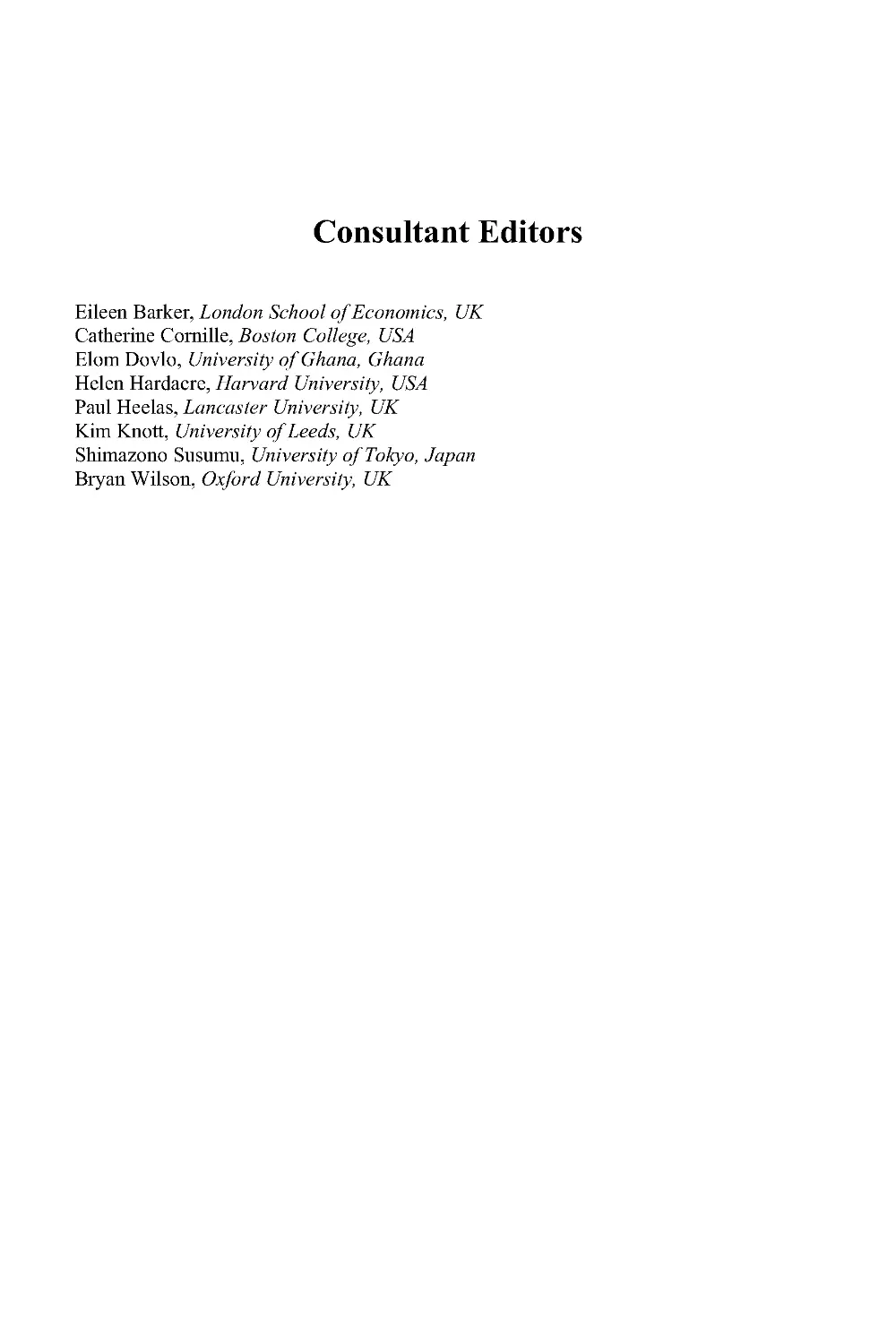
Consultant Editors
xix
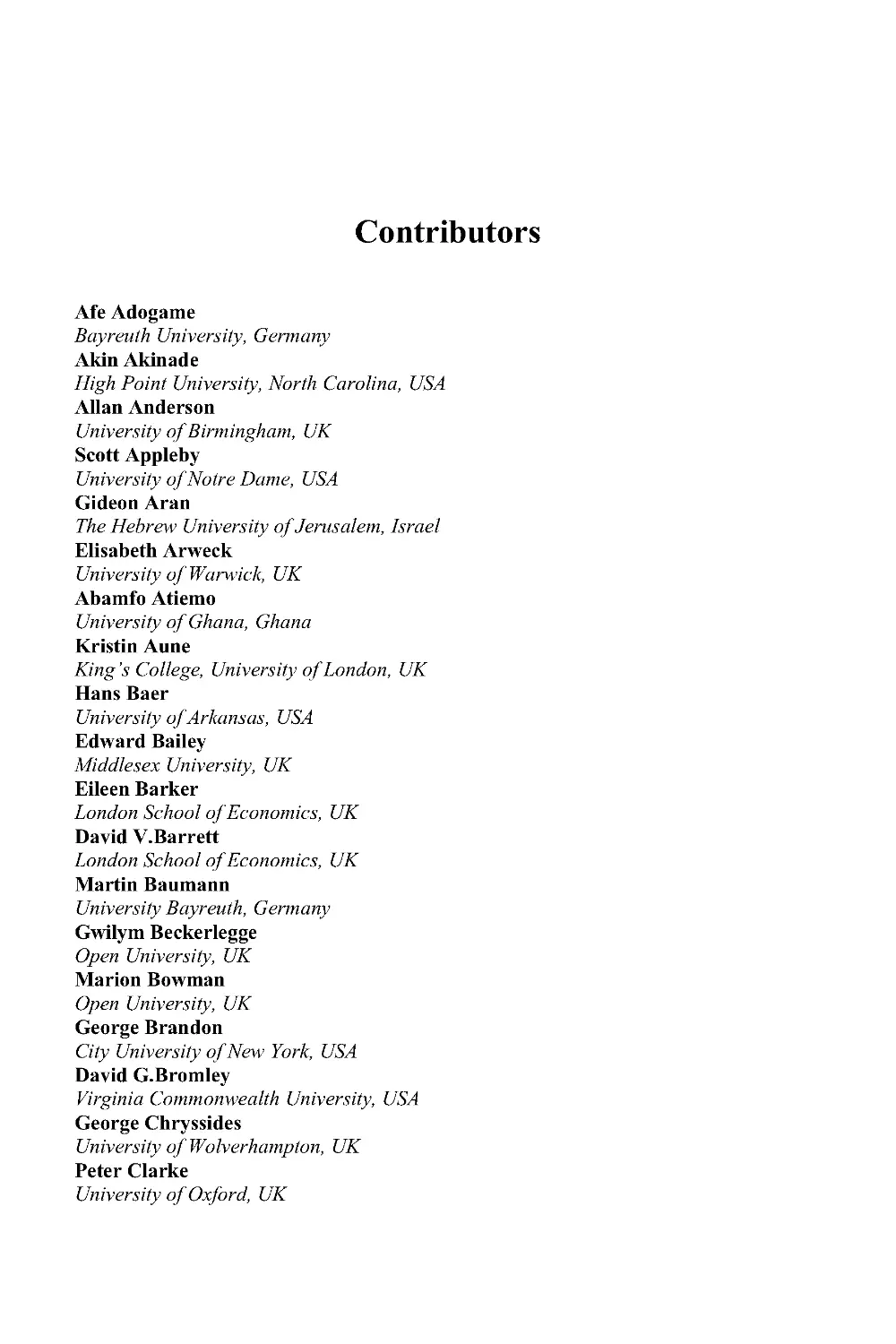
List of Contributors
xx
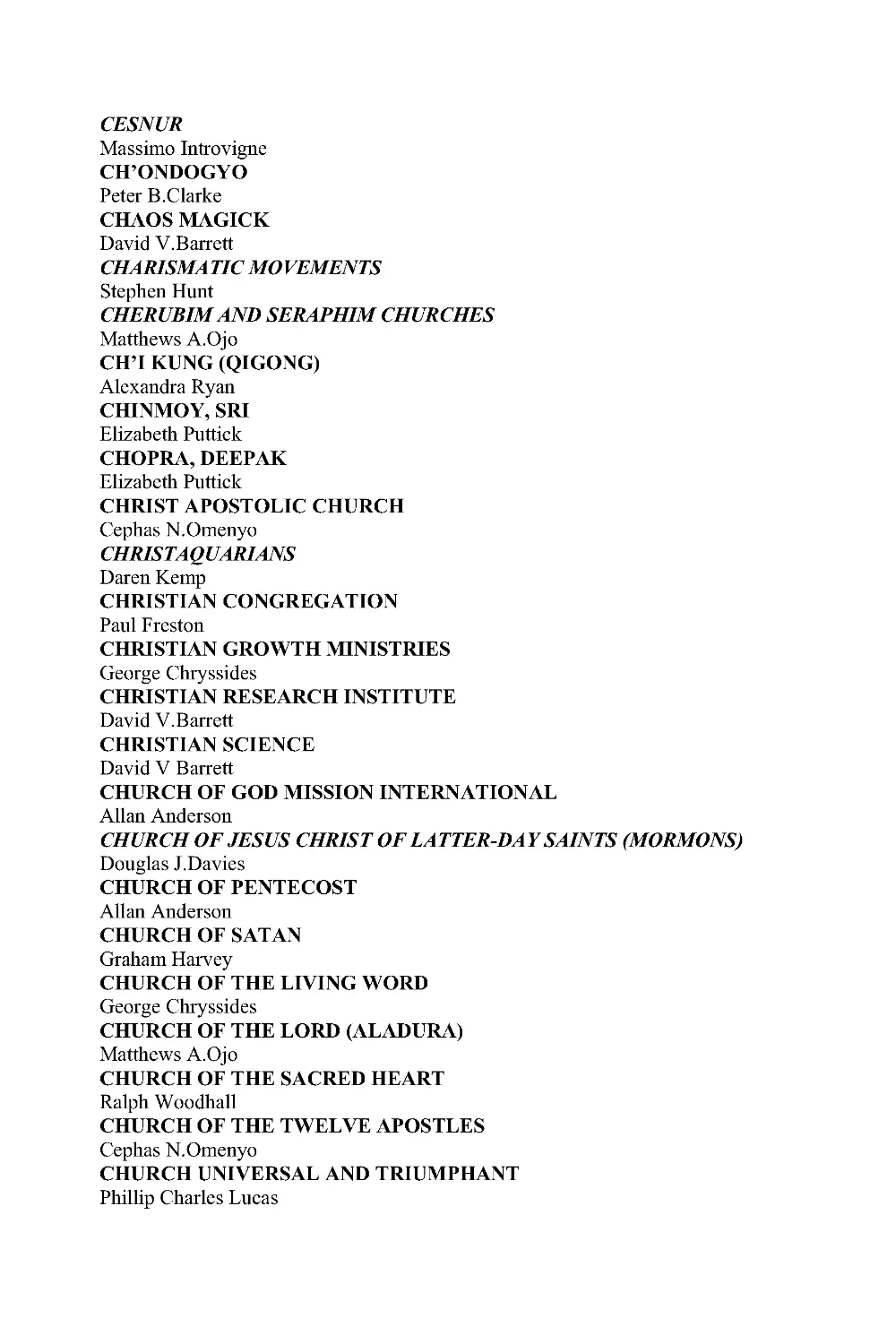
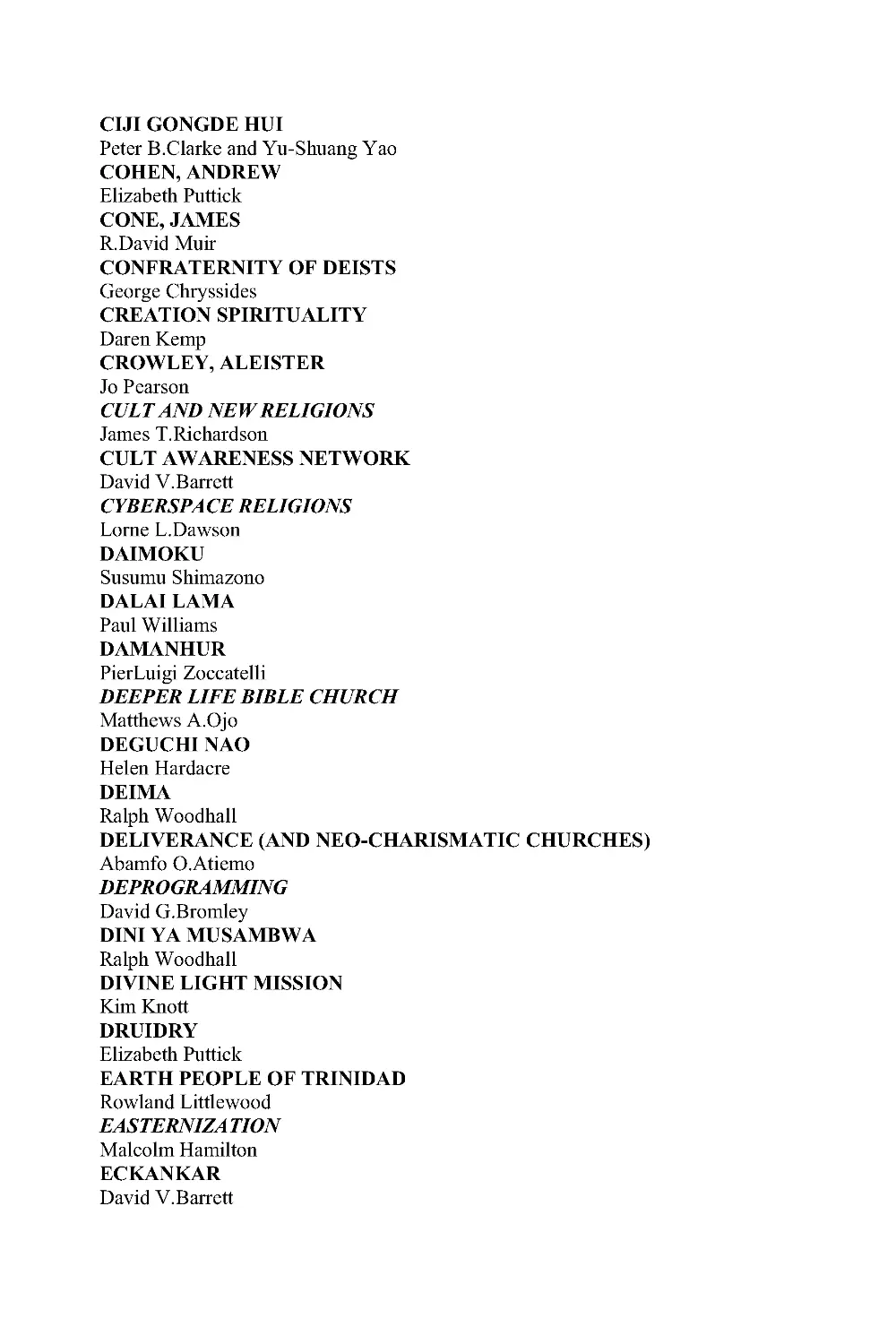
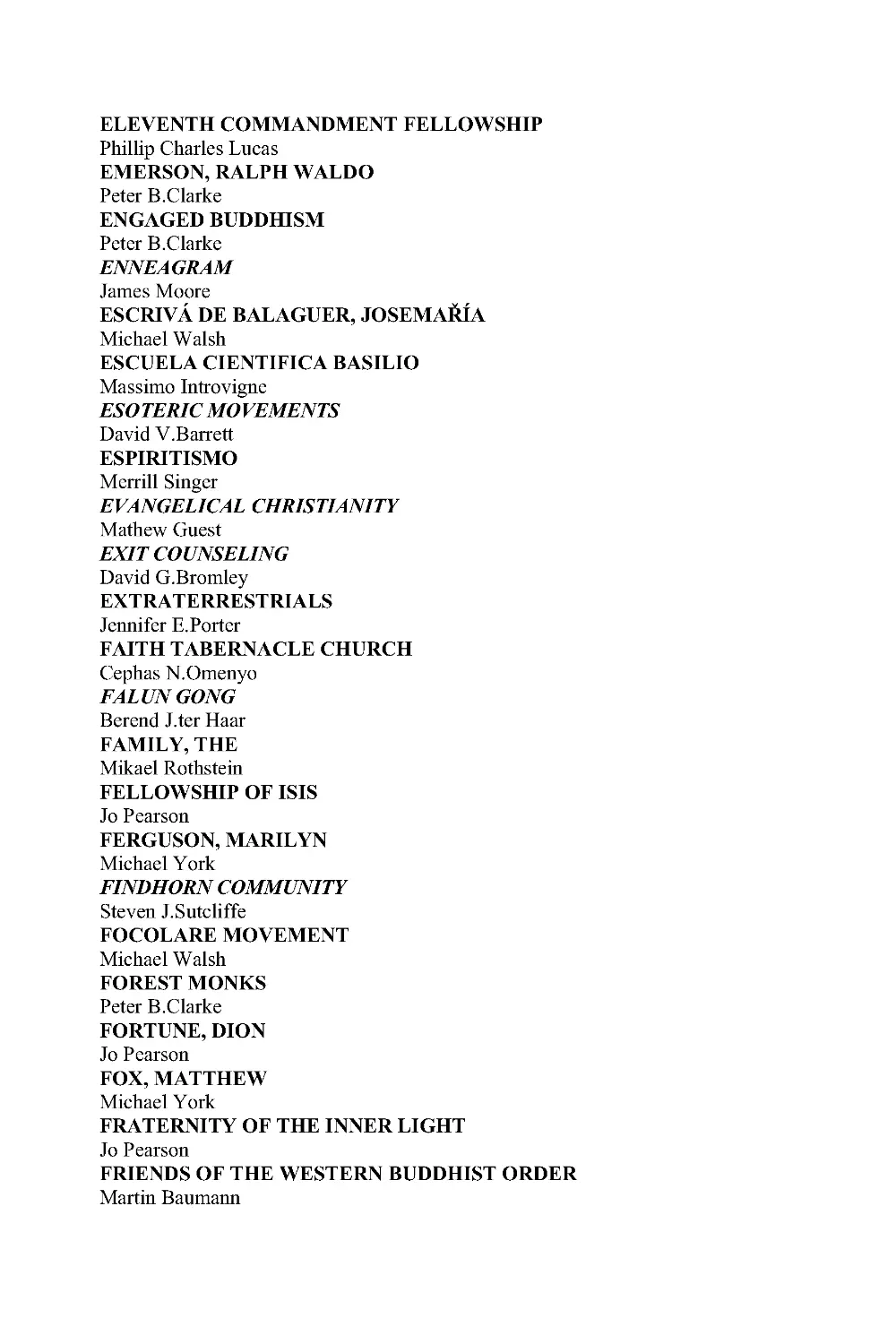
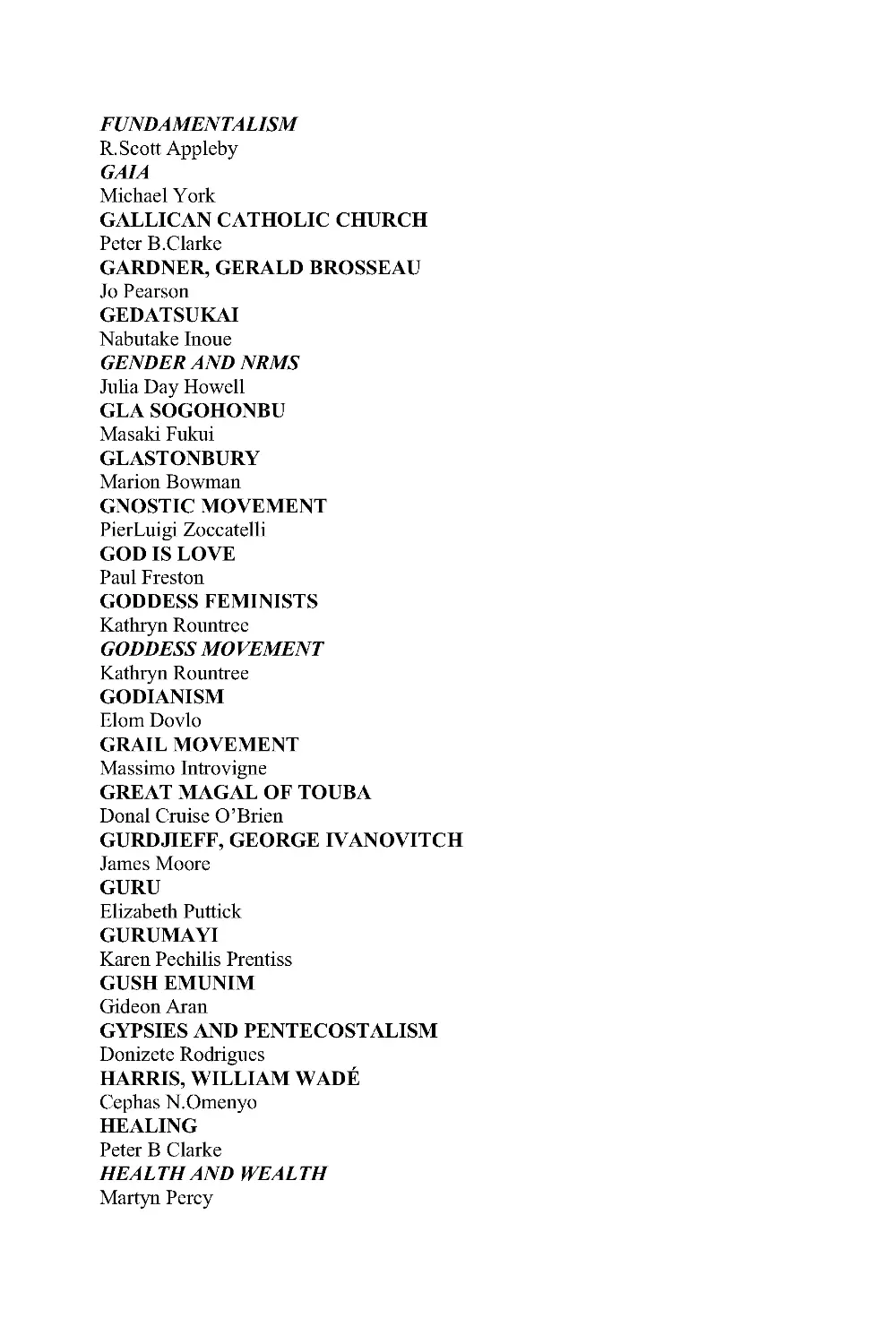
List of Entries
xxv
Entries A to Z
1
Index
719

Introduction
New Religions as a global phenomenon
The apparent ease with which New Religious Movements (henceforth: NRMs) are
‘invented’ can be attributed in part to the increasingly global character of the
contemporary world, which has witnessed the disembedding from their original cultural
context and the wider circulation of religious beliefs and practices of every kind. This
process of globalization has occasioned a shift in religions from geographically and
culturally specific ‘facts’, that is from their being associated with one particular
geographical and cultural zone such as the Middle East, Asia, the West, or Africa, to
being a reality everywhere. Increasingly since the 1960s, Buddhism, Islam, and Hinduism
have come to be seen less and less as exotic appendages to the religious culture of
Western society, while the beliefs and practices associated with these religions, including
the belief in reincarnation, the notion of God as impersonal, and the practices of yoga and
vipassana or insight meditation are shared by a sizeable minority of the population of
Western Europe, many of whom continue to identify themselves as Christians (Lambert
2004). Associated with this change, albeit less easily measured, are changes in
spirituality, which include in the West a greater interest in an inner-directed kind of
spirituality and in Asia in socially engaged spirituality.
Although the confluence, of historically unprecedented proportions, of religious
systems and spiritualities has contributed, along with other processes that include
modernization, urbanization, new developments in science and technology, economic
migration, and legal changes such as the repeal of the Asian Exclusion Act in the United
States in 1965, to make the phenomenon of NRMs a global one, there is, none the less,
much variation in the structure, content, size, and in the goals of these religions and in
their orientation towards the wider society.
Thus, while vast numbers of NRMs have either become or are in the process of
becoming global religions, they manifest different characteristics in different parts of the
world due to the process of domestication or to use Robertson’s (1994) term
‘glocalization’. This accounts for why Japanese NRMs develop a somewhat different
reality in Brazil compared to Japan. In Brazil they display many more Catholic features,
are more inclusive in terms of membership, and their ceremonies and rituals bear a close
resemblance to those of Catholicism.
It is not possible even in an Encyclopedia to convey all the variation and variety of the
NRMs that now exist. However, what can be done and has been attempted here, is to
provide examples of the various kinds of NRMs that have arisen in different parts of the
world in order to show how truly universal the phenomenon is, although the temptation to
postulate a single general causal explanation for this widespread phenomenon, such as
rapid social change is resisted. I will return briefly to this point later.

This Encyclopedia in addition to providing basic data on numerous NRMs from every
continent also intends to offer the reader an idea of the direction taken by NRMs, which
are often depicted as flowing directly from West to East, starting in the United States. In
reality the flow resembles more a global labyrinth than a straight highway. Elsewhere
(Clarke 2000) I wrote of reverse globalization in the case of Japanese NRMs to offset the
widespread impression given at the time that everything had been moving from West to
East. Even this was an oversimplification, movement is in all directions. For example,
several Japanese NRMs including Sekai Kyûsei Kyô (Church of World Messianity)
have arrived in parts of Africa including Angola, Mozambique, South Africa, the
Democratic Republic of the Congo, and via the furthest point West of Japan, Brazil. By
way of contrast the Brazilian NRM the Santo Daime movement has travelled with
Brazilian-Japanese migrant workers to Japan.
The pathways taken by NRMs are endless, as are the interactions. These include the
interactions of Korean spiritual beings and African spirits in the notorious Lord’s
Resistance Army in northern Uganda, the dynamic interaction of Rastafarian (see
Rastafarian movement) and Maori religious worldviews, of African-Brazilian and
Amerindian spiritual concepts and practices, and of the New Age Movement (NAM) with
most forms of spirituality including various kinds of Islamic Sufism or mysticism and
Native American religion. Through the NAM spiritualities of all kinds have been carried
from one part of the world to many others.
A feature of the contemporary religious environment is the ground being gained
globally by what I have described above as inner-directed spirituality, much of which is
based on the premise that the Self is the source of the supernatural. This kind of
spirituality takes different forms and includes the use of various techniques such as the
physical exercises of t’ai chi and yoga, which are designed to enable the practitioner to
access and release the spiritual force that rests within the deepest layers of the self and
apply it to the existential and emotional, and even material, areas of life. With this kind of
spirituality comes a preference for a transpersonal understanding of transcendence over a
theistic one, for experience over reason in spiritual matters and for knowing over
believing, since logically experiencing the divine dispenses with the need for faith.
Although privatized and inner-directed, this form of spirituality, which is gaining
ground in the West and contrasts with the previously mentioned socially engaged
spirituality movements found in predominantly Buddhist countries, is not unconcerned
with the condition of the world. Rather it holds to the view that self-transformation is the
sine qua non of that social transformation which is anxiously awaited, an anxiety evident
in the fundamental importance that countless NRMs give to the millenarian idea. Even
those NRMs that derive from traditions where this belief is only adhered to in a weak
sense, such as Buddhism, are, at least at the outset, passionately millenarian (see
Millenarianism). While millenarianism is also a feature of almost all the NRMs that
have been involved in violence, it must be stressed that it cannot be assumed that this
belief predisposes a group to violent action. Many millenarian movements are pacific and
among these are the Rastafarian movement, the Mahdiyyat movement and Sekai
Kyûsei Kyô.
Being gripped by this belief in the imminent advent of the millennium as they are
suggests that NRMs might best be understood if interpreted as ideologies of social
transformation. This seems preferable to trying to understand them by classifying them

according to their response to the world as ‘world-denying’, ‘world-indifferent’, and
‘world-affirming’ movements (Wallis 1984).
The previously mentioned option chosen by growing numbers for spirituality over
religion and the stress on the need for a spirituality that is relevant and self-empowering
clearly poses a threat to those long established religions whose doctrinal systems are
tightly integrated and exclusive and whose identity depends not only on having a well
defined, unambiguous set of teachings but also on clearly demarcated ritual boundaries.
This is evident in the highly critical responses of some of the mainline Christian
Churches, including the Catholic Church, to the previously mentioned New Age
Movement (NAM). This notwithstanding, very few mainstream religions, and even the
so called Traditional Religions, have remained uninfluenced by the NAM. Not only has
the latter acted as a vehicle for the globalization of various forms of spirituality and
religions, including Traditional Religions once closely associated with a specific ethnic
group and territory such as Native American religion, but, at the same time, by a process
of osmosis, it is fast becoming part of mainstream religion and culture.
Different interpretations of religious innovation and change
It is important to keep in mind when discussing what is meant by New Religion that
religious innovation continues to be understood differently in different cultural and
religious contexts and this despite the rapid pace of globalization. Newness or innovation
in Oriental societies, and even to an extent in Islamic societies, often has more to do with
orthopraxy than orthodoxy. Engaged Buddhism, for example, is not doctrinally speaking
unorthodox but was perceived initially as a major religious innovation in Vietnam and
Thailand, among other places, as was Protestant Buddhism in Sri Lanka and Raja Yoga
in India.
Of course, a change in practice can also mean a change in understanding or belief.
Theorists of ‘Engaged Buddhism’ insist, for example, that nirvana rather than
constituting its goal should be seen as the means to the end of Buddhism which is social
transformation.
There is much discussion concerning how the NRMs of today differ from those of the
past. Wilson (1995) identified a number of characteristics that set contemporary NRMs in
the West apart from past NRMs and existing mainstream religions. Often the differences
are differences of emphasis, some of which characterize NRMs not only in the West but
also across the world. One such difference is the stress placed by modern NRMs on the
central role of lay people in their own spiritual advancement, accompanied by a de-
emphasis on the significance of the role of the cleric. This is in line with the growing
appeal of the previously mentioned inner-directed religion or religions of the True-Self.
Although some NRMs may claim a unique legitimacy for their charismatic leader, who
often seeks to strengthen their authority by asserting that access to secret but vital
revelations or sources of wisdom that can only be had through the leader, most NRMs in
theory stress that every individual is their own spiritual master.

Another general feature of contemporary NRMs that sets them apart from new
movements of the past is their tendency to be more eclectic and more open to secular
therapies, such as psychology, which they frequently fuse with their own spirituality.
They often go beyond the purposes of psychology in making psychological techniques
serve to uncover the ‘god’ within (Heelas 1997).
Different understandings of the principle of membership also distinguish most modern
NRMs from traditional sects and cults in the Christian and other religious contexts. It is
perfectly possible to be a member of several NRMs simultaneously, or even remain a
member of the religion ascribed to one at birth and at the same time be a member of an
NRM. This gives rise to a whole new understanding of the meaning of conversion and is
of direct relevance to the brainwashing debate (Barker 1984). Modern NRMs are also
organizationally different from those of the past, making greater use of more secular
forms of management, administration, and assembly. Networking, rather than a focus on
religion as community, also characterizes much modern religion. Indeed many NRMs,
including Scientology, mirror in so much of their style, ethos, organization, orientation,
and goals the wider society that Wilson (1990) describes them as modern ‘secularized
religions’.
Historically, moreover, NRMs, or as they were once called sects, strongly opposed
either the Church or the society at large, or both, while contemporary ones are often more
inclusive in every domain. Moreover although they profess to seek to transform the world
many endorse the values of the existing order, catering to individualism and
consumerism, the two dominant characteristics of contemporary society. Japan’s NRMs,
and they are not alone in this regard, are frequently presented as offering benefits in
keeping with the consumerist ethic of modern society and as providing religious
legitimization for such benefits, and in this they bear a striking resemblance to the
American Theology of Success or Glory movement, and according to Ezzy (2001) to
several Wiccan groups in Australia.
Newness or innovation does not necessarily mean the introduction of new doctrines or
ritual practices. As the entry on New Religion attempts to make clear, it can consist of
innovative well established, time honoured beliefs and rituals, as in the case of the
changes made to the traditional rite of possession (kamigakari) by Omoto’s (Great
Origin) founder Deguchi Nao (1837–1918) (Ooms 1993). While drawing on traditional
Shinto beliefs of world transformation Deguchi Nao made a radical break with the
traditional understanding of these beliefs and made the rituals associated with them serve
different ends (Ooms 1993:14–17).
This ‘newness’ in the Japanese context, as in others, cannot be understood without
reference to past practice and belief. This notwithstanding, followers of Japanese NRMs
are persuaded that the teachings to which they adhere are original in that they either
contain newly discovered ancient and sacred foundational texts and/or provide for the
first time the only complete and authentic interpretation of a particular ancient sacred text
or tradition.
An example is Kofuku no Kogaku’s (The Institute for Research in Human Happiness)
claim to be presenting for the first time the true teachings of Buddha. Since they were not
written down until one hundred years after his death, this movement believes these
teachings were wrongly interpreted and a core element omitted—the teaching on love.
The movement has now added this fundamentally important element for the first time to

Buddhism’s traditional three jewels and by so doing claims to have radically revised
Buddhism.
Agonshu follows a similar line. Its founder Kiriyama Seiyu professed to have
discovered new, hidden truths by reading early Buddhist texts known as the Agama
sutras, texts which had been given little attention in Japan. Able to discern the hidden,
inner meaning of these texts, Kiriyama claimed to have uncovered a direct and rapid road
to Buddhahood for the living and just as importantly for the dead. This discovery has had
consequences for Agonshu practice which places great stress on the pacification of the
spirits of the dead and on the need to ensure that they attain Buddhahood (jobutsu), both
of which are necessary if the living are to be at peace and secure well-being and
prosperity (Reader 1991:211).
NRMs, it has been emphasized, vary greatly from each other. However, religious
innovation should not be seen on account of this as a disconnected series of ad hoc
changes randomly introduced. Explicit mention has already been made of some of the
innovations taking place globally including the growing emphasis on self-oriented
spirituality and Engaged Buddhism. There is also a strong trend towards the greater
democratization of religion found for example in Japanese Buddhism, evangelical
Christianity in Latin America and in Muslim communities across the world.
The catalysts that have triggered this trend towards greater ‘democratization’ vary but
almost everywhere they include increasing individualism and the declining importance of
religion as the social cement of community due to ever-increasing institutional
differentiation. Mainstream religion, associated in most people’s minds with the old order
to which it gave and continues to give legitimacy, is increasingly regarded with
indifference or seen as dysfunctional in terms of self-empowerment and progress. These
processes have contributed to the decoupling of beliefs from those ecclesiastical
institutions to which, for their validity and efficacy, they were once thought to be
inextricably linked.
Out of all of this is emerging in the West a new cognitive style of being religious,
which contrasts with that of theistic religions in particular. While the latter stress
believing, NRMs are concerned with arriving at truth through experience. This holds for
a disparate collection of NRMs including the Self-religions (see Self-Religion, The Self,
and self); Neo-Hindu movements such as the Bramakumaris and Hare Krishna
movements; Japanese NRMs including Sekai Kyûsei Kyô (Church of World
Messianity), Soka Gakkai (Value Creation Society), and Perfect Liberty Kyodan; new
Buddhist movements including the Friends of the Western Buddhist Order;
metaphysical movements such as Transcendentalism and African-Caribbean derived
movements including the Rastafarian movement; and psycho-therapeutic spiritual
movements such as Scientology and Gurjieffian groups including The Work (see Work,
The). Ouspensky (1987:228) claimed that Gurdjieff was emphatic in his rejection of the
traditional idea of faith and quotes him as saying:
In properly organized groups no faith is required; what is required is
simply a little trust and even that only for a little while, for the sooner a
man begins to verify all he hears the better it is for him.

The cognitive style of many NRMs thus contrasts sharply with that of, for example, the
traditional Christian understanding of the notion of faith in that it does not rest on
recourse to divine revelation or on an external, divine source for what is believable or for
a solution to the problem of meaning, most acute in the form of the problem of evil.
Moral evil is widely understood to result from ignorance or lack of awareness of the true
nature of the Self. This new cognitive style draws those who espouse it closer
intellectually to Buddhism, and other religions of Oriental origin.
The dynamics of religious innovation, thus, are variable. They differ from one
religious system to another and from one religious culture to another. The term ‘new’
also takes on different meanings depending on the movement and the context and is used
not only to point to radical discontinuities or disconnections between the present and the
past in terms of beliefs, rituals, and structures but also to the different use made in the
present of the past and the ‘new’ meaning given to the practices and teachings derived
therefrom.
Accounting for NRMs
The most common sociological explanation for the rise of NRMs interprets them as a
response to the crises of identity, moral meaning and profound cultural upheaval brought
about by rapid social change. While there is undoubtedly some merit in this kind of
explanation it is, nevertheless, hardly sufficient as a general account of the phenomenon.
Although it cannot be easily tested—not least because the subjective dimension of the
impact of social change is not easily measured—there are instances where this kind of
explanation does seem to elucidate what has happened, and these include the rise of
Cargo cults in Melanesia (Worsley 1970) (see Melanesia-millenarian (‘Cargo’)
movements) and of Independent Churches and Neo-Traditional movements in Africa
(Turner 1991). But even in these cases the question arises as to whether it was the nature
of the change itself, its bearers and the methods used to implement it, rather than its
rapidity that led to the outbreak of these movements. Moreover, there are also examples
of religious change and innovation where rapid social change does not appear to have
been the decisive factor, including in Medieval Europe (Cohn 1970) and in Japan in the
late eighteenth century and first half of the nineteenth century (Inoue 1991).
Not only are there numerous cases for which the rapid social change explanation
cannot account, but it also begs a number of fundamental questions of a historical and
philosophical kind. It implicitly accepts the contrasts made between what is perceived on
the one hand as dynamic modern society in a constant state of flux and upheaval,
conditions which undermine identity and the moral and social structures that provide
meaning and direction, against static so-called ‘traditional’ society in which everyone is
sure not only of who they are, but also of their role and purpose. However, as Lewis
(1971) points out, sects and cults in Traditional societies are often born of insufficient
change. Furthermore, the rapid social change explanation tends to be reductionist in that
it affords religion the status of an epiphenomenon by treating it as a kind of mechanism
that is triggered by way of a response to bewilderment.

Although frequently seen as destructive of common values and aspirations NRMs, as
we have seen, have also been accounted for, paradoxically, in terms of their mediating
and integrative functions particularly during the late 1960s and 1970s in the West when,
it is suggested, they socialized many counter-culturalists in the values and work ethic of
mainstream society and enabled them thereby to return to ‘conventional’ living (Robbins
and Anthony 1978; Tipton 1982). While some of the Self-religions, including est studied
by Tipton (1982), fulfilled this function, this thesis is hardly supported by evidence from
other movements irrespective of their religious and cultural origins.
Their diversity and the diverse contexts and cultures in which they arise rules out the
possibility of finding a general explanation of the rise of NRMs as a whole. Like rapid
social change theory, too much is claimed for globalization theory also (Robertson 1992),
which provides little more than an explanation in particular contexts for the adaptation
and application in a changed, modernized context of particular styles of religiosity. More
attention to such apparently unrelated events as greater affluence, more opportunity for
travel, changes in the immigration laws of a country, the effects of colonization and
decolonization, and economic migration, may shed as much light on the rise of NRMs as
the dislocating effects that follow from either globalization or rapid social change. But
whatever lenses we use, we see the causes of what are truly complex phenomena only
through a glass, darkly.
Size and impact
Some NRMs have attracted millions of adepts, others have remained numerically small,
while others have become extinct. To explain this question of success and failure
researchers have examined the various types of religious markets and the rational choices
made by consumers of religion in those markets. A competitive religious market, it has
been suggested (Stark and Finke 2000), makes for a buoyant religious economy and
among the most successful religions competing in these markets, it has been argued
(Iannacone 1995), are those with ‘strict’ teachings. Such religions are said to have greater
appeal and attract more adherents than the more liberal types.
However, one needs to ask how this argument accounts for the relative success of
much of Buddhism in the West, of movements such as Seicho-no-Ie (House of Growth)
in Brazil, of Cao Daism in Vietnam, of hybrid Sufi movements in the United States and
of the New Age Movement (NAM) everywhere. This would seem to contradict the
strictness hypothesis. Moreover, as Wuthnow and Cadge (2004) point out, attention needs
to be paid not only to strictness—a very difficult commodity to measure—but also to the
efficiency with which religion is marketed. Also extremely relevant to understanding the
reasons for the rise and decline of an NRM are the ways in which its teachings and
practices are embedded in organizational structures, both those of its own making and
those of the rest of society. Both Buddhism in the West and the NAM globally have been
able to embed their teachings and practices comfortably in many of the organizational
structures, including churches, of the wider society and this must in part explain their
widespread appeal, as must the fact that they do not demand a radical break with the

tradition to which practitioners belong and, therefore, avoid imposing a heavy burden on
recruits in terms of their having to shed excessive amounts of cultural and spiritual capital
(Stark 1996).
The question of the religious impact of NRMs has also been hotly debated. For some
observers NRMs are explained as a sign of a revival of the sacred in the modern world
that is pushing back the frontiers of secularization (Bell 1977; Stark and Bainbridge
1985). There is no clear consensus among scholars about the contribution of NRMs to
this process of religious revival or whether such a process is under way. Research on
contemporary religious practice and religious dispositions in Europe, the United States,
and the West generally shows a decline in the public practice of Christianity and a move
away from Christian orthodoxy and spirituality not, it is true, in the direction of no
religion or spirituality, but towards more open-ended, synthetic forms of both (Lambert
2004). Only 10 per cent fewer Europeans believe in reincarnation—22 per cent—than in
the central Christian tenet of the resurrection of the body—33 per cent, and while over 60
per cent believe in God, only 36 per cent believe in the traditional Christian idea of God
as a personal God (Lambert 2004). Differing from Stark et al., Wilson, among others,
believes that NRMs have done little to reverse the process of secularization in Europe.
On the contrary. If anything, they have, he argues (1991), advanced its course.
The numerical impact of NRMs is not widely understood. Often the membership
figures given by observers are those of the movement’s home base or country of origin
and do not reflect its global membership. Several Japanese NRMs not only have several
million members in Japan but a relatively large membership outside Japan for example in
Brazil. The Nation of Islam (NOI), an African-American movement, also not only has
some two million followers in the United States but also many followers in other parts of
the world. A number of Chinese, Taiwanese, and African NRMs, likewise, have large
home-based memberships of several million and many thousands of members mainly
among ethnic Chinese and Africans abroad. The Brazilian Neo-Evangelical Church
established in the 1970s, the Universal Church of the Kingdom of God (Igreja
Universal do Reino de Deus, IURD), has millions of followers in Brazil and a large
membership in several African countries, including the Ivory Coast.
When assessing the numerical impact of NRMs it is also important to keep in mind the
extent to which they have indirectly influenced millions of people who do not formally
belong. As was previously mentioned, through a process of osmosis many New Age
ideas and practices have become part of mainstream society. Likewise Yoga and various
other Oriental techniques, many of which, if not actually introduced to the West by
NRMs, were made more widely available by them, are now accepted as part of
mainstream culture. Gurdjieffian-derived techniques such as the Enneagram are also part
of the spiritual direction offered by countless Catholic Orders, among other religious and
secular bodies, worldwide.
Not only, then, are NRMs a global phenomenon in the sense that they have emerged in
every continent, and within every continent in virtually every country, but also in terms
of the influence they have had on the spiritual content and the spiritual practices of many
beyond their home base. Sometimes this has been subtle and indirect, sometimes
unmistakable and decisive, in shaping the content of modern religion and spirituality.
Peter B.Clarke
Oxford University

Bibliography and references
Barker, E. (1984) The Making of a Moonie. Choice or Brainwashing? Oxford: Blackwell.
Barker, E. (2002) ‘Watching for Violence: A Comparative Analysis of the Roles of Five Types of
Cult-Watching Groups’ in D.G.Bromley and J.G.Melton (eds) Cults, Religion and Violence,
Cambridge: Cambridge University Press, pp. 123 –49.
Beckford, J.A. (2003) ‘The Continuum Between Cults and Normal Religion’ in L.L .Dawson (ed.)
Cults and New Religious Movements, Oxford: Blackwell, pp. 26 –33 .
Beckford, J.A. (1985) Cult Controversies. The Social Response to the New Religious Movements,
London: Tavistock Publications.
Bellah, R., Madsen, R., Sullivan, W., Swidler, A. and Tipton, S. (1985) Habits of the Heart. Middle
America Observed, London: Hutchinson Education.
Bell, D. (1977) ‘The Return of the Sacred?’ British Journal of Sociology 28(4), 419–49.
Campbell, C. (1999) ‘The Easternization of the West’, in B.R.Wilson and J.Cresswell (eds), New
Religious Movements. Challenge and Response, London: Routledge, pp. 35 –49.
Clarke, P.B. and Somers, Jeffrey (eds) (1994) Japanese New Religions in the West, Eastbourne,
Kent: Japan Library/Curzon Press.
Clarke, P.B. (1995) Mahdism in West Africa. The Case of the Ijebu Prophet, London: Luzac
Oriental.
Clarke, P.B. (1997) (with E.Arweck) New Religious Movements: An Annotated Bibliography,
Westport, CT: Greenwood Press.
Clarke, P.B. (1998) New Trends and Developments: in the World of Islam, London: Luzac Oriental.
Clarke, P.B. (1998) New Trends and Developments in African Religions, Westport, CT: Greenwood
Press
Clarke, P.B. (1999) An Annotated Bibliography of Japanese New Religions, East-bourne, Kent:
Japan Library .
Clarke, P.B. (2000) (ed.) Japanese New Religions. In Global Perspective, Richmond: Curzon Press.
Cohn, N. (1970) The Pursuit of the Millennium, London: Paladin.
Durkheim, E. (1915) The Elementary Forms of the Religious Life, London: George Allen and
Unwin
Ezzy, D. (2001) ‘The Commodification of Witchcraft’, Australian Religion Studies Review, 14(1)
(Autumn), 31–45 .
Groszos Ooms, E. (1993) Women and Millenarian Protest in Meiji Japan, Ithaca, NY: Cornell
University, East Asia Program.
Hanegraaff, W.J . (1999) ‘New Age Spiritualities as Secular Religion: A Historian’s Perspective’,
Social Compass, 46(2), 145–60 .
Heelas, P. (1991) ‘Western Europe: Self-religions’, in S.Sutherland and P.B. Clarke (eds) The
Study of Religion: Traditional and New Religion, London: Routledge, pp. 167–73.
Heelas, P. (1997) The New Age Movement, Oxford: Blackwell.
Heelas, P. and Woodhead, L. (with Benjamin Steel et al.) (2005) The Spiritual Revolution, Oxford:
Blackwell.
Iannacone, L.R. (1994) ‘Why strict churches are strong’, American Journal of Sociology, 99(5),
1180–211 .
Inoue, N. (1991) (ed.) New Religions: Contemporary Papers in Japanese Religions (2), Tokyo:
Kokugakuin University, Institute for Japanese Culture and Classics.
Lambert, Y. (2004) ‘A Turning Point in Religious Evolution in Europe’, Journal of Contemporary
Religion, 19(1), January , 29–47.
Martin, D. (1990) Tongues of Fire, Oxford: Basil Blackwell.
Maslow, A. (1970) Motivation and Personality, New York: Harper and Row.
Melton, J.Gordon (1990) New Age Encyclopedia, Detroit: Gale.

Ouspensky, P.D. (1987) In Search of the Miraculous. Fragments of an Unknown Teaching,
London: Arkana Paperbacks.
Puttick, E. and Clarke, P.B. (eds) (1993) Women as Teachers and Disciples in Traditional and New
Religions, Lewiston/ Queenston/Lampeter: Edwin Mellen Press.
Puttick, E. (1997) Women in New Religions, London: Macmillan.
Reader, I. (1991) Religion in Contemporary Japan, Basingstoke: Macmillan.
Richardson, J. (1996) ‘Journalistic Bias Towards New Religious Movements in Australia’, Journal
of Contemporary Religion, 11(3), 209–303 .
Richardson, J. (2004) Regulating Religion: Case Studies from Around the Globe, Amsterdam:
Kluwer.
Robbins, T. and Dick, A. (1978) ‘New Religious Movements and the Social System: Integration,
Disintegration or Transformation’, Annual Review of the Social Sciences of Religion, 21, 1–28 .
Robbins, T. (1988) Cults, Converts and Charisma, London: Sage.
Robertson, R. (1992a) Globalization: Social Theory and Global Culture, London: Sage.
Robertson, R. (1992b) ‘Globalization or glocalization’, Journal of International Communication, 1,
33–52.
Sen, Amiya, P. (ed.) (2003) Social and Religious Reform. The Hindus of British India, Oxford:
Oxford University Press.
Shimazono, S. (1999) ‘“New Age Movement” or New Spirituality Movements and Culture?’ Social
Compass, 46(2), 126–34 .
Stark, R. and Bainbridge, W.S . (1985) The Future of Religion, Berkeley and Los Angeles:
University of California Press.
Stark, R. and Bainbridge, W.S . (1987) A Theory of Religion, New York: Peter Lang.
Stark, R. and Finke, R. (2000) Acts of Faith, Berkeley and Los Angeles: University of California
Press.
Tipton, S.M. (1982) Getting Saved From the Sixties: Moral Meaning in Conversion and Cultural
Change, Berkeley: University of California Press.
Turner, H.W . (1967) History of an Independent Church: The Church of the Lord Aladura, Oxford:
Clarendon Press.
Turner, H.W . (1991) ‘Africa: New Religions’, in S.R.Sutherland and P.B.Clarke (eds) The Study of
Religion: Traditional and New Religion, London: Routledge, pp. 187–95.
Van Hove, H. (1996) ‘Higher Realities and the Inner Self: One Quest? Transcendence and the
Significance of the Body in the New Age Circuit’, Journal of Contemporary Religion, 11(2),
185–95.
Wallis, R. (1976) The Road to Total Freedom: A Sociological Analysis of Scientology, London:
Heinemann.
Wallis, R. (1984) The Elementary Forms of the New Religious Life, London: Routledge.
Werblowsky, R.J .Z . (1984) ‘Religions New and Not so New: Fragments of an Agenda’ in E.Barker
(ed.) New Religious Movements: A Perspective for Understanding Society, New York, Toronto:
Edwin Mellen, pp. 32 –47.
Wilson B.R. (1970) Religious Sects, London: Weidenfeld & Nicolson.
Wilson, B.R. (1979) ‘The Return of the Sacred?’, Journal for the Scientific Study of Religion 18(3),
268–80 .
Wilson, B.R. (1990) The Social Dimensions of Sectarianism, Oxford: Clarendon Press.
Wilson, B.R. (1991) ‘Secularization: Religion in the Modern World’, in S.R Sutherland and P.B
Clarke (eds) The Study of Religion: Traditional and New Religion, London: Routledge, pp. 195–
208
Wilson, B.R. (1992) ‘The Changing Functions of Religion: Toleration and Cohesion in the
Secularized Society’, IOP. EC Lecture Series. The Wisdom of the East in Modern Society,
Maidstone: Institute of Oriental Philosophy.
Wilson, B.R. (1993) ‘Historical Lessons in the Study of Cults and Sects’, in D.G Bromley and
J.K .Hadden (eds) Religion and Social Order, 3, 53–85 .

Wilson, B.R . and Dobbelaere, K. (1994) A Time to Chant: The Soka Gakkai Buddhists in Britain,
Oxford: Oxford University Press.
Wilson, B.R. (1995) ‘New Religions and the New Europe’, in R.Towler (ed.) New Religious
Movements and the New Europe, Aarhus: Aarhus University Press, pp. 11 –31.
Worsley, P. (1970) The Trumpet Shall Sound, London: Paladin.
Wuthnow, R. (1978) Experimentation in American Religion, Berkeley: University of California
Press.
Wuthnow, R. (1986) ‘Religious Movements and counter-movements in America’, in J. Beckford
(ed.) New Religious Movements and Rapid Social Change, London: Sage, pp. 1 –29.
Wuthnow, R. and Cadge, W. (2004) ‘Buddhists and Buddhism in the United States: The Scope of
Influence’, Journal for the Scientific Study of Religion, 43(3) (Sept), 363–81.

How to Use this Encyclopedia
The encyclopedia is organized alphabetically to make for easy access to specific entries.
The reader can search a specific entry by alphabetical order, or by using the index at the
end of the volume. Cross-references are indicated in bold type in the body of each entry.
References to further reading are also provided wherever these are available and
considered relevant by the editor and contributors. Such further reading is supported by
entries on literature on NRMs in French, German, Italian, Japanese, Portuguese and
J.Gordon Melton’s extensive and detailed resource guide to scholarly writings on NRMs.
All entries are signed and the institutional affiliation of authors at the time of publication
is provided on pp. xix–xxi. Entries range from short biographies to more detailed entries
and overview essays for major subjects or themes. Biographical entries contain date and
place of birth and death, wherever that information is available, the main profession of
the individual and a concise description of their activities and works. Longer entries,
indicated by italics in the list of entries, offer careful cross-referencing to enable the
reader to pursue a topic in more detail across the volume.
This encyclopaedia takes a global perspective on the phenomenon of New Religious
Movements (NRMs). It provides examples of NRMs that have become global cultures in
their own right with millions, and even hundred of millions of followers. Not only are
there over three hundred entries on various types of movement from almost every country
in the world but there are also contributions on topics and themes directly associated with
NRMs, such as spirituality, the New Age Movement (NAM), Neo-paganism, New
Religion, New Religion as a global phenomenon, New Religion and gender, ‘Protestant
Buddhism’, ‘Engaged Buddhism’, Modern Yoga, and Islamism. There are also entries on
NRMs and cyberspace, NRMs and the law, NRMs and violence, the Anti-Cult Movement
(ACM), and on the appropriateness or otherwise of terms used to describe NRMs such as
sect and cult. There is also coverage of the key ideas of thinkers whose ideas have greatly
influenced the development of NRMs including the Scientist and esotericist Emmanuel
Swedenborg, the psychoanalyst Carl Gustav Jung, the Jesuit Pierre Teilhard de Chardin,
the Scientist James Lovelock, author of one widely studied version of the Gaia
hypothesis, George Ivanovitch Gurdjieff, founder of the Institute for the Harmonious
Development of Man at Fontainebleau, and two of the most influential Islamist thinkers,
the Egyptians Hassan al-Banna founder of the Muslim Brotherhood (Ikhwan) and Sayyid
Qutb, an influential member of that same movement. Coverage is also given to
movements that derive from all the major religions of the world and to Neo-Traditional
movements. Movements often overlooked in the study of NRMs including Islamic
derived NRMs such as the Nation of Islam, the Muslim Brotherhood, and Buddhist and
Sikh derived NRMs are also included in the volume, as are movements from all the
continents—from Caodaism in Asia (Vietnam) to the Santo Daime movement at the other
side of the world in Brazil. This wide framework enables a better appreciation to be had
of the innovative character of NRMs and of their diversity.

The global perspective taken in this volume sheds much light on aspects of NRMs that
might otherwise remain obscure, including their significance and impact. They can be
seen to be much more than small scale, marginal enterprises of little significance to all
but a few. Instead they involve hundreds of millions of followers and in many cases are
radically changing the way people understand and practise religion and spirituality.
Moreover, many are having a profound impact on the form and content of much
mainstream religion.
From a global vantage point one obtains a clearer picture of how vast and varied is the
range of spiritual resources and technologies that are now being drawn upon in every part
of the world. The global perspective also makes clear that there is no single source of
NRMs or highway or route across the world that is favoured by them. They exist
everywhere and move in all kinds of unexpected directions from Japan to Africa via
Brazil for example and from Indonesia to Australia to Europe, others from Tibet to South
Africa, from India to Mauritius and on to the West Indies.

Consultant Editors
Eileen Barker, London School of Economics, UK
Catherine Cornille, Boston College, USA
Elom Dovlo, University of Ghana, Ghana
Helen Hardacre, Harvard University, USA
Paul Heelas, Lancaster University, UK
Kim Knott, University of Leeds, UK
Shimazono Susumu, University of Tokyo, Japan
Bryan Wilson, Oxford University, UK

Contributors
Afe Adogame
Bayreuth University, Germany
Akin Akinade
High Point University, North Carolina, USA
Allan Anderson
University of Birmingham, UK
Scott Appleby
University of Notre Dame, USA
Gideon Aran
The Hebrew University of Jerusalem, Israel
Elisabeth Arweck
University of Warwick, UK
Abamfo Atiemo
University of Ghana, Ghana
Kristin Aune
King’s College, University of London, UK
Hans Baer
University of Arkansas, USA
Edward Bailey
Middlesex University, UK
Eileen Barker
London School of Economics, UK
David V.Barrett
London School of Economics, UK
Martin Baumann
University Bayreuth, Germany
Gwilym Beckerlegge
Open University, UK
Marion Bowman
Open University, UK
George Brandon
City University of New York, USA
David G.Bromley
Virginia Commonwealth University, USA
George Chryssides
University of Wolverhampton, UK
Peter Clarke
University of Oxford, UK

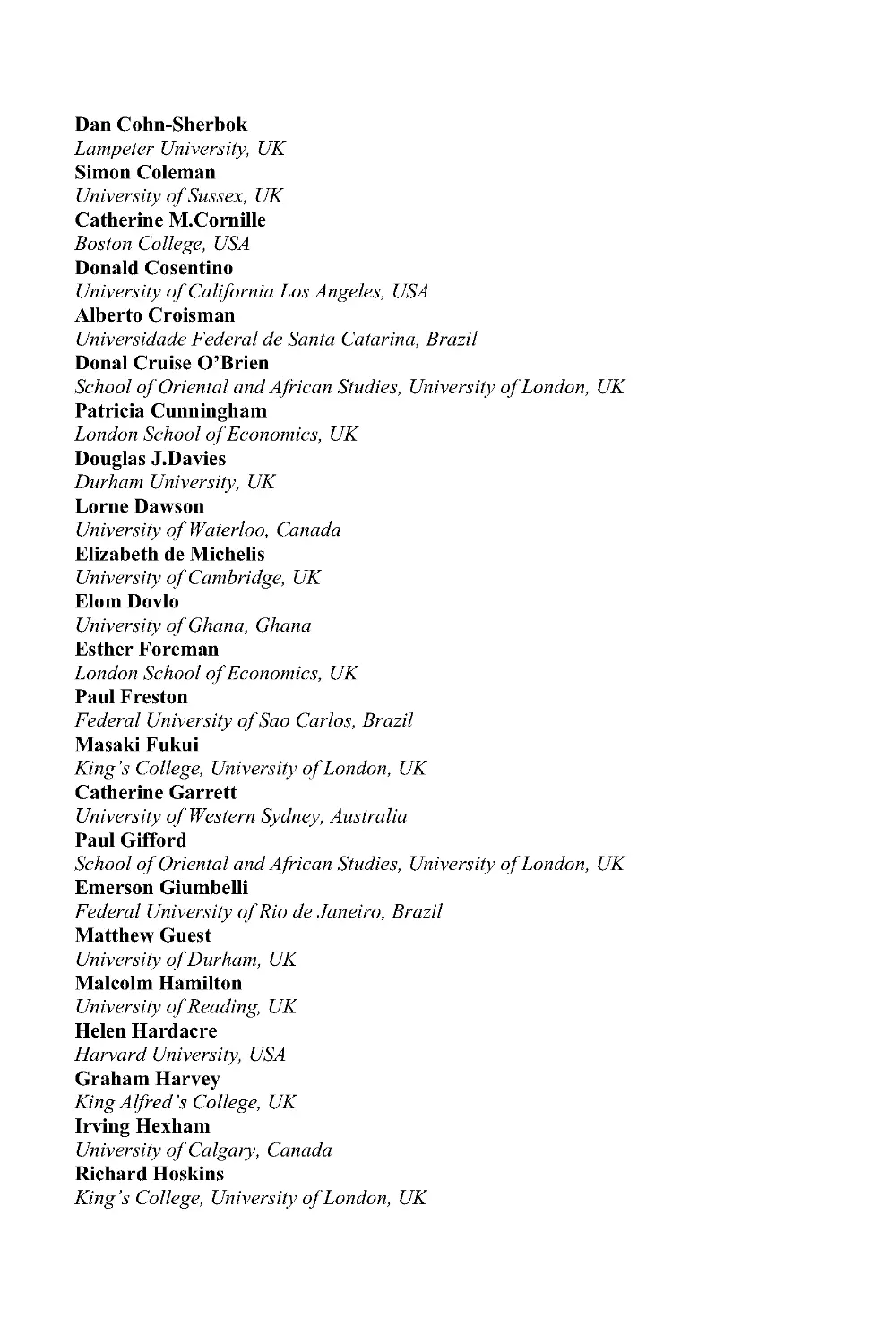
Dan Cohn-Sherbok
Lampeter University, UK
Simon Coleman
University of Sussex, UK
Catherine M.Cornille
Boston College, USA
Donald Cosentino
University of California Los Angeles, USA
Alberto Croisman
Universidade Federal de Santa Catarina, Brazil
Donal Cruise O’Brien
School of Oriental and African Studies, University of London, UK
Patricia Cunningham
London School of Economics, UK
Douglas J.Davies
Durham University, UK
Lorne Dawson
University of Waterloo, Canada
Elizabeth de Michelis
University of Cambridge, UK
Elom Dovlo
University of Ghana, Ghana
Esther Foreman
London School of Economics, UK
Paul Freston
Federal University of Sao Carlos, Brazil
Masaki Fukui
King’s College, University of London, UK
Catherine Garrett
University of Western Sydney, Australia
Paul Gifford
School of Oriental and African Studies, University of London, UK
Emerson Giumbelli
Federal University of Rio de Janeiro, Brazil
Matthew Guest
University of Durham, UK
Malcolm Hamilton
University of Reading, UK
Helen Hardacre
Harvard University, USA
Graham Harvey
King Alfred’s College, UK
Irving Hexham
University of Calgary, Canada
Richard Hoskins
King’s College, University of London, UK

Julia Howell
Griffith University, Australia
Reinhart Hummel
Evangelische Zentralstelle für Weltanschauungsfragen, Germany
Stephen Hunt
University of the West of England, UK
Keishin Inaba
Kobe University, Japan
Nabutaka Inoue
Kokugakin University, Japan
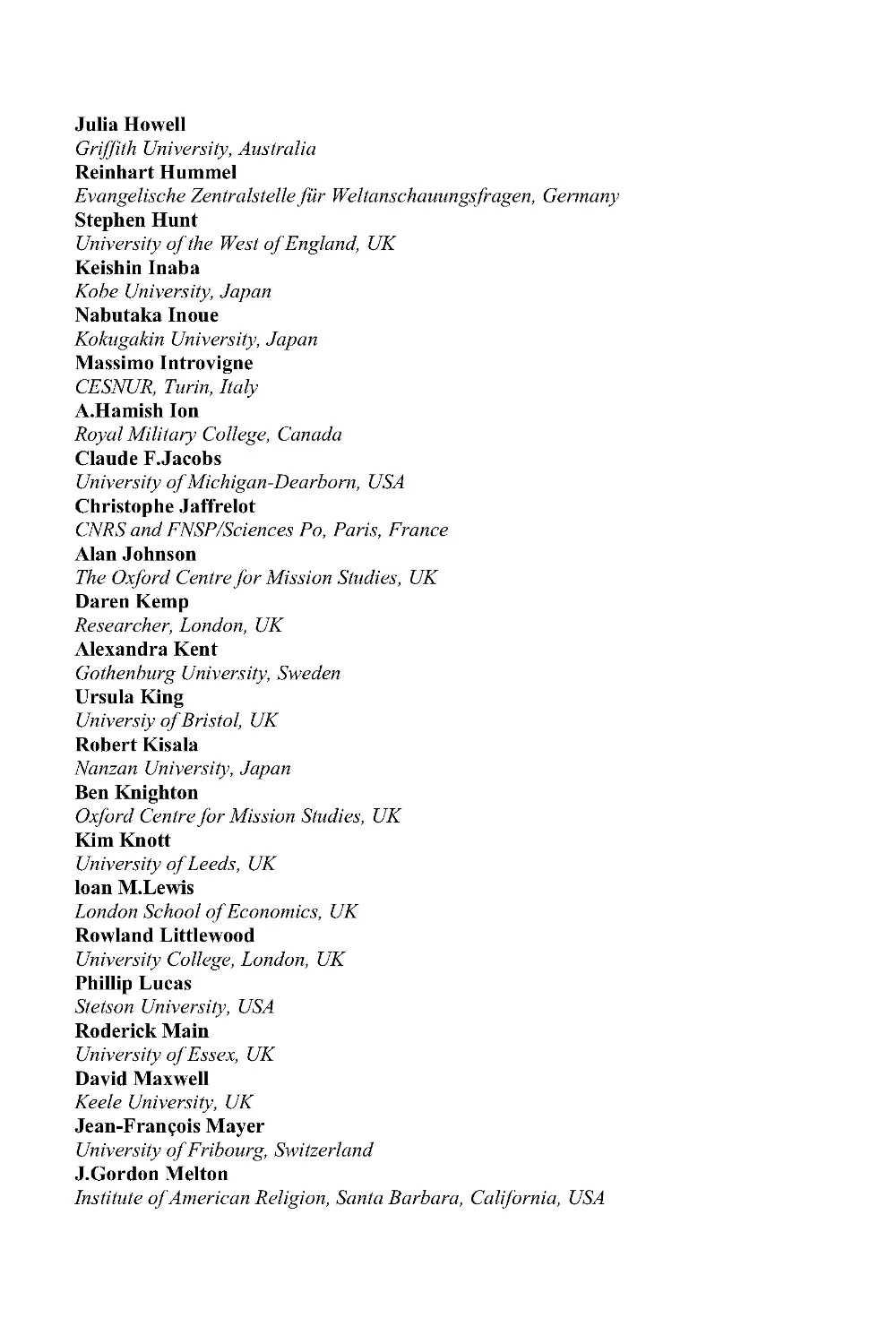
Massimo Introvigne
CESNUR, Turin, Italy
A.Hamish Ion
Royal Military College, Canada
Claude F.Jacobs
University of Michigan-Dearborn, USA
Christophe Jaffrelot
CNRS and FNSP/Sciences Po, Paris, France
Alan Johnson
The Oxford Centre for Mission Studies, UK
Daren Kemp
Researcher, London, UK
Alexandra Kent
Gothenburg University, Sweden
Ursula King
Universiy of Bristol, UK
Robert Kisala
Nanzan University, Japan
Ben Knighton
Oxford Centre for Mission Studies, UK
Kim Knott
University of Leeds, UK
loan M.Lewis
London School of Economics, UK
Rowland Littlewood
University College, London, UK
Phillip Lucas
Stetson University, USA
Roderick Main
University of Essex, UK
David Maxwell
Keele University, UK
Jean-François Mayer
University of Fribourg, Switzerland
J.Gordon Melton
Institute of American Religion, Santa Barbara, California, USA

James Moore
Researcher, London, UK
R.David Muir
King’s College, University of London, UK
Mark Mullins
Sophia University Tokyo, Japan
Matthews Ojo
Obafemi Awolowo University, Nigeria
Cephas Omenyo
University of Ghana, Ghana
Ari Pedro Oro
Federal University of Rio Grande do Sul at Porto Alegre, Brazil
Joanne Pearson
Cardiff University, UK
Karen Pechilis Prentiss
Drew University, New Jersey, USA
Jason Pelplinski
King’s College, University of London, UK
Martyn Percy
University of Oxford, UK
Jennifer Porter
Memorial University of Newfoundland, Canada
Adam Possamai
University of Western Sydney, Australia
Elizabeth Puttick
Publisher, London, UK
Selva J.Raj
Albion College Michigan, USA
James T.Richardson
University of Nevada, USA
Donizete Rodrigues
University of Beira Interior, Portugal
Stuart Rose
Bath Spa University College, UK
Mikael Rothstein
University of Copenhagen, Denmark
Kathryn Rountree
Massey University at Albany, Auckland, New Zealand
Chris Rowland
University of Oxford, UK
Alexandra Ryan
Open University, UK
Maria Amelia Schmidt-Dickie
Universidade Federal de Santa Catarina, Brazil
Susumu Shimazono
University of Tokyo, Japan

Merril Singer
Hispanic Health Council Inc., New York, USA
Carlos Steil
Federal University of Rio Grande do Sul at Porto Alegre, Brazil
Steven Sutcliffe
University of Stirling, UK
Berend J.ter Haar
Leiden University, The Netherlands
Gerrie ter Haar
Institute of Social Studies, The Netherlands
Ronit Yoeli Tlalim
School of Oriental and African Studies, University of London, UK
Michael Walsh
Heythrop College, University of London, UK
Kathleen Walsh
Education Consultant, London, UK
Margit Warburg
University of Copenhagen, Denmark
Helen Waterhouse
Open University, UK
Rob Wheeler
Sea of Faith Movement
Paul Williams
University of Bristol, UK
Raymond Williams
Wabash College, USA
Ralph Woodhall
Selly Oak Colleges, University of Birmingham, UK
Peter Worsley
University of Manchester, UK
Yu-Shuang-Yao
Fo-Guang College, llan, Taiwan
Michael York
Bath Spa University, UK
PierLuigi Zoccatelli
CESNUR, Turin, Italy

List of Entries
Note: titles in italic indicate a major entry.
A COURSE IN MIRACLES
Daren Kemp
ADI DA
Stuart Rose
AETHERIUS SOCIETY
David V.Barrett
AFRICAN CHARISMATIC CHURCHES
Paul Gifford
AFRICAN INDEPENDENT CHURCHES
Cephas N.Omenyo
AFRICAN ORTHODOX CHURCH
Ben Knighton
AFRIKANIA MISSION
Elom Dovlo
AFTER-LIFE BELIEFS
Helen Waterhouse
AGE OF AQUARIUS
Michael York
AGONSHU
Peter B.Clarke
AHMADIYYA MOVEMENT
Peter B.Clarke
AKINSOWON, CHRISTIANA ABIODUN (MRS/CAPTAIN)
Matthews A.Ojo
AL-BANNA, HASSAN
Peter B.Clarke
AL-QAEDA (THE BASE)
Peter B.Clarke
ALPHA COURSE
Patricia Cunningham
THE AMA-NAZARETHA (THE NAZARETH BAPTIST CHURCH)
Irving Hexham
AMERICAN FAMILY FOUNDATION
David V.Barrett
AMORC
Massimo Introvigne
AMRITANANDAMAYI, MATA (AMMACHI)
Selva J.Raj

ANCIENT TEACHINGS OF THE MASTERS
PierLuigi Zoccatelli
ANTHROPOSOPHY
Alexandra E.Ryan
ANTI-CULT MOVEMENT
Elisabeth Arweck
APOSTLES’ REVELATION SOCIETY
Elom Dovlo
APOSTOLIC CHURCH OF JOHANE MASOWE
Akintunde E.Akinade
ARCANUM NAMA SHIVAYA HINDU MISSION
Elom Dovlo
ARCHEOSOPHY
PierLuigi Zoccatelli
ARMSTRONG, HERBERT W.
David V.Barrett
ARYA SAMAJ
Kim Knott
ASAHARA SHOKO (MATSUMOTO, CHIZUO)
Susumu Shimazono
ASSAGIOLOI, ROBERTO
Peter B.Clarke
ASSEMBLIES OF GOD
Peter B.Clarke
ATHLETES FOR CHRIST
Donizete Rodrigues
AUM SHINRIKYO
Susumu Shimazono
AUROBINDO, SRI
Elizabeth Puttick
AZUSA STREET REVIVAL
Cephas N.Omenyo
BABA RAM DAS
George Chryssides
BAHA’I
Margit Warburg
BAMBA MBACKÉ, AHMADU
Donal Cruise O’Brien
BERG, DAVID BRANDT
Mikael Rothstein
BESANT, ANNIE
Elizabeth Puttick
BHAKTIVEDANTA, SWAMI
Kim Knott
BLACK HOLINESS-PENTECOSTAL MOVEMENT
Hans A.Baer

BLACK JEWISH MOVEMENTS
Merrill Singer
BLACK MUSLIMS
Merrill Singer
BLACK THEOLOGY
R.David Muir
BLAVATSKY, HELENA
Elizabeth Puttick
BLOOM, WILLIAM
Steven J.Sutcliffe
BRAHMA KUMARIS
Julia Day Howell
BRAHMO SAMAJ
Kim Knott
BRAIDE, GARRICK SOKARI
Matthews A.Ojo
BRAINWASHING
Massimo Introvigne
BRANCH DAVIDIANS
David V.Barrett
BROTHERHOOD OF THE CROSS AND STAR
Ralph Woodhall
BROTHERHOOD OF THE HOLY CROSS
Ari Pedro Oro
BUDDHISM IN THE WEST
Martin Baumann
BUILDERS OF THE ADYTUM
David V.Barrett
BYAKKÔ SHINKÔ KAI
Keishin Inaba
CADDY, EILEEN
Steven J.Sutcliffe
CADDY, PETER
Steven J.Sutcliffe
CAMPUS CRUSADE FOR CHRIST
Alan R.Johnson
CANDOMBLÉ
Peter B.Clarke
CAODAISM
Adam Possamai
CATHOLIC APOSTOLIC CHURCH
Massimo Introvigne
CATHOLIC CHARISMATIC RENEWAL
Kathleen Walsh
CELESTIAL CHURCH OF CHRIST
Afe Adogame

CESNUR
Massimo Introvigne
CH’ONDOGYO
Peter B.Clarke
CHAOS MAGICK
David V.Barrett
CHARISMATIC MOVEMENTS
Stephen Hunt
CHERUBIM AND SERAPHIM CHURCHES
Matthews A.Ojo
CH’I KUNG (QIGONG)
Alexandra Ryan
CHINMOY, SRI
Elizabeth Puttick
CHOPRA, DEEPAK
Elizabeth Puttick
CHRIST APOSTOLIC CHURCH
Cephas N.Omenyo
CHRISTAQUARIANS
Daren Kemp
CHRISTIAN CONGREGATION
Paul Freston
CHRISTIAN GROWTH MINISTRIES
George Chryssides
CHRISTIAN RESEARCH INSTITUTE
David V.Barrett
CHRISTIAN SCIENCE
David V Barrett
CHURCH OF GOD MISSION INTERNATIONAL
Allan Anderson
CHURCH OF JESUS CHRIST OF LATTER-DAY SAINTS (MORMONS)
Douglas J.Davies
CHURCH OF PENTECOST
Allan Anderson
CHURCH OF SATAN
Graham Harvey
CHURCH OF THE LIVING WORD
George Chryssides
CHURCH OF THE LORD (ALADURA)
Matthews A.Ojo
CHURCH OF THE SACRED HEART
Ralph Woodhall
CHURCH OF THE TWELVE APOSTLES
Cephas N.Omenyo
CHURCH UNIVERSAL AND TRIUMPHANT
Phillip Charles Lucas

CIJI GONGDE HUI
Peter B.Clarke and Yu-Shuang Yao
COHEN, ANDREW
Elizabeth Puttick
CONE, JAMES
R.David Muir
CONFRATERNITY OF DEISTS
George Chryssides
CREATION SPIRITUALITY
Daren Kemp
CROWLEY, ALEISTER
Jo Pearson
CULT AND NEW RELIGIONS
James T.Richardson
CULT AWARENESS NETWORK
David V.Barrett
CYBERSPACE RELIGIONS
Lorne L.Dawson
DAIMOKU
Susumu Shimazono
DALAI LAMA
Paul Williams
DAMANHUR
PierLuigi Zoccatelli
DEEPER LIFE BIBLE CHURCH
Matthews A.Ojo
DEGUCHI NAO
Helen Hardacre
DEIMA
Ralph Woodhall
DELIVERANCE (AND NEO-CHARISMATIC CHURCHES)
Abamfo O.Atiemo
DEPROGRAMMING
David G.Bromley
DINI YA MUSAMBWA
Ralph Woodhall
DIVINE LIGHT MISSION
Kim Knott
DRUIDRY
Elizabeth Puttick
EARTH PEOPLE OF TRINIDAD
Rowland Littlewood
EASTERNIZATION
Malcolm Hamilton
ECKANKAR
David V.Barrett

ELEVENTH COMMANDMENT FELLOWSHIP
Phillip Charles Lucas
EMERSON, RALPH WALDO
Peter B.Clarke
ENGAGED BUDDHISM
Peter B.Clarke
ENNEAGRAM
James Moore
ESCRIVÁ DE BALAGUER, JOSEMAŘÍA
Michael Walsh
ESCUELA CIENTIFICA BASILIO
Massimo Introvigne
ESOTERIC MOVEMENTS
David V.Barrett
ESPIRITISMO
Merrill Singer
EVANGELICAL CHRISTIANITY
Mathew Guest
EXIT COUNSELING
David G.Bromley
EXTRATERRESTRIALS
Jennifer E.Porter
FAITH TABERNACLE CHURCH
Cephas N.Omenyo
FALUN GONG
Berend J.ter Haar
FAMILY, THE
Mikael Rothstein
FELLOWSHIP OF ISIS
Jo Pearson
FERGUSON, MARILYN
Michael York
FINDHORN COMMUNITY
Steven J.Sutcliffe
FOCOLARE MOVEMENT
Michael Walsh
FOREST MONKS
Peter B.Clarke
FORTUNE, DION
Jo Pearson
FOX, MATTHEW
Michael York
FRATERNITY OF THE INNER LIGHT
Jo Pearson
FRIENDS OF THE WESTERN BUDDHIST ORDER
Martin Baumann

FUNDAMENTALISM
R.Scott Appleby
GAIA
Michael York
GALLICAN CATHOLIC CHURCH
Peter B.Clarke
GARDNER, GERALD BROSSEAU
Jo Pearson
GEDATSUKAI
Nabutake Inoue
GENDER AND NRMS
Julia Day Howell
GLA SOGOHONBU
Masaki Fukui
GLASTONBURY
Marion Bowman
GNOSTIC MOVEMENT
PierLuigi Zoccatelli
GOD IS LOVE
Paul Freston
GODDESS FEMINISTS
Kathryn Rountree
GODDESS MOVEMENT
Kathryn Rountree
GODIANISM
Elom Dovlo
GRAIL MOVEMENT
Massimo Introvigne
GREAT MAGAL OF TOUBA
Donal Cruise O’Brien
GURDJIEFF, GEORGE IVANOVITCH
James Moore
GURU
Elizabeth Puttick
GURUMAYI
Karen Pechilis Prentiss
GUSH EMUNIM
Gideon Aran
GYPSIES AND PENTECOSTALISM
Donizete Rodrigues
HARRIS, WILLIAM WADÉ
Cephas N.Omenyo
HEALING
Peter B Clarke
HEALTH AND WEALTH
Martyn Percy

HEATHENRY
David V.Barrett
HEAVEN’S GATE
Mikael Rothstein
HERMETIC ORDER OF THE GOLDEN DAWN
David V.Barrett
HINDU MONASTERY OF AFRICA
Elom Dovlo
HIZBOLLAH (PARTY OF GOD)
Peter B.Clarke
HOA HAO MOVEMENT
Peter B.Clarke
HOLISTIC HEALTH MOVEMENT
Elizabeth Puttick
HOLY ORDER OF MANS
Phillip Charles Lucas
HONMICHI
Nabutake Inoue
HONOHANA SANPŌGYŌ
Nabutake Inoue
HOUSE CHURCH MOVEMENT
Kristin J.Aune
HOUSE OF THE GODDESS
David V.Barrett
HUBBARD, L.RON
Elisabeth Arweck
HUMAN POTENTIAL MOVEMENT
Elizabeth Puttick
HUMANISTIC JUDAISM
Dan Cohn-Sherbok
I-CHING
Roderick Main
IDENTITY MOVEMENT
Peter B.Clarke
IGLESIA NI CRISTO
Massimo Introvigne
IGREJA CATÓLICA APOSTÓLICA BRASILEIRA (ICAB)
Carlos Alberto Steil
IKEDA DAISAKU (1928–)
Susumu Shimazono
IKIGAMI
Masaki Fukui
IMPLICIT RELIGION
Edward Bailey
INDEPENDENT EPISCOPAL CHURCHES
David V.Barrett

INFORM
David V.Barrett
INFORMATION AND RESEARCH CENTRES ON NRMS
Massimo Introvigne
INNEN
Nabutake Inoue
INTERNATIONAL CHURCH OF CHRIST
David V.Barrett
INTERNATIONAL SOCIETY FOR KRISHNA CONSCIOUSNESS
Kim Knott
ISLAMISM
Peter B.Clarke
IVI—INVITATION A LA VIE
Massimo Introvigne
JAKOB LORBER ASSOCIATION
Jean-François Mayer and PierLuigi Zoccatelli
JEHU-APPIAH
Abamfo O.Atiemo
JESUS ARMY, THE (THE JESUS FELLOWSHIP CHURCH)
Keishin Inaba
JESUS MOVEMENT
David V.Barrett
JIHADIST MOVEMENTS
Peter B.Clarke
JUNG, CARL
Roderick Main
KABBALAH
Elizabeth Puttick
KARDEC, ALLAN
Emerson Giumbelli
KARDECISM
Emerson Giumbelli
KARINGA
Ben Knighton
KHAN, PIR VILAYAT INAYAT
Elizabeth Puttick
KIMBANGU, SIMON
Richard Hoskins
KIMBANGUISM
Richard Hoskins
KOFUKU-NO -KAGAKU
Masaki Fukui
KONKOKYO
Peter B.Clarke
KRISTO ASAFO (CHRIST REFORMED CHURCH)
Elom Dovlo

KUROZUMIKYÔ
Helen Hardacre
LATIHAN
Julia Day Howell
LEARY, TIMOTHY
George Chryssides
LECTORIUM ROSICRUCIANUM
Massimo Introvigne
LEFEBVRE MOVEMENT
Michael Walsh
LEGIÃO DA BOA MORTE
Alberto Croisman
LEGIO MARIA
Ralph Woodhall
LEKHRAJ, DADA
Julia Day Howell
LI HONGZHI
Berend J.ter Haar
LIBERATION THEOLOGY
Chris Rowland
LITERATURE IN FRENCH ON NRMS
Daren Kemp
LITERATURE IN GERMAN ON NRMS
Reinhart Hummel
LITERATURE IN ITALIAN AND SPANISH ON NRMS
Massimo Introvigne
LITERATURE IN JAPANESE ON NRMS
Robert Kisala
LITERATURE IN PORTUGUESE ON NRMS
Emerson Giumbelli
LIVING FAITH WORLD OUTREACH CENTRE/ WINNERS CHAPEL
Allan Anderson
LORD’S RESISTANCE ARMY
Peter B.Clarke
LOVE, SPIRITUAL
Stuart Rose
LOVELOCK, JAMES E.
Michael York
THE LUCIS TRUST
Elizabeth Puttick
LUMPA CHURCH IN ZAMBIA
Akintunde E.Akinade
MACEDO, EDIR
Donizete Rodrigues
MAHĀYĀNA BUDDHISM
Paul Williams

MAHDIA (MAHDIYYA) MOVEMENT, THE
Peter B.Clarke
MAHIKARI
Catherine M.Cornille
MAJI MAJI
Ben Knighton
MAKIGUCHI, TSUNESABURO
Susumu Shimazono
MANTRA
Kim Knott
MARANATHA CHRISTIAN CHURCHES
Peter B.Clarke
MASLOW, ABRAHAM
Elizabeth Puttick
MAU MAU
Ben Knighton
MAZDAZNAN
Massimo Introvigne
MELANESIA—MILLENARIAN (‘CARGO’) MOVEMENTS
Peter Worsley
MESSIANIC JUDAISM
Esther Foreman
METROPOLITAN COMMUNITY CHURCHES, UNIVERSAL FELLOWSHIP
OF (UFMCC)
Jason Pelplinski
MILINCO CULT
Massimo Introvigne
MILINGO, EMMANUEL
Massimo Introvigne
MILLENARIANISM
Maria Amelia S.Dickie
MONTGOMERY, RUTH
Michael York
MOORISH SCIENCE TEMPLE
Hans A.Baer
MORAL RE-ARMAMENT (MRA)
George Chryssides
MOTHER MEERA
Catherine Cornille
MOVEMENT FOR THE RESTORATION OF THE TEN COMMANDMENTS
Peter B.Clarke
MOVEMENT OF SPIRITUAL INNER AWARENESS (MSIA)
George Chryssides
MUCKER MOVEMENT
Maria Amelia Schmidt Dickie

MUNGIKI
Ben Knighton
MURID MOVEMENT
Donal Cruise O’Brien
MUSAMA DISCO KRISTO CHURCH
Elom Dovlo
MUSLIM BROTHERHOOD
Peter B.Clarke
MYOCHIKAI KYODAN
Robert Kisala
NAMDHARI
George Chryssides
NATION OF ISLAM
Peter B.Clarke
NATION OF YAHWEH
George Chryssides
NATIVE AMERICAN RELIGION
Elizabeth Puttick
NATURE RELIGION
Jo Pearson
NEO-CATECHUMENAL WAY
Kathleen Walsh
NEO-HINDUISM
Gwilym Beckerlegge
NEO-PAGANISM
Jo Pearson
NEO-TEMPLARISM
PierLuigi Zoccatelli
NEURO-LINGUISTIC PROGRAMMING (NLP)
Alexandra Ryan
NEW ACROPOLIS
Massimo Introvigne
NEW AGE MOVEMENT (NAM)
Peter B.Clarke
NEW APOSTOLIC CHURCH
J.Gordon Melton
NEW CHRISTIAN RIGHT
R.Scott Appleby
NEW KADAMPA TRADITION
Helen Waterhouse
NEW RELIGION (JAPAN)
Nabutake Inoue
NEW RELIGIONS AND VIOLENCE
Peter B.Clarke
NEW RELIGIOUS MOVEMENT
Peter B.Clarke

NEW THOUGHT
J.Gordon Melton
NIGRITIAN EPISCOPAL CHURCH
Abamfo O.Atiemo
NINE O’CLOCK SERVICE
Mathew Guest
NIPPONZAN MYOHOJI
Robert Kisala
NIWAMO NIKKYÔ
Keishin Inaba
ODUNLAMI, SOPHIA
Matthews A.Ojo
OKAWA, RYUHO
Masaki Fukui
ŌMOTO
Peter B.Clarke
ONISABURÔ, DEGUCHI
Helen Hardacre
OPUS DEI
Michael Walsh
ORDER OF SOLAR TEMPLE
Peter B.Clarke
ORDO TEMPLI ORIENTIS
PierLuigi Zoccatelli
ORIMOLADE, MOSES TUNALOSE
Matthews A.Ojo
OSHO (BHAGWAN SHREE RAJNEESH)
Elizabeth Puttick
OSITELU, JOSIAH OLUNOWO
Matthews A.Ojo
OUSPENSKY, PIOTR DEMIANOVICH
James Moore
PAGAN FEDERATION
Jo Pearson
PALIAU MOVEMENT—MELANESIA
Peter Worsley
PEACE AND JAPANESE NEW RELIGIOUS MOVEMENTS
Robert Kisala
PEACE MISSION
Hans A.Baer
PEOPLE’S TEMPLE
Peter B.Clarke
PERFECT LIBERTY KYODAN
Peter B.Clarke
PEYOTE CULT
Elizabeth Puttick

PRINERMS
Ralph Woodhall
PROCESS CHURCH OF THE FINAL JUDGEMENT
George Chryssides
PROMISE KEEPERS
George Chryssides
PROSPERITY THEOLOGY
Simon Coleman
PROTESTANT BUDDHISM
Peter B.Clarke
PSYCHOSYNTHESIS
Elizabeth Puttick
QUTB, SAYYID
Peter B.Clarke
RADHASOAMI MOVEMENTS
PierLuigi Zoccatelli
RAËLIAN CHURCH
George Chryssides
RAINBOW COALITION
Hans A.Baer
RAJNEESH MOVEMENT
Elizabeth Puttick
RAMAKRISHNA MISSION
Gwilym Beckerlegge
RAMAKRISHNA, SRI
Gwilym Beckerlegge
RAMAN A MAHARSHI
Elizabeth Puttick
RASTAFARIAN MOVEMENT
Peter B.Clarke
RAVIDASI.
George Chryssides
REBIRTHING
George Chryssides
RECLAIMING
Peter B.Clarke
RECONSTRUCTIONS JUDAISM
Dan Cohn-Sherbok
REFORM JUDAISM
George Chryssides
REFORMED CHURCH IN JAPAN
A.Hamish Ion
REIKI
Peter B.Clarke
REIYÛZKAI
Helen Hardacre

RESOURCE GUIDE TO NRM STUDIES
J.Gordon Melton
RISSHÖ KÔSEI-KAI
Keishin Inaba
ROSICRUCIAN ORDER, CROTONA FELLOWSHIP
Steven J.Sutcliffe
SACRED NAME MOVEMENT
George Chryssides
SAHAJA YOGA
Elizabeth Puttick
SAI BABA MOVEMENT
Alexandra Kent
SAI BABA, SATHYA
Alexandra Kent
SAINT GERMAIN FOUNDATION
Massimo Introvigne
SANDERS, ALEX
Jo Pearson
SANGHARAKSHITA, VENERABLE
Martin Baumann
SANNYASIN
Elizabeth Puttick
SANTERIA
George Brandon
SANTI ASOKE
Peter B.Clarke
SANTO DAIME
Alberto Croisman
SARVODAYA MOVEMENT
Peter B.Clarke
SATANISM
Graham Harvey
SCHOOL OF ECONOMIC SCIENCE
David V.Barrett
SCIENTOLOGY
Peter B.Clarke
SEA OF FAITH
Rob Wheeler
SEDEVACANTISTS
Michael Walsh
SEICHO-NO -IE
Peter B.Clarke
SEKAI KYUSEI KYO
Peter B.Clarke
SEKHIYATHAM MOVEMENT
Peter B.Clarke

SELF TRANSFORMATION
Catherine Garrett
SELF-REALIZATION FELLOWSHIP
George Chryssides
SELF-RELIGION, THE SELF, AND SELF
Stuart Rose
SERVANTS OF THE LIGHT
David V.Barrett
SET
Graham Harvey
SHAMANISM
Elizabeth Puttick
SHAMBHALA
Ronit Yoeli Tlalim
SHEPHERDING
Kristin J.Aune
SHINNYO-EN
Keishin Inaba
SHRINE OF THE BLACK MADONNA IN DETROIT
Claude F.Jacobs
SIDDHA YOGA DHAM
George Chryssides
SILENCE
Stuart Rose
SILVA METHOD
George Chryssides
SOCIETY OF THE INNER LIGHT
PierLuigi Zoccatelli
SOKA GAKKAI
Susumu Shimazono
SPANGLER, DAVID
Steven J.Sutcliffe
SPIRIT OF JESUS CHURCH
Mark R.Mullins
SPIRITUAL HUMAN YOGA
Jean-François Mayer and PierLuigi Zoccatelli
SPIRITUALITY
Stuart Rose
STARHAWK
Jo Pearson
STATE SHINTO
Helen Hardacre
SUAN MOKKH
Peter B.Clarke
SUBUD
Julia Day Howell

SWADHYAYA MOVEMENT
Peter B.Clarke
SWAMINARAYAN HINDUISM
Raymond Brady Williams
SWEDENBORG, EMANUEL
Peter B.Clarke
SYNAGOGUE CHURCH OF ALL NATIONS
Allan Anderson
T’AI CHI CH’UAN
Alexandra Ryan
TANTRA
Elizabeth Puttick
TEILHARD DE CHARDIN, PIERRE
Ursula King
TELEVANGELISM
Martyn Percy
TEMPLE OF SET
Graham Harvey
TENRIKYO
Peter B.Clarke
THEOSOPHY
Elizabeth Puttick
THERAVADA BUDDHISM
Peter B.Clarke
THICH NHAT HANH
Peter B.Clarke
TIAN DAO (YIGUANDAO)
Peter B.Clarke
TODA, JOSEI
Susumu Shimazono
TOLLE, ECKHART
Elizabeth Puttick
TORONTO BLESSING
Martyn Percy
TRANSCENDENTAL MEDITATION
Kim Knott
TRANSCENDENTALISM
Peter B.Clarke
TREVELYAN, SIR GEORGE
Elizabeth Puttick
TRUE TEACHINGS OF CHRIST’S TEMPLE
Gerrie ter Haar
TRUNGPA, CHOGYAM
Elizabeth Puttick
TURNER, HAROLD W.
Ralph Woodhall

TWITCHELL, PAUL
David V.Barrett
TYPOLOGIES OF NEW RELIGIONS
James T.Richardson
UFOS
Mikael Rothstein
UMBANDA
Peter B.Clarke
UNARIUS
Massimo Introvigne
UNIFICATION CHURCH/MOONIES
Eileen Barker
UNIFIED BUDDHIST CHURCH OF VIETNAM
Peter B.Clarke
UNITED CHURCH OF CHRIST IN JAPAN
A.Hamish Ion
UNIVERSAL CHURCH OF THE KINGDOM OF GOD
Donizete Rodrigues
UNIVERSAL HAGAR’S SPIRITUAL CHURCH
Hans A.Baer
UNIVERSAL SOUL
PierLuigi Zoccatelli
UNIVERSELLES LEBEN
Massimo Introvigne
VAJRAYĀNA BUDDHISM
Paul Williams
VALIENTE, DOREEN
Jo Pearson
VEDANTA SOCIETY
George Chryssides
VEGETARIANISM
Malcolm Hamilton
VINEYARD MINISTRIES
Mathew Guest
VIPASSANA
George Chryssides
VISHVA HINDU PARISHAD
Christophe Jaffrelot
VIVEKANANDA, SWAMI
Gwilym Beckerlegge
VOODOO/VODOU
Donald Cosentino
WICCA, CHURCH AND SCHOOL OF
Jo Pearson
WICCA
Jo Pearson

WILBER, KEN
Alexandra Ryan
WOMEN IN NEW RELIGIOUS MOVEMENTS
Elizabeth Puttick
WON BUDDHISM
Peter B.Clarke
WORD OF FAITH MOVEMENT
Stephen Hunt
WORK, THE
Elizabeth Puttick
WORLD MATE
Masaki Fukui
WORLD OF YAAD
Esther Foreman
WORLDWIDE CHURCH OF GOD
David V Barrett
WOVENU, CHARLES KWABLA NUTORNTI
Elom Dovlo
YIN-YANG
Roderick Main
YOGA, MODERN
Elizabeth De Michelis
YOGA
Elizabeth Puttick
YOGANANDA, SWAMI PARAMAHANSA
George Chryssides
YONAOSHI
Masaki Fukui
YONO TATEKAE
Masaki Fukui
ZAR CULT
I.M.Lewis
ZETAHEAL
Abamfo O.Atiemo
ZIMBABWE ASSEMBLIES OF GOD AFRICA
David J.Maxwell
ZION CHRISTIAN CHURCH
Irving Hexham

A
A COURSE IN MIRACLES
A Course in Miracles (the Course) is a lengthy channelled text, received by Dr Helen
Schucman (1909–81) a psychologist at Columbia University in New York city between
1965 and 1972, which became especially popular in New Age circles (see New Age
Movement). This entry briefly describes the nature of the Course, its history and leading
interpreters in the broader movement it has inspired.
The Course is divided into three parts—the Text, the Workbook for Students and the
Manual for Teachers—which were initially published separately but were subsequently
collated in a single volume. The Course uses traditional Christian language and imagery,
such as Father, Son, Holy Spirit, truth, grace, and forgiveness, but modifies traditional
meanings to fit an idealist, neo-Gnostic worldview. Schucman is thought to have
understood the entity which channelled the text to be Jesus, although she did not
publicize such an interpretation during her lifetime.
The Course describes its purpose as to train the mind to a different understanding of
reality (Workbook: 1), and this formulation perhaps owes much to Schucman’s
profession as a research psychologist. The material world is said to be an illusory
misunderstanding of the ego, both of which are in fact merely aspects of the one God. In
the terminology of the Course, it is fear and guilt that creates the perception of a reality
separate from God, and forgiveness that overcomes this delusion. Thinking in line with
the thought of the Creator God can allow a miracle to happen—not a magical alteration
of reality, but a real understanding of the illusory nature of the world.
The purpose of the Course is also described as salvation, and again this word should
not be understood in its traditional Christian sense, but instead as attaining healing and
wholeness through a correct perception of the world. In the psychological terminology
also used in the Course, this is described as sanity, while false ideas or irrational
delusions allow belief in the real existence of the material world.
Thus the Course shows some similarities to Christian Science and New Thought. It
also owes philosophical debts to Plato, of whom Schucman was fond, René Descartes’
method of doubt and analogy of the dream, and perhaps existentialism’s concern for
meaning in the world.
Bill Thetford (1922–88), Schucman’s academic supervisor at the Department of
Psychiatry at Columbia-Presbyterian Medical Center, New York, encouraged and
assisted in the transcription of the Course. It was subsequently edited by Kenneth
Wapnick (b. 1942), who like Schucman and Thetford came from a Jewish background.
While Schucman and Thetford were then both agnostic (officially at least—Schucman

continued Christian observances throughout her life), Wapnick had converted to Roman
Catholicism and had seriously considered becoming a Trappist monk.
The Course was popularized by Judy Skutch Whitson (then Judy Skutch), and
published in 1975. Skutch also had a Jewish background and an interest in
parapsychology, having founded the Foundation for Parasensory Investigation in 1971,
renaming it Foundation for Inner Peace (FIP) in 1975 on the advice of a communication
received by Helen Schucman. The Foundation for A Course in Miracles (FACIM) was
founded by Wapnick in 1983 as a sister, teaching arm of FIP. FACIM does not have
members and should not be considered as a typical New Religious Movement in itself.
Wapnick is the foremost interpreter of the Course, and now vigorously defends the
copyright interests in it, resulting in a number of lawsuits. Other well-known teachers
inspired by the Course include Gerald Jampolsky, Marianne Williamson, and Chuck
Spezzano.
There are many other institutions inspired by the Course, including the Miracle
Distribution Center, Fullerton, California; The Foundation for Life Action, Los Angeles
of Tara Singh; The Interfaith Fellowship, New York of Revd Jon Mundy and Revd Diane
Berke; The Circle of Atonement, Sedona, Arizona of Robert Perry; The California
Miracles Center, San Francisco, California of Revd Tony Ponticello; the controversial
Endeavor Academy, Baraboo, Wisconsin of Chuck Anderson, known as ‘Dear One’; and
the Miracle Network, London, England.
The Course is also widely used by lone students, private study groups, many Christian
churches—especially Unity churches—and twelve-step recovery programmes. Unlike
Christian Science, which was inspired in a similar way by Science and Health with Key to
the Scriptures (1875), it has not developed into a hierarchical church or even into a
cohesive movement, and its long-term significance remains to be seen.
Further reading
Kemp, D. (2003) New Age: A Guide—Alternative Spiritualities from Aquarian Conspiracy to Next
Age, Edinburgh: Edinburgh University Press.
Miller, D.P . (1997) The Complete Story of The Course: The History, The People, and The
Controversies behind A Course in Miracles, Berkeley, CA: Fearless Books.
DAREN KEMP
ADI DA
The full self-given name of Adi Da is Ruchira Avatar Adi Da Samraj. The name means:
Ruchira=shining or bright, avatar=a direct incarnation of God (see also Mother Meera
and Sai Baba, Sathya), Adi=first, Da=the Giver (God), and Samraj=divine ruler—hence,
he claims to be the shining divine descent of the God-Man.
At birth in 1939 at Long Island, New York, he was given the name Franklin Albert
Jones. As a baby, he says that he recollects being conscious of a divine state which he
Encyclopedia of new religious movements 2

now calls the ‘Bright’; at the age of two he decided to relinquish the bliss of this original
state and enter the world. When 25 years old, Adi Da enrolled with his first spiritual
teacher, Swami Rudrananda, which was followed four years later by entering a period of
study with Swami Muktananda, and in 1970 he claims to have fully attained Self-
realization. Two years later he started teaching and opened his first ashram in 1972.
During this time he taught using the names Franklin Jones, Bubba Free John, Da Free
John and Da Avabhasa.
In 1983, Adi Da moved to Fiji in the South Pacific, which has since become his
primary residence—he became a Fijian citizen in 1993. Over the period of his life mostly
in Fiji, Adi Da has written twenty-three ‘source texts’—his writing is characterized by
unorthodox word capitalization—five of which are described as the Heart of the Adidam
Revelation. The titles of these works shed some light on his teachings: Aham Da Asmi
(Beloved, I Am Da), Ruchira Avatara Gita (The Way Of The Divine Heart-Master), Da
Love-Ananda Gita (The Free Gift Of The Divine Love-Bliss), Hridaya Rosary (Four
Thorns Of Heart-Instruction) and Eleutherios (The Only Truth That Sets The Heart Free).
All Adi Da’s works are published by Adidam (the name given to the Adi Da community)
through their Dawn Horse Press.
The community itself is spread world-wide, although mostly through the US. There
are six main centres located in California, New Zealand, Australia, Holland, London, and
Fiji, plus there are fourteen other centres, eight in the US (including Hawaii), two in
Canada, two in Australia, and two in Continental Europe. In the UK, groups meet
regularly in several towns and cities spread mostly in the south. The number of people
involved in Adidam as a whole is not large because, as Georg Feuerstein points out in his
chapter analysing Adi Da in Holy Madness: The Shock Tactics and Radical Teachings of
Crazy-wise Adepts, Holy Fools, and Rascal Gurus: ‘most people are in need of a
prolonged period of intense preparation in which they must learn to discipline their
attention and energy’ (1992:86).
To this end, Adi Da developed a structure to his teachings which he calls the Way of
the Heart, the first step being a five-week introductory course, after which the aspirant
can apply to become a pre-student, undertaking further courses, applying later again to
become a student-novice. The highest level, or First Congregation, is comprised of those
devotees who have fully dedicated their lives to Adi Da and are renunciants, although not
necessarily celibate.
The levels of these teachings centre on the act and degree of surrender to Adi Da who
demands a complete and uncompromising abandonment of the individual egoic self (see
Self-religion, The Self and self) so, he claims, saving the person from all life’s sorrow,
despair, anger and lovelessness. In its place, the devotee is allowed to rest in Adi Da
himself who, he says in Da Love—Ananda Gita, is the perfect one: ‘I Am That Which Is
Always Already The Case. I Am the Non-Separate and Only One, the “Bright” One, and
Indivisible and Indestructible One, Who Is all and All. Therefore, surrender Only to Me,
and accept all your experience As My own Play.’
EntriesAtoZ 3

Further reading
Feuerstein, G. (1992) Holy Madness: The Shock Tactics and Radical Teachings of Crazy-wise
Adepts, Holy Fools, and Rascal Gurus, London: Arkana.
STUART ROSE
AETHERIUS SOCIETY
The Aetherius Society is one of the earliest and longest-lasting UFO-related religions. It
is one of the few British NRMs (see New Religious Movement) to spread successfully to
the USA and elsewhere in the world. It is also a rare example of a new religion making a
smooth transition following the death of its founder.
In May 1954 George King (1919–97), who had practised yoga at a high level for ten
years, heard a voice telling him ‘Prepare yourself! You are to become the voice of
Interplanetary Parliament!’ A week later he was visited in his locked flat by ‘an Indian
Swami of world renown’ who instructed him to form a group. Shortly after that he began
receiving telepathic messages from Venus. King started holding public meetings in
central London at which he gave messages from the Ascended Masters, and in 1955 he
founded the Aetherius Society.
In its teachings the Aetherius Society is firmly in the tradition of those New Age
groups (see New Age Movement) rooted in the Theosophical Society’s reinterpretation
of Eastern beliefs for the West. Our actions in this life determine our progression to the
next; ideally through the lessons we learn in each successive life, we move up the scale
until we eventually become Masters. The Ascended Masters (or Great White
Brotherhood) are those who have reached the highest levels and now give guidance to
those of us still working our way up. The Cosmic Hierarchy, or Interplanetary
Parliament, is based on Saturn. Ascended Masters include Jesus and Buddha who came
from Venus, Krishna from Saturn, and other great religious teachers of the past. The
Aetherius Society sees each planet in our solar system as a different ‘classroom’; when
we have developed sufficiently through a succession of lives on Earth, we will move on
to Venus or Mars to continue our development in a higher classroom.
Between 1958 and 1961, George King and other members of the Aetherius Society
took part in Operation Starlight, in which they climbed eighteen mountains around the
world and painted the Society’s symbol, charging the mountains with spiritual power.
Members still go on pilgrimages to these mountains.
The Aetherius Society helps the Ascended Masters in their constant battle against evil
forces. In what is known as a Spiritual Push, through prayer and meditation members
draw spiritual power (Prana) down to Earth from a huge (though invisible) spaceship,
Satellite Three, which is in close orbit around our planet.
The most distinctive practice of the Aetherius Society is its use of Spiritual Energy
Batteries. The prayers and chanting of members are focused through trained leaders, and
poured into a battery where they can be stored indefinitely. In times of crisis, such as war,
Encyclopedia of new religious movements 4

earthquake or famine, thousands of hours of stored prayer energy can be released in one
moment.
Over the years George King accumulated a vast number of religious, chivalric and
academic-sounding titles from a variety of unorthodox sources, such as Knight of the
Grand Cross of Justice with Grand Collar in the Sovereign Military Orthodox Dynastic
Imperial Constantinian Order of Saint Georges. The most significant of these was his
consecration as a bishop from the Liberal Catholic Church; through this, the clergy of the
Aetherius Society have legitimate Apostolic Succession. The Society today is run by
three bishops, including the UK leader Richard Lawrence, and ten senior engineering
officers, five in the UK and five in the USA, who have technical responsibility for the
Society’s missions, such as the prayer batteries. The board of directors is based in Los
Angeles.
Since his death, George King has been recognized by the movement as an avatar of
one of the Ascended Masters. He gave over 600 Cosmic Transmissions during his
leadership, but these ceased with his death. The Aetherius Society treats King, and his
messages, with great respect, and they still maintain all of his teachings, including the
teaching that a Master will soon come to Earth openly, in a flying saucer. On a day-to-
day basis, though, the emphasis has changed more to spiritual healing through the
transfer of Prana, the universal life force; Richard Lawrence is a regular speaker and
writer on healing in the wider New Age scene.
The worldwide membership of the Aetherius Society is ‘in the thousands, but not tens
of thousands’, according to Lawrence. The USA, New Zealand and Africa have the
largest concentration of members; in Britain there are 600–700 members, and around
8,000 on the mailing list.
Further reading
Barrett, D.V . (2001) The New Believers, London: Cassell.
King, G. and Lawrence, R. (1996) Contacts With The Gods From Space, Hollywood, CA: The
Aetherius Society
DAVID V.BARRETT
AFRICAN CHARISMATIC CHURCHES
African charismatic churches is the label given to the wide variety of neo-pentecostal
churches proliferating in Africa since about 1980. They vary in size from very small (the
majority) to urban megachurches and even to what are effectively new denominations.
There are variations across the continent (the phenomenon, for example, is more
developed in Anglophone than Franco-phone countries), but all are distinguished for
exuberant worship, media involvement, incessant evangelizing, particular theological
ideas, and a general internationalizing ethos that differentiates them markedly from the
African Independent Churches that have existed for over a century. African
EntriesAtoZ 5

charismatic churches are dependent on gifted individuals, and almost a prototype is the
Church of God Mission International founded by the late Benson Idahosa (1938–98) in
Benin City in the 1960s; current paradigmatic examples are the Living Faith World
Outreach Centre (or Winners’ Chapel) founded in Lagos in 1983 by David Oyedepo
(and which by 2000, only 16 years later, had spread to thirty-eight African countries); and
the Synagogue Church of All Nations founded by the Prophet T.B .Joshua in 1994, also
in Lagos.
The theology characteristic of these churches is, first, that of the Health and Wealth
gospel, which teaches that a Christian has a right to success and plenty, which follow
upon faith, or upon faith and on giving to God which through the inevitable functioning
of the ‘law of sowing and reaping’ will bring wealth and victory. This ‘law’ has proved
very effective in Africa, for all the concrete manifestations of this explosion—new
churches, programmes, travel, music, vehicles, indeed an entire class of new religious
professionals—have had to be paid for, and ‘sowing’ on the part of members has
provided the means to pay for this explosion of Christianity at a time when investment in
the continent has been pitifully small. If the form in which prosperity theology is
expressed is often not very different from that articulated by its main US proponents
Kenneth Hagin (1917–) or Kenneth Copeland (1937–), it must be said that its wide
acceptance in Africa owes much to the underlying orientation of Africa’s pre-Christian
religion which was centred on this-worldly realities like fertility, abundance, long life.
The other prominent characteristic is deliverance theology. Since prosperity is
considered the right of every believer, its absence requires explanation. Deliverance
thinking explains that a Christian’s rightful prosperity is often blocked by pervasive
spiritual forces of which the believer may be unaware but which can be diagnosed and
exorcised by an ‘anointed man of God’. Evils may also arise from ‘curses’ incurred by
the believer, again often unbeknown to her; these curses are often understood to arise
from ancestors’ involvement in ‘witchcraft’ or ‘pagan practices’. This understanding
fuels the particularly negative attitude of these churches to African traditions and culture
(which gives rise to the paradox that the same churches which so denigrate African
culture do much to perpetuate the traditional African religious world view). For most of
these churches, all evils (physical sickness, of course, but now more commonly economic
deprivation) are caused by such spiritual forces. The ubiquitous ‘miracle crusades’
associated with these churches consist mainly of casting out such demons.
Worship in these churches is participatory and exuberant (and sometimes though not
invariably marked by the speaking in tongues characteristic of Pentecostal churches
generally). The ‘praise and worship’ which constitutes at least a third of any service is
backed not by drums, but by western instruments like electric guitars, and is characterised
by modern hymns, often in English, which are repetitive and catchy. The music of these
churches has frequently become a commercially significant element of a nation’s
recording industry. Nevertheless, the most important part of the service is unquestionably
the sermon, usually delivered from at most a few notes, and ostensibly built on some
biblical text or texts. (In keeping with the message of success, the biblical motifs stem
largely from the Old Testament, and centre round OT examples like Abraham, Joseph,
Joshua Moses, David, Solomon.) The music and the message constitute the greater part
not only of the Sunday service but nearly all the many meetings throughout the week,
even if labelled Bible Study or Women’s Fellowship. Services may also be characterized
Encyclopedia of new religious movements 6

by testimonies where believers speak of the marvels God has wrought for them; by an
‘altar call’ where those not yet ‘born-again’ can give their lives to Christ; by a warm
welcome for all newcomers; and some services may include cures or deliverance.
In nearly all the established churches of this type, almost all such messages are taped
if not videoed; these form the basis of the media involvement for which all these
churches are known. In many African countries these church services constitute a good
deal of the fare on radio and television, often supplemented with similar programmes
from United States ministries. A comparison of these programmes reveals that the
African media involvement is modelled on US paradigms. The same is true of the print
media—in some countries, most Christian media is now of this charismatic type.
Institutionally, these churches were almost invariably founded by charismatic
individuals (usually men, although occasionally women), in most cases with considerable
leadership skills. Without such charisma and skills, given the competition, these churches
quickly die. Because personalities are so crucial, co-operation between these churches is
never easy, and in most cases goes no further than preaching at each other’s conventions.
For the same reason, Pentecostal or Evangelical or Charismatic Councils or other bodies
established to represent these churches, rarely function with any force. Splits within these
churches are frequent. With the increasing marginalization of Africa, it has become more
desirable to form some links with similar US churches. Famous US preachers enhance
African conventions, and some churches develop more lucrative links. The ethos of these
groups has tended to become more authoritarian rather than more democratic, a tendency
most marked since about 1995 with the increasing use of the term ‘prophet’ as a
designation for these leaders.
Further reading
Gifford, P. (2003) Ghana’s New Christianity: Pentecostalism in a Globalising African Economy,
London: Hurst & Co.
PAUL GIFFORD
AFRICAN INDEPENDENT CHURCHES
The period from the late nineteenth century has witnessed the upsurge of a number of
churches, which were indeed an African strand of a new development of Christianity.
Mainly fabricated in Africa by Africans to suit the African context and described as ‘a
place to feel at home’ these churches came to be referred to by various names such
separatist, Ethiopian, Zionist, Spiritual, Prophetic Movements, Syncretistic Movement,
Nativistic Churches, Messianic Movement, and Praying Churches. Others have classified
the African Independent Churches (hereinafter referred to by the acronym AICs which in
fact could stand for synonymous terms such as, African Instituted Churches; African
Indigenous Churches; African Initiatives in Christianity) into two broad categories,
namely, the Spirit-type (due to the centrality of the work and experience of the Holy
EntriesAtoZ 7

Spirit among them) and Ethiopian type (because they were non-prophetic and often
claimed ideological and religious links with Ethiopia Africa). The generally accepted
term for these churches is African Initiated Churches.
The development of the AICs was essentially a paradigm shift and a challenge to the
Eurocentric disposition of the mainline historic churches in Africa. A casual observer of
the beliefs and practices of the AICs can be convinced about the resilience of the African
indigenous worldview. Consequently, the AICs were perceived as authentic African
expressions of Christianity. The effect of this new and contextual expression of
Christianity on African Churches was the alarming rate of the exodus of members of the
mainline historic churches to join some of the AICs.
Several factors accounted for the emergence of the AICs. The following are some of
them.
In the first place, some of their leaders were nationalists who used religion as a protest
against European colonial rule and as a means to pursue the policy of African self-
expression and freedom from missionary control.
Second, the emergence of key charismatic leaders such as Garrick Braide (of Niger
Delta in Nigeria) (see Braide, Garrick Sokari), William Wade Harris (a Kru from
Liberia) (see Harris, William Wadé), and Simon Kimbangu (of Belgian Congo) (see
Kimbangu, Simon) inspired some of their followers to start their own churches. Third,
some African Christians broke away from mainline historic churches in order to have the
freedom to exercise their charismatic gifts, for the manifestation of which they felt the
mainline churches did not create enough room within their framework. Fourth, some
simply rebelled against the overtly Eurocentric brand of Christianity and sought to
express Christianity in African terms. In the fifth place, the translation of the Bible into
the mother tongues of various African ethnic groups enabled Africans to read the Bible in
their own languages, thus they became more self-conscious as African and this provided
them with a major impetus to form their own churches. Finally, crisis situations such as
the deadly influenza epidemic that spread through West Africa in 1981 and to which
orthodox medicine could not find a solution led people to seek healing through faith and
other spiritual means. This development led to the emergence of prayer groups some of
which later became independent churches.
Currently, there are a number of characteristics that make the AICs distinctive.
Revelations through prophets and faith healing are two prominent features of the AICs.
Indeed, the search for healing is the most common reason why people join the AICs. This
led most of the AICs to establish healing centres or camps where patients could be kept
for a period (sometimes for years), until they completely recovered. Healing is usually
effected by praying and the laying on of hands. Most churches stress fasting in their
healing process. They also practise anointing with oil, ritual bathing, and the drinking of
blessed water. Most of the AICs also practise exorcism of evil spirits and cure confessed
witches. Indeed exorcism is closely associated with healing since there is a strong belief
among most Africans that mishap, evil, and ailment are caused by evil forces like witches
and demons.
Spontaneity is the hallmark of the worship of the AICs. Their worship is vibrant and
fascinating, full of lively African music, clapping and dancing which facilitates the active
participation of members. Most of the songs used are traditional lyrics, which are usually
spontaneous compositions that are accompanied by traditional musical instruments.
Encyclopedia of new religious movements 8

The AICs are noted for contextualizing Christianity ‘from below’. Their sermons are
deeply rooted in African primal culture and they are tailored to respond to the demands of
their adherents. They are concerned to respond to the issues raised by the African
worldview that contains a strong belief in malevolent spirits, witches and wizards. They
attach great importance to the interpretation of dreams and visions.
Most AICs do not prohibit polygamy. Polygamists are admitted to all sacraments such
as the Lord’s Supper and they are allowed to take all offices including the office of a
pastor/Prophet. AICs are also distinctive in African Christianity due to the prominent role
that they give to women. Women are encouraged to participate in all activities and take
up leadership roles in the churches. There are also numerous cases of women who were
either founders or co-founders of AICs.
The AICs constitute a renewal movement that has sought to make Christianity more
relevant to the African context. With the emergence of the AICs, the African worldview
and African spirituality found fulfilment in a Christian way. The uniqueness of the AICs
is found in the prominent use of traditional African beliefs, forms, symbols and practices,
and the liberal interpretation of the Bible to respond to issues such as those posed by the
spirit world in the African worldview. They are also noted for their emphasis on the Holy
Spirit. This historical and spiritual significance, then, of the AICs is to be found in their
having pioneered the movement to contextualize Christianity in Africa by offering an
expression for the African spiritual quest for meaning in a Christian way.
Further reading
Baëta, C.G. (1962) Prophetism in Ghana; A study of some Spiritual Churches, London: SCM Press
Barret, D.B. (1968) Schism and Renewal in Africa, London: Oxford University Press
Turner, H.W . (1967) African Independent Church, 2 vols. London: Oxford University Press
CEPHAS N.OMENYO
AFRICAN ORTHODOX CHURCH
Founder: Alexander McGuire/
D.W.Alexander
Country: North America/Africa
The African Orthodox Church (AOC) represents a rarely successful move of African
Independent Churches to join a mainstream denomination. It provided the best available
legitimation for black Christian leaders to counter racial discrimination.
EntriesAtoZ 9

Origin: USA
In 1866 Alexander McGuire was born in Antigua, the eldest son of an Anglican
plantation manager. He succeeded as a teacher, then as a minister in the Episcopalian
Church of America. Seeking ecclesiastical freedom, he became Chaplain-General of
Marcus Garvey’s Universal Negro Improvement Association in New York. Neither it,
nor the Roman, Orthodox, and Episcopal churches, would endorse his plans for a black
church, so he convened a synod of all the Independent Episcopalian Churches. Over five
days in September 1921 he underwent all the rites from baptism to enthronement as
archbishop at the hands of Archbishop Metropolitan Joseph Vilatte of the American
Catholic church, who enjoyed unbroken apostolic succession through the Syrian church
of Antioch to St Peter. However only one bishop assisted in the consecration, leading
later to criticisms that ‘Patriarch’ Alexander I’s consecration was valid, but illegitimate.
Clergy of the African Orthodox Church would emphasize the documentary evidence for
its apostolic succession. It was not ‘a little sect’. From the beginning it sought as a
church, ‘perpetually autonomous, autocephalous and controlled by negroes...particularly
to reach out and enfold the millions of African descent in both hemispheres’.
South Africa
The African Province only began with enquiries from well-educated men there, who
learned of the AOC through reading Marcus Garvey’s The Negro World. This contact
with black theology made any African suspect with the colonial authorities. In South
Africa Daniel Alexander was able to cross boundaries with his French passport and his
coloured classification, being the son of a Roman Catholic of Martinique and a
Cuban/Javan mother. He was ordained an Anglican priest in 1903, but left the church 11
years later to join the African Political Organization, soon ministering to a coloured
church in Kimberley. He struggled for funds, members, and official recognition.
With the AOC Alexander believed that Africa belonged to the black races of the
world; if the white colonial masters refused to leave the continent, they must be ousted.
In 1924 McGuire appointed him Vicar Apostolic for South Africa, but Alexander had to
take a £200 loan to go to New York for his consecration as Archbishop and Primate of
the African Province in 1927. He received a rousing reception across southern Africa,
being joined by Anglican priests and laymen. Yet buildings and funds eluded his
authoritarian approach.
Uganda
Mukasa Spartas also became disenchanted with the Anglican church, seeking leadership
in the redemption of Africa. He replied to McGuire that he wanted to be ‘like that active
son of South Africa’, so Alexander made him a lay reader. On 6 January 29 Spartas
formed the AOC in Uganda, and when he had paid his fare, impressed on Alexander to
come to Uganda to ordain him in 1931. Spartas was made Archpriest and Vicar-General,
but not the bishop that Alexander said that he desired. After a Greek told Spartas he was
Encyclopedia of new religious movements 10

not using the Greek rite, he severed relations with Alexander in 1932 and sought
recognition from the Orthodox Patriarch of Alexandria. By 1936 Spartas was claiming
thirty centres, twenty-three church schools, and 5,000 members, spreading from Buganda
to Busoga and Lango.
Kenya
In 1929 the female circumcision crisis provoked the exodus from the mission churches to
the Agĩkũyũ Karinga movement. Though they started schools, they resolved that for
seven years, they would do without church organization, as they had no well-educated
men to take on the missionaries as equals. However the Kikuyu Independent Schools
Association (KISA) responded to the desire of its pupils like Kimani wa Kibero for
baptism. They asked the Anglican Bishop of Mombasa to take two men for ordination
training, but the mission churches did not want to foster an independent upstart. So they
applied to Alexander for an apostolic church, as in the case of the AOC in Uganda,
governed by Africans, of and for Africans. In November 1935 Spartas arrived bearing the
hope that the ‘Negro Race will set an example to the world, indicating what the race can
do itself without any external assistance of another race’ (Johnson 1999:98).
Spartas survived the usual church disputes over money and translated McGuire’s
Divine Liturgy drawn from Roman, Anglican, and Orthodox sources. Meanwhile they
used the Gĩgĩkũyũ Anglican prayer and hymn books. In nineteen months he baptized
8,000, including 646 on one Sunday, confirmed 300, married 150, and ordained five.
Only two were well-educated, Philip Kiande, and Arthur Gatungu Gathuna. They
accompanied him back to the coast and then set up the AOC of Kenya. The others
resented Gathuna being ordained, when his Karinga people had refused to contribute to
Alexander’s fare, so formed their own church.
In 1938 the Syrian Patriarchate of Antioch excommunicated Vilatte and repudiated the
AOC. Though Gathuna had already attracted a membership of 20,000, he soon joined
with Spartas of Uganda to seek pure Greek Orthodox legitimation from the Patriarch of
Alexandria. It took until 1946 to recognize their apostolic succession. Spartas became
Bishop Christophoros of Niloupolis. By 1953 there were 30,000 members in Kenya,
including 309 congregations and twenty-eight schools, but these were then banned for
connections to Mau Mau oathing. Gathuna, to Spartas ‘a pure Kikuyu’, was arrested and
detained until 1961. After post-independence growth to 250,000 members Gathuna was
consecrated bishop in 1974, only to fall out with the Archbishop of East Africa on the
issue of African accountability to ‘foreign missionaries’. Gathuna was defrocked in 1987,
while the leading clergy were reconciled to the Patriarch of Alexandria, who claimed
authority over 300,000 Kenyans and 200,000 Ugandans in 2004.
In the USA the AOC has only 6,000 adherents, and perhaps 50,000 worldwide.
Virtually all the AOC in Africa has been absorbed by the Greek Orthodox Church. Under
a Cyprian Pope and Patriarch only Jonah of Uganda of the fifteen Metropolitans in Africa
is black.
Entries A to Z 11

Further reading
Johnson, M. (1999) Archbishop Daniel William Alexander and the African Orthodox Church,
London: International Scholars.
BEN KNIGHTON
AFRIKANIA MISSION
Afrikania Mission is a Neo-Traditional Movement established in Ghana in 1982 by a
former Catholic Priest, Kwabena Damuah, who resigned from the church and assumed
the traditional priesthood titles, Osofo Okomfo. The Mission aims to reform and update
African traditional religion, and to promote nationalism and Pan-Africanism. Rather than
being a single new religious movement, Afrikania also organizes various traditional
shrines and traditional healers into associations bringing unity to a diffused system and
thereby a greater voice in the public arena. Afrikania has instituted an annual convention
for the traditional religion. It has become a mouthpiece of traditional religion in Ghana
through its publications, lectures, seminars, press conferences, and radio and television
broadcast in which it advocates a return to traditional religion and culture as the spiritual
basis for the development of Africa. The Mission is also known by other names such as
AMEN RA (derived from Egyptian religion, and interpreted to mean ‘God Centred’),
Sankofa faith (implying a return to African roots for spiritual and moral values) and
Godian Religion, which it adopted briefly during a period of association with
Godianism, a Nigerian based neo-traditional Movement.
The previously mentioned Dr Kwabena Damuah (1930–92), a Roman Catholic Priest
resigned from the Church and started the Mission in 1982. Damuah traces his religious
evolution to the lingering influence of his father and grandfather who were herbalists and
traditionalists and their simple yet effective ministration to people. Studying in America
(1965–71) may also have made Damuah aware of his own identity as an African
especially as this was during the time of Black power and the Civil Rights Movement.
His doctoral thesis (Howard University 1971) on the Traditional Religion of the Wassa
Amenfi of Western Ghana proposed that Africa’s quest for identity and self-
determination could best be achieved by a return to traditional spiritual roots. He
attributed his immediate decision to form Afrikania Mission to attending a conference of
religious leaders in Moscow (in 1981) where he noticed that almost everybody was
Muslim, Hindu, Buddhist, or Christian but no one represented African Traditional
Religion.
The teachings of the Movement can be found in the Afrikania Handbook, Miracle at
the Shrine and the other pamphlets authored by Damuah and his successor Osofo Kofi
Ameve. The Afrikania Handbook states, ‘It is not a new religion. It is traditional religion
“come alive”, reformed and updated. Afrikania is here not to destroy, but to fulfil the
dream of a new Africa.’
The teachings, which are summarized into ten Articles of Faith, fourteen Pillars of life
cover religious beliefs, socioeconomic concerns and political activism though these often
Encyclopedia of new religious movements 12

overlap. Recurrent in the pillars and articles are African values such as service to the
community, respect for elders, etc. They also urge Africans to write wills to avoid
litigation at death, to use time wisely and to engage in what is called agricultural
evangelism, etc. They stress the efficacy and validity of African libation, prayer and
sacrifices as well as other rituals. They recognize the mediation of the gods and ancestors.
Among the latter, they list Pan-African figures such as Kwame Nkrumah, J.B.Danquah,
K.A. Busia, Jomo Kenyatta, Malcolm X, etc. Afrikania Mission also promotes herbal
medicine, which is closely associated with the traditional religion. Afrikania holds a
Sunday forenoon worship service at various locations in big cities like Accra. In the
Volta Region of Ghana the services are normally held on Sunday afternoon under the
designation of Sankofa. The liturgy used during such services is similar to Christian
services in structure, but is traditional in content.
Politically, Damuah initially saw the mission as a corollary to the ideals of the Jerry
John Rawlings Revolution, which led to the formation of the Provisional National
Defence Council (PNDC) government in Ghana. He joined the PNDC government in
December 1981 and resigned in August 1982 before forming Afrikania Mission on 22
December 1982.
The movement is very nationalistic in its teaching promoting the tenets of Pan-
Africanism and African emancipation. Its worship sites fly the Ghanaian national flag.
The liturgical readings at worship are taken from the ‘Egyptian book of the Dead’, and a
book of African Scriptures ‘The Divine Acts’ initiated by Damuah and developed by
Kofi Ameve. They also use various pan-Africanist political literature.
In 1992 the founder Osofo Okomfo Damuah died. His succession led to a schism into
two groups, the African Renaissance Mission led by Osofo Kofi Ameve and Afrikania
Mission led by Osofo Dankama Quarm. The African Renaissance Mission, which has a
larger following, reassumed the name Afrikania Mission in 2000. Under the leadership of
His Holiness Osofo Kofi Ameve the Mission has gained a level of recognition as the
mouthpiece of the traditional faith through its various activities. These include defending
cultural practices especially against human rights activists, organizing training for
prospective Afrikania priests, organizing the branches of the Mission in various areas of
Ghana especially the Volta Region, and speaking on national issues such as religion in
education, etc. They have also succeeded in organizing some traditional shrines and
healers into associations and promote herbal healing as alternative medicine in Ghana.
Afrikania also organizes an annual convention of traditional religions and are advocating
for a traditional holiday in line with the national Christian and Muslim holidays.
Afrikania also uses the media effectively and has a radio programme, the Afrikania Hour,
through which it propagates its ideas. It has also acquired a site to build a University to
study traditional culture and medicine in the Brong Ahafo Region of Ghana. Kofi Ameve
died in 2003. In April 2004, the Mission elected a new leader, Osofo Komfo Atsu Kove.
In his inaugural address, he noted the mainly adult membership of the Mission and
promised to build schools that would nurture the youth and ensure the continuous growth
of the Mission.
Afrikania Mission is significant for its intellectual support of traditional religion
through literature, lectures, seminars, radio and television broadcast. Rather than being a
single new religious movement, Afrikania also organizes various traditional shrines and
traditional healers into associations in an attempt to bring unity to a diffused system and
Entries A to Z 13

thereby give a greater voice to the traditional faith in the public arena. Though attempts to
unite with Godianism of Nigeria have failed, the Mission still supports continental moves
towards unity among the neo-traditional movements and is linked to groups and
individuals in the African Diaspora some of whom/which support the movement
financially.
Further reading
Bediako, K. (1995) Christianity in Africa, The Renewal of a non- Western Religion, Edinburgh:
Orbis.
Gyanfosu, S. (2002) ‘A Traditional Religion Reformed: Vicent Kwabena Damuah and the
Afrikania Movement 1982–2000’, in D.Maxwell with I.Lawrie (eds) Christianity and the
African Imagination, Leiden: Brill.
ELOM DOVLO
AFTER-LIFE BELIEFS
The after-life beliefs of any NRM can be part of what makes it distinctive or, just as
easily, can relate it to other movements or to a traditional religious worldview. Many
NRMs follow a general trend within contemporary, Western religion which emphasizes
the ways in which we experience this life, rather than anticipating and dwelling on
destinations following death. With few exceptions, teachings about life after death
receive less emphasis than learning and experience of this world and this life. After-life
beliefs are, therefore, seldom prominent within the most accessible literature which such
groups produce. However, most NRMs do hold beliefs about death and the after-life,
which may be more or less central to their worldview and either vaguely held or worked
out in detail. It sometimes happens that neophytes are attracted to a movement because of
its after-life teachings. For example someone brought up within a Christian culture may
be attracted by the idea of reincarnation as taught in NRMs which are influenced by
Indian ideology.
After-life beliefs for all religions, both old and new, are based on just a few broad
possibilities. These are: returning to earth as something or someone else; the passing of
some element of a person—usually thought of as the soul—to somewhere else, including
heavens and hells; integration or reintegration with the divine; and waiting in another
place for future bodily or spiritual resurrection. In a very few movements, including some
Pagan groups (see Pagan Federation), most of which teach a form of reincarnation,
there are no teachings about an after-life since practitioners believe that this life is all
there is and that death is the final end of individual existence.
NRMs which grow out of traditional religions usually take on the after-life beliefs
which are taught in these traditions more generally. This means, for example, that the
Friends of the Western Buddhist Order, the New Kadampa Tradition and other
Buddhist derived NRMs teach rebirth in accordance with the teachings of the various
Encyclopedia of new religious movements 14

schools of mainstream Buddhism from which they have developed. Within Hindu derived
NRMs, for example, the International Society for Krishna Consciousness and the
Brahma Kumaris, followers are taught well established Indian ideas about the nature of
the continuity of life after death. The identities of these movements, as NRMs, do not
depend upon their after-life teachings. Such teachings do not differentiate new
movements from the mainstream.
In contrast, some NRMs teach distinctive ideas about what happens after death which
do distinguish them from groups within the same broad religious family. An example of
this is the Church of Jesus Christ of Latter-Day Saints (Mormons) who, based on an
interpretation of the Christian Bible, teach that there are four possible final destinations
for all people depending on their actions in this life: three realms of glory and outer
darkness. It is essential for salvation that individuals are baptized and Mormons operate a
system of proxy baptism in which living members of the church can be baptized on
behalf of dead individuals thereby providing spirits awaiting final judgement with the
opportunity to move into heaven. In this case, a Christian derived movement is clearly
differentiated from more traditional Christian practice and doctrine by its distinctive
after-life beliefs and the practices which relate to these.
Some NRMs show substantial influence from more than one of the major world-
religions and their after-life beliefs reflect this. The Family Federation for World Peace
and Unification (see Unification Church/Moonies) is influenced by Confucian ideas
relating to ancestors as well as by a form of Christianity. In this NRM marriage is the
focus for ritual activity on behalf of the dead. The movement teaches that it is not
possible to enter the kingdom of heaven as an individual but only as part of a married
couple. Living members may therefore be married to the dead in mass blessing
ceremonies.
Movements which have no direct genealogy from broader religious traditions,
including the, so called, self-religions (see self-religion, the Self and self), are not
constrained by interpretations of traditional religious texts and ideas. Nonetheless, they
do not necessarily move away from well established afterlife beliefs. Scientology, for
example, has a distinctive worldview and teaches distinctive practices aimed at individual
development but it also teaches an unremarkable form of reincarnation in which past
lives impact on experience in this life. NRMs vary considerably in their after-life beliefs
but it is only where they have developed detailed teachings in this area that these beliefs
form a distinctive part of their individual identities.
Further reading
Cohn-Sherbok, Dan and Lewis, Christopher (1995) Beyond Death, Basingstoke: Macmillan.
HELEN WATERHOUSE
Entries A to Z 15

AGE OF AQUARIUS
The Age of Aquarius is an astrological concept that relates to the myths concerning the
‘ages of humanity’. Whether these various epochs represent historical periods or
developmental stages (such as infancy, adolescence and adulthood), they manifest as
recurring motifs that are found from Northern Borneo and the Hindu four yugas to the
Aztec five eons and the five stages of the Mayan Great Cycle. In the West, the prevailing
understanding of the ‘ages of humanity’ is taken from Hesiod (Work and Days) and
depicts five historical epochs running successively from the Golden Age, Silver Age,
Bronze Age, Heroic Age, and the Iron Age. This last is the dark times that humanity
knows today—a time of work, loss, weariness, greed, crime, war, and death. It
corresponds to the Hindu Kali Yuga, our own age of dissension, war, and immorality. But
implicit in the ‘ages of humanity’ mythology is the cyclical notion and hope that a new
‘golden age’ will follow the war-torn and decadent times of the present era—an optimism
that forms the Theosophical and New Age understandings of the coming Aquarian Age.
A further development to this scenario occurred through the thirteenthcentury
commentator on the Apocalypse, Joachim de Fiore (1145–1202). Instead of four ages of
humanity, he described three and corresponded them to the Christian Trinity. Fiore’s first
age, that of God the Father, was the time of the ancient patriarchal ideal. It is followed by
our present age, namely, that of God the Son—conforming to the birth of Jesus the
Nazarene and the epoch in which the masses are to be freed from oppression. Fiore’s
third period is that of God the Holy Spirit. It is to be celebrated as the time of the Truth-
or Mother-Principle. New Thought leader Emma Curtis Hopkins (1853–1925) maintained
that the Age of the Spirit is the time for the rise of women. With New Thought
constituting the mainstay of New Age affirmative spirituality, Fiore’s third age has come
frequently to be recognized as the New Age of Aquarius.
The notion of astrological ages develops from the astronomical feature known as the
precession of the equinoxes, namely, the earlier occurrences of the equinoxes in each
successive sidereal year. Since the earth functions as a tilting gyroscope, the direction in
which the axis points changes along the ecliptic in a westerly direction, and the zodiacal
constellations appear to rotate around the earth relative to any specific point (e.g ., the
spring equinoctial point). The timing of this zodiacal shift amounts to fifty seconds
annually, approximately one degree every seventy-two years, one complete sign every
2,160 years, and a complete zodiacal revolution (one Platonic or great year) roughly
every 26,000 years. Claudius Ptolemy defined the first thirty degrees of the sky as the
sign Aries, and his tropical system of astronomy/astrology codified in the second century
CE begins at the spring equinoctial point or zero degrees Aries. However, due to the
retrograde motion caused by equinoctial precession, the sun is now in the sign of Pisces
at the time of the vernal equinox around March 21. As long as it continues to be so, we
are said to be in the Age of Pisces. However, when the zodiac precesses enough to cause
the vernal equinoctial point to slip back into the sign that precedes Pisces, it is asserted by
Encyclopedia of new religious movements 16

astrologers that we will then have entered into the Age of Aquarius which, in turn, is
identified by many as the New Age.
In iconographic terms, the constellation of Aquarius is understood as Ganymede, the
youth seized by Zeus/ Jupiter to be cupbearer to the gods. In spiritual hermeneutics, this
configuration has been reinterpreted to represent the servant of humanity pouring forth
the water of knowledge to quench the world’s thirst. The sign of Aquarius is ruled by the
planet Uranus that, in the astrological register, signifies unexpected, dynamic and
progressive change. Consequently, by aligning the New Age vision with the astrological
Age of Aquarius, not only is the New Age grounded in a supposedly discernible
astronomical event, but it is also linked to Uranian newness and transformation.
However, the major difficulty involved is the location of the actual astronomical date for
the equinoctial precession to the Aquarian constellation. British astrologer Nicholas
Campion mentions at least seventy possibilities for the beginning of the Age of Aquarius
covering a range of 1,500 years. One New Age interpretation holds that the entrance into
the new age is an inner rather than outer conversion. As the New Age groups and/or
movements constitute a diversified range of exegesis, there are those who expect the
change to come through some kind of supernatural or millennial intervention (e.g ., Ruth
Montgomery (see Montgomery, Ruth), José Argüelles)—to a degree following Fiore.
Others (such as Ram Dass) expect that the Aquarian entry is purely a spiritual event that
depends on a sufficient number of individuals becoming aware of their ‘higher selves’
and undergoing the requisite personal transformation for a quantum shift in planetary
consciousness. A third position is represented by Marilyn Ferguson (see Ferguson,
Marilyn) who argues that a New Age will come about only through tough ecological
reform and consciousness, social work, education, and the practical application of new
ideas and innovations. From this last vantage point, the New Age of Aquarius is a social
rather than supernatural or spiritual phenomenon.
Nevertheless, the fundamental understanding of the Age of Aquarius is astrological,
and Campion suggests that the development of this constellational framing of time is a
product of the theosophist and professional astrologer Alan Leo (William Frederick
Allen, 1860–1917) who laid the foundations for the present-day understanding of
‘astrological science’. In the course of the twentieth century, through its links with
Theosophy, astrology became the lingua franca of the 1960s counterculture as well as the
New Age movements that have descended from it. Its use of the astronomical
phenomenon of the precession of the equinoxes has become the seminal framework
within which the New Age of Aquarius has been heralded. However, one inconsistency
in identifying the Aquarian Age with the Golden Age is that the latter, traditionally
presided over by Saturnus, ought properly to coincide with the Age of Capricorn—
another 2,000 years or so after that of Aquarius.
Further reading
Bloom, W. (ed.) (1991) The New Age: An Anthology of Essential Writings, London: Rider.
Campion, N. (2000) ‘The Beginning of the Age of Aquarius’, Correlation 19(1), 7–16 .
Ferguson, M. (1980) The Aquarian Conspiracy: Personal and Social Transformation in Our Time,
Los Angeles: Tarcher.
Entries A to Z 17

York, M. (1995) The Emerging Network: A Sociology of the New Age and Neo-pagan Movements,
Lanham, MD: Rowan and Littlefield.
MICHAEL YORK
AGONSHU
This Japanese new, new religion (shin shin shukyo) was established in its present form in
1978 by Kiriyama Seiyu (1921–), its founder and Kancho (leader). Kiriyama started an
earlier movement in 1954 known as Kannon Jikeikai, Association for the Worship of
Bodhisattva Kannon, who is regarded as the most potent symbol of compassion and
mercy and a widely worshipped Buddhist figure not only in Japan but also among
Japanese and their descendents abroad, including the United States and Brazil.
In the late 1970s Kiriyama claimed to have discovered the essentials of original,
authentic Buddhism, by reading the Agama (Japanese Agon) sutras, early Buddhist texts
which, he claimed, predate all previous Buddhist sutras, including the Lotus sutras which
is much used in Japan. This discovery, Kiriyama claimed, provided him with an
unrivalled understanding of the deeper meaning of Buddhism. In practice it meant the
development of a system of beliefs and practices the principal aim of which is to ensure
that the sufferings of the spirits of the dead are terminated and that they thereby attain
jobutsu or Buddhahood.
In its teachings Agonshu stresses that all misfortunes and problems in life can be
explained by reference to one’s own or one’s ancestors’ karmic actions. Large scale goma
rituals in which requests or petitions are inscribed on sticks or wood that are then burnt
on a pyre while invocations are chanted, are performed every Friday in the Sohonzan
Main Temple in Kyoto to eliminate negative ancestral karma and transform the sufferings
of the spirits of the dead into jobutsu or buddhahood. The main annual festivals are the
Star Festival (Hoshi Matsuri) on 11 February which consists of an outdoor goma ritual on
a grand scale, the Flower Festival of 8 April to mark the Buddha’s birthday, the Great
Buddha Festival (Dai-Butsu Sai) of 5 May and the Tens of Thousands of Lanterns service
held in Kyoto from 13–15 July and in Tokyo from 13–15 August, for the liberation and
peace of ancestors’ souls. Many of those who attend the Tens of Thousands of Lanterns
festival at Kyoto also visit the Agon shu cemetery on the Kashihara hills northwest of the
ancient capital city of Nara. The unique feature of this cemetery is that every tomb has
what is called a ‘Ho Kyo Into’ in which a small replica of the Busshari and its casket is
placed.
Agonshu’s principal object of veneration is the Shinsei-busshari (true Buddha relic), a
casket said to contain an actual fragment of a bone of the Buddha, and hence his spirit.
Three esoteric methods (shugyo) form the core of the training undertaken by recruits:
jobutsu-ho which provides the necessary sensitivity and aptitude for spiritual
enlightenment; noyi hoju-ho, a practice performed with the shinsei-busshari which
enables one to achieve the happiness, good fortune and insight to cut loose from karma,
an accomplishment rarely achieved, and gumonji somei-ho, a technique for developing
profound wisdom and extraordinary mental awareness.
Encyclopedia of new religious movements 18

The estimated size of the membership of the movement in Japan is one million and
Agonshu now has a modest following of between one hundred and one thousand
members in several countries of the Far East, Asia, and Africa. It is also present in small
numbers in Mongolia, Russia, the United States, Brazil, and several European countries.
The movement is actively engaged in projects for the establishment of world peace and
the reform of Buddhism through the teaching of the Agama sutras.
Agonshu is organized into main offices, branch offices, dojos or centres where
teaching and training take place, and local offices. There are seven main offices in
different regions of Japan, and its main religious centre is in Kyoto while its
administrative headquarters are in both Tokyo and Kyoto.
Further reading
Reader, I. (1988) ‘Agon Shu “The Rise of a Japanese ‘New, New Religion’”. Themes in the
Development of Agon shu’, Japanese Journal of Religious Studies 15(4), 231–61 .
Reader, I. (1991) Religion in Contemporary Japan, Houndsmill, Basingstoke and London:
Macmillan.
PETER B.CLARKE
AHMADIYYA MOVEMENT
Founder: Mirza Ghulam Ahmad
(c. 1839–1908)
The Ahmadiyya movement provided, from a Muslim theological point of view, one of
the more unusual responses from among those that emerged in the Asian subcontinent to
modernization and westernization. The movement is regarded as unorthodox by Sunni
Muslims principally on account of the claims made either by its founder Mirza Ghulam
Ahmad (c. 1839–1908) from Qadian in Kashmir or on his behalf by his followers. Two of
these claims in particular have given rise to strong opposition from Sunnis the first of
which was a threefold claim to be at one and the same time the Promised Messiah of the
Christians who looked forward to the Second Coming of Jesus, the Mahdi or God guided
one of Islam, a reincarnation of Prophet Muhammad and an Avatar of the Hindu deity
Krishna.
The second unorthodox claim that put Ghulam Ahmad outside the Muslim fold was
his assertion that he was a prophet of God entrusted with mission to interpret Islam in
accordance with the requirements of the new age. This second claim was in conflict with
the Sunni position which holds that there can be no further prophets or no new revelation
after the Prophet Muhammad, the last and final prophet. Ahmadis would see this as a
misinterpretation of their position since for them their founder was an avatar or
manifestation of the prophet and not a completely new prophet whose advent made the
life and teachings of the Prophet Muhammad redundant. This understanding of his status,
Entries A to Z 19

followers maintain, does not conflict with Muhammad being the seal of the prophets.
Ghulam Ahmad’s orthodoxy was also questioned over his claim that the era of jihad, in
the sense of holy war, had come to an end.
In 1974 the Pakistani government declared the movement non-Muslim and forbade it
to describe itself as a Muslim organization. Members are also officially prohibited from
performing the hajj or pilgrimage to Mecca.
The Ahmadiyya began with a mission to halt the conversion of Muslims to
Christianity using the strategy of modernizing Islam particularly in the field of education.
In their schools they radically altered the Islamic curriculum by introducing Western
subjects alongside the Islamic sciences. The movement was also concerned to stem the
ever-growing number of young Muslims who, attracted by modernity, were abandoning
Islam for Christianity which many of them regarded as more sophisticated and modern.
The Ahmadiyya believed that by modernizing many of Islam’s customs, practices, and
ceremonies, and by adopting aspects of Western culture they could improve Islam’s
image and convince young Muslims that it was possible to be both Muslim and modern.
Thus, the Ahmadiyya not only introduced a partly western curriculum into their schools
but also encouraged western dress, and marriage and naming ceremonies modeled on
those held in Christian churches.
The movement split in 1914 into Qadian and Lahore sections. The latter no longer
accepting the claim to prophethood of the founder took the name of the Society for the
Propagation of Islam. Following the partition of India in 1947 the Qadianis established
their headquarters in Rabwah and the Lahoris in Lahore. Both sections are strongly
missionary in orientation and heavily engaged in this work not only in South Asia but
also in Africa, particularly West Africa, Europe, and the United States. One of the first
Ahamadiyyah mosques to be built outside the subcontinent was erected in Woking,
Surrey, England, in 1912. The movement claims to have at the time of writing more than
130 million members worldwide.
The leadership of the movement takes the form of a Caliphate which was instituted on
the founder’s death in 1908 and the current caliph is Mirza Tahir Ahmad (b. 1928).
Further reading
Mirza Bashir-Ud-Din, A. (1980) Invitation to Ahmadiyya, London and Boston: Routledge and
Kegan Paul.
PETER B.CLARKE
Encyclopedia of new religious movements 20

AKINSOWON, CHRISTIANA ABIODUN
(MRS/CAPTAIN)
Born: 25 December 1907; died 26
November 1994
Co-founder of the Cherubim and
Seraphim churches, an African
Independent Church
(see African Independent Churches)
Christiana Abiodun Emanuel (née Akinsowon), affectionately called by the title
‘Captain’, was the daughter of Yoruba Christian parents from Abeokuta. She was
baptized into the Anglican Church in Lagos, spent her childhood in Porto-Novo, Ibadan
and Lagos, and completed her elementary education in Lagos in 1920. Thereafter, she
learnt sewing, but eventually took to trading while staying with her aunt in Lagos.
On 18 June 1925, after witnessing an annual religious procession of the Roman
Catholics in Lagos, she claimed to have seen angels and then went into a prolonged
trance. Unable to get help from the vicar of the Anglican Church, her guardians
summoned Moses Orimolade (see Orimolade, Moses), an itinerant prophet. After
Orimolade prayed, Abiodun regained consciousness, and then narrated, to the amazement
of people, how she was taken to a ‘celestial region’ where angels ministered to her.
Together with Orimolade, both continued to pray for people seeking various kinds of
help. An interdenominational group, Cherubim and Seraphim (C&S), was formed in
September 1925 from among the enquirers. Abiodun played the role of a visionary,
healer, and preacher within this group.
Young and energetic, Abiodun and her supporters undertook evangelistic tours into
towns in the interior of Western Nigeria in early 1927. Through preaching and
miraculous healing numerous C&S branches were established. Personality differences
that were magnified by supporters of both leaders caused a split. After the parting of
ways in early 1929, Abiodun led her own branch, Cherubim and Seraphim Society, until
her death. Married in January 1942 to George Orisanya Emanuel, a Lagos City Council
civil servant, they had one daughter, Georgiana Yetunde.
As the first female to found a church in the country, Abiodun set the pace for the
emergence of female religious leadership. By overriding cultural barriers against women
in early twentieth-century Yoruba society, Abiodun became a change agent and a symbol
of female empowerment, demonstrating the organizational abilities of women in social
and religious matters.
Entries A to Z 21

Further reading
Omoyajowo, J.A. (1982) Cherubim and Seraphim: The History of an African Independent Church,
New York: NOK Publishers International Ltd.
MATTHEWS A.OJO
AL-BANNA, HASSAN
(1906–49) Founder of the Muslim
Brotherhood (Ikhwan al-Muslimin)
Hassan al-Banna whose writings and ideas have exercised a profound influence on
radical Muslim thinking was born in 1906 in the small town of Damanhur about ninety
miles from Cairo and received a traditional Islamic education. After training as a primary
school teacher he later attended the prestigious Dar al-Ulum Teacher Training College in
Cairo where he studied both western and Islamic subjects.
Al-Banna was himself greatly influenced by the strict, puritanical Islam taught by
Hasanyn al-Hasafi (1848–1910) founder of the Hasafiyyah mystical brotherhood (tariqa)
of which he himself was a member.
Al-Banna’s period of study in Cairo in the 1920s and his experience of city life in
Ismailia where he was appointed to teach at a secondary school in 1927 convinced him
that Egyptian culture was in grave danger of being completely detached from its Islamic
foundations. He believed that the country itself was in the grip of a profound moral crisis
which he likened to an unstoppable storm, and pointed to false notions of individual and
intellectual freedom, ‘lewdness’ imported by Europeans in the form of ‘half naked
women, liquor, theatres, dance halls, newspapers, novels and silly games’ among other
things, as the main reasons for this crisis.
Even more troubling and dangerous than these imports, Al-Banna was convinced,
were the schools and scientific and cultural institutes which Europeans had established in
the centre of the Islamic world. He believed these cultural, educational, and scientific
institutions would prove to be far more detrimental to Islamic society in the longer term
than any military or political power that the outsider might use to control it.
Thus, Hassan Al-Banna came to see his life’s mission as the protection of Islamic
society from the corrupting and corrosive influence of the non-Muslim and in particular
western world, and as the transformation of Islamic society by a return to authentic Islam.
For this purpose he set about establishing in 1928 the Muslim Brotherhood or (Ikhwan
al-Muslimin). While over time this movement’s activities would become more diverse
and political it initially placed most stress on Islamic education which it believed would
be its most effective weapon. What was provided was a complete and rounded education.
Schools were opened for both sexes to train people to live according to Islamic faith and
practice. The academic curriculum was supplemented with the teaching of practical or
vocational courses in some colleges to enable Muslims to sever their dependence on
western aid and products. In essence AlBanna’s message was that Islam was a
Encyclopedia of new religious movements 22

comprehensive, a total way of life and had no need to rely on the support of the non-
Muslim world.
The Brotherhood became increasingly involved in politics in the 1930s organizing
mass demonstrations in against British influence and its policies in Palestine, and offering
support both humanitarian and military to the Palestinians. For their part, those in power
in Egypt were also aware of the growing number of militants in the Brotherhood some of
whom supported the use of violence.
Al Banna was sent to jail for a short period in 1941 for organizing a demonstration
against the British. This did little to restrain him and after his release he continued his
campaign thereby contributing to the political turmoil that marked the 1940s. The
political agitation intensified and turned violent in Egypt with the creation of the state of
Israel in 1947. In 1948 the Egyptian Prime Minister was assassinated by a member of the
Brotherhood and the movement was banned. A year later in 1949 Al-Banna who had
campaigned fiercely against the creation of the state of Israel was shot dead, most likely
in retaliation for the assassination just mentioned. The influence of Al-Banna’s ideas has
scarcely waned since his death and his message has continued to have a profound effect
on the thinking of such militant Islamic reformers as Sayyid Qutb (see Qutb, Sayyid).
Further reading
Mitchell, R.P . (1969) The Society of the Muslim Brothers, London: Oxford University Press.
PETER B.CLARKE
AL-QAEDA (THE BASE)
Founder: Osama bin Laden (b. 1957)
Al-Qaeda is one of many of the so-called Islamist (see Islamism) groups—movements
that are politically active in the cause of establishing an Islamic state—to have emerged
in modern times. Others include the Muslim Brotherhood (Ikhwan al-Muslimin).
Not all Islamist groups have recourse to violent means to achieve their goal. In a
departure from classical Islamic thought as expressed in the four Sunni schools of law
(madhhabs) and a number of authentic traditions that convey the mind of the Prophet
Muhammad on this subject, Al-Qaeda has legitimated the use of violence even against
civilians as the suicide attacks on the twin towers in New York on 11 September 2001 so
graphically illustrated.
Al-Qaeda originated in Afghanistan during the campaign to rid the country of the
Russian army, which had invaded the territory in 1979. Freedom fighters composed of
Afghani Muslims and Muslims from Arab countries and the rest of the world, collectively
known as the mujahideen (those fighting jihad or holy war), backed with military
hardware, logistical support and cash by the United States through the CIA, eventually
forced the Russians to withdraw in 1989.
Entries A to Z 23

During the campaign against the ‘secular’ Soviets Osama bin Laden forged close links
with a number of other jihadi groups including that led by the Egyptian medical doctor
Ayman al-Zawahiri (b. 1951) founder of Egyptian Islamic Jihad and imprisoned in Egypt
on suspicion of being involved in the assassination (1981) of President Anwar Sadat.
Sayyid Qutb’s writings (see Qutb, Sayyid) exercised a very strong influence on
alZawahiri’s thinking and in particular his observations on Islam and monotheism or
belief in one God which he described as the core issue that separates Muslims from their
enemies. Following Sayyid Qutb, al-Zawahiri insists that the true Muslim acknowledges
that all power belongs to God and hence accepts the necessity of applying his law or
shari’a while others follow human, materialistic laws.
The relationship between bin Laden and al-Zawahiri matured in Afghanistan where
they met in 1986 while the latter, a militant prior to his arrival, was rebuilding his Islamic
Jihad movement which had been outlawed in Egypt. Like bin Laden, al-Zawahiri adopts
a militant approach to the transformation of society along Islamic lines in that he is
committed to the use of force against governments and political leaders, and even
civilians.
Both men were greatly impressed by the philosophy and tactics of the conservative
Taliban whose rise to power in Afghanistan had begun in the early 1990s and was
completed by 1996. AlZawahiri’s Islamic Jihad supported this new government’s ban on
women working and attending school or university and its laws enforcing their wearing
of the veil. For its part the Taliban government facilitated the strengthening and training
of his movement’s members. Meanwhile, Osama bin Laden reached an agreement with
Mullah Omar head of the Taliban which recognized him as the leader and protector of the
Arab Afghans in the country. With its privileged position bin Laden’s organization began
to act as a state within a state.
The relationship between the two jihadi leaders, bin Laden and Al-Zawahiri, was
formalized in 1998 with the signing of an agreement that united their movements which
now formed the International Islamic Front for Jihad on Jews and Crusaders. The new
movement issued a fatwa (a legal opinion on a point of law) that ordered Muslims to kill
Americans whether soldiers or civilians and confiscate their wealth. America in the post-
Cold War era is perceived as the leader of the West, of Christendom, of the Land of
Unbelievers, the land of war (dar al harb). Innocent civilians are regarded as legitimate
targets for attack for the reason that since they freely choose their rulers they must be
held responsible for the deeds of the latter, a line of argument rejected by most Muslims
including even many of those who would like to see the creation of an Islamic state in
countries where the majority of the population is Muslim. Al-Qaeda remains the name by
which most observers refer to the movement started by bin Laden and he is seen as its all
powerful and undisputed leader. This name has come to be used as an umbrella term for a
vast array of radical Muslim groups worldwide, including the militant group led by Abu
Musab al Zarqawi in Iraq which in 2004 assumed the name ‘Al-Qaeda in Iraq’ and its
leader that of Emir or prince of Al-Qaeda in Iraq. This notwithstanding, it is not known
how much control the Al-Qaeda leadership in Afghanistan has over the many activists
who claim to carry out activities in its name. What is clear is that Osama bin Laden has
become the most important and inspiring symbol for all those Muslims who espouse the
use of warfare in pursuit of their goals.
Encyclopedia of new religious movements 24

Further reading
Al-Zay att, M. (2004) The Road to Al-Qaeda, London: Pluto Press.
Lewis, B. (2004) The Crisis of Islam, London: Phoenix.
PETER B.CLARKE
ALPHA COURSE
The Alpha Course is a tool of evangelism first developed at an Anglican church, Holy
Trinity, Brompton, in London, England in the late 1970s and later used by churches from
every Christian denomination in 132 countries worldwide. It has been translated into fifty
languages. Alpha is run largely by lay people meeting in churches, homes, on university
campuses, in prisons and occasionally, even in workplaces. Each week for ten weeks,
participants gather for an informal evening meal, listen to a talk and participate in a small
group discussion. Newcomers are introduced to ideas central to conservative Protestant
theology; namely, the authority of the Bible as the primary source of knowledge about
God, the nature of Christ’s mission as expiation for human sin, and the availability of
salvation for those who repent and have faith. The fifteen talks on which the course is
based are summarized in the book, Questions of Life (1993), written by curate Nicky
Gumbel, who has led the course since the early 1990s. Christian doctrine which varies
according to competing ecclesial traditions is not included. Most notably, there is no
material on the sacraments, such as Baptism and the Eucharist, which figure prominently
in Christian theology, but which are major points of disagreement amongst the
denominations. Alpha for Catholics, meanwhile, is augmented with additions from the
Roman Catholic catechism.
The Alpha Course was run for over a decade at Holy Trinity Church as a class for
church members, before curate Nicky Gumbel decided the goal of the course should be
religious conversion, rather than merely education. According to Alpha Course legend,
this resulted from Gumbel’s experience of the conversion en masse, of all the members of
a small group he led in the early 1990s. The course was redesigned in content and format
to make it more appealing to the un-churched. By 2002 it was estimated that 500,000
non-church members had taken the course. The number of converts is difficult to assess,
in that no such records are kept. Meanwhile, as Alpha spread to more than 24,000 other
registered locations throughout the world, Gumbel, the rector’s assistant educated at
Eton, Oxford and Cambridge, became somewhat of an international celebrity. A separate
organization Alpha International, with its own director, was formed in 2002. However,
the course continued to be substantially funded and led by Holy Trinity Church.
Practical Christianity
About two-thirds of those who take the course self-identify as Christians at the start,
leading observers to conclude that Alpha is a revival movement, rather than a tool of
Entries A to Z 25

conversion per se. Course organizers dispute this, asserting that newcomers are Christian
in name only. This stems from a belief which prevails in the Evangelical wing of
Protestantism, though not uniquely confined to it, that Christian identity is an existential
decision, often expressed as a personal relationship with Jesus Christ. Being a Christian
in more than a nominal way involves a significant level of commitment, expressed by
regular engagement in practices of both corporate worship and personal piety. Consistent
with this perspective, the main emphasis of Alpha is praxis rather than dogma. The focus
of the course is to make Christian practices accessible to those who have had little
religious experience, a status which increasingly typifies post-war Britons and most other
western Europeans. Participants are given the opportunity to sing easily-mastered
contemporary hymns, to read the bible, to formulate simple prayers and to discuss the
deeper questions of life.
Furthermore, a significant amount of effort goes into demonstrating the social benefits
of Christian membership, through fellowship and hospitality. Working to overcome
negative stereo-types thought to be held by secular people about church-goers and their
social functions, Alpha volunteers take care to prepare a comfortable, non-institutional
social space and to present good quality meals. Small group leaders are trained to be
supportive and non-confrontational. The goal is to create an atmosphere in which any
objection or question about the Christian faith can be raised. Rather than theological
argument, social inclusiveness and friendship are seen as the key to conversion.
In Gumbel’s words, ‘Alpha is friendship-based’. New recruits usually arrive by word
of mouth, at the recommendation of a friend or relative who has taken the course. At
Holy Trinity, where the average age on Alpha is about twenty-seven, many on the
courses are recent arrivals in London and eager for new social ties. Participants form
attachments both for the people they meet and for the course itself, commonly returning
on subsequent courses as volunteers or to repeat the course. Meanwhile, entire small
groups, or fragments thereof, may choose to stay together beyond Alpha, evolving into
new cells of church congregations, becoming home groups and pastorates.
Charismatic element
In addition to the weekly evening meetings, Alpha offers a weekend retreat, which
organizers believe has an important role in religious conversion. The early conversions
witnessed on the course seem to have occurred during this event. As well as an
opportunity for increased social bonding, the weekend provides training on
empowerment by the Holy Spirit, a member of the Trinity, thought to be God active in
the world. During a dramatic service, the physical presence of the Spirit, as experienced
by the Apostles in the biblical book of Acts, is invoked and invited into the gathering.
Manifestations such as speaking or singing in ‘tongues’, bodily swaying or becoming
paralysed, crying and laughing, sensations of wind and heat, are all variously interpreted
to be signs of direct religious experience. Newcomers are invited to share in these ‘gifts’
as well as those of prophecy and healing, which are also demonstrated during the course.
The current of Pentecostalism running through the congregation of Holy Trinity and the
Alpha Course reflects the influence of John Wimber, founder of the Vineyard Fellowship
and also the Toronto Blessing, which has influenced other Anglican congregations.
Encyclopedia of new religious movements 26

Meanwhile, those congregations which may be averse to charismatic displays, chose
either to modify the content on the Holy Spirit, or to eliminate the retreat altogether.
Further reading
Gumbel, N. (1993) Questions of Life, Eastbourne: Kingsway Books.
Hunt, Stephen (2003) ‘The Alpha Programme: Some Observations of State of the Art Evangelism
in the UK’, Journal of Contemporary Religion 18(1), 77–95.
Watling, Tony (2005) ‘“Experiencing” Alpha: Finding and Embodying the Spirit and Being
Transformed—Empowerment and Control in a (Charismatic) Christian World view’, Journal of
Contemporary Religion 20(1), 91–109.
PATRICIA CUNNINGHAM
THE AMA-NAZARETHA (THE
NAZARETH BAPTIST CHURCH)
Founder: Isaiah Mdliwamafa Shembe
(1867–1935)
Country of origin: Zululand-Natal,
South Africa
With over 1,000,000 followers The Ama-Nazaretha is the oldest continually existing
African Independent Church and second largest, after the Zion Christian Church, in South
Africa. It is known worldwide through the 1970s BBC film Zulu Zion and is unique
among African New Religions because its sacred texts and oral histories were translated
from original Zulu manu-scripts into English by Dr Hans-Jürgen Becken and published at
the request of Isaiah Shembe’s successors.
Little is know about the founder’s early life or religious background. He was born at
Ntabamhlophe near Estcourt, Natal, of Zulu parents and died at Mikhaideni in Zululand.
Shembe was involved with the Wesleyans and baptized by Baptists on 22 July 1906.
Apparently he was an itinerant evangelist until he met a former Lutheran Rev. Nkabinde,
whom he regarded as a ‘Zulu prophet’. Through him Shembe developed a prophetic
healing ministry around 1910. Sometime between then and early 1912, he founded The
AmaNazaretha rooted in Zulu life and tradition. A few years later he bought a farm near
Durban that became his holy city of Ekuphakameni. He also established an annual
pilgrimage to the Holy Mountain of Nhlangakazi. Andreas Heuser in Shembe, Gandhi
und die Soldaten Gottes (2003) shows that Gandhi and Shembe influenced each other.
Shembe was loved for his vivid parables, dramatic healings and uncanny insights. He
composed, wrote, or dictated, many moving Zulu hymns, developed sacred dances and
elaborate sacred costumes, based on Zulu traditions, to express the devotion of believers,
Entries A to Z 27

insisted on health and dietary rules, including a prohibition on the eating of chicken, and
created a liturgical calendar that omitted Christmas. These ideas came to him in vivid
dreams. He argued with the Government over his refusal to allow his followers to be
vaccinated in 1930 and won the dispute.
Shembe died from exhaustion on 2 May 1935 after spending weeks continually
preaching and baptizing converts. A period of uncertainty gripped the church until his son
Bishop Johannes Galilee Shembe (1904–76) assumed leadership. His death resulted in
open warfare between the supporters of his son the Rt. Rev. Londaukosi Insikayakho
(Londa) Shembe (1944–89), a lawyer, and J.G .Shembe’s brother, Bishop Amos Khula
Shembe (1907–96), a high school principal. Eventually the church properties were
divided between the two rival groups. Around 75,000 members supported Londa; the
majority joined Amos’s church.
Londa Shembe was a charismatic leader who composed new hymns, invented dances
and designed new church clothing. He said he was ‘the Third Shembe’ and that after his
death the line of prophetic leadership would end and he speculated that the movement
was an entirely new religion with either Jewish, or perhaps even Hindu, roots. He was
assassinated on 7 April 1989.
Amos Shembe was more traditional preferring to move closer to historic Christianity.
He placed greater emphasis on the Bible and Jesus. After his death in 1986 a fairly
smooth transition occurred to the Rev. Vimbeni Mbusi Shembe (1945–) who now leads a
thriving church.
G.C .Oosthuizen’s The Theology of a South African Messiah (1967) argued that The
Ama-Nazaretha were a new religion and not simply an African expression of
Christianity. This led to a heated debate with Bishop Bengt Sundkler (d. 1995) who
attacked Oosthuizen in his book Zulu Zion and Some Swazi Zionists (1976). The Zulu
anthropologist, Absolom Vilakazi (d. 1993) continued the attack in Shembe: The
Revitalization of African Society (1986, Braamfontein). Both claimed that Oosthuizen did
not really understand Zulu idiom and implied he was an ethnocentric Afrikaner.
Surprisingly, although they strongly disagreed with each other, both Amos and Londa
Shembe agreed with Oosthuizen and said that Vilakazi’s work was unacceptable. Amos
argued that The Ama-Nazaretha were an entirely new form of African Christianity, and
Londa believed his grandfather had founded a new religion. Carol Ann Muller has written
about the role of women in the movement in her Rituals of Fertility and the Sacrifice of
Desire: Nazarite Women’s Performance in South Africa (1999). Other scholars have
analysed different aspects of the movement which is probably the best known
Indigenous/ Independent Church in Africa.
Further reading
Heuser, A. (2003) Shembe, Gandhi und die Soldaten Gottes, Berlin: Waxmann.
Hexham, I. (ed.) (1994) The Scriptures of the amaNazaretha of Ekuphakameni (trans. L . Shembe
and H-J.Becken), Calgary: Calgary University Press.
Hexham, I. et al. (eds.) (1996–2005) Sacred History and Traditions of the AmaNazaretha, Volumes
1–5 (trans. H-J .Becken), Lewiston: Edwin Mellen Press.
Muller, C.A. (1999) Rituals of Fertility and the Sacrifice of Desire: Nazarite Women’s
Performance in South Africa, Chicago: Chicago University Press.
Encyclopedia of new religious movements 28

Oosthuizen, G.C. (1967) The Theology of a South African Messiah, Leiden: E.J. Brill.
Sundkler, B. (1976) Zulu Zion and Some Swazi Zionists, London: Oxford University Press.
Vilakazi, A. (1986) Shembe: The Revitalization of African Society, Johannesberg: Skotaville.
IRVING HEXHAM
AMERICAN FAMILY FOUNDATION
The American Family Foundation (AFF) was founded in Massachusetts in 1979 by Kay
Barney, the father of a young woman who had become involved with the Unification
Church. For a time it was affiliated with the Citizens’ Freedom Foundation (CFF) which
later became the Cult Awareness Network (CAN). It also developed links with
Evangelical Christian counter-cult movements such as the Christian Research Institute.
In 1980–1 Barney brought in psychology academics such as Dr John Clark and Dr
Michael Langone, the current executive director. AFF’s stated mission is ‘to study
psychological manipulation, especially as it manifests in cultic and related groups.’ It also
aims ‘to help individuals and families adversely affected by psychologically manipulative
groups and to protect society against the harmful implications of group-related
manipulation and abuse’.
The AFF has a three-fold approach: ‘research, education, and victim assistance’. As
well as offering an information helpline, it organizes conferences and has published a
number of books, including Recovery From Cults (1993), Recovery From Abusive
Groups (1993), Cults on Campus: Continuing Challenge (1996), and Cults and
Psychological Abuse: A Resource Guide (1999).
Unlike some other anti-cult organizations the AFF is conscious of the imprecision of
meaning of the word ‘cult’ (see Cult and New Religions), and that different people use it
in widely differing ways. Again unlike some other organizations, it makes good use of
academics in the field, though at least some of these, such as sociology professor
Benjamin Zablocki and psychology professor Margaret Singer, are supporters of the
brainwashing or thought reform hypotheses, which most sociologists of religion believe
to be discredited. Since the late 1990s, however, the AFF has also been in dialogue with
academics from what it sees as the ‘pro-cult’ camp, and appears to be open to wider
scholarly approaches than are usually found in anti-cult organizations.
The AFF’s early magazine, The Advisor, was superseded by the Cult Observer in
1984, when it also began publishing the Cultic Studies Journal In 2002 these were
merged and replaced by the subscription online and print journal Cultic Studies Review.
The AFF also provides a free emailed newsletter, AFF Newsbriefs. The AFF’s website at
www.culticstudies.org and www.csj.org contains several articles and offers AFF books
and journals.
DAVID V.BARRETT
Entries A to Z 29

AMORC
Founder: Harvey Spencer Lewis
Country of origin: USA
AMORC, the Ancient and Mystical Order Rosae Crucis, is the largest among several
organizations which claim a genealogy dating back to the Rosicrucian movement of the
seventeenth century. It insists that it is not a religion, and that it comprises members
(‘students’) from several different religious backgrounds. AMORC was founded in 1915
by Harvey Spencer Lewis (1883–1939), a New York advertising agent who had been a
founding member of the New York Society of Psychical Research, after a visit to France,
where he claimed to have been initiated into the Rosy Cross in an ‘old tower’ in
Toulouse.
The Order later moved successively to San Francisco, Tampa (Florida), and (in 1927)
to San Jose, California, where its world headquarters (including a temple, museum,
library, and planetarium) have become one of the city’s main tourist attractions.
Following AMORC’s success in the United States, several more or less independent
AMORCs were established in Europe. Some of them later went their separate ways, but
Lewis, working jointly with Jeanne Guesdon (1884–1955), was able to keep the large
French-speaking branch within the main fold. He was succeeded as leader of AMORC
(‘Imperator’) by his son, Ralph Maxwell Lewis (1904–1987).
When Ralph died, Gary L.Stewart, despite being only 34 years old, was elected
Imperator with the support of Raymond Bernard, the powerful leader of the French-
speaking branch. Stewart was soon in conflict with the Board of Directors, however, and
in 1990 was ousted (going on to found a splinter group known as the Confraternity of the
Rose Cross), and replaced by Raymond Bernard’s son, Christian. The elder Bernard, in
turn, distanced himself from AMORC and established a variety of separate organizations.
Most AMORC members enrol in correspondence courses and follow the instructions
included in the Order’s ‘monographs’. For the first nine degrees, initiations may be self-
conferred at home (although they may also be received in a temple). There are no
initiations for the tenth, eleventh, and twelfth degrees because it is believed that the
member, at this stage, is advanced enough to establish a direct contact with the occult
hierarchy. AMORC teaches that, ideally, humans should reincarnate every 144 years.
Each student’s aim, rather than to escape from the cycle of reincarnations, is to be
received into the Great White Brotherhood through a ‘cosmic initiation’. AMORC insists
that it is the heir to a tradition dating right back to ancient Egypt and the Pharaoh
Tutmosis III (†1450 BC), and includes in its lineage of masters Jesus Christ himself.
Astrology, occult anatomy, alchemy, and the study of the esoteric meaning of numbers,
sounds, and geometrical shapes complete AMORC’s teachings. Controversies
notwithstanding, AMORC remains, by far, the largest Rosicrucian organization in the
world, with hundreds of thousands of members (the figure of ‘six million’, often quoted,
relates to the Order’s mailing list), and maintains a very visible presence, thanks to its
temples, publishing houses, and magazines, in several countries.
Encyclopedia of new religious movements 30

Further reading
Lewis, R.M. (1966) Cosmic Mission Fulfilled, San Jose, CA: Supreme Grand Lodge of AMORC.
MASSIMO INTROVIGNE
AMRITANANDAMAYI, MATA
(AMMACHI)
Mata Amritanandamayi (Mother of Immortal Bliss)—affectionately called Amma or
Ammachi (mother)—is a prominent contemporary religious leader, attracting devotees of
all ages, races, religions, and walks of life. Known as the ‘Hugging Saint’ since she has
literally embraced millions of devotees across the globe, Ammachi is regarded by her
devotees as the embodiment of the Divine Mother. Born on 27 September 1953 into a
poor, low caste family in rural Kerala, south India, Sudhamani—as she was known before
her religious experience—rose from an impoverished childhood of abuse and rejection to
great heights of spirituality. Her hagiographies stress that she was a spiritually gifted
child who had an intense longing for union with the Divine. Following two watershed
spiritual experiences in late 1975 in which she claimed to have experienced oneness
initially with the Hindu god Krishna and later with the Divine Mother, Ammachi is said
to reveal her true identity during a weekly ritual when she assumes the mood or form of
the Divine Mother (Devi Bhava).
Ammachi’s spiritual fame and mission spread, in India and abroad, as her devotees
attributed miraculous powers that include clairvoyance, bilocation, levitation, dramatic
healing of various physical and psychological disorders, and creating children for the
childless. While the Amritpuri ashram (hermitage) instituted in 1981 in Kollam, Kerala
serves as home for Ammachi and her growing global spiritual movement, numerous local
and transnational congregations (satsang)—often under lay leadership—have emerged in
India, Europe, Latin America, and North America. The movement also has a vast
network of educational, social welfare, charitable, and medical institutions concentrated
mainly in India. While religious power, authority, and leadership are consolidated in
Ammachi, the temporal administration of her growing network of institutions is delegated
to a band of trusted disciples.
Born and raised Hindu, Ammachi has introduced several creative innovations into the
Hindu ritual tradition best exemplified in the Ammachi darsan or spiritual embrace that
has become her spiritual trademark. Ammachi transmits her core spiritual message of
unconditional love through the medium of the spiritual embrace. Involving intense
physical contact in the form of hugging, kissing, and touching, darsan is also the most
intimate and personal mode of interaction between Ammachi and her devotees. In
redefining darsan, Ammachi—who is firmly grounded in the Hindu mystical,
philosophical, and devotional traditions—defies and transcends orthodox Hindu norms
concerning ritual purity, pollution, and bodily contact between the devotee and the
embodied divine as well as Hindu social norms governing gender relations. Thus,
Entries A to Z 31

Ammachi embodies, in her person, message, and rituals, the confluence of two distinct
streams—of fidelity to tradition and defiance of tradition. Located at the juncture
between tradition and change, Ammachi both supports and confounds the religious and
social status quo through her simple message of unconditional love, embodied and
transmitted through her innovative darsan ritual as well as through her ability to
acculturate her message and medium to an ever widening global audience that extends
beyond the Hindu and Indian frontiers. She is the recipient of several national and
international awards, including the United Nation’s Gandhi-King Award for Non-
Violence in 2002.
Further reading
Amritaswarupananda, S. (1994) Ammachi: A Biography of Mat a Amritanandamayi, San Ramon,
California: Mata Amritanandamayi Center.
http://www.ammachi.org/
SELVA J.RAJ
ANCIENT TEACHINGS OF THE
MASTERS
The founder of ATOM (Ancient Teachings of the Masters) was Darwin Gross, who in
1971 received the ‘Rod of Power’ from Paul Twitchell (1908–71), the founder of
Eckankar. Darwin Gross claims the title of 972nd Bourchakoum Master, the current heir
to a line that includes a number of mysterious individuals. In 1983, after more than a
decade as living as ECK Master and president of Eckankar, Gross was excluded from the
group led by Harold Klemp (who in 1981 had been proclaimed ECK Master, although
leaving Gross the role of president), but continues to this day to publish his writings and
music through an organization called Sound Of Soul, with headquarters in Oak Grove
(Oregon).
In 1989, Gross’s ‘path’ was given its current name: ATOM (Ancient Teachings of the
Masters). As a result of a lawsuit, Gross now calls himself the ‘972nd Living Master’ but
not ‘ECK Master’. Today, ATOM has students in numerous countries/continents (United
States, Australia, Africa, Europe) who make known the teachings of, and distribute the
material written by, Darwin Gross, and organize international meetings and seminars.
ATOM’S purpose is the realization of the Self, and the realization of God, in this life
or the next (the movement believes in reincarnation of the soul). The individual
recognizes that man’s most important part is the soul, and learns the ‘Soul movement’.
The three pillars of the Teachings are Light, Sound and the Master. The student is given
many spiritual exercises by means of which he/she can increase his/her level of
understanding and knowledge. Daily meditation is the fundamental method for
reinforcing the link with Light and Sound and with universal spiritual laws.
Encyclopedia of new religious movements 32

The essential aspects of ATOM’S teachings are:
(a) the Sugmad, a name meaning God, the Divine Spirit that flows downward from the
highest Source through to the worlds below;
(b) the Master, who is the manifestation of divinity on this Earth.
The master is guided spiritually by the ‘Teachers’ of the Ancient Teachings of the
Masters, who—according to ATOM—are mentioned in the ‘Nacaal Archives’ hidden in
Tibet, dating back about 35,000 years, and emanating from the planet Venus. The
teachings are studied at home by means of monthly instalments, in ‘discussion classes’,
or in Satsang classes. In the first six months of studying the instalments, the student
receives his/her first initiation into the dream state. After two years of study, the student
may receive the Light and Sound Initiation, through which he/she may become part of the
cosmic Sound Current. After five years or more, he/she becomes eligible to receive the
Soul Initiation.
The course of the initiation follows the ‘God Worlds Chart’, composed of thirteen
levels, with a sound corresponding to each. For example, corresponding to the physical,
astral, causal, mental, and ethereal levels are, respectively, thunder, the ocean’s roar, the
sound of bells, the flow of water, and the buzzing of bees, and the sound-words Alay,
Kala, Aum, Mana, and Baju. When the individual has passed through the ‘Tunnel of
Yreka’, and has entered the ‘Soul Plane’, he/she is free to move on his/her own. Beyond
this world are invisible worlds, endless worlds, a God consciousness plane, the
inaccessible, the nameless, the Sugmad Lok and lastly the world of Sugmad. At these
levels, starting from that of the soul, correspond the sounds and melodies of a single note
of the flute, a strong wind, a deep singing with closed mouth, thousands of violins, music
for wind instruments, the sound of a vortex, music of the universe, and music of God.
The corresponding sound-words are Sugma, Shanti, Hum, Aluk, Huk, Hu and, lastly, the
Unspoken Word.
Further reading
Gross, D. (1997) Principles Of The Ancient Teachings Of the Masters, Oregon: Oak Grove.
PIERLUIGI ZOCCATELLI
ANTHROPOSOPHY
Anthroposophy is the name given to the ‘spiritual science’ developed by Austrian Rudolf
Steiner (1861–1925). In Steiner’s view, the natural world was guided by cosmic rhythms
and he created anthroposophy with the aim of investigating the spiritual world without
the partial and limited approaches of either science or mysticism alone. The basic tenets
of anthroposophy were outlined in three of his key works: Theosophy, Occult Science and
Knowledge of the Higher Worlds.
Entries A to Z 33

Steiner studied in Vienna, being particularly fascinated by the natural sciences and the
German philosophical tradition. He worked on the team editing Goethe’s complete works
between 1890 and 1897 and his own work is considered to be an extension of Goethe, for
example in his emphasis on understanding the experiential polarities of sensory
information. Steiner was a moral individualist and believed in the necessity of awakening
the spiritual faculties of human consciousness.
He had contact with theosophy and was asked to lead a new German Theosophical
Society, which he developed with Marija von Sivers, whom he later married. Steiner
differed from the theosophists, notably in their emphasis on Indian thought and on
revelations (particularly those of Helena P.Blavatsky—see Blavatsky, Helena).
Although Steiner was interested in Indian thought—one of his key projects was a
remodelling of the concept of karma—he was more concerned with revitalizing the
European Christian tradition.
Steiner’s anthroposophical work centred around Dornach in Switzerland, where in
1913 construction began on his novel Goetheanum building and the Anthroposophical
Society was founded. However, Steiner was never a member of the Society and remained
independent, more concerned about social renewal and World War I than the Dornach
community. After the first Goetheanum burned down in 1922, divisions within the
Anthroposophical Society were apparent and in 1923 Steiner founded the General
Anthroposophical Society to continue his ideals.
Steiner generated a number of artistic and social initiatives under the umbrella of
anthroposophy, the most enduring of which is in the field of education. Steiner Schools
focus on the creative, social and intellectual development of children, drawing on a wide
curriculum. The first Waldorfschule was established in 1919 and over 880 Steiner schools
exist worldwide, in countries as diverse as Brazil, Singapore, and Zimbabwe. The
anthroposophical approach has also been successfully applied to special needs education
and adult learning.
A second important initiative was the development of anthroposophical medicine with
Dr Ita Wegman, a holistic system based on plants and minerals, most popular in
Germany, Switzerland, and the Netherlands. Anthroposophical thought teaches that the
human is composed of four bodies: the ‘physical’ or material body, the ‘etheric’ body of
formative forces in living matter, the ‘astral’ body common to humans and animals and
the ‘ego’, blending Jungian ideas of ‘ego’ and ‘self’. Besides medicinal treatments the
system advocates nutritional therapy, massage, counselling and artistic therapies, such as
Steiner’s movement therapy system ‘Eurythmy’. The famous Weleda brand of medicines,
founded in 1921 in Switzerland, is homoeopathically produced in line with the
anthroposophical principles of biodynamic agriculture.
Further reading
McDermot, Robert (1992) ‘Rudolf Steiner and Anthroposophy’, in Antoine Faivre and Jacob
Needleman (eds) Modern Eastern Spirituality, New York: Crossroads.
ALEXANDRA E.RYAN
Encyclopedia of new religious movements 34

ANTI-CULT MOVEMENT
FAIR
Cult Information Centre (CIC)
The ‘anti-cult’ movement (ACM) can be considered as the first social response to the
phenomenon of New Religious Movements (NRMs) when they emerged in Western
countries in the late 1960s and early 1970s. The term ‘anti-cult movement’ is generally
used as a generic designation for any, usually secular, organized initiative opposed to at
least some aspects of NRMs. This opposition combined with the conceptualization of
NRMs as ‘cults’ gave rise to the notion of the ACM, a label to which some groups object,
preferring descriptions such as ‘cult concern’, ‘cult monitoring’ or ‘cult-watching’
organization. However, the latter terms are generally understood to have a wider remit
and to include organizations taking an academic approach to NRMs, such as INFORM
(Information Network Focus on Religious Movements) and the (former) Centre for New
Religious Movements at King’s College, University of London.
Also, just as the study of NRMs requires careful differentiation between the various
groups and movements subsumed under the heading ‘NRMs’, despite the ‘generic’
features they share, the study of the ACM requires equally careful distinctions between
the various strands in the spectrum of organizations. Thus Introvigne’s (1993, 1995a,
1995b) typology distinguishes between the secular anti-cult and the religious counter-
cult, a distinction developed and refined further by Cowan (2002; 2003).
The first ACM groups were formed by concerned parents (and some sympathetic
clergy) who were the first to experience the consequences of ‘cult’ membership in their
families. These early self-help groups tended to be informal and to focus on adherence to
a particular NRM, such as the Children of God (now The Family)—as in the case of
FREECOG (Free Our Sons and Daughters from the Children of God)—or the Unification
Church—as in the cases of CERF (Citizens Engaged in Reuniting Families) in the US
and FAIR (Family Action Information & Resource) in the UK.
As the emergence of NRMs was first felt in the United States—a wave which slowly
moved towards the United Kingdom and Continental Europe (see Arweck, 1999), it is
here that the first groups formed in the 1970s (FREE-COG, CERF, American Family
Foundation or AFF). Their aim was to support parents affected by ‘cult’ membership in
their families, to gather and exchange information about the new religious groups
(information which was not as readily available then as it is now), to find out about the
whereabouts of their children, and to finds ways of getting them back. The groups
became more established and expanded, both in terms of their structures and objectives,
for example, FREECOG became Citizens’ Freedom Foundation; they also developed
connections with one another and formed networks and umbrella organizations, such as
the Cult-Awareness Network (CAN), a process which was accompanied by a broadening
of aims to include support and action from the wider society (the public and public
authorities) which meant lobbying politicians, raising awareness locally, nationally, and
internationally, campaigning for legal provisions, etc.
The ACM has sought to present a counterweight to NRMs, which they conceptualize
as ‘destructive cults’ and thus see as harmful, if not dangerous. Generally speaking, the
Entries A to Z 35

ACM’s stance has been based on the idea that such groups actively recruit young people
by applying a range of methods summarized under the heading ‘brainwashing
techniques’ or ‘thought reform’ that keep members committed through ‘mind control’ or
‘thought control’ (see e.g . Conway and Siegelman, 1978; Hassan, 1988; Landau and
Lalich, 1994; Singer and Lalich, 1995). Thus, it was argued, the only way to free
someone from the ‘clutches of a cult’ was through ‘deprogramming’, a process designed
to reverse ‘brainwashing’, which involved forcible physical and mental/emotional
withdrawal through the agency of professional ‘deprogrammers’. This model of
(de)conversion is predicated on the notion of the individual as passive victim rather than
active agent in the process of acquiring a religious affiliation—a model which has been at
the centre of fiercely fought ‘cult controversies’ (Beckford, 1985) and one which has
been at the centre of strong disagreement between the ACM and academic approaches to
the study of NRMs. Although the ACM has not abandoned the ‘brainwashing thesis’, the
practice of ‘deprogramming’ has given way—not least because of legal implications (a
case of deprogramming led to the demise of CAN in 1996, although it was re-formed
under new ownership and approach)—to Exit Counseling, an approach which is based
on using information and communication to dissuade ‘cult’ members (see e.g .
Giambalvo, 1992). However, it needs to be stressed that the practice of deprogramming
was also controversial within the ACM and generally subscribed to by what might be
described as the more radically inclined groups.
In Britain, the first ‘anti-cult’ group to form was FAIR (then Family, Action,
Information & Rescue, changed to Family Action Information & Resource in 1994),
founded in 1976 by Paul Rose, then a Member of Parliament who had unwittingly
become the focus of ‘cult concerns’ after raising the issue in Parliament. At that time,
FAIR constituted a coalition of concerned politicians, journalists, relatives of members,
former members, some clergy, and parents, with the latter forming the main contingent
and providing the funding. FAIR expanded by widening its remit to include all
‘destructive cults’, setting up a network of regional branches, and also working closely
with evangelical groups. However, FAIR regards itself as non-religious in outlook,
although its membership includes many committed Christians.
As it does not have charitable status, FAIR and its branches depend on voluntary
donations from its c. 120 members, subscriptions to its quarterly newsletter, FAIR News,
and the sale of occasional publications. FAIR’S emphasis is on supporting families, while
also providing information and counselling and educating the public about ‘cults’ and its
own work. FAIR is embedded in a national and international network of similar
organizations, maintaining links in the UK with ‘cult concerned’ organizations, such as
Deo Gloria Outreach, Cultists Anonymous, Cult Information Centre (CIC), Reachout
Trust, CONCERN, Housetop, the Dialogue Centre Dublin, and the Irish Family
Foundation as well as ex-members’ groups, such as EMERGE (Ex-Members of Extremist
Religious Group), the Ex-Cult Members Support Group, TOLC (Triumph Over London
Cults), and rehabilitation projects, such as Catalyst. Quite a number of the above
organizations have either receded or folded, but CIC has remained one of the most active
organizations. The creation of an umbrella group of ‘Cult Concern Groups’ in the UK
was envisaged in the late 1980s, but did not progress beyond the preliminary stages.
On the European level, FAIR has co-operated with its counterparts, for example ADFI
(Association pour la Défense de la Famille et de l’Individu) in France, Elterninitiative in
Encyclopedia of new religious movements 36

Munich, Germany, the Panhellenic Parents Union (PPU) in Athens, and others. After the
events of 1989 which opened the borders to the countries in Eastern Europe, links were
expanded or formed with parents’ groups there, a development which might be described
as a process of exporting the ‘anti-cult approach’ to the East (see Shterin and Richardson,
2000).
FAIR is also a member of the European umbrella organization FECRIS (Fédération
Européenne des Centres de Recherche et d’Information) which had its inaugural meeting
in October 1994. Beyond the European level, FAIR has maintained connections with, for
example, AFF in the US, Info-Culte in Canada, CCG (Concerned Christians Growth)
Ministries in Australia, and the Free Mind Foundation in New Zealand.
The Cult Information Centre (CIC) was founded in 1987 by Ian Haworth, who has
actively campaigned against ‘cults’ since 1978. CIC is a registered educational charity
which is engaged in public education about the ‘dangers of cults’, dissemination through
the media, consultancy work, family assistance, support for ex-cult members, and
information (see Haworth, 2001). Unlike FAIR, CIC is not a parents’ group, but acts as
an agency for the provision of information and services.
Like other organizations (including NRMs), the ACM has made use of
communications technology (electronic mail, internet facilities) to increase the
dissemination of information and its ability to network, with most groups maintaining
web sites (see, e.g ., Cowan, 2001). Although the transformation of the organizations
which have provoked their creation has been to some extent mirrored in the ‘ant-cult
groups’ themselves, their raison d’être is ensured by the needs of those negatively
affected by ‘cult’ membership—whether as parents or former members.
Further reading
Arweck, E. (1999) Responses to New Religious Movements in Britain and Germany, with special
reference to the anti-cult movement and the churches, PhD thesis, University of London. To be
published as Researching NRMs: Responses and Redefinitions, London: Routledge, 2005.
Beckford, J.A. (1985) Cult Controversies: The Societal Response to the New Religious Movements.
London: Tavistock.
Conway, F. and Siegelman, J. (1978) Snapping: America’s Epidemic of Sudden Personality
Change, Philadelphia, PA: Lippincott.
Cowan, D.E . (2001) From Parchment to Pixels: The Christian Countercult on the Internet, paper
presented to the International Conference of CESNUR, London; archived at
http://www.cesnur.org/2001/%20london2001/cowan.htm
Cowan, D.E . (2002) ‘Exits and Migrations: Foregrounding the Christian Counter-Cult’, Journal of
Contemporary Religion 17(3), 339–54 .
Cowan, D.E . (2003) Bearing False Witness? An Introduction to the Christian Counter-cult,
Westport, CT: Praeger.
Giambalvo, C. (1992) Exit Counseling: A Family Intervention: How to Respond to Cult-Affected
Loved Ones, Bonita Springs, FL: American Family Foundation.
Hassan, S. (1988) Combatting Cult Mind Control: Rescue and Recovery from Destructive Cults,
Rochester, VT: Park Street Press.
Haworth, I. (2001) Cults: A Practical Guide, London: Cult Information Centre.
Introvigne, M. (1993) ‘Strange Bedfellows or Future Enemies?’ Update & Dialog on New
Religious Movements 3, 13–22 .
Entries A to Z 37

Introvigne, M. (1995a) ‘L’évolution du “mouvement contre les sectes” Chrétien 1978–1993’,
Social Compass 42(2), 237–47.
Introvigne, M. (1995b) ‘The Secular Anti-Cult and the Religious Counter-Cult Movement: Strange
Bedfellows or Future Enemies?’ in R.Towler (ed.) New Religions and the New Europe, Aarhus,
Denmark: Aarhus University Press, 32–54 .
Landau T., Janja, M. and Janja, L. (1994) Captive Hearts, Captive Minds: Freedom and Recovery
from Cults and Other Abuse Relationships, Alameda, CA: Hunter House.
Shterin, M.S . and Richardson, J.T . (2000) ‘Effects of the Western Anti-Cult Movement on
Development of Laws Concerning Religion in Post-Communist Russia’, Journal of Church and
State 42(2), 247–71.
Singer, M.T . and Lalich, J. (1995) Cults in Our Midst, San Francisco: Jossey-Bass.
ELISABETH ARWECK
APOSTLES’ REVELATION SOCIETY
The Apostles’ Revelation Society (ARS) is an African Independent Church (AIC)
founded in Ghana around 1945. Charles Kwabla Nutornti founded this church at
Tadzewu in the Volta Region of Ghana where its Head office is located. Nutornti settled
in Tadzevu in 1939 and founded a school and a prayer group. He initially voluntarily
affiliated with the Ewe (now Evangelical) Presbyterian Church. In 1940 the prayer group
received in a revelation the name Apostles’ Revelation Society. In July 1943, Nutornti
added the name Wovenu (meaning ‘one who has received grace’) to his names. In 1944
the movement came into conflict with the Ewe Presbyterian Church over Wovenu’s
spiritual practices, as well as the administration of a grant of money to the school he
founded, from the colonial District Commissioner. Nutornutsi had a revelation at this
time that transformed the group, the Apostles Revelation Society into a church. Wovenu
died on 10 April 1999, and was succeeded by Apostle Amega. Seventeen principal
officials bearing the title of Apostles run the Church. Below them are Regional
Superintendents, Ministers, district and station pastors.
The church leaders, especially the founder, were renowned for their prophetic ability,
healing and spiritual guidance to members. They also extended these spiritual resources
to communities and groups that sought the guidance of the Church. In addition to the
normal Christian sacraments, the ARS instituted additional ones, that sanctify traditional
African practices. These include sacraments of insurance and protection for pregnancy,
maidenhood, children, marriage and property. There are also foundation rites for putting
up buildings, and acquiring the spirit of one’s profession, etc. Many traditional rites of
passage such as the outdooring of children, rites for twins, widowhood rites and the
installation of traditional chiefs have been Christianized in the ARS.
The Church uses both Old and New Testament as the full basis of its faith and worship
with the OT providing the basis of ARS culture. It also promotes traditional culture in a
Christian way. For instance it has rules and codes of behaviour for its members as found
in many AICs. Its code of conduct includes abstention from alcohol, worshipping
barefoot, regular periods of fasting, and a dress code for the leadership. It also practises
animal sacrifices. One of the purposes of a sacrificed sheep is to bring life and cleanliness
Encyclopedia of new religious movements 38

to the individual and society. Also the sacrifice of coconuts, honey, and salt as burnt
offering are meant to bring their sweet flavour into one’s life.
ARS liturgy is rich in African imagery and symbolism. It incorporates forms of
singing with drums and African musical instruments which are adapted to scriptural
lyrics. The Lord’s Prayer for instance is set to Anlo Ewe songs. The great Ewe poet
Hesinor Vinorko Apaloo Akpa converted and joined the ARC in 1964 bringing into the
Church his rich repertoire and gift in traditional composition. ARS has liturgy for many
African events such as outdooring, and naming of children, the birth of twins,
widowhood rites, elevation to traditional leadership, etc. Major celebrations of the
Church include all Christian celebrations and a special end of year Anniversary
Celebration, as well as a Founders’ Day and Marriage Day. There are associations within
the Church including a welfare group and an Associations of Traditional Chiefs, which is
unique to the ARS.
The Church also encourages development in communities in which congregations are
established. In addition to New Tadzewu, which serves as the Headquarters of the
Church, the Church also developed four other new townships. It has established over fifty
schools. The leader is also credited with the establishment of important markets in the
Volta region thus boosting economic activity. It also promotes the provision of public
conveniences and clean water for drinking. Members are themselves exhorted to hard
work and to abjure laziness.
Though membership is drawn predominantly from the Ewe ethnic group, the Church
has grown to embrace Akans and other Ethnic groups along the West Coast from the
Ivory Coast to the Republic of Benin. ARS has around 638 branches in Ghana and
several international branches in Canada, USA, England, Holland, Germany, France, and
Belgium.
Further reading
Baëta, C.G. (1962) Prophetism in Ghana, London: SCM Press.
Fernandez, J.Y. (1970) ‘Rededication and Prophetism in Ghana’, in Cahier d’Etudes Africaines, X,
228–305 .
Website: http://www.ars/.
ELOM DOVLO
Entries A to Z 39

APOSTOLIC CHURCH OF JOHANE
MASOWE
Founder: Johane Masowe
Country of origin: Zimbabwe
The Apostolic Church of Johane Masowe can be classified as one of the African
Charismatic movements. It was through their Zion Churches that the Shona peoples
produced their most powerful and creative independent movements. M.L.Daneel (1971,
1974, 1988) has comprehensively documented the legacy of these Pentecostal and
Charismatic Churches in his three-volume work, Old and New in Southern Shona
Independent Churches. These Independent Churches have endeavored to incorporate
African traditional worldviews into Christianity and have also provided Africans with a
place to feel at home and exercise their spiritual creativity.
In the early 1930s, Shoniwa Moyo, a young Shona from Southern Zimbabwe claimed
that he had died and had risen to life again. This resurrection experience occurred near
Marimba Hill, where he had gone to pray and meditate. After this incredible religious
experience, he was no longer Shoniwa, but Johane Masowe, the Messiah, Johane from
the wilderness, or Johane the Baptist. He went around wearing a white robe and holding a
Bible and a staff with a crucifix. Within a short time, he was able to attract many
followers. Women followers wore white gowns and turbans, while the men went around
with long beards and shaved heads.
The essence of his message revolved around the apocalyptic end of the wicked world.
The day of judgment was near and people must repent. His most popular Bible verse was
Revelation 4:5: ‘And before the throne burn seven torches of fire, which are the seven
spirits of God.’ He was a spiritual maverick. He moved from one country to another
creating an aura of mystery around himself. For much of his life, he could not be located.
Even after his death, his radical ideas were still sustained by his followers. His popular
appeal was rooted in the message of hope, deliverance, healing, and abundant life he
offered his followers. He preached a message of a new age of freedom, justice, and self-
sufficiency, which he described as the year of jubilee for African Christians. He rejected
all Christian sacraments except Baptism. His followers believed in Jehovah, observed
Old Testament dietary laws, kept the Sabbath, and practiced polygamy. Johane was often
described as the word, spirit, or star of God.
The poor and the oppressed were particularly attracted to his message of healing and
holistic spirituality. The movement also included many celibate women, who were
described as a ‘collective ark’. Masowe’s followers, known as the vahosanna (the
hosannas) or as ‘basketmakers’ lived in their own separate communities and were self-
reliant. They made baskets, furniture, and metalwares for sale. They were able to install
their own electric generator. The industrial genius of the vahosanna was a remarkable
phenomenon. They created independent financially viable communities.
Encyclopedia of new religious movements 40

Johane Masowe represents a bold affirmation of African agency in the transmission of
Christianity. African prophets have been able to add unique perspectives to the shape and
form of Christianity within the African continent.
Further reading
Daneel, M.L . (1971) Old and New in Southern Shona Independent Churches. Vol. 1, Background
and the Rise of the Major Movements, The Hague: Mouton.
Daneel, M.L . (1974) Old and New in Southern Shona Independent Churches. Vol. 2, Church
Growth: Causative Factors and Recruitment Techniques, The Hague: Mouton.
Daneel, M.L . (1988) Old and New in Southern Shona Independent Churches. Vol. 3 , Leadership
and Fission Dynamics, Gweru: Mambo Press.
Hastings, Adrian (1994) The Church in Africa 1450–1950 , Oxford: Clarendon Press.
Isichei, Elizabeth (1995) A History of Christianity in Africa, Grand Rapids, MI: Wm. B.Eerdmans
Publishing Co.
AKINTUNDE E.AKINADE
ARCANUM NAMA SHIVAYA HINDU
MISSION
The Arcanum Nama Shivaya Hindu Mission (ANSHM) is a Saivite mission, founded by
a Ghanaian in Ghana, West Africa with branches in the Ivory Coast and the Republic of
Togo. The mission combines various features of Hinduism, Traditional Religion and
Christianity. Its leader also practises esoteric and herbal healing.
Rev. Guru Janakananda Ramachandra Amankwa is the founder of ANSHM. He was
born in 1948 and raised as a Presbyterian. He dates his Mission to a religious experience
he had on the beach at Accra (capital of Ghana) in February 1963 in which a figure
emerged from the sea, and instructed him in various spiritual matters. According to him,
the figure later identified itself, as a deva, which made him link his new spiritual
experiences to Hinduism. In subsequent visitations, he claims, the deva endowed him
with knowledge of healing herbs and he began to pray for and heal people. In 1971 he
began correspondence with a Swami, Jyotri Mayananda in India and received lessons on
the Vedic path and healing. In 1978 he went to India to receive further tuition from the
Swami. He returned to Ghana in 1979 and opened a temple in Accra in 1984.
ANSHM is a Saivite mission, recognizing Shiva as its object of worship and devotion.
Members study the Vedas as sacred scriptures and a source of esoteric knowledge. They
practise Yoga as a path that enhances human capacity and leads to enlightenment and
freedom. They also adhere to other cardinal doctrines of Hinduism such as the doctrines
of Samsara (rebirth) and Karma (law of cause and effect). Members are strict vegetarians.
The ANSHM is inclusivist in belief and practice. It holds a forenoon devotional
worship on Sundays during which they use Hindu and Christian devotional choruses from
a hymn book designed by the Guru. They also use modern musical instruments such as
Entries A to Z 41

drums, keyboard, and guitar. Many of their choruses are popular Christian choruses with
the name of Shiva substituted for that of Jesus. The intention is to make Christian
converts feel no abrupt change from the contemporary Christian mode of worship in
Ghana. The mission also frequently uses some Ghanaian traditional attributive
appellations of God in its liturgical expressions.
Tuesdays and Thursdays are set apart for Healing. The psychical aspect of the healing
takes place in the temple while herbal healing takes place in a small laboratory attached
to the temple where the herbal drugs are made and administered to patients. Use of herbs
adds African traditional elements to its healing procedures. Saturday is devoted to yoga
classes for enrolled candidates.
The Mission is also called the ‘Arcanum Church of All Religions Mission’, indicating
a general inclusive attitude to all religions. The African tenor of the movement is
recognized on its letterhead, which describes it as ‘A charitable reformed Hindu and
African religious and philosophical organization incorporated in Ghana’. The Mission
also has certain Christian features. The leader uses the title of ‘Reverend’ in addition to
Guru and at times refers to the Mission as a Church. He also interprets the God Shiva as
the Holy Spirit in Christianity. There is also a picture of St Anthony (recognized as an
important mystic) on the altar of the temple.
Members of the Mission are recruited mostly from people who come for healing or
seek the spiritual services of the leader. There are two types of member-ship, ordinary
and life membership. Ordinary members are clients of the leader and occasional visitors,
while life members are those who register to join the Mission. Life members undergo a
spiritual formation programme beginning with the Mantra initiation, diksa; which
introduces them to the use of the mala or rosary. Those who wish to pursue training in
Yoga or priesthood are known as a chela(s) (learners) and are given two years’ training
as celibate religious students (brahmacarin) even if previously married. After the two
years they are permitted to marry and/or go back to a normal householder’s life
(grhasthya). At 70 years, the person may take the vow of asceticism (vanaprasthya), and
return to the celibate life (though may live at home) until death or he may choose to
become a sannyasin (wandering ascetic) and live as a monk.
An Ivorian Guru, who was healed by the Ghanaian founder of the Mission, established
and heads the branch in the Ivory Coast.
ELOM DOVLO
ARCHEOSOPHY
Following the esoteric revival promoted by the Theosophical sphere, a variety of
Christian movements were created that expressed interest in esoteric subjects. These
movements, critical of such a sphere, were nevertheless subjected to its influence. The
Lotus+Cross Esoteric Order and the Archeosophic Association, both founded by
Tommaso Palamidessi (1915–83) and each with original aspects, are part of this line.
Tommaso Palamidessi became interested in parapsychology and Eastern religions at
an early age, and between 1945 and 1949 published a series of writings on yoga and
Encyclopedia of new religious movements 42

tantrism. While in Turin, he often visited the Egyptian Museum and became fascinated
first with Egyptology and then with alchemy. From the late 1950s on, he dedicated
himself to the rediscovery of early Christian practices, and abandoned yoga. In 1968, he
founded the Archeosophic Association in Rome. Thereafter, he studied iconographic art
and music as a means to mystic and esoteric realization. After his death in 1983, his work
was continued by his wife, Rosa Francesca Bordino (1916–99), his first disciple, whom
he had married in 1947, and by Alessandro Benassai (1940–), his designated successor,
who still guides the Archeosophic Association today. The Archeosophic Association
currently has about 400 active members in Italy, in addition to groups in Germany,
Portugal, and France.
Tommaso Palamidessi presented the archeosophic doctrine in pamphlets which he
called Notebooks (about 40 in all, some of which were published in book form).
Explicitly inspired by the early Church Fathers, and by a few aspects of ancient and
modern Eastern orthodoxy, Palamidessi’s works also include numerous theosophic and
esoteric themes. God the Son, the eternal avatar, ‘always the same’, becomes incarnate
‘when he wishes and when it is necessary to save mankind’, in a historical personage:
Rama, Krishna, Jesus, and perhaps tomorrow a ‘future Messiah’. The avatars leave
Churches (‘Ekklesie’) behind them, and have an external body and an esoteric internal
body. This is particularly true of the Rosicrucians (see AMORC), an esoteric center that
has withered over the years, thus necessitating a new epicenter.
The Lotus+Cross Esoteric Order was founded in 1948. By means of a particular
discipline, the initiate readies her/himself for special experiences, such as the reading of
the Akashic Archives—a concept previously proposed by Rudolf Steiner (1861–1925)
(see Anthroposophy)— the phenomena of doubling and out-of-body travel, the exact
understanding of astrology, of theurgy, and of a ‘higher spiritism’, whereas common
spiritual practices are discouraged. The lotus—which replaces the classic rose of the
Rosicrucian tradition in its combination with the cross—is at times understood by
Palamidessi as a symbol of reincarnation, of which traces are supposedly found in the
Bible, and would therefore be compatible with Christianity. Archeosophy, in particular,
teaches a technique for recovering the memory of one’s past lives. Thanks to this
technique, for example, Palamidessi supposedly discovered that he had been Origen
(185–254), and the sixteenth century astrologer, doctor, and mathematician Girolamo
Cardano (1501–76).
The initiate also studies the human body, alternative medicines, herbs, and nutrition.
The archeosopher practises a series of daily spiritual exercises that includes a demanding
regimen of prayer (inspired by the Eastern orthodox tradition and by Western monastic
life), as well as a series of athletic and breathing exercises. Palamidessi’s teachings also
include a ‘sexognosy’ technique for building the ‘body of light’, similar to that of gnostic
movements. The eschatology proposed by Palamidessi, is based on ideas of reincarnation
and on the temporary nature of Hell. Souls that have restored their resemblance to God
may also leave the reincarnation cycle, whereas a ‘second death’ at the end of time, at the
Last Judgment, is not denied the blasphemous.
PIERLUIGI ZOCCATELLI
Entries A to Z 43

ARMSTRONG, HERBERT W.
(b. 1892; d. 1996)
Founder of the Worldwide Church of God
Born in Des Moines, Iowa of Quaker stock, Herbert W.Armstrong (the W was an
invented middle initial) became the founder and leader of a distinctively American
heterodox Christian sect (see Worldwide Church of God) and its massive worldwide
publishing and broadcasting effort. In his two-volume Autobiography he describes how in
the early 1920s, after months of intensive study, he became convinced that the Bible was
absolutely true, that God had ordained the Saturday Sabbath for all time, and that a true
Christian must obey God’s Law. He also decided that God’s true Church must be called
the Church of God, and in 1927 he joined a branch of the Church of God, Seventh Day,
headquartered at Stanberry, Missouri, having fellowship with members between Salem
and Eugene, Oregon. This was a Sabbatarian, millenarian Church which shared historical
roots with the Seventh-day Adventist Church, though it had always been separate from it.
Armstrong began preaching in 1928, and was ordained a minister in the Church of
God in 1931. In 1934 he began the two activities which were to characterize his own
Church for the next half-century or more: the publication of the Plain Truth magazine
(initially a mimeographed sheet with a print-run of 250) and The World Tomorrow radio
programme on a small local radio station. Following disagreements with the Church of
God, his ministerial credentials were revoked, and in 1937 Armstrong established his
own Church, the Radio Church of God (renamed the Worldwide Church of God in 1968).
Armstrong was always a controversial figure. Although he claimed to have
(re)discovered the true teachings of Christianity on his own, most of what became the
core teachings of the Worldwide Church of God were taught by some of the leading
ministers of the Church of God Seventh Day; he even reprinted one of their booklets
under his own name. Similarly, he claimed to have worked out the distinctive British-
Israelite ideas which underlay his Church’s prophetic teachings through his own study,
though they were taken almost directly from J.H .Allen’s 1902 book Judah’s Sceptre and
Joseph’s Birthright. Criticisms of Armstrong have included his authoritarian leadership
and mercurial temperament, his love of expensive possessions, his hobnobbing with
world leaders (described by his son as ‘the world’s most expensive autograph hunt’), and
even accusations of incest with one of his daughters, which were never denied.
Further reading
Barrett, D.V . (2001) The New Believers, London: Cassell
DAVID V.BARRETT
Encyclopedia of new religious movements 44

ARYA SAMAJ
The Arya Samaj is a Hindu revivalist movement with its origins in north India in the
nineteenth century, but with a global presence and purpose in the twenty-first. With its
message of ‘Back to the Veda’, it has sought to purify Hindu practices, ideas, and
institutions by rejecting what it sees as superstitious and superfluous and exhorting the
nobility of early Indian, Vedic religion as articulated in its Ten Principles. With their
focus on one God—whose qualities are being, intelligence, and bliss—on Vedic
scripture, and an ethical lifestyle, these principles were the summation of Satyarth
Prakash (‘The Light of Truth’), the principal publication of the movement’s founder,
Swami Dayananda Saraswati (1824–83). Dayananda, after a period as an itinerant
sannyasi (see Sannyasin), systematized his ideas on Vedic revival, and social and
religious reform, and founded the Arya Samaj in Bombay in 1875. It was in Punjab,
however, where his forthright and uncompromising approach on the glory of the Vedic
past and impoverishment of contemporary Hindu belief and practice, met with most
success. He reviled Hindu idolatry and the caste system, and spoke out against
missionary incursions on Hindus, whether Islamic or Christian. The popularity of his
views allowed the Samaj to pursue a policy of suddhi or purification, which enabled
those who had converted to return to the Hindu fold, and—in the case of those from low
castes—to be invested with the sacred thread normally given only to higher castes. This
battle for Indian souls led the Samaj to ally itself increasingly with the politics of Indian
nationalism, particularly during the leadership of Lala Lajput Rai (1865–1928).
The Samaj has been successful in propagating neo-Vedic ritual and education in
Hindu communities abroad as well as in India, and has active branches in the Caribbean,
United States, Canada, United Kingdom, East Africa, South Africa, Hong Kong, and
Australia. In its desire ‘to promote, preserve, and realise the Vedic heritage’, it works in
sympathy with other hindutva or Hindu identity movements such as the Vishva Hindu
Parishad.
Further reading
Jones, K. (1976) Arya Dharm: Hindu Consciousness in Nineteenth Century Punjab, Berkeley:
University of California Press.
KIM KNOTT
Entries A to Z 45

ASAHARA SHOKO (NÉ MATSUMOTO,
CHIZUO)
Asahara Shoku, founder of Aum Shinrikyo was born in 1955 in Kumamoto, Kyushu
prefecture, to a poor family that made straw mats for a living. Poor sighted, he spent his
primary and secondary school days in a boarding school for the blind. After finishing
secondary education, he became a qualified masseur and went to Tokyo in 1977, where
he married and took change of the running of a Chinese herbal medicine shop. Being
interested in religion, he joined a Japanese new religion (shin shukyo) Agonshu around
1981 where he undertook with great eagerness and enthusiam training and practice. He
was, however, dissatisfied with the poorly organized yoga training system and left the
organization to form his own yoga training group in 1984. He soon claimed that he had
attained vimukti (Buddhist emancipation) and began active propagation of his beliefs in
1986 and named his movement Aum Shinrikyo in 1987. Much of this movement’s
teaching was derived from Agon-shu.
Once optimistic about changing the world Asahara began to have serious doubts about
the possibility of realizing a happy social life in this world and began to define vimukti as
a process of both physical and mental transformation that lead to a dimension beyond this
world, and urged the followers to devote themselves to training with a view to realizing
this goal. He claimed to have attained vimukti and to be a guru after the manner of the
Tibetan esoteric Buddhist tradition of gurus, and demanded absolute obedience of the
followers.
Although Buddhism formed the core of his teachings these also included elements
from other faiths including Hinduism and Christianity. Asahara even preached the
accomplishment of the prophecy of the Revelation of St. John the Divine, and called
himself the second advent of Jesus Christ.
Around 1989, he began reinterpreting traditional doctrines such as poa to justify
violence and murder within the organization. He also emphasized the approaching final
war that would destroy leaving behind to inherit the new world that would come into
being only those disciples of his who were fully trained. Asahara was held responsible by
the courts for, among other crimes, the massacre in Matsumoto, Nagano in 1994, and that
in the subway station in central Tokyo in 1995, for which he is now incarcerated in
prison.
Further reading
Reader, Ian (2000) Religious Violence in Contemporary Japan. The Case of AumShinrikyo,
Richmond: Curzon Press.
SUSUMU SHIMAZONO
Encyclopedia of new religious movements 46

ASSAGIOLI, ROBERTO
(1888–1976)
This Italian psychiatrist developed a system of psychotherapy known as
Psychosynthesis which claims to be a more complete system than that developed by his
teacher Freud, who failed to acknowledge the reality of the Higher Self (see Self-
Religion, The Self and self) and focused almost exclusively on three dimensions of the
human psyche, the id, super ego and the ego. In Freud’s view religion and spirituality
while they might on certain contexts and situations function positively, were far less
significant to the integration and well being of the human being than a rational, mature
consciousness under the control of a realistic ego. Carl Gustav Jung, also a former
student of Freud who collaborated with him for some time before distancing himself from
the master, developed his own theory of psychoanalysis which attached greater
importance to religion and spirituality and was much more positive about the potential
benefit they could have for the well being of the psyche. Jung became well known for his
discovery of archetypes or symbols that lay deep down in the collective unconscious of
human beings and that constituted images of certain psychological realities that were
highly charged with psychodynamic energy. These included such images as Saviour,
Guardian Angel, Son of God, and Mother.
Assagioli, who was born in Venice, was highly critical of Freud and sought to go
beyond Jung claiming that the latter had failed to refine his theory of archetypes treating
them as if they were undifferentiated. He located them all regardless of their spiritual
nature or otherwise in one domain so to speak. He failed, Wilber claims, to differentiate
archetypes of the higher spiritual realm—the supra conscious and transpersonal
dimensions of the psyche—and those archetypes of the infra conscious and infra personal
level, of the lower, mythological origin that may have existed from the beginning of
human evolution.
Assagioli attempted to provide a much more refined, hierarchical map of the field of
human consciousness in which the religious and spiritual were clearly located in their
own particular realm. The map divided the psyche into six separate areas: the lower or
infra consciousness where all instinctive and unconscious drives and repressed thoughts
and feelings were stored; the middle unconscious or intermediate state between waking
and sleeping to which individuals have access during their waking moments and where
unconsciously they elaborate their thoughts and feelings about recent experiences; the
higher unconsciousness, a mostly inaccessible place of highly developed spiritual forms,
where lofty ideals and refined thoughts penetrate consciousness and from where thoughts,
deeds and actions of a moral and spiritual worth and value derive, a place where the
psychic energies both enhance and disrupt the functioning of the mind; the field of
consciousness or part of the personality through which thoughts, images, feeling
constantly ebb and flow and can be observed and analysed; the conscious self or ego or
point from where we observe, regulate and make decisions about the content of our
consciousness and from where we derive the feeling of ‘I-ness’; the higher self or Self
behind the ‘I-ness’ or self that keeps consciousness going when it is outside our control
during for example sleep or hypnosis; and the collective unconscious which is the general
or overall consciousness which relates an individual’s consciousness to others and to the
past, present and future.
Entries A to Z 47

Assagioli’s principal objective was to turn psychology into a science that could
integrate the human psyche’s different fields of activity and functions and it was for this
reason in particular that his introduction of the notion of the Higher Self was so central to
his method of healing.
Further reading
Assagioli, Roberto (1971) Psychosynthesis, A Manual of Principles and Techniques, New York:
Viking Press.
PETER B.CLARKE
ASSEMBLIES OF GOD
Founders: E.N.Bell and
J.Roswell Flowers
The Assemblies of God churches date their origins back to the Azusa Street, Los
Angeles, Pentecostal awakening in 1906 (see Azusa Street Revival), although they did
not formally come together to form an integrated movement until their first General
Council in Hot Springs Arkansas in 1914. This Council was assembled for the purpose of
coordinating approaches to training, education, missionary strategy, and publishing. It
was decided that the General Council would have control over these areas. The gathering
adopted the periodical The Word and Witness edited by E.N.Bell as their official voice, a
magazine that latter gave way to the Pentecostal Evangel.
The Assemblies adopted a congregational form of organization. An umbrella body in
the form of a fifteen-member executive, which meets once a month, serves as the board
of directors. The local churches are self-governing, retain considerable autonomy and are
organized into districts covering every state in the United States. In 1998 the headquarters
were moved to Springfield, Missouri. The doctrinal and ritual foundations of the
Assemblies were agreed in 1916 and include the belief that the Bible is the infallible
word of God, that the Second Coming of Jesus is imminent, a belief in spiritual and the
practices of baptism of the Holy Spirit by total immersion. Baptism in the Holy Spirit is
accompanied by speaking in tongues known as glossolalia.
The missionary division of the movement was formally instituted in 1919 and today
Assembly missionaries are working in virtually every country in the world. There is also
a Division of Home missions that ministers to students, mixed cultural and ethnic groups
and the military.
The estimated membership of the Assemblies of God in the United States is two and a
half million and worldwide over 28 million.
Encyclopedia of new religious movements 48

Further reading
Hollenweger, W. (1988) The Pentecostals, Peabody, MA: Hendrickson Publishers.
PETER B.CLARKE
ATHLETES FOR CHRIST
In 1974, after having read Apostle Paul (the Holy Bible, the first letter of Paul to the
Corinthians, 9:24), the former Brazilian F1 pilot, Alex Dias Ribeiro, member of the
Baptist Church, started to spread the word of God in motor racing competitions. His
personal logo was the inscription JESUS SAVES which he displayed on his car as well as
on his competition clothing. He founded, together with the former football player, João
Leite, in 1981. Alex Dias Ribeiro (now an F1 Pace Car pilot) has been the religious
leader and pastor of the Athletes for Christ (AC) in different national and international
events (Olympic Games, World Football Championships, Motoring championships).
Although it involves almost all sports (athletics, boxing, motoring, basketball, tennis),
and well known sportsmen (Carl Lewis/Holyfield/Foreman, Ayrton Senna/Ary Vattanen,
David Robinson, Michael Chang), the AC movement has always had a bigger impact in
the football world than in any other branch of sport. Football has a common language
which goes beyond racial, ethnic, social, and religious barriers. This NRM is now present
in fifty countries, and is strongest in Portugal, Italy, Japan, and Spain. Considering all
sports, there are at the moment 65,000 Athletes for Christ globally.
The strength of this religious movement became evident in the 1994 World Cup, in
Los Angeles (USA), when a number of famous AC members (Muller, Taffarrel,
Jorginho, Mazinho, Zinho, Paulo Sérgio, of the Brazilian team) took advantage of the
most important world sports event (watched by over two billion people) to spread their
evangelical message. At the end of the match they made a circle with the rest of the
players for collective prayer to thank God for their fourth victory in a World Cup. In the
2002 World Cup, which took place in Japan and South Korea, the same ritual was once
more accomplished.
The main objectives of this NRM are: to speak about Christ to sportsmen of all sports;
to encourage and create conditions for the AC to evangelize their colleagues; to co-
operate with Churches, Missions and Christian protestant organizations, to help in the
creation and implementation of sports and leisure activities for the local communities; to
encourage honesty and integrity in the practice of sports; to act as missionaries and make
known across the world the message of salvation and to recruit other sportsmen and
women to the AC as well as their supporters.
The Athletes for Christ is not strictly a religion nor a sect, nor is it a new Church. It is
rather an evangelical movement which brings together supporters of the various
protestant Churches, mainly of the Baptist Church. Nonetheless, integrated in the broad
and diversified Neo-Evangelical movement, some Athletes for Christ have founded their
own church, as in the case of Muller, a former Brazilian football national team player,
Entries A to Z 49

who was a pastor of the ‘Pentecostal Church Portas Abertas’, and started his own
‘Pentecostal Church of God’ in Brazil.
According to the AC movement its mission is to take Christ’s message to all those
who practise sports, no matter what kind, professional or amateur.
Further reading
http://www.atletas.org/.
www.netds.com.br/atletas
DONIZETE RODRIGUES
AUM SHINRIKYO (AUM OR
ABSOLUTE OR SUPREME TRUTH
MOVEMENT)
A new religion founded by Asahara Shoko (1955–) in the 1980s, this movement has
become widely known for carrying out indiscriminate acts of violence using poisonous
sarin gas and in particular for its attack on the Tokyo underground in March 1995. The
leaders have since been arrested and many of them sentenced to death.
Asahara, the founder, who suffered from quasi blindness from birth, was born in
Kumamoto in Kyushu prefecture and arrived in Tokyo in 1977 and opened a Chinese
herbal medicine shop. He also had an ambition to enter Tokyo university which went
unrealized and at the same time he was interested in religion. He joined Agonshu, a new
religion around 1981. Dissatisfied with what he regarded as Agon-shu’s poorly organized
yoga training system he formed an independent yoga training group with the name of
Aum Shinsenno-kai (literally: Aum Mountain Hermits’ Society). In 1986, Asahara
claimed to have attained the state of vimukti (Buddhist emancipation) and began
propagating his doctrines actively. He renamed his organization Aum Shinrikyo in 1987.
During its early years, Aum Shinrikyo’s belief system differed little from that of
Agon-shu and like the latter aimed at self-transformation by lessening or ‘cutting one’s
bad karma’. Asahara, however, came in time to place a stronger emphasis on yoga
training as the means to self-transformation. He also became more pessimistic about life
in general and seems to have lost any hope he might once have had of the possibility of
living a happy social life in this world.
Thus, the goal became life in another dimension and he defined vimukti as the process
of physical and mental self transformation leading to a dimension beyond this world.
Asahara was regarded as one who had attained vimukti, and in accordance with Tibetan
esoteric Buddhism, he urged the followers to obey him as guru. Displaying a concern for
the strict observance of the precepts of Buddhism, the organization claimed to be an
authentic Buddhist organization despite its acceptance of Hindu beliefs including the
belief in Shiva.
Encyclopedia of new religious movements 50

Asahara’s pessimism became manifest in different ways including in his preaching
about the imminent realization of the prophecy of the Revelation of St. John the Divine
and his speaking of himself as the second advent of Jesus Christ.
How much these shifts in outlook contributed to the violence that the movement was
to engage in is difficult to measure with any exactness. In 1988, when the movement’s
Mt. Fuji Headquarters and seminary were established, violence soon folowed and
included the the death of a follower allegedly from harsh training practices. This death
remained undisclosed and in February 1989, a follower who intended to report the case to
authorities was reportedly lynched.
The meaning of doctrines was manipulated to justify such violence. Poa, for example,
a ritual service for the recently dead to assist them in the passage to the world beyond,
came to be interpreted as a salvific act and as meaning that in advanced Buddhist training
a murder is permissible if it helps others to advance spiritually.
A further act of murder occurred in November 1989 when the movement’s leadership
ordered the death of the family of Tsutsumi Sakamoto, a lawyer who in response to an
appeal from the families of followers who were concerned about their relatives and the
movement’s activities generally, had begun to examine and publicly criticize Aum. In
addition to the movement’s involvement in the murder of the Sakamotos, there was also
growing public concern over its use of aggressive methods of propagation, its extraction
by force of contributions from followers, and at the increase in the number of followers
who had broken off all communication with their families.
In February 1990, Aum put forward many candidates for parliamentary elections and
failed completely. This defeat clearly contributed to the movement becoming evermore
introversionist and world-rejectionist. It was around this time that the organization
purchased huge plots of land at several locations and built shelters to isolate its followers
from society at large and began to equip itself with biological and chemical weapons and
firearms. Around 1992, it began stressing that Armageddon was imminent. Soon it would
turn its attention from murdering individuals and their families to murdering whole
communities. In June 1994 a group of Aum devotees scattered sarin gas in Matsumoto
city and this was followed in March 1995 with a sarin gas attack on the subway station of
Kasumigaseki in the center of Tokyo. Asahara and the rest of the leadership were arrested
and charged with the murders of several dozen people and other crimes, and found guilty.
Other changes against Asahara remain to be brought.
At the end, thus, one of the main themes of Aum Shinrikyo came to be the spiritual
emptiness of this world. It also came to emphasize the necessity of undergoing physically
harsh training for spiritual advancement. At the height of its popularity it had a
membership of about 10,000 in Japan and more— around 40,000—in Russia. The
movement assumed the name Aleph in January 2000 and has now a much smaller
membership.
Further reading
Reader, Ian (2000) Religious Violence in Contemporary Japan. The Case of AumShinrikyo,
Richmond: Curzon Press.
Shimazono, Susumu (1996) ‘In the Wake of Aum: The Formation and Transformation of a
Universe of Belief’, in Japanese Journal of Religious Studies, Vol. 6, No. 3, pp. 389–412.
Entries A to Z 51

SUSUMU SHIMAZONO
AUROBINDO, SRI
Sri Aurobindo (1872–1950) was the co-founder of Auroville, which has become one of
the most famous and highly regarded ashrams in India. He is also remembered for his
teachings on yoga and a distinctive existential philosophy. Closely associated with him is
Mira Richard (née Alfassa) (1878–1973), a Frenchwoman who became his disciple, co-
founder and co-director of Auroville for many years.
Sri Aurobindo was born in Calcutta and educated in England (St Paul’s school and
Cambridge University), proving himself a precociously talented student. On his return to
India in 1893 he became a radical Indian nationalist and journalist who campaigned for
full independence. He was eventually arrested for sedition by the British authorities.
During his imprisonment, he underwent a life-changing religious experience, and
resolved to lead a life of spiritual teaching and leadership. To this end, on his release he
moved to Pondicherry in what was then the French part of India. Here he attracted
followers, but decided not to call them disciples for the time being.
Between 1914 and 1922 Sri Aurobindo wrote the bulk of his books, including The Life
Divine, The Synthesis of Yoga, Essays on the Gita, The Secret of the Veda, The
Foundations of Indian Culture, The Future Poetry, The Human Cycle and The Ideal of
Human Unity. His writings are complex and high-level, open to different interpretations,
but the main themes are clear. His philosophy is based on the principle of the evolution of
consciousness, from pure matter, through animals, to humans. He believed that evolution
would eventually culminate as the ‘supermind’, embodied in enlightened people in order
to redeem all other forms of consciousness and matter. Such an outlook may well owe
something to the philosophy of Nietzsche, whose ‘superman’ was destined to become
‘the meaning of the earth’. Nietzsche’s ideas were popular and influential at the time of
Sri Aurobindo’s writing phase.
The ordinary human mind was seen by Sri Aurobindo as being unstable, constantly
changing its preferences, and displaying tendencies to make inappropriate choices
regarding the future. The means of liberation from this chronic instability was to be yoga,
the ancient Indian mind-body-spirit system, which he insisted should be carried out under
the instruction, guidance and inspiration of a guru. Although India had produced sages
and rishis (wise and holy men) for thousands of years, true widespread transformation for
the majority was not considered possible until modern times. It is not clear why this is so,
but Sri Aurobindo saw a conflict between the ‘supranatural’ force acting for change, and
‘anti-divine’ forces resisting change. This was his view of the Second World War when,
in a reversal of his youthful attitudes, he strongly backed Britain against the Axis powers.
In 1914 Mira Richard arrived in Pondicherry from France. As a child she had had
many psychic experiences, and later studied occultism in depth. Beginning as a disciple,
she then became Sri Aurobindo’s collaborator in the project to build an ashram, opened
in 1926. Sri Aurobindo himself retired into seclusion soon after the ashram was set up,
concentrating on his writing. Mira then became the ashram’s main director and leading
Encyclopedia of new religious movements 52

spokesperson, the formative influence who gave substance to Sri Aurobindo’s teaching.
Through her, the stated mission of the ashram was the goal of working towards a new
world and a new humanity. She was referred to by all as The Mother’, and claimed to
have had visions of Sri Aurobindo before coming to India in which she realized that he
was a presentday messiah or avatar (incarnation of God).
Since the death of its founders, Auroville has remained an active centre where about
1,200 people live, pursuing the life advocated by Sri Aurobindo of work, yoga and
meditation. It now consists of several groups of buildings scattered around Pondicherry.
There are many visitors from all around the world, who come and stay for varying
periods of time. It is a registered charitable trust, and new members are appointed by the
Government of India. The focal point of the ashram is the ‘Samadhi’ (tomb) of Sri
Aurobindo and Mira Richard, where followers regularly gather for meditation.
The teachings of Sri Aurobindo as a new religious movement in the west were at their
most influential in the 1960s and 1970s. Since then, other Indian spiritual teachers have
had more impact, both within the discipline of yoga and generally. Nevertheless, he is
seen by many students as having made one of the most important contributions to the
philosophy of yoga since Patanjali, and his teachings remain part of the standard canon.
Further reading
Heehs, Peter (1989) Sri Aurobindo: A Brief Biography, Oxford and New York: Oxford University
Press.
ELIZABETH PUTTICK
AZUSA STREET REVIVAL
The Azusa Street Revival in 1906–9, regarded by historians of religions as marking the
beginning of twentieth-century Pentecostalism, has exercised a profound influence in the
United States and beyond.
William Joseph Seymour (1870–1922), the central figure of the Revival was born to a
family of emancipated slaves and grew up in the midst of violent racism. Seymour served
as a pastor of a black Holiness Church in Jackson, Mississippi. He enrolled in a Bible
College run by Charles Parham in Houston, Texas, around the time when glossolalia was
being experienced as a sign of the power of the Holy Spirit at the College, which
essentially became a major emphasis in Parham’s teachings. In February 1906, Seymour
became the pastor of the Church of Nazarene, which was a small black church in Los
Angeles. He emphasized glossolalia as evidence of Spirit baptism during his Sunday
sermons. Furthermore, conversion, sanctification, divine healing and the imminent return
of Christ were themes that featured prominently during his evening teaching sessions.
The emphases of Seymour’s sermons incurred the displeasure of some which
subsequently led to his being locked out of the mission. As a result he had to live with
two black families while leading them in Bible study and prayer. Seymour is believed to
Entries A to Z 53

have prayed for one Edward Lee who received healing and later was baptized in the Holy
Spirit. This experience was later shared by others as well as Seymour himself. The next
few days saw crowds of different races gathering to hear Seymour preach and to
experience glossolalia, trances and healing.
The stupendous growth of adherents led them to arrange to have an abandoned
Methodist Episcopal church at 312 Azusa Street leased to them for their meeting. They
held three services each Sunday with attendances rising to over 800 with about 500
standing outside. The services of which Seymour was clearly in charge, were
characterized by spontaneity. Sermons were generally not prepared in advance and
extempore songs were mainly unaccompanied, there were testimonies, prayer, altar calls
for salvation or sanctification or for baptism in the Holy Spirit. During prayer adherents
claimed they fell under the power of the Holy Spirit.
The Azusa Street revival is significant for several reasons. First, it was at the heart of
the emergence of the twentieth-century Pentecostal movement. Second, it was the first
time that the press noticed the Pentecostal movement and thus gave it wide coverage thus
attracting to it worldwide attention. The tremendous extent of its spread led to the
emergence of several centers of Pentecostalism in cities throughout the United States. It
also produced many Pentecostal denominations including white-oriented United
Pentecostal Church and the Assemblies of God Church. Within five months of its birth,
the revival had produced over thirty-eight missionaries who spread the Pentecostal
message and experience in over fifty nations world-wide within two years.
Thirdly, the Azusa Street revival points to the black experiential origins of
Pentecostalism thus, providing values and themes of the Pentecostal movement which
distinctively belong to the black culture. Finally, the Azusa Street revival transcended
geographical, racial and denominational barriers. There was a high sense of togetherness,
irrespective of race and color and Christian profession. For instance, Germans and Jews,
blacks and whites ate together in the little cottage at the rear of the church. The impact of
the revival was thus felt initially among mainly Protestants. Roman Catholics were also
to discover around the middle of the twentieth-century resources of renewal in
Pentecostalism.
Further reading
Hollenweger, W.J . (1972) The Pentecostals: The Charismatic Movement in the Churches,
Minneapolis, MN: Augsburg.
CEPHAS N.OMENYO
Encyclopedia of new religious movements 54

B
BABA RAM DAS
(a.k.a. Richard Alpert) (b. 1931)
Originally trained as a psychologist, Alpert was dismissed from his teaching position at
Harvard University in 1963, as a consequence of experiments with LSD, together with
his collaborator Timothy Leary. Alpert moved with Leary to the Ananda Ashram, in
Millbrook, York, where he helped to found the League for Spiritual Discovery, which
advocated the use of drugs for religious purposes. Alpert was one of the co-founders of
the Original NeoKleptonian American Church, led by Art Kleps, and he co-authored The
Psychedelic Experience (1964) with Leary and Ralph Metzner.
Leary and Alpert parted in 1967 when the latter embarked on a visit to India, where he
met Neem Karoli Baba (1900?–73). Neem Karoli Baba caused Alpert to reject the use of
hallucinogens, and Alpert became a disciple, assuming the name of Ram Das (meaning
‘servant of God’). Ram Das studied various spiritual teachings, spanning Hinduism and
Sufism, incorporating teachings of Jesus, as well as elements of Buddhism, particularly
vipassana, and the Zen and Tibetan traditions.
Ram Das emphasized karma yoga (the spiritual path of deeds) and sewa (service to
others). He established the Hanuman Foundation in 1973 (incorporated in 1974), which
offered programmes principally for the dying and the bereaved. The foundation was so
named after the Hindu deity Hanuman, who acted in service to the high god Ram. Ram
Das also set up a Prison-Ashram Project, which sought to assist prisoners with their
spiritual life. Ram Das made no claims to guruship or enlightenment, teaching that one’s
answers are to be found within oneself. Ram Das also lent his support to Larry Brilliant’s
Seva Foundation, set up to alleviate blindness.
Ram Das wrote several books, the best known of which is his partly-auto-biographical
Be Here Now (1971). The Only Dance There Is (1976) and Grist for the Mill (1977) are
both reconstructions of Neem Karoli Baba’s talks, and Miracle of Love (1979) is a
memoir of Neem Karoli Baba. In 1997 Ram Das suffered a stroke: his recovery was
gradual and not wholly complete, but it caused him to author his most recent work Still
Here: Embracing Changing, Aging and Dying (2000).
Further reading

Alpert, R. (Baba Ram Das) (1992) Be Here Now, Boulder, CO: Hanuman Foundation.
Alpert, R. (1976) The Only Dance There Is, New York: J.Aronson.
Alpert, R. (1977) Grist for the Mill, USA: Celestial Arts.
Alpert, R. (2000) Still Here: Embracing, Chanhging, Aging and Dying, New York: Riverhead
Books.
Leary , T., Metzner, R. and Alpert, R. (1964) The Psychedelic Experience: A Manual based on the
Tibetan Book of the Dead, Citadel Underground.
GEORGE CHRYSSIDES
BAHA’I
The Baha’i religion emerged from Shi’i Islam in the middle of the nineteenth century. It
has developed into one of the more successful new religions, today claiming more than
five million adherents. Its major goal is to create religious and political unity in the world
and thereby promote a new and peaceful world civilization.
The Baha’i religion has its origins in nineteenth-century Iran in heterodox currents
among the Shi’ites. In 1844 Ali Muhammad Shirazi (1819–50), called the Bab (the
Arabic word bab means ‘gate’ and is a title indicating spiritual access to the Hidden
Imam), declared himself to be a new source of divine revelations, and he soon attracted
many followers. In a general climate of public unrest the millenarian Babi movement (see
millenarianism) grew rapidly, and from 1848 the Babis were engaged in bloody fights
with the Iranian government. After the execution of the Bab in 1850 the Babi movement
was crushed, and the surviving Babi leaders were exiled to the neighbouring Ottoman
Empire.
In exile an internal leadership conflict led to a schism around 1866 when HusaynAli
Nuri (1817–92), called Baha’u’llah, declared that he was the new prophet whom the Bab
had prophesied would appear. The great majority of Babis accepted Baha’u’llah as their
new prophet and became known as Baha’is. Shortly after, the Ottoman authorities
transferred Baha’u’llah to Akko north of Haifa in present-day Israel. Baha’u’-llah
remained there for the rest of his life, continuously working to change the Babi heritage
into the new religion, Baha’i.
Through systematic mission initiated by Baha’u’llah’s son and successor, Abdu’l-
Baha (1844–1921), Baha’i gradually expanded outside its Middle Eastern environment.
Baha’i missionaries came to the USA and Canada in the 1890s and to Western Europe
around 1900. In 1910, Abdu’l-Baha moved the Baha’i administration to its present
premises in Haifa on the slope of Mount Carmel. Abdu’l-Baha’s grandson and successor,
Shoghi Effendi (1897–1957), developed the Baha’i administration and mission further,
and he translated many of the central Baha’i texts into English. In 1963, an interim
leadership established the present collective leadership, the Universal House of Justice.
The Baha’i religion grew significantly from a few hundred thousand in the late 1950s
to more than five million in the 1990s. Considerable growth has taken place in Africa,
South Asia, and Latin America. In most countries, the majority of the Baha’is are native
Encyclopedia of new religious movements 56

to the country, but there is usually also a significant contingent of foreign Baha’is, in
particular expatriate Iranian Baha’is.
In Iran, the c. 300,000 Baha’is constitute the largest religious minority. They are
considered heretics by the Muslim ulama (scholars), and they have been regularly
persecuted. More than two hundred Baha’is have been killed since the Iranian revolution
in 1979.
Contemporary Baha’i beliefs and religious practice
According to Baha’i doctrines the prophets of the major religions, such as Moses,
Zoroaster, Buddha, Jesus, Muhammad, the Bab, and Baha’u’llah, are human
manifestations of an invisible and indescribable deity called God. The belief in
Baha’u’llah as a prophet coming after Muhammad is the reason why both Baha’is and
Muslims agree that Baha’i is not an Islamic group.
According to Baha’i teachings every human being has a soul which comes into
existence at conception and continues to exist after biological death. It is not reincarnated
in another body but enters a new, non-material form of existence in the so-called Abha
Kingdom. Here, it may progress until it attains God’s presence.
Baha’i law regulates both community affairs and individual life among the Baha’is
and resembles the Muslim shari’a in that respect. Central rituals, such as prayer,
pilgrimage, and visits to holy places, also resemble Islamic practice. Baha’is are
forbidden to drink alcohol, and the law prescribes a yearly fasting period, but otherwise
the Baha’is have not retained the dietary prohibitions of Islam. In general, the Baha’is
discourage the development of formalized collective rituals.
The basic social doctrines of Baha’i are often referred to as the ‘twelve principles’
(they are not fixed in word or order):
• Oneness of mankind;
• Independent investigation of truth;
• Common foundation of all religions;
• Oneness of religion;
• Essential harmony of science and religion;
• Equality of men and women;
• Elimination of the extremes of wealth and poverty;
• Elimination of prejudice of all kinds;
• Universal compulsory education;
• A spiritual solution of the economic problems;
• A universal auxiliary language;
• Universal peace upheld by a world government.
The Baha’i calendar was devised by the Bab. The Baha’i year has nineteen months, each
consisting of nineteen days (the numbers nine and nineteen have a special significance
for the Baha’is). At the first day of each month, local Baha’i communities celebrate the
Nineteen Day Feast. In addition, the Baha’is commemorate the birth, death, and other
major events associated with the Bab, Baha’u’llah, and Abdu’l-Baha.
Entries A to Z 57

Core activities in Baha’i religious life are the obligatory daily prayers and reading of
the sacred texts, but it is also important to participate in the communal religious life, to
contribute to the Baha’i funds, and to proselytize. The Baha’is largely recruit new
members through their personal networks. They are also actively engaged in grass-root
work at various international political events, such as the UN summits in the 1990s, and
the Baha’i organization has official status as a nongovernmental organization in the UN
system.
In their personal lives Baha’is are expected to work professionally and observe the
general moral codes of the society they live in. They praise cultural pluralism, and
pictures of people representing the most diverse ethnic groups are favourite Baha’i icons.
Organization
The Baha’i organization has doctrinal significance as a blueprint for the future politico-
religious Baha’i world order. The lowest body is the local spiritual assembly whose nine
elected members are responsible for all affairs of the local Baha’i community. There is no
professionally educated clergy in Baha’i, and the members in turn lead the religious
meetings. At the national level, the Baha’is elect a nine-member national spiritual
assembly every year; this body has considerable authority. The world leadership is in the
hands of the Universal House of Justice, a body of nine men (women are not eligible)
elected for five-year periods by delegates. Thanks to its centralized organization the
Universal House of Justice has been able to develop a high measure of doctrinal
discipline and control among the Baha’is. This has caused some dissatisfaction,
especially among Baha’i intellectuals with a liberal stance.
The Universal House of Justice is placed in the Baha’i World Centre in Haifa, a site
with large monumental buildings, which also include the Shrine of the Bab. The Shrine of
the Bab is considered the sacred centre of the world, and it is the architectural centre-
piece of a remarkable complex of beautiful terraces and gardens stretching up the slope of
Mount Carmel. The terraces were opened to the public in 2001.
The Baha’is have erected seven Baha’i temples around the world. They are unique
pieces of architecture, with a regular nine-sided ground-plan and a central dome. They
are open to the public, and several of them are tourist attractions.
Further reading
Cole, J.R .I. (1998) Modernity and the Millennium. The Genesis of the Baha’i Faith in the
Nineteenth-Century Middle East, New York: Columbia University Press.
Smith, P. (1987) The Babi and Baha’i Religions. From Messianic Shi’ism to a World Religion,
Cambridge: Cambridge University Press and George Ronald.
Walbridge, J. (1996) Sacred Acts, Sacred Space, Sacred Time, Oxford: George Ronald.
Warburg, M. (1995) ‘Growth patterns of new religions: The case of Baha’i’, in R. Towler (ed.)
New Religions and the New Europe, Aarhus: Aarhus University Press.
MARGIT WARBURG
Encyclopedia of new religious movements 58

BAMBA MBACKÉ, AHMADU
Ahmadu Bamba Mbacké (1850/1–1927) a Muslim cleric of north-western Senegal, was
the founder of the Murid Movement, a Sufi order but also a powerful political and
economic organization. He built his following on the basis of his scholarship, also on the
basis of miraculous feats in the face of the new French colonial authority in Senegal. He
was twice exiled by the French (1895–1902, 1903–7) and spent the remainder of his life
under a form of house arrest. He had been suspected by the colonial government of
plotting armed resistance, but in fact was consistently the advocate of peaceful
accommodation with French government. He opposed armed jihad as probably impious
in practice, and saw no reason for Muslims to reject French government, as long as the
French respected Muslim belief and practice. His appeal was above all to a Wolof
following, and to the casualties of the defeated Wolof states, especially perhaps to the
lower orders of Wolof society, to those of occupational caste or to (ex) slaves. Here was
his charismatic clientele, but his appeal was to extend to all ranks of Wolof society, even
beyond the boundaries of Wolof ethnicity (to the Serer in particular). He recommended
hard work to his followers, agricultural labour in particular, to be combined with regular
prayer: work was the way to survive, it was also the way to a life of dignity, the way
away from vice. Murids were to become very effective economically as they followed his
teaching, and the colonial government cautiously came to value Ahmadu Bamba as a
Muslim leader with sound practical precepts. Since his death he is more respected than
ever in Senegal, his image painted on buses and on houses. There are many Sufi heroes in
Senegal, but he more than any has national status. The Great Magal of Touba,
pilgrimage to his tomb, annually brings the country to a stop.
DONAL CRUISE O’BRIEN
BERG, DAVID BRANDT
David Brandt Berg (1919–94) was the founder and leader of The Children of God, later
known as The Family (see Family, The). Raised in an Evangelical Christian environment
(see Evangelical Christianity), Berg joined in missionary work from his early youth.
After a brief period in the army, he served as a pastor in a mainstream church in Arizona,
but influenced by socialist ideology he gradually developed a harsh opposition to the
values of modern, Western society—The System’ as he would later term it. From 1952–
67 Berg worked as an assistant to tele-evangelist Fred Jordan (see televangelism). His
career as a prophet and religious leader was inaugurated in the following years when he
started evangelizing among the hippies of Southern California. He began receiving
revelations and gradually developed a distinct theology based on his new insight. Initially
he anticipated a major earthquake in California as the first apocalyptical sign, and later,
as ‘God’s End Time Prophet’, he would claim that the ‘Battle of Armageddon’ would be
fought in 1993. Berg’s eschatological emphasis was clearly nourished by his political
Entries A to Z 59

identification of The System’ and a general counter-cultural trend in his teachings is quite
apparent.
However, it was Berg’s strong interest in sex that came to identify his theology in the
eyes of the public. He introduced sex as a missionary device, insisted that physical
bonding was contained in the Christian concept of love, and he challenged the general
sexual norms by favouring promiscuity. Rumours of paedophile relationships in his group
flourished—sometimes with good reason. Berg’s preoccupation with sex, however, has
by and large been abandoned by his movement.
Berg’s leadership was never direct or personal and most of his followers actually
never saw him. His personal life was to a certain extend clouded in mystery, and when he
died in 1994 and his photograph was circulated by his organization, inner-group
followers said that he looked exactly as they had imagined. Berg was primarily accessible
through his numerous writings, the so-called Mo-Letters, in which he would address all
kinds of matters from a theological perspective in a rather crude and unsophisticated
manner. According to The Family’s home-page David Berg’s ‘lively, down-to-earth, and
sometimes unconventional approach to heavenly matters makes his writings a unique
contribution to Christian literature’.
MIKAEL ROTHSTEIN
BESANT, ANNIE
Annie Besant (1847–1933) is one of the most remarkable women in the history of
religion: a political activist and social reformer who became a highly influential spiritual
leader. During the course of her adventurous life, she moved from the Anglo-Catholicism
of her girlhood, through marriage to and divorce from an Anglican clergyman, into
radical atheism, followed by conversion to Theosophy which she ended up leading. All
this at a time when the ideal female role was ‘angel of the house’!
Besant’s career began after her daughter’s illness had led her into rejecting
Christianity and ending her marriage. She moved to London, met Charles Bradlaugh (the
leading Free-thinker of the National Secular Society), and worked on his journal. In 1877
they were put on trial for publishing a book on birth control (‘obscene libel’). Although
they won the case, she was declared an unfit mother and lost custody of her daughter.
Bitterly upset, she plunged into campaigning for a variety of social and feminist causes,
including a famous victory for the London match girls in a strike against Bryant & May.
She also became a member of the executive committee of the Fabian Society, a friend of
G.B .Shaw, and founded a magazine to speak out for the poor and exploited.
In 1889, Annie Besant met Helena Blavatsky (see Blavatsky, Helena), and became
converted to Theosophy. After Blavatsky’s death the Society split into two branches, and
Besant became the President of the main branch in Madras, India. Her main colleague
was C.W . Leadbeater, a former Anglican minister who had been expelled from the
Society for alleged paedophilia but was reinstated by Besant. Together they discovered
and adopted Krishnamurti, whom they brought up to be the new World Teacher. Four
years after Krishnamurti’s rejection of this role, she died peacefully in Madras.
Encyclopedia of new religious movements 60

Besant’s reputation has survived more widely in India than Britain. She played an
active role in India’s home rule movement, as well as campaigning for schools, women’s
rights, and other social reforms. Many Indian streets are named after her, and she also left
an extensive written legacy, including an autobiography, translation of the Bhagavad
Gita, and numerous books on esoteric spirituality.
ELIZABETH PUTTICK
BHAKTIVEDANTA, SWAMI
A.C .Bhaktivedanta Swami Prabhupada, as he is called on his many books, was the
Bengali guru who travelled to the West and founded the Hare Krishna movement (see
International Society for Krishna Consciousness/ISKCON)). By the time of his death
in 1977, he had established centres in America, Europe, Asia, Australasia, and Africa,
and had returned to his native India with his young white disciples to revitalize the
teachings of the sixteenth-century mystic, Chaitanya.
Born Abhay Charan De in Calcutta in 1896 Bhaktivedanta Swami worked as a chemist
before coming across the Gaudiya Vaishnava Math, with its focus on Krishna worship, in
the 1920s. He was initiated by Bhaktisiddhanta Saraswati in 1932, whilst still a family
man. Following his guru’s instructions, he began to write in English about bhakti yoga,
devotion to Krishna, starting the magazine Back to Godhead in 1944. Several years later
he decided to leave home and dedicate his life to Krishna, first by translating and
publishing the Bhagavata Purana, and then by going to the West to preach. He became a
sannyasi (see Sannyasin) in 1959, taking the name ‘Bhaktivedanta Swami’, and in 1965
made the long sea journey from India to the USA. (See International Society for
Krishna Consciousness, ISKCON for his early American activities.) From 1966 to his
death in 1977, as an elderly man, he preached, published (over 50 books), and initiated
thousands of devotees worldwide into his new movement.
His achievements, in founding ISKCON, making accessible some of the great works
of devotional Hinduism to ordinary English speakers, and in effectively transmitting the
teachings and practices of Krishna consciousness to the West and beyond, are described
in his English biography, Srila Prabhupadalilamrta, and discussed in the Journal of
Vaishnava Studies (volume 6, number 2, 1998). Honoured by scholars as a sincere
advocate of Gaudiya Vaishnavism, and loved and revered by his many devotees,
Bhaktivedanta Swami saw himself first and foremost as his guru’s disciple and Krishna’s
servant.
KIM KNOTT
Entries A to Z 61

BLACK HOLINESS-PENTECOSTAL
MOVEMENT
The Holiness movement, which in large part emerged out of Methodism in the aftermath
of the Civil War, was not specifically aimed at African Americans. Nevertheless, despite
the close alliance between some of its adherents and the Ku Klux Klan, the Holiness
movement did occasionally bring poor whites and blacks together in interracial revivals.
Some blacks also established Holiness sects. Holiness sects elaborated upon John
Wesley’s emphasis on a ‘second blessing’,
following conversion, and view
‘sanctification’ or ‘holiness’ as an inward experience produced by faith in the Holy
Ghost. The United Holy church (established in 1886 in Method, North Carolina), was
perhaps the earliest of the black Holiness sects.
While several black Holiness bodies arose out of the African Methodist Episcopal and
African Methodist Episcopal Zion churches, most emerged as schisms from Baptist
associations and conventions. For example, Charles H. Mason and Charles P.Jones
started a black Holiness sect in the Mississippi Valley. Mason, who began his ministry in
the Mt Gale Missionary Baptist Church in Preston, Arkansas, underwent sanctification in
1893. He joined Jones, J.A.Jeter, and W.S .Pleasant in conducting a Holiness-style revival
in Jackson, Mississippi. After being expelled from the Baptist church, Mason and Jones
established a congregation in Lexington, Mississippi, which they eventually named the
Church of God but renamed it shortly thereafter the Church of God in Christ to
distinquish it from the white-controlled Church of God.
Pentecostalism (see Azusa Street Revival) grew out of the Holiness movement and
emphasizes the gifts of the Holy Spirit, particularly glossolalia or speaking-in-tongues,
interpretation of tongues, prophecy, and divine healing, particularly in the form of laying-
on-of-hands. Various scholars point to the establishment of Charles Fox Parham’s Bible
school in Topeka, Kansas, in 1901 as the beginning of modern Pentecostalism. While
indeed Parham’s teaching that glossolalia constitutes the only overt evidence of a
convert’s reception of the Holy Ghost played a significant role in the origin of
Pentecostalism, the Azusa Street Revival of 1906–9 in Los Angeles under the leadership
of William J.Seymour, a black Holiness preacher and former student at Parham’s
Houston Bible school, transformed it into a mass movement. The Revival attracted both
poor blacks and whites from all over the United States and even other countries. Various
Pentecostal sects owe their origins to the Revival. In 1907, Charles H.Mason, J.A .Jeter,
and D.J . Young spoke in tongues during their five-week stay at the Azusa Street Mission.
After he returned to his headquarters in Memphis, Mason asked an assembly of the
Church of God in Christ (COGIC) that the sect become a Pentecostal group—a
movement that forced his compatriot, C.P .Jones, to form the Church of Christ (Holiness)
USA. Although specific black groups may refer to themselves as either Holiness or
Pentecostal, many African Americans refer to them as Sanctified churches.
The initial interracial character of the Pentecostal movement began to break down in
the year following the Revival. In 1914 COGIC-ordained white ministers formed the
Encyclopedia of new religious movements 62

Assemblies of God in Hot Springs, Arkansas. The division along racial lines in 1924 of
the Pentecostal Assemblies of the World formally ended the interracial period in
American Pentecostalism. Although many black Holiness and Pentecostal churches
emerged in the rural South, as a result of the Great Migration of African Americans to the
cities of the North and the South in the early twentieth century, these churches were also
established in urban areas across America. Sanctified churches have functioned for some
time as a largely urban phenomenon. In addition to the Holiness and Pentecostal
evangelists who followed the black migrants to the cities, countless numbers of new
Sanctified sects appeared in the ‘Promised Land’ along with Father Divine, Daddy Grace,
Prophet Jones, the Nation of Islam, and the Spiritual churches.
From its humble origins, COGIC has grown to the largest association within the black
Holiness-Pentecostal movement. During the 1910s and 1920s, COGIC evangelists
established congregations in New York, Chicago, Detroit, Dallas, Houston, Los Angeles,
and many other US cities. In the 1920s, COGIC expanded its operations to the West
Indies, Central America, and West Africa. COGIC claimed to have some 6,500,000
members in over 12,000 congregations in the mid-1990s and constitutes, along with the
three National Baptist denominations and the three black Methodist denominations, one
of the seven largest African American religious organizations in the United States.
Despite the fact that most of its members are working-class blacks, it now also has a
substantial number of professional and affluent members, including movie star Denzel
Washington.
In contrast to COGIC, probably several hundred Sanctified sects exist in the United
States, serving primarily working-class blacks.
Further reading
Paris, A.E . (1982) Black Pentecostalism: Southern Religion in an Urban World, Amherst:
University of Massachusetts Press.
Sanders, C.J. (1996) Saints in Exile: The Holiness-Pentecostal Experience in African American
Religion and Culture, New York: Oxford University Press.
HANS A.BAER
BLACK JEWISH MOVEMENTS
It is generally believed that the origins of Black Judaism lie in the identification of
African slaves with the biblical Hebrews, including the period of Egyptian servitude and
subsequent divine liberation. The imagery of African American Christianity, rooted in the
experience of slavery and subsequent mistreatment, is filled with references to the
suffering and great hopes of the Children of Israel. Folk preachers among the slaves are
known to have been quite conversant with biblical stories and regularly incorporated
them into their plantation sermons. Indeed, it is likely that the events and personalities of
the Old Testament, including prophet figures like Moses, had a much more direct
Entries A to Z 63

meaning for the slaves than for their white masters. While some researchers have
suggested that the earliest Black Jewish groups might be traced either to the slaves of
Jewish plantation owners or to individual African Americans who converted to Judaism,
the earliest Black Jewish groups, in fact, were organized by working class men who only
had limited contact with white Jewish congregations. Rather, their identification was with
the Bible, usually both the Old and New Testaments.
The origin of Black Jewish groups in the United States can be traced as far back as the
period just after the Civil War. By the turn of the twentieth century, there were several
African American itinerant preachers traveling through the Carolinas claiming that
Blacks were the lost sheep of the House of Israel. The oldest known Black Jewish sect,
called the Church of the Living God, the Pillar Ground of Truth for All Nations, was
started by an African American seaman and railroad worker named F.S.Cherry. His
group was formed in Chattanooga, Tennessee in 1886. The second oldest Black Jewish
group was probably the Church of God and Saints of Christ, founded by William
S.Crowdy, a cook on the Santa Fe Railroad, in Lawrence, Kansas in 1896. Crowdy
asserted that he was called by God to lead his people back to their historic religion and
identity. Over the years, numerous other Black Jewish groups have emerged, many of
them disappearing within a few years of their appearance. During the period from 1965–
75, there was a notable jump in the number and size of Black Jewish groups, as African
Americans searched for a new, more acceptable identity in the aftermath of the Civil
Rights Movement. One of these, the Black Hebrew Israelites, migrated in the late 1960s
to Liberia and then to Israel, where several thousand members of the group still live.
Throughout its history, Black Judaism has been a wellspring of new African American
religious practice and ideology. Black Judaism has been characterized by a continual
process of sectarian fragmentation and coalescence. Collectively, Black Jewish
congregations exemplify a type of religious group that has been called messianic
nationalism (see Baer and Singer 2002) because they unite a messianic faith with the goal
of achieving cultural or even political independence. Generally, Black Jewish groups
have at least some of the following characteristics:
1. belief in direct biological descent from the biblical Hebrews;
2. faith in the existence of a glorious African past and a subsequent ‘fall’ from divine
grace;
3. rituals and symbols drawn from the Old Testament or contemporary Jewish practice;
4. millennial expectation of divine chastisement of external oppressors and a return to
favor under the leadership of a divinely chosen leader;
5. assertion of Black sovereignty through the development of nationalist symbols, the
launching of group owned businesses, and interest in territorial separation or even
emigration; and
6. explicit rejection of certain social patterns (such as dietary practices) found in the
wider African American community.
Despite these common features, Black Jewish groups differ in their beliefs, practices,
objectives, and leadership, and intergroup conflict, including occasionally violent
confrontations, is not unknown. Often, Black Jewish groups are highly syncretic,
adopting their beliefs and practices from diverse sources, including non-Judaic sources
such as Christianity and Islam. Consequently, in terms of their actual behavior, Black
Encyclopedia of new religious movements 64

Jewish groups tend to fall somewhere along a continuum, with contemporary Jewish
practice serving as one end, and ideas and rituals that have their source outside of
Judaism as the far end of the continuum. As a result, practices at some Black Jewish
synagogues appear much like ritual behavior at mainstream Jewish houses of worship,
while other groups embrace numerous Christian rituals. Similarly, some groups identify
with and seek approval from mainstream Judaism while others see white Jews as
impostors.
Further reading
Baer, H. and Singer, M. (2002) African American Religion: Varieties of Protest and
Accommodation, Second Edition. Knoxville, TN: University of Tennessee Press.
Freedberg, S. (1994) Brother Love: Murder, Money and a Messiah, New York: Pantheon Books.
MERRILL SINGER
BLACK MUSLIMS
The origins of the Black Muslim movement have been in dispute for many years. It is
likely that some of the Africans brought as slaves to the New World were Muslims,
however, it has never been established that they were the source of the black Islamic
groups that began appearing in the US early in the twentieth century. At the same time, it
is not unreasonable that some vestiges of Islamic belief did survive slavery and were
passed down as cultural elements over the generations.
It is certain that one of the earliest organized black Islamic groups was founded by
Timothy Drew. A black migrant from North Carolina, Drew, later known as Noble Drew
Ali, launched the Caanite Temple in Newark in 1913. Drew taught his followers that they
were not Negroes or Colored People, but were instead the noble descendants of ancient
Moors from the shores of Africa. He stressed a number of symbols of nationhood,
including a national flag (a star within a crescent on a field of red), a national dress (red
fezzes and long beards), a holy book (a self-composed ‘Koran’), and set of dietary
practices (including abstinence from meat, eggs, alcohol, and tobacco). Elements of
group belief and practice were drawn from Islam, Christianity, Freemasonry, Theosophy,
and possibly Buddhism, suggesting the range of Drew’s exposure. In 1916, Drew’s group
fragmented, with those loyal to him moving to Chicago and taking on the name Moorish
Science Temple, a relatively successful organization that spread to and continues to
function in a number of northern cities.
In size, scope, and worldwide publicity, Drew’s group was soon surpassed by the
Nation of Islam. The origin of the latter is cloudy, but appears to trace back to Wallace
D.Fard, a Pakistani Muslim who entered the US in about 1913 and ultimately joined and
became head of the Moorish Science Temple in Chicago. Unable to capture the national
leadership of the group upon Drew’s death, Fard moved to Detroit and established the
Allah Temple of Islam and authored the volume Secret Rituals of the Long-Found Nation
Entries A to Z 65

of Islam. In an effort to distance himself from one of his followers (who was arrested for
performing a human sacrifice), Fard reconstituted his group as the Nation of Islam.
Within four years, the group had 8,000 members.
When Fard disappeared in 1934, Elijah Poole, also a former member of the Moorish
Science Temple, assumed leadership (after considerable conflict with several rivals and
outsiders interested in controlling a burgeoning black movement). Poole taught that Fard
was Allah and not a mere prophet of God, leading to a split in the group and a movement
from Detroit to Chicago. From this new base, Poole, under the name of Elijah
Muhammad and designated as a Messenger of Allah, spread the new gospel to a number
of other cities.
Elijah Muhammad taught a non-orthodox, folk brand of Islam that explained that
blacks were the original inhabitants of the earth, whites were the product of the
experiments of a black scientist named Yakub 6,000 years ago, and that a coming
millennium would return whites to dust and restore blacks to dominance. Like other
messianic nationalist groups, the Nation of Islam under Elijah Muhammad stressed
economic independence, a rigid moral code (which he nonetheless violated with
regularity in his personal life), distinctive patterns of dress and behavior, and a rejection
of slave names and attitudes. His movement proved to be quite appealing to a younger,
more militant generation of African American youth during the 1960–70s, and the
membership and holdings of the Nation of Islam swelled. Malcolm X emerged as a
prominent and popular leader within the group while the conversion of Cassius Clay
(Muhammad Ali), world heavyweight boxing champion, brought considerable attention
to the Nation of Islam.
However, the disaffection of Malcolm X (in part because of Elijah Muhammad’s
shortcomings) and his subsequent assassination began a process of change. A number of
groups splintered from the Nation of Islam, leading to the formation of a variety of black
Islamic organizations. Upon Elijah Mohammad’s death in 1975, his son, Wallace, took
over, renamed the group the World Community of al-Islam in the West, and began to
move the membership to a less militant, and more orthodox brand of Islam. While this
transition was largely successful, and increased the appeal of the group to middle class
African Americans, it led to the emergence of several confrontational splinter groups, like
the one under Louis Farrakhan in 1978 (which took the old name of Nation of Islam).
Further reading
Evanzz, K. (1999) The Messenger: Rise and Fall of Elijah Muhammad, New York: Pantheon.
MERRILL SINGER
BLACK THEOLOGY
Modern Black Theology was born in the socio-political context of the Civil Rights
Movement of the 1960s in America. During this period a number of Black theologians
Encyclopedia of new religious movements 66

and religious protagonists became highly critical of racism in American society,
Christianity and white theology. Some Black theologians were sympathetic to the ‘Black
Power’ Movement for freedom and justice; others like James Cone (see Cone, James)
and those on the National Committee of Negro Churchmen (later called National
Committee of Black Churchmen) went so far as to equate ‘Black Power’ with the
Christian gospel. In doing so, they were breaking away from Dr Martin Luther King’s
opposition to the Black Power Movement’s advocacy of reciprocal violence. After King’s
death (4 April 1968) a Black Theology movement developed and James Cone became its
chief apostle with the publication of his Black Theology and Black Power in 1969
followed by A Black Theology of Liberation in 1970.
As a North American phenomenon Black Theology is a product of black Christian
experience and reflection. Black Theology removed theological discourse from the
abstract, ‘objective’ and the ‘universal’ and made the concrete, subjective particularity of
black history, culture and experience part of the ‘norms’ and ‘sources’ of theology.
Black Theology is often called a ‘theology of liberation’. In 1969 the National
Committee of Black Churchmen defined Black Theology thus:
Black Theology is a theology of black liberation. It seeks to plumb the black condition
in the light of God’s revelation in Jesus Christ, so that the black community can see that
the gospel is commensurate with the achievement of black humanity. Black Theology is a
theology of ‘blackness’. It is the affirmation of black humanity that emancipates black
people from white racism, thus providing authentic freedom for both white and black
people.
Although the systematic development of what is termed ‘Black Theology’ is identified
with the Civil Rights Movement, its critical content of freedom, justice and liberation in
black social and religious thought predate this period. In Cornel West’s widely acclaimed
Prophesy Deliverance: an Afro-American Revolutionary Christianity (1982), he
identifies four general stages in the development of the history, theology and politics of
Black Theology.
In the first stage (1650–1863) the foundations of what can be called an embryonic
Black theology of liberation were laid. As a critique of slavery in the New World, this
early period saw a number of Black Christians using the Bible and its Old Testament
narratives and gospel message of freedom as a weapon in their struggle against slavery
and oppression. These included ‘prophetic’ Black Christians like Olaudah Equiano in
Britain; Paul Bogle and Samuel Sharpe in the West Indies; and Sojourner Truth, Nat
Turner and David Walker in America. In respect of liberation from white oppression
Walker legitimized the use of force, arguing that the use of violence in pursuit of Black
liberation from slavery and oppression were consistent with the Christian faith and black
humanity. This current of black religious thought informed and divided the Civil Rights
Movement in the 1960s. The question of violence and the meaning of reconciliation is
also a critical issue for Black theologians like James Cone and J.Deotis Roberts
The second stage in the development of Black Theology (1864–1969) was very much
concerned with critiquing institutional racism in America and the social and political
structures which deprived the vast majority of black people of their political and
economic rights. This post-Emancipation period of lynching, segregation, and the black
struggle for equality witness the rise of a new and creative period in Black religious
thought and political philosophy. Ethiopianism or the stress on African autonomy and
Entries A to Z 67

independence (see Ama-Nazaretha) as a challenge to the racist theology of ‘the curse of
Ham’, the ‘Back to Africa Movement’ of Marcus Garvey and the hegemony of Dr Martin
Luther King’s non-violent philosophy are characteristic features of this stage in the
development of Black theology.
Stages three (1969–77) and four (post-1977) in the history of Black Theology is
characterized by a rich and varied theological and academic response to American
theology and some of the traditional topics of Christian theology such as Christology,
eschatology and theodicy in light of black history and religious experience. Additionally,
there were fecund attempts to broaden the liberation ethic of Black Theology beyond
privileging race and class in its critique of Western capitalism and racism.
In the search for a balanced or holistic Black Theology, ‘Womanist’ theologians like
Delores Williams and Jacquelyn Grant argue the case for informing black theological
discourse with ‘multi-dialogical’ perspectives which consider the diversity of black
social, political, cultural, and sexual relations. The links with ‘Womanist Theology’,
‘Third World’ and other liberation theologies have provided a fuller matrix of
consciousness in black talk about God and liberation.
Christology and the thesis of the ‘Black Messiah’ occupy a controversial place in
Black Theology. Although there are antecedents for this genre, its popularization and
systematic exposition are found in the writings of Revd Albert B. Cleage and James Cone
respectively. In his controversial book The Black Messiah (1968) Cleage argued that
Jesus was a revolutionary Black leader and that he wanted ‘Black people to find their
way back to the historic Black Messiah’. In essence, Cleage is arguing for a historical
‘Black Messiah’. James Cone, on the other hand, argues for a Messiah who is
symbolically and ontologically ‘Black’. Theologically, says Cone, Jesus is ‘Black’
because he becomes one with the oppressed or with ‘the least of these’ as stated in the
parable of the Last Judgment in Matthew 25:45. Hermeneutically, Cone suggests that ‘the
least in America’ are literally and symbolically present in black people and Jesus takes
their suffering as his suffering.
For a theology that arose out of the Black Church and the black religious experience,
the challenge facing ‘Black Theology’ is how to make its insights into some of the eternal
truths of the Gospel relevant to the Black Church and the next generation of leaders as
well as a critical resource in the renewal of the community.
Further reading
Cleage, A.B. (1968) The Black Messiah, New Jersey: Africa World Press.
Cone, J.H (1969) Black Theology and Black Power, New York: Harper & Row.
Cone, J.H. (1970) A Black Theology of Liberation, Philadelphia: J.B.Lippincott.
Cone, J.H. (1975) God of the Oppressed, Minneapolis: The Seabury Press.
Cone, J.H. and Wilmore, G.S . (eds) (1993) Black Theology: a Documentary History, Volume
2:1980–1992, Maryknoll: Orbis Books.
Grant, J. (1989) White Women’s Christ and Black Women’s Jesus: Feminist Christology and
Womanist Response, Atlanta: Scholars Press.
Roberts, D. (1994) The Prophethood of Black Believers: An African American Political Theology
for Ministry, Louisville: West-minster/John Knox Press.
West, C. (1982) Prophesy Deliverance: an Afro-American Revolutionary Christianity,
Philadelphia: Westminster.
Encyclopedia of new religious movements 68

R.DAVID MUIR
BLAVATSKY, HELENA
Helena Blavatsky (1831–91) was the founder of Theosophy, a movement which made
the religions of Asia accessible to Western seekers for the first time. She is a key figure in
the history of religion, and one of a minority of women founders of new religions. She
was also a prolific writer of esoteric books, mostly still in print, of which the best known
are her first, Isis Unveiled (1877), and The Secret Doctrine (1889).
Madame Blavatsky (as she is generally known) was born in the Ukraine. Her early life
is mysterious, but seems to have been colourful and adventurous according to the many
contradictory stories, which describe a chequered career as a novelist, circus performer,
concert pianist and medium. In 1849 she married a state official whom she left after a
year, and appears to have spent the next twenty-five years travelling throughout the
world. She claimed that from childhood she had been endowed with remarkable psychic
powers, and during her travels met various ‘masters’ (both living and discarnate) in
London, Tibet, and India. In 1873 she arrived in New York where she met Henry Steel
Olcott, with whom she founded the Theosophical Society in 1975. Three years later they
left together for India, eventually settling in Madras, which is still the Society’s world
headquarters. They never married, and the relationship seems to have been spiritual and
professional rather than sexual. Olcott was the first American to convert to Buddhism.
Blavatsky continued to travel nonstop, writing and setting up new branches of Theosophy
worldwide. Eventually she settled in London and established the European headquarters
of the Theosophical Society, where she died in 1891.
Madame Blavatsky was a highly controversial figure, who has been regarded as a
charlatan in her lifetime and later. In particular, her claimed psychic abilities have often
been challenged and debunked, including a report by the Society for Psychical Research
in London in 1885. The report caused substantial damage to her reputation, although the
SPR published a rebuttal a hundred years later. Whatever the truth of her occult powers,
Blavatsky’s charisma and teachings had a tremendous impact on her followers and on
later generations.
Further reading
Cranston, Sylvia (1995) HPB: The Extraordinary Life and Influence of Helena Blavatsky, New
York: Tarcher
ELIZABETH PUTTICK
Entries A to Z 69

BLOOM, WILLIAM
(b. 1948)
New Age theorist and activist
William Bloom was born in London to a humanist family; his father was a psychiatrist
and Bloom was educated at a private school. From the age of five he recalls profound
spiritual experiences but later rejected these as a young man. He published fiction and
was active in publishing and advice work in the counter-culture in the early 1970s before
performing a six-month magical ritual in the western occult tradition in Morocco in 1973.
This is described by Bloom in The Sacred Magician: a ceremonial diary (1992; first
published in 1976 pseudony-mously) which also recounts his enthusiastic discovery of
Alice Bailey’s writings and describes himself as a ‘Gnostic or Rosicrucian’ Christian.
Subsequently Bloom pursued community education and postgraduate study in London
before co-founding the ‘Alternatives’ gathering in 1988 and leading it until 1994.
‘Alternatives’ became the most prominent New Age event in London (see New Age
Movement) and consists in a weekly lecture evening held at St James’s church,
Piccadilly, regularly attended by two to three hundred people and featuring international
speakers from New Age and Mind Body Spirit perspectives. ‘Alternatives’ has been
broadly supported by the Anglican church leadership although there have been sporadic
tensions with the mainstream Christian congregation.
Since the 1980s Bloom has been active at the Findhorn community and in
Glastonbury, two major New Age sites in the UK, where he leads workshops and offers
training in his own synthesis of New Age and esoteric Christian traditions. He has
published a series of practical and theoretical books including The Seeker’s Guide: A
New Age Resource Book (coedited, 1992), First Steps: An Introduction to Spiritual
Practice (1993), The Christ Sparks: The Inner Dynamics of Group Consciousness (1995)
and The Endorphin Effect (2001). He has also acted as a consultant for several UK
television programmes and has been one of the most prominent popular theorists of New
Age and holistic spirituality in the UK.
Further reading
Bloom, W. (1992) The Sacred Magician: a ceremonial diary, Glastonbury: Gothic Image.
Bloom, W. (1993) First Steps: An Introduction to Spiritual Practice, Findhorn Press.
Bloom, W. (1995) The Christ Sparks: The Inner Dynamics of Group Consciousness, Findhorn
Press
Bloom, W. (2001) The Endorphin Effect, Llandeilo: Cygnus
Bloom, W. (ed.) (2001) The Penguin Book of New Age and Holistic Writing, Harmondsworth:
Penguin
Bloom, W. and Button, J. (1992) The Seeker’s Guide: A New Age Resource Book, London:
HarperCollins.
STEVEN J.SUTCLIFFE
Encyclopedia of new religious movements 70

BRAHMA KUMARIS
(Daughters of Brahma)
Founder: Dada Lekhraj
Country of origin: India/Pakistan
The ‘Brahma Kumaris’ are a world-wide millenarian movement originating in the 1930s
in Hyderabad (then north-west India, now Pakistan) in response to revelations of the
Sindhi diamond merchant Dada Lekhraj (see Lekhraj, Dada). Drawing on the Hindu
religious culture of its founder, the movement has nonetheless distinguished itself from
Hinduism and projects itself as a vehicle for spiritual teaching rather than as a religion.
The Brahma Kumaris World Spiritual University, the movement’s organizational
basis, was founded in 1937 after a series of visions prompted Lekhraj to conclude his
business career and devote himself wholly to spiritual life. Growing numbers of people
began to share his devotions and the regular participants came to be known as the ‘Om
Mandali’ (‘Om Circle’). Lekhraj himself began to experience the regular in-dwelling of
Shiva, whom he identified as The Supreme Soul’ (more akin to the Christian One God
than a deity in Hindu pantheism or henotheistic worship). As medium for the Divine,
Lekhraj came to be known as ‘Adi Dev’ and ‘Prajapita Brahma’, or, affectionately, as
‘Brahma Baba’.
By 1937 the circle had grown to such an extent that some formal administrative
structure was required, and so Lekhraj founded the University. Lekhraj took the socially
radical step of devolving its administration upon a ‘Managing Committee’ of nine
women.
From the beginning, Lekhraj’s gatherings had attracted disproportionate numbers of
women. Remarkably in the predominantly patriarchial Indian subcontinent, Lekhraj not
only welcomed their participation, but recognized women as spiritually superior to men.
In women he saw a greater capacity for ‘purity’, especially through sexual renunciation,
which he enjoined on all ‘brahmins’ (fully committed members).
The call for women brahmins (i.e ., kumari or ‘daughters’) to remain celibate or chaste
in marriage inverted prevailing social expectations that such renunciation was proper
only for men and that the disposal of women’s sexuality should remain with their fathers
and husbands. The ‘Anti-Om Mandali Committee’ formed by outraged male family
members violently persecuted Brahma Baba’s group, prompting their flight to Karachi
and withdrawal from society.
Intense world-rejection gradually eased after Partition in 1947, when the BKs moved
from Pakistan to Mt Abu in India; there they gradually responded to calls to teach
outsiders. Despite sporadic attempts to make their teachings known overseas, the
movement was confined to India and Pakistan until 1971 when the first teachers were
sent to the Indian migrant community in England and to Hong Kong. From England the
movement spread around the world, initially by Western brahmins trained in London and
a few Indian ‘sisters.’
By 2003 the movement had branches in seventy countries across the world. The
International Co-ordinating Office in London facilitates the activities of the 3,200
Entries A to Z 71

centres. The Management Office of the Administrative Head in Mt Abu has general
oversight of the institution. Since the 1980s the BKs have undertaken major community
service programmes that have eventuated in the University becoming recognized as an
NGO in consultative status with United Nations bodies.
Local branches of the University focus on ‘centres’ where fully committed brahmins
reside, run teaching programmes and facilitate group meditation. Newcomers have in the
past been required to take the University’s seven day course, where they are exposed to
the BKs’ beliefs and method of meditation or ‘Raja Yoga.’ (‘Raja Yoga’ is also another
name for the movement.) (see Yoga, Modern)
The BK teachings revise Hindu beliefs in a Golden Age that deteriorates into
successive ages in an endlessly recurring cycle of time; according to the movement, we
are now in the worst age, on the eve of destruction, and only BKs, who have purified
themselves through a vegetarian diet and chastity and cultivated ‘soul consciousness’,
will be reborn in the Golden Age. Not enlightenment, but ‘perfection’ is the goal; from
this will come life as a ‘deity’ in the heavenly world of the Golden Age.
Since the University spread to Western societies it has increasingly accommodated
people with little interest in its theodicy but attracted to the practical applications of BK
spiritual practices. The community service programmes of the 1980s and 1990s
stimulated creative renderings of BK meditation as a tool for psychological health and
eclectic spiritual exploration. The casual participants whom the BKs have attracted in this
way probably made up the vast majority of the 450,000 people on the University’s
records at the turn of the century.
Further reading
Howell, J. and Nelson, P. (2000) The Brahma Kumaris in the Western World, Part II. Research in
the Social Scientific Study of Religion 11, 225–39.
Walliss, J. (2002) The Brahma Kumaris as a Reflexive Tradition, Aldershot, Hampshire: Ashgate.
JULIA DAY HOWELL
BRAHMO SAMAJ
The first of the modern Hindu-related movements was inaugurated in 1828 in Bengal by
a prominent reformer, Ram Mohan Roy (1772–1833). Taking his inspiration from the
Upanishads and vedanta philosophy, but influenced by the English deist tradition of
Unitarianism, Roy favoured monotheism, the pursuit of reason, non-idolatrous worship,
and social reform, particularly regarding the position of women. His openness to other
religions and rejection of some Hindu teachings and practices—including karma, caste,
and sati (‘widow burning’)—brought him into dispute with traditionalists, but his careful
attention to scripture, in addition to reason, gave his movement appeal among those
Bengalis eager to debate the future of Hinduism in the context of British rule and the
challenges of modernism and Christianity. After Roy’s death, the Samaj was led by
Encyclopedia of new religious movements 72

Debendranath Tagore (1817–1905) and then by Keshab Chandra Sen (1838–84). Their
differing views about whether members, most of whom were Brahmins, should relinquish
their sacred threads typified their approaches to the purpose and direction of the Samaj,
with Tagore favouring a more religiously conservative, and Sen a more socially radical
approach. Following various disagreements within the Samaj, Sen formed a new branch,
the Church of the New Dispensation, in 1878, in an attempt to synthesize aspects of
Christianity, Islam, and Hinduism, and create a new universalism.
The Brahmo Samaj is of historical importance both as an indigenous modernist
response to social and religious conditions in nineteenth-century India, and as a vehicle
for innovation and debate among key intellectuals, spiritual seekers, and social reformers.
Rabindranath Tagore, Dayananda Saraswati (Arya Samaj), Swami Vivekananda (see
Vivekananda, Swami), and Gandhi were among those influenced by the movement
which continued to grow slowly in and beyond India until the 1930s. As a small
movement today, supported predominantly by Bengalis, it remains faithful to the
principle of ‘testing, questing, never resting, with open mind and open heart’ (Sumit
Chandra), and to the non-idolatrous worship of the one Brahman which meets its fullest
expression in the Upanishads.
Further reading
Kopf, D. (1979) The Brahmo Samaj and the Shaping of the Modern Indian Mind, Princeton:
Princeton University Press.
KIM KNOTT
BRAIDE, GARRICK SOKARI
Braide was born about 1882 of poor non-Christian parents. About 1890, he enrolled and
later learnt to read and write at the Sunday school of St Andrews Anglican Church,
Bakana, a Kalabari village in the riverine Niger Delta of Nigeria. He was baptized on 23
January 1910, had his confirmation in 1912, and thereafter became a lay preacher.
About 1912, claiming that God had commissioned him, he preached publicly at
Bakana. He demanded confession of sins and the destruction of idols and charms as steps
to becoming a Christian. Besides, he stipulated strict Sunday observances, encouraged
regular prayers and fasting, and preached abstinence from alcoholic beverages, a rampant
social evil.
Within a year, Braide had been accepted as a prophet, and his healing miracles
confirmed this claim. From 1915, he visited other Kalabari towns conducting evangelistic
campaigns and winning hundreds of converts into the Anglican churches. His call on the
people to seek self-determination reawakened their hope of a truly indigenous church
leadership. In 1915, he took the title Elijah II, and in the following year appointed
evangelists, delegated healing power to them, and sent them out into other towns.
Entries A to Z 73

Braide’s preaching stimulated a revival that peaked in February 1916, when James
Johnson, the Diocesan Bishop took disciplinary actions against Braide and the clergy
who supported him. Unable to contain the popular revolt that followed, Johnson appealed
to the British colonial administration, and Braide was arrested in March 1916. Branded as
a political agitator because his preaching against alcohol, an economic commodity, had
reduced government revenues, he was tried and sentenced to six months’ imprisonment.
Further charges brought in November culminated in additional sentences.
Dissatisfied with the hypocrisy of the Anglican Church, Braide’s followers about 1917
constituted themselves into the independent Christ Army Church. After his release from
prison, Braide died of an illness on 15 November 1918.
Braide’s revival was a challenge to a western Christianity that made church
membership a long and tortuous journey of instructions in the catechisms and learning
European manners. Conversely, Braide promoted a contextualized Christianity that was
practical, while his healing and prophetic activities addressed some of the felt needs of
the people, and partly stimulated Kalabari nationalism.
Further reading
Tasie, G.O.M. (1978) Christian Missionary Enterprise in the Niger Delta 1864–1918 , Leiden:
E.J .Brill.
MATTHEWS A.OJO
BRAINWASHING
Most people find certain actions, such as becoming a member of a fringe political or
religious group, both shocking and unexplainable. The Romans believed that only
witchcraft could explain why anybody would join such a bizarre cult as Christianity;
later, when in power, Christians applied the same rationale to so-called heretics. In later
centuries, the theory, which attributed conversion to ‘strange’ religions to witchcraft,
became somehow secularized under the scientific name of mesmerism or hypnotism.
Mormons, Seventh Day Adventists, and the more enthusiastic among the Protestant
revival movements were among the religions accused of ‘mesmerizing’ converts. For
Sigmund Freud (1856–1939), religion is the attempt to remain at a childish stage fixated
on pleasure, rejecting pain and, with it, the real world. The religious illusion, however,
does not arise spontaneously. On the contrary, Freud insisted that religion is instilled
through manipulatory techniques that fix an individual in a permanent state of
infantilism.
Around 1920, three members of the innermost circle of Freud’s students, Paul Federn
(1871–1950), Wilhelm Reich (1897–1957), and Erich Fromm (1900–1980), extended
their teacher’s critique of religious indoctrination methods to conservative politics and
national-socialism. For these authors, belief in a totalitarian worldview is the product of a
combination of three factors: authoritarian childhood education, the influence of popular
Encyclopedia of new religious movements 74

culture and religion, and a cunning ideological indoctrination process that relies on this
influence to manipulate followers for its own purposes. The debate on how the working
classes could be indoctrinated into fascism was crucial for the formation of the Frankfurt
School, a fusion of psychoanalysis and Marxism. The Nazi regime persecuted the leaders
of the Frankfurt School both because they were political antagonists and because they
were Jews; most of them migrated to the United States and continued their research there.
After the United States had replaced its anti-Nazi alliance with the Soviet Union with
the Cold War, research on indoctrination focused on Communism. Frankfurt School
theories on the authoritarian personality were further developed by Erik Homburger
Erikson (1902–94), another Austrian-born psychoanalyst who coined the word
‘totalismo’ (totalism), in order to designate a black-and-white vision of the world divided
between ‘us’ and ‘them’. According to Erikson, the unresolved crises of childhood
development, coupled to an authoritarian education and ideological manipulation, play a
key role in the origin of totalism.
American psychiatrist Robert Jay Lifton (1926–) a friend and student of Erikson,
published in 1961 Thought Reform and the Psychology of Totalism. A Study of
‘Brainwashing’ in China, the results of his study of twenty-five Westerners who had been
detained in Chinese Communist jails, and of fifteen Chinese who had also undergone
‘thought reform’ processes, although outside of prison. Lifton did not present the Chinese
Communist results as infallible, or even magical. Out of the forty subjects he studied,
only two retained, after their release, a more favorable attitude toward Chinese
Communism than they had before their indoctrination. Lifton also applied the result of
his study of Chinese Communist indoctrination to religious ‘cults’, concluding that the
roots of conversion to both these religions and Communism are to be found in the
interaction of three elements: a ‘philosophical motivation’,
a psychological
predisposition, and totalitarian manipulation techniques.
In addition to Lifton, the work of Edgar H.Schein (1928–) was also influential. A US
army psychologist, Schein was sent to Korea in 1953 to examine US prisoners of war
who allegedly had been subjected to brainwashing (a word both he and Lifton eventually
rejected). Schein concluded that most prisoners had only stated that they believed in
Communism, simply in order to survive, without experiencing a ‘genuine’ conversion.
Schein’s main work on the topic was published in 1961 under the title Coercive
Persuasion, and included Chinese thought reform processes together with Korean POW
cases. The book discussed whether ‘coercive persuasion’ as practised in China or (North)
Korea, differs from forms of indoctrination that are customarily accepted and practised in
the West in schools, prisons, military academies, Catholic convents, the marketing of
certain products, and corporate life. For Schein, in fact, the difference revolves around
the contents of indoctrination much more than around the method of persuasion. ‘Chinese
Communist coercive persuasion’ Schein concluded ‘is not too different a process in its
basic structure from coercive persuasion in institutions in our own society which are in
the business of changing fundamental beliefs and values’ (Schein et al. 1961:282). Faced
with Chinese practices, we claim to disapprove of a method of indoctrination, while in
fact what we disapprove of is actually the doctrine inculcated through this method.
The word ‘brainwashing’ was coined during CIA efforts to use its own popular
version of the totalitarian influence theory for Cold War propaganda, based on the
reference to ‘washing clean’ the minds of the citizens in the well-known novel 1984 by
Entries A to Z 75

George Orwell (the pen name of Eric Arthur Blair, 1903–50). Orwell’s fictional account
made a deep impression on Edward Hunter (1902–78), later a CIA agent whose cover job
was that of reporter, first with English-language publications in China and later at the
Miami Daily News. The expression brainwashing was first used by Hunter in the Miami
Daily News on 24 September 1950, and later expanded on in many books. As Schein
demonstrated in his 1961 book, ‘brainwashing’ does not translate from any Chinese
expression related to thought reform, and Hunter coined it based on his reading of
Orwell. For Hunter, there is no defense against brainwashing, and it can change
anybody’s ideology.
The CIA was aware that it needed scientific justification for theories originally put
forth by a simple newspaper reporter. It researched the publications of European
psychologists and psychoanalysts, such as Joost Abraham Maurits Meerloo (1903–76)
from the Netherlands, and directly supported further research on the subject, inter alia by
psychiatrist Louis Jolyon ‘Jolly’ West (1924–99,) who later served as a link with the anti-
cult movement. Although researchers such as Meerloo tried to be careful, the CIA simply
claimed that it had obtained ‘scientific’ confirmation of its propaganda. The CIA also
commissioned expensive experiments in anticipation of a possible military and
intelligence use of brainwashing, led by Donald Ewen Cameron (1901–67), a
distinguished Montreal psychiatrist. In 1963, however, the CIA ended the controversial
project, having concluded that by using the ‘brainwashing’ techniques, it was only
possible to create individuals suffering from constant amnesia, who spent most of the day
in a state of psycho-motor block, these ‘vegetables’ being thus totally useless for
espionage or counterespionage purposes. Indeed, it might be possible to ‘wash’ the brain
until it loses its ‘color’ and becomes ‘white’, but it is not possible to ‘recolor’ it with new
ideas contrary to the previous ones.
English psychiatrist William Walters Sargant (1907–88) first applied brainwashing
models to religion in his 1957 book The Battle for the Mind. According to Sargant, the
leading precursor of modern brainwashing techniques was John Wesley (1703–91), the
founder of Methodism. Sargant also offered other examples from both Catholic and
Protestant preachers. He was interested in religious conversion in general, rather than in
differentiating between mainline religions and ‘cults’. In the late 1960s, however, the
Anti-Cult Movement quickly adopted brainwashing as a convenient explanation of why
apparently normal young Americans were joining ‘bizarre’ cults. Prominent in this
campaign was Margaret Thaler Singer, a clinical psychologist who had collaborated with
Schein, and was adjunct professor at the University of California, Berkeley. She often
appeared in court cases and, in a sense, invented a new profession as a psychologist in the
service, for several years almost full-time, of anti-cult lawsuits and initiatives. Based on
the brainwashing arguments, private vigilantes started kidnapping adult members of
NRMs on behalf of their families, and subjected them to a sort of ‘counter-brainwashing’
technique which they called Deprogramming. The largest organization of the American
anti-cult movement, the Cult Awareness Network, was often accused of referring families
to deprogrammers, although courts were initially comparatively tolerant of the practice.
A frequent counter-expert (in the opposite camp of Singer’s) in US court cases,
forensic psychiatrist and NRM scholar Dick Anthony, persuasively demonstrated that
while Singer claimed to apply to ‘cults’ the controversial but scholarly Lifton and Schein
theories of totalitarian influence, she was in fact using the discredited CIA ‘robot’ model
Encyclopedia of new religious movements 76

of brainwashing. Anthony was joined by the large majority of NRMs scholars, including
Eileen Barker, who in 1984 offered an influential critique of brainwashing theories with
respect to the Unification Church (see Unification Church/Moonies) in her book The
Making of a Moonie. Criticism of the brainwashing model was also offered by the
American Sociological Association and the American Psychological Association (APA).
In 1983, APA accepted Singer’s proposal of forming a task force, DIM-PAC (Deceptive
and Indirect Methods of Persuasion and Control) for the pur-pose of assessing the
scientific status of these theories. On 11 May 1987 the BSERP (Board of Social and
Ethical Responsibility for Psychology) of the APA, issued a Memorandum rejecting the
DIMPAC report on the grounds that it ‘lacks the scientific rigor and evenhanded critical
approach necessary for APA imprimatur’. This rejection, and scholarly criticism in
general, even-tually reversed the trend in US courts. The decisive battle between the two
camps took place in the US District Court for the Northern District of Cali-fornia in 1990,
in the Fishman case, where a defendant in a fraud case offered as a defense that at the
relevant time he had been subjected to Scientol-ogy ‘brainwashing’ (although Scientol-
ogy had nothing whatsoever to do with Fishman’s fraudulent activities). On 13 April
1990, Judge D.Lowell Jensen rejected the testimony of Singer and anti-cult sociologist
Richard Ofshe from the case, quoting the APA position and Anthony’s research. Jensen
concluded that, while Margaret Singer claimed to derive her brainwashing theory from
Lifton and Schein, in truth she was much closer to the non-scientific CIA and Hunter
theories.
Although some later decisions devia-ted in varying degrees from it, so that the
Fishman ruling did not spell out once and for all the death of the brain-washing theory,
an important precedent (still relevant today) had been set in the United States that later
triggered a chain of events which led to the end of deprogramming and even of the Cult
Awareness Network (CAN). Caught red-handed in the act of referring a family to
deprogrammers, CAN was sentenced to such a heavy fine that it was forced to file for
bankruptcy. In 1996, the court-appointed trustee-inbankruptcy sold by auction CAN’s
files, its name and its logo to a coalition of religious liberty activists led by Church of
Scientology members.
Whilst in US courts the brainwashing theory lost its momentum in the 1990s, the
suicides and homicides of the Solar Temple in 1994–5 gave it new impetus in Europe,
where it influenced parliamentary reports (largely unaware of the complicated history of
the US controversy) and even resulted in a controversial amendment to the French
criminal code in 2001. In North America, a vocal minority of scholars who supported the
anti-cult movement to varying degrees, including sociologists Stephen Kent and
Benjamin Zablocki, tried to create a new respectability for the word ‘brainwashing’ by
referring it not to conversion, but to difficulties created by NRMs for those wishing to
leave them, by means of maximizing their exit costs. Although only a handful of
academics accepted these theories, brainwashing explanations remain popular in some
European political milieus and among the media, while acquiring a new currency to
explain suicide terrorism in the wake of the events of 11 September 2001.
Entries A to Z 77

Further reading
Anthony, D.L . (1996) ‘Brainwashing and Totalitarian Influence. An Exploration of Admissibility
Criteria for Testimony in Brainwashing Trials’, Ph.D. Diss., Berkeley: Graduate Theological
Union.
Barker, E. (1984) The Making of a Moonie. Choice or Brainwashing?, Oxford: Basil Blackwell.
Lifton, R.J . (1961) Thought Reform and the Psychology of Totalism. A Study of ‘Brainwashing’ in
China, New York: Norton.
Orwell, G. (1949) Nineteen Eighty-Four, London: Martin Seeker & Warburg.
Sargant, W. (1997) Battle for the Mind, Cambridge, MA: Malor Books.
Schein, E.H., Schneier, I. and Barker, C.H. (1961) Coercive Persuasion. A Sociopsychological
Analysis of the ‘Brainwashing’ of American Civilian Prisoners by the Chinese Communists,
New York: Norton.
MASSIMO INTROVIGNE
BRANCH DAVIDIANS
The Branch Davidians and Waco will be synonymous for many years to come. Few
people had heard of them before the armed siege which ended with a fireball and the
deaths of around seventy-four people, including fifteen children, but millions saw this on
television. In much the same way as the People’s Temple and Jonestown fifteen years
earlier, the Branch Davidians became a benchmark for ‘killer cults’, and for anti-cultists,
and thereafter any heterodox movement became a potential Waco.
The Branch Davidians were an off-shoot of an offshoot of the Seventh-day Adventist
(SDA) movement. Victor Houteff (1886–1955), who felt that the SDA were
compromising their beliefs and becoming too mainstream, was expelled from the SDA
for his apocalyptic interpretations of Daniel and Revelation. With a dozen or so families
he set up a movement called the Shepherd’s Rod; in 1935 they moved from Los Angeles
to set up a small community at Mount Carmel, near Waco, Texas, and in 1942 renamed
themselves the Davidian Seventh-day Adventists, after the Kingdom of David.
After Houteff’s death his widow Florence announced that the Second Coming would
be in 1959. When this didn’t occur, the movement fragmented; some members left, and
several splinter groups were formed. One of these was led by Benjamin Roden, who told
his followers to ‘Get off the dead Rod and move on to a living Branch’, and called his
movement the Branch Davidians. After his death in 1978 he was succeeded by his widow
Lois.
The man who was to become famous, or infamous, as David Koresh, was born Vernon
Howell in 1959. He joined the Branch Davidians in 1983. Lois Roden had fallen out with
her son George, who had announced he was the Messiah; Howell took Lois’s side. After
her death in 1986, George Roden forced Howell out of the community at gunpoint. The
following year Roden tried to prove his power by raising a twenty-yearsdeceased member
from the dead. Howell confronted Roden, and a gun battle ensued; Roden ended up in
jail, and Howell was free to take over the movement at Mount Carmel.
Encyclopedia of new religious movements 78

In 1990 Howell changed his name to David Koresh. David was for King David, and
Koresh after the Persian king Cyrus, who freed the Hebrews from their captivity in
Babylon. He claimed that he understood the seven seals of Revelation chapters 5 and 6,
and had the power to break the seventh seal (Revelation 8:1); he was the EndTime
Messenger. He called himself the Lamb, but contrary to some reports, he never claimed
to be God.
Koresh was a charismatic leader and an inspired speaker; he had an exhaustive
knowledge of the Bible, and could preach for hours without notes. On recruitment trips,
including Australia and the UK, he attracted more followers. (Around a third of those
who died in the final conflagration were from Britain.)
Koresh had begun to establish his position in the movement back in 1984 when he had
married the 14-year-old daughter of a senior elder in the Church; now he extended this
dramatically. He announced he had the right to sleep with any woman in the movement in
order to spread his holy seed. He is reported to have slept with at least fifteen, some the
wives of members, and some very young, including the 12-year-old sister of his wife—
thus giving legitimate ammunition to his critics.
The opposition to Koresh came initially from a former member who was offended by
Koresh’s sexual activity. He contacted other former members; completely
unsubstantiated atrocity tales began to surface, of Koresh planning child sacrifices. In
1990 they hired a private investigator, who had meetings with various federal and state
authorities, who decided there was no reason to take any action. They pursued two other
avenues, an expose TV documentary in Australia, and a custody case. A subsequent
complaint in 1992 by the exhusband of a member, of child abuse at Mount Carmel, was
thoroughly investigated by the Texas Child Protective Services, who found no evidence
to support the allegation. By this time Koresh’s opponents were talking publicly in terms
of ‘mass suicide’. The FBI opened, then closed, an investigation.
In reaction to this continuing opposition, Koresh developed a siege mentality, and
began to arm his members. Acting on a tip-off, the Bureau of Alcohol, Tobacco and
Firearms (BATF) started an investigation in late 1992, but again found insufficient
evidence for a search warrant. The BATF then turned to ex-members (one of whom had
been deprogrammed (see Deprogramming)) and relatives of members—all opponents of
Koresh—for further information.
On 28 February 1993 the BATF staged an armed raid on Mount Carmel, despite
having lost the element of surprise essential to their operation. In the gunfight, four
BATF agents were killed, and over a dozen injured; it is thought that six Branch
Davidians were killed, and many injured, including Koresh, who was shot in the waist
and the wrist. The FBI then put the compound under siege for fifty-one days. They cut off
the water, and refused to allow baby food into the compound; other tactics included the
playing of loud rock music and the amplified screams of dying rabbits. There were
negotiations between the FBI and Koresh, but the FBI ignored representations by
sociologists of religion and Sabbatarian academics with a specialist knowledge of
Koresh’s teachings.
Although injured, Koresh was working on ‘the message of the seven seals’ right up to
the night before the FBI moved in on the morning of 19 April 1993. Tanks knocked down
walls and fired CS gas into the compound. The stockpiled ammunition exploded, and the
entire compound went up in a fireball. There are reports—denied by the FBI—that
Entries A to Z 79

members trying to escape from the burning compound were shot. Although the official
government report by former senator John C.Danforth concluded that ‘the United States
government is not responsible for the tragedy at Waco’, he was highly critical of
subsequent actions by the FBI, such as the loss of vital evidence. There is no doubt that,
whoever started the fire that killed so many members, the entire situation was
exacerbated by the clumsy and inappropriate behaviour of those in charge of the
operation, based on unreliable evidence from opponents, and that the tragic outcome had
been completely avoidable. Many questions still remain to be answered about the events
at Waco. There have also been repercussions; the Oklahoma bombing by Timothy
McVeigh, which killed 168 people, was on the second anniversary of Waco.
There are several competing Branch Davidian groups still in existence, in the USA,
the UK and Australia; the total number of members has been estimated as high as a
thousand. There are also Davidian groups that are not Branch Davidian.
Further reading
Barrett, D.V . (2001) The New Believers, London: Cassell
Bromley, D.G. and Melton, J.G. (2002) Cults, Religion & Violence, Cambridge: Cambridge
University Press.
DAVID V.BARRETT
BROTHERHOOD OF THE CROSS AND
STAR
This movement of followers of Olumba Olumba Obu (b. 1918) began in Calabar, Nigeria
in the late 1950s. It is also known as ‘Christ Universal Spiritual School of Practical
Christianity’. The leader and members insist that it should not be called a church but
rather it aims to establish God’s Reign throughout the world by uniting brothers and
sisters in bonds of love. In this work, they believe their leader has a unique historic role
to play.
There are many legends about Obu’s childhood but reliable information is scanty.
However, it is clear that, from the age of eighteen, he earned his living as a trader dealing
in drapery. He was known for his conspicuous honesty and for his readiness to help
anyone in need. He gradually gained popularity as an itinerant preacher. In the early
1940s he gave up his business and resolved to devote himself to teaching and praying,
while visiting homes, and to a simple life style. Then, because many came to him to pray
for healing and for deliverance from witchcraft, he gave up travelling and was able to set
up a prayer house in Calabar which he called ‘Bethel’. People from his home village of
Biakpan who were living in the capital rallied to him and he thus became a leader in
social development programmes. His movement was registered in 1956, under the name
‘Brotherhood of the Cross and Star’; early publications explained the symbolism: ‘Cross’
Encyclopedia of new religious movements 80

as the sufferings of Jesus Christ on our behalf and also the hardships His followers suffer
in His footsteps and ‘Star’ as the glory attained through these sufferings.
As followers became convinced that his was a divine brotherhood and that he
personally shared in that divinity, the movement spread throughout Nigeria and to other
countries and continents. Bethels were established and, although Obu no longer left
Calabar, he was believed to visit them in the guise of a traveller or of one in need, so
providing a motive for generous hospitality. The Brotherhood Printing Press in Calabar
began to publish sermons of Obu and treatises by his followers. Here a distinctive pattern
of thought appears, based on study of the Bible.
The most striking non-biblical component in this teaching is the importance assigned
to re-incarnation. This may have been due to contact with Indian religious thought or
with esoteric movements present in Nigeria but African scholar Mbon shows that
elements of local tribal religion are a more likely influence. One publication from the
Brotherhood Press, The Gospel of ‘Reincarnation’ (n.d .) by Ofem E Otu demonstrates an
original development of this thinking which is no doubt due to the leader himself. The
book presents Adam as a first ‘divine incarnation’ to be followed in series by Enoch,
Noah, Melchisedech, Moses, Elijah, Christ Jesus, and finally, Leader Obu. The eight are
taken by this author to be ‘God in mortalization’, that is to say, God, who is otherwise
omnipresent, on occasions enters particular mortal life. In the final entry, God has come
to judge the living and the dead.
This particular teaching, naturally, met with disapproval by most churches in the
country. There was a public confrontation in the streets of Calabar in 1977 with charges
of blasphemy and some violence. But much of the other teaching in the literature from
the Brotherhood Press must have been more acceptable.
The teaching has many elements derived from traditional culture, including belief in
the presence of the ‘living dead’ at their meetings, in going barefoot as a sign of the
holiness of the earth and in the prevalence of sorcery. But, like many African initiated
churches (see African Independent Churches and African Charismatic Churches), it
includes rejection of cultural fraternities and traditional divination. Unlike some, it is also
against polygyny.
In moral teaching the movement lays great emphasis on the commandment to love
unselfishly with generosity to the stranger and this seems to have borne fruit in practices
of hospitality and care for those in distress. The frequent Brotherhood feasts constitute a
ritual which Mbon compares to African symbolism used in oath taking, bonding the
community: Obu says, ‘They bring life and bind you together. There should be no
divisions in the Bethel.’
Further reading
Mbon, F.M . (1992) Brotherhood of the Cross and Star, New York: P.Lang.
Otu, O.E . (n.d .) The Gospel of ‘Reincarnation’, Brotherhood Press.
RALPH WOODHALL
Entries A to Z 81

BROTHERHOOD OF THE HOLY
CROSS
Toward the end of 1971, the Upper Solimões Region of the Brazilian Amazon, located on
the border between Peru and Colombia, underwent a period of religious effervescence
that gave rise to a messianic movement known as the Brotherhood of the Holy Cross
(BHC) which exists to this day.
The main protagonists of this movement were its founder, José Francisco da Cruz, the
Tikuna Indians and a portion of the region’s non-indigenous inhabitants.
Cruz was born in 1913 in Minas Gerais, the central region of Brazil. He received a
religious education following the traditional Catholic model and in 1944 claimed to have
visions in which Jesus ordered him to go out and preach the Gospel because the end of
the world was near. In 1960, he began his life as a pilgrim traveling through South
Central Brazil, Uruguay, Paraguay, and North Central Brazil. In 1969, he reached Peru
where he lived until his expulsion at the end of 1971. Accompanied by dozens of his
followers, he then descended the Solimões River, arriving at the Brazilian border where
he was met by hundreds of people, among them, Tikuna Indians.
These Indians, the region’s traditional inhabitants, today number around thirty
thousand individuals. For many years, especially during the rubber boom at the beginning
of the twentieth century, they lived under the white man’s dominion. Their reaction to
this situation took the form of messianic manifestations. Between the beginning of the
twentieth century and 1960, there were seven of these manifestations. All of them failed
but they kindled the group’s messianic hopes so that when, in 1971, the Indians heard
rumors that there was someone in Peru ‘doing miracles’ and that this person would ‘soon
reach them’, they saw in that figure the culmination of their hopes not for liberation from
the whites, but for the acquisition of civilization’s goods and better conditions for their
integration into regional society.
The region’s non-indigenous social segments, heirs to a tradition of syncretic
religiosity including various messianic and millenaristic elements, were also excited by
the news that Cruz was arriving.
The arrival of the messianic caravan increased the mood of collective religious
exaltation. There were dozens of boats in the fleet that accompanied the tall, thin, bearded
prophet—a fifty-eight-year-old man, wearing a white tunic and bearing a Bible in his
hands who, in an eloquent sermon, proceeded to deliver his doomsday message.
During all of 1972, Cruz preached in the region’s towns and rural neighborhoods. In
each of them he would solemnly raise a cross some fifteen feet in height. In 1973, Cruz
settled on the Jui River, an affluent of the Içá River, which is, itself, a major affluent of
the Solimões River. Here, he built a sacred city called the Vila União Paz e Amor—
UPA—(Vila Union Peace and Love), residing there until his death on 23 June 1982.
From there, he commanded his followers, organizing a general hierarchy of the BHC
made up of patriarchs, delegates, novices, priests, and local directories.
From the Vila UPA, he would send messages through members of the hierarchy,
claiming he had inaugurated the third and final reform of Christianity. The first came
about with Jesus and the second with Luther. For him, the Cross and the Bible were the
Encyclopedia of new religious movements 82

only true religious symbols. He announced for the year 2000 a ‘flood of fire’ which
would destroy humanity and from which the Brotherhood’s members would be the sole
survivors. Today, the brothers assure us that the cataclysm was avoided thanks to their
prayers. They preach puritanical conduct and the creation of a new religious, social,
political, and economic order.
On the eve of his death, Cruz chose his successor—Valter Never, a Kambeva Indian,
born in 1943, who at the time of writing is still the head of the Brotherhood. When it
began, the BHC attracted most of the Tikuna as well as thousands of the region’s other
inhabitants, including members of the local elite. As time passed, the local elite as well as
a number of Tikuna and lower income non-Indians abandoned the movement. Even so,
the movement continues on, albeit divided into two major factions: the Peruvians and the
Brazilians, each of which consider themselves the legitimate heirs to their founder’s
mission. The first group legitimates its claim by pointing out that Cruz spent three years
in Peru; the second group underlines the fact that it was in Brazil that their founder was
born, died and was buried. For this latter faction, the Vila UPA continues to be the sacred
city. If, during the founder’s lifetime, the town contained only a church and a few abodes
today it is considerably bigger, with dozens of huts that house, people claim, a select
group of the Brotherhood’s adepts.
Further reading
Oro, A.P . (1989) Na Amazonia um messias de índios e brancos. Traços para uma antropologia dos
messianismos, Publicado pela Editora Vozes, cidade de Petropolis (Rio de Janeiro), 207 pp.
ARI PEDRO ORO
BUDDHISM IN THE WEST
For the first time in its 2,500 years of history, Buddhism has become established on
virtually every continent. During the twentieth century, Buddhists have set foot in
Australia and New Zealand, in the Southern region of Africa, and in a multitude of
European countries, as well as in South and North America. Just as Buddhism in no way
forms a homogeneous religious tradition in Asia, the appearance of Buddhism outside of
Asia is likewise marked by its heterogeneity and diversity. A plurality of Buddhist
schools and traditions is observable in many ‘Western’ countries. The whole variety of
Theravada, Mahayana, and Tibetan Buddhist traditions and schools can be found outside
of Asia, often in one country and sometimes even in one major city such as London with
some forty or fifty different Buddhist groups in a single place. Buddhists of the various
traditions and schools have become neighbours and founded intra-Buddhist
organizations—a rarity in Asia itself.
The history of knowledge about Buddhist concepts and practices in the West starts in
classical times, though more information trickled into Europe with the reports by Jesuit
missionaries working in Tibet, China, and Japan from the sixteenth century onwards. In
Entries A to Z 83

the course of European colonial expansion, information was gathered about the customs
and history of the peoples and regions that had been subjected to British, Portuguese, and
Dutch domination. Around 1800, texts and descriptions about Indian religions had
become known in literate and academic circles in Europe and an unquenchable
enthusiasm for the East took hold. In the 1850s, Europe witnessed a boom of studies and
translations, paving the way for an enhanced knowledge of and interest in the Buddhist
teachings. ‘Buddhism’—a concept coined by the French philologist Burnouf in 1844—
was essentially treated as a textual object, being located in books and Oriental libraries.
On this basis, first translations reach the USA, praised by the transcendentalists (see
Transcendentalism) Emerson (see Emerson, Ralph Waldo), Thoreau, and Whitman.
Parallel and with no mutual contact, migrants from China and Japan arrived at the US-
West coast, establishing their so-called ‘joss-houses’ where Buddhist, Taoist, and
Chinese folk traditions mingled.
During the late nineteenth century, first Europeans and US-Americans, self-converted
by reading Buddhist treatises, took up Buddhism as their guiding life-principle. Around
the turn of the century, initial Buddhist institutions were founded, the first being the
Society for the Buddhist Mission in Germany, established in 1903. During this time, a
philosophical interest in Buddhist ideas and ethics dominated, based on the texts of the
Pali canon. Starting in the 1950s, Buddhism in the West became plural and increasingly
heterogeneous as Mahayana traditions from East Asia established centers and
instituitions. In the US, lecture tours by the Japanese Zen teacher Daisetz Teitaro Suzuki
(1870–1966) during the 1950s instigated an upsurge of interest in Zen concepts and
meditation. At the same time, ‘Beat Zen’ and ‘Square Zen’ created by Allan Watts, Allen
Ginsberg, and Jack Kerouac popularized Zen and attracted members of the emerging
counter-culture. The boom of Zen Buddhism was followed by an upsurge of interest in
Tibetan Buddhism starting in the mid-1970s. Within only two decades, converts to
Tibetan Buddhism were able to found a multitude of centers and groups, at times
outnumbering all other traditions in a given country, especially in Europe. This rapid
increase led to a considerable rise in the number of Buddhist groups and centers, many of
them composed of Buddhist converts. In Britain, for example, the number of
organizations quintupled from seventy-four to 400 groups and centers (1979–2000). In
Germany, interest in Buddhism resulted in an increase from some forty to more than 500
groups, meditation circles, centers, and societies (1975–2001). A similar explosive
growth has been observed for the USA, and on a lesser scale for Australia also. In both
South America and South Africa, interest in Buddhism has grown as well, beginning in
the 1970s. Often neglected and hardly noticed, considerable numbers of Buddhists from
Asian countries have come to Western Europe, North America, and Australia since the
1960s. In many nation states, immigrant or Asian Buddhists outnumber convert
Buddhists by two or three times. Since the 1990s these Asian Buddhists started to strive
for better public recognition and acknowledgment, building impressive temples and
monasteries and engaging in debates about who represents Buddhism in the West.
In the early twenty-first century, a multitude of Buddhist schools and traditions have
successfully settled in the West. The ‘general traditions’ of Theravada, Mahayana and
Tibetan Buddhism (see Vajrayana Buddhism) are internally heavily subdivided
according to country of origin (e.g . Laos, Burma, Sri Lanka, Thailand, etc.), lineage (e.g .
Gelug, Karma Kagyu, Sakya, Nyingma; Rinzai, Soto, etc.), teacher (Asian and Western,
Encyclopedia of new religious movements 84

manifold) and emphasis on specific Buddhist concepts and practices (e.g . Vipassana (see
Vipassana); chanting; intellectualized reading). Flourishing in the West, these various
Asian-derived schools and traditions to a large extent have not remained unchanged.
Various sub-schools and sub-branches have evolved. In the course of time, a process of
authentication of Western teachers by the Buddhist mother tradition in Asia has occurred.
This has given birth to both traditionally oriented centers and to independent centers,
favoring innovative changes and the creation of a ‘Western Buddhism’. With regard to
the latter, mention could be made of the Insight Meditation Society in the USA or the
Friends of the Western Buddhist Order, founded by the British Sangharakshita (b.
1925) in 1967 in London.
In the wake of public debates about new religious movements, some Buddhist schools
and organizations have been faced with allegations of mind-control, sexual abuse and
aggressive missionary methods. Soka Gakkai (Nichiren Buddhism), which has attracted
considerable numbers of converts since the 1970s in Western countries, has been targeted
by Christian ‘sect experts’, as have the Tibetan traditions of Karma Kagyu and its
energetic Western spokesperson Ole Nydahl as well as the New Kadampa Tradition and
its founder Geshe Kelsang Gyatso. Such criticism which most often has been based on
testimonies by ex-members, can be taken as a further sign that since the late twentieth
century Buddhism has succeeded in entering the religious mainstream in the West.
Further reading
Batchelor, S. (1994) The Awakening of the West. The Encounter of Buddhism and Western Culture,
Berkeley, CA: Parallax Press.
Baumann, M. (2001) ‘Global Buddhism. Developmental Periods, Regional Histories and a New
Analytical Perspective’, Journal of Global Buddhism, 2, 1–43 .
Clasquin, M. and Krüger, K. (eds) (1999) Buddhism and Africa, Pretoria: University of South
Africa.
Journal of Global Buddhism (since 2000), online http://www.globalbuddhism.org/.
Prebish, C.S. (1999) Luminous Passage. The Practice and Study of Buddhism in America,
Berkeley: University of California Press.
Prebish, C.S . and Tanaka, K.K. (eds) (1998) The Faces of Buddhism in America, Berkeley:
University of California Press.
Prebish, C.S. and Baumann, M. (2002) Westward Dharma. Buddhism Beyond Asia, Berkeley:
University of California Press.
Queen, C.S . (ed.) (2000) Engaged Buddhism in the West, Boston: Wisdom.
Spuler, M. (2003) Developments in Australian Buddhism. Facets of the Diamond, London:
RoutledgeCurzon.
Rawlinson, A. (1997) The Book of Enligh-tened Masters: Western Teachers in Eastern Traditions,
Chicago and La Salle, 111.: Open Court.
Seager, R.H. (1999) Buddhism in America, New York: Columbia University Press.
MARTIN BAUMANN
Entries A to Z 85

BUILDERS OF THE ADYTUM
The Builders of the Adytum (BOTA), an American offshoot of the Hermetic Order of
the Golden Dawn, was founded (originally as the School of Ageless Wisdom) in the
early 1920s by Paul Foster Case (1884–1954). Case had been initiated into the Second
Order of the Thoth-Hermes Temple of the Golden Dawn (Alpha et Omega) in New York
in 1920. He was succeeded as leader of BOTA by Anne Davies, who extended his
teachings until her own death in 1975.
According to the group’s website at www.BOTA.org, the word ‘Adytum’ means ‘the
innermost part of the Temple, the Holy of Holies, that which is not made with hands’.
Through study, meditation, imagery and ritual, BOTA claims that its initiates expand
their conscious awareness, with the effects of increasing their intelligence, improving
their memory and aiding their ability to think more logically and clearly.
Much of the emphasis of BOTA is on the Kabbalah and Tarot. Among Case’s books is
The Book of Tokens, a collection of inspired meditations on the twenty-two Tarot cards of
the Major Arcana.
As with many other Esoteric movements, membership initially is by correspondence
course. Members first study and experiment in Hermetic psychology, which enables them
to awaken ‘the realization of what your inner powers are and always have been’. They
then spend a year studying the Tarot, ‘a complete record of the inner secrets of the Wise
in picture form’. There is more advanced study in Tarot meditation, in healing through
colour and sound, in the Tree of Life of the Kabbalah, and in Alchemy, ‘the secrets of the
process of spiritual unfoldment’. As the member progresses, there is the opportunity to
join a study group. Initiates can also join a ritual group called a Pronaos.
The headquarters of Builders of the Adytum has been in Los Angeles since the 1930s.
The largest centres of membership are New Zealand, the United States and Europe. The
European headquarters is in France, with study groups and the higher-level Pronaos ritual
groups throughout Europe, and teaching materials in French, German, Spanish, and
Italian. The total membership worldwide is about 5,000.
DAVID V.BARRETT
BYAKKÔ SHINKÔ KAI
Founder: Goi Masahisa
Country of origin: Japan
One of Japan’s new religions, Byakkô Shinkô Kai was founded in 1951 by Goi Masahisa
(1916–80) who was born in Asakusa, a traditional shopping, entertainment, and
Encyclopedia of new religious movements 86

residential district of Tokyo. Before he founded Byakkô Shinkô Kai, Goi Masahisa had
been a member of several other of Japan’s new religions.
Goi Masahisa came to know about the teachings concerning disease and recovery of
Okada Mokichi, the founder of Sekai Kyûsei Kyô through one of his colleagues at the
Hitachi company. In 1945, Goi Masahisa visited Okada Mokichi but was not impressed
by him. At that time, he read the books written by Taniguchi Masaharu, the founder of
Seichô no Ie and was impressed by his philosophy, and so became a member of Seichô
no Ie. After devoting years of his life as a teacher of Seichô no Ie and to spiritual training,
Goi Hasahisa gradually became skeptical about the teachings and developed his own way
of contacting the spirits.
Eventually in 1949 Goi Masahisa received a divine revelation and attained
enlightenment with emancipation from all karmic bonds. He received a special message
from God: ‘May Peace Prevail on Earth’. In 1951 the association, Goi Sensei Sangô kai,
was established. The name of the association was later changed to Byakkô Shinkô Kai
(White Light Association) and it became a religious juridical person in 1955. Since the
passing of Goi Masahisa in 1980, Byakkô Shinkô Kai has been led by his adopted
daughter, Saionji Masami. It is believed that Goi Masahisa sends spiritual messages to
the Earth using Saionji as a medium. Saionji Masami conducts lectures throughout Japan
and overseas, and the contents of the lectures as well as the teachings of Goi Masahisa
are the guidelines for members.
Byakkô Shinkô Kai teaches that human beings derive from the universal Kami deity
and that everybody has Shugo-rei, or guardian spirits, and Shugo-shin, or guardian
deities, which always watch over and try to protect their charges. Therefore, Byakkô
Shinkô Kai encourages members to pray to Shugo-rei and Shugo-shin. Directing one’s
thoughts towards Shugorei and Shugo-shin merits their help.
According to Byakkô Shinkô Kai, the world is divided into two realms: the physical
realm and the Divine realm, and if light from the Divine realm is obscured and
intercepted by negative karma, people become ill. Goi Masahisa believed that medical
science must research into the impact of the physical realm on the mind. Byakkô Shinkô
Kai also teaches that words and thoughts are waves vibrating at different frequencies and
that prayer for world peace vibrating at the highest possible level has a purifying effect
on people and the world.
Byakkô Shinkô Kai emphasizes world peace through the spiritual development of
members, who are encouraged to develop and express their divinity, harmony, and true
selves as a Bun-rei, a spirit derived from the universal Kami, or deity. It is believed that
world peace can only be accomplished if the whirlpool of karmic waves circulating the
earth are harmonized and purified through the peace prayer which is as follows: ‘May
peace prevail on earth. May peace be in our homes and countries. May our missions be
accomplished. We thank thee, Guardian Deities and Guardian Spirits.’ Byakkô Shinkô
Kai distributes stickers and erects ‘Peace Poles’, on which the words ‘Sekai Jinrui ga
Heiwa de Arimasuyôni, May Peace Prevail on Earth’ are written, and has conducted
world peace prayer ceremonies in such cities as Los Angeles, Assisi, and Paris.
The headquarters of Byakkô Shinnkô Kai is in Ichikawa-shi, Chiba prefecture, where
there is a sacred training centre called Hijirigaoka Dôjô, or holy man hill training centre.
There is also a training centre on the side of Mount Fuji. The movement’s main activity is
the peace prayer held weekly at Hijirigaoka Dôjô and a training centre on the side of
Entries A to Z 87

Mount Fuji. Byakkô Shinnkô Kai claims to have some 500,000 members in Japan and
around 1,000 members overseas particularly in the United States, South America, and
Europe.
Further reading
Inaba, K. (2002) ‘Byakkô Shinnkô Kai’, in M.Baumann and G.Melton (eds) Religions of the
World: A Comprehensive Encyclopedia of Beliefs and Practices, Santa Barbara, CA: ABC-Clio.
Clarke, P.B. (1999) An Annotated Bibliography of Japanese New Religions, Eastbourne (Kent):
Japan Library .
KEISHIN INABA
Encyclopedia of new religious movements 88

C
CADDY, EILEEN
(b. 1917)
New Age teacher and co-founder of the
Findhorn Community
Eileen Caddy (neé Combe) was born in 1917 in Alexandria, Egypt. She went to a private
school in Ireland and attended church regularly with an aunt. In the 1930s her family
moved to England to pursue Christian Science treatment for her brother’s epilepsy.
Caddy married an RAF officer involved in Moral Re-armament (MRA), known for its
practice of ‘quiet times’ and ‘guidance’ sessions. On a tour of duty in Iraq she met Peter
Caddy (see Caddy, Peter), also then in the RAF, who had additional interests in
‘psychics, spiritualism and the occult’ (Caddy 1988:19). Through him she duly met
Sheena Govan (1912–67), the daughter of an evangelical Scots family. In London in the
late 1940s Govan taught Caddy a practical methodology of obtaining divine ‘guidance’
through discerning an inner, divine voice during periods of quiet sitting. Caddy made her
first unambiguous contact with the ‘god within’ in 1953 in Glastonbury and subsequently
perfected her technique as one of a small group of committed spiritual seekers attached to
Govan in London and, later, the West Highlands of Scotland. This group became the
nucleus of the Findhorn Community in 1962. A first book of spiritual messages
obtained through Caddy’s guidance, God Spoke to Me, was published in 1971. Apart
from lecture tours with Peter Caddy, her second husband, Eileen Caddy has lived at
Findhorn continuously where she has been a figure of stability in a fluid institution. She
has published further collections of guidance including Footprints on the Path (1976) and
Opening Doors Within (1987). Whilst immediately derived from Sheena Govan’s
teaching, her technique of ‘guidance’ is also influenced by the ‘quiet times’ of MRA and
the curative mental power of Christian Science.
Further reading
Caddy, E. (1976) Footprints on the Path, Forres: Findhorn Press.
Caddy, E. (1987) Opening Doors Within, Forres: Findhorn Press.
Caddy, E. (1988) Flight into Freedom, Shaftesbury, Dorset: Element (reprinted in 2002 as Flight
into Freedom and Beyond, Forres: Findhorn Press)

STEVEN J.SUTCLIFFE
CADDY, PETER
(b. 1917; d. 1994)
New Age activist and co-founder of the
Findhorn Community
Peter Caddy was born in Ruislip, England, and grew up in a middle-class Methodist
household. He attended public school, trained as a catering manager, and joined the RAF,
with which he subsequently served in India and Iraq. He was exposed at an early age to
alternative religion and healing through his father’s use of homoeopathy, chiropractic and
spiritual healing. Consequently Caddy recalled ‘I began to question many of the things
taught by conventional religions, and started my own search for the truth through many
“ologies” and “isms’” (Caddy 1996:25). Caddy’s subsequent career in and on the fringes
of new religions (see New Religious Movement) can be considered a prototype of the
twentieth century ‘spiritual seeker’, spanning a spectrum of groups and practices in the
UK from the Rosicrucian Order, Crotona Fellowship and Moral Re-armament in the
1930s and 1940s to UFOs and the New Age Movement in the 1950s and 1960s. In 1962
he co-founded the Findhorn Community in Scotland with his third wife Eileen Caddy
(see Caddy, Eileen) and others. In 1979 he moved to the first of several American
residences, first in Hawai’i, later at Mount Shasta in California—a popular site for
alternative religions—where in 1982 he briefly established a community called
‘Gathering of the Ways’. He continued to give talks and to ‘network’ in North America,
Europe, Australasia, and after 1987, in India.
Caddy led a complex and variegated life; he was married five times, travelled
internationally and was instrumental in publicizing the Findhorn community as a
paradigmatic ‘New Age’ settlement in the 1960s. He was strongly influenced by a
practical philosophy of positive thinking, intuitive guidance and strong leadership
influenced by neo-Christian piety and New Age utopianism. In his normative biography
as ‘planetary citizen’ (Caddy 1996:427ff), he epitomizes the hybrid spirituality associated
with ‘New Age’ and later popularized in ‘mind body spirit’ culture.
Further reading
Caddy, P. (1996) In Perfect Timing: Memoirs of a Man for the New Millenium, Forres (Moray):
Findhorn Press
STEVEN J.SUTCLIFFE
Encyclopedia of new religious movements 90

CAMPUS CRUSADE FOR CHRIST
Campus Crusade for Christ (CCC), with headquarters in Orlando, Florida ‘is an
interdenominational ministry committed to helping take the gospel of Jesus Christ to all
nations’ (http://www.ccci.org/mission.html). As such, it is not a New Religion in terms of
developing new doctrines or practices but is part of the post-World War II global
missionary thrust of Evangelical Christianity. Founded in 1951 by Bill and Vonette
Bright, CCC started as a ministry to college students at the University of California, Los
Angeles and has grown to become one of the largest nonprofit interdenominational
organizations in the world with over 24,000 full-time staff, more than 500,000 trained
volunteers, and a presence in 191 countries as of the year 2000
(http://home.cci.org/headquarters/).
In his 1970 book, Come Help Change the World, Bright relates that CCC was born out
of a powerful spiritual experience in his final semester at seminary. While studying for an
exam, at about midnight, without any warning he suddenly felt God’s presence and ‘had
the overwhelming impression that the Lord had unfolded a scroll of instructions of what I
was to do with my life’ (Bright 1970:26). He came away from this experience convinced
that God was commanding him to help fulfil the Great Commission of Matthew 28:18–20
in this generation by winning and discipling the students of the world for Christ
(1970:26).
The name for this vision, Campus Crusade for Christ, was suggested to him by one of
his professors from whom he had sought counsel concerning this experience (1970:27).
The initial campus ministry at UCLA in 1951 was very successful, and in keeping with
the global vision given him, Bright made the decision to leave the fledgling work under
the guidance of his wife Vonette while he went out and recruited their first group of staff.
In 1952 five more campus ministries were opened and by 1960 they had a staff of 109,
campus ministries in fifteen states on forty different campuses as well as Korea and
Pakistan, and a weekly radio program (1970:51).
Bright believes that one of the key elements to the success of CCC has been the
commitment to comprehensive training. An important part of their training methodology
has been the use of what Bright calls transferable concepts, by which he means ‘a truth
that can be communicated to another, who in turn will communicate the same truth to
another, generation after generation, without distorting or diluting the original truth’
(1970:77). The most well known and widely used of these transferable concepts has been
a simple step-by-step presentation of the Gospel message that Bright wrote known as
‘The Four Spiritual Laws’. This tract is the distilled essence of a presentation developed
in 1957 called ‘God’s Plan for Your Life’ that Bright developed as a result of reflecting
on his own personal method for telling others about Christ. The four laws are: God loves
you and has a wonderful plan for your life; humans are sinful and separated from God,
thus we cannot know and experience God’s love and plan for our lives; Jesus Christ is
God’s only provision for our sin, through him you can know and experience God’s love
and plan for your life; and finally we must individually receive Jesus Christ as Savior and
Lord, then we can know and experience God’s love and plan for us (1970:46).
As a ministry with a world embracing vision CCC has featured strategic planning that
is global in its scope and that is driven by an interpretation of the Great Commission that
Entries A to Z 91

focuses on giving every person on earth a chance to hear the message of Jesus Christ. In
the early 1970s a goal was set to train five million Christians by 1976 so that the task of
world evangelization could be completed by 1980. A major part of the global strategy of
CCC from the late 1970s to the present has been the development of the JESUS Project,
dedicated to the translation, distribution and showing of the JESUS Film worldwide
(http://www.jesusfilm.org/). As of October 2002 the film has been translated into 766
languages, with another 244 in progress, and a cumulative audience of five billion with
176
million
decisions
to
follow
Christ
recorded
(http://www.jesusfilm.org/progress/statistics.html). CCC’s current goal is to ‘help give
every man, woman, and child in the entire world an opportunity to find new life in Jesus
Christ’ by the end of the first decade of the twentyfirst century through their over fifty
different ministries (http://www.ccci.org/mission.html).
Further reading
Bright, B. (1970) Come Help Change the World, Old Tappan, NJ: Fleming H. Revell.
ALAN R.JOHNSON
CANDOMBLÉ
Candomblé, a term which initially referred to a dance and then a musical instrument,
came to be applied to the ceremonies performed by Africans in Brazil. It is one of several
varieties of African-Brazilian religion which were started in Brazil during the era of the
trans-Atlantic slave trade (fifteenth to the nineteenth century). Historically, these
religions are most widely practised in the northeast of Brazil, especially in the states of
Bahia, Pernambuco, and Maranhao and differ in several respects from Umbanda (see
Umbanda). Casas (houses), also known as terreiros, Candomblé communities and places
of worship, have been in existence for some considerable time in São Paulo and as far
south as Porto Alegre in the state of Rio Grande do Sul, and in other South American
countries including Argentina and Uruguay, and in more recently the religion has spread
to North America and Europe.
The most historic centre (terreiro) of African-Brazilian religion in existence today is
probably the Casa das Minas in Sao Luiz de Maranhao, founded in the first half of the
nineteenth century and identified by its use of rituals derived mainly from the Jeje culture
of Dahomey (now the Republic of Benin) in West Africa. Later, around the middle of the
nineteenth century, some of Brazil’s foremost African-Brazilian religious centres
including the Casa Branca (White House) and the Casa do Gantois, were founded in
Salvador, capital of the state of Bahia, in northeast Brazil, which has come to be widely
regarded as the spiritual home of the religion.
The practice of African-Brazilian religion predates these formal beginnings. African
slaves from Central Africa (the Congo), from West Central Africa (mainly Angola), from
a large area of West Africa, and from East Central Africa (mainly Mozambique), most of
Encyclopedia of new religious movements 92

whom were baptized Catholics either before they were taken as slaves to Brazil or on
arrival there, continued from the outset to perform their rituals while labouring on the
sugar and tobacco plantations or working in the urban centres of the New World. From
the second half of the nineteenth century the rituals and cosmology of the Yoruba people
from the previously mentioned West African Republic of Benin (formerly Dahomey) and
southwestern Nigeria were to have the greatest influence on the development of
Candomblé in Bahia which, outside of Africa itself, has preserved in its most complete
and authentic form the worship of Yoruba divinities or orisha (Portuguese: orixas).
Candomblé traditions are distinguished from each other not only according to the
African tradition with which they are most closely associated historically, but also on the
basis of the so-called ‘nations’ (Portuguese: nacoẽs) into which slaves were grouped and
the practices they developed therein. In practice these nations were ethnically mixed.
Other ways of distinguishing one tradition from another include the type of drums used in
a terreiro and the way they are played, for example with or without drum sticks, and the
language, dance, and music of the ceremonies. Thus, there is Candomblé Nago or Yoruba
Candomblé, Candomblé Jeje which, as we have seen, refers to a type of Dahomean
(Republic of Benin) Candomblé, Angolan, and Congolese Candomblé and what is known
as Candomblé-de-Caboclo, an essentially Amerindian based Candomblé in which the
mediums are possessed by Amerindian spirits known popularly as caboclos. African-
Brazilian practitioners of Candomblé, referred to as candomblistas, also reverence these
Amerindian spirits or caboclos as the guardians of the original owners of the land to
which their ancestors were sent as slaves.
A small number of casas or terreiros are dedicated exclusively to the veneration of
ancestors (Yoruba: egun) as an independent cult and these are strongly opposed to any
form of mixing of African and non-African traditions.
Candomblé has, however, close links with Catholicism and to a greater or lesser extent
depending on the terreiro and its traditions with the Spiritist tradition of Allan Kardec
(see Kardec, Allan and Kardecism), which is widespread throughout Brazil. Each
Candomblé centre has a house of the ancestors usually situated away from the main place
of worship. Candomblé centres have traditionally acknowledged correspondences
between African gods and Catholic saints. There is much debate as to why this practice
developed. Many suggest that it started a kind of smoke screen behind which slaves
carried on the ‘illegal’ worship of their own gods. It is also possible that it served two
very different but complementary ends by protecting both the African and the Brazilian
Catholic identity of the slaves and their descendants.
The correspondences between African gods and Catholic saints often surprise and
include the pairing of the violent and virile Yoruba god of thunder Shango (Portuguese:
Xango) with the quiet, studious, pensive, balding, elderly St Jerome. The head of the
Yoruba pantheon Oshala (Portuguese: Oxala) is paired with Christ and Yemanja, the
mother of several orishas and goddess of the sea, corresponds with Our Lady of the
Immaculate Conception.
Changed circumstances in the New World made for a change in emphasis regarding
the functions of the orishas who came to be regarded much more as personal deities.
Traditionally in Africa an orisha is associated either with a city or a ‘nation’—Shango
with Oyo and Yemanja with the Egba nation, and Oshala-Obatala with Ife. Orishas
travelled with their followers and in this way devotion to them spread. Where, however, a
Entries A to Z 93

person lived alone or with his immediate family the orisha would take on the
characteristics of a personal divinity.
The result of the break up of the family unit through slavery was that each individual
member of a terreiro known as a filha (daughter) or filho (son) de santo (saint) became
personally responsible for fulfilling all the demands imposed by her/his orisha. A
priestess or Mae de santo or the priest or Pae de santo, mother or father of the saint and/
or divinity, and spiritual head of the terreiro respectively initiate into the cult those called
to become a filha or filho de santo.
At the core of Candomblé religion is the mystical power (Yoruba: ase; Portuguese:
axe) of the orishas or divinities transmitted to their descendants during possession. There
are devotees who are not of African descent and for these possession cannot easily be
explained by recourse to traditional theological ideas. They can, however, claim to have
certain personality traits and affinities of temperament in common with a particular orisha
which would facilitate possession, the central rite and main purpose of Candomblé. In
this case orishas come to be seen as archetypes of personality who manifest in their
behaviour the fulfilment of latent tendencies that lie deep within their devotees and as
providing a solution to unresolved personal conflicts that arise from the ‘unnatural’ rules
which are designed to promote socially accepted behaviour. In this situation initiation and
possession becomes a means of self-liberation enabling people to express their innermost
tendencies, which are otherwise repressed.
The previously mentioned Yemanja, goddess of the sea, archetype, for example, is
willful, rigorous, strong, protective, proud, and at times, impetuous and arrogant, and puts
her friendships to the test. She bears grudges for a long time, and if she does forgive she
never forgets. She is maternal and responsible, enjoys luxury, beautiful blue cloth and
expensive jewels and tends to live beyond her means.
The gods can be understood from a number of perspectives. They can be seen, for
example, as deified ancestors, and as natural entities and forces of nature. Certain trees
such as the iroko are regarded as sacred, as is the wind.
Candomblé ceremonies are always preceded by a sacrifice which is followed by the
rite known as the pade or dispatching of Eshu, the so called trickster god and messenger
between the human and the divine whose demands need to be met if the proceedings are
to go well and achieve the desired ends. The actual ceremony begins with the beating of
the drums and the sounding of the agogo, a musical instrument made of metal and beaten
with a metal stick. The drums which are ‘baptized’ possess ase (axe) or mystical power—
the most important concept in Candomblé—which is maintained through sacrifices and
offerings. The drums not only call upon the gods from Africa to possess their devotees,
sounding the rhythm associated with each one of them, but also transmit their messages
to them.
The purposes of Candomblé are many and in addition to that of preserving African
identity, include culture and tradition, healing and the enabling of individuals to fulfil
their identity. Without Candomblé, it is widely believed that African culture in the New
World would have been extinguished, resulting in the loss of innumerable plants and
herbs which are believed to have healing properties and which Ossaim, the god of
vegetation, has the power release and apply. Today Candomblé priests and priestesses
treat mainly psychological illnesses which it describes as ‘illnesses of the gods’, and the
Encyclopedia of new religious movements 94

competence in this field of some of its healers is highly respected by modern medicine
which makes use of its services.
Without Candomblé the discovery of a person’s destiny through divination would also
have become impossible leaving individuals without a sense of purpose and direction,
and without explanations for their success and/or failure in relationships, careers, and
indeed in all aspects of life. Further, often described as a ‘beautiful religion’ meaning rich
in legend, dance, and music, Candomblé has greatly contributed to the survival of African
mysticism, aesthetics, leisure activities, sculpture, art, and cuisine.
The relationship between religion and the economic life of a society has been the topic
of much debate. Candomblé clearly has made and continues to make an indispensable
contribution to the economic life of northeast Brazil, by among other things attracting, as
it does, large numbers of tourists, many of whom are of African origin from the United
States and in search of their roots.
Further reading
Bastide, R. (1971) African Civilizations in the New World, New York: Harper and Row.
Bastide, R. (1978) The African Religions of Brazil, Baltimore: Johns Hopkins University Press
Clarke. P.B. (1998) ‘Accounting for Recent Anti-Syncretist Trends in Candomblé-Catholic
Relations’ in P.B.Clarke (ed.) New Trends and Developments in African Religions, Westport,
CT: Greenwood Press, pp. 17–37.
Roberto, M. (1998) ‘The Churchyfying of Candomblé: Priests, Anthropologists, and the
Canonization of the African-Brazilian Memory in Brazil’ in P.B .Clarke (ed.) New Trends and
Developments in African Religions, Westport, CT: Greenwood Press, pp. 45 –59.
PETER B.CLARKE
CAODAISM
Founder: Ngo Van Chieu
Country of origin: Vietnam
Caodaism—also known as Dao Cao Dai—first started in the French Colony of southern
Vietnam in 1926 and is a new religion that has been revealed through séance, spiritism,
and shamanic traditions. It gathered half a million members in the first four years of its
existence. By the 1950s, it possessed its own army which had been trained by the
Japanese during World War II.
Its founder, Ngo Van Chieu, was an official of the French colonial administration. He
came into contact with a spirit called ‘Cao Dai’—literally, ‘high tower’—through
séances. The spirit asked Chieu to adopt certain practices, including vegetarianism and
ritual prayer four times a day. Caodists worship two spirit gods, Cao Dai and the Mother
Goddess. They believe that by living a correct life they can escape the cycle of
reincarnation and become one with Cao Dai.
Entries A to Z 95

An eye surrounded by clouds was adopted as the symbol of this religion. It seeks the
harmony of Buddhism, Confucianism, and Daoism while its doctrine is inclusive of
Christianity in its French Catholic form and practice.
It first became a significant religion in Vietnam, and spread afterwards to Cambodia
and Japan. After 1975, while the communists were attempting to dissolve the religion, it
went global with the flood of refugees escaping Vietnam. For example, the first group of
Caodaists in Australia met in Sydney in 1983 and founded the Australian Caodaist
Association. One of their first activites was to sponsor the immigration of Vietnamese
refugees and to establish contacts with Caodaists around the country. The Australian
2001 census puts the membership in the country at 819—that is 145 less than from the
1996 census.
Its organizational structure is inspired by that of Roman Catholicism and the
movement is led by a pope and cardinals. Its pantheon includes Buddha, Guan Di
Gong—the warrior god, Lao-tzu, Confucius and Sun Yat Sen—the founder of the first
Chinese republic, and Western figures such as Jesus, Joan of Arc, and Victor Hugo.
Firther reading
Fall, Bernard (1955) ‘The Political Religious Sects of Vietnam’, Pacific Affairs, XXVIII, pp. 235 –
43.
ADAM POSSAMAI
CATHOLIC APOSTOLIC CHURCH
Founders: Henry Drummond and others
Country of origin: England
The Catholic Apostolic Church is occasionally referred to as ‘the Irvingite Church’,
because of the influence, on its early beginnings, of the revival preached in London in
1832 by the Presbyterian Scottish revivalist Edward Irving (1792–1834). The Catholic
Apostolic Church itself, however, does not accept the label ‘Irvingite’, and in fact Irving
was not among its founders. A more crucial role was played by Henry Drummond (1786–
1860), a rich lay prophecy buff, who organized a series of ‘Prophetic Conferences’ in his
Albury Park mansion. In 1832, the enthusiasm generated by the Irving revival and by the
report of several miraculous events around the UK, persuaded Drummond that the time
was ripe for a new Christian dispensation. Based on prophetic words received by various
participants in the Albury Park movement, a first new apostle was appointed in 1832, and
an apostolic college of twelve (including Drummond, but not Irving) was established
between 1832–5 .
The twelve apostles set up what they called the Catholic Apostolic Church, and with it
they achieved a particular success in Germany. Many were fascinated by the new
church’s liturgy, a carefully crafted worship system drawing its inspiration from Roman
Encyclopedia of new religious movements 96

Catholic, Eastern Orthodox, and Anglican rituals. Although the calling of new apostles
was controversial, the doctrines in fact remained very similar to those of the Church of
England, with the obvious exceptions of the role of the apostles and of the urgent
preaching of an imminent end of the world.
In fact, it is because the end of the world was near that Drummond and his friends
taught that theirs was the last apostolic college, and that deceased apostles should not be
replaced. Thus, when the last living Catholic Apostolic apostle, Francis Valentine
Woodhouse (1805–1901) died, there were no apostles left to lead a declining church.
This was a dramatic problem for the members, since only apostles could consecrate
‘angels’ (the equivalent of Roman Catholic or Anglican bishops), only ‘angels’ could
ordain priests, and only priests could celebrate mass and administer the sacraments. The
last ‘angel’ died in 1960, the last priest in 1971. This was the end of the magnificent
Catholic Apostolic liturgy, although a small number of sub-deacons (the last deacon died
in 1972) remained in Germany and led the community in singing hymns and reciting the
litanies. Sermons preached before 1971, together with the Bible, continue to be read to a
small number of loyal followers, who appreciate the High Church style of the Catholic
Apostolic Church. Some of them would later join Anglican prophetic movements such as
the Guild of Prayer for the Return of Our Lord, or an Eastern Orthodox Church, rather
than the more populist New Apostolic Church, which between 1897–8 under the
leadership of Fritz Krebs (1832–1905), solved the Catholic Apostolic dilemma by
breaking with the London headquarters and calling new apostles.
Further reading
Flegg, C.G . (1992) ‘Gathered Under Apostles’. A Study of The Catholic Apostolic Church, Oxford:
Clarendon Press.
MASSIMO INTROVIGNE
CATHOLIC CHARISMATIC RENEWAL
The Catholic Charismatic Renewal (CCR) began to take root on North American
University campuses, among staff and students, in early 1967: in 1971 some 5,000
representatives from a dozen different countries attended the movement’s annual
conference at the University of Notre Dame in Indiana.
When, by 1976, the number attending had risen to 30,000 it was decided that annual
gatherings should be held regionally around the world. By this time members of CCR
could be found at the heart of RC academic, pastoral, and institutional life. Possibly for
this reason, what some regarded as excesses of the movement were stemmed early on and
CCR, while remaining broadly ecumenical, has continued to grow and flourish within the
Catholic Church. CCR was able to develop as it did because of the reforms encouraged
by the Second Vatican Council (1962–5).
Entries A to Z 97

Not only did Vatican II open up the possibility for Catholics to work ecumenically; it
insisted that the laity are called to play a full part in building up the Church and endorsed
the value of ‘charismatic’ gifts, enjoyed by clergy and laity alike, in this process. CCR
has, from the beginning, run seminars, courses and retreats as well as prayer groups and
more permanent residential communities. The boundaries of the movement have
remained fairly fluid. ‘Membership’ figures are therefore difficult to calculate, but
millions of Catholics worldwide have had some involvement.
While the charismatic movement as a whole has its roots in Pentecostalism, each of
the denominational strands has distinctive features. CCR emphasizes the importance of
the sacraments in mediating the grace of the Holy Spirit. It understands ‘Baptism in the
Spirit’ as a particular release of the power of the Spirit received in sacramental baptism,
an interpretation seen as totally in line with both Scripture and Catholic Tradition.
The Eucharist is central to the movement’s life and worship and, for many groups,
devotion the Virgin Mary is very important. Most of the groups and communities which
make up CCR belong to one of several major coordinating bodies: International Catholic
Charismatic Renewal Services, International Catholic Programme of Evangelisation and
Renouveau dans I’Esprit Sainte. CCR, while remaining largely a lay movement, has
enjoyed support and encouragement from clergy, bishops and the Pope: CCR leaders met
regularly in Rome with Pope John Paul II.
The movement is seen as a major contributor to Church maintenance and renewal and,
along with other new Catholic movements, a valuable source of vocations to the
priesthood. Within CCR, The Catholic Fraternity of Charismatic Covenant Communities
and Fellowships was the first organization to receive formal, canonical recognition. The
Fraternity brings together Communities from Australia and New Zealand, Malaysia,
North and South America, and Europe. The member Communities vary greatly among
and within themselves in their structures, charisms and organization.
One of the largest is the Emmanuel Community, which itself has a multitude of
communities in about forty countries involved in a wide range of evangelical activities.
Emmanuel, which began in Paris in the 1970s runs the International Summer Encounters
at Paray-le-Monial where from dioceses all over France and beyond more than 300,000
pilgrims gather each year. Its other ministries include the Foundation of Love and Truth,
an organization of young people, engaged and married couples and families; Presence
and Witness, which is concerned with the world of work; Magnificat, an association for
artists and Presence and Testimony, which works to evangelize the media. Emmanuel
also runs the new School of Mission at the St Laurence Centre in Rome. This was set up
by the Pontifical Council for the Laity to ‘give a Christian formation to young pilgrims
for the Great Jubilee’, and opened in October 1998 with twenty people nominated from
dioceses, Roman Catholic Ecclesial Movements and New Communities around the
world. Through a sub-group, FIDESCO, Emmanuel is also involved in evangelization
and relief activities in many third world countries. It has over 200 priests and
seminarians, almost that number of religious sisters and brothers, and about twenty
permanent deacons among its 6,000 members and is charged with running some fifteen
parishes.
Other Communities whose background is in CCR include the Community of the
Beatitudes, formerly known as the Lion of Judah Community, the Christian Community
of God’s Delight, Word of Life, City of the Lord, Chemin Neuf, Pain de Vie, Community
Encyclopedia of new religious movements 98

of Maria, and the Bethany Communities. Many of these have a presence around the
world, and are involved in a range of ministries within the Church itself, in
evangelization and in the social apostolate.
Further reading
Urquhart, Gordon (1995) The Pope’s Armada, New York: Bantam Books.
KATHLEEN WALSH
CELESTIAL CHURCH OF CHRIST
(CCC)
Founder: Oschoffa, Samuel Bilewu
Joseph (b. 1909; d. 1985)
Country of origin: Benin Republic
One of the most widespread indigenous prophetic-charismatic movements in West Africa
is the CCC. It falls under the category of churches popularly known as Aladura (the
prayer people) which emerged among the Yoruba in Western Nigeria. They are so called
owing to their strong emphasis on prayer, healing, prophecy, visions, dreams. CCC was
founded in 1947 through the charismatic initiative of a Yoruba ‘carpenter-turned-prophet’
Samuel Bilewu Oschoffa who claimed to have undergone his first visionary experience in
a mangrove forest in Porto Novo (Dahomey) during his search for timber. Through this
vision, he got a spiritual calling from God to embark on a’special mission’ and to found a
church charged with ‘cleansing the world’. Following this transformation, he received
spiritual gifts of healing, prayer and prophecy and became famous for his healing
miracles (i.e . raising the dead).
CCC started among the Egun and Yoruba peoples, and thus had its worldview largely
shaped by these religio-cultural backgrounds. Although the church had its origin in Porto
Novo, it was its inception in Nigeria in 1950 that gained it popularity and fame. From its
first base in Makoko-Lagos, it began to witness a phenomenal growth and spread first to
virtually all Yoruba-speaking areas and later to other parts of Nigeria. As the church was
spreading outside the Egun-Yoruba geo-ethnic context to other parts of Nigeria, parishes
were being planted concurrently in the West African sub-region i.e . Togo, Côte d’Ivoire
(Ivory Coast), Cameroon, Ghana, and Senegal. It also started to spread to the USA,
Canada and to European countries (United Kingdom, Germany, Austria, Switzerland, and
the Netherlands). Between 1976 and 1996, CCC parishes increased from 254 to 2,051. Of
these, 1,744 are found in Nigeria alone while 307 parishes are scattered within the West
Coast of Africa, Europe, America, Canada, and other parts of the world. Within five
Entries A to Z 99

decades of its existence, the movement had transcended geo-ethnic boundaries with a
membership running into several millions and over 4,000 parishes scattered worldwide.
CCC beliefs occupy an important place for its members as they lie behind the ritual
practices, principle of membership, and decisions of the church. The Bible represent the
basic source and foundation of their beliefs and modes of worship. The CCC Constitution
(p. 29) explicitly states ‘that the name and organisational structure of the church, its
doctrines and rituals, are derived primarily from the inspiration of the Holy Spirit’. Apart
from the centrality of God, Jesus Christ and the Holy Spirit, angelology occupies an
important place in their belief system. CCC is structured around the centralized authority
of the Pastor (Founder). As both the spiritual and administrative head of the church, the
Pastor has the unchallengeable authority on all matters, and legitimates this authority
through his personal charisma. The Pastor-in-Council under the ultimate authority of the
Pastor represents the highest organ of government. The internal organization of the
church provides a complex hierarchical structure that can be classified into the upper and
lower cadres. CCC Worldwide is run through its international headquarters located at the
Mission House in Ketu-Lagos. The Supreme headquarters is located in Porto-Novo by
virtue of its birth there. Other sacred CCC places include the Celestial City (New
Jerusalem) at Imeko, the International Camp Centre along the Lagos-Ibadan Expressway,
and Mercy lands attached to each local parish of the church.
The demise of Pastor-Founder Oschoffa in 1985, marked a watershed in CCC’s
history as it struggled to deal with the problems of succession, continuity and the
routinization of charisma. Abiodun Bada was enthroned as Oschoffa’s successor in 1987,
amidst leadership tussles and prolonged legal crisis, a position he held until his death in
2000. Bada’s demise did not put an end to the legal crisis. The church hierarchy swung
into action to fill the leadership vacuum created, and Philip Ajose who was until then the
head of the CCC Overseas Diocesan headquarters in London, was enthroned in March
2001. Philip Ajose died on 2 March 2001, six days after he was officially installed Pastor
of the CCC Worldwide. Following his death, a leadership vacuum was again created until
January 2003 when Gilbert Jesse was appointed as the new spiritual head of the church.
Further reading
Adogame, A.U. (1999) Celestial Church of Christ: The Politics of Cultural Identity in a West
African Prophetic-Charismatic Movement, Frankfurt a/M: Peter Lang.
Odeyemi, S.O. (1992) The Coming of Oschoffa and the Birth of the Celestial Church of Christ,
Lagos.
AFE ADOGAME
Encyclopedia of new religious movements 100

CESNUR
Founder: Massimo Introvigne (b. 1955)
Country of origin: Italy
CESNUR, the Center for Studies on New Religions, is one of the largest international
information and research centres on NRMs. It was established in 1988 through the
efforts of Massimo Introvigne (b. 1955), an Italian NRMs scholar. CESNUR’s original
aim was to offer a professional association to scholars specialized in NRMs,
contemporary esoteric, spiritual, and occult schools, and the new religious consciousness
in general. It started as a small group of scholars predominantly active in Southern
Europe. The first officers were, in addition to Introvigne himself, Swiss historian Jean-
François Mayer, and Italian church historian and Catholic Bishop Giuseppe Casale, who
later became Archbishop of Foggia. In 1988, Casale was appointed first president of
CESNUR, with Introvigne serving as its managing director, a position he maintains to
this day (in 1998, Casale became honorary president, and was replaced as president by
Luigi Berzano, a professor of sociology at the University of Turin). Soon, however, the
founders were joined by well-known scholars of new religious movements in the English-
speaking world, including Eileen Barker and Gordon Melton.
CESNUR’s first international conferences remained largely gatherings of scholars
exchanging research news and information among themselves. In the 1990s, however, it
became apparent that inaccurate information was being disseminated to the media and the
public powers by activists associated with the international Anti-Cult Movement. Some
NRMs were also disseminating unreliable or partisan information. CESNUR became
more pro-active, and started supplying information beyond the bound-aries of the
academic world on a regular basis, opening an office in Turin in 1993 and organizing
conferences and seminars for the general public in a variety of countries. In 1996,
CESNUR gained official recognition as a public non-profit entity by the Italian
authorities, which currently contribute to most of its projects. It is also financed by
royalties from the sale of the books it publishes with different publishers, and by
contributions from its members.
In 1996, CESNUR decided to publicly criticize the anti-cult approach to NRMs
adopted by some European governments after the Solar Temple suicides and homicides
in 1994, 1995 and 1997. In the wake of the controversies originating from the French
parliamentary report on cults (1996), conferences were organized at the Sorbonne
University on the anti-cult movement (1996), and in Paris on the shortcomings of the
brainwashing model (1997). Four well-attended press conferences were also organized in
order to criticize the French report, two in Paris (one at the Senate), one in Brussels, and
one in Geneva; a book in which leading international scholars criticized the French
document was also published. These moves provoked a strong reaction from the
international anti-cult movement and the French government itself, with several ‘anti-
CESNUR’ Web sites and pages appearing on the Internet.
Entries A to Z 101

Today, CESNUR is a network of independent but related organizations in various
countries (in addition to the international body headquartered in Italy, chapters have been
legally incorporated in France and Latvia), dedicated to promoting NRMs research, to
spreading information, and to exposing the very real problems associated with some
movements, while at the same time defending everywhere the principles of religious
liberty. Although established in 1988 by scholars who were mostly (but by no means all)
Roman Catholic, CESNUR from its very beginning has had boards of directors which
have included scholars representing a variety of religious persuasions. It is independent
from any Church, denomination or religious movement, and its research is strictly secular
although, of course, each director has his or her own opinions on religion, and remains
free to express them anywhere he or she wishes.
Massimo Introvigne started collecting books on NRMs and esoteric movements in the
1970s. His collection now includes more than 20,000 volumes, plus complete, or semi-
complete, series of more than 200 journals and magazines. While remaining his personal
property, this collection is housed at the CESNUR library in Turin, Italy, which has
officially been given public library status by the local authorities. Continuously updated
and fully indexed on computer (the index is Web-accessible), it is regarded as the largest
collection in Europe, and the second in the world, in its field. The library also includes a
large collection of books and comics in the field of popular culture and supernatural
fiction, a field which is also part of CESNUR’s interests.
CESNUR’s annual conference is the largest world gathering of those active in the field
of studies on NRMs. Conferences have been held inter alia at the London School of
Economics (1993 and 2001), the Federal University of Pernambuco in Recife, Brazil
(1994), the State University of Rome (1995), the University of Montreal (1996), the Free
University of Amsterdam (1997), the Industrial Union in Turin (1998), the Bryn Athyn
College in Pennsylvania (1999), the University of Latvia in Riga (2000), the University
of Utah and Brigham Young University (2002), and the University of Vilnius in
Lithuania (2003). Special seminars are also organized periodically on single topics.
Finally, almost every week seminars or lectures are organized in Italy and elsewhere
(including, increasingly, Eastern Europe), in order to introduce the basic concepts of a
scholarly approach to NRMs to local scholars, students, government officers,
professionals, priests, and pastors, as well as the general public. CESNUR co-operates
regularly with law enforcement agencies (including the FBI’s Critical Incident Analysis
Group and Critical Incidents Response Group, for which CESNUR organized a seminar
in 1999 in Virginia), supplying information and offering courses to agents.
CESNUR sponsors a wide range of publications, from the very scholarly to those
intended for the general public. Its main project in Italian has been the monumental
Enciclopedia delle religioni in Italia (2001), which was the Italian media’s most
reviewed non-fiction work in 2001. A collection of some forty monographs on single
NRMs has also been published in Italian, with some of the titles also being translated into
English, Spanish and French. The Web site www.cesnur.org welcomes yearly close to
one million visitors, and has emerged as one of the main international Web references in
its field.
Encyclopedia of new religious movements 102

Further reading
Introvigne, M., Zoccatelli, P.- L ., Màcrina, N.M . and Roldán, V (2001) Enciclopedia delle religioni
in Italia, Leumann (Torino): Elledici.
MASSIMO INTROVIGNE
CH’ONDOGYO
(Religion of the Heavenly Way.
Formerly Tonghak: Eastern Leaning)
Founder: Cho’oe Che-u (b. 1824; d. 1864)
Ch’ondogyo (Religion of the Heavenly Way) was founded in Korea as Tonghak (Eastern
Learning) by Ch’oe Che-u (1824–64) in 1860, son of a well known Confucian scholar but
regarded, none the less, as lower class on account of his mother’s position as a concubine.
Having despaired of finding an answer to society’s ills in the traditional teachings of
Buddhism, Confucianism, Taoism, Christianity, and Folk Religions, Ch’oe Che-u sought
a remedy for society’s ills in a new form of Eastern Learning.
The movement was particularly critical of the Christian concept of a transcendent God
who stood apart from humanity and the natural world. God, Ch’oe Che-u believed, was
the Great Totality innate in human beings, the ‘Great I’ to which everyone could aspire.
And importantly, in terms of its millenarian belief, Tonghak taught that heaven and hell
were not places that souls departed to after death but states that could be realized on
earth, depending on behaviour. Chongdoryong (the one with God’s truth) would, it was
believed, proclaim from his position on Mount Kyerong, the chongdo or right way for the
new heaven on earth in which all nations, laws, and teachings would be united.
Unification was a constant theme in most nineteenth-century Korean new religion and is
at the centre of Unification Church (UC) theology.
Tonghak’s description of paradise on earth also displays a deep concern for the plight
of the poorest, with the inconveniences and even intractable problems created by climate,
and the forces of Nature generally, factors which fuel a desire to escape from disease and
attain immortality. Also evident is a deep concern with the profound disruption to social
and economic life and culture resulting from the introduction of a new form of exchange
based on money, a new system of taxation and the threat to the Korean language posed
by the opening up of the country to the West.
Though its teachings were contrasted with Western Learning/Christianity (Sohak) this
new religion, like the Vietnamese movement Caodaism, contained ideas and practices
derived from Catholicism, and from Confucianism, Buddhism, Taoism and Folk
Religion. Claiming that he had been commissioned by the Lord of Heaven, the Great
Totality, the ultimate energy (chigi) to save humanity from destruction Ch’oe Ch-eu
devised the following mantra which encapsulated the movement’s basic teachings:
Entries A to Z 103

Infinite Energy being now within me, I yearn that it may pour into all living beings
and all created things. Since this Energy abides in me, I am identified with God, and of
one nature with all existence. Should I ever forget these things all existing things will
know of it.
Tonghak was organized into branches or units (jops) of between thirty to fifty
believers. The foundation date of the movement, 5 April, and the dates of the ordination
of the leaders are kept as holy days. Services, as in Catholicism and other Christian
denominations, were held on Sundays.
Amid strong opposition, at first from Confucian scholars and later from the
government, the founder began spreading his message of the Eastern or Heavenly Way as
opposed to the Western (Catholic Way), and predicting with the help of the
Ch’amwisol—The Theory of Interpretation of Divinations—that the ruling Yi dynasty,
after 500 years in power, would fall, and this happened to be in 1892. The government
became increasingly hostile to what it considered to be ‘subversive’ teachings and in
1864 Ch’oe Che-u was executed and his followers either exiled or imprisoned.
Tonghak’s core idea that all individuals possessed a God-like nature—or the doctrine
that humans and God are one but different (In Nae Chon)—and were, therefore, equal in
dignity and worth, had obvious revolutionary implications. It developed in followers the
strong belief that injustice and inequality could and would be eradicated and that those
responsible—in this case the ruling Yi dynasty—for the oppression that existed in Korea
would be overthrown and punished. An invading force, it was predicted would destroy
the oppressive old order and Tonghak members by the use of incantations and magical
means would escape and as immortal beings would enjoy everlasting bliss in an earthly
paradise (Chisang Chonguk).
A militant millenarian movement Tonghak, under the leadership of Chou Pong-jun,
successor to Ch’oe Che-u, who enjoyed widespread support among the heavily taxed
peasants, itself mounted a rebellion against the government to eradicate injustice and
inequality. This was quashed but only with the assistance of Japanese and Chinese forces.
Though greatly reduced in numbers and forced to work underground Tonghak
continued its campaigns against corruption and injustice and against foreign influence,
and this resulted in further arrests, executions, and the exiling of leaders and members.
The outcome of such forceful repression was a change of name from Tonghak to
Ch’ondogyo in 1904, principally for the purpose of convincing the government that it
was now a nonpolitical, purely religious body. Its revised list of core beliefs, eight in all,
included the belief that God and humanity were one, that mind and matter form a unity
and the belief in the transmigration of the spirit. This new found religious orientation
lasted for only a short time as political activities recommenced with the occupation of
Korea by the Japanese in 1910. Tonghak/Ch’ondogyo became a resistance movement
working for Korean independence underground against the Japanese occupation (1910–
47). Though its headquarters are in Seoul, capital of South Korea, where it is estimated to
have over one million members, Tonghak/Ch’ondogyo also has an estimated two million
members in North Korea.
There are several interesting parallels between Tonghak/Ch’ondogyo beliefs and the
Unification Church, and Won Buddhism.
Encyclopedia of new religious movements 104

Further reading
Grayson, J.H. (1989) Korea: A Religious History, Oxford: Oxford University Press.
Harvey, P. (1990) An Introduction to Buddhism. Teachings, History and Practices, Oxford: Oxford
University Press.
PETER B.CLARKE
CHAOS MAGICK
Chaos Magick could be described as the union of traditional occult ideas (see Esoteric
Movements) with applied post-modernism. Its most commonly quoted dictum is
‘Nothing is True. Everything is Permitted.’ As with Aleister Crowley’s oft-quoted ‘Do as
thou wilt shall be the whole of the law’ (borrowed from François Rabelais) this is easily
misunderstood to be a recipe for hedonism and self-indulgence. With Crowley the caveat
‘Love is the Law, Love under Will’ clarifies the meaning. Wiccans and other Pagans
usually preface Crowley’s words with ‘An [If] it hurt none Chaos magicians make it clear
that their own freedom of action must not be at the expense of anyone else’s.
Chaos Magick is the creation of two magicians, Peter J.Carroll and Ray Sherwin,
though Carroll is seen as its main theorist, with his books Liber Null & Psychonaut, Liber
Chaos, and Psybermagick. Carroll and Sherwin were the founders in 1976 of the
Illuminates of Thanateros (IOT), a magickal order for Chaos magicians, which has
temples in the USA, UK, Australia, and several European countries.
Some Chaos magicians prefer the term Results Magic; they say that certain techniques
produce magical results regardless of the belief system in which they are practised. They
therefore encourage the use of anything and everything that is effective from all magical
traditions. They are also happy to use popular culture, including science fiction and
fantasy; some Chaos magicians, for example, work with the ‘powers’ in H.P. Lovecraft’s
fictional Cthulhu mythos. Their point is that all the great traditional magical systems were
invented at some point; rather than slavishly following a ritual created by another
magician little more than a century ago, as do many modern groups with a legacy in the
Hermetic Order of the Golden Dawn, it makes more sense to create a ritual using
symbolism that is relevant today, and which is personally significant to the magician.
Carroll, who is a physicist, writes that ‘It is techniques and intention that are important in
successful magic.’
Chaos magicians say that extreme states of consciousness, which can be brought about
by drumming, dancing, chanting, or other ritual activities, sometimes lead to para-
psychological events. They make a conscious effort to harness these states to produce
controlled results—hence the term Results Magic.
There is no creed in Chaos Magick, no set of beliefs which all must follow; such
would be against the very ethos of Chaos Magick theory. It has been described as hands-
on practical magic without religion. Many Chaos magicians have a grounding in
Crowley; others come from a Wiccan background, or other areas of Paganism or the
Entries A to Z 105

Occult. When practising Chaos Magick they will use those aspects of whatever system
they have chosen to work in, that they have found to work, and discard those that don’t.
One major influence on many Chaos magicians is the occult artist Austin Osman
Spare (1886–1956), who did artwork for Crowley’s magazine The Equinox, and who was
also associated at various times with the occultist Kenneth Grant and the founder of
modern Wicca, Gerald Gardner. Spare’s philosophy and practices were a major influence
on Carroll and Sherwin.
Further reading
Rabinovitch, Shelley and Lewis, James (2002) The Encyclopedia of Modern Witchcraft and Neo-
Paganism, New York: Citadel Press.
DAVID V.BARRETT
CHARISMATIC MOVEMENTS
Movements that have emphasized the ‘charismata’ (the spiritual ‘gifts’ of healing,
prophecy, glossolalia, interpretation of tongues, and words of wisdom) are to be found
littered throughout the history of the Christian church and have frequently brought
controversy regarding their authenticity and theological acceptability. More often than
not, such movements are associated with renewal and sometimes sectarianism. Hence, the
display of the charismata has been held by those involved (for example, in early
Pentecostalism) as the true signs of the ‘born again’ believer and has separated the self-
designated spiritual ‘elite’ from the worldliness of the established churches. Pre-dating
Pentecostalism were Quakerism, Methodism, and the Holiness movements—all of which
were identified with pietism, sectarianism, renewal, and evidence of the charismata.
The twentieth-century charismatic movement
The matter of the charismata has long been a major source of division between Christians
who subscribe to the view that the charismata are ‘for today’, and those who hold the
cessationist position—that the ‘gifts’ died out with the Apostolic age and were merely
part of the ‘signs and wonders’ of the first-century church which legitimated and helped
proselytize the gospel message. It was amidst such controversy that the so-called
Charismatic Movement of the mid-twentieth century emerged.
The legendary beginnings of the Charismatic Movement (otherwise known as neo-
Pentecostalism) are frequently traced to Episcopalian circles in the early 1960s with
outbreaks of tongue-speaking in Van Nuys, California, and the Church of the Redeemer,
Houston, Texas. From these places of renewal, the identifiable features of the
Charismatic Movement passed to Europe and elsewhere. However, a more reductionist
account would identify the roots of the movement in the interaction between a number of
Encyclopedia of new religious movements 106

major Pentecostal organizations and independent ministries on the one hand, and several
leaders of the major mainline denominations on the other. Despite the diverse origins,
what was designated ‘charismatic renewal’ was experienced in most strands of
Christianity both sides of the Atlantic. The movement united the various Protestant
denominations, and Roman Catholic and Orthodox Christians ‘in the Spirit’. In addition,
a parallel development occurred, perhaps even earlier, outside of the established
denominations. This was the growth of the so-called House Church Movement which
(in the case of Britain) had beginnings in Brethren circles and independent fellowships—
attracting some Christians away from their denominational allegiances. Such a movement
also had its counterparts elsewhere, most notably in the USA and South Africa.
Explaining the rise of the Charismatic Movement
There are various ways by which the broad Charismatic Movement can be accounted for.
One is to interpret it as a periodic renewal movement within the Christian church. Hence,
the emergence of such a movement in the 1960s was against a background of declining
church attendance and membership. It essentially amounted to an attempt to break
through tradition and ritualized and routinized procedures within the churches by
rediscovering the spiritual experience of early Christianity in all its fullness. The
denominational unity did not, however, extend to an agreement on moral and social
issues and Biblical liberalism since charismatics have often proved ambivalent and
inconsistent in these matters. For that reason, as well as an ecumenical stance and
sometimes excessive emotionalism, it is difficult to regard the Charismatic Movement as
fundamentalist (see fundamentalism) in the conventional meaning of the term.
An alternative way of viewing the Charismatic Movement is to designate it one of a
number of New Religious Movements arising in the 1960s, including those based on
Eastern mysticism or more syncretic forms such as the Unification Church (see
Unification Church/ Moonies). Like other NRMs, the Charismatic Movement arose to
respond to unique spiritual needs; placing an emphasis on enthusiasm and emotionalism,
collectivity, and an attempt to build its version of the Kingdom of God on earth. At the
same time, such movements appealed to a largely middle-class clientele with an emphasis
on healing and human potential albeit in a spiritual guise.
‘Streams’ within Charismatic renewal
Half a century of the Charismatic Movement has seen far-reaching transformations.
While the movement in Western societies may have been in decline for some time, its
international appeal continues unabated. There is good evidence that it peaked in the
established churches in the mid-1970s, with the house churches reaching their apogee a
decade latter. Since that time the movement has splintered and undergone a significant
metamorphosis. In the mainline churches it has lost its exclusivism, while the insistence
of speaking in tongues for all believers is no longer an imperative. However, the diluted
teachings and culture are now discernible in many denominational churches through a
joyous ‘sing along’ culture and theological emphasis on the Holy Spirit.
Entries A to Z 107

In the West, the movement has fragmented into discernible streams, largely outside of
the denominations but sometimes influencing them. This includes the Vineyard
Movement (see vineyard ministries) whose significance in the 1980s was a temporary
preoccupation with ‘signs and wonders’ that enhanced the emphasis on healing and
prophecy, all of which appeared to climax with the so-called ‘Toronto Blessing’ in the
mid-1990s. Other important strands of the Charismatic Movement in the West that have
come to have international repercussions are the Prosperity Gospel (see prosperity
theology), Restorationism, the Prophetic Movement, the Third Wave Movement, a range
of new black neoPentecostal churches (see Black Holiness-Pentecostal Movement), and
the Alpha course programme.
The global significance of the Charismatic Movement
While the Charismatic Movement in the West has dampened down, its worldwide
influence has continued unabated, with the total number of Charismatics and Pentecostals
globally being in the region of three billion. Its emotional appeal, alongside a flexible
theology, has ensured its formidable growth as the largest and fastest spreading
expression of Christianity. Among those parts of the world where the Charismatic
Movement has impacted are Latin America, Africa and the Pacific Rim. While
recognizable in terms of core dogma, the expressions of the movement in very different
social and cultural contexts in many ways marks a radical departure from that which
began in the West. Thus, in Latin America an attractive articulation of the Charismatic
Movement has spread rapidly at a time when traditional Catholicism and the more
‘liberal’ denominations have declined. In Africa, the movement has been extended by
North American, European, and indigenous revivalists. On the Pacific Rim the movement
has achieved growth through a mixture of the Prosperity Gospel and indigenous animism.
The success of the broad Charismatic Movement in all these parts of the world, as in the
West, has been its successful enculturation to diverse social environments, and its
competitive edge in a’free spiritual marketplace’ in providing spiritual, material, and
psychological benefits not just for the impoverished masses, but all sections of society.
Further reading
Cox, H. (1995) Fire From Heaven, Reading, MA: Addison-Wesley.
Martin, D. (1990) Tongues of Fire, Oxford: Blackwell.
Walker, A. (1985) Restoring the Kingdom, London: Hodder and Stoughton.
STEPHEN HUNT
Encyclopedia of new religious movements 108

CHERUBIM AND SERAPHIM
CHURCHES
Beginning and growth
The Cherubim and Seraphim churches cover a variety of churches that traced their origin
to the Aladura movement of the early twentieth century based in Lagos and led by Moses
Orimolade (see Orimolade, Moses) and Christiana Abiodun Emanuel (nee Akinsowon)
(see Akinsowon, Christiana Abiodun (Mrs Captain)). The churches’ strong emphasis
on prophetism, dreams, spirit possession, and healing were significant. Likewise, the
experience of Abiodun and other women who functioned as founders, visionaries, and
healers created a favourable situation for women’s empowerment, and thus stimulated
remarkable social and religious transformation in Nigeria.
The leader of the aladura or praying churches, Moses Orimolade was born about 1879
and baptized into the Anglican Church sometime in the 1890s. In 1919 he embarked on
itinerant preaching in the interior of the country, and in July 1924 he arrived in the
coastal city of Lagos. His activities centred on preaching against idolatry and praying for
people with various needs.
In June 1925, a teenage girl, Abiodun Akinsowon went into a prolonged trance after
witnessing an annual Roman Catholic carnival in Lagos. Confused about Abiodun’s state
and unable to get help from the vicar of the Anglican Church, her guardians summoned
Orimolade for help. After Orimolade had prayed, Abiodun regained consciousness, and
then narrated her strange experiences in the angelic heavens. Abiodun joined Orimolade
and both continued to pray for enquirers and people with various needs. An inter-
denominational group formed from these enquirers was named Egbe Serafu (the
Seraphim Society) on 9 September 1925. Another vision some months later modified the
name to Cherubim and Seraphim (C&S). While Orimolade was the leader of the group
conducting prayers and effecting healing, Christiana assisted as the visioner and preacher.
Early in 1926, Orimolade organized some active members into a Praying Band to
assist him in praying for people, and to visit homes to pray for people without collecting
or accepting any fees. Within two years, the group had achieved considerable popularity
partly because of its colourful anniversary processions and the wearing of white robes,
which ultimately became its uniform.
The commitment of members to prayers and chastity, and their denunciation of
idolatry won the admiration of ministers from the mainline Protestant churches, where
most of the early members had come from. However, opposition from the Anglican
Church in particular later arose as a result of the veneration of angels and the devotion to
Orimolade.
Early spread in Lagos was through personal contacts with Orimolade or Christiana. In
early 1927, Christiana and her supporters embarked on evangelistic tours, which took
them to various towns and cities in southwestern Nigeria including Abeokuta, Ibadan, Ile-
Ife, Ilesa, Ijebu-Ode, and Ondo, where C&S branches were established. In subsequent
Entries A to Z 109

years, other groups of evangelists were sent to the interior to strengthen existing branches
and to establish new ones. As the membership increased, the group became formalized,
and by 1928 the leaders had severed their Anglican connections.
Secessions and proliferation of C&S
Prophetism and charisma have largely determined the leadership. Without any formal
training for the ministry, numerous prophets emerged claiming different kinds of spiritual
authority. The first schism occurred when supporters of both Orimolade and Abiodun
magnified the personality differences and suspicion existing between the old and illiterate
Orimolade and the young, beautiful, educated Abiodun. In March 1929, the split was
formalized when Orimolade wrote Abiodun asking her to go independent so that a
peaceful atmosphere could prevail. Abiodun named her group Cherubim and Seraphim
Society, while Orimolade’s group was named the Eternal Sacred Order of the Cherubim
and Seraphim.
In 1930, Ezekiel Davies, the trusted leader of the Praying Band, broke away from
Abiodun to establish the Praying Band of the Cherubim and Seraphim. In 1931, after
C&S churches in seven important towns in the interior that were neutral to the crisis
failed to bring about reconciliation in Lagos, they constituted themselves independently
as the Western Conference of the Cherubim and Seraphim. Another secession occurred in
1932 when the Holy Flock of Christ seceded from the Praying Band, and shortly after
Orimolade’s death in October 1933, there was a further split over succession disputes
among his followers. Splintering continued and by 1934 six independent groups had
emerged; by 1968 these had increased to fourteen in Lagos alone. There also existed
hundreds of prophets establishing C&S churches unaffiliated to any group.
Doctrinal emphases and practices
Among the core doctrinal emphases is the belief in the mediatory power of angels. This is
evident from the outset in the choice of the name Cherubim and Seraphim, angels that
surround the throne of God. The society also chose four angels—Michael, Gabriel, Uriel,
and Raphael, rather than humans, as patrons. C&S further believes that individuals have
guardian angels that provide them with spiritual assistance.
There is a strong belief in the existence of evil spiritual forces such as witches,
wizards, and enemies who afflict people with illnesses and misfortunes. Hence, C&S’s
obsession with spiritual power and healing to counteract the activities of these satanic
agents. Healing is largely carried out through prayers, fasting or the use of ‘healing
rituals’ such as bathing in streams or the symbolic use of water, candles, and palm fronds.
The church prohibits consultation with traditional diviner-healers, but allows the use of
Western medicine.
Visions and dreams are important because most prophets centred their call and
activities on these phenomena. Dreams reflect African traditional belief about
communication with the supernatural realm. Members attach meaning to dreams and
regularly consult prophets for the interpretation of these. Those possessed by the Holy
Encyclopedia of new religious movements 110

Spirit can enter trance for several days during which they can have visionary experiences
of past, present and future events.
Candles and incense feature in worship and they possess symbolic significance as
representing divine power. The church premises are sacred places and shoes and
menstruating women are excluded from such premises. Certain hilltops are also regarded
as sacred, and it is common for prophets to hold special prayer sessions in these
locations. Ecstatic spiritual experience, prolonged enthusiastic services full of singing and
dancing, while reflecting the indigenous African pattern of worship, are also part of their
Pentecostal features.
Conclusion
In an attempt at unifying all C&S factions in 1986 Captain Abiodun Emanuel, then the
only living founder, was installed as the movement’s supreme head worldwide. Though
the membership was predominantly Yoruba in the early years of the movement,
Cherubim and Seraphim is now an international movement.
Further reading
Omoyajowo, J.A. (1982) Cherubim and Seraphim: The History of an African Independent Church,
New York: NOK Publishers International Ltd.
Peel, J.D.Y. (1968) Aladura: A Religious Movement Among the Y oruba, London: Oxford
University Press.
MATTHEWS A.OJO
CH’I KUNG (QIGONG)
Ch’i kung (translated as ‘energy work’) is the name given to a number of meditative
breathing and stretching exercises originating in China. Often categorized as a Chinese
form of Yoga, ch’i kung systems share with martial arts such as T’ai Chi Ch’uan the aim
of developing the fundamental energy (ch’i) of humans for physical and spiritual
enhancement, or generating ‘inner power’ (net kung). Exercises are based on the
imitation of animal movements or natural processes and include simple standing postures
and movement sequences, as well as particular breathing techniques.
The earliest archaeological evidence of ch’i kung practices dates to the fifth century
BCE; a detailed manuscript from the second century BCE outlines various postures and
designated therapeutic effects. Ch’i kung featured strongly in the theory and practice of
Traditional Chinese Medicine, and was an integral element in the meditative rituals of
religious Taoism. Five main schools of ch’i kung are recognized in China: Confucian,
Taoist, Buddhist, medical, and martial.
Entries A to Z 111

Ch’i kung was driven underground during the Cultural Revolution (1966–69), but
reappeared during the later twentieth century, for example as a meditative technique in
the spiritual movement Falun Gong. However, it is chiefly influential as a health
technique, and the late twentieth century saw the reintroduction of ch’i kung to many
clinics and hospitals in China. In addition, the study of ch’i kung and the production of
scientific evidence promoting its health effects became an ongoing project. A number of
contested studies emerged during the 1990s, attesting to both the effects of personal ch’i
kung practice, and instances of Healing produced by ch’i emitted from the hands of a
master practitioner.
In the West, ch’i kung was little known until the 1980s, and experienced a surge of
growth during the 1990s. A number of styles of ch’i kung are practised in Europe, with
most practitioners adopting the art as a preventative holistic health tool (see Holistic
Health Movement) and a remedy for a number of ailments. Its appeal is also as a
meditative or spiritual technique, in line with the broader uptake of Asian meditative
disciplines since the 1960s (see Easternization).
Further reading
Zixin, Lin (2000) Ziqong: Chinese Medicine or Pseudoscience? New York: Prometheus Books.
ALEXANDRA RYAN
CHINMOY, SRI
Chinmoy Kumar Ghose was born in East Bengal in 1931. At the age of twelve, his
parents died, and he moved into the Sri Aurobindo (see Aurobindo, Sri) ashram in
Pondicherry, where he lived for the next twenty years. Here he learned music, poetry,
meditation and philosophy, and underwent various transformative experiences. In 1964
he moved to New York to ‘share his inner wealth with sincere seekers’—one of the first
Asian Gurus to move to the West in modern times.
Chinmoy sees ‘aspiration of the heart towards higher realities and spirituality’ as the
primary driving force in religious, cultural, scientific, and even sporting fields. He
teaches that people should ‘live from the heart’ in order to succeed in these fields and
attain a balance between spiritual and daily life. World peace is an important aspiration.
Chinmoy’s philosophy is immanentist, a version of the ‘god within’, which has made it
popular in New Age circles (see New Age Movement). However, it is less world-
accepting than most Eastern-based movements popular in the West. Purity is paramount:
the body and its instincts are considered impure, while the heart and soul are pure.
Nevertheless, the body is essential to manifest the soul’s divinity. This is similar to the
Christian Manichean position (declared a heresy), and to another Westernized Hindu
movement, the Brahma Kumaris. However, despite the emphasis on purity, there have
been allegations of sexual abuse and other misconduct. However, he does not charge
money for his lectures and concerts.
Encyclopedia of new religious movements 112

Chinmoy’s headquarters are in New York, and there are centres in sixty countries. The
movement has around 1,500 members and is actively proselytizing. For example, there
used to be an advertising campaign on London buses and trains, and opportunities for
putting up plaques in Chinmoy’s name are actively pursued.
ELIZABETH PUTTICK
CHOPRA, DEEPAK
Deepak Chopra was born in India c. 1947. Although brought up as a Hindu at home, he
was educated at a Catholic school run by Irish missionaries. His father was a prominent
cardiologist in India, and the young Chopra went into medicine himself. He graduated
from medical school in 1968, and travelled to the United States in 1970 where he
specialized in endocrinology. He had a successful career, working very hard and
acquiring many patients, but eventually becoming very stressed. This led to him
consulting with a leading ayurvedic practitioner in 1981. Ayurveda is the ancient Indian
holistic medical system, based on herbalism, astrology and diverse spiritual practices
particularly yoga. Chopra had a strong experience with the treatment, which in the USA
was largely promoted by the followers of Transcendental Meditation (TM).
Chopra was diagnosed as suffering from the stresses and strains of Western life, and
was advised to take up meditation and change his diet, amongst other things, which he
did. He met the guru Maharishi in 1984, and became a leading figure in the TM
movement in the West until 1990, when he left. Chopra complained of ‘being used’ by
some senior members of the movement as a figurehead, against his wishes. Nevertheless,
he maintained his belief in the importance and effectiveness of ayurvedic medicine,
despite scepticism from some of his medical colleagues, and he founded several institutes
of ayurveda in the US, including one in San Francisco for the treatment of AIDS patients.
He also retained a firm belief in the therapeutic value of meditation.
Chopra then became an outspoken critic of both Western medicine and the Western
way of life. Like other practitioners in the Holistic Health Movement, he disapproved of
the preoccupation of Western medicine with using powerful drugs to change the
manifestations of an illness, without looking into root causes. He saw the problems of
Western lifestyle as stemming from its high stress levels, the dominance of material goals
over spiritual ones, and the abuse of the mind and body by poor diet and low-grade
cultural input. Chopra’s stated mission is ‘bridging the technological miracles of the West
with the wisdom of the East’. His approach is extremely successful, and he is widely
regarded as a guru figure. Of his many books, the best known is The Seven Spiritual
Laws of Success’, which presents his ideas as a manual for self-development.
The ‘brand name’ for Chopra’s work is Quantum Healing. He argues, for example,
that spontaneous remissions of cancer in advanced sufferers can be explained best in
quantum terms, using the power of the mind, and correcting wrong ideas. In his own
words, taken from an interview:
Quantum healing is healing the bodymind from a quantum level. That means from a
level which is not manifest at a sensory level. Our bodies ultimately are fields of
Entries A to Z 113

information, intelligence and energy. Quantum healing involves a shift in the fields of
energy information, so as to bring about a correction in an idea that has gone wrong. So
quantum healing involves healing one mode of consciousness, mind, to bring about
changes in another mode of consciousness, body.
The creative power of consciousness in healing is seen as a non-dualistic approach, the
‘bodymind’ described above. Mind produces neuro-chemical brain events, which then
transmit themselves to many other areas of the body, causing disease and discomfort.
This in turns feeds back via the neuro-chemical system to the brain. Scientific support for
this approach came from the work of Candace Pert, who demonstrated a link between
brain and body through neuropeptides during the 1990s. This work was popularized by
her in a best-selling book The Molecules of Emotion (1998), which was eagerly embraced
by many prominent figures in the New Age Movement. Pert makes several (favourable)
references to Chopra in her book. Of particular note is her account of the resistance and
even hostility of many in the medical profession towards this new understanding, which
Chopra himself must have encountered frequently.
Chopra runs the ‘Center For Well-Being’ in La Jolla, California, with its Director
David Simon MD. Its stated aim is to integrate the best of Western medicine with natural
healing traditions. He has written over twenty books, produced many audio and visual
tapes, and gives talks to formal and informal events all over the world.
Further reading
Chopra, D., (1996) The Seven Spiritual Laws of Success, London: Bantam.
Pert, C. (Foreword by Deepak Chopra) (1998) The Molecules of Emotion, London: Simon &
Schuster.
ELIZABETH PUTTICK
CHRIST APOSTOLIC CHURCH
Christ Apostolic Church which typically fused Pentecostal and African features in its
doctrines and therapeutic practices was the largest African indigenous Church in Nigeria
until the 1970s.
Essentially, the Faith Tabernacle Church (FTC) in Nigeria metamorphosed into the
Christ Apostolic Church (CAC). The FTC affiliated with the British Apostolic Church
(BAC) in 1931. As a result, seven Nigerian FTC pastors were made to undergo a second
ordination as pastors and prophets during the visit of three British Apostolic leaders in
1931. Subsequently, the FTCs adopted the name Apostolic Church. Furthermore, George
Perfect and Idris Vaughan arrived in Nigeria as resident missionary pastors of the BAC in
July 1932. Their presence enhanced the relations between the British colonial authorities
and the CAC and thereby increased the fortunes of the CAC. For instance pastor
Babalola, who had been imprisoned by the British authorities, was released and was free
Encyclopedia of new religious movements 114

to continue his evangelistic activities; the church held vibrant evangelistic campaigns
which enabled it to spread fast and establish several schools.
About six years after the affiliation, a number of crises which were mainly financial,
administrative and doctrinal ensued which divided the local church leaders as well as the
relations between the CAC and the BAC resident missionaries. The predominant factor
was the accusation levelled against the BAC missionaries for taking drugs, particularly,
quinine to prevent malaria fever. Since the CAC emphasized only divine healing, the
action of the BAC missionaries was interpreted by some key leaders of the CAC, such as
Babalola, as doctrinal infidelity. Consequently, such leaders and their followers (who
formed the majority) broke away to form the Nigerian Apostolic Church (NAC) in 1939
while the others who sympathized with the missionaries remained with them under the
name The Apostolic Church (TAC).
The evangelistic disposition of the NAC took it outside the bounds of Nigeria,
particularly to Ghana. As a result, the nomenclature NAC which was seen as too
nationalistic was changed, first to United Apostolic Church (UAC) in 1940 and later to
Christ Apostolic Church (CAC) in 1941 when it was realized that the former initials were
used by a major trading company.
As a typical African Pentecostal church, the bedrock of CAC is prayer, accompanied
by fasting. The church believes all problems can be solved through prayer. It encourages
the formation of ‘Prayer Warrior’ teams whose ministry is to pray fervently for the work
of the church and for members of the church. The church encourages its members to
withdraw to some designated hills and mountains (holy/sacred places) to pray and
meditate. Such places sometimes have resident pastors or prophets/prophetesses who give
pastoral assistance to those who patronize them. The CAC stresses the gifts of the Holy
Spirit, particularly, the gifts of healing, and attaches great importance to dreams and
visions. Resorting to divine healing without the use of medicine (traditional or Western
orthodox) was strictly prescribed for members who were sick. However, since the 1970s
this rule has been relaxed.
The CAC emphasizes a kind of holiness ethics which can be quite rigorous. It stresses
monogamy and advocates that marriages should be blessed by the church. Divorce is not
permitted except on the grounds of adultery and re-marriage of divorced members is
disallowed. The church is strict on dress code for is female members and opposes the use
of make-up and jewellery.
The CAC has lively evangelistic groups and activities. Such groups have contributed
immensely to the numerical growth of the church and the establishment of branches of
the church both in Nigeria and elsewhere including the Western world. A typical example
of such groups is the World Soul Winning Evangelistic Ministry (WOSEM), which was
established in 1974 and led by Timothy Obadare, a blind evangelist. The evangelistic
associations are also often accompanied by Gospel music groups in their enterprises.
The CAC is administered by a leadership made up of the following in ascending order:
Deacons, Elders, Teachers, Pastors, Evangelists, Prophets and Apostles. There is a central
administration that posts pastors to the various assemblies. Individual assemblies of the
church which enjoy a fair degree of autonomy send part of their tithes and offerings to the
central administration.
The CAC is a typical African initiative in Christianity which provides a logical
connection between traditional African and Christian spiritualities.
Entries A to Z 115

Further reading
Adegboyea, S.G. (1978) Short History of the Apostolic Church of Nigeria, Ibadan: Rosprint
Industrial Press, Ltd.
Ayegboyin, D. and Ademola, I. (1997), African Indigenous Churches, Lagos: Greater Heights
Publications.
Oshun, C.O. (1983) ‘The Pentecostal Perspective of the Christ Apostolic Church’, Orita 2(15),
105–14 .
CEPHAS N.OMENYO
CHRISTAQUARIANS
Christaquarian is an alternative term for New Age Christian or Christian New Age and
was first used in Kemp (2003). Although the term is therefore a neologism which is not
used by practitioners themselves, the phenomenon to which it refers has been discernible
at least since the 1960s and has earlier historical roots. This entry briefly summarizes
typical Christaquarian beliefs, lists individuals, organizations and texts influential among
them and considers some of the theoretical questions the term raises.
New Age (see New Age Movement), also known as the Age of Aquarius, is a New
Socio-Religious Movement which emerged from the general cultic milieu as a distinct
movement in its own right in the last three or four decades of the twentieth century.
Typical examples of New Agers include Shirley MacLaine and David Spangler (see
Spangler, David), and beliefs and practices include the healing power of crystals,
reflexology, and meditation.
Mainstream Christianity has typically been hostile to the New Age, especially its
evangelical or fundamentalist wings (see Saliba 1999). A number of Christian
denominations have issued official reports on the New Age which generally rely on
secondary sources and tend to warn Christians against it. The Christaquarian approach to
the New Age is a minority approach but raises many interesting theological and
sociological questions.
In the spirit of New Age anti-authoritarianism, Christaquarians are averse to
hierarchical church structures and the imposition of creeds. It is therefore difficult to
point to any representative leaders, organizations or definitive statements of belief.
Rev. Adrian B Smith (b. 1930) has discussed a New Age approach to Christianity in
his many publications, including A New Framework for Christian Belief (Smith 2002),
which has been used by a number of Christaquarian study groups. The themes covered
include: a suggestion that the Universe is the primary source of revelation, which is
limited by human experience and ongoing in nature; the idea that the Bible needs to be
interpreted afresh by each age; that our perception of God is always evolving; that Jesus
was limited by his humanity; and that other religions are paths to God. There is thus little
in this exposition of Christaquarianism that cannot be found in earlier theological
thought. What differs is that these beliefs are held together with an openness to other
New Age ideas and practices.
Encyclopedia of new religious movements 116

Other Christians who take a New Age approach, and may therefore be considered
Christaquarians even if they use neither of these terms themselves, include: Matthew
Fox (b. 1940), who teaches an affirmative Creation Spirituality; Canon Peter Spink (b.
c. 1930), of Winford Manor Retreat, formerly Omega Trust; Fr Diarmuid Ó’Murchü (b.
1952), influenced by Creation Spirituality and the Goddess movement; Paulo Coelho (b.
1947), the bestselling author; Dom Laurence Freeman (b. 1951), who teaches in the
tradition of the Benedictine John Main’s (1926–82) Christian Meditation; and William
Johnston (b. 1925), who speaks about a ‘new mysticism’ or ‘new religious
consciousness’.
Institutions which have taken a New Age approach to Christianity include The Omega
Order (now disbanded) of Canon Spink; the network Christians Awakening to a New
Awareness (CANA), formerly known as Christians Awakening to a New Age (see Kemp
2003); the Quaker Universalist Group; the New Age Unitarian Network and the Unitarian
Pagan Network, now known as the Unitarian Earth Spirit Network (UESN); and a
number of Christian retreat centres. Again, not all these groups use the term ‘New Age’
to describe themselves.
Christaquarians typically lay claim to a historical tradition of esoteric and sometimes
heretical Christianity, including the thought of: the Essenes, the Gnostics, Neoplatonists,
Christian Qabbalah, the Rhineland Mystics, the Celtic tradition, Jacob Boehme, Emanuel
Swedenborg, William Blake, Theosophy, Anthroposophy, the Arcane School,
Christian Science, New Thought, Carl Jung, Edgar Cayce, Dion Fortune and Pierre
Teilhard de Chardin. Obviously, such a diverse array of thinkers does not constitute a
tangible historical succession except in terms of the history of ideas and similarities of
thought.
Texts that are typically utilized by Christaquarians, although not necessarily in
themselves explicitly either Christian or New Age, include: Helen Schucman’s A Course
in Miracles (1975); Neale Donald Walsch’s Conversations with God series (1995, 1997,
1998); David Spangler’s The Christ Experience and the New Age (1967); and Levi
Dowling’s The Aquarian Gospel of Jesus the Christ (1907).
The notion of Christaquarians raises a number of theoretical considerations, both
theological and sociological. Theologically, New Age beliefs tend to confront traditional
Christian beliefs in a way that is difficult to reconcile. For example, New Age is often
monist, while Christianity is almost exclusively dualist in its metaphysics. Similarly, it is
often claimed that New Age is typically pantheist, while Christianity has almost without
exception avoided such a view of God, even in its panentheist form exemplified by
Matthew Fox. As a final example, the general New Age acceptance of reincarnation is
difficult to reconcile with the central Christian beliefs in the resurrection of the body and
life everlasting.
Sociologically, it is interesting to examine how such theological paradoxes are
accommodated. Festinger’s notion of ‘cognitive dissonance’, although his research
methods have since been questioned, seems appropriate to explain how two (or more)
apparently incompatible beliefs can be held by one individual at the same time. The
question of imputing a label, such as Christaquarian, on to individuals who do not use
that label themselves and may even be strongly against its application, is a problem that
arises in studies of the New Age in general and in studies of other religious and social
movements. As a third example of a sociological question raised by the term, we may
Entries A to Z 117

consider its structural nature: is Christaquarianism a New Religious Movement, a sect, a
denomination, a church, or can any other typology be applied, such as New Socio-
Religious Movement? Further study of New Age Christianity is required before these and
other questions can be answered.
Further reading
Dowling, L. (1972) The Aquarian Gospel of Jesus the Christ [1907], Camarillo, CA: DeVorss
Publications.
Kemp, D. (2003) The Christaquarians? A Sociology of Christians in the New Age, London:
Kempress (http://www.christaquarian.%20net/).
Kemp, D. (2004), A New Age Christian Theology, New Alresford: John Hunt Publishing.
Saliba, J.A . (1999) Christian Responses to the New Age Movement: A Critical Assessment, London:
Geoffrey Chapman.
Smith, A.B (2002) A New Framework for Christian Belief, New Alresford: John Hunt Publishing.
Walsch, N.D. (1995, 1997, 1998) Conversations with God (series), Charlottesville, VA: Hampton
Roads.
DAREN KEMP
CHRISTIAN CONGREGATION
The Congregação Cristã (henceforth Christian Congregation) is Brazil’s oldest
pentecostal church. The founder Luigi Francescon was an Italian emigrant to Chicago. He
never lived in Brazil, but made eleven visits between 1910 and 1948. From a poor
Catholic family in Udine, Francescon became a mosaicist in Chicago. He converted to
Presbyterianism and later to a holiness church, before discovering pentecostalism (see
Azusa Street Revival) in 1907. His missionary vocation came in a prophecy to evangelize
the Italian world. After visiting Italian communities in the United States, he and a
colleague went to Argentina and, in March 1910, to Brazil. Beginnings in São Paulo were
not promising, and the first conversions were among Italians in the interior of Paraná
state. Returning to São Paulo, Francescon preached in Italian at a Presbyterian Church in
a heavily Italian working-class district, provoking a schism. The Christian Congregation
(CC) was established with twenty members, of Presbyterian, Methodist, Baptist, and
Catholic origin.
Francescon soon left Brazil, but through frequent visits he became the unifying point
of the church. His brief history of the origins, written in 1942, is the only narrative text
which the strongly oral culture of the CC has permitted. Francescon’s survival for another
54 years were fundamental to the embedding of a church based on an oral and familial
tradition.
The CC began totally Italian and spread into immigrant regions of São Paulo state. But
it soon felt the need to guarantee survival by a transition to Portuguese, by means of a
‘revelation’ to the elders in 1935.
Encyclopedia of new religious movements 118

The 2000 census reported two-and-a -half million members of the CC in Brazil,
making it the second largest non-Catholic church. It is still heavily concentrated in São
Paulo and Paraná. It is overwhelmingly a rural and small town church, and whiter than
most pentecostal groups. By 2000 it had spread to over thirty countries, being strong
amongst the Brazilian diaspora (US, Paraguay, Japan) and in Latin America, Portugal,
and Italy.
The CC rejects mass propaganda methods such as radio, television, open-air preaching
or literature. Proselytism is exclusively inside the church or by personal contact. A strong
belief in predestination undergirds this pattern. The conviction that God will bring in the
people he desires to save has an effect on the CC’s relationship to modernity, freeing
from pressure to adapt methods constantly, in the name of evangelistic efficacy, to social
change and technological advance. The price is that the CC grows more in small towns
where family contacts still function well.
The CC gives a predominant role to direct inspiration. All church and many personal
decisions must be confirmed by revelation. The preacher in a service is never chosen
beforehand. All Christian literature is rejected, since culture is useless for faith. But
‘prophecies unknown to the Word of God’ are rejected, and inspirationism has managed
to coexist with community.
Services follow a pietistic style, with emphasis on ‘testimonies’ and a rather solemn
atmosphere. Much of the legalism of other pentecostals is rejected, including teetotalism
and tithing. But men and women sit on separate sides in church, the women wearing
veils. The CC does not cooperate with other churches. The emphasis on mutual assistance
and the work ethic, although advantageous for social mobility, has not caused changes in
worship style, behavioural norms or social appeal.
The organizational style of other pentecostal churches is considered human
interference in the work of God. Bureaucracy is minimal and there are no pastors, only
unpaid elders. Leadership is by seniority rather than by charisma or competence.
The familistic model limits growth in big cities by rejecting entrepreneurial
techniques, but it also reduces schisms to a minimum. The absence of a paid pastorate
minimizes power struggles by freeing them of careerist and economic elements.
Strong dualism in the form of the other or spiritual realm and the secular realm has
protected the CC from the manipulation of religious status for personal and political ends.
Extreme ‘separation from the world’ protects it from the desire for recognition and
position.
Leaders of the CC are practically anonymous, but wealthy figures with time to
dedicate to the church have been unofficial continuers of Francescon’s role.
The CC affirms the duty to vote (compulsory in Brazil) but never indicates candidates.
For many years it excommunicated members who stood for public office. An important
factor in its apoliticism is rejection of the mass media, so readily associated with politics
in Brazil. Its familial organization leaves no space for the political dreams of religious
professionals. The operational cost of the church is low, diminishing the need for political
contacts, and the dualistic ethos protects it from status anxiety.
Entries A to Z 119

Further reading
Martin, D. (1990) Tongues of Fire, Oxford: Blackwell.
Freston, Paul (2003) Evangelicals and Politics in Asia, Africa and Latin America, Cambridge:
Cambridge University Press.
Rolim, Francisco Cartaxo (1990) ‘Congregação Cristã no Brasil’, in Lilah Ladin (ed.) Sinais dos
Tempos, Diversidade Religiosa no Brasil, Rio de Janeiro: Institute de Estudos da Religião, pp.
53–9 .
PAUL FRESTON
CHRISTIAN GROWTH MINISTRIES
This Protestant evangelical Christian movement emerged out of the Pentecostalist and
Charismatic Movements of the 1960s. The name was adopted in 1969 by four evangelical
leaders: Charles Simpson, Bob Mumford, Derek Prince, and Don Basham; they were
later joined by Ern Baxter, and collectively became known as the ‘Fort Lauderdale Five’
or the ‘Shepherds of Fort Lauderdale’. These five leaders laid emphasis on Jesus Christ’s
‘Great Commission’ to make disciples of all nations (Matthew 28:19–20), and in 1970
made a ‘covenant’ with each other to offer mutual support in advancing Christ’s
kingdom. ‘Covenant’ was viewed as a key theme, together with submission, discipline
and respect for authority. Spiritual discipline entailed ‘discipling’ and ‘shepherding’—
assigning each member to a spiritual supervisor (‘shepherd’). The Five resisted setting up
a new denomination with a shepherd-disciple structure, perceiving themselves as a trans-
denominational, trans-local and trans-national movement. The magazine New Wine was
the movement’s principal vehicle of communication.
In 1973 Simpson and others formed the Gulf Coast Fellowship—a cluster of home
churches. In 1976 Simpson moved to Mobile, Alabama, setting up the Covenant Church
of Mobile in 1978. Basham, Mumford, and Baxter joined him, and their organization
became known as Integrity Communications. Prince withdrew in 1984, and set up his
own Derek Prince Ministries, with a particular concern to convert Jews. Mumford
currently heads Life Changers, operating worldwide. His son Eric, who appears destined
to take over the leadership, has focused particularly on the Ukraine. In 1999 Simpson
resigned his duties at the Covenant Church of Mobile, to embark on international
mission, and was succeeded by Oliver Heath.
The Christian Growth Movement has been described variously as a new Apostolic
reformation, the New Paradigm Churches, and post-denominational Christianity.
Whether the ideas are new is debatable; in particular, the CGM owes much to the Latter-
Rain Movement, and Baxter previously worked with Latter-Rain leader William
Branham. CGM’s ideas on discipling have been influential, and were taken up by
Promise Keepers and the International Churches of Christ.
Encyclopedia of new religious movements 120

Further reading
Prince, D. (1993). The Spirit-filled Believer’s Handbook, Baldock, Herts: Derek Prince
Publications.
GEORGE CHRYSSIDES
CHRISTIAN RESEARCH INSTITUTE
The Christian Research Institute (CRI), an American counter-cult organization, was
founded in 1960 by Southern Baptist minister Walter Martin (1928–89), author of The
Kingdom of the Cults. In some ways it is the most traditional of ‘cult-watching’
organizations in that its aim is to educate Christians about new religious movements by
comparing their beliefs with those of Bible-based Evangelical Christianity, and showing
where they have strayed from ‘the truth’.
According to the CRI website, http://www.equip.org/, Walter Martin was ‘the first
evangelical Christian clergy [sic] to recognize the threat and opportunity presented to the
Christian church by cults and alternative religious systems’. Although his book, which
has gone through numerous editions, was one of the most influential in its field, Martin
was actually following in the well-trodden footsteps of other Christian writers such as
William C.Irvine (Heresies Exposed, 1921, originally 1917 as Timely Warnings), J.K.
van Baalen (The Chaos of Cults, 1938), J.Oswald Sanders (Heresies and Cults, 1948),
and Horton Davies (Christian Deviations: The Challenge of the Sects, 1954), amongst
others.
The stated mission of CRI today is ‘To provide Christians worldwide with carefully
researched information and well-reasoned answers that encourage them in their faith and
equip them to intelligently represent it to people influenced by ideas and teachings that
assault or undermine orthodox, biblical Christianity.’
CRI claims to be ‘the largest, most effective apologetics ministry in the world’. Its
current president, Hank Hanegraaff, runs a question-and-answer radio programme called
Bible Answer Man. He has also written numerous books on aspects of Christian belief,
against the Mormon Church, and against evolution. In his writings and broadcasts, as
well as arguing against both ‘pseudo-Christian cults’ and non-Evangelical religious
scholars, he has been heavily critical of some of the more controversial aspects of
Evangelical Christianity, including the Toronto Blessing, faith healing, and deliverance,
discipling, Word of Faith preachers such as Kenneth Hagin, Kenneth Copeland, and Oral
Roberts, and the practice of setting the date of the End Times. Perhaps because of what
some have called Hanegraaff’s confrontational style, many CRI articles are responses to
critics of CRI.
Further reading
Davies, H. (1954) Christian Deviations: The Challenge of the Sects, London: SCM.
Entries A to Z 121

Irvine, W.C. (1921) Heresies Exposed, New York: Loizeaux Brothers.
Martin, D. (1982) Kingdom of the Cults, Minneapolis: Bethany House.
Sanders, J.O. (1971) Heresies and Cults [1948], London: Lakeland
van Baalen, J.K. (1938) The Chaos of Cults, Grand Rapids, MI: Eerdmans.
DAVID V.BARRETT
CHRISTIAN SCIENCE
Christian Science is one of the half dozen nineteenth-century Christian sects which have
survived in some strength into the twenty-first century, though membership appears to be
declining.
Christian Science, or the Church of Christ, Scientist, was founded by Mary Baker
Eddy (1821–1910) in 1879. (Eddy was her surname from her third marriage in 1877, and
to avoid confusion she will be referred to as Eddy throughout.)
Eddy was born to Congregationalist parents in New Hampshire, USA. She was in ill
health through the first few decades of her life. In 1862 she was healed of a crippling
spinal disease by the mesmerist and faith healer Phineas P.Quimby, who taught that
disease is caused by the faulty reasoning of the sufferer. Eddy spent two years lecturing
on Quimby’s work.
In February 1866, a month after Quimby’s death, Eddy slipped on ce and fell badly.
Reading her Bible a few days later she noticed the passage in Matthew 9:2–8 where
Christ heals ‘a man sick of the palsy’. ‘The healing Truth dawned upon my sense,’ she
wrote, ‘and the result was that I rose, dressed myself, and ever after was in better health
than I had before enjoyed.’ She began to formulate her teachings on ‘the Christ Science,
or divine laws of Life, Truth and Love’, and in 1875 she published the first edition of
Science and Health with Key to the Scriptures, the central text of Christian Science.
The main tenet of Christian Science is that God is Spirit and Truth and Love; anything
that is not of spirit and truth and love is therefore not of God; therefore illness, not being
of God, is illusory. If we recognize this, we will be healed.
Eddy set up the Christian Science Association in 1876, and founded the Church of
Christ, Scientist, in 1879, moving it to Boston, Massachusetts in 1881. She set up the
Massachusetts Metaphysical College, where she taught her beliefs and techniques to
students from 1881 to 1889. She reorganized her Church in 1892, putting it under the
direction of the Church Manual which is still in force today. Services today remain the
same as a century ago, with set readings from the Bible and Science and Health, and no
sermon.
From the start Eddy faced the criticism that she had appropriated the teachings of
Phineas Quimby, though she denied this, stressing the differences rather than the
similarities between them. She also faced other problems. Some of her earliest students
and closest colleagues left her organization to set up their own. The most significant of
these was Emma Curtis Hopkins (1849–1925), formerly editor of the Journal of
Christian Science; she left as early as 1885 to found the Emma Hopkins College of
Metaphysical Science. Through Hopkins came the synthesis of the teachings of Eddy and
Encyclopedia of new religious movements 122

Quimby, which became known as the New Thought movement; this spawned several
Churches, including the Unity School of Christianity founded in 1903 by Charles and
Myrtle Fillmore, and the Church of Religious Science, founded in 1948 by Ernest
Holmes (1887–1960), author of the classic text in this field, The Science of Mind (1926).
The Church of Christ, Scientist, has a number of publications in addition to the well
known daily newspaper The Christian Science Monitor, these include the weekly
Christian Science Sentinel, the monthly Christian Science Journal and the Christian
Science Quarterly. All members of the Church are required to buy these, unless this
would cause them hardship.
The Church does not issue membership figures, but outside estimates appear to
suggest that Church membership is declining quite rapidly, from 268,000 members in the
1930s to 150,000 members in 1992; some estimates in 1997 gave a worldwide
membership as low as 100,000. Christian Science practitioners (trained healers) appear to
have declined from c. 10,000 around 1950 to 2,600–3,000 in the early 1990s (source:
http://www.adherents.com/).
The declining membership is probably due to a number of factors. One is that spiritual
healing, once almost the unique hallmark of Christian Science, is now widely available in
many mainstream Christian Churches. Another is that the Church is still very rooted in its
nineteenth-century origins, with services still following the exact format laid down by
Mrs Eddy. A third is the perceived authoritarianism of the Church’s Board, which caused
a number of senior members to leave in the 1990s, in addition to a steady drift of ordinary
members away from the Church, while still holding to its beliefs. Although numbers are
difficult if not impossible to ascertain, one source has suggested that there may be more
Christian Scientists outside the Church than within it.
Further reading
Barrett, David V. (2001) The New Believers, London: Cassell
DAVID V.BARRETT
CHURCH OF GOD MISSION INTERNATIONAL
The Independent Charismatic church in Nigeria is among the first and most influential
new Pentecostal/Charismatic churches in Africa and provided a training base and model
for hundreds of independent churches since (especially throughout West Africa). The
Church of God Mission International was founded in Nigeria by Benson Idahosa (1938–
98) in 1972. Idahosa, who became one of the best-known and first independent ‘mega-
church’ preachers in Africa, attended the Christ for the Nations Institute in 1971, an
independent Pentecostal college in Dallas, Texas founded by healing evangelist Gordon
Lindsay (1906–73) and continued by his wife Freda (1916–) . Idahosa’s stay there was
short-lived, however, and he returned to Nigeria after three months with an increased
‘burden’ for his people. He began the first of many mass evangelistic crusades for which
he was so well known. He received considerable financial support from well-known
independent Pentecostal preachers in the United States, including his mentors Gordon
and Freda Lindsay, healing evangelist T.L.Osborne and televangelist Jim Bakker. By
1991 Idahosa had some 300,000 members and a headquarters in Benin City in southern
Nigeria. There, a ‘Miracle Center’ was erected in 1975 with financial assistance from the
Entries A to Z 123

USA, seating over 10,000. Thousands flocked there every week to receive their own
personal miracles.
As part of the Miracle Centre, the church runs the All Nations for Christ Bible
Institute, probably the most popular and influential Bible school in West Africa, from
where hundreds of preachers fan out into different parts of the region, often to plant new
independent Pentecostal churches. Idahosa became a Bishop in 1981 and later took the
title Archbishop. He had both formal and unofficial links with other Charismatic
churches throughout Africa. Idahosa’s first ‘crusade’ in Accra in 1978 resulted in the
subsequent formation of the first independent Charismatic churches there. Bishop
Nicholas Duncan-Williams, formerly of the Church of Pentecost, is leader of one of the
largest and earliest ones founded in 1980, Christian Action Faith Ministries, and he was
trained at Idahosa’s Bible Institute. Idahosa has traveled extensively in Africa and
overseas, and has worked closely with Reinhard Bonnke, the German Pentecostal
evangelist, whose controversial mass ‘crusades’ in Nigeria have provoked violent
opposition from Nigerian Muslims. When Idahosa died suddenly in 1998, his wife,
Margaret Idahosa, who had shared ministry and leadership with her husband since the
church began, took his place as head and Bishop of the church. The church has declined
to some extent since Benson Idahosa’s death in 1998 and has been divided by schisms.
Further reading
Anderson, A. (2001) African Reformation: African Initiated Christianity in the 20th Century,
Trenton, NJ and Asmara, Eritrea: Africa World Press.
ALLAN ANDERSON
CHURCH OF JESUS CHRIST OF
LATTER-DAY SAINTS (MORMONS)
The Church of Jesus Christ of Latterday Saints (LDS)—the Mormons—was founded in
North America in 1830 by six people; by the twenty-first century it numbered
approximately eleven million worldwide. Its founder, Joseph Smith Jr (1805–44)
received a series of visions. In the First Vision God the Father and his Son appeared in a
pillar of light, gave Joseph a sense of the forgiveness of his sins and, in answer to his
religious quest, announced that while all contemporary churches were misguided the truth
would be revealed in due course. Later, the angel Moroni directed him to hidden records
that became The Book of Mormon published in 1830. In two subsequent visions John the
Baptist ordained Joseph and his friend Oliver Cowdery into the Aaronic Priesthood and
the apostles Peter, James, and John ordained them into the Melchizedek Priesthood.
Together these events restored true teachings and rituals that God had removed because
of human disobedience.
Encyclopedia of new religious movements 124

Joseph called people to repent and gather in North America to await Christ’s Second
Coming. This Adventist and Millenarian (see Millenarianism) outlook reflected religion
in Joseph’s society. Many joined him: thousands of Europeans made the arduous journey
by sea and by land. Joseph gave his closest followers additional distinctive rites including
plural marriage or polygamy and rites called endowments that conferred a special status
after death as the eternal couple advanced into a kind of god-like state along with their
eternally expanding family. Importantly, baptism for the dead gave those who had died
before hearing the Christian message the ability to accept it in the afterlife if their
descendents performed the key rituals on their behalf in earthly temples. The growth in
power of the early Mormons, as converts and migrants gathered in the Eastern States,
along with their adoption of polygamy and secret rites caused opposition from other
churches and, eventually, from the Federal Government. Joseph was killed while in
prison in 1844 (and polygamy outlawed in the 1890s).
After a brief struggle Brigham Young (1801–77) led the majority of grief-stricken
Saints west until they came to the Great Salt Lake Valley. There they established
themselves, developing distinctive doctrines and practices associated with temples. Salt
Lake City serves as the focus for the faith to this day. Some remained behind and formed
other smaller groups, the best know coming to be The Reorganized Church of Jesus
Christ of Latter Day Saints (RLDS, spelling its name differently from the Latter-day
Saints) led by direct descendents of Joseph. At the turn of the twenty-first century the
RLDS changed their name to The Community of Christ, reflecting their avoidance of the
distinctive LDS doctrines and temple rites and their acceptance of all major points of
doctrine concerning God, the Holy Trinity, and salvation, held by mainstream
Christianity. This community, like the LDS, believes in continuous revelation through its
prophet. One, in 1968, called members to build a new temple at the headquarters’ town of
Independence, Missouri—a temple that would be open to all and a place of learning and
peace. More significant still was the decision to ordain women in 1985. Early in the
twenty-first century the LDS emphasized the focus on Christ in its own name but
maintained a strong commitment to male-focused priesthoods and to temples as places
accessible only to members in good standing and as places existing to further the eternal
destiny of families.
New revelations are rare amongst LDS, the most significant of the twentieth century
came in 1978 when the ban on ordaining African males was lifted. New revelations
appear in The Doctrine and Covenants. Along with The Pearl of Great Price and Book of
Mormon these form the standard works of the church.
Organization
The Aaronic Priesthood—divided into deacon, teacher and priest—takes Mormon boys
from the age of twelve to eighteen while the Melchizedek Priesthood covers all other
worthy males. The Prophet and his Twelve Apostles along with what are called The
Seventy are paid leaders of the church. All others are voluntary, unpaid ‘laymen’.
Geographically the church is divided into stakes and stakes into wards. The Stake
President, supported by two counsellors, is responsible for the bishop (each with two
counsellors) who runs each ward. Other organizations exist for adult women—The Relief
Entries A to Z 125

Society—as well as for young men and young women. A unified programme of worship
and instruction meets for a three-hour block on Sunday morning. This includes separate
groups for men and women as well as a united Sacrament Meeting when bread and water
are taken in remembrance of the atoning death of Christ and in the hope that his Spirit
will be with members today. One night a week is without any church activity when the
Family Home Evening takes place. Once a month a Fast and Testimony Meeting is held
when members attest to their belief in God, Christ, the church and its leaders and what
church life has done for them. After repentance and faith, initiation is by baptism by
immersion and the laying on of hands for the giving of the Holy Ghost. Members follow
the Word of Wisdom, a food code avoiding alcohol, tea and coffee, and tithe income to
support the church financially. Many young adults serve a two-year period as full time
missionaries, then return home, marry or continue their education. Education is
encouraged as is marriage with another Mormon. Temple marriage seals people for time
and eternity with the union as the basis for eternal progression of a united family group
gaining a divine identity.
Further reading
Buerger, D.J . (1992) The Mysteries of Godliness: A History of Mormon Temple Worship, San
Francisco: Smith Research Associates.
Bushman, R.L . (1984) Joseph Smith and the Beginnings of Mormonism, Urbana and Chicago:
Chicago University Press.
Davies, D.J . (2000) The Mormon Culture of Salvation, Aldershot: Ashgate.
Shipps, J. (1985) Mormonism,. The Story of a New Religious Tradition, Urbana and Chicago:
Chicago University Press.
DOUGLAS J.DAVIES
CHURCH OF PENTECOST
This church of Ghanaian origin was founded by James McKeown in 1953. The four main
classical Pentecostal denominations in Ghana today are the Church of Pentecost, the
Assemblies of God, the Apostolic Church of Ghana (see Apostolic Church of Johane
Masowe), and the Christ Apostolic Church. Three of these are ‘Apostolic’ churches (so
named because of their belief in the continued function of ‘apostles’ in the church) with
origins in the work of a remarkable Ghanaian, Peter Anim (1890–1984) and his
contemporary James McKeown (1900–89). Anim, regarded as the father of
Pentecostalism in Ghana, came into contact with the publication of the Faith Taber-
nacle Church in Philadelphia, USA in about 1917. He received healing from stomach
ailments in 1921 and resigned from the Presbyterian church to become an independent
healing preacher who gathered a large following, adopting the name ‘Faith Tabernacle’ in
1922. Similar developments took place in Nigeria at the same time, when David
Odubanjo became the leader of Faith Tabernacle there. Recognition was awarded these
Encyclopedia of new religious movements 126

African leaders entirely through correspondence, as no personal visits were ever made
from Philadelphia to West Africa.
In the meantime, Anim’s evangelistic activities were creating churches throughout
southern Ghana and as far as Togo in the east. When a report of the dismissal of the US
leader of Faith Tabernacle for moral reasons reached Anim in 1930 he broke the
connection and changed the name of his organization to Apostolic Faith, after the
periodical Apostolic Faith from Portland, Oregon, to which he subscribed. In 1932 a
Pentecostal revival broke out in Anim’s church and many were baptized in the Spirit and
spoke in tongues. Nigerian leader Odubanjo made contact with the Apostolic Church in
the UK with a view to affiliation, and Anim and two leaders travelled to Lagos to meet
their representatives in 1932. Anim affiliated with the Apostolic Church in 1935, and
negotiated with the Bradford headquarters for missionaries to be sent to Ghana.
In 1937 James and Sophia McKeown arrived as these missionaries from Northern
Ireland. When McKeown contracted malaria soon afterwards and was taken to hospital
for treatment, Anim and his followers found this action as deviating from their
understanding of divine healing without the use of medicine. This led to the withdrawal
of Anim and many of his members in 1939 to found the Christ Apostolic Church, some
time before a different organization of the same name was founded in Nigeria for similar
reasons. McKeown himself came into conflict with the Apostolic Church over
administrative protocol and seceded in 1953 to form the Gold Coast Apostolic Church (to
be called after independence, the Ghana Apostolic Church). The church from which he
seceded was known as the Apostolic Church of Ghana. In 1962 President Kwame
Nkrumah intervened in a protracted legal battle over church properties between the two
Apostolic churches and ordered McKeown to change the name to avoid confusion, when
the name ‘Church of Pentecost’ (COP) was adopted. In 1971 the COP affiliated with the
Elim Pentecostal Church in Britain, a cooperative arrangement that still exists. Elim have
assisted in the areas of leadership training, radio ministry, and publishing, and there was,
in 2003, one British Elim couple working in Pentecost University College, the ministerial
training college of the church.
From the beginning, although McKeown was Chairman of the church, he worked with
an all-African executive council and Ghanaians took the initiatives for the expansion of
the church. To all intents and purposes this was an autochthonous Ghanaian church.
McKeown began to withdraw from his dominant role in the church from the 1960s, when
he would spend increasing amounts of time in Britain, eventually spending only half the
year in Ghana. On his retirement and departure from Ghana in 1982, he was followed as
Chairman by Apostle F.S.Safo (1982–7), Prophet M. K.Yeboah (1988–98), and Apostle
Michael K.Ntumy, elected in 1998. Another important event occurred in 1969, when the
three Anim-derived Apostolic churches and the Assemblies of God formed the Ghana
Pentecostal Council. By 1998 150 denominations had joined this organization, a
remarkable and unusual feat of Pentecostal and Charismatic ecumenism. The Church of
Pentecost is today the second largest Christian denomination in Ghana, and will soon
have more members than the Catholic Church. It is probably the most respected of the
Pentecostal churches in Ghana.
Entries A to Z 127

Further reading
Anderson, A. (2001) African Reformation: African Initiated Christianity in the 20th Century,
Trenton, NJ and Asmara, Eritrea: Africa World Press.
Larbi, E.K. (2001) Pentecostalism: The Eddies of Ghanaian Christianity, Accra, Ghana: Centre for
Pentecostal and Charismatic Studies.
ALLAN ANDERSON
CHURCH OF SATAN
The Church of Satan was founded by Anton LaVey in 1966 in California as the first
organization that openly identified itself with Satanism. Although it was structured as a
series of local ‘grottos’ it was intended to foster individualism and self-achievement.
LaVey disbanded the grotto system in 1975, after which the Church has existed only as
an ever-changing network of individuals who self-identify as members, perhaps read the
works of Anton LaVey and/or magazines such as The Black Flame, and might
communicate with each other by email. Such networks are less paradoxical in relation to
individualism than the previous grotto system. In any form, the Church of Satan presents
a ‘sinister’ image to the world, looking like Hollywood’s archetypal or even clichéd
Satanism. Inverted pentagrams, horned devils, nudity, blasphemy against Christian
concepts of deity, and decency have been emblematic. In part, Anton LaVey’s The
Satanic Bible (1969) reads like an invocation and sermon inspired by reverence to a real
Satan. A closer reading, however, reveals that belief in an actual devil, whether
supernatural or otherwise, is unnecessary, and is increasingly explicitly rejected.
Reference to Satan is a mask that needs to be seen through if people are to understand
and achieve what LaVey intended. The Satanism of the Church of Satan can be
summarized (with careful attention to context) in the first two of ‘the Nine Satanic
Statements’ contained in The Satanic Bible:
1. Satan represents indulgence, instead of abstinence!
2. Satan represents vital existence, instead of spiritual pipe dreams! (LaVey 1969:25).
This is carefully worded: Satan is a representation not a personal being. Thus Satanism in
the Church of Satan neither encourages worship of the devil nor any attempt to emulate
such a being.
The Church of Satan and all of LaVey’s writings and organizing encourage individual
self-exploration and self-expression. Excess and indulgence are modes of
experimentation not metaphysical speculation or required modes of obedience. In this
sense, the Church of Satan is comparable to self-religions (see Self-Religion, The Self,
and self). Like them, this kind of Satanism is primarily interested in the achievement of
the full potential of each individual’s inner or true ‘self’. It offers a unique means of
working towards that goal for those who are willing to transgress boundaries. LaVey
wrote, ‘One does not “find” oneself, One creates one’s self’ (1992:44). In order to ‘create
one’s self’ people are encouraged to honestly indulge their desires. They are not offered a
Encyclopedia of new religious movements 128

system of enlightenment or a technique for religious experience. The goal is the evolution
of more individual selves. While this goal is like that of other self-religions, the method is
radically different. This becomes most clear in contrast to the New Age Movement and
New Age Movements in which the self is divinized and frequent reference to ‘the light’
encourage a rejection of carnality and ‘lower’ desires. The Church of Satan’s Satanism is
all about indulgence of precisely those attachments, activities and desires demonized by
the wider society and mainstream religions. Nonetheless, LaVey and others in the Church
of Satan encouraged a recognition that an experiment might lead to the realization that a
particular desire was fruitless as a means of self-realization. One reason for the closure of
the grotto system was that regular repetition of the same (perhaps transgressive) rituals
proved counter-productive in the development of mature individuality. Furthermore, the
Church’s writings do suggest that individuals best achieve their greatest potential in
chosen forms of sociality. Members are, therefore, encouraged to indulge in the context
of a wider society that can be transgressed against and from an elective community or
network of others whose wills and individualities are also to be respected.
Like other self-religions, the Church of Satan’s Satanism inherits some of the interests
and methods of earlier esoteric movements. The deliberate inversion of Christian
religious acts (e.g . in the so-called ‘Black Mass’) may be little more than transgressive
psychodrama, but there is an esoteric and magical undercurrent within the Church. This is
demonstrated not primarily in the inclusion of alleged Satanic revelations in ‘Enochian’
or angelic language within LaVey’s writings, but more in the use of ceremonial magic to
effect changes according to the true will of the individual ritualist. However, the largest
purpose of the Church of Satan is to provoke change in the name of the arch symbol of
opposition to stasis: Satan.
Further reading
Harvey, G. (1995) ‘Satanism in Britain Today’, Journal of Contemporary Religion 10, 283–96.
LaVey, A.S . (1969) The Satanic Bible, New York: Avon Books.
LaVey, A.S . (1992) The Devil’s Notebook, Portland, OR: Feral House.
GRAHAM HARVEY
CHURCH OF THE LIVING WORD
(a.k.a. The Living Word Fellowship,
The Walk)
Founded by John Robert Stevens (1919–83), the Church of the Living Word, now known
as the Living Word Fellowship, is an association of congregations in the Pentecostalist
tradition (see Azusa Street Revival and Charismatic Movements), rather than a discrete
denomination.
Entries A to Z 129

Born in Iowa, Stevens started his first church and wrote his first book, To Be a
Christian, at the age of 14. He became an itinerant boy-evangelist, organizing tent
meetings, and was ordained at age 18 by Dr. A .W .Courtcamp, Pastor of the Moline
Gospel Temple in Moline, Illinois, a congregation whose roots lay in the Pentecostalist
and Foursquare Gospel movements. At the age of 20, Stevens enrolled at the Life Bible
College in Los Angeles, where he spent three semesters. In 1943 he helped to develop the
Christian Tabernacle School in Daytona, Ohio, and became pastor at Oklahoma in a
congregation that became affiliated to the International Foursquare Gospel Church.
He later became pastor of the Lynwood Assemblies of God in California, where he
claimed to receive progressive revelations about entering a new age of the Spirit. This
new age involved the purification of the churches, which would entail a return to first-
century principles of Church government, in accordance with scripture. In particular, he
became convinced that Churches were to be governed by elders, deacons, and other
scriptural ministries, rather than congregational and denomination boards, and that they
should celebrate the traditional Jewish festivals of Passover, Tabernacles, and the Day of
Atonement. Such teachings brought him into conflict with the Assemblies of God, who
revoked his pastorship in 1951. He then set about organizing his remaining supporters,
establishing his own independent Grace Chapel of South Gate, California in the same
year.
Stevens apparently received a vision in 1954, which provided an impetus for further
growth. This vision resulted in a break with mainstream Christendom, which, he claimed
had become apostate. He subsequently taught the need for a scriptural foundation to any
work to be carried out by the Church. The Living Word Fellowship thoroughly deplores
the ‘fleshly emotions’ that the churches encourage: secular entertainments such as bingo
nights, barbecues, and church outings; the enormous variety of churches, which causes
confusion, leading to apostasy; and especially the ‘mega-churches’ and television
churches, which promote cults of personalities rather than God.
The 1960s saw a further expansion of Stevens’ work, with the influx of many young
people. A vision of Jesus, which Stevens claimed in 1963, gave his work further impetus,
and the 1970s saw a period of increased expansion, with a total of 100 associated
congregations by 1977. The key doctrines of the Church of the Living Word are set out as
a list of thirty-one principles in To Every Man that Asketh (1959). These are still used by
the Living Word Fellowship as its statement of faith. The inerrancy of scripture forms the
basis of its doctrines, together with belief in God as triune. The statement affirms the
lostness of humanity, the substitutionary atonement by Jesus Christ, the need for
conversion followed by water baptism, and life as ‘a holy walk by the Holy Spirit for the
believer’. Miracles and prophecy are affirmed, prophetic utterance being regarded as an
important characteristic in worship. Particularly important is the statement’s position on
the Church: all members, without exception, are regarded as God’s chosen priesthood
(Exodus 19:6), and are ‘anointed’ for this role by laying on of hands. The Fellowship
aims at world evangelism, in obedience to Christ’s ‘Great Commission’ to preach the
gospel to all nations (Matthew 28:19–20).
The organization is millennialist (see Millenarianism), teaching that humanity is
living in the last days. It prefers the term ‘first resurrection’ to ‘the rapture’, since the
latter expression is non-biblical. These end-times are characterized by a special visitation
of Christ to the elect, in the same way as Stevens himself experienced him, and a gradual
Encyclopedia of new religious movements 130

transition of believers’ earthly bodies to ‘spiritual bodies’ (full resurrection bodies: 1
Corinthians 15:42–44), making them ‘manifest sons of God’. Such a transition entails the
acquisition of special powers, such as controlling evil spirits and perceiving special
vibrations around human bodies. In 1979 Stevens claimed to have broken through into
the new kingdom, and become able to take members into it. Such claims caused Stevens
to be criticized for occultism.
Following Stevens’ death in 1983, the leadership passed to his wife Marilyn. The
Fellowship currently claims some 5,000 members, and runs two schools, in San Diego
and North Hills, California.
The name ‘Church of the Living Word’ also designates two other Christian
fundamentalist organizations. The first originated as a house group in Euclid, New York
in 1972, and with Robert J.Mazur as its first pastor, it gained early support from ex-
hippies. It has now expanded to larger premises in Syracuse, New York. It is
fundamentalist, with leanings towards Calvinism—affirming the ‘universal depravity of
man’ and emphasizing hell—and the Holiness Movement, along with which it advocates
the Spirit’s sanctification and the acquisition of’ tongues of the Spirit’. The organization
claims ‘many hundreds of members’ and owns its school for pupils of all ages.
The second was founded by L.T. and Weeda Moss in 1984. It is associated with the
Word of Faith movement, and is affiliated to the International Convention of Faith
Ministries (ICFM) and the Bethany Cell Church Network (BCCN). It is situated in Rio
Grande Valley in Texas, and, in common with Stevens’ organization, declares ‘every
believer a leader’.
Further reading
Hollenweger, Walter J. (1997) Pentecostalism: Origins and Development Worldwide, Peabody,
MA: Hendrickson Publishers.
GEORGE CHRYSSIDES
CHURCH OF THE LORD (ALADURA)
A prophet-healing church, and a product of the Aladura (praying) movement in Western
Nigeria in the early twentieth century, this church was founded by Josiah Olunlowo
Ositelu (see Ositelu, Josiah). Born to Ijebu parents who were Ifa worshippers—Ifa is the
diviner believed to have created the West African system of geomancy known as Ifa—on
15 May 1902, he was baptized in the Anglican Church in 1914. After completing his
elementary education in 1919, he taught as a pupil teacher in several Anglican schools in
Ijebuland.
Ositelu’s visionary experiences that began in May 1925 led to his dismissal from
teaching and exit from the Anglican Church. In June 1929, he began to preach publicly at
Ogere, and in July 1930 the converts were constituted into a group named Church of the
Lord (Aladura) in 1931. The church was rather peculiar because of its use of certain holy
Entries A to Z 131

words, which Ositelu claimed to have received through vision. Among these were the
unintelligible words such as Arrabablalhhubab, gbanoyyamullah, and ahhojjammullah,
which were used in the Church’s liturgy, thereby causing a parting of ways with the
mainstream Aladura movement in 1931.
Its early spread was to Ibadan, Ijebu Ode and Abeokuta in southwestern Nigeria, and
later to Lagos and other Yoruba towns in the 1940s. The early converts, most of whom
had been members of the mainline Protestant churches, were attracted by Ositelu’s
prophecies, his demonstration of power through healing and the unmasking of witches.
Ogere, the hometown of Ositelu, eventually became the headquarters of the church.
The expansion of the church to other West African countries began in 1947 when
Adeleke Adejobi and S.O.Oduwole, two able Yoruba ministers arrived in Freetown,
Sierra Leone in March 1947. They conducted prayer sessions for enquirers, and on 6
April, a church was established with forty members.S. O .Oduwole proceeded to
Monrovia, Liberia, arriving on 3 April 1947. He centred his work on prayers and the
healing of the sick, and despite great difficulties churches were ultimately established in
Monrovia and in the interior of the country. From Freetown, Adejobi went to Ghana in
March 1953 and established the church first in Takoradi, then Kumasi, where the church
witnessed tremendous growth. Oduwole also extended the Liberian work to the coastal
region of Ghana in June 1953 and this gave rise to disagreements with Adejobi’s
churches. Oduwole then extended the work to Lomé, Togo where a church was
established in 1961, the first in any French-speaking country. Adejobi went to Glasgow,
Scotland also in 1961 for theological training, and on 12 April 1964, he opened a branch
in London, thus becoming the first African Independent Church in Europe (see African
Independent Churches).
The church believes in dreams and visions as channels through which God makes
himself known to humans. Most dreams and visions are facilitated by intense prayers,
fasting, and the reading of psalms, and members are encouraged to record their dreams
for later interpretation. The church is also Pentecostal (see Azusa Street Revival)
because of the prolonged and enthusiastic services, the demonstration of the prophetic
gifts, spirit possession and healing. Furthermore, the church prohibits membership in
secret societies, any dealing with juju (magic), the wearing of shoes into the sanctuary,
and the use of tobacco and cigarettes.
Healing constitutes a major pre-occupation in the church; hence thousands were drawn
to the church through various experiences of healing. The belief in divine healing is
strengthened with the complete rejection of all medicine whether Western or traditional
African. Prayers lie at the root of all healing, and water, when blessed by the ministers, is
frequently used sacramentally to convey healing.
The Mount Taborar festival, first celebrated in 1937 and held every August at Ogere,
is the biggest event in the life of the church. The festival is devoted to the giving of
special revelations, the fulfilment of vows, thanksgiving and celebration. This festival is
preceded by a thirteen-day fast, which is celebrated at a special service in all branches of
the church. The climax is the service held on the 22 August presided over by the Primate
who would give special revelations received from God for the following year. In the
1990s, the Mount Taborar festival became a much-advertised event with the enlargement
of the site, a piece of flat land and not a hill, which now lies close to a major motorway.
Encyclopedia of new religious movements 132

Ositelu and his church have made a significant contribution to the development of
African Christianity both at home and abroad.
Further reading
Turner, H.W . (1967; History of an African Independent Church: The Church of the Lord (Aladura),
2 vols, Oxford: Clarendon Press.
MATTHEWS A.QJO
CHURCH OF THE SACRED HEART
This church is also known as ‘Children of the Sacred Heart’ (Bana Ba-Mutima in the
language of the Bemba people in Zambia). The founder, Emilio Mulolani, born in 1923,
came from a Catholic family and, as a child, he impressed his teachers in the junior
seminary. But when he went to a senior seminary in Tanzania he was not accepted as
suitable for ordination as a priest. However, he then served for years as a teacher and
catechist. In 1954, after a vision, he founded a League of the Sacred Heart which aimed
to combat alcoholism. He helped missionaries who lacked command of the local
language. Many thought he was revealing parts of the Christian message deliberately
hidden from them by the white priests. Among his followers, he had some who separated
from their families and committed themselves to celibacy and the service of the poor.
There was growing tension with the bishops concerning the content of his preaching,
although for some years he was using a language most missionaries did not know. He
was anxious to remain a Catholic and actually set out on a pilgrimage on foot to Rome in
order to appeal to the Pope; he returned after reaching Kenya. Finally, in 1958, he was
excommunicated and sought government registration for his separate Catholic (not
Roman) church. This was granted but in 1961 the church was struck off by the colonial
government.
The points on which he took issue with church authority included the following: his
‘enlargement’ of the Trinity, exaggerations in devotion to Mary and, especially, neo-
Gnostic dualism, suggesting that the Spirit is all that matters and bodily behaviour
indifferent. Later, there were messianic hopes connected with his person. Because of
Emilio’s political stance as well as the disorderly behaviour of some followers, in 1974
the Zambian government made membership illegal. Underground activity continued and
as late as 1984, the courts sanctioned secret assemblies with fines and imprisonment.
RALPH WOODHALL
Entries A to Z 133

CHURCH OF THE TWELVE APOSTLES
The Church of the Twelve Apostles also popularly referred to as ‘Nackabah’ is the first
known African initiated church in Ghana. The Church exemplifies African initiative in
Christianity by seeking to address the concerns and needs of African believers by making
use of resources from the Bible and the African worldview. Although the African prophet
William Wade Harris (see Harris, William Wadé) did not found a church but worked in
close collaboration with Western missionaries, some of his followers started their own
independent churches. Following on the visit of Harris to Axim and Apollonia districts,
of Western Ghana in 1914, two of his earliest converts, Grace Tani and John Nackabar,
started the church. The formal name of the church resulted from the practice of Harris
appointing twelve apostles in each local congregation to cater for the pastoral needs of his
converts.
Grace Tani was one of Harris’s wives. A charismatic leader, she ministered to the
needs of the members through divination and healing. Nackabar, after whom the church
was nicknamed, assumed the administrative leadership of the church and was recognized
as the main leader. Nackabar was succeeded by John Hackman, who in turn, appointed
his nephew, Samuel Kofi Ansah as his successor before his death in June 1957. After the
death of Ansah, the heads of the various districts started functioning independently of the
headquarters of the church at Kadjabir in the Western Region of Ghana.
Essentially, for the Church, doctrine is secondary, and what is stressed is meeting the
needs of their members such as healing the sick, casting out of evil spirits and the search
for security and prosperity. The Church has two major sacred objects, namely, the Bible
and the African dancing gourd-rattle (an African religious and secular musical
instrument, made from a calabash with a ‘neck’, netted with strings of white beads which
is rattled rhythmically to accompany singing and dancing). Every member is expected to
possess these sacred objects. The Bible, for instance, is not primarily meant for reading,
but is principally used as means of warding off evil from adherents; sick members are
made to use it as pillow or put it under their pillow as part of the healing rituals. The
noise of the rattle is believed to scare evil spirits and facilitate the healing process of
believers. Interestingly most of the church’s practices such as the use of the rattle are
based not on African spirituality, but the Bible, as found in Exodus 15:20.
The Twelve Apostles Church enjoins adherents to observe certain food prohibitions
such as abstinence from taking pork, stinking fish, shark’s meat as well as snails,
smoking, and the drinking of strong liquor. New dietary regulations are made as and
when new revelations are received. The church attaches great importance to fasting. The
leadership believes the ‘Spirit’ directs them as to what kind of fast (total abstinence or
partial), the length of time that the fast should be embarked upon and the sort of people
who should participate in the fast.
Neophytes are admitted without instructions, through special rituals, such as the
marking of the sign of the cross on their foreheads in the name of the Trinity, a special
Encyclopedia of new religious movements 134

ritual bath, and a special handshake by the leaders. Members observe a special code of
ethics. Polygamous marriage and remarriage are not prohibited in the church.
The church has a sacred garden adjoining the regular place of worship where prayer
meetings as well as healing services and other religious practices are held. A significant
feature of this garden is a white wooden cross, located at the centre. Adherents lift basins
of water towards it believing that the water will be consecrated and rendered efficacious
for the purpose of healing. Furthermore, one striking feature of the church is the use of
‘holy water’, for protection against evil spirits as well as for divine healing. Adherents are
made to carry ‘holy water’ on their heads, dance, and twist and swirl until they become
ecstatic. At this point, their belief is that the Spirit falls on them. This event gives rise to
violent outcries, shouts of joy, and convulsion in order for divine healing to be effected.
The emphasis on healing and warding off evil spirits by the Twelve Apostles Church
is an attempt to address the concerns and needs of African believers in the context of the
Church in Africa.
Further reading
Baëta, C.G. (1962) Prophetism in Ghana, London: SCM Press Ltd.
Debrunner, H.W . (1967) A History of Christianity in Ghana, Accra: Waterville.
CEPHAS N.OMENYO
CHURCH UNIVERSAL AND
TRIUMPHANT
Founders: Mark and
Elizabeth Clare Prophet
Country of origin: United States
The Church Universal and Triumphant (CUT) is a unique New Age (see New Age
Movement) religious organization that between 1990 and 2003 evolved into an
entrepreneurial marketer of the teachings of its two founders, Mark L. Prophet (1918–73)
and Elizabeth Clare Prophet (b. 1939). The group began its existence in 1958 as the
Washington, DC-based Summit Lighthouse (SL). SL’s teachings were rooted in such
New Age forerunner traditions as Theosophy, New Thought, and the Saint Germain
Foundation. Mark Prophet proclaimed the existence of a hierarchy of spiritual masters
known as the Great White Brotherhood (see Theosophy). These ‘ascended masters”
avowed mission was to direct the spiritual evolution of humanity and to communicate
their teachings through their selected messenger, Mark Prophet.
SL also taught the mystical power of the spoken word. Through verbal affirmations
using the words ‘I AM’, the aspirant’s intention could be connected to the Divine Self
Entries A to Z 135

within, ensuring the ultimate material manifestation of this intention. Prophet called this
practice ‘positive decreeing’ and offered it as a means for aspirants to change negative
conditions in their lives and foster physical and spiritual healing. Decreeing remains the
essential spiritual practice for CUT members. Prophet called the messages he received
‘dictations’ and sent them to disciples as small booklets entitled Pearls of Wisdom;
Pearls is CUT’s signature publication and is now available on CD ROM.
SL’s mainly middle-aged, middle-class membership grew slowly from 1958 to 1966.
During this time Prophet created an organization of students called the Keepers of the
Flame Fraternity. Keepers gave a monthly tithe and received graded lessons on the path
of ascension, decreeing, the ascended masters, and the spiritual mission of the United
States in the emerging Golden Age. These lessons followed the well-established pattern
of correspondence course esotericism pioneered by the Ancient and Mystical Order of
Rosae Crucis (AMORC) (see AMORC). The fraternity in time would constitute the core
group of Church Universal and Triumphant. Prophet met and married Elizabeth Wulf in
1963. Although he continued as the public messenger at SL’s classes and services, he
began privately to groom his wife as co-messenger.
A new wave of growth began in 1966 when SL moved to Colorado Springs. A coterie
of counterculture youths moved into the Prophets’ large mansion and became a
committed core group around which the organization could expand its educational and
initiatory outreach. During the late 1960s and early 1970s, the group hosted seasonal
conclaves of students and inaugurated Montessori International to educate its children.
Ascended Master University (later called Summit University) opened in 1972 and offered
students intensive immersion in SL’s teachings.
Mark Prophet’s sudden death in 1973 brought Elizabeth Prophet into leadership of the
movement. She changed the group’s name to Church Universal and Triumphant,
inaugurated Camelot, a New Age mystery school, in Malibu, California, and increased
the group’s publishing and missionary outreach. The signature books of this period,
Climb the Highest Mountain and The Great White Brotherhood in America, proclaimed
CUT as the true church of both Gautama Buddha and Jesus Christ in the dawning New
Age. They also elaborated the ascended masters’ teachings on spiritual initiation, the
purpose of which was to reunite the human soul with its eternal I AM presence and foster
ascension to higher realms of being. In the late 1970s Prophet encouraged her students to
speak out against pornography, abortion, Communism, and terrorism. The church was
unabashedly patriotic and affirmed America’s special role in planetary spiritual
evolution.
CUT received international notoriety in 1989 when Prophet predicted a possible global
nuclear war and directed her followers to build fallout shelters in and around the church’s
international headquarters in southern Montana. By the time the ‘shelter cycle’ played
itself out in the mid-1990s, CUT had lost a third of its membership, downsized its staff by
90 per cent, and had begun selling its Montana property to raise operating funds. A new
phase of reorganization began in 1996 with the appointment of corporate executive
Gilbert Cleirbault as president. Cleirbault turned CUT into an international distributor of
the Prophets’ teachings in audio, video, internet, and book formats. He also decentralized
the organization with the intention of creating New Age spiritual communities around the
globe. CUT’s apocalyptic focus has softened, and its publications now promote a softer
millennial (see Millenarianism) vision of global spiritual enlightenment. During 1998–9,
Encyclopedia of new religious movements 136

Elizabeth Prophet relinquished both temporal and spiritual control of her church because
of Alzheimer’s disease. CUT has routinized her charisma with a revolving presidency,
board of directors, and council of elders. Prophet currently resides in Bozeman, Montana,
and remains a revered figure in the movement.
Further reading
Lewis, J.R. and Melton, J.G . (1994) Church Universal and Triumphant in Scholarly Perspective,
Stanford, CA: Center for Academic Publication.
Prophet, E.C. (1976) The Great White Brotherhood in the Culture, History and Religion of
America, Colorado Springs: The Summit Lighthouse.
PHILLIP CHARLES LUCAS
CIJI GONGDE HUI
Ciji Gongde Hui, The Buddhist
Compassionate Relief and Merit Society
Founder: Venerable Zhengyan
(or Cheng-Yen) (b. 1947)
Established in the eastern region of Taiwan, Ciji Gongde Hui (henceforth Ciji), The
Buddhist Compassionate Relief and Merit Society (also known as the Buddhist
Compassion Relief Tzu Chi Foundation) is the most successful of the Taiwanese
Buddhist initiatives in Engaged Buddhism. A lay movement under the leadership of a
Buddhist nun Dharma Master Zhengyan, Ciji has an estimated five million members
worldwide and branches in thirty-four countries. One of its most important humanitarian
activities is bone marrow donations. It has registered over 160,000 donors for this
purpose. The scale of this movement’s international humanitarian work is unprecedented
in the history of Chinese Buddhism. Most of its members are ethnic Chinese.
A Mahāyāna Buddhist movement, Ciji was started in Hualien province, a deprived
region in eastern Taiwan, in 1966 by the charismatic Taiwanese nun, the previously
mentioned Dharma Master Zhengyan whose concern is more with the application than
theory of Buddhist teachings. She engages rarely in theological discourse but stresses
instead the fundamental importance of planting the seeds of good fortune, or fu meaning
merit. Poor and the rich alike are reminded of the necessity to realize fu (zhfu), to
appreciate fu (xifu) and to create fu (zhaofu) by cultivating self-awareness and by striving
to improve their own and other people’s material and spiritual condition, and that of
society by, for example, creating harmony and helping others. The result has been the
provision of free health care and vocational education for many of the poor of Taiwan
and wherever the movement has established itself around the world.
Entries A to Z 137

The emphasis on Buddhism as a this-worldly, socially engaged religion is also a
constant theme of Zhengyan’s lectures and discussions. Asked by a medical student how
he might be reborn as a human being her advice was that he should study hard now in
order to be able to better care, when qualified, for his patients. The core Chinese virtue of
filial piety and the importance of acquiring wisdom are also interpreted in such a way as
to turn them into reasons for social action on behalf of others. Regarding the virtue of
filial piety Zhengyan reminds her followers that their bodies are given them by their
parents and the best way they can show gratitude to them is by helping others. Wisdom is
to be acquired not only through study and meditation but also by performing good deeds
and learning from one’s interaction with others.
Master Zhengyan initiates only women, and having begun with just five disciples and
thirty followers in 1966 there are now over 100 nuns as disciples and as was previously
mentioned some five million followers. The preponderance of lay women in the
administration under Zhengyan’s leadership gives Ciji the appearance of a matriarchy.
Most followers come to know this ‘communitarian’ organization through personal
contact with existing members. Most of the membership in Taiwan are middleaged, and
are originally from rural areas and have been helped by the movement to establish
contacts on arrival in the cities. Considerable numbers having come from poor
backgrounds are now well to do, a majority earning above average incomes. For many
who took on the challenge of being self-employed Ciji introduced them to helpful
business contacts from among their new ‘spiritual relatives’ (faqin). Though not
university graduates themselves a majority of Ciji families are committed to a university
education for their children. Like Foguangshu, Ciji is not only one of the clearest
examples of the objectives and strategies employed by Engaged Buddhism, but is also a
classic illustration of the ‘sect’ as vehicle of upward social mobility, of the empowerment
of women through a new religious movement (see Gender and NRMs), of the dynamics
and impact of charismatic power, and of the increasingly global character of many
Chinese New Religions. The movement is now established across Asia and in among
other places North America and Europe.
Further reading
Clart, P. and Jones, C.B. (2003) Religion in Modern Taiwan, Honolulu: University of Hawai’i
Press.
Huang, C.J . (2005). ‘The Compassion Relief Diaspora’ in L.Learman (ed.) Buddhist Missionaries
in the Era of Globalization, Honolulu: University of Hawai’i Press, pp. 185 –210 .
PETER B.CLARKE AND YU-SHUANG YAO
COHEN, ANDREW
Born in New York in 1955, Andrew Cohen is a western teacher with an Indian lineage,
within the guru-disciple tradition but with a largely western following. He describes his
Encyclopedia of new religious movements 138

enlightenment as coming shortly after meeting the guru H.W .L .Poonja in 1986, in India.
Like many charismatic teachers, he claims revelations also came to him early in his life.
Poonjaji originally supported Cohen’s vocation as a religious teacher, though there is
disagreement as to whether he nominated Cohen as his successor. However, they
eventually parted acrimoniously. Cohen’s account is that he was upset at what he saw as
sexual misconduct by his teacher, combined with ‘petty anger and jealousy’. However, he
decided that such base attributes could co-exist with enlightenment in one person.
His philosophy is classical ‘self-spirituality’ (see Self-Religion, The Self, and Self)
maintaining that ‘only the self can know the self, and all else apart from the self is
illusory, impermanent and therefore unreal’. He is one of a declining number of western
teachers still advocating enlightenment as the primary goal of the spiritual life, easily
attainable with the right approach. His main teaching method is lecturing to his followers,
combined with meditation and other practices. He claims to be able to remove a person’s
karma accumulated over many lifetimes. Cohen’s stated objective is to bring about a
global spiritual revolution.
Andrew Cohen has a worldwide community of students formally called the
International Fellowship for the Realization of Impersonal Enlightenment, also known as
FACE (Friends of Andrew Cohen Everywhere). The headquarters is in Massachusetts,
USA, offering a program of bi-annual retreats and public talks. His committed students
live in communities managed by a leadership group, and Cohen himself is actively
involved. The relationship is modeled on the devotional guru-disciple tradition found in
Indian Bhakti yoga, although there is also an outer group of more loosely associated
‘friends’ including several celebrities. One of the movement’s more successful ventures
has been a magazine ‘What is Enlightenment?’, presenting articles on spirituality by a
variety of writers and teachers, some very well known. However, Cohen says that few of
these people are enlightened.
ELIZABETH PUTTICK
CONE, JAMES
James H.Cone is the founding figure of American ‘Black Theology’ of Liberation.
Called the ‘creator’ of ‘Black Theology’ by the German theologian, Jurgen Moltmann,
and ‘the apostle to the Gentiles’ by the African American theologian Albert Cleage, the
theology of James Cone is one of the most challenging and significant contributions to
modern theological discourse.
James Cone is Distinguished Professor of Systematic Theology at Union Theological
Seminary in New York; he received his doctorate from Garrett-Northwestern in the USA
with a thesis on the anthropology of Karl Barth. At the height of the Civil Rights
Movement he published his Black Theology and Black Power (1969). This first book was
unapologetically political; it radically identified the Black Power Movement with the
Christian gospel. Indeed, Cone argued that the tenets of Black Power were not the
antithesis of Christianity, rather it was ‘Christ’s central message to twentieth-century
America’. Over the last three decades Cone has written a number of important books
Entries A to Z 139

which systematically develop and widen this original perspective. These include The
Spirituals and the Blues: An Interpretation (1972), God of the Oppressed (1975) and For
My People: Black Theology and the Black Church (1984).
The message and methodology of Cone’s first pioneering book and subsequent
publications challenged traditional theology, and informed black religious thinking. Two
principal themes are at the centre of Cone’s theology. The first is the ‘liberation’ function
of Christian theology; the second is God’s relation to the oppressed in their pursuit of
justice. Cone’s central thesis is that God is ‘the God of the oppressed’ and the
disinherited. The Exodus narratives in the Old Testament and the prophetic text quoted
by Jesus in Luke 4:18 are critical in Cone’s liberation hermeneutics. In the context of
black people’s struggle against slavery, racism, discrimination, and ontological negation
Cone argues that the function of theology is to speak to these social realities in light of
these two themes.
Cone defines ‘Christian Theology’ as ‘a rational study of the being of God in the
world in light of the existential situation of an oppressed community, relating the forces
of liberation to the essence of the gospel, which is Jesus Christ’. The task of ‘Black
Theology’ in this schema is twofold: it has to articulate the ‘theological self-
determination of black people’; it also has to provide ethical and religious categories for
their liberation and search for ‘black identity’.
Undoubtedly Cone’s Black Liberation Theology was intended as an instrument in
America’s black revolution in the 1960s, as well as a theological paradigm for
challenging racism and traditional white theology. Because Cone’s theology is identified
unreservedly with the goals of black and oppressed communities seeking liberation from
injustice and oppression, it is open to the charge of being a theology of legitimation for
radical black politics and ideology.
James Cone’s Black Theology of liberation is ‘a theology of and for the black
community, seeking to interpret the religious dimensions of the forces of liberation in that
community’. As such it is also a critique of ‘white theology’, especially in regard to the
‘silence’ of white theologians in the face of the historic oppression of Black people in
America and the Diaspora. In classical Marxian terms Cone argues that there is a
dialectical relationship between the socio-economic position of white theologians and the
nature of their theologizing:
Because white theologians live in a society that is racist, the oppression of black
people does not occupy an important item on their theological agenda... Because white
theologians are well fed and speak for a people who control the means of production, the
problem of hunger is not a theological issue for them. (Cone 1975:52)
In articulating new ways of talking about God and the black religious experience,
Cone also enhanced black self-understanding, identity and spirituality. Ultimately, Cone
saw his theology as a partial but critical answer to the black identity crisis in America.
‘The search for black identity’, says Cone, ‘is the search for God, for God’s identity is
black identity.’ By utilizing black history, ‘the black experience’ and culture as a ‘source’
for doing theology, in juxtaposition with Scripture, revelation and tradition, Cone opens
new perspectives and methodological challenges to the discipline of systematic theology.
The cadences of liberation informing Cone’s theology are just as revolutionary and
relevant today as they were when he published his first Black Theology books. This is
Encyclopedia of new religious movements 140

because his central thesis is foundational to the Christian faith: God is a just God and in
the struggle for justice God expects us to take sides.
Further reading
Cone, J.H. (1969) Black Theology and Black Power, Maryknoll: Orbis Books.
Cone, J.H. (1972) The Spirituals and the Blues: An Interpretation, Maryknoll: Orbis Books.
Cone, J.H. (1975) God of the Oppressed, Maryknoll: Orbis Books.
Cone, J.H. (1982) My Soul Looks Back, Nashville: Abingdon.
Cone, J.H. (1984) For My People: Black Theology and the Black Church, Maryknoll: Orbis Books.
Cone, J.H. (1986) Speaking the Truth, Grand Rapids: Eerdmans Publishing Co.
R.DAVID MUIR
CONFRATERNITY OF DEISTS
Founded in St Petersburg, Florida in 1967 by Paul Englert, a former Roman Catholic, the
Confraternity draws on the deist tradition that emerged from the rationalism that
prevailed in Britain and other parts of Europe—principally France and Germany—from
the seventeenth century onwards. Influenced by the scientific advances of Bacon, Galileo,
and Copernicus, Deists questioned the inerrancy of scripture and God’s direct
intervention in the world’s affairs, for example by miracles. Reason rather than
experiential revelation was the foundation of belief in a divine being. Lord Herbert of
Cherbury (d. 1648), in his De Veritate, defined five principles of deism: belief in one
supreme God; humankind’s duty to revere him; practical morality as the principal effect
of worship; forgiveness through repentance and abandonment of sins, rather than through
an atoning sacrifice; and a just reward for good works, both in this life and life after
death.
Other European deists included Anthony Collins (1676–1729) and Matthew Tindal
(1657–1733) in England, and Jean-Jacques Rousseau (1712–78) and F.M.A .de Voltaire
(1694–1778) in France. Deistic ideas gained momentum in the USA during the American
Revolution and afterwards, and were influential on the notion of church-state separation,
reflected in the US First Amendment of the American Constitution.
The Confraternity of Deists seeks to promote several of these principles of Deism. In
common with the earlier deists it emphasizes the importance of the use of human reason,
regarding intellectual achievements as the prime manifestation of God’s glory. Being
opposed to organized religion and believing in human progress, it regards free
universities as its churches, and encourages the furtherance of knowledge and the arts. It
holds that scriptures are literary works, written by human creators, rather than reliable
guides to history, chronology, or religious truth. The Confraternity takes earlier deistic
ideas further by denying the existence of sin as well as the need of a saviour, and
rejecting the notion of any conscious state after death.
Entries A to Z 141

The organization has three centres—two on university campuses, and one at its
headquarters, currently located at Homosassa Springs, Florida.
GEORGE CHRYSSIDES
CREATION SPIRITUALITY
Creation Spirituality, also known as Creation-Centred Spirituality, is a theological
tradition ‘rediscovered’ by Matthew Fox (b. 1940), and not to be confused with the
fundamentalist Christian theology of Creationism. This article gives a bare biography of
Matthew Fox, briefly describes his theology and outlines the broader movement he has
inspired.
Matthew Fox was born with the name Timothy and assumed the name Matthew on
entry to the Dominican Order at the age of 19, being ordained in 1967. He completed his
doctoral thesis in Paris in Time Magazine during 1958 on the subject of religion and
spirituality, and self-published this as Religion USA in 1971 (Listening Press). His career
has been as an educator and theologian, speaker and writer, and he is currently president
of the University of Creation Spirituality in Oakland, California, and author of 25 books.
A year of public silence was imposed on him by the Dominican Order in 1988–89, and he
was eventually dismissed from the Order in 1993, becoming an Episcopal (Anglican)
priest in 1994.
Creation Spirituality’s central notion is that the Creation of the world was seen by God
as good, an Original Blessing (Fox 1983), before it was condemned in Christian theology
by Augustine and other Church fathers through the doctrine of Original Sin. All of
Creation is therefore to be celebrated and enjoyed, whether through traditional Christian
ceremonies re-presented through the use of multimedia techniques and equipment, or
through the methods of other traditions such as Native American sweat lodges, dream
quests and cosmic walks. Even sexuality (including homosexual sexuality), so long
repressed by the Christian Churches and in orthodox theology the source of Original Sin,
is celebrated as a blessing.
Fox’s 1988 presentation of Creation Spirituality as The Coming of the Cosmic Christ
(Harper & Row) is perhaps the most radical of his writings, re-interpreting traditional
expositions of the ascended Christ as the foundation of panentheism—the belief that God
is in all and all is in God—and distinguished from the heresy of pantheism (all is God).
These notions are close to the thought of David Spangler (see Spangler, David) and
other New Agers (see New Age Movement), although such links are not developed in
this book.
Indeed, though early works were open to New Age, by the mid-1980s Matthew Fox
was distancing himself from that movement at the same time as defending his association
with Starhawk, a Wiccan (see Wicca). Instead, Matthew Fox suggests that Creation
Spirituality is a central Christian tradition that has been suppressed by Church authorities
throughout history. His role has been merely to ‘rediscover’ this tradition in the works of
earlier Christian theologians and in the Bible. Matthew Fox claims that what
Encyclopedia of new religious movements 142

distinguishes a spirituality from a cult is precisely a tradition (Fox 1983:21), and has
published lengthy, original studies of Thomas Aquinas and Meister Eckhart.
In his autobiography (Confessions, 1996), Matthew Fox explains that his decision to
move to the Anglican communion was confirmed by his plans to encourage the work of
the Nine O’Clock Service in Sheffield, England, a community that was experimenting
with rave worship and whose leader, Revd Chris Brain, was later accused of sexual
impropriety.
Friends of Creation Spirituality, Inc. was founded by Matthew Fox in 1984 to educate
the general public in Creation Spirituality through the presentation of multimedia
resources including live performances, public forums and rituals. GreenSpirit was
founded in 1987 as the Centre for Creation Spirituality at St James’s Church, Piccadilly,
London, England and became in 1994 a charitable membership organisation, The
Association for Creation Spirituality, before changing to its present name. GreenSpirit
welcomes followers of all traditions and none, and its members are particularly open to
pagan traditions (see Pagan Federation), holding meetings linked to current ecological
political issues and rituals which open awareness, often in lamentations, to injustices in
the world.
Far from being simply followers of Matthew Fox, those inspired by Creation
Spirituality now also value, for example, the theological approach to contemporary
science—especially cosmology—represented by Thomas Berry and Brian Swimme, the
writings of Deep Ecologists such as Joanna Macy, as well as campaigns for social justice
championed by the Green movement and others. Creation Spirituality is confident of its
importance for the future of Christian and non-Christian spiritualities, but its significance
as a movement has been hampered to date by controversies surrounding Matthew Fox.
Ironically, it may be these very controversies that have granted Creation Spirituality its
wide popular audience.
Further reading
Blindell, G. (2000) What is Creation Centred Spirituality?, GreenSpirit Pamphlet No. 4, London:
Association for Creation Spirituality (www.greenspirit.org.uk/books/).
Fox, M. (1983) Original Blessing, Santa Fe, NM: Bear and Co.
Fox, M. (1988) The Coming of the Cosmic Christ, New York: Harper & Row.
Fox, M. (1996) Confessions, San Francisco: Harper.
DAREN KEMP
CROWLEY, ALEISTER
(b. 1875; d. 1947)
Born Edward Alexander, the son of a brewer and Plymouth Brother, Aleister Crowley
was a great influence on the development of magic (or ‘magick’) in the twentieth century.
Entries A to Z 143

Crowley saw himself as the latest in a line of magicians that included John Dee,
Cagliostro, and Eliphas Lévi, and he was the head of a number of magical orders.
In 1898, Crowley was initiated into the Hermetic Order of the Golden Dawn. His
aptitude for magic paved his meteoric rise through the Order’s grades of initiation, and
after he was expelled from the Order (which he claimed had ceased to interest him),
Crowley went on to found the Argenteum Astrum (Order of the Silver Star). Between
1909 and 1913, Crowley published many of the Golden Dawn’s secret rituals in The
Equinox, the journal of his Order. In 1912, Crowley joined the Ordo Templi Orientis, a
German system of occultism, becoming head of the Order in 1922. Considering himself
to be the chosen prophet of a new aeon, the Age of Horus, Crowley founded the Abbey of
Thelema at Cefalu in Sicily in 1920, influenced by François Rabelais’ sixteenth-century
novels, Gargantua and Pantagruel. He envisioned his Abbey as a magical colony from
which to launch the new aeon, but was expelled by Mussolini in 1923.
A prolific writer, two of Crowley’s most important works are The Book of the Law,
which he claimed was dictated in 1904 by his Holy Guardian Angel, Aiwass, and Magick
in Theory and Practice, self-published in 1929. The former contained his famous Law of
Thelema: ‘Do what thou wilt shall be the whole of the Law; Love is the Law, Love under
Will’. Crowley also wrote a great deal of poetry, and was an accomplished mountaineer
and practitioner of yoga, integrating Eastern philosophies and practices with the Western
esoteric and magical theories which formed the foundation of his Thelema.
Further reading
Crowley, A. (1989) The Confessions of Aleister Crowley: An Autohagiography (eds) J. Symonds
and K.Grant, with an Introduction by John Symonds, Harmondsworth: Arkana
JO PEARSON
CULT AND NEW RELIGIONS
The term ‘cult’ has become quite problematic in recent years, particularly within the
United States (Richardson, 1993). It now is understood by most members of the general
public, as well as policy makers and the media, as a term that refers to controversial
groups that are odd and even dangerous to group members and others. Usually there is
the assumption associated with the term that there is an all-powerful leader exercising
inordinate influence over members of the group who were persuaded to join through the
use of unethical processes referred to under the also negatively connoted rubric of
‘brain-washing’ (Robbins and Anthony, 1982).
‘Cult’ has become a general term referring to a number of newer religious and quasi-
religious groups that have attracted attention from the media and government officials in
recent decades (Dillon and Richardson, 1994). Such groups as the Unification Church
(known popularly as the ‘Moonies’), Scientology, Hare Krishna, Divine Light Mission,
The Way International, and International Community of Christ have been designated as
Encyclopedia of new religious movements 144

cults by the media, often assisted by the efforts of the so-called Anti-Cult Movement.
The negatively connoted term has become widely used for these and other newer,
smaller, and more ‘culturally oppositional’ religious and quasi-religious groups
(Campbell, 1972). The term has also been used to refer to the Manson group that
murdered several Hollywood notables several decades ago, the Branch Davidians
outside Waco, Texas, the Heavens Gate group that committed suicide in San Diego in the
late 1990s, and the Solar Temple group that had several episodes of mass suicide and
murders in the mid-1990s—all groups which were involved in very violent episodes.
Thus the negative connotation of the term cult has been fostered by events involving
some of the groups designated as cults by the media and policy makers.
The term cult has been used much less in some countries than in others, with the term
sect being preferred as a somewhat negatively connoted term in Europe to refer to smaller
controversial religious groups. The term in Europe includes both New Religious
Movements (NRMs) and smaller non-traditional religious groups such as the Jehovah’s
Witnesses that have existed for some time in European countries. However, the term cult
has become an important cultural export from the US in recent years. It appears that the
designation given to the controversial groups within the American context has been
transported around the world as part of the baggage associated with the information
disseminated about these groups. Thus the cult term has become more diffused, leading
to its more frequent use in other countries such as in Europe, Japan, and China, to refer to
groups that are not positively sanctioned by the government and general society.
Most scholars prefer the term ‘new religions’ or ‘New Religious Movements’ (NRMs)
to refer to the groups popularly known as cults. This term is somewhat imprecise, given
that some of the ‘new religions’ claim heritages that are centuries old. However, the term
does not have the negative connotation of the term cult.
Sociological history of the term cult
The term cult was first developed in the writings of Ernst Troeltsch (1931) and has been
used since in other socio-logically oriented writings since he wrote in the 1930s (i.e .
Yinger, 1970; Wilson, 1970; Campbell, 1972). It has become something of a residual
term in the traditional typology often referred to in the sociology of religion that includes
such concepts as church, denomination, and sect (Niebuhr, 1929; Martin, 1962). As a
technical term in sociology the characteristics of cult include: a small, transitory,
amorphous group with porous or vague boundaries of belief and behavior. A few
Scholars (Nelson, 1965) have taken issue with the transitory part of this definition,
however, noting that some cult-like groups last over time. Van Driel and Richardson
(1988) offer a lengthy comparison of the characteristics of the terms sect and cult,
highlighting major differences that include much more exclusiveness and firm boundaries
in sect-like groups. It is worth noting that from a sociological point of view many of the
NRM groups popularly referred to as cults are in fact sects according to the
characteristics usually associated with that term.
Richardson (1978) adds another perspective as he states:
The major criterion of the concept of cult is its oppositional nature: A cult is a group
that has beliefs and/or practices that are counter to those of the dominant culture. Beliefs
Entries A to Z 145

and practices may also be in opposition to those of a subcultural group. (emphasis in
original)
This content oriented definitional approach, also used by other scholars such as
Ellwood (1968), is useful in that it helps explain why otherwise small and relatively
harmless groups may attract such attention and become the targets of normative efforts
by media, government officials, and the general public. Such groups are viewed as
threatening to dominant cultural values, and they have in recent decades attracted youth
from dominant social classes in society.
The politics of the cult label
Groups successfully designated as cults are usually politically weak and cannot defend
themselves well. They can become easy targets for politicians, traditional religious
groups, the Anti-Cult Movement, or others seeking to use such controversial groups to
further their own interests. This has been a common pattern in recent decades, especially
in former Communist countries, as NRMs have become pawns in political battles for
cultural dominance and hegemony in a number of societies (Dillon and Richardson,
1993; Shterin and Richardson, 2000; Richardson, 2004).
Controversial religious groups can be targeted by media calling attention to them,
using labels that indicate their problematic nature. Politicians can decide to attack them,
knowing that this can be done with impunity in most societies. The media usually follows
the lead of opinion leaders and dominant groups in a society, thus contributing to the
concern about such groups by labeling the targeted groups with terms such as cult. A
‘moral panic’ can ensue, which makes it very difficult for NRMs to receive fair treatment
in legal actions that might be brought by the groups, or against them by others
Richardson, 1991; Richardson, 2004).
Because of the problematic situation that exists with the use of the term cult,
Richardson (1993) has recommended that scholars refrain from using the term when
writing about NRMs. Or if scholars use the term, they should make clear that it is being
used as a technical term, and not simply following—and promoting—the popular-
negative usage of the term. Also, he makes another recommendation to disallow use of
the label cult in legal actions involving minority religious groups, in order to avoid the
baggage associated with that term becoming a factor in the legal action.
Further reading
Campbell, C. (1972) ‘The Cult, the Cultic Milieu, and Secularization’ in M.Hill (ed.), A
Sociological Yearbook of Religion in Britain, London: SCM Press, pp. 119–136 .
Dillon, J. and Richardson, J.T . (1994) ‘The “Cult” Concept: A Politics of Representation Analysis’,
SYZYGY: Journal of Alternative Religion and Culture 3, 185–198.
Ellwood, R. (1986) ‘The Several Meanings of Cult’, Thought LXI, 212–24 .
Martin, D. (1962) ‘The Denomination’, British Journal of Sociology 13, 1–14 .
Nelson, G. (1969) ‘The Spiritualist Movement and the Need for a Redefinition of Cult’, Journal for
the Scientific Study of Religion 8, 152–60 .
Encyclopedia of new religious movements 146

Niebuhr, H.R. (1929) The Social Sources of Denominationalism, New York: Holt, Rinehart &
Winston.
Richardson, J.T . (2004) Regulating Religion: Case Studies from Around the Globe, Amsterdam:
Kluwer.
Richardson, J.T . (1993) ‘The Concept of Cult: From Socio-Technical to PopularNegative’, Review
of Religious Research 34, 348–56 .
Richardson, J.T . (1991) ‘Cult/Brainwashing Cases and the Freedom of Religion’, Journal of
Church and State 33, 55–74.
Richardson, J.T . (1978) ‘An Oppositional and General Conceptualization of Cult’, The Annual
Review of the Social Sciences of Religion 2, 29–52 .
Robbins, T. and Anthony, D. (1982) ‘Deprogramming, Brainwashing, and the Medicalization of
Deviant Religion’, Social Problems 29, 283–97 .
Shterin, M. and Richardson, J.T . (2000) ‘Effects of the Western Anti-Cult Movement on
Development of Laws Concerning religion in Post-Communist Russia’, Journal of Church and
State 42, 247–72.
Van Driel, B. and Richardson, J.T . (1988) ‘The Categorization of New Religious Movements in
American Print Media’, Sociological Analysis 49, 171–83.
Wilson, B. (1970) Religious Sects, New York: McGraw-Hill.
Yinger, M. (1970) The Scientific Study of Religion, London: Macmillan.
JAMES T.RICHARDSON
CULT AWARENESS NETWORK
The Cult Awareness Network (CAN) has been, in its various manifestations, one of the
most controversial anti-cult organizations in America (see Anti-Cult Movement). Its
present manifestation adds a bizarre twist to the story.
In 1972, a group of concerned parents of young people who had joined the (then)
Children of God, formed an organization initially called Parents’ Committee to Free Our
Sons and Daughters from the Children of God—soon shortened to FREECOG. Parents of
children who had joined other movements became involved, and in late 1973 FREECOG
briefly became Volunteer Parents of America, before folding. Out of its ashes emerged a
new organization, the Citizens Freedom Foundation (CFF). The CFF was initially based
in California, and other similar organizations were formed by concerned parents
elsewhere in the USA. During the mid-1970s several attempts were made to form
umbrella groups, but none was successful.
During the 1970s some concerned parents of members of new religions (see New
Religious Movement) engaged in two questionable practices. The first was to take their
children (who were legal adults) to court to have them declared mentally unsound. The
second was Deprogramming, a usually involuntary process of reverse indoctrination.
Professional deprogrammers would sometimes forcibly kidnap young people and hold
them against their will, haranguing them day and night to give up their beliefs.
The CFF was initially in favour of deprogramming, but when public opinion turned
against it in the late 1970s, the CFF publicly dissociated itself from the practice, in favour
of the more voluntary exit counselling. In 1984 the CFF renamed itself the Cult
Awareness Network of the Citizens’ Freedom Foundation, and then simply the Cult
Entries A to Z 147

Awareness Network (CAN). Despite its public stance against deprogramming, there is
evidence that CAN referred parents to deprogrammers.
In 1996 CAN was successfully sued, along with deprogrammer Rick Ross, over the
attempted deprogramming of a member of an American Pentecostal Church. The million-
dollar judgment bankrupted CAN. Its assets, including its name and helpline telephone
number, were purchased at auction by a group which included members of the Church of
Scientology, which had for some years been bitterly opposed to CAN. A new
organization, the Religious Freedom Foundation was set up, using the operating name of
the Cult Awareness Network. The new CAN, run by members of several religions,
actively campaigns for tolerance for new religious movements, and against anti-cult
individuals and organizations. It has been referred to as ‘an anti-anti-cult group’.
Further reading
Melton, J.G. (1999) ‘Anti-Cultists in the United States’, in B.Wilson and J. Cresswell (eds) New
Religious Movements: Challenge and Response, London: Routledge
DAVID V. BARRETT
CYBERSPACE RELIGIONS
The Internet has spread with an unprecedented rapidity, permanently altering the
character of social life. Mass access to the Internet began in 1995 and by 2002 there were
well over 500 million users. While active usage is dominated by Americans, Canadians,
and Europeans, many other nations, like Brazil, Japan, and China, are fast becoming
significant contributors to the development of cyberspace. At the beginning of the
twenty-first century Internet usage is dominated by email and searches for information,
but a growing number of users see the Internet as more than a tool. It is becoming an
alternative living ‘space’ in which they can experience forms of social interaction that
circumvent the physical, temporal, and social restrictions of their offline lives.
Religion is abundantly present on the World Wide Web, Internet chat and news
groups. Religious and spiritual themes are one of the largest categories of classification
on search engines and more people use the Internet for religious purposes than to do
banking, trade stocks, or find dates (PEW, 2001). Every major world religion is
represented, every major and minor Christian denomination, almost all new religious
movements (see New Religious Movement), thousands of specific churches, and
countless web pages operated by individual believers, self-declared gurus, prophets,
shamans, apostates, and other moral entrepreneurs. In addition the net has spawned its
own religious creations, from megasites of cyber-spirituality to virtual ‘churches’, and
strictly online religions. To this mix we can add numerous commercial sites wishing to
turn a profit by catering to our spiritual appetites, and sites launched to educate the public
or to pursue a diverse array of religious causes (e.g ., sites based on university courses or
anti-cult crusades).
Encyclopedia of new religious movements 148

On the Internet people can:
• read about religion,
• talk with others about religion,
• download religious texts and documents,
• buy religious books and artifacts,
• see images of their religious leaders, watch video clips, and listen to religious music,
sermons, prayers, testimonials, and discourses,
• take virtual tours of galleries of religious art or the interiors of religious buildings,
• search scriptures using electronic indexes,
• locate churches and religious centers,
• request intercessory prayers and rulings from religious authorities,
• participate in rituals, mediation sessions, and virtual pilgrimages.
In a mundane sense, it is clear people can practise their religion online. Individuals from
widely disparate locations and backgrounds, for example, can meet online to interpret and
debate the meaning of a staggering array of primary religious documents posted on the
Internet. In fact never before have so many people had such easy and complete access to
the religious literature of their own traditions and most others in the world. This new
reality fundamentally changes the public context in which all religions will operate in the
future.
Studies of virtual rituals, part of the more experiential elements of religious life, have
come to more ambiguous conclusions. These cyber-rituals appear to be as efficacious as
ones performed in real life. Observation and testimony suggest that they have the
capacity to transform the mental and emotional state of participants in ways perceived to
be authentic. Nonetheless, the reliance on computer-generated simulacra and exchanges
of text messages to enact these rites appears rather contrived and limiting. Virtual rituals
depend more on the imagination to work, but in continuity with the symbolic character of
other forms of ritual. ‘The medium is the message’, as McLuhan (1965) declared, and the
Internet induces an increased reflexivity in its users that may interfere with trust in
authority and the release from inhibitions that fosters a sense of the sacred in offline
contexts.
Consequently, cyberspace may be better suited to the needs and orientations of some
religious traditions than others. Neo-pagan and Wiccan groups (see Wicca) are
conspicuous online, while the Roman Catholic Church has officially proscribed the use of
the Internet to hear confessions or perform the sacraments.
The Internet presents every religion, no matter how small, with a quick and
economical means of establishing a global presence—by spreading their message and
maintaining direct, interactive, and daily contact with officials and members. It allows
groups to create and maintain a sense of community even though they are not physically
co-present in any great numbers. It makes it easier to circumvent the control of broadcast
media and information by traditional elites and commercial interests. By the same token,
the breadth of information online and opportunities for ‘boundary breaking’ encounters
with individuals from other cultures and religions can jeopardize the ability of religious
authorities to shape the views of their members. The diffuse, largely unregulated, and
easily accessed nature of computer-mediated communication poses new and serious
challenges for the control of religious information and innovations, as well as the
Entries A to Z 149

preservation of lines of authority within traditions. The Internet makes it easier for
schisms to occur, for opponents and apostates to be heard, and information manipulated
in defiance of the intentions of its creators. The sheer variety and cacophony of religious
viewpoints expressed online can have a disillusioning effect.
As reliable empirical research displaces speculative discourses, efforts have begun to
understand the Internet in the context of larger social-structural changes sweeping
through late modern societies. There are positive feedback loops between the changes in
society, technology, and religion that need to be delineated. Specialized, multiple, and
partial social networks without clear geographical loci, for example, are increasingly
displacing traditional communities in the social life of ordinary citizens. The Internet
both fosters this change and buffers people from its consequences. The link to changes in
religious sensibilities has yet to be adequately investigated.
Further reading
McLuhan, M. (1965) Understanding Media, New York: McGraw-Hill.
PEW Internet and American Life Project (2001) ‘Cyberfaith: How Americans Pursue Religion
Online’, available online at http://www.pewinternet.org/.
Dawson, L.L . and Cowan, D.E . (eds) (2004) Religion Online, New York: Routledge.
Hadden, J.K. and Cowan, D.E . (eds) (2000) Religion on the Internet: Research Prospects and
Promises, New York: JAI Press.
Wellman, B. and Hay thorn thwaite, C. (eds) (2002) The Internet in Everyday Life, Oxford:
Blackwell.
LORNE L.DAWSON
Encyclopedia of new religious movements 150

D
DAIMOKU (INVOCATION)
The Nichiren school of Buddhism developed and propagated by Nichiren Daishonin
(1222–82) teaches that the Lotus Sutra contains the most important teachings of Buddha.
This school further teaches that one can experience the deepest truth of Buddhism by
chanting the name of the sutra while praying. The act of chanting Nam Myoho Renge Kyo
is known as ‘Daimoku’. This chanting is valued both by the traditional Nichiren schools
and the new religions under the Nichiren umbrella such as Soka Gakkai, Reiyûkai,
Rissho Kosei-kai, and Myochikai.
While Daimoku (invocation) in the form of chanting the Mystic Law of Nam-myoho
Renge-Kyo (meaning literally: Devotion to the Wonderful Law Lotus Sutra) was part of
religious practices even before the thirteenth century, it was only after Nichiren that it
assumed such importance and became such a frequent and widespread practice.
‘Daimoku’ resembles ‘Nembutsu’ which is practiced by the Jodo (Pure Land) and
Jodo Shin Sects. ‘Nembutsu’ is the act of repeating the sacred name of Amitabha, the
Buddha of salvation, with a view to being reborn in the Land of Happiness or Pure Land
in the West. This practice and accompanying belief is based on the notion of that ordinary
people living in the last days (mappo) of the Buddhist Law or dharma, since they are
unable to afford the costs of full length training in Buddhism, can none the less achieve
salvation simply through chanting ‘Nembutsu’.
‘Daimoku’ means chanting the name of the Lotus Sutra, which describes the most
important teachings of Sakyamuni Buddha, instead of a particular name of the Buddha. It
is a practice, therefore, that is based on worship of the Lotus Sutra. Unlike ‘Nembutsu’
which expresses a desire for salvation in the other world, ‘Daimoku’ as a practice aims at
salvation in this world in the form of obtaining divine favors such as curing illness and
disease.
One of the reasons the Nichiren-inspired new religions (see New Religion, Japan)
developed in modern Japan is that the practice of ‘Daimoku’ was familiar to modern
Japanese. Moreover, many Nichiren-inspired new religions (see New Religious
Movement) are lay Buddhist movements. The training and practices do not require
advanced scholarly knowledge. They offer a type of Buddhism that ordinary people
preoccupied with their families and occupations can practice without becoming priests
and having to dedicate themselves exclusively to spiritual matters. For these and other
reasons ‘Daimoku’ has spread remarkably in contemporary Japan thereby revitalizing a
tradition that has existed since the thirteenth century.

SUSUMU SHIMAZONO
DALAI LAMA
For centuries the Buddhist monasteries in Tibet had been involved with political power.
Faced with a military alliance aimed at destroying his Geluk school of Buddhism, the
‘Great Fifth’ Dalai Lama (1617–82) appealed for support from his Mongol devotees.
These were led by the powerful Gushri Khan. He defeated the main rivals to Geluk
hegemony and in 1642 gave control of Tibet over to the Dalai Lama. By most accounts
the Dalai Lama was by the standards of his age a reasonably tolerant and benevolent
ruler.
The Dalai Lamas are held by their followers to be advanced Mahāyāna bodhisattvas
that is compassionate beings who so to speak have postponed their own entry into nirvana
to help suffering humanity. Thus they are thought to be well on the way to Buddhahood,
developing perfection in wisdom and compassion for the benefit of all sentient beings. It
is this that justifies doctrinally the socio-political involvement of the Dalai Lamas, as an
expression of a bodhisattva’s compassionate wish to help others.
A Dalai Lama is also held to be a trulku. In its Indian Buddhist origins this term refers
to an emanation—or a ‘transformation’ body manifested by a Buddha in order to help
ordinary sentient beings. In Tibetan Buddhism, however, the expression has come to be
used to refer to a person who is considered to be a reincarnation of a previous teacher.
The implication is that the previous teacher developed the ability through spiritual
cultivation to control his or her rebirths in order to return to continue the bodhisattva path
of helping others. Thus it happens that a child is identified as the reincarnation and
trained to readopt his or her previous position and status. The trulkus form an important
institution in the Tibetan Buddhist hierarchy, providing in particular a degree of
‘hereditary’ continuity within a political system that came to be dominated by celibate
monks.
Finally, the Dalai Lama is thought to be a trulba. This is a much rarer phenomenon in
Tibetan Buddhism. Tibetans normally speak of a trulba as an emanation of an important
named ‘transcendental’ bodhisattva. It was the Fifth Dalai Lama who discovered through
a revelation that the Dalai Lamas are trulbas of the Mahāyāna Bodhisattva Avaloki—
teśvara, the ‘bodhisattva of compassion’. This status can entail seeing the Dalai Lama as
literally Avalokiteśvara in person, in the form of a human monk. But there is also found a
less exalted estimation of his status, as someone who has been blessed by Avalokiteśvara
as the result of the Dalai Lama’s strong vows of compassion in previous lives. A Dalai
Lama is thereby enabled to act compassionately beyond his normal human capacity.
We should note here two things a Dalai Lama is not. First, he is not in any simple
sense a ‘god-king’. He may be a sort-of king, but he is not for Buddhism a god. Second,
the Dalai Lama is not ‘the Head of Tibetan Buddhism’, let alone of Buddhism as a whole.
There are many traditions of Buddhism. Some have nominated ‘Heads’; some do not.
Within Tibet too there are a number of traditions. The Head of the Geluk tradition is
Encyclopedia of new religious movements 152

whoever is abbot of Ganden monastery, in succession to Tsong kha pa, the
fourteenth/fifteenth century Geluk founder.
There have to date been fourteen Dalai Lamas, each one held to be his predecessor’s
reincarnation. The Third (1543–88) was the first actually to be called ‘Dalai Lama’.
Dalai means ‘ocean’, and is the Mongolian equivalent of the Tibetan gyatso that has
normally been part of the names of the Dalai Lamas. When the Third Dalai Lama
converted the Mongolian Altan Khan to his own brand of Buddhism the Mongolian-
Tibetan hybrid title ‘Dalai Lama’ was bestowed by the latter upon the Third, who then in
turn bestowed it retrospectively on his two previous recognized incarnations.
The Fifth Dalai Lama was the first to rule all Tibet. The Sixth Dalai Lama (1683–
1706), like his predecessor, was intended to be Head of the Tibetan State, and a celibate
Buddhist monk. However, he returned his monk’s vows and preferred to drink alcohol
and have fun. He also left behind him a racy reputation with the girls of Lhasa, the capital
city of Tibet, and a small collection of unique love poetry. The Sixth disappeared in 1706
while under Mongol military escort, still in his early twenties. It was given out that he
had died of illness. But the Dalai Lama was thought by some to have been murdered.
The other Dalai Lama who was particularly important was the Thirteenth (1876–
1933). A strong ruler he tried, generally unsuccessfully, to modernize Tibet. The ‘Great
Thirteenth’ also took advantage of weakening Chinese influence in the wake of the 1911
imperial collapse to reassert de facto what Tibetans have always considered to be truly
the case, the complete independence of Tibet as a nation from China.
The current Fourteenth Dalai Lama (Tenzin Gyatso) was born in 1935. The Chinese
invaded Tibet in the early 1950s and the Dalai Lama left Tibet in 1959. He now lives as a
refugee in Dharamsala, North India, where he presides over the Tibetan Government in
Exile. A learned and charismatic figure, he has been active in promoting the cause of his
country’s independence from China. He also promulgates Buddhism, world peace, and
research into Buddhism and science, through his frequent travels, teaching, and books.
Advocating ‘universal responsibility and a good heart’, he was awarded the Nobel Peace
Prize in 1989.
Further reading
Dalai Lama (1990) Dalai Lama, His Holiness the 14th Freedom in Exile: The Autobiography of the
Dalai Lama of Tibet, London, Sydney, Auckland, Toronto: Hodder and Stoughton
PAUL WILLIAMS
DAMANHUR
Damanhur, at first calling itself a ‘citystate’ or ‘community of Aquarius’, and now the
Federation of Communities, was founded in 1976 in Valchiusella, 40 kilometers north of
Turin, Italy, and can be considered to be a classic example of a post-New Age
Movement. Its prefoundation roots lie in the studies and activities of Oberto Airaudi
Entries A to Z 153

(1950–) and of the Horus Research and Information Service of Turin, devoted to para-
psychology, esoteric studies and natural medicine.
At first, Damanhur (whose name—‘city of light’—derives from that of an ancient
Egyptian city consecrated to the god Horus) had a very small population. Many
communities and alternative movements were launched in the 1970s, but Damanhur
remained true to itself, thanks to the central role that the spiritual and magical dimension
of life and religious optimism has always played in its structure. Convinced that they
were living at the dawn of the New Age (see New Age Movement), the Damanhurians
created a self-sufficient microsociety in harmony with itself and with Nature. To
immediately express their union with Nature and all forms of life, many Damanhurians
gave themselves the names of animals, such as Raven, Nightingale, Ram, Gazelle,
Phoenix, Unicorn and so on.
As Damanhur’s population grew to more than a hundred, its first constitution was
drawn up; ministers of agriculture, commerce, culture, foreign affairs, and finance were
appointed, and an internal currency, the credit, was introduced. Damanhur began to
consider itself to be a federation of communities with its own flag, and provided cultural,
health, and educational facilities for its children. The citizens of Damanhur, who have
amended their Constitution several times, now number more than 500; another 400 or so
live in the vicinity. There are four types of citizenship: level A resident citizens, level B
resident citizens, level C non-resident citizens, and level D non-resident citizens,
depending on their degree of presence in Damanhur, their solidarity, and their respect for
the principles and laws contained in its Constitution. As it grew, Damanhur became a
reference community for thousands of visitors and supporters, who are received in
several facilities/buildings with information services, exhibitions, and shops. Visitors can
also enjoy a brief stay at Damanhur or attend some of the many courses and workshops
given by Damanhur University throughout the year. The courses are organized according
to subject matter: psychic sciences, paranormal studies, natural medicine, ecology,
esoteric studies, and others. In recent years, the most popular courses have been art,
esoteric and spiritual physics, and spiritual politics. Visitors to Damanhur have increased
from about 7,000 in 1989 to 50,000 in 1997; this number was surpassed in 2000.
The core of Damanhurian thought is contained in the book entitled The Horusian Way,
considered to be an initiatory path which, through the passing of tests and spiritual
transformations, liberates individuals from their karmic cycle of reincarnations, allowing
them, as their final goal, to become Consciousness, i.e ., living participation in all forms.
The Horusian Way contains eight fundamental questions: life as evolutive path, actions
as continuous choices, the search for new logics for understanding reality, differences and
complementarities between the feminine and masculine genders, creativity and
continuous transformation, expansion of sensitivity, i.e. of the senses of man’s multiple
bodies, and uncertainty.
Every aspect of collective and individual life at Damanhur is accompanied by symbols
and celebrations that also include a ritual moment: the most complex of these
commemorate the two solstices and equinoxes, the commemoration of the deceased, and
the founding of the community (coinciding with New Year’s Day on 31 August).
Alongside these major rituals, there is also a wide range of rituals linked to daily life, to
the normal rhythms of time and work. The place richest in symbols and rites is the
Temple of Man: a large underground structure composed of rooms, laboratories and
Encyclopedia of new religious movements 154

corridors. Begun in absolute secrecy in 1978, its construction was finally revealed by a
former Damanhurian in 1992. A lawsuit based on accusations of presumed construction
abuses has recently been settled, and building can now proceed much to the satisfaction
of the community, divided into the Damjl, Etulte, Tentyris, Rama and Pan centers, in
addition to a sixth community currently being formed in Berlin, Germany.
The imposing structure, which the media has at times called an ‘underground city’
illustrates Damanhur’s attempt to physically represent its ‘mystic pole’. Today, visitors to
the Temple of Man are struck by the richness of its symbols and myths of various
religions and traditions: signs of the ‘sacred book’ of Damanhur, salt of the earth, water,
spheres, metals, mirrors. Following the revelation of the Temple’s existence, Damanhur’s
forms of social participation and public identity have expanded, even to the extent of its
forming its own political movement. The most politically and socially important event,
was the election of a Damanhurian as mayor of Vidracco (the municipality in which the
Temple of Man is located).
Further reading
Berzano, L. (1998) Damanhur. Popolo e comunità, Leumann (Torino): Elledici.
Merrifield, J. (1998) Damanhur: The Real Dream, London: Thorsons.
PIERLUIGI ZOCCATELLI
DEEPER LIFE BIBLE CHURCH
Deeper Life Bible Church, often abbreviated to ‘Deeper Life’, is one of the earliest
independent Charismatic organizations in West Africa with vigorous evangelistic
activities, a strong holiness ethos, and a sectarian orientation. Its growth is inextricably
linked to the religious experience of the founder, William Folorunso Kumuyi.
W.F.Kumuyi
Born on 6 June 1941 of Ijesha parents then resident in Ijebuland, South-Western Nigeria,
Kumuyi was brought up an Anglican, but claimed that he truly experienced conversion
on 4 April 1964 after attending an Apostolic Faith Mission at Ikenne. After completing
his secondary education at Mayflower School, Ikenne about 1963, the principal, Tai
Solarin, a renowned atheist, sponsored his studies at the University of Ibadan, where he
graduated with a first class degree in Mathematics in 1967. He taught for a few years at
Mayflower School, then earned a postgraduate diploma in education in 1971, and
thereafter was employed as a lecturer in the University of Lagos, Lagos.
Entries A to Z 155

Beginning and growth
From his involvement in the Charismatic Renewal, Kumuyi in early 1973 started a Bible
study class that met on Monday evenings in his flat on the university campus. It
witnessed tremendous growth within a year necessitating larger accommodation outside
the campus. A widely-advertised camp meeting held in December 1975 and the adoption
of a name, Deeper Christian Life Ministry, marked the beginning of an independent
existence. Kumuyi left the Apostolic Faith Mission at this time when the church insisted
that only ordained ministers could preach and evangelize. The group witnessed a steady
growth as Bible study centres were established in other towns from mid-1976. Besides,
the Easter retreat that began in 1976 and the December camp became regular annual
events and created a bond that held the inter-denominational group together. The offer of
free food, accommodation and transportation for those attending these meetings provided
huge publicity. Never before had any Christian group offered such things to the public.
An effective literature ministry ensured the production and wide dissemination of
many tracts and pamphlets written by Kumuyi. In addition, Kumuyi’s sermons were
produced on audiocassettes and distributed to distant places at cheap prices. Furthermore,
a short-term ministerial training program offered in Lagos from the late 1970s attracted
mostly college students, recent graduates, and other Africans.
Other African nationals resident in Nigeria also joined Deeper Life, and rapidly
carried this religious innovation to their countries. For example, a Bible study group was
established in Kumasi, Ghana in 1979, and a resident pastor was posted there in October
1980. There was rapid growth in Ghana from 5,704 members in seventy-two churches in
1988 to a membership of 20,832 in 270 churches in 1993.
In the early 1980s, missionaries were sent to some African countries to evangelize and
establish more branches. By the mid-1980s Deeper Life groups had also been planted in
the Philippines, England and the United States. These branches offered avenues for
Africans in the Diaspora to express their religious experience within an indigenous
setting.
The tremendous growth stimulated other developments, including the introduction of
Sunday services on 7 November 1982. Again, early in 1983, Kumuyi created 5,000
Home Caring Fellowships throughout the country. These small groups meeting on
Sunday evenings in homes afforded members the opportunity for close and personal
relationships. New doctrinal emphases on healing and miracles strengthened internal
cohesion and popularized Kumuyi’s image. Other developments included the
appointment of full time pastors to replace the non-salaried leaders, the acquisition of
land, the erection of permanent buildings beginning first in Lagos, and a planned program
of expansion.
Doctrinal emphases and practices
It was the doctrinal emphases of Deeper Life that actually gained it popularity from the
mid-1970s. First, the emphasis on holiness, developed from Kumuyi’s connection with
the Apostolic Faith Mission, and its practical application that included a ban on the
wearing of earrings for women, a ban on possessing and watching televisions, the
Encyclopedia of new religious movements 156

prescription of a strict dress codes, the introduction of regulations regarding relations
with non-Christians and the opposite sex, and the rejection of worldly values. Second,
Kumuyi insisted on converts making amends for their past wrongs and mistakes, which
he termed restitution. This emphasis challenged society’s permissiveness and eventually
created a new moral community among members. Cases of members who made
restitution for such ‘sins’ as cheating in examinations, using forged certificates, and
stealing from employers were widely reported as testimonies in the secular media. Third,
Kumuyi placed great stress on self-discipline and on fidelity in marriage and piety in
family life. Courtship was to be sanctioned by the church, preparation towards marriage
should not involve going to marriage counselors or reading what Kumuyi called
‘worldly’ books, the wedding ceremony must be simple, full of godliness and not of
festivities, and the use of wedding rings forbidden, as were polygamy and divorce.
Kumuyi attempted to ensure adherence to this teaching with many booklets and regular
seminars. Lastly, every member was encouraged to be an active evangelist on a daily
basis regardless of the circumstances.
Conclusion
In October 1990, a decentralization program led to the establishment of additional
branches in many towns, and subsequently an accelerated growth. The much-advertised
International Church Growth Conference hosted by Deeper Life in Lagos in August 1992
further raised the public profile of the church. However, there were schisms in the 1990s
led by some pastors in Nigeria and the United States. The proliferation of Charismatic
organizations from the mid-1990s with more popular and contemporary emphases such
as prosperity (see prosperity theology) and deliverance further retarded growth.
Commencing in 2001, specialized programs were organized for youth and students to
enlist more members.
Deeper Life doctrinal emphases and practices stimulated significant changes in
Nigerian Christianity. While the stress on holiness sustained a personal morality and a
pristine religious community, the evangelistic programs set the pace of growth strategy
for other Charismatic organizations.
Further reading
Matthews, A.O. (1988) ‘Deeper Christian Life Ministry: A Case Study of the Charismatic
Movements in Western Nigeria’, Journal of Religion in Africa, XVII(2), 141–62 .
Matthews, A.O. (1992) ‘Deeper Life Bible Church in Nigeria’ in New Dimensions in African
Christianity, P .Gifford (ed.) Nairobi: All African Conference of Churches, 135–56.
MATTHEWS A.OJO
Entries A to Z 157

DEGUCHI, NAO
Deguchi Nao (1836–1918) was the founder of Ōmoto (Great Origin) one of Japan’s most
significant new religions (see New Religion, Japan). Born into a poor rural family, Nao
married a carpenter whose drinking and gambling left her the main breadwinner for a
family of eight children at a time when Japanese society was undergoing massive
transformation through industrialization. Unable to establish a foothold in the changing
economy, the family’s fortunes declined further. Nao was reduced to rag-picking; one son
disappeared after an attempted suicide, another was killed in the Sino-Japanese War, and
one daughter went mad.
At 53, Nao herself experienced numerous spirit possessions, and Ōmoto dates its
founding from that time (1892). She identified the god of her revelations as Ushitora
Konjin, also revered in Konkôkyô as a universal parent god mistakenly believed by many
to be a mere directional deity guarding the northeast. Unlike any other popular
understandings of this deity, Nao’s Ushitora Konjin revealed that he intended to ‘reform
and renovate’ (tatekaetatenaoshi) the entire world in a millenarian (see Millenarianism)
upheaval that would overthrow the current capitalist order and establish an agrarian
Utopia. In her writing The Brush Tip (Ofudesaki) Nao explained that a divine kingdom
was to be established on earth and urged humanity to prepare themselves for its advent.
She proclaimed that Konjin was the ultimate deity, that Japan had become an evil
society guided only by self interest, and she called for a ‘renovation of the world’,
predicting an imminent apocalypse. She built a headquarters in the town of Ayabe, where
followers formed a commune, and her revelations continued. The police saw a threat in
her millenarian message and subjected Nao to repeated interrogation, also suppressing
her following.
During her lifetime, Ōmoto remained a small rural group, but with the advent of Nao’s
co-founder and son-in-law Deguchi Onisaburô (see Onisaburô), it began to expand in
urban society, and especially from around 1910 it grew dramatically into a highly
influential movement. Many later leaders of new religious movements drew inspiration
from Ōmoto.
Further reading
Ooms, E.G. (1993) Women and Millenarian Protest in Meiji Japan: Deguchi Nao and Ômotokyô,
Ithaca, NY: East Asia Program, Cornell University.
HELEN HARDACRE
Encyclopedia of new religious movements 158

DEIMA
This religion was founded by Bagué Honoyo (1892–1951) in the Ivory Coast. While she
uses for official purposes the name Bagué Honoyo she is known among her followers by
the more familiar name ‘Marie Lalou’. Widowed by the mysterious disappearance of her
husband and childless, she refused to marry which led to her being suspected of
witchcraft and being treated as mad. She felt called to celibacy and a solitary life
wandering in the forest. Marie Lalou had visions expressing the myths and symbolism of
the forest dwellers and devoted herself to a struggle against sorcery and against buried
fetishes that defile the earth. She was also looking for a basis on which whites and blacks
could cooperate. Although often suffering rejection, she gathered small groups of
disciples who valued her songs and her ‘gospels’, that is to say, the prophetic teaching
which she revealed to them. At a later stage, she was influenced by a passing missionary
and absorbed some Christian teaching; she also gained a few literate followers.
In 1942, a congregation was formed around the founder and three male evangelists.
Her teaching was preserved by oral tradition and a standard liturgy was developed for the
movement; places of worship were built. After her death, the help of scholars towards
putting their oral tradition in written form was welcomed by her congregation. In 1974 J.
Girard published Les Évangiles de la Prophétesse Bagué Honoyo (The Gospels of the
Prophetess Bagué), as a posthumous collection of her teachings approved by her
congregation.
A central symbol used in the liturgy is the Ku-Su or ‘Death Tree’, a stripped palm tree
stylized in the form of a cross. It has associations both with tradition and with Christian
teaching. For the faithful it certainly recalls the death of Jesus but also crimes against
nature including the burying of fetishes in the earth. Worshippers stand before Ku-Su to
confess their sins, including the ecological ones, and to seek reconciliation. Friday
worship is a special liturgy emphasizing sinfulness. Sunday is a more joyful day. For the
everyday struggle against evil, fetishes and sorcery, there is sacramental use of symbols:
ashes (lalou) are a cleansing agent. Water is prominent. The founder insisted that bottles
of water ritually blessed (deima) were on sale (otherwise they would not be appreciated)
but at a very small price. She also used cowry shells in divination.
Further reading
Girard, J. (ed.) (1974) Les Évangiles de la Prophétesse Bagué Honoyo, Grenoble: Presses
Universitaires de Grenoble.
RALPH WOODHALL
Entries A to Z 159

DELIVERANCE (AND NEO-
CHARISMATIC CHURCHES)
Deliverance is a popular practice in neocharismatic churches in Africa and other places
(see African Charismatic Churches). The practice thrives on the belief that malevolent
supernatural forces can interfere in human affairs. Such interference may result in
misfortunes such as persistent failures in a person’s life, accidents, sicknesses, and
premature deaths in families. In deliverance, the power of Jesus is invoked through
prayer to liberate a person, situation or place disturbed as a result of such interference.
Deliverance is sometimes presented as a necessary rite for all new Christians. It is
assumed that everybody, before conversion, has been involved in some of the things that
make people vulnerable to demonic influences. Such things, designated ‘demonic
doorways’, include cultural practices, traumatic experiences, immorality, and curses. The
effects of such things are not automatically neutralized on one’s conversion. It is
therefore necessary to remove them through deliverance so that new believers may
experience an uninterrupted flow of God’s grace into their lives.
Believers seek deliverance from all kinds of evils including not only words and deeds
considered ‘sinful’ by Christianity but also most of what modern psychology would
diagnose as psychopathic behaviour or personality maladjustment. Also included are
tragic events and conditions such as accidents, chronic illness and unstable marriages.
Experiences such as spirit-possession, bad dreams, and haunted places are also handled
through deliverance.
The actual act of deliverance often involves confession of sins, renunciation of occult
involvement, prayer to ‘break’ covenants believed to have been made directly or
indirectly with forces of darkness and laying-on of hands. People being delivered may
cough out great quantities of phlegm, urinate, or perspire profusely and exhibit behaviour
such as screaming, prolonged yawning, and weeping.
Deliverance may be seen as an alternative response to the same problems which
psychology has tried to address. Morton Kelsey, in his work, Discernment: A study in
Ecstasy and Evil, calls such problems, ‘evils of the latter days’. He cites examples,
‘floating anxiety and formless terror...loss of meaning, futility and depression...guilt and
shame ...blind hate and hostility...compulsion and neurosis...’ .
For the African Charismatic Christian who lives with a keener awareness of the
supernatural, deliverance is a relevant response to the problem of evil.
Further reading
Kelsey, M.T . (1978) Discernment: A Study in Ecstasy and Evil, New York: Paulist.
ABAMFO O.ATIEMO
Encyclopedia of new religious movements 160

DEPROGRAMMING
Deprogramming emerged in the early 1970s as a response to the rapid growth of New
Religious Movements (NRMs), popularly termed cults (see cult and new religions),
through conversions of young adults in North America and Europe. Deprogramming
involved the abduction and physical restraint of NRM members with the objective of
inducing them to sever their membership ties. The practice was premised on the
assumption that NRM affiliations were involuntary, the product of cultic programming
(see brainwashing). Deprogrammers often were successful in achieving their objective
of membership renunciation, and a major struggle over deprogramming continued
through the 1970s and 1980s. Proponents accused NRMs of kidnaping members through
brainwashing, and opponents charged deprogrammers with kidnapping for faith breaking.
When anti-cult activists were unable to secure legal protection for deprogramming, the
practice gradually declined and was replaced by a non-coercive alternative termed exit
counseling.
The anti-cult movement and deprogramming
The 1960s and 1970s were remarkable for their outpouring of religious innovation. The
cohort of NRMs that appeared during this period drew upon the same wellspring of
youthful discontent as had the 1960s countercultural movements. However, the
counterculture did not offer long-term lifestyle solutions to participants and had begun to
wane by the early 1970s. The appearance of a diverse array of NRMs at that time, many
of which were of Asian origin, provided an alternative outlet through which to reject
conventional lifestyles. The constituency for NRMs was predominantly well-educated,
white, middle class, young adults. When these individuals appeared to be jettisoning
carefully planned educational and occupational career plans for experimentation with
NRMs, family members initially were mystified and disturbed by what they regarded as
irrational and uncharacteristic behavior. Family members soon concluded that NRM
affiliations were not voluntary at all but rather were the product of coercive mind control
processes, which they termed brainwashing, employed by dangerous, predatory cults that
were masquerading as authentic religions. Within a short time, family members had
banded together into anti-cult associations dedicated to combating groups they designated
as cults.
Over time grassroots anti-cult associations (see Anti-Cult Movement) coalesced into
two primary organizations, the American Family Foundation (AFF) and the Cult
Awareness Network (CAN), which had as their missions informing the public about the
danger posed by cults and opposing the groups themselves. However, these organizations
did not resolve the problem of families with relatives who already were cult members.
Alongside the anti-cult associations, therefore, emerged a coterie of entrepreneurial
intervention specialists who acted as agents of families that sought to extract individuals
from NRMs. These deprogrammers, as they called themselves, had as their mission
reversing cultic programming (brainwashing) and liberating individuals from cultic
entrapment. As it developed, deprogramming involved gaining physical control over
Entries A to Z 161

NRM members, often through physical abduction; taking them to a secluded, secure
location; and then employing whatever forms of argumentation and influence would
induce them to disaffiliate from the NRM. Deprogrammings were deemed ‘successful’ by
proponents if they resulted in a renunciation of membership by the deprogrammee.
The advent of deprogramming
The invention of deprogramming is attributable to a single moral entrepreneur, Theodore
Roosevelt ‘Ted’ Patrick, Jr. In 1971 Patrick was a community action worker in San Diego
when members of his family were approached by recruiters from the Children of God
(COG). He was disturbed by their reports of the encounter, and when by chance another
parent appeared in his office to complain about a similar incident, he decided to
personally investigate COG. Upon his return from a COG recruitment camp, he described
himself as having been a virtual prisoner and his exit as an ‘escape’. He soon developed a
crude theory of brainwashing that he initially thought described unique COG practices,
but within a short time the theory was extended to a variety of groups that in his view
employed similar tactics.
According to Patrick, brainwashing involved hypnosis through brain waves projected
from a cult recruiter’s eyes and fingertips. Once cults had individuals under their control,
the groups programmed them through a combination of constant indoctrination, a
totalistic environment and self-hypnosis that insured continued subservience. Based on
this reasoning Patrick began developing a means of reversing cultic programming, which
he termed deprogramming. According to Patrick the process involved opening up the
individual’s mind by providing alternative information. Once they were able to think and
evaluate ideas again, he asserted, cult members would deprogram themselves and exit the
cult. In reality, the process typically involved, as we have seen, abducting an individual,
moving them to a remote location, and physically confining them for periods ranging
from a few days to a few weeks until they agreed to renounce NRM membership. Patrick
soon discovered, however, that many individuals needed further rehabilitation to insure
that they were completely free of cultic influence. As a result, support facilities such as
rehabilitation centers and halfway houses were created to monitor deprogrammees
through the transition period.
Patrick claimed that he deprogrammed more than 1,600 NRM members personally,
doubtless an exaggeration, and that his exploits earned him the moniker ‘Black
Lightning’ from NRMs. Patrick’s impact derived not only from his own deprogramming
activity but also from training a coterie of others as deprogrammers. Ultimately Patrick
was forced to give up his deprogramming activity as he was repeatedly arrested and
prosecuted in civil and criminal cases, resulting in fines and prison sentences.
The organization and impact of deprogramming
In contrast to anti-cult associations, deprogrammers did not create formal organizations
but rather operated independently as intervention agents for families. Typically a team of
individuals was involved in a deprogramming. The team would include one or more
Encyclopedia of new religious movements 162

people to provide security, assisting in the abduction and maintaining physical control
during the deprogramming; one or more deprogrammers, who interacted directly with the
deprogrammee; and one or more former members, who could be present at key moments
to provide personal testimony to cultic brainwashing. Family members sometimes were
involved at key points, particularly during the abduction in order to deflect legal
prosecution and to reunite the family if the deprogramming was successful. Prior to the
programming the security team had to discover a location from which the deprogrammee
could be abducted, arrange for a secluded location where the deprogrammee could be
held for whatever time was necessary; and prepare the family for the impending
encounter.
Once the deprogramming sequence had commenced, the process sometimes extended
over several days or occasionally even several weeks. During this period some
combination of family members, deprogrammers, and former NRM members would use
a combination of guilt, concern, argumentation, negative information about the group,
testimonials from former members, and threats of continued confinement to convince the
deprogrammee to disavow group membership. Given the size of the deprogramming team
and the need for physical facilities, and the length of time potentially involved,
deprogrammings often were relatively expensive. If rehabilitation facilities and staff were
needed, the number of people and cost escalated even further.
Exactly how many deprogrammings have taken place is unknown, but they certainly
number in the thousands. Deprogrammings were relatively more common in North
America and Japan but quite rare in Europe. The number of incidents rose quickly in the
early 1970s and then declined precipitously by the end of that decade. The increase in
deprogrammings is attributable to the rapid flow of young adults into NRMs during the
early 1970s, an expansion of the number of groups the anti-cult movement designated as
cults, and a growth in the ranks of deprogrammers. Correspondingly, the subsequent
decline was the result a decreasing flow of individuals into NRMs, increasing
spontaneous defection rates, an inability of the anti-cult movement to gain legal sanction
for deprogramming, increasing legal sanctions against deprogrammers, and the anti-cult
movement’s discovery that non-coercive tactics were about as successful in achieving
member disaffiliation. Deprogramming was probably successful about two thirds of the
time in inducing members to disavow membership in a NRM, although the process was
much more successful with recent converts than established members.
Deprogramming had a variety of implications for both NRMs and the anti-cult
movement. For larger NRMs the numerical impact of deprogramming was not significant
since they were recruiting large numbers of converts and also experiencing a very high
rate of spontaneous defection. Smaller groups that were targeted experienced a more
substantial impact on membership size. In general deprogramming increased NRMs’
seclusiveness, ironically exacerbating one of the characteristics that anti-cult activists
decried. Deprogramming also intensified internal solidarity of targeted NRMs, adding to
an already heightened sense of persecution in many cases. NRMs found deprogrammees
who resisted the process and returned to their groups politically useful, treating them as
returning heroes who would not capitulate to the tactics of deprogrammers. In some cases
unsuccessful deprogrammings also yielded witnesses against deprogrammers in legal
actions. Finally, coercive deprogrammings brought political support from civil libertarian
groups that otherwise would not have allied themselves with NRMs.
Entries A to Z 163

For the anti-cult movement, deprogramming produced evidence that the battle against
cults could be won, even if it was one person at a time. The deprogramming alternative
gave the anti-cult associations a key resource to offer families who were prepared to take
the accompanying risks. Successful deprogrammings also provided the anti-cult
movement with a major source of confirmation for its brainwashing theory as well as
evidence that the effects of brainwashing could be reversed. Former NRM members who
politically allied themselves with the anti-cult movement became a primary source of
atrocity stories that the ACM used to defend its ideology and practices. Apostate
members were useful in generating solidarity within anti-cult ranks, sympathetic media
coverage, and testimony at government hearings on the dangers of cults. Of course,
successful deprogrammings were critical to the reputations of deprogrammers, who relied
on past successes to convince families to undertake the risk and expense of a
deprogramming to resolve their own family problems.
Deprogramming and the law
The legal struggle over deprogramming essentially rested on charges of kidnapping from
both sides. From the point of view of anti-cult activists, brainwashing by cults essentially
constituted psychological kidnapping. Brainwashed cult members lacked the capacity for
independent, critical thought and were reduced to lives of dependence and servitude.
Based on this assumption, extracting individuals, even if force was required was justified
in order to restore their natural personalities and capacity for autonomy. From an NRM
perspective, deprogrammers and their anti-cult allies were little more than religious faith
breakers. For them, converts had the courage to fight off the brainwashing of a spiritually
barren society in search of spiritually meaningful lives. Opposed to religious choices that
they could not understand or accept, family members attempted to use force to compel
conformity with lifestyles from which converts had sought to escape. Each side accused
the other of using the color of law to protect its pernicious conduct, and the ensuing
struggle was emotionally and morally charged.
Deprogramming obviously confronted the anti-cult movement with legal problems
because it involved the physical abduction of legally adult individuals from groups that
typically had been granted legal status as religious organizations. Abducting and
challenging the faith of these individuals could clearly be interpreted as a challenge to the
free exercise of religious belief. For a time deprogrammers operated with relative legal
impunity as local law enforcement and judicial officials declined to become embroiled in
what they regarded as family disputes. However, resistance to deprogramming gradually
developed both in law enforcement agencies, which refused to extend private policing
power to deprogrammers, and among the targeted groups.
A variety of legal strategies was tried, to permit deprogramming. Initially, family
members requested writs of habeas corpus to compel NRMs to produce members in
court, expecting that a direct, personal encounter would be sufficient to persuade NRM
members to return home. This strategy soon failed as movements disavowed control over
members or knowledge of their whereabouts. The next strategy was to seek judicial
conservatorship or guardianship orders (originally created to give family members legal
custody over senile elderly relatives) on grounds that NRM members were in fact
Encyclopedia of new religious movements 164

mentally incapacitated by brainwashing. Conservatorship orders granted family members
legal custody over an NRM member for a stipulated time period and thus avoided the
necessity of coercion in order to conduct a deprogramming. For a time local courts did
grant conservatorship orders, often in ex parte hearings, but gradually resistance to this
use of these provisions mounted as NRMs provided members with legal counsel. A
national campaign to include mind control as grounds for granting conservatorships in
state law ultimately proved unsuccessful.
When the conservatorship strategy failed, the anti-cult movement turned to civil suits
against NRMs. Taking advantage of a massive exodus from NRMs in the latter 1970s as
well as successful deprogrammings, defecting members were encouraged to bring suits
against their former groups. Generic charges, such as infliction of mental distress, were
filed and anti-cult experts provided testimony on the psychological damage caused by
brainwashing. There were some spectacular trial court victories, but verdicts were
appealed, awards reduced, cases settled out of court. Gradually brainwashing testimony
was excluded from trials on grounds that the theory was not scientifically recognized. As
a result, the number of civil suits declined over time. In the absence of a statutory legal
defense, individual deprogrammers tried a variety of strategies to avoid legal prosecution
such as having family members present or involved in abductions and not initiating the
deprogramming until the physical control had been established over the deprogrammee.
When deprogrammers were arrested and prosecuted they were more likely to be charged
with false imprisonment than kidnapping since they did not fit the standard profile of
kidnapers or have obvious criminal motive. At trial deprogrammers often mounted a
necessities defense, claiming that their actions, while technically violations, actually
prevented the occurrence of a greater evil. This defense sometimes did convince
sympathetic jurors to acquit but became increasingly problematic when brainwashing
theory no longer received judicial recognition.
The demise of coercive deprogramming
Deprogrammings continued through the early 1990s despite their illegality and formal
condemnation. In the absence of legal grounds for intervention and with therapists
declining to be involved in non-consensual counseling, only deprogrammers were willing
to act as agents for the family and intervene on its behalf. If families could not convince
NRM members to agree to exit counseling, deprogramming and simply waiting for NRM
experimentation to run its course were among the few alternatives. Anti-cult
brainwashing ideology may well have contributed to the impetus for families to elect for
deprogramming since they feared NRM members were in imminent danger, a fear to
which deprogrammers could appeal. Some families therefore remained desperate enough
to want to extract their kin from NRMs, taking the risks attending deprogramming.
Another advantage to deprogramming was that there was less stigma attached to the
deprogrammee and the family from an account of rescue from a predatory cult than to
recovery from mental illness. Deprogrammers also counted on achieving successful
deprogrammings, in which case there was no party interested in initiating prosecution.
Ironically perhaps, deprogramming was brought to an end by a failed deprogramming. A
civil suit was brought against CAN (Cult Awarness Network), through which a
Entries A to Z 165

deprogramming referral had been arranged. The court judgment bankrupted CAN and
eliminated the referral network through which deprogrammers had operated.
Further reading
Bromley, D.G. (ed.) (1998) The Politics of Religious Apostasy, Westport, CT: Praeger.
Bromley, D.G. (1988) ‘Deprogramming as a Mode of Exit from New Religious Movements: The
Case of the Unificationist Movement’, in D.Bromley (ed.) Falling From the Faith, Newbury
Park: Sage.
Patrick, T. with Dulack, T. (1976) Let Our Children Go!, New York: Ballantine Books.
Shupe, A. and Bromley, D. (1980) The New Vigilantes, Beverly Hills: Sage Publications.
DAVID G.BROMLEY
DINI YA MUSAMBWA
This religious movement which arose in western Kenya and Uganda, accused Christianity
of being a ‘white man’s religion’, and proposed a return to veneration of ancestors. It is a
neo-primal movement (see PRINERMs). The founder was Elijah Masinde (1910–87)
who was educated in a mission school and gained distinction playing for the national
football team. He separated from the mission staff saying ‘he believed in one God but not
in one bible’.
Masinde embarked on a career both as independent preacher and as an agitator against
colonialism. His position was that the white people had brought some good things but
that it was time for them to go. He also criticized the authority given to chiefs. After
independence, he was still an agitator against Kenyatta’s policy of building a multi-racial
society. Consequently, he spent many years in prison or detained in a mental institution.
But by the end of his life he was revered by many as a prophet. There was a large
attendance at his funeral.
The practice of this new religion centred on pilgrimages to Mount Elgon which was
equated with Mount Zion (‘Sayoni’ in local speech). Here traditional sacrifices were
offered. Masinde, however, was selective in his use of traditional religion. While
rejecting Christianity (as the white man’s religion) he maintained that the ancestral
tradition in several respects resembled Christian practice and teaching. For instance, there
was less emphasis on praying to ancestors and more to Were the High God. His close
followers, in the early stages, saw his call as parallel to that of Moses, Jesus and
Mohammed; for some of them, he was a messianic figure.
The movement continues to be active politically.
Encyclopedia of new religious movements 166

Further reading
Wipper, A. (1977) Rural Rebels, Oxford: Oxford University Press (ch. 11).
RALPH WOODHALL
DIVINE LIGHT MISSION
With a focus on self-awareness, Divine Light Mission—now known as Elan Vital—
originated in north India and was brought to the West by the 13-year-old ‘boy guru’,
Prem Pal Singh Rawat, and his followers in 1971. The mission was first established by
Maharaji’s father, Sri Hans ji Maharaj, to spread knowledge of a meditation technique,
based on experience of the Divine Light, Music, Nectar, and the Holy Name, that he had
learnt in the 1930s from a teacher in the Sant Mat, a Hindu-Sikh spiritual movement.
Under his mother’s guidance, Prem Rawat, or ‘Maharaji’ as he became known,
initially cultivated an Indian-oriented movement in the West, with mahatmas (teachers),
premis (lovers of God), satsang (congregational religious discourse), and ashrams
(spiritual communes). It grew quickly, with the influx of some 50,000 American
followers within two years of its inception. Like other eastern spiritual imports, it was
met with suspicion by some westerners because of its unfamiliar ideas and practices, and
the ambiguity of its spiritual message and apparent materialism. In the 1980s Maharaji
purged it of its Indian flavour. Mahatmas became ‘instructors’, satsang was replaced by
the public forum, and ashrams were disbanded in favour of ordinary family life.
Following his marriage to his key follower and secretary, Marolyn Johnson, Maharaji
parted company with his mother, who returned to India, and the future of the mission in
the West was in doubt.
However, renamed Elan Vital in the 1980s to reflect the shift from organized religion
to the dissemination of a simple spiritual message, the movement continued to promote
Maharaji’s teachings through personal audiences and audio-visual media, with many
thousands being introduced to the ‘Knowledge’ globally. For example, according to its
publicity, in a two-month period in 2002 over 20,000 people were shown the technique,
with many more attending his lectures.
Unlike many other leaders of NRMs, Maharaji has not published his teachings or
systematized a body of ideas and practices. He is not associated with a community of
believers or a formal religious institution. He remains a guru, one who guides others
towards the inner light, with Elan Vital as an independent charitable organization that
promotes his message.
KIM KNOTT
Entries A to Z 167

DRUIDRY
Very little is known about the original Celtic Druidry, which was an oral tradition
celebrated mainly in nature. The Druids themselves seem to have combined the roles of
priest, prophet, healer, philosopher, and lawgiver. Within the popular imagination,
Druidry has positive associations of mistletoe, magic, forest groves, and stone circles;
negative associations with human sacrifice and superstition; and jocular images of white
robes and pointy hats. Most of these beliefs are mediated through Roman propaganda and
the romantic reconstructions of the eighteenth-century revival. Contemporary Druidry
looks back to its roots, but is pre-eminently a branch of neo-pagan nature spirituality (see
Neo-Paganism).
Druidry is one of the two main movements under the neo-pagan umbrella, along with
Wicca with which it has many similarities. Some pagans work within both traditions and
create new syncretic groups drawing from both, sometimes including Shamanism.
Despite its Celtic heritage, Druidry has become an international movement, particularly
in English-speaking countries. There are around 300 Druid groups worldwide, about
thirty-five based in Britain. Numbers are hard to estimate but may be around 10,000–
15,000 in Britain. A few groups were founded in the eighteenth century (some even claim
an unbroken Celtic lineage) but most are post-war creations. The largest is the Order of
Bards, Ovates and Druids (OBOD), founded by Ross Nicholls in 1964 and now run by
Philip Carr-Gomm, followed by the British Druid Order (BDO) founded by Philip
Shallcrass in 1979. The most recent development in Britain is the Druid Network, set up
in 2003 by Emma Restall Orr, former co-chief of the BDO, to provide a forum and
represent Druidry as broadly as possible.
Druidry is a small, but by no means unified movement. There is a broad division
between cultural, political, and spiritual groups. Cultural Druidry is represented by the
Eisteddfod, whose main purpose is to promote Welsh culture and language. Their most
high-profile recent member is Rowan Williams, Archbishop of Canterbury. Political
orders are mainly focused on the battle to open Stonehenge for worship, but they also get
involved in other social and environmental campaigns. Their most colourful activist is the
self-styled King Arthur of Pendragon, who attracts wide media coverage. Religious views
also vary enormously. Cultural groups tend to be secular, humanist, or Christian, while
the political and spiritual groups are mainly pagan. Spiritual Druidry can be classified
mainly under the neo-pagan and New Age Movements. However, even within pagan
groups, some are animistic and shamanic while others are polytheistic, worshipping the
ancient Celtic gods and goddesses and/or Gaia (as Earth Mother). Although the political
and spiritual traditions have many common bonds, and united as a Council in the 1990s
to campaign for Stone-henge, they have now split up again following disagreement
regarding the balance of political and spiritual issues in Druidry. Structurally there are
also many differences. Most groups have some form of initiation and priesthood, but the
older orders tend to be more strictly organized and hierarchical, sometimes sexist, while
the newer pagan orders are more open and fluid in structure, sometimes based on self-
initiation.
Pagan Druidry has core beliefs and practices which most members would accept.
Their common aim is the creation of a new indigenous spirituality based on the traditions,
Encyclopedia of new religious movements 168

monuments, and landscapes of Britain. As exemplified by OBOD, there are three main
types or style of Druid—Bards, Ovates, and Druids—all with different but interconnected
roles. Although there are no formal sacred texts, all groups share a love of the
Mabinogion, the collected Welsh myths. Like most pagans, their ritual comprises magic,
divination (based on runes and the Celtic Ogham alphabet), and natural symbolism
including the four elements. They celebrate the seasonal festivals of the ‘wheel of the
year’, but their ceremony is always conducted outside within a circular sacred space
(‘nemeton’), mostly either in woodland groves (oak, ash, and yew being the favourite
trees) or among one of Britain’s many prehistoric stone monuments. Most important is
Stonehenge, which some believe was erected by Druids (although the monument predates
the Celts by a thousand years). As already mentioned, Stonehenge both unites and divides
the Druid community, who hold divergent views regarding access and usage. Currently,
controlled access is allowed for the summer solstice ceremony, which always attracts
extensive media attention. Other important sites are Avebury, Glastonbury, and London’s
Primrose Hill—site of a Druidic ceremony since 1792.
Further reading
Hutton, Ronald (1991) The Pagan Religions of the Ancient British Isles, Oxford: Blackwell.
Harvey, Graham and Hardman, Charlotte (eds) (1995) Pagan Pathways, London: Thorsons.
ELIZABETH PUTTICK
Entries A to Z 169

E
EARTH PEOPLE OF TRINIDAD
It is often conjectured, by scholars and critics alike, that new religions can develop out of
the delusions of mental illness. The classic suggestions however never give adequate
descriptions of the psychopathology involved, either because of a historical lapse which
means the study of the movement comes long after the initial inspiration (e.g . Sabbatai
Svi), or the description of ‘illness’ is very loose, often no more than a lay assumption of
‘abnormality’ (the Vaihala Madness, the Doukhobors). An exception is the Trinidadian
sect of the Earth People which was visited at its formation by an anthropologist and
psychiatrist who provided a descriptive psychiatric diagnosis of the founder and all its
members, using the World Health Organisation’s international diagnostic instrument the
Present State Examination (Littlewood, 1993). The founder had had an episode of
thyrotoxicosis resulting in a clinical pattern of hypomania, whilst with one exception (a
man with schizophrenia), both founder and members were subsequently shown to be
psychologically normal.
The Earth People are an antinomian Africanist conununity settled on the north coast of
Trinidad which originated in the visions of their leader Mother Earth (Jeanette
MacDonald, 1934–84). From 1975 until 1976, she had experienced a series of
revelations: she came to understand that the Christian teaching of God the Father as
creator was false and that the world was the work of a primordial Mother, whom she
identified with Nature and with the Earth. Nature gave birth to a race of Black people, but
her rebellious Son (God) re-entered his Mother’s womb to gain Her power of generation
and succeeded by producing (or forcing Her to create) White people. The Whites, the
Race of the Son, then enslaved the Blacks and have continued to exploit them. The Way
of the Son is that of Science—of cities, clothes, schools, factories, and wage labour. The
Way of The Mother is the Way of Nature—a return to the simplicity of the Beginning, a
simplicity of nakedness, cultivation of the land by hand and with respect, and of gentle
and non-exploiting human relationships.
The Son, in a continued quest for the power of generation, has recently entered into a
new phase. He has now succeeded in establishing himself in Trinidad’s Africans and
Indians and is also on the point of replacing humankind altogether with computers and
robots. Nature, who has borne all this out of love for the whole of Her creation, has
finally lost patience. The current order of the Son will end in a catastrophic drought and
famine, or a nuclear war, a destruction of the Son’s work through his own agency, after
which the original state of Nature will once again prevail.

Jeanette herself is a partial manifestation of The Mother who will fully enter into her
only at the End. Her task at the time of ethnographic fieldwork (1980–2) was to facilitate
the return to Nature by organizing the community known as Hell Valley, the Valley of
Decision, to prepare for the return to the Beginning and to ‘put out the life’ to her people,
the Black Nation, The Mother’s Children.
She has to combat the false doctrines of existing religions which place the Son over
the Mother and to correct the distorted teaching of the Bible where she is represented as
the Devil (hence ‘Hell Valley’). She stands for Life and Nature, in opposition to the
Christian God who is really the Son, the principle of Science and Death. As the Devil she
is opposed to churches and prisons, education and money, contemporary morals and
fashionable opinions. Because God is ‘right’ Mother Earth teaches the Left, and the Earth
People interchange various conventional oppositions: ‘left’ for ‘right’; ‘evil’ or ‘bad’ for
‘good’. Seeming obscenities are only Natural words for She Herself is the Cunt, the
origin of all life.
The exact timing of the End was uncertain but it was expected in Jeanette’s physical
lifetime. Then Time would end, Sickness would be healed and the Nation would speak
one language. The Son will be exiled to his planet, the Sun, really the Planet of Ice which
is currently hidden by Fire placed there by The Mother Fire—which will eventually
return to where it belongs, back to the heart of the nurturant earth.
Mother Earth’s revelations ceased in 1975–6 after an episode called The Miracle in
which she brought the sun closer to the earth. At this time her family were still living
with her in a deserted village some fifteen miles from the nearest settlement, and they
were joined by an assortment of young men, mostly old friends and neighbours of hers
from Port-of-Spain, together with Rastafarians attracted by a newspaper article written
about this family going naked in the bush. Her ideas were now consolidated in reflection
and debate. By 1978 her title of ‘Mother Earth’ was adopted, possibly after a recent
Carnival masquerade which had portrayed a large fecund Earth Mother. Mother Earth
continued to have visions in her dreams but these were similar to those of other members:
premonitions and answers to the immediate organizational problems on which her
attention was now focused. A confirmation of her status as divine Mother occurred with
the Coming of the Makers (a group of visiting Rastas).
While around sixty people have been active Earth People at different times, in October
1981 twenty-two were resident in the Valley, with perhaps twenty sympathizers and
occasional members in town.
There were annual naked marches into Port-of-Spain which sometimes ended in
arrests with brief stays in the state psychiatric hospital for Mother Earth (with a variety of
diagnoses), together with raids on the settlement by social workers which resulted in
confinement of younger children to an orphanage: Mother Earth’s youngest son escaped
and trekked back to the community across the mountains. There were however supportive
articles in two local periodicals, Ras Tafari Speaks and The Bomb. Trinidad’s first prime
minister had recently died and the government was preoccupied with an election: the Hell
Valley group were left to themselves.
Only one other member of the group was female, with sixteen young male followers
between 18 and 33, most previously associated with Rastafari or Spiritual Baptism,
besides Mother Earth and her immediate family. The reason they gave for joining (to the
visiting anthropologist in 1981) was the corruption and spiritual decay associated with the
Entries A to Z 171

post-independence government, and a wish to return to a simpler natural lifestyle. In
opposition to the material world, the group all went naked, sleeping out on the bare
ground, and maintained themselves through fishing and cultivation of the land using only
cutlasses.
The centre of the community was the old wooden house of the deserted village into
which Mother Earth had moved in 1972, together with some added ‘African’ huts. For
about half a mile in each direction, the secondary bush and scrub of the seasonal rain
forest had been cleaned and a variety of trees and perennial cultigens were grown:
medicine bushes; trees and plants for cordage and wrapping, and for basketry and
calabashes; timber for building; plantain and banana; roots like cassava, sweet potatoes,
dasheen, yam, tannia; aubergine, pineapple, tomato, pigeon peas, callaloo, okra; Indian
corn, pumpkin, ginger, sugar cane, christophene; trees bearing oranges, grapefruit, guava,
nuts, mango, avocado, pawpaw, pomerac, tamarind and breadfruit; garlic and bushes with
pepper, shadobenny and other herbs. Above the settlement, reaching into the lower
reaches of the mountains of the northern range, were cocoa and coffee, cannabis and
tobacco. In the nearby bush were cress and watermelon, mauby bark, mammy apple,
passion fruit, star apple, nutmeg and soursap, whilst along the coast grew coconut and
almond. The variety of crops, virtually every Trinidad food plant, perhaps justified the
boast of the Earth People that they were living in the original Eden.
Although all members accepted Mother Earth’s role as the Original Mother, the group
were ‘this worldly’ in their emphasis on present cultivation of the land and on the
preparation and consumption of food. Daily agricultural labour ended with a swim in the
sea and Mother Earth ritually dealing out the cooked vegetable food to the group. The
central ‘rite of synthesis’ (as anthropologists would put it) was this daily meal. The
evening was passed with the smoking of cigars and ganja spliffs, and communal
drumming and dancing with singing of their favourite anthems ‘Beat them Drums of
Africa’, ‘The Nation It Have No Food’ and ‘We Going Down Town to Free Up the
Nation’. Each new member took a ‘fruit name’—like Breadfruit, Coconut, Cassava, or
Pumpkin. Relations between members were fairly egalitarian, and not especially
‘religious’, generally recalling those of the average Trinidad working-class family.
Supposedly the group were living in the Beginning of the End, a run-up to the
eventual, very physical, end of the world, but little time was spent on millennial
speculation. Painted words on the main house proclaimed ‘Fock [sic] God’—a sentiment
in accord with the group’s opposition to Christianity and Islam (although there was a
more sympathetic attitude to Rastafari and Shango Baptism as being ‘half-way there’).
In 1982, with disputes in the group relating to differences in practical authority, and
Mother Earth’s continued illness, relations deteriorated, splits occurred and the settlement
was burned. Mother Earth died of her illness in 1984, and by the late 1990s, the Earth
People were split into four groups:
(i) Her biological sons and daughters living in the slum areas of town who visited the
original site occasionally and went naked then;
(ii) A few members with some new recruits, going naked on the original site;
(iii) Rupert, her ex-partner, going naked with some new companions near his original
village twenty miles away; and
(iv) A more ‘Rasta-orientated’ group in Port-of-Spain who were apparently clothed and
who had repudiated Mother Earth’s eschatological teaching.
Encyclopedia of new religious movements 172

For all four, what has remained central is less her personal messianic vision than some
sense of a more ‘natural’ and ‘African’ style which her own life had embodied.
Beyond the particular doctrines of the group, they are of interest for suggesting that
religions can occasionally originate in psychopathology when the illness is short-lived
and the founder is already influential in a local milieu which is already open to unusual
communications in a period of spiritual uncertainty, and the ‘delusions’ can to some
extent be separated out from everyday life (Littlewood, 1993).
Further reading
Chevannes, B. (ed.) (1995) Rastafari and Other African-Caribbean Worldviews, London:
Macmillan.
Littlewood, R. (1982) ‘Minister Meets the Earth People’, Trinidad Guardian, Port-of-Spain, 22
January.
Littlewood, R. (1982) ‘Why We Don’t Wear Clothes’, The Bomb, Port-of-Spain, 22 January.
Littlewood, R. (1983) ‘Earth People Split’, Trinidad Mirror, Port-of-Spain, 4 February.
Littlewood, R. (1983) ‘Paradise Lost’, Trinidad Express, Port-of-Spain, 26 March.
Littlewood, R. (1985) ‘Eddoes: Dasheen and Breadfruit in My Garden’, Trinidad Mirror, Port-of-
Spain, 6 August.
Littlewood, R. (1993) The Work of Mother Earth in Trinidad: Pathology and Identity, Cambridge:
Cambridge University Press.
ROWLAND LITTLEWOOD
EASTERNIZATION
Easternization refers to the process by which religious and spiritual life in Western
countries has been increasingly influenced by Eastern traditions even to the extent that it
might be claimed that the traditional religious and spiritual ethos of Western civilization
and culture are being supplanted by one which is essentially eastern in its fundamental
characteristics. The Western transcendentalist, monistic, and personal conceptions of the
divine is giving way to an immanentist, dualistic, and impersonal one.
History and background of the idea
From the latter half of the nineteenth century interest in and influences from Eastern
religions and in particular Buddhism (see Buddhism in the West) have been steadily
growing in the West. Movements such as Theosophy and Transcendentalism are
notable examples. During the twentieth century some observers of this development saw
in it signs of a transformation of Western thought along Eastern lines. The materialist
West was thought to be spiritually bankrupt and undergoing a spiritual crisis which could
be addressed by turning to Eastern traditions. Joseph Needham (1956), for example,
Entries A to Z 173

expressed the view in Science and Civilisation in China (Volume 2) that the future
belongs to Taoism. Geoffrey Parrinder has described the impact of Buddhism as a new
Reformation (1964:12 and 22). The rise of the New Religious Movements from the 1960s
onwards, so many of which were influenced by Eastern religions led Jacob Needleman to
speak of this period as witnessing a ‘spiritual explosion’ which recognized in Eastern
religion the ‘mystical core of all religion’ (1977:xi).
Recent interpretations
A more radical variant of this thesis has recently been proposed by Colin Campbell. This
alleges not only that the West has become subject to religious influences of Eastern
provenance and inspiration but that the West is also undergoing a transformation of its
religious life as a result of indigenous processes.
The traditional Western cultural paradigm no longer dominates in so-called ‘Western’
societies, but has been replaced by an ‘Eastern’ one. This fundamental change may have
been assisted by the introduction of obviously Eastern ideas and influences into the West,
but equally important have been internal indigenous developments within that system,
developments that have precipitated this ‘paradigm shift’ (Campbell, 1999:41).
the dominant paradigm or ‘theodicy’ which has served the West
effectively for 2,000 years has finally lost its grip over the majority of the
population in Western Europe and North America. They no longer hold to
a view of the world as divided into matter and spirit, and governed by an
all powerful, personal, creator God; one who has set his creatures above
the rest of creation. This vision has been cast aside and with it all
justification for man’s dominion over nature. In its place has been set the
fundamentally Eastern vision of mankind as merely a part of the great
interconnected web of sentient life.
(Campbell, 1999:47)
The contrast drawn between the Eastern and Western paradigm relies upon Max Weber’s
characterization of an Eastern ethos in which the divine is seen as impersonal and
immanent in reality and a Western ethos in which it is seen as personal, transcendental,
separate from and outside the world. The former is monistic and views the world as an
interconnected, self-contained cosmos; the latter is dualistic viewing the world as
governed, and even having been created, from somewhere else and by something beyond
or above this world.
The process of Easternization in Campbell’s sense is associated with a range of recent
developments in Western thought; the rise of radical, holistic environmentalism or deep
ecology (see Gaia and Lovelock, James); the emergence of the human potential and
psychotherapy movements (see Human Potential Movement); declining belief in a
personal God; and increasing belief in reincarnation.
Explanations of Easternization
Encyclopedia of new religious movements 174

A major cause of Easternization is said to be the fact that science has undermined
traditional religion in the West while faith and trust in science has in turn weakened,
leaving a gap to be filled. Eastern religion seems to offer a new paradigm which is not
incompatible with science and, consequently, less vulnerable in the face of it. This has
allowed Eastern religions to take advantage of the gaps in the scientific world view
offering a more mystical orientation that Western religious traditions have lacked.
A second reason for the growing popularity of Eastern religious and spiritual ideas
relates to the much vaunted process of globalization. The global extension of systems of
communication leads to the global spread of ideas, practices, and cultural elements. For
several hundred years the dominant flow has been perceived as being from West to East,
producing a progressive Westernization of the planet but alongside this a reverse current
flows exposing the West to Eastern influences including religious and spiritual ideas to
which it has been increasingly receptive.
A third factor which may have increased this receptivity is the feminist movement and
in particular eco-feminism. For those involved in such movements, the patriarchal
attitudes of Western and Middle Eastern religious traditions—Judaism, Christianity, and
Islam make them unattractive. Buddhism and Taoism, on the other hand strengthen anti-
patriarchal sentiments; in the case of Buddhism, for example, its compassion and
antipathy to violence and in the case of Taoism its emphasis upon feminine passivity and
yielding above masculine strength and resistance.
A final factor which helps to account for Easternization is the emergence of the
counter-culture of the 1960s and the fact that the traditions of the East offered this
movement a spiritual alternative free of the negative associations of established Western
religious traditions. The currents of thought that constitute Easternization often include an
element of challenge to the mainstream, both religious and secular, in which much of
their attraction lies.
The diversity of Eastern religion
There is, of course, no such thing as an Eastern religion or an Eastern tradition. Eastern
religions are diverse. In so far as Eastern religions have influenced the West different
traditions have done so to varying degrees at different times and in different ways.
The major contrast that can be drawn between Eastern religions is between those that
developed in the Indian subcontinent and those of China. Certain ideas, particularly
reincarnation and the self-orientation of human potential and psychotherapy, have been
influenced by the Indian and Buddhist traditions, while others, particularly in the area of
radical environmentalism, by the Chinese, and especially the Taoist, tradition.
What is imported from the East, also, is often a more refined, reformed and allegedly
purified version which has been exported back to the East and then re-imported into the
West as the ‘authentic’ tradition as opposed to folk or allegedly debased forms. This for
example, it is claimed, is the case with ‘Protestant Buddhism’ as it has been called (see
Gombrich and Obeyesekere, 1988; Southwold, 1983). In this case the ‘authentic’
tradition is very much more immanentist and monist than the indigenous tradition appears
to have been.
Entries A to Z 175

Also, the appeal of Eastern religions in the West tends to be confined to limited
sectors of the population rather than being in any sense a grass-roots movement (Bruce,
2000). Easternization is a process that affects, perhaps, only the Western spiritual
intelligentsia rather than the society more generally.
Altered images
Some versions of the Easternization thesis, such as Campbell’s, are quite radical in
perceiving a fundamental and far reaching paradigm shift in spiritual ethos. At the other
extreme are those who see it as rather superficial. What does seem quite clear, however,
is that the process is not one of straightforward adoption of Eastern ideas in unmodified
form and without a large degree of selectivity.
Eastern ideas are more often than not tailored to suit Western circumstances or
interpreted in ways that fit the specific interests or prejudices of Western minds and
thinkers. J.J.Clarke (1997:186–90) discusses such processes in general terms while
Bishop (1994) has done so quite systematically in the particular case of Tibetan
Buddhism which becomes in Western consciousness a sort of museum of a fantasised
past. Bryan Wilson (1990) has observed that Western versions of Buddhism lay little
stress upon escape into nirvana or upon rebirth and more upon the achievement of a this-
worldly enlightenment. Monastic Buddhism tends also, he notes, to attract less interest
than the relevance of Buddhism for everyday life and he points out that the Friends of the
Western Buddhist order have tended to play down the Buddhist tenet that life entails
suffering because it is too depressing a sentiment for the Western mentality. Philip Mellor
(1991) emphasizes the extent to which the members of this group interpret and practice
Buddhism as a project for the development rather than transcendence of the self.
The teachings of Hinduism tend to be interpreted quite differently in the United States,
as Lucy DuPertuis (1987) points out, to the way they are in India. Its devotees do not
seek as their ultimate goal to transcend ordinary time, self and existence but have rather
more thisworldly aims. Meditation, for example, becomes a panacea for the ills of
modern urban civilization and a healthy alternative to tranquillizers offering relief from
stresses without any fundamental change in lifestyle.
Western adoption of Eastern ideas, also, is highly selective. Belief in reincarnation, for
example, seems to have few concrete implications for behaviour (see Walter, 2001;
Walter and Water-house, 1999, 2001) and is not always accompanied by the idea of
karma or of transmigration. When such ideas are associated with it they generally involve
a one way process of mobility, namely upward. The idea of sinking to lower stations of
human existence or to some non-human form of life is largely absent. Aspects of such
beliefs, such as the idea that the disabled may well be suffering the effects of bad karma
in previous lives and have, therefore, only themselves to blame are, in fact, deeply
repugnant to Western values.
Another aspect of Eastern traditions that tends to be left aside when they are imported
into the West is their renunciatory ideals. When and to the extent that these are
sometimes extolled, for example fasting and dieting, it is for the most part very much an
element in an eclectic mix, practised periodically and infrequently alongside relatively
high levels of material consumption.
Encyclopedia of new religious movements 176

Related to this aversion to the ideals of renunciation is the West’s equally strong
reluctance to entertain the quietist ideals of Eastern traditions. While Taoist ideas may
have been co-opted to some extent by the deep green movement it has shown relative
indifference to Taoism’s emphasis on passivity and non-activism. The West, as Campbell
freely admits, remains firmly wedded to what he calls instrumental activism.
Further reading
Bruce, S. (2001) God is Dead: Secularisation in the West, Blackwell: Oxford: Blackwell. Chapter
5, ‘The Easternization of the West’.
Campbell, C. (1999) ‘The Easternization of the West’, in B.Wilson and J.Cresswell (eds) New
Religious Movements: Challenge and Response, London: Routledge.
Clarke, J.J. (1997) Oriental Enlightenment: The Encounter Between Asian and Western Thought,
London: Routledge.
Hamilton, M. (1997) ‘Easternization: critical reflections’, Religion, 32/3 (July 2002), 243–58.
References
Bishop, P. (1994) Dreams of Power: Tibetan Buddhism and the Western Imagination, London:
Athlone.
Bruce, S. (2000) ‘The New Age and secularisation’ in S.Sutcliffe and M.Bowman (eds) Beyond
New Age: Exploring Alternative Spirituality, Edinburgh: Edinburgh University Press.
Campbell, C. (1999) ‘The Easternization of the West’ in B.Wilson and J.Cresswell (eds) New
Religious Movements: Challenge and Response, London: Routledge.
Clarke, J.J. (1997) Oriental Enlightenment: The Encounter Between Asian and Western Thought,
London: Routledge.
DuPertuis, L.G. (1987) ‘American Adaptations of Hunduism’, Comparative Social Research 10,
101–11 .
Gombrich, R.F . and Obeyesekere, G. (1990) Buddhism Transformed: Religious Change in Sri
Lanka, Princeton: Princeton University Press.
Mellor, P.A. (1991) ‘Protestant Buddhism?: The Cultural Translation of Buddhism in England’,
Religion 21, 73–92.
Needham, J. (1956) Science and Civilization in China, vol. 2, History of Scientific Thought,
London: Cambridge University Press.
Parrinder, E.G. (1964) The Christian Debate: Light from the East, London: Gollancz.
Southwold, M. (1983) Buddhism in Life: The Anthropological Study of Religion and the Sinhalese
Practice of Buddhism, Manchester: Manchester University Press.
Walter, T. (2001) ‘Reincarnation, modernity and identity’, Sociology 35, 21–38 .
Walter, T. and Waterhouse, H. (1999) ‘A very private belief: reincarnation in contemporary
England’, Sociology of Religion 60, 187–97 .
Walter, T. and Waterhouse, H. (2001) ‘Lives-long learning: the effects of reincarnation belief on
everyday life in England’, Religion, 5, 85–101 .
Wilson, B. (1990) ‘The Western path of Buddhism’, in Buddhism Today: A Collection of Views
from Contemporary Scholars, Tokyo: The Institute of Oriental Philosophy.
MALCOLM HAMILTON
Entries A to Z 177

ECKANKAR
Eckankar was founded in the USA in 1965 by Paul Twitchell (see Twitchell, Paul), who
pronounced himself the 971st Living Master in an unbroken line going back for
millennia. It claims to be the root religion, ‘the ancient teaching that is the source from
which all religions and philosophies spring’. In fact its origins lie in the Sant Mat
tradition, an esoteric movement with Hindu and Sikh roots, which dates back to the
nineteenth century and has numerous variations. Before founding Eckankar Twitchell had
belonged to the Self-Revelation Church of Absolute Monism, a Hindu movement led by
Swami Premananda; to Ruhani Satsang, a Sant Mat movement founded by Kirpal Singh;
and briefly to Scientology.
(Another modern organization with similar beliefs to Eckankar is MSIA (see,
Movement of Spiritual Inner Awareness (Insight)), whose founder John-Roger was
involved for a while with Eckankar. Elan Vital, formerly the Divine Light Mission, also
teaches meditation techniques which are similar to those found in Sant Mat-derived
movements.)
Eckankar teaches that through ‘Soul Travel’, the ability to be in two places at once, the
inner self can travel independently of the body on the Astral and higher planes. This
travel may occur during sleep; Eckankar teaches its members to recall and record their
dreams. On these higher planes one may meet and learn from both the current Living
Master and other Masters. These include such beings as Rebazar Tarzs, who is over 500
years old, Fubbi Quantz (over 1,000 years old) and Yaubl Sacabi (maybe 2,000 years
old). These are among the Vairagi Masters, who are based in Tibet.
Through meditation and the chanting of the sound ‘Hu’, the sacred name of God,
members can experience ‘the Light and Sound of God’. These may be experienced
through the physical senses, or internally, through visualization or guided meditation, or
through lucid dreaming.
Twitchell wrote several books about the beliefs of Eckankar, including The Spiritual
Notebook and The Tiger’s Fang, and the first two volumes of the Shariyat-Ki -Sugmad,
said to be the greatest of all sacred books, a distillation of all secret spiritual knowledge.
After Twitchell’s death from a heart attack on 1971, the leadership passed to his
appointed successor, Darwin Gross (Living Master No. 972), despite opposition from
some senior members, some of whom left the movement. Gross was supported in his
leadership bid by Twitchell’s widow Gail, whom he married, though they were later
divorced.
During Gross’s time as leader there was a great deal of adverse publicity, mainly about
the teachings of Eckankar having been borrowed from the Sant Mat movement Ruhani
Satsang. Academic researcher David Lane wrote a book entitled The Making of a
Spiritual Movement: the Untold Story of Paul Twitchell and Eckankar (1978) in which he
demonstrated clearly not only that the main teachings of Eckankar were not newly-
revealed after all, but could be found in other Sant Mat movements, but also that some of
Twitchell’s writings were direct plagiarizations of other people’s works, including most
of all the Sant Mat teacher Julian Johnson. For many years the movement ignored these
criticisms, but later said that fragments of the Truth can be found in all the world’s
Encyclopedia of new religious movements 178

religions, and that Twitchell had drawn these together. Moreover, the movements he had
belonged to before founding Eckankar were part of his spiritual training,
Gross stepped down as leader in 1981, handing the rod of power of the Living Master
to Harold Klemp; Gross continued as president until 1983, but in 1984 Klemp took full
control, declared that Gross was no longer to be regarded as an Eck Master, and withdrew
his books. Many members left at this time, confused at the ‘deposing’ of a Living Master.
Gross set up a movement called Sounds of Soul, which later became Ancient Teachers of
the Masters (ATOM); its teachings are broadly the same as those of Eckankar.
Klemp established himself firmly as the Living Master. He built the movement’s Eck
Temple at Chanhassan, MN, USA, he set up a system of Regional Eck Spiritual Aides
(RESA)—representatives of the Living Master in different geographical areas—and he
wrote a number of new books on Eckankar.
Although past Masters such as Twitchell (though not Gross) are regarded with respect,
it is an important tenet of Eckankar that the teachings of the (current) Living Master
supersede those of any of his predecessors. This allows the continued development of the
teachings of the movement as well as, if necessary, the correction of past ‘errors’.
Eckankar claims to have tens of thousands of members worldwide, many of whom
also continue to be members of other religions.
Further reading
Barrett, D.V . (2001) The New Believers, London: Cassell
Lane, D. (1978) The Making of a Spiritual Movement: the Untold Story of Paul Twitchell and
Eckankar, Del Mar, CA: Del Mar Press.
Twitchell, P. (1979) The Tiger’s Fang, Menlo Park: Illuminated Way Press.
Twitchell, P. (1988) Shariyat-Ki-Sugmad, Book Two. Minneapolis: Eckankar..
Twitchell, P. (1992) The Spiritual Notebook, Minneapolis: Eckankar.
DAVID V.BARRETT
ELEVENTH COMMANDMENT
FELLOWSHIP
Founder: The Holy Order of MANS
Country of origin: United States
During its brief lifespan (1980–8), The Eleventh Commandment Fellowship (ECF)
helped catalyze a concerted response to the ecological crisis from within the American
Christian community. It was instrumental in forming an international coalition of
religious and secular environmental groups, and in implementing an ethic of ecology that
was rooted in the Jewish and Christian traditions.
Entries A to Z 179

The fellowship was an outgrowth of a prominent new religious movement of the
1960s, the Holy Order of MANS (HOOM). The order was founded in San Francisco in
1968 by Earl W. Brighton, and was organized as a nondenominational service and
teaching community that resembled Catholic sub-orders such as the Jesuits and
Franciscans. The group practiced a form of esoteric Christianity and celebrated seasonal
festivals such as the solstices, equinoxes, and full moons with complex rites designed to
expand the student’s attunement to natural laws and processes. By the mid-1970s the
order had established over sixty-four mission centers around the world and was best
known for its service outreach, which included shelters for victims of domestic violence.
Following Blighton’s death in 1974, Vincent Rossi assumed control of the movement and
began to formulate a series of carefully articulated responses to pressing issues of the era.
In 1979 he published ‘The Eleventh Commandment: Toward an Ethic of Ecology’, in the
order’s journal, Epiphany. The article communicated the group’s vision of an authentic
ecological lifestyle to both Christian and non-Christian thinkers and activists.
In the piece Rossi indicted American materialism and consumerism for crimes against
the earth and its bio-systems. He called for a profound rethinking of Western culture’s
values and goals, and a global awakening to the divine presence in the natural world. In
the spirit of the prophets of old, he proclaimed an eleventh commandment: ‘The earth is
the Lord’s and the fullness thereof: Thou shall not despoil the earth, nor destroy the life
thereon.’ Through the efforts of a committed coterie of eco-monks and nuns, humankind
could live in harmony with nature and create an economic system founded on sharing
rather than competition.
The article also included an action plan that included educational workshops, a
changeover to appropriate technologies, and efforts to organize spiritual communities of
all stripes into an effective environmental action group. The ECF, founded in 1980, was
the outgrowth of Rossi’s call. During the first half of the 1980s, the fellowship
spearheaded an ecumenical educational outreach to churches and parachurch agencies.
The fellowship set up local chapters throughout the country, organized food cooperatives,
helped plant community gardens in inner cities, and convened educational events to raise
awareness concerning the environmental crisis. Its national office, under the leadership of
Fred Kruger, published a newsletter, organized annual Earth Stewardship symposia in
Northern California, and convened conferences throughout North America that brought
together such luminaries of the ecological movement as Thomas Berry, Wendell Berry,
Jeremy Rifkin, Calvin DeWitt of the Au Sable Institute, Joan Orgon, Sister Miriam
MacGillis of Genesis Farm, Charlotte Black Elk, and Maria Artaza Paz of the National
Council of Churches. Groups as diverse as the Gaia Institute, Native Americans for a
Clean Environment, and the Mennonite Agricultural Concerns Committee co-sponsored
these conferences with the ECF.
The high point of ECF’s organizational efforts was the North American Conference on
Christianity and Ecology (NACCE), which drew over five hundred people representing
every major Christian denomination in North America to a retreat center in North
Webster, Indiana, in August 1987. The working document produced by the conferees
stated that God was calling humankind to:
1. preserve the earth’s diverse life forms;
2. create an ecologically sustainable economy;
3. overcome the destruction of nature wherever it was occurring.
Encyclopedia of new religious movements 180

Because of a split between moderates and conservatives in the conference, a faction of
NACCE members formed the North American Conference on Religion and Ecology
(NACRE) to foster a more interfaith approach to eco-spirituality. When the HOOM
transmogrified into an Eastern Orthodox Christian sect (Christ the Savior Brotherhood) in
1988, the ECF ultimately merged into the more Christian-centric NAACE.
The ECF’s publications, workshops, and conferences helped spearhead a coordinated
movement of regional and local religious/ecological groups in North America that
continues to address the ecological crisis.
Further reading
Lucas, P.C . (1995) The Odyssey of a New Religion: The Holy Order of MANS from New Age to
Orthodoxy, Bloomington: Indiana University Press.
Lucas, P.C. (1995) ‘The Eleventh Commandment Fellowship: A New Religious Movement
Confronts the Ecological Crisis’, Journal of Contemporary Religion, 10(3), 229–41 .
Rossi, V. (1981) ‘The Eleventh Commandment: Toward an Ethic of Ecology’, Epiphany, 1(4), 3–
19.
PHILLIP CHARLES LUCAS
EMERSON, RALPH WALDO
(b. 1803; d. 1882)
Born in the vicarage of Boston’s First Church, a Unitarian Church, in 1803. Ralph Waldo
Emerson who was later to attend Harvard College was deeply influenced by the liberal
theology of his father and the more conservative theological views of his Calvinist aunt,
Mary Moody Emerson (1774–1863), who is described by her biographer, Cole (2002) as
‘a founder of Transcendentalism’.
While struggling to resolve the intellectual problems that the conflict between the
rational, liberal, Unitarian theology of his father and the conservative theology of his aunt
posed for him Ralph Waldo Emerson toward the end of his time at Harvard in 1821
encountered the Swedenborgian Sampson Reed. Through Reed he came in contact with
the writings of Emmanuel Swedenborg (1688–1771), and through reading these came
close to having a conversion experience in that he began to adopt a spiritual outlook, and
way of thinking and writing that were to set him apart from his New England theological
heritage. He was opened up through his contact with Swedenborg’s thinking to new
modes of spiritual and religious expression, to new kinds of religious language and forms
of symbolic expression, and philosophically, to what he considered to be a dynamic
understanding of Platonism.
In 1836 Ralph Waldo Emerson set out in his book Nature the Swendenborgian
doctrine of Correspondence—that Nature is a symbol of spirit—and at the same time
challenged the authority of the Bible and the institutions which gave it legitimacy.
Although he was later to reinterpret and refine Swedenborg’s theory of Nature criticizing
Entries A to Z 181

it for being too literal, Emerson’s discovery of Swedenborg had clearly provided him
with a compelling alternative understanding of reality derived from the Hermetic or
Secret tradition to that of orthodox theology and philosophy. This intellectual shift was
evident in his lecture series of 1845 on Representative Men in which he took Swedenborg
as the representative mystic.
By the 1830s Ralph Waldo Emerson had come to see himself as both a poet and seer
or prophet with a mission to warn society that it was in the danger of collapse. He defined
Transcendentalism as a movement opposed to materialism and/or the getting and
spending culture that he believed was destroying the cultural fabric of Western society
and the prevailing views and values of the Enlightenment. More positively
Transcendentalism was, he pointed out, concerned with the creation of a society founded
on the principles of justice and morality and one free of all forms of spiritually inert ways
of living and thinking.
Over time Emerson’s thought became increasingly inclusive embracing as it did the
classical and perennial views of mystics, neo-Platonist sages and philosophers from many
different traditions and historical periods, among them Meister Eckhardt, John of the
Cross, Theresa of Avila and Plotinus. He was also attracted by the Paganism of Egyptian,
Greek and Roman antiquity, and by Roman Catholicism.
His wide range of theological and philosophical interests apart and his constant
questioning of the nature of things, the one constant theme in Ralph Waldo Emerson’s
thought is monism, the idea that the world is the product of one mind and one will, active
in all and everything from ‘the ray of the star to each wavelet of the pool’.
Further reading
Albanese, C. (1977) Corresponding Motion: Transcendental Religion in the New America,
Philadelphia: Temple University Press.
Alhstrom, S.E . (1985) ‘Ralph Waldo Emerson and the American Transcendentalists’, in Nineteenth
Century Religious Thought in the West, Volume II (eds) N. Smart, J.Clayton, P.Sherry and S.T .
Katz, Cambridge: Cambridge University Press, pp. 29–67.
Cole, P. (2002) Mary Moody Emerson and the Origins of Transcendentalism: A Family History,
New York: Oxford University Press.
PETER B.CLARKE
ENGAGED BUDDHISM
The term Engaged Buddhism refers to the notion that Buddhist teachings and practices
are not simply for the spiritual well being of the individual monk and the spiritual needs
of those he serves but can also benefit the social, economic, and environmental aspects of
life beyond the Sangha or monastic community. Some leading Buddhist theorists have
gone so far as to question the pursuit of nirvana for its own sake maintaining that it is a
means to an end and not the end being the establishment of a more just and equal society.
Encyclopedia of new religious movements 182

Such thinking constitutes a powerful critique of those ‘disengaged’ Buddhist monks who
have become totally preoccupied with their own spiritual advancement and neglect the
needs and the suffering of others. Engaged Buddhism has taken root in many Asian
countries and among Buddhists in the West. Here the coverage of this new emphasis on
socially engaged Buddhism is confined to Vietnam.
The persecution and jailing of monks in 1963 in Vietnam by the Ngo Dinh Diem
regime, and the self-immolation by fire in protest against this persecution and against the
American War by several monks including Thich Quang Doc resulted not only in the full
scale intervention of the United States in Vietnam but also in the establishment of the
umbrella organization the Unified Buddhist Church of Vietnam (UBC) and/or the United
or Unified Buddhist Congregation (UBC).
The original aims of this movement were threefold: to end the suppression of Buddhist
activities by the Catholic authorities in South Vietnam, supported by the Americans, the
creation from a disparate group of Buddhist and ethnic groups, of an integrated Buddhist
response to the War and the promotion of Engaged Buddhism.
Despite internal differences over the role of Buddhism in politics the UBC became for
a short time, under leaders that included Thich Tri Quang, Thich Tam Chau and Thich
Nhat Hanh, the strongest voice in Vietnamese politics. In 1966 monks in their thousands
were once again arrested and imprisoned and the UBC driven underground, from where it
continued its engagement with society through relief work among those worst affected by
the War.
After the fall of Saigon in 1975 the new, independent, socialist government was
unprepared to tolerate such an effective and independent minded institution as the UBC
and consequently severely limited its activities. In 1981 the UBC was banned and
replaced by a more manageable and compliant Buddhist Church of Vietnam which
Buddhist groups were encouraged to join. The UBC continued on its struggle without
official recognition for religious freedom and a more open society under the new socialist
regime and this campaign reached the attention of many outside Vietnam as house arrests
and imprisonment of monks became more frequent in the 1980s. These reached a turning
point, in terms of international publicity, with the house arrest and imprisonment of the
UBC leader, the Nobel Prize winner, Thich Quang Do, in 1992.
The global interest in Engaged Buddhism owes much to Thich Nhat Hanh’s initiatives
not only in Vietnam but also abroad, particularly in the United States and Europe. One of
the founders in 1964 of the Van Hanh University in Saigon and the School for Social
Service, which did much to promote Engaged Buddhism during the Vietnam War, Thich
Nhat Hanh founded in 1965 a new branch of the Lam-Te movement, the Order of
Interbeing (Tiep Hien Order) composed of monks and lay people, one of the principal
aims of which was to further the cause of Engaged Buddhism. He has ordained over 100
monks into the Lam Te order since its foundation.
Prior to going into exile in 1966 Thich Nhat Hanh played a prominent role as a
strategist and spokesperson for the Struggle Movement which sought to make known the
Buddhist perspective on peace in Vietnam without supporting either North or South.
Elsewhere as in Thailand, Engaged Buddhism has taken the form of defending the
forests from being cut down. In Sri Lanka, Buddhist initiative the Sarvodaya Shramadana
Movement, under the leadership of Dr A.T.Ariyaratne, has linked together for almost half
a century personal and social liberation. Many Buddhist associations including many
Entries A to Z 183

Japanese lay Buddhist Movements are involved in peace work and in a worldwide
campaign to abolish nuclear weapons.
Further reading
Queen, Christopher S. and King, Sallie B. (eds) (1996) Engaged Buddhism: Buddhist Liberation
Movements in Asia, Albany: State University of New York Press.
Queen, Christopher S. (2000) Engaged Buddhism in the West, Boston, MA: Wisdom Publications.
PETER B.CLARKE
ENNEAGRAM
Like the I-Ching and the Kabbalist Tree of the Sefirot, G.I .Gurdjieff’s (see Gurdjieff,
George Ivanovitch) enneagram or nine-sided figure is a symbolic corollary to an
inherently spiritual world view.
Presenting it to his private group of pupils in Moscow and Petrograd in 1916,
Gurdjieff extolled it as a universal hieroglyph: an esoteric vehicle for transmitting
objective knowledge to remote generations. His claim to be the first to advance the
enneagram is persuasively supported by its perfect calibration with other uniquely
Gurdjieffian models—those relating to cosmogony and cosmology; and to a human
being’s metabolic assimilation of food, air, and sensory impressions. Nor has success
attended strenuous efforts to identify recognizable antecedents of the symbol in oriental
mystical literature, neo-Platonism, Martinist, Rosicrucian, Theosophical, and Masonic
sources.
Structure and application
However obscure its provenance and problematical its exegesis, the enneagram’s
geometrical and arithmetical basis are relatively straightforward. To construct it, describe
a circle: divide its circumference into nine parts of equal length; successively number the
dividing points clockwise from 1 to 9, so that 9 is uppermost; join points 9, 3 and 6 by
straight lines to form an equilateral triangle with 9 at the apex; join the residual points by
straight lines in the sequence 142857 to form an inverted hexagon (symmetrical about an
imaginary diameter struck perpendicularly from 9). In relation to the digits 3 and 7–
which in Gurdjieffs model, as in metaphysical systems generally, are crucially
important—this sequence 142857 has noteworthy properties (lost incidentally when
transposed to notations other than denary). It deploys all digits except 3 and its positive
multiples. In decimal terms, it results from dividing 1 (the Monad) by 7 (the octet).
Cyclical progression yields every decimalized proper seventh (thus 2 sevenths=point
285714 recurring; 3 sevenths=point 428571 recurring and so on).
Encyclopedia of new religious movements 184

The particular enneagrammatic application which Gurdjieff emphasized was as a
dynamic model for synthesizing, at macrocosmic and microcosmic level, his ‘Law of
Three’ or Law of the Trinity and the ‘Law of Seven’ or Law of the Octave. The former is
a ubiquitous sacred dialectic governing all transformations and built around his
formulation: ‘The higher blends with the lower in order to actualise the middle and thus
becomes either higher for the preceding lower, or lower for the succeeding higher.’ The
Law of Seven, governing process, defies précis but stresses the ubiquitous discontinuity
of vibrations; it has correlates with the Western musical scale (and with quantum theory
and the periodic table of elements though Gurdjieff did not adduce these). It insists that
no enterprise can be consummated merely on the strength of its initial impetus but
requires new shock or enthalpic input at pre-determined points.
Gurdjieff did not offer his enneagram only in dry schematic or arithosophical form. In
1919 in Tbilisi he had his pupil Alexandre de Salzmann make a drawing of the
enneagram insetting a man ‘consisting of an eagle, lion, and bull—symbolizing
respectively the intellectual, emotional, and motor functions (a design subsequently
adopted as the programme cover of Gurdjieff’s Institute). More significantly, he
integrated the enneagram within his sacred dances or Movements. In 1922 at
Fontainebleau-Avon, while planning his ballet The Struggle of the Magicians, he
experimented with an evolution in which the dancers processed along the lines of the
symbol marked on the Study House floor—a variation persuasively supporting the
diagram’s claim as a representation of perpetual motion. In 1924, Gurdjieff significantly
climaxed his inaugural presentation of dances to a New York audience, with the
enneagrammatic series called the ‘Big Seven’.
Recourse to enneagrammatic ‘multiplication’ also characterizes the ‘39 Series’,
choreographed in Paris at the Salle Pleyel during the final decade of Gurdjieff’s life
(1939–49). A Gurdjieffian Movements’ class (of however many horizontal rows) is
characteristically deployed in six vertical files. In Movements entailing multiplication
these six files are not successively designated 1, 2, 3, 4, 5, 6 but by the enneagram series
1, 4, 2, 8, 5, 7. During the dance, ‘displacements’ occur in which the files rapidly
interchange position to reflect the ascending succession of sevenths. The resultant
progressions make high demands on the dancers’ attention; validate Gurdjieff’s
description of the enneagram as a moving symbol; and are deeply satisfying experientally
and aesthetically.
The enneagram’s authorized version
Gurdjieff died on 29 October 1949. For more than thirty-five years (a longish spell with
new religions) expository material on the enneagram had remained hermetically sealed
within its Work ambit (see Work, The). The ensuing three years initiated a measured
dissemination of this hitherto recondite material to the public: in 1949 the original
Petrograd exposition was published in In Search of the Miraculous which is
P.D.Ouspensky’s lucid and vibrant recapitulation of Gurdjieff’s larger teaching (see
Ouspensky, Piotr Demianovich); and 1952 saw the publication of fourteen solid
enneagram dissertations by Ouspensky’s pupil the distinguished psychotherapist Dr
M.D.Nicoll (1884–1953). These two texts represent the Gurdjieffian hieroglyph’s
Entries A to Z 185

‘authorized version’; and, whatever one’s view of symbolism generally or the enneagram
specifically, it is hard to deny their intellectual coherence and essential dignity. On this
sturdy and decent foundation, however, a whole cluster of baroque enneagram
‘developments’ would soon be reared by ideological entrepreneurs.
Heterodox Gurdjieffian extrapolation
The first innovators were (in a liberal sense) Gurdjieffians. Rodney CollinSmith (1909–
56), a precocious disciple of Ouspensky, emigrated to Mexico City and there in 1952
published The Theory of Celestial Influence (El Desarollo de la Luz). This astonishing
but problematical work is essentially a Gurdjieffian Systema Universi, bearing
comparison—both in its audacity and ultimate implausibility—with Bergson’s
‘Panpsychism’,
Comte’s
‘Panhylism’,
Fechner’s
‘Panentheism’,
and Hegel’s
‘Cosmosophy’. Significantly for later developments, it afforded the first account of the
enneagram in Spanish. The Gurdjieffian spirit, although unaligned with any specific
religion, is essentially Deistic and traditionalist; and in 1954 in Italy, Collin-Smith was
received into the Roman Catholic Church. He now published his brief perfervid Christian
Mystery which tendentiously gives an enneagrammatic form to the incarnation, passion,
and resurrection of Christ. In 1957 the brilliant but eclectic Gurdjieffian John Godolphin
Bennett (1897–1974) opened at his Institute for the Comparative Study of History,
Philosophy and the Sciences, near London, his Djamichunatra, a lofty study hall
constructed on enneagrammatic lines and oriented towards Gurdjieff’s grave. This year
found him well embarked on The Dramatic Universe, his own Brobdingnagian Systema
Universi permeated with enneagrammatic speculation.
The enneagram and diversionary Neo-Sufism
All that was meretricious in the nouvelle orientalisme of the 1960s facilitated an
orchestrated campaign by the ambitious half-Scottish half-Afghan ‘Grand Sheikh’ Idries
Abutahir Shah (1924–96) to imply that he had somehow assumed Gurdjieff’s mantle.
Shah’s self-advertisements and invertebrate ‘Sufism’ signified nothing in orthodox
Islamic circles and were rejected wholesale by the British Gurdjieffian mainstream which
he schemed to divert. The canard would never have taken hold had not Shah and his self-
depiction first won flattering acceptance among a small but influential coterie of British
intellectuals (including Doris Lessing), and second, chimed in with Bennett’s extravagant
millenarian and messianic fervour. Despite the lack of a credible protoenneagram within
the treasure-house of traditional Muslim geometry (incidentally well reprised later during
The World of Islam Festival of 1976), readers of Shah’s literature met nudging allusion
to ‘the mystical No-Koonja the nine-fold Naqsch or Impress’. Shah’s piracy had
disproportionate consequences. Thanks arguably to a dereliction in intellectual and
editorial vigilance there soon entered into even reputable reference books and
encyclopaediae the tenacious misconception that Gurdjieff’s teaching generally, and his
enneagram specifically, are preponderantly Sufic in origin.
Encyclopedia of new religious movements 186

The new ‘Enneagram of personality’
A drastic watershed in enneagram exegesis was imminent: the adoption of Gurdjieff’s
cherished talisman to support and market a nine-fold human typology. This innovation
successively features Oscar Ichazo (b. 1931) a Bolivian esotericist; Claudio Naranjo a
Chilean psychiatrist, Gestalt therapist and authority on psychotropic substances; and
Helen Palmer a Berkeley ‘intuitive’ and former left-wing activist. The trio’s inter-
relationships—in descent from pupillage, through ideological appropriation and
proprietorialism, to sharp dispute—seem neither historically transparent nor particularly
edifying.
Independent biographical information concerning Ichazo is scant; and inconsistency
characterizes his self-depiction. He variously claims to have been given Ouspensky’s In
Search of the Miraculous at the age of 19—yet to have arrived independently at the
‘enneagon’ (his initial redesignation) ‘before reading Gurdjieff’. Surreal assertions by his
apologist John Lilly (d. 2001)—that he is instructed by Metraton the prince of archangels,
guided by the Green Qu’tub, and has removed his karmic nodules by massaging his left
foot with the handle of a mixing spoon—risk situating Oscar in the domain of ‘crazy-
wisdom’, amply justifying his protest, years later, that he apprehends ultimate
classification as a ‘mystical fruitcake’.
Howsoever instructed or guided, Ichazo showed rare entrepreneurial resource (see
Hubbard, L.R.) Still in his thirties, he elaborated a theory of personality types ostensibly
related to the ‘enneagon’ and by 1968 was successfully propounding it to his Instituto de
Gnoseologica in Arica, a Chilean fishing town. In expansionist mode he moved to New
York City, reconstituted his enterprise as the Arica Institute Inc., and published The
Human Process for Enlightenment and Freedom (1972).
An archetypical New Age spirit pervades this brochure-scale (120 pp.) production: it
proposes seven ‘enneagons’ (domains, energies, divine principles, fixations, virtues,
passions, and psychocatalysers), each with nine points, altogether yielding sixty-three
attributes or thematic foci. Mixed in are meditational yantra in psychedelic colours and
photographs of Ichazo addressing rapt audiences while commending the mantra TOHAM
KUM RAH. Yet, however dubious in presentation and specious in argumentation, this
has proved a socially seminal work.
In Santiago in 1969 Naranjo heard Ichazo lecture on the ‘enneagram of personality’.
With his knowledge of clinical entities (schizoid, avoidant, compulsive, histrionic, etc.)
he adroitly codified it and, with great success, began to proselytize in the Esalen Institute.
He even gained a sympathetic hearing in important American Jesuit havens (e.g .
theological centres at Berkeley, California, and Loyola University, Chicago) where the
‘enneagon of the passions’ was deemed to reflect the scriptural seven deadly sins.
Naranjo set up his own school called SAT (Seekers after Truth, cf. Gurdjieffs writings),
with whom Palmer enjoyed a brief (10-day) contact.
From this juncture the neo-enneagram phenomenon burgeoned and it presently enjoys
a vogue once accorded to UFOs and crop-circles. For its proponents it has proved
gratifyingly marketable: books, tapes, videos, certification courses, study groups,
workshops, seminars, retreats, magazines, conferences, Websites, and badges proliferate.
Entries A to Z 187

Notes towards an evaluation
As a geometric form expressing an arithmetical feature of denary notation the enneagram
is unassailable: critique becomes admissible only when a particular symbolical
significance is imputed and social consequences ensue.
In socio-analytical terms the Ichazo-Naranjo-Palmer neo-enneagram can be
reasonably bracketed with the self-religions (see Self-religion, The Self, and self). Its
typology is arguably closest to Sun-sign astrology in the tabloid press—tendentious
because lacking an adequate substrate of scholarly or empiric validation. In 1991 the
Second US Circuit Court ruled that ‘Ichazo’s attachment of labels to the enneagram
figure contains the minimal degree of creativity necessary to make it copyrightable’. In
1996 Naranjo himself belatedly conceded ‘the shallowness, bad taste, and general
immaturity reflected in the current enneagram books and magazines’.
Predictably, Gurdjieffians deplore Ichazo’s neo-enneagram: they perceive the original
symbol’s unacknowledged co-option as a usurpation; and its reduction to the commercial
level as a prostitution. Ideologically they urge that the enneagram of personality
overlooks the contrast between the hexagram’s inner dynamic and the triangle’s
transcendence; and again, that personality was for Gurdjieff merely the mask (Latin
persona)—his psychological address being to ‘essence’, the pupil’s inexpungeable and
fate-attracting particularity underlying the behavioural veneer. Indeed, given that the
sixty-three attributes seem stuck around the symbol’s circumference au choix, like bird-
of-paradise feathers, Gurdjieffians hold that Ichazo’s enneagram is to Gurdjieff’s what
New Guinea cargo-cults (see cult and new religions) are to aviation.
Gurdjieff’s proto-ascription of meaning is opaque to comparable socio-logical scrutiny
because the orthodox Work community is reclusive. As to the paradigm’s philosophical
or metaphysical weight, a provisional acknowledgement that all transformations entail
dialectic and that all process has its cadences goes some distance towards habilitating
Gurdjieff’s Law of Three and the Law of Seven, so ingeniously reconciled in his
enneagram. More work is needed.
Further reading
Blake, A.G.E . (1996) The Intelligent Enneagram, London and Boston: Shambhala.
Collin, R. (1954) The Theory of Celestial Influence: Man, the Universe, and Cosmic Mystery,
London: Vincent Stuart.
Ichazo, O. (1972) The Human Process for Enlightenment and Freedom, New York: Arica Institute.
Nicoll, M. (1952), Psychological Commentaries on the Teaching of Gurdjieff and Ouspensky (Vol.
Two), London: Vincent Stuart.
Ouspensky, P.D. (1949) In Search of the Miraculous: Fragments of an Unknown Teaching,
London: Routledge & Kegan Paul.
Patterson, W.P . (1998) Taking with the Left Hand: Enneagram Craze, People of the Bookmark, &
The Mouravieff ‘Phenomenon’,, Fairfax California: Arete Communications.
JAMES MOORE
Encyclopedia of new religious movements 188

ESCRIVÁ DE BALAGUER, JOSEMARÍA
This saint and founder of Opus Dei was born in Barbastro, North-East Spain, on 9
January 1902 and died in Rome on 26 June 1975. In 1915 his family moved to Logroño,
where three years later he entered the local seminary to study for the priesthood. He soon
moved to the seminary at Zaragoza, and was ordained priest there in 1925. In addition to
theology he studied law, and moved to Madrid to begin a doctorate which he finally
completed in 1939. In the course of the Spanish Civil War he fled Madrid for France,
though returned shortly afterwards to Burgos. There he completed his most important
book, Camino (‘The Way’), a collection of 999 maxims which became the main spiritual
guide to members of Opus Dei. It is imbued with the mentality of militant Spanish
Catholicism of the 1930s, and reflects Escrivá’s theological conservatism. In the early
1940s he decided to add a society of priests to the membership of Opus because he felt he
could not trust clergy other than those he had trained himself from the start to impart his
spiritual doctrine. He was inspired to start Opus by a religious experience in Madrid on 2
October 1928. His first followers were young men who were living in the small
university residence he had established, which was overseen by his mother and sister,
though Opus itself did not fully take off until after the Civil War. From Burgos he moved
back to Madrid, but established himself in Rome in 1947. From there he travelled widely
encouraging the growth of his foundation. In 1968 he purchased the title of Marqués de
Peralta. Escrivá enjoyed cult status among members of Opus Dei, and was revered as a
saint by them soon after his death, if not before, though critics of his foundation pointed
to, among other aspects of his life, the purchase of the title of nobility as evidence that he
was hardly endowed with the humility that Catholics expect from those presented to the
Church for veneration. His beatification in 1992 was surrounded by controversy, not least
by the almost unheard of speed with which Escrivá had reached the status of a ‘Blessed’.
His canonization—when he was declared a saint—in 2002 was rather less contentious.
MICHAEL WALSH
ESCUELA CIENTIFICA BASILIO
Founders: Eugenio Portal, Blanca
Aubreton de Lambert
Country of origin: Argentina
The Escuela Cientifica Basilio is one of the largest Spiritualism organizations in the
world (although it prefers to call its doctrine ‘Higher Spiritualism’). Its origins can be
traced back to a famous French spiritualist healer, Henry Jacob (1829–1913). One of
Jacob’s pupils, a medium called Blanche Aubreton de Lambert (1867–1920), migrated to
Argentina during World War One, where she (using her Spanish name of Blanca) met
Entries A to Z 189

Eugenio Portal (1867–1927), and started channelling the spirit of Eugenio’s father, Pedro
Basilio Portal (+1905). The spirit instructed Blanca and Eugenio on a new religion, or
later, in the spirit’s own words, on a resurgence of primitive Christianity which was said
to have included doctrines later rejected by the Christian Church and typical of French
Spiritism, such as reincarnation and contacts with the dead. The School, however, claims
not to be ‘Spiritist’, but scientific and religious.
In 1917, Portal and Aubreton established their own organization in Buenos Aires
under the name of Escuela Cientifica Basilio (‘Basilio Scientific School’). It was not only
Basilio who manifested himself through the mediumship of Aubreton and others: in fact,
Jesus Christ, St Joseph, the Virgin Mary, and several characters from both sacred and
secular history were regularly channelled. In 1925, the School was officially recognized
as a spiritualist form of religion by the Argentinian government. A successful expansion
followed, first to nearby Brazil, Paraguay, and Uruguay, and then to Europe and the US.
Eugenio Portal died in 1927, and was succeeded by Italian-born Gerónimo Podestá
(1890–1939) as the School’s new Spiritual Director. The position was successively held
by Hilario Fernández (1905–74), Mario Salvador Francisco Salierno (1925–87), and
Ernesto Guido Boeri (b. 1935). Statistics are not released, but there are 343 local
branches, and membership is estimated to be between 5,000 and 7,500. The school is not
regarded as controversial in Argentina, although there are occasional attacks on it by
Catholic critics. In 2002, however, the TV show Punto DOC on Argentine’s Channel 2
included the School in a list of ‘dangerous cults’, thus causing a strong reaction among its
members.
The doctrine of the School is derived from the French classical Spiritualism (known as
‘Spiritism’) of Allan Kardec (pseudonym of Hippolyte Denizard Léon Rivail, 1804–69)
(see Kardec, Allan), which still inspires millions of followers of Kardecism throughout
Latin America today. Like all Kardecist groups, the School is reincarnationist. A
distinctive feature, however, is the School’s claim to represent true Christianity,
abandoned by the Christian Church in the fourth century. According to Portal and
Aubreton, the first Christians did not at all regard Jesus Christ as God, this being a later
deviation introduced by the post-Constantinian Church. The spirits, including that of the
‘Venerable Basilio’ (i.e. Pedro Basilio Portal) manifested themselves in early twentieth
century Argentina, in order to entrust the founders with the mission of restoring authentic
primitive Christianity.
Further reading
Escuela Cientifica Basilio (1997) Asociación Escuela Cientifica Basilio: Enseñanza Espiritual
‘ Hacia Dios por la Verdad y la Justicia’, 80 años de Vida Institutional, Buenos Aires:
Asociación Escuela Cientifica Basilio.
MASSIMO INTROVIGNE
Encyclopedia of new religious movements 190

ESOTERIC MOVEMENTS
The word esoteric comes from the Greek for ‘inner’ or ‘within’, and refers to something
taught to or understood by the inner circle or the initiated only, in contrast to exoteric
(Greek: ‘outside’ or ‘the outward form’), which is knowledge available to everyone.
Many esoteric movements (and their detractors) also use the word ‘occult’, whose
popular pejorative usage suggests association with the Devil or demons, but which
actually simply means ‘hidden’—i.e. secret knowledge.
Many esoteric movements today have their immediate roots in the late-nineteenth
century organization, the Hermetic Order of the Golden Dawn; many claim spiritual
roots over 2,000 years old; but the main historical background to most of today’s
movements lies in an extraordinary period from the late mediaeval, through the
renaissance, to the hermetic philosophers of the seventeenth century.
The Gnostic beliefs of the first to third centuries, seen in such religions as the
Manichaeans, resurfaced in the eleventh and twelfth centuries in the Bogomils of
Bulgaria and Bosnia, and the better known Cathars of the Languedoc (now southern
France). They believed they were the true Christians; the Roman Catholic Church
disagreed, and in the only openly-declared Crusade of Christian against Christian (the
Albigensian Crusade, beginning in 1209) the Cathars were brutally wiped out.
But the area of what is now southern France, northern Spain, and northern Italy was a
melting pot of cultures and non-mainstream beliefs. As well as Gnostic Christians there
were Moors and Jews, both of whom emphasized both scholarship and deep spirituality.
The mysticism of Sufism and of the Kabbalah, which was developed in this same time
and place, both stress a personal spiritual quest rather than conventional hierarchical
organized religion. The heterodox fringes of the three Religions of the Book had a clear
influence on each other.
From France also, in the late twelfth century, came the addition to the Arthurian
mythos of the spiritual allegory of the Grail quest, and from northern Italy in the early
fifteenth century came the Tarot, both of great importance in what was to become the
Western Mystery Tradition.
In 1492 Spain and Portugal expelled their Jewish populations, who then travelled
throughout Europe, settling in Germany, Poland, Italy, France, and to a lesser extent,
England, taking their esoteric teachings with them; these also became of interest to
heterodox Christian scholars.
During the fifteenth century many ancient teachings came to light, including neo-
Platonic and neo-Pythagorian works; originally Greek and Egyptian, they had been
preserved by Muslim scholars. In 1471 Marsilio Ficino translated the Corpus
Hermeticum into Latin; thought at the time to have been written by (the mythical)
Hermes Trismegistus at the time of Moses, this was actually a collection of Gnostic
writings from the first four centuries of the Christian era, and was a distillation of Greek
and Egyptian esoteric writing. It contains the teaching usually shortened to ‘As above, so
below’, the linking of the divine macrocosm with the human microcosm, of the
Entries A to Z 191

transcendent God with the immanence of God-within, the divine spark or Christ spark
which esotericists, Gnostics and mystics of all religions identify within themselves.
Although their possession could lead to accusations of heresy, all of these teachings
were available, to a greater or lesser extent, to the hermetic philosophers of the sixteenth
and seventeenth centuries—scholars who blended a study of alchemy, astrology,
heterodox spirituality, and the natural sciences. It was within this milieu that the
Rosicrucian Manifestos (see AMORC and Rosicrucian Order, Crotona Fellowship)
appeared in 1614, 1615, and 1616. It is highly improbable that Rosicrucians existed as
such before the publication of these documents; but after their publication many of these
scholars began to search for the non-existent secret brotherhood—and numerous new
secret brotherhoods were formed. At the heart of Rosicrucian philosophy was the concept
of scholars bringing good to the world by their study, their teachings and, through their
own inner transformation, their subtle influence on others. These goals are much the
same as those of Free-masonry which, almost certainly not coincidentally, began at
roughly the same time. These precepts also found practical expression in the Royal
Society, the first and still the most prestigious formal institution for the experimental
study of science. Many of its early members also studied alchemy and heterodox
religion—including Elias Ashmole, founder of the Ashmolean Museum in Oxford, and
Isaac Newton. There were also close links between the Royal Society and Freemasonry;
in the 1720s, around ninety of the first 250 fellows of the Royal Society were
Freemasons.
Accompanying a fascination with Egyptology, the eighteenth and nineteenth centuries
saw a resurgence of interest in esoteric study in France, both in the founding of
organizations and in the interpretation of Tarot, which was connected with ancient
Egyptian wisdom, specifically Hermes Trismegistus. One of the most significant figures,
Éliphas Lévi, the author of the two-volume Dogme et Ritual de la Haute Magie (Dogma
and Ritual of High Magic) (1855–6), made detailed connections between Tarot and the
Kabbalah, and magical correspondences of astrology, colours, numbers and so on. From
Lévi came the authority of esoteric lineage behind a number of organizations, including
the Fraternitas Rosae Crucis in America. (Most Rosicrucian organizations claim a
lineage—true or false—from older movements.)
The masonic connection continued in England with the founding in 1866 of Societas
Rosicruciana in Anglia, an esoteric side degree of Freemasonry. Out of this was born, in
1888, the Hermetic Order of the Golden Dawn, which also drew heavily on the
teachings of Éliphas Lévi. Although this only lasted, in its original incarnation, for about
a decade, its influence has been enormous (see Servants of the Light, Builders of the
Adytum, and Chaos Magick for just three of the many present-day movements which
developed from the Golden Dawn). The influential twentieth century occultist Aleister
Crowley (see Crowley, Aleister) was briefly a member of the Golden Dawn. He later
headed the British branch of the Ordo Templi Orientis, which taught the theory and
practice of sex magick.
In the past there was good reason for individuals and movements pursuing heterodox
spiritual ideas to be careful about secrecy. From the mid-twentieth century onwards,
societal changes including the reduction in power and influence of mainstream, orthodox
religion, the increase in religious pluralism, and the belief that it is a good thing to
challenge establishment ideas, have led to an increased openness about heterodox beliefs.
Encyclopedia of new religious movements 192

The teachings of Éliphas Lévi, the Golden Dawn, Aleister Crowley and others are now
readily available from bookshops. Although esoteric movements, sometimes called
schools of occult science, still have an initiatory structure, with a progressive revelation
of teachings to their members, this is more for the spiritual benefit of their students than
to maintain secrecy. In reality, the words ‘esoteric’ and ‘occult’ no longer apply to the
formerly hidden, heterodox spiritual teachings.
Further reading
Barrett, D.V . (1997) Secret Societies, London: Blandford/Cassell.
Matthews, C. and Matthews, J. (1986) The Western Way: A Practical Guide to the Western Mystery
Tradition, vol. 2 The Hermetic Tradition, London: Arkana.
DAVID V.BARRETT
ESPIRITISMO
Espiritismo in Puerto Rico represents a dynamic, New World synthesis of indigenous
spiritual beliefs dating to the period before the arrival of Columbus, African religious
beliefs and rituals carried to the island by slaves, and eighteenth-century European ideas
about communication with beings from the hidden spiritual realm. Although the wider
spiritist movement found throughout the circum-Caribbean area, of which Puerto Rican
Espiritismo is but one expression—including Black spiritual churches in the American
South, Candomblé, Batuque, Umbanda, and Macumba in Brazil, Mexican
Espiritualismo, Vodun in Haiti, Shango in Trinidad and Grenada, Kele in St. Lucia, and
Santería in Cuba—is not a new religious movement, in that it is now several hundred
years old, its various branches continue to change, spread, merge, and re-emerge in new
guise, giving it the character of an emergent tradition.
The basic tenets of Espiritismo include the following:
1. each person is endowed with a spirit that continues to exist following the death of the
corporal body;
2. spirits that do not complete their purpose while embodied as a particular human
personality or because of some disruption (for example, because their body was
subject to an untimely death or because of unresolved conflicts at the time of death)
will cleave to the material realm rather than proceed on their enduring spiritual
journey;
3. these spirits may disrupt the world of living people, causing sickness and misfortune;
4. additionally, these unhappy spirits may be ensnared by sorcerers to bring harm to their
enemies;
5. also, people with developed spiritual ability, such as a medium or sorcerer, will have a
relationship with a spirit familiar who may possess and use (e.g ., to speak or carry out
Entries A to Z 193

deeds) the body of their adherent, during which the style of speaking and acting will
be expressed by their host’s body; and
6. it is possible for a medium to communicate with the spirit realm to determine causes of
sickness and misadventure, including sorcery, as well appropriate ritual remedies to be
used to reverse misfortune.
Spirits vary in their nature and origin; many are Nigerian Yoruban deities, called orishas,
such as Obatala, Oduduwa, and Orunmila who are understood as having a parallel
expression as a Catholic saint. Thus, the Yoruban god of thunder, Shango, is merged with
Saint Barbara, despite the gender differences in these two figures. When mediums are
possessed by St Barbara, they will exhibit the characteristic behaviors of Shango,
including drinking rum, smoking cigars, and acting in a somewhat bellicose fashion,
behaviors that may contrast sharply with the usual behavior of the person who is
possessed. Whether of Catholic, Yoruban or other origin, spirits are venerated equally.
Worship in espiritismo is both home based and congregational. At home, adherents
build altars, often in their bedroom on a bureau or even in a closet, to pay homage to
guardian spirit familiars. Congregational worship is organized in centros. Observational
studies have found that centros often are one-room storefront ‘churches’ led by a patrino
(godfather) and/or a madrina (godmother). There may, in addition, be one or more
additional mediums affiliated with the centro, including newer mediums who are in
training. Centro adherents include both long-term and transitory individuals and family.
Many people may visit a centro only for specific healings and only attend for a few days
or weeks. Individuals who feel they have benefited from a healing may choose to begin
training as a medium under the super-vision of the patrino or madrina. Commonly centros
are supported by the free-will donations of their members and contributions from
successfully healed clients.
The focus of ritual within a centro is the mesa blanca (white table). On this table there
may be a variety of objects, such as a large bowl of water (fuente) symbolizing the
Espiritismo beliefs about clarity and purity. The water is used to diagnose and ritually
cleanse clients of the negative vibrations given off by wayward spirits. When consulting
with a client about the problems they are facing—such as bodily pains or depression,
family or interpersonal conflicts, substance abuse problems, desire for love, or problems
related to work—the lead medium is able to see the offending spirit in the bowl of water
and to use this identification in initiating a set of spiritual efforts (such as baths, prayers,
lighting of candles, sacrifices) to make the spirit leave. Also on the table, there commonly
are statues of the centro’s patron saint as well as of the guardian spirits of the lead
medium(s), the madrina’s primary spiritual guide.
Further reading
Koss-Chioino, J. (1992) Women as Healers, Women as Patients: Mental Health Care and
Traditional Healing in Puerto Rico, Boulder: West view Press.
Brandon, G. (1997) Santeria from Africa to the New World, Bloomington: Indiana University
Press.
MERRILL SINGER
Encyclopedia of new religious movements 194

EVANGELICAL CHRISTIANITY
The word ‘evangelical’ derives from the Biblical Greek ‘euangelion’, meaning ‘Gospel’
or ‘good news’. The term achieved prominence during the Reformation as a designation
for those adhering to the teachings of the Reformers, i.e . a commitment to the authority of
scripture, as the source of the Gospel, and to salvation by grace through faith, as the
message of the Gospel. In this usage, ‘evangelical’ distinguished Protestants from both
Catholic and Orthodox Christians, who emphasized the sacraments and adhered to a high
ecclesiology. In modern times, the term has acquired a more specific meaning, referring
to a conservative orientation to Christianity, centred on:
1. the authority of the Bible,
2. the need to be ‘born again’ and express a personal commitment to Christ, and
3. the need for a spiritually transformed life, incorporating both moral reform and an
effort to bring others to the faith (evangelism).
The spread of such an evangelical style of Christian commitment among Roman
Catholics—chiefly through the charismatic movement since the 1960s (see Charismatic
Movements)—has challenged any rigidly Protestant understanding and reflects what has
become a global movement across the denominations.
This movement emerged in the English-speaking world in the eighteenth century,
shaped by seventeenth-century Puritanism and Calvinism, and by the religious revivals
which occurred on both sides of the Atlantic from the seventeenth century onwards. In
England, early evangelicalism was epitomized in John Wesley’s Methodism, which
stressed scriptural obedience, conversion as radical personal change, common fellowship
and the importance of mission to the poor. A social agenda was further advanced through
the established Church by prominent evangelical politicians such as William Wilberforce
(1759–1833) and Lord Shaftesbury (1801–85), and through the inner-city work of the
Church Pastoral Aid Society (founded 1836). In the USA, evangelical voluntary societies
engaged in vigorous missionary efforts, both at home—through the distribution of tracts
and the founding of Sunday schools—and abroad, through the preaching campaigns of
figures such as Charles Finney (1759–1833). Moral reform was also a priority, not least
through evangelical lobbying for legislation on issues such as temperance and Sabbath
observance.
A change in direction occurred following the American revivalist movements and the
Keswick Convention during the 1870s and 1880s. Both stressed the transforming
experience of personal faith over social programmes, an agenda reflected in the preaching
of the influential American Dwight L.Moody (1837–99). This was mirrored in a turn
from post-millenialist teaching (see Millenarianism)—which affirmed social reform as a
preparation for the second coming—to pre-millenialism, and the belief in Christ’s return
as the solution to society’s moral and political evils. This strand of thought gained
currency through the US-based fundamentalist movement (see Fundamentalism), which
reacted against moral impurity in modern culture by affirming a return to Biblical
teaching within a separatist model of Christian living.
While the fundamentalists gained more ground in the USA than in Britain, a parallel
series of debates reflected a conservative/liberal divide on both sides of the Atlantic. In
Entries A to Z 195

the UK, liberal evangelicals encouraged evangelical scholarship on a broad basis and
accepted the findings of the Biblical critics. However, the post-war period saw the
expansion of the conservative evangelical faction, gaining appeal through its response to
the liberalism of the 1960s and headed by influential spokespersons such as John Stott (b.
1921). Moreover, the first National Evangelical Anglican Conference at Keele in 1967
consolidated the place of conservative evangelicals within the structures of the
established Church of England. In the USA, fundamentalist separatism provoked a
reactionary wing of ‘neo-evangelicals’—including the evangelist Billy Graham—that
was driven by a desire to evangelize in the wider culture. They found institutional voice
in the National Association of Evangelicals (NAE), founded in 1942, and in the
periodical Christianity Today. However, the movement in the USA has remained
generally more conservative than its UK counterpart, so that Billy Graham’s party is
often associated with fundamentalism by less sympathetic British observers.
Anglo-American evangelicalism has given the movement its most focused identity,
spreading its influence through global missionary endeavour. International conferences
such as the 1974 International Congress on World Evangelization in Lausanne, which
drew over 2,000 participants from 150 countries, have also affirmed a sense of unity and
shared identity. This has emphasized Biblical authority and evangelism, but also social
concern for the poor and oppressed.
However, it is a mistake to assume a unified global movement. For example, black
evangelicals and much of the holiness/Pentecostal groups have developed apart from the
organized evangelical/ fundamentalist movement, although there are parallels in patterns
of belief. Postwar diversification has also generated an increasing variety of evangelical
strands, some of which mirror social class and regional differences. This is especially true
of political orientations. In the USA, evangelicals encompass both the trenchant
conservatives of the Moral Majority and the leftist radicals of Sojourners—a movement
led by Jim Wallis (b. 1948), who attacks the New Christian Right for confusing
consumerist values with the Gospel message. A renewed flexibility in worship and
mission, driven by the need for effective evangelism in increasingly secular cultures, has
also encouraged a more positive engagement with movements outside the evangelical
world.
Since the late twentieth century, the evangelical style of faith has become associated
with some of the fastest growing Christian groups in the world. This is especially the case
in the USA, in which some 35 per cent of the population are said to profess an
evangelical commitment. South Africa, Brazil, the Philippines, and South Korea also
have sizeable evangelical populations (Noll, 2001:39–41). In the UK, figures are much
lower—well under 10 per cent—although even here, evangelical churches demonstrate a
greater resilience to forces of secularization than liberal and catholic parties.
Further reading
Bebbington, D.W . (1989) Evangelicalism in Modern Britain—A History from the 1730s to the
1980s, London: Unwin Hy man.
Noll, M.A., Bebbington, D.W. and Rawlyk, G.A. (eds) (1994) Evangelicalism: Comparative
Studies of Popular Protestantism in North America, The British Isles, and Beyond, 1700 –1990 ,
Oxford and New York: Oxford University Press.
Encyclopedia of new religious movements 196

Noll, M.A. (2001) American Evangelical Christianity: An Introduction, Oxford, UK and Maiden,
MA: Blackwell.
MATHEW GUEST
EXIT COUNSELING
Exit counseling is a successor process to Deprogramming and is distinguished from it
by the absence of the threat or exercise of coercive constraint. As described by its
practitioners, exit counseling is premised on a voluntary relationship in which the NRM
(see New Religious Movement) members consent to receive counseling concerning their
NRM affiliation and are provided with critical information and perspective concerning
the groups in which they currently or formerly participated. Although non-coercive
means are employed, the goal of exit counseling remains separation of individuals from
NRMs.
Exit counseling was developed as an alternative to deprogramming for a variety of
reasons. Despite a concerted effort, the Anti-Cult Movement was unable to develop
legislative or judicial protection for deprogramming. As a result, deprogrammers
confronted vigorous legal opposition from NRMs. Deprogramming presented anti-cult
associations with public relations problems as well as a threat to their tax exempt status
as educational organizations. Deprogrammers themselves also began to retreat from the
rough and tumble tactics of the early 1970s as they sought to professionalize their
practice as a means of gaining legitimacy. Finally, a recognition spread through anti-cult
ranks that deprogramming might not be indispensable. As recruitment rates for NRMs
began to wane, there were fewer converts to extract, and continuing high defection rates
meant more spontaneous defections. Since deprogramming had always been most
successful with novitiate members and less effective for longer term members, the
compelling logic for deprogramming became questionable. When the Anti-Cult
Movement discovered that non-coercive tactics produced comparable results and yielded
a much lower risk of rupturing family relationships, the attractiveness of the exit
counseling alternative increased.
Like deprogramming, exit counseling actually incorporates a relatively diverse set of
perspectives and practices. The most organized network of exit counselors operates
within the anti-cult movement from a mind control (brainwashing) perspective. As
deprogramming gradually has given way to exit counseling, some exit counselors have
exchanged the doctrinaire brainwashing approach for a more educational approach.
Whichever framework is employed, individuals who are counseled are presumed to have
lost their capacity for critical, independent thought. Exit counselors regard their objective
as providing information critiquing the group on the assumption that members would not
have access to such information. Another smaller and less well organized set of exit
counselors operate from a religious perspective. For these counselors NRM (see New
Religious Movement) members hold heretical religious beliefs, and the objective of
counseling is to return NRM members to a conventional faith. Finally, there are some
groups that offer transitional support to those exiting NRMs. Some formal organizations
Entries A to Z 197

offer formal counseling as individuals seek to make the transition from NRM to
conventional social lives. Other groups consist of networks of former members who share
personal experiences of disillusionment, exploitation, and abuse. In some cases, groups
consider both positive and negative aspects of members’ experiences as they seek to
assist individuals in assessing the meaning of their NRM careers. Most of these groups
operate informally and have relatively short lifespans.
The process of exit counseling as practiced within the Anti-Cult Movement involved
several stages. Although the extent of family preparation necessary for counseling is
debated, many anti-cult affiliated exit counselors initially spend some time informing
family members about what they regard as the manipulative practices and abuses of cults
in general or the specific group involved. This initial family counseling is important since
the family is the client and family support for the process is pivotal. The next step is to
plan the means by which the voluntary involvement of the individual to be counseled can
be elicited. This can be arranged in several ways. The family may approach the individual
and negotiate an agreement to meet with the exit counselor. If that strategy does not
appear promising, the family may arrange an occasion at which both exit counselor and
family member are present and attempt to orchestrate an ostensibly serendipitous
meeting. Alternatively, the family may invite the NRM member home and attempt to
persuade them at that moment to accept exit counseling. Obviously the latter two
strategies carry more risk of resistance and rejection.
Whichever approach is selected, at some point early in the process the NRM member
must agree to continue the relationship, and the terms of the encounter must be specified.
The NRM member may be confronted with a variety of moral, emotional, or intellectual
appeals and pressures but not physical constraint. The third stage in the process involves
a typically intense exchange between exit counselor and NRM member concerning the
group and the individual’s membership. Exit counselors assume that NRM members are
unaware of negative aspects of the group, have been unable to discuss them with fellow
members, or have become enmeshed in the movement to such an extent that they have
lost the capacity for critical, independent reflection on their present course of action. The
exit counselor therefore seeks to create ‘balance’ by providing information that
challenges the individual’s current perspective. Dialogue, discussion, and argumentation
may continue as long as the NRM member consents. If at the end of the exit counseling
the NRM member agrees to disaffiliate, additional counseling or time in a ‘rehabilitation’
facility may be negotiated.
Exit counseling is likely to remain controversial. For proponents it represents a
legitimate remedy to manipulative and exploitive practices by cults; for opponents it is
simply faith breaking concealing itself in a therapeutic guise. The practice is likely to
continue, however, as it offers families a means of achieving their objective of separating
members from NRMs without violating the law. The number of full-time exit counselors
is relatively small as the demise of the Cult Awareness Network has eliminated a major
source of network coordination. Hence the impact of exit counseling in the conflict
between NRMs and their opponents is unlikely to be a decisive factor.
Further reading
Encyclopedia of new religious movements 198

Langone, M. (1994) Recovery from Cults, New York: W.W.Norton.
Rothbaum, S. (1988) ‘Between Two Worlds: Issues of Separation and Identity after Leaving a
Religious Community’, in D. Bromley (ed.) Falling from the Faith, Newbury Park, CA: Sage
Publications.
DAVID G.BROMLEY
EXTRATERRESTRIALS
Extraterrestrials are figures of religious significance in a number of new religious
movements, including groups such as the Raelian Church, Unarius, the Aetherius
Society, Kofuku-no-Kagaku (Institute for Research in Human Happiness) and Heaven’s
Gate. Although specific beliefs regarding extraterestrials differ from group to group,
there is also an underlying commonality to beliefs regarding extraterrestrials within these
new religious movements.
Six factors drawn from the broader UFO movement (see UFOs) have influenced the
perception of extraterrestrials among members of UFO groups and others. The first is the
reported sighting of UFOs over Mt Rainer, Washington on 24 June 1947 that introduced
the public to the term ‘flying saucer’, and the subsequent reported recovery of a crashed
UFO on 3 July 1947 by the United States Military at Roswell, New Mexico. These events
combined to produce the conviction among UFO believers that UFOs are the
technologically sophisticated space craft of extraterrestrial visitors. The second is the
emergence of the UFO contactee movement in the 1950s, characterized by claims to have
met with and spoken to extraterrestrials. The contactees contributed an image of
extraterrestrials as socially, morally and spiritually superior to human beings. The third
factor is the emergence of the UFO abduction phenomenon in the 1960s, when stories of
alien abduction and medical experimentation began to circulate. The UFO abduction
phenomenon contributed two ideas: that extraterrestrials were interested in our genetic
makeup; and that some extraterrestrials were not necessarily benevolent. The fourth
factor is the widespread popularity of the ancient astronaut theory that emerged following
the theatrical release of Erich von Däniken’s Chariots of the Gods? Unresolved Mysteries
of the Past (1969). This book popularized the thesis that religious texts and images record
prehistoric contacts with extraterrestrials. The fifth factor is the return of the contactee
phenomenon in the 1970s, with the added dimension of an ancient astronaut theme.
Common to accounts of contactees in the 1970s are claims that extraterrestrials created
human life from alien DNA. This conviction is prevalent in several organized UFO
groups, including the Raelian Church. Finally, the sixth factor is the increased awareness
in the 1980s of channeling as practiced within the New Age Movement. Channeling
contributed the idea that extraterrestrials need not be physically present on earth to
communicate with human beings.
Based on these factors, the image of extraterrestrials that has emerged within new
religious movements is of beings scientifically, technologically, morally, and spiritually
superior to human beings. They are scientifically superior because their science has
overcome the obstacle of intergalactic travel, circumventing the speed of light; and has
Entries A to Z 199

overcome the mystery of interspecies reproduction, allowing the creation of human
beings and genetic hybrids. Their technology is superior because it has created propulsion
systems for UFOs which defy the laws of gravity and inertia, and other technological
marvels such as robots, teleportation devices, and artificial gestation apparatus currently
beyond human technological abilities. Extraterrestrials are understood within organized
UFO religious groups to be concerned with human abuse of science and technology,
particularly with threats of nuclear war and environmental catastrophe. Members of
Unarius, the Aetherius Society, and the Raelian Church have all claimed to to have
received scientific and technological guidance from extraterrestrials.
In addition to scientific and technological superiority, extraterrestrials are also
considered to be morally and spiritually superior to human beings. They are morally
superior to human beings because they have overcome poverty, prejudice, and war, and
their societies are based on love for their fellow galactic beings. Moral guidance from
extraterrestrials within organized UFO religious groups consists of urging us to love one
another and end our warlike ways. Extraterrestrials are also spiritually superior to human
beings, because they are understood to have reached a realization of their spiritual unity
with one another and with the universe, and to act as guides so that humans might attain
this awareness also. The moral and spiritual guidance received from extraterrestrials
forms the basis of the religious dimensions of organized UFO groups.
Extraterrestrials are figures of reverence within organized UFO religious groups, but
they are not objects of worship. Extraterrestrials are understood within an evolutionary
framework suggesting they are simply farther along the scientific, biological and spiritual
path of evolution than human beings. Consequently, they are conceptualized with
organized UFO religious groups as guides, parents, teachers, brothers and sisters, but not
as gods. Most organized UFO spiritual groups also believe in the existence of less
evolved ‘evil’ alien entities who work to oppose our continued learning and spiritual
evolution. The spiritual task of believers is often therefore to overcome evil alien
influence under the guidance of benevolent alien teachings.
Further reading
Daniken, Erich von (1969) Chariots of the Gods? Unresolved Mysteries of the Past (trans.
M.Heron), London: Souvenir Press.
Lewis, James (ed.) (1995) The Gods have Landed: New Religions from Other Worlds, Albany , NY:
State University of New York Press.
JENNIFER E.PORTER
Encyclopedia of new religious movements 200

F
FAITH TABERNACLE CHURCH
Faith Tabernacle Church was a major indigenous African church that promised succour
for adherents during the immediate post-World War One era which witnessed a major
outbreak of the deadly influenza epidemic and its concomitant economic recession.
Western medicine and mission founded churches proved quite incapable of handling the
crisis. Most African Christians were convinced that the crisis had an important spiritual
dimension. As a result, a number of prayer fellowships were formed in homes to pray for
divine intervention. One Daddy Ali, who claimed to have had a religious experience
during which God charged him to consecrate himself to be used as a vessel to heal the
sick, organized one of such prayer fellowships at Ijebu-Ode (in the Southern part of
Nigeria). Miss Sophia Odunlami, a member of the group, claimed she was directed to
prescribe rain water and prayer for the purposes of faith healing. Testimonies of people
who claimed that they received healing as a result of following her prescription drew
large crowds to join the group. The group later assumed the name, Egbe Okuta Iyebiye,
which is a Nigerian term, interpreted as the ‘Precious Stone’ or ‘Diamond Society’.
The Diamond Society subscribed to The Sword of the Spirit magazine published by
the Faith Tabernacle in Philadelphia, USA, because it realized that their beliefs resonated.
Consequently, in 1921 the Diamond Society affiliated with the Faith Tabernacle, USA
and changed its name to The Faith Tabernacle (FT) Nigeria. The FT Nigeria which
initially operated as a renewal group within the Anglican Church clashed with the Church
over the issue of infant baptism, having attributed the mysterious high mortality of
children of the Anglican Church in that locality to infant baptism. The Anglican Bishop
banned the group and the members of the group eventually became ‘The Faith
Tabernacle Church’ (FTC), which held its first service as a church in 1922 at Ibadan.
Subsequently, the FTC spread to many towns and cities in Nigeria.
The American FT adopted the Nigerian FTC and formally appointed some Nigerians
as pastors to oversee all the FTCs in Nigeria. Relations between the Nigerian and the
USA FT churches turned sour for three main reasons. First, after more than four years of
fraternal relations, none of the American leaders had ever paid a pastoral visit to the
young Nigerian church. Second, there were doctrinal differences. For instance, while the
FTC stressed glossolalia, the American FT denounced it and taught that it was a Satanic
delusion. Third, in 1925 there was a major leadership crisis in the FT headquarters,
Philadelphia which further caused the American FT to lose control over the Nigerian

FTC. A combination of the above factors led the Nigerian FTC to pull out of the
relationship with the American FT around 1926.
The FTC witnessed a remarkable growth, with the emergence of the young Yoruba
prophet Joseph Ayo Babalola, born in 1904, who appeared on the Nigerian religious
scene in the late 1920s. Babalola claimed he experienced a spectacular divine call to the
office of a prophet and evangelist. Consequent to that, he became an itinerant preacher,
carrying a Bible and a bell. Initially, he operated in his local Anglican church by holding
prayer and healing meetings. However, he was expelled by the Anglican Church due to
his charismatic disposition, particularly, his healing practices which appeared strange to
the Church.
In 1929, Babalola, joined the FTC in Ilesa, Nigeria. He played a leading role in a
major revival that broke out in 1930 which brought the FTC into the limelight. It was
alleged that Babalola raised to life a child who was being taken to the cemetery for burial.
In his ministry, it is claimed that many were healed and he stressed the need for his
hearers to renounce all evil practices and witchcraft.
The distinctive emphases of the FTC are: intense prayer and fasting as means of
solving problems, ‘believers’ baptism’ or baptism of adults who openly confess their
faith in Jesus Christ and all the gifts of the Holy Spirit particularly divine (faith) healing
and the outward manifestation of the baptism of the Holy Spirit. In their healing practices
they resort to the use of aids such as water and oil and forbid adherents to use African
traditional and Western orthodox medicine and healing practices. They insist on
monogamous marriages which must be blessed by the church and disallow re-marriage of
divorced people. The FTC demonstrated that African Christianity has the resources to
deal with peculiar African problems and has the capacity to fulfil their aspirations.
Further reading
Ayegboyin, D. and Ishola, A. (1997) African Indigenous Churches, Lagos: Greater Heights
Publications.
Clarke, P.B. (1986) West Africa and Christianity, London: Edward Arnold.
CEPHAS N.OMENYO
FALUN GONG
The Falun gong
(The Practice of the Dharma Wheel) or Falun dafa
(The Great Teachings of the Dharma Wheel) was founded by Li Hongzhi
in 1992
in the north-eastern Chinese city of Changchun. It rapidly became a major popular
movement, both in the People’s Republic of China (PRC) itself and in overseas Chinese
communities all over the globe, reaching a total following of several millions. The
movement has also been successful on a small scale among Westerners. It explicitly
denies that it is religious in nature, because religion is associated by the educated urban
Encyclopedia of new religious movements 202

population with superstition and backwardness. However, Li’s teachings explain the
cosmos and man’s place and purpose in it in the same definitive way and with the same
aim of giving meaning and direction that religious movements usually do. There is a
foundation myth, cosmology, elaborate ethical thinking and ritual (its exercises and the
public sit-ins that it already regularly held before persecution started in mid-1999 to
defend its freedom of practice). The Falun Gong builds on traditional religious ideas in a
number of ways, modifying them in the process, but does not advocate incense-burning.
In the movement’s foundation myth the story is told of how Li Hongzhi acquired his
knowledge and understanding of the teachings and the practices, leading up to his
foundation of the movement and his career as a successful teacher until today. Because
the movement sees its purpose as the transmission of objective truth, therefore the teacher
occupies central stage as the only one who possesses this truth and can convey it to
others. Much attention is paid to constructing the image of the teacher, through pictures,
video- and audiotapes, books, the Internet and rare public appearances. This focus on the
teacher fits both Buddhist and general Chinese educational practice, whether Confucian
or Communist, in which the teacher is also always highly respected.
Central to the cosmology of the movement is the belief that everything and everybody
in the universe is interconnected. We are the universe/cosmos (microcosm) and the
universe/cosmos (macrocosm) is us. This cosmos can be called the Great Ultimate
(taiji
often written Tai Chi), which is represented as a circle containing both Yin
and Yang (in contrasting colours or black and white, each with a dot of the other colour
inside). The circular movements of the Falun Gong exercises enact the Great Ultimate,
allowing the practitioner to draw in cosmic substance/ energy
All of this builds
on common Chinese philosophical and religious ideas and is not at all unique to the Falun
Gong.
More specific is Li Hongzhi’s notion that the Great Ultimate is a manifestation of the
Dharma Wheel
which he represents symbolically with the wan
character, as the Buddhist equivalent of the micro/macrocosm. He himself places this
Dharma Wheel in the lower abdomen of new followers, if necessary from a great
distance. The rotating movement is likened to the turning of the electrons in an atom, the
planets around the sun, and the Milky Way as a whole. From this metaphor Li and his
followers derive a sense of being scientific. Clockwise, the rotation takes in
substance/energy (qi) from outside; counter clockwise, it emits energy. It is fed both by
the influence of the teacher’s own powerful Dharma Wheel and by the proper practice of
the exercises, but only when and if accompanied by the cultivation of certain moral
values.
The moral teachings build on the traditional Buddhist notion that our present life is
determined by the effects of our actions in previous lives, which we carry with us through
an endless chain of incarnations. These effects are called karma
and as long as we
produce karma we continue to be reborn. Li Hongzhi depicts this karma as something
material (a black substance), which one can actually see. Getting rid of karma will
increase one’s de
which is conventionally read as ‘potency, potential’, i.e . the ability
to work good, but which Li explains as a kind of matter (a white substance). Although Li
therefore gives the notions of karma and de or ‘potency’ a specific expression of his own,
he certainly builds on existing ideas. His belief that karma is at the root of all our diseases
is entirely consistent with Buddhist doctrine, as is his conclusion that therefore medical
Entries A to Z 203

aid, though by no means prohibited, is rather pointless, since it cannot affect one’s
accumulated karma. When followers refuse medical aid they may seem to us to be
eccentric, but actually are merely taking Buddhist notions to their logical conclusion.
Crucial to Li Hongzhi’s teachings is his stress on moral attitude, which can be
cultivated by attempting to bring to fruition in one’s own life the three core values of
‘truthfulness’
‘benevolence’
and ‘forbearance’
By
practising ‘forbearance’ in stressful situations, in personal conflicts or by suffering
persecution with equanimity it is possible to get rid of a great deal of karma and even
absorb the de of one’s persecutors. Clearly, this belief can be very inspirational in all
kinds of stress situations that followers face in their workplaces and at home, including
the terrible persecution that has been taking place from the late 1999 onwards.
At first sight the movement has little in the way of ritual, and it largely rejects the
Chinese religious practice of burning incense, but its exercises to draw in cosmic
substance (qi), its demonstrations already before persecution started, and its study groups
carry a strong ritual dimension. The same could be said of its custom to compose and
publicly announce (orally, in writing or on the web) lessons from their practice, a kind of
confession ritual.
Nonetheless, we do well to keep in mind the movement’s own rejection of the label
‘religious’ and its stress on being ‘scientific’
with its connotations of
being objectively true and verifiable. It is the combination of providing answers to basic
human emotional and intellectual needs with this claim of being true in a modern (or
scientific) way that has formed much of the appeal of the Falun Gong movement.
Following a silent, 10,000 persons strong demonstration on 25 April 1999 outside the
headquarters of the Chinese Communist Party (CCP) at Zhongnanhai in Beijing, the
Falun Gong movement was prohibited. An intensive campaign of suppression followed,
in the course of which many members were detained, placed in labour camps or locked
up in psychiatric institutions, with hundreds of people dying in the process. Already some
years previously, in 1996, Li Hongzhi had left the PRC for the United States. From there
the movement has actively protested against the persecution. Inside the PRC itself, the
movement carried out a series of hijackings of public television time in the midst of 2002,
but otherwise those followers who have escaped persecution have gone underground or
become inactive. It is believed that inside the PRC the movement has been more or less
silenced, but outside it is still very much alive and continues to build a following. The US
‘war on terrorism’ since 11 September 2001 and the outbreak of SARS in early 2003 has
meant that the international media have fallen silent regarding the suppression of Falun
Gong, allowing China to deal with the movement in its own way.
The Falun Gong is sufficiently coherent in its teachings and its local networks of
members cohesive enough, to allow it to be described as a movement. Although it lacks
formalized institutions, the use of the Internet and other modern forms of communication
have facilitated the creation of extensive networks of followers. The movement was not
originally political in orientation, but clearly the ongoing persecution has forced it to
resist and to take a stance on issues that are defined as political in the Chinese context.
The way in which the Falun Gong has offered public resistance inside and outside China
makes it a very special phenomenon, quite independent of the merits of its teachings and
exercises.
Encyclopedia of new religious movements 204

Further reading
Penny, B. (2002) ‘Falun Gong, prophecy and apocalypse’, East Asian History 23.
Rahn, P. (2002) ‘The Chemistry of a Conflict: The Chinese Government and the Falun Gong’,
Terrorism and Political Violence, 14(4), 41–65 .
ter Haar, B.J . (n.d .) ‘Falun Gong: Evaluation and Further References’ at
http://www.%20let.leidenuniv.nl/bth/falun.htm (including a bibliography and further WWW
links).
Tong, J. (2002) ‘An Organizational Analysis of the Falun Gong: Structure, Communications,
Financing’, China Quarterly, 171, 636–60 .
BEREND J.TER HAAR
FAMILY, THE
The Family (officially The Fellowship of Independent Missionary Communities),
formerly known as The Children of God and The Family of Love, came into being in
California in the wake of the hippie movement of the late 1960s. Similar to other ‘Jesus
Freaks’ the members practised communal living and incorporated principles of free sex
and the use of drugs into a counter-cultural ideology based on the founding leader David
Brandt Berg’s (1919–94) (see Berg, David Brandt) understanding of Evangelical
Christianity. Brandt—who was to become known to his followers as ‘Dad’, ‘Moses
David’ or ‘Father David’—was of a Christian Evangelical background himself, and was,
prior to the foundation of his own movement, associated with several different Christian
missionary organizations.
His teachings are in many ways antimodern. Berg eschewed scholarly interpretations
of the Bible, he counteracted evolutionary science, insisted that the Bible holds
everything worth knowing and he identified the expansion of technology in society as a
forerunner to the rise of Antichrist. On the other hand Berg, through his career, was able
to relate his doctrines to the current societal situation, distributing his teachings in
cartoon-like pamphlets and colourful posters. Modern myths such as tales of UFOs also
became a part of the movement’s ideological make-up.
After a few years among California’s drop-outs, with whom Berg and his followers
identified, the movement embarked on a journey around USA and ended up in Canada.
Here Berg divorced his wife and married one of his followers, Karen Zerby. She became
his partner, and since his death she has been the head of the organization. To her
followers she is know as ‘Maria’. Berg himself, though, is not entirely gone. Soon before
he died he signed a charter containing all kinds of rules pertaining to the life of the
movement, and inner-group members have declared that Berg’s spiritual presence is felt
through his legal advisers. While alive Berg was seen as a prophet with direct contact to
God, and after his death he still represents the highest ideal to his followers.
From the early 1970s the globalization of Berg’s movement developed rapidly and
soon more than 200 communal ‘homes’ were established in almost fifty different
Entries A to Z 205

countries around the world. This period in many ways was to determine the fate of the
movement.
The theological emphasis on the world’s imminent destruction, and the proclamation
that Los Angeles would become completely destroyed in a major earthquake, caused The
Children of God to become known as either crackpots or provocateurs. More important,
however, was the strong emphasis on sexual liberality which dominated Berg’s
theological thinking. Inspired by Maria female members started proselytizing by offering
‘physical love in the name of Jesus’—a practice that became known as ‘flirty fishing’—
to potential male converts, and in one of Berg’s many written statements he proclaimed
that sex was no sin at all. Soon the movement was accused of all kinds of deviant sexual
practice and as the practice of ‘flirty fishing’ spread into all the countries where Berg’s
followers lived. The Children of God was soon to be almost universally described as a
‘sex cult’. It is probably true that illegal sexual activities occurred. The majority of
members, representing a sub-culture with close ties to the hippie generation, were in their
mind simply applying another set of sexual values than those generally accepted. The
emphasis on sex would greatly diminish during the mid-1980s (not least due to the spread
of HIV/AIDS), but probably The Family will never be able to dissociate itself completely
from this aspect of its past, even if ‘flirty fishing’ was totally abandoned in 1987.
During the 1990s the movement changed its image considerably. The theological
emphasis turned away from the explicitly eschatological as the organization gradually
became more institutionalized and mainstream. This is not to say that The Family has
joined the ranks of more traditional Christian denominations, but since the millennium
has failed to arrive members of the organization have come to realize that they have to
live in an imperfect world, and so have adapted to the prevailing conditions. The practice
of travelling around the world was largely discontinued in the beginning of the 1990s.
The Family was facing different kinds of campaigns launched by the Anti-Cult
Movement in many places and, as one member said, ‘there were no more places to flee
to’. Consequently many of Berg’s followers headed home to their native countries and
settled. Some members however, have focused on the East European countries that had
been out of reach until the ending of Soviet rule. As a consequence quite a number of
members now live in the Ukraine, Russia, and other countries of the region where they do
charity work.
Usually members of local congregations live together and their children typically
receive home-based education highlighting the movement’s continuing desire to
disassociate itself from the surrounding society which has always been relevant to the
movement’s members. At the turn of the millennium, according to The Family, some
1,400 centres in almost ninety different countries were being run by 12,000 full-time
members and associates. The real number is probably lower.
Further reading
Barrett, D.V . (2001) The New Believers. Sects, ‘Cults’ and Alternative Religions, London: Cassell.
Lewis, J.R. and Melton, J.G. (eds) (1994) Sex, Slander and Salvation. Investigating The Family/The
Children of God, Stanford, California: Center for Academic Publication.
http://www.thefamily.org/
MIKAEL ROTHSTEIN
Encyclopedia of new religious movements 206

FELLOWSHIP OF ISIS
Founded: 1976
Country of origin: Eire
The Fellowship of Isis was founded at the Spring Equinox of 1976 to promote closer
communion between the Goddess and individuals. Its founders were the clergyman
Lawrence Durdin-Robertson, along with his wife Pamela and his sister Olivia, cousins of
the writer Robert Graves. Of Anglo-Irish aristocratic stock, the Robertsons claim a
hereditary line to the priesthood of Ancient Egypt. The Fellowship was based at the
family seat of Huntingdon Castle, Clonegal, Eire, which remains the Foundation Centre
of the Fellowship and home of Olivia. Membership is free, and open to individuals of
every religion, tradition and race; being inclusive, it counts Christians, Hindus, Witches,
Pagans, and atheists among its members.
The Fellowship seeks to honour the good in all faiths, promote love, beauty, and truth,
goodness, harmony, and wisdom, as well as to develop friendliness, psychic gifts,
happiness, and compassion for all life. It contains within it the Order of Tara, devoted to
the conservation of nature, and the Druid Clan of Dana which works to develop nature’s
psychic gifts.
By the year 2000 the Fellowship of Isis claimed over 17,000 members in ninety-three
countries, making it the largest Goddess-centred organization in the world. Although
Goddess-centred, the Fellowship concentrates on both female and male principles of
divinity and is not exclusively orientated to the feminine. It is organized on a democratic
basis, with both men and women initiated as priests and priestesses, and all members are
considered equal. There are no vows required or commitments to secrecy.
From the Foundation Centre, the Fellowship has a network of affiliated Iseums, many
of which are dedicated to a specific Goddess and/or God, and Lyceums of the College of
Isis which carry out the liturgy and training of potential priests and priestesses. All are
listed in the Fellowship’s newsletter, Isian News. Correspondence courses are available,
as well as a Lyceum Magi Degree system and an Iseum Initiate Level system, which
contains thirty-three dramas of initiation.
Further reading
Robertson, O. ([1975], 1993), The Call of Isis, London: Neptune Press.
JO PEARSON
Entries A to Z 207

FERGUSON, MARILYN
(b. 1938)
Marilyn Ferguson was born in Grand Junction, Colorado and following her 1973
publication of The Brain Revolution, she became editor of the Los Angeles-based
Brain/Mind Bulletin in 1975 and the Leading Edge Bulletin since 1980. She received her
education from the University of Colorado and the University of California at Los
Angeles. Ferguson is known principally for her understanding of the New Age (see New
Age Movement) as the eventual product of a peaceful network of dissolving and
recoalescing holistic, spiritual and ecologically minded components. To this end, she
published The Aquarian Conspiracy: Personal and Social Transformation in the 1980s in
1980—the book for which she is chiefly known. In this work, Ferguson engineers and
promotes the image of New Age ‘global consciousness’ as primarily a humanitarian and
environmental movement. She calls for a new cultural paradigm that will emphasize a
greater realization of the individual’s physical, mental and spiritual potential. Her
understanding of a ‘spiritual conspiracy’ is one that includes individuals, businesses and
various organizations that have emerged to sponsor transformational and/or healing
techniques. She acknowledges that this ‘conspiracy’ also comprises people who seek to
market various New Age products ranging from crystals, incense and yoga to health
foods and human potential therapy, but for Ferguson, New Age is less a spiritual
movement as such than it is principally a social effort that seeks the conscious
transformation of society itself. She has borrowed Thomas Kuhn’s concept of the
‘paradigm shift’ as her central model in which sudden and innovative ways of thinking
about old problems are given a rationalized basis and seen as the only viable means
towards an improved future. Implicit in both Kuhn and Ferguson, though not explicitly
presented as such in The Aquarian Conspiracy, is the theory of complexity as developed
by the Santa Fe Institute in New Mexico. This deals with the kinds of spontaneous self-
organization in which the whole becomes something more than simply the sum of its
individual parts. For Ferguson, such automatic but natural and organic transformations
are part of the dynamics of holism.
Translating the collective to the individualist level, Ferguson sees the deep inner
change of personal consciousness as a form of shamanic transformation. She
acknowledges that this shift is often deliberately sought through various
‘psychotechnologies’, and, as such, the New Age becomes for Ferguson a direct
outgrowth of the counterculture of the 1960s with its drug culture and consciousness
exploration. Through the incremental yet steady accumulation of new insights and ways
of seeing, these shifts of perspective allow for the breaking of the kind of ingrained
‘cultural trance’ that allows parochial perceptions to become confused as universal truths
(in complexity theory, the concept of ‘lock-in’). In Ferguson’s terminology, collective
hypnotic stasis is potentially lethal to any society and any such sudden opening of group
understanding can result in a ‘collective paradigm shift’—a consensual transpersonal
evolution that might occur ‘when a critical number of thinkers has accepted [a] new
Encyclopedia of new religious movements 208

idea’. Consequently, she welcomes conflict and struggle as themselves positive goads
that can inspire and unfold social transformation. For Ferguson, the transcendent and
holistic forms of consciousness and their non-linear dynamics are best apprehended
through such phenomena as paradox, meditation and mystical experience, and in her
understanding—a sort of pragmatic New Age outlook—the Age of Aquarius is a
collective concern with both material well-being and psychological liberation. In this
sense, and through her social activism, Ferguson’s position escapes the essentially
gnostic and New Thought underpinnings of much New Age thought and endeavour.
Ferguson’s approach is essentially an activist one and stresses that we must become
our own leaders. She supports non-violent resistance (Thoreau, Gandhi, and Martin
Luther King) and a ‘common sense science’ as well as scientists who think like artists,
musicians, and poets. She is a member of the Association of Humanistic Psychology as
well as the Association of Transpersonal Psychology. She also serves on the board of
directors for the Institute of Noetic Sciences. Her Aquarian perspective follows to a
degree that of Ruth Montgomery (see Montgomery, Ruth) and argues that after the dark
and violent age of Pisces, we are now on the brink of a new millennium of love and light.
In 1990, she published her Book of Pragmatics: Pragmatic Magic for Everyday Living.
Ferguson was designated in 1992 the ‘Brain Trainer of the Year’ by the American
Society of Training and Development.
Further reading
Ferguson, M. (1973), The Brain Revolution, New York: Taplinger Publishing.
Ferguson, M. (1980, 1986), Aquarian Conspiracy: Personal and Social Transformation in the
1980s, Los Angeles: Tarcher.
Ferguson, M. (1990) Book of Pragmatics: Pragmatic Magic for Everyday Living New York:
Pocket Books.
MICHAEL YORK
FINDHORN COMMUNITY
Founders: Peter Caddy, Eileen Caddy,
Dorothy Maclean
Country of origin: Scotland/UK
The Findhorn Foundation Community (official title) is a colony of spiritual seekers in
north-east Scotland that has been associated with New Age from the mid-1960s onwards
(see New Age Movement): key activists with strong connections to Findhorn include
George Trevelyan, David Spangler and William Bloom (see Trevelyan, Sir George;
Spangler, David; Bloom, William). From basic beginnings in a solitary caravan
Findhorn has grown into a substantial settlement inhabited by a steady turnover of
Entries A to Z 209

participants exploring alternative spiritualities, holistic healing (see Holistic Health
Movement), therapy, ‘nature’ and the arts. It is a major UK cross-roads for international
networks of New Age practitioners whose beliefs and practices provide a cross-section of
contemporary trends. Around two hundred people live in and around two compact sites.
The majority is white, middle class, heterosexual and aged 30–45. Most come from the
USA and north Europe (particularly England, Germany, and Scandinavia), although the
demography is shifting as more Japanese, Brazilian, and East European nationals visit
and settle. A counter-cultural orientation in the early 1970s is giving way to a more
diverse economy of small businesses and private ownership. Findhorn now generally
prefers to call itself a ‘spiritual community’, emphasizing interests in education, the
environment, and various United Nations initiatives.
The settlement dates from November 1962 when Peter and Eileen Caddy (see Caddy,
Eileen; Caddy, Peter) and their three children, and their Canadian colleague, Dorothy
Maclean (b. 1920), occupied a caravan at Findhorn near Inverness. The group had
recently managed a local hotel where they had for five years maintained telepathic
contacts with internationally scattered mediums, occult ‘masters’ and UFO crew. This
‘network of light’ collectively anticipated an imminent planetary ‘cleansing’, to be
followed by a ‘New Age’ for the surviving spiritual nucleus. Occult contact continued as
Findhorn evolved into an organic garden and a venue for heterodox mediums, healers and
thinkers. In the mid-1960s Findhorn made contact with other New Age groups and
individuals in the UK and beyond, largely through the travels and correspondence of
Peter Caddy. Spectacular growth occurred at the end of the decade when Findhorn was
discovered by the hippie counterculture, who brought demographic stability (swelling
colony numbers sixfold to around 120) and encouraged a hermeneutical shift in New Age
(see New Age Movement) away from a post-apocalyptic Utopia and towards this-
worldly goals of healing, self-realization and egalitarian co-operation. Educational
programmes were devised as a means to regulate visitor traffic and provide income. The
Foundation was legally established in 1972; in 1975 it bought the hotel managed by the
founders and in 1983 purchased the original caravan park. A variety of buildings have
since been erected or bought and a total population of some two hundred has stabilized,
although the original site continues to expand slowly as pockets of land become
available.
The Findhorn Foundation organization revolves around a ‘core’ group of respected
colony elders which functions as the custodian and guarantor of Findhorn’s overall
vision, and a man-agement group which oversees practical decisions and Foundation
infrastructure. Daily management of the latter is devolved to separate work departments
in gardening, guest accommodation, housework and maintenance. Leadership is through
‘focalizers’, with decision-making based on consensus, derived from guidance obtained
in meditation and from correct ‘attunement’ to ‘spirit’ or divine reality. Colony culture
emphasizes the expression of emotion, bodily contact and self-reflexivity in speech and
action: meditation, prayer, communing with nature, and studying various New Age texts
are typical spiritual practices. Newcomers must attend an ‘experience week’ to learn
loose behavioural codes and appropriate verbalization. The day-to-day running of
Findhorn, communal meditation in the three dedicated ‘sanctuaries’, and the educational
programme are regulated by routinized small group gatherings. This broadly oligarchic
framework allows scope for institutional experiment whilst providing formal continuity.
Encyclopedia of new religious movements 210

There are regular Foundation consultations on structure and goals and the dispersed local
community of friends and affiliates has become a salient political force, both for internal
Foundation policy and in the local Moray economy.
The original settlement, called ‘The Park’, contains caravans, chalets, and wooden
houses, some Foundation-owned, others private. A Community Centre provides
communal catering for Foundation employees and guests, the Universal Hall seats three
hundred for conferences and meetings, and a sizeable organic foodstore and bookshop
serves both residents and the local community. Communal meditation takes place in two
sanctuaries. Turf-roofed and strawbale buildings, an ecological sewage system and a
wind-powered turbine attest to an expanding ecological agenda. The second site, known
as ‘Cluny’, consists in the Victorian hotel building and garden grounds previously
managed by the founders. The building itself contains several floors and around two
hundred rooms; it accommodates the majority of Findhorn’s visitors.
The Foundation depends financially upon turnover from its year-round programme of
residential courses, conferences, and workshops. These are advertised in brochures
distributed via an international mailing list of individuals, groups and organizations. The
brochures also advertise Foundation training through a one year apprenticeship, after
which one might become an employee of the Foundation, settle in the locality, or simply
move on. An international directory of Foundation ‘resource people’ provides local
contacts.
Despite popular perception of Find-horn as a ‘community’, the terms ‘colony’ or
‘settlement’ provide more precise descriptors since they better represent the population
flux, the porous boundaries between colony and host culture, and the primary
soteriological focus of Find-horn: the self-reflexive regeneration of individuals.
Balancing the needs of colony and seekers through a period of considerable
hermeneutical adjustment (from an ‘other-worldly’ to a ‘this-worldly’ interpretation of
New Age) is a unique organizational achievement within New Age culture and justifies
Find-horn’s reputation as its most enduring and influential institutional expression.
Further reading
Findhorn Community (1988 [1976]) The Findhorn Garden: Pioneering a New Vision of Humanity
and Nature in Cooperation, Forres (Moray): Findhorn Press.
Hawken, P. (1990 [1975]) The Magic of Findhorn, Glasgow: Fontana.
Sutcliffe, S. (2003) Children of the New Age: A History of Spiritual Practices, London: Routledge.
Walker, A. (ed.) (1994) The Kingdom Within: A Guide to the Spiritual Work of the Findhorn
Community, Forres (Moray): Findhorn Press.
STEVEN J.SUTCLIFFE
Entries A to Z 211

FOCOLARE MOVEMENT
(‘focolare’=‘hearth’ or ‘home’)
A movement in the Roman Catholic Church, formally known as The Work of Mary,
Focolare was founded in Trent (Trento) in Northern Italy in 1943 by Chiara Lubich. In
the midst of the bombed city she and a group of friends began working in the poorest
areas of the city, trying to care for those hurt and to relieve their poverty, in response to
Christ’s command to love one another. In the evening they met together to read and
reflect on the Bible. Their work began to attract other adherents and rapidly spread
throughout Italy and, from 1952, throughout Europe.
The movement crossed the Atlantic in 1959, and has since reached over 180 countries.
It claims some two million adherents or sympathizers. In 1948 in Rome Lubich met Igino
Giordani, a Catholic activist, writer and member of the Italian parliament. He became the
first married member of the organization which now embraces both married and celibate
members, priests and members of religious orders, both male and female. The movement
received formal approval from the Vatican in 1962. It now exists in eighteen separate
divisions, among them The New Families Move ment launched in 1967 with, by now,
some 300,000 members in most of the countries in which Focolare itself has been
established.
It consists of family groups, with little overall structure, and organizes formation
course for families and for engaged couples. It also encourages families to distribute
surplus wealth to the poor, including in particular projects to aid children in countries in
the process of development. The Parish Movement began in 1966, organizing families in
parishes with the aim of renewing parish life. There are a thousand such parish groups in
more than forty countries. The ‘New Humanity Movement’, inspired by the 1956
uprising in Hungary, engages focolarini (as the members are called) in social work, again
with an emphasis on the developing world.
The organization has its own development agency, recognized as a formal Non-
Governmental Organization (NGO) by the government of Italy and known from its
Italian name as AMU (‘Action for a United World’). A distinctive feature of Focolare is
its ‘small towns’ known as ‘Mariopolis’ or ‘city of Mary’. There are some twenty of
these around the world, intended to be models of Christian communal living. The first,
and best known, began at Loppiano near Florence in Italy in 1965. It now has around 800
inhabitants drawn from many nations. These are complete communities, with schools,
small factories and so on: Loppiano even has its own radio station.
Focolare produces several magazines, its main one being Città Nuova (‘New City’),
which is also the title of its Italian publishing house. There is for the English-speaking
world the New City Press in New York. Most full-time, unmarried members, those with
the traditional vows of poverty, chastity, and obedience, live in groups in houses or
apartments, though there is strict segregation of the sexes. Some continue to work in their
chosen professions, but others are fully employed in running the various Focolare
Encyclopedia of new religious movements 212

enterprises, such as the magazines, or in organizing the regular gatherings held for
spiritual formation of members at the Mariopolis Centres.
There are frequent ‘Genfests’ for the ‘New Generation’ or youth movement of the
Focolare, drawn very largely from children of members. In Europe Focolare enjoys
considerable backing from Roman Catholic church leaders from the Pope down—Pope
John Paul II was particularly supportive. Leaders of other Christian denominations have
also endorsed Focolare, especially because it has, since the 1960s, extended its reach to
non-Roman Catholics, and has engaged in ecumenical and inter-faith activity: the ‘small
town’ of Mariopolis de Pace in the Philippines, for example, acts as a centre for dialogue
with Eastern religions. In Latin America, on the other hand, it has been regarded by some
as a conservative force, possibly because of the strict orthodoxy of its spirituality and
possibly also because of its ‘Economy of Communion’ projects. These began in the early
1990s in the Brazilian city of São Paolo. They are an attempt to alleviate the poverty of
those who dwell in the poorer districts of the city by harnessing the wealth and expertise
of focolarini to establish small businesses, even in one instance a small business park, to
provide employment. Critics, especially from the ranks of the Liberation Theologians,
have seen these efforts as an attempt to improve conditions without challenging the
political structures that underlie the poverty.
MICHAEL WALSH
FOREST MONKS
In Thailand, as in Sri Lanka, the long established view had been and continues to be that
the Sangha or monastic community has special ritual and spiritual obligations to the laity.
Historically and in modern times the most widely accepted view has been and is that
monks should be gramavasi or reside in towns and villages for this purpose rather than
vanavasi or residents of the forest where they meditate and are free of all responsibility to
the laity. In practice they do serve the laity who seek them out for their prayers and
spiritual blessings which are deemed to be more authentic than those of monks who dwell
in urban temples.
The creation in the mid-nineteenth century of the Thammayuttika monastic nikaya or
Order by the royal monk Mongkut, later King Rama IV (1851–68), restored the long
established tradition, that of the forest monk or thudong, which had fallen into decline.
This restoration resulted in among other developments countless itinerant monks
practising vipassana or insight meditation as they wandered through the forests in robes
made from rags following, they believed, the true path of the Buddha.
Forest monks who generally decry the institutionalized form of monasticism,
particularly as lived by the urban monks, follow strictly the vanavasi ideal, the core of
which is concentration on vipasanna, mendicancy, the use of rags for robes, and of urine
for healing, and live a peripatetic existence in the forest. As in the Indian Sanyassin or
renouncer tradition there is a turning away from society. Forest monks of Northeast
Thailand can be highly critical of urban monastic life and dismissive of the monks who
live that life describing them as ‘useless’ and only interested in money. The forest monks
Entries A to Z 213

do not, however, disengage from society, and maintain that the monk should not only be
preoccupied with his own spiritual progress but has a duty to engage with the spiritual
and social concerns of the communities close to the forests that support them (see
Engaged Buddhism).
Thus, forest monks serve their communities as teachers, healers, advisers, and
counselors. They also either initiate or become involved in environmental projects and
protest movements against, for example, deforestation, an activity that has led to
confrontations with the Royal Forestry Department and even the military, as in the case
of Phra Prachak Kutachitto. This monk who fought to save the Dong Yai Forest in the
Northeast Province of Buri Ram, and who was later suspected of corruption, fought
relentlessly under great pressure against the government’s forced relocation programmes
and eucalyptus schemes that he believed were detrimental to Dong Yai.
As was pointed out, the dilemma for monks who take to the forest is that they come to
be regarded as especially pure in the sense of authentic, committed, and incorrupt, and
consequently, tend to attract large numbers of people from the urban areas who believe
that merit making, turn bun, performed with these monks as recipients of their gifts is
highly efficacious. Several Thai forest monks have become well known and highly
respected for their learning and piety both in Thailand and abroad, including Phra Ajaan
Man Phuurithato (1870–1949), his disciple Ajaan Chan (1924–93) and Buddhadasa
Bhikkhu. The latter’s monastery at Wat Pah Nanachat attracts people from all over the
world who are interested in being ordained as Buddhist monks. Ajaan Chan also founded
the British Forest Sangha, branches of which have been established in California,
Switzerland, Italy, New Zealand, and Australia.
Though close to people and often involved in their struggles forest monks can be
extremely doctrinaire and critical of traditional rituals and beliefs, a well known example
being Buddhadasa, founder of the Suan Mokkh temple in the south of Thailand.
Buddhadasa’s focus on the practical concerns of Buddhism such as economic and social
inequalities, and corruption among the religious and civil leadership also constitute part
of his appeal, although what has been construed as, if not approval of, then a failure to
denounce political dictatorship, created serious problems for his more politically liberal
supporters. Also much appreciated by his admirers was his belief in the possibility of
enlightenment in this life, an insistence which, paradoxically, is believed to provide a
more transcendental, spiritual version of Buddhism than that which focused mostly on
meditation and the recitation of the suttas. For some (McCargo, 1999:219), this
understanding of enlightenment in the here and now forms part of an endeavour to create
a more democratic foundation for the doctrine of karma.
Further reading
McCargo, D. (1999) ‘The Politics of Buddhism in Southeast Asia’ in J.Haynes (ed.) Religion,
Globalization and Political Culture in the Third World, Houndsmill and London: Macmillan,
pp. 213–39.
Swearer, D. (1991) ‘Fundamentalistic Movements in Theravada Buddhism’ in M.E . Marty and
R.Scott Appleby (eds) Fundamentalisms Observed, Chicago: Chicago University Press, pp.
628–91.
Encyclopedia of new religious movements 214

Taylor, R.L. (1990) ‘New Buddhist Movements in Thailand: an “individualistic revolution”, reform
and political dissonance’, Journal of Southeast Asian Studies, 21(1), 140–43 .
PETER B.CLARKE
FORTUNE, DION
(b. 1890; d. 1946)
Founder of the Fraternity of the Inner Light
Violet Mary Firth was born in Llandudno where her parents ran the Craigside
Hydrotherapeutic Establishment before moving to Bedford Park in London in 1906. The
Firths were descended from a wealthy Sheffield steel-making family whose motto, ‘Deo,
non Fortuna’ (‘God, not Luck’), Violet took as her magical name on her initiation into the
Alpha et Omega Temple of the Hermetic Order of the Golden Dawn in 1919. She adapted
it slightly to Dion Fortune as a pen name for her occult writings, the name by which she
is now commonly known. Her parents were Christian Scientists (see Christian Science),
but Fortune never converted.
Fortune trained and practised as a psychoanalyst in London during the First World
War, and later integrated her understanding of psychology with that of occultism. The
latter interest stemmed from her own psychic experiences and reading in the library of the
Theosophical Society (see Theosophy). After being a member of the Alpha et Omega
until 1927, Fortune became president of the Christian Mystic Lodge of the Theosophical
Society which within a year had become the independent Community of the Inner Light.
It was later called the Guild of the Master Jesus and, after 1936, the Church of the Graal.
Her own occult society, the Fraternity of the Inner Light, was ritually inaugurated in
1928.
Fortune’s main teachings were that humanity was deity in the making and the universe
an unfolding plan in the mind of God. This was framed within the Western Esoteric
Tradition, which she saw as the whole spiritual experience of Western culture. She
believed that the Hebrew Kabbalah was an authentic yoga of the West. Fortune
expressed these ideas through her prolific writings, of which the best-known are her
novels, particularly The Sea Priestess and Moon Magic, as well as The Mystical Qabalah.
She identified herself as a priestess, and is often considered to be a ‘proto-Pagan’ despite
her blending of esoteric Christianity with occultism.
Further reading
Fortune, D. ([1935], 1987) The Mystical Qabalah, London: Aquarian
Fortune, D. (1978) Sea Priestess, York Beach, ME: Samuel Weiser.
Fortune, D. (2003) Moon Magic, York Beach, ME: Red Wheel/Weiser.
Knight, G. (2000) Dion Fortune and the Inner Light, Loughborough: Thoth Publications.
JO PEARSON
Entries A to Z 215

FOX, MATTHEW
(b. 1940)
Matthew Fox, born in Madison, Wisconsin, was ordained in 1967 as a Roman Catholic
priest of the Dominican Order. He received his PhD from the Institute Catholique de
Paris in 1970, studying with the great Dominican theologian M.- D.Chenu. He founded
the Institute for Culture and Creation Spirituality in Chicago ten years after his
ordination and through this became a self-appointed emissary to the New Age movement.
Among the main influences on Fox are the ideas of Meister Johannes Eckhart, the
thirteenth/ fourteenth century German Dominican mystic who, when accused of
pantheism, successfully defended himself to the Vatican against charges of heresy. In
1983, Fox transferred his institute to the Holy Names College in Oakland, California.
Because of his non-conformist teachings, however, the Vatican silenced Fox for a year
from 15 December 1988. Subsequently, in 1994, after having left the Roman Catholic
Church and Dominican Order, he was received as a priest of the Episcopal Church (US
branch of the Anglican Communion) by the progressive Bishop William Swing of
California. He currently serves as president of what has become the University of
Creation Spirituality. He is also the co-chair of the Naropa University Oakland
Campus—Naropa being the educational arm of the Vajradhatu Foundation that Tibetan
Chögyam Trungpa Rinpoche founded in 1974 and now is headquartered in Boulder,
Colorado. Fox has established Naropa’s Master’s Program.
The Friends of Creation Spirituality, Inc. was established in 1984 to educate the
general public in creation-centred spirituality through the presentation of multimedia
resources—including live performances, public forums and innovative liturgical rituals.
In his 1983 Original Blessing: A Primer in Creation Spirituality, Fox shifted Christian
emphasis from original sin to original blessing. He has sought to replace the Pauline and
Augustine emphasis on the transmission of the error leading to Adam’s fall and expulsion
from paradise to one that celebrates God’s manifold creativity and goodness. Fox’s
creation spirituality endeavours to blend Christian mysticism, feminism and
environmentalism. In speaking of God, he prefers the pronoun ‘she’. His message may be
summed up as one of mystical, ecological and social justice. Creation Spirituality
elucidates four spiritual pathways: the Via Positiva of awe, wonder, joy, and gratitude,
the Via Negativa of darkness, silence, grief, pain, and release, the Via Creativa of
creation, renewal, and rebirth, and the Via Transformativa of compassionate activity,
manifestation of justice, and the celebratory act.
Fox has also engineered the ‘reinvention of worship’ through his Techno Cosmic
Mass as a new liturgical form that employs the ritual circle and is intended to invoke the
sacred into the total person (body, mind, heart, and soul). This mass blends Western
liturgical forms with Eastern and indigenous spiritual constructs as well as multimedia
technical imagery, dance and ecstatic music. Fox has described it as an ‘interfaith, multi-
cultural and intergenerational celebration’, a democratic communal expression that is
cosmologically oriented on the interconnection of all creation. In Fox’s understanding,
the mass as a drug-free, alcohol-free, and tobacco-fee event seeks to augment justice and
Encyclopedia of new religious movements 216

compassion in the world by praising and thanking the Creator. It expresses the four
spiritual journey pathways that Fox has articulated through his Creation Spirituality.
As a postmodern theologian, Fox is a prolific writer. Some of his nearly two dozen
works include, beginning in 1972, On Becoming a Musical, Mystical Bear: Spirituality
American Style; A Spirituality Named Compassion; Passion for Creation: The Earth-
Honor ing Spirituality of Meister Eckhart; Meditations with Meister Eckhart; his 1981
edited Western Spirituality: Historical Roots, Ecumenical Routes; The Coming of the
Cosmic Christ; Creation Spirituality: Liberating Gifts for the People of the Earth; Sheer
Joy: Conversations with Thomas Aquinas on Creation Spirituality—with an ‘Afterword’
by Bede Griffiths; Wrestling with the Prophets; The Reinvention of Work; Natural
Grace—with Rupert Sheldrake; The Physics of Angels: Exploring the Realm Where
Science and Spirit Meet—with Rupert Sheldrake; Sins of the Spirit, Blessings of the Flesh
and, in 2000, One River, Many Wells: Wisdom Springing from Global Faiths. Through
his books and worldwide talks, Fox has emerged as an articulate spokesperson for a
grounded New Age perspective that combines the ecological and the mystical in a
manner that bridges the traditional and innovative. His 1997 autobiography is titled
Confessions: The Making of a Post-Denominational Priest.
Further reading
Fox, M. (1983) Original Blessing: A Primer in Creation Spirituality Presented in Four Paths,
Twenty-Six Themes, and Two Questions, San Francisco: Bear & Co.; revised ed.: New York:
Tarcher/Putnam, 2000.
Fox, M. (1997) Confessions: The Making of a Post-Denominational Priest, San Francisco:
HarperCollins.
MICHAEL YORK
FRATERNITY OF THE INNER LIGHT
Founder: Dion Fortune
The Society and Fraternity of the Inner Light was founded by Dion Fortune (see
Fortune, Dion) as a mystery school within the Western Esoteric Tradition in 1924. The
Inner Light was based in Glastonbury and then London, and was intended to bridge the
gap between Christian and Pagan doctrines, although it now has a Christian religious
orientation. Prior to their publication by Israel Regardie in 1937–40, the Fraternity of the
Inner Light used mainly Golden Dawn rituals (see Hermetic Order of the Golden
Dawn); gradually, however, the Inner Light rituals altered until they bore no resemblance
to those of the Golden Dawn.
The Society is the mundane vehicle for the Fraternity, running a supervised
correspondence course which, if passed, leads to an interview by which successful
students can become members of the Fraternity. Its principle aim is to expand psychic
Entries A to Z 217

and spiritual consciousness, known as the ‘inner planes’, in order to aid the development
of humanity. The application of spiritual principles to life on the physical level is thus
emphasized. The Qabalistic Tree of Life is used as the chief training principle,
expounded through Dion Fortune’s textbook The Mystical Qabalah. Group meditation,
symbolic visualization, and ritual are key practices, based on the myths of ancient Greece
and Egypt as the root of Western civilization, and the Arthurian legends and traditions
associated with Glastonbury as the cultural heritage of the British Isles. Indeed,
membership tends to be made up of people born and raised in Great Britain, as the Inner
Light seeks to develop the consciousness of the Islands.
Service to the Great Work—dedicated service to God and the evolution of human
consciousness—forms the basis of the Inner Light, which stresses that it is neither a
social club nor a religious sect, self-help commune, psychical research organization, or
alternative therapy centre. Rather, it aims to maintain and expand the bridge between
outer physical life and spiritual forces through self-regeneration. This self-regeneration is
based on Qabalistic principles, which teach that the human being consists of three basic
elements. The first is the Incarnatory Personality, which is the normal human personality
developed from birth and influenced by education, environment, and hereditary factors.
The second is the Evolutionary Personality, Soul, Individuality, or Higher self. This is
seen as encompassing in essence the experience of previous lives, demonstrating unique
abilities which have been learned over successive reincarnations and learning the lessons
of this and future incarnations. The third and final component is the Divine Spark or
Spirit, to which the Incarnatory and Evolutionary Personalities should be in service. Its
full expression is believed to produce genius and sanctity, but is thought to be rare in the
world at this stage of human evolution.
Nevertheless, the development of this higher consciousness and its expression in the
physical world is the main aim of the Inner Light. Beginning with the correspondence
course on the Tree of Life, which takes a year to complete, members become disciplined
in the practice of meditation and submit written reports at fortnightly intervals. Students
should normally be at least 25 years of age, as a requirement of the Inner Light is the
demonstration that a life has been established in the physical world prior to the
development of the spiritual aspects of the personality. After successful completion of the
study course, students can apply for and be interviewed for membership of the Fraternity.
If admitted, training continues through the Three Degrees of the Lesser Mysteries, based
loosely on Masonic symbolism, which are designed to develop and strengthen character,
provide experience of ceremonial working, and develop visionary powers as a means to
attaining higher consciousness. Each degree takes approximately one year, and includes
meditation, practical group work once a month, and academic course work. After
completion of the Lesser Mysteries, the Greater Mysteries can be embarked upon. In
these Mysteries the Evolutionary Personality and the Spirit are worked on, and
specialized work under the direction of the inner planes is conducted.
The Inner Light only charges fees for the supervised correspondence course, after
which a voluntary donation can be made twice a year. Membership is open to both men
and women on an equal standing, although preference is given to residents of the United
Kingdom. An unsupervised correspondence course is available to anyone. The Society
publishes a quarterly journal, available by subscription, and assists the continued
publication of the works of its founder, Dion Fortune.
Encyclopedia of new religious movements 218

Further reading
Knight, G. (2000), Dion Fortune and the Inner Light, Loughborough: Thoth Publications.
Fortune, D. ([1935], 1987) The Mystical Qabalah, London: Aquarian http://www.innerlight.org.uk/
JO PEARSON
FRIENDS OF THE WESTERN
BUDDHIST ORDER
The venerable Sangharakshita, born Dennis Lingwood in London in 1925 and having
stayed for twenty years in India, founded the organization of the Friends of the Western
Buddhist Order (FWBO) in London in 1967. The FWBO is not aligned to a specific
Buddhist tradition in Asia, but rather strives to create a western form of Buddhist
interpretation, practice, and organizational form.
The FWBO uses the texts of various Buddhist traditions. Basic to the FWBO is its
reference to the spirit of the original teaching, as Sangharakshita calls it. This ‘original
teaching’ and the ‘spirit’ are to be brought to light again, to be re-awakened. To this end,
also western art and literature—among others, William Blake, Goethe, and Nietzsche—
are introduced as so-called bridges to an understanding of the dharma (Buddhist
teachings). This eclectic intra-Buddhist and inter-philosophical approach also applies to
the practices favoured. Common are Buddhist meditation exercises from the Theravada
tradition, especially those of the ‘mindfulness of breathing’ (Pali anapna-sati) and the
‘cultivation of loving-kindness’ (metta bhavana). Techniques from Zen and Tibetan
traditions (e.g. visualization practices) are also used. Members regularly take part in
pujas (‘worship, devotional act’), which comprise chanting, bowing and prostration.
The Western Buddhist Order started in 1968 is the authoritative and organizational
focal point of the movement. Order members are ordained, commit themselves to practice
certain precepts and take the title Dharmachari and Dharmacharini (male or female,
‘Dharma-farer’) and a religious name in Sanskrit or Pali. Order members might be single
or married, living in celibacy or being in full-time employment. Many, although not all,
order members live together in residential communities. Such communities, most often
single-sex, are usually found near a centre of the FWBO. The centres are visited by
interested people and ‘friends’. At the centres, order members offer regular programmes
including meditation classes, public talks, study on Buddhist themes and texts and
‘bodywork’ such as Tai chi (see Ch’i Kung), yoga, and massage. In addition to the
communities and the Buddhist centres, the FWBO has founded ‘Right Livelihood’ co-
operatives, such as vegetarian restaurants, whole-food shops, or the successful wholesale
and retail gift business Windhorse Trading in Cambridge (UK). The movement’s three
pillars of community, centre and co-operative aim to change the local environment as
well as western society as a whole and to bring about a ‘New Society’.
In the 1970s the FWBO started to establish communities in continental Europe and
further afield. An especially strong branch exists in Western India, where Sangharakshita
Entries A to Z 219

had supported Dr Ambedkar’s conversion movement during the mid-1950s. Apart from
Europe and India, institutions of the FWBO exist in Australia, New Zealand, Malaysia,
Sri Lanka, Nepal, North and South America. In Britain, the movement has thirty-four
centres and some twenty local groups (2000), and has become one of Britain’s principal
Buddhist organizations. Globally, there are about fifty-five city centres, fifteen retreat
centres, numerous local groups and co-operatives. By late 2000, the order’s size was
approximately 900 members, and the number of supporters and Friends was estimated to
be about 100,000, the vast majority of them being Buddhists in India. The FWBO has
launched several journals, among them Dharma Life, and has a prolific book publication
(Wind-horse Publishing).
Since the 1990s, Sangharakshita started handing on responsibilities to senior order
members whom he authorized to conduct ordinations and to take over the spiritual
leadership of the movement. The selected members collectively comprise the Preceptors
College Council (nineteen persons) based in Birmingham (UK). A core group of this
Council, five men and three women, form the College of Public Preceptors. From this a
chairperson is elected to take the headship of the order and thus of the entire movement.
While in the future the chairperson will be elected by the whole college and council for a
term of five years (re-electable), the first chairperson was chosen by Sangharakshita
himself in 2000. This was Dharmachari Subhuti who is well known for his writings on
contemporary Buddhism in the West.
Further reading
Sangharakshita (1990) New Currents in Western Buddhism, Glasgow: Windhorse.
Dharmachari, S. (1995) Bringing Buddhism to the West. A Life of Sangharakshita, Birmingham:
Windhorse.
Batchelor, S. (1994) The Awakening of the West. The Encounter of Buddhism and Western Culture,
Berkeley: Parallax, 323–40 .
Baumann, M. (2000) ‘Work as Dharma Practice: Right Livelihood Cooperatives of the FWBO’, in
C.S .Queen (ed.) Engaged Buddhism in the West, Boston: Wisdom Publishing, 372–93.
MARTIN BAUMANN
FUNDAMENTALISM
Fundamentalism describes a pattern or mode of religious faith and practice. As such, it
does not technically indicate a ‘new religious movement’, nor is it simply a
‘conservative’,
‘orthodox’,
or ‘traditional’ expression of religiosity. Rather,
fundamentalism should be understood as a category by itself that originated in early
twentieth-century American Protestantism, and which gained popular usage in the last
quarter of the same century to demarcate a distinct brand of global religious resurgence.
As of the beginning of the twenty-first century, groups that might properly be called
fundamentalist were active in every major religious tradition in virtually every region of
Encyclopedia of new religious movements 220

the world, ranking the rise of fundamentalism among the most significant developments
in recent world history. Used properly, fundamentalism should be considered a fluid
category of analysis rather than an absolute judgment, as individuals and groups may
move in and out of fundamentalist-like beliefs and behaviors.
The term ‘fundamentalism’ was coined in 1920 by a group of Baptist evangelists and
Bible teachers in the United States who battled against the encroachment of modernism
into their denomination, particularly as it eroded the authority of scripture. This largely
theological conflict was transformed into a clash between modern science and religion in
the 1925 Scopes trial, which revolved around the teaching of Darwinian evolution in the
public schools. After losing in the court of journalistic and public opinion, many
fundamentalist groups retreated into quasi-seclusion, leaving the modernists to triumph in
both the churches and in public life.
Because of the highly contextual origin of the term, many have wondered whether
‘fundamentalism’ can rightly describe any group outside the specific setting of North
American Protestantism. Indeed, many Muslims, Jews, Hindus, and others to whom the
term has been applied reject being classified by what is essentially an American-exported
category. At the same time, some Protestant fundamentalists have grown uneasy with the
designation, particularly since media depictions have imprecisely associated
fundamentalism with radicalism and violence. However, given the lack of better
terminology, fundamentalism has generally been retained in both scholarly and popular
usage.
Several characteristics are common to fundamentalist movements across religious and
geographical boundaries. Above all else, fundamentalists are concerned with the erosion
of religion in society. In this sense fundamentalist movements are essentially defensive or
reactive, as their very existence is based on fighting against the marginalization of their
religious ideal, whether it be through the general processes of modernization and
secularization, the secular state, or other religions and/or ethnic groups. This common
concern about religion in the modern world should not, however, suggest that all
fundamentalists are united by similar solutions to or even diagnoses of the problem;
indeed, many of their specific goals are at cross-purposes with one another.
Fundamentalism is also characterized by selectivity, manifested in three different
ways. First, fundamentalists should not be confused with restorationists or primitivists.
Although they are defensive of their particular religious tradition and claim to be
upholding both orthodoxy and orthopraxis, they are not primarily concerned with, nor
committed to, a restoration of a golden era of pristine purity. Instead, they select and
reshape particular aspects of the tradition that become their new standard. In so doing
they will at times violate or significantly depart from other historic doctrines, practices,
or behaviors of their tradition, and for this they are often criticized by their own co-
religionists. In addition, while fundamentalists reject what they perceive to be the
corrosive influences of modernity, they eagerly select and affirm certain aspects of the
modern world that they use to further their own goals, whether it be technology, means of
communication, or recruitment and organizational strategies. Finally, fundamentalists
select certain processes or consequences of modernity as their specific target. In an
attempt to describe their ambivalent relation with the modern world, it has been said that
fundamentalists are ‘anti-modern moderns’.
Entries A to Z 221

A fundamentalist’s worldview is absolutist and dualistic. The world—along with its
inhabitants—is uncompromisingly divided into light and darkness, good and evil. For
fundamentalists the world outside their movement is polluted and sinful, although there
may be gradations of contamination. They alternate between wanting to conquer,
transform, or renounce this world, or simply create an entirely separate one of their own.
Seeing themselves as an embattled minority, they often retreat into enclaves (that may or
may not be territorial) in which they gain strength, nurture their followers, and develop
strategies to interact with the outside world. These enclaves are distinguished by an elect,
chosen membership, sharp boundaries, authoritarian organization, and strict behavior
requirements. Not all fundamentalists are messianic, but they generally believe that
history will have a dramatic culmination in which the good will triumph over evil, and
eternal justice will vindicate them in the face of their enemies.
Although the rise of fundamentalism in the late twentieth century was often marked by
the conflation of religion and politics, as in the New Christian Right, not all
fundamentalist movements seek to gain political power, and some consider the modern
state itself to be an abomination. Politics is seen as one among many tools available to
further fundamentalists’ goal of creating a society in which religion is the basis for a
comprehensive system that includes law, polity, society, economy, and culture.
The mass media, particularly in the West, have often equated fundamentalism with
violent fanaticism. Many fundamentalist groups have indeed used violence and terrorism
to promote their end goals. However, it should be emphasized that fundamentalism as a
designation does not in itself determine whether a group endorses violence, as many
fundamentalists are primarily concerned with their members’ spiritual welfare and
promoting change through non-violent means.
Further reading
Almond, G.A., Appleby, R.S. and Sivan, E. (2003) Strong Religion: The Rise of Fundamentalisms
around the World, Chicago: University of Chicago Press.
Marty, M.E., and Appleby, R.S . (eds) (1991–1995) The Fundamentalism Project, 5 vols., Chicago:
University of Chicago Press.
Marsden, G.M . (1980) Fundamentalism and American Culture: The Shaping of Twentieth-Century
Evangelicalism, 1870 –1925 , Oxford: Oxford University Press.
R.SCOTT APPLEBY
Encyclopedia of new religious movements 222

G
GAIA
The Gaia hypothesis or theory that the earth along with its inhabitants is a single living
organism is a combined development of environmental speculations contributed by James
Lovelock (see Lovelock, James), Fritjof Capra, David Bohm and Rupert Sheldrake.
Foremost is Lovelock who followed author William Golding’s suggestion and selected
the Greek earth-goddess designation, Gaia/Ge, for a planet-sized entity that could not be
predicted from the sum of its parts. Lovelock promoted the idea that the entire range of
living matter on the planet may be considered an organic entity in itself—one capable of
manipulating the terrestrial atmosphere daily to fit and host earth’s constituent parts. This
manipulator Lovelock argued is life itself.
Related to the Gaia thesis are the ideas of Capra concerning matter and space as
inseparable and independent parts of a single whole. Focusing on quantum field theory
and its similarity to the unified ground concept of the Hindu Brahman, the Buddhist
Dharmakaya and the Taoist Tao, Capra argues that particles are merely local
condensations of the continuous fundamental medium present ubiquitously in space, the
quantum field. Bohm likewise addresses the issue of undivided wholeness in his notion of
the implicate order: the total order contained implicitly in each region of space and time.
This order is not to be understood as simply the regular arrangement of objects or events
but rather, in the sense of the hologram, as implicit/implicated multiple enfoldments.
Bohm distinguishes between the explicate order of traditional physics and the implicate
order of a super or holistic physics.
Sheldrake stresses a Platonic slant in considering morphogenetic fields as spatial
structures (e.g ., determinative plans or models) that are detectable only by their effects on
material systems—analogous to gravitational and electromagnetic fields. Formulating a
hypothesis of formative causation, Sheldrake suggests that morphogenetic fields operate
causally in the development and maintenance of all systematic forms—from the most
simple to the most complex. But rather than as pre-existing and changeless principles of
order, he opens the possibility that previous similar forms may still operate causally
across both space and time as a type of transphysical action.
The organic and innovative speculations of such modern-day thinkers have raised the
consideration—both spiritual and ecological—of the earth as something more than
simply its constituent parts: suggesting even the development of a super Gaian
consciousness independent of humanity. To a degree, some of these thoughts have been
prefigured in the evolutionary concepts of Teilhard de Chardin that trace a cosmic

eventualizing process of matter (the geosphere) to the band of life that envelops the world
(the biosphere) to an emerging mental envelope (the noosphere). While Teilhard’s
‘cosmogenesis’ ultimately is superseded by a historical turning point toward greater unity
and concentration, Gaian ‘theogenesis’ focuses instead on the build-up of matter, its
vitalization and the ensuing hominization of life as a perpetually increasing complexity
and development of consciousness.
In the broad range of the contemporary Alternative Spirituality network, Gaian
exegesis varies greatly. For Wicca and broader-based Goddess Spirituality (see Goddess
Feminists and Goddess Movement), Gaia as terra mater is either absorbed within or
superseded by ‘The Goddess’—an overarching construct comparable to Yahweh but now
‘in a dress’. For traditional gnostics, Gaia is a phantom—the misreading of reality
through our senses. For true liberation, she/it is ultimately something from which to be
emancipated. For the present-day, the more watered-down and less articulated form of
Gnosticism, the New Age Movement, Gaia is the super-consciousness and balancing
principle inherent in the earth and her ecodiversity as an interrelated and single system.
Such Gaia spirituality manifests in concerns with geomancy or Chinese feng-shui, ley
lines and vortexes, sacred centres and the attracting power of pilgrimage sites, earth-
acupuncture to heal imbalances of the land using nodal points belonging to the planet’s
energy matrix, and the devic kingdom of nature spirits or elementals (e.g., fairies, angels,
gnomes, etc.) . Initially, the New Age orientation concentrated on the so-called ‘higher
realms’ of etheric reality conforming to transcendental assumptions of religiosity and
adopted a soma sema (‘body is a tomb’) attitude in which earth is understood as the
‘lowest’ and ‘least advanced’ frequency energy state. It contrasted with traditional,
indigenous and geopagan forms of paganism that revere Gaia as earth-mother in which
the tangible presence of deity is encountered in the theophany of nature. However, since
especially the 1990s, Neo-Paganism has increasingly accepted a panentheistic
combination of immanent and transcendent possibilities of deity, whilst New Age has
steadily incorporated the notions of holistic science, complexity emergence and Gaia
theory. In other words, as the two approaches grow more similar, New Age itself is
becoming ever more comfortable with the concept of nature religion.
The worship of nature in today’s world is as much political as spiritual (see
reclaiming)—stressing environmental reformist and educational campaigns that range
from simple recycling efforts and consumption reduction to such deep ecology activism
as road protest move-ments, alternative and renewable energy lobbying and hands-on
wilderness stewardship. Increasingly geo-centric Alternative Spirituality that engages
with the sacred in daily life manifests notably in such centres as the Esalen, Naropa, and
Whitney Institutes (USA), Findhorn Foundation, Schumacher College, and Sharpham
(UK), Krishnamurti Centre and Bija Vidyapeeth (India), and Cortijo Romero (Spain)
among others. The London-based Gaia Foundation is an international British charity
serving as the European headquarters for a network of indigenous organizations, NGOs
and policy-makers in Africa, Asia and Latin America who are dedicated to the protection
of both democracy and cultural and biological diversity. Also in London, the Global
Development Forum draws together various organizations, agencies and the general
public to discuss ways of ‘learning to manage a small planet’. Elsewhere, the Earth
Council’s International Secretariat (San José, Costa Rica) has issued the Earth Charter
Document to form a global partnership to care for Earth. While not all these agencies
Encyclopedia of new religious movements 224

consider an Earth Spirit as such, the Gaia concept of the interconnectedness of our living
world remains the seminal inspiration.
Further reading
Bloom, W. (ed.) (1991) The New Age: An Anthology of Essential Writings, London: Rider. Harvey,
G. (1997) Listening People, Speaking Earth: Contemporary Paganism, London: Hurst.
Lovelock, J. (1982) Gaia, Oxford: Oxford University Press.
York, M. (2003) Pagan Theology: Paganism as a World Religion, New York: NYU Press.
MICHAEL YORK
GALLICAN CATHOLIC CHURCH
(L’Église Catholique Gallicane)
One of many churches that separated from the Catholic church in France in the nineteenth
century the Gallican Catholic Church (GCC) established by the cleric Monseigneur
François Chattel (1795–1857) traces the history of the principles on which it is founded
to the late eighteenth century and even further back. It endorses for example the Four
Gallican Articles drawn up by the renowned preacher and bishop, Jacques-Benize
Bossuet (1627–1704) in 1682 and agreed upon by the French clergy of the day. These
articles reject papal dominion over temporal affairs, insist that the decisions of a General
Council of the Church are more authoritative than those of the Pope, that papal judgments
are reversible and that the ancient liberties of the French Church are inviolable. Clearly,
therefore, by accepting these articles of what is considered to be ‘moderate’ Gallicanism
the GCC adopted a position that is incompatible with post Vatican Council I (1870)
which proclaimed the dogma of papal infallibility.
This notwithstanding, the GCC which likens its stance towards Rome to that of the
Anglican church in sixteenth century England claims never to have deviated from the
authentic teachings of Jesus nor to have abandoned the long established liturgical
traditions of the Catholic church. It sees itself as having followed a middle way between
the popular piety of the middle ages and the more secular outlook of Modernism which
sought to bring Catholic belief into line with contemporary thinking in philosophy,
history and science. This movement which was condemned by Pope Pius X in 1907
endorsed biblical criticism common among Protestant theologians and was persuaded that
the Gospel message rather than residing in its original core was continually unfolding
under the guidance of the Holy Spirit.
The Gallican Catholic Church is presided over by a Primate and governed by bishops
who have the authority to ordain priests. Its bishops, it claims, form part of the Apostolic
succession and the validity of their ordination therefore cannot be denied. The GCC also
insists that its teachings are also historically and doctrinally sound as they are based on
Entries A to Z 225

all the dogmas of the Catholic church proclaimed since the Council of Nicaea (325) until
Vatican Council 1 (1870).
Like other separatist Catholic movements in modern times including the Lefebvre
Movement or order of St Pius X founded by the late Archbishop Marcel Lefebvre the
GCC does not accept what it describes as the sacrilegious decisions of the Second
Vatican Council (1962–5), particularly those relating to the celebration of the liturgy and
the administration of the sacraments. On the contrary. It continues to administer the
sacraments according to the sixteenth century rites laid down by the Council of Trent
(1548 and 1568). Moreover, GCC refuses to accept any other interpretation of the
Eucharist than that of its being a non-bloody sacrifice of Jesus’ death on the Cross which
he offered to God for the atonement of the sins of the world and also insists that its
celebration must be carried in the traditional Tridentine way using what it defines as the
sacred, universal language of Latin.
Its emphasis on tradition aside, certain of this Church’s practices might appear to
many mainstream Catholics to be liturgical novelties. It has introduced for example a
ministry for animals, which it allows into the church on special days to receive
sacramental blessings. This practice and that of healing have been greatly encouraged by
the present Gallican Catholic archbishop of Paris, Mgr Dominique Philippe (b. 1951)
who resides at and presides over the cathedral parish of Saint Rita, built in the neo-Gothic
style of the late nineteenth century.
The Church’s Gallicanism is expressed not only in its acceptance of the above
mentioned Four Articles but also symbolically by the unfurling of the French national
flag on the sanctuary of Saint Rita. The intention here, it is explained, is not to exclude
anyone who is non-French from participation in its worship but to remind adepts that
though open to all and ecumenical in spirit and outlook the GCC is French first. The
Church though largely Caucasian (white) does have members from other racial
background.
Further reading
MaCaffrey, James (1915) History of the Catholic Church: From Renaissance to the French
Revolution, Dublin: Gill and Son, (2 vols), Vol. 1, chapter 7.
PETER B.CLARKE
GARDNER, GERALD BROSSEAU
(b. 1884; d. 1964)
Gerald Brosseau Gardner, publicist and perhaps founder of Wicca, was born in Great
Crosby, Lancashire. He spent most of his asthmatic childhood in the care of his
nursemaid, Josephine McCombie, going with her to Ceylon in 1900 when she married a
tea planter. He taught himself to read and write, and remained in the Far East throughout
Encyclopedia of new religious movements 226

his working life, moving from Ceylon to Borneo in 1908, and then on to Malaya in 1911.
In 1927, on a visit to England, he married a nurse called Dorothea Frances Rosedale,
usually called Donna, and when Gardner retired in 1936 she insisted that they return to
England.
In retirement, Gardner lived in High-cliffe and London until moving to Castle-town on
the Isle of Man in 1954. He visited archaeological sites in the Near East, joined the
Folklore Society (being elected to the council in 1946), the Co-Masons, the Rosicrucian
Fellowship of Crotona, and the Druid Order. It was the Fellowship of Crotona which
allegedly contained a hidden inner group of hereditary witches who initiated him in 1939,
and whose rituals he wrote about in fictional form in the novel High Magic’s Aid (1949)
under the pseudonym Scire. The existence of this coven has neither been proved nor
disproved.
Following the thesis of Egyptologist Margaret Murray, Gardner claimed that
witchcraft had survived the Great Witch Hunt of early modern Europe and persisted in
secret throughout history. However, it is largely undisputed that the development of
Wicca was initiated by Gardner, influenced by Murray’s 1921 publication The Witch-cult
in Western Europe, and the work of Sir James Frazer, Charles Godfrey Leland, Jules
Michelet, Robert Graves, and Aleister Crowley. He also drew heavily on images of
witches and witchcraft throughout history.
However, Gardner was not able to publish more open accounts of witch-craft under
his real name until the repeal of the 1736 Witchcraft Act in 1951 and its replacement with
the Fraudulent Mediums Act, which gave freedom for individuals to practise witchcraft
so long as no harm was done to person or property. No longer threatened by a law which
enabled persecution of a person alleged to have magical powers, Gardner wrote
Witchcraft Today which was published in 1954 and included an introduction by Murray,
followed by The Meaning of Witchcraft in 1959. Both books contained information on
the Craft as it existed at that time. Gardner’s books perpetuated the Murrayite theory and
made use of Murray’s scholastic weight to provide Wicca with a history and tradition
which would defy accusations that Gardner had invented it. An apparent historical
context for Gardner’s Wicca had been found and given academic credibility, despite the
fact that Murray’s theory was never fully accepted in academic circles. Nevertheless,
Murray’s favourable reassessment of witchcraft provided the impetus for a surge of
interest in this ‘Dianic cult’, just as Gardner had hoped.
Witchcraft Today vaulted Gardner into the public spotlight, and he made numerous
media appearances. Believing witchcraft to be a dying religion, he propelled it into the
public domain, initiated many new witches, and encouraged covens to spring up,
operating according to the outlines provided in his books. By the mid-1950s, Gardner’s
love of publicity had drawn the religion to the attention of the public. In 1951, Gardner
had become associated with the Museum of Witchcraft in Castle-town and bought the
premises when he moved there in 1954. Donna died in 1960, presumably having never
been involved in her husband’s interest in Wicca and subsequent revival of it. In the early
1960s Gardner’s Wicca was exported to North America by one of his initiates, Raymond
Buckland.
Gardner died in 1964, but his tradition of Gardnerian Wicca was firmly established,
much to the annoyance of those who practised Traditional and Hereditary witchcraft,
which was believed to be a witchcraft religion older than Gardner’s Wicca. His belief in
Entries A to Z 227

an underground Pagan nature/fertility cult which survived from pre-Christian times is a
powerfully romanticized fiction, the aim of which was to make Wicca attractive to
newcomers and thus prevent it from dying out. The growth of Wicca since the 1950s
suggests that Gardner’s activities in retirement were successful in terms of achieving this
aim.
Further reading
Gardner, G.B. (1949) High Magic’s Aid, London: Pentacle Enterprises.
Gardner, G.B. (1954) Witchcraft Today, London: Rider.
Gardner, G.B. (1957) The Meaning of Witchcraft, London: Aquarian
JO PEARSON
GEDATSUKAI
This Japanese new religion (see New Religion (Japan)) was founded by Okano Seiken
(1881–1948). The term gedatsu is the Sino-Japanese translation of a Buddhist (Sanskrit)
technical term meaning ‘enlightenment’. While the group is often categorized as a new
religion with origins in Esoteric Buddhism, its teachings and rituals are, in fact,
composed of a mixture of Buddhism, Shinto and Confucianism. The group’s head-
quarters is located at Kitamoto, Saitama Prefecture. Nominal membership numbered
about 190,000 in 2002.
Okano was born in 1881 in what is present-day city of Kitamoto. Dropping out of
elementary school before graduation, he left his family farm and moved to Tokyo, where
he worked at a liquor store. In those early days of urban life, Okano attempted to start
several new businesses, but failed. He finally succeeded in getting employment a
shipping business, however, and established his own store in 1923.
Okano suffered from acute pneumonia in 1925 and was bedridden for three months,
during which time his mother gave him amacha or hydrangea tea, resulting in a full
recovery. Following the illness, Okano experienced a deep- ening interest in religious
issues, visiting numerous Shinto shrines and Buddhist temples in the Kanto area of Japan,
and associating with religious ascetics. He began religious austerities in the mountain
area of Tanzawa in Kanagawa prefecture, and gradually gained a reputation for his ability
to cure diseases. People with various ills heard the rumors and began visiting his
residence in Setagaya Ward, Tokyo, seeking cures.
On a visit to a New Year’s shrine in his homeland in 1929, Okano passed a small
shrine where he experienced a heavenly revelation that a Great God would be revealed to
the world through his work. In May in the same year, he also saw golden characters as he
was writing. Okano gave his followers charms on which the characters were written, and
discovered that they experienced a kind of mystical bodily vibration when handed the
charms. This made him confident that the characters contained miraculous powers, and
Encyclopedia of new religious movements 228

led him to establish the group Gedatsukai that year. Okano’s wife, however, displayed
strong antipathy to his deep religious concerns, leading to their divorce in 1931.
Okano started a unique form of religious austeries called ‘Ongohou,’ literally, the
‘Precious Five Laws,’ and instructed his followers in a specific ritual called ‘Amacha
kuyo’ an offering of tea served to save spirits of the dead from suffering on account of the
evil karma they have acquired while living. He also taught people to revere the native
Japanese divinities or kami, and to respect ancestors and show gratitude and return thanks
and gratitude for favors received. Okano also preached the importance of self-reflection,
ridding the self of egoism and conforming to conventional ethics in human relations.
After Okano’s death in 1948, Okano Seiho (1939–) was appointed as organization
president.
Gedatsukai is organized as a lay association, and maintains that life and religion exist
on the same dimension. As a result, members are not rigidly bound to any particular
Buddhist sect or other religion. They become members of Gedatsukai without changing
any former religious affiliation, and while continuing to worship the traditional tutelary
deity of their birthplace. They also pay worship to Japan’s Imperial family, and thus
regard the Grand Shrines of Ise, the Kashiwara shrine, and the temple Sennyuji as three
sacred places for pilgrimage.
Major objects of worship in the group include Japan’s ‘heavenly deities and earthly
deities’ and the Five Buddhas (Gochi-nyorai.) as well as Gedatsu Kongo, the religious
name given to Okano Seiken after his death. Most members live in Japan’s Kanto area,
with some others in the Tokai and Kansai areas, and other parts of Japan. The spiritual
center (dojo) is located in the city of Kitamoto, and the group’s most important religious
services are held there. Other important facilities are located in the Shinjuku district of
Tokyo, and function as centers of missionary activities and public relations. Four other
dojo exist in Kyoto, Odawara, Nagoya, and Sapporo, and these are under the direct
control of the group’s headquarters. Together with these, nearly 400 branch churches
have been established throughout Japan, as well as two churches overseas in California
and Hawaii. Oversea Gedatsukai activities began during World War Two on the
American west coast, primarily among Japanese-American residents.
Gedatsukai presently belongs to the Federation of New Religious Organizations of
Japan (Shin-shu-ren). As one of the core member of the FNRS, the group carries out
various social activities, including volunteer activities by young members, in association
with the Federation.
Further reading
Earhart, H.Byron (1989) Gedatsu Kai and Religion in Contemporary Japan, Bloomington and
Indianapolis: Indiana University Press.
NABUTAKE INOUE
Entries A to Z 229

GENDER AND NRMS
Like mainstream religious organizations in the West, the ‘new religions’ of the latter
twentieth and early twenty-first century have displayed gender imbalances in leadership,
lay participation and scope for authority afforded people in everyday life as women and
men. Scholarly opinion has been divided, however, as to whether the new religions,
competing with and sometimes explicitly challenging mainstream religions and secular
society, have offered genuinely empowering alternatives to women or rather represent
regressions into the patriarchy of the conservative mainstream.
Latter-day Western ‘new religions’, formed or imported into societies experiencing
loosening family ties, rapidly changing sexual mores and greatly increased female
participation in paid work outside the home, show great variety in gender norms and
evaluations placed on women and men as spiritual beings. Indeed the new religious
movements (NRMs) have provided some of the most notable sites for sexual and gender
role experimentation in Western societies. However by no means all NRMs offer
alternatives to conventional patriarchal institutions. Some offer, if anything, more highly
structured and intensely patriarchal environments than most people experience in
mainstream society.
This is particularly true of Asian-derived new religions launched since the mid-
twentieth century when numerous Western countries lifted immigration restrictions on
non-Europeans. Many Asian-derived NRMs imported in this era have introduced the
conservative gender norms of their home countries. For example, the Indian-originated
International Society for Krishna Consciousness (ISKCON) requires its Western
converts to model their behaviour towards the opposite sex on traditional Vedic practice.
Women are encouraged to achieve their limited spiritual potential through subservience
to their husbands and ISKCON’s male leadership. Celibacy, thought necessary for the
rapid spiritual realization of Krishna consciousness and required for service as an
initiating guru, is an ideal for men only. Buddhist orders imported into the West also
carried requirements that women accede to male religious authority. The spiritual
lineages that offered initiations were exclusively patrilineal and in their home countries
treated nuns as inferior to monks.
Such Hindu- and Buddhist-derived movements, which in the West attached modern
forms of formal organization to traditional personalistic master-disciple relationships,
echoed the neo-conservative, patriarchal values evident in Pentecostal and evangelical
Christianity and Jewish Orthodoxy that were also gaining in popularity in the latter
twentieth century. In numerous cases, however, the exotic NRMs institutionalized those
values in even more rigorous forms than the sectarian and neo-conservative Christian and
Jewish movements. This prompted feminist scholars of the 1970s to see the popularity of
new religious movements as a backlash against the renascent women’s movement.
Nonetheless, subsequent scholarship, ranging more broadly across later twentieth
century and contemporary NRMs, has called attention to striking exceptions to male
monopoly of leadership in them, and in some has identified opportunities for at least
Encyclopedia of new religious movements 230

partial female empowerment. Elizabeth Clare Prophet, for example, took over from her
husband the leadership of their syncretistic Church Universal and Triumphant upon
his death. Examples of female leadership can be found even in Hindu-derived
movements, although these are not common. Thus Dada Lekhraj (see Lekhraj, Dada),
spiritual leader of the Brahma Kumaris, gave the administration of the movement’s
formal organization over to a group of senior women adherents at its foundation in 1937,
long before the movement came to the West in the 1970s. Similarly, the Bhagwan Shree
Rajneesh (see Rajneesh Movement) from time to time placed his movement in the hands
of female leaders. Moreover, Soto Zen and several other Buddhist movements in the
West have responded to internal pressures from women converts for change, giving
women unprecedented rights to confer initiations, lead lower level branches and devise
new means of incorporating lay individuals and families into the religious community.
In some few cases, opportunities for women to act as leaders in the new religions have
been underpinned by radical assertions of the spiritual superiority of women, as in the
Brahma Kumari, Rajneesh and Mary Daly movements. Other NRMs like est,
Scientology, and the Raelian Church promote belief in an essentially shared, gender-
free spiritual nature. However, in the NRMs that first gained broad public notice in the
1970s and 1980s, beliefs in a special delegation of spiritual authority to men or the actual
spiritual superiority of men have been more common, just as they have in the world
religions from which many NRMs are descended.
The more loosely organized and substantially Western-sourced New Age (see New
Age Movement) and neo-pagan movements (see Neo-Paganism) that gained increasing
popularity in the final decades of the twentieth century have in contrast generally
promoted redress of perceived male bias in other religions, thereby attracting sections of
the secular women’s movement as well as frustrated feminists from the mainstream
religions. Neo-pagan groups in particular have mined Western and other peasant and
tribal traditions for positive images of women’s spirituality and promoted women as
leaders in ritual and family life. Women’s connection with material creation as birth
givers is celebrated and often linked to the deep ecology movement’s spiritualized
embrace of nature. Perhaps alone amongst the NRMs, the neo-pagan groups cast their
highest image of the divine as feminine, as the Goddess (see Goddess Feminists and
Goddess Movement).
Clearly the variety in leadership patterns, family roles and constructions of men’s and
women’s spiritual natures found in NRMs defies any categorical assessment of them as
either havens for patriarchy or hothouses for women’s empowerment. Even the internal
complexity of individual movements (which, for example, may promote female
leadership but focus on male images of divinity, or celebrate the sanctity of motherhood
but regard sexuality as polluting) discredits such wholesale generalizations. Nonetheless,
new religions, mobilizing as they often do high levels of motivation for personal change
and commitment, have been attractive settings for reordering gender values, both in
everyday life and in believers’ relationships to the divine.
Further reading
Howell, J. (1998) ‘Gender Role Experimentation in New Religious Movements: Clarification of the
Brahma Kumari Case’, Journal for the Scientific Study of Religion, 37(3), 453–61 .
Entries A to Z 231

Palmer, S. (1994) Moon Sisters, Krishna Mothers, Rajneesh Lovers. Women’s Roles in New
Religions, Syracuse: Syracuse University Press.
Puttick, E. and Clarke, P. (eds) (1993) Women as Teachers and Disciples in Traditional and New
Religions, Lampeter: Edwin Mellen Press.
JULIA DAY HOWELL
GLA SOGOHONBU
GLA was established in 1969, mainly by the original followers of Shinji Takahashi
(1927–76), with the name Daiuchû Shinko-kai, meaning ‘God Light Association of the
Great Cosmos’, and was later renamed in English as the God Light Association (GLA).
GLA is a religious movement without any clear object of worship, which has instead an
eclectic doctrine. Takahashi drew upon the ideas of various religious figures, such as the
Buddha, Jesus and Moses, and included esoteric and quasi science fiction elements in his
teachings, such as the idea of the immigration to earth of the first humans from another
planet by UFO. The ultimate purpose of activities is the establishment of Utopia on earth.
Takahashi was born as Haruo Takahashi into a farming family in Nagano Prefecture
Japan in 1927. As a child, he underwent a number of religious experiences, including
near death and out of the body experiences, after which he started visiting a nearby
Shinto shine to say prayers. He read electrical engineering at Nippon University and
worked in several different lines of employment, later establishing his own electrical
firm. He became aware of the ‘Truth’ and reached enlightenment in 1968, after which he
started to teach a small number of enquirers. Sixty to seventy people started to gather to
listen to Takahashi’s sermons and the following year his believers volitionally formed a
group, which became the GLA, and obtained official status as a religious organization in
1973.
Takahashi was believed by his followers to be the reincarnation of Gautama Buddha,
and just before his death he claimed to be the incarnation of a great spiritual being, called
El Ranty. His teaching is called Shinri, or God’s Truth, which includes the important
concept of the eternal lives of spirits that are reincarnated on earth as human beings.
During his lecture meetings, Takahashi sometimes held spiritual dialogue sessions, called
reidô genshô, in which he used a number of different ‘foreign tongues’; allegedly talking
with his believers in such languages as ancient Indian and Chinese. These sessions were
performed as proof of the existence of the spirit world and the reincarnation of souls; the
knowledge of foreign tongues was believed to come from their past lives.
Some observers point out that GLA’s development coincided with a time when the
occult was booming in Japan (Numata, 1987), and rather than his teachings it was
probably Takahashi’s psychic powers that attracted those who joined GLA.
He involved his daughter, Keiko (1956–), in GLA’s activities, and she became known
as Michael (after Archangel Michael). Takahashi died in 1969 at the age of forty-eight, as
he had predicted, and Keiko, while still a university student, became her father’s
successor as leader of the GLA. A number of senior members, however, left GLA to
Encyclopedia of new religious movements 232

establish their own movements. GLA’s main office is in Tokyo and it has a membership
of about 17,000 followers.
Further reading
Inoue, Nabutaka (2000) Contemporary Japanese Religion, Tokyo: Foreign Press Centre.
MASAKI FUKUI
GLASTONBURY
Glastonbury, a small town in the south west of England, has been dubbed the ‘epicentre
of the New Age in England’ (see New Age Movement) and ‘heart chakra of planet
earth’. Such epithets are simply the latest claims made for a place which has been hailed
over the centuries as the ‘cradle of English Christianity’; the Isle of Avalon of Arthurian
legend; and the New Jerusalem, where Christ will appear at his second coming.
Glastonbury’s Christian credentials are based on the legend that merchant and
provider of Christ’s tomb, Joseph of Arimathea, came to Glastonbury after the
crucifixion, building a simple church (on the site later occupied by Glastonbury Abbey)
and bringing both the Grail (the chalice used at the Last Supper) and the Glastonbury
Thorn, which flowers in spring and also around Christmastime. Some believe Joseph of
Arimathea hid the Grail at Chalice Well, a chalybeate spring with redstaining waters.
Further elaboration of this myth suggested that Jesus had accompanied Joseph to
Glastonbury as a boy, inspiring William Blake (1757–1827) to write ‘And did those feet
in ancient time Walk upon England’s mountains green?’, and convincing some that Jesus
will return there. Glastonbury also boasts connections with a number of Celtic saints,
including St Bride. Glastonbury Abbey became a major medieval pilgrimage destination,
but it was brutally suppressed in 1539 when Henry VIII ‘dissolved’ the Catholic
monasteries and the Abbey fell into ruins.
In Arthurian legend, after his last battle, King Arthur was taken for healing to the Isle
of Avalon, where some believe he remains, to return at some hour of great need. Rising
out of the Somerset Levels, once a vast swamp with lagoons and waterways, Glastonbury
was at one time an island or peninsula, leading some to identify Glastonbury with
Avalon. The twelfth-century ‘discovery’ of the bodies of King Arthur and his queen in
the grounds of Glastonbury Abbey seemed to confirm this.
From the late nineteenth/early twentieth centuries, a spate of esoteric religious activity
commenced in Glastonbury, although it really flourished as a centre for a variety of
spiritual seekers from the 1970s onwards. Glastonbury’s credentials as an important site
of New Age and alternative spirituality are myriad. Occultist Dion Fortune (see Fortune,
Dion) lived in and was greatly influenced by Glastonbury; Eileen Caddy (see Caddy,
Eileen) declared Glastonbury a ‘Centre of Light’, one point of a ‘sacred triangle’
involving the Findhorn Community and Iona. In the 1970s and 1980s the ‘Ramala
Teachers’ were channelling messages to the Ramala Centre in Glastonbury. On 16
Entries A to Z 233

August 1987, hundreds gathered on Glastonbury Tor for the Harmonic Convergence as
people attempted to ‘activate’ sacred sites around the world. Glastonbury is said to lie at
the nodal point of significant leylines, which some claim gives it a particular ‘energy’ and
healing powers, and there have been frequent rumours of UFO sightings (see UFOs).
Many now believe Glastonbury was a major pre-Christian site of Goddess worship
(see Goddess Movement), and some maintain that Glastonbury was a huge centre of
Druidic learning (see Druidry), attracting students from all over Europe and beyond.
Contemporary Druids and Pagans of various types (see Neo-Paganism) converge on
Glastonbury to celebrate the ‘Celtic’ or ‘8-fold calendar’ of quarter days, equinoxes and
solstices there, while what are perceived as pre-Christian customs and ritual are ‘revived’,
‘reclaimed’ or created. Various new religions (see New Religious Movement) and
assorted spiritual groups (ISKCON, Baha’i, Sai Baba, Sufi, Buddhist) have had a
presence in Glastonbury over the years, and Christianity remains a vibrant force in the
town, with a variety of denominations and Anglican and Roman Catholic Pilgrimages to
the Abbey each summer.
Reflecting the ‘topophilia’ (love of place) of much contemporary spirituality, many
feel that physically being in Glastonbury literally puts one in touch with the sacred. For
some the most significant spot within Glastonbury is the Tor, a strangely contoured hill
crowned by St Michael’s Tower (all that remains of a medieval chapel). The Tor is
variously regarded as a three-dimensional ceremonial maze, the entrance to the Other
World, and a communication tower for alien contact. Others regard the Abbey ruins as its
spiritual centre. The very landscape in and around Glastonbury is thought to reveal its
sacred and special character through symbolic shapes and figures, either occurring
naturally or meaningfully moulded in some previous era. What is seen and how it is
interpreted depends on individual belief and perspective. At the start of the twentieth
century, John Arthur Goodchild discerned the ancient ‘Salmon of St Bride’, a monument
he considered equal in importance to Stonehenge. In the 1920s, artist Katherine
Maltwood saw in Ordnance Survey maps of the Glastonbury area a variety of
configurations in the landscape which she interpreted as a giant Zodiac, centred at nearby
Butleigh, with a circumference of roughly 30 miles. Various versions of the Glastonbury
Zodiac have developed subsequently, and many now believe that this Zodiac is the
‘Round Table’ of Arthurian myth. People discern at least two different Goddess (see
Goddess Movement) figures in Glastonbury, one whose womb is covered by the Lady
Chapel of the Abbey, and another for whom Chalice Hill is her belly, with the red waters
of Chalice Well as her menstrual flow.
A distinctive spiritual service industry has evolved in Glastonbury, including a huge
range of healing, spiritual tour guides, specialist shops, and ‘spiritual’ Bed and Breakfast
accommodation. The Isle of Avalon Foundation promotes spiritual education, with a
diverse programme of lectures, workshops and training courses (e.g . Working with
Angels and Nature Spirits, Tools for Remembering Past Lives, Firewalking, Tarot
Counselling, Shamanic Practice).
Glastonbury in many ways epitomizes the ‘mix and match’ ethos of much
contemporary spirituality, and ‘spiritual tools’ and services abound to assist individuals
on their spiritual quest. Old myths are recycled and renewed—some say Jesus came to
Glastonbury to attend the Druidic University, others believe that Arthur will return to
Encyclopedia of new religious movements 234

Glastonbury to lead people into a New Age. For a great range of spiritual seekers,
Glastonbury is a site of great national, indeed planetary, sacredness and significance.
Further reading
Benham, P. (1993) The Avalonians, Glastonbury: Gothic Image Publications.
Bowman, M. (2000) ‘More of the same?: Christianity, Vernacular Religion and Alternative
Spirituality in Glastonbury ’, in S.Sutcliffe and M.Bowman (eds) Beyond New Age: Exploring
Alternative Spirituality, Edinburgh: Edinburgh University Press.
Bowman, M. (1993) ‘Drawn to Glastonbury’, in I.Reader and T.Walter (eds) Pilgrimage in
Popular Culture, Basingstoke and London: Macmillan.
MARION BOWMAN
GNOSTIC MOVEMENT
This movement was founded by Victor Manuel Gómez Rodríguez (1917–77) who was
born in Santa Fé de Bogota, in Colombia. As a youth, he was fascinated by spiritism and
became a member of the Theosophical Society, which he left a few years later to join the
Arnoldo Krumm-Heller (1876–1949) Fraternitas Rosicruciana Antiqua. In 1949,
Gómez—having taken the esoteric name of Samael Aun Weor—founded the Universal
Christian Gnostic Church in Mexico City, which over the years would assume other
names following splintering within the ‘Gnostic movement’.
With Samael Aun Weor’s death, the movement underwent a ferocious battle of
succession, and there are now scores of separate branches all over the world. Although
these groups diverge—beyond questions of succession—on doctrinal matters as well,
they share a veneration of Samael Aun Weor himself, and of his writings, which are
worshipped as ‘Kalki Avatar of the Age of Aquarius’, ‘Buddha Maitreya’, and ‘Logos of
the planet Mars’. From the strictly phenomenological point of view, Samael Aun Weor’s
Gnostic thought combines elements deriving from the tradition of Gnostic Churches,
from Arnoldo Krumm-Heller, from Tantrism, and from the Theosophical Society,
without forgetting equally-important thelemitic influences (i.e ., deriving from Aleister
Crowley (1875–1947); (see Ordo Templi Orientis) as well as the teachings of George
Ivanovitch Gurdjieff (1866?– 1949) (see Gurdjieff, George Ivanovitch).
The synthesis of Samael Aun Weor’s Gnostic teachings and of the schools based on
them, is contained in the ‘Three Factors for the Revolution of Consciousness’, i.e.:
(a) the death of the individual’s negative interior universe and the disintegration of all the
psychological aggregates that prevent free circulation of energies and the reawakening
of the ‘objective consciousness’;
(b) the birth of internal bodies or higher existential bodies of being, indispensable
vehicles for dimensions higher than the physical dimension, thanks to the
transmutation of creative energies by means of the practice of ‘Arcane AZF’, i.e ., the
Entries A to Z 235

practice of sexual excitation without orgasm, and elimination of psychological
aggregates;
(c) sacrifice for the benefit of humanity in spreading eternal wisdom.
The path to Weor’s Gnostic teachings is divided into three cycles, spread over a total of
approximately fifty weekly sessions, similar in structure to a standard course of study: the
‘first chamber’ (exoteric circle) consists of three levels (A, B, and C) corresponding to
three stages of learning of fundamental concepts. The ‘second chamber’ (mesoteric
circle) is for those who, having understood the Gnostic teaching and put it into practice,
and wish to experience the ‘Three Factors for the Revolution of Consciousness’. Finally,
the ‘third chamber’ (esoteric circle) is open to advanced students. The central practice is
called Sahaja Maithuna, and consists of a complete sexual act between a man and a
woman involving the sublimation of sexual energy without experiencing orgasm, thus
realizing a ‘transmutation’ of sexual energy. As opposed to other esoteric spheres,
Samael Aun Weor considered this path to sexual alchemy to be the only legitimate one:
the others are rejected and even attacked as diabolic (presided over by a ‘Black Lodge’).
Drawing on a tantric tradition with a long history in oriental spirituality and in Western
esotericism, Samael Aun Weor held that by avoiding emission of the sperm, sexual
energy travels to the deepest fibers of the being and consciousness, rather than dispersing
to the exterior, and is therefore reawakened. A key element of Weor’s Gnostic system is
that it considers sexuality to be an eminent form of relationship with the transcendent
(‘sex is the creative function, by means of which the human being is a true God’), to the
point that the dispersion of sexual energy outside these practices is considered to be the
causa causarum of the loss of all internal powers, as well as of illnesses, old age,
degeneration of vital functions, memory loss and, lastly, of death itself.
On the other hand, the practice of this alchemic method often provokes disagreement
among the movement’s various branches, which together could be seen as the world’s
largest ‘Gnostic mass movement’. The international organization with the largest number
of active members (approximately 18,000) is the Gnostic Institute of Anthropology, the
legacy of Samael Aun Weor’s wife, Arnolda Garro Gómez (1920–98), better known as
Maestra Litelantes. Other important organizations include the AGEACAC (Asociación
Gnóstica de Estudios Antropológicos y Culturales Asociación Civil), directed by Victor
Manuel Chavez, and the AGEAC (Associación Gnóstica de Estudios Antropológicos,
Científicos y Culturales), founded by Oscar Uzcátegui Quintero in Spain in 1992. Other
branches of the Gnostic movement, although maintaining original aspects, are the CEG
(Centro de Estudios Gnósticos), founded by Ernesto Barón, now present in over twenty
countries around the world and growing rapidly, and the mosaic of realities traced to the
teaching of the Colombian Joaquín Enrique Amortegui Valbuena (1926–2000), better
known as V.M. Rabolú, who was one of Samael Aun Weor’s main disciples, and whose
branch is characterized by a particular apocalyptic and (see Millenarianism) millenarian
trait.
Further reading
Zoccatelli, P.- L . (2000) ‘Il paradigma esoterico e un modello di applicazione. Note sul movimento
gnostico di Samael Aun Weor’, La Critica Sociologies 135, 33–49.
Encyclopedia of new religious movements 236

PIERLUIGI ZOCCATELLI
GOD IS LOVE
The Igreja Pentecostal Deus é Amor (Pentecostal Church God is Love) is a Brazilian
pentecostal denomination founded in 1962 by David Miranda. Miranda, who still led the
church in the early twenty-first century, was a southern Brazilian of rural extraction. In
São Paulo, he converted from Catholicism to a small pentecostal church. In 1962, when
26 and unemployed, he used his severance pay to start a new church. This was a period
when the first major pentecostal churches founded by Brazilians were springing up,
especially in the industrial metropolis of São Paulo.
Miranda soon moved to a busy city-centre square; downtown passersby would be the
church’s base of expansion, and not a working-class suburb. The pentecostal message
would be inserted into the gaps of the working world and the daily life of the street, and
not only into the residential context. Extensive use was made of radio to divulge the
church’s activities. In 1979, the current ‘World Headquarters’ were acquired, an old
warehouse that houses 10,000 people. Above the pulpit, there are numerous plaques with
the names of radio stations which carry Miranda’s programme, showing the centrality of
this medium in the life of the church. In 1991, some fourteen of these radio stations
belonged to the church. In the same year, God is Love claimed to have 5,000 churches in
Brazil and to be present in seventeen foreign countries. By 2003, it claimed over 8,000
churches and a presence in 136 countries. These claims must be treated with caution: the
Brazilian census of 2000 showed it to have 800,000 members (only 4 per cent of
Brazilian pentecostals), concentrated in the southeast of the country. It is undoubtedly
strong in some neighbouring countries (especially Paraguay, Uruguay, and Peru) and has
a presence in many African countries, including some predominantly Islamic areas of
West Africa.
God is Love has a social arm known as Fundação Reviver, initiated in 1994 and
presided over by the founder’s wife. It also produces a news-sheet (O Testemunho) and a
magazine (Ide). But its main investment has been in radio programmes and in the
purchase of radio stations. Healing is adapted for the medium, but the link between radio
and the church is maintained. Television, however, is not used at all, and members are
forbidden to watch it. This is one manifestation of God is Love’s strong sectarianism,
also shown in relation to other churches (no collaboration, since they are all worldly) and
to society (rigid formulas of ‘separation from the world’). It offers an extremely legalistic
recipe of sanctified life. Among the prohibitions: red clothes for men; games of any sort;
contraceptives; heels of more than three centimetres when the heel is narrow, or four
centimetres when broad. Female members aged 16 to 18 may marry a male member up to
the age of 28, and so forth. For each rule, punishments are specified, generally suspension
from membership.
Severity of rules grew from the 1980s and may be linked to attempts to increase
resources. However, the stricter measures were not totally reducible to monetary
calculations: one of the prohibitions is against carrying firearms, even at work. God is
Entries A to Z 237

Love’s attraction in a competitive religious market is mainly to the very poor and to those
who feel they need a ‘heavy doctrine’ to keep them on the rails. The level of visible
poverty is even greater in God is Love’s services than in those of other major pentecostal
churches in Brazil. Several elements are anticipations (but in a culturally outdated form)
of the more successful Universal Church of the Kingdom of God: uniformed lay
helpers, exorcisms at the front, interviews with the demons, the cry of ‘burn’ to make the
demon leave its abode. It also anticipates the Universal Church in its frontal attack on
Afro-Brazilian religions and in the recuperation of Catholic elements such as anointed
objects and periods of special prayer analogous to the novenas.
For its methods, God is Love has paid the price of permanent isolation from the rest of
the Brazilian Protestant world and from social respectability. Miranda himself has so far
braked any aggiornamento of the church through his desire to maintain a strictly family
business. Unlike some other pentecostal groups, it has not been able gradually to attract
members of a slightly higher social level. Its organization is highly centralized on the
person (or now, according to some, on the son-in-law) of the founder. Miranda has kept
his distance from electoral politics, bucking the trend amongst most large pentecostal
denominations since Brazil re-democratized in the 1980s.
Further reading
Rolim, Francisco Cartaxo (1990) ‘Igreja Pentecostal Deus É Amor’ in Lailah Landim (ed.) Sinais
Dos Tempos: Diversidade Religiosa no Brazil, Rio de Janerio: Instituto de Estudos da Religião,
pp. 59–65 .
PAUL FRESTON
GODDESS FEMINISTS
Goddess feminists make up a substantial portion of the Goddess Movement; they are
those within that movement whose feminist politics play a significant, integral role in
their spirituality. They also form a sub-group within two much larger umbrella
movements: Neo-Paganism and feminism. Goddess feminists, the great majority of
whom are women, constitute the feminist wing of Neo-Paganism and, along with
Christian and Jewish feminists, the spiritual wing of feminism. Goddess feminism has
strong links with eco-feminism.
Many Goddess feminists regard Dianic Wicca or feminist witchcraft as synonyms for
Goddess feminism. It should be noted, however, that there are Goddess feminists who are
uncomfortable about or averse to adopting the label ‘witch’ because they consider its
long-standing misogynous associations unhelpful to the feminist cause. Other Goddess
feminists happily embrace the label ‘witch’ as a powerful symbol of independent female
power and knowledge deemed illegitimate under patriarchy.
Goddess feminism arose in the United States in the late 1960s and drew on the
countercultural ferment of the period. A number of women’s liberation groups employed
Encyclopedia of new religious movements 238

the acronym WITCH (Women’s International Terrorist Conspiracy from Hell) for its
dramatic symbolic value and the theatrical opportunities it leant to their protest activities.
Later these political activists became interested in researching the atrocities of the
European witch-hunts and in the possibility of pre-Christian matriarchal societies whose
religions centred on a great Goddess. This appealed to women who were rejecting
patriarchal religions along with patriarchal socio-political systems.
At Winter Solstice 1971, Zsuzsanna Budapest, a feminist and hereditary witch from
Hungary, founded the Susan B.Anthony Coven (named after the American suffragist) and
decided to make women’s spiritual liberation her focus within the feminist movement.
Another enormously influential figure within Goddess feminism has been Starhawk
(Miriam Simos), a political activist and witch whose first book, The Spiral Dance (1989),
set out the beliefs and ritual practices, based on those of Wicca, which are followed or
adapted by many Goddess feminists. Goddess feminism differs significantly from Wicca,
however, in that the Horned God has no role.
Goddess feminists are now found in all parts of the Western world and in parts of
Asia. There is no over-arching organization and considerable variability in beliefs and
practices exists. Many practise their spirituality independently, while others meet in
autonomous groups, sometimes called feminist covens. Broadly, their beliefs are
neopagan in that the earth and all of nature—indeed all matter and energy systems—are
regarded as sacred and dynamically inter-connected. The worldview is holistic
(transcending dualisms) and emphasizes the immanence of the sacred and cyclic (rather
than linear) processes.
The Goddess’ is a multi-referential term. The earth is regarded as the sacred body of
the Goddess possessing powers of fertility, generation and regeneration. As well as being
Mother Earth, the Goddess is ‘Mistress of Waters’ and ‘Queen of Heaven’. While
incorporating both female and male (because the female gives birth to the male), the
Goddess is also a metaphor for the strength, autonomy, beauty, and inherent divinity of
women. She is regarded as a particularly empowering symbol for women raised in
patriarchal religions where divinity is imaged as a singular, omnipotent male. The
Goddess may also be conceived as one’s Deep Self or True Self. While Goddess
feminists frequently refer to ‘the Goddess’, they do not regard Her in monotheistic terms
as a substitute for the Christian God, and are likely to regard themselves, like other neo-
pagans, as pantheistic. Numerous goddesses from diverse ancient and contemporary
religions are celebrated and invoked as expressions of the sacred feminine.
Politically, Goddess feminists are against all ‘power-over’ structures and forms of
oppression. Rituals are preoccupied with healing women from the damaging effects of
patriarchal oppression and enabling them to recognize themselves as ‘Goddess’ and
discover their ‘power within’. Equality and consensus decision-making are important
ideals within groups; theoretically at least, groups are less hierarchical than Wiccan
covens.
Goddess feminists have attracted criticism from other feminists, particularly Marxist
feminists, who regard the embracing of any religion as counter-productive to feminist
goals. They have also been criticized for holding Utopian beliefs about ancient
matriarchies, embracing essentialist ideas about women, and adopting a neo-colonialist
position in relation to indigenous religions. They have vigorously refuted these criticisms.
Entries A to Z 239

Further reading
Budapest, Z. (1986) The Holy Book of Women’s Mysteries, 2 vols. (2nd edn), Oakland, CA:
Thesmophoria.
Eller, C. (1993) Living in the Lap of the Goddess: The Feminist Spirituality Movement in America,
Boston: Beacon Press.
Spretnak, C. (ed.) (1982) The Politics of Women’s Spirituality: Essays on the Rise of Spiritual
Power within the Feminist Movement, New York: Doubleday.
Starhawk (1989) The Spiral Dance: A Rebirth of the Ancient Religion of the Great Goddess (2nd
edn), San Francisco: Harper and Row.
KATHRYN ROUNTREE
GODDESS MOVEMENT
The spiritual beliefs and ritual practices of those who belong to the Goddess movement
are essentially no different from those of Goddess feminists, and all Goddess feminists
regard themselves as belonging to the Goddess movement. The difference between the
two terms is one of emphasis: Goddess feminists explicitly stress their feminist politics
whereas the term ‘Goddess movement’ draws attention to the spiritual or religious focus
of the movement. It should be noted, however, that a feminist stance is fundamental to
the Goddess movement and politics and religion are deeply integrated within it. The
constituency of the Goddess movement includes more men than that of Goddess
feminism, but women still far outnumber men within the Goddess movement.
The movement emerged in the United States in the late 1960s resulting from a
confluence of neo-pagan ideas and practices with the spiritually-inclined portion of the
women’s liberation movement. Feminist authors like Mary Daly, Merlin Stone, Naomi
Goldenberg, and Carol Christ were influential in the movement’s early days, pointing out
the damaging effects or irrelevance of male-identified religions, specifically Judeo-
Christianity, for women, and championing an alternative woman-identified spirituality
centred on the principle of the Sacred Feminine or ‘the Goddess’. Neo-pagan authors—
Starhawk, Z.Budapest and a raft of others on both sides of the Atlantic—introduced
elements derived from Wicca into the movement.
The movement grew rapidly and is now represented in all Western societies and some
Asian ones. The estimated population in the US is 500,000 and in the UK is 110–120,000
(Griffin 2000:14). Along with most other branches of Neo-Paganism, the movement
acknowledges ‘the Goddess’ as the pre-eminent symbol of divinity. It differs from Wicca
and some other neo-pagan traditions in that the masculine principle or ‘the God’ is given
little or no recognition, gender bipolarity is not an important belief, rituals are less
formally structured and more creative, there is no long process of education and initiation
into a group, and there is not the array of lesser divinities, spirit beings, elementals,
fairies and so on.
Participants in the Goddess movement say that Goddess religion is the oldest religion
of all, with origins that extend back into the Paleolithic age and a worldview which
Encyclopedia of new religious movements 240

resembles shamanism. Drawing on archaeological, ancient historical and classical
research, they claim that for many thousands of years the religions of European societies
centred on the worship of a great Goddess who was responsible for the generation,
nurturance and re-generation of all life: wild plants, crops, animals and humans. In these
societies the human feminine, as well as the divine feminine, was revered, women and
men shared power equally, and community life was non-hierarchical and largely
peaceful. The earth was considered sacred, Her seasons and cycles reverently
acknowledged and celebrated.
This way of life is believed to have changed drastically in the Bronze Age when
several waves of Indo-Europeans invaded southern Europe bringing with them warrior
gods and patriarchal social systems and dealing a fatal blow to the older peaceful,
matrifocal, Goddessworshipping cultures. Archaeologist Marija Gimbutas has detailed
this scenario extensively in a number of books, and her research is widely quoted and
highly valued within the movement. Archaeologists outside the Goddess movement,
however, including feminist archaeologists, have recently strongly criticized Gimbutas’s
methods and interpretations.
Nonetheless this history/mythology lends rhetorical power and inspiration to members
of the contemporary Goddess movement, who claim that the time is now ripe for the
Goddess’s re-emergence. The demise of the Goddess is deemed to have been closely tied
to the demise of women’s position in society and the perspective which held the earth as
sacred. Her return is seen as heralding a much needed re-valuing of women, a re-
balancing of gender relations, a resacralization of nature and a re-conceptualization of
human relations with the rest of the natural world.
The chief pre-occupation of the Goddess movement is to heal the damage caused by
several thousand years of patriarchal religion and culture, especially its effects on women
and the environment. Goddess rituals are created, often loosely based on a Wiccan
structure (see Wicca), with the intent of empowering women to take control of their lives
and to see themselves as divine.
The three core principles of Goddess religion, according to Starhawk (1989:10), are
immanence, interconnectedness and community. Immanence relates to the belief that ‘the
Goddess’ is embodied in all of nature, including each person. Interconnection refers to
the idea that all beings are linked and interdependent with all others in the cosmos to
create one organic, living system (see Gaia). Community—which includes not only
people but also animals, plants, soils and oceans—is a natural culmination of the other
two principles, emphasizing the need to live with integrity, responsibility and an
awareness that preserving the earth is essential to preserving human life.
The movement is highly eclectic in its employment of myths, goddesses and ritual
practices from ancient and contemporary religions. Goddesses—whether ancient Greek,
Celtic, Native American, Hindu, or Maori—may be invoked or prayed to as deities or
regarded as archetypes of womanhood or tools for insight and inspiration. Because of this
borrowing from numerous religious traditions, the Goddess movement has been accused
of appropriating the cultural property of indigenous peoples and of appropriating and re-
interpreting the past to serve contemporary social and spiritual agendas. Some within the
movement are also concerned about these issues.
Entries A to Z 241

Further reading
Baring, A. and Cashford, J. (1991) The Myth of the Goddess: Evolution of an Image, London:
Viking Arkana.
Christ, C. (1982) ‘Why Women need the Goddess: Phenomenological, Psychological and Political
Reflections’, in C.Spretnak (ed.) The Politics of Women’s Spirituality: Essays on the Rise of
Spiritual Power within the Feminist Movement, New York: Anchor Books, Doubleday.
Griffin, W. (ed.) (2000) Daughters of the Goddess: Studies of Healing, Identity and Empowerment,
Walnut Creek, CA: Altamira Press.
Raphael, M. (1999) Introducing Thealogy: Discourse on the Goddess, Sheffield: Sheffield
Academic Press.
Starhawk (1989) The Spiral Dance: A Rebirth of the Ancient Religion of the Great Goddess (2nd
edn), San Francisco: Harper & Row.
KATHRYN ROUNTREE
GODIANISM
Godianism is a neo-African traditional movement with its Head Office in Nigeria. It was
originally known as the National Church, and later the National Church of Nigeria and
Cameroons. Godianism propagates African Traditional Religion as a world religion and
promotes an intellectual awakening of African cultural values. The movement is active in
organizing a pan-African revival of traditional religion and culture and has formed a
continental organiza-tion to unite all traditional religions in Africa called the
Organization of Traditional Religions of Africa (OTRA). It is also known for its
promotion of world peace. The leader of Godianism is Chief K.O.K .Onyioha (1923–
2003).
Godianism traces its roots to the National Church, later known as the National Church
of Nigeria and Cameroons. The church begun when mainline churches in Enugu and
Yaba refused to hold a memorial service for twenty-two colliery miners who were shot
by the colonial police in Enugu, Nigeria in 1949 while on strike as part of the nationalist
struggle for independence. On 3 January 1950, the labour movement organized the
service in an open field singing patriotic and traditional war songs and addressing their
prayers to the God of Africa. They declared that the colonial church was not interested in
the affairs of Africans and launched the National Church as the religious wing of the
popular political party the National Council of Nigeria and Cameroons (NCNC), led by
the veteran African politician, Dr Nnamdi Azikiwe. Initially, the church developed a
liturgy that largely used traditional resources fused with the nationalist aspirations of the
times. The African nationalist leaders were hailed as African Prophets and Messiahs in its
liturgy.
In 1962 the Church changed its name to GODIANISM and appointed Chief
K.O.K.Onyioha as its first high priest. The emphasis of the movement also shifted from
political nationalism to the promotion of African traditional religion without losing sight
of its goals of pan-Africanism and its advocacy for African culture.
Encyclopedia of new religious movements 242

Godianism propagates African Traditional Religion and also promotes an intellectual
interpretation of African cultural values which includes the compilation of the oral
scriptures of African peoples in a written form, and seeks to provide a harmonizing
philosophy that would reform and perpetuate the liturgical variations in traditional
religion. The movement in 1993 built a Godian Academy, which is situated at Ukwa
Ukwu in Nkporo, Abia in Nigeria to facilitate learning and research and the showcasing
of the spirituality of Africans. It thus promotes the publication of literary material such as
the Godianism Series of Papers published after a conference in 1997. The movement has
also developed its own Aquarian calendar using an African system of Igbo month names.
Godianism actively organizes a panAfrican revival of traditional religion and culture
through active participation in festivals such as Festac in Nigeria and Panafest in Ghana.
It was instrumental in the formation of the Council of Religions in Nigeria and sponsored
the building of shrines in that country. As we have seen, it also formed a continental
organization to unite all traditional religions in Africa called the Organization of
Traditional Religions of Africa (OTRA). In 1982 for instance, chief Anyioha negotiated
with Osofo Okomfo Damuah of Ghana’s Afrikania Mission and the latter agreed to join
in the Godian mission. Godianism also links up through various projects with the African
Diaspora.
The leader of the movement, Chief Onyioha travels widely in Africa, Europe, and
North America promoting the ideals of the movement at educational institutions and
international conferences. In the international arena Chief Onyioha works for world peace
through the World Conference on Religion and Peace (WCRP). He addressed the special
Session of the United Nations General Assembly on World Disarmament in 1978, and the
World Conference of Leaders of World Major Religions in Tokyo, Japan on the theme
‘Principles of Peace and Disarmament’ in 1981.
Though it begun as an African revivalist movement seeking to give identity,
respectability and unity to the black race, Godianism has universalized its message by
stressing love and harmony as the essence of true spirituality. It teaches that other
religions such as Islam, Hinduism, and Christianity are liturgical variations and cultural
expressions of the same spiritual truth. The movement sees itself in relation to other
religions as a harmonizing power, which aims to bring about unity among all religions
conceptual unity of all religions.
Further reading
Uka, E.M . (1998) ‘Godianism and the Development of Modern African Studies’, Africania
Marburgensia 3, 1–2 .
Online-Resource: http://www.godianism.org/
ELOM DOVLO
Entries A to Z 243

GRAIL MOVEMENT
Founder: Oskar Ernst Bernhardt
(b. 1875; d. 1941) (Alias Abd-ru-shin)
Oskar Ernst Bernhardt (1875–1941) was born in Bischofswerda, Germany, in 1875.
Having travelled extensively, he published several novels and other works under the pen
name of Abd-rushin (‘Son of Light’ in the Parsi language). In 1923, he circulated the first
parts of The Grail Message, the publication of which continued through to 1937. A
complicated esoteric work, which includes a history of the universe partially derived
from the Theosophical Society (see Theosophy), and hinting at Berhnardt’s own
messianic role, it found interested readers within the esoteric milieu (see Esoteric
Movements). Bernhardt decided to settle in Austria, at the Vomperberg (Tyrol), together
with a handful of followers of what later became known as the Grail Movement. In 1938,
Austria was occupied by Nazi Germany, the movement was banned, and Abd-ru-shin
arrested. Released from jail in September 1938, he was banished firstly to Schlauroth,
and then to Kipsdorf, where he died in 1941. After World War Two, the Vomperberg
centre was re-opened and the Movement re-established under the leadership of Maria
Kauffer Freyer (née Taubert, and later adopted into the wealthy Kauffer family: 1887–
1957), who had been Bernhardt’s second wife. Maria’s three children by her first
marriage (Irmgard (1908–90), Alexander (1911–68) and Elizabeth (1912–2002) Freyer)
also legally changed their surname from Freyer to Bernhardt. Maria died in 1957, and
was succeeded first by Alexander and then by Irmgard (who signed herself as
‘Irmingard’). The successions of Maria’s children to her position were never recognized
by a substantial part of the large Brazilian constituency of the movement which, under
the leadership of Roselis von Sass (1906–97), created a splinter group under the name
Ordem do Graal na Terra. Additional schisms also took place later in what is now the
Czech Republic.
On her death in 1990, Irmingard left the Grail properties, including the Vomperberg,
to Claudia-Maria (+1999), a natural child of Irmingard’s adopted daughter Marga (both
Claudia-Maria and her husband Siegfried (b. 1955) legally adopted the Bernhardt
surname with Irmingard’s blessing), while she bequeathed the copyrights on the Grail
literature to an International Grail Foundation, led by Herbert Vollmann (1903–99, the
husband of Irmingard’s younger sister Elizabeth). Although Irmingard hoped that the
Movement and the Foundation would peacefully cooperate, their co-existence was
always uneasy and they finally split in 1999. The Foundation remains the owner of the
copyright on the founder’s writings, and controls both the publishing house Stiftung
Graalsbotschaf and the trademark ‘International Grail Movement’ in most English-
speaking countries, where it operates under this name. This creates a certain amount of
confusion with the rival International Grail Movement led by Siegfried Bernhardt from
the Vomperberg, which legally controls the name outside of the English-speaking world.
The total membership of the two main branches of the Grail Movement is currently
20,000. The international readership of The Grail Message is certainly much larger.
Encyclopedia of new religious movements 244

Further reading
Abd-ru-shin (1985) In the Light of Truth. The Grail Message. 3 vols. Vomperberg (Tyrol):
Alexander Bernhardt.
MASSIMO INTROVIGNE
GREAT MAGAL OF TOUBA
The Great Magal of Touba is an annual pilgrimage to the tomb of Ahmadu Bamba
Mbacké in that city’s great mosque. It is the major annual event of the Murid
movement, the affirmation of the movement’s numbers and power, and it has become the
Senegalese national event, three days when the country takes a breath. It is the
commemoration of Ahmadu Bamba’s return from exile under French colonial
government (1902), and since Senegalese independence in 1960 it has increasingly been
presented as a postcolonial assertion of Senegalese national dignity. Under the colonial
government it was already the occasion for French authority to give the Murid movement
the symbolic recognition of a strong official presence, and since national independence it
has been the occasion for the government and for opposition parties to compete in their
respect. It takes place over three days, the first two with more of a devotional character,
religious singing, visits to the tomb and to individual living holy men; the third day given
over to speakers, official presence, national radio and television. Murid power is the
message to be conveyed here, the power of the number of people to be gathered together
for this occasion, the power implicitly of their votes, of their economic production. The
Great Magal is at its core a holy occasion, but it is also a political rally. The fact that it is
located in Touba, not so long ago a village but now Senegal’s second city in population
size, supports the implicit affirmation of Murid power. Up to two million people have
been in attendance at Great Magals of recent years, not all of them devout pilgrims it may
safely be said. Pickpockets, street traders, magicians, as well as the politically ambitious,
representatives of the caring professions, and the forces of order, most of human life is
there.
DONAL CRUISE O’BRIEN
GURDJIEFF, GEORGE IVANOVITCH
(c. 1866–1949)
George Ivanovitch Gurdjieff was a teacher of temple dances, philosopher, composer,
musicologist, therapist, and seminal twentieth century esotericist.
Entries A to Z 245

His oeuvre comprises one unperformed ballet, some 250 Sacred Dances, three
posthumously published books, and 200 piano pieces. His fundamental challenge to
humanity, posited within an awe-inspiring ‘cosmology, is: awake from your unsuspected
hypnotic sleep.
Gurdjieff was born to poor Greco-Armenian parents in Alexandropol on the Russo-
Turkish border c. 1866 and died in Neuilly, Paris, on 29 October 1949. Our grasp of his
Spartan childhood in Kars, his private education, and his wanderjahre relies on his a-
historical, auto-mythopoeic Meetings with Remarkable Men (1963). Precociously seized
by an ‘irrepressible striving’ to grasp the meaning of life, Gurdjieff became for twenty-
five years (1885–1910) a fervent seeker after esoteric knowledge. He journeyed
indefatigably throughout Asia, and in remote spiritual communities encountered profound
traditional sources: ‘In one place symbol, in another technique, and in another dance’.
Three times he survived near-fatal bullet wounds. Though, soberingly, Gurdjieffs ‘crucial
decade’ (1897–1907) in Central Asia lacks support in the journals of contemporary
European explorers, his evocations ring true.
With Gurdjieff’s arrival in Metropolitan Russia (c. New Year 1912) and his
embarkation on the teaching of a hitherto unknown doctrine, biography slowly
approaches objectivity. (Nevertheless doubt lingers over his marriage to Julia Osipovna
Ostrowska.) In November 1914 Gurdjieff enticingly advertised his prospective ballet The
Struggle of the Magicians. Consequently, in April 1915 Gurdjieff attracted the Russian
author, journalist, and polymath Piotr Demianovich Ouspensky (1878–1947) (see
Ouspensky, Piotr Demianovich); and in December 1916 the well-established Russian
classical composer Thomas Alexandrovich de Hartmann (1885–1956) and his wife Olga
Arkadievna (1885–1979). These war-time accessions bracket a concentrated teaching
phase; never again will Gurdjieff so explicitly exhibit his teaching’s arithosophical
constituent and systemic integration, nor recruit pupils as contributive to its
dissemination.
In 1917, uprooted by revolution and Civil War, Gurdjieff resourcefully extricated his
nucleus of pupils via Georgia, Turkey, and Germany; and in 1922 settled permanently in
France. Promptly he sited his Institute for the Harmonious Development of Man (founded
Tbilisi, 1919) at the Prieure, Fontainebleau-Avon, where his reputation was first fanned
then unjustly tarnished by the accession of the dying New Zealand writer Katherine
Mansfield (1888–1923).
In 1924, shortly following the first of nine visits to New York, Gurdjieff survived a
serious car accident; and—resolved to guarantee ‘his teaching an enduring vehicle’—
embarked on his vast trilogy All and Everything. His magnum opus Beelzebub’s Tales to
His Grandson (1950) employs ‘celestial optics’ to offer a radical critique of human life in
which recognizable social values (pacifist, internationalist and so on) are spiritually
posited.
Gurdjieffs followers deem his teaching to be implicated in the man himself as an
actual incarnation of knowledge. He nevertheless bequeaths posterity a free-standing
critique, nourishingly if contentiously explanatory on three levels: individual, social, and
cosmic. This formal doctrine—enunciated most concentratedly in St Petersburg between
February and June 1916, and reprised by Ouspensky in In Search of the Miraculous
(1950)—integrates a semantic critique, a social critique, an epistemology, a mythopoeic
cosmogony, a phenomenology of consciousness, and a practical Existenzphilosophie.
Encyclopedia of new religious movements 246

While knowledgeably saluting traditional spiritual Ways closely focused on the body,
emotions, or intellect, Gurdjieff nevertheless propounds a ‘Fourth Way’ integrating all
three; an evolutionary, dynamic, and redemptive psychology—not cultivated in religious
seclusion (still less on the psychiatrist’s couch) but in everyday life. The key concepts of
Gurdjieffian psychology—self-observation, awakening, being, essence, presence,
sensation, inner work, centres—contest ground already colonized by multiple
preconceptions and misconceptions. It is hence vital to grasp that his seasoned pupils
dedicated arduous years to arriving at empirically valid referents for these expressions.
The unique collaboration which produced the haunting ‘Gurdjieff-de Hartmann music’
ended in 1927. Nor did Gurdjieff write after 1935 when he completed Life is Real Only
Then, When ‘I Am’ (1975). However his didactic recourse to sacred dance was life-long.
These ensemble ‘Movements’ license no subjective expressionism; like Japanese Kata
they are rigorously prescribed, some exemplifying the Enneagram, and demand
mobilized attention. (Their character and quality appear in ten archival films made by
Gurdjieff ‘s senior pupil Jeanne de Salzmann (1889–1990)). Although populist espousal
of Gurdjieff’s teaching is precluded by its undeniable elitism, in the laudatory sense, he
stands at the root of a potent contemporary spiritual tradition whose vector resists
scrutiny.
Further reading
Gurdjieff, G.I. (1981) Life Is Real Only Then, When ‘I Am’, New York: E.P . Dutton.
Moore, J. (1991) Gurdjieff: the Anatomy of a Myth, Shaftesbury, Dorset, UK: Element Books.
Ouspensky, P.D. (1950) In Search of the Miraculous: Fragments of an Unknown Teaching,
London: Routledge & Kegan Paul.
JAMES MOORE
GURU
Gurus originated during the Upanishadic era of Indian history, around the seventh
century BCE. The term ‘guru’ is derived from the Sanskrit meaning weighty or
substantial, and could therefore be translated as ‘spiritual heavyweight’. Their original
role was quite low-key, comparable to the spiritual directory of a Catholic monastery, but
their status gradually evolved, peaking during the medieval period with the rise of bhakti
yoga (the Hindu devotional traditional). Gurus were overshadowed by Islam and
Christianity for the next few centuries, but revived with the growth of Hindu nationalism
at the end of the nineteenth century.
The first Indian guru to arrive in the West was Vivekananda (see Vivekananda
Swami and Ramana Maharshi) at the World Parliament of Religions in 1893, but the
heyday was during the 1960s/70s counter-culture. These gurus were the pioneers and
nucleus of the new religious movements (NRMs) of this era, which they founded. The
first and most famous was the Maharishi Mahesh Yogi, guru to the Beatles and other
Entries A to Z 247

celebrities. He was soon followed by Swami Prabhupada, founder of the International
Society for Krishna Conciousness (ISKCON), again made famous by the Beatles; Guru
Maharaji who founded the Divine Light Mission (later known as Elan Vital);
Muktananda, and Sathya Sai Baba. By the late 1970s, the gurus and their NRMs were a
well established force at the forefront of the alternative spirituality movement, and the
most popular was Osho, founder of the Rajneesh Movement. Of all the gurus of this
time, Osho best typified the characteristics of the guru as charismatic leader. Thousands
of Westerners were attracted to these gurus, by their exoticism, differences from
Christianity, the personal connection and teaching they offered, the emotional fulfillment
of a devotional path, and the spiritual evolution obtainable from the range of techniques
based on meditation.
The guru is a product of the Indian patriarchal social system, and has similar authority
to a father in a family—closer to the Victorian paterfamilias than to a present-day ‘new
dad’. However, unlike the father or Brahmin priest, the basis of the guru’s power was not
law or tradition but charisma: belief in his self-declared enlightened status (sometimes
endorsed by other gurus, especially within a lineage), also validated by demonstrations of
psychic and spiritual power including ‘miracles’. This is what the sociologist of religion
Max Weber called ‘charismatic authority’. Originally the role developed as a means of
transmitting Hindu religion to boys and young men, who would live in the guru’s
ashram, or teaching centre, until they were ready to go out and teach in their own right.
The task of the disciple (chela) was to be completely obedient to the guru, and to
venerate him, normally recognizing him as a manifestation of a deity. Such devotion was
considered essential to the proper transmission of the insights of the master to the student,
a process known as shaktipat (from shakti, spiritual power). In India, Bhakti yoga, the
medieval devotional tradition, originates from the guru-disciple relationship.
Gurus operate outside the traditional Brahmin hierarchy: not strictly as priests or
spiritual teachers (acharya), but rather as masters of a particular path to enlightenment
who have achieved a deep personal insight into the nature of being. Not all enlightened
beings become gurus, but some have the skills and charisma to bring about a similar
transformation in a student or disciple, by initiating them and guiding their personal
development. They do not necessarily teach a fixed system of beliefs and practices,
unlike for example a typical religious teacher within a monotheistic tradition. The guru
may be a yoga teacher, or a tantric teacher, or follow another branch of Hinduism, or they
might be an artist. It is not uncommon in India to go to a concert, and for the chief
musician to announce the programme, introducing the other players as ‘my disciples’.
Gurus typically offer at least two levels of commitment at initiation. The lower level is
for lay followers who lead normal lives as associate disciples or friends (mitra). The
second, more demanding level of discipleship calls for a new spiritual and personal
identity, often including a new name and a break with one’s past. What follows are years
of arduous training and, as far as possible, the elimination of any trace of egotism. Such
an approach is not readily accepted or understood in cultures based on the Western idea
of enlightenment, scientific materialism and hedonism.
The concept of the guru has spread beyond Hinduism. Tibetan lamas, Japanese Zen
roshis, Sufi and Taoist masters may be even more powerful and authoritarian figures than
Indian gurus.
Encyclopedia of new religious movements 248

The word guru has been absorbed into colloquial English, and is now used to describe
almost any charismatic leadership role, particularly ‘business gurus’ such as Tom Peters
and Anthony Robbins. In the process the word has become secularized and trivialized,
but retains its power within spiritual traditions.
ELIZABETH PUTTICK
GURUMAYI
Gurumayi is the current guru of the worldwide Siddha Yoga spiritual path and head of
the multimillion dollar SYDA (Siddha Yoga Dham Associates) Foundation that supports
the spiritual path. She is a young woman, a striking embodiment of beauty, humility,
spiritual authority, and organizational leadership. Her titles, the popular Gurumayi (‘One
Who is Immersed in the Guru’) and the formal Swami Chidvilasananda (‘The Bliss of the
Play of Pure Consciousness’), capture the dynamic nature of the guru: the guru both
experiences ultimate reality, and through the teacher-disciple relationship guides others to
that transformative experience.
Gurumayi was born Malti Shetty to a Bombay restaurateur in 1955; her parents were
devotees of Swami Muktananda, who was then the guru of Siddha Yoga, and brought her
and three siblings to the ashram in nearby Ganeshpuri on weekends. After Swami
Muktananda gave Malti formal initiation, through shaktipat (the bestowal of spiritual
power), at the age of 14, she began to live at the ashram, where she performed intensive
spiritual practices to purify her mind and body and to become attuned with her guru. She
played a visible role in the Siddha Yoga program, as Swami Muktananda’s translator
(from 1975), as a lecturer on Sunday nights (from 1980), and as executive vice-president
of SYDA Foundation (from 1981).
In May of 1982, Swami Chidvilasananda and her brother Swami Nityananda took their
final monastic vows, and were consecrated as Swami Muktananda’s designated
successors. When the guru passed away on 2 October, the two were officially installed as
the Siddha Yoga gurus. They worked together for three years, until, in disputed
circumstances, Swami Nityananda resigned his position in October 1985. Since that time,
Gurumayi has assumed sole leadership of Siddha Yoga and SYDA, aided by a corps of
teaching swamis appointed by her guru, by volunteers who administer the programs and
maintain the ashrams and centers throughout the world through seva (selfless service).
Recently SYDA has appointed a CEO and CFO to assist Gurumayi.
Gurumayi continues her guru’s format of transmitting shaktipat en masse to devotees
in weekend intensive programs. The hallmarks of her leadership include her emphasis on
seva, including programs such as the Prison Project and Prasad (assisting the poor); her
numerous teaching and devotional publications, videos, and audiotapes; her Yearly
Message, being a short phrase for the spiritual community’s contemplation throughout
the year; and her sophisticated use of communications technology, especially satellite
technology, which transmits the guru’s shakti during Intensive programs and public talks
in real time.
KAREN PECHILIS PRENTISS
Entries A to Z 249

GUSH EMUNIM
Gush Emunim (the Bloc of the Faithful, henceforth GE), is a Jewish-Zionist messianic
movement—also Fundamentalist (see Fundamentalism)—embracing a hawkish political
program, effectively implemented in Israel since the 1970s, identified with the
settlements in the ‘Territories’ (West Bank and Gaza)—the epicenter of the rage
consuming the contemporary Middle East. Israel began its withdrawal from these
settlements in August 2005.
GE acts out the frustrations of young Modern Orthodox Israelis who, prior to the
1970s, felt deprived of recognition and influence by the predominantly secular
establishment and betrayed by their veteran leadership. It was also inspired by the
patriotic exhilaration and a vague sense of religiosity which characterized Israel
following the victory in the 1967 war and the consequent return to the Temple Mount and
other sacred places of the Promised Land. Paradoxically, their diffuse structure became
tightened only in the sobering aftermath of the 1973 war, the unprecedented territorial
withdrawal and a profound shock to the fundamental Zionist values and symbols. GE was
one among several protest movements and organizers of grassroot non-violent uprisings
calling for change of leadership, policies and of the political culture. In their heroic and
charismatic formative years (1975–7), they expanded their popular base and formulated
their methods and style, focusing on settlement and civil disobedience. Following the
political upheaval of 1977, GE was partly coopted by the new establishment and
underwent a spectacular expansion. The next one-and-a -half decades were marked by
fluctuations in GE’s popular support, political impact, institution building, and morale,
with peaks, like during Sharon’s incumbency as minister in charge of the settlements,
when the GE and the official Israeli policies became almost indistinguishable in the
1980s, and ebbs, at the evacuation of Sinai in 1981, the Intifadah of 1987 and, of course,
the Oslo Accords in 1993–5 .
GE claims a morally superior stand not only in religious matters proper but in a variety
of political and social issues which—they argue—are of profound religious significance.
All things national have a Jewish, i.e . sacred, nature, currently hidden but soon to become
obvious to all Jews and others, including local Arabs, who on reading this would
cooperate in rebuilding the Temple. In the meantime, the avant-garde of the enlightened
is called upon to promote the realization of this vision by ensuring Israeli strategic
advantage and expanding its sover-eignty over the ‘Whole Land of Israel’, including the
‘Territories’, seen as the biblical Judea and Samaria. From here, it’s only one step to the
vision of the ancient Hebrew Law as State Law. The GE motto is: ‘the Torah (Jewish
scripture of sacred law) of Israel to the People of Israel in the Land of Israel’. The latter
component—the territorial sanctity—is highlighted as a pivotal religious tenet.
Aware of the pitfalls of antinomy, GE has become excessively orthodox, including
intensive Torah study and rigorous halachic observance. It also cultivates selected
messianic elements applying them to present-day reality. GE’s enthnonational ultra-
activism is messianic in its theology and its dynamics. Its outlook is founded on the
teachings of R’ A.Y.H . Kook (d. 1935), a Chief Rabbi, committed to nation-building in
pre-state Palestine, a daring mystic and halachic innovator. His legacy, somewhat
narrowly interpreted, was effectively preached by his son, R’ Z.Y.H.Kook (d. 1982), and
Encyclopedia of new religious movements 250

cultivated in Jerusalem’s Merkaz Harav Yeshiva (Torah academy), from which it spread
to revolutionary-type Zionist yeshivas (settlements) mushrooming all over the country,
especially in the Territories since the 1970s.
The GE creed responds to the challenging religious paradox inherent in contemporary
Israel as a Jewish—yet modern and secular—state, in which halachah is replaced by
nationalism, citizenship, and democracy as criteria of collective identity. GE’s creative
solution to this dilemma combines traditional religiosity with sanctioning collaboration
with the secular sector in exemplary devotion to the State, seeking to attract both the non-
Zionist orthodox and the non-orthodox Zionists under their aegis. Contrary to its self-
conception and public image, Israel is consecrated by GE’s assuming secular Israelis to
be ‘saints despite themselves’ through defining Zionism as an a priori millenarian (see
Millenarianism) pursuit and the state organs as sublime media whose true mission is to
bring redemption. The conquest and inhabitance of the mythohistorical Holy Land is seen
as a critical precondition of the salvation of the people, then humanity, and finally the
world. Territorial politics turn into an act of worship, a manifestation not only of old-time
pioneer spirit, but also of rehabilitated ‘authentic’ Judaism. The endeavor of GE to
reshape the regional map as well as the face of both Judaism and Zionism is nourished by
security problems and a general sense of a social and moral crisis as well as cleavages
within Israeli society.
The elementary cells of GE are a few dozen settlements and/or yeshivas. They are the
hotbed of the movement’s subculture, its reservoir of cadres, and the bridgehead for its
operations. These are morally or politically supported by peripheries varying in size and
commitment. In GE’s rallies concerning urgent geo-political issues in the 1980s and
1990s participation exceeded 100,000. Single-issue parliamentary factions unofficially
affiliated with the movement amounted to five to fifteen of the electorate. GE’s
disproportional impact is due to its skilful handling of public opinion and government
officials, to an ingenious exploitation of political opportunities, and to quasi-military,
often clandestine, sometimes illegal campaigns. Their modus operandi combines
parliamentary and extra-parliamentary manipulation, ranging from international
fundraisers to head-on collision with law and order agents or ideological opponents.
Their most effective method has been the creation of a fait accompli reality in the
territories.
Contrary to early expectations, very few secular Jews joined the movement. GE
proper, numbering no more than several thousand, should be distinguished from Israel’s
National Camp (at times supported by half the country’s population), from the Zionist
Neo-Orthodox sector (roughly 10 per cent of Jewish Israelis, including segments which
oppose GE), and from the 200,000 settlers in 120 or so settlements, mostly secular and
not necessarily ideologically committed. Whereas GE consists of only a portion of these
three categories, its link with them is very significant.
In the last three decades of the twentieth century, GE was crucial in fashioning both
religion and politics in Israel and it determined to a large degree the Middle Eastern
geographic, demographic, strategic and moral reality. At present, GE is in crisis. It is
challenged by political setbacks and ideological dilemmas that seem to produce
demoralization, revisionism, possibly desperate actions. Decline has been mainly related
on the one hand to the progress toward an Israeli-Palestinian peace agreement and to the
Entries A to Z 251

intensification of the conflict, on the other. Both threaten the future of the settlements,
thus jeopardizing the realization of redemption.
Further reading
Aran, G. (1991) ‘Jewish-Zionist Fundamentalism’ in M.Marty and S.Appleby (eds.)
Fundamentalisms Observed, Chicago: University of Chicago Press.
GIDEON ARAN
GYPSIES AND PENTECOSTALISM
Originating from the United States, Pentecostalism (see Azusa Street Revival) has
rapidly spread to other continents, giving birth to other churches, including the
Assemblies of God. The great majority of those converted to Pentecostalism are
(im)migrants, ethnic minorities, black people, Hispanic populations, and poor people in
general. In this context, there is a close relation between Pentecostalism and the Gypsy
people. Throughout its history, the Gypsies have always adapted themselves (without
necessarily being converted) to the dominant religion of the country where they happen
to settle. In Europe they took to Catholicism, the major confession.
Nevertheless, in 1945, in the North of France, the presence of Gypsies in the services
of the Assembly of God was registered, and their religious enthusiasm was said to be
remarkable. In 1950, a gypsy mother took her dying son to the pastor Clément Le Cossec
asking him to save the boy. The miraculous cure of the young boy (believed to be due to
God’s grace and the Holy Spirit) took place. The ‘miracle’ was widely publicized and led
to a large number of gypsy conversions, thus giving birth to the Gypsy Evangelical
Movement (GEM).
As a Pentecostal-protestant movement, the GEM depends in its ideological
foundations on the authority of the Bible. It stresses the importance of the Holy Spirit;
salvation as a gift of God; and the importance of evangelizing.
In 1968 Le Cossec founded the Gypsy Evangelical Mission as an independent body
seperate from the Assemblies of God who refused to allow Gypsy pastors. The GEM
started then forming its own gypsy pastors, who began to evangelize among their own
community. Bible schools were started and his magazine Vie et Lumière was launched.
From 1959, the Gypsy Evangelical Movement started to spread to other countries,
mainly to Spain, where a large gypsy community is settled. The evangelization process in
Spain started in 1963, and was led by a group of gypsies who had been converted in
France. The expansion of the GEM in Spain is remarkable: in less than one decade, the
number of converts amounted to 5,000. In 1969 the movement was given official
recognition and became the Evangelical Church of Philadelphia. According to more
recent data, this Church now has 900 pastors, and 31,000 members in Spain.
Due to the strong historical, cultural and family links among the gypsy communities in
the Iberian Peninsula, the Spanish Gypsy Evangelical movement began to enter Portugal
Encyclopedia of new religious movements 252

towards the end of the 1960s. In 1974 the gypsy communities in Portugal formed an
independent Church adopting then the name of Gypsy Evangelical Church of
Philadelphia of Portugal. Today it has over fifty places of worship.
The reasons for this strong conversion process of the gypsies to Pentecostalism, not
only in Europe but also in countries like Brazil or India, is very much linked to their
situation of social, economic, and cultural deprivation. Pentecostal salvation also
reinforces the social bounds and adapts itself to the ethnic and cultural specificities of
minorities. Conversion to evangelical Christianity has minimized where the gypsies are
concerned the most severe effects of marginalization.
Conversion to Pentecostalism has not, therfore, led to a loss of Gypsy identity. On the
contrary, there seems to be a reinforcement of their ethnicity, a feeling of ethnic and
cultural belonging in a group which wants to remain gypsy, while becoming evangelical.
Further reading
Rodrigues, D. and Santos, A.P . (2000) ‘Being an Evangelical Gypsy: religiosity in a small gypsy
community in Portugal’, in D.Rodrigues and P.del Rio (eds) The Religious Phenomenon: an
interdisciplinary approach, Madrid: Ed. Aprendizaje.
Williams, P. (ed.) (1989) Tsiganes: Identité, Evolution, Paris: Editions Syros.
DONIZETE RODRIGUES
Entries A to Z 253

H
HARRIS, WILLIAM WADÉ
(b. c. 1860; d. 1929)
William Wadé Harris was a Liberian evangelist, from the Grebo (Kru) ethnic group.
Harris claimed to have received his call to be an evangelist while serving a prison
sentence for an alleged protest against the repressive policy of the Americo-Liberian
authorities towards his Grebo ethnic group. Harris claimed that while in his prison cell
the Angel Gabriel appeared to him in a trance and told him that God was coming to
anoint him and he would be God’s Prophet and baptize many. Harris is reported to have
experienced the descent of the Holy Spirit upon him and to have spoken in tongues.
After his release from prison Harris commenced his preaching wearing a white robe
and a turban and carrying a bamboo cross, a Bible and a calabash for baptism. He
emphasized in his preaching belief in God and baptism, and the need to relinquish
charms, amulets and fetishes. Harris had no intention of founding his own church and
advised people to join existing churches, to keep Sunday holy and to respect the Bible.
He exorcised, healed and performed miracles. He crossed to the Ivory Coast in 1913 and
then to the Apolonia and Axim areas of Ghana in 1914 where he had a profound
influence on the lives of people. In the Ivory Coast it is estimated that over 100,000
people were converted. It is reported that at Appolonia in the Western region of Ghana
alone he baptized more than 36,000 adult-converts including chiefs.
Harris’ ministry was perceived as offering responses to the deeply felt needs and
aspirations of Africans and he made his preaching relate to the worldview of his converts.
As a result an over-whelming number of converts flocked to him at a time when Western
European missionaries were making little progress. Harris’ significance is his
understanding of the spiritual universe of Africans and the capacity he had to penetrate it.
He exemplifies a new non-Western approach to evangelization of the Gospel in the
African context.
Further reading
Shank, D.A. (1994) Prophet Harris, the Brill. ‘ Black Elijah’ of West Africa, Leiden:
CEPHAS N.OMENYO

HEALING
The goal of many new religions is healing including medical healing but also more
importantly psychotherapeutic healing and in particular healing the apparent split
between the state in which we live, our temporal state, and an eternal state to which we
seem to belong. In this sense, and in others, the goals of NRMs (New Religious
Movements) are decidedly this-worldly.
This understanding of healing is attractive to those who are frustrated by the limits of
biomedicine, and in particular its apparent inability to save the larger human being, and to
the ever growing number of people in the West who believe in the divine nature of their
true or real self, as opposed to the ego (see Self-religion, The Self, and self and Self-
Transformation).
New religions are not all of one mind on the causes of sickness and misfortune and the
means necessary for health and wholeness. Over time these views can change. Scholars
have noted how movements that begin as ‘secular’ movements with this-worldly, non-
spiritual ends turn to the pursuit of transcendental goals. Examples of this change in
function and orientation include Synanon and Scientology (Wallis, 1977).
There are also examples of movements that started as thoroughgoing faith healing
movements forbidding any use of modern medical cures but gradually came to adopt a
more syncretistic outlook allowing adepts to have recourse in certain situations where
certain types of illness were concerned to modern medicine. Examples of this shift
include the Worldwide Church of God and/or Armstrongism and the Aladura (praying)
churches. There are also many Japanese examples of this type of healing movement.
Moreover, the power to heal has been an important means of legitimating the authority of
founders of Japanese new religions, among others, and, it follows, an important
motivation for joining a new religion (see New Religion (Japan)). It has been estimated
that in the case of 52 per cent of the membership of Mahikari healing was the main
motivation for joining (Davis, 1980:103). In fact all of Japan’s new religions have been
established with a core of healing activity, an activity that is said to constitute one of the
most effective means of maintaining the groups’ membership.
There is considerable overlap on matters of healing between NRMs and both the
Holistic Health Movement (HHM) and the Human Potential Movement (HPM). The
HHM emerged in the 1960s in opposition to the free clinic movement, the former
favouring a more client centred structure and approach than the largely physician oriented
ethos and structure of the latter. The client was encouraged to take responsibility for
her/his health.
As is the case of the Self-Religions and the New Age Movement (NAM), the HHM,
which exists independently of both, is founded on the belief that the individual is
responsible for her/his own actions, well being, quality of life and for discovering the
path towards complete self realization (see Self-Realization Fellowship). From the
outset there was a quasi-spiritual dimension to the HHM symbolized in the layout and
design of its temples which were modelled on the Greek healing temples of Aesculapius
and in the healing practices which included meditation. The Meadowlark centre
established in California in 1959 was designed in this way and emphasized meditation as
an important element in physical and emotional healing. Important developments that
Entries A to Z 255

influenced the growth of the HHM in Europe were the Westbank Healing and Teaching
Centre in Fife, Scotland which started in 1959 and the Research Society for Natural
Therapeutics (formerly the Naturopathic Research Group) also founded in 1959 in
Bournemouth, England. The Esalen Institute established in Big Sur in California in 1962
by Michael Murphy and Richard Price is perhaps the best known HHM centre and many
of the HHM’s healers were taught and trained there.
The HHM has made considerable headway in creating nationwide networks across the
United States and a large number of professional associations have been formed to bring
therapists and practitioners together including the American Holistic Medical Association
(AHMA) which was set up in 1978.
An essential element of the teaching of the HHM is that a person is a whole system
composed of mental, physical, emotional and spiritual dimensions. Health itself is viewed
not merely as an absence of disease but as a positive condition, which everyone should
aim to achieve. Illness for its part is also to be seen in a positive light as an opportunity
for learning.
In contrast with the idea of medicine as the means to cure specific diseases by the use
of drugs and surgery or to maintain the status quo where an individual’s health is ‘good’,
the holistic movement seeks to advance beyond this static and passive view of health and
healing to an approach that might be termed proactive and largely non-intrusive.
In recent times the established medical community has begun to accept holistic health
concepts, methodologies, and techniques. Moreover, the keystone of holistic health,
preventive medicine, has received greater emphasis in the wider society in educational,
political and business circles, among others, during the past two decades. What has not
been so widely accepted is the HHM’s stress on the impact of the spiritual side of the
individual on her/his physical and overall well-being. While there are exceptions, the
approach of a majority of medical practitioners would appear to be largely mechanistic,
in that it treats the individual as a composite of various interacting biochemical systems
that can be patched up, adjusted, and readjusted or repaired by physical methods of
intervention. As for spiritual ideas of human functioning these are dismissed as medieval
superstition or passed over as interesting but marginal and ‘deviant’ forms of knowledge.
This can have serious adverse consequences particularly for patients for whom the norm
is to express their state of mind and physical and general well-being in spiritual or
mythopoetical language.
There are signs of a change of attitude and outlook in this area also and especially in
the field of psychoanalysis. Religious experience is no longer seen in Freudian terms as a
one-way transference where the believer or devotee projects her/his instinctually based
childhood fear and wishes on to a religious construct. Rather in the ‘new’ approach
religious experience both reflects and is reflected in the self and, construed as a matrix of
internalized relationships in which religious beliefs, practices, and experiences are seen to
reflect the structure of this relational self. Even in the field of general medicine itself
there is evidence of a change in understanding and outlook. One example is the American
Medical Association’s adoption of the Alcoholics Anonymous definition of alcoholism as
a threefold disease with physical, mental/emotional and spiritual aspects and its approach
to arresting the disease. The latter involves not only the elimination of the physical part
by eliminating the alcohol from the person’s metabolism and the healing of the emotional
problems that cause the person to want to anaesthetize her/his feelings by means of the
Encyclopedia of new religious movements 256

‘group therapy’ of the meetings but also by revitalizing the person’s spiritual life by
opening her or him up to some kind of conversion experience.
The recognition that the cause of an illness can be psychosomatic has long been
accepted by psychotherapists, and the more medical practitioners turn to such
explanations the more likely they are to see a role for the spiritual in the healing process.
The HHM sees most illnesses as resulting from a lack of equilibrium between the
various elements that make up the individual. The lack of harmony between the
individual and her/his environment, whether this be their social, cultural or natural
environment, is also considered to be an important causal element.
This general understanding of sickness and health is found in ‘traditional’ societies
and the HHM not only endorses the theory but also incorporates both the healers and the
healing practices and techniques of these societies such as acupuncture into its
programmes. Of course, the explanations for the efficacy of a particular practice such as
acupuncture whose healing power is said to be derived from chi energy (see Ch’i Kung
(Qigong)) are not always convincing and cannot always be verified or reconciled with
western medical methods.
Holistic medicine, it should be noted, is not a catch all phrase for any and every
alternative form of medicine or medical technique. The holistic approach is open ended in
that it accepts the need to try various therapeutic techniques before settling on one
specific set appropriate to the individual in question, and this it shares in common with
many forms of traditional medicine.
There is no clear cut dividing line between the Holistic Health Movement and the
Human Potential Movement (HPM) also known as the Growth Movement which became
popular in the mid-1960s with the spread of Encounter Groups, Gestalt Therapy, Primal
Therapy, Bioenergetics, and a myriad of other groups that sought to enable people to
experience the deepest levels of their consciousness and being in a self-directed way. The
HPM emerged in part because of a growing dissatisfaction with the narrow ends of
psychoanalysis and behaviourism as practised at the time. These groups were motivated
by the belief that human beings though born perfect became warped by their existence in
society and particularly through its chief agent of socialization the nuclear family. While
this idea dates back to Rousseau and beyond its more recent vehicles and the ones that
were to have a profound influence on the development of the HPM were Reichian
therapy, Gestalt psychology, Humanistic psychology, Existentialism, Gurdjieff’s The
Work, Theosophy, and various meditation and yoga groups of oriental origin.
Initially those who frequented HPM centres showed little concern for spiritual
development in itself. But a change was to occur, the reasons for which is a subject of
debate. Many of those who were to eventually join such new religions as the Rajneesh
Movement were involved at first in the HPM which, as already pointed out, conceived of
human health and wholeness in natural terms and pursued what were largely natural ends.
Many NRMs began as HPMs, among them The Process, Synanon, Scientology and
Silva Mind Control (see Silva Method). Their goals were essentially naturalistic. While
the ultimate objective was as previously noted the realization of the greatest possible
amount of one’s potential at every level, movements also claimed that their techniques
would enable recruits to reap such this-worldly and natural rewards as greater success in
examinations, in business, in personal relationships and other practical, ‘materialistic’
goals (Wallis, 1991).
Entries A to Z 257

While the extent of the shift varied from one group to another many essentially growth
groups moved beyond the human potential stage into a more spiritual realm where a new
understanding of the self and its development was cultivated. There are those who
maintain that this change in orientation was a result in part of the frustration generated by
the fact that the rewards movements claimed to be able to provide were very often not
forthcoming (Stark and Bainbridge, 1985:263–83). Moreover, their repeated failure to
provide the benefits promised gave rise to a stock of discontinuing evidence that could be
used against these movements and the only way to avoid this was to offer what are
termed compensators of a less tangible, less verifiable kind, in other words supernatural
or spiritual rewards (ibid.) . This line of reasoning overlooks the great difficulties in
disconfirming certain belief systems such as Scientology which postulate the existence of
a previous life or previous lives that can always be invoked—in a way that is impossible
to gainsay—to explain why a goal has not been achieved. People, moreover, cannot be so
easily misled. If what they were seeking was a combination of purely materialistic,
practical, instrumental rewards then surely they would not have remained part of a
movement that abandoned this end in favour of expressive largely non-attainable goals.
HPM practitioners did not always make a clear-cut distinction between natural and
supernatural goals. It would appear that it was not only the failure—and there was failure
in the case of Synanon and other movements—of the HPM to supply the ‘natural’
rewards sought that motivated people to move into spiritual groups. The over-
commercialization of the movement was also a factor in turning people away from the
HPM to more identifiably spiritual movements, although the latter were in time to be
charged with the same failing. While HPM goals were often perceived as worthwhile but
it was a loose, diffuse movement that shunned any idea of limits on growth and
encouraged continual experimentation. It was this outlook and spirit as much as anything
else that created the demand for something more profound and deeper and facilitated the
move by practitioners from an overriding concern with the natural to a deeper
involvement in the spiritual.
The pursuit of more spiritual or supernatural goals did not, however, mean that the
‘natural’ HPM aim of realizing one’s full potential was dismissed as worthless. It was a
stage on the path that led beyond full self-development to radical self-transformation the
realization of which required a change in perspectives and techniques. The spiritual
techniques made available by the new religions of the psychological kind referred to
variously as psycho-spiritual movements, psychological religions, self-religions or, as
this writer would prefer to call them, religions of the True-Self, were often called upon to
achieve this end. It is however true that in certain cases these religions were without
anything resembling religious rituals in the traditional sense of the term and developed
therapeutic techniques and practices that in themselves were devoid of any obvious
religious features. This was largely the case with Scientology and similar movements.
These movements did, none the less, develop a recognizably religious belief system
drawing mainly on Eastern religious ideas.
Jung, Fromm, and Maslow among others had seen the possibility of a fruitful dialogue
and exchange between Western psychology and Eastern spirituality before the new
religions began to attempt to create a synthesis between the two. But in practice those
interested in such a synthesis did little to develop one and tended to juxtapose the two
approaches drawing on each independently of the other. As already noted, early HHM
Encyclopedia of new religious movements 258

centres had sought to integrate the two but the real breakthrough came in the early 1970s
when a number of religions of the radical self-transformative kind including the Rajneesh
movement began to develop a psycho-spiritual therapeutic system founded on ideas of
and the ways of realizing the Self derived from Eastern spirituality and on the ‘new’ and
as yet fringe developments in psychotherapy in the West.
The Rajneesh Movement which attracted many of its adepts known at first as neo-
sannyasins and later simply as sannyasins from the HPM movement became one of the
foremost leaders of the movement for radical self-transformation through a combination
of Eastern spiritual ideas and practices and psychotherapeutic theories and techniques.
Wilhelm Reich exercised great influence on the founder of this movement, the Bhagwan
Shree Rajneeh (see Osho) as he developed his Rajneesh therapeutic techniques, as did his
disciple Alexander Lowen who developed the technique of bioenergetics. Gurdjieff’s
ideas, especially his view of the individual as trapped by the mechanics of her/his
socialized self, also had a strong impact.
The spiritual aspect of these therapies was not always very evident nor where it was in
evidence was it always recognizably Eastern. This was the case with the highly energetic
and controversial Rajneesh meditation technique of Dynamic meditation. Some of those
who practised this technique found it disturbing and problematic while others who did
not deny its potentially ‘dangerous’ and disturbing effects appear to have benefited from
it. Dynamic meditation resembled closely the Reichian practice of using breathing to
break down ‘character armour’ which inhibited the full development of the individual and
of society. It was Reich’s view that the inhibition of respiration was the principle
mechanism of neurosis in society for it was in this way that the emotions, feelings, and
sexuality were suppressed and repressed. In the Rajneesh understanding of spiritual
development the technique enabled energy to be released which could then be directed to
meditation, a view of meditation that clearly differs from traditional Hindu and Buddhist
ideas of it.
The Rajneesh Movement also provided a vast array of psychotherapies which were
also holistic in approach. Like the meditations these therapies were rooted in active, body
based techniques such as bioenergetics and massage the aim of which was to awaken and
release repressed energies and emotions.
There was also an important relational dimension to the therapies. This was developed
particularly in the follow up groups in which the awakened and released energies and
emotions were explored with a view to improving the quality of interpersonal
relationships.
As in psychotherapy generally Rajneesh therapy was based on catharsis. However,
catharsis was not seen as an end in itself but was placed in this instance within the much
wider context of meditation. Rajneesh himself did not believe in catharsis for its own
sake or that such cathartic programmes as those provided by Primal Therapy were in
themselves actually effective or that they achieved what was ultimately desirable. This
kind of cathartic endeavour was mechanical and on its own it simply dealt with the
symptoms while his spiritual psychotherapies, he claimed, went to the very roots of the
problem. The primary emphasis in the therapies was not so much on a quick but transient
resolution of the problem as on finding deep down in the self the spiritual resources that
could be drawn upon to construct a strong, deep, enduring psychological, and spiritual
cathartic feeling.
Entries A to Z 259

There is no unanimity among psychologists as to whether catharsis is actually
effective. As to Rajneeshian psychotherapy there are those who believe that it was not
only ineffective but also caused harm and in essence was a form of violence used for
purposes of control. It is worth noting that while some of those sannyasins who took part
in the more adventurous therapy groups believed that they could be dangerous, in a
physical sense, and even violent, almost all believed that the overall effect on them
personally was positive. Moreover, in time a less frenetic, calmer, more controlled, more
meditative approach became the norm. Other criticisms of the therapy were that far from
opening up a real source of inner strength and power it functioned as a conversion
technique inducing people who were not in a fit state to make a decision to take sannyas
and become disciples of Rajneesh, and also as a means of inculcating submission and
obedience to their master (see brainwashing). Clearly, healing and/or therapy can be and
is used to legitimate or bolster power and authority and there are examples of this among
new religions that are the creation of charismatic leaders.
Healing, thus, in the holistic sense of the term is a central part of the activity of many
new movements.
Further reading
Davis, W. (1980) Dojo: Magic and Exorcism in Modern Japan, Stanford: Stanford University Press
Melton, J.G. (1990) New Age Encyclopaedia, Detroit: Gale Research Inc.
Puttick, E. (1994) ‘Gender, Discipleship and Charismatic Authority in the Rajneesh Movement’,
PhD thesis, King’s College, University of London.
Reader, I. (1991) Religion in Contemporary Japan, Basingstoke and London: Macmillan.
Robertson, R. (1994) ‘Globalization or glocalization’, Journal of International Communication, 1,
33–52.
Silva, J. and Miele, P. (1980) The Silva Mind Control Method, London: Granada.
Stark, R. and Bainbridge, W.S . (1985) The Future of Religion, Berkeley and Los Angeles:
University of California Press.
Wallis, R. (1977) The Road to Total Freedom: A Sociological Analysis of Scientology, New York:
Columbia University Press.
Wallis, R. (1991) ‘New Religions in North America’, in Stewart Sutherland and Peter Clarke (eds)
The Story of Religion, Traditional and New Religion, London: Routledge.
PETER B.CLARKE
HEALTH AND WEALTH
The ‘Health and Wealth’ movement has gained a degree of prominence and can claim
some limited influence within Christian fundamentalism (see Fundamentalism),
Evangelicalism, Pentecostalism, and Charismatic Renewal (see Catholic Charismatic
Renewal). Strictly speaking, there is no ‘health and wealth’ movement per se. It is,
rather, an ideology that can be traced to several seminal preachers and teachers, who in
turn advocate and emphasize slightly different doctrines and practices that are connected
Encyclopedia of new religious movements 260

with the health and wealth concerns of Christians. The range and variants of belief and
practice are considerable.
Some health and wealth exponents will argue that the Bible demands tithing (i.e .,
individuals giving 10 per cent of income). Correspondingly, those who fail to do this, it is
argued, could not expect God to reward them with financial success, prosperity and good
health. Put another way, ‘godly giving’ is the only real way of ensuring that God will
bless the individual.
Other health and wealth exponents have more complex and novel ideologies. Some
argue that God will not only match the gifts of believers with assurance and blessing, but
will actually multiply those gifts, and return them to the individual. Exponents of this
teaching—such as Morris Cerullo—have suggested that believers can expect a
‘sevenfold’ increase on their gift or investment. For every one dollar that believers
donate, they could expect to receive the equivalent of seven back, either through
promotion at work, good fortune, or other means. Ironically, Cerullo has appealed for
such generous giving from supporters in order to help him evade the deepening debt that
had threatened to curtail his ministry. A variant on this teaching would be the ‘seed faith’
practice of Oral Roberts. Believers are encouraged to make their offering, even if (or
especially if) they are in financial difficulty. Only by giving will believers be able to
receive—‘your return, poured into your lap, will be great, pressed down and running
over’ (Roberts, quoted in Hadden and Shupe, 1988:31).
Others exponents have suggested that the gospel guarantees health and wealth to
believers who have realized their sanctified and empowered status. Thus, all the believer
needs to do is have the necessary amount of faith to claim their God-given heritage—a
mixture of heavenly and earthly rewards. Correspondingly, poverty is seen as the
outcome of a lack of faith. The ultimate premise of the health and wealth ideology—
sometimes called ‘name it and claim it’—is that there is no blessing or gift that God
would wish to deny [his] people, because God is a God of love, generosity, and
abundance. ‘God does not want you to be poor’ is the frequently cited mantra of the
movement. Again, examples of this in practice might include Oral Roberts’ advocacy of a
‘Blessing Pact’; in return for donations from believers, their financial, spiritual, relational
and health concerns will be addressed.
The roots of the ‘Health and Wealth’ movement are complex. Culturally, they can be
traced to the very origins of American entrepreneurial frontier religion—the independent
preacher that went from town to town, ‘selling’ the gospel, and establishing networks of
followers who supported the ministry by purchasing tracts and subscribing to newsletters
that tended to develop distinctive and novel teachings that were not found within
mainstream denominations. In a sense, the ‘Health and Wealth’ gospel can be said to be
rooted in a distinctive ‘American dream’ (success, prosperity, etc.), though the movement
is now encountered all over the world.
Besides a selective reading and interpretation of key biblical texts, other influences
upon the movement have included Norman Vincent Peale (‘the power of positive
thinking’), whose legacy is most obviously manifest in Robert Schuller’s ministry and the
startling Crystal Cathedral in California. Another obvious influence upon the movement,
sociologically, is a belief in an ever-growing economy. Although exponents of health and
wealth would not explicitly articulate such a view, their actual assumption about
investment and return assumes a pattern of economic growth. Correspondingly, a serious
Entries A to Z 261

economic recession tends to lead to a downturn in the fortunes of health and wealth
exponents, although we should note that some individuals will try and give more during
times of hardship, as they believe that this will be their best means of returning to
prosperity.
Health and wealth teaching has become an enduring feature of the Protestant
Evangelical and Pentecostal landscape of North America. Pat Robertson, Kenneth
Copeland, William Branham, and Oral Roberts are names that still command respect
amongst some, while Jim Bakker, Morris Cerullo, and Jimmy Swaggart have suffered
from financial and personal crises that have cast some doubt on the movement as a
whole. Further afield, Paul Yonghi Cho, pastor of the world’s largest church in Seoul,
South Korea, continues to offer a distinctive brand of health and wealth teaching fused to
Korean culture and its newly modernized economic expectations. In Brazil, Edir
Macedo’s Universal Church of the Kingdom of God claims more than six million
followers spread over eighty-five countries. Macedo, a former sales assistant in a lottery
shop, now heads a church that owns a bank, a soccer team and various media outlets
(radio, TV, newspapers, etc.), with the organization having an estimated annual turnover
of over US$1 billion. Bruce (1990) identifies three distinctive emphases that characterize
the Health and Wealth movement. First, health and wealth teaching is linked to a revival
of the Pentecostal emphasis on physical healing and well-being. Second, the teaching is
linked to the ‘discovery’ that the Bible proclaims not only spiritual salvation for the
believer, but also material and physical prosperity. Third, the teaching emphasizes
‘positive confession’—a crude cocktail of confidence and assertion, under the guise of
faith, that claims that in order to receive healing or wealth, the individual must first
believe and act as though the miracle has already been effected, even if all the evidence
still points to the contrary. The favoured biblical text that underpins this dogma is found
in Mark 11:24: ‘...whatever you desire, when you pray, believe that you shall receive
them, and you shall have them...’ . It is on the basis of this last point that the health and
wealth movement is dubbed ‘Name it and Claim it’.
Unsurprisingly, the health and wealth exponents have had many critics within
Christianity. Liberation theologians (see Liberation Theology) have attacked the
movement for its obsession with material prosperity, and its capacity to exploit the poor
and vulnerable in developing nations and poor communities. Others have attacked the
movement for its deficient hermeneutics, and for the psychological and pastoral damage
that can be done to those who fail to receive either health or wealth, and are forced to
conclude that this is their own fault, due to a lack of faith. Others regard the movement as
a deviant form of Christian orthopraxy that is disreputable and highly manipulative.
In their defence, health and wealth exponents defend their stance as a ‘daring’
theology that testifies to the generosity and goodness of God. They speak of the
‘universal law of divine reciprocity’. Or, as the old Pentecostal mantra puts it, ‘as you
sow, so shall you reap’.
These points aside, the teaching of the movement continues to have a beguiling and
almost mesmerizing effect upon its followers. It offers a world-view—a kind of
‘theological construction of reality’— that is remarkably resistant to a reckoning with any
antithesis, which is in turn centred upon a world that offers promises and guarantees
about health and wealth, despite evidence to the contrary. To actualize their blessings, all
the believer need do is ‘plant the seed of faith’, and give.
Encyclopedia of new religious movements 262

Thus, committed believers who follow the health and wealth teachings may find that
they believe they will be cured of cancer, even though the disease is in their liver, and
they have only days to live. Others will believe that by giving away their money, they
will receive more. On a personal note, I can recall a conversation with a young man in
1987, who was a follower of the evangelist Reinhardt Bonnke. The follower explained to
me that after the prayer rally at which Bonnke was speaking, he was going outside to
collect his new car—a large Volvo estate—which God had promised him, to help him
with his ministry. In prayer, God had apparently told him that all he needed to do was
believe, and he would receive. As an act of faith, God had asked him to choose a colour
scheme for the car, so he would recognize it as his. When he stepped out of the meeting,
there was indeed a brand new Volvo parked outside the main exit. But as the follower
explained to me afterwards, he knew it wasn’t his—‘because it was the wrong colour’.
Further reading
Bruce, S. (1990) Pray TV: Televangelism in America, London: Routledge.
Hadden, J. and Shupe, A. (1988) Televangelism: Power and Politics on God’s Frontier, New York:
Henry Holt.
McConnell, D. (1988) A Different Gospel: A Historical and Biblical Analysis of the Modern Faith
Movement, Peabody, MA: Hendrickson.
MARTYN PERCY
HEATHENRY
Heathenry as a generic term includes the more specific Odinism and Asatru and other
groups of movements from the same tradition. All such groups focus on Norse and
Germanic mythology, and some prefer the generic term the Northern Tradition. They
distinguish themselves from Paganism (see Pagan Federation) in that their religion is a
recreated revival of genuine old beliefs from 2,000 years ago to 1,000 years ago, when
they were supplanted by Christianity, rather than a modern new age creation; but they
accept a comparison in that originally Paganism meant ‘the religion of the people of the
country’, while Heathenry was ‘the religion of the people of the heath’. Both, in that
sense, could be called folk religions, and in practice the two appear to exist happily side
by side. A closer comparison might be with modern North Americans who draw on
Native American mythology (see Peyote Cult).
The gods and goddesses of Heathenry are the familiar figures found in the Norse
poetic Elder Edda and prose Younger Edda, and the Germanic Niebelungenlied: Odin,
Thor, Freya, Balder, etc. There tends to be a greater emphasis on those from the Aesir or
Asa family of gods (hence Asatru), though some Heathens focus on the earlier family, the
Vanir; their sister tradition is called Vanatru, and tends to have a greater emphasis on
feminine mysteries and female ancestor work. But the different focus is on a continuum;
Entries A to Z 263

although individual Heathens may have a preference for a particular god, they will work
with other gods for different purposes.
As with Paganism, there is a strong emphasis on nature and on healing (see healing),
and hence on magic. While Pagans and Occultists might use Tarot or the Kabbalah for
magic, meditation and mysticism, Heathens use the Runes. Runes were the written
language symbols—the letters—of the Norse people, but always had a strong magico-
religious element; Odin, or Woden, the Allfather, hung upside down from the World Tree
Yggdrasil for nine days and nights, impaled on his own spear, in order to gain wisdom,
and was given (or was the creator of) the Runes. Rune magic is used for, amongst other
things, healing and protection.
There is a large number of mainly small Heathen organizations; four of the most
significant are the Odinic Rite, Odinshof, the Ring of Troth, and the Rune Gild. Numbers
are difficult to estimate, but one leading British Heathen estimates that there are two or
three thousand people in Britain with a serious interest in the Northern Tradition, and tens
of thousands in northern Europe and the USA.
Partly because Heathenry is originally an ethnic tradition, and partly because the Nazis
appropriated some of its symbolism and mythology (the SS symbol is a double Sigel
rune—a perversion of its meaning not only of victory, but of vanquishing evil), there are
some Heathen groups in Britain, Europe and the USA which are extreme right-wing—or
perhaps extreme right-wing groups which make overt use of Heathen imagery. It is
important to note that the majority of Heathen movements dissociate themselves
completely from such groups.
DAVID V.BARRETT
HEAVEN’S GATE
Difficult to categorize in the swarm of new religious movements (see New Religious
Movement), Heaven’s Gate stands out as a unique—and sad—expression of modern,
religious creativity. Although the group never managed to attract a larger membership
(no more that sixty persons were members at one and the same time), it certainly captured
the attention of the surrounding society on at least two different occasions.
The first was in September of 1975 when the group (at that time known as Human
Individual Metamorphosis) caused alarm in the public because some thirty individuals
had joined it after a public lecture in Walport, Oregon. According to a flow of newspaper
articles, two strange persons, a man and a woman who called themselves Bo and Peep,
had mesmerized people to the extent where they would abandon their ordinary lives and
join the unknown religious movement. In reality, of course, the circumstances were far
more complex, but it remains a fact that the two preachers called upon people to leave
their homes and detach themselves from ordinary human emotions in order to reach an
ultimate spiritual goal.
Bo and Peep—Marshal Herff Apple-white (1932–97) and Bonnie Lou Nettles (?–
1985)—had met a few years earlier when the former, as a patient, attended a hospital
where the latter was employed as a nurse. Together they came to understand that they
Encyclopedia of new religious movements 264

were in fact the embodiment of ‘the two witnesses’ mentioned in Revelation 11, a pair
who, according to Christian myths, would be martyred but subsequently resurrected, a
process referred to as The Demonstration’ by Appelwhite and Nettles. She had been
active on the subcultural occultmetaphysical scene while his background was
Presbyterian. His father had been a minister and, for at period of time, Applewhite was
pursuing a ministerial career himself. Together, however, they formed a syncretistic
belief system which ultimately focused on the elevation of the believers on to ‘the next
level’. It was believed that the faithful would be taken aboard a space craft where they
would assume a cocoon-like state in order to transform their physical bodies in
preparation for their rebirth. They believed heaven to be a physical location somewhere
else in the universe, and prepared their followers to join them as crew members on a
vessel heading for that place.
Soon, however, the group became silent and was more or less forgotten by the public.
For a very brief period of time in 1980 members of the group suddenly visited their
relatives after years of voluntary isolation. Then in 1993, the group resurfaced under the
name Total Overcomers Anonymous and offered the world its last chance before ‘The
End’ in a number of newspaper advertisements, and things became silent once again.
When the world heard of Applewhite and his followers again, they were all dead. On
26 March 1997 the bodies of thirty-nine men and women were found in a large house just
outside San Diego. All were dressed in a kind of uniform with signs indicating that they
were crew members of ‘The Away Team’. Carefully produced videotapes and other
readily available evidence explained what had happened. Applewhite, inspired by the
intense interest about the passing Hale-Bopp comet, had come to the conclusion, that the
long awaited space craft was approaching in the wake of the comet. He had therefore
summoned his followers and told them that this was the time, and in full cooperation
everyone had prepared his or her own death. They were ‘stepping out of their physical
containers’ in order to reach the UFO (see UFOs) which was piloted by semi-divine
creatures from TELAH; The Evolutionary Level Above Human.
Some of the males, Applewhite himself being one of them, were discovered to be
eunuchs, and it is obvious that there was a general attempt to equalize the differences
between the two sexes in the group. This led to the theory that Apple-white’s extreme
ideology had developed from sexual frustrations: His homosexuality was never accepted
by his surroundings and on one occasion he had been expelled from the school where he
was working because he was accused of illegitimate sexual contacts. A closer study of
Heaven’s Gate’s belief system, however, makes it more likely that Applewhite and
Nettles were counter-acting sexuality in itself rather that certain aspects of it. The
biological body was merely a container, an understanding apparently inspired by Romans
8:8 which states that those who ‘are in the flesh’ are on the wrong track.
Heaven’s Gate’s sad end is rather special but not entirely exceptional. The history of
religions knows a number of theologically designed collective suicides, deaths by
people’s own hands based on hope, joy and the sense of religious fulfilment.
Entries A to Z 265

Further reading
Balch, Robert and Taylor, David (2002) ‘Making Sense of Heaven’s Gate Suicides’, in David
Bromley and Gordon J. Melton (eds) Religion and Violence, Cambridge: Cambridge University
Press, pp. 209–28 .
Lewis, J.R. (ed.) (2000) UFOs and Popular Culture. An Encyclopedia of Contemporary Myth,
Santa Barbara: ABC-Clio.
Perkins, R. and Jackson, F. (1997) Cosmic Suicide. The Tragedy and Transcendence of Heaven’s
Gate, Dallas: The Pentaradial Press.
MIKAEL ROTHSTEIN
HERMETIC ORDER OF THE GOLDEN
DAWN
The Hermetic Order of the Golden Dawn (HOGD) was founded in 1888 by three leaders
of an esoteric side degree of Freemasonry, Societas Rosicruciana in Anglia (SRIA).
Although in its original form it lasted barely a decade, its influence on current esoteric
movements has been incalculable.
HOGD was founded on a deception. In 1887 one of its founders, Dr William Wynn
Westcott, was supposedly given a 60-page enciphered manuscript containing fragments
of ‘Golden Dawn’ rituals. He asked Samuel Liddell ‘MacGregor’ Mathers to flesh these
out into full working rituals, and recruited the third founder, Dr William Robert
Woodman, who was then Supreme Magus of SRIA. Rather like legitimizing a fake
antique, between them they created a false provenance for HOGD in the form of
‘Fräulein Sprengel’, the non-existent head of a non-existent German occult order, the
Goldene Dämmerung, who granted a charter to HOGD.
The main emphasis of the new society was the study of magical theory and ritual,
including Tarot and the Kabbalah; its teachings drew on the writings of, amongst others,
the French esotericist Éliphas Lévi. Unusually for such movements, especially
considering its Masonic origins, its membership was open to women; significant
members included the tea heiress Annie Horniman and the actress Florence Farr (mistress
of George Bernard Shaw, amongst others).
In 1892 Woodman died. In 1896 Annie Horniman, who had been funding Mathers,
fell out with him and left. In 1897 Westcott was told that his position in such a secret
society was incompatible with his position as a senior London coroner; he too resigned.
Mathers, who had become increasingly autocratric, was the sole remaining head, but he
had moved to Paris. HOGD was already in a mess when, in 1898, a young poet, artist and
mountaineer, Aleister Crowley (see Crowley, Aleister), joined. He rose through the five
ranks of the outer order in six months, and demanded entrance to the inner order, the
Ordo Rosae, Rubae et Aureae Crucis (RR et AC), which taught practical ritual magic,
rather than just the theory of the outer circle. Crowley was turned down on the grounds of
Encyclopedia of new religious movements 266

unsuitability. He went to Paris, where Mathers initiated him into the first grade of RR et
AC; returning to London, he demanded the documentation relevant to the grade, and was
again refused. His attempted physical takeover of the London temple led to ludicrous
legal action. Things were made even worse by Mathers suddenly revealing the deception
about Fräulein Sprengel. The remaining senior members expelled both Crowley and
Mathers.
Annie Horniman returned and, with the poet W.B.Yeats, tried to sort out the mess.
Out of the ashes of HOGD came three organizations. The esoteric historian A.E.Waite
took over the London temple and changed the emphasis from ritual magic to an esoteric
Christian mystical path; from his renamed group later came the Fellowship of the Rosy
Cross, whose members included the writers Charles Williams and Evelyn Underhill.
Those who preferred the emphasis on magic formed Stella Matutina, the Order of the
Morning Star; these included Yeats, and Israel Regardie, who was later to publish the
entire HOGD teachings. Some loyal followers of Mathers formed a third group, the
Alpha et Omega Temple, one of whose members, Dion Fortune, later founded what
became the Society of the Inner Light (see Servants of the Light). Crowley, meanwhile,
founded his own order, Argenteum Astrum (the Order of the Silver Star), and also became
the British leader of the Ordo Templi Orientis (OTO).
Today, versions of the teachings of HOGD and its immediate successors can be found
in a vast range of esoteric movements (e.g . see Builders of the Adytum and Chaos
Magick), and also in some areas of Neo-Paganism, particularly Wicca; there are also
several small groups calling themselves Golden Dawn.
Further reading
Barrett, D.V . (1997) Secret Societies, London: Blandford/Cassell.
Barrett, D.V . (2001) The New Believers, London: Cassell.
Gilbert, R.A . (1997) Revelations of the Golden Dawn: The Rise and Fall of a Magical Order,
Slough: Quantum.
Regardie, Israel (1989, originally 1937–40) The Golden Dawn (6th edn), St Paul, MN: Llewellyn.
DAVID V.BARRETT
HINDU MONASTERY OF AFRICA
The Hindu Monastery of Africa (also known as the African Hindu Monastery) started as
a small group of Ghanaians of mystical inclination in the late 1950s under the leadership
of Kwesi Ninson. In 1975 Swami Krishnananda Saraswati, the leader of the Divine Light
Mission initiated Ninson giving him the name of Swami Ghanananda Saraswati and also
named the group the Hindu Monastery of Africa.
Swami Ghanananda Saraswati, the head of the Monastery was born in 1937. He traces
a lineage of African Traditional Priests and herbalists. He developed interest and passion
for mystical traditions and read widely about various forms of spirituality including
Entries A to Z 267

oriental ones. He also corresponded with various Muslim and Hindu mystics seeking
their guidance. In 1969 he went to study in the monasteries of Divine Life Society in
Reshikas, India. When he returned to Ghana in 1971 the group he led which was
originally Christian in inclination, was transformed into a Hindu group with a Monastery
in Accra, the capital of Ghana.
In 1975 Swami Krishnananda Saraswati, the leader of the Divine Light Mission visited
a group of orthodox Hindus (Indians) in Ghana and Ninson was introduced to him. He
later initiated Ninson giving him the name of Swami Ghanananda Saraswati and also
named the group the Hindu Monastery of Africa (HMA).
The HMA now has centres in five cities in Ghana and a branch in Lomé, capital of the
Republic of Togo. The monastery claims a current membership of about 3,000.
The HMA follows the eternal law (Sanatana Dharma). Among the beliefs stressed are
that every person is part of God and must strive to realize his God-nature and
consciousness here on earth and that to arrive at God consciousness one has to transverse
fourteen plains of consciousness and existence of which the 8th Bhu is the Earth. The
Highest plane is Satyam where one has full consciousness of God. They subscribe to the
doctrines of Karma and Samsara and teach various forms of yoga and stress the
pursuance of right action (Kama Yoga).
The group also observes various devotional practices. Puja which involves singing
devotional songs and listening to a short lecture by a disciple takes place on Saturday
afternoons. The devotional songs are a mixture of Hindu chants and popular Christian
choruses whose lyrics have been altered with Hindu phrases. The Howan or divine
service of five sacrifices is held on Sundays at 5.30 a.m. It is performed putting butter
(ghee) into fire as a form of sacrifice to God. The Vedas and other devotional texts such
as the Mahabharata are also read and discussed at this meeting. The group also practises
meditation and concentration and uses the rosary (mala) as an aid. On initiation, devotees
are normally given a name of God, which they repeat, meditatively with the aid of the
rosary so as to be sanctified. A six-week course on sanatana dharma is part of the
learning process for new devotees to ensure their knowledge of faith and religion.
According to the HMA, their purpose is not to evangelize but to lead any interested
person towards this goal whatever the faith to which they belong. The movement does
not therefore actively engage in seeking converts though members may invite others to
their meetings. The membership is predominantly literate. Among the members are
bankers, accountants, government functionaries, market women, university professors,
and business executives. The reputed spiritual potency of the leader draws many people
to the monastery. The Swami is said to have great mystical powers and is reported to help
people overcome misfortunes beyond their control, such as barrenness, witchcraft, evil
spirits, and fatal diseases.
Swami Ghanananda Saraswati (also known as Guide Essel) as the spiritual head of the
Group presides over all its divine services. There is an Executive Committee, which runs
the day-to-day affairs of the Temples. Since the 1990s the President of the National
Executive Committee is a professor of Physics at the University of Ghana. There is also a
General Council, which meets twice a year to deliberate on the affairs of the monastery.
The group sees its main influence on society as coming from the ability to change the
individual members’ outlook on life and work through the teaching and practice of Kama
Yoga, which eventually affects all their actions, and consequently the society in which
Encyclopedia of new religious movements 268

they live. HMA also engages in charitable work through the distribution of food to the
hungry and destitute, and through giving donations to various psychiatric hospitals,
orphanages and leprosariums in Ghana.
ELOM DOVLO
HIZBOLLAH (PARTY OF GOD)
Founder: Shaykh Muhammad Husain
Fadlallah (b. 1934)
The Hizbollah movement like AMAL (Groups for the Lebanese Resistance) which was
established earlier in 1975, was initially centred on the Baalbek, a Shi’ite community in
the Bezaa valley.
Although its roots go further back Shaykh Muhammad Husain Fadl Allah, known as
al-Qaid, the wise jurist, formally established the movement in 1982. Fadl Allah was
educated in Najaf the Iraqi city which houses one of Shi’ite Islam’s holiest shrines. Fadl
Allah who was persuaded that passivity ran counter to the true teachings of Shi’ite Islam
in its pursuit of social justice which, he believed, clearly placed the responsibility for
achieving this on Muslims themselves was to play a major role in the creation of Shi’ite
activism in the Lebanon in modern times. He returned to live there permanently in the
mid-1960s and began the task of activating and mobilizing Shi’ites and encouraging them
to abandon their quietist passivity.
Hizbollah philosophy and strategy were greatly influenced by the Iranian revolution
led by Ayatollah Khomeini, which began in 1979, and the Israeli invasion of southern
Lebanon in 1982. These events turned Fadl Allah from a theoretician into an activist. By
1983 he had become the leading figure among Shi’ite militants and one of the three most
important Shi’ite Muslim clerics in Lebanon. By 1985 he had acquired the title of
Ayatollah, a title reserved for the highest ranking clerics in Shi’ite Islam. In 1992 the
movement appointed Shaykh Hassan Nasrallah as its overall leader.
Hizbollah is organized into a consultative council of twelve members most of whom
are clerics. Specialist committees deal with intelligence, military affairs, financial matters
and social affairs. The movement takes the name Islamic jihad when engaged in military
activities.
Hizbollah is best described as an Islamist movement (see Islamism) unlike the more
secular AMAL movement which was taken over by the notorious militant Nabih Berri in
1980. The former seeks to establish a Muslim state and basing itself on various qura’nic
injunctions including qu’ran 58:19–20 sees itself as being engaged in a war against Satan.
It is also persuaded that western powers are determined to destroy the teachings of Islam.
From the 1980s Hizbollah had become synonymous in the western media with terror.
It was closely associated with the suicide bombing at the American base in Beirut in 1983
which resulted in the death of 241 American marines. It was also associated with the
hijacking of airplanes and attacks on Jewish institutions in Argentina and played a lead
Entries A to Z 269

role in the taking of western hostages. It has acquired a reputation as a committed,
dedicated and effective force among militant Muslims largely for having forced the
Israeli withdrawal from southern Lebanon.
Hizbollah has been one of the pioneers in modern times of the use of suicide bombers
in its campaign against the Israeli occupation of the Lebanon and Palestine. The
candidates chosen to be what are referred to as martyrs were almost always young males
from relatively deprived backgrounds. This began to change when Kurdish rebels in
Turkey introduced female suicide bombers in 1996, an innovation adopted by
Palestinians for the first time in 2002. For their part pacifists argue that suicide in itself is
contrary to Islamic teaching.
Although Hizbollah has links with Islamist and Jihadi movements that have used
suicide bombing its justification of the use of this weapon did not extend to the Al-Qaeda
alleged attack on the twin towers in New York on 11 September 2001. On the contrary. It
condemned this attack as unlawful and un-Islamic.
Further reading
Sachedina, A.A. (1991) ‘Activist Shi’ism in Iran, Iraq and Lebanon’ in M.E .Marty and
R.S .Appelby (eds) Fundamentalisms Observed, Chicago: University of Chicago Press, pp. 403 –
57.
PETER B.CLARKE
HOA HAO MOVEMENT
Founder: Huyen Phu So (b. 1919; d. 1947)
A twenty-year-old visionary, Huyen Phu So, founded the Hoa Hao Movement, in Hoa
Hao village in 1939. A Buddhist reform movement, which developed a military wing,
Hoa Hao believes itself to be a continuation of the Buu Son Ky Huong (Strange
Fragrance of Precious Mountain) sect which was started in Vietnam in 1849. This
continuity notwithstanding, Hoa Hao integrates its own interpretation of the Mahayana
tradition with the traditional cult of the ancestors (see Mahayana Buddhism).
Hoa Hao refuses to accept the idea of an institutionalized order of monks separate
from lay people. Thus, even the most dedicated of followers live in the world with their
families and do not follow the monastic practice of shaving their heads. Like the Santi
Asoke community of Thailand and the Won Buddhist movement in Korea there are no
statues of the Buddha in Hoa Hao temples. Moreover, there are no symbols on the
movement’s rectagular, brown flag.
The message of Huyen Phu So which prophesied the coming of the Japanese and the
defeat of the French appealed especially to sharecroppers and small farmers from the
western Mekong Delta region. Growth at the beginning was rapid, the membership
allegedly reaching 100,000 by 1940 and several hundred thousand by 1945. By the mid-
Encyclopedia of new religious movements 270

1970s officials were claiming a membership of three million, no doubt an over-estimate
of around two million. But a majority of the provinces of An Giang and Chau Doc were
involved in the movement.
Like the Cao Dai Church (see Caodaism) the Hoa Hao movement, which eventually
assumed the position of a state within a state, with its own bureaucracy, system of
taxation and its own militia, frequently engaged in military action. It deployed its troops
against the Communist Viet Minh who assassinated its prophet in 1947, and against all
other comers including the French, the Vietnamese nationalist government and the Cao
Dai.
During the American and/or Vietnam War this movement acted as a self-defense force
protecting its territories from Viet Minh control. Meanwhile, it had changed, at least
organizationally, from a religious sect to a church with a central administrative
headquarters at Tay An Pagoda and with administrative committees in districts, villages
and hamlets. Prayer towers were everywhere calling members to worship. Serious
internal power struggles among parochial, conservative, aging leaders led to splintering
and by the mid-1970s there were at least three sizeable factions. By this time the
movement had virtually lost all of its political and military influence. More appealing,
especially to students in the late 1970s were peace movements including that started by
the ‘coconut monk’, Kien Hoa, who had a sanctuary dedicated to peace built on an island
near Ben Tre.
The movement was only officially recognized by the Vietnamese government in 1999
after it had agreed to seek government approval for holding a congress in An Giang
Province in that year. This led to criticism from a number of followers who rejected the
decisions of the congress on the grounds that the movement was no longer independent
and had succumbed to government pressure to accept its overall authority.
The Hoa Hao movement has many members overseas among diaspora Vietnamese and
its international headquarters are in California in the United States. Statistics on
membership vary with the official government figures claiming that there are 1.3 million
members while the Hoa Hao authorities put the number at more than two million.
Further reading
Keyes, C.F . (1977) The Golden Peninsula. Culture and Adaptation in Mainland Southeast Asia,
New York: Macmillan.
PETER B.CLARKE
HOLISTIC HEALTH MOVEMENT
The holistic health movement is perhaps the most successful development of the whole
alternative spirituality movement. Like the Human Potential Movement and New Age
Movement with which it is connected, it is less a coherent tradition than an umbrella
term for an enormous range of schools, groups and practices, generally known simply as
Entries A to Z 271

complementary health. As a movement it crosses boundaries between east and west, New
Age and paganism, psychology and spirituality, body and soul, alternative and
mainstream. Of all the movements of the last hundred years, holistic health is the most
integrated and accepted in mainstream society.
The growth of complementary medicine can be attributed to several causes. First, the
inability of allopathic medicine to treat many chronic, stress-related, mental and
environmental illnesses has caused desperate patients to look else-where. Second, there is
a rise in iatrogenic and hospital-acquired infections, combined with increasingly harmful
side-effects from drugs and other mainstream treatments, particularly drugs. Perhaps
most importantly, a personalized, attentive treatment regime appeals to many patients
alienated by the dehumanizing routinization of standard healthcare. Complementary
approaches are experienced as particularly beneficial when combined, as they often are,
with an educational and spiritual dimension.
Holism derives from the etymologically related concepts of health, wholeness and
holiness, integrated into a philosophy and praxis the ‘whole person’. Its key doctrine is
the validity and interconnection of all our faculties: physical, mental, emotional and
spiritual. It is linked with the environmental movement through its belief in the intimate
connection between personal and planetary healing, a belief shared with shamanism and
Neo-Paganism. Holism also comprises an ongoing journey of self-development whose
destination is the state Maslow called self-actualization (see Maslow, Abraham):
functioning at the optimum level of health and happiness. The ideal is health defined as a
positive state of wellbeing rather than a negative absence of symptoms. Holistic is also a
synonym for alternative therapies, in which the healthcare professional or ‘healer’ and
patient work as partners. Symptoms are not just eliminated or masked, but used as a
guide to diagnose the root cause, and treatments are selected to support the body’s natural
healing system. Central precepts of the holistic health movement include:
• Health is a positive value, beyond the absence of disease or symptoms.
• Education and prevention are preferable to treatment.
• Health is only present to the degree that an individual’s complete needs are met.
• Responsibility for health lies largely with the individual, determined by manageable
lifestyle factors, particularly diet and nutrition. Many practitioners and patients eat
organic food and may be vegetarian, vegan or macrobiotic.
• Illness and aging, like other major life events, offer opportunities for growth and self-
discovery.
• Non-conventional health options and supportive therapies can work in conjunction with
standard medical practices
• Mind and body directly affect each other as inseparable partners in producing health
and/or illness.
The holistic health movement is rooted in ancient medical systems around the world. The
Classical Greek physician Hippocrates defined a healthy life as in harmony with nature.
Socrates warned against treating only one part of the body ‘for the part can never be well
unless the whole is well’. Traditional European medicine has been rediscovered,
particularly the sixteenth century English herbalist from Culpeper, whose book is still
taught on courses. Homeopathy was founded in the eighteenth century by Samuel
Hahnemann (1745–1843), and is now one of the best established systems, used among
Encyclopedia of new religious movements 272

others by the British royal family. Herbalism and homeopathy, along with osteopathy,
chiropractic, therapeutic massage, shiatsu and acupuncture, are now recognized by the
British Medical Association and available from the National Health Service. There are
hundreds of other approaches of which some of the best known are: Alexander technique,
aromatherapy, Feldenkrais method, naturopathy, radionics, reflexology, and Reiki.
Fitness is an important element of the holistic lifestyle, and spiritually derived techniques
such as yoga are particularly popular. Alongside the growth in healing services is a whole
industry selling health products including chains of health stores. Aromatherapy in
particular has made inroads into the beauty market, and multinational companies are
manufacturing ranges available on the high street. However, many people prefer to obtain
their products from organic and ethical sources.
Among the most fashionable current Asian therapies in holistic health circles are
Chinese herbalism and Indian ayurvedic medicine, the latter popularized mainly by
Deepak Chopra (see Chopra, Deepak). Although the holistic health movement is not an
NRM, it does contain a number of highly charismatic practitioners who often become
famous through their books and media appearances as well as their therapy, such as
Chopra himself. Spiritual healing approaches, perhaps unsurprisingly, are particularly
likely to produce ‘gurus’ such as Bernie Siegel, Caroline Myss, and Barbara Brennan—
all bestselling authors. Conversely, there are attempts at regulation and
institutionalization through bodies such as the British Complementary Medicine
Association and the American Holistic Medicine Association.
The holistic health movement has been criticized because therapeutic outcomes are
seldom subjected to rigorous statistical analysis, allowing practitioners to make
unverifiable claims. Insofar as there have been proper evaluations, the results have been
mixed. For example, one British study dismissed homeopathic remedies as no better than
a placebo effect, although other research has yielded dramatic evidence of its curative
potential. Holistic health practitioners claim that standard scientific methodologies are
unsuitable for evaluating the multifaceted nature of their work. The movement has
always defined itself to some extent in contrast to allopathic or scientific medicine.
Although there has been tension and rivalry between the two systems, many allopathic
family practices (up to 50 per cent in the UK) include the option of holistic treatments of
many kinds. This is true not only in the western world, but also in Asia, especially China,
where traditional acupuncture and herbal medicine may be on offer as well. There are
also various attempts to synthesize the best aspects of each approach, such as Andrew
Weil’s Integrative Medicine. Holistic health has now grown to the point where around a
fifth of British people have used complementary health products and services, and the
numbers are comparable in other Western countries.
Further reading
Alster, Kristine Beyerman (1989) The Holistic Health Movement, Tuscaloosa: University of
Alabama Press.
ELIZABETH PUTTICK
Entries A to Z 273

HOLY ORDER OF MANS
Founder: Earl W.Blighton (b. 1974)
One of the more influential new religions to emerge in the counterculture milieu of 1960s
San Francisco, the Holy Order of MANS (HOOM) (see also Eleventh Commandment
Fellowship) transmogrified from a universalist initiatory order into an exclusivist Eastern
Orthodox sect during its twenty-year life span (1968–88). The order’s founder was Earl
W.Blighton, a retired electrical engineer, social worker, and minister whose roots were in
the Spiritualist, Rosicrucian, and New Thought movements. Blighton opened a small
chapel near San Francisco’s Tenderloin district at the height of the hippie explosion to
minister to young runaways and street people. From these modest beginnings, Blighton
formed a New Age monastic brotherhood in 1968 whose mission was to prepare the earth
and its peoples for a coming Golden Age of spiritual enlightenment. This mission was to
be accomplished through the transmission of ancient Christian ‘mystery teachings’ and
initiations.
The movement’s signature initiation, called ‘illumination’, was seen as an infusing of
the initiate’s physical and subtle bodies with the light of the Cosmic Christ. The order
saw the widespread administration of this sacrament as necessary to prepare humanity for
the radically changed vibratory level that would accompany the Golden Age.
The order spread quickly throughout the United States and Europe between 1969–74,
establishing seminaries and mission stations in sixty major cities. A Discipleship and
Christian Community movement that ministered to lay working families and single
people expanded the order’s outreach during the early 1970s.
Following Blighton’s death in 1974 and the Jonestown mass suicides in 1978, the
order sought a firmer footing in traditional Christian beliefs and practices. Blighton’s
successor, Vincent Rossi, experienced a personal conversion to Eastern Orthodoxy in the
early 1980s, and gradually led the order into organizational unity with an independent
Greek Orthodox jurisdiction headquartered in Queens, New York. The order changed its
name to Christ the Savior Brotherhood in 1988 and proclaimed its new mission as a
defender of traditional Christian Orthodoxy in an age of apostasy.
The order’s development is an interesting case of the accommodation and identity
distortion that new religions can experience during their founding generation in response
to both internal and external pressures.
Further reading
Lucas, P.C . (1995) The Odyssey of a New Religion: The Holy Order of MANS from New Age to
Orthodoxy, Bloomington: Indiana University Press.
PHILLIP CHARLES LUCAS
Encyclopedia of new religious movements 274

HONMICHI
A new religion established by Ohnishi Aijiro after separating from Tenrikyo. The
Honmichi sect is the largest organization among those sects which have originated from
within Tenrikyo. The group’s headquarters are located in Takaishi, Osaka Prefecture,
and it claims a nominal membership of about three hundred thousand as of 2002. The
group is recognized as a religious juridical person by the Japanese Ministry of Education,
Culture, Sports, Science and Technology.
The founder was born as Kataoka Aijiro in Nara prefecture in 1881 as the third son of
the Kataoka family. On the occasion of an illness suffered by his mother, Kataoka sensed
the hand of god and became a follower of Tenrikyo. Soon after the death of his mother,
Kataoka decided to become a religious teacher for Tenrikyo, becoming engaged in
activities called ‘solitary missions’ in 1900. He chose Gunma Prefecture for the purpose
of his missionary efforts, returning to Nara in 1903 to marry Ohnishi Towo, adopting his
wife’s family name at that time. Soon after the marriage Ohnishi traveled to Yamaguchi
Prefecture to assist a branch church of Tenrikyo. After learning the doctrines of Tenrikyo
and the teachings of its founder Nakayama Miki, Ohnishi reached a new interpretation of
the Kanrodai, a symbolic object constructed at Tenrikyo’s organizational center and
serving as its object of prayer. The Kanrodai had been constructed in 1914, one year after
the date Miki had prophesied she would die at the age of 115 (she actually died in 1887 at
the age of 90).
As a result of his study, Ohnishi came to conclusion that the Kanrodai indicated not
only a special place, but also the special person who would act as mediator between god
and human beings by transmitting the divine will. In 1914, Ohnishi came to hold the idea
that he was the kanrodai in the latter sense, and thus the genuine successor of Nakayama
Miki. Since Tenrikyo leaders could not accept his assertion and regarded his unique
interpretation as heresy, they quickly divested him of his qualifications as a teacher.
Ohnishi returned to Nara prefecture, working as an elementary school teacher and at
other jobs. He established a Study Group of Tenrikyo in 1925, with the aim of coming to
a deeper understanding of Miki’s teachings.
As part of his activities, Ohnishi related prophecies whose contents included claims
that a war was coming and that the nation was destined to face a severe crisis. He also
ordered his followers to deliver documents in which the divinity of the Emperor was
denied. As a result, he and about 500 followers were arrested in 1928 on suspicion of lèse
majesté. Although Ohnishi was found guilty in his first and second trials, he was
acquitted by the prewar Supreme Court in 1930. Soon after his release, his movement
resumed its activities, changing its name to Tenri Honmichi in 1936.
Ohnishi continued to order followers to distribute documents with contents almost
identical to those before, however, and he and other group leaders were again arrested in
a simultaneous nationwide crackdown, with charges again of lèse majesté and violation
of the Peace Preservation Law. At the same time, the organization was ordered to
disband. Following Japan’s defeat in World War Two, all members of the group were
Entries A to Z 275

released and subsequently acquitted. Reconstruction of the movement began in 1946, and
the headquarters were established in Takaishi, Osaka Prefecture.
Ohnishi died in 1958 and was succeeded by his grandson Yasuhiko. Although the
group had previously been rather closed and exclusive, it began to exhibit a higher degree
of openness from the 1980s, making it possible for non-members to visit and observe
group activities. The group’s basic teachings are quite similar to those of Tenrikyo.
Proselytizing activities are called nihoigake (literally ‘spreading perfume’), and volunteer
labor is called hinokishin (literally ‘daily services’) just as in Tenrikyo. The group’s
present vast shrine was constructed by the volunteer labor of group members. The group
now possesses two branch churches and five branch offices, besides their headquarters in
Japan and branches in foreign countries. Religious sessions are also held at some 230
places for the training and cultivation of believers. Members are distributed mainly in the
Kansai region of Japan.
Based on Ohnishi’s early predictions of events such as the coming of World War II,
the group’s religious thought includes a sort of eschatology that continues to some degree
even at present. Teachings include the prediction that the world will enter a culminating,
final period, although the time frame is not specified; this will be followed by deluge and
other natural disasters, a final war, the spread of epidemic diseases and the confusion of
ideas among people. These eschatological ideas are understood as the terminal results of
the karma which human beings will have accumulated until then.
The group Honbushin (originally known as Tenri Miroku Kai) separated from
Honmichi in 1962 by claiming that Aijiro’s second daughter, Ohnishi Tama, was Aijiro’s
genuine revealed successor. Claiming that Tama is a reincarnation of Nakayama Miki,
this splinter group established headquarters in Okayama City.
Further reading
Shimazono, Susumu (2004) From Salvation to Spirituality, Melbourne: Trans Pacific Press.
NABUTAKE INOUE
HONOHANA SANPŌGYŌ
Honohana Sanpōgyō is a New Religious Movement established by Fukunaga Hogen in
1980. As a result of his arrest in 2001, the group was ordered to disband. Fukunaga was
born in Yama-guchi prefecture in 1945 with the name Teruyoshi, but took. Hogen as a
religious name meaning ‘origin of dharma’. At the age of 19, Fukunaga went to Tokyo to
work at the Toshiba company, and is said to have visited Seicho-no-Ie (Tokyo) and
Shizen no Izumi (Yama-guchi) in his youth. Both groups are categorized as new religions
(see New Religion (Japan)).
After leaving Toshiba in 1968, Fukunaga established a small company, but it failed
and he went into bankruptcy in 1978. In deep despair over the business failure, Fukunaga
is said to have attempted suicide, but then had a mystical experience. In this experience,
Encyclopedia of new religious movements 276

he was visited in visions by high ranking Buddhist monks appearing one after another,
culminating in the appearance of Jesus Christ. Jesus told Fukunaga to ‘make the flower of
dharma blossom among all human beings’. Fukunaga’s followers interpret this message
as the experience of a ‘heavenly voice.’
A few months after the mystical visitation, Fukunaga began his new religious
activities based on this ‘revelation’. He explained that the voice was truly the voice of
Heaven announced through the medium of his body. He also claimed that his movement
was a ‘supra-religion’ because it transcended normal religions. Fukunaga published
numerous books with the declared purpose of saving all human beings. Most of the
books, authored at least nominally by Fukunaga, referred to methods of economic success
or recovery from illness. Such titles as How to Become a Millionaire (1992) and
Heavenly Power Defeats Illness (1992) are good examples of these tendencies.
In 1987, Fukunaga’s group was registered as a religious juridical person recognized by
the governor of Shizuoka Prefecture. The headquarters was located in Fuji City, and the
grounds owned by the group were called the ‘Village of the Heavenly Voice’.
In terms of doctrine and practice, Fukunaga’s movement has little connection with
traditional Japanese religions, Shrine Shinto or Buddhist denominations. Attracted by its
unique teachings and methods of practice, the membership gradually grew, and is said to
have reached some several thousands by the late 1990s. In 1986, the group began a new
type of initiation which they called ‘the five days’ training’ at the Village of the Heavenly
Voice. The most important goal of the training was to modify the initiates’ personalities
by eradicating the former old-fashioned self and accepting a new way of thinking taught
by Fukunaga.
At the same time, Fukunaga established a stock company called ‘Earth Aid’ in 1990,
with the nominal aim of promoting environmental conservation. He has delivered lectures
in many places and occasionally has appeared on television to publicize his message. He
also divined fortunes under the pseudonym Kokushiin Josho, publishing such books as
Sole of the Foot Therapy for Cutting off Disease in 1990 and Mystery of Moon Power in
1991.
Fukunaga taught his followers that all sufferings were the result of one’s own
behavior, and that Heaven imposed such sufferings as a means of informing humans of
their imperfections. He also claimed that the heavenly voice teaches us the law of the
macro-universe, warns us not to drift off course, and that it teaches us our faults without
mercy. Moreover, he insisted that the heavenly voice was sometimes incompatible with
social norms, since the heavenly law cannot be applied to morals and ethics invented by
mere human beings. As a logical conclusion, he ordered members to follow his
instructions regardless of whether or not they were compatible with conventional social
norms.
In the latter half of the 1990s, however, criticism of the group increased rapidly as
entry fees for the initiation seminars gradually inflated from onemillion to over two-
million yen. Fukunaga’s ‘sole of the foot therapy’ became the focus of particular
criticism because of the way he threatened clients, claiming that they might suffer cancer
if they continued living as before, while they would be completely cured by experiencing
his five days’ seminar.
In 1996, former members who were of the Honohana group established an association
together with other concerned individuals as a means of exchanging information about
Entries A to Z 277

the its activities. The establishment of this association drew hundreds of inquiries from
persons wanting to resolve various problems which they beleived resulted from their
involvement with the group. Some ex-members filed legal actions at various local courts,
claiming they had been deceived into donating millions of yen to the group.
Against the background of these charges, Fukunaga and leading members of
Honohana were arrested for fraud in May, 2000. The religious corporation Honohana
Sanpōgyō was disbanded in March, 2001 as the group itself and its corporation Earth
Aids were recognized as carrying excessive debts.
Further reading
Inoue, Nabutake (2000) Contemporary Japanese Religion, Tokyo: Foreign Press Center.
NABUTAKE INOUE
HOUSE CHURCH MOVEMENT
The British House Church Movement began in the late 1960s and 1970s, when, prompted
by a spiritual experience they called ‘baptism in the Holy Spirit’, groups of adherents of
Evangelical Christianity began to leave the established churches and congregate in
houses; the term ‘house church movement’ comes from this practice.
Theologically, House Church Christians are Evangelicals whose focus on a fairly
literal interpretation of the Bible is similar to that of Fundamentalism. More specifically,
their beliefs share similarities with nineteenth-century Brethrenism and the Catholic
Apostolic Church, as well as twentieth-century Classical Pentecostalism. Along with
Classical Pentecostalists, House Church Christians believe that a conversion experience
in which members forsake sin is necessary for entrance to the Christian community. They
also perform believers’ baptism in water and ‘in the Holy Spirit’ and practise the
charismata or spiritual gifts such as speaking in tongues, prophecy and healing. These
practices align them with the charismatic movement (see Charismatic Movements),
with whom they are contemporaries. In common with Evangelical Christians, they
actively engage in evangelism.
The House Church movement is distinguishable from other charismatic and
Pentecostal forms of Christianity in three ways. First, they believe that denominations
were not designed by God, and that denominational structures should be replaced simply
by the ‘kingdom of God’ or Church. Second, they have a distinct theology of the church.
Andrew Walker (1985) has called House Church members ‘Restorationists’ because of
this. They aspire to ‘restore the church’ according to their understanding of the New
Testament pattern of church life. In their leadership structure men referred to as apostles,
around whom the small groups of Christians gathered, are responsible for overseeing
networks of churches, which are led by men known as elders. The third—and sometimes
controversial—distinctive feature is their exercise of shepherding, in which believers
submit to the advice and guidance of those appointed as their leaders.
Encyclopedia of new religious movements 278

At its birth the House Church Movement was comprised mainly of young,
predominantly middle class, people. Members have continued to adhere to a conservative
sexual morality with an emphasis on marriage and family life. They willingly commit
substantial amounts of time and money to the local church, often giving a tithe of their
income. For a minority, commitment extends to moving house to ‘plant’ congregations in
new locations.
From the mid-1970s two main networks of House Churches emerged. In his
pioneering work on the movement, Restoring the Kingdom, Walker (1985), influenced by
Max Weber’s concept of ideal types, terms the more conservative group ‘R1’. Leaders of
this group included Barney Coombs, Bryn Jones, Tony Morton, and Terry Virgo. ‘R2’,
Walker’s terminology for the more liberal group, included leaders Gerald Coates and
John Noble.
They experienced rapid growth through the 1970s and early 1980s, attracting a
combination of new converts and people who had left their previous churches. A dozen
or so networks developed, notably New Frontiers International (formerly ‘Coastlands’,
led by Terry Virgo), Pioneer (led by Gerald Coates), Salt and Light Ministries (led by
Barney Coombs) c.net (formerly ‘Cornerstone’, led by Tony Morton) and Covenant
Ministries (led by Bryn Jones). From the late 1980s growth slowed and fragmentation
increased. ‘R2’ churches became more open and ecumenical, and less sectarian and
paternalistic. Female leaders were admitted, and R2 churches showed increased interest
in issues of social justice. They also adopted the title ‘New Churches’. While ‘R1’
churches largely kept their original emphases, usage of the term ‘New Church’ expanded,
and it quickly became an umbrella term used for what was previously the House Church
Movement.
Today, a noticeable feature of these churches (particularly those of the ‘R1’ type) is
their juxtaposition of a contemporary, experiential worship style with an emphasis on
order, authority and a fundamentalist attitude to the Bible. Although their roots are
different, they share a number of common features with churches from the Ichthus
Christian Fellowship, Vineyard Ministries and the Jesus Army. While most
congregations now worship in public buildings rather than houses, their emphasis on the
local church as an extended family remains.
At the beginning of the new millennium, British ‘new church’ membership stands at
120–140,000; attendance is double this number. The largest network is Terry Virgo’s
New Frontiers International, with 300 congregations worldwide, the majority in Britain,
and 25,000 British members.
Further reading
Walker, A. (1985) Restoring the Kingdom: The Radical Christianity of the House Church
Movement, London: Hodder and Stoughton.
Walker, A. (2002) ‘Crossing the Restorationist Rubicon: From House Church to New Church’ in
M.Percy and I.Jones (eds) Fundamentalism, Church and Society, London: SPCK.
KRISTIN J.AUNE
Entries A to Z 279

HOUSE OF THE GODDESS
The House of the Goddess (HOG) was, in its own words, ‘a modern Pagan clan and
temple’ based in South London, England. Founded in 1985 by Shan Jayran, its Clan
Mother or Priestess, to provide ‘contact, support, learning and celebration to Pagans and
the like-minded’, HOG’s emphasis was in teaching generic Paganism, particularly at an
introductory level.
Although the temple was originally founded and built by women, when it opened as
House of the Goddess it was for both women and men, emphasizing the importance of
the masculine role within what many saw as a female-orientated religion—that they
should be ‘neither bully nor wimp, but powerful, wild, loving, sexual and supportive with
room for doubt and uncertainty’—and experimenting with parallel women’s and men’s
covens, masculine/God power chants, and men’s workshops.
At the centre of HOG was Circlework, a practical workshop for newcomers to
Paganism. The course introduced people to Paganism through small-group discussion and
practical work, with the aim that they could then go on, if they chose, to pursue it in
greater depth either within HOG itself or in any other tradition.
HOG also established a national contact network for Pagans, later to become
Paganlink. It ran large seasonal festivals, both indoors and outdoors, across southern
England and Wales, including an annual Pagan Halloween Festival, a national public
weekend gathering of Pagan art, music, crafts, and community networking, culminating
in a large public ritual.
HOG published several small books by Shan Jayran, including Circlework, The Pagan
Index, a comprehensive listing of Pagan resources, groups and events in Britain, and
Which Craft?, an introduction to the Craft, which included sections on the history of
Paganism, and on its present-day beliefs.
Although House of the Goddess came to an end in 2000, it played a significant part in
the wider development of Paganism in the 1980s and 1990s, in introducing Paganism to
new followers, and in broadening public awareness of Paganism as a contemporary
spiritual path, working, along with others, in national media representation of Pagans,
especially addressing the moral panic over ritual child abuse. Its website is still available
at http://www.hogonline.co .uk/.
Further reading
Jayran, S. (1986) Circlework: A DIY Handbook of Ritual Psychology & Magic, HOG/ Airlift 1986,
2nd ed. 1994.
DAVID V.BARRETT
Encyclopedia of new religious movements 280

HUBBARD, L.RON
(b. 1911; d. 1986)
Lafayette Ronald Hubbard, L.Ron Hubbard, founder of the Church of Scientology, was
born 13 March 1911 in Tilden, Nebraska, USA, the son of Harry Ross Hubbard, a US
naval officer, and his wife Ledora May Waterbury. Shortly after his birth, the family
moved several times before finally establishing itself near Helena, the capital of Montana.
Hubbard spent the next years in this rural setting, learning to ride and befriending the
local Blackfoot Indians who—it is claimed—made him a blood brother. After about five
years, further moves followed and in October 1923, Hubbard’s father was ordered to
Washington DC. During their journey east, the 12-year-old Hubbard met US navy
commander Joseph ‘Snake’ Thompson, a friend of his father’s, who is said to have
studied with Freud in Vienna; he taught Hubbard everything he knew about
psychoanalysis and Freudian psychology. This inspired Hubbard to engage in his own
explorations of the human mind.
Hubbard’s formal education seems to involve a number of schools: in 1925, he
attended Queen Anne High school in Seattle, while in September 1927, he joined Helena
High School (where he both contributed to and edited the school paper) and in 1929, he
completed his high school education at Swaveley Prep School in Manassas, Virginia
(February 1930) and Woodward School for Boys in Washington DC (June 1930). During
that period, Hubbard undertook his first sea journeys abroad: in March 1927, he went to
Guam to meet his father, with brief stops in Hawaii, Japan, China, Hong Kong, and the
Philippines, and in 1928, he travelled in the Orient again for fourteen months. In the
autumn of 1930, he enrolled at George Washington University (GWU), in the faculty for
engineering, but left after two years, apparently without any qualification. However,
while at university, he seems to have been quite involved in the social activities of
university life, including writing, singing, and the presidency of the GWU Flying Club.
His studies, such as a course in sub-atomic physics, provided technical language which
became another cornerstone of his later thought and writings. In 1932, Hubbard’s first
non-fiction article appeared in the Sportsman Pilot, a couple of fictional stories followed
in The University Hatchet, and he won the GWU Literary Award for a one-act play.
In 1933, Hubbard married his first wife (he was married three times) and, in order to
earn a living, he began writing for popular pulp magazines. Using pen names, such as
Winchester Remington Colt, Bernard Hubbel, René Lafayette, Scott Morgan, Kurt von
Rachen, and John Seabrook, he produced stories which ranged from westerns to
supernatural fantasies. In 1937, he published his first novel and his second novel was
turned into a serial by Columbia Pictures; Hubbard moved to Hollywood for a brief spell
to work on the screenplay for the serial and two further ones as well as an adventure film
for Warner Brothers. Hubbard returned to film-making in the late 1970s.
After his return to New York, he began to contribute to Astounding Science Fiction
(his first contribution appeared in July 1938) as well as to Unknown, a fantasy magazine
(his first piece was published in June 1940). The editor of both publications, John
Entries A to Z 281

W.Campbell, became a friend and later joined Hubbard’s first Foundation, but their
association did not last. Hubbard also became president of the New York chapter of the
American Fiction Guild.
After he was he was elected as a member of the Explorers Club in 1940, Hubbard
sailed under its banner as head of the Alaskan Radio Experimental Expedition. In June
1941, he was commissioned as a lieutenant (junior grade) in the US Naval Reserve and
called to active duty after the attack on Pearl Harbour. After various postings, including
command of a convoy escort, Hubbard spent the last months of the war at Oak Knoll
Naval Hospital in Oakland, California, where—having time to reflect on the nature of the
human mind—some of the ideas of Dianetics/Scientology began to form. Hubbard left
the service in February 1946, with a small disability pension for a duodenal ulcer, and
returned to his pre-war life of writing. His first marriage having ended, he married again.
In December 1945, just after having been discharged from Oak Knoll, Hubbard
encountered the Agape Lodge in Pasadena, California, which had been set up by John W.
(Jack) Parsons (1914–52). The Lodge was part of the Ordo Templi Orientis (OTO), a
ritual magic group founded by Aleister Crowley (1875–1947), which practised ‘real
magick’ (as opposed to stage magic). Although Hubbard apparently did not become a
member, he assisted Parsons in several magical operations. However, in early 1946,
Parsons and Hubbard parted company; their respective accounts differ as to the reasons
for their discord. While some commentators see occult influences in Hubbard’s
teachings, others maintain that Scientology thought and practice are far removed from
Crowley’s teachings and show no direct connection with the OTO.
In 1948, Hubbard published a short book, The Original Thesis, which was circulated
privately (now available as The Dynamics of Life). It presented early conclusions about
the nature of ‘human aberrations’ and ideas about ‘auditing’ as a counselling technique.
This led to the publication of Dianetics: The Modern Science of Mental Health in May
1950, which immediately became a bestseller, and to the creation of the Hubbard
Dianetic Research Foundation in Elizabeth, New Jersey, where Hubbard trained
‘auditors’. With Dianetics growing fast and a number of Dianetics inspired organizations
forming, Hubbard launched a series of training lectures and published his ‘Professional
Course’ in late 1950. In 1951, he continued with public lectures, published Science of
Survival and Self-Analysis, and introduced the E-meter (electro-psychometer), a device to
measure emotional reactions—what the ‘pre-Clear’ mind does when that person is
induced to think of something.
In 1951, the subject of reincarnation was intensely debated by the board of the
Foundation, with some board members (among them John Campbell and Dr Joseph
Winter, a physician who had written the preface to Dianetics) seeking to pass a resolution
to ban the subject altogether. However, the idea of reincarnation became a basic element
in Hubbard’s framework of ideas. In 1952, Hubbard founded the Hubbard Association of
Scientologists (to which ‘international’ was added later), launched the Journal of
Scientology, and issued a series of technical publications for auditors. The term
‘Scientology’ indicated a new emphasis: while Dianetics concentrated on the mind as the
mechanism which receives, records, and stores images of experiences (‘engrams’),
Scientology is concerned with the entity which observes the images which the mind
stores (the ‘thetan’, a timeless being which needs to be liberated from traps into which
man chooses to step), comparable to the notions of ‘soul’ or ‘spirit’. Together with the
Encyclopedia of new religious movements 282

idea of past lives, this concept introduced religious aspects so that in early 1954, the first
local Church of Scientology was founded. However, there is a continuing debate over
whether Scientology can indeed be considered a religion (and thus enjoy the status of a
‘church’).
In 1952, Hubbard travelled to England and opened a training centre in London and in
1955, Hubbard opened the Founding Church of Scientology in Washington DC with
himself as its executive director. In the late 1950s, the international headquarters moved
to Saint Hill Manor near East Grinstead, Sussex, England, where Hubbard lived for seven
years.
Neither the American Psychiatric Association nor the American Medical Association
were interested in Hubbard’s Dianetics. Possibly as a result of the response from the
established therapeutic professions, Hubbard showed a marked antagonism to medical
practitioners and to psychiatrists in particular (see Wallis, 1976:73–4), which is reflected
in the campaigns of the Commission for Violations of Psychiatry against Human Rights
(founded in 1972). In 1958, the Internal Revenue Service (IRS) withdrew the tax-exempt
status of Scientology branches which set years of litigation in motion. Further, the Food
and Drugs Administration (FDA) investigated the E-meter and claims about the
beneficial effects of auditing. The seizure of E-meters and literature at the Washington
branch in early 1963 by FDA agents led to protracted litigation. In the course of the
1960s, authorities in other countries launched investigations, for example, Australia,
which prohibited the practice of Scientology (Anderson, 1965) for some time, New
Zealand (Powles and Dumbleton, 1969), and Britain where Scientology ‘missionaries’
from abroad were denied entry to the UK in 1968 (the recommendation of the Foster
Report (Foster, 1971) to lift the ban did not come into effect until 1980). Given extensive
newspaper coverage of the controversies surrounding Scientology and a set of books by
highly critical authors (e.g . Malko, 1970; Cooper, 1971; Kaufmann, 1972), the Guardian
Office was set in place in 1966. It launched an extensive programme of intelligence
gathering, infiltration of government agencies, and alleged placing of disinformation. At
the same time, Hubbard resigned all official administrative positions and withdrew to
continue his development of advanced levels of training and to write. By that stage, he
had produced books about the overall perspective and structure of the organization and
published The Bridge to Freedom (1965), a chart which outlines the steps for personal
progress (to reach the goal of ‘Clear’ and ultimately becoming an ‘Operating Thetan’)
and training as an auditor (through a series of grades).
In 1967, Sea Org (Sea Organization) was set up, a kind of élite corps in uniform,
drawn from the most dedicated and advanced members (they lived under para-military
discipline and signed a contract for a million years), which was located on board three
ships, the Diana, Athena, and Apollo (the latter as the flagship). Hubbard then announced
the material of OT III (Operating Thetan III), a new level on the Bridge. After various sea
voyages, life aboard the ships came to an end in 1975, when Hubbard suffered a stroke
while on the Apollo near Curaçao and had to be taken ashore in Cabana, in the West
Indies. Sea Org moved to the new Flag Land Base in Clearwater, Florida, where various
properties, e.g . the Fort Harrison Hotel and the former Bank of Clearwater building, had
been acquired through a third party, and Hubbard relinquished control of the
organization.
Entries A to Z 283

In 1977, eleven Guardian Office officials were indicted in the US, including
Hubbard’s wife Mary Sue, and sentenced in late 1979 to 4–5 years in prison and fines.
The disclosure of the illegal activities of the Guardian Office led to a major international
reorganization, a series of civil lawsuits, and further negative publicity. Despite
Hubbard’s consent to the reforms, a substantial number of Scientologists left, some to set
up their own groups or to turn critic (e.g . Atack, 1990). In the late 1960s and in the
1970s, Scientology had spread to Europe (by 1980, it was present in fifty-two countries)
where the controversies became just as vehement as in the USA, revolving around issues,
such as recruitment strategies, charitable status, excessively high course fees, etc.
Hubbard began life as a recluse. Officially the news was that he had gone away to
write the sequel to Battlefield Earth (published in 1982), the ten-volume science-fiction
novel, Mission Earth. He gave no press interviews and did not appear in public. Rumours
abounded, first that he was drifting around the world aboard his boat, then that he was
dead. His wife, released from prison after a year, had no idea where he was. In 1982, his
eldest son, Ronald DeWolf (he was born in 1934 as L.Ron Hubbard Jr., had left the
organization in 1960 and changed his name in 1972 to escape harassment from
Scientology officials), filed a lawsuit claiming that his father was either dead or mentally
incompetent, but the judge ruled that Hubbard was still alive. In 1983, he broke silence in
an interview with the Rocky Mountain News, although the questions were submitted and
answered in writing. During the last years of Hubbard’s life, which he spent on a ranch in
rural California outside San Luis Obispo (120 miles north of Los Angeles), only a small
number of close associates had contact with him.
On 24 January 1986, Hubbard died at the age of 74. The official announcement on 27
January stated that ‘L.Ron Hubbard discarded the body he had used in his lifetime for
seventy four years ten months and eleven days. The body he had used to facilitate his
existence in this universe had ceased to be useful and had, in fact, become an impediment
to the work he must now do outside its confines. The being we knew as L.Ron Hubbard
still exists’ (Harrison, 1990:69). His ashes were scattered at sea.
He left behind a wealthy organization which, despite being perceived as highly
controversial and litigious, continued to expand: by 1992, it claimed to be represented in
74 countries (Church of Scientology International, 1992:454–5), to have over 10,000
‘contracted staff (ibid.: 458), to attract thousands of people per year (see ibid.: 460),
among them ‘celebrity’ members (e.g . John Travolta, Chick Chorea, Julia Migenes), and
to distribute periodicals and Hubbard’s books widely (see ibid.: 466–7), an organization
which supports a number of projects which use Scientological principles (e.g .
Narconon—a drug rehabilitation programme, ABLE-Association for Better Living and
Education, Criminon for reform in prisons, etc.) and operates through a range of sub-
organizations (e.g . Bridge Publications, NEW ERA Publications, Saint Hill Foundation,
etc.) . It is also an organization which has spawned a number of splinter and counter
groups.
As a memorial to the founder, each branch maintains an office room, with a collection
of Hubbard’s books, a desk with writing utensils, and a picture of Hubbard, as if one day
he might walk into the building to continue his work. Hubbard is said to have been
awarded a number of prizes and honours beyond his lifetime. In 1993, the Moscow State
University awarded Hubbard the first posthumous doctorate (for literature) in the history
of the University and renamed its library for journalism ‘L. Ron Hubbard Reading
Encyclopedia of new religious movements 284

Room’. In 1997, a street in Hollywood, a cross-street to Sunset Boulevard, was renamed
‘L.Ron Hubbard Way’.
Myths and legends which surround leaders of New Religious Movements (see New
Religious Movement) play a significant role in shaping the perception of them, both in
their lifetime and beyond their death. Hubbard is a good case in point, as his life story
intertwines fact and fiction to such a degree that it needs painstaking research to separate
the one from the other. He determined how his life and work should be remembered and
this process is sustained by the continuous publication of biographical accounts by the
organization he created.
Further reading
Anderson, K.V. (1965) Report of the Board of Enquiry into Scientology, Melbourne, Australia:
Government Printer.
Atack, J. (1990) A Piece of Blue Sky, New York: Carol.
Bundesministerium für Familie, Senioren, Frauen und Jugend (1996) Die Scientology-
Organisation: Ziele, Praktiken und Gefahren [The Scientology Organization: Aims, Practices,
and Dangers], Cologne: Bundes verwal tungsamt.
Church of Scientology International (1992) What is Scientology? Los Angeles: Bridge Publications.
Cooper, P. (1971) The Scandal of Scientology, New York: Tower.
Foster, J.G. (1971) Enquiry into the Practice and Effects of Scientology: Report by Sir John
G.Foster, KBE , QC, MP , London: HMSO.
Harrison, S. (1990) ‘Cults’: The Battle for God. London: Christopher Helm.
Hubbard, L.R. (1950) Dianetics: The Modern Science of Mental Health: A Handbook of Dianetic
Procedure, Los Angeles: The American Saint Hill Organization.
Kaufmann, R. (1972) Inside Scientology, New York, London: Olympia.
Kent, S. (1996) ‘Scientology’s Relationship with Eastern Religious Traditions’, Journal of Con
temporary Religion 11(1), 21–36 .
Littler, J.D. (1991) The Church of Scientology: A Bibliography, New York: Garland.
Malko, G. (1970) Scientology: The Now Religion, New York: Delacorte.
Melton, J.G. (2000) The Church of Scientology, Salt Lake City, UT: Signature Books.
Powles, Sir G.Richardson and Dumbleton, E.V. (1969) Report of the Commission of Inquiry into
the Hubbard Scientology Organisation in New Zealand, Wellington, New Zealand: Government
Printer.
Wallis, R. (1976) The Road to Total Freedom: A Sociological Analysis of Scientology, London:
Heinemann.
Wilson, B.R. (1990) ‘Scientology: A Secularized Religion’, in B.R.Wilson, The Social Dimensions
of Sectarianism: Sects and New Religious Movements in Contemporary Society, Oxford:
Clarendon, 267–88 .
ELISABETH ARWECK
Entries A to Z 285

HUMAN POTENTIAL MOVEMENT
The Human Potential Movement (HPM) originated in the 1960s as a counter-cultural
rebellion against mainstream psychology and organized religion. It is not in itself a
religion, but a broad umbrella of theories and practices derived mainly from Abraham
Maslow’s humanistic psychology (see Maslow, Abraham). Maslow influenced a
number of major psychotherapies, in particular Carl Rogers’s person-centred counselling,
Fritz Perls’s Gestalt therapy, Arthur Janov’s Primal therapy, Eric Berne’s Transactional
Analysis (TA), and Will Schutz’s encounter groups. They shared an optimistic belief in
the fundamental goodness rather than sinfulness of human nature, and affirmed the right
of the individual to ‘self-actualization’: the fulfilment of one’s highest potential and
unique destiny. In a reversal of the Christian polarity, evil and dysfunctionality were
projected onto society—which was seen as restricting and controlling individual freedom
in order to maintain the status quo.
The HPM was initially a psychotherapy movement, dedicated to exploring the
affective domain of feelings and relationships. The aim was the destigmatization of
therapy, transformed into a path enabling ‘normal neurotics’ to achieve health and
happiness—via the ‘heart’ rather than the ‘head’. In the 1960s, these techniques were
further developed by counter-cultural ‘growth centres’, of which the largest is Esalen,
founded in California in 1962 by Michael Murphy and Richard Price. In London,
Quaesitor (founded by Paul and Patricia Lowe) and Michael Barnett’s Community were
the main centres. Books were instrumental in spreading HPM values, in particular Be
Here Now by Ram Dass (formerly Richard Alpert) and I’m OK, You’re OK by Thomas
Harris. These paved the way for the current boom of bestselling self-help books which
comprise the fastest growing publishing genre.
The HPM has been criticized as narcissistic and lacking social conscience. The
response of its practitioners is that self-love and self-awareness are essential
preconditions for altruism and effective social action. Furthermore, as with magical
practice in Paganism, self-development is a positive response to political powerlessness:
the individual cannot change the world but at least can change himself. Certainly,
encounter groups and other groups pioneered a shift from individual growth not only
towards a group praxis but also the creation of a community of kindred spirits.
However, during the 1970s many therapists and their clients became dissatisfied with
the perceived limitations of HPM ideology, and began to look outside Western culture for
deeper spiritual solutions. Eastern mysticism and meditation seemed to offer a more
effective methodology than the ‘meaningless’ ritual of Christianity; it provided a path to
self-transcendence and ultimately enlightenment. Therapists began to utilize meditation
as an adjunct to ‘personal growth’. The most significant developments happened in the
Rajneesh Movement, which attracted many of the leading British and American HPM
therapists, including the founders of Quaesitor and Community. Together with the
movement’s leader Osho, they created a synthesis of therapy, Dynamic Meditation and
other Eastern meditations, which became known as Rajneesh therapy. In the 1970s-1980s
Encyclopedia of new religious movements 286

it was considered the cutting edge of psychospirituality, and has influenced other
therapies and spiritual praxes.
Various fusions of psychotherapy and meditation include Assagioli’s Psychosynthesis,
Ken Wilber’s transpersonal psychology, and Jack Kornfield’s interpretation of
Buddhism. Even Christianity has been influenced, such as the Alpha courses. The New
Age can be seen at the direct heir of the HPM (see New Age Movement); its beliefs and
values closely reflect HPM philosophy. Neo-paganism and Shamanism also owe much
to it; self-development and empowerment are key concepts in magical ritual.
Reciprocally, some shamanic healing techniques have been taken up by psychotherapists,
although shamans interpret spirits and the ‘non-ordinary reality’ in which they are
encountered as ontologically more ‘real’ than the material world, whereas psychologists
tend to interpret these experiences as elements of the personal psyche or archetypes.
Nowadays the HPM has expanded in many directions into mainstream society, and
become routinized in representative councils and associations such as the Association of
Humanistic Psychology (AHP) and hundreds of self-development centres and training
organizations worldwide. Esalen itself now offers over 400 courses and programmes. Its
influence can be traced in both secular and spiritual developments.
The most interesting and significant secular development of the HPM is its impact on
business philosophy, practice and training. Personnel and management training, and
teacher training are increasingly focused on the affective domain, utilizing frameworks
such as Transactional Analysis and techniques including sensitivity training, role-play,
feedback, and group dynamics. Business philosophy is influenced by ‘soft’ HPM values,
such as the widespread emphasis on stress management as an alternative to rampant
ambition and competition.
Despite the HPM’s emphasis on personal development extending into spiritual growth,
it has been largely probusiness and entrepreneurial; many of its practitioners have
amassed large personal fortunes and founded successful commercial organizations. Some
founders of self-development groups are from a sales background, and their groups have
become involved in business consultancy and management training, such as Landmark
Forum (formerly est), Scientology’s subsidiaries WISE and Sterling Management
Programmes Ltd, MSIA’s Insight Seminars, Lifespring, and Silva. These organizations
are sometimes classified sociologically as new religions, though they tend to describe
themselves in secular terms.
Most of these trainings do not focus on spirituality directly, but some business leaders
are becoming interested in spirituality and inculcating these values into their
organizations, such as Richard Barrett at the World Bank. Hundreds of Japanese
companies have implemented corporate meditation programmes through the Maharishi
Corporate Development International (see Transcendental Meditation), which has
several multinational corporations as clients. Conversely, therapy and spiritual centres
regularly present events and workshops on prosperity consciousness and other
approaches to money and spirituality.
The HPM has given a powerfully cohesive framework and set of values to the counter-
culture, the NRMs linked to it, the New Age and other alternative spiritualities. The
widespread interest of contemporary mainstream society in personal development in the
workplace as well as private life, the growth of holistic health, and the replacement of
hard political causes with softer issues such as environmentalism, also owe much to HPM
Entries A to Z 287

values. It can thus be seen as one of the most significant and influential forces in modern
Western society.
Further reading
Maslow, A. (1998) Towards a Psychology of Being, London: Wiley.
Puttick, E (2000) ‘Personal Development: The Spiritualisation and Secularization of the Human
Potential Movement’, in S.J . Sutcliffe and M.Bowman (eds) Beyond New Age, Edinburgh:
Edinburgh University Press.
Rowan, J. (2001) Ordinary Ecstasy, London: Routledge.
ELIZABETH PUTTICK
HUMANISTIC JUDAISM
Humanistic Judaism originated in 1965 when the Birmingham Temple in Detroit
Michigan began to publicize its philosophy of Judaism. In 1966 a special committee for
Humanistic Judaism was organized at the Temple to share service and educational
material with rabbis and laity throughout the country. The following year a meeting of
several leaders of the movement met in Detroit, issuing a statement which affirmed that
Judaism should be governed by empirical reason and human needs: in addition, a new
magazine, Humanistic Judaism, was founded.
Two years later, two new Humanistic congregations were established: Temple Beth Or
in Deerfield, Illinois, and a Congregation for Humanistic Judaism in Fairfield County,
Connecticut. In 1969 the Society for Humanistic Judaism was established in Detroit to
provide a basis for co-operation among Humanistic Jews; the next year the first annual
conference of the society met in Detroit. During the next ten years new congregations
were established in Boston, Toronto, Los Angeles, Washington, Miami, Long Beach and
Huntington, New York. In subsequent years, Secular Humanistic Judaism became an
international movement with supporters on five continents. The National Federation,
consisting of thirty thousand members, currently comprises nine national organizations in
the United States, Canada, Britain, France, Belgium, Israel, Australia, Argentina and
Uruguay.
In 1986 the Federation issued a proclamation stating its ideology and aims:
We believe in the value of human reason and in the reality of the world
which reason discloses. The natural universe stands on its own, requiring
no supernatural intervention. We believe in the value of human existence,
and in the power of human beings to solve their problems both
individually and collectively. Life should be directed to the satisfaction of
human needs. Every person is entitled to life, dignity and freedom. We
believe in the value of Jewish identity and in the survival of the Jewish
people. Jewish history is a human story. Judaism, as the civilization of the
Encyclopedia of new religious movements 288

Jews, is a human creation. Jewish identity is an ethnic reality. The
civilization of the Jewish people embraces all manifestations of Jewish
life, including Jewish languages, ethical traditions, historic memories,
cultural heritage, and especially the emergence of the state of Israel in
modern times. Judaism also embraces many belief systems and lifestyles.
As the creation of the Jewish people in all ages, it is always changing. We
believe in the value of a secular humanistic democracy for Israel and for
all the nations of the world. Religion and state must be separate. The
individual right to privacy and moral autonomy must be guaranteed. Equal
rights must be granted to all, regardless of race, sex, creed or ethnic
origin.
This ideology of Judaism is based on a radical reinterpretation of the tradition. According
to the major exponent of Humanistic Judaism, Rabbi Sherwin Wine, the traditional
conception of Jewish history is mistaken. In his view, Abraham, Isaac and Jacob never
existed. Further, the Exodus account is a myth. Moreover, Moses was not the leader of
the Hebrews, nor did he compose the Torah. In this light, it is an error to regard the
biblical account as authoritative. Rather it is a human account of the history of the
Israelite nation whose purpose is to reinforce the faith of the Jewish nation. Humanistic
Judaism, however, rejects this presupposition of traditional Judaism and insists that each
Jew should be free to exercise his own personal autonomy concerning questions of belief
and practice.
Dedicated to Jewish survival, Humanistic Judaism emphasizes the importance of
Jewish festivals in fostering Jewish identity. Yet, for Humanistic Jews they must be
detached from their supernatural origins and be reinterpreted in the light of modern
circumstances. As Wine explains:
The Jewish holidays have no intrinsic divine connection. They derive
from the evolution of the human species and human culture... For
Humanistic Jews the holidays need to be rescued from rabbinic tyranny
and given a secular language and a secular story.
Humanistic Judaism thus offers an option for those who wish to identify with the Jewish
community despite their rejection of the traditional understanding of God’s nature and
activity. Unlike Reconstructionist Judaism, with its emphasis on the observances of the
past, Humanistic Judaism fosters a new approach. The Jewish heritage is relevant only in
so far as it advances humanistic ideals. In addition, traditional definitions and principles
are set aside in the quest to create a Judaism consonant with a scientific and pluralistic
age. Secular in orientation, Humanistic Jews seek to create world in which the Jewish
people are dedicated to the betterment of all humankind.
Further reading
Wine, Sherwin T. (1994) Basic Ideas of Secular Humanistic Judaism, Ithaca, NY: SHJ.
DAN COHN-SHERBOK
Entries A to Z 289

I
I-CHING
The I-Ching or Book of Changes is an ancient Chinese divinatory and philosophical
system that gained popularity and prestige within western culture during the second half
of the twentieth century, attracting among others many who have influenced or are
involved in the New Age Movements and alternative spirituality.
The I-Ching is a book consisting of sixty-four six-line figures called ‘kua’ or
‘hexagrams’: all possible combinations of whole yang lines, ____, and divided yin lines,
__
__
(see Yin-Yang). Each hexagram has a name and is related to various texts. When
using the I-Ching as an oracle, one first frames a question and then, by the random but
ritualized division of forty-nine yarrow stalks or the throwing of three coins, one arrives
at a response in the form of one of the sixty-four hexagrams. This hexagram with its
appended texts comments, sometimes explicitly and sometimes symbolically, on the
situation contained within one’s question.
According to the traditional Chinese account, the I-Ching was discovered and written
down by a series of legendary culture heroes, Fu Hsi, King Wen, and the Duke of Chou,
towards the end of the second millennium BCE, with commentaries later added by
Confucius (551–479 BCE). Modern sinological scholarship suggests that the earliest
layers of the text may indeed date from this period and that they did subsequently receive
a Confucian reinterpretation. However, there is no evidence that any of the above
mentioned culture heroes or sages had anything directly to do with it. In the second
century BCE, the I-Ching was canonized as one of the five Confucian classics and
became prescribed reading for all who wished to take the civil service exams and achieve
prominence in public life. Official and popular traditions of both divining and
philosophizing with the I-Ching flourished side by side for the next two millennia until
the collapse of the Chinese imperial system in the twentieth century. During the twentieth
century, discoveries and developments in archaeology and palaeography greatly
advanced the academic study of the I-Ching, while its translation into western languages
has also given rise to a prospering western tradition of work on and with this text.
Although there had been earlier translations, the seminal event in the introduction of
the I-Ching to the West was the German translation of Richard Wilhelm, rendered into
English by Gary F.Baynes with a foreword by C.G . Jung (see Jung, Carl) (Wilhelm,
1980). As a result of this edition, the I-Ching became a staple diagnostic tool for many
Jungian analysts and was also widely adopted by countercultural movements in the 1960s
and after. By the 1980s and 1990s numerous further translations and versions had

appeared, many of them written specifically for a New Age market. At this popular level,
the I-Ching has been related to, among other things, transpersonal psychology,
Shamanism, T’ai Chi Ch’uan, creative visualization, the structure of DNA, quantum
physics, women’s movements, and decision-making in business.
The I-Ching, as received and practised in the West, expresses in particularly clear
form a range of qualities and themes that may account for its attraction to those involved
in New Age and alternative spirituality. To those dissatisfied with modern western
traditions, the I-Ching, which is pre-modern, non-western, and esoteric, presents an
alluring otherness. It offers an aid to decision-making that is based neither on sheer
subjectivity (as in the case of simply trusting intuition) nor on institutionalised authority
(as is required in much traditional religion). When, as practitioners frequently report, the
I-Ching’s seemingly chance answers to questions hit the nail on the head with uncanny
precision, the effect can be of a direct, personal experience of the operation of paranormal
or spiritual reality. With its concern to provide symbols that will help inquirers to
harmonize themselves with the process of reality (Tao), the I-Ching can be used as a
method of pursuing psycho-spiritual transformation. Rather than promote a one-sided
emphasis on certain privileged qualities such as masculinity or rationality, the divided
and whole lines of the I-Ching hexagrams, and the concepts of yin and yang with which
they are correlated, provide a model of how reality and human psychology can be
composed of interacting pairs of opposites, neither member of which (e.g ., the masculine,
light, active, rational) is more valuable than or can do without its complement (e.g ., the
feminine, dark, passive, irrational).
Further reading
Wilhelm, R. (trans.) (1980 [1951]) The I Ching or Book of Changes, rendered into English by Gary
F.Baynes, foreword by C.G.Jung, 3rd ed., London: Routledge & Kegan Paul.
Karcher, S. (1997) How to Use the I Ching: A Guide to Working with the Oracle of Change,
Shaftesbury: Element.
RODERICK MAIN
IDENTITY MOVEMENT
(a.k.a: Christian Identity)
A white supremacist, Christian movement, with radically conservative political opinions,
the Identity Movement teaches that the Anglo-Saxons—descendants of the ten lost tribes
of Israel said by the Second Book of Kings (chapters 17:6, 18:11) to have been enslaved
by the King of Assyria in 721 BC—are the true Children of Israel. This movement
preaches racial purity, and teaches that the Jews, the offspring of the illicit relationship
between Eve and the serpent in the Garden of Eden, are the children of Satan. The
Identity Movement is vehemently opposed to racial integration and interracial marriage
Entries A to Z 291

and to immigration. It categorizes Africans as pre-Adamites in origin and, therefore, with
no part in the divine covenant made by God with human beings. The mission of Jesus
Christ is limited to the salvation of white, Anglo-Saxon, Germanic, and related peoples.
‘Israel’ is taken to mean a federation of white, Christian nations. It is predicted that there
will be an End-Time battle between whites and Jews ending in victory for the former.
Its prominent spokespersons include the defrocked Methodist minister Wesley Swift
(1913–70) who established the Church of Jesus Christ Christian. Other Identity churches
include the Christian Identity Church, founded in 1982 by Charles Jennings in Harrison,
Arkansas. This fundamentalist Christian Church teaches the Identity message as outlined
above. It also believes that the one true God, YHVH, has become manifest as the Father,
Son (Yashua), and Holy Spirit, and that the Bible is infallible. The problems of the world,
it maintains, are the result of failure to obey the laws of God. One of its pastors was
Thorn Robb, the highly controversial chaplain of the Ku Klux Klan.
The movement derives many of its ideas from British or Anglo Israelism which dates
back to the seventeenth century and was given a new lease of life in the late nineteenth
century. Its three main tenets are: that God’s promise to Abraham (Genesis, 17:3–8) that
he would father a great nation was to be fulfilled literally and physically, that the Ten
Lost Tribes of Israel continued to exist as a nation during the reign of King David (2
Kings, 17:6., 18:11) and that Britain and America are descended from the lost tribes and
constitute the ‘New Israel’. Unlike the British Israelites the Identity Movement is active
in pursuit of its goals and many of its members endorse the use of militant means to
achieve these. It is also anti-government claiming that its laws are inspired by Jewish
interests and are for the sole benefit of the Jews.
Further reading
Barkum, Michael (1997) Religion and the Racist Right, North Carolina: University of North
Carolina Press.
PETER B.CLARKE
IGLESIA NI CRISTO
Founder: Felix Manalo Isugan
(b. 1886; d. 1963)
Felix Manalo Isugan (1886–1963) was born and raised as a Catholic. As a young man, he
became a spiritual seeker, joining first the Methodist Church, then the Churches of Christ.
He later became a Seventh-day Adventist, although in 1913, during the course of a
mystical experience, he felt called to leave the Adventist Church and establish his own
denomination. He proceeded to gather some followers and found a new church, simply
known as ‘Iglesia ni Cristo’ (Church of Christ), registered with the Philippine
Encyclopedia of new religious movements 292

government on 27 July 1914. The fact that the date coincided with the start of World War
One was later regarded as a prophetic omen by Manalo’s followers.
The growth of the new church (known as ‘the Manalist Church’ in the Philippines)
was initially quite slow, and plagued by more than one schism. Later it progressed very
rapidly, within the framework of the Philippine’s post-World War Two religious revival.
Manalists experienced remarkable success and, currently led by the founder’s son Erano
Manalo (1925–) who took over the leadership on his father’s death in 1963, represent the
third largest Christian denomination in the Philippines. With some two million members
(although the Church claims five million, and statistics are a matter of speculation in the
Philippines), it follows in term of size both the Roman Catholic Church and the
Aglipayans (i.e. the Philippine Independent Church founded by Gregorio Aglipay (1860–
1940), a Catholic splinter group). Branches have been established in the US in response
to the large Filipino population settling there (eighty congregations), and in Australia and
Europe. The European headquarters are located in Italy, with branches in Spain, the UK,
Norway, Poland, Sweden, Switzerland, and Germany, with several thousand members,
mostly from the Philippines but also from Sri Lanka and other Asian countries. There are
a very limited number of European converts.
Iglesia ni Cristo rejects the traditional doctrine of the Trinity as a dangerous
‘thriteism’. In order to avoid the conclusion that there are, in fact, three Gods, Manalo
taught that Jesus Christ is indeed the Redeemer and the elected ‘Son of God’, but not
‘God Himself. A particular status is attributed to Felix Manalo, who is believed to be the
‘angel rising from the East’, as mentioned in Revelation 7. His title in the Iglesia ni Cristo
is sugo, meaning ‘messenger’, a word with prophetic and messianic connotations in the
language of the Philippines’ NRMs. According to Manalo, the Bible’s authentic
interpretation should be seen as being reflected in the message of the sugo. In order to be
saved, it is necessary to join the one true church, i.e. the Iglesia ni Cristo. This explains
the great importance attributed to proselytization, and the frequent controversies with the
Roman Catholic Church. In other respects, the Manalist Church’s theology is close to
US-style fundamentalism, and like the latter gives active support to conservative
politicians.
Further reading
Tuggi, A.L . (1976) Iglesia ni Cristo. A Study in Independent Church Dynamics, Quezon City:
Conservative Baptist Publishing.
MASSIMO INTROVIGNE
Entries A to Z 293

IGREJA CATÓLICA APOSTÓLICA
BRASILEIRA (ICAB)
Founder: Carlos Duarte Costa
(b. 1888; d. 1961)
The Brazilian Apostolic Catholic Church was founded in 1945, by the former Roman
Catholic bishop Don Carlos Duarte Costa, constituting the first schism in the Catholic
Church in Brazil. D.Costa was born in Rio de Janeiro (1888), studied at seminaries in
both Brazil and in Rome, and was ordained a Roman Catholic priest in 1911. He worked
in the diocese of Rio de Janeiro until his episcopal consecration, in 1924, when he was
named bishop of the Botucatu diocese, near the city of São Paulo. He was removed from
his episcopal post in 1937, when he received the honorary title of Bishop of Maura, the
name by which he came to be known throughout the country. In 1944 he was suspended
from his sacerdotal duties and in 1946 he was publicly excommunicated by the Holy
Office in Rome.
Still acting as Roman Catholic bishop, he assumed clear and belligerent political
postures during moments of national crisis. He defended the Constitutionalist Revolution
in São Paulo (1932), a movement aimed at ousting the dictator Getulio Vargas who had
taken power using the armed forces, interrupting the democratic process of presidential
succession (1930). During the Second World War, he openly opposed fascism and
Nazism, at a moment when the Brazilian government and the Roman Catholic Church
maintained an ambiguous stance on these issues.
The disagreement between the Bishop of Maura and the Roman church was
fundamentally on disciplinary and moral issues, and these same issues inspired his
church’s principal innovations. Among them, we may cite: the acceptance of divorce, the
abolition of ecclesiastic celibacy, permission granted priests to exercise a civil or military
profession, and the celebration of mass in the vernacular. According to his Manifest to the
Nation (1945), ‘the Brazilian Catholic Apostolic Church is a religious society, structured
on the biblical teachings of the Old and New Testament. It is Catholic because it
professes the Christian faith throughout the world, embraced by all Christians,
considering brothers in Christ all those who love Christ and respect him as God, Man,
and Philosopher. It is apostolic because I am the successor of the apostles and all acts
practiced by me are valid and licit. It is Brazilian because it is separated from the Roman
church, respecting the direction of the national episcopate, conserving the traditional uses
and customs of our land.’
Upon founding the ICAB, Don Costa conferred episcopal consecration on a number of
Roman Catholic priests and some protestant pastors who were accompanying him in his
rupture with Rome, and ordained several of his lay followers as priests, thus forming his
own clergy destined to implant the ICAB in various regions of the country. As the
Primate of his church, D.Costa established his residence in Rio de Janeiro where his
Encyclopedia of new religious movements 294

religious movement met with certain success in the city’s suburbs. Other important nuclei
sprang up in the states of Santa Catarina, São Paulo, Goiàs, Minas Gerais, and Mar-
anhão. The movement penetrated into other Latin American countries, giving rise to
national churches in Venezuela and Guatemala.
The ICAB is structured along the lines of the Roman Catholic Church, with dioceses
and parishes. Its pastoral activ-ities are oriented fundamentally toward administering the
Christian sacraments, often responding to a demand by people who have not been able to
marry or baptize their children in the Roman Catholic parishes because they are divorced
or not married in the church. Another significant activity of the ICAB is in the realm of
popular devotion, as it honors saints and rituals that are con-sidered superstitious or
syncretic by the Roman Catholic Church.
If, on the one hand, the path chosen by the ICAB makes it a rival of the Roman
Catholic Church, on the other, this same path is responsible for ICAB’s scant visibility,
given that it is easily con-founded with the original church. This absence of a doctrinal or
ritual identity has created obstacles to the development of sense of community and strong
belong-ing among the church’s members. Despite this fact, in the 2000 demographic cen-
sus, 500,000 Brazilians (0.29 per cent of the population) declared themselves members of
the Brazilian Catholic Apostolic Church in a population esti-mated at 170 million
inhabitants of which 125 million are Roman Catholics (73.5 per cent).
Further reading
Mortal, J. (1990) ‘As igrejas brasileiras’, in Landim, Leilah. Sinais dos Tempos. Diversidade
religiosa no Brasil, Rio de Janeiro: ISER, pp. 19–35.
Costa, C.D . (1945) Manifesto à Nação, Diário de São Paulo, 19 de agosto de 1945.
CARLOS ALBERTO STEIL
IKEDA DAISAKU
(b. 1928)
A well known religious leader throughout the world, Ikeda Daisaku is third president and
honorary international president of Soka Gakkai, the largest of the Japanese new
religions or shinshukyo (see New Religion (Japan)). Ikeda Daisaku was born in 1928 in
Tokyo to a seaweed processing family. His father was both poor and suffered from ill
health. After finishing primary education, he studied at night schools while working at
different times in an ironworks, printing shops and in other employment. He met Toda
Josei in 1947, and became a member of the Soka Gakkai. From 1949 while he was
working for Toda’s company selling educational materials his involvement in and
commitment to Soka Gakkai deepened. His talent was recognized by Toda, and he was
appointed as the director of the general affairs division of Soka Gakkai after Toda’s
death, and became the third president in 1960.
Entries A to Z 295

The rapid expansion of the organization continued for a decade after Ikeda’s becoming
the president. Officially the membership was said to have exceeded 3 million households
by 1962, and 7.5 million by 1970. In the mean time, Soka Gakkai also made ground in
the political arena: the Komei Political League was established in 1961 followed by the
Komeito party in 1964. In 1967, it won seats in the House of Representatives, and
increased its number of seats to 55 in the 1976 election. Ikeda advocated ‘Human
Revolution’ and ‘The Third Civilization’ as ideas to connect the reform in individual
persons and social reform.
However, when Soka Gakkai prevented the proposed publication of Soka Gakkai o
Kiru (Criticizing the Soka Gakkai) by Fujiwara Kotatsu in 1969 it was not only accused
of infringing the freedom of the press but also for its closeness to the Komeito party, thus
contravening the principle of separation between politics and religion. Ikeda was forced
to resign as its president and become honorary president. This incident was a turning
point in the history of Soka Gakkai in Japan and its expansion there began to slow
rapidly. Its serious disagreement sometime later with the traditional Nichiren Shoshu
priesthood, also damaged its growth, and relations between the two groups were
completely broken off in 1991.
Meanwhile, the Soka Gakkai International (SGI) became increasingly active abroad. It
has attracted a relatively large following in several countries outside Japan including
Korea and Brazil, and has engaged in and promoted numerous humanitarian activities
and projects including the destruction of all nuclear weapons and the establishment of
peace between nations. Ikeda retains the respect even veneration of followers everywhere
overseas.
SUSUMU SHIMAZONO
IKIGAMI
Ikigami is a Japanese term which literally means a ‘living god’. He (or She) is usually a
very charismatic individual who has some extraordinary knowledge and insight, and
possesses supernatural ability, such as mediating between god and humans. Many
founders and successors of new religions in Japan many of whom are female, have been
called ikigami, or ikibotoke (‘living buddha’), or arahito-gami (kami that emerges in a
human body) or other names, meaning a living god. These figures are not exclusively
found in NRMs, but might be spiritual teachers, shamans, and healers who give advice
and solutions to individuals on some domestic problems in a rural village. Ikigami are
charismatic and their claims to supernatural agency are believed to be real and sacred,
and accepted by their believers. Ikigami possess some ‘extraordinary’ attributes, although
they may not be highly educated in a formal sense or successful from a worldly point of
view. They can be farmers, old women, or housewives. Ikigami possess amazing
knowledge and attract large numbers of people, sometimes even millions of followers. In
order to become ikigami, however, they have to enter into a trance state and act as a
medium (Shimazono, 1979). Sometimes with, sometimes without shamanic rites, they
can either manifest as or communicate with a god. When people gather for a consultation
Encyclopedia of new religious movements 296

with the ikigami a relationship is established and usually, although the latter may not be
in trance the former came to regard her/him as being continuously in a mystical state.
This is how they come to be seen as ikigami (Shimazono, 1979).
Ikigami can prophesy and like prophets can offer solutions to life’s difficulties. In
some cases they are looked up to as models resembling prophets of, what Weber calls,
the ‘exemplary type’. For example, one of the two founders of Risshô Kôsei-kai, Myôkô
Naganuma (1889–1957), was regarded as ikibotoke due to her frequent divine possession,
and she gave spiritual guidance to her adherents. Sayo Kitamura (1900–67) of Tenshô
Kôtai Jingû-kyo (or the ‘Dancing Religion’) was a famous ikigami called the ‘Dancing
God’, and attracted a large following.
Further reading
Shimazono, S. (1979) ‘The Living Kami Idea in the New Religions of Japan’, Japanese Journal of
Religious Studies, 6(3) September, 389–411 .
MASAKI FUKUI
IMPLICIT RELIGION
The concept of Implicit Religion has been popularized through the activities of the
Network for the Study of Implicit Religion (which was registered as a charity in 1985)
and the Centre for the Study of Implicit Religion and Contemporary Spirituality
(registered, 1995). Its prevailing usage dates from 1969, although the odd precursor can
of course be found.
The term has been defined in terms of ‘commitments’, or ‘integrating foci’, or
‘intensive concerns with extensive effects’. So it refers to commitments that are
unconscious as well as deliberately chosen; to nodal points within social life, as well as in
the lives of individuals; and to influences that may be low-key but are all-pervading,
rather than those that are dramatic, but self-contained.
Its initial conceptualization in terms of ‘secular religion’ (1967–9) indicates its
discourse of origin. On the one hand, observation of ordinary life-situations (as an
assistant curate in a working-class parish) had shown how real could be the influence of
religion (whatever its ‘truth’ or ‘value’). On the other hand, the parallel attempt to
understand those who were not religious in the conventional terms of the day, suggested
the need to ‘credit’ them with matching commitments in order to comprehend their
motivation. In other words, religion, whether or not it was sui generis, was sometimes
(indeed often) a reality, not merely an epiphenomenon; and secularity could itself be a
‘religious’ phenomenon, even if of a different sort of religion.
The concept therefore straddles various frontiers. These include the various levels of
consciousness (the sub-, and un-, as well as the conscious itself—and those heightened
moments that might be termed ‘sur-conscious’); and the differing widths of sociality (the
intra- and inter-individual, the social of all widths, and the species, the cosmic and the
Entries A to Z 297

corporate); as well as the putatively onto-logical division between the religious and the
secular.
In view of this catholicity of interest, and a reluctance to see useful distinctions
become assumed divorces, it is important to say what the concept does not suggest, as
well as what it does.
First, and most obviously (but it still sometimes needs saying), the concept of implicit
religion does not mean ‘implicit Christianity’, or ‘implicit any-other-religion’. In the
same way, no value judgement is assumed regarding any particular form of implicit
religion that might be discovered. At the same time, it has to be acknowledged that ‘the
great religions of the world’ must relate in some way, be it confirmatory or contradictory,
to their adherents’ needs, or else cease to function. So it is not altogether surprising to
find Religious Education syllabuses in the UK placing Implicit and Explicit Religion on
facing pages. The problem only arises when they are assumed to be a simple match.
Second, and most insidiously, to suggest that phenomena (albeit in an unexpected
setting) which we may wish to describe as religious in character, may appear anywhere,
is not the same as saying that all behaviour is religious. ‘Any thing may [upon
consideration] turn out to be religious’, is a million miles away from saying ‘every thing
is religious’. Indeed, the appellation is far more focused than the conventional usage of
‘religion’ itself. For, far from resting content with some actor’s or observer’s division
into the religious and the secular, it ventures the phenomenological question, ‘How
meaning-full is it?’ Recognizing that subjectivity is involved in the (humane) study of all
that is distinctively human, it invites dialogue based on inter-subjectivity, rather than
resting content with anyone’s diktat.
Third, and most generally, the concept of Implicit Religion no more assumes that
‘everyone has a religion’, than it assumes that religion is ‘a good thing’ or is
‘everywhere’. What it does, is to open up the possibility that those who lack
[conventional] religion may yet be understood ‘better’ (more deeply and widely, more
fully as persons) through the lenses provided by what we now know about religion(s).
They may be seen to have parallel structures of beliefs, activities and solidarities; or they
may be found to have a different set of characteristics, which can still be seen as
collectively ‘religion-making’. Thus the concept avoids the eschatological notion of the
Semitic religions, whereby conversion to belief in a single God is assumed to expunge all
other traces of religion. Rather, it echoes the East Asian assumption, whereby individuals
in practice use different religions for different purposes. Religiosity may be implicit
within all prioritization, and so be a human universal, like sexuality, politics or
economics; but the purpose of the concept is heuristic, not the proof of any such dogma.
The need for attention to this underlying but oft-hidden congeries of world-views,
attitudes and identities has been expressed by scholars and practitioners of all sorts
(Bailey, 1997:10–44). Students of religion, however, will be most familiar with ‘invisible
religion’ (Luckmann, 1967) and ‘civil religion’ (Bellah, 1967). The latter was necessarily
restricted by its brevity to description and consideration of the ‘civic theology’ aspects of
civil religion, but was pregnant with suggestions that were frequently overlooked by its
critics in the 1970s. The former’s phrase and meaning differed mainly from the one used
here in that its author seems to have left its testing in the field until after his retirement.
The current concept was used in three studies (each of which, it was subsequently
realized, had drawn mainly upon a different one of the three verbal ‘definitions’). The
Encyclopedia of new religious movements 298

first asked individuals a series of open-ended questions, beginning with, ‘What do you
enjoy most in life?’, and ending with ‘Who are you?’ The second took the form of
participant observation (as a barman) in a public house. The third (which is ongoing)
could be described as ‘observant participation’ (as Rector) in the life of a local
community. Perhaps the key finding was the apprehension of ‘self’ as sacred (see Self-
religion, the Self and Self). Together, they have allowed (Bailey, 2001) the integration
of the concept of Implicit Religion within a developmental model of society, and of
consciousness, religious experience, and secular Spirituality. Not, of course, itself a
religious movement, the concept of Implicit Religion has facilitated consideration of a
propensity towards religiosity, which seems to ever anew express itself in both the
religious and the secular fields.
Further reading
Bailey, E.I. (1997) Implicit Religion in Contemporary Society, Kampen: Kok Pharos (Re-printed by
Peeters, Leuven, 2001).
Bailey, E.I. (2001) The Secular Faith Controversy: religion in three dimensions, London and New
York: Continuum.
Bellah, R.N. (1967) ‘Civil Religion in America’, Daedalus: Journal of the American Academy of
Arts & Sciences, XCVI (1).
Luckmann, T. (1967) The Invisible Religion: the problem of religion in modern society, London:
Macmillan.
EDWARD BAILEY
INDEPENDENT EPISCOPAL
CHURCHES
The more deeply one examines Old Catholic, Liberal Catholic, Independent Catholic,
British Orthodox, Celtic Orthodox, Catholic Apostolic (etc.) Churches, the more
confusing the picture becomes. Some are small but recognizable denominations; others
appear to have more clergy than members. Some may be a century or more old; others
may have sprung up last year. Their tendency to fission only adds to the complexity. To
attempt to cut through the confusion, it may help to establish some defining
characteristics.
First, such Churches are independent of the organization and hierarchy of what might
be called the well-established historic Churches, i.e. the Roman Catholic Church, the
Greek and Russian Orthodox Churches, and the mainstream Anglican/Episcopalian
Churches. Some use the term ‘autocephalous’, meaning ‘self-headed’, to emphasize this
independence.
Second, such Churches claim to be firmly within the tradition of (usually) the Catholic
or Orthodox churches, with a strong emphasis on the liturgy, robes and ritual, and the
sacrament of the Eucharist.
Entries A to Z 299

Third, they have priests and bishops (many have archbishops, and some have
patriarchs or even popes), hence the overall label of independent Episcopal Churches.
Fourth, such Churches invariably claim the authority of apostolic succession for their
clergy. In most cases they are at least technically correct to do so, to the discomfort of the
mainstream Churches. As this is what gives them their legitimacy (at least in their own
eyes), the historicity of this concept must be outlined.
Apostolic succession is the claim of an unbroken line of bishops consecrated through
the laying on of hands by other bishops, going right back to the apostles, and thus to
Christ. Bishops, again through the laying on of hands, confer a lesser authority on priests,
giving them the power to administer the sacraments of communion, absolution of sins,
baptism, and so on.
The Roman Catholic Church, at least in part, claims its supremacy through the Petrine
succession, Peter traditionally having been the first bishop of Rome, and hence the ‘first
pope’. The Orthodox Churches also trace their apostolic succession back to the apostles,
including James, Thomas, Andrew, Bartholomew, and others, thus creating further
complications (see below). Clergy in the Anglican/Episcopalian Churches have apostolic
succession because, when the Church of England began, its bishops seceded from the
Roman Catholic Church, in which they had been consecrated. They were thus able, quite
legitimately, to consecrate further bishops within the Anglican Church.
In fact, in what is known as the Augustinian doctrine of orders, anyone consecrated by
a bishop who has the apostolic succession will have it himself, and can then pass it on by
consecrating further bishops. Over the centuries many bishops have left the established
Churches; even bishops with ‘heretical’ beliefs (remembering that heresy, like history, is
defined by the winners) may validly pass on the apostolic succession. The official
position of the Roman Catholic Church is that any such consecrations are ‘valid but
illegal’. They are ‘illegal’ because they are outside the proper jurisdiction of the Roman
Catholic Church—but they are valid.
The majority of independent Catholic or Orthodox Churches in Britain, Europe and
North America trace their apostolic succession through one of three men: Jules Ferrette
(1828–1904) who claimed a consecration from the Jacobite or Syrian Orthodox Church;
Joseph Villatte (1854–1929), who was consecrated by the Independent Catholic Church
of Ceylon and who, through the many consecrations he performed, was instrumental in
the birth of numerous American independent Churches; and Arnold Harris Mathew
(1852–1919), an English Roman Catholic priest who in 1908 persuaded the Dutch Old
Catholic Church to consecrate him a bishop on the false pretext that there were many
disenchanted Catholic and Anglican priests in Britain who would gladly join a British
branch of the Old Catholics.
The Old Catholic Church began with a schism in Utrecht in 1724, after three bishops
with Jansenist beliefs were consecrated against the declared will of the pope. Other Old
Catholic Churches in Germany, Austria, and Switzerland seceded from Rome after the
proclamation of papal infallibility at Vatican I in 1870; their new bishops were
consecrated by bishops of the Church of Utrecht. The continental Old Catholic Churches
have been in communion with the Anglican Church since 1932.
In 1914 Mathew consecrated Frederick Samuel Willoughby, who had Theosophical
leanings (see Theosophy), and who consecrated three further bishops in 1915–16,
including a Theosophist, James Wedgwood, who became presiding bishop of the Church.
Encyclopedia of new religious movements 300

In 1917, accepting that most of the Church had moved considerably away from the Dutch
Church, it reformed as the Liberal Christian Church, and in 1918 as the Liberal Catholic
Church. Wedgwood then consecrated Charles Leadbeater (the discoverer and main
promoter of Krishnamurti) who in turn became leader of the Church. It is through the
Liberal Catholic Church that the founders or leaders of some esoteric movements today
are priests or bishops (see Esotericism; Servants of the Light).
The Liberal Catholic Church, which today claims around forty bishops and several
thousand members worldwide, is, as its name suggests, liberal in its theology; for
example, it does not regard the Bible as verbally or uniformly inspired, and it believes in
reincarnation. Some of the other independent Episcopal Churches are also liberal in their
beliefs or practices; the Catholic Apostolic Church of Antioch Malabar Rite, for example,
welcomes members of any sexual orientation, and not only has women priests but a
matriarch at its head.
Others, however, are extremely strict in their theological interpretation; for example,
the Celtic Orthodox Christian Church, based in Ohio, condemns many other ‘false Celtic
Churches’ for heretical beliefs including Montanism, Pelagianism, Nestorianism,
Monophysitism, Druidism (see Druidry) and Neo-Paganism.
One term often used of independent clergy is Wandering Bishops, or episcopi
vagantes. In one sense these have a long tradition, right back to the earliest centuries of
Christianity, when the basic beliefs of the religion were still being argued out in Church
Councils. Many bishops who held deviant or ‘heretical’ beliefs, particularly on the nature
of Christ or on the issues of sin, grace, and redemption, wandered freely outside the
diocesan jurisdiction of the nascent Church, preaching, teaching and gathering followers.
Much the same applied in the Middle Ages, though many of these were wandering monks
rather than bishops. Today the term is applied, often in a derisory way, to those
independent bishops who collect several different lines of transmission of apostolic
succession, and who will happily (and sometimes for a fee) consecrate anyone who
requests it. One of the best known of these was Hugh George de Willmott Newman, first
consecrated in 1944, who swapped consecrations with as many other bishops as he could
to increase his legitimacy. As Mar Georgius (and with titles including Patriarch of
Glastonbury, Apostolic Pontiff of Celtia, etc.), he was the leader of the Catholicate of the
West, which became the Orthodox Church of the British Isles. Under Newman’s nephew
and successor, William Newman Norton, this Church was eventually brought under the
legitimate jurisdiction of the Coptic Orthodox Church of Cairo in 1994. Following a
common schismatic pattern in such Churches, some of its priests rejected this new
alliance and split off to form the British Eparchy of the Celtic Orthodox Church, giving
their allegiance to a French Primate. Both of these British Churches are tiny.
Other groups are larger and claim different heritages. Based in America, the Catholic
Apostolic Church of Antioch Malabar Rite takes its legitimacy from several sources,
including a Liberal Catholic bishop. But its founder was also consecrated by several
bishops from much older eastern traditions, including the Malabar Christians of India,
who claim to be descendants of a first century Church established by the apostle Thomas;
a more likely history is that they came from sixth century Syrian Nestorian Christians.
There are many other ancient Christian traditions and rites; in the western part of the
Roman and post-Roman empire, Rome was paramount; but in the eastern part, there were
major Christian centres in Antioch, Alexandria, Constantinople, and Armenia. From the
Entries A to Z 301

Antiochan tradition came the Syrian, Malankarese, Maronite, Chaldean, and Malabar
rites; from Alexandria came the Coptic and Ethiopian rites; from Constantinople came,
amongst others, the Greek and Russian Orthodox Churches; while today’s Armenian
Church is perhaps the oldest continuing Christian tradition in the world. Many
independent Episcopal Churches, especially those with Orthodox in their names, claim
validity by tracing their apostolic succession, their ritual and in some cases their slightly
heterodox theology, from one or more of these ancient traditions.
The picture is complicated still more by recent defections from the mainstream
Christian Churches. Following in the footsteps of the post-Vatican I rebels, more clergy
left the Roman Catholic Church in the early 1960s, in protest at the liberal reforms of
Vatican II, and joined or formed new independent Churches. More recently some
disaffected Anglican clergy, usually in favour of the Book of Common Prayer and against
the ordination of women, have left the Church of England, some joining the Roman
Catholic Church (some of these, rarely, as married priests) and others following an
independent path as ‘continuing Anglicans’.
New independent Churches are being founded all the time. In 2001 the Open
Episcopal Church was created in Britain by Archbishop Richard Palmer, who had been
consecrated as a Liberal Catholic bishop in 1997, but resigned from that Church in 1999.
It views itself as the legitimate successor in Britain to Mathews’ Old Catholic Church. By
2003 it had around thirty clergy including four bishops, one of them female, and was
beginning to expand into the USA. Although it claims that its clergy have conducted over
a thousand baptisms since it began, its actual membership is thought to be small.
Further reading
Fenwick, John (2004) The Free Church of England: The History and Promise of an Anglican
Tradition, London: Continuum.
DAVID V.BARRETT
INFORM
INFORM (Information Network Focus on Religious Movements) was founded in 1988
by Professor Eileen Barker at the London School of Economics, part of the University of
London, England. Barker, a sociologist of religion specializing in new religious
movements (NRMs), found that one of the greatest problems in the field was
misinformation and disinformation, whether promulgated by the movements themselves
or by anti-cultists and counter-cultists. She set up INFORM as an independent charity,
with the help of British Home Office funding and the support of the mainstream
Churches, in order to help people by providing them with accurate, balanced, up-to-date
information about new and/or alternative religious or spiritual movements.
This means, in their own words, ‘avoiding making unfounded generalizations about
religious movements, avoiding scaremongering and instead looking at each particular
Encyclopedia of new religious movements 302

group and situation and sifting the facts from the mass of opinions, assumptions,
anecdotes and hearsay’.
INFORM has faced considerable opposition from certain anti-cult groups (see Anti-
Cult Movement, and Cult and New Religions), who have accused it of being a ‘cult
apologist’, if not actively ‘pro-cult’, because it doesn’t automatically say that all new
religions are cults, and all cults are dangerous. It is also distrusted by anti-cultists because
it is prepared to talk with NRMs to find out what they actually believe and do, rather than
depending on the accounts of their opponents, the tabloid press, or disenchanted former
members. But INFORM does not only rely on the movements themselves for information
about them; it is also the hub of a network of academics, writers on religion, members,
ex-members, families of members, counsellors, clergy, government officials, police, and
others who have encountered NRMs in their personal or professional lives, all of whom
can provide information from different view-points. In this way a rounded picture is built
up of each movement.
The small staff at INFORM, most of whom have academic training in the sociology of
religion, collect, analyse, and provide a wide variety of information about the diverse
beliefs, practices, membership, organization, and where-abouts of NRMs, and the
consequences of their existence. As well as the files on individual movements compiled
by the staff, INFORM has a large collection of videos, tapes, newspaper clippings, books,
and publications from movements themselves, as well as scholarly studies. It is both a
research centre and an information resource for external researchers, and is open to the
public with prior appointment.
Part of the aim of INFORM is to make the results of scholarly research into NRMs
available to the general public, without academic jargon, and so to counter sensationalist
misinformation.
Like many other ‘cult-watching’ organizations, INFORM operates a telephone
helpline, dealing with enquiries from concerned friends and families of people who have
joined movements. Although it does not provide counselling itself, it can put callers in
touch with trained counsellors. It also handles enquiries from official bodies such as
government departments and the police, and from students and scholars wanting factual
information about a particular movement, or about trends in different movements. As
well as comprehensive files on over 2,000 individual movements, it also maintains
‘theme files’ on subjects as diverse as Authority, Women in NRMs, and the Satanic
Ritual Abuse scare. Many enquiries come from the media, both from journalists
following up the latest ‘cult’ story, and from radio and TV news and documentary
producers and researchers, looking for factual information and for useful contacts.
INFORM also provides speakers for schools, universities, religious and other
institutions. They present basic information about what NRMs appear to be offering
converts, some of the practices involved in their methods of proselytizing, and some of
the potentially negative consequences of joining a movement. It has also produced a
number of factual leaflets, some about individual movements, and some specifically
aimed at students who may encounter NRMs.
INFORM runs one-day seminars twice a year, with themes including NRMs and
Violence, NRMs and Sexuality, NRMs and the Millennium, and also Law Enforcement,
Parenting, Higher Education, Mental Health, the Internet, and many others. Attendees
include members and ex-members, parents, academics, clergy, social workers,
Entries A to Z 303

journalists, and sometimes staff from other ‘cult-watching’ organizations. In association
with CESNUR it has also run two major international three-day conferences in London.
Further reading
Barker, E. (1989, 1995) New Religious Movements: A Practical Introduction, London: HMSO.
Barrett, D.V . (2001) The New Believers, London: Cassell.
http://www.infom.ac/
DAVID V.BARRETT
INFORMATION AND RESEARCH
CENTRES ON NRMS
In the 1980s, the existence of several thousand religious minorities and NRMs generated
requests for information from the mainline churches, governmental authorities, law
enforcement agencies, the media, and concerned relatives of NRMs members. In the
early 1980s, the only centres offering information on NRMs were those associated with
the Anti-Cult Movement. Their analysis was based on Brainwashing, and they claimed
to criticize only deeds, not creeds. Although some Christian critics of ‘cults’ did
cooperate with the anti-cult centres, differences between the secular anti-cult approach
and the Christian counter-cult criticism, which was also based on a critique of doctrines
and creeds, ultimately made the co-operation difficult. Primarily pastoral services and
ministries, such as the group ‘Pastorale et Sectes’ organized in the 1980s by the French
Catholic Bishops, or the Italian Catholic group GRIS, ‘Gruppo di ricerca e informazioni
sulle sette’ (later, ‘Gruppo di ricerca e informazione socio-religiosa’), act as counter-cult
organizations rather than as information and research centres. Some Christian centres,
however, were research-oriented, closely cooperating with academics, open to non-
Christians, and strongly critical of the anti-cult perspective.
The first of such centres, representing a transition between the purely counter-cult and
the non-sectarian academic models, was the Centre d’information sur les nouvelles
religions, established in 1983 in Montreal, Quebec, through the efforts of both academics
and the local Franciscans led by Fr Richard Bergeron. The Montreal centre emerged as a
vocal critic of the Anti-Cult Movement, and later cooperated with independent centres
such as CESNUR. Ultimately, however, tension developed between those favouring an
evolution towards the non-sectarian academic model, and those insisting that the centre
should voice criticism, however respectful, of NRMs from a Roman Catholic point of
view. In 2000, the centre merged with the Centre Nouveau Dialogue (originally created
by Roman Catholics to engage Quebec atheists and secular humanists in a dialogue) into
the newly established Centre de spiritualité et religions de Montreal, the aim of which is
to explore religious pluralism in general in Quebec, and to educate Roman Catholics to
live with such pluralism, without limiting its interests to ‘new religions’ or NRMs.
Encyclopedia of new religious movements 304

A number of the academic centres which emerged beginning in the late 1960s were
established with some cooperation from the mainline churches, although they differed
from Bergeron’s centre in Montreal, since their by-laws were explicitly non-sectarian and
their purpose was (as long as this was reasonably possible) to offer value-free
information based on social science. The oldest such organization was ISAR, the Institute
for the Study of American Religion, founded in 1969 in Evanston, Illinois, by J.Gordon
Melton, a Methodist minister whose large collection on minority religions later became
nationally famous and made him the most well-known religious encyclopedist in the
United States. In 1985, Melton’s centre became associated with the University of
California, Santa Barbara, to where the Melton collection of more than 40,000 volumes
was transferred from Illinois. It is when headquartered in California that ISAR started
cooperative efforts with European scholars, extended its interests beyond the US, and
started supplying information to the media and to governmental authorities on a regular
basis, although it always remained primarily research-oriented. ISAR continues as an
independent organization, while its book collection became the world famous ‘American
Religion Collection’ at the Davidson Library of the University of California, Santa
Barbara. In the 2000s, ISAR further extended its international activities and eventually
produced the four-volume encyclopedia Religions of the World, based on the
methodology successfully followed by Melton for his Encyclopedia of American
Religions. In 1982 The Centre for New Religions at King’s College, London was
established by Peter Clarke for research and teaching. It introduced courses on New
Religions for masters and undergraduate students in 1984. In the same year it began
publishing Religion Today in 1984 which became the Journal of Contemporary Religion
in 1995. This centre has carried out major research projects on Japanese, African and
Islamic NRMs and some twenty doctoral students completed their research there. The
centre, which closed in 2003, also hosted some fifteen international conferences on
NRMs.
The model for most information-oriented non-sectarian centres throughout the world
is INFORM (Information Network Focus on Religious Movements). Eileen Barker, a
professor of sociology at the London School of Economics, conceived the idea of
INFORM in 1986, faced with increasing requests for information about NRMs, and an
awareness that only the NRMs themselves and the Anti-Cult Movement were engaged in
systematic efforts to spread information in the field. INFORM was set up on 1 January
1988 with the support of the mainline British churches and the Home Office. The first
office was within a Methodist centre in North London, but after one year INFORM was
able to move to the London School of Economics, where it maintains an affiliation with
the Department of Sociology, although remaining independent. Governors of INFORM
come from the academic world and the mainline churches. The centre organizes
seminars, lectures, and conferences, and has been very active in supplying information to
media, law enforcement (with an ongoing relationship both with Scotland Yard and the
Special Branch), and concerned relatives of NRM members. Although it has also
sponsored research in connection with its seminars and lectures, and through its
connection with the London School of Economics, INFORM remains the international
model structure as far as information-oriented centres are concerned. It has not produced
the kind of huge reference works ISAR is famous for, nor does it have a comparably
large library, but it has built a substantial data base of information, coupled with an
Entries A to Z 305

extensive network of international contacts, ready to be accessed when the need arises.
Several information centres in countries such as Latvia, Lithuania, and Hungary, although
with their own national distinctiveness, are trying, on a smaller scale, to build
information-oriented centres based on the INFORM model.
In between the information-oriented INFORM model and the ISAR research-oriented
model is CESNUR, the Italian centre based in Turin. CESNUR started as a research-
oriented facility, hosts a large library, and sponsors several book projects. After the ideas
of the Anti-Cult Movement were all but officially adopted by some European
governments, however, CESNUR strengthened its information services and developed, in
particular, an important international Internet presence. In many countries, academics
interested in developing similar centres have sought the assistance of either (or both)
INFORM and CESNUR, although financing is a problem almost everywhere.
Further readings
Barker, E. (1989) New Religious Movements: A Practical Introduction, London: HMSO.
Melton, J.G. and Baumann, M. (eds) (2002) Religions of the World: A Comprehensive
Encyclopedia of Beliefs and Practices, Santa Barbara, CA/Denver: ABC-CLIO.
MASSIMO INTROVIGNE
INNEN
One of the most important concepts of Buddhism, the term innen refers to cause and
effect operating in every event in one’s life, and throughout the three worlds of the past,
the present and the future. The term innen is originally a combination of two words, in
and en. In refers to the direct cause of an effect, while en refers to indirect causes which
effect the relation of the direct cause to the result. Thus, the combination of in and en
produces every event. Realization of this fact is a means of enlightenment in Buddhism.
Following the acceptance of Buddhism in Japan, the concept of innen spread widely
among the Japanese and became interpreted in a specific way as part of the process of the
historical development of Japanese Buddhism. The concept was particularly focused on
the relationship between parents and children, and more generally between ancestors and
descendants. The meaning of innen also tended to be restricted by the idea that certain
events were brought about because of certain causes.
Based on this unique kind of interpretation, Japanese new religions (see New Religion
(Japan)) often adopt the concept of innen as an explanation of unhappy accidents or
diseases. Typically, when someone becomes ill or suffers from an accident, the
interpretation is offered that such events represent specific messages from ancestors, who
are desirous of spiritual salvation in the other world. Descendants are thus encouraged to
hold Buddhist memorial services, chant religious slogans such as the the ‘daimoku’ or
‘nenbutsu’ before a family Buddhist altar, change their patterns of thinking or living; or
Encyclopedia of new religious movements 306

engage appropriate religious authorities for the holding of religious services. Conversion
to a certain religious sect itself is often considered to be a result of one’s innen.
Although the term originally referred to the cause-effect relationships involved in both
good and evil events, within the Japanese new religions it has been applied primarily to
the explanation of unlucky events. In extreme cases, groups may use the threat of innen
to encourage followers to make donations to religious teachers or groups, namely, as a
means of avoiding future misfortune.
Since most Japanese religious groups display a certain degree of eclecticism, the idea
of innen tends to be accepted widely, no matter whether the group be Buddhist in origin
or not.
NABUTAKE INOUE
INTERNATIONAL CHURCH OF
CHRIST
The International Church of Christ (ICOC) is an Evangelical Church (see Evangelical
Christianity) with certain distinctive emphases, which have attracted a great deal of
criticism from other Churches and from the anti-cult movement.
The Church grew out of the established American denomination, the Church of Christ.
In the 1960s, a Florida Church of Christ set out to evangelize students in what was known
as the Crossroads movement. Kip McKean led one such outreach, initially at East Illinois
University, then moving to Boston in 1979, where he established the Boston Church of
Christ, from which ICOC developed. The Church always takes its local name from its
location, so its London Church, established in 1982 (and the first outside the USA), is
called the London Church of Christ. There is now no connection between ICOC and the
Church of Christ denomination from which they were born.
In practice, ICOC’s theology differs from that of most Evangelical Churches in a
number of ways. Baptism is essential to salvation, and new members must be rebaptized
on joining the Church. This has led to the charge that in effect the Church teaches that
salvation can only be found in ICOC. Members who wish to leave have reported that they
are warned, implicitly or explicitly, that they could lose their salvation by doing so, even
if they maintain their Evangelical beliefs. Evangelical counter-cultists such as the
Christian Research Institute argue that this, along with the emphasis on obedience,
means that ICOC is teaching salvation at least partly through works, rather than wholly
through faith.
ICOC follows the practice of discipling, whereby newer or younger members are
‘shepherded’ by older or more senior members (see House Church Movement), who
have a great deal of influence over them, including where they should live and who they
should have relationships with. Although ICOC sees this as loving guidance, there is no
doubt that at times it has led to abuse. Similarly, its practice of members confessing their
sins to their discipler has allegedly led to written ‘sin lists’ being passed on to other
leaders.
Entries A to Z 307

ICOC still specifically targets students. Because it encourages new members to move
into single-sex communal homes with other members, and to spend a great deal of their
time evangelizing, a number of British universities have banned it from their campuses.
In November 2002, following a year’s sabbatical, Kip McKean resigned as leader of
ICOC, confessing that ‘my leadership in recent years has damaged both the Kingdom and
my family. My biggest sin is arrogance—thinking I am always right.’ At the time of
writing this appears to be having a major effect on ICOC, with a review of both the
leadership structure and the ‘culture’ of the movement, and a move away from
authoritarian discipling.
At the end of 2002 ICOC claimed a worldwide membership of 137,000, ‘with typical
attendance at our worship services in November 2002 of 193,000’. There are 49,000
members in the USA, 3,000 in the UK and 9,900 in Europe, and a total of 437
congregations in 171 countries.
Further reading
Barrett, D.V . (2001) The New Believers, London: Cassell.
DAVID V.BARRETT
INTERNATIONAL SOCIETY FOR
KRISHNA CONSCIOUSNESS
The International Society for Krishna Consciousness or Hare Krishna movement has
centres in eighty-six countries and publications in over seventy languages. It is a modern,
globalized offshoot of the Gaudiya Vaishnava Math, a Bengali mission founded in the
1880s to revitalize the practices of the sixteenth century mystic, Chaitanya, a devotee of
Krishna. ISKCON’s founder, Bhaktivedanta Swami (generally known as ‘Prabhupada’),
brought Vaishnava teachings to the West in the mid-1960s where he soon found a
receptive audience among those young Americans disaffected by the values of their
parents and the war in Vietnam.
The first followers were initiated by Prabhupada in a small New York store-front in
1966. Soon after, they took part in their first public sankirtan (chanting the names of
Krishna), an activity that was to become the movement’s trademark. They acquired a
knowledge of Vaishnava worship and Bengali culture from their guru, and began to take
his teachings across north America, to San Francisco, Buffalo, Boston, and Montreal, and
then to England in 1968. There they captured the imagination of The Beatles, particularly
George Harrison who helped them to produce a chart-topping record of the Hare Krishna
mantra (1969) and to buy the house that was to become Bhaktivedanta Manor (1971).
The devotees preached in Europe, Australia and Africa, and also in India where, as
young, white disciples in Indian attire, they were met with both interest and suspicion.
Encyclopedia of new religious movements 308

Prabhupada opened up what had been a movement exclusively for Indian men to all
men and women, irrespective of nationality, allowing them an equal opportunity to serve
Krishna and take initiation as Hare Krishna brahmins. Later he encouraged some of his
more committed male followers to give up family life as he had done and become
sannyasi or ascetics. Eager to transmit the spiritual and cultural traditions of Bengali
Vaishnavism, he did not always foresee the consequences, many of which only became
apparent after his death in 1977 when the administration of the movement passed to its
Governing Body Commission, and the spiritual leadership became the responsibility of
eleven initiating gurus, a number of whom failed to live up to ISKCON’s moral and
spiritual principles and were later removed from office. The focus in the 1980s on the
exalted role of the celibate male—whether young initiate, sannyasi or guru—and the
emerging culture of gender separation and animosity to family life often led to the
undermining of women’s status and opportunities and to a lack of protection for children.
Since the late 1980s, the movement has made efforts to address the pressing need for
reform, of spiritual leadership, the position of women, the abuse of children, and the
contribution of house-holders and congregational members to ISKCON’s mission and
culture. At times these problems have led to disaffection or disaffiliation, even to legal
action. External relations, which in early years were marked by media interest in celebrity
involvement, some attempts at devotee Deprogramming, and concern over book
distribution and the soliciting of donations, focused in the 1990s on lawsuits involving
child abuse.
On the positive side, food distribution programmes, educational outreach, and
participation in inter-faith encounter have enabled ISKCON members to engage with
external agencies. The inward-looking monasticism of the 1970s, which cast outsiders in
the role of demons, has been replaced by a greater awareness of the movement’s frailty,
its place in society, and need for support. This has been accelerated by the growing role
of devotee families, including many Indian Hindu families living in diaspora, who engage
in the wider world through work, their children’s schooling, and use of public services
and facilities. By the late 1990s, in America and Europe—including Eastern Europe
where ISKCON grew rapidly following the fall of communism—the number of devotees
living in households outside ISKCON centres exceeded those living within them.
Central to daily spiritual life is the chanting on beads of the maha mantra—‘Hare
Krishna, Hare Krishna, Krishna Krishna, Hare Hare, Hare Rama, Hare Rama, Rama
Rama, Hare Hare’—and the practice of the four regulative principles: no meat, fish or
eggs; no intoxicants; sex only for the procreation of children; and no gambling.
Worshipping Krishna and his consort, Radha, in the temple, and attending festivals is
popular. Singing, dancing, and preparing and eating vegetarian food in the name of
Krishna are encouraged, as is reading Prabhupada’s books, particularly his translation
and commentary of the Bhagavad Gita and Srimad Bhagavatam, and the life of
Chaitanya. A devotee’s spiritual objective is to serve and remember Krishna at all times
and in all activities, whilst the movement’s goal is to follow Chaitanya’s call to spread
Krishna consciousness to every town and village.
Entries A to Z 309

Further reading
Knott, Kim (1986) My Sweet Lord: The Hare Krishna Movement, Wellingborough, Northants:
Aquarian Press.
KIM KNOTT
ISLAMISM
Islamism is a modern version of a political philosophy which makes the case for applying
Islamic principles of shari’a law to the practice of government in the modern world.
Numerous movements have been established for this purpose and to take the necessary
action to ensure that the goal of an Islamic state is achieved. They do not all agree either
on the nature and precise structure of an Islamic government or on the means that are
necessary to achieve it.
Islamists do agree that Islam is a total way of life and, thus, to live as a true Muslim it
is necessary to live in a society in which the legal system, the educational system indeed
all the main institutions of government and the economic system are run according to
Islamic principles. Islamists for whom ‘real’ Islam is not possible under secular or
corrupt Muslim leadership are motivated in their struggle by both this-worldly and other-
worldly desires being convinced that an Islamic society will also be a prosperous and
harmonious one and one that will guarantee to all its members a place in paradise.
Many Muslims would agree with Islamists that secular, political systems introduced
from the West are seen to have failed to provide a solution to serious social and economic
problems and to have had damaging effects on the moral fabric of Muslim society. They
would attribute the plight of most of the Muslim world—its poverty and tyranny—to
western, economic exploitation, for which the term globalization is a disguise. Where the
majority of Muslims differ from the Islamists is in the solution to the problem. The
former does not believe the answer lies in direct confrontation. Islamists are divided into
two main groups in terms of their response: those who promote daw’a (calling)—
missionary activity that enjoins all Muslims to live according to Islamic principles—as
the most effective means of transforming Muslim society. These Muslims oppose the use
of force against civilians of any religion or society. Others believe in the necessity of
jihad and are often referred to as jihadis, meaning here those who have taken to military
means to achieve their objectives. One such group is Islamic Jihad which united with Al-
Qaeda in 1998 to from the Islamic Front for Jihad on the Jews and the Crusaders.
Another is the Lebanese Shi’ite movement Hizbollah (Party of God).
There can be little doubt that the Middle East conflict between the Israelis and
Palestinians in which the Americans are seen as the principal allies of the latter, the
establishment of foreign military bases in Muslim lands including Saudi Arabia, and the
invasions of predominantly Muslim countries the first of which was the Soviet invasion
of Afghanistan in 1979 followed by those of the United States and its allies of
Encyclopedia of new religious movements 310

Afghanistan in 2001 and Iraq in 1991 and 2003 have increased support among Muslim
activists for the jihadi approach.
Further reading
Zahab, M.A. and Olivier, R. (2002) Islamist Networks, London: Hurst and Company.
PETER B.CLARKE
IVI—INVITATION À LA VIE
Founder : Yvonne Trubert (b. 1932)
IVI is the acronym of Invitation a la Vie, ‘Invitation to Life’, rather than (as many anti-
cult sources mistakenly report) of ‘Invitation a la Vie Intense’ (Invitation to Intensive
Life). It claims not to be a religion, but rather a spiritual movement open to members of
all religions. The association was founded in France in 1983 by popular Paris healer
Yvonne Trubert (born in Laremans, France, in 1932). A Roman Catholic, Trubert became
a full-time healer in 1976, and by 1982 she had gathered seventeen devoted followers to
assist her in her healing activities, with the number of ‘helpers’ rising to more than sixty
by 1983. Trubert’s teachings are a form of metaphysical Christianity. The majority of
IVI’s members regard themselves as Roman Catholic, although there are also Protestants,
Muslims, Jews, and some secular humanists among them.
The movement has three aims: prayer, ‘harmonization’, and ‘vibrations’. Prayer is
centered on the Rosary, obviously a Catholic devotion, although its interpretation by IVI
is somewhat non-sectarian. ‘Harmonization’ is normally interpreted by those scholars
who have studied IVI as a healing ritual, but IVI itself insists that it is no therapy.
Anyone who has requested harmonization simply lays in bed with his or her eyes closed,
while IVI’s ‘harmonizer’ prays silently, kneeling by the bed, and administering a gentle
massage designed to create a feeling of well-being and peace. All IVI members who have
taken the time to learn the technique are empowered to ‘harmonize’ others. ‘Vibrations’
comprise collective songs and chants aimed at transmitting peace and harmony by
sending appropriate ‘good’ energy to Planet Earth. Good energy is best transmitted in
sacred places, and IVI often gathers its members in the form of pilgrimages, usually led
by Yvonne Trubert herself, to Catholic shrines such as Lourdes, Fatima, or the Mont
Saint Michel.
From its native France, IVI spread to Belgium, Brazil, Canada, Germany, Greece,
Mexico, Spain, and Italy. It currently has chapters in some seventy countries, with 4,000
members. It is led by an eight-member Board of Directors, elected for three years, and by
an Executive Board. It is organized by ‘homes’ (named after a Catholic saint, and
responsible for the movement within a specific geographic area), and ‘missions’ (devoted
to specific aims, such as organizing pilgrimages, or supervising the correct practice of
harmonization).
Entries A to Z 311

Harmonization, in particular, became quite fashionable in France in the 1990s. The
media devoted great attention to the fact that former President François Mitterrand
(1916–96), although a secular politician, requested to be ‘harmonized’ in his final illness.
Several hospitals welcome IVI involvement, and have reported positive results, at least
psychological, deriving from the harmonization technique. On the other hand, others have
regarded harmonization as ‘quack medicine’, and IVI became a frequent target of
opposition in France’s ‘cult wars’ between 1996 and 2002. Some Catholic priests have
denounced IVI as a non-Catholic, syncretistic movement, although other priests have
maintained an on-going dialogue. As the intensity of the anti-cult campaign decreases in
France, IVI looks forward to more peaceful times.
MASSIMO INTROVIGNE
Encyclopedia of new religious movements 312

J
JAKOB LORBER ASSOCIATION
Born near Maribor (now in Slovenia), Jakob Lorber (1800–64) trained as a teacher and
for a while intended to become a priest, but in the end he decided to dedicate himself
entirely to music. Greatly influenced by the violinist Niccolò Paganini (1782–1840), he
composed various chamber music works in romantic style. He lived most of his life in
Graz, Austria. Interested in spiritual matters, he read the works of various authors,
including Jacob Böhme (1575–1624) and Emanuel Swedenborg (1688–1772). He was
still in bed, early on the morning of 15 March 1840, when he heard a voice order him:
‘Get up, take your pen and write!’ From then on, he dedicated the rest of his life to
transcribing the revelation he received—as he asserted—from God Himself. These
dictations covered about 10,000 pages. Some of his friends learned about them and eight
volumes were published during his lifetime, although they received little mention. Lorber
died without completing The Great Gospel of John, the missing chapters of which
(making up the eleventh volume) would be revealed later by Leopold Engel (1858–1931),
co-founder, with Theodor Reuss (1855–1923), of an Order of the Enlightened. On his
deathbed, Lorber received the last sacraments from a Catholic priest: like Swedenborg, he
never abandoned his Church of origin.
Lorber’s writings include various categories of texts. The Great Gospel of John was
intended to complete the canonical Gospels, and takes the form of a detailed story of the
life of Christ, narrated by Jesus Himself: ‘The time has come to show the true inner
meaning of such texts to all who are worthy of participating in this knowledge,’ Jesus
explains; God Himself delivers the complete version of the Gospels to mankind. Other
teachings on human history develop the opening chapters of Genesis. Human history is
an ascent through matter, starting from the mineral, plant, animal, and human kingdoms.
In truth, the creation was a result of the fall: in the end, even Lucifer—the fallen angel—
will be able to return to the source. Another category of Lorber’s writings takes the form
of the restitution of some allegedly lost early Christian texts. Lastly, there are a few
works on the creation of the universe.
During the nineteenth century, there was significant interaction between Lorber’s
readers and spiritualists. Lorber’s works were progressively published, thanks mainly to
the support of an ardent reader—Gottfried Mayerhofer (1807–77)—who in turn received
divine messages from the Inner Word. The spread of Lorber’s works was promoted in
particular by a publishing house active in Bietigheim (Württemberg) for over a hundred
years. Repressive measures during the Nazi period and World War II drastically

interrupted the movement’s work: in 1935, there were between eighty and one hundred
‘Lorber circles’ in Germany, although the number dropped significantly after the war.
According to a survey conducted by Matthias Pöhlmann, in 1993 there were—in
Germany—fourteen ‘Lorber circles,’ plus others active in other countries. The ‘Lorber
circles’ do not regard themselves as a separate religious denomination, and do not require
any break from original religious affiliations, even if occasionally—in some circles—the
Last Supper is celebrated. As Kurt Hutten has noted, all sorts of groups are interested in
Lorber, from practising Christians to believers in aliens, from vegetarians to fans of the
occult. Moreover, with his model of the Inner Word, Lorber has become a role model for
many subsequent revelations in the German-speaking world (Neuoffenbarungen).
JEAN-FRANÇOIS MAYER AND PIERLUIGI ZOCCATELLI
JEHU-APPIAH
Prophet Jemisimiham (b. 1893; d. 1948)
Born at Abura Edumfa, a town in the Central Region of Ghana, Jehu-Appiah’s parents
were Mr Kwaa Dum and Madam Abena Esuon. He was trained in the Methodist tradition
and after his elementary education he became a teacher-catechist of that Church.
In 1919 while he was in charge of the Methodist Society at Gomoa Dunkwa, Jehu-
Appiah had a series of visions, which changed his life. He claimed to have received
power to heal people of their sicknesses and perform miracles. Together with some
friends, he founded the Egyidifo Kuw (Faith Society) in 1922, which met weekly to seek
the Holy Spirit in prayer. In 1923 he was dismissed from the Methodist Church. He was
accused of practising occultism. But the members of his Egyidifo Kuw supported him and
he continued to heal the sick and perform miracles. The Faith Society was later turned
into the Musama Disco Christo Church (Army of the Cross of Christ Church) with Jehu-
Appiah as leader. His name Jemisimiham Jehu-Appiah, like the name of the Church,
divinely revealed to him. His original name was Joseph William Egyanka Appiah.
Although, Jehu-Appiah had a first wife, in obedience to guidance received through
prophecy, he also married Hannah Barnes who had been his helper. Hannah was named
Nathalomoa (Queen mother) Jehu-Appiah and was given the title, Akatitibi I, while her
husband became Akaboha I.
Jehu-Appiah showed great interest in national politics. He was a member of the
Aborigines’ Rights Protection Society and was consulted by Dr Kwame Nkrumah, the
first president of Ghana.
Prophet Jehu-Appiah was succeeded by his second-born son, Kwesi Nyame whose
revealed name was Moses Matapoly Jehu-Appiah. The birth of Matapoly was prophesied
and his birthday, 24 August marks the annual ‘peaceful Year’ which is the most
important feast of the Church.
Matapoly’s reign as king and prophet of the Church saw very important developments
and growth of the Church. Its doctrines and practices were properly set out and the
Encyclopedia of new religious movements 314

church spread beyond the borders of Ghana. Matapoly’s Son, Miritaiah Jonah Jehu-
Appiah is the current head of the Musama Disco Christo Church.
Further reading
Baeta, C.G. (1962) Prophetism in Ghana, London: SCM.
ABAMFO O.ATIEMO
JESUS ARMY, THE (THE JESUS
FELLOWSHIP CHURCH)
Founder: Noel Stanton
Country of origin: UK
The Jesus Army is a Christian group called the Jesus Fellowship Church which was
founded by Noel Stanton, a Baptist, in 1974 in Bugbrooke, a small village which is
located a few miles west of Northampton, England.
After the Second World War, Noel Stanton studied in a Bible college and spent some
time working in business, before accepting a call to become a parttime minister to the
small congregation of Bugbrooke in 1957. In 1969 he claimed that he received an
experience of Baptism in the Holy Sprit and he inspired members of the congregation to
speak in tongues and to accept baptism in the Spirit. The congregation grew in numbers
and people of the congregation became interested in the idea of a Christian community.
The first community house was inaugurated in 1974.
By 1981, there were 600 members in community houses, and in 1982 the Jesus
Fellowship Church joined the Evangelical Alliance. In 1986, only four years after joining
it, the church was asked to resign from the umbrella organization of the Evangelical
Alliance on the grounds that it was isolationist and had poor relationships with other
churches. Later in the same year the church was also compelled to leave the Baptist
Union of Great Britain on the grounds that owing to its nationwide activities and its form
of government, it could no longer be recognized as a local Baptist Church.
In 1987, the Jesus Army was established as the evangelizing wing of the Jesus
Fellowship Church to mobilize outreach work for those in need in towns and cities. They
formulated their community house programme and had additional houses in
Northampton, Kettering, Hastings, Hinckley, Leicester, and London. The Jesus Army
sought to improve its relationships with other churches and launched the ‘Multiply
Christian Network’ in 1992, which is a network of independent Christian churches and
groups in the UK and overseas. The Jesus Army rejoined the Evangelical Alliance in
October 1999.
Because of its historical background, the Jesus Army is sociologically classed as new
religious movement. On the other hand, however, it describes itself as an orthodox
Entries A to Z 315

evangelical and charismatic Christian church, upholding the universally accepted creeds
of the Christian faith: the Apostles’ Creed, the Nicene Creed and the Athanasian Creed.
The members of the Jesus Army believe in the Trinity that is in the three persons of the
one Godhead, the Father, the Son and the Holy Spirit; in the full divinity, atoning death
and bodily resurrection of Jesus Christ; and in the Bible as God’s infallible word, fully
inspired by the Holy Spirit. The members believe that Jesus has established his rule and
now is establishing the Kingdom of God. The Jesus Army campaigns against such social
ills such as drugs, racism, homelessness, and prostitution.
The members of the Jesus Army are recognizable on the streets by their military
uniform and by the painted double-decker buses and minibuses, as well as by the banners
and flags used on marches through towns and cities. They baptize people in rivers, the
sea, and even at the fountains in Trafalgar Square London. The Jesus Army makes
particular efforts to evangelize those in need, especially homeless young people, those
involved in drug or alcohol abuse, prisoners and ex-prisoners.
The Jesus Army runs various businesses, such as farms, health food shops, and
garages, and members live in community houses of between six and sixty people. They
live as a large family and share possessions. Leaders of community houses are usually
men and there is a strict supervision of members’ lives. Single men and women are
carefully segregated. Although marriage in the community is allowed, nearly 300 men
and women are committed to celibacy. Today there are around 2,500 members who are
involved in the Jesus Army in different ways and about 700 of them live in sixty or so
community houses around the UK.
Further reading
Inaba, K. (2000) ‘A Comparative Study of Altruism in the New Religious Movements: With
special reference to the Jesus Army and the Friends of the Western Buddhist Order’, PhD thesis
of King’s College, University of London.
Newell, K. (1997) ‘Charismatic Communitarianism and the Jesus Fellowship’ in S.Hunt,
M.Hamilton and T.Walter (eds) Charismatic Christianity: Sociological Perspectives, New
York: St Martin’s Press.
KEISHIN INABA
JESUS MOVEMENT
There have of course been many ‘Jesus movements’ through the centuries, if the phrase is
taken to mean a major and highly visible resurgence in personal devotion to and active
witnessing about Jesus—for example, Wesley’s eighteenth century revivalism, the
several waves of evangelism in nineteenth century USA, the great campaigns of Moody
and Sankey, or of Billy Graham, and so on. Some of these revivals are also ‘Holy Spirit
movements’ in that they are Pentecostalist or charismatic in nature (see Charismatic
Movements).
Encyclopedia of new religious movements 316

The Jesus Movement of the late-1960s and 1970s was different from these in several
respects. First, it was not due to the work of any individual evangelist, but many joined
in; second, as it spread it involved many different ‘flavours’ of Christianity (though
mostly within Evangelical Protestantism) (see Evangelical Christianity); third, it
seemed to spread like wildfire on both sides of the Atlantic simultaneously; fourth, it was
more a grass-roots movement than one led from above; and fifth, it was very much a
youth movement.
This was the era of hippies, of ‘Peace and Love’, of long hair and flamboyant clothes,
of convention-challenging folk music by young and vibrant poets/ singer-songwriters, of
rebellion against authority, of protest, of peace demonstrations, of draft dodging, of
psychedelic drugs and of relative affluence. Thus when young people were converted to
born-again Christianity, it was natural that they would express their new faith in similar
ways. Day-glo orange Jesus stickers were everywhere. Bikers wrote ‘Jesus’ in studs on
their leather jackets, and converted Hell’s Angels wrote ‘Heavenly Angels’. The Marxist
slogan ‘The Permanent Revolution’ was appropriated by self-proclaimed ‘Jesus Freaks’.
Christian tracts became lively instead of solemn. Christian comic books appeared. The
New Testament was published as a paperback entitled The Jesus Book. Christian folk
groups and rock bands sprang up in every town, and Christian coffee bars or youth clubs
where they could play. Street witnessing became commonplace.
There were larger-scale events as well. In Britain the 1972 Festival of Light was a
campaign for Christian values and morality; the following year saw Spre-e 73 (based on
Explo 72 in Dallas, Texas), a three-day festival of Spiritual Reemphasis at Wembley
Stadium in London, with Billy Graham preaching and Cliff Richard singing, amongst
many others.
One of the hallmarks of the Jesus Movement was its grass-roots ecumenicalism.
Young Christians might go to their own church on a Sunday morning, but in the evening
they would descend en masse on whichever local church had the most interesting visiting
preacher. Anglicans, Methodists, Baptists, United Reformed, Christian Brethren,
Pentecostals, Salvation Army—the denominational distinctions of their parents were
irrelevant although this was less true of Roman Catholics.
Added to the mix were House Churches (see House Church Movement), non-
denominational groups with leaders who might or might not be ministers from
established denominations. Whether or not they were charismatic in the Holy Spirit
sense, the leaders were often charismatic personalities, and just sufficiently older than
most of those who attended that they commanded respect, but not so old that they were of
the parental (conventional and dull) generation. It was an environment with potential for
abuse; and there is no doubt that some occurred.
The basic theology of the young Christians caught up in the Jesus Movement was a
stripped-down version of Evangelical Christianity, and for some it was very simplistic:
reading a tract with three proof-texts, then signing on the dotted line at the end, brought
salvation from sin and eternal life with Jesus.
What many didn’t realize at the time was that they were being exposed to a huge and
often conflicting range of theological interpretations, even from the mainstream
denominations. The many books which were available on church bookstalls and in
Christian bookshops included the perennial favourites, David Wilkerson’s The Cross and
the Switchblade and Hal Lindsay’s The Late Great Planet Earth, enthusiastic books on
Entries A to Z 317

the Baptism in the Holy Spirit, or warning against it, books on healing, books against
witchcraft and the Jehovah’s Witnesses, books by the nineteenth-century evangelist
Charles Finney, Corrie Ten Boom, Frank Buchmann (Moral Rearmament), Watchman
Nee (the Local Church), and many others. It was often a confusing mixture of
Dispensationalism, End-Time teaching, Creationism, Holiness, Word of Faith, Calvinist
theology, Arminian theology, and much more.
In the House Churches, some of the teachings became quite unusual. Being outside
the discipline of denominations with ministerial hierarchies and settled doctrinal stances,
and with a strong emphasis on small group and personal Bible study and interpretation,
heterodox doctrines surfaced (some of them echoing ‘heresies’ of the Early Church) on,
for example, the nature of Christ, the nature of sin, salvation, universalism, and the End
Times.
The strong emphasis on the imminent return of Christ was reflected in groups such as
the Children of God (see Family, The), which began as an orthodox youth mission on a
Californian Beach. The new emphasis on the Baptism in the Holy Spirit resulted in a
number of individual movements, such as the Jesus Army (The Jesus Fellowship
Church), and also in the spread of Charismatic Christianity (see Charismatic
Movements) into the mainstream denominations, perhaps the most significant and lasting
effect of the Jesus Movement.
Further reading
Inaba, Keishin (2004) Altruism in New Religious Movements: The Jesus Army and Friends of the
Western Buddhist Order in Britain, Okayama: University Education Press.
DAVID V.BARRETT
JIHADI MOVEMENTS
The concept of jihad, means simply struggle or exertion to the best of one’s ability.
Legally, there are two main types of jihad: greater jihad or jihad of the heart, tongue and
hand which aims at the spiritual and intellectual development of the individual, and lesser
jihad or jihad of the sword. The direct purpose of the latter has been widely understood to
be the strengthening of Islam, the protection of believers and the elimination of unbelief.
Closely linked with this notion of jihad is the division of the world into two realms the
realm of Islam (dar al-Islam) and the realm of war (dar al-harb). Some schools of
Islamic law also mention a third category or realm, the territory of treaty, which refers to
an area whose non-Muslim inhabitants have concluded an armistice or treaty with
Muslims and have agreed to pay the latter an annual sum in cash or kind. Twelver Shi’ite
Islam (the type of Shi’ism that prevails for example in Iran and most of southern Iraq)
holds that the obligation to undertake jihad is conditional on the manifest presence of the
Imam. However, since their Imam went into hiding or concealment in 873 CE and though
he is expected to return one day, the doctrine of jihad has no meaning in practice until
Encyclopedia of new religious movements 318

that return takes place. This notwithstanding, the duty of defending Muslim lives and
property remains. For jihad to be undertaken legally many requirements must be fulfilled
including the obligation not to kill women and children unless they are actively fighting
for the enemy. In the opinion of some schools of law only those who are fit and able to
fight can be killed.
Countless movements in modern times, one of the most influential being the Muslim
Brotherhood or Ikhwan founded by Hassan al-Banna (1906–49), have undertaken jihad
and are frequently referred to as jihadi movements. Sayyid Qutb, a prominent member of
the Brotherhood, is one of the most influential of the modern theorists of the use of jihad.
Many of the modern writings on jihad have more of a mobilizing character than anything
else, as do those that extol the bliss of martyrs in the Hereafter. Such writings appeared
regularly during the 1967 Arab-Israeli conflict and were replete with feats of Islamic
heroism and contempt for death.
It is also important to note that in modern times fatwas or pronouncements concerning
jihad tend to emphasize much more than in the past that it is an individual rather than a
collective obligation and give as one of the reasons the invasion of Islamic territory by
non-Muslims. They see the struggle therefore as a defensive war, an explanation given by
Osama bin Laden for his declaration of war against the United States and its allies.
However, these fatwas do not give to any and every Muslim the right to wage jihad.
Often they will stress that rules laid down by the Arab League for participation in jihad
must be observed.
Contemporary Islamic reform movements are not all of a kind. So-called radical,
Islamist groups active today do not all espouse militancy, though in recent times there has
been a growing tendency among such movements to turn themselves into jihadi
movements and support the use of force (Zahab and Roy, 2002). However, the most
important concern of some these movements is the reform of Islam by peaceful means to
enable Muslims to embrace in a positive and constructive way the modern world. Others
remain determined to throw a ‘cordon sanitaire’ around Islam and protect it by jihad or
holy war, if necessary, from what they perceive as the corrosive influences of
modernization, which for them is synonymous with westernization. For the latter an
essential part of this defence of Islam is the restoration of authentic Islam which includes
the establishment of an Islamic state, as was attempted by the Taliban with the support of
Al-Qaeda in Afghanistan, that is a state in which Shari’a law is recognized as the law of
the land.
Further reading
Roy, Olivier (1998) ‘The Divergent Ways of Fundamentalism and Islamism among Muslim
Migrants’ in Peter B.Clarke (ed.) New Trends and Developments in the World of Islam, London:
Luzac, pp. 41–58.
Voll, John. O. (1991) ‘Fundamentalism in the Sunni Arab World: Egypt and the Sudan’ in Martin
E.Marty and R.Scott Appleby (eds) Fundamentalisms Observed, Chicago: Chicago University
Press, pp. 345–403 .
Zahab, Mariam Abou and Roy, Olivier (2002) Islamist Networks, London: Hurst and Company .
PETER B.CLARKE
Entries A to Z 319

JUNG, CARL
(b. 1875; d. 1961)
Carl Gustav Jung, the son of a Protestant pastor, was brought up and educated in Basel,
Switzerland, and spent all of his working life in and near Zurich. He trained as a
psychiatrist and worked for nine years at Zurich’s prestigious Burghölzli Mental Hospital
before devoting himself exclusively to his private practice. Between 1906 and 1913 he
collaborated with Sigmund Freud and was prominent in the development of the
psychoanalytic movement. However, various theoretical and personal differences
eventually led to the two psychologists’ estrangement. After a period of reorientation,
Jung developed, by 1921, his own distinctive theory, which was partly a return to
traditions of psychological work that had influenced him before his collaboration with
Freud. He developed and refined this theory for the remaining forty years of his life,
influenced not only by his continuing clinical work but also by extensive studies of
mythology, Gnosticism (see Gnostic Movement), alchemy, and eastern religions; by
travels in India, Africa, and America; and by personal contacts with scientists (such as the
physicist Wolfgang Pauli), theologians (such as the Dominican Father Victor White), and
scholars of religion (such as the Sinologist Richard Wilhelm, the Indologist Heinrich
Zimmer, and the theorist of myth Mircea Eliade).
Several features of Jung’s theory make it distinctive from other depth psychological
theories, such as Freud’s psychoanalysis. For example, Jung postulates not just a personal
unconscious, consisting of contents acquired in the course of one’s personal life, but also
a collective or transpersonal unconscious, consisting of contents that have not been
personally acquired but are inherited by all humans. In addition to personal complexes,
therefore, the psyche contains impersonal complexes or archetypes, which Jung defines
as innate dispositions to apprehend the world in particular ways and which he considered
to be as much spiritual as instinctive. Common archetypes are the persona, the shadow,
the anima and animus, and the self. Unknowable in themselves, archetypes appear to
consciousness in the form of personally and culturally conditioned archetypal images
(often mythic personifications), identifiable by their spontaneity, autonomy, and
numinosity. The archetype of the self occupies a special place as at once the symbol of
psychic totality, the central archetype of the collective unconscious, and the goal of
psychic development. The self is realized through the process Jung termed individuation,
which involves the union of psychic opposites and the continual, arduous integration of
unconscious contents into consciousness. Two other distinctive features of Jung’s
psychological theory are his insistence on the primacy of psychic reality (the view that
other realities, whether material or spiritual, are only known to us as mediated through
the psyche) and his notion of synchronicity (the view that psychic and physical events
that are not connected causally can nevertheless be connected acausally through shared
meaning).
The influence that Jung’s personality and work have exerted on the New Age
Movement and alternative Spirituality is widely acknowledged by participants and
scholars. Jung’s wide-ranging interests included magic, alchemy, astrology, I Ching,
eastern religions, indigenous worldviews, myths, the feminine aspect of divinity, holistic
Encyclopedia of new religious movements 320

science (see Holistic Health Movement), creative visualization, hauntings,
communications from discarnate spirits (see Channelling), and UFOs, and his example
has undoubtedly helped to legitimate for many participants of New Age and alternative
spirituality their own involvement in these and related areas. Moreover, in some of his
later works, Jung explicitly drew attention to the inauguration of a new era with the
imminent precession of the spring equinox into Aquarius (see Age of Aquarius). At a
more conceptual level, the above-mentioned Jungian notions of the collective
unconscious, archetypes, the self, individuation, the union of opposites, the primacy of
psychic reality, and synchronicity have provided inspiration and support for New Age
and related concerns with an inner spiritual dimension, autonomous inhabitants of that
spiritual dimension, a higher self (see Self-religion, The Self, and self), self-
transformation, holism, the participation of consciousness in the construction of reality,
and the significance of paranormal events. Above all, Jung’s psychology has been
welcomed by many involved in alternative spirituality for its prioritizing of personal
experience over institutionalized beliefs and its location of authority in the individual,
spiritual self.
The affinities between Jung’s work and New Age and alternative spirituality may be
the result of shared heritage and shared contemporary concerns as well as of direct
influence. Also, where there has been direct influence, this has often involved imperfect
understanding and selective appropriation of Jungian ideas.
Further reading
Jung, C.G. (1995 [1961]) Memories, Dreams, Reflections, recorded and edited by Aniela Jaffé,
translated by Richard and Clara Winston, London: Fontana.
Tacey, D. (2001) Jung and the New Age, Hove and Philadelphia: Brunner-Routledge.
RODERICK MAIN
Entries A to Z 321

K
KABBALAH
The term Kabbalah derives from the old Hebrew meaning ‘received’ or ‘tradition’, and
has many variant spellings. It is a mystical Jewish system, developed gradually between
the third and twelfth centuries CE, which attained its flowering in Moorish Spain. After
the expulsion of the Jews from Spain in the late fifteenth century, it spread all over
Europe including Israel, eventually becoming a major influence on Hasidism. According
to hermetic tradition, Kabbalah originated as a direct transmission from God to his angels
to Adam, and was then handed down orally to the Old Testament prophets.
Traditionally, access to the study of the Kabbalah has been very restricted.
Requirements included being a Jewish male aged over 40, fluent in Hebrew, competent
with the Torah and Mosaic law, and finding a willing teacher. In effect, it was mainly the
preserve of rabbis. However, since the Middle Ages its appeal has been growing beyond
Judaism, and it filtered into Christianity through a Latin translation. Since the 1970s
esoteric revival (see Esoteric Movements), there has been a big increase in numbers of
people studying the Kabbalah. Few are able to meet the original entry requirements, but
most contemporary groups outside orthodox Judaism teach simplified versions that do
not require fluency in Hebrew or mastery of the complexities. Many of the older school
of Kabbalistic students are unhappy about these developments, particularly orthodox
rabbis.
Kabbalah teaches a mystical, holistic philosophy with a multilevel model of the
universe and an immanentist view of God. Its main sacred text is the Zohar (Book of
Splendour), a mystical commentary on the Torah. The aim is reunion of God with the
world, a journey also undertaken by the student. The process is illustrated
diagrammatically by Kabbalah’s main symbol system, a complex variant of the tree of
life, an ancient symbol found in many pre-Christian traditions. The journey begins with
an emanation or lightning flash’ from Ein Sof (boundless light), which flows through the
sefirot (potentialities, vessels of divinity), down to Earth. There are similarities between
the kabbalistic tree and the chakra system in yoga. Contemporary Kabbalah groups use
the teachings for both philosophical enquiry and as a path of spiritual self-development
relevant to daily life. In this respect they are in line with the New Age Movement and
Neo-Paganism, which both incorporate Kabbalah into their teachings.
Currently, there are many groups and independent teachers of the Kabbalah all around
the world. It is also still taught in some rabbinical schools in Israel and elsewhere. There
is no central organization and it cannot be called an NRM. However, the Kabbalah

Centre, based in Los Angeles with many branches worldwide including London, has been
widely described as ‘cultic’ (see Cult and New Religions) and accused of various abuses
and financial misdemeanours by some rabbis and journalists. It is led by the charismatic
Rabbi Philip Berg (formerly Feivel Gruberger, insurance salesman) and its membership
includes high-profile celebrities from the film and music industries. However, the Centre
is unrepresentative of Kabbalah, and its success has triggered further popular interest in
the teachings.
ELIZABETH PUTTICK
KARDEC, ALLAN
(b. 1804; d. 1869)
Kardecism was created in France during the nineteenth century around the figure of
Allan Kardec. Kardec, the pseudonym used by Denizard Hippolyte Léon Rivail, was in
no way exceptional nor did he display any mystical flair or eccentric attitudes. He was an
extremely mundane figure, and played an organizing role within a spiritual movement.
Though he was the center of a system based on the notion of ‘mediumship’, he was never
himself a ‘medium’. What he did do was affirm the fundamental importance of human
intervention in a doctrine based on ‘spirits’.
Rivail was born in Lyon, in 1804. His education was significantly marked by the
period he spent in Switzerland at the school directed by J.H.Pestalozzi, a disciple of
Rousseau’s ideas. From 1820 onward, he lived in Paris, and dedicated himself to a career
as an educator, teaching classes and composing educational manuals. It was not until the
1850s that circumstances led him to become the leader of a spiritual movement. During
that time, he was studying magnetism and attending sessions with turning tables.
Motivated by a group that habitually attended those sessions, he systematized a set of
spiritual messages. The result is The Spirits’ Book, which set out ‘the principles of the
spiritist doctrine (...) received and coordinated by Allan Kardec’. Rivail adopted the
druid pseudonym that would have been, according to a spiritual revelation, his name in a
previous incarnation.
The Spirits’ Book, published in April of 1857 gave rise to a great deal of controversy
and debate. In 1858 Kardec founded La Revue Spirite, in which he continued to compile
spiritual messages, and the Spiritist Society of Paris, where sessions were held.
Beginning in 1860, he started taking his ideas across France, and dedicated himself to
guiding the groups that were multiplying within and outside the country. Kardec
published four more principal works: The Medium’s Book (1861), The Gospel—
Explained by the Spiritist Doctrine (1864), Heaven and Hell (1865), Genesis, Miracles
and Predictions (1868). He died in 1869, after which his wife and a group of
collaborators took leadership in the movement.
EMERSON GIUMBELLI
Entries A to Z 323

Further reading
Vieira, Waldo (1971) Allan Kardec. La Naissance du Spiritisme, Paris: Hachette.
KARDECISM
Kardecism refers to the writings of Allan Kardec (see Kardec, Allan), beginning with
the publication of The Spirits’ Book, in 1857, in France. These works became a reference
for a specific set of practices, doctrines, groups, and institutions, and influenced various
other spiritist movements and currents that developed later.
The Spirits’ Book sets out a system of doctrine that ranges from cosmological issues to
what are called ‘moral laws’, maintaining as its core notion ‘spirit’, from whence the term
‘spiritism’ is derived to designate the new system. The authorship of these teachings is
attributed to ‘higher spirits’, while Kardec is presented as a ‘codifier’, responsible for the
organization of and commentary on messages obtained through the ‘mediums’ with
whom he worked. This triad structures the practice of Kardecism, which takes ‘spirits’ as
the primary source of teachings, but depends on intermediaries to materialize them and
on human intervention to systematize them.
In the codification proposed by Kardec, the ‘spirit’ category fulfils a dual role. It first
of all designates a principle prior to and opposed to ‘matter’. Kardecism oscillates
between a monist conception where the spirit is condensed in matter and needs it in order
to purify itself; and a dualist conception where matter itself appears as an ontological
domain, separate from that of the spirit. ‘Spirit’ is also understood as the base of
individuality: each person is a spirit, created by God, originally ignorant, and destined to
perfect itself morally and intellectually. All spirits, therefore, undergo a necessary
evolution, and this conception places Kardecism within one of the dominant paradigms of
nineteenth century thought: evolutionism. Thus, the spirit can always be evaluated with
respect to its degree of spiritual evolution and its actual condition, whether incarnated or
disincarnated.
Kardecism is not only devoted to shedding light on the human condition, conceived
according to the possible relations between visible and invisible dimensions, but also to
offering the keys to spiritual evolution, condensed in moral principles. In this respect, it
may be seen from three perspectives. As a religion, once it is accepted as a ‘revelation’,
offered by ‘higher spirits’, capable of adapting Christianity to modern times. That aspect,
which provoked condemnations from various Christian churches, is already present in
The Spirits’ Book, but is fully developed in another work by Kardec, The Gospel—
Explained by the Spiritist Doctrine. It can also be seen as a philosophy, in that it seeks to
know the causes and nature of things, and the principles governing existence, albeit from
a spiritualist as opposed to a materialist perspective. Finally, as a science, since it
maintains that spiritual interventions may be proven through experimental means similar
to those used to prove physical realities. Spiritists have also been attacked for making
these claims and accused of dishonesty and even of scientific fraud.
Encyclopedia of new religious movements 324

‘Mediumship’ is seen as an attribute that allows disembodied spirits to intervene in the
world where incarnate embodied spirits live. That intervention is permanent in its diffuse
form, but may be canalized with the help of persons, the ‘mediums’, that display a
capacity to materialize these interventions through the voice, through writing or in other
physical ways, and to use it for specific aims, such as healing.
Kardecism is part of the spiritualist field of the nineteenth century, a field where
Theosophy also originated, and where Occultism was revitalized. It also interacted with
philosophical and scientific conceptions on the relationship between the physical and the
moral. In this sense, it represents a specific elaboration of notions and practices
associated with spiritual communication and disseminated throughout North America and
Europe since the 1850s. Kardecism has had a profound impact on a number of new
religions (see New Religious Movements) including Santeria. In Brazil, Kardecism
became important in at least two senses. As a specific religious movement, Kardecism
has developed into a sizeable movement with numerous institutions and provided ritual
and cosmological material for movements from Umbanda to the New Age (see New Age
Movement).
Further reading
Aubrée, M. and Laplantine, F. (1990) La Table, le Livre, les Esprits, Paris: J.C. Lattes.
Hess, David J. (1991) Spirits and Scientists, Pennsylvania: Penn State University Press.
EMERSON GIUMBELLI
KARINGA
Country of origin: Kenya
Karinga was the first anti-colonial religious movement to persist among the Agikuyu
(Kikuyu).
Karinga was the name of one of two initiation guilds in alternating generation-sets,
into which youths were accepted in mass circumcision ceremonies. The Ukabi guild
comprised descendants from long interactions between Agikuyu and Maasai. Even the
Gigikuyu word for God came from the Maa Engai and Ukabi is their name for Maasai.
Kenyatta’s monthly journal, Muigwithania (The Reconciler) carried an article in 1928
requesting members of the politico-economic Kikuyu Central Association to call
themselves ‘Mugikuyu Karinga’ (real or indigenous Gikuyu).
Origin
The precipitating factor was the ‘female circumcision controversy’, which started in
1920, when the committee at the Church of Scotland mission at Tumutumu divided
Entries A to Z 325

between the Kirore, those who put their thumb-print to the resolutions demanding
abolition, and the Karinga, those who refused. This division was reinforced by pressure
on Christians to make the Thogoto Declaration of 1929 renouncing the practice under
oath and on pain of excommunication. To abolish the initiation rite was seen as
tantamount to the extermination of the people.
In the late 1920s the Irungu generation-set was due to take over from the Mwangi, but
the missions were very much against Christians being pressed to provide goats for
sacrifice. Even the liberal missionary collaborated with the district commissioner to have
police standing over the killing of goats to ensure that it was merely a culinary affair. For
the Agikuyu, ‘it became a kind of useless thing’. With the suppression of initiation
guilds, Karinga was freed to be used in the new religio-political way.
The crisis of 1929 began a split between those who would form in 1934 the Kikuyu
Independent Schools Association, which became associated with the African Independent
Pentecostal Church, and the Kikuyu Karinga Educational Association founded in 1933.
Kenyatta associated himself with the Karinga churches without publicizing his
churchmanship. The Karinga anthem, the Muthirigu, fostered an ethos of primary
resistance to state government, nourishing independency for the African Orthodox
Church, Mau Mau, and at the turn of the millennium, Mungiki.
Current organization and practice
Karinga churches combine Anglican liturgy with Gikuyu social institutions. They chant
canticles and the Lord’s Prayer and appoint ‘Bishops’, ‘Archdeacons’, and ‘Rural Deans’.
A need for training pastors has long been acknowledged and a college is now being
started. Karinga cannot be distinguished by their dress, apart from their leaders in church.
Their distinctive emphasis still concerns rites of passage, especially polygyny and female
circumcision which, though covert in society happens much more frequently than the 5
per cent that the abolitionist churches estimate, and as the upsurge in Mwea in 2002 and
its continued practice in Nairobi suggest. Even with an enormous state school system
Karinga again have started independent schools, and from 2001 have been appealing for
the return of their schools allegedly taken over by the mission schools with the support of
the government in the Mau Mau emergency.
BEN KNIGHTON
KHAN, PIR VILAYAT INAYAT
Khan was born in London in 1916. His father Pir-o -Murshid Inayat Khan was the founder
of the Sufi Order International, and his mother Ora Baker was a cousin of Mary Baker
Eddy, founder of the Christian Science Movement. The young Khan was educated in
Paris and London, studying philosophy, psychology, and musical composition. In 1926
he was designated by his father to be his successor as head of the International Sufi
Movement. Khan served as an officer in the British Navy in the Second World War. His
Encyclopedia of new religious movements 326

sister Noor-un-Nisa Inayat Khan served in the French Resistance as a radio operator,
liaising with the Allies until killed in Dachau concentration camp. After the war, Khan
travelled widely in India and the Middle East, pursuing his spiritual training, studying
under various teachers, seeking to find a contemporary perspective on Sufi teachings.
Lineage is considered all-important in Sufism, and Pir Vilayat Inayat Khan is the
thirty-seventh Hazrat (leader) in the lineage of the Chishti Sufi Order of India. Recently,
his son Pir Zia Khan succeeded him as the thirty-eighth leader. The Sufi Order
International has benefited from a strong western interest in Sufism, in particular the
poems of Jalalludin Rumi, the Anatolian mystic. It is a non-Islamic school, so members
are not required to be Muslims before joining, unlike the majority of orders including
Idries Shah’s order.
The Sufi Order International has five main branches of activity:
1. An esoteric school, the main activity of the movement. This uses asceticism as its main
means of spiritual development. There are no authoritative gurus, but rather teachers.
2. A healing order, operating in fourteen countries. This is devoted to spiritual healing
methods, and anyone can apply for a free healing session.
3. Ziraat, an initiating practice.
4. Universal Worship, a form of nondenominational worship, based on Sufi precepts
5. Kinship, or community spirit.
ELIZABETH PUTTICK
KIMBANGU, SIMON
Simon Kimbangu was born at N’kamba in the Lower Congo in 1887. He appears to have
received a ‘call’ in 1918, at the time of both the worldwide flu epidemic and the
construction of a railroad between Kinshasa and the coast which were causing severe loss
of life. Kimbangu tried to run away from the persistent call, but he eventually responded.
On 6 April 1921, the date regarded by his followers as the founding of the Kimbanguism
movement, Simon entered the house of a woman called Nkiantondo who was critically ill
in bed at Ngombe Kinsuka opposite N’kamba. He is said to have laid hands on her and
healed her. Other miracles apparently followed, including the lame walking, the blind
seeing, and even a dead child being raised. People were convinced that God was doing an
extraordinary work through this man, and they flocked to the village in vast numbers to
seek healing, and to listen to his teaching.
The Belgian authorities quickly became alarmed. The colonial administrator of the
district, Léon Morel, went to N’kamba to interview Kimbangu. But the latter, along with
his followers, broke out in tongues (glossolalia). In his report Morel declared that
Kimbangu and his followers were not in possession of their right senses, and that he was
creating a new religion with elements of Protestantism blended with fetishism. Such was
the widespread uproar that a state of emergency was declared. In September 1921 Simon
Kimbangu was arrested, as were his wife and three children, who were all then split up.
Entries A to Z 327

Kimbangu was accused of sedition and hostility towards whites and was sentenced to
death. After lobbying by the Baptist Missionary Society the sentence was commuted to
life imprisonment. He was given 120 lashes and transported to Lubumbashi (formerly
Elizabethville) in the deep southeast of the country—over 1,500 miles from his home. He
spent the next thirty years in solitary confinement and never again saw his wife, his
children, nor his home. He died in prison on 12 October 1951, and on his death his
relatives were not informed.
RICHARD HOSKINS
KIMBANGUISM
Kimbanguism originated in the Democratic Republic of the Congo (formerly Zaire), and
has spread to many countries in Africa and beyond. The movement takes its name from
the founder Simon Kimbangu (see Kimbangu, Simon). It claims to have some 15
million followers worldwide, although this is unproven.
Origins
Simon Kimbangu was born at N’kamba near MbanzaNgungu in the Lower Congo in
1887. Simon received instruction from Baptist missionaries, and was baptized in July
1915 along with his wife Mivulu Marie near NgombeLutete. In 1918 Kimbangu believed
he received a call from God to go and look after his people for the Europeans had been
unfaithful to the call of Christ.
On 6 April 1921 Kimbangu began his ministry of healing, and extraordinary scenes
are said to have followed, with vast numbers flocking to N’kamba to hear his message
and to be healed. But this was too much for the Belgian colonial power who feared a
political uprising. A state of emergency was declared, and in September 1921 Kimbangu
was arrested, flogged, and sent into exile to what is now Lubumbashi: 1,500 miles from
his home. He died in solitary confinement on 12 October 1951.
Between his deportation and death Kimbangu was not able to see his wife and three
sons again. But Kimbanguists are convinced of a rash of miraculous appearances by
Simon to people all over the Congo, and beyond, whilst he was still technically in prison.
These are not simply visitations through visions and dreams (although Kimbangu is said
to appear to them in these ways too) but actual fleshly manifestations.
Persecution
The persecution of Kimbanguists in the period of Kimbangu’s solitary confinement was
severe. Wherever Kimbanguists were found throughout the Congo there were
deportations to other areas, so that an oft-quoted figure of 37,000 deportations of heads of
Encyclopedia of new religious movements 328

families (meaning at least 100,000 people in total) between 1921 and 1959 is possible,
although this may be exaggeration. During those years Kimbangu’s wife, Mivulu Marie,
effectively helped run the movement. Following her death in 1959 the third son, Joseph
Diangienda, was appointed Spiritual Head, something which Kimbangu himself had
instructed shortly before being deported.
Diangienda’s leadership was an important period for the Kimbanguists. It was a time
of expansion and conscious unification. Diangienda himself travelled widely around the
Congo and beyond. In addition he presided over the vital decision of the Kimbanguists to
join the World Council of Churches—something which took place on 16 August 1969.
They are now officially known as The Church of Jesus Christ on Earth through his
Special Envoy Simon Kimbangu: the term ‘Special Envoy’ replacing a previous title of
‘Prophet’, probably to confer a more pneumatological title on the founder.
Practices today
Kimbanguist practices are a blend of different influences. Main church services take
place on Sundays. However, prayers are also held on other days: officially five times a
day, though the morning and evening prayers are the most publicly attended of these.
Polygamy, smoking, drugs, alcohol, the eating of pork, sleeping naked, and trading on
Sundays are all forbidden. Wailing at the time of death is also forbidden, as is dancing
unless confined to a gentle rhythmic movement. But marching, especially during
collections when there is a formal march-past in front of the most senior person present,
is very much encouraged. Among other positive obligations, Kimbanguists have to pray
and read the Bible regularly. Shoes are removed before entering places of worship
because they are said to be holy ground.
All women are required to cover their heads, and are required to dress modestly (e.g .
to cover their legs). Kimbanguists prefer the colours of green and white, and most of their
churches, and indeed the believers themselves, are decked out in these two colours. Green
is said to represent hope, and white purity. Kimbanguists have their own alphabet: a
language which they believe has been given to them miraculously by Kimbangu known
as Mandombe.
Services close out with major social collections, known as nsinnsini for which there
are often specific projects directed by the leaders of the Church. These include the
running of a hospital in Kinshasa and medical dispensaries elsewhere. The temple at
N’kamba is the most famous example of such a project. The 37,000 capacity temple was
built with the help of ordinary believers, many of whom carried rocks and stones several
kilometres to the site on the hill at N’kamba. The village itself, known by believers as
‘N’kamba New Jerusalem’, has regular numbers of visitors. Many of them go to bathe in
a site where they believe there is holy water: and both this water, and the very soil from
N’kamba, are taken elsewhere for healing.
A more recent major project has been the building of a substantial number of luxury
apartments near N’kamba at Kendolo. These appartments have been constructed in
response to a prophecy ‘received’ by the Church that many Afro-Americans will return to
Africa—and specifically to N’kamba. Great financial sacrifice has been extracted from
Entries A to Z 329

ordinary believers for this project, but it has also had the benefit of bringing in
considerable interest, and with it money, from the United States.
Doctrinally, and after much thought, the Church eventually settled on the doctrine that
Simon Kimbangu is the ‘Holy Spirit made flesh’ and, as such, the Special Envoy of
Christ. However, controversy was sparked when the late leader of the Church,
Diulangana Kuntima, the only surviving son of Kimbangu, not only announced that he
was Christ returned, but also moved the date of Christmas to 25 May, which happened to
be his own birthday. On his death in 2001 he was succeeded by the oldest surviving
grandchild of Simon Kimbangu.
The Kimbanguists are strongest in the Congo area, but have members in other central
African countries, as well as France, Belgium, the United Kingdom, and the United
States.
Further reading
Hoskins, R. (2002) Kimbanguism, London: Hurst & Co Ltd.
Martin, M. -L . (1975) Kimbangu: An African Prophet and His Church, Oxford: Blackwell.
RICHARD HOSKINS
KOFUKU-NO-KAGAKU
The literal translation of this movement’s Japanese name is the ‘science of happiness’,
but it generally means The Institute for Research in Human Happiness (or IRH), and this
is its official English name. IRH was established in October 1986 in Tokyo by the 30-
year-old former businessman, Ryuho Okawa (1956–) . In 1981, just before graduating
from Tokyo University in Law, Okawa’s spiritual experiences suddenly began; he is said
to have been contacted by a number of spirits, many of whom were extremely well
known religious figures, such as Jesus, Moses, Confucius, and the Buddha. After
continuous discourses with the spirits, Okawa gradually became aware of his mission to
save the world, and of his identity as the reincarnation of Gautama Buddha and the
embodiment of El Cantare, or the ‘Grand Spirit of the Terrestrial Spirit Group’ (Okawa,
1994). His discourses with high, divine spirits were taped, edited and published by his
father, Saburo Yoshikawa, whose influence on Okawa becoming a religious leader is said
to have been significant. Yoshikawa, who had studied various religious ideas in the
Christian Church, in Seicho-no-Ie, and in God Light Association (GLA), taught his two
young sons the basics of the Bible, Zen Buddhism, Kantian thought and the Communist
Manifesto. Despite his continuous religious experiences, Okawa carried on his business
life with considerable success in one of Japan’s major trading houses, and was later sent
to the firm’s US Headquarters in New York. However, after strong ‘persuasion’ by many
divine spirits, including the spirits of Jesus, Nichiren and Amaterasu O-mikami, he
finally left the trading house in July 1986 and established his religious movement three
months later. During the first three years Okawa concentrated on educating his followers.
Encyclopedia of new religious movements 330

He limited the number of members by assigning an entrance exam, and only started
missionary activities in 1990. In July 1991, IRH held its first ‘Birthday Festival’ for its
founder in Tokyo Dome (a major indoor baseball stadium in Tokyo) and claimed that the
number of members had reached 1.5 million (IRH claimed ten million followers
worldwide in 1995). During the Festival, Okawa revealed his true identity as El Cantare
for the first time. In the same year, the movement officially became a ‘religion’ by
obtaining Religious Juridical Persons status. IRH’s purpose built Head Office is in central
Tokyo, and it has built a number of retreat centres, called Shoshin-kan, across Japan; it
has major temples in Utsunomiya City and in Tokyo.
The members study and put into practice IRH’s fundamental doctrine, called the
Fourfold Path, which consists of ‘love’, ‘knowledge (of the truth)’, ‘self-reflection’ and
‘development’. The two most important tasks for the members are to practise the ‘Quest
for the Right Mind’ or the mind of the Buddha, and to establish the ‘Buddha Land—
Utopia’ on earth. IRH’s doctrine became more Buddhist orientated after 1992, and
especially after 1994, devotion to the Buddhist concept of the ‘Three Jewels’, in this case
the Buddha (El Cantare/ Okawa), Dharma (Okawa’s teaching) and Sangha (IRH) have
been of supreme importance to the believers. According to Kofuku-no-Kagaku, humans
are reincarnated on earth on an average of about every 300 years in order to ‘polish’ their
souls and to work towards establishing Utopia on earth. The power of the Three Jewels is
considered vital in achieving these objectives.
In 1991 IRH was severely criticized by Kôdan-sha, one of the largest publishing
companies in Japan, and a number of court cases took place between them. The Publisher
was accused of publishing magazines that printed ‘fabrication and slander’ about IRH
and Okawa, but after a number of court cases, the Japanese Supreme Court ordered the
Publisher to pay a total of three million yen (c. £16,000) to IRH in 2001.
Further reading
Astley, T. (1995) ‘The Transformation of a Recent Japanese New Religion: Okawa Ryuho and
Kofuku-no-Kagaku’, Japanese Journal of Religious Studies, 22(3–4), 343–80 .
Fukui, M. (1999) ‘Kofuku-no-Kagaku: The Institute for Research in Human Happiness’, in Peter
B.Clarke (ed.) A Bibliography of Japanese New Religious Movements with Annotations, pp .
149–67.
Okawa, R. (1994) The Laws of the Sun. The Revelation of Buddha that Enlightens the New Age,
London: Penguin Books.
Yamashita, A. (1998) ‘The “Eschatology” of Japanese New and New New Religions: From
Tenrikyo to Kofuku-no-Kagaku’, Japanese Religions, 23(1–2) January, 125–42 .
MASAKI FUKUI
Entries A to Z 331

KONKOKYO
Founder: Kawate, Bunjiro
(b. 1814; d. 1883)
Founded in 1859 by the peasant farmer Kawate Bunjiro (1814–83) in Okayama
prefecture Konkokyo’s (Religion of Golden Light) mission is to pray and search for
peace and happiness for humanity. Its founder was ‘called’ to undertake this mission by
the malevolent golden Kami or God Konjin whom, according to the movement’s
accounts of his life, he had offended. This deity inflicted on Kawate an illness before
requesting him to retire from farming and devote himself to the work of peace and the
performance and teaching of toritsugi-meditation. From 1959 Kawate came to regard
Konjin not as a malevolent deity but as the Golden Kami of Heaven and Earth (Tenchi
Kane No Kami) or Konko Daijin (the Great Kami of Golden Light) who had taken
possession of his body.
Although the God it worships, Konko Daijin, was not a recognized Shinto deity nor
toritsugi a recognized Shinto practice, Konkokyo was employed by the Meiji government
(1868–1912) to support its endeavour to promote State Shinto. In 1900 the Government
recognized Konkokyo as a Shinto sect and in furthering the goal of promoting Shinto
Hagio, son of the founder, became a national evangelist in 1900 of State Shinto. Much
later in the 1980s Konkokyo was to reject the label Shinto and its role in advancing State
Shinto prior to 1945.
In Konkokyo’s teachings God and human beings are seen as inter-dependent and their
relationship is reciprocal leading to the fulfilment of both.
The deity known as Principle Parent of the Universe or Tenchi Kane no Kame is
believed to be the source of all life in the Universe. Access to the Principle Parent for the
purpose of spiritual counselling (toritsugi) can be had through the mediation of a priest
who experiences the feelings and desires of both the God and the worshippers. Through
toritsugi people are connected to the Principle Parent and receive the power to overcome
human sorrow and pain.
As in the case of many Japanese new religions (see New Religions (Japan)) the
leader or kyoshu of the movement is chosen from among the founder’s descendents. The
movement’s headquarters is in Okayama and there is an international Centre in Tokyo. In
Japan Konkokyo is divided into administrative districts each with their own local church.
The number of adherents is around 400,000.
The membership overseas, for example, in San Francisco, remains small and continues
to consist for the most part of ethnic Japanese.
Encyclopedia of new religious movements 332

Further reading
Inoue, N. (1991) ‘The Dilemma of Japanese-American Society—A Case Study of State Shinto in
North America’, Japanese Journal of Religious Studies, 18(2–3), 133–50 .
McFarland, H.N. (1967) The Rush Hour of the Gods: A Study of New Religious Movements in
Japan, New York: Macmillan.
PETER B.CLARKE
KRISTO ASAFO (CHRIST REFORMED
CHURCH)
Kristo Asafo (Christ Reformed Church) is an African Independent Church (see African
Independent Churchs) founded in 1971 in Accra capital of Ghana. The church is a
member of the Sabbath Association of Ghana. This is an ecumenical organization that
unites churches that identify and recognize Saturday as the Sabbath. The most distinctive
features of Kristo Asafo, which sets it apart from other African Initiated Churches in
Ghana, are its investment in agriculture, manufacturing and industry and its philanthropy.
The founder, Apostle Dr Kwadwo Safo has received many honors including a State honor
in Ghana.
Kristo Asafo was started as a prayer group in 1969 and was transformed into a Church
on 3 February 1971. Currently, the church has 140 branches throughout Ghana with an
approximate membership of about 6,000. It also has congregations in Verona and
London.
The founder, Apostle Kwadwo Safo was born in 1948 in the Ashanti Region of
Ghana. A welding technician by profession, he has received several awards including an
honorary Doctorate Degree from the University of Ghana, Legon; and the Grand Medal,
Civil Division of the State of Ghana for his exemplary leadership and remarkable
philanthropy.
Kristo Asafo church holds worship services at 3 p.m. on Saturdays. The liturgy
consists of praises from various choirs, a sermon, followed by prayers and
announcements. Participants worship barefooted. Though women participate in Church
activities and sit on the National Executive council of the church, they are not allowed to
preach. Women wear veils during worship.
Fundamental to Kristo Asafo beliefs are biblical injunctions on Christians to care for
the needy. The motto of the Church is ‘Service to mankind is service to God’. The church
regularly visits hospitals, prisons, orphanages and educational institutions, etc. and makes
substantive donations to them. In 1997, for instance they made a large donation to the
University of Ghana, Legon towards the building of a students’ hostel.
Kristo Asafo is also renowned for its agricultural activities. Each congregation has a
farm where youth volunteer and go through a regimented period of training and farming.
Entries A to Z 333

This creates employment opportunities on farms for members and is seen as stemming
the drift from rural farming communities to the urban towns. The Church also trains
members and non-members in various kinds of professions and trades such as carpentry,
welding, and mechanics. It manufactures and markets electronic, agricultural and other
equipment at affordable prices for small-scale businesses.
The major public celebration of the church is an annual food, technology and charity
exhibition in support of the needy. It showcases farm produce and other products of the
Church during the exhibition. At the end of the fair, farm produce and machinery are
distributed to selected needy persons and institutions.
The church and the founder run a group of companies. Kristo Asafo Farms Ltd
produces pineapples and papaws for export to Europe. Other businesses distinct from the
Church but associated with the founder include the Great Kosa Herbal Clinic (which
produces and dispenses herbal medicine), Great Kosa Company Limited (an engineering
company) and the Great Imperial Company Limited (runs long distance transport). These
businesses also provide training and employment avenues for members of the church and
the public.
The church also has an award winning entertainment group, the Kristo Asafo Concert
Party group. Concert Party is a popular form of entertainment in Ghana dating back to the
1950s. Drawing on folklorist ideas, the group performs comedy sketches often with moral
teaching of Christian revivalist character interspaced with urban popular music. Kristo
Asafo is the main Church in Ghana that explores this avenue of popular drama to reach
out with the Gospel.
A National Executive Council (NEC) and other subsidiary councils of pastors and
elders at the regional, district and branch levels run the church under the overall
leadership of Apostle Dr. Kwadwo Safo.
Further reading
Website http://www.kristoasafo.com/
ELOM DOVLO
KUROZUMIKYÔ
Founded in 1814 by the Shinto priest Kurozumi Munetada (1780–1850), Kurozumikyô is
one of the oldest Japanese new religions. Mainly a rural group, it also commands a
significant urban membership, amounting to about 20 per cent of its total membership of
220,000. Its founding illuminates the process by which sectarian forms of Shinto came
into being as new religions (see New Religion (Japan)).
Kurozumi believed filial piety to be the highest good. He contracted tuberculosis
following the 1812 death of his parents, but worship of the sun restored him. The sun
seemed to come down from the sky, enter his body, and pervade his entire being, as if he
had swallowed it. This was an experience of union with the Sun Goddess Amaterasu,
Encyclopedia of new religious movements 334

which he called the Direct Receipt of the Heavenly Mission. This experience awakened
Kurozumi to humanity’s essential oneness with Amaterasu, the source of all life in the
universe. He came to believe that worship of the rising sun promotes health by
strengthening humanity’s unity with Amaterasu. Kurozumi saw all existence pervaded
with vitality, which he called yôki, literally ‘yang essence’, which humanity may acquire
through worship of the rising sun, the central practice of Kurozumikyô. Called nippai,
sun worship consists of inhaling the rays of the sun as it rises, with a swallowing motion.
Recognizing the religious aspirations and abilities of women, Kurozumi emphasized
human equality in a distinct departure from the widespread denigration of women typical
in other religions, and from the rigid class structure of the day. Kurozumi received all
who came to him for healing, but charged no fees, thus undermining the livelihood of
local healers, some of whom retaliated against him violently. Though he was originally
attached to a Shinto shrine, increasing numbers of followers and his distinctive doctrine
led to the establishment of a separate movement outside shrine Shinto (see State Shinto).
Kurozumi was succeeded by his son. During the Meiji period (1868–1912),
Kurozumikyô grew rapidly, establishing branch churches throughout Japan.
Further reading
Hardacre, H. (1986) Kurozumikyô and the New Religions of Japan, Princeton: Princeton University
Press.
HELEN HARDACRE
Entries A to Z 335

L
LATIHAN
‘Latihan’ (from the Indonesian, meaning ‘practice’ or ‘exercise’) is the core spiritual
activity of SUBUD, an international movement that originated in Java in the 1920s. The
practice, preformed in gender-segregated groups twice weekly for half an hour and
privately at home for an additional half hour, involves an act of profound surrender to the
will of God and acceptance of the divinely-inspired involuntary movements and sounds
that the body then makes. These are understood as signs of purification occurring in the
practitioner’s physical, emotional, mental and spiritual bodies and as indications of the
practitioner’s opening to the action of God’s will in her everyday life. More subtle
spiritual experiences may then follow.
SUBUD’s latihan (short for latihan kejiwaan, ‘spiritual practice’) came to the
movement’s founder, Muhammad Subuh Sumohadiwidjojo, in 1925 as a revelation from
God while he was still a young civil servant and student of a Naqsyabandi Sufi master.
Late one night, Bapak (I., ‘Mr’, ‘father’) Subuh was struck by a marvellous ball of white
light (wahyu), such as, in Javanese tradition, bestows supernatural power upon gurus and
princes destined to assume authority. He surrendered to God (honouring the fundamental
requirement of the Islamic faith) and felt his being fill with light. He was then
mysteriously propelled to arise and perform two sets (rakaat) of the basic Muslim
prayers.
For several years thereafter he was miraculously wakened at night in the hours when
Sufis do their dzikir (rhymic spiritual exercises) and was moved to perform not just
conventional acts of Muslim prayer and dzikir, but martial arts (pencak silat) movements
and even dancing and singing. Visions and other wonderful experiences followed.
Bapak Subuh then began teaching the practice to others. He emphasized that what
happens following the act of surrender to God differs from individual to individual,
according to their character and God’s will for them.
Prospective members of SUBUD wishing to learn the latihan go through a
probationary period of three months. Then a ‘helper’ (an experienced and authorized
member of the organization) ‘opens’ the new member by performing the latihan together
with the new person.
JULIA DAY HOWELL

LEARY, TIMOTHY
(b. 1920; d. 1996)
Proponent of ‘psychedelic religion’, Timothy Leary lectured in psychology at Harvard
University. In 1960 a Mexican anthropologist introduced him to tioanactyle, which
resulted in his first ‘trip’. Together with his colleague Richard Alpert (a.k .a . Baba Ram
Das), Leary experimented with LSD and other hallucinogenic drugs, and was finally
dismissed from his post in 1963. Leary and Alpert moved to the Ananda Ashram, in
Millbrook, New York, owned by William A.Hitchcock, where they continued their
experiments under the name of the Castalia Institute. Unlike some other psychedelic
experimenters, Leary advocated the use of drugs in a supervised, controlled environment.
Leary founded the League for Spiritual Discovery (LSD), which had the declared aim of
using psychedelic drugs for religious purposes. The Psychedelic Experience was co-
authored with Richard Alpert and Ralph Metzner, and appeared in 1964. From the mid-
1960s Leary appeared at musical and public meetings promoting LSD.
Also in the Ananda Ashram was Art Kleps, who founded the Original Kleptonian
Neo-American Church in 1964 (incorporated in 1967). Kleps, together with Leary,
Alpert, Hitchcock, Joseph Gross, and William Haines (a.k .a . Sri Sankara), formed the
original Board of Directors—‘Board of Toads’, as they called themselves—for the
purpose of campaigning for the legalization of drugs for religious purposes. Leary
authored The Neo-American Church Catechism and Handbook (1967), which identified
four religious organizations that used drugs as sacraments: the Neo-Kleptonian Church,
the Church of the Awakening, the Native American Church, and the League for Spiritual
Discovery.
In 1966, LSD was declared illegal in the USA, except for authorized research. Leary
continued to promote its use, and having been described by US President Richard Nixon
as ‘the most dangerous man in America’, he was arrested and imprisoned. He escaped
from prison in 1970, and sought asylum in Switzerland; however, he was recaptured in
1973. His book Jail Notes (1970) was written during the early months of his sentence,
and bears an introduction by Allen Ginsburg. His sentence was finally commuted in
1976.
Leary claimed to perceive affinities between psychedelic experiences and eastern
religions, regarding The Tibetan Book of the Dead and the Tao Te Ching (1966) in
particular as psychedelic works. (He claimed that numerous verses by Lao Tzu were
drug-induced.) His best known writing, Psychedelic Prayers after the Tao Te Ching
(1966) develops this thesis, and was regarded as the principal spiritual manual by his
followers.
Further reading
Leary , T.R. (1966) Psychedelic Prayers after The Tao Te Ching, New Hyde Park, NY: University
Press.
Entries A to Z 337

Leary , T.R. (1967) The Neo-American Church Catechism and Handbook, Millbrook, NY: Kriya
Press of the Sri Ram Ashrama.
Leary , T.R. (1970) Jail Notes, New York: Douglas Book Corporation.
Leary , T.R. (1983) Flashbacks: An Autobiography, Los Angeles: Houghton Mifflin, (York:
University Books, 1964).
Leary , T.R., Alpert, R. and Metzner R. (1995) The Psychedelic Experience, New York: Citadel
Press.
GEORGE CHRYSSIDES
LECTORIUM ROSICRUCIANUM
Founder: Jan van Rijckenborgh
The Lectorium Rosicrucianum is one of the largest Rosicrucian organizations in the
world (see Rosicrucian Order, Crotona Fellowship). In the 1920s, Jan Leene (1896–
1968), who wrote under the pen name of Jan van Rijckenborgh, and later emerged as a
noted author of writings on the German mystic Jacob Böhme (1575–1624), and his
brother Zwier Wilhelm Leene (1892–1938) became the two most important leaders in the
Netherlands of the Rosicrucian Fellowship, which had been established ten years before
in California by Max Heindel (pseudonym of Carl Louis von Grasshoff (1865–1919)).
The spiritual experience regarded as the birth of the movement dates back to 24 August
1924. However, the Leene brothers, who were joined in 1930 by Henny Stok-Huyser
(1902–90, pen name: Catharose de Petri), only declared their independence from the
Rosicrucian Fellowship in 1935, when they established an independent Rosicrucian
Society (Rozekruisers Genootschap.) When the Nazis occupied Holland the movement
was forbidden, its possessions confiscated, its temples razed, and several members
arrested (some died in the concentration camps, including several Jewish members). Re-
emerging from the aftermath of the war, the movement adopted the name Lectorium
Rosicrucianum in 1945.
Through their interest in Catharism, the Dutch founders met Antonin Gadal (1871–
1962) in France in 1948. Gadal was a key figure in the modern Cathar revival, and in
1957 he became the first president of the Lectorium’s French branch. At the same time,
the Lectorium began to spread from Holland to a number of other countries. The most
notable success came, however, after the death of both Van Rijckenborgh (1968) and De
Petri (1990) (Zwier W.Leene died in 1938), and an International Spiritual Directorate was
established in their place. The approximately 15,000 adherents are divided into 14,000
‘pupils’ and about 1,000 ‘members’ (i.e. candidates awaiting admission as pupils.)
Only the pupils, at the end of their probationary period, are allowed to attend monthly
services in the Lectorium’s temples and engage themselves in a way of life presented as a
search for mental, emotional and physical purification, encouraged by vegetarianism, and
abstinence from alcohol, tobacco and drugs. There is also a clear reticence with regard to
‘unhealthy influences’, including the more obvious ones transmitted by the media
(television, in particular, is regarded as suspicious,) and the more subtle influences
Encyclopedia of new religious movements 338

coming from the world of the dead (with a strong rejection of spiritualist and occult
practices).
The Lectorium proposes a classical gnostic dualism (organized according to a
language and models often taken directly from the Cathar tradition) between the divine
world (static) and the natural world (dialectic), of which the true God is not the creator.
Humans are believed to be divine in origin, but have forgotten their true source. The path
of transfiguration, as proposed by the Lectorium, aims to find and awaken the divine
spark (‘the rose of the heart’, i.e. the residual divine component of each human being),
and to lead humans back to their original condition.
Further reading
Rijckenborgh, J.Van (1980) The Gnosis in Present-Day Manifestation, Harlem (The Netherlands):
Rozekruis Press.
MASSIMO INTROVIGNE
LEFEBVRE MOVEMENT
The Lefebvre movement is a group of traditionalist Roman Catholics, regarded by the
Vatican as being in schism from the official Church. It takes its name from the French
Archbishop Marcel Lefebvre (1905–91). He had studied for the priesthood in Rome and
then served for a time in a parish in an industrial suburb of Lille before deciding to
become a missionary. He joined the Holy Ghost Fathers (the Spiritans) and was sent to
work in Gabon. He became the first Archbishop of Dakar in Senegal, and Apostolic
Delegate (papal representative) for the whole of West Africa. He resigned the see in 1962
to allow the appointment of a black bishop, and Pope John XXIII appointed him to the
diocese of Tulle in France
The same year he was elected Superior General of his Order. During the Catholic
Church’s Second Vatican Council (1962–5) he was a founder member of the
‘International committee of fathers’ (Coetus Internationalis Patrum), a group which
vigorously opposed some of the reforms which the Council eventually put in train. He
took a strong stance against, in particular, the Declaration on Religious Liberty. The
Church, he later claimed, had finally embraced the principles of the French Revolution,
of liberty (religious liberty), equality (the teaching on the collegiality, i.e ., co-
responsibility for the governance of the Church), and fraternity (ecumenism). The Church
consummated marriage with the Revolution’ he said in a speech at Lille in 1976. ‘I do not
reject everything about the Council’, he once wrote, ‘but I still think it is the greatest
disaster not only of this century but of any century since the foundation of the Church’.
Unlike some of the other dissident groups which arose after the Council, the Lefebvre
movement constitutes a clear group.
In 1970, before his formal separation from the Church, Lefebvre created the Society of
St Pius X, named after the Pope who had conducted a campaign at the beginning of the
Entries A to Z 339

twentieth century against the heresy of Modernism into which, in the Archbishop’s view,
the Church had fallen after Vatican II. The Society of Pius X was, and is, a society of
priests who share the views of their founder on the departure of the Catholic Church from
its traditional teaching on a whole manner of issues. Although Lefebvre himself took
issue with the Church on doctrinal matters, like other dissident Catholic groups
Lefebvrist hostility to the Vatican has tended to focus on the new liturgy of the mass
imposed on the whole Church by Pope Paul VI soon after the Council had ended. Shortly
after the Society of St Pius X was founded, Lefebvre opened a seminary at Ecône in
Switzerland where the first priests of his Society were ordained in 1976. This ordination,
illicit in the Vatican’s eyes, led in the July of that year to the suspension from his priestly
role of Lefebvre himself.
Shortly after Pope John Paul II was elected in 1978 he met the Archbishop, and it for a
time seemed that the schism would be resolved. A decade later, however, Lefebvre
finally rebuffed Rome’s overtures and in June 1988 ordained four bishops to ensure the
survival of his Society. He was then declared formally to be in schism. His seminary
continues to flourish, claiming some 150 seminarians and, worldwide, 420 clergy, with
about 150,000 adherents to the movement’s brand of traditional Catholicism.
At the time of the split with Rome a number of priests left the Society of St Pius X in
order to remain linked to the papacy. For them a ‘Fraternity of St Peter’ was established.
Its members were allowed to continue using the old (Latin or ‘Tridentine’) rite of the
liturgy, sometimes known as the ‘order of St Pius V’, the form of the liturgy imposed on
the Western Catholic Church in the sixteenth century in the aftermath of an earlier
Council, the Council of Trent. It is part of the Lefebvrist argument against official Roman
Catholicism that the Roman Catholic Church is an unchanging institution, with a divine
and unchanging constitution, and consequently the reforms introduced at Vatican II were
illegitimate. No pope, they argue, can oblige Catholics to accept something which is
doctrinally unsound such as the new liturgy, but the pope is not technically an apostate,
simply wrong on this and other (such as the treatment of Archbishop Lefebvre himself)
issues. The pope has therefore not forfeited all his authority and they still name the pope
in their liturgical worship. In this they are at odds with the rather more consistent
Sedevacantists who believe that there is no pope.
Further reading
Vatican Encounter with Archbishop Marcel Lefebvre (1978) Kansas City: Sheed, Andrews and
McMeel.
MICHAEL WALSH
Encyclopedia of new religious movements 340

LEGIÃO DA BOA VONTADE
Founder: Alziro Zarur
Country of origin: Brazil
Legião da Boa Vontade (Good Will Legion) was founded by Alziro Zarur (1914–79) on 1
January 1950, in Brazil. Zarur claimed that he had created an ecumenical organization
that aimed to promote universal solidarity. A reader and follower of the ideas of Allan
Kardec, Zarur contended that Kardec had not finished his mission and that he had come
to complete it. Regarding this claim to continuity, LBV is considered as a quarta
revelação de Deus aos homens (the fourth revelation of God to men).
Supported popularity by the ideas of ecumenism and charity LBV has built over a
period of time, a network of social services. Its beginnings were announced in a radio
program controlled by Zarur, called Hora da Boa Vontade (Time of Good Will),
broadcast by a radio station called Radio Globo, in Rio de Janeiro, and transmitted for the
first time on the 4 March 1949. The movement’s connection with the media has been an
important factor in the consolidation of its infrastructural development and its national
and international expansion.
By the end of the 1960s, LBV had a significant presence in the Brazilian media,
published a review called Revista Boa Vontade (Good Will Review), and was
broadcasting such TV programs, as Um Homem e a Multidão—O show é Zarur (A man
and the crowd—The show is Zarur). Zarur also promoted what was known as sopa dos
pobres (poor people’s soup). Sopa dos pobres, which popularized LBV and its founder,
became a target for his critics, who denounced it as populist. Zarur was also accused as
having accumulated a fortune, while claiming to be commited to ending poverty.
On the death of Zarur in 1979 Jose de Paiva Neto assumed the presidency of LBV and
in response to the continued allegations made by the media and the public about financial
irregularities he created two separate organizations, one concerned with charitable
activities and the other, The Temple of Good Will (Templo da Boa Morte), with religious
and spiritual matters. The Temple was built in Brasilia, the capital of Brazil and was
intended as a national monument, providing ecumenical space to people of all races and
creeds. It is a seven sided building with a huge crystal rock on the roof. Inside rising from
the floor are two spirals one black and one white. While no set ceremonies or rituals have
been prescribed by the movement over time visitors have created their own informal
rituals.
This movement, initially confined to the south of Brazil, has now spread to most parts
of the country. It has also spread to other Latin American countries including Paraguay,
Uraguay and Bolivia, and to the United States and Europe. In 1999 it was granted the
status of general consultant by the Economic and Social Comittee of the United Nations.
ALBERTO CROISMAN
Entries A to Z 341

LEGIO MARIA
This schismatic Catholic movement of East African origin is a breakaway from the
Legion of Mary, a lay association founded in 1921 in Dublin, Ireland. The founding aims
of the larger body were to develop a Christian spirituality by small group organization
and to encourage participation in pastoral and missionary work by lay people under the
guidance of priests. It spread to Africa and encouraged the recruitment of catechists in
Catholic missions.
The founder of Legio Maria, Simeon Ondeto, a Kenyan, had been a catechist in a
section of the Legion already regarded by headquarters as deviant. He met Gaudencia
Aoko, a young mother who, after losing her two children to disease in circumstances
which made her suspect occult influences, became a visionary.
In 1963, the year of Kenyan independence, the two gained prestige as prophets and a
following among people who wanted a ministry aware of their needs in traditional
society, including deliverance from the evils of witchcraft. These were also people who
wanted to retain their Catholic devotions. Within two years the two had gathered about
100,000 followers and had an organized hierarchy. They worked in different areas and
gradually grew apart. Gaudencia did not approve of Simeon calling himself ‘Pope’.
As it developed, the new church, in worship and teaching, held on to Catholic
language and symbolism, retaining Latin as a sacred language. But it was also traditional
in responding to concerns about healing and spirit possession. One prominent feature,
noticed many observers, was an element of divination, the ‘chief sniffers’, whose task is
to discern evil.
A strength of the movement was its way of organizing small groups, so as to relate
their religious practice to relations within the community. A number of Catholic
missionaries, while regretting the divisiveness of independency (see African
Independent Churches), sought to find practical lessons on building ‘basic
communities’ from the study of this movement.
Further reading
Dirvan, P.J . (1970) The Maria Legio: the dynamics of a breakaway church among the Luo in East
Africa, la Pontificia Università Gregoriana, Rome.
Perrin-Jassy, Dr M.- F. (1973) Basic Community in the African Churches, Maryknoll New York:
Orbis Books.
RALPH WOODHALL
LEKHRAJ, DADA
(b. 1876; d. 1969)
Dada Lekhraj (born in 1876 in the Sindh community of what is now Pakistan) founded
the Hindu-derived millenarian movement (see Millenarianism), the Brahma Kumaris.
At the age of 60, Lekhraj, then a wealthy diamond merchant, began experiencing
Encyclopedia of new religious movements 342

dramatic visions, first of the Hindu god Vishnu, and then of the god Shiva. Lekhraj also
saw horrifying scenes of world destruction, followed by a vision of a heavenly world of
peace and beauty. Transformed by these experiences, Lekhraj divested himself of his
business and fully committed himself to spiritual life.
Thereafter Shiva began to descend regularly into Lekhraj, speaking through him at the
satsang (devotional meetings) held in his home. Lekhraj became known as ‘Prajapita
Brahma’, ‘Adi Dev’ or, familiarly, ‘Brahma Baba’ in recognition of the divine presence
in him. As news of this spread, the group grew rapidly. Many experienced spiritual
ecstasies at his satsang, particularly when he chanted the ‘om’ mantra, giving rise to the
group’s popular name, the ‘Om Mandali’ (‘Om Circle’).
In 1937 Lekhraj gave the formal direction of the group over to a ‘Managing
Committee’ headed by his principal disciple, Om Radhe, and eight other women. The
movement then assumed its present name. A year later Lekhraj devolved the remainder of
his fortune on this body.
As medium for ‘The Supreme Soul’ (Shiva), Lekhraj nevertheless remained the source
of spiritual direction for the group. Shiva’s messages (murli), spoken daily through
Lekhraj, became the basis of the movement’s understanding of the divine plan of world
history encapsulated in his early visions.
Even after his death in 1969, Lekhraj as ‘Brahma Baba’ has remained central to the
spiritual life of the Brahma Kumaris. Soon after his passing, senior ‘sister’ Dadi Gulzar
began functioning as the authoritative medium for his spiritual presence, and thus for
Shiva. Brahma Baba’s posthumous murli are disseminated to all branches of the
organization where they are read at morning devotions. Lekhraj, as beloved ‘Baba’
(father) to his spiritual ‘daughters’ (kumari) and ‘sons’, frequently appears in their
visions, and as ‘Bap Dada’, is the point of connection for them with The Supreme Soul.
JULIA DAY HOWELL
LI HONGZHI
Li Hongzhi is the founder and most important teacher of the Falun Gong movement. He
was born in a small township in Jilin Province in China on 13 May 1951, which happens
to coincide with the traditional Chinese festival for the birth of the Buddha. Opponents of
the Falun Gong have made much of the hagiographic nature of Li Hongzhi’s biography,
arguing for instance, and probably truthfully, that he was born on 7 July 1952 and altered
the date on his birth certificate much later for religious reasons.
Li led an ordinary life until 1992. He came from a family of office workers and
received some secondary education near and in the large city of Changchun. Although he
grew up in the heavily industrialized north-east (better known as Manchuria), he himself
never worked in the industrial complex. Instead, he held low-level positions in the army
and police, followed by an equally modest post in the state-run Cereals and Oil Company
of Changchun, until he left voluntarily in 1991. Judging from his teachings, his
knowledge tends to come from secondary digests of original materials, coupled with
some exposure to Qigong and/or martial arts practices (see Chi’i Kung (Qigong)). There
Entries A to Z 343

is no indication that he ever practised as a lay believer of established Buddhist or Daoist
traditions or that he ever belonged to older ‘new’ religious groups.
Given the nature of his jobs and the highly politicized era in which he grew up, we can
surmise that Li Hongzhi received basic literacy teaching, but that his education like that
of most of his contemporaries was of a very elementary level. Through the Maoist
masscampaigns of the 1950s and 1960s, he was taught to see the world in terms of
violent conflict, with highly polarized definitions of friends and enemies and with both
symbolic and real life violence seen as an appropriate and legitimate means of dealing
with one’s opponents. In his teachings, where he stresses morality and non-violence, Li
Hongzhi consciously reacts against this worldview, but preserves its polemical language.
Like all of his contemporaries, Li Hongzhi was exposed to extensive propaganda
concerning the ‘feudal’ and ‘superstitious’ nature of all religious culture throughout his
formative years. In urban China, this is still the dominant way of looking at religion and it
is not surprising that this is also the attitude taken by Falun Gong followers of Chinese
descent, though their self-definition as scientific kexuede) has been challenged, for
instance when the Qigong Research Association in 1996 can-celled the Falun Gong’s
membership. All in all, Li Hongzhi and his close followers certainly see their beliefs as a
modern way of looking at the problem of life and death, even though in many respects
they implicitly build on old traditions.
Since 1992 oral lectures and meetings (whether with live audiences, taped or over the
phone) have been the main medium for Li Hongzhi to express his views on teachings. He
has not been much of writer himself. Close followers then turn these oral messages and
lectures into writen form. They were first disseminated mainly in print and increasingly
through the Internet. In 1992, he also founded the Falun Xiulian Dafa Research Society in
Beijing, which joined the Qigong Research Society the following year. In 1994 his main
doctrinal work, the the Zhuanfalun (Turning the Dharma Wheel), was published, in the
form of nine lectures and in highly colloquial language. Since then, this book has become
the core text of the movement, with translations in most modern foreign languages. From
1999 Li’s public appearances became extremely rare and new pronouncements were
mainly made from a distance, though in 2001 he began again to appear in public more
frequently.
In his writings, Li states that his teachings already existed since time immemorial and
that he has merely recovered them in this time of the decline of the teachings. He does
not explicitly call himself a Buddha, but all Falun Gong materials—including Li’s formal
portrait, videos of him performing the Falun Gong exercises, and pictures on the
Internet—suggest to the follower that he actually is on that enlightened level. In his
writings he mixes a degree of tolerance for other teachings with vehement attacks,
stressing that this method only works when it is practised consistently. Whatever the
historical origins of Li’s teachings and practice, they are presented to the practitioner as
the revelations of Li Hongzhi in the sense that he was the first to reveal them.
Further reading
Penny, B. (2003) ‘The Life and Times of Li Hongzhi: Falun Gong and Religious Biography’,
forthcoming in China Quarterly, 175, 643–61.
BEREND J.TER HAAR
Encyclopedia of new religious movements 344

LIBERATION THEOLOGY
Liberation theology has its origins in the reality of the premature and unjust death of
many people, as one of the founders of liberation theology, Gustavo Gutierrez, has put it.
The struggles of millions, linked with, and inspired by, catholic social teaching prompted
priests and religious to think again about their vocation. In so doing, they have learnt
afresh from the poor. The starting place of theology is not detached reflection on
scripture and tradition but the life of the shanty towns and land struggles. In many ways
liberation theology parallels the very earliest years of Christianity’s presence in South
America when priests like Bartolomé de las Casas took up the cause of the oppressed
indigenous people of the sub-continent. The meaning of the Christian faith is illuminated
in the very context in which the world’s wretched condition is confronted and alleviated.
Liberation theology is above all an approach to theology in which the emphasis is on God
in history who calls men and women to identify with the poor and marginalized and to
understand that commitment in the light of the Christian tradition. Liberation theology
harks back to earlier theological methods when worship, service to humanity and
theological reflection were closely integrated. Commitment to the poor and marginalized
is a determining moment for theology rather than the agenda of detachment and reflection
within the academy.
Liberation theology emerged within the wider context of catholic social teaching and,
in particular, the significant development of Roman Catholic theology based on the
Second Vatican Council, and the encyclicals associated with it. The decisions taken by
the Latin American bishops at their epoch-making meeting at Medellín (1968),
reaffirmed at Puebla (1979), with the explicit commitment to take a ‘preferential option
for the poor’ were reaffirmed at the conference of Latin American bishops at Santo
Domingo (1992).
Liberation theology developed in the context of the emergence of the Basic Ecclesial
or Christian Communities (the CEBs). The basic communities are a significant
component of the contemporary political as well as ecclesiastical scene, particularly in
Brazil. In the CEBs an alternative space opened up to reflect on the way of Christ over
against prevailing ideology, thus empowering all people of God to share in the task of
bringing the transforming power of the gospel to every part of an unjust world. Among
these groups the Bible has become a catalyst for the exploration of pressing
contemporary issues relevant to the community. To enable the poor to engage with the
Bible has meant the development of programmes of education, in which full recognition
is given to the experience of life. Understanding the Bible takes place in the dialectic
between the literary memory of the people of God and the issues of the contemporary
world. So, the emphasis is not placed on the text’s meaning in itself but rather on the
meaning the text has for the people reading it.
The contributions of liberation theologians form a small part of a long debate within
Christianity, both modern and ancient, about appropriate attitudes and responses to the
poor and vulnerable and the church’s relations with the political powers. Liberation
theologians are engaged in mediation between the poor, church teaching and appropriate
‘secular’ wisdom which contributes to an understanding of the reality of a life of
Entries A to Z 345

suffering and facilitates theological reflection, though with a clear commitment to the
poor rather than being neutral theological brokers.
There have been significant differences of opinion over the years between the
Congregation for the Doctrine of the Faith and certain Latin American theologians,
particularly in the encyclicals ‘Instruction On Certain Aspects of the Theology of
Liberation’ and ‘Libertatis Nuntius’. Criticisms include the concentration on narrative
and prophetic texts in liberation theology, which highlight situations of oppression and
which inspire a praxis leading to social change. The use of Marxist analysis of social
reality as a frame of reference for reading the Bible is often questioned, as is Liberation
Theology’s emphasis on a hope for God’s reign on earth to the detriment of the more
transcendent dimensions of scriptural eschatology. Many liberation theologians have
suggested that their use of Marxism does not imply an acceptance of a Marxist Leninist
philosophy. What they borrow is an analysis and not a strategy for transforming the
world, nor an all-encompassing philosophy.
The emphasis on the experience of the everyday world and its injustices as an essential
part of the knowledge of God is also a recurrent theme in a small but growing grassroots
theology in Europe. Often such examples are only, at most loosely, related and lack the
institutional networks of the liberation theology of Latin America or the Ecumenical
Alliance of Third World Theologians (EATWOT). Liberationist perspectives have a long
pedigree in Christian theology. There has been a long line of radical exponents of the
Scripture whose myth-making and creative use of Scripture is filtered through personal
experience and social upheaval.
Further reading
Ateek, N. (1989) Justice and Only Justice: A Palestinian Theology of Liberation, New York: Orbis.
Bradstock, A. and Rowland, C. (2002) Radical Christian Writings: A Reader, Oxford: Blackwell.
Gutierrez, G. (1988) A Theology of Liberation (rev. ed.), London: SCM.
Hennelly, A.T . (ed.) (1990) Liberation Theology. A Documentary History, New York: Orbis.
Mesters, C. (1989) Defenseless Flower, New York: Orbis.
Nolan, A. (1988) God in South Africa. The Challenge of the Gospel, London: CIIR.
Rowland, C. (1999) The Cambridge Companion to Liberation Theology, Cambridge: Cambridge
University Press.
Sugirtharajah, R. (ed.) (1992) Voices from the Margins, London: SPCK.
West, G. (1998) The Academy of the Poor. Towards a Dialogical Reading of the Bible, Sheffield:
Sheffield Academic Press.
Witvliet, T. (1985) A Place in the Sun, London: SCM.
CHRIS ROWLAND
LITERATURE IN FRENCH ON NRMS
This entry introduces the institutional context in which literature in French on New
Religious Movements (NRMs) is written, gives a brief note on French terminology and
Encyclopedia of new religious movements 346

examines key works in French on NRMs in general and on one NRM, New Age (see
New Age Movement), in more depth as an example.
Literature in French on NRMs is concerned to a much greater extent than literature in
English with questions of state. These concerns may owe much in France to Article 10 of
the Declaration of the Rights of Man and the Citizen of 1789 which guarantees freedom
from public interference in religious opinions, and related provisions such as the
separation of Church and State achieved in the Law of 9 December 1905—but it is
interesting to note that the debate on NRMs is not framed to such an extent in this way in
the United States of America, a country with similar constitutional guarantees.
This French interest in questions of state is manifested in a fundamental institutional
hostility to NRMs. The French Prime Minister ordered a report by Alain Vivien,
published in 1985 as ‘Les sectes en France: Expression de la liberté morale ou facteurs de
manipulation’ (Sects in France: Expression of moral liberty or agents of manipulation). A
second report ‘Sur les sectes’ (On sects) was presented to the French National Assembly
by Alain Gest and Jacques Guy ant in 1995, and published in early 1996. This second
report was affirmed by the larger but more limited report of 1999 by Jacques Guyard and
Jean-Pierre Brard on the financial situation of sects. The French Act No 2001–504 to
reinforce the prevention and suppression of sects which infringe human rights and
fundamental freedoms became law on 12 June 2001.
The 1995 report acknowledged the difficulties in defining the area of concern and
adopted an approach which explicitly assumes that sects are dangerous, evidenced by
indices such as mental destabilization, exorbitant financial demands, a break with the
environment in which the sect originated, infringements of personal space, indoctrination
of children, anti-social discourse, public order difficulties, legal proceedings, possible
embezzlement and attempts to infiltrate public authorities. Based on twenty interviews
held in secret and a number of dated publications on NRMs, the report lists 172 ‘mother
organizations’ (173 together with Jehovah’s Witnesses) in France, and claims there are
over 800 ‘satellite’ organizations, totalling 160,000 members (of which 130,000 are said
to be Jehovah’s Witnesses) and 100,000 ‘sympathizers’.
Another study in French on NRMs which was commissioned by the state is the Swiss
report by Jean-François Mayer on ‘Les Nouvelles Voies Spirituelles: Enquête sur la
religiosité parallèle en Suisse’ (New Religious Movements: Inquiry into parallel
religiosity in Switzerland) (1993), which was part of a national Swiss research
programme (PNR 21) on ‘Cultural pluralism and national identity’.
This work takes an approach much more similar to the sociological stance of much
English-language literature on NRMs. After discussing problems of definition and
method, an overview of parallel religiosity is given, with a historical description of non-
conformist spiritualities, an emphasis on the importance of the East and science fiction
and a considered conclusion on the implantation of NRMs in Switzerland. A large
appendix gives basic information on forty-nine NRMs in Switzerland, including
addresses, details of the Swiss operation of each NRM, publications by each NRM and
literature on each NRM (which is a good place to start for bibliographic details of further
reading in French although see also Champion and Cohen, 1999).
The Swiss National Council Commission produced a further report on NRMs in
Switzerland in 1999. Jean-François Mayer founded the website, www.religioscope.com,
which is the foremost Internet source in French for scholarly information on religion,
Entries A to Z 347

including NRMs. The Belgian Chambre des Répresentants also produced a parliamentary
inquiry in French on sects in 1997.
Unofficial documents further demonstrating the focus on questions of state in French
works on NRMs include: ‘Sectes et démocratic’ (Sects and Democracy) by Françoise
Champion and Martine Cohen (1999, Paris: Seuil); ‘Face aux sectes: Politique, Justice,
État’ (Confronting sects: Politics, Justice, State) by Georges Fenech (1999, PUF), a
magistrate proposing measures to prevent the infiltration of sects into mainstream
society; and ‘Les sectes et le droit en France’ (Sects and the Law in France), Francis
Messner, (1999, PUF).
Champion and Cohen (1999) is one of the foremost studies in French of NRMs. It
contains chapters on Jehovah’s Witnesses, Hassidism, the Catholic Charismatic
movement (see Charismatic Movements), Soka Gakkai and the Solar Temple. This is
set within a context of globalization and there is extended discussion of the relation of
NRMs with public opinion and democracy. Importantly, the work opens with an
introductory chapter on NRMs in France which acknowledges difficulties of terminology.
The conventional terminology in French literature for New Religious Movements is
‘les sectes’ which, although technically translating Max Weber and Ernst Troeltsch’s
term ‘Die Sekten’ (sects), is more akin to English usage of ‘cults’ with pejorative
overtones. Some French sociologists acknowledge the difficulties in using popular
language for technical purposes and adopt the more neutral term ‘les nouveaux
mouvements religieux’ (New Religious Movements). One other important French term is
‘la nébuleuse mystique-ésotérique’ (‘the mysticesoteric nebula’), coined by Françoise
Champion (pp. 17–70 in Françoise Champion and Danièlle Hervieu-Léger (eds), De
L’Emotion en Religion, 1990, Centurion) which approximates Colin Campbell’s English
term, ‘cultic milieu’ (see Cult and New Religions), and is used to describe New Age and
related phenomena (see New Age Movement).
This entry now moves on to consider French literature on New Age as an in-depth
example of French literature on NRMs in general, starting with the work of Jean Vernette
(1929–2002). Vernette was adviser on NRMs for the French National Conference of
Catholic Bishops and published a number of influential Christian examinations of NRMs
in French, including Sectes et réveil religieux: Quand L’Occident s’éveille (Sects and
Religious Awakening: When the West Awakens), (1976, Mulhouse, Salvator), Les
Sectes, L’Occulte et L’Etrange (Sects, the Occult and the Mysterious) (1985, Salon de
Provence, Editions du Bosquet), and an early French Christian critique of New Age, Le
Nouvel Age: A l’aube de l’ère du Verseau (The New Age: At the Dawn of the Age of
Aquarius) (1989, Paris, Téqui).
New Age is described by Vernette as an Anglo-Saxon movement which is beginning
to ‘invade’ France. Its constituent elements are thus consonant with prior English
language descriptions of New Age, and include Thomas Kuhn’s idea of a new paradigm,
Marilyn Ferguson’s The Aquarian Conspiracy (1980) (the French translation was entitled
Les Enfants du Verseau (The Children of Aquarius) (1981, Paris, CalmannLévy)), a
change in consciousness, the importance of gnosis (knowledge), alternative therapies,
Holistic Health (see Holistic Health Movements), Transpersonal education, and the
concept of a global village. Vernette presents conservative Christian evaluations of New
Age, asking whether it represents the coming of the Anti-Christ, a Jewish conspiracy, or a
project for a global government—and drawing attention to its parallels with Nazism. A
Encyclopedia of new religious movements 348

final chapter gives a more balanced evaluation for ‘discernment’ of New Age by
Christians.
Other French Christian studies of New Age include Une religion américaine by
Claude Labrecque (1994, Liana Levi) and Bernard Bastian’s Le New-Age, D’où vient-il?
Que dit-il? (The New Age: Where does it come from? What does it say?) (1991, Paris,
OEIL). Christian journals devoted (critical) special editions to New Age, including
Christus (153, January 1992) and Fêtes et saisons (475, May 1993). A more sympathetic
Christian approach to New Age (see Christaquarians) was undertaken by Michel
Anglarès in his Nouvel Age et Foi chrétienne (‘New Age and Christian Faith’) (1992,
Paris, Centurion).
Non-Christian popular works in French by journalists on New Age include Sylvie
Grossman and Edouard Fenwick’s wide-ranging Le Nouvel Age (1981, Paris, Seuil),
Michel Lacroix’s La spiritualité totalitaire (Totalitarian Spirituality’) (1995, Plon) and
his L’idéologie du New-Age (‘New Age Ideology’) (1996, Flammarion), Renaud Marhic
and Emmanuel Besnier’s Le New Age (1999, Le Castor Astral) and Jean-Luc Porquet’s
La France Des Mutants: Voyage au cœur du Nouvel Age (France of the Mutants: Voyage
to the heart of New Age) (1994, np, Flammarion, reissued in 2001).
Porquet’s book is mocking in tone but generally well-researched with first-hand
observations throughout—for example at a channelling session, at a New Age fair, a
psychic workshop, at the Findhorn Community in Scotland, and with a French shaman.
An eleven-point ‘credo’ of New Age is suggested. New Age in France is said to have
begun at the beginning of the 1980s among esotericists, ecologists, vegetarians, Holistic
Health aficionados and graduates of the 1968 student movement. By 1988, several major
publishing houses had dedicated New Age series, including Belfond’s ‘L’âge du
Verseau’, Presses Pocket’s ‘L’âge d’être’, J’ai lu’s ‘J’ai lu-New Age’ and Laffont’s ‘Les
énigmes de l’univers’—not to mention a myriad of small independent New Age
publishing houses.
Academic studies of New Age in French are not as numerous as their English
counterparts, and include works by Marie-Jeanne Ferreux, Sonia Weidner Maluf and
Erica Guilane-Nachez. Their most striking feature is that they generally do not reference
the now burgeoning literature on New Age in English.
Le New-Age: Ritualités et mythologies contemporaines by Marie-Jeanne Ferreux
(2000, Paris, L’Harmattan) sets out to answer the question: Is there a major modern
myth? New Age is situated as a non-religious imaginal form in continuity with modern
values and in the context of the decline of Christianity and the rise of secularization. New
Age is said to have been exported to Europe from California, and is studied in its
‘political’ and ‘representational’ aspects before considering New Age approaches to
death.
Source, Mythes et Pratiques du New Age: De ses Origines à Nos Jours by Erica
Guilane-Nachez (1999, Villeneuve d’Ascq, Septentrion) is the original text of a doctoral
thesis. Roots of New Age are discussed—historical, philosophical, socio-cultural, artistic,
scientific and Christian—before sketches of twenty-five New Age informants are given.
The material is analysed in terms of the tools of New Age such as shamanism, meditation
and channelling and invisible guides such as angels and power animals. A final chapter
looks at archetypes and myths in New Age.
Entries A to Z 349

Les Enfants du Verseau au Pays des Tereiros, Sônia Weidner Maluf (1996, Villeneuve
d’Ascq, Septentrion) is a French language study of alternative spirituality in Brazil which
does not deal explicitly with New Age and appears to be sourced from one central
informant.
The limited number of French journal articles on New Age are typically generalistic,
concerning the movement as a whole without many articulations of concrete examples in
French-speaking countries—a notable exception being Valerie Rocchi and Françoise
Champion’s ‘Du Nouvel Age aux Réseaux Psychomystiques’ (Ethnologie Française
2000 30.4 583–90). Key themes identified in English language studies of New Age are
generally absent—there is almost no reference to the esoteric foundations of New Age or
to its neo-pagan aspects (see Neo-Paganism), with the importance of nature religion
traditions and the notion of the Self only mentioned in passing. However, the theme of
the commercialization of spirituality is taken up, especially in the issue of Social
Compass (1999, 46(2)) devoted to New Age (with a number of articles in French).
Literature in French on New Age has, then, developed largely in isolation from
English language scholarly studies, despite the oft-held assumption in French studies that
New Age is an import from the English-speaking world. More generally, literature in
French on NRMs has also developed in manifestly different ways to the larger body of
English language literature, demonstrated for example in the focus on questions of state
and in the hostile, non-sociological stance of most French studies.
Further reading
Assemblée Nationale (1995) Rapport...sur les Sectes, 22 December, http://www.%20assemblee-
nationale.fr/rap-enq/r2468.asp (document d’information no 2468).
Champion, F. and Cohen, M. (1999) Sectes et Démocratic, Paris: Seuil.
Kemp, D. (forthcoming) ‘Non-English Language Studies of New Age’, Journal of New Age
Studies.
Mayer, J.-F . (1993) Les Nouvelles Votes Spirituelles: Enquête sur la religiosité parallèle en Suisse,
Lausanne: L’Age d’Homme.
DAREN KEMP
LITERATURE IN GERMAN ON NRMS
The term New Religious Movements (NRMs) is not popular in German-speaking
countries. Its use is confined to certain areas of academic literature and to occasional
political discussions that wish to avoid the term ‘sect’. Nevertheless information about
NRMs is available in a number of handbooks and other publications.
Encyclopedia of new religious movements 350

Handbooks and monographs
Among the handbooks and monographs are the following: Gasper, H., Müller, J. and
Valentin, F. (eds) (1999) Lexikon der Sekten, Sondergruppen und Weltanschauungen
(Encyclopedia of Sects, Special Groups and Weltanschauungen) (6th edn), Freiburg:
Herder; Eggenberger, O. (1994) Die Kirchen, Sondergruppen und religiösen
Vereinigungen (Churches, Special Groups and Religious Communities) (5th edn) Zürich:
Theologischer Verlag; Reller, H., Krech, H. and Kleiminger, M. (eds) (2000; Handbuch
Religiose
Gemeinschaften.
Freikirchen,
Sondergemeinschaften,
Sekten,
Weltanschauungsgemeinschaften, Neureligionen (Handbook for Religious Communities.
Free Churches, Religious Groups outside the Churches, Sects, Communities with a
particular Weltanschauung, New Religions) (5th edn) Gütersloh: Gütersloher
Verlagshaus; Klöcker, M. and Tworuschka, U. (eds) (1997, supplements 1998ff)
Handbuch der Religionen, Kirchen und andere Glaubensgemeinschaften in Deutschland
(Handbook of Religions, Churches and other Religious Communities), München.
Still highly esteemed and influential is Kurt Hutten’s (1984) Seher, Grübler,
Enthusiasten (Seers, Thinkers, Enthusiasts) (13th edn), Stuttgart: Quell Verlag, which
started in 1950 as ‘Buch der traditionellen Sekten’, later editions adding the words ‘und
christliche Sondergemeinschaften’ (special Christian groups) or ‘Sonderbewegungen’
(special movements) to the title. In 1960 Hutten became the first director of the
‘Evangelische Zentralstelle fur Weltanschauungsfragen’ (EZW). Although ‘The Hutten’,
as the book has been called, belongs to pre-NRM-times (only the Baha’i-religion and the
Unification Church have been included in some editions) it has been influential in
building up an atmosphere of tolerance towards religious minorities. This more liberal
and tolerant approach was carried on by the ‘Evangelische Zentralstelle fur
Weltanschaungsfragen’ (EZW) (Protestant Centre for Worldview Questions) and became
influential through the publications of its experts (e.g . Mildenberger, Michael (1979) Die
religiose Revolte (The Religious Revolt) Frankfurt/M.: S. Fischer Verlag; and especially
the Materialdienst, the monthly magazine of the EZW. In later years the atmosphere
changed to some extent, when opposition to NRMs from F.W .Haack and others
increased. As Elisabeth Arweck has shown in her dissertation (1999/ 2005), the
Protestant churches in Germany had, already before the emergence of NRMs, created
institutions and a network of experts to deal with the growing religious pluralism. The
NRMs were easily slotted into the existing framework. A considerable part of the
research as well as the literature on NRMs and most of the authors of it have come from
this background.
Literature on particular movements, especially in Central Europe
Hans Hemminger (1994) produced VPM—Der ‘Verein zur Forderung der
psychologischen Menschenkenntnis’ und Friedrich Lieblings Zurcher Schule’, Munchen:
Evangelischer Presseverband Bayern. This is a critical presentation of a controversial
therapeutic organization founded in 1986 and active mainly in Switzerland and Germany.
Entries A to Z 351

Some authors have written dissertations on NRMs and afterwards added a more
popular presentation of the same movement.
Joachim Suss’ dissertation (1994) analysed the Osho movement (Zur Erleuchtung
unterwegs. Neo-Sannyasin in Deutschland und ihre Religion (On the way to
Enlightenment. Neo-Sannyasin in Germany and their Religion) Berlin: Dietrich Reimer.
It was followed by a more popular presentation: (1996) Bhagwans Erbe. Die Osho-
Bewegung heute (Bhagwan’s legacy. The Osho-Movement today), Reihe Claudius
Kontur, Munchen: Claudius Verlag. Suss narrates the story of the Osho movement after
his demise (1990), analyses what he calls ‘sannyatic religiosity’ and pleads for a more
tolerant and understanding way of dealing with NRMs.
Wolfram Mirbach produced a thesis (1994) Universelles Leben. Originalität und
Christlichkeit einer Neureligion (Universelles Leben. How original and Christian is this
New Religion?) Erlangen: Verlag der Evangelisch-Lutherischen Mission. This
dissertation analyses ‘Universelles Leben’ (UL), previously ‘Heimholungswerk Jesu
Christi’, one of the few NRMs originating from Germany and more or less confined to
that country. Mirbach focuses on the attitude of UL towards Christianity. In 1996 he
added a second book on the same subject: (1996) ‘Universelles Leben’. Die einzig
wahren Christen? Eine Neureligion zwischen Anspruch und Wirklichkeit (‘Universelles
Leben’. A New Religion between Pretention and Reality) Freiburg i. Br.: Herder,
published in the series ‘Sekten, Sondergruppen und Weltanschauungen’. In both books
theological apologetics prevail, although the information offered is reliable. Mirbach
describes and criticizes UL-activities in the fields of healing, education and economy and
in its dealing with children and couples. He strongly rejects its claim to represent true and
better Christiany. He considers it a ‘Neuoffenbarungs-bewegung’, a movement based on
what it believes to be a new revelation.
Matthias Pohlmann (1994) published Lorber-Bewegung—durch Jenseitswissen zum
Heil? (Lorber-movement—Salvation through knowledge of the Beyond?) Konstanz:
Friedrich Bahn. This is a biography of Lorber, and provides an account of his technique
and of the Jacob Lorber Association in Germany and Austria. There are several studies
of Mormonism (see Church of Jesus Christ of the Latter Day Saints (Mormons))
including an unpublished dissertation written by Rudiger Hauth (1986) Der
Mormonentempel und seine Rituale (The Mormon Temple and its rituals) Aarhus/ DK.
On a more popular level Hauth has combined an overall presentation of the ‘Church of
Jesus Christ of Latter-day Saints’ with a critical presentation and theological assessment
of its temple worship (1995) Die Mormonen, Sekte oder neue Kirche Jesu Christi? (The
Mormons, Sect or New Church of Jesus Christ?) Freiburg i. Br.: Herder.
A dissertation on neogermanic and neo-pagan ideas and groups (see Neo-Paganism)
has been written by Stefanie von Schnurbein (1992) Religion als Kulturkritik.
Neugermanisches Heidentum im 20. Jahrhundert (Religion as Cultural Criticism.
Neogermanic Paganism in the 20th Century) Heidelberg. A second title on the same
subject is: von Schnurbein (1993), Gotter trost im Wendezeiten. Neugermanisches
Heidentum zwischen New Age und Rechtsradikalismus (Divine Solace in Times of
Change. Neogermanic Paganism between New Age and Rightist Radicalism) München:
Claudius Verlag (see New Age Movement). Information and insight is provided about
persons and organizations involved in the neo-pagan ideology, about their links to
Theosophy and Nazism, and also about feminism and ecology.
Encyclopedia of new religious movements 352

Jena-Francois Mayer (1998) is the author of Sonnentempel. Die Tragödie einer Sekte
(The Solar Temple: Tragedy of a Sect), Friburg (Switzerland): Paulusverlag. This
monograph provides a well documented history and analysis of the rise and fall of this
movement.
Martin Repp’s (1997) Aum Shinrikyo (Marburg: Diagonal-Verlag) focuses on the
interaction between the movement and the wider Japanese society and highlights the
almost total lack of communication between the young and the old and between
mainstream and marginal religions.
Two of the publications on the New Age in German deserve mention. These are:
• Christoph Bochinger’s (1994) ‘New Age’ und moderne Religion:
religionswissenschaftliche Analysen (New Age analysed from the perspective of the
study of religion) (Gütersloh: Kaiser/Gütersloh Verlagshaus) which suggests that the
term New Age is little more than a popular label applied to the ideas of thinkers such
as Emmanuel Swedenborg and William Blake and contributes little to their theories.
• Horst Stenger’s (1993) Die soziale Konstruktion okkulter Wirklichkeit. Fine Soziologie
des ‘New Age’ (The Social Construction of Occult Reality: A Sociology of the New
Age) (Opladen, Leske and Budrich) which looks at the New Age phenomenon from
the perspective of sociology and identifies its modern origins and impact as a social
phenomenon.
Joachim Stiss and Renate Pitzer-Reyl (eds) (1996), brought out Religionswechsel.
Hintergrunde spiritueller Neuorientierung (Conversion. Backgrounds of Spiritual
Reorientation) Reihe Claudius Kontur, München: Claudius. Eight authors discuss why
people (or the authors themselves respectively) have turned to other religions: to Islam,
Buddhism, Rajneesh, Anthroposophy and to the spirituality of Native Americans, the
final conclusion being that a new type of person-centered or self-centered religiosity (see
Self-religion, the Self, and Self) has emerged and that religions are found attractive that
offer ways of growth to the individual.
F. -W .Haack and ‘Youth Religions’
The appearance of NRMs in the 1960s and 1970s was perceived as a new experience in
the realm of religion and provoked a new response—new compared to the ‘soft’ approach
as promoted by K.Hutten. F. - W .Haack, a Bavarian pastor and ‘Weltanschaungs-
beauftragter’, dominated the public discussion on NRMs for many years. He differed
from the average ACM-ideology in that he took the NRMs seriously as religion,
although, in his view, a dubious form of religion. In many of his books, e.g . (1979)
Jugendreligionen. Ursachen—Trends—Reaktionen (Youth Religions. Causes, Trends,
Responses) München: Claudius, he employed the term ‘Jugendreligion’ to describe
NRMs which he accused of soulwashing (Seelenwasche) rather than brainwashing.
Haack’s book on Scientology (1982) Scientology—Magie des 20. Jahrhunderts
(Scientology—The Magic of the 20th Century) München: Claudius, was as he described
it himself the ‘result of 10 years of confrontation’. It is a critical presentation of
Scientology’s theory and practice and a highly effective collection of incriminatory
evidence. By contrast Werner Thiede (1992) Scientology—Religion oder Geistesmagie?
Entries A to Z 353

(Scientology—Religion or Spiritual Magic?) Konstanz: Friedrich Bahn, abstains from
polemics but is also unwilling to concede to Scientology the status of a religion.
Religionswissenschaft and Missiology
In the field of Religionswissenschaft (Science of Religion) and missiology the emergence
of NRMs caught the attention of scholars including Ernst Benz (1971) Neue Religionen
(New Religions) Stuttgart; Gunter Lanczkowski (1974) Die neuen Religionen (The New
Religions) Frankfurt: Fischer Taschenbuch Verlag, and Peter Gerlitz (1977) Gott erwacht
in Japan. Neue fernostliche Religionen und ihre Botschaft vom Gluck. (God is awakening
in Japan. New fareastern Religions and their message of happiness (see New Religions
(Japan)).) Freiburg i. Br.: Herder. The primary concern of these authors was not the
reception of NRMs in the West but their emergence as part of the renaissance of religion
all over the modern world (mostly in Asia) and as counter-movement to secularization.
My postdoctoral thesis (Hummel, Reinhart (1980) Indische Mission und neue
Frommigkeit im Westen (Mission from India and new piety in the West) Stuttgart:
Kohlhammer), was an attempt to combine both aspects, the awakening of Asian religion
(Hinduism) to a new sense of worldwide ‘mission’ and how this awakening co-related
with spiritual developments in Western culture.
A considerable part of research on NRMs has been done and is still being done by
university departments of missiology, ecumenics and church-history in Germany. Helmut
Obst is an example. While East Germany was still under Communist rule he was writing
about NRMs there, publishing in 1984 Neu-religionen, Jugendreligionen, destruktive
Kulte (New Religions, Youth Religions, Destructive Cults) Berlin: Union. In a later
edition a chapter on the New Age was added. For the series ‘Kirch-engeschichte in
Einzeldarstellungen’ he authored a volume (1990) Auβerkirchliche religiose
Protestbewegungen der Neuzeit (Religious Protest-movements outside the Church in
modern times) Berlin: Evangelische Verlagsanstalt. There was one chapter on Apostolic
Protest-groups, a second one on Religious Protest-movements of north-American origin,
and a third one on ‘Spiritualistic Protest-movements of German origin’ including
Christengemeinschaft and Evangelisch-Johannische Kirche. Obst added an excellent
monograph in 1996 Neuapostolische Kirche—die exklusive Endzeitkirche? (New
Apostolic Church—the exclusive Church of the End Times?), Reihe Apologetische
Themen, Neu-kirchen-Vluyn: Friedrich Bahn. The Neuapostolische Kirche is not a NRM
in the strict sense of the word, but it has 400,000 members in Germany, more than 8
million world-wide, and has given rise to problems and controversies similar to some of
the NRMs.
NRMs from India
Joachim Finger (1987) provides a survey of movements from the Indian province. His
publication bears the name Gurus, Ashrams und der Western. Fine religions-
wissenschaftliche Untersuchung zu den Hintergrunden der Internationalisierung des
Hinduismus (Gurus, Ashrams and the West. The Background of the Internationalization
Encyclopedia of new religious movements 354

of Hinduism examined from the perspective of Religionswissenschaft), Studia Irenica Bd.
32, Frankfurt/M: Peter Lang. Reinhart Hummel wrote on the same theme in his 1996
volume Gurus, Meister, Scharlatane. Zwischen Faszination und Gefahr (Gurus, Masters,
Charlatans. Between Fascination and Danger) Freiburg i.Br.: Herder.
In 1999 Peter Schmidt published A.C. Bhaktivedanta Swami im interreligiosen
Dialog. Biographische Studien zur Begegung von Hinduismus und Christentum
(A.C .Bhaktivedanta Swami in Interreligious Dialogue. Biographical Studies on the
Encounter of Hinduism and Christianity), Theion. Jahrbuch fur Religionskultur, Bd. 10,
Frankfurt/Mua: Peter Lang. Leaving aside all controversies surrounding the ISKCON the
author deals with the ‘strategy of interreligious dialogue’ of the ISKCON-founder and
with its transformation by Subhananda Das (St Gelbert), who has been ISKCON’s
‘director for interreligious affairs’ for some years. Schmidt’s analysis of the source
material reveals the often overlooked fact, that Prabhupad took an interest in Christianity
and in dialogue with it. Schmidt traces its roots back to Prabhupad’s religious education
under Vaishnava influence but also to the Scottish Church College in Calcutta.
Stephan Nagel (1999) published Brahmas Geheime Schopfung. Die indische
Reformbewegung der ‘Brahma Kumaris’. Quellen, Lehre, Raja Yoga (Brahma’s secret
creation. The Indian Reform-movement of the ‘Brahma Kumaris’. Sources, Teachings,
Raja Yoga) Theion, Jahrbuch für Religionskultur Bd. 11), Frankfurt/Mua: Peter Lang.
The greater part of this book is devoted to the Indian sources of the Brahma Kumaris
(the murlis and vanis), their translation from the Hindi-Original and their interpretation.
The western part of the movement, its history, the reformulation of the teachings in the
western context, its controversial involvement with the peace-movement and its western
sources (mostly in English) are not dealt with.
Horst Hüttl (1998) wrote Die Sri Chinmoy-Bewegung im deutschsprachigen Raum
(The Sri Chinmoy-movement in German-speaking areas) Kalsdorf/ Osterreich:
Eigenverlag. Hüttl’s dissertation, accepted in Graz (Prof. Manfred Hutter), paints a
sympathetic portrait of the history, teachings and practice of the Sri Chinmoy movement,
which is perceived as a ‘legitimate branch of neo-hinduistic spirituality inculturated in the
west’ (see Neo-Hinduism) and a ‘spiritual peace-movement’ rather than a religion. A
more critical perspective prevails in Hüttl’s paper read some time later at a congress in
Graz and printed in: Hutter, Manfred (ed.) (2001) Buddhisten und Hindus im
deutschsprachigen Raum (Buddhists and Hindus in the German-speaking world), Akten
des Zweiten Grazer Religionswissenschaftlichen Symposiums, 2.- 3 . Marz 2000,
Religionswissenschaften Bd. 11, Frankfurt/Mua: Peter Lang (see Buddhism in the
West).
The Rajneesh- (Bhagwan- or Osho-) movement (see Rajneesh Movement), especially
its Oregon-crisis has provoked heaps of literature but not much serious research among
scholars writing in German. Joachim Suss’ publications on this subject have already been
mentioned. Huth, F.- R . (1993) has written a dissertation on one of the theological aspects
of this movement: Das Selbstverstandnis des Bhagwan Shree Rajneesh in seinen Reden
uber Jesus (The Self-Understanding of Bhagwan Shree Rajneesh in his discourses about
Jesus), Frankfurt/Mua: Peter Lang. A much quoted book on this NRM was written by a
young psychiatrist and psychologist: Klosinski, Gunther (1985) Warum Bhagwan? Auf
der Suche nach Heimat, Geborgenheit und Liebe (Why Bhagwan? In search of a Home, a
Sense of Belonging and Love) München: Kosel. Klosinski has explored the effects of
Entries A to Z 355

conversion to Rajneesh and its consequences for psychological stability with much
sensitivity. Some of his results can also be found in a small book too: Klosinski, G.
(1996) Psychokulte. Was Sekten für Jugendliche so attraktiv macht (Therapy cults. What
attracts young people to Sects) München: C.H .Beck. The psychiatrist has observed that
frequently it is lack of knowledge about physiological processes that misleads meditators
to interpret their inner perceptions as ‘mystical’ experiences.
Religionswissenschaft and the Unification Church
Rainer Flasche has written a number of articles on NRMs from the Religionswissenschaft
perspective including (1978) Neue Religionen als Forschungsgegenstand der
Religionswissenschaft (New Religions as the subject of research in
Religionswissenschaft) in Zeitschrift fur Mission 164–73; ‘(1984) Religiose
Neugrundungen: Ihre Entwicklungsstrukturen und Entstehungsbedingungen am Beispiel
der Vereinigungskirche (T’ong’ilgyo) (Newly founded religions: Structures,
Development and Conditions of their Genesis—The Example of the Unification Church,
T’ong’ilgyo) in Zeitschrift für Missionswissenschaft und Religionswissenschaft, 24–51.
Flasche is primarily interested in how new religions emerge out of old ones. In his view
the study of New Religions is a way to understand the genesis and consolidation of new
religious communities. New Religions react to what Flasche calls religion-immanent and
religion-transcendent conditions, i.e . to problems from within and from outside their own
religious continuum. He distinguishes between two types of new religions, the first
(‘Fusionstypus’) that fuse elements of two or more religions with a universalistic
tendency, the second (‘Reduktion-stypus’) that reduce their religious content to a small
number of elements.
Rainer Flasche has also produced a number of studies on NRMs from the perpective
of the science of religion including (1978) Neue Religionen als Forschungsgegenstand
der Religionswissenschaft (New Religions as the Subject of Research in the Science of
Religion) (Zeitschrift für Mission, Basle, 4, pp. 164–73). He also examined (1983) the
question from this perspective of whether the Tong-II -Kyo (Unification Church and/ or
Moonies), could be called a Christian church and concluded that given its synthesis of
Eastern and Western ideas it was more appropriate to describe it as a New Religion (‘Ist
die Vereinigungskirche (‘Mun-Sekten’) eine christliche Kirche?’ (Is the Unification
Church (the Moonies) a Christian Church?) (Blick in die Welt (Monatliche Beilage zu den
Nachrichten der Evangelisch-Luterischen Kirche in Bayern, IV (V)).
The contribution of the Science of Religion to the debate on New Religions has
consisted entirely in critiquing popular notions of cults (see Cult and New Religions)
and sects and in fighting the dominance of Theology in this field which some authors
(Usarski, 1988) believe has distorted the public’s perception of these movements.
The two NRMs most written about in Germany are the Unification Church/ Moonies
and Scientology and both have been severely criticized. Both movements have changed
considerably over the years. The new image of the former is depicted in Reinhart
Hummel’s Vereinigungskirche (Unification Church), Neukirchen-Vluyn: Friedrich Bahn.
Encyclopedia of new religious movements 356

Further reading
Arweck, Elisabeth and Clarke, Peter B. (1997) New Religious Movements in Western Europe. An
Annotated Bibliography, Westport, CT: Greenwood Press.
Usarski, Frank (1988) Die Stigmatisierung neuer Spiritueller Bewegungen in der Bundesrepublik
Deutschland, Koln/Wien: Kalner Veroffentlichungen zur Religionsgeschichte.
REINHART HUMMEL
LITERATURE IN ITALIAN AND
SPANISH ON NRMS
Literature on NRMs can be classified into four general categories:
(a) academic literature, intended either for scholars and students, or for the general
public, which maintains a value-free attitude and complies with the usual academic
standards;
(b) anti-cult literature, derived from the Anti-Cult Movement and aimed at alerting its
readers to the ‘dangers of the cults’;
(c) counter-cult literature, which (unlike its anti-cult counterpart) focuses on the doctrines
of the ‘cults’ from a religious point of view, and exposes them as heretic from a
Christian (or Jewish, or Islamic) point of view;
(d) official reports emanating from governmental, parliamentary, or police bodies. The
latter assumed some importance in Europe after the controversial French
parliamentary report of 1996, and extended to Latin America through the Chilean
report of 2002; we will try to analyze in some depth Italian and Spanish language
documents which fall into this category.
(a) Academic literature in Italian is in no way comparable to the large body of published
material in English, but is more important than its French, Spanish, or German
counterparts. Among the first Italian scholars to apply contemporary social science
methods to the study of NRMs was Maria Immacolata Macioti, a sociologist at the
University La Sapienza in Rome. In 1980, she published Teoria e tecnica della pace
interiore—Saggio sulla Meditazione Trascendentale (Naples: Ligori), a monograph on
Transcendental Meditation (see Transcendentalism), which she followed by a series of
important studies on popular magic and Soka Gakkai. Macioti was also instrumental in
opening the pages of La Critica Sociologica, Italy’s most distinguished journal of
sociology, to articles on NRMs. Sociologists primarily interested in mainline religion,
such as Enzo Pace, also devoted some attention to NRMs, and the same is true for
historian Giovanni Filoramo (particularly his/nuovi movimenti religiosi: Metamorfosi del
sacro, Rome—Bari: Laterza, 1986), and philosopher of religion Aldo Natale Terrin (see
his Nuove religioni: Alla ricerca della terra promessa, Brescia: Morcelliana, 1985) who,
although a Catholic priest, did not write from a counter-cult perspective.
Entries A to Z 357

The production of scholarly studies on NRMs became more systematic after the
establishment of CESNUR in 1988. CESNUR entered into agreements with several
publishers, both secular (SugarCo, Mondadori) and Catholic (Elledici, Piemme), and
between 1988 and 2003 has produced some fifty books, from monographs on all the
largest (and some small) NRMs to the huge Enciclopedia delle religioni in Italia
(Leumann (Torino): Elledici, 2001), which remains the only European attempt to
reproduce a comprehensive survey of religions, large and small, in a single nation.
J.Gordon Melton published for the USA CESNUR’s Religioni e Movimenti collection
under the editorial direction of Masssimo Introvigne who in 1989 also authored the
influential Le Nuove Religioni (Milan: Sugar Co.) . CESNUR also commissioned some
forty monographs written by Italian and foreign scholars on NRMs between 1997–2004.
Almost all the texts written were published in Italian prior to being published in another
foreign language. Among the monographs were Melton’s on Scientology which was
published in Italian as La Chiesa di Scientology by Elledici. While CESNUR’s
publications defined the field in the 1990s and the 2000s other social scientists and
historians, including Macioti and Terrin, also wrote important books on NRMs, and
almost without exception they were critical of the Anti-Cult perspective (see Anti-Cult
Movement). Silvio Ferrari, a professor of Law at the University of Milan, organized the
publication of a series of books on issues such as religious liberty in relation to NRMs.
In contrast to the rich Italian situation, not much has so far been produced in Spain in
terms of academic literature on NRMs. Manuel Guerra Gomez, a professor at Opus Dei’s
University of Navarra, published two important reference works in 1993 and 1998, Los
nuevos movimientos religiosos (Las sectas): Rasgos comunes y diferenciales (Pamplona:
Ediciones Universidad de Navarra) and Diccionario enciclopédico de las sectas (Madrid:
BAC), both of which however remain somewhere midway between strictly academic and
Catholic counter-cult literature. A legal scholar, Augustín Motilla, has also written
several noted articles on NRMs and the law in Spain. Unlike Spain, however, several
books based on extensive fieldwork have been published in Latin America. A school of
NRMs studies, including several graduate students writing significant dissertations,
developed in Argentina in the 1990s around Professors Alejandro Frigerio, Jorge Soneira,
and Fortunato Mallimaci. Frigerio, for instance, edited Nuevos movimientos religiosos y
ciencias sociales (Tucumán—Buenos Aires: Centre Editor de America Latina) in 1993.
Another important center of NRM studies is Mexico, where Renée de la Torre
Castellanos studied the local Luz del Mundo movement, while other authors including
Cristina Gutiérrez Zuñiga mapped the Mexican scenario in general (see her Nuevos
movimientos religiosos: la Nueva Era en Guadalajara, Zapopan: El Colegio de Jalisco,
1996), whilst Elio Masferrer Kan increasingly gravitated towards the anti-cult movement.
(b) Anti-cult literature is limited in quantity in Italy, particularly when compared with
French and German publications. In fact, for several years a law professor, Michele Del
Re, starting with his book Culti emergenti e diritto penale (Naples: Jovene, 1982), was
the only significant Italian representative of the anti-cult movement. Several journalists
and activists joined the fight in the second half of the 1990s, however, but most published
only on the Internet, while CICAP, an organization of ‘professional skeptics’ generated
literature critical of religion, miracles, and the supernatural in general, rather than
focusing on NRMs only.
Encyclopedia of new religious movements 358

Spain, on the other hand, has produced several internationally famous contributions to
the anti-cult literature, particularly by journalist Pepe Rodriguez, whose 1989 book El
poder de las sectas (Barcelona: BSA) created a new anti-cult sub-genre of sensational
‘investigative journalism’. In Argentina, psychologist José-Maria Baamonde, who moved
to Spain in 2002, although a Catholic often working with Church organizations, resorted
more to secular anti-cult Brainwashing models than to theological criticism in works
such as Sectas y lavado de cerebro (Buenos Aires: Editorial Bonum, 1991). In Mexico,
several anti-cult activists work in close cooperation with US organizations.
(c) Much richer than the secular anticult literature is a plethora of Christian counter-
cult books and pamphlets, both in Italian and Spanish. Most of them are Roman Catholic,
although counter-cult works by César Vidal Manzanares (see his El infierno de las sectas,
Bilbao: Mensajero, 1989) are popular among Spanish-speaking Evangelicals, with Italian
Evangelicals publishing a countercult magazine known as Ricerche. Catholic production
has been massive since the 1950s and even earlier, when criticism focused on the
Jehovah’s Witnesses and the Church of Jesus Christ of the Latter Day Saints
(Mormons). Monsignor Giovanni Marinelli (1914–2000) emerged as a pioneer in the
Catholic counter-cult field in Italy and was instrumental in the foundation of the Catholic
counter-cult organization GRIS. His most important work was I Testimoni di Geova:
Storia—Dottrina—Problemi—Prassi (Ferrara: The Author, 1988), which was a summary
of Catholic criticism of the Jehovah’s Witnesses. Marinelli’s activities were continued by
Monsignor Lorenzo Minuti and Fr. Antonio Contri, both authors of anti-Jehovah’s
Witnesses books and subsequent presidents of GRIS. Jehovah’s Witnesses remain the
focus of most Catholic counter-cult activity in Italy; Mormons are a distant second, and
on other groups counter-cult literature is quite scarce and often drawn from the
international anti-cult movement. In this respect, one prolific author is Cecilia Gatto
Trocchi, a Catholic counter-cultist and an anthropologist at the University of Chieti, who
has emerged in popular TV talk shows as a vitriolic opponent of both ‘cults’ and
psychics. A position paper by the Ecumenical Department of the Italian Catholic Bishops
Conference (L’impegno pastorale della Chiesa di fronte ai nuovi movimenti religiosi e
alle sette, Torino: Edizioni Paolime, 1993), on the other hand, is widely regarded as quite
balanced and moderate.
Catholic counter-cult literature is also widespread in Spanish, both in Spain and Latin
America, and with a Spanish Catholic politician, Pilar Salarrullana, as one of its most
well-known authors. In Latin America, an important Catholic counter-cult collection was
published in 1985 by CELAM, the Latin American Catholic Bishops’ Conference, under
the title Las sectas en America Latina (Buenos Aires: CELAM—Editorial Claretiana). Fr.
Franz Damen in Bolivia, and Francisco Sampedro Nieto in Chile, are also prolific
counter-cult authors. Italian-born Fr. Flaviano Amatulli Valente in Mexico, and professor
Juan Bosch in Argentina, represent two opposite extremes of the Latin American
Catholic counter-cult spectrum. Whilst Bosch uses an academic approach in the service
of a counter-cult agenda, Amatulli has produced controversial popular literature intended
for the barely literate Latin American country’s Catholics, in which complex issues are
reduced to very simple slogans.
(d) Finally, official reports have been produced by various governmental bodies in
both Italian and Spanish, in an effort to mediate between the academic and anti-cult
perspectives. They have not been as influential as their French or German counterparts,
Entries A to Z 359

although they no doubt express opinions prevailing in certain political and law
enforcement circles.
In 1998, the Italian Police Department produced the report Sette religiose e nuovi
movimenti magici in Italia (Rome: Ministero dell’Interno). This was initially prepared for
internal use by police and intelligence agencies, although it was eventually published. It
did access considerable scholarly work, and indeed made good use of the CESNUR
library on new and minority religions. It also contained some blatant mistakes, however,
in its discussions of some groups, most notably The Family/The Children of God (see
Family, The), and received widespread criticism as a consequence.
While the introduction to the 1998 report shows some familiarity with academic
literature, chapter three contains a discussion of Brainwashing and mind control,
offering in a footnote a standard anti-cult oriented reconstruction of the brainwashing
process allegedly used by NRMs. The footnote discusses three major processes that are
supposedly involved in recruiting and maintaining members. These include isolation,
indoctrination, and maintenance, according to the model presented by Italian anti-cult
scholar Michele Del Re. The report also includes a discussion of plagio, a term close to
what some people mean by brainwashing, and which used to be referred to as such in
Section 603 of the Italian Criminal Code. The report correctly notes, however, that the
offence was declared unconstitutional in 1981 and is no longer part of Italian law. This
point notwithstanding, there are several uses of the term later in the report, with claims
that members of certain groups are ‘submitted to plagio’. It is clear that brainwashing
notions serve to underpin this report, even though the report contains some thoughtful
and informed sections. Such underlying ideas have thus survived the infusion of other
scholarship into the report, and confirm that this literary genre attempts, at best, to use
both academic and anti-cult literature.
In 1988, the Department of Institutions of the Italian-speaking Swiss Canton of Ticino
also published a report on Interrogazioni sulle sette religiose (Bellinzona: Dipartimento
delle Istituzioni, Repubblica e Cant one del Ticino). This report was apparently
influenced by criticism by scholars directed against some earlier reports from France,
Belgium, and the French-speaking Canton of Geneva, which simply adopted the anti-cult
perspective. Indeed, it even mentions possible problems with ‘anti-cult terrorism’ against
newer faiths, which suggests a different approach in this report. However, there were
again signs that the brainwashing themes were accepted by the report’s authors. There
was also evidence of possible cross-fertilization between this report and the Italian police
report of 1998.
The report’s section on ‘How People Join’ is replete with language indicating
acceptance of the brainwashing theory. Readers are told that the ‘dangers are numerous
and treacherous’ for young people, who are the main target of the cults. The process of
joining the Solar Temple, for instance, is described as a ‘seduction exerted on the public
by means of a manipulative process’. Of participants, we are told that ‘their vulnerability
and sense of not being loved are exploited.’ There is a discussion of ‘affectivity
bombing’, which would seem to be a reference to the ‘love bombing’ once practiced by
the Unification Church/ Moonies. We are told that the recruitment process becomes
‘more and more exacting both psychologically and financially’, i.e. that recruits then
embark on a’slippery slope that can break them’. The report also says that ‘at times the
Encyclopedia of new religious movements 360

movement will threaten the member’s family, in order to put a stop to efforts to lure the
adept away from the sect.’
Another footnote discusses more particularly the Unification Church methods, after
which we are told that ‘it is almost impossible for the person to leave the group. The
submission is complete.’ Quoting Italian anti-cultist Michele Del Re, the report goes on to
claim that this technique has three major steps (similar to those outlined in the Italian
police report), including:
1. isolation of the person;
2. indoctrination; and
3. keeping him or her in a state of absolute dependence.
The report closes with a familiar anti-cult litany of what should be done about the menace
of sects and cults. Here again, some concessions to the academic literature hardly
counter-balance the report’s heavy reliance on the theories propagated by the anti-cult
movement.
Whilst the Italian police report resulted in provoking more criticism against the police
from religious liberty activists, than in exerting any degree of influence, and the Ticino
report remained a fairly local document, the Chilean report of 2002 was quite influential
all over Spanish-speaking Latin America. In part, the report is the result of attempts by
the French governmental Anti-cult Mission (MILS) to expand its activities abroad and
influence foreign governments (at the end of 2002, due to political changes in France,
MILS was replaced by a reformed institution known as Miviludes, with a reduced budget
and very limited activities outside of France). MILS focused on Chile as the first country
in Latin America interested in amending its laws and setting up a MILS-style anti-cult
national agency, following a particular incident involving a small local NRM, the Center
for Tibetan Studies.
The Parliamentary mandate of the Chilean commission (created by the law of July 22,
2000) expressly mentioned ‘brainwashing’ as allegedly taking place within the Center for
Tibetan Studies. A ‘Commission to Investigate the Existence and Activities of Cults’ was
then established. Only MPs were members, but two experts worked permanently with the
Commission: a lawyer who also has a sociology degree, Humberto Lagos (in turn author
of several works quite critical of ‘cults’), and a legal scholar, Jorge Precht. The
Commission interviewed police officers, journalists, psychiatrists, and the leading Roman
Catholic counter-cult expert. It also heard the leadership of the Center for Tibetan
Studies. The Commission also solicited written reports from several law enforcement and
other governmental agencies, and collected press clippings and court decisions. It
claimed to have read both the French 1996 report and CESNUR’s criticism of it.
A written report sent to the Commission by the Carabineros, or Military Police,
claimed that mind control was a key feature of ‘cults’ and listed (among 150 religious
groups reportedly active in Chile) seven as worth watching: three ‘pseudo-Christian’
groups—the Mormon Church, the Jehovah’s Witnesses and the Unification Church—as
well as four ‘dangerous religious groups’: the Brazilian Universal Church of the
Kingdom of God; The Family; Scientology; and the local Theocratic Movement. Several
other answers received by government departments and police and military bodies
derived their approach from the French reports of 1996 and 1999, occasionally even
borrowing literally from them without mentioning the source.
Entries A to Z 361

The Commission in its final report dated 7 March 2002, published as a book under the
title of Informe de la Comisión investigadora sobre la existencia y actividades de las
sectas religiosas (Santiago: Cámara de Diputados, 2002,) did not entirely follow these
suggestions. On the one hand, many parts of the report used an unmistakable anti-cult
language: the Commission believed that ‘destructive cults’ do exist in Chile and that
something variously called brainwashing, mind control or mental manipulation may well
be taking place within them. On the other hand, examples focused on the much talked-
about Center for Tibetan Studies and juvenile Satanism, rather than on the most usual
anti-cult targets. The Commission remarked on the controversies raised by the
publication of a list of sects in France and recommended against drafting any similar list
in Chile.
Generally speaking, the Commission did not recommend any special law on cults, but
rather a strict enforcement of the existing laws. It remained doubtful about the French law
of 2001 and its anti-brainwashing provisions. The report recommended that further study
be conducted, but argued that such study should consider the objections against the
French law and the fact that the French position on brainwashing has been criticized not
only by scholars but also ‘by all the traditional European churches’ (with objections by
authoritative Catholic agencies listed in detail: clearly, they did not fail to impress the
Catholic members of the Commission). The report commented that anti-brainwashing
provisions might endanger religious freedom and also be too vague to be really
enforceable. Less problematical solutions to the alleged evil of cults may lie in making it
more difficult for religious entities to achieve legal registration; in creating an
Observatory of Cults; in spreading information (apparently, including very critical
comments on specific groups); and in liaising with other Latin American parliaments.
The French impact was felt, but more in the reports the Commission received from
several agencies than in the report itself (although a peculiar Latin American approach
regularly mixed Catholic and secular criticism). The report did take into account the
French diagnosis, but hesitated in recommending the same therapy and was aware that
scholars and (apparently, more importantly for several Commissioners) Catholic Church
authorities do not favor anti-brainwashing statutes. The enclosures show that an anti-cult
sentiment was predominant within several Chilean law enforcement, military and other
bodies (and may ultimately lead to anti-cult legislation), but this sentiment failed to
completely inspire the report. Ultimately, the Commissioners did not entirely accept the
anti-cult model of brainwashing, and showed a surprising awareness of how controversial
the concept is, although they were not prepared to discard it entirely, either.
MASSIMO INTROVIGNE
LITERATURE IN JAPANESE ON NRMS
New religious movements (see New Religious Movement and New Religion, Japan)
have become an accepted focus of research within the study of religion in Japan since the
1970s. Previously seen as ‘quasi-religious’, or even fraudulent, not worthy of serious
scholarship, from around the 1970s it became a common assumption that these groups
Encyclopedia of new religious movements 362

have a connection with the folk religious tradition in Japan and that research on these
movements could contribute greatly to the understanding of popular religious expressions
in that country. Consequently, there have been a great many works published on new
religious movements in Japan in the last decades. This review will not try to be
comprehensive in introducing these works, but rather will concentrate on some of the
major developments in literature in Japanese on new religious movements. Some of the
works published by NRMs themselves will also be introduced.
Perhaps the first major work appreciative of the new religions as an object of study to
appear was Nihon no kindaika to minshu shiso (Japanese Modernization and Popular
Thought) by Yasumaru Yoshio, published in 1974. In this book, Yasumaru explores the
dissemination of what he terms a ‘popular morality’ (tsuzoku dotoku), teaching values
such as hard work, thrift, humility, filial piety, and so on. This morality was popularized
by itinerant preachers such as Ninomiya Sontoku, a preacher active in the early
nineteenth century. As the social order imposed by the Tokugawa shoguns in the early
seventeenth century began to unravel in the late eighteenth century, several popular
movements emerged among the merchant and peasant classes emphasizing personal
morality as the solution to social problems. Yasumaru identifies the common dynamic of
these movements as a ‘philosophy of the heart’ (kokoro no tetsugaku). This philosophy of
the heart, as described by Yasumaru, identifies inner spiritual activity as the foundation
for all change. It posits an essentially unlimited potentiality to the human heart, and offers
a means to the realization of the power of the human spirit through the practice of the
popular morality mentioned above. The cultivation of the virtues of filial piety, loyalty,
thrift, frugality, diligence, and so on was offered as the answer to the social problems
caused by the economic upheavals of the latter part of the Tokugawa shogunate, in
essence reducing these problems to a matter of personal ethics. These movements spread
throughout the countryside in the nineteenth century, becoming firmly implanted in the
popular culture by the end of that century. Yasumaru’s work contains an extended study
of Maruyamakyo, one of the early new religious movements that emerged in the late
nineteenth century, indicating how this popular morality becomes the basis for the
teachings of many of these new religious movements.
Building on this seminal work by Yasumaru, a group of young scholars began to share
the fruits of their research on popular religion, and more specifically new religious
movements, through the organization of the Shukyo shakaigaku kenkyukai (Sociology of
Religion Research Group). The research group edited several volumes in the 1980s in
which this research was presented, including Shukyo: Sono nichijosei to hinichijosei
(Religion: The Ordinary and Extraordinary) (1983) and Kyoso to sono shuhen (Founders
and Disciples) (1987). The first volume explores the roots of the new religious
movements in the traditional shrine and temple organizations as well as popular
religiosity in the established Buddhist sects. In addition, a section on religious experience
offers several case studies of NRMs. The second volume explores the role of the founder
in these new groups, offering a development of Max Weber’s theory of charisma that
emphasizes the interactional aspect of this quality of religious leadership, that is, that the
group of disciples also plays a role in developing the charisma of the founder.
Some of the members of this research group also contributed to a volume titled
Gendaijin no shukyo (Contemporary Religion) published in 1988. This book seeks to
explore the so-called ‘religious boom’ that started in the 1970s, a phenomenon that was
Entries A to Z 363

taken as a sign of the return to religious belief despite the expectations of those who had
propounded the secularization theory in the 1960s. Perhaps most notable regarding
NRMs is an influential article by Nishiyama Shigeru, one of the editors of the above
mentioned volume, that presents a schema for analyzing new religious movements in
Japan as emerging in four distinct periods: the late Tokugawa and early Meiji periods
(roughly the second half of the nineteenth century), the late Meiji and Taisho periods (the
first quarter of the twentieth century), much of the Showa period (1925–70), and the
period from the 1970s. The first and third of these periods are marked by the emergence
of new religions that emphasize the cultivation of the popular morality explored by
Yasumaru, whereas the second and fourth periods are marked by the emergence of
movements that emphasize spiritism, mysticism, and magic.
Other members of the Sociology of Religion Research Group have also written
influential studies on NRMs. For example, Shimazono Susumu published Gendai kyusai
shukyo ron (The Study of Contemporary Salvationist Religions) in 1992, and a smaller
volume titled Shin-shinshukyo to shukyo bumu (The New New Religions and the
Religious Boom) in the same year. The first volume offers a general theory of new
religious movements in Japan, pointing out their roots in the folk religious tradition and
the Nichiren or Lotus Sutra schools of Buddhism, as well as more recent developments,
including the spread of Japanese new religions abroad and the emergence of what
Shimazono calls a’new spirituality movement’, sharing many of the features of the New
Age in the West. The second volume is a study of new religious movements that have
emerged or become popular since the 1970s, groups that are commonly called ‘new new
religions’ in Japan. Shimazono points out both the continuity of these groups with earlier
new religions, as well as the features that set them apart, features that can be found more
broadly in the ‘new spirituality movement’ and New Age explored in his earlier work. A
later volume by Shimazono, Seishin sekai no yukue (1996), with the English title of ‘New
Spirituality Movements in the Global Society’, further develops his theories on these new
movements and their international character.
Shimazono has also published two analyses of Aum Shinrikyo, the new religious
group that released the poison gas sarin on the Tokyo subways in 1995: an early work
titled Aum Shinrikyo no kiseki (The Development of Aum Shinrikyo) (1995), and a more
thoroughly researched later work, Gendai shukyo no kanosei: Aum Shinrikyo to boryoku
(The Promise of Contemporary Religion: Aum Shinrikyo and Violence) (1997). These
two works are perhaps among the best analyses of this group that have appeared in
Japanese.
Another member of the research group who has published extensively on the Japanese
new religions is Inoue Nobutaka. Among his work we can mention a thorough study of
early Shintobased new religious movements, Kyoha Shinto no keisei (The Development
of Sect Shinto) (1991) and Shinshukyo no kaidoku (Deciphering the New Religions)
(1992), a general introduction to the study of Japanese new religious movements.
Inoue was also one of the editors of the Shinshukyo jiten (New Religions
Encyclopedia) (1990), the most comprehensive resource on new religions, including
topical introductions to general issues, such as the origin and development of new
religions, founders, teachings, practices, new religions and society, etc., as well as
individual entries on over three hundred groups and short biographies of several hundred
founders. This book has become a standard for reference books on NRMs in Japan.
Encyclopedia of new religious movements 364

Numerous longer case studies of individual groups are also available. Particularly
worthy of mention here is Morioka Kiyomi’s detailed study of developments in Rissho
Kosei-kai in the first thirty years of its history, Shinshukyo undo no tenkai katei (The
Development of a New Religious Movement) (1989), where he argues for a ‘lifecycle
theory’ to describe the transformation of a movement as it matures and becomes more
concerned with attaining social respectability.
There are also several series available that offer somewhat more detailed descriptions
of individual movements. For example, Shinshukyo no sekai (The World of New
Religions) (5 volumes, 1979) offers studies of nineteen groups. More recently,
Shinshukyo no jidai (The Age of New Religions) (5 volumes, 1994–7) presents an equal
number of individual studies.
Finally, among more popular works on the new religions we can mention a series of
five volumes titled Shukyo wo gendai ni tou (Questioning Religion Today) (1976),
Shukyo wa ikiteiru (Religion Lives) (3 volumes, 1980), and the single volume Seikimatsu
no kamisama (Gods at the End of the Century) (1993), the first two published by the
Mainichi Shinbunsha, and the third written by the religion reporters of the same
newspaper group. All three of these provide personal accounts of contemporary religious
believers, many of them members of groups commonly recognized as NRMs.
In addition to these works on Japanese new religions, some of the groups have
developed their own scriptures, often based on the private revelation of their founder or
some other charismatic personality within the group. Although believers of the particular
groups are generally the only ones familiar with these texts, works of the founders of
some of the earlier new religions, such as the Ofudesaki (The Tip of the Writing Brush)
of Tenrikyo or the Reikai Monogatari (Tales of the Spirit World) of Omotokyo are
somewhat better known. I will briefly mention some of these works below.
Tenrikyo, founded in 1838, is generally recognized as one of the oldest of the
Japanese new religious movements. Its founding is traced back to the possession
experience of Nakayama Miki (1798–1887), a farmer’s wife living in the area of Nara,
the ancient capital. In 1869, the year following the institution of the new imperial
government, Miki, who is supposed to have been illiterate, took up writing and composed
the Ofudesaki, the record of the revelations she had received from God, which has
become one of Tenrikyo’s scriptures. The Ofudesaki is written in traditional verse and
was composed over the course of the years from 1869 to 1882. It consists of 1,711 verses
divided into seventeen parts. Miki composed the text in accord with the traditional poetic
style known as waka, a thirty-one syllable poem transcribed into two lines of verse. The
vast majority of the verse is written in the Japanese syllabary writing of hiragana, with
only minimal use of Chinese characters, a style that would have made it easy to read by
her many peasant followers. The situations presented in the text are also often taken from
the lives of the peasants, craftsmen, and housewives that constituted the membership in
Tenrikyo.
Another scripture of Tenrikyo is called the Osashizu. Iburi Izõ, a carpenter and one of
the early followers, began to deliver divine messages shortly before Miki’s death in 1887,
a role that he continued to play in the group until his own death in 1907. These messages
are collected in the Osashizu. The Osashizu contained two kinds of messages, a regular
message delivered every evening, and other messages meant to address specific situations
or problems that the group faced. It was through the means of this latter type of
Entries A to Z 365

revelation, for example, that Tenrikyo’s decision to do what was necessary to be
recognized as a religious group by the government was sanctioned. Although Miki had
rejected any compromise of the faith and practice that had gradually been revealed to her
in various early attempts to attain recognition and protection from either an established
Shinto or Buddhist institution, by means of the continuing revelation mediated by Iburi
Izo, Tenrikyo aligned its doctrine and practice to the increasingly rigid religious policy of
the national government in order to obtain recognition as the thirteenth sect of Shinto in
1908 (see State Shinto).
A final scripture in Tenrikyo is the Mikagura uta, also written in verse like the
Ofudesaki. Miki gave voice to a new revelation that identified the Yamato region in
Japan as the center of the world, and developed a liturgy that both reenacted God’s
original creation and contributed towards the realization of the perfect, joyous life that is
God’s intention for his children. This liturgy, called the Kagura Service, is performed on
the 26th of every month, the day on which both the original possession experience (26
October) and Miki’s death (26 January) occurred, around a pillar called the Kanrodai, set
up in the center of the main Tenrikyo church, built on the site of the Nakayama residence.
The Mikagura uta, written between 1866 and 1882, serves as the text of this liturgy.
Omotokyo (see Omoto) was a religion founded in 1898 by Deguchi Nao (1837–1918)
and Ueda Kisaburo (1871–1948), who later married into the Deguchi family and took the
name Onisaburo. In many respects Omotokyo bears a resemblance to Tenrikyo, founded
by a peasant woman who experienced severe poverty, based on a unique experience of
the divine in a state of possession, preaching the imminent establishment of a new order
in which all will share equally in the earth’s benefits. One of the sacred texts of
Omotokyo even bears the same name as that of Tenrikyo, the Ofudesaki. Like Miki, Nao
is also said to have been illiterate, even though she took up writing the revelations she
had received in a trance state. Omotokyo’s Ofudesaki was written between 1892 and
1918, eventually reaching tens of thousands of pages. This work was edited by Onisaburo
and parts of it were published after Nao’s death. However, more than the Ofudesaki, the
Reikai Monogatari written by Onisaburo is more readily identified as the scripture of
Omotokyo, and more widely know, even outside the circle of Omotokyo believers. The
Reikai Monogatari is also an extensive work, comprising eightyone volumes. It is meant
to be the collection of the revelations received by Onisaburo while he underwent ascetic
training in the mountains, a common practice in Japanese religiosity, before meeting Nao
in 1898. The volumes recount a wide variety of events in the spirit world with an
enormous cast of deities, humans, mythological, and historical figures. It deals with the
creation of the universe, social problems, the teachings of other religions, as well as
theories of love and marriage. The imagery of cosmic battles and other epic events in the
spirit world have inspired contemporary popular culture, including the manga and anime
culture.
Finally, some other works by founders of new religious movements that have achieved
some notoriety in Japan would include works such as Shinji no kenko (True Health) by
Okada Mokichi, the founder of Sekai Kyusei Kyo, and Seimei no shinso (The Truth of
Life), a fortyvolume work by Taniguchi Masaharu, the founder of Seicho-no-Ie. The
work by Okada lays out his unconventional ideas regarding the maintenance of health.
Sickly from a young age, his own extensive experience with illness had convinced
Mokichi of the ineffectiveness of modern medicine. After the medical establishment
Encyclopedia of new religious movements 366

declared that he had incurable tuberculosis, he felt he was able to cure himself with a
vegetarian diet. Further, he came to believe that medical practice was not only ineffective
but actually harmful. For a long time he had had severe pain in his teeth, and no dental
treatment seemed to be able to alleviate the pain. In desperation he turned to a faithhealer,
and stopped taking the medicine prescribed by his dentists. Almost immediately the pain
began to subside, and when he stopped going to the faith-healer but continued to recover
he attributed the success to the fact that he was no longer being poisoned by the
medicine. He developed his own method of faithhealing called jorei, or the purification
of the spirit, involving the channeling of light energy through the palm of his hand. This
method has become influential in several of the new religions popularized since the
1970s in Japan. The later work by Taniguchi is an extensive explanation of this own
spiritist beliefs, covering topics such as traditional Buddhist doctrines, the spirit world, a
rather conservative ethic, and even practical issues such as education in the home.
ROBERT KISALA
LITERATURE IN PORTUGUESE ON
NRMS
This account concentrates mostly on Brazil. The literature published in Brazil on NRMs
includes general characterizations of the New Age universe, its insertion in the Brazilian
religious field and the results of research on groups and particular aspects of that
universe.
Diffuse field, emergent literature
In Brazil, a set of institutions, groups, events, services and products corresponding to the
universe of NRMs developed sociologically clear though conceptually imprecise features
beginning in the 1980s. Though various aspects of the NRM phenomenon refer back to
previous periods, it was only in the last two decades when Paulo Coelho’s literary output
began to become widely known with the publication of The Alchemist (1988), that it
really took off. It was then that the capital of the country, Brasilia, became famous as a
‘mystical city’. Paulo Coelho and Brasilia became the icons of a fluid universe, referred
to using the sometimes competing, other times interchangeable adjectives, ‘alternative’,
‘holistic’, ‘mystical’ and ‘esoteric’.
With respect to its religious panorama, Brazil may be sociologically characterized by
the predominance of Christian religion. On one hand Catholicism is associated with the
cultural roots of the country, and has played a key role in the country’s modern history.
Though Catholicism has always been the majority religion, in the last decades, it
registered a progressive decline among its followers. On the other hand, Protestants
(‘Pentecostalists and Evangelicals’), have in recent times begun to expand both inside
and outside Brazil. The decade of the 1980s saw the growth of Neo-Evangelical
Entries A to Z 367

Christianity (see Evangelical Christianity), particularly in its Pentecostalist form, which
was accompanied by a significant controversy about the expansion in the number of
followers and their incursion in the fields of politics and the media.
The ‘mystical’ or ‘esoteric’ universe and new religions account for only a small
minority of the population. This has meant that compared with elsewhere there has been
little controversy over NRMs in Brazil.
In the 1980s, there was a basic tripartite division of the Brazilian religious field:
Catholicism, Protestantism, and medium based cults (a term which covers African
traditions and spiritualism of European origin). In the 1980s NRM terminology was
initially used in studies that sought to map and characterize what did not fit into this three
way division. The majority of these studies were linked to church initiatives and fit into
the general discussion on ‘new religions’ and ‘sects’. It is important to note that in Brazil,
the term ‘sects’, though it is often used in a prejudicial manner, never acquired the weight
or severity it holds in countries where the controversy surrounding NRMs is strong (see
Anti-Cult Movement and Cult and New Religions).
Changes had occurred by the 1990s. On one hand, Pentecostalism had become
integrated into the field of Protestantism and had become the most researched subject
among religious scholars. At the same time, a corresponding category pertaining to
medium based cults was established, and though these were less studied than before, they
continued to be studied following a specific research agenda. What had previously been
considered under the original label of NRMs came to be treated under the headings:
‘alternative complex’, ‘new mysticism’, ‘neo-esoterism’ and, above all, New Age (Nova
Era).
What follows considers only that which has been published in books and articles,
taking the 1990s as the starting point. Among the principal writings of the 1990s are the
works of L.E .Soares (‘Religioso por natureza’ (‘Religious by nature’), Cadernos do
ISER, 22, 1989), J.Russo (O Corpo contra a Palavra, (‘The Body against the Word’)
1993: Rio de Janeiro) and L.R .Vilhena (O Mundo da Astrologia, (‘The World of
Astrology’) 1990: Rio de Janeiro).
D.Siqueira’s
‘Psicologização das religiões: religiosidade e estilo de vida’
(‘Psychologizing religions: religiosity and lifestyle’), Sodedade e Estado, 14, 1999,
examines ‘mystical-religious groups’ in the region of Brasilia, and considers; the link
between religion and psychological phenomena, the privatization of faith, which confers
on the individual the capacity to compose his/her own religiosity, and the goal of self-
knowledge and self-improvement. A similar emphasis on the central place of the
individual and the consequent weakening of institutions is found in C.R .Brandão’s ‘A
crise das instituições tradicionais produtoras de sentido’ (‘The crisis of traditional, sense-
producing institutions’), and in his Misticismo e Novas Religiões, 1994: Petrópolis
(Mysticism and New Religions). The definition of the NAM (see New Age Movement)
as a sacralization of the principle of self-autonomy, is offered by M.J .Carozzi ‘Nova Era:
a autonomia como religião’ (‘New Era: autonomy as religion’). This text is included in
her A Nova Era no Mercosul (‘The New Era in the Mercosur’), 1999: Petrópolis.
J.G .Magnani’s O Brasil da Nova Era, 2000: Rio de Janeiro maps out the ‘neo-esoteric
circuit’ in the city of São Paulo, and evaluates the spatial distribution of a diverse set of
institutional forms. The author provides a classification of practices and an outline of
participants, as well as pointing to the doctrinal sources that influence this universe.
Encyclopedia of new religious movements 368

Though the text agrees that this is a heterogeneous universe, it asserts that participants
share a lifestyle, in terms of preferences, concerns, and values, which distinguishes them
within urban culture. From another perspective, the author develops a general grammar
that, instead of enthroning just the individual, situates the individual on the vertex of a
relationship that includes the notions of totality and community.
That relativization of the centrality of the individual is deepened by L.Amaral
Carnaval da Alma (‘Carnaval of the Soul’), 2000: Petrópolis. Based on her research in
holistic centers and events, she suggests that the New Age be seen as a ‘syncretism in
movement’. The drifting she perceives among believers also marks doctrinal elaborations
and rituals, since they emerge without depending on a fixed place of hybridization. In this
way, a de-substantialization of the religious sphere and a relativization of the domains of
experience are produced. The New Age, as a way of dealing with the sacred, is thus a
religiosity without foundation. Not even the individual serves as a foundation: though the
New Age denounces a discontent with the disappearance of the subject, it conceives of
the self (see Self-Religion, The Self and Self) as a being in search of spiritual
communication.
Other works that attempt to characterize the universe of NRMs and their mode of
insertion in Brazilian society include articles by C.Steil ‘A Igreja dos Pobres: da
secularização a mística’ (‘The church of the poor: from secularization to mysticism’),
Religião e Sodedade, 19(2), 1998 and M.Camurça’s ‘A Nova Era diante do Cristianismo
Histórico’ (‘The New Era in relation to Historical Christianism’), Atualidade em Debate,
50, 1997. This focuses on the relationships between the New Age and Catholicism.
A.B .Fonseca’s ‘Nova Era evangélica, confissão positiva e o crescimento dos sem-
religião’ (‘Evangelical New Era, positive confession and the growth of persons without
religion’), Numen, 3(2), 2002, notes the influence of the New Age on this world of
literature and the Evangelical media. M.B .Guimarães’s ‘Umbanda e Santo Daime “Lua
Branca” de Lumiar’ (‘Umbanda and Santo Daime “Lua Branca” of Lumiar’), Religião e
Sociedade, 17, 1996, discusses the relationship between African-Brazilian movements
such as Umbanda and Santo Daime.
J.J .Carvalho’s ‘Características do fenômeno religioso na sociedade contemporânea’
(‘Characteristics of the religious phenomenon in contemporary society’), O Impacto da
Modernidade sobre a Religião (The impact of Modernity on Religion), 1992: São Paulo;
‘O encontro de velhas e novas religiões: esboço de uma teoria dos estilos de
espiritualidade’ (‘The meeting of old and new religions: outline of a theory of styles of
spirituality’), Misticismo e Novas Religiões (Mysticism and New Religions), 1994:
Petrópolis, all relate NRMs to general tendencies, such as the direction of modernity and
the spiritual traditions of the new world. In any case, Carvalho examines traits that mark
the current situation. His interest, like that of P.Sanchis’s ‘O campo religioso
contemporâneo no Brasil’ (The contemporary religious field in Brazil’), Globalização e
Religião, 1997: Petrópolis, focuses on what disposes people to associate with NRMs and
the NAM in the Brazilian context.
Among the unpublished works, there are a few texts concerned with institutions,
groups or specific features of the world of NRMs in Brazil. Towards the end of the
1980s, an initiative undertaken to map the religious diversity of the country led to the
publication of small descriptive texts, authored by a diverse set of researchers, and
included presentations on the Igreja da Unificação (Unification Church), Seichono-Iê
Entries A to Z 369

(House of Growth), the Perfeita Liberdade (Perfect Liberty), Hare Krishna, Rajneesh,
Ananda Marga, and Santo Daime (Cadernos do ISER, 23, 1990).
Another collective endeavor of an interdisciplinary character extensively explored the
uses of ayahuasca, a hallucinogenic drink around which various native groups gravitate,
such as the Santo Daime movement, W.Araújo and B.Labate (eds.), Os Usos da
Ayahuasca (‘The Uses of Ayahuasca’), 2002: São Paulo. Some works specifically
analyze other groups also created in Brazil. These include A.D’Andrea’s O Self Perfeito e
a Nova Era (‘The Perfect Self and the New Era’), 2001: São Paulo, and of
A.L .Galinkin’s ‘Vale do Amanhecer: um caso de milenarismo no Distrito Federal’ (‘The
Sunrise Valley: a case of millenarianism in the Federal District’), Religião e Sociedade,
16(1–2), 1992. The scene in this case is a religious complex in the proximities of Brasilia.
Texts that focus on groups originating abroad include S.Guerriero’s ISKCON au Brésil’
(‘ISKCON in Brazil’), Social Compass, 47(2), 2000, A.Osorio on Wicca (‘O Corpo da
Bruxa’ (‘The Witch’s Body’), Nus and Vestidos, 2002: Rio de Janeiro) and F.Usarski’s O
Budismo no Brasil (‘Buddhism in Brazil’), 2002: São Paulo.
Finally, there are texts that focus the universe of the New Age in Brazil. Included
among these are the articles by F.Tavares on therapeutic activities ‘O “holismo
terapêutico” no âmbito do movimento Nova Era no Rio de Janeiro’ (‘“Therapeutic
holism” in the context of the New Age movement in Rio de Janeiro’), A Nova Era no
Mercosul, 1999: Petrópolis, and on learning tarotism Tornando-se tarólogo: percepção
“racional” versus percepção “intuitive” entre os iniciantes no tarot no Rio de Janeiro’
(‘Becoming a tarotist: “rational” perception versus “intuitive” perception among the
beginners in tarot in Rio de Janeiro’), Numen, 2(1), 1999. Other articles on New Age
practices include S. Guerriero’s ‘Os Jogos Divinatórios na Virada do Milênio’ (‘Divining
Games at the Turn of the Millennium’), Religião e Cultura, 1, 2002, on divining games at
mystical fairs, and P.Semán’s ‘Literatura e religião na sociedade contemporânea’
(‘Literature and religion in contemporary society’), Imaginário, 8, 2002. The focus here
is on Paulo Coelho’s readers. These specific case studies have contributed to the more
general discussion of the form, content, style and overall character of the NRM and NAM
universes.
Further reading
Amaral Leila (2003) ‘Un Espírito Sem Lar: sobre uma dimensão “nova era” da religiosidade
contemporânea’, Otavio Velho (ed.) Circuitos infinitos, Sao Paulo: Attar Editorial, pp. 17–58 .
EMERSON GIUMBELLI
Encyclopedia of new religious movements 370

LORD’S RESISTANCE ARMY
Founder: Alice Lakwena
In Acholi in northern Uganda several self-proclaimed prophets emerged in the 1980s
announcing as their mission the overthrow of the National Resistance Army (NRA)
which was under the command of Yoweri Museveni later to become President of
Uganda. Among these prophets was Alice Auma from Gulu in Acholi who claimed to be
possessed by a previously unknown Christian spirit named Lakwena, meaning messenger
or apostle in Acholi. Alice Lakwena (she is known by the name of the possessing spirit)
declared that her mission was to heal society. In pre-colonial and pre-Christian times
possession by jok (spirit) of humans, animals, and material objects could endow them
with the power to heal or make the land fertile and turn an immoral, decadent society into
a moral and upright one. Such possession could also result in harm in the form of moral,
social, and natural catastrophes.
The arrival of Christianity in the twentieth century eventually gave rise to the
emergence of a spirit world in which Christian spirits were thought to heal and purify
from witchcraft without harming the one who was responsible for bringing it about and
thus breaking the cycle of retaliatory bewitching. This came to be contrasted with the
traditional spirits or joki (plural of jok) who were believed not only to heal and release
from witchcraft but also to kill the one who had perpetrated the affliction.
It was this new, Christian understanding that, under Lakwena’s guidance, Alice tried
to advance by working as a healer and diviner. In August 1986 she organized the ‘Holy
Spirit Mobile Forces’ (HSMF) a movement that was joined by many regular soldiers for
the purposes of waging war on the government, witches, and ‘impure’ soldiers. Initial
successes against the NRA were attributed by Alice Lakwena to ‘Holy Spirit Tactics’ a
method of warfare that combined modern techniques with magical practices and led to
further support for her armed resistance among the general population.
In 1987 Lakwena’s army of around ten thousand soldiers who in theory were under
the command of spirits reached within thirty miles of the Uganda capital Kampala before
being defeated by government forces. While many of the rebel soldiers were killed
Lakwena escaped to nearby Kenya where she continues to reside.
The spirit Lakwena then took possession of Alice’s father Saverino Lukoya who for a
short time led the various remaining HSMF forces—these were never fully united into
one movement—until the one-time soldier in another of Acholi’s rebel groups, Joseph
Kony, took over. Kony was also from Gulu and claims to be a cousin of Alice.
Sometime after Joseph Kony took over from Severino Kony, Joseph Kony renamed
the movement the Lord’s Resistance Army (LRA). Though he sought to distance himself
from Alice Kony he has retained many of the rites and ritual techniques that she had
devised including the same rite of initiation for army recruits. He likewise has endorsed
the Holy Spirit Safety Precautions, a set of behavioural rules drawn up by Alice, and has
used as she did the Holy Spirit Tactics and fought as vehemently as she did against
witchcraft and pagan spirit mediums or ajwakas.
Entries A to Z 371

However, there are marked differences between Kony and Lakwena which the former
has used to highlight the discontinuity between his movement and that led by Alice. For
example he claims to have been possessed not by Lakwena but by the spirit Juma Oris
who replaced Lakwena as chairman and commander of his army. Another of his spirits is
Silli Sillindi (St Cecilia) from the Sudan who leads the Mary Company which consists of
the women soldiers of the movement and acts as commander of operations. Kony has
established an international network of spirits that goes well beyond Africa to China,
Korea and the United States and though their names are new the functions they perform
are very often the same as those undertaken by Alice’s spirits.
Where Joseph Kerry seems to have made a clear break with Alice is in the area of
army discipline and recruitment. Under him abduction of children for initiation in to the
army is seemingly commonplace as is drug use by soldiers and the practices of torture,
rape and pillaging.
Thus, a movement that began with the aim of healing and unifying society and of
reconstituting the moral order has turned into one of random violence and killing.
Further reading
Behrend, H. (1999) ‘Power to Heal, Power to Kill. Spirit Possession and War in Northern Uganda’
in H.Behrend and U.Luig (eds) Spirit Possession. Modernity and Power in Africa, Oxford:
James Curry, pp. 20 –34 .
PETER B.CLARKE
LOVE, SPIRITUAL
Spiritual love is different from all other forms of love because it does not directly involve
relationship with anyone or anything. It is not a personal love, nor is it self love. In
seeming contradiction, when experienced, this love can encompass everyone and
everything, its source and strength being beyond comprehension, a power that the Sufi
poet Jelaluddin Rumi describes succinctly: ‘And don’t look for me in human shape. I am
inside your looking. No room for form with love this strong’.
As far as it is possible to say, spiritual love is ‘available’ before an individual
experiences it and continues to exist unchanged if the experience ends—its existence is
not dependent on the individual. This means that spiritual love exists as a constant
regardless of whether the individual experiences it or not. When human individuality (the
mind) is quietened (see Silence), the fullness of spiritual love is revealed. This experience
is, perhaps, what all women and men who lead spiritual lives ultimately desire and aim
towards.
Theists would say that spiritual love is God-given, the Agape that Anders Nygren has
described, or the Qalb (mind within the mind) of the Sufis. In a different vein, it is Metta
(loving kindness), the first of four Brahma Viharas (highest attributes) in Buddhism (see
Buddhism in the West) of which the 14th Dalai Lama speaks so often. Spiritual love is
Encyclopedia of new religious movements 372

of the highest importance in many NRMs, particularly A Course of Miracles, Creation
Spirituality, ISKCON and Sai Baba’s teachings (see Sai Baba, Sathya). Philosophers,
too, have attempted to describe spiritual love from various directions and many—from
Plato to Kierkegaard—have concluded its source is beyond human understanding.
Psychologists concentrate more on the study of relationships as, in the main, they have
been unable to arrive at any conclusions about love (Carl Jung in Memories, Dreams,
Reflections saying that he has ‘never been able to explain what it is’ (1971:387)) (see
Jung, Carl).
It is not altogether certain whether there are different forms of love or just one which
manifests in different ways, the highest or most pure being spiritual love. This is a love
which is not dependent on the transience and changeableness of any external influence.
Its foundation appears completely unshakeable, no matter what event might occur and it
seems to exist without definable limits. These characteristics make spiritual love the
strongest form of love and possibly the most rare, at least in its fullest experience.
Spiritual love is at the heart of most spiritualities, whether old or new. Perhaps it is fair
to say that it is the most important element in religious and spiritual beliefs—without it
most would fail. However, while there is no overall agreement between religions as to
what spiritual love might entail, among priests and the like (reported in Rose, 2004) there
is some agreement on certain facets. These are that it is unconditional—that is, it cannot
be tailored to fit circumstances; it is central to belief; it is in all types of spirituality; it
includes all neighbours; and it is more important than law. There is no agreement that
particular faiths are all a reflection of one ultimate spiritual love because each group sees
itself as distinct from each other.
Words cannot fully describe spiritual love. Understanding it is much more a matter of
inner experience and inner knowing than of dogma and ritual—both of which may be
enriched by such insight.
Further reading
Happold, F.C. (1970) Mysticism: A study and an Anthology, London: Pelican.
Jacobs, A. (ed.) (1997) The Element Book of Mystical Verse, Shaftesbury, UK: Element.
Jung, C. (1971) Memories, Dreams, Reflections, London: Collins.
Rose, S. (2004) ‘Spiritual Love: Questioning the Unquestionable’, Journal of Contemporary
Religion, 19(2), 205–17
Underbill, E. (1923) Mysticism: A Study in the Nature and Development of Man’s Spiritual
Consciousness London: Methuen.
STUART ROSE
LOVELOCK, JAMES E.
(b. 1919)
Lovelock is a pioneer in the development of environmental awareness and originator
of the ‘Gaia hypothesis’. British chemist James Lovelock’s conjecture (known as the
Gaia hypothesis) is that the Earth along with its inhabitants is a single living organism.
Lovelock was educated at the University of London and Manchester University and
Entries A to Z 373

received a PhD in medicine. During his work for NASA in the 1970s, he developed the
notion of the planet as a self-regulating, self-changing living being. Lovelock’s original
motivation was to question the prevailing concepts of theoretical ecology, Darwinism and
planetary instability. He publicly presented his new idea of the earth as a coherent system
of life in his 1979 book, Gaia: A New Look at Life on Earth. The central thesis holds that
the interlocking self-regulation of climate and chemical composition maintains the earth
as a place conducive for life and that the planet behaves as if it were a living
superorganism. Rather than owner, tenant, or passenger, the human individual is an
integral component of the living whole. Lovelock’s breakthrough innovation was to see
and understand the planet not as passive matter with regard to existential threat (the
conventional view of science), but as a living creature that actively engages with its
changing surroundings and conditions and forever seeks regulation and equilibrium.
According to Lovelock, the largest and most irreversible geo-physiological change
that humans have made is to have tampered with the original climatic and chemical geo-
physiological or homeostatic balance by transferring virtually 75 per cent of the fertile
land in the temperate and tropical regions of the planet to agricultural use. This shift he
fears might disrupt the ecological equilibrium of the natural ecosystems unless we
develop ‘a drastic change of heart and habits’ and learn to use land not only to feed us but
concurrently to sustain the by-production of rain and carbon dioxide that are equally
necessary for planetary life.
This concept that the planet is a complete, self-sustaining and self-regulating system
has been translated into the idea of New Age holism. As part of the impetus to ecological
awareness that Lovelock has helped to foster, he favours the use of clean nuclear energy
out of respect for the environment. His hypothesis is further linked to current chaos,
catastrophe, or complexity theory that pictures the quantum development of
consciousness as part of natural evolution. Lovelock has been joined in his theoretical
work by American scientist Lynn Margulis, and together they have further refined the
notion of the earth as a closed-loop self-regulating system that produces emergent
properties in which the whole becomes more than the sum of its parts. Lovelock and New
Age thinkers such as William Bloom understand the evolution of technology—
particularly telecommunications, electronic networks, and information processing—as
part of this same development. There is a parallel here in the sequential process described
by Teilhard de Chardin in terms of the geosphere to biosphere to noosphere. While
Lovelock’s hypothesis is now accorded the status of a theory, it was not originally
intended to suggest teleology or self-conscious purpose. Nevertheless, the holistic
ontology of Gaia theory has appealed to environmentalists and ecological activists as well
as the spiritual reformist movements collectively known as New Age. The more popular
vernacular understanding has translated Lovelock’s earth as a living organism into earth
as a conscious living organism.
The Gaia hypothesis and now theory have provided much of the impetus behind Earth-
based spirituality, Earth Religions, the Green Movement and New Age concepts of Gaia
consciousness. It contends in essence that life is a planetary-wide happening and that self-
regulation of the environment depends on a sufficient number and range of living
organisms. Moreover, since the physical and chemical environment is directly affected by
the growth of any organism, it is not simply a Darwinian question of the adaptation and
survival of the fittest but that the entire environment is interdependent and co-dependent.
Encyclopedia of new religious movements 374

Lovelock has further expanded his ideas in The Ages of Gaia: A Biography of Our
Living Earth and Gaia: The Practical Guide to Planetary Medicine. His autobiography is
Homage to Gaia: The Life of an Independent Scientist. Lovelock was elected a Fellow of
the Royal Society in 1974. He serves as President of the Marine Biology Association and
was awarded the first Amsterdam Prize for the Environment by the Royal Netherlands
Academy of Arts and Sciences in 1990.
Further reading
Lovelock, J. (1979) Gaia: A New Look at Life on Earth, Oxford: Oxford University Press.
Lovelock, J. (1991) Gaia: The Practical Guide to Planetary Medicine, London: Gaia Books.
Lovelock, J. (2000) Homage to Gaia: The Life of an Independent Scientist, Oxford: Oxford
University Press.
MICHAEL YORK
THE LUCIS TRUST
The Lucis Trust was set up in the 1920s in New York by Alice Bailey as a financial and
legal parent company for disseminating her work through smaller organizations and
publishing her books. It was originally called the Lucifer Trust, then became the Lucis
Publishing Company, World Goodwill, and Triangles, and finally the Arcane School.
Lucis Productions produces radio and video programmes. Alice Bailey subsequently set
up further headquarters in London and Geneva, and it currently works in eight regional
languages. It is largely funded through voluntary donations.
The London branch defines its aims as: ‘Such charitable objects as shall advance
education and learning in general and in particular in the fields of comparative religion,
philosophy, science and art. Such charitable objects as shall relieve human suffering and
promote mental and moral improvement in the human race. Such charitable objects as
shall on a non-sectarian basis promote the advancement of religion.’
Whilst claiming not to be a religion, Lucis Trust is clearly an organization for the
advancement and practice of its founder’s spirituality mission, and its divisions have
separate functions. The Lucis Publishing Company of New York and Lucis Press Ltd of
London publish Alice Bailey’s twenty-four books, while The Beacon magazine is
devoted to esoteric philosophy. These are still widely read, and have been influential in
the forming of the central tenets of the New Age Movement, as well as informing the
wider work of the Trust. The overall purpose of World Goodwill (1932) is the
establishment of right human relations through the practical applications of the principle
of goodwill. It produces correspondence courses on the issues facing humanity, and
works with the United Nations as a non-governmental organization.
The Arcane School (1923) is its best known offshoot, dedicated to meditation and
esoteric studies, including distance learning courses. It claims to be non-political and
non-sectarian, and the emphasis is on students remaining in their own religions but
Entries A to Z 375

seeking the deeper spiritual meanings within them. However, it is apparent that there is a
strong Christian component, as well as one based on the Indian religions, and an attempt
to blend both into a coherent whole with elements from several other religions, especially
Zoroastrianism. Meditation is an important part of the educational work, and is seen as a
science central to all the work of the Lucis Trust.
Triangles (1937) are the spiritual expression of groups of three people ‘of goodwill’,
by power of prayer and meditation, and by using the visualization of light. This is a
global network, and a core practice is the recitation of the ‘great invocation’ which
includes a calling for a new avatar, or world teacher. Triangles are also symbolic of the
Christian trinitarian principle of the Godhead. Alice Bailey’s husband Foster also created
a multi-coloured triangle as ‘a symbol of the new age’. Lucis Productions make audio
and video tapes furthering the aims of the Trust.
The common theme of the Trust’s work is described as a deepening of a person’s
relationship with God. The principle is that all beings move towards the light in their own
ways (e.g . plants through photosynthesis), and humans towards God. The minds of
human beings should be seen as outposts of the mind of God, and humans have the task
of uplifting the natural world—that is, a bridge between God and earth. Shambhala is the
centre where the will of God can be known, a focal point of energies; it is a widely
defined concept, not unlike enlightenment in Buddhism. Alternatively, some see it as
analogous to the ‘bindu point’ in Hinduism. Although most people are not perfected yet,
each has ‘the seeds of light’ in them. A key belief is the imminent coming of a world
teacher, or avatar, ‘the Maitreya’, who will redeem humanity, and usher in the new age.
To some extent then, this can be seen as a millenarian movement (see Millenarianism),
although there is also a belief that the world can become a better place for all in our time.
The religious teachings of the Lucis Trust are summarized in ‘The Great Invocation’
which is both a concise statement of beliefs and values, and a prayer, comparable perhaps
to the Christian Nicene Creed. It is quite short, with four three-line stanzas.
ELIZABETH PUTTICK
LUMPA CHURCH IN ZAMBIA
Founder: Alice Lenshina Mulenga
The Lumpa Church in Zambia provides very interesting data for understanding the
complex relationship between church and state in post-independence Africa. The Lumpa
Church of Alice Lenshina Mulenga (c. 1919–78) demonstrates the conflict between
prophetic visions and political structures. The acerbic and sometimes violent struggle
between the two forces underscores the religio-political dimension within African
Christianity. It is also possible to locate the Lumpa Church under the rubric of
millenarianism. The millennial vision entails the prophetic prediction of a new age in
which all the ills of the society are going to be eliminated. The new age will usher in a
period of profound spiritual transformations. This perspective often calls for a withdrawal
from the society, which is described as a sinful world. The Lumpa Church was based on
Encyclopedia of new religious movements 376

this millennial vision and this was one of the reasons why this religious movement was at
constant loggerheads with the government and all forms of political machinations. The
millennial fervor is often antagonistic to existing political dispensations, because it offers
a radical perspective on the way things should be within the society. The estrangement
that developed between the Lumpa Church and Kenneth Kaunda’s United National
Independence Party (UNIP) was fueled by conflicting ideologies and world views.
Lenshina established the Lumpa Church after recovering from a neardeath experience
in 1954. She was propelled by a divine revelation and a spiritual injunction to preach the
gospel. She could not resist the divine charge to establish a church on ‘a rock’. She
studied at the same Primary school as Kenneth Kaunda, who later became the Zambian
president. She started the Lumpa Church within the Presbyterian Church of Zambia, but
within two years, Lenshina’s radical message led to a break from the Presbyterian
Church. Lumpa in Bemba language means the highest, to excel, the supreme, to be
superior, and to go far.
Lenshina emphasized the sanctity of the home and conjugal fidelity. She described the
home of Jesus, Mary, and Joseph as an ideal example of a good home.
The racial element in Lenshina’s message was very clear. She believed that white
people had kept the secret of how to become wealthy and powerful from Africans. The
secret has however been given to the prophetess. The secret to success and the power
over all the negative forces of this world are contained in a special book that God had
given to the prophetess.
The prophetic movement that was started by Lenshina promised spiritual growth and
wholeness to those people who abandoned sorcery and witchcraft. Through her
passionate hymns, she was able to convince people about the negative consequences of
polygamy and divination. Her followers described her as a female John the Baptist or as
tondwe (the woodpecker), the bird that proclaims the arrival of a visitor by pounding on a
tree. Lenshina established a holy village in Kasomo. The village was called the New
Zion, the place of refuge and spiritual succor.
Lenshina’s Christological ideas were firmly rooted in the historical Jesus as the
Messiah who would soon return. She described Jesus as the quintessential man, her
younger brother, and the suffering one who had an unparalleled compassion for women.
She described Jesus as the mulonge, the perfect weaver bird or the perfect husband; the
shinwinga, the bridegroom; kanabesa, provider of food; and imfumu mulope, the kind
master. Her conceptions and ideas about Jesus vigorously accentuate the indigenous
sagacity that informs theological constructs at the grassroots in many places in Africa.
Lenshina further defined Jesus as a constant helper and as someone that was extremely
sensitive to the needs of people.
The Lumpa rebellion started in 1963. The confrontation with the government reached
a crescendo in 1964 when between 800 to 1,500 people—most of them members of the
Lumpa movement—were killed. Lenshina’s committed followers believed that the
government’s bullets could not harm them. If one cried out ‘Jericho’, one was
miraculously protected! The Lumpa Church was officially proscribed in 1964. Alice
Lenshina died in detention in 1978. Shortly before her death, she concluded that the
political undercurrents in her message had obscured her original message of spiritual
wholeness and integrity.
Entries A to Z 377

Further reading
Garvey, B. (1994) Bembaland Church: Religious and Social Change in South Central Africa,
1891–1964 , Leiden: E.J .Brill.
Hinfelaar, H.F . (1994) Bemba-Speaking Women of Zambia in a Century of Religious Change,
1892–1992 , Leiden: E.J . Brill.
Isichei, E. (1995) A History of Christianity in Africa, Michigan: Wm. B.Eerdmans Publishing Co.
AKINTUNDE E.AKINADE
Encyclopedia of new religious movements 378

M
MACEDO, EDIR
(b. 1945)
Founder of the Universal Church of the
Kingdom of God
Edir Macedo was born in Brazil into a poor family of seven children. A loud and violent
explosion of a boiler at the local dairy on the day of his birth is claimed to have been an
auspicious sign, foretelling his future destiny; that he would be dynamic, controversial
and explosive. This accident was to leave a lasting mark in the small city, but Macedo
was also born with another mark, a congenital defect on his hands—atrophied thumbs.
However, and in compensation, he was gifted Weberian attributes of a great charismatic
leader. Although the cultural context is different, Lévi-Strauss’s theory can be applied
here—almost all mythological beings are born with some type of physical defect, but
also, in compensation, with extraordinary human capabilities and even super-human
ones.
Macedo’s adolescence was not easy; to survive he had to work and study at the same
time. Despite being born into a Catholic family, he assiduously attended Afro-Brazilian
cults during his youth, which he was later to vehemently denounce, especially Umbanda.
Later, he became a Pentecostal protestant attending and taking an active role in two
evangelical churches—Casa da Benção (House of Blessing) and Nova Vida (New Life).
In 1977, under ‘divine inspiration’, he started his own evangelical movement the
Universal Church of the Kingdom of God (Igreja Universal do Reino de Deus—
IURD). In 1992 he decided to move to the USA.
Macedo has written many books, which have sold extremely well and constitute the
theological basis of the Church, and hundreds of articles in Folha Universal (Universal
Newspaper), the official church newspaper.
With the rapid growth of his Church in Brazil and abroad, Macedo is now in the
position of an executive of a multinational holding company. He now controls a number
of television and radio stations and companies and has dealings with numerous others
both in Brazil and abroad. He travels in an executive jet and owns houses in São Paulo,
Rio de Janeiro, New York and Los Angeles.

Further reading
Rodrigues, D. (2002) The God of the New Millennium (preface: Bryan Wilson), Lis- bon: Colibri.
DONIZETE RODRIGUES
MAHĀYĀNA BUDDHISM
Mahāyāna (the ‘Greater Vehicle’, or ‘Great Way’) Buddhism is not a sect or school. It
was not the result of a schism. Mahāyāna represents a particular vision of what the final
goal of Buddhism should be, and the practices that are conducive to bringing about this
goal. The final goal is said to be complete Buddhahood, the perfection of wisdom
(prajñā) and compassion
It is sought not solely as personal liberation from
suffering and the cycle of rebirth
but rather in order to be able to help more
effectively all sentient beings. In ancient times Buddhist monks in India holding this
perspective could be found in monasteries together with those who rejected its
authenticity as the true intention of the Buddha.
Our earliest sources for Mahāyāna ideas are the Mahāyāna sūtras. Sūtras are texts that
claim to be the word of the Buddha himself, although the earliest extant Mahāyāna sūtras
actually date from perhaps the second century BCE. Sometimes the Buddha is said in
these sūtras to have hidden them until the appropriate time for their promulgation.
Traditions of Buddhism associated with non-Mahāyāna perspectives, such as Theravāda,
do not accept the Mahāyāna sūtras as the word of the Buddha. There is evidence from
these sūtras themselves that some may have been the result of visionary experience.
Another justification given is that whatever is well said is the word of the Buddha. There
is a large number of these Mahāyāna sūtras (such as the ‘Perfection of Wisdom’ (prajñā-
pāramitā) sūtras, or the ‘Lotus’
sūtra, and some are extremely
long. There are also composite sūtras, sūtras composed of many shorter sūtras. The
Mahāyāna sūtras may not all have been composed in India. They were certainly added to,
both within and outside India, particularly in Central Asia.
A feature of many Mahāyāna sūtras is the praising of the sūtra itself and its miraculous
effects, together with penalties that come from its disparagement. Sūtras often exhort
their advocates to copy and enshrine them, worshipping them with incense, flowers,
lamps and so on—the same form of offering traditionally made by Buddhists to stūpas,
the relic shrines originally associated with the Buddha and his principal disciples. This
practice may reflect something in the cultic origins of Mahāyāna. Sometimes Mahāyāna
sūtras refer to themselves as the ‘Dharma-body’ (dharmakāya) of the Buddha, superior to
his physical body just as his Doctrine (Dharma) is superior to the Buddha’s corporeal
person.
To attain Buddhahood out of compassion for all sentient beings is thought to be
immensely superior to attaining
merely freedom from one’s own suffering and
rebirth. Buddhahood should be the final goal of every practitioner. Those who aim for the
goal of mere enlightenment (i.e .
as it had previously been understood, rather than
Encyclopedia of new religious movements 380

full Buddhahood) are referred to derogatorily as followers of a ‘Hīnayāna’—an inferior
(Kind) way. Thus Mahāyāna Buddhism is finally thought by its followers to be a matter
of motivation for following the Buddhist path.
In Mahāyāna ultimately all beings should aim to obtain this supreme goal of
Buddhahood for the benefit of others. That is, all should take the vow of a bodhisattva. A
bodhisattva is one who has taken the vow to attain perfect Buddhahood, and one who is
actually on that path. All Buddhist traditions accept the concept of the bodhisattva, but in
Mahāyāna Buddhism this is seen as being the highest aspiration. It is often stated that all
sentient beings will eventually become bodhisattvas and finally fully enlightened
Buddhas. Thus the higher aspiration of a bodhisattva who aims for Buddhahood for the
benefit of all sentient beings is contrasted with what for Mahāyāna is a lower aspiration.
This is the ‘Hīnayāna’ Arhat who aims simply for
that is, his own personal
freedom from suffering and rebirth.
The Buddha in Mahāyāna is particularly characterized by infinite compassion.
Through this compassion a Buddha continues to help sentient beings (perhaps remaining
on another plane, a ‘Pure Land’) even after his apparent death. In infinite time and space
there must be infinite Buddhas all helping out of compassion and capable still of entering
into relationship with sentient beings. Perhaps the most well known of these Buddhas is
Buddha Amitābha (known in Japan as Amida), compassionately dwelling in his Pure
Land of Sukhāvatī (the ‘Happy Place’) somewhere in the west of the Buddhist cosmos.
Especially important in east Asian Buddhism, Amitābha is said to help people in myriad
ways, particularly aiding those who call on his name to come to his Pure Land after
death. There they can practise directly with him the most effective way to attain the
universal goal of Buddhahood.
The Mahāyāna path of the bodhisattva is stated to be very long (often given as three
incalculable aeons), and begins with the ‘enlightenment mind’ or ‘thought of
enlightenment’ (bodhicitta), portrayed as a revolution in the mind from self-cherishing to
altruistic compassion. In Mahāyāna bodhisattvas too are thought to be present and
actively engaged in benefiting the world. Some, such as Avalokiteśvara (the ‘bodhisattva
of compassion’), Mañjuśrī (the ‘bodhisattva of wisdom’), or the female Tārā, are said to
have attained great powers through their meditations and merit. They use these powers
further to help others. But there are infinite other bodhisattvas well advanced on the path
to Buddhahood and engaging in compassionate acts for the benefit of beings.
Mahāyāna Buddhism developed a number of philosophical schools although all took
as a starting point the philosophy of ‘emptiness’ (śūnyatā). At the same time they offered
interpretations that were quite diverse. Common, however, is the idea that the way we see
and think things to be differs from the way they really are. Thus, depending on the
philosophical school, ‘emptiness’ could refer to the very conditionality, the property of
lacking intrinsic existence—and hence, we might almost say, the quicksilver ‘fluidity’—
of all things. Or it could be the lack of any independence of objects from the perceiving
consciousness. All is really a flow of non-dual awareness. Or ‘emptiness’ could refer to
the truly enlightened and primordially pristine and unsullied state of the mind itself. The
philosophy of emptiness provided the basis for an essential equality and therefore
equality of potential. All (including women such as Tārā, or laypeople) could in theory
become fully enlightened Buddhas.
Entries A to Z 381

Mahāyāna scriptures also developed the doctrine of ‘skilful means’ (or ‘skill-in-
means’: upāyakauśalya), whereby the Buddha or an advanced bodhisattva adapts his
teachings to the level of his hearers. This helps explain the diversity of Buddhist
teachings, which are each appropriate to a particular level of practice. This also supplies a
basis for Mahāyāna ethics, which involves a bodhisattva adapting his or her conduct to
the situation in the light of great wisdom and compassion, and therefore not always acting
in the way that would be expected. It may be partly the adaptability of Mahāyāna which
led to its predominance as a final aspiration for Buddhists in Tibet, Mongolia, China,
Japan, and East Asia.
Further reading
Williams, Paul (1989) Mahayana Buddhism, London: Routledge.
PAUL WILLIAMS
MAHDIA (MAHDIYYA) MOVEMENT,
THE
Founder: Muhammad Ahmad
(b. 1844; d. 1885)
Proclamations of the advent of the Mahdi (God-guided one) have been numerous in
Islamic history and while some have met with little response others such as that made by
the Sudanese Muhammad Ahmad, a shyakh of a sufi and/or or mystical brotherhood, on
Aba Island on the White Nile in June 1881 had widespread social and political as well as
religious repercussions not only in the Sudan but across the Muslim world.
Although politics and religion are not easily separated from each other in the particular
context of the rise of the Mahdia in the Sudan, as in others, the religious motives were
more evident at the beginning of the Mahdi’s revolt than secular ones. The primary goal
at the outset was, as in the case of so many other jihadi movements, the reform of Islam
both in the Sudan and beyond. Closely linked to this objective was the ousting of the
Turco-Egyptian regime, which at the time was administering the Sudan. The Mahdi
finally accomplished this with the defeat in January 1885 of General Gordon at
Khartoum, who having withdrawn from the Sudan in 1882, had returned to quell the
Mahdist uprising.
With this victory Muhammad Ahmad and his followers believed they had put an end
to the tyranny of Turco-Egyptian administration and military. Turco-Egyptian forces had
conquered the Sudan in 1821 mainly for financial reasons and had divided it into two
provinces administered and garrisoned by Turco-Egyptian officials and troops. The
frequent imposition of heavy taxation and attempts to alter the character of Sudanese
Encyclopedia of new religious movements 382

Islam which included attempts to replace the existing Maliki school of Islamic law with
the Hanafite school led to frequent revolts which culminated in the Mahdi’s revolution.
Having overthrown Turco-Egyptian rule the Mahdi was persuaded that he was now in
a position to spread his purified form of Islam to North Africa and beyond. But first his
plans were to create a theocracy in the Sudan. This was to take the form of a state
modeled on that of the Muslim community that had existed in the early days of Islam
during the period of governance of the first four Caliphs and known as the Golden Age of
Islam. As to his own position and claim to authority his letters stress that he believed
himself to have been divinely chosen as Mahdi and successor of the Prophet Muhammad.
He also believed that his chief followers were divinely chosen to be the successors of the
Prophet’s companions (ansar).
The Mahdi established his headquarters at Omdurman just north of Khartoum which
became a large, sprawling camp city and one that depended greatly for security on his
revolutionary army which was largely tribal in origin and consisted of three divisions
under three commanders. After his death in 1885 in Omdurman Abd Allahi, known as the
khalifa al-Mahdi (successor of the Mahdi), prosecuted jihad or holy war along the
Egyptian and Ethiopian frontiers and in Darfur to the West but with little lasting success.
Though internal dissention and revolts weakened the Mahdist theocracy they were not
sufficiently well supported to undermine it and it only finally collapsed when conquered
by the British in 1898.
The response from African societies outside the Sudan varied. Hundreds of thousands
of mainly peasant farmers from as far afield as northern Nigeria were to accept
Muhammad Abmad as the Mahdi and laid down their tools to go East to live under the
system of theocratic rule which he had established. Influential scholars (ulama) including
those of Al-Azhar university in Egypt, denounced the revolt as ‘sectarian’. Innumerable
treatises were composed by the learned to refute Muhammad Ahmad’s claims to be the
Mahdi, treatises which he then rejected on the basis that the rational arguments which
they contained were greatly inferior to the revelations he had received from Allah. As to
the colonial authorities in the Sudan, East and West Africa, they were to remain in
constant fear of Mahdist uprisings until well into the twentieth century and devoted
considerable resources to the task of curtailing what they referred to as Mahdist
propaganda.
Further reading
Holt, P.M . (1970) The Madhist State in the Sudan, London: Oxford University Press.
PETER B.CLARKE
MAHIKARI
Mahikari is one of numerous religious movements which emerged in Japan after the
Second World War. It was founded in 1960 by Okada Yoshikazu, who changed his name
Entries A to Z 383

to Okada Kotama, ‘Jewel of Light,’ and is called Sukuinushisama or ‘Lord Savior’ by his
disciples. The movement is usually classified among the ‘Shinto’ derived new religions
which emerged out of Omoto, a new religion dating back to the end of the nineteenth
century. The beliefs and practices of Mahikari are in fact derived from Shinto, Buddhist,
Shamanistic, Confucian, and Christian sources. While most of its members are Japanese,
Mahikari has established centers in Korea, North and South America, Europe, and Africa.
Its headquarters and world shrine are in Takayama, Japan.
The core belief of the movement is based on the idea that the world is assailed by
impurities which cause disease, poverty, and unhappiness. These impurities may be
brought about by material causes ranging from chemicals to moral shortcomings, but the
predominant cause of all misfortune, according to Okada, is spirit possession. The main
focus of the movement is thus the restoration of health, wealth, and happiness through
purification. The practice of purification is called okiyome and consists of the channeling
of the divine Light through the palm of the hand of an initiated member to any other
individual or object. The power to administer the Light is mediated by a sacred amulet,
the omitama, received during initiation and surrounded by numerous taboos. When
administered to another person, okiyome is usually directed to the forehead, the neck, the
kidneys, and any other point of ailment in the body. The forehead is a particularly vital
point in the body, since it is believed to be the dwelling place of the spirits. During the
transmission of the Light to this point, possessing spirits may manifest themselves
through subtle or violent movements of the body, or through speech in a foreign voice or
language. This ‘manifestation’ requires the interrogation of the spirits by a leader of the
movement, who implores the spirit to return to the spirit-world. In addition to freeing the
person from possessing spirits, the practice of okiyome is also believed to melt impure
substances or ‘toxins’ which coagulate in the body. Okiyome may also be used to purify
rivers, houses and food, and may be applied as a preventive as well as a curative device.
In addition to the practice of okiyome, the ritual life of Mahikari is centered on
monthly celebrations of thanksgiving called mimatsuri and the worshiping of ancestors.
The mimatsuri consist of the offering of prayers and gifts to Su-God, the supreme God at
the summit of Mahikari’s hierarchy of spirits and gods, and elaborate testimonies of the
miraculous healing effects of receiving the Light. Prayers are generally recited in
Japanese, or in kotodama, which is believed to be ‘the language of the Gods’. One of the
most important prayers, or incantations, pronounced before every session of okiyome is
the Amatsunorigoto, an ancient Shinto prayer. Most members of Mahikari own an altar
for the ancestors to which daily offerings of food and prayers are directed for the
appeasement of the spirits of the dead and the protection of the living.
After the death of the founder in 1974, a protracted dispute erupted over leadership,
resulting in the splitting of the movement into two groups: Mahikari Bunmei Kyodan, led
by Sekiguchi Sakae, one of the closest disciples of Okada, and Sukyo Mahikari, headed
by the adopted daughter of the founder, Sachiko or Keiju Okada. It is to the latter group
that the term Mahikari generally refers. In addition to the Keiju Okada, who is called
Oshienushisama by her followers, and her immediate board of five governers, there are
regional directors, called shidobucho, directors of larger centers, dojochos, and leaders of
the local groups, called hancho. There are also special celibate officers and missionaries
in the movement, called doshi. The total number of members of Sukyo Mahikari is very
difficult to estimate due to a large turnover. It grew quite rapidly in the 1970s and 1980s
Encyclopedia of new religious movements 384

to number more than 500,000 members or kamikumite. But the number of members
seems to have stagnated or declined since then.
Further reading
Davis, W. (1980) Dojo, Magic and Exorcism in Modern Japan, Stanford: Stanford University
Press.
McVeigh, B. (1997) Spirits, Selves and Subjectivity in a Japanese new religion: the cultural
psychology of belief in Sukyo Mahikari, Lewiston, NY: Edwin Mellen Press.
CATHERINE M.CORNILLE
MAJI MAJI
Founder: Kinjitihile
Country: Tanzania
Though shortlived (1905–7) Maji Maji (in Swahili Maji means water) was the most
widespread primary resistance movement in the history of East Africa and it resulted in
the largest number of deaths. An explosion of hatred against white rule, like Mau Mau it
has been enlisted for the cause of African nationalism, but this would be to ignore its
religious elements.
Setting
The causes have been contested from the beginning. Maji Maji, a sacred battle cry, arose
suddenly in the context of resentment to German rule that had taken two decades to
impose by force, and was taken up across 100,000 square miles of the south and east of
what is now Tanzania. Hut tax, seen by the Matumbi as an offering that the strangers
should give to propitiate the gods, was vigorously imposed from 1897 and forced labour
of at least 25,000 men was required to cultivate cash crops.
The Bantu peoples of east-central Tanzania were not culturally separate and shared a
belief in the Kolelo divinity. During the nineteenth century it had expanded cross-
culturally with the spirit of Kolelo possessing ordinary people who then exorcized it, thus
giving a sense of control over change. In particular the cult of Bokero’s shrine on the
upper Rufiji River had spread to other places. Maji was taken to sprinkle on the land
during the drought of 1903–5 and as a panacea. The Zaramo, for instance, who were
angry with cotton planting, also acknowledged the Kolelo shrine in Uluguru.
Entries A to Z 385

Prophets and meaning
Another shrine was at Ngarambe where the prophet-medium Kinjitikile received the
Hongo (messenger) of God, a riversnake spirit, and sent out his own hongo far afield.
Having themselves been ‘baptized’ by drinking the maji medicine, they carried it to
peoples for their unity and invulnerability. Hongo were believed because they operated
within the known parameters of religious tradition necessary for a mass movement. As
people came to hear of the shrine and its hopes, so local leaders sent emissaries to meet
the ancestors there in the huge spirit-hut (Kijumba-Nungu), where clients offered them
rice, millet, salt, and money to find out just what was happening. He combined pre-
existing knowledge about divinity, possession, and medicine for the current exigency.
Like the Bokero prophets he gained his knowledge under water (maji), anointed
followers with a medicine of water, maize, and sorghum, which would turn the bullets of
the enemies into water, protect the women and children, and multiply their grain. It was
this religious belief that persuaded people to join and fight despite the previous failures of
armed resistance. Among the Ngindo, who knew little of Kinjikitile or the Bokero cult,
the hongo spread a millennial message of an epoch of peace and prosperity without white
rule. Anti-witchcraft messages helped the cause.
Kinjikitile prophesied the Germans would leave after a war, but for the time-being
Africans should work, while a whispering campaign was mounted. Anti-colonial defiance
broke out prematurely for him. Matumbi warriors wearing blue American calico and
millet heads around their forehead marched to the coast to uproot cotton and burn an
Asian trading centre on 31 July 1903. Bokero and Kinjitikile were hanged by the
Germans three days later. However the maji medicine had already been spread far and
wide and there were many to distribute it.
Military outcomes
Though fighting occurred over a very broad area, so that it was felt on the farthest
borders of what was at the time German East Africa, it was organized on a tribal basis
with no massing of forces. Indeed there could be internal rivalries in stateless societies or
between aspiring chiefs. A few mission stations and small posts were taken, but only
fifteen Europeans died. Wherever German forces could bring to bear volleys of fire or
machine-guns, the rebels soon suffered many casualties. Since the maji medicine was
shown to be ineffective, morale and organization were diminished, though lack of
immunity to bullets could be attributed to the failure of the fighters to keep to the tabus
against sex, sesame, and pigeon peas. Those who had trusted their lives to Kinjitikile’s
maji or holy water dubbed him a traitor, and others named the movement Hongo-Hongo
(hongo in English means blackmail), or Pahongo as in Uzungwa.
It was not very difficult for Germans to regain control. In rebel areas a scorched earth
policy induced dreadful famines that reduced human capacity to keep the elephant and
the tsetse-fly at bay. Some 250,000–300,000 Africans died in all, a third of the affected
areas and about 7 per cent of the colony’s total population. Without diminishing hatred of
Encyclopedia of new religious movements 386

the colonialists, all plans for further resistance were shelved and means sought for
appropriating opportunities brought by a reforming colonial power. Many flocked to the
Christian churches and Islam. Yet Maji Maji was remembered by the nationalists of the
1950s, though there had been no concept of nation, just a common aspiration to drive out
the Europeans.
Further reading
Wright, M. (1995) ‘Maji Maji: Prophecy and historiography’ in D.A.Anderson and D.H.Johnson
(eds) Revealing Prophets: Prophecy in East Africa today, London: James Currey
BEN KNIGHTON
MAKIGUCHI, TSUNESABURO
(b. 1871; d. 1944)
Founder of Soka Kyoiku Gakkai, predecessor of Soka Gakkai (Value Creation Society),
Makiguchi Tsunesaburo was the son of a shipping agent and was born in 1871 in Niigata
prefecture. Upon graduating from school, he went to Hokkaido where he attended part-
time a teacher training college and became a primary school teacher. While teaching, he
continued his study in geography. In 1901, he resigned his teaching profession to go to
Tokyo where he published Jinsei Chirigaku (Geography of Human Life). He worked as
an editor and also as a principal for several schools. His main interest was in the
relationship between human beings and nature. Highly motivated to study and research,
he became a member of a research group on rural life studies led by Nitobe Inazo and
Yanagita Kunio. He wrote several books on geography, extended his interests to
anthropology and folklore, and conducted studies of rural community life in Yamanashi
prefecture and Kyushi among other places.
During his twenty years as a school teacher Makiguchi developed his interests in
educational theory. He was dissatisfied with the theory and practice of education current
in Japan at the time which he believed were too heavily dependent on European
philosophical idealism. As a response to this he devised a unique educational method
which he described as ‘value-creating theory’ (soka kyoikugaku). Together with Toda
Josei, his chief disciple who opened Jishu Gakkan school, Makiguchi tried to put his
theory into practice. Between 1930–34 he published his life’s work, a four volume
educational treatise called Soka Kyoikugaku Taikei (The Value-Creating Pedagogy
System) in which he explains the theory of ‘value-creation education’ as a way of
education that positively engages students in learning, enables them to make their own
judgements regarding value, and discover their own goals. Along with the crystallization
of the value-creation theory, Makiguchi was a devout student and practitioner of
Buddhism. On the recommendation of Mitani Sokei, the principal of a high school that
Entries A to Z 387

specialized in commerce, he joined the Nichiren Shoshu sect. Gradually, he began to
integrate the theory of value-creating pedagogy and the beliefs of the Nichiren Shoshu.
In 1932, Makiguchi resigned as a teacher, organized roundtable meetings for school
teachers at his house and at Jishu Gakkan tutoring school with a view to starting a
movement that would offer education based on the theory of value creation. This would
later be developed into a movement aiming to live in accordance with the beliefs of the
Nichiren Shoshu sect. In 1937, Sokka Kyoiku Gakkai was inaugurated, and its magazine
Kachi Sozo(Creation of Values) was first published in 1941. Makiguchi was arrested in
1943 for refusing to accept State Shinto, and died in prison at the age of 73 in 1944.
Further reading
Bethel, Dayle, M. (1973) Makiguchi the Value Creator, New York: Weatherhill.
SUSUMU SHIMAZONO
MANTRA
This term, which derives from early Indian religious thought and practice, is frequently
used in eastern-oriented NRMs to refer to the sonic focus of meditation or chanting. A
mantra is a word, phrase or formula with spiritual power. In some movements its
repetition is held to lead to this worldly benefits; in others it provides the means to self-
realization or God-consciousness.
Mantras are important in both Hindu and Buddhist traditions. The Veda, revered by
Hindus, contains hymns of praise, ritual utterances, and magical formulae all of which are
referred to variously as mantras. They are sruti, which means they are believed to be
revealed by the Divine to the hearer, a rsi or wise one. This tradition, of hearing sacred
sounds, remembering and repeating them, continues today in the relationship between a
guru and a disciple. A guru, as one who leads others from spiritual darkness to light,
initiates a follower by revealing a mantra in the ritual of diksa. The sacred word (a bija or
seed mantra such as ‘Om’) or formula (often a phrase containing the names of God) is
whispered in the ear of the disciple. Once repeated and remembered correctly—for the
power of a mantra depends upon its accurate repetition—it is used daily as a focus for
inner or outer spiritual practice, whether as an act of divine recollection or invocation, to
realize the self, to obtain rewards, or to improve karma. It is kept secret as to reveal it
would deplete its power.
Mantra repetition is an important ritual activity in Mahayana Buddhism, particularly
in Tibet where ‘Om mani padme hum’ is perhaps the most commonly recited. Tantric
teachers use mantra meditation to enable initiates to affirm their identity as divine, whilst
Hindu and Sikh devotees chant and sing mantras to keep God at the centre of their busy
lives. Contemporary NRMs in which the use of mantras plays a part include Tibetan
Buddhist and Japanese groups (e.g . New Kadampa Tradition, Soka Gakkai) (see New
Encyclopedia of new religious movements 388

Religions (Japan)), and Hindu-related movements (e.g . Transcendental meditation,
ISKCON).
Further reading
Coward, H. and Goa, D. (eds) (1991) Mantra: Hearing the Divine in India, Chambersburg, PA:
Anima Books.
KIM KNOTT
MARANATHA CHRISTIAN CHURCHES
(a.k.a Maranatha Campus Ministries)
Maranatha (the Lord has come) Christian Ministries started in 1971 at Murray State
University in Paducah, Kentucky, as Maranatha Campus Ministries. Its founder was Bob
Werner, who experienced the baptism of the Holy Spirit while serving in the United
States Airforce and who with Bob Cording established in 1971 Sound Mind Inc., a
ministry for the evangelization of youth. From this ministry emerged Christian Life
Center at Long Beach California. By 1972 Weiner had shifted the focus to a campus
ministry to university students. In time Maranatha Campus Ministries was absorbed into
the larger body of the Maranatha Christian Churches.
The Maranatha Churches derived from the Assemblies of God and as an organization
bases itself on the various offices described in the Apostle Paul’s letter to the Ephesians
4:11. Special emphasis is laid on prophecy by members who also speak in tongues and on
discipleship and charismatic leadership. Prophecy is regarded as the means whereby God
confirms his present activity in the Church. There is a Maranatha Leadership Institute in
Gainsborough, Florida and a world leadership conference is held there every two years.
Other activities include interactive televised prayer meetings during which viewers make
their requests by telephone.
The Churches like the Campus Ministries continue to concentrate on College and
University campuses. The intense nature of the crusading has led to complaints from
parents that undue pressure was being placed on their children. The controversy between
parents and churches was partially resolved by the creation of a parent-student contact
programme, which provided parents with a better understanding of the aims and strategy
of the ministry.
At the local Church level activities consist of weekly general meeting in addition to
which most members also participate in smaller fellowship sessions.
There are 150 Maranatha Churches in the United States and membership there stands
at around 7,000. The movement also exists in Europe.
Entries A to Z 389

Further reading
Chryssides, G. (2001) Historical Dictionary of New Religious Movements, Lanham, Maryland and
London: Scarecrow Press.
PETER B.CLARKE
MASLOW, ABRAHAM
Abraham Maslow (1908–70) was the founding father of the Human Potential
Movement (HPM), and therefore a major influence on the New Age Movement. The
most celebrated of his many ideas and discoveries remains his ‘theory of human
motivation’, popularly called the ‘hierarchy of needs’.
Post-war psychology was dominated by the two (usually opposed) schools of
behaviourism and psychoanalysis. Maslow criticized the mechanistic beliefs of
behaviourism and the biological reductionism and determinism of psycho-analysis, and
helped create humanistic psychology as a ‘third force’. He thus became part of a new
movement, a ‘middle way’, which included luminaries Stanislav Grof, Carl Rogers, and
Rollo May. This group produced a radical and cohesive matrix of theories which
effectively challenged the established order in psychology. It was formally launched in
1961 as the Association for Humanistic Psychology, which is still the core institution.
Maslow wrote several books, and published over thirty main papers on emotional
issues, creativity, personality problems, and religious experience. Underpinning his
approach was a belief that the main role of psychotherapy should be the integration of the
self; to develop this theory he drew on literary and religious sources, as well as existential
philosophy. Today, he is also appreciated as a philosopher, bridging psychology, social
science and philosophy. A major feature of his later work was his insistence on the
importance of values, in opposition to the many social scientists promoting a strictly
value-neutral approach. He argued that without values, it was impossible to give an
adequate account of human life. To this end, he studied exemplary leaders such as
Einstein and Eleanor Roosevelt, and produced a list of the ‘being values’: wholeness,
perfection, completion, justice, aliveness, richness, uniqueness, effortlessness,
playfulness, truth, self-sufficiency, simplicity, and goodness. He used these as a yardstick
against which to assess the health of an individual or community.
Maslow is best known for his ‘hierarchy of needs’ model. This describes how humans
need to first meet their basic needs, before achieving higher ‘being’ values. The model is
represented as a pyramid, beginning at the base with physiological and survival needs,
then progressing through security, love and belonging, and self-esteem, culminating in
‘self-actualization’.
Self-actualization is an empirical principle and ethical idea
underpinning a vision of human nature as intrinsically good. The self-actualized person
displays most of the positive traits Maslow found in his ideal subjects, and is also more
likely to have ‘peak experiences’—a term which encompasses the spectrum of mystical
Encyclopedia of new religious movements 390

states of consciousness. It is also possible to see the hierarchy as a table of values, since
an individual (or group) at a certain level of need will probably have beliefs and values
which facilitate their obtaining or realizing these needs.
Maslow’s approach in studying high-achieving people was also intended as a criticism
of both Freud and the leading behaviourist B.F.Skinner—Freud, for basing his
conclusions on case studies of disturbed people, and Skinner for using rats and birds in
laboratory conditions, performing simple tests, and then drawing conclusions about
humans. Both ways led, he said, to a pessimistic or reductionist view of human life, as
opposed to his own optimistic one. An outspoken atheist, he was also critical of
mainstream religions for imposing a uniform set of values, ‘one size fits all’.
A central theme in humanistic psychology is the individualized search for ‘the true
self, and this finds resonances in the Indian religions, as well as native American and
tribal Shamanism. It also resonates with post-modernism, and Maslow and his school are
clearly moving away from communal values towards personal ones.
Although Maslow burnt most of his personal papers, it does seem that later in life he
began to have doubts about his advocacy of personal development, and the effect it was
having on people. The story is told of how Carl Rogers’ daughter, who was studying for a
degree with Maslow, was so determined to become self-actualized that she left her young
family. Bertrand Russell proposed that human life is a struggle between individual
expression and social obligations. If so, Maslow may have felt that he had moved too far
in one direction. Nevertheless, he was one of the most significant figures in the creation
of contemporary ethics and values, whose influence can be discerned in fields as diverse
as the psychology of religion, education, management training, marketing, and pre-
eminently psychotherapy.
Further reading
Maslow, A. (1998) Towards a Psychology of Being, London: Wiley.
Puttick, E. (1997) ‘A new typology of religion based on needs and values’, Journal of Beliefs and
Values, 18(2), 133–46 .
ELIZABETH PUTTICK
MAU MAU
Mau Mau was an insurgent religio-political movement of the 1950s that was ended by
military force. There is little agreement as to what was the original meaning of Mau Mau,
perhaps code for the warning ‘Uma!’ (Get out!) or a double mishearing of muma (oath).
All would accept that the term referred to a more radical and underground version of the
Kenyan African Union formed in 1946. A most logical meaning then of Mau would be
the plural form of the diminutive KAU (pronounced Kau), a perfect expression of the
aims of its first organizers. Members referred to it obliquely as Uiguana (wa Muingi)
Entries A to Z 391

(Unity of the Community), Gikuyu (na Muumbi) the proto-ancestral Agikuyu, or Muma
(wa Uiguano) (Oath of Unity).
Origin
Gikuyu elders in Kiambu made contact with the younger, more radical trade unionists in
Nairobi, who would only agree to take the secret oath of the covertly revived Kikuyu
Central Association (KCA), if the oath was made more militant and offered to many
more Agikuyu, a term used traditionally to describe the people whose homeland is in the
central region of the country extending from Mount Kenya to Nairobi. They took the oath
(muma) at chief Koinange’s home in late 1948, but Fred Kubai, Bildad Kaggia, Stanley
Mathenge, and others, soon split from the older generation, taking effective control of a
widespread secret organization with connections between Nairobi and Kiambu, Muranga,
and Nyeri. Mau Mau was proscribed in August 1950.
Oathing
Gikuyu traditional associations and churches used oaths to prevent deception in critical
issues. An oath was sworn by the Kikuyu Association in 1920, an oath largely continued
when the KCA was formed in 1926, though swearing on the Bible was dropped as
ineffectual. When Mau Mau took over the oathing, they operated from a secret central
committee or muhima in Nairobi, sending out oath administrators as far as Embu or the
Rift Valley without fostering any local organizations, simply using social pressure to
enforce oath taking. Before the worst atrocities mission and independent Christians
regarded the oath as a religious duty. It became customary to open a ceremony with
prayers to the missionaries’ ‘Mwathani Ngai’ (the Lord God), whenever possible by a
robed Karinga clergyman to optimize the blessing on proceedings. A goat was sacrificed
at night. Candidates had to remove all metal, shoes, even clothes from their persons. A
cross was drawn on the forehead, ‘May this blood mark the faithful and brave members
of the Gikuyu and Mumbu Unity...’
Thus baptismal symbolism was combined with the tradition of cleansing from contact
with human blood. Blood brotherhood, a regional Arab symbol of friendship was effected
by smearing each other’s blood on a piece of goat meat and eating it. Candidates had to
pass through an arch of sugar-cane and banana leaves seven times, investing the
ceremony with all the identity-forming solemnity of initiation (kurua).
The candidates had to face Kirinyaga (Mount Kenya), holding balls of damp soil to
their navels and to swear many oaths of loyalty before Mwene-Nyaga, the distinctively
Gigikuyu name for Ngai (God), ending ‘May this oath kill me’, if it be broken. More
stringent and dangerous oaths were used for higher degrees of commitment, yet all were
new combinations of old Gikuyu or Christain rites. There was no ‘perversion’ beyond
bricolage.
Trusting in the oath, the young radicals were able to build a secret, yet mass,
movement on the oath. It was Ngai who gave them their fighting power. Church women
regarded caring for Mau Mau as a Christian vocation. One could hardly be a ‘Mugikuyu
Encyclopedia of new religious movements 392

karinga’ without swearing the oath. Between 75 and 90 per cent of the one million
Agikuyu population, besides large numbers of Embu, Meru, Akamba, Maasai, and others
took the oath of unity. The political strength of the oath outlasted Mau Mau as Kenyatta
showed by his anxiety that it not be used against him in 1964 and then reviving it in
1969.
Songs and prayers
In nine months from November 1951 the Mau Mau published no less than four hymn
books which stressed hard work and unity as much as their political pamphlets had. They
protested against the evictions of tenants and land alienation, while celebrating education,
independent schools, the Kenya Teachers College, political rallies, and KAU leaders. The
hymns gave Mau Mau a unity of mind and purpose that politically it lacked, not least
because of organizational secrecy.
Songs then, as in traditional and Christian religion, were highly motivating. They
reached Gikuyu hearts, quickly moving them to happiness. Songs were prayers that
reached Ngai at once, so that he would come to their aid. The British were suspicious of
Gigikuyu newspapers, but not of the tune of ‘Abide with me’, ‘Onward Christian
soldiers’ and ‘God save the Queen’, however devoted to insurrection and Kenyatta as
king. Prayers morning and night were also a part of Mau Mau life, even when dodging
the security forces in the mountain forests. Bibles were read there too, so that Kimathi
and Kenyatta became Moses and messiah.
The ‘Creed of Gikuyu and Muumbi’ asserted belief ‘in the holy ceremonies of Gikuyu
and Muumbi...and the ever-lastingness of the Gikuyu tribe. God let it be so!’ It sold
20,000 copies, mostly at oathing ceremonies.
Insecurity in land
The owners of the land were the guardians of the ancestral spirits who dwelt in it, and a
larger tract of land represented a greater concentration of spiritual powers. The cry of the
landless was for ithaka na wiathi (lands and moral responsibility). Mau Mau was not
merely a moral economy, but divinely authorized by ancestor, prophet, prayer, song, and
oath. Its failure was the political aspiration of trade unionism that assumed all Agikuyu
could be forcibly united for concerted action, when the house of Muumbi had long had
many fractious sons vying for land. Some would become Mungiki.
Further reading
Maloba, W.O. (1998) Mau Mau and Kenya, Oxford: James Currey
Odhiambo, E.S .A., and Lonsdale, J. (eds) (2003) Mau Mau and Nationhood, Oxford: James Currey
BEN KNIGHTON
Entries A to Z 393

MAZDAZNAN
Founder: Otto Hanisch (b. 1844; d. 1936)
Mazdaznan is a neo-Zoroastrian group founded in the US between the two World Wars,
which claims, somewhat controversially, to represent a genuine Western branch of
ancient Zoroastrianism. Otto Hanisch (1844–1936), later to be known under the pen name
of Otoman Zar-Adusht Ha’nish, was born in 1844, probably in Teheran, to a Russian
father and a German mother. His place of birth was later disputed, and nothing certain is
known about his life until he surfaced in 1900 in Chicago. There, he claimed to have been
initiated into a mysterious Zoroastrian order whilst in Iran (and/or Tibet). This order,
according to Ha’nish, taught him that, some 3,000 years before the coming of the prophet
known as Zarathustra or Zoroaster, another prophet called Ainyahita (later to be
worshipped in Persia as the goddess Anahita) spread her teachings from Tibet to the
Middle East, Egypt, Greece, India, China, and even pre-Colombian America. Ainyahita’s
teachings, thus, form the basis of most world religions, including Christianity, since the
three wise men taught them to Jesus’ family. Thanks to Zarathustra’s revival of the
original Ainyahita teachings, and to Ha’nish’s contemporary revival of Zarathustra’s
teachings, this original religion of the world is now available again in its most pristine
form.
Ha’nish quickly gathered a number of American followers and in 1917 established, in
California, an organization known as Mazdaznan, which claimed to offer ‘the Eternal
Religion that stands behind all other religions’, ‘the oldest and most comprehensive
system ever devised by man or revealed by God’. Among the early followers were Maud
Meacham (1879–1959) and Swiss-born David Ammann (1855–1923), who was
instrumental in spreading Mazdaznan into Europe. Ha’nish died in 1936, and his
successors are known as ‘Electors’. Whilst in the US Mazdaznan led a comparatively
quiet existence, the organization became quite controversial in Europe. Critics claimed
that Mazdaznan was not a genuinely Zoroastrian religion, and put great stress on
Ha’nish’s idiosyncracies. His ideas about the Aryan race, for instance, brought
accusations in several European countries of his being racist and anti-semitic, although he
was also critical of Nazism. The Mazdaznan organization was banned in Nazi Germany
in fact as early as 1935.
Crucial to Mazdaznan philosophy is the idea of converting Earth into a garden again,
where God would converse and cooperate with humans. Breathing exercises are also very
important, and in fact their practice spread from Mazdaznan to a number of other groups,
in German-speaking Europe particularly (together with Mazdaznan songs and ideas about
food and diet, which in turn attracted a number of medical doctors to the movement). At
the end of the 1990s, Mazdaznan launched the ‘Life4Sys’ programme, which proposes a
combination of breathing practices, exercise and diet, which, although obviously rooted
in Ha’nish’s teachings, is presented as inherently secular and available to people of all
faiths. Mazdaznan’s headquarters are currently located in Bonita, California.
Encyclopedia of new religious movements 394

Further reading
Ha’nish, Otoman Zar-Adusht (1946) Avesta in Songs, Los Angeles: Mazdaznan Press.
Ha’nish, Otoman Zar-Adusht (1960) The Philosophy of Mazdaznan, Los Angeles: Mazdaznan
Press.
MASSIMO INTROVIGNE
MELANESIA—MILLENARIAN
(‘CARGO’) MOVEMENTS
The first Europeans to arrive in Melanesia, in the late nineteenth century, reported
various movements which looked forward to the imminent end of the world. Indigenous
religions varied considerably, but often included the myth that, as a result of some primal
sin, ‘heroic’ ancestral figures had disappeared from the world of the living. The arrival of
the Whites marked the beginning of a new epoch: not just the return of the mythological
heroes, but of all the dead ancestors, who would bring with them everything people
needed without their having to work to produce them, whether in their gardens or as
wage-labourers on European plantations and in mines. Nor, any longer, would they suffer
or die. Nature itself would be transformed: valleys would become mountains, and vice-
versa.
Colonial Europeans called them ‘Cargo’ cults, from the Neo-Melanesian (‘pidgin’)
term, ‘cargo’, used for material goods. They also called them ‘madness’ cults, especially
when people began shaking or speaking in tongues and when some leaders claimed to
have been reborn. Yet a lot of cult ideas were based on empirical experience. The goods
the Whites acquired simply arrived from a world outside, and were taken by them simply
by handing over pieces of paper. Melanesians now sought to explain how this mysterious
exchange worked.
At first, traditional myths were used to explain the European monopoly of the ‘cargo’.
The goods with which the White man’s ships were filled with had been made in the Land
of the Dead, by the spirits of the dead ancestors, but had been misappropriated by the
Whites.
European missionaries professed to possess ultimate knowledge embodied in the
Bible. What impressed their pupils (and their parents), however, out of the entire corpus
of ideas contained in the Bible, were the passages about the Apocalypse: about the return
of the dead at the millennium, when the virtuous would receive rewards for proper
behaviour in this life and for the sufferings they had undergone. To Melanesians, this
meant recompense for the exploitation they had suffered on the plantations and in the
mines, and for the many-sided inequality between White and Black in social life as a
whole. A wonderful future was now assured; so people ceased working on the land and
even threw away valued possessions, including European money.
Entries A to Z 395

The natives concluded that there must be secret parts of Christian knowledge which
gave the Whites this special power over the world. Despite the formal equality of all
believers in Christianity, this secret knowledge was being with-held from them.
Contemporary anthropologists, therefore, have shown how these cult beliefs constitute a
critique of European values, which the natives see as both hypocritical and inhumane.
Movements of this kind rose and fell in one area after another, though not necessarily
continuously, throughout the inter-War period, and still do. Yet though the prophecies
were falsified, and many people were consequently disillusioned, they were fuelled by
unfulfilled hopes, so that the central ideas did not disappear entirely but were kept alive
by a core of convinced believers and persisted underground (often literally, when, in
many cults, it was believed that the ancestral spirits lived inside the earth).
Melanesians thus drew upon both traditional and Christian ideas in creating their
models of the world. They also used their empirical experience of a rapidly-changing
world, including new kinds of technology. The original notion that the ancestors would
return from the Land of the Dead by canoe, for example, was displaced by a new belief
that they would come back by ship, and, later, by aeroplane. So airstrips were built to
receive the planes, and lianas served as radio antennae.
There were also different versions of White Christianity, from the larger Catholic and
Lutheran missions to the fundamentalist sects which attracted people who already
believed that the world would come to an end. Rival mission offshoots; cults which
disowned their original European or US origins; and new syncretic cults co-existed
alongside persisting paganism: in a recent survey, up to ten denominations were present
in some villages, with an average of three. All versions of Christianity, though,
subscribed to a belief in the coming of the millennium, the return of the dead, and
judgement: reward for righteous behaviour, and punishment for sinners.
After Independence, new charismatic religious leaders emerged to challenge White
missionaries, often controlling the lives of whole villages in a ‘totalitarian’ way,
demanding not only conformity of belief and ritual, but also strict adherence to a
puritanical code of conduct that regulated every aspect of daily life, from smoking
tobacco to wearing new shoes.
But the millennium still did not come about, so cult movements lost members or even
disappeared. Yet the key ideas could still be re-awakened by charismatic ‘big men’ such
as Paliau (see Paliau movement—Melanesia), and reappear after many years, often in
new organizational forms and with novel elements in their ideologies injected by the new
charismatic leaders who demanded that their followers adhere to these shifts in doctrine.
After Independence, with increased involvement in the world market, cult movements
borrowed modern forms of economic organization: village-level ‘community
development’; cooperatives and commodity production for the market; and participated
in village, regional, and national government. These new ideas co-existed with older,
millenarian ones, though the latter were now often hidden because they were thought to
be ‘pagan’ or ‘primitive’, and their protagonists lost their appeal, especially among the
‘Angry Young Men’ in the towns who had access to modern sources of information such
as newspapers and radio, and who regarded the new governing elite as ‘Lucifer’. But
most villagers were still restricted to mission literature and broadcasts for information
about the world. So cult leaders (often illiterate) developed their own garbled versions of
world and regional events: Chinese communism, the Gulf War, conflict in the Holy Land,
Encyclopedia of new religious movements 396

space exploration, the election of Lyndon Johnson, or visits to the Pacific by people like
Prince Charles, or the devastation of Nature by logging companies or natural disasters
such as earthquakes. Contemporary cults, therefore, may retain a diffuse belief that great
changes are coming, but this does not necessarily include the coming of the cargo,
particularly in areas most subject to Western influence.
Further reading
Worsley, P. (1968) The Trumpet Shall Sound. A Study of ‘Cargo’ Cults in Melanesia, New York:
Schocken Books.
Worsley, P. (1999) ‘Cargo Cults: Forty Years On’, in Expecting the Day of Wrath. Versions of the
Millennium in Papua New Guinea, K.K.Schmid (ed.), National Research Institute Monograph
no. 36, Port Moresby.
PETER WORSLEY
MESSIANIC JUDAISM
Messianic Judaism has its roots in both 1960s Evangelical Christianity and Biblical
Judaism. It has a world wide presence as an organized religion, incorporating both Jewish
and Christian religious symbols, prayers and festivals. Members are both Jews and
Christians who believe that Jesus is the Jewish Messiah.
There have been Jewish people who believe in Yeshua (Jesus) from the first Messianic
Congregation in Jerusalem in 40 AD and until 1960 any Jew who believed in Yeshua as
the Messiah and retained a Jewish identity was referred to as Hebrew Christian. From the
middle of the nineteenth century, numerous Christian missionary organizations sought to
bring Jewish believers into full membership of one of the denominations of Christianity
whilst accepting they also shared a fellowship with one another in heir Jewish identity.
The modern Messianic Movement is different in that it lays claim to a continuation of the
original Jewish movement of the first-century believers in Yeshua. Messianic Judaism
sees itself as an indigenous movement within the body of Yeshua the Messiah, one in
faith with gentile brothers and sisters yet maintaining congregational independence and
autonomy as a continuation of the true meaning of Judaism.
The term Messianic Jew therefore refers to a Jew who accepts Yeshua (Jesus) of
Nazareth as the Messiah but more importantly, they assert their right to live as Jews and
believe that God wants the Jewish People to remain a distinct and obedient nation until
the end of time. Thus Messianic Jews retain their Jewish symbolism, heritage culture, and
religious observances. They also regard themselves as an integral part of the Body of
Messiah, what Christians refer to as the Body of Christ, followers of Jesus who have
accepted him as their Lord and Saviour.
The present form of Messianic Judaism started in the 1960s in America when Martin
Rosen, a missionary with the American Board of Mission to the Jews, formed Jews for
Jesus, a Christian missionary group focusing on the Jewish population. By 1970 Rosen
Entries A to Z 397

adopted the up-front evangelical style of the Jesus Movement and had set up a full-scale
street outreach, maintaining that one could still believe in Jesus and retain a Jewish
cultural identity. Members strongly identified with the group rather than the Church, and
there was a strong commitment to Christian values coupled with an insistence that ethnic
identity should be a vital part of that faith.
In 1975, during the ‘Messiah Conference’ chaired by Manny Brotman and Martin
Chernoff, the Hebrew Christian Alliance of America changed its name to the Messianic
Jewish Alliance of America (MJAA). This signified a clear generational difference in
lifestyle between Christians of Jewish origin who were happy to be identified with the
world-wide gentile dominated Church, and Jews who followed the Jewish Messiah
Yeshua and saw themselves as his disciple and a ‘fulfilled Jew’.
Issues over the extent of Jewish practice and ideology and the role of the gentiles were
frequently debated by members of Messianic Congregations and have never been
resolved. Many of the congregations were far more Jewish orientated than others,
especially those congregations where leaders raised within Judaism advocated use of
traditional Jewish symbols such as tallit (prayer shawls) tefillin (phylacteries), tzitzit (an
undergarment with fringes) davening (daily chanting from a prayer book), kosher laws,
Shabbat services, and the use of Hebrew.
In 1974 there were five messianic congregations in America. By 1993 there were three
congregational organizations which represented nearly two hundred Messianic
congregations, synagogues and fellowships, the International Alliance of Messianic
Congregations and Synagogues (IAMCS), the Union of Messianic Jewish Congregation
(UMJC) and the Fellowship of Messianic Congregations (FMC). Their existence has
helped to give international legitamcy to the Messianic Movement.
Messianic Judaism has a large international presence, from Israel to America, Europe,
Russia, Australia, and in 2000 it established itself in Japan. In 2001 it was claimed that
there were over 100,000 Messianic Believers in the USA. Despite this, Messianic
Judaism is not a homogeneous group or movement. It does not have a uniform set of
practices or a formalized theology that’s common to national or international groups.
Moreover, it has advanced more rapidly in different parts of the world. For example, the
UK is at least twenty years behind North American Messianic Judaism in terms of its
organization, structure, support and community.
In 1995 the British Messianic Jewish Alliance (BMJA) recorded twenty-eight
Messianic Congregations in the UK and eleven Messianic Jewish Associations of Great
Britain, including a number of Congregational Alliances. Messianic Judaism in the UK
has attracted many gentile and Hebrew-Christian followers in higher proportions than
Messianic Groups in America. The presence of Christians in Messianic groups in the UK
means that there is a variety of different perceptions of what it means to be a Messianic
Congregation. While there are certain common theological beliefs such as belief in the
Trinity, the virgin birth, original sin, resurrection, ascension and the future second
coming, salvation through Yeshua, infallibility of the Bible, the eternity of the Jewish
Race and Israel as the chosen land of God, there is a difference in practice. Some adhere
more to Christian prayers and Charismatic style of worship (belief in the gifts of the Holy
Spirit such as glossalalia, dancing and healing) (see Charismatic Movements) and
others adopt a more Rabbinical Jewish approach. However most congregations will also
recognize Jewish festivals such as Shabbat, Passover, Rosh Hashonnah, and Shavout, and
Encyclopedia of new religious movements 398

traditional Jewish life ceremonies such as circumcision, Bat’ mitzvahs, and Bat’ hales.
Services are also conducted in a mixture of Hebrew and English, incorporating a number
of adapted traditional Jewish and Christian prayers.
A typical Messianic Congregation will therefore be composed of Christians who are
not Jewish, Messianic Jews who do not practise Jewish customs, Torah observant Jews
and gentiles, who follow Jewish orthodox practices and believe in Jesus as the Jewish
Messiah, and members who fall between all of these categories.
While the relationship between the Christian Church and Messianic Judaism has
generally been good, the Jewish community from the Orthodox to the Liberal has been
fairly united against it. Messianic Jews are seen as apostates, automatically renouncing
their right to be considered part of the Jewish Community. However the utilization of
Jewish and Christian symbols and belief by both Jews and Christians has meant that
Scholars are divided as to whether to call Messianic Judaism a Christian or Jewish Sect.
Further reading
Cohn-Sherbok, D. (2000) Messianic Judaism, London: Cassell.
Feher, S. (1998) Constructing the Boundaries of Messianic Judaism, Walnut Creek, CA:
AltaMira/Sage Publications.
Harris-Shapiro, C. (1999) Messianic Judaism, Boston USA: Beacon Press.
ESTHER FOREMAN
METROPOLITAN COMMUNITY
CHURCHES, UNIVERSAL
FELLOWSHIP OF (UFMCC)
The Universal Fellowship of Metropolitan Community Churches (UFMCC), more
commonly termed the Metropolitan Community Church (MCC), may be described as a
denomination of the wider religion of Christianity, although some Christians would be
keen to see it as a heretical New Religious Movement. The group has spread worldwide,
having originally being founded in Los Angeles in 1968 by a Pentecostal pastor who was
instructed to leave his denomination because of his sexual orientation. He became certain
that homosexual Christians needed their own church.
The original aim, continuing to today, was to establish a Christian group that
welcomed all people, especially non-heterosexuals. It is not uncommon to see discreet
homosexual affection between couples during the service, in much the same way, as one
would expect to find between heterosexual couples in other Christian meetings. It is also
not uncommon to see transvestites present at meetings.
Unlike some Christian groups, MCC believe fully in gender equality and in equal
opportunities for non-hetero-sexuals and their right to exercise the ministry and live
according to their sexual orientation. These churches have female ordained ministers, and
Entries A to Z 399

they adapt Biblical passages and hymns to use neutral, or sometimes feminist,
terminology. The Bible followed in services is the Inclusive NIV, where, for example,
‘mankind’ is changed to ‘humankind’. While this is pleasing to many, others remain
frustrated that God is still depicted in perceived masculine terms.
Meetings are often held in church halls, or occasionally in church sanctuaries. MCC
congregations have often had great difficulty in finding churches, which will happily
share their space with them, for the reason that they do not wish to be seen as condoning
homosexuality.
Because of the settings in which meetings take place, at first glance MCC appears to
have something of a house or community church flavour to it, especially in its informal
sermons and notices, and ‘pick up band’ feel of the sung worship. Yet other aspects of
worship are very similar to that of High-Church Christianity: the liturgy and choral are
considered very important by some congregations. This said, it is very difficult to attempt
to make any form of generalizations regarding the worship at MCC. For there are often
quite substantial differences between that of different congregations, and this in itself is
dependent upon the traditions to which both leaders and congregation members have
been exposed, and therefore bring with them to the congregation. Lay involvement is key
to MCC worship.
MCC Sunday worship is rich in symbolism. A key part of the Sunday liturgy is the
lighting of the AIDS candle (a traditional ‘church’ candle with an AIDS ribbon pinned
on) during the time of prayer. Whilst this is highly symbolic, it is mentioned without
explanation (usually announced after a time of structured prayer along the lines of ‘Now
we will light the AIDS candle’). This is because the meaning, it seems, is clear to
members and adherents of MCC. The purpose of this ritual is to intercede for those who
have been affected by HIV and AIDS, as well as their families. The pride flag is
displayed prominently showing the marriage of faith and homosexuality in MCC. A
priestly shawl is worn only to celebrate communion, displaying equality amongst all.
MCC identifies with Christianity, and the urban homosexual scene, as a place where
Christianity and non-heterosexual sexual identities can meet and be acknowledged
without fear of religious recrimination. Some congregations will outreach into their local
homosexual scene in order to attract people to become Christians. But this is generally
done a lot less often than in mainstream Christianity, and is mostly achieved through
more subtle methods of, for example, a float at Pride or Mardi Gras. This said, there is
much less proselytizing than in Evangelicalism (see Evangelical Christianity); instead
most members arrive from mainstream Christianity because of perceived or actual
difficulties regarding their sexual orientation. Gender behaviour is typical of that of the
national urban homosexual scene, with camp tolerated, if not celebrated.
MCC therefore serves as a centre for healing for homosexuals who have been hurt in
other Christian settings and a place where women and men can feel equal in religious
involvement. It is also a place where rites of passage can be marked freely
acknowledging the places both of religion and homosexuality in a person’s life.
Encyclopedia of new religious movements 400

Further reading
Euroth, Ronald M. and Jamison, Gerald E. (1974) The Gay Church, Grand Rapids, MI:
Wm.B.Eerdmans.
JASON PELPLINSKI
MILINGO CULT
‘Milingo cult’ is a journalistic expression for the network of organizations, religious
orders, and foundations founded and headed by the controversial Catholic archbishop
Emmanuel Milingo (see Milingo, Emmanuel). In fact, the expression ‘cult’ is
inappropriate, since most of these organizations are officially recognized by the Roman
Catholic Church, and none of them followed Milingo when he briefly left the Catholic
fold for Rever-end Moon’s Unification Church/Moonies in 2001. Some of these
organizations remain controversial nonetheless.
Milingo founded the Zambia Helpers Society when he was a parish priest in Chipata,
Zambia, from 1963–6 . A charitable organization, the Society raised funds in Europe to
help humanitarian projects in Zambia, including a farm and a hospital. Later, when
Milingo came to Italy in 1983, the Society was helped by nationally famous businessmen,
including Giuseppe Volonterio, who came in touch with Milingo through his healing
ministry. They helped Milingo in 2000 to reorganize his various fund-raising and
charitable activities (including an Emmanuel Milingo Foundation, then headquartered
near Milan) under the umbrella of a non-profit company known as Pamo. The Zambia
Helpers Society and Pamo managed to avoid most of the controversies associated with
Milingo, although they receive a significant amount of funding from Milingo’s other
organizations. Milingo founded his first female religious order, the Daughters of the
Redeemer, between 1966 and 1969. It was duly recognized by the Catholic Church in
Zambia, and currently includes some thirty Sisters working in schools and hospitals. A
male branch, the Brothers of St John the Baptist, is still awaiting full recognition in
Zambia, although most of the Brothers of this small order currently live in Italy.
More controversial is the Pious Union of the Daughters of Jesus, the Good Shepherd,
founded in Kenya and recognized by the Catholic diocese of Muranga. In addition to
their presence in Kenya, these Sisters have a small convent in Zagarolo, near Rome,
where Milingo took residence in 2002. One of the Kenyan Sisters, Sr Anna Ali, claimed
from 1987 on to have received hundreds of messages from Jesus Christ, known as
‘Divine Appeals’. Some of them express conspiracy theories about the Catholic Church
being under threat by Satanists, and by ‘Freemasons and their apostate priest-
collaborators’, who have so angered the Lord that a time of ‘Divine Justice’ is at hand.
Both the Satanist and Freemason conspiracy theories, and the apocalyptic and millenarian
prophecies, were typical of Milingo’s Italian preaching in the 1990s. Although Milingo’s
theology has never been subject to in-depth studies (including by Catholic authorities,
Entries A to Z 401

who have preferred to focus instead on his ‘strange’ liturgical practices and public
exorcisms), it appears that some of his ideas on the Second Coming were, at that time,
closer to Evangelical millenarianism (see Millenarianism) than to Catholic orthodoxy.
Milingo’s ideas about a Satanist and Masonic takeover of the Catholic Church, also led
him to participate in the activities of Father Nicholas Gruner, the leader of the
International Fatima Rosary Crusade (IFRC), a fringe Catholic group repeatedly
denounced by Rome as a non-Catholic cult (see Cult and New Religions). The same
apocalyptic ideas may have played a role in Milingo’s contact with Reverend Moon and
the Unification Church, which led to the incidents of Summer 2001 described in the entry
on Milingo (see Milingo, Emmanuel).
Well beyond his religious orders and the charitable foundations, Milingo established a
large network of followers in Italy in the 1990s, quite independent of the Roman Catholic
hierarchy, and often very critical of Catholic bishops who tried to restrict his public
healing and deliverance activities in their dioceses. During the events of summer 2001, it
became clear that there were three factions among the followers of this controversial
Archbishop. Only a handful were in favour of Milingo’s relation with the Unification
Church, while a large majority, including the leadership of the various associations and
foundations, advocated his return to the Catholic Church. A third party, however, wanted
Milingo to denounce as equally manipulative both the Unification Church and the
Catholic hierarchy who had ‘persecuted’ him. This seems to have been the agenda of
painter Alba Vitali and businessman Maurizio Bisantis, who literally ‘kidnapped’
Milingo upon his arrival in Italy from the US in August 2001. Eventually, after meeting
Pope John Paul II on 7 August, Milingo returned to the Catholic fold. Under Vatican
supervision, what some media still call the ‘Milingo cult’ was slowly integrated into
Catholic orthodoxy during 2001–2, although not all theological problems connected with
some of his teachings appear to have been fully resolved.
Further reading
Mbukanma, J.O. (1990) On the Eucharist: A Divine Appeal. Revelations from Jesus Christ to Sr
Anna Ali, Cross Junction (Virginia): M.E .T .Publishers.
MASSIMO INTROVIGNE
MILINGO, EMMANUEL
Controversial Roman Catholic
Archbishop (b. 1920)
Emmanuel Milingo was born in rural Zambia in 1930, and was ordained a Catholic priest
in 1958. He served as the parish priest of Chipata, Zambia, from 1963 to 1966, and as
secretary of the national mass media department of the Zambian Catholic Church
between 1966 and 1969. In 1969, he was consecrated Archbishop of Lusaka, Zambia’s
Encyclopedia of new religious movements 402

capital, serving there from 1969 to 1983, during which time he became both
internationally successful and controversial as a result of his very popular healing and
exorcism ministry. In fact, Zambian bishops were trying to modernize the local Catholic
Church, and Milingo was so close to popular religion that there were widespread
concerns that he was encouraging, rather than suppressing, superstition. In 1983, the
Vatican intervened and called Milingo to Rome, asking him to serve on the Pontifical
Council for the Pastoral Care of Migrants and Itinerant Peoples.
To the surprise of many, Milingo restarted his successful healing and exorcism
ministry in Italy, becoming a popular media figure, but generating among Italian bishops
the same degree of opposition he had encountered in Zambia. Feeling persecuted, he
started to work with controversial movements, including the Unification Church led by
Reverend Moon (see Unification Church/ Moonies). His presence at one of Moon’s
mass weddings in Seoul in 1999 was largely ignored, but the Catholic Church was
shocked when Milingo himself was married by Moon to Korean acupuncturist Dr Maria
Sung in New York on 27 May 2001. While Milingo initially defended his choice in
theological terms, he was later persuaded by his Catholic friends to return to Italy for a
personal meeting with Pope John Paul II, in a last minute attempt to avoid
excommunication. After the meeting, on 7 August 2001, Milingo announced his return to
the Catholic fold, while expressing his ‘brotherly’ love for Maria Sung. Catholics and
Unificationists traded quite liberally accusations of brainwashing back and forth, and the
melodrama turned to comedy when reporters discovered that Maria was in fact still
legally married to a Naples Unificationist, and not divorced. After a year of silence and
meditation in Argentina, Milingo was allowed to return to Rome in September 2002, and
to resume his healing ministry under Vatican supervision.
MASSIMO INTROVIGNE
MILLENARIANISM
Millenarianism originally referred to a prophecy about the end of times, derived from the
apocalyptic literature of Judaism and from the Book of Revelation. It expressed the belief
that a saviour (messiah) would come (or return) to Earth to establish a one-thousand-
year-long messianic kingdom, before the Final Judgement of all humanity. The
millennium thus installed has been called The Golden Age or the Earthly Heaven. In the
history of Christianity it has been the object of diverse interpretations. The dangers of an
Anti-Christ, the early resurrection of the Christian martyrs, the characteristics proposed
for the Golden Age are different elements of concurrent interpretations. The time of the
occurrence of the millennium—in a distant or near future—and the criteria for the
salvation of the chosen ones have been the two main points by which these interpretations
can be distinguished from one another.
Since 1891, when J.Mooney wrote on the Ghost Dance of the Sioux, the word
millenarianism has been used by social scientists and historians as a conceptual tool with
which to interpret a particular type of salvationism.
Entries A to Z 403

Basing himself on his own thorough analysis of European medieval millenarianisms,
Norman Cohn formulated a typology which is still largely used to identify the
phenomenon. According to Cohn, millenarians see salvation as
(a) collective, in the sense that it is to be enjoyed by the faithful as a collectivity;
(b) terrestrial, in the sense that it is to be realized on this earth and not in some other-
worldly heaven;
(c) imminent, in the sense that it is to come both soon and suddenly;
(d) total, in the sense that is utterly to transform life on earth, so that the new dispensation
will be no mere improvement of the present but perfection itself;
(e) miraculous, in the sense that it is to be accomplished by, or with the help of,
supernatural agencies (Cohn, 1974:15).
Although this typology has its source in Christianity, it is broad enough to encompass
creeds and movements of other cultural traditions, in or from Africa, Melanesia, North
and South America, Asia, in historic and contemporary times (see Rastafarian
Movement, Sekai Kyûsei Kyô, Mucker Movement, Rajneesh Movement, Unification
Church/ Moonies).
When millenarian beliefs concur with the arrival of a saviour (a cultural hero, an
incarnation of a deity, a sacred persona, etc.) who activates the millenarian hope by
revealing the message of salvation and by inaugurating the construction of the Earthly
Heaven, we are in the presence of messianism. Prophetism is a millenarian movement led
by a prophet who announces the coming of the messiah and the millennium and whose
role is to mediate between the sacred and profane.
The emergence of millenarian movements may occur where there is the experience
and consciousness of a crisis, a consequent questioning of the established truths, and a
cultural background of millenarian cosmology. As the product of collective action such
movements structure social relations.
The type and course of millenarian movements relate inextricably to the socio-historic
context in which they rise. Creatively, the selective appropriations/ interpretations of
cultural elements produce a coherent world view. Myth and ritual strengthen specific
forms of social/ hierarchical organization and set paths to be followed. Millenarian
movements can take the form of a nativistic, a revitalization or an ethnic movement; a
revolutionary, or an anti-colonial movement or a liberation struggle; a cargo-cult or a
particular combination of all of these.
As processes with goals set and pursued millenarian movements can have profound
(and often radical) consequences for those involved. They may be effective instruments
of social change, even though many of the known cases have either been suffocated or
have had a different social effect from the original one intended. The kind of change
these movements actually propose is constantly being reformulated in the course of the
movement’s history. Thus typologies must be complemented by a processual analysis.
The importance of cultural factors to the motivation and action in pursuit of social
change, to conceive of millenarian movements as concrete utopias. Different from the
classic utopias, millenarian movements not only express the possibility, but are projects
conceived and constructed by social groups (dispossessed, oppressed, colonized, troubled
in any way) who believe in the real possibility of an earthly paradise.
Encyclopedia of new religious movements 404

In urban societies of post-modern times millenarian beliefs can provide individuals
with an alternative world view and a structured environment which gives meaning to
their existence, in place of their experience of the world as fragmented and
individualistic. They also define programatic paths to salvation, in a spectrum that ranges
from Christian derived churches of a conservative tradition (Neo-Pentecostalisms) to the
early twenty-first century Raelian Church whose salvation doctrine relies on the cutting
edge technology of cloning (see New Age Movement). For individuals, conversion to a
millen-arian movement can lead to self-empowerment. The case of Neo-Pente-costalisms
in Latin America is an example in which the direct relevance of a religious work ethic
and of moral teaching come close to giving rise to Utopian communities in which
individuals develop a new conception of the self.
Further reading
Lanternari, V. (1965) The Religions of the Oppressed, New York: Mentor Books.
Cohn, N. (1974) The Pursuit of the Millenium. Revolutionary Millenarians and Mystical Anarchists
of the Middle Ages, New York: Oxford University Press.
Barabas, A. (1986) Utopias Indias, Madrid: Grijalbo.
MARIA AMELIA S.DICKIE
MONTGOMERY, RUTH
(b. 1913; d. 2001)
Journalist and New Age author
Ruth Montgomery, a former White House correspondent, discovered the gift of automatic
writing and became a prolific author of spiritual books. Her 1966 bestseller A Search For
The Truth launched her career in alternative spirituality and her eventual
acknowledgement as The First Lady of the Psychic World’. Influenced by Nostradamus,
Levi Dowling, Arthur Ford, Edgar Cayce, and Hugh Lynn Cayce, her central ‘spirit
message’ is an insistence on oneness with God and our unlimited inner capacity. The fuel
for soul advance depends on the good one does during his/her terrestrial existence.
Montgomery denies the reality of death and places a strong emphasis on the
efficaciousness of prayer as a psychic experience similar to meditation and dreams. She
also accepts the notion of reincarnation or a succession of terrestrial lifetimes all designed
and chosen to encourage ‘spiritual progress’. In fundamentals, this is a gnostic position in
which each created entity or person, despite the obstacles, seeks re-union with its
‘Maker’. However, Montgomery interprets her psychic worldview within a decidedly
Christian and biblical framework. In the soul’s quest for eternal truth and ‘Oneness with
God’, she argues, the material has no importance and physical incarnation represents only
a minor segment of in the soul’s millennia-long ascent. However, in expressing a
Entries A to Z 405

common New Age sentiment that physical hardship and deformity are ‘chosen’ by those
who suffer from them in order to progress their souls more rapidly, Montgomery has
received criticism.
Among her fifteen publications, including Here and Hereafter, A World Beyond, Born
to Heal, Companions Along the Way, The World Before, Strangers Among Us, Threshold
to Tomorrow, Aliens Among Us, Ruth Montgomery: Herald of the New Age, and her 1999
World To Come: The Guides’ Long-Awaited Predictions for the Dawning Age,
Montgomery explores the compatibility of Christianity and Judaism with Eastern
philosophy, the therapeutic value of understanding past lives, post-mortem existence in
the astral plane, co-creation, earth changes in the coming planetary axis shift, magnetic
healing, Lemuria/Mu and Atlantis, extraterrestrial space visitors, the intergalactic
universefederation, Walk-ins, and the millennialist conformity of the New Age transition
with the apocalypse of the Book of Revelations.
Further reading
Montgomery, R. (1966) A Search for the Truth, New York: Ballantine.
MICHAEL YORK
MOORISH SCIENCE TEMPLE
Timothy Drew or Noble Drew All established, with the assistance of Dr Suliman, the first
African American Islamic organization, called the Caanite Temple, in Newark in 1913.
He claimed that while on his visit to North Africa he received a commission from the
king of either Egypt or Morocco to teach Islam to African Americans. Drew asserted that
African Americans as a result of being enslaved, were forced to adopt a false cultural
identity and religion. Drew taught his followers that they along with North Africans,
Arabs, Turks, Japanese, Chinese, Hindus, and Latin Americans were descendants of the
ancient Moabites—the founders of the Moroccan empire. Following the destruction of
the white people, the Moors will establish a world of love, peace, freedom and justice.
Drew bolstered the new Asiatic identity of his followers with a rich array of national
symbols, including a national flag depicting a star within a crescent on a field of red, the
wearing of red fezzes and long beards, and membership cards. Drew blended together
elements from Islam, Christianity, Judaism, Free-masonry, Theosophy, and pan-
Africanism. In 1927, he published a short book called the Holy Koran which drew upon
the Quran and the Aquarian Gospels of Jesus Christ, and a Rosicrucian (see Rosicrucian
Order, Crotona Fellowship) tract. Drew asserted that whereas Christianity is the
religion of the Europeans, Islam is the religion of Asians, which for him included African
Americans. He established a number of small businesses where his followers could work.
The Moorish Science Temple was divided into the Bey and El clans. Drew asserted that
he embodied the spirits of Jesus, Muhammed, Buddha, Zoraster, and Confucius.
Encyclopedia of new religious movements 406

By 1916, the Caanite Temple had split into two factions, the Holy Moabite Temple of
the World which remained in Newark and the Moorish Science Temple of America
which remained loyal to Drew Ali and relocated its headquarters to Chicago and
established branches in Pittsburgh, Detroit, Philadelphia, and a number of other cities,
including in the South. In Chicago, he became an even more outspoken ‘race man’,
apparently modelling himself on Marcus Garvey, the founder of the Universal Negro
Improvement Association.
Under the sponsorship of the Moorish Manufacturing Association, Drew allowed
entrepreneurs to sell various magical potions, such as Moorish Herb Tea for Human
Ailments, Moorish Body Builder and Blood Purifier, Moorish Mineral and Healing Oil,
and Moorish Antiseptic Bath Compound, to his members. Moors taught numerology as
part of religion, a phenomenon that overlapped with illegal lotteries that promised hope to
poor blacks. A power struggle, perhaps related to an effort to purge the racketeers within
the sect, resulted in the murder of Sheik Claude Green and the subsequent arrest of Drew
Ali, even though he was not in Chicago at the time of the crime. Drew Ali died in
mysterious circumstances a few weeks after being released on bond. The council of
governors of the Temple elected C.Kirkman Bey, Ali’s former secretary, to the position
of Grand Sheik.
After Drew’s death, the Moorish Science Temple split into numerous factions. John
Givens-El, Ali’s former chauffeur, claimed that he was the reincarnation and assumed
leadership over one of the factions. The FBI capitalized upon factionalism within the
Moorish Science movement by infiltrating its temples during the 1940s, but continued its
program of systematic harassments in the 1970s. The two principal Moorish Science
sects at the present time are the Moorish Science Temple of America and the Moorish
Science Temple Divine and National Movement of North America. Muhammed
Ezaldeen, an early member of the Moorish Temple in Newark, lived in Egypt from 1929
to the late 1930s, reportedly learning Arabic and studying Islam. Upon returning to the
United States, he discovered that the Moorish Science Temple had been in large measure
supplanted by the Nation of Islam. In response, he started an organization called the
Adenu Allahe Universal Arabic Association which promoted the establishment of self-
sufficient rural communities.
Grand sheiks serve as leaders of temples. They are assisted by ministers, elders, and
stewards. Moorish Americans pray in the direction of Mecca three times a day—at
sunrise, noon, and sunset. They observe Friday as their holy day and celebrate Drew’s
birthday on 8 January, New Year’s Day on 15 January, Flag Day in August, and
Christmas. Only some Moors celebrate Ramadan. They abstain from meat, eggs, alcohol,
and tobacco and are urged not to serve in the military. The Moorish movement has over
the course of its history published several newspapers. It has also been involved in
various social outreach programs, including feeding the poor and operating drug and
alcohol recovery programs.
Further reading
Fauset, A.H. (1971) Black Gods of the Metropolis, Philadelphia: University of Pennsylvania Press.
Turner, R.M . (1997) Islam in the African-American Experience, Bloomington: Indiana University
Press.
Entries A to Z 407

HANS A.BAER
MORAL RE-ARMAMENT (MRA)
A moral and spiritual renewal movement, whose aims are defined as a ‘hate-free, fear-
free, greed-free world’, Moral Re-Armament was established by Frank Nathan Daniel
Buchman (1878–1961), a Lutheran pastor who received a spiritual experience in
Keswick, Cumbria in 1908. In 1921 Buchman set up the First Century Christian
Fellowship, a group of Oxford students who became popularly known as the Oxford
Group. Launched in 1938, MRA’s programme declared that estrangement from God was
caused by moral shortcomings, that the human will—rather than the intellect or the
heart—was crucial in establishing a relationship with God, and that moral strength was
needed for a just society. The movement taught four ‘absolutes’: honesty, purity,
unselfishness and love.
The movement regarded itself as an ‘ecclesiola’—a church within the Church—
although MRA’s principles were offered beyond Christianity, and have been taken up
variously by Hindus, Buddhists and Shintoists. In its early years, it organized ‘house
parties’, either in the homes of affluent supporters, or in good hotels. Sharing and
guidance have served as important principles, and a frequent practice involved eliciting
confessions of sins from members, and offering encouragement for better living. Public
testimony meetings were the means of disseminating MRA’s ideas to a wider audience,
and, particularly after Buchman’s death, plays written by Peter Howard served as a
vehicle for their propagation.
MRA has sought to exert moral influence rather than to proselytize, and has exercised
considerable influence on a number of organizations seeking to improve human
behaviour. One example is Alcoholics Anonymous (founded in 1935), and Mary
Whitehouse, the first chair of the (British) National Viewers’ and Listeners’ Association
(NVLA), is said to have belonged to MRA.
During World War Two (1939–45/ 46), MRA was criticized for alleged proNazi
leanings, no doubt because of its firm opposition to communism. Buchman sought to
influence Nazi policy by arranging meetings with leaders such as Himmler; he attempted
unsuccessfully to gain an audience with Hitler himself. MRA, however, proved
unpopular with the Third Reich, and its ideas were openly rejected.
After the War, MRA focused on healing and reconciliation. Buchman’s death in 1961
left the organization without a clear successor, and it began to decline in the early 1960s.
It continues to exist as a network, with the aim of ‘remaking the world’. A worldwide
movement, it has a presence in twenty-eight countries.
Further reading
Buchman, F.N.D. (n.d .) Remaking the World, Washington, DC: Mackinac Press.
Encyclopedia of new religious movements 408

Williamson, G. (1954) Inside Buchmanism: An Independent Inquiry into the Oxford Group
Movement and Moral Re-Armament, London: Watts.
GEORGE CHRYSSIDES
MOTHER MEERA
One of several Indian female gurus who became popular in the West in the second half of
the twentieth century, mother Meera may be characterized first by her style of being and
teaching. She has no systematic teachings, no communal ritual and no ashram or
community of followers. Yet an estimated 30,000 people come to visit her every year at
her center in Thalheim, Germany. Devotion to mother Meera is focused on the belief in
her supernatural power to transform the individual and the world.
Mother Meera was born in 1960 as Kamala Reddy into a poor family in the state of
Andhra Pradesh. At the age of 12, she was ‘discovered’ by Mr. Venkat Reddy (no family
relation), a religious seeker with a close affiliation to the tradition of Aurobindo (see
Aurobindo, Sri) and a special attraction to female sages and gurus. Mr. Reddy believed
Kamala to be the incarnation of the original and supreme divine energy, the
Adiparashakti, and devoted the rest of his life (he died in 1985) to making her known to
the world. He took her to live at the ashram of Aurobindo in Pondicherry, where her basic
world-view and self-understanding came to develop. She adopted the name ‘mother
Meera’ (after the medieval Bhakti saint Mirabai) and was regarded as an avatar or divine
incarnation who descended into the world to bring down the divine Light and continue
the work of Aurobindo and Mira Alfassa. One of her earliest disciples at the ashram was
Adilakshmi, a woman about twenty years her senior, who continues to be her closest
associate and manager. Having failed to receive general support from the members of the
Aurobindo ashram, Mr Reddy, Adilakshmi and mother Meera traveled through India,
Canada, and the United States and settled in Germany in 1982. Here mother Meera gives
darshan four nights a week to visitors who come from all over Europe, the United States
and Australia.
Darshan, or the grace-filled moment of beholding the divine reality in an image or in a
person, forms the essence of mother Meera’s mission in the world. It takes place in
complete silence. While some visitors meditate, others line up to kneel in front of mother
Meera. She then holds the bowed head of the devotee between her hands, pressing it
slightly on the sides. This is called pranam and is believed to awaken the divine energy in
the person and to dissolve mental blockages. It is followed by darshan proper during
which mother Meera looks sharply into the eyes of the devotee. This is said to bring
about the infusion of the divine Light leading to spiritual transformation. The focus of
darshan is thus exclusively upon the individual person and his or her relationship to
mother Meera. This relationship may continue after darshan by mail or phone. It is rare,
however, to have actual contact with mother Meera herself. While no systematic teaching
or explanation of the process of darshan is offered, answers to many of the devotees
questions is offered in the literature of the movement: The Mother (a hagiography of
Entries A to Z 409

mother Meera written by Adilakshmi), and Answers I and II (dialogues with mother
Meera focusing predominantly on concrete issues of practice).
Much of the popularity of mother Meera in the West is due to the fame of one of her
earliest devotees, the English writer Andrew Harvey, who in his book Hidden Journey,
elaborates at length on his experiences with mother Meera. While Harvey has broken ties
with mother Meera, she has developed a sufficient following to require several months’
advance booking to attend darshan. Mother Meera seems to cater to the Western desire
for spiritual growth as a good in itself.
Further reading
Harvey, A. (1992) Hidden Journey: A Spiritual Awakening, Harmondsworth: Penguin.
Goodman, M. (1998) In Search of the Divine Mother, New York: Thorsons.
CATHERINE CORNILLE
MOVEMENT FOR THE RESTORATION
OF THE TEN COMMANDMENTS
Founder: Credonia Mwerinde and
Joseph Kibwetere
One of the most widely known new religions in the African context in recent times is the
Movement for the Restoration of the Ten Commandments of God (MRTCG). On 17
March 2000 several hundred members of this movement died in an explosion near the
village of Kanungu, Uganda, in what appeared to be a mass suicide. Later hundreds of
other bodies were discovered in other locations.
The MRTCG grew out of a Marian apparition movement in Rwanda in the 1970s.
While visions of the Virgin Mary, many of them concerning the devastation being
wrought by Aids, were not uncommon in Uganda and nearby Rwanda of the 1980s, two
principal visionaries are closely associated with the origins and development of the
MRTCG. One was the dedicated and active Catholic who was heavily involved in local
politics Joseph Kibwetere (b. 1932), and the other Credonia Mwerinde (b. 1952) who
claimed that she had been in contact with the Virgin Mary since 1984. Prior to this date in
1960 her father Paulo Kashaku claimed to have been the recipient of a vision in which his
daughter Evangelista disclosed to him that he would be visited by further apparitions
from heaven. According to MRTCG sources he was visited in 1988, a year before the
movement began, by Jesus, the Virgin Mary and St. Joseph. These heavenly visitors told
him that his family would be blessed if he allowed his land near the city of Kanungu to be
used as a meeting place for believers.
Joseph Kibwetere, a father of sixteen, was noted by his neighbours for his piety and
good works, which included the founding of a Catholic school. He was also the
Encyclopedia of new religious movements 410

supervisor of other schools in the region. He also allowed his farm to be used as the
headquarters of the nascent MRTCG until these were moved in 1992 to Kanungu where
Mwerinde’s family lived and where relations with villagers but not the civil authorities
were at times tense. The group experienced rapid growth at this point with several
hundred members living an austere, communal life. Collectively they built dwellings, a
church and a school and established centres at strategic points for the evangelization of
the surrounding villages and towns. In 1998 the first serious clash with the civil
authorities occurred when the latter took away the movement’s school operating licence
for the reason that it was violating public health regulations. It was also suspecting of
maltreating pupils.
Even before the MRTCG moved to Kanungu it had begun to attract a number of
clergy including Fr Dominic Kitaribaabo who had been a post-graduate student in
religious studies in the United States. Kitaribaabo had begun to reject some of the
liturgical reforms of the Second Vatican Council while still recognizing the authority of
the pope.
As MRTCG distanced itself from mainstream Catholicism and the local community it
came increasingly to turn in on itself in the manner of an introversionist movement
believing that salvation was only available within the walls of its own community.
Moreover, this growing isolation reinforced by the apocalyptic messages emanating from
the numerous Marian apparitions that had recently occurred, reinforced the belief in the
end of the world. Immediately prior to the tragedy of March 17th members were reported
to be actively preparing for the end by preaching and calling all those who had left the
movement to re-enter the fold. Furthermore, by way of preparing for their deliverance
they were said to have slaughtered cattle and stored away large supplies of Coca-Cola.
Reports of activities on the two days prior to the explosion claim that members spent the
time feasting on beef and Coca-Cola and praying in their newly built church. At the time
of the fire the members were gathered in the old church which had become the dining
hall. After consuming the dining hall the fire spread rapidly throughout the head-quarters
razing to the ground everything in its wake and leaving no one with any chance of
escape.
The MRTCG came to depict itself as the Ark of salvation, the vessel which would
save those who repented from the coming apocalypse, and carry them to a place that
would resemble Heaven on Earth. Its teachings, based principally on revelations received
by its leaders were set out in the document A Timely Message from Heaven: The End of
the Present Times. Those who sought membership of the MRTCG were required to have
read this document several times before being admitted to the movement during a period
of between four to six days. They were then admitted as novices and were obliged to
wear black during their novitiate. After their novitiate they advanced to the second level
of membership which consisted of those who those who had vowed to follow the
commandments. This group wore green. The next level was that of the fully professed
who wore green and white and had expressed their willingness to die in the ark. Other
requirements of membership included the promise to renounce material possessions,
abstain from sexual relations, and observe the rule of silence. Sign language was to be the
main means of everyday communication between the members.
Different estimates have been given of the number of those who died in this tragic
event which resembles the mass suicides that occurred at Jonestown Guyana in 1978
Entries A to Z 411

(Chidester, 1988) in which over 900 members of the Peoples Temple died and that of
1993 in Waco Texas in which some seventy-four members of the Branch Davidians were
engulfed in flames and died putting an end to over fifty days of stand-off with the FBI
(Hall, 2002). The total of MRTCG members who died either in the March 17th inferno or
from other causes is not known. Subsequent investigations by the Ugandan police in
March and April 2000 reportedly (Mayer, 2001:204) uncovered graves in various
locations around the country containing the corpses of MRTCG members who had been
murdered. According Mayer (2001:204) the Ugandan police estimated that there were
780 victims in all, while Levinson (2001:198) gives the total number of victims as 925
adding ‘perhaps all were murdered’.
Further reading
Chidester, David (1988) Salvation and Suicide: An Interpretation of the Peoples Temple and
Jonestown, Bloomington: Indiana University Press.
Hall, John, R. (2002) ‘Mass Suicide and the Branch Davidians’, in David Bromley and J.Gordon
Melton (eds) Cults, Religion and Violence, Cambridge: Cambridge University Press, pp. 149–
70.
Levinson, David (2001) ‘Movement for the Restoration of the Ten Commandments of God’ in
Stephen D.Glazier (ed.) African and African American Religions, New York, pp. 198–99.
Mayer, Jean-François (2001) ‘Field Notes: The Movement for the Restoration of the Ten
Commandments of God.’ Nova Religio: The Journal of Alternative and Emergent Religions
5(1), 203–10 .
PETER B.CLARKE
MOVEMENT OF SPIRITUAL INNER
AWARENESS (MSIA)
A syncretistic religious organization, founded by John-Roger Hinkins (b. Roger Delano
Hinkins, 1934), usually referred to as ‘John-Roger’ by his followers, MSIA, pronounced
‘Messiah’, is also known as John-Roger Insight Seminars. Born in Rains, Utah, of a
Mormon family (see Church of Jeses Christ of Latter-Day-Saints (Mormons)),
Hinkins completed a psychology degree at the University of Utah in 1958. In 1963, while
undergoing surgery for a kidney stone operation, he entered a nine-day coma, in the
course of which he claimed a Near Death Experience. John-Roger is said to have
spiritually met Sawan Singh (1858–1945), a past leader of the Radhasoami sect in the
same year and received initiation as ‘the Mystical Traveller’.
From 1968 John-Roger organized a series of six seminars in a friend’s home; as
interest grew, he was unable to lead every group, and hence some seminars used tapes.
These tapes were transcribed and named Soul Awareness Discourses. In 1971 MSIA was
incorporated, and the magazine On The Light Side was launched; its name was later
changed to The New Day Herald. Hinkins purchased a large house in Los Angeles, which
Encyclopedia of new religious movements 412

was named Prana (meaning ‘wisdom’), and at its height there were 130 residents.
Dissemination of teachings is now mainly by seminars, correspondence courses and
Internet contact.
Hinkins studied the teachings of Eckankar, and is also said to have been influenced
by Lifespring Seminars. Similarities between the teachings of Eckankar and MSIA have
caused critics to accuse Hinkins of plagiarism: Hinkins denies having been initiated into
Eckankar, however, but acknowledges similarities between the two sets of teachings,
arguing that Traveller Consciousness’ is revealed by many religious leaders, including
Moses, Buddha, Mohammed, Lao-Tzu, Confucius, and St Francis. John-Roger claims to
synthesize the various ‘cosmic energy routes to soul transformation’, but does not claim
exclusivity, contending that his teachings are compatible with all other faiths. He does
not claim to be a guru, but a ‘way-shower’. A distinctive element in his teachings is the
role ascribed to Jesus Christ, who is claimed to be the ultimate head of MSI A, a Mystical
Traveller, whose work potentially enables human-kind to enter the heart of God.
MSIA’s fundamental aim is ‘Soul Transcendence’. John-Roger teaches that creation
emanates from God, and that each soul has the task of recognizing its oneness with God,
‘practically’, as well as theoretically. Individuals have chosen the particular physical
bodies, which their souls currently inhabit, but this physical existence is an illusion,
which one should endeavour to transcend, enabling the soul to return to God,
experiencing its true reality. The soul undergoes various births, gaining experience and
dealing with the karma it has accumulated in past and present lives, progressing through
higher levels of existence towards this greater reality.
Important in MSI A teaching is the ‘sound current’, into which John-Roger initiated
his students from the organization’s early years. There are five levels of initiation, which
are explained in John-Roger’s Q & A from the Heart: the astral, the causal, the mental,
the etheric, and the Soul, relating respectively to the imagination, the emotions, the mind,
the unconscious, and one’s true self. The astral initiation is said to occur in a dream in
which the seeker encounters the Mystical Traveller; the other four initiations work by
means of MSIA’s teachings and spiritual exercises. These exercises consist of mantras
which followers chant or meditate on, principally ‘Ani-Hu’ and ‘Hu’, both of which lead
to the ‘attunement with Spirit’.
John-Roger describes his path as ‘practical spirituality’. It is said to yield pragmatic
benefits, such as ‘health, wealth, happiness, abundance, and joy’, as well as virtues such
as ‘unconditional love’ and service to others, and techniques for dealing with
imperfections such as guilt, temptation, resentment and indecision. These techniques and
teachings are addressed in John-Roger’s many writings, tapes and electronic resources.
John-Roger’s fifty books include Do It! Let’s Get Off Our Buts (co-authored with John
McWilliams, and later renamed Do It! A Guide to Living Your Dr eams), first published
in 1992 and a best-seller in the USA. John Morton, who became MSIA’s Spiritual
Director in 1988, has authored The Blessings Already Are (2000).
In 1976 John-Roger founded the University of Santa Monica, of which he is
Chancellor, and which offers ‘soul-centred education’. He is also founder and President
of the Peace Theological Seminary and College of Philosophy, which offers Masters’ and
doctoral degrees in Spiritual Science.
Entries A to Z 413

MSIA is not a membership organization, but there are some 5,000 subscribers to Soul
Awareness Discourses worldwide, mainly in the USA but also in Canada, Latin America,
Britain, France, Japan, Australasia, and West Africa.
Further reading
Hinkins, J.- R. (1997) Inner Worlds of Meditation, Los Angeles: Mandeville Press.
Lewis, J.R. (1998) Seeking the Light: Revealing the Truth about the MSIA and its Founder, John-
Roger, Los Angeles: Mandeville Press.
GEORGE CHRYSSIDES
MUCKER MOVEMENT
This movement started in the South of Brazil in 1869 over a dispute over the biblical
interpretations of Jacobina Maurer and the healing remedies developed by her husband.
Most of the estimated five thousand followers were of German ethnic origin from a
largely German colony in Sao Leopoldo. German peasants began arriving in the south of
Brazil in 1824 in response to a government colonization initiative. A minority prospered
mainly through farming and small-scale family enterprises. The people spoke a dialect of
German and lived according to German traditions and rules—much in the same way as
the Japanese immigrants were to live when they began to arrive in Brazil to work on the
coffee plantations in the early years of the twentieth century. Divorce and remarriage
were common among the early German settlers despite the fact that the Canon Law of the
Catholic Church was the official law at the time in Brazil. Moreover, Catholics and
Lutherans mixed easily and intermarried paying little attention to the rules of their
Churches.
Moreover, as the Churches—mainly the Catholic and Lutheran Churches—provided
little assistance by way of counseling and guidance the local population selected their
own religious guides, specialists, preachers and teachers, the result of which was the
formation of a variety of distinctive and different religious communities offering a variety
of different biblical interpretations. When the Jesuits arrived in the 1850s they were
allegedly shocked by the absence of true religion.
The German peasants were joined by German intellectuals from the late 1840s many
of them having immigrated to Brazil after the revolutions of the 1840s in Europe. They
were bound together by Masonic ties and struggle to acquire the right to participate in the
political process in Brazil, a right reserved for Brazilian born citizens only. Believing
themselves to be enlightened and rational, they also set about dispelling what they saw as
the superstitious beliefs and practices of their peasant neighbours.
Moreover, economic and social differences began to appear relatively quickly among
the population with the rise of Sao Leopoldo from a small rural back-water to a market.
This was the cultural, religious and socio-economic background to the rise of Mucker
movement and the proclamations of Jacobina.
Encyclopedia of new religious movements 414

When defending her behaviour to the police authorities in 1873 Jacobina claimed to be
inspired by the Holy Spirit whom she visited during trances. While in trance received
knowledge and learnt to interpret the Bible correctly and how to prescribe the appropriate
potions to the sick and needy.
Jacobina’s message was millenarian. In a manner not entirely unlike the Japanese
female founder of Omoto, Deguchi Nao, she opposed modernity. Among other things
she foretold the coming of a New World where barter would replace money as the means
of exchange. She also proclaimed that new marriage laws would be introduced and
denounced the Jesuits as the Anti-Christ. Her ideal community was one that shared its
resources and many of her followers came to live in or close to her compound.
Collectively the Muckers built a home for the sick and shared labour and crops.
The community was accused of murdering dissidents in 1873, prison warrants were
issued and the army called in and others in the wider community who opposed the
movement joined in the attack on its properties. The Muckers put up fierce resistance and
only after forty-five days of fighting and much slaughter on both sides were Jacobina and
some seventeen of her followers trapped by the army and killed. Other adult survivors
were imprisoned only to be found innocent of any crime six years later.
Over time Jacobina’s teachings and healing practices were abandoned, although pro
and anti-Mucker factions can still be identified today through family names.
The Mucker movement bears many of the characteristics that Cohn (1970) associates
with millenarian movements in Medieval Europe.
Further reading
Cohn, Norman (1970) The Pursuit of the Millennium, London: Paladin.
MARIA AMELIA SCHMIDT DICKIE
MUNGIKI
Founders: Maina Njenga and
Ndura Waruinge
Country: Kenya
Mungiki (Muingiki to be accurate) is a popular, illegal movement, mainly of
marginalized young Agikuyu, for whom the modern church and state of Kenya has
afforded little hope. The lexical root of Mungiki is the Gigikuyu, muingi (the public) and
–k i (fully), or the whole Gikuyu community. ‘Mungiki means the masses,’ says the
leader. It is at once ethnic, but more significant is its use in Mau Mau politics, when
Muingi was itself used as a synonym for the unity movement. In 1958 the Kiama Kia
Muingi (Council of the Community) was proscribed, but a series of ethnic opposition
movements evolved.
Entries A to Z 415

Origin
In 1987 a sect called the Tent of the Living God started to salvage Gikuyu culture from
‘confusion by Christian missionaries’. This at once influenced two schoolboys Ndura
Waruinge, the grandson of Mau Mau General Waruinge whom he consults on Kirinyaga,
and Maina Njenga, who saw a vision in which, he says, Ngai (God) ordered him to lead
his people out of bondage to Western ideologies.
Association and aims
Most Mungiki are between 15–25 years old with little education, because they are unable
to afford school fees. Some were street-children. They have successively claimed a
registered membership of 1.5 million, rising to 6 million, with a third being female. No
one would deny them 300,000, and they are capable of raising 700 in any highland town.
They seek to convert three-quarters of Kenya, that is ‘the masses’. Uniting the Agikuyu,
as all tribes of Kenya should unite, is for a grander purpose. ‘We (Mungiki) have Mau
Mau blood in us and our objectives are similar. The Mau Mau fought for land, freedom
and religion...and so do we.’
Traits and tactics
Mungiki have been blamed for some 110 deaths and raiding police-stations among other
things. Their dominance in a locality may lead to control of thieving and thuggery. Any
means may be used to ‘improve’ their ‘discipline’, including male and female genital
cutting campaigns which force Agikuyu women off the streets to avoid being forced to
undergo these risky and dangerous punishments. Those caught wearing mini-skirts or
trousers may be stripped and whipped to prevent the evil of prostitution. Spokepersons
explain that Mungiki is a morally upright movement and totally opposed to the satanic
western culture.
Males wear dreadlocks, take a non-alcoholic drink (mukara) and snuff kept in dry
banana skins, when not hiding from the armed forces. They avoid all European-type beer
and tobacco. Illicit sex is forbidden. They feel they have no more freedom than in the
1950s with land again being taken from them by foreign interests.
Bitter diatribes against the immorality of school, church, and even the Bible have
provoked mainstream churches to respond with descriptions of them as Satanist and
devil-worshippers. Since Ngai is seen as God of the nations, there is no conceptual barrier
to sharing beliefs, but as the church is seen always to have been importing mental slavery
(gikonjo), Islam is perceived to be a more congenial resource.
Ceremonies
Seeing themselves as the sons of the Mau Mau movement, they use an oath, but it
presupposes initiation as a Mugikuyu by genital cutting. The dominant meaning of this
Encyclopedia of new religious movements 416

rite of guthera is one of cleansing from the pollutions of the West, and may include
baptism by immersion, demonstrating bricolage.
Oathing is illegal, so oath-takers are sworn to secrecy. Like Mau Mau it may be forced
and registers have been kept. Naked men have been discovered, sacrificed lambs, and
bowls of blood. Wherever Gikuyu independence is alive, Christians see allies in a more
traditional religion such as Mungiki. A senior clergyman with the African Independent
Pentecostal Church of Africa allegedly attended several Mungiki oathings. The priest
himself had at one meeting been given water and a piece of meat. Dual belonging is still
possible.
Prayers and songs
Mungiki prayers are interspersed with traditional chants of Thaai, thathaya Ngai, thaai!’
(Mercy, pray to God for mercy, mercy!), beseeching him to hear their prayer as they face
Mwene-nyaga on his snow-capped seat of Kirinyaga (Mount Kenya). Communication
with Ngai is vital to the movement since it ‘was started by God. He is our chairman and
decision maker.’
Their songs are a mixture of Kikuyu traditional and Mau Mau protest songs. Some of
the music in a cassette released in 2002 describes their battles with the police. If blood
has to be mixed with soil to achieve justice, then it will be little more than following the
tradition invented by the grandfathers.
Further reading
Last, Murray (ed.) (1990) ‘Africa’ Journal of the International African Institute, 60(1).
BEN KNIGHTON
MURID MOVEMENT
This movement is a Sufi order (tarīqa) of Muslims, concentrated in north-western
Senegal but also with a trading diaspora now extending to the European Union and the
United States of America. Followers of this movement, disciples or talibés, look to the
leadership of their spiritual guides or mar-abouts, guides in worldly as well as religious
matters. Mouride marabouts, and in particular the movement’s supreme leader or
Khalifa-General, are seen in Senegal as important political brokers, men with the power
to deliver the votes of their disciples in national elections, men who are therefore courted
by the national political parties. In recent times however the Khalifa-General has
withdrawn from giving electoral advice to the disciples: some of the talibés had grown
restless at the marabouts’ apparent subservience to the then governing Parti Socialiste
(Socialist Party), with serious rioting after the 1988 elections. After those riots, at the
Entries A to Z 417

next national elections, Serigne Saliou Mbacké, the Khalifa-General in 1992, withdrew
from giving his electoral advice, his ndiggel (Wolof for instruction or order). The
Mourides present themselves as obedient to spiritual authority, but there is a concealed
democracy also within the movement.
The origins of the movement take one back to the late nineteenth century, the time of
French conquest of Senegal, a key date being the year 1886, when the Wolof armies were
routed. The movement grew rapidly in the social turbulence following French conquest,
the focus of devotion being a Wolof Muslim cleric, Ahmadu Bamba Mbacké. The new
French government of Senegal twice sent Ahmadu Bamba into exile (1895–1902, 1902–
7) and miraculous achievements in the face of French colonial persecution were credited
to the saintly hero. These miracles remain at the core of Murid belief, remembered in
songs and in paintings. The movement appealed notably to the lower orders of Wolof
society, to casted persons and to ex-slaves, a charismatic clientele who saw their hero as
one who could promise paradise to his followers. Ahmadu Bamba was also a guide in
matters of this world, repudiating the idea of armed resistance to the French, of jihad. He
suggested rather that Murids should adapt to French conquest by giving themselves over
to hard agricultural work as well as to prayer.
The colonial government of Senegal kept Ahmadu Bamba in what amounted to house
arrest until his death in 1927, but the government also welcomed the Murids’
commitment to farming, to growing the peanuts upon which the colonial economy
depended. The Murid movement came to occupy a well-recognized position under
colonial government. There Marabouts were recognized intermediary powers. When
Senegal became independent in 1960 Murid leaders were to continue to be given
important symbolic as well as substantial recognition by central government. The great
mosque at Touba, the Murid capital, was completed in the year 1960, built by Murid
devotion, labour and donations, also facilitated by the support of national politicians and
bureaucrats. Touba since that time has grown from a large village to being Senegal’s
second city in population size. The annual Murid pilgrim-age to Touba, the Great Magal
(q.v .) is a national as well as a Murid event—the symbolic assertion of Murid power
within the state of Senegal.
Murids have moved on from their early agrarian vocation as they increasingly take to
trading in the cities of Senegal, then France, then Europe and the USA. The disciples
organize themselves in groups for weekly singing of their founder’s holy verses, in the
‘circle’ or dā’ira. They remain devoted to the movement’s leadership, in particular to the
Khalifa-General, but now the urban disciples organize their own spiritual lives. They are
also formidable in matters of business, of street trading: the principal market in the
Senegalese capital, Dakar, is now seen to be largely a Murid preserve. Murids are
powerful in trade and in national politics, their focus still on the leadership of the Mbacké
family, Ahmadu Bamba’s descendants. They probably number more than two million,
they count because of their number, their votes and their productivity, but they count
politically above all because they are the best organized Muslims in Senegal.
DONAL CRUISE O’BRIEN
Encyclopedia of new religious movements 418

MUSAMA DISCO KRISTO CHURCH
Musama Disco Kristo Church (meaning the Ministry for the Defence of the Cross of
Christ or Army of the Cross of Christ Church) is one of the oldest African Independent
Churches (AICs) in Ghana. Joseph William Egyanka Appiah, a Methodist Catechist
founded the Church. He began a prayer group known as the Faith Society in the
Methodist Church in the Gomoa District of the Central Region of Ghana in 1919. In
1922, the Methodist Church expelled the group and Appiah. On divine inspiration he
formed the church at Gomoah Oguan that year. He also upon divine revelation changed
his name to Prophet Jemismiham Jehu Appiah with the title of Akaboha (meaning king).
His wife the Prophetess Natholomoa was designated Akatitibi, the queen mother of the
Church. Prophet Appiah also founded a holy city, Mozano (meaning ‘my town’) at
Gomoa Fomena. The holy city, relocated after the death of the founder to Gomoa Eshiem
in 1951 is called New Mozano and serves as the Headquarters of the church.
The teachings of the Church derive, it is believed, from God’s communication through
scriptures, the thoughts of the worshipper, dreams, visions and signs. MDCC teachings
are based on the belief that the Holy Spirit is the power directing its Prophets and
prophetesses, is a source of miraculous power, and bestows gifts and fruits. The Church
also believes in a complex angelology and demonology of its own making. The principal
ritual is faith healing which can be achieved through prayer and fasting. The Church has
healing camps where people can seek spiritual healing. The Prophet also practised telling
the spiritual state of a person and fore-telling the future by the laying on of his hands.
The Church teaches that God does not only cater for the spiritual needs of His children
but also for their material needs citing Mark 10:28–30 that whatever is given up for
Christ will be regained a hundred times over. Tithes and offerings are encouraged in the
Church.
The church is strongly influenced by Old Testament rituals. Among its sacred objects
is The Ark’, a box containing the Ten Commandments, and copies of promises God made
to the first Akaboha and his vows in respect of these promises known as the ‘Book of the
Holy Covenants’. This ark has become a ritual object that is used to avert disaster when it
is carried in procession. Two major sacrifices are also observed at the Peace festival (24
August) and the Love festival. The Peace festival, which marks the birth of Manapoly son
and successor of the prophet/founder, is marked by a whole burnt offering. At the second
festival, the Love festival, the sacrifice involves a sharing in a sacrificial meal by all to
enhance good neighbourliness.
MDCC uses the vernacular in all services wherever possible. The church has
developed a rich liturgy of traditional Fanti musical styles and chants in addition to the
use of the Fanti Methodist Hymns. A cantor for instance recites her history in song with
responses coming from the congregation using the traditional method of singing known
as the Asor Ndwom. They also use Asafo Music, the martial music and dance of the
Akan.
Entries A to Z 419

The founder introduced a sacred language to members and new members are also
given heavenly names and learn the heavenly language. Members use a fifteen-bead
rosary (Inaabi) to pray. There is a heavenly name for each bead which has its own
meaning and function and copper rings and crosses are kept as protective charms.
The Church encourages temperance in Christian life and members are forbidden to
drink or trade in alcoholic beverages. The MDCC permits poly-gamy because it teaches
that it is not a sin, it is better than secret concubinage, and it should be accepted in
societies like Africa where it already exists. There are, however, controls on multiple
marriages including the requirement that members must have a convincing reason to seek
an additional wife. Men who already have several wives are discouraged from marrying
new wives. The Church does not allow divorce.
The founder of the Church established a family line of succession. His son Prophet
Matapoly Moses Jehu Appiah as Akaboha II thus succeeded Akaboha I. The present
Head of the Church is Prophet Miritaiah Jonah Jehu Appiah, Akaboha III. There are two
hierarchical strands of leadership in the Church. There is a spiritual line of grades of
prophets and healers and an administrative strand of pastors and Catechists under the
leadership of the general Head Prophet and the Queenmother. One peculiar element in the
MDCC organization is that the leadership is organized along traditional Akan chieftaincy
lines. Since the founder of the Church founded a new community he is regarded as a
Chief and his descendants form the royal lineage. The installation of a new head prophet
therefore has elements similar to the installation of an Akan chief. Divisions of the
Church are patterned along Akan chieftaincy divisions. During festivals such as the Peace
Festival, the entire church sits in various divisions as will happen at an Akan State durbar
when seating will be in accordance with Akan chieftaincy divisions.
The church has links with the Unification Church whose members attended the 1995
Peace Festival. They are also linked with the Ascension Presbyterian Church in
Columbus, Ohio. Nana Aba Kweiba, an African American who holds an honorary
chieftaincy title Nkosuahema (queen of Development) in the Church led some members
from Columbus to attend the 1995 Peace Festival. In recent times, the Church has
maintained good links with the Methodist Church from which it emerged. At her peace
festival in 1995 the renowned African theologian Rev. Prof. Kwesi Dickson, then
President of the Methodist Conference of Ghana preached the Sermon and in 2002 it was
the Rev. Dr Emmanuel Asante, a Methodist Minister and President of Trinity Theological
Seminary, Legon.
The church, the largest AIC in Ghana, has over 800 congregations spread all over
Ghana and has branches in Nigeria, the Ivory Coast (Côte d’Ivoire), the Republics of
Togo, Benin, Gambia, Sierra Leone, the US, Jamaica, and in the UK.
Further reading
Baëta, C.G (1962) Prophetism in Ghana, London: SCM Press.
ELOM DOVLO
Encyclopedia of new religious movements 420

MUSLIM BROTHERHOOD
(Ikhwan al Muslimin)
One of the most active and influential movements engaged in the struggle for the
creation of an Islamic state, the Muslim Brotherhood was founded in 1928 by Hassan Al-
Banna (1906–49), an Egyptian primary school teacher. Closely associated with Al-
Banna’s teachings and ideas is Sayyid Qutb (1906–66), also an educationist by
profession, who became one of the movement’s principal ideologues. The latter’s treatise
Ma’alim fi al-tariq (Milestones) (1965) has assumed the status of a classic text among
contemporary Muslim militants on the rationale for and the means to be adopted for the
purpose of creating an Islamic state, the goal of the Brotherhood.
The Brotherhood which began as a youth movement soon became the main inspiration
behind the new Islamic radicalism that began to sweep across Egypt in the late 1920s and
which became more widespread, determined and committed to bringing about change in
the 1930s. It was fed chiefly by the deepening disillusionment with the secular
nationalism and liberalism of the political elite which was accused of failing to address
the extreme poverty of the masses, and by the global economic crisis caused by the Great
Depression (1929).
The Brotherhood linked the serious decline of Islam as a religion and culture for
which it held secularism and liberalism responsible to the poverty and economic hardship
suffered by the majority of Egyptians. It described what it believed was happening to the
Muslim world in apocalyptic terms. Al-Banna’s experiences in Cairo and Ismailia in the
Suez Canal zone prompted him to speak of the ‘devastation’ of religion and morality. He
became convinced that for Egypt the only escape from the impending catastrophe was
through the radical renewal of Islam. This would also be the most effective weapon
against the West which he believed had embarked on a new crusade to destroy Islam, this
time by corrupting the morals of its leaders and its young and by undermining their faith.
Al-Banna adopted the dawa (calling) or bottom up approach in that he sought to
reform Islam by calling Muslims to a life lived according to Islamic orthodoxy. It was
through Self-change and changing the local community and Islamic society, Al-Banna
was persuaded, that a genuinely Muslim society would emerge. His Islam was an
‘engaged’ Islam, one that was to be applied to all aspects of life. In addition to spiritual
training, the Brotherhood sought to provide for the social and educational needs of
Muslims. Organizationally, the Muslim Brotherhood resembled in several ways that of
the mystical or Sufi orders. Though a powerful critic of various popular forms of Sufism
which mixed Islam with what he regarded as non-Islamic practices Al Banna was himself
a committed member of the Sufi order the Hasafiyyah. As in the Sufi orders Muslim
Brotherhood members were obliged to swear an oath of allegiance and to perform regular
spiritual exercises including dhikr, the ritual of remembrance of God, the main religious
practice of Sufism. Daily readings selected from the Qur’an by Al-Banna as well as the
five daily prayers (salat) were also an integral part of Brotherhood practice.
Over time the structure of the Brotherhood became more complex and formal with the
setting up of the General Guidance Council, partially elected by a Consultative
Assembly, to advise the final authority known as the General Guide. Organization at the
regional level reflected that at the centre and at the local level the basic unit was the small
group referred to as the ‘battalion’ or ‘family’ within which regular members worked.
Entries A to Z 421

The publications department performed the role of spreading the movement’s philosophy
and its objective, which as was previously mentioned was the creation of an Islamic state,
and a secret and/or special department defended it from the police and secret service.
During its early years the principal arm of the Brotherhood’s campaign to reform
Islam was education. As numerous schools for both male and female students—some
vocational and/or technical and some academic—were established the movement spread
rapidly in and around Ismailia, the Nile Delta, Cairo and further afield. It became largely
an urban-based form of fundamentalist Islam. The idea was to lay the foundations of a
self-sufficient Islamic society and extricate it from what was perceived as the suffocating
stranglehold caused by its dependency on the West.
From the late 1930s and during and after the Second World War (1939–45) the
Muslim Brotherhood became increasingly engaged internally in a debate over the use of
violence until then never formally endorsed as a tactic by Al-Banna. This period saw a
rise in the number of public demonstrations against corrupt local politicians many of
whom belonged to the nationalist political party the Wafd (delegation), and against the
British government which, though it had unilaterally declared Egypt to be independent in
1922, continued its military occupation of the country and exercised a decisive influence
over major domestic and foreign policy issues.
A turning point was reached in the history of the Muslim Brotherhood with the
declaration of the State of Israel in 1947, which it regarded as an integral part of the
Western, Christian conspiracy to undermine Islam. Relations with the Egyptian
government worsened with the assassination by one of the Brotherhood of the Egyptian
Prime Minister in 1948. This led by way of retaliation to the murder of Al-Banna in 1949.
A brief truce began in 1952 with the overthrow of King Farouk by the Free Officers led
by Gamal Abdel Nasser whose new Revolutionary Command Council (RCC) adopted a
modern secular version of Islamic socialism as its ideology.
The uneasy alliance between the Brotherhood and the RCC ended in 1954 when the
Brotherhood allegedly attempted to assassinate Nasser who had just assumed the
presidency of the country. Nasser reacted by executing many of the Brotherhood’s
leaders and by imprisoning others including Sayyid Qutb. He failed, however, to silence
the movement as the prisons became the breeding ground for a new and ever more
implacable radicalism. While in jail (1954–64) Sayyid Qutb developed his devastating
critique of Nasser’s regime and of all liberal, secular, western, non-Islamic governments.
This as was previously mentioned was published, as Milestones (1965), and has become
one of the core texts of all radical Muslims bent on the creation of an Islamic state by
both violent and other means. Qutb among others was arrested for conspiracy in 1965 and
in 1966 was executed.
The Brotherhood’s mainly urban version of Islamic fundamentalism has and continues
to exercise a decisive influence on the thinking of radical Muslim activists across the
Muslim world. Though autonomous and not necessarily committed to every aspect of its
ideology, strategy and tactics versions of this movement can be found in many parts of
the Middle East, North Africa, the Sudan, South and Southeast Asia, and the West.
The ideological impact of the Muslim Brotherhood on radical Muslim groups in the
contemporary world can hardly be exaggerated. Its main goal of the creation of an
Islamic state by the application of Islamic law continues to inspire such Muslim groups as
does its emphasis on jihad as a defensive weapon and the responsibility of every
Encyclopedia of new religious movements 422

individual Muslim rather than as a collective duty. Also inspirational for such groups are
notions of this age as the age of jahiliyya or ignorance of Islam and one therefore which
imposes on Muslims the duty to spread their faith, and its explanation of death by
martyrdom as a vital weapon in the struggle for the cause of Islam.
Further reading
Qutb, S. (1991) Milestones, Burr Ridge, IL: American Trust Publications
Voll, J.O. (1991) ‘Fundamentalism in the Sunni Arab World: Egypt and the Sudan’ in M.E .Marty
and R.S.Appleby (eds) Fundamentalisms Observed, Chicago: University of Chicago Press, pp.
345–403 .
PETER B.CLARKE
MYOCHIKAI KYODAN
Founder: Miyamoto Mitsu
Myochikai is one of a number of Japanese new religions that started as a splinter group
from Reiyukai. The founder, Miyamoto Mitsu, was the leader of one of the largest
branch churches of Reiyukai and broke away from the larger denomination with about
three hundred other followers to form Myochikai in 1950, in the wake of scandals
involving tax evasion and other charges. Presently the group claims a membership of
about one million.
Mitsu and her husband, Kohei, were both members of Honmon Butsuryuko, an early
New Religious Movement in the Nichiren Buddhist tradition, before joining Reiyukai in
1934, when the ailing Mitsu was cured through the practice of ancestor veneration taught
by Reiyukai. Two years later Kohei was appointed the head of the Seventh Branch
Church in recognition of his success as a missionary for the group, and later became a
member of Reiyukai’s board of directors. Following his death in 1945, Mitsu succeeded
him as the leader of the Seventh Branch Church.
Like its parent organization Reiyukai, Myochikai teaches a lay form of Nichiren
Buddhism, with a strong emphasis on ancestor veneration. In addition to ancestor
veneration, the other pillars of its teaching are a calm endurance of all misfortune for the
sake of doing good, repentance for sin, and thanksgiving. Although the group maintains
its head-quarters in Tokyo, in 1973 new facilities were established in Chiba, outside of
Tokyo, the site of both Kohei’s and Mitsu’s birth and Kohei’s grave. Members are
encouraged to make pilgrimages to this site, as well as to Mt Minobu, where the monk
Nichiren established his temple in the thirteenth century.
Myochikai has been active in peace and interreligious circles practically from its
foundation. Within Japan it has been a member of the Federation of New Religious
Organizations of Japan since 1953, and on the international level it has also been active in
the World Conference on Religion and Peace since the foundational meeting in Kyoto in
Entries A to Z 423

1970. Since 1960 it has organized an annual memorial service for war victims at
Chidorigafuchi in Tokyo, an alternative memorial site to the controversial Yasukuni
Shrine, which is identified with Japanese militarism. Myochikai has participated in
international anti-nuclear activities since the 1960s and has cooperated with the
Federation of New Religious Organizations of Japan in organizing youth trips to
Southeast Asia to promote international understanding.
The group has also cooperated in charity and relief activities in Japan and abroad,
participating in the annual community chest drive since the 1950s, contributing towards
the relief of earthquake victims in Japan, and participating in leprosy relief in India and
famine relief in Africa. On the occasion of its fortieth anniversary in 1990, Myochikai
established the Arigatou Foundation to organize its relief and interreligious activities,
with a special emphasis on activities directed towards the aid of children in need.
‘Arigatou’ is the Japanese for ‘thanks’, and contributions to the foundation are meant to
be a concrete expression of the members’ faith in action. In May 2000 the Arigatou
Foundation, with the cooperation of the Japan Committee for UNICEF and the World
Conference on Religion and Peace Japan Committee, established the Global Network of
Religions for Children to encourage interreligious work to aid children.
In 1986, two years after Mitsu’s death, Miyamoto Takeyasu took over as the leader of
Myochikai. Takeyasu was adopted into the Miyamoto family on the occasion of his
marriage to Kohei and Mitsu’s daughter Aiko in 1945, and he became the chairman of the
board of Myochikai in 1957. In this role he was able to reorganize Myochikai’s structure,
moving away from branch churches based on personal contacts—one factor that
contributed to continuous splits within Reiyukai as particularly successful missionaries
would move away from the group with some of their converts to establish independent
denominations—towards territorial churches and national organizations such as the
Young Adults’ Group, Women’s Group, etc.
In several respects Myochikai is representative of characteristics found broadly in new
religious movements in Japan (see New Religion (Japan)): in its promotion of an ethic
of common virtues such as endurance, repentance, and thanksgiving; in its participation
in local and international charitable activities; in its emphasis on world peace and inter-
religious cooperation; and in the succession of leadership within the family of the
founder.
Further reading
Kisala, Robert (1999) Prophets of Peace. Pacifism and Culture Identity in Japan’s New Religions,
Honolulu: Univesity of Hawai’i Press.
ROBERT KISALA
Encyclopedia of new religious movements 424

N
NAMDHARI
(a.k.a. Kuka)
A Sikh sect, founded in 1857 by Ram Singh (1816–85) in the Punjab, the Namdhari are
recognizable by their white homespun clothing, a turban (dastar) tied flat across the
forehead, and a woollen cord (mala) with 108 knots around the neck, which functions as
a rosary. The name Namdhari means a’Sikh who has adopted the name of God in his or
her life’, and the alternative designation Kuka alludes to their ecstatic cries during
worship, in which music is especially important. One distinctive practice is their havan
jag (fire ceremony), and the circumambulation of fire features in their marriage rites.
They adopt a pure vegetarian diet, and have a strong concern for cow protection. Equal
importance is assigned to the Adi Granth and Dasam Granth, and the Chandi di Var,
which is contained in the latter, features in their daily nitnem (personal devotion).
Doctrinally, they differ from mainstream Sikhism in their acknowledgement of a
lineage of human gurus after Gobind Singh (1666–1708), the founder of the Sikh Khalsa,
and—according to the majority of Sikhs—the last of the lineage of human gurus. The
Namdharis hold that Gobind Singh did not die at Nander in 1708, as traditionally taught,
but lived on until 1812, assuming the name of Baba Ajapal Singh, and aiding Sikhs in
distress. Namdharis hold that he appointed Balak Singh (1784–1862) as his successor,
whom they regard as the reincarnation of Nanak (1469–1539), the first human guru.
Balak Singh’s succession is legitimated by a claimed vision of Guru Gobind Singh and
his five principal disciples.
Balak Singh was succeeded by Guru Ram Singh (1816–85), who established the
Namdhari movement. Ram Singh was a political as well as a religious leader, and
assisted the freedom movement in India in its fight against British colonization. A
champion of women’s rights, he opposed infanticide (frequently practised on females),
the selling of young girls into servitude, and the dowry system. He endeavoured to
achieve higher standards of literacy, and campaigned against the slaughtering of cows: a
Namdhari raid on the Amritsar slaughterhouse resulted in the hanging of several
Namdharis in 1871. Namdharis joined the movement of Boycott and Non-Co-operation
against the British, refusing to participate in government service, British-run schools,
British law courts, and the purchase of imported goods; they refused to comply with laws
that were contrary to their consciences. Namdharis claimed that it was not possible to be
a Kuka and subject to British imperialism. The British government exiled Ram Singh to

Burma on 18 January 1872. His successor Hari Singh (born Budh Singh, 1819–1906)
taught that Ram Singh had not died, but could be expected to reappear—a belief that
continues to be held by present-day Namdharis.
Guru Pratap Singh (1889–1959) continued with his predecessors’ social reforms,
successfully introducing the Anand Marriage Act, which abolished the dowry system:
simple, affordable marriages are thus the norm among Namdharis. Pratap Singh made
several important contributions to Namdhari religious life: he established the Namdhari
Darbar (temple) in 1920, and undertook various endeavours to establish inter-religious
understanding among different Sikh sects, and among Hindus, Muslims and Sikhs. In
1933 he convened a Gurmat Sangheet Sammelan (‘gathering together of Sikhs’) and in
1934 representatives of these three religions came together at the Sri Guru Nanak Naam
Leva Conference. Keen to improve the Namdharis’ own spiritual life, Pratap Singh
recommended nam japo (meditation on God’s name—a practice taught by Nanak) to be
practised for one hour each day.
Pratap Singh’s successor, Guru Jagjit Singh (b. 1920), has continued the leadership of
the tradition, affirming Nanak’s three principles of Sikhism: meditation on the name of
God (nam japo); earning one’s living through honest work (kirat karo); and sharing with
the poor (wand chakho). He continues the movement’s enthusiasm for inter-faith
dialogue, and has a particular interest in Hindu philosophy, especially the Vedas and the
Upanishads. As well as a teacher and leader, Jagjit Singh is an accomplished musician—
he plays the dilruba (a stringed instrument)—and encourages the Namdhari musical
tradition. He is also keen on the promotion of sport among the Namdharis.
The Namdharis undoubtedly had an impact on the Independence movement that went
beyond their civil disobedience. In 1981, Indira Gandhi, the late Prime Minister of India,
stated: ‘Our freedom movement gathered strength by attracting every important section
of society from every region. The contribution of the Namdhari sect of Sikhs to the
movement has been specially significant and unique in its own way.’
Further reading
Kaur, B. (1999) The Namdhari Sikhs, London: Namdhari Sikhs Historical Museum.
Jolly, S.K. (1988) Sikh Revivalist Movements: the Nirankari and Namdhari Movements in Punjab
in the Nineteenth Century: a Socio-religious Study, New Delhi: Gitanjali.
GEORGE CHRYSSIDES
NATION OF ISLAM (NOI)
Founder: Wallace Farad and/or Fard
(c. 1887–1934)
Of the many Muslim organizations in the United States, including those organizations
that call themselves Muslim but may not be recognized as such by Sunni or orthodox
Encyclopedia of new religious movements 426

Islam, the largest is the Nation of Islam (NOI). This is the only organization to generate
mass appeal based on its own version of Islam’s teachings and championing of black
nationalism which advocates the unity of all black people, emphasizing their
distinctiveness from and superiority to whites (Taylor, 1998:177). The first significant
Black Nationalist movement was the Universal Negro Improvement Association (UNIA)
founded in 1914 by the Jamaican Marcus Garvey (1887–1940). Garvey, the inspiration
behind the Rastafarian movement sought to build an African state on the African
continent for all diaspora Black people.
NOI has historical links with several earlier religious movements that preached the
message of Black Nationalism including the Moorish Science Temple founded in 1913
in Newark, New Jersey, by the African American Noble Ali Drew (1866–1922) from
North Carolina. Drew believed that connections could be established between African-
American and Oriental peoples, and claimed that he was a reincarnation of the prophet
Muhammad, an event heralded by Garvey among others. In 1927, after moving to
Chicago, he produced the Holy Koran of the Moorish Temple of Science. There are clear
differences between this version of the Qur’an and the orthodox Qur’an, the former
following more closely Levi Dowling’s Aquarian Gospel of 1911. Drew died
mysteriously after being implicated in a murder that occurred during a struggle over the
leadership of his movement.
Suffering even greater economic misery on account of the Depression (1929) and from
racial discrimination African-Americans responded with considerable enthusiasm to the
message of Wallace D.Fard (pronounced Fa-ROD) (c. 1887–1934), whose ethnic origins
and rise to the leadership remain largely unknown, but who claimed to come from Mecca.
Fard used the Bible, which he saw as a stepping stone to the Qur’an, as the basis for
persuading his African-American listeners that Islam not Christianity was the true
religion of Africa and Asia.
The NOI under Fard began organizationally as a House Church until a temple in the
form of a hall was hired in Detroit and named the Allah Temple of Islam. Fard became
increasingly anti-white and encouraged African-Americans to understand and appreciate
the glorious history of the African-Asian races. The end of Fard’s leadership is as
mysterious as its beginnings and as his own ethnic identity. He was arrested, imprisoned
in relation to the conviction of a sacrificial killing by a member in 1932 and then ordered
out of Detroit and eventually disappeared. Fard was later deified as Allah, and Elijah
Muhammad (1897–1975), son of a Baptist minister from Georgia and one of Fard’s
officers, controversially assumed the leadership and took the title of Prophet and ‘sole
messenger of Allah’. A leadership struggle soon followed and the movement split, some
members moving with Elijah Muhammad to Chicago where he became known as
‘Spiritual Head of Muslims in the West’, ‘Divine Leader’ and ‘Reformer’. His ministers
referred to him as ‘The Messenger of Allah to the Lost Found Nation of Islam in the
Wilderness of North America’. He named his faction ‘Muhammad’s Temples of Islam’.
In 1942 Elijah Muhammad was imprisoned for preaching that African-Americans had
an obligation not to serve in the Armed Forces, and while in prison he began what
became one of the NOI’s principal activities, the conversion of prisoners and former
prisoners. It was in prison that Malcolm Little, alias Malcolm X Shabazz, from Omaha,
Nebraska, also son of a Baptist minister, was converted and recruited in 1947. This
former Garveyite, later to be appointed by Elijah Muhammad as his personal assistant,
Entries A to Z 427

experienced the worst of racism as he witnessed the Ku Klux Klan burn down his father’s
home when he was six years old, and later encountered his father’s dead body mangled
by a train on the railway tracks.
While Elijah Muhammad aimed his message mainly at African-Americans Malcolm X
sought to turn the NOI in to a thoroughgoing Black Nationalist movement by involving
Africans everywhere. A long running dispute with Elijah Muhammad concerning the
propriety of the comment made on the assassination of President John F.Kennedy in 1963
by Malcolm X eventually led to the latter withdrawing and founding the Mosque Inc and
its secular counterpart the Organization of Afro-American Unity. Malcolm X’s
perception of whites changed as a result of his travels to Mecca and elsewhere which
convinced him that they were not intrinsically racist. He was assassinated in February
1965, one of the assassins being a member of the NOI.
The transition to a more orthodox Muslim community by the NOI came with the
confirmation, after much wrangling and opposition, of Wallace D. Muhammad as the
successor to Elijah Muhammad who died in 1975. The changes involved giving the NOI
a new name, the ‘World Community of al-Islam in the West’, calling ministers imams,
and reducing Fard’s status from Allah to that of an ordinary mortal. Wallace also placed
less stress on the ideology of Black Nationalism. These reforms created further division
with Louis Farrakhan (b. 1933), then an imam, from the Bronx, New York, leaving the
movement with the intention of reconstituting the old NOI. Though other factions also
emerged to restore the NOI Farrakhan, who has acquired a reputation for anti-Jewish
rhetoric and who is strongly opposed to Christianity, though not to Black Christians, has
done most to refashion the movement in line with the teachings of Elijah Muhammad.
NOI teachings are many and complex, and the following is but the briefest of
summaries. The teachings are as they were formulated under Elijah Muhammad and
those which Louis Farrakhan was determined to uphold in the 1970s when he rejected
Wallace D.Fard’s reforms. At the core of these teachings there is a distinctive cyclical
notion of God who is not considered to be immortal. Every 25,000 years one God dies
and passes on his knowledge and ‘godship’ to another. There is a ‘God of gods’ and the
idea that different gods perform different functions, one creating the sun, another, the
moon, and so on. Gods resemble human beings and like the Greek gods and the
Traditional gods of Africa they marry, enjoy normal human pleasures and make mistakes,
such as marrying a non-African woman. The first God was a man and all Gods are
‘Blackmen’ (Taylor, 1998:190). Human beings are divided into two races one black and
one white, the former being self-created, and the ‘Original Man’ and the ‘maker and
owner of the universe’. The authentic, original religion of the Black race was Islam, and
all Black men are ‘god’. Allah is the supreme Blackman and, therefore, God of gods.
Black people are believed to be the ‘descendants of the Asian black nation and of the
tribe of Shabazz’ (Taylor, 1998:190). The beginning of all of this was sixty trillion years
ago. Whites, who are evil by nature, were invented by a Dr Yakub, of the black race, and
were taught to rule that race. Their religion is one of self-interest, and their rule will last
for 6,000 years.
The millenarian (see Millenarianism) theme is strongly present in the teachings on
the ending of white dominance, and, it is important to note, it is pacific in content. White
rule will end with the arrival of a prophet sent by Allah—prophets are sent frequently by
Allah—to predict ‘the coming of God’ who will appear at the ‘end of the world’ which is
Encyclopedia of new religious movements 428

understood by NOI to mean the ‘end of the white race’. Although there has been some
reinterpretation of Fard as God, originally Allah is believed to have come to Wallace
Fard from Mecca on 4 July 1930 and from that point on Fard took the place of Allah, and
Elijah Muhammad became his prophet in the place of the Prophet Muhammad. It was
Elijah’s mission to teach Africans the ‘knowledge of Self, which is the essence of their
redemption, their real identity as members of the Nation of Islam, their true place of
origin Asia/Africa, their true God, Allah, and their true religion Islam. In authentic
millenarian fashion, all of this is taught in relation to this world, with little speculation
about the afterlife.
The NOI provides unusual example of religious change this time from heterodoxy to a
more orthodox position, and back again, in contrast with the transition undergone by the
Worldwide Church of God/Armstrongism in relation to mainstream Christianity. This
notwithstanding, the NOI is now considered more orthodox than in the days of Ali Drew
and Wallace Ford, and with greater orthodoxy has come an increase in membership. The
NOI has grown from a small group of some eight thousand African Americans in the
1950s to around two million members today.
Further reading
Evanzz, K. (1999) The Messenger: Rise and Fall of Elijah Muhammad, New York: Pantheon.
Taylor, M. (1998) The Nation of Islam’ in P.B .Clarke (ed.) New Trends and Developments in
African Religions, Westport, CT: Greenwood Press, pp. 177–221,.
Gardell, M. (1996) Countdown to Armageddon. Louis Farakhan and the Nation of Islam, London:
Hurst and Company.
PETER B.CLARKE
NATION OF YAHWEH
(a.k.a. Temple of Love, Black Hebrew
Israelites, Tribe of Judah)
This movement is a black supremacist organization, founded by Hulon Mitchell Jr. (b.
1935), known to his followers as Yahweh ben Yahweh (‘God, son of God’). Son of a
Pentecostalist minister, and an erstwhile football player, Mitchell studied economics and
law at Phillips University, the University of Alabama, and Oklahoma University. He
joined the United States Air Force, becoming a tactical instructor. For a short period
Mitchell was a member of the Nation of Islam.
In 1979 Mitchell changed his name to Brother Moses, and came to Miami with his
companion Linda Gaines (a.k .a . Judith Israel), where they established the Temple of
Love the following year. Gaines was responsible for the Temple’s finances, which
flourished during the early 1980s, aided by a number of businesses that operated in the
Temple’s premises. The Temple of Love professed belief in the oneness of God, the
Entries A to Z 429

Bible, and in himself as the ‘Great Light and rule and guide for faith’. The organization
taught Yahweh was the ‘terrible black God’ and Jesus was also black; God’s son Yahweh
ben Yahweh had come as the saviour of the African Americans, who constituted Israel’s
lost tribes, and to release them from 400 years of white oppression, and more recently
from racial discrimination, police harassment and brutality. Whites were described as
‘white devils’, and ‘white America’ was said to be cursed by God. The organization
campaigned for electoral reform, and for better education, employment, housing and
health care.
Between 1981 and 1982 there were changes in the Temple administration, and during
this period Mitchell changed his name to Yahweh ben Yahweh. Followers were
encouraged to renounce the ‘immoral world’ and to live in the Temple’s premises,
donning African clothing—traditional white robes and turbans. Members were required
to give up their legal names (‘slave names’) and assume Hebrew ones, with the surname
‘Israel’. Ben Yahweh kept strict control over rights of entry to the Temple and the
behaviour of members. Armed guards—known as the ‘Circle of Ten’—protected the
premises, and dissenters could be publicly humiliated and beaten. The period from 1982
to 1985 saw the expansion of the movement, with five satellite organizations in other US
cities.
During this period a clandestine group known as the ‘Brotherhood’ developed within
the organization. This group turned to physical violence against the white population, and
between April and October 1986 Ben Yahweh sent members into Miami’s white
community as ‘death angels’, who engaged in random killings of whites at ben Yahweh’s
command. Membership of this inner circle allegedly required evidence of having killed at
least one white person, the killer having to bring to ben Yahweh a trophy consisting of a
body part from the victim, such as an ear or the head. Fire-bombings were also carried
out, with the aim of terrorizing Miami’s white population, and, more specifically, as a
warning to whites who had physically attacked ben Yahweh’s followers. These activities
led to an FBI raid on the Temple in 1990, when some 300 federal agents entered the
premises and arrested ben Yahweh, together with six others.
At their trial in 1992, Robert Rozier, a member of the Brotherhood, who had been
arrested in 1988 and confessed to several murders, struck a deal with the judiciary, and
became the government’s star witness. Although ben Yahweh did not personally commit
any of the killings, he was nonetheless convicted, together with six other Brotherhood
members, who were accused of fourteen killings in all. It was declared that the Nation of
Yahweh’s activities constituted a RICO (Rackeeting Influenced Corrupt Organizations)
conspiracy. Ben Yahweh was given an eighteen-year sentence, but was released in
September 2001.
The Nation of Yahweh continues to protest the innocence of ben Yahweh and the
others. On their web site he is compared with Jesus, and a parallel is drawn between ben
Yahweh’s sentence and Jesus’ crucifixion. Followers have drawn comparisons between
Rozier and Judas Iscariot, Jesus’ traitor. The organization claims that it no longer teaches
hatred of whites, and that any war between blacks and whites is a ‘war of words’. It
professes commitment to the ideals of ‘character, integrity and morality’, emphasizing
the virtues of benevolence, charity, chastity, and support for the poor and the oppressed.
The organization aims at gathering together, first the lost tribes, and subsequently all
Encyclopedia of new religious movements 430

God-fearing people, to establish a theocratic government in which God’s statutes will be
obeyed and immortality offered.
Membership statistics are unavailable; however, the Nation of Yahweh claims to have
a presence in seventeen different countries, and 1,300 US cities.
Further reading
Freedberg, S.P . (1994) Brother Love: Murder, Money, and a Messiah, New York: Pantheon Books.
GEORGE CHRYSSIDES
NATIVE AMERICAN RELIGION
Native American religions comprise an ongoing, living tradition, though much has been
lost in the last three hundred years. As well as being a central part of the identity of many
indigenous people, these religions have played a key part in the formation of many
shamanic (see Shamanism), neo-pagan (see NeoPaganism), and new age (see New Age
Movement), and movements in America and throughout the West including Europe.
The membership of Native religions is hard to establish, because they are so diverse
and so many people have become partly or wholly Christian. The most recent Canadian
census estimates 11,000, which may be an underestimate. There is increasing recognition
of the importance of central and south American native religions, although there are
significant differences, particularly regarding the use of plant substances in the south (see
below). New religions based on native traditions from both continents are growing fast,
primarily as ‘weekend’ courses, although many practitioners are trying to ‘walk their
talk’ by living the principles full-time.
There is no system of beliefs and practices common to all the indigenous religions of
the Americas, partly because they are still mutating, also because the impact of
Christianity has been extensive, and many native American practitioners combine
Christian worship with ancient tribal religious practices. In this context it is worth noting
that in many states of the USA all Indian religious practices were illegal until as recently
as 1978, and penalties were severe. The Freedom of Religions Act eventually cleared the
way for open acceptance of the old customs. Even so, there has been considerable
hostility from some Christian groups, as well as from within the Indian population.
However, some core themes can be identified, shared by many if not all these traditions
as well as most non-native new groups. These have many similarities with shamanism,
though some Native Americans object to the comparison.
1. Sacred rituals, particularly dance, and purification procedures (e.g . Lakota sweat
lodges).
2. The use of psychotropic plant preparations in ceremonies of shamanic nature. Some of
the more widely-used substances are peyote (see Peyote Cult) and San Pedro
(mescaline), from Peru and Mexico, ayahuasca (sometimes called yagé) from the
Entries A to Z 431

Amazon basin, strong tobacco from both North and South America, and psilocybin
mushrooms. One of the major distinctions between North and South American
traditions is the featuring of these plant compounds in ceremonies. Apart from
tobacco, common to both continents, psychotropic substances were not known in
North America. The Native American Church (northern Indian tradition) ceremonies
using peyote did not begin until the late nineteenth century, having long been a
preserve of Mexican tribes.
3. The use of animal spirits as individual and tribal guardians and guides was widespread
across both continents. These could be contacted or invoked either by shamanic means
(soul flight of the shaman to the spirit world) (see Shamanism) or by Channelling
(whereby the spirit comes to and through a medium). It seems likely that originally
belief in local spirits of place, plants and animals was prevalent. Nowadays, belief in
an overriding ‘great spirit’ may accompany or replace this animistic worldview,
perhaps influenced by Christian monotheism.
4. Vision quests are an important ritual and initiation rite in the Native American
tradition, which have been appropriated by contemporary shamanic, neo-pagan and
New Age movements and even by some business training schools. Traditionally,
vision quests are solo expeditions undertaken to attain spiritual insight by spending
several days and nights alone in the wilderness. Experiences are validated by elders, or
sometimes kept private. By contrast, in new religions and business any experience, or
none, is normally considered valid.
5. Many Native American traditions (north and south) have a concept of ‘power’ as a
force obtainable from the spirit world which enables survival, success, and healing.
Power has also been adopted as a key element in contemporary shamanism.
6. Ancestor veneration, together with belief in the sacredness of tribal territory, is a
common feature of Native American tradition, as for many other tribal peoples, and
once again has been widely adopted in neo-paganism.
The biggest growth in interest in Native American religions was triggered by the books of
the Mexican anthropologist Carlos Castaneda, based on the teachings of Don Juan, a
Yaqui shaman. Although their authenticity has been challenged, Castaneda’s own
teachings have been developed since his death by his followers, and there are many other
native and non-native teachers spreading these practices throughout the West. Many
native North Americans object to the appropriation of their spiritual traditions by non-
natives, though some prefer this to losing them altogether. There are also some successful
collaborations between natives and non-natives for the preservation of this rich heritage.
Further reading
Cooper, Guy (1991) ‘North American Traditional Religion’, in Stewart R.Sutherland (ed), The
Study of Religion, Traditional and New Religion, London: Routledge, pp. 115 –24.
Hultkrantz, A. (1978) The Religions of American Indians, Berkeley: University of California Press.
ELIZABETH PUTTICK
Encyclopedia of new religious movements 432

NATURE RELIGION
A relatively recent academic construct, nature religion has been used since the 1970s as
an umbrella concept under which to group a variety of earth- and nature-centred
spiritualities believed by practitioners to have been prevalent before the rise of
monotheistic religions. Such religions are often portrayed as remnants which have
survived the repression of monotheism, particularly Christianity, and which are now
reemerging or being recreated or revived through imaginative reconstruction. Nature
religions thus tend to include animistic, pantheistic and polytheistic religions, varieties of
Neo-Paganism, ecospirituality such as Deep Ecology, indigenous, shamanic, or tribal
religions, and some New Age beliefs and practices.
Nature religion focuses on religions that revere nature and consider it to be divine,
sacred, or populated by spiritual beings. Current academic use of the term ‘nature
religion’ has developed from Catherine Albanese’s (1990) usage in Nature Religion in
America: From the Algonkian Indians to the New Age, in which she defined nature
religion as beliefs, behaviours, and values which make nature a ‘symbolic centre’. While
recognizing the value of the construct in bringing to light the diversity of religious
practices which do take nature as a symbolic referent, Albanese’s term has been criticized
as too broad to be of practical use. Some academics suggest instead that phrases such as
‘the natural dimension of religion’, or ‘nature influenced religion’ be used to distinguish
those religions which see nature as important but not sacred, and keeping ‘nature
religion’ exclusively for reference to religions which regard nature as sacred.
As well as resisting the domination of monotheisms and their perceived
desacralization of nature, practitioners of nature religion also see themselves as critiquing
secularization and the centralized authority of global capitalism. Such a stance has led to
involvement in anti-globalization and protests against the World Trade Organization,
often taking the form of non-violent direct action, as well as protesting against the
destruction of the environment. Spiritual intimacy, connection, and harmony with nature
is held up as the ideal position for humanity. There is, however, a negative side to nature
religion that exists not in harmony with, but in control, mastery, and manipulation of
nature and other people, either through magical or mystical means, or through the politics
of racist and far right movements which are based on a connection to the land. These
might include Nazism and some heathen organizations such as Hammarens Ordens
Sällskap (‘In the Company of the Order of the Hammer’), who consider multiculturalism
and homosexuality to be the cause of confusion and problems, and seek an end to
immigration since they believe that a people’s identity derives from the land.
On the more positive side, nature religion often inspires practitioners to actively
concern themselves with environmentalism, although this is not necessarily a greater
concern than that of the population at large. Pro-environmental practices and an ethic of
care for the earth are tied in with the idea of communion with a nature imagined to exist
beyond civilization or at least beyond mechanized, urban living, both of which are seen
as environmentally destructive. Political consciousness is thus derived from, or seen to go
hand in hand with nature as an instructive spiritual or religious metaphor. This
relationship is, however, often imbued with ideas of ‘supernature’, in terms of a
dialogical communion between humans and a nature populated with powers, deities or
Entries A to Z 433

other beings. Boundaries between the ‘natural’ and the ‘supernatural’, between the
religious and the non-religious, are thus made permeable and crossed in the imagining of
nature religion and the action which its beliefs inspire. Such ambiguity is not regarded as
problematic by practitioners, who seek to overcome dichotomies between nature and
culture and embrace an idea of immanence.
Further reading
Albanese, C. (1990) Nature Religion in America: From the Algonkian Indians to the New Age,
Chicago: Chicago University Press.
Taylor, B. and Kaplan, J. (eds) (2004) The Encyclopedia of Religion and Nature, London and New
York: Continuum.
JO PEARSON
NEO-CATECHUMENAL WAY
NCW is an organization within Roman Catholicism, started in Madrid in the early 1960s
by two lay people, Kiko Arguello and Carmen Hernandez, which soon spread to Rome
and beyond. It was their conviction that Catholics are ill-prepared for life in a secularized,
even pagan, society. To become better able to withstand and to evangelize the modern
world all Catholics in their parishes need to undergo the thorough process of conversion,
learning, and liturgical celebration (lived out through regular meetings in small
communities) which the NCW provides and which it believes reflects the practice of the
early Church. The process of renewal is in stages: with emphases on listening to the
‘Word of God’, in the scriptures and in the traditions of the Roman Catholic Church; on
personal prayer, reflection on the great phases of the ‘history of salvation’ and on the
Church’s central beliefs as found in the Creeds; on sharing the faith with others; and
finally on learning to ‘abandon themselves to the will of the Father’ and live in a spirit of
praise and thanks-giving to God. Each stage is marked by special liturgies and the whole
process can take up to twenty years to complete. The parish priest is at the centre of the
NCW communities, thereby putting the NCW at the centre of parish life. This makes it
difficult for those who do not wish to be part of the NCW to continue as active members
of the parish community. Non-NCW members say they are made to feel like second class
Catholics. As a result, some diocesan bishops have banned the NCW from meeting on
Church premises. To take an example, one practice that has caused division is that, unlike
the two or three hour service in most Roman Catholic parishes, the service for the Easter
Vigil in NCW parishes begins at midnight and continues until dawn on Easter Day. NCW
has over 500,000 members located in about ninety countries. It runs some forty
international seminaries and in Rome has charge of over a quarter of the parishes. It is a
leading member of the group of about fifty ‘new ecclesial movements and communities’
in the Roman Catholic Church which meets regularly under the auspices of the Vatican.
Encyclopedia of new religious movements 434

KATHLEEN WALSH
NEO-HINDUISM
The term ‘Neo-Hinduism’ has been used to describe the worldviews of various Hindu
thinkers associated with the Hindu or Indian Renaissance and the organizations they
created. It thus refers to a distinct expression of Hinduism that co-exists with other forms
of contemporary Hinduism.
The Hindu Renaissance conventionally is regarded as embracing developments within
Hinduism from c. 1830 until Indian Independence in 1947, although historians have
debated whether the achievements of this period did constitute a ‘renaissance’. Some
commentators have placed it more narrowly between c. the 1870s and the end of the
independence movement, distinguishing between the ‘revivalism’ of this later period and
the ‘reformist’ concerns and lack of overt Indian nationalism said to characterize the
period c. 1830–1870s. Hindu thinkers responsible for this Renaissance would include
Raja Rammohun Roy (c. 1772–1833) who founded the Brahmo Samaj, if the earlier
period is included, Bankim Chandra Chattopadhyay (Chatterjee) (1838–94), Swami
Vivekananda (1863–1902) (see Vivekananda, Swami) who organized the Ramakrishna
Mission, Sri Aurobindo Ghosh (1872–1950) (see Aurobindo, Sri) in whose name
Auroville was created, Mahatma Gandhi (1869–1948), and Sarvepalli Radhakrishnan
(1888–1975). Many of these figures have been revered for contributing to the revival of
Hindu self-confidence that fed the nationalist movement or providing political as well as
spiritual leadership for the Hindu wing of the nationalist movement. The identification of
common elements in the experiences, ideas and strategies of these and other thinkers has
prompted their categorization as proponents of ‘Neo-Hinduism’.
‘Renaissance
Hinduism’, ‘reform Hinduism’, and ‘modern Hinduism’ have been used as overlapping
terms. Similarly, some Neo-Hindu thinkers have been described as Neo-Vedantins
because of their extensive re-working of ideas taken from the Advaita Vedanta
philosophical tradition.
The term Neo-Hinduism has been increasingly used in scholarly writing since the
1950s. The label ‘Neo-Hindu’, however, was in circulation in India at least by the last
decade of the nineteenth century and had pejorative overtones. For example, in 1893
critics of Swami Vivekananda questioned his fidelity to earlier Hindu tradition by placing
him with ‘Neo-Hindus’, those attempting to reform Hinduism on the basis of criteria
adopted from European and specifically Christian criticisms. In recent scholarly writing,
the term Neo-Hinduism is generally used to describe Hindu thinkers who typically:
(a) have been concerned with the relationship between religion and nationalism;
(b) have been exposed to western ideas and education, and have confessed to having
undergone a crisis of confidence in the value of Hinduism;
(c) have voiced a critical attitude to the worship of images;
Entries A to Z 435

(d) have placed a heightened reliance upon the Bhagavadgita, in spite of its traditional
classification as a text of lesser importance than the Veda, the ultimate scriptural
authority;
(e) have been willing to re-interpret concepts and traditional philosophies, particularly
Advaita Vedanta, in the light of new circumstances and influences external to
Hinduism;
(f) have been committed to organized, practical service to humanity.
Drawing selectively on earlier Hindu traditions and western learning, including
Christianity, Neo-Hindu thinkers have extended existing understandings of concepts such
as karma (action) and dharma (law, duty, general morality). In seeking more general and
flexible interpretations of these principles, they have tended to enhance the role of
personal conscience, rather than emphasizing traditional authorities and responsibilities.
Their insistence upon the need for social activism frequently has been supported by a
social ethic derived from Advaita Vedanta philosophy. The movements they developed,
influenced by their encounter with European and American Christian groups, have been
marked by modern organizational features and philanthropic activity. While working on
behalf of women and low-caste groups, Neo-Hindu groups have tended to attract more
members from higher castes and generally have been led by men. Both the Ramakrishna
Mission and Sri Aurobindo have attracted western followers.
It is not uncommon to find scholars who use the term Neo-Hinduism, or synonymous
labels, claiming that this style of Hinduism is peripheral or even inauthentic, when
compared with ‘traditional’ Hinduism, and that its influence has been exaggerated.
Although Neo-Hindu thinkers and the organizations they created have not attracted large
numerical followings in India, and some have significantly diminished in influence since
the nineteenth century, their indirect influence has been considerable. This was most
apparent in the promotion of social activism and the shaping of new Hindu ideologies
during the campaign for Indian Independence. It is evident today in many of the practices
and beliefs popularized by more recent Hindu sectarian movements both in India and the
Hindu diaspora.
Further reading
Hacker, P. (1995) Philology and Confrontation: Paul Hacker on Traditional and Modern Vedanta
(W.Halbfass ed.) Albany: State University of New York.
GWILYM BECKERLEGGE
NEO-PAGANISM
Neo-paganism is a complex phenomenon. It has no known or uncontested starting point
and no single founder or originator, but in the form recognizable today, Neo-paganism
originated in 1940s Britain in the form of Gerald Gardner’s Wicca (see Gardner, Gerald
Encyclopedia of new religious movements 436

B.) . From this, other neo-pagan traditions and other varieties of witchcraft derived.
Neopaganism today includes a variety of traditions, such as neo-pagan witchcraft, neo-
pagan Druidry, Asatrú/Heathenism, neo-shamanism (see Shamanism), ‘non-aligned’
Paganism, and initiatory Wicca. However, the antecedents of neo-paganism can be found
in the late nineteenth century, in academic developments such as Egyptology, the rise of
tourism to sites of ancient civilizations such as Greece and Rome, the rise of occult/
magical secret societies, and literature. The turn of the twentieth century saw the
founding of societies such as the Theosophical Society (see Theosophy) and the
Hermetic Order of the Golden Dawn. Influenced by the close-knit secrecy of
Freemasonry and its claims to be the guardian of a powerful ancient secret, these
societies set about popularizing their own claims to ancient wisdom.
The term itself is, however, contested, and has multiple uses. It is used by some
scholars and practitioners to differentiate between ancient and contemporary Paganism,
or between broken, or disrupted, religious traditions (e.g . Asatrú, Druidry) and unbroken,
or continuous ones (e.g . Hinduism), indigenous peoples such as Australian aborigines or
Native Americans (see Native American Religions). Neo-paganism is contested by both
academics and practitioners, with practitioners assuming that context makes it apparent
whether they are talking about their own contemporary practices or ancient Greco-Roman
worship. The prefix ‘neo’ is sometimes regarded as dangerous because it is easily
associated with ‘neo-Nazi’. It is also seen as a trivializing modifier which is disrespectful.
The term is particularly popular in North America and continental Europe, but is not in
common usage within the UK. Where it is commonly used, there are several
permutations of capitalization and hyphenation, for example neo-Paganism, Neo-
paganism.
The term is variously applied to
1. the romantic revival of pagan religions dominant in the classical ancient world,
particularly of Egypt, Greece and Rome, interest in which was revived in the
nineteenth century;
2. the indigenous peoples of Asia, Africa and the Americas;
3. the powerful rural myth of pastoral innocence pre-World War One epitomized in the
writings of, for example, Walt Whitman and Edward Carpenter;
4. a variety of contemporary traditions and practices which revere nature as sacred,
ensouled or alive, draw on pagan religions of the past, use ritual and myth creatively,
share a seasonal cycle of festivals, and tend to be polytheistic, pantheistic and/or
duotheistic rather than monotheistic, at least to the extent of accepting the divine as
both male and female and thus including both gods and goddesses in their pantheons.
Neo-pagan groups take many forms, from Wiccan covens to Druid groves, from Heathen
hearths to magical lodges, and entry into them may be by formal rituals of initiation or
informal groupings based on friendship. Some groups may practise magic, while others
do not. Many use ritual, and almost all make use of myth, celebrating the eight seasonal
festivals which together constitute a mythic-ritual cycle, usually referred to as The Wheel
of the Year. These festivals are the so-called Celtic fire festivals or cross quarter days of
Imbolc/Candlemas (c. 2 February), Beltane (c. 30 April), Lughnasadh/Lammas (c. 31
July), and Samhain/Hallowe’en (c. 31 October), plus the Winter and Summer Solstices
(c. 21 December and c. 21 June) and the Spring and Autumn equinoxes (c. 21 March and
Entries A to Z 437

c. 21 September). These are the traditional dates for each festival, but they are not fixed;
many groups often find it easier, for the practical purpose of getting everyone together, to
work to a set date (usually the nearest Friday or Saturday to the dates given), while
smaller groups or individuals working alone may choose to wait for a specific sign of
nature (e.g . first snowdrop for Imbolc) and celebrate on that day. In the southern
hemisphere, the festivals are reversed in line with the seasons, celebrating the autumnal
equinox, for example, whilst northern hemisphere neo-pagans celebrate the vernal
equinox. Rites of passage have also been developed to mark the birth of a new child,
menarche, manhood, marriage, menopause, ageing and death, and initiation rituals and
rites to celebrate the phases of the moon are also popular in some Neo-Pagan groups.
Further reading
Harvey, G. and Hardman, C. (eds) (1996) Paganism Today: Wiccans, Druids, the Goddess and
Ancient Earth Traditions for the Twenty-First Century, London: Thorsons.
Pearson, J.E . (2002) A Popular Dictionary of Paganism, London: RoutledgeCurzon.
JO PEARSON
NEO-TEMPLARISM
The Knights Templars, a Catholic military-religious order whose history is linked to the
Crusades, was dissolved by Pope Clement V (1260–1314) in 1307, following its cruel
persecution by King Philip IV of France (1268–1314). After its suppression, the Order
survived for a few decades outside France, but by no later than the early fifteenth century
the templars had disappeared completely. The theory of their secret continuation has been
denounced as ‘completely crazy’ by medieval scholars such as Régine Pernoud (1909–
98).
The idea that the templars, officially suppressed, secretly continued their activities
well into the eighteenth century, spread mainly in French and German Freemasonry, and
was based on the legend of persecuted knights templars who had ‘hidden’ themselves in
English and Scottish guilds of Freemasons in order to continue their activities. This is the
origin of the Masonic templar grades which—created in Europe—are now found in both
the Scottish rite and in the York rite, and also of the current Encampments of Knights
Templars, quite popular in Anglo-American Freemasonry (its membership being
restricted to masons only).
During the years of the French Revolution, a particularly convulsive period for
Freemasonry, not everyone agreed with the idea that the complex of templar grades
constituted only a part of the Masonic system and that they had to remain subordinate to
Freemasonry as a whole. The controversy was created by an adventurer active in the
period, a former seminarian named Bernard-Raymond Fabré-Palaprat (1773–1838) who,
in 1804, declared that he had discovered documents proving the uninterrupted lineage of
clandestine templar ‘Grand Masters’ from the suppression of 1307 up to 1792. In 1805,
Encyclopedia of new religious movements 438

Fabré-Palaprat was appointed Grand Master and re-established the Knights Templars.
The idea of independent Knights Templars (i.e . independent of Freemasonry—as
opposed to templar grades) was attractive, and even interested Napoleon Bonaparte
(1769–1821), who authorized a solemn ceremony in 1808. But Fabré-Palaprat’s idea was
not simply to establish a knightly order destined to rapidly re-enter the fold of the
Catholic Church. His much more ambitious idea, which began to take shape in 1812, was
to link the neo-templars to a new religion.
The most direct lineage of the Knights Templars founded by Fabré-Palaprat, is the
Belgian ‘lay’ branch (the only one still active), which in 1894 promoted the formation of
an International Secretariat of Templars in Brussels. In 1942, the Order’s archives were
entrusted to Antonio Campello Pinto de Sousa Fontes (1878–1960) in Portugal, and
Fontes thereafter proclaimed himself Grand Master, thus assuring the neo-templar
movement international diffusion. In 1948 he designated his son Fernando Campello
Pinto de Sousa Fontes to succeed him as Grand Master. On his death, Fernando assumed
the title of ‘Prince Regent’. There were, however, several independent national branches
that had not recognized Antonio’s authority, and other national branches declared
themselves independent when Fernando took over. At a 1970 meeting in Paris, a number
of Grand Priorates rejecting Antonio Sousa Fontes’ authority, appointed Polish marshal
Antoine Zdrojewski (†1988) as Grand Master. Since then, there have been two main
international organizations: OSMTH (Ordo Supremus Militari Templi Hierosolymitani),
under Sousa Fontes’ leadership, and OSMTJ (Ordre Souverain et Militaire du Temple de
Jerusalem), under the authority of Zdrojewski, even if—complicating the matter even
further—Sousa Fontes also occasionally uses the French name as well as the acronym
OSMTJ. Zdrojewski (succeeded by Georges Lamirand (†1994) in 1988), however,
became entangled in political controversies, while Fernando de Sousa Fontes was unable
to control all of the priorates he had authorized. As a result, a dozen other organizations
and numerous ‘independent’ national priorates sprang up alongside OSMTH and
OSMTJ. Various federations were later formed, such as the OIMT (Ordo Internationalis
Militiae Templi Confederationis), which was founded in Rome in 1979, and the IFA
(International Federative Alliance, 1989). In 1994–8, there were various attempts to
reduce the number of acronyms (including one following the merger of OSMTJ and IFA
in Turku, Finland, in 1998), and also to bring about reconciliation between OSMTJ and
Sousa Fontes’ OSMTH. All these attempts failed for various reasons, and new splits
emerged. The only moderately successful result was an agreement signed in London on
12 May 2000 by OSMTJ and OIMT, which was intended to achieve an actual
association. In recent years, however, the schisms have been complicated by the desire—
and necessity—for all the neo-templar groups to distance themselves from a crazed
splinter group, the Order of the Solar Temple, involved in group suicides and murders in
1994–7 .
Further reading
Le Forestier, R. (1987) La Franc-Maçonnerie templière et occultiste au XVIIIe et XIXe siècles,
Paris: La Table d’Émeraude.
PIERLUIGI ZOCCATELLI
Entries A to Z 439

NEURO-LINGUISTIC PROGRAMMING
(NLP)
Described by practitioners as ‘the art and science of excellence’, NLP (‘Neuro-Linguistic
Programming’) is a series of psycho-therapeutic techniques developed in the 1970s. The
term NLP was first coined in 1976 by Richard Bandler and John Grinder, the co-creators
of the system. Bandler was then a psychology student at the University of California,
USA, while Grinder was Assistant Professor of Linguistics, specializing in Chomskyian
transformational grammar.
In creating their system the pair studied the work of Fritz Perls, originator of Gestalt
therapy, Virginia Satir, famous family therapist, Milton Erickson, the renowned
hypnotherapist and the insights of British anthropologist Gregory Bateson. They isolated
a code of effective communication skills used by successful therapists and developed a
series of applications using cognitive behavioural techniques and drawing on ideas from
humanistic psychotherapy and hypnotherapy. Their key proposals were outlined in The
Structure of Magic Volumes I and II.
NLP is based on the theory that life experiences condition the way humans perceive
their worlds and that changing perceptual habits can correspondingly change thought and
emotion patterns. The techniques make use of the sensory faculties as core representation
systems for human thought and experience, with the aim of changing the ‘submodalities’
or qualities of sensory memories and the ‘metaprograms’ or filters of perception. Sensory
acuity is prioritized in NLP, as the ability to analyse and imitate non-verbal behaviour is
used as a means to enhance communication. Practitioners of NLP work either on a one-
to-one basis or with groups, explaining and demonstrating techniques, sometimes using
hypnotic or trance states during sessions.
NLP has grown rapidly since the 1970s, particularly in the Western hemisphere,
having gained a strong foothold in the fields of business, education, therapy, and
communication. It has also been developed and applied for particular uses, for example in
curing problems such as stammering and phobias. It is a growth industry in the USA and
the UK, where the largest associations of practitioners and the greatest number of
consultancies have been formed. Influential practitioners run seminars in a number of
trademarked NLP techniques such as ‘Persuasion Engineering’, ‘Neuro-Hypnotic
Patterning’ and ‘Business Magick’. At the beginning of the twenty-first century, NLP
also has a significant presence in South Africa, India, Pakistan, Hong Kong, Malaysia,
Singapore, Thailand, Japan, Brazil, Australia, and New Zealand.
NLP forms part of the Human Potential Movement and can be classed as a
mainstream psychological and therapeutic tool; for example, it is grouped along with
Personal Construct Psychology in the ‘Experiential Constructivists’ branch of the United
Kingdom Council for Psychotherapy. It has also been presented and promoted in the
‘psychic fringe’ of hypnotism shows and psychic performances. It is difficult to locate
NLP in relation to other New Religious Movements (see New Religious Movement), as
it has become established within the largely secular fields of consumer sales and
management training. Hence it is rarely seen as an explicitly spiritual venture, although
Encyclopedia of new religious movements 440

the enhancement of personal power can easily be divinized and harnessed to the aims of
business.
Further reading
Bandler, R. (1975) The Structure of Magic: A Book About Language and Therapy (Structure of
Magic), Palo Alto, CA: Science and Behavior Books.
ALEXANDRA RYAN
NEW ACROPOLIS
Founder: Jorge Angel Livraga Rizzi
Country of origin: Argentina
Jorge Angel (Giorgio Angelo) Livraga Rizzi (1930–91), an Argentina-born schoolteacher
of Italian origin and nationality, established an association known as New Acropolis in
1957 in Buenos Aires, introducing it as ‘a classic school of philosophy’. Between 1957
and Livraga’s death in Madrid, in 1991, the association expanded throughout Latin
America, and achieved some success in Europe, although it never had a large following
in North America. The international headquarters were moved to Bruxelles in 1990 and
then to Spain, under the leadership of Delia Steinberg Guzman (while Livraga’s widow,
Ada Albrecht, founded the rival Fundación Hastinapura).
New Acropolis is now active in fortytwo countries, with some 20,000 members. In
some countries, including France and Belgium, it has become quite controversial as a
‘right-wing’ and even ‘fascist’ organization. Writings by Livraga dating back to the
1960s (some of them denounced by the current leadership as apocryphal) have been
quoted in support of the thesis that New Acropolis criticizes modern democracy, and
advocates authoritarianism based on the ideas of the Greek philosopher Plato (428/427–
347 BC). In the 1990s, the French branch, which had been specially targeted by anti-cult
campaigns (see Anti-Cult Movement), made some efforts to rid itself of right-wing
extremism and distance itself from politics. Outside France, old tirades by Livraga are
more easily forgotten, whilst New Acropolis activities supporting emergency relief,
archaeology, the preservation of cultural and historical monuments, and ecology, are
widely appreciated.
New Acropolis particularly resents being called ‘a religion’ or ‘a cult’ (see Cult and
New Religions), and insists that philosophy and religion are indeed different. Livraga’s
thinking is in fact quite complicated and eclectic. It calls for a renewed appreciation of
classical Greek philosophical thinking, although its classicism is interpreted through the
lenses of modern Western esoteric teachers such as Madame Helena Blavatsky (1831–91)
(see Blavatsky, Helena), who founded the Theosophical Society, and René Guénon
(1886–1951). The movement teaches that awakening is possible, and that its tool is a
sacred tradition which lies behind all individual traditions and religions, a philosophia
Entries A to Z 441

perennis in the sense of Guénon, although it was expressed with admirable precision by
Greek philosophy, and particularly by Plato. Both Christianity and modernity are seen,
from this point of view, as involving some decadence, and New Acropolis is often critical
of modern organized religion and the Christian churches. An Age of Aquarius is
approaching, but its beginnings will be harsh and difficult, rather than the easy triumph of
peace as promised by the New Agers (see New Age Movement). Human rights are seen
as a central point of the New Acropolis cultural plan, with the figure of Giordano Bruno
(1548–1600), the philosopher critical of Roman Catholicism burned at the stake in Rome
in 1600, being frequently mentioned. New Acropolis, thus, is able to advocate both a
criticism of modernity and an appreciation of quintessentially modern values.
Further reading
Livraga Rizzi, J.A . (1999) The Alchemist: In the Footsteps of Giordano Bruno, Madrid: New
Acropolis.
Livraga Rizzi, J.A . (1999) Thebes, Madrid: New Acropolis.
MASSIMO INTROVIGNE
NEW AGE MOVEMENT (NAM)
New Age is an umbrella term applied to a vast array of groups, communities, and
networks that are engaged in the process of a transformation of consciousness that will
give rise to the Age of Aquarius, the period of history when the Sun will be in the sign of
Aquarius at the Spring equinox. For some New Age practitioners this has already
happened; for others it is still some three hundred years off.
History of New Age ideas
While united by this common belief in transformation the New Age Movement embraces
a vast range of ideas including the belief that the Self (see Self-religion, the Self, and
Self), to be distinguished from the ego, is divine, evil is an illusion of the mind and Jesus
is a ‘Way-shower’. The sources of New Age opinions include the writings of Emmanuel
Swedenborg (1688–1772) (see Swedenborg, Emmanuel) on the spiritual sense of the
Scriptures and his ‘science of correspondences’, Franz Mesmer’s (1734–1815) theory of
healing by means of a mysterious cosmic force which came to be known as ‘animal
magnetism’, and to the idealism of the New England Transcendentalist (see
Transcendentalism), Ralph Waldo Emerson (1803–82) (see Emerson, Ralph Waldo).
Emerson, along with Emma Curtis Hopkins (1853–1925) and Phineas Parkhurst Quimby
(1802–66) provided New Thought, a late nineteenth century forerunner of the modern
New Age Movement, with its core idealistic perspective which contends that the highest
reality and the basis of existence itself is mental.
Encyclopedia of new religious movements 442

Ideas such as these were to spread far and wide, and their influence can be seen not
only in the idealism of New Thought but also in the development of twentieth-century
Japanese spiritual and esoteric teachings such as those found in the writings of Masaharu
Taniguchi (1893–1985) who, in 1930 founded the Japanese movement Seich-no-Ie (the
home of infinite life, abundance and wisdom), and in those of Mokichi Okada (1881–
1958) founder in 1935 of Sekai Kyûsei Kyô (Church of World Messianity). By the
1980s there had emerged a convergence of New Thought and New Age movements each
appropriating the literature, therapies, rituals and music of the other.
It is usual to think of the New Age as having several overlapping dimensions one of
the most important of which is its occult wing which owes much to the co-founder of
Theosophy, the Ukranian born Helena Petrovna Blavatsky (1831–91) (see Blavatsky,
Helena). At first a spiritualist who was pr eoccupied with communication with the dead,
Blavatsky turned to receiving messages, written mostly on pieces of paper, from the
mahatmas or masters of the Great White Brotherhood, the spiritual hierarchy that
mediates between the human and divine realms. Blavatsky’s goal was to ensure that the
plans of these masters were fulfilled in preparation for the coming of the Lord or
Bodhisattva Maitreya, the Future Buddha, whom she identified with the Christ of the
Second Advent. Annie Besant (1847–1933) who, after Blavatsky’s death became the
international president of the Theosophical Society, founded the Order of the Star of the
East as the vehicle for launching Jidhu Krishnamurti as the Lord Maitreya, who, it was
expected, would initiate a new cycle in human evolution, the New Age.
Another integral part of the esoteric/ Christian dimension of the New Age is the
Association for Research and Enlightenment, Inc. (ARE) founded in 1931 by Edgar
Cayce (1877–1945). The ARE, an open, unstructured movement characteristic of the
New Age as a whole, has its headquarters in Virginia, which networks with several
hundred inclusive, non-denominational, study groups throughout the United States. There
are no prescribed rituals nor is there a prescribed set of beliefs. There is, on the other
hand, a common text in the form of A Search for God (Books I and II) that proclaims the
supreme ideal of love of God and love of neighbour. Personal transformation through the
Christ-within can only be obtained by meditating on this ideal and acting accordingly. In
a state of self-induced hypnosis, which explains why he is known as the Sleeping
Prophet, Cayce produced his readings, invariably Christ-centred and expressive of what
might be termed New Age Christianity or the Christian New Age.
Another important New Age thinker is the English-born Theosophist Alice Bailey, the
stenographer of the Tibetan ascended master Djwhal Khul who dictated through her
nineteen lengthy volumes, the most widely read being The Reappearance of Christ
(1948). Alice and her husband established various organizations including the Lucis
Trust (1922), the Arcane School (1923), the New Group of World Servers (1932), the
Men of Goodwill, known since 1950 as World Goodwill, and Triangles, all with the
purpose of bringing people of goodwill together.
Bailey’s teachings speak of a ‘divine evolutionary plan motivated by love’ that can
only work out through the efforts of human beings, of a World Teacher whom Christians
call Christ, and others by other names including Imam Mahdi and Lord Maitreya. She
also believed strongly in reincarnation, in karma, and in a spiritual hierarchy of
mahatmas.
Entries A to Z 443

Many of the above ideas are found in the writings of more contemporary
representatives of New Age thought including those of Ruth Montgomery (see
Montgomery, Ruth). Several of Montgomery’s New Age books including Companions
Along the Way (1974) and Strangers Among Us: Enlightened Beings from a World to
Come (1979) that explore the core New Age themes of Atlantis, Lemuria and
reincarnation have resulted from conversations with the medium Arthur Ford, cofounder
of the Spiritual Frontiers Fellowship that speaks of the infinite capacity within every
individual for growth grounded on altruism, and of karma and reincarnation.
Montgomery also developed the concept of walk-ins which became popular in New Age
and UFO literature (see UFOs).
Other formative New Age concepts include the Gaia hypothesis of James Lovelock
(see Lovelock, James) according to which the planet earth is a complete and self-
regulating system, and along with its inhabitants comprises a single, living organism.
This supposition forms the basis of New Age holism (see Holistic Health Movement).
The ideas of Teilhard de Chardin on the evolution of the cosmos have greatly
influenced New Age thinking.
The New Age and Neo-Paganism
Parallels exist not only between New Age and New Thought but also between New Age
and Neo-paganism. Both emphasize that human beings are potentially divine or godlike,
and both are loosely structured. Neo-paganism, however, is more Goddess centred (see
Goddess Movement) than New Age and criticizes what it sees as the patriarchal
character found in some of its ideas and expressions. Moreover, the New Age belief that
‘darkness’ is evil and to be eradicated conflicts with the Neo-pagan view that it is
necessary for life. Neo-paganism is also critical of what it sees as New Age rejection of
this world, of matter and of its concentration on the discarnate, the pure, that which has
been unsullied by matter. Ironically, it is New Age immanentism that has prompted
conservative Christianity to attack the movement as a form of Satanism. Its beliefs in
reincarnation, the portrayal of Jesus as a Way-shower and not as a Saviour, and the occult
and psychic emphasis found among some branches of the New Age movement have
likewise come under attack from the same source.
Exemplary centres of New Age thought
Although the New Age is not a Church or Community with a central bureaucracy and
authoritative set of beliefs and rituals, a number of New Age communities have come to
be recognized as exemplary centres of New Age thought and activity. Two of the longest
established, most reputable and most widely known are Esalen in Big Sur California and
the Findhorn Community in North-east Scotland. Other widely known New Age centres
are the Naropa Institute in Boulder, Colorado, Interface in Newton, Massachusetts, Holy
Hock Farm near Vancouver in Canada, the Omega Institute for Holistic Studies in
Rhinebeck New York, the Wrekin Trust in Malvern, Worcestershire, England, and the
Skyros Centre on the Greek island of the same name. These centres offer a varied range
Encyclopedia of new religious movements 444

of courses from ‘Crystals, Magnets and Vibrational Healing’, ‘Cooking and Spiritual
Practice’, Kabbalistic Astrology’, ‘Aromatherapy’, ‘The joy of Self-Loving’, to ‘Know
Your Car: Basic Automobile Preventive Maintenance’.
New Age communities
In line with the generally held New Age view that co-operation is to be preferred to
competition, a number of communal organizations have grown up including the Lama
Foundation of New Mexico, and the Church Universal and Triumphant (CUT),
formerly known as the Summit Lighthouse, founded by Mark Prophet in 1958. The last
mentioned is one of the more controversial of the New Age communities. Much of its
teaching derives from Theosophy and the I AM movement and includes such New Age
beliefs as reincarnation, the role of ‘ascended masters’, the idea of a divine spark within
every individual, and the goal of uniting this divine element of the individual with the
Divine source of all and everything. As the end of the second millennium approached
CUT became stridently apocalyptic and unambiguously millenarian, predicting that
Armageddon would occur on earth sometime between 1989 and 2000. To ensure the
survival of its members the community under its leader Mrs Prophet, known by followers
as Guru Ma or Mother, authorized the building of underground shelters at its Inner
Retreat centre in Montana and elsewhere.
It would be misleading to equate New Age with liberalism in every sphere. CUT, for
example, is strongly conservative on many moral and ethical questions: it opposes
abortion, the consumption of alcohol, smoking, drug use, and extramarital sex. On the
other hand, one would expect to find New Age participants deeply committed to
conservation of the environment and opposed to nuclear warfare.
New Age communities appear to be driven more by a concern for individual spiritual
growth than by collective concerns. A majority focus on teaching the various techniques
for improving the quality of one’s life and greater effectiveness by kindling the divine
spark within. Transcendental meditation, the Self-religions (see Self-religion, The
Self, and self) including The Forum, formerly est, Insight, The Life Training, the Silva
Method of Mind Control, based largely on New Thought, Mind Dynamics, an offshoot
of Silva Mind Control fall into this category. Silva Mind Control gives examples of how
its courses changed for the better the attitudes and outlook of top executives, scientists,
researchers, laboratory assistance, personnel managers, and secretaries of such companies
as the giant pharmaceutical manufacturers Hoffmann-La Roche.
The New Age as a vision
The New Age Movement taken as a whole is more a vision than a coherent system of
beliefs and practices. As a movement it is acephalous though, as we have seen, the
opinions of a number of its exponents, among them those of Baba Ram Das (Richard
Alpert), are widely respected and have acquired a form of scriptural authority. What more
than anything else gives a degree of unity to the New Age Movement is the goal aspired
to by all participants which is transformation of consciousness.
Entries A to Z 445

Such a transformation will, it is believed, provide the trigger for a quantum leap of
collective consciousness that will usher in the New Age. Thus, New Age salvation or
liberation comes through the discovery of the transformative power of consciousness. In
order to achieve this salvation much recourse is had to channelling—the process by
which information is accessed and expressed by a source that is other than one’s own
ordinary consciousness—and to alternative therapeutic techniques such as acupuncture,
acupressure (shiatsu), iridology, and reflexology. Alternative and/or complementary
medicine is part of the bedrock of the New Age culture (see Holistic Health Movement
and Gaia).
Ferguson (1980) uses the concept of the paradigm shift to describe the way in which
individual consciousness will arrive at a totally new way of thinking about old problems.
The present time is the most opportune age for this shift to occur. First of all, it is an age
of unprecedented stress which motivates people to seek for a new paradigm. It is also the
age that has access to more liberating technologies than any other. Never before,
Ferguson believes, has there been such an opportunity to explore the innate human
capacity for mystical experience and never before has this occurred on such a large scale.
A vast variety of aids or psycho-technologies exist to facilitate this exploration, among
them, yoga, meditation and the martial arts, and there exists the material freedom to make
use of these.
These are the principal reasons why the present age is unique and why it is seen as the
foundation for the cataclysmic, mystical revolution in consciousness that is shortly to
occur. Although they may use different techniques New Age participants believe they
draw on the same source of spiritual power which will unite the world in the same
understanding.
Further reading
Heelas, P. (1997) The New Age Movement, Oxford: Blackwell.
Ferguson, M. (1980) The Aquarian Conspiracy, Los Angeles, CA: J.B.Tarcher.
Hanegraaff, W. (1996) New Age Religion and Western Culture: Esotericism in the Mirror of
Secular Thought, Leiden: Brill.
Kemp, D. (2004) The New Age. A Guide, Edinburgh: Edinburgh University Press.
Melton, J.G. (1990) New Age Encyclopaedia, Detroit: Gale Research Inc.
Montgomery, R. (1974) Companions Along the Way, New York, NY: Fawcett Crest.
Montgomery, R. (1979) Strangers Among Us: Enlightened Beings from a World to Come, New
York, NY: Fawcett Crest.
Spangler, D. (1976) Revelation: The Birth of a New Age, San Francisco: Rainbow Bridge.
Sutcliffe, S. (2003) Children of the New Age: A History of Spiritual Practices, London: Routledge.
York, M. (1995) The Emerging Network. A Sociology of the New Age and Neo-pagan Movements,
Lanham, MD: Rowman and Littlefield.
PETER B.CLARKE
Encyclopedia of new religious movements 446

NEW APOSTOLIC CHURCH
The New Apostolic Church grew out of a crisis in the Catholic Apostolic Church, a
British revivalistic millennial group. Believing that some unusual occurrences, including
miraculous healings and speaking in tongues, were signs of the imminent return of Christ,
the group concluded that the main factor delaying the event was the establishment of a
biblical church, signaled by the leadership of twelve apostles. By the end of the 1930s,
the apostolic leadership was in place and the church began to spread from England to
other European countries and to North America.
The crisis for the group came in the 1860s when Apostles began to die and there had
been no provision made to appoint new ones. In 1860, in Germany, a move began to call
additional Apostles. When the third such apostle was called in 1863, the church excom
municated the dissidents. Under the leadership of Heinrich Geyer, the New Apostolic
Church was formed and the structure of the parent body duplicated. The church grew
steadily for two generations, but faced severe persecution under the Nazis. Recovering
after World War Two, the church has spread rapidly. It currently has some nine million
members in almost 200 countries.
Church beliefs are very similar to those of other Christian churches. God has made
provision for salvation through Christ’s death and resurrection. It differs in that members
believe that it is necessary to be endowed with the Holy Spirit by an Apostle in order to
have fellowship with God. Recognizing not only the need to replace any apostles who die
before Christ’s return, but the problem of the growing church being served by only
twelve men, the church has moved to multiply the apostolic office. The New Apostolic
Church continues the emphasis on the Second Coming of Christ. When that event occurs,
all who believe in Christ will be taken to heaven. Christ will establish the millennial
kingdom on Earth and those who remain will be offered God’s grace and redemption.
Ultimate authority in the church is in the hands of the Chief Apostle, currently Richard
Fehr, a Swiss citizen. International headquarters are located in Zürich.A web site is
maintained at http://www.nak.org/.
Further reading
Guide for the Administration of the New Apostolic Church, Frankfurt am Main, Germany: Apostles
College of the New Apostolic Church, 1967.
Questions and Answers Concerning the New Apostolic Church, Frankfurt am Main, Germany:
J.G.Bischoff, 1978.
J.GORDON MELTON
Entries A to Z 447

NEW CHRISTIAN RIGHT
Rather than a single organization, the New Christian Right (NCR) is an umbrella term for
the resurgence of mass political activity by conservative Protestants in the United States
beginning in the late 1970s. It arose primarily as a reaction among certain evangelical and
fundamentalist Protestants (see Evangelical Christianity; Fundamentalism) against
many of the political, social, and cultural developments of the preceding years that were
associated with the decline of morality, family, and religion. These developments
included disillusionment resulting from the Watergate scandals, fear that America was
going soft on communism, anger toward increasingly aggressive gay and women’s rights
movements, Supreme Court decisions sanctioning abortionon-demand, and a pervading
belief that secular humanism was increasingly dominating the public schools and
government. Specific battles over abortion, pornography, and the Equal Rights
Amendment convinced many conservative Christians that only political activism could
save the nation from secularism and rampant immorality. These threats to what were
perceived to be fundamental values and lifestyles, along with a surge in confidence that
came with the election of Jimmy Carter, a born-again Christian, to the presidency, led to
the emergence of the NCR, a sometimes uneasy political alliance built on a basic
foundation of economic libertarianism, social traditionalism, moral conservatism, and
militant anti-Communism.
After being actively involved in American politics throughout the nineteenth and early
twentieth centuries, after the Scopes trial of 1925 and the repeal of prohibition in 1933,
conservative Protestants largely retreated from the public sphere to become custodians of
a private morality that was largely divorced from any political agenda. After remaining
‘underground’ for some five decades, fundamentalists exploded back into American
public life in the 1970s through the mobilization of an already existing network of
conservative Protestant churches, primarily in the southern United States. A number of
grassroots political organizations emerged, such as the Moral Majority, founded in 1979
by televangelist Jerry Falwell, minister of the nation’s largest independent Baptist church,
in Lynchburg, Virginia. With the help and guidance of professional conservative political
strategists, the NCR emerged as the alliance of the Moral Majority, Religious Roundtable
(later just the Roundtable), Christian Voice, and other Christian lobbying organizations.
The platform of the NCR went beyond the single-issue politics of many of its
component parts, as it fought not just for political victories but for the establishment of its
worldview—its definition of America as a ‘Christian nation’. In addition, the NCR was
largely successful at transcending theological differences among its members, promoting
a social and political program based on a moral vision common to all its constituents,
regardless of denomination. Falwell’s ‘Christian Bill of Rights’, a kind of charter
document for the movement, opposed abortion, supported voluntary prayer and Bible
reading in public schools, encouraged the government to take steps to protect the sanctity
of the ‘traditional family’, and resisted government intrusion in Christian schools. Other
standard targets included the teaching of evolution, pornography, the moral decline in
Encyclopedia of new religious movements 448

television programming, and alcohol and drug abuse. Nonetheless, the NCR always
represented a coalition rather than a monolith, and the movement was never entirely free
from infighting and factionalism. Moreover, not all conservative American Protestants
joined or even actively supported the NCR, as many preferred instead to remain relatively
insulated from the public sphere and focus almost exclusively on the saving of souls.
The NCR became nationally known during the 1980 presidential campaign of
Republican candidate Ronald Reagan, who specifically endorsed the political activism of
conservative religious leaders. NCR organizations mobilized churchgoers by impressing
upon them that going to the polls was a religious duty, resulting in a substantial bloc of
votes for Reagan from evangelical Protestants in 1980 and 1984. In return, the
Republican Party gave the Christian Right significant recognition in its local and national
conventions, and included many of the NCR’s goals on its official party platform.
However, once in office Reagan gave only pro forma support to specific conservative
Christian initiatives, and by the end of his second term it became clear that the NCR
represented a junior partner in the Reagan coalition. At the same time, a number of
scandals involving prominent evangelical televangelists sullied the movement’s
reputation, and by 1988 the NCR had fractured, with its presidential hopeful Pat
Robertson faring poorly in that year’s presidential primaries. This led many observers to
suggest that the Christian Right was effectively dead.
However, the movement transformed itself in the early 1990s, placing less emphasis
on changing national policy at the top and concentrating more on state and local levels.
The largest and most influential conservative Christian political organ in this ‘second
generation’ was the Christian Coalition, founded by Pat Robertson and led by strategist
Ralph Reed. They sought to build broader alliances by reaching out to Catholic, Jewish,
and Mormon conservatives, overlooking theological differences for the sake of common
moral causes, including protests against abortion and homosexual marriage. As part of
their broad-based approach, the Christian Coalition retreated from some of the more
strident and sectarian language that had characterized the previous decade, which led
some fundamentalists to criticize them for being overly secular.
Although the NCR was often defined by what it stood against, it also offered a
positive and comprehensive worldview based on conservative Christian beliefs and
values that brought fulfillment to many Protestant Americans both as believers and as
political actors. However, despite mobilizing millions of voters over the course of more
than two decades, in the end the Christian Right has been forced to settle for regional
victories rather than achieving a significant restructuring of national politics or the
fulfillment of their vision of a ‘Christian America’.
Further reading
Wald, K.D. (2003) Religion and Politics in the United States, 4th ed., Lanham: Rowman &
Littlefield.
Lienesch, M. (1993) Redeeming America: Piety and Politics in the New Christian Right, Chapel
Hill: University of North Carolina Press.
Bruce, S. (1988) The Rise and Fall of the New Christian Right: Conservative Protestant Politics in
America 1978–1988 , Oxford: Clarendon Press.
Entries A to Z 449

Wilcox, C. (1992) God’s Warriors: The Christian Right in Twentieth-Century America, Baltimore:
Johns Hopkins University Press.
R.SCOTT APPLEBY
NEW KADAMPA TRADITION
The New Kadampa Tradition (NKT) is a western form of Tibetan Buddhism related to
the Tibetan Gelugpa. It was founded in England, in 1991, but has since expanded to
thirty-six countries, mainly in Europe and North America but also to among other
countries Hong Kong, India and Brazil. The NKT remains most significant in the UK
where it now has a presence in many towns and cities and runs several residential centres.
It is one of many western Buddhist groups which operate under the guidance of a teacher
who received a traditional Tibetan Buddhist training but came to the West because of the
socio-political situation in Tibet
The founder and director of the NKT is Geshe Kelsang Gyatso (b. 1931) who was
ordained as a child and studied Buddhism in Tibet until 1959. He subsequently continued
his studies in Nepal before, in 1976, accepting an invitation, from Lama Thubten Yeshe,
to run a centre in Ulverston, Cumbria owned by the Foundation for the Preservation of
the Mahayana Tradition (FPMT) (see Mahāy āna Buddhism and Vajrayāna
Buddhism). A conflict of loyalty to these two charismatic lamas with contrasting
leadership and teaching styles led to a split between the FPMT and Geshe Kelsang’s
followers during the early 1980s.
Geshe Kelsang’s tradtitional monastic training and the emphasis he places on study is
evident in the structure of the movement. All serious practitioners, including beginners,
embark on one of three training programmes which are graded according to the
commitment of the individual but are all based on Geshe Kelsang’s writings. These are,
the General Programme, the Foundation Programme and the Teacher Training
Programme. Geshe Kelsang has written eighteen books which range from introductions
to Buddhism and meditation, to tantric texts designed for advanced practitioners. The
books were written in English but have been translated into other European languages.
The movement regards these training programmes and the books on which they are based
as Geshe Kelsang’s unique and vital contribution to Buddhism.
Teacher Training Programme students are selected to teach on the other two
programmes according to their perceived understanding of Geshe Kelsang’s teachings.
Study is closely tied to the text under discussion and practitioners work systematically
through the books often taking an examination at the end of a course. Integral to the study
programmes are training in Buddhist doctrine but also meditational and devotional
techniques. As practitioners learn about Buddhism they are therefore encouraged to put it
into practice in ways which are regarded as relevant for twenty-first-century western
living. Most of the texts are accompanied by sādhanas (liturgies or ritual manuals) which
are recited, often on a daily basis, in the vernacular but with Tibetan style cadences.
Geshe Kelsang gives communal empowerments or initiations for these practices at
regular events which take place at the major residential centres. Once initiated in this
Encyclopedia of new religious movements 450

way, the practitioner is committed to regular recitations of the sādhana. Such
empowerments are readily available as are the books and printed sādhanas. These are
produced and distributed by Tharpa, the NKTs exclusive publication wing. NKT
practitioners are warned that their Buddhist practice should be based only on Geshe
Kelsang’s writings if it is to be effective.
Central to the self-identity of the NKT is the idea that Geshe Kelsang is presenting an
authentic and pure form of Buddhism which has not been corrupted by ‘mixing’ with
other practices and doctrines. This form is considered to be relevant and meaningful to
westerners while retaining proven techniques for attaining enlightenment. Many western
Buddhist groups present Buddhism as rational or scientific and often down-play elements
of traditional practice. The NKT, however, presents some of the darker elements of
traditional Tibetan Buddhism. Examples are teachings about death and possible future
rebirth realms—which can be presented in graphic ways—and the centrality within the
movement of protector deity practices. It is the latter which have been the focus of a
significant split within the Tibetan Gelugpa lineage between Geshe Kelsang and his
followers and the Dalai Lama. In 1978 the Dalai Lama banned Gelugpa followers from
carrying out communal practices based on the protector deity, Dorje Shugdan. This
practice is central to the NKT because Dorje Shugdan is thought to be the deity most able
to help contemporary practitioners in their journey to enlightenment. This has been a
source of tension and has tended to isolate the NKT within Gelugpa Buddhism, leading to
mistrust in certain areas of western Buddhism where the Dalai Lama enjoys high status.
Traditional elements are also to be found in NKT temples. Iconography is regarded as
precious and inherently meaningful and offerings are made regularly to the images which
are represented in carefully constructed wall paintings and images.
There are also aspects of the NKT which are less traditional. Monks and nuns wear
traditional maroon and yellow robes and are given Tibetan names and, in common with
many monastics in Tibet, they take a form of novice ordination rather than extensive
precepts. However, the NKT ordination vows have been developed specifically for the
western context. Ordination requires that individuals demonstrate their commitment to
Geshe Kelsang and to his organization but, in comparison with certain other Buddhist
movements operating in the West where the ordination process is protracted (e.g . the
Friends of the Western Buddhist Order (FWBO)), it is readily available to those who
request it.
The ordination process for men and women is identical and lay and monastic men and
women play very similar roles in the administration and running of the centres and of the
organization as a whole. Many intelligent and able women have been attracted to this
movement. Nuns and other women in the NKT, as well as leading men, recognize the
importance of women’s contributions and their status is high.
Further reading
Kay , D. (1997) ‘The New Kadampa Tradition and the Continuity of Tibetan Buddhism in
Transition’, Journal of Contemporary Religion, 12(3), 277–93.
Kelsang, G.G. (2001) Introduction to Buddhism: An explanation of the Buddhist Way of Life,
London: Tharpa.
Entries A to Z 451

Waterhouse, H. (1997) Buddhism in Bath: Adaptation and Authority, Leeds: The Community
Religions Project, University of Leeds.
HELEN WATERHOUSE
NEW RELIGION (JAPAN)
The new religions of Japan include a variety of newly established religious groups. It has
been estimated that some 10 per cent of the Japanese population currently have some
degree of adherence to or membership in a new religion (see New Religious Movement).
New religions are often contrasted with what are called ‘established religions’, namely
the various earlier sects of Buddhism and shrine Shinto (see State Shinto). Although they
possess deep connections with the established religions in terms of teachings and rituals,
the new religions reveal new features in the ways in which they cope with changes in
lifestyle resulting from such factors as urbanization and industrialization, the growth of
knowledge with the spread of secondary and higher education, and other changes in
modern Japanese social life.
The founders of the new religions are mostly laypersons rather than clergy. Most
founders expounded their teachings using the ordinary vernacular, and this accessibility
of thought has allowed them to attract large numbers of followers in relatively short
periods of time. More than 1,000 such groups have been established up to the present
day, and while many have died out, some have grown into much larger organizations.
Several hundred new religions were estimated to be active in 2002.
The largest of the groups, those with memberships in excess of one million, include
Soka Gakkai, Rissho Kosei-kai, Reiyukai, and Tenrikyo. Of these, Soka Gakkai is a
very large group with some four million members. Groups with memberships in the
hundreds of thousands include Shinnyoen, Sekai Kyusei Kyo (Church of World
Messianity), Perfect Liberty, Bussho Gonenkai, Sukyo Mahikari (see Mahikari),
Myochikai, Seicho-no-Ie, and Ennokyo. On the other hand, many smaller groups also
exist, each with memberships between several hundred and several thousand.
One of the characteristics of new religions is the strong trust placed by members in the
founder. Followers obey the founder’s directions during life, and frequently treat
deceased founders as deities or buddhas. Another remarkable characteristic is the high
number of women founders and current leaders of new groups. The most famous female
founders would include Nakayama Miki of Tenrikyo, Deguchi Nao of Omotokyo,
Fukada Chiyoko of Ennokyo, Kitamuara Sayo of Tensho Kotai Jingukyo, and Sugiyama
Tatsuko of Daijokyo.
New religions can be divided into two main groups, depending on their origin from
either Shinto or Buddhism. Very few new religions are of Christian origin, and those that
exist are quite small in scale. New religions of Shinto origin include Tenrikyo
(established 1838), Konkyokyo (1859), Seicho-no-Ie (1936), Sekai Kyusei Kyo or
Church of World Messianity (1935), Tensho Kotaijingukyo (Dancing religion) (1945),
Sekai Mahikari Bunmeikyodan (1959), and Sukyo Mahikari (1978). New religions of
Buddhist origin include Reiyukai (1928), Nenpo Shinkyo (1928), Rissho Kosei-kai
Encyclopedia of new religious movements 452

(1938), Gedatsukai (1929), Sokagakkai (1930), Shinnyoen (1936), Myochikai (1950),
Bentenshu (1952), and Agonshu (1954). Based on a comparison of memberships of the
two types, groups with Buddhist origin possess more members than groups with Shinto
origin. Both categories, however, are roughly equal in terms of the total number of
groups involved.
New religions were treated differently under prewar Japanese law. Some groups such
as Tenrikyo and Konkokyo were able to become independent Shinto denominations, and
others found approval as branch churches of Shinto denominations. Some Buddhist
groups likewise were legally recognized as branch churches of Buddhist denominations.
Most other sects, however, were considered quasi-religious, and while being permitted to
engage in proselytization, did not receive the preferential tax treatment like that given to
recognized religious groups. Too much stress placed on faith healing or political
pronouncements, moreover, would result in oppressive treatment from the government.
Under the postwar principles of separation of Church and State and religious freedom,
new religions have been granted the same legal protections given to long established
religions. This makes it much easier for new movements to gain status as independent
religious juridical persons, although the standards of approval became considerably
stricter after the Aum Shinrikyo affair in 1995.
Viewed overall, the activities of new religions have become socially more influential
in postwar Japan. Some have branched out into education, establishing junior high
schools, high schools and colleges. Some have established hospitals, and some are
promoting peace movements in cooperation with the traditional religions. Against this
background of growth in socio-religious activities by the new religions, a large number of
scholars have since the 1960s carried out research on the new religions. The term ‘new
religion’ itself became widely accepted among academics in the 1970s, and the many
new studies published to date have led to a better understanding of this phenomenon.
NABUTAKE INOUE
NEW RELIGIOUS MOVEMENT
The term New Religion came into use among social scientists in the 1960s. It was
regarded as a controversial notion from the outset with researchers, practitioners of the
so-called new religions and their opponents, including the Anti-Cult Movement
(henceforth ACM), questioning both its usefulness and suitability. Some scholars were
concerned that the term ‘new’ gave a misleading impression of the movements many of
which derived their core teachings and practices from older traditions, while some
practitioners regarded themselves as following an old tradition, and the ACM for its part
maintained that to apply the term religion to what in its view were in reality authoritarian,
totalitarian, secretive and sinister cults (see Cult and New Religions) that engaged in the
practice of brainwashing recruits not only gave a distorted version of the meaning of the
term religion but also lent to them both status and credibility.
The term New Religion is applied differently in different cultural contexts. Whereas in
the United States and Europe it is widely used of innovative religious and spiritual
Entries A to Z 453

movements that have emerged since the end of World War Two (1945–6), or of
movements such as the New Age Movement that developed out of all recognition in
terms of their appeal, force, and scope, in Japan scholars date the rise of new religions,
shinshukyo, back to the early nineteenth century. Japanese scholars also write of new,
new religions or shin shinshukyo, a term they use to distinguish the new movements of
the 1970s, among them Kofuku no Kagaku (Institute for Research in Human
Happiness), which make great use of the most advanced technology to disseminate their
beliefs, from pre-1970s movements such as Omoto. Some Japanese scholars also prefer
the term New Spirituality Movements to that of New Age Movements.
Despite the differences over its usefulness and suitability the term New Religion
continues to be very widely used and is best understood if seen as an umbrella concept
that is applied to a vast array of spiritual and religious phenomena, by no means all of
which are original in the beliefs and practices they espouse. Some New Religions claim
to be new, including the Japanese Shingon Buddhist movement Agon Shu, in the sense of
providing for the first time the most complete and authentic interpretation of what are
very old teachings. The social and political impact of a doctrinally conservative religious
movement, can lead to it being designated a New Movement. The so-called New
Christian Right in the United States contained few if any new doctrines and practices.
This movement is best described as a resurgence of conservative, evangelical (see
Evangelical Christianity), and fundamentalist Christianity that so powerfully impacted
on the political process that it appeared to represent something new and different when
compared with the more liberal Christian movements of the 1960s, and against the
background of the American Constitution which insists on the separation of Church and
State.
Other New Religions, among them the Self-religions (see Self-religion, the Self, and
Self), can be considered new in the way they fuse to an unprecedented extent the spiritual
and the psychological. They reflect the development of a concern with the subjective
foundations of personal identity and, more generally with the subjective experience of
life as society becomes increasingly fragmented and the moral absolutes imposed from
without more contested and problematic with the advances of greater cultural and
religious pluralism, and the revolutionary impact of technology and science. These
changes have resulted in the search for new models of authentic, individual selfhood,
which many of the New Religions have sought to provide. New Religions can also be
seen, paradoxically, as part of the pursuit, perhaps largely unconscious, of a shared
understanding of the Absolute as national, regional, cultural and political boundaries are
prised open under the impact of globalization. This is one way of understanding the new
in the New Age Movement, as its presence and appeal spread ever wider transforming it
into an international, if not global movement.
As we have seen, both the meaning and the application of the term New Religion can
vary from culture to culture and region to region. While a religious phenomenon may
appear new in a Western context it may be seen as belonging to an old religious tradition
in another. With globalization and the revolution in communications religious ideas and
practices, once largely confined to and associated with particular cultural and
geographical regions, have spread to parts of the world where they were previously
largely unknown, or little more than exotic appendages to the mainstream religious
traditions. In this way an old religious system becomes new in a new context, an example
Encyclopedia of new religious movements 454

being the presence in the West since 1969 of the International Society for Krishna
Consciousness (ISKCON), or as it is popularly known, the Hare Krishna movement. In
terms of its teaching and practices this movement claims to date back to the Bengali saint
and avatar of Krishna, Chiatanya (1486–1533), founder of the reformed Vaishnava
tradition known as Gaudiya Vaishnavism or Vaishnava Bhakthi, and even further to the
most popular book of Hindu scripture, the Bhagavadgita, composed sometime between
the second century BCE and the second century CE.
Many social scientists have ruled out the application of the terms sect and cult to the
religious phenomena collectively known as New Religions, maintaining that these labels
tend to be widely understood by the media and the public at large in a negative sense and,
hence, can obstruct the pursuit of objectivity and give rise to distortion and prejudice.
Moreover, very few of the religions designated new are sectarian or cultic in the classical
sociological meaning of these terms which describes a sect as essentially a breakaway
movement from a mainstream religion and a cult as a loosely knit, doctrinally open ended
formation or group in which the individual decides what to believe and when to practise.
The concept New Religion, then, was devised in the 1960s to describe the emergence
of a vast number of what were widely perceived to be new religious and spiritual
movements which were characterized by their unconventional symbols of the sacred,
their novel understanding of the relationship between the religious and/or spiritual, and
the psychological, their new interpretations of the transcendent, and the new principles of
belonging to and/ or membership of a religion or spiritual movement which they exposed.
Further reading
Beckford, J. (ed.) (1986) New Religious Movements and Rapid Social Change, London:
Sage/Unesco.
Clarke, P.B. (ed.) (2000) Japanese new Religions. In Global Perspective, Richmond, Surrey:
Curzon.
Robbins, T. (1988) Cults, Converts and Charisma, London: Sage.
PETER B. CLARKE
NEW RELIGIONS AND VIOLENCE
A number of serious cases of violence involving loss of life, sometimes on a large scale
and involving New Religions (see New Religion), have occurred over the past thirty
years. The first incident was The Peoples Temple at Jonestown Guyana in November
1978 when over 900 followers lost their lives mostly through suicide committed at the
behest of the leadership (Hall, 1987). This was followed by the tragic loss of life, albeit
on a lesser scale, at Waco, Texas when on 19th April 1993 after over fifty days of stand-
off the United States Bureau of Alcohol, Tobacco and Firearms invaded the compound of
the Branch Davidian community, a millenarian movement under the leadership of David
Koresh. As the invasion got under way a fire broke out and razed most of the compound
Entries A to Z 455

to the ground, taking in its wake the lives of seventy-four members of the community
(Hall, 2002). Some eighteen months later, in October 1994, the first of several
tragedies—the last occurring in 1997—afflicted a number of communities of the Order
of the Solar Temple in Switzerland, and Canada. Some 48 members died in all, some by
means of suicide, which may well have been involuntary, others were murdered by
poison or shot as ‘dissidents’ and ‘untrustworthy members’ by the leadership and core
members (Introvigne and Mayer, 2002). The fourth of the notorious cases of violence
involving NRMs was the Aum Shinrykyo incident on the Tokyo underground on 20th
March 1995 when poisonous sarin gas was used against communters, killing twelve
members of the public and wounding over five thousand others. Prior to this incident the
movement had murdered a number of its opponents.
To give religious legitimation to these acts of murder and elevate them to the status of
acts of salvation the leadership had reinterpreted the ancient Tibetan Buddhist (see
Vajrayana) doctrine of poa according to which departed souls could be assisted by the
living to attain a higher spiritual status in the spiritual realm. In Aum’s interpretation of
the concept, killing became a means of liberation for the killer and those killed
(Shimazono, 1995, Reader, 2000:200). The mass suicide by all thirty-nine members of
the UFO movement Heaven’s Gate in March 1997 (Balch and Taylor, 2000) again gave
rise to world-wide consternation and seemed to provide the Anti-Cult Movement in
particular with further proof of the validity of their claim that recruits to NRMs were
thoroughly brainwashed (see Brainwashing). While violence is a regular feature of life
and an important part of the recruitment strategy and means of control over members to
counter attempts at desertion in the Lord’s Resistance Army, the other Uganda
movement that has received even closer attention and scrutiny from the world’s media
and scholars in recent times, for obvious reasons, is The Movement for the Restoration
of the Ten Commandments (MRTC). This apocalyptic movement which traced its
formal origins to 1981 when one of its founders Credonia Mwerinde (1952–2000) was
gifted with visions of the Blessed Virgin Mary also ended, like Waco, with most of its
members (an estimated 800 in all) being engulfed in flames on 22 March 2000 (Mayer,
2001).
While the incidents of violence involving NRMs occurred at different times and in
very different contexts it is possible none the less to identify some common
characteristics without implying direct links between the tragic events. For example, all
of the above mentioned movements were to a greater or lesser degree hostile to the wider
society. All, moreover, were driven on by an apocalyptic, millenarian vision, not that a
direct link can be made between millenarianism and violence. Many millenarian
movements have espoused pacificism, a point sometimes overlooked in discussions of
NRMs and the roots of violence. The movements, further, were under the control of a
charismatic leader and this in itself, as Wallis (1984; 1993) and Robbins (2002), have
shown can be a source of considerable volatility, insecurity and uncertainty. Such
leadership can also come to rely on an external threat or enemy for legitimacy and
encourage the demonization of the world outside the walls of the community. Focusing
on the leader, however, as Dawson (2002) points out can obscure the real causes of
violence and can fail to address the question why so many people were prepared in the
first place to entrust themselves to the leader in question. Although it can be manipulative
and highly unstable, and indeed needs to be if it is to survive, (see Osho and Gurdjieff)
Encyclopedia of new religious movements 456

charismatic authority is by definition relational and demands an act of faith and
commitment on the part of the follower in the claims made by or on behalf of a leader.
Common elements are one thing, direct links between the tragedies are another. There
is one incident where one of the movements that came to a violent end, the Order of the
Solar Temple, viewed the actions of another, Waco, which it does not appear to have
fully understood, as a challenge to engage in even greater horrors (Mayer, 2003:208). As
far as is known, the Waco tragedy was not intentional, but the result of mistakes on the
side both of the movement and the authorities, the United States Bureau of Tobacco,
Alcohol and Firearms. The latter used tactics which backfired in trying to get the
members to leave their compound. These included, among other things, the threat of the
use of weapons, armed incursion and even siege music. External pressures on the Order
of the Solar Temple were far less frightening although this movement, as Robbins
(2002:60) points out, ‘did experience agitation by apostates, and anti-cult activists,
negative media attention and a governemental investigation prior to the violence’. The
right to investigate cannot be denied, but it is the manner in which an investigation is
carried out that can push leaders and communities that feel under serious threat from a
world they have rejected and demonized to prefer death to surrender.
While in the Waco case account needs to be taken of both internal and external factors
when explaining the violence (Hall, 2002) external influences were largely absent in the
case if the Heaven’s Gate mass suicide in 1997 (Balch and Taylor, 2002). Given the
complexity of the issues involved it would seem that any research involving NRMs and
violence could do no better than to begin with the principle formulated by Bromley and
Melton (2002:241) that ‘violent episodes are fundamentally interactive in nature. That
said, it is equally true that the primary impetus toward violence may either emanate from
movement or control agents.’
While the ACM’s accusation that NRMs brainwashed recruits seemed to be supported
by Jonestown, Waco, the Order of the Solar Temple, Heaven’s Gate and the Aum
Shinrikyo tragedies, it remains the case that such a claim has never been substantiated by
solid evidence. When the brainwashing thesis eventually lost much of its credibility other
highly emotive allegations came to the fore including the abuse of children. Both sets of
allegations suggest that the ACM and those who supported it saw NRMs as posing a
threat to the very foundations of society.
Further reading
Balch, Robert W. and Taylor, David (2002) Making Sense of Heaven’s Gate’ in David G.Bromley
and J.Gordon Melton (eds) Cults, Religion and Violence, Cambridge: Cambridge University
Press, pp. 209–29.
Dawson, Lome L. (2002) ‘Crisis of Charismatic Legitimacy and Violent Behaviour in New
Religious Movements’, in David, G.Bromley and J.Gordon Melton (eds) Cults, Religion and
Violence, Cambridge: Cambridge University Press, pp. 80 –102 .
Hall, John H. (1987) Gone From the Promised Land: Jonestown in American Cultural History,
New Brunswick, NJ: Transaction.
Hall, John H. (2002) ‘Mass Suicide and the Branch Davidians’ in David G.Bromley and J.Gordon
Melton (eds) Cults, Reli gion and Violence, Cambridge: Cambridge University Press, pp. 149–
70.
Entries A to Z 457

Introvigne, Masssimo and Mayer, Jean-François (2002) ‘Occult Masters and the Temple of Doom:
The Fiery End of the Solar Temple’ in David, G.Bromley and J.Gordon Melton (eds) Cults,
Religion and Violence, Cambridge: Cambridge University Press, pp. 170–89.
Mayer, Jean-François (2001) ‘Field Notes: The Movement for the Restoration of the Ten
Commandments of God’, Nova Religio: The Journal of Alternative and Emergent Religions
5(1), 203–10 .
Mayer, Jean-François (2003) ‘“Our Territorial Journey is Coming to an End”: The Last Voyage of
the Solar Temple’ in Lome L.Dawson (ed.) Cults and New Religious Movements, Oxford:
Blackwell, pp. 208 –27.
Reader, Ian (2000) Religious Violence in Contemporary Japan. The Case of Aum Shinrikyo,
Richmond: Curzon.
Robbins, Thomas (2002) ‘Sources of Volatility in Religious Movements’ in David G.Bromley and
J.Gordon Melton (eds) Cults, Religion and Violence, Cambridge: Cambridge University Press,
pp. 57–80 .
Shimazono, Susumu (1995) ‘In the Wake of Aum: the Formation and Transformation of a Universe
of Belief’, Japanese Journal of Religious Studies 22(3–4) pp. 381 –415 .
Wallis, Roy (1976) The Road to Total Freedom: A Sociological Study of Scientology, London:
Heinemann.
Wallis, Roy (1984) The Elementary Forms of the New Religious Life, London: Routledge and
Kegan Paul.
Wallis, Roy (1993) ‘Charisma and Explanation’ in Secularization, Rationalism and Sectarianism,
ed. Eileen Barker et al., Oxford: Clarendon Press, pp. 167–81 .
PETER B.CLARKE
NEW THOUGHT
New Thought emerged in the context of the spread of Christian Science and the interest
in alternative healing it generated in the last decades of the nineteenth century. Its origins
can be traced to Emma Curtis Hopkins (1853–1925), a close associate of Christian
Science founder Mary Baker Eddy (1821–1910) and former editor of the Christian
Science Journal. Hopkins and Eddy had a disagreement in 1885 that led to Hopkins
leaving Boston and establishing an independent school, the Emma Hopkins College of
Metaphysical Science which over the next years evolved into the Christian Science
Theological Seminary. Hopkins taught her own brand of Christian Science, but more
importantly opened avenues for the teaching of metaphysical healing apart from the rigid
controls demanded by Eddy and the organizational structure of the Church of Christ,
Scientist.
During her ten years in Chicago (including her trips around the country), the
somewhat shy and retiring Hopkins would train most of the individuals who later
founded the major churches that constituted New Thought—Charles and Myrtle Fillmore
(Unity School of Christianity), Melinda Cramer (Divine Science), Annie Rix Militz
(Homes of Truth), and Helen Van Anderson (Church of the Higher Life). After retiring to
New York City, she would accept as her last student Ernest Holmes who founded
Religious Science. The name New Thought, to include these related but diverging groups
was suggested in the 1890s.
Encyclopedia of new religious movements 458

As New Thought struggled to establish itself, it moved to differentiate itself from
Christian Science. Concurrently, Mary Baker Eddy was struggling to separate her beliefs
from that of her former teacher, Phineas Parkhurst Quimby (1802–66). In this context,
some suggested that Eddy had plagiarized her writings from Quimby and that New
Thought had in fact derived directly from Quimby. This view was championed by New
Thought’s first historian, Horatio Dresser. Later historians would accept Dresser’s view
through most of the twentieth century, and the role of the self-effacing Hopkins was
largely forgotten until rediscovered in the 1990s.
Common to New Thought is a belief in the One Reality of God and the possibility of
healing by attunement with that one reality. Humans as an individualized expression of
God may manifest God’s perfection, health, and abundance. To assist individuals in
manifesting God, the various New Thought churches provide the services of practitioners
who have been trained in the art of healing prayer and have demonstrated abilities in
attuning with the One. Apart from this common core, New Thought groups vary widely
on different issues, not the least being their relation to Christianity. Some groups, such as
Unity emphasize their Christian heritage and their similarities with traditional Christian
thought. Others, such as Divine Science are more distant, emphasizing what they see as a
more universal spirituality.
Already in the 1890s, leaders began to suggest the desirability of the different New
Though groups to make common cause. After several false starts, an organization of what
became the International New Thought Alliance was founded in 1914.
New Thought expanded rapidly, reaching England in the 1880s and over the next
decades finding its way primarily to various English-speaking countries—Australia and
South Africa most prominently. The movement was introduced to England by Frances
Lord, one of Hopkins’ students and author of Christian Science Healing (1988). In
England, New Thought produced one of its most important early theoreticians in Thomas
Troward (1847–1916). Among the early organizers were F.L.Rawson, founder of the
Society to Spread Knowledge of True Prayer, and Henry Thomas Hamblin (1873–1958)
whose work continues in the Hamblin Religious Trust and its New Vision magazine. In
the 1950s, Bro. Mandus (1907–88) founded the World Healing Crusade whose
publications circulate internationally.
The most active South African New Thought Groups has been the School of Truth
founded in the 1950s by Nicol Campbell. The Australian work was begun by Veni
Cooper-Matheson in 1903, but greatly encouraged by the several visits of Julia Seton
beginning in 1916. New Thought suffered greatly during World War Two, but has
recovered in recent years, the largest group being affiliated with the American-based
Unity School of Christianity.
While spreading through the Englishspeaking world, New Thought has had its greatest
success in Japan where Masaharu Tanaguchi appropriated the Religious Science writings
of Ernest Holmes to create Seicho-no-Ie, currently the largest single New Thought group
in the world. It blossomed in the years immediately after World War Two and has been
carried worldwide by the migration of its adherents. Today, over half of all New Thought
adherents belong to Seicho-No-Ie (House of Growth).
Entries A to Z 459

Further reading
Braden, C.S . (1963) Spirits in Rebellion, Dallas: Southern Methodist University Press.
Harley, G. (2002) Emma Curtis Hopkins: Forgotten Founder of New Thought, Syracuse, NY:
Syracuse University Pres.
Satter, B. (1999) Each Mind a Kingdom, Berkeley: University of California Press.
J.GORDON MELTON
NIGRITIAN EPISCOPAL CHURCH
Founder: Jacob Benjamin Anaman
(d. 1939)
This church was founded in 1907 by Jacob Benjamin Anaman, a former minister of
the Methodist church. He broke away from the Methodists partly as a result of
disagreements he had with the leadership over the attempt by the church to disband
singing bands who used songs in the mother tongue. Their singing was sometimes
accompanied by dancing which was offensive to the church hierarchy but which the
members found meaningful. Consequently, the first congregation of the Nigritian
Episcopal Church was made up of members of the singing band who had been expelled
from the Methodist church at Anomabo, an important coastal town in the Central region
of Ghana.
The Nigritian Church, together with two other churches—the African Methodist
Episcopal (AME) Zion Church and the National Baptist Church—came to represent the
earliest attempt to give religious expression to Gold Coast nationalism and the search for
African identity. The name of the Church ‘Nigritian’ is derived from the word ‘Negro’.
Its name in Fanti, the mother tongue of the founder is Ebibir Asor (African Church). The
nationalist and African orientation of the church is given expression in its constitution:
Christianity has been introduced among the black races...long enough that it is now
time and also quite possible for some of them to build up for themselves an independent
Christian Church upon the lines of the teaching of the New Testament, governed by
themselves independently of supervision from any foreign ...country for the practice of
the faith and worship of the most High God.
The founder, Rev. J.B .Anaman was associated with movements that played significant
pioneering roles in the nationalist movements such as the African Society and the
Aborigines’ Rights Protection Society. Famous Gold Coast nationalist leaders, such as
John Mensah Sarbah, Attoh Ahuma and Casely-Hayford, supported his Church. Atto-
Ahuma was a regular preacher at special meetings of the church and Casely-Hayford paid
for the first set of choir robes worn by the church’s choir. Rev. Anaman also joined in the
protest against the Land Bill and was the first to publish a book suggesting a link between
modern Ghana and ancient Ghana.
Encyclopedia of new religious movements 460

The Nigritian church, like its two contemporary counterparts mentioned above, was
not significantly radical in the sense of expressing African cultural identity or pursuing
political self-determination through the use of relevant indigenous religious symbolism.
In doctrine and liturgy, the Nigritian Church does not depart significantly from the
Methodist church. Apart from its nationalist orientation and its claim to be an indigenous
missionary enterprise, there is little to distinguish it from the Methodist church. Its
distinguishing characteristics are, mainly, the freedom of self-expression allowed in
worship and the use of the mother tongue in worship. Following the example of the
missionaries, the Nigritian Episcopal Church, in its early years, embarked on vigorous
evangelistic activities, planting churches and establishing schools in many parts of the
country. However, unlike the mission-instituted churches, the Nigritian Church had no
foreign financial support and most of the members were not high-income earners. So it
was plagued with serious financial difficulties, which led to the closure of all its schools
in 1929.
After the death of the Rev. J.B .Anaman in 1939, his son, Amos W.Anaman succeeded
him. Amos worked hard to reopen most of the schools that were closed down in 1929 and
establish new ones. The Church also grew in membership and the number of
congregations increased. In 1965, in keeping with its professed Episcopal polity, the
church consecrated the Rev. Amos W.Anaman as its first Presiding Bishop.
Although the Nigritian church in many ways held on to the Methodist church’s
tradition, it shed quite early, the gender prejudices which were so common in all the
mission-instituted churches. In 1967 three female leaders—prophetess Anna Ainooson-
Noonoo, prophetess Leah Ainooson-Noonoo and Rev. Mother Dorcas—were consecrated
as assistant bishops. When the Rt. Rev. Amos W.Anaman died in 1974, Assistant bishop
Anna Ainooson-Noonoo became the Presiding Bishop.
The Nigritian Church, in the twenty-first century, has branches in many of the major
cities and towns in Ghana. It also has a few schools in Cape-Coast and Kumasi; however,
it has not overcome its financial difficulties and most of its congregations continue to
worship in classrooms.
Further reading
Ayegboyin, D. and Ishola, S.A. (1997) African Indigenous Churches, An Historical Perspective,
Lagos: Greater Heights.
ABAMFO O.ATIEMO
NINE O’CLOCK SERVICE
The Nine O’Clock Service, otherwise known as ‘NOS’, emerged as a radical Christian
collective in Sheffield, England during the mid-1980s. A group of young evangelical
musicians, including one Chris Brain, had begun attending St Thomas’s, Crookes, a
thriving evangelical Anglican church led by Revd Robert Warren (see Evangelical
Entries A to Z 461

Christianity). While embracing its charismatic spirituality (see Charismatic
Movements), they criticized its middle class values as complicit in the power, greed and
consumerism rife in the wider church and contemporary culture. Seeking to challenge
this, and following a model of radical Christian living popularized by David Watson, they
styled themselves as the Nairn St. Community. Remaining a fellowship group within St
Thomas’s, they lived communally in local houses, were supported by a common purse
and followed Brain as spiritual leader.
In 1985, John Wimber brought his ‘signs and wonders’ theology to a conference in
Sheffield City Hall. The Nairn St. fellowship attended the meetings and from then on
embraced the charismatic teachings of the Vineyard ministries. At the same time,
Robert Warren claimed to have received a prophecy from God, urging the Nairn St.
community to draw more young people into the church. It was decided that the
community would run a new service at nine o’clock each Sunday, aimed at fostering
orthodox Christianity among unchurched youth aged 18–30 . NOS would also be
multimedia, employing the audio-visual technology common to dance night clubs and
using music that would appeal to the young clubbers.
Regular attendances at NOS trebled in its first year and by the late 1980s, hundreds
travelled to Sheffield each week to take part in its cutting edge worship. Some made a
more radical commitment by moving to Sheffield and becoming full-time members of the
community. They typically tithed a portion of their salaries, in addition to offering their
services for the good of the project and submitting themselves to a strict and highly
regimented organizational structure. Many were disillusioned charismatics who had
become tired of the jaded, complacent and triumphalistic tone of the evangelical
mainstream. By contrast, NOS offered a vision that challenged the complacency of
culture, and worship that appealed to the aesthetic tastes of youth. By 1988 there were
400 members, and the following year, Rt Revd David Lunn, the Bishop of Sheffield,
confirmed almost 100 young people at a special NOS service. The hierarchy of the
Church of England was forced to take note of NOS as an innovative and highly
successful initiative in youth evangelism.
In the early 1990s, there was a marked shift in the theology of NOS, from Wimber and
the Vineyard tradition to the creation spirituality of Matthew Fox (see Fox, Matthew).
Around the same time, the community moved from St Thomas’s to hold their services in
the underground rotunda at the Ponds Forge Leisure Centre in the centre of Sheffield,
becoming the first Anglican Extra-Parochial parish. It was in this vast arena that NOS
held its weekly Planetary Mass, an alternative celebration of Holy Communion. The
Planetary Mass used images inspired by the environmental crisis and echoed Fox’s
attacks on sexism, patriarchy, and ecological apathy, while calling for a renewed
mysticism in a post-modern church. Some church leaders expressed concern that NOS
was verging on the boundaries of Neo-paganism and the ‘New Age Movement’.
Controversy also surrounded the group’s Passion in Global Chaos set, performed at the
Green-belt festival in 1992, particularly its use of erotic lyrics and bikini-clad dancers.
The NOS leadership explained this as a ‘post-modern’ attempt to engage with the
intuitive and sexual alongside rational media.
In August 1995, several members approached diocesan authorities about a long-
standing abuse of power at NOS. The leadership team were confronted and resigned, and
the service collapsed. Chris Brain—by now an ordained clergyman—was at the centre of
Encyclopedia of new religious movements 462

the accusations, and eventually admitted intimate and improper contact with twenty
female members. His abuse was evidently more widespread, as eighty members, mostly
women under 35, sought counselling from a special team set up by the Church.
Investigations by the Church of England found no financial improprieties. Rather, the
problems of NOS were identified as a lack of accountability within its leadership and the
manipulative conduct of Chris Brain, who later resigned as an Anglican priest.
After NOS collapsed, many of its members became disillusioned with Christianity and
abandoned the church. However, some of the survivors have continued to meet on a more
low-key basis, as the Nine O’Clock Community (NOC). While its abuses are universally
deplored, the positive innovations of NOS also live on in the alternative worship
movement, a widespread network of groups which practise creative, multimedia worship
geared to a post-modern culture.
Further reading
Howard, R. (1996) The Rise and Fall of the Nine O ‘Clock Service, London: Mowbray.
MATHEW GUEST
NIPPONZAN MYOHOJI
Founder: Fujii Nichidatsu
Nipponzan Myohoji, founded in 1918 by Fujii Nichidatsu, is a small group of both lay
and monastic Nichiren Buddhists, numbering about 1,500 people. Although small in
number, they are well known in peace circles both in Japan and internationally, where
they advocate a strictly pacifist, non-violent position.
Fujii was born in 1885 in Kumamoto Prefecture, in the southern part of Japan. At the
age of 19 he decided to become a Nichiren Buddhist monk and studied extensively in
Tokyo and Kyoto before leaving on a missionary trip to China in 1917. Following the
establishment of his first temple the following year, Nipponzan Myohoji temples were
established in five other places in Manchuria within the next six years. The order was
started in Japan in 1923, with the establishment of a temple at the foot of Mt Fuji.
In 1930 he embarked upon his next, and what he himself considered his most
important, missionary endeavor, the return of Buddhism to India, the land of its birth. In
October 1933 he arranged for a short stay at Wardha, Mahatma Gandhi’s ashram. While
there he had two brief audiences with Gandhi, and in later years Fujii often identified his
own philosophy of non-violent activism with Gandhi’s example.
One of the primary activities of Nipponzan Myohoji is the erection of stupas, or Peace
Pagodas, throughout Japan and the rest of the world. Construction work on the first such
stupa was begun in Kumamoto City in the early postwar period, and this was completed
in 1954. To date, more than seventy Peace Pagodas have been erected, mostly in Japan
but also in India, Ceylon, England, and the United States. The first Peace Pagoda abroad
Entries A to Z 463

was dedicated in 1969 in India, to mark the hundredth anniversary of the birth of Gandhi,
an example of their identification with his non-violent activism.
Nipponzan Myohoji is perhaps better known for its social activism in the cause of
world peace. Since the mid-1950s it has been active in opposing United States military
bases in Japan, organizing protests and fasts outside the bases. In the 1970s, members of
Nipponzan Myohoji participated in activities obstructing the construction of the New
Tokyo International Airport at Narita, on the grounds that it could also be used for
military purposes. In 1981–2, the monks and nuns of Nipponzan Myohoji participated in
a walk across the United States, culminating in the 12 June 1982 mass demonstration
against nuclear arms in New York City. During the Persian Gulf War in 1991 some
members of this group staged a hunger strike in the square in front of Shibuya Station,
one of the major commuter stations in Tokyo, in protest against the war. The monks and
nuns have been active in places as diverse as Cambodia, Sri Lanka, and Nicaragua, often
engaged in prayers and fasts for peace.
Although thus engaged in high-profile peace activities in the postwar period, there is
some dispute regarding Fujii’s claim that he and his followers have always been pacifist.
Some have claimed, for example, that the monks of Nipponzan Myohoji gave their
blessing to the Japanese invasion of China by performing functions comparable to that of
army chaplains, and specifically that Myohoji monks accompanied Japanese troops in
their conquest of Nanking in 1937. Fujii himself in his autobiography states that he made
repeated trips to China during the war years and met with many of the top Japanese
military personnel, but claims that these meetings had a religious purpose and that he
used his influence to argue for peace.
Each of the Nipponzan Myohoji temples is nominally independent, and the group
appears to have a rather loose organizational structure. Although one of the monks is
appointed as leader of the group, some of the monks report that their activities are
coordinated by discussion among the members. The lay members usually participate in
the activities of one of the Myohoji temples, while the monks and nuns are more
prominent in the group’s activities both nationally and internationally.
Further reading
Fujii, N. (1975) My Non Violence: An Auto-biography of a Japanese Buddhist, (Yamaori Tetsuo,
trans.) Tokyo: Japan Buddha Sangha Press.
Kisala, R. (1999) Prophets of Peace: Pacifism and Cultural Identity in Japan’s New Religions,
Honolulu: University of Hawaii Press.
ROBERT KISALA
NIWAMO NIKKYÔ
(c. 1906–1999)
Founder of Risshô Kôsei-kai
Niwano Nikkyô was born in 1906 in a village in Niigata Prefecture, in northern Japan.
His large family were farmers and as a child, he was said to have been deeply impressed
Encyclopedia of new religious movements 464

by his grandfather’s and parents’ kindness to others, which is believed to have instilled in
him a love of peace and harmony and of service to others.
The harmony and compassion cultivated in his childhood were reinforced by
Buddhism particularly by the Lotus Sutra. Niwano made the Lotus sutra the basis of
Risshô Kôsei-kai and established as the goal of this movement the bringing of peace to
members, their families and communities, nations and the world.
When Niwano left his village in Niigata Prefecture to find work in Tokyo at the age of
17, he began studying and practising various spiritual disciplines such as fortune-telling.
He got married to a second cousin in 1930. In 1935 when his second daughter fell ill with
a very high fever and lost consciousness, Niwano joined Reiyukai to seek a cure for her
illness. After several years in Reiyukai as a missionary, Niwano Nikkyô seceded from
Reiyukai and with Naganuma Myôkô founded Risshô Kôsei-kai in 1938.
Niwano dedicated himself to help free people from suffering and to assist in
establishing a peaceful world through the teachings of the Lotus Sutra. Believing that all
religions derive from the same source, Niwano met with religious people in various
countries for the attainment of world peace through inter-religious dialogue. Niwano
served as an honorary president of World Conference on Religion and Peace (WCRP)
and the International Association for Religious Freedom (IARF) and as chairman of the
Board of Directors of Shinshuren, Federation of New Religious Organizations of Japan.
He died in 1999 at the age of 92.
Further reading
Kisala, Robert (1999) Prophets of Peace, Honolulu: University Press of Hawai’i.
Niwano, N. (1976) Niwano Nikkyô jiden (the Bibliography of Niwano Nikkyô), Tokyo: Kosei
Publishing Company.
KEISHIN INABA
Entries A to Z 465

O
ODUNLAMI, SOPHIA
A Yoruba woman whose visions are associated with the beginning of the Aladura
movement in Western Nigeria in the early twentieth century, Sophia Odunlami first
became widely known locally in 1918 on account of her visionary experience during the
influenza epidemic that ravaged South-Western Nigeria. When western medicine failed
to hold back the disease or offer any help to those afflicted, the British colonial
administration closed down some schools and churches to prevent its continuous spread.
As a result of a dream, Joseph B.Shadare (his name later changed to Eshinsinade), a
member of the Diocesan Board and a leading member of St Saviours Anglican Church,
Ijebu Ode, started regular prayer meetings to seek divine intervention to halt the
epidemic. One of those who joined the prayer meetings was Sophia Odunlami (later Mrs
Ajayi), a relative of Shadare, then a young woman in her early twenties who was teaching
in an Anglican school in a village near Ijebu Ode. Following a vision, she proclaimed that
God would send rain that would cure those afflicted with the flu, and anyone using any
other medicine whatsoever would die. This brought much public to the prayer meetings
attention was drawn to the prayer group, which became known as Egbe Okuta Iyebiye
(the Precious Stone or the Diamond Society). This society assumed a semi-autonomous
existence as a Pentecostal group within the Anglican Church. Its doctrinal emphases
included the rejection of all medicine and reliance on faith healing alone, the rejection of
infant baptism—an issue that brought them into sharp disagreement with the Anglican
clergy—and the importance of dreams and visions. Odunlami was a charismatic leader, a
prophet and a visionary. When the Precious Stone Society severed its connection with the
Anglican Church which had made life very difficult for members of the new society,
Odunlami was one of those who in 1921 affiliated with the Faith Tabernacle Church, a
holiness church based in the United States of America. Throughout her life, Odunlami
was active in a leadership role and provided spiritual guidance to the group. In 1930, she
condemned Josiah Ositelu’s use of some strange holy names (see Ositelu, Josiah) and
thus distanced the Ijebu Ode group from Ositelu. Odunlami’s charismatic personality
helped to break down the restrictive cultural barriers that confronted Yoruba women, and
thus created more opportunities for women in church life in the early twentieth century.

Further reading
Turner, H.W . (1967) History of an African Independent Church: The Church of the Lord (Aladura)
(2 vols.), Oxford: Clarendon Press.
MATTHEWS A.OJO
OKAWA, RYUHO
(b. 1956)
Ryuho Okawa (Founder of Kofuku-no-Kagaku, IRH) was born as Takashi Nakagawa in
Tokushima Prefecture in Japan on 7 July 1956. He came from neither a particularly
wealthy nor poor family background. Okawa was a lively student; he was the editor of
the school journal, enjoyed tennis and fishing, practised kendô (a martial art), and
graduated from Tokyo University where he read law and politics. He married another
Tokyo University graduate, Kyoko (1965–), with whom he has five children. On 23
March 1981, just before graduating from University, Okawa suddenly began to receive
messages from a high spirit, and many more divine spirits started to contact him. In July
1981, he became aware of his mission to bring happiness to all humanity and of his
identity as the incarnation of the grand spirit, El Cantare. Instead of immediately starting
a religious movement, however, he worked in one of Japan’s major trading houses and
was sent to its US head office in New York, where he also studied international finance at
New York City University. Even during his secular life in the financial world his spiritual
experiences continued. His father, Saburo Yoshikawa, taped the dialogues held between
Okawa and various spirits and edited a vast amount of recordings. Over four years after
Okawa’s religious experiences had first started, the first volume of these spiritual
messages was published. It was entitled Nichiren no Reigen (The Spiritual Messages of
Nichiren) and appeared under Yoshikawa’s name (1985). In 1986, at the age of thirty,
Okawa left his firm and established Kofuku-no-Kagaku (The Institute for Research in
Human Happiness), which obtained official religious body status in Tokyo in 1991.
According to Kofukuno-Kagaku, the number of Okawa’s publications exceeds 400; these
include booklets, and audio books. His trilogy The Laws of the Sun, The Golden Laws
and The Laws of Eternity, are his principal writings.
Further reading
Astley, T. (1995) ‘The Transformation of a Recent Japanese New Religion: Okawa Ryuho and
Kofuku-no-Kagaku’, Japanese Journal of Religious Studies, 22(3–4), 343–80 .
Fukui, M. (1999) ‘‘Kofuku-no-Kagaku: The Institute for Research in Human Happiness’, in Peter
B.Clarke (ed.) A Bibliography of Japanese New Religious Movements, Eastbourne, Kent: Japan
Library , pp. 149–67.
Yamashita, A. (1998) ‘The “Eschatology” of Japanese New and New New Religions: From
Tenrikyo to Kofuku-no-Kagaku’, Japanese Religions, 23(1–2), 125–42 .
Entries A to Z 467

MASAKI FUKUI
OMOTO (GREAT ORIGIN)
A new religion of syncretic Shinto organized in Ayabe, a small rural city near Kyoto in
the 1890s, and which gathered strength between 1915 and 1935. As of 2001, it has
headquarters in Ayabe and Kameoka, claiming a membership of 172,000.
The founders of Omoto are Deguchi Nao (1836–1918) and Deguchi Onizaburo (1871–
1948). Nao was the wife of a poor carpenter. As her husband was a heavy drinker who
did not care for the family, Nao had to bring up seven children by trading rags and other
jobs. In 1892, she began to claim that a god spoke to her and that she wrote down the
god’s words (Ofudegaki), which later became the Omoto scripture Omoto Shinyu. Nao
said that the god of the primordial ages was oppressed, and prophesied the god would
reappear to rebuild and reform this world. The religious group formed around Nao was
small, but in 1898, when Ueda Kisaburo (later Deguchi Onisaburo) joined her group, Nao
welcomed him as her collaborator and had her daughter Sumi marry him.
Deguchi Onisaburo was born to a poor farming family in Anao in Kyoto prefecture.
He had basic education in Japanese classic literature, and underwent an intensive
religious training of syncretic Shinto. He introduced a training method Chinkon Kishin
(repose of souls, coming closer to gods) to help individuals talk in trance about the
spiritual beings related to themselves. He sympathized with the theory of the Soul of
Words that all the entities in the universe consist of spiritual power of the phonemes of
the Japanese language, and incorporated this theory into the doctrine.
In 1908, he began organizing Omoto as a religious body. Onisaburo incorporated the
doctrines of State Shinto (Kodo) and named it Kodo Omoto (Omoto of Royal Way). He
invited military leaders and intelligent people as members, purchased an influential daily
newspaper the Taisho Nichi Nichi Shimbun, and the land of the Kameoka Castle ruins. He
advocated the Taisho Restoration. While apparently hosting emperor worship, Omoto
advocated to transfer the capital of Japan to Ayabe, and regarded Onisaburo as the
Messiah. Because of this, the police arrested Onisaburo and other leaders in 1921 for the
charge of lese majesty. This is called the 1st Omoto Incident.
After the incident, Onisaburo began writing Reikai Monogatari (Stories of the
Spiritual World) through dictation as the second scripture after Ofudesaki, promoted the
spread of Esperanto and religious cooperation, and built partnerships with political forces
in Manchuria in response to the expansion of the Great Japan Empire onto the China
continent. The trial for the 1st Omoto Incident was dismissed in 1927. Omoto organized
Miroku (Maitreya) Festival in 1929, and Onisaburo claimed to be a personification of
Maitreya Bodhisatva urging the followers to worship him as their Messiah.
However, Omoto emphasized emperor worship after this event, advocating the
“Showa Restoration” to build a state centering on the emperor. It strengthened its tie with
fascist groups. In 1934, he organized Showa Shinsei-kai with right-wing leaders, which
was reportedly said to have 8 million members. In 1935, the government oppressed the
Kodo Omoto and destroyed its facilities in Ayabe and Kameoka, and arrested about 300
Encyclopedia of new religious movements 468

leaders. Onisaburo was released on bail in 1942, and the organization remained inactive.
After the war, Omoto rapidly recovered its strength and promoted a peace movement and
a religious cooperation movement. After the 1990s, it placed emphases on the opposition
to the manipulation of human life by medical treatment and life science.
The teachings of Omoto are to worship the supreme god, and to realize a life in which
a follower can be united with god while being aware of god’s blessings. It considers that
each person arrives at a certain place in the spiritual world after death depending on what
he had done in this world. It teaches the followers to live a “Spirit First and Body
Second” life and encourages them to resurrect in a higher position in the spiritual world.
It also preaches that while living in this world, one should make every effort to realize
heaven on earth. The Sekai Kyusei Kyo and Seicho-no-Ie are new religions created by
leaders who departed from Omoto. The aggregate of Omotoline new religions can be a
large force next to the Soka Gakkai and Reiyukailine organizations.
Further reading
Berthon, J.- P . (1985) Ōmoto, Espérance Millenariste d’une Nouvelle Religion Japonaise, Paris
(Atelier Alpha Bleue): Cahiers d’Etudes et de Documents sur les Religions du Japon.
Hino, I.P . (1974) The Ofudesaki: The Holy Scriptures of Ōmoto, Kameoka: Ōmoto Foundation.
Ooms, E.G. (1993) Women and Millenarian Protest in Meiji Japan. Deguchi Nao and Ōmotokyō,
New York: Cornell Univerrsity East Asia Program.
PETER B.CLARKE
ONISABURÔ, DEGUCHI
Deguchi Onisaburô (1871–1948) was a co-founder with Deguchi Nao (1836–1918) of
the Japanese new religion Ômotokyô (f. 1892) (see Omoto). Born Ueda Kisaburo, he
changed his name to Deguchi Onisaburô upon marriage to Nao’s daughter Sumi (1882–
1953). Widely experienced in the religious world of his day, Onisaburô had undertaken
mountain austerities, headed a confraternity dedicated to the rice god Inari, and had
served as a Shintô priest. He systematized Nao’s on-going revelations to convey her
message of world renovation to a wider, urban, educated spectrum of Japanese society,
especially during and after World War One. Following the great loss of life in the Sino-
Japanese War and the Russo-Japanese War, an interest in spiritualism arose in Japan,
which harmonized with Onisaburô’s interpretation of Nao’s teachings. He identified
Nao’s god Ushitora Konjin as a Shintô deity and prophesied that this deity would
displace the evil gods ruling Japan, and thereby restore the country to divine rule under
an unbroken imperial line. He called for a reformation of society and politics in strong,
apocalyptic language. Ômoto published journals and purchased a national newspaper to
promulgate Onisaburô’s prophecies, which provoked the state to suppress Ômotokyô in
1921 on charges of lèse majesté and violation of the Newspaper Law. At this time the
religion was garnering many followers among the military and the educated middle class
Entries A to Z 469

in response to its energetic proselytizing in the cities. Onisaburô and other group leaders
were imprisoned.
After this first suppression, Onisaburô began to record his experiences in the spiritual
world in Stories from the Spiritual World (Reikai monogatari), a massive work of more
than seventy volumes, written in artful language and parables. Ômoto was suppressed
again in 1935, but this time more than 200 of its leaders were arrested, its facilities
confiscated and destroyed, and Onisaburô was imprisoned until the end of World War
Two. After his release, he dedicated himself to artistic pursuits and the theme of universal
brotherly love.
Further reading
Deguchi, Kyotaro (1998) The Great Onisaburo Deguchi, translated by Charles Rowe, Tokyo: Aiki
News.
HELEN HARDACRE
OPUS DEI
Opus Dei (‘the Work of God’, shortened by adherents to ‘the Work’) is an organization
with the Roman Catholic Church. From 1983 it has, juridically, been a ‘Personal
Prelature’, a structure created by Pope Paul VI in 1966. This was originally intended to
provide for pastoral ministries within the Church which did not have clear-cut
geographical boundaries, such as military chaplaincies or chaplaincies to travellers. The
structure has never been used for these purposes, however, and Opus Dei remains as the
only one of its kind within the Church. It is, effectively, a diocese, presided over by a
‘prelate’, customarily a bishop. Members of Opus Dei, wherever they are in the world,
belong to this quasi diocese. As with any Roman Catholic diocese, it embraces priests as
well as lay men and women, some as full members (the term used is ‘numerarii’) others
as associated members (‘supernumerarii’). The former are full-time, celibate members,
commonly living in Opus Dei houses, the latter are usually married, or intending to
marry. The numerarii members make ‘fidelities’ which have much in common with the
traditional vows of poverty, chastity, and obedience taken by members of religious
orders.
They are adamant, however, that Opus is not a religious order, and that its members
(other than priests belonging to the Priestly Society of the Holy Cross and Opus Dei, as it
is formally known) remain fully lay men and women. There is also a rank called
‘cooperators’, sympathizers (not necessarily Roman Catholic) with the spiritual ideals
and manner of life of Opus Dei, but not formally members of the prelature. The common
feature in their lives is that they place themselves under the spiritual direction of Opus
Dei clergy, and take as their spiritual guide the writings of the founder of Opus Dei, St
Josemaría Escrivá de Balaguer.
Encyclopedia of new religious movements 470

The inspiration for Opus Dei came to the founder on 2 October 1928, the Feast of the
Guardian Angels, while he was making a retreat at a house on the outskirts of Madrid. He
began to work with a group of lay men, who shared with him his house, as a small
university hostel. Though he began with men, he early conceived the idea of a parallel
organization for women. It was not until the early 1940s that he determined to found a
society of priests, schooled in his own spirituality, who might look after the spiritual
well-being of the members of Opus.
The development of the organization was severely interrupted by the Spanish Civil
War, in the course of which Escrivá had to flee Madrid to France, returning soon
afterwards to Burgos, which was in the hands of the Nationalist forces. Franco’s victory,
and the need to re-establish higher education in Spain, gave members of Opus Dei an
opening to enter the university sector, where they became an important influence, and an
opportunity for recruitment. As the organization grew, Escrivá became dissatisfied with
the purely diocesan status which had been formally granted to it by the bishop of Madrid.
In 1947 the headquarters moved to Rome and, in the same year, the Vatican granted
the status of a ‘secular institute’, the first of its kind, which enabled it to spread
worldwide. It was also in 1947 that married members (the ‘supernumerarii’) were
admitted.
Opus Dei now operates in a great many countries. It has some 80,000 members in the
various branches, only a small and undisclosed proportion of them full-time members.
There are among them some two thousand priests, and though Opus Dei claims to be,
basically, a lay organization, the central governance is in the hands of clergy. Though it
has some institutions of its own apart from residences—the University of Navarre at
Pamplona in Spain is its flagship enterprise—many of the undertakings which are
described as being of Opus Dei are the responsibility of groups of members, not of the
organization itself. Opus Dei has been much criticized within the Roman Catholic Church
for its apparent secrecy—though this appears to have been mitigated in recent years—for
its recruitment techniques, for its spirituality based, in particular, upon Escrivá’s little
book of 999 maxims, Camino (The Way’), which to some seems too reminiscent of the
Spanish mentality of the Franco regime. Under General Franco a group of members came
to prominence in the government, and Opus Dei has also been accused of being close to
right-wing regimes in Latin America. The recruitment techniques allegedly employed by
Opus were expressly criticised by Cardinal Basil Hume, Archbishop of Westminster, in
‘Guidelines for Opus Dei within the Diocese of Westminster’, which he published in
1981. Opus Dei is also regarded as theologically very conservative.
Further reading
Walsh, M. (1989) The Secret World of Opus Dei, Grafton Books, London, published in the USA as
Opus Dei—An Investigation into the Secret Society within the Roman Catholic Church, San
Francisco: Harper-Collins, reprinted with a new introduction in 2004.
MICHAEL WALSH
Entries A to Z 471

ORDER OF THE SOLAR TEMPLE
Founders: Joseph Di Mambro (b. 1924;
d. 1994) and Luc Jouret (b. 1947; d. 1994)
Like other New Religious Movements or NRMs (see New Religious Movement) that
draw on the western esoteric tradition (see Esoteric Movements, the Rosicrucian Order,
Cretona Fellowship and AMORC: Ancient and Mystic Order of the Rosy Cross) the
Order of the Solar Temple emphasized the link between itself and a much older tradition
dating back to medieval times. The inspiration behind the founding of the Solar Temple
movement, Joseph Di Mambro (1924–94) was born in France and was once a member of
AMORC (1956–69), whose ideas continued to exercise a strong influence on him even
after he left that movement. He also had links with the esoteric renewal movement, the
Arginy movement, founded by the French writer Jacques Breyer (1922–96).
In difficulties with the French authorities over allegations of fraud Di Mambro left
France for Switzerland where he established himself as a teacher and spiritual master and
founded (1976) the Centre for Preparing the New Age. His followers who had purchased
a house in France near Geneva lived a communal life and performed esoteric rituals. In
1978 Di Mambro started the Golden Way Foundation in Geneva, an organization that
was to remain the centre of his esoteric interests for some years. In the 1980s he met Luc
Jouret, also an esotericist and at first member and then Grand Master of the Renewed
Order of the Temple, a movement that was based on Templar (see Ordo Templi
Orientis) and Rosicrucian ideas. In 1982 Jouret joined Di Mambro’s group and was to
provide the charismatic leadership that it had been lacking. Both men founded the Order
of the Solar Temple in 1984 with Jouret assuming the more prominent public role as the
movement’s principal spokesperson and theorist.
There were several levels of membership beginning with the Amanta group, which
consisted of those who attended public lectures and seminars. The next level had direct
involvement in the esoteric Achedia Clubs and the top tier consisted of the initiated who
were members of the International Chivalric Organization of the Solar Tradition.
Discontent and disillusionment began to surface among members in the early 1990s
and accusations were made of fraud and quackery on the part of the leadership, and the
among critics was Di Mambro’s own ‘cosmic child’ Emmanuelle, whose origins lay it
was claimed in a mystical act of intercourse between Di Mambro’s mistress and a
discarnate Master. Emmanuelle and others became seriously disillusioned with Di
Mambro’s leadership when they discovered that what he claimed to be visible
manifestations of Masters of the Temple were in fact the product of electronic and other
devices installed by the leadership. It was this discovery in particular that led
Emmanuelle and some fifteen members to leave the movement. Di Mambro and Jouret
were also encountering problems both from members and with the police in Canada. In
1993 their small group of followers led by Jouret had been investigated concerning
allegations that they were stockpiling semi-automatic weapons. Jouret and two members
who had been arrested briefly were fined. There were also police investigations of
financial irregularities in France and Australia following money transfers by Di Mambro,
which never reached any conclusion.
Encyclopedia of new religious movements 472

Disposed to interpreting misfortune in apocalyptic terms, and suffering from various
illnesses, Di Mambro began composing Tracts on the subject of the Transit’ in 1993.
Police investigations and internal discontent and disaffection would seem to have
fostered in him the conviction that the End of Time was imminent. With Jouret with
whom he also seems to have been in frequent disagreement, Di Mambro began preparing
his remaining followers for ‘transit’ to another world. The sense the movement had of
being persecuted by external enemies heightened when the French police refused to
renew Di Mambro’s wife’s visa in 1994.
That the time had come for ‘transit’ was confirmed by messages from discarnate
beings channelled by Di Mambro and the prominent Swiss businessman Camille Pilet
(1926–94) who had joined the OTS in 1987. Tragedy soon followed. In the towns of
Cheiry and Granges-surSalvan in Switzerland on the night of 4 October 1994 fires broke
out as part of a planned suicide mission by the leadership of which most of the others
who died were unaware. The latter were possibly expecting to be conveyed by
supernatural means—perhaps by means of a space ship—to another planet (see Heaven’s
Gate). Some days previously in Quebec two Swiss members had executed the Dutoit
family for being untrustworthy. Their principal ‘crime’ was to have been unprepared to
remain silent about the electronic devices used to produce manifestations of the Masters.
Their executioners committed suicide two days before the Swiss tragedy in which an
estimated forty-eight members died. Of those who died at Cheiry some were classified as
traitors and most did so after consuming a sleep-inducing drug before being shot, while
most of those at Salvan—the majority of whom were part of the leadership and core
membership—were poisoned. Some appear to have perished directly in the flames. By no
means all of the membership, therefore, had opted for suicide and certainly not the
children who were simply murdered. The tragedy did not end there. On 23 December
1995 sixteen members of OTS including children were found dead in the mountains of
Vercours near Grenoble and on 21 March 1997 five members of the OTS committed
suicide in St Casimir, Quebec, their children in this case being allowed to choose whether
to ‘transit’ with their parents or to decide not to take part.
Further reading
Introvigne, Massimo and Mayer, Jean-François (2002) ‘Occult Masters and the Temple of Doom:
The Fiery End of the Solar Temple’, in David G.Bromley and J.Gordon Melton (eds) Cults,
Religion and Violence, Cambridge: Cambridge University Press, pp. 17–188 .
PETER B.CLARKE
ORDO TEMPLI ORIENTIS (OTO)
The tradition based on the doctrinal and organizational legacy of Aleister Crowley
(1875–1947), a controversial English magician, must be considered to be among the most
important international currents or systems of ritual magic in the world. Raised in the
Entries A to Z 473

rigorous fundamentalist orthodoxy of the Plymouth Brethren, Edward Alexander (these
were his real Christian names) abandoned strict Christianity while still a youth, soon
taking great interest in the occult. Thus, in 1904, after a period in the Hermetic Order of
the Golden Dawn (founded in London in 1888), Crowley received The Book of the Law
in Cairo by means of mediumistic evocation. The Book of the Law, the true doctrinal code
of the subsequent Crowleyan system, announced the advent of a new era marked by the
‘Law of Thelema’, summed up in the code of conduct ‘Do what thou wilt shall be the
whole of the law! Love is the law, love under will.’ In 1911 (or 1909, the year is
uncertain), Aleister Crowley finally made contact with the Ordo Templi Orientis (OTO),
a movement founded in 1906 by Theodor Reuss (1855–1923), and noted for its
elaboration of a system of sexual magic and transmission of the tantric teachings of Carl
Kellner (b. Austria, 1850–1905).
Among the many controversies that stirred the Thelemite movement after Crowley’s
death, the Ordo Templi Orientis (then called ‘of the Caliphate’) was certainly the group
that gained the greatest international visibility and importance, although there were scores
(if not hundreds) of movements and groups that declared that their ‘Thelemite’ affiliation
or inspiration derived from Crowley’s philosophy of magic.
The OTO was able to establish itself in the United States in 1921 as a result of
Theodor Reuss’s granting of a licence to Crowley’s ‘magic son,’ Charles Stansfeld Jones
(1886–1950).
The United States and particularly California remained the movement’s hub after
Crowley’s death, especially when Karl Germer (1885–1962) decided to make his home
there. Germer became the first leader of the post-Crowleyan order, holding the key to the
future until 1962 (even though he did nothing in particular during his term in office).
Germer’s succession was claimed by one of the members of the old Agapé Lodge
established by Wilfred Talbot Smith (1888–1957) in Pasadena. This was one of the first,
if not the first Crowley inspired movement in the United States. One of its members was
the soldier Grady Louis McMurtry (1918–85), who in 1977 began the administrative
reorganization of the OTO, becoming its OHO (Outer Head of the Order) under the name
Hymenaeus Alpha and registering it as a religious organization (tax-exempt in the USA)
in 1982. On 21 September 1985, William Breeze, a French-born New Yorker, succeeded
McMurtry (who had won a court case contesting the OTO’s legitimacy), taking the
esoteric name Hymenaeus Beta.
The OTO’s current structure, ritually divided into thirteen esoteric grades, is
composed of ‘Camps,’ normally containing fewer than eleven individuals, empowered to
perform the initiation rituals of the 0 and 1st grade; ‘Oases’ are concerned with initiations
up to the 3rd grade; ‘Lodges’ perform all grades up to the 7th, and ‘Grand Lodges’ are
assigned initiations in the ‘Sanctuary of the Gnosis’ (8th, 9th, 11th) and control of a
Province. There are more than 3,000 OTO members world-wide, divided into about 150
official groups in over forty countries.
The OTO’s leadership consists of the ninth grade, which relates to a secret instruction
called Liber Agapé and this is read together with the commentary written by Crowley and
entitled De Arte Magica. It reveals the OTO’s secret, which, according to Crowley, is the
secret of alchemists, of Freemasons, and of esoteric Christianity, which supposedly
masked it under eucharistic dogma (see Esoteric Movements). After having prepared
himself by fasting (which nevertheless does not exclude the use of alcohol and certain
Encyclopedia of new religious movements 474

drugs), the OTO initiate celebrates the ‘eucharistic sacrifice’ which, is at the centre of a
magic ritual that features sexual intercourse followed by the preparation, ‘solemnly and
in silence,’ of the ‘Elixir’ (a mixture of the man’s and woman’s secretions) that is
‘immediately consumed’. The Crowleyan rite also requires a temple and scrupulous
respect of the formulae and magical invocations which accompany the ritual act. Lastly,
the secret instructions of the ninth grade also include a De Homunculo Epistola, which
resembles ancient legends that are concerned with the possibility of ‘manufacturing’ an
artificial man, albeit in a different environment. The supposition behind the entire
procedure, is the idea that a wandering human soul takes possession of a fetus only when
the fetus is three months old, and that a magician can keep human souls away from the
fetus and attract, in their place, the type of spirit he wants, thus becoming its master and it
becoming his servant.
Further reading
Crowley, A. (1973) Magick, York Beach, ME: Samuel Weiser.
Symonds, J. (1997) The Beast 666. The Life of Aleister Crowley, London: The Pindar Press.
PIERLUIGI ZOCCATELLI
ORIMOLADE, MOSES TUNALOSE
(c. 1879–19 October 1933)
Moses Tunolase Orimolade reverently called Bab a Aladura (the praying father) and
venerated as a saint by his followers was born in Ikare in Western Nigeria of Yoruba
parents who were Ifa worshippers. Ifa is a complex system of divination practiced among
the Yoruba and other peoples of western Africa. Lame in both legs as result of an
undisclosed illness in his childhood, Orimolade was frequently carried about on his
evangelistic tours. Converted into the Anglican Church in the 1890s, he embarked on
itinerant preaching and visited several towns in Western and Northern Nigeria during the
influenza epidemic of 1918–19.
In early July 1924 Orimolade arrived in Lagos evangelizing and praying for people
with various needs. In June 1925, after praying for a teenage girl, Abiodun Akinsowon
(see Akinsowon, Christiana Abiodun (Mrs Captain)), who subsequently regained
consciousness from a prolonged trance, more people flocked to him. After Abiodun
joined him, both held regular prayer meetings for enquirers, who later became the
nucleus of Egbe Serafu (the Seraph Society), organized in September 1925 initially as an
interdenominational group. Renamed Cherubim and Seraphim (C&S) by 1927 (see
Cherubim and Seraphim Churches), its activities centred on prayers as the remedy for
all human ills and problems.
Orimolade was intensely religious and cultivated a fervent prayer life. He wore a
simple white long robe, which later became a distinguishing characteristic of Aladura
Entries A to Z 475

prophets. His message centred on the efficacy of prayers, faith in God, and the
renunciation of idolatry and other evil acts. About 1926, Orimolade organized a Praying
Band comprising active C&S members who were sent out in groups of three to pray for
the sick without charging or collecting any fee.
Differences in personality between the illiterate and aging Orimolade, and the young
educated beautiful Abiodun led to a split in the group in March 1929. Thereafter,
Orimolade led his own group, the Eternal Sacred Order of the Cherubim and Seraphim
until his death.
He was a celibate, ascetic and also poor but surmounted the temptation of ever taking
money for prayers. Orimolade’s charisma impacted positively on C&S and fostered a
significant religious movement in Nigeria.
Further reading
Omoyajowo, J.A. (1982) Cherubim and Seraphim: The History of an African Independent Church,
New York: NOK Publishers International Ltd.
MATTHEWS A.OJG
OSHO (BHAGWAN SHREE RAJNEESH)
Osho was the founder and leader of the Rajneesh Movement. He was a significant if
controversial figure in the history of Eastern spirituality in the West, pioneering the
synthesis of Eastern mysticism with Western psychology. He did this primarily through
the use of his dynamic meditations and his radical innovations in psychotherapy which
hundreds of thousands of people have participated in.
Osho was born Rajneesh Mohan Chandra into a Jain business family in northern India.
In 1953 he underwent a personal transformation, during which he claimed to have
become enlightened. He then obtained a Master’s degree in philosophy, and became a
professor at the University of Jabalpur for nine years until 1966. He also began his
spiritual teaching career, and was visited at the university by the first known Westerner in
his life, Dennis Lingwood (Sangharakshita), founder of the Friends of the Western
Buddhist Order.
After 1966 he moved to Bombay and developed his religious work, assuming the title
of Acharya (‘spiritual teacher’), and taking on disciples. A charismatic speaker, he gave
talks in sports stadiums to huge audiences, exploring controversial topics such as the need
for sexual liberation or the alleged shortcomings of Gandhi, which often shocked
conservative Indians. Nowadays, he is seen as an important teacher within India itself.
By 1968 Western disciples started coming to him in some numbers, and stories about
this rebellious new guru began circulating around the Human Potential Movement
(HPM), then taking off in the USA and Britain. Leaders of the HPM came to India to
investigate, followed by thousands of people interested in personal development. At this
time he took on a new name, Bhagwan Shree Rajneesh. In Sanskrit, Bhagwan means
Encyclopedia of new religious movements 476

(approximately) God, a claim which shocked some people. In 1974 Osho moved to Pune
and formed an ashram (retreat community). A major factor attracting so many disciples
was his powerful daily lecture, combining erudition, inspiration, and entertainment.
He produced no formally coherent philosophy, despite his academic background—
rather, he delighted in inconsistency and contradiction. His roots can be traced back to
India’s old antinomian tradition Tantra, which advocates the breaking of taboos as a
method of attaining non-attachment. He also read widely, maintaining a vast library;
other sources of his teachings can be found in Eastern mysticism, particularly the
Upanishads, Buddhism, Taoism, and Sufism, as well as Western mysticism, philosophy
and psychology. Osho saw in Western writers such as Reich, Nietzsche and
D.H.Lawrence the possibility of developing an East-West intellectual synergy. He
borrowed especially from Reich in developing his dynamic meditations. From around
1978 he was an outspoken atheist, although still maintaining a doctrine of the soul and
reincarnation. He also produced a large body of work in Hindi, most of which has not
been translated, which reveals his specifically Indian heritage.
Osho was a very reclusive person, suffering from ever-worsening health. There have
been suggestions that because of this and his increasing dependence on medication, his
judgement deteriorated with age, leading to uncharacteristically bizarre pronouncements,
and a declining sense of responsibility for his actions. However, many followers would
dispute this view.
The ashram expanded rapidly, but new land could not be obtained in India. In 1981 he
moved to the United States with his disciples—a strategic decision which was to prove
disastrous. For several years, he largely withdrew into silence and reclusion, avoiding
meeting disciples, giving lectures and the day-to-day administration of the community.
Authority was delegated to subordinates, giving them free rein to deal with the mounting
problems, although he appears to have still been involved to some extent. The ashram in
Oregon soon fell foul of the planning authorities: there were charges of corruption in
local elections, immigration violations on a large scale, and many other such issues.
Matters came to a head.
Whilst trying to escape the United States, Osho was arrested on immigration charges
but released later, and returned to the ashram in Pune. He resumed his programme of
lectures and darshans (master-disciple meetings), and died in 1990. Officially his death
was due to complications from diabetes and asthma, but his personal staff maintained that
he had been poisoned whilst imprisoned in the USA with a slow-acting poison, thallium.
His ashram continues to attract large numbers of participants.
Osho is increasingly being recognized as a major spiritual teacher of the twentieth
century, at the forefront of the current ‘world-accepting’ trend of spirituality based on
self-development.
Further reading
Gordon, J. (1988) The Golden Guru, New York: The Stephen Greene Press.
Osho (2001) Autobiography of a Spiritually Incorrect Mystic, New York: St Martin’s Press.
ELIZABETH PUTTICK
Entries A to Z 477

OSITELU, JOSIAH OLUNOWO
(b. 15 May 1902; d. 12 July 1966)
Josiah Olunowo Ositelu, son of Ijebu parents who were adherents of African Traditional
Religion, was converted and baptized into the Anglican Church in 1914. He had his
elementary education from 1913 to 1919, and thereafter taught in several Anglican
schools.
Intense visionary experiences that began in June 1925 led to his dismissal from
teaching and the Anglican Church in April 1926. After a period of spiritual preparation
he began public preaching in June 1929 at Ogere in the Ijebu province, southwestern
Nigeria and in the following month inaugurated a group, which in 1931 was named
Church of the Lord (Aladura). His preaching centered on the renunciation of idolatry,
the imminence of God’s judgment, promises of divine healing, and faith in God alone.
His early activities in Ogere consisted of healing services, giving of prophecies and
unmasking of witches. Besides, he claimed to have received in visions certain holy
words, the obscure meaning of which was interpreted by his assistants. With Ogere as a
base, he traveled to many Nigerian cities establishing branches of his church.
Within a year, his fame as a prophet had spread throughout Ijebuland in southwestern
Nigeria, attracting the attention of other Aladura revivalists in Western Nigeria. However,
from 1931 other Aladura leaders distanced themselves from Ositelu on account of the
‘strange’ and unintelligible holy names that he was using, the witch-hunting episodes
associated with his ministry, and his toleration of polygamy. Between 1929 and 1949,
Ositelu married seven wives claiming divine authorization for this.
Ositelu’s religious experiences and activities were grounded in local religious culture
and were largely free of foreign missionary influence, although he was literate and had a
good knowledge of the Bible. His church spread to other West African countries from the
late 1940s. He died at Ogere in 1966, and was succeeded by Adeleke Adejobi, his best-
known follower, who had joined the church in 1939.
Further reading
Turner, H.W . (1961) History of an African Independent Church: The Church of the Lord (Aladura)
(2 vols), Oxford: Clarendon Press.
MATTHEWS A.OJO
OUSPENSKY, PIOTR DEMIANOVICH
(b. 1878; d. 1947)
Piotr Demianovich Ouspensky—Russian philosopher, journalist, ardent esotericist,
and incontestably G.I .Gurdjieff’s most famous pupil (see Gurdjieff, George
Ivanovitch)—was born into an artistic and intellectual Moscow family on 5 March 1878
Old Style. His father died when Ouspensky was young, bequeathing him an interest in the
Encyclopedia of new religious movements 478

‘Fourth dimension’. Naturally rebellious, Ouspensky’s formal education ended with his
expulsion, aged 15, from the Second Moscow Gymnasium: he resolved to spurn
examinations and degrees; gradually assumed a scholar-gypsy role; and ended an
impressive autodidact.
Ouspensky wrote altogether ten broadly mystical books. His first and only fictional
piece, The Wheel of Fortune, was drafted in 1905. In quasi-filmic scenarios depicting
‘Ivan Osokin’ it exhibits Ouspensky’s deepest and lifelong preoccupation—Eternal
Recurrence: ‘if a man was born in 1877 and died in 1912, then, having died, he finds
himself again in 1877 and must live the same life all over again’. This theory explained
the déjà vu he had felt from childhood, yet (because the same blunders were inescapable)
the redemptive inutility of déjà vu. Ouspensky would spend colossal energy in meditating
this paradigm, in correlating it with the Fourth dimension, and in seeking escape from the
trap.
In 1907 Ouspensky contacted the Theosophical Society (see Theosophy) and its
literature—all the more enticing because prohibited in Russia. In 1908 he was in
Constantinople, Smyrna, Greece, and Egypt. Early in 1909 he returned to St Peterburg
where he plunged recklessly into a study of occult, Yogic (see Yoga), and magical
methods and gave public lectures on the Tarot, Superman, Yogis, etc. In 1912 he
unexpectedly sprang to fame through Tertium Organum a thesis of daunting opacity
which, invoking the Fourth dimension, challenged constraints on consciousness implicit
in Aristotle’s Organon and Bacon’s Novum Organum. In 1913 and 1914 he was in Egypt,
Ceylon, and India; the war found him in Colombo, from where he returned home through
London. Huge audiences at his lectures in the Petrograd Duma included the Junoesque
widow Sophia Grigorievna Maximenko who became his common-law wife.
In April 1915, following a pivotal meeting in Moscow, Gurdjieff (49) and Ouspensky
(37) became respectively teacher and pupil. With unique acuity Ouspensky quickly
mastered Gurdjieff’s cosmological and psychological ideas. His radical exposure to The
Work’s praxis (see Work, The) came in mid-July 1917 during Gurdjieff’s six-week
‘intensive’ at Essentuki in the Caucasus. By May 1918, however, Ouspensky had reacted
against a perceived religious orientation in Gurdjieff and temporarily separated from him.
In summer 1920 Ouspensky and Gurdjieff renewed amities in Constantinople attending
Mevlevi dervish ceremonies and working together on the scenario of Gurdjieff’s ballet
The Struggle of the Magicians.
Despite various haphazard attempts at rapprochement, Ouspensky progressively
crystallized his resolve to differentiate The System’ from Gurdjieff the man. In January
1924—now promisingly established in London—he forbade his pupils even to mention
Gurdjieff’s name and effectively presented himself as The Work’s protagonist and leader.
He nevertheless completed, by 1925, the first draft of Fragments, his lucid and vivid
account of his three-year tutelage under Gurdjieff.
Altogether Ouspensky lived 20 years in England propagating and financially
dependent on Gurdjieff’s ideas. Missing personal liaison with Gurdjieff himself, he
vainly sought contact with ‘School’ or ‘Higher Source’ (supposedly in Asia or on the
supernal plane). His disappointment was offset by alcohol, by the enthusiastic reception
given A New Model of the Universe (1931), and by his crowded weekly meetings at 38
Warwick Gardens, Kensington. In 1935 he bought Lyne Place, an imposing Regency
House at Virginia Water; and in 1938 formed the Historico-Psychological Society, which
Entries A to Z 479

promptly added the elegant Colet House at 46 Colet Gardens, Kensington. Enjoying the
allegiance of 1,000 pupils, Ouspensky at 60 seemed magisterially established: however,
following an erroneous political analysis, he left war-time England in January 1941 for
America, where his ensuing six years, centred on Franklin Farms, Mendham, New Jersey,
saw a poignant decay in his hopes, health, and integrity.
Returning to England in January 1947, Ouspensky held six momentous meetings at
Colet Gardens in which he disavowed The System. After assigning his last reserves to
visiting locales he would need to recognize ‘next time’, Ouspensky died from kidney
failure at Lyne place on 2 October 1947. Despite his gravitas and literary exertions, his
final reputation seems inextricably bound up With Gurdjieff’s.
Further reading
Ouspensky, P.D. (1950) In Search of the Miraculous: Fragments of an Unknown Teaching,
London: Routledge & Kegan Paul
Webb, J. (1980) The Harmonious Circle: The Lives and Work of G.I.Gurdjieff, P .D. Ouspensky,
and Their Followers, London: Thames and Hudson.
JAMES MOORE
Encyclopedia of new religious movements 480

P
PAGAN FEDERATION
Founder: multiple
Country of Origin: Great Britain
The first representative body for Pagans (see Nee-Paganism), the Pagan Federation was
founded in 1989 on the basis of an older organization, the Pagan Front. This earlier
organization had been established by John Score in September 1970. It developed from a
small-circulation inter-coven newsletter called The Wiccan, which had first been
published in 1968 with the aim of fostering communication between Wiccan covens (see
Wicca) and had an initial print run of just twelve. The Pagan Front aimed to bring
together people from different Pagan religions, to provide information on Paganism to the
general public, and to counter misconceptions about Pagan religions. Its inaugural
meeting was held in London on 1 May 1971, and was chaired by founder member Doreen
Valiente (see Valiente, Doreen).
During the 1970s and 1980s, subscriptions to The Wiccan varied from fifty to 100, but
1988 saw a new trend, with the October printing more than doubling from that of May, to
240. From that point on, numbers have continually increased. By 1989, the Pagan Front
had 250 members, and was renamed the Pagan Federation, with the aims of promoting
contact between Pagan groups, providing information for seekers, providing practical and
effective information on Paganism to members of the public, the media, teachers, etc.,
and working for the rights of Pagans to worship freely and without censure according to
Article 18 of the Universal Declaration of Human Rights.
Three principles were formulated to which Pagans are supposed to adhere. The first
principle is ‘Love for and kinship with nature: reverence for the life force and its ever-
renewing cycles of life and death’. The second is the Wiccan Rede, renamed the Pagan
Ethic: ‘An it harm none, do what thou wilt’. The third is ‘Honouring the totality of Divine
Reality, which transcends gender, without suppressing either the female or male aspect of
Deity’ (Pagan Dawn issue 126, Imbolc 1998, page 14).
Even after promoting Paganism for almost twenty years, however, the newly
constituted Federation still saw itself as a mouthpiece for Wicca in the UK, offering a
referral service between covens and those seeking initiation into Wicca, and providing a
forum for dialogue between Wiccans of different traditions. It was not until the mid-
1990s that the Pagan Federation officially recognized the wider boundaries of the
constituency which it represented. In 1994, the Pagan Federation’s role had to be

reformulated to take account of the diversity within Paganism, most notably through the
renaming of its journal, which changed from The Wiccan to Pagan Dawn in Issue 113,
Samhain (31 October). It was felt that the former name gave the misleading impression
that the Pagan Federation was a purely Wiccan organization, and Pagan Dawn was
selected by the Pagan Federation committee from suggestions sent in by readers.
However, discussions still continue as to the nature of the three principles, particularly
the second which was instituted in the early 1970s, when Wicca and Paganism were more
or less synonymous because non-Wiccan forms of Paganism (apart from Druidry) were
still emerging. With the increasing diversity within Paganism, and since the Pagan
Federation can no longer be considered a Wiccan organization, using what is considered
by many Pagans to be a ‘Wiccan commandment’ seemed inappropriate.
In 1997, the Pagan Federation International (PFI) was set up, initially as a pen-pal
service and swiftly becoming a cyber-network. Its aims are to foster networking and to
counter defamation through media campaigns, and it is regarded as a lifeline by Pagans,
particularly in countries where fellow Pagans are few and spread over a wide
geographical area. Originally European in focus, the PFI is now truly international, run
by local national co-ordinators who work on a voluntary basis. By 2003, such local co-
ordinators were established in Australia/New Zealand, Austria, Belgium, Brazil, Canada,
France, Germany, Scandinavia (including Finland), Portugal, The Netherlands, and the
USA. There is also a category of ‘The World’, which represents smaller numbers of
Pagans in, for example, South Africa, Japan, Hong Kong, Greece, Spain, and Bulgaria.
The membership of the Pagan Federation numbered around 6,000 in 2003, plus
approximately a further 350 members of the Pagan Federation International. Pagan Dawn
is published quarterly, and in addition many Pagan Federation Regions publish their own
newsletters containing contacts, events, and articles. Regions have their own conferences,
and there is an annual Pagan Federation conference in London. Other events, either
regional or national, are sometimes open to the public, though some remain open to
members only.
Further reading
Pengelly, J., Hall, R. and Dowse, J. (1997) We Emerge: The History of the Pagan Federation,
London: The Pagan Federation.
http://www.%20paganfeder%20ation.%20org/
JO PEARSON
PALIAU MOVEMENT—MELANESIA
Though the islands of Melanesia possess an extraordinary diversity of cultures and
languages (Papua New Guinea alone has more than over 750 languages and 2,000
‘tribes’), a series of remarkably similar movements—usually dubbed ‘Cargo cults’—have
occurred across the region (though not everywhere) from the late nineteenth century
Encyclopedia of new religious movements 482

onwards (see Melanesia—millenarian (‘Cargo’) movements). They were syncretic
movements which, despite this multiplicity of societies and cultures, drew upon certain
themes which were widespread in many pre-colonial belief-systems of the region, notably
the belief in a lost ‘Golden Age’, which would, however, be re-established when the dead
ancestors returned—which was likely to be soon. At first, the ancestors were expected to
return by canoe; then by ship; then in aeroplanes. (Reports of space rockets have even
circulated in recent times.)
These traditional millenarian ideas were reinforced with the arrival of dozens of
proselytizing Christian missions, from the large and more socially conservative Lutheran
and Catholic congregations to smaller and often fundamentalist sects. Between them,
they came to control not only most of formal education (usually little more than
catechism, anyhow) but also much of village social life, down to enforced conformity in
details of dress and everyday personal behaviour.
The fusion of these two sets of millenarian beliefs—the one indigenous, the other
imported—now gave rise to a new doctrines which looked to the end of the world and the
end of death, illness, and hard work.
The material goods which the White man monopolized—without doing any hard
work—would now accrue to the natives. Even Nature would be transformed: mountains
would become valleys, and vice versa.
Such ideas—labelled ‘madness’ by the colonialists—seemed perfectly possible to the
people of the Admiralty Islands in the north of New Guinea at least, when, after
experiencing massive and brutal invasion by a new and hitherto unknown people—the
Japanese—another wave of unknown foreigners, this time a million US troops—many of
them Black—arrived in Manus, in the north of New Guinea, inhabited by a few tens of
thousands, late in World War Two.
A remarkable leader—Paliau Maloat—who had served in the colonial police force and
been awarded the British OBE, and had then held office under the Japanese occupation—
now organized a movement opposed to the colonial Government and, later, to the new
government of independent Papua New Guinea—which was labelled as ‘Lucifer’ (much
as Rastafarians (see Rastafarian Movement) call the secular governments they live
under ‘Babylon’). All its works, including its development, education and health systems,
were denounced.
Paliau had been arrested twice by the colonial government, and had used every
available resource, from participation in local and regional government to lobbying UN
Visiting Missions, to fight back.
At Independence, in 1975, Paliau had at first been an active member of Pangu, the first
political party, and a Member of the House of Assembly. But he soon became an
intransigent opponent of a new governing elite, which was spending three-quarters of the
national budget on a wildly over-developed machinery of government and administration,
and was (and still is) dependent on ‘aid’ and military support provided by Australia.
Now, he opposed the new elite not only politically, by forbidding his followers to
participate in elections at all levels, but by setting up new counter-cultural institutions,
based on indigenous values: local production for use instead of commodity production for
cash; new versions of abandoned social institutions such as men’s houses; and indigenous
medical practices, such as midwifery, in lieu of Western medicine.
Entries A to Z 483

Similar movements, with sizeable regional followings, led by other remarkable
‘prophets’ such as Yali, on the Rai Coast of northern New Guinea, emerged in other parts
of Melanesia.
The base of the movement (renamed Makasol, or ‘Wind Nation’), was Paliau’s home
area, Manus. Government now tried to replace the structure of local government
institutions on Manus, which were under the control of Makasol, with new, rejigged
institutions. Makasol members then withdrew their cooperation from the State at all
levels, including withdrawing their savings from the state-sponsored national bank and
transferring them to a new bank of their own.
These political and economic policies, however, were only part of an over-arching and
complex ideology, invented and constantly changed, by Paliau himself, centring round a
new kind of Holy Trinity—three beings named Wing, Wang and Wong—and enforced
by twenty young ‘teachers’, and by obligatory attendance at interminable ‘study groups’,
at which only Paliau was allowed to speak, and by study of audio cassettes of Paliau’s
rhetoric, which used (in ‘pidgin’—Neo-Melanesian) tink tink (feeling, understanding) in
place of the White man’s rationality (save). The older ‘cargo’ idea of a coming epoch of
plenty, though not abandoned, gave way to a new ethic of hatwok (hard work) modelled
on agricultural labour in village gardens, which was to replace both malolo—the idle life
of rest and leisure practised by the White man (and the new national elite)—and the cash-
crop-based community development programmes of the Government.
Paliau, now designated ‘the Last Prophet of the World’, even announced his own
crucifixion (which was postponed). He died in 1991. An extraordinary bricolage of ideas
borrowed from dimly-understood world events (Paliau himself did not speak English and
was illiterate), such as news of the Cultural Revolution in China, war in the Holy Land,
or a visit to New Guinea by Prince Charles, was constantly added to, and altered, by
Paliau. Followers were expected, and made, to follow these ideological twists and turns.
All this has to be seen against the background of the virtual absence, at village level,
where most national communications are rudimentary, to say the least, of information
about the world outside, with the major exception of a (variable) ‘Christian view of
reality’ preached by the missions, mainly by word of mouth or, occasionally, by radio,
plus some government-controlled radio and a few newspapers which, if they reach the
villages, are used to roll tobacco. TV and videos are unknown; and the more widely-used
audio cassettes are mainly mission-produced religious material or Australian pop music.
Some villages have been virtual totalitarian regimes; others, where mission control has
weakened, have become more pluralistic, as ambitious young New Guineans, often
better-educated, have either become leaders in older, more orthodox missions, or have
established new sects to compete with the older, usually White-controlled denominations.
A new and serious challenge has come from gangs of criminal ‘rascals’ in the towns,
and, intellectually, from the more educated ‘Angry Young Men’, whose world-view is
not necessarily religious at all. Some have even gone back to the villages, where they
challenge established orthodoxies of all kinds, even cults like Paliau’s.
Encyclopedia of new religious movements 484

Further reading
Wanek, A. (1996) Fighting Lucifer. The State and its Enemies in Papua New Guinea, NIAS
Monographs in Asian Studies, RoutledgeCurzon.
PETER WORSLEY
PEACE AND JAPANESE NEW
RELIGIOUS MOVEMENTS
In the postwar period many new religious movements in Japan have specifically
identified themselves as pacifist, and have adopted activity aimed at the establishment of
world peace as one of their primary goals. Entries contained in the Shinshukyo Jiten
(New Religions Dictionary), for example, make explicit reference to such activities in
over forty cases.
Various explanations can be offered to account for this widespread interest in peace.
Certainly the experience of World War Two itself is a major contributing factor in the
concern for peace seen broadly in Japanese society and reflected in many religious
groups. The public expression of dedication to peace can also help to enhance their image
in Japanese society, a matter of no small concern. Within the doctrine and self-
understanding of these groups, however, peace is seen as a natural concern of religion,
and work towards its establishment is accepted as a truly religious social concern.
The activities to promote world peace undertaken by these groups are varied. Byakko
Shinkokai, for example, promotes the Prayer for World Peace—whose opening words,
‘May peace prevail on earth,’ can be found on stickers and poles across Japan and in
many unexpected places throughout the world—as its primary peace activity. Meanwhile,
the monks and nuns of Nipponzan Myohoji engage in nonviolent direct action,
protesting against United States military bases in Japan and staging hunger strikes for
peace.
Soka Gakkai, on the other hand, has published numerous volumes of recollections of
World War Two, as part of their campaign to educate the postwar generations on the
reality of war. Rissho Kosei-kai and Shoroku Shinto Yamatoyama have been active in
interreligious efforts at promoting peace, such as the World Conference on Religion and
Peace, which has held a major interreligious conference every four or five years since the
initial conference in Kyoto in 1970.
Postwar Japan is generally assumed to have adopted pacifism as its national policy,
and many religious groups see themselves as the defender of this position against those at
home and abroad who would have the country rearm in order to play a more active role in
international politics. One needs to question, however, just what is meant by pacifism
here. Often pacifist rhetoric is used without a clear understanding of its implications,
leading to contradictions in Japanese society as well as in these groups.
Entries A to Z 485

An analysis of the meanings attached to the peace activities of these groups also leads
to questions of how these are tied up with Japanese cultural identity. There is an emphasis
on individual moral cultivation in Japanese society reflected in the doctrine of many new
religious groups (see New Religion, Japan), and such cultivation is often seen as the
primary means to the establishment of world peace. In addition, work towards world
peace is sometimes identified as a unique national or ethnic mission of Japan, with its
postwar pacifist ideal.
Pacifism and its limits
Pacifism is a position adopted on the basis of an absolute moral decision. It allows for no
compromise with the principle that human life is not to be taken under any
circumstances. Within the Christian tradition, pacifism was replaced as the mainstream
position early in the fourth century by the just war theory. This position is based on the
premise that the proscription against the taking of life is not absolute; that there are other
values in competition with the preservation of life whose preservation can on certain
occasions require the sacrifice of life.
Heiwashugi, the Japanese term, is translated as pacifism, but in its popular usage it
often refers to a presumption against the employment of force, rather than its absolute
rejection. The pacifist ideal is enshrined in Article 9 of the Japanese constitution, which
renounces war and the threat or use of force as a means of settling international disputes.
However, this is not normally interpreted to be an absolute rejection of force, and military
spending on ‘Self-Defense Forces’ is among the highest in the world.
It can be argued that strict pacifism can be maintained only by those who have in some
way removed themselves from society and thus do not have to contend with issues of
national defense. Nipponzan Myohoji, for example, a monastic order, can be described as
pacifist, as can Byakko Shinko Kai with its thoroughgoing spiritism. One needs to
question, however, if Soka Gakkai is strictly pacifist as it has increasingly become a
mainstream group.
Peace and cultural identity
In line with the common worldview of many Japanese new religions, the establishment of
world peace is often described as dependent on the internal change of heart of each
individual human being. Although international agreements, confidence building
activities, economic development, and social structural changes might all contribute to
building a world at peace, unless people themselves change, it is argued, these will all
ultimately fail. This idea is perhaps most clearly present in Shuyodan Hoseikai. Shuyodan
is a subcategory of Japanese new religions, and it literally means Association for the
Cultivation of Morals. In the postwar period Hoseikai explicitly made the establishment
of world peace its primary goal, a goal that is to be achieved specifically through the
individual moral cultivation of the members of the group.
Echoing Japanese popular culture, the establishment of world peace has also been
promoted by many of these religious groups as the unique mission of Japan in the
Encyclopedia of new religious movements 486

postwar era. Occasionally this is tied to a notion of cultural superiority, that it is
specifically Japanese culture, with its postwar pacifist ideal, that will bring about world
peace. In some of the new religions, Nipponzan Myohoji for example, this is described as
a clash between religious or spiritual civilization and material civilization, the latter
identified with the West, or more specifically the United States.
Further reading
Kisala, R. (1999) Prophets of Peace: Pacifism and Cultural Identity in Japan’s New Religions,
Honolulu: University of Hawaii Press.
ROBERT KISALA
PEACE MISSION
Father Divine’s Peace Mission is one of the most studied groups in the African American
religious experience. Although recent evidence strongly suggests that Father Divine or
George Baker was born in Rockville, Maryland, and reared in the Methodist tradition, he
moved to Baltimore in 1899 where he worked as a gardener and jack-leg preacher. He
met Samuel Morris, who referred to himself as Father Jehovia, and St John the Divine
Hickerson in 1906. Baker viewed himself as a harbinger of Morris and referred to himself
as ‘the Messenger.’ Whereas Morris was the incarnation of God the Father, Baker was
the incarnation of God the Son. Baker’s exposure to various religious traditions prompted
him to develop a new syncretic religion that incorporated elements of New Thought,
messianic-nationalism, and the Holiness-Pentecostal movement.
Following a preaching tour of the South, Baker established a congregation in Brooklyn
where he began to conduct his famous communion banquets. He and his first wife
(Pinninnah) lived communally in a house with his followers, operated a job-placement
service for them, and administered their earnings. In 1919, Baker and Pinninnah became
the first black residents of Sayville, Long Island, and established a congregation and
commune there. He signed the deed of sale with the name ‘Major J.Devine’ and began to
refer to himself as Father Divine in 1930. Divine drew busloads of followers to his
services, much to the annoyance of local residents. The police raided his services on 15
November 1931, and arrested him and some eighty members. Judge Lewis J.Smith found
Father Divine guilty but died of a sudden heart attack after having pronounced sentence.
Divine served 33 days in jail before an appellate court reversed the decision.
Nevertheless, he moved the headquarters of the sect to Harlem.
Father Divine evangelized up and down the East Coast and established residences,
hotels, grocery stores, barber shops, restaurants, and a coal operation. His sect became
incorporated as the Peace Mission in 1941, and he moved his headquarters to
Philadelphia in 1942. Father Divine’s movement emerged largely as a response to the
hardships of African Americans during the Great Depression. He was an outspoken critic
of racism and a staunch supporter of Franklin D.Roosevelt. Father Divine was committed
Entries A to Z 487

to a wide range of social reform programs. He regarded his movement as a practical
program that would provide his followers with health, food, clothing, shelter, and
employment. In addition to establishing schools for both children and adults, Divine
urged his followers to register and vote. He supported the Harlem Political Union and in
1936 helped to form the All People’s party, a coalition of eighty-nine Harlem-based
organizations that endorsed a small slate of radical candidates, including white
Communist Vito Marcantonio and black Communist and labor organizer Angelo
Herndon. The Peace Mission cooperated with the Communist party in Harlem between
1934 and 1936 because Divine viewed it as much more progressive on racial issues than
both the Democrats and Republicans.
Despite his sponsorship of cooperative ventures and flirtation with the Communist
party, Father Divine was a reformer committed to working within the framework of the
capitalist system. He staunchly advocated the Protestant work ethic, self-support, savings,
investments, and the sanctity of private property. The Peace Mission stressed salvation
through profound change in oneself. Members were also expected to abide by a strict
code of conduct prohibiting alcoholic beverages, smoking, social dancing, gambling,
theatergoing, and most notably, all forms of sex. Father Divine claimed that he
maintained a life of total celibacy during his two marriages.
The Peace Mission attracted many white people, some of whom assumed positions of
leadership in the sect. Indeed, Divine’s second wife was white. In reality, the Peace
Mission consisted of three movements in one:
1. an African-American Eastern section, composed largely, but not exclusively of poor
blacks;
2. a Western section, based primarily in California, that catered to a predominantly white
membership (many of whom were middle class); and
3. a foreign section that appealed especially to urban working-class people in Canada,
Australia, and Western Europe.
Women constituted between 75 and 90 per cent of the membership. Since the death of
Father Divine, the remnants of the group have been under the guidance of Mother Divine.
The Peace Mission still conducts communion banquets, services, and anniversary
celebrations, and even operates some businesses, but has adopted a much more
introversionist stance.
Further reading
Watts, J. (1994) God, Harlem, USA: The Father Divine Story, Berkeley: University of California
Press.
Weisbrot, R. (1983) Father Divine and the Struggle for Racial Equality, Urbana: University of
Illinois Press.
HANS A.BAER
Encyclopedia of new religious movements 488

PEOPLES TEMPLE
A self-proclaimed prophet from Indiana, James Warren Jones (1931–78), who
experienced considerable economic deprivation as a child, founded this movement. Jones
though attracted to Communism also found the emotional style of worship and preaching
of the Pentecostalists appealing. He began as a preacher at the age of twenty. His
speeches and sermons contained ideas from liberal Methodist social thought,
Communism and Pentecostal millenarianism. His aim was to promote socialism and
racial integration within a religious framework constructed of Methodism and
Pentecostalism. He was particularly attracted to such ideas as faith healing, speaking in
tongues and the gifts of the spirit generally. He was soon accused of being a charlatan for
claiming to have cured the sick without proof or evidence.
He founded his first church called the Community Unity in Indianapolis in the early
1950s and used it as a platform to preach racial integration and the social gospel. He and
his followers led by example. They established a nursing home for the elderly and
adopted children orphaned by the Korean War and African-American children. He also
made contact with such Black Messiahs as Fr Divine whose methods of evangelization
and recruitment he was to imitate (see Black Jewish Movements and Black Muslim
Movements).
Jones’ opposition to segregationist policies led to strong opposition in Indianapolis
and in the early 1960s he went to live for a short period in former British Guyana—later
to be called the Promised Land—and then for two years in Brazil. In 1965 full of hostility
to what he saw as the racism of Indianapolis and loudly proclaiming the imminent arrival
of Armageddon Jones decided to emigrate and moved to northern California with about
seventy families, half of them black and the other half white. The Peoples Temple as his
church had become known was organized hierarchically with Jones, now known as
Reverend or Dad, occupying the top tier. His socialist gospel slowly took hold. People of
white and black working and middle class background joined him and engaged in social
activities in care homes for the elderly and juvenile delinquents from which the Temple
reaped considerable profit without having to pay taxes. Other sources of income in
addition to members’ donations included those derived from the Temple’s radio ministry
and profits from real estate investments.
Branches of the Temple were established in San Francisco and Los Angeles and by the
early 1970s Jones was ministering and preaching to thousands.
Jones, a volatile charismatic leader, while maintaining his socialist ideology
increasingly turned to the use of miracles and other spiritual means to sustain and
enhance his power and authority. He also used spiritual techniques such as ‘discernment’
to gain information about members he suspected of being difficult and used it to silence
criticism and maintain control. In time the Temple became a total institution, the
leadership under Jones using monitoring, catharsis sessions, physical punishment and
emotional abuse and humiliation to consolidate its power over the membership (see New
Religions and Violence).
Entries A to Z 489

During the summer of 1977 Jones migrated with over one thousand members to the
Promised Land of Guyana and the location he choose to settle his Peoples Temple
became known as Jonestown. This followed the defection of a handful of ‘apostates’
from among the inner core of the leadership in 1975 and 1976. What possibly worried
Jones more than anything else and strengthened his resolve to ‘emigrate’ was the decision
of the ‘apostates’ to air their grievances in public and this at a time when the Anti-Cult
Movement lobby who insisted recruits to New Religions had been brainwashed (see
Brainwashing) was growing in influence in the United States. In early 1977 the United
States Treasury department had promised the ‘apostates’ that the leadership of the
Peoples Temple would be investigated. Beginning in July 1977 a whole series of negative
newspaper articles about the Peoples Temple began to appear accusing it of brainwashing
and financial irregularities among other things. Financial difficulties were also looming
for earlier in March 1977 the Inland Revenue Service had turned down the Peoples
Temple’s request for tax-exemption status.
All of this motivated Jones to increase the apocalyptic content of his teachings and to
elaborate the concept of ‘revolutionary suicide’ which Jones had borrowed from the
Black Panther leader Huey Newton.
In 1978 opposition to Jones from several quarters included the association known as
the Concerned Relatives increased and this led to the fatal journey by Senator Ryan to the
Peoples Temple in Guyana, ostensibly on a fact finding mission but also to try to obtain
the release from Jonestown of a member of the community whom the latter’s father and
the Concerned Relatives claimed was being held there against his will. While at
Jonestown a number of the members contacted Ryan and his entourage several of whom
belonged to the Concerned Relatives association and asked for his help to escape.
Ryan’s visit to Jonestown ended in tragedy. Just before departure Ryan there had been
an altercation with a would-be assailant who attempted to stab Ryan. This was followed
by an airstrip attack on Ryan that left him and four others of his entourage dead and ten
wounded. Rather than wait for the community to be dismantled by his opponents Jones
ordered his followers to dismantle it themselves and had distributed drums of Fla-Vor
acid adulterated with cyanide and tranquilizers. In all some 913 people died—whether
willingly or not is something that will never be known—in this act of mass suicide. This
act of violence in particular (see New Religions and Violence) did more than anything
else to strengthen the cause of the Anti-Cult-Movement.
Further reading
Hall, John R. (1987) Gone from the Promised Land: Jonestown in American Cultural History, New
Brunswick, NJ: Transactional Books.
PETER B.CLARKE
Encyclopedia of new religious movements 490

PERFECT LIBERTY KYODAN
Founders: Tokuharu Miki (b. 1871; d. 1938)
and Tokuchika Miki (b. 1900; d. 1983)
The Japanese New Religion (Shinshukyo) (see New Religion (Japan)) Perfect Liberty
Kyodan derives from Honmichi. There are two founders, the first being Tokuharu Miki
(1871–1938) who is regarded as the first founder or Oshieoya of this movement, and the
second his son Tokuchika Miki (1900–83). The former was once a Zen Buddhist priest
who in 1912 was allegedly cured of asthma by the rite of ofurikae (power of temporarily
curing illness) which was administered to him by the Reverend Tokumitsu Kanada.
Tokuchika Miki had been imprisoned for his refusal to obey government orders issued in
1937 to disband the movement on account of some of its beliefs including the belief that
the spirit of the deity and that of human beings was the same spirit and for regarding the
Imperial Rescript on Education of 1892 as a sacred text. He re-etablished the religion
after his release from prison in 1946.
Perfect Liberty Kyodan teaches that ‘Life is Art’ in the sense that the former like the
latter must be balanced, harmonious, and expressive. The movement’s mission is to teach
others the correct mental attitude necessary for living life according to the rules of the
Universe.
There exists, Perfect Liberty is persuaded, a fundamental unity between the individual
and the world or society and the bringing together in harmony of individual and social
freedom is the basis for a truly fulfilling life. By coming to understand its teachings and
by applying them to one’s life it is possible, Perfect Liberty maintains, to reach a state
where living becomes a continuous form of conscious self-expression accompanied by
total mental freedom.
The sacred scripture of Perfect Liberty Kyodan consists of the Twenty-one Precepts,
which were received from ‘God’ by the founder and his successor. They provide
guidelines on how to lead a fulfilling life. Twenty-one Principles lend support to these
Precepts in this aim. It is claimed that by following the Precepts and the Principles one’s
life will eventually be transformed into a series of self-expressions that will eventually
resemble a masterpiece of art. The achievement of turning life into a work of art is known
as makoto or sincerity and tbose who have arrived at this stage of development are said to
be living in Perfect Liberty.
Illness and misfortune are seen as forms of divine warning or mishirase to a person
that he/she is in need of divine instruction or mioshie. This instruction consists of an
explanation of the cause of illness and misfortune, which attributes them to negative or
inappropriate states of mind and ways of thinking. Through mioshie a person learns to
transform a negative into a positive state of mind.
Practices consist of the recitation of daily prayers which include the Oyashikiri
(literally strong faith (shikiri) in the parent (oya) prayer). This prayer is recited in front of
the prayer symbol (omitama) consisting of twenty-one petals which symbolize the
Twenty-one Precepts and at the centre of which is a circle that represents the window to
Mioya Okami (God, Creator of the Universe).
Entries A to Z 491

In addition to prayers there are ceremonies including the Thanksgiving Day Service on
the twenty-first day of each month. The purpose of this occasion is to express gratitude
and appreciation to the leader known as the Oshieoyasama, for his personal sacrifice on
behalf of the members. The leader (Oshieoyasama), it is believed, takes on as form of
expiation to God for wrongs that have been committed all the misfortunes of his
followers. There are also Day of Peace and Ancestors’ Day ceremonies on the first and
eleventh day of each month respectively.
The principal annual ceremonies are Founders’ Day festival which takes place on 1
August each year, PL Establishment Day on 29 September, the leader’s birthday on 2
December. On the occasion of Founders’ Day all the participants receive purification by
means of the ritual known as the Rite of Blessing. A fire service is also held at this event
as a symbol of hope for world peace.
Perfect Liberty places great emphasis on the rearing and education of children who are
seen as a mirror of their parents. Education in Perfect Liberty values begins for the
children of adepts with Kindergarten. The movement has a number of schools and
colleges in Japan where there are an estimated 300,000 members. Its headquarters are at
Tondabyashi near Osaka. There are also branches of the movement overseas in North and
South America and Europe. The largest of the overseas branches is in Brazil where the
membership stands at around 70,000.
Further reading
Clarke, P.B. (ed.) (1999) An Annotated Bibliography of Japanese New Religions, Eastbourne, Kent:
Japan Library, pp. 194–200 .
PETER B.CLARKE
PEYOTE CULT
The term ‘Peyote Cult’ was first coined early in the twentieth century to describe the use
of peyote amongst the Winnebago, and later applied to peyote use among other tribes and
the Native American Church (NAC). The word ‘peyote’ is a variation of ‘peyotl’, the
Nahuatl (Aztec) term for the cactus lophophora williamsii, native to Mexico. It contains
many alkaloids, but the main psychoactive ingredient is mescaline. Another psychotropic
cactus is San Pedro (trichocereus pachanoi), which grows in the mountains of Peru. Other
psychotropic plants are found in the Amazon rainforest, of which the best known in the
West is ayahuasca or yagé. Peyote and other plants are important ingredients in native
ceremonies throughout the Americas, as well as within contemporary Shamanism.
The Native American Church (NAC) (see Native American religion) began using
peyote ritually in the early twentieth century, although archaeologists have discovered
that the ritual use of peyote and San Pedro in Mexico and Peru goes back thousands of
years. The first Europeans to encounter and describe the peyote ceremonies were Spanish
missionaries in sixteenth-century Mexico. From the outset, the response was uniformly
Encyclopedia of new religious movements 492

hostile; it was seen as the ‘devil’s tricks’, giving rise to ‘diabolical visions and evil
heresies’, and users were persecuted by the Holy Inquisition for nearly two centuries.
This negative view is still prevalent amongst local government, the police, religious
leaders, and even some Native Americans. The use of mescaline-containing plants is
illegal, except for registered members of the NAC in the United States and certain tribes
in Mexico. In Europe, plants containing mescaline are illegal for everyone. The NAC
obtained legal recognition of their ceremonial use of the plant in the USA in the 1978 Act
of Religious Freedom.
Two main themes are common to rituals using psycho tropic plants. First, powerful
visions are associated with mescaline, illustrated in native art such as the celebrated wool
yarn pictures of the Mexican Huichol Indians. These often depict the spirits of the cactus
and power animals, especially eagles, deer, and jaguars, as well as numerous tribal and
ancestral spirits. One well known spirit is Mescalito, a mischievous, imp-like apparition
seen as the soul of peyote. Native shamans or curanderos (medicine men) claim to be
able to prophesy or contact spirits for information under the influence of mescaline. The
other major use is for healing, and a wide range of curative powers are claimed for these
plants, provided they are used sacramentally under the guidance of a healer. These
powers account for the appeal of psychotropic plants within Western spirituality, where
their use is seen as a fast track to spiritual experience and knowledge.
Traditional ceremonies have strong regional variations. The NAC typically starts with
a purification process such as a sweat lodge, after which a circle is formed, perhaps inside
a tepee. A medicine man (or woman) presides, assisted by a ‘keeper of the fire’ and other
helpers. The carefully-tended fire is in the centre of the circle, and participants sit
straight-backed, looking into it. Dried peyote is passed around on a tray, dosage being
normally the choice of the individual. Another important part of the ceremony is the
passing round of the sacred tobacco pipe. Participants may only speak if holding the pipe,
or sometimes a ‘talking stick’. The ceremony is very orderly, continuing for over twelve
hours, during which participants are requested not to leave the circle. Mexican and South
American Indian ceremonies are usually much less formal, as noted by even the earliest
seventeenth-century commentators. The medicine man is often a musician, accompanied
by other musicians. After the peyote is passed around, the circle group dances all night.
Again, strong tobacco is an important feature. Ayahuasca ceremonies are generally more
austere with little ritual. After ingesting ayahuasca, participants lie down in the dark and
let the plants do the work. The ayahuasquero functions mainly as a medicine man,
working also with healing songs called icaros.
In modern times, the main central American tribes maintaining the tradition are the
Cora, Huichols and Tarahumara, whose ceremonies are still mainly unchanged. In Peru,
while many curanderos conduct traditional ceremonies, others have been influenced by
Christianity. There are various ‘churches’ in Brazil combining ayahuasca with Christian
ritual. The two best known are Santo Daime and the Uniao do Vegetal, which have
branches world-wide. As with tribal use but unlike secular and New Age groups, these
churches emphasize communal worship more than individual spiritual experience.
Entries A to Z 493

Further reading
Schultes, R.E . and Hoffman, A. (1992) Plants of the Gods, Their Sacred Healing and
Hallucinogenic Powers, Rochester, VT: Healing Arts Press.
ELIZABETH PUTTICK
PRINERMS
(New religious movements in primal
societies)
The term PRINERMS was first used in Harold W.Turner’s research project (see Turner,
Harold W.) . It designates, in the first place, a historical phenomenon: after Columbus’
voyage to America and similar voyages of discovery, there was a long period of
missionary activity from Europe to the other continents. In the nineteenth century, this
activity was developed even more intensely by Catholics and Protestants. As a result
there has been a significant growth in the numbers and influence of Christianity in the
southern hemisphere. But a more perplexing result for those engaged in Christian mission
is the proliferation of religious movements that represent reactions, from within the
resources of tribal cultures, to the preaching of the gospel, to the availability of the Bible
and to examples of Christian life.
There is a great variety of movements within this category but it has usefully defined a
field of inter-disciplinary research involving many studies from the points of view of
history, sociology, and theology. The common features in the category derive from a
similar origin. When Christian teaching comes into contact with primal religion, whether
in dialogue or in controversy, it is not the same as contact between world faiths. Primal
religion generally is not missionary. It is for a particular ethnic group or for the people of
a particular locality. It seems that many founders of religious movements of this kind
have, in varying degrees, overcome this limitation: they have been struck by the
universality of biblical teaching with its wider horizons and have been open to accepting
all or part of the new vision but have been unwilling to admit that there was no wisdom at
all in the religious traditions of their own culture. With hindsight, today, many Christian
scholars and missionaries would now recognize that this attitude, very often throughout
these centuries but with some honourable exceptions, was treated without sensitivity: so,
in consequence, they now recognize the study of PRINERMs as a source of practical
wisdom providing lessons on how the gospel can be related to various cultures.
This large group of religious movements, as a historical phenomenon, is quite
different from that other phenomenon, the appearance of religious movements in Europe
and North America in the second half of the twentieth century (by many loosely
characterized as ‘sects and cults’) (see New Religious Movement), although there has
been some limited interaction between these two groups of movements.
Encyclopedia of new religious movements 494

Some PRINERMs can be recognized as new Christian churches: for instance,
Kimbanguism and other African initiated churches have been received, after
negotiations, into the World Council of Churches. There are also movements, like Jamaa,
which have remained within the denominations. On the other hand, there are some that
have taken up elements of Christian teaching or practices in conscious opposition to the
Christian presence in primal culture (e.g Godianism and Dini ya Musambwa). Turner
calls these ‘neo-primal’.
Between these two extremes, there are movements which may be termed ‘syncretist’
in the sense that they combine elements from different sources. For example, in central
Africa, Kitawala (‘Watchtower’) is an offshoot of the Jehovah’s Witnesses, but combines
their teaching with indigenous mythology, certainly not derived from the Witnesses.
Turner, in his typology, suggests a further sub-division: ‘Hebraist’, where we can
recognize the influence of Old Testament teaching that God is not aloof from daily life
but works through prophetic figures. This would include, for example, Mgijima’s
Israelites in South Africa, the Bayudaya (People of Judah) in Uganda and perhaps also
AmaNazaretha. From the point of view of Christian theology, this suggests appreciation
of the mission of the Spirit, influencing the life of the community through prophetic
figures, but not that of the Word or Logos.
Many Christian missionaries and scholars have tried to find meaning in this
proliferation of movements. They have noted that often Christianity has been associated
with domination and imperialism. This is often an important factor. But perhaps it is
more significant that missionaries often have criticized the culture of those they are
evangelizing without adverting to the faults of the western culture they have brought with
them. More recently and more positively, it is increasingly accepted in mission studies
that faith must find expression in different cultural environments and, consequently, the
gospel message always needs the process which has come to be known as inculturation or
contextualizing. Many see PRINERMs as a useful reminder of this.
Further reading
Turner, H.W . (1981) ‘‘Religious movements in primal (or tribal) societies’, Mission Focus 9(2),
September, 45–55, Elkart (Mennonite Board of Missions).
Further material can be found in the CESNERM Research Centre, School of Mission, Birmingham
University.
RALPH WOODHALL
Entries A to Z 495

PROCESS CHURCH OF THE FINAL
JUDGEMENT
a.k.a. The Process.
This organization developed from Compulsions Analysis, established around 1963 by
Robert De Grimston Moore (b. 1935) and his wife Mary Ann MacLean (b. 1931). De
Grimston (he dropped the surname ‘Moore’) and MacLean met at a Dianetics auditing
session in the L. Ron Hubbard (see Hubbard, L.Ron) Institute of Scientology (see
Scientology) in London, England. Compulsions Analysis was set up as a human potential
therapy organization (see Human Potential Movement), drawing on the teachings of
L.Ron Hubbard, and Freudian psychologist Alfred Adler. Moore introduced religious
ideas into his writings, and the name ‘Process Church of the Final Judgement’ was
adopted in 1969. De Grimston was known as The Teacher’ and MacLean ‘The Oracle’,
and members were called ‘Processians’, whose aim was to improve their selves with a
view to escaping the imminent world judgement.
The religious dimension stemmed from De Grimston’s taking Compulsions Analysis
to Xtul, Mexico, in 1966, when he witnessed a hurricane. This experience caused him to
view God’s nature as combining love and violence, symbolized in the notions of God and
Satan/Lucifer (see Satanism). Between 1964 and 1974 De Grimston and his followers
proselytized extensively in the United States and Europe, establishing their headquarters
in Washington DC, with several chapters in the USA, Europe and Canada. They also
engaged in various community action programmes, working alongside the Red Cross and
the Salvation Army. In 1968 de Grimston met Anton LaVey, the founder-leader of the
Church of Satan, but LaVey refused to recognize The Process as a properly Satanist
organization.
De Grimston was the organization’s principal theologian, although other leaders
contributed writings. The most important of these were The Gods on War, The Devil, and
As It Is. The organization circulated two journals: Process and The Processeans. The
teachings drew primarily on the Gospel of Matthew, focusing on Jesus’ instruction to
love one’s enemies. Since Satan is identified in the Bible as God’s adversary, De
Grimston reasoned that love of enemies must include love of Satan—not of his deeds, but
of his being. God and Satan were not to be regarded as opposing forces: Jesus would be
the world’s judge, while Satan would be its executioner. The Process’s theology was
constantly in a state of evolution, eventually proclaiming the existence of four forms of
deity: Jehovah, Lucifer, Christ, and Satan. Members were asked to identify with one of
four ‘god patterns’: Jehovian-Christian, Jehovian-Satanic, Luciferian-Christian, and
Luciferian-Satanic. ‘Jehovian’ connoted discipline, authority and puritanical values;
‘Satanic’ violence, lust and disorder; ‘Luciferian’ self-indulgence and sensuality; while
‘Christian’ entailed an endeavour to unify the other three divine forms. Outside the
organization were ‘The Greys’: everyone else, who were characterized by compromise,
conformity and mediocrity.
Encyclopedia of new religious movements 496

The Process Church’s holy day was Saturday, when they held their Sabbath Assembly;
Sunday was regarded as a day of rest. At the Sabbath Assembly a round altar was situated
in the centre, with four candles marking out the four compass directions, and members sat
around it, on cushions in concentric circles. Women, as well as men, were allowed to
officiate as ordained priests. On one wall was a picture of Christ, and on another the goat
of Mendes; at a later stage of development, however the goat was removed. In the early
years, members dressed in black capes and turtle necks, and wore silver crosses and
badges portraying the goat of Mendes.
The movement obtained negative publicity on account of alleged associations with the
serial killers Charles Manson and David Berkowitz (‘Son of Sam’). Such allegations
were the subject of two books: The Family: The Story Of Charles Manson’s Dune Buggy
Attack Battalion by Ed Sanders (1971) and The Ultimate Evil: The Truth About the Cult
Murders: Son of Sam & Beyond by Maury Terry (1999). Such claims are largely
unfounded, however. No links have ever been established between The Process and
Berkowitz, whom the police agreed operated on his own in 1976 and 1977. Manson never
joined The Process, although members did visit him in prison after his conviction.
In 1974, a split emerged between Robert and Mary Ann. De Grimston relinquished his
authority and returned to England, while The Process was dissolved. Mary Ann attempted
to reconstitute the organization as the Foundation Church of the Millennium, renamed the
Foundation Faith of God in 1980. In 1979, de Grimston attempted to revive The Process.
A campaign for expansion in 1987 led to the formation of the Society of Processians in
1988, but in 1993 the teachings were declared obsolete, and the organization was once
again dissolved.
Further reading
Sanders, E. (1971) The Family: The Story Of Charles Manson’s Dune Buggy Attack Battalion, New
York: Dutton.
Bainbridge, W.S . (1978) Satan’s Power. Berkley: University of California Press.
Richardson, J.T ., Best, J. and Bromley, D. G. (eds) (1991) The Satanism Scare, New York: Aldine
de Gruyter.
Terry, M. (1999) The Ultimate Evil: The Truth About the Cult Murders: Son of Sam & Beyond,
New York: Barnes & Noble.
GEORGE CHRYSSIDES
PROMISE KEEPERS
(PK)
Founded by Bill McCartney in 1990, the organization is an exclusively male American
Protestant movement, whose mission statement describes it as ‘a Christ-centered ministry
dedicated to uniting men through vital relationships to become godly influences in their
world’. Promise Keepers believe that the Church has become ‘feminized’, with female
Entries A to Z 497

leadership roles within the churches, and that recent trends towards feminism, which have
enabled women to secure greater equality, merely reflect the world’s ever-changing
values. Instead, PK seeks to return to ‘biblical’ values which they believe entail male
leadership in the home, churches, and communities. PK seeks to encourage men to accept
Jesus Christ as their Lord and Saviour, and to enable men to grow spiritually, displaying
integrity, commitment and action within their male leadership.
The name ‘Promise Keepers’ derives from the psalmist’s words, The Lord is faithful
to all his promises’ (Psalm 145:13). Reciprocally, PK is committed to seven promises:
1. honouring Jesus Christ and obedience to God’s Word;
2. establishing ‘vital relationships’ with a small number of other men for spiritual
support;
3. ‘spiritual, moral, ethical and sexual purity’;
4. strong marriages, based on love and biblical values;
5. support for one’s pastor, offering one’s prayers, time and resources;
6. demonstrating ‘biblical unity’, transcending race and denomination;
7. obedience to Christ’s ‘Great Commandment’ to love God and one’s neighbour (Mark
12:30–31) and his ‘Great Commission’ (Matthew 28:19–20) to make disciples
throughout the world.
Members are committed to keeping and propagating these seven promises.
PK accepts the principles of biblical fundamentalism, and, additionally, defines the
following seven key theological tenets:
1. The triune God of the Bible is the only true God.
2. The Bible is God’s written word, the infallible guide on all matters of teaching and
morals.
3. Adam and Eve’s Fall from grace resulted in the alienation of humanity from God, for
which death is the just penalty.
4. Christ’s substitutionary sacrifice for sin made God’s grace available through faith, not
works. (Additionally, PK affirms the traditional doctrines of the Virgin Birth, Christ’s
sinlessness, his power to work miracles, his resurrection, bodily ascension to heaven,
and imminent second coming.)
5. The Holy Spirit affords regenerative power, enabling followers to lead the Christian
life.
6. Christ is the head of the universal Church, uniting all believers, and transcending the
boundaries of race and denomination.
7. This gospel must be proclaimed worldwide until Christ’s return.
A further eight ‘biblical principles of reconciliation’ support these aims:
1. The call—the belief that God has summoned men to their various ministries;
2. Relationships—commitment to the need for reconciliation;
3. Intentionality—the need for perseverance and planned activities;
4. Sincerity—entailing the self-disclosure of one’s feelings and attitudes;
5. Sensitivity—acquisition of knowledge to enable empathy to people and organizations;
6. Sacrifice—preparedness to give up time, resources and status;
7. Empowerment—through repentance and forgiveness; and
Encyclopedia of new religious movements 498

8. Interdependence—recognizing diversity, by means of which difference can bring
different qualities into a relationship.
The ideas of Promise Keepers are encapsulated in several key publications. Its manual,
written by Geoff Gorsuch and Dan Schaffer, is entitled Brothers! Calling Men into Vital
Relationships and its magazine is entitled New Man. Other publications include What
Makes a Man? What Makes a Man? by Leighton Ford, and The Masculine Journey by
Robert Hicks. Additionally, considerable emphasis is given to PK’s ‘men’s conference
ministry’, which consists of large-scale all-male gatherings, aiming to promote the
organization’s principles. Several of these conferences have attracted hundreds of
thousands of attendees throughout the United States. Additionally, PK organizes
‘catalytic events’, designed to support pastors, male leaders and congregations that wish
to share its values. One of PK’s projects is ‘A Million Men at the Cross’ campaign, which
sought to bring one million new male converts to Christ by around 2005; although
targeted specifically at men, it is expected that male converts, through their leadership
roles, would facilitate the conversion of wives and families also.
A number of PK members’ wives have called for a women’s counterpart organization,
but this has been rejected on several grounds. PK believes that there are particular
problems experienced by men in fulfilling their male leadership roles today, and that it is
important to focus on these, and to continue to create all-male environments for its
events. PK holds, however, that the reconciliation for which it aims also includes women
and families, and that the spiritual welfare of women and families are enhanced by the
transformation of men that it seeks to effect. Members are committed to respecting and
honouring women. PK has therefore no current desire to address specifically women’s
issues.
Further reading
Claussen, D.S. (ed.) (1999) The Promise Keepers: Politics and Promises, Lexington, MA:
Lexington Books.
Gorsuch, G. and Schaffer, D. (1993) Brothers! Calling Men into Vital Relationships, Boulder, CO:
Promise Keepers.
Jansen, A. and Weeden, L.K. (eds) (1994) Seven Promises Of A Promise Keeper, Colorado
Springs, CO: Focus on the Family.
GEORGE CHRYSSIDES
PROSPERITY THEOLOGY
Prosperity Theology, a form of conservative Protestantism, is also termed ‘Word of
Faith’, Health and Wealth or ‘Faith-Formula’ teaching. It has been espoused by
congregations and Bible schools throughout the world, but its epicentre has traditionally
been located in the United States, in the ministries of such preachers as Kenneth Hagin
Sr, and Kenneth and Gloria Copeland. Prosperity theology parallels classical
Entries A to Z 499

Pentecostalism in its emphasis on the second baptism of the Spirit and charismatic gifts,
but is distinctive in the degree to which it focuses on three specific areas of Christian life:
divine healing, material prosperity, and so-called ‘positive confession’. In each of these
areas, believers emphasize the goodness of God, alongside the idea that the faith of the
born-again person can activate divine favour in predictable and tangible ways. The Old
Testament covenant that made blessings available to the chosen people is said to have
been extended to all peoples by virtue of Christ’s atonement on the cross.
While Prosperity adherents usually emphasize the importance of a literal interpretation
of the Bible, they also stress the authority and inspiration of the spoken word, as
deployed either by God or by believers themselves. Key to this assumption is the
doctrine, based in part on Romans 10:8, that whatever is spoken by faith can address and
have an influence on all situations. So-called positive ‘confession’ is therefore not an
admission of sin (as in Roman Catholic confession to a priest) but rather a statement that
lays claim to divine beneficence, giving prosperity to the person but also equipping them
to be more effective in converting others to the faith. Inspired words are therefore seen as
literally creative, so that the believer must be careful to speak positively at all times in
order to avoid the dangers of ‘negative confession’.
The historical and ideological roots of Prosperity Theology are complex and disputed,
reflecting the controversial nature of its adherents’ claims. The influence of Pentecostal
revivalism (see Azusa Street Revival) seems evident, particularly through the activities
of the North American healing movement of the 1940s and 1950s. Important figures in
this post-War revival, such as William Branham, Oral Roberts, A.A.Allen and
T.L.Osborn, promoted a prosperity message that eventually encompassed both physical
and financial aspects of the believer’s life. Some of these preachers were later able to
become high-profile participants within the burgeoning revival of independent
charismatic ministries that marked the latter decades of the twentieth century.
Some scholars claim that many of the most distinctive themes of Prosperity Theology
can also be traced to metaphysical cults that flourished in the US in the late nineteenth
and early twentieth centuries, and in particular to the New Thought ideas of Phineas P.
Quimby (1802–66). Quimby’s teachings were important to the foundation of Christian
Science, but a key figure in the mediation of his ideas to Prosperity Theology appears to
have been E.W. Kenyon (1867–1948), a preacher and prolific writer, born in New York,
who taught that ‘revelation’ knowledge could be distinguished from ‘sense’ knowledge.
Only the former was regarded as enabling contact with a higher realm, so that
commonsense and the human mind were seen as inferior to comprehension of divine
truth through the spiritual dimension of the person.
The extent to which Kenneth Hagin Sr. (1917–) borrowed from Kenyon’s writings or
simply came independently to very similar conclusions is open to dispute. In any case,
Hagin’s childhood years were marked by severe illness, and he claims to have become
convinced of the reality of divine healing through Mark 11:24. According to his
interpretation of this verse, absolute belief in the certain reception of blessings precedes
the physical manifestation of such blessings. After becoming a minister in the
Assemblies of God and participating in the post-War healing revivals, Hagin formed an
independent ministry and moved in 1966 to Tulsa, Oklahoma. Besides using various
communications media to broadcast an increasingly prosperity-oriented message, he
formed the Rhema Bible Training Center in 1974. By the turn of the century, the Center
Encyclopedia of new religious movements 500

had trained more than 16,000 students, many of whom went on to found their own
ministries in other parts of the United States and throughout the world as a whole. Hagin
and other Prosperity teachers have also been active in various significant charismatic
networks such as the Full Gospel Business Men’s Fellowship International, the
Association of Faith Churches and the International Convention of Faith Churches and
Ministers.
As Prosperity Theology has spread round the globe, it has taken on numerous guises in
such diverse locations as West and South Africa, Latin America, South Korea, and
Western and Eastern Europe. Promoting organizations and preachers have developed
relatively autonomous, idiosyncratic, and often diffuse spheres of influence, appealing in
some contexts to urban middle-class constituencies, in others to the aspirant poor, and in
yet others to ethnic enclaves situated in migrant diasporas.
This variant of conservative Protestantism has proved highly controversial in many of
the contexts in which it has appeared. It has variously been accused of promulgating
Gnosticism, undiluted forms of American capitalism, New Age (see New Age
Movement) individualism, naïve trust in faith-healing, and acceptance of, rather than
revolt against, conditions of racial and economic inequality.
Further reading
Coleman, S. (2000) The Globalisation of Charismatic Christianity: Spreading the Gospel of
Prosperity, Cambridge: Cambridge University Press.
Coleman, S. (2002) ‘The Faith Movement: A Global Religious Culture?’, Culture and Religion
Special Issue 204–5, 3–128 .
Hollinger, D. (1991) ‘Enjoying God Forever: A Historical Profile of the Health and Wealth Gospel
in the USA’, in P. Gee and J.Fulton (eds) Religion and Power, Decline and Growth, London:
Sociology of Religion Study Group, BSA.
McConnell, D.R. (1988) A Different Gospel: A Historical and Biblical Analysis of the Modern
Faith Movement, Peabody, MA: Hendrickson.
SIMON COLEMAN
PROTESTANT BUDDHISM
The term Protestant Buddhism was first used by Obeyesekere in 1970 in preference to
Buddhist-modernism, which it was argued then is more concerned with Buddhism’s
relationship to politics than religion. Gombrich and Obeyesekere (1988:216) describe
Protestant Buddhism in this way:
The hallmark of Protestant Buddhism, then, is its view that the layman
should permeate his life with his religion; that he should strive to make
Buddhism permeate his whole society, and that he can and should try to
reach nirvana. As a corollary, the lay Buddhist is critical of the traditional
Entries A to Z 501

norms of the monastic role; he may not be positively anticlerical but his
respect, if any, is for the particular monk, not for the yellow robe as such.
This kind of Buddhism is Protestant, then, in its devaluation of the role of the monk, and
in its strong emphasis on the responsibility of each individual for her/ his ‘salvation’ or
enlightenment, the arena for achieving which is not a monastery but the everyday world
which, rather than being divided off from, should be infused with Buddhism.
Gombrich and Obeyeseke (1988) point to Anagarika Dharmapala (1864–1933) as the
quintessential Protestant Buddhist. From a wealthy business family and educated in
Christian schools Dharmapala was later to be initiated into the Theosophical society (see
Theosophy), a movement which exercised considerable influence over modern
Buddhism in Sri Lanka. Initiated in Madras (now known as Chennai) he became the
manager of the Buddhist Theosophical society in Sri Lanka. Later Dharmapala was to
seek to purge Buddhism of all traces of Theosophical influence, and to display contempt
for Hindus and Muslims alike. Widely travelled, Dharmapala visited Japan, the United
States where he represented Buddhism at the Parliament of World Religions in Chicago
in 1893, and many other countries.
Dharmapala founded the Maha Bodhi society in 1891, today a worldwide movement
with particular responsibility for Buddhist missionaries in the West. Protestant Buddhism
opposed colonial rule and Dharmapala, who might be described as a Buddhist nationalist,
was exiled to India for his campaign against British imperialism.
The mission of Protestant Buddhism, thus, was to fashion Buddhists who had
internalized the teachings and ethical precepts of their religion, believed in the
fundamental equality of all believers, and the practical relevance of religion to every
aspect of life.
Further reading
Obeyesekere, G. (1970) ‘Religious Symbolism and Political Change in Ceylon’, Modern Ceylon
Studies, 1(1), 43–63 .
Gombrich, R. and Obeyesekere, G. (1988) Buddhism Transformed. Religious Change in Sri Lanka,
Princeton, NJ: Princeton University Press.
PETER B.CLARKE
PSYCHOSYNTHESIS
Psychosynthesis is a school of spiritually-oriented psychology aimed at integrating the
many facets of the human personality into a unified self who would therefore be a more
authentic and functional person. It is broadly based to include the personal, educational
and interpersonal dimensions, although nowadays it is best known as a school of
psychotherapy. As such, it was one of the main influences on the Human Potential
Movement. Psycho-synthesis believes that each human being has a vast potential that
Encyclopedia of new religious movements 502

generally goes largely unrecognized and unused. It also believes that we each have within
ourselves the power to access that potential. Psychosynthesis is often seen as an
unfolding process where the person actually possesses an inner wisdom or knowledge of
what is needed for that process at any given time.
Psychosynthesis was founded in Italy around 1910 by Roberto Assagioli (1888–1974).
He was a medical doctor whose formative years were spent in the heyday of
psychoanalysis of the Vienna school. He was a student of Freud who also worked with
Jung, and was much influenced by Jung’s theory of the collective unconscious. In the
1960s he was active in the humanistic psychology movement led by Abraham Maslow
(see Maslow, Abraham, Holistic Health Movement) and others. His students claim that
he was the only known therapist whose professional career spanned psychoanalysis and
humanistic psychology—the two greatest psychological traditions of the twentieth
century. Certainly the historical importance of psychosynthesis lies in its pioneering
synthesis of Jungian analytical psychology, humanistic psychology and mysticism into a
system of psychotherapy and self-development. His books, still in print, are regarded as
key historical texts.
Assagioli was a close friend of Foster and Alice Bailey, and a member of the Sundial
group. He was committed to their spiritual vision, which gave rise to the New Age
Movement. In her auto-biography, Alice Bailey describes him as ‘our representative in
Italy’. His books were published by the Lucis Trust, the business organization of Alice
Bailey. While he did not subscribe to all aspects of the Bailey world view, the idea that
human beings have a higher spiritual or transcendent self remained a core part of
psychosynthesis. Assagioli further believed that people had their own ‘inner wisdom’ that
could inform their personal development, and the task of the guide or therapist is to help
identify these inner resources, support the process, and be attentive to what is happening.
Assagioli stated that psychosynthesis has two main aims. The first is ‘the elimination
of the obstacles and conflicts that block the complete and harmonious development of the
personality’. The second is ‘the use of active techniques to stimulate the psychic
functions that are weak and immature’. He emphasized the need to develop the body as
well as the mind and spirit, although nowadays his school does not stress the physical
dimension much. He held that psycho-synthesis was essentially a self-help method for
personal and spiritual development, rather than a professional therapy practice. This is
perhaps unsurprising given his connections with Alice Bailey. He went on to define the
core features of ‘true’ psychosynthesis: disidentification, recognition of the personal self,
the importance of the will, an ideal model, the need for synthesis of techniques, and
recognition of the transpersonal or spiritual self (see Self-Religion, The Self and self).
Psychosynthesis has been often criticized for being too broad in its aims and lacking a
clear focus. In reply, its proponents point out that humans are very diverse in their needs,
no single method suits everyone, and nowadays the emphasis is on therapy. It is also
claimed that psychosynthesis can act as a framework in which other therapies such as
Jungian and Gestalt can operate. Assagioli held that psychosynthesis was not a school,
had no orthodoxy, and that no one could claim to be a founder or leader, even himself.
Nowadays there is a vast range of schools and trainings in psychology and
psychotherapy, but psychosynthesis courses are still popular. Many developments in the
ongoing synthesis of psychotherapy and spirituality owe much to the work of Assagioli.
Foremost among these is the transpersonal psychology movement which he helped found.
Entries A to Z 503

Its best known member is Ken Wilber, author of many influential books including the
groundbreaking No Boundary (1979). Wilber also drew inspiration from the Indian guru
Ramana Maharshi, whom he described as ‘the greatest sage of the twentieth century’.
The Indian guru Osho also synthesized Eastern and Western methodologies, though he
perceived meditation as primary and therapy as simply clearing the way for spiritual
experience.
Further reading
Assagioli, R. (1993) Psychosynthesis: A Manual of Principles and Techniques, London:
HarperCollins.
Wilber, K. (1979) No Boundary: Eastern and Western Approached to Personal Growth, Boston,
MA: Shambhala.
ELIZABETH PUTTICK
Encyclopedia of new religious movements 504

Q
QUTB, SAYYID
(b. 1906; d. 1966)
A leading theorist of the Muslim Brotherhood (Ikhwan al-Muslimin) founded by
Hassan Al-Banna (see Al-Banna, Hassan), Sayyid Qutb was born in a village in Upper
Egypt and like Al-Banna became a teacher before joining the ministry of education which
sent him to the United States for further study from 1948–50 . While in America he was
stunned by what he saw as the high level of support for the newly established State of
Israel which had recently been victorious in the first of a series of Arab-Israeli wars. Qutb
interpreted this support as a Jewish engineered attack on Islam in which Christianity was
complicit. He was also greatly disturbed by what he described as the degeneracy of the
American way of life and in particular its materialism and lust.
From Qutb’s perspective there were two interrelated threats to the Muslim world, the
external enemy—the corrupting and corrosive influence of the United States and western
culture generally—and the internal enemy to which the external enemy had given birth,
and which he termed the new jahiliyya or age of ignorance, characterized by the
debauchery and indifference to the Islamic way of life that had gripped Islamic society
and its new Pharaohs or rulers.
On returning to Egypt from the United States in 1952 Qutb left the ministry of
education and joined the Muslim Brotherhood. Greatly influenced by the ideas of Al-
Banna and the Indian/ Pakistani reformer Sayyid Abul Al’a Mawdudi (1903–79), founder
of the Jamaat-i-Islami (Society of Islam) his many articles as editor of the Brotherhood’s
journal insisted that Islam was and must become once again for Egyptian and other
Muslims a complete way of life.
The Muslim Brotherhood saw an opportunity to make this something of a reality in
Egypt with the military coup carried out in 1952 in which King Farouk was overthrown
by the so-called Free Officers prominent among whom was Gamel Abel Nasser (1918–
70), the future president and inspiration for nationalist movements in the Arab world and
elsewhere. First as prime minister and later from 1954 as President of Egypt Nasser
sought to govern according to what he termed the principles of Islamic socialism which
to many Islamists including Qutb was largely secular, western socialism. It is not
surprising, therefore, that Nasser failed to convince the Brotherhood that he seriously
intended to establish an Islamic state and an attempt was made to assassinate him in
1954. Nasser reacted by banning the movement and executing many of its leaders and

imprisoning others. Qutb spent the next ten years, until 1964, in prison—a venue for the
education of hundreds of potentially radical thinkers and future activists—where he
composed his major treatise Ma’alim fi al-tariq (Milestones) (1965). Among other things,
this treatise condemned Nasser’s government as unIslamic and laid out the broad
principles of an Islamic state and the strategy for achieving this.
Qutb who was previously open to the possibility of some kind of relationship between
Islam and the West had hardened his position by 1965 and while he did not call explicitly
for the continuous use of violence he did imply that this could in certain situations be
justified. He argued, for example, that Islam could not coexist with jahiliyya (unbelief)
and that the latter must, therefore, be eliminated by jihad if necessary.
Suspicious that it was conspiring to overthrow the government Nasser had hundreds of
Brotherhood members arrested in 1965 and a number of the leaders including Qutb
executed.
Further reading
Haddad, Y.Y. (1983) ‘The Quranic Justification for an Islamic Revolution: the View of Sayyid
Qutb’, The Middle East Journal 37(1), 14–29.
PETER B.CLARKE
Encyclopedia of new religious movements 506

R
RADHASOAMI MOVEMENTS
The Radhasoami religion emerged in the nineteenth century with Shiv Dayal Singh at its
head (‘Soami Ji Maharaj,’ 1818–78). Its origins—and even its organization—have been
surrounded by heated controversies. For some, it was a new religious current that
emerged from Sikhism, and evolved until it separated completely, thereafter becoming a
creative synthesis of Hinduism and Sikhism. For others, the Sikh religion and the
Radhasoami religion are two independent and different versions of the Sant Mat current
(‘the way of the saints’: an important movement that developed within Hinduism from
the thirteenth century on), both defined more by non-Hindu influences. For others,
Radhasoami is not a real religion, and the expression ‘Radhasoami religion’ is fiercely
disputed by them.
During his life, Dayal Singh formed a satsang (‘teaching community’) at Agra, with a
few thousand followers. He was undoubtedly a charismatic guru, although not all that
different from other Sant Mat gurus, and certainly not perceived in India at the time as
the founder of a new universal religion that would gain millions of followers in the next
century. Singh taught a version of shabd yoga, Surat Shabd Yoga, a yoga of light and
sound that teaches its initiates to achieve harmony with the luminous and sonorous
current emanating from God’s creative essence, and to continuously return to this
essence. In the Sant Mat tradition in general, at least one living guru is always available
to those who seek him with a true heart: a guru who, by means of initiation, can put the
faithful into contact with the luminous current and with the divine sound. Dayal Singh
was relatively popular during his lifetime and became even more so after his death, with
six different groups claiming succession. With these groups—many of which continue to
this day, with varying degrees of success—the Radhasoami school of Dayal Singh began
to be represented as a universal religion that expanded beyond India’s borders and even
beyond the Sant Mat current.
For at least twenty years after Dayal Singh’s death, the largest groups remained in the
Agra area, while the satsang organized by another of the gurus claiming his legacy—
Jaimal Singh (1839–1903)—based on the banks of the Beas river in Punjab, attracted a
smaller number of followers. Jaimal Singh’s group, known as Radha Soami Satsang
Beas, owes its success to the problems of the rival Agra groups, which tried to unite in
1902. When the Radhasoami religion began to be known in England and the United
States in the early twentieth century, it was already divided into about ten rival branches,

including the Radha Soami Satsang Beas of Jaimal Singh, the Soami Bagh and Dayal
Bagh groups, and other smaller groups.
Before the leader of the Beas organization, Charan Singh (1916–90), visited the
United States, he had been preceded by his fiercest rival for the legacy of Sawan Singh
(1858–1948), successor to Jaimal Singh: Kirpal Singh (1893–1974), founder of Ruhani
Satsang, and destined to become the most popular Radhasoami guru in the West. After
Kirpal Singh’s death, there were the usual splits in the Ruhani Satsang as well. As had
occurred with the Radha Soami Satsang Beas group, the name of Kirpal Singh’s
organization remained in its founder’s family, with Darshan Singh (1921–89) and now
Kirpal Singh’s grandson, Rajinder Singh (1946–), at its head. This group is known as
Sawan Kirpal Ruhani Mission, or by the Western name of Science of Spirituality. The
name Ruhani Satsang has remained the legal property of a Californian organization, with
headquarters in Anaheim, which now says it follows no guru and is dedicated exclusively
to spreading the teachings of Kirpal Singh. Nevertheless, there are other gurus who claim
Kirpal Singh’s legacy: the most important of these are Ajaib Singh (1926–97), founder of
Sant Bani, Thakar Singh (1929–), founder of the Kirpal Light Mission, and Harbhajan
Singh (‘Bhaji’, 1932–95), founder of Unity of Man.
There are now scores of organizations in India and in the West, therefore, that trace
their family tree back to the Beas branch of the Radhasoami religion (together, of course,
with others that refer to other branches). In this lineage, apart from Radha Soami Satsang
Beas, we also have to include all of the many groups that claim Kirpal Singh’s legacy.
There is also a third ‘family’ deriving neither from Kirpal Singh nor from his Radha
Soami Satsang Beas rivals in the line of Jagat Singh (1884–1951) and Charan Singh. This
family is the Hans Maharaj Ji (1900–66) family, an Indian guru who broke away in 1949
after having been linked to the Beas group. His son, Prem Pal Singh Rawat (‘Maharaj Ji’,
1957–) brought the Divine Light Mission, later called Elan Vital, to the West. For a few
years, this name was also used by the—in some ways rival—organization of Bruce
K.Avenell, which now uses the name The Eureka Society. This, at least, is the version of
the origins of the Divine Light Mission—one of the 1970s most typical religious
movements, intensely studied by sociologists—offered by various scholars and outside
observers. The movement’s members claim lineage from a separate Sant Mat tradition
dating back to at least the eighteenth century completely independent from the various
Radhasoami groups.
Among other developments in the Radhasoami sphere, the influence of a whole series
of American and European religious movements should be mentioned. Paul Twitchell
(1908–71), the founder of Eckankar, was initiated by Kirpal Singh in 1955, although his
movement derives its teachings from a variety of different sources and cannot be
regarded exclusively as a Radhasoami group. The same is true of the various groups
created after the splintering which occurred later in Eckankar’s history, such as ATOM
(Ancient Teachings of the Masters) and MasterPath, as well as groups influenced by
Radhasoami techniques and ideas such as MSIA (Movement of Spiritual Inner
Awareness (Insight)) or the new Taiwanese religion of Supreme Master Ching Hai (Hue
Thi Thanh, 1951–) . There are those who speak of a wider, very ‘fluid’ and independent
satsang movement, thereby referring to oriental or even to Western gurus active in the
West who borrow freely from Radhasoami or Theosophical themes, or from elements
derived from Osho Rajneesh. At any rate, the Radhasoami religion disproves the
Encyclopedia of new religious movements 508

commonlyheld idea that fragmentation and division necessarily prevent the success of a
spiritual path. On the contrary, the abundance of gurus seems to have guaranteed
continuous growth of the Radhasoami movement as a whole.
From the statistical standpoint, there is no doubt that Radha Soami Satsang Beas has
had the greatest success. Out of about 3,000,000 Radhasoami followers worldwide,
almost 2,000,000 belong to the Beas group. The salient features of Radha Soami Satsang
Beas are similar to those of other Radhasoami groups. These have, in common with the
Sikhs—and with the entire Sant Mat or Surat Shabd Yoga tradition—a concept of God
‘without qualities’ (nirguna). Although contrary to many Sikh groups they insist
particularly on the cosmic current of sound and light, with which initiates make contact
by means of meditation, repetition of holy names, and their personal relationship with the
living guru. Moreover, unlike the Sikhs, the followers of Radhasoami do not have a
sacred book, although they do honor the writings of the living guru and his predecessors.
Radhasoami demands a vegetarian diet, and—with regard to morality—emphasizes the
importance of chastity, and condemns premarital sex as well as homosexuality. In
Europe, the best known form of religion based on Radhasoami is Science of Spirituality
(Sawan Kirpal Ruhani Mission): it has about 300,000 followers worldwide, and its main
publications are translated into some fifty languages. The Kirpal Light Mission of Thakar
Singh has been very successful in the West: despite opposition from the Anti-Cult
Movement, the organization has grown in many countries—especially in Germany,
where there are about 20,000 initiates—and now exceeds 100,000 members in the West.
Further reading
Juergensmeyer, M. (1991) Radhasoami Reality: The Logic of a Modern Faith, Princeton, NJ:
Princeton University Press.
Lane, D.C. (1992) The Radhasoami Tradition: A Critical History of Guru Successorship, New
York and London: Garland.
PIERLUIGI ZOCCATELLI
RAËLIAN CHURCH
Founded in 1974 as the Mouvement pour Accueil des Elohim Créateurs de l’Humanité
(MADECH), the Raëlian Church is a UFO-religion, originating from a claimed
encounter by its founder-leader Claude Vorilhon (a.k.a . Raël, b. 1946) and an extra-
terrestrial near the volcanoes of Clermont-Ferrand in France on 13 December 1973. This
encounter is described in Raël’s first book, The Book Which Tells the Truth (1974), in
which it is claimed that the Elohim, who come from another planet, created the human
race as a genetic experiment, and return periodically to assess their work. Much of Raël’s
teaching claims to be derived from the Bible, and the book offers sustained biblical
exegesis, claiming that its references to gods and chariots are allusions to extra-
terrestrials and spaceships.
Entries A to Z 509

A further encounter with the Elohim led to Raël’s second book Extra-Terrestrials
Took Me To Their Planet (1975). As the title implies, the work describes how he visited
the Elohim’s planet, and met their leader, Yahweh. In 1978 the two books were published
in Canada as a single volume, Space Aliens Took Me To Their Planet, and in 1986 the
British edition was entitled The Message Given To Me By Extra-Terrestrials: They Took
Me To Their Planet.
The Elohim have highly advanced technology, which Raël experiences in his space
journey. In the Elohim’s planet, all the menial work is carried out by robots, leaving the
inhabitants free to enjoy intellectual and sensual pursuits. The Elohim are prepared to
share their technology with humankind; however, they have no wish to force their
lifestyle or government on Earth’s inhabitants, and await a time when they will be freely
received on the planet. To this end the Raëlians plan to build an embassy to receive the
Elohim, who are expected to arrive around the year 2035. The preferred location for the
embassy is the State of Israel, being the country in which the first messiah—Jesus of
Nazareth—was born. Raël is hailed as the new messiah, who claims to have been born
not of normal human birth, but as a result of a sexual union between Yahweh and his
human mother. The Raëlians anticipate that the Jews may once again reject their messiah,
and that they may have to approach other governments for land on which to build their
embassy.
The government that the Elohim will establish will be a ‘geniocracy’. Since Raëlians
emphasize intellectual and technological advance, society will be governed only by those
whose intelligence is at least 50 per cent higher than the human average. Sensual
enjoyment is encouraged, and the Raëlian Church teaches that people should do what
they see fit with their bodies. The Raëlians have attracted media publicity for their
‘sensual meditation’: their annual workshops aim to induce ‘cosmic orgasm’, which
involves a feeling of oneness with the infinite universe.
Since humans were originally created as a genetic experiment, Raëlians have
consistently encouraged genetic experimentation, and are in favour of genetically
modified crops. They also advocate human and animal cloning, and in 1977 the Raëlian
Church established Clonaid, under the directorship of Dr Brigitte Boisellier, a Raëlian
‘bishop’. The project originally aimed at enabling clients to bank a DNA sample to
enable them to be re-cloned after death, thus ensuring personal survival. Raël teaches
that, after death, the Elohim’s Council of the Eternals will decide which humans are
worthy of recreation, and will ensure that their DNA samples are cloned. Clonaid has also
offered services to infertile couples, and in December 2002 Boisellier claimed to have
cloned the first human baby from its mother’s DNA. Other Raëlian organizations include
Ovulaid, which unashamedly encourages the creation of ‘designer babies’; Clonapet aims
to offer pet owners the opportunity to clone replicas of deceased pets; and Insuraclone
stores samples of human cells for the purpose of therapeutic cloning for the treatment or
prevention of certain diseases.
Further reading
Chryssides, G.D. (2000). ‘Is God a Space Alien? The Cosmology of the Raëlian Church’, Culture
and Cosmos, 4(1), 36–53 .
Encyclopedia of new religious movements 510

Rael (1998) The Final Message, London: Tagman Press.
GEORGE CHRYSSIDES
RAINBOW COALITION
The Rainbow Coalition under the leadership of Rev. Jesse Jackson illustrates the strong
protest tradition that has been a central component of African American religion.
Jackson, a minister affiliated with the Progressive National Baptist Convention, USA,
served as one of Martin Luther King, Jr.’s chief lieutenants during the Southern Christian
Leadership Conference’s desegregation campaign in Chicago in 1966. He coordinated the
SCLC’s Operation Breadbasket, which served as his political base when he broke with
the SCLC following King’s assassination in 1968. Using Operation Breadbasket as a
springboard, Jackson created Operation PUSH as a national religious reform organization
in 1971. Although he initially espoused black capitalism during the 1970s, he shifted the
group’s efforts more to the promotion of consumer rights.
On 3 November 1983, Jackson announced his decision to run as a Democratic
candidate for the US presidency. Wile Jackson’s agenda has been largely reformist in a
left liberal or social democratic vein rather than a revolutionary one, many progressives,
not only among African Americans but also among European Americans, Hispanic
Americans, Asian Americans, and Native Americans rallied under the organizational
umbrella of the Rainbow Coalition, particularly during the 1980s. Jackson inspired
millions of African American voters in the 1984 and 1988 Democratic primaries for the
Presidential nomination. By utilizing the sermonic folk discourse of black political
revivalism, Jackson thrust himself, his organization, and African Americans into electoral
politics in a way that no African American either previously had been able to do and
subsequently has been able to do. Initially Jackson focused on empowering African
Americans by relying upon themselves rather than white corporate and political leaders.
He later extended the same message to working-class people regardless of their race or
ethnicity.
As in the civil rights movement of the 1950s and 1960s, black churches served as the
support base of the Rainbow Coalition. Jackson’s political rallies were well attended by
black ministers and were conducted in a style modeled after African American Baptist
services. Members of local Operation Push branches served as coordinators of about half
of the state Rainbow Coalition organizations in the 1984 Presidential campaign. Along
with many other black ministers, T.J.Jemison, the president of the National Baptist
Convention, USA—the largest African American religious body in the country—
endorsed Jackson’s candidacy. During the 1988 Presidential campaign, Jackson greatly
broadened his appeal outside the black community. The Rainbow Coalition presented
itself as the voice of the powerless—the poor, small farmers, working-class people,
women, gays, and lesbians, and ethnic minorities. As an African American populist par
excellence, Jackson exuded a charisma generally lacking in mainstream politicians and
routinely kept his audiences waiting for his arrival.
Entries A to Z 511

As a result of his coalition-building abilities, Jackson received 18.2 per cent of all the
votes in the 1984 Democratic primaries and 19.3 per cent of all the votes in the 1988
Democratic primaries. On Super Tuesday in March of 1988, he garnered 26 per cent of
the popular vote and 353 delegates in the Democratic primaries in twenty states, fourteen
of them in the South, compared to Dukakis’ 26 per cent and 356 delegates. Jackson called
for a defense budget freeze, full employment, self-determination for Palestinians, and the
empowerment of African Americans and other working-class peoples. He also lambasted
the exploitative practices of US corporations. Despite his popular appeal and the fact that
Jackson trailed only Michael Dukakis in delegate votes at the 1988 Democratic
convention, the Democratic Presidential nominee chose Lloyd Bentsen, a conservative
white US senator for Texas, as his running mate.
In 1989, Jackson moved the head-quarters of the Rainbow Coalition from Chicago to
Washington, DC. Since that time, he has focused on addressing innercity crime, violence,
drug abuse, teenage pregnancy, voter registration, health care reform, affirmative action
policies, the anti-apartheid movement, and the struggle for democracy in Haiti. Since its
highpoint in 1988, the Rainbow Coalition has undergone decline due to serious
organizational and financial difficulties. Some critics have argued that Jackson has
functioned in a top-down mode that has shut the rank-and-file membership of the
Coalition out of decision-making. In reality, this is a pattern not unique to Jackson but
rather one inherent in the role of the African American minister and perhaps that of
religious leaders around the globe. Since his bids for the Presidency, he has continued to
promote the cause of ordinary Americans and has served as a self-designated
ambassador-at-large around the globe.
Further reading
Frady, M. (1996) Jesse: The Life and Pilgrimage of Jesse Jackson, New York: Random House.
Reynolds, D. (1997) Democracy Unbound: Progressive Changes to the Two Party System, Boston:
South End Press.
HANS A.BAER
RAJNEESH MOVEMENT
The Rajneesh movement was one of the largest and most influential NRMs of the 1970s,
founded by the charismatic guru Osho (1931–90), formerly called Bhagwan Shree
Rajneesh. In its heyday it may have had up to 200,000 members, although numbers are
hard to estimate accurately. Active membership at the time of writing is probably only a
fraction of this. The main centre is in Pune in Western India, where Osho lived for
several years, and where he died. Additionally, there are around twenty other centres
worldwide.
The history of the movement began in 1966, when Osho left his university post, and
toured India as a spiritual teacher, taking on disciples. In 1970, this relationship was
Encyclopedia of new religious movements 512

formalized as sannyas, adapted from an ancient Hindu tradition of world-renunciation.
Osho reinterpreted sannyas as a life-affirmative spiritual path requiring the renunciation
of the ego, symbolized by taking on a new Sanskrit name, wearing orange and a mala
(locket with a photo of Osho). Osho was introduced to the West by Dr Shyam Singha, a
London society naturopath, who promoted him to clients active in the Human Potential
Movement (HPM), including several American therapists resident in the UK. These
HPM leaders met Osho in India, and decided that his blending of personal charisma,
Indian mysticism and Western humanistic psychology could transform the HPM into a
spiritual movement. Thousands of Self-Transformation seekers followed them
eastwards, and by the late 1970s it had become the most popular and fashionable NRM
(see New Religious Movement) among the counter-culture and intelligentsia. The
profiles of the seekers were varied, but most were in their late twenties to mid-thirties,
middle class, university educated, about 60 per cent female.
A typical ashram day started with an energetic dynamic meditation at 6 a.m. for one
hour, followed by a two hour spiritual discourse by Osho. For the first few months the
novice sannyasin (disciple) participated in various full-time therapy and meditation
groups, such as encounter, primal therapy, enlightenment intensives and traditional zazen
or vipassana meditation. There was a further ‘active meditation’ at 6 p.m. for one hour.
After ‘graduating’ from months of this regime, a sannyasin could apply to work in the
ashram. Many stayed for years, working in an environment which was intentionally
modelled by Osho along the lines of Gurdjieff’s community in 1930s France (see
Gurdjieff, George Ivanovitch). Common to both communities were hard work without
pay, and supervision by people with abrasive personalities—a strategy for self-
transcendence.
During the 1970s the HPM (Human Potential Movement) groups were considered
controversial for their inclusion of physical violence, although there were no serious
injuries, and all violence was prohibited after criticisms by the founders of Esalen.
Nowadays, Rajneesh therapy is recognized as a pioneering approach to psychotherapy
and self-development, which has influenced other therapies and encouraged other
Eastern-based NRMs to integrate therapy with spiritual praxis. The movement was
famous for its ultra-liberal attitude to sexuality, drawing on Tantric tradition (see Tantra)
to develop an approach of sacred sexuality. Again, this is now an approved praxis in
other NRMs and new age groups.
The main motivation for seekers who joined the Rajneesh movement was neither
therapy nor sex, but the prospect of becoming enlightened, in the classical Buddhist sense
(see Buddhism in the West). Very few sannyasins have been recognized as enlightened
(some have declared themselves enlightened), but most current and ex-sannyasins claim
to have undergone progress in self-actualization, as described by Maslow and the HPM
(see Maslow, Abraham). Several writers have classified the Rajneesh movement as a
new age movement (see New Age Movement), but it was also very Indian in character,
with Osho drawing heavily on the tantric and upanishadic traditions, as well as
Buddhism.
As the numbers of disciples grew, the availability of Osho to meet people on an
individual basis was inevitably reduced, and the solution applied has been described by
the sociologist Max Weber, as the ‘routinization of charisma’. The charismatic leader
(Osho) gradually delegated his functions to subordinates. For example, initially he
Entries A to Z 513

personally led the dynamic meditations, but after the move to Pune they were led by
sannyasins. Over time, all his functions were delegated except for his lectures and
darshan (evening meetings). It was believed that the guru was present in spirit at all
significant events, and that leading sannyasins were vessels or mediums for him. Indeed,
the purpose of discipleship was to become open to the direct transmission of energy and
spiritual transformation from the guru to the disciple (shaktipat in Hinduism).
The most dramatic stage of the history of the Rajneesh movement unfolded after the
move in 1981 to Rajneeshpuram, a huge ranch in the high desert of Oregon, USA. Osho
was impatient to build a city, and became frustrated by the many laws and regulations
applying to such an enterprise. This quickly led to prolonged legal battles, and serious
hostility from the local residents, as well as internal disputes in the community. Most of
the original disciples left in disillusionment, and Osho himself withdrew from public
appearances. Finally, the acting leader, Sheela, left suddenly, and Osho was arrested on
charges including immigration offences and tax evasion. Osho was deported, and
returned with his closest disciples to the Pune ashram. The multi-million dollar ranch was
used to pay off creditors.
Osho lived quietly in Pune until his death in 1990, leaving no spiritual successor. Osho
Commune International, as the movement is now known, is directed by a group called the
Inner Circle, led by a Canadian called Jayesh. The Inner Circle has been riven by serious
disputes and power struggles, some of which have been commented on by the Indian
press. A legal struggle is (at the time of writing) taking place in the US courts over the
use of the ‘Osho’ name in a website address, and it seems this is an attempted precedent
to underpin the copywriting of the name in all circumstances. There are still many
resident members and short-term visitors, though considerably fewer than in Osho’s
lifetime. However, the therapy and meditation centre is flourishing, and has become a
popular ‘self-development holiday’ destination on the international new age circuit.
Further reading
Carter, L. (1990) Charisma and Control in Rajneeshpuram, New York: Cambridge University
Press.
Puttick, E. (1997) Women in New Religions, London: Macmillan/St Martin’s Press,
ELIZABETH PUTTICK
RAMAKRISHNA MISSION
The Ramakrishna Mission is a modern Hindu movement created in 1897 by Swami
Vivekananda (see Vivekananda, Swami) in the name of his guru, Sri Ramakrishna (see
Ramakrishna, Sri). It aims to promote harmony between religions as forms of one
eternal religion, to train workers to improve the spiritual and material conditions of the
masses, and to propagate Vedantic and other ideas elucidated in the life of Ramakrishna.
‘Ramakrishna Mission’ sometimes refers collectively to the Ramakrishna Math, the
Encyclopedia of new religious movements 514

monastic order also organized by Vivekananda, and the Ramakrishna Mission, which is
open to monastic and lay followers. In practice, the Ramakrishna Mission is subject to the
authority of the President of the Ramakrishna Math, although it has enjoyed a legally
separate status since 1909. Belur Math, Howrah, is the head-quarters of the movement.
Rapidly becoming involved in relief-work, by 1910 the Ramakrishna Mission had
established four major ‘Homes of Service’ and other smaller centres. It currently
maintains sixty-four centres (fifty-six in India) and twenty-five combined Math and
Mission centres (nineteen in India). There are fifty-nine Math centres (thirty-five in
India) and twentynine sub-centres (nineteen in India). Those outside India are scattered
worldwide, including more recently Russia and Japan. In India and other countries where
material development is a recognized priority, the Ramakrishna Mission undertakes
medical service, educational work, activities for young people, work for women, work in
rural and tribal areas, mass contact, spiritual and cultural work, relief and rehabilitation
work, and celebrates religious festivals. The largest centres in India are extensive, often
with educational institutions, and provide a complex range of services. Centres in the
United States and Western Europe have restricted their activities to teaching, publishing
and spiritual guidance. The centres are generally managed by a member of the Math, a
sannyasin, who holds the title of Secretary. The Secretary is assisted by other sannyasins,
lay volunteers and, in some cases, by salaried workers, depending on the size of the
centre and its projects. Centres are expected to be financially independent and are
supported by private donations, and grants from national and international funding
agencies and philanthropic organizations. Demands on the services of the Ramakrishna
Mission, and consequently the supply of funding, increased considerably after Indian
Independence when both central and regional governments looked to its centres as
potential providers of educational and welfare services. In 1998 the Ramakrishna Mission
was awarded the Gandhi Peace Prize by the Indian Government for its focus on action
and service. The movement’s reputation for activism and the popular regard in which
Ramakrishna and Vivekananda are held have made it attractive to many Hindus not
directly involved in its activities. It has continued to command the respect of English-
educated, middle-class Hindus both in India and the Hindu diaspora, especially those
with links to West Bengal and the city of Calcutta.
The Ramakrishna Mission points to Ramakrishna as its model and in particular to his
reported exhortation to ‘serve jiva (the human being) as Shiva (the deity)’. At the same
time, he is said to have affirmed that such service was superior to self-interested
charitable activity. The record of Ramakrishna’s teaching, however, shows him to have
been a fierce critic of popular philanthropic activity, judging it to be a dis-traction from
the priority of God-realization. Although incidents of philanthropic intervention are
attributed to Ramakrishna, their relative paucity and the thrust of his teaching suggests
that both the shape and priorities of the Ramakrishna Mission owe much to
Vivekananda’s concern to galvanize and transform Hindu India. Under Vivekananda’s
influence, the disinterested service of humanity has been promoted as a sadhana
(‘spiritual discipline’) in its own right as the Math and Mission have co-ordinated their
efforts under the motto of ‘For Liberation and the Good of the World’.
The Ramakrishna Mission displays many characteristics of a modern, voluntary, social
service organization. Its reformulation of Hinduism and its appeal to a global audience
also has much in common with other movements described as Neo-Hinduism, again
Entries A to Z 515

suggestive of Vivekananda’s influence. Its message about the validity of all religions and
celebration of festivals from many religions, however, recalls a constant refrain in
Ramakrishna’s teaching, which the mature Ramakrishna Math and Mission have
systematized and presented as thoroughly non-dualist in character. Through their
publications, the Ramakrishna Math and Mission have exerted a powerful influence upon
depictions of Ramakrishna’s life and teaching.
Further reading
Beckerlegge, G. (2000) The Ramakrishna Mission: The Making of a Modern Hindu Movement,
New Delhi: Oxford University Press.
Gambhirananda, S. (1983) History of the Ramakrishna Math and Ramakrishna Mission, Calcutta:
Advaita Ashrama.
GWILYM BECKERLEGGE
RAMAKRISHNA, SRI
Sri Ramakrishna (born Gadadhar Chattopadhyay, c. 1836–86) was one of the most
charismatic and influential Hindu personalities of the nineteenth century. Constantly
lapsing into altered states of consciousness, he claimed direct experience of the ultimate
reality. Many of his discourses, largely triggered by devotees’ questions, were recorded
by Mahendranath Gupta (‘M’) in The Gospel of Sri Ramakrishna
(Srisriramakrishnakathamrita). Ramakrishna’s name has been perpetuated in the
Ramakrishna Mission and Math, founded by his disciple, Swami Vivekananda (see
Vivekananda, Swami), although that movement substantially reflects the latter’s
direction. The wider dissemination of Ramakrishna’s influence owed much to the many,
prominent Hindus who came to hear him, including members of the Brahmo Samaj.
Brought up in the village of Kamarpukur north of Calcutta, Ramakrishna gained a
reputation for spiritual precocity as a child. After the death of his father, in 1855 he
followed his brother to Calcutta where both served as brahmins in the newly built temple
to Kali at Dakshineshwar, and where Ramakrishna resided until struck down by terminal
illness. His anguished attempts to experience directly Kali, the Divine Mother, led him to
accept a succession of spiritual teachers over a period of some thirteen years, including
an Advaitin who probably initiated him as a sannyasin and gave him the name of
Ramakrishna. In 1859, fearing for his sanity, his family arranged his marriage to
Saradamani Mukhapadhyay who as Sarada Devi became the holy Mother of the
Ramakrishna movement.
Based on his experiments with various Hindu disciplines and certain Muslim and
Christian practices, Ramakrishna affirmed the validity of all ways to God. He emphasized
that God-realization should be put before all else, stressing to his male followers the
dangers of attachment to ‘women and gold’. Although portrayed in the later Ramakrishna
movement as a non-dualist, Advaita Vedantin, Ramakrishna’s repeated assertion of the
Encyclopedia of new religious movements 516

equal validity of personalist views testify to the enduring influence upon him of Tantra
and the worship of Shakti, traditions centred on the Mother Goddess.
Further reading
Kripal, J.J . (1995) Kali’s Child: The Mystical and Erotic in the Life and Teachings of Ramakrishna,
Chicago: University of Chicago Press.
GWILYM BECKERLEGGE
RAMANA MAHARSHI
Ramana Maharshi (1879–1950) was a revered figure in contemporary religious history,
who has influenced many later teachers. He was born near Madurai, in southern India,
and led an introspective and solitary youth. At the age of 17 he had a strong spiritual
experience, confronting the reality of his own mortality and realizing that there was
nothing to lose, therefore nothing to fear. This insight caused him to give up formal
education and live as a hermit in a cave of Arunachala, one of the two most sacred
mountains of India. Arunachala is a major place of pilgrimage, home to many saints and
sages, but Ramana is the most renowned.
Ramana was an exemplary teacher who never called himself a guru, though he
attracted many disciples who eventually formed an ashram around him. He was known as
the ‘silent sage’, and his only writings were devotional poems to Arunachala. However,
his peaceful yet powerful presence transformed many lives. Later he began to teach. The
essence of his approach is that through observation or witnessing, the meditator will
perceive the illusory nature of the false self (ego) and become reintegrated with the true
self. His philosophy is in line with the non-dualistic advaita Vedanta tradition of Janana
yoga, with the important addition of a simple but powerful technique: the repeated
question ‘Who am I?’, which will eventually reveal truth. This technique has been widely
adopted within the Human Potential Movement and other spiritual groups, and
comprises the core of the enlightenment intensives created by Charles Berner.
Ramana Maharshi was important as a sage who helped make Hindu spirituality
accessible and transformative to Westerners, and is admired by many teachers and
psychologists. He can also be seen as a harbinger of the self-development movement.
One of his most successful disciples was Poonja, who attracted many Western students,
some of whom became gurus themselves, such as Andrew Cohen (see Cohen, Andrew).
Although Ramana was not part of a lineage, he appears to have founded one. His
combination of simplicity and charisma charmed all who met him, and there are many
stories of healing and miracles, including animals attracted by his compassion.
ELIZABETH PUTTICK
Entries A to Z 517

RASTAFARIAN MOVEMENT
The Rastafarian movement began in the 1920s during the time of the Great Depression
and was inspired by the Jamaican Marcus Garvey’s Back to Africa movement in the
United States and his call for ‘Africa for the Africans’. The fledgling movement was
uplifted and energized by the occasion of the accession of Ras Tafari (Ras meaning
Prince, and Tafari, Creator) to the imperial throne of Ethiopia in 1935. Haile Selassie was
seen as the fulfilment of Psalm 68, which was interpreted to mean that God, Jah had
singled out the black race, for special attention. Its thinking was greatly influenced by the
tradition of resistance to foreign dominance found in such indigenous movements as
Myalism, one of whose purposes was the counteracting of the ‘sorcery of the slave
masters’, by the resistance to cultural imperialism offered by the African-Christian
religions including the Native Baptist movement, by the panAfricanist philosophy of
thinkers such as Edward Wilmot Blyden and by notions already long established in
Caribbean society and in particular, by the notion of Ethiopianism—an idea that conflates
Ethiopia meaning black with the entire continent of Africa and fills the imagination with
dreams of freedom and liberation.
‘Ethiopia, Thou Land of Our Fathers’, was the title that Garvey gave to the anthem of
his Universal Negro Improvement Association (UNIA) whose mission was to inform the
world about Africa’s great civilization and undermine such assumptions of cultural
imperialism as the Hamitic hypothesis, an hypothesis used by among others the ruling
minority to underpin and legitimize apartheid in South Africa. More generally, the
hypothesis assumed that anything of excellence, refinement and of great beauty found in
Africa was the creation of the white race. All the different elements of Biblical
messianism and Ethiopianism were joined together by Garvey’s movement whose
mission it was to rebuild Africa destroyed by slavery and colonialism, a mission foretold,
it was believed, by the psalmist in the words ‘Princes shall come out of Egypt; Ethiopia
shall soon stretch out her hands to God’ (Psalms, 68:31).
Using the Bible as a historical text that contained the true history of the Black Race as
opposed to that disseminated by colonialists early Rastafarians identified themselves as
one of the twelve tribes of ancient Israel and some came to have faith in Haile Selassie as
the Messiah who would redeem them from white oppression (Babylon) and return them
to their homeland, Africa (see Black Jewish Movements, Black Muslims). While some
have returned to Ethiopia to live in the black paradise of Shashemane, this return is now
widely interpreted in a psychological sense to refer to a journey of self discovery leading
to an authentic understanding of oneself as an African entrusted with a mission to protect
African culture and the African way of life, by ‘living naturally’ (Clarke, 1986) and by
ensuring that Africans are fully aware of the threat from Babylon, white society, to their
freedom.
Although it assumes responsibility for the African race as a whole Rastafarianism can
be also aptly described as a ‘self religion’ (Heelas, 1991) (see Self-Religion, the Self,
and Self). Everything about the movement from its rituals—taking the chalice, another
expression for the ganja weed—its language—the use of I and I for We—to its songs and
music and its theology in the broadest sense of the term is meant to facilitate the
discovery of the God within, Jah, who constitutes one’s inner, divine self. This not only
Encyclopedia of new religious movements 518

empowers the individual—in part of the Caribbean, for example in Dominica, Rastas are
known as ‘Dreads’, meaning the power that lies within every individual—but will also
enable Africans to purify their minds and their whole personality of the stains of
inferiority and self doubt left by colonialism and slavery.
The music and fame of Bob Marley and the Wailers in particular brought the
movement to the attention of the world in the 1970s. Rasta communities emerged in
Bahia, Brazil, and in other parts of Latin America, North America, Australia, and New
Zealand where it influenced the Maoris in particular. White people were also attracted to
the movement, which made for if not a change then a modification of its philosophy.
Initially, fearing exclusion some whites would claim to have been African in a previous
existence, but as their numbers increased the ‘check on the colour of the skin’ was
dropped leaving only the ‘check on the spirit’, implying that what was required in a
‘brother’ or ‘sister’ was the African spirit. Not only has there been a change in the social
composition and ethnic background of the membership worldwide but there has also been
an improvement in the socio-economic circumstances of a substantial number of
followers in the Caribbean.
Two aspects in particular of Rastafarianism have come in for sustained and
widespread criticism and those are its patriarchal structure and the related issue of gender
inequality. Obiagele Lake (1998) has provided one of the more serious academic
critiques of the position of women in the movement showing how they are marginalized
and objectified, a position which would appear to be the very antithesis of what the
movement aims to achieve for men. Lake believes that the Rastafarian movement cannot
be considered to be in this respect at least a force for positive social change in the
Caribbean or elsewhere since it simply lends legitimacy to the traditional patriarchal
structures that ensure the subordination of women. On the same topic Austin-Broos
(1987) compares and contrast the male-centred attitudes of the Rastafarian movement
with those of the Pentecostal churches in Jamaica.
Other critics from among the growing intellectual wing of the movement range much
wider taking as their unit of analysis the whole social and religious character and aims of
Rastafarianism. While most would agree that Rastafarianism has been concerned with the
restructuring of African-Caribbean and African diaspora identity from an African
perspective, there are those who are concerned to see the movement function less as a
religion preoccupied with legends and myths surrounding Marcus Garvey and one that
regards the Bible as the source of infallible truth rather than simply an interesting book,
and that believes in Haile Selassie as Creator and Messiah, rather than as a symbol of
divine-human unity. What is being suggested is that Rastafarianism be developed as a
social theory that provides an agenda for social, political and economic action that would
lead to true self-understanding for all human beings and to solidarity among all peoples
(Semaj, 1985). Others, following the greatly respected, even revered, historian Walter
Rodney, also want to rid the movement of its quietist, pacifist, escapist image by
emphasizing the role it has played in Jamaica, the Caribbean and beyond both as a
resistance movement and as an instrument of social and cultural change. Although the
movement will, doubtless, be taken in these directions by some, being a global concern
with no central authority, it seems destined to acquire a multiplicity of identities.
Entries A to Z 519

Further reading
Austin-Broos, D.J . (1987) ‘Pentecostals and Rastafarians: Cultural, Political and Gender Relations
of Two Religious Movements’, Social and Economic Studies 36(4), 1–39.
Barrett, L.E . (1988) The Rastafarians. Sounds of Cultural Dissonance, Boston: Beacon Press (2nd
revised edition).
Campbell, H. (1987) Rasta and Resistance: From Marcus Garvey to Walter Rodney, Trenton, NJ:
African World.
Clarke, P.B. (1986) Black Paradise: The Rastafarian Movement, London: The Aquarian Press.
Edmonds, E.B. (2003) Rastafari. From Outcasts to Culture Bearers, Oxford: Oxford University
Press.
Lake, O. (1998) ‘Religion, Patriarchy and the Status of Rastafarian Women’ in P.B. Clarke (ed.)
New Trends and Developments in African Religions, Westport, CT: Greenwood Press, pp. 141–
58.
Semaj, L.T . (1985) ‘Inside Rasta: The Future of a Religious Movement’, Caribbean Review 14(1),
8–11 and 37–8 .
PETER B.CLARKE
RAVIDASI
A.k.a. Ad Dharm (‘original or primal
religion’)
This Sikh-derived movement was started by the Sikh guru Ravidas, or Raidas. Little firm
biographical details are available about him. He belonged to the chamar caste, and
learned his family trade of tanning hides and making shoes. He is said to have been a
worshipper of Rama, and began to mix with sadhus during his adolescence. Tradition
states that he was a disciple of Ramanand (1366–1467), who also taught the famous poet-
mystic Kabir (trad. 1398–1518).
Ravidas taught the irrelevance of caste to the attainment of liberation. In common with
Guru Nanak (1469–1539), Sikhism’s first human guru, Ravidas rejected austerity, and
other outward manifestations of religiosity, such as pilgrimages and ritual ablutions.
Deeply influenced by the Sant tradition, he taught devotion and surrender to God, the
repetition of his name, and the free availability of grace through the guru. Ravidas is
accredited with many miracles, and he was a composer of hymns, forty of which found
inclusion in the Sikh holy book, the Guru Granth Sahib. Ravidas travelled widely in
India, spreading his message. A number of his shrines survive, and, ironically, have
become places of pilgrimage.
The veneration of Ravidas was revived as a twentieth-century movement in the Punjab
by Sant Hiran Das and others, who established the Ram Das Sabha. The movement came
to Britain between 1950 and 1968, with the substantial immigration that took place in that
period. Ravidas temples practise the same type of worship as mainstream Sikh
gurdwaras, offering kirtan (a worship service with singing), followed by langar
(communal food offered in the kitchen area). They differ from other forms of Sikhism in
Encyclopedia of new religious movements 520

their veneration of Ravidas, who is not included as one of the ten Sikh human gurus in
the lineage from Guru Nanak to Guru Gobind Singh (1666–1708). Ravidas’s picture is
usually prominent in a Ravidas temple: in contrast with mainstream Sikh gurdwaras,
where pictures are normally prohibited in the temple area. Ravidas is given equal status
to Guru Nanak by his followers, and his birthday is celebrated annually.
Further reading
Mahi Mukandpuri, N.S . (1985) The Teachings of Guru Ravidass, Birmingham: Guru Ravidass
Cultural Association.
GEORGE CHRYSSIDES
REBIRTHING
Devised in 1974 by Leonard Orr, its practitioners claim that rebirthing is not a religion
but a particular set of breathing techniques, akin to prana yoga or kriya yoga. The
practice stemmed from an experience of Orr’s in which he remained in a sauna for more
than the recommended time: the change in his breathing allegedly caused him to recollect
his own birth in remarkable detail, and to re-enact the process. In the early stages of the
technique’s development, practitioners were placed in hot tubs, where they claimed to
recollect their births, as well as their time in the womb.
It was later judged that water was not as important as the breathing technique itself.
The altered breathing induced by a rebirthing session increases the body’s oxygen intake,
and this is said to release toxins, taking energy (prana or ch’i) into the body.
The technique gained in popularity in the 1970s. At a time when the use of
recreational drugs gained publicity, rebirthers claimed that the benefits of their practice
resembled those claimed for drug-induced states (higher levels of consciousness), but
went far beyond these. Dr Stanislav Grof, an American psychotherapist, claimed in 1976
that LSD was effective for narcotics and alcohol addiction, but was prevented from
offering LSD-assisted psychotherapy. Grof developed ‘Holotropic Breathing’, a
technique similar to Orr’s, as a form of ‘drugless psychedelic therapy’.
Rebirthing teachers claim that birth is traumatic, instilling pent-up emotions, which
need to be released. Skill is needed in assisting this process, hence qualified counsellors,
known as ‘rebirthers’, were trained. Rebirthing clients are recommended to undergo at
least ten sessions with rebirthers, before continuing unsupervised.
The claimed beneficial result is a transformation of one’s life—inner cleansing, a
recognition of inner blocks and better inter-personal relationships, as well as therapeutic
benefits: all disease is said to have an emotional cause. Benefits are not confined to the
physical. Rebirthers have claimed that the breath is ‘the umbilical cord to the divine’ and
hence harmonizes one’s inner and outer energy, and a much enhanced awareness of life’s
purpose and why one has been born.
Entries A to Z 521

Further reading
Begg, D. (1999) Rebirthing: Freedom from Y our Past, London: Thorsons.
Holland, C. (1993) Rebirthing: Introducing a Skill which Enables us to Live in the Past, Solihull:
Life works.
GEORGE CHRYSSIDES
RECLAIMING
Founder: Starhawk (b. 1951)
(and her teaching coven)
Reclaiming is a feminist Witchcraft movement that arose in the 1970s in California out of
a teaching coven founded by Starhawk, the name used by Miriam Simos, a leading
public spokesperson particularly in the fields of feminism, environmentalism and
contemporary expressions of Neo-Paganism and modern Witchcraft or Wicca in the
United States.
The immediate beginnings of this movement’s political engagement were its
involvement in the civil action in the 1970s known as the Diablo Canyon protest which
attempted to prevent the construction of a nuclear power plant. From then on it has
continued to attach great importance to political activism and regards this as an important
bonding element.
Reclaiming teaches magic to political activists and political activism to the
practitioners of magic. Spiral dances, one of Reclaiming’s principle techniques, have
been performed at protest meetings against the World Trade Organization (WTO) and
other agencies of globalization, and classes are provided for cells such as Earth First on
the issues in locations where political protests are envisaged. Literature is also made
available including such writings as Starhawk’s Dreaming the Dark (1982) which offer a
Reclaiming explanation of the notion of individual empowerment and a faith based
critique of the current practice of Capitalism.
This political dimension to Wiccan life is seen to flow from faith and also to act as a
form of social cement in that it binds the Reclaiming community together and the
community to the wider society. Starhawk is a popular author with a long list of
publications on topics that are widely read by both Wiccans and non-Wiccans. Her first
book, The Spiral Dance: A Rebirth of the Ancient Religion of the Great Goddess (1989),
which appeared in 1979, established her reputation as a leading theorist of Goddess
Spirituality (see Goddess Movement and Goddess Feminists) and provided a serious
challenge to the male bias of traditional mainstream religion. Her later writings, not only
continued with these themes but also placed great emphasis on ‘practical’ magic,
affirmative celebration and political engagement particularly in relation to social,
environmental causes and the cause of justice for all.
Starhawk’s previously mentioned Webs of Power: Notes from the Global Uprising
(2002) presents her activist commentary concerning non-violent civil disobedience and
Encyclopedia of new religious movements 522

details her role in protest movements in various North American and European cities
including Seattle, Washington DC, Quebec City, Genoa, and New York. These objectives
are furthered by courses in direct action training given in North and South America and
Europe which focus on ending war, poverty and racism.
Reclaiming, which shares much in common with the Wicca movement that emerged in
the 1940s in Britain, a movement characterized by its stress on ritual, nature veneration,
and by its polytheistic, magical, and religious system, has become an international
movement with specialist teachers providing organized courses. It has also become one
of the most dynamic forms of politically engaged Witchcraft.
Reclaiming is not an exclusive movement but encourages members to look beyond its
borders for knowledge and enlightenment. Many of its teachers belong not only to
Reclaiming but also to one or more different movements, and some of its practitioners
also belong to such movements as Santeria.
Reclaiming tends to adapt, where it believes this can be of benefit, the techniques leant
from other movements and incorporate them in its own repertoire. This Goddess-based
witchcraft movement leaves the question of the reality or otherwise of the deity up to the
individual practitioner. Starhawk has expressed the view in her The Spiral Dance
(1979:8) that The Goddess has infinite aspects and thousands of names. She is in reality
behind many metaphors.’ Notwithstanding its strong feminist convictions, Reclaiming
theology teaches that myriads of both female and male deities arose from the act of
creation. However, rather than focusing on its own theology it places the stress on what it
shares in common with the rest of the Wiccan tradition.
Further reading
Salomonsen, J. (2002) Enchanted Feminism: The Reclaiming Witches of San Francisco, London:
Routledge.
Starhawk (1979) The Spiral Dance: A Rebirth of the Ancient Religion of the Great Goddess, San
Francisco: Harper and Row.
Starhawk (1982) Dreaming the Dark, Boston: Beacon Press.
Starhawk (2002) Webs of Power: Notes from the Global Uprising, Gabriola Island, BC, Canada:
New Society Publishers.
PETER B.CLARKE
RECONSTRUCTIONS! JUDAISM
Unlike Reform and Conservative Judaism, Reconstructionist Judaism developed out of
the thinking of an individual scholar. Born in Lithuania in 1881, Mordecai Kaplan had a
traditional education in Vilna and came to New York City as a child in 1889. After
graduating from the City College of New York and the Jewish Theological Seminary, he
received a master’s degree from Columbia University in 1902. He then became associate
minister of Rabbi Moses S.Margolis at New York’s Orthodox Kehilath Jeshurun.
Entries A to Z 523

Although officially Orthodox, Kaplan increasingly became disenchanted with traditional
Jewish doctrine. In 1909 he was invited by Solomon Schechter to direct the Teachers’
Institute of the Seminary. The following year he became Professor of Homiletics at the
Seminary’s rabbinical school where he taught philosophy of religion.
During the 1910s and 1920s, Kaplan engaged in wide-ranging congregational work. In
1915, together with several former Kehilath Jeshurun members who had moved to the
Upper West Side, Kaplan organized the New York Jewish Center where he experimented
with the concept of Judaism as a civilization. Two years later the first stage of a million-
dollar synagogue-centre was completed on West 86th Street where Kaplan officiated as
rabbi. In addition to over-seeing religious worship, he implemented a programme of
activities. During these years Kaplan supported controversial political issues and
challenged traditional Jewish belief. When the Board of Directors demanded strict
Orthodoxy in 1921, Kaplan resigned and founded the Society for the Advancement of
Judaism.
Reconstructionism as a movement began in 1922 when Kaplan initiated a policy of
reconstructing Judaism to meet the demands of modern life. This was followed in 1934
by the publication of Judaism as a Civilization in which Kaplan formulated the principles
of the movement. In this work, Kaplan began by evaluating the main religious groupings
of American Jewry. In his view, Reform had correctly recognized the evolving character
of Judaism, yet it ignored the social basis of Jewish identity as well as the organic
character of Jewish people-hood. Neo-Orthodoxy, on the other hand, acknowledged
Judaism as a way of life and provided an intensive programme of Jewish education.
Nonetheless, it mistakenly regarded the Jewish religion as unchanging. In contrast,
Conservative Judaism was committed to the scientific study of the history of the Jewish
faith while recognizing the unity of the Jewish people. Conservative Judaism, however
was too closely bound to the halakhah and thus unable to respond to new circumstances.
All of these movements failed to adjust adequately to the modern age—what was needed,
Kaplan argued, was a definition of Judaism as an evolving religious civilization.
In the light of this vision of a reconstructed Judaism, Kaplan called for the re-
establishment of a network of organic Jewish communities that would insure the self-
perpetuation of the Jewish heritage.
Membership of this new movement would be voluntary; leadership should be elected
democratically, and private religious opinions would be respected. In addition, Kaplan
proposed a world-wide Jewish assembly which would adopt a covenant defining the Jews
as a transnational people. According to Kaplan, religion is the concretization of the
collective self-consciousness of the group which is manifest in sancta (spiritual symbols
such as persons, places, events). Such sancta inspire feelings of reverence, commemorate
what the group believes to be most valuable, provide historical continuity, and strengthen
the collective consciousness of the people. In order for the Jewish community to survive,
Kaplan believed it must eliminate its authoritarian, dogmatic features. In particular,
Judaism must divest itself of supernatural belief—the spiritual dimensions of the faith
should be reformed in humanistic and naturalistic terms.
Many of the ideas found in Judaism as a Civilization were reflected in religious
literature that appeared during this period including the New Haggadah and the Sabbath
Prayer Book. Later in the 1940s and 1950s the leaders of Reconstructionism insisted that
they were not attempting to form a new branch of Judaism. Yet, by the 1960s the
Encyclopedia of new religious movements 524

Reconstructionist movement had become a denomination: it had created a seminary to
train Reconstructionist rabbis and had instituted a congregational structure. Regarding
halakhah, the Reconstructionist Rabbinical Assocation issued a statement at its 1980
convention that placed authority in the Jewish people (as opposed to the rabbis) and
created a process whereby each congregation would be free to evolve its own minhag
(customs). Three years later the Association produced guidelines on intermarriage,
encouraging rabbis to welcome mixed couple (a Jew and non-Jew), permit them to
participate in Jewish synagogue life, and recognize their children as Jewish if raised as
Jews. In addition, the Association decreed that rabbis could sanctify an intermarriage as
long as it was accompanied by a civil, rather than a religious ceremony. Today the
Reconstructionist movement has become a central element of the Jewish establishment in
the United State with its own leaders and institutional structure.
Further reading
Rosenthal, Gilbert S. (1979) The Many Forces of Judaism; Orthadox, Conservative,
Reconstructionalist, Reform, Springfield, NJ: Behrman House.
DAN COHN-SHERBOK
REFORM JUDAISM
This is a post-Enlightenment Jewish movement that attempts to develop a form of the
Jewish faith that is more relevant to the modern world. The Reform movement began in
the 1820s at the Sephardic Congregation, Beth Elohim, in Charleston, where younger
members desired a liturgy that made more use of English, rather than Hebrew, which
many did not understand. Their petition was rejected, and in 1824 they seceded to form
the Reform Society of Israelites, under the leadership of Isaac Harby.
A similar movement was already taking place in Germany, and in 1846 Rabbi Isaac
M.Wise—Bohemian by birth—came to live in Albany, New York and subsequently
Cincinnati, to minister to the German Jewish settlers. In 1857 Wise published a revised
prayer book, which made use of German as well as Hebrew.
A number of rabbinical conferences in the nineteenth century pioneered the Reform
movement. Of central importance to the establishment of Reform Judaism in the USA
was the Pittsburgh Declaration of 1885, where the attend-ing rabbis affirmed that
Judaism was ‘a progressive religion, ever striving to be in accord with the postulates of
reason’, and declared acceptance only of those laws and rituals that were morally and
spiritually improving, and consistent with modern lifestyle. In Britain, the Reform
movement affirmed the authority of the Tanakh (Jewish scripture), rather the Talmud.
However, increasingly there was a trend towards theological conservativism, which was
particularly evident at a conference in Columbus, Ohio in 1937.
The main innovations in Reform Judaism have included the use of the vernacular in
worship, the ordination of women rabbis, and bat-mitzvah ceremonies for girls as well as
Entries A to Z 525

for boys. The liturgy uses shorter Torah readings than those of Orthodox synagogues, and
there is greater use of inclusive language. The covering of the head in worship was
declared to be outmoded, although the practice can still be found in British Reform
congregations. Originally anti-Zionist, this stance has now been officially abandoned.
Wise founded the Union of American Hebrew Congregations, with its head-quarters in
Cincinnati, in 1875, and the World Union for Progressive Judaism is the organization to
which Reform congregations collectively belong. In 1877 the Hebrew Union College was
established for the training of Reform rabbis. In 1956 the Jewish Theological College was
founded in Britain for this purpose, later renamed the Leo Baeck College.
Further reading
Cronbach, A. (1963) Reform Movements in Judaism, New York: Bookman Associates.
Philipson, D., and Philipson, F. (1967) The Reform Movement in Judaism, New York: Ktav.
GEORGE CHRYSSIDES
REFORMED CHURCH IN JAPAN
During the late nineteenth and early twentieth centuries American Reformed and
Presbyterian missionaries played a significant role in all aspects of the development of
the Protestant movement in Japan. In 1877 the Reformed and Pres-byterian groups joined
together to form the Nihon Kirisuto Ichi Kyokai (United Church of Christ in Japan). This
amalgamated church, later known as the Nihon Kirsuto Kyokai (Church of Christ in
Japan), remained with the Nihon Kumiai Kirisuto Kyokai (the Congregational Church in
Japan) and the Nihon Mesojisuto Kyokai (Japan Methodist Church), one of the three
largest Protestant denominations in Japan until the union of all Protestant denominations
into the Nihon Kirisuto Kyodan (United Church of Christ in Japan) in 1941. Prior to
Protestant union, the Nihon Kirisuto Kyokai had, at its height, some 62,000 members and
over 600 ordained ministers. As well as having an extensive network of affiliated
secondary schools and theological seminaries in Japan, the Church also maintained
overseas missionary work in Manchuria, China, Korea, Taiwan, and Singapore.
A new era in Japanese Christian history opened with the end of the Second World War
in East Asia in 1945 and the beginning of the Allied Occupation of Japan. The surrender
of Japan brought about an end of Emperor-centred militarism and opened the way for a
broader range of beliefs and practices under a new postwar constitution that guaranteed
complete religious freedom. The Occupation years between 1945 and 1951 saw a
Christian boom and rapid growth. In part, this was caused by the social upheaval and
disillusion brought on by Japan’s defeat which drew many Japanese to look to
Christianity for spiritual fulfilment. Further, the relief efforts of Christian agencies and
churches in helping to alleviate the physical suffering of Japanese led to the creation of a
positive image of Christianity.
Encyclopedia of new religious movements 526

The repeal of the 1940 Religious Bodies Law also allowed Protestants to decide
whether they wished to remain within the Nihon Kirisuto Kyodan. Many left the union
church to re-establish their former denominations including Anglicans, Lutherans,
Baptists, and those belonging to Evangelical and Holiness churches. While the majority
of Presbyterians chose to remain in the Kyodan, some also left, most notably churches of
the southern Presbyterian tradition.
The Reformed Church in Japan (Nihon Kirisuto Kaikakuha Kyokai) was founded in
April 1946 in Tokyo by nine teachers and three elders from the pre-1941 Nihon Kirisuto
Kyokai and Nihon Choro Kyokai (Presbyterian Church in Japan). The new church
adopted the Westminster Standards (with Larger and Shorter Catechisms) as its doctrinal
standards. It was structurally organized along Presbyterian lines. It quickly received
missionary support from the Christian Reformed Church in North America. In 1950 the
Cumberland Presbyterian Church, which had conducted missionary work in Japan
between 1877 and 1906, returned to support a congregation led by Yoshizaki Tadao, a
former Kyodan pastor. In 1951 a number of churches with a Reformed-Presbyterian
background separated from the Kyodan and formed a new Nihon Kirisuto Kyokai. Also in
1951, the Nihon Kirisuto Kaikaku Choro Kyokai (the Reformed Presbyterian Church in
Japan) was founded in Kobe by American Presbyterian missionaries who had left China
on account of the Chinese Revolution. In 1956 the Nihon Fukuin Kaikakuha Kyokai
(Japan Evangelical Reformed Church) was formed. In 1978 the Seisho Kirisuto Kyokai
(Biblical Church) became a Presbyterian-Reformed denomination. In 1993 a new Nihon
Choro Kyokai was created through the union of two smaller Presbyterian groups.
The majority of these churches remain very small. The largest are the Nihon Kirisuto
Kaikaku Choro Kyokai with over 13,000 members and 150 ordained clergy; and the
Nihon Kirisuto Kaikaku Kyokai with close to 10,000 members and 130 ordained clergy.
The tantalizing possibility of rapid growth in Christian numbers, which appeared in the
Occupation period, proved a chimera for increase in size has been slow. Between 1970
and 1990, rooted in past history and practices, the Reformed Churches and other mainline
Protestant groups appeared unresponsive to changes in Japanese religiosity, such as those
indicated by the popularity of new new religions (shin shin shukyo) (see New Religion
(Japan)). In the new millennium, the Protestant movement faces many challenges in
postmodern Japanese society, including becoming effectively connected to the concerns
of the contemporary generation. Yet the many branches of the Reformed Church
illustrate that there is a rich diversity within the Protestant movement from which new
responses can emerge.
Further reading
Mullins, M. (2000) Christianity Made in Japan. A Study of Indigenous Movements, Honalulu:
University of Hawai’i Press.
Drummond, R.H (1971) A History of Christianity in Japan, Grand Rapids: Eerdmans.
A.HAMISH ION
Entries A to Z 527

REIKI
(a.k.a. Usui Shiko Ryoho System of
Healing)
Founder: Usui, Mikao
Reiki is the art of applying by means of a technique the ki or unversal life energy for the
purpose of healing and wholeness. As a system of healing reiki is traced back to Usui
Makao who was a Christian minister in Kyoto, Japan, in the late nineteenth century.
While in Chicago studying for his doctorate, at Loyola University, Usui became
interested in Buddhist teachings and in particular in those relating to healing. Back in
Japan he came across a discussion in the sutras on healing power and how to activate and
apply it. Usui then made a retreat lasting twenty-one days before proceeding to apply
what he had discovered and the result was a number of miraculous healings.
A core idea of Usui’s was that the one who administers reiki should act as a channel
allowing the energy to flow through her/his hand to the patient. Moreover, practitioners
were to follow five principles which he enunciated as gratitude for the blessings of the
day, the decision each day not to worry on that day, the pledge each day not to be angry,
to daily pledge to work honestly, and the promise made each day to be kind to neighbours
and every living thing.
Reiki theory, history and techniques including the technique of the laying on of hands,
are taught in workshops. The initial stages of the teaching focus on hand placement.
Students are shown the method to use when placing the hands on the four points of the
three parts (head, front, and back) of the body. There are also special hand placements for
specific physical conditions and for the curing of animals. The master leading the
workshop will activate the ki or universal energy in the students present and teach them
how to use this energy whenever necessary. This initial training takes on average two
days. A later stage of training is concerned with the methods used to activate the energy
needed to heal patients who absent and with those developed for the purpose of healing
deeply rooted emotional and psychological illnesses.
Grand masters provide a third level of training by teaching others to become reiki
masters and teachers. Much of the emphasis at this stage is on the trainees’ inner
development growth.
Once initiated as a reiki master it is possible to go beyond this third stage of training
by acquiring, again at the hands of a grand master, the knowledge and skills necessary for
initiating another person, who must have already completed the second stage, into the
third level.
Usui was succeeded as grand master first by Hayashi Chijuro who was followed by
Takata Hawayo, a Japanese-American who had been living in Hawaii. Takata developed
cancer, returned to Japan where she met several reiki practitioners who allegedly healed
her before she returned to the United States.
In the later 1930s Takata succeeded Hayashi as grand master and worked on in Hawaii
from where she spread reiki across the United States initiating reiki masters and teaching
others to initiate masters. The American Reiki Association (now known as the Radiance
Encyclopedia of new religious movements 528

Technique Association International (RTAI)) was founded in 1980, the year of Takata’s
death. Others whom Takata initiated have formed the Reiki Alliance. By the time of her
death Takata Hawayo had trained no less than twenty-two grand masters of reiki.
Further reading
Lubeck, Walter (1998) Complete Reiki Handbook, Delhi: MLBD.
Petsch, Rahim (2002) Reiki: A Way of Life, New Delhi: B.Jain Books.
PETER B.CLARKE
REIYÛKAI
Founded in 1930 by Kubo Kakutarô (1892–1944) and Kotani Kimi (1901–71), Reiyûkai
Kyôdan is a lay Buddhist movement based on the Lotus Sutra and the example of the
monk Nichiren Daishonin (1222–82). Its primary practice is the veneration of ancestors,
believed capable of simultaneously bringing about the salvation of their spirits, one’s
own spiritual development, and the betterment of society. One of the largest of Japan’s
new religions (see New Religion (Japan)), it is significant in representing a
contemporary, urban adaptation of ancestor worship, and as the matrix of many similar
movements.
The huge death toll of the 1923 Taishô earthquake in Tokyo awakened Kubo to the
need to enshrine spirits of the dead as ancestors, to ensure their attainment of
Buddhahood. This he saw as a duty of lay people, which could not be entrusted to the
Buddhist priesthood, as was the long-established custom in Japan. Kubo believed that lay
people are fully capable of performing all religious services and rejected all clerical
mediation. Kubo’s sister-in-law Kotani Kimi was a skilled organizer who proselytized
widely and taught her followers to chant the daimoku (the title of the Lotus Sutra) and to
recite an abridged version of the sutra before a simple home altar. Individual ancestors’
names were to be collected and recorded in a Register of Posthumous Names. Under her
presidency (1930–71), the group expanded dramatically.
Reiyûkai developed largely as an urban group, centering on the self-employed or those
engaged in small businesses. Its small-group counseling provide a rare source of ethical
guidance in Japanese urban society. Women are a majority of the membership and are
prominent as branch leaders and local organizers. Local leaders have considerable
autonomy, creating the possibility for the more than twenty large-scale schisms Reiyûkai
has experienced, leading in the case of Risshô Kôsei-kai, to a larger organization than
the parent group. Nevertheless, the fact that most of the schisms have maintained
Reiyûkai’s main beliefs and practices intact is eloquent proof of Reiyûkai’s widespread
appeal and strong connection with foundational elements of the Japanese religious
tradition. At the beginning of the twenty-first century, Reiyûkai has roughly 2,500,000
members worldwide.
Entries A to Z 529

Further reading
Hardacre, H. (1984) Lay Buddhism in Contemporary Japan: Reiyûkai Kyôdan, Princeton: Princeton
University Press.
HELEN HARDACRE
RESOURCE GUIDE TO NRM STUDIES
The contemporary study of New Religions grew from two roots, the study of ‘cults’
(sects in Europe) early in the twentieth century (see Cult and New Religions), and the
burst of religious life in Japan following World War Two. As early as the 1890s, church
leaders concerned with the emergence of heretical minority religions in the atmosphere of
religious freedom produced the first writings about ‘cults’. Through the twentieth
century, a set of Christian counter cult literature would begin to circulate in conservative
Protestant circles and occasionally, as both the psychology and sociology of religion
developed as distinctive areas of research, scholars would try their hand at tackling the
subject—favored targets being independent African American groups (Father Divine’s
Peace Mission, Church of God and Saints of Christ), proselytizing Christian sectarian
groups (Jehovah’s Witnesses, Seventh-day Adventists) and alternative religions with
distinctive practices (Spiritualism, Christian Science).
Notable among the early studies are Elmer T.Clark, The Psychology of Religious
Awakening (New York: Macmillan, 1929); Louis R.Binder, Modern Religious Cults and
Society (Boston:R. G.Badger, 1933); and Arthur Huff Fauset, Black Gods of the
Metropolis, Negro Religious Cults of the Urban North (Philadelphia: University of
Pennsylvania Press, 1944).
These early volumes led to the pioneer studies in what would emerge in the 1970s as
New Religions Studies. In America, several scholars went about the work of surveying
and cataloging all the divergences in American sectarian religion, which prior to 1965
included few overtly non-Christian groups. Elmer T.Clark’s Small Sects in America
(1937, 1949) remains a useful survey of the spectrum of religions in the United States
prior to World War Two (and more complete than the last government census in 1936).
Clark’s work influenced F.E.Mayer, a theologian at Concordia Theological Seminary
(sponsored by the Lutheran Church-Missouri Synod), to produce several editions of his
The Religious Bodies of America (1954).
Clark’s and Mayer’s work would lead in two very different directions. They provided
material from which Christian counter-cultists (see Anti-Cult Movement) could begin to
produce the wealth of material decrying different religions as heretical and unchristian
(the subject of an insightful recent study by Douglas Cowan, Bearing False Witness? An
Introduction to the Christian Countercult (Westport, CT: Praeger, 2003)). They also led
to a generation of scholarship, which has specialized in the attempt to survey and
understand the emerging religious pluralism in the West following the 1965 change in
immigration laws in America. Following Mayer’s death, colleague Arthur C.Piepkorn
picked up his work and produced what was to be a multi-volume survey. His untimely
Encyclopedia of new religious movements 530

death as the work was being finished resulted in only the first three volumes of Profiles in
Belief (New York: Harper 1977, 1978, 1979) appearing. These were limited to the
primary Christian bodies. However, Piepkorn’s work was then assumed by the Institute
for the Study of American Religion, which in 1979 published the first edition of its
Encyclopedia of American Religions. Now in its eighth edition (Detroit: Gale Group,
2002), the Encyclopedia has become a standard reference work offering basic
information on all of the known New Religions operating in North America. The
Encyclopedia has stimulated similar works in other countries and languages (including an
Italian religions encyclopedia by Massimo Introvigne and his colleagues at the Center for
Studies on New Religions in Torino), and under-girds the forthcoming Encyclopedia of
Canadian Religions by James A.Beveley.
The pioneering social science work on ‘cults’ led directly to the groundbreaking work
of sociologist Bryan Wilson whose numerous papers and several books on British sects
provided a new legitimacy for the study of New Religions in the academy. His
observations on their role in society provided scholars with a new agenda quite apart
from attacking ‘cults’ as deviant or even harmful religion. Wilson’s Sects and Society
(Berkeley: University of California Press, 1961) and Religious Sects: A Sociological
Study (London: Weidenfeld and Nicolson, 1970) remain essential reading for any who
would master the field.
Meanwhile, in Japan, the introduction of an American-style religious freedom during
the post-war occupation, led to a burst of religious activity that was key-noted by the
revival of religions suppressed by the Meiji government and the emergence of a host of
newly founded religions. Most of these groups were variations on the established
Buddhist, Shinto, and Christian religions of Japan, though some were attempts at
combining several traditions. Japanese scholars took note and by the 1960s had dubbed
these groups the New Religions of Japan, (see New Religion (Japan)) the title of an early
volume by Harry Thompsen (Rutland, VT/Tokyo: Charles E.Tuttle, 1963), which
provided sketches of the most successful of the new movements. Equally important in
catching the attention of Western scholars would be Clark B.Offner’s Modern Japanese
Religions (New York: Twayne Publishers, 1963) and H.Neill McFarland’s Rush Hour of
the Gods: A Study of New Religious Movements in Japan (New York: Macmillan
Company, 1967).
New religions in the West
Two events stimulated the rise of the community of scholars who now specialize in New
Religions Studies. In 1965, the United States passed a new immigration law that allowed
for the first time in half a century the movement of large numbers of Asians to the United
States. The several Asian teachers who arrived with the tens of thousands of Asians over
the next few years encountered the large number of Baby Boomers just coming of age
(Roof, Wade Clark (1999) Spiritual Marketplace. Baby Boomers and the Remaking of
American Religion, Princeton, NJ: Princeton University Press). The Baby Boomers
provided a wealth of recruits for the new religions and allowed an initial burst of growth
that caught the attention of both the media and scholars.
Entries A to Z 531

Hippie religion, with its most visible phase in California, would provide the problem
out of which New Religious Studies would emerge. By the end of the 1960s, scholars in
the San Francisco Bay area would be hard at work and the 1969 volume by Jacob
Needleman, The New Religions (New York: E.P .Dutton) would generate a new level of
interest among North American scholars. Through the early- and mid-1970s, a host of
significant papers and books would be generated by a cadre of studies based at the
University of California and the adjacent Graduate Theological School. Still worth
perusing are Charles T.Gloch and Robert N.Bellah (eds), The New Religious
Consciousness (Berkeley: University of California Press, 1976), Robert Wuthnow, The
Consciousness Reformation (Berkeley: University of California Press, 1976); Robert
Wuthnow, Experimentation in American Religion: The New Mysticisms and Their
Implications for the Churches (Berkeley: University of California Press, 1978), and
Stephen Tipton, Getting Saved from the Sixties: Moral Meaning in Conversion and
Cultural Studies (Berkeley: University of California Press, 1982).
The Berkeley studies had a double-edged effect. While stimulating interest in New
Religions, they tied the phenomena to the unrest associated with the counter-culture (thus
suggesting an ephemerality) and to California as a unique generating location. Only later,
when scholars were surprised by the steady creation of new religions decade by decade
long after the counterculture had died did they develop a more historically sophisticated
view of the emergence of new religions as part of the overall twentieth-century trend
toward greater religious pluralism. In Europe, the Berkeley studies also led to a popular
view that the parallel emergence of new religions was due to their importation from
America. See, for example, the essays in John Coleman and Gregory Baum, New
Religious Movements (Edinburgh: T.T .Clark, 1983) and Allan P.Brockway and J.Paul
Rajashekar (eds) New Religious Movements and the Churches (Geneva: World Council
of Churches, 1987).
Working in southern California at the same time that the Berkeley studies were
occurring, Robert Elwood, Jr. emerged as one of the most important thinkers about New
Religions as the author of a series of books including Alternative Altars (Chicago:
University of Chicago Press, 1978) and with Harry B.Parrin, Religious and Spiritual
Groups in Modern America (Englewood Cliffs, NJ: Prentice Hall, 1983).
Often overlooked in New Religious Studies is the development of research in Europe
and especially the United Kingdom, most of which can be traced to Bryan Wilson and his
students. Rising to the top in England through the 1970s and 1980s were Eileen Barker,
James Beckford and Peter Clarke all of whom took a more theoretical approach than the
Americans, though not to be forgotten among the early studies is Geoffrey K.Nelson’s
still valuable research on British Spiritualism, Spiritualism and Society (New York:
Schocken Books, 1969) that went a long way to removing misconceptions of cults as
one-generation phenomena.
The brainwashing controversy
The emergence of New Religions Studies in the 1970s was intimately tied to the public
controversy over the movement of many young adults into the groups in spite of parental
disapproval. While a longstanding Christian countercult movement had been publishing
Encyclopedia of new religious movements 532

literature for many decades, the 1970s saw the birth of a new set of anti-cult literature
that attempted to attack the new religions from purely secular grounds. The controversy
appeared to be dying out when in 1978 the tragic incident at Jonestown, Guyana occurred
in which over 900 people lost their lives. In response, the cult awareness movement
experienced a rebirth and adopted as a tool in its attack the idea that the new religions
succeeded by using brainwashing techniques to recruit and hold members against their
better judgment and free will.
Brainwashing was offered as a questionable justification in court for the practice of
coercive deprogramming, in which people were removed from groups and forced to
undergo an intensive counter indoctrination program to convince them to renounce their
membership. It was subsequently introduced into the court system as a justification for
civil suits by former members who claimed to have been damaged by their association
with cults. The brainwashing debate would draw several hundred scholars into New
Religions Studies in the 1980s. It would lead to advocates of brainwashing preparing a
report for the American Psychological Association, the rejection of that report by the
APA, and the subsequent end of testimony on that issue in court by the two most
prominent proponents—psychologist Margaret Singer and sociologist Richard Ofshe.
For an overview of the brainwashing controversy see J.Gordon Melton ‘Brainwashing
and the Cults: The Rise and Fall of a Theory’ originally published in German in J.Gordon
Melton and Massimo Introvigne (eds), Gehirnwäsche und Secten. Interdisziplinäre
Annäherungen (Marburg, Germany: Dialogonal-Verlag, 2000). It is posted in English at
http://www.cesnur.org/testi/melton.htm. The earlier phase of the controversy is
highlighted in greater depth in James T. Richardson and David G.Bromley (eds), The
Brainwashing/Deprogramming Controversy (Lewiston, NY: Edwin Mellen Press, 1983).
For an early statement of the probrainwashing position, see John G.Clark, Michael
D.Langone, Robert E.Schacter, and Roger C.B .Daly, Destructive Cultism: Theory,
Research, and Treatment (Weston, MA: Center on Destructive Cultism, 1981). The
Cultic Studies Journal was founded in 1984 to publish research supportive of the
brainwashing hypothesis (along with other anti-cult perspectives). A more recent
summary of negative psychological approaches, with essays gathered after Singer and the
refusal of the court to hear testimony on brainwashing in 1990, can be found in Michael
D.Langone (ed.), Recovery from Cults: Help for Victims of Psychological Abuse (New
York: W.W .Norton & Company, 1993). For a psychological perspective, not using a
brainwashing approach, see Marc Galanter, Cults: Faith, Healing, and Coercion (New
York: Oxford University Press, 1989).
Most scholars of New Religions have opposed the brainwashing hypothesis as having
no empirical base, but more importantly, from its lack of usefulness in explaining the
phenomena they were observing in the New Religions. Important statements of that
opposition can be found in Thomas Robbins and Dick Anthony, ‘The Limits of “Coercive
Persuasion” as an Explanation for Conversion to Authoritarian Sects,’ Political
Psychology 2, 22 (Summer 1980): 22–37; Eileen Barker, The Making of a Moonie:
Choice or Brainwashing (Oxford: Blackwell, 1984); Dick Anthony, ‘Religious
Movements and “Brainwashing” Litigation: Evaluating Key Testimony,’ in Thomas
Robbins and Dick Anthony (eds), In Gods We Trust: New Patterns of Religious
Pluralism in America, 2nd edn (New Brunswick, NJ: Transaction Press, 1989): 295–344;
and James T. Richardson, ‘A Social Psychological Critique of “Brainwashing” Claims
Entries A to Z 533

about Recruitment to New Religions,’ in David G.Bromley and Jeffrey K. Hadden (eds),
The Handbook of Cults and Sects in America. Religion and the Social Order, Vol. 3 (Part
B) (Greenwich, CT: JAI Press, 1993).
In spite of the recent attempt by several scholars to reopen the brainwashing debate at
the end of the 1990s, it remains largely separated from the main thrust of New Religions
Studies and does not appear to have informed researchers on New Religions since the
1980s. Brainwashing remains a hypothesis with a few advocates but little data to
commend it to those studying the different New Religious Movements. On the latest
attempt to again raise the issue, see Benjamin Zablocki and Thomas Robbins (eds)
Misunderstanding Cults: Searching for Objectivity in a Controversial Field (Toronto:
University of Toronto Press, 2001).
The brainwashing controversy did highlight the many legal issues surrounding New
Religions as they negotiate their place in the pluralistic work. Sociologist and legal
scholar James T. Richardson has taken the lead in this area. The author of numerous
papers, his most recent contribution is Regulating Religion: Case Studies from Around
the Globe (New York: Plenum Publishing, 2004). Also worthy of note is Derek H.Davis
and Barry Hankins (eds), New Religious Movements & Religious Liberty in America
(Waco, TX: J.M.Dawson Institute of Church-State Studies, 2002), and Derek H.David
and Gerhard Besier (eds), International Perspectives of Freedom and Equality of
Religious Belief (Waco, TX: J.M.Dawson Institute of Church-State Studie s, Baylor
University, 2002).
New religions: a basic library
Over recent decades the field of New Religions Studies has produced a wealth of
material, amply demonstrated in the number of book length bibliographies that now
provide entrances into all the works from which this essay can at best only pick and
choose. However, anyone wanting to have a basic overview of what is available would do
well to become aware of the several bibliographies, of which four stand out: John
A.Saliba, Social Science and the Cults: An Annotated Bibliography (New York: Garland
Publishing, 1990); John A.Saliba, Psychiatry and the Cults: An Annotated Bibliography
(New York: Garland Publishing, 1987); Elizabeth Arweck and Peter B.Clarke, New
Religious Movements in Western Europe: An Annotated Bibliography (Westport, CT:
Greenwood Press, 1997); and Peter Clarke, A Bibliography of Japanese New Religions
(Richmond, Surrey, UK: Japan Library, 1999).
Over the last two decades a variety of volumes have appeared that offer an overview
of the field with more or less attention to prominent examples of the hundreds of new
religions. Many of these have found their way into use as textbooks. They include
volumes by sociologists Eileen Barker, New Religious Movements: A Practical
Introduction (London: Her Majesty’s Stationary Office, 1989); David G.Bromley and
Jeffrey K.Hadden (eds) Religion and the Social Order: The Handbook on Cults and Sects
in America (Greenwich, CT: JAI Press, 1993); William Sims Bainbridge, The Sociology
of Religious Movements (New York: Routledge, 1997); and Lome L.Dawson,
Comprehending Cults: The Sociology of New Religious Movements (Toronto: Oxford
University Press, 1998). Religious studies scholars have contributed: J.Gordon Melton,
Encyclopedia of new religious movements 534

The Encyclopedic Handbook of the Cults (New York: Garland Publishing Company,
1992); John A.Saliba, Perspectives on New Religious Movements (London: Geoffrey
Chapman, 1995) published in a revised edition as Understanding New Religious
Movements (Walnut Creek, CA: Alta Mira Press, 2003); Timothy Miller (ed.), America’s
Alternative Religions (Albany, NY: State University of New York Press, 1995); and
James R.Lewis, Cults in America: A Reference Handbook (Santa Barbara, CA: ABC-
Clio, 1998).
Saliba’s and Dawson’s texts have proved the most popular textbooks in recent years
and Dawson has edited a helpful supplementary reader Cults and New Religious
Movements: a Reader (Maiden, MA: Blackwell Publishing, 2003). Also, just released is
James R. Lewis’ compilation of articles from a number of outstanding scholars for the
Oxford Handbook on New Religions (New York: Oxford University Press, 2003).
Other works of a general nature that deserve mention include: Eileen Barker and
Margit Warburg (eds), New Religions and New Religiosity (Aarhus, Denmark: Aarhus
University Press, 1997); David V.Barrett, Believers: Sects, Cults and Alternative
Religions (London: Cassell & Company, 2001); George D. Chryssides, Exploring New
Religions (London: Cassell, 1999); Peter Clarke (ed.), The New Evangelists: Recruitment,
Methods and Aims of New Religious Movements (London: Ethnographica, 1987);
Geoffrey K.Nelson, Cults, New Religions and Religious Creativity (London: Routledge &
Kegan Paul, 1987); and Bryan Wilson and Jamie Cresswell (eds), New Religious
Movements: Challenge and Response (London: Routledge, 1999).
In addition to the survey texts, a variety of books have attempted to approach
particular problems highlighted by the existence of the New Religions. Philip Jenkins
has, for example, inquired into their role in the American past in his outstanding study,
Mystics and Messiahs: Cults and New Religions in American History (Oxford: Oxford
University Press, 2000). Catherine Wessinger and Susan J.Palmer have taken the lead in
looking at women and children caught up in NRMs: Catherine Wessinger (ed.), Women’s
Leadership in Marginal Religions: Explorations Outside the Mainstream (Urbana:
University of Illinois Press, 1993); Susan J.Palmer (ed.), Moon Sisters, Krishna Mothers,
Rajneesh Lovers. Women’s Role in New Religions (Syracuse, NY: Syracuse University
Press, 1994) and Susan J.Palmer and Charlotte E.Hardman (eds), Children in New
Religions (New Brunswick, NJ: Rutgers University Press, 1999). David Bromley pulled
together an important set of papers on the role of former members on the life of religious
groups in The Politics of Religious Apostasy: The Role of Apostates in the
Transformation of Religious Movements (West-port CT, London: Praeger, 1998). Earlier
mention was made of the critique of assumptions built up over the years concerning
NRMs, and in 1991, Timothy Miller dealt in depth with one of those truisms, the
supposed crisis when a founder dies, in the essays collected for When Prophets Die: The
Postcharismatic Fate of New Religious Movements (Albany, NY: State University of
New York Press, 1991).
During the 1990s, the successive violent incidents of the Branch Davidians, the Solar
Temple, Aum Shinrikyo, Heaven’s Gate, and the Movement for the Restoration of the
Ten Commandments brought the issue of violence and the New Religions again to the
fore, especially in light of speculation about the approaching Millennium. Among the
best texts discussing violence are Catherine Wessinger (ed.), Millennialism, Persecution,
and Violence: Historical Cases (Syracuse: Syracuse University Press, 2000); John H.Hall
Entries A to Z 535

(2000) Apocalypse Observed: Religious Movements and Violence in North America,
Europe, and Japan (London: Routledge, 2000); Catherine Wessinger, How the
Millennium Comes Violently: From Jonestown to Heaven’s Gate (New York: Seven
Bridges Press, 2000); and David G.Bromley and J. Gordon Melton (eds), Cults, Religion
and Violence (Cambridge: Cambridge University Press, 2002).
Turning from the general to the particular, observation has been made elsewhere that
only a modest number of the New Religions, the more controversial and a few believed to
have particular value in highlighting theoretical concerns have been studied to the point
that a book has been written about them. Beginning with the Unification Movement led
by the Rev. Sun Myung Moon, different groups have spent time at the top of the list of
the more controversial groups. That list would include the International Society for
Krishna Consciousness, the Church of Scientology, the Church Universal and
Triumphant, The Children of God (now known as The Family), and Soka Gakkai.
Each has been the subject of book-length studies
Concerning the Unification Church, Barker’s The Making of a Moonie: Choice or
Brainwashing (Oxford: Blackwell, 1984) remains an important source, though dated in
many respects concerning the fast paced group, as is the other early volume, David G.
Bromley and Anson Shupe Jr., Moonies in America (Beverley Hills, CA: Sage, 1979). An
updated study has appeared from Massimo Introvigne, The Unification Church. (Salt
Lake City, UT: Signature Books, 2000).
Because of their sexual teachings and the resultant scandals, as series of books have
appeared on The Family. Of these, three rise to the top, James D.Chancellor, Life in the
Family: An Oral History of the Children of God (Syracuse, NY: Syracuse University
Press, 2000); William Sims Bainbridge, The Endtime Family: Children of God (Albany:
State University of New York Press, 2002); and J.Gordon Melton, The Children of
God/The Family (Salt Lake City, UT: Signature Books, 2004).
The Krishna Consciousness Movement was the focus of an important ex-member
court case in the 1980s and has more recently been beset with problems of widespread
schism, the conviction of one of its former gurus for murder, and an ongoing lawsuit
growing out of some child abuse that occurred at one of its schools. Early research on the
Krishnas was summarized in E.Burke Rochford, Jr., Hare Krishna in America (New
Brunswick, NJ: Rutgers University Press, 1985); Kim Knott, My Sweet Lord: The Hare
Krishna Movement (Well-ingborough, UK: Aquarian Press, 1986); Larry D.Shinn, The
Dark Lord: Cult Images and the Hare Krishnas in America (Philadelphia: Westminster
Press, 1987); and David G.Bromley and Larry D. Shinn (eds), Krishna Consciousness in
the West (Lewisburg: Bucknell University Press, 1989). Rochford has continued to study
the Krishnas over the years and most recently has prepared a lengthy article concerning
the movement’s current problems ‘Child Abuse in the Hare Krishna Movement: 1971–
1986’,
Cult Studies Review
1(1) (2001) (and posted
at
http://www.cultsandsociety.com/csr_articles/rochford_burke_heinlein_p1 .htm.
The controversy surrounding the group that gathered around Bhagwan Rajneesh
(later known Osho) quieted considerably following his death, but memory of the
community he built in rural Oregon lingers as does his movement. The best coverage is
provided by Lewis F.Carter, Charisma and Control in Rajneeshpuram (Cambridge:
Cambridge University Press, 1990) and Judith Fox, Osho Rajneesh (Salt Lake City, UT:
Signature Books, 2003). Soka Gakkai went from being one of the most controversial of
Encyclopedia of new religious movements 536

the New Religions to part of the religious establishment in Japan when the politics
aligned with it became part of the ruling power structure. In the meantime it had become
the subject of a spectrum of studies in Europe and America, including Bryan Wilson and
Karel Dobbelaere, A Time to Chant: The Soka Gakkai Buddhists in Britain (Oxford:
Oxford University Press, 1994); Philip Hammond and David Machacek, Soka Gakkai in
America: Accommodation and Conversion (Oxford: Oxford University Press, 1999);
David Machacek and Bryan Wilson (eds), Global Citizens: The Soka Gakkai Movement
in the World (Oxford: Oxford University Press, 2000); and Karel Dobbelaere, Soka
Gakkai: From Lay Movement to Religion (Salt Lake City, UT: Signature Books, 2003).
Western esotericism
By far the largest number of New Religionists are attached to the many groups of the
Western Esoteric tradition. These groups flow out of the history that can be traced to
modern Rosicrucianism (see Rosicrucian Order, Crotona Fellowship), Speculative
Freemasonry, and Theosophy. While strides have been made in understanding this most
ahistorical tradition in recent decades, many who have done otherwise fine studies remain
unaware of the historical background. Help with placing esoteric (or as they are
sometimes known, occult, psychic, or New Age) groups on the religious landscape begins
with J.Stillson Judah, The History and Philosophy of the Metaphysical Movements in
America (Philadelphia: The Westminster Press, 1967) and the more recent volumes by
Antoine Faivre and Jacob Needleman (eds), Modern Esoteric Spirituality (New York:
Crossroad, 1992) and Wouter J.Hanegraaff, New Age Religion and Western Culture:
Esotericism in the Mirror of Secular Thought (Leiden: Brill, 1996).
The Church of Scientology exists as both one of the most controversial of the New
Religions and a representative of the Western Esoteric tradition. At its heart is a Gnostic-
like myth utilizing space age metaphors. It has been the subject of a series of scholarly
studies though not as many as its prominence merits, especially since the dramatic change
at the beginning of the 1980s when the entire movement was reorganized from the top
down. Roy Wallis’ early volume The Road to Total Freedom: A Sociological Analysis of
Scientology (New York: Columbia University Press, 1976) remains an important source.
Studies since the reorganization include Harriet Whitehead, Renunciation and
Reformulation: A Study of Conversion in an American Sect (Ithaca, NY: Cornell
University Press, 1987), and J.Gordon Melton, The Church of Scientology (Salt Lake
City, UT: Signature Books, 2001).
Work on Esoteric groups has been concentrated in several areas, most noticeably
Witchcraft and Paganism, where three recent books have superseded earlier texts:
Graham Harvey, Contemporary Paganism: Listening People, Speaking Earth (New
York: New York University Press, 1997); Ronald Hutton, The Triumph of the Moon: A
History of Modern Pagan Witchcraft (Oxford: Oxford University Press, 2000); and Sarah
M.Pike (ed.) Earthly Bodies, Magical Selves: Contemporary Pagans and the Search for
Community (Berkeley: University of California Press, 2001). The vast literature that
Wicca/Paganism has generated is surveyed in J.Gordon Melton and Issota Poggi, Magic,
Witchcraft, and Paganism in America: A Bibliography (New York: Garland Publishing
1992).
Entries A to Z 537

Competing for interest with Wicca is the New Age Movement. The early work from
the 1980s has now been superseded by several newer studies such as Paul Heelas, The
New Age Movement (Oxford: Blackwell, 1996); Richard Kyle, The New Age Movement
in American Culture (Lanham, MD: University Press of America, 1995); and Mikael
Rothstein (ed.), New Age Religion and Globalization (Aarhus, Denmark: Aarhus
University Press, 2001).
As a subclass of New Age studies, the phenomenon of channeling has received some
attention, though often by scholars not otherwise connected with New Religions Studies.
A most sympathetic study was done by psychologist Jon Klimo, Channeling:
Investigations on receiving Information from Paranormal Sources (Berkeley, CA: North
Atlantic Books, 1987, 1998). Slightly less enthusiastic is Arthur Hastings, With the
Tongues of Men and Angels: A Study in Channeling (Fort Worth, TX: Holt, Rinehart and
Winston, 1919), but both have been overshadowed by Michael F. Brown’s The
Channeling Zone: American Spirituality in an Anxious Age (Cambridge, MA: Harvard
University Press, 1997). The only study of a channeling group yet to be published is
J.Gordon Melton, Finding Enlightenment: Ramtha’s School of Enlightenment (Hillsboro,
OR: Beyond Words, 1998).
Further resources
In doing a bibliography in this day and age, one is remiss without mention of the Internet.
In the case of New Religions, two excellent sites supplement the scholarly material on
New Religions cited above. The New Religions Movements Page originally created by
the late Jeffrey Hadden at the University of Virginia is now continued by Douglas Cowan
from his base at the University of Missouri-Kansas City. It provides a range of resources,
but has become best known for its sketches of several hundred New Religions. It may be
accessed at http://religiousmovements.lib.Virginia.edu/.
Also of immense value is the site sponsored by the Center for Studies on New
Religion (CESNUR) in Italy. While some pages are in French or Italian, the great
majority of the materials, including papers from the annual CESNUR conferences, are in
English. Access the material at http://www.cesnur.org/. A third site of note, ‘Alternative
Considerations of Jonestown and Peoples Temple,’ sponsored by the Department of
Religious Studies at San Diego State University, under the direction of Dr Rebecca
Moore and Fielding McGehee, continues the dialogue on this watershed incident
CESNUR is home to the largest research library on New Religions in Europe at its
headquarters in Turin, Italy. A slightly larger selection of materials is now included as the
American Religions Collection at Davidson Library of the University of California in
Santa Barbara. It was donated by the Institute for the Study of American Religion
(ISAR), which is located several blocks off of the UCSB campus. CESNUR and ISAR
are but two of a growing number of centers that focus research on New Religions. In
1993 ISAR opened a second office in Toronto.
In England, two similar centers have emerged in the 1980s: The Centre for New
Religions at King’s College (1982) headed by Peter Clarke and no longer functioning
since 2003 and INFORM (1988) (Information Network Focus on New Religions) headed
by Eileen Barker. INFORM holds conferences on New Religions and maintains an
Encyclopedia of new religious movements 538

extensive database on groups operating in the United Kingdom and elsewhere. Peter
Clarke at the Centre for New Religions founded one of the two main journals covering
New Religions, the Journal of Contemporary Religion, which continues to be published
by Taylor & Francis and is co-edited by himslef and Elisabeth Arweck
(http://www.tandf.co .uk/journals). The second journal, Nova Religio, is published by the
University of California Press, and has the endorsement of the New Religious
Movements
Group
of
the
American
Academy
of
Religion
(http://www.clas.ufl.edu/users/gthursby/aar-nrm/).
J.GORDON MELTON
RISSHÔ KÔSEI-KAI
Founder: Niwano Nikkyô, Naganuma
Myôkô
One of the largest new religions in Japan (see New Religions (Japan)), Risshô Kôseikai
was founded in 1938 by Niwano Nikkyô (1906–99) and Naganuma Myôkô (1889–1957)
after they seceded from Reiyukai.
In 1935, seeking a cure for his second daughter’s illness, Niwano Nikkyô joined
Reiyu-kai and began to offer reverence to the spirits of his ancestors and then became
active in Reiyu-kai as a missionary. He happened to meet Naganuma Myôkô in 1936 who
at the time was suffering from a weak heart and an unhappy family life. Niwano Nikkyô
advised her to pay reverence to the ancestors and persuaded her to become a member of
Reiyu-kai. Both were later to oppose the proposal that the study of the Lotus Sutra should
be abandoned and founded Dai Nippon Risshô Kôsei-kai in 1938. The name of the group
was changed to Risshô Kôseikai and incorporated as a religious juridical person in 1952.
Naganuma Myôkô was of primary importance in the early years of Risshô Kôsei-kai,
because of her shaman-like qualities and healing powers. Risshô Kôsei-kai rose to
prominence after the Second World War when complete religious freedom was granted in
Japan. The movement claimed in 1955 to have over 700,000 members. After the death of
Naganuma Myôkô in 1957, the shamanistic practices ceased and great emphasis was
placed on the study of Buddhist doctrine, especially the Lotus Sutra as religious practices,
and on social activities.
In 1969, Risshô Kôsei-kai launched Akarui Shakai zukuri Undo, the Brighter Society
Movement for fostering community-based voluntary activities, and in 1975 set up Ichijiki
wo Sasageru Undo, sponsoring the Donate One Meal Campaign, whose participants
forgo three meals a month and contribute the money to the Risshô Kôsei-kai Fund for
Peace (see Peace and Japanese New Religious Movements). In recent years, Risshô
Kôsei-kai has sponsored international movements such as the World Conference of
Religions and Peace which seeks to promote world peace through inter-religious
dialogue. Since the passing of Niwano Nikkyô in 1999, Risshô Kôsei-kai has been led by
his son, Niwano Nichikô, who succeeded him as president in 1991.
Entries A to Z 539

The Lotus Sutra is the main scripture of this lay Buddhist movement. According to
Risshô Kôsei-kai, the heart of the Lotus Sutra is divided into the three major concepts of
Mahayana Buddhism:
1. All sentient beings can attain perfect enlightenment, that is, buddhahood, and nothing
less than this is the appropriate final goal of believers;
2. the Buddha is eternal, having existed from the infinite past and appearing in many
forms throughout the ages to guide living beings through the teaching of the
Wonderful Dharma; and
3. the noblest form of Buddhist practice is the way of the bodhisattvas (see Mahayana
Buddhism), those who devote themselves to attaining enlightenment not only for
themselves but for all sentient beings.
Daily recitation of excerpts from the Lotus Sutra is one of the most essential practices of
the members. The main chant is Namu Myôhô Renge-kyô, meaning ‘to take refuge in the
Lotus Sutra’. Members also recite Kaiin Kôryô, or vow: ‘We, members of Rissho Kosei-
kai, take refuge in the Eternal Buddha Shakyamuni, and recognize in Buddhism the true
way of salvation, under the guidance of our revered founder, Nikkyo Niwano. In the sprit
of lay Buddhists, we vow to perfect ourselves through personal discipline and leading
others and by improving our knowledge and practice of the faith, and we pledge
ourselves to follow the bodhisattva way.’
One of the most important activities of members is a unique form of group counselling
called hoza, in which the members listen to each other and try to solve each others’
problems according to Buddhist teachings. According to Risshô Kôsei-kai, the purpose of
hoza is to help all the participants reveal and develop the spark of divinity that dwells in
everyone by working together with compassion to solve the problems of those who are
troubled. Ancestor worship is encouraged as means of eliminating negative karmic
effects.
Risshô Kôsei-kai claims that there are some 6.5 million members in 239 branches
throughout Japan as well as in six branches overseas. The president, other leaders and
some 800 staff members are working at the headquarters in Wada, Suginami-ku, Tokyo.
Further reading
Clarke, P.B. (1999) A Bibliography of Japanese New Religions, Eastbourne (Kent): Japan Library,
pp. 211–18 .
Baumann, M. and Melton, G. (eds) (2002) Religions of the World: A Comprehensive Encyclopedia
of Beliefs and Practices, Santa Barbara, CA: ABC-Clio, pp. 1084 –6 .
KEISHIN INABA
Encyclopedia of new religious movements 540

ROSICRUCIAN ORDER, CROTONA
FELLOWSHIP
Founder: G.A.Sullivan
Country of origin: England/UK
The Rosicrucian Order, Crotona Fellowship (ROCF) was a neo-Rosicrucian group active
in England in the 1920s and 1930s, first on Merseyside and subsequently in Christchurch
and Southampton. The group was founded by George A.Sullivan (1890–1942) and its
ritual practices were largely restricted to a circle of family and friends, although a
correspondence course was devised for solitary members and there was a small London
contact group. The group is of intrinsic interest as an English expression of neo-Masonic,
neo-Rosicrucian values and practices in the interwar period, and its intimate, esoteric
small group format illustrates a seminal lay response to the perceived stagnation of
contemporary ‘organized religion’. Furthermore the ROCF has had a diffuse and
attenuated impact upon the development of New Age Movements and Wicca through the
involvement of Peter Caddy and Gerald Gardner in its activities in the late 1930s (see
Caddy, Peter; Gardner, Gerald B.) .
The ROCF revolved around the charismatic leadership of its ‘Supreme Magus’,
Sullivan, an amateur actor, poet and playwright who was active in occult networks of the
day including Theosophical and Co-Masonic circles: Mabel Besant-Scott, daughter of
Annie Besant, and leader of Co-Masonry in the UK, was a key ROCF member. Its origins
are obscure: Sullivan claims that he founded the group in 1911 as ‘The Order of Twelve’,
reviving it around 1920 under its present name, although in another pamphlet it is said to
have existed in its present form for ‘at least one hundred years’ and to be descended from
ancient Rosicrucian teachers. Its ‘Grand Chapter’ first operated in Birkenhead (c. 1924)
and Liverpool (c. 1927) before moving to Christchurch in late 1935 and entering its most
productive period. A wooden meeting hall was erected here in the garden of Sullivan’s
benefactor and thirty-six members—barristers, solicitors, small business operators,
teachers, and clerical workers—attended its annual gathering in 1937 (Heselton
2000:72ff). In 1938 a private theatre was built (Heselton 2000:78ff) and some dedicated
members bought bungalows nearby. The Order began to unravel after Sullivan’s death,
although Heselton (2000:89) traces the group to Southampton in the early 1950s.
The Order’s ritual practice required a small altar, a cloth with the Rosicrucian emblem,
incense, candles, literature, and ritual regalia of the ‘degree’ attained by each member in
the neo-Masonic hierarchy. Weekend activities and the annual gathering at the ‘grand
chapter’ in Christchurch included communal worship, practical tasks and lectures. A
1925 pamphlet lists over 130 lectures in the Order’s syllabus incorporating a wide range
of occult and metaphysical material including ‘positive thinking, healing techniques,
empowering others, and growing into self-possession and self-control’ (Caddy 1996:33–
4).
Entries A to Z 541

Despite intrinsic interest, the legacy of the ROCF is largely a product of the spiritual
biographies of two participants: Peter Caddy and Gerald Gardner. Caddy (1996) makes
no secret of his indebtedness to Sullivan and the Order. In the 1960s and early 1970s he
sought to transfer the spirit of the ROCF to Findhorn community discourse and practice,
renewing contact with surviving Order members and passing on some teachings at
Findhorn. Caddy’s own salience in New Age networking in the 1950s and 1960s, and the
importance of Findhorn for international New Age culture from the 1960s onwards,
means that a ‘Rosicrucian’ factor in New Age culture (in the UK at least) cannot be
discounted. Gardner’s case is more complex: he became involved with the Order briefly
in 1938 and was largely sceptical, yet claims to have met a faction within the ROCF
which belonged to a local witch coven, into which he was duly initiated and from which
he subsequently fashioned Wicca. The historicity and mythic function of this surviving
coven in legitimizing Wicca is the subject of a complex debate: the more immediate
material influence of the ROCF’s initiatic structure and esoteric fellowship upon
Gardner’s syncretic system has been less widely considered. Nevertheless, given Peter
Caddy’s prominence in the genealogy of New Age from the 1950s onwards, and Gerald
Gardner’s role in the creation of Wicca in the late 1940s, the ROCF has had an indirect
impact on alternative spirituality in the UK out of all proportion to its slight historical and
sociological profile.
Further reading
Caddy, P. (1996) In Perfect Timing: Memoirs of a Man for the New Millenium, Forres (Moray):
Findhorn Press.
Heselton, P. (2000) Wiccan Roots: Gerald Gardner and the Modern Witchcraft Revival, Chieveley
(Berkshire): Capall Bann.
McIntosh, C. (1987) The Rosicrucians: the History and Mythology of an Occult Order,
Wellingborough (Northants): Crucible.
STEVEN J.SUTCLIFFE
Encyclopedia of new religious movements 542

S
SACRED NAME MOVEMENT
The term designates a number of organizations, originating in the 1930s in the USA,
deriving from Seventh Day Church of God in Arkansas, and insisting on the importance
of employing the original Hebrew names for God and Jesus (generally, but not
exclusively, Yahweh and Yahshua). The Movement views the Old Testament as the key
to interpreting the New, and celebrates the Jewish festivals of Passover, Pentecost and
Tabernacles, as instructed in Leviticus 23. They reject the mainstream Christian festivals
of Christmas and Easter on account of their pagan origins. They are non-Trinitarian, and
other tenets include tithing, conscientious objection to military service, and the
observance of the sabbath (Saturday) for rest and worship.
In 1937 C.O .Dodd, another early exponent, launched the magazine The Faith, which
advocated the celebration of the Jewish feasts, and the following year he established the
Faith Bible and Tract Society, which was continued by Dodd’s family. The first of the
Sacred Name organizations was the Assembly of Yahweh, in Eaton Rapids, Michigan—
originally founded as the Assembly of YHWH in 1939.
The largest Sacred Name organization is the Assemblies of Yahweh, founded by Jacob
O.Meyer in 1969. Meyer moved to Idaho in 1964, where he became Assistant Editor of
the Sacred Name Herald. He was consecrated for ministry the following year, and began
a radio ministry—‘Sacred Name Broadcast’—in 1966. This was followed by a television
ministry, ‘Sacred Name Telecast’.
Other early pioneers of the Sacred Name were Lorenzo Dow Snow (b. 1913) and his
wife Icie Lela Paris Snow (b. 1912). Snow joined Dodd’s Assemblies of Yahweh, and
was licensed to preach in the 1940s. However, following a disagreement about the
spelling of the divine name, Snow, together with E.B .Adam, formed a rival organization,
the Assembly of Yahvah in Emory, Texas, in 1949. Snow published The Yahwist Field
Reporter, which he edited from 1945 to 1961. The Assembly of Yahvah set up the
Missionary Dispensary Bible Research, which brought out the Restoration of the Original
Sacred Name Bible, a version of the scripture that restores the Hebrew names for God
and Jesus.
Other Sacred Name communities include the Scripture Research Association (founded
in 1950 by A.B .Traina), the Bible Study Association (established by David B.Northnagel
in 1980), the Assembly of Yhwhhoshua (in Colorado), the Assemblies of the Called Out
Ones of Yah (founded by Sam Surrat in 1974), and the House of Yahweh (originally
founded in Nazareth, Israel in 1973 by Jacob Hawkins).

Further reading
Meyer, J.O. (1978) The Memorial Name—Yahweh, Bethel, PA: Assemblies of Yahweh.
Snow, E.D. (1982) ‘A Brief History of the Name Movement in America’, Faith 45 (January -
February).
GEORGE CHRYSSIDES
SAHAJA YOGA
Sahaja Yoga was founded in 1970 by Sri Mataji Nirmala Devi (b. 1923), who is known
simply as Mataji or the Divine Mother. She was born into a Protestant family in central
India, and her husband is a high-ranking official in the United Nations, but Sahaja Yoga
is in many ways a traditional Hindu path. Mataji was originally a disciple of Osho
Rajneesh, but fell out with him and set up her own movement. She teaches mainly in
Britain and India, but also has disciples worldwide and travels extensively. The
movement claims approximately 20,000 members worldwide, half in India, with another
100,000 loosely associated.
Sahaja Yoga is unusual among religions generally and NRMs with the exception of
Japanese NRMs (see New Religions (Japan)) in being founded and led by a woman, but
the movement is not feminist or matriarchal, and women are encouraged to be meek,
submissive, and ‘feminine’ in imitation of traditional Indian wives (see Gender and
NRMs). Leadership positions are held almost exclusively by men. There appears to be a
fairly high turnover among the membership, which is no longer growing. There have
been no public scandals, but there have been various charges of financial misdemeanours,
sexual abuse, threatening and violent behaviour towards ex-members and critics. It is
claimed that demonic possession is believed to be the root cause of various medical
conditions including cancer and mental illness, and even homosexuality, and that medical
help has been delayed and refused as a result. There is also concern about separation of
the children from their parents at the movement’s school in India and the strictness of the
discipline there, although it is not compulsory for children to be educated there.
Sahaja means spontaneity, and the basis of Sahaja Yoga is spontaneous union with the
divine. This is accomplished through kundalini yoga, which is claimed to awaken a
powerful spiritual energy (the kundalini) located at the base of the spine. The core
technique is to simply put a hand over one’s chakras, repeat ‘Mother, forgive me’, and
the kundalini will be activated. It is believed that with Mataji’s help, kundalini can be
awakened in anyone. When it happens, practitioners are said to feel a cool breeze on the
palms of their hands and above their heads. The experience also produces deep peace and
happiness, and leads to enlightenment when it reaches the crown chakra. As they develop
‘vibratory awareness’, devotees can tell from feelings of coolness and heat and from
discomfort in their own chakras (energy centres on the central nervous system) where
their own or other people’s chakras are blocked and learn to heal themselves and others.
They believe in deities who personify the qualities of the chakras. The ultimate aim, as
with most yoga-based teachings, is self-realization or enlightenment, although the praxis
Encyclopedia of new religious movements 544

is primarily devotional, in line with the bhakti yoga of traditional Hinduism. Concern has
been expressed at the high level of commitment demanded by Mataji, although this is
typical of the guru-disciple relationship in India and in NRMs.
Traditional imagery of the divine drawn from Hindu and Tantric (see Tantra) sacred
texts is important in Sahaja Yoga. Mataji herself is believed to be the Supreme Goddess
by her followers, and she claims to be an incarnation of the shakti or original feminine
principle. As Laxmi, the wife of the God Vishnu, she is the model of the ideal wife upon
which female disciples are expected to model themselves, and which Mataji herself is
seen as exemplifying perfectly. As an enlightened guru and the Adi Shakti she also
represents the divine feminine. Photographs of Mataji are also used as symbols in
meditation. Devotion may also be expressed through the ancient Hindu ritual of pouring a
‘nectar’ of honey and ghee over Mataji’s feet, which is kept and drunk. The symbolism of
kundalini yoga is also central.
Further reading
Coney, Judith (1999) Sahaja Yoga: Socialization Processes in a South Asian New Religious
Movement, New Delhi: Oxford University Press.
ELIZABETH PUTTICK
SAI BABA MOVEMENT
Founder: Sathya Sai Baba
Country of origin: India
The following of the contemporary, miracle working guru Sathya Sai Baba (see Sai
Baba, Sathya) constitutes a universalist, modernist and international neo-Hindu
movement (see Neo-Hindism). The movement follows the style of Hindu bhakti
devotionalism, emphasizing the individual’s personal commitment to a personified deity.
Love of god is emphasized over scriptural learning or renunciation; the worshipper is
encouraged to transcend desire but remain socially engaged. The movement promotes
compassion and charity rather than withdrawal from the world. The teachings are
ecumenical and proclaim that there is a single godhead, which is the source of all
religious traditions. Although Sai Baba has encouraged the establishment of a world-wide
Sai Baba organization, he also insists that the true devotee is one who returns to his own
religion and learns to practise it well rather than converting to any other. Though all
religions are claimed to be paths to the same single divine source, the fact that divinity is
currently manifest in the Hindu form of Sai Baba proposes the primacy of Hinduism.
The following includes influential devotees from the worlds of politics, business, the
sciences, and the professions. As of 1995, almost 1,700 Sathya Sai Baba centres and
groups were registered in over 130 countries, in all continents. The global organization is
administered from its headquarters in Puttaparthi, India, and is pyramidally structured
Entries A to Z 545

with regional, national and local chairmen. A registered centre must have a chairman,
secretary and treasurer and must provide three activities—worship, spiritual education,
and charity. The organization is supported through anonymous donations and there are no
membership fees. In Puttaparthi, various institutions have been established with funds
raised by the organization: a school, a college and a palatial hospital.
The total number of devotees is difficult to estimate as many worship Sai Baba
without registering as members or necessarily even attending the centres. Sai Baba altars
may include a range of images from several of the world religions, usually with a picture
of Sai Baba or his feet in the centre. However, a Sai Baba image may simply be included
at the periphery as one among many objects of worship, as is the case on many Malaysian
Hindu and Chinese altars. At the Sai Baba centres, worship is generally modelled upon
Hindu puja worship and usually includes offerings of flowers to the image of Sai Baba,
chanting of Sanskrit mantras, singing of devotional songs (bhajans) in Sanskrit and other
languages, recitation of prayers and the offering of burning camphor to the altar.
Offerings that obligatorily include the sacred vibhuti ash are then distributed to the
congregation. At some centres, individuals recite personal experiences of miracles to the
audience or deliver messages taken from the Sai Baba literature.
The literature used by the movement is not written by Sai Baba himself but consists of
his numerous speeches, noted down and published by devotees (e.g. The Sathya Sai
Speaks series). Sai Baba also frequently refers to the Bhagavadgita and occasionally, and
somewhat unsystematically, to other religious scriptures, from both Hinduism and other
world religions. In general, his speeches, though often eclectic and ambiguous, reiterate
the eternal verity of the principles of Hinduism—in particular, the notion of dharma,
meaning righteousness or duty. They are also consistently modernist inasmuch as they
reconcile capitalist interests with the ideal of detachment; accumulation of wealth is not
forbidden, it is even encouraged as long as it is coupled to selfless giving,
One should respect all others as one’s own kin, having the same Divine Spark, and the
same Divine Nature. Then there will be effective production, economic consumption and
equitable distribution, resulting in peace and the promotion of love. Now, love based on
the innate Divinity is absent, and so there is exploitation, deceit, greed and cruelty
(Sathya Sai Speaks Series, Prashanti Nilayam: Sri Sathya Sai Books and Publications
Trust, n.d .: X: 9).
Nor does Sai Baba oppose extant power holders, as have some bhakti leaders. He
urges his followers to support their leaders and contribute to nation building, though their
ultimate devotion must be to him.
His imagery of worldly-asceticism and his intellectually undemanding teachings
appeal to the cosmopolitan middle-classes, particularly among diasporic Indian
communities in which Indian culture and religious practice is often leached, but also
among Europeans and North Americans. These, he claims, are the people currently most
in need of spiritual regeneration. He also has a relatively wide following in South
America.
Sai Baba education programmes have been set up by devotees to promote a set of
‘universal human values’ that emanate from the Hindu principles of prema, shanti,
ahimsa, sathya and dharma (love, peace, non-violence, truth and duty) but are also said
to underlie all religions. The symbol of the Sai Baba organization is a lotus flower in
whose five petals these terms are written. This kind of symbolism, the teaching and Sai
Encyclopedia of new religious movements 546

Baba himself, give precedence to Hinduism as generative and subsuming of other
religious forms.
The Sai Baba movement has prompted some controversy. At least one organization in
India has launched a vitriolic crusade against Sai Baba in particular and also other
miracle-workers. It has released video films showing Sai Baba performing ‘faked’
materializations and also books containing evidence that contradicts some of the
devotees’ claims of miracle experiences. Rumours have also circulated about Sai Baba
sexually harassing or even abusing devotees. In general, however, the movement has
been unmarred by these accusations and it continues to attract influential members to its
following.
Further reading
Babb, L. (1983) ‘Sathya Sai Baba’s Magic’, Anthropological Quarterly, 56(3): 116–24 .
Bowen, D. (1988) The Sathya Sai Baba Community in Bradford: Its Origin and Development,
Religious Beliefs and Practices. Monograph Series, Community Religions Project, Leeds:
Department of Theology and Religious Studies, University of Leeds.
Kent, A. (2000) ‘Ambiguity and the Modern Order: The Sathya Sai Baba Movement in Malaysia’,
PhD dissertation, Department of Social Anthropology, Göteborg University.
Klass, M. (1991) Singing with Sai Baba: The Politics of Revitalisation in Trinidad, Boulder, CO:
Westview Press. Reprint, Prospect Heights, IL: Waveland Press, 1996.
ALEXANDRA KENT
SAI BABA, SATHYA
The contemporary Indian, miracle working guru, Sathya Sai Baba, ranks as one of
modern India’s most important and charismatic religious figures. His claim to be a
universal godhead also provides a certain re-ennoblement of Indian culture, allowing
Indians all over the world to claim that ‘God lives in India’.
Sathya Sai Baba was born to a non-Brahmin, kshatriya family on 25 November 1926
in the village of Puttaparthi, not far from Bangalore in India and was named Sathya
Narayana Raju. The birth was reputedly heralded by mysterious happenings and later, the
young Sai Baba began demonstrating extraordinary powers. As a child, he would
materialize objects for his friends and mysteriously locate lost items. At the age of 14,
sometime after a seizure that may have resulted from a scorpion bite, he suddenly called
his family and neighbours to his bedside and declared that he was Sai Baba. With this, he
claimed to be the reincarnation of the Maharashtran ascetic saint Sai Baba of Shirdi, who
died in 1918. The contemporary Sai Baba, Sathya Sai Baba (Sai Baba of truth), now
claimed to be the second of three Sai Baba incarnations. His successor, he has declared,
will be known as Prema Sai Baba (Sai Baba of love).
Sathya Sai Baba has a distinctive appearance that combines erotic and ascetic
symbolism. He wears the ascetic colour orange or occasionally white, but his long robes
Entries A to Z 547

are of glimmering silk. His hair is neither long and matted in the style of Hindu
renunciants, nor is it cropped, oiled and controlled like that of ordinary Indian men. It is
mid-length and fuzzy—almost ‘Afro’. He is often portrayed smiling in indulgent, movie
starlet poses: sitting on a swing, surrounded by flowers, eating a banana. His lifestyle,
however, is patterned on that of the ascetic; he is unmarried and is said to spend his time
in meditation or delivering blessings. His ambiguous symbolism recalls the great Hindu
deity, Siva, the erotic ascetic. Indeed, he declared himself the incarnated form of the
Siva-Sakti (great god/great goddess) couplet on Guru Purnima day in 1963.
Sai Baba’s following began developing in India when he was a young man, but his
declaration in 1963 led to a dramatic increase in numbers of devotees, both in India and
abroad. By the 1970s, the movement was taking root in various countries and becoming
formalized. Sai Baba has travelled extensively in India but only once abroad, when he
visited his Gujerati followers in East Africa.
Devotees’ publications are numerous and describe his extraordinary cures,
resurrections from the dead, materializations of religious trinkets, mind reading and astral
travelling. His most commonly reported miracle is his manifestation of ash known as
vibhuti, which he performs with a circular movement of his right hand. Usually he gives
the ash to devotees, often with instructions to use it medicinally. His miracles mark his
superhuman status and establish the possibility for human beings to engage in a
devoteedeity relationship. It is above all the conviction about Sai Baba’s paranormal
powers that is the hallmark of a devotee.
Today, Sai Baba resides mainly at his ashram in Puttarparthi, or sometimes in
Bangalore. The Puttaparthi ashram is surrounded by a wall and occupies the major part of
the village. Inside it are accommodation blocks for devotees, the main worship hall,
shops, canteens and several shrines. Sai Baba makes two regular daily appearances
known as darshan: the opportunity for devotees to meet the gaze of their Lord and in this
way participate in divinity. Devotees are encouraged to wear Indian clothing in the
worship hall, regardless of their origins.
At darshan, Sai Baba wanders slowly through the crowd, stopping sometimes to
receive some of the letters people have brought for him. He may call some for an
interview after darshan. His behaviour is notoriously unpredictable and capricious; he
cures some but not others, receives some letters but rejects others and so on. Devotees
interpret this as using the karma theodicy. They believe he knows how a person’s
condition relates to their remote past and future and that he may, in their own spiritual
interests, ordain that they repay some karmic debts by suffering. For devotees, Sai Baba
is omnipresent, omnipotent and omniscient.
Further reading
Haraldsson, Erlendur (1987) Miracles Are My Visiting Cards, London: Century Press.
Kasturi, N. (1973–1975) Sathyam, Sivan, Sundaram: The Life Story of Bhagavan Sri Sathya Sai
Baba, 3 vols, Prasanthi Nilayam, A.P .: Sri Sathya Sai Books and Publications Trust.
Swallow, D.A. (1982) ‘Ashes and Powers: Myth, Rite and Miracle in an Indian God-man’s Cult’,
Modern Asian Studies, 16:123–58 .
ALEXANDRA KENT
Encyclopedia of new religious movements 548

SAINT GERMAIN FOUNDATION
Founder: Guy W.Ballard (b. 1878; d. 1939)
The Saint Germain Foundation is one of the independent movements which derive their
core doctrines from the Theosophical Society (see Theosophy), whilst adding its own
new revelations and insights. In 1930, Master Saint Germain manifested himself to Guy
Ballard (1878–1939) on Mount Shasta, California, appointing him and his wife Edna
(1886–1971) as the ‘authorized messengers’ of the Masters. The idea that hidden
Masters, mostly human in origin, reside in inaccessible locations from which they direct
human affairs, was originally put forward by Madame Helena Blavatsky (see Blavatsky,
Helena), co-founder of the Theosophical Society. The Count of Saint Germain (1710–84)
was a legendary figure in eighteenth-century esotericism who, according to Blavatsky,
later became the hidden master Rakoczy. Ballard, however, operated independently of
Blavatsky’s Society, and in the 1930s received no less than eleven volumes of revelations
from Saint Germain, mostly centering on the ‘I AM Presence’, the energy supporting all
the manifested world, on a ‘violet flame’ of energy surrounding all humans, and on
‘decrees’, or specially effective prayers which redirect this energy. Ballard proceeded to
publish them under the pen name of Godfrey Ray King, and to organize the Saint
Germain Foundation, which recruited students mostly through correspondence courses,
using a method popularized in the American occult milieu by AMORC. In 1939, when
Guy Ballard died, the number of students enrolling in correspondence courses reached
close to one million.
Ballard’s death was unexpected, and caused considerable succession turmoil.
Disgruntled students took advantage of the situation to sue Edna Ballard and the
Foundation’s leadership for mail fraud, claiming that Saint Germain was just a figment of
the Ballards’ imagination. Edna and other defendants were found guilty of mail fraud in
1941, although in 1944 the US Supreme Court reversed the verdict in the landmark
Ballard decision, thus establishing once and for all that neither the US Mail nor the courts
are competent to decide whether or not supernatural beings, including Saint Germain,
really exist. Notwithstanding the final victory against a decision which would have ruled
a movement operating primarily through the mail out of existence, the court case, and
other problems connected to Guy’s succession, swallowed the best part of the
Foundation’s energies in the 1940s. Many students discontinued the courses, and
recovery after the Supreme Court decision was slow.
Chapters were, however, opened in several foreign countries, and in 1978 the
headquarters were moved from Mount Shasta to Schaumburg, Illinois, a suburb of
Chicago. Mount Shasta remains the seat of a popular yearly pageant on the life of Jesus
Christ. The Foundation has not been able to prevent the appearance of Saint Germain as
an entity being channelled outside its boundaries. Independent movements which
combine the Foundation’s doctrines with other elements, and other organizations in
which new messages of Saint Germain have appeared, such as the Church Universal
and Triumphant, now have a larger following than the Foundation itself.
Entries A to Z 549

Further reading
King, G.R. (pseud.) (1987) The Saint Germain Series, 12 vol., Schaumburg, 111: Saint Germain
Press.
MASSIMO INTROVIGNE
SANDERS, ALEX
(b. 1926; d. 1988)
Alex Sanders was born Orrell Alexander Carter in Birkenhead UK to unmarried parents,
and was one of thirteen children. On moving to Manchester, his father adopted the
surname Sanders, which Alex took as his legal name by deed poll in 1970.
Sanders was initiated into Wicca in Derbyshire in 1963 and went on to act as high
priest to a coven in Nottinghamshire. After the group dissolved in 1964, he began running
a coven with Maxine Morris in 1965. Media attention led to them becoming the most
famous witches in the world by 1966. Many interested people contacted them and a
network of ‘Alexandrian’ covens sprang up, despite longer-established Wiccans
denouncing Sanders as a charlatan. In response, he claimed to have been initiated by his
maternal Welsh grandmother at the age of seven. By the close of the 1960s, Alex Sanders
had established his own version of the Craft, which became known as Alexandrian
Wicca. It was, however, quite clearly based along older Gardnerian lines (see Gardner,
Gerald Brosseau), with the addition of a greater emphasis on magical healing, high
ceremonial magic, angels and spirits.
Sanders and Maxine moved to London in 1967 and were married on May Day 1968.
Media appearances continued and in 1969 Sanders was publicized in June Johns’
romanticized biography, King of the Witches, and in the film Legend of the Witches. As
Sanders’ fame reached its peak Alexandrian Wicca grew exponentially and he indeed
became known as ‘the King of the Witches’. The marriage between Alex and Maxine
broke down in 1973 though they did not divorce until 1982 and always remained friends.
Sanders retired somewhat from the limelight to Bexhill and then St Leonards, Sussex,
where he continued to teach Wicca, and initiated people from continental Europe. He
died of lung cancer in Hastings on Beltane Eve (30 April), 1988 and his pagan funeral
took place at Hastings crematorium on 11 May. His death certificate gave his occupation
as ‘occultist’.
Further reading
Mutton, R. (1999) The Triumph of the Moon: A History of Pagan Witchcraft, Oxford: Oxford
University Press.
John, J. (1969) King of the Witches, London: Peter Davies.
JO PEARSON
Encyclopedia of new religious movements 550

SANGHARAKSHITA, VENERABLE
Sangharakshita is the founder and spiritual inspirator of the Buddhist organization
Friends of the Western Buddhist Order (FWBO). Born Dennis Lingwood in 1925 in
South London, he considered himself a Buddhist since the age of 16, having studied
Buddhist texts. At 18 years old he was conscripted to the British army and sent to Sri
Lanka. After the war Lingwood stayed in India as a wandering mendicant and was
ordained as a monk in the Theravada order in 1950. He received the Buddhist name
Sangharakshita (‘protector of the order’) and settled down in Kalimpong in the Darjeeling
district of northeast India where he became very active in publication activities. Enjoying
close contact with Tibetan refugees in the area, he studied Tibetan Buddhism (see
Vajrayāna Buddhism) and received initiations in its different traditions. As a Theravada
monk he conducted preaching tours throughout India and engaged himself in the
conversion movement of the ex-Untouchables, initiated by B.R . Ambedkar in 1956.
After twenty years of life in India, Sangharakshita returned to England in 1967. There
he started the Buddhist movement FWBO, holding that existing Buddhism offers in
Britain did not match the interest of spiritual seekers of the then flourishing counter-
culture. Sangharakshita disrobed and started to conduct meditation classes, organized
study groups and designed the FWBO as a spiritual movement to practise Buddhism
under the conditions of a secularized and industrialized society.
Sangharakshita’s interpretation of Buddhism strives to discern the so-called ‘core of
the Buddhist tradition’, favouring no organizational, doctrinal or practicewise ties to any
Buddhist tradition. Sangharakshita claims to realign to ‘the spirit of the Original
teaching’, considering himself a translator to communicate the ‘spirit’ of Buddhist
teachings to western people. During the three decades of rapid growth of the FWBO
Sangharakshita served as lecturer, instructor, prinicipal ordainer and prolific writer.
In 1997, Sangharakshita handed over the responsibility for ordination and spiritual
leadership to Order members living at the Preceptors College Council, based in
Birmingham (UK). In 2000, he appointed senior member Dharmachari Subhuti (Alex
Kennedy) as the first chairman of the Council. Sangharakshita lives in Birmingham
where he spends his time writing and receiving visitors.
Further reading
Sangharakshita (1988) The History of My Going For Refuge, Glasgow: Windhorse.
Sangharakshita (1997) The Rainbow Road: From Tooting Broadway to Kalimpong: Memoirs of an
English Buddhist, Birmingham: Windhorse.
Dharmachari, S. (1995) Bringing Buddhism to the West. A Life of Sangharakshita, Birmingham:
Windhorse.
MARTIN BAUMANN
Entries A to Z 551

SANNYASIN
‘Sannyasin’ is a Hindu term for a man who has renounced worldly ties in order to seek
union with the absolute or God. Hinduism divides the life of men (but not women) into
four stages: bramacharya, childhood and youth, occupied with education; grihasta, the
householder stage of raising of a family and building a business; vanaprasta, a gradual
retirement in which worldly and financial responsibilities are passed to the sons while
their father moves towards the spiritual life. Finally comes sonny as, where the spiritual
life becomes primary and all worldly attachments are dropped. Traditionally sannyasins
left home to lead a wayfaring life on the road, or in a forest or hermitage, dependent on
charity. They often dressed in orange robes, and were treated with great respect as wise
elders. However, by the mid-twentieth century this ancient institution began to decline, as
India became part of the modern world. Nowadays it is uncommon for men to take
sannyas literally as a forms of worldly renunciation, particularly in the cities.
In the late 1960s, the Indian guru Osho reinterpreted and expanded the concept of
sannyas, enabling serious spiritual seekers of any age, gender or nationality to become
sannyasins. Osho defined sannyas as essentially a spiritual renunciation—not of the
world but of the mind or ego obsessed with worldly desires and ambitions. He
recommended that rather than renouncing the material world and becoming celibate
itinerants, sannyasins should fully embrace and experience all aspects of life, within a
much broader concept of spirituality. In sociological terms, sannyas was therefore
transformed from a world-rejecting to a world-accepting spiritual path. The aim,
however, in line with Hindu and Buddhist meditation practice, was to witness the mind
with its thoughts and desires, and through understanding to become free of attachment.
Osho taught that this was the path to true liberation and enlightenment. Originally he
called his approach neo-sannyas, to distinguish it from the traditional Hindu path, but the
‘neo’ prefix was later dropped. This revisionism attracted criticism from both
traditionalists and secularists, especially as the traditional orange robe was retained but
symbolizing celebration rather than renunciation. Following Osho’s death, red robes are
only worn within the ashram in India, but not otherwise. However, the term sannyas is
still applied.
Further reading
Zaehner, R.C. (1966) Hinduism, Oxford: Oxford University Press.
ELIZABETH PUTTICK
Encyclopedia of new religious movements 552

SANTERIA
Throughout the Caribbean, Central, and South America new, distinctive, hybrid religious
forms have arisen out of the encounters of indigenous Amerindian peoples, European
settlers, and imported Africans and Asians as Europe colonized the Americas. Santeria’s
hybrid heritage comprises the orisha worship practiced by the Yoruba peoples of West
Africa; elements of Roman Catholicism; and the Spiritism developed by Allan Kardec in
France (see Espiritismo; Kardec, Allan) and promoted throughout the Caribbean and
Latin America during the nineteenth century. Santeria makes Cuba one of the outposts of
the Yoruba gods in the New World.
The history of Santeria begins in West Africa where the Yoruba had evolved their own
religious and social traditions. The Yoruba kingdom was set in a network of political and
cultural interaction with the old kingdom of Benin in Nigeria and the kingdom of
Dahomey in what is now the Republic of Benin. In the eighteenth and nineteenth
centuries all three of these kingdoms battled against each other and were involved in the
Atlantic slave trade. Yorubas were a small segment of the enslaved Africans brought into
Cuba at the beginning of the slave trade but later at the height of the warfare that fed it
(1840 through 1870) more than one-third of the Africans brought into Cuba were
Yorubas.
The Cuban Catholic church attempted to guide the African population away from their
traditional religious beliefs towards complete conversion to Christianity but in a gradual
fashion that tolerated some mixing of religions during the process. Over the course of
time, however, it became clear that the African cultural and religious traditions, even in
this mixed form, were not about to disappear, and both the Catholic church and the
colonial government joined hands to try and stamp them out. In Cuba waves of
persecution aimed at Santeria have alternated with periods of relative tolerance ever since
the late nineteenth century; as a result, Santeria became clandestine.
The spiritualist literature of Allan Kardec began to arrive in Cuba in the 1850s.
Between 1870 and 1880 the teaching of this French engineer who claimed his books were
dictated to him by spirits became a veritable rage throughout the French and Spanish
Caribbean and Central and South America where it became known as Espiritismo
(Spiritism). Some Cuban Santeria priests came to view an apprenticeship in Espiritismo
as a valid, even necessary, prerequisite for Santeria practice and became adepts in both
systems. Despite the impact of Espiritismo and Christianity, Yoruba religious
conceptions dominate Santeria’s pantheon, ritual and world view.
Santeria is neither a salvation religion that rejects the world nor a revealed religion
with an authoritative founder or holy book in which a new world-changing truth is
claimed to have been unveiled. For Santeria devotees spiritual beings and religious truths
do not exist in a world apart from the natural and social world known to our senses;
instead, they reside within it. Hence Santeria is human-centered, Earth-centered and
concerned primarily with the self (see Self-Religion, The Self, and Self) and with ritual
Entries A to Z 553

mastery of the natural, social and spiritual forces affecting daily life. In Cuba Santeria has
been transmitted primarily by oral tradition since at least the eighteenth century.
Santeria theology recognizes a somewhat distant Supreme Being, called by various
Yoruba names, such as Olodumare, Olorun, and Olofi or simply Dios (God) in Spanish.
The Supreme Being created a number of lesser deities (called alternately orichas or
santos) to populate and civilize the earth and endow it with the essential powers
necessary for the harmonious existence of all living things. (Each oricha corresponds to a
saint known and venerated in Cuba’s Catholic churches.) When the first human beings
were formed by the orichas, they were taught how to access each oricha’s powers and
energies in order to achieve harmony with the orichas and Supreme Being, and to
maintain a balance with nature and within themselves. This knowledge, transmitted down
to the present day by countless generations of priests, is believed to constitute the core of
Santeria’s religious traditions.
Communal worship is highly participatory and features ritual dance; call and response
chants performed in Yoruba and accompanied by drums; ceremonial spirit possession;
ancestor veneration; and, on occasion, animal sacrifices. Lay devotees carry out a round
of private offerings to the santos in their homes; priests and priestesses perform rituals
and provide herbal medicine, counseling and symbolic healing to devotees and the
general public. There is also a cycle of annual festivals coordinated with the Catholic
saints’ feast days.
Santeria’s attitude toward religion is basically instrumental—that is, ‘if it works for
you, believe it’—and, despite a history of persecution by both the Cuban government and
the Catholic church, Santeria priests and devotees are generally tolerant of other religious
systems.
The spread of Santeria outside of Cuba mainly owes its origins to those Cuban exiles
who left in 1959 and also to those who were part of the exodus from the port of Mariel in
1980. They brought Santeria to the United States, where it spread to other Latino
communities, and to African-American, White, and Asian communities as well.
From these contacts in the United States Santeria has made its way back into the
Caribbean to Puerto Rico and the Dominican Republic. Cubans transplanted the religion
to Mexico, and also to Venezuela. A small number of exiled santeros made their way to
Europe and established Santeria in Spain, spreading it from there to other European
countries.
At the dawn of the twenty-first century a Santeria revival began in Cuba, fueled by
increased tolerance from the government, and increased contacts within the Santeria
diaspora created by the Revolution. Aided by high speed travel and the Internet, there is
greater intercommunication between the growing numbers of people inside and outside of
Cuba who see themselves as devotees of the orisha.
Further reading
Brandon, G. (1993) Santeria from Africa to the New World: The Dead Sell Memories,
Bloomington: Indiana University Press.
Cabrera, L. (1983) El Monte (The Forest), Miami: Coleccion del Chihereku
Murphy, J. (1993) Santeria: African Spirits in America, Boston: Beacon.
GEORGE BRANDON
Encyclopedia of new religious movements 554

SANTI ASOKE
Founder: Phra Bodhirak and/ or
Photirak (formerly Rak Rakpong)
(b. 1950)
Santi Asoke is a politically radical, Utopian Buddhist movement founded in Thailand in
1973 by the monk Phra Bodhirak or Photirak (here Bodhirak) meaning the preserver of
Enlightenment, who has been a severe critic of the Thai Sangha or monastic community
for over a quarter of a century. Bodhirak has repeatedly claimed that the Sangha not only
engages in various activities that have nothing to do with Buddhism—the making of
amulets, the use of lustral water, the veneration of statues and the use of money but is
also subservient to the rich for the reason that it accepts their expensive gifts, a practice
that is contrary to its teachings and spirit.
In 1975 Bodhirak committed, in the view of the Thai political and religious
establishment, two major errors, the first of which consisted of declaring himself
independent of the Association of the Ancients, thus placing himself outside the three
legally recognized Buddhist religious groups or orders in the country, the Thai, Chinese,
and Vietnamese. Then, without himself being one of the ‘Ancients’, Bodhirak started to
ordain monks, an act of defiance which, in Gabaude’s words, constituted an
‘unpardonable crime for a Buddhist religious’ (1997:167). This notwithstanding,
individuals both male and female continued to join the Santi Asoke community some as
ordained monks and nuns and others as lay members.
The anti-establishment Santi Asoke community strives to live according to the
Buddhist rule, vinaya, as it was laid down and practised by Buddha Gotama, and this,
they insist, entails the renunciation of the use of money, of meat eating, smoking, amulet
making, and the veneration of icons of the Buddha himself, among other things. This
style of life it is believed is the only sure means of saving Buddhism from total decline.
Followers are divided into two categories, ascetics (the ordained) and lay people. The
ascetics consist of both male and female monks who in order to be accepted for
ordination must pursue a rigorous course in asceticism and spiritual development. All
members are vegetarians and are committed to living lives of chastity and poverty. Santi
Asoke communities also strive to be self-reliant in everything. Images of the Buddha are
not allowed in their temples or communities.
Ironically, Bodhirak was defrocked in 1992 for violating the monastic precepts. Some
would argue that the real motive for his dismissal, which he has never accepted, was his
close association with the now defunct, radical political party, the ‘Force of the Dharma’
(Thai: Phalang Tham).
The main centre of the Santi Asoke community is in Bangkok. Several branches exist
elsewhere in the country including one in Nakhon Ratchasima province.
Entries A to Z 555

Further reading
Gabaude, L. (1997) ‘Le Renouveau Buddhiste en Thaïlande est-il possible? Le case de l’ascétisme
social,’ in C.Clémentin-Ojha (ed.) Renouveaux Religieux en Asie, Paris: Ecole francaise
d’Extrême-Orient, pp. 155–75.
Heikkilä-Horn, M.- L . (1997) Buddhism with Open Eyes: Beliefs and Practices of SantiAsoke,
Bangkok: Fah Apai Co.Ltd.
PETER B.CLARKE
SANTO DAIME
Founder of the first group: Raimundo
Irineu Serra
Country of origin: Brazil
Santo Daime is a term that refers to a plant-based psychoactive substance used by
adherents of Brazilian religious systems especially in the Amazon region of the country.
The first Santo Daime group emerged in the Amazonia in the 1920s. The word santo
means saint, indicating and emphasizing the adherents’ belief in the sacredness of the
substance. The word daime is usally mentioned in the Santo Daime followers’ (who use
to call themselves daimistas) oral tradition as having two possible origins. On the one
hand, it might come from the expression dai-me (to give+me), in a metaphorical
reference to the biblical passage in which Jesus Christ asked for water, and gall was given
to him. In this sense, it would be a reference to the bitterness of daime and its connection
with Christianity. On the other hand, and according to a more common explanation given
by daimistas, the origin of the expression is attributed to a ritual prayer asking for light
and spiritual knowledge, that would be asked from daime—also considered a divine
being.
Daime and Ayahuasca
Daime and analogous substances used mainly in South America are generally included
among the so-called plant-teachers and are particularly called ayahuasca. Ayahuasca is a
word in Quechua—an idiom used in Peru—that means ‘vine of the souls’. The expression
vine of the souls is a reference to the plant Banisteriopsis caapi, a vine used as the basis
for the preperation of ayahuasca, and daime. The term ayahuasca could also refer to
symbolic elements, such as the spiritual force that is considered to be inside the
substance. The preperation itself- the product of the stew of B.caapi along with other
plants is also known in South America among indigenous groups as yagé, caapi, natema,
Encyclopedia of new religious movements 556

kamarampi, pildé, hoasca, and vegetal. The psychoactive effects of daime come from the
ingestion of a combination of alkaloids: the most refered to are harmine, contained in B.
caapi, and DMT (N, N-dimethyltryptamine) present in the plant Psychotria viridis. The
two plants are the most used in Santo Daime tradition, being called jagube and folha
rainha (Queen Leaf, in a reference to the Virgin of Conception, or the Queen of the
Forest) respectively.
In pharmacological terms, the effects of daime have been regarded in different ways:
hallucinogenic, psychedelic, psychotomimetic, entheogenic, psychointegrator,
sacramental.
In addition, in some Santo Daime groups, mainly in countries where its use is not
strongly repressed or prosecuted, the plant Cannabis is also added to ritual proceedings,
drawing particular attention to the fact that their psychoactive properties are also
manifestations of the divine and regarded as permitting the contact with spiritual forces
that teach and heal.
The use of daime in the Santo Daime religious network context has been scrutinized
by drugs agencies worldwide, mainly because of its ritual-religious character and control
system. It has not been regarded as a threat to public health, therefore in countries like
Brazil and The Netherlands, authorities have permitted the use of the substance in a
ritual-religious context.
The religious system
The emergence of the religious group known as Santo Daime in Brazil happened in the
second half of the 1920s. It was directly related to the influx of migrants to Acre, in
Brazilian Amazonia, who were motivated to settle there by the boom of latex production,
at the beginning of the twentieth century.
The founder of the first group in Brazil was Raimundo Irineu Serra (1892–1971), from
Maranhão, Brazil. He and the majority of the first Santo Daime adherents were
previously involved with activities related to rubber extraction. They had moved to the
periphery of Rio Branco, the capital of Acre, in different periods, as the production of
latex declined. Serra, confronting current social conditions, invested in a collective
organization and used it as a way of dealing with problems such as poverty and disease
associated with the decline and decadence of latex production. Later on, in the early
1930s, with the consolidation of the groups, Serra and his followers founded a religious
organization called Centro de Iluminação Cristã Luz Universal (CICLU) (Centre of
Christian Illumination and Universal Light), also known as Alto Santo. A group derived
from Serra’s spiritual trunk is known as A Barquinha (The Little Boat). It was founded by
Danial Pereira de Mattos in 1945 and also use daime calling it Santo Daime in their ritual
practices.
Over time Serra developed ritual proceedings for the use of daime. These ritual
proceedings together with doctrinal principles were developed from the daime
experiences, and particularly from sacred songs, called hymns by daimistas, which were
believed to have their origins in the spiritual world.
With the death of Serra in 1971, a political division of the main centre of Santo Daime
in Rio Branco gave rise to a new group led by Sebastião Mota de Melo (1920–90). This
Entries A to Z 557

centre was later called Centro Eclético de Fluente Luz Universal Raimundo Irineu Serra
(CEFLURIS), and it was the followers of Mota de Melo who promoted the expansion of
Santo Daime when he died in 1990 and his son Alfredo Gregório de Melo succeeded him
and led the process of expansion.
In the 1980s, the religious movement started to expand nationally to urban and
industrialized centres, such as Rio de Janeiro, São Paulo and Brasilia, and later,
internationally. In 1987, a group in Boston (USA) started its activities. In 1989, daimistas
organized the first official rituals in Europe. In 1996, daimistas organized the first
European meeting, in Gerona, Spain. The meeting was organized in order to consolidate a
process of institutionalization, which was expected to expand control and supervision of
European centres. At this meeting, twenty-nine Santo Daime groups representing eleven
European countries (Spain, Portugal, France, Italy, The Netherlands, England, Wales,
Germany, Switzerland, Austria, Belgium) were represented. Santo Daime groups have
also been encountered in Argentina, Uruguay, Japan and the USA.
It was also in the 1980s that interest among social scientists in investigating Santo
Daime was triggered. In general their approach regarded Santo Daime as a religion
influenced by culture of the Amazon and particularly by shamanism. Later with
expansion middle-class individuals, connected with the spirituality practiced among New
Age participants joined Santo Daime. In terms of its religious practices and doctrine,
Santo Daime has also been considered to have been influenced by elements from
Esotericism, Espiritismo, Brazilian Popular Catholicism, African-Brazilian religious
tradition (see Candomblé and Umbanda) and New Age.
Further reading
Araújo, Wladimir S. (1999) Navegando sobre as ondas do Santo Daime: História, Cosmologia e
Ritual da Barquinha, Campinas: Unicamp.
Groisman, Alberto (1999) Eu Venho da Floresta: Um Estudo sobre o Contexto Simbólica do Uso
do Santo Daime, Florianópolis: Edufsc.
MacRae, E. (1992) Guiado pela Lua: Xamanismo e Uso Ritual da hoasca no Culto do Santo
Daime, São Paulo: Brasiliense.
ALBERTO GROISMAN
SARVODAYA MOVEMENT
(Sanskrit: The Welfare and/or
Awakening of All)
Founder: Dr A.T.Ariyaratna
The Sarvodaya Movement—its full name is the Lanka Jatika Sarvodaya Sramadana
Movement—was founded by A.T .Ariyaratna in December 1958 in the belief that the
Encyclopedia of new religious movements 558

condition of the less fortunate people of rural Sri Lanka could be greatly improved. While
Gandhi used the term Sarvodaya to mean the welfare of all Ariyaratna’s reading of the
Buddha’s teaching led him to reinterpret it to mean the ‘awakening of all’. By this
Ariyaratna meant the awakening of all from an introverted, subjective outlook to one that
embraced the whole of humanity. It was his view that the teachings of the Buddha about
the four Sublime Abodes—loving-kindness, compassion, sympathetic joy, and
equanimity-and that concerning the four Modes of Social Conduct—the absence of
desire, fear, hatred and delusion—supported this interpretation.
This was an awakening that took place on many levels including the social, economic,
and political levels as well as the moral, spiritual and intellectual ones.
The term Sramadana in the movement’s full title describes its main objective. This
concept means the unselfish act of sharing one’s labour, thought, efforts, ideas, and other
assets and resources with the world community.
The Sarvodaya movement provides one of the clearest expressions in the form of an
organized movement, of Engaged Buddhism and in particular of its ethical and social
philosophy of compassion and kindness-empathy leading to selfless labour.
Concerned with the alleviation of poverty and the ills attendant upon it the movement
has provided a model of non-violent revolution based on Buddhist ethics and teachings.
Grounding itself on the twin pillars of agricultural collectives and altruism the movement
proposed that communities should farm as a unit on communal, village farms and offer
their labour selflessly—the Buddhist term for this would be dana or giving—through the
medium of communal work groups known as kayiya for the betterment of the poor. As
Gombrich and Obeyesekere (1988:245) comment with regard to Ariyaratna’s Buddhist
philosophy of selfless labour:
It was a profound vision of involvement in the world, expressed in Buddhist terms ...
Undoubtedly this is the major and truly significant innovation of Ariyaratna and the high
point of ‘Protestant’ Buddhism—to inculcate in the laity a sense of Buddhist work for
the welfare of others by the donation of selfless labour.
The Sarvodaya movement is active in more than 11,000 villages in Sri Lanka and
though its basic philosophical tenets are Buddhist it is both ethnically and religiously
inclusive. It also has a North American branch, the Mission of Sarvodaya, USA.
Although criticized for attempting to impose middle-class, urban, bourgeois values on
the rural population of Sri Lanka the Sarvodaya movement inspired the creation of other
similar groups which together have contributed significantly to the advancement of the
ideals of socially Engaged Buddhism.
Further reading
Gombrich, R.F . and Obeyesekere, G. (1988) Buddhism Transformed: Religious Change in Sri
Lanka, Princeton, NJ: Princeton University Press.
PETER B.CLARKE
Entries A to Z 559

SATANISM
Accusations of Satanic worship or activity have been levelled against others (real or
imagined) for centuries. Although rarely tested against the kind of evidence to be
expected in modern law courts, they have frequently led to acts of violence against the
accused. In the past it was equally rare to find people claiming or admitting to being
Satanists unless they had been subjected to torture. However, there are now some self-
identified Satanist organizations.
The classic accusations of Satanism are those that were rife in certain periods of
European Christian history against Jews, heretics, lepers, and others. Putative refusal to
be properly Christian led to accusations of serving a devil who opposed God and
godliness. The character of this tempter and corruptor of humanity evolved dramatically
within European Christianity alongside fears about and persecution of minority
populations. If nascent Christianity had denied creative power to the devil and made it
illegal to accuse others of witchcraft (understood here to be the ability to harm others by
magic), medieval Christianity became ‘a persecuting society’ in the eleventh century
(Moore, 1987). Magic was now accepted as a real possibility and threat. Opposition to
Judaism provided the language for alleged gatherings or ‘sabbats’ of Satan-worshippers.
The transition from the medieval to early modern period was marked by an increased
popularity of the notion of a ‘pact’ made between the devil and his worshippers,
exchanging the individual’s eternal ‘soul’ for this-worldly material benefit. This is part of
a wider concern with more mundane, perhaps religio-political, commitments illustrated
by the rise of various ‘Congregations’ and ‘Covenants’ throughout this transitional
period, and an increasing number of accusations made by one kind of Christian against
another. In the days leading up to the French Revolution and the Enlightenment various
libertarian social currents were manifest in clubs and gatherings that adopted the
trappings of Satanism to provoke and satirize polite society. It has been alleged that the
Black Mass (inverting or reversing Christian liturgy and symbols) was celebrated by
aristocrats in this era.
In the 1890s a hoax that spread across Europe alleged that Freemasonry was a front for
a Satanic conspiracy in which human sacrifices and sexual perversions were committed.
While this scare reiterates earlier themes, those accused may represent a new target:
Esoteric movements. Within the Hermetic Order of the Golden Dawn but creating a
style unwelcome by the Order, Aleister Crowley (see Crowley, Aleister) made playful
use of accepted images of Satan to attempt to provoke radical rethinking and imagination.
His legacy survives not among self-identified Satanists but among esotericists and among
those willing to accept his projected image at face value.
More recent scares involving allegations of Satanism include the spread of a
conspiracy theory in 1990s asserting that children were likely to be abused and sacrificed
by teachers and care-workers with the collusion of Satanic law-enforcement agents and
others (see Richardson et al., 1991). Contemporary witchcraft eradication movements in
various parts of Africa (including South Africa and Nigeria) elaborate syntheses of
Encyclopedia of new religious movements 560

Christian notions about the devil and traditional African understandings of harmful
magic. Their current form often implicates educationally and economically successful
elites as beneficiaries of a Satanic pact. These and all accusations about Satanism tend to
say more about the accusers and changes in their surrounding society than about any
Satanic reality. They are interesting as social movements but only background to
explicitly self-identified Satanism.
In the context of an expectation of the imminent demise of Christianity, rather than in
opposition to Christianity itself, Anton LaVey founded the Church of Satan in
California in 1966. This did not require belief in, worship of or obedience to an actual
entity beyond the individual Satanist. Rather, it used the image of an archetypal rebel and
opponent to provoke people to attempt radical self-awareness, personal growth and
individualism. That is, the Church was a self-religion (see Self-religion, the Self, and
Self) using the form of esotericism and Satanism to generate change. Although LaVey
disestablished the Church of Satan in 1975, it continues in the form of a loose network of
individuals inspired by its image and ethos. However, some former members took a new
direction following a revelation from Set, sometimes otherwise understood to be an
ancient Egyptian deity or as Satan in a complex misunderstanding, that led Michael
Aquino to found the Temple of Set. Temple members (Setians rather than Satanists
perhaps) are divided about whether Set really exists or not (officially he does) but agree
that their aim is to ‘become’ (a Temple buzz-word) more fully individual human selves.
The Temple aligns itself more fully with more traditional esoteric movements in its
teachings about magic but maintains LaVey’s stress on the need for transgressive
performance to inspire change.
Satanic organizations publish voluminously within the Internet, but remain a small
minority. Estimates alleging that 10 per cent or more of any population are Satanists are
wildly inaccurate, the truth being that there are probably fewer than 100 Satanists in, for
example, Britain. This does not include those teenagers who claim to be Satanists in a
phase of adolescent rebellion but, almost without exception, make no contact with any
group.
In short, there are two kinds of Satanism. There are accusations that reveal something
about the accusers and wider society but are rarely based on truth. These perennial
polemics have now, within a more secular and pluralist world that is perhaps more
accepting of satire and sinister postures, been met by self-identification by a very small
minority as Satanists. For such people, Satanism is a self-religion that utilizes sinister
self-representation and transgressive performance to discover and fulfil individual self-
identities. This Satanism is not about anti-social and cosmic rebellion but a means of self-
affirmation.
Further reading
Harvey, G. (1995) ‘Satanism in Britain Today’, Journal of Contemporary Religion 10:283–96.
La Fontaine, J.S . (1998) Speak of the Devil: Tales of Satanic Abuse in Contemporary England,
Cambridge: Cambridge University Press.
Moore, R.I . (1985) The Formation of a Persecuting Society, Oxford: Blackwell.
Entries A to Z 561

Richardson, J.T ., Best, J. and Bromley, D. G. (eds) (1991) The Satanism Scare, New York: de
Gruyter.
GRAHAM HARVEY
SCHOOL OF ECONOMIC SCIENCE
The School of Economic Science (SES) was founded in London in 1937 by the Labour
MP Andrew MacLaren (d. 1975), to teach economic and political theory. His son Leon
MacLaren (1910–94), a barrister, gradually took over the running of the School. Leon
MacLaren shifted the focus to a study of the laws governing human nature, and hence
philosophy, and a search for spiritual wisdom. Sources included the Bible, Plato and his
successors, the great poets such as Shakespeare, and the Hindu scriptures, the
Upanishads.
In 1960, through another group called the Study Society to which he belonged,
MacLaren heard the Maharishi Mahesh Yogi when he first came to London. The Study
Society, originally the Society for the Study of Normal Psychology, had been founded by
Dr Francis Roles on the basis of P.D.Ouspensky’s teachings (see Ouspensky, Piotr
Demianovich); Ouspensky had studied with G.I .Gurdjieff (see Gurdjieff, George
Ivanovitch). Roles travelled to India and met Sri Santanand Saraswati, the
Shankaracharya of the North, who had studied alongside the Maharishi Mahesh Yogi
under the previous Shankaracharya, Guru Dev (1869–1953). Shortly after Roles’s return,
Leon MacLaren also journeyed to meet Saraswati.
The Shankaracharya of the North is one of four successors to Shankara (or Samkara),
a Hindu philosopher who probably lived from 788 to 820 CE (or possibly a century
earlier), who was the founder of Advaita Vedanta, a major Hindu philosophical school
based on the Vedas.
MacLaren’s School and Roles’s Society jointly set up the School of Meditation to
study and teach the principles and practical use of meditation. MacLaren began using the
Shankaracharya’s teachings in the SES. Every two years for the rest of his life he would
go to India and hold conversations with the Shankaracharya through an interpreter; these
were taped and transcribed, and became the basis of the teaching material in the SES.
Leon MacLaren died in 1994 aged 84. He appointed 38-year-old Donald Lambie, also
a barrister, to succeed him as senior tutor. Sri Shantanand Saraswati died in 1997. Lambie
established contact with the new Shankaracharya of the North, Sri Vasudevananda
Saraswati, who has taken on the role of guru to SES.
Teaching at the School is done in small groups, in the form of a dialogue between
teacher and students. All the SES teachers are advanced students; none is paid. Courses
include Philosophy, Economics, Art, Vedic Mathematics, and Practical Philosophy in
Business.
In addition, the School runs four private schools in London, the St James schools for
junior and senior girls and boys, and schools in Leeds and Manchester. As well as the
standard curriculum, the pupils are taught Sanskrit and Philosophy.
Encyclopedia of new religious movements 562

The SES was hit by major controversy in 1984, with the publication of the book Secret
Cult by two journalists from London’s right-wing newspaper, the Evening Standard,
Peter Hounam and Andrew Hogg. Hounam and Hogg had smelt a potential political
scandal in that several leading members of the Liberal Party were members of the SES,
and their expose of this was timed to coincide with the 1984 General Election. They lost
a certain amount of credibility when it was revealed that the spokesman for the SES had
been, until the previous year, Director of Press and Public Relations at the Conservative
Party’s Central Office, and a close adviser to Prime Minister Margaret Thatcher. Secret
Cult was a sensationalist account containing many inaccuracies, and was harmful to the
SES. In one respect, however, it had been quite accurate: the SES had been secretive, to
the extent that new students were not told that courses in Economics and Philosophy were
based on the teachings of a Hindu guru, and parents of some children at the St James
schools did not know that the schools were connected to the SES. The SES consulted the
Shankaracharya for guidance, and were advised to be more open in all their operations.
The School’s leaflets and website now clearly state the spiritual underpinnings of the
SES.
Since its founding, over 100,000 students have taken courses at SES and its associated
schools. In assessing current active membership, however, SES only counts students who
continue after their first year’s course. The SES currently has around 5,000 members in
the UK, 1,400 of them in London, and the remainder in twenty other branches around the
UK. There are related schools, independent but using teaching material from the London
HQ, in North and South America, Australasia, South Africa, the West Indies, and several
European countries.
Further reading
Hounam, P. and Hogg, A. (1984) Secret Cult, Tring: Lion.
Barrett, D.V . (2001) The New Believers, London: Cassell.
DAVID V.BARRETT
SCIENTOLOGY
(Church of Scientology)
Founder: L.Ron Hubbard
(b. 1911; d. 1986)
Scientology began not as a new religion but as a new system of mental therapy with the
publication in 1950 by the American L.Ron Hubbard (1911–86) of Dianetics: The
Modern Science of Mental Health. This publication which sold widely in the United
States became the core text of the movement. It detailed mental techniques that could be
used to clear away all negative fears, feelings, sensations, and psychosomatic illnesses.
Entries A to Z 563

After successfully applying these techniques under the guidance of a counsellor or
auditor in sessions known as auditing sessions an individual would experience a
transformation from a pre-clear to a clear state in which everything became possible.
Continuing his research Hubbard had by 1952 developed his religious philosophy in
relation to mental health problems and in particular to those obstacles to rational thought
described as engrams. In 1954 the first Scientology Church was established in Los
Angeles, California, and in 1959 Howard moved the headquarters to Saint Hill Manor in
Sussex, England. In 1969 the ‘Sea Organization’ was formed which allowed Hubbard
with his closest followers to carry on his research and writing on board several ships. In
1975 Hubbard returned to land at Clearwater in Florida.
Like other systems of thought both western and oriental including that espoused by
Christian Science and the Brahma Kumaris movement, Scientology rejects the idea
that the individual is her/his body. In Scientology’s teachings the body is simply a vehicle
that houses the ‘thetan’ which is essentially an individual expression of an ultimate
reality, the theta or primary substance of thought, life source, ground of all Being. The
thetan being the real being which transcends the body, which it inhabits, is not only
immaterial and immortal but also possesses infinite creative powers and a capacity to
control the universe. Hence the belief that anyone who becomes a ‘Clear’ by means of
auditing comes to enjoy total freedom.
Originally, it is believed, thetans created the world as a plaything in a manner similar
to that of the Greek gods or the adolescent Krishna. However, through inattention they
allowed themselves to be overwhelmed by the physical universe and thus lost their
powers and creative capacities. This resulted in the development of a reactive mind that
gives irrational and emotional responses to reality and in particular to whatever leads to a
recall of painful and traumatic experiences in the past. Such experiences treated in this
way give rise to the previously mentioned engrams, which prevent rational thought in
relation to any issue that reminds an individual of the original experience.
Scientology’s mission, then, is to rationalize the path to salvation or wholeness by
essentially eradicating engrams, which prevent individuals from achieving their full
potential. By using a simply device known as an E-Meter to register the emotional
response of clients to questions which highlight the engrams present the auditing process
can then begin leading to a rational discussion and elimination of engrams acquired either
in the present or in some past life and thereby setting the person free to be her/his thetan.
A controversial movement throughout its history, many have questioned Scientology’s
methods of recruitment, its allegedly authoritarian style, and some of the methods it has
used for uncovering information about its activities. Scientology has been strongly
opposed in Europe particularly in Germany and its American missionaries were banned
for a time by the Home Office from missionizing in the United Kingdom. Nevertheless,
at Howard’s death in 1986 Scientology was an international movement with some 3,000
churches and missions worldwide.
Further reading
Wallis, R. (1976) Road to Total Freedom: A Sociological Analysis of Scientology, Lon-don:
Heinemann.
Encyclopedia of new religious movements 564

Wilson, B.R. (1990) The Social Dimensions of Sectarianism, Oxford: Clarendon Press (especially
chapter 13).
PETER B.CLARKE
SEA OF FAITH
The Sea of Faith (SoF) Network takes its name from the 1984 TV series and book of the
same name written and presented by Don Cupitt.
In this six-part series, the philosopher, theologian, Anglican priest and one-time Dean
of Emmanuel College, Cambridge surveyed western thinking about religion and charted
the transition from traditional realist religion to the twentieth-century view that religion is
simply a human creation.
The name Sea of Faith is taken from Matthew Arnold’s nostalgic nineteenthcentury
poem Dover Beach in which the poet expresses regret that belief in a supernatural world
is slowly slipping away; the sea of faith is withdrawing like the ebbing tide.
Following the TV series a small group of radical Christian clergy and laity began
meeting to explore how they might promote this new understanding of religious faith.
Starting with a mailing list of 143 sympathizers they organized the first UK conference in
1988. A second conference was held in the following year shortly after which the SoF
Network was officially launched. Annual national conferences have been a key event of
the network ever since.
In addition to national conferences, a number of regional conferences and promotional
events are held each year. There is an active network of local groups who meet regularly
for discussion and exploration. In the UK a high-quality magazine is published bi-
monthly, which has a circulation beyond its membership, and the network runs a web site
(http://www.sofn.org.uk/) and an on-line discussion group. Currently there are national
networks in New Zealand and Australia with scattered membership in the USA, Northern
Ireland, South Africa, and France. The world-wide membership, as of 2004, stood at
about 2,000. Each national network is run by a steering committee elected from its
members.
SoF has no official creed or statement of belief to which members are required to
assent, seeing itself as a loose network rather than a formal religious movement or
organization. Its stated aim is to ‘explore and promote religious faith as a human
creation’. In this it spans a broad spectrum of faith positions from uncompromising non-
realism at one end to critical realism at the other. It possesses no religious writings or
ceremonies of its own; some members remain active in their own religion (mainly but not
exclusively Christian) while others have no religious affiliation at all.
SoF is most closely associated with the non-realist approach to religion. This refers to
the belief that God has no ‘real’, objective or empirical existence, independent of human
language and culture; God is ‘real’ in the sense that he is a potent symbol, metaphor, or
projection, but He has no objective existence outside and beyond the practice of religion.
Non-realism therefore entails a rejection of all supernaturalism—miracles, afterlife, and
the agency of spirits.
Entries A to Z 565

God is the sum of our values, representing to us their ideal unity, their
claims upon us and their creative power.
Cupitt (1980)
Cupitt calls this ‘a voluntarist interpretation of faith’: ‘a fully demythologized version of
Christianity’. It entails the claim that even after we have given up the idea that religious
beliefs can be grounded in anything beyond the human realm, religion can still be
believed and practised in new ways.
Since he began writing in 1971 Cupitt has produced thirty-six books and during this
time his views have continued to evolve and change. Thus, in his early books such as
Taking Leave of God and The Sea of Faith he talks of only God as non-real but by the
end of the 1980s he had moved into all-out postmodernism, describing his position as
empty radical humanism—there is nothing but our language, our world, and the
meanings, truths, and interpretations that we have generated.
While Cupitt was the founding influence of SoF and is much respected for his work
for the network it would not be true to say that he is regarded as a guru or leader of SoF.
Members are free to dissent from his views and Cupitt himself has argued strongly that
SoF should never be a fan club. Both Cupitt and the network emphasize the importance
of autonomous critical thought and reject authoritarianism in all forms.
Further reading
Cupitt, D. (1980) Taking Leave of God, Canterbury: SCM.
Freeman, Antony (1993) God in Us, Canterbury: SCM.
Leaves, N. (2004) Odyssey on the Sea of Faith: The Life and Writings of Don Cupitt, Santa Rosa:
Polebridge Press
ROB WHEELER
SEDEVACANTISTS
From the words ‘sede’ meaning a ‘seat’ or ‘see’ of a bishop, and ‘vacante’, meaning
‘being vacant’, ‘sede vacante’ is the term formally applied to the period between the
death of one pope and the election of another. This period has, over the last couple of
centuries at least, been relatively short, but in the past there have been papal elections
which have lasted nearly three years. The term ‘sedevacantist’ is applied to those
people—it is hardly a movement in any technical sense—who hold that there is currently
no legitimate pope and that the present incumbent is an apostate. The argument for this
stance arises from the belief that the Church cannot fall into error—this is a maxim of
traditionalist Catholics (and, to be fair, in some form is held by all Catholics). But
because traditionalists believe that the changes brought about by the Second Vatican
Council (1962–5) are errors, therefore those who sanctioned the conclusions of Vatican II
must be in error and have as a consequence forfeited their ecclesiastical authority. Chief
Encyclopedia of new religious movements 566

among these must be numbered the Pope. He is regarded as an apostate for the same
reasons that members of the Lefebvre Movement withdrew their allegiance from the
papacy, although Lefebvrists are not strictly speaking sedevacantists. Two things in
particular are cited as evidence of papal ‘apostasy’, support for the order of mass as it
was introduced after Vatican II, and papal sympathies for the ecumenical movement.
Much of the hostility to Vatican II arises from a conviction that the Roman Catholic
Church cannot, and has not, changed. The papacy, therefore, has separated itself from the
dissidents, not vice versa. Specifically, the dissidents point to the introduction of the new
liturgy, not only on the grounds that it is new, but because they claim that it is Protestant
in inspiration. The objection to ecumenism is based upon the fact that anyone entering
into ecumenical dialogue necessarily accepts that the religion of the dialogue partner has
in it some elements of truth. This the traditionalists deny. The Vatican Council’s
Declaration on Religious Liberty, therefore, is a document which they find particularly
objectionable. One rigorous sedevacantist, for example, claims that there is a direct and
explicit contradiction between that Declaration and the 1864 encyclical Quanta Cura of
Pope Pius IX condemning the errors of the age—specifically liberalism in all its forms.
The French priest Abbé Georges de Nantes wrote in his monthly news-letter La Contre
Réforme Catholique, ‘Freedom of conscience and of religion is an error, insulting to God
and pernicious for all human society’—a view which can certainly be found in several
papal encyclicals in the nineteenth century. De Nantes’ belief that the Pope (Pope Paul VI
in this instance) had fallen into heresy did not, however, arise expressly from the
documents of Vatican II but from the promulgation of the new liturgy in 1969. De Nantes
himself eventually came to the conclusion that a strict sedevacantism was impracticable,
and argued that though the Pope had erred he had done so only in a personal capacity and
not as Pope. Even strict sedevacantists admit there is a practical problem with their stance
because, if the Pope (and, one should add, the bishops for they all accept the new liturgy
and the changes brought about by Vatican II) can no longer be regarded as true Catholics,
where then is the visible Church? Some respond rather along the lines of de Nantes that
the election of popes and the appointment of bishops are themselves valid, but because
the office-holders accept doctrine incompatible with true Catholicism they have no
jurisdiction over the Church. Others reject this view as a fudge. They argue on the
contrary that what is essential is the Catholic faith itself which ecclesiastical structures
only serve to promote, but the faith may survive at least for some time without these
structures, until the Pope and bishops see the error of their ways and repudiate the decrees
of Vatican II and the new liturgy.
MICHAEL WALSH
Entries A to Z 567

SEICHO-NO-IE (HOUSE OF GROWTH)
Founder: Taniguchi Masaharu
(b. 1893; d. 1985)
Seicho-no-Ie was founded in Tokyo in 1930 by Taniguchi Masaharu, a graduate of
Waseda College Tokyo and former member of Omoto. He was also an avid reader of
both Eastern and Western philosophy and alternative ideas on health and personal
growth. Along with Omoto New Thought ideas proved to be particularly influential in
shaping Taniguchi’s thinking.
Like many other New Religious Movements (NRMs) Seicho-no-Ie is non-
denominational in accordance with its belief that all religions emanate from one universal
God and that human beings are children of that God and, therefore, divine in nature.
However, human beings need to be made aware of their divinity and of the divine
attributes, which they possess.
Seicho-no-Ie also teaches that evil, suffering and difficulties in life are illusory and
can be overcome through self-reflection. Through the power of the mind and the
substitution of positive for negative thoughts people can transform their spiritual
condition.
Though it teaches about the power of thought to heal in both a psychological and
physical sense Seicho-no-Ie also advises members to visit their doctor when necessary.
The movement is concerned to spread the message that everything in life is a
manifestation of God and, therefore, good in principle. The following constitute the core
tenets of Seicho-no-Ie:
1. one truth, one God, one religion;
2. human beings are children of God;
3. perfect harmony in the universe is made possible by the reconciliation of all things;
4. and there is an obligation to show gratitude to everyone and for everything.
Gratitude to parents both living and dead receives particular emphasis. Our ancestors are
described as our roots, the trunk of the tree represents our parents, the branches present
day fathers and mothers and the leaves or fruits or flowers today’s children.
Seicho-no-Ie’s main scripture is the Sutra known as the Nectarean Shower of Holy
Doctrine which the founder received from God while in meditation in 1931. The founder
also was deeply interested in Christianity and wrote commentaries on St John’s Gospel,
which his followers study with great interest. He also developed the notion of the Eternal
Christ a statue of whom can be found in Seicho-no-Ie places of worship. Apart from the
founder’s birthday there are no religious festivals.
A form of meditation known as shinsokan or meditation to visualize God aids self-
reflection and spiritual advancement. While meditating an invocation is recited which
attributes all actions to God and a meditative thought which speaks of the six attributes of
God is dwelt upon.
Encyclopedia of new religious movements 568

Often regarded as a philosophy of life rather than a religion, Seicho-no-Ie has an
estimated 900,000 members in Japan. It has enjoyed little success outside Japan apart
from Brazil where the membership is estimated to be around two million.
Further reading
Clarke, P.B. (1999) (ed.) An Annotated Bibliography of Japanese New Religions, Eastbourne, Kent:
Japan Library , pp. 219–25
PETER B.CLARKE
SEKAI KYUSEI KYO
(Church of World Messianity)
Founder: Okada Mokichi (b. 1882; d. 1955)
One of Japan’s many new religious movements (NRMs) Sekai Kyusei Kyo (SKK) or
Church of World Messianity (referred to henceforth simply as Messianity) was founded
in 1935 by Okada Mokichi (1882–1955), a former associate of Omoto (Great Origin).
Messianity’s primary goal is the building of paradise on earth principally through the
performance of the johrie healing ritual which consists of the transmission of divine light.
Johrei is administered by a member who, wearing an amulet or ohikari, raises the palm of
her/his hand over the recipient, who may nor may not be a believer, and imparts to
her/him the divine light of healing.
Okada developed a theory of illness that linked it to spiritual clouds which could be
dispersed not only by the practice of johrei but also by the use of herbal remedies. He was
also persuaded that certain kinds of illness were beneficial. For example, the common
cold served to cleanse the body which would otherwise be rendered dysfunctional by
toxic substances. Shizen noho or natural farming is also a fundamental part of
Messianity’s teachings and practices.
There are various views among followers as to whether Okada is divine or human. For
example, some members, particularly in Brazil, equate him with Jesus, others see him as
the Messiah of the present age. Initially Okada proclaimed himself to be the Boddhisatva
Kannon (see Mahāyāna Buddhism), long venerated in Japan as the very essence of
compassionate mercy, and later as the Messiah of the New Age. Regardless of whether
they regard him as divine or human, all refer to Okada as Meishusama, sama being an
honorific title such as Sir or Lord.
Messianity, as is the case with many other Japanese new religions (see New Religions
(Japan)), is emphatically millenarian and preaches the coming of an earthly paradise by
means of an ever-increasing outpouring of divine light by means of johrei and shizen
noho or natural farming. This approach to agriculture is based on the belief that Nature
possesses its own intrinsic resources which are sufficient in themselves to bring forth
wholesome crops and plants in abundance.
Entries A to Z 569

The movement has an estimated 900,000 members in Japan and is present in many
parts of the world. It is particularly strong in Brazil and Thailand where the membership
is over 300,000 in both countries. Messianity is inclusive where belief and practice are
concerned. It does not demand of new members who belong to another faith that this be
abandoned on joining.
Messianity has sympathizers and practitioners among some of the Catholic clergy of,
for example Brazil and Bolivia, and in recent times it has attracted some 300 Theravada
Buddhist monks in Sri Lanka who now both receive and transmit johrei.
Organizationally, Messianity consists of two main institutions, the Church of World
Messianity and the Mokichi Okada Foundation, the former focusing on spiritual matters
and the latter on cultural activities including sangetsu or flower arranging and
horticulture. Differences between the two branches are becoming increasingly blurred as
the leadership attempts to present johrei not as the core practice of the Church of World
Messianity as such but as a non-denominational healing ritual that can be effectively
administered by any religious or secular institution that has the necessary ‘faith’ in its
curative powers. ‘Faith’ here does not mean a belief in a non-empirical, supernatural
order, for in the case of johrei the recipient is provided with proof of its beneficial effects
before being asked to accept that it has the power to produce such effects.
While at present united, Messianity has experienced serious internal divisions and this
has meant the establishment of a number of different branches each with its own
headquarters. Today the main headquarters are at Atami, and the World President is the
Reverend Tetsuo Watanabe who is also President of Messianity in Brazil. Among those
who hold the highest positions of spiritual leadership is the grandson of Mokichi Okada,
the Reverend Yoichi Okada
Further reading
Clarke, P.B. (2000) ‘Modern Japanese Millenarian Movements: Their Changing Perception of
Japan’s Global Mission with Special Reference to the Church of World Messianity’, in Peter
B.Clarke (ed.) Japanese New Religions in Global Perspective, London: Curzon Press, pp. 129–
82.
Ellwood, R.S . (1974) The Eagle and the Rising Sun: Americans and the New Religions of Japan,
Philadelphia: Westminster Press.
Okada, Mokichi (1984) Foundations of Paradise, Los Angeles: Church of World Messianity, USA.
PETER B.CLARKE
Encyclopedia of new religious movements 570

SEKHIYATHAM MOVEMENT
Founder: Sulak Sivaraksa (b. 1945)
The Sekhiyatham movement, more an association of individuals who network among
themselves and with the wider society than an organized body with administrative
structures, was started in Thailand in 1989 by the scholar-monk Sulak Sivaraksa. Its aim
is to promote greater awareness among Buddhists of the misguided policies and inverted
set of priorities of secular rulers in relation to development policy, welfare, culture, and
the protection of the environment. The Thai government is also perceived to be over
anxious to embrace westernization in education, which Sekhiyatham believes fosters
materialism, and in other areas of life, to the detriment of Thai values. The movement has
also been highly critical of the Sangha or monastic community.
Though twice charged with lese-majesty for attempting to undermine the State but
never actually prosecuted Sivaraksa spends less time on directly criticizing the Sangha as
an institution than, for example, Bodhirak (see Santi Asoke). He does, however, appear
to doubt the Sangha’s ability or even desire to reform itself, and he is also doubtful
whether the State is seriously interested in such reform.
It is in this context that the Sekiyatham movement attempts to provide a form of
engaged asceticism that not only contributes to the reform of Buddhism but also provides
all citizens with a model of how to protect the environment and enable society to retain
its essential identity under the impact of westernization.
Though he describes himself as a ‘Buddhist with a small b’, who is open to the values
of other faiths and cultures, Sivaraksa stresses the fundamental necessity of providing an
alternative to western education which he describes as a system which places the
emphasis on property, money, power, and the ability to consume.
What Sivaraksa, and reformers like him, are seeking to promote is learning for life,
which involves learning about what separates people from one and another and what
blinds them to the natural ‘inter-relatedness’ between themselves, and between
themselves and other beings. The principles of this kind of education—promoted in
seminars and workshops on ‘Humans and Their Learning’—will, it is envisaged, advance
the cause of Engaged Buddhism by making for greater awareness of social inequalities
and of the need for social solidarity with those affected by venture Capitalism, which
Sivaraksa attacks for its profit only mentality which militates against the interests of the
underprivileged. This philosophy lies behind Sivaraksa’s involvement in campaigns such
as the attempt to prevent the construction of the Pak Moon dam on the Mekong river, the
Yadana gas pipeline, and the ThaiMalaysian gas pipeline schemes.
Entries A to Z 571

Further reading
Gabaude, L. (1997) ‘Le Renouveau bouddhiste en Thaïlande est-il possible? Le cas de l’ascétisme
social’ in C.Clémentin-Ojha (ed.) Renouveaux Religieux en Asie, Paris: École Française
d’Extreme-Orient, pp. 155–75.
PETER B.CLARKE
SELF TRANSFORMATION
Self transformation is the aim of religious, spiritual, and existential practices and a
general expression for other personal modifications. The term has no agreed meaning
because it depends on how its component words are interpreted. It usually refers to
practices derived from Eastern religions with a conception of self (see Self-Religion, the
Self, and Self) very different from western understandings. Its various uses carry
assumptions about the nature of human existence and the final purpose of human life.
All current uses of the term suggest a desire for self improvement. It can happen as a
developmental process aided by social rites of passage (e.g . graduation, marriage,
divorce); through fashion, body modification (e.g . bodybuilding, tattoos, body piercing,
weight loss, cosmetic surgery) and artistic creativity including writing. It can be self-
repair or liberation in the face of physical and emotional suffering: healing without cure
is one of its forms. Several websites describe it as ‘inner alchemy’. It is the aim of
psychoanalysis and psychotherapy. It sometimes refers to the personal component in
wider changes of social consciousness (e.g . towards care for the environment or action
against consumerism). For followers of Nietzsche, it is an achievement of the will to
power: the creation of the ideal self, or over-man . Like literary uses of the term
metamorphosis, each of these aims can be seen as metaphors for other changes a person
consciously or unconsciously desires, so that even its most mundane forms can be
considered ‘pre-spiritual’.
The term is not synonymous with the related New Age (see New Age Movement)
expressions self-help, self-actualization and self-empowerment, all of which imply
individual responsibility for self-fulfilment. Even New Agers disagree about the place of
the (socially conditioned) ego in their quest for Enlightenment. Most seek to transcend it
(through meditative practices and/or work benefitting people and nature) but for those on
the ‘prosperity wing’ of the movement, ego is unproblematic. Self-spirituality, a similar
New Age term, is directed towards self-perfection (or salvation) through discovering a
spiritual ‘essence’ within the self. It presupposes that the resulting transformation will
cast off the effects of social conditioning. It does not recognize that even this view of the
self is a social construction.
The expression is most often found in explicitly religious texts. It is always related to a
growing awareness of truth, through study, meditation, or other disciplined practice. In
Buddhism it is the path towards liberation from suffering and to personal and community
peace. It is the underlying project of Taoism which encourages turning to others to learn
about self. In Judaism it begins with the recognition that each person is guilty of sin. In
Encyclopedia of new religious movements 572

Christianity, this sinful and suffering self can be transformed through love; not to
transcend self, but to become a new, truer self. Mahatma Gandhi used the expression to
mean self-transcendence for the good of the larger community. In Hinduism, self-
transformation comes about through increasing awareness of the transience of physical
phenomena. It is effected at the levels of karma (action), jnãna (wisdom) and bhakti
(devotion), all of which require dedicated practice. In yoga, transformation (parinãmã) is
a qualitative change towards one-pointed attention leading to an ultimate state of
refinement in which the yogi reaches Self (ãtman): oneness, soul, Lord, truth. It is
probably through the translation of this word (parinãmã) that these meanings of self
transformation became known in the west (e.g . through Gurdjieff (see Gurdjief, George
Ivanovitch)).
There is evidence of attempts to link the religious meaning of the term with secular
‘stress management’. For example, Sethi (1990–1) describes a wide variety of religious
meditation practices as ‘techniques of self-transformation’ (which they are) but primarily
as ‘strategies for coping with stress and burn-out’ (which was never their main intention).
This illustrates the problems associated with the phrase ‘self-transformation’. Its meaning
slides between antithetical world views: the western materialist understanding of the
individual as having a real existence through time (and sometimes eternity) and the
eastern conception of self as an illusion to be overcome by deeper awareness that there is
only one reality, which is Self. When self-transformation is taken in its eastern sense, it is
not usually connected with ideas of social transformation or transformation of
consciousness beyond the individual. Yet in some New Age thinking self transformation
is a part of a wider change of consciousness that is leading to a new era for humanity.
Further reading
Garrett, C. (2001) Transcendental Meditation, Reiki and Yoga: Suffering, Ritual and Self-
Transformation’, Journal of Contemporary Religion, 16(3), 329–42 .
Sethi, A.S . (1990–1991) ‘Self transformation’, Journal of Comparative Sociology and Religion,
17–18, 1–56.
CATHERINE GARRETT
SELF-REALIZATION FELLOWSHIP
(SRF)
Founded by Swami Paramahamsa Yogananda (q.v .) (1893–1953), the organization was
originally known as the Yagoda Satsanga Society, founded in India 1917, and brought to
the United States by Yogananda in 1920. It was incorporated in the USA in 1935 as the
Self-Realization Fellowship, while retaining its original name in India. Its present
headquarters are in Los Angeles.
Entries A to Z 573

SRF seeks to promote ‘scientific’ techniques for the acquisition of spiritual
knowledge, principally through kriya yoga, an advanced form of raja yoga promoted by
Yogananda (see Vivekananda, Swami). Through this method SRF aims to bring
humanity from ‘mortal consciousness’ to ‘God consciousness’, achieving liberation from
physical illness, mental disharmony, and spiritual ignorance. Additionally, the
organization aims to bring harmony between original Christianity as taught by Jesus and
original yoga as Yogananda believed Krishna taught.
Yogananda’s followers are committed to the realization of the oneness of all things,
recognizing that divisions between East and West, or between individuals or religions,
ares human constructs, and are part of maya (illusion) which characterizes the physical
world. SRF seeks to reconcile the different philosophical ideas that have found
expression in various world teachers. Although Yogananda’s teachings were based on the
advaita (monist, or non-dualist) teachings of the medieval Indian scholar Shankara (trad.
788–820), Yogananda sought to reconcile Shankara’s advaita with the dvaita vedanta
(dualist) teachings of the later sage Ramanuja (eleventh/ twelfth centuries), claiming that
the Absolute could be regarded as either personal or impersonal. SRF therefore allows the
possibility of God being regarded as separate from human beings and the physical world,
consistent with most Christian teaching and worship, as well as the Hindu bhakti
(devotional) traditions.
The techniques of kriya yoga are disclosed only to practitioners, who are required to
embark on a six-stage training course, completion of which leads to diksha (first
initiation) and eligibility to learn the practices. Its methods are said to be empirical and
experiential, involving breathing and body control, thus slowing down one’s breathing
and pulse rates. This is said to lead to higher levels of perception in which the practitioner
experiences subtle energies, recognizing spiritual laws that govern the universe and
afford special spiritual and yogic powers.
SRF’s activities are conducted in temples, ashrams, fellowship centres and meditation
groups, and meetings are held mainly on Sundays and Thursdays. A week-long annual
convocation is held in Los Angeles. Activities are co-ordinated by Orders of monks and
nuns, who live in the ashrams and travel throughout the world to give classes, lead
retreats and offer guidance and counselling. In accordance with SRF’s aim of ‘plain
living, high thinking’, monastics follow a simple lifestyle: they are vegetarian, do not
consume alcohol, and are committed to a four-fold vow involving simplicity, celibacy,
obedience and loyalty.
For those outside the Self-Realization Order, activities include attending meetings,
which are conducted by the monks and nuns, and which are generally held on Sundays
and Thursdays. At these meetings Yogananda’s writings are read, and attendees pray,
meditate and chant. In addition to learning kriya yoga, members may follow a home
study course, the contents of which are based on Yogananda’s personal instruction and
compiled in this mode under his direction. Contents include instruction on spiritual
practices, principally meditation, concentration, and ‘energization’,
as well as
philosophical teachings such as karma and reincarnation, and ways in which spiritual
practice can be applied to everyday life. These include interpersonal relationships,
marriage and the family, healing, relaxation, finding a vocation, and improving one’s
mental powers. There is also a worldwide prayer circle to which members belong.
Encyclopedia of new religious movements 574

The Society works in conjunction with other organizations that seek to improve
humankind’s moral and spiritual condition. The Yogoda Satsanga Society, whose
headquarters are in Dakshineswar, near Calcutta, has had close contact with Mother
Theresa’s Missionaries of Charity in the city.
After Yogananda’s death in 1953, his followers regarded themselves as Yogananda’s
body, and continued his work. The leadership passed to James J.Lynn, known to
members as Rajarsi Janakananda, who died two years later. The present leader is Sri
Daya Mata, born Faye Wright in 1914. Born of a Mormon family, she met Yogananda in
Salt Lake City in 1931. At that time she was believed to be suffering from a blood
disease, and attributes her cure to Yogananda’s powers. She assisted him in the
establishment of the Self-Realization Order, and is known as Sanghamata (‘Mother of the
Society’). She has undertaken much travel and attends to the administration of the
Society. She is currently preparing for publication more of Yogananda’s teachings, which
she wrote in shorthand during his life time, including his commentaries on the Christian
New Testament. Daya Mata is also preparing her own memoirs for publication.
The Self-Realization Fellowship does not give information on its numerical strength.
However, it currently has some 500 centres, in fifty-four countries.
Further reading
Walters, J.D. (Swami Kriyananda) (1966) The Path: One Man’s Quest on the Only Path There Is,
Nevada City, CA: Crystal and Clarity.
Yogananda (1990) Autobiography of a Y ogi, Los Angeles: Self-Realization Fellowship.
GEORGE CHRYSSIDES
SELF-RELIGION, THE SELF, AND
SELF
The self is individual. The Self is universal and incorporates all gods, including the
Christian, Islamic, and Jewish God. Self-religion is the absorption of the self into the
Self. The difference between Self-Religion and other religions is that the former is based
on experiential knowledge while the latter are based primarily on belief.
Being individual, the self appears separate from other selfs—in fact, from all things.
The person (self) is alone among all others who also see themselves to be alone.
Throughout history, this situation has given rise to various religious and philosophical
ideas which attempt to satisfy the human predicament of selfhood. Included in this
predicament are psychological problems encountered by the personality or ego.
Very early in history, the Buddha called the nature of this selfdom suffering (Dukkha)
in the Four Noble Truths and other religions, too, speak of suffering and its cessation.
Latterly, from either a theistic or atheistic viewpoint, existentialists identified the same as
a sense of alienation in terms of problems involved in self-authentication and described it
Entries A to Z 575

as anguish, anomie, or Angst. The continual rise of new religious movements across the
centuries represents yet other attempts to resolve the problems found in selfhood and its
concomitant all-embracing characteristic of suffering.
Although some people appear to suffer less and others more, no one escapes
suffering’s grasp. This is because the contents of life are transient—everything must end
and suffering is inevitable. Old and new religious movements and philosophies all fail to
provide an escape from it except by insisting variously on beliefs in unproven or
eschatological ideas. Most people live their lives in simple acceptance or forgetfulness of
the inevitable, enjoying what they can and hoping or praying for more highs than lows
during its course. Psychotherapies have been developed to expand the potential of the self
(see Human Potential Movement and for self-actualization see Maslow, Abraham).
The self is a fragile concept, full of insecurities because of the knowledge of its
immanent extinction.
The term universal is insufficient to describe the Self. In fact, no words are of use to
describe it. The Self is not an it and has no name or form; as Jiddu Krishnamurti
describes in Time and the Timeless, ‘God is not something projected by the mind, so the
mind cannot possibly at any time comprehend God’ (Krishnamurti Foundation, 1997:13).
Swami Vivekananda (see Vivekenanda, Swami), in Vedanta: Voice of Freedom,
believed that the Self is ‘the most glorious God that ever was, the only God that ever
existed, exists, or will ever exist’ (Advaita Ashrama, 1996:66). The word Self is used
because we need to distinguish what we talk about; it is not the same as such terms as
God, Allah, Yahweh, Rama, Great Spirit, Universal Being, etc. if they are used within
particular meaning systems—the Christian God is not the same as the Self, it is within the
Self.
In fact, all life takes place within the Self. There are no bounds to it and it cannot be
partitioned or contained in any way. The Self is described as existence and consciousness
or awareness with the characteristic of bliss because of its absolute freedom. The Self
exists in everything—beings or otherwise—without exception. In a person, the Self can
be described as veiled by the self which, through thought (extension of the ego), thinks
itself to be individual and separate, hence it suffers. This is an illusion as, in reality, the
self is impermanent and its existence is only sustained by the Self. The self is wholly
dependent on the Self.
The Self is proved to exist and so can be experienced through knowledge, not belief—
this is the difference between Self-Religion and all religions and philosophies. This
knowledge is found in everyday occurrences. For example, in deep dreamless sleep we
are not conscious of anything and have no memory of this state when we wake. Yet we
know there was continued existence because we can remember events before sleep
occurred. Thus, existence without mind and body occurs daily. What is more, through
training, existence can be experienced and this training is the substance of Self-religion.
The Self is seen as unending continuity where suffering has no place, where no
event—thought, action, object—has a place. It is existence itself and that which
ultimately enables all events and experiences to occur.
The Self is also completely impersonal and it is this aspect which makes it
unappealing for many people who want a personal God to satisfy their individual desires
and to provide salvation.
Encyclopedia of new religious movements 576

What is more, we make the Self sacred and are reverential to it although ultimately it
is not sacred nor do we need to revere it. This is because in absolute terms there is no
other than the Self, no duality, and so nothing other than it to make sacred in the first
place. However, as most people live a dualistic existence, Self-religion has developed.
The key identifying feature of Self-religion is, above all else, its direct relationship
with the Divine in the form of the impersonal Self. Each person’s relationship is unique
which means that systems and methods of practice play a secondary role—scriptures, etc.
or teachers are important as guides, although not essential. The principal method of
practice is to quieten the mind (memory, senses, intellect, and ego), so removing the veil
of ignorance or illusion, as it were, in order that the self can merge into the Self. The
most used method for achieving this is meditation in its many forms (see
Transcendental Meditation)—all religions and spiritualities incorporate methods of
quietening the mind (see Silence) and which method is chosen is entirely dependent on
the aspirant. There is no particular ‘church’ in Self-religion.
Many recent teachers (Adi Da, J.Krishnamurti, Nisargadatta Maharaj, Ramakrishna
Paramahansa (see Ramakrishna, Sri), Ramana Maharshi, and Swami Vivekananda
(see Vivekananda, Swami) and others) have taught and written about this path and some
‘students’ have become teachers in their own right (Ramesh Balsekar, Wayne
Liquorman, Robert Adams, Gangaji, John de Ruitter, Francis Lucille, and others). No one
teacher’s path is the correct one, all paths lead towards Self-realization of which,
according to this philosophy, all people already ‘have’ but are unaware.
Further reading
Krishnamurti, J. (1997) Time and the Time-less, Krishnamurti Foundation.
Vivekenanda, S. (1996) Vedanta: Voice of Freedom, Advaita Ashrama.
STUART ROSE
SERVANTS OF THE LIGHT
Servants of the Light (SOL) is an Esoteric Movement (see Esoteric Movements) or
school of occult science based in Jersey, Channel Islands. It was founded in 1971 by
W.E.Butler (1898–1978), based on the Helios Course, which was set up by Butler, Gareth
Knight (b. 1930) and John Hall of Helios Book Service, in 1965.
Both Butler and Knight have written significant books on various aspects of the
Western Mystery Tradition. Butler was succeeded as SOL’s Director of Studies in 1976
by Dolores Ashcroft-Nowick (b. 1929), who has also written numerous books on esoteric
subjects, including Tarot, and has designed two Tarot packs.
Butler, Knight and Ashcroft-Nowicki had previously been initiated members of the
Fraternity of the Inner Light, the Inner Court of the Society of the Inner Light, founded
by Dion Fortune. Butler was also an ordained priest in the Liberal Catholic Church.
Entries A to Z 577

Like several other schools of occult science, and modern Rosicrucian movements,
SOL runs a correspondence course for its initiates, with the Entered Novice beginning a
fifty-lesson main course which lasts for four or five years. The first six lessons are based
on The Art of True Healing by Israel Regardie, a former member of Stella Matutina,
which grew directly out of the Hermetic Order of the Golden Dawn. The remaining
lessons of the course are based on Practical Guide to Qabalistic Symbolism by Gareth
Knight. If progress is satisfactory, the Novice will become a Fellow around the tenth or
twelfth lesson, entering the First Degree. At a later point on the course, having taken part
in several practical ritual workshops, the Fellow may enter the Second Degree as a Frater
or Soter of the Fraternity of the SOL, and may then help teach Novices and lead Fellows
in their ritual work. Entry to the Third Degree is by invitation only.
SOL is firmly within the Western Mystery Tradition, with a strong emphasis on the
symbolism of Tarot and the use of the Tree of Life of the Kabbalah. ‘Owing to its
simplicity, the glyph is easily committed to memory; and because of its profundity, from
this sparse simplicity can be derived a complete and satisfying philosophy and knowledge
of life in both its inner and outer aspects.’
There is also a strong emphasis on mythology, both the Matter of Britain—Celtic
mythology and the Arthurian cycle—and that of other Western religions and cultures.
SOL students are required to make a detailed study of at least two pantheons in addition
to their own native tradition: ‘Any mythological knowledge you acquire will not be
wasted. The ability to cross-index the legends and god forms can be of immense value in
the understanding of the ancient past.’
SOL believes that such ancient traditions hold ‘a timeless key’ which may be applied
to the complexities of modern life. As with the original Rosicrucian ideals, the intention
is that SOL members, through their intense training, will be of service in the wider world,
enabled to help others to achieve inner serenity.
The aim of the studies is to balance the inner and outer selves and to give the student a
comprehensive theoretical and practical understanding of the ancient Mysteries. SOL
says that if the student shows any psychic talents, the courses will stimulate them into
activity and polish them. In this way the student may make his or her own inner contacts.
SOL claims to be a ‘contacted’ school, in that it is ‘in close psychic touch with the
overshadowing Hierarchy on the Inner Planes’. First and Second Degree students are in
the Outer Court. The Inner Court of Third Degree initiates, also known as the House of
the Amethyst, is where the real power is believed to reside: ‘from there it is mediated in
various ways to its counterpart on the physical level’. SOL’s ‘contact’ is from the ancient
esoteric school of Alexandria, from the Temple of On, or Heliopolis. The Alexandrian
Fraternity, or Fraternitas Alexandrae, is the inner fountainhead from which SOL’s
teaching stems; ‘it is a withdrawn Order under whose authority the whole school works,
teaches and has its existence.’ SOL is its earth-level expression.
As well as the UK, there are SOL Lodges in Australia, Canada, Mexico, Netherlands,
Sweden, and the USA. SOL has 2,600 members in twenty-three countries. ‘A wide range
of traditions are represented within the school: we count ourselves fortunate to have
Wiccan witches, Pagans, Christian nuns and priests, Shamans, Hermetists, Kabbalists,
Buddhists, Isis-worshippers and many others among our students. All paths to the Light
are worthy of respect.’
Encyclopedia of new religious movements 578

Further reading
Regardie, F.I . (1932) The Art of True Healing (1997 edn ed. M .Allen), Novato, CA: New World
Library.
Knight, G. (2001) Practical Guide to Qabalistic Symbolism, Boston, MA: Red Wheel/ Weiser.
DAVID V.BARRETT
SET
Set was a beneficent sun god in predynastic Egypt but become negatively associated in
later tradition. He is often represented as the opponent of the chaos serpent Apophis, and
was brother of Osiris whom he killed in a jealous rage. Following the revenge of Osiris’s
son Horus, Set degenerated into an unwelcome and hostile deity of thunder storms and
the desert, and the unpleasant ruler of the underworld. His ambiguous and changing roles
are suitably entangled with the ambiguities and indeterminacy of his physical form or
representation.
Members of the Temple of Set, perhaps the largest international organization of
Satanists (see Satanism), consider Set to be the real name of the being mistakenly
identified by Christians and others as Satan. Far from being an angel whose responsibility
it is to bring accusations before God (Satan’s role in the biblical book of Job), and even
further from the later Christian and popular notion that Satan is the opponent of God and
godliness, Set is understood by these Satanists (or Setians) to be the prime example of
self-fulfilment and self-realization. Some members of the Temple of Set say, for
example, that ‘as Set was, we are, and as Set is, we will be’. Beyond his exemplary role
as one who experimented and expressed his true self, Set may be considered to be the
giver of a gift that distinguishes humanity from animality. This gift, ‘the Black Flame’, is
self-consciousness and the desire to continuously ‘become’ more fully one’s self.
Humans are able, and therefore to be encouraged, to act freely and even transgressively
not only in social but also in cosmic contexts. That is, Set and his gift encapsulate a
strong notion of freewill with this self-religion (see Self-Religion, the Self, and Self).
Not all members of the Temple of Set consider that Set really exists, some are
uninterested in the question. While all agree that Set is the archetypal provoker and
generator of dynamic change in societies and individuals, only some accept at face value
the claim of the Temple’s founder that Set offered a new self-revelation that inspires all
other selves to continue freely evolving.
GRAHAM HARVEY
Entries A to Z 579

SHAMANISM
The term ‘shaman’ originated with the Tungus tribe of eastern Siberia, but is now widely
applied to the role of the seer, medicine man, or ‘witch doctor’ in traditional tribal
societies. Shamanism is found among most indigenous peoples, and has become one of
the fastest growing spiritual movements in the West. Modern shamanism is sometimes
classified under the umbrella of Nee-Paganism, but is actually an ancient spiritual
methodology predating this socially constructed movement though often incorporated
into neo-pagan praxis.
The main function of shamans is the service of mediating between the community and
the spirit world. They achieve this by ‘soul flight’: entering a trance through different
methods including rhythmic drumming, chanting, dance, and psycho tropic plants. In this
altered state of consciousness, the shaman’s spirit travels out of his body to any of three
realms—the upper, middle, and lower worlds—each with its own topography and spirit
denizens. Here the shaman obtains knowledge and power which is used to help the
individual or the whole tribe—traditionally with practical concerns such as hunting,
medicine, and war. However, in the West shamanic power is used primarily for self-
development, healing, and spirituality. Shamans are aided in the spirit world by spirit
helpers and allies, with whom they have an ongoing relationship. In the Native American
tradition, these guides often take the form of ‘power’ or ‘totem’ animals, particularly
Bear, Coyote, and Eagle.
The Western shamanic revival originated with the historian of religion Mircea Eliade,
who hypothesized a universal shamanism with shared core features. Eliade’s ideas were
developed and distilled in the 1960s by the American anthropologist Michael Harner into
‘core shamanism’. Harner’s influential book The Way of the Shaman (1992) describes his
programme of key common practices stripped of the cultural embellishments carried by
tribal shamanism. The Foundation for Shamanic Studies in California has become the
largest shamanic organization, offering a wide range of courses. Some of the teachers
have become well known in their own right, particularly Sandra Ingerman who teaches
soul retrieval: a shamanic technique for healing physical and psychological illness that is
beginning to rival Western psychotherapy in its success rate. Jonathan Horwitz, an
American now living in Denmark, has adapted the principles of core shamanism into a
more European approach which he calls modern Western shamanism in preference to the
somewhat derogatory term neo-shamanism. The main British organization is Eagle’s
Wing, a ‘centre for contemporary shamanism’ run by Leo Rutherford and Howard
Charing.
Some contemporary anthropologists believe that the differences between traditions are
as important as the similarities, but the majority of Western teachers have been trained in
core shamanism, which has become the most influential and popular approach. However,
it has been accused by some members of native American tribes of appropriating the
cultural heritage of indigenous peoples. While there is undoubtedly truth in this, some
Western practitioners collaborate with tribal groups to conserve their heritage, while
Encyclopedia of new religious movements 580

some native teachers are happy to share their wisdom with sympathetic Westerners rather
than see it die out. Furthermore, many shamanic customs are so universal that they are in
the ‘public domain’.
The second most significant teacher in the shamanic revival was Carlos Castaneda, a
Mexican anthropologist. His influence spread mainly through his books, purporting to be
an account of the teachings of Don Juan, a Yaqui shaman; these were enormously
popular in the 1960s-1970s counter-culture. Don Juan’s magical world view was at
complete odds with post-enlightenment rationalism, which was a factor in their appeal.
Another major influence was Terence McKenna, whose popular books describe his
experimentation with South American psycho tropic plants. The combination of powerful
shamanic techniques with psychotropic plants creates a very high-octane spirituality.
‘Techno-shamanism’ is a post-modern blend of internet and rave culture, which seeks
altered states through the ‘ritual’ of trance dance and music, sometimes with the aid of
psychotropic substances.
The current shamanic revival may be seen as a rebellion against both organized
religion and scientific materialism. Its emphasis is on the human being as an embodied
soul, living in a world where animals, plants, even rocks have souls or spirit, and the
world itself has an ‘anima mundi’. This perception enables practitioners to connect and
communicate with other life forms and to live in harmony with nature. Shamanism is
therefore widely considered the most significant and effective contemporary nature
religion, to the extent that some Druids and Wiccans are relocating themselves from the
neo-pagan into the shamanic tradition. Western psychology has identified a range of
similar phenomena to the soul journey, such as out of-body experiences, near death
experiences, and past life regressions. Psychologists interpret shamanism as an inner
psychological journey encountering archetypes created by the mind. However, shamans
insist on the reality of the spirit world as a separate parallel universe (termed ‘non-
ordinary reality by Castaneda), peopled by real life forms.
Further reading
Eliade, M. (1989) Shamanism—Archaic Techniques of Ecstasy, London: Penguin
Harner, M. (1992) The Way of the Shaman, San Francisco: HarperSanFrancisco
ELIZABETH PUTTICK
SHAMBHALA
Originally an Indian concept, adopted and given prominence in Tibetan Buddhism. In the
twentieth century Shambhala had also become a key notion of New-Age thought (see
New Age Movement).
The term first appeared in the Mahābhārata and the Purānas as the place where the
future Kalki will be born at the end of the present eon. The significance of Shambhala
within Indo-Tibetan Buddhism is traced to the appearance of the first Kālacakra texts in
Entries A to Z 581

the eleventh century. From then onwards, a vast literature in Tibetan on Shambhala has
been written (see Vajrayāna Buddhism)—
According to the Kālacakra tradition, there is a close relationship between the
Kālacakra and Shambhala which operates in the past, present and future. Kālacakra
teachings are said to have been taught in the past by the Buddha upon the request of
Suchandra, King of Shambhala. In the present, Shambhala is said to be the place where
the Kālacakra teachings are preserved and practised. The Kālacakra literature also
contains an eschatological account describing the great war to come between the twenty-
fifth ruler of Shambhala (T: rig ldan) and the barbarians (T: kla klo) who will be ruling
the earth. The Shambhala army will defeat the barbarians and following that, the twenty-
fifth ruler of Shambhala will rule over the entire earth. He will propagate the teachings of
the Buddha in general, and the Kālacakra specifically.
The first known western reference of the term was made in 1627 by two Portuguese
Jesuit missionaries, Estevão Cacella and João Cabral, who heard of the name in Bhutan.
Shambhala became more widely known in the west through the writings of Madame
Blavatsky in the late nineteenth century (see Blavatsky, Helena). Blavatsky refers to
Shambhala in her The Secret Doctrine and in The Voice of the Silence.
Another figure who was very influential on the way views on Shambhala evolved in
the west was the Russian painter, mystic master, founder of the Agni Yoga movement
and peace activist, Nikolai Roerich. Roerich (1874–1947) had a strong belief that the
current cosmic era was coming to an end and that Maitreya, the future Buddha, was about
to appear in Shambhala. The Roerich family, Nikolai, his wife Helena and son George
(Yuri) believed that through a careful study of the myth of Shambhala along with an
actual geographical search, they would be able to find the real location of Shambhala,
somewhere in the Altai Mountains. These speculations eventually fuelled the two major
expeditions of the Roerich family to central Asia, sponsored by the Roosevelt
administration.
Some of Blavatsky and Roerich’s ideas are echoed in James Hilton’s notion of
Shangri-la, the western variation of Shambhala, as described in his 1933 novel, Lost
Horizon. The book was later adapted into a popular Hollywood film by the same name,
directed by Frank Capra (1937). Hilton depicted Shangri-La as a repository of
knowledge, with a specific Christian-Buddhist orientation.
The notion of Shambhala was given a non-Buddhist perspective in the teachings of
Chogyam Trungpa (see Trungpa, Chogyam). Trungpa, born in Tibet in 1939, was an
incarnate Buddhist lineage holder and an abbot of a monastery in Tibet. Following the
Chinese invasion of Tibet, Trungpa fled to India and later came to the UK. In the 1970s
he became a popular teacher in the US, combining Buddhist teachings with other spiritual
aspects. In his very influential Shambhala: the Sacred Path of the Warrior Trungpa
presented Shambhala within a general spiritual perspective, quite removed from Buddhist
sources.
Especially as a result of the Tibetan exile since 1959, various inter-connections have
developed between perceptions of Shambhala, Shangri-La and Tibet. The view of Tibet
as a respiratory of knowledge and as the cure for the declining western culture has its
resonance both in New Age thinking and in the way Tibetan Buddhist themselves, and
most notably the Fourteenth Dalai Lama present Tibetan Buddhism.
Encyclopedia of new religious movements 582

With a wish to cash in on the ShangriLa legacy, in March 2002 China’s state council
announced that the Zhongdian County in Yunnan, which borders Tibet, has been renamed
as ‘Shangri-La County’.
Western New Age adaptations on Shambhala from the 1990s include Victoria Le
Page’s Shambhala: the Fascinating Truth behind the Myth of Shangri-La and James
Redfield’s The Secret of Shambhala: In Search of the Eleventh Insight. In these sources
Shambhala is treated in a pan-religious context.
Further reading
Bernbaum, E. (1980) The Way to Shambhala, Garden City, NY: Anchor Books.
Kollmar-Paulenz, K. (1992–93) ‘Utopian Thought in Tibetan Buddhism: A Survey of the Śambhala
Concept and its Sources’, Studies in Central & East Asian Religions, 5/6:78–96.
Le Page, V. (1996) Shambhala: the Fascinating Truth behind the Myth of Shangri-La, Chennai
(Madras): Quest Books.
McCannon, J. (2001) ‘Searching for Shambhala’, Russian Life, 44(1), 48–57.
Redfield, J. (1999) The Secret of Shambhala: In Search of the Eleventh Insight, New York: Warner
Books.
RONIT YOELI TLALIM
SHEPHERDING
Also known as discipling, shepherding refers to the practice whereby believers submit
themselves to spiritual overseers that originated within certain forms of charismatic
Evangelical Christianity in the 1970s.
Shepherding can be traced to diverse earlier evangelical groups. In its contemporary
form, three influences are relevant. First, the writings of Watchman Nee, Chinese church
leader of the Little Flock movement who was imprisoned under communism, whose
books, notably Spiritual Authority (1972), were widely read. Nee taught that church life
should be structured through relationships of ‘delegated authority’, in which believers
should be obedient to those with a’covering’ of ‘spiritual authority’ over them. Rebellion
against God’s delegates was tantamount to rebellion against God. A second influence is
Argentinian pastor Juan Carlos Ortiz, author of Disciple (1975), whom Andrew Walker
(1985:66) calls ‘the father of discipling and shepherding doctrines in their modern
Protestant form’.
Ortiz’s church had experienced rapid growth through the
implementation of authority and submission doctrines. He believed that only by
submitting to authority could believers possess authority. A third influence was a group
of independent American Pentecostalist leaders known as the ‘Fort Lauderdale Five’.
Don Basham, Ern Baxter, Bob Mumford, Derek Prince and Charles Simpson are the
founders of Christian Growth Ministries. They taught that Christians should renounce
individualism in favour of ‘covenant relationships’ in which shepherds held a benign
Entries A to Z 583

authority over other Christians to encourage their progress in both faith and lifestyle.
Derek Prince’s book Discipleship, Shepherding, Commitment (1976) expresses this view.
At its most stringent, each believer had a shepherd or discipler. In the networks where
these teachings were most enthusiastically adopted, notably the British House Church
Movement, a pyramid-style system evolved, with apostles at the top, church leaders
below, then ‘house group’ leaders and finally individual believers. Followers were asked
to submit voluntarily to the suggestions and advice of those placed in authority over
them. Submission potentially extended to decisions about marriage, finance, career, and
leisure. Children submitted to parents, wives to husbands, and all to elders (church
leaders), who submitted to apostles, who, finally, submitted to each other.
The shepherding movement received criticism from outsiders, former members and
many within evangelical Christianity. Shepherding was regarded as unduly authoritarian
and liable to abuse. However, it is important to note that while the shepherding
movement was paternalistic, this paternalism was generally benign. In the mid-1970s the
Fort Lauderdale Five admitted that their teaching had, interpreted wrongly, been used to
exert unreasonable control over believers’ lives. They since have tried to distance
themselves from negative images of shepherding. Today in the British House Churches,
shepherding has, in the groups where it still exists, been moderated substantially. It is
now present most notably in the discipling practices of the International Church of
Christ.
Further reading
Ortiz, J.C. (1996) Disciple, Lake Mary, FL: Charisma House.
Prince, D. (1976) Discipleship, Shepherding, Commitment, Ft. Lauderdale, FL: Derek Prince
Publications.
Tomlinson, D. (1997) ‘Shepherding: Care or Control?’ in L.Osborn and A.Walker (eds) Harmful
Religion: An Exploration of Religious Abuse, London: SPCK.
Walker, A. (1985) Restoring the Kingdom: The Radical Christianity of the House Church
Movement, London: Hodder and Stoughton.
KRISTIN J.AUNE
SHINNYO-EN
Founder: ITÔ Shinjô, ITÔ Tomoji
Country of origin: Japan
Shinnyo-en, a Buddhist order of Japanese origin, was founded in 1936 in Tachikawa city,
Tokyo by Itô Shinjô (1906–89) and his wife, Tomoji (1912–67). Itô Shinjô was brought
up in Yamanashi prefecture where he ‘inherited’ a divination called Byôzeishô passed
down for generations of the family with the instructions that it should not be used for
personal gain. While Itô Shinjô was working for an aircraft company in Tokyo, he
Encyclopedia of new religious movements 584

continued the study of the divination system mentioned above and started studying
esoteric Buddhism of the Shingon school. In December of 1935 Itô Shinjô and Tomoji
enshrined the image of Dainichi Daishô Fudô Myô-Ô ‘Great and Holy Mahavairochana
Achala’ in their house, which was said to have been made by Unkei (?-1223), the famous
sculptor of Buddhist images.
In commemoration of its enshrinement, in January of 1936, Itô Shinjô and Tomoji
began the thirty-day ascetic practices, and Itô Tomoji inherited the spiritual faculty from
her aunt on 4 February, which flowed from Tomoji’s grandmother. On 8 February, Itô
Shinjô quit his job, and together with Itô Tomoji founded a Buddhist order called
Risshôkaku.
In 1939 the name of the order was changed to Tachikawa Fudôson Kyôkai and Itô
Shinjô trained at Daigoji in Kyoto, the head temple of Daigo school of Shingon
Buddhism, where he attained the qualifications to become a Great Acharya, or Great
Master in 1941. With the end of the Second World War, the Japanese government’s
policy of restrictions on religious affiliation was lifted and Tachikawa Fudôson Kyôkai
became independent of Shingon Buddhism with the new name, Makoto Kyôdan, which
was changed to Shinnyo-en in 1951. Although it became a religious juridical person in its
own right in 1953, Shinnyoen has maintained its lineage relationship with the Daigoji
school of Shingon Buddhism up to today. Itô Shinjô died in 1989 and his daughter, Itô
Shinsô, the most qualified disciple, is the current head.
The main canonical sutra of Shinnyoen is the Mahaparinirvana Sutra, or the Great
Nirvana Sutra, which is considered to contain the last teachings of Gautama Buddha and
the essence of all his previous teachings. Itô Shinjô judged that the Shingon esoteric
teachings continued the essence of Buddhism, although these teachings are to be revealed
only to the initiated. Being eager to make the essence of esoteric Buddhism accessible to
all and believing that the Mahapar-inirvana Sutra was the teaching to make it possible, Itô
Shinjô decided to base his teachings on the Mahapar-inirvana Sutra.
Followers of Shinnyo-en practice a type of meditation called sesshin. While there is
also a meditation known as sesshin in Zen Buddhism, sesshin in Shinnyo-en is practised
in a relatively short time with the aid of other followers who have already cultivated their
spiritual faculty to a high degree. Sesshin in Shinnyo-en is considered to help followers to
look at themselves more objectively and realize the Buddha’s compassionate heart.
Followers are encouraged to practice sesshin regularly and apply the teachings of
harmony, gratitude, and loving kindness to their daily lives, in order to guide themselves,
as well as others, to the state of eternal bliss and the pure self, which is the aim of the
Mahaparinirvana Sutra.
While following Buddhist tradition, Shinnyo-en has developed its own rituals. Saito-
Homa is an outdoor grand fire ritual which was originally started in Shugendô ‘ascetic
mountain training’ in the eighth century. According to Shinnyo-en, the Saito-Homa of
Shinnyo-en nourishes all living beings, gives rise to their pure nature, destroys evil,
strengthens goodness, and heightens one’s level of aspiration for enlightenment. Another
important ritual is Tôrô-Nagashi, ‘lantern-floating’. Tôrô-Nagashi is a rite believed to
comfort the spirits of the deceased by ferrying spirits on the lanterns from the shore of
delusion to those of salvation, and was originally associated with Urabon-e ‘the Bon
Festival’, a Buddhist observance honouring the spirits of ancestors.
Entries A to Z 585

Social activities based on altruistic practice of Mahayana teachings are encouraged,
and there are activities that contribute to society, such as cleaning public places and
providing quick disaster relief. Early morning cleaning of such places as railway stations
and public parks is conducted regularly at around 6,000 sites in Japan and several
hundred sites outside Japan.
Shinnyo-en has constructed over sixty temples and propagation centres in Asia, North
and South America, Europe and Oceania. There are around 800,000 followers in total in
various countries.
Further reading
Clarke, P.B. (1999) A Bibliography of Japanese New Religions, Eastbourne, Kent: Japan Library,
pp. 231–4 .
Itô Shinjô (1997[1957]) Ichinyo no Michi ‘The Way to Nirvana’, Shinnyo-en.
KEISHIN INABA
SHRINE OF THE BLACK MADONNA IN
DETROIT
The Shrine of the Black Madonna in Detroit, a black nationalist Christian movement,
traces its origins to 1953 when the Reverend Albert Buford Cleage, Jr. (b. 13 June 1911,
Indianapolis, Indiana—d . 20 February 2000, Beulah Land, South Carolina) and 300
parishioners withdrew from Saint Mark’s Presbyterian Church to form a new
congregation that eventually became known as Central Congregational Church (United
Church of Christ). The organization of this congregation allowed Reverend Cleage to
develop his concept of the church as a focal point for community, especially with respect
to education and politics. Throughout the 1950s and early 1960s, Central Congregational
Church created strong youth programs, supported the civil rights movement, and
provided leadership for local political issues including opposition to racially segregated
schools and attempts to dilute the black vote by rezoning congressional districts. In 1962,
Reverend Cleage was the Freedom Now party candidate for governor of Michigan.
With the emergence of black power, liberation theology, and religious leaders such as
Malcolm X, Revered Cleage began to formulate a new theology and vision of the church.
On 22 March 1967, Easter Sunday, he preached a sermon that became the basis of the
Black Christian Nationalist Movement and unveiled Glanton Dowdell’s fifteen-foot
‘Black Madonna and Child’. The painting, hung over the altar at the front of the
sanctuary, replaced a stained glass window showing the Pilgrims at Plymouth Rock.
Central Congregation Church became the Shrine of the Black Madonna, and in 1970
Reverend Cleage changed his name to Jaramogi Abebe Agyeman, Swahili for
‘Defender/Holy Man/Liberator of the People’.
Encyclopedia of new religious movements 586

As the movement grew, it established nine additional Shrines. In 1975 the Southern
regional headquarters opened in Atlanta, and in 1977 the Southwest regional headquarters
in Houston. At a 1978 meeting in Houston, the group proclaimed itself a new
denomination, the Pan African Orthodox Christian Church (PAOCC), with Jaramogi
Abebe Agyeman its Founder and Holy Patriarch. The church’s hierarchy includes
cardinals, bishops, and other officials. In its support of gender equality, it ordains women
as ministers and consecrates them as bishops. People who complete the church’s basic
twelve-month training course become full participating members with voting rights.
Others are contributing and associate members. Although independent, the domination
maintains a weak affiliation with the United Church of Christ, and is a member of the
National Council of Churches.
The PAOCC’s defining symbols, the Black Madonna and Christ, were also significant
in the African Orthodox Church founded in 1921 by George McGuire, Chaplain-General
in Marcus Garvey’s Universal Negro Improvement Association from 1920–2 . PAOCC
beliefs begin with God as cosmic energy and creative intelligence from which everything
was created. Humans, as a part of God’s creation, have a spark of divinity; and the
PAOCC, as a sacred circle where the power of God is concentrated, is an instrument of
radical social change. Central to PAOCC teachings is that Jesus was the revolutionary
black Messiah who came to liberate the black nation of Israel from oppression and
exploitation by the white gentile world. Jesus, therefore, is Messiah not because of his
death on Calvary, but because of his dedication to the struggle for his people. Today, the
revolutionary spirit of God that Jesus embodied is still at work in the liberation of black
people from a world system that dominates and exploits them and that perpetuates the
myth of their inferiority, all of which is in opposition to the will of God and the divine
system.
The PAOCC emphasizes that survival of black people and salvation are dependent on
working for the good of the community and rejecting individualism. To this end, the
church seeks to build a nation within a nation, where black people can create institutions
to promote and sustain their economic, political, social, and psychological well being.
Therefore, the church has established centers that focus on community service, day care,
youth, education, technology, and culture. Lay ministries promote social action, wellness,
benevolence, creative arts, and fellowship. The church’s purchase of 2,600 acres of land
in Abbeville, South Carolina, along with plans to expand to 5,000 acres, is an effort to
rebuild black civilization. The Beulah Land Farm Project is designed not only to grow,
process, and distribute food to black people elsewhere, but to promote the communalism
that the church sees as an essential part of its teachings.
PAOCC worship consists of elements found in all denominations: meditation, hymns,
prayers, responsive readings, choir selections, scripture, offerings, announcements, and
preaching. Everything that occurs in worship reinforces the theology of the church: the
Lord’s Prayer is reworded as the Prayer of the Black Messiah; Holy Communion is the
Sacrament of Commitment. In addition to Christianity, PAOCC beliefs and rituals reflect
other sources, including African, in the offering of libations to the ancestors, and Asian,
in meditation techniques that emphasize breathing and opening the body’s chakras. The
Shrine of the Black Madonna has played a major role in Detroit politics. As supporters of
the Black Slate, members worked for the election of Coleman Young to be mayor of
Detroit, and Barbara Rose Collins and Carolyn Cheeks Kilpatrick to become members of
Entries A to Z 587

the US House of Representatives. Although the Shrine’s membership is not in the
thousands as when the movement began in the late 1960s and was a focal point for much
of Detroit’s black community, the church attracts several hundred people to its Sunday
service and sizable numbers to its cultural programs.
Further reading
Cleage, A.B., Jr. (1972) Black Christian Nationalism: New Directions for the Black Church,
Detroit: Luxor Publishers.
Cleage, A.B.Jr. (1989) The Black Messiah, Trenton, NJ: Africa World Press.
Ward, H.H. (1969) Prophet of the Black Nation, Philadelphia: Pilgrim Press.
CLAUDE F.JACOBS
SIDDHA YOGA DHAM
An organization in the Hindu tradition was founded in 1975 by Swami Muktananda
Paramahansa (1908–82) as the Siddha Yoga Dham Associates Foundation. Its teachings
and practices draw mainly on Kashmir Saivism and Advaita Vedanta (non-dualist) Indian
philosophy.
The principal practice is kundalini yoga (see Sahaja Yoga), enabling the practitioner
to progress towards the realization of his or her Inner Self as the Hindu high deity Lord
Shiva.
Muktananda’s teacher was Nityananda (d. 1961), reportedly born in the first half of
the nineteenth century in South West India. He lived as a wandering sadhu, and founded
a monastic order, moving to Ganeshpuri in Maharashtra, some fifty miles from Bombay.
Ganeshpuri gained a reputation as a place of pilgrimage, where Nityananda gave darshan
(divine appearance). Muktananda met Nityananda in 1947, having left home and taken up
the life of a wandering saddhu. Nityanada gave him shaktipat (spiritual initiation):
Muktananda attested that it was at this point that his spiritual energy (kundalini energy)
was awakened, and that he reached profound meditative states, finally leading him to
enlightenment. Following Nityananda’s death, he established the Gurudev Siddha Peeth
Ashram near Ganeshpuri.
Being a blend of Kashmiri Saivism and Indian Vedanta (one of the six classical
schools of Indian philosophy), Siddha Yoga Dham draws on a variety of Hindu texts.
From the Vedanta tradition it acknowledges the four ancient Vedas, the Upanishads,
Shankara’s Viveka-Chudamani (The Crest Jewel of Discrimination), Patanjali’s Yogas,
as well as the Vaishnavite text, the Shrimad Bhagavatam, which recounts the exploits of
Krishna. Kashmiri texts include the Shiva Sutras, the Pratyabhijnahridayam, the Spanda
Karikas, and the Vijnana Bhairava.
The organization combines the two main sources of ideas in its core teaching that
nothing exists that is not Lord Shiva—an assertion which combines Vedanta’s advaita
(non-dualist) philosophy with the personalism that is entailed by worship of Shiva. If
Encyclopedia of new religious movements 588

everything is Shiva, then one’s goal is to recognize oneself as Shiva, dispelling the
illusion of separateness between the self and God. Equally, other living beings are Shiva,
and hence are also worthy of ultimate respect. Siddha Yoga Dham encapsulates these
ideas in the aphorism: ‘Honour your Self, Worship your Self, Meditate on your Self, God
dwells within you as you.’
Siddha Yoga Dham’s principal practice is guru-kripa yoga. This entails spiritual
practice in the presence of one’s guru, since the master’s charisma is deemed to be more
important than the technique itself. The student is said to receive spiritual energy,
transferred from the guru: since the teacher is regarded as divine, the student
progressively gains recognition of his or her divinity, as feelings of separation between
the self and the divine disappear.
The technique of kripa yoga involves the awakening of kundalini energy in the body.
Kundalini literally means ‘serpent’, since it is believed that kundalini energy is coiled like
a snake around one’s body, in the lowest chakra. The chakras are points in the body,
defined by an occult anatomical system.
The 1960s saw the rise of western interest in Muktananda’s ashram, with American
seekers arriving, include Werner Erhard, founder of est. In 1974 Erhard invited
Muktananda to visit the West, and he embarked on a world tour, accompanied by Baba
Ram Das (Richard Alpert), and including parts of Europe, New York, Dallas, Los
Angeles and Australia. Siddha Yoga Dham is now a worldwide movement, with
followers principally on these three continents.
Following his death in 1982, Muktananda was succeeded by Swami Chidvilasananda
(b. 1955), known to followers as Gurumayi, and her brother Swami Nityananda. In 1985
Nityananda resigned from the movement, and went off to form his own organization,
Shanti Mandir (Temple of Peace) Seminars in 1987. Swami Chidvilasananda is now in
sole charge of the organization. She travels around the world, giving teaching and
initiation.
There are currently two main temples belonging to Siddha Yoga Dham, both dedicated
to Bhagawan Nityanada, who is regarded as the source of the movement’s spiritual
energy. The Shree Muktananda Ashram is located in upstate New York, and the Gurudev
Siddha Peeth continues to be used in Ganeshpuri, India. The latter has two main areas.
There is a public area, which is said to be its ‘spiritual heart’, and which includes the
temple of Bhagawan Nityananda and the samadhi (‘resting place’) of Swami
Muktananda: this is a pilgrimage place for their followers. A residential area exists for
seekers: residents are expected to spend at least one month, absorbing the spiritual
atmosphere and engaging in the organization’s daily schedule, which includes meditation,
chanting the divine name and the organization’s ancient Sanskrit scriptures, practising
hatha yoga and contemplation, as well as offering service to the community.
Further reading
Muktananda, Swami (1978) I Am That: The Science of Hamsa from Vijnana Bhairava, South
Fallsburg, NY: SYDA Foundation.
Muktananda, Swami (1981) Guru, New York: Harper and Row.
GEORGE CHRYSSIDES
Entries A to Z 589

SILENCE
In a noisy, busy and fast-moving world, it is not surprising that the quality of silence has
become increasingly important. This is particularly true of spiritual concerns where many
activities place great emphasis on the practice of silence, for example, in communion
with God, meditation, T’ai chi ch’uan and Yoga. Silence is one of the few—perhaps the
only—common experience to be found across all religions, both traditional and new.
Calmness and peacefulness usually accompany silence.
There are four possible inter-related types of silence. First, silence infers cessation of
speech. In spiritual terms, this implies a solitariness within which thoughts are
concentrated on particular aspects of an individual’s path. The Trappist monk Thomas
Merton (1915–68) and the spiritual educationalist Rudolf Steiner (1861–1925) both wrote
on this subject, the Amish and Quaker communities practise it and it plays a significant
part in classical Yoga and Buddhist meditations (see Buddhism in the West). Most
forms of private prayer and contemplation also fall within this type of silence.
Second, more comprehensive than the first type is physical silence. However, although
it is scientifically possible to create complete silence in an anechoic chamber, it does not
exist naturally on the Planet and probably not in the Universe as a whole; experience of it
is impossible except via the fourth type. The American minimalist composer John Cage
(1912–92) heard two sounds in an anechoic chamber—the higher pitched was the
working of his nervous system and the lower pitched his blood circulating. In spiritual
terms, retreats and renunciation are examples of ways in which the physical noise of an
individual’s world is reduced to a minimum as they often act as aids to deeper
contemplation.
Third and even more comprehensive is mental silence, that is, the absence of thought
or inner speech, emotions and intellectual activities. This type links directly with the
fourth type, absolute silence. The objective of many forms of deep meditation is to reduce
thoughts completely in order to experience this silence. In such practices, thoughts of
individuality cease and the person is said to merge into the Oneness that is infinite and
eternal. Absolute silence represents another way of characterizing God, Brahman, Self
(see Self-Religion, the Self, and Self) or whatever term is used and, seemingly a
contradiction, absolute silence also includes all sounds and thoughts, because that is the
nature of God. This means that attaining physical silence is unnecessary for the
experience of absolute silence. God, we are told, has no beginning or end and so, too,
with silence: sound and thought always have a beginning and always end, whenever a
sound or thought ceases (relative) silence is revealed.
Sri Ramana Maharshi (1879–1950) was a living demonstration of this silence, found
in the Hindu philosophy of Advaita Vedanta (non-dualism), a silence he called the perfect
teaching.
Scriptures and contemporary teachings tell us that mental silence cannot be complete
or maintained except in states where the mind and body are fully transcended. Enstasy
(standing within one’s authentic being) or liberation then occurs, giving the qualities of
complete freedom and bliss.
STUART ROSE
Encyclopedia of new religious movements 590

SILVA METHOD
a.k.a. Psychorientology, and formerly
known as Silva Mind Control
Part of the Human Potential Movement, the techniques of the Silva Method were
devised by José Silva (1914–99). Born in Laredo, Texas, Silva set up his own business as
a repairer of electronic equipment. Struck by the way in which electrical impulses
affected brain activity, he brought together, largely by self-teaching, a number of subject
areas, including western science, alternative healing, psychology, eastern gurus and their
philosophies. Silva may also have been influenced by the writings of Norman Vincent
Peale, Christian Science, Couéism and biofeedback. Particularly impressed by Roger
Sperry’s ‘split brain’ theory, Silva developed the technique of ‘alphagenetics’, which
aimed to develop the ‘right hand side of the brain’, as opposed to the left. Silva believed
that 90 per cent of people were ‘left-brained’, relying on their brain’s beta-waves, and on
their logical, rational abilities. Alphagenetics sought to develop alpha-waves in the brain,
enabling the development of intuition and imagination, allowing practitioners to take
control of their lives, surmount personal problems, and develop psychic powers.
Silva’s researches started in 1944 initially as a series of experiments with friends and
family, in which he used hypnosis, claiming to raise participants’ IQs and develop their
clairvoyant powers as a result. In 1953 he wrote to the parapsychologist J.B .Rhine,
seeking to gain his interest, but without success; in contrast with Rhine, Silva believed
that clairvoyance could be developed, and that any individual could acquire extrasensory
perception. In 1964 Silva established his own Laredo Parapsychology Foundation, and in
1966 his 48-hour Silva Method Course was made available to the public. In the same year
Silva was invited to address the Area Arts Association in Amarillo, where a number of
artists who were sympathetic to ‘right brain’ activity were persuaded to use his methods
and to propagate them in surrounding cities.
Silva Method courses are currently taught in 107 countries in twenty-nine languages,
and by 1989 around six million students had completed the basic Silva programme. This
two-day seminar, entitled the Basic Lecture Series (BLS), is the recommended
introduction, which offers ‘self-empowerment’ through the development of alpha brain-
waves. The claimed benefits are positive thinking, the ability to relax, control of one’s
ability to sleep and wake, dream control for the purposes of self-improvement, improved
health, ability to address unwanted habits, and the power of psychic healing. Other
benefits are said to include giving up smoking, curing insomnia, greater confidence,
better ability to relax, improved memory and creativity, as well as the development of
extrasensory powers. Silva’s basic technique is known as ‘dynamic meditation’, and
involves visualization and ‘projection’ (mentally placing oneself in appropriate
hypothetical situations), which allegedly lead into paranormal activity.
Graduation from BLS enables the practitioner to enrol in the Graduate Program. This
two-day seminar develops the techniques learned in BLS, and also addresses the question
of how and why they work. Also included is the ‘Center of the Galaxy Technique’ in
which one is believed to receive guidance from ‘Higher Intelligence’. Practitioners also
gain the ability to teach a modified version of the techniques to their family and friends.
Entries A to Z 591

Two further programs are offered to graduates: the Ultra Programme, which aims to
‘heal’ aspects of life, including personal health, business success and personal
relationships, and Mind 2.0, which is taught by the most senior Silva instructors, and
aims to gather together all aspects of the other programmes, combining the spiritual with
the scientific.
The basic principles and applications of the Silva Method are set out in José Silva’s
principal text, The Silva Mind Control Method, co-authored with Philip Miele, and first
published in 1977. Silva has authored numerous other books, including his
autobiography, I Have a Hunch: The Autobiography of José Silva (1983).
Although the Silva Method is sometimes classified as one of the ‘self religions’ (see
Self-Religion, the Self, and Self) and regarded as part of the New Age, its practitioners
deny that they are following a religion. However, unlike Mind Dynamics and Landmark
Forum (formerly est), both of which are believed to be partly derived from Silva, the
Silva Method at times appears to use distinctively religious language and ideas. For
example, the Silva Method is professedly ‘God-oriented’, ‘striving towards the
attainment of Christ consciousness’, and ‘ushering in a new age of spiritual development
and understanding’.
The Silva Method has been criticized from a number of standpoints. Evangelical
Christians have objected to Silva’s concept of Christ, who offers a model of perfectibility
to which all can attain. Others have pointed to Silva’s lack of formal qualifications,
sometimes describing his work as an inappropriate synthesis of scientific and spiritual
sources, placing undue reliance on Sperry’s ‘split brain’ concept. Some have questioned
whether the Silva Method’s achievements can be scientifically verified, pointing to a lack
of evidence of greater success, for example, in intelligence tests.
Further reading
Silva, J. (1980) The Silva Mind Control Method, London: Grafton.
Silva, J. (1983) I Have a Hunch: The Autobiography of José Silva, Laredo, TX: Institute of
Psychorientology
Stone, R.B . (1990) Jose Silva: The Man Who Tapped the Secrets of the Human Mind and the
Method He Used, Tiburon, CA: H.J.Kramer.
GEORGE CHRYSSIDES
SOCIETY OF THE INNER LIGHT
The Society of the Inner Light is the creation of Violet Firth, better known in occult
circles as Dion Fortune (1890–1946). In a certain sense—as has often been noted—she
was the female version of Aleister Crowley (1875–1947) (see Ordo Templi Orientis).
Violet Mary Firth had a passion for psychoanalysis from a very early age, and by the
age of 23 had become one of London’s highest-paid analysts. In the years immediately
preceding the First World War, and after an early interest in Christian Science, she made
Encyclopedia of new religious movements 592

contact with the Theosophical Society. During the war, she took part in efforts for
‘national farming’, later becoming one of the most enthusiastic disciples of Theodore
William Carte Moriarty (1873–1923). Moriarty’s teaching was founded on a sort of
‘Atlantis-based Christianity’, and gave great importance to the mysteries of Atlantis and
to the continuous appearance of incarnations of the ‘Christ-principle’ throughout history,
each with its priests and priestesses, within an essentially gnostic cosmology that is the
basis of Dion Fortune’s The Cosmic Doctrine.
In 1919, Violet Firth was initiated into the London Alpha and Omega temple of the
Golden Dawn, where she assumed the initiatory motto and name ‘Deo, non Fortuna’,
from which she derived her later pseudonym Dion Fortune. Expelled from the Golden
Dawn in 1924 for allegedly having revealed some of its secrets, she began to receive
revelations from various masters, including Melchisedec, Socrates (470–399 BC), and
Lord Thomas Erskine (1749–1823). In 1927, Dion Fortune married Dr Thomas Penry
Evans (1892–1959), a union which brought somewhat pagan interests and trends into the
group. In 1928, the Community (later Fraternity, then Society) of the Inner Light was
founded, with a centre in London and another in Glastonbury. In the organization’s early
years (1928–38), Dion Fortune published a large part of her teachings in the form of
novels. During this period, she had experiences of magical invocation and evocation.
Around 1935–the year in which she published The Mystical Qabalah, which many
consider her masterpiece—she began to officiate over the ‘rites of Isis’ (later described in
literary form in her novel Moon Magic) in the former Presbyterian church of Belfry.
With the start of the Second World War, Dion and her group lost several important
members. In 1932, she had managed to interest Christine Campbell Thomson (1897–
1985) in her magical movement. It seems that Dion quickly noted a developing sympathy
between her husband Thomas and Christine, and that this observation had something to
do with her decision to induce her new pupil to practise her magic paired with Colonel
Charles Richard Foster Seymour (1880–1943). Despite these precautions, however,
Thomas Penry Evans left Dion Fortune (and the Society) in 1939. Seymour and Christine
(having become Hartley by a second marriage) became the Society’s most brilliant
magicians: their ‘dance of the Gods’ (of which transcriptions remain) remains one of the
most impressive examples of evocatory magic in the twentieth century. Dion did not,
however, appreciate Seymour and Christine’s excessive independence and, in the last
years of her life, she returned to a more Christianized view of the occult, although still
‘celtic’ and reincarnationist. Seymour, Christine Hartley and Dion Fortune also
collaborated in a great magic battle, led from Glastonbury, to help Allied troops in the
war against the Third Reich.
Dion Fortune’s final years were lived in twilight: obese, bizarrely dressed, adored by
pupils who perhaps were not of the same calibre as those of the 1930s, she was described
by more than one visitor as being in decline. She died suddenly of leukemia in 1946. The
Society of the Inner Light has since continued its activities under the guidance of Arthur
Chichester, an Irish Catholic. After its founder’s death the Society was actually directed
by her spirit, which continued to speak through a medium, until Chichester decided to
‘retire’ her from her managerial duties in 1950.
Although some adherents criticize the group’s new direction (which, at some points
also seemed to be influenced by Alice Bailey (1880–49) and by Scientology), the Society
continues to grow in membership. The Christian orientation of the Guild of the Master
Entries A to Z 593

Jesus (an inner circle composed of the more Christian inclined members of the Society’s
‘pagan’ period, with which Dion had become reconciled in her last years) continues as
well, as does celebration of its peculiar version of the mass.
Further reading
Richardson, A. (1987) Priestess: The Life and Magic of Dion Fortune, Well-ingborough
(Northamptonshire): Aquarian Press.
Chapman, J. (1997) Quest for Dion Fortune, York Beach (Maine): Samuel Weiser.
PIERLUIGI ZOCCATELLI
SOKA GAKKAI (VALUE-CREATION)
The largest new religious organization in Japan Soka Gakkai was founded in 1931 when
Makiguchi Tsunesaburo published volume one of his four volume work Soka
Kyoikugaku Taikei (The System of Value-Creating Pedagogy) under the auspices of Soka
Kyoiku Gakkai (Value-Creation Educational Academic Society). This movement was
renamed Soka Gakkai by Toda Josei in 1946. It rapidly increased its membership during
the 1950s and 1960s, and at the time of writing claims to have a membership of 8.21
million households in Japan and 1,502,000 individuals overseas.
The founder Makiguchi Tsunesaburo (1871–1944) after graduating from school
worked part-time and became a primary school teacher. While serving as the principal of
a primary school in Tokyo, he devised a unique form of pedagogy which was later
crystallized as the concept of value creation. He then attempted to apply this theory in
practice, with the assistance of his disciple Toda Josei at his Jishu Gakkan school which
prepared students for their university entrance examinations. In the book, Soka
Kyoikugaku Taikai the theory of value creation education is explained as a form of
education which enables students to engage constructively in learning, make value
judgements for themselves, and discover their purpose and goals. In 1929, Makiguchi
became a member of the Nichiren Shoshu sect, and conscientiously studied and practiced
Buddhism. Over time he integrated the beliefs and practices of Nichiren Shoshu with his
educational theory of value creation.
In 1932, Makiguchi resigned as a teacher and began promoting his movement among
teachers, and the organization Soka Kyoiko Gakkai was formally launched at the first
general meeting in 1937 in Tokyo’s Azabu district with an estimated sixty people in
attendance. By 1941 the organization claimed 3000 members and began to publish its
magazine Kachi Sozo (Creation of Values). By 1940 with the coming of World War Two
the Japanese government took control of religion and was determined to make it
contribute to the war effort. To this end it sought to create a single outlook among the
people and as part of this endeavour decided that Buddhist schools should overlook all
differences between them and merge. At the same time it declared Shinto worship to be
compulsory for every Japanese citizen regardless of the personal beliefs or the religious
Encyclopedia of new religious movements 594

tradition of their family. The majority of Nichiren Shoshu members decided against
merging with othe closely related Buddhist schools. They also objected to worshipping
the sun goddess Amaterasu declaring that there was no other object of worship than
Nichiren and that the State would be successful and prosper only when it recognized this.
This was in keeping with the attitude of the founder of the Nichiren Shoshu sect, the
monk Nichiren Daishonin (1222–88) who in his time warned the nation that if it failed to
worship true Buddhism it would experience a series of national disasters including civil
war and foreign invasion.
Kachi Sozo was banned in 1942 but this did not prevent Makiguchi, Toda and other
ardent members of the movement from continuing their aggressive proselytizing
campaigns known as shakabuku (literally break and subdue (false teaching)). Others,
including some of the priests of Nichiren Shoshu began to make compromises. Among
the more hardline members some were arrested for using the shakabuku approach to
spreading the movement’s teaching. Makiguchi and Toda were arrested on 6 July 1943
for refusing to follow State Shinto. Makiguchi died in prison in 1944.
Toda Josei (1900–58) was released just before the end of the war, and began to
reconstruct the organization. He became the second president of what became known as
Soka Gakkai in 1951. Like Makiguchi Toda had also studied while working to become a
school teacher. He excelled in organization management. While chanting Daimoku (the
invocation Nam-myoho Renge Kyo: Devotion to the Wonderful Law Lotus Sutra) in
prison, he discovered that the Buddha was the meaning of life and was inspired to
develop his Theory of Life to be formulated later and which included the conviction that
happiness and wealth would come through worshipping the Gohonzon or sacred scroll
inscribed by Nichiren and the principal object of worship for Soka Gakkai members.
Indeed, he once referred to the Gohonzon as a ‘machine that makes you happy’ (Murata,
1969:108).
When Toda became its second president in 1951, Soka Gakkai had a membership of
around 5000 and he set the target of increasing this to 750,000 households by 1957 by
using the shakabuku method. Toda published Shakubuku Kyoten (Manual for Forcible
Persuasion) to explain the modernized doctrines based on his Theory of Life which
contained material which he believed useful for criticizing other religions and sects. His
aim was to save Japan by reforming society at large and he sought to gain further access
to the world of politics.
It is Ikeda Daisaku (1928–) who has led this the most successful of Japanese new
religious movements (see New Religion (Japan)) since the death of Toda Josei, as its
third and then honorary president studied part-time while working with a view to
discovering the true meaning of life. He met Toda Josei in 1947, and became a member
of the Soka Gakkai.
The rapid expansion of the organization continued for a decade after Ikeda became
president in 1960. According to official estimates the membership had exceeded 7.5
million households by 1970. In the meantime, it was also advancing in the political arena
through the Komei Political League which was established in 1961. This developed into
the Komeito party in 1964 and by 1976 it had 55 seats in the House of Representatives.
Ikeda advocated “Human Revolution” and “The Third Civilization” as ideas to connect
the reform individual, personal reform with and social reform.
Entries A to Z 595

However, when in 1969, it was releaved that Soka Gakkai had successfully stopped
the proposed publication of Soka Gakkai o Kiru (Criticizing the Soka Gakkai), it was
charged with infringing the freedom of the press. It was also forced to separate the
organizational structures Soka Gakkai and the Komeito party. Ikeda had to resign at this
point as the president and become the honorary president. Also it was from around this
time that the growth of Soka Gakkai in Japan began to plateau out. Furthermore, its
conflict with the Nichiren Shoshu high priest led to a break between the clerical and lay
sides of the movement which was finalized in 1992.
This dispute slowed everything down and caused confusion among members both at
home and abroad. Soka Gakkai International (SGI) has experienced mixed fortunes
overseas in recent times. While it continues to be the most successful Japanese new
religion abroad, generally it has experienced mixed fortunes including decline in the
United States and stagnation in Brazil. In other parts of the world, however, including
Korea it has continued to gain ground. Everywhere, like other Japanese new religions it
has promoted and continues to promote peace initiatives and human rights and to engage
in and sponsor research on environmental issues.
Soka Gakkai, inheriting the tradition of the Nichiren Shoshu that advocates exclusive
devotion to the Lotus Sutra has linked this to its own modern ideas of self-reform and
social reform. The Theory of the Creation of Values developed by Makiguchi and the
Theory of Life by Toda have served as a bridge between the teachings of the Nichiren
Shoshu sect and the movement’s modern ideas. Followers undertake self-reform in small
discussion groups (zandankai) and in this way receive emotional support from their
fellow members. This style was devised by Makiguchi and has become a way of
promoting lay participation from below. It encourages among members a strong sense of
fellowship which has become typical of new religions in Japan in the latter half of the
20th century.
The Soka Gakkai’s idea of reforming the world began to increase its appeal at a time
when Japan had lost its pride and confidence after the war. However, its exclusivism, its
use of shakabuku, a tactic it has now abandoned, and its stridently critical attitude toward
other religions, also less evident in recent times, have given rise to distrust and even
strong opposition among non members. Moreover, it is obvious that the Komeito is
dependent on the support of the Soka Gakkai. This party now competes with the
Communist Party for the position of third largest party in parliament, and at times is
perceived to exercise a considerable influence on the political situation, and this is also a
reason for the opposition the movement encounters.
Further reading
Clarke, Peter B. (ed.) (2000) Japanese New Religions. In Global Perspective, Richmond: Curzon
Press.
Dator, James A. (1969) Soka Gakkai: Builders of the Third Civilization: Japanese and American
Members, Seattle: University of Washingon Press.
Metraux, A. (1988) The History and Theology of Soka Gakkai, Lewiston, NY: Edwin Mellen.
SUSUMU SHIMAZONO
Encyclopedia of new religious movements 596

SPANGLER, DAVID
(b. 1945)
New Age activist and writer
David Spangler was born in Columbus, Ohio and spent formative childhood years in
Morocco where his father worked as a US scientist. Here Spangler developed a ‘deep
interest in the nature of spirituality and the role of the invisible, formative side of life’
(Spangler 1984:24). His family resettled in Phoenix, Arizona, in 1959, where they
became interested in the emerging ‘new age subculture’,
exploring UFOs,
parapsychology and ‘a belief in the imminent dawning of a new age’ and reading Edgar
Cayce, Alice Bailey and Rudolf Steiner (Spangler 1984:17ff, 26). By 1965 Spangler had
abandoned his college science degree to teach and counsel on the nature of the New Age
Movement with a family friend, Myrtle Glines. Between 1966 and 1970 Spangler led a
local small group which studied New Age ideas in the context of Alice Bailey’s books. In
1970 Spangler and Glines came to the Find-horn Community where they spent three
years helping to formulate the practical management and outreach of a rapidly-expanding
colony. Here Spangler composed his early ‘manifesto’ Revelation: the Birth of a New
Age (1971). This text included channelled material from a source he called ‘Limitless
Love and Truth’; later he contacted a more homely, democratized source he called,
simply, ‘John’. In 1973 Spangler returned to the USA and with Dorothy Maclean (a
Findhorn co-founder) and others set up the Lorian Association. Later Spangler
contributed to summer conferences at the Chinook Learning Centre near Seattle, of which
Reimagination of the World: A Critique of the New Age, Science and Popular Culture
(1991) forms a vivid dialogical record. Spangler is perhaps the most persistent and self-
reflexive popular theorist of New Age, instrumental in negotiating the key hermeneutical
shift in the emblem in the 1970s from other-worldly apocalypse to this-worldly
transformation. He describes himself as a ‘free-lance mystic’ teaching a devolved
message of ‘everyday spirituality’ (Spangler 1996:46, 53).
Further reading
Spangler, D. (1984) The Rebirth of the Sacred, London: Gateway Books.
Spangler, D. (1996) Pilgrim in Aquarius, Forres: Findhorn Press.
Spangler, D. and Thompson, W.I . (1991) Reimagination of the World: A Critique of the New Age,
Science, and Popular Culture, Santa Fe: Bear and Co.
STEVEN J.SUTCLIFFE
Entries A to Z 597

SPIRIT OF JESUS CHURCH
(Iesu no Mitama Kyokai)
The Spirit of Jesus Church is a Japanese Christian movement that represents an
independent and indigenous response to the transplanted mission churches from the West.
The founder, Jun Murai (1897–1970), was the second son of a Methodist minister who
studied theology at the Methodist-related Aoyama Gakuin University in Tokyo. He was
deeply troubled during his student days and even considered suicide. In 1918, while
riding a ferry boat in Okayama Prefecture, Murai made the decision to jump overboard
and end his life. It was at this moment that he experienced the presence of the Holy Spirit
in a powerful way and began speaking in tongues. This experience erased all of Murai’s
doubts concerning religious faith and gave him a new strength and vision for evangelistic
work.
Murai dropped out of Aoyama Gakuin and became an evangelist, eventually becoming
a pastor in the Japan Bible Church. In 1933, the pentecostal experience that had changed
his life spread throughout the membership of his small congregation in Nishisugamo,
Tokyo. This pentecostal movement gained a distinct identity in 1941, when Murai
refused to have his congregation absorbed into the United Church of Christ in Japan, a
church organized as a result of the government’s attempt to control religious minorities in
Japan during the Second World War. This was also the year that his wife, Suwa Murai,
received a revelation from God in which the name Iesu no Mitama Kyokai (Spirit of
Jesus Church) was given to them as an official church designation.
Like other pentecostal groups, the Spirit of Jesus Church rejects intellectualism and
emphasizes the importance of religious experience. Speaking in tongues, anointing with
oil, dancing in the spirit, miracles of healing, and revelations from God are all basic
components of everyday religious life. To such pentecostal characteristics and a strong
eschatological orientation (emphasis on the Second Coming of Christ), Murai and his
followers have added a theology that addresses Japanese folk religious concerns,
particularly with regard to the ancestors. While this church rejects the traditional practice
of ancestor veneration, it is deeply concerned with salvation of the household and
practices baptism for the dead (I Cor. 15). According to Murai, the Biblical teaching of
the salvation of the dead has been hidden from the church since the second century. The
authority to forgive sins has been forgotten by the modern church along with all the signs,
miracles, and wonders that characterized the early church. Through the ritual of vicarious
baptism, the good news of the forgiveness of sins is communicated to the dead and their
spirts are transformed from Hades to Heaven. This ministry to the dead is regarded as a
continuation of the work begun by Jesus Christ when he descended into Hades and
preached to the imprisoned spirits (I Peter 3:18–22). Members can request baptism for
ancestors at the time of their own baptism or later when they become concerned about the
salvation of those who have gone before. One simply states the name and one’s
relationship to the ancestor and then receives baptism by immersion on their behalf.
Encyclopedia of new religious movements 598

Concern for the dead is also expressed in the godo iresai, an annual festival for the
comforting of the spirits.
This movement did not experience significant growth until the postwar period. In 1950
the head church in Tokyo was built and two years later a Bible school established to train
pastors. By 1958 it had grown to a membership of 28,000, with churches organized
throughout Japan. According to the 2002 Christian Yearbook, the Spirit of Jesus Church
currently has 236 churches, a membership of 56, 288, led by 333 ministers (60 per cent
women). Field research indicates that the active membership is about 20,000. Leaders of
this movement maintain that they are neither Catholic nor Protestant and insist that their
church has recovered authentic apostolic Christianity. The Spirit of Jesus Church is best
understood as an indigenous Christian sect: it is indigenous in that it has been
transformed through contact with native culture and it is sectarian in that it conceives of
itself as uniquely legitimate and continues to exist in tension with the larger society.
Established churches in Japan consider it to be heretical because it rejects trinitarian
theology and practices baptism for the dead.
Further reading
Ikegami Yoshimasa (2003) ‘Holiness, Pentecostal, and Charismatic Movements in Modern Japan’,
in M.R.Mullins (ed.) Handbook of Christianity in Japan, Leiden: EJ Brill.
Mullins, M.R. (1998) Christianity Made in Japan: A Study of Indigenous Movements. Honolulu:
University of Hawaii Press.
MARK R.MULLINS
SPIRITUAL HUMAN YOGA
Spiritual Human Yoga (SHY) was originally known as Universal Human Energy and
uses today the name of Mankind Enlightenment Love (MEL) as well. It is a far-Eastern
movement founded in 1989 by Luong Minh Dang, born in Vietnam in 1942. From 1961
to 1975, he was an officer in the Vietnamese Navy. After years of difficulty following the
communist takeover, he finally emigrated to the United States, becoming a citizen in
1985. Taking residence in St Louis, Missouri, he later became known as a healer. In
addition to North America, Mexico and Brazil, SHY is active mainly in the Germanic and
Latin countries of Europe, in Hungary, Poland, Romania, Belarus, Ukraine, and Russia,
as well as in Turkey, Israel, and Thailand. In 1998, about 10,000 people of all
nationalities reached level 6, the movement’s then highest level.
Dang states that he inherited his technique from previous masters: the founder of the
Human Energy spiritual school allegedly was a certain Dasira Narada (1846–1924) from
Sri Lanka. The founder’s successor, an Indian, is reported to have initiated Luong Minh
Dang in Vietnam in 1972, and to have died in Sri Lanka in 1980. Spiritual Human Yoga
claims to develop techniques that control Human Energy so that it can be used for the
well-being of mankind (for example, to heal a sick person). Compared with other
Entries A to Z 599

techniques, Human Energy’s supporters say it is simpler to use and quicker. Up to level
5, Energy is transmitted through the hands; at higher levels, telepathically. Advanced
students also use small pyramids to gather Energy. Since late 1999, there has been a level
7, and since January 2000 the first three levels have been taught in a single session.
SHY does not have the structure or functions of a religious group: there are none of
the classic ceremonies or rites of passage marking the milestones of existence.
Nevertheless, Master Dang’s message contains a spiritual teaching, which starts
beginning at level 4. This eclectic and non-dogmatic teaching combines many of the
themes currently popularized by alternative religions. Dang expresses special respect for
Buddha and Jesus, and declares that he is guided by Higher Beings who constantly
provide him with new information. At times he is fairly critical of established religions.
In Europe, Spiritual Human Yoga has had some problems: in January 1999, Dang was
arrested by the Belgian police and spent sixty-five days in jail before being released on
bail. Although the charges against him were mainly financial in nature, the media
stressed the movement’s apocalyptic language. In effect, Dang is certain that the twenty-
first century will be a turning-point for humanity, and has often implied that major
upheavals are imminent. SHY claims that it can overcome the difficulties of the
transitional period, and can develop unprecedented abilities in the control of matter.
Dang’s teaching includes a clearly millenary dimension (see Millenarianism): at its
advanced levels, SHY is presented as a technique that can contribute to the establishment
of a new earthly paradise in which an ideal climate will reign for eternity, in which all
illnesses will be curable, and in which death will be almost entirely eliminated.
Further Reading
Mayer, J.- F. (2000) ‘Healing for the Millennium: Master Dang and Spiritual Human Yoga’,
Journal of Millennial Studies, 2/2: posted at
http://www.mille.org/publications/%20winter2000/winter2000.html.
JEAN-FRANÇOIS MAYER
AND PIERLUIGI ZOCCATELLI
SPIRITUALITY
Spirituality encompasses all ideas and beliefs which involve a transcendence of the
individual person (body and mind). This transcendence is of two types, restricted to
humanity or that which goes beyond the purely human. The term includes traditional
religious beliefs and the beliefs of NRMs, as well as less formalized notions which do not
include much in the way of dogmas, institutions, and rituals. All people can experience
spirituality and most claim to, although the experience is not usually constant. The term is
widely used and analysis of what it needs to entail suggests that a religious belief is not
essential, what is essential is a continuous reverential or equivalent experience,
maintained effort or practice, and the experience of love (see Love, Spiritual).
Encyclopedia of new religious movements 600

Each person has a physical body and a mind; the mind does not exist apart from the
body, although at times it may seem to. There exists the idea that the person also has a
spirit which extends in different dimensions from those of the body and mind in that it
transcends or goes beyond and exists apart from them. Without the belief in the
transcendence of the individual body and mind, the concept of a spirit cannot be held.
There is a minority of people who believe that the spiritual in humankind does not
exist, that it is a mental illusion. In this regard, therapies of the Human Potential
Movement seek to find the highest that an individual can achieve with the mind.
However, opinion polls regularly show that the large majority of people have some belief
in a transcendent God or some sort of spirit or life-force, although there is no factual
evidence which can be verified to support the existence of spirit.
Some humanistic ideas suggest that spirituality does exist and can be experienced in
terms of the sum of humanity being greater than its parts—that is, more than the
individual but extending no further than humanity as a whole. The Religion of Humanity
or Cult of Man and civil religions are examples of this. Most often, spirituality is based
on ideas which transcend humanity, for example in terms of a personal or impersonal
God or Goddess, the transcendence of the individual self to higher levels of
consciousness, or the notion that all is one non-dual Reality. This vast range of disparate
ideas encompasses varieties of traditional and new religions together with, for example,
Shamanism and aspects of the paranormal, the New Age Movement, psychospiritual
therapeutic ideas (e.g . Psychosynthesis) and transpersonal psychology, deep ecology,
and matters which relate to a person’s ultimate concern.
Spirituality indicates a similar meaning to the term religious, although it is more
expansive and incorporates ideas falling beyond the notion of what a religion might
comprise. Additionally, it gives voice to unstructured beliefs, for example, where a direct
relationship is developed with what is considered divine or particularly meaningful (see
Self-religion, the Self, and Self). The Fourteenth Dalai Lama, in Ancient Wisdom,
Modern World: Ethics for the New Millennium (1999: London), believes there is an
important distinction between the two. Religion he sees is to do with matters of salvation,
while spirituality is more to do with qualities of the human spirit such as love and
compassion, tolerance, forgiveness, contentment, etc. He says we can do without religion
but not without the qualities of spirit. In this description, while not excluding religious
qualities, spirituality adds the highest personal qualities thereby suggesting a more
comprehensive individual experience than that which the term religious implies.
There is significant interrelation between some humanistic and the transcendent
notions of spirituality. The dividing line between the two is a grey area and there is no
universal agreement as to what spirituality entails. This situation raises the question: Is
the experience of spirituality the same regardless of the ideas each person may hold? In
answer, what can be said is that while each person’s experiences are unique, there is wide
acknowledgement that in absolute terms there can be just one spirit to experience,
although this is described in different ways—the God of Judaism is no different from the
God of the Jesus Movement, ISKCON (International Society for Krishna Conciousness),
or the unity consciousness of transpersonal psychology. We can conclude, therefore, that
most, if not all, varieties of spirituality which might be experienced are based on
individual interpretation of this one spirit.
Entries A to Z 601

Spirituality is usually experienced discontinuously, although its existence may be
continuous. The busy mind and life distract attention; it is only by individual effort—
discipline, endeavour, aspiration, and desire—that contact with what is deemed spiritual
can be maintained. The triggers for spiritual experience are many and varied; they are
unique to each person and to particular circumstances. Some events trigger the
experience more than others and these are likely to be exceptional life occurrences, for
example, birth, illness, death—moments of intense joy or sadness. Ordinary events also
act as triggers, for example, walking in nature, witnessing a sunrise, a poem, painting, or
piece of music, the list is endless. What shrouds the experience is primarily forgetfulness
and this is caused through life’s vicissitudes and distractions.
A number of Buddhist, Christian, Hindu, Jewish, and Muslim professionals (priests
etc.), together with non-traditional professionals, were asked what spirituality entailed
(reported in Journal of Contemporary Religion 16(2)). While there was little agreement
between the different groups there was an underlying accord in their answers. First,
affiliation to a particular religion was not found to be prerequisite for the experience.
What was found prerequisite was some form of continued reverential experience,
maintained effort with regard to a related practice, for example living in accord with the
Ten Commandments or the Noble Eightfold Path, and living a life imbued with love—
that is, altruistic activities and loving kindness.
Further reading
Mahony, W.K (1987) ‘Spiritual Discipline’ in M.Eliade (ed.) Encyclopedia of Religion Vol. 14,
New York: Macmillan.
Rose, S. (2001) ‘Is the Term “Spirituality” a Word that Everyone Uses, But Nobody Knows What
Anyone Means by it?’ Journal of Contemporary Religion, 16(2): 193–207.
STUART ROSE
STARHAWK
(b. 1951)
Born Miriam Simos, Starhawk is one of the most prominent feminist Pagan activists in
the United States, although she has also actively reclaimed her Jewish roots, an
exploration which has led to her to sometimes refer to herself as a ‘Jewitch’. An
involvement in feminist activism in the 1970s led her to the Goddess movement, and she
studied feminist witchcraft with Z.Budapest and Faery Witchcraft with Victor Anderson.
After practising as a solitary witch, Starhawk formed Compost, her first coven, from
participants in an evening class on witchcraft. A second for women only, named
Honeysuckle, followed shortly after. In 1976, she was elected president of the Covenant
of the Goddess and in 1979 she published her first book, Spiral Dance, a popular volume
which sold over one hundred thousand copies in its first ten years of publication. Spiral
Encyclopedia of new religious movements 602

Dance, now in its third edition, is based on the Faery Tradition but also incorporates
strictly feminist principles into modern witchcraft (see Goddess Feminists). These
principles were expanded in Starhawk’s later books Truth or Dare and Dreaming the
Dark.
In 1980, Starhawk was one of the founders of the Reclaiming Collective in San
Francisco, a community for feminist spirituality and counselling based largely on Faery
Wicca, feminism, and environmental and political activism. Reclaiming offers classes,
counselling, public rituals, witchcamps and workshops, seeking to reclaim the image of
the witch and empower women (and men) with the Goddess in order to effect political,
environmental and social change. The 1998 Reclaiming ‘Principles of Unity’ explicitly
sets out these aims, claiming to ‘work for all forms of justice: environmental, social,
political, racial, gender and economic’.
The themes of nature worship, politics, activism, psychology, and Goddess worship
conjoined in an attempt to heal spiritual and political divisions in society and individuals
are strongly expressed in Starhawk’s two novels published in the 1990s, The Fifth Sacred
Thing and Walking to Mercury. European Wiccan attitudes towards Starhawk’s
redirection of witchcraft into political activism tend to be cautious.
Further reading
Starhawk (1999) Spiral Dance: A Rebirth of the Ancient Religion of the Great Goddess, New York:
HarperCollins (twentieth anniversary edition).
JO PEARSON
STATE SHINTO
The term State Shinto is used to describe state financial support for, and selective
ideological appropriation of, Shinto in Japan’s modern period from the Meiji Restoration
(1868), until this union of religion and state was dissolved by the Allied Occupation with
the ‘Shinto Directive’ of 1945. State Shinto encompasses diverse phenomena:
government funding for and regulation of shrines and priests, the emperor’s supposed
divinity, state creation of Shinto doctrine and ritual, construction of shrines in imperial
Japan’s colonies, compulsory participation in shrine rites, teaching Shinto myth as
history, and suppression of other religions that contradicted some aspect of Shinto.
Because the term designates a political manipulation of Shinto, State Shinto was not a
‘natural’ evolution of Shinto itself. Its chief significance for the study of new religious
movements lies in its use before 1945 to suppress new religions.
State Shinto began with a failed attempt to make Shinto a state religion in the years
following the Restoration. The Meiji constitution of 1889 granted the Japanese people
limited freedom of religious belief, to the extent that the exercise of religion did not
interfere with their duties as subjects. Article one stated that the emperor was ‘sacred and
inviolable’. Shrine priests held that Shinto constituted a supra-religious entity responsible
Entries A to Z 603

for carrying out the rites of state. On this view, religions were the ‘mere’ creations of
human founders, and it was these which subjects were free to follow. The implication
was that Shinto shrine observances, unlike those of Shinto sects, Buddhism, and
Christianity, were obligatory for everyone. Buddhism, Christianity, and thirteen sects of
Shinto were officially recognized, allowing them to undertake missionary activities
freely, but the numerous new religious movements of the era fell outside this framework,
leaving them vulnerable to harassment and suppression.
Several aspects of State Shinto posed difficult contradictions for adherents of new
religious movements (and Christianity). State Shinto’s glorification of death in battle was
enacted at Tokyo’s Yasukuni Shrine, which came to serve as a national shrine for the war
dead, but those whose religious beliefs precluded assent to the apotheosis of the war dead
as national gods were suspected as traitors. Similarly, the custom of home worship of a
talisman from the Ise Shrines came to have a semi-obligatory status under State Shinto,
but the beliefs of new religions such as Sôka Gakkai conflicted with that observance,
causing members to be viewed with suspicion when they would refuse to enshrine an Ise
talisman. Likewise, ritual surrounding the Imperial Rescript on Education (1890) forced
members of new religions to choose between their faith and social ostracism. This
document, which functioned as a sacred text of State Shinto, painted an ideal of a state
built on the model of a family, with the sacred emperor at its head. School pupils and
military personnel were expected to bow in reverence as it was ceremonially read, and
related ceremonies required reverence of the emperor’s portrait.
State Shinto shaped the suppression of religions through charges of lèse-majesté. In a
celebrated event of 1890, when Uchimura Kanzô (1861–1930) declined on Christian
principles to pay obeisance at a ceremonial reading of the Imperial Rescript on
Education, he was accused of lèse majesté, precipitating widespread debate on
Christianity and patriotism. The Home Ministry ordered the dissolution of a new religion
called Honmichi (f. 1913) and charged 180 of its members with lèse-majesté in 1928
when its founder Onishi Aijirô (1881–1958) publicly denied the emperor’s divinity. In a
similar incident of 1936, the new religion Hito no Michi (f. 1931) was disbanded on
charges of lèse-majesté, stemming from a doctrine identifying the Shinto goddess
Amaterasu Omikami (the first ancestor of the imperial house, according to Shinto
mythology), with the sun, a position taken to slander the imperial house.
The Peace Preservation Law of 1925, which gave the state wide-ranging powers to
restrict speech and public assembly, was used in combination with charges of lèse-
majesté to suppress minority religions conflicting in some way with Shinto. Three new
religious movements were effectively silenced and their leaders jailed until the end of the
war through the combined charges of lèse-majesté and violating the Peace Preservation
Law: Ômotokyô (f. 1892) in 1935 (see Omoto) (following an earlier suppression of this
religion in 1921 under the Newspaper Law), Honmichi in 1938 for pacifism and renewed
denial of imperial divinity, and Soka Gakkai (f. 1930) in 1943, when its leaders refused
to enshrine a talisman from the Ise Grand Shrines. There were also some cases targeting
traditional Buddhist sects, but the majority of prewar incidents of religious suppression
involved either Christianity or new religious movements. The highly repressive Religious
Organizations Law of 1940 labeled all religious organizations except Buddhism, Shinto
sects, and Christianity, ‘pseudo-religions’ (ruiji shûkyô), greatly curtailing the freedom of
new religions to assemble, publish, or proselytize.
Encyclopedia of new religious movements 604

State Shinto came to an end with the Shinto Directive of December, 1945 issued by
the Allied Occupation, which prohibited all state support for and patronage of Shinto and
required that all Shinto influence be removed from the public schools. The emperor
renounced the idea of his divinity in a rescript of 1 January 1946. The postwar
constitution of 1947 grants freedom of religion and mandates separation of religion from
state (article 20) and prohibits state patronage of any religion (article 89).
Further reading
Lokowandt, E. (1981) Zum Verhältnis Von Staat und Shintô im Heutigen Japan (On the relation
between State and Shinto in modern Japan), Wiesbaden: Otto Harrassowitz.
Holtom, D.C. (1963) Modern Japan and Shinto Nationalism, A Study of Present-Day Trends in
Japanese Religions, New York: Paragon Book Reprint Corp.
Hardacre, H. (1989) Shinto and the State, 1868 –1988 , Princeton: Princeton University Press.
HELEN HARDACRE
SUAN MOKKH
Founder: Buddhadasa Bikkhu
(b. 1906; d. 1992)
Anyone who described as ‘mindless’ and an ‘obstacle to spiritual liberation’ the way in
which Thai Buddhists venerated the Lord Buddha, the Dhamma and the Sangha was
inevitably going to meet with strong opposition, and this was to be the fate of
Buddhadasa Bikkhu (1906–92) founder in 1932 of the Forest monastery of Suan Mokkh
in the province of Surat Thani in southern Thailand.
Buddhadasa sought to free Buddhism from the constraints of Thai culture and to open
it up to other religions, and in particular Christianity, albeit mainly to better understand
Buddhism. At the same time others in power were seeking the exact opposite in the form
of an even closer overlap between Buddhism and Thai culture. One of Buddhadasa’s
dictums—if a rite is not Buddhist let it fall into disuse (Gabaude, 1990:215)—reveals his
passionate concern to puٳify Buddhism of all non-Buddhist practices, especially the
veneration of spirits, widespread practices such as sadokroh, a rite by which a bad destiny
is replaced by a more favourable one, and every form of merit making for a better next
life.
Buddhadasa believed that by uncovering the core truths of Buddhism he would also
reveal its universal character. He, thus, sought to strip away what he believed to be the
myths that obfuscated the essence of Buddhism. In this he alarmed the Thai Buddhist
hierarchy and many ordinary Buddhists. Particularly traumatic for the elders of the
Sangha was his assertion that the words and content of the Pali Canon were not
necessarily those of the Buddha. By demythologizing the Canon Buddhadasa believed he
would lay bare Buddhism’s foundations in those ‘natural truths’ which were the spiritual
Entries A to Z 605

and intellectual property of all human beings regardless of race, nationality or creed. In
line with this attempt to display this universal character of Buddhism he made use of the
concept sunyata or voidness to explain the fundamentals of the modern revolution in
communications and how human beings should respond to both the contents and effects
of that revolution.
Buddhadasa, who was greatly influenced by Zen, also broke with conventional
wisdom by insisting on the possibility for everyone, including lay people, of attaining
enlightenment in this life, thus rejecting interpretations of nirvana as an extremely vague
and distant possibility.
Not only was Buddhadasa’s teaching or sasana doctrinally radical in the Thai context,
it was also perceived as socially radical in that same context, especially in the way it
attacked the widespread understanding of kum (karma) which people used to make sense
of inequalities of all kinds. As in the Protestant Buddhism of Sri Lanka he placed the
emphasis on each individual’s moral responsibility for their own condition.
The response to Buddhadasa’s radical if unsystematic reinterpretation in the Thai
context of Buddhism has taken one of two exaggerated forms: extremely positive or
totally negative. There are those who greatly appreciate what they see as his attempt to
present Buddhism in a new, but authentic light, as a culture of awakening from ‘greed’
(capitalism), and ignorance (conservatism, traditionalism)’. His great achievements are
seen as having been his teachings on the identity of Nature and Dhamma, his creation of
a middle way between the vocation of books (gantha-dhurd) and/ or dedication to the
intellectual and/or textual dimension of Buddhism and the vocation of meditation
(vipasana-dhura). Others speak of the balance he achieved between the attention he gave
to wisdom or knowledge (panna) and the importance of the observance of the rule
(vinaya).
Buddhadasa’s intellectual approach to reform, the emphasis he placed on intellect or
wisdom (panna) at the expense of morality (sila), has met with criticism from many on
the grounds that he was overly academic and elitist. Bodhirak (see Santi Asoke), for
example, believed Buddhadasa’s teachings would destroy rather than revive true
Buddhism.
Further reading
Gabaude, L. (1990). ‘Thai Society and Buddhadasa: Structural Difficulties’, in S. Sivaraksa (ed.)
Radical Conservatism. Buddhism in the Contemporary World, Bangkok: Thai Inter-Religious
Commission for Development—International Network of Engaged Buddhists, pp. 211 –29.
Thipaythasana, M.P . and Progosh, D. (2000) The Natural Truths of Buddhism, Surat: Thani:
Buddhadasa Foundation.
PETER B.CLARKE
Encyclopedia of new religious movements 606

SUBUD
(Susila Budhi Dharma)
Founder: R.M.Muhammad Subuh
Sumohadiwidjojo (b. 1901; d. 1987)
Country of origin: Indonesia
SUBUD is an international movement that supports people in a spiritual practice
(Latihan) conceived in Java in the 1920s. It is the only movement carried by an
Indonesian mystical group (aliran kebatinan) to have attracted substantial numbers of
followers overseas and to operate as a fully international organisation.
SUBUD’s founder, known informally as ‘Bapak Subuh’ or simply ‘Bapak’ (L, ‘Mr’;
lit., ‘father’) was born in Semarang, Central Java, in 1901 into a family of lesser
aristocrats steeped in Javanese high culture. Deeply pious, their Islam nonetheless
emphasized, in the manner of Islam’s Sufis, the cultivation of ‘inner’ (I., A., batin)
spiritual life rather than outward (I. lahir, A. zahir) expressions of faith. The formal
obligations of praying five times a day, attending the mosque on Fridays, etc., were not
observed; nor did Bapak Subuh, a frequent world traveller in his later years, ever make
the pilgrimage to Mecca.
Privileged with a Dutch education, Bapak Subuh trained as a bookkeeper and took up
that occupation at the Semarang City Hall in the 1920s. Already at the age of 17,
however, he had begun seeking out instruction from masters (kiai) of spiritual knowledge
in the Javanist traditions of Islam: first techniques for acquiring invulnerability, including
the martial art pencak silat; and then the spiritual regimes of the tarekat (Sufi orders) for
ascent to ultimate knowledge.
In 1925, at the age of twenty four, his search bore remarkable fruit: he received as a
divine revelation not some words or images embodying a teaching or truth, but a
‘spiritual practice’ (I., latihan kejiwaan) through which one’s own ‘inner guide’ would
work God’s. The latihan involved a simple but profound attitude of surrender to the
Divine, and acceptance of the involuntary physical movements that followed as a form of
spiritual purification and empowerment. He gradually began teaching this practice to
others, first his tarekat friends, and then, in the 1930s, his own students in independent
groups.
Those groups grew significantly after the liberation of the Indies from Japanese
occupation and the declaration of Indonesian independence in 1945. Growth was
particularly rapid in Yogyakarta (an old court city and locus of the new Republican
government) to which Bapak Subuh moved in 1946. Then, on 1 February 1947, while the
war of independence was still raging, the movement first came together as an
organization under the name ‘SUBUD’. (SUBUD is an acronym for ‘Susila Budhi
Dharma’, Sanskrit words that the movement renders with strong Islamic coloration as
denoting surrender to the will of God.)
After full independence in 1949, SUBUD grew rapidly, like many other Javanese
mystical groups (aliran kebatinan) originating in that era. The Constitution encouraged
‘Godliness’ (Ketuhanan Yang Maha Esa) and provided for state support of religions
(agama), but legislation had not yet clarified what constitutes ‘religion’. Many kebatinan
Entries A to Z 607

groups sought recognition as religions. Under pressure from strict Muslim and Christian
groups, however, the so-called ‘new religions’ (agama baru) were rebuffed by a
Presidential Decision in 1965 recognizing only six world religions. Although SUBUD
does not present itself as a religion and encourages its members to follow a recognized
religion as well (many members become Muslims if they are not Muslims already), it has
nonetheless suffered some of the stigma associated with the mystical groups.
This parlous status in Indonesia since the mid-1960s has been counterbalanced by its
early and sensational success overseas. The Belgian journalist Husein Rofe discovered
SUBUD in Yogyakarta in 1950 and carried it abroad in 1955–6, in England introducing
the latihan to JC Bennett’s Gurdjieff circle. Bapak Subuh was able to make his first
world tour in 1957, meeting numerous Gurdjieff groups recently bereft of their original
teacher. By the 1970s, SUBUD was one of the most populous movements identified as
a’new religion’ by Westerners and had branches in sixty countries.
Since its overseas expansion, the SUBUD movement has been administered through
the World Subud Association, which has local, regional, and national ‘committees’. Its
headquarters are in Jakarta. Every four years a world congress is held in a different city.
Clerical roles are limited to that of the ‘helpers’, who induct new people and support the
members’ practice. Members finance the Association through individual donations but
are also encouraged to join together to form businesses that tithe to the organization. The
Association reported having about 385 Subud groups around the world in 2003.
Further reading
Geels, A. (1997) SUBUD and the Javanese Mystical Tradition, Richmond: Curzon.
Longcroft, H. (1993) History of Subud, Volume I.Houston: Al-Baz.
JULIA DAY HOWELL
SWADHYAYA MOVEMENT
(DISCOVERY OR STUDY OF THE
SELF)
Founder: Pandurang Shastri Athavale
(b. 1920; d. 2003).
Swadhyaya (the discovery of self movement) was started by Pandurang Shastri Athavale
(1920–2003). Though a largely unstructured movement, Swadhaya has been one of the
more intellectually creative and socially radical of the Neo-Hindu movements (see Neo-
Hinduism) that include the Brahmo Samaj, Sathya Sai Baba Movement and the
Brahma Kumaris movements.
Encyclopedia of new religious movements 608

The main ideas of the Swadhyaya movement could be said to encapsulate the core
notions of the New Age Movement and the so called Self-religions (see Self-Religion,
the Self, and Self). Athavale, who was born into a wealthy Brahmin family, and attended
a traditional Sanskrit school, taught what he regarded as a universally valid truth: that the
discovery of the real self would lead individuals to find a god within who would lead
them to develop constructive and mutually beneficial relationships with others.
This, Athevale’s guiding principle, is the one which, perhaps more than any other, lies
behind much of the new, socially concerned spirituality found in the Neo-Hindu
movement. He was also greatly concerned, in the manner of the reformist branch of the
Neo-Hindu movement, to make practical use of his knowledge of the Bhagavad Gita, to
improve the condition of the poor, rejecting both Capitalism and Socialism on the
grounds that both systems undermined in their own different ways human dignity.
Athevale’s movement has provided assistance for millions of the materially deprived
especially in the area in and around Mumbai (Bombay) through its social action programs
which include the sponsoring of housing and agricultural projects.
Further reading
Srivastava, Raj Krishnan (ed.) (1998) Vital Connections: Self, Society and God: Perspectives on
Swadhyaya, New York: Weatherhill Publishers.
PETER B.CLARKE
SWAMINARAYAN HINDUISM
Founder: Sahajanand Swami
Country of origin: India
Sahajanand Swami (1781–1830), a religious reformer in a time of great social and
political change in what is now the State of Gujarat, established a new Hindu movement
(see Neo-Hinduism) that is strong, wealthy, and growing among Gujaratis abroad.
Estimates of followers range up to five million worldwide.
Sahajanand was born to a Brahmin family in Chhapia near Ayodhya and, following a
period of study and pilgrim-age, accepted initiation in the Vaishnava tradition and settled
among Gujaratis in Ahmedabad. Beginning in 1802, he attracted sadhus (world-
renouncing ascetics) and householders who accepted his authority, teachings, and
discipline and came to worship him as Swaminarayan, the final, perfect manifestation of
god.
Gujarat suffered a breakdown of social and religious order at the beginning of the
nineteenth century. Sahajanand opposed violence, brigandage, sati (self-immolation of
widows), infanticide (drowning of infant daughters), and the opium trade, which was
prominent in Gujarat as a monopoly of the British. Swaminarayan discipline involved
five rigorous vows for sadhus:
Entries A to Z 609

1. celibacy and avoidance of contact with women;
2. renunciation of family ties and social status;
3. subduing the sense of taste and attachment to the objects of the senses;
4. poverty and avoidance of greed and avarice; and
5. humility and avoidance of the pride of ego.
Initiation of householders included the formula, ‘I give over to Swaminarayan my mind,
body, wealth, and the sins of previous births’, a brief ritual of pouring water over the
right hand, and the Swaminarayan mantra (chant). House-holders also took five vows:
not to eat meat, not to take intoxicants, not to commit adultery, not to steal, and not to
defile themselves or others. This discipline of personal purity and non-violence is similar
to that taught later in Gujarat by Mahatma Gandhi.
Swaminarayan theology reflects the philosophical non-dualism of Ramunaja and
Vaishnava bhakti (devotion) to Krishna. Swaminarayan is worshipped as the earthly
manifestation of Purushottam (the highest form of divinity), so, although images of other
Hindu deities and saints are prominent in the temples, primary devotion is given to
Swaminarayan. He taught that Purushottam and akshardham (the eternal abode of
Purushottam) are the only realities that transcend the flux of the world and are unaffected
by it. The goal of devotees in their devotion, discipline, and service is release and rebirth
in akshardham.
Followers accept the authority of the basic Hindu texts, including the Vedas, Vedanta
Sutra, Bhagavata Purana, and Bhagavad Gita. The specific theology and discipline of
Swaminarayan Hinduism are in sacred texts related to Sahajanand Swami: Shikshapatri,
212 Sanskrit verses containing duties of followers; Vachanamritam, a collections of
sermons by Sahajanand; and Satsangijivan, a compendium of teachings, history, and
legends from his life.
Sahajanand and his sadhus built temples and traveled throughout Gujarat gathering
followers. He establish a permanent organization by appointing two nephews as
householder acharyas (religious specialists) over two dioceses located in Ahmedabad and
Vadtal and establishing their authority in an administrative text, the Lekh. The twentieth
century brought divisions. The Bochasanwasi Shri Akshar Purushottam Swaminarayan
Sanstha (BAPS) began when a sadhu, Yagnapurushdas (1865–1951), called Shastri
Maharaj, left the Vadtal temple with a group of followers in 1906. They believed that the
‘most perfect devotee’ who is ‘the abode of god’ (i.e., akshar) should be the
administrative and religious leader. The Swaminarayan Gadi began when a sadhu,
Muktajivandas (1907–79), left the Ahmedabad temple in 1947 and rejected the authority
of the acharya. The Ahmedabad and Vadtal dioceses and the Swaminarayan Gadi initiate
females as ascetics, but BAPS does not.
Swaminarayan Hinduism is a transnational movement with headquarters in Gujarat
and many temples and centers wherever Gujaratis have migrated. First developments
abroad were in East Africa early in the twentieth century, and then through major
migrations of Gujaratis to Britain and North America in the last quarter of that century.
Swaminarayan sadhus were once restricted to living in India, but now sadhus reside in
major temples abroad. The temples and centers sponsor major festivals and distribute
their texts, arts, and teachings in publications and electronic media. They also maintain an
active presence on the Internet.
Encyclopedia of new religious movements 610

Further reading
Dave, H.T . (1974) Life and Philosophy of Shree Swaminarayan, London: George Allen & Unwin.
Williams, R.B . (2001) An Introduction to Swaminarayan Hinduism, Cambridge: Cambridge
University Press.
RAYMOND BRADY WILLIAMS
SWEDENBORG, EMANUEL
(b. 1688; d. 1772)
All researchers are agreed that the ideas and writings of the Swedish engineer, mystic and
occultist Emanuel Swedenborg (1688–1772) have had an important influence on the New
Age Movement and on other forms of contemporary new religion including
Transcendentalism.
Although a scientist Swedenborg believed he was ‘called’ by ‘the Lord Jesus’ to
receive the doctrines of the New Jerusalem and to publish these. Over a period of more
than twenty years (1749–71) he wrote, in Latin, eighteen treatises in thirty volumes,
including Secrets of Heaven which ran to eight volumes and was written between 1749
and 1756 and the True Christian Religion (1771).
Swedenborg’s ‘realized eschatology’—he believed that the Second Coming of Christ
began in the spiritual realm in 1757–his interest in healing associated with his theory of
correspondences between the spiritual and material realms summarized in the adage ‘as
above so below’, his depiction of the Afterlife in his Heaven and Hell (1758), his liberal
moral views, his belief in the essential spiritual nature of human beings and his search for
ancient wisdom—are all echoed in New Age and/or Aquarian discourse (see Age of
Aquarius).
While Swedenborg who was born in Stockholm and died in London did not regard
himself as the founder of a movement some of his English and Swedish disciples
established the Church of the New Jerusalem, also known as the Swedenborgian Church
or New Church for the purpose of preserving his teachings. From very early on the
Swendenborgian movement has been international in character. Although the adult
membership worldwide is still relatively small—just over 1,300—Swedenborgian
churches exist in more than thirty countries including most European countries, Australia,
New Zealand, Kenya, Nigeria, and South Africa.
The church engages in the promotion of environmentally friendly politics and tends to
lend its support to liberal ideas.
Further reading
McDannell, C. and Lang, B. (1988) Heaven: A History, New Haven: Yale University Press
(especially chapter 7 ‘Swedenborg and the Emergence of a Modern Heaven’).
Entries A to Z 611

Taksvig, S. (1948) Emanuel Swedenborg: Scientist and Mystic, New Haven: Yale University Press.
PETER B.CLARKE
SYNAGOGUE CHURCH OF ALL
NATIONS
This new Charismatic/Pentecostal independent healing church was founded by Prophet
Temitope Balugon Joshua in the 1990s in Lagos, Nigeria. Although little is known about
its foundation, the Synagogue Church is one of the most controversial and high profiled
of the rapidly growing new churches in Nigeria. It has attracted great attention in the
national and international press, most notably when Prophet T.B . Joshua had Zambia’s
President Chiluba as his special guest during a private visit in November 2000 for
‘spiritual renewal’. The church building holds some 5,000 worshippers, including
hundreds of foreign visitors, and is known for its claims of miraculous healings of cancer
and AIDS through the hands of Prophet Joshua. The church has been the subject of
virulent criticism and shunning by other Nigerian churches, who have declared its leader
to be using ‘occult’ and ‘Satanic’ powers to perform his healings, which allegedly can
only be carried out in the church sanctuary. Joshua himself in news interviews declares
that he does not heal and attributes his healing power to Jesus.
Further reading
Anderson, A. (2001) African Reformation: African Initiated Christianity in the 20th Century,
Trenton, NJ and Asmara, Eritrea: Africa World Press.
ALLAN ANDERSON
Encyclopedia of new religious movements 612

T
T’AI CHI CH’UAN
(Taijiquan)
T’ai chi ch’uan (translated as ‘supreme ultimate fist’) is a Chinese martial art which
became prominent in China and later in Europe during the twentieth century. The art is
conceptually linked to the Yin Yang theory of cosmic emergence in the Confucian text I-
Ching, later developed in Taoism and Neo-Confucianism. Despite some gaps in the
known lines of transmission, most practitioners believe the founder of the art to have
been a fourteenth-century Taoist boxer named Chang San-feng from the Wudang
mountain region.
In practical terms, t’ai chi ch’uan involves the practice of a ‘form’, a flowing sequence
of movements and postures, plus ch’i kung (Qigong) exercises, training in the use of
various weapons and partnered sparring practice. It shares with ch’i kung the aim of
refining the quality of human ‘ch’i’ or energy, in order to enact greater harmony between
earth, man and heaven. T’ai chi ch’uan is taught by practical transmission from master to
student, although more often in a liberal class format, rather than the traditional
discipleship mode.
Yang Lu-chan, head of the Yang lineage, popularized a form of the art based more on
health exercise and less on martial technique, and taught his style in late nineteenth-
century Beijing, from where it spread through mainland China. In 1925, t’ai chi ch’uan
was adapted as a national sport and incorporated into the Chinese curriculum. During the
twentieth century it also flourished in neighbouring countries such as Taiwan and
Malaysia, which had become the home of many masters whilst Communism suppressed
traditional arts. The most common family lineages surviving are the Yang, Chen, Wu,
Sun, and Hao styles.
Yang style was the first to be exported to the West, notably via Cheng Manch’ing, a
popular Chinese master teaching in America from the 1960s onwards. As Yang style
became well known, t’ai chi ch’uan was largely perceived as ‘moving meditation’, part
of the Holistic Health Movement or the New Age subculture (see New Age
Movement). It was widely adopted as a spiritual discipline throughout late twentieth
century Europe, but this was complemented by the uptake of more traditional martial
styles during the 1980s and 1990s.

Further reading
Hong, Tan and McFarlane, Stewart, Tai Chi, Oxford: Blackwell.
ALEXANDRA RYAN
TANTRA
Tantra originated in India, as a revolt against the caste-bound hierarchy of orthodox
Hinduism; it was later developed by Buddhists, particularly in Tibet (see Vajrayāna
Buddhism).Tantra has mostly been an antinomian movement, sometimes suppressed
though also revered as an effective alternative to yoga. It contains a wealth of practices
and rituals, comprising a non-dualistic spiritual methodology. The core belief is that the
higher is hidden in the lower, for example spirituality within the energy of sexuality.
Therefore the lower should not be condemned but transformed, from poison into nectar,
through a range of Tantric techniques. Sexuality is only one strand of Tantra—but the
one that has been seized upon with most interest by Westerners. The aim is to awaken the
kundalini: an energy contained in the base chakra, which can be activated and released
naturally through orgasm. Tantric practitioners are taught to direct the energy towards
higher states of consciousness, which ultimately leads to enlightenment. Unlike most
world religions, women have often played a leading role in both traditional and
contemporary Tantra.
Some gurus of NRMs have worked with tantric techniques and kundalini energy. The
best known was Osho, sometimes known as the ‘sex guru’. However, his teachings were
not simply a licence for ‘free love’ but a synthesis of psychology with Tantra, which
made it accessible to Westerners: ‘People think that I teach sex. I am one of the persons
who is teaching God. If I talk about sex there is a reason for it—I would like you to know
it before it is too late. Know it totally, go into it headlong and be finished with it. Go into
it meditatively, alert—that is the approach of tantra. If you know something well, you are
free of it.’ Osho developed a four-stage model of sexuality designed to transform sexual
energy into higher consciousness.
Nowadays, Tantra has been appropriated by the New Age as the basis of sacred sex
workshops. Personal development centres offering courses are found worldwide,
particularly in the USA and Germany. The largest and best known centre with eight
branches is the SkyDancing Institute, founded by Margo Anand, a disciple of Osho (as
are a number of other Tantric teachers) and author of the bestselling book The Art of
Sexual Ecstasy. Well known British teachers include Alan Lowen, who runs the Art of
Being in Hawaii, Caroline Aldred, a disciple of Shunyata (Robert Ferris), the ‘Laughing
Guru’ in Bali, David Howe, head of the Institute of Higher Sexology in South London,
and Sarita and Geho, former Osho disciples who run Transcendence in Wiltshire.
The main difference between traditional Asian Tantra and ‘neo-Tantra’ is that the
former uses sexuality and relationship as a means towards enlightenment, whereas the
latter mostly uses Tantric techniques to enhance sexual relationships. Neo-tantra has been
criticized for diluting and distorting the tradition in the service of Western hedonistic
Encyclopedia of new religious movements 614

materialism with its predilection for instant gratification and quick-fix techniques. In
traditional Tantra, practitioners spend many years training in techniques which require
maximum dedication and discipline, whereas some sacred sex workshops encourage the
belief that it is possible to become an accomplished tantrika after one weekend workshop.
On the other hand, it can be argued that Asian Tantra is impoverished by its neglect of
relationship skills. Neo-Tantra emphasizes safe, responsible sex, commitment to one
partner, intimacy, and gender equality. This is in line with the holistic philosophy of the
Human Potential Movement: spirituality grounded in the body; intimate relationship as
a valid spiritual path; and emotional health as a precondition for meditation.
Tantra is also an influence on (see Neo-Paganism) Paganism. Aleister Crowley (see
Crowley, Aleister) developed a sex magick partly based on tantric texts in order to create
altered states of consciousness. Sacred sexuality is an element of Goddess spirituality,
which affirms the female body. In the words of Starhawk: ‘Sexuality is sacred because it
is a sharing of energy, in passionate surrender to the power of the Goddess, immanent in
our desire. In orgasm, we share in the force that moves the stars.’
The myth of the Sacred Marriage between king and priestess to ensure good harvests
and control of the land is fundamental in Paganism, and its reenactment is the basis of the
Great Rite: ritual sex between the high priest and priestess. However, the evidence
suggests that the Great Rite is usually symbolic, unless the participants are already
partners. Some witches (see Wicca) compare it to Tantra as a sacred ceremony to raise
and release power, and channel it for the purposes of healing, consecration, creativity and
inspiration.
For many centuries, the West has perceived sexuality and spirituality as incompatible
polarities. On balance, despite criticisms of vulgarization, Tantric teachings can be
considered to have played a major role in creating a new body-positive spirituality that
counteracts the misogynistic, life-negative attitudes endemic in monotheism.
Further reading
Anand, M. (1991) The Art of Sexual Ecstasy, New York: Tarcher.
Cozart, D. (1986) Highest Yoga Tantra, Ithaca, NY: Snow Lion.
Shaw, M. (1994) Passionate Enlightenment: Women in Tantric Buddhism, Princeton: Princeton
University Press.
ELIZABETH PUTTICK
TEILHARD DE CHARDIN, PIERRE
Pierre Teilhard de Chardin (1881–1955), a French Jesuit, was a distinguished scientist of
human origins, a prolific religious writer and fervent Christian mystic. Published
posthumously, he became internationally known for his controversial ideas which relate
Christian beliefs to contemporary scientific thinking, especially the theory of evolution.
Entries A to Z 615

Born into an old aristocratic family and brought up in a traditional Catholic milieu
marked by a vibrant faith and strong religious practice, Teilhard was endowed with
deeply pantheistic and mystical leanings, evident since childhood. He entered the Jesuit
order at 18 and was ordained in 1911. From 1905–8 he taught science in a Jesuit school
in Cairo where he discovered his great attraction to nature, the desert, the East. This
experience made him later write with great lyrical beauty about cosmic and mystical life,
culminating in his spiritual classics Mass on the World (1923) and The Divine Milieu
(1927).
Through reading Bergson’s Creative Evolution, Teilhard discovered the meaning of
evolution for the Christian faith. Evolution made him see the world anew, immersed in an
immense stream of unfolding creation where everything is animated by a ‘christic
element’ and the heart of God is found at the heart of the world, so that we are
surrounded by a ‘divine milieu’. His scientific studies in Paris were interrupted by the
First World War where he served as stretcher bearer at the front. There he discovered a
pluralistic ‘human milieu’ not met before; this led to speculations about the oneness of
humanity and eventually to the idea of the ‘noosphere’ (sphere of mind) as a layer of
thinking which connects people around the globe and hails a new stage in human
evolution. Almost daily encounters with death gave him an extraordinary sense of
urgency to write a series of deeply stirring essays, only published after his death as
Writings in Time of War. Relatively little known, these contain the seeds of all his further
writings.
After the war he obtained his doctorate in science and was appointed lecturer in
geology at the Institut Catholique, Paris, where he could expound his ideas about
evolution and the Christian faith. This soon led to difficulties with his church which
continued throughout his life. In 1923 he was glad to join a fossil expedition in China,
and the discovery of Asia was another decisive experience shaping him for the rest of his
life.
China became a place of almost permanent exile where he spent the greatest part of his
scientific career (1926–46), regularly interspersed with expeditions and travels in East
and West. It was in China that he wrote most of his religious essays and also his best
known, but most difficult, work The Phenomenon of Man (1938–40), now retrans-lated
under the more accurate title The Human Phenomenon (1999).
After the Second World War Teilhard returned to Paris; further difficulties with his
superiors made him accept a research post in the United States. Lonely and marked by
suffering, he spent the last four years of his life mostly in New York where he died on
Easter Sunday 1955. His large corpus of writings took over 20 years to be published.
Teilhard de Chardin’s method consists of a specially understood phenomenology,
combining the outer and inner seeing of all phenomena, leading to a profound
transformation of the world as seen, so that seeing more also implies being more. Such
seeing involves all the knowledge that science has to offer, but this is combined with a
unifying inner vision whereby the world is held together by Spirit. Teilhard’s vision
brings together cosmic, human, and divine dimensions, all centred in Christ, and each
involved in a process of becoming or genesis. Whereas cosmogenesis refers to the birth
of the cosmos, anthropogenesis and noogenesis relate to the human dimension and the
birth of thought. Christogenesis or the birth of God in Christ, an event of cosmic
significance and proportion, can only be seen through the eyes of faith. For Teilhard,
Encyclopedia of new religious movements 616

cosmic and human evolution are rising and moving onwards to an ever fuller disclosure
of the Spirit culminating in ‘Christ-Omega’.
This rise is not automatic but involves human responsibility and co-creativity in
shaping the future of humanity and the planet. Humans are fully responsible for their own
further self-evolution, for a higher social and cultural development and a greater
unification of the human community, but ultimately these goals are only achievable
through the powers of love. Central to Teilhard’s thinking are the ideas of the
‘noosphere’ and the ‘divine milieu’. The first belongs to a more secular, the second to a
deeply religious context. The noosphere is a thinking layer which arises out of the
biosphere and is intimately connected with it. It is also an active sphere of love which
provides a new context for human relationships by creating greater bonds of unity
between individuals and groups. The noosphere provides Teilhard with a particularly
creative perspective in approaching racial, cultural and religious pluralism within the new
context of global complexity, and in relating it to the unitive powers of all-transforming
love. He was convinced that humankind must study the powers of love as the most sacred
spiritual energy resource in the same way that all other forces in the universe are studied.
Teilhard’s thought represents a unique blend of science, religion and mysticism. The
essayistic, fragmentary nature of his work marks him more as a postmodern than a
traditional thinker. His work contains challenging reflections on God and the world,
science and religion, ecological responsibilities, interfaith encounter, the greater
unification of humanity, the place of the feminine and of love in creating greater unity,
the central importance of spirituality and mysticism. Teilhard de Chardin’s ideas have
influenced several New Age thinkers just as he influenced earlier the Second Vatican
Council, Christian-Marxist dialogue, debates about futurology and now about the
significance of the worldwide web. Unfortunately his ideas are often taken out of context
without acknowledging the profoundly Christian core of his vision.
Further reading
King, U. (1996) Spirit of Fire. The Life and Vision of Teilhard de Char din, Maryknoll, NY: Orbis
Books.
Samson, P.R. and Pitt, D. (eds) (1999) The Biosphere and Noosphere Reader. Global Environment,
Society and Change, London: Routledge.
Teilhard de Chardin, P. (1968) Writings in Time of War, London: Collins.
Teilhard de Chardin, P. (1999) The Human Phenomenon (trans. Sarah Apple tonWeber), Brighton
and Portland: Sussex Academic Press.
URSULA KING
TELEVANGELISM
Televangelism is the generic term that refers to a loose alliance of conservative Protestant
Evangelicals (see Evangelical Christianity) and Pentecostals who practise their ministry
Entries A to Z 617

through television programmes and TV channels. The advent of satellite and cable TV
has made the production of evangelistic programmes comparatively inexpensive to
produce and air. However, the phenomenon remains part of what media scholars call
‘narrow-casting’ rather than broadcasting. Televangelism is largely a product found
within a conservative Protestant ghetto: it has little impact beyond its followers.
Although Televangelism is a phenomenon that is mostly associated with North
America, it is important to recognize that it now enjoys a modest global profile. Few
countries in the world will be without access to a range of ‘God Channels’, even if the
access is through cable and satellite rather than public broadcasting.
The history of Televangelism belongs to a wider social and cultural chronicle, and
several preliminary points need making before describing the phenomenon in more detail.
First, the roots of Televangelism belong to a broader historical milieu of radio preaching
and other attempts by Evangelicals to reach the public through mass media. Arguably,
TV evangelism belongs to the same tradition that prints tracts by the million (and this
perhaps stretches back to the Reformation), to those who now run influential web sites.
Second, Televangelism has developed in direct proportion to the rise of Evangelicalism
and the ‘new right’ (see New Christian Right) in the USA; as the political, social, and
economic power of Evangelicals has grown, so has the range of programmes and volume
of channels. Third, because of the decline of mainline denominations—which is also
reflected in the amount of time given to religion in public sector broadcasting—
Evangelicals have shown more willingness to invest both time and money in their own
brand of television. Fourth, Televangelism continues to elicit support from its (loyal)
followers, who perceive this as a primary means of competing with secular alternatives in
the media. Fifth, despite the narrow but ultimately intense support for Televangelism,
research continually shows that few outside the churches or religion are persuaded or
converted by the offerings of televangelists. Sixth, Televangelism nonetheless continues
to thrive as a brand of ‘narrow-casting’ within the world of television, but has yet to show
that it can sustain interest in the highly competitive world of ‘default’ viewing—
programmes people watch, normally in public sector broadcasting, when they have not
consciously chosen to view anything else. Seventh, Televangelism is now an established
American religious ‘tradition’, and this has prompted a number of mainline
denominations to launch their own programmes on the airwaves, albeit with limited
success.
The reputation of North American Televangelism suffered considerably in the 1990s,
following a series of high profile financial and personal scandals that engulfed some of its
‘household names’. Oral Roberts was widely ridiculed for locking himself away in his
purpose built prayer tower (located in Oklahoma—a bizarre structure that resembles a
cocktail shaker crossed with a Sputnik), declaring that unless his followers gave more
money to underwrite his television ministry, ‘God would call him home’. He had prayed
and fasted for some weeks, but was able to stop when a local business man and racehorse
owner donated several million dollars. Jimmy Swaggart and Jim Bakker had their
reputations ruined by well-publicized stories of sexual impropriety, but both have since
been rehabilitated as televangelists.
Despite the garish portrayal of televangelism in the secular media, it is important to
recognize that the phenomenon operates on a number of levels. First, there are
established programmes that have been running for decades—such as Old Fashioned
Encyclopedia of new religious movements 618

Revival Hour and Old Time Gospel Hour—which have, in their heyday, drawn audiences
of more than 20 million. These programmes are ‘folksy’ in their allure, and clearly appeal
to a constituency that enjoys the singing of hymns and a traditional talk or sermon that
calls on the viewer to be ‘born again’. The timbre of the programme for the target
audience is one of reassurance—armchair revival, with slippers.
Second, there are those programmes that are simply a televised extension of an
existing ministry. The programmes are uncomplicated in format or in technical
production, and will often be a televised service or rally. Televangelists such as Benny
Hinn, who are skilful ‘live performers’, and whose ministry depends to some extent on
creating a ‘divine dramaturgy’, tend to suit this medium better than those programmes
that might utilize a studio audience. Either way, these programmes are unlikely to be seen
by many, beyond those who support such ministries already. Increasingly, these
programmes are available through satellite, cable and video.
Third, there are specific programmes and channels that broadcast almost continually,
with a simple cycle or spiral of appeals: for converts (who may be casual viewers); for
money from donors to carry on broadcasting, so there can be more converts; for more
converts; for more money, so the televangelists can broadcast at more sociable hours so
they can reach a wider public, and make more converts; and so on. Such programmes and
channels have developed a range of unusual (or even notorious) practices that have
elevated the television itself to a level of apotheosis, or at least conferred a sacramental
status upon it. Instances have included viewers being encouraged to hold up
handkerchiefs, hands, wallets, and other items that may need blessing, up against their
own television screen, with the televangelist then praying a ‘personal’ prayer for each
respondent. In this theological construction of reality, viewers are being invited to believe
that divine power flows from the televangelist, through the TV set, and finally into the
viewers’ homes and personal life.
This is perhaps not quite as absurd as it may sound to some, when one considers the
recent but explosive growth of interactive television. A number of the better-funded and
more sophisticated channels that offer televangelism are now able to interact ‘live’ on TV
with prayer partners, supporters, donors, and viewers. The possibility of viewer-
televangelist conversations and ‘real time’ ministry have now become an actuality. With
the advent of digital TV, viewers can ‘phone, text or e-mail prayer requests during a
broadcast, and then invite others to join in these prayers. Instead of being a lone spectator
witnessing a religious programme in isolation, the viewer can now become part of a
larger network of active worshippers, and indeed participate ‘live’ within an act of
worship or large evangelistic rally. Active spiritual communion is now possible beyond
the constraints of the spatial; and all of this is enabled by the gift of technology. The
television has been co-opted into armoury of the Lord; it has become a divine instrument
for defending the saints and attacking all kinds of foes, and rebuking all manner of evil.
The age of the interactive armchair churchgoer has truly arrived. The only difference now
is that there is no collection plate. But there will be a free-phone credit card hotline to
which believers can pledge.
Televangelism, then, has travelled a long way since its genesis. From being an
expensive status symbol for the very few well-funded expansive international itinerant
ministries, it has developed into a medium of communication that is now within the grasp
of most moderate sized mega churches. These churches can afford to make and air
Entries A to Z 619

programmes that have a dedicated regional appeal. They can in turn syndicate their
distinctive style of televangelism through established Christian TV channels the world
over, that will then ensure their audience is global as much as much as it is local. As TV
religion enters the third millennium, it is adopting a mercurial role as an agent of
globalization and interactive ministry.
The impact of these changes upon ‘traditional’ televangelists has yet to be assessed.
But it appears that the big names of televangelism over the last thirty years are slowly
being crowded out of a market that has not expanded in quite the way that many
anticipated. Pat Robertson, Oral Roberts, and Jerry Falwell still vie for the position of
principal eminence grise in the televangelism firmament, but in truth the phenomenon is
now prey to one of its own parents— choice. With more channels and media output to
choose from, all religious broadcasters need to work harder and harder just to retain their
market share. Were it not for the comparative fall in production costs, a number of
televangelism networks would now be out of business.
The future of televangelism appears to be less and less with household name ‘holy
rollers’, and more with bespoke productions that provide a better fit for their target
audiences. The days when developing nations imported the offerings of American
televangelists wholesale are more or less gone. At the beginning of the third millennium,
African and Asian televangelists—such as Dnakararn in India—now produce their own
material for their own contexts. At the same time, there continues to be a certain degree
of public unease surrounding televangelists. Typically, and especially in America, most
are allied to right-wing political concerns, and are wedded to agendas such as the ‘moral
majority’ and other conservative or neotraditional moralistic crusades. Whilst this
undoubtedly pleases many of the traditional supporters of televangelism, it can cause
problems for the wider public. In the wake of the terrorist attacks on New York and
Washington on 11 September 2001, Jerry Falwell appeared on a TV show hosted by Pat
Robertson. Falwell suggested that the reason for ‘God allowing the attacks’—‘lifting the
veil of protection’ is how he described it—was that America was being punished for her
sins: ‘letting the abortionists and homosexuals’ into government, and driving moral
standards down. Such comments have done little to enhance the reputation of
televangelists in the eyes of most. But in the eyes of their followers, they can say or do
little that is not compelling and convincing. Ironically, it is their courting of theological
and political controversy, coupled to an extreme social conservatism, that continues to
keep them in the public eye, and thereby maintains their solid if small support base.
Further reading
Bruce, S. (1990) Pray TV: Televangelism in America, London: Routledge.
Hadden, J. and Shupe, A. (1988) Televangelism: Power and Politics on God’s Frontier, New York:
Henry Holt.
MARTYN PERCY
Encyclopedia of new religious movements 620

TEMPLE OF SET
The Temple of Set is an international organization which was incorporated as a non-
profit Church in California in 1975, receiving state and federal recognition and tax-
exemption later that year. It probably has the most members of any kind of Satanism but
is far from being a popular or mass movement. It was founded by Michael Aquino
following a vision of Set who revealed the inadequacy of the Church of Satan and
indicated the structure and nature of its replacement, the Temple. For Aquino and many
(but by no means all) members of the Temple there is a real being, popularly named
Satan, but more properly named Set. This person achieved a high degree of self-
realization and continues to offer humans encouragement to ‘become’ (a buzz-word of
the Temple) more truly human. ‘As Set was, we are; As Set is, we can be’ might
represent the views of many Temple members.
The Temple of Set is a self-religion (see Self-religion, the Self, and Self) that
encourages personal growth within the tradition of esoteric movements, especially in its
elaboration of various forms of magic and ritual. The Temple draws on ancient Egyptian
terminology for some of its most distinctive expressions. Its local groups and/or Internet
based networks are called Pylons after Egyptian temple gateways. However, its
organization derives from European esotericism and is comparable to that of the
Hermetic Order of the Golden Dawn. It divides magic into ‘lesser’ and ‘higher’ forms.
The first aims to change the surrounding world (to some degree) according to the will of
the practitioner. The latter attempts to achieve a greater realization of the individual’s true
will and thus effects changes in the self. The Temple offers members the opportunity of
engaging with a wide range of different styles of practice and areas of study, e.g . Celtic
mythology or post-modernist philosophy. Advancement within the Temple’s series of
hierarchical degrees and orders is marked by changes of title and symbol that are, again,
recognizably inheritances from previous esoteric movements.
Further reading
Harvey, G. (1995) ‘Satanism in Britain Today’, Journal of Contemporary Religion 10, 283–96.
GRAHAM HARVEY
TENRIKYO
(Religion of Heavenly Wisdom)
Founder: Nakayama Miki (b. 1798; d. 1887)
One of the first of Japan’s new religions or shin shukyo (see New Religion (Japan)),
Tenrikyo was founded in 1838 by Nakayama Miki (1798–1887) a farmer’s wife with
shamanistic attributes, from a village close to Tenri city, which is situated in the Yamato
Entries A to Z 621

basin, only a short distance from the historic city of Nara. In 1838 Tenri-O-no-Mikoto
(the God of Heavenly Reason), also known as Oyagami, God the parent, is believed to
have taken possession of Nakayama Miki, also called Oyasama (Worthy Parent), for the
purpose of revealing to her his divine plan and her role therein, and to bestow upon her
the gift of healing.
Nakayama Miki’s mission was to consist of delivering people from suffering in
preparation for the coming of a perfect divine kingdom (kanrondai sekai) in which
human beings would enjoy the joyous and blissful life (yoki-gurashi) in union with Tenri-
O-no-Mikoto. On becoming the shrine of Tenri-O-noMikoto, Nakayama Miki was also
provided by this same deity with a plot of ground known as the jiba, believed to be the
place of origin of the human race and its spiritual home (oyasato). On this land stands the
principal place of Tenriko worship (Shinden) at the centre of which is the kanrondai or
sacred pillar. Both the Shinden and the Kyosoden, the sanctuary of the foundress, are
centres of pilgrimage. It is believed that Nakayama Miki continues to dwell in the
Kyosoden where she is attended to as if still physically present by devotees who dust and
clean her bedroom, prepare her food and look after her every need.
As in the case of other Japanese new religions founded by women (see Omoto)
Nakayama Miki was also greatly helped by a dedicated male disciple in the person of
Iburi Izo, a poor carpenter whose wife she had healed of childbirth fever. Iburi Izo
displayed his gratitude for this cure by dedicating himself to hinokishin or volunteer work
for the church, including the construction of a model of the first kanrondai in 1873, and a
sanctuary for Tenri-O-no-Mikoto. Iburo Izo became the joint leader of Tenrikyo on the
death of Nakayama Miki in 1887 and in his capacity as Honseki or oracle he spoke
through the spirit of the foundress to God. His pronouncements were written down and
came to constitute a set of sacred writings known as the Osashizu. These supplement the
two most important sacred scriptures, the Ofudesaki (Tip of the Divine Writing-pen),
transmitted to by God to Nakayama Miki, a transmission that was not completed until
1882, and the divinely inspired Mikagura-uta or poems which are used as the text of
Tenrikyo’s worship.
The major Tenrikyo sacred ritual, the dance of creation, the Kagura Tsutome, takes
place around the Kanrodai and is performed by dancers in masks led by the head of the
Church who is known as the Shimbashira, a descendent of the foundress. The masks
represent figures in the cosmogonic myth developed by Tenrikyo. This dance performed
on the 26th of each month is believed to hasten the fulfilment of God’s plans and is given
as the main reason for Tenrikyo’s existence. On the day prior to the performance the
Shinbashira ‘ordains’ in a brief ceremony known as the honseki those who have
completed the course of besseki lectures (the nine lectures required for initiation) and the
Shuyoka course (three months’ intensive training). They are given by the Shinbashira, the
sacred grant of Osazuke or healing and these graduates or yobuku (literally timbers) are
now empowered to perform healing rites using a particular form of hand gesture known
as teodori or hand dance, the gesture used in Tenrikyo worship.
The major festival for which members from all over the world come to Tenri City is
the birthday of the foundress celebrated at the Oyasato or headquarters on 18 April. Other
important services include the Tai-sai or great services held on 26 January and 26
October. There are memorial services for the dead in March and September and a
monthly service, the Tsukinami-sai. Three times a month there is the popular sacramental
Encyclopedia of new religious movements 622

rite of obiya yurushi or easy childbirth which involves the consecration of white rice
which is then placed on the Kanrodai during the Obiya Tsutome service in which the
creation is ritually re-enacted.
Regarded as a dissident religious movement Tenrikyo suffered increasing government
probes and harassment, and the foundress, while proud of her country, was critical and at
times even scornful of its of its ruling elite –as were other women founders of Japanese
including Deguchi Nao. Nakayama Miki was frequently interrogated and imprisoned on
seventeen occasions for among other things blasphemy and obstructing the public
highways by performing elaborate ritual dances of the village on the outskirts of where
she lived.
The movement’s fortunes changed and in 1908 it was recognized as one of the thirteen
‘Sect Shinto’ organizations, autonomous organizations authorized by the Government
between 1868 and 1945.
In 1947 Tenrikyo, believing its teachings had become distorted by State Shintoism,
launched the campaign for the Restoration of the Original Teachings (Fukugen). In 1970
it withdrew from the Association of Shinto Sects, and had itself placed in the category of
‘Other Religions’. It is one of the largest movements in this group with a membership of
over one million in Japan. Tenrikyo is also present in many countries outside Japan
including Korea, Taiwan, India, Nepal, the Democratic Republic of the Congo, the
United States, France, and Great Britain, but in every case with the exception of Korea it
has remained numerically small.
Tenrikyo has a number of important cultural and educational institutions including
Tenri University founded in 1925, and the very valuable Tenri Library and Tenri
Sankokan Museum. It has also established a publishing house and built a very modern
hospital. In the latter both spiritual and scientific methods of healing are used together.
The structure and organization of Tenrikyo while formally bureaucratic is essentially
based on the principle of the ie or family system and the Honbuin or central
administration consists of descendants of the families of Nakayama Miki and Iburi Izo, or
of families very close to theirs. The headquarters are in Tenri city and are known as
Oyasato or Village of the Parent
Further reading
Clarke, P.B. (1999) A Bibliography of Japanese New Religions, Eastbourne, Kent: Japan Library,
pp. 254–65 .
Ellwood, R.S .Jr (1982) Tenrikyo. A Pilgrimage Faith, Tenri City: Oyasato Research Institute.
Oyasato Reseach Institute, Tenri University (1986) The Theological Perspectives of Tenrikyo,
Tenri City: Tenri University Press.
Tenrikyo Church (1971) Ofudesaki. Tip of the Writing-Brush, Tenri City: Tenrikyo Church
Headquarters.
PETER B.CLARKE
Entries A to Z 623

THEOSOPHY
The Theosophical Society was founded in America in 1875 by Helena Blavatsky (1831–
91) (see Blavatsky, Helena) and Henry S.Olcott (1832–1907). It later established its
headquarters in Madras, India. The Society estimates around 5,000–10,000 members
worldwide (1,000 in Britain), but in its heyday was much larger and is the most important
influence on the early growth of Eastern spirituality in Western society. During the
nineteenth century, scholars had begun the process of discovering and translating Indian
religious texts, but these had been confined to a small circle interested in philosophy.
Theosophy was the first movement to make Asian religions, particularly Hinduism and
Buddhism, accessible to Western seekers.
Theosophical doctrine is largely a synthesis of Hindu and Buddhist mysticism with
Western occultism. Blavatsky claimed to have channelled most of the teachings from
Ascended Masters and Mahatmas in Tibet, particularly Kuthumi and El Morya, who
represented the wisdom of the ages. She later described these beings as an association
called the Great White Brotherhood, who mediate between humanity and the divine,
occasionally incarnating to found new religions. Blavatsky and Olcott were the first
Westerners to popularize Indian religion for Western seekers, including the now
widespread twin doctrines of karma and reincarnation. The Society’s motto is ‘there is no
religion higher than truth’, and it claims that all religions have the same goal. Its three
objectives are:
1. To form a nucleus of the universal brotherhood of humanity, without distinction of
race, creed, sex, caste, or colour;
2. To encourage the study of comparative religion, philosophy, and science;
3. To investigate the unexplained laws of nature and the powers latent in man.
Theosophical symbolism is highly esoteric and complex, drawn from Eastern mysticism
and Western occultism. It is believed to comprise a secret body of doctrine open only to
the elite few, though it has been collected in various books of which the best known are
Blavatsky’s Isis Unveiled (1877) and The Secret Doctrine (1889). Since it also takes
members from all religions, it is open to the imagery of ritual of other traditions,
particularly Hinduism, Buddhism, Jainism and kabbalah, interspersed with the
mythology of Atlantis and Lemuria. These symbols and rituals were further developed in
a subgroup called the Esoteric Section. In the early days the key goal of Theosophy was
to discover the Maitreya: a Buddhist title for the forthcoming Buddha, whom
Theosophists believed would be the World Teacher. Around 1900, Leadbeater believed
he had discovered the Maitreya in the person of a young Indian boy, Krishnamurti. After
Krishnamurti publicly rejected this role, it became less prominent in their teachings and
Theosophy began to dwindle in numbers and influence.
Several schismatic offshoots occurred after Blavatsky’s death, including the
Theosophical Society International and the United Lodge of Theosophists. Theosophy
was also the main influence on Rudolf Steiner, who broke away from the Theosophical
Encyclopedia of new religious movements 624

Society in 1913 to found Anthroposophy. Blavatsky’s successors were Annie Besant
and C.W . Leadbeater, who further developed the teachings. The Society has been
attacked for fraudulence since its early days, and its decline was further has-tened as a
result of various exposes. After the Second World War it was largely superseded by the
Indian gurus. Nowadays it is generally perceived as old-fashioned and its membership is
largely elderly, although in its heyday it was considered revolutionary. However, it still
has centres in forty-eight countries organized by its Indian headquarters.
Further reading
Washington, P. (1993) Madame Blavatsky’s Baboon: Theosophy and the Emergence of the Western
Guru, London: Seeker & Warburg.
ELIZABETH PUTTICK
THERAVADA BUDDHISM
Theravada Buddhism, known as the smaller vehicle in contrast with Mahayana
Buddhism, is the dominant Buddhist tradition in Southeast Asia particularly in Sri
Lanka, Myanmar (Burma), Laos, Thailand, and Cambodia. It has its origins in the
teaching of the historical Buddha, the Enlightened One, known as Siddharta Gotama who
was born in the republic of the Sakka people possibly in their capital at Kapilavathu
which has been renamed Lumbini and is situated in present day Nepal. The date of the
Buddha’s birth is disputed some sources placing it in c. 556 BCE and others in 448. All
are agreed that he lived to be 80 and therefore died in either 486 or 368 BCE.
Theravada or the teachings or doctrines of the elders remains the only surviving
tradition of more than thirty different schools of early Buddhism and claims to be the
authentic vehicle of the teachings of the historical Buddha who preached in India some
two thousand five hundred years ago.
Some five hundred years after the Buddha’s death his teachings were collected in three
baskets or Tripitaka and written down in Pali on palm leaves. The three baskets known as
the Tripitaka contained the Vinaya pitaka or basket of monastic discipline, the Sutta
pitaka or basket of doctrinal teachings and the Abhidhamma pitaka or basket of
philosophical teachings. Together these baskets or collections form the Pali Canon. Also
important to the understanding of Buddhism are the commentaries on the Canon and in
particular that known as the Vissudhi-magga (Path to Purity) composed in the early years
of the fifth century CE by the Sri Lankan monk Buddhagosa.
The Sangha or monastic order of ordained monks is one of the three refuges (Tiratana)
or spiritual treasures of supreme worth, the other two being the Buddha—not only
Siddhartha Gotama but past and future Buddhas—and the Dhamma or body of teachings
and practices and the goal of Buddhism, enlight-enment or nirvana. They are seen as
representing the ideal of Buddhism, which is freedom from the desire for and all
attachment to worldly, material things, relations and values. This rejection of the world
Entries A to Z 625

should be seen as more than simply a rejection of its material comforts and values. It is
more importantly about not committing actions, which lead to being reborn, samsara, and
thereby further suffering. The one who successfully renounces the world escapes the
cycle of rebirth and in this sense is free.
Thus, monks do not work to maintain themselves and acquire possessions and wealth.
Instead they beg and it is the duty of the laity to support them by donating gifts of food,
shelter and clothing in return for which they receive merit which removes some of the
karma attached to past transgressions. Historically there was once an order of lay nuns or
a bhikkhuni Sangha also, but this became largely extinct. Attempts are being made to
revive this order in Thailand and elsewhere including the United States.
After his awakening the Buddha promulgated the doctrine known as the Four Noble
Truths which contains the essential teachings of Buddhism. The first of these Truths is
the Truth of Suffering (dukkha), that it exists. The second is the Truth of the Arising of
Suffering that explains its causes. The Third is the Truth of the Cessation of Suffering
which teaches that there is a cure for suffering and the fourth is the Truth of the Path that
leads to the cessation of suffering. The last mentioned Truth is usually referred to as the
Eightfold Path which is reduced in Canonical texts to three constituent elements: moral
self-discipline, meditation and wisdom, all of which are interconnected and lead when
practised correctly to a calm way of life lived with single mindedness.
All schools of Buddhism (see Mahayana, Vajrayāna Buddhism), including the
Theravada school, are now less associated with particular geographical regions and more
global than was the case in the first half of the twentieth century. Theravada Buddhism
began to spread slowly West from the nineteenth century, and even a little earlier, and in
more recent times, mainly on account of improved communications, enforced exile,
immigration and conversion, the number of Buddhists and Buddhist institutions not only
in the West but also in Africa, South America, and Oceania has greatly increased (see
Buddhism in the West). Such expansion has contributed, along with the rapid processes
of modernization, to a revival of meditational practices including vipassana (insight
meditation). The Buddha while teaching the value of such meditational practices, offering
as they did ‘comfortable abidings in the here and now’, also pointed out that they were
not a substitute for following the elaborate path which he promulgated, and which has
been briefly described above, after his awakening or sambodhi.
Further reading
Harvey, P. (1990) An Introduction to Buddhism, Cambridge: Cambridge University Press.
PETER B.CLARKE
THICH NHAT HANH
(b. 1926)
The Vietnamese Buddhist monk, Thich Nhat Hanh is a leading exponent of Engaged
Buddhism.
Encyclopedia of new religious movements 626

One of the founders in 1964 of the Van Hanh University in Saigon and the School for
Social Service, which did much to promote Engaged Buddhism during the Vietnam War,
Thich Nhat Hanh founded in 1965 a new branch of the Lam-Te movement known as the
Order of Interbeing (Tiep Hien Order) which is composed of monks and lay people. The
purpose of this new foundation was to further the cause of Engaged Buddhism. He has
ordained over 100 monks into the Lam Te order since its foundation.
Prior to going into exile in 1966 Thich Nhat Hanh played a prominent role as strategist
and spokesperson for the Struggle Movement which sought to make known the Buddhist
perspective on peace in Vietnam without supporting either North or South. He was also
one of the more prominent leaders of the Unified Buddhist Church of Vietnam which
came into existence in the 1960s to coordinate the Buddhist response to the American
and/or Vietnam war and to bring relief to those injured, impoverished, and made
homeless by that war.
While in exile Thich Nhat Hanh has become engaged in numerous contexts with the
resolution of conflicts advocating consistently the use of peaceful means. He made it part
of his mission to influence in this respect the Civil Rights Movement in the United States.
He has also established the Unified Buddhist Church of Vietnam outside Vietnam, for
example in France in the form of the Église Buddhique Unifiée.
Thich Nhat Hanh has not only acquired a large following among Vietnamese abroad
but has also attracted North Americans and Europeans to Buddhism. While people have
converted to Buddhism under his influence, Thich Nhat Hanh does not himself seek to
proselytize, but rather encourages inquirers to take Mindfulness Training courses in an
ecumenical spirit, seeing in them guides for mindful living.
Further reading
King, S. (1996) ‘Thich Nhat Hanh and the Unified Buddhist Church: Nondualism in Action’ in
S.B.King and C.Queen (eds) Engaged Buddhism: Buddhist Liberation Movements in Asia,
Albany: State University of New York Press, pp. 321–63 .
PETER B.CLARKE
TIAN DAO
(The Way of Heaven) (originally
Yiguandao: Way of Pervading Unity)
Founder: Zhang Tianran (b. 1889; d. 1947)
While its historical and social origins are rooted more in local conditions of socio-
economic deprivation in the second half of the nineteenth century Tian Dao’s spectacular
growth in the 1930s and 1940s is best understood from a socio-logical perspective if seen
as a response to unprecedented levels of political and social turmoil in China. The
movement was effectively eliminated after the establishment of the People’s Republic of
China in 1949. Some of its leaders were able to leave China at that time and establish
Tian Dao in Taiwan, Hong Kong, and in parts of Southeast Asia where Chinese had
settled.
Entries A to Z 627

Tian Dao teaches that initiation ensures an individual’s entry into Heaven and
liberation from the endless round of rebirth (samsara) constitutes an important part of the
reason why many decide to join the movement. This belief which gives a sense of being
one of the elect and free of the cycle of rebirth is given tangible form by issuing a
passport to Heaven to all members.
Under the leadership of Zhang Tianran (1889–1947) this small, highly ritualistic,
puritanical movement was transformed from a minority group known until the 1940s as
Yiguandao (the Way of Pervading Unity), into a mass movement. Changes in the rules
governing diet and conduct which resulted in a more liberal regime and the reduction to
essentials of long drawn out, elaborate rituals led in part to this improvement in the
movement’s fortunes. Thus, while vegetarianism was retained as an ideal, meat eating
was allowed, celibacy was dropped as a requirement for membership and ancestral rites
simplified. Essential rituals include the invitation to the movement’s numerous deities to
visit its altar, repeated bowing and saluting to each of the deities, the lighting of incense,
and the giving of offerings.
Tian Dao, with its strong millenarian strain (see Millenarianism), places at the centre
of all worship the veneration of the Ancient Mother, Lao Mu, who is said to have ordered
the future Buddha, Maitreya, to return to earth to enable lost souls to enter heaven and sit
at her right side. The Ancient mother is believed to be present in the flame of the oil lamp
which stands in the centre of the temple altar. Other icons on the altar include an image of
Maitreya and of the highly popular boddhisattva of compassion Guan Yin who appeals
widely across East and Southeast Asia. As with most, if not all, Chinese NRMs the
sources of Tian Dao’s teachings are many and varied reflecting the desire to appeal
widely across different belief systems in order to ensure that religion fulfils its function of
ensuring harmony and stability. Thus, ideas and practices from Buddhism, Confucianism,
Taoism, and Chinese Folk religion are all present. Though the obstacles to actively
participating in community life in a modern, urban setting are affecting temple going,
communal meals and attendance at lectures continue to be the principal activities.
Just as important in reversing the movement’s fortunes as the changes in diet, life style
and ritual introduced by Zhang in the 1930s and 1940s was the stress placed on
recruitment, which he promoted as one of the most effective ways of gaining merit for
one’s family. For example, by recruiting one hundred members it became possible to
have a rite performed which would ensure that the soul of a departed relative would be
drawn or pulled up to heaven. Thus, as a more highly motivated, more flexible and more
rational movement Tian Dao began to establish a network of temples across China in the
1930s focusing in particular on cities and towns undergoing rapid modernization and
industrialization. A similar development was taking place at the same time in Japan
where NRMs such as Soka Gakkai (Value Creation Society) were beginning to attract
the new urban dwellers who had left the rural areas for work in the towns. In the case of
Tian Dao, which was to enjoy the favour of the puppet Chinese government installed by
the Japanese in Nanjing (1937–45), people leading busy lives in a new and unfamiliar
environment were able to fulfil their traditional ritual obligations to their ancestors, now
greatly simplified, and find lay friendly, stable communities in a situation of rapid change
and social and political upheaval.
Its close contacts with the Japanese and later with the Nationalists in China, and the
new Communist government’s campaigns against ‘superstitious movements’, made it
Encyclopedia of new religious movements 628

impossible, as we have seen, for Tian Dao to function in China after 1949. At that time
virtually leaderless—Zhang having died in 1947– it sought a new future in Taiwan where
it also came under suspicion as a Trojan horse for Communist spies seeking to infiltrate
the country. In the case of Taiwan hostility from the government and law enforcement
agencies were counterproductive. Though it suffered repeated harassment and was
several times suppressed by the Taiwanese police, Tian Dao developed close links with
local business and commerce during the period of economic prosperity (1960s–1980s)
and by the time it was eventually legalized in 1987 it had become the second largest
NRM in Taiwan. Once again in Taiwan, as in the 1930s and 1940s on the mainland, Tian
Dao provided a streamlined, efficient, rational way of fulfilling traditional ritual
obligations to family, and through its temples and adult education courses in the Chinese
classics and Buddhism, and offered community and continuity to many who were having
to face urban life without the traditional support of their extended family.
Further reading
Jordan, D.D. and Overmyer, D.L . (1986) The Flying Phoenix: Aspects of Chinese Sectarianism in
Taiwan, Princeton, NJ: Princeton University Press.
PETER B.CLARKE
TODA, JOSEI
(b. 1900; d. 1958)
Toda Josei helped Makiguchi Tsunesaburo to form the movement known as Sokka
Kyoiku Gakkai. After World War II, he succeeded the late Makiguchi president and
began to revive the movement under the name of Soka Gakkai. He is cheifly responsible
for the movement’s phenomenal growth immediately after World War II.
Toda was born in Ishikawa prefecture in 1900, studied while working in Hokkaido,
and became an elementary school teacher. He went to Tokyo to work at the school where
Makiguchi Tsunesaburo was serving as principal. Entirely in agreement with
Makiguchi’s educational philosophy and practice, he became his disciple.
In 1923, Toda opened a cram school in Tokyo, Jishu Gakkan, and tried to apply
Makiguchi’s value creation theory as he prepared students to study for entrance
examinations to universities and other institutions of higher education. He also became a
member of the Nichiren Shoshu sect in 1928, and when Makiguchi began promoting the
movement of Soka Kyoiku Gakkai, he helped with its expansion. In 1943, he was
arrested together with Makiguchi for rejecting State Shinto faith, and was released on bail
immediately before the end of the war. While in prison he regularly chanted the
Daimoku, that is the invocation of the Lotus Sutra in the form of the Mystic law which is
comprised in the the mantra Nam myoho renge kyo (literally: Devotion to the Wonderful
Law Lotus Sutra). Toda is said to have chanted this invocation more than one thousand
Entries A to Z 629

times in a day, and after two million repetitions to have been seized by an extremely
strange sensation. Ecstatic, he exclaimed that he had now at the age of forty-five
discovered the true meaning of life. He came to understand that the Buddha is Life and
this served as the source of his Theory of Life to be formulated later.
In 1946, Toda organized the first national assembly of Soka Gakkai, and became the
second president in 1951. At this point in time the membership was estimated to be
around 5000, and Toda set it a target of increasing this to 750,000 households using
aggressive methods of evangelization based on Shakubuku Kyo ten (Manual for Forcible
Persuasion). This manuscript also contained information on how to criticize other
religions and sects.
Toda’s aim was not limit the spread of religion in any narrow sense of the term but the
salvation of Japan by reforming society at large, promoting cultural movements and by
political involvement. Soka Gakkai members were selected as candidates for local
assemblies in 1955, and three members for the National Diet in 1956. These were the
driving force behind the Komeito political party (see Soka Gakkai). Toda died in 1958;
his leadership had a very profound and long lasting influence on the form, content and
ethos of Soka Gakkai.
SUSUMU SHIMAZONO
TOLLE, ECKHART
Eckhart Tolle was born in Germany in 1948 and educated at the Universities of London
and Cambridge. At the age of 29, as he was completing his doctorate at Cambridge, a
profound spiritual transformation virtually dissolved his identity and radically changed
the course of his life. The next few years were devoted to understanding, integrating and
deepening that transformation, which bears the hallmarks of the classic enlightenment
experience, as described by Indian gurus.
Eckhart Tolle is the author of several bestselling self-development books, which have
catapulted him into the position of arguably the most influential western non-Christian
guru (not a title he claims personally). He gives talks to gatherings both large and small,
and holds retreats that combine talks with periods of contemplation and meditation. He is
a charismatic speaker, with the authority of personal revelation, but without being
overbearing. Many of his audiences are from the 1970s counter-culture, but there are also
younger people present. His ideas are increasingly reaching into the business training
arena, helped by the combinations of radical thinking with simple language. This is the
goal of many spiritual teachers, but few succeed.
Tolle describes spending much of his early years in an almost suicidal depression. His
revelation came about after he decided ‘I can no longer live with myself, followed by the
question: ‘Who is it that cannot live with himself?’. The question itself sparked the
transformation, and the elimination of duality. This is classical self-realization
philosophy, as exemplified by Ramana Maharshi, whose teaching was also based on the
question ‘Who am I?’. Tolle’s answer is that true being can only be experienced by living
entirely in the present moment, without the burden and affliction of constant thinking.
Encyclopedia of new religious movements 630

The past is just a memory, the future a fantasy, and only the present—the now—is real.
Hence the title of his first book, The Power of Now, the basis of his philosophy and
teaching.
Further reading
Tolle, E. (2001) The Power of Now, London: Hodder & Stoughton
ELIZABETH PUTTICK
TORONTO BLESSING
Dating from 1994, The Toronto Blessing’ is the name for a phenomenon that is
associated with the Toronto Airport Christian Fellowship. From its very foundation, the
Vineyard Christian Church in Toronto had experienced many of the things that would be
typical for Christians within the fundamentalistic-revivalist tradition (see
Fundamentalism, Evangelical Christianity): miracles, healings, an emphasis on
deliverance, speaking in tongues, and a sense of the believers being in the vanguard of
the Holy Spirit’s movement as the millennium (see Millenarianism) neared.
However, what marks out the ‘Toronto Blessing’ for special consideration is the more
unusual phenomena that occurred. A number of followers trace the initial outpouring
back to ‘Father’s Day’, a secular festival in the USA; the result being that some prefer to
call the movement ‘the Father’s Blessing’. There was an unusually high reportage of
people being ‘slain in the Spirit’. A number would laugh uncontrollably, writhing on the
floor (the leaders of the movement dubbed this ‘carpet time with God’), make animal-like
noises, barking, growling, or groaning as the ‘Spirit fell on them’. Others reported that
this particular experience of God was more highly-charged than anything that had
preceded it. Thus, the ‘blessing’ became known by the place where it was deemed to be
concentrated. To date, well over a million visitors or ‘pilgrims’ have journeyed to
Toronto to experience the blessing for themselves. Many of these pilgrims report
dramatic miracles or supernatural interventions, substantial changes in their lives, and
greater empowerment for Christian ministry. More unusual claims have included tooth
cavities being miraculously filled with gold, and ‘dustings’ of gold on the hair and
shoulders of believers, indicating a specific spiritual anointing. Some have even claimed
that children born to believers will have supernatural resurrection bodies.
In spite of the extraordinary success of the church, John Wimber, a founding pastor of
the Vineyard network, excommunicated the Toronto fellowship for ‘(alleged) cult-like
and manipulative practices’. Some evangelical critics of the Toronto Blessing Movement
cited the influence of the Rhema or ‘Health and Wealth’ (see Health and Wealth)
movement, through the Toronto Fellowship’s connections with Benny Hinn and Rodney
Howard-Browne, as another reason for Vineyard-led secession. In January 1996, the
Toronto Vineyard became independent. Under the leadership of its pastor, John Arnott, it
has flourished, and continues to exercise an international ministry in the fundamentalist-
Entries A to Z 631

revivalist tradition. More unusually, the leadership consists almost entirely of married
couples.
The anatomy of the movement
The Toronto Airport Christian Fellowship meets in a converted trade centre on an
industrial estate that is less than a mile away from the main city airport. The building is
functional in every respect. For example, at the back of the church there was once a large
area that was segregated into track lanes. This is where worshippers, following the end of
a service, could stand waiting for individual ministry to take place. A minister stood in
front of the worshipper, and a ‘catcher’ at the back. When or if a worshipper fell to the
ground—‘slain in the Spirit’—they were caught, and the minister moved on to the next
worshipper on their track, leaving the previous one on the floor to ‘marinade in the
Spirit’. Typically, worship or revival meetings can last several hours.
To understand the place of the Toronto Blessing as a phenomenon within the wider
milieu of global charismatic renewal (see Charismatic Movements), close scrutiny of
the metaphors used by followers to describe the blessing is helpful. These metaphors
mostly occur in the shared grammar of assent that is present in the worship songs, which
are a distinctive feature of the tradition; but they are also present in preaching and
teaching. The metaphors tend to revolve around concepts of liquidity (or water) and fire,
and then bodily intimacy as a means of personal and communal empowerment. When the
Toronto Blessing first emerged as a major force within contemporary revivalism, leaders
were careful to ‘position’ the commodity in the ‘charismatic market’. It was variously
described as a ‘spiritual top-up’, ‘in-flight re-fuelling’, ‘refreshing, not revival’, ‘latter
rain’, and the like. In other words, the Toronto Blessing was a fillip for a flagging
(charismatic) movement.
Allied to the liquid or watery metaphors, there are also analogies concerning
drunkenness. Because one of the distinguishing features of the ‘blessing’ is ‘holy’ and
‘uncontrollable’ laughter, some within the movement have inevitably linked their
experience to the account of the outpouring of the Holy Spirit described in Acts 2, where
the apostles are accused of being drunk. Randy Clarke, one of the revivalist leaders
closely associated with the Toronto Fellowship, talks about dispensing the Holy Spirit
like a drink: pilgrims are encouraged to ‘have a double, not a single’. Clarke is known
within the movement as ‘God’s bartender’. The metaphors of fire are generally used to
describe the purging and refining that charismatic movements bring, as well as the
passion and excitement that revival ensures. ‘God’s Fire’ is also, like water, somehow
uncontrollable. The intimacy (with God) is located in the rhetoric of worship, and is
sometimes pseudo-erotic. Believers are to know Christ’s physical nearness, and even to
experience the ‘kisses of his mouth’.
In the thinking, grammar and rhetoric of the Toronto Blessing movement, the task of
the individual and church, (which is simultaneously soaked with rivers or waves of
revival [water], and on fire), as well as being uncontrollably drunk, is to strive for greater
intimacy with God, which will lead to the acquisition of enhanced spiritual power.
Individuals, as part of the celebrating revivalist community, are being asked to
acknowledge their hunger and desperation for God, and then to become (spiritually) hot,
Encyclopedia of new religious movements 632

wet, powerless, passionate open and responsive, as a prerequisite to experiencing more of
God’s power.
Conclusion: interpreting the movement
Sociologically, the Toronto Blessing has been studied by a range of scholars who have
assessed its vitality, but also predicted its eventual atrophy. It does seem to be important
that the movement is partly understood as a resource or commodity within the wider
global charismatic and revivalist market. As a cultural creature of its time, the Toronto
Blessing placed less emphasis on power (a particular feature of John Wimber’s teaching
in the 1980s), and through its distinctive grammar of worship, put more accent on
concepts such as ‘softness’ and ‘the gentle touch’ of God, and the desirability of
acquiescence in the believer. The popular worship song ‘Eternity’ (by Brian Doerksen,
1994, Vineyard/Mercy Publishing) perhaps captures this best, sung many times over by
followers, and set to a soft melody:
I will be yours, you will be mine.
Together in eternity
Our hearts of love will be entwined.
Together in eternity,
Forever in eternity.
We will worship you forever.
No more tears of pain in our eyes;
No more fear or shame.
For we will be with you,
Yes, we will be with you,
We will worship,
We will worship you forever.
The Toronto Blessing was one of the first revivalist movements to be promoted through
the Internet (see Cyberspace Religions). It could spread its message and testimonies
quickly and easily, and speedily developed into becoming an ‘internet-ional’ movement.
The experiences of those attending Toronto Blessing meetings since 1994 seem to have
been primarily cathartic; one could almost describe the effect of the blessing upon
worshippers as something like a spiritual cleansing. However, the influence of the
Toronto Blessing has steadily waned since the late 1990s, and its position and
prominence in the charismatic market place quickly forgotten. The movement has been
subject to serious atrophy. There are now comparatively few visitors to the fellowship in
Toronto, and the phenomenon is rarely mentioned in revivalist circles. An air of cognitive
dissonance has set in.
Entries A to Z 633

Further reading
Hilborn, D. (ed.) (2001) Toronto in Perspective, Carlisle: Paternoster.
Percy, M. (1996) The Toronto Blessing, Oxford: Latimer House.
Percy, M. (2005) ‘Adventure and Athrophy in a Charismatic Movement: Returning to the Toronto
Blessing’, Journal of Contemporary Religions 20(7), 71–91.
Poloma, M. (1995) A Preliminary Socio-logical Assessment of the Toronto Blessing, Bradford-
upon-Avon: Terra Nova.
Richter, P. and Porter, S. (eds.) (1995) The Toronto Blessing-Or Is it?, London: DLT.
MARTYN PERCY
TRANSCENDENTAL MEDITATION
Often referred to as TM, transcendental meditation is a technique for mental and physical
well-being and rejuvenation which, for some committed meditators, leads on to
programmes for higher spiritual development (e.g . sidhi yoga), alternative medicine
(ayurveda), and Vedic astrology. It was introduced to the West in the late 1950s by
Maharish Mahesh Yogi (1911–), a physics graduate who then studied with Swami
Brahmananda Saraswati (1869–1953) at the Sankaracarya Jyotir Math in north India
where he was introduced to the teachings and practices of advaita vedanta, a monistic
system associated with the early Indian philosopher, Sankara. The Maharishi, as he later
became known, found that Westerners were more receptive to his ideas than Indians,
particularly in the 1960s after he had cultivated the interest of several celebrities,
including The Beatles, Mia Farrow and Jane Fonda, and attracted media attention. From
the mid-1960s to the end of the 1970s the popularity of the Spiritual Regeneration
Movement, as it was called, grew enormously, with nearly one million people learning
the TM technique in the USA alone. It also grew in respectability, with American
veterans and the public school system promoting the practice as a means of reducing
stress and developing health and well-being. By the end of the twentieth century, TM had
established centres in 108 countries, with six million people having taken the basic
meditation course.
During the 1970s Maharishi Mahesh Yogi founded the Maharishi International
University (now the Maharishi University of Management, in Fairfield, Iowa), the World
Government of the Age of Enlightenment, and the World Plan for spiritual regeneration.
More recently Maharishi Corporate Development International has introduced courses for
business executives and managers, and the Natural Law Party has been formed to take the
Maharishi’s message into the political arena. The basis for all these projects is the
‘Science of Creative Intelligence’. It is in this process that the Maharishi yokes his earlier
education in scientific language and methodology with his later spiritual training, and it is
this amalgamation that has led the movement to advertise its benefits in scientific terms,
and to encourage scientific research into its effects. The scientific nature of TM was
challenged, however, in the late 1970s in the New Jersey courts where it was declared
that the teaching offered by the movement in public schools was unconstitutional given
Encyclopedia of new religious movements 634

its ‘religious’ nature. Other criticisms have focused on whether the movement’s practices
actually deliver the stated benefits, on the financial costs of the techniques, and the
dependency of practitioners upon them.
The practices and institutional developments associated with TM stem from the idea
that changes at the micro-level—in terms of the individual’s stress reduction, spiritual
growth, and development of yogic powers—can be successfully multiplied to bring about
transformation at the macro-level, whether that be crime reduction in the local
neighbourhood, improvements to a nation’s health, or world peace. This creative
multiplication effect is possible, according to the Maharishi, because of ‘the Unified Field
of the Natural Law’. Personal and social problems arise because this law is violated; the
appropriate response to this violation is spiritual regeneration, first of the individual and
then, as the number of individuals increases, of the whole planet.
The process starts with mantra meditation, taught individually to a beginner in a
ceremony (closely akin to Hindu diksa initiation (Mantra) in which a disciple makes
offerings and is initiated by a guru). The secret, personal mantra then becomes the focus
of twice-daily meditation, which is expected to lead to various physical, mental, and
spiritual benefits. Once an individual has mastered this process, other techniques may be
offered, principally the TM-Sidhi programme—often referred to as ‘Yogic flying’—in
which a practitioner is taught to levitate by harnessing and channelling spiritual energies.
With attention to physical as well as spiritual health, the movement has also developed
medical centres and alternative, ayurvedic therapies and remedies.
Those committed to disseminating the Maharishi’s teachings have found that politics
is a viable addition to the normal means of lectures, publications, and electronic
communication. Begun in 1992, the Natural Law Party has been active in sixty countries,
and contested elections in over thirty. This has provided it with a platform from which to
articulate the theory of the Unified Field (with its roots in Hindu advaita vedanta), and its
ideas about the sources and solutions to national and global problems. The Maharishi has
offered the movement’s spiritual services in the fight against global terrorism, which he
believes can be eradicated if sufficient numbers of people practice yogic sidhi practices
simultaneously.
Further reading
Wallis, Roy (1984) The Elementary Forms of the New Religious Life, London: Routledge and
Kegan Paul.
KIM KNOTT
Entries A to Z 635

TRANSCENDENTALISM
Founder: Ralph Waldo Emerson
(b. 1803; d. 1882)
Transcendentalism is closely associated with the ideas and philosophy of Ralph Waldo
Emerson (1803–82) (see Emerson, Ralph Waldo) whose father was the theologically
and morally conservative vicar of Boston’s First Church. Later at Harvard he was to be
greatly stirred by the ideas of Emmanuel Swedenborg (1688–1781) which he learned
about through contact with the young Swedenborgian enthusiast Sampson Reed who
published in 1826 Reflections on the Growth of Mind, a study of Swedenborg’s writings.
Though never a numerically large movement, Transcendentalism has been described
as ‘the single most provocative spiritual movement in American history’ (Ahlstrom,
1985:29). It arose out of Unitarianism as an anti-materialist, anti-rationalist, and anti-
Enlightenment movement. Emerson its ‘founder’ was also greatly influenced by the
talented religious innovator Mary Moody Emerson (1774–1863) through whom he came
to know about the many and varied spiritual influences that were in vogue in alternative
circles including mystical Catholicism, Oriental religions, Swedenborg’s (see
Swedenborg, Emmanual) (1688–1771) teachings—in particular his doctrine of
Correspondence according to which Nature is a symbol of the spirit—the Neo-Platonism
of Jacob Boehme (1775–1642), and the Hermetic and/or Secret Traditions. All of these
sources offered alternatives to the biblical orthodoxies which Emerson and his friends
severely criticized. The more he read the more Nature became for Emerson a holy thing.
In his own mind a seer, prophet and teacher, Emerson was determined not to replace
the biblical orthodoxies that he had rejected with a new set of dogmas and for this reason,
and to encourage self-reliance, he adopted an aphoristic style of teaching and lecturing
that was rich in metaphor and paradox. This led to frequent misunderstanding and
confusion. Gurdjieff (see Gurdjieff, George Ivanovitch), among other thinkers who
have greatly influenced the development of contemporary forms of religion, adopted a
similar rhetorical style, contradicting the day after what they had stated categorically to
be true the previous day. A bitter critic of what he saw as the evils of American society
and in particular of its dehumanizing economic system Emerson did little to bring about
change but remained a romantic idealist.
This notwithstanding, Emerson’s thought has influenced several important currents in
modern American alternative spirituality. For example, his lectures and seminars on the
gnostic and esoteric aspects of religion (see Esoteric Movements), and on Eastern
religions, proved a valuable source for such movements as Theosophy. His stress on self-
realization, on the importance for individuals of fulfilling their potential, places him in
the long tradition of ‘Positive Thinking’ from Christian Science and New Thought that
were concerned with health, happiness and human well being to Norman Vincent Peale.
Also influential for the history of ideas in America has been his critique of the rational
and the instrumental culture of the time which he believed was the main reason for the
Encyclopedia of new religious movements 636

growing disenchantment and disillusionment that many felt so strongly, for the alienation
and disaffection arising from the pursuit of materialism, and for the dissatisfaction with
the increasing commercialism of American life which he believed was undermining the
relationship between human beings and Nature. All of this resonated with many of those
who joined the counter-culture or sought an alternative lifestyle in the world transforming
NRMs (see New Religious Movement, Introduction) and New Age Movement of the
1960s, 1970s and 1980s.
Further reading
Alhstrom, S.E . (1985) ‘Ralph Waldo Emerson and the American Transcendentalists’, in Nineteenth
Century Religious Thought in the West, Volume II (eds) N. Smart, J.Clayton, P.Sherry and S.T
Katz, Cambridge: Cambridge University Press, pp. 69–111.
Cole, P. (1998) Mary Moody Emerson and the Origins of Transcendentalism. A Family History,
Oxford and New York: Oxford University Press.
PETER B.CLARKE
TREVELYAN, SIR GEORGE
Sir George Trevelyan (1906–96) was a very influential and revered British new age
thinker and teacher (see New Age Movement), who influenced the lives of thousands of
people. He summed up his life’s work as ‘an exploration into God’, and became a leading
figure in the quest to bring science and spirituality together. Trevelyan came from an old
aristocratic family, noted for its many members who held radical political and social
ideas. His uncle was the famous historian G.M.Trevelyan, of Trinity College, Cambridge.
It has been suggested that this inherited aristocratic independence of mind gave him the
confidence to promote new age ideas that flew in the face of conventional opinion and
entrenched cynicism.
Trevelyan studied history at Trinity, and planned to go into politics, like his father
who had been a minister in a Labour government. Instead, he moved into arts and crafts,
making furniture in the Cotswolds under a well known designer. This experience was
integrated into his holistic philosophy and alternative lifestyle. In this respect he followed
in the footsteps of Rousseau, who in his treatise on education Emile, advocated carpentry
as the ideal career for his student. At the same time, Trevelyan was learning the
Alexander Technique (a method of postural training), then in its early days, and this too
was to become part of his vision.
Trevelyan then met Kurt Hahn, the charismatic founder of Gordonstoun School, and
accepted a teaching post there. In Denmark he studied a teaching method which
encouraged ‘speaking from the heart’ instead of from notes, and he came to believe that
ideas, like human beings and nature, had a life and vitality of their own, and that they
should always be communicated freshly to avoid becoming stale.
Entries A to Z 637

In 1942, whilst in the army, Trevelyan had a strong spiritual experience at a talk by
Walter Stein, a student of Rudolf Steiner (the founder of Anthroposophy). The topics
included ‘man as a spiritual being’ and ‘the earth as a training ground for souls’.
Trevelyan had hitherto been an agnostic materialist, uninterested in such matters, but now
became involved in anthroposophy for several years.
Subsequently, Trevelyan became drawn to adult education, and after demobilization
from the army was appointed principal of Attingham Park Adult Training College in
1948. In his twentyfour years there he taught many subjects, notably ‘spiritual knowledge
as adult education’, also a course on the meaning of death—a taboo subject in those days.
His courses were usually popular and fully booked, which prevented sceptics from
silencing him. Attingham also gave him the opportunity to fulfil his dream of opening
English country house culture to a broader spectrum of people in a more educational
context.
Trevelyan had a very wide range of interests, and was active in many other new age
enterprises, such as the Find-horn Community and the Lamplighters movement. He
strongly advocated organic farming before it became well known, as well as food
production reform. Other projects included community living, the development of arts
and crafts, and new age beliefs such as the healing properties of crystals, the power of ley
lines (invisible geo-magnetic energy lines), the lost civilization of Atlantis, the Arthurian
legends, angels and unicorns. He saw death as an important teacher, and often said that he
looked forward to his own death. He was famous for his well attended annual ‘round
table’ conferences bringing together leaders of holistic medicine, spiritual communities,
and sympathetic scientists. The theme of the round table was personally significant for
him, as the Trevelyan family coat of arms shows a linkage to King Arthur and his
knights.
On his retirement from the college in 1971 he was invited to found the Wrekin Trust,
as a vehicle to continue his new age teaching. It is still active, and at the time of writing is
in the process of collaborating with other organizations to create a ‘University for Spirit’:
an institute with a mission to provide education to counter-balance the prevailing
materialistic philosophy of the modern world, as it was seen by Trevelyan. Its goal is to
restore the original meaning of ‘university’, literally ‘turned towards the one’. Currently
it has reached the stage of setting up a ‘Centre for Spiritual Values in Education’ with the
aim of bringing holistic and spiritual values into education at all levels.
Trevelyan left a substantial body of lectures, articles and books, covering the whole
range of his interests. Most of the books are only available as Internet downloads, free of
charge.
Further reading
Farrer, F. (2002) Sir George Trevelyan and the New Spiritual Awakening, Edinburgh: Floris.
ELIZABETH PUTTICK
Encyclopedia of new religious movements 638

TRUE TEACHINGS OF CHRIST’S
TEMPLE
Founder: Daniel Himmans-Arday
The True Teachings of Christ’s Temple is the oldest African-initiated church in the
Netherlands. It is based in the Bijlmer district of Amsterdam and has branches in
Hamburg and London. There is no mother church in Ghana.
The church owes its existence to the circumstances of the diaspora, which has brought
many Africans as labour migrants to Europe in recent years. It was founded in the 1970s
by the Ghanaian Rev. Daniel Himmans-Arday, who came to the Netherlands in response
to a divine calling following a profound experience of illness and healing. In a vision he
was told to preach the gospel and heal others as he had been healed himself. Brother
Daniel, as he is known, is considered a prophet by the members of the church. He is
believed to have received charismatic gifts, notably the gift of healing. Many people
come to consult him, including people from outside the church and including non-
Africans. As part of its mission, the church aspires to be an international church that is
open to people of all races.
The True Teachings of Christ’s Temple is an evangelical church (see Evangelical
Christianity) that bases itself explicitly on the teachings of Christ and the values
associated with these, as handed down through the generations. The name of the church
points to the importance attached to the undilutable character of biblical truth and the
exemplary life of Christ. It also highlights the sacred character of the place where He is
worshipped, which should be entered with due mark of respect. The church attaches
much importance to biblical symbols as an expression of divine power. This includes the
use of blessed water and oil, and of candles and incense.
Sermons take place in the form of lessons delivered not only by the senior pastor, but
also by the second in rank, known as the Apostle; by some junior pastors, known as the
Holy Children; and by the evangelists, known as Faith Brothers. The Church Mother and
other women, known as Divine Sisters, are largely responsible for the general welfare of
the church. They also preach on occasion. In all activities, divine inspiration through the
working of the Holy Spirit plays an important role. Bible study is a central feature of the
life of the church, combined with a strong belief in the power of prayer. During their
annual convention church members spend a week of prayer and fasting to build
themselves spiritually. The end of the fasting is marked by an appeal to social action,
during which money is collected in support of the work of charitable organizations in
Ghana and the Netherlands. ‘Service to fellow human beings is service to God’ is one of
the church’s mottoes.
The church has a well developed ritual practice. Healing rituals (see Healing) are
particularly important, while other rituals are related to important phases of life, such as
birth and death. An important ritual takes place every year on New Year’s Eve to mark
the transition from the old to the new year. During an all-night service the senior pastor
ritually washes and anoints the feet of all church members. There is a general concern
with purity and purification in the church, connected to a keen awareness of the pervasive
presence of evil. The sense of evil is heightened by the precarious conditions in which
Entries A to Z 639

many African migrants live as a result of European immigration policies. Among the
church members there is a considerable number of Africans who have been in the
Netherlands for many years but still lack official papers. The church helps them to
survive spiritually and materially.
The life of this church must be understood in the light of the social and political
conditions of the Netherlands today. The social function of the church is of prime
importance. People come for personal consultation, seeking concrete advice on spiritual
and social problems or a cure for their social ills. The church is a place for exchanging
information on housing or jobs, and provides child care for working parents. It helps its
members to integrate into Dutch society through a number of activities, including training
for young people, computer lessons and various social services. Due to the strict
separation between church and state in the Netherlands, the church receives no official
support for any of its activities.
From its humble beginnings as a house congregation in the late 1970s, the church
experienced its largest growth in the mid-1990s, when it became known as one of
Amsterdam’s ‘car-park’ churches, so-called from their location in the parking areas under
the residential blocks of the Bijlmer district. In recent years, the church has been
relocated to a newly built cultural and educational centre.
Further reading
Haar, G.ter (1998) Halfway to Paradise: African Christians in Europe, Cardiff: Cardiff Academic
Press.
Haar, G.ter (ed.) (1998) Strangers and Sojourners: Religious Communities in the Diaspora,
Leuven: Peeters.
GERRIE TER HAAR
TRUNGPA, CHOGYAM
Chogyam Trungpa (1939–87) was a Tibetan lama (priest) who became one of the most
renowned but controversial gurus of the 1970s counter-culture. Born in Tibet, Trungpa
was hailed at an early age as the eleventh tulku (incarnation) of the Trungpa lineage, and
underwent a traditional boyhood monastic training. After fleeing the Chinese invasion of
Tibet in 1959, he arrived in England in 1964 and won a scholarship to Oxford University
where he studied comparative religion and fine arts. With Akong Rinpoche he co-
founded Kagyu Samye Ling in Scotland, the first Tibetan meditaton centre in the West
which now has an international reputation.
Trungpa soon gained notoriety for his tantric approach (see Tantra), more attractive
to the mainly counter-cultural seekers around him than the drier traditional style. It was
also known as ‘crazy wisdom’, and his flamboyant antics scandalized the community and
eventually caused a rift with Akong. In 1969 Trungpa renounced his monastic vows,
married an Englishwoman, and went to live in Boulder, Colorado. He was immensely
Encyclopedia of new religious movements 640

popular in America and founded many organizations, including the Dharmadatu
meditation centre with branches worldwide. The Naropa Institute has become a
distinguished liberal arts college, attracting around a thousand students a year. The
Shambala Training Program claims to be a complete path to enlightenment, while
Shambala Publications has become a successful independent publisher.
However, Trungpa’s personal behaviour in America scandalized the Buddhist
community the wider public, and some of his own followers. It included heavy drinking,
drugs, sexual promiscuity, and violence—rationalized as the tantric master path to
enlightenment. He died aged 47 from alcohol-related illness. Controversy continued
when his appointed successor Ozel Tendzin (Thomas Rich) died of AIDS, accused of
knowingly infecting his male students.
Trungpa polarizes opinion more than any other guru apart from Osho, with whom he
is sometimes compared. Despite the scandals, many Buddhists revere him as a brilliant
scholar and poet, an original and highly charismatic teacher. He simplified the arcane
complexities of Tibetan Buddhism without losing its integrity or exoticism, and led many
Westerners to profound experience of one of the world’s richest spiritual traditions. His
books brought the teachings to an even wider audience, the best known being Cutting
through Spiritual Materialism. He also attracted some of the most illustrious poets,
philosophers and mystics of the time, including Allen Ginsburg, Thomas Merton, and
Shunruyu Suzuki.
Further reading
Trungpa, C. (2002) Cutting through Spiritual Materialism, Halifax, Nova Scotia: Shambhala.
ELIZABETH PUTTICK
TURNER, HAROLD W.
(b. 1911; d. 2002)
Brought up in the Presbyterian Church of New Zealand, Harold Turner very early felt
called to Christian mission service overseas. Throughout life he reflected on the relation
between missions and culture. As a student, he encountered the Oxford Group (Moral Re-
armament): this was his first contact with a controversial new movement. He came to
recognize their work as a form of mission reaching out in unconventional ways to all
classes in society (as, for example, in the work of Alcoholics Anonymous).
He decided his own mission was in teaching. In 1955, while at Fourah Bay College,
Sierra Leone, he had a chance encounter with members of an African Initiated Church (at
a baptismal ceremony on Lumley beach, which he happened to observe) started him on
the speciality of his research career (see African Independent Church). He first made a
detailed study of how this church, known as ‘Church of the Lord Aladura’, used
scripture in preaching and then he published an account of its history and contemporary
practice. His interest from the first was not merely theoretical: he wanted both to help the
Entries A to Z 641

church leaders undertake bible study and theological training and to promote ecumenical
understanding.
In 1963 he moved to Crowther College, Nsukka, Nigeria. Here his special practical
and pastoral concern was reinforced by his work in collaboration with a group of
Mennonites whose mission board in America had quite recently responded to an appeal
for help from a number of independent churches in Uyo. The missionaries who arrived
were anxious to help without adding to the fragmentation of the Christian presence; their
declared policy was to respect peoples in their distinctive cultures; so, in addition to
offering courses of bible study and leadership training, they did a comprehensive study of
churches in the Uyo region, seeking to further Christian unity in diversity. Turner,
coming from Nsukka University, contributed to this study. Then, with the Mennonites, he
had experience in helping an independent church to set up its own training institution.
In the long term, this work led, as he had hoped, to conciliar developments among the
small churches and to better ecumenical relations between them and churches founded by
missionaries. In his later teaching career in British and American universities, he retained
this pastoral interest in the African movements, relating them to movements among
African and Caribbean immigrants in Britain. About this time, he noted a similarity
between the African movements he knew and movements among the Maori in his own
country. This led him to gather information about movements that have arisen in all the
continents through contact between Christian missionary outreach from Europe and local
cultures (see PRINERMs).
He proposed that this world-wide phenomenon was a field of study that deserved
serious research and theological reflection. He was able to induce many members of the
movements to write their own histories; one of his aims, in fact, was to help them to
‘speak for themselves’. At the same time, he was developing a bibliography of all the
literature on the subject, historical, sociological and theological.
While teaching in British universities and for a short period in America, Harold Turner
sought to establish a permanent study centre on prinerms. In his final teaching post at
Aberdeen, 1972, he was able to get this project going. He produced his ‘world survey
tables’ with lists of relevant movements, wrote a number of articles for Encyclopaedia
Britannica, did a lecture tour in the South Pacific and made a number of journeys where
he was able to expand his collection of documents.
Harold Turner was teaching at Aberdeen until the age for retirement and continued as
research fellow for a few years. He was looking for a suitable home for his
documentation and a base to continue research. He eventually donated his documents to
the library of the Selly Oak Federation of mission colleges, Birmingham, in 1981. There
he continued his work with the aid of scholars seconded by missionary associations. He
wanted his resources to be available for missionaries and leaders in the independent
churches and did in fact, with financial support from various missionary associations,
distribute copies of his documentation to teaching institutions throughout the world.
The colleges at Selly Oak, Birmingham, UK to which he left his research and
documentation became part of the School of Mission and World Christianity,
Birmingham University in 1998.
Encyclopedia of new religious movements 642

Further reading
Walls, A.F. and Shenk, W.R. (eds) (1990) Exploring New Religious Movements. Essays in Honour
of Harold W Turner, Mission Focus Publications, Elkhart Indiana.
Turner, H.W . (1998) The Roots of Science. An Investigative Journey Through the World’s
Religions, Auckland, NZ: Deepsight Trust.
RALPH WOODHALL
TWITCHELL, PAUL
(b. 1908 or 1910; d. 1971)
Founder of Eckankar
Paul Twitchell founded the Sant Matderived Eckankar movement in America in 1965.
Twitchell’s early days are quite obscure; the current Living Master of Eckankar,
Harold Klemp, accepts that there are incompatible different versions of his life and
achievements, including a self-penned self-aggrandising entry in Who’s Who in Kentucky.
Instead of trying to cover this up, or to paint a glorified picture of their founder’s life, as
some new religions do, Klemp is disarmingly open about the fact that Twitchell ‘was
quite a rascal’. It is known that, like L.Ron Hubbard (see Hubbard, L.R.), Twitchell
wrote pulp fiction, and also served in the US Navy. It was at this time, in 1944, that
Twitchell later claimed he had met a Tibetan Master, Rebazar Tzars, in his soul body—a
phrase that usually means in a dream.
Twitchell belonged to several religious movements before founding his own. From
1950 to 1955 he was a member of the Self-Revelation Church of Absolute Monism, a
Hindu movement led by Swami Premananda. Apparently required to leave because of
misconduct, in 1955 he joined Scientology, becoming an early Clear. In the same year he
joined Ruhani Satsang, a Sant Mat movement founded by Kirpal Singh, but, with his wife
Gail, later left the movement after falling out with Kirpal.
In 1965 he founded Eckankar, declaring himself to be the 971st in an unbroken line of
Eck Masters. His books about his beliefs included The Tiger’s Fang and The Spiritual
Notebook.
Twitchell always claimed that the teachings of Eckankar had been revealed to him by
Masters on higher planes. However, researcher David Lane has shown clearly that not
only do the teachings come from Sant Mat origins, but that much of Twitchell’s writing is
a direct plagiarization from the work of a Sant Mat teacher, Julian Johnson. In early
versions of Twitchell’s writings, Lane reveals, Twitchell attributed certain teachings to
Swami Premananda and Kirpal Singh, but in later editions he claimed that these same
teachings came directly from named Masters such as Rebazar Tzars.
DAVID V.BARRETT
Entries A to Z 643

TYPOLOGIES OF NEW RELIGIONS
There have been many efforts to develop classification schemes that encompass what
most scholars refer to as New Religious Movements (NRMs) and which are popularly
(and negatively) called ‘cults’ within the popular media (see Cult and New Religions).
This basic distinction between the terms ‘cult’ and NRM is perhaps the major dividing
line in any discussion of new religious phenomena that have emerged in recent decades.
The distinction is not an actual typology, but instead represents an ideological position on
the part of those using either term (Beckford, 1985:12–17; Dillon and Richardson, 1994;
Greil, 1996). Those using the term ‘cult’ (or in the European context, the term ‘sect’) are,
to varying degrees, accepting a normative view of such movements and groups. Such
entities are viewed as bad, and to be avoided by individuals and controlled by societies.
The term NRM is used by those adopting a more neutral and objective view toward some
phenomena, while seeking to understand their development and meaning for
contemporary society.
The term ‘cult’ was not always a term of derision. Indeed, it derives from the classical
work of Troeltsch (1931), whose term mysticism serves as the basis of much insightful
theoretical and empirical work on marginal religious groups of various types
(Richardson, 1978). This tradition contains a number of useful typological developments,
such as those of Geoffrey Nelson (1969). However, this early work within the classical
tradition of the sociology of religion has fallen into disfavour in recent times in large part
because of the usurpation of the term by popular media and opponents of religious
experimentation. Indeed, some have recommended against any future use of the term
‘cult’ by scholars because of the dramatic shift in the meaning of the term (Richardson,
1993a). Instead the term NRM has come to be adopted by those wishing to indicate that
they are working from a more scientific perspective on contemporary religious
phenomena in the West.
There have been a number of efforts to develop genuine typologies of NRMs, as a part
of the effort to explain and understand them. Perhaps the best known such effort is that of
Roy Wallis (1978), whose typology differentiates between world-rejecting, world-
affirming, and world accommodating movements. The first type condemns society as a
whole, including its institutional structure and values, and wants to replace that world
with another set of values and institutions. The third type ‘claim to possess the means to
enable people to unlock their physical, mental, and spiritual potential, without the need to
withdraw from the world’ (Wallis, 1978:7–8). Thus, the world-affirming type focuses on
individual changes whereas the world-rejecting type has as a goal redoing society itself.
The second type, world-accommodating movements, stress the enrichment of spiritual
life of individuals as opposed to the gaining of worldly possessions, and there is often an
emphasis on the collective life as an end in itself.
Wallis classifies such groups as the Children of God (see Family, The), the People’s
Temple, the Unification Church, and the Hare Krishna (see International Society for
Krishna Consciousness) as world-rejecting. He categorizes such groups as Silva Mind
Control (see Silva Method), Transcendental Meditation, est, and Nichiren Shoshu (see
Soka Gakkai) as world-affirming. World-accommodating movements include
Encyclopedia of new religious movements 644

Charismatic Renewal (see Charismatic Movements) groups and Pentecostal ones as
well.
Another oft-used typology was first presented in Robbins et al. (1978), and then
developed more fully in other publications (Robbins and Anthony, 1979; Anthony and
Ecker, 1987). This typology differentiates between dualistic and monistic movements,
and offers several different sub-types within the latter category. Dualistic movements and
groups ‘affirm traditional moral absolutism and theocentric ethical dualism whilst
protecting against permissiveness in all spheres of life’ (Beckford, 1985:74). Examples
are neo-fundamentalist Jesus Movement and Charismatic and neo-Pentecostal Christian
groups, which have been relatively numerous, at least within the American context, as
well as the Unification Church, one of the more notorious of the NRMs.
Monistic movements and groups, which Robbins and Anthony (1979) have divided
into four sub-types, affirm the oneness of the universe and disavow moral absolutes.
Scientology, Silva Mind Control, TM, and other Eastern derived or oriented NRMs (see
New Religious Movement) would be considered monistic groups of one sub-type or
another by Robbins and Anthony (see Robbins, 1988:136–41 for a summary of these
ideas and illustrations).
Another typological scheme of note is that of Stark and Bainbridge (1979), which
derives from traditional cult/sect/ church theory and includes concepts of audience cult,
client cult, and cult movement that are arranged along a continuum. This approach is built
upon a broader theory of religion proposed by Stark and Bainbridge that includes the key
concept of compensators or supernatural rewards offered by the cult. The authors claim
that the generality, clarity, and intensity of the compensators increased as one moves
from audience cult to cult movement.
Audience cults involve consumer activity in which individuals occasionally participate
in lectures or other presentations offered by someone claiming to have some sort of truth.
Such groups have little formal organization and they do not maintain membership criteria
or lists. Client cults, of which Scientology is perhaps the best known example, offer more
services, and most closely resemble the therapist/patient relationship. Such cult
movements are much more organized and demanding of participants, and may involve
even communal living experiences and total immersion in a group. Most of the more
publicized and controversial NRMs of the past few decades would fall within the cult
movement category in the Stark and Bainbridge scheme.
One effort at developing a typology divorced from the traditional church-sect typology
and more related to social movement theory has been presented by Lofland and
Richardson (1984), and summarized in Beckford (1985:75–6). This scheme builds on the
concept of Religious Social Movement (RMO), and focuses on the degree of
‘corporateness’ of a group or movement, which is defined (Lofland and Richardson,
1984:32) as, ‘the degree to which a set of persons actively promotes and participates in a
shared, positively valued, and collective life.’ The most elaborate degree of corporateness
would be found in a group which included:
1. income and other sustenance producing work;
2. shelter and residence;
3. food provision and eating organization;
4. family and other emotional support circles;
5. collective promulgation of cognitive orientation; and
Entries A to Z 645

6. a belief that the organization itself is ideal.
These basic elements accumulate along a continuum of corporateness, and delineate
various types, including clinic, congregations, collective (two types—work and
household), corps, and colony as falling along that continuum. For instance, a clinic
would involve only the idealization of the philosophy or message being presented, but
other basic elements would be missing. A colony would incorporate all six basic elements
outlined above.
The Lofland and Richardson approach offers an analytic focus on basic elements, and
how they might be constituted to define a certain type of NRM. However, it also offers a
dynamic approach that attempts to grasp the ever-changing nature of many NRMs, which
are constantly evolving, and even different at the same point in time, depending on
location and other contextual considerations. The authors discuss the ‘recomposing’ of
RMOs using the six basic elements, and focus on inherent internal and external pressures
to change over time, such as the effects of establishing families and having children or
the impact of efforts at social control by societal authorities (pp. 40–6).
The dynamic nature of NRMs is illustrated in a number of case studies of such
movements and groups which show dramatic changes over time in response to various
pressures (see for examples Richardson, 1979; 1985; 1993b). Such studies illustrate that,
while developing typological schemes can be a useful analytical and heuristic device,
such approaches should be used with caution. No NRM remains unchanged over time,
and indeed, few are the same in every location at the same time, for quite understandable
reasons. Empirical and theoretical efforts to apprehend the immense plethora of NRMs
should be cognizant of this basic truth.
Further reading
Dick, A. and Ecker, B. (1987) ‘The Anthony Typology: A Framework for Assessing Spiritual and
Consciousness Groups’, in D.Anthony, B.Ecker and and K.Wilber (eds) Spiritual Choices, New
York: Paragon, pp. 35 –106 .
Beckford, J. (1985) Cult Controversies: The Societal Response to to New Religious Movements,
London: Tavistock.
Dillon, J. and Richardson, J. (1994) ‘The “Cult” Concept: A Politics of Representation Analysis’,
SYZYGY: Journal of Alternative Religion and Culture 3(4), 185–98.
Greil, A. (1996) ‘Sacred Claims: The “Cult Controversy” as a Struggle Over the Right to the
Religious Label’, in D. Bromley and L.Carter (eds), Religion and the Social Order: The Issue of
Authenticity in the Study of Religions, Greenwich, CT: JAI, pp. 47–63.
Lofland, J. and Richardson, J. (1984) ‘Religious Movement Organizations: Elemental Forms and
Dynamics’, in L. Kriesberg (ed.) Research in Social Movements, Conflicts, and Change,
Greenwich, CT: JAI, pp. 29–52 .
Nelson, G. (1969) ‘The Spiritualist Movement and the Need for a Redefinition of Cult’, Journal for
the Scientific Study of Religion, 8, 85–93.
Richardson, J.T . (1978) ‘An Oppositional and General Conceptualization of Cult’, The Annual
Review of the Social Sciences of Religion, 2, 29–52.
Richardson, J.T . (1979) ‘From Cult to Sect: Creative Eclecticism in New Religious Movements’,
Pacific Sociological Review, 22, 139–66 .
Encyclopedia of new religious movements 646

Richardson, J.T . (1985) ‘The Deformation of New Religions: Impacts of Societal and
Organizational Factors’, in T.Robbins, D.Anthony, and J.McBride (eds), Cults, Culture and the
Law, Chico, CA: Scholars Press, pp. 163 –75.
Richardson, J.T. (1993a) ‘Definitions of “Cult”: From Sociological-Technical to Popular-
Negative’, Review of Religious Research, 34, 348–56 .
Richardson, J.T . (1993b) ‘Mergers, “Marriages,” Coalitions, and Denominationalization: The
Growth of Calvary Chapel’, SYZYGY: Journal of Alternative Religion and Culture, 2, 193–204 .
Robbins, T. (1988) Cults, Converts, & Charisma, London: Sage.
Robbins, T. and Dick, A. (1979) ‘The Sociology of Contemporary Religious Movements’, Annual
Review of Sociology 5, 75–89.
Robbins, T., Dick, A. and Richardson, J. (1978) ‘Theory and Research on Today’s “New
Religions”’, Sociological Analysis 39, 95–122,
Stark, R. and Bainbridge, W. (1979) ‘Of Churches, Sects, and Cults: Preliminary Concepts for a
Theory of Religious Movements’, Journal for the Scientific Study of Religion, 18, 117–33 .
Troeltsch, E. (1931) The Social Teaching of the Christian Churches, New York: Macmillan.
Wallis, R (1978) ‘The Rebirth of the Gods’, Inaugural lecture delivered before the Queen’s
University in Belfast.
JAMES T.RICHARDSON
Entries A to Z 647

U
UFOs
Stories about UFOs represent a collectively shared narrative, a popular myth, with no
formal authority to direct or maintain it. Meaning ‘Unidentified Flying Object’ the
acronym ‘UFO’ refers to strange things seen in the sky. Its earlier equivalent, the concept
of ‘flying saucers’, was coined in the American news media in the summer of 1947. After
a flight over the Cascade Mountains, Washington, on 24 June, private pilot Kenneth
Arnold (d. 1984) reported that he had encountered nine strange, flying objects in the sky.
Talking to a newspaper reporter about his experience, Arnold said that the objects
travelled at a tremendous speed and that they moved ‘like a saucer would if you skipped
it across the water’. He was referring to the movements of the objects but a headline
editor misunderstood him, and the notion of ‘flying saucers’ was subsequently presented
to the public. Arnold, however, described the objects as ‘crescent shaped’. During the
days following the incident many newspapers carried the story, and apparently many
other witnesses had encountered ‘flying saucers’. Nothing whatsoever was documented
or proven. The ‘flying saucer’, and subsequently the UFO, consequently, was born from a
specific, attention-demanding narrative that still expands and gives life to further
mythological creativity.
Quite often the notion of UFOs is related to religious world views. A number of
significant UFO-religions operate in different countries (The Aetherius Society, The
Raelian Church, Heaven’s Gate, Unarius and others), but the ufological impact upon
the larger New Age Movement is probably more important. People attending New Age
seminars or reading New Age materials will over and over again learn about benevolent
extraterrestrials who come to their rescue one way or another. In most cases the wise
extraterrestrials are ufological adaptions of the traditional Theosophical Adepts (see
Theosophy) or Mahatmas, but occasionally they are of a more independent nature.
Usually, however, the notion of UFO and extraterrestrial visitation appears as a secular
myth with close associations to different kinds of conspiracy speculations. A vast number
of secular UFO organizations operate in a growing number of countries, each of them
trying to solve the riddle of the allegedly strange phenomena. Only a few of them,
though, will give credibility to a sociological explanation. The so called ‘nuts-and-bolts’
interpretation remains the strongest as anyone browsing through the Internet will
discover. ‘UFOs’ is among the most popular subjects on the Internet.
The image of the flying saucer probably arose as a response to the tensions between
the United States and the Soviet Union in the wake of World War Two. As the Cold War

was building up, people realized that their lives were under permanent threat, and the
psychosocial climate became increasingly difficult. The political authorities were unable
to curtail the proliferation of nuclear weapons, and a myth of how extraterrestrials
prepared to either prevent nuclear destruction, or assist a surviving remnant, developed.
The ‘flying saucer’ or UFO, according to this theory, serves as a symbolic mediator
between the two oppositional powers, but also as a mediator between the individual
human being and the complex society of which he or she is a tiny part. The belief systems
of the actual UFO religions that have developed along with the more general UFO
narrative seems to confirm that.
Other things, however, also played an important role in the formation of the UFO
myth: Most importantly science fiction, new technologies, the emerging possibility of
space travel, and the advancement in sciences such as astronomy. The myth of the UFO
fits, in substance as well as in structure, the demands of the modern world. The elves,
angels, trolls, and demons of preindustrialized Europe have been abandoned by the
modern imagination, but contemporary mythological creatures are taking over. At this
point, when the forests and mountains have no secrets left, the super-human agents come
from deep space or other realms beyond human reach. The structure of the stories,
however, is largely the same as in traditional popular mythology, but the specific
narrative is designed for modern world purposes. Mythological creatures of the past have
been replaced by their modern equivalents. Furthermore, the UFO myth addresses
contemporary problems: The abduction myth (which insists that humans are being
systematically captured and manipulated by alien creatures), for instance, mirrors
problems with abortion, prenatal birth, medical technology, gene technology, repressed
sexual desires, the dignity of the individual, mother-child relations, pain, and other
modern ethical problems.
The presence of UFO narratives is a solid indication that modernity and technology
has been unable to stop people from developing mythological worlds inhabited by strange
creatures. The monitoring of the UFO scene, therefore, gives the researcher a rare
possibility for observing how new religious or semi-religious ideas come into being and
how they change. One particularly interesting thing is that people have come to accept
‘alien space craft’ as the answer to the question: ‘How do we identify the strange
objects?’ The only proof for the space craft hypothesis, namely, is contained in a
narrative with no supportive evidence.
Further reading
Lewis, J.R. (ed.) (2000) UFOs and Popular Culture. An Encyclopedia of Contemporary Myth,
Santa Barbara, ABC-Clio.
Rothstein, M. (forthcoming) UFO Religions, Utah, Signature Books.
MIKAEL ROTHSTEIN
Entries A to Z 649

UMBANDA
Umbanda started in São Paulo, Brazil in the 1920s which was a time of ever increasing
urbanization and industrialization. A doctrinally and ethnically inclusive movement
Umbanda drew together teachings and practices from African-Brazilian religions,
Kardecist spiritism (see Kardecism, Kardec, Allan), Amerindian religion and
Catholicism, bring together in this way three of the major ethnic groups that make up the
population of Brazil: African, Amerindian, and European.
An Umbanda centre is headed by a pai or mae de santo (father or mother of the saint)
who is assisted by filhas and filhos de santos (sons and daughters of the saint). The father
or mother of the saint has a spiritual parallel known as the guia-chefe or chief guide of
the centre and together with this guide the former prepares the sons and daughters of the
saints for initiation and trains them to serve as ritual assistants and mediums.
The eclectic character of Umbanda and the virtual autonomy of local groups mean that
there can be considerable variation in belief and practice from one Umbanda centre to
another. There is, however, a federation to which each centre is affiliated and which takes
care of the material side of the various centres. The federation consists of a president,
vice president and secretaries and treasurers. In theory the father or mother of the saint
has little or no influence over the federation for the reason that the spiritual and material
side of Umbanda should not be mixed. In practice there is mixing and where a ritual
leader is weak the federation assumes control over his territory as well as its own.
Umbanda made rapid strides in São Paulo, the industrial hub of Brazil in the 1950s
and continued to do so until the 1990s. More recently there appears to have been a
decline in the numbers of those involved. Many who do attend Umbanda centres do so on
an irregular basis and learn little about the teachings and rituals.
While the ritual leader has considerable authority over the sons and daughters of the
saint he/she has little control over its clients the majority of whom are ‘accidental’,
coming and going at will.
The Umbanda cosmos has three tiers: the astral, the earth and the underworld. The
African gods or orishas (Portuguese: Orixás) inhabit the first tier, along with Caboclos or
Amerindian spirits and the Pretos Velhos or Old Blacks, who are considered to be the
founders of Umbanda. The spirits of this sphere are referred to as spirits of the light or
right, are considered good and are linked to the ‘white’ magic of Umbanda. The earth is
inhabited by human incarnations who are at the lower stages of spiritual evolution, and
the underworld by evil and ignorant spirits such as the trickster god Eshu (Portuguese:
Exu) and the Pomba Giras, the female counterparts of Eshu. The spirits of the underworld
are known as spirits of the shadows or evil and are associated with the left, are considered
immoral or amoral and are associated with evil and ‘black’ magic (quimbanda). Because
these spirits are more human-like humans can more easily make use of them to resolve
the material problems of everyday life. Their presence at sesssions, therefore, is
considered indispensable as the majority of clients’ problems are material rather than
caused by spiritual agencies.
Encyclopedia of new religious movements 650

The Orishas occasionally visit the earth to help human incarnations but are not as
active or as important as they are in Candomblé. They rarely possess their mediums and
when they do they remain mute. In Umbanda it is the spirits of the dead who function as
consulting spirits and who are the main focus of the sessions. When Eshu and his
counterparts visit the earth it is to create problems for people.
While Umbanda offers its clients solutions to their material and spiritual problems and
mainly the former its teachings on the spiritual evolution of human beings also offer an
explanation for human weakness and failure. In this way the movement functions as a
form of personal psychology.
Umbanda is characterized as more Brazilian and European than African, although it
does make considerable use of African cosmology. The ideas of the French Spiritist
Kardec have, however, exercised most influence over its worldview.
Further reading
Brown, D. (1988) Umbanda: Religion and Politics in Urban Brazil, Ann Arbor: UMI Research
Press.
Jensen, T.G. (1998) ‘Umbanda and Its Clientele’ in P.B.Clarke (ed.) New Trends and
Developments in African Religion, Westport, CT: Greenwood Press, pp. 75–87.
PETER B.CLARKE
UNARIUS
Founders: Ernest Norman (b. 1904;
d. 1971), Ruth Norman (b. 1900; d. 1993)
Unarius-Science of Life is one of the most well-known religious movements based on
UFOs and messages from the extraterrestrials. Ernest Norman (1904–71) and his wife,
Ruth Norman (1900–93) founded it in 1954. As is common in UFO movements, both had
had experiences in Spiritualism before the UFO theme became common in the late
1940s. In the early 1950s, Ernest started channelling messages from the extraterrestrials,
and these were transcribed by his wife, and published as a series of popular books. In
1954, there were enough followers to allow the establishment of an organization, known
as Unarius from the acronym of ‘Universal Articulate Interdimensional Understanding of
Science’. Norman later revealed that he had been in touch since his childhood with
extraterrestrials from planets Mars, Venus, Orion, Hermes, Eros, and Muse, all acting as
his personal spirit guides before revealing messages intended for humanity as a whole.
The most charismatic teacher in Unarius, however, was Ruth Norman. After Ernest’s
death in 1970, she assumed the leadership of the movement and went on to become one
of the most colourful figures in the international UFO community. For her, reincarnation
was indisputable, and she revealed that Ernest was the reincarnation of both the Egyptian
pharaoh Amenhotep (who reigned between 1390–53 BCE) and Jesus Christ. Ernest,
Entries A to Z 651

during the course of his past reincarnations, had also visited Planet Earth on a spaceship,
at the time of the lost continents of Atlantis and Lemuria. Ruth, in turn, introduced herself
as the reincarnation of Amenhotep’s mother, the Egyptian woman who saved Moses,
Jesus Christ’s lost love, and the Mona Lisa of the famous painting by Leonardo da Vinci
(1452–1519.)
According to Ruth, the highest political power in the universe is the Intergalactic
Confederation, which includes planets well beyond our Solar System. On 14 September
1973, thanks to Ruth’s efforts, Planet Earth was finally admitted into the Intergalactic
Confederation, with Ruth (under the sacred name of ‘Ioshanna’) serving as the
Confederation’s representative on Earth. Charles L.Spiegel (1921–99), the co-author of
several of Ruth’s voluminous books, succeeded her as Unarius’ leader after her death in
1993. Spiegel died in 1999, and was succeeded by a committee of senior members.
Notwithstanding the demise of two charismatic leaders such as Ruth and Spiegel within a
few years, Unarius continues to be active both in the US and in several European
countries; its headquarters in El Cajon, California is a popular stop for those interested in
the messages of UFO contactees. Students can follow a correspondence course, which
teaches them about the Intergalactic Confederation, the structure of the universe,
reincarnation, and the ultimate divine nature of human beings. The annual gathering to
celebrate Earth’s admission into the Intergalactic Confederation, in the second weekend
of October, also attracts to El Cajon both ardent followers and the merely curious.
Further reading
Norman, R. (1985) Unarius. A Biographical History, 2 vols., El Cajon (California): Unarius
Educational Foundation.
Unarius (1982) The Universal Hierarchy. A Pictorial Tour of Unarius, El Cajon (California):
Unarius Educational Foundation.
MASSIMO INTROVIGNE
UNIFICATION CHURCH
(a.k.a. Moonies)
The Holy Spirit Association for the Unification of World Christianity (HSAUWC) is
known by various names, such as the Unification Church and Tong II, or, despite
members’ protests, ‘the Moonies’ after their leader, Sun Myung Moon (1920–), who
founded the movement in Korea in 1954. In the mid-1990s, the organization was
reconceived as the Family Federation for World Peace and Unification, the Unification
Church being simply its religious arm.
Unification theology is based on Moon’s interpretation of the Old and New
Testaments with further revelations about the role he and his family play in the
restoration of the Kingdom of Heaven on earth. It is claimed that, in 1936, Jesus appeared
Encyclopedia of new religious movements 652

and asked Moon to take on the role of Messiah. After further meetings with religious
leaders such as Buddha, Mohammad (and God Himself) in the spirit world, Moon
developed a system of beliefs, the Divine Principle, a number of different versions of
which have been written down by his disciples. According to the Principle, the Fall was
due to the Archangel Lucifer having a (spiritual) sexual relationship with Eve, who then
seduced Adam into having a (physical) relationship with her. As a consequence, their
children were born of a Lucifer-centred union. The whole of history is interpreted as
God’s effort, with the help of several key personages, to establish the ideal, God-centred
family. Jesus, although born as a perfect man, was murdered before he could marry, so he
was unable to fulfil his mission and could offer only spiritual and not physical salvation
through his death.
It is, however, believed that Moon (as the Lord of the Second Advent) established the
foundation for the restoration of the earth when he married his present wife in 1960, and
in 2003 advertisements appeared in newspapers reporting that statements had been
channelled from important personages (including Confucius, Jesus, Luther, Jefferson,
Mao, and Pol Pot) to the effect that the Reverend and Mrs Moon are indeed the True
Parents of humanity. Activities in spirit world have always played an integral role in
Unification life, as, for example, when Moon’s son, Heung Jin, died as the result of a car
accident and was then embodied in a young Zimbabwean member who brought about a
revival in the movement for a short time, before returning to Africa where he established
his own group. Another revival is associated with Mrs Moon’s deceased mother, who, it
is claimed, channels messages to living members, most particularly at a large centre near
Chung Pyung Lake in Korea.
The best-known rite of the Unification Church is the ‘Blessing’, or mass wedding
service at which Moon has married thousands of couples. At the Holy Wine Ceremony
held before the Blessing, it is believed that the blood lineage of the participants is
purified, enabling children of the union to be born without the original sin inherited since
the Fall. In the early days of the movement members were expected to have spent several
years fundraising and introducing new members (‘spiritual children’) to the movement
before they could be ‘matched’ by Moon to their partner. By the late 1990s, however,
thousands of non-Unificationist couples were being ‘blessed’, often with no idea that they
were deemed to have taken part in the ceremony.
The largest number of members has always been in Korea and Japan, but missionaries
were sent to the West from the late 1950s; then, when Moon himself moved to the United
States in the early 1970s, the movement began to grow and achieve international
recognition. This was due partly to Moon’s public speaking tours, widespread attendance
at rallies and the widely publicized ‘Blessings’, but the conversion of young, well-
educated Westerners to the movement and their very visible appearance on the streets
selling flowers, literature and candles, and inviting young people to their centres and
residential workshops soon became a matter of interest to the media and the growing
numbers of ‘cult-watching groups’ (see Cult Awareness Network, Anti-Cult
Movement, Deprogramming) that were concerned about new religions in general, but,
quite frequently, the Unification Church in particular. The unexpectedness and rapidity of
the conversions gave credibility to the idea that members must have been brainwashed
through some irresistible techniques, despite the fact that the vast number of those
subjected to the so-called mind-control managed to resist them, and the majority of those
Entries A to Z 653

who did join left the movement within two years of joining (which helps explain why the
core membership has never exceeded a few tens of thousands).
Associated with the Unification movement has been the establishment of a large
number of businesses and ventures including fishing, ginseng, small armaments, the
purchase of real estate, the production of newspapers and journals (including the
Washington Times and the Middle East Times), the establishment of cultural and
educational institutions (such as the Little Angels school in Seoul and the Unification
Theological Seminary in New York state), and the organizing of large conferences for
academics, clergy of all the world’s faiths, the media, politicians, and other notables.
While Moon is accepted as the Messiah by his followers, he has frequently been
greeted with suspicion and criticism by the rest of the world. He was imprisoned in Korea
on a number of occasions and, in the mid-1980s, in the United States for tax evasion.
Allegations have been made about connections with the Korean CIA and various other
political intrigues. During the Watergate affair, he engendered a certain degree of
notoriety by supporting Nixon. After the collapse of communism, the movement became
less aggressively anti-communist, but accusations about Moon’s private life and many of
his public activities have continued to give rise to public condemnation, although the
movement has, generally speaking, become relatively low key since the 1990s.
Further reading
Barker, E. (1984) The Making of a Moonie: Brainwashing or Choice? Aldershot: Ashgate.
Inglis, M. (ed.) (2000) 40 Years in America: An Institutional History of the Unification Movement,
New York: HSA Publications.
Introvigne, M. (2000) The Unification Church, Salt Lake City: Signature Books.
Moon, S.M . (1996) Exposition of the Divine Principle, New York: HSA-UWC .
http://%20www.unification.net/dp96/
EILEEN BARKER
UNIFIED BUDDHIST CHURCH OF
VIETNAM
Founders: Thick Tri Quang, Thick Tam
Chau and Thick Nhat Hank.
In the 1930s a ‘new’ Buddhism in Vietnam began to emerge through organizations such
as the Cochin China Buddhist Study Society, the Amnan Buddhist Study Society and the
Vietnamese Buddhist Study Society all of which were founded in an attempt to rescue
Buddhism from its parlous state and draw on its teachings for the purpose of resolving
the cultural crisis of colonialism. This new Buddhism was to seek to ‘conscienticize’
followers in the sense that it was determined to enable them to become truly aware of
Encyclopedia of new religious movements 654

themselves and of their situation, an objective that, as Thich Nhat Hanh later pointed out,
had been seriously lacking in Vietnamese Buddhism.
The defining moment for this modern version of Vietnamese Buddhism came in the
early years of the Vietnam and/or American War (1963–75) with the persecution and
jailing of monks in 1963 by the Ngo Dinh Diem regime, and the self-immolation by fire
in protest against this persecution and against the War by several monks including Thich
Quang Doc. One of the consequences of this persecution was the establishment of the
umbrella organization the Unified Buddhist Church of Vietnam (UBC) and/ or the
United or Unified Buddhist Congregation (UBC) two of the aims of which were the
creation of an integrated Buddhist response to the War and the promotion of Engaged
Buddhism. Buddhism in Vietnam was a strikingly diverse phenomenon both
theologically and ethnically embracing as it did Mahayana and Theravada schools and
a number of sects including the Hao Hoa movement.
Under the leadership of Thich Tri Quang, Thich Tam Chau and Thich Nhat Hanh,
the UBC became one of the strongest voices in Vietnamese politics from the mid-1960s.
Its independent minded approach to war and peace and relief of poverty ensured that it
was never popular with any political or ruling body. In 1966 the UBC was driven
underground, from where it continued its engagement with society through relief work
among those worst affected by the War.
After the fall of Saigon in 1975 the new, independent, socialist government was
unprepared to tolerate such an effective and independent minded institution as the UBC
and consequently severely limited its activities. In 1981 the UBC was banned and
replaced by a more manageable and compliant Buddhist Church of Vietnam which
Buddhist groups were encouraged to join. The UBC continued on its struggle for
religious freedom and a more open society under the new socialist regime and this
campaign reached the attention of many outside Vietnam as house arrests and
imprisonment of monks became more frequent in the 1980s. These reached a turning
point, in terms of international publicity, with the house arrest and imprisonment of the
UBC leader, the Nobel Prize winner, Thich Quang Do, in 1992. The Unified Buddhist
Church exists outside Vietnam in various forms including that of the Église Buddhique
Unifiée set up in France by Thich Nhat Hanh.
Further reading
King, S. (1996). ‘Thich Nhat Hanh and the Unified Buddhist Church: Nondualism in Action’ in
S.B.King and C.Queen (eds) Engaged Buddhism: Buddhist Liberation Movements in Asia,
Albany: State University of New York Press, pp. 321–63 .
PETER B.CLARKE
Entries A to Z 655

UNITED CHURCH OF CHRIST IN
JAPAN
The ecumenical movement and the desire for church union have deep roots in Japanese
Protestantism. In 1872 the first Japanese Protestant church, the Nihon Kirisuto Kokai
(Church of Christ in Japan) was founded on a non-denominational basis. The
ReformedPresbyterian denominations had formed a union in 1877, the Anglicans in
1887, and the Methodists in 1907. However, the creation of a single Protestant
denomination in 1941 with the formation of the Nihon Kirisuto Kyodan (the United
Church of Christ in Japan) remains one of the most controversial issues in the history of
Japanese Protestantism. This Protestant union was seen by some as an answer to prayer
with the fulfilment of a long-term ideal. To others the union was viewed as being the
result of bowing to the demands of ultra-nationalism, and of the Christian leadership
sacrificing personal principles in the name of national solidarity under government
pressure. During the late 1960s, the issue of the war responsibility led to a major crisis
within the Kyodan.
The formation of the Kyodan took place during a dark age in Japanese religious
history, reminiscent of the witch hunts of European medieval history, which began after
the 1931 Manchurian incident. Paralleling the steady rise of Emperor-centred militarism,
there was the callous persecution of religious groups, notably new religions such as
Omoto but some Christian groups were not spared including the Holiness Church,
Plymouth Brethren, the Seventh Day Adventists, the Salvation Army and the Nihon
Seikokai (the Japan Anglican-Episcopal Church) because they were deemed by the
authorities to hold heterodox ideas or were too closely identified with foreign countries.
After the opening of the SinoJapanese War in 1937, the government pressed ahead with
the union of religious groups, including Protestant churches, in order to enhance its
control over religious organizations. In April 1940, the Religious Bodies Law came into
effect and all religious bodies had to obtain new government charters. By late 1940 it was
evident that the government’s intention was to combine all Protestant denominations
together in a single church. This led to the creation of the Kyodan, which received
government recognition in December 1941.
The new union church had a centralized leadership under a director, a single General
Conference and twelve regional conferences, which included Taiwan and Korea, and
Manchuria (a missionary conference) as well as metropolitan Japan. Initially, it possessed
a sectional structure that allowed the joining denominations to retain a degree of
autonomy. Its creedal commitments maintained the traditional emphasis and basis of
Universal Christendom by making the Old and New Testaments its standard of faith and
practice, and placing the historic Apostles’ Creed at the centre of its Confession of Faith.
In the discussions leading to the formation of the new church, its faith had taken second
place to the formulation of its organizational structure.
With the end of the Second World War in 1945, a new era began in Japanese Christian
history in which there was complete religious freedom. Even though a significant number
Encyclopedia of new religious movements 656

of former Anglicans, Reformed-Presbyterians, Lutherans, Baptists, and others left to
reestablish their former denominations, the majority of Protestants chose to remain within
the Kyodan. A positive image of the Church was created by the work of its ministers and
social agencies in helping ordinary Japanese recover effects of dislocation caused by the
war. However, the Kyodan’s growth was hampered by its dependency in the early post-
war years on overseas financial support and also by the general perception that
Christianity was a foreign religion not suited to the religious proclivities of ordinary
Japanese. Most Japanese still perceived Christianity as not offering a viable religious
alternative. The Kyodan continues to wrestle with the question of making its Christian
message more relevant to the concerns of a rapidly changing Japanese society. In the
past, Christian schools and universities have played a significant role in the Japanese
educational system. However, lack of Christian academic staff and shortage of ordained
ministers has led to an erosion of Christian influence at Kyodan associated universities
and schools like Aoyama Gakuin, Doshisha, Kwansei Gakuin, Meiji Gakuin, and Tokyo
Joshi Daigaku. The Kyodan faces a serious challenge in attracting young people into it
for the church membership is rapidly aging. Even so, the Kyodan remains the largest
Protestant denomination with over 200,000 members with a nation-wide network of
churches and strong international links.
Further reading
Drummond, R.H (1971) A History of Christianity in Japan, Grand Rapids: Eerdmans.
Mullins, Mark (2000) Christianity Made in Japan, Honolulu: University of Hawai’i Press.
Nihon Kirisuto Kyodan Shi Hensan linkai Hen (1967) Nihon Kirisuto Kyodan Shi (A History of the
United Church of Christ in Japan), Tokyo: Nihon Kirisuto Kyodan Shuppanbu.
A.HAMISH ION
UNIVERSAL CHURCH OF THE
KINGDOM OF GOD
The Universal Church of the Kingdom of God (UCKG) (Portugese: Igreja Universal do
Reino do Deus or IURD) was founded in 1977, in Brazil, under the leadership of Edgir
Macedo (see Macedo, Edgir). The first temple began in a small and modest locale (a
funeral parlour), in a poor neighbourhood, in Rio de Janeiro. Like other NRMs (see New
Religious Movement), it is very difficult to get exact data on the number of members.
But in Brazil, with more than two thousand temples distributed over the entire country, it
is one of the largest neo-Pentecostal churches. It is also present in every continents in
around fifty countries.
Entries A to Z 657

The Temple
The buildings used are normally large. They are mostly ex-cinemas, and old factories no
longer in use. These buildings have not undergone much change, and the churches are
minimally decorated. However, new temples are now being built. The construction of the
new ‘Cathedrals’ of São Paulo, Rio and Salvador, Bolivia, have already been achieved.
Self-presentation
This Church presents itself as open, happy and varied:
• Open: the doors are open permanently, and at all times people can find a pastor
available to offer counselling in that it receives everyone, regardless of his or her
social class, religion, sex, race/ ethnic group, etc.
• Happy: because of the music played, which is usually of the popular kind; the great
number and diversity of the hymns sung (accompanied by the clapping of hands), and
the collective prayers. The informality of the pastor who seeks to establish direct
communication between himself and the his followers also contributes to the happy
atmosphere.
• Varied: by virtue of the diversity of the activities during the cult—prayer, sermons,
hymns, speaking in tongues, music, dance, dialogue between the
congregation/audience, collective exorcisms.
Prayers at the beginning, of a service, are used by the pastor to identify the probable day-
to-day issues and problems of those present. The music supports the preacher’s
management of emotional expression, and also provides a vehicle for the expression of
collective unity. The sermons are strongly influenced by the language of televangelism; it
is very important to note that the UCKG is the biggest ‘electronic church’ in Brazil (in
1989 it purchased the television network, TV Record).
There is a weekly cycle with the following daily themes:
• Monday—prosperity;
• Tuesday—health;
• Wednesday—‘children of God’;
• Thursday—family;
• Friday—exorcisms;
• Saturday—Glory of God which addresses financial problems;
• Sunday morning—the Holy Spirit;
• Sunday afternoon—emotional problems.
Encyclopedia of new religious movements 658

Theological vision
The world-vision of UCKG in brief is as follows: once the heavens and earth were
created by the Lord, creation suffered serious contamination due to the fall of Lucifer,
who, with his angels, converted themselves into demons. The demons, who have no
bodies of their own, require the bodies of humans. Their aim is to destroy and create
difficulties for people. They constitute the general cause of suffering and of the evil in the
world. The demonic forces cause people to lose control of their will, and thus, it is
necessary to expel the Devil from them. Humans are not seen as sinners, but as the
victims of the actions of demons. By means of Jesus Christ, the pastor can overcome
demons and release people from their grip by exorcisms.
Another core element of the teaching is the indwelling of the Holy Spirit which fosters
faith in the Trinity and in the word of the Bible.
Regarding the relationship between God and his creatures this resembles a contract,
according to which the latter pay tithes and make offerings in order to obtain a favourable
response from God.
Divine favour comes in the form of: spiritual blessing, physical health and economic
well-being.
Sociological perspective
The following are some of the main reasons for the rapid expansion of UCKG:
• The stagnation of the Catholic Church, with the exception of the Charismatic
Movement (see Charismatic Movement).
• The poverty of so many and its bitter consequences.
• The Church’s temples are easily found and are often open with personnel available to
attend to whoever wants to enter.
• Efficient marketing of printed material (books and the daily Folha Universal with a run
of a million copies), radio 24 hours a day, and television programmes.
• The open, happy and varied nature of the ritual.
• The emphasis on physical and psychological illnesses and other real problems of daily
life. The church promises to people material and spiritual help, and a radical change in
their lives: the poor will have money, the sick will be healed. Furthermore, through the
divine cure, all the followers will be freed from evil spirits by means of exorcism.
Conclusion
The Universal Church is the largest and most controversial religious movement in Brazil
(see New Religious Movement). Moreover, it has also become an international religious
phenomenon. In this era of increasing globalization, in the broad, complex, and
Entries A to Z 659

competitive ‘world spiritual supermarket’, the UCKG clearly is providing a message, a
style of being religious, and set of ritual techniques that millions find appealing.
Further reading
Rodrigues, D. (2002). The God of the New Millennium (preface: Bryan Wilson). Lisbon: Colibri.
DONIZETE RODRIGUES
UNIVERSAL HAGAR’S SPIRITUAL
CHURCH
George Willie Hurley established one of the earliest African American Spiritual
associations, namely the Universal Hagar’s Spiritual Church. He was born in 1884, in
Reynolds, Georgia. Although reared a Baptist and trained as a Baptist minister, after
moving to Detroit in 1919, he joined Triumph the Church and Kingdom of God in Christ,
a small black Holiness sect. Hurley was quickly elevated to the position of Elder in the
sect and became its ‘Presiding Prince’ of Michigan. Sometime during the early 1920s, he
became a preacher in the International Spiritual Church. Shortly thereafter, he had a
vision in which a ‘brown-skinned damsel’, who turned into an eagle representing the
church that he was to establish, appeared to him. Hurley started his church in Detroit on
23 September 1923. At the time of his death in 1943, the Universal Hagar’s Spiritual
Church had come to include at least thirty-seven congregations (eight in Michigan, eight
in Ohio, six in Pennsylvania, seven in New Jersey, five in New York City, and single
congregations in West Virginia, Delaware, and Illinois). In addition to fluctuations in
membership, it has diffused to various other parts of the country, including California and
the Southeast. Over the years, various men and women, including one of Hurley’s
daughters, have led the sect. Due to its esoteric orientation and emphasis on occult
abilities, the Mediums’ League is probably the most prestigious auxilary of the
association.
Like other Spiritual groups, the Universal Hagar’s Spiritual Church incorporates
elements of Spiritualism, Catholicism, Protestantism, and possibly Voodoo. Hurley also
incorporated concepts from the Aquarian Gospel of Jesus Christ, astrology, New
Thought, messianic nationalism, into his sect. Sometime around 1933, if not earlier, he
began to teach that his ‘carnal flesh’ had been transformed into the body of Christ. Just as
Adam had been the God of the Taurian Age, Abraham the God of the Arian Age, and
Jesus the God of the Piscean Age, Hurley preached that he was born to be God of the
Aquarian Age (see Age of Aquarius)—a period of peace and social harmony. He taught
his followers that the Spirit of God is embodied in every person and that black people
were Ethiopians and the first human beings. In contrast to the apolitical stance of many
Spiritual groups, Father Hurley took unequivocal stands on various issues, particularly
the social structural status of African Americans in US society. At times, his writings
Encyclopedia of new religious movements 660

suggest that the Aquarian Age will be one of black dominance. Although he was a
virulent critic of racism, he rejected intermarriage between blacks and whites. He wanted
blacks to obtain equal opportunities for social mobility within the US society and was a
strong supporter of President Franklin D.Roosevelt.
Since Father Hurley’s death the strong nationalist and reformist rhetoric of his church
has not been eradicated but has been considerably muted. While he often cried out
against racism, the writings and sermons of those who assumed his mantle of leadership
have tended to be more inspirational and less political in tone. Nevertheless, each issue of
the church’s newsletter still carries one or more of the articles that Hurley wrote, on-
going reminders that the sect’s founder was a ‘race man’.
Despite his passage to the ‘spirit plane’, Father Hurley’s presence is still felt in the
Hagar’s temples. Members of the Universal Hagar’s Spiritual Church direct their prayers,
petitions for help and guidance, and hymns before images of their God, as well as to
Mother Hurley, his spouse, and other ‘patriarchs’, and ‘prophets’ who are now in the
spirit world. Although Hurleyites do not wear a distinctive type of garb in everyday
settings, as do certain African American Islamic and Judaic groups, they do—like the
latter—observe certain strict dietary prohibitions. Included among these are abstinence
from pork, black tea, coffee, and tobacco. Conversely, the consumption of alcoholic
beverages, which are sometimes served at church banquets, is permissible in moderation.
Hurleyites also drink a variety of herbal teas, including a special blend called ‘Father
Hurley tea’. As Muslims enjoin that a believer should pray to Allah five times a day,
Hurley instructed his followers recite the following prayer seven times each day—four
times at 7 a.m. and three times at 7 p.m.: ‘Saint Hurley is my Lord and the Christ, within
him is my Savior and my helper each day in every way. I feel the Christ within St.
Hurley’s body. Through Saint Hurley the Christ I am headed for success, financially and
industrially, and I am now happy through Christ alone. Amen. Amen. Amen.’
Like ministers and mediums in the Spiritual movement, Hurley provided the saints of
his earthly kingdom with a wide array of magico-religious rituals by which they could
attempt to gain control over their destinies. Instead of political-economic solutions, he
promised metaphysical power. Hurley also provided his followers with an elaborate
political-religious organization of offices and auxiliaries within which they could achieve
a religious status far greater than the humble positions that most of them occupied in the
larger society.
Further reading
Baer, H.A. (2001) The Black Spiritual Movement: A Religious Response to Racism (2nd edition),
Knoxville: University of Tennessee Press.
HANS A.BAER
Entries A to Z 661

UNIVERSAL SOUL
Roberto Casarin founder of Universal Soul was born in Turin on 9 April 1963 and
experienced unusual phenomena and gifts of healing when still a youth. His most tireless
activity was preaching and the public recital of the Rosary, as well as daily meetings with
the many sick people who had faith in his thaumaturgical powers. There was also talk of
miracles, visions, and contact with the dead. All this was disapproved by the Church in
Turin which, in 1982, issued a statement by Cardinal Anastasio Alberto Ballestrero OCD
(1913–98) forbidding prayer meetings or religious rites associated with young Roberto
Casarin, in diocesan places of worship. The Christ in Man Association—Center of
Spiritual Elevation, was founded on 26 February 1984.
During these years, Casarin taught his own form of spiritual thought, which proposed
overcoming the concept of religion as a ‘division’ and a ‘cultural barrier,’ in favor of an
ideal addressed to the ‘God of all people’. Starting in 1985, and based on Casarin’s own
teachings, the movement became more and more explicitly an authentic spiri tual
experience, with no ties to the Catholic Church. A number of more active members later
created the Pledge Community within the Association, thus laying the foundation for the
birth of the Church of New Jerusalem in 1989. The movement’s separation from the
Catholic Church was confirmed by a statement issued on 21 March 1990 by Cardinal
Giovanni Saldarini, Cardinal Ballestrero’s successor as Archbishop of Turin.
The Church of New Jerusalem was the target of criticism from Catholic circles,
including a former member of the movement who became its militant critic, and the
press. The role of women and sexual morality are prominent aspects of such hostile
reports, although these elements play no major role in the group’s publications. In 1996,
the Church of New Jerusalem changed its name to one considered closer to the spiritual
activities it performed: namely ‘Universal Soul—Movement of Spiritual Union’.
The Universal Soul cult is monotheistic. Man is a spiritual being who must rediscover
his divine origin beyond the veil of material illusion, seeking to develop goodness, love
of God and of others, and his own spiritual growth. Its celebratory rites include baptisms,
weddings, funerals, meditation and prayer meetings, ‘rituals with the elements’ and the
‘celebration of mantra’. The ministrants are ‘Ramia’ (priests of the Universal Soul, both
men and women), who live in communities constituting ‘Centers of the Universal Soul’
where they carry out their mission. The Centers hold prayer meetings, offer help to those
who suffer, conduct courses in ‘ramiric’ meditation and sacred dance, and organize
sports, recreational, and cultural activities. The common denominator is considered to be
the ‘cure of the Spirit,’ which leads one to fight suffering and loneliness. The Church’s
headquarters is in Leinì (Turin), where the faithful, who come from such countries as
Switzerland, France and Germany, meet every week. There are two other Centers in
Turin and Poggiana di Riese Pio X (Treviso). In 1999–2000, construction of the Temple
in Poggiana generated new disputes. To the outside observer, the conflict would appear to
be somewhat paradoxical, bearing in mind that Universal Soul and its Catholic critics
seem to agree on essentials, i.e . on the fact that the movement founded by Roberto
Encyclopedia of new religious movements 662

Casarin proposes a religious experience all its own, different and separate from that of the
Catholic Church.
Further reading
Roldán, V. (2000) La Chiesa Anima Universale di Roberto Casarin, Leumann (Turin): Elledici.
PIERLUIGI ZOCCATELLI
UNIVERSELLES LEBEN
Founder: Gabriele Wittek
Country of origin: Germany
Gabriele Wittek (1933–) was born in 1933 near Augsburg, Germany, and raised as a
traditional Roman Catholic. In 1970, her mother’s death precipitated in her a spiritual
crisis of some impact. Later, we are told, Wittek’s deceased mother started to appear to
her daughter, until on 6 January 1975, Gabriele began to hear the ‘internal word’. Within
this ‘word’ she received instructions from ‘Brother Emmanuel’ and the Christ himself,
asking her to spread their teachings (increasingly at odds with Wittek’s early
Catholicism), at first to small groups, and then in large meetings in Europe’s main cities,
the first being held in Niirnberg on 22 January 1977. In 1976, her followers founded the
Heimholungswerk Jesu Christi (‘Homebringing Mission of Jesus Christ’), which in 1984
was renamed Universelles Leben (‘Universal Life’).
The movement claims to re-enact the original Christianity of the apostles in the
modern world, on the basis of the Ten Commandments and Jesus’ Sermon on the Mount.
Members believe that the Holy Spirit is speaking again through their new prophet, who
teaches what she calls an ‘internal way’, rooted in the idea of the soul’s pre-existence in
the spiritual world. Our present material world, ruled by the law of reincarnation, is not
part of God’s original plan, but the consequence of the sin of a group of angels. Because
of their pride, the original souls also fell outside the divine realm, and are now subject to
reincarnation in the material world. Based on karma, the soul should experience several
incarnations, until it becomes purified and able to escape the wheel of reincarnation. In
Wittek’s universalist theology, mainline Christian notions of eternal punishment and Hell
are also rejected.
In order to remind the souls of their divine origin, the Son of God was incarnated as
Jesus of Nazareth. Jesus was not originally destined to die, and chose a redemptive death
only when he was rejected by the majority of his would-be followers. He will soon
become incarnate again. According to Wittek, all these teachings were originally
included in the Bible, but have been corrupted by the churches throughout the centuries,
thus making it necessary for the Holy Spirit to speak again in our time through
Universelles Leben.
Entries A to Z 663

Some 700 members of Universelles Leben live communally near Würzburg, Germany,
in a large community complex including a school, two hospitals, retirement homes, as
well as manufacturing and agricultural facilities. This community is regarded as the first
seed of Christ’s future kingdom of peace on earth, and includes an international healing
center. A further several thousand members, however, do not live in 11 the Würzburg
community but regularly visit some eighty centers throughout Germany, other parts of
Europe, and the world. Universelles Leben also owns several radio networks worldwide.
Further reading
Universal Life (2001) This Is My Word, Alpha and Omega: The Gospel of Jesus—A Christ-
Revelation which the world does not know, 2nd English Edition. Guilford (Connecticut): The
Word.
MASSIMO INTROVIGNE
Encyclopedia of new religious movements 664

V
VAJRAYĀNA BUDDHISM
Vajrayāna, the ‘Vehicle’ (or ‘Way’; yāna) of the ‘Thunderbolt’ (or ‘Diamond’; vajra) is
an expression that overlaps with ‘tantric Buddhism’ (see Tantra). This is in its broadest
sense the employment within a Buddhist context of ritual magic to attain worldly goals,
and even Buddhahood itself.
As far as we can tell, the use of some forms of ritual magic was always part of
Buddhist practice. Buddhist monks were religious specialists who sought to serve their
local communities in exchange for material support. With the rise of Mahāyāna
Buddhism, that doctrinally emphasizes acting for the welfare of all sentient beings, the
involvement of Buddhist monks too with ritual magic became more pronounced.
Nevertheless at this stage tantric Buddhism was known not as ‘Vajrayāna’,but simply as
Mantrayana—the path of using mantras (see Mantra), verbal formulae considered to
have power to bring about magically certain results such as good health, or the success of
the crops. It involved the employment of the full range of techniques to aid the welfare of
sentient beings.
The earliest Buddhist written works that might be said to be specifically tantric date
from about the second century CE. Already we find here the use of ritual diagrams
and mantras, together with special hand-gestures (mudrā), in order to bring
about magically a desired result. What marks a great conceptual and practical shift,
however, is the appearance within Buddhism (from perhaps the seventh century CE) of
texts that specifically employ tantric ritual techniques not only for bringing about worldly
goals, but for attaining Buddhahood itself. Hence we come to ‘Vajrayāna’ properly
speaking. These texts are supposedly secret and necessitate initiation and a close
relationship with a teacher (guru). They centre on identification of the practitioner with a
Buddha. In fact, true to their ritual magical context, they frequently employ a whole
series of identifications often based on the figure five (microcosmically in the
and hence corresponding macrocosmically in the universe, with the four directions and
the Buddha—oneself—in the centre). Tantric texts of this type rest on the idea that all
reality is truly the play of the enlightened mind of a Buddha. Thus one’s own mind too is
actually identical with the Buddha’s mind. One is oneself already a Buddha, and all is
thereby the play of one’s own enlightened awareness. The world can therefore be
manipulated in order to assist others. It is sometimes held, or implied, that even
suggesting one has to realize this at some deeper level involves a conceptual duality that

is unreal and hence blocks Buddhahood. It is only necessary to express one’s own
intrinsic Buddhahood.
It is held that such tantric practice can lead to Buddhahood particularly quickly. This is
because here the practitioner visualizes from the beginning that he or she is already a
Buddha (=‘deity yoga’), rather than practising in order to become a Buddha. Through
learning to work on levels of the human psychophysical organism not normally activated
this identity which one has already with the Buddha comes to be actualized through its
expression. Features of tantric Buddhism that begin to emerge or become more
significant from this time are the employment of transgressive acts, such as ritually
consuming impure substances (e.g . various meats, including human flesh, or urine, and
faeces), or ritual sexual intercourse. The emergence of these is partly associated with the
idea that one is already enlightened and therefore beyond dualistic categories of
pure/impure, right/wrong, and so on. But the sexual element is also related to theories
concerning the mutual relationship between human physiology and mental states. Its
place within the path to enlightenment was linked to ancient Indian speculations on the
structure of the psychophysical human organism. Thus certain physical activities, when
carried out by one who understands the correct technique, can influence the mind in a
way that can be harnessed to the enlightenment path. For example, orgasm properly
channelled releases the ‘great bliss’ (mahāsukha) that is, or can be used for generating,
the enlightened mind of the Buddha.
It is the whole organism that has to be transformed into a Buddha’s body and mind.
Three important implications follow: First, the human body becomes revalued, as of
crucial importance instead of a hindrance to the spiritual path. Second, women are seen as
crucial to practice. And third, with the use of sexuality comes a revaluation of other
mental states held by wider Buddhism to be negative, particularly desire. Such mental
states are just so much powerful energy that, precisely because they are so powerful, are
capable of being harnessed by the one who knows as expressing (or to attain) his
enlightened nature. The exact place of tantric sexual practice in realizing or expressing
one’s enlightened nature was however a subject of intense debate within late Indian
Buddhism since in particular it would involve breaking monastic precepts of celibacy.
The Buddhas of these Vajrayāna tantric texts and practices are frequently portrayed as
fierce beings, with ornaments of human bones and severed heads. They frequent
cremation grounds, and are commonly in sexual union with a female partner. They are
surrounded by their
This is the world, represented as a palace in a cremation
ground, polarized around (or expressing) their own enlightened minds. The imagery
shows obvious (‘Hindu’) Śaivite influence. The female element is a transposition of
Śiva’s consort Pārvatī or Kali in her various forms. The evidence is now convincing that
at least some of these Vajrayāna tantric ritual contexts originated among Śaivite ascetics.
The fierce form of these Buddhas was explained through myths by which a normally
benign Buddha manifests this wrathful form to bring about a particular beneficial goal.
Since tantric practice of this type is held to be particularly rapid means of attaining
Buddhahood, there appears also to have been debate within Buddhism as to whether it is
necessary at this level to employ any other Buddhist practices and study at all. Hence the
notion of ‘Vajrayāna’ as a self-contained path for the suitably qualified, in specific
opposition to other yānas within Buddhism, such as Mahāyāna or the so-called
‘Hīnayāna’. Not surprisingly there were also those who felt that the importation of tantric
Encyclopedia of new religious movements 666

practice into soteriology was simply (mainly Śaivite) ‘Hinduism’ and not Buddhism at
all.
With the notion of intrinsic enlightenment, the figure of the enlightened yogin who is
beyond all duality comes to the fore. He (or she) is a siddha, ‘one who has attained’, an
expression referring to the attainment not just of Buddhahood but also of the ability to
manipulate ‘everyday reality’ in order to bring about miraculous feats. Vajrayāna is
replete with stories of enlightened practitioners whose behaviour is unexpected, indeed
apparently crazy, for those still bound to dualistic conventions. With the growing
assimilation of Vajrayāna into mainstream Mahāyāna we find the idea that although the
enlightened practitioner is beyond all duality nevertheless he (or she) is really acting for
the benefit of others. He may well behave in an apparently crazy way, or do things
normally considered immoral, but this is beyond all judgement by the unenlightened.
In the modern world tantric Buddhism is most prevalent within Tibetan Buddhism,
where it is said to be the esoteric or secret wing of the Buddhist path. It is also found in
East Asia, notably in some Chinese Buddhist rituals and in Japan (particularly Shingon).
The tantric Buddhism that is encountered nowadays in these forms represents the
emergence over many centuries of an integration of tantric elements with broader (or
‘exoteric’) Mahāyāna Buddhism.
Further reading
Cozort, D. (1986) Highest Yoga Tantra, Ithaca, NY: Snow Lion.
PAUL WILLIAMS
VALIENTE, DOREEN
(b. 1922; d. 1999)
Doreen Valiente was one of the key figures in the development of modern Wicca, and a
well-respected witch. She was born in London and later lived in Sussex with her husband
Casimiro Valiente, a refugee from the Spanish Civil War (d. 1972). Aware of her
clairvoyant abilities, Doreen Valiente read Dion Fortune (see Fortune, Dion) and
Aleister Crowley (see Crowley, Aleister) before meeting Gerald Gardner (see Gardner,
Gerald) in 1952. She was initiated by Gardner in 1953 and worked with him as his High
Priestess in the New Forest Coven. Over time, she revised his Book of Shadows to
remove extensive passages written by Crowley, re-writing the Charge of the Goddess to
which she added the Charge of the God much later, in 1997. She thus acted as an
influential force in the formation of Gardnerian Wicca, but Gardner’s increasing seeking
after publicity as the 1950s drew on and his attempt to impose self-authored ‘Laws’ of
the craft eventually led to mutiny in the coven; Valiente and other members left and went
their separate ways in 1957.
Entries A to Z 667

After Gardner’s death in 1964, Valiente met Robert Cochrane who claimed to be a
hereditary witch, and worked with his Clan of Tubal Cain coven. She broke with
Cochrane in 1966 having become disillusioned by his fabrications and annoyed by his
attacks on Gardnerian witches through the Pentagram, journal of the short-lived
Witchcraft Research Association formed in 1964.
Valiente periodically withdrew from the public face of witchcraft, but was consistent
in her support for what she called the ‘Old Religion’. In 1964 she gave the inaugural
speech at the launch of the Pentragram, and in 1971 she was a founder member of the
Pagan Front, which later became the Pagan Federation. In November 1998, just ten
months before her death, she spoke at the annual Pagan Federation conference in London.
Her life within Wicca, witchcraft and Paganism is documented in her books The Rebirth
of Witchcraft, Witchcraft for Tomorrow, and Witchcraft: A Tradition Renewed (with
Evan Jones).
Further reading
Valiente, D. (1989) The Rebirth of Witchcraft, Washington: Phoenix Publishing Inc.
Jo PEARSON
VEDANTA SOCIETY
Founded in 1894 in New York, the Vedanta Society was the only Hindu organization to
be established in the West before the twentieth century. Its principles are based primarily
on the teachings of Ramakrishna (1836–86) (see Ramakrishna, Sri) and Vivekananda
(1862–1902) (see Vivekananda, Swami).
Ramakrishna was born in a Bengali village, and became a Kali priest in the Calcutta
area; he is reckoned to have attained samadhi (enlightenment), and continued to quest,
using a number of sadhanas—spiritual paths to gain a permanently enlightened state.
Ramakrishna believed that Kali wanted him to remain on the threshold between the
Absolute and the relative (the physical world in which humanity resides) in order to act
as a vehicle to draw the human to the divine. He also taught that all spiritual paths,
including Hinduism, lead to the same goal, and that all forms of the divine are one and
the same. In addition to seeking spiritual enlightenment, Ramakrishna and his followers
emphasized the importance of social service.
Vivekananda was a disciple of Ramakrishna, and one of the first Hindu gurus to come
to the West. He arrived in 1893, with the aim of spreading Ramakrishna’s teachings, and
he addressed the World’s Parliament of Religions in Chicago in 1893, where he attracted
considerable interest. In 1894 Vivekananda founded the Vedanta Society in New York,
and within two years two further branches were established in San Francisco and Boston.
Vedanta is one of the six major schools (astikas) of Hindu philosophy. The word
literally means the ‘end of the Vedas’, referring to the classical Hindu writings that came
after the four ancient Vedic texts (the Rig Veda, the Sama Veda, the Artharva Veda and
Encyclopedia of new religious movements 668

the Yajur Veda). Vedanta draws primarily on the Upanishads, which the Vedanta Society
emphasizes, together with the Bhagavad Gita, and Patanjali’s Yoga Sutras. The principal
teachings of the Vedanta Society include the classical Hindu teaching that brahman (the
divine substance that underlies and sustains the universe) is identical with the atman
(human soul). God is ‘being, consciousness and bliss’, and, although ultimately
impersonal, is capable of taking on personal forms, as is taught by the Hindu bhakti
tradition. All the different forms of God are ultimately forms of the same divine
substance, and hence are all one.
The recognition of the unity between the self and the divine leads to the manifestation
of love. Ethically, the notion of oneness provides the key to living: one’s actions must be
done, mindful of one’s oneness with the divine, and also with all living beings, since each
is the eternal. As the Isa Upanishad teaches, The Self is everywhere’. The failure of
humans to recognize this oneness is due to maya (illusion), but the mind can be trained to
know the absolute reality and to remove the perceived separateness between the divine
and human. This is achieved by the purification of mind, principally through four yogas
(spiritual paths): bhakti (devotion), jnana (intellectual discrimination), karma (unselfish
work) and prana (psychic control).
The Society does not demand conversion from any other religion or school of
Hinduism, teaching, as it does, that all religions are ultimately one. All religions, if
understood aright, teach the truth: while it is acknowledged that there are doctrinal
differences among religions, truth is filtered through the human mind, and perceived
differences are due to maya: ultimately, each religion points to the same shared spiritual
experience. (However, the Vedanta Society teaches the doctrine of karma and
reincarnation.) Each religion has its own distinctive contribution to make: Christianity
emphasizes sacrifice, Judaism tradition and wisdom, Islam fraternity and equality,
Buddhism mindfulness and compassion, Native American religion respect for the earth,
and Vedanta the oneness of all things.
The Society’s principles are regarded as more important than a parampara, or lineage
of gurus, although it permits instruction from accredited teachers, and even the veneration
of Ramakrishna as an avatar (‘descent’ or incarnation of the divine), if followers consider
it appropriate.
A number of prominent western followers helped to spread the ideas of Vedanta.
These include Aldous Huxley (1894–1963), whose edited collection The Perennial
Philosophy (1955) is regarded as a spiritual classic, Gerald Heard (1889–1971), whose
many writings include The Ascent of Humanity (1929) and The Eternal Gospel (1948),
and Christopher Isherwood (1904–86), who wrote Vedanta for the Western World in
1945. The Vedanta Society attracts its following principally in the United States and in
India: by the end of the twentieth century some 3,000 members were estimated in the
USA. The Society also has branches in the Argentine, Bangladesh, Brazil, Canada,
England, France, Germany, Japan, Singapore, and Sri Lanka.
Further reading
Huxley, A. (1955) The Perennial Philosophy, New York: Harper and Row.
Isherwood, C. (1945) Vedanta for the Western World, New York: Viking.
GEORGE CHRYSSIDES
Entries A to Z 669

VEGETARIANISM
The avoidance of meat is a common feature of religious practice and observance, from
ancient and great religious traditions such as Hinduism to small sects and religious
movements. Seventh Day Adventism strongly advocates it, UFO ‘cults’ such as the
Aetherius Society practice it as do those New Religious Movements of Indian prove-
nance such as the International Society for Krishna Consciousness, and it is extremely
prevalent among devotees of New Age Movements. Vegetarianism not associated with
any particular set of religious beliefs, especially when motivated by ethical concerns, is
also often perceived as having underlying religious, quasi-religious or, at least, spiritual
overtones.
Vegetarianism in the general sense is, of course, not an organized movement or
activity but a matter of individual, personal choice and practice. However, it exhibits a
number of attributes which might be said to be religious or spiritual.
Vegetarianism as taboo behaviour
A striking aspect of accounts of the process of conversion to vegetarianism is the
frequently reported experience of revulsion towards meat that accompanies it or results
from it (Amato and Partridge, 1989:70–1; Beardsworth and Keil, 1992:267–8).
Such sentiments suggest that a type of belief and behaviour commonly regarded as
religious in nature that might also be applied to vegetarianism is perhaps that of taboo
and ritual avoidance.
A feature of things which are commonly tabooed is that they are anomalous with
respect to categories and boundaries (Douglas, 1966) because such things are seen as
having a special power associated either with the sacred or with impurity and that which
is polluting. Meat, especially red meat and its bloodiness, is, according to Twigg (1979,
1983), a particularly anomalous and powerful substance. This idea might be extended to
animals in general situated as they are on the boundary between culture and nature, the
human and the non-human, especially mammals which are warm and red blooded,
copulate, give birth to live young which they suckle and which manifestly experience
pain.
Reverence for life
Ethical vegetarianism expresses a rejection of violence and is traditionally associated
with pacifism as well as a host of unorthodox, radical and oppositional stances. It extols
reverence for all life like our own by abstaining from acts of violence towards other
sentient living things. This might be seen as quasi-religious in that it appears to be as
much motivated by the need to define what it is to be human as it is from concern with
the welfare of animals. Further, meat in itself may operate for vegetarians as a symbol of
violence which in being rejected expresses symbolically a reverence for life.
Encyclopedia of new religious movements 670

Denial of death
Vegetarianism may also express a denial and rejection of death. Meat may symbolize not
only violence and aggression but also death. Blood and the shedding of blood in
particular is a symbol of death. For ethical vegetarians it stands as a horrific reminder of
the pain and suffering of the animal. This is, perhaps, why many people stop short of full
vegetarianism and only avoid eating red meat.
Death is problematic in a culture which places a heavy emphasis upon this-worldly
pleasures and pursuits, bodily health, fitness and attractiveness which the unpalatable fact
of inevitable death threatens. That which reminds us of death tends to be tabooed and
avoided; meat, from the dismembered carcass, presages one’s own death and
decomposition.
Discipline and observance
Religions throughout the world impose certain disciplines and observances upon their
followers often involving dietary practices. Vegetarianism might be seen as a form of
observance that expresses the identity and moral standing of the individual and his or her
apartness and distinctiveness. There is a sectarian tinge to vegetarianism associated,
perhaps, with a sense of moral superiority. This concern to be among the select is
demonstrated in the hierarchy of status and prestige that seems to obtain between
vegetarians, vegans, and at the very top fruitarians, reflecting the hierarchy of foods
themselves defined by Twigg (1983) in terms of a reversal of the status these foods have
in the dominant meat-eating culture.
Rejection of domination and repression
As a symbol of violence meat also symbolizes domination. According to Fiddes (1991)
meat symbolizes human power over nature and vegetarianism represents a move away
from the desire to subject nature to human control.
Alternatively meat might be thought to symbolize the social power of the wealthy and
those with high status since until the modern period it was an expensive food which the
mass of the population could rarely afford to eat. In Europe meat was associated with the
militaristic and hunting culture of the aristocracy. The rise of vegetarianism may reflect a
progressive movement away not only from this culture of violence but from the values of
domination and hierarchy.
It is the symbolic association of meat with masculinity and violence which leads
Adams (1990) to interpret red meat as a symbol of male dominance over women and of
patriarchy. However, this view neglects the fact that meat consumption was a class and
status symbol rather than a gender related matter.
In conclusion, while several aspects of vegetarianism may have religious or spiritual
associations it has to be acknowledged that such sentiments are clearly not in the
forefront of vegetarians’ minds nor overt aspects of their motivation, a fact which should
make us cautious about the claims outlined previously.
Entries A to Z 671

Further reading
Adams, C.J . (1990) The Sexual Politics of Meat: A Feminist-Vegetarian Critical Theory, Polity:
Cambridge.
Amato, P.R. and Partridge, S.A . (1989) The New Vegetarians: Promoting Health and Preserving
Life, New York: Plenum Press.
Beardsworth, A.D. and Keil, E.T . (1992) ‘The Vegetarian Option: Varieties, Conversions, Motives
and Careers’, Sociological Review, 40(2), 253–93.
Douglas, M. (1966) Purity and Danger. An Analysis of Concepts of Pollution and Taboo, London:
Allen and Unwin.
Fiddes, N. (1991) Meat: A Natural Symbol, London: Routledge.
M.B.Hamilton (2000) ‘Eating Ethically: “Spiritual” and “quasi-religious” aspects of
Vegetarianism’, Journal of Contemporary Religion, 15(1), 65–83 .
Twigg, J. (1979) ‘Food for thought: purity and vegetarianism’, Religion, 9, Spring, 13–35 .
Twigg, J. (1983) ‘Vegetarianism and the meaning of meat’, in A.Murcott (ed.) The Sociology of
Food and Eating, Aldershot: Gower.
MALCOLM HAMILTON
VINEYARD MINISTRIES
The Vineyard movement emerged out of California in the 1970s. Kenn Gulliksen
launched his church in Costa Mesa in 1974, with low-key, guitar-led worship in
members’ homes, simple Bible teaching, and a faith in the power of the Holy Spirit to
produce both miraculous healings and church growth. Three years later, John Wimber
(1934–97), a one-time professional musician and Quaker convert, established a
charismatic congregation in Yorba Linda. Wimber had been a church growth consultant
for the Fuller Evangelistic Association and, through his contact with C.Peter Wagner,
became interested in the role of the Holy Spirit in facilitating the growth and nurture of
churches. Moreover, Wimber—like Gulliksen—made sense of the exponential expansion
of his own church—ballooning to some 1,500 members in just five years—in terms of the
charismatic gifts regularly manifest among the congregation.
Both Gulliksen and Wimber associated themselves with the Calvary Chapel churches,
a network led by Chuck Smith which had emerged out of the Jesus Movement. Despite
his background in the Foursquare Pentecostal church, Smith did not support the
expression of glossolalia, prophecy and healing in public worship, and in 1982 the two
churches formally separated from Calvary. The newly formed Vineyard was to be led by
John Wimber, who remained its figurehead and spokesperson until his death in 1997.
The Vineyard has subsequently been marked by rapid expansion both across the USA
and abroad. The eight Vineyards of 1982 had grown to 120 within three years, some with
congregations of several thousand. According to its website, in 2002, the movement had
over 500 Vineyards in the USA and was active in a further seventy countries, boasting
thirteen churches in Sweden, twenty-one in New Zealand and seventy in the UK.
Wimber’s influence has also spread through his ‘signs and wonders’ conferences and
numerous publications, particularly popular among charismatics across the
Encyclopedia of new religious movements 672

denominations in the UK. In this respect, the theology of the Vineyard has spread far
beyond its institutional boundaries.
Popular Vineyard teaching adheres to a fundamentalist framework which stresses the
immanence of the supernatural realm. It retains a classically evangelical emphasis upon
Biblical authority (see Evangelical Christianity), the need for a personal relationship
with Jesus and the costly nature of practical Christian living. But while the Bible is
generally taken to be without error, the authority of passages is legitimated through the
charismatic experience of individuals. Moreover, the Vineyard moves beyond the
charismatic renewal movement in linking charismata more explicitly with a theology of
mission. In this respect, evangelical strands of Biblical authority, charismatic gifts and
evangelism are fused into a radical new package.
This is grounded in John Wimber’s teaching which, following George Eldon Ladd’s
dualistic kingdom theology, places an overriding emphasis upon power. Wimber sees the
kingdom of God as an invasive force, to be demonstrated in miraculous deeds as well as
verbal preaching. According to Wimber, these ‘signs and wonders’ demonstrate God’s
power in the present, serving as a divine witness and opening up outsiders to the truth of
the Gospel. Charismatic gifts are also treated as a source of empowerment against evil
spirits and physical ailments, enemies to be confronted in ‘spiritual warfare’. At Vineyard
services, charismatic episodes are often dramatic and emotional, occasionally taking on
bizarre forms, and it was at a Vineyard church that the Toronto Blessing first emerged in
1994. While the ‘blessing’ quickly spread all over the charismatic world, its intensity
provoked significant suspicion and eventually Wimber dissociated himself and the
Vineyard church from the Toronto phenomenon.
Vineyard ministries also reflect a wider evangelical movement, which sees cultural
relevance as the key to successful evangelism. Accordingly, while theologically
conservative, Vineyards are progressive in their ecclesiology, fostering loose
organizational structures and encouraging lay leadership. At services, sung worship is
exuberant but laid back, accompanied by light pop music, and sermons are light-hearted,
illustrative, and informal. This reflects a conscious effort to engage with popular cultural
trends, overcoming the formality and disconnectedness of a moribund mainstream
church. Vineyard worship also stresses intimacy and the lyrics of its choruses depict the
divine: human relationship in terms that stress feeling, familiarity and emotion. While
notably popular (see above), the Vineyard appeals to a rather narrow cohort, resonating
most with the culture of middle class, educated professionals. In this it reflects the Neo-
Pentecostal movement, while its teachings on ‘signs and wonders’ place it firmly within
the ‘third wave’ of charismatic renewal.
Further reading
Miller, D.E . (1997) Reinventing American Protestantism: Christianity in the New Millenium,
Berkeley and Los Angeles: University of California Press.
Percy, M. (1996) Words, Wonders and Power, Understanding Contemporary Christian
Fundamentalism and Revivalism, London: SPCK.
MATHEW GUEST
Entries A to Z 673

VIPASSANA
In contrast with samatha meditation, which aims at calming the mind, Vipassana (‘insight
meditation’) is a form of Theravada Buddhist (see Theravada Buddhism) meditation,
which aims at experiencing the true nature of reality, which is the prerequisite for
nirvana. In particular, Vipassana directs the student to meditate on Buddhism’s three
‘marks of existence’—anatta (insubstantiality, the absence of a permanent enduring self
or soul), anicca (impermanence), and dukkha (unsastisfactoriness)—which, according to
Buddhist teaching, are the three fundamental characteristics of the world.
Although there is no evidence for the Vipassana movement’s claim that the Buddha
himself taught the practice, it is an ancient technique, but died out in the fourteenth
century. In 1914 it was rediscovered by the Burmese monk, Ledi Sayadaw (1856–1923),
who wrote a treatise on it, aimed at European students. Being written in Burmese,
however, the treatise made little impact. The practice gained momentum in Burma and
Thailand, where U Narada (1868–1955), U Kyaw Din (1878–1952) and U Ba Kin (1899–
1971) promoted it. Maharsi Sayadaw (1904–82) and S.N .Goenka (b. 1924) are
particularly noteworthy for teaching it to western students, and interest grew from the
1950s. Sayadaw’s students included Jack Kornfield, Joseph Goldstein, Sharon Salzburg
and Christopher Titmuss, who are the leading exponents of the practice in the West, and
who founded the Insight Meditation Society in Barre, Massachusetts in 1976. Other
organizations that teach the practice include the Dhiravamsa Foundation (formerly the
Vipassana Fellowship of America); the English Sangha Trust, headed by the American
monk, the Ven. Sumedho, also teaches Vipassana.
Although the present-day practice is believed to be a revival of the ancient one, there
are a number of significant innovations. The Vipassana movement is currently taught by
lay Buddhists as well as monks, with female as well as male teachers and practitioners;
the practices are available in written form, in contrast with traditional oral teaching.
Further reading
Goldstein, J. (1976) The Experience of Insight, Boulder, CO: Shambhala.
Kornfield, J. (1977) Living Buddhist Masters, Kandy, Sri Lanka: Buddhist Publication Society.
GEORGE CHRYSSIDES
VISHVA HINDU PARISHAD
The Vishva Hindu Parishad (World Hindu Council) is one of the offshoots of the
Rashtriya Swayamsevak Sangh (National Volunteer Organization—RSS). Founded in
1925, the RSS evolved a nationalist ideology in which the Indian identity was epitomized
by Hindu culture: other communities had to be assimilated into it, or lend allegiance to it.
Encyclopedia of new religious movements 674

Hindu nationalism (or Hindutva), in fact, borrows a great deal from its enemies, Islam
and Christianity. This is especially evident from the modus operandi of the VHP, an
organization which had been formed in the 1960s for federating the Hindu sects in order
to resist Islam and Christianity more effectively by emulating them, and then got
involved in ethno-religious mobilizations with political overtones in the 1980s.
A nationalist attempt to federate the Hindu sects
The first project director of the VHP, Shiv Shankar Apte, a leader of the RSS and a
former journalist, published articles on the necessity of bringing together all the currents
of Hinduism in order to effectuate a greater coherence in 1961. The same idea was
entertained by another former journalist, Swami Chinmay ananda, a sadhu (world
renouncer) who had established his ashram in Bombay, gate to Westernized India:
Chinmayananda was a modern guru preaching in English for the urban middle class—he
was to lecture throughout the world.
Apte and Chinmayananda, who decided to join hands in 1963, exemplified the two
groups which were to form the keystone of the VHP: Hindu nationalists and modern
gurus. Apte, in effect, undertook to contact the greatest possible number of sect leaders
with a view to founding the VHP, in 1964; but he mostly rallied modern gurus and very
few leaders of traditional Hindu sampradâya (historical sects).
In August 1964 the Pope announced that the International Eucharistic Conference was
to be held in November in Bombay. It had a catalysing effect on the efforts of Apte and
Chinmayanana who considered that Christian proselytism constituted a threat to
Hinduism, and that it was therefore necessary to endeavour to emulate its techniques so
as to offer more effective resistance.
The VHP was created on 29 August 1964. It was then decided to organize a large
international conference in Allahabad on the occasion of the Kumbh Mela in 1966, in
which ‘the learned of all sects’ were to participate. However, among the 25,000
delegates, at least as many modern gurus were to be found as spiritual masters initiated
and invested according to the rules of sects with an ancient tradition. Despite its poor
representiveness, the meeting in Allahabad was intended to be a kind of parliament and
consistory of Hinduism. It decided to simplify the rites of purification and to elaborate a
Hindu code of conduct. In January 1979, a second World Hindu Conference was once
again held in Allahabad, under the auspices of the VHP. This time, the different currents
of the ‘Hindu nation’ were represented: Buddhism by the Dalai Lama, who inaugurated
the conference; the Namdhari Sikhs (see Namdhari) and the Jains by two dignitaries
from those communities; the disciples of Shankara by the Shankaracharya of Badrinath;
the ‘dualists’ by two Jagadgurus from Udupi; and the Nimbarkhis, the Vallabhis, the
different schools and disciples of Ramanuja, the Ramanandis, the disciples of Chaitanya,
those of Kabir, the Naths of Gorakhpur, the Arya Samajists (see Arya Samaj), the
Ramakrishna Mission and the Divine Life Society, by various personalities.
The VHP again proposed a ‘minimum code of conduct for the daily life of every
Hindu’, the objective of which was a unification of religious practices and references.
Article 1 called for the veneration by all, morning and evening, of the sun; Article 2, for
the systematization of the symbol ‘Om’ (on lockets, visiting cards, etc.); and, Article 3
Entries A to Z 675

was yet more explicit since it intended to transform the Bhagavad Gita as the book of the
Hindus, regardless of their sect. In 1981, the VHP strengthened its Central Margdarshak
Mandal (Central circle of those ‘who show the way’), the members of which were ‘to
conduct and guide religious ceremonies, morals and ethics of Hindu society’. The VHP
leaders also founded a Sadhu Sansad (Parliament of Sadhus) which became, in 1984, a
Dharma Sansad comprising hundreds of participants.
The Hindu nationalist identity which developed according to this logic did not appear
to be very loyal to Hinduism, insofar as it borrowed from Christianity attributes which
are alien to it, such as a centralized ecclesiastical structure, a uniform catechism or
proselytizing practices.
However, the VHP succeeded in implanting its network throughout India. Traditional
notables agreed to patronize the organization as they had always done with religious
figures. Former Maharajahs and industrialists have often been appointed president of the
VHP, for instance, a tradition which served to enhance its respectability.
Ethno-religious mobilization and politicization
The Vishva Hindu Parishad became the spearhead of Hindu nationalism in the early
1980s, primarily because the RSS decided to make it the principal means of action in
politics after it had distanced itself from its party, the Bharatiya Janata Party, which was
too moderate for its taste.
The Allahabad conference, in 1979, inaugurated a long-term strategic reorientation of
the RSS. It benefited from the sentiment of Hindu vulnerability resulting from the
conversions, in Meenakshipuram (Tamil Nadu) of several hundred Untouchables to Islam
in 1981. The VHP sponsored Hindu Solidarity Conferences in order to resist these mass
conversions and then organized a panIndian campaign in November 1983, the Ekatmata
Yatra (literally, ‘pilgrimage of unity’) consisting of three caravans connecting
Kathmandu and Rameshwaram (Tamil Nadu), Gangasagar (Bengal) and Somnath
(Gujarat), and Haridwar (Uttar Pradesh), and Kanyakumari (Tamil Nadu). These were
joined by sixty-nine other caravans which distributed water from the Ganges and
provided everyone with sacred water from local temples or from other sacred rivers
encountered on the way. This mingling was intended to symbolize Hindu unity. All the
caravans converged, moreover, in Nagpur, centre of the RSS and of India.
This Yatra manipulated symbols very judiciously. The Ganges—river of salvation—
constitutes one of the rare symbols venerated by all Hindus. The movement tried to
transcend caste and sect divisions by associating with it members from low castes, who
were responsible for carrying water just as others did. The movement had considerable
success, particularly among women.
The manipulation of religious symbols appeared even more distinctly in the Ayodhya
movement. In Ayodhya, the Great Moghol, Babur, had had a mosque built on a site
which some Hindus regarded as the birthplace of Ram, the most popular god in North
India. In 1984, the VHP started a movement claiming the retrocession of the
Ramjanmabhoomi (birthplace of Ram) to the Hindus. In September 1984 the VHP
conducted a march, beginning in Sitarmahi (Bihar), in the name of the ‘liberation’ of the
Ayodhya temple, which was reached on 7 October. In accordance with this concern to
Encyclopedia of new religious movements 676

create a pressure group, the march set out to convey a petition to the government in
Delhi, which it should have reached in December, shortly before the elections foreseen
for January 1985. However, in the meantime, the assassination of Indira Gandhi
completely transformed the political atmosphere and led the VHP to change its plans.
The Ayodhya movement experienced a new development before the next elections, in
1989, when the VHP decided to build a temple on Ram’s birthplace. Its Ram Shila Pujans
programme consisted in taking the bricks with which this temple was supposed to be built
to thousands of towns and villages in order to have them consecrated by sadhus and to
collect donations. More importantly, this campaign surcharged the atmosphere with
communal feelings which were to influence the results of the late 1989 elections. The
BJP joined the Ayodhya movement at that stage, realizing its growing popularity among
the Hindus of North India. It registered a significant electoral advance (eighty-eight seats
as opposed to only two in 1984), which was further strengthened in 1991 (119 seats, of
which six were won by ‘modern gurus’). In 1991 the BJP also won the state elections in
Uttar Pradesh. Its government did not attempt to stop VHP and other Hindu nationalist
activists when they started to destroy the Babri Masjid on 6 December 1992.
Subsequently, the party adopted a more moderate attitude, especially after taking over at
the Centre in 1998, largely because it needed the support of coalition partners which did
not share its Hindu militancy. However, the VHP is still lobbying for the building of a
Ram temple at Ayodhya.
Entryism
The strategy of mobilization was accompanied by another mode of action on the part of
the VHP, which consisted in infiltrating, on the local level, certain institutions, such as
temples and festivals.
One of the departments of the VHP is devoted to the training of priests for whom
ritual practice has become routinized, and for whom formulas they pronounce have lost
all meaning and they themselves have lost all sense of their role as intermediaries
between the devout and god. This development has facilitated VHP entry to the temples.
The VHP also takes measures to strengthen its presence on the occasion of Hindu
festivals. Hindu festivals constitute advantageous moments, from the point of view of the
VHP, to spread its message as, in most cases, all sects are represented on such occasions.
It is thus a question, from its perspective, of preventing the reassertion of differences, or
indeed rivalries, between sampradayas in order to promote the notion of Hindu festivals
as crucibles of national unity.
The VHP, to this end, developed a department for the coordination of Hindu festivals
(Hindu parva samnvaya), the objective of which was ‘awakening the love of Hinduism’.
Festivals should be vehicles of national fervour which alone would be able to overcome
the weaknesses of Hindu societies which derive from their enslavement (goulabi), from
the time of the Muslim conquest to colonization. Its priority is the standardization of
festivals in such a way that they become national festivals (rashtriya tyohar). The VHP,
therefore, has established societies for the coordination of festivals (hindu samnvaya
samiti) in as many places as possible, and foremostly in places of pilgrimage.
Entries A to Z 677

Conclusion
The VHP can only be described as Hindu in a limited sense of the term. Its attempt at
federating sects in a centralized framework and its desire to standardize religion in line
with the Hindutva ideology are clear limitations of Christianity and Islam. The VHP has
served the Hindu nationalist strategy above all during such campaigns as the Ektamata
Yatra Yagna and the agitation in support of the Ram temple in Ayodhya, where sadhus
provide valuable support in the instrumentalization of religious symbols for the purpose
of political mobilization. The strategy of infiltration, which consists for the VHP in
penetrating temples and festivals, though less visible than strategy of political
mobilization the VHP may be more effective in the long run.
Further reading
Jaffrelot, C. (1996) The Hindu Nationalist Movement, New York: Columbia University Press.
McKean, L. (1996) Divine Enterprise. Gurus and the Hindu Nationalist Movement, Chicago:
Chicago University Press.
Nady, A., Trivedy, S., May aram, S. and Yagnik, A. (1995) Creating a Nationality. The
Ramjanmabhoomi Movement and Fear of the Self, Delhi: Oxford University Press.
Van der Veer, P. (1993) ‘Hindu Nationalism and the discourse of modernity: the Vishva Hindu
Parishad’, in M.Marty and R.Scott Appleby (eds) Accounting for Fundamentalisms, Chicago:
The University of Chicago Press.
CHRISTOPHE JAFFRELOT
VIVEKANANDA, SWAMI
Swami Vivekananda (born Narendranath Datta, 1863–1902) created the Ramakrishna
Math and Mission (see Ramakrishna Mission) and has been regarded as one of the
architects of Neo-Hinduism. Following the death of Sri Ramakrishna (see
Ramakrishna, Sri), his spiritual mentor, in late 1886 Swami Vivekananda led a group of
Ramakrishna’s young disciples through an initiation into the state of sonnyasa (see
Sannyasin), the ascetic, last stage of life according to the classic Hindu model. This
embryonic monastic community was the beginning of the Ramakrishna Math. The self-
conferred nature of this initiation and the direction subsequently taken by Vivekananda
have prompted questions about the extent of his continuity with Ramakrishna and earlier
Hindu tradition.
After a period of solitary, extended pilgrimage in India, Swami Vivekananda was
sponsored by patrons to attend the World Parliament of Religions in Chicago in 1893 to
speak on behalf of Hinduism. He did not return to India until 1897, having also visited
England and Western Europe. During this period he formulated distinctive theories about
practical religion (Practical Vedanta), the evolutionary development of a universal
religion prefigured by the Advaita Vedanta tradition of Hindu philosophy, and the
Encyclopedia of new religious movements 678

relationship between East and West. His modification of Advaita Vedanta philosophy and
stress upon practical philanthropy have provided the basis for claims that European and
Christian influences played as great a part in shaping Vivekananda’s expression of
Hinduism as Ramakrishna. Vivekananda created several Vedanta Societies (see Vedanta
Society) in the United States and England and formed the Ramakrishna Mission on his
return to India, characterized by its commitment to serving humanity. Inclined to ill
health since childhood, he died in India after a second visit to England and the United
States (1899–1900).
Swami Vivekananda’s legacy is institutionalized within the Ramakrishna Math and
Mission but his reputation as an activist has exercised a wider appeal for many Hindus.
His defence of Indian culture and theory of Practical Vedanta has been put to new uses by
Hindu religious nationalists, while his ideal of a universal religion continues to attract
sympathizers in Vedanta Societies beyond India.
Further reading
Sil, Narasingha, P. (1997) Swami Vivekananda: A Reassessment, Selinsgrove: Susquehanna
University Press/London: Associated University Presses.
GWILYM BECKERLEGGE
VOODOO/VODOU
‘Voodoo’ is a Euro-American term used to describe (often derogatorily) several closely
related religions practiced on both sides of the Black Atlantic. In West Africa, the Fon of
Dahomey (now called Benin) worship a heterogeneous pantheon of spiritual beings
called Vodun whom they encounter and manifest in trance-possession. The Kongo people
of Central Africa attribute similar supernatural powers to their nzombi (dead), and to a
complex pharmacopoeia through which the powers of the dead can be engaged.
Convulsed into new societies by the trans-Atlantic slave trade, Fon, Kongo and related
African peoples pooled those beliefs they held in common—the agency of intermediary
spirits; the liturgical efficacy of dance and music, especially drumming; the sacral power
of images and spirit infused medicines; the benign orchestration of a distant god—into a
number of related syncretic religions: Santeria in Cuba; Candomblé in Brazil, Shango in
Trinidad and, most notoriously, Vodou in Haiti.
Vodou’s paradigmatic reputation is closely entwined with Haiti’s unique history. Once
slaves to France’s richest colony, Afro-Haitians rebelled in 1791 and by 1804 established
the world’s first Black republic. The success of their audacious Revolution is often
attributed to Vodou, which had continued to evolve and grow during the colonial period,
adapting itself to the existential realities of the New World. African captives who had
been forcibly baptized into the Roman Catholic Church admired much of what they
encountered, particularly in the cult of the saints. Runaway slaves were introduced to new
gods and rituals by Taino shamans surviving in the hills; as those slaves who remained in
Entries A to Z 679

the towns admired and appropriated the Free Masonic rituals of their French masters. By
1804 elements from these alien traditions had already worked themselves into the house
of Africa’s gods, one of the greatest and most consistently underrated events in world
religious history.
Traces of Vodou’s eighteenth century assimilations may still be noted in the
continuing popularity of Poule Noire, Dragon Rouge and other French occult traditions
whose charms and curses are readily available in Haitian chapbooks; in the Tarot and
Crystal divinatory systems used by Vodou necromancers; and in a demonology of
werewolves, changelings, and zombies appropriated from superstitious colonials and now
deeply embedded in Haitian folklore. However, the most important appropriations from
the colonial period remain those from the Roman Catholic Church and the Free Masons.
Every significant lwa (divinity) is reified by the image of a corresponding Catholic saint,
often adopting the same iconography, prayers and feast days. Likewise, Masonic
paraphernalia was quickly absorbed into Vodou ritual. Symbols such as the AllSeeing
Eye, Skulls and Bones, and Crossed Compasses pervade its sacred arts. Oungans (priests)
greet each other with elaborate Masonic handshakes, hardly surprising since most have
also been initiated into the secret society, as are two of their lwa patrons: Ogou,
generalissimo of the pantheon, and Baron Samedi, the divine undertaker who wears the
funereal garb of the 32nd degree initiate.
This process of assimilating from parallel religious traditions continues to mark Vodou
practice. Many oungans and manbos (priestesses) have been influenced by the writings of
Haitian philosopher Milo Rigaud, whose 1953 book The Secrets of Vodou (Le Tradition
Voudoo et le Voudoo Haitien) bears the hallmarks of New Age philosophy (see New Age
Movement): the assumption of a universal solar mythology, gnosis, alchemy and secret
language. For New Age seekers, these are ‘keys’ which unlock the hidden meaning of
Vodou, including the true identity of the lwa, who at some dark level are manifestations
of the same universal pantheon to be found in the Tarot, the Kabbalah, the Vedas, and the
revelations of Mme. Helena P.Blavatsky (see Blavatsky, Helena).
It would be easy to dismiss Rigaud’s book as a theosophic farrago (see theosophy),
but that would be a mistake. The book continues to be an extremely influential source for
modern Vodou myth making, especially among the various foreign writers, artists and
film makers who discover and incorporate Vodou’s traces into their own lives and works.
First and foremost among such partisans is dance ethnographer and film maker Maya
Deren, whose 1953 book, Divine Horseman: The Living Gods of Haiti, is a ringing
Jungian defense of the religion (see Jung, Carl), as well as a source of inspiration for
writers as diverse as Russell Banks (Continental Drift), William Gibson (Count Zero) and
Wade Davis (The Serpent and the Rainbow). These artists seem to share in sentiments
expressed by Alfred Metraux, another famous ethnographer, who described Vodou as
‘the paganism of the West: Many of us go to Haiti in search of our classical heritage, and
find in Voodoo the charm of fairy tales. Without compelling us to give up our habits and
ties with the present, it take us into a magic realm’ (Cosentino, 1995:53).
Vodou apologetics also extend to the scientific avant garde. Thus in the preface to his
2000 book, The Vodou Quantum Leap, physician and poet Reginald Crosley asserts,
‘Quantum physics reveals to us that reality has two faces, a visible one and an invisible
one. Vodou reveals this hidden face of reality... Vodou accounts of possession,
channeling, and zombis all reflect the multidimensional nature of existence.’ Likewise
Encyclopedia of new religious movements 680

Ronald Derenoncourt, Haitian musician and TV personality popularly known as
‘Aboudja’, uses Hollywood idioms to explain trance possession as a manifestation of
Einstein’s physics: ‘In Vodou, we consider a human being like a starship. You are a
starship and your energy is the captain. You can put yourself in a state where another
energy can take control within you. It’s the same thing when a person is possessed by a
lwa. It’s like a hit—plaaak—it makes a plaaak and then it goes, leaving you with an open
mind’ (Cosentino 1995:27). Employing this sort of discourse, Vodou morphs once again
from its African roots to its New Age destiny.
Further reading
Cosentino, D. (1995) The Sacred Arts of Haitian Vodou, Los Angeles: Fowler Museum.
Crosley, R. (2000) The Vodou Quantum Leap, St. Paul, Minnesota: Llewellyn Publications.
Deren, M. (1953) Divine Horsemen: The Living Gods of Haiti, New York: McPherson & Co.
Rigaud, M. (1969) Secrets of Voodoo, San Francisco: City Lights Books.
DONALD COSENTINO
Entries A to Z 681

W
WICCA, CHURCH AND SCHOOL OF
Founded: 1968
The Church and School of Wicca was founded by Gavin and Yvonne Frost (née Wilson)
near St Louis, Missouri to practice and teach a form of neopagan witchcraft believed to
be subtly different from Gardnerian Wicca (see Wicca). English-born Gavin Frost
claimed to have been initiated in 1948 into an aristocratic coven of witchcraft linked to
the Cambridge student group The Pentangle Society which had attempted to reconstruct
witchcraft in the 1930s based on Margaret Murray’s 1921 anthropological study, The
Witch-Cult in Western Europe (see Gardner, Gerald; Wicca). The coven was also
claimed to derive from eighteenth-century Druidry. Yvonne was born in Los Angeles and
claims descent from two lines of witchcraft stretching back many generations through the
Cumberland Gap of Kentucky and into the Clan Gunn of Scotland. The Frosts live under
a vow of poverty, with all their material possessions belonging to the Church.
The Church moved in the late 1970s to North Carolina, and again in 1996 to West
Virginia, where it now teaches eclectic neopagan witchcraft as well a western form of
tantric yoga devised by the Frosts. Much of the teaching takes place via the Church and
School of Wicca correspondence courses, the initial one of which was published in 1971
as The Witch’s Bible; they now run thirteen courses including Essential Witchcraft,
Advanced Celtic Witchcraft and Shamanism, Mystical Awareness, and Practical Sorcery.
The Church also sponsors large neopagan festivals to celebrate the turning of the seasons
of the year—its Samhain/Hallowe’en festival has run continuously since 1972—and
publishes an official journal called Survival. The CSW is thus a very accessible and
widespread form of witchcraft, and has chartered twenty-eight independent CSW
tradition churches, and claims to have brought 200,000 people into Wicca.
The Church and School of Wicca gained federal recognition of Witchcraft as a
religion in 1972, and in 1985 was recognized as equal to any other church by a federal
appeals court.
Further reading
Frost, Y. and Frost, G. (1976) The Magic Power of Witchcraft, New York: Parker.
Jo PEARSON

WICCA
Founder: Gerald Gardner
Wicca emerged in 1940s Britain as a highly ritualistic, nature venerating, polytheistic,
magical and religious system, which made use of Eastern techniques but operated within
a predominantly western framework. It arose from the cultural impulses of the fin de
siècle, in particular from the occult revival of the 1880s onwards, and was heavily
influenced by the theories of Margaret Murray. Murray proposed that witchcraft was the
survival of remnants of a pre-Christian, indigenous fertility religion, which worshipped a
horned god and was almost extinguished by the Great Witch Hunts of the early modern
period. These influences were woven into Wicca in the 1940s by Gerald Gardner (see
Gardner, Gerald), and developed by Doreen Valiente (see Valiente, Doreen). Most,
though not all, Wiccans today acknowledge that there is little evidence for a continuous
Witchcraft tradition, but claim rather that Wicca is a revitalization and re-invention of
ancient folk practices that existed in pre-Christian Britain, even if they were not part of
any organized tradition. Some Wiccans today continue to identify Wicca with ‘The
Burning Times’, as they call the witch persecutions, and this is particularly true of
feminist Wicca and witchcraft.
By the mid-1950s, Wicca had become relatively popular due to Gardner’s love of
publicity which drew the religion to the attention of the public, and in the early 1960s it
was exported to North America. Gardner died in 1964, but his tradition of Gardnerian
Wicca was firmly established. In the 1960s, as Alex Sanders (see Sanders, Alex) brought
a stronger application of high ritual magic to his branch of Wicca, and outside the UK
other traditions have evolved, based on Wicca and drawing in their own local or national
folklore and culture, with the USA in particular developing a multitude of derivations,
including Faery Wicca, Dianic Wicca and Seax Wicca.
Since Gardner’s first covens, Wicca has spread across North America, northern
Europe, Australia, New Zealand, and South Africa. Wicca has thus become a global
phenomenon and significant Wiccan communities can be found in most countries
inhabited by significant populations of people of European descent, but also in countries
such as Japan that are closely linked to Western cultures by the global economy and
media. Wicca is used to refer to ‘covens’ of friends who have no initiation or training but
gather together to celebrate the seasons or full moons, but it traditionally styles itself as
an esoteric religion and mystery tradition, entry to which is solely through initiation
ceremonies which include oaths of secrecy and which are designed to trigger personal
transformation.
Wicca is organized in small, often intense groups called covens. It does not seek
converts but believes that those who are right for the religion, which includes the practice
of magic in its rites, holds nature to be sacred, and venerates deity in the form of both
gods and goddesses, will find their way to an appropriate coven. Wicca is a religion in
which the divine is immanent, being apparent in the earth, the moon, the stars, the bodies
of men and women. Humans, nature and deities are all regarded as interconnected and
sacred. Wiccans have only a few beliefs that most of them adhere to, and these include
Entries A to Z 683

‘The Witches Rede: An it harm none, do what you will’, and ‘The Law of Three-fold
Effect’, the belief that any action a person commits will return to that person threefold.
The etymology of the word ‘Wicca’ has been hotly debated among practitioners. It has
been argued that the word derives from the same root as the Anglo-Saxon word for
knowledge, wit, wittich, which stems from weet meaning ‘to know’, and such a definition
lends itself to modern Wiccan understanding of themselves as ‘wise’ men and women
who practise the ‘Craft of the Wise’. Similarly, some suggest that ‘Wicca’ derives from
wik, meaning to ‘bend or shape’, which links nicely with modern Wicca’s definition of
magic, which is to bend or shape energy through will in order to make manifest
something on the physical plane. Wicca in fact derives from ‘weik’ and ‘wicce’. Wicca is
actually the Anglo-Saxon word for a male witch (female, ‘wicce’), the plural form of
which may have been ‘Wiccan’.
Further reading
Mutton, R. (1999) The Triumph of the Moon: A History of Pagan Witchcraft, Oxford: Oxford
University Press
Salomonsen, J. (2002) Enchanted Feminism: The Reclaiming Witches of San Francisco, London:
Routledge
JO PEARSON
WILBER, KEN
Ken Wilber (b. 1949) is an independent American philosopher-psychologist and
representative of the Transpersonal Psychology movement that followed the work of
Abraham Maslow (see Maslow, Abraham). His books have been widely translated and
he enjoys a strong following among both lay and academic readers. His debut The
Spectrum of Consciousness established his reputation, and he has published over twenty
books, including Up From Eden: A Transpersonal View of Human Evolution and A Brief
History of Everything.
Wilber’s intellectual template is constructed primarily around Madhyamika Buddhism,
Advaita Vedanta Hinduism, transcendental structuralism, and developmental psychology.
In the 1980s he was associated with the controversial guru Adi Da (formerly Da Free
John) and spoke in admiration of Da’s spiritual wisdom, yet in 1996 he publicly
withdrew his support for Da and his community. Wilber acknowledges the influence of
Da’s thought upon his own theory of stages of psycho-physical development.
His core theoretical framework includes a three-stage model of human development,
moving from pre-personal to personal to transpersonal. He insists on a non-reductionist
study of religion that recognizes different levels of spiritual engagement and is
particularly critical of what he has named the ‘pre/trans fallacy’, the conflation of pre-
personal mythical thought with transpersonal spiritual development. An outspoken critic
Encyclopedia of new religious movements 684

of alternative spiritualities, he is nevertheless considered to be one of the key intellectual
voices of the New Age Movement.
As a prominent apologist for a nondualist perspective, and for meditation as a genuine
spiritual methodology, he has been criticized for neglecting cultural relativism and
presenting an imported Western vision of meditation alongside an idealized view of
ancient mysticism. Critics have also called into question his Atman project theory,
inconsistencies in his ideas of the human, his use of the philosophia perennis and his
representation of evolutionary theory.
Wilber lives in Colorado, USA and has spent much of his life in relative solitude,
occupied with writing and studying rather than public teaching. In 1998 he founded the
Integral Institute, a non-profit think-tank offering consultancy and training in ‘Integral
Studies’, based on discussions with a number of late twentieth century thinkers including
Francisco Varela, Robert Forman, Jeanne Achterberg and Deepak Chopra (see Chopra,
Deepak).
Further reading
Wilber, K. (2000) Collected Works, Boston: Shambhala.
ALEXANDRA RYAN
WINNERS CHAPEL
(a.k.a. Living Faith World Outreach
Centre)
David Oyedepo, a trained architect, started his ‘Prosperity gospel’ based Living Faith
World Outreach/Winners Chapel in 1981 in northern Nigeria. He moved to his native
Yorubaland in the south-west and in 2000 erected a 50,000 seat auditorium called ‘Faith
Tabernacle’, which he designed himself. With five halls radiating from the centre in a
star-shaped building, this is one of the largest church buildings in the world, situated in
an impressive complex of modern buildings at the 300 acre ‘Canaan Land’ in Ogun State,
outside Lagos, Nigeria, including a Christian university and a children’s school.
Oyedepo, ‘Presiding Bishop’ of the organization called the Living Faith World
Outreach/Winners, has planted churches all over Nigeria and throughout the sub-Sahara.
In 1998 he claimed to have 200 churches in Nigeria with over 400 pastors in forty
African nations. Oyedepo’s preaching is dominated by the success and prosperity themes
of the so-called ‘prosperity gospel’ (see Prosperity Theology and Health and Wealth)
familiar in US Pentecostalism. His members are promised health and wealth in return for
their faith and their contributions. Regular slick conventions are a feature of this
movement with visiting guest speakers usually from other parts of Africa, and the church
prides itself in being an all-African church. One of the fastest growing churches in Kenya
Entries A to Z 685

is the Winners Chapel in Nairobi, which dedicated a building in 1998 for its 3,500-
member congregation after only one year of existence. This congregation was started by
Dayo Olutayo from Oyedepo’s church in Nigeria, who arrived in Kenya in 1995. The
media advertising hype for the dedication service in Nairobi gushed, ‘Winners Chapel,
Nairobi was built entirely debt free. No loans of bank borrowing and certainly no begging
trips to the West!’ The organization had two other ‘Winners Chapels’ in Kisumu and
Mombasa. Similar Winners Chapels exist in several other African states.
Further reading
Anderson, A. (2001) African Reformation: African Initiated Christianity in the 20th Century,
Trenton, NJ and Asmara, Eritrea: Africa World Press.
ALLAN ANDERSON
WOMEN IN NEW RELIGIOUS
MOVEMENTS
Women have often been disparaged, excluded and oppressed by organized religion, their
public role limited to the menial. Despite—or because of—their lack of formal status,
women have historically been attracted to new religions and sects, sometimes as founders
and leaders.
During the 1970s, many women joined NRMs (see New Religious Movement). These
movements varied widely in their beliefs and behaviour towards women, but can be
broadly classified into two groups: traditionalist, and self-development oriented.
Traditionalist movements appeal mainly to women who are confused and frightened by
the complexity of the modern world. They offer clearly defined gender roles and stable
family life, thus fulfilling security needs, though often at a price of limitation and
oppression. Examples are the Jesus Movement and ISKCON (see International Society
of Krishna Consciousness). However, as feminism slowly takes root in Western society,
even conservative NRMs are responding as their women members find their voices and
demand greater equality. It is significant that these movements tend to have a male
majority—sometimes 2:1 or higher—whereas in the more liberal NRMs the ratio is
typically reversed.
The appeal of NRMs focused on personal development combines secular opportunities
for power and status with spiritual growth and empowerment. They attract both counter-
cultural seekers and professional women. Their beliefs and practice on gender are more
fluid and flexible, sometimes encouraging androgyny, and usually including women in
leadership positions. NRMs such as the Rajneesh Movement, the Brahma Kumaris,
and many Buddhist and Pagan groups offer equal opportunities with no glass ceiling, and
possibilities for women to combine work, marriage and motherhood with spiritual
growth.
Encyclopedia of new religious movements 686

In the Brahma Kumaris movement, gender roles are reversed to the point where
women occupy positions of power and status, whereas men both in their secular and
religious roles are subordinate to women—looking after the mundane side to free women
for higher spiritual duties. However, the BKs do not think of themselves as feminists, and
their prominence derives from their mediumistic capacities, channelling sermons from
their dead founder.
The Rajneesh Movement also promotes female majority in leadership. Its founder
Osho proclaimed his ‘vision that the coming age will be the age of the woman. Man has
tried for five thousand years and has failed. Now a chance has to be given to the woman.
Now she should be given the reins of all the powers.’ Although 80 per cent of the top
positions in the organization were held by women, discipleship was the path to
enlightenment for women and men. The goal was to become totally surrendered to the
guru to receive the divine. This belief is in line with bhakti yoga, and is found in other
eastern-based NRMs such as ISKCON, Elan Vital and the Sai Baba Movement, but is
obviously not compatible with feminism. However, most women disciples claim to have
found this path of devotion ecstatic and fulfilling. Since Osho’s death, leadership roles
are shared between men and women.
Buddhism is doctrinally egalitarian, but the patriarchal bias of Asian society has
permeated religious practice and been vigorously challenged in the West. Most Buddhist
NRMs offer equal opportunities, particularly those led by Westerners. The former abbess
of Shasta Abbey, Roshi Kennett, became a Buddhist because of the then impossibility of
female ordination in Christianity. However, the Friends of the Western Buddhist
Order has been criticized for its under-representation of women in the higher echelons
and the reluctance of the movement’s leader Sangharakshita to ordain women.
There are few examples of women founders and leaders of NRMs, but paradoxically,
in view of the conservatism of Indian society, there are several Indian women leaders, of
whom the best known are Amritandamayi (aka ‘the hugging guru’), Mother Meera (now
based in Germany), and Nirmala Devi (aka Mataji, founder of Sahaja Yoga). Like the
Brahma Kumaris, these women are not overtly feminist, but are highly charismatic
leaders with large folio wings.
One of the main issues for feminists regarding charismatic authority is sexual abuse. It
should be emphasized that overall the problem is no worse in NRMs than within
organized religion, and there is less evidence of alleged paedophilia than within
Christianity. Sexual scandals were also more prevalent during the 1970s—the heyday of
the ‘sexual revolution’. Many gurus have been accused of sexual abuse, including the
leader of the Family (see Family, The), David Berg, who devised the practice of ‘Flirty
Fishing’.
A distinction should be made between ‘abuse’ and ‘liberation’. The Rajneesh
movement was notorious in the 1970s for Osho’s encouragement of ‘free love’ among his
disciples, although the practice was voluntary and there is little evidence of his own
involvement. His aim was to create a sacramental sexuality based on a synthesis between
Tantra and Reichian therapy. Tantra has also been an influence on Pagan beliefs and
practices on sexuality along with the mythology of the Goddess (see Goddess
Feminists). Despite censure for ‘sky-clad’ (naked) worship, and for the Great Rite—
ritual sex between the high priest and priestess—paganism appeals to women in its
affirmation of the female body, and rituals for celebrating ‘women’s mysteries’.
Entries A to Z 687

Patriarchal religions sanctify motherhood as a woman’s destiny and true vocation.
Some traditionalist NRMs, most notoriously the Unification Church/ Moonies, advocate
arranged marriage. ISKCON also favours arranged marriage, though couples may come
to a private understanding beforehand. However, women are perceived as temptresses,
and excluded from sharing power with the men so as not to ‘sexually agitate them’. In
Christian sects such as the London Church of Christ and the Jesus Army, marriages are
not formally arranged but often rely on the advice and consent of the pastor, and divorce
is forbidden except for adultery. The benefits for women are clearly defined gender roles
and stable families, but the downside is rigid control of sexuality, work and worship by
husband and elders, loss of status and opportunities for spiritual advancement, and a high
incidence of wife and child abuse.
The third option encountered in NRMs is asceticism. ISKCON awards the highest
status to celibate men. Buddhist monks (male and female), as in Christianity, take vows
of celibacy, though often they are encouraged to wait till they are older and have
experienced sex and parenthood. The Brahma Kumaris are the most uncompromising
example of asceticism, perceiving sexuality as an obstacle to enlightenment, and
requiring celibacy for their lay members, even between husbands and wives.
Nowadays, women are more likely to become involved in the New Age, neo-paganism
or Shamanism than the more structured NRMs of the 1970s. Women co-created the New
Age, including Helena Blavatsky (see Blavatsky, Helena) and Annie Besant (see
Besant, Annie) in Theosophy, Alice Bailey of the Arcane School, and the magician Dion
Fortune. In Paganism, women are perceived as equal if not superior to men. Feminist
witchcraft obviously has a female leadership. Wiccan covens are led by a priest and
priestess, but the priestess usually takes precedence and controls the ritual. Pagan
priestesses gain their power partly from the preeminence of the Goddess in neo-pagan
groups, the Goddess movement, and the women’s spirituality movement as a whole.
Further reading
King, U. (1989) Women and Spirituality, Basingstoke: Macmillan.
Puttick, E. and Clarke, P. (1993) Women as Teachers and Disciples in Traditional and New
Religions, Lampeter/Lewiston: Edwin Mellen Press.
Puttick, E. (1997) Women in New Religions, Basingstoke: Macmillan.
ELIZABETH PUTTICK
WON BUDDHISM
Founder: Pak Chungbin (b. 1891; d. 1943)
Won Buddhism is strongly millenarian (see Millenarianism) in outlook though the
version of paradise on earth which it offers is less ambitious than most millenarian
movements in terms of the transformation it believes will come about, and more
Encyclopedia of new religious movements 688

pragmatic, utilitarian and small scale than that envisaged by other Korean movements
including Ch’ondogyo or the Unification Church.
With the collapse of the Yi dynasty in the late nineteenth century Korean Buddhism
started to undergo a revival and one of the new forms to emerge was Won Buddhism
founded in 1916 by Pak Chungbin (1891–1943), also known by his literary name,
Sot’aesan. The position adopted by Sot’aesan regarding his own enlightened vision of the
nature of ultimate reality was ambiguous in the sense that he claimed that it was both
original and independent of any other religious tradition and at the same time that all the
ancient sages and religious thinkers had been aware of its content. He also made the point
that the best guide to a clear understanding of the nature of his enlightenment was
Buddhism and in particular the Diamond Sutra.
While it derives much from the past, Won Buddhism is new in rejecting the traditional
understanding of liberation as nihilistic and in replacing it with the idea of creating
paradise on earth by enabling people to develop their talents and abilities. In conventional
Buddhism the way to understand the nature of ultimate reality, it is taught, is through the
Threefold Learning, samadhi (meditation), prajna (wisdom) and sila (morality). In Won
Buddhism these are expressed in modern terms as ‘the cultivation of spirit’, ‘the study of
facts and principles’, and ‘choice of conduct’. Also, Won Buddhism’s paradise on earth is
unusual in that it promises nothing truly spectacular or idyllic but simply the basic
facilities that will help to offset some of the more serious emotional, social and economic
consequences of modern living. The provision of such relatively widely available
facilities could, of course, lead to some people’s world being completely transformed.
The promise is of more employment agencies to serve those looking for jobs, and
marriage bureaux to assist those wishing to marry, day nurseries in many more places to
enable mothers to go out to work and not worry about their children. Old people without
a protector will live comfortable lives without anxiety, homes for the aged established by
the government or by charitable organizations. Life in even the remotest place will be
surrounded by such convenience facilities as fast food restaurants that there will be no
need to always cook at home. There also will be many tailors, dressmakers, and laundries
to make life easier for families and in particular women.
While many of these facilities are taken for granted in much of the Western world the
widepread appeal of Won Buddhism suggests that for many they are hard to come by
elsewhere. These promises also suggest that Won Buddhism, a much simplified version
of Buddhism, has been greatly influenced by Western culture.
The main sacred texts of Won Buddhism are those written by Sot’aesan, and the
transcriptions of his words and of those of his successor Son Kyu (1900–62). Practice
consists essentially in reciting, as in the Pure Land Tradition, the name of the Buddha
Amitabha, when venerating the One-Circle-Figure and/or Black Circle. This One-Circle-
Figure represents the Dharma-body and replaces the widespread veneration of the
countless images of the Buddha. In this it resembles the Santi Asoke movement in
Thailand which also prohibits the installation and veneration of images of the Buddha in
its monasteries, shrines and temples. In recent times resources have been put into higher
education and the training of leaders and monks who attend the movement’s Wonkwang
University which houses a College of Won Buddhist Studies.
Mainly an urban phenomenon Won Buddhism attaches great importance not only to
inner calm and peace but also to social service. It has enjoyed considerable success
Entries A to Z 689

especially since the 1950s not only in Korea where it has built many schools and has been
activily engaged in various kinds of charitable work but also beyond. In 2000 the
membership of the movement was estimated to be over one and a quarter million, and the
number of temples around 450 served by more than 1,500 monks, and over 10,000
religious specialists. Won Buddhism, now an international movement, has established
branches in, among other countries, Japan and the United States.
Further reading
Kwangsoo, Park (1997) The Won Buddhism (Wonbulgyo) of Sot’aesan: A twentieth Century
Religious Movement in Korea, San Francisco: International Scholars.
PETER B.CLARKE
WORD OF FAITH MOVEMENT
The Word of Faith Movement is known by a variety of alternative designations including
the prosperity gospel and the ‘health and wealth gospel’. Leading North American
figures in the movement include Kenneth Hagin, Kenneth Copeland, Fred Price, and the
female evangelist, Marilyn Hickey. Other evangelists with popular international
ministries, such as Benny Hinn, Morris Cerullo and Rodney Howard-Brown, subscribe to
some of the core teaching of the Faith Movement but by no means all. Each of these
advocates of the movement lead individual ministries (with a degree of co-operation
between them), rather than ‘churches’ in the conventional sense. Collectively, it is
possible to see these ministries as a strand within the broader Charismatic
Movements—displaying many of its teachings and practices. Yet, they do not rest easily
there and the distinctive Faith gospel is frequently criticized by charismatic Christians
and denounced as embracing a theology outside of the ‘dogmatic core’ of the Christian
Faith. It has also brought controversy where it has found its way into the established
Pentecostal churches.
The key dogma of the Faith teachers is the belief that God always grants believers
health and wealth if they ‘step out in faith’ and are ‘reborn’ in the Spirit. According to
those such as Kenneth Hagin, nothing is impossible to achieve. Christians can ‘write their
ticket’ with God if they follow the four principles of ‘positive confession’ which are:
1. say it;
2. do it;
3. receive it;
4. tell it.
In many respects such teaching brings the Faith Movement close to the gnostic strains of
Ralph Waldo Emerson (see Emerson, Ralph Waldo) and the Unity School of
Christianity, and the anti-materialism of Mary Baker Eddy (Christian Science). The
dogma is also akin to teachings of the power of positive thinking of the cultic Science of
Encyclopedia of new religious movements 690

the Mind which surfaced in different forms throughout the twentieth century: from the
writings of Norman Vincent Peale, to the ‘possibility theology’ of Robert Schuller. The
most important figure in the Faith movement is perhaps Kenneth Hagin and there is
strong evidence to suggest that he plagiarized the writings of E.W .Kenyon whose works,
in turn, are derived from the metaphysical cults of the late nineteenth century.
Despite these influences, the Faith Movement has its own teachings which amount to a
radical dualism that posits spiritual truth as superior to knowledge gained by normal
human faculties (McConnell, 1990). Thus, the leading advocates distinguish between
rhema knowledge and logos knowledge. The latter refers to God’s revealed written word,
the former, stressed by the Faith Movement, suggests that knowledge is conveyed
directly to the believer and needs no spiritual mediation. There is also a heightened
spiritual dualism in the Faith Movement’s teachings, between the powers of good and
those of darkness where Satan and his minions battle to take away health and material
possessions from the Christian believer.
Word of Faith advocates such as Kenneth Copeland talk of ‘victory’ which means the
overcoming of the physical and material limitations of life through ‘faith’ that is
perceived as the supreme spiritual power or force of the universe. Yet ‘faith’ may be
interpreted as a metaphor for self-driven material ambition and, in the USA, the Faith
Movement’s popularity clearly reflects the material aspects of the ‘American dream’.
Thus, it could be said to carry a variant of the Protestant work ethic by advancing
teachings of hard work and responsibility. It is a message which has enjoyed a significant
global appeal.
The world-wide relevance of the Faith ministries cannot be doubted. Across the world
hundreds of people subscribe to those centres in the USA that are identified by their vast
scale of organizational structure and financial resources. Hence, the characteristic tenets
of the Faith ministries have been exported to very different cultural environments ranging
from the advanced economies of Western Europe, to the emerging economies of Latin
America and the Pacific Rim, and Third World Africa. The largest church in the world,
congregation-wise, it that of Paul Yonggi Cho in Korea. It has a membership varying
between 150,000 and several hundred thousand. This church, and others like it, have
grown at least partly as a result of Faith gospel teachings. Yonggi Cho has however
extended many of the Faith gospel practices including techniques of visualization, where
the needs of a believer merely have to be visualized in order to be achieved.
Further reading
Coleman, S. (1991) ‘Faith Which Conquers the World’, Ethnos, 56(1/2), 6–18 .
Hunt, S. (2000) ‘“Winning Ways”: Globalisation and the Impact of the Health and Wealth Gospel’,
Journal of Contemporary Religion, 16(2), 85–105 .
STEPHEN HUNT
Entries A to Z 691

WORK, THE
Many new religious movements (see New Religious Movement) refer to their teachings
as ‘the work’, but the title is pre-eminently applied to the body of teachings created by
Gurdjieff (see Gurdjief, George Ivanovitch) and further developed by Ouspensky (see
Ouspensky, Piotr Demianovitch) and other teachers. Gurdjieff also called his work ‘the
fourth way’ (aka ‘the sly way’): a distillation of the best elements of what he saw as the
three main traditional spiritual paths: the ways of the fakir, the monk and the yogi.
The essence of Gurdjieffs philosophy is the idea that humanity is asleep, and the goal
is to wake up—hence his favourite slogan: ‘the war against sleep’. His key technique for
awakening is ‘self-remembering’: a process of close observation of inner states,
especially negative personal traits, in order to attain higher states of consciousness and
self-awareness. Since this task is almost insuperable, it requires the supervision of an
experienced teacher, whose authority must be recognized. Progress is most effective
while working with a group of like-minded practitioners. In Gurdjieffs time, ‘the work’
was mainly physical, advanced by going outside one’s ‘comfort zone’. At the Prieuré,
this precept was carried to extreme lengths. People who had never before worked
manually were given demanding yet futile tasks to provoke them into awareness. Another
central practice was the ‘sacred dance’, demanding immense focus and concentration in
order to still the mind into meditation—a process similar to Asian martial arts.
Gurdjieff’s teaching style was highly intuitive, even idiosyncratic; for example, he
would put people with the most abrasive personality in charge, order vegetarians to eat
meat, teetotallers to become drunk—anything to ‘wake them up’. His praxis was
spontaneous, intuitive, unpredictable, but was later systematized and routinized by
Ouspensky. Ouspensky is disowned by the Gurdjieff Foundation, though there are
schools that combine both teachings. Gurdjieff did not appoint an official successor, but
his lineage has passed through Jeanne de Salzmann, who set up many societies and
foundations around the world. In modern Gurdjieff schools the focus is less on physical
work and more on dance, other awareness exercises, and mystical teaching.
Nowadays there are many NRMs and other organizations around the world exploring
‘the work’, but two main groups are identifiable. First, there are those which claim some
direct (if often remote) lineage from Gurdjieff and his disciples; these continue the
tradition in an evolving, diverging format. Second, there are groups whose main teachers
are not in Gurdjieff’s lineage at all but have co-opted elements of ‘the work’ into their
own praxis. Regrettably, some of these movements do not acknowledge their provenance.
Many of the strands and divisions between the current schools are due to differences over
the sources of his work, (especially the Sufi connection), which remain largely unknown.
It is surprising that the movement has survived and flourished for as long as it has after
the death of the charismatic founder, given his highly syncretistic teachings and eccentric
teaching style. It could be argued that survival has been attained by constant division and
schism, a process undergone by many religious movements.
Encyclopedia of new religious movements 692

Membership levels are impossible to establish accurately, though they have been
estimated at 5,000–10,000 worldwide and either static or declining. There are various
possible reasons. There is little proselytizing, the praxis is rigorous, and membership
requirements tend to be selective. Gurdjieff was insistent that ‘the work’ was not for
everyone. People who lacked a strong sense of boundaries, or conversely, were too rigid
and set in their ways, were deemed unsuitable. His ideal student was the mature
‘householder’ who was adaptable and able to function in the working world.
Also spiritual fashions have changed since the movement’s heyday, and contemporary
seekers are more likely to join Eastern-based, neo-pagan (see Neo-Paganism) or
shamanic groups (see Shamanism).
The main legacy of Gurdjieff’s work may well lie in a more pervasive influence on
philosophy, psychology, and the arts. In his lifetime many celebrated intellectuals and
artists were drawn to him. Amongst the many movements that have been influenced
directly or indirectly by the Gurdjieff-Ouspensky teachings are the School of Economic
Science, and TM (Transcendental Meditation). The movement side of his work has
influenced the Holistic Health Movement, particularly Wilhelm Reich’s bodywork, the
Feldenkrais method, and the Alexander technique. Osho replicated elements of
Gurdjieff’s methods at his ashram in India, including the performance of ‘pointless’ tasks
and the appointment of aggressive personalities as supervisors. His ideas have also been
appropriated by many New Age groups (see New Age Movement), the most popular
being the Enneagram, developed by Oscar Ichazo but apparently first used by Gurdjieff
and Ouspensky. Another interesting modern development is a system of self-
development known as ‘the Michael teachings’, originating in the USA and now growing
in Europe. It is a highly complex and sophisticated system, which has grown rapidly in
recent years, and contains many elements from Gurdjieff’s work—plus a great deal more
in the same vein that he did not cover.
ELIZABETH PUTTICK
WORLD MATE
The activities of World Mate were started in 1984 by Tôshû Fukami (1951–) . Fukami
was previously known as Seizan Fukami until 1995. The group has also changed its name
to ‘Cosmo Mate’, then to ‘Powerful Cosmo Mate’ and finally it became ‘World Mate’ in
1994.
Fukami was born as Haruhisa Handa in Hyogo Prefecture, west Japan, and when he
was at school he affiliated to a Japanese new religion (see New Religion (Japan)), Sekai
Kyusei Kyo, where his mother was a member. He later affiliated to another Japanese
NRM, Omoto, when he was reading Economics at Doshisha University, Kyoto. After
graduating from university, he continued to pursue his religious interests while working
for a construction firm in Tokyo as a member of the sales department. In 1977 Fukami
met a female psychic, Kaoru Tachibana (1934–), and left the company to pursue his
spiritual life with her, becoming a lodger at Tachibana’s house along with a few others.
He then created his own firm and cramming schools in 1978. He started lecturing in 1984
Entries A to Z 693

in his newly established religious movement, which was a Shinto study group. In 1985,
with his new name, Seizan, he published a religious book which sold well. The group,
now called World Mate, is categorized as a Shinto new religion and has about 20,000–
30,000 members (World Mate claimed 41,000 members in 2003). The teaching includes
the salvation of spirits, in the sense of the comforting of ancestors and other spirits that
are negatively affecting the lives of humans on earth; this is believed to be the key to a
better life.
World Mate is active in charity and welfare movements; it created a hospital in
Cambodia (1996), offers scholarships to support foreign students and aids various
research centres overseas, particularly in Australia, China and the UK, to support their
research into Shinto and other Japanese religions. As a result, Fukami has been appointed
to be a number of honorary positions, including an Honorary Fellowship at the School of
Oriental and African Studies (SOAS) of the University of London.
MASAKI FUKUI
WORLD OF YAAD
The World of Yaad is a New Religious Movement based in London. It centres around
the founder whom people believe to be of Divine Nature and an avatar (Divine
manifestation) on Earth. This highly unusual charismatic leader was born in 1960 as
Medhi Zand. In January 2000, following an intense spiritual experience, he identified
himself as what he describes as ‘The Divine Exorcitation of Thought—The Living
Memory, the Construction Personification of Esser Yaad’. Since this date, the movement
has grown around him at an accelerated rate.
The World of Yaad does not claim to be a religion, and there are no set rituals, prayers
or creeds. Instead the founder Esser Yaad teaches, amongst other things, a series of stages
based on a set of keys to help the growth of Mystical Consciousness for the individual.
By using these keys as the basis for spiritual development, people are given the power to
unlock the Divine within. The textual foundation of the Movement is a series of books
written by the founder, which describe the history of the Divine and the creation of the
Universe. The books and the teachings of Esser Yaad form part of the Movement’s claim
to bring new spiritual knowledge to the World in the form of the Biography of the
Cosmos. At the heart of this are the ideas of the growth of individual consciousness and
self-development/transformation (see Self-Transformation) and the spiritual and social
responsibilities that this growth entails. The teachings contain a strong sense of social
justice and human rights with a focus on the freedom to choose ones own spirituality.
Esser-Yaad leads the weekly evening meetings where social and ‘spiritual’, (esoteric or
mystical) knowledge is discussed and occasionally spiritual exercises are practised (see
Esoteric Movements).
There have been many accounts of miracles, healing, and magic surrounding Esser
Yaad, including incidences where the founder has produced lumps of gold and silver,
stones and chains made of precious metal from his mouth during meetings. Other
personal accounts claim that he has also materialized ash, heavenly scent, fruit and water.
Encyclopedia of new religious movements 694

Even though this is not a healing movement, there have been cases where followers are
said to have been healed of illness and disorders such as cancer, leukaemia, and paralysis.
The most referred to incident took place in South Africa in 2001 when a comatose
woman ‘came back’ to life after being declared clinically dead. This has been seen as a
direct result of the intervention of Esser Yaad.
By the end of 2002, over five hundred people had been taught by Esser Yaad.
Members, or devotees, originate from a diverse range of ethnic, cultural, and religious
backgrounds such as Hindu, Christian, Jewish, Zoroastrian, Sikh, and Muslim. Although
the Movement is centred in the UK, members come from a variety of other countries
including USA, Russia, Japan, India, France, Germany, Iran, Nigeria, Eritrea, and South
Africa. However, as there is an absence of ritual practice and ethnic, cultural, or religious
focus, the Movement can only rely on its philosophy to aid its world growth and global
membership in the years to come.
ESTHER FOREMAN
WORLDWIDE CHURCH OF GOD
(and splinter groups)
The Worldwide Church of God is remarkable for its shift to orthodoxy after the death of
its founder, following fifty years of heterodoxy, and for its consequent massive
splintering.
The Church, which took its current name in 1966, was founded as the Radio Church of
God by former Church of God, Seventh Day (COG7) minister Herbert W.Armstrong (see
Armstrong, Herbert W.) in 1937. Some of its teachings could be found in COG7,
particularly its strong emphasis on not just the Saturday Sabbath, but also on maintaining
the Jewish Holy Days and food laws, and the teaching of the imminent return of Christ.
In those respects, Radio/Worldwide Church of God was a strict Sabbatarian millenarian
Christian sect.
But Armstrong focused on a number of elements which were to make the Church
distinctive. True Christians must obey God’s Old Testament commands not just because
they are spiritual descendants of the Jews, but because they are literal descendants.
Borrowing wholesale (though without acknowledgement) from J.H.Allen’s 1902 book
Judah’s Sceptre and Joseph’s Birthright, Armstrong taught a version of British-
Israelitism in which Britain and America are descended from Joseph’s sons Ephraim and
Mannasseh respectively; thus, any prophecy in the Bible referring to these tribes, or to
Israel generally, meant present-day Britain and America. Like the Mormon Church (see
Church of Jesus Christ of the Latter Day Saints (Mormons)), Worldwide Church of
God was very much a religion for America. Armstrong and others wrote hundreds of
articles analysing world events—wars, earthquakes, famines, etc.— to prove that we were
in the End Times.
Entries A to Z 695

Armstrong’s teaching on the nature of God was unorthodox: God is a family, currently
consisting of Father and Son, but true believers will become part of the God-family—part
of God. (The Spirit is not a person, so the Trinity was a false doctrine.)
The Worldwide Church of God became a hugely successful broadcasting and
publishing operation; its radio and TV programme The World Tomorrow aired around the
world, and its flagship magazine Plain Truth had a worldwide circulation, in several
languages, of between six and eight million a month. Worldwide published other
magazines, a large number of booklets and a few full-length books, all distributed free to
enquirers. All of this was paid for by the tithes of co-workers (members of the Church)—
as were three splendid college campuses in Texas, California and near St Albans,
England.
Worldwide was heavily criticized by Christian counter-cultists (see Anti-Cult
Movement) for its doctrinal heterodoxy, and by anti-cultists for many things, including
the heavy tithing (in some years members had to pay three full tithes of their gross
income, plus frequent ‘freewill offerings’), and the perceived authoritarianism of the
Church; Armstrong taught a strictly hierarchical form of Church governance, and at times
this led to abuses.
In the 1970s the Church was hit by a number of scandals, including the revelation of
sexual impropriety by Armstrong’s son Garner Ted Armstrong, who as his father grew
older effectively ran the Church. Garner Ted was suspended, then reinstated, but after a
furious row with his father, was finally disfellowshipped (i.e . excommunicated) in 1978.
He formed his own Church, the Church of God, International.
It was widely expected that Christ would return in the 1970s (there was even a booklet
entitled 1975 in Prophecy), and some members left when this failed to happen. Some
ministers left when Armstrong reversed two teachings, on the date of Pentecost and on
remarriage after divorce; their offshoot Churches taught a purer, stricter form of
‘Armstrongism’ than Armstrong was now teaching himself.
After Armstrong’s death in January 1986 at the age of 94, his chosen successor Joseph
W.Tkach withdrew all the Church’s literature, and began a doctrinal review. Over the
next ten years, one by one Armstrong’s distinctive teachings were dropped, until by 1995
Tkach announced that the Worldwide Church of God was now effectively a standard
conservative Evangelical Church (see Evangelical Christianity). During these years
many senior ministers left, taking large numbers of members with them. The three largest
offshoot Churches, each holding in different ways to Armstrong’s teachings, were the
Philadelphia Church of God (founded 1989, c. 6,000–7,000 members), the Global Church
of God (1992, c. 6,000–7000 members) and the United Church of God, an International
Association (1995, c. 15,000 members).
But this was not the end of the story. United, the most democratic of the three,
demoted its leader David Hulme, who left to found his own Church of God, an
International Community; most of the British ministers and members of United realigned
with Hulme’s Church. Roderick C.Meredith, one of Armstrong’s earliest students back in
1949, fell out with the board of the Church he had founded, Global Church of God, and
left this with about 80 per cent of the members to found the Living Church of God. The
remnant of Global, effectively bankrupted, reformed as the Church of God Christian
Fellowship, most of which later merged with United, though a further remnant became
the Church of the Eternal God, which in Britain is still known as Global Church of God.
Encyclopedia of new religious movements 696

There was another offshoot from Global, shortly after Meredith left it to found Living;
one of its leading ministers, David Pack, left to found the Restored Church of God,
sticking very strictly to Armstrong’s teachings and accusing all the other offshoots of
deviating from the Truth.
Shortly before his death Armstrong had written ‘the most important book since the
Bible’, Mystery of the Ages. The Philadelphia Church of God, the first and most dogmatic
of the ‘big three’ original offshoots from Worldwide under its leader Gerald Flurry,
reprinted this and distributed it to enquirers. Worldwide, which had denounced the book
as ‘full of errors’, still held the copyright, and took Philadelphia to court. A
groundbreaking court ruling in Philadelphia’s favour, neatly distinguishing between the
Church as corporation and the Church as believers, was overturned by the appeals court.
At the time of writing the legal battles are continuing.
Armstrong’s son Garner Ted also had his problems. After another sexual scandal in
1995, about two-thirds of his Church of God, International (CGI) left in 1996 to form
independent local churches linked loosely as Church of God Outreach Ministries. In 1997
CGI removed Garner Ted Armstrong as leader, and he left his own Church to set up yet
another new one, the Intercontinental Church of God.
All of these Churches, and others, have suffered further schisms, so that by 2002 there
were over 300 offshoots, some with no more than a handful of members. The continuing
story can be followed at the website below, and many others.
Further reading
Barrett, D.V . (2001) The New Believers, London: Cassell.
‘The Missing Dimension’ at http://homepages.ihug.co.nz/~gavinru/wcg.htm
DAVID V.BARRETT
WOVENU, CHARLES KWABLA
NUTORNTI
(Mawu fe Ame Wovenu)
Charles Kwabla Nutornti Wovenu is the founder of the Apostle’s Revelation Society
(ARS) one of the earliest African Independent Churches in Ghana. He was born in
1918 at Anyako in the Volta Region of Ghana to Emmanuel Kofi Nutornutsi Kluvia and
Mikayanawo Dzakpata. Both were traditionalists. The mother later married a Christian
and Wovenu was baptized by the Reverend Robert Domingo Baeta on 26 December
1926.
Wovenu who did not complete his elementary school education initially worked as a
teacher in his hometown Anyako where he helped to establish a school for adults. In 1934
he joined the Gold Coast Prison Service as a Warden in the town of Akuse and later
moved to the mining town of Akwatia to work in the Consolidated Amalgamated
Entries A to Z 697

Selection (Cast) mines. Initially employed as a labourer, he was later elevated to the
status of a clerk when the superiors became aware of his level of education. He
established prayer cells in these towns and actively engaged in evangelism.
In November 1939, Wovenu went to the town of Tadzevu in the Volta Region of
Ghana, where his real father Nutornutsi Kluvia lived. He established a school and a
prayer group, on land he bought and worked closely with the Ewe Presbyterian Church
(now Evangelical Presbyterian Church, Ghana) whose ministers administered the
sacraments to his group. Wovenu later fell out with the Church over funding for the
school he established and his healing and prophetic activities. In 1942 he received a
revelation and founded the Apostles Revelation Society. Another revelation made him
add the name Wovenu (one who has received grace) to his other names. He is popularly
known by his Ewe title Mawu fe Ame (Man of God).
Wovenu is renowned for his prophetic and healing gifts, and his prognostic prayers.
He had a special interest in the inculturation of Christianity introducing liturgy to sanctify
African life situations and activities such as widowhood, birth of twins, putting up new
buildings, acquiring the spirit of one’s profession, etc. He also developed a long list of
Ewe language Christian names for Church members. Wovenu gradually turned Tadzevu,
a traditional religious community into a Christian Community. He was consulted by some
Ghanaian political leaders such as Kwame Nkrumah the first president of Ghana and
General J.A.Ankrah who invited him to dedicate Christianborg Castle, the site of
Government on 21 May 1966, the first leader of an AIC to fulfil such a public role in
Ghana. He was also renowned for his generosity.
He did not only have an impact on the lives of his followers spiritually but also
exhorted them to hard work and abjured laziness. He brought socio-economic
development to the community of Tadzewu and the surrounding villages. He organized
communal labour to build schools, markets, public toilets, potable water, clinics, and
farms. Wovenu also brought to these communities by the early 1960s, a Postal Agency,
electricity, and telephone; a rare achievement in Ghana at the time. He established a
Theological College for the training of pastors at New Tadzewu. He also wrote about
thirty books and pamphlets on various topics both in Ewe and English.
The church Wovenu founded spread throughout Ghana and currently has over 683
congregations as well international branches in the US, Canada, Britain Italy, Togo,
Benin, and the Ivory Coast. He travelled widely, visiting international branches of his
churches, and died in London on 10 April 1999 aged 81 years.
Further reading
Amenumey, D.E .K (2002) Outstanding Ewes of the 20th Century, Accra: Woeli Publishing
Services.
Fernandez, J.Y (1970) ‘Rededication and Prophetism in Ghana’, in Cahier d’Etudes Africaines,
Vol. X, pp. 228 –305 .
ELOM DOVLO
Encyclopedia of new religious movements 698

Y
YIN-YANG
The Chinese terms yin and yang originally (eighth to fifth centuries BCE) referred to ‘a
hillside in shade’ and ‘a hillside in sunlight’. However, they quickly acquired a wider
range of dualistic associations: dark and light, moist and dry, earth and heaven, passive
and active, female and male, supple and strong, low and high, follower and initiator. In
philosophical thought, they came to stand for the primary pair of complementary
opposites within the Supreme Ultimate (see Figure 1). In yin-yang theory, all
Figure 1. The Chinese symbol of the
Supreme Ultimate, commonly referred
to as the yin-yang symbol, in which the
dark (yin) and the bright (yang) are
dynamically interrelated. Each
contains the seed of the other (the
black spot in the white area and the
white spot in the black area).
natural and cosmic phenomena were explained in terms of the changing balance of these
two forces. They were early associated with the two basic kinds of divinatory line in the
I-Ching, the supple, divided line, __ __, and the strong, whole line, _____ . Yin and yang
are relational concepts, so that the same person who is passive in one relationship may be
active in another. Moreover, each member of this primary pair of opposites contains the
seed of the other and spontaneously transforms into it.
The notions of yin and yang have been adopted in various New Age (see New Age
Movement) discourses where there is an emphasis on holism and balance, especially
when these explicitly include Chinese cultural influences. They are widely used in
oriental and complementary medicine, divination, fengshui, Chinese yoga, and martial

arts; in comparison with the principle of complementarity in quantum physics; and as a
general symbol of the harmonious interplay of opposites. The attraction of the notions of
yin and yang may stem largely from their relativization of traditional western cultural and
religious values through according equal status to those terms within pairs of
complementary opposites that western culture has tended to devalue (e.g ., the feminine,
the dark, the passive, and the irrational).
RODERICK MAIN
YOGA, MODERN
The expression ‘Modern Yoga’ is used as a technical term to refer to those types of yoga
that evolved mainly through the interaction of Western individuals interested in Indian
religions and a number of more or less Westernized Indians over the last 150 years. It
may therefore be defined as the graft of a Western branch on to the Indian tree of yoga.
Most of the yoga currently practised and taught in the West as well as some
contemporary Indian yoga falls in this category. Being only one and a half centuries old,
it may well be the youngest branch of the tree of yoga, and it seems to be the only one to
have stretched across the oceans to continents other than Asia. The definition ‘Modern’
seems precise enough to describe its age (it emerged in modern times) and
geographico/cultural spread (it is preeminently found in developed countries and urban
milieus worldwide). It also seems open-ended enough to allow for further definition and
elaboration.
Differences between Modern Yoga and earlier, classical forms of yoga may be
usefully discussed under three headings: religio-philosophical beliefs, history, and socio-
institutional structures.
Belief structures
In its pre-modern forms yoga was largely associated with South Asian religions (mainly
Hinduism, Buddhism and Jainism) and with various types of supernatural endeavours,
such as the quest for ‘powers’ (siddhis) and for ‘liberation’ (moksha). This started to
change due to the development of two main intellectual dynamics:
(a) the reception of post-Enlightenment thought on the part of the Indian intelligentsia
(c. 1750 onwards) and
(b) the flourishing of a creative dialogue between western esotericists (see Esoteric
Movements) and the more liberal branches of Neo-Hinduism (c. 1820s onwards).
These influences led a number of groups and individuals to attempt a reinterpretation
of yoga based on radically novel (vis-à -vis older forms of yoga) philosophical
presuppositions: crucially, modern scientific on the one hand and universalistic on the
other. Thus the now familiar discourses of ‘yoga as science’ and of ‘yoga as experiential
foundation of all religions’ started to be elaborated. Both of these trends find a common
ground in ‘secularized’ definitions of yoga as a ‘philosophy’ or as a ‘way of life’ suitable
Encyclopedia of new religious movements 700

to anyone, whether religious or not. Such a secularizing approach notwithstanding,
whenever religio-philosophical beliefs are expressed in Modern Yoga milieus or
literature, they tend to align themselves with New Age forms of religiosity.
History
While the diffusion of post-Enlightenment thought was a natural correlate of colonial
enterprises worldwide, the dialogue between western esotericism and Neo-Hinduism was
a unique phenomenon, and it was thanks to it that the more popular reaches of
esotericism (including New Age forms of religiosity) became heavily tinged with Indian
overtones. The shaping of Modern Yoga was central to such developments and a key
historical figure here—and the first to define fully-fledged Modern Yoga—was Swami
Vivekananda (1863–1902) (see Vivekananda, Swami). Gathering in his persona the
modernism of the Brahmo Samaj—the most influential liberal Neo-Hindu movement of
the nineteenth century—the charisma of his saintly teacher Sri Ramakrishna (1836–86)
(see Ramakrishna, Sri), and the cutting edge esotericism of nineteenth century USA,
Vivekananda became the most influential apostle of Neo-Vedanta and of Modern Yoga.
His seminal Raja-Yoga, first published in 1896, already contains most of the themes
which would be later elaborated by different types of Modern Yoga schools. A schematic
overview of the latter may be seen in the ‘Typology of Modern Yoga’ reproduced in
Figure 2.
Socio-institutional structures
Thus various forms of Modern Yoga have been flourishing from about the beginning of
the twentieth century onward. While assimilations of yoga in ‘denominational’ contexts
(i.e. Modern Denominational Yoga) reflect the peculiar belief system of each group, what
is usually referred to as ‘yoga’ and ‘meditation’ in everyday English should be
understood to fall under the heading of Modern Psychosomatic Yoga, including Postural
and Meditational forms. These remained loosely structured and socially fluid up to about
1945, theories and practices being elaborated and passed on mainly by way of individual
lines of teachers and by way of printed texts. From after World War Two onwards,
however, we see a progressive process of popularization, professionalization and
acculturation: at the level of practice ‘yoga’ and, to a lesser degree, ‘meditation’ start to
become assimilated into forms of alternative medicine and into psychosomatic ‘health
and fitness’ discourses (see Holistic Health Movement), while related professional
training courses becomes progressively more formalized. Theorizations and
religiophilosophical underpinnings will however retain their strong esoteric (and strongly
New Age) leanings: the popularization and acculturation of such ideas and practices still
plays a major part in the furtherance of Neo-Hindu, Neo-Buddhist and Neo-Jain groups
worldwide.
Entries A to Z 701

Figure 2. Typology of Modern Yoga.
(Reproduced from A History of
Modern Yoga, by Elizabeth De
Michelis (2004) (Cassell Continuum),
with permission from the publishers.)
Further reading
Alter, J. (forthcoming) Stretching Truth: Yoga, Science and Health in Modern India, Princeton:
Princeton University Press.
Ceccomori, S. (2001) Cent Ans de Yoga en France (A Hundred Years of Yoga in France) Paris:
Edidit.
De Michelis, E. (2004) A History of Modern Y oga: Patañjali and Western Esotericism, London:
Cassell Continuum.
Fuchs, C. (1990) Yoga im Deutschland: Rezeption-Organisation-Typologie (Yoga in Germany:
Reception-Organisation-Typology), Stuttgart: Kohlhammer Verlag.
ELIZABETH DE MICHELIS
YOGA
Yoga is derived from the Sanskrit term meaning ‘joining together’; its aim is ‘the union
of mind, body and spirit with the transcendent (God)’. The origins of Yoga in ancient
India are obscure, though it may have begun as a shamanic practice (see Shamanism) to
Encyclopedia of new religious movements 702

attain altered states of consciousness and power. It became systematized around the
second century CE when Patanjali’s ‘Yoga Sutras’ were written: a major work still
considered essential reading for the advanced yoga practitioner. Yoga is one of the six
classic systems of Hindu philosophy. Its key doctrine is that the practice of certain
disciplines leads to liberation from karma, the limitations of flesh, the delusions of sense,
and the pitfalls of thought. Yoga is an enormously complex system with many schools
and branches, the main ones being: Jnana yoga (the path of knowledge or wisdom);
Bhakti Yoga (the path of devotion); Karma yoga (the path of action); Raja yoga (the
royal path of meditation). Raja yoga is considered the most complete path, integrating
physical and mental training for spiritual ends.
The main physical praxis of Raja yoga is Hatha yoga, which forms the basis of most
yoga practised in the West. It consists mainly of pranayama (breathing exercises) and
asanas (postures). Asanas work on every part of the body, stretching and toning muscles,
joints, the spine and the entire skeleton; they also work on the internal organs, glands, and
nerves. Through the release of physical and mental tension, vast resources of energy are
made available—ideally for meditation, though in the West it may be used for more
secular purposes.
Westerners are still interested mainly in hatha yoga, which contains many schools,
though only about a dozen are known in the West. Yoga first became popular in the West
during the 1960s/ 1970s counter-culture, introduced mainly by Iyengar. Although yoga
cannot be called an NRM (see New Religious Movement), it is taught mainly by gurus
in India, and Iyengar is still one of the most respected gurus. Another guru who became
well known in America after persuading participants at the Woodstock festival to chant
om for peace was the late Swami Satchidananda. He introduced a more meditative
approach known as Integral Yoga. The movement’s headquarters is Yogaville, an ashram
in Virginia, and it has many branches worldwide. Currently, the most fashionable style is
ashtanga, a ‘serious workout’ which has been popularized as ‘power yoga’ by Beryl
Birch. The main representative body for yoga in Britain is The British Wheel of Yoga, a
registered charity set up over thirty years ago, and now recognized by the Sports Council.
It has a nationwide network of teachers, and offers teacher training and classes.
Yoga has had its critics in modern times, including orthodox religious clerics who see
it as opening the way to new beliefs, and from the Indian tantric guru, Osho Rajneesh.
He refused to adopt it in his community at Pune, arguing that yoga’s way of disciplining
the mind and body strictly, according to an archaic system, was counter-productive to his
aim of liberating body and spirit from the tyranny of tradition. He also expressed the view
that it is essentially a male-oriented martial art, and therefore unsuitable for most women.
Ironically, the most distinguished yoga teacher of modern times, B.K.S .Iyengar, also had
his teaching centre in Pune, India, at the same time, and he had many women students.
Unsurprisingly, the two famous gurus never arranged a meeting.
Yoga is probably the best example of the ‘Easternization of the West’. It has become
firmly rooted in popular culture in many forms, from committed yogis using it as a
complete path to enlightenment, to keep-fit classes for the overweight. The final insult or
trivialization is the use of yoga to sell insurance, connected by the idea of stress
management. On the other hand, it is now being taken more seriously by the medical
establishment. Nirmala Heriza, a senior disciple of Satchidananda and associate of Dean
Ornish, has pioneered the medical use of yoga as the cardiac specialist for Cedars Sinai
Entries A to Z 703

Hospital in the USA. It is also the ‘market leader’ in the health and fitness industry,
widely used by physiotherapists and psychotherapists, a staple class in gyms, and adopted
by sports trainers to enhance performance. However, its position is now being challenged
by pilates, and there have even been attempts at combining the two techniques, resulting
in the unfortunately named hybrid yoga-lates. Numbers of practitioners are impossible to
estimate, but they probably run to at least hundreds of thousands. Unlike most fitness
techniques, it seems to be more popular with women than men, promoted by women’s
magazines as a method for enhancing inner and outer beauty.
Further reading
Iyengar, B.K.S (1995) Light on Y oga, New York: Schocken Books.
ELIZABETH PUTTICK
YOGANANDA, SWAMI
PARAMAHANSA
(b. 1893; d. 1953)
Born Mukunda Lai Ghosh, Yogananda was one of the first Indian swamis to disseminate
Hindu teachings in the West, and is the founder of the Self-Realization Fellowship.
Yogananda came from a lineage of Indian gurus, having been taught by Sri Yukteswar
(1855–1936), whose teacher Lahiri Mahasaya (1827–95) is said to have received
instruction from Mahavatar Babaji—allegedly born in 203 CE and said to be still alive—
who is credited with the revival of kriya yoga.
Yogananda joined Yukteswar’s order of swamis in 1914, and was sent to the United
States as a delegate to the International Congress of Religious Liberals, held in Boston in
1920. Yogananda commenced a lecturing tour in the USA, and is particularly renowned
for his address ‘The Science of Religion’, delivered on 6 October 1920. In 1922 he
established an ashram near Boston, and in 1924 embarked on a major world tour,
attracting large crowds. The Yogoda Satsanga Society, founded by Yogananda in 1920,
was incorporated as the Self-Realization Fellowship in 1935.
Yogananda’s best-known published writing is his Autobiography of a Yogi, which first
appeared in 1946. It is still in print, having been translated into eighteen different
languages, and is widely regarded as a spiritual classic. This autobiography describes
some of the ideas underlying the practice of kriya yoga, although much of the practices
cannot be revealed to outsiders, being confidential. Yogananda explains that the universe
is governed by spiritual laws as well as physical ones, and that those who can learn them
can experience special yogic powers such as seeing visions, working miracles and the
ability to bi-locate by acquiring a second physical body. The Autobiography of a Yogi
draws almost as much on Christianity as on Hinduism, with considerable reference to
Encyclopedia of new religious movements 704

Christian scripture. Yogananda taught the harmony of all religions, and particularly the
oneness of Christianity and Hinduism, of Christ and Krishna. Although Yogananda
belonged to the advaita vedanta (non-dualist) schools, he sought to reconcile the advaita
and dvaita (dualist) traditions, teaching the possibility that the Absolute could be
conceived either as impersonal and one with the universe, or as a separate personal being
to whom bhakti (devotion) could be addressed.
As well as having his own followers, Yogananda’s teachings have influenced other
religious groups. One example is the Breatharians, led by Jasmuheen, who teaches the
possibility of living solely on prajnic (wisdom) energy, without physical food or drink.
Further reading
Walters, J.D. (Swami Kriyananda) (1996) The Path: One Man’s Quest on the Only Path There Is,
Nevada City, CA: Crystal and Clarity.
Yogananda (1990) Autobiography of a Y ogi, Los Angeles: Self-Realization Fellowship.
GEORGE CHRYSSIDES
YONAOSHI
The literal meaning of this Japanese term is ‘reformation’ or ‘restoration’ of the world.
The general understanding of the term refers to the numerous riots in Japan from the mid
Edo (Tokugawa Shogunate) (1603–1867) to the beginning of the Meiji period (1868–
1912). Farmers at this time, who were subjected to abject poverty, started rioting by
attacking the wealthy, with the expectation of equalizing the gap between rich and poor.
Yonaoshi movements became more conspicuous around the end of the Edo period, along
with other movements that sought to overthrow the Tokugawa Government. Anxiety and
a deep ‘sense of crisis’ were common at the time, and were to be exacerbated when Japan
opened itself up in the 1850s to trade with foreign countries, which was one of the major
causes of the yonaoshi movements. In this respect there are similarities between the
yonaoshi and the millenarian movements of mediaeval Europe which were caused by
political oppression, severe poverty and the lack of representation (Cohn, 1970).
Under strong, charismatic leadership, many religious movements of this period
displayed millennialistic features (see Millenarianism), in the sense that their objectives
were to completely transform the world and live in a state of permanent harmony and
happiness by means of the religious faith which supported their activities. Examples of
such religions are Kurozumi-kyo (1814), Tenri-kyo (1838), Konko-kyo (1859) and
Omoto (1899). As researchers point out, the rise of these NRMs coincided with a time of
rapid and bewildering social change in Japan (McFarland, 1967), and the vast majority
have been motivated by the desire to radically transform the world or yonaoshi.
MASAKI FUKUI
Entries A to Z 705

YONO TATEKAE
‘Yono tatekae’ is a Japanese term which means the ‘reconstruction of the world’. This
concept is the Japanese version of millenarianism and hence the most common theme in
most (if not all) new religions in Japan (see New Religions (Japan)). Most new religions
(see New Religious Movement) advocate the renewal of the world as the ultimate
purpose of their religious movement. The concept was not new but rather became more
prominent after the nineteenth century. Millenarian concepts and eschatological
expectations existed long before the nineteenth century; for example, the concept of the
age of mappô (or the last stage of the valid period of the Buddha’s Dharma) has been a
frequent theme in Japanese history. In particular, the Buddhist monk, Nichiren (1222–
82), used it to predict the arrival of a painful period in Japan. The general belief in the
arrival of ‘Miroku no yo’ or the World of Maitreya (the Future Buddha), was already
present as far back as the early eleventh century, as seen in the ‘Tales of Genji’ (written
around 1000 CE).
The idea of yono tatekae is a view of collective salvation rather than the salvation of
individuals. Like the concept of ‘yonaoshi’, this notion became more prevalent when
Japanese society was facing rapid social change, for example around the time of the
arrival of the Americans and new trade with foreigners, which began in the mid-
nineteenth century. These events brought severe economic problems, particularly for the
poor and peasants, and generated a high level of anxiety, anger and a sense of crisis in the
world.
The notion of world renewal in the nineteenth century, which was generated mainly by
nationalism and a sense of anti-establishment by the socially underprivileged class, is not
identical to the concept of the creation of a perfect world, which is to be found in new
religious groups in the late twentieth century, especially after the 1970s. The idea of
‘creating a new perfect world on earth’, that is found in ‘new’ new religions after the
1970s, is not the product of rapid social change or industrialization. By the 1970s
Japanese society had long ceased to suffer from material and economic deprivation.
However, the modern world was still understood to be in a state of crisis, albeit of a
different kind. From the perspective of the new religions of the 1970s its causes are
believed to lie in wrong thinking and the modern way of living. People have forgotten,
these new religions claim, the true purpose of life and do not know where the heart of
God is. As long as people live without spiritual awareness, their lives in this modern,
scientific world will soon be subjected to some extremely painful experience, to a
‘purificatory period’, even to a ‘final judgement of God’, ‘armageddon’, the ‘baptism of
fire’ and so on. Sometimes the name of the sixteenth century French physician,
Nostradamus, has been employed in order to support these views on impending disaster.
This type of belief system can induce a great deal of fear, and at the same time it can
offer hope.
Some of the new religions of the 1970s and later do not predict such apocalyptic
periods but rather place more emphasis on the creation of a New Perfect World on earth.
Such a Perfect World is to be created by the members of NRMs themselves, for example,
simply by becoming good, positive and happy individuals. The process for this may
involve studying and practising a group’s doctrine, doing voluntary work for a very long
Encyclopedia of new religious movements 706

time, attending and inviting friends to the group’s sessions, and so on. Strictly speaking,
the view of ‘yono tatekae’ within the new religions of Japan of the 1970s and later, is not
about renewal of the outer world (political and social), but more accurately, is about the
reconstruction of the inner world of individuals which will eventually change the real
world.
MASAKI FUKUI
Entries A to Z 707

Z
ZAR CULT
The Zar cult flourishes in Ethiopia (whence it may derive its name), Somalia and
Djibouti, the Sudan (where the generic spirit is also known as ‘red wind’), and to a lesser
extent in Egypt, North Africa and the Gulf states (see Lewis et al. 1991). Other
expressive common names for the spirits and the conditions they cause are ‘constitution’
or ‘power’ and in Ethiopia, ‘shackles’. It is closely linked historically to the Bori cult in
northern Nigeria, Niger, and other parts of Islamic West Africa. In Ethiopia it involves
Christian and Muslim populations, elsewhere its setting is entirely Muslim. The cult
appeals particularly to urban women, and men of historically low or subordinate status
(as in the case of the related Sudanese Tumbura cult), or to powerless individuals who are
confronted with seemingly insurmountable identity conflicts. The basic assumption here
is that the spirits concerned have the power to invade the bodies of humans who are then
‘possessed’. The human vessel incarnates the possessing spirit.
In the Sudan, particularly, the spirit galaxy, whose numbers, like the names of God in
Islam, total ninety-nine, are grouped in seven loose categories:
1. the Darawish or ‘holy men’: Muslim saints (local and international), founders of the
Sufi tariqas and teachers of the faith.
2. Al-Habash, Ethiopian spirits, including ‘Mimeluk’ (Emperor Menelik/Haile Selassie)
3. Al-Bashat, the Pashas: famous colonial administrators and doctors: mainly stereotypes,
but includes ‘Gordel’ (General Gordon) and (Lord) Cromer.
4. Al-Arab, spirits of nomadic desert tribes, some of which are specified, e.g . Beshir
Hadendowa.
5. Al-Khawajat, or al-Nasara: Europeans, Christians, Copts, Jews, French and British and
includes the abstract spirit of electricity, kaharla.
6. Al-Sittat or al-Bunat, ‘ladies’ or ‘daughters’, ethnically mixed, includes mermaid
spirits of the river Nile.
7. Al-Zurug, the ‘blacks’, peoples of all the regions from which the Sudanese used to
obtain slaves including Zande cannibal spirits and the Tumburani, closely related
human and animal spirits such as the crocodile and al-turabi, the spirit of death and
graveyards. A more recent addition is ‘Bokasu’ (the notorious Emperor Bokasu of the
Congo).
If a person’s condition, often initially a minor ailment, is interpreted as evidence of spirit
attention, the standard treatment involves placating the spirit concerned, and bargaining

with it to reach a mutual accommodation. Thereby the afflicted person accedes to the
spirit’s demands for delicate foods, perfume, etc. and undertakes to dance in its honour
with the appropriate costumes and accoutrements. This requires regular attendance at cult
group rituals in the form of seances dedicated to the zar spirits and directed by a
shamanic leader (called alaqa in Christian Ethiopia, and sheikha [female sheihk] amongst
Muslims).
These groups and their ritual activities (called ‘beating the zar’ in Somalia) become an
important element in the lives of urban women who may devote as much time to them as
their men-folk give to Church or Mosque. In Muslim settings, their organization and
ritual vocabulary replicate those of the Sufi religious orders with which, in some cases
they merge in common veneration of a spirit-saint.
An alternative treatment, favoured by husbands and other male relatives, is to seek the
aid of a cleric exorcist (Christian or Muslim as appropriate) who uses the power of the
holy scriptures to expel the spirit which is defined as evil in this context and, amongst
Muslims, assimilated to jinns. The spirit is exhorted to leave its human host, usually via
the little finger of the left hand. Although initially expensive, exorcism is ideally less
costly than the process of initiation into the zar cult which, in the long term, entails
repetitive ritual expenditure. (But ‘exorcism’ may itself become a repetitive ritual
addressed to Islamic or Christian saints (See Lewis, 1996:136–7).)
‘Possession’ here is not necessarily synonymous with ‘trance’ since it may be
diagnosed in a patient and prospective cult member whose psychic condition is perfectly
normal. (See Lewis, 2003:33–40). In the cult rituals, however, the adept will repeatedly
experience trance and, paradoxically, this state is also typically achieved at the height of
exorcism, at the point where the possessing spirit is believed to be about to quit its human
victim.
In the case of female adherents, the relationship between adept and spirit is conceived
as a spiritual marriage which may compete with the woman’s human marriage. Such
possessed women can, in effect, make a career of their worship, graduating in time to
become cult leaders, a position of considerable importance in the world of women. The
potential antagonism towards the dominant male world is obvious and finds expression in
men stigmatizing zar spirits as irreligious and belief in them superstitious. Men’s
behaviour, however, is frequently ambivalent. They may be forced by circumstances to
compromise with a wife’s beliefs in order to ameliorate her pressing problems which, if
untreated, risk having major domestic implications.
The male view of zar spirits as primitive superstition, threatening their religious
orthodoxy, immediately raises the question of the historicity of the spirits—their temporal
as well as geographical provenance. The shared Zar-Bori myth of origin is that the spirits
derive from the time of creation when, fearing his jealousy, Eve concealed her most
beautiful children from God, and these later became revealed to humans in this spiritual
form. In historical time, it seems that, originating in Ethiopia, zar may have spread to
north Africa with trade and pilgrimage as early as the fifteenth century where to some
extent it was absorbed by the Sufi mystical movement. But the first secure references are
in the early nineteenth century when zar appears as well-established and spreading
rapidly in the Sudan in the wake of Turco-Egyptian colonization. The personalities of the
spirits themselves reflect these derivations.
Entries A to Z 709

The origins of the parallel and related bori cult (in the Sudan zar is known as ‘zar-
bori’) are more clearly established. The spirit galaxy, totalling some 130 spirit entities, is
even more elaborate and directly associated with he pre-Islamic religion of the Hausa-
speaking peoples (See Last, 1991 and Echard, 1991). Here the gender factor is brought to
the fore as the wives of Hausa men, who convert to Islam, almost automatically become
bori enthusiasts in revenge.
If the spirit cast of these cults is to a certain extent a kind of memory lane of local and
regional historical experience, account has also to be taken of the way in which the spirit
repertoire expands to absorb ‘new’ spirits. These include such modern characters as
famous sports figures, and even Marxist soldiers. Thus, although the local religious
orthodoxies attempt to denigrate zar and bori as ‘ancient superstition’, both cults are in a
sense ‘old’ and ‘new’ women’s religions whose origins and development appear, as
elsewhere, closely linked to social change in the broadest sense.
Further reading
Boddy, J. (1989) Wombs and Alien Spirits, Madison: University of Wisconsin Press.
Constantinides, P. (1978) ‘Women’s Spirit Possession and Urban Adaptation’ in P.Caplan and
J.M.Bujra (eds) Women United Women Divided, London: Tavistock.
Echard, N. (1991) ‘The Hausa Bori Possession Cult in the Ader Region of Niger’ in I.M.Lewis,
A.al-Safi, and S.Hurreiz, Women’s Medicine: the Zar-Bori cult in Africa and Beyond,
Edinburgh: Edinburgh University Press.
Last, M. (1991) ‘Spirit Possession as Therapy: Bori among non-Muslims in Nigeria’ in I.M .Lewis,
A.al-Safi and S.Hurreiz, Women’s Medicine: the Zar-Bori cult in Africa and Beyond,
Edinburgh: Edinburgh University Press.
Lewis, I.M . (1996) Religion in Context, Cambridge: Cambridge University Press.
Lewis, I.M . (2003) Ecstatic Religion, London: Routledge.
Lewis, I.M ., al-Safi, A. and Hurreiz, S. (1991) Women’s Medicine: the Zar-Bori Cult in Africa and
Beyond, Edinburgh: Edinburgh University Press.
Lewis, I.M . (1996) Religion in Context: Cults and Charisma, Cambridge: Cambridge University
Press.
Lewis, I.M . (2003) Ecstatic Religion, London: Routledge.
Makris, G.P . (2000) Changing Masters: spirit possession and identity construction among slave
descendants and other subordinates in the Sudan, Illinois: North-western University Press.
I.M.LEWIS
ZETAHEAL
Founder: Prophetess Lehem
A new religious movement Zetaheal founded in 1975. Prophetess Lehem, the founder,
was originally known as Comfort Narh, and was once a dressmaker in a garment factory
in Accra, the capital city of Ghana. Her father was the custodian of a traditional religious
shrine in old Ningo, in the Eastern Region. In 1975 she was possessed by angels who
Encyclopedia of new religious movements 710

revealed her actual identity and announced her mission in the world. Her real name was
said to be Lehem. She pre-existed as an angel in heaven. She is in the world as the link
between the earth and a group of angels who, out of compassion, have sought permission
from God to act to save the world from imminent catastrophe. She possesses a special
soul, which is so pure that it enables her to be possessed by the rest of the angels and
other spirits for various purposes, especially, consultation of spirits.
Like the name Lehem, Zetaheal is of heavenly origin. It means, ‘Lean on God and he
will save you’. The stated-mission of the movement is twofold: to heal the world of
religious conflicts and sectarianism; and to restore truth to the world.
Generally, Zetaheal seeks to promote religious tolerance; it is specifically concerned
about the unity of Christians and Muslims. According to God With Us, the revealed
sacred book of the movement, ‘The division between Muslims and Christians is the work
of Satan’. Jesus and Muhammad are together in ‘the spirit’ and they feel sad when their
followers fight each other. Zetaheal has come to restore the Children of Abraham to unity
in one house. This is captured in the words of one of their most popular hymns:
Zetaheal is the family house of Father Abraham. Christians and Muslims,
come, Lets us unite to worship God Let us cast Satan aside.
Zetaheal seeks to unite the two traditions in such a way that a member of the movement
is both a Muslim and a Christian.
In keeping with its stated mission to restore truth to the world, Zetaheal seeks to
reform doctrines and practices of both Christianity and Islam, which, from its point of
view, are distortions, or misinterpretations of scriptures. It denies the divinity and
uniqueness of Jesus, saying, he is the Son of God ‘just as you are all children of God’.
Zetaheal teaches that it is the ultimate apostasy for orthodox Christianity to interpret the
crucifixion as part of God’s plan of salvation. The killing of Jesus was a mistake and not
part of the plan of God concerning the coming of Jesus into the world. God With Us
declares, ‘In this world you say with conviction that Jesus came to die for you. It is an
erroneous thought; a grievous wrong for which you must pray for forgiveness.’
Zetaheal has revealed the actual dates of Christ’s birth and the Crucifixion. Christmas
must be celebrated on 14 November and the death of Jesus on 11 April. Strict annual
observance of these dates by humankind will result in special blessings for the world.
Zetaheal also teaches that monogamy is the norm in Islam for all times and in all
circumstances. The Prophet Muhammad had no conjugal relationship with the women he
took to his home as wives. He only protected and provided for them. Sexual intercourse
at any time in the month of Ramadan defiles the believer and offends the angels who visit
in the night to carry prayers to God. So it must be avoided.
Salvation in Zetaheal, is through the mediation of prophetess Lehem who is described
as the ‘Messiah unto humankind’, the ‘Mediator between man and God’ the ‘Centre of
Creation’ and the ‘Torchbearer of the New Age’. The movement’s scripture says of her,
‘Truly, the human being is in need of forgiveness. If a woman caused the fall of humanity
in the Garden of Eden, then naturally, it is expected that a woman will stand in to ask for
pardon and repave the way for humanity.’ The legitimacy of Lehem’s position is based
on the claim that she herself is a kinswoman, a close relative of Jesus. The manifestation
Entries A to Z 711

of angels in her ministry and the miracles she performs are supposed to authenticate her
claim to messiaship
Zetaheal worship combines Islam and Christian elements with some African
traditional religious practices. A priest and an imam jointly lead services. In addition to
the celebration of Christmas and Christ’s death, Zetaheal also celebrates all the Islamic
feasts. Her members may also join in the pilgrimage to Mecca.
ABAMFO O.ATIEMO
ZIMBABWE ASSEMBLIES OF GOD
AFRICA
Zimbabwe Assemblies of God Africa (ZAOGA) is one of Africa’s most significant
pentecostal movements. It numbers 300,00–400,000 members in Zimbabwe and has
branches in at least a dozen other African countries. It was founded by artisans and casual
workers living in Zimbabwe’s capital, Harare [Salisbury], during the late 1950s. The
movement itself emerged from the South African derived pentecostal church, the
Apostolic Faith Mission (AFM). A collection of young pentecostal zealots: Joseph Choto,
Raphael Kupara, Lazurus Mamvura, James Muhwati, Priscilla Ngoma, Caleb Ngorima,
and Abel Sande formed a prayer band and choir around the charismatic evangelist,
Ezekiel Guti. This semi-autonomous group were expelled from the AFM in 1959
following a struggle with missionaries and an elder male fraction of the black leadership.
The group subsequently joined the South African Assemblies of God of Nicholas
Bhengu in association with the Pentecostal Assemblies of Canada. Once again they were
expelled, and in 1967 they formed their own organization, Assemblies of God, Africa
(AOGA).
The movement expanded along migrant labour networks into other Zimbabwean
towns and cities as well as into Mozambique, Malawi, and Zambia. In the 1970s Guti
began to cultivate links with the American Bible Belt after studying at Christ for the
Nations Institute (CFNI) in Dallas in 1971. After Zimbabwean independence in 1980
AOGA mushroomed on a transnational scale, renaming itself Zimbabwe Assemblies of
God Africa: ZAOGA. Under the guise of Forward in Faith Movement International it
established itself in Botswana, South Africa, Rwanda, Zaire, and Tanzania, and sent
missionaries to Britain.
Since its founding ZAOGA has undergone a profound transformation. The movement,
which had begun as a collection of young zealots rebelling against what they perceived to
be corrupt and spiritually dead religious establishments, has changed into a respectable,
disciplined denomination with a rich associational life of youth, women’s and men’s
organizations, backed by a complex but personalized bureaucracy. An authoritarian
hierarchy has replaced its formerly egalitarian structures of government and personality
cult centres on Guti, who, today, is formally addressed as Archbishop but popularly
referred to as the ‘Prophet and Servant of God’. In the 1990s ZAOGA’s leaders made
political capital out of their enormous membership. Politicians from the ruling party,
Encyclopedia of new religious movements 712

ZANU/PF, were invited to church functions and ZAOGA sporadically added its voice to
government procla-mations on moral issues. Thus, what was once a world-retreating
township-based sect with strong links to rural Zionist-type Christian independency has
transformed itself into a modern electronic church, part of the global born-again
movement. The leadership’s former aversion to jewellery, make-up and fancy clothes,
which marked out their sectarian status, has given way to embracing the opportunities of
the material world, and an espousal of an Africanized prosperity gospel.
These transformations result from a variety of processes. First, ZAOGA has
modernized by drawing upon external ideas and resources. From the outset the
movement’s founders had the support of influential white patrons and pentecostal
missionaries. More significant was Guti’s period of study at CNFI Dallas, USA. The
Institute became a dynamo for global charismatic and pentecostal advance. Guti’s stay
there gave him a clearer perception of the international born-again movement and its
dynamics. It provided him with resources and a range of international contacts, which he
used to modernize the movement. ZAOGA has also evolved by virtue of its own
doctrines. Its teaching of sobriety and industry, its emphasis on smart attire and
respectability, its promotion of self-reliance and entrepreneurial acumen has enhanced the
social mobility of its members and attracted aspirant Christians from the historic mission
churches.
ZAOGA’s phenomenal growth has led to internal conflict. Guti’s access to foreign
resources provided him with a source of patronage to consolidate his control over the
movement. In the 1980s and 1990s he edged out his co-founders and replaced them with
his kin and ethnic group. Moreover, as the movement has expanded across social classes
it has become a microcosm of wider society and shares many of its tensions. Conflict
between rich and poor is often expressed in theological terms as a clash between the
prosperity gospel and an older populist pentecostalism which values the socially humble
person as more receptive to the gospel. More sophisticated members of the movement
have become increasingly outspoken about the personality cult surrounding Guti.
Further reading
Maxwell. D.J. (2000) ‘“Catch the Cockerel Before Dawn”: Pentecostalism and Politics in Post-
Colonial Zimbabwe’, Africa. 70(2), 249–77
Maxwell. D.J . (2001) “‘Sacred History, Social History”: Traditions and Texts in the Making of a
Southern African Transnational Religious Movement’, Comparative Studies in Society and
History, 43(3), 502–24 .
DAVID J.MAXWELL
Entries A to Z 713

ZION CHRISTIAN CHURCH
The Zion Christian Church (ZCC) is the largest African Indigenous/Initiated Church in
Southern Africa with over 5,000,000 members. It was founded in 1924 by Ignatius
Lekganyane (1885–1948), known to many of his followers as Engenas, who was born
sometime between 1880 and 1885. He died in 1948 after which two separated churches
emerged from the organization he founded.
Lekganyane’s mother was the daughter of Marobathota Raphela, a well known
traditional healer who many believe was of Swazi descent. After he founded the ZCC
critics said that Ignatius was really a traditional healer like his grandfather and not a true
Christian. This charge seems totally unfounded.
As a child Ignatius attended school in Matlhanthe reaching grade 3 before having to
begin work. By that time he could read and by the standards of the day had a relatively
good education for a rural African. Throughout his youth however he was troubled by an
apparently incurable eye infection that threatened him with eventual blindness.
Then, in 1912, he had a dream in which he was told that he must go to Johannesburg
where he was to join a church that baptized ‘three times’ in the name of Jesus. If he did
this his eye problem would be cured. Ignatius followed the advice he received in his
dream and journeyed to Johannesburg to find work in the mines. In Johannesburg he
lived in a Black township where he attended numerous churches and Christian meetings
before encountering a church that practiced triple baptism. This was the Zion Apostolic
Church (ZAC) an offshoot of the Christian Catholic Apostolic Church in Zion (CCACZ).
The CCACZ was founded in 1896 in Chicago, USA, by the English-born Australian
evangelist and forerunner of the Pentecostal Movement, John Alexander Dowie (1847–
1907) who had visited South Africa in 1888 on his way to America. Emphasizing the
importance of healing in Christian ministry he published a magazine the Leaves of
Healing that was widely read in South Africa.
In 1903 Dowie also commissioned the American Rev. Daniel Bryant, a former Baptist,
to a ‘prophetic office’ and sent him to South Africa. Early in May 1904 Bryant traveled
from Durban to the farm of Petrus Louis Le Roux (b. 1864) in Wakkerstroom. Le Roux
had resigned as a minister of the Dutch Reformed Church in 1903 following a dispute
about his views on spiritual healing and ministry to Blacks. Together they held a revival
meeting and began baptizing African converts in the nearby Snake River. A few weeks
later, on 31 July, in Pretoria, Bryant ordained Le Roux as an evangelist in the newly
formed Christian Catholic Church in Zion (CCCZ).
Elias Mahlangu (1881–1960) was among the first converts baptized by Bryant and Le
Roux and, according to tradition, became Le Roux’s interpreter. He traveled to
Johannesburg around 1911 to found the ZAC. When Ignatius Lekganyane met him he
made a profession of faith and was baptized. From that time on his eye problems were
cured. He soon became an evangelist within the ZAC and was ordained probably in 1916.
According to a popular, yet disputed, tradition Le Roux was present at the baptism.
Encyclopedia of new religious movements 714

Because he had theological problems with Elias Mahlangu’s insistence that members
of his church remove their shoes during worship, wear special ‘heavenly’ gowns, and that
the men were to grow long beards Ignatius came into conflict with the leaders of the
ZAC. These conflicts came to a head in 1916–17 when, encouraged by their leaders,
many ZAC openly declared that Germany would defeat Britain in World War One.
Ignatius opposed this view claiming that he had received a vision telling him that Britain
would be victorious. The defeat of Germany in 1918 enhanced Ignatius’ prestige within
the ZAC while increasing the tension between him and Mahlangu.
As a result Ignatius resigned from the ZAC to join the Zion Apostolic Faith Mission
(ZAFM) led by Edward Motaung. He made a pilgrimage to the ZAFM’s headquarters in
Lesotho to meet Motaung in 1920 where he was appointed the ZAFM’s Bishop for the
Transvaal. Problems with the ZAFM’s teachings and practices including who appointed
ministers and determined their stipends resulted in Ignatius being recalled to Lesotho in
1924. Essentially the dispute was about leadership of the ZAFM in the Transvaal where
Ignatius was seen as a threat to the Lesotho based church hierarchy. Following these
conflicts Ignatius decided to form his own Church, the ZCC, which he founded in 1924.
The ZCC was organized in a highly traditional manner with Ignatius performing the
functions of a traditional chief. Organizationally it was based on traditional social
structure with elders advising the chief. After forming the ZCC Ignatius sought official
Government recognition for his church and engaged a firm of lawyers in Pietersburg to
carry out the necessary negotiations. Several attempts were made to secure official
recognition between 1925 and 1943 when at last the church was given Government
approval.
On each occasion that the Church sought recognition they were required to provide
accurate membership figures. Thus in 1925 the ZCC claimed to have 926 members of
which 411 were female and 515 male. Ten years later the church had 2,000 members. By
time of the third application in 1940 the membership stood at 8,500. Two years later
when a further application was made the Church had 27,487 members grouped into fifty-
five congregations. Finally in 1943 they were able to list over 45,000 members. One of
the reasons for the rapid growth of the ZCC during World War Two appears to have been
Ignatius’ reputation as a prophet capable of foretelling future events. His successful
prediction of the outcome of World War One was recalled and used to create confidence
in his teachings.
Initially the ZCC grew in and around Lekganyane’s birthplace near Pietersburg in the
Northern Transvaal where it used buildings that had originally belonged to ZAFM. This
led to a dispute about the ownership of the property which Lekganyane eventually won,
but the experience caused him to encourage the practice of worship under trees and in the
open without the use of a formal church building. This policy was a great success and
appears to have attracted many poor people. As a result even today many ZCC
congregations do not possess a church building.
Because formal registration with the South African Government required that
churches provide the authorities with a written constitution Lekganyane asked his lawyer,
P.W .Roos, to help him write one in which the organization and theology of the church
was clearly stated. The result was a highly orthodox statement that conformed with the
basic tenets of historic Christian theology. Throughout his ministry Ignatius preached
Entries A to Z 715

from the Bible and taught about Jesus. Oral testimony confirms that he spent most of his
spare time reading the Bible and many hours discussing its meaning with his followers.
Within the ZCC healing played a central role. According to Prof. Elias Khelebeni
Lukhaimane over 80 per cent of converts joined the church as a result of illness and the
promise of healing. Water was frequently used in healing ceremonies. It was sprinkled
and poured over people seeking healing and used in baptism as well as being drunk
during purification rites. Various types of water were used and many people were asked
to go on a pilgrimage to the Orange River or the sea to get the water needed to heal them.
Converts and members of the church who underwent healing rituals were given visible
tokens to protect them from attacks by evil spirits. Walking sticks were blessed, straps
and special clothing were worn, and copper wire was placed on gates to protect them
against lightning. Most important of all the confession of sins was seen as an essential
prerequisite to healing and believed to have the power to heal in itself.
So successful was Ignatius Lekganyane’s ministry of healing that many people began
to attribute divine power to him. As a result some of his followers began calling him
‘Messiah’ while others seem to have regarded him as God. Not surprisingly critics of the
ZCC claimed that it taught and practiced a disguised form of African traditional religion
and was pagan at its core. Further, belief in the badimo, or spirits of the ancestors and the
church’s recognition of the power of witchcraft, even though its ministers sought to
defeat the power of witches through faith in the Holy Spirit, added to the criticisms.
Equally contentious was Lekganyane’s decision to allow church members to participate
in traditional animal sacrifices to the ancestors and practice polygamy. All of these things
created the impression among members of mission churches that the ZCC really was a
new religion and not simply an African expression of Christianity.
Members of the church responded by arguing that the leadership should not be held
responsible for the beliefs of their followers and that misunderstanding were bound to
occur among uneducated and illiterate people. They also claimed that many of the
disputed beliefs and practices had a biblical basis and pointed out that the ZCC’s firm
belief in and reliance on the Holy Spirit was entirely orthodox. Within the church, they
stressed, Jesus was referred to as the Son of God, or God, and given the prime place in
worship and that while people spoke about of ‘the God of Engenas’ this was no different
from biblical expressions like the ‘God of Abraham’.
Further, as proof of their biblical orthodoxy they pointed out that the use of the Bible
within the ZCC was governed by the level of literacy in congregations and that as literacy
increased so did the use of the Bible in sermons and Church rituals. This interpretation
appears to be correct because over time the beliefs of ZCC members seem to have moved
closer to its written constitution and the Bible. As a result it is perhaps correct to view
Lekganyane’s role as that of a spiritual mediator similar to that of the great saints in
Roman Catholicism.
Within the ZCC the term used to describe preaching is understood as meaning ‘to
comfort’. Similarly, both baptism and communion are believed to have the functions that
go beyond those normally recognized by most churches. These added spiritual benefits
include the forgiving of sins, cleansing from sin, and healing. Baptism is by threefold
immersion in running water if possible and takes place immediately after a profession of
faith.
Encyclopedia of new religious movements 716

From the beginning the church took Paul’s injunctions about Government, found in
Romans 13:1–7, seriously and prayed for local chiefs and all levels of government. This
had the effect of gaining sympathy from local magistrates and eventually the central
government. Unfortunately, this teaching created major problems during the liberation
struggle when the ZCC rejected the armed struggle and any form of violence. Therefore,
it was seen as a pawn of the State by its enemies and many members of the African
National Congress. Following the collapse of apartheid and establishment of a Black
Government the new rulers found that the Church fully supported them and quickly
reached an accommodation with its leaders.
When Ignatius Lekganyane died in 1948 he had left the question of succession unclear
while predicting that two churches would emerge after his death. Members of the church
and its various congregations soon divided into two main camps, those following his
eldest son Edward and those following his fifth and favorite son Joseph. Many rural
congregations supported Joseph, while the important Johannesburg area congregations
supported Edward. The final split occurred in 1949 with the legal partition of the farms
and other property belonging to their father. Following the deaths of Edward and Joseph
both churches managed an orderly succession to their sons Barnabas and Ignatius.
Throughout this period until the present the ZCC has continued to grow and attract
increasing numbers of converts from all sections of South Africa’s Black community
making it the largest single church in the entire country.
Further reading
Lukhaimne, E.K. (1980) ‘The Zion Christian Church of Ignatious (Engenas) Lekganyane, 1924–
1948: An African Experiment with Christiantiy’, unpublished MA thesis, University of the
North, Pietersburg.
Naudé, P.J. (1995) An Analysis of Some Hymns of the Zionist Christian Church, Lewiston: Edwin
Mellen Press.
Daneel, I. (1987) Quest for Belonging, Harare: Mambo Press.
Sundkler, B. (1976) Zulu Zion and some Swazi Zionists, Oxford: Oxford University Press.
IRVING HEXHAM
Entries A to Z 717

Encyclopedia of new religious movements 718

Index
A Course in Miracles 1–2, 105, 339
Abiodun, Christiana see Akinsowon, Christiana Abiodun
Aborigines’ Rights Protection Society 285
Accra 37, 111, 642–3
Adam 292
Adam, E.B. 493–4
Adams, C.J . 606
Adejobi, Adeleke 118, 433
Adenu Allahe Universal Arabic Association 369
Adi Da 2–4, 522, 618
Adilakshmi 370, 371
Adler, Alfred 450
Advaita Vedanta 395, 510, 532–3, 574, 618;
Ramakrishna Movement 469;
Vivekananda 613;
Yogananda’s teachings 519–20, 637
Aetherius Society 4–5, 178, 179, 585, 604
Afghanistan 21, 22, 282, 290
Africa:
Aetherius Society 5;
diaspora identity 471–2;
in mission of Rastafarian movement 470;
significance of William Wadé Harris 229–30;
televangelists 561
African Americans:
Black Holiness movement 55;
Father Divine’s Peace Mission 443;
Father George Hurley’s concern for 596;
imagery of slavery 56–7;
mission of Nation of Yahweh 389–90;
Moorish Science Temple 368, 387;
Universal Hagar’s Spiritual Church 595
African charismatic churches 5–7, 35–6, 110–11, 114, 139, 143
African independent/indigenous churches (AICs) 5, 7–9, 24–5, 34–5, 36, 118, 181–2, 296, 301–2,
379–80, 579, 630, 645
African National Congress (ANC) 648
African nationalism 7, 11, 12;
Maji Maji 349–51;
Nigeria’s struggle for independence 219;
Nigritian Episcopal Church 417–18
African Orthodox Church (AOC) 9–11, 296, 531
African traditional religions:
Cuba 502;

elements in NRMs 34–5, 37, 73, 85, 99, 173–4, 644;
Godianism 218–19, 219;
promoted by Afrikania Mission 11, 12;
Yoruba deities 83, 84, 174;
and Zion Christian Church 648
Afrikania Mission 11–13, 219
after-life beliefs 13–14
Age of Aquarius 14–16, 188, 291, 400, 401, 553, 596
Agikuyu (Kikuyu) 295–6, 376
Aglipayans 266
Agni Yoga movement 527
Agonshu 16–17, 41, 44, 411
agriculture 302, 378, 507, 516
Ahmadiyya movement 17–19
Ahuma, Atto 418
AIDS 362, 371
Airaudi, Oberto 138
Ajose, Philip 90
Akinsowon, Christiana Abiodun 19, 97, 98, 432
Akon Rinpoche 578
Akpa, Hesinor Vinorko Apaloo 35
Al-Banna, Hassan 19–21, 289, 380, 381, 458
Al-Qaeda 21–2, 244, 281, 290
Al-Zarqawi, Abu Musab 22
Al-Zawahiri, Ayman 21, 22
Aladura (the prayer people) 89, 97, 230, 423, 432;
see also Church of the Lord
Albanese, Catherine 392–3
Albigensian Crusade 171
Albrecht, Ada 400
alchemy 77, 172, 431
Alcoholics Anonymous 232, 370, 579
Aldred, Caroline 555
Aleph 46
Alexander, Daniel W. 9, 9–10, 10
Alexander Technique 247, 576, 626
All Nations for Christ Bible Institute 111
Allahabad conference (1979) 609, 610
Allen, A.A . 454
Allen, J.H. 40, 628
Alpha Course 22–4, 97, 259
Alpha et Omega Temple 194, 241, 536
alternative spirituality 202, 203, 263, 291
‘Alternatives’ gathering, St James’s church, Piccadilly 62–3
The Ama-Nazaretha (The Nazareth Baptist Church) 24–6, 450
Amankwa, Revd Guru Janakananda Ramachandra 37
Amaral, L. 335
Amazonia 504
Ambedkar, B.R 198, 500
AMEN RA see Afrikania Mission
American Family Foundation (AFF) 26, 32, 33, 144
American Holistic Medical Association (AHMA) 231
Index 720

American Psychological Association (APA) 484
American Reiki Association see Radiance Technique Association International
American Religion Collection 277
Ameve, Osofo Kofi 11, 12
Amish community 534
Ammann, David 357
AMORC (Ancient and Mystical Order Rosae Crucis) 27, 122, 499
Amortegui Valbuena, Joaquin Enrique see Rabolú, V.M.
Amritanandamayi, Mata (Ammachi) 28–9, 621
Anaman, Amos W. 418
Anaman, Jacob Benjamin 417–18
Anand, Margo 555
Ananda Marga 336
ancestor veneration 383, 392, 439, 480, 491, 503, 515
ancestral spirits 356, 358, 648
ancient Christian traditions 273–4
ancient Egyptian traditions 27, 187, 196, 561–2
ancient Greek myths 196
ancient Greek philosophy 400
ancient Greek and Roman civilizations 163, 396
Ancient Teachings of the Masters (ATOM) 29–30, 160, 462
Anderson, Victor 545
angels 87, 99, 643
Anglican Church 98, 118, 181–2, 274
Angola 84
Anim, Peter 113, 114
animals:
ministry of Gallican Catholic Church 204;
and reasons for vegetarianism 605;
sacrifice of 503;
spirits in Native American religions 391–2, 447, 525
Ankrah, General J.A. 631
Anthony, D. 68, 582
anthropologists:
study of Cargo cults 358
anthroposophy 30–1, 105, 320, 565, 576
anti-cult movement (ACM) 31–4, 91, 129, 130–1, 277, 334, 411;
concern with brainwashing 68, 147, 413, 445;
criticism and campaigns against NRMs 147–8, 186, 400, 462, 590, 629;
and deprogramming 144, 146–7, 177;
information centres 276;
literature 323, 325, 483;
opposition to INFORM 274–5;
see also Christian Research Institute;
Cult Awareness Network (CAN)
anti-globalization 393, 474
anti-nuclear campaigns 165, 474
anti-Semitism 388
Apostles’ Revelation Society (ARS) 34–5, 630
Apostolic Church of Johane Masowe 35–6, 113
Apostolic Faith Mission 139, 140, 644
Appiah, Joseph William Egyanka see Jehu-Appiah
Index 721

Applewhite, Marshal Herff 239–40
Apte, Shiv Shankar 609
Aquinas, Thomas 128
Aquino, Michael 509
Arab League 290
Arcane School 105, 341, 622
Arcanum Nama Shivaya Hindu Mission (ANSHM) 37–8
archaeology:
evidence of ch’i kung 100;
research of Goddess movement 217
archeosophy 38–9
archetypes:
Jung’s theory 42, 291
Argentina 170–1, 244
Arguello, Kiko 393
Arigatou Foundation 383–4
arithmetic:
enneagram 165, 166, 168
Ariyaratne, A.T . 164 –5, 507
Armenian Church 274
Armstrong, Garner Ted 629, 630
Armstrong, Herbert 39–40, 628, 629
Arnold, Kenneth 585
Arnold, Matthew 512
Arnott, John 571
aromatherapy 247
Arthur of Pendragon 150
Arthurian legends 171, 196, 523, 576;
Glastonbury 210, 210–11, 211, 212
Arunachala, India 469
Arya Samaj 40, 610
Asahara Shoko 40–1, 44–5
Ashcroft-Nowicki, Dolores 523
Ashmole, Elias 172
ashtanga yoga 636
Asiatic identity:
Moorish Science Temple 368
Assagioli, Roberto 41–2, 259, 456–7
Assemblies of God 42–3, 48, 56, 113, 114, 116, 227, 228, 353, 454, 644
Association for Research and Enlightenment (ARE) 402
Association of Creation Spirituality 128
Association of Humanistic Psychology 260
astral planes 159–60, 367
astrology 168, 596;
see also Age of Aquarius
Athevale, Pandurang Shastri 550–1
Athletes for Christ (AC) 43–4
Atlantis 536, 588
Attingham Park Adult Training College 576
Aubreton de Lambert, Blanche/Blanca 170
Augustine, St 127
Aum Shinrikyo 40, 41, 44–6, 319, 331, 411, 413, 486
Index 722

Auma, Alice see Lekwena, Alice
Aurobindo, Sri 46–7, 100, 370, 394, 395
Austin-Broos, D.J . 471
Australia 33, 40, 76, 86, 193, 417, 471, 512
Australian aborigines 396
Austria 220, 272, 284
automatic writing 367
Avebury, England 151
Ayabe, Japan 141–2, 425
ayahuasca 448, 505
Ayodhya movement 611, 612
ayurveda 101, 247, 573, 574
Azikiwe, Dr Nnamdi 219
Azuza Street Revival 42, 47–8, 55–6
Baalen, J.K.van 108
Baamonde, José-Maria 325
Bab (Ali Muhammad Shirazi) and Babi movement 50, 51
Baba Ram Das 16, 49–50, 259, 305, 404, 533
Babaji, Mahavatar 637
Babalola, Joseph Ayo 102, 103, 182
Bada, Abiodun 90
Bagué Honoyo 142
Baha’i 50–2, 211
Baha’u’llah (Husayn-Ali Nuri) 50, 51
Bahia, State of 83, 471
Bailey, Alice 62, 341, 402, 456, 457, 537, 540, 622
Bailey, Foster 341–2, 456
Bainbridge, W.Sims 583
Baker, George (Father Divine) 442–3
Bakker, Jim 111, 237, 559
Balak Singh 385
Ballard, Edna 498, 499
Ballard, Guy 498–9
Ballestrero, Cardinal Anastasio 597
Bamba Mbacké, Ahmadu 52–3, 221, 378
Bandler, Richard 399
Bangkok:
Santi Asoke 504
Banks, Russell 614
Baptism 43, 251, 279, 286, 289, 648
Baptist Missionary Society 297
Baptist Union of Great Britain 286
Barker, Eileen 68–9, 91, 274, 277, 483, 489
Barnes, Hannah 285
Barnett, Michael 259
Barney, Kay 26
Barón, Ernesto 213
Barrett, Richard 260
Basham, Don 107–8, 528
Basic Eccleciastical or Christian Communities (CEBs) 312
Index 723

Basilio Portal, Pedro 170, 171
Bateson, Gregory 399
Baxter, Ern 107–8, 528
Baynes, Cary F. 264
The Beacon 341
The Beatles 223, 280, 573
Beck, C.H. 322
Becken, Dr Hans-Jürgen 24
Beckford, James 483, 582, 583
Beijing 184, 554
Belgium 398, 400
Bell, E.N. 42, 43
Benassai, Alessandro 38
Bengalis:
Brahmo Samaj 65
Benin, Republic of 35, 83, 502;
see also Dahomey
Benin, Nigeria 5, 111, 502
Bennett, John Godolphin 167
Berg, David Brandt 53, 185, 621
Berg, Rabbi Philip 293
Bergeron, Fr Richard 276
Bergson, Henri 166, 557
Berkowitz, David 451
Berlin 139
Bernard, Raymond 27
Berne, Eric 258
Berner, Charles 470
Bernhardt, Oskar Ernst 220
Berry , Thomas 128, 162
Besant, Annie 54, 402, 565, 622
Besant-Scott, Mabel 491
Bhagavad Gita 395, 412, 551, 603, 610
Bhagwan Shree Rajneesh see Osho
bhakti tradition 495, 519, 520, 551, 604
bhakti yoga 54, 124, 223, 224, 495, 604, 620, 635
Bhaktivedanta, Swami (Prabhupada) 54–5, 279–80, 281, 321
Bharatiya Janata Party (BJP) 610–11, 611
Bhikkhu, Buddhadasa 193, 547–9
Bible:
in African independent churches 8–9;
authority in evangelical Christianity 175, 176, 228;
beliefs of Celestial Church of Christ 90;
in Church of Jesus Christ of Latter-Day Saints 14;
in Church of the Twelve Apostles 120;
teachings of Raël 463;
translation into African languages 8;
use of by Rastafarian movement 470–1, 472;
work of Liberation Theology 312;
in Worldwide Church of God 39
Bible Answer Man (radio programme) 108
Bible study 139–40, 454, 577
Index 724

Bija Vidyapeeth, India 203
Bin Laden, Osama 21, 22, 290
bioenergetics 234
Birch, Beryl 636
Birmingham, UK:
FWBO Preceptors College Council 198, 501;
Harold W.Turner’s work 580
Birmingham Temple, Detroit 260–1
Black Hebrew Israelites 57
Black Holiness Pentecostal movement 55–6, 97
black identity:
importance of Cone’s theology 125;
mission of Godianism 220;
and Rastafarina movement 470–1
Black Jewish movements 56–8, 444
Black Muslims 58–9, 444
Black Power Movement 59, 60, 125
black spiritual churches:
American South 173
black supremacism:
Nation of Yahweh 389–90
Black Theology 9, 59–61, 125
Blake, William 105, 197, 210, 319
Blavatsky, Helena P. 30, 54, 61–2, 400, 401–2, 498, 527, 564, 614, 622
Blighton, Earl W. 161, 248
Bloom, William 62–3, 189, 340
Blyden, Edward Wilmot 470
Bochinger, Christophe 319
Bodhirak, Phra 503–4, 517, 548–9
bodhisattvas 16, 136, 346, 490, 568
Boehme, Jacob 105, 284, 306, 575
Bogomils 171
Bohm, David 201
Boisellier, Dr Brigitte 463
Bolivia 309, 516
The Bomb 154
Bombay:
Arya Samaj 40
Bonnke, Reinhard 111, 238
Bordino, Rosa Francesca 38
Bori cult 640
‘born-again’ Christians 175, 287–8
Bossuet, Jacques-Benize 203
Boston, Mass.:
Mary Baker Eddy 109
Bradford, England:
Church of Pentecost 113
Bradlaugh, Charles 54
Brahma Babi see Lekhraj, Dada
Brahma Kumaris 14, 63–4, 101, 208, 310, 321, 511, 620, 621
Brahmo Samaj 64–5, 394, 469, 634
Braide, Garrick Sokari 7, 65–6
Index 725

Brain, Chris 128, 418, 419, 419–20
brainwashing 26, 32, 66–70, 129, 276, 411, 413, 445, 483–4;
debates and studies 484–5;
literature on 320, 325, 326;
NRMs accused of 235, 590;
perspective of exit counselling 177;
and practice of deprogramming 143, 144, 145, 148
Branch Davidians 70–2, 129, 372, 413, 486
Branham, William 108, 237
Brazil:
Agonshu 17;
Brotherhood of the Holy Cross 73, 74;
Candomblé 83, 84, 85–6, 613;
Christian Congregation 106, 107;
churches using peyote 448;
Edir Macedo 237, 344–5;
Escuela Cientifica Basilio 170;
evangelical Christianity 176;
Focolare projects 192;
God is Love 214–15;
Igreja Católica Apostólica Brasileira 266–8;
Kardecism 295;
Legião de Boa Vontade (LBV) 308–9;
literature on NRMs 333–7;
Mucker movement 375–6;
Perfect Liberty 447;
Rasta communities 471;
Santo Daime 504–6;
Seichô-no-Ie 515;
Sekai Kyusei Kyo 516;
Soka Gakkai 268;
Spiritist movement 173;
Umbanda 587–8;
Universal Church of the Kingdom of God 593–5
Breeze, William 431
Breyer, Jacques 428
Bright, Bill and Vonette 81, 82
Brilliant, Larry 49
Britain:
Aetherius Society 4;
Ahmadiyya mosque, Woking 18;
Buddhism 75–6;
centre for shamanism 525;
Druid groups 150;
Elim Pentecostal Church 114;
Forest Sangha 193;
Friends of the Western Buddhist Order 198;
Heathen organizations 239;
House Church Movement 528, 528–9;
Ram Das Sabha movement 473;
Reform Judaism 477;
Satanists 509;
Index 726

tradition of Wicca 617;
Wicca movement 474
British Apostolic Church (BAC) 102, 103
British Israelism 265, 628
The British Wheel of Yoga 636
Brotherhood of the Cross and Star 72–3
Brotherhood of the Holy Cross (BHC) 73–4
Bruno, Giordano 400–1
Bryant, Daniel 646
Buchman, Frank Nathan Daniel 369
Buchmann, Frank 288
Buckland, Raymond 205
Budapest, Zsuzsanna 215–16, 217, 545
Buddha, Gautama 210, 299, 310, 345, 346, 374, 521, 565
Buddhagosa 565
Buddhahood 345–6, 480, 600, 601, 602
Buddhas:
in Vajrayana tantric texts 601–2
Buddhism:
Buddhadasa 193, 548;
egalitarianism 620–1;
in Falun Gong 183, 310;
Indian 136, 157, 466;
Japanese 75, 165, 278, 347, 421;
Japanese groups derived from 16–17, 300, 410, 529;
mantra repetition 352;
NRMs derived from 13, 208, 504;
self transformation 518;
teaching of Vipassana 608–9;
Usui’s interest 479;
Vietnam 591;
see also Buddhism in the West;
Engaged Buddhism;
Maitreya;
Nichiren Buddhism;
Theravada Buddhism;
Tibetan Buddhism;
Won Buddhism
Buddhism in the West 74–7, 155, 156, 157, 158, 208, 466, 534, 566;
Engaged Buddhism 164;
literature 322;
and Maha Bodhi society 456;
see also Friends of the Western Buddhist Order (FWBO)
Buddhist Church of Vietnam 164, 591–2
Buddhist Compassionate Relief and Merit Society see Ciji Gongde Hui
Buddhist Theosophical Society 455
Builders of the Adytum (BOTA) 77, 172, 242
Burma 565, 608
business:
activities of NRMs 189, 198, 237, 287, 302, 590;
service industry at Glastonbury 212;
use of ‘gurus’ 224;
Index 727

use of human potential movement 260
Butler, W.E . 523
Byakkô Shinkô Kai 77–9, 441, 442
Caanite Temple, Newark 58, 368
Caddy, Eileen 80–1, 81, 189, 211
Caddy, Peter 80, 81, 189, 491, 492
Cage, John 534
Cairo:
Al-Banna 20
Calabar, Nigeria 72, 73
California:
AMORC world headquarters 27;
Berg’s evangelizing 53, 185;
Center for Well-Being 102;
Eleventh Commandment Fellowship conferences 161–2;
Forest Sangha 193;
healing centres 231;
NRM studies 482–3;
Ordo Templi Orientis 430;
Temple of Set 561;
Vineyard Ministries 606–7;
see also Camelot;
Mount Shasta
Calvary Chapel churches 607
Calvinism 117, 175
Cambodia 86, 421, 565, 627
Cambridge University, England 616
Camelot (Malibu, California) 122
Cameron, Donald Ewen 68
Cameroon 89
Campbell, Colin 156, 157–8, 158
Campbell, John W. 254–5, 255
Campello Pinto de Sousa, Antonio and Fernando 398
Campion, Nicholas 15–16, 16
Campus Crusade for Christ (CCC) 81–3
campus ministries 353
Canada 33, 40, 89, 276, 391, 413
Candomblé 83–6, 173, 506, 613
Caodaism 86, 93, 245
Capra, Fritjof 201
Cardano, Girolamo 39
Cargo cults 366;
see also Melanesia—millenarian (‘cargo’) movements
Caribbean 40, 173, 503;
Rastafarianism 471, 472
Carpenter, Edward 396
Carr-Gomm, Philip 150
Carroll, Peter J. 94, 95
Carter, Jimmy 406
Carvalho, J.J . 336
Index 728

Casale, Bishop Giuseppe 90–1
Casarin, Roberto 597
Casas, Bartolomé de las 312
Casas das Minas, Sao Luiz de Maranhao (Brazil) 83
Case, Paul Foster 77
Casel-Hayford 418
Castaneda, Carlos 526
caste system 40, 611
Catharism/Cathars 171, 306
catharsis 234–5
Catholic Apostolic Church 86–7, 252, 405;
see also Igreja Católica Apostólica Brasileira (ICAB)
Catholic Apostolic Church of Antioch Malabar Rite 273
Catholic Charismatic Renewal (CCR) 87–9, 235
Cayce, Edgar 105, 367, 402, 540
Celestial Church of Christ (CCC) 89–90
Celtic Orthodox Christian Church 273
Celtic traditions 105, 396, 523;
see also Druidry
Center for Tibetan Studies 327–8
Central America:
native religions 391, 447
Central Asia:
Gurdjieff’s travels 222
Centre d’information sur les nouvelles religions (Montreal) 276
Centre for Creation Spirituality see GreenSpirit
Centre for New Religions, King’s College (London) 277, 489
CERF (Citizens Engaged in Reuniting Families) 31, 32
Cerullo, Morris 236, 237, 623
CESNUR (Center for Studies on New Religions) 90–2, 275, 276, 277–8, 324, 325, 328, 489
Ch’ondogyo (Religion of the Heavenly Way) 92–4, 622
Chaitany a 54, 279–80, 281
Champion, F. 315
Chan, Ajaan 193
Chandra, Sumit 65
Chang San-feng 554
Chanhassan, MN (USA):
Eck Temple 160
channeling 179, 291, 391–2, 489, 589–90
chanting 135, 491, 496, 503, 525
Chaos Magick 94–5, 172, 242
Chardin, Teilhard de 105
Charing, Howard 525
charismatic churches see African charismatic churches
charismatic leaders 25, 269, 288, 359, 445, 589
charismatic movements 95–7, 107, 175, 252, 418, 582, 595;
Hagin’s involvement 454–5;
influence on Messianic Judaism 361;
Jesus movements 287, 289;
literature 315;
Toronto Blessing 571;
Vineyard Ministries 607;
Index 729

Word of Faith Movement 623–4
charity 243, 308, 383–4, 627
Chattel, Monsigneur François 203
Chattopadhyay, Bankim Chandra 394
Cheng Man-ch’ing 554–5
Cheng-Yen see Zhengyan, Venerable
Chenu, M.- D. 194
Cherry, F.S . 57
Cherubim and Seraphim churches (C&S) 19, 97–100, 432
Ch’i kung (Qigong) 100, 232, 310, 554
Chicago:
Drew Ali 368
Chichester, Arthur 537
child abuse 280, 508;
in Lord’s Resistance Army 338
Children of God (COG) 31, 53, 132, 144–5, 185–6, 289, 582
Children of the Sacred Heart see Church of the Sacred Heart
Chilean anti-cult report (2002) 323, 327–8
China:
Buddhism 75, 123–4, 347, 602;
ch’i kung 100;
cult groups 130;
Falun Gong 182–3, 310, 311;
Fujii Nichidatsu 420;
Konkokyo 300, 301;
occupation of Tibet 137, 578;
and ‘Shangri-La County’ 527;
T’ai Chi Ch’uan 554;
Taoism 157;
Tian Dao 567–8;
work of Teilhard de Chardin 557
Chinese Communism 67, 184
Chinmay ananda, Swami 609
Chinmoy, Sri 100–1, 321–2
Ch’oe Che-u 92, 93
Chopra, Deepak 101–2, 247, 619
Chou Pong-jun 93–4
Christ, Carol 217
Christ Apostolic Church 102–4, 113, 114
Christ Army Church 66
Christ for the Nations Institute (CFNI) 644, 645
Christaquarians 104–6
Christian Action Faith Ministries 111
Christian Catholic Apostolic Church in Zion (CCACZ) 646
Christian Congregation (CC) 106–7
Christian Growth Ministries 107–8, 528
Christian mysticism 195
Christian Research Institute (CRI) 26, 108–9, 279
Christian Science 105, 109–10, 194, 481, 511, 536, 575, 624;
influence 2, 80, 535;
and New Thought 415–16
Christian Tabernacle School 116
Index 730

Christianity:
African independent/indigenous churches 7, 8, 8–9, 36, 141;
Alpha Course 23–4;
Apostles’ Revelation Society 35;
arrival in Uganda 337;
beliefs of Sea of Faith 513;
Black Theology 60, 61;
Church of the Twelve Apostles 120;
counter-cult criticism 276;
elements in A Course in Miracles 1;
Escuela Cientifica Basilio 170–1;
in Glastonbury 211;
health and wealth gospel 5–6;
influence on Melanesians 358–9;
inversion of in Satanism 116, 508;
in Japan during Occupation years 478–9;
Mormons 14;
and new Age Movement 104, 402;
opposition of New Acropolis 400;
rite of deliverance 143;
self transformation 518;
in teachings of Aum Shinrikyo 41;
views of Dini Ya Musambwa 148–9;
in Zetaheal 643, 644;
see also charismatic movements;
evangelical Christianity
Christianity Today 176
Church fathers 127
Church of Christ (Holiness) USA 56, 278–9
Church of Christ, Scientist see Christian Science
Church of England 87, 274
Church of God and Saints in Christ 57, 481
Church of God in Christ (COGIC) 55, 56
Church of God International 629, 630
Church of God Mission International 5, 110–11
Church of Jesus Christ of Latter-Day Saints (Mormons) 14, 111–13, 319, 325, 628
Church of Jesus Christ on Earth 298
Church of Nazarene 47
Church of New Jerusalem 597
Church of Pentecost 113–14
Church of Satan 114–16, 508–9, 561
Church of Scientology see Scientology
Church of the Living Word 116–17
Church of the Lord (Aladura) 118–19, 434, 579
Church of the Sacred Heart 119–20
Church of the Twelve Apostles 120–1
Church Pastoral Aid Society 175
Church Universal and Triumphant (CUT) 121–2, 208, 403–4, 499
CIA (Central Intelligence Agency) 67, 68
Ciji Gongde Hui (Buddhist Compassion Relief Tzu Chi Foundation) 123–4
Circlework 253
circumcision:
Index 731

Karinga initiation rites 295;
see also genital cutting
Citizens’ Freedom Foundation 32, 132
Città Nuova 191
civil religions 271, 544
Civil Rights Movement (USA) 57, 59, 60, 125, 464, 567
Clark, Elmer T. 481
Clarke, Peter 277, 483, 489
Clarke, Randy 572
Clay, Cassius see Muhammad Ali
Cleage, Revd Albert B. 61, 125, 530–1
Cleirbault, Gilbert 122
cloning 366, 463
Cochrane, Robert 603
Coelho, Paulo 334
Cohen, Andrew 124, 470
Cohen, M. 315
Cohn, Norman 365–6, 376
Cold War 586
collective unconscious 42, 290–1
Collin-Smith, Rodney 166–7
colonialism:
African independent churches’ protests 7;
Europeans in Melanesia 358, 439;
French in Senegal 378;
Indian struggle against 385–6;
Masinde’s agitation against 149;
opposition of Protestant Buddhism 456
communal living/communities:
Children of God 185;
Damanhurians 138;
Earth People of Trindad 152, 153–5;
followers of Nao Deguchi 141–2;
Friends of the Western Buddhist Order 198;
Mariopolis of Focolare movement 191, 192;
Movement for the Restoration of the Ten Commandments 372;
New Age 403–4;
Sarvoday a movement 507;
Universelles Leben 598–9;
see also Findhorn community
communications technology 33, 412
Communism:
Chinese 67, 184, 554, 568
Communist Party, Harlem 443
communities see communal living/communities
Community of Christ 112
compassion:
bodhisattvas 136, 568;
Buddhahood 345–6;
Sarvodaya movement 507
complementary medicine 246, 632
Cone, James 59–60, 60, 61, 125–6
Index 732

Confraternity of Deists 126–7
Confucianism 93, 263
Congo 84, 297–9
Copeland, Gloria 453
Copeland, Kenneth 6, 109, 237, 453, 623, 624
Coptic Orthodox Church of Cairo 273
Cording, Bob 353
Corpus Hermeticum 171–2
correspondence courses:
AMORC 27, 122;
Builders of the Adytum 77;
Church and School of Wicca 616;
Fellowship of Isis 187;
Fraternity of the Inner Light 196–7;
Servants of the Light 523
Cortijo Romano, Spain 203
cosmogony/cosmology:
Creation Spirituality 128;
Falun Gong 183;
Gurdjieff 165;
Umbanda 587–8
Costa, Don Carlos Duarte 266–7
Côte d’Ivoire (Ivory Coast) 35, 37, 38, 89, 229
Council of Nicaea (325) 204
Council of Trent (1548 and 1568) 204
countercultural movements:
1960s 144, 188, 247;
attraction of Trungpa 578–9;
and The Children of God 185;
and Easternization 157;
Emerson’s influence 575;
and Goddess Feminists 215;
human potential movement 258;
linked with Findhorn Community 189;
popularity of yoga 635;
use of I-Ching 264
courses and workshops:
Arcane School 341;
at therapy and spiritual centres 260;
Damanhur 138;
Findhorn Community 190;
Glastonbury 212;
New Age centres 403
Cowdery , Oliver 111
Creation Spirituality 104, 127–8, 194, 195, 339, 419
Creationism 127
Crosley, Reginald 614
Crossroads movement 278–9
Crowdy, William S. 57, 172, 173
Crowley, Aleister 128–9, 241, 255, 430, 431, 508, 536, 556;
and Chaos Magick 94, 95;
influence 205, 212, 602
Index 733

Crusades 397
Cruz, José Francisco da 73–4
crystals:
healing 104, 188;
Vodoo divination 614
Cuba:
Santeria 173, 502–3, 613
cult and new religions 26, 129–31, 411, 581–2;
and emergence of deprogramming 143–4;
France’s ‘cult wars’ 283;
Kabbalah Centre 293;
and study of NRMs 481;
see also anti-cult movement
Cult Awareness Network (CAN) 26, 32, 68, 69, 131–2, 144, 148, 178, 590
Cult Information Centre (CIC) 33
cultural identity:
groups represented in Druidry 150;
and peace 442
cultural pluralism:
Baha’i 52
Cupitt, Don 512, 513
cyberspace religions 132–4, 572
Dahomey (now Benin) 89, 613;
see also Benin, Republic of
Daimoku (invocation) 135–6, 480, 539, 569
Dalai Lama 136–7, 338, 409, 527, 544, 610
Daly, Mary 217
Damanhur 137–9
Damuah, Kwabena 11, 12
dance:
in Church of the Twelve Apostles 121;
Gurdjieff’s work 166, 221, 222, 223, 435, 625;
Native American group rituals 448;
ritual of Tenrikyo 563;
Santeria 503;
shamans 525
Daneel, M.L . 35 –6
Dang, Luong Minh 542, 543
Däniken, Erich von 179
Dao Cao Dai see Caodaism
Davies, Anne 77
Davies, Ezekiel 99
Davies, Horton 108
Davis, Wade 614
Day a Mata, Sri 520–1
Day al Singh, Shiv 460
De Grimston (Moore), Robert 450, 451
deep ecology 156, 544;
activism 202–3
Deeper Life Bible 139–41
Index 734

Deguchi, Nao 141–2, 332, 375, 410, 425, 563
Deguchi, Onisaburô see Onisaburô, Deguchi
Deima 142
Deism see Confraternity of Deists
deliverance (and neo-charismatic churches) 6, 109, 143
Democratic Party (USA) 464–5
Denmark:
Trevelyan’s studies 576
deprogramming 68, 69, 71, 132, 143–8, 176, 177, 280, 484
Derenoncourt, Ronald 614–15
Descartes, René 2
Detroit:
Shrine of the Black Madonna 532
Dev, Guru 510
Dharamsala, North India 137
dharma 135, 197, 395, 496
Dharma Life 198
Dharma Wheel see Falun Gong
Dharmapala, Anagarika 455–6
Diamond Society see Egbe Okuta Iyebiye
Dianetics 255, 511
Diangienda, Joseph 298
Dickson, Revd Prof. Kwesi 380
DIMPAC (Deceptive and Indirect Methods of Persuasion and Control) 69
Dini Ya Musambwa 148–9, 449
divination 151, 431, 529, 632
Divine Light Mission 129, 149–50, 159, 223, 242, 461
Djibouti 640
Djwhal Khul 402
Dnakararn 561
Dodd, C.O. 493
Dominican Republic:
Santeria 503
Dominique Philippe, Mgr 204
Don Juan (Yaqui shaman) 526
Dorje Shugdan 409
Dowdell, Glanton 531
Dowie, John Alexander 646
Dowling, Levi 105, 367, 387
dreams 99, 159–60, 423
Dresser, Horatio 416
Drew, Timothy (Noble Drew Ali) 58, 368, 387
drug use 49, 185, 188, 305, 473;
see also Peyote cult
Druidry 150–1, 187, 211, 273, 396, 437, 526, 616
Drummond, Henry 87
Duncan-Williams, Bishop Nicholas 111
Durdin-Robertson, family 187
Dutch Old Catholic Church 272
dvaita vedanta 520, 637
dynamic meditation 234, 259, 432, 433, 535
Index 735

Eagle’s Wing 525
Earth Aid 251
Earth Council International Secretariat, Costa Rica 203
Earth People of Trinidad 152–5
Earth Religions 340;
see also Gaia;
Goddess movement
Eastern Europe 92, 186, 280
Eastern Orthodox Church 87
Easternization 100, 155–9, 636
Eckankar 29, 159–61, 373–4, 461–2, 581
Eckhart, Meister 128, 163, 194
eco-feminism 157, 215
ecology 128, 138, 161–2, 195, 202, 340;
see also deep ecology
economy:
belief of Health and Wealth movement 236–7;
Findhorn Community 190
ecumenical movement 288, 514, 592
Eddy, Mary Baker 109, 296, 416, 624
education:
Christian influence in Japan 593;
Findhorn Community programmes 189;
Matthew Fox and Naropa 195;
Muslim Brotherhood’s campaign 381–2;
in nature and environment 202–3;
New Kadampa Tradition training programmes 408;
outreach by Eleventh Commandment Fellowship 161–2;
outreach by ISKCON 280;
Perfect Liberty 447;
provision by Ciji Gongde Hui 123;
Sai Baba programmes 496;
Steiner Schools 30;
see also correspondence courses;
courses and workshops;
university courses
Egbe Okuta Iyebiye (Diamond Society/Precious Stone Society) 181, 423
Egun people 89
Egypt 20, 357, 640;
Muslim Brotherhood 381, 382, 458–9
Egyptian religion see ancient Egyptian traditions;
Set
Egyptology 172, 396
Eire:
Isis Fellowship 187
Eisteddfod 150
Ekatmata Yatra 610, 612
Elan Vital 149, 149–50, 159, 461, 620
Eleventh Commandment Fellowship (ECF) 161–2, 248
Eliade, Mircea 290, 525
Index 736

Elim Pentecostal Church 114
Elwood, Robert (Jr) 483
Emanuel, Captain Abiodun 99
Emerson, Mary Moody 162, 574–5
Emerson, Ralph Waldo 75, 162–3, 401, 574, 624
Emmanuel Community 88–9
Encounter Groups 232, 258, 259
Encyclopedia Britannica 580
Engaged Buddhism 123, 163–5, 193, 507, 517, 591
Engel, Leopold 284
England:
Brahma Kumaris 64;
Deeper Life Bible Church 140;
early evangelicalism 175;
Freemasonry and Rosicrucianism 172;
L.Ron Hubbard and Scientology 256;
New Thought 416;
Ouspensky 435–6;
Radhasoami religion 461;
religious research centres 489;
Rosicrucian Order, Crotona Fellowship 491–2;
SUBUD 550;
Vedanta Society 613
Englert, Paul 126
Enlightenment:
Buddhadasa 193;
Cohen’s teaching 124;
in Sahaja Yoga 495;
and Tantra 555, 601, 602;
and Transcendentalism 163
enneagram 165–9, 223, 626
entrepreneurial marketing:
Church Universal and Triumphant 121;
human potential movement 260;
Oscar Ichazo 168
environmentalism 195, 393, 474;
forest monks 193;
and holism 156, 246, 340;
Marilyn Ferguson 187;
see also Gaia
Epiphany 161
Episcopal Church in the USA 194
The Equinox 95
equinoxes 138, 161, 186–7, 397
Erhard, Werner 533
Erickson, Milton 399
Erikson, Erik Homburger 67
Esalen Institute 168, 203, 231, 259, 260
Escrivá de Balaguer, Josemaría 169–70, 427
Escuela Cientifica Basilio 170–1
Eshu (trickster god) 85, 587, 588
Esoteric Buddhism 206
Index 737

esoteric Christian traditions:
Bloom’s workshops 63;
Christaquarians 105;
Holy Order of MANS 161;
occultism of Dion Fortune 194;
Ordo Temoli Orientalis 431
esoteric movements 77, 115–16, 122, 171–3, 428, 431, 627;
and development of modern yoga 633–4;
Emerson’s lectures on 575;
founders as priests or bishops 273;
Grail movement 220;
influence of Hermetic Order of thr Golden Dawn 241;
influence on Temple of Set 561–2;
Japanese 401;
Rosicrucian Order, Crotona Fellowship 491;
and Satanism 508;
Servants of the Light 523;
study of Kabbalah 292, 564;
Tantric Buddhism 602;
Wicca 617
esoteric studies 138, 341
Espiritismo 173–4, 502, 506;
see also Spiritism
Esser Yaad 627–8
est 208, 260, 533, 582
Ethiopia 7, 640, 642
Ethiopianism 60, 470–1
ethnicity:
and Pentecostalism 228
Eurocentric perspectives:
challenge of African independent churches 7, 8
Europe:
anti-cult movement 33;
classic accusations of Satanism 508;
cult movements 129–30;
Iglesia ni Cristo 266;
International Church of Christ 279;
mythological creatures 586;
Scientology 257;
spread of knowledge about Indian religions 75;
use of term ‘New Religion’ 411;
see also Eastern Europe
European colonialism 75, 358–9
Eurythmy 31
Evangelical Alliance 286
evangelical Christianity 174–6;
Campus Crusade for Christ 81–3;
and Christian Research Institute 108–9;
David Berg 53, 185;
growth in Brazil 334;
House Church movement 251–2;
International Church of Christ 278–9;
Index 738

Jesus Movement 287, 288;
New Christian Right 406, 412;
objections to Silva Method 536;
roots of Messianic Judaism 359;
shepherding 528;
televangelism 558;
True Teachings of Christ’s Temple 577;
Vineyard Christian Church 570, 607, 608;
Worldwide Church of God 629
Evangelical Church of Philadelphia 228
Evangelische Zentralstelle fur Weltanschaungsfragen 317–18
Evans, Thomas Penry 536, 537
evolution:
beliefs of Teilhard de Chardin 557
Ewe Presbyterian Church 34, 630
exercises/movement:
Falun Gong 183, 311;
Gurdjieff’s choreography 166;
yoga 635;
see also martial arts
existentialism 2, 521
exit counselling 32, 132, 148, 176–8
exorcism 8, 641
extraterrestrials 178–80, 585–6, 588
Fabian Society 54
Fabré-Palaprat, Bernard-Raymond 398
Fadl Allah, Shaykh’ Muhammad Husain 243–4
FAIR (Family Action Information & Resource) 31, 32–3
The Faith magazine 493
Faith Society 285, 379
Faith Tabernacle Church (FTC) 102, 113, 181–2, 424
Falun Gong 100, 182–5, 310, 311
Falwell, Jerry 406, 560, 561
Family, The 31, 53, 185–6, 326, 487, 621
Family Federation for World Peace and Unification see Unification Church (Moonies)
Fard, Wallace D. 58 –9, 387, 389
Farr, Florence 241
Farrakhan, Louis 59, 388
fascist groups 400, 425
fasting 103, 120, 158, 182;
for peace 420, 421
Father Divine’s Peace Mission 481
FBI (Federal Bureau of Investigation) 71, 92, 368, 373, 390
Federation of Communities (Damanhur) 137
Federation of New Religious Organizations of Japan 207, 383
Federn, Paul 66
Fehr, Richard 405
Fellowship of Isis 186–7
Fellowship of the Rosy Cross 241
feminism 208, 620, 621;
Index 739

Besant 54;
in Creation Spirituality 195;
and Easternization 157;
opposition of Promise Keepers 452;
Starhawk 545;
Wicca and witchcraft 617;
see also Goddess Feminists
Ferguson, Marilyn 16, 187–9, 404
Ferrett, Jules 272
Ferreux, Marie-Jeanne 316
Festival of Light (1972) 288
festivals:
Agonshu 17;
Church and School of Wicca 616;
Church of the Lord 119;
Focolare ‘Genfests’ 192;
Godianism 219;
Hindu 611–12;
House of the Goddess 253;
Jewish 361, 493;
Kofuku-no-Kagaku 300;
Musama Disco Kristo Church 379, 380;
Neo-Pagan groups 397;
Omoto 425;
Perfect Liberty 447;
seasonal Druidic celebrations 151;
Tenrikyo 563
Feuerstein, Georg 3
Ficino, Marsilio 171
Fiddes, N. 606
Fiji:
Adi Da’s work 3
Fillmore, Charles and Myrtle 110, 416
Findhorn community 63, 80, 81, 189–91, 203, 211, 316, 403, 492, 540, 576
Finney, Charles 175, 288
Fiore, Joachim de 15, 16
Fishman case 69
Flasche, Rainer 322–3
Florida:
Campus Crusade for Christ 81;
Crossroads movement 278–9
Flowers, J.Roswell 42
flying saucers 5, 179;
see also UFOs
Focolare movement 191–2
Fon people (Dahomey) 613
food and diet 357, 596;
see also vegetarianism
food distribution programmes:
ISKCON 280
Ford, Arthur 402
forest monks 192–3
Index 740

Fortune, Dion 105, 193–4, 196, 197, 211, 241, 523, 536–7, 602, 622
Foundation for the Preservation of the Mahayan Tradition (FPMT) 408
Fourah Bay College, Sierra Leone 579
Foursquare Gospel movements 116
Fox, Matthew 104, 127–8, 194–6, 419
France:
Archeosophic Association 38;
Builders of the Adytum 77;
CESNUR 91;
Emmanuel Community (CCR) 88;
esoteric traditions and study 171, 172;
Gallican Catholic Church 203;
Gurdjieff 222;
gypsies in Assembly of God Church 228;
IVI 282–3;
Sea of Faith network 512;
see also literature in French on NRMs
Francescon, Luigi 106
Franco, General Francisco 427
Frankfurt School 66, 67
Fraternity of the Inner Light 193, 194, 196–7, 523, 537
Fraudulent Mediums Act 205
FREECOG (Free Our Sons and Daughters from the Children of God) 31, 32, 132
Freedom of Religions Act (USA) 391
Freemasonry 172, 241, 396, 488;
appropriated by Voodoo 613, 614;
conspiracy theories 363–4, 508;
Fraternity of the Inner Light 197;
Knights Templars 397–8;
Ordo Templi Orientis 431
French Revolution 307, 397–8
Freud, Sigmund 41, 42, 66, 254, 290, 456
Freyer, Maria Kauffer 220
The Friends of Creation Spirituality, Inc. 195
Friends of the Western Buddhist Order (FWBO) 13, 76, 158, 197–8, 409, 432, 621
Fromm, Erich 66, 234
Frost, Gavin and Yvonne 616
Fujii Nichidatsu 420
Fukami, Tôshû 626–7
Fukunaga Hogen 250, 251
fundamentalism 96, 198–200;
‘Church of the Living Word’ 117;
Creationism 127;
hostility towards New Age 104;
House Church movement 251;
influence of Health and Wealth movement 235;
Islam of Muslim Brotherhood 382;
movement in USA 175, 176;
and New Christian Right 406, 412;
Promise Keepers 452;
Vineyard Christian Church 570
Index 741

Gadal, Antonin 306
Gaia 156, 201–3, 339–41, 402
Gaines, Linda 389
Gallican Catholic Church (GCC) 203–4
Gandhi, Indira 386, 611
Gandhi, Mahatma 25, 65, 188, 394, 420, 518
Gandhi Peace Prize 468
Ganges River 610–11
Gardner, Gerald Brosseau 95, 204–6, 396, 491, 492, 500, 602–3, 616, 617
Garro Gómez, Arnolda 213
Garvey, Marcus 9, 60, 368, 470, 472, 531
Gathuna, Arthur Gatungu 10, 11
Gaudiya Vaishnavism 54, 55, 279–80, 412
Gedatsukai 206–7
Geluk Buddhism 136, 137
gender and NRMs 124, 207–9, 253, 280, 362, 494
General Anthroposophical Society 30
genital cutting:
Mungiki 376, 377;
see also circumcision
German Theosophical Society 30
Germanic mythology 238
Germans in San Leopoldo:
Mucker movement 375
Germany:
Archeosophic Association 38;
Buddhism 75, 76;
Catholic Apostolic Church 87;
Lorber’s influence 285;
Mother Meera 370;
New Apostolic Church 405;
Old Catholic Church 272;
Universelle Leben 598–9;
see also literature in German on NRMs
Germer, Karl 430
Geshe Kelsang Gyatso 76, 408
Gestalt therapy 232, 258, 399
Geyer, Heinrich 405
Ghana:
Afrikania Mission 11–13;
Apostles’ Revelation Society 34–5, 630–1;
Apostolic Church 114;
Arcanum Nama Shivaya Hindu Mission (ANSHM) 37–8;
Celestial Church of Christ 89;
Church of the Lord 118;
Church of the Twelve Apostles 120–1;
Deeper Life Bible Church 140;
Hindu Monastery of Africa 242;
influence of William Wadé Harris 229;
Jehu-Appiah and Musama Disco Kristo Church 285, 379–80;
Index 742

Kristo Asafo 301–2;
Nigerian Apostolic Church 103;
Nigritian Episcopal Church 417–18;
Pentecostal churches 113;
Zetaheal 643
Ghulam Ahmad, Mirza 17, 18
Gibson, William 614
Gimbutas, Marija 217
Ginsberg, Allen 75, 305, 579
Giordani, Igino 191
Girard, J. 142
GLA Sogohonbu 209–10
Glastonbury 63, 80, 151, 196, 210–12, 537
Glines, Myrtle 540
Global Development Forum 203
globalization 412;
charismatic movement 97;
The Children of God 185;
and Easternization 157;
fundamentalism 199;
House Church Movement 252;
televangelism 558;
Word of Faith Movement 624
glossolalia (speaking in tongues):
Alpha course 24;
Assemblies of God 43;
and Charismatic Movement 95–6, 361;
Faith Tabernacle Church 182;
Jesus Army 286;
Jun Murai 541;
Kimbangu 297;
New Apostolic Church 405;
Pentecostalism 47, 48, 55, 56, 607
Gnostic movement 105, 171, 202, 212–14, 290;
Corpus Hermeticum 171–2;
Palamidessi’s teachings 39
Gobind Singh, Guru 385, 473
God is Love 214–15
God Light Association (GLA) 209, 299
Goddess Feminists 202, 209, 211, 215–16, 217, 474, 545, 556, 621
Goddess movement 209, 215, 216–18, 403, 474, 475, 545, 622;
importance of Glastonbury 211, 211–12
Godianism 218–20, 449;
Nigeria 11, 13, 218–19
Goenka, S.N. 608
Goethe, Johann Wolfgang von 30, 197
Goi Masahisa 77–8
Goldenberg, Naomi 217
Golding, William 201
Goldstein, Joseph 608
Gombrich, R. 455, 507
Gómez Rodriguez, Victor Manuel 212
Index 743

Goodchild, John Arthur 211
Gordon, General Charles George 347
Gorsuch, Geoff 453
Govan, Sheena 80
Graham, Billy 176, 287, 288
Grail movement 220–1
Grant, Jacquelyn 61
Grant, Kenneth 95
Graves, Robert 187, 205
The Great Gospel of John (Lorber) 284–5
Great Magal of Touba 53, 221, 378
Great White Brotherhood 4, 121, 564
Greek Orthodox Church 11, 248, 271, 272
Green movement 128, 340
GreenSpirit 128
Grinser, John 399
GRIS (Gruppo di recerca e informazioni sulle sette) 276
Grof, Dr Stanley 473
Gross, Darwin 29, 160
Gruner, Father Nicholas 364
Guatemala:
Igreja Católica Apostólica Brasileira 267
Guénon, René 400
Guesdon, Jeanne 27
Guilane-Nachez, Erica 316
Gujarat:
Swaminarayan Hinduism 551, 552
Gulf Coast fellowship 108
Gulf War (1991) 421
Gulliksen, Kenn 606, 607
Gumbel, Nicky 22–3, 23
Gupta, Mahendranath 469
Gurdjieff, George Ivanovitch 221–3, 414, 434, 435, 519;
enneagram 165–6, 169;
groups 550;
influence 212, 232, 234, 466, 575;
and Ouspensky 434, 435, 510;
The Work 625–6
guru 124, 223–4, 225, 352, 470, 600, 609, 618
Gurumayi 224–5, 533
Gush Emunim 225–7
Guti, Ezekiel 644, 645
Guzman, Delia Steinberg 400
gypsies and Pentecostalism 227–8
Gypsy Evangelical Movement (GEM) 228
Haack, F.-W. 320
Hadden, Jeffrey 489
Hagin, Kenneth 6, 109, 453–4, 623, 624
Hahn, Kurt 576
Hahnemann, Samuel 247
Index 744

Haile Selassie 470, 472
Haiti:
Voodoo 173, 613–15
Hale-Bopp comet 240
Hall, John 523
Hamblin, Henry Thomas 416–17
Hammans-Arday, Daniel 577
Hanegraaf, Hank 108–9
Hanisch, Otto 357
Hanuman Foundation 49
Harby, Isaac 477
Hare Krishna movement 129, 336, 582;
see also International Society for Krishna Consciousness (ISKCON)
Harlem Political Union 443
Harner, Michael 525
Harris, Thomas 259
Harris, William Wadé 7, 120, 229–30
Harrison, George 280
Hartmann, Thomas Alexandrovich de 222
Harvey, Andrew 371
Hasafiyyah brotherhood 20, 381
Hassidism 315
hatha yoga 635
Hausa peoples 642
Hauth, Rudiger 319
Ha worth, Ian 33
Hay ashi Chijuro 480
healing 230–5;
in African independent churches 8;
by Esser Yaad 627–8;
Charismatic Movement 96, 97;
Gallican Catholic Church 204;
House Church Movement 252;
Jehu-Appiah 285;
Legião de Boa Vontade 309;
Okano Seiken 206;
Reiki 479;
ritual of Sekai Kyusei Kyo 516;
Synagogue Church of All Nations 553;
True Teachings of Christ’s Temple 578;
William Joseph Seymour 47–8;
Yvonne Trubert 282;
Zion Christian Church 647–8;
see also herbalism/herbal healing;
holistic health movement
health see holistic health movement
Health and Wealth 5–6, 235–8, 453, 571, 619, 623
Heard, Gerard 604
Heathenry 238–9
Heaven’s Gate 129, 178, 239–40, 413, 486, 585
Hell’s Angels 288
Hemminger, Hans 318
Index 745

herbalism/herbal healing 37, 85, 101, 247, 302, 503, 516
Herbert of Cherbury, Lord 126
Heriza, Nirmala 636
Hermes Trismegistus 171, 172
Hermetic Order of the Golden Dawn 77, 95, 194, 196, 240–2, 396, 523, 562;
Crowley 128, 430, 508;
influence on esoteric movements 171, 172, 173
Hernandez, Carmen 393
Herndon, Angelo 443
Hesiod 14
Heuser, Andreas 25
Hickey, Marilyn 623
Hicks, Robert 453
Hilton, James 527
Hinayana 345, 346
Hindu Monastery of Africa (HMA) 242–3
Hindu nationalism 609, 609–10, 611, 613
Hinduism:
Ammachi’s innovations 28;
Arya Samaj movement 40;
and Brahma Kumaris 63, 64;
elements in Sahaja Yoga 495;
and ‘fundamentalism’ 199;
Guru Jagjit 386;
interpretation in USA 158;
and ISKCON 55;
Kali Yuga 15;
mantras 352;
NRMs derived from 13–14, 64–5, 208;
Ramakrishna Mission 467–8, 470;
roots of Eckankar 159;
in Sai Baba 496;
Saivite 601–2;
self transformation 518–19;
texts used by Siddha Yoga Dham 532;
Vedanta Society 603;
vegetarianism 604;
see also Neo-Hinduism;
sannyasin;
Vishva Hindu Parishad
Hinkins, John-Roger see John-Roger
Hinn, Benny 559, 571, 623
hippies 248, 482;
and The Children of God 53, 185, 186;
and Findhorn Community 189;
and Jesus Movement 287–8
Hippocrates 246
historic Churches 271
Hitchcock, William A. 305
Hizbollah (Party of God) 243–4, 281
Hoa Hao movement 244–5, 591
Hogg, Andrew 510
Index 746

Holiness movement 55–6, 95, 117, 315
holistic medicine:
ayurveda 101
holistic health movement 100, 189, 230–1, 245–7, 291, 402, 404, 555, 626, 635
Holmes, Ernest 110, 416, 417
Holy Order of MANS (HOOM) 161, 162, 247–8
Holy Trinity church, Brompton (London):
Alpha Course 22–3, 23–4
homeopathic medicine 31, 246–7, 247
homosexuality 362–3
Honbushin 250
Hong Kong 40, 64, 567
Honmichi 248–50, 547
Honohana Sanpogyo 250–1
Hopkins, Emma Curtis 15, 110, 401, 415–16
Horniman, Annie 241
Horus Research and Information Service of Turin 138
Horwitz, Jonathan 525
Hounam, Peter 510
House Church Movement 96, 251–3, 279, 288, 288–9, 528, 528–9
House of the Goddess (HOG) 253–4
Houteff, Victor 70
Howard, Peter 369
Howard-Browne, Rodney 571, 623
Howe, David 555
Hubbard, L.Ron 254–8, 450, 511, 581
‘Hugging Saint’ see Amritanandamayi, Mata (Ammachi)
Hulme, David 629
human potential movement 156, 245–6, 258–60, 353, 399, 466, 521, 543–4;
ideas of healing 230, 232–4;
influence of psychosynthesis 456;
interest in Osho 432, 465;
organizations within 450;
use of neo-Tantra 556;
use of Ramana Maharshi’s technique 470
Humanistic Judaism 260–2
humanistic psychology 232, 258, 354, 456
humanitarian work:
Ciji Gongde Hui 123;
Focolare groups 191;
Milingo cult 363;
Myochikai Kyodan 383;
in New Age movement 187
Hume, Cardinal Basil, Archbishop of Westminster 428
Hungary 191, 277
Hunter, Edward 67–8
Hurley, George Willie 595–7
Hutten, Kurt 285, 317–18, 320
Hüttl, Horst 321–2
Huxley, Aldous 604
Huyen Phu So 244, 245
Index 747

I-Ching 165, 263–4, 291, 554, 632
Iburi Izo 332, 562–3, 564
Ichazo, Oscar 167–9, 626
Idahosa, Benson 5, 110–11
Idahosa, Margaret 111
Identity Movement 264–5
Ifa 118, 431
Iglesia ni Cristo 265–6
Igreja Católica Apostólica Brasileira (ICAB) 266–8
Ikeda Daisaku 268, 539
Ikigami 268–9
Illuminates of Thanateros (IOT) 94
immigration:
Africans in Netherlands 578;
Asian Buddhists in Western countries 75, 76;
US law allowing entry of Asians 482
Implicit Religion 269–71
independent Episcopal churches 271–4
India:
Ammachi movement 28;
Baba Ram Das’s visit 49;
Brahma Kumaris 64;
Friends of the Western Buddhist Order 198;
Fujii Nichidatsu’s work 420;
importance of Sai Baba 497, 497–8;
Independence movement 385–6, 386;
interpretation of Hindu teachings 158;
literature on new religions from 321–2;
Neo-Hinduism 395–6;
origin and role of gurus 223, 224;
origins of Tantra 555;
origins of yoga 635;
Osho (Bhagwan Shree Rajneesh) 432–3;
Ramakrishna Mission and Math centres 467–8, 613;
Sahaja Yoga 494;
televangelism 561;
Theosophical Society 54, 62, 564, 565;
Theravada Buddhism 565
Indian nationalism 40, 46, 394–5, 395, 609
Indian religions:
and humanistic psychology 354;
influence on Rajneesh movement 466;
influence in West 149, 157;
mantras 352;
spread of knowledge to Europe 75;
and Theosophy 564;
vegetarianism 604–5
Indianopolis:
James Warren Jones 444
Indonesia 549–50
Index 748

INFORM (Information Network Focus on Religious Movements) 274–5, 277–8
information and research centres on NRMs 90–2, 276–8
Ingerman, Sandra 525
initiation rites:
Karinga 295;
Native American tradition 392
innen 278
Inoue Nobutaka 331
Insight Meditation Society, USA 76, 608
Institute for Research into Human Happiness see Kofuku-no-Kagaku
Institute for the Harmonious Development of Man 222
Institute for the Study of American Religion (ISAR) 276–7, 277, 489
Integral Institute 619
Integral Yoga 636
Integrity Communications 108
inter-faith encounter:
ISKCON 280
International Church of Christ (ICOC) 278–9, 529
International Congress on World Evangelization, Lausanne (1974) 176
International Eucharistic Conference, Bombay (1964) 609
International Front for Jihad on Jews and Crusaders 22
International Grail Foundation 220–1
International Society for Krishna Consciousness (ISKCON) 13–14, 54, 55, 223, 279–81, 339, 352,
412, 605;
attitude towards women 208, 620;
research and studies 321, 487
Internet 132–4, 184–5, 311, 509, 586;
promotion of Toronto Blessing 572;
Pylons of Temple of Set 562
Introvigne, Massimo 31, 90, 324
Iona 211
Iran:
Baha’i 50, 51;
revolution (1979) 243
Irvine, William C. 108
Irving, Edward 87
Isherwood, Christopher 604
Isian News 187
Islam:
Al-Banna’s mission 20;
and Baha’i 50, 51;
conversion of Untouchables to (1981) 610;
and fatwa on USA 22;
Islamist view 281;
jihadi movements 289–90;
and Mahdia movement 347;
Moorish Science Temple 368;
Muslim Brotherhood 380–3;
reinterpreted by Ahmadiyya movement 18;
in Zetaheal 643, 644;
see also Muslim theology;
Nation of Islam;
Index 749

Shi’ite Islam
Islamic Front for Jihad on the Jews and the Crusaders 22, 281
Islamic Jihad 281
Islamism 21, 244, 281–2, 290, 459
Israel:
Al-Banna’s campaign against 20;
Gush Emunim 225–7;
Muslim Brotherhood’s attitude towards 382, 458;
occupation of Lebanon and Palestine 244;
in teachings of Identity Movement 265
Israelite nation:
ideology of Humanistic Judaism 261
Italy:
CESNUR 91–2;
Christian Congregation 106;
esoteric traditions 171;
Focolare movement 191–2;
Milingo cult 363, 364;
see also Damanhur;
literature in Italian and Spanish on NRMs
Itô Shinjô 529
IVI—Invitation a la Vie 282–3
Ivory Coast see Côte d’Ivoire
Iyengar, B.K.S . 635 –6, 636
Jackson, Revd Jesse 464–5
Jacob, Henry 170
Jagjit Singh, Guru 386
Jakob Lorber Association 284–5, 319
Jamaica 471, 472
Jampolsky, Gerald 2
Janov, Arthur 258
Japan:
Aum Shinrikyo 45;
Buddhism 75, 278, 347, 421;
Byakkô Shinkô Kai 77, 78;
Caodaism 86;
Christian Congregation 106;
cult groups 130;
deprogramming 146;
lay Buddhist movements 165;
Nichiren-inspired new religions 136, 351–2, 420;
occupation of Korea (1910) 94;
postwar religious freedom 529;
Ramakrishna Math centres 467;
Soka Gakkai 537–8;
State Shinto 546;
success of New Thought 417;
Tan tric Buddhism 602;
use of term New Religion 411;
Yonaoshi 637–8;
Index 750

see also literature in Japanese on NRMs;
new religion (Japan);
peace and Japanese new religious movements
Japanese Protestantism 477–8, 592, 593
Japanese Zen 224
Java 304, 549
Jayran, Shan 253
Jehovah’s Witnesses 130, 314, 315, 325, 449, 481
Jehu-Appiah (Joseph William Egyanka Appiah) 285–6, 379
Jemison, T.J. 464
Jennings, Charles 265
Jesse, Gilbert 90
Jesuits 375, 556–7
Jesus:
and Glastonbury 210, 212;
Lenshina’s ideas 343;
in Messianic Judaism 359–60;
MSIA teachings 374;
in New Age beliefs 401;
teachings of Alpha Course 23;
in visions of Fukunaga 250
Jesus Army, The (The Jesus Fellowship Church) 253, 286–7, 289, 621
Jesus Movement 287–9, 360, 607, 620
JESUS project 82–3
Jewish identity:
claims of Gush Emunim 226;
ideology of Humanistic Judaism 261;
Kaplan’s view 476
Jewish mysticism 292
Jewish Theological College 477
Jewish traditions:
in Church of the Living God 116;
in Messianic Judaism 360;
in Worldwide Church of God 628;
see also Kabbalah
Jews:
accusations of Satanism against 508;
expulsion from Spain and Portugal 171, 292;
in Languedoc area 171;
in teachings of Identity Movement 265;
use of ‘fundamentalism’ to describe 199;
see also Gush Emunim;
Judaism
jihadi movements 244, 281, 282, 289–90, 347, 382
jnana yoga 469–70, 604, 635
Jodo and Jodo-Shi sects 135
Johannesburg 646, 649
John of the Cross, St 163
John Paul II, Pope 88, 192, 307, 364
John-Roger 159, 373–4
Johnson, James 66
Johnson, Julian 160, 581
Index 751

Johnson, Marolyn 149
Jonah of Uganda 11
Jones, Charles P. 55
Jones, Charles Stansfeld 430
Jones, James Warren 444–5, 445–6
Jonestown, Guyana:
mass suicide at Peoples Temple 70, 373, 413, 445–6, 483
Jordan, Fred 53
Joseph of Arimathea 210
Joshua, Prophet Temitope Balugon 5, 553
Jouret, Luc 428, 429
Journal of Christian Science 110
Journal of Contemporary Religion 277, 489, 545
Journal of Scientology 255
Judaism 227, 508, 518;
see also Black Jewish movements;
Humanistic Judaism;
Messianic Judaism;
Reconstructionist Judaism;
Reform Judaism
Jung, Carl Gustav 31, 41–2, 105, 234, 264, 290–1, 339, 456, 614
Kabbalah 77, 171, 172, 194, 241, 292–3, 564, 614;
Tree of Life 165, 196, 292–3, 523
Kachi Sozo 538
Kagyu Samye Ling, Scotland 578
Kalacakra tradition 526–7
Kali Yuga 15
Kannon Jikeikai 16
Kanungu, Uganda:
mass suicide of MRTCG members 371
Kaplan, Mordecai 475–6
Kardec, Allan 84, 170, 293–4, 294, 308, 502, 588
Kardecism 84, 170, 293, 294–5, 587
Karinga 10, 295–6, 355
karma 17, 30, 124, 158, 183–4, 395, 402, 498, 519, 598
Karma Kagyu 76
karma yoga 49, 243, 604, 635
Kashaku, Paulo 371
Kashmir Saivism 532
Kataoka Ajiro see Ohnishi Aijiro
Kauffer, family 220
Kaunda, Kenneth 342
Kawate, Bunjiro 300–1
Keepers of the Flame Fraternity 121–2
Keiju Okada 349
Keiko Takahashi 210
Kele 173
Kellner, Carl 430
Kelsey, Morton 143
Kemp, D. 104
Index 752

kendó 424
Kennett, Roshi 621
Kent, Stephen 69
Kenya 10–11, 119, 148–9, 337, 619;
Karinga 295–6;
Mungiki 376–7;
Pious Union of the Daughters of Jesus 363–4
Kenyan African Union 355
Kenyon, E.W. 454, 624
Kerala, India:
Ammachi 28
Keswick Convention 175
Khan, Pir Vilayat Inayat 296–7
Khomeini, Ayatollah 243
Kibwetere, Joseph 371, 371–2
kidnapping:
for deprogramming 132;
NRMs accused of 144, 147
Kien Hoa 245
Kikuyu see Agikuyu
Kikuyu Central Association (KCA) 355
Kimbangu, Simon 7, 297–8, 297, 299
Kimbanguism 297, 297–9, 339
King, George 4–5
King, Martin Luther 60, 60–1, 188, 464
King’s College London 277, 489
Kinjitikile 350, 351
Kiriyama Seiyu 16
Kirpal Singh 159, 461, 581
Kitaribaabo, Fr Dominic 372
Klemp, Harold 29, 160, 581
Kleps, Art 49, 305
Klosinski, Gunther 322
Knight, Gareth 523
Knights Templars 397–8
Kofuku-no-Kagaku (Institute for Research into Human Happiness) 178, 299–300, 411, 424
Komeito party, Japan 268, 539, 540, 569
Kongo people (Central Africa) 613
Konkokyo 300–1, 410, 638
Kony, Joseph 337–8
Kook, R’A.Y.H . and R’Z.Y.H. 226
Korea:
Campus Crusade for Christ 82;
Mahikari 348;
Moonies’ mass weddings 364, 365, 590;
Schein’s study of brainwashing 67;
Soka Gakkai 268, 539;
Tenrikyo 563;
Tonghak 92–4;
Unification Church 589;
United Church of Christ conferences 592;
Won Buddhism 245, 622, 623;
Index 753

see also South Korea
Koresh, David 70–1, 413
Kornfield, Jack 259, 608
Kotani Kimi 480
Kove, Osofo Komfo Atsu 12–13
Krebs, Fritz 87
Krishnamurti, Jiddu 54, 402, 522, 565
Krishnamurti Centre, India 203
Kristo Asafo (Christ Reformed Church) 301–2
kriya yoga 473, 519, 520, 533, 637
Kruger, Fred 161–2
Krumm-Heller, Arnoldo 212
Ku Klux Klan 55, 265, 388
Kubo Kakutarô 480
Kuhn, Thomas 188
Kumbh Mela (1966) 609
Kumuyi, William Folorunso 139, 140
kundalini yoga 494–5, 495, 532, 533, 555
Kuntima, Diulangana 299
Kurozumikyô 303, 638
Kutachitto, Phra Prachak 193
Ladd, George Eldon 607
Lagos 5, 19, 97–8, 140, 553
Lake, Obiagele 471
Lam-Te movement 164, 566–7
Lama Foundations, New Mexico 403
Lambie, Donald 510
Landmark Forum 260
Lane, David 160, 581
Languedoc:
Cathars 171
Lao Tzu 305, 374
Laos:
Theravada Buddhism 565
Latihan 304–5, 549
Latin America:
Christian Congregation 106;
counter-cult literature 326;
Focolare movement 192;
Legião de Boa Vontade 309;
liberation theology 312–13;
Neo-Pentecostalism 367;
New Acropolis 400;
Rasta communities 471;
Santeria 503
Latter-Rain Movement 108
Latvia 91, 277
LaVey, Anton 114, 115, 116, 450, 508–9
Lawrence, Richard 5
Le Cossec, Clément 228
Index 754

Le Roux, Petrus Louis 646
Leadbeater, C.W. 54, 272–3, 565
League for Spiritual Discovery 49, 305
Leary, Timothy 49, 305–6
Lebanon 243, 244
Lectorium Rosicrucianum 306–7
Ledi Say adaw 608
Leen, Zwier Wilhelm 306
Lefebvre, Marcel 204, 307–8
Lefebvre movement 204, 307–8, 514
Legião de Boa Vontade (LBV) 308–9
Lehem, Prophetess 642–3, 643–4
Leite, João 43
Lekganyane, Edward and Joseph 649
Lekganyane, Ignatius (Engenas) 645–6, 646, 647, 648
Lekhraj, Dada 63, 208, 309–10
Lekwena, Alice 337–8
Lemuria 588
Lenshina Mulenga, Alice 342–3
Leo Baeck College 477
Lessing, Doris 167
Lévi, éliphas 128, 172, 173, 241
Lévi-Strauss, Claude 344
Lewis, Harvey Spencer 27
ley lines 211
Li Hongzhi 182, 183, 184, 310–11
Liberal Catholic Church 4, 272–3, 523
liberation theology 192, 237, 312–13;
Black Theology 60, 61, 125
Liberia 57, 118, 229
Life Changers 108
Lifton, Robert Jay 67, 68
Lilly, John 167–8
Lindsay, Gordon and Freda 110, 111
Lindsay, Hal 288
Lingwood, Dennis see Sangharakshita
literature:
in approach of Friends of the Western Buddhist Order 197
literature in French on NRMs 313–17
literature in German on NRMs 317–23
literature in Italian and Spanish on NRMs 323–9
literature in Japanese on NRMs 329–33
literature in Portuguese on NRMs 333–7
Lithuania 277
Living Faith World Outreach Centre see Winners Chapel
Living Word Fellowship 116–17
Livraga Rizzi, Jorge Angel 400
Lofland, J. 583
London:
Buddhist groups 75, 76;
Church of Christ 621;
Church of the Lord 118;
Index 755

counter-cultural ‘growth’ centres 259;
environmental protection centres 203;
Friends of the Western Buddhist Order 197;
Inner Light 196, 537;
International Church of Christ 279;
Lucis Trust 341;
preaching of Edward Irving 87;
World of Yaad 627;
see also ‘Alternatives’ gathering;
Holy Trinity church, Brompton;
King’s College London;
Primrose Hill;
St James’s Church, Piccadilly
London School of Economics 277
Loppiano, Italy:
Mariopolis 191
Lorber, Jakob see Jacob Lorber Association
Lord, Frances 416
Lord’s Resistance Army 337–8, 414
Lost Horizon (book and film) 527
The Lotus+Cross Esoteric Order 38–9
Lotus Sutra 135, 421, 480, 490–1;
see also Daimoku;
Nichiren Buddhism
love, spiritual 338–9, 543
Lovecraft, H.P . 94
Lovelock, James 156, 201, 339–41, 402
Lowe, Paul and Patricia 259
Lowen, Alan 555
Lowen, Alexander 234
Lubich, Chiara 191
Lucifer:
in Moon’s Divine Principle 589
Lucis Trust 341–2, 402, 456
Lukhaimane, Prof. Elias Khelebeni 647
Lumpa Church in Zambia 342–3
Lunn, Rt Revd David, Bishop of Sheffield 419
Lutheran churches:
Brazil 375
Lynn, James J. (Rajarsi Janakananda) 520
McCartney, Bill 451
MacDonald, Jeanette see Mother Earth
Macedo, Edir 237, 344–5, 593
McGuire, Alexander 9, 10
McGuire, George 531
Macioti, Maria Immacolata 323–4
McKean, Kip 279
McKenna, Terence 526
McKeown, James 113, 114
McKeown, Sophie 114
Index 756

MacLaine, Shirley 104
MacLaren, Andrew 509
MacLaren, Leon 509–10
Maclean, Dorothy 189, 540
MacLean, Mary Ann 450, 451
McLuhan, Marshall 133
McMurtry, Grady Louis 430–1
McVeigh, Timothy 72
Macy, Joanna 128
magic:
Christian view in medieval times 508;
Crowley 128, 129, 430;
Druidry 150, 151;
Esser Yaad 627;
Heathens’ use of 238–9;
L.Ron Hubbard’s practices 255;
Ouspensky’s study 435;
practices of Wicca 618;
teachings of Reclaimimg 474;
Universal Hagar’s Spiritual Church 596–7;
in Vajray ana Buddhism 600, 600–1;
see also Chaos Magick;
Occult;
sexual magic
Magnani, J.G. 335
Maha Bodhi society 456
Mahabarata 243, 526
Maharaj, Nisargadatta 522
Maharaji see Prem Pal Singh Rawat
Maharishi Corporate Development International 260
Maharishi Mahesh Yogi 101, 223, 509–10, 573, 574
Mahasay a, Lahiri 636–7
Mahayana Buddhism 75, 76, 345–7, 408, 516, 565, 591;
bodhisattvas 136, 490;
Ciji Gongde Hui 123;
Hoa Hao movement 244;
Lotus Sutra 490–1;
mantra repetition 352;
Shinnyo-en 530;
and Vajrayana 600, 602
Mahdia (Mahdiyya) movement, The 347–8
Mahikari 230, 348–9, 410
Mahlangu, Elias 646
Maitreya 342, 401–2, 402, 425, 527, 565, 568
Maji Maji 349–51
Makiguchi Tsunesaburo 351–2, 537–8, 538, 569
Malawi 644
Malaysia 198, 554
Malcolm X 59, 387–8, 530
Maltwood, Kathleen 211
Maluf, Sonia Weidner 316
Mambro, Joseph Di 428
Index 757

Manalo, Erano 266
Manalo Isugan, Felix 265, 266
Manchuria:
United Church of Christ conferences 592
Manchurian incident (1931) 592
mandala 600, 601, 601–2
Manichaeans 171
Mankind Enlightenment Love (MEL) 542
Mansfield, Katherine 222
Manson, Charles 451
mantras 280, 281, 352, 496, 574, 600
Maoris 471
Maranatha Christian churches 352–3
Margulis, Lynn 340
Marie Lalou see Bagué Honoyo
Marinelli, Giovanni 325
Marley, Bob (and the Wailers) 471
marriage:
in Christ Apostolic Church 103;
in Deeper Life Bible Church 140–1;
in Faith Tabernacle Church 182;
Family Federation for World Peace and Unification 14, 590, 621;
Mormons 113
martial arts 304, 404, 632;
see also Ch’i kung (Qigong);
kendó;
T’ai Chi Ch’uan
Martin, Walter 108
Maruyamakyo 329–40
Marxism:
and Goddess Feminists 216;
influence on liberation theology 313
Masinde, Elijah 149
Maslow, Abraham 234, 246, 258, 353–5, 456, 466, 521, 618
Mason, Charles H. 55, 56
Masowe, Johane see Apostolic Church of Johane Masowe
mass suicides:
Heaven’s Gate group 129, 240, 413;
Jonestown, Guyana 413;
Movement for the Restoration of the Ten Commandments 371, 373;
Solar Temple 69, 91, 129, 398, 429–30
Massachusetts Metaphysical College 109
Mataji Nirmala Devi (the Divine Mother) 494, 495, 621
Mathers, Samuel Liddell ‘MacGregor’ 241
Mathew, Arnold Harris 272
Mau Mau 296, 355–6, 376, 377
Maurer, Jacobina 375, 375–6
Mayer, F.E . 481
Mayer, Jean-François 314, 319
Mayerhofer, Gottfried 285
Mazdaznan 356–7
Mazur, Robert L. 117
Index 758

Mbacké, Bamba Ahmadu see Bamba Mbacké, Ahmadu
Mbon, F.M. 72, 73
Meacham, Maud 357
Meadowlark healing centre, California 231
Mecca 644
media:
attention on Alex Sanders 499–500;
Christian Congregation’s rejection of 106, 107;
’cult’ stories 131, 275;
interest in celebrity involvement 280, 573;
involvement of African charismatic churches 6;
network of Legião de Boa Vontade 308;
perceptions of fundamentalism 200
medicine:
and holistic health movement 231–2, 246;
use of yoga 636
meditation 159, 190, 341, 408, 515;
Fraternity of the Inner Light 196, 197;
Hindu devotees in USA 158;
Kagyu Samye Ling 578;
New Age belief in 104, 404;
and silence 534;
see also dynamic meditation;
sesshin;
Transcendental Meditation;
Vipassana
mediumship 294–5
Meerloo, Joost Abraham Maurits 68
Melanesia—millenarian (‘cargo’) movements 357–9, 439
Melo, Sebastião Moto de and Alfredo Grefório de 506
Melton, Gordon 91, 276, 277, 324
men:
Promise Keepers 451–3
Mennonites 579–80
mental illness:
idea of new religions as developing from 152;
in strategy of deprogrammers 147, 148
Meredith, Roderick C. 629
Merton, Thomas 534, 579
Mesmer, Franz 401
Messianic Judaism 359–61
messianic nationalism 57, 59, 596
Methodism 68, 95, 175;
Ghana 285, 379;
and Holiness movement 55;
and Nigritian Episcopal Church 417, 418
Metraux, Alfred 614
Metropolitan Community Churches, Universal Fellowship of (UFMCC) 361–3
Mexico 173, 212, 447, 448, 503
Meyer, Jacob O. 493
Miami Daily News 67–8
‘Michael teachings’ 626
Index 759

Middle East conflict:
Islamist view 282;
political stance of Gush Emunim 225–7;
and writings on jihad 289
Miele, Philip 536
Miki, Nakayama 332
Milingo cult 363–4
Milingo, Emmanuel 363–4, 364–5
millenarianism 50, 365–7;
Brahma Kumaris 63;
Church of the Living God 117;
Church Universal and Triumphant (CUT) 122, 403;
Jacobina Maurer 375;
in Japanese NRMs 141–2, 516, 638;
Joseph Smith’s outlook 111–12;
Lucis Trust 342;
Lumpa Church 342;
Milingo cult 364;
movements of medieval Europe 637–8;
Nation of Islam 388–9;
New Apostolic Church 405;
and pacifism 414;
Spiritual Human Yoga 543;
Tian Dao 568;
Tonghak 93–4;
Vineyard Christian Church 570;
Won Buddhism 622;
Zionism 226;
see also Melanesia—millenarian (‘cargo’) movements
miracles:
Church of the Living God 117;
claims of Toronto Blessing 571;
Deeper Life Bible Church 140;
guru’s power 224;
Miracle Centre, Benin City 111;
‘The Miracle’ of Mother Earth 153;
power of Jehu-Appiah 285;
World of Yaad 627;
see also A Course in Miracles
Miranda, David 214, 215
Mirbach, Wolfram 318–19
missionaries:
Assemblies of God 43;
attempts to convert Messianic Jews 360;
Baha’i 50;
Buddhist 456;
contact with primal religion 449–50;
and development of Japanese Protestantism 477–8;
first reports of Buddhism 75;
Harold W.Turner 579–80;
Melanesia 358, 439
Mitchell, Hulon (Jr) 389
Index 760

Mitsu, Miyamoto 383, 384
Mitterrand, François 282–3
Mivulu Marie 297, 298
Mobile, Alabama:
Covenant Church 108
modernity/modernization:
and fundamentalism 199, 200;
mythologies 586;
opposition of New Acropolis 400;
response of Ahmadiyya movement 18
Moltmann, Jurgen 125
monasticism:
forest monks 192–3
Mongolia 17, 347
Mongols:
and Dalai Lama 136, 137
Monrovia 118
Montessori International 122
Montgomery, Ruth 16, 188, 367, 402
Moody, Dwight L. 175, 287
Mooney, J. 365
Moonies see Unification Church (Moonies)
Moorish Science Temple 58–9, 368–9, 387
Moors 171
Moral Majority 176, 406
Moral Re-armament (MRA) 80, 81, 369–70, 579
Moriarty, Theodore William Carte 536
Mormons 66, 109, 373;
see also Church of Jesus Christ of Latter-Day Saints
Morris, Maxine 499, 500
Morris, Samuel 443
Morton, John 374
Mosque Inc 388
Moss, L.T . and Weeda 117
Motaung, Edward 646
Mother Earth (Jeanette MacDonald) 152–3, 154
Mother Meera 370–1, 621
Mount Carmel, Haifa 50, 52
Mount Shasta, California 81, 498, 499
Movement for the Restoration of the Ten Commandments (MRTCG) 371–3, 414, 486
Movement of Spiritual Inner Awareness (MSIA) 159, 260, 373–4, 462
Mozambique 644
Mucker movement 375–6
Muhammad see Prophet Muhammad
Muhammad Ahmad (Mahdi) 347–8
Muhammad Ali 59
Muhammad, Elijah 59, 387, 388
Muhammed Ezaldeen 369
Muktananda Paramahansa, Swami 223, 225, 532, 533
Muller, Carol Ann 25
Mulolani, Emilio 119
multimedia 195, 419, 420
Index 761

Multiply Christian Network 286
Mumford, Bob 107–8, 528
Mungiki 296, 356, 376–7
Murai, Jun 541
murders:
Aum Shinrykyo incident 413;
doctrine of Asahara Shoko 41, 45;
Lord’s Resistance Army 338;
Solar Temple group 69, 91, 129, 398, 429–30
Murid movement 52–3, 221, 377–8
Murphy, Michael 231, 259
Murray , Margaret 205, 616, 617
Musama Disco Kristo Church 285, 286, 379–80
Museum of Witchcraft, Castleton (Isle of Man) 205
music:
African charismatic churches 6;
African independent churches 8;
ANSHM 37;
Candomblé ceremonies 85;
Christian folk and rock bands 288;
Namdhari tradition 386;
Voodoo 613
Muslim Brotherhood 19, 20, 21, 289, 380–3, 458, 458–9
Muslims:
Ahmadiyya movement 17–18;
and Islamism 281;
use of ‘fundamentalism’ to describe 199;
Zar cult 640, 641;
Zetaheal 643
Mwerinde, Credonia 371, 414
Myanmar see Burma
Myochikai Kyodan 135, 383–4, 410
mysticism 582;
see also Christian mysticism;
Jewish mysticism
myths 366;
ancient Greek 196;
Celtic 523;
Goddess movement 218–19, 219;
Melanesian Cargo cults 358;
Norse 238, 239;
pagan use of 397;
surrounding leaders of NRMs 258;
UFOs 585, 586;
Zar cult 642
Nackabar, John 120
Naganuma Myôkô 269, 490
Nagel, Stephane 321
Nagpur, India 610
Nairobi 296, 619
Index 762

Nakayama Miki 249, 332, 562, 563, 564
nakedness:
Earth People of Trindad 153–4, 154
Namdhari 385–6, 610
Nanak 385, 386, 472, 473
Nantes, Abbé Georges de 514
Napoleon Bonaparte 398
Narada, Dasira 542
Naranjo, Claudio 167, 168
Naropa Institute 203, 403, 579
Nasser, Gamal Abdel 382, 458
Nation of Islam (NOI) 58–9, 59, 369, 386–9, 389
Nation of Yahweh 389–90
National Association of Evangelicals (NAE) 176
National Church of Nigeria and Cameroons 218, 219
National Committee of Black Churchmen 59–60, 60
National Evangelical Conference, Keele (1967) 175–6
Native American religions 238, 320, 391–2, 396;
Candomblé 84;
ritual use of peyote 447–8;
shamanism 354, 525
Natural Law Party 573, 574
Nature:
contemporary worship of 202–3;
Damanhurians’ union with 138;
in Druidry 150, 151;
Emerson’s ideas 163, 575;
pagan traditions 396–7;
in Sekai Kyusei Kyo 516;
Way of the Mother 153
Nature religion 392–3
Nazis 66, 220, 239, 306, 370, 405
Nee, Watchman 288, 528
Neem Karoli Baba 49, 50
Nelson, Geoffrey K. 130, 483, 582
Neo-Catechumenal Way (NCW) 393–4
Neo-Confucianism 554
Neo-Hinduism 322, 394–6, 468, 495, 550, 551, 633–4
Neo-Paganism 202, 211, 242, 246, 273, 317, 396–7, 419, 626;
contemporary Druidry 150;
contemporary Kabbalah groups 293;
Goddess Feminists 215;
influences 259, 391, 556;
parallels with New Age 402–3;
research and studies 319, 488;
and shamanism 525;
and women’s involvement 209, 622;
see also Pagan Federation;
Paganism/pagan groups
Neo-Pentecostalism:
Africa 5;
millenarian beliefs 366, 367;
Index 763

see also charismatic movements
Neo-Pythagorian works 171–2
Neo-Templarism 397–9
Neoplatonists 105, 163, 171–2
Nepal 198, 565
Netherlands 306, 505, 577–8
Nettles, Bonnie Lou 239–40
Neuro-Linguistic Programming (NLP) 399–400
Never, Valter 74
New Acropolis 400–1
New Age Movement 104, 245–6, 401–5, 411, 412, 544, 555;
Aetherius Society 4, 5;
and Age of Aquarius 15, 16, 104;
‘Alternatives’ 62–3;
attraction of I-Ching 262;
in Brazil 336–7;
channeling 179;
Christian organizations 121, 127, 419;
contemporary Kabbalah groups 293;
example of Damanhur 138–9;
features of Japanese new religions 330–1;
and Findhorn Community 189, 190, 492;
Gaia spirituality 202;
and Gurdjieff’s ideas 626;
idea of self 115;
impact of UFO ideas 585–6;
influence of human potential movement 259, 260, 353;
influence of Lucis Trust 341;
influence of Native American religions 391, 392;
influential figures 81, 187–8, 194, 195, 291, 491, 552, 558, 575, 618;
literature in French on 313, 315–17;
millenarian beliefs 366–7;
notion of Shambhala 526;
popular texts 1, 102;
popularity of Chinmoy’s philosophy 101;
prevalence of vegetarianism 605;
research and studies 488–9;
and self transformation 518, 519;
significance of Glastonbury 210, 211;
Spangler’s work 540–1;
spiritual Druidry 150;
Swadhyay a movement 550;
Tantra 555;
and Voodoo 614, 615;
women’s involvement 209, 621–2;
yin and yang 632
New Apostolic Church 87, 321, 405
New Christian Right 176, 200, 406–7, 412, 559
New Guinea 440
New Kadampa Tradition 13, 76, 352, 407–9
new religion (Japan) 141, 206, 250, 268, 301, 303, 409–11, 446, 494, 539, 562, 568;
concept of innen 278;
Index 764

healing movement 230;
identification with pacifism 441;
millenarianism 638;
Nichiren-inspired movements 136, 330, 383, 480;
notion of yono tatkae 638–9;
studies 320, 482;
see also literature in Japanese on NRMs;
peace and Japanese new religious movements
New Religions Studies 481, 482–3, 484
new religions and violence 41, 129, 413–15, 445, 446, 486;
Al-Qaeda 21;
Black Theology groups 60;
Lord’s Resistance Army 338;
media depictions of fundamentalism 199, 200;
Nation of Yahweh 390
new religious movement 411–13, 449;
and deprogramming 143, 144, 145–7, 148;
and exit counselling 176–7;
groups referred to as cults 129–30, 132, 143;
impact of Kardecism 295;
influenced by Eastern religions 156;
on Internet 133;
myths surrounding leaders 258;
role of INFORM 274;
see also information and research centres on NRMs;
resource guide to NRM studies;
typologies of new religions
New Spirituality Movement 411
new technologies:
and UFO myth 586;
used by fundamentalists 200
New Testament 35, 252
New Thought 2, 15, 105, 110, 121, 248, 401, 415–17, 575;
influence 443, 454, 514–15, 596
New Vision magazine 417
New Wine 108
New York:
Sri Chinmoy 100, 101;
see also September 11 attacks
New Zealand:
Aetherius Society 5;
anti-cult movement 33;
Builders of the Adytum 77;
Forest Sangha 193;
Friends of the Western Buddhist Order 198;
Rasta communities 471;
Sea of Faith network 512;
Vineyard Ministries 607
Newman, Hugh George de Wilmott 273
Newton, Huey 445
Newton, Isaac 172
Ngo Van Chieu 86
Index 765

Nicaragua 421
Nichiren Buddhism 330, 383, 420;
Daimoku 135–6;
see also Soka Gakkai
Nichiren Daishonin 135, 300, 480, 538
Nichiren Shoshu 268, 582
Nicholls, Ross 150
Nicoll, Dr M.D. 166
Nietzsche, Friedrich 46, 197, 433, 518
Nigeria:
Braide’s work 65–6;
Candomblé 83;
Celestial Church of Christ 89, 90;
Christ Apostolic Church 102, 114;
Christianah Akinsowon’s work 19, 98;
Church of God Mission International 5, 110–11;
Church of the Lord 118, 434;
Deeper Life Bible Church 140, 141;
Faith Tabernacle Church 181–2;
Godianism 11, 13, 218–19;
Harold W.Turner’s work 579–80;
Synagogue Church of All Nations 553;
Winners Chapel 619;
see also Calabar;
Yoruba
Nigerian Apostolic Church (NAC) 103
Nigritian Episcopal Church 417–18
Nine O’Clock Service 128, 418–20
Ninson, Kwesi see Saraswati, Swami Ghanananda
Nipponzan Myohoji 420–1, 441, 442
Nityananda 532, 533
Nityananda, Swami 225
Niwamo Nikkyô 421–2, 490
Nixon, Richard 305, 591
Njenga, Maina 376
Nkabinde, Revd 24–5
N’kamba:
Kimbanguist temple 298–9
Nkrumah, Kwame 631
Nobel Peace Prize 137
Norman, Ernest 588
Norman, Ruth 588–9
Norse mythology 238, 239
North Africa 640, 642
North America:
Catholic Charismatic Renewal 87–8;
Church of Jesus Christ of Latter-Day Saints 111;
deprogramming 143, 146;
Eleventh Commandment Fellowship confreneces 162;
Friends of the Western Buddhist Order 198;
healing movement (1940s and 1950s) 454;
Health and Wealth movement 237;
Index 766

Rasta communities 471;
televangelism 558;
Wicca 205, 617
North American Conference on Christianity and Ecology (NACCE) 162
North Korea 94
Norton, William Newton 273
Nostradamus 367, 639
Nova Religio 489–90
Nutornti, Charles Kwablah see Wovenu, Charles Kwabla Nutornti
Nyame, Kwesi 285–6
Nydahl, Ole 76
oathing 355–6, 377
Obadare, Timothy 103
Obeyesekere, G. 455, 507
Obu, Olumba Olumba 72, 73
the Occult 95, 396;
and Blavatsky 62, 564;
boom in Japan 210;
Crowley’s involvement 129;
Dion Fortune’s teachings 194;
Ouspensky’s study 435;
as term 171, 173;
see also magic
Odubanjo, David 113
Odunlami, Sophia 423–4
Oduwole, S.O. 118
Ogere, Nigeria:
Church of the Lord 118
Ohnishi Aijiro 248, 249
Okada Mokichi 78, 333, 401, 515, 516
Okada Yoshikazu 348, 349
Okano Seiho 206
Okano Seiken 206
Okawa, Ryuho 299, 424
Oklahoma bombing (1995) 72
Olcott, Henry Steel 62, 564
Old Catholic Church 272, 274
Old Testament:
in African charismatic sermons 6;
in Apostles’ Revelation Society 35;
in Black Jewish movement 57;
Cone’s thinking 125;
focus of Prosperity Theology 453–4;
rituals of Musama Disco Kristo Church 379;
view of Sacred Name movement 493
Olutayo, Dayo 619
Omoto (Great Origin) 141, 332–3, 375, 411, 425–6, 426, 514, 515, 547, 592, 626, 638
Onizaburô, Deguchi 142, 425, 426–7
Onyioha, Chief K.O.K. 219, 219–20
Oosthuizen, G.C. 25
Index 767

Open Episcopal Church 274
Opus Dei 169–70, 324, 427–8
oral tradition:
African scriptures 219;
Deima 142;
Druidry 150;
Santeria 502;
Santo Daime 504–5;
Zulu 24
Order of the Solar Temple 327, 428–30;
suicides and murders 69, 91, 129, 398, 413, 414, 429–30, 486
ordination of women 112, 273, 362, 451, 621
Ordo Templi Orientis (OTO) 128–9, 172, 241, 255, 428, 430–1
Organization of Afro-American Unity 388
Organization of Traditional Religions of Africa (OTRA) 219
Origen 39
Orimolade, Moses 19, 97, 98–9, 431–2
orishas 587–8
Ornish, Dean 636
Orr, Emma Restall 150
Orr, Leonard 473
Ortiz, Juan Carlos 528
Orwell, George:
1984 67, 68
Osborne, T.L . 111, 454
Oschoffa, Samuel Bilewu 89, 90
Osho (Bhagwan Shree Rajneesh) 223, 259, 432–3, 457, 462, 465, 494, 579;
concept of sonnyasin 501;
encouragement of ’free love’ 555, 621;
influence of Gurdjieff 414, 626;
promotion of women 620;
research and studies 318, 487;
views on yoga 636
Ositelu, Josiah 118, 424, 433–4
Ostrowska, Julia Osipovna 222
Otu, Ofem E. 72–3
Ouspensky, Piotr Demianovich 166, 222, 434–6, 510, 625, 626
out-of-body experiences 39, 526
Oxford Group 369, 579
Oyedepo, David 5, 619
pacifism 414, 421, 605;
see also peace and Japanese new religious movements;
world peace
Pack, David 629
Pagan Dawn 438
Pagan Federation 128, 238, 437–8, 603
Paganini, Niccolò 284
Paganism/pagan groups 13, 94, 95, 253, 621;
see also Neo-Paganism;
Wicca
Index 768

Paiva Neto, Jose de 308–9
Pakistan 18, 63, 64, 82, 309–10
Palamidessi, Tommaso 38, 39
Palestine 20, 244;
see also Middle East conflict
Pali Canon 565
Paliau movement—Melanesia 359, 438–41
Palmer, Helen 167, 168
Palmer, Archbishop Richard 274
Pan-African Orthodox Christian Church (PAOCC) 531
Pan-Africanism 11, 12, 218–19
pantheism 194;
see also Nature;
Nature religion
Papua New Guinea 438, 439
Paraguay 106, 170, 214, 309
Paraña, Brazil 106
parapsychology 2, 38, 95
Parham, Charles Fox 47, 55
Paris:
CESNUR conferences 91
Parsons, John (Jack) 255
Patanjali 603, 635
patriarchy:
Indian social system 224;
and mission of Goddess movement 218;
opposition of women’s movements 215–16;
in religions 621
Patrick, Theodore Roosevelt ‘Ted’ 144–5
peace see pacifism;
world peace
peace and Japanese new religious movements 441–2, 490
Peace Mission 442–4
Peace Pagodas 420
Peace Theological Seminary and College of Philosophy 374
Peale, Norman Vincent 236, 535, 624
Pearls of Wisdom 121
Pentagram 603
Pentangle Society, Cambridge University 616
Pentecostal churches 6, 624;
African 36, 102, 110–11, 113;
Brazil 44, 106–7, 214–15;
Jamaica 471;
Spirit of Jesus Church 541–2;
see also Church of Pentecost;
United Pentecostal Church
Pentecostal Evangel 43
Pentecostalism:
Alpha Course 24;
Azuza Street Revival 42, 47, 48, 55–6;
and charismatic movement 95, 96;
Church of the Living Word 116;
Index 769

Church of the Lord 118;
and conversion experience 252;
division along racial lines 56;
James Warren Jones 444;
Jesus movements 287;
movements emerging from 107, 582, 644;
origins 55–6;
and Prosperity Theology 453, 454;
televangelism 558;
see also Black Holiness Pentecostal movement;
gypsies and Pentecostalism
Peoples Temple 70, 373, 413, 444–6, 582
Perfect, George 102
Perfect Liberty Kyodan 336, 410, 446–7
Perls, Fritz 258, 399
Pernoud, Régine 397
persecution:
in 1930s Japan 592;
against those accused of Satanism 508;
of Buddhist monks in Vietnam 591, 592;
of Falun Gong in China 184, 185;
of Kimbagu 297, 298;
of Murid movement 378
Pert, Candace 102
Peru 73–4, 214, 447, 448, 505
Pestalozzi, J.H. 293
Peyote cult 391, 447–8
phenomenology 557
Philadelphia: Faith Tabernacle 181
Philadelphia Church of God 628–9, 629
Philippines 140, 176, 192, 265–6
Phuurithato, Phra Ajaan 193
physics:
and Voodoo 614–15
Piepkorn, Arthur C. 481 –2
pilates 636
Pilet, Camille 429
Pious Union of the Daughters of Jesus 363
Pius X, Pope 203–4
Plain Truth magazine 39, 628
Plato 2, 400
Plotinus 163
Pohlmann, Matthias 285, 319
politics:
activities of Damanhur 139;
activities of Peace Mission 443;
Ch’ongogyo 94;
Dini Ya Musambwa 149;
Druid groups 150, 150–1;
and fundamentalism 200;
Goddess Feminists 216;
GreenSpirit’s concerns 128;
Index 770

and Indian nationalism 385–6, 394–5;
Islamism 281, 282;
Israel and Gush Emunim 225–7;
Jackson and Rainbow Coalition 464–5;
Jehu-Appiah’s involvement 285;
Khalifa-General of Murid movement 377–8;
Lumpa Church in Zambia 342;
Muslim Brotherhood 20, 382;
Natural Law Party 573;
and nature religion 202–3, 393;
New Christian Right 406, 407, 412;
NRMs as pawns in 131;
and origins of Reclaiming 474;
persecution of Falun Gong 185;
rise of the Mahdia in Sudan 347;
Shrine of the Black Madonna in Detroit 532;
Soka Gakkai 569–70;
televangelism in America 561;
Vishva Hindu Parishad 610–11;
ZAOGA 644–5
polygamy 8, 112, 121
Pondicherry:
Aurobindo 46, 47, 100, 370
Poole, Elijah see Muhammad, Elijah
Poonja, H.W .L . 124
popular culture:
Japanese 442;
yoga 636
Porquet, Jean-Luc 316
Port of Spain, Trinidad 153, 155
Portal, Eugenio 170
Portugal 38, 106, 171, 228
post-modernism:
Chaos Magick 94;
Cupitt’s position 513;
Matthew Fox’s writings 195;
millenarian beliefs 366–7;
Nine O’Clock Service 419;
thinking of Teilhard de Chardin 558
poverty relief work 191, 192, 225, 243, 302, 507
Prabhupada see Bhaktivedanta, Swami
prana yoga 473, 604
Pratap Singh, Guru 386
prayer fellowships:
Faith Society of Appiah 379;
roots of Faith Tabernacle Church 181
Precious Stone Society see Egbe Okuta Iyebiye
Prem Pal Singh Rawat (Maharaji) 149–50, 223
Premananda, Swami 159, 581
Presbyterian Church:
missionary work in Japan 477–8;
Zambia 342;
Index 771

see also Ewe Presbyterian Church
Price, Fred 623
Price, Richard 231, 259
priests and priestesses:
Dion Fortune 194;
Fellowship of Isis 187;
pagan myth of Great Rite 556, 621;
Voodoo 614;
Wiccan covens 622
primal religion 449
Primal Therapy 232, 235, 258
Primrose Hill, London 151
Prince, Derek 107–8, 528
PRINERMs (new religious movements in primal societies) 149, 448–50, 580
prison projects 49, 225
Process Church of the Final Judgement 450–1
Promise Keepers 451–3
prophecy:
in African independent churches 8, 118, 379;
beliefs of Berg’s followers 185;
by Huyen Phu So 245;
in charismatic movement 97;
in Church of the Living God 117;
House Church Movement 252;
Marie Lalou (Bagué Honoyo) 142;
and millenarianism 365;
Omoto 426
Prophet Muhammad 18, 643
Prophet, Elizabeth Clare 121, 122, 208, 403
Prophet, Mark 121–2, 403
prophetism 366;
Cherubim and Seraphim churches 97–8;
Lord’s Resistance Army 337;
Lumpa Church in Zambia 342, 343
prosperity theology 6, 97, 141, 453–5, 619, 623
protest movements:
deep ecology activism 202–3;
forest monks 193;
nature religion practitioners 393;
Nipponzan Myohoji 420–1;
Reclaimimg 474;
Sekhiyatham movement campaigns 517–18;
self-immolation of Buddhist monks 164, 591;
yonaoshi movements 637–8
Protestant Buddhism 157, 455–6, 507, 548
Protestant theology 22
Protestantism:
American 199;
Japanese 477–8, 592, 593;
Prosperity Theology 453, 455
psyche 41–2, 290–1
psychic experiences 194, 367
Index 772

psychic sciences:
courses at Damanhur 138;
Servants of the Light 523–4
psychoactive/psychotropic plant substances:
Santo Daime 504, 505;
use in Native American religions 391, 448;
used in shamanism 526
psychoanalysis 254, 290, 456, 518
psychological manipulation see brainwashing
psychology:
Assagioli’s ideas 42;
Gurdjieffian 222–3;
Jung’s theories 290–1;
see also human potential movement;
humanistic psychology
psychosynthesis 41–2, 259, 456–7, 544
psychotherapy 157, 432, 518, 521;
branches influenced by Maslow 258–9;
healing movements 230, 234, 259;
see also Neuro-Linguistic Programming
Ptolemy, Claudius 15
publishing:
Church Universal and Triumphant (CUT) 122;
Città Nuova 191;
Deeper Life Bible Church 140;
Friends of the Western Buddhist Order 198;
House of the Goddess 253;
Lucis Trust 341;
Mau Mau hymn books 356;
Omoto 426;
Universal Church of the Kingdom of God 595
Puerto Rico 173–4, 503
pujas 197, 242
Pune, India:
Rajneesh ashram 432, 433, 465, 466, 467
Punjab 40, 385
purification:
in Mahikari 348–9;
Native American rituals 391, 447;
suddhi in Arya Samaj 40;
in True Teachings of Christ’s Temple 578
Puritanism 175
Puttaparthi, India:
Sai Baba headquarters 495–6, 497, 498
Qigong see Ch’i kung
Quakerism 95
Quakers 534
Quantum Healing 102
quantum physics 614, 632
Quebec:
Index 773

research centres on NRMs 276
Quimby, Phineas P. 109, 109–10, 401, 416, 454
Qur’an 387
Qutb, Sayyid 21, 289, 380–1, 382, 458–9
Rabelais, François 94, 129
Rabolú, V.M. 213
racial discrimination:
challenge of African Orthodox Church 9;
and Nation of Yahweh 389–90
racial purity:
teachings of Identity Movement 265
racism:
accusations against Mazdaznan 357;
and black struggle 59, 60, 125, 126;
Father George Hurley’s opposition to 596
Radhakrishnan, Sarvepalli 394
Radhasoami movements 460–2
Radiance Technique Association International (RTAI) 480
radio broadcasting 214, 493, 558, 595
Radio Church of God 39, 628
Raëlian Church 178, 179, 208, 366, 462–4, 585
Rai, Lala Lajput 40
Raidas see Ravidasi
Rainbow Coalition 464–5
raja yoga 64, 519, 634, 635
Rajneesh movement 208, 223, 232, 234–5, 259, 320, 322, 336, 432, 465–7, 620
Ram Das see Baba Ram Das
Ram Das Sabha movement 473
Ram Singh, Guru 385–6
Ramakrishna Mission 394, 395, 467–8, 469, 610, 612, 613
Ramakrishna, Sri 467, 468, 468–9, 522, 603, 604, 612, 634
Ramana Maharshi 223, 457, 469–70, 522, 534, 570
Ramanand 472
Ramanuja 520, 551
Raphela, Marobathota 645
Ras Tafari Speaks 154
Rashtriya Swayamsevak Sangh (National Volunteer Organization—RSS) 609, 610
Rastafarian movement 387, 439, 470–2;
and Earth People of Trinidad 153, 154, 155
Ravidasi 472–3
Rawlings, Jerry John 12
Rawson, F.L . 416
Re, Michel del 327
Reagan, Ronald 407
rebirthing 473–4
Reclaiming 202, 474–5, 545
Reconstructionist Judaism 262, 475–6
Reddy, Mr Venkat 370
Reed, Ralph 407
Reed, Sampson 162, 574
Index 774

Reform Judaism 475, 477
Reformation 174
Reformed Church in Japan 477–9
Regardie, Israel 196, 241, 523
Reich, Wilhelm/Reichian therapies 66, 232, 234, 433, 621, 626
reiki 247, 479–80
reincarnation 13, 14;
in archeosophy 39;
in Brotherhood of the Cross and Star 72–3;
Caodaism 86;
and Easternization 156, 157;
in New Age thinking 402;
Ruth Montgomery’s beliefs 367;
Ruth Norman’s beliefs 588–9;
Takahashi 210;
trulku 136;
Universelles Leben 598;
Western belief in 158
Reiyûkai 135, 383, 384, 410, 421, 480–1, 490
Religion Today 277
Religious Bodies Law (Japan, 1940) 592
Religious Science 110, 416, 417
Religious Social Movement 583
Reorganized Church of Jesus Christ of Latter Day Saints 112
Repp, Martin 319
Republican Party (USA) 407
Research Society for Natural Therapeutics 231
resistance movements:
Maji Maji 349–51;
Rastafarianism 472;
see also Lord’s Resistance Army
resource guide to NRM studies 481–90
Restorationism 97, 252
retreats:
Alpha Course 24;
Deeper Life Bible Church 140;
Friends of the Western Buddhist Order 198;
Kofuku-no-Kagaku centres (Shoshin-kan) 300
Reuss, Theodor 284, 430
Revelation of St. John the Divine 41, 45
revolutionary uprisings:
Lumpa rebellion 343;
Mahdia movement 347
La Revue Spirite (Kardec) 293
Rhema Bible Training Center 454
Rhine, J.B. 535
Ribeiro, Alex Dias 43
Richard, Cliff 288
Richard, Mira 46, 46–7
Richardson, J.T . 130, 131, 583
Rigaud, Milo 614
Rijckenborgh, Jan van 306
Index 775

Risshô-Kôsei-Kai 135, 269, 410, 421–2, 441, 480, 490–1
rites of passage:
Apostles’ Revelation Society 35;
Neo-Pagan groups 397;
for self transformation 518
ritual 366;
Fraternity of the Inner Light 196;
pagan traditions 397;
Universal Hagar’s Spiritual Church 596–7;
Zar cult 641
Robb, Thom 265
Robbins, T. 582
Roberts, Oral 109, 236, 237, 454, 559, 560
Robertson, Pat 237, 407, 560, 561
Roden, Benjamin and Lois 70
Rodney, Walter 472
Rodriguez, Pepe 325
Roerich, family 527
Rofe, Husein 550
Rogers, Carl 258, 353
Roles, Francis 510
Roman Catholic Church 271, 272, 274;
and Candomblé 83, 84;
and Casarin’s movements 597, 598;
Collin-Smith 167;
criticism of Escuela Cientifica Basilio 170;
Cuba 502;
elements in Voodoo 613, 614;
Focolare movement 191, 192;
and Igreja Católica Apostólica Brasileira 267;
influence on Caodaism 86;
and IVI 282, 283;
and Lefebvre movement 307–8;
and Milingo cult 363, 364;
Neo-Catechumenal Way (NCW) 393, 394;
Opus Dei 427, 428;
spread of evangelical style 175;
suppression of Buddhism in South Vietnam 164;
use of Internet 133–4;
see also Gallican Catholic Church;
Opus Dei;
Sedevacantists
Rome:
Emmanuel Community (CCR) 88–9;
Opus Dei 427
Roos, P.W. 647
Roosevelt, Franklin D. 596
Rosary 282, 379–80, 597
Rose, Paul 32
Rosedale, Dorothea Frances (Donna) 204–5, 205
Rosen, Martin 360
Rosicrucian Order, Crotona Fellowship 38, 39, 81, 172, 205, 248, 368, 487, 488, 491–2;
Index 776

see also AMORC;
Lectorium Rosicrucianum
Ross, Rick 132
Rossi, Vincent 161, 248
Roswell, New Mexico:
report of crashed UFO 179
Rousseau, Jean-Jacques 126, 232, 293, 576
Roy, Ram Mohan 64–5, 394
Royal Society 172, 341
Rozier, Robert 390
Ruhani Satsang 159, 160, 581
Rumi, Jalalludin 296, 338
runes 239
Russia 17, 46, 186, 222, 434–5, 467
Russian Orthodox Church 271, 272, 274
Rutherford, Leo 525
Rwanda:
Marian apparitions 371
Sabbatarianism:
Worldwide Church of God 39, 628
Sabbath Association of Ghana 301
Saburo Yoshikawa 299, 424
sacred dance:
Gurdjieffs work 221, 223, 625
Sacred Name movement 493–4
Sadat, President Anwar 21
sadhus 551, 552, 609, 612
Safo, Apostle Dr Kwadwo 301, 302
Sahaja Yoga 494–5, 532, 621
Sahajanand Swami 551–2
Sai Baba movement 211, 495–7, 620
Sai Baba, Sathya 223, 339, 495, 497, 497–8
Saint Germain Foundation 121, 498–9
St James’s Church, Piccadilly (London) 62–3, 128
St Lucia 173
saints 84, 613, 614
Saionji Masami 78
Saivitism 37, 532, 601–2
Sakamoto, Tsutsumi 45
Sakyamuni 135
Saldarini, Cardinal Giovanni 597
Salt Lake City 112
Salzburg, Sharon 608
Salzmann, Jeanne de 223, 625
San Francisco 101, 161, 247–8
Sanders, Alex 499–500, 617
Sanders, J.Oswald 108
Sangha or forest community 503–4, 517, 565;
see also forest monks
Sangharakshita (Dennis Lingwood) 76, 197, 198, 500–1, 621
Index 777

Sankofa faith see Afrikania Mission
sanny asin 40, 54–5, 234, 466, 467–8, 469, 501, 612
Sant Mat 149, 159, 160, 460, 472, 581
Santeria 173, 295, 475, 502–3, 613
Santi Asoke 245, 503–4, 517, 623
Santo Daime 336, 447, 504–6
Sanyassin 192
São Leopoldo, Brazil 375
São Paulo, Brazil 106, 192, 214, 266–7, 587, 594
Saraswati, Sri Santanand 510
Saraswati, Swami Brahmananda 573
Saraswati, Swami Dayananda 40, 65
Saraswati, Swami Ghanananda (Kwesi Ninson) 242, 243
Saraswati, Swami Krishnananda 242
Sargant, William Walters 68
Sarita and Geho 555
Sarvodaya Movement 164–5, 506–7
Satanism 114, 115, 363–4, 451, 507–9, 524;
movements accused of 377, 403, 553
Satchidananda, Swami 636
Satir, Virginia 399
Saudi Arabia 282
Sawan Singh 373
Sayo Kitamura 269
Schaffer, Dan 453
Schein, Edgar H. 67, 68
Schmidt, Peter 321
School of Economic Science (SES) 509–11, 626
Schucman, Dr Helen 1, 105
Schuller, Robert 236, 624
Schumacher College 203
Schutz, Will 258
science:
in Marilyn Ferguson’s thought 188;
Self-Realization Fellowship 519;
studies of Teilhard de Chardin 557;
weakening of trust in 156–7
science fiction 586
science of religion 323
Scientology 69, 129, 132, 159, 208, 230, 233, 511–12, 581, 582;
business subsidiaries 260;
Hubbard’s teachings 255–8;
literature on 320, 323, 488;
teaching on reincarnation 14
Scopes trial 199, 406
Score, John 437
Scotland see Findhorn community;
Kagyu Samye Ling
Scottish revivalism 87
Sea of Faith (SoF) 512–13
Sea Org 256–7
Second Coming of Christ:
Index 778

belief of Assemblies of God 43;
Glastonbury legend 210;
Joseph Smith’s outlook 111–12;
Swedenborg’s belief 552–3
secular religion 269
secularization 199, 393
Sedevacantists 308, 513–14
Sefirot 165, 293
Seichô-no-Ie (House of Growth) 78, 333, 336, 401, 410, 417, 426, 514–15
Sekai Kyusei Kyo (Church of World Messianity) 333, 401, 410, 426, 515–17, 626
Sekhiyatham movement 517–18
self transformation 465, 518–19, 627
self-help books 259
Self-Realization Fellowship (SRF) 519–21, 636, 637
self-religion, the Self, and self 14, 320, 335, 401, 412, 518, 521–3, 534;
Adi Da’s teaching 3;
and Assagioli’s thought 41, 42;
ATOM 29;
Church of Satan 115, 509, 561;
Cohen’s philosophy 124;
and concept of Implicit religion 271;
conception of the Goddess 216;
Emerson’s focus 575;
and healing 230;
and holistic health movement 230;
and human potential movement 233;
Jung’s theory of individuation 291;
neo-enneagram 168;
New Age communities 404;
and psychosynthesis 457;
Rastafarianism 471;
Santeria 502;
Silva Method 536;
Swadhyay a movement 550;
Temple of Set 524–5;
Tolle’s teachings 570
Self-Revelation Church of Absolute Monism 581
Selly Oak Federation of Mission Colleges, Birmingham (UK) 580
Sen, Keshab Chandra 65
Senegal:
Bamba Mbacké 52–3;
Celestial Church of Christ 89;
Lefebvre 307;
Murid movement 377–8;
see also Great Magal of Touba
Seoul:
Moonies’ mass weddings 364
September 11 2001 attacks 21, 69, 244, 561
Serra, Raimundo Irineu 505–6
Servants of the Light 172, 241, 523–4
sesshin 529–30
Set 509, 524–5, 561
Index 779

Sethi, A. 519
Seva Foundation 49
Seventh Day Adventist movement 39, 66, 70, 481, 604
sexual activities:
Chris Brain 128;
David Berg and The Children of God 53, 185, 186;
David Koresh 71;
scandals 621, 629, 630
sexual magic:
Ordo Templi Orientis 430, 431
sexuality:
in Creation Spirituality 127;
in ideology of Heaven’s Gate 240;
and Metropolitan Community Churches 362- 3;
Osho’s ideas 621;
and Tantra 466, 555, 556, 601, 621;
in Weor’s Gnostic system 213
Seymour, Charles Richard Foster 537
Seymour, William Joseph 47–8, 55
Shadare, Joseph B. 423
Shaftesbury, Anthony Ashley Cooper, 7th earl of 175
Shah, Idries Abutai 167, 296
Shakti 469
Shallcrass, Philip 150
shamanism 150, 246, 264, 354, 525–6, 544, 626;
influence of human potential movement 259;
Native American tradition 391, 392;
in Neo-Paganism 396;
origins of yoga 635;
women’s involvement 622
Shambhala 342, 526–8
Shambhala Training Program/Shambhala Publications 579
Shango 155, 173, 613
Shangri-la 527
Shankara 520, 610
shari’a law 51, 281, 290
Shastri Maharaj 552
Sheffield, England see Nine O’Clock Service
Sheldrake, Rupert 201–2
Shembe, Isaiah Mdliwamafa 24–5
shepherding 252, 279, 528–9
Sherwin, Ray 94, 95
Shi’ite Islam 50, 243–4, 289
Shimazono Susumi 330–1
Shinji Takahashi 209–10
Shinnyo-en 529–30
Shinto 301, 426;
new religions derived from 348, 409, 410;
see also State Shinto
Shiva 37, 63, 310, 497, 532, 533, 602
Shona people 35–6
Shrine of the Black Madonna in Detroit 530–2
Index 780

Shuyodan Hoseikai 442
Sicily:
Thelema 129
Siddha Yoga Dham 224–5, 532–3
Sierra Leone 118, 579
Sikhism 460, 462, 472, 473;
see also Namdhari
silence 338, 522, 533–4
Silva, José 534–5
Silva Method 233, 260, 404, 534–6, 582
Simpson, Charles 107–8, 528
Singer, Margaret Thaler 26, 68
Singha, Dr Shyam 465
Sino-Japanese War 592
Sivaraksa, Sulak 517
Sivers, Marija von 30
Skutch Whitson, Judy 2
Sky Dancing Institute 555
slavery 56–7, 83, 84, 125, 173, 613
Smith, Revd Adrian B. 104
Smith, Chuck 607
Smith, Joseph (Jr) 111–12
Smith, Wilfred Talbot 430
Snow, Lorenzo Dow 493–4
social activism:
Besant’s involvement 54;
Father George Hurley 596;
Japanese new religions 411, 420–1, 530;
Jesus Army campaigns 287
social outreach 308, 369, 578
social reform:
Brahmo Samaj 65;
early evangelicalism in England 175;
Sekhiyatham movement 517
Societas Rosicruciana in Anglia (SRIA) 241
Society for Psychical Research, London 62
Society for the Buddhist Mission, Germany 75
Society for the Propagation of Islam 18
Society of Pius X 307–8
Society of the Inner Light 196, 536–7
sociology of religion 582
Socrates 246
Sojourners 176
Soka Gakkai (value-creation) 76, 135, 268, 351, 352, 410, 442, 537–40, 568, 569–70;
conflict with State Shinto 546, 547;
publication of Sorld War Two recollections 441;
research and studies 315, 324, 487, 487–8
Solar Temple see Order of the Solar Temple
solstices 138, 161, 397
Somalia 641
Son Kyu 623
songs:
Index 781

daimistas 506;
Mungiki 377;
Toronto Blessing 572;
see also pujas
Sot’aesan (Pak Chungbin) 622, 623
Soto Zen 208
South Africa:
African Orthodox Church (AOC) 9–10;
The Ama-Nazaretha 24–5;
Buddhism 76;
evangelical Christianity 176;
New Thought groups 417;
Sea of Faith network 512;
Zion Christian Church 647, 649
South America:
Buddhism 76;
Friends of the Western Buddhist Order 198;
native religions 391, 447
South Korea:
Ch’ondogyo 94;
evangelical Christianity 176;
world’s largest church 237, 624–5;
see also Korea
space travel 586
Spain:
expulsion of Jews (1492) 171, 292;
Gypsy Evangelical Movement 228;
Opus Dei 169–70, 427, 428;
Santeria 503;
see also literature in Italian and Spanish on NRMs
Spangler, David 104, 105, 127, 189, 540–1
Spanish Civil War 169, 427
Spare, Austin Osman 95
Spartas, Mukasa 10
speaking in tongues see glossolalia
Spezzano, Chuck 2
Spiegel, Charles L. 589
Spirit of Jesus Church 541–2
spirit possession:
Bantu people 350;
in Cherubim and Seraphim churches 97–8;
Church of the Lord 118;
deliverance from 143;
Legião de Boa Vontade 309;
Nao Deguchi 141;
Santeria 503;
Zar cult 640–2
Spiritism 212, 502;
Black churches in American South 173;
Kardecism 170, 293–4, 294–5;
Umbanda 587–8;
see also Espiritismo
Index 782

The Spirits’ Book (Kardec) 293, 294
Spiritual Human Yoga 542–3
Spiritualism 334, 481, 588, 596
spirituality 543–5;
commercialization of 317;
Gaia 202;
in New Age movements 330–1;
role of Tantra 556;
secular 271;
and self transformation 518;
shamanic 525;
teachings of MSIA 374;
in thinking of Teilhard de Chardin 558
Spre-e 73 288
Sri Lanka:
Dharmapala 455;
forest monks 192;
Friends of the Western Buddhist Order 198;
Iglesia ni Cristo 266;
Nipponzan Myohoji 421;
Protestant Buddhism 548;
Sarvoday a movement 164–5, 507;
Sekai Kyusei Kyo 516;
Theravada Buddhism 565
Stanton, Noel 286
Starhawk 127, 216, 217, 218, 474, 475, 545–6, 556
Stark, R. 583
State Shinto 301, 303, 332, 425, 538, 546–7, 563, 569
Stein, Walter 576
Steiner, Rudolf 30, 38–9, 540, 565, 576
Stella Matutina 241
Stenger, Horst 319
Stevens, John Robert 116–17
Stewart, Gary L. 27
Stone, Merlin 217
Stonehenge 150, 151
Stott, John 175
struggle:
origins of liberation theology 312
Struggle Movement (Vietnam) 164, 567
Suan Mokkh 547–9
Subhuti, Dharmachari 198, 501
SUBUD 304–5, 549–50
Subuh, Bapak (Muhammad Subuh Sumohadiwidjojo) 304–5, 549
Sudan 347–8, 640, 640–1, 642
Sufi Order International 296
Sufism 171, 296, 626;
masters 224;
Rumi’s poetry 338;
and Zar cult 641, 642;
see also Hasafiyyah brotherhood;
Murid movement;
Index 783

SUBUD
suicide see mass suicides
suicide bombers 244
Sukyo Mahikari 349, 410
Sullivan, George A. 491, 491–2
Summit Lighthouse (SL) 121–2
Sun Myung Moon 589–90, 590–1
Sundkler, Bishop Bengt 25
Sung, Dr Maria 365
Sunni Muslims 18, 21
‘supernature’ 393
Surat Shabd yoga 460, 462
Suss, Joachim 318
Suzuki, Daisetz Teitaro 75
Swadhyaya movement (discovery or study of self) 550–1
Swaggart, Jimmy 237, 559
Swaminaray an Hinduism 551–2
Sweden:
Vineyard Ministries 607
Swedenborg, Emanuel 105, 284, 319, 401, 552–3;
influence on Emerson 162–3, 574, 575
Swift, Wesley 265
Swimme, Brian 128
Swing, Bishop William 194
Switzerland:
Di Mambro 428;
Forest Sangha 193;
Lefebvre 307;
literature on NRMs 314;
Old Catholic Church 272;
Order of the Solar Temple 413, 429–30
The Sword of the Spirit magazine 181
Syanon 230, 233
SYDA (Siddha Yoga Dham Associates) Foundation 224–5
symbolism:
Chaos Magick 95;
Cherubim and Seraphim churches 99;
Damanhur 139;
Deima 142;
Druidry 151;
enneagram 165;
Mau Mau 355;
Sai Baba movement 496;
Servants of the Light 523;
Theosophical 564–5;
tree of life system of Kabbalah 293;
Voodoo 614;
yin and yang 632–3
Synagogue Church of All Nations 5, 553
Tachibana, Kaoru 626–7
Index 784

Tagore, Debendranath 65
Tagore, Rabindranath 65
Tahir Ahmad, Mirza 19
T’ai Chi Ch’uan 100, 198, 264, 534, 554–5
Taishô earthquake 480
Taiwan:
Ciji Gongde Hui 123–4;
T’ai Chi Ch’uan 554;
Tian Dao 567, 568–9;
United Church of Christ conferences 592
Takata Hawayo 480
Takeyasu, Miyamoto 384
Taliban 21–2, 290
Tani, Grace 120
Taniguchi Masaharu 78, 333, 401, 417, 514–15
Tantra 555–6;
and Bhagwan Shree Rajneesh 433, 466, 621;
elements in Sahaja Yoga 495;
influence on Ramakrishna 469;
Ordo Templi Orientis 430;
Trungpa’s approach 578;
and Vajray ana Buddhism 600–2;
in Weor’s Gnostic system 212, 213
Tanzania:
Emilio Mulolani 119;
Maji Maji 349–51
Tao Te Ching 305
Taoism 100;
masters 224;
self transformation 518;
in the West 156, 157, 158
Tarot 77, 171, 172, 241, 523, 614
Teilhard de Chardin, Pierre 202, 340, 556–8
telepathy:
Findhorn founders 189
televangelism 53, 111, 558–61, 594
television:
Sea of Faith series 512;
Universal Church of the Kingdom of God 595;
Worldwide Church of God 628
Temple of Love see Nation of Yahweh
Temple of Set 509, 524–5, 561–2
Ten Boom, Corrie 288
Tendzin, Ozel 579
Tenrikyo 248, 249, 331–2, 410, 562–4, 638
Tenshô Kôtai Jingû-kyo 269
terrorism 200, 244, 561
Tetsuo Watanabe, Revd 516
Thailand:
Engaged Buddhism 164;
forest monks (Sangha) 192–3, 503–4;
Santi Asoke 245, 503–4, 623;
Index 785

Sekai Kyusei Kyo 516;
Sekhiyatham movement 517;
Suan Mokkh 547–8;
Theravada Buddhism 565, 566;
Vipassana 608
Thalheim, Germany:
Mother Meera 370
Thammayuttika monastic order 192
Thatcher, Margaret 510
Theosophical Society 4, 212, 396, 435, 564, 565;
Besant 54, 402;
Blavatsky 62;
Dion Fortune 194, 536;
influence 455, 462, 498
Theosophy 15, 105, 155, 295, 319, 564–5, 586;
Besant 54, 402;
bishops consecrated 272;
Blavatsky 61–2, 401–2;
Emerson’s influence on 575;
influence on religious movements 121, 220, 368;
Steiner 30;
Sullivan 491
Theravada Buddhism 76, 345, 500, 565–6, 591;
meditation exercises 197;
Sri Lanka 516;
Vipassana 608
Theresa of Avila 163
Theresa, Mother 520
Thetford, Bill 2
Thich Nhat Hanh 164, 566–7, 591
Thich Quang Do 164, 591, 592
Thompson, Joseph ‘Snake’ 254
Thomson, Christine Campbell 537
Thoreau, Henry David 75, 188
Thubten Yeshe, Lama 408
Tian Dao (The Way of Heaven) 567–9
Tibet:
Mahayana Buddhism 347;
‘Nacaal Archives’ 29;
Vairaigi Masters 160
The Tibetan Book of the Dead 305
Tibetan Buddhism:
claims of Asahara Shoko 41, 45;
Dalai Lama 136–7;
development of Tantra 555, 602;
lamas 224, 578–9;
New Kadampa Tradition 407–8, 409;
Sangharakshita 500;
Shambhala 526, 527;
Trungpa 578–9;
in the West 75, 76, 158, 197
Tikuna Indians 73
Index 786

Time magazine 127
Titmuss, Christopher 608
Tkach, Joseph W. 629
Toda Josei 268, 351, 538, 538–9, 569–70
Togo:
ANSHM 37;
Celestial Church of Christ 89;
Church of Pentecost 113;
Church of the Lord 118;
Hindu Monastery of Africa 242
Tokuharu and Tokuchika Miki 446
Tokyo:
Agonshu 17;
Myochikai Kyodan 383;
sarin gas massacre by Asahara Shoko 41, 44, 45, 413;
Seichô-no-Ie 514;
Taishô earthquake 480
Tolle, Eckhart 570
Tonghak see Ch’ondogyo
Torah 226, 261, 292
Toronto Blessing 24, 97, 109, 570–3, 607
Touba, Senegal 53, 221, 378
Transactional Analysis (TA) 258, 260
Transcendental Meditation (TM) 101, 352, 404, 522, 573–4, 582, 626
Transcendentalism 75, 155, 162–3, 324, 401, 552, 574–5
transpersonal psychology 259, 264, 457, 618
Tree of Life see under Kabbalah
Trevelyan, G.M. 576
Trevelyan, Sir George 189, 575–7
Triangles 341–2
Trinidad:
Shango 155, 173, 613;
see also Earth People of Trinidad
Trocchi, Cecilia Gatto 325
Troeltsch, Ernst 130, 582
Troward, Thomas 416
Trubert, Yvonne 282
True Teachings of Christ’s Temple 577–8
Trungpa, Chögyam 195, 527, 578–9
Tsong khapa 137
Turin:
CESNUR library 91–2, 277, 489;
and Damanhur 137, 138;
Universal Soul 598
Turner, Harold W. 448 –9, 449–50, 579–80
Twigg, J. 605, 606
Twitchell, Gail 160, 581
Twitchell, Paul 29, 159, 160, 461–2, 581
typologies of new religions 581–4
Tzars, Rebazar 581
Index 787

U Kyaw Din 608
U Narada 608
Ueda Kisaburo 332
UFOs 81, 209, 291, 585–7;
literature 402;
religions related to 4, 178–9, 179–80, 185, 413, 462, 604;
sightings in Glastonbury 211;
and tragedy of Heaven’s Gate 240;
in Unarius 588–9;
see also flying saucers
Uganda:
African Orthodox Church 10;
Dini Ya Musambwa 148–9;
Lord’s Resistance Army 337–8, 414;
Movement for the Restoration of the Ten Commandments 371
Ukraine:
Christian Growth Ministries 108;
members of The Family 186
Ulverston, Cumbria:
NKT centre 408
Umbanda 83, 173, 295, 336, 506, 587–8
Unarius 178, 179, 585, 588–9
Underbill, Evelyn 241
UNICEF (United Nations Children’s Fund) 384
Unification Church (Moonies) 93, 94, 96, 582, 589–91, 621, 622;
after-life beliefs 14;
designated as cult 31, 129;
involvement of Milingo 363, 364;
link with Musama Disco Kristo Church 380;
research and studies 69, 323, 327, 336, 487
Unified Buddhist Church of Vietnam 164, 567, 591–2
Union of American Hebrew Congregations 477
Unitarianism 64, 574
United Church of Christ in Japan 478, 541, 592–3
United Holy church 55
United Kingdom (UK):
AdiDa community 3;
Aetherius Society 4, 5;
anti-cult movement (FAIR) 31, 32–3;
evangelical Christianity 175–6;
International Church of Christ 279;
Messianic Judaism 361;
New Kadampa Tradition 408;
research on NRMs 483;
Sea of Faith network 512
United National Independence Party (UNIP) 342
United Nations:
and Baha’i 51;
and Brahma Kumaris 64;
Gandhi-King Award for Non-Violence 28;
visiting missions in Melanesia 439;
and World Goodwill 341;
Index 788

see also UNICEF
United Pentecostal Church, USA 48
United States of America (USA):
Adi Da community 3;
Aetherius Society 4, 5;
Agonshu 17;
anti-cult movement 31–2, 33, 131–2;
anti-nuclear protest of Nipponzan Myohoji 421;
Assemblies of God 43;
Association for Research and Enlightenment groups 402;
Black Holiness movement 55–6;
Black Jewish groups 57;
black revolution (1960s) 125;
Buddhism 75, 76;
Deeper Life Bible Church 140, 141;
Deistic ideas 126;
entrepreneurial frontier religion 236;
evangelical movement 175, 559;
Faith Tabernacle 181, 182;
fatwa against 22;
fundamental Christianity 175, 176;
Goddess Feminists 215;
Iglesia ni Cristo 266;
importance of James Cone 125, 126;
interpretation of Hindu teachings 158;
links with African charismatic churches 6, 7;
Messianic Judaism 360–1;
Nation of Islam 386–7;
Native American religions 391;
New Christian Right 406–7, 412, 559;
New Religions Studies 481, 482;
Ordo Templi Orientis 430;
origin of African Orthodox Church 9;
Osho 433, 466–7;
Pentecostalist revival 48;
popularity of Trungpa 579;
Radhasoami religion 461;
reiki 480;
Sacred Name movement 493;
Santeria 503;
Self-Realization Fellowship 519;
success of AMORC 27;
Sun Myung Moon’s activities 590–1;
Teilhard de Chardin 557;
televangelism and politics 561;
understanding of ‘cult’ 129, 130;
Universal Hagar’s Spiritual Church 595;
use of term New Religion 411;
Vedanta Society 604, 613;
Vietnam War 164, 591;
Vineyard Ministries 607;
Word of Faith Movement 624;
Index 789

Yogananda’s tour 637
Unity School of Christianity 110, 417, 624
Universal Christian Gnostic Church, Mexico 212
Universal Church of the Kingdom of God 215, 237, 344–5, 593–5
Universal Hagar’s Spiritual Church 595–7
Universal Negro Improvement Association (UNIA) 470, 531
Universal Soul 597–8
Universelles Leben 318–19, 598–9
university courses 277, 623
University of California, Berkeley 482–3
University of California, Los Angeles (UCLA) 81–2
University of California, Santa Barbara:
Melton collection 276–7
Upanishads 64, 65, 386, 603, 604
Uruguay 170, 214, 309
Usui Makao 479
vahosanna 36
Vajradhatu Foundation 195
Vajrayana Buddhism 76, 413, 600–2
Valchiusella, Italy see Damanhur
Valiente, Doreen 437, 602–3, 617
Van Driel, B. 130
Vatican:
approval of Focolare movement 191;
Declaration on Religious Liberty 514;
and Milingo 365;
and Neo-Catechumenal Way (NCW) 394;
and Opus Dei 427;
silencing of Matthew Fox 194
Vatican I (1870) 203
Vatican II (1962–5) 88, 204, 307, 372, 513- 14, 558
Vaughn, Idris 102
vedanta philosophy 64, 467, 532–3, 603–4
Vedanta Society 603–4, 613
Vedas 40, 242–3, 352, 386, 395, 552
vegetarianism 246, 568, 604–6
Venezuela 267, 503
Vernette, Jean 315
Vidracco, Italy 139
Vie et Lumière 228
Vietnam:
Caodaism 86;
Engaged Buddhism 164, 566–7, 591;
Hoa Hao movement 244;
Spiritual Human Yoga 542
Vietnam War:
activities of Hoa Hao movement 245;
peace work of Thich Nhat Hanh 566, 567, 591
Vilakazi, Absolom 25
Villatte, Archbishop Joseph 9, 272
Index 790

Vineyard ministries 97, 253, 419, 570, 606–8
Vipassana (insight meditation) 76, 566, 608–9
Virgin Mary 88, 371
Virgo, Terry 252, 253
Vishva Hindu Parishad 40, 609–12
vision quests 392
visions:
in Cherubim and Seraphim churches 98, 99;
claims of Sun Myung Moon 589;
founders of new religions 116, 117, 142, 285, 320;
Marian movement in Rwanda 371;
Sophia Odulami 423
Vivekananda, Swami 65, 223, 521, 522, 603, 612–13;
Neo-Hinduism 394, 395;
and Ramakrishna Mission 467, 468, 469;
typology of modern yoga 634
Vollmann, Herbert 220
Volonterio, Giuseppe 363
Vomperberg Centre, Tyrol 220
Voodoo/Vodou 173, 596, 613–15
Vorilhon, Claude (Räel) 462
Waco tragedy (Branch Davidians) 70, 71–2, 129, 373, 413, 414–15
Waite, A.E . 241
Walker, Andrew 252, 528
Wallis, Jim 176
Wallis, Roy 414, 582
Wandering Bishops 273
Wapnick, Kenneth 2
Warren, Revd Robert 418
Waruinge, Ndura 376
Washington, Denzel 56
Washington, DC:
Summit Lighthouse 121
Wat Pah Nanachat monastery, Thailand 193
Watergate affair 591
Watson, David 419
Web sites/World Wide Web 91, 92, 133, 489
Weber, Max 156, 224, 252, 269, 330, 466
Wedgwood, James 272
Wegman, Dr Ita 31
Weil, Andrew 247
Weiner, Bob 353
Weleda (brand) 31
Welsh culture see Eisteddfod
Weor, Samael Aun 212, 212–13
Wesley, John 55, 68, 175, 287
West, Cornel 60
West, Louis Jolyon 68
Westbank Healing and Teaching Centre, Fife (Scotland) 231
Westcott, Dr William Wynn 241
Index 791

Western Esoteric Tradition 194, 196, 488–9
Western Mystery Tradition 171, 523
white supremacism:
Identity Movement 264–5
Whitehouse, Mary 370
Whitman, Walt 75, 396
Whitney Institute, USA 203
Wicca, Church and School of 616–17
Wicca 127, 133, 150, 202, 242, 336, 474, 526, 617–18, 622;
Alex Sanders 499–500;
and Chaos Magick 94, 95;
Doreen Valiente 437, 602–3;
Gerald Gardner 204, 205–6, 396, 491, 492, 616;
and Goddess movements 215, 216, 217, 218;
and Great Rite 556;
Reclaiming Collective 545;
see also witchcraft
The Wiccan 437
Wilber, Ken 259, 457, 618–19
Wilberforce, William 175
Wilhelm, Richard 264, 290
Wilkerson, David 288
Williams, Charles 241
Williams, Delores 61
Williams, Rowan, Archbishop of Canterbury 150
Williamson, Marianne 2
Willoughby, Frederick Samuel 272
Wilson, Bry an 158, 482, 483, 487–8
Wimber, John 24, 419, 571, 607
Windhorse Trading, Cambridge (UK) 198
Wine, Rabbi Sherwin 261–2
Winners Chapel 5, 619
Winter, Dr Joseph 255
Wise, Rabbi Isaac M. 477
witchcraft 66, 337, 338, 396, 488, 508, 648;
see also Wicca, Church and School of;
Wicca Wittek, Gabriele 598
Woking, Surrey (England):
Ahmadiyya mosque 18
Wolof 52–3, 377
Womanist Theology 61
women in new religious movements 208–9, 620–2;
African independent churches 8, 418;
Ama-Nazaretha 25;
Brahma Kumaris 63–4, 310;
Christianah Akinsowon’s work 19, 98;
Ciji Gongde Hui 123, 124;
Japanese new religions 303, 480, 562, 563;
in New Kadampa Tradition 409;
Peace Mission 444;
Rastafarian movement 471;
rejection by Promise Keepers 453;
Index 792

in Sahaja Yoga 494;
Tantra 555;
Zar cult 641;
see also gender and NRMs;
ordination of women
women’s movement 208, 209, 215–16, 217
Won Buddhism 94, 245, 622–3
Woodhouse, Francis Valentine 87
Woodman, Dr William Robert 241
Word of Faith Movement 623–5
The Word and Witness 43
Work, The 166, 232, 435, 625–6
World Bank 260
World Community of al-Islam in the West 59
World Conference of Leaders of World Major Religions (Tokyo, 1981) 219–20
World Conference on Religion and Peace (WCRP) 219, 383, 384, 422, 441, 490
World Council of Churches 449
World Cup (1994) 43–4
World Goodwill 341, 402
World Healing Crusade 417
World Hindu Conference (1979) 609–10
World Mate 626–7
World of Yaad 627–8
World Parliament of Religions, Chicago (1893) 223, 456, 603, 612
world peace 78, 101, 137, 165, 219–20, 383, 567, 574;
see also pacifism;
peace and Japanese new religious movements
World Soul Winning Evangelistic Ministry (WOSEM) 103
The World Tomorrow radio programme 39
World Trade Organization: protests against 393, 474
World Union for Progressive Judaism 477
World War One 646, 647
World War Two:
Gedatsukai activities 207;
impact on Japan 441, 481, 538, 547, 593
Worldwide Church of God 39–40, 230, 389, 628–30
Wovenu, Charles Kwabla Nutornti 34, 630–1
Wrekin Trust 403, 576–7
Würzburg, Germany:
Universelle Leben 598–9
Yang Lu-chan 554
Yasumaru Yoshio 329–30
Yeats, W.B. 241
Yin-Yang 183, 263, 264, 554, 632–3
yoga, modern 633–4
yoga 224, 232, 247, 519, 534, 555, 604, 635–6;
in ANSHM 37, 38;
Asahara Shoko’s training group 41, 44;
Aurobindo’s teachings 46, 47;
chakra system 293, 494–5, 533, 555;
Index 793

and Ch’i kung 100;
modern yoga’s relation to 633;
New Age movement 188, 404;
Ouspensky’s study 435;
teaching of Hindu Monastery of Africa 242;
in Western Buddhism 198
Yoga Sutras 603, 635
Yogananda, Swami Paramahamsa 519–20, 520–1, 636–7
Yogoda Satsanga Society 520, 637
Yoichi Okada, Revd 517
yonaoshi 637–8, 638
Yonggi Cho, Paul 237, 624–5
Yono Tatkae 638–9
Yoruba:
Aladura and CCC 89, 118, 431, 432;
and Candomblé 83, 84–5;
in Cherubim and seraphim churches 99;
deities 83, 84, 74, 502–3;
Ifa 431;
Odulami’s work for women 424;
and Santeria 502, 502–3
Young, Brigham 112
Zablocki, Benjamin 26, 69
Zambia 119–20, 363, 364–5, 644;
see also Lumpa Church in Zambia
Zand, Mehdi see Esser Yaad
ZANU/PF party 644–5
Zar cult 640–2
Zarur, Alziro 308
Zdrojewski, Antoine 398
Zen Buddhism 75, 197, 208, 224, 446, 530, 548
Zerby, Karen (’Maria’) 85, 186
Zetaheal 642–4
Zhang Tianran 567, 568
Zhengyan, Venerable 123
Zimbabwe Assemblies of God Africa (ZAOGA) 644–5
Zion Christian Church, Africa (ZCC) 24, 35, 645–9
Zionism see Gush Emunim
Zohar (Book of Splendour) 292
Zoroastrianism 341, 357
Zulu Zion (film) 24
Index 794