/


Автор: Stausberg M. Vevaina Y. S.-D.
Теги: religion culture religious studies sermons
ISBN: 978-1-4443-3135-6
Год: 2015


Текст
The Wiley Blackwell
Companion to
Zoroastrianism
The Wiley Blackwell Companions to Religion
The Wiley Blackwell Companions to Religion series presents a collection of the most recent scholarship and knowledge about world religions. Each volume draws together newly‐commissioned
essays by distinguished authors in the field, and is presented in a style which is accessible to
undergraduate students, as well as scholars and the interested general reader. These volumes
approach the subject in a creative and forward‐thinking style, providing a forum in which leading
scholars in the field can make their views and research available to a wider audience.
Recently Published
The Blackwell Companion to Contemporary Islamic Thought
Edited by Ibrahim M. Abu‐Rabi‛
The Blackwell Companion to the Bible and Culture
Edited by John F. A. Sawyer
The Blackwell Companion to Catholicism
Edited by James J. Buckley, Frederick Christian Bauerschmidt, and Trent Pomplun
The Blackwell Companion to Eastern Christianity
Edited by Ken Parry
The Blackwell Companion to the Theologians
Edited by Ian S. Markham
The Blackwell Companion to the Bible in English Literature
Edited by Rebecca Lemon, Emma Mason, John Roberts, and Christopher Rowland
The Blackwell Companion to the New Testament
Edited by David E. Aune
The Blackwell Companion to Nineteenth Century Theology
Edited by David Fergusson
The Blackwell Companion to Religion in America
Edited by Philip Goff
The Blackwell Companion to Jesus
Edited by Delbert Burkett
The Blackwell Companion to Paul
Edited by Stephen Westerholm
The Blackwell Companion to Religion and Violence
Edited by Andrew R. Murphy
The Blackwell Companion to Christian Ethics, Second Edition
Edited by Stanley Hauerwas and Samuel Wells
The Wiley Blackwell Companion to Practical Theology
Edited by Bonnie J. Miller‐McLemore
The Wiley Blackwell Companion to Religion and Social Justice
Edited by Michael D. Palmer and Stanley M. Burgess
The Wiley Blackwell Companion to Chinese Religions
Edited by Randall L. Nadeau
The Wiley Blackwell Companion to African Religions
Edited by Elias Kifon Bongmba
The Wiley Blackwell Companion to Christian Mysticism
Edited by Julia A. Lamm
The Wiley Blackwell Companion to the Anglican Communion
Edited by Ian S. Markham, J. Barney Hawkins IV, Justyn Terry, and Leslie Nuñez Steffensen
The Wiley Blackwell Companion to Interreligious Dialogue
Edited by Catherine Cornille
The Wiley Blackwell Companion to East and Inner Asian Buddhism
Edited by Mario Poceski
The Wiley Blackwell
Companion to
Zoroastrianism
Edited by
Michael Stausberg
and
Yuhan Sohrab‐Dinshaw Vevaina
with the assistance of Anna Tessmann
This edition first published 2015
© 2015 John Wiley & Sons, Ltd.
Registered Office
John Wiley & Sons, Ltd, The Atrium, Southern Gate, Chichester, West Sussex, PO19 8SQ, UK
Editorial Offices
350 Main Street, Malden, MA 02148‐5020, USA
9600 Garsington Road, Oxford, OX4 2DQ, UK
The Atrium, Southern Gate, Chichester, West Sussex, PO19 8SQ, UK
For details of our global editorial offices, for customer services, and for information about how to
apply for permission to reuse the copyright material in this book please see our website at
www.wiley.com/wiley‐blackwell.
The right of Michael Stausberg and Yuhan Sohrab-Dinshaw Vevaina to be identified as the authors of the
editorial material in this work has been asserted in accordance with the UK Copyright, Designs and Patents
Act 1988.
All rights reserved. No part of this publication may be reproduced, stored in a retrieval system, or
transmitted, in any form or by any means, electronic, mechanical, photocopying, recording or otherwise,
except as permitted by the UK Copyright, Designs and Patents Act 1988, without the prior permission of the
publisher.
Wiley also publishes its books in a variety of electronic formats. Some content that appears in print may not
be available in electronic books.
Designations used by companies to distinguish their products are often claimed as trademarks. All brand
names and product names used in this book are trade names, service marks, trademarks or registered
trademarks of their respective owners. The publisher is not associated with any product or vendor
mentioned in this book.
Limit of Liability/Disclaimer of Warranty: While the publisher and authors have used their best efforts
in preparing this book, they make no representations or warranties with respect to the accuracy
or completeness of the contents of this book and specifically disclaim any implied warranties of
merchantability or fitness for a particular purpose. It is sold on the understanding that the publisher is
not engaged in rendering professional services and neither the publisher nor the author shall be liable for
damages arising herefrom. If professional advice or other expert assistance is required, the services of a
competent professional should be sought.
Library of Congress Cataloging‐in‐Publication Data
The Wiley Blackwell Companion to Zoroastrianism / Edited by Michael Stausberg and
Yuhan Sohrab-Dinshaw Vevaina.
pages cm
Includes bibliographical references and index.
ISBN 978-1-4443-3135-6 (cloth)
1. Zoroastrianism. I. Stausberg, Michael, editor. II. Vevaina, Yuhan Sohrab-Dinshaw, editor.
III. Title: Companion to Zoroastrianism.
BL1572.W55 2015
295–dc23
2014044819
A catalogue record for this book is available from the British Library.
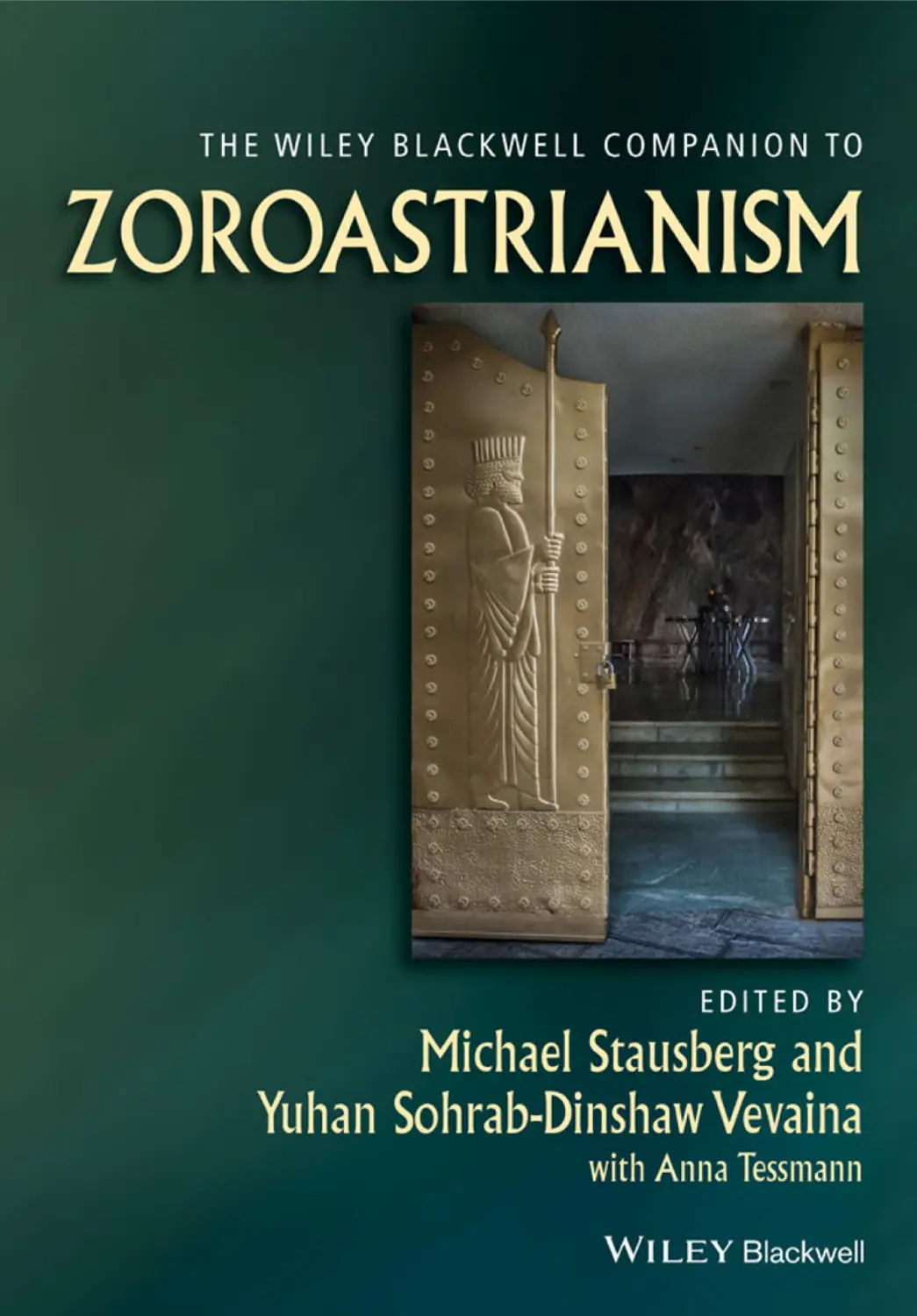
Cover image: Temple door at Chak Chak, Yazd, Iran. Photo © Jamshid Varza
Set in 10/12.5pt Photina by SPi Publisher Services, Pondicherry, India
1
2015
Contents
Notes on Contributors
ix
Acknowledgmentsxi
Aims and Scope
xiii
A Note on Transcriptions
xix
Abbreviationsxxiii
Introduction: Scholarship on Zoroastrianism
Michael Stausberg and Yuhan Sohrab‐Dinshaw Vevaina
Part I
Zarathustra Revisited
1
19
1
Zarathustra’s Time and Homeland: Geographical Perspectives
Frantz Grenet
21
2
Zarathustra’s Time and Homeland: Linguistic Perspectives
Almut Hintze
31
3
Interpretations of Zarathustra and the Gāthās
39
a The Gāthās
Helmut Humbach
39
b The Gāthās, Said to Be of Zarathustra
Jean Kellens
44
c
51
4
Dimensions of the Gāthās as Poetry
Martin Schwartz
d The Gāthās as Myth and Ritual
Prods Oktor Skjærvø
59
Zarathustra: Post-Gathic Trajectories
Michael Stausberg
69
vi
contents
Part II
Periods, Regions, and Contexts
83
5 Religion and Politics in Pre‐Islamic Iran
Albert de Jong
85
6 Zoroastrianism under Islamic Rule
Touraj Daryaee
103
7 Armenian and Georgian Zoroastrianism
Albert de Jong
119
8 Zoroastrianism in Central Asia
Frantz Grenet
129
9 Zoroastrianism in the Far East
Takeshi Aoki
147
10 The Parsis
John R. Hinnells
157
11 Zoroastrians in Modern Iran
Michael Stausberg
173
12 The Zoroastrian Diaspora
John R. Hinnells
191
Part III
209
Structures, Discourses, and Dimensions
13 Theologies and Hermeneutics
Yuhan Sohrab‐Dinshaw Vevaina
211
14 Cosmologies and Astrology
Antonio Panaino
235
15 Myths, Legends, Eschatologies
Carlo G. Cereti
259
16 Gender
Jenny Rose
273
17 Law in Pre‐Modern Zoroastrianism
Maria Macuch
289
18 Law and Modern Zoroastrians
Mitra Sharafi
299
Part IV
313
Practices and Sites
19 Ethics
Alberto Cantera
315
20 Prayer
Firoze M. Kotwal and Philip G. Kreyenbroek
333
21 Purity and Pollution / The Body
Alan V. Williams
345
contents
vii
22 Rituals
Michael Stausberg and Ramiyar P. Karanjia
363
23 Festivals and the Calendar
Jenny Rose
379
24 Religious Sites and Physical Structures
Jamsheed K. Choksy
393
Part V
407
Intersections
25 Early India and Iran
Prods Oktor Skjærvø
409
26 Judaism
Yaakov Elman and Shai Secunda
423
27 The Classical World
Martin L. West
437
28 From Miθra to Roman Mithras
Richard L. Gordon
451
29 Christianity
Marco Frenschkowski
457
30 Manichaeism in Iran
Manfred Hutter
477
31 Islam
Shaul Shaked
491
32 The Yezidi and Yarsan Traditions
Philip G. Kreyenbroek
499
33 The Bahā’ı ̄ Faith
Moojan Momen
505
Part VI
Primary Sources
517
34 Primary Sources: Avestan and Pahlavi
Miguel Ángel Andrés‐Toledo
519
35 Primary Sources: New Persian
Daniel J. Sheffield
529
36 Primary Sources: Gujarati
Daniel J. Sheffield
543
Bibliography
Index of People, Places, and Topics
Index Locorum
555
629
655
Notes on Contributors
Miguel Ángel Andrés‐Toledo is a Marie Curie Fellow, University of Copenhagen,
Denmark.
Takeshi Aoki teaches at Waseda University, Tokyo, Japan.
Alberto Cantera is a Professor in the Department of Classical Philology and Indo‐
European, University of Salamanca, Spain.
Carlo G. Cereti is the Professor of Iranian Philology, Religions and History, University
of Rome “La Sapienza,” Rome, Italy.
Jamsheed K. Choksy is Professor of Iranian Studies and of Central Eurasian Studies,
India Studies, and History, Indiana University at Bloomington, USA.
Touraj Daryaee is the Howard C. Baskerville Professor in the History of Iran and the
Persianate World, Department of History, University of California at Irvine, USA.
Yaakov Elman is the Herbert S. and Naomi Denenberg Chair in Talmudic Studies,
Yeshiva University, New York, USA.
Marco Frenschkowski is Professor of New Testament Studies, Faculty of Theology,
Leipzig University, Germany.
Richard L. Gordon is Honorary Professor of Ancient Religions and Fellow of the Max
Weber Center for Advanced Cultural and Social Studies, Erfurt University, Germany.
Frantz Grenet is Professor of the History and Cultures of pre‐Islamic Central Asia,
Collège de France, Paris, France.
John R. Hinnells is Professor of Theology (Emeritus), Liverpool Hope University, UK.
Almut Hintze is the Zartoshty Professor of Zoroastrianism, Department of the Study
of Religions, School of Oriental and African Studies, University of London, UK.
Helmut Humbach is Professor Emeritus of Comparative Linguistics, University of
Mainz, Germany.
x
notes on contributors
Manfred Hutter is Professor of History of Religions, University of Bonn, Germany.
Albert de Jong is Professor of Comparative Religion (and Religions of Antiquity),
Leiden University, the Netherlands.
Ramiyar P. Karanjia is the Principal of the Athornan Boarding Madressa, Mumbai, India.
Jean Kellens is Professor Emeritus of Indo‐Iranian Languages and Religions, Collège
de France, Paris, France.
Firoze M. Kotwal is the former Principal of the M. F. Cama Athornan Institute and
(former) High Priest (Dastur) of the H. B. Wadia Atash Bahram, Mumbai, India.
Philip G. Kreyenbroek is Professor and Director for Iranian Studies, University of
Göttingen, Germany.
Maria Macuch is Professor Emeritus of Iranian Studies, Free University of Berlin,
Germany.
Moojan Momen is an independent scholar based in the UK.
Antonio Panaino is Professor of Iranian Studies, University of Bologna, Italy.
Jenny Rose teaches at Claremont Graduate University, Claremont, USA.
Martin Schwartz is Professor Emeritus, Department of Near Eastern Studies,
University of California at Berkeley, USA.
Shai Secunda is a Postdoctoral Fellow, Martin Buber Society of Fellows, The Hebrew
University of Jerusalem, Israel.
Shaul Shaked is Professor Emeritus, Department of Comparative Religion, The Hebrew
University of Jerusalem, Israel.
Mitra Sharafi is Associate Professor of Law, University of Wisconsin Law School, USA.
Daniel J. Sheffield is a Link‐Cotsen Postdoctoral Fellow, Society of Fellows in the
Liberal Arts, Princeton University, USA.
Prods Oktor Skjærvø is the Aga Khan Professor of Iranian Emeritus, Department of
Near Eastern Languages and Civilizations, Harvard University, USA.
Michael Stausberg is a Professor of Religion, University of Bergen, Norway.
Yuhan Sohrab‐Dinshaw Vevaina is a Lecturer, Department of Religious Studies,
Stanford University, USA.
Martin L. West is an Emeritus Fellow, All Souls College, University of Oxford, UK.
Alan V. Williams is Professor of Iranian Studies and Comparative Religion, University
of Manchester, UK.
Acknowledgments
T
he editors first met in Vienna in 2007 at the 6th European Conference of Iranian
Studies organized by the Societas Iranologica Europaea, where we were introduced
to each other by Prods Oktor Skjærvø. In the following year, Yuhan S.‐D. Vevaina spent
six weeks as a research fellow at Michael Stausberg’s department at the University of
Bergen (Norway), sponsored by the university, for which we both are very grateful. It
was during this stay that the idea of putting together a companion volume first took
shape and we subsequently met with Rebecca Harkin from Wiley Blackwell in November
2008 in Chicago at the American Academy of Religion Conference. After our proposal
was favorably reviewed we started to invite contributors in May 2009. Some colleagues
dutifully submitted their first drafts in 2010 as requested. Unfortunately, others kept us
waiting until February of 2014 for their final versions. These delays reflect the fragility
of our scholarly community, which for specific areas and themes depends almost
exclusively on the singular competence of individual scholars, who cannot be replaced
easily by others. Hence, the project was delayed considerably. We therefore thank all our
colleagues for their patience and collaboration, which indeed is a very positive
development in a field that in prior decades suffered heavily from often unpleasant
rivalries between individual scholars and their “schools.” Now, in the early 21st century,
even though most of us continue to disagree on fundamental questions, a new spirit of
collegiality and collaboration has appeared that finds its expression in the present
volume. In this spirit, we hope the Companion will lead to further collaborative projects
in the future.
During the final stages of the gestation of this volume, we were assisted by Dr Anna
Tessmann (a private scholar based in Heidelberg), who in spite of her other duties tirelessly helped us with the copyediting of all the manuscripts with an untiring eye for
details and a commitment to consistency which we hope will be much appreciated by
our readers. She also prepared the two indexes. The editors and contributors owe her a
great debt of gratitude. We are also grateful to the Department of Archaeology, History,
Cultural Studies and Religion at the University of Bergen for providing the funds that
allowed Anna to assist us in our project.
xii
acknowledgments
We must also acknowledge Professor John Kieschnick and Rafal Felbur from the
Buddhist Studies Program in the Department of Religious Studies at Stanford University
for kindly helping us to edit the Chinese and Japanese translations and citations found
in Professor Aoki’s chapter on East Asia, and we would also like to thank Dr Patrick
Taylor for his translation of Jean Kellens’s article from French into English. We would
also like to thank the referees for their detailed and helpful comments and critiques; we
have done our best to have them incorporated.
The severe delays and other shortcomings of the work notwithstanding, for both of
us this project has been a great learning experience and we hope that both general
readers and specialists will find reading the volume an equally rewarding experience.
Ultimately, we hope that readers will appreciate our basic motivation for producing this
work, namely, our passion for the study of Zoroastrianism and our desire for this specialist knowledge to be shared in academia and with the public.
Bergen and Stanford, June 2014
Michael Stausberg and Yuhan Sohrab‐Dinshaw Vevaina
Aims and Scope
E
ven though Zoroastrianism was relatively well studied in the early days of the
comparative and historical study of religions (Stausberg 2008a: 562–564), scholarly
interest has precipitously declined since, and the study of Zoroastrianism now largely
operates in a disintegrated academic landscape (see Stausberg and Vevaina,
“Introduction: Scholarship on Zoroastrianism,” this volume). In this volume, thirty‐three
scholars from ten countries seek to redress this situation by offering a comprehensive
view of the state of the art in the study of Zoroastrianism in the early 21st century.
While there are various companions to other religions (published in this series or by
other publishers), this book is the first of its kind for Zoroastrianism. The scholarly
books on Zoroastrianism in general (i.e., not covering specialized studies on particular
texts, themes, or periods) published during the past thirty‐five years can be divided into
the following categories: shorter introductory volumes (Boyce 1979; Nigosian 1993;
Clark 1998; Mazdāpū r 2003 [1382 in Persian]; Stausberg 2008b; Rose 2011a; Rose
2011b), selections of textual primary sources (Malandra 1983; Boyce 1984b; Skjærvø
2011a), a multivolume survey of Zoroastrian history and rituals (Stausberg 2002b;
2002c; 2004b), an as yet unfinished massive history of Zoroastrianism (Boyce 1975a;
Boyce 1982; Boyce and Grenet with Roger Beck 1991; Boyce and de Jong, forthcoming),
a lavishly illustrated volume with introductory essays (Godrej and Mistree 2002), an
exhibition catalogue (Stewart 2013), and an ongoing and now largely online encyclopedic project on Iranian civilization that comprises numerous useful entries on
Zoroastrian matters (the Encyclopædia Iranica, open access under www.iranicaonline.
org). In sum, nothing comparable in scope to the present The Wiley Blackwell Companion
to Zoroastrianism has ever been published.
This multi‐authored volume is not dominated by one single overarching view of
Zoroastrianism. In fact, by putting this volume together we as editors have endeavored
to respect the diverse voices of the contributors as we seek to collectively grapple with
and perhaps move beyond normative takes on the “essential” identity of Zoroastrianism
that can often be found in the older literature. We, the editors, do not believe in such a
thing as an essence of Zoroastrianism that would provide the one authentic, real, or
normative version of this historically and geographically diverse religion. As scholars
xiv
aims and scope
we do not judge our sources in this light (even when the sources themselves make such
claims), but our interests are of an analytic, critical, and historical nature, where we
situate our sources in different historical contexts, attempt to understand them as
driven by specific interests, and thus represent this historical diversity to a diverse
readership. From our academic perspectives, we do not see Zoroastrianism as something
given for one and all times or as simply the outcome of the words of the founder or
prophet, but rather as a complex network of dynamic ongoing re‐creations that its
makers – believers and practitioners – are situated within, continually engage with, and
often contest, or that we as scholars identify, in the light of our interpretative frameworks,
as related to this trans‐historical and transnational entity commonly referred to as
“Zoroastrianism.” The latter, for example, is the case with material and visual remains
in Central Asia, which make sense when interpreted as evidence for regional variations
of Zoroastrianism which are, in certain striking cases, rather divergent from the more
familiar cultural productions we find in textual and material sources from pre‐modern
Persian and the contemporary Iranian and Indian communities (see Grenet,
“Zoroastrianism in Central Asia,” this volume). As scholars we are not in a position to
arbitrate on the truth‐value of any of the various attempts by Zoroastrians to represent
the genuine and true vision of their religion as more authentic than that of their rivals,
even though we can analyze to what extent these claims are consonant with earlier
equally contested interpretations of Zoroastrianism. We therefore see it as our
professional responsibility to analyze points of contrast or divergence between different
understandings of this faith. What we describe as innovations may be dismissed by
some Zoroastrians as aberrations or hailed by others as progress – both normative
categories that are equally problematic for historical‐critical research. The five main
parts of this volume therefore present different facets of this scholarly agenda.
It could seem intuitively plausible for a discussion of Zoroastrianism to start with
Zarathustra (Zoroaster), who is traditionally held to be the founder or prophet of the
religion that in the modern age came to be called after him. Such a narrative strategy
would build on the emphasis placed on Zarathustra in Zoroastrian sources. The inherent
risk is simply conceptualizing the history of Zoroastrianism as a mere footnote to
Zarathustra and thus placing the development of the religion under the intellectual
spell of this remote point of reference. Since the exact time and homeland of Zarathustra
continue to remain a matter of dispute, the first two chapters in Part I discuss this
problem from both geographical and linguistic perspectives (Frantz Grenet and Almut
Hintze respectively). Believers and many scholars alike hold Zarathustra to be the
“author” of five enigmatic songs, the Gāthās, which are then often used to reconstruct
the original message of the “prophet” and, by extension, “his” religion. The Gāthās,
however, have yielded widely contrasting interpretations and translations in the 20th
century and therefore, in order to not privilege one reading, we have invited four
eminent scholars (Helmut Humbach, Jean Kellens, Martin Schwartz, and Prods Oktor
Skjærvø), who have over the past decades made groundbreaking contributions to the
understanding of these complex texts, to provide a synthesis of their current thinking
on the Gāthās. We hope such a plurality of interpretations will prove stimulating to both
specialist and general readers. The final chapter of this first part by Michael Stausberg
looks at the trajectories of the figure of Zarathustra in the periods after the Gāthās, when
aims and scope
xv
he was cast in the role of the foundational individual by Zoroastrian sources and came
to signify whatever ideal the religion was and is supposed to mean in the context in
question. The chapter also addresses non‐Zoroastrian engagements with the figure of
Zarathustra and examines various modern visual representations and discursive appropriations of the “prophet.”
Part II presents a survey of Zoroastrian history and Zoroastrian communities from
antiquity to the present and thereby situates the Zoroastrian tradition(s) in different
historical and geographical contexts. Three chapters deal with Zoroastrianism and
Zoroastrian communities in the course of Iranian history, from the time of the pre‐
Islamic empires (Albert de Jong) through the pre‐modern Islamic periods (Touraj
Daryaee) to the modern and contemporary Iranian Zoroastrian communities (Michael
Stausberg). Chapters on the Caucasus (Albert de Jong) and Central Asia (Frantz Grenet)
in pre‐ and early Islamic times survey regional versions of Zoroastrianism beyond the
Persian orbit; these regions show some rather distinctive characteristics when
compared to Persian Zoroastrianism that is often taken as the normative model for the
religion. Nowadays, the majority of Zoroastrians live in India, where the Parsis, as they
are known and self‐identify, can look back to a long history, which is here reviewed by
John R. Hinnells. Since colonial times, Parsis and later also Iranian Zoroastrians have
settled in large parts of the world; these Zoroastrian diasporas, which have created
novel organizational and material infrastructures, comprise multisited networks, where
the negotiation of Zoroastrian identities occur with great intensity (John R. Hinnells).
During the past twenty years new information technologies have allowed Zoroastrians
across the globe to engage in translocal and transnational networks of communication
with their fellow practitioners in an unprecedented manner. Via the Silk Road there
were mercantile and religious connections to East Asia already in precolonial times, yet
the East Asian part of the Zoroastrian world often tends to be overlooked in scholarship.
In this volume, Takeshi Aoki reviews the history of Zoroastrianism in East Asian
countries from the pre‐Islamic period to the contemporary age. In addition, this chapter
also provides a survey of East Asian scholarship on Zoroastrianism, which is often
ignored in the West regrettably because of language barriers.
Part III of our Companion is called Structures, Discourses, and Dimensions. Instead of
merely providing lists of deities and their attributes and narrated actions, Yuhan S.-D.
Vevaina discusses theologies and hermeneutics, i.e., reflections as found in Zoroastrian
Middle Persian (Pahlavi) sources on the status and functioning of the divine actors and
their relationships to humans, the ways these statements are generated in the form of
scriptural interpretation, and the teaching and transmission of religious knowledge.
Antonio Panaino analyzes the structure of the cosmos and the place of astrology in
ancient Zoroastrian sources and points to the importance of Iran in the transmission of
astrological lore between East and West. Carlo G. Cereti recounts the mythological narratives relating to the beginning of the world, the figure of Zarathustra, and the events
predicted to unfold at the end of time. Jenny Rose discusses the gendered nature of the
divine world, the division of labor in religious and ritual practice along gender lines, the
relationships between sexuality and ideas of purity and pollution, the different social,
legal, and ritual status of women and men, and their respective expected roles and
access to power. Maria Macuch provides an overview of the general principles of
xvi
aims and scope
Zoroastrian law, the main spheres of legal regulation and legal procedure in the pre‐
Islamic and early Islamic sources, followed by Mitra Sharafi’s discussion of the modern
reinventions and constructions of Zoroastrian (Parsi) law and the ways in which
Zoroastrians have engaged with colonial and civil law to serve their identitarian needs
as minority communities through various forms of boundary maintenance.
Part IV covers religious practices and religious sites. The first chapter reviews the
question of ethics in Zoroastrianism, a religion which has been interpreted as being
primarily ethical in nature by certain influential scholars of the past. Alberto Cantera
distinguishes between rituals as an arena for moral intervention of humans in the
cosmic events and morality in a broader sense, where ethics have become a dominant
theme in Zoroastrian religious thought (including the understanding of law). Prayer is
a central religious practice in Zoroastrianism, as in several other religions, but Firoze M.
Kotwal and Philip G. Kreyenbroek point to differences between typical Western and
Zoroastrian understandings of the nature and function of prayer before turning to the
history of prayer in Zoroastrianism from the earliest sources to contemporary practices.
The human body is the key site of ritual practice and conceptions of notions of purity
and pollution, which are structuring elements of Zoroastrian theologies, their views on
the cosmos, the ecosystem, space and the human being, social relationships, and the
systems of ritual actions and obligations. Alan V. Williams analyzes Zoroastrian claims
regarding the origin and removal of impurity and examines the ways in which these
embodied practices construct order at the level of the individual, society, and the
cosmos. Michael Stausberg and Ramiyar P. Karanjia address different forms and types
of rituals and some of their structural principles and modes of organization, whereas
Jenny Rose looks at collective celebrations timed according to the religious calendar and
their historical developments from the earliest sources to contemporary practices in the
Iranian and Indian communities. This part ends with Jamsheed K. Choksy’s review of
the history of Zoroastrian religious sites and structures, mainly temples and funerary
structures (such as the so‐called “Towers of Silence”), from the Achaemenid period to
the present communities in India, Pakistan, Myanmar, Sri Lanka, and Iran.
Part V contextualizes the “Good Religion,” as pre‐modern Zoroastrian sources
referred to it, in its historical intersections with other religions and cultures. The organization of this section follows a historical timeline based on when Zoroastrianism came
into contact with the other religions and cultures. Prods Oktor Skjærvø begins with the
Indo‐European and Indo‐Iranian heritage of the Avestan texts, inherited similarities
and cultural differences between Avestan and Old Indic texts and poetry, myths and
mythological geography, names and functions of deities and demons and shared ritual
features. (See Stausberg 2012b for a longer historical survey that also covers later
Hinduism; a commissioned chapter on this topic for this Companion unfortunately did
not materialize nor were we able to include a chapter on Buddhism.) Judaism continues
to share a long history with Zoroastrianism from the 6th century bce to the present; in
their chapter, Yaakov Elman and Shai Secunda mainly focus on the rather intensive
Jewish–Zoroastrian interactions in late antique Mesopotamia as found in rabbinic and
Pahlavi sources. A survey of the intellectual fascination with Zoroastrianism and the
Persians by writers from different periods of the Classical world (Martin L. West) is followed
by a review of the question of the Zoroastrian background of Mithraism, or the
aims and scope
xvii
“romanization” of the Iranian deity Mithra (Richard L. Gordon). Marco Frenschkowski
reviews intersections between Christianity and Zoroastrianism from early Christianity
to the early Islamic period; he also pays attention to persecution of Christians in
Sasanian Iran and Zoroastrian critiques of Christian doctrines. Manichaeism, which
originated in the 3rd century ce, actively accommodated Zoroastrian themes in its self‐
fashioning and proselytization in the Iranian world. Manfred Hutter analyzes
Zoroastrian topics in Manichaean writings and the mutual polemics between
Manichaean and Zoroastrian authors. Islam emerged at the periphery of Iranian
culture but its spread has fundamentally altered the societal role and shape of
Zoroastrianism during the past millennium or so. Shaul Shaked addresses the attitude
towards Zoroastrianism in early Islamic sources and their views of Zoroastrianism,
Iranian and Zoroastrian influences on early Islam, Middle Persian writings translated
into Arabic, and Zoroastrian polemics against Islam. Philip G. Kreyenbroek looks at
minority communities whose religious centers lie in Kurdish‐speaking regions, the
Yezidis and Yarsan (also know as Ahl‐e Haqq or Kaka’is), and their shared traits with
Zoroastrianism. He points to the lasting and pervasive influence of an earlier Iranian
religious tradition centering on the figure of Mithra in these regions. Finally, the Bahā’ ı̄
Faith, which originated in the second half of the 19th century in Iran, has since its
beginnings had interactions with Zoroastrians and relatively numerous Zoroastrians
converted to this new religion. Moojan Momen analyzes factors facilitating these
conversions, later separation, integration and intermarriages between both religious
communities, and more recent conversions by Zoroastrians who in many ways
contributed to the development of the Bahā’ ı̄ Faith.
The final part (VI) of this Companion functions as an appendix that readers can draw
on when reading the essays and that, we hope, will prove valuable for further engagement with Zoroastrian studies. It recapitulates the four main groups of primary textual
sources. Miguel Ángel Andrés‐Toledo gives a brief synopsis of the Avestan texts, the
Avestan manuscripts with Middle Persian (Pahlavi) translations, and the Middle Persian
writings arranged according to periods of origin from the third to the nineteenth
centuries. The chapter lists editions, translations, and studies of the sources. Since
these sources are relatively well studied, this chapter is meant to provide a useful recapitulation of existing scholarship. The two chapters by Daniel J. Sheffield on Zoroastrian
writings in New Persian and Gujarati, on the other hand, deal with texts which are
poorly studied, have not been studied at all, or were until recently altogether unknown,
even to scholars of Zoroastrianism. These chapters therefore do not merely summarize
extant studies but present original research. In particular, the texts in Gujarati remain
a virtually untapped source for the study of Zoroastrianism; its neglect in research
results from the disintegrated research landscape that will be discussed in the
Introduction to Scholarship on Zoroastrianism by the editors.
The bibliographical references to the individual chapters have been compiled into a
shared bibliography at the end of the volume, which thereby can serve as a comprehensive and up‐to‐date early 21st‐century bibliography of Zoroastrian studies. Most
chapters are provided with suggestions for further reading.
A Note on Transcriptions
Avestan
The transcription of Avestan in this volume is largely based on the now standard system
established by Karl Hoffmann (Hoffmann 1987; Hoffmann and Narten 1989). The
Avestan alphabet is a phonetic rather than a phonemic alphabet with every sound being
represented by a single letter. It consists of 14 (or 16) letters for vowels and 37 letters for
consonants (see the table in Hoffmann 1987; online: www.iranicaonline.org; see also
Skjærvø 2003a: 1–3 for suggestions on how these letters might have sounded; online:
www.fas.harvard.edu/~iranian/).
Vowels
a
ə
ā
ə̄
i
ą
ı̄
å/ā˚
u
p
t
k
c
y
v
r
b
d
g
j
Y
uu
s
β
δ
ġ
ń
ii
x
š
f
δ2
γ
m
θ
x
x́
ŋᵛ
š́
ŋ
ū
e
ē
o
m̨
t̰
ŋ
t̰2
n
ṇ
z
ž
h
ō
Consonants
ṣ̌
Pahlavi (Zoroastrian Middle Persian)
The transcription of Pahlavi in this volume is based on the now almost universally standard system put forth by David N. MacKenzie in a seminal article from the 1960s and
his A Concise Pahlavi Dictionary respectively (MacKenzie 1967, 1971).
xx
a note on transcriptions
The sound system (phonology) of Pahlavi is similar to that of New (Modern) Persian.
Vowels
a
ā
(e)
ē
i
ı̄
(o)
ō
u
ū
k
g
x
h
Consonants
p
b
f
z
m
w
t
d
s
ž
n
r/l
č
ǰ
š
γ
y
ž and γ are typically found in Avestan loanwords
č and ǰ are the sounds in English like ‘child’ and ‘jug’
š is like English ‘shirt’
ž is the voiced sound of English ‘measure’
x is the ch‐sound in German ‘Bach’
γ (Greek gamma) is the sound of the Spanish g between vowels, as in haga
New Persian (Farsi)
The spelling of New Persian words in this volume (except for some geographic terms
and names which are common in English) is based on the transliteration of the Arabic
script with a particular attention to the sound system of contemporary New Persian.
Throughout this volume we use a single Latin letter for a single Persian consonant, as
recommended by the Encyclopædia Iranica (EIr) (http://www.iranicaonline.org/pages/
guidelines). However, for common legibility of words we follow the conventional kh
for (Arab. khā’) and gh for (Arab. ghayn). In contrast to the EIr, the letters (Arab.
dhāl) and (Arab. thā’) are transliterated as ẕ and s̱ (and not as ḏ and ṯ) respectively.
In our New Persian spelling for the volume the ending (Arab. hā’) in most words is ‐e
(i.e. khāne ‘house’). In the case of the Zoroastrian manuscripts we use multiple forms
like nāma/nāme. The eżāfe‐constructions are connected with an ‐e. Ey/ay and ow are
diphthongs. The New Persian spellings of Arabic words differ from the Arabic spellings; for instance, the coordinating conjugation (meaning ‘and’) is different: wa in
Arabic but va in New Persian.
Arabic
The Arabic terms in this volume are adapted from the system used in the Encyclopaedia
of Islam Online.
a note on transcriptions
xxi
Gujarati
The transliteration of Gujarati in this volume is a modified version of that used by the
Library of Congress, as follows:
Vowels
a
ā
i
u
ṛ
e
ai
o
au
The short vowel /a/, which is implicit after every consonant, is only transliterated when
it is pronounced. The anusvār has been transliterated as /ṃ / when it represents a nasal
consonant and /◌̃/ when it represents a nasalized vowel. The use of visarg in Gujarati is
very rare, but is transliterated /ḥ/ when it occurs. Since there is no phonemic distinction
in Gujarati between ı̆/ı̄ or ŭ/ū, length has not been indicated on these vowels. It should
be noted that the Modern Standard Gujarati vowels ı̆ and ū, which are now applied on
the basis of etymological length, occur only very haphazardly prior to the standardization of Gujarati in the late 19th century. Alternate forms of the vowels /e/ and /o/ are
very common in early publications.
Consonants
k
kh
g
gh
ṅ
c
ch
j/z
jh
ñ
ṭ
th
ḍ
ḍh
ṇ
t
th
d
dh
n
p
ph / f
b
bh
m
y
r
l
v
ś
ṣ
s
h
ḷ
No phonemic distinction is made between ś, ṣ, and s and, in 18th‐ and 19th‐century
materials, ś and s were used interchangeably. We have therefore transliterated /ś/ only
when it is etymological and have otherwise substituted /s/. The semi‐vowels /y/ and /v/
in pre‐standardized Gujarati are often represented by the juxtaposition of two vowels,
thus /iaśt/ for /yaśt/. The consonant /h/ written after a vowel sometimes indicates a
breathy vowel (murmured vowel) as in the distinction between /bār/ ‘twelve’ and /bār̤ /
‘outside’. Since this feature of pre‐standardized Gujarati orthography, which is omitted
in modern spelling, has not been investigated, it has simply been transliterated as /h/
here. Since Gujarati names are transliterated into English‐language publications very
irregularly, we have tried to provide their transliterations followed by their common
forms in parentheses in the bibliography, e.g. Jamśetji Jijibhāi (Jamsetjee Jejeebhoy).
Readers will notice variant spellings of the same name in the various chapters, e.g.
Šābuhr vs. Šāpū r or kustı̄ vs. kostı̄. We have tried to regularize these variants across the
chapters, though in some instances it did not seem useful to standardize all variants
across different contexts, especially where specific forms are more appropriate. For
xxii
a note on transcriptions
example, in the chapter on Manichaeism the reader will find Šābuhr, since Mani’s text
is commonly referred to as the Šābuhragān. Common names and titles like Zarathustra
(Zaraθuštra), Mani (Mānı̄), Mithra (Miθra), the Gāthās (Gāθās) are not typically provided
with their technical transcriptions.
We would like to acknowledge Daniel J. Sheffield for his assistance with the Gujarati
transcription system.
Abbreviations
A
AAASH
AB
acc.
ActOr
adj.
AG
AION
AJ
AMI
AMIT
ANRW
ANy
AOASH
AoF
Aog
Arab.
ArOr
AUU
Av.
AV
AW
AWN
Az
AZ
A2S
b.
Bactr.
BAI
bce
Ā frı̄n(a)gān
Acta Antiqua Academiae Scientiarum Hungaricae
Analecta Bollandiana
accusative case
Acta Orientalia
adjective
Ā frı̄nagān ı̄ Gāhānbār
Annali del’Istituto Universitario Orientale di Napoli
Ayādgār ı̄ Jāmāspı̄g
Archäologische Mitteilungen aus Iran
Archäologische Mitteilungen aus Iran und Turan
Aufstieg und Niedergang der römischen Welt
Ā taš Niyāyišn
Acta Orientalia Academiae Scientiarum Hungaricae
Altorientalische Forschungen
Aogəmadaēcǎ ̄
Arabic
Archiv Orientální
Acta Universitatis Upsaliensis
Avestan
Atharvaveda
Ayādgār ı̄ Wuzurgmihr
Ardā Wirāz-Nāmag
Ā frı̄n ı̄ Zardušt
Ayādgār ı̄ Zarērān
Artaxerxes II Susa
born
Bactrian
Bulletin of the Asia Institute
Before the Common/Current Era
xxiv
abbreviations
Bd
BDNA
BE
BEI
BPP
BSOAS
c.
Canton.
ce
CHI
Chin.
Chor.
col.
CRAIBL
ČAP
ČK
d.
DB
DD
Dk
DkB
DkM
Dn
DS
EI
EIr
EW
f.
fn.
Fı̄ō
FrA
FrB
FrBy
FrD
FrG
FrGr
FrW
G
GA
GBd
Gk.
Gš
Hebr.
Hēr
HN
Bundahišn
Bactrian Documents from Northern Afghanistan
Bahāʼı ̄ Era, starting with the Bāb’s declaration on Nowrū z 1844
Bulletin d’Études Indiennes
Bombay Parsi Punchayet
Bulletin of the School of Oriental and African Studies
circa
Cantonese
Common/Current Era
Cambridge History of Iran
Chinese
Chorasmian
column
Comptes rendus de l’Académie des Inscriptions et Belles‐Lettres
Čı̄dag Andarz ı̄ Pōryōtkēšān (see also PZ)
Čı̄m ı̄ Kustı̄g
died
Darius I Bı̄sotū n
Dādestān ı̄ Dēnı̄g
Dēnkard
Dēnkard ‘B’ manuscript (Dresden 1966)
Dēnkard Madan edition
Book of Daniel (Old Testament)
Darius I Susa
Encyclopaedia of Islam
Encyclopædia Iranica
East and West
feminine
footnote
̄ (‐ēk)
Frahang ı̄ ōım
Anklesaria’s fragments in the RAF and in the RFW
Fragment Bartholomae
Barthélemy’s fragments
Fragment Darmesteter
Geldner’s fragments
Gray’s fragment
Fragment Westergaard
Gāh
Mādayān ı̄ Gizistag Abāliš
Great(er) (Iranian) Bundahišn
Greek
Fragments in the Ganješāyagān
Hebrew
Hērbedestān
Hāδōxt Nask
HR
IA
IBd
IE
IF
IIJ
IIr.
IR
IS
JA
JAAR
JAAS
JAOS
JKRCOI
JN
Jpn.
JNES
JRAS
JSAI
KAP
Khot.
KKZ
KNRb
KNRm
KSM
Lat.
l.c.
m.
M
Man.
MHD
MP
ms.
MSS
Mt
MX
N
n.
n.
NChin.
n.d.
n.ed.
Nig
NM
nom.
abbreviations
History of Religions
Iranica Antiqua
Indian Bundahišn
Indo‐European
Indogermanische Forschungen
Indo‐Iranian Journal
Indo‐Iranian
Iṭhoter Revāyat (Revāyat‐e Haftād va Hašt)
Iranian Studies
Journal asiatique
Journal of the American Academy of Religion
Journal of Asian and African Studies
Journal of the American Oriental Society
Journal of the K. R. Cama Oriental Institute
Jāmāsp‐Nāmag
Japanese
Journal of Near Eastern Studies
Journal of the Royal Asiatic Society
Jerusalem Studies in Arabic and Islam
Kārnāmag ı̄ Ardaxšı̄r ı̄ Pābagān
Khotanese
Kerdı̄r Ka‘ba‐ye Zartošt
Kerdı̄r Naqš‐e Rajab
Kerdı̄r Naqš‐e Rostam
Kerdı̄r Sar Mašhad
Latin
loco citato (in the place cited)
masculine
Manichaean Texts from Turfan, China (now in Berlin)
Manichaean
Mādayān ı̄ Hazār Dādestān
Middle Persian
manuscript
Münchener Studien zur Sprachwissenschaft
Gospel of Matthew (New Testament)
(Dādestān ı̄) Mēnōg ı̄ Xrad
Nērangestān
neuter
note
Northern Chinese
no date
no editor(s)
Fragment of the Nigādom
Nāmagı̄hā ı̄ Manušcǐ hr (also ‘The Epistles of Manuščihr’)
nominative case
xxv
xxvi
n.p.
Ny
NP
OAv.
OInd.
OIr.
OP
OS
P
Pahl.
Parth.
PF
PGuj.
pl.
PRDD
PT
PVd
PY
PYt
PZ
Pz
QS
r.
RAF
REA
repr.
RFW
RHR
RSO
RV
s./ss.
S
sg.
SBE
SChin.
SdBd
SdN
Skr.
Sn
Sogd.
SPAW
st.
StII
StIr
abbreviations
no publisher
Niyāyišn
New Persian
Old Avesta(n)
Old Indian
Old Iranian
Old Persian
Orientalia Suecana
Pursišnı̄hā
Pahlavi
Parthian
Elamite Persepolis Fortification Tablets
Parsi Gujarati
plural
Pahlavi Rivāyat accompanying the Dādestān ı̄ Dēnı̄g
Pahlavi translation
Pahlavi Vı̄dēvdād
Pahlavi Yasna
Pahlavi Yašt
Pandnāmag ı̄ Zardu(x)št (see also ČAP)
Pāzand
Qeṣṣe‐ye Sanjān
ruled
Rivāyat of Ā durfarnbag ı̄ Farroxzādān
Rivāyat of Ē mēd ı̄ Ašawahištān
reprinted
Rivāyat of Farrōbag‐Srōš ı̄ Wahmānān
Revue de l’Histoire des Religions
Rivista degli Studi Orientalni
Rigveda, Ṛg‐Veda
section(s)
Sı̄rōze, Sı̄h‐rōzag
singular
Sacred Books of the East
Standard Chinese
Ṣaddar(‐e) Bondaheš
Ṣaddar(‐e) Nasr
̄
Sanskrit
Seyāsatnāma
Sogdian
Sitzungsberichte der preußischen Akademie der Wissenschaften
der Philosophisch‐Historischen Klasse
stanza(s)
Studien zur Indologie und Iranistik
Studia Iranica
Supp.Šnš
s.v.
Syr.
ŠĒ
ŠGW
Šnš
TPS
trans.
v./vv.
Vd
Ved.
VN
Vr
Vyt
WZ
WZKM
XP
Y
YH
YAv.
Yt
ZDMG
ZFJ
ZfR
ZfvS
Zn
ZRGG
ZWY
abbreviations
xxvii
The Supplementary Texts to the Šāyest‐nē‐šāyest
sub verbo (under the specified word)
Syriac
Šahrestānı̄hā ı̄ Ērānšahr
Škand‐gumānı̄g Wizār
Šāyest‐nē‐šāyest
Transactions of the Philological Society
translated
verse(s)
Vı̄dēvdād
Vedic
Vaēθā Nask
Vı̄sp(e)rad
Vištāsp Yašt
Wizı̄dagı̄hā ı̄ Zādspram
Wiener Zeitschrift für die Kunde des Morgenlandes
Xerxes I Persepolis
Yasna
Yasna Haptaŋhāiti
Younger Avesta(n)
Yašt
Zeitschrift der Deutschen Morgenländischen Gesellschaft
Zand ı̄ Fragard ı̄ Juddēwdād
Zeitschrift für Religionswissenschaft
Zeitschrift für vergleichende Sprachforschung
Zarātoštnāma
Zeitschrift für Religions‐ und Geistesgeschichte
Zand ı̄ Wahman Yasn (Yašt)
Certain contributors use specialized abbreviations that are found at the end of their
chapters.
Introduction
Scholarship on Zoroastrianism
Michael Stausberg and Yuhan Sohrab‐Dinshaw
Vevaina
Z
oroastrianism currently has some 125,000 adherents worldwide with the majority
living in India, mostly in Mumbai and Gujarat (estimated at 60,000 for the as yet
unreleased census of 2011). In South Asia the Zoroastrians are known as the “Parsis”
(see Hinnells, “The Parsis,” this volume). Since World War II their numbers have been
in rapid decline (there were just under 115,000 Parsis in pre‐Partition India in 1941)
and the Indian media report dire predictions according to which this trend will continue
in the upcoming decades. The second largest group of Zoroastrians is to be found in
Iran, from where the Parsis relocated in the aftermath of the Arab invasions in the
mid‐7th century ce and the Islamization of the country in the following centuries
(see Daryaee, “Zoroastrianism under Islamic Rule,” this volume). Fewer than 20,000
Zoroastrians currently reside in Iran, where they are recognized as a religious minority
by the constitution (see Stausberg, “Zoroastrians in Modern Iran,” this volume).
Political changes in India (Independence and Partition in 1947 and its aftermath)
and Iran (the Islamic Revolution in 1979 and its aftermath) as well as socioeconomic
factors have stimulated many Zoroastrians to migrate. By now, there are substantial
(by Zoroastrian standards) communities in Britain, Canada, the United States, Dubai,
and Australia as well as minor groups in other countries, including Pakistan, Sri Lanka,
China, and New Zealand (see Hinnells, “The Zoroastrian Diaspora,” this volume).
Zoroastrianism is thus an interesting case of a globalizing, highly urbanized, and
literate (over 90 percent in India) ethnic religion while being one of the oldest religious
traditions in the world. Prior to the spread of Islam, which led to the concomitant marginalization of Zoroastrianism in its homelands (Afghanistan, Central Asia, Iran, and
adjacent areas), Zoroastrianism was one of the major religious forces of the ancient
world. Zoroastrians lived in neighborhoods with Jewish, Christian, Manichaean, and
Islamic communities for centuries. Its presumed influence on these religions has historically been the major factor warranting scholarly attention. In fact, Zoroastrianism was
The Wiley Blackwell Companion to Zoroastrianism, First Edition. Edited by Michael Stausberg
and Yuhan Sohrab‐Dinshaw Vevaina.
© 2015 John Wiley & Sons, Ltd. Published 2015 by John Wiley & Sons, Ltd.
2
michael stausberg and yuhan sohrab‐dinshaw vevaina
a fashionable subject in the early history of the study of religion\s. Remarkably, some of
the early protagonists of the history of religions as an academic discipline had
Zoroastrianism as one of their main areas of specialization. Consider such seminal
scholars as Cornelis Petrus Tiele (1830–1902), Nathan Söderblom (1866–1931),
Edvard Lehmann (1862–1930), Raffaele Pettazzoni (1883–1959), and, moving closer
to the present, Geo Widengren (1907–1996) and Carsten Colpe (1929–2009). As historians of religions, their impact on subsequent Zoroastrian studies (and even more so
on Iranian studies) has been fairly limited and as newer generations of historians of
religions did not share the enthusiasm of their predecessors for this subject, relatively
few articles on Zoroastrianism have been published in major history of religions
journals since the 1960s (Stausberg 2008a).
A Disintegrated Academic Landscape
The study of Zoroastrianism faces the same challenges as those of other religious traditions operating over vast spans of time. To begin with, studying a religion in its various
settings and contexts ideally requires philological expertise in a number of different languages. Taking into account only those languages in which we have substantial amounts
of primary textual sources, this would basically include the fields of Old, Middle, and New
Iranian studies plus Gujarati, the language spoken in the part of Western India where the
Parsis first settled. Compared to the study of so‐called world religions like Christianity,
Islam, Buddhism, or Hinduism, scholars of Zoroastrianism face a rather limited selection
of relevant languages with regard to primary sources. Nevertheless, what might appear
as a good starting point from a comparative perspective turns out to be a severe problem
in light of contemporary disciplinary and institutional boundaries. To quote from a
recent survey on “Iranian Historical Linguistics in the Twentieth Century”:
Iranian studies are seldom recognized as an academic discipline sui iuris and very few
Iranologists have been able to contribute to the fields of Old, Middle, and New Iranian alike.
Since the Neogrammarian revolution [in the late 19th century], Avestan and Old Persian
have been taught in Indo‐European departments or programs, usually with an emphasis
on linguistics. New Iranian (especially New Persian) is taught in departments of Middle
Eastern studies (German: Orientalistik) alongside the other written languages of Islam
(Arabic and Turkic), and the courses focus primarily on historical or social issues. Middle
Iranian languages rarely receive more than introductory courses, either as an adjunct to
New Persian or to the Indo‐European curriculum. (Tremblay 2005: 2)
Even where one finds Iranian studies as a separate academic entity (chair, department,
or center), Zoroastrianism is not always part of the academic specialization of the staff.
As a rule of thumb one can say that Zoroastrianism is at least remotely on the scholarly
agenda whenever there is a scholarly interest in pre‐Islamic history and culture or in
Old and Middle Iranian languages. However, whenever the balance leans towards the
Islamic era and New Persian languages, Zoroastrianism is usually completely outside of
the scholarly focus. The factual marginalization of Zoroastrians in Iranian history after
scholarship on zoroastrianism
3
the Islamic conquest in the 7th century ce is thereby faithfully mirrored by the Western
academic community. As implied by Tremblay, there is usually very little scholarly
exchange crossing the iron curtain separating Old and Middle from New Persian studies.
To pull down this rigid barrier will be one of the main challenges for the study of
Zoroastrianism and maybe also for Iranian studies in general (see now, Sheffield 2012).
Apart from Iranian languages, there are significant (secondary) source materials in
non‐Iranian languages to be taken into account: Vedic Sanskrit for comparative purposes with the Avestan corpus, Greek and Latin for interactions with the Classical
world, Akkadian, Egyptian, and Elamite for religion in the Persian Empire, Hebrew,
Aramaic, Syriac, and Arabic for interactions with Judaism, Christianity, Islam, and
Sasanian studies in general, Classical Armenian and Georgian for the Caucasus, not to
mention the secondary scholarly languages of French, German, Italian, Spanish,
Russian, Chinese, and Japanese. Texts, however, are obviously not the only sources for
the study of Zoroastrianism. Nor is philology the only approach. Ancient history,
archaeology, art history, sigillography (the study of seals), and numismatics (the study
of coins), for example, are important related scholarly disciplines or endeavors,
although their impact on the study of Zoroastrianism has up to now been fairly limited.
Turning to the modern and contemporary periods, a number of recent anthropological, sociological, and historical studies have provided valuable insights on modern
Zoroastrian social life and identities (see e.g., Luhrmann 1996; Walthert 2010; Ringer
2011 respectively).
Iranian studies or the related fields of study mentioned above are the traditional
breeding‐grounds of the study of Zoroastrianism, but (so far) Zoroastrian studies does
not exist as an integrated field of study. While there are several loose networks of
scholars regularly interacting in various contexts, there is neither a scholarly journal
devoted to Zoroastrian studies nor a review bulletin; and there is no scholarly association
or organization for scholars of Zoroastrian. In all this, the study of Zoroastrianism is
characterized by a considerable delay compared to the study of most other religious
traditions.
In addition, there is no academic department of Zoroastrian studies, not even in Iran
or India. However, just as specialist positions in a number of religions were being
established during recent decades at Western universities – often with considerable
financial input from adherents – there are now a handful of academic positions in
Zoroastrian studies, all located in “diasporic” hot spots:
• From 1929 to 1947 the Bombay Zoroastrian community funded a position called
the “Parsee Community’s Lectureship in Iranian Studies” at the School of Oriental
and African Studies (SOAS, renamed from the School of Oriental Studies in 1938)
in the University of London. The position was held by the two eminent Iranists
Harold W. Bailey (from 1929 to 1936) and Walter B. Henning (from 1936 to
1947). In the 1990s three Zoroastrian benefactors (Faridoon and Mehraban
Zartoshty and an anonymous Iranian benefactor) helped fund a professorship in
Zoroastrianism with the aid of the estate of the late Professor Mary Boyce who
was Professor of Iranian Studies at SOAS from 1961 to 1982 (see Hintze 2010
and more on Boyce below).
4
michael stausberg and yuhan sohrab‐dinshaw vevaina
• In the early years of the new millennium, a Zoroastrian Studies Council was
formed at Claremont Graduate University’s School of Religion in Claremont,
California. This and similar councils at Claremont are made up of “leaders” from
the religious communities; their aims are defined as follows: “These councils represent a partnership with the religious community by advising the school on the
needs of the community and consulting with the school as courses and programs
are developed” (Claremont Graduate University n.d.). In this case the group of
“leaders” is mainly composed of Iranian Zoroastrians. The council has successfully set up some classes in the study of Zoroastrianism during the past years, but
as of yet there is no funded fulltime position. As of December 2012, a lectureship
in Zoroastrian studies at Claremont Graduate University was permanently
endowed, as an adjunct position, offering one course per year.
• In 2006 the young “transdisciplinary” Department of Historical Studies at the
University of Toronto at Mississauga established a position in the history of
Zoroastrianism.
• In 2010 the Department of Religious Studies at Stanford University created an
endowed (but not permanent) lectureship for Zoroastrian studies with the financial support of Zoroastrian donors and FEZANA (the Federation of the Zoroastrian
Associations of North America; see Hinnells, “The Zoroastrian Diaspora,” this
volume).
In three of these four cases, the scholars appointed are philologists with a documented
expertise on Old and Middle Iranian texts respectively, which reflects the continued
prominence of philology in this field. It remains to be seen whether these positions will
have an impact on the consolidation of Zoroastrian studies as a more coherent field of
study. While this volume goes into press, the École Pratique des Hautes Études (Paris) is
about to recruit a Maître de conférences (Assistant Professor) in Zoroastrian studies
(Ancient Iran) at its Department of Religious studies. Here again the published job profile puts emphasis on proficiency in ancient Iranian languages.
Attempts at Mapping Main Approaches
It is customary in scholarly literature to review past attempts before setting out on one’s
own path; these sorts of academic preludes being largely rhetorical reconstructions
tend to point to perceived weak points in previous work. In the last fifteen years two
scholars have attempted to map the field of Zoroastrian studies at large.
The Dutch historian of ancient religions Albert de Jong has distinguished between
three main views of Zoroastrian history. He refers to them as “fragmentizing,” “harmonizing,” and “diversifying” views respectively (de Jong 1997: 44–68).
The characteristic feature of a “fragmentizing” view according to de Jong is the idea
that “Zoroastrianism ought to be defined by the Gāthās and by the Gāthās only” (de
Jong 1997: 46). The Gāthās, a tiny part of the Avestan corpus, are five songs (hymns or
poetic compositions) that most scholars and believers ascribe to Zarathustra who is
generally held to be the founder or “prophet” of the religion (see the chapters on
the Gāthās and Stausberg, “Zarathustra: Post‐Gathic Trajectories,” this volume). In that
scholarship on zoroastrianism
5
sense, what de Jong describes as “fragmentizing” can also be termed normative insofar
as one text becomes the norm for any reconstruction of the religion. This raises the
related question of the status of the later history of Zoroastrian (indigenous or emic)
interpretations of the Gāthās: Should an interpretation of the Gāthās be based on their
comparative linguistic or their transmissive cognates, that is, with the largely contemporaneous Vedas or the later Middle Persian (Pahlavi) writings in mind, or should both
approaches be combined?
In another sense, fragmentizing views assume the existence not of one main pre‐
Islamic indigenous religion (“Zoroastrianism” or “Mazdaism”) but, rather, several different religious communities such as a (presumed) Mithra‐community or regional
religious traditions such as Median and Parthian religions.
The second main view discussed by de Jong is referred to as “harmonizing.” The
characteristic feature of this group of approaches is their idea that the main collections
of ancient source materials, the Old and Middle Iranian texts (the Avestan and the
Pahlavi writings),
basically reflect the same tradition, a tradition that deserves to be called Zoroastrianism
(because it grew out of the teaching of Zarathustra). The numerous developments are due
not to ruptures or dramatic breaks in the tradition (as in fragmentising views) and certainly
do not reflect different religions, but are interpreted as manifestations of an organic process
of growth… (de Jong 1997: 50)
As is to be expected by his rhetorical arrangement, de Jong himself clearly favors the
third view, which he refers to as “diversifying.” This view is held to avoid what he terms
to be the other two “excessive” approaches and is apparently devised to strike the balance
between an “outright denial of a continuous tradition” on the one hand and “the insistence on an unchanging kernel of Zoroastrian doctrine” on the other (de Jong 1997: 60).
According to de Jong, this view “insists on using broad and preliminary” (de Jong 1997:
60) definitions of Zoroastrianism and points to “a variegated, classic tradition rather
than a strict doctrinal system” (de Jong 1997: 61). This approach – as exemplified by de
Jong’s own analysis of the classical (Greek and Roman) sources on Zoroastrianism – tries
to reach beyond the focus on the textual output of the priestly tradition as the normative
statement of whichever version of Zoroastrianism one is working on or writing about.
As part of a volume on postmodernist approaches to the study of religion in 1999,
the British scholar of religion John Hinnells tried to map the history of the study of
Zoroastrianism with regard to modernist and postmodernist features respectively.
Hinnells finds that “the sort of theories propounded concerning Zoroastrianism and the
debates which have raged (unfortunately an appropriate word at times!) mirror the sort
of wider theoretical debates in the study of religion, history, and literature” (Hinnells
2000: 23). Hinnells reviews the work of six scholars and sees modernist tendencies in
three of them and postmodernist ones in the other three, including his own work and
that of his teacher Mary Boyce. Whereas de Jong seems to assume the synchronicity of
the different views, the account given by Hinnells follows a chronological order. The
main works assigned to the modernist approach were published from 1882 to 1961,
while those showing postmodernist features were from around 1975 to the present. The
main dividing line between both approaches, as Hinnells presents them, is the presence
6
michael stausberg and yuhan sohrab‐dinshaw vevaina
of grand meta‐narratives (versus an emphasis on diversity), the dependence or emphasis
on the normative–priestly–textual tradition (versus domestic, daily, and female practices), and the assumption of a neutral, purely objective and detached point of view of
the scholar (versus an awareness of his or her situatedness in the field).
Some Reflections
To begin with, an obvious point of critique against such mappings is whether the categories do any justice to the scholars so classified. Every classification is subjective and
open to critique. Mary Boyce (see also below), in whose work her student Hinnells highlights postmodern features, would almost certainly have refused to consider herself as a
postmodernist. The Belgian scholar of the Avesta, Jean Kellens (Chair at the Collège de
France; see his “The Gāthās, Said to Be of Zarathustra,” this volume) who features as
something like the living arch‐protagonist of the fragmentizing view for de Jong, has
expressed his dissatisfaction with de Jong’s classifications and sees himself much more
like a harmonizer or diversifier (Kellens 2003: 215). Furthermore, Kellens rightly points
out that the subject of study and the research methodologies chosen in accordance
with that focus are important factors that to some large extent determine the general
point of view (Kellens 2003: 216). Writing a comprehensive history of Zoroastrianism
makes one more prone to harmonize than when one studies the complexity of a specific
period or a specific type of source material. In addition, what may be fragmentizing
from the point of view that takes data that looks “Zoroastrian” as evidence for the
internal plurality or diversity of a capacious Zoroastrianism can potentially be seen as
diversifying from another point of view in which Zoroastrianism was merely one among
several available socioreligious or cultural options in Iranian religious history. Put
simply, is “Zoroastrianism” the big umbrella or is “pre‐Islamic Iranian Religion(s)” to
be understood as such in the pre‐Islamic Iranian world? In other words, what might be
harmonizing in Zoroastrian terms can potentially be seen as fragmentizing from the
point of view of Indo‐Iranian religious history.
A similar concern can be raised with regard to Hinnells’s schema. For it is hardly
surprising that (quasi‐) postmodernist views were primarily voiced by scholars studying
postcolonial or diasporic communities. We refer to these views as quasi‐postmodernist
because the scholars Hinnells takes to represent postmodernist views do so only in a
very vague sense and the way Hinnells himself writes is far from the way a
“postmodernist” would. The postmodern challenge, we believe, has not generally been
embraced in the study of Zoroastrianism, nor has the related debate on Orientalism
had much of an impact on the field.
Some Main Figures in the History of Zoroastrian Studies
From these rather general reflections let us now turn to some key scholars in the history of the study of Zoroastrianism. (See Aoki, “Zoroastrianism in the Far East,” this
volume for the history of the study of Zoroastrianism in China and Japan since 1923;
scholarship on zoroastrianism
7
see Tessmann 2012: 107–138 for a mapping of the history and different approaches
to Zoroastrian studies by scholars writing in Russian from the late 19th century to the
present.) A recent book by Jean Kellens (2006b) may act as a companion in so far as
the history of the study of the Avesta is concerned. The following snapshots of nine
seminal figures in the study of Zoroastrianism are meant to illustrate some major turns
scholarship has taken over the past three centuries.
Thomas Hyde (1636–1703)
There was a vivid interest in Zoroaster, the archetypical oriental sage and magician,
throughout pre‐modern European history (Stausberg 1998a; Rose 2000), and scholarly work on Zoroastrianism took root as part of the rise of Oriental studies in the
17th century. The first scholarly monograph on pre‐Islamic Iranian religious history
was published in 1700 by Thomas Hyde (Williams 2004), the Oxford scholar of
Arabic, Semitic, and Persian who contributed to the establishment of the term
“dualism” (which he held to be an aberration of “orthodox” Zoroastrianism). The
massive (over 550 pages!) and richly illustrated Historia religionis veterum Persarum,
eorumque Magorum (‘History of the Religion of the Ancient Persians and their Magi’),
(second edition 1760) made use of virtually all the source materials available at his
time, including ancient Mediterranean, Islamic, and Oriental Christian sources, as
well as the accounts of contemporary European travelers. Not satisfied with that,
Hyde also produced the first translation of an important Persian Zoroastrian text
into a European language (the Ṣaddar ‘Hundred Chapters’; see Sheffield, “Primary
Sources: New Persian,” this volume). Hyde had a fundamentally sympathetic attitude towards his ancient Persians and he emphatically defended their monotheism.
At the same time, he placed ancient Persian religion into a Biblical framework and
claimed that the oldest Persian religion derived from Abraham, before falling into
decay in order to be then once more reformed into its pristine purity by Zoroaster who
had been a pupil of one of the Biblical prophets. Despite its apologetic basis Hyde’s
work, which also includes a number of comparative discussions, provided a wealth of
information on various aspects of ancient Iranian religion, as accurately as was possible before the discovery of the earlier Zoroastrian source materials in Old and
Middle Iranian languages. Hyde was well aware of the preliminary status of his work
and explicitly exhorted his successors to actively search for the then still largely
unknown ancient Zoroastrian scriptures (Stausberg 1998a: 680–718; Stroumsa
2010: 102–113).
Abraham Hyacinthe Anquetil‐Duperron (1731–1805)
Hyde’s call to action forcefully resounded with Abraham Hyacinthe Anquetil‐Duperron
(see Duchesne‐Guillemin 1987), the first European scholar who travelled to the East in
order to study (with) the Zoroastrians. He was called “the first Orientalist, in the
modern sense of the word” (Gardaz 2000: 354). Although the Frenchman’s encounter
8
michael stausberg and yuhan sohrab‐dinshaw vevaina
with the Parsis in Surat was not without conflicts (Stausberg 1998d), it turned out to
be extremely fruitful. To begin with, Anquetil brought a large number of important
manuscripts home to Paris, now stored at the Bibliothèque Nationale. Moreover, in his
Le Zend‐Avesta (1771) he provided French translations of many key texts of ancient
Zoroastrianism, based on what some Zoroastrian priests had taught him in India. From
a philological point of view, they are now largely outdated, but they nevertheless
provide invaluable insights into how the texts may have been understood by 18th‐
century Zoroastrian priests. Moreover, Anquetil gives important notes on the actual
usage of the texts. In his introduction, he has an interesting sketch of Zoroastrian history in India and the volumes contain some important essays in which he presents the
everyday life, typical biographies, and rituals of the Zoroastrians in ethnographic
detail. The presentation is remarkably balanced, although his view of Zoroaster is
rather negative (Stausberg 1998a: 796–808; for his biography, see Schwab 1934; for
his seminal role in the development of oriental studies see Schwab 1950; App 2010:
363–439).
Martin Haug (1827–1876)
It was only with the work of the linguists Rasmus Rask (1787–1832) and Eugène
Burnouf (1801–1852; see Herrenschmidt 1990) and especially the latter’s Commentaire
sur le Yaçna from 1833 that the study of the Avesta was placed on a more solid linguistic
grounding. But it was the German Martin Haug (see Hintze 2004) who put the study of
Zoroastrianism on a new footing when he discovered the special importance of the
Gāthās as the foundational document of early Zoroastrianism. He argued that these
texts were “one or two centuries older than the ordinary Avestan language” (Haug
1907: 75). In his popular Essays on the Sacred Language, Writings and Religion of the
Parsis (first published in 1862), the epochal significance of which was immediately
noted by the scholar of comparative mythology and religion Friedrich Max Müller
(1867: 125), Haug claimed that the Gāthās “really contain the sayings and teachings of
the great founder of the Parsi religion, Spitama Zarathushtra himself ” (Haug 1907:
146). Moreover, Haug devised a highly influential interpretative framework for the
understanding of early Zoroastrianism that has been largely adopted by many
Zoroastrians themselves. He credited Zoroaster with the teaching of an anti‐sacrificial,
ethically advanced monotheism, and held that Zoroaster finally sealed the Indo‐Aryan
schism that had been raging ever since the Iranians had introduced agriculture (Haug
1907: 292–295). Rejecting the belief of the contemporary Parsis who, according to
Haug, thought that “their prophet” lived around 550 bce, Haug reasoned that a later
date than 1000 bce was out of the question (Haug 1907: 299). Nevertheless, the religious reforms of the “prophet” were later on retracted by subsequent generations who
returned to a ritualization of the religion (Haug 1907: 263). The pivotal role assigned
to Zoroaster implied that it was the study of the Gāthās which would ultimately shed
light on Zoroastrianism (Herrenschmidt 1987; Stausberg 1997; Kellens 2006b; Ringer
2011; Skjærvø 2011b; Sheffield 2012).
scholarship on zoroastrianism
9
Friedrich von Spiegel (1820–1905)
The prolific and versatile German scholar of Iranian culture and languages Friedrich
von Spiegel (see Schmitt 2002) was of a very different opinion in that matter. Spiegel
not only repeatedly emphasized the importance of the indigenous tradition for an
understanding of the Avesta but he also proclaimed the essential continuity of (pre‐
Islamic) Iranian religion throughout the ages (Spiegel 1873: 2–3). On the other hand,
Spiegel believed that Semitic elements had found their way into Zoroastrianism. He also
argued that Zoroastrianism was a learned system, similar to Schleiermacher’s theology
during his days, rather than a religion of the broad masses (Spiegel 1873: 171–172).
About Spiegel’s magnum opus Erânische Alterthumskunde (‘The Study of Ancient
Iran’), a trilogy (1871–1878) dealing with virtually all aspects of Iranian history, it
has been said:
The Alterthumskunde may be understood also as a first attempt to overcome the originally
divergent development of Iranian studies, caused by the fact that Old Iranian studies
followed more the philological model of Indo‐Aryan and Indo‐European studies, whereas
research on Islamic Iran followed in the wake of Islamic and Semitic studies. In some ways
Spiegel tried to bring together those two traditions scholarship for the benefit of Iranian
studies in general, by explaining the data of later periods through those of antiquity and
conversely by referring to modern data for both the linguistic and the factual interpretation
of data for earlier periods. (Schmitt 2002)
James Darmesteter (1849–1894)
The French Iranist James Darmesteter (see Boyce and MacKenzie 1996) produced a rich
and partly contradictory oeuvre despite dying at the age of forty‐five. In his book Ohrmazd
et Ahriman: leurs origines et histoire (1877) Darmesteter rooted Zoroastrian dualism deeply
in the Indo‐Iranian past, claiming that the main change brought by Zoroastrianism was
to draw a more precise picture of the previously “unconscious dualism” which now also
obtained a clear ethical shape (Darmesteter 1971: 308) with Zoroaster being regarded as
a mythical priestly hero (Darmesteter 1971: 195). Darmesteter’s main scholarly legacy
was a French translation of the Avestan texts published in three massive volumes in
1892–1893. The lengthy introductions to each of the volumes provided many new and
still valuable insights, for instance into the ritual practices accompanying the texts.
Contrary to his earlier work, Darmesteter here emphasized the importance of the later
Iranian sources for an understanding of the text. From a mythical figure, Zoroaster
thereby turned into a historical personality. Darmesteter embraced the pseudohistorical
date of 258 before Alexander, found in some late (Pahlavi) sources, and took it as a starting
point for a chronology of the Avesta. Because he believed he had detected Neoplatonist
influences on early Zoroastrianism, he regarded the Gāthās, whose importance he emphasized throughout, as a product of the 1st century ce. This opinion, however, was unanimously dismissed by his contemporaries and subsequent generations of scholars.
10
michael stausberg and yuhan sohrab‐dinshaw vevaina
Friedrich Max Müller (1823–1900) invited Darmesteter to contribute an English
translation of the Avesta for his series Sacred Books of the East (1879–1910; see Cereti
2014). Darmesteter managed to translate two of the three projected volumes (published
in 1880 and 1883 respectively). The third one, containing the Gāthās, came to be
entrusted to Lawrence Hayworth Mills (1837–1918), the professor of Persian at Oxford
University.
The Sacred Books of the East also contained translations of major works from the
Middle Persian literature, published from 1880 to 1897. This still cited but to some
extent tentative work was undertaken by Edward W. West (1824–1905), a British
railway engineer working in India. At the turn to the 20th century, the main body of
Old and Middle Iranian Zoroastrian literature was thereby easily accessible to a larger
audience. At the same time, the philological study of the Avestan corpus was put on a
new basis by two events: the publication of the sixth and final critical edition of the
main Avestan texts during the 19th century by the German Indo‐Iranian scholar Karl
Friedrich Geldner (1852–1929; see Schlerath 2001), first published from 1886 to
1895; and the appearance, in 1904, of the Avestan (and Old Persian) dictionary
Altiranisches Wörterbuch by the German comparative philologist Christian Bartholomae
(1855–1925; see Schmitt 1989). Bartholomae was also the author of a translation of
the Gāthās (1905) largely accepted as the authoritative scholarly rendering of the voice
of the prophet for at least half a century, if not longer (Kellens 2006b: 71). He also
published a short study of Zoroaster’s life and work (second edition 1924) in which he
claimed that Zoroaster had fled from Western to Eastern Iran where he helped a king to
adopt a sedentary lifestyle. The scholarly conversation about social conflicts representing the contexts of Zoroaster’s career has continued throughout the 20th century
(Kellens 2006b). Furthermore, Bartholomae emphasized monotheism and eschatology
as key ingredients of Zoroaster’s prophetic message.
Abraham Valentine Williams Jackson (1862–1937)
Abraham Valentine Williams Jackson (see Malandra 2008/2012), a pioneer of Iranian
studies in America, was trained at Columbia University, where he also held appointments, from 1895 until 1935 as professor and head of the new department of Indo‐
Iranian Languages and Literatures. As many before and after him, he came to the study
of Avestan, to which he contributed a grammar, from Sanskrit. In 1891 and 1892 he
studied with Geldner in Germany. Jackson’s main scholarly legacy is his book Zoroaster:
the Prophet of Ancient Iran (1899), which provides a synthesis and discussion of all
available sources on the life of Zarathustra. His aim with the book was to establish
Zarathustra as “a historical character” (Jackson 1899: 3), although he acknowledges
the “existence of legend, fable, and even of myth” (4) in dealing with Zoroaster’s life.
Despite his attempt to be cautious, contemporary readers will perhaps find his attempt
at writing a biography of Zarathustra to be problematic and anachronistic. A Gujarati
translation was published in Bombay in 1900. Jackson also wrote a comprehensive
survey of Zoroastrian beliefs and history (originally in German, English translation in
his collected essays, Jackson 1928: 1–215), where he emphasized the moral and ethical
scholarship on zoroastrianism
11
character of the religion, the importance of eschatology, and the importance of the
contemporary Zoroastrian communities as upholders of the “ancient creed” (1928:
214; see Ringer 2011: 107–109 for a critical discussion). In fact, Jackson, who travelled
widely (and published travel books), visited both the Zoroastrian communities in India
and Iran. In 1903, he traveled to Iran following the footsteps of Zoroaster with the plan
“to traverse as much of the territory known to Zoroaster as I could” (Jackson 1906: 1),
as he states in his Persia Past and Present, which contains a vivid and detailed description
of the Zoroastrians of Yazd and their religious ceremonies (353–400).
Henrik Samuel Nyberg (1889–1974)
A very different image of Zoroaster and ancient Iranian religions emerged from the
work of the Swedish scholar of Iranian and Semitic languages Henrik Samuel Nyberg
(see Cereti 2004). As the title of his massive book Irans forntida religioner (‘The Ancient
Religions of Iran’) from 1937, translated into German in 1938, already suggests,
Nyberg’s account reckons with the existence of several competing and conflicting religious groups in ancient Iranian history, making his approach a prototypical fragmentizing view in de Jong’s typology. According to Nyberg, it was not Zoroaster’s innovation
which provoked the religious conflict he found in the Gāthās, but Zoroaster rather
defended his community against a new orgiastic sacrificial cult (Nyberg 1966: 200).
Only later did he become a founder of a new religion that fused elements of heterogeneous origins (Nyberg 1966: 267). Moreover, in Nyberg’s interpretation, Zoroaster
himself was a professional ecstatic typologically akin not so much to the prophets but
rather to Muslim Dervishes (Nyberg 1966: 265), messianic Mahdis or North American
Indian apocalyptical figures (Nyberg 1966: 267). This interpretation has been fiercely
contested by many scholars representing various backgrounds and ideological positions: including Nazis such as Walther Wüst (1901–1993) and his pupil Otto Paul, as
well as the luminary of Middle Iranian studies Walter Bruno Henning (1908–1967; see
Sundermann 2004a/2012), who because of his marriage to a Jew left Berlin and went
to SOAS and later UC Berkeley. Other critics included the Spalding Professor of Eastern
Religions and Ethics at Oxford University Robert Charles Zaehner (1913–1974) and the
Belgian Iranist Jacques Duchesne‐Guillemin (1910–2012), two prolific scholars who
published specialized as well as general studies of Zoroastrianism (Zaehner 1961;
Duchesne‐Guillemin 1962b, English translation 1973). As is often the case in such
debates, Nyberg’s views were oversimplified by his critics.
Nyberg was a teacher of the influential historian of religions Geo Widengren (1907–
1996), who also published a handbook in which he surveys various epochs and regional
varieties of pre‐Islamic Iranian religion (Widengren 1965). Widengren repeatedly emphasized the Iranian (rather than Zoroastrian) impact on Judaism, Christianity, Manichaeism,
and Islam. Both Duchesne‐Guillemin and Widengren came, to different degrees, under
the spell of the trifunctional theory of society (divided along the lines of priests, warriors,
and herdsmen) proposed by the French scholar of comparative Indo‐European mythology
Georges Dumézil (1898–1986; see Lincoln 2010; see also Pirart 2007 for a critique of
one crucial aspect of Dumézil’s interpretation of Iranian religious history).
12
michael stausberg and yuhan sohrab‐dinshaw vevaina
Marijan Molé (1924–1963)
During the same period when Zaehner, Duchesne‐Guillemin, and Widengren
published their handbooks, the Slovenian scholar Marijan Molé presented a new
interpretation of ancient Iranian religion in his massive thesis Culte, mythe et cosmologie dans l’Iran ancien of 1963 which also derived part of its inspiration from Dumézil
and myth–ritual theories. Molé described ancient Iranian religion as a unitary system
of myth, ritual, and ideology distinguished by different degrees of perfection, moral
standards, and forms of social organization. The figure of Zoroaster plays a key role in
the myth–ritual and eschatological scenario (re‐)constructed by Molé and the
“prophet” turns into a mythological figure rather than into a personality of history.
Just as in the case of Nyberg some decades earlier, Molé’s innovative interpretation
caused hostile reactions, among them once more by Jacques Duchesne‐Guillemin, but
even more prominently by the famous French linguist Émile Benveniste (1902–1976;
see Lazard 1989/2012) who refused to accept the innovative work as Molé’s doctoral
thesis (see also Lincoln 2007: xiii–xv).
Mary Boyce (1920–2006)
In the footsteps of her teacher Henning, Mary Boyce (see Hinnells 2010) started her
career with works on Manichaean hymns in Parthian, but her academic work took an
unexpected turn as a result of a year (1963–1964) spent in Iran, mostly among
Zoroastrians in Šarıf̄ ābād, a remote conservative village near Yazd. It seems that her
view of Zoroastrianism right from the beginning was earmarked by her interaction
with Zoroastrians. Apart from a romanticizing account of the religious life in Šarıf̄ ābād
(Boyce 1977), her other monographs aim at presenting large‐scale portrayals of
Zoroastrian history, from its (reconstructed) prehistory down to the present. Her
magnum opus, A History of Zoroastrianism, of which three volumes were published in
1975 (third edition 1996), 1982, and 1991 (co‐authored with Frantz Grenet; see his
“Zarathustra’s Time and Homeland: Geographical Perspectives” and “Zoroastrianism
in Central Asia,” this volume) respectively, has sadly remained unfinished (see below).
Learned and meticulous to the extreme, her works on Zoroastrian history are based
on a firmly essentialist vision of Zoroastrianism as given by the archaic priest‐prophet
Zoroaster, to whom she assigned an age of great antiquity (sometime between 1700
and 1200 bce). Although she accounts for several historical changes, she emphasizes
(as Spiegel had done before her) the fundamental continuity of what she terms “the
tradition” from the earliest times to the present. One of her major insights was the
coherence of the religion as encompassing such apparently diverse religious manifestations as archaic priestly speculations and contemporary everyday rituals in the 20th
century, strongly reinforcing her notions of an “orthodox” strand of Zoroastrianism.
Boyce, whose main philological expertise lay in the realm of Middle Iranian languages, enjoys a singular position as a scholar of Zoroastrianism because she succeeded
in integrating the study of Zoroastrianism into a consistent subject. She is the first
Western academic who can be qualified as a Zoroastrian scholar per se. Her unfinished
scholarship on zoroastrianism
13
work on Zoroastrian history is currently being continued by Albert de Jong, whose
views of Zoroastrianism however are more diversifying (to invoke his own classification)
and more up to date in methodological and theoretical terms, thus representing the
next generation of scholars of Zoroastrian history. In fact, with the exception of Helmut
Humbach (b. 1921), who began publishing on the Gāthās already in the 1950s, all the
scholars writing in this Companion to some extent operate within or react to the Boycean
legacy. Several of our contributors are her students, colleagues, or co‐authors (de
Jong, Grenet, Hinnells, Kotwal, Kreyenbroek, Rose, Shaked, Williams), and it is safe to
say that scholars of Zoroastrianism can ill afford to not engage with her work, even
if critically.
Contributions of Zoroastrian and Iranian Scholars
The reader will by now have noticed the complete absence of Zoroastrian scholars from
our account. During the 18th and 19th centuries, when the academic study of
Zoroastrianism developed in European Universities, Parsis were engaged in a fierce controversy on the calendar (Stausberg 2002b II: 434–440; see also Rose, “Festivals and
the Calendar”; Sheffield, “Primary Sources: Gujarati,” this volume) that generated
great scholarly interest in ancient Iranian texts and history.
Several Western scholars visited India during the 19th century, and Haug and
Darmesteter lived or visited India and entertained professional and personal relationships with Parsis. Haug was asked by the Parsis to examine their two teaching schools
for priests, which he did; he was also offered a permanent position but declined. In a
letter dated October 27, 1864, published in an academic journal in 1865, Haug (1865:
305) states that he de facto held the position of a spiritual leader of the Parsi community
(Stausberg 1998e: 337). On the other hand, some Parsis developed a genuine interest
in a scholarly study of their own religion. Kharshedji Rustamji Cama (1831–1909; see
Russell 1990), a Parsi businessman, attended some European universities, among
others Erlangen, where he studied Old and Middle Iranian languages with Spiegel in
1859. He later translated some of Spiegel’s works and also the writings of some other
European scholars into English. After his return to India Cama started to teach philological methods to a number of young Zoroastrian priests, several of whom would later
produce valuable studies of ancient Iranian texts, for example Tehmuras Dinshaw
Anklesaria (1842–1903; see JamaspAsa and Boyce 1987a), Kavasji Edulji Kanga
(1839–1904), and Edulji Kersaspji Antia (1842–1913; see JamaspAsa and Boyce
1987b). Cama also had some impact on the early career of the most famous Zoroastrian
theologian of the 20th century, Manekji Nusservanji Dhalla (1875–1956; see
JamaspAsa 1996) who went to New York in order to study with Jackson at Columbia
University. Dhalla, a priest, was the first Zoroastrian to receive a doctorate from a
Western university. After his dissertation on Avestan prayer texts, the Niyāyišn, together
with their translations in Middle Persian, Sanskrit, and Gujarati (1908), Dhalla published several general works on Zoroastrianism (Dhalla 1914, 1922, 1930a, 1938; on
Dhalla see also Hinnells, “The Zoroastrian Diaspora” and Sheffield, “Primary Sources:
Gujarati,” this volume).
14
michael stausberg and yuhan sohrab‐dinshaw vevaina
After Dhalla, a handful of other learned Parsi priests have had exposure to Western
universities. An exceptionally early appointment was that of Jehangir Tavadia (1896–
1955; see Kotwal and Choksy 2013), a Parsi who received his doctorate at the University
of Hamburg and subsequently taught Iranian languages there from 1937 to 1954 (he
returned to India in the war years). There were also a number of joint research projects.
The most versatile and congenial communication partner for a number of scholars
from several countries has been Dastur Feroze Kotwal (b. 1936), a student of Mary
Boyce at SOAS where he earned his doctorate, formerly principal of a priestly training
college, and now retired head‐priest of a fire‐temple in Mumbai (for his biography, see
Boyce 2013; for his bibliography see Choksy and Dubeansky 2013: xvii–xix). Dastur
Kotwal’s skills in Middle Persian and encyclopedic knowledge of Zoroastrian priestly
history and practices are universally appreciated as an invaluable source of information
(see e.g., his collaboration with Philip Kreyenbroek, “Prayer,” this volume).
The tradition of high priests in India who are knowledgeable in their own tradition
as well as trained and proficient in philological approaches, however, seems to be coming to an end. Among the younger priests we cannot see anybody who is qualified and
willing to continue the legacy of the scholar‐priests. The younger generation is represented by Ervad Ramiyar Karanjia (b. 1965), the Principal of the Dadar Athornan
Boarding Madressa in Mumbai (see his personal website www.ramiyarkaranjia.in
and Stausberg and Karanjia, “Rituals,” this volume), one of two institutions for the
professional training of future Zoroastrian priests.
Turning to 20th‐century Iran, the study of the Avesta in the framework set by
European scholarship started with the nationalist poet Ebrāhı̄m Pū rdāvū d (1886–
1968) who had gone to Europe as a student. In Berlin he married a German and got
increasingly interested in Orientalist scholarship. An Indian Zoroastrian organization
convinced him to undertake the project of translating the Gāthās into modern Persian.
Pū rdāvū d stayed in India for two years working on that project; his translation, for
which he emphatically rejected any connection to the later Zoroastrian traditions (in
order to represent the text in its pristine purity), was based on the work of the European
philologists, especially Bartholomae. Pū rdāvū d held the first chair of ancient Iranian
literature at the University of Tehrān (see also Stausberg, “Zoroastrianism in Modern
Iran,” this volume). He also translated most other Avestan texts into Persian. These
translations (which are still available in many bookshops in Iran) have served as a
starting point for most subsequent Persian translations of these texts with several
learned Persian non‐professional scholars still regarding Pū rdāvū d as their inspiration.
The history of religions as an academic subject in the modern Western sense is not
institutionally grounded in Iran, but some scholars of Iranian studies such as the
historian of Persian literature Zabih’ollāh Ṣafā (1911–1999) have written general
¯
books on ancient Iranian religion. There are a number of luminaries of Persian Iranist
scholarship whose work has bearings on the study of Zoroastrianism. They have not
been mentioned here because they never or rarely published on Zoroastrianism directly.
Several works of Western scholars, including books of Nyberg and Boyce, have in recent
decades been translated into Persian.
Compared to the Avesta, the philological study of the Middle Iranian texts (which
are linguistically much closer to modern Persian) has fared much better in Iranian
scholarship on zoroastrianism
15
academia. Two outstanding scholars who have translated important Middle Persian
texts into New Persian were Mehrdād Bahār (1930–1994) and Aḥmad Tafażzȯ lı̄
(1937–1997; see Gignoux 2012), whose death under unknown circumstances has
given rise to suspicions about the politically sensitive nature of pre‐Islamic Iranian
studies in contemporary Iran. Both scholars studied with Mary Boyce in London, and
Tafażzȯ lı ̄ also with Jean Pierre de Menasce (1902–1973; see Gignoux 2014), a major
scholar of Middle Persian philology, in Paris. In Iranian academia, the work of both
scholars is continued by two of their former collaborators, Jāleh Amū z egār (b. 1939)
and Katāyū n Mazdāpū r (b. 1943) respectively. Mazdāpū r is the first Iranian academic
scholar from a Zoroastrian background. This may also have laid the ground for her substantial work on the local dialect spoken among the Zoroastrians in Yazd (Mazdāpū r
1995–). There are now also some younger Zoroastrian scholars of Zoroastrianism in
Iran: Katāyū n Nemı̄rānı̄yān teaches at Šır̄ āz University and Bahman Morādı̄yān
(b. 1972) at the University of Tehrān, and Farzāne Goštāsb (b. 1973) at the Tehrān
Institute for Humanities and Cultural Studies.
In departments of Iranian studies at Western universities one finds an increasing
number of students and staff with Iranian backgrounds but with an academic socialization in Western universities. The same trend can also be seen with regard to the study
of Zoroastrianism. There are now Zoroastrians who have received doctorates from the
École pratique des hautes études (EPHE, Paris), SOAS (London), and Harvard University
(including a co‐editor of this volume). Jamsheed Choksy (b. 1962), a Parsi raised in Sri
Lanka and a Harvard graduate (PhD 1991), is a full professor in the Department of
Central Eurasian Studies at Indiana University in Bloomington (see his chapter,
“Religious Sites and Physical Structures,” this volume).
The Impact of the Study of Zoroastrianism on
Modern Zoroastrianism
While the specialist techniques of linguistic and historical analysis are quite remote
from the concerns of believers, the outlines of the ivory tower of the academic study of
Zoroastrianism always remain vaguely visible from the point of view of a fair number
of Zoroastrians. The high rate of literacy and the advanced educational attainment of
the communities keep the barriers between scholars and believers relatively low. We
have already noted that several scholars had/have personal ties to Zoroastrians (as suppliers of materials and information, key informants, colleagues, and friends). Moreover,
some Zoroastrian organizations, institutions, and individuals have regularly invited
scholars to interact. In 2002, two wealthy Parsi ladies from Mumbai produced a massive illustrated volume on Zoroastrian art, religion, and culture, the most up-to-date
and complete survey on Zoroastrian history currently available in English (Godrej and
Mistree 2002). The sheer number and superb quality of the more than 1,000 illustrations (some conveniently assembled from previous publications, but many originals)
will grant this volume a lasting place in libraries of Zoroastrian scholars.
Scholarly writings that are published in English (or in Persian with regard to the
Iranian communities) are of course easier to absorb. The attempt to create meaning out
16
michael stausberg and yuhan sohrab‐dinshaw vevaina
of obscure texts and coherence out of traditional practices as routinely attempted by
scholars may seem attractive to a religious community devoid of a group of professional
interpreters similar to Jewish rabbis or Christian theologians. This is why scholars of
Zoroastrianism with the social capital of the Western academy and the legacies of
colonial knowledge production and Orientalism behind them can relatively easily slip
into the role of theologians (for a very explicit early case see Haug above and Lawrence
H. Mills (1837–1918); see Stausberg 2002c II: 103–104).
Scholars of Zoroastrianism, on their side, in their construction of meaning do not
shy away from interpretations that may sometimes seem like theological reconstructions. Kellens has recently – and to our minds rightly – pointed to the recurrent
theological concern of Western scholarship (Kellens 2006b: 62). In another publication he has shown that different interpretations of the Avestan adjective arədra‐
(for which he seems to suggests a meaning of ‘competent’) seems to attest the tendency,
among his fellow philologists, to be more “Zoroastrian” than Zoroastrian high priests
(Kellens 2003: 220).
Apart from this general framework, through figures such as Cama and Dhalla
Western scholarship has also had direct impact on modern Zoroastrianism. In these
cases, the stimulus of Western interpretations went into programs of ritual and
theological reform (Stausberg 2002c II: 104–111; Ringer 2011: 110–141). Especially
the philological discovery of the special linguistic status of the Gāthās and their interpretation as the authentic words of the “prophet” proved to be a turning point in the
religious self‐understanding of all modern Zoroastrian groups and communities, both
in India and Iran. In India, it also served as an antidote to missionary propaganda
(Stausberg 1997; Sheffield 2012: 167–185; see also Palsetia 2006 for responses to conversions to Christianity). The focus on the Gāthās and their presumed message (see also
Part I of this volume) has encouraged the devaluation of many traditional practices as
secondary developments or meaningless additions to the original and authentic kernel.
Based on that ideological premise, the social elite of the 20th‐century Iranian
Zoroastrian community has embraced quite radical religious changes of de‐ritualization (see Stausberg, “Zoroastrians in Modern Iran,” this volume). But alternative scholarly approaches may also provide the intellectual backup to go against such changes.
Especially the interpretation of Mary Boyce has served as a powerful stimulus to reevaluate the significance of “the tradition” (see above). In India, a former student of Boyce,
Khojeste Mistree (for an interview with him, see Kreyenbroek with Munshi 2001:
126–144), some thirty years ago started a traditionalist revitalization movement
(called “Zoroastrian studies”) which is now globally active and has set up a wide
range of religious and social activities, especially to promote a strong campaign of
boundary maintenance (Stausberg 2002c II: 141–144; Luhrmann 2002). His claims
of Zoroastrianism as an “ethnic” religion are largely buttressed by citing the views of
his teacher, Boyce (Mistree 1982).
Nonetheless, Western scholarship has, in some cases, been rejected as an inadequate
approach to truly understanding Zoroastrianism. Fortunately, there have been no
campaigns of the sorts faced by some colleagues studying Hinduism, Islam, Bahā’ı̄sm,
or Sikhism. Relations between scholars and the various Zoroastrian communities
are, in general, amicable. In India, the most coherent rejection came from an early
scholarship on zoroastrianism
17
20th‐century esoteric movement known as Ilm‐e Khshnoom (‘Path of Enlightenment’
or ‘Blissful Knowledge’; see Hinnells, “The Parsis,” and Sheffield, “Primary Sources:
Gujarati,” this volume), which suspects, among other objections, that a study of the
texts based on comparative grammar is misleading (Stausberg 1998e: 341–343). For
example, then Ervad Kaikhusroo N. Dastoor (b. 1927), a retired lawyer who now serves
as one of the highest‐ranking Zoroastrian priests in India, opined:
The western studies with their 19th century paradigms are incapable of comprehending
even the lowest mystical level. Mysticism is a taboo for them. One of their paradigms is that
each word of the Gatha must have only one meaning and it has only one message from the
Prophet. The confounding oddity is that in spite of this belief, they have as many highly
variant translations as there are translators. (Dastoor n.d.)
Dastur Dastoor is correct that Western scholarship is not based on principles of mysticism; the fact that the Gāthās have many possible readings is reflected in our editorial
decision to showcase different hermeneutical/scholarly approaches to these songs. Like
Dastur Dastoor, many believers point to the widely divergent translations of the Gāthās
as evidence for the failure of academic scholarship to account for the “true meaning” of
the “prophet’s” words and, hence, for the “essence” of Zoroastrianism. In Iran, the
satirist and scholar Zabı̄ḥ Behrū z (1889–1971; see Sprachman 1990) was an antidote
¯
to the school founded by Pū rdāvū d. While the latter was derived from Western scholarship (and continues to have relationships with Western scholars), Behrū z rejected
Western scholarship as imperialist and Orientalist (and that already prior to Said’s anti‐
Orientalist manifesto). His theories have had a certain influence on Iranian academia
and also on Zoroastrians. Similarly, among many Iranian Zoroastrians, the interpretations of Boyce have not evoked much sympathy.
In Russia, where new self‐identified Zoroastrian groups have emerged in the post‐
Soviet period (Tessmann 2012; Stausberg and Tessmann 2013), we find a different line
of communication between scholars and believers since some Russian scholars have
openly voiced negative views about these emerging religious groups (Tessmann 2012:
124–132).
Emerging Trends in Recent Scholarship
Despite a general tendency to paint gloomy pictures of the general state of scholarship
on Zoroastrianism and the personality clashes that have obfuscated constructive discussions in the past, a review of the current state of the art reveals a high degree of new
research activities. To us it seems that the past forty years have been the most fruitful
decades of Zoroastrian studies so far in its history. While the quality of scholarly work is
always a matter of dispute, the sheer range of topics covered by recent research is
unprecedented. In a survey article, Stausberg (2008a) has sketched eighteen major
subjects of innovative recent research activities. Topics include textual studies, law,
astrology, secondary sources, religion and politics, regional diversity in Zoroastrianism,
marginalization of Zoroastrianism in Iranian history, impact on and interaction
18
michael stausberg and yuhan sohrab‐dinshaw vevaina
with other religious traditions, the modern communities in India, Iran, and various
“diasporic” settings as well as gender, rituals, and outside reception. Many of these are
dealt with in this Companion (which, in general, given the fields of specialization of most
of our contributors, tends to privilege the pre‐modern periods).
Not all of these subjects are new. Textual and philological studies, for example, have
a long history. Other subjects, however, had been all but neglected in previous research.
In some cases, innovations are reinterpretations of available data based on established
methodologies. In other cases, new source materials are being explored for the first
time. A third type of innovation results from the application of new methodological and
theoretical insights or agendas from other research fields to the study of Zoroastrianism
(see e.g., Vevaina 2010b for methodological borrowings from Jewish studies). Sometimes,
and predictably, the study of Zoroastrianism begins to explore topics that have achieved
a higher status and greater prominence in neighboring fields and the study of religion\s
in general. Consider the fields of law, minorities, gender, diasporas, identity, politics, oral
literatures, and the emphasis of diversity. Some “turns” have so far hardly been f ollowed
up in Zoroastrian studies. Think of the “iconic” or the “auditory” turns and the
increasing attention paid to material culture in the study of religion\s. In ancient
Iranian history, archaeology remains largely disintegrated from the study of religious
history. Much more prosaically, one of the main challenges for progress in the study of
Zoroastrianism, however, will be to do essential groundwork in filling the lacunae of
hitherto neglected – post‐Islamic era – corpora of source materials in Pāzand, Sanskrit,
Persian, Gujarati, and even English.
In addition to the existing contributions, we as editors would have liked to have
commissioned several additional chapters that we believe would have been useful for
specialists and general readers alike. For example, Orientalism and Zoroastrian studies,
philology and questions of textual transmission, the visual arts and material culture,
the role of religion in (Parsi) literature, questions of boundary maintenance such as
conversion and intermarriage, secularization and the breakdown of religious authority
structures, and Zoroastrianism and media (from ancient inscriptions and coins to manuscripts, pamphlets, community magazines, fiction, and the internet) are just some of
the topics that we were unable to accommodate due to concessions of space or the
inability to find scholars who could write those chapters. These topics nonetheless
represent desiderata and we hope that the Companion will provide a stimulus for new
types of questions to be raised and fresh approaches to be pursued in the study of
Zoroastrianism in the years to come.
Part I
Zarathustra Revisited
Chapter 1
Zarathustra’s Time and Homeland
Geographical Perspectives
Frantz Grenet
D
oes the Avesta contain any reliable evidence concerning the place where the “real”
Zarathustra (i.e., the person repeatedly mentioned in the Gāthās) lived? The answer
is no. Was Zarathustra’s legendary biography associated to specific regions? The answer
is probably yes, as far as one line of the Zoroastrian tradition is concerned. Can we
determine the regional and, to a certain extent, the archaeological context where his
followers lived a few centuries later, before they entered recorded history? The answer is
definitely yes.
Zarathustra’s Time and Homeland: Approximations and Dead Ends
The only relatively reliable criterion – allowing for a certain degree of latitude – for
attributing a date to the historical Zarathustra is a linguistic one based on the evident
archaisms of the Gāthās (and other Old Avestan texts in which his name does not
appear), in comparison with the Young Avesta. The archaeological evidence is generally
assumed to be of a negative character as far as the Old Avesta is concerned. As we will
see, the archaeological situation of the regions where Zarathustra is generally supposed
to have lived (i.e., southern Central Asia) does not correspond to what can be inferred
from the Old Avesta. The Young Avestan corpus, in the form that it has come down to us,
can neither be far more ancient nor far more recent than the Old Persian of the
Achaemenid inscriptions (i.e., the 6th century bce). The late Gherardo Gnoli, quite
isolated in this contention, argued for Zarathustra’s date being c. 620–c. 550 bce as
The Wiley Blackwell Companion to Zoroastrianism, First Edition. Edited by Michael Stausberg
and Yuhan Sohrab‐Dinshaw Vevaina.
© 2015 John Wiley & Sons, Ltd. Published 2015 by John Wiley & Sons, Ltd.
22
frantz grenet
given by the Zoroastrian tradition and also reflected in Greek, Hebrew, Manichean, and
Islamic sources (“258 years before Alexander,” a figure for which indeed no convincing
explanation has been proposed) (Gnoli 2000; response by Kellens 2001b). Almost all
the philologists today consider that the evolution between Old and Young Avestan
requires a gap of several and perhaps many centuries. Estimations by authoritative
specialists vary from 1700–1200 bce (Skjærvø 1994) to 1200–1000 bce (Kellens 1998:
512–513).
The vocabulary of the Old Avestan texts also offers some indications. The material realities are entirely pastoral: one finds a mention of “dwelled‐in abodes” (šiieitibiiō vižibiiō,
Y 53.8) but we find no references to towns, temples, canals, or farming (except one
possible mention of yauua‐ ‘barley’, ‘grain’, or ‘beer’, Y 49.1). Not one recognizable
geographical name is mentioned. This picture seems to rule out southern Central Asia,
where an urban civilization – the so‐called Bactria-Margiana Archaeological Complex or
BMAC – based on man‐made irrigation flourished in the first half of the 2nd millennium
bce and left a certain cultural heritage in the second half. In particular, this consideration
does not leave much room for Sistān, which has been proposed by some (Gnoli 1980: 129–
158). Attempts to recognize manifestations of a “proto‐Zoroastrianism” – a less than agreed
upon concept – in the palatial sanctuaries of the Merv oasis in the early second millennium (e.g., Sarianidi 2008) are rejected by almost all other archaeologists (Francfort
2005: 277–281). On the other hand, older proposals to recognize the Gathic language as
the direct ancestor of Chorasmian (Henning 1956: 42–45) have now been abandoned.
All things considered, our chronological and cultural parameters tend to suggest locating
Zarathustra (or, at least, the “Gathic community”) in the northern steppes in the Bronze
Age period, prior to the southward migration of the Iranian tribes (Boyce 1992: 27–51),
thus favoring some variant of the Andronovo pastoralist culture of present‐day
Kazakhstan around c. 1500–1200 bce (but see Kuz’mina 2007: 349–450 for an original
location of the Iranian tribes in the Urals and westwards). The complete absence of any
material remains related to that religion in the area and period under discussion does not
contradict the hypotheses formulated here, as it is generally held that Zoroastrian ritual
practitioners did not feel the need for any permanent architectural structures before the
late Achaemenid period.
The Location of the Legendary Zarathustra
Greek authors appear to have been acquainted with traditions according to which
Zarathustra originated from Bactria (references gathered in Jackson 1899: 154–157,
186–188; Boyce 1992: 1–26). On the other hand, the traditions preserved in the
Pahlavi books mention either Azerbaijan or the place “Rag,” sometimes explicitly
identified as Ray in Media, as his birthplace. In order to reconcile these accounts some
commentators state flatly that “Ray is in Azerbaijan” (e.g., PVd 1.15; Bd 33.28), which
contradicts Sasanian administrative geography. As for Vı̄štāspa’s “kingdom” where
Zarathustra is supposed to have moved subsequently, it is sometimes identified with
̄
Sistān (Abd ı̄h ud Sahı̄gı̄h ı̄ Sagestān), though other traditions mention Samarkand (ŠE1)
or Bactria (the version echoed in the Iranian national epic of Ferdowsı̄).
zarathustra’s time and homeland: geographical perspectives
23
Only the claim of “Rag” is found in texts which can safely be held as deriving from
passages in the Young Avesta, most probably the lost Spand Nask which is the direct or
indirect source of all the legendary biographies of Zarathustra (Dk 7.2.9–10, 7.2.51,
7.3.19; WZ 10.14–15). Modern authors have, in general, followed the tradition in
identifying this place as Ray in Media. Gnoli (1980: 64–66), then Grenet (2002b; 2005:
36–38), consider it a different place located in the eastern Iranian countries, like all
“Aryan countries” mentioned in the list of Vd 1 (see the following section). Indeed the
“Rag” of the Pahlavi books stems from raγā θrizantu ‘Raγā of the three tribes’ m
entioned
as the twelfth country of this list (Vd 1.15). The Ahremanic plague attributed to it is
uparō.vimanah‐, generally translated as ‘extreme doubts’. In another Avestan passage
(Y 19.18) it is stated that Raγā is the only country which has only four “masters” (ratu)
instead of the usual five: one for the family / house, one for the clan / village, one for the
tribe, and above them Zarathustra himself, but no master for the country as such.
Consequently it is called zaraθuštriš ‘belonging to Zarathustra’ or ‘Zoroastrian’. These
two sets of characteristics have provided the foundations for an imposing edifice, built
step by step by successive scholars. In the last elaboration of this theory (Humbach
1991 I: 45–46), Raγā, a city in Media, would have become “a sort of Mazdayasnian
Vatican whose pope called ‘Zarathustra’ is simultaneously the worldly ruler of the
country and its supreme religious authority.” As for the “extreme doubts,” they would
refer to theological disputes characteristic of such a major spiritual center. But these
theories have recently been exposed to philological criticism: the expression understood as “extreme doubts” could rather mean something more mundane, probably
“neighbourhood quarrels” (Kellens apud Grenet 2005: 36). In fact, the same epithet is
also used for Nisāiia, that is, Juzjān (Vd 1.7), where nobody has ever proposed to locate
a great Zoroastrian theological school. As for the country “belonging to Zarathustra”
or to some holder of this title, one should not speculate on the meaning, which might
represent no more than a scholastic conclusion inferred from its political
fragmentation: raγā θrizantu‐ ‘of the three tribes’, was, it seems, a divided country not
organized above the tribal level. Therefore, the only possible master for its whole
Mazdean population might have been no other than Zarathustra himself, the archetype of every Mazdean man. This last circumstance, which probably initially had no
particular bearing on Zarathustra’s biography, eventually gave rise to the idea that
Raγā was his homeland.
In fact, this pseudo‐biographical elaboration went further. Both Dk Book 7 and the
Wı̄zı̄dagı̄hā ı̄ Zādspram (which also drew from the Spand Nask) describe how Zarathustra
had the vision of Vohu Manah. These accounts are loaded with topographical details,
which could provide a decisive clue to the actual location of the country of Raγā. In WZ
20.1–21.4 we find:
It is revealed that after the passing by of thirty years since he existed, after Nowruz, there
was a festival called Wahār‐bū dag, in a place particularly well known where people from
many directions had come to the festive place …. On the passing away of the five days at
the festive place …, Zarathustra went forth to the bank of the river Dāitiiā in order to squeeze
the haoma …. The river was in four channels and Zarathustra crossed them, the first one
was up to the feet, the second up to the knees, the third up to the parting of the two thighs,
24
frantz grenet
the fourth up to the neck …. When he came out of the water and put up his cloth, he saw
the Amahraspand Wahman in human form.
If we look along the actual course of the Daryā‐ye Panj, the river bordering present‐day
Afghanistan and Tajikistan, and to which the name of the Vaŋhuuı̄ Dāitiiā was attached
since at least the Achaemenid period (see below the section on the Airiianəm Vaējah),
we find one ford which corresponds very well to this description. This ford, known as the
Samti or Badakhšān ford, has always had a great importance, as it provided the main
passage between the Kulyāb plain in the north and the high valleys of western
Badakhšān in the south. It was thus described in a geographical account derived from
British intelligence in the 19th century: “The river which is here divided into four channels with only a few paces of dry land between them is fordable. The current is rapid in
the two middle channels, and the water waist deep” (Adamec 1972: 148). Even more
interesting for our purpose is the fact that the region immediately to the southeast of
the ford is still known as Rāgh, a name already attested since the 7th century ce by the
Chinese pilgrim Xuanzang (602–644 ce), who listed it as a separate political entity
(Watters 1904–1905 II: 273). In the 19th century this country is described as a confederation of separate valleys (Adamec 1972: 139–140), which calls to mind the “Raghā
of the three tribes” in Vd 1.15. In the only fragment of Zarathustra’s legend preserved
in the Avestan language (Vd 19.4), Raγā is not named but Zarathustra’s father’s house
is said to stand ‘on the meander of the Darəjı̄’ (darəjiia paiti zbarahi). It is at least tempting to identify this river with the Dargoidos mentioned by Ptolemy (Geography 6.11.2),
in a position corresponding to the present Kokcha, the Rud‐e Badakhšān in northeastern Afghanistan.
To conclude: Rāgh in Badakhšān has a stronger claim than Ray in Media to be the
Raγā of the Vd 1 list. The authors of the Spand Nask, perhaps dating from the late
Achaemenid period, were, to judge from derived Pahlavi writings, well informed of the
geography of Eastern Bactria and willing to promote the claims of this country as
Zarathustra’s homeland.
The Geographical Horizon of the Young Avesta
It has long been recognized that some of the Yašts have a very precise setting in some
east Iranian countries, albeit different ones in each case. The Mihr Yašt clearly centered
on the Bāmiyān and Band‐e Amı̄r area, upon which Mithra’s gaze surveys those “Aryan
countries” stretching along the rivers which spring from the central Hindukush. On the
other side, the Zamyād Yašt continuously celebrates the area now known as Sistān, with
its rivers flowing into the Hāmū n Lake; here the ultimate saviors will eventually come
on Mount Ušidarəna, the mountain “with reddish cracks,” an appropriate descriptive
epithet for the Kū h‐e Khvāje Island where an important Zoroastrian sanctuary stood in
the Parthian and Sasanian periods.
Besides these pieces of regional patriotism, the Young Avesta contains what purports
to be a comprehensive list of countries created by Ahura Mazdā, each affected by a
specific plague sent by Ahreman. This list constitutes the first chapter of the Vı̄dēvdād.
zarathustra’s time and homeland: geographical perspectives
25
In the following list the name of the country is given in bold, followed by its Ohrmazdian
characteristics (positive or neutral), then its Ahremanic ones.
1.
2.
3.
4.
5.
6.
7.
8.
9.
10.
11.
12.
13.
14.
15.
16.
Airiianəm Vaējah: ‘Aryan rapids(?) of the Good (river) Dāitiiā’ / red snake (or
dragon), demons‐created winter (gloss: which lasts ten months);
Gāuua: inhabited by the suγδa‐ ‘Sogdians’ / thorns fatal to the cows;
Mouru (Margiana): strong, supporting the religious order / [unclear];
Bāxδı̄ (Bactria): beautiful, with uplifted banners / Barvara people and [unclear];
Nisāiia: lying between Margiana and Bactria / evil [neighborhood] discords;
Harōiuua (Herāt): [unclear] / [unclear];
Vaēkərəta: inhabited by the dužaka / the pairikā xnaθaitı ̄ whom Kərəsāspa
seduced;
Urvā: rich in pastures / evil masters;
Xnən∙ta: inhabited by the Vəhrkāna(?) people / sodomy;
Haraxvaitı̄ (Arachosia): beautiful [with uplifted banners] / neglectful abandonment of corpses (nasuspaiia);
Haētuman∙t (Helmand): rich, possessing the xvarənah ‘fortune, charisma’ / evil
sorcerers;
Raγā: of the three tribes / evil neighborhood discords;
Caxra: strong, supporting the religious order / cooking of carrion;
Varəna: with four corners (gloss: birthplace of Θraētaona who killed Aži Dahāka)
/ untimely menstruations, non‐Aryan masters;
Hapta Həṇdu: [no Ohrmazdian characteristic] / untimely menstruations,
excessive heat;
Over (…) the Raŋhā: [no Ohrmazdian characteristic] / demons‐created winter,
plunderer overlords.
The list starts with the country called Airiianəm Vaējah where winter lasts ten months,
and it ends up with another country also affected by harsh winters, the Raŋhā. Of a
total of sixteen countries, seven have always been identified beyond any doubt, as they
kept their names until historical times or even today. Four of these countries are at the
beginning of the list, directly following Airiianəm Vaējah: Gava‐Sogdiana, Margiana,
Bactria, Nisāiia said to be “between Margiana and Bactria” and therefore corresponding
to Juzjān in northwest Afghanistan. Then comes the sixth country of the list, Harōiuua
(the Herāt region). In addition, the tenth and eleventh countries are respectively
Arachosia, the Qandahar region, named by its river Haraxvaitı̄ and Sistān, named by the
Helmand River.
Almost all these countries are situated beyond the present borders of Iran, to the east
and northeast. The only exception is Sistān, and only for its westernmost part. It is only
possible to draw the Iranian plateau into the picture of early Zoroastrianism by recognizing one or several of these regions in the remaining countries in the list. This has
been the tendency of Zoroastrian scholarship since the Sasanian commentators of the
Avesta, and all modern scholars have followed this viewpoint until the postwar period.
But Gnoli (1987) has brilliantly argued for a scheme that pushes the list definitively
outside the boundaries of Iran and substantially into Pakistan, with the Hapta Həṇdu
26
frantz grenet
recognized as the “seven rivers” (Sapta Sindhava) of the Rigveda, that is Punjab plus the
Indus plus the Kābul River. Since then, attempts have been made to reinsert some countries of the Iranian plateau (at least Gorgān and the Median Ray, see Humbach 1991 I:
33–36; Witzel 2000).
Vogelsang (2000) then Grenet (2005) have argued for a return to Gnoli’s conclusions, keeping in mind that some progress can be made using the same principles as he
did. These principles are: first, a skeptical attitude towards identifications in Pahlavi
texts, most of which were clearly motivated by mythic relocalizations of the tradition to
more central regions of the Sasanian Empire. Second, great attention has to be paid to
the geographical characterization of the countries as they appear in the list. Sketchy as
they are, they sometimes offer precious clues to anybody familiar with geographic
conditions in Central Asia. To these methodological points one should add the recognition of a simple and logical order. This was in fact the weak point in Gnoli’s system: in
particular, the middle part of the list as he reconstitutes it seems to proceed in huge
zigzags, for example moving from Urvā in the Ghaznı̄ region to Xneṇta, put in eastern
Bactria on the basis of slim evidence from the Greek author Ctesias, then leapfrogging to
Arachosia and Sistān. Moreover, the subsequent sequence, namely Raγā–Caxra–Varəna,
is made to go in the opposite direction from the preceding one, because Gnoli wants to
put the particularly holy place Caxra as close as possible to Sistān, which he considered
the real focal point of the Vı̄dēvdād list.
Before reconsidering the list entirely, it might be worth examining the starting point,
namely Airiianəm Vaējah, more precisely the “Airiianəm Vaējah of the Good River.” If
this country is in central Afghanistan, as assumed by Gnoli and most modern scholars,
one wonders what the “Good River” can be. This difficulty was first challenged when it
was adduced by Steblin‐Kamenskiı ̆ (1978) that the name of the “Good River,” Vaŋhuuı̄,
had survived until the early 20th century under the form Wakh, transcribed by the
Greeks as the Ochos, and designating the river today known as the Daryā‐ye Panj on the
upper course of the Oxus. The latter name, which eventually spread to the whole river
downstream, initially belonged to a right‐hand side tributary still known locally as the
Wakhsh. Consequently, the cold country of the airiianəm vaējō vaŋhuiiā dāitiiaiiā, best
translated as ‘the Aryan rapids of the Good River’, would correspond rather well to the
water system of the Pamirs and the pre‐Pamirian highlands.
It is now time to reconsider the entire list of countries. If we take the Pamirian region
as its starting point, it appears that the first part of the list, in which all countries can be
easily identified, displays an order that is quite simple. As can be seen on Figure 1.1,
there are neither to and fro movements nor important gaps, but rather several continuous sequences arranged in an anticlockwise order. The first chain of countries
comprises Sogdiana, then Margiana; therefore it moves along the Good River, the Oxus.
It is worth mentioning that Sogdiana, which occupies the second place in the list, has
recently provided the earliest archaeological evidence compatible with Zoroastrian cult
practices: from the pre‐Achaemenid period, post‐excarnation grave pits at Dzharkutan
near Termez (Bendezu‐Sarmiento and Lhuillier forthcoming); from the Achaemenid
period, a deposit of excarnated bones of humans and dogs at Samarkand (unpublished
excavations by Igor’ Ivanitskiı̆ 1992) and a few sanctuaries centered on a fire place, one
at Sangirtepe near Shahrisabz (Rapin and Khasanov 2013: 48–51), a plausible one at
zarathustra’s time and homeland: geographical perspectives
27
Figure 1.1 Chains of countries in the first chapter of the Vı̄dēvdād.
Koktepe near Samarkand (Rapin 2007: 36–42 with figure 4), and another one at Kindiktepe
near Termez (Boroffka 2009: 138–141 with figure 11; see now Rapin forthcoming).
The second chain, starting again from near the Pamir, comprises Bactria, Juzjān, and
Herāt. It proceeds along the northern foothills of the Hindukush. In Bactria the urban
site Češme-ye Šafā has provided the only example of an Achaemenid stone fire altar
known to date, a monumental structure set in a building (Grenet 2008 [2012]: 30 with
figure 1).
After this section come the countries Vaēkərəta, Urvā, Xnəṇta, followed by the more
familiar Arachosia and Sistān. It has long been recognized that Vaēkərəta is most likely
the same country as the one inhabited by the spirit Vaikṛtika in the Buddhist text
Mahāmāyurı ̄ (72), namely Kapisa, the Kābul region. This brings us back again to the
28
frantz grenet
foot of the Pamir, while the two last names on this section invite us to look for a location
on the southern foothills of the Hindukush. Consequently, Urvā should correspond to
the Ghazni region. Two arguments militate in favor of this identification. First, Urvā is
also mentioned in the Zamyād Yašt (Yt 19.67) as a river eventually feeding the Hāmū n
Lake, and in popular conception the Ghazni River was considered as linked in some way
with the Arghandāb. An even more cogent argument comes from its specific epithet
“rich in pastures.” The 19th‐century travelers all mentioned the capacity of the plain
immediately to the north of Ghazni for maintaining a huge cavalry, and more to the
west the Dašt-e Nāvū r is still today a major summer station for Pashtun nomads. The
next country, “Xnəṇta inhabited by the Vəhrkāna,” would be grossly out of place in
Gorgān, where some modern commentators of the Vı̄dēvdād list have tried to place it.
Their assumption is based on the presence of a common ethnonym vṛk ‘wolf ’ and on the
proposed emendation of Xnəṇta to *Xrənda, later Hirand, today the river of Gorgān.
But tribal names formed on a base “(of) wolves” are quite widespread and, for example,
we know of some of them in Wazı̄ristān: the vṛkı ̄mentioned in the Rigveda, and possibly
the place‐name Urgun. The Avesta Xnəṇ ta is therefore to be located near this region,
more precisely in the Tarnak valley, set between the Ghazni and Arghandāb rivers, and
where the Wazı ̄ristān herdsmen have their winter pastures.
The last chain of countries starts with Rāgh in Badakhšān and eventually brings us
to northern India, the Hapta Həṇdu. An isolated attempt to shift this country to the
upper Oxus basin (Humbach 1991 I: 34 n. 52) is implausible in view of the Ahremanic
plague of Hapta Həṇdu: the “excessive heat.” The preceding country, Varəna, which
shares the same evil, has been identified with Buner on the basis of the Mahāmāyurı ̄ list,
which has already provided the decisive clue regarding Vaēkərəta. Between Raγā and
Varəna comes Caxra, which logically would correspond to Chitral. There is, however, a
possible southern alternative with the Lōgar valley near Kābul, as its town is still called
Chakhr. In this case Varəna could correspond not to Buner but to Bannu, which was
also called Varnu in Indian literature. In any case, the list eventually ends up near its
starting point with the last country: Raŋhā, Indian Rasā, where winter lasts long as in
the Airiianəm Vaējah. This country is endowed with mythological features, but it also
has some basis in reality, namely being an upper tributary of the Indus.
These few points of uncertainty do not break the logical construction of the list: it is
a group of four sequences each starting from the same area and each arranged
according to the principle of continuity. This is exactly the underlying principle of the
list of countries in the inscriptions of Darius (DB), except that the general order is clockwise in the inscriptions and anticlockwise in the Vı̄dēvdād.
A second observation is the total exclusion of the Iranian plateau. Everything stops
on the Merv–Herāt–Sistān line. As a cluster of countries, it seems to prefigure two
historical formations which were later created by horsemen descended from the north:
the Indo‐Scythian kingdoms in the 1st century bce, then the early Hephthalite Empire in
the 5th century ce. The early list in the Vı̄dēvdād bears witness to a period when the main
focus of the Zoroastrian priests, or maybe rulers, was still along the Indian border, with
combined or alternating phases of defense and encroachment. This impression is
reinforced by the mention of “non‐Aryan rulers” as the specific plague of Varəna, or
“plunderer lords” in Raŋhā. No wonder the Avesta associates these southeastern
zarathustra’s time and homeland: geographical perspectives
29
c ountries with typical “frontier‐heroes”: the dragon‐slayer Θraētaona, born in Varəna,
and Kərəsāspa, connected with Vaēkərəta, who vanquished bandits and demons near
Lake Pišinah, still existing with this name to the South of Qandahar. The grazing lands
of southeast Afghanistan are in fact overrepresented in the list, suggesting a horizon
centered on Arachosia (which, on completely independent grounds, is held as being the
region from where the Avestan tradition was introduced in Persia under the early
Achaemenids; see Hoffmann and Narten 1989). The latter place, Haraxvaitı̄, is described
as being “with uplifted banners,” an epithet it shares only with Bactria. Indeed in the
Achaemenid and probably even pre‐Achaemenid period the sites of Qandahar and
Bactra match each other on both sides of the Hindukush. They were the largest fortified
sites in this period, suitable for military and religious gatherings.
At the time of the composition of Vd 1 the reception of the Zoroastrian faith by the
Medes, then by the first Achaemenids, still lay ahead, or maybe it was not a primary
concern from the viewpoint of those who composed the text. Deioces (the first Median
king), Cyrus, and Darius were still very much in the wings. It is difficult to imagine that
this text was composed anywhere other than in South Afghanistan and anytime later
than the middle of the 6th century bce.
Further Reading
A decisive turn in the approach to these
questions was taken by Gnoli (1980), who
presented and assessed all the previous literature
on the subject. He was the first to adduce the
results of archaeological research in southeast
Iran and Central Asia and to locate all countries
mentioned in the Young Avesta to the east of the
Iranian plateau. Concerning Zarathustra’s date
he subsequently rallied to the late date transmitted by the Zoroastrian tradition (Gnoli 2000,
a position already held by Henning 1956). The
present author does not follow him in this step.
The discussion which
followed Gnoli (1980)
is summarized in Grenet (2005), where all
relevant references can be found. The views
presented here concerning the Raγā country
were put forward by the author in previous articles and are not necessarily shared by others,
though no
refutation has been published
hitherto.
Chapter 2
Zarathustra’s Time and Homeland
Linguistic Perspectives
Almut Hintze
Z
oroastrianism, like any religion or cultural system, may be studied from either the
internal or the external point of view. The internal, or emic, perspective arises from
investigating the religion from within the system, as from the point of view of one of its
adherents. By contrast, the external, or etic, perspective is that of the outside observer
(Headland, Pike, and Harris 1990; Knott 2010).
From the internal perspective, after earlier attempts involving other individuals,
including Yima (Vd 2.2) and Gaiiō Marətan (Yt 13.87; Stausberg 2012c), the god
Ahura Mazdā communicated the Mazdayasnian religion most successfully to humankind through a man named Zarathustra. He conveyed it in the form of the Avesta, and
especially the Ahuna Vairiia (or Yaθā Ahū Vairiiō) prayer (Y 27.13). Zarathustra was
‘born’ (zātō Vd 19.46) the son of Pourušaspa and Duγδōuuā (FrD 4), and his birth marks
the end of the lawless and violent power of the daēuuas, or ‘demons’, and the beginning
of the spreading of the Mazdayasnian religion on earth (Yt 19.80–81, 13.94). His
followers acknowledge Ahura Mazdā as their god and Zarathustra as their role model by
declaring themselves to be ‘Mazdayasnian Zarathustrian(s)’ (mazdaiiasnō zaraθuštriš Y
12.1). They perceive the birth of Zarathustra to be a turning point in world history,
which is divided into the periods before and after Zarathustra. As soon as Zarathustra is
born, Evil, embodied by Aŋra Mainiiu and his minions, the daēuuas, starts to withdraw
from the surface of the earth and hide underground. Its eventual complete removal is
the culmination and end (frašō.kərəti‐) of world history.
From the external perspective Zoroastrianism is viewed in its relationship to the history and prehistory of the oldest Iranian languages and religions. The sources, which
include the sacred texts and literature produced by adherents of the religion, are examined with a view to contextualizing them in space and time and understanding their
languages and conceptual worlds. Furthermore, the examination includes investigating
how what we observe from an external point of view relates to the beliefs upheld by
The Wiley Blackwell Companion to Zoroastrianism, First Edition. Edited by Michael Stausberg
and Yuhan Sohrab‐Dinshaw Vevaina.
© 2015 John Wiley & Sons, Ltd. Published 2015 by John Wiley & Sons, Ltd.
32
almut hintze
insiders. In view of the fact that the earliest mention of the name of Zarathustra is in a
Greek source dating from the mid‐5th century bce (Kingsley 1995), and that outside the
Avesta there is no evidence for the person Zarathustra from the presumably prehistoric
times of the religion’s inception, the question of his time and homeland is essentially
that of the date and provenance of the earliest expression of Zoroastrianism, the Avesta.
Linguistic analysis shows that the Avesta is comprised of texts dating from different
periods (Skjærvø 2003–2004; Hintze 2009a). The oldest stratum is formed by the Ahuna
Vairiia prayer (Y 27.13), the Gāthās (Y 28–34, 43–51, 53) the Ā Airiiəm
̄ a Išiia or Airiiaman
prayer (Y 54.1) and the Yasna Haptaŋhāiti (Y 35.2–41). In recent years arguments have
been put forward for a middle layer, termed Middle Avestan (Tremblay 2006b; Kellens
2007b: 104–110, but see the caveats of Skjærvø 2009: 45), which includes the ‘Formula
of the Cattle Breeder’ (Fšūšō Ma ̨θrō Y 58) and some other texts, and which would represent the ancestor of the youngest stratum, usually referred to as the Young(er) Avesta. As
no absolute dates for any of these texts are available, any dating has to be based on a
relative chronology, on the one hand, of how the various strata of Avestan texts relate to
one another, and, on the other, of how such strata relate to literature in related languages, particularly Old Persian and Vedic Sanskrit. The question of the date of the
Old(er) Avesta is connected with that of its homeland if it is assumed that it originated in
Proto‐Iranian times when the Iranians were still one people and before they migrated
southwards into Iran, presumably in the course of the first half of the 2nd millennium
bce (Schmitt 1987). As the Avesta is the vehicle of the Zoroastrian religion, its presence in
any given area is taken as an indication of the practice of those beliefs there.
External Evidence for the Avesta
The earliest absolute dates of texts in any Iranian language come from the beginning of
the reign of the Achaemenid king Darius the Great (522–486 bce), who recorded his
ascension to power in Elamite, Babylonian, and Old Persian rock inscriptions at Bı̄sotū n in
Media (Huyse 2009). The religious affiliation of the Achaemenids has been much debated,
but compelling evidence suggests that they were familiar with the Avesta (Skjærvø 1999,
2005a; Lincoln 2012b; but doubted by de Jong 2005: 88–90). That the Mazdayasnian
religion was firmly established in western Iran and Asia Minor by the beginning of the
Achaemenid period also emerges from the accounts of the Persian religion and its customs by the Greek historian Herodotus (c. 480–425 bce; de Jong 1997: 76–120) and from
the invocation of the ahurānı̄š, an epithet of the waters in the Yasna Haptaŋhāiti, found in
the Aramaic version of the trilingual inscription from Xanthos in Lycia, dating from 358
bce and discovered in 1973 (Boyce and Grenet 1991: 476; Hintze 2007: 235).
The earliest evidence for mazdā‐ ‘Wise One’ as the name of a deity is widely thought
to be found in the collocation ᴰas‐sa‐ra ᴰma‐za‐áš in the neo‐Assyrian cuneiform tablet
K252, col. 9, line 23 (Menzel 1981 II: T122). Although the document comes from the
library of Assurbanipal (668–c. 630 bce), it could be a copy of a middle‐Assyrian text. If,
as is widely assumed, the expression represented the two parts of the name of the
principal Zoroastrian god ahura‐ mazdā‐ (Dandamaev and Lukonin 1989: 321–322),
then the case ending would be marked only in the second half. However, since the
zarathustra’s time and homeland: linguistic perspectives
33
assumption of a compound equivalent to OP Ahuramazdā is difficult to reconcile with
both the fact that in the Assyrian form s has not changed to h, whereas it does elsewhere
in Iranian, and that the determinative DINGIR marks each of the two words as a separate divine name, one might consider the possibility that two, rather than one, Iranian
divinities are intended. Since in most, though not all, cases on the tablet each line presents a separate deity, the two divine names could have constituted a fixed collocation.
The expression would then be a rendering of what in Old Avestan is *ahurā ‘the lords’,
the plural being formed, like OAv. maṣ̌iiā ‘mortals’, with the ending̥ of the Indo‐European
̥
collective, and mazdā̊ ‘the Wise one’. The Gathic formula mazdāscā ahurāŋhō has been
shown to result from the inversion of an earlier (unattested) invocation *ahurāhah
mazdāsca ‘O lords and the Wise one’ (Narten 1982: 55–58, 65–66). The Assyrian ᴰas‐
sa‐ra ᴰma‐za‐áš ‘the lords, the Wise one’, then lists the two parts of the uninverted collocation asyndetically in the nominative and in their proto‐Iranian phonetic shape. The
assumption that the pan‐Iranian sound change of IIr. *s > Iranian h was still in progress
at the time Iranian speaking tribes moved into western Iran agrees with the hypothesis
that such a phonetic development also affected geographical names in the Indo‐Iranian
borderlands when the Iranians adopted them from earlier Indo‐Aryan inhabitants. The
hypothesis entails that immigrating tribes of Iranian tongue would have taken over
names such as sárasvatı̄‐, saráyu‐ from the earlier, Proto‐Indo‐Aryan population which
by then would have migrated further into India. The names were subsequently subject
to Iranian sound laws, including the change *s > h, and eventually resulted in Av.
haraxvaitı̄‐, OP harauvatiš, the name of the country Arachosia, and YAv. harōiuua‐, OP
haraiva‐ (< IIr. *sarai̯u̯a‐), NP harē, the present day region of Herat (Hintze 1998b:
144–149).
While ahura‐, corresponding to Vedic ásura‐, is inherited from Indo‐Iranian (Hale
1986), this is probably not so in the case of mazdā‐ because there is no Vedic deity of the
name *medhá̄‐ ‘Wise one’, although personified medhá̄‐ might be attested in a personal
̥
name ̥ (Hintze 1998a: 156, fn. 58). However, the fact that the invocation mazdas̄ cā
ahurāŋhō is used not only in its original vocative function ‘O Wise one and the lords’
(Y 30.9) but also as the subject of a sentence (Y 31.4) indicates that it was already being
treated as a petrified formula and no longer felt to be part of the living language at
the time the Gāthās were composed. This suggests that the collocation, and hence also
the divine name mazdā‐, already existed in the pre‐Gathic religion (Narten 1982:
62–66; 1996: 83–87). A characteristic innovation of the religion of the Avesta is that
the worship of Mazdā is coupled with the rejection of the gods of the Indo‐Iranians, the
daēuuas. The mindset of a person who sacrifices to Mazdā, the daēnā‐ māzdaiiasni‐, is
opposed to that of those who sacrifice to the daēuuas, the daēnā- daēuuaiiasnana ̨m. The
fact that the adjective māzdaiiasni- was formed by means of an archaic derivational
mechanism no longer productive in historical times points towards the prehistoric origins of the religion of the Avesta (Benveniste 1970; Hintze 2013b: 24, 28 fn.18).
The language of the Avesta, which constitutes the earliest surviving document of
any Iranian language, is so closely related to that of the earliest sources of the
Hindu tradition, the Vedic texts, that it is possible to find not only words but entire
phrases which may be transposed from one idiom into the other merely by observing
phonological rules (Sims‐Williams 1998: 126). In the absence of absolute dates for
34
almut hintze
any of these sources and on the basis of a relative chronology most scholars assume
that the Vedic texts cover a time span of approximately one thousand years, from
c. 1500 to 500 bce, with the oldest texts, the hymns of the Rigveda, being composed
between 1500 and 1200 bce, and the three other Saṃ hitās somewhat later, between
1000 and 800 bce (Jamison 1991: 1–16). Iranian loan words in Vedic sources have
been adduced to provide clues for establishing the approximate time by which
specific Young(er) Avestan forms had developed, although details remain uncertain. In particular, the Atharvaveda, which is generally dated around 1000 bce, mentions the name of the tribe of the báhlika‐ (AV 5.22), a people thought to be the
Bactrians located in the far north‐west of the Vedic tribes. The Vedic form seems to
be borrowed from the local Iranian name of Bactria (Witzel 1980: 91). In the
Bactrian language sources the name βαχλο is attested in the 4th century ce on
Kushano‐Sasanian coins and in a letter written on leather (BDNA cd). Although
there is currently no evidence for another Bactrian word containing the cluster ‐xl‐,
βαχλο could result by regular sound development from *bāxθrı̄‐, with ‐xl‐ < *‐xθr‐, just
as ‐rl‐ < *‐rθr‐ in ορλαγνο ‘Vərəθraγna’ and μορλο ‘death’ < *mṛ θra‐ (Sims‐Williams
2007: 19, 74–75, 202, 235). Since in the Avesta the form expected according to
Avestan sound laws would be *bāxəδrı̄‐, cf. the noun baxəδra‐ ‘share’, the actual
Young(er) Avestan form of the name of Bactria, bāxδı̄‐, could be a Bactrian dialect
form, with ‐δ‐ either substituting non‐Avestan ‐l‐ (Witzel 1980: 113, fn. 78a) or
representing the middle step, which cannot be later than the early Achaemenid
period, of the specifically Bactrian shift of post‐consonantal θr > δ > l (de Blois 2013:
270; Tremblay 2004: 137). Vedic báhlika‐ would then, like Av. bāxδı̄‐, be based on
the Bactrian dialect form, but it is difficult to imagine that the phonological developments exemplified by the form βαχλο should have taken place as early as around
1000 bce. It is conceivable that the Bactrian dialect form bāxδı̄‐ entered the recitation of the Avesta at some point in the course of the east Iranian oral tradition, just
as features of other dialects did (see below), and a similar scenario might need to be
considered for the Atharvaveda form báhlika‐.
An instance of an Iranian form in Vedic texts is the verb šavati‐, which in the Late Vedic
Nirukta is said to mean ‘to go’ in the language of the Kambojas, a people of the Indo‐Iranian
borderlands. The stem of the form agrees with YAv. š΄auua‐ ‘sets in motion’, in which the
initial IIr. cluster *či ̯‐ has become palatal š΄ (< ši ̯ < *či ̯), as compared to ši ̯‐ in OAv. š΄iiauua‐ and
či ̯‐ in Ved. cyáva‐ (Witzel 1980: 92; Boyce 1991: 129–130). However, since the development
of *či ̯‐ to š‐ and the form šav‐ ‘to go’ are not restricted to YAv. but are attested in Bactrian,
Sogdian, and other Middle Iranian languages, Ved. šavati is not conclusive either.
Linguistic and Literary Relationship between the Older
and Younger Avesta
Significant phonetic and morphological differences between the language systems of
Old and Younger Avestan and Old Persian require the assumption of considerable
diachronic (temporal) and diatopic (regional) dimensions of the texts. In comparison to
Old Avestan, Young(er) Avestan generally represents a more advanced stage of l anguage
zarathustra’s time and homeland: linguistic perspectives
35
development. Most notably, the Old Avestan verb with its distinct present, aorist, and
perfect stems still functions along the lines of the IE tense‐aspect system. The Young(er)
Avestan and Old Persian verb, by contrast, has virtually lost the aorist and developed a
temporal present–preterite system based on the present stem. The relationship between
Old and Young(er) Avestan is subject to an ongoing debate. The model according to
which Younger Avestan is the chronological successor to Old Avestan (de Vaan 2003:
8–10) contrasts with the view that Old and Younger Avestan descend from one common
Proto‐Avestan ancestor. The latter model is supported with reference to dialectal differences between Old and Younger Avestan. Such differences include instances in which
Younger Avestan agrees with Vedic against Old Avestan (Kellens 1989c: 35–37;
Skjærvø 2003–2004: 26–35, 2007a: 854–855; Tremblay 2006b: 241–243).
While such linguistic differences have also been interpreted in diatopic terms to the
exclusion of the diachronic dimension (Panaino 2007b: 24, 29–30), the Young(er)
Avestan liturgical texts warrant the assumption that when they were composed the
Old(er) Avesta not only already existed but also did so with the same internal arrangement and central importance for the Yasna ritual as it has in its present form (Hintze
2002). Moreover, the literary character of the liturgical Younger Avesta reveals that the
Older Avesta, the Yasna Haptaŋhāiti in particular, served as its compositional model. That
the Younger Avesta presupposes the older one as a fixed, petrified text is indicated by the
numerous quotations and adaptations from both the Gāthās and the Yasna Haptaŋhāiti.
Such citations may be either verbatim or adapted in varying degrees to different literary
contexts. For example, Y 14.1, which appears in Old Avestan garb and has been included
by scholars amongst the Middle Avestan texts, takes its compositional model from the
Yasna Haptaŋhāiti passage Y 41.5, but is replaced by its Younger Avestan version when
recited as Vr 5.1 in the Vı̄sperad ceremony (Hintze 2013a):
Old Avestan: Y 41.5 θβōi staotarascā ma ̨θranascā ahurā mazdā
aogəmadaēcā usmahicā vı̄sāmadaēcā
We are declaring ourselves, are aspiring and making ourselves available
to be your praisers and chanters, O Wise Lord.
Middle Avestan: Y 14.1 vı̄sāi və̄ aməṣ̌ā spəṇtā
staotā zaotā zbātā yaštā framarətā aibijarətā
I shall make myself available, O Life-giving Immortals,
as your praiser, priest, invoker, sacrificer, reciter, welcomer.
Young Avestan: Vr 5.1 vı̄se vō aməṣ̌a spəṇta
staota zaota zbāta yašta framarəta aibijarəta
I am making myself available, O Life-giving Immortals,
as your praiser, priest, invoker, sacrificer, reciter, welcomer.
In the oral, and later written, tradition of the Avesta, the respective idioms of the three
passages, belonging to chronologically successive linguistic strata, continued to be
distinguished. Instances like this testify to the continued compositional practice of
Zoroastrian priests in the same vein as that of the Older Avesta.
36
almut hintze
That a considerable time elapsed between the composition of the Old(er) and
Young(er) Avesta is also suggested by the presence of doctrinal developments (Kellens
1987; Stausberg 2002b: 117–156). The Zarathustra myth as summarized above is
fully developed in the Young(er) Avesta. Moreover, Young(er) Avestan priests, while being
inspired by the Old(er) Avesta in their compositions, developed their own exegetical tradition while the Old(er) Avesta, whose language gradually became archaic and eventually obscure, required explanation. This emerges from Young(er) Avestan commentaries
on Old Avestan texts, particularly on the three holy prayers (the Ahuna Vairiia, the Aṣ̌əm
Vohū, and the Yeŋ́he Hāta ̨m) in Y 19–21 respectively. They indicate that an exegetical
tradition, documented by the Pahlavi translations and commentaries of the Avesta,
existed not only in Middle Iranian times but already in the Young(er) Avestan period.
This suggests that from the earliest times there was a continuous tradition during which
the religious system developed and solidified.
The Provenance of the Avesta
It is not possible to locate the Avestan language geographically by associating it with
any particular known dialect. While its geographical horizon is that of Southern Central
Asia and Eastern Iran, it displays no phonological features characteristic of Eastern
Iranian languages of later periods (Sims‐Williams 1998: 136). As not only its composition but also the transmission of the Avesta was oral, by the time it was eventually committed to writing at some point in the, presumably, late Sasanian period (5th to 6th
centuries ce) phonetic features from different local dialects seem to have entered its
pronunciation at various stages of its transmission. Some of the peculiarities which are
at variance with standard Avestan sound laws have been attributed to North‐East
Iranian (especially Sogdian), others to an otherwise unattested South‐East Iranian
‘Arachotic’ dialect, and others again to Old Persian (Hoffmann and Narten 1989:
39–49, 77–85 with references; disputed by Tremblay 1996: 104–106). That local
phonetic features entered the recitation of the Avesta is corroborated by the Aṣ̌əm Vohū
prayer in a Sogdian fragment (Gershevitch 1976; Hintze 1998a: 155–156; Skjærvø
2003–2004: 31).
While no geographical names occur in the Gāthās, the Young(er) Avesta mentions
identifiable toponyms from Southern Central Asia and the Indo‐Iranian borderlands
(Gnoli 1987). Places such as the Vourukaṣ̌a Sea, Lake Ka ̨saoya (the modern Lake
Hāmū n) and the river Haētumant (the modern river Helmand in Sı̄stān) play significant
parts in epic and theological imagery in the Avesta. Some of the beliefs, such as the birth
of the “victorious” Saošiiaṇt, or world savior, are especially connected with the land of
Sı̄stān. Cultic practices involving excessive spilling of blood by killing animals, burning
of the juniper plant, and bodily convulsions of the daēuua‐worshipping Vyamburas,
described and rejected in Yt 14.54–56, are similar to those observed in the early 19th
century among the “Kafiris” in Nuristan in northeastern Afghanistan. They are still
attested among the Kalash Kafirs and other peoples in the Hindukush (Schwartz 1990).
The insider perspective presents Airiiana Vaējah of the good (river) Dāitiiā as the
homeland of the Mazdayasnian religion. This was the land where Ahura Mazdā offered
zarathustra’s time and homeland: linguistic perspectives
37
sacrifices to Anāhitā and expressed the wish that he might succeed in persuading and
teaching Zarathustra “to think, speak and act according to the Mazdayasnian Religion”
(Yt 5.17–19). Yima, who had previously declined Ahura Mazdā’s invitation to serve the
religion (Vd 2.1–4), was, like Ahura Mazdā, ‘renowned’ (srutō) in that land (Vd 2.20–21),
as was Zarathustra, since it was there that he had recited the Ahuna Vairiia prayer for the
first time:
Y 9.14 srūtō airiiene vaējahe
tūm paoiriiō zaraθuštra
ahunəm vairı̄m frasrāuuaiiō
vı̄bərəθβaṇtəm āxtūirı̄m
aparəm xraoždiiehiia frasrūiti
Being renowned in Airiiana Vaējah,
you, O Zarathustra, were the first
to recite the Ahuna Vairiia,
divided into phrases, four times,
the last time with louder recitation.
That Zarathustra brought to mankind the religion that focuses on the worship of Mazdā
and rejects the daēuuas is a conviction that has been upheld in the Zoroastrian tradition
throughout the centuries. This emerges, for example, from the colophon following the
Memoir of Zarēr in the oldest extant Pahlavi manuscript, the codex MK dating from
1321 ce (Jamasp‐Asana 1913 II: 17):
MK fol.19v1–4: namāz zardušt ı̄ spitāmān kē āwurd dēn ı̄ weh mazdēsnān abēzag rawāg pad
ayārı̄h ı̄ wištāsp‐šāh ud zarēr ud spandyād.
Homage to Zarathustra, the Spitamid, who brought the good religion of the Mazdā‐
worshippers, the pure (and) current, with the help of King Wištāsp and Zarēr and Spandyād.
Starting from the ritual site where Zarathustra spread out the sacrificial straw, the
“good Mazdayasnian religion,” expressing the mindset of one who sacrifices to Mazdā,
rather than the daēuuas, expanded over the seven regions:
Yt 13.94 ušta nō zātō āθrauua
yō spitāmō zaraθuštrō
frā nō yazāite zaoθrābiiō
stərətō.barəsma zaraθuštrō
iδa apa ̨m vı̄jasāiti
vaŋv hi daēna māzdaiiasniš
vı̄spāiš auui karšuua ̨n yāiš hapta
Hail to us, (for) the priest
Spitama Zarathustra has been born.
Zarathustra will worship for us with libations,
with sacrificial straw spread out.
38
almut hintze
From here then will spread
the good, Mazdā‐worshipping religion
over all seven regions.
The title aθauruuan‐, which here applies to Zarathustra, is a general term for ‘priest’, one
of whose tasks was to travel far and wide and spread the religion (Y 9.24, 42.6; Yt
16.17, quoted in Hintze 2009b: 178). One of its derivatives, the noun aθauruna‐ ‘priestly
service’, describes an activity which any member of the community, regardless of age or
gender, is encouraged to pursue after having undergone the necessary training.
Chapter 5 of the priestly treatise entitled Hērbedestān seems to suggest that each family
was expected to send out at least one of its members for ‘priestly service’ within a certain
period of time for the dual purpose of disseminating the teachings of the Mazdayasnian
religion and of carrying out various religious and ritual activities. The newly formed
communities would then in turn have to send out some of their own members for
aθauruna‐, thus creating a domino effect which would account for the spread of the
Mazdayasnian religion throughout the lands inhabited by Iranians (Hintze 2009b).
Conclusion
Linguistic, literary and conceptual characteristics suggest that the Old(er) Avesta
pre‐dates the Young(er) Avesta by several centuries. Although it is currently not possible
to correlate archaeological and linguistic evidence, the most likely model historically is
that Iranian tribes were on the move southwards into Iran some time around the mid‐
2nd millennium bce. The provenance of the Avesta and of the Zoroastrian religion would
then coincide with that of the Avestan language and early Iranians, presumably in the
area of Southern Central Asia. The prehistoric origin of the religion is also indicated by
the archaic formation of the adjective māzdaiiasni‐ characterizing the worldview, or
daēnā‐, of someone who worships Mazdā rather than daēuuas. Traces in the Hērbedestān
for the idea of its planned dissemination suggest that the religion had a particular prehistoric starting point. The latter also forms part of the Zarathustra myth, according to
which he started the Mazdayasnian religion in Airiiana Vaējah.
Further Reading
The most thorough archaeological attempt to
resolve the problem of the Indo‐Iranian migrations is Kuz’mina (2007). A good survey of the
complex issues involved is Lamberg‐Karlovsky
(2002), which includes not only the author’s
own views but also comments by other experts
in different disciplines, including linguistics,
anthropology, and archaeology. Hintze
(2009a) and Huyse (2009) survey Avestan
and Old Persian literature respectively, and
Jamison (1991: 1–41) surveys Vedic literature.
Sims‐Williams (1998) gives both a concise presentation of Old Iranian grammar in
comparison with Vedic and Middle Iranian and
an annotated bibliography. The most recent
survey of Avestan grammar is Skjærvø (2009),
and for Old Avestan syntax see West (2011).
The most detailed discussions of the relationship between Old(er) and Young(er) Avestan
are Tremblay (2006b) and, with diametrically
opposed conclusions, Skjærvø (2003–2004)
and Panaino (2007b).
Chapter 3
Interpretations of Zarathustra
and the Gāthās
Chapter 3a
The Gāthās
Helmut Humbach
S
pitāma Zaraθuštra (Zarathustra) is regarded by his followers, the Zoroastrians, as
the prophet of the Mazdayasnian (Zoroastrian) religion. This view is also shared by
the majority of non‐Zoroastrian scholars. Non‐Zoroastrians have, of course, the
privilege to doubt that Zarathustra was a prophet in the strict sense of the word. As a
matter of fact, it is possible that the Avestan term mazdaiiasnō zaraθuštriš ‘Mazdayasnian
[and] Zarathushtrian’ in its first occurrence, the Old Avestan Profession of Faith (Y
12.1–6), was no tautology as it is now generally assumed: It could originally have
denoted the Mazdayasnian of Zarathushtrian observance, the existence of other
observances of Mazdaism being implied, such as that of the Median Magi. However that
may be, Zarathustra is the outstanding figure of the early political and religious history
of the Iranian tribes.
Neither the geographical nor the chronological frame of the rule of Zarathustra’s
host, protector, and sponsor Kauui ‘Prince’ V ı̄štāspa are known to us. Of some interest
is, though, the name of Tū ra Friiāna (Y 46.12), the ancestor of an undefined group partaking in a ritual arranged by Vıš̄ tāspa; the name points to inhabitants of the Turanian
steppes of Central Asia (understood as “non‐Iranians” in the Younger Avesta). Certainly
more fruitful is the examination of the prophet’s own name.
Scholars agree that Av. Zaraθuštra is a compound with the well‐attested Avestan form
of the word for ‘camel’ (Av. uštra‐) as its second member (parallel to Av. aspa‐ ‘horse’ in
the name of Haēcat̰.aspa, Y 46.15), desperately thinking of the prophet’s transmitted
name as a variant of a hypothetical *Zarat̰.uštra, which would be absolutely irregular. In
my opinion the problem cannot be resolved but by analyzing Zaraθuštra as Zarat̰.huštra
The Wiley Blackwell Companion to Zoroastrianism, First Edition. Edited by Michael Stausberg
and Yuhan Sohrab‐Dinshaw Vevaina.
© 2015 John Wiley & Sons, Ltd. Published 2015 by John Wiley & Sons, Ltd.
40
helmut humbach
with huštra ‘camel’ instead of uštra. Underlying huštra‐ must have been a variant of
uštra‐ in Zarathustra’s mother tongue, a solution which is of some historical
consequence: Zarathustra’s native speech was not Avestan, as is generally taken for
granted by believers and scholars, but it must have been the Old Iranian pre‐form of a
dialect related to the language of Sogdiana (the Central Asiatic lands between the Oxus
and Iaxartes) documented since the 4th century ce. In Sogdian the word for ‘camel’ is
attested as xwštr.
Old Avestan as adopted by the prophet for ritual purposes was a priestly language of
an ancient tradition going back to Indo‐Iranian prehistory. The re‐evaluation of all
values in connection with the downfall of the old gods attributed to Zarathustra by tradition did not extend to a notable number of inherited ritual terms and expressions such
as the enigmatic phrase “footprints of (personified) cream‐offering” (Y 50.8), which
has a clear parallel in the Old Indian Rigveda (RV 10.70.8).
The Gāthā collection comprises seventeen songs (hāiti). According to their respective
meters, they are arranged in five Gāthās (Y 28–34, 43–46, 47–50, 51, 53). Extraordinary
in many respects is the fifth Gāthā, which covers just one song (Y 53). It was composed
by Zarathustra to accompany a private event, the marriage of Pourucistā, his youngest
daughter, with Djāmāspa (YAv. Jāmāspa). In this song the new couple, and the other
participants in the ceremony as well, are given some instructions, partly of a sexual
character, for a happy and successful married life. Unfortunately the song is enigmatic
in several respects. Not only are numerous details poorly transmitted in the manuscripts, but even the name of the bridegroom, which, as suggested by the Pahlavi tradition, would be expected to be given in a separate stanza, is completely lost.
Seven of the remaining sixteen songs altogether show thirteen occurrences of
Zarathustra’s name (Y 28.6, 29.8, 33.14, 43.8, 16, 46.13, 14, 19, 49.12, 50.6, 51.11,
12, 15). In reply to the question “Who are you?” the prophet introduces himself most
explicitly as “Zarathustra” (Y 43.7–8). Yet elsewhere he speaks of himself in the third
person, which, according to several scholars, would be a strong argument against his
authorship, but which is likely a figure of speech. With regard to the expected reaction
it is the natural desire of any worshipper to not only be noticed by the deity but also
identified correctly by him or her.
When Zarathustra suggests himself as being the author of a Gāthā song, this does
not necessarily mean that he would be its author in the modern sense of the word. In
principle it is easily possible that he himself, no less than his rivals, borrowed smaller or
larger portions of text from previous poets.
Most of the sixteen songs in question mainly follow an associative way of thought,
displaying a quite simple poetic technique which mainly operates with lexical and
grammatical variations of single terms or of sets of nouns such as “thought, word,
action/deed” and “family, community, tribe,” or of the degrees of adjectival comparison
such as “good, better, best.” Particularly notable is the stylistic feature of synecdoche in
“my soul” for “I” (Y 50.1), “the soul of the cow” for “the cow” (Y 29.1), “the intellects
of the benefactors” for “the benefactors” (Y 46.3).
Two songs stand out, Y 29 and Y 47. The former is a product of archaic mysticism:
The soul of the cow (i.e., the cow) complains about being mistreated by her owner (compare Pahl. a‐paymān kušēd ‘slaughters incorrectly’), whereby it attracts the attention of
the gāthās
41
Ahura Mazdā. After discussing the problem with his own functions as Fashioner of the
Cow and as its Shaper, Ahura Mazdā refers the cow to Zarathustra, be it to become the
prophet’s own or be it to be correctly sacrificed by him. The latter, Y 47, the shortest of
all the songs, excels by its highly developed compositional form: It is a literary piece in
the true sense of the word.
Except for a few rhetorical apostrophes of humans it is Ahura Mazdā who is constantly, and sometimes desperately, addressed by the prophet in the sixteen songs in
question. Ahura Mazdā is the supreme being, creator of good things, taking note of all
good and evil deeds in order to reward the good and to punish the bad, be it immediately
or after the end of life or even at the final judgment (Y 44.19). Growing miraculously
and, nevertheless, remaining the same forever (Y 31.7), he restores and increases his
magic power by consuming ‘integrity and immortality’ (Av. hauruuatāt,̰ amərə(ta)tāt,̰ Y
34.11), a poetical circumscription of the oblation, which at the prophet’s time consisted
at least of meat, water, milk, and haoma (compare Y 8.1 in Young Avestan and Greek
nectar and ambrosia ‘drink and food for the gods’). It is the poet’s aim to please Ahura
Mazdā by praising him and, at the same time, displaying his own knowledge by embellishing, through poetical elaboration and variation, the few substantial pieces of
information he has to offer. Yet this is just the outward function of the recitation of a
Gathic song which, in a way, is similar to the performance of a moralizing stage play. It
is evident that, by complaining and even lamenting about his poverty and by persistently praying to Ahura Mazdā for support and munificence, the prophet indirectly
addresses his sponsors whom he expects to act as agents of the deity, partly intimidating
them (Y 44.19) and partly arousing in them the hope for an excellent future in this or
the other world. Unintentionally completing a kind of circle he finally conveys and
entrusts his property (including the material support obtained from his patrons) to
Ahura Mazdā (Y 34.3).
Zarathustra’s authority and the magic power attributed to him by the public
depended to a large extent on the number of cattle and men available to him (Y 46.2).
This is particularly obvious in the first stanzas of Yasna 46, which poetically describe an
earlier phase of the prophet’s career, typical of a priest who in his youth had left home
to do missionary work, looking for sponsors to perform sacrifices for them in order to
earn religious merit.
Zarathustra’s religion is characterized by a strict pan‐dualism. The beings of both the
spiritual and the material world, the things they produce and the processes they effect,
either belong to the good or to the evil side. The Gāthās are focused on what is, as seen
from the point of view of the respective speaker, good and profitable for himself, for his
family, and for his community. Profit is no sin as becomes clear from the great importance the prophet attaches to his remuneration, the sacrificial fee (Y 44.18–19).
The triad of the good and bad “thoughts, words, and actions” by which humans are
judged is extended in one famous passage (Y 30.3) to the pentad “the twin spirits,
dreams, thoughts, words, and actions.” This reveals psychological considerations,
with “spirit” the individual pre‐condition and “dream” the subconscious pre‐stage of
the process of thinking of, speaking of and carrying out any action. Yet, at the same
time the passage in question is one of the two instances of the highly condensed phrase
“the twin Spirits (active/relevant) in the first (existence)” as contrasted with “at last, in
42
helmut humbach
the last (existence)” (Y 30.3–4, 45.2–3), which accentuate the part played by the
Beneficent and the Harmful Spirit in the prophet’s view of things.
The loss of paradise and the intrusion of evil into the world were caused by the horrible rebellion against Ahura Mazdā proclaimed by the otherwise highly meritorious
primeval King Yima (Y 32.8). Yima’s name “twin” might originally have denoted a hermaphrodite, but in the prophet’s philosophy Yima was a twin in himself. In him the two
spirits, twins themselves, started to fight with each other as they do on the microcosmic
level in most human individuals, and on the macrocosmic level in the spiritual and
material world as a whole.
Yima’s sin marks the start of the period of mixture of good and evil in the world. Its
end, the salvation by extermination of evil, be it individually or collectively, is envisaged
in Y 45.2, where the Beneficent Spirit (or, metonymically, his adherent) is called up to
separate from the Harmful Spirit.
It is difficult to make out more details of the prophet’s view of the twin spirits, since,
for metrical and similar reasons, he often enough replaces the attributes “beneficent”
and “harmful” of the two Spirits with “good” and “evil” respectively. With these, which
in the strict terminology as manifest in the Younger Avesta are reserved for Good and Evil
Thought, he blurs the theologically relevant difference between the terms spirit (mainiiu) and thought (manah). The underlying terminology is dissolved even completely by
him in the first stanzas of Y 32. Having approached with the evil purpose of getting
hold of the offerings intended for Ahura Mazdā (Y 32.1) the daēuuas are addressed by
the prophet as “seeds from Bad Thought” (Y 32.3), which certainly stands for underlying “seeds from the Harmful Spirit.” This poetic license is due to considerations of
rhythm and, therefore, does not allow any conclusion as to what the prophet may actually have taught his adherents. Much more consistent in this respect than the Gathic is
the Young Avestan scheme according to which it is not Bad Thought but the Harmful
Spirit who is the chief and, in consequence, the producer of the daēuuas.
The function of the Beneficent Spirit in relation to that of Ahura Mazdā is problematic. Substantial information is missing even in Y 47, the song which particularly deals
with the Beneficent Spirit and in which Ahura Mazdā is called his father (Y 47.3) as he
is called that of Truth (aṣǎ ) as well (Y 47.2). In general it seems that the prophet’s concept
of the Beneficent Spirit has some specific value just in explicit contrast with the Harmful
Spirit. In effect, in the Younger Avesta the Beneficent Spirit was increasingly conceived of
as being identical with Ahura Mazdā, as whose factual antagonist the Harmful Spirit
(Aŋra Mainiiu, Pahl. Ahreman) eventually survived his Beneficent brother as a person
in his own right.
The true representative of the good side is Ahura Mazdā accompanied by an undefined number of divine entities. The prophet most of the time leaves open to the hearer
whether he wishes these entities to be interpreted as moral concepts, or as divine powers,
or as persons, or as attitudes shown by Ahura Mazdā to his adherents, or as such shown
in return by the adherents to Ahura Mazdā (Y 44.1), or even in materialized form as
presents exchanged between him and his worshippers (Y 51.2).
Almost any auspicious term can be used, or understood, in the Gāthās as the name of
a divine entity, resulting in their number being essentially unlimited. Persistently
playing with these and interweaving them with the name of Ahura Mazdā the prophet
the gāthās
43
disguises the apparently underlying one‐plus‐six list which doubtless consists of Ahura
Mazdā, Truth (Aṣǎ ), Good Thought (Vohu Manah), Power/Rule (Xšaθra), Right‐mindedness
(Ārmaiti), Integrity (Hauruuatāt)̰ , and Immortality (Amərətāt)̰ . This list, which in
varied order is completely transmitted in Y 47.1, is likely to have had calendrical implications. A parallel is found in the Old Avestan prose text Yasna Haptaŋhāiti (Y 37.5)
which, however, notably diverges in its second half. This fact raises some doubt about
the rectilinear development of early Zoroastrianism, all the more as in the Younger
Avesta Truth ceded its first position to Good Thought.
The opponent of Aṣ̌a ‘Truth’ is Druj ‘Deceit/Lie’. Their respective adherents are called
“truthful” and “deceitful.” Basically Truth denotes an utterance whose correctness is
insured by its inherent cosmic power and which in expressions such as “judgment in
accordance with Truth” can be conceived of as denoting that power itself. Truth is the
magic power of a mantra (Av. mąθra‐) which, even if signifying a bare platitude, enables
the prophet to urge Ahura Mazdā to answer the question he wants to ask him (Y 44.6).
Truth not only denotes religious merits but also the reward for them as it does in the
deliberately ambiguous phrase ‘osseous Truth’ (OAv. astuuat̰ aṣə̌ m) in Y 43.16. This
expresses the hope for blissful corporality of the life to come, but at the same time it
alludes to the satisfaction of the priest after having received the sacrificial fee in head of
cattle promised to him by his sponsor, as it is openly and meticulously declared in Y
44.18 and in the concluding stanza of Y 46.19.
The information content of the Gāthās is highly limited. While the weighing of the
good and evil deeds with the balance at the ordeal performed during the life of a person
or at their end or at the final judgment is alluded to several times (Y 31.3, 19, 43.12,
47.6, 51.9), always in another variation, substantial information about the procedure
itself was considered unnecessary by the prophet. Similarly the destiny of the soul
(uruuan‐) of a deceitful person after their death in relation to that of their religious view
(daēnā‐) is differently described in the two passages referring to the subject (Y 46.11,
51.13), both of them diverging from the classic depiction of the proceeding in the
Hāδōxt Nask of the Younger Avesta.
The Gāthās are no religious handbook. They are texts of a ritual poetry, which to a
large extent was traditional and must be interpreted as such. Detailed information on
Zarathustra’s religion, on the laws given by him and on the customs of his community
must have been laid down in other works of a contemporary literature that are lost
forever.
Chapter 3B
The Gāthās, Said to Be of
Zarathustra
Jean Kellens
Translated from the French by Patrick Taylor
A
s a student, I drank from the two springs of Gathic philology. Jacques Duchesne‐
Guillemin, who introduced me to the field in 1965, had added the final improvements to the line of interpretation inaugurated by Christian Bartholomae in 1905
(Duchesne‐Guillemin 1948). In 1974, I became an assistant to Helmut Humbach, who
had put his name to a radically innovative translation of the Gāthās (Humbach 1959).
To read this highly debated text with the one, and then the other, was an unforgettable
experience. Humbach had accomplished a Copernican revolution in the field by s howing
that the Gāthās were not sermons addressed to men, but hymns addressed to gods. That
it had been possible to mistake the nature of a text in this way says much about the
extent to which its language remained misunderstood. It was evident to everyone
(Duchesne‐Guillemin included) that Humbach’s conclusions were inescapable, since
they resulted from a decisive advance in the understanding of the phonology and
morphology of the language. But it is only with difficulty that the adoption of progress
in grammatical analysis can modify the interpretation of a text when a sort of tyrannical communis opinio or generally accepted view holds it up as one of the great sacral
expressions of humankind. Humbach let himself be carried away in this fashion, and
the interpretation of the Gāthās that Éric Pirart and I published between 1988 and
1991 illustrates the same encumbering pattern of thought (Kellens and Pirart 1988–
1991). Although we accepted without reservation Humbach’s grammatical advances
and the idea that the Gāthās belonged to the same genre as the Vedic hymns, we nevertheless sought to find a personal system of thought and an innovative message. The sole
distinguishing feature of our interpretation was to situate the system and the message
within the framework of a ‘speculative ritual’ – that is, a philosophy of the ritual – and
this was deemed disrespectful. Today I have decided to be even more radical. The Gāthās
The Wiley Blackwell Companion to Zoroastrianism, First Edition. Edited by Michael Stausberg
and Yuhan Sohrab‐Dinshaw Vevaina.
© 2015 John Wiley & Sons, Ltd. Published 2015 by John Wiley & Sons, Ltd.
the g a t̄ h a ̄s, said to be of zarathustra
45
are not a historical text in that they do not tell us anything either about the life of a man
or about the organization of a society.
The Gāthās within the Avesta
We must begin by forming a clear picture of what the Avesta actually is. From Karl
Friedrich Geldner and his magisterial edition (1889–1896) to Karl Hoffmann, who systematically investigated its transmission (Hoffmann and Narten 1989), the Avesta
edited by Geldner was considered to be the randomly preserved shreds of a vast textual
corpus assembled under the Sasanian kings (the Sasanian Avesta). Today it is apparent
that this is not the case. Geldner’s Avesta is the direct and final product of two liturgical
collections made alongside the Sasanian corpus, the latter having been largely lost to
us. Our Avesta is neither a single book, nor several books, but the juxtaposed transcription of two liturgies, one long and unitary (the Yasna, possibly with the Vı̄dēvdād and the
Vı̄sprad), the other broken up into a variety of lesser rituals (Yašts, etc.). Nevertheless,
the Sasanian Avesta and Geldner’s Avesta share at least one point in common. The first
has as its initial impetus in a text, entitled Stōd Yašt, from which all the other texts are
thought to have developed and that is more or less identical to the Yasna of Geldner’s
Avesta. Now, the Yasna (comprised of seventy‐two chapters or hāitis) in Geldner’s edition
has for its sacred core a sequence of recitational material (Y 27–59) entitled Staotas
Yesniias ‘sacrificial praises’ (from which came the later name Stōd Yašt), and this
sequence corresponds grosso modo or approximately to what we, for linguistic reasons,
call the Old Avesta, which extends from opening formula, the Ahuna Vairiia (Y 27.13) to
the closing formula, the Airiiaman Išiia (Y 54.1). Thus, in their very structures, the Stōd
Yašt of the Sasanian Avesta and the liturgy of Geldner’s Avesta edition confer antiquity
and the highest degree of dignity to the Gāthās “of Zarathustra” – a state of affairs that
agrees perfectly with the conclusions of modern scholarship.
The “Edition” of the Old Avesta
In 2002, Almut Hintze established beyond doubt that the Old Avesta possessed by the
redactors of the Young Avesta was exactly the same as our own. The first two chapters of
the Vı̄sprad (Vr 1.4–8 and Vr 2.6–10) present a “table of contents” in the following
order: The three opening formulas of Ahuna Vairiia (Y 27.13), Aṣ̌əm Vohū (Y 27.14), and
Yeŋ́ hē Hātąm (Y 27.15), the Ahunauuaitı̄ Gāθā (Y 28–34), the Yasna Haptaŋhāiti (Y
35–41), the Uštauuaitı̄ Gāθā (Y 43–46), the Spəṇ tāmainiiū Gāθā (Y 47–50), the
Vohuxšaθrā Gāθā (Y 51), the Vahištōištı̄ Gāθā (Y 53), and the closing formula Airiiaman
Išiia (Y 54.1). Y 42 and Y 52 are Young Avestan interpolations. The Ašə̣ m Vohū and the
Yeŋ́ hē Hāta ̨m are also not in Old Avestan, but are considered as making up part of the
corpus. Moreover, the Ahuna Vairiia is the first stanza of the first gāθā serving as an epigraph and the Airiiaman Išiia, the last stanza of the last gāθā, as a kind of a pedal point.
The same arrangement of texts is adopted by Vı̄dēvdād 10.4–12, which specifies those
strophes that must be recited two, three, or four times and presents the same order of
46
jean kellens
succession as the “table of contents” of the Vı̄sprad. From this, Hintze concludes that
this “edition” of the text is the work of Zarathustra himself, anxious to bequeath to his
disciples a new ritual for his new religion. This hypothesis is nothing but an assertion
based on the communis opinio, but it does contain one fact that is beyond dispute: the
antiquity of the fixation and arrangement of the Old Avestan corpus in the form in
which we know it. It follows that the elaboration of the whole long liturgy reflected by
the recitation of the Yasna is itself old – that is, it dates back to a time when the language
of redaction was still Avestan. Indeed, Yasna 57 (the hymn to Sraoša) and Yašt 10 (the
hymn to Miθra) describe four sacrifices (of which three are offered by gods to gods) that
follow a ritual sequence identical to the ritual sequence of the Yasna, from the deployment of the barəsman (Y 2) all the way to the recitation of the ancient group of texts
concluded by the Fšū šō Mąθra ‘Formula of the Cattle‐raider’ (Y 58). We must therefore
ask whether this “edition” of the Old Avesta is not concomitant with that of the whole
Yasna itself and whether this “edition” is not the work of the presumed author of its
constituent parts, but rather of the theologians who, at a given time (c. 500 bce?), laid
the foundations of a great solemn rite in a standardized form (whatever variants of it
may have existed). This hypothesis is strengthened by the fact that in the oldest Young
Avestan texts (Y 12, 56 and 58), those defined by Xavier Tremblay as “Middle Avestan”
(Tremblay 2006b: 221–269), Old Avestan texts now lost to us are cited with the same
reverence as the Gāthās and the Yasna Haptaŋhāiti. If the “edition” of the Old Avesta is an
event internal to the period of literary composition in Young Avestan, it is necessarily
the product of a conscious reflection which must be called by its name: an exegesis, or,
if we like, a zand.
The Young Avestan Exegesis of the Old Avesta
Four exegetical passages show that the Young Avestan theologians had formed a precise
and creative conception of the Old Avesta.
1.
Y 19–21 recounts that at the beginning of cosmic history, Ahura Mazdā, by
reciting the Ahuna Vairiia and Ašə̣ m Vohū ., ‘set in motion’ Good Thought (Vohu
Manah). This faculty that he exercises as his own allows him to become aware of
Order (aṣ̌a) and to exercise Power (xšaθra), but also to detect the existence of
another thought that is subordinated to Order, but deprived of power. Named
Zaraθuštra, this thought will, in reciting the Yeŋ́ hē Hātąm, declare its willingness
to establish the sacrifice for the benefit of Ahura Mazdā and his non‐material
creations. For the assembler of the Yasna, the three opening formulas correspond
to the cosmogonic spark, the organization of the world in mental form, and the
establishment of the sacrifice.
2. After the exhortation addressed to the god Sraoša to be ritually present at the
moment when the recitation of Old Avesta is to begin (Y 27.6–7), there follows
the citation of the last four strophes of Y 33 (Y 27.8–11). This in turn makes it
evident that the injunction to hear (sraotā mōi) addressed to Ahura Mazdā,
Ā rmaiti, Aṣ̌a, Vohu Manah, and Xšaθra in Y 33.11 has the effect of coordinating
the g a t̄ h a ̄s, said to be of zarathustra
47
sǝraōšǝm xšaθrǝmcā as the last words of Y 33.14. The end of Y 33 is the moment
in which the god who incarnates the sonic aspects of the rite, the first sacrificer
of the material world according to Y 57.2, joins Ahura Mazdā in the exercise of
power.
3. The chapter of the Vı̄sprad (Vr 20.2) interpolated between Y 51 and Y 53 situates the vǝrǝθraγna ‘smashing of the obstacle’, during the repetition of the Yasna
Haptaŋhāiti. This essential event, which corresponds to the success of the
sacrifice, is in one way or another the effect of Power (xšaθra), whose presence
the Young Avestan commentator has not failed to remark at both the beginning
and the end of this crucial phase in the rite, with the first words of Y 51 (vohū
xšaθrǝm) and the last verse of Y 53 (xšaθrǝm … vahiiō).
4. The sounds of the rite (Y 33.11) allow access to Power (Y 33.14), and Power
allows the obstacle to be broken between Y 51 and Y 53. The commentary on
the closing formula, the Airiiaman Išiia, preserved in FrW 4.3 explains that the
recitation of the Old Avesta, when it was completed, broke the equilibrium of
Power in favor of Ahura Mazdā and permitted the resurrection of the dead.
The arranger of the Yasna put the Old Avesta at the heart of his compilation because
he believed that it told the history of the world from the cosmogony to the final resurrection and that he, by introducing this sequence into the sacrifice, magnified the cosmogony
and hastened the resurrection. It thus appears that the elaboration of this great solemn
liturgy cannot be dissociated from the grandiose philosophy of history known as
millenarianism, the shibboleth – that is the distinguishing characteristic – of the religion
of the Young Avesta. This doctrine dictated the renovation of rites as well as the reclassification of the functions of the gods. That which differentiates the Young Avesta from the
Old Avesta is not the resurgence of the past, but a powerful innovation that forms the
foundational schema of Mazdaism or Zoroastrianism as an Iranian religion irremediably
distinct from Indian religion. And Zarathustra has nothing to do with this.
Zarathustra
The doctrine of millenarianism and the elaboration of the Yasna have fallen between us
and the Old Avesta like an iron curtain, and the uncertainty surrounding the name
Zarathustra is an immediate consequence of this. Nothing of what the Young Avesta tells
us about him belongs to the category of “history,” any more than to the category of
“legend” (notwithstanding a few secondary anecdotes such as the meeting with Aŋra
Mainiiu). Clearly, the arranger of the Yasna has bequeathed to us neither a living
memory of the past nor a myth transmitting the memory of an origin in an altered
form. His sole concern is the speculative schema of a man who is present from the cosmogony up to the resurrection and who reproduces in his person the successive forms
taken by the world – a pure theological statement, at times deified (as in Y 16.2).
Recent theologians have nevertheless found his name and person in the Gāthās, and
we must ask: Who was Zarathustra? How can we know this, since recent exegesis does
not draw upon any historical tradition whatsoever and relies arbitrarily on the romantic
48
jean kellens
fable of a proselytizing prophet elaborated in the 19th century by scholars imbued with
Judeo‐Christian culture? The sole approach remaining is the hazardous path of internal
textual analysis.
Zarathustra is mentioned sixteen times in the Gāthās and, remarkably, one time in
each gāθā at the head of a group of human beings. All grammatical persons are represented, but instances of “he, Zarathustra” form the vast majority of attestations.
Instances of “I, Zarathustra” are uncertain or found in reported speech, and those of
“you, Zarathustra” are exceptional. Such facts probably do not mean a great deal. The
function of the personage is defined explicitly by Y 50.6 as mąθrān, a derived adjective
that indicates, rather loosely, a relationship with a certain type of text, the mąθra. The
function as zaotar or ‘libator’, often ascribed to him on the basis of Y 33.6, is elusive,
since the strophe does not mention Zarathustra’s name and cannot be securely interpreted as containing a verb in the 1st person. Whether his name is real or a product of
invention, Zarathustra is almost surely either the author of the text, or its reciter. It is
doubtful that he can be both, since the poets who name themselves in Vedic hymns do
not present themselves as sacrificial officiants (Jamison 2007). Pace Prods Oktor
Skjærvø (2003b), it is more prudent to choose between ‘poet’ and ‘sacrificer’, and the
Yasna Haptaŋhāiti, in which the reciters present themselves using the terms staotar
‘praiser’ and mąθrān (Y 41.6), testifies in favor of ‘sacrificer’.
Unity and Homogeneity of the Gāthās
The Gathic corpus presents itself as a set of five gāθās (‘songs’) composed of hāitis
(‘sections’), numbering seventeen in total. Traditional doctrine considers the hāiti to be
the basic textual unit – seventeen independent poems collected in five groups solely on
the basis of metrical similarity. In 1963, Marijan Molé offered a vigorous defense of the
organic unity of the Gāthās, and twenty‐five years later, I concurred by maintaining
that the separation of the text into hāitis was a late and artificial introduction of chapter
divisions. Almut Hintze (2002) and Stephanie Jamison (2007: 32–33) have convinced
me that this is not the case, and I now think that the gāθā is the unit and the hāiti the
sub‐unit (Kellens 2007a: 415–418). In other words, the hāitis are unitary, but not
autonomous, texts, and their order of succession is not arbitrary, but original or the
result of organization. In the same vein, the author of the Vı̄sprad inserted his text
between each gāθā, thus situating each hāiti of the Vı̄sprad within the existing frame of
the respective gāθā.
Hence, the Gāthās constitute an “edited” text that has possibly been manipulated by
its editor in order to bend it to a desired exegesis. Doubtless the meter offers no evidence
of this. The editor has either adopted a given text in its entirety, or else he has, by
suppression and interpolation, fashioned collages that maintain isometry (although it
is certain that if he did indeed proceed in this way, he drew upon a very homogeneous
literature). We do not understand the Gāthās well enough to decide. Two pieces of evidence, taken in themselves, indicate manipulation of the text: 1. the particular status
that the author of the Vı̄sprad accords to the “first three” – that is, the first three hāitis
of the first gāθā; and 2. the complete absence of Yasnas 31, 32, and 46 in later exegesis.
the g a t̄ h a ̄s, said to be of zarathustra
49
In conclusion, no serious arguments can be raised against the idea that the Gāthās constitute a homogeneous body of text introduced in the Yasna, although we cannot consider this to be a truth etched in stone. The lingering question remains the function of
the Gāthās in the literature of their time.
The Doctrine of the Gāthās
The definition of the Gāthās as hymns has met with very widespread acceptance, but
this definition has been emptied of significance – to a certain extent by Helmut Humbach
himself – by the supposition that the message offered by the Gāthās does not differ from
that of a sermon. But what is this message? An ethic? I cite here the rather eloquent Y
53.8: “Let the greatest torment lead them by the bond of death, and let it be soon!” The
condemnation of the sacred intoxicant haoma? This idea has been extracted from two
stanzas that are in fact incomprehensible. The condemnation of blood sacrifice? We
now know that it was a regular feature of Mazdean ritual (Boyce 1970a). The condemnation of the traditional gods, the daēuuas? To this question, we can only respond with
another: Were these gods really traditional when they were condemned?
The idea of a Gathic monotheism is a more difficult matter to evaluate. It is founded
on the observation that within Ahura Mazdā’s entourage we can find no deity with a
Vedic equivalent, only entities that are apparently subordinate to him. Yet, this means
nothing: Mary Boyce (1969b: 10–34) has reminded us that the Gāthās are hymns to
Ahura Mazdā and that a hymn addressed to a particular god will not necessarily
mention the other gods. My impression is that the focus upon a unique god is real, but it
goes hand in hand with a theogenesis (Aṣ̌a, Vohu Manah, Xšaθra, Ā rmaiti, but also
Sraoša and Aṣ̌i). This process continues in the Young Avesta (the Frauuaṣ̌is, Vər əθraγna)
while at the same time certain Indo‐Iranian gods (Miθra, Vaiiu) are reorganized in the
framework of the millenarian doctrine. The situation is ambiguous – the focus on Ahura
Mazdā points to monotheism, the theogenesis to polytheism, and the system of the
Young Avesta does not emerge as a reaction to a previous situation, but rather as the continuation of a single process. There cannot be – and perhaps there never has been – any
clear dividing line between polytheism and monotheism. The opposite idea, which has
seriously hindered progress in the field, results from cultural conditioning that presents
the overthrow of polytheism by monotheism as a transcendent event in human spiritual
awareness. But neither polytheism nor monotheism is transcendent, for both are products of human thought, which is not transcendent.
The Gāthās are hymns, and as such, liturgical texts to be recited, but their situation is
analogous to the hymns of the Rigveda. Just as the Brahmanic ritual reorganization, by
reutilizing the Vedic hymns, relegated their original use to the unknowable past, so too
did the insertion of the Gāthās into the Yasna, and their interpretation in a light of a
millenarian doctrine of history, irreparably sever these hymns from the use for which
they were originally composed. Our task is to discover this use through the analysis of
the numerous rhetorico‐ritual modules that the Gāthās align and interlace (yasna
‘sacrifice’, vahma ‘song of adoration’, staota ‘praise’, yāna ‘request’, etc.). We must also
ask ourselves the essential question about the complicity between the Young Avestan
50
jean kellens
exegete and the Old Avestan text such that he made it say what the original text did not
say by itself. It is true that the doctrine of millenarianism founded Zoroastrianism, but it
did so by interpreting the Gāthās. Even if these hymns are not the preaching of a founder,
they are nevertheless a kind of beginning.
The Sole Source of Zoroastrianism?
The arranger of the Yasna interrupted the Gathic corpus by inserting into it the Yasna
Haptaŋhāiti (Y 35–41), defined by its title as a ‘sacrifice’ composed of ‘seven sections’.
Since the conclusive study by Johanna Narten (1986), we know that no evidence indicates that the language of the Yasna Haptaŋhāiti is either older or younger than the language of the Gāthās, and this text is to be considered a part of the Old Avesta. The
religious doctrine of the Yasna Haptaŋhāiti appears to be the same too, although it attests
some notions that have increased in importance in the Young Avesta and that are absent
from the Gāthās, such as frauuaṣ̌i ‘sacrificial act of choosing’, and the divine title amǝṣ̌a
spǝṇta ‘beneficent immortal’, while the god Sraoša and the qualification saošiiaṇ t‐
(whose sense in the Gāthās is, moreover, uncertain) are not found in the Yasna
Haptaŋhāiti. All these divergences and lacunae may be the result of chance.
It is, however, necessary for us to inquire about the relationship of the Yasna
Haptaŋhāiti to the Gāthās, for it is clearly based upon a system of oppositions: prose vs.
verse; a rhetoric uniformly of the type “praise” vs. a rhetoric of “praise and blame”; a
discourse exclusively “we” vs. a discourse alternating between “I” and “we” with a predominance of “I”; anonymity vs. a catalogue of proper names; absence of Zarathustra
vs. foregrounding of Zarathustra. The last three factors are probably correlated. Not
only is it possible that the sole attested non‐Zoroastrian form of Mazdaism reigns at the
omphalos or “navel” of the Yasna, but the authors of the oldest Young Avestan texts
(Y 12, 56, 58) – those that we can define as Middle Avestan – also clearly strive to cite the
Gāthās and the Yasna Haptaŋhāiti with meticulous impartiality, as if they sought to unite
the two quite distinct sources of their inspiration into a single theological apotheosis.
Concluding Remark
It has never before been noted, I believe, that from Christian Bartholomae (1905) to
Helmut Humbach (2010), all treatments of the Gāthās have taken the same form:
edition, translation, and commentary beginning with Y 28.1 and ending with Y 53.9
(the inclusion of prayer formulas and of the Yasna Haptaŋhāiti is a recent practice). This
uniformity is a sort of admission: The Gāthās have not ceased to be treated as a text to be
deciphered. Still, although the decipherment remains uncompleted, the method itself
has exhausted its possibilities. In the future, one can only hope to offer a few minor
adjustments here and there and some ad hoc etymologies – that is, stagnation and arbitrariness. The time has come to imagine new ways of approach.
Chapter 3C
Dimensions of the Gāthās as Poetry
Martin Schwartz
T
his chapter shall adduce and address striking poetic aspects of the seventeen Old
Avestan religious hymns comprising the five poems called the Gāthās, whose authorship is here accepted as that of the historical Zarathustra (for his historicity, see Schwartz
2007: 54–56). Hitherto the poetic nature of the Gāthās has been generally regarded in
terms of doctrine cast into prosodic forms. The following paragraph will serve as an
account close to a rough consensus as to the contents of this doctrine:
The godhead is Mazdā Ahura ‘Wisdom/Wise Lord’, whose main accompanying aspects are
Vohu Manah ‘Good Mind’ and Aṣ̌a (Vahišta) ‘(Best) Rightness’. There are two primordial
spirits, one holy (and productive), the other wicked (and destructive). These irreconcilably
opposed spirits choose respectively Aṣ̌a ‘Rightness’ and Druj ‘Wrongness’. Between these
two principles humans also choose, with a resulting afterlife respectively of paradise or
hell, following a judgment at an alternatively expansive or contractive ‘Bridge of the
Selector’ (Av. činuuatō pərətu‐). Finally, evil will be eliminated through a universal trial by
fire and molten metal, and the world will be restored to its pristine splendor. Zarathustra is
represented as Mazdā’s spokesman in revealing these matters to humankind.
As if only a “container” of this doctrine, the poetry has sometimes been thought to
impart merely a decorative, rhetorical, or vatic quality. However, as I shall try to show,
Gathic poetic style and structure is nonetheless inextricably connected with the texts’
message, to whose meaning it lends a variety of important extra dimensions. This is
clearest where the poetry is the vehicle of various strategies of stylistic crypticism, but
also holds for some fundamentals of Gathic composition.
Complex ring‐composition, a systematic pairing (concatenation) of words and themes
across concentrically related stanzas, is found, in various schemes of intricacy, in every
Gathic poem. Complex ring‐compositions also occur within completed semantically
and/or formally concatenative poems, revealing a first stage of composition (Schwartz
The Wiley Blackwell Companion to Zoroastrianism, First Edition. Edited by Michael Stausberg
and Yuhan Sohrab‐Dinshaw Vevaina.
© 2015 John Wiley & Sons, Ltd. Published 2015 by John Wiley & Sons, Ltd.
52
martin schwartz
2006a). For present purposes, the thematic (rather than lexical) aspect of ring‐
composition will be illustrated for Y 30, a poem which provides a good introduction and
point of departure for examining the Gathic world:
Y 30.1: “I shall now speak, you (all) who seek, the things to be understood – indeed for
the knower – with praise for the Very Intelligent Lord and for Rightness, and with
Good Mind’s worship – the things in bliss visible amidst the lights.”
Y 30.2: “Hear the Best Things with (your) ears; look with a lucid mind at the two options
of decision, understanding them for (your) declaration before the big race.”
Y 30.3: “The two twinned Spirits – a better one and a bad one, opposite in mind, word,
and deed – were heard in a dream. Of these two, the beneficent one chose (decided)
rightly, not the maleficent one.”
Stanzas 4–8 state (apart from details on Mazdā to be discussed below) that the opposing
choices made primordially by the two Spirits determined the rewards and punishments,
life and death, for future choice between Right and Wrong, the Wicked Spirit misleads the
daēuuas (demons, the term Zarathustra uses for false gods) to choose wrongly, and the
daēuuas, in turn, make mortals go wrong and ruin existence. Against this, there stand the
world‐restorers, through whom the final disposition will come about:
Y 30.9: “But we will be those who render existence splendid …”
Y 30.10: “For then the breakage of Wrongness’ chariot‐pole‐attachment will occur, but
they, who are swiftest, will remain yoked at the House of Good Mind, Wisdom, and
Rightness, and will win in good fame.”
Y 30.11: “When you, O mortals, have learned the ordinances which Mazdā gives mortals as to impasse and easy passage, wherein there is long ruin for the wrongsome
and boons for the righteous, and all will be as wished.”
In accord with the ring‐compositional structure, there are correspondences in Y 30 between the first stanzas (the paired st. 1–2), the middle stanza (st. 6), and the last stanzas (the
paired st. 11–12). Stanzas 1–2 address the very basic theme of the choice between Right
and Wrong. This theme is illustrated poetically via an extended metaphor, that of a race
between two chariots, a figure whose origin, as is seen from Vedic Sanskrit and from Greek
poetry, is Indo‐European, including the metaphor of a chariot of Rightness. Only the righteous team survives the race, as that chariot, remaining firmly yoked at the finish, enters
the divine paradisiac abode in abiding fame, while the pole of the chariot of Wrongness
(under what must be assumed as the pressure it undergoes at the last turn in the course, as
precedented by recorded real situations) snaps with fatal results. The race motif is distributed ring‐compositionally in the first and last stanza‐pairs, while in the middle stanza it is
hinted at by reference to the helter‐skelter running of the demonic entities.
In the reported dream, the Spirits are heard, rather than seen, because the Spirits are
invisible. It is out of this immateriality that (Y 30.6b), “The Holiest Spirit … clothed
Himself in the hardest stones,” i.e., became manifest in materiality. (This image may go
back to the pre‐Zarathustrian concept of heaven made of stone, as(m)an‐). Mazdā thus
becomes tangibly worshippable by mortals (Y 30.5) “who gratify (Him) the Lord – with
dimensions of the gāthās as poetry
53
real actions – Mazdā.” This idea continues at Y 30.7, “Through (His) ruling power He
came to this (existence), with Good Mind and Rightness,” whereby He received “body
and breath, so that through the retributions via the metal for those (violations), (this
existence) will be for Thee (as the) first.” The ensuing motif of a trial by (molten) metal
reasserts the material realm through which Mazdā is manifested to bring eschatological
justice. This justice is elaborated at Y 30.8: “So when there is punishment for those violations, dominion (ruling power) will be allotted to Thee, O Mazdā, as proclamation to
those who will hand Wrongness over to Rightness (i.e., the redeemers).” Thus, ‘metal’
concludes the theme of Mazdā’s action within materiality.
The consequence of these last verses (st. 7–8) is that Mazdā, as an emanation of the
Holy Spirit, and thus unconnected with Wicked Spirit, is not at all responsible for the
origin of evil, unlike the god of “Abrahamic” monotheism, who is the ultimate creator
of everything.
Linguistic encryption is set within the poem’s opening and closing stanzas: In Y 30.1–
2, both meditative visualization and hearing of the revelatory message revealed are
called for. These are recommended ‘to the knower’, which signals to the attuned audience the presence of esotericism. What the knower‐initiate should hear is not only the
message of the good tidings, that is, ‘the best things’, specifically the rewards of the
afterlife (whence NP behešt ‘best’), but the sounds of /WAHIŠTĀ / ‘best things’, scrambled compactly in any order within other nearby words and phrases, via an ancient and
durable technique of Indo‐European cryptic stylistics. The phenomenon occurs in the
poem’s opening words, /at TĀ WaxŠyĀ IŠAnTAH/ ‘Now, O you who seek, I shall proclaim’, and in ring‐composition to the first two stanzas, Y 30.10 /Ā sIŠTĀ … WAHĀ u
sraWAHI/ ‘the swiftest … into good fame’ (where the last two words concatenate with
their cognates in the phrase at Y 30.2 /srauta wahištā/ ‘hear the best things’, and the
targeted word is also repetitively embedded in the finale of Y 30.11, on obedience to
Mazdā’s ordinances, /saWĀ ca artaWAbyAH at ApI TĀ IŠ AHati uŠTĀ / ‘boons for the
righteous, and, thereby, all will be as wished’. (Throughout this chapter, the textus receptus, i.e., the received text is put in italics, while the phonetic reconstructions are in /
roman/. Upper case indicates the sounds of the encrypted word.)
The same kind of encryption is found at Y 31.1, which resumes the latter stanza:
“Keeping account of those Your ordinances, we proclaim words unheard /AguŠTĀ
WAcāh sanhamAHI/ by those who with words of Wrongness harm Rightness’ realms,
but are the ‘Best Things’ for those who will be faithful to Mazdā.” (Further on this mode
of encryption in the Gāthās and other Indo‐European literature, see Schwartz 2003a:
379–384).
The themes of Zarathustra’s revelatory experience, the protological (i.e., original)
establishments of eschatological (final) reciprocities, and chariot‐race imagery are
collocated in Y 43.5:
“Holy did I think Thee, O Lord Mazdā, when I saw Thee first at the birth of existence,
when Thou didst establish words and deeds as having payments, evil for evil, good
reward for good, through Thy skill at the final (race‐course) turn of existence.”
After Zarathustra requests of Mazdā that He impart correct discernment/choice (Y
49.6), two actual patrons, brothers, are addressed in terms of Right and Wrong as
choices with their reciprocities, including bliss.
54
martin schwartz
Y 49.7c–d: “Which tribe, which family would be with the laws, and will bring the
community good reputation?”
Y 49.8: “For Frašaoštra establish the most blissful co‐union with Rightness in Thy good
Dominion; for that I entreat Thee, O Lord Mazdā, and for me, too. Forever let us be
Thy envoys!”
Y 49.9b–d: “He whose speech is true does not make a connection/union with a wrongsome person, since the ones yoked up for the best prize are those yoked (conjoined) to
Rightness in the race, O Djāmāspa!”
The latter name, having ‐aspa‐ ‘horse’ occurs in a word‐play with ‘race,’ as again at
Y 46.14a–c, where Zarathustra’s chief patron is named, again in a context of eschatological reward (and, as in Y 30.11, abiding fame): “Zarathustra, who is thy righteous
ally with regard to great patronage? Or who wants to be famed? That’s Vı̄štāspa in the
race!” Here we also have a simple example of the institution of reciprocity, which characterizes the Old Iranian relationship between poet‐priest and patron.
The next example illustrates a more complex word‐play, set within a most intricate
example of encoded linguistic crypticism. The passage shows its compositional relationship to Y 49.7 by containing a form of the key root /wrāz‐/ ‘be blissful’, which figured at
Y 30; the terms ‘family, community, and tribe’, the word ‘to entreat’; and the word indicating ‘connection/union’.
Y 32.1: “And of Him the family, of Him community with tribe, demons upon my urging
entreat for the bliss of Him, the Lord Mazdā: ‘Let us be thy messengers, holding those
who are Your enemies.’”
Y 32.2: “Mazdā the Lord answers them from His dominion, He Who is connected/
united with Good Mind, and is the close partner of sunny Rightness: ‘We choose your
Harmonious Thought; it/She will be Ours.’”
The first enigmatic issue of Y 32.1 is how the word for ‘demons’ (daēuua) functions
grammatically. Rather than the daēuuas being an object of address, their syntactic occurrence after ‘of Him’ indicates that, like the nouns ‘family’ and ‘community (with tribe)’
which follow ‘of Him’, ‘demons’ are said to entreat Mazdā for his bliss, and likewise declare
that they will be messengers (dūta‐) against the enemies. This solution entails a second
enigma: How can the daēuuas (and their supporters) make such a declaration, when they
are themselves Mazdā’s enemies? This clue is found at Y 32.3a: The daēuua‐party is ‘duplicitous’, i.e., their speech consists of doubleness. When they say they will be dūta‐ for Mazdā,
they use the word in its sense of ‘smoke’, rather than ‘messenger’; furthermore, the word
for ‘hold’ (root dar‐) in its meaning ‘hold onto, embrace’ rather than ‘hold back’. Thus, as
against triad of the righteous family, community, and tribe, the demonic entourage, using
the same words, intend to co‐opt Mazdā’s bliss through both social and linguistic obfuscation, whereby they would make undiscriminating persons to do their bidding.
These conclusions are borne out by the rest of the poem, which also shows that
Zarathustra’s rivals were trying to coopt his poetry as though it was in line with their
traditional polytheistic cult. This would have come about at a time when Zarathustra
was gaining success with his Mazdaism, whereas earlier (Y 46.1–2) family, community,
and tribe had excluded him. (For the analysis of the entirety of Y 32, see Schwartz
2006a: 460–471, 475–483, 2006b, 2006c.)
dimensions of the gāthās as poetry
55
Another enigmatic aspect of Y 32.1 is found in the simultaneous address to the
divinity as a singularity (‘Thy’) and a plurality (‘Your’). See also Y 32.6b–c: “With Best
Mind, O Mazdā, proclamation is made to You and (= including) Rightness in Thy
Dominion.” In both instances we have a reflection of the doctrine that Mazdā is the foremost Being in a divine triad, in which Good/Best Mind and (Best) Rightness share
Mazdā’s divine nature.
In fact, Y 32.1 (“And ….) resumes Y 28.8: “Thee, the Best (One), O Lord, Who are of
the same disposition (= nature, inclination) as Best Rightness, do I entreat for the Best
Things … for an eternity of Good Mind.” It should be noted that every stanza of Y 28
mentions the three entities of the divine triad.
This divine triadic coequality is encrypted in the last four words of Y 32.1a (“of Him
community with tribe”) and the last four words of Y 32.1b (“urging, the Lord’s bliss,
Mazdā’s”), which echoically overlap as to initial and internal sounds:
/ ahya wrzanam mat aryamnā
mnai ahurahya wrāzma mazda’ah/
Here the initials, respectively, /a w m a/ and /m a w m/, may be grouped interconnectedly (overlappingly) as a double representation of the initials of Mazdā Ahura ‘Mazdā
the Lord’, Arta [Aṣ̌a] Wahišta (Vahišta) ‘Best Rightness’, and Wahu Manah (Vohu
Manah) ‘Good Mind’:
/(a w), (w m), (m a)/, and
/(m a), (a w), (w m)/.
The interconnection between the three divine entities in the Dominion is then stated
explicitly in Y 32.2 (Mazdā Ahura, who is connected with Good Mind and is the
companion/associate of Rightness).
Taken with the compositionally closely related Y 49.7–8 (above), it is clear that Y
32.1–2 encrypts a doctrine of ties in paradise between the divine entities, ties that are
joined by the souls of the righteous, in a state of bliss. The heavenly bonds of the righteous contrast with the ties to hell incurred by the wicked, as per Y 32.13. At Y 32.12
Mazdā is said to reject those who deceptively make an ‘oath for bliss’, which alludes back
to the daēuua‐party’s duplicitously ambiguous statement at Y 32.1. The encrypted initials /m‐ w‐/ or /w‐ m/‐ for /Manah Wahu/ (Manah Vohu) or /Vahu Manah/ (Vohu
Manah) ‘Good Mind’ and /a‐ w‐/ for /Arta Wahišta/ (Aṣ̌a Vahišta) ‘Best Rightness’ are
made clear in other Gathic verses. (For various phrases in which the phrasal initials /w‐
m‐/ and /m‐ w‐/ symbolize /Wahu Manah/ or /Manah Wahu/ (respectively = Vohu
Manah, Manah Vohu) ‘Good Mind’, see Schwartz 2003a: 385–386.) An especially interesting example for /m‐ w‐/ is found in Y 45.3. First, the larger context: Y 45.1–2 is a
variant of the text from which we proceeded, Y 30.1–2:
Y 45.1a–c: “I shall speak out, now listen and here you who seek from near and far. Now
understand this for it is thoroughly clear.”
Y 45.2: “Now I shall speak out about the Two Spirits of existence at the beginning,
when the Holier One was to inform the Wicked One: ‘Neither our minds nor
56
martin schwartz
roclamations, nor our intellects, nor our desires nor words nor deeds nor envisionp
ments nor souls are in accord.’”
The ‘this’ (im; m.) of Y 45.1 is the ma ̨θra, the mnemonic poetic formulation found in
Y 43.3: “I shall speak out about the first things of this existence, this (ma ̨θra) which
Mazdā, the Knower, told me: Whoever do not enact this ma ̨θra just as I think it and say
it, ‘woe’ will be the last thing of their existence.” The four phrases with symbolic /m‐ w/‐
are seen in the original text:
Y 45.3: a:
b:
c:
d:
e:
/at fra waxšyā ahauš ahya parwiyam
yam mai widwāh mazdā waucat ahura
yai im WAH nait iθā MANθram waršanti
yaθā imam manāi‐ca waucā‐ca
aibyah ahauš awai ahat apamam/
Enclosed iconically between the line which ends with ‘first thing’ and its thematically
echoic and alliterative closure, which ends with ‘last thing’, we have four phrases with
initials m‐ w‐, and, in the central line 45.3c, /WAH … MANθram/, making clearer the
symbolism /m‐ w‐/ (= /w‐ m‐/) = /manah wahu/ = /wahu manah/. The symbolism is
decrypted in the next stanza:
(it is) Wisdom, I know, who created this,
(He), the Father of efficacious Good Mind.
For the initials of /Arta Wahišta/ ‘Best Rightness’, note Y 33.3, where again the
three societal groupings figure formulaically:
Y 33.3: /yah artāunai wahištah hwaitū wā at wā wrzanyah
aryamnā wā ahurā widans wā θwaxšahā gawai
at hau artahya ahat wahaušca wāstrai manahah/
“Whoever is best to the righteous person through family or as community member, or
Lord, through tribe, or diligently providing for the cow, he will be on the pasture of
Rightness and Good Mind.”
This stanza continues Y 33.2, which, with regard to the persons who oppose the evildoer and act hospitably, states the reward:
Y 33.3c: /tai warāi rādanti ahurahya zaušai mazda’ah/
“They will achieve the Lord Mazdā’s desire and be in His favor/(good) disposition/inclination.” Here we have an oral acrostic of the word /wrāzma/ ‘bliss’, which is the overt
focus of Y 32.1. Further, the word /zauša‐/ ‘favor, disposition, inclination’ recalls Y
28.8 /hazauša‐/ ‘having the same disposition/nature’, referring to the shared quality of
dimensions of the gāthās as poetry
57
the three chief divine entities; Y 33.3c accordingly implies that the righteous person in
the afterlife will share in the blissful divine nature.
It is hoped that from the few examples treated here it will be seen how the poetic
aspects of the Gāthās enhance and make dramatic and poignant the ethical, theological,
and eschatological content of the text, and use enigmatic style to set forth the mysteries
which Zarathustra claimed have been revealed to him. Through this intellectual intricacy of poetic style Zarathustra provides an exemplar for this process of discernment
which unfolds throughout the seventeen hymns of the Gāthās, and thus betokens the
quality of Intelligence which is the essence of Mazdā. These remarkable poetic traits, I
submit, were what, in the competition with routine traditionalist poet‐priests, attracted
a decisively prestigious patronage to Zarathustra.
What is distinct about the Gāthās, compared, e.g., to the Vedas and the post‐Gathic
Avesta, is the exclusion of mythological material, as well as similes, and, complementarily, a focus on the mind’s necessity to understand, discriminate, and choose between
Right and Wrong, with concomitant consequences for the fate of the individual soul
and for the perfection of the world.
As part of this focus on intellect is the theological centrality of Mazdā Ahura, the
Lord Wisdom or the Comprehending Lord, who is further characterized by divinized
abstractions which represent aspects of Mazdā, chief among them Good Mind and Best
Rightness, and all of them also Ahuras, i.e., ‘Lords’. In accord with the emphasis on
intellect, this theology (and eschatology) is revealed not only overtly but cryptically
though a variety of intellectually challenging stylistic intricacies, which also have the
purpose of showing Zarathustra as a divinely inspired revealer of mysteries.
The theology thus set forth shows the godhead as both singular (Mazdā Ahura) and
simultaneously plural (Mazdā and the other Ahuras), indexed, among other ways, by
verses with simultaneous address to Thou and You. Given the concomitant fact that,
unlike Judaism, Christianity, and Islam, the Gāthās contain no proclamation of the oneness of the divinity, the question of whether Gathic religion is monotheistic (a question
itself conditioned by the assumptions of the declaredly monotheistic background of
scholars) is invalid. In addition, as we have seen, Gathic theology absolves the ultimate
divinity from the origin of evil.
In conclusion, both the contents and the style of the poems which constitute the
Gathic corpus render them a thoroughly unique document in the literature of
religions.
Further Reading
For Gathic prosody, see Schwartz (2006a: 459–
460), and for other Old Avestan poetry,
Schwartz (2006a: passim). For Gathic ring‐
composition and more remarkable aspects of
Gathic composition, see Schwartz (2006c), and
further Schwartz (2000 [2003], 2003b
[2007], 2009, 2010), and compare Schwartz
(2007). For the racing terminology of Y 30, see
Schwartz (2003a: 365–368). For Zarathustra’s
revelatory experience as the basis of his theology,
eschatology, and iconic simulations via poetic
form, see Schwartz (2000 [2003]: 13–15). For
58
martin schwartz
Zarathustra’s relationship to the older cult, as
personified by the god Haoma, and
Zarathustra’s parodic treatment of the reconstructable old hymn to Haoma, see Schwartz
(2006b, 2006c), and for his integration of such
old divinities as *Aramati as abstractions or
hypostases, see Schwartz (2000 [2003]:
13–15). For the origin of the doctrine of the
Two Spirits, see Schwartz (2000 [2003]:
15–16).
Chapter 3d
The Gāthās as Myth and Ritual
Prods Oktor Skjærvø
Summary
The alleged realism of the Gathic Zarathustra is based on some controversial passages
in the Gāthās and on the assumption (not fact) that the entire Gathic corpus contains
Zarathustra’s teachings, and so cannot be used as an argument for his historicity. As
there is also no external evidence for a historical Zarathustra, sound method requires us
to approach the Gāthās without such preconceptions.
As shown by post‐World War II Avestan scholars, the Gāthās are ritual texts. Their
purpose, like the later Yasna and Vı̄dēvdād Sade rituals, is the regeneration of the ordered
cosmos after periods of chaos.
Each gāθā has a fairly clear structure, reflecting the progressive struggle between the
forces of good and evil, with several recognizable themes repeated in each of them. To
highlight this aspect of the texts, the five Gāthās are cited here by their numbers 1–5
plus the standard numbering by hāitis (Y 28–53) and strophes, e.g., the theme of the
Poet’s Complaint is found in 1.32, 2.46.1–2, 3.49.1–2, and 4.51.12.
Background
When I first approached the Gāthās through Reichelt (1909) in the late 1970s, with a
solid grounding in Iranian languages from all periods (mostly self‐taught), as well as
Classical, Old Indic, and Indo‐European studies, I was disappointed to find Bartholomae’s
analysis and translation of the texts chaotic and Humbach’s German translation (1959)
incomprehensible, so I lost interest. While assisting Humbach years later with the
English(!) of his Gāthā translation (Humbach 1991), I was still bothered by their
(apparent) lack of structure and intangible substance.
The Wiley Blackwell Companion to Zoroastrianism, First Edition. Edited by Michael Stausberg
and Yuhan Sohrab‐Dinshaw Vevaina.
© 2015 John Wiley & Sons, Ltd. Published 2015 by John Wiley & Sons, Ltd.
60
prods oktor skjærvø
Once at Harvard (from 1991), teaching Avestan prompted me to develop an introductory course in Young Avestan, though I resisted teaching the Gāthās. I also began
teaching Zoroastrianism, which required more intimate acquaintance with the field. I
was also (re)acquainted with Indo‐European poetics through the work of Calvert
Watkins (1995), and with the theories of oral literature in the work of Gregory Nagy
(1990). As requests for the Gāthās persisted, I began studying them, focusing on themes
and structures (as I had recently done for the Yašts in Skjærvø 1994), and prepared a
textbook, grammar, and translation (Skjærvø 2009). I reasoned that, if Zarathustra
was a real person, this was bound to emerge from the text when approached by philological methods. No realistic Zarathustra emerged from the text, however. Instead, I
became convinced that the Gāthās contained basically the same Zarathustra as the
Young Avesta: first human poet and sacrificer (poet‐sacrificer, for short) in the world of
living beings (see Skjærvø 1996, 2003b), and I therefore rejected as useless, as far as
understanding these texts went (Skjærvø 1997b: 104–108), the 19th‐ to 21st‐century
assumption that Zarathustra was a historical person who reformed the religion of the
ancient Iranians, replacing their polytheistic paganism with a revealed monotheistic
religion with lofty ethics (Skjærvø 2011b, 2011c).
The Historical Zarathustra in Western Scholarship
The only arguments for a historical Zarathustra not based on the presumption that he
was historical were those formulated around 1900 and repeated throughout the 20th
century, based on the late 19th‐century interpretation of the Gāthās as enshrined in
Bartholomae’s (1904, 1924) and his successors’ translations that their image of
Zarathustra was so vivid and realistic that he had to be a real person (Haug 1862:
218–219; Geldner 1896–1904: 29; Jackson 1899: 3–4; Bartholomae 1904, col. 1675;
1924: 6, repr. Schlerath 1970: 4; Lommel 1930: 4; Christensen 1931 [1932]: 27;
Duchesne‐Guillemin 1962b: 142; Boyce 1975a: 188–189; Gnoli 1994b: 474). Closely
related to this argument was that of the “pillar passages,” invented to prove the historicity of Jesus by Paul Schmiedel and wielded by Moulton (1913: 348, n. 4), Boyce
(1975a: 186, n. 28); and, without using the term, by Duchesne‐Guillemin (1962b:
141) and Gershevitch (1968: 11); as well as that of the “axial age,” which would be
“lacking” without Zarathustra (Gnoli 2000: 3–4). The alleged realism of the Zarathustra
image in the Gāthās is not obvious, however, since there is great disagreement about the
meaning and function of the specific texts adduced for the reconstruction (on most of
them, see Skjærvø 2001, 2002b).
Similarly, when Martin Schwartz published his first study on the composition of the
Gāthās (1986), Ilya Gershevitch was led to conclude that Schwartz had shown that “the
Gathas right through bear the unmistakable stamp of a single, unique personality pervaded by missionary zeal” (1995: 2), who, apparently, could be none other than (the
Western) Zarathustra. Throughout much of the 20th century, however, scholars did
not even argue the case, but simply accepted it or, at most, referred to the common
opinion (Henning 1942b: 13; Boyce 1975a: 182, n. 4 [against Molé 1963]; Boyce
1996: 27; Gnoli 1994a: 62; against this argument, see Kellens 2002: 14).
the gāt hās as myth and ritual
61
It was also recognized early on that the formulaic language of the Gāthās was so close
to that of the Rigveda that it must reflect a common heritage. To reconcile this fact with
the assumption of a historical reformer who rejected paganism, scholars interpreted
this as a conscious choice on the part of Zarathustra to present his reform in traditional
garb (Lommel 1931: 107, repr. in Schlerath 1970: 46; Lommel 1955b: 187–195; repr.
in Schlerath 1970: 199–207; Benveniste 1968: 79; Boyce 1975a: 183).
Seeing that the political and social history of the assumed time (c. mid‐2nd millennium bce, 1000 bce, or mid‐1st millennium bce) and place of Zarathustra (Central Asia,
Bactria, Persia) cannot be determined, let alone reconstructed to any specific degree,
the idea that it might be possible to grasp a single man’s thoughts and emotions within
his unknown society seems far‐fetched (e.g., Boyce 1975a: 187: “discouraged by the
obduracy of his fellow‐countrymen, the prophet resolved, it seems”), especially when
they are expressed in a form that is quite unclear (compare Gershevitch 1968: 17: “the
lexical and syntactic haze which bedims them”; Boyce 1978: 603: “magnificently
obscure hymns”; see also Skjærvø 2005–2006 [2007]: 22–24 on the problems inherent
in assuming a single historical author of the Gāthās).
The reasons why I am convinced we must abandon this Western construct of the
historical Zarathustra and his reform can be summarized briefly: There is nothing
known about him that can be construed as strictly historical evidence by any modern
standard of historiography; wherever Zarathustra is placed in time and space, even as
late as in 7th–6th centuries bce, the historical and archaeological evidence from that
time and place contains no traces of him. The mythical Zarathustra has a well‐defined
place in the Avestan cosmogony, confirmed by the Gāthās, while the historicization of
Zarathustra is part of a trend in Middle Eastern and Western historiography from before
the 10th century to historicize legends and myths. Once we postulate a historical person
with a program, the texts themselves permit many possible interpretations depending
on what each of us thinks the program is, for which there is no outside control.
My objection to basing Zoroastrian studies on the assumption of an historical
Zarathustra, in fact, targets mainly the arbitrary use of Zarathustra once he has been
postulated.
My Approach
My approach to the Old Avesta has been to try reading it on its own linguistic and contextual premises, as far as they can be ascertained. My work over the last decade on the
Avesta in general and the Gāthās in particular, as well as in related fields, has convinced
me that they ought to be interpreted as oral literature and as ritual–mythical texts (see,
e.g., Brereton 1985: 242, 259, on the Rigveda). Thus, I have come to realize that the relationship between myth and ritual in the Old Avesta is one known from numerous societies
(compare Kellens 1994b, trans. in Kellens 2000). Therefore, few of the details I propose
are completely new, and many crucial aspects of the poems I endorse were pointed out
by previous scholars, among them Marijan Molé (1963), on whose magnum opus I had
given up as a student, but to which I returned in the late 1990s at the instigation of
Clarisse Herrenschmidt, who also introduced me to the work of Henri Hubert and Marcel
62
prods oktor skjærvø
Mauss (1968), while Stanley Insler brought to my attention Sylvain Lévi (1966). These
and other works convinced me that the basic mechanism of the ritual reflected in the
Gāthās was the guest‐friendship and gift exchange, well‐known components of Indo‐
European society (e.g., Benveniste 1969) and described, in particular, by Helmut
Humbach in the 1950s for the Old Avesta (e.g., Humbach 1952; see Skjærvø 2008c).
My study of the Old Avesta resulted in a large collection of Vedic and Iranian material,
much of which has been published in several articles. Then, in a paper on “cosmic
huts,” read at the American Oriental Society’s meeting in 2000 and based on an article
by Jean Kellens (1989d, in turn inspired by Christol 1987), I suggested that the Old
Avestan ritual myth was both a construction and a weaving myth. The “weaving” idea
was based on the straightforward interpretation of the word vōiiaθra, said to be in Ahura
Mazdā’s house (1.34.10), as *vaya‐θra, some kind of weaving gear or product, from
Indo‐Iranian vaya‐ ‘weave’, well known from Rigvedic cosmogonic and ritual contexts
(Skjærvø 2005c).
On this basis, my approach to the Old Avesta became governed by a number of principles, among them:
• The Gāthās and the Yasna Haptaŋhāiti are archaic, anonymous, oral poetry, most
closely related to the hymns of the Rigveda. Both the Rigveda and the Old Avesta
presumably originated somewhere in Central Asia in the late 2nd millennium bce
(Skjærvø 2003–2004).
• The Old Avestan texts express the same worldview as the Young Avesta, making
allowance for differences in time and place, and the ritual they accompanied may
have been an early version of the later yasna ritual.
• Semantic references are to the world of humans, the world of the poet, the
sacrifice, and the world of gods. For instance, the ‘turn’ (uruuaēsa) may refer to
the movement of the sun and other heavenly bodies, the turns in the ritual chariot
race, the shuttle in the mythico‐ritual loom, and the poetic “turns” (compare
Gk. strophē, Lat. versus; Skjærvø 2005c). Often a single term may evoke the whole
ritual myth, e.g., the verb ham‐yam‐/yasa‐ ‘to rein’ alludes to the chariot race
(1.33.1, 4.51.3).
When interpreting the text, one should assume that known words have their
common meanings (e.g., rānā ‘thighs, legs’, not ‘religious parties’; Skjærvø 2005a:
76–77), and the simplest or most obvious etymology must be preferred rather than
emending the words or assigning new meanings to well‐known words (e.g.,
vōiiaθra < *vaya‐θra). Departures from these two principles must be clearly justified by
the contexts.
The main exceptions are objects in the world of thought referred to by terms suggesting mental or abstract entities, which also refer to “material” objects, e.g., Wholeness
and Undyingness also refer to water and plants and Life‐giving Ā rmaiti to the earth; less
well known, Best Order probably also refers to the sun‐lit heavenly spaces (1.32.2:
“Order that contains the sun,” compare “the mountains (reaching into) the good
breathing space of Order” Y 2.14 etc.); Good Thought also refers to the sun‐lit sky
(Skjærvø 2002b) and Wrath (aēšma) to the night sky (Skjærvø 2004b: 274–277).
the gāt hās as myth and ritual
63
During my study of the Old Avestan texts, my conception has been constantly modified in details, but the above elements have remained. Interpretations given below that
may appear forced have all been arrived at on the basis of such a holistic conception, not
in order to fit arbitrary ideas.
The Old Avesta is, in my opinion, a unified composition with a discernible structure
(compare Molé 1963: 149–162). Each gāθā has its own specific function within the whole.
For instance, the first gāθā sets the stage for everything, Zarathustra’s origin, the origin of
the world, functioning of the world, etc. (similarly, in the Yasna, the first hāitis list all the
ratus needed for the rebuilding of the ordered cosmos). The text also reflects the evolution of
Ahura Mazdā’s ordered world, from the birth of the first ordered existence, when Ahura
Mazdā recited the Ahuna Vairiia (Y 27.13) and dispelled chaos the first time (Y 19.15), via
Zarathustra’s first battles with the forces of darkness and evil (Skjærvø 1996 [1997],
2003b), to the final healing of the world, when the Airiiaman Išiia (Y 54.1) will be set in
motion by the successful poet‐sacrificers, the saošiiaṇts, upon which Ahura Mazdā will have
absolute command, the Dark Spirit and his ilk will be deprived of any command and will
hide forever, and Ahura Mazdā’s creation will have life and bones forever (compare Y 8.5–6;
FrW 4.1–3, compare 3.48.5, 5.53.8, YH 41.3, Vd 19–21; see Skjærvø 2007c: 130–133).
The Gāthās as the Story of Zarathustra
Once one keeps the orality of the Gāthās in mind, it becomes fairly clear that they contain a narrative and have a narrator and an introduction and conclusion (by the reciter‐
singer whose version of the poems is preserved). As already suggested by Molé (1963),
the narrative is that of Zarathustra: his installation as first sacrificer, his subsequent
career, and his final success in aiding Ahura Mazdā to regenerate the ordered cosmos.
Framing the Zarathustra narrative are three central themes (see Skjærvø 2008a):
• Support for the poor: Ahuna Vairiia “a pastor for the poor,” 5.53.9 “the better
(thing/reward) for the poor living a straight life” (compare 1.29.5, 2.46.2,
3.47.4, 4.51.14).
• Support for those who follow the model of Zarathustra: 1.28.6–7 “support with
strength to Zarathustra and to us, too,” 5.54.1 “support for Zarathustra’s men
and women.”
• Supremacy of Zarathustra’s sacrifice, first questioned in 1.29.8, then confirmed
in 5.53.
The narrator introduces himself and his topic in 1.28, where he begins by requesting
the ‘divine inspiration’ (maniiu) in order to be accepted as Ahura Mazdā’s poet‐sacrificer
and asks for the xratu ‘guiding thought’, of Good Thought to ensure the success of his
performance (on the xratus, compare 2.46.3, below), as well as support and rewards for
his followers with promise of mutual benefits for the gods and the cosmos and for the
poet‐sacrificer and his community (1.28.2, 4; Skjærvø 2011a: 122–123). He promises
Ahura Mazdā woven (ufiia‐ ‘to weave’) hymns of praise (vahma), the Gāthās themselves
(1.28.3; see Skjærvø 2005c).
64
prods oktor skjærvø
̜ n‐, the “holder of Ahura Mazdā’s sacred
Later, he identifies himself as the ma θrā
thought” (1.32.13, 3.50.5–6, 4.51.8, compare YH 41.5), and as the sacrificer (zaotar
‘libator’, Y 33.6), who also composes and recites. He communicates with the gods
through their mutual “readiness to listen,” Sraoša, who opens a ‘route’ (gātu‐) between
the two worlds for this to take place (1.28.5), as well as for the sacrifice to travel through.
His qualifications are stressed repeatedly, especially the knowledge (1.28.4, 1.31.17,
2.45.8, 3.48.3, 4.51.8) needed for presenting a ritual capable of assisting Ahura Mazdā
in revitalizing the cosmos (1.28.11: words “by which the first ahu will be here”). To
obtain the knowledge, he questions Ahura Mazdā about the cosmos, how it began and
how it will be in the end, but also about how to perform the hymns and sacrifice correctly, in order that he may qualify as the “life‐giving man” (1.28.11, 1.31, 2.44,
3.48.2, 8, 4.51.5) or (another) Zarathustra (2.43.8, 16).
Having obtained the necessary knowledge (which he already possessed), he announces
it to gods and men (1.30, 2.45, 4.51.8; Skjærvø 2011a: 45–46, 48–49). He is not overly
confident, often qualifying his claims by “to the best of his ability” (1.28.4, 2.43.9, 3.50.11),
but, if he is successful, he expects to be remunerated (e.g., 1.34.13, 3.49.9, 4.51.15, 5.54.1,
YH 41.5), preferably in the form of livestock (2.44.18, 46.19; Skjærvø 2011a: 128).
The successful poet‐sacrificers become saošiiaṇts, literally, ‘who will (re)make the
world spəṇta’ (compare Y 14.1, 61.5, 70.4).
Zarathustra is introduced by the narrator in 1.28.6, where he asks Ahura Mazdā for
the kind of support that was accorded to Zarathustra, which he follows up by narrating in
1.29 Zarathustra’s installation as first poet‐sacrificer in this world by the council of deities
(Skjærvø 2003b, 2011a: 124 [# 43]). He refers to his qualifications throughout the text,
̜ n Zarathustra, whose voice the soul
notably in 3.50.6–7, where the narrator, as the maθrā
of the cow complained did not have the life‐giving strength needed (1.29.9), now raises
his voice and sends the guiding thought (xratu) on its way in a victorious race.
The narrator first introduces himself in the first person as Zarathustra in 2.43.7–8,
where he is asked who he is, whose (i.e., on whose side) he is, and what he has to show
for himself (Skjærvø 2005a: 59–62, 2011a: 125). The same kind of identification of
the poet‐sacrificer with Zarathustra is found in Y 8.7: “I too, (another) Zarathustra”
(Skjærvø 2011a: 217).
Not being the only poet‐sacrificer, his performance has to compete with those of his
rivals (1.32.12, 14–15, 2.44.20, 46.11, 3.48.10), and he often complains about his
difficult position, matching that of Zarathustra (1.32, 2.46.1–2, 3.49.1–2, 4.51.12;
Skjærvø 2001, 2011a: 125–126). In the end, however, Zarathustra’s ritual proves to be
the best (5.53).
The Gathic Ritual Myth
Each gāθā begins with the presentation of its main idea in a strophe that indicates the
progress of the ritual:
• The Ahuna Vairiia presents the program of the entire collection, which is
the regeneration of the world according to the model of the first ahu as the
the gāt hās as myth and ritual
•
•
•
•
65
well‐deserved (vairiia) reward for the sacrifice and support for the poor (Skjærvø
2011a: 219).
2.43.1 presents the desired (ušta) result of the sacrifice, the regeneration of the
ordered cosmos, and rewards for the poet‐sacrificer.
3.47.1 presents the life‐giving spirit (spəṇta maniiu) needed for the regeneration of
the ordered cosmos and the life‐giving inspiration needed for the poet to perform
his role (Skjærvø 2011a: 49 [# 10]).
4.51.1 presents the good command (vohu xšaθra) generated for Ahura Mazdā by
the sacrifice, which brings the poet‐sacrificer his well‐deserved share.
5.53.1 presents the success of the best ritual (vahištā išti), one in the manner of
that of Zarathustra.
Gāθās 1–3 all close with the request for Ahura Mazdā to (re)make the ahu truly fraša as
a fitting counter‐gift for the poet‐sacrificer’s gift of the sacrifice and himself and reward
him accordingly (1.34.15, 2.46.19, 3.50.11; Skjærvø 2011a: 128).
By the fourth gāθā, the outcome is given, and this request is no longer needed.
Instead, this gāθā ends with a request for reward for the ‘winner’ (vaṇtar‐) and his now
definitely successful sacrifice in return for praise of all gods and goddesses mentioned
individually by names (4.51.22).
The fifth gāθā concludes with Airiiaman, god of healing and peaceful unions, being
invited to come to the aid of the faithful, while the performer requests his fee (5.54.1;
Skjærvø 2011a: 49 [# 11]).
Differently from the Book of Genesis, at the outset of the Gāthās the cosmos has
already been made and consists of two worlds (ahu), the one of thought and the one of
living beings or “the one with bones.” The creation process involved thinking, “siring”
or giving birth to, fashioning (like a carpenter), and setting in place (compare Kellens
1989a), resulting in an ‘artistic creation’ (hauuapaŋha; YH 37.2), the work of a hu‐apah,
a ‘master artisan’ (2.44.5, Yt 5.85 etc.; Skjærvø 2011a: 47). Thus, at his primordial
sacrifice, Ahura Mazdā “thought” the luminous spaces of Order (1.31.7, 19; Skjærvø
2011a: 46–47); produced the components of the ritual (1.29.7); and sired the elements
of his primordial sacrifice, the six Life‐giving Immortals (2.45.4: Good Thought,
Ā rmaiti, also his spouse; 3.47.2: Order); fashioned the xratus and daēnās, etc. (1.31.11);
and set in place the first ordered existence (ahu; 1.33.1, perhaps even giving birth to it:
2.43.5, 3.48.6) and heaven and ‘earth’ (Ā rmaiti), etc. (2.44.4–5, 7, YH 37.1; Skjærvø
2011a: 44–49).
The ordered cosmos is governed by aṣ̌a, the cosmic Order (Skjærvø 2003a), and is
characterized by being spəṇta, containing spən̄ ‘swelling power’ (2.45.9, 4.51.21), that
is, being endowed with life‐giving strength, fertility and fecundity, light and life. Chaos
is caused by the druj, the cosmic deception, which distorts the truth about Order (compare 2.43.15; Skjærvø 2003a: 397–398), and is characterized by lack of spən̄ (1.34.7,
2.45.9).
The universe is the battleground between the forces of Order and Chaos, which
alternate being in command. In this world, the battle is fought between the supporters
of Ahura Mazdā’s Order and their rivals, those who increase Wrath (darkness) and
those who fight them (1.29.2, 30.6, 2.44.20, 3.48.7, 12, 49.4; Skjærvø 2011a: 46,
66
prods oktor skjærvø
47–48, 124, 128–129); those who bring out the sun and those who try to prevent it
from rising (1.32.10, 2.43.16, 46.3–4; Skjærvø 2011a: 126; 3.50.2, 10).
The ritual helps secure the victory of good over evil by reinvesting Ahura Mazdā with
the command for him to regenerate the ordered cosmos (compare Y 8; see also Skjærvø
2007b: 74–75). The rebuilding of the cosmic Order after periods of chaos is according
to the ‘divine models’ (ratu) or “blueprint” of the first ordered cosmic fabric (Ahuna
Vairiia, 1.29.2, 6, 31.2, 2.44.16, 4.51.5; Skjærvø 2007b: 72), which are “announced”
by Ā rmaiti, the Earth (2.43.6; Skjærvø 2011a: 125; compare RV 2.38.4: “Arámati has
distributed (and) holds firmly the ‘models’”).
The reinvestment of Ahura Mazdā is achieved by the combined efforts of the gods
supporting the cosmic order over the daēuuas, old gods who chose the wrong side in the
in the cosmic battle (1.30.6, 2.44.20; Skjærvø 2011a: 46, 47–48); the poet’s scorn of
the rulers of chaos, which deprives them of fame, hence also power (Skjærvø 2002b);
and the ritual competition (compare Hoffmann 1968).
With the help of the human sacrificers, Ahura Mazdā heals the world (1.31.19) of
the illnesses brought upon it by darkness and evil, embodied in Wrath (1.30.6; Skjærvø
2011a: 46), who is overcome by Sraoša, ‘the one who overcomes the obstacles’ (vərəθra‐
jan; 2.44.16; Skjærvø 2004b). Wrath, the night sky, is cut off (the cosmic loom), and
the ‘covering’ (viiā) of Good Thought, the pure sun‐lit sky, is spread out (3.48.7), for the
sun to travel across. The visible sign of Order, the sun, reappears (1.32.2, 2.43.16,
46.3), achieved by the sacrifice and songs of the saošiiaṇts (opponents of Wrath,
3.48.12), whose ‘guiding thoughts’ (xratu) are the oxen that pull the wagons of the new
days (2.46.3; compare Yt 17.2, 19.94;), while the supporters of chaos try to prevent
the sun from rising (1.32.13, 2.46.4; Skjærvø 2011a: 126) and, with their bad xratu,
merely increase Wrath (3.49.4) and with it make the world sick (1.30.6; Skjærvø
2011a: 128–129).
With the help of Zarathustra and his successors’ sacrifices, Order is revitalized and
made strong, and Ā rmaiti, the Earth, again sees the sun (2.43.16) and becomes capable
of producing and supporting life. Nature is revitalized, the waters flow, the plants grow,
everything becomes fraša, that is, is filled with the life‐giving juices of fecundity and fertility (see Skjærvø 2002a), while those possessed by the druj are deprived of their right
to existence (2.46.4; Skjærvø 2011a: 126; 5.53.9).
The crucial players in the ritual chariot race are the daēnās (‘vision souls’; Skjærvø
2011a: 30–33) of the sacrificers, which can see in the other world. The daēnā guides the
chariots on which the sacrificial gifts, actions and words/hymns, are sent up to the
other world, conveyed by the fire and the poet’s ‘breath‐soul’ (uruuan) in a chariot race
against other poets (1.28.10, 30.10, 33.1, 3.47.6, 49.9, 50.7, 4.51.3), notably the
daēnās of the saošiiaṇts, who walk along the road heavenward (1.34.13; Skjærvø 2011a:
214–215). The “setting ‘apart’ (vi‐dā‐) of the ‘legs’ (rāna)” (firmly on the chariot) is part
of this scenario (1.31.19, 3.47.6, compare 1.31.3, 4.51.9), as are the ‘turns, rounds’
(uruuaēsa) around the race course and, in particular, the final turn (2.43.5, 4.51.6),
which will decide the outcome (see also Humbach 1959 II: 49; Hoffmann apud Humbach
1957: 40; Hoffmann 1968 = 1975: 223; Skjærvø 2011a: 125).
The daēnās victoriously overcome (vana‐) the ‘forces of darkness’ (YH 39.2, compare
Yt 13.155) and the ritual performance is then presented to Ahura Mazdā and his
the gāt hās as myth and ritual
67
companions in the House of Songs, his ‘critics’ (arədra; compare Lat. arbiter?) at an
‘audition’ (ya’ah; 1.30.2, 2.46.14, 3.49.9) and is judged by them (1.34.7, 2.43.3,
2.46.9, 16, 3.48.8, 50.4, 8; compare Skjærvø 2005b: 203–204, 2011a: 45, 127–128,
129). The characters mentioned, Vı š̄ tāspa, the ‘Zarathustra‐son’ (zaraθuštri), etc.
(1.28.6–8, 2.46.16–17, 3.49.8–9, 4.51.15–19, 5.53.1–2; Skjærvø 2011a: 123, 128,
129), are presumably the poet‐heroes of the past (they all sacrificed in the Yašts).
Ahura Mazdā himself, approaching “first” (in line in the procession of judges:
4.51.15), will present the reward, promised by Zarathustra, to the ‘winner’ (vaṇtar,
4.51.22), who is endowed with the life‐giving strength needed and pronounces himself
ready to assist Ahura Mazdā, which he does by sending up to the other world his ritual:
hymns and ritual actions, reinvesting Ahura Mazdā with his royal command. The successful “art works” are deposited in his house (2.45.8, compare 3.48.7, 49.10; Skjærvø
2011a: 129).
Thus, the process underlying the ritual is the exchange of ‘gifts’ (maga) between
‘guest friends’ (asti; Skjærvø 2008c). The apogee of the sacrifice occurs when the sacrificer, like Zarathustra, offers to Ahura Mazdā the most valuable commodity he has, his
‘life force’ (uštāna) and bones, which will make the new world about to be born a living
entity (1.33.14, 34.14, 2.43.16, 46.18, compare YH 37.3; Skjærvø 2011a: 128, 214,
215). He then expects Ahura Mazdā to regenerate the cosmos as a counter‐gift of
‘appropriate exchange value’ (vasnā) and reward the sacrificer (1.30.9, 2.46.19,
3.50.11; Skjærvø 2011a: 46, 128).
In the fifth gāθā, Zarathustra’s daughter assists her ‘father’ and ‘husband’ (fəδrōi …
paiθiiaēcā; 5.53.4) in remaking the first existence, presumably in an act of aētuuadaθa,
reenacting the union between Ahura Mazdā and his daughter‐wife Ā rmaiti (compare
5.53.4–5 aētauuē … vadəmnō; Skjærvø 2013b). The competitors and other evil forces
are ridiculed and cursed back to hell (5.53.8–9), just as they are in Y 72.1–5.
This, of course, is not the whole story, and much work remains to be done. Among
the most important is the exploitation of Schwartz’s analysis of the composition of the
Gāthās (e.g., Schwartz 1986) and of the stellar mythology known from the Young Avesta
(compare Windfuhr 2010).
Chapter 4
Zarathustra
Post‐Gathic Trajectories
Michael Stausberg
T
he historical study of religion\s historicizes religious phenomena, which are often
treated as facts by social groups. Historicizing such religious facts minimally entails
two maneuvers. First, facts are placed in their respective contexts. This changes their
interpretation. For example, situating the Gāthās in the context of Indo‐European
religious poetry yields one specific reading of them. Second, historicization is a narrative operation that tells its readers how things have come to be regarded in the manner
they are now commonly perceived. Zarathustra, for example, is a subject of historical
change; he was not the same kind of persona for people living in different ages and
circumstances. This chapter will illustrate some historical developments Zarathustra,
or Zoroaster, came to be subjected to both within and beyond Zoroastrian discourses.
This apparently straightforward procedure is, however, inherently destabilizing. Not
only does it become clear that social facts are contingent, but once we realize that all
interpretation is subject to history, scholars have to critically subject scholarly interpretations to historical analysis.
Zarathustra as Author and Source
It remains a matter of faith or speculation whether there ever lived a person by the
name of Zarathustra. Even if not a positive proof, the Gāthās are the closest trace of his
existence, be it that he was their poet‐composer or that he is portrayed as some kind of
heroic or sacrificial figure closely associated with the group that crafted and chanted
or recited and kept on transmitting them. While virtually all contemporary Zoroastrians
endorse the idea that Zarathustra was the ‘author’ of the Gāthās this notion is a modern
and originally Western one. Y 43.7–8, “I realize that you are beneficent, O Wise Lord,
when one serves me with good thought and asks me: ‘Who are you? To whom do you
The Wiley Blackwell Companion to Zoroastrianism, First Edition. Edited by Michael Stausberg
and Yuhan Sohrab‐Dinshaw Vevaina.
© 2015 John Wiley & Sons, Ltd. Published 2015 by John Wiley & Sons, Ltd.
70
michael stausberg
belong? …’ Yet I say to him: ‘Firstly, (I am) Zarathustra’ …” (trans. Humbach and
Faiss 2010: 116–117), can be interpreted as implying a poetical authorship (see
Humbach, “The Gāthās,” this volume), but no known pre‐modern Zoroastrian text
makes such a claim. Its main inventor, it seems, was Martin Haug (1827–1876), a
German scholar of oriental languages who spent several years in India where he
collaborated among others with Zoroastrian priests (Hintze 2004). Haug made the
seminal discovery that there are two linguistic layers in the Avestan corpus, an older
and a more recent one. In his popular Essays on the Sacred Language, Writings and
Religion of the Parsis, published originally in 1862 (several subsequent editions), he
defended this claim on two grounds: internal evidence from the Gāthās, where
Zarathustra, contrary to later texts, speaks of himself in the first person, and one paragraph from the Younger Avestan greater hymn to Sraoša. In the mode of “first‐praise”
(“we worship Sraoša … who was the first to …”), characteristic of one genre of Avestan
literature, Sraoša is here credited with foundational acts of ritual worship; these
include the statement that this deity was the first who recited the Gāthās in the appropriate manner; the Gāthās are here qualified as “the five of Spitāma Zaraθuštra, the
Aṣǎ ‐following” (Y 57.8). It is indeed tempting to project a modern notion of authorship on this statement, but the verse seems to allude to Zarathustra’s role as the ritual
protagonist of the Gāthās.
A contextual reading makes it difficult to fit the idea of Zarathustra as the author or
composer into the Avestan view of divine communication (Panaino 2004d: 60–61).
From the Avestan perspective, the Gāthās and other Avestan speech‐acts are the products of divine creation; the body of texts known as the Staota Yesniia (which comprises
the Gāthās) was given forth/created by Ahura Mazdā (Y 55.3). According to the Gāthās,
Ahura Mazdā fashioned the ma ̨θra‐ in unison with Aṣǎ for the Cow (Y 29.7); in his
capacity of ma ̨θrān Zarathustra is in performative charge of this divine utterance. In
other words, according to Avestan sources, if there was a composer of the Gāthās, then
it was Ahura Mazdā; after all, these texts were considered to be a divine revelation, not
a human invention. The divine origin of the Gāthās is also defended by a Middle Persian
text, the Dēnkard (Book 3), even though some verses are, on the surface, not spoken by
Ahura Mazdā:
The divine words (mānsr [Avestan ma ̨θra‐]) of Ohrmazd to Zarathustra were in many
voices, but it is all something that can be relied on and in no way contradictory. For the
Gāthās, which you too regard as in their entirety spoken by Ohrmazd to Zarathustra, were
some of them spoken in the voice of Zarathustra, some in that of the Amahrspands, some
in that of Gōšurū n [Protector of Animals], some in that of the other gods (yazdān), yet in
no way contradict the fact that they were all spoken by Ohrmazd to Zarathustra. (Dk 3.7.5;
trans. Skjærvø 2011a: 241)
This scheme was eventually extended to cover the whole Avesta. In a catechism published in 1869, some years after Haug’s Essays, Dastur Erachji Sohrabji Meherjirana
(1826–1900), a Zoroastrian priest from India, summarizes this view of divine revelation and Zoroaster’s place in it: The Avesta was created by god, who taught it to
Zarathustra, who in turn agreed to “bring” the Avesta (Kotwal and Boyd 1982
zarathustra: post-gathic trajectories
71
[1869]: 22). It was only subsequently, since the early 20th century, that Zoroastrians
began to endorse the idea that Zarathustra had composed the Gāthās.
The Avestan texts originated in an oral culture, and Middle Persian Zoroastrian
texts express a suspicion towards writing. In myth, writing ultimately harbors back to
the Foul Spirit, from whom the cultural explorer Taxmōrub managed to extract seven
kinds of writing (MX 27.21–23; Aog 91–92; Hutter 2000b: 195). Also, once the Avesta
was written down, the sage Ā durfarrobay defended the legitimacy of the oral transmission (DkM 459–460 = Dk 5.24.13). Even in the handful of reports on the writing
down of the Avesta, this act is never ascribed to Zarathustra himself, but some sources
mention that it was done on initiative of his supporter Wištāsp (DkM 405 = Dk 3.420;
ŠE̅ 4–5).
Even though Zarathustra is not regarded as an author or writer in pre‐modern
Zoroastrian sources, in the Eastern Mediterranean a series of works were circulating
under his Greek name Zoroaster in the first centuries ce (Bidez and Cumont 1938; Beck
1991; Stausberg 2007a; Vasunia 2007). There are different kinds of works Zoroaster
was supposed to have authored. The Greek writer Nicolas of Damascus (b. c. 64 bce)
mentions “sayings,” or “oracles,” of Zoroaster (Vasunia 2007: 204 §371). In his Natural
History, one of the most widely read works in pre‐modern European history, Pliny the
Elder (d. 79 ce) mentions a prescription of Zoroaster against epilepsy (37.157), his
advice on the right time for sowing (18.120), and he provides some further indirect
quotation from Zoroaster mostly concerning precious stones (37.150; 37.159; Vasunia
2007: 81–82 §88a–d). Apparently, a lapidary (book on stones) carrying the authority
of Zoroaster was available to Pliny who refers to “Zoroaster in his treatises on magic”
wherein he “in an extravagant fashion” sang the praises of a stone, namely the astriotes
(Vasunia 2007: 82 §88b). Earlier in his work, Pliny states that a certain Hermippus,
possibly Hermippus of Smyrna (late 3rd century bce), “has recorded that Zoroaster composed two million lines of verse” (30.4; Vasunia 2007: 70 §60.4). A medical work
ascribed to Dioscorides (c. 40–90 ce) quotes from Zoroaster. Zoroaster also appeared as
an author in Platonic circles. An anonymous scholiast (commentator) on the Platonic
dialogue Alcibiades I 122a refers to unidentified sources that claim that Zoroaster had
“left behind him various literary works” (Vasunia 2007: 76 §75). Referring to a story in
Plato’s Republic, the Christian theologian and Church Father Clement of Alexandria
(c. 150–c. 215 ce) records: “Zoroaster, the son of Armenius, a native of Pamphylia …
wrote his account of what he learned from the gods when he was in Hades” (Vasunia
2007: 81 §86). It remains a matter of speculation whether Zoroaster’s trip to the other
world had any Iranian background, but this is unlikely. In his commentary on the same
story from the Republic the 5th‐century Platonic philosopher Proclus states that “some”
have “actually produced the book which purports to bear his [= Zoroaster’s] name.”
Proclus goes on to quote a writing of Zoroaster: “And I have myself read Zoroaster’s four
books On Nature” (Vasunia 2007: 78 §80). He even quotes the preface, which is very
similar to the sentence quoted by Clement of Alexandria. Zoroaster’s On Nature was
“filled with astrological observations” (Vasunia 2007: 78 §80). Apparently, this work
was rather well known among some circles in Athens and Alexandria. Proclus also
quotes some astrological principles from Zoroaster, but it is unclear whether these are
from On Nature (Vasunia 2007: 77 §79).
72
michael stausberg
Some two centuries earlier, another Platonic philosopher, Porphyry (c. 234–305/
310 ce) had mentioned a different kind of writing by Zoroaster, namely “apocalypses,”
which “deceived many persons.” Porphyry goes on to report that he wrote a refutation
of “Zoroaster’s work and tried to show that it was spurious, of recent origin, and
invented by the founders of the sect so as to make it appear that the doctrines which
they chose to revere were those of the ancient Zoroaster” (Vasunia 2007: 81 §87). The
information provided by Porphyry resounds with two texts from Nag Hammadi, Egypt:
The colophon (a note placed at the end of a text) identifies the Zoastrianos (an apocalypse by that name was also mentioned by Porphyry) as “words of Zoroaster” (132.6–9),
and the Apocalypse of John refers in an interpolation to “the book of Zoroaster” (2.18.20).
Astrology, as already mentioned by Proclus, is a core area of reference to Zoroaster.
Probably, the popular etymology of the Greek name Zoroaster, which is reminiscent of
the Greek astron or aster (‘star’), has contributed to the perpetuation of the Zoroaster–
astrology connection. The late Byzantine compilation of agricultural topic, the
Geoponica, lists Zoroaster as one of its sources and contains fourteen quotes from
Zoroaster such as “[t]hat one ought to know when the moon is above the earth and
when below” and “Zoroaster says that the seed of lettuce moistened with wine heals
those who have been bitten by scorpions” (Vasunia 2007: 83 §91b, 91 m). In the entry
on Zoroaster, a “wise man,” the 10th‐century Byzantine encyclopedia, the Suda, summarily states: “Tradition attributed to him four books On Nature, one On Precious Stones,
a work on Observations of the Stars, five books on Eschatology” (Vasunia 2007: 73 §65).
Most of the various texts ascribed to Zoroaster, who was especially famous as one of
the originators of astrology and magic, have at best spurious traces of Iranian or
Zoroastrian traditions, while many features link them to Egyptian culture (Quack
2006). One of the most apparent examples for this Egyptian background is a quotation
from the Phoenician History by Philo of Byblos (c. 64–141 ce) preserved in Eusebius of
Caesarea’s (c. 260/265–339/340 ce) Preparation for the Gospel (1.10.52):
Zoroaster the Magus in the Sacred Collection of the Persians writes thus: “God has the head
of a hawk. He is the first, imperishable, everlasting, unbegotten, indivisible, inimitable,
controller of all that is beautiful, not subject to bribes, supreme among the good, most prudent of the prudent; moreover he is the father of righteousness and justice, self‐instructed,
uncreated, perfect, wise, and the sole discoverer of divine nature.” (Vasunia 2007: 80 §84)
While this description seems to recall attributes of Ahura Mazdā, there “is nothing in
this passage that decisively points to Iran” (de Jong 1997: 268), but the hawk clearly
points to Egypt. Either the name Zoroaster had become somewhat like a literary
authority in Egypt or the texts quoting Zoroaster emerged among Persians settled in
Egypt (Quack 2006). Zoroaster, however, is not the only pen name current since
Hellenistic times, but one of many reputed sources of “alien” or exotic wisdom
(Momigliano 1975). His name is part of the genealogy of alternative knowledge. In
Europe, this story continued until the present. There have been various texts for which
Zoroaster was claimed to be the author in European history (Stausberg 1998a). The
most well‐known case is Friedrich Nietzsche’s Also sprach Zarathustra (‘Thus Spoke
Zarathustra’), published in four parts between 1883 and 1885, where the philosopher
zarathustra: post-gathic trajectories
73
used Zarathustra as a mask or mouthpiece to pronounce his teachings of the death of
god, the superman, the eternal recurrence, and the will to power. Even though Nietzsche
had read some relevant scholarly works and used some literary motifs from ancient
sources (Rose 2000; Aiken 2003), if at all that work can be read as a reminiscence of
the historical Zarathustra Nietzsche uses a rhetorical strategy of inversion, since he was
quite aware that his own message was in stark contrast to anything the Iranian
Zarathustra might have propagated. In the 20th century, the success of Nietzsche’s
work resulted in various adaptations, further spreading the name “Zarathustra” and
contributing to its fame.
The attribution of spurious works to Zoroaster, however, was not restricted to the
West. Some of the Greek astrological writings also spread to the East, where they were
apparently translated into Middle Persian. In early Abbasid times, in the context of a
movement to translate intellectual works into Arabic (Gutas 1998), some of these writings were translated into Arabic. As a result, there are several Arabic astrological books
and fragments ascribed to Zoroaster (Sezgin 1979: 81–86; Pingree 1997: 44–46; Gutas
1998: 37–41). In a crisscross between East and West, the past and the present, these
can then be presented as the recovery of old knowledge. In turn, some of these writings
spread to Europe (Stausberg 2007a: 193).
Zarathustra as Hero, Recipient of Revelation, and Prophet
Moving back to the Avestan corpus, in the Younger Avestan texts the figure of Zarathustra
has changed remarkably in comparison with the Gāthās (Skjærvø 1996; Stausberg
2002b). The names of his father (Y 9.13, Yt 5.18), his mother (FrD 4), his three sons
(Y 23.2, 26.5) and three daughters (Yt 13.139), and his cousin and first follower (Yt 13.95)
appear in different places. Main characteristics of the Younger Avestan portrayal of
Zarathustra include his fight against the Evil Spirit and the demons and his revelatory
conversations with Ahura Mazdā and other deities. He smashes the Evil Spirit with stones
as big as houses and the prayer‐formulae, in particular the Ahuna Vairiia (Y 27.13, see also
Kreyenbroek and Kotwal, “Prayer,” this volume), are his main weapons (Vd 19.4–5, Yt
17.20, 19.80). Some Avestan texts present Zarathustra as a kind of culture hero, as the
first who did important things and the first who embodied the social order (Yt 13.88–92).
The so‐called “Confession of Faith” in Yasna 12 refers to “all the conversations and all the
meetings” (vı̄spaēšū fərašnaēšū vı̄spaēšū haṇ jamanaēšū) between Zarathustra and Ahura
Mazdā as a result of which Zarathustra renounced the demons; the reciter commits to do
likewise (Y 12.7). Around a third of the Avestan Yašts (hymns to different deities) portray
Zarathustra in conversation with Ahura Mazdā and several of the deities, and the Vı̄dēvdād
is consistently framed as the result of such a dialogue of revelation. These dialogues are
presented in a rather businesslike and sober manner. This strategy is continued in the
Middle Persian literature, where we find a technical term, ham‐pursagı̄h‐ ‘consultation’,
for this kind of revelatory interaction, especially in apocalyptic texts.
The Avestan texts invoke Zarathustra by his name only and consistently qualify him
as Truth‐following (aṣ̌auuan; MP ahlaw ‘righteous’). He is also referred to as Zarathustra
whose frawahr (Av. frauuaṣi) is to be worshiped (yašt frawahr, e.g., Dk 7.1.3). In some
74
michael stausberg
Middle Persian writings, however, Zarathustra is treated as the perfect example of a
category of divine–human intermediaries, which are called aštag (‘messenger’), frēstag
(‘courier’), āwurdār (‘bringer’), dēn‐padı̄riftār (‘tradition‐receiver’), paygāmbar (‘apostle’),
or waxšwar (‘prophet,’ lit. ‘bearer of the word’). This is how the seventh book of the
Dēnkard introduces its content: “About the wonders (abdı̄h) of the greatest messenger
(mahist aštag) of the Mazda‐worshipping tradition (dēn)” (Dk 7.1.2). Zarathustra is in
the following referred to as the messenger (aštagı̄h) of Ohrmazd (Ahura Mazdā). In this
capacity Zarathustra is on par with the beneficent immortal Vohu Manah (Wahman),
the messenger of Ohrmazd (Dk 7.3.51); being his messenger is the same as being his
speaker (gōwāg) (Dk 7.3.60); Zarathustra thinks: “Good is he, the giver, who is better
than his messenger” (Dk 7.3.61). Another divine figure is Nēryōsang, who is introduced as Ohrmazd’s own messenger (aštag) in Dk 5.4.6. Dēnkard Book 7 speaks about
the prophets (waxšwarān), couriers (frēstagān), and bringers (āwurdārān) of the religious
tradition up to the time of Zarathustra (Dk 7.1.3). The first chapter enumerates a series
of such persons starting from Gayōmard, the prototypical human being. The history
from Gayōmard to Zarathustra is one of continuous revelation by way of prophets
(waxšwarān) that are enumerated (Dk 7.1.8). There are even prophets to be remembered
whose names are not transmitted (Dk 7.1.43). The fifth book of the Dēnkard tells about
“how the apostles (paygāmbarān) before Zarathustra have received the religious tradition” (Dk 5.1.7) and the following sentence speaks about the apostles, couriers, and
tradition‐receivers (Dk 5.1.8). The text reports that Wištāsp only overcame his fears and
accepted the religious traditions once he had seen Zarathustra’s glorious actions, his
victories in the debate with his rivals at court, and because he had shown all the
necessary signs characteristic of apostles and prophets (har ēwēnag paygāmbarān ud
waxšwarān daxšag paydāgı̄h, Dk 5.2.11). According to the Dādestān ı̄ Dēnı̄g the cord or
girdle (kustı̄g) was one of the things that were put in order before the coming of
Zarathustra, ‘the prophet of the divine’ (yazdān waxšwar) (DD 38.22). The same text
calls Zarathustra ‘the greatest of the apostles’ (mahist ı̄ paygāmbarān) (DD 36.30). These
sources indicate that there were various terms for mediators of the divine tradition.
Zarathustra was the greatest of these, but not the only one; he was perceived to have
been the culmination of a chain of continued transmission, who received the revelation
in its totality, but not as the recipient of an entirely new kind of revelation; rather, his
appearance confirmed well‐established patterns of intermediacy.
The Middle Persian term paygāmbar (here translated as ‘apostle’) has survived in
Classical and New Persian. For example, this is the term used by Zarathustra (Zardošt),
when he presents himself to King Guštāsp in Abo’l‐Qāsem Ferdowsı̄’s Šāhnāme
(completed c. 1010 ce): “I am a prophet/apostle, I will bring you wisdom as a guide” (ed.
Khāleqı̄‐Motḷ aq, vol. V: 80; trans. Dahlén 2011: 128). Up to the present, the New
Persian word peyġāmbar is used in the sense of ‘apostle’ or ‘prophet’, also among
Zoroastrians. The spread of Islam has promoted a new term, rasūl, which in turn was
applied to Zarathustra, for example in a hugely popular New Persian narrative o
riginally
entitled Mawlūd‐e Zartošt (‘Birth of Zarathustra’) but more widely known as Zarātoštnāma
(‘Book of Zarathustra’), composed in the 13th century by an Iranian Zoroastrian named
Kaykāvus ibn Kaykhosrow. This Book of Zarathustra reworks more ancient materials
on the wonders of Zarathustra’s life into a coherent and entertaining narrative in some
zarathustra: post-gathic trajectories
75
1,530 verses; the miracles are here apparently seen as an important confirmation of
the divine mission of the protagonist. This is quite in tune with Islamic prophetology
and may indicate the Zoroastrians’ participation in Islamic discursive spaces (Sheffield
2012). While the Book of Zarathustra consistently uses the term peyġāmbar for ‘apostle/
prophet’ or peyġāmbarı̄ for ‘apostleship or prophethood’, at one key moment in the narrative, when Zarathustra presents himself to Goštāsp, the term rasūl comes into effect:
“I am the prophet sent to you from god” (chapter 40.4). While this may well allude to
Islamic prophetology, in other parts of the Book of Zarathustra the term rasūl is used for
deities or eschatological heroes. In a devotional poem (monāǧāt) by the Indian
Zoroastrian priest Mollā Fı̄rū z (1757–1830) an additional Islamic term for prophet is
used: He praises Zarathustra as “prophet (nabı̄) sent with the book, whose religion
shines brighter than the sun, the prophet (rasūl) of god …, the highest king of all
prophets (anbı̄yāʼ)” (Schmermbeck 2008: 218–219). The idea of prophethood is here
linked to that of the book of revelation.
Starting with the translation of their texts into Sanskrit Indian Zoroastrians (Parsis)
also made use of Indian vocabularies. Daniel J. Sheffield (2012) has drawn attention to
the fact that Ervad Rustam Peśotan Hamizyar in his Gujarati version of the Book of
Zarathustra, the Zartuśtnāmū, from 1674 ce, speaks of Zarathustra as the guru or the
‘guru of gurus’ (guram gurāṇ). The poem even speaks of the ritual act of seeing the guru,
the gurdarśaṇ, with reference to Zarathustra. The Zoroastrian priest also equates the
Zoroastrian Zend‐Avesta with the Vedas.
Zoroastrians have kept on reconfiguring Zarathustra to fit different cultural parameters. In the modern age, there are different tendencies. The representation of the prophet
as miracle‐worker remains attractive on the popular level, but has received embarrassed
reactions among intellectuals. In 1986, the screening of an educational film with the
title On Wings of Fire, starring the Parsi conductor Zubin Mehta (b. 1936), stirred some
controversy among Indian Zoroastrians because of the prominence it assigned to the
miracles in Zarathustra’s career (Luhrmann 1996: 73–76).
In colonial contexts the model of the prophet has shifted towards Biblical patterns,
as a preacher and critic of traditional religion and as the champion of an ethical
message. In the 20th century Zarathustra has been portrayed as an enlightened
human being, striving for self‐perfection through work, as a philosopher, a protagonist of human rights and ecological thinking, the founder of a rational and ethical
religion, while others have considered him to be a high soul or a divine being, like an
angel, an avatar, or a quasi‐divine being (see e.g., Ringer 2011; Stausberg 2002c).
The predilection of modern Zoroastrians to attribute all sorts of desirable achievements to their prophet had already been commented upon critically by a Parsi author
in 1930:
Parsis are not only quick to adopt foreign customs and generously to impart to others
what they have found good, but their adoration for their Prophet and their admiration for
the extent and profundity of his wisdom and knowledge are so great as sometimes to lead
some of them to attribute to that great Reformer of the distant past the knowledge and
practice, if not the very origin of many a good movement of the later time. (Sanjana
1930: 106–107)
76
michael stausberg
Each school of religious thought or tendency of theological reflection in contemporary
Zoroastrianism has generated its specific image of Zarathustra; the continuous
recreation of Zoroastrianism is an ongoing recasting of the figure of Zarathustra first
found in the Gāthās.
Narratives and Identifications
The Avestan texts allude to some narrative events in the life of Zarathustra such as his
temptation by the Evil Spirit to renounce the Good Mazdā‐worshipping tradition (Vd
19.6–9). Some Middle Persian texts provide biographical narratives (Molé 1967), which
are then rearranged in the New Persian and Gujarati poetic narratives mentioned
above. The narratives revolve around three series of events: Zarathustra’s conception,
birth, and childhood, his encounters with the Divine Beings (Av. Aməṣ̌a Spəṇta) and
eventually Ahura Mazdā, and the events unfolding at the court of King Vı̄štāspa
(Goštāsp). The materials that are found in these narratives (for a summary see Cereti,
“Myths, Legends, Eschatologies,” this volume) are apparently derived from a variety of
sources including poetry, priestly speculation on rituals, folktales, doctrinal concerns,
and millennial speculation (Darrow 1987: 132). Some of these narratives continue to
be transmitted in contemporary religious education such as in books written for children (Luhrmann 1996: 67).
In addition to the texts that narrate Zarathustra’s biography, some others report
further incidents. The Pahlavi Rivāyat accompanying the Dādestān ı̄ Dēnı̄g from the late
9th or early 10th century ce, for example, contains a dialogue between Ahura Mazdā
and Zarathustra, who requests immortality, which the god denies him; instead
Zarathustra is granted omniscience, which allowed him a vision of the world in its
totality. The incident underscores the message that it is essential for men to marry and
have children (PRDD 36; DD 36.30).
Just as Zoroaster was supposed to have authored books beyond the realms of Iran,
reports about Zarathustra’s life were also circulating outside of Zoroastrian contexts.
The information that Zarathustra was supposed to have laughed at his birth, which is a
theme in Zoroastrian narratives, has also been transmitted in Western literary history
from Pliny (Natural History 7.72) in the 1st century ce onwards. Fragments of a biography of Zarathustra are also found in Manichaean sources (Sundermann 1986;
Skjærvø 1996). Biographical narratives are transmitted in later Islamic and Eastern
Christian sources and were then further elaborated in Western literature from the 18th
century onwards. While some sources such as Ferdowsı̄’s poetical narrative, which he
copied from the senior poet Abū Manṣū r Aḥmad Daqı̄qı̄ (d. c. 976 ce) (see Dahlén 2011
for an analysis) do not contain explicit value judgments, several Islamic reports, mainly
written by historians and heresiographs (i.e., authors who compiled information on
heresies and cults), are framed in a rather derogatory manner (Stausberg 1998c) – and
so are the later reports by Christian authors (e.g., Schilling 2011).
The Islamic historiographers drew on information from Jewish and Christian sources
which relate that Zoroaster originated from a Jewish priestly family and that he had
been the disciple of a Biblical prophet, be it Elijah or his followers or Jeremiah or one of
zarathustra: post-gathic trajectories
77
his disciples (Bidez and Cumont 1938 I: 49–50; Schilling 2011). After being struck by
leprosy, these reports say, Zarathustra moved to Azerbaijan where he founded his religion (Schilling 2011). The leprosy claim is particularly polemical since this illness is
considered extremely impure in Zoroastrian sources (Vd 2.29, 37; Yt 5.92).
A related strategy of domestication is the identification with a figure from Biblical
history. Zarathustra’s reputed discipleship of Jeremiah could be interpreted as him being
Baruch, Jeremiah’s disciple and scribe (Bidez and Cumont 1938 I: 49). Probably the oldest
of the Biblical identifications is that with Nimrod, the great‐grandson of Noah. His insertion in the genealogy of the mythic age immediately following the flood also finds expression in identifications with Noah’s son Ham or the latter’s sons Cush or Mizraim (Bidez and
Cumont 1938 I: 42–43). In addition, a link to Abraham came to be established. The medieval French theologian Petrus Comestor (d. c. 1178) states that Abraham was the teacher
of Zoroaster, and this is also reflected in Jewish‐Rabbinic‐exegetical tradition (Bidez and
Cumont 1938 I: 41; II: 48). In European history Zoroaster was identified with all of these
figures as well as some others such as Adam, Moses, and Ninus (Stausberg 1998a). In
Islamic contexts, it seems, there developed an outright identification of Zarathustra with
Ibrahim, as Abraham is known among Muslims, but it is unclear whether this was an
interpretation first suggested by Muslim authors or rather by Zoroastrians who were eager
to solidify their fragile status as a recognized religion by asserting a legitimate place in the
Islamic genealogy of religion. Sheffield (2012) has drawn attention to a treatise on Islamic
sects by an Islamic theologian from Balkh (an ancient stronghold of Zoroastrianism), Abū
Mut ı̣ ̄‘ Makḥū l b. Faḍl al‐Nasafı ̄ (d. 930 ce), who reports that the spokesman of Zoroastrian
priests (harābidhā) at Balkh had told him in a disputation that they would not recognize any
prophet (rasūl) except Ibrahim (Bernand 1980: 92). In the period from the 13th to the 19th
century some Zoroastrian texts in New Persian identified Zoroaster with Ibrahim (Sheffield
2012: 56–57 with reference to the 13th‐century Qessa‐ye ‘Umar‐e Khaṭṭāb Šāhzāde‐e Īrān
and the 19th‐century Golšan‐e Farhang; Russell 2004: 223). Since the colonial period,
when the recognition as a legitimate religion in Islamic terms lost its urgency in modernizing societies, Zoroastrians have abandoned this strategy of nominal insertion into the
Islamic genealogy of legitimate religions.
Visual Representations
So far, no visual representations of Zarathustra from pre‐Islamic times have been found.
In Europe, a first illustration of Zoroaster possibly appears in an 11th‐century illustrated manuscript of the encyclopedia De universis by Hrabanus Maurus (d. 856 ce) who
provides the information that Zoroaster had been killed by the Assyrian king Ninus and
that he had composed two million lines (Bidez and Cumont 1938 II: 139). In the c ontext
of Humanist and Renaissance learning, several visual representations of Zoroaster
started to appear since the late 15th century. Zoroaster is here shown either as a king, a
magician, a learned person, or a philosopher (see Stausberg 1998f: pictures 42, 43, 47,
48; Stewart 2013: 109–110 [catalogue ## 54–55], 258). The most famous (but
slightly doubtful) example is Raphael’s fresco The School of Athens (1508–1511, in
the Vatican), where two figures were by different scholars interpreted as Zoroaster
78
michael stausberg
(Stausberg 1998f: pictures 44–46; Stewart 2013: 107 [catalogue ## 50–51]). In the
middle of the 19th century, Zoroaster appeared in a cycle of five famous ancient lawgivers in the castle of Dresden (Germany). Underneath each portrait a motto was given;
in the case of Zoroaster this reads: “Seid rein wie das Licht” (“Be pure as the light”). The
painter Eduard Bendemann (1811–1889) portrays Zoroaster with a cowl and a long
white beard, carrying a fire‐bowl in his right hand (Stausberg 1998f: picture 49). This
picture has also spread among the Zoroastrian communities in India where its provenience from Dresden/Germany is sometimes erroneously believed to provide evidence
for the presence of Zoroastrian communities in Germany from ancient times.
Visual representations of Zarathustra also reached Zoroastrian communities via
other channels. One was the art of book illustration. Sheffield (2012) has drawn
attention to an illustrated manuscript (HP 149, at the K. R. Cama Oriental Institute,
Mumbai) of the New Persian Book of Zarathustra (Zarātoštnāma), which was copied in
Iran in 1634 ce. Illustrated scenes include Zarathustra’s laughter at birth, several of the
attacks he was exposed to as a child, Zarathustra conducting men and women across a
river, his visitation by the bounteous immortal Bahman (who is depicted as flying down,
with wings), and various scenes at the court of Goštāsp such as discussions and his
healing of the king’s favorite horse. This manuscript shows that Zoroastrians occasionally made use of the Persianate art of book paintings, though at least for the Zarātoštnāma
this manuscript appears to be an isolated example.
Illustrations of Ferdowsı̄’s Šāhnāme were a similar source of visual inspiration. The
Cambridge “Shahnama Project” (2014) lists six illustrations of the scene when
Zarathustra approaches Goštāsp and exhorts him to accept his religion; the episode was
depicted relatively seldom, maybe because the theme was deemed unfitting in Islamic
contexts. The relevant manuscripts are from 1330, 1450, 1616, 1621, 1650, and
1851 ce respectively, but only the image from the oldest manuscript (H 1479, in the
Topkapi Saray Palace Library, Istanbul) is currently made available: It shows the prophet
with a long white beard and covered in a cowl, handing over a casket (probably containing the fire) with his left arm to the king seated on his throne. The introduction of
printing, in particular lithography (which offered a greater degree of continuity with
manuscript culture), gave new impetus to the spread of the epos and also to book
illustrations. Contrary to the intricate paintings contained in the manuscripts, the lithographical art was much less ambitious and simpler (Marzolph n.d.), introducing a new
genre of popular art. While the exact number of lithograph editions of the Šāhnāme is
unclear, some thirty versions are known starting from 1846, when the first specimen
was published in Bombay, a center of Persian editorial activity (Marzolph 2002). The
scene of Zarathustra’s encounter with Goštāsp was part of the standard iconographical
inventory of these editions (Marzolph n.d.). The 1849 edition shows Zarathustra
approaching Goštāsp, with hands stretched out to receive the fire glowing in a bowl carried by the prophet in the left hand. In the Šāhnāme, after his self‐introduction as prophet
quoted above, Zarathustra hands over a censer with fire to the king saying that he has
brought it from paradise. Zarathustra has a long beard and wears a robe and a turban;
in his right hand, he carries a slim walking stick, while Goštāsp and Prince Esfandı̄yār
are dressed in Qajar‐style (Marzolph n.d.: 17). While the names of all the artists remain
unknown, those known by name all have Muslim names, so that it is unlikely that
zarathustra: post-gathic trajectories
79
Zoroastrian artists were involved. Nevertheless, the same kind of visual language was
occasionally appropriated for the illustration of Zoroastrian publications: A Persian‐
language Zoroastrian prayer book, the Farẓıȳ āt‐e dı̄nı̄ (‘Precepts of the Religion’) published in Bombay in 1895 carries a picture which appears to be built upon the Šāhnāme
lithograph from 1849 with the addition of such details as a radiating halo and the
appearance of Goštāsp’s associate or minister Jāmāsp (Sheffield 2012: 193 figure 17).
A further, but as it turned out deceptive source of visualization of Zarathustra was
archaeology. In the early 19th century, the artist, diplomat and travel writer Robert Ker
Porter, who in 1821–1822 published his Travels in Georgia, Persia, Armenia, ancient
Babylonia, &c. &c., and John Malcolm, a Scottish soldier and historian who from 1827–
1830 served as governor of Bombay, in the second edition of his History of Persia (1829),
concurred in their interpretation of a relief at Tāq‐e Bostān, where they identify one of
four depicted persons, namely the one standing to the left, as Zarathustra. This
identification spread quickly within the Parsi community and was popularized by
lithographs (Dhalla 1930b). In reproducing the image, there emerged some varieties
(Sheffield 2012: figures 21–23), but they all agreed on depicting the prophet gripping a
long rod, wearing trousers and a robe, standing on a lotus‐shaped ground, with a sun‐
rayed nimbus behind and above his head, with long ribbons emerging from behind his
turban. Most images show him bearded, occasionally a fire is glowing at the top of the
rod and sometimes he carries a book pressed between his right arm and his body. The
picture is used on a variety of media (see Stewart 2013: 183 [catalogue # 152] for a
carving on a late 19th‐century wooden cupboard). Sometimes, motifs from the Tāq‐e
Bostān reliefs are combined with others such as those from the Šāhnāme lithographs. In
fact, as Sheffield (2012: figure 20) has shown, the illustration contained in the first
Šāhnāme lithograph (1846) has adopted the nimbus, ribbons, and clothes from the
Tāq‐e Bostān image. Since the early 20th century, Parsi scholars such as Modi, Coyajee,
Dhalla (1930b), and Sanjana (1930) have contested the interpretation of the figure
depicted on the relief as Zarathustra, but the iconographic details have persisted despite
the demise of the former interpretation of the relief. Among modern Western scholars,
the figure is typically interpreted as a representation of the deity Mithra, while Parsi
scholars have suggested different interpretations.
A further medium for the development of visual representations of Zarathustra was
the introduction of the art of portraiture in oil paintings, which became popular in
western India from the 18th century onwards. For those who could afford it, having
one’s portrait painted was one way of confirming one’s reputation. Portraits were used
in private homes or in public buildings, including fire‐temples, where portraits of benefactors still adorn the walls. In addition to portraits of living Parsis (Mistree and Godrej
2013), portraits of Zarathustra came to be painted. Contrary to the illustrations of the
Book of Zarathustra and the Šāhnāme lithographs the portrayals of the prophets on oil
canvas are detached from biographical events; the portraits show him alone and in a
timeless frame. The most famous portraits were painted by Manchershaw Fakirji
Pithawala (1872–1937) and his son Sohrab Pithawala (1911–1959). Apparently,
Manchershaw painted his first Zarathustra on instruction of a Zoroastrian theosophist
(Nusserwanji Framji Billimoria) who had obtained a vision of Zarathustra, which the
portrait attempted to convey (Stausberg 2002b: 61). The portraits painted by the
80
michael stausberg
Pithawalas were copied repeatedly and reproduced en masse and thereby became part
of religious popular culture. The most well‐known type shows Zarathustra with a light‐
halo, wearing a turban with ribbons, a long brown beard, his right hand raised and the
index finger pointing upward, the left arm carrying a stick (similar to the ones used in
the barašnūm ritual of purification) pointing upward, dressed in white with trousers and
a robe similar to the Tāq‐e Bostān type, plus a fluttering gown and a strongly e mphasized
girdle or cummerbund. There are also varieties of this portrait as busts; characteristically, the prophet raises his eyes upwards on the bust‐portraits. Already in the 19th
century, the new Zarathustra portraits reached Iran, where they have become as
widespread as in India. These images have become an indispensable requisite of contemporary Zoroastrianism by marking spaces such as temples or homes where they are
displayed and objects such books in which they are printed as Zoroastrian spaces or
objects, thereby being a prime tactic of religious identification.
Not only did the images discussed here make Zarathustra visible, and visibly present
the figure of the prophet (in addition to textual and mental representations), but by
functioning as devotional objects they also allowed Zoroastrians to interact in new ways
with their prophet (Stausberg 2002b: 61). Already in the Young Avestan texts there are
several formulae or ritual venerations of Zarathustra (Stausberg 2002b: 36–39) and in
the Yasna liturgy, the key priestly ceremony, a dedicatory formula, which is otherwise
used for divine beings, is recited for Zarathustra by the main priest (Kotwal and Boyd
1991: 79–80). Even a modernizing theologian like Manekji Nusservanji Dhalla (1875–
1956), who in some works praises Zoroaster as an enlightened philosopher, still considered him as a divine figure (Ringer 2011: 126–133).
In ritual practice, the space underneath the huge oil canvas portraits in fire-temples
is a favorite spot for prayers, oil lights are lit there and the frames of the portraits are
touched in a devotional manner. M. F. Pithawala’s oil painting Tying the Kusti (1890)
shows a mother helping her child to tie the ritual cord (kustı̄) in a private home. The
scene is set in front of a Pithawala‐type painting of Zarathustra hanging on the wall,
while a man, probably the father/husband, is praying with the help of a book in front of
a fire vase in the adjoining room (Stewart 2013: 207 [catalogue # 185]). In the privacy
of homes, reproductions make part of prayer niches that tend to be filled with a small
fire vase and different sorts of objects and images. Sheffield (2012: figure 26) reproduces a picture from a prayer book published in 1916 that shows a Parsi woman who
kneels in front of a portrait of Zarathustra of the Pithawala‐type, her hands stretched
upwards. Underneath the image, the following text in Gujarati is printed: “Homage to
Lord Asho Zarathustra! O Spitaman Zarathustra, author of the Pure Khordeh Avesta”
(trans. Sheffield 2012: 210). In modern devotional practice, the image of Zarathustra
thereby fuses with the idea of Zarathustra as the author of the Avesta.
Conclusion
By the communities now bearing his name, Zarathustra is remembered in public festivals (see Rose, “Festivals and the Calendar,” this volume), priestly ritual, and devotional
practice, but it remains unknown whether there was any historical individual by the
zarathustra: post-gathic trajectories
81
name of Zarathustra at the origin of the religious tradition named after him. There were
some later carriers of this name, of course; one of them, a certain Zarādušt ibn
Khurrakān of Fasā, is in Christian and Islamic sources even reported to be the founder
of a dissenting sect, the “Zarāduštaqān.” Zarathustra may or may not have been the
historical founder of the religion, but in retrospect he was made into its foundational
individual at the core of the process of revelation, the first who executed fundamental
tasks and the one who embodied societal totality, the connection between god(s) and
human(s), between the beginnings and the end of time; at the same time, he was part of
a chain of transmission. In addition to this theological persona, post‐Avestan texts
narrate his revelatory career. His fame crossed the boundaries of Zoroastrian communities, and in the eastern Mediterranean, in particular in Egypt, the name Zoroaster was
appropriated as the supposed author of a variety of books in a genealogy of “alien
wisdom.” This process continued in European intellectual history, but also spread eastward. In the modern age, Zoroastrians began to entertain the idea that Zarathustra was
the author of the Avesta. Christian and Islamic sources inserted Zarathustra in a genealogy of religious transmission, and some Zoroastrians also affirmed the identification
of Zarathustra with Ibrahim/Abraham. Throughout the ages, Zarathustra signified
whatever ideal the religion was supposed to strive for; all Zoroastrian discourses embed
discursive configurations of their key figure. Modern visual representations of
Zarathustra have created a new devotional space and show the primacy of “the prophet”
as the marker of religious identities, also expressed in the modern names for the religion:
Zoroastrianism, Zarathushtrianism, and the like, which are all modern creations.
Further Reading
See the entry on “Zoroaster” in the Encyclopædia
Iranica (www.iranicaonline.org), which comprises six sub‐entries: i. The Name (Rüdiger
Schmitt); ii. General Survey (William
Malandra); iii. Zoroaster in the Avesta (Manfred
Hutter); iv. In the Pahlavi Books (Alan
Williams); v. As Perceived by the Greeks (Roger
Beck); vi. As Perceived in Western Europe
(Michael Stausberg); vii. As Perceived by Later
Zoroastrians (Jenny Rose). For a personal
reflection on the history of scholarly interpretations by a leading scholar of the Avestan
texts see Kellens (2006b). Further suggestions
are in the text.
Part II
Periods, Regions, and Contexts
Chapter 5
Religion and Politics
in Pre‐Islamic Iran
Albert de Jong
T
he dominant political system of pre‐Islamic Iran was that of the monarchy. Iranian
history before the Arab conquests in the 7th century ce is a history of four empires,
of different geographical extent and of different duration: the Achaemenid (550–330
bce), the Seleucid (323–129 bce), the Parthian (247 bce–224 ce), and the Sasanian
(224–651 ce). Three of these were “Iranian” empires, in the sense that their kings were
drawn from Iranian families; the Seleucids were the only exception to this rule, for they
were of Macedonian stock (although the mother of Antiochus I, the second Seleucid,
was a Bactrian). In addition to being “Iranian,” there is ample evidence to show that
these three empires were also “Zoroastrian” empires, but this interpretation is far from
generally accepted. The main difficulty is the fact that, in discussing it, scholars have
often been guided by the conviction that Zoroastrianism as we know it, i.e., the late
Sasanian system (which survives to the present), can reasonably be taken as a normative system, more or less as a version of Zoroastrianism as it was intended. This system,
in other words, is used as a yardstick to measure the behavior of Iranian kings in terms
of meeting or failing the norms. While this is problematic in itself, its most dramatic
consequence is the fact that it has blinded most scholars to the possibility of royal
agency in religious affairs. The present contribution will attempt to show how misguided that approach is by focusing as much as possible on the active role kings played
(or, in one case, did not play) in the development of Zoroastrianism.
It is perhaps best to begin with some examples. In the Avesta and the Pahlavi books –
the two main blocks of textual sources – strict rules are given for human behavior in a
large number of different contexts. These rules frequently confirm each other – the
Pahlavi books tell us the same as the Avesta. This is usually explained by invoking
notions of conservatism, loyalty to Zarathustra’s message, or to the Zoroastrian tradition (an entity that is treated as pre‐given; Boyce 1992). This is a labor‐saving strategy,
for the “tradition” thus recovered gives us both an instrument to distinguish “real”
The Wiley Blackwell Companion to Zoroastrianism, First Edition. Edited by Michael Stausberg
and Yuhan Sohrab‐Dinshaw Vevaina.
© 2015 John Wiley & Sons, Ltd. Published 2015 by John Wiley & Sons, Ltd.
86
albert de jong
Zoroastrianism from deviations that failed to maintain themselves and an explanation
for this failure. This strategy, however, comes at a huge cost: It excises human agency
from the history of Zoroastrianism, or at least limits it to two options. The first option
would be acceptance: adapting one’s behavior to the requirements of the tradition. The
other option would be a failure to meet these requirements and this is usually rationalized by the invention of a number of non‐Zoroastrian Iranian religions, designed by
scholars specifically to preserve the notion of a trans‐historical Zoroastrian tradition.
Examples of such invented religions (according to the present writer) are “the (non‐
Zoroastrian) religion of the Achaemenids” (sometimes known, confusingly, as
Mazdaism; Lincoln 2012b); “Zurvanism” (Zaehner 1955), and “Iranian Mithraism”
(Pourshariati 2008). None of these “religions” is documented anywhere in the sources:
They owe their existence wholly to the fact that the scanty primary sources available for
the entire pre‐Islamic history of Iran occasionally yield data that cannot be harmonized
with the (combined) evidence from the Avesta and the Pahlavi books. The most
prominent examples are the names of deities that are worshipped (and the fact that
these beings are sometimes “non‐Iranian”), alternative cosmogonies, unknown rituals,
and unknown types of sanctuaries. The fact that these all seem to disappear in late
Sasanian times is often left unexplained or, at best, seen as a natural development of
the religion.
One of the most fiercely debated subjects in this respect is the topic of Zoroastrian
funerary traditions. The prescriptions for the treatment of corpses are strikingly similar
in the Avesta and the Pahlavi books: Corpses are to be brought to a barren place, to be
consumed by vultures and/or dogs. Against this unanimity in the sources (supported,
moreover, to a certain extent by non‐Zoroastrian sources of the pre‐Islamic period) is
the much more varied dossier of archaeology, which shows that many Iranians buried
their dead, either directly in the ground (in various ways, but most prominently in coffins made of clay, a porous substance that would not, in the logic of the religious texts,
prevent the earth from being contaminated), or in above‐ground mausoleums. Most
strikingly, it seems, members of all pre‐Islamic dynasties used these types of funerary
arrangements rather than “following” the prescriptions of the religious sources. In the
case of the Achaemenids, whose tombs are known, either as freestanding mausoleums
or cut in the living rock, this fact has been used more than once as decisive evidence that
the Achaemenid kings were not Zoroastrians (e.g., Widengren 1965: 154–155).
Scholars who claim that the Achaemenids were Zoroastrians have chiefly come up with
the notion of “royal exception” (the idea that ordinary rules do not apply to extraordinary persons). In many other cases, the evidence for primary burial has been ignored,
buried in footnotes, or assigned (without any evidence) to non‐Zoroastrian communities in Iranian lands (Jews, Greeks, etc.). Very few scholars have entertained the possibility that a range of options in funerary traditions (and, by extension, a range of options
in many other aspects of the religion) may have been the normal state of affairs in the
Iranian world, without any religious implications being felt by communities or individuals in various parts of the Iranian world or in different periods in Zoroastrian history.
By resisting this perspective, several key subjects for the history of Zoroastrianism have
often been glossed over, especially regional and social variation, historical developments,
and experimental new forms of Zoroastrianism that failed to maintain themselves.
religion and politics in pre‐islamic iran
87
Zoroastrianism before the Iranian Empires
In a field riddled with uncertainties, there are two very solid facts on which our entire
reconstruction of earliest Zoroastrianism must be based. The first of these is the
existence of the Avesta, in its own language (Avestan), preserved and transmitted over a
very long period by Iranians who did not speak that language. The second is the fact
that the corpus of Avestan texts mirrors a world (literally) far removed from those of the
Iranian empires: centered in eastern Iran and Central Asia and borne by a society based
on kin groups, tribal associations, and (probably) transient unions of villages and
regions (Skjærvø 1995a). The enemies spoken of in the narrative portions of the
Avestan texts are referred to under two different headings: The first are the daēuuaiiasnas,
those who worship the (rejected/evil) daēuuas and who are contrasted to the “we‐group”
of the texts, the mazdaiiasnas, the people who worship Ahura Mazdā. The second heading appears to be an ethnic one: It is Tū iriia (together with a few other ethnic names),
the name of the enemies of the “we‐group” of the Avesta, the people who refer to themselves as “Arya.” There is a great elasticity in the application of these terms (in later
times, for example, the Tū iriia were identified with the Turks) and together they are
responsible for the situation that the identity of the Zoroastrians could be expressed
both in “religious” and in “ethnic” terms – the source of much confusion for historians
of Zoroastrianism.
It has generally been recognized, moreover, that the Avestan texts that have been
preserved are diachronically layered: There is a small portion in a much more archaic
dialect (known as Old Avestan), traditionally attributed to Zarathustra himself, and a
much larger group of texts that is seen as younger. This diachronic hierarchy is
augmented, moreover, by the fact that the younger texts all presuppose the older ones:
In some cases, they literally rework them or reflect on them (this is the case, for example,
with the Frauuarānē (Y 12), which contains quotations from the Old Avestan texts; and
with the commentary on the Old Avestan prayers in Y 19–21), in other cases they show
the presence of the Old Avestan texts in the use of names (Zarathustra, Ahura Mazdā)
̣ Spəṇta; Saošiiaṇt) specific to that corpus. Most scholars
and technical terms (Aməša
agree that these Old Avestan passages were not always interpreted correctly – a first
sign of the development of Zoroastrian theology – but what these passages do establish
is the “foundational” character of the Old Avestan texts.
In the corpus of younger Avestan texts, the narrative of the foundation of the religion through the activities of Zarathustra and the support he gained from Vı̄štāspa is
firmly in place. The important point of this is that from these early texts onward, a
notion existed of the “historicity” of the religion: It had originated in a historical past
and had not always been around. As a consequence, it had the natural option of presenting itself as a choice that could be made by all: As the religion had already begun to
spread, so it could (and would, according to the texts) continue to spread around the
world. These younger texts operate, as indicated, with an established notion of a
“community” whose identity is expressed primarily – but not exclusively – in religious
terms: Belonging to the community is not conditioned by birth, but depends on the
choice of the believers to worship certain deities and not to worship others (as is clear
especially from the Frauuarānē, Y 12).
88
albert de jong
It must be assumed that at a certain moment in history there were people in the
Iranian world who chose to adopt this religion, who did not speak Avestan, but were
convinced that it was important for their belonging to the community of Mazda‐
worshippers to use the Avestan texts in their prayers and rituals. This has been evoked,
somewhat romantically, as a result of the work of Zoroastrian missionaries (Boyce
1975a: 249–276), whose activities are to some extent recorded. Alongside this perspective, however, we find the story of the conversion of Vı̄štāspa to Zoroastrianism – with
its important lesson (much emulated in later times, by Christians and Manichaeans)
that the conversion of a ruler equals (or brings about) the conversion of the people in
his domain (de Jong 2014).
There are, of course, no reliable sources on the details of this whole process, but the
preservation of the Avesta, in its own language, is a very solid fact that can only be
explained from such a background. At the same time, this necessary assumption produces a number of significant questions that cannot be answered and that make any
history of the development of early Zoroastrianism impossible to sketch. This is one of
the reasons why a history of (early) Zoroastrianism is most often a history of Avestan
texts; the situation is roughly comparable to that of the history of Vedic religion, which
is almost always written as a history of Vedic literature. For the purpose of the present
chapter, there are three particularly important questions: a question of content, a
question of understanding or translation, and a question of use. We do not know (exactly)
which texts were present at any given moment in Zoroastrian history before the Sasanian
period, nor how (or when) they were collected and rearranged (and brought into the
service, for example, of the Yasna liturgy, the history of which is equally unknown). Nor
do we know how these texts were understood or used by priests and lay people, apart
from their (obvious) use in ritual. It has often been noted, for example, that for a native
speaker of Avestan, all divine names would have an understandable meaning (since they
all reproduce or encapsulate common nouns or adjectives). For them, “hearing” Avestan
texts would be comparable to a 17th‐century speaker of English listening to a recital of
the exploits of Christian and Mr Worldly Wiseman in the town of Carnal Policy from
Bunyan’s The Pilgrim’s Progress. Much of this would be lost when the texts began to be
recited and heard by people who did not speak that language itself: The goddess “Reward”
would easily transform into a goddess with the name Arti, and the Wise Lord himself
ended up as a deity with the name Ahura Mazdā (and appears thus, with both elements
of his name joined as one, in the inscriptions of the Achaemenids as Ahuramazdā‐).
Finally, we do not know how the Avestan texts were used, apart from their (generally
acknowledged) use in ritual contexts. It is customary to believe that the content of the
texts (however well or poorly they were comprehended) mattered to the Zoroastrians,
but there is no solid evidence for this assumption (de Jong 2009). Much of this has been
circumvented on the assumption – reasonable in itself – that the texts were accompanied by translations, but if we do not know which texts were present, we obviously do
not know anything about their translations either. Any scenario of the growth of
Zoroastrianism must take account of all these variables and it is likely that serious
reflection on these will help explain, to a certain degree, the considerable local and
historical variety of expressions of Zoroastrianism. The question for this chapter is how
we can account for the (eventual) uniformity of the religion.
religion and politics in pre‐islamic iran
89
The Achaemenid Empire
Little to nothing is known about the religion of the first two Achaemenid kings, Cyrus
(r. 559–530 bce) and Cambyses (r. 530–522 bce), for the sources for their rule are scattered and refractory. Theirs was a time of conquest and expansion, with the acquisition
of Anatolia, Mesopotamia, and Egypt alongside large parts of the Iranian plateau. In
the Akkadian and Egyptian sources they (and their successors) naturally follow the
conventions pertaining to Mesopotamian and Egyptian kings – in genres, moreover,
that do not generally allow of expressions of personal conviction. In the (much later)
Greek sources, the stories of their lives had already become legends, to exalt the one and
vilify the other, so that no safe conclusions can be reached. There is one relevant fact
that needs to be stressed here, however, and this is the cultural complexity of their
native region (Pārsa) in south‐western Iran. For alongside Persians and alongside the
strong cultural impact of Mesopotamia, theirs was a region that had been dominated by
another great civilization: that of the Elamites, whose traditions they seem to have
continued to a large extent (Alvárez‐Mon and Garrison 2011). This emerges clearly with
the accession of Darius I (r. 522–486 bce) – from another branch of the Achaemenid
family – who is the first Achaemenid monarch whose own statements in his own native
language have been preserved. For the period of his reign, we also possess a huge
amount of documentary texts in Elamite and it has been difficult to square the explicit
proclamations of the greatness of Ahuramazdā (and Ahuramazdā alone, with “the
other gods” mentioned only as a group) in Darius’ inscriptions, with the evidence for the
worship of a multitude of gods, of various ethnic backgrounds, in the Elamite tablets
(Henkelman 2008).
The problems appear to have been caused by the ineradicable wish of many scholars
to retrieve the personal conviction of the king, but this will emerge neither from his official inscriptions, nor from the archives of his clerks. It is, in fact, lost to us forever and
its relevance for the history of the religion is contestable. This is equally true for the
inscriptions of the later Achaemenid kings. Two changes in the otherwise very formulaic inscriptions have caused much debate. The first, and most striking, one is in the
so‐called “Daiva Inscription” of Xerxes in Persepolis (XPh), where the king mentions
the fact that he had destroyed a ritual place where the daivas were worshipped and that
he had issued a proclamation that the daivas are not to be worshipped. The inscription
ends, moreover, with an appeal to all those addressed in the text to follow the law of
Ahuramazdā, because doing so will make them happy in this life and righteous in the
next. It is impossible to relate this inscription, with its unique content, to any specific
event. The suggestion was made, therefore, that it did not refer to such an event, but
was to be seen as a general (timeless) declaration (Sancisi‐Weerdenburg 1980: 1–36).
If that is the case, all attempts to dissociate this inscription from “Zoroastrianism” are
vacuous, for the inscription finds its most natural interpretation from the background
of Zoroastrian thought. This is true also of the addition, from the inscriptions of
Artaxerxes II (r. 404–358 bce) onward, of two further named deities: Mithra and
Anāhitā. We cannot build a history of the religion on these scattered data.
Since the discussion of the religion of the Achaemenids has, for the largest part, been
based on such matters of detail in the Old Persian inscriptions (based on the idea that
90
albert de jong
these would somehow reveal the religiosity of the kings), whole areas of evidence that
should have been at the center of the discussion have needlessly been sidelined. The
Achaemenid period, I shall argue, was the period in which Zoroastrianism as we know it
took shape. This can be shown from three different cases, which reinforce each other
mutually. The first is the development of the Zoroastrian calendar, which regulates and
dominates Zoroastrian ritual life (and incorporates Egyptian and Mesopotamian elements, which can only have been included in the Achaemenid period). The second is the
transformation of the representation of the afterlife, in particular the judging of the soul
of the deceased, which has an Elamite background. The third is the structuring of the
Zoroastrian story of creation and the end of time. Before we discuss these three, however,
it will be necessary to pay some attention to the mechanism that produced these transformations. This can be shown in the example of the development of court ceremony.
The Origin of Achaemenid Court Rituals
It has long been observed that the Achaemenids did not invent the inner workings of
their empire from scratch (Briant 2002). In many details they followed the example of
the kingdoms their empire replaced. These were the Neo‐Assyrian Empire, the Neo‐
Babylonian kingdom, the Median conglomerate, and the Neo‐Elamite kingdom, within
which the Achaemenid family had begun its rise to power. The best evidence comes
from administrative matters, for wherever they found a functioning bureaucracy, the
Achaemenids maintained it for its traditional local purposes. Where one was absent,
they built one. The type of administration that was most obviously absent was one that
would be capable of uniting the various provinces of the whole empire and for this they
chose Aramaic as the most suitable language. In this, they followed the example of the
Neo‐Assyrian and Neo‐Babylonian kingdoms, where Aramaic had long begun to coexist
with the traditional cuneiform administrations (Folmer 1995:1–41). Achaemenid documents in (so‐called) Imperial Aramaic are known from Bactria (Naveh and Shaked
2012) to Egypt (e.g., Driver 1957) and the spread of this administration is responsible
for the development of almost all writing systems east of the Euphrates.
For other formal aspects of their empire, they equally looked at the examples of the
kingdoms their empire replaced. This has been observed for royal titles and inscriptions,
and for many aspects of court ceremony: royal sacrifices, processions, and similar key
moments of imperial self‐representation (de Jong 2010). When it comes to the religion,
however, there was a crucial difference between the Persian religion and especially the
royal precedents in Mesopotamia. This is the absence, as far as is known, of temples.
Two cases may illustrate this. The Old Persian inscriptions generally begin with what
has been called “the prayer”: a declaration that the world has been created by
Ahuramazdā and that Ahuramazdā has given sovereignty to the (present) king. These
declarations are then followed by the customary Near Eastern “I am” declarations, in
which the king pronounces what he has achieved. Such inscriptions are also known
from Mesopotamia, but there the religious declaration mainly appears when the inscription is about the religion, for example, when the king dedicates a divine statue or a
temple. In the Achaemenid case, most of the rituals for which Mesopotamian kings
religion and politics in pre‐islamic iran
91
would go to the temple were brought into the palace or the royal cities: These were, in
the Persian case, open‐air festivals and gatherings, the main marker of which are the
large platforms that have been found all over the empire. The Persian kings adopted, it
seems, the Mesopotamian New Year festival, for the structure even of the modern
Nowrū z celebration continues traditions from Mesopotamia: The bowls of greens that
are sown to shoot up quickly undoubtedly continue the custom known in the West as
“gardens of Adonis,” and the conclusion of the Nowrū z celebration by going outside on
the thirteenth day also follows Mesopotamian precedent (Boyce 1982: 33–34). It is customary to highlight Nowrū z as a “secular” festival – chiefly because the Zoroastrian
texts hardly ever mention the festival by its name. These priestly documents, however,
do refer to the festival often, but replace it with a term that was meaningful for the
priests: Rapiθwin (one of the festivals of obligation). It is here that we can find decisive
proof for the Achaemenid transformation of Zoroastrian rituals. There is nothing in the
Avestan passages that mention Rapiθwin (one of the five gods who represent the five
watches of the day [MP gāh]; the name itself means “cooking time” and he is associated
with the watch of the day that begins at noon, when the sun is at its highest) to suggest
that he resided under the earth periodically, but this is how he is celebrated nowadays
(Boyce 1968d). Rapiθwin, who is associated with heat, retreats under the earth in
winter, to protect the roots of the crops from cold, and reappears above the earth at
Nowrū z. This is especially important for priests, for it changes the number of the rituals
associated with the watches. Rapiθwin is solemnly welcomed back upon his return for
the New Year. These two facts, Rapiθwin’s departure under the earth for winter and his
return with the New Year – wholly unattested in any Avestan text – can only be explained
as a result of culture contact with Iran’s western neighbours, where variations on this
ritual drama had persisted for millennia. The Achaemenid period is the only suitable
timeframe for such a development. The idea that the Achaemenid period in that sense
transformed Zoroastrianism even in its ritual expression is strongly supported by the
three further transformations to be discussed.
The Zoroastrian Calendar
It has always been assumed that the Zoroastrian calendar was introduced in the
Achaemenid period, but for a long time there was no real evidence of its presence in
documents that could be dated to this period. Scholars remained divided, moreover, in
their appreciation of the use of the calendar. Many of them wanted to find evidence for
its use as a system of dating and of time‐keeping and lost track of its primary importance in the structuring and organization of priestly and lay rituals (Boyce 2005). Like
most ancient societies, the Achaemenid Empire knew a plurality of calendars: There is
evidence for the standard Mesopotamian one (used in all Aramaic documents), and a
local Old Persian one (known from the inscriptions), but it is likely that there were others
as well. The development of the Zoroastrian calendar (modeled on the Egyptian solar
year; de Blois 1996) does not have to be interpreted as a development intended to replace
the “civic” calendars; its most likely background is the wish to establish a uniform ritual
year. This is precisely what now emerges from the Aramaic documents from ancient
92
albert de jong
Bactria, which use the Mesopotamian calendar for all “civil” purposes, but contain the
first datable use of the Zoroastrian calendar in a context that is specifically concerned
with the religion (Naveh and Shaked 2012: 35–36). The calendar, in its modified form,
survived, moreover, to reappear in various individual transformations, from all former
parts of the Achaemenid Empire: Armenia, Georgia, Cappadocia, Parthia, etc. In this, it
is wholly parallel to the reappearance (in these same areas) of Imperial Aramaic – on its
way to being transformed to a system of writing Iranian languages. This latter process
has always been understood as the result of the strength of the Achaemenid
administrative reforms, and, if one views the evidence of the Zoroastrian calendar from
this perspective, it offers solid evidence for a similar restructuring of religious observance. This makes it easier to argue for developments that are not themselves safely
attested, but have been widely attributed to the Achaemenid period: the development of
priestly titles (with the rise of the +magupati > mowbed) and the development of a temple
cult of fire, as well as temples dedicated to named deities other than Ahura Mazdā
(Boyce 1982: 221–231).
The Judgment of the Soul
It is only natural that the development of structural aspects of the religion, such as the
New Year festival, the calendar, and fire‐temples, can better be traced than the
development of ideas, especially in a civilization that consciously rejected the use of
writing for its religious (and literary) texts. It is striking, therefore, that evidence can be
produced for two crucial Achaemenid developments in Zoroastrian theology. The first
of these was the development of the idea of the judgment of the soul after death. There
is no doubt that the ancient Iranians believed that the soul of a deceased person would
be judged after death, but there is a wide gap between the representation of this
judgment in the Avestan texts and in the later Zoroastrian tradition. In the Avesta, the
judgment is either implicit and its results are communicated to the soul (as is the case in
Hāδōxt Nask 2; Piras 2000), or the judgment is carried out by the “Bridge (of the
Separator)” itself, but there is no mention at all of a triad of divine judges who weigh
the thoughts, words, and deeds of the soul. They appear only in much later texts, and
one can easily see why the divine judge (Mithra), the god of righteousness (Rašnu), and
the god of obedience (Sraoša), who are mentioned as a triad in Yt 10 and who follow
each other in the day dedications of the calendar, would have been chosen for this
function. But the triad of judges itself appears to have an Elamite background
(Henkelman 2008: 61–62; Tavernier 2013): Although the Elamite evidence is much
older than the Achaemenid period (the middle of the 2nd millennium bce in Susa;
Bottéro 1982: 393–402), the divine triad of Inshushinak “the Weigher,” Ishnikarab,
and Lagamar offers such a crucial structural parallel to the (otherwise wholly unexplained) appearance of the triad of judges in later Zoroastrianism (and is unknown, as
such, from Mesopotamia) that it is difficult not to accept them as the most likely example
for the Zoroastrian development, where the Bridge continued its judicial function, but
came to be preceded by a formal judging by three gods (who are not known to carry out
this judgment in any Avestan source).
religion and politics in pre‐islamic iran
93
The Zoroastrian Story of Creation and the End of Time
Something similar must be said about the basic framework of all (later) Zoroastrian
thought. There are numerous references in the Avesta to Ahura Mazdā’s act of creation
and to Aŋra Mainiiu’s activities to counteract it, but one will look in vain for the full
story of the creation of the world (and the pact sealed between the two spirits, specifying
time and place of their mutual struggle). In this case, however, we have evidence for the
presence of this story, systematically presented, that can be dated to the late Achaemenid
period. The evidence comes from Greek literature, especially from chapters 46–47 of
Plutarch’s De Iside et Osiride (de Jong 1997: 157–204). This text itself is from the early
2nd century ce, but there is no doubt that its contents are based wholly on the works of
other authors, one of whom (Theopompus) he names. These authors, whose works are
chiefly known from being thus cited by Plutarch and Diogenes Laertius, can all be dated
to the 4th and the 3rd centuries bce. This makes it certain that this crucial Zoroastrian
narrative (with speculations, for example, on the division of time in nine or twelve millennia, and with a clearly defined list of seven Aməša
̣ Spəṇtas and their role in creation)
had been developed by then and had been spread widely enough in the Persian world to
count as a summary of what “the Persians” believed. This fact derives its greatest significance if it is viewed in the context of the other evidence for an Achaemenid restructuring (or even shaping) of Zoroastrianism. It is unimaginable that all of this would have
occurred spontaneously: Some of the developments clearly point to Persia as the locus
of its origins (the judgment of the soul), whereas others (the calendar) can be shown to
have spread all over the empire. Taken together, they build a very strong case for the fact
that we should not interpret the Achaemenid evidence on the basis of what we “know”
of Zoroastrianism, but that we should recognize the fact that the Zoroastrianism we
know (best), was given shape – purposely, in an act of imperial unification – by the
Achaemenids. This will also give us instruments to judge developments in later periods.
It is to these that we must turn now.
Alexander and the Seleucids
Religion played no role in the conquests of Alexander, just as it had served no agenda
in the conquests of the Achaemenids themselves. This fact creates some problems for
the interpretation of the hostile image of Alexander that has been preserved in
Zoroastrian writings (AWN 1.3; ŠĒ 4–5, etc.). There is nothing to suggest that Alexander
or his successors were obtuse in dealing with their newly conquered territories, and the
recent find of administrative documents from Bactria, which includes a document
dated to the seventh year of “Alexander, the King” (Naveh and Shaked 2012: 199–206)
attests the continuity of administrative practices. This continuity was known, at any
rate, from the survival of the use of Imperial Aramaic in various provinces of the
former Achaemenid Empire. The document in which the first use of the Zoroastrian
calendar is attested is likewise dated (by its first editors) to the reign of Alexander,
which shows that in the sphere of religion, too, life continued as usual with the change
of rulers.
94
albert de jong
The negative image of Alexander (known in Middle Persian as gizistag ‘the accursed’),
a title he shares with the Evil Spirit himself) is often attributed to the loss of knowledge,
the destruction of holy sites, and the murder of priests, and all these are likely to have
occurred with the heavy fighting that accompanied some of Alexander’s campaigns
(Boyce and Grenet 1991: 12–17). The evidence, however, is largely anecdotal and there
is obvious evidence for the preservation and continuity of the religion of the Iranians
in this period. It is likely, therefore, that the hatred shown for Alexander in Zoroastrian
texts is not due to specific crimes against the religion, but is rooted in the fact that by
the time of Alexander’s conquests – and as a result of the Achaemenid transformation
of the religion – Zoroastrianism had come to be seen as the national and imperial religion
of the Iranians. The crushing of the Achaemenids, from such a perspective, would
equal the (attempted) destruction of the religion. As was to be the case with the (much
more damaging) Arab conquests of Iran in the 7th century ce, the group that would be
most immediately afflicted were the court priests, for they no longer had useful services
to offer. It seems, therefore, that with the downfall of the Achaemenid Empire,
Zoroastrianism reverted to what has throughout its history been the mainstay of the
religion: a religion grouped around family traditions, served by priests whose primary
duties were defined by the families and communities that employed them. It is possible
to see in this a “fragmentation” of the religion, for there is no evidence for a central religious authority that would be accepted by all Iranians. Such an authority was not
developed, moreover, by the next, and most successful, dynasty to rule the Iranian
world: the Parthians.
The Parthian (Arsacid) Empire
The Parthians are the step‐children of ancient history and, strangely, also of Iranian
history. In spite of the fact that they held the affection of the Iranians longer than the
Achaemenids and the Sasanians, the historical memory of the Iranians has no place for
them. They are seen as an intrusion in the great narrative of Iranian history, which
took shape in Sasanian times. Western scholars, too, have treated them only casually,
especially when it comes to their importance for the history of Zoroastrianism. Many of
them have made much use of the notion that they were “originally” Sakas, nomadic
invaders from the Central Asian steppes (e.g., Wolski 2003). While this is based on the
flimsiest of evidence (Boyce 1994), it has been stretched to great length, more or less as
a permanent instrument by which to explain and interpret the inner workings of their
empire (Hauser 2005). Since they are thus seen by many as lacking a culture of their
own, they are regularly presented as the “beneficiaries” of cultural contacts with more
cultured peoples: the Persians and especially the Greeks (Rawlinson 1887). The impact
of Greek culture on some expressions of Parthian culture, moreover, has produced an
image of the Parthians as somehow non‐genuine Iranians, and – by extension – as
failed Zoroastrians (de Jong 2008 [2012]).
None of this can seriously be maintained at present. The large collection of ostraca
with Parthian texts excavated from the Arsacids’ first capital, Nisa, has removed any
doubts about the fact that the Arsacids were Zoroastrians: The use of the Zoroastrian
religion and politics in pre‐islamic iran
95
calendar in these documents and incidental references to priests offer strong supportive
evidence for this claim (Bader 1996). This fact is corroborated in all other Parthian
documents that have come to light in the 20th century. Two further facts, whose importance has not been sufficiently realized, have become clear, moreover: the first is that
the Parthians did not use their religion as an instrument of governance. The second,
closely related, fact is their reliance on spreading Parthian culture (including religion as
practiced in a family context) by setting an example to be emulated all the way down
through the (extensive) network of families and officials that built the core of the empire
(Boyce and de Jong forthcoming).
This was already hinted at above: Parthian Zoroastrianism, as far as we can grasp it,
lived in the context of family life, with the royal family maintaining it in an appropriately lavish way. That this is a likely model emerges mostly from the fact that we can see
it being copied in the western parts of the Parthian Empire, especially in Armenia
(Russell 1987), which was ruled by a junior branch of the Arsacid family. There, as elsewhere, wealthy families employed priests and minstrels (gōsāns) to take care of their
religious needs and of the task of remembering and eulogizing past successes and
current endeavors. Much effort was thus spent in promoting the interest of the families
themselves, and this included the construction (and maintenance) of funerary structures as well as the sponsoring of temples. These temples were not (only) the fire‐temples
one would generally expect, but they included temples dedicated to gods and goddesses
other than Ahura Mazdā. It seems that princes and kings acted as wardens, or even
priests, in some of these temples, while patronizing others by sending gifts to them.
Such activities used to be seen as indicators of the fact that the Parthians were no real
Zoroastrians, but this can only be maintained if one works with a strictly defined notion
of what Zoroastrianism is. This reconstructed Zoroastrianism, it will be shown, is a
Sasanian invention – and therefore of little use for the interpretation of pre‐Sasanian
varieties of the religion. The time has come to liberate the Parthians from this yoke, and
restore to them a place in the long and checkered history of the Zoroastrian religion.
One crucial contribution to Zoroastrian culture has generally been ascribed to the
Parthians, and with reason. This is their role in the preservation, development, and
spread of the epic traditions of the Iranians. These can be seen, of course, as belonging
to the history of Iranian literature, but this would force modern Western distinctions on
a non‐modern non‐Western context. It is clear that narrative traditions were the
domain of the gōsāns and not of priests, but in developing them, it can be shown that
the gōsāns made use of traditions and names from the Avesta. This gives us virtually the
only evidence for the use of the Avesta in a non‐ritual context and this evidence is considerable: Wherever the Parthians settled, as administrators or in estates, evidence for
Iranian epic conventions pops up. This has generally been recognized for Armenia and
Georgia, but it is equally true of the Syro‐Mesopotamian world, where pieces of literature filled with Parthian conventions have been found in the works of Josephus, the
Babyloniaca of Iamblichus, the Acts of Thomas (and the Hymn of the Pearl contained in
it), Manichaean and Mandaean texts, and, further afield, in the development of meaningful stories for several experimental forms of Christianity (e.g., the Paraphrase of Sēem
found in the Nag Hammadi codices). While this evidence does not allow us to trace the
history of Zoroastrianism, it strongly supports the notion that Parthian culture spread
96
albert de jong
through the network of Parthian families in their estates and cities, in a process of
cultural radiance (de Jong 2013a). There is a whole world to discover here, but since
this chapter is devoted to religion and politics, we have to move on to the dynasty that
destroyed the Parthian Empire and, as we shall see, immediately set out to reconnect the
link between Zoroastrianism and imperial politics.
The Rise of the Sasanians
In 224 ce, the first Sasanian, Ardašı̄r I (r. 224–242 ce), was crowned king in the royal
capital of Ctesiphon in Babylonia. The years before his coronation are difficult to reconstruct in detail, because the Sasanians immediately launched a campaign of numismatic, narrative, and pictorial propaganda that was designed to present the change in
dynasty as a victory, not just for the new ruling family, but for the Iranian world as a
whole. Religion played an important part in this campaign: Ardašı ̄r’s coins were wholly
new (and of staggering quality compared to late Parthian coinage) and presented the
king as “the Mazdā‐worshipping lord” on the obverse, while representing his regnal fire
(identified as such: “Fire of Ardašı̄r”) on the reverse (Alram and Gyselen 2003). In the
famous investiture relief from Naqš‐e Rostam, Ardašı̄r meets Ohrmazd face to face and
receives from him the ring of sovereignty, while the horses on which they are mounted
trample under foot defeated enemies: Ahreman in the case of Ohrmazd, and the last
Parthian king (Artabanus V; r. c. 213–c. 224 ce) in the case of Ardašı̄r (Hinz 1969:
115–143; Canepa 2009: 59–60). Stories were told, moreover, on a precise theme that
is only found for the first two Sasanian kings: how they destroyed sanctuaries in which
monstrous kings and queens were worshipped as living deities, receiving horrid offerings from terrorized subjects, and hoarding great treasure. These stories have been recognized as epic embellishments of very real activities by the first Sasanian kings: the
demolition (and re‐foundation as “normal” fire‐temples) of dynastic fires lit by various
lesser kings under Parthian suzerainty (a group to which the Sasanian family itself
appears to have belonged; de Jong 2006).
The dominant theme of early Sasanian history is that of the unity of all Iranians
under one king, who rules with the approval of the supreme god. This was translated
into a restructuring of Sasanian administration, with the appointment of members of
the Sasanian family in the former semi‐independent principalities, but it was accompanied by an intense restructuring, or veritable recreation, of Zoroastrianism. This
programme is known (apart from the fact that it gave rise to Zoroastrianism as it is still
known) especially from the inscriptions of the high priest Kerdı̄r, who was allowed –
uniquely, as a non‐royal (and for unknown reasons) – to have these texts, together with
his effigy, carved in the rock on symbolically highly significant sites of Sasanian Pārs
(Naqš‐e Rostam itself and nearby Naqš‐e Rajab; Gignoux 1991). Kerdı̄r’s inscriptions
have usually been divided into two different subjects: a report on his career and a report
on a visionary journey he made to the hereafter. This latter part, which has been much
discussed (Grenet 2002a), derives most of its significance from a comparison with similar visionary journeys (of Zoroaster’s patron Wištāsp, Dk 7.4.83–86), and of the legendary holy man Wı r̄ āz, as told in the Ardā Wı̄rāz-Nāmag, for they all have the same
religion and politics in pre‐islamic iran
97
function: to establish (or re‐establish) the truth of the religion (or, as in the case of
Kerdı̄r, of a particular formulation of the religion), after a period of difficulty and looming
threats. For our purpose, the first part is much more interesting, even though it appears
to be a simple list of honors bestowed on the priest by various Sasanian kings. Kerdı̄r
lists the accumulation of titles and dignities (including, for example, the wardenship of
a temple in Staxr, which may have belonged to the traditional privileges of the Sasanian
family) and illustrates some of the reasons why he received them. These reasons amount
to a complete take‐over of the system of the religion: Kerdı̄r (personally) vets all priests
and brings them “back” to the tradition, closes various types of sanctuary, and orders
the build‐up of a network of temples, a structured priesthood, and a uniform cycle of
rituals. He also claims to have persecuted all non‐Zoroastrian religions in the world of
the Iranians, and since this does not seem to have actually happened (for it is nowhere
confirmed), there may be some doubts as to the reality of his earlier activities too. What
cannot be doubted, however, are the intentions Kerdı̄r had with his programme of
reforms: to tighten a centralized grip on the network of priests and fire‐temples and to
reinstate Zoroastrianism as an instrument of statehood.
This was necessary, it can be surmised because, by the 3rd century ce, the religious
situation of the ancient world was changing rapidly, with the rise of actively missionary
religions to the West and East of the Iranian world: Christianity, Manichaeism, and
Buddhism. For the first time, Iranians were leaving the religion of their ancestors to join
other religions. This unleashed periodic episodes of religious persecution (the evidence
we have only concerns Christians and Manichaeans) as well as recurring attempts, by
priests, to strengthen certain aspects of Zoroastrianism and thus make it less vulnerable
to apostasy. It can be shown that almost all persecutions, which have mainly been
recorded by Christian authors, were caused by the conversion of Zoroastrians to
Christianity (Walker 2006). The best‐known episode in this connection is the war undertaken by the Sasanians in the 5th century to “reconvert” Armenia to Zoroastrianism
(Thomson 1982). The Armenian king Tirdat IV had converted to Christianity in the 4th
century and by the time of the Sasanian king Yazdgird II (r. 438–457 ce), the Armenian
church was firmly established. The Sasanian king, on the advice of his ministers, urged
the Armenians to return to their ancestral religion, Zoroastrianism, but the version of
Zoroastrianism he intended to promote among them was utterly alien to the Armenians,
who did not even recognize it as the religion from which their ancestors had converted
to Christianity. Although the Persians defeated the Armenians at the culminating battle
of Avarayr (451 ce), eventually they had to forsake all hope of reinstating Zoroastrianism
as the official religion of Armenia.
What makes this episode important for the history of Zoroastrianism is that it shows
that, by that time, the version of Zoroastrianism espoused by the court made use of a
variety of the Zoroastrian cosmogony that has come to be known as “Zurvanism,” which
is the version of the religion urged upon the Armenians in texts that describe the events
leading up to the battle of Avarayr. According to the Zurvanite version, Ohrmazd and
Ahreman were the twin offspring of the god Zurwān, a god of time (Rezania 2010).
Zurvanism has been the subject of bitter debates, because some scholars considered it a
betrayal of “true” Zoroastrianism (Boyce 1996: 15–17). There was a tendency, moreover,
to use the concept as a convenient receptacle of a wide variety of Zoroastrian beliefs that
98
albert de jong
somehow did not conform to (later) Zoroastrianism (Zaehner 1955; see de Jong 1995:
15–18). Most of these, unhistorical, strategies were countered by the observation that
the Zurvanite myth was only one of a fairly wide variety of significant stories that circulated among Zoroastrians in Sasanian and early Islamic Iran (Shaked 1992a). While this
is true, that interpretation itself tends to gloss over the fact that, at least in the 5th century,
it was not “just any” version of the cosmogony: It was the version of the court.
To understand why, in the end, even this courtly backing did not guarantee the
survival of the Zurvanite myth as the main version of Zoroastrian thought, we need to
pay attention to the two most crucial developments in the relation between Zoroastrianism
and the state that took place more or less at the same time, in late Sasanian times. With
these two transformations, one negative and one positive in outlook, we reach the version of the religion as it has survived. The first of these is the challenge of Mazdak; the
second the writing down of the Avesta (accompanied, it will be argued, by a certain closing of the Zoroastrian mind).
It is impossible to trace in detail the history of the Mazdakite movement, since no
sources from Mazdakites themselves have survived, and all reports on the movement
are intensely hostile to it. What is clear, however, is that it was remembered as a huge
religious, social, and political trauma. It is likely that there was a movement of social
reform, based on novel interpretations of Zoroastrianism, long before Mazdak entered
the stage. This movement advocated the abolition of envy, strife, and war (in accordance, it seems, with the Zoroastrian notion that “negative” emotions quicken the Evil
Spirit; note, however, that pre‐Islamic Zoroastrianism, in spite of this general idea, has
never developed the notion that the taking of human lives is a sin). It located the chief
trigger of these adversities in “greed” and “envy” (again, two well‐known Zoroastrian
demons thought to be extremely active in the world), and the main reason for greed
and envy in the unequal distribution among men of access to farming grounds, water,
and women. The movement gained momentum, it seems, when it received surprising
royal backing from Kawād I (first reign 488–496 ce), who paid for this with his throne:
He was deposed and sent to Central Asia. Two years later, he was able to reclaim the
throne (second reign 498–531 ce), but nothing more is heard of his sympathies for
the movement, which appears to have grown in number and importance under its
new leader Mazdak, leading to widespread revolt (Crone 1991; Gariboldi 2009:
85–142). The movement, and Mazdak with it, was quelled by Kawād’s son Khosrow I
(r. 531–579 ce), although the ideas associated with it remained very active, locally,
until early Islamic times (Crone 2012).
While much remains uncertain about the Mazdakite movement, it is clear that the
trauma caused by it induced the king and his priests to initiate a pervasive programme
of reforms, including reforms in the structure of the religion. In order to understand
these reforms, it is necessary to discuss the final – and most important – transformation
of Zoroastrianism in late Sasanian times: the codification of the Avesta.
It is not clear whether this transformation itself was prompted by the Mazdakite
movement, but it is likely, especially in light of the drastic measures taken to prevent
access to the newly standardized texts, and to accompany the writing down of the holy
texts with the rise of the notion of the necessity of each and every Zoroastrian to have a
living priest in a position of authority, to validate the performance of rituals.
religion and politics in pre‐islamic iran
99
The most important source on this process is the “history of the Avesta” in the fourth
book of the Dēnkard, a text that can be attributed to the reign of Khosrow I (Shaked
1994a: 99–104; Skjærvø 2011a: 40–43). The text itself follows an internal logic that
is based on the outcome: the fixation and codification of the Avesta. In order to grant
this process due authority, royal attempts to gather and fix the Avestan texts were
charted through the most significant episodes of Iranian history: the conversion of
Wištāsp (who first collected the texts in writing), through Darius III (and the destruction wrought by Alexander), to an Arsacid Walaxš and then to Ardašı̄r I, Šāpū r
(Šāhbuhr) I, Šāpū r II, and, finally, Khosrow I, “his (present) Majesty” (MP im bay). The
text obviously does not mention the details of the process, since it is concerned much
more with proving the unadulterated preservation of the divine words, and the accompanying version of these words in languages humans actually speak, that is the Avesta
and its Zand. In later Zoroastrianism, these two were seen as two halves of a single divine
revelation, of equal authority, but with different purposes. The Avestan texts were perfect and without falsehood and meant for praising and blessing, that is, for use in the
ritual; the Zand was equally perfect, its perfection being guaranteed by impeccable lines
of priests, but it had a different purpose: to be accessed for the actual practice of the religion in everyday life (de Jong 2009). There was evidently some concern over the matter
of access to the scriptures, and it is here that one can surmise the influence of popular
movements such as the Mazdakites (and earlier the Manichaeans). Before the writing
down of the texts, access to the texts was necessarily a priestly accomplishment (since
they alone memorized them), although lay Zoroastrians could go to an institution called
hērbedestān to listen to priests explaining the religion (Kotwal and Kreyenbroek 1992:
15–18; Azarnouche 2012). Although that institution continued, at some unknown
moment it came to be hedged in by further restrictions: Access to the Zand became
restricted to priests only, while lay Zoroastrians retained the right to memorize Avestan
texts. The application of knowledge from the Zand became one of the duties of priests
and every lay Zoroastrian needed to submit to a priestly authority (dastwar): For every
problem and decision, he/she had to consult a priest, whose ruling was binding. This
was coupled with the notion that one’s ritual acts were only counted as valid when one
possessed a dastwar (Kreyenbroek 1994b).
This development can be traced especially from its survival in early Islamic times
(when, for example, the teaching of Pahlavi script was forbidden to non‐priestly
Zoroastrians), and this is true also for the other, perhaps more momentous, transformation of Zoroastrianism, which was produced by the codification of the religious
texts. For the writing down of the Avesta, a special script was developed that was capable
of rendering all phonetic nuances of the Avestan language as it was pronounced at the
time. Texts, it is well known, needed to be recited, correctly, in order to mobilize their
ritual efficacy. These texts, in their own ritual language, were not used for any other
purpose than ritual ones, but it seems that the process of writing them down gave
momentum to a different, possibly unintended, further development: that they began
to be studied and interpreted in ways that had not been possible or necessary before.
The first development that can be traced is that of a selection: A decision had to be
made which texts to include in “the” Avesta and which texts, if any, to discard. Uncertainty
as to the development of Zoroastrian rituals makes it difficult to reconstruct this
100
albert de jong
process, but it seems to be clear that the “high liturgy” of the Yasna with its elaborations in the Vı̄sprad and the Vı̄d ēvdād rituals yielded the core of the written Avesta, with
the remaining texts surviving in what would later be called the “Little Avesta”: a collection of smaller rituals texts and a (now dislocated?) collection of hymns to individual
deities (Kellens 1998). Of the former collection, the Zand has been preserved very
nearly intact, but this is not the case with the latter, the Zand of which is very incomplete. In addition, huge amounts of Zand seem to have survived for which there was no
“Avesta.” It cannot be known whether the surviving Zand was already in existence
before the codification of the texts, although tiny linguistic peculiarities of the texts
seem to support that idea. It is likely, moreover, that with the “collection” of the Avesta,
texts emerged that were included in the new collection, but had no existing Middle
Persian Zand. The point of these speculations is that it is becoming clearer that once
the written Avesta came into being it began to be studied as a text, something that had
not really happened before. This can explain some remarkable facts that have often
puzzled historians of Zoroastrianism. One of these is the disappearance of “non‐
Avestan” deities from the Zoroastrian pantheon of those parts of the Iranian world
that were governed by the Sasanians: the god Sāsān and the goddess Nanaia, for
example, but also the god Zurwān as the progenitor of the two spirits. Another is a
huge elaboration of the rules of purity and, it seems, a gradual spread of the rites of
exposure of dead bodies, in line with the Avestan prescriptions. This is why this chapter
more or less began with the statement that there is a reason why the Avesta and the
Pahlavi books so often confirm each other – and that this is not because they both represent a “deeply conservative” Zoroastrianism as the prophet had intended it to be:
The Pahlavi books are rooted in a variety of Zoroastrianism that was convinced that
one could find the truth by reading the words of the revelation. This is far removed
from the approach we have surmised for the Parthians, who practiced the religion
rather than preach it, and it can only be understood in the light of the enduring
political interest of the Sasanians in the potential their ancestral religion had to mobilize and consolidate the Iranian people.
When the Arabs destroyed the Sasanian Empire, this fairly recently shaped structure
of Zoroastrianism survived, as it still survives to the present. This fact is an object of
marvel and admiration, for, unlike the Christians of the Middle East, Zoroastrians could
not look to parts of the world where their religion retained some of its secular power. All
was lost, but the religion survived, probably due to the fact that those who were responsible for it, priests and rulers, had given it a shape that made it possible to be maintained
under new conditions: by the production of a narrative that united the story of the religion with the history of the Iranians; by the restatement of Zoroastrianism as a religion
with a (known) history, grouped around a divine text revealed to a founder figure; by
interpreting the religion as based in this text, fully living up to its message, a message,
moreover, that was free of contradictions; by having removed from the religion those
aspects – a chaotic pantheon, the cult of images – that would have made it vulnerable
to Muslim derision. None of this happened spontaneously, and little can be attributed to
priestly initiative only. Much of it was the result of royal initiative and can be explained
only if we attempt to locate the development of Zoroastrianism in the context of the
three successive Zoroastrian empires and their monarchs.
religion and politics in pre‐islamic iran
101
Further Reading
Resources for the subjects dealt with in this
chapter come in two basic types: studies of the
various periods of pre‐Islamic history, and historical overviews of Zoroastrianism. Many of
these are of excellent quality, although it is
noticeable that the historical works are often
weak on the subject of religion, and the religious histories weak in more general history.
The basic work of reference for the Achaemenid
Empire is Briant (2002); a most valuable collection of sources, with critical discussion, is
Kuhrt (2007); a bibliography of studies of the
empire is given by Weber and Wiesehöfer
(1996), with supplementary information in
Briant (2001). The field of Achaemenid studies
is well organized and served by an important
website: www.achemenet.com. The crucial
Elamite evidence on Persian religion is the subject of Henkelman (2008). In the absence of a
similar historical reference work for the
Parthians, scholars had to rely for a long time
on Schippmann (1980) and Wolski (1993).
The situation is much improved with the publication of the source collections of Hackl,
Jacobs, and Weber (2010). Important projects
on Parthian coins – one of the main sources for
Parthian history – are currently underway
(Sinisi 2012, the first installment of a Sylloge
Nummorum Parthicorum), and coins are the
main subject of the website www.parthia.com
(with extensive bibliographies).
For the Sasanian Empire, the scholarly world
has likewise long relied on earlier studies, especially Christensen (1944), but in recent years
again source collections (Dodgeon and Lieu
1991; Greatrex and Lieu 2002; Dignas and
Winter 2007) and first attempts at a new
synthesis by Daryaee (2009) are signs of hope
for the future. Here, too, there is an important
website by Daryaee: www.sasanika.org.
For the specific subject of the history of
Zoroastrianism, the first three volumes of
Mary Boyce’s History of Zoroastrianism remain
indispensable: Boyce (1975a, 1982) and Boyce
and Grenet (1991) – and so, hopefully, will
the fourth volume of that history be: Boyce
and de Jong (forthcoming). For Sasanian
Zoroastrianism, Shaked (1994a) is crucial; the
most up‐to‐date g
eneral overviews of the history of Zoroastrianism are Stausberg (2002b)
and Rose (2011b). What we lack are in‐depth
studies of “religion” in any of these periods.
Chapter 6
Zoroastrianism under Islamic Rule
Touraj Daryaee
O
ur information on the history of Zoroastrians under Muslim rule is generally
uneven and at best laconic. While there are periods where a plethora of information
exists for Zoroastrian–Muslim interactions (e.g., the Arab Muslim conquests), there are
long periods when our sources are silent or simply non‐existent. That is, the Zoroastrians
disappear from the Perso‐Arabic historical narratives and one can only make general
assumptions based on the treatment of other religious minorities. While there are very
good studies on the early interaction and relations between the Zoroastrians and
Muslims (Choksy 1997; Morony 1984, 1986), for the period from the 11th century
onward the historiographical focus in the study of Zoroastrianism has, in the past,
shifted to the newly immigrant community in India where there are more sources on
the “Parsis,” people from Pars/Persia. Then, from the 16th century, another set of
sources begins to shed light on the Zoroastrian communities in Iran, which makes their
study possible alongside the Parsis in India.
There are three general sets of sources at our disposal for the study of Zoroastrians
under Muslim rule. First are the Perso‐Arabic geographical and historical narratives
that shed light on the interactions between the conquerors and the conquered in the
first four centuries of the Islamic era (i.e., 7th to 11th centuries ce). Information on
the interactions between Muslims and Zoroastrians, on cities where Zoroastrians were
numerous, on fire‐temples and Zoroastrian structures, and other topics can be gathered
from early Muslim geographers such as Ibn Khordādbe (Masālek va Mamālek, Khākrand
1371/1992) and Est ̣akhrı̄ (Masālek va Mamālek, Afšār 1347/1968). There are
numerous local histories that provide valuable information for regional attestations of
Zoroastrian life in those areas and their interaction with Muslims. Prominent among
these local histories are the Tārı̄kh‐e Sı̄stān (Bahār 1314/1935), Tārı̄kh‐e Bokhārā by
Naršakhı̄ (Qabāvı̄ 1351/1972; Frye 1954), and Ibn Balkhı̄’s Fārsnāme (Le Strange and
The Wiley Blackwell Companion to Zoroastrianism, First Edition. Edited by Michael Stausberg
and Yuhan Sohrab‐Dinshaw Vevaina.
© 2015 John Wiley & Sons, Ltd. Published 2015 by John Wiley & Sons, Ltd.
104
touraj daryaee
Nicholson 1921). Finally, Futū ḥ texts (early Arabic narratives providing a history of the
conquest of the Near East and North Africa by the Muslims) such as Futūḥ al‐Buldān by
al‐Balaẕurı̄ (Ā za̱ rnū š 1364/1986) provide detailed information on the earliest interactions between the Zoroastrians and the Muslim conquerors, while general histories by
al‐Ṭabarı̄ (Yar‐Shater [Yarshater] 1985–2007), al‐Bal’amı̄ (Rowšan 1380/2001) and
many more provide information on the Zoroastrians. It is noteworthy that the number
of references to Zoroastrians is reduced significantly from the 11th century onward in
the Islamic texts, both in Arabic and Persian.
The second set of sources comprises reports by European travelers to Persia in the
17th and 18th centuries, when the Safavid Empire (1501–1722) had become one of
the major world powers. The Europeans attempted to gain access to the Safavid court
and, by making political and economic alliances with the Persians, attempted to counter
Ottoman influence. Among the best‐known and most used sources for observations on
the Zoroastrians at this time are Pietro della Valle’s Fameux voyages (Carneau and Le
Comte 1661–1663), Jean Baptiste Tavernier’s Les six voyages en Turquie, en Perse et aux
Indes (1684) and Jean Chardin’s Voyages en Perse et autres lieux de l’Orient (1735), which
shed light on local Zoroastrian life and religious practices (for full references to these
works, see Firby 1988). In these accounts we come to understand the limitations and
lives of this religious minority but, more importantly, figures and numbers are now
provided for Zoroastrian families in the age of the Gunpowder empires – the Ottomans,
Safavids, and Mughals.
Third, there are the Middle Persian and Classical Persian Zoroastrian texts that shed
light on the predicament of the Zoroastrians from the early Islamic conquests as well as
provide discussions of rituals, laws, and interactions with outsiders. The Middle Persian
texts provide information all the way to the 11th century, when Classical Persian
appears to have fully replaced it as the vernacular (see Sheffield, “Primary Sources: New
Persian,” this volume). Such texts as the Persian Revāyat of Hormazyar Framarz and
others (Dhabhar 1932) follow the Middle Persian (Pahlavi) ones such as the Rivāyat
of Adurfarnbag (Anklesaria 1969), but there nevertheless remains a gap of several
centuries between the two sets of sources. The Persian Revāyats end just before the time
of the Qajar period (1785–1925), providing us a glimpse into the Zoroastrian communities of that era.
Historical Periodization
The next issue is how to view the history of Zoroastrians and the Zoroastrianism of Iran
under Muslim rule from the 7th to the 18th century. The history of Zoroastrianism
from the Arab Muslim conquest to the fall of the Safavids (1722 ce) at the hands of
Maḥmū d Ā fghān can be subdivided into the following periods.
1. The period of the conquest (7th ce) covers the invasions of the Iranian Plateau
and the destruction of the Sasanian Empire (Pahl. Ērānšahr) by the Muslims.
2. The age of conversion, either to Islam or “heterodox” traditions between the 8th
and 10th centuries ce.
zoroastrianism under islamic rule
105
3.
The 11th to the 16th centuries is perhaps the most difficult to understand, but it
is a period where we have information on Zoroastrian immigrations to India and
afterwards. With the exception of a few localities such as Fārs, Kermān, and
Khorāsān, we have little information on the Zoroastrian population.
4. For the period from the establishment of the Safavid state (1501 ce) as a gunpowder empire to its demise in the early 18th century there is an abundance of
Zoroastrian, Muslim, and European sources, which again shed light on the
Zoroastrians of Iran.
Conquest and Settlement of the Arab Muslim Conquerors (7th
ce)
The encounter between Zoroastrians and Muslims took place at an important juncture
in the history of late antiquity. The two superpowers, the Byzantines and the Sasanians,
were engaged in what has been termed the last great war of antiquity (Howard‐Johnston
2008). Zoroastrian Iran was pitted against Christian Byzantium and, at least according
to the latter sources, a proto‐holy war was taking place (Stoyanov 2011: 44). In 626 ce
Emperor Heraclius had successfully counterattacked against the Sasanian invasion of
Byzantium and the holy city of Jerusalem and on his way into Aẕarbāijān he destroyed
the sacred fire‐altar of Ā dur‐Gošnasp. This fire‐temple was one of the most sacred pilgrimage sites for the Sasanian king and, it seems, ordinary Zoroastrians (Huff 2008: 5).
During the early period of the last Byzantine–Sasanian war the non‐Muslim
Meccans taunted Muḥammad that the “People of the Book from Byzantium” (Arab.
ahl al‐kitāb min ar‐Rūm) had been defeated by the Persians and as such they would
then defeat the Muslims. The Muslim historian al‐Ṭabarı̄ also states that Muḥammad
was not in favor of the Zoroastrians (Arab. al‐majūs, lit. ‘magi’) winning this battle
against what he considered the “People of the Book” (Arab. ahl al‐kitāb) and at that
moment a revelation had been sent which came to be known as the Sūra ar‐Rūm
(Qur’ān, Sūra XXX) which predicted the defeat of Khosrow II (r. 590–628 ce) and the victory of Heraclius (r. 610–641 ce) (The History of al‐Ṭabarı̄, Bosworth 1999: 324). Thus,
the Qur’ān is an important source for gauging early Muslim views of world politics
(Bowersock 2012: 62–63).
There were Zoroastrians in the pre‐Islamic period in Arabia, possibly among the
tribes of Tamim in Yemen, and we do know that Zoroastrians were also living in Bahrain
and Oman as well (Friedmann 2003: 69). There appears to have been a fire‐temple in
Bahrain that was later taken over by the Muslims in Hira (Morony 1986: 1110–1111).
There were Arab tribes in the Hejaz who had gravitated to Mazdakite Zoroastrianism
(following the teachings of the late 5th–early 6th‐century priest Mazdak from Fasā, in
the province of Fārs) during the time of Kobād (Kawād) I (r. 488–496 and 498–531 ce)
in the early 6th century (Kister 1968: 143–144). Thus, Arabs not only had extensive
contacts with Zoroastrianism, but certain tribes of them were perhaps also Zoroastrians
(typically thought to be clients of the Persians), and so the Muslims on the Arabian
Peninsula were well aware of their beliefs and practices.
Soon enough, the Arab Muslims were the victors over both the Christian Byzantines
and the Sasanian Zoroastrians in the 7th century. In 634 ce, during the reign of Yazdgird
106
touraj daryaee
III (632–651 ce), the last Sasanian king of kings, the first Muslim raids into Sasanian
Iraq began, and by 651 ce, when Yazdgird was killed in Marv (Merv), Ērānšahr (‘The
Realm of the Iranians’, the official name given to the empire of the Sasanians), was conquered from its western to its eastern boundaries (Morony 2012). The Muslims did not
stop at Khorāsān and went further into Central Asia, defeated the Turks, and met the
Chinese in battle. The Zoroastrians were facing a formidable Muslim force on the plateau and each city and province had a different encounter and response to the conquerors (Morony 1982: 77–78). Many of these regions and cities were headed by a
Zoroastrian priest (Pahl. hērbed / Arab. hirbadh) who negotiated on behalf of the
population. Many made agreements to pay a poll tax (Arab. djizya, NP jezı̄ye < Pahl.
gazı̄dag) and in return their freedom of worship and safety were guaranteed (Daryaee
2012: 24–25). Some converted to keep their status and moved on with the Muslim
forces eastward. For example, after the battle of Qadisiya in 637 ce, some 4,000 troops
known as jond‐e šāhānšāh (army of the king of kings) joined the Muslim forces (Frye
1993: 61). The best‐known group was the elite Sasanian cavalry known as the (Arabic)
al‐aswāriya (Pahl. asbārān) (Morony 1984: 431; Frye 1993: 61; Zakeri 1995: 67–68).
No doubt keeping one’s position and economic incentives pacified some, such as the
dehghān (‘landed gentry’) who during the time of Caliph ‘Umar (second caliph, r. 634–
644 ce) were enrolled in the new dı̄wān (the registry where the names of those receiving
money from the government are mentioned) and given a pension as converts and were
then considered as mawalı̄ (non‐Arab Muslims who were able to live alongside the
Arabs) (Frye 1993: 63).
Others decided to fight, and were killed or captured and their women and children
taken into captivity, ending up in the slave markets of Arabia and in the households of
the Muslim elite. An example was the Sasanian general Hormōzān who fought the
Arabs in Mesopotamia and Khū zı̄stān, but eventually surrendered and converted to
Islam and married into the house of ‘Alı̄ ibn Abı̄ Ṭālı̄b (r. 656–661 ce) and became an
advisor to Caliph ‘Umar (Shahbazi 2004). Others became slaves or part of the family of
other Arabs in Mecca, Medina, and other places in the caliphate.
In this early stage contacts between the conquerors and the conquered were far less
than would occur a century or two later. Arab Muslim garrisons were established, first
in Mesopotamia (Iraq) in such cities as Basra and Kufa to provide a base for further conquests. The Zoroastrian population mainly lived in their own cities and villages and
were not involved with the newly established Muslim cities (Lapidus 1969: 57). The
Zoroastrians either paid money for safety, or sometimes resisted paying the required
payment, which caused violence on either side. The initial encounters and subsequent
ones had different outcomes based on the type of encounter, nature of the amir (Arab
general), the region and its people, and their beliefs.
Jamsheed Choksy has gathered most of the information on the 7th‐century
settlement patterns on the Iranian Plateau, where it is clear that there was not a uniform policy. At Šād‐Šābuhr (Qazvı̄n), Arabs were given plots of land to settle (Choksy
1997: 35), although this may have been an exceptional early example of such settlement
and closeness with the native Zoroastrians. By the 9th century, it was those of Arab
descent and perhaps of mixed marriages, i.e., the new Muslim community that owned
most of the landholding around Šād‐Šābuhr. In Ray (Māh region), Jibāl, and in
zoroastrianism under islamic rule
107
Sū renābād (Qom), there seems to have been less ownership of land and the Zoroastrians
were reduced to sharecroppers (Choksy 1997: 36–37). In Eṣf ahān, Zoroastrians
dominated the area for some time and it was first in the 8th century and onward that
landholding was dominated by Muslims (Choksy 1997: 37). In Iraq things were different in that all the royal lands were confiscated by Muslim armies, along with those of
the nobility who had fled the province (Morony 1976: 50–51), while in Fārs the Arabs
imposed jezı̄ye but were unable to control the region in the 7th century (Daryaee
1383/2004: 98–99).
The Age of Conversion and “Heterodox” Movements
At the exact moment that we hear of the changing nature of power and landholding,
with Zoroastrians being reduced to sharecroppers and even being landless, there was
also the beginning of movements to the oasis towns. This coincides with important
political shifts in the history of what Marshall Hodgson would call the “Perso‐Islamicate”
world, from the Oxus to the Euphrates region (Hodgson 1977). This is the period of the
Abbasid Revolution (750 ce) which brought many Iranians into the new Islamic polity
and resulted in many others joining anti‐Umayyad movements. In Iranian historiography this event has been usually seen as nationalist uprisings against the Arab overlords
(Ṣadı̄ghı̄ 1375/1996). Thus, the events in the middle of the 8th century and the Abbasid
da’wa (invitation to the Abbasid cause and the family of the Prophet Muḥammad) had
important implications for the Zoroastrian communities in many ways.
The Abbasids who supported the Shı̄‘ı̄ cause also made overtures to the mawālı̄s as a
move to be more inclusive and create a new Islamic polity which borrowed many elements from the Iranian and Zoroastrian traditions. For example, the moving of the
capital to Baghdād (Pahl. Baγdād ‘God Created’) with its round structure (Lassner 1970)
which is characteristic of Sasanian cities; the employment of Persian bureaucrats in the
dı̄wāns and the Abbasid government, culminating in the dominance of Abbasid affairs
by the Barmakid family (Iranians from Balkh); and the employment of Zoroastrian
Persians as directors and leaders of the translation movement from Middle Persian to
Arabic (Gutas 1998). All in all these actions and events resulted in a new atmosphere
which made it much more enticing for the Zoroastrian community who by then had
become a minority.
Jāḥeẓ’s Kitāb al‐Tāj (‘Book of the Crown’, 255/887 ce) indicates the Abbasid caliphs’
interest in the Sasanian and Iranian past, where they began to mimic many pre‐Islamic
traditions, including the celebration of Nowrū z (see Rose, “Festivals and the Calendar,”
this volume). For example, in Baghdad water was poured on each other and people gave
each other apples to honor the day and colored eggs for the feast. In Eṣfahān there were
celebrations for seven days and the bazaar was decorated, while singers, both male and
female, sang (Shahbazi 2009). Some of the caliphs were directly linked to the Iranian
world. For example, the greatest of the Abbasid rulers, Hārū n ar‐Rašı̄d (r. 786–809 ce),
was born in Ray and his son and eventual successor, Ma’mū n (r. 813–833 ce), had an
Iranian mother, whose base of support was on the Iranian Plateau. It is no wonder then
that Jāḥeẓ called the Abbasid Caliphate a Persian kingship.
108
touraj daryaee
It is significant that it is exactly at this time that the rate of conversion reached its
peak. According to the dı̄wān registries of the Abbasid period, it is clear that it is in the
9th century that the rate of conversion peaks and the Iranian Plateau becomes dominantly Muslim (Bulliet 1979: 23), although this may have not been the trend in all the
provinces. For example, information on the province of Aẕarbāijān is unclear, and Fārs
did not follow such a trend. Thus, one may assume that with the creation of the Abbasid
Caliphate there was a rapid rate of conversion from Zoroastrianism to Islam in many
regions of the Iranian Plateau.
We know that the bulk of Arab settlements on the Iranian Plateau was in the east,
mainly in Khorāsān where fierce social conflict of an overtly religious nature occurred.
Most probably some Zoroastrians joined what may be termed “heterodox” religious
movements, which were either inspired by Zoroastrianism, Gnosticism, mystical or
Islamic doctrines. Many of these movements were instigated as a result of the murder
in 755 ce of Abu Moslem Khorāsānı̄ who had helped topple the Umayyad Caliphate
(651–750 ce), and whose origin was Iranian from the east (Daryaee 1998: 194–195).
Most of the uprisings began in Khorāsān, not only the birthplace of Abu Moslem, but
also far from the center, i.e., Baghdād. In 755 ce, Sonbādh, who was apparently a magi,
led a revolt in Khorāsān; this was followed by ‘Amr b. Moḥammad al‐‘Amrakı̄ who was
an Iranian dualist (Arab. zindı̄q) in Gorgān in 796 ce (Crone 2012: 80). Išāq who followed Abu Moslem claimed that he or Abu Moslem had been chosen by Zoroaster as a
prophet (Crone 2012: 103), while al‐Muqanna‘ in Balkh led an uprising against the
local amir between 773 and 779 ce. He appears to have been a literate Persian whose
ideas were tinged with Zoroastrian doctrines (Crone 2012: 108). In south‐eastern Iran,
Bihāfarı̄d ı̄ Mahfarvardı̄n, who lived close to Neyšābū r where there were Zoroastrians
and also fire‐temples, continued the late antique Zoroastrian tradition of a journey to
heaven to bring back the truth of the spiritual world (see e.g., Skjærvø 1983 [1985]).
Through his journey, he propagated that, indeed, Zoroaster was a prophet, but now
there needed to be reforms in the ancient rituals and laws that were closer to the Islamic
tradition (Crone 2012: 147).
Finally, in Bādghı̄s Province, Ustādhsı̄s led several thousand Zoroastrians who held
control and worked on a silver mine to revolt in the second half of the 8th century ce,
including others in Sı̄stān (Crone 2012: 151–153). The most important and well known
of such movements came from Aẕarbāijān with Bābāk Khorramdı̄n, whose Mazdakite
views and militancy brought fear to the caliphate at Baghdad. It was only with the aid
of the Iranian general, Afšı̄n, who may have had a Buddhist lineage, that he was finally
captured in 838 ce, but his followers subsequently joined the Byzantines and fought
against the Muslims (Daryaee 2012: 83–85). Within the Iranian Plateau, however, we
do not find any great uprising against the caliphate from then on and the presence of
Zoroastrians in sources becomes meager (Khanbaghi 2009: 211).
Some of this violence may be the result of the perception of the changing patterns of
life and tradition on the Iranian Plateau. Not only had Arabs settled in large numbers in
the east, but they had taken land and property as well. It is at this time that we find evidence for the destruction of Zoroastrian structures and the building of mosques in their
place. For example, in Sı̄stān, the Arab governor, al‐Rabı̄, pushed for conversion (Morony
1986: 1111), while, in Bukhara, Qutayba b. Muslim, the governor of Khorāsān, built a
zoroastrianism under islamic rule
109
mosque over a fire‐temple, after the population of Transoxiana had converted in large
numbers in return for freedom from taxation (Crone 2012: 101). Other fire‐temples
were destroyed in Bahrain, Sı̄stān, Qom, Eṣfahān, and, most importantly, the Kārı̄yan
fire‐temple where many priests were killed or dispersed (Morony 1986: 1111).
Lastly, a sacred tree known as the Cypress of Kašmar in Khorāsān, believed to have
been planted by Zarathustra, was cut down by Caliph Mutawakkil (r. 847–861 ce) in
861 ce (Morony 1986: 1111). The cutting of the tree may be based on precedence in
the early Islamic tradition: When Mecca had been conquered by the Muslims, the
Prophet Muḥammad ordered a certain Khalid, son of Walı̄d, to go cut three trees and
kill their caretaker who belonged to the pagan Arabs at Batn Nakhalh (Kitāb al‐Asnām,
Nā’ı̄nı̄ 1385/2006: 120–121). This Ḥ adı̄th could have been intended to pacify the
Zoroastrians in the east by the more zealous Muslim rulers.
During the Abbasid Caliphate a large number of important Zoroastrian Middle
Persian or Pahlavi texts were redacted (de Menasce 1975: 543–565; see also Andrés‐
Toledo, “Primary Sources: Avestan and Pahlavi,” this volume). Such texts as the Dēnkard
(de Menasce 1958) and the Bundahišn, and a number of Pahlavi Rivāyats, among
others, were put to final form or written by the leaders of the wehdēnān (‘followers of the
Good Religion’) Ā dur Farnbag ı̄ Farroxzadān, followed by Ā durbād ı̄ Ēmēdān, who for
some time resided in Baghdad. Ā dur Farnbag is also mentioned in another Middle
Persian text entitled Gı̄zı̄stag Abāliš (‘The Accursed Abāliš’) which is about a debate between Ā dur Farnbag, a Jew, a Christian, and an apostate (Pahl. zandı̄g) at the court of the
caliph Ma’mū n (Chacha 1936; Nāzẹ r 1375/1996). The most interesting text which
shows strong contact with Muslim thought is the Škand‐gumānı̄g Wı̄zār (‘Doubt‐
Dispelling Disquisition’) (de Menasce 1945). This text, which was written in the 10th
century ce, is dedicated to the refutation of the doctrines of Jewish, Christian, Muslim,
and Manichaean theologies, using a mode of argumentation strongly reminiscent of
‘Ilm al‐Kalām (see also Vevaina, “Theologies and Hermeneutics,” this volume). For the
social issues that the Zoroastrians faced in cities and in legal matters, the Rivāyats are
important, particularly the Rivāyat ı̄ Ēmēd ı̄ Ašawahištān, dealing with Muslims (de
Menasce 1975: 224–230). Specifically cases dealing with conversion of family members, lack of priests for performing rituals in villages, contact and mixing with non‐
Zoroastrians, and whether it is permissible to visit Muslim bathhouses (Safa‐Isfehani
1980: xvii–xix), are all discussed. The raising of these questions suggests the anxiety of
Zoroastrian society at a time when conversion was taking place, which matches the
statistical evidence pointing to the second half of the 8th and 9th centuries ce.
One should ask why it is that such a vibrant intellectual milieu existed for the
Zoroastrians in the late 8th–early 9th century ce? This was two centuries after the
Muslim conquest of Ērānšahr and it may be that after the initial shock of the conquest
there was an attempt to gather all that remained in the Zoroastrian tradition to be
preserved for the dwindling community. Second, the dominant religious tradition,
namely Islam, was now fostered under the Abbasid Dynasty, which was much more in
tune with Iranian and Persianate traditions than the Umayyad period. This more favorable attitude towards non‐Arabs made Islam more attractive and less hostile and alien
to the Iranians. If we are to accept the idea that the peak of conversion took place in the
9th century ce, then there was a real need to defend Zoroastrianism from losing its
110
touraj daryaee
numbers to the new religion. Hence, a campaign to write down received knowledge and
cultural production to help the leaders of the Zoroastrian community, but also to direct
the community regarding their belief systems, lore, and traditions became a must.
Priests in Baghdād (Ā dur Farnbag), Kermān (Manušcǐ hr), or Khorāsān (Ā durbād
Ēmēdān) all provided guidance for the dwindling Zoroastrian community. Their success
is hard to gauge, but this resulted in the survival of Zoroastrian knowledge and tradition throughout history, even though the number of the followers of the Good Religion
dwindled to a small minority.
At this important juncture in Zoroastrian history, not only were texts written, but
there were also restorations of some of the fire‐temples. The fire‐temple of Karı̄yān,
which had been destroyed and its fire taken to Fasā, was brought back to Karı̄yān. Caliph
Mu’taṣim (r. 833–844 ce) allowed fire‐temples at Estakhr and in Farghāna in the mid‐9th
century ce to be (re‐)established (Morony 1986: 1112). Muslim historians and (mainly)
geographers do report that there was still a thriving Zoroastrian community in some
places till the beginning of the 10th century ce. These included such regions as Aẕarbāijān
with Šı̄z as their center as late as 943 ce. There were still Zoroastrians in Iraq with their
fire‐temple on the west bank of the Tigris, close to Ctesiphon. In Khū zestān with its
central fire‐temple at Hudı̄jān, as well as the fire‐temple (Tape Mill) in Ray on the northern
Iranian Plateau, and also in Qom, Eṣfahān, Kermān, Zarang, and Sı̄stān, the Caspian
region, and more in the province of Fārs and Khorāsān (Morony 1986: 1112).
In the province of Fārs the Zoroastrian community was strong and vibrant with
many fire‐temples. Not only European explorers in later times, but also Muslim geographers and historians attest to this fact. The strength of the Zoroastrian community is
seen in their reaction to the conversion of Sheykh Abū Esḥāq Kāz erū nı̄ in Šı̄rāz in 979
ce. Riots broke out in the city and the Zoroastrians held their own (Morony 1986: 1112).
This meant the power of the Zoroastrians was still strong and they were not about to
allow the conversion of their co‐religionists without a fight. The archaeological evidence and the remains of Čāhār‐Tāqı̄s (fire‐temples with four walls around them and a
dome), mainly in Fārs, confirm the stronghold of Zoroastrianism in this region. In the
11th‐century Persian Masālek va Mamālek (‘Of Countries and Kingdoms’) it is stated
that there are no cities in Fārs without a fire‐temple (Afšār 1347/1968: 97).
In the Caspian region there arose also pseudo‐Zoroastrian or pro‐Zoroastrian movements as late as the 11th century. The continuation of the ancient Iranian traditions
and of Zoroastrianism is apparent not only from the numismatic evidence from the
region, but also from textual evidence. The coinage of the local rulers bore the image of
Khosrow II on the obverse and the typical Sasanian fire‐temple on the reverse. In time,
only the script was changed, from Middle Persian to Arabic, but this tradition continued
a century after the coinage reform of ‘Abd al‐Malik (696–697 ce). In terms of onomastics we also see a preponderance of Iranian names, such as Khoršēd and others, which
tend to suggest that behind the Alborz mountains there was still a refuge for Zoroastrians
and Zoroastrianism (Malek 2004: 47–48).
These anti‐Arab or anti‐Muslim movements were quite significant in that they were
from the political centers and of higher ranks and not simply from marginal groups. In
the late 8th century Spāhbed (General) Khoršēd led the Zoroastrians in revolt against
the caliph in the Caspian region, and killed those who had converted and destroyed
zoroastrianism under islamic rule
111
mosques. The founder of the Z ı̄yārı̄d Dynasty (930–1931 ce), Mardāvı̄j, came to power
in 931 ce in the Caspian region and expanded his power all the way to the south of the
Iranian Plateau and in the east to Gorgān. He celebrated the Zoroastrian Sade fire festival (see Rose, “Festivals and the Calendar,” this volume) and even planned on taking
over Baghdād and re‐establishing the Sasanian Empire. Some sources suggest that he
was bent on the destruction of the Ka‘ba in Arabia. In Tabarestān Mardāvı̄j supported
Zoroastrians and Zoroastrianism over the Muslims; mosques, pulpits, and minarets
were destroyed in the hope of eradicating Islam from the region (Tārı̄kh‐e Rūyān, Setū de
1348/1969: 74). It is important to note that some of the early Persian works, such as
the Qābusnāme, named after the third Zı̄yārı̄d ruler, Qābus (OIr. Kāvūs), provide important information on pre‐Islamic history as well as passages strongly reminiscent of
Zoroastrian Middle Persian wisdom literature (Pahl. andarz).
The survival of Iranian and Zoroastrian traditions in the Caspian region at the time
of transition into a new Islamicate tradition is apparent from such monuments as the
Borj‐e Lājı̄m from the 11th century. There is a bilingual Middle Persian and Arabic
inscription dated to 389 Yazdgirdi / 11th century ce (Godard 1936: 109–121):
This dome was ordered built by the powerful king, Šahryār, the son of Abbās, the son of
Šahryār, lord of the Commander of the Faithful, the daughter of chief Sıs̄ puhr Čihrzād
(Šahrzād), his mother, in the year three hundred eighty nine, in the month of Ā dur, day of
Spandarmad.
It is noteworthy that the Middle Persian inscription is on top and the Arabic on the
bottom, perhaps suggesting the preference of the local ruler. The dating is also according
to the Zoroastrian calendar, suggesting the continued presence of the Zoroastrian tradition and Sasanian periodization (Reżā’ı̄‐Baghbı̄dı̄ 1382/2003: 18).
The Shı̄‘ı̄ Buyid Dynasty (934–1055 ce) who ruled most of the Iranian Plateau and
Iraq also had an interest in Zoroastrianism and its past. Their coinage was similar to
other Caspian region types with the fire‐altar on the reverse and the bust of the king
(Khosrow II type), the only difference being that the Arabic alphabet is used (Malek
2004: 38–39). On some coins, which have also been called medallions, the title of
Šāhānšāh by ‘Ażod ad‐Dowle (Arab. ‘Aḍud ad‐Daula) is present in the late 10th century
ce (Bosworth 1978: 19).
Buyid interest in ancient Iranian history, royalty, and probably Zoroastrianism is also
evident by their minting of a medallion during the reign of ‘Ażod ad‐Dowle which on its
obverse has the Middle Persian Xwarrah abzūd ‘Increase in Glory’ and the title Šāhānšāh
‘King of Kings’, showing him with the crown type of Khosrow II in a highly ornate
manner (Madelung 1969: 84–108).
During the Buyid civil war between ‘Ażod ad‐Dowle and Ibn Mākān which resulted in
the former’s victory and the capture of Eṣfahān, Ażod ad‐Dowle visited Persepolis and
left two inscriptions there. The content of the inscription which is in Arabic is less
significant, except that the name of a Zoroastrian priest is mentioned, which now can
be read as Māresfand al‐Mowbed al‐Kāzerūnı̄ (Mokhlesı̄ 1384/2005: 53), pointing to the
fact that he was from Kāz erū n, a location that had a sizable Zoroastrian population.
Tradition has it that ‘Ażod ad‐Dowle had asked Māresfand (Pahl. Mahrspand) to read the
112
touraj daryaee
inscriptions left by the Sasanian king of kings, Šāpū r II, next to where he left his inscriptions (Frye 1975: 251; Bosworth 1978: 19).
It should be noted that by this time most of the Persianate kingdoms (where
Persian culture and language was pervasive) on the Iranian Plateau had adopted
ancient Iranian ancestry, real or reimagined, in the face of a large Persian Muslim
populace. In the 9th century the Tahrı̄ds from Khorāsān claimed to be from the line
of the Iranian hero, Rostam (Bosworth 1978: 16); the Sāmānids in Transoxiania and
Khorāsān in the 10th century took their lineage from Sāmān‐Xodā, a dehghān (‘landed
gentry’) from Balkh (Bosworth 1978: 21). It was they who commissioned the translation and Persian commentary on the Qur’ān and the compilation of the Persian epic,
the Šāhnāme, hence facilitating the transfer of Zoroastrian lore into a new medium
and cultural setting for the Muslim Persian‐speaking community. Under the
Sāmānids, on the behest of the governor of Ṭū s, ‘Abd ol‐Razzāgh, the prose Šāhnāme
of Abū Mansū rı̄ was put together with the help mainly of Zoroastrians. These
included Šāj Khorāsānı̄ from Harēy, Yazdāndād, son of Šāpū r from Sı̄stān, Māhū y
Khoršēd, son of Bahrām from Neyšābū r, and Šādān, son of Borzēn from Ṭ ū s (Qazvı̄nı̄
1332/1953: 35). Thus, although the Sāmānids were Sunnı̄, it seems that they may
have been more tolerant towards Zoroastrians and Zoroastrianism. This fact flies in
the face of the commonly cited notion that Zoroastrianism was on better grounds
with Shı̄‘ism than with Sunnism.
By then, it was clear that Zoroastrianism would and could survive in an Iranian
world that was less hostile than three centuries before, but the new Iranian Muslims
would be the dominant group, who both held many of their ancestors’ beliefs under the
guise of Perso‐Islamicate tradition, and helped spread Islam beyond the Iranian world,
into the greater Persianate world (i.e., Central Asia and India). However, in 999 ce, the
Iranian intermezzo (the rule of Iranian local dynasties between the Arab conquest and
the coming of the Turks) came to an end with the coming of the Turkic Ghaznavı̄ds and
a stricter interpretation of Islam.
The Zoroastrian Dark Ages (11th–16th Centuries
ce)
The four centuries between the coming of the Seljuk Turks in the 11th century to the
downfall of the Il‐Khānids and Holaghū ’s invasion of the Near East in the 14th century
was a turbulent time in Iranian history with the Iranian population subjected to
war, famine, and massacres. Unfortunately, our sources shed very little light on the
Zoroastrians. It is only from the late 15th century that we begin to have some information
on the Zoroastrians in the form of Persian Revāyats and European observations on the
Safavid state (Stausberg 2002b: 351–352). The loss of numbers and marginalization
may answer the question as to why there is little mention of the Zoroastrians in our
sources from this period. Of course, another reason may be that many of them had
decided to migrate to where they had commercial contacts (Williams 2009) since Late
Antiquity. The Qeṣṣe‐ye Sanjān, as Alan Williams (2009) has shown, should not be taken
literally as a strictly historical document, but rather a reflection on the past by a priest
(see Sheffield, “Primary Sources: New Persian,” this volume).
zoroastrianism under islamic rule
113
However, the Qeṣṣe‐ye Sanjān shows that at some time the Zoroastrians of Iran had
decided to leave their towns and villages. One may surmise that the important changes
following the Arab Muslim conquest, i.e., the conversion of many of their co‐religionists
to the new faith, and more immediately the joining in heterodox movements, both for
creating a larger Muslim–Zoroastrian Persian solidarity and possibly for avenging the
Arab conquests, provided an age of anxiety, which was also reflected in their apocalyptic literature (Daryaee 2002).
The number of the Zoroastrians leaving must have been large (de Jong 2013c: 47),
and so probably it was a decision that was taken by leaders of the community. The effect
of this decision was that, besides the province of Fārs, many of the Zoroastrians became
increasingly less involved in the social and intellectual life of the Iranian world. In a
sense an inward‐looking religious minority developed that took to the oasis towns and
tried to be as inconspicuous as possible. This is in contrast to the Jewish population, who
continued their vibrant life on the Iranian Plateau and even continued to be employed
as physicians, historians, and star‐gazers for the shahs and sultans. In a sense, the
Zoroastrians withdrew into the margins (de Jong 2013c: 47). A year before the commencement of the 11th century, Sult ̣an Maḥmū d Ghaznavı̄ (r. 1002–1030 ce) dethroned
the Sāmānids and by 1029 ce the Buyids succumbed to the Ghaznavı̄d sult ̣an (Bosworth
1978: 12). The Ghaznavı̄ds appear to have been zealot Sunnı̄ Muslims and that would
result in hardship for the religious minorities or simply those of other religions, including
Shı̄‘ites and the Zoroastrians on the Iranian Plateau. The Persian Revāyats of Dārāb‐
Hormozyār provide short narratives of this period, where Sultan Mahmoud of Ghaznı̄
makes an important appearance. While Maḥmū d was a zealous Sunnı̄ ruler and dealt
with the Hindus harshly, the Zoroastrians were saved from forced conversion (Unvala
1922: 195).
Sult ̣an Maḥmū d, who may have been of mixed Turco‐Iranian stock, was accepting
of Iranian traditions, with Persian epics and other poetry being composed to remind the
sultan of the personages and history of the land that he was ruling over. The Seljuk
Turks who defeated the Ghaznavı̄ds at the battle of Dandanaqan (near Merv) in 1041
ce, brought major changes to the lifestyle of the region. Their pastoralist lifestyle probably destroyed cultivatable land and changed the diet of the region in some ways. From
1025 ce, when the Seljuks invaded Khorāsān all the way to Sı̄stān, the towns were
terrorized and mass starvation and chaos became the norm for several decades
(Bosworth 1978: 19). The Zoroastrian population of these regions experienced the violence and faced a similar fate to the greater population of the Iranian Plateau. Yet we
have references to the Zoroastrian neighborhood in Kermān where they were living in
peace (Bāstānı̄‐Pārı̄zı̄ 1362/1983: 80). Again it is in the Caspian region that we hear of
rulers with Iranian‐ and Zoroastrian‐sounding names who traced their lineages back to
the Sasanian rulers and their generals. Thus, one might assume that the fate of the
Zoroastrians living in the Caspian region was less distressing, especially in a region that
was not Sunnı̄ (as under the Ghaznavids and the Seljuks).
The Bāvandı̄ds (700s–1349 ce), whose most famous ruler, Qārin (Karen), had the
title of Ispahbed / Spāhbed, claimed relation to Kāvū s, the brother of the Sasanian king
of kings, Khosrow I (r. 531–579 ce) (Bosworth 1978: 28). To the west of the Bāvandı̄ds
were the Bādū spānids (late 5th to 16th century ce) who also took the title of Spāhbed,
114
touraj daryaee
as well as Ostāndār (governor), and claimed to be connected with the last Sasanian
governor of the region (Bosworth 1978: 29). Further west the Daylamites, who were
famous for “un-Islamic” beliefs and practices which appear to have been abhorrent to
the Muslims (Kasravı̄ 1379/2001: 40), also had pro‐Iranian views that probably
assured that the Zoroastrians who survived there were in a better position. But, despite
their pro‐Iranian views, the pro‐Shı̄‘ı̄ tendencies would have been easier for the
Zoroastrian population to convert. These dynasties and small kingdoms lived on until
the end of what we call the “Zoroastrian Dark Ages,” the Bāvandı̄ds until 1349 ce and
the Bādū spānids until the reign of Šāh ‘Abbās Safavı̄ in the 16th century ce. So,
Zoroastrians under the Seljuks and the Il‐Khānid rule may have had a different fate
than those living in the Caspian region, as the political and religious situation in the
north was somewhat different from the plateau. Hence, it should be stated that, while
we do not have good information on the Zoroastrians at this time, we should not think
that all the Zoroastrians of Iran shared a similar fate during this period.
Aẕarbāijān and the Caucasus region had somewhat of a different fate with many
people and religions residing there, hence pockets of Zoroastrians would have survived.
But, besides the heterodox movement of Bābāk Khorramdı̄n, who may have attracted
Zoroastrians to his cause (based both on his doctrine and anti‐caliphate stance), the
Slavs attacked and ravaged the region at the end of the 10th and the beginning of the
11th century, killing anyone (Muslims and Christians) they came into contact with and
took women and children into slavery (Kasravı̄ 1379/2001: 71). Zoroastrians would
not have been the exception.
Turning back to the Iranian Plateau, no event was as seismic as the Mongol invasion
in the early 13th century, followed by that of Holaghū Khān (1256–1265 ce) afterward.
The conquest that began in the 1220s laid Khorāsān and Central Asia in ruins, resulting in the extermination of most of the population. The cities of Termez, Neyšābū r, and
Herat were all destroyed and their populations massacred, while Sult ̣an Jalāl‐ud‐Dı̄n
(d. 1259 ce) stationed himself in Kermān with depleted forces attempting to hold on to
power (Boyle 1968: 323). The rest of the Iranian Plateau did not fare better and from
the tax registers it appears that at least half of the population was killed or fled, villages
laid vacant, and the land was in ruin. In 1258 ce when Holaghū Khān sacked Baghdād,
for seven days houses and shops were pillaged and people killed, with the exception of
the Christian population (Boyle 1968: 348). If there were any Zoroastrians left there,
they must have suffered the fate of the rest of the population of the city. When Ghazan
Khān became the new ruler in 1295 ce, according to the Jāmi‘ al‐Tawārı̄kh (‘Compendium
of Chronicles’), he took the title “the Great Khosro of Iran the Successor of the Realm of
the Kayanids” (Lane 2012: 261), but he also made a decree that all non‐Muslim places
of worship, including fire‐temples (NP ātaškade), be destroyed and the people converted
to Islam (Bausani 1968: 542). While the Buddhists received the brunt of the persecution, other religious minorities faced a similar fate under the rule of the newly converted
and zealous khān. In the 14th century the poll tax paid by the Zoroastrian community
depended on their status. The amount levied against the rich was eight dı̄nārs, the middle class six dı̄nārs, and the poor four dı̄nārs (Petrushevsky 1968: 533). However, in
Yazd and Kermān the tax collector had reported that the people were so poor and the
conditions of the peasants so bad that even this amount could not be collected.
zoroastrianism under islamic rule
115
Still, there seems to have been an intellectual tradition alive and letters were going
back and forth between the Zoroastrians of Iran, along with manuscripts to India
(Unvala 1922: 149–150). From this time we hear of Zoroastrians in such villages as
Torkābād and Šarı̄fābād, where they wrote and conversed with their co‐religionists in
India. In fact it is from the 14th century that the names of these two places are
recorded in the Zoroastrian tradition and they became the seat of the two most important fires along with that of the Dastūr ı̄ Dastūrān (‘head religious leader’) (Boyce
1977: 2–3). One of the fires, Ā dor Kharā (in local dialect) which is the Ā dur Farnbāg,
is said to have been the name of the great Sasanian fire‐temple in Fārs, hence the
assumption is that the fire was brought from there (Boyce 1977: 2). The Parsis in
India looked at Torkābād as the “ecclesiastical” seat of Zoroastrianism, where in 1478
ce it was mentioned in our sources (Boyce 1977: 4). Between the 15th and the 18th
century the Parsi community sought the legal and religious guidance from the “ecclesiastical” seat in Iran.
Zoroastrians under a Shı ̄’ ı ̄ Gunpowder Empire
(16th–18th Centuries ce)
The coming of Šāh Ismā’ ı̄l and the establishment of the Safavid Empire (1501–1722 ce)
brought important political, economic, and religious changes to Iran. Safavid Iran
became one of the three important gunpowder empires of Asia, between the Mughals
in India and the Ottomans in Anatolia. The economic and religious policies of the
Safavids had a direct effect on the history and fate of the Zoroastrian population and it
is only in this context that we can understand the change and shifts in patterns of life
and existence for this community between the 16th and the 18th centuries. Šāh Ismā’ı̄l’s
quasi‐mystical background (his family had been Ṣū fı ̄ leaders in the region) and his Shı̄‘ı̄
zeal brought important changes to the religious landscape of the Iranian Plateau. We
are told that his devotion to ‘Alı̄, the first Shı̄‘a imam, was consequential for those who
did not believe in him, including for the Zoroastrians.
It appears that many of the religious communities in Iran not only held apocalyptic
beliefs, but as Kathryn Babayan has aptly stated: “It was an apocalyptic moment in
Islamic history in which expectations of the end of time and a belief in cosmic renewal
were pervasive among a heterogeneous Muslim, Christian, Zoroastrian, Buddhist, and
Jewish population living under Muslim rule” (Babayan 2012: 286). The Zoroastrians
also awaited the arrival of their savior intermittently, about the same time as the coming of the Safavids and several times in the 16th century (Morony 1986: 1113); for instance, the Capuchin monk Gabriel de Chinon (d. 1668 ce) reported that the Zoroastrians
were awaiting the reestablishment of their religion (Firby 1988: 38). Ismā’ı̄l and many
others were anticipating the near arrival of the savior (Arab. mahdı̄), and the immediate
urgency of repentance through ‘Alı̄ (Babayan 2012: 286), but Ismā’ı̄l had pronounced
from the beginning of his rule that those who did not believe in ‘Alı̄ were unbelievers
(Babayan 2012: 286). This meant not only the Sunnı̄ population, who may have been
the majority, but also the Zoroastrians, Christians, Jews, and Buddhists were all placed
in one group. Thus, there were campaigns to convert the population.
116
touraj daryaee
What was the situation for the Zoroastrians after the initial encounter with the
Safavid state? During Šāh ‘Abbās’s reign (1587–1629 ce) several thousand Zoroastrians
were settled downstream from the Jū lfā (a neighborhood in Eṣfahān), in a neighborhood
called Gabrestān (‘place of gabrs’ [a pejorative term for Zoroastrians]) (Savory 1980:
175). The Italian traveler Pietro della Valle (1586–1652), who visited this Zoroastrian
enclave in the early 17th century, reported that it was a very nice place with very wide
streets and more handsome than many other places (Firby 1988: 26). Della Valle also
reported that these Zoroastrians were industrious merchants who had contacts with
the British and also with their co‐religionists in Kermān, so that they had influence on
the Kermān wool trade (Firby 1988: 29). Šāh ‘Abbās had an interest in the Zoroastrians
which is apparent from two episodes or sources. One is from the French merchant and
traveler Jean‐Baptiste Tavernier (1605–1689) who reported in 1664 that Šāh ‘Abbās
was interested in the fine wool production and that in Kermān “trade was in their
(Zoroastrian) hands” (Firby 1988: 41).
Second, Šāh ‘Abbās had visited Kermān personally at the behest of the Zoroastrians
who had complained that they were being persecuted (Bāstānı̄‐Pārı̄zı̄ 1362/1983: 296).
Having arrived there to resolve the Zoroastrian–Muslim violence (due to the fact that the
Zoroastrians had killed a Muslim who had tormented them), Šāh ‘Abbās also oversaw the
trade route from Kermān to Bandar ‘Abbās, an important port by the Strait of Hormuz
(Bāstānı̄‐Pārı̄zı̄ 1362/1983: 216). His attention to the Zoroastrians in Yazd and Kermān
is memorialized every year with soup and sweet cake (NP āš va halvā) to commemorate
the king saving them from a plot to massacre them (NP mogh‐košı̄), and they call this
alms‐giving event “Šāh ‘Abbās’s Alms” (NP Kheyrāt‐e Šāh ‘Abbāsı̄). This commemoration
was still current in the 1980s, and still today at a Pı̄r (a shrine) in Kermān the alms‐
giving ceremony is called Kheyrāt‐e Šāh ‘Abbāsı̄ (Bāstānı̄‐Pārı̄zı̄ 1362/1983: 300–301).
From these reports one can make several assumptions. First, the idea that only the
Zoroastrian poor and manual workers were brought to Eṣfahān (Boyce 1992: 177) is not
completely accurate. It is well known that the religious minorities in Iran had been careful
not to flaunt their wealth, even during the heyday of Safavid Iran, when the city of Eṣfahān
was glorious and wealthy. Otherwise, their property would have been harmed by those
who were jealous, or their family members kidnapped for ransom. So the idea of “poor”
Zoroastrians in Eṣfahān seems to have been a common misperception, often encouraged
by Zoroastrians themselves. At least one of the Zoroastrian merchants was wealthy
enough to pay for the construction of a fire‐temple in 1644 (Firby 1988: 42). Second, their
connection with their co‐religionists in Kermān who held a monopoly over wool aroused
the interest of not only the Europeans but Šāh ‘Abbās himself. This would suggest the
existence of a Zoroastrian trade network which was important enough for the king to visit
Kermān himself and inquire about the wellbeing of the Zoroastrians. Third, might the
Zoroastrian trade network have been as far‐reaching as India, where their Parsi brethren
were better situated? Safavid interests in trade, especially during the time of Šāh ‘Abbās,
brought Zoroastrians into an orbit of importance. This access to the king at the center of
power brought the Zoroastrian population in line with other religious minorities, as when
we read Daulier Deslandes’ (1621–1715) statement that in the 17th century different
populations and various religious groups were given similar treatment (Firby 1988: 55).
Still, Kermān and Yazd were the spiritual centers of the Zoroastrians in this era. Jean
Chardin (1643–1713) reports that the “Destour Destouran” (NP dastūr dastūrān),
zoroastrianism under islamic rule
117
almost an ecclesiastical pontiff, lived in Kermān and did not leave the place (Firby 1988:
65). Previously ignored sources and historians for the study of Zoroastrianism, such as
Jogrāfı̄yā‐ye Kermān‐e Vazı̄rı̄, an important geographical text, and the Persian historian,
Moḥammad Ebrāhı̄m Bāstānı̄‐Pārı̄zı̄ (1362/1983) shed particular light on the importance, location, and internal politics of the community. As it happens, during the very
same time that Šāh ‘Abbās was ruling Iran, Ganj‘alı̄ Khān was the governor of Kermān
(1596–1624 ce). He was in charge of not only the security of the region, but also all the
roads that connected the sea to the inland (Bāstānı̄‐Pārı̄zı̄ 1362/1983: 41). The remaining documents of Ganj‘alı̄ Khān include the Vaqfnāmes (deeds of endowment) and legal
documents appointing land and property. In one of them accounting for property in
Garmsēr (Helmand Province, Afghanistan), a Bahman Valad is called the “Leader of the
Zoroastrians” (NP Ra’ı̄s‐e Mehragān‐e Majūs) (Bāstānı̄‐Pārı̄zı̄ 1362/1983: 216–217).
We also hear of the Zoroastrian holy places in the area, which in the local dialect
are called “Bābū Kamāl” (Bābū in the Kermānı̄ dialect means a Pı̄r) (Bāstānı̄‐Pārı̄zı̄
1362/1983: 299). While Ganj‘alı̄ Khān had come to blows with the Zoroastrians and
one of their fire‐temples was converted to a mosque, the community was strong enough
to invoke the attention of Šāh ‘Abbās and obtain protection from the governor.
By the end of the 17th century and the beginning of the 18th century, the
Zoroastrians went through another tumultuous period. According to the Italian traveler Gemelli Careri (1651–1725), in 1694 during the rule of Šāh Soleymān (r. 1666–
1694), the Zoroastrians in Eṣfahān had been moved to one long street, a mile long, with
two rows of cypress trees and two trenches of water (Firby 1988: 74). This sounds typical of any Persian suburb that existed, but soon, under Šāh Solt ̣an Ḥ osseyn (r. 1694–
1722 ce), things would become harsh, harkening to the early Safavid period. The last of
the Safavid rulers had come under the spell of militant Shı̄‘ı̄ clerics such as Moḥammad
Ḥ osseyn Khātū nābād ı̄, and, more importantly, Moḥammad Bāghı̄r Majlesı̄ (d. 1699),
the Shı̄’a Ḥ adı̄th scholar and author of the famous compendium on customs and norms
Hilyat ul‐Muttaqeen (‘The Adornment of the Godfearing’) and the Ḥ adı̄th encyclopedia
Bihār al‐Anwār (‘Sea of Lights’) among other works. This resulted in a decree in 1699
that forced conversion upon all to Shı̄‘a Islam. This edict caused great tensions and
resulted in many revolts, first by the Sunnı̄ Kurds in 1704 (Savory 1980: 251). The Jews
were also forced to convert, while the Christians sought the aid of the European powers,
but the Zoroastrians did not have support from any foreign power at that time.
We learn that the persecution of religious minorities, especially the Zoroastrians,
had begun. In Kermān the ʻolamāʼ (Muslim jurists) had given a fatwa that the Zoroastrians
must be moved outside the city so that they did not mix with the Muslims. They were
moved to the north of the city, close to the city gates, and they built their fire‐temples
and lived there (Joghrāfı̄yā‐ye Kermān, ‘The Geography of Kermān’, Bāstānı̄‐Pārı̄zı̄
1362/1983: 301, 1385/2006: 28). This forced relocation made the Zoroastrians an
enemy of the Safavid state, which would soon have its effect on the region. To this day
the neighborhood in Kermān they once lived in is still called Maḥalle‐ye Gabrān
(‘Zoroastrian neighborhood’).
The reason for such seclusion from the Shı̄‘a population may be the strict purity
laws, which Shı̄‘ism began to enforce and which were formulated in the Safavid period,
notably by one of the most important Shı̄‘ı̄ theologians, Moḥammad Bāghı̄r Majlesı̄ (see
above). Thus, the idea of impurity in Shı̄‘a Islam (Arab. najes) was matched by the
118
touraj daryaee
Zoroastrian notion of impurity (Pahl. āhı̄d ı̄h). It is interesting that, looking at
Moḥammad Bāghı̄r Majlesı̄’s Helliyat ol‐Mottaghı̄n, chapters on the sins for Shı̄‘ites
included walking with one shoe and clipping nails during the night, so one sees that
many ideas appear to have their origins in the Zoroastrian tradition (see Shaked,
“Islam,” this volume). No exhaustive comparative study of such notions of purity and
pollution in Zoroastrianism and Shı̄‘ism yet exists; one can state that under the Safavids
the Iranians were once again exposed to the importance of the laws of purity and
pollution on a large scale.
Mahmoud Afghān put an end to Safavid power, although their descendants continued
to exist and claim rulership (see Choksy 2006b). In 1719 ce Kermān was invaded
(Aghaie 2012: 307) and the Zoroastrian inhabitants who lived outside of the city were
now victims of the invading Afghan army (Boyce 1979: 191). But in 1722, on their
way to Eṣfahān, the Afghans again came with 40,000 soldiers, but this time they
received the support of the Zoroastrians of Yazd and Kermān who joined their ranks
(Joghrāfı̄yā‐ye Kermān, Bāstānı̄‐Pārı̄zı̄ 1385/2006: 28), as Maḥmū d made a “secret
agreement” with them (Firby 1988: 81). This time there seems to have been a
Zoroastrian general among the Afghan army, named Nosratollāh Khān Gū r/Gawr
(Gabr) Kermānı̄, and this must have impressed the community. Because of Šāh Sult ạ ̄n
Ḥ osseyn’s maltreatment and forced conversion and massacres, it was time to take
revenge for the Shah’s persecutions. The Afghans rode into Eṣfahān and sacked the city.
Nosratollāh Khān was killed in the siege of Šı̄rāz and was honored after his death, with
a fire being lit at his tomb (Firby 1988: 82).
By the end of the 18th century when Karim Khān Zand (r. 1750–1779) sat as the
deputy and ruler of Iran in Šı̄rāz the Zoroastrians in Iran were in dire straits. The
Zoroastrians asked Mollā Kāvū s to intercede on behalf of the community and he was
able to win the favor of Karim Khān. This is also the time when the last Persian Itḥ oter
Revāyat (‘The Revāyat of 78 [Questions]’) was written about religious matters in Yazd
(Boyce 1992: 191; see Sheffield, “Primary Sources: New Persian,” this volume). During
the rule of the Qājārs, when Iran confronted the West and modernity, the Zoroastrians
also experienced changes. They were able to win some liberties and the easing of their
problems, largely thanks to their Parsi brethren who were able to come to their aid. Now
the Zoroastrians of Iran looked to the Parsis as a source of knowledge, aid, and a means
of bettering their own lives. Still, some Zoroastrians from Iran continued to migrate to
India through the 19th century, while others chose to stay in their ancient homeland
(see Stausberg, “Zoroastrians in Modern Iran,” this volume).
Further Reading
In general the reader is referred to relevant
entries in the Encyclopædia Iranica and the
Encyclopaedia of Islam. For a general history of
Zoroastrianism in the historical periods, see
Rose (2011b). For the development of Islam
and the history of the Near East in the 6th
and the 7th centuries, see Donner (2010), and
for the Arab conquest of the Near East and
Iran, see Kennedy (2007). For conversions
to Islam, see Savant (2013). For the history
of Zoroastrians under Muslim rule along
with other religious communities, see Choksy
(1997) and Khanbaghi (2006).
Chapter 7
Armenian and Georgian
Zoroastrianism
Albert de Jong
I
n spite of the fact that many Zoroastrian sources suggest that the revelation was
brought to the earth by Zarathustra for the benefit of all humans (Dk 5.24.14), the
spread of Zoroastrianism has almost entirely been confined to the Iranian world. This is
a world defined according to linguistic criteria: those parts of the world where l anguages
from the Iranian language family were spoken. It is unknown to what extent this
modern linguistic classification actually mirrors an experienced reality of “Iranian”
identity. This has led to the well‐known situation, in the Sasanian and early Islamic
periods, that Zoroastrianism could be referred to as ‘Iranianness’ (MP ērı̄h) and that one
of the technical terms for an apostate, someone who had left Zoroastrianism for
Christianity or Islam, was a ‘non‐Iranian’ (MP an‐ēr).
There are two very important exceptions to this general pattern of the spread of
Zoroastrianism: It is certain that the Armenians and the Georgians (or Iberians) were
Zoroastrians before they converted to Christianity. This is not an obvious fact to
everyone; on the contrary, it has been (and continues to be) bitterly opposed, especially
by Armenian and Georgian scholars, who prefer to think of the pre‐Christian religions
of the Armenians and Georgians as chiefly “local” or “indigenous” traditions, which
accommodated some Iranian elements (Ananikian 1925). They are aided in this interpretation by the fact that the (Christian) Armenian and Georgian sources rarely, if at all,
identify the religion of their ancestors before their conversion to Christianity as
“Zoroastrianism.” These sources either prefer seemingly neutral terms (such as “the
religion of our forefathers”) or polemical ones (“heathenism”), but do not label the religion as “Iranian” or “Zoroastrian.” Where these terms occur, they refer to the religion
of the Persians, chiefly of the Persians as enemies of the Christian Armenians. This fact
in itself, while undeniable, is not compelling; on the contrary, it seems to be in harmony
with the self‐identifications of most of the Iranians; the wide spread of the term
“Zoroastrian” is of post‐Sasanian date and even “Mazda‐worshipping” is mainly used in
The Wiley Blackwell Companion to Zoroastrianism, First Edition. Edited by Michael Stausberg
and Yuhan Sohrab‐Dinshaw Vevaina.
© 2015 John Wiley & Sons, Ltd. Published 2015 by John Wiley & Sons, Ltd.
120
albert de jong
limited (e.g., imperial and liturgical) contexts. Iranian Zoroastrians seem to have been
identified after the Iranian land they came from (Persians, Parthians, Sogdians, etc.),
with the Zoroastrian element of their identity self‐understood.
Confusion has been created in this matter chiefly by historians of Zoroastrianism,
who frequently interpret this religion as an “identity” overriding all others – and
often work with a tightly circumscribed definition of “real” Zoroastrianism (see de
Jong, “Religion and Politics in Pre‐Islamic Iran,” this volume). This essentialist
definition mirrors the Sasanian version of Zoroastrianism closely. A general failure
to recognize this fact has led many scholars to use this version of the religion, which
is historically and culturally very specific, as a norm by which to judge the evidence
for non‐Sasanian versions of Zoroastrianism. This approach is not just anachronistic (in that it holds, for example, Parthian Zoroastrianism to standards that only
developed after the downfall of the Parthian Empire), but also “anatopistic” in
ignoring the possibility of regional developments in “lived” Zoroastrianism beyond
the borders of the central areas of the Sasanian Empire (de Jong 2008 [2012]). In
the case of the Armenians and the Georgians, it is both. The evidence from Armenia
and Georgia, though scanty and difficult to interpret, is therefore of unique value for
anyone who wants to question the viability of most current approaches to the history of Zoroastrianism.
Armenia and Georgia: Geography and History
For a proper perspective on the ancient lands and peoples of Armenia and Georgia,
the former must be considerably enlarged compared to its modern namesake, and the
latter slightly reduced. Armenia in antiquity included not only the territory of the
modern Republic of Armenia, but also the eastern half of the modern republic of
Turkey. This was a land of ancient habitation, which had seen large and important
kingdoms before the ancestors of the Armenians settled there. Historically, the first
trace of an Armenian polity is the inclusion of the satrapy of Armina in the
Achaemenid Empire. This satrapy, which in later times came to be known as Greater
Armenia, was to be divided several times in Achaemenid and post‐Achaemenid history, leading to the genesis of a number of Armenian kingdoms that were ruled,
chiefly, by descendants of Persian satraps. The best known of these were the Orontids,
who emerged as kings of Greater Armenia in the time of Alexander and the Seleucids,
and whose family also produced the kings of s everal of the smaller Armenian kingdoms (Sophene, Commagene). The line of the Orontids of Greater Armenia came to
an end in the 2nd century bce, with the rise of the next Armenian dynasty, the
Artaxiads, who were installed by the Seleucid Antiochus III, but proved themselves to
be very able dynasts. Not only did the greatest of them, Tigranes II (the Great, r. 95–
c. 55 bce) expand the territory of Armenia considerably (but fleetingly) at the expense
of the Parthians, but the Artaxiads are also widely seen as culturally significant in
building up an Armenian territorial and cultural identity. Their line came to an end
in the early years of the 1st century ce, when Armenia came to be ruled, with Roman
approval, by a junior branch of the Parthian Arsacid dynasty, which held the a
ffection
armenian and georgian zoroastrianism
121
of the Armenians until the mid‐Sasanian period. It was one of the Arsacid kings of
Armenia, Tirdat IV, who converted to Christianity early in the 4th century (it is
thought in the year 314 ce). With him, as tradition demanded, his entire realm became
Christian and Armenians pride themselves in thus being the first Christian nation.
The conversion to Christianity brought about the practice of writing Armenian and
Armenian sources begin to flow from the 5th century onward – more than a century
after the supposed conversion of Armenia to Christianity. These sources are all
Christian ones, and although they have preserved important information on the religion of the Armenians before their conversion to Christianity, this information is
sometimes difficult to evaluate.
From the period of Alexander to the downfall and partition of the kingdom(s) of
Armenia between Sasanian Persia and the Byzantine Empire, Armenia is usually
presented as a battle‐zone between the two superpowers of the ancient world (Iran in
the East and Greeks and Romans in the West). While this is true politically, it is not a
very promising perspective culturally, for Armenia and the Armenians clearly and
unequivocally participated in Iranian culture.
This is also true of the Georgians, but the history of ancient Georgia is even more
difficult to reconstruct than that of the Armenians (Braund 1994). In the case of
Georgia, we are confronted with two different regions of “Georgian” settlement,
separated by the Likhi range, which connects the Greater Caucasus mountains with
those known as the Lesser Caucasus and formed an important, though not wholly
impenetrable, barrier. To the west of the Likhi range, the mountains quickly descend
towards the Black Sea, forming the land that was known in antiquity as Colchis. To the
east lies ancient Iberia, which was the purported home of the people who called their
land Kartli. Colchis (and its southern region known as Lazica) was heavily colonized by
Greeks along the Black Sea coast and is an area that has yielded extensive archaeological evidence for the presence of Greek culture (Lordkipanidse 1991). This is not the
case with the eastern half of Georgia, the kingdom of Iberia, which seems to have
participated much more in the Iranian world (Rapp 2003). There are not many relevant
classical sources and very few Iranian ones, but from the surviving evidence it seems
that the situation of ancient Iberia was roughly similar to, and interconnected with,
that of Armenia: a semi‐independent kingdom that participated in Iranian culture, but
was also permanently under the eyes of the Seleucid and later Roman authorities.
Georgian historical sources are later and more difficult to use than the Armenian ones,
especially because they are bound up with the Armenian sources. Recently, intensive
archaeological study of various sites in the eastern half of Georgia has strengthened
the case for a very early inclusion of Iberia in the Iranian political and cultural realm
(Knauss 2006), and, like the Armenian sources, Georgian historical sources present a
variety of evidence for a long period of intimate interaction between Georgian and
Iranian culture. In both cases, this interaction continued after the (early) conversion of
the kingdoms to Christianity. The conversion of the Iberian king Mirian III (with his
realm) is traditionally dated to the year 337 ce. Georgia too was ruled by families with
an Iranian ancestry (Persian and Parthian), who participated in the Iranian dynastic
network that dominated the eastern half of the ancient world from Alexander to the
end of antiquity.
122
albert de jong
Languages and Sources
Like all other satrapies of the Achaemenid Empire, Armenia and Iberia made use of
Imperial Aramaic for their administration. The sources are very limited, but show the
persistence of these scribal traditions after the downfall of the Achaemenid Empire.
Greek began to be used in Seleucid times, for this language appears in inscriptions and
especially on Armenian coins (Bedoukian 1978). Otherwise, the indications are that
they kept the Iranian tradition of using writing only for practical purposes of
administration, not for literary or religious ones.
The rise of the Armenian and Georgian written languages is inextricably bound up
with the conversion of the Armenians and Georgians to Christianity in the 4th century.
The Armenian alphabet was invented by Mesrop Mashtots in the early 5th century
(sponsoring the rise of the Georgian and Albanian scripts), initially to produce a translation of the Bible into Armenian. Armenian historical and theological sources begin to
flow very soon after this momentous development, but it is important to recall the fact
that they all date to more than a century after the conversion of Armenia to Christianity.
This conversion is the subject of some of the early works and since these pay close
attention to the religion of the king (and of Armenia) at the time of the conversion, they
have preserved important information on Armenian Zoroastrianism. This information
is often difficult to use. It was written by authors who considered these elements of this
history and culture to be among the less desirable aspects of a past that was, for them,
wholly finished.
They describe that past in derogatory terms, drawing chiefly (as far as the religion is
concerned) on Biblical imagery directed against a plural spiritual world and the use of
images of the gods. It is difficult, therefore, to ascertain how immediate their knowledge
of the past religion really was. As mentioned above, none of them gives it a name and
none of them connects it with the Zoroastrianism that represented, for them, the religion of the “Persian enemy.” Nevertheless, almost all deities mentioned are Iranian
ones and a careful and exhaustive study of all the evidence has made it clear that this
religion can or must be seen as a local branch of Zoroastrianism (Russell 1987).
This interpretation is strengthened considerably by the evidence of the Armenian
language. On the level of the lexicon, Armenian is permeated to such an extent by
words of Iranian origin that the earliest Western students of Armenian thought of it
as belonging to the Iranian language family. They were wrong in this, as was
established by Heinrich Hübschmann in the late 19th century (Hübschmann 1875,
1897), but the penetration of Iranian lexical elements in Armenian can only be
explained on the assumption of a lasting period of functional bilingualism in Parthian
and Armenian (Schmitt 1983: 103). Many of these Iranian loanwords are of a religious nature: the verbs yaz‐el and zoh‐el, for example, for ‘to sacrifice’ (MP yaštan ‘to
celebrate’, and zōhr ‘libation’), the words bagin and mehean for altar and temple,
reflecting Parthian bagina ‘temple (?)’, and an unattested Parthian descendant of Old
Iranian +miθradāna‐ ‘place of Mithra’, but the most striking thing about them is their
sheer number (well over a thousand). The same is true for the Armenian onomasticon, which is dominated by Iranian names, including very popular ones, such as
Tigran, Artashes, Artavazd.
armenian and georgian zoroastrianism
123
The situation for Georgia is structurally similar. Georgian historical sources are
generally of a much later date (the 7th century ce at the earliest) and the evidence they
provide for the pre‐Christian religion of the Georgians is thus even more difficult to evaluate. In the field of literature, however, Georgian sources are very important and show
a lasting impact of Iranian literature. Not only are there Georgian versions of important
Iranian works (such as the 12th‐century Visramiani, the Georgian version of Gorgānı̄’s
Vı̄s‐o‐Rāmı̄n, and (later) Georgian adaptations of the Šāhnāme), the treasure of classical
Georgian literature, Shota Rustaveli’s Knight in the Panther’s Skin (12th century) equally
reflects Persian literary tastes. The Georgian language also has an impressive number
of Middle Iranian loanwords. These used to be thought of as having entered the language through Armenian, but this interpretation has been shown to be untenable and
a strong case has been built to accept them as direct loans from Parthian and Middle
Persian (Gippert 1993).
The Religion of Pre‐Christian Armenia
As mentioned above, most of the sources at our disposal are historical texts that describe
the history of Armenia with a very particular focus. They are devout works that seek
not only to give the Armenians a noble history, but also to stress the pivotal event in that
history: the conversion of Armenia to Christianity and the struggle of a Christian
Armenia against the Persians. Many of these works bear the same title (History of the
Armenians), the earliest of which is that ascribed to an author who calls himself
Agathangelos (Thomson 1976). This consists of two parts, of which the second part is
a (conventionally hagiographic) retelling of the life of St Gregory the Illuminator, who
is seen as the person who converted King Tirdat IV (and, as a consequence, all of
Armenia) to Christianity and hence as the founder of the Armenian church. The first
part, however, tells of Armenian history from the rise of the Sasanians in Iran up to the
reign of Tirdat IV (r. 298–330 ce), and portrays the Armenian kings as pious Zoroastrians,
ordering their generals to sacrifice at the seven national shrines. These same shrines
(sometimes eight or ten, in seven different places) are described (though not in detail) in
the second part of the narrative, since the converted king destroys them, distributes
their wealth and founds churches in their place. They are devoted – in the order of the
text – to the gods Tir, Anahit, Aramazd, Anahit (again), Mher, Vahagn (with Anahit
again), Barshamin, and Nane, “the daughter of Aramazd.” It is clear from the text that
these shrines with statues and altars were chosen by the author for their renown among
the Armenians, not to give an exhaustive summary of all destroyed temples.
This is confirmed by the mention of several other imposing temples in the works of
other Armenian historians, which expand the number of prominent deities somewhat
by adding references to the god Tork (the Anatolian god Tarkhu), who was worshipped
at Angł, and the popular goddess known as Astłik (‘little star’). The Armenian pantheon
that can thus be reconstructed is dominated by Iranian gods, with the notable addition
of a number of non‐Iranian gods: Ba˓al‐Shamin, Tarkhu, and Ishtar (if this is who
Astłik represents). This latter point was a major concern of earlier scholars, who could
not connect the worship of non‐Iranian gods with “proper” Zoroastrianism. The fact
124
albert de jong
that the texts speak consistently of temples dedicated to these deities, containing altars
and statues of the gods, was likewise seen as irreconcilable with Zoroastrianism (as was
the fact that there is no mention in any of the sources of a temple cult of fire). There was
a putative solution for this latter point, in that the temples and statues could be rationalized as rooted, not in historical reality, but in Biblically inspired polemics against
paganism, but all of this would be compelling only if late Sasanian Zoroastrianism
could be used as a normative model. Evidence for temples to named deities has turned
up in other parts of the Zoroastrian world, either in references to them (e.g., a reference
to a temple of Nane in the Nisa ostraca) or in archaeological finds (the temple of the
Oxus). The same is true for the popularity, within a Zoroastrian framework, of non‐
Iranian (or non‐Avestan) deities, such as the hugely popular goddess Nanaia in Central
Asia, or the god Sasan among the Parthians.
One aspect of Armenian Zoroastrianism thus seems to be the fact that it made use of
a wide variety of religious establishments (“shrines” or “temples”), often set on dramatic
places, high up hills and mountains or along imposing rivers. Stray indications in
classical (Tacitus, Annals 15.24) and Armenian (Agathangełos, § 809; Thomson 1976)
sources show that these temples were important economic centers, and that they
received lavish royal support – with kings even assuming priestly duties in them. It is
not strange that it is this type of establishment that is best known from the Armenian
sources, since their disappearance, or their rededication as churches, adds drama to the
story of conversion these sources wished to tell.
In the same almost casual way, evidence for the old Armenian calendar has been preserved (Schmitt 1985). This calendar seems to have been based on the model of the
Zoroastrian calendar (with twelve named months, thirty named days, and five epagomenae), but the names of the months and of the days do not correspond to the standard
varieties of the Zoroastrian calendar. Although a number of correspondences exist, the
Armenian month‐names that are of Iranian origin appear to refer to important
Zoroastrian festivals (Navasardi ‘New Year’, for the first month, Mehekan ‘Mithra‐
festival’, for the seventh) rather than simply giving the names of the deities. This is also
true for the similar Georgian calendar that can be reconstructed (Gippert 1988). While
a true copy of the Zoroastrian calendar would have been clinching evidence for the participation of the Armenians and Georgians in an international Zoroastrian world, the
evidence as we have it now is equally impressive, but points in another direction: one in
which the year was seen as a succession of festivals, which recalls the earliest attested
structuring of the Zoroastrian year on the pattern of the Gāhānbārs (one of the
Armenian month‐names, Marear, is usually interpreted as having preserved the name
of one of the Gāhānbārs: Maiδiiāiriia).
The evidence from the chief literary sources thus suggests that the Armenians worshipped Zoroastrian gods and celebrated Zoroastrian festivals, but they all need to be
seen first and foremost in their local context. The demonstration of this has enabled
scholars to make sense of many surviving popular customs that are (or were, before the
destruction of the Christian population of eastern Turkey in the 19th and 20th centuries) current among Armenian Christians, several of which can be shown to go back
to Zoroastrian rites of piety: The picking of horot‐morot flowers in combination with a
water rite on Ascension Day (the name of these flowers goes back to the Aməṣ̌a Spəṇtas
armenian and georgian zoroastrianism
125
Hauruuatāt ̰ and Amərətāt )̰ and on the festival of Vardavar, which closely resembles a
similar rite observed among the Yazdi Zoroastrians on the festival of Tir‐o‐Tištar; and a
bonfire festival on the Feast of the Presentation, which evokes the sade fires among the
Zoroastrians.
A similar pervasive presence of Iranian themes has been traced in traditional
Armenian narratives and stories. Indeed, the reconstruction of the craft of the Parthian
gōsān (Boyce 1957) relies in no small measure on the materials found in Armenian literature and the references to Armenian gusans. An important modern scholar aptly summarized the interpretation that is also suggested here: “Originally the Armenians were
not so much permeated by Iranian culture as examples of it” (Thomson 2004: 373). It
is clear that “culture” here should not be confined to statehood, court ceremony, pastimes, and literature alone, but included, naturally, also religion as part of the cherished
ancestral traditions (awrēnkc, compare MP ēwēn, Parth. +adwēn) of the Armenians.
The Religion of Pre‐Christian Georgia
In the case of Georgia, the materials are on the one hand much more limited and difficult to interpret, but on the other hand they are supplied by a type of evidence that is
almost wholly lacking for the Armenians, that of archaeology. The destruction of much
of historical Armenia and the sensitivity following the Armenian genocide have prevented the development of an archaeological investigation of early Armenian culture.
There is some archaeology of Armenian Christianity (Thierry 1989), and some of the
royal cities have been excavated (e.g., Artaxata, see Invernizzi 1998), but very little of
pre‐Christian religious interest has been found there.
This is not the case with Georgia, for alongside the ongoing investigation of
Achaemenid sites there have been extensive campaigns in two closely related sites, one
royal and one religious, in the territory of ancient Iberia. These are the sites known as
Dedoplis Gora (Bertemes and Furtwängler 2009) and Dedoplis Mindori (Gagoshidze
1992). Their chief architectural expansion belongs to the Parthian period and they can
best be interpreted as a noble mansion and an associated temple complex. In view of
their very large and impressive layout, it is most likely that they were a royal residence
and a royal temple. Many other temple‐like buildings have been uncovered in Georgia;
most excavators refer to these as “fire‐temples,” but no real evidence for this interpretation has been put forward and there is a lack of in‐depth interpretation of the sites.
There are, moreover (but this is also true of Armenia), clear examples of Sasanian fire‐
temples in Georgia that were introduced with the inclusion of Iberia in the Sasanian
Empire and may have been built to serve Persian immigrants. They should be distinguished from possibly local examples of religious architecture, but a lot of work still
needs to be done here.
Of the recorded names of the gods of pre‐Christian Georgia, only a single name is
directly recognizable as Zoroastrian. This is Armazi, the supreme god of the pantheon,
who is sometimes accompanied by other gods with perplexing names (Gatsi and Gaim,
Ainina, Danana, Zaden). These gods are depicted as “idols,” divine statues made of
precious metal and the center of the cult of the Georgians and their kings. These kings
126
albert de jong
are said to have introduced them, one by one, in a dynastic succession. This evidence
come to us chiefly from the two main sources for the conversion of Georgia: The complex corpus of texts called The Life of Kartli (which includes the life of St Nino, who
brought about the conversion of the Georgian king Mirian III [r. 306–337 ce] to
Christianity), and the equally difficult corpus of texts called The Conversion of Kartli. The
oldest parts of both corpora, while possibly containing earlier materials, are generally
dated to the 8th century ce at the earliest. This leaves a gap of more than 400 years
between the conversion of the Georgian king to Christianity and the historical narratives on this conversion. During these centuries, as the texts themselves also bear out,
the Persians (re‐)introduced Zoroastrianism in Armenia, and a confusion between the
ancestral religion of the Georgians and the religion of the Persians is noticeable
throughout the narrative. Thus, some kings are said to have abandoned the ancestral
gods in favor of the Persian religion – and to have brought magi to aid them in this
project. The religion of these magi is nowhere connected with the “ancestral” worship
of Armazi (even though this god was introduced through a Persian connection as well),
but is generally limited to “fire‐worship.” Once again, the sources (though even further
removed from the developments they describe) suggest a double development: On the
one hand, they show a local version of religion with an Iranian impact – and part of a
heavily Iranized (aristocratic) culture, but contrast this, on the other hand, with a
“Persian” religion that does not fit this local model. In the case of Georgia, this interpretation can be buttressed by the evidence of archaeology, for alongside the Parthian
temples at Dedoplis Mindori, remnants of Sasanian fire‐temples have been found in
some numbers.
The Parthian Commonwealth
Much of the evidence is thus circumstantial, or difficult to evaluate. The Armenian
materials are almost wholly literary (and Christian), and the situation for Georgia is
more promising archaeologically, but more difficult in its literary reflection. There is
room, therefore, for alternative explanations of Armenian and Georgian religion. This
room has been taken (amply) by Armenian and Georgian scholars, who have generally
insisted on the “indigeneity” of the pre‐Christian religions of the area, and have traditionally preferred extremely uncertain Anatolian (Hurrian, Hittite, Urartian) explanations for Armenian and Georgian religion, to which Iranian and Greek religions also
made some (minor) contributions. This was made possible by a weakness in the study of
Zoroastrianism, which has traditionally found it difficult to deal with “localized”
versions of that religion – preferring to re‐label these as other religions (Mithra‐worship,
non‐Zoroastrian Mazdeism, Sogdian religion, etc.).
Over the past century, however, a group of Armenologists (Nina G. Garsoïan, James
R. Russell, and Robert W. Thomson) and a few specialists of Georgian history and
culture (David M. Lang and Stephen H. Rapp) have built up an impressive dossier of
evidence that shows the deep participation of the ancient Armenians and Georgians
in the Iranian world (which must be contrasted to the “traditional” story of Iranian
“occupation” of these non‐Iranian lands). This began with the linguistic and onomastic
armenian and georgian zoroastrianism
127
evidence, which is unequivocal, and spread from there to the areas of archaeology
(architecture, ceramics, glass, jewelry) and literature (with the recognition of Iranian
themes and styles in classical Armenian and Georgian literature). Similar evidence is
well known from Mesopotamia in the Parthian period: large numbers of loanwords in
the various dialects of Aramaic (with a long history), the prominence of Iranian names,
the development of architecture, of costume, of figurative art, of weaponry, and of literature. The evidence of Georgia and Armenia on the one hand, and of Mesopotamia
on the other, is very important for the reconstruction of what can be called the “Parthian
Commonwealth,” the cluster of Iranian and non‐Iranian lands that were ruled by
Parthian families (de Jong 2013a). In most areas, this evidence is strikingly harmonious and suggestions have been made to account for this: These propose that Parthian
(and Parthianizing local) rulers and noble families spread their culture by setting an
example of smaller versions of the Parthian court in their estates, employing priests to
take care of the religion and gōsāns to entertain them (the word gōsān has been attested
as a loanword in Armenian, Georgian, and Aramaic), and spreading fashions of dress,
weaponry, and jewelry among the local nobility.
Although this evidence is impressive, it is clear that, on the religious side, the
Armenian and Georgian materials are wholly different from the Mesopotamian ones.
The Mesopotamian evidence is very weak in showing the presence of Iranian gods or
rituals, even though materials illustrating “religion” in the Parthian period in
Mesopotamia are extensive. There is a certain correspondence here with the activities
of the Sasanians in the domain of religion: Whereas they tried to impose Zoroastrianism
on the Armenians and Georgians, they made no such efforts in Mesopotamia. They only
became active there when former Zoroastrians converted to Christianity. This strongly
suggests that their activities among Armenians and Georgians were sponsored by
the fact that they considered these to be (former) Zoroastrian lands. Ironically, the
Zoroastrianism they attempted to bring to these lands was strikingly different from
the religion that had existed before their conversion to Christianity. As a result, we can
see refractions of both – the Sasanian version of Zoroastrianism and local ones – in the
Armenian and Georgian materials. These materials are thus of great value for any
scholar of Zoroastrianism, because they force us to reconsider almost everything we
thought we knew about Zoroastrian history.
Further Reading
The best place to start for a general impression of the subject is the classical work of
Lang (1971), because it discusses Armenia
and Georgia together. Literature on Armenia
is much more extensive than literature on
Georgia (at least in modern European languages). For the subject of the relations between Iranian and Armenian cultures in
antiquity, the translations of Thomson (1976,
1978, 1982, 1996) are indispensable; all of
them contain important introductions and
commentaries. This is also true of Garsoïan
(1989), one of the crowning achievements of
a scholar who dedicated much of her life’s
work to recovering the Iranian heritage of
the Armenians (see also Garsoïan 1995,
2010; Garsoïan and Mahé 1997). For the
specific subject of Armenian Zoroastrianism,
Russell (1987) is indispensable; this is also
true of a stream of articles, showing deep
128
albert de jong
learning, documentation, and inventiveness
(Russell 2004).
The situation for Georgia is much less
straightforward. Braund (1994) does not pay
much attention to Iranian elements in
ancient Georgian culture. The image of the
negative impact the Persians had on Georgia
is continued, for example, in Vashalomidze
(2007). For the literary history of Georgia,
Rapp (2003) is fundamental. There are many
overviews of the Iranian archaeology of
Georgia, though most of these are restricted
to the Achaemenid (and Parthian) periods,
with the Sasanian evidence strangely left
out of the discussion. See, for an overview,
Knauss (2005). A group of early fire‐temples
(?) is discussed by K. K’imšiašvili and
G. Narimanišvili (1995–1996). The whole
issue 32 (2000) of the journal AMIT is
devoted to Georgia and its neighbors in
Achaemenid and post‐Achaemenid times.
There are regular reports on excavations in
the area in AMIT and in the journal Ancient
Civilizations from Scythia to Siberia.
The study of pre‐Christian Georgian religion
is emotional and confusing. It is interesting to
contrast Wesendonk (1924) with van Esbroeck
(1990). Much of the discussion is guided by
the assumption that the living “pagan” traditions among the so‐called Mountain Georgians
(Pshav, Khevsur, Tush) and the Svanetians are
direct continuations of that pre‐Christian
Georgian religion, even though this assumption is incapable of direct proof. See for
these religions (interesting in themselves,
also for showing the persistence of Iranian
vocabulary) Charachidzé (1968) and Fähnrich
(1999).
Chapter 8
Zoroastrianism in Central Asia
Frantz Grenet
Sources
Textual sources providing information on Zoroastrianism in pre‐Islamic Central Asia
are scattered and few of them can be qualified as primary, i.e., contemporary and from
the Central Asian people themselves. The Young Avestan texts, however, originated in
Central Asia, though only a few sections explicitly refer to these regions: Vd 1 (a general
list of “Aryan,” i.e., Zoroastrian countries, probably pre‐Achaemenid), Yt 10 (the
Bāmiyān area), Yt 19 (Sistān) (see Grenet, “Zarathustra’s Time and Homeland:
Geographical Perspectives,” this volume). In the literature in Eastern Middle Iranian
languages (Bactrian, Sogdian, and Khotanese) which have come down to us, only
Sogdian literature includes a handful of texts with Zoroastrian religious content (see
below), the rest being either primarily secular or belonging to other religions adopted by
Sogdians who emigrated to China (Buddhism, Christianity, and Manichaeism). Except
for Kushan monumental inscriptions of the 2nd century which shed some light on the
royal temples, Bactrian literature consists almost entirely of the archive records from
the Rōb kingdom (4th–8th centuries ce), which contain much onomastic material
which in its turn provides valuable information about the gods worshiped by the
population (Sims‐Williams 2010; for Sogdian onomastics see Lurje 2010). Khotanese
literature is entirely Buddhist, though from Chinese accounts we know there were also
Zoroastrians in Khotan (e.g., “they worship the Heavenly God (i.e., Ohrmazd) and the
Law of the Buddha”: Tangshu, trans. Chavannes 1903 [1973]: 125).
More data can be gathered from external sources. The historians of Alexander’s
campaigns provide limited but precious pieces of information on religious practices in
Bactria and Sogdiana. Chinese accounts of the 7th–8th centuries are very detailed and
accurate on some points, especially the notices on Sogdian principalities in the Tangshu,
and the description by the envoy Wei Jie of the customs he observed at Samarkand in
The Wiley Blackwell Companion to Zoroastrianism, First Edition. Edited by Michael Stausberg
and Yuhan Sohrab‐Dinshaw Vevaina.
© 2015 John Wiley & Sons, Ltd. Published 2015 by John Wiley & Sons, Ltd.
130
frantz grenet
607 ce (see below; sources translated in Chavannes 1903 [1973]). Finally, the Arab
conquerors, though recognizing that most people in Central Asia were Zoroastrian
(majūš ‘Magians’), realized that they had specific forms of worship, including “idol
temples” sometimes combined with “fire‐temples” (bayt al‐asnām wa‐l‐nı̄rān, see e.g.,
Balādhurı̄; de Goeje 1865: 241.16–17). In his Chronology (c. 1000 ce) al‐Bı̄rū nı̄, a
Chorasmian by birth, recorded the Chorasmian and Sogdian variants of the Zoroastrian
calendar, the festivals, and some funerary practices.
Archaeology and numismatics certainly provide the most abundant and continuous
information. The Central Asian territories have been more intensively explored than
Iran. The Délégation Archéologique Française en Afghanistan has worked there since
the 1920s and local archaeological research was very active in the five Central Asian
republics during the Soviet period. In Afghanistan, field work was interrupted in 1979
but has resumed since 2002, while in the Central Asian republics it has continued after
their independence in 1991, though on a more limited scale than before. Funerary
archaeology, limited in Iran except for Achaemenid royal tombs, was very developed in
all regions of Soviet Central Asia (but not in the post‐Soviet period because of the
concern for not disturbing Muslim graves), providing direct access to the religious
beliefs of non‐elites. As for temples, the widespread use of mud brick in Central Asia has
allowed for better preservation of mural painting and special cultic installations than
the stone architecture of Sasanian Iran. Generally speaking, religious iconography, in
all sorts of media and locations, including private houses, is considerably richer and
more imaginative in Central Asia than in Iran.
Calendars
Until recently it was held that the earliest attestation of the use of the Zoroastrian
calendar in Central Asia, and in the Iranian world in general, was in the economic
records from Nisa (Turkmenistan), the first capital of the Arsacids, dating from the 1st
century bce. Since then, the archive documents in Aramaic issued by the Achaemenid
satrap of Bactria at the time of Alexander’s conquest have been shown to contain
Zoroastrian day‐names (Naveh and Shaked 2012: 35–36). New research on the
Zoroastrian calendar tends to indicate that it was invented under Xerxes I (r. 486–465 bce)
(de Blois 1996: 49) and adopted in all satrapies, at least for religious and imperial
administrative use. In Chorasmia it is documented from the 4th century ce onward by
the documents from the palace at Toprak‐kala. In Hellenistic and Kushan Bactria it was
superseded in official use by the Babylonian calendar (in its Seleucid variant). When
the Zoroastrian calendar was reinstituted in official records certain month‐names of
Babylonian origins remained, as attested by the Rōb documents: Nı̄sān, the name of
the third month (which included the spring equinox at the time of the adoption of the
Babylonian calendar), Šavat, the alternative name of the first month, and Siwān, the
alternative name of the fifth month (Sims‐Williams and de Blois 1996 [1998], 2005).
Nı̄sān is found also in the Sogdian calendar. Among the other month‐names in both the
Bactrian and the Sogdian calendar, only the seventh and eighth (Bactr. Mirgān / Sogd.
Vaγānč; Bactr. Ā b / Sogd. Ā bānč), referring to the worship of Mithra and the Waters
zoroastrianism in central asia
131
respectively, correspond with the MP Zoroastrian ones (Mihr, Ā bān). Other month‐names
are independent creations. Particularly interesting is the name of the eleventh month:
Bactr. Dēmatrigān, Sogd. Žı̄matı̄č, ‘containing the festival of Demeter’, introduced during the Hellenistic period, possibly in reference to the Mysteries of Eleusis (see below on
the image of Demeter at Panjikent). In the Bactrian calendar, Savul ‘jar’, astrologically
‘Aquarius’, was eventually introduced as an alternative name for Nı̄sān during the 1st
century bce, at a time when this month coincided with this Zodiac sign.
In Bactria, the renewed Sasanian influence in the 5th century ce was reflected by the
temporary use of the full list of Zoroastrian month‐names, as well as by the adoption of
the calendar reform of Pērōz I (r. 457–484 ce), which transferred the New Year and the
previous Epagomenae from the month Frawardı̄n to the month Ā dur. This reform was
ignored in Sogdiana and Chorasmia, and consequently the calendar there fell behind by
five days.
On the contrary, day‐names, when attested, all correspond to the Zoroastrian
calendar where each day is dedicated to a particular god, but they appear to have been
borrowed (rather than inherited) from Avestan as they hardly present the expected
linguistic sound changes (e.g., Bactr. Aštād = Av. arštātō, instead of Rišt, the usual
Bactrian name of this goddess).
The Kushan Pantheon
In Central Asia, Zoroastrian deities are not directly attested (except in personal names)
until the 2nd century ce. It has been suggested that the image of the radiant Zeus on coins
of Heliocles, the last Greek king of Bactria (after c. 145 bce), and his successors in Kapisa
and Gandhara, hints at an assimilation between Zeus and Mithra, particularly since a
hooded cap eventually appears on the god’s head (Bivar 1979). At Ai Khanum, one of the
royal cities of Greek Bactria, the main temple, of Irano‐Babylonian type, housed in its last
phase a statue of Zeus, which could also have been worshiped as Zeus‐Mithra (Boyce and
Grenet 1991: 165–171). But as a late Achaemenid Aramaic document from Bactria
mentions libations offered by the satrap “to Bēl in the temple” (Shaked 2003b: 45–46;
Naveh and Shaked 2012: 36, 261), one cannot exclude the possibility of a syncretism:
Bēl = Ahura Mazdā = Zeus. On later Kushan coins the name “Ohrmazd” accompanies an
image of Zeus Bēlos comparable to those on Seleucid and Parthian coins from Seleucia‐
on‐the‐Tigris (Grenet 1991: 148 and plate LIX: 3–6).
The first non‐Greek deity explicitly named and shown on coins is the Babylonian
Nanaia, symbolized by her lion and moon crescent on coins of a local “Saka”
(Scythian) dynasty of Western Bactria probably dating from the early 1st century ce
(Ghose 2006; a nanēstāwakān ‘place for the worship of Nanaia’ was previously mentioned in the Nisa documents). She reappears as chief goddess in the foundation
inscription of the temple at Rabatak, together with other gods from whom the Kushan
king Kanishka I (c. 127–153 ce) “has obtained kingship” (Sims‐Williams 1995–1996,
2004 [2008]). Four of these gods belong to the Zoroastrian pantheon (Ohrmazd,
Srōš, Nēr yōsang, Mithra), while the two others are quite enigmatic and might belong
to the ancestral nomadic stock of the Kushans (the goddess Umma ‘the Highest’?, and
132
frantz grenet
Muždwan ‘the Gracious’, depicted on rare coins as a rider god with possible Shivaite
overtones; Sims‐Williams 1997a).
Nanaia appears also on the selection of five gods shown on Kanishka’s gold coins:
First labeled in Greek (Nanaia, Helios, Selene, Hephaistos, Anemos [Wind]), they receive
Iranian names, though keeping their Greek iconographic types, when very early in his
reign Bactrian becomes the official language: Nana or Nanašao (see below), Miiro
(Mithra), Mao (Māh), Athšo (Ā dur), Oado (Wād) subsequently replaced in his function of
atmospheric god by Oēšo (Wēš, i.e., Vaiiu). This selected pantheon, quite different from
the list of personal protectors of the king listed at Rabatak, addresses a more common
level of religiosity, i.e., deities directly linked to the natural elements (compare Herodotus
I.131: “[The Persians] sacrifice to Zeus, calling the entire vault of heaven Zeus, and they
sacrifice to the sun and the moon and the earth and fire and water and the winds”; also,
the opening invocations in Y 1.16, and the Niyāyišn, i.e., everyday prayers to the sun,
moon, fire, and water; Tanabe 1995). Nana, depicted as Artemis, appears to fulfil the
double function of guardian of the earth and of the water, as shown by her two attributes (wand with lion protome and vase). In addition, her occasional title šao ‘ruler’ and
the very wording of the Rabatak inscription show her as chief bestower and protector
of royalty, a function which was already fulfilled by the Mesopotamian Nana‐Ishtar. In
her capacity as provider of water, she was probably considered by Zoroastrians as identical with the Avestan goddess Anāhitā, sometimes called “Nana” in Iran (especially in
the Syriac Acts of Martyrs) and who never appears under her own name in Bactria
(except, briefly, on coins of the Kushano‐Sasanians, viceroys of the Sasanians in former
Kushan territories, c. 280–380 ce). The “naturalistic” selection of Iranian gods
continued to figure on the standard gold and bronze issues under Kanishka and his successor Huvishka (c. 153–191 ce), despite occasional changes which did not affect the
overall structure: Athšo replaced by Farro (Farn), Nana replaced by Ardoxšo (Ašı̄ vaŋvhı̄,
the other goddess of plenty and also a protector of the country, compare Bag Ardwaxš,
‘frontier guard’ of the Kushan country mentioned in the Manichaean missionary text
M 1306; Sundermann 1987: 72).
Already under Kanishka, and even more under Huvishka, other gods of the Avestan
pantheon were introduced on occasional issues of gold coins: Under Kanishka, Orlagno
(Wahrām), Lrooaspo (Druvāsp), Manaobago (Wahman, see below); under Huvishka, in
addition, Ōoromozdo (Ohrmazd), Šaorēoro (Šahrewar), Rišto (Arštāt), Oanindo (Wanind),
Teiro (Tı̄r) (Rosenfield 1967: 59–103; Göbl 1984: 40–46, 164–172). There was obviously an effort to show devotion to as many gods as possible, taken from the stock of the
yašts rather than directly from the calendar (though two names, Athšo and Šaorēoro, are
derived from Av. genitive forms and therefore probably represent day‐names). As for the
other gods, the iconographic types are generally borrowed from accepted Greek equivalents, sometimes to the detriment of theological consistency. Both Druwāsp and Tı̄r had
their gender reassigned as a result of their depiction as a Dioscurus and Artemis respectively. Two gods, however, Vaiiu and Wahman (Av. Vohu Manah), were iconographically
assimilated with major gods from the Indian pantheon (Grenet 2006 [2010]: 88–89):
Oēšo (Skr. Vāyu) assumes various types of Shivaite iconography, and still under the
Kushano‐Sasanians he remained the god most depicted on coins, under a new name or
rather epithet burzāwand yazd ‘the god who possesses the heights’, obviously aimed at
zoroastrianism in central asia
133
́
pleasing worshipers of Vāyu and Siva
alike. Manaobago ‘Manā the god’, the only
Aməṣ̌a Spəṇta depicted except for Šahrewar, had a shorter career. His image appears as
a complicated attempt at combining the concept of Wahman (enthroned in Paradise
and associated with the moon) with that of Viṣṇu holding the wheel and plough, while
a Beotian helmet adds an antiquated Greek symbol of power. As for Ōoromozdo
(Ohrmazd), Huvishka’s coins depicting him as Zeus‐Bēlos (possibly also as Sarapis), are
extremely rare, which might indicate a reluctance to give human features to the
supreme god, despite the fact that he was anthropomorphized in the Sasanian reliefs.
In addition, Huvishka issued rare coins showing two Iranian gods who were not
included in the Avestan pantheon. One is Waxš (Oakhšo), god of the river Oxus (the
Amu Darya) on whom much of the worship to the waters in both Bactria and Sogdiana
was obviously concentrated, as attested by his popularity in personal names as well as
by his temple at Takht‐e Sangı̄n (see below). The other is Yamš (Iamšo), a name derived
from Yama xšāuuā ‘Yima the King’ or Yama xšaēta ‘Yima the Radiant’, shown as an
armored king holding a hoak (Grenet 1984a: 253–258). This attribute calls to mind the
Avestan legend (Yt 19.34–38) of the xvarənah (MP farn or farr), the principle of royal
glory, escaping from Yima in the shape of a hawk; but one should admit that capturing
Yima’s image at the very moment he is doomed to downfall and death, though possibly
hinting at his resulting function as king of the underworld, does not seem very proper
for a god (for in the context of Kushan coins he is necessarily a god), and perhaps another
explanation for the presence of the hawk should be sought.
Finally, Kanishka introduced the Buddha on some issues, and Huvishka added a
narrow selection of Indian gods, all linked with war. Heracles and Sarapis also appear
under Huvishka, with their own names. Such initiatives, dictated by the requirements
of a multi‐ethnic empire, do not affect the overwhelmingly Zoroastrian character of the
official Kushan pantheon.
In the 6th–9th centuries a god called Žun appears in a prominent position in
Southern Bactria and Zābolı̄stān (the Ghazni area), to judge from personal names
(including in royal families) and Chinese and Arabic records. His name is plausibly a
parallel form to MP Zurwān. This god was served by a particular category of priests
bearing the non‐Zoroastrian title kēd (MP ‘soothsayer, magician’). He might be the god
depicted on a painting from Dokhtar‐e Nū shı̄rvān north of Bāmiyān, with Mithraic and
additional cosmic attributes (Sims‐Williams 1997b: 19–20).
The Sogdian Pantheon
While Bactria (from the 2nd century known under the new name Tokharistān) fell into
relative decline after the Hunnish invasions of the 4th and 5th centuries ce, Sogdiana
appears to have easily integrated the newcomers into its ruling class. It then emerged as
the major commercial power on the Silk Road and experienced an unprecedented
artistic boom. In Bactria, Buddhism had by that time imposed itself as the religion of a
substantial part of the population, while in Sogdiana its progress was contained due to
Zoroastrian resistance backed by local rulers (Xuanzang’s testimony on Samarkand;
Beal 1911: 45–46); most of the Sogdian Buddhists resided in China.
134
frantz grenet
This situation resulted in the richest set of religious images ever produced in a
Zoroastrian context: At present, twenty‐three (or twenty‐four) of the thirty gods worshiped in the Zoroastrian calendar and regular prayers (Ā frı̄nagān) have been identified
in Sogdian art. This list comprises all the Zoroastrian gods known on Kushan coins,
except (given the present state of documentation) Wād and Wanind. The additions
are: Four Aməṣ̌a Spəṇtas (MP Amahraspandān: Ardwahišt, Spandarmad, Hordād,
Amurdād), four deities linked with the afterlife (Srōš – named on the Rabatak inscription but not shown on Kushan coins, Rašn, Dēn, and the collective body of the
Frauuaṣ̌is), Apa ̨m Napāt ̰ (on whom see below), Anāhitā (on a few occasions depicted
separately from Nana), and possibly also Xwaršēd, the Sun as distinct from Mithra. This
list will probably be supplemented by future discoveries. Images are to be found in a
great variety of media including wall paintings, wooden statues, self‐standing small
terracotta figures, images stamped on ossuaries (but never coins, contrary to the
situation in the Kushan Empire). The existence of whole “galleries” of Zoroastrian
Sogdian gods can be inferred from two Chinese testimonies, namely a description of
Dunhuang mentioning “twenty niches” painted with images of gods in the local
Sogdian temple, and the Dunhuang manuscripts from c. 900 ce that record monthly
allocations of thirty paper sheets “to paint the Zoroastrian (xian) gods” (Grenet and
Zhang 1996 [1998]). Many images of deities have been found in the extensively
excavated city of Panjikent, east of Samarkand, in temples but also in private houses,
for each large house had in its main room an image of the god or gods who were considered personal protectors of the family. As in Kushan Bactria, some of the Sogdian images
still echo distant Greek models; this is the case with Mithra, still depicted as Helios on his
chariot though the structure of the chariot is no longer adequately reproduced, and
Arštāt, probably identifiable on terracotta figurines where she keeps all the attributes of
Athena. The Greek element was, by then, residual. Most of the images of Sogdian gods
are indigenous creations directly inspired by the religious texts, while several of the
most important gods are clearly modeled on their supposed counterparts in the Hindu
religion (Grenet 2006 [2010]: 92–94). India, with which Sogdiana had close
commercial and cultural contacts, was at that time the richest source for iconographic
models, and the convention of the four‐handed gods, though not very satisfactory from
a strictly Zoroastrian point of view (physical abnormality being in principle considered
Ahremanic), nevertheless provided a convenient solution to the necessity of loading the
various gods of the Iranian pantheon with symbols of their multiple functions. In
certain cases there was a conscious conceptual assimilation between Iranian and Hindu
gods, as proved by a short list of gods transmitted in two Buddhist Sogdian texts
(Vessantara Jātaka 910–935 and P 8; Humbach 1975). For the first three gods the Hindu
and Iranian names are given together: “Brahmā‐Zurwān, Indra‐Ā δvaγ, Mahādeva‐
Wēšparkar,” there follows for each a short physical description taken from the Indian
side: Brahmā‐Zurwān has a beard, Indra‐Ā δvaγ has a third eye, and Mahādeva‐
Wēšparkar has three faces.
Images of Brahmā‐Zurwān have not yet been discovered in Sogdian iconography, but
there are many images of Mahādeva‐Wēšparkar. In fact he is the direct continuation of
Vaiiu‐Śiva already encountered in Bactria, the name Wēšparkar reflecting the full
Avestan formula Vaiiuš uparō.kairiiō ‘Vaiiu who acts in the superior region’. In Sogdiana
zoroastrianism in central asia
135
his syncretic images assume various shapes, some closer to the Indian concept, some
closer to the Iranian. A side chapel in one of the temples at Panjikent contained a clay
statue of the couple Umā‐Maheśvara seated on the bull Nandi, very close to Indian
models, except for the cloth covering Śiva’s penis with typical Sogdian modesty. Still in
Panjikent, one painted image from a private house carries the explicit label Wēšparkar
and shows deliberate adaptation to the functions of the Iranian Vaiiu: One of the three
heads blows a horn, an attribute not usual with Śiva but appropriate to the Iranian
Vaiiu in his capacity as god of the atmosphere. This emphasis on the natural elements is
confirmed by the figure seated in front of Wēšparkar: He is Apąm Napāt,̰ Indian and
Iranian god of the fire which burns within water, as shown by the fire halo surrounded
by fish and tritons (Marshak 1990: 307–308; and more generally Grenet 2006 [2010])
(Figure 8.1).
The third Hindu‐Iranian god mentioned in the Sogdian lists is Indra‐Ā δvaγ. Ā δvaγ
means ‘supreme god’ in Sogdian, and we know from Sogdian Zoroastrian texts that it
was used as an epithet for Ohrmazd (see below). A type of Indra‐Ā δvaγ has in fact been
tentatively identified on a small series of terracotta figures (Marshak and Raspopova
1994 [1996]: 195–198). According to this hypothesis, in order to meet the difficult
task of depicting the supreme god, the Sogdian artist combined three models of various
Figure 8.1 Vaiiu (Wēšparkar) and Apa ̨m Napāt ̰ on a Panjikent painting, c. 740 ce. © F. Grenet.
136
frantz grenet
origins: Indra (hence the elephant throne), the Iranian king (hence the royal ribbons),
King David with his cithara, an allusion to Ohrmazd’s function as master of Paradise
which Zoroastrian literature calls “the House of Song,” while David’s iconography was
known from local Nestorian communities and contacts with Byzantium.
Other assimilations are not mentioned in Sogdian texts, but can be supposed from
the iconography: Kārttikeya with Wahrām (a hybrid image combining Kārttikeya’s
peacock with the eagle‐topped headgear of Wahrām as shown on Kushan coins). We
also find another Indian war god (possibly again Kārttikeya) passing for Tı̄r‐Tištriia
paired with Nana as a couple of four‐handed gods (Figure 8.2). Nana holds Durgā’s
mace, in addition to the sun and moon, which have now become her usual attributes in
Sogdian and Chorasmian art. Probably they came to be associated as joint protectors of
the rain and hunting (in these images Tı̄r‐Tištriia holds an arrow).
At the same time the Sogdian artists, besides deriving much inspiration from India,
showed considerable ability in creating images directly inspired by Zoroastrian texts.
One of the most impressive examples is the group portrait of the Aməṣ̌a Spəṇtas, shown
on a series of ossuaries produced in a small region between Samarkand and Bukhara in
the 6th and 7th centuries (Grenet 1986) (Figure 8.3). These images owe little or nothing
to Kushan coins that depict two figures of this group, Šahrewar and Wahman, nor do
they show any influence from Greece or India. Each member of the group is identified
by a symbol of the Yasna (s)he will perform at the time of the Resurrection (MP rist‐
āxēz), when each of them will be in charge of the Renewal (MP frašgird) of a specific
sector of the material creation (compare in particular WZ 35.15–17 and 39). Among
the three male Aməṣ̌a Spəṇtas, Ardwahišt, guardian of fire, holds a fire-altar; Wahman,
Figure 8.2 Nana and Tı̄r‐Tištriia on an ossuary from near Shahrisabz (Shakhrisabz),
Uzbekistan, c. 7th century ce. © F. Grenet.
zoroastrianism in central asia
137
Figure 8.3 The Amǝṣ̌a Spǝṇtas on an ossuary from Biya‐Nayman near Samarkand, c. 7th
century ce. From left to right: Amurdād, Ardwahišt, Hordād, Šahrewar, Wahman, Spandarmad.
© F. Grenet.
guardian of animals, a libation spoon (containing animal fat); Šahrewar, guardian of
metals and sky, is armored in most versions and holds a symbol of the metallic mountains which are going to melt at the end of time. Among the three female ones,
Spandarmad, guardian of the earth, holds an ossuary as she is going to hand over the
bones to Ohrmazd; Hordād, guardian of the water, shows the instruments of its purification (haoma twigs, mortar and pestle), while Amurdād, guardian of plants, holds the
Primeval Plant. Another fine example of theological consistency is a painting from
Panjikent, made in the last period (c. 740 ce, already under Arab occupation) and depicting a golden statue carried in procession. The god holds a mace and possibly an incense
burner, both attributes suitable for Srōš, but he also comes out of a book. The key to the
enigma is a favourite attribute of Srōš: tanu‐ma ̨θra‐, which means ‘the one who has the
Sacred Word for his body’. Most probably the statue depicted here showed Srōš coming
out of a codex containing the Avesta or part of it (Vaissière, Riboud, and Grenet 2003)
(Figure 8.4). If this assumption is true this image is the earliest material evidence for the
existence of written copies of the Avesta, two centuries after the reign of Khosrow I
(531–579 ce) who is generally credited to have put an end to the exclusively oral transmission of the scriptures.
Waxš and Yima, Iranian but non‐Zoroastrian gods already encountered on Kushan
coins, are also attested in Sogdian onomastics. Yima possibly had an iconography of his
own, though partly borrowed: Several paintings from Panjikent show a gate surrounded
with various symbols, which identify it with the Zoroastrian Hell. A character clearly
modeled on the Indian god Vaiśravaṇa guards the gate, with one significant deviation
from the prototype: Instead of trampling over a demon, he stands in front of him. This
recalls Yima whose Frauuaṣ̌i is invoked in order to prevent demons residing underground from surfacing on the earth (WZ 32.2). It seems, therefore, that the Sogdians
borrowed Vaiśravaṇa in order to depict Yima, or at least to fulfil a similar function
(Grenet 1995–1996).
Nana presents a particular case, for her Mesopotamian heritage is documented even
more clearly in early medieval Sogdiana than in Kushan Bactria, while her Iranian
138
frantz grenet
Figure 8.4
Grenet.
Srōš “who has the Sacred Word for Body” on a Panjikent painting, c. 740 ce. © F.
counterpart Anāhitā reappears in the 5th–6th century under her own name (in the
onomastics) and her own attributes (on two paintings in the Panjikent Temple II), then
vanishes, perhaps definitively absorbed into the figure of Nana. Both a Manichaean
Sogdian text and a painting in the Panjikent Temple II show Nana presiding over
funerary lamentations, the object of which appears on the painting as a girl (Grenet
and Marshak 1998). According to the Mesopotamian myth she should be Geshtinanna,
sister of Tammuz, who replaces him in Hell in winter. According to a Chinese record a
“heavenly scion,” probably Tammuz himself, was mourned at Samarkand during a
summer festival (Wei Jie, account transmitted in the Tongdian; Chavannes 1903 [1973]:
133). He may have been known in Sogdian as Taxsı̄č, attested in theophoric names and
also in Chinese records where he is mentioned as a very popular god having a pan‐
Sogdian character. In the Manichaean text as well as in the Panjikent painting the
lamenting Nana is associated with Žimat (Demeter), whose name is found as the
eleventh month in the Bactrian and Sogdian calendars. It appears that her mysteries
inherited from the Greek period had fused with those of Nana.
zoroastrianism in central asia
139
A few more deities are attested. Xšum < *uxšma‐kā‐ ‘the growing one’, is the New
Moon, female counterpart of Māh, the Moon god himself, who is male; she is also known
in Bactria, as Šomogo (Sims‐Williams 2010, no. 558). Other “gods” may be no more
than epithets of the main deities: Wanēpat ‘lord of the forest’ (possibly a companion of
Mithra with whom he is associated in Vessantara Jātaka 1205–1206), Darsumat ‘having
a goat skin’, etc. An elderly protector of harvests, the same figure as that known in Tajik
folklore as Bābā‐ye dehqān, appears only in a Panjikent painting (Marshak and
Raspopova 1990: 153–157, figure 22). At the other end of the cultural spectrum,
Avyāman and Šimnu are original priestly elaborations from Av. forms *vahiia mainiiuš
‘the better spirit (of the two)’ and *aša mainiiuš ‘the worse spirit’, unattested in the
extant Avestan corpus (Sims‐Williams 2000: 9–12).
Temples
During the last years a few examples of fire‐temples (or structures one can interpret as
such) have come to light in Achaemenian Bactria even though only one of them, at
Cheshme Shafā, contained a monumental stone fire‐altar of the “canonical” type
(Grenet 2008 [2012]: 30 with figure 1). Still in the Achaemenid period, series of ex‐
votos on golden leaves were found at two sites (Grenet 2010a): The Oxus treasure, from
near the Oxus temple attested in the subsequent period (see below), and the Mir Zakah
treasure, to the east of Gardez in Afghanistan, buried in c. 230 ce but including stocks
from an Achaemenid and early Hellenistic temple whose location is unknown. In both
cases an important proportion of objects show worshipers, possibly including priests,
carrying ritual twigs (barsom) and wearing the mouth cover (padām) required when
reciting prayers in front of a sacred fire. Though many animals are also depicted on ex‐
votos, it should be noted than none is classified as Ahremanic in Zoroastrian texts,
which seems to indicate that their image was avoided.
In the Hellenistic period, at Ai Khanum, in addition to the main temple possibly dedicated to a syncretistic cult involving Mithra or Ohrmazd, an open stepped platform was
erected on the top of the acropolis, which recalls Herodotus’ and Strabo’s descriptions
of the “magi” celebrating the cult in high places. Such platforms did not necessarily
support a permanent fire and they may rather have been intended for animal sacrifice
(Boyce and Grenet 1991: 181–183).
Contrary to the situation observed in former Anatolian satrapies of the Achaemenid
Empire, and even more in Sasanian Iran, very few buildings are known in post‐Achaemenid
Central Asia which can be properly called “fire‐temples.” The large temple of the god Oxus
(Wakhš) at Takht‐e Sangı̄n, on the border of Bactria and Sogdiana, probably built at the
beginning of the Seleucid period and which lasted until the 4th or 5th century ce, has
been regarded as the prototype of the later Iranian fire‐temple (Litvinskij and Pičikjan
2002; contra Bernard 1994), but the tetrastyle cella most probably housed a statue of the
god; the two so‐called ātešgāh or fire chambers set within symmetrical wings projecting
sideways beyond the main structure are known to have fulfilled this function only during
the last period, while for the earlier periods the mixture of animal bones with the layers of
ashes is not typical of the Zoroastrian fire cult in which the fire can receive only wood,
140
frantz grenet
incense, and animal fat. Taken all together, examples of fire‐chambers where the fire was
the sole object of the cult are very rare. At Surkh Kotal (a Kushan royal temple in Bactria),
one or two such chambers were erected besides the now discarded central building during
the period of direct Sasanian rule (c. 230–280 ce) or the subsequent Kushano‐Sasanian
period (Schlumberger, Le Berre, and Fussman 1983: 39–45, 147). At Paykend, south‐west
of Bukhara, a structure with two large square chambers containing central platforms,
which existed in the citadel since the 3rd century ce, is interpreted, probably rightly, as a
fire‐temple (Semenov 1996: 35–56, figures 9–14), but Paykend was always under
Sasanian influence and sometimes domination. Deeper inside Sogdiana the image temple
at Erkurgan near Karshi received a square fire‐platform in the last period (i.e., the 6th
century ce) (Suleimanov 2000: 88–111, figures 39–52, 81–84, 87). At Panjikent one of
the two city temples, Temple I, was also an image temple, but in the second phase (end 5th
or early 6th century ce) the central structure was expanded by a series of rooms built
alongside the main platform: a four‐columned fire‐chamber with a central fire‐altar made
of clay, flanked by a prayer room with a water container for ablutions. A staircase on the
edge of the temple platform provided direct communication between the ātešgāh and the
main building, possibly implying a ritual connection between the two forms of cult practices within this temple. The excavators assume that embers of the sacred fire were brought
in front of the cult images (Shkoda 2009: 27–32, 99–108). However, these rooms functioned for a few decades at the most.
Apart from these examples, all the temples known in Central Asia housed cult images
except in Parthia and Margiana, which were almost always part of the Sasanian Empire.
Temples with images appear to have been known in the Achaemenid period under the
name *bagina‐ ‘place of the god(s)’, from which are derived MP bašn, Sogd. vaγn, and the
cognate Bactr. bagolaggo (< OIr. *baga‐dānaka‐). In Iran they were gradually converted
into fire‐temples by the joint efforts of the Zoroastrian priesthood and the Sasanian
administration, but they remained the main type of temple in Central Asia. In this category one can include:
1.
In Bactria: The already mentioned Oxus temple; the two dynastic temples at
Rabatak (see above) and Surkh Kotal (possibly dedicated to the goddess Wanind
‘the Victorious’); the great temple at Dil’berdzhin near Bactra, dating from the
Hellenistic or post‐Hellenistic period and seemingly dedicated to Wēš from the
Kushan period onwards; Ghulbyān (a post‐Kushan mountain cave shrine with
paintings depicting various gods including Tı̄r‐Tištriia) (Grenet and Marshak
1998: 13–14).
2. In Sogdiana: Kanka (near the citadel of the rulers of Chāch: A temple containing
horse skeletons possibly related to the New Year sacrifice to the souls of the royal
ancestors described in Chinese records) (Bogomolov and Burjakov 1995); Dzhar‐tepe
near Samarkand, with a painting showing Nana and T ı̄r‐Tištriia presiding over a
hunt (Grenet 2010b: 270–271, figures 9b, 10, 11); the two Panjikent temples.
3. In Chorasmia: no securely identified temple is known, except for in the royal
town Toprak‐kala, where two putative fire‐temples one of which contained
offerings of ram horns (to the god Farn?) have been found (Nerazik and Rapoport
1981: 42–56, 140–141).
zoroastrianism in central asia
141
Among all these temples those at Panjikent are the most extensively studied and the
richest in decorative material (Shkoda 2009). Both were built at the time of the
foundation of the city, in the first half of the 5th century ce, and from the beginning
their combined surface corresponded to one fifth of the walled‐in town. They remained
continuously in service until the capture of Panjikent by the Arabs in 722 ce. Temple II
never contained any specific room for a sacred fire, and its decoration shows beyond a
doubt that it was dedicated to Nana: All paintings and clay statues found in the p
recincts
of this temple depict her seated on her lion, or in rare instances we find closely associated deities (Demeter, the Frauuaṣ̌is, Wēšparkar). Sometimes she presides over battle
scenes of a seemingly apocalyptic character as gods take part directly in the battle. Yet,
Nana is never depicted in Temple I, the one that temporarily included a fire sanctuary.
The deities that can, however, be identified in its decoration belong to the Avestan
pantheon: Mithra, possibly Wahrām, and Druvāsp, protectress of horses (shown as a
lady holding a small horse, more in accordance with her Avestan gender than the
Dioscurus type adopted on Kushan coins). Another painting shows a scene borrowed from
the epic stock of the yašts subsequently reworked in Ferdowsı̄’s Book of Kings, namely the
temporary success and subsequent downfall of Zahhāk. After the abandonment of this
temple, installations plausibly identified as a barašnum‐gāh (a place for the great “nine
nights” purification) were set in the ruin of the courtyard (Shkoda 2009: 230–231).
Cult implements were found in larger quantity in the temple at Dzhar‐tepe. They
included silver furnishings for a small fire‐altar or incense burner, showing personifications of the haoma, the Moon, the Fire, and the Sun, and a bronze mace ending with a
human head comparable to the bull‐headed mace (gurz) still used today in the
Zoroastrian ritual (Grenet 2010b: 187, 195).
The Clergy and Its Literary Productions
In Bactrian and Sogdian records priests do not figure as prominently as the magi in
Sasanian Iran. Two categories of priests are mentioned in Sogdian. The most frequent is
vaγnpat, literally ‘master of a temple’, a term unknown in Sasanian Iran (except in the
Manichaean text M 219 where it means ‘idol‐priest’), but whose cognates are known in
Armenian (bagnapet, borrowed from Parthian) and Middle Indian (bakanapati or vakanapati,
borrowed from Bactrian), where it always applies to a priest serving a temple which contains images (Boyce 1975b: 99). The other term, moγpat, the equivalent of MP mowbed
‘chief magus’, is mentioned only once, in a list of people belonging to the royal court (Mugh
Document A‐5; Livshits 2008: 213–220). The name of this priest is not mentioned, which
might suggest that he is the only holder of this office at Panjikent. As Sogdiana had no
higher level of political organization than the various principalities, the local moγpat might
well have constituted the main religious authority among the Sogdian Zoroastrians.
The probable depiction of an Avesta codex at Panjikent (see above) indicates that
Sogdian priests kept and possibly copied such books. One Avestan text, the prayer Aṣ̌əm
Vohū, has survived, rendered in a form of archaic Avestan transcribed phonetically with
improper word divisions (British Library Sogdian Fragment 4). This text is followed by a
fragment of another one describing the ascent of Zoroaster to Paradise and the beginning
142
frantz grenet
of his dialogue with Ohrmazd (here called Ā δvaγ). Many expressions appear to have
been culled from the Avesta, in particular from the passage in the Ard Yašt where the
goddess Aṣ̌i invites Zoroaster to rejoin her in her chariot, obviously in order to carry him
to Paradise (Yt 17.21–22). The Sogdian text we have might well derive from a lost
Avestan passage that narrated the continuation of this episode. Another Sogdian
fragment, kept in Beijing, contains Zoroaster’s questions to Ohrmazd about the reunion
of family members in Heaven; in this case the account of the Resurrection in GBd 34.9,
14, offers a close parallel in wording (Grenet and Azarnouche 2007 [2011]: 170–171).
Even before these texts were identified, the fact that Zoroastrian magi were credited
with a literary activity of their own was known from one passage in Bı̄rū nı̄’s treatise on
mineralogy where he mentions a “Book of the Zoroastrian Sogdians” (kitāb al‐majūs al‐
Sughd), still in circulation in his time and called in their language the Nawa‐pōstē, probably to be understood as “the Book of the Nine,” i.e., the nine precious stones associated
with the nine planets of Indian astronomy. The first part of the long magical Sogdian
text known as P.3 represents a parallel version to this text (Azarnouche and Grenet
2010; Grenet and Azarnouche 2007 [2011]: 171–173). The main part of P.3 is, however, concerned with rain making by using stones, a specialty of the Turkish culture of
Central Asia. In the form it has come down to us the text can be considered as a collage
of various elements ultimately compiled in a context of Turkish political domination,
possibly the Uighur kingdom in the 8th or 9th century. The Zoroastrian background of
the author appears also clearly in the prayer to Wāδ (the Wind), in part composed of
formulas borrowed from the Avesta (“o perfumed South‐Wind … just Wind, perfume‐
bearer”; compare HN 2.7–8; “powerfully blowing, swift”; Yt 15.44–45, “red‐adorned”;
Vaiiu’s golden ornaments in Yt 15.57). So, while the Sogdian magi living in Turkish
kingdoms in this late period may have appeared as eclectic and practitioners of sorcery,
they had not lost contact with the sacred scriptures of Zoroastrianism.
Marriage Customs
The Zoroastrian practice of xwēdōdah, next‐of‐kin‐marriage, is mentioned twice by
foreign witnesses. In Curtius Rufus (Histories VIII.2.19) we read that at the time of
Alexander’s campaign Sisimithres, satrap of Nautaca (today Shakhrisabz in Uzbekistan)
had two sons by his own mother, “for among them it is lawful for parents to have
intercourse with their children.” In 726 ce the Korean pilgrim Huichao mentions that
the Sogdians, like the Persians, “all marry with each other and take their mother or their
older or younger sister as their wife” (Fuchs 1938: 450). Despite these sources, we have
no way to estimate how widespread the custom was (for xwēdōdah, see Skjærvø 2013b).
Funerary Practices
Funerary practices constitute the most eloquent testimony of the continuity and widespread adoption of Zoroastrian principles by the local populations of Central Asia
(Grenet 1984b).
zoroastrianism in central asia
143
From the early Iron Age (end of the 1st millennium bce), inhumations become very
rare in all southern Central Asian countries, most examples being attributable to
nomadic intruders. This appears to indicate the widespread abandonment of corpses
without further gathering of the bones (an admitted variant in Vd 6.51). This practice
was observed in Bactria at the time of Alexander’s conquest, the bones being scattered
on the inner slope of the rampart (Strabo 11.11.3). Some post‐excarnation grave pits
attributable to the local population have recently been brought to light at Dzharkutan
in southern Sogdiana (Bendezu‐Sarmiento and Lhuillier forthcoming).
Perhaps already during the Achaemenid period (although the chronology is
disputed), Chorasmians began to gather bones in jars or in ceramic ossuaries, some of
them anthropomorphic. From the 3rd or 4th century ce onward casket‐shaped types
tend to become generalized in Chorasmia, Margiana, and Sogdiana. This practice of
transportable ossuaries differentiates the Central Asian funerary practice from that in
Iran, where such objects are very rarely reported and most ossuaries known are rock‐
hewn cavities. In addition to ceramics, stone is rarely used in Chorasmia, more often
plaster. The standard length of an ossuary is approximately 20–24 inches (50–60 cm),
corresponding to the femur, the longest human bone. Many ossuaries have perforations, which are likely to have a ritual significance. According to DD 17.3–4 “in order
that light may come to it a hole is made in it” (the context implied is the moment of
Resurrection). The ossuaries were deposited either in pits or in small family mausoleums called naus by the archaeologists (according to the word used in Arab sources; the
local name was Chor. frawartı̄k, Sogd. frawart‐katē ‘Frauuaṣ̌is’ house’). In most cases
abandoned buildings or ramparts were reused for that purpose. Funerary pits and naus
always lay outside the inhabited part of the city.
The preliminary excarnation of bones was sometimes carried out in a man‐made structure (daxma), as prescribed in Vı̄dēvdād (especially 8.1–2), but only three specimens are
known to date in Central Asia: At Erkurgan in Sogdiana (a tower structure from the
Hellenistic period); at Chil’pyk in Chorasmia (a rock spur surrounded by a wall, very much
alike the old daxma at Kermā n, used by a whole region from the 4th century until the
Islamic conquest); at Durmen‐tepe in Sogdiana (a tower structure serving the needs of a
single family, 7th–8th century). In addition, a Chinese witness mentions an enclosure near
Samarkand where a community of untouchables, clearly the nasā‐sālār, gave the corpses
to specially trained dogs, and then gathered them individually (Wei Jie in Chavannes 1903
[1973]: 133). The Mugh contract V‐8 most likely concerns the sale of a bipartite daxma
erected in a marsh (Livshits 2008: 49–58). Nevertheless, traces of excarnation by dogs or
birds are rarely reported on bones found in archaeological excavations, and it appears that
the canonical practice was used only in some places, presumably those which offered
practical possibilities. Most often the bodies were left to decompose naturally on brick
benches inside the mausoleum, a mode of disposal which preserved the essential precaution to respect the divine Earth. Bones were subsequently gathered and put in ossuaries.
Corpses were similarly disposed of in Bactria, but ossuaries were not used and there were
often interferences with customs brought by nomadic invaders. A daxma (Bact. laxmigo) is,
however, mentioned in one Rōb document (Sims‐Williams 1997a: 20–21).
Some Sogdian ossuaries bear images showing various gods, or scenes connected
with the hereafter: The weighing of the soul at the Činwad bridge (Berdimuradov,
144
frantz grenet
Figure 8.5 The weighing of the soul on an ossuary from Yumalaktepa near Shahrisabz, c.
7th century ce. The seated gods on top are Ardwahišt (as master of Paradise), Rašn (holding the
scales) and probably Srōš (as fighter against the demons of corruption, see the fly‐swatters).
© Samarkand Institute of Archaeology / MAFOUZ de Sogdiane.
Bogomolov, Daeppen, and Khushvaktov 2008 [2012]) (Figure 8.5), the dressing up of
the soul by Wahman, and the Aməṣ̌a Spəṇtas performing the final Yasna at the time of
resurrection (see above). Others depict funerary rituals: The Čahārom ceremony (on the
fourth day after death), but also lamentations that included self‐inflicted wounds.
Though prohibited in Zoroastrian literature, these lamentations were accompanied on
some Chorasmian ossuaries by blessing formulas of pure Zoroastrian content (e.g.,
“May their souls [’rw’n] rest in eternal Paradise” [nwš γrδm’n]), which suggests that no
incompatibility was felt. In the above‐mentioned Mugh contract V‐8 this practice (Sogd.
xšēwan, MP šēwan ‘lament’) is alluded to in connection with the deposition of the body.
Several elements of the Sogdian funerary iconography were transposed, with a
greater wealth of details, on the decoration of funerary beds of Sogdian migrants in
China (Grenet, Riboud, and Yang 2004).
After the Muslim Conquest
Only in Chorasmia are there any mentions of systematic persecutions at the time of the
Arab conquest. According to Bı̄rū nı̄ (Chronology, trans. Sachau 1879: 42), when
Qutayba ibn Muslim took the country in 712 ce he “exterminated their scribes and
zoroastrianism in central asia
145
e xecuted their priests, and burnt their books and rolls.” In reality, archaeology shows
that the mass abandonment of Zoroastrian funerary customs took place only towards
the middle of the century, in Chorasmia as well as in Sogdiana, and Bı̄rū nı̄ also mentions local survivals until his own time.
From Samarkand, during the reign of the caliph al‐Ma’mū n (r. 813–831 ce), the
Zoroastrian community addressed the acknowledged leader of the Zoroastrians in Fārs
and Kermān to seek advice on the reconstruction of a daxma (Dhabhar 1932: 104–105).
Arab geographers mention the Zoroastrian community still flourishing in the
Samarkand suburb in the 10th century, when it was exempted from the jezı̄ye (poll tax)
in exchange for the maintenance of the water supply. At Frinkent near Samarkand, the
village cemetery attests to the continuance of post‐excarnation burial (no longer in
ossuaries, only in jars), perhaps until the Mongol invasion (Grenet 1984b: 226, 233).
Then all evidence of the Zoroastrian communities disappears from Central Asia, except
in the Pamirs and Badakhshān where in the 13th century some people still claimed to
follow the teachings of Zoroaster (Scott 1984).
Expatriate Sogdians at Dunhuang in China are known to have maintained
Zoroastrian ceremonies until at least the beginning of the 10th century (Grenet and
Zhang 1996 [1998]).
Conclusion: Central Asian Zoroastrianism in Perspective
The great diversity of Central Asian, especially Sogdian, religious practices and their
significant differences with Persian Zoroastrianism did not escape the attention of
foreign witnesses. The Middle Persian treatise Šahrestānı̄hā ı̄ Er̄ ānšahr (ŠĒ 2–7) indicates
that Sogdiana was an old Zoroastrian country and even held to be the place where
Zarathustra preached; yet his religion had been spoiled during Afrāsiyāb’s tyranny, with
fire‐temples being converted to idol temples (notwithstanding the fact that Afrāsiyāb is
held to have ruled far before Zarathustra!). Though in its present state the text dates
from the Abbasid period, this statement probably echoes the attitude of the Sasanian
clergy towards the Sogdians.
The Chinese, for their part, though recognizing the Persian origin of the religion of
the Sogdians, often used a specific terminology for it: The xian religion (from a dialectal
variant of tian, the Chinese word for ‘heaven’), while Zoroastrianism in its proper sense
was “the religion of Heaven and Fire.” Among the Sogdians themselves one Chinese
record, a list of sects in Turfan (Ms. Stein 6551; Grenet and Azarnouche 2007 [2011]:
163), distinguishes between ‘Zoroastrians’ (huo xian) and ‘adepts of the mourned deity’
(ku shen zhi bei), the last category most probably designating the cult of Nana and
Tammuz (Taxsı̄č?). Such a duality might explain the differences between the two
Panjikent temples.
Notwithstanding these apparent differences, Central Asian Zoroastrianism is no less
a part of the history of Zoroastrianism than its western counterpart, which was eventually codified in Iran and eventually, exported to India by the Parsis. As far as religious
imagery is concerned, it was certainly the most creative.
146
frantz grenet
Further Reading
The scholarly literature on Central Asian
Zoroastrianism is very dispersed and there is
no general synthesis as of yet, hence the many
references given. In the series A History
of Zoroastrianism, vol. III, Boyce and Grenet
(1991) treat the Hellenistic period; Grenet
(1987) and Bernard and Grenet (1991) are
collections of essays specifically devoted to religions in Central Asia, but some of them are
already outdated. See Grenet (1988) for a bibliographical overview limited to a decade; then
consult the annual issues of Abstracta Iranica.
Concerning the study of Kushan Zoroas
trianism, Rosenfield (1967) had a seminal
role, as did Henning (1965) and Humbach
(1975) for Sogdian Zoroastrianism. For
Kushan Zoroas
trianism, see now Grenet
(2015). For recent literature, contributions
by Boris Marshak and Valentina Raspopova
(on Sogdian archaeology), and Nicholas
Sims‐Williams (on Bactrian and Sogdian philology), should be consulted first. On funerary
practices, see Grenet (1984b).
Chapter 9
Zoroastrianism in the Far East
Takeshi Aoki
The History of Zoroastrian Studies in the Far East
Modern Zoroastrian studies in the Far East began when Tadasu Hayashi (1850–1913),
a diplomat and son‐in‐law of the first Japanese prime minister Hirobumi Ito, translated
Martin Haug’s Essays on the Sacred Language, Writings and Religion of the Parsi (1862;
2nd edition 1878) into Japanese (Hayashi 1884 based on the 2nd edition). Among
professional scholars, Chen Yuan (1880–1971) in China and Mikinosuke Ishida
(1891–1974) in Japan happened to publish papers on the same theme – Zoroastrianism
in the Tang period – in the same year, 1923 – one in Chinese (Chen 1923), the other in
Japanese (Ishida 1923). Academics in the Far East thus regard 1923 as the inaugural
year for Zoroastrian studies both in China and Japan.
After 1923, Japan produced a series of brilliant scholars such as Toyohachi Fujita
(1869–1929), Jitsuzo Kuwabara (1871–1931), Toshisada Nawa (1890–1970),
Kiichiro Kanda (1897–1984), On Ikeda (b. 1931), and Yoichi Ogawa (b. 1934) who
promoted Zoroastrian studies in the Far East, mainly dependent on Chinese sources.
Simultaneously Western academic principles were introduced and propagated by those
who studied Zoroastrianism in Europe and America. Shigeru Araki (1884–1932), who
studied with Abraham V. W. Jackson at Columbia University, and Atsuji Ashikaga
(1901–1983), who studied with Émile Benveniste at the Collège de France, laid the
foundations for Zoroastrian studies proper in Japan. Gikyo Ito (1909–1996), a specialist
on Avestan and Pahlavi literature, published Japanese translations of the Avesta and the
Dēnkard from facsimile editions (Ito 1967, 2007–2009). Yutaka Yoshida (b. 1954), a
specialist on the Sogdian language, first deciphered a Sogdian Zoroastrian manuscript
possessed by the Kyoto National Museum and translated it into Japanese. The change of
the meaning of 薩寶 (sàbăo ‘Sogdian caravan leaders’, see below) was first traced in its
The Wiley Blackwell Companion to Zoroastrianism, First Edition. Edited by Michael Stausberg
and Yuhan Sohrab‐Dinshaw Vevaina.
© 2015 John Wiley & Sons, Ltd. Published 2015 by John Wiley & Sons, Ltd.
148
takeshi aoki
historical context by Masaharu Arakawa (b. 1955). (For a comprehensive survey on
Sogdian studies written in Japanese until 2011, see Moriyasu 2011 and Yoshida 2011a.)
Owing to the political situation in China, Chinese scholars could not fully maximize
their potential and resources for the study of Zoroastrianism, except for Liu Mingshu
(1911–2000). The period from the 1930s to the 1980s was largely fruitless but, after
that, specialists such as Rao Zongyi (b. 1917), Jiang Boqing (b. 1938), Lin Wushu
(b. 1943), Lin Meicun (b. 1956), Rong Xinjiang (b. 1960), Bi Bo (b. 1976), and Zhang
Xiaogui (b. 1978) appeared on the scene in China. In addition, Zoroastrian studies
proper were also pushed forward by Gong Fangzhen (b. 1924) and Yan Kejia (b. 1963),
who wrote the first general history of Zoroastrianism in Chinese (Gong and Yan 1998),
and Yuan Wenqi (b. 1940), who translated the Avesta for the first time into Chinese from
Jalal Dustkhah’s New Persian translation published in Tehrān in 1965 (Yuan 2005).
The recent spread of Zoroastrian studies in China is poetically expressed by Lin Wushu
as 祆教情結 (xiānjiào qíngjié, ‘Zoroastrian complex’) (Lin 2005a: 238; Rong 2000).
Aside from the above‐mentioned Zoroastrian studies on the medieval period and
earlier, one also finds studies on the Parsis after the 18th century in both China and
Japan. This field is promoted by Chinese scholars such as Cai Hongsheng (b. 1933)
and his disciple Guo Deyan (b. 1971), who works on Cantonese documents of the Qing
period (1636–1912). Besides them, Kejia Yan covered Shanghai in China and Takeshi
Aoki (b. 1972) covered Kobe and Yokohama in Japan.
For Korea, we have no information on the advent of any Zoroastrians either in
medieval or modern times. There are no Zoroastrian scholars there except Bae Chulhyun
(b. 1962, 배철현), who trained under Prods Oktor Skjærvø at Harvard University and
now specializes in Jewish and Christian traditions and the Achaemenids.
Main Periods
The history of Zoroastrianism in the Far East is divided into three periods. The first
period started with the Wei and Jin, Northern and Southern Dynasties (220–589 ce)
when Sogdians advanced to China with their variety of Zoroastrianism, though they
seem to have had no intention of propagating Zoroastrianism within China. Apparently,
the Sogdian Zoroastrians did not bring any scriptures, as suggested by the fact that
there are only two currently known Zoroastrian Sogdian fragments. One is a fragment
of a Sogdian translation of the Aṣ̌əm Vohū (see Kotwal and Kreyenbroek, “Prayer,” this
volume) brought by Aurel Stein (1862–1943) from Dunhuang, which is now at the
British Museum (Or. 8212/84; Sims‐Williams 1976), and the other, “Zarathustra’s
Questions to Ahura Mazdā on the Posthumous Soul,” also from Dunhuang, is now at
the Kyoto National Museum (the Moriya Collection; Yoshida 2011b: 101–102). There
also appear to be no Chinese books on Zoroastrianism, in sharp contrast to what we find
for Manichaeism and Nestorianism. The Tang Dynasty (618–907 ce) prohibited Chinese
people from professing Zoroastrianism, so it remained primarily a foreign religion for
foreign people. In addition to the Sogdian Zoroastrians, after the fall of the Sasanian
Dynasty in 651 ce, Iranian Zoroastrians migrated to northern China. This period ended
when the Tang Dynasty collapsed in 907 ce.
zoroastrianism in the far east
149
The second period started from the Five Dynasties and Ten Kingdoms period
(907–960 ce) and lasted until modern times. During this period, the gods of Sogdian
Zoroastrianism were assimilated into the pantheon of Chinese folk beliefs. After the
Yuan period (1271–1368 ce), Zoroastrian gods and exotic Sogdian customs are often
found as literary symbolism in Chinese folk literature. If this religion, which was
increasingly professed by Chinese people, can be regarded as one of the varieties of
Zoroastrianism, it is then a “Sinicized” form of Zoroastrianism. This form of Chinese
Zoroastrianism flourished until the 1940s (see below).
The third period started in the 18th century when Parsi merchants sailed from
Bombay to Macao, Hong Kong, and Guangzhou. They were engaged in the opium trade
in the first half of the 19th century and went to Japan for the cotton trade in the early
20th century. Parsi cemeteries and fire‐temples were built at these coastal cities in the
Far East. Most Parsis were exiled from China when the Chinese Communist Party seized
power in 1949, but the Parsis in Japan have remained there for several generations
till today (see Hinnells, “The Zoroastrian Diaspora,” this volume).
The Advance of Zoroastrianism into the Far East
(the 4th–9th Centuries)
We have three kinds of sources for the study of Far Eastern Zoroastrianism in this epoch: 1)
Classical Chinese texts; 2) tombstones of Sogdian and Iranian Zoroastrians unearthed
after 1999; and 3) Sogdian documents. In this chapter, results from the first will be
primarily summarized for Western readers. In Classical Chinese, Zoroastrianism was
first referred to as 胡天 (hútiān), which later was applied to all northern nomads in the
Wei‐Jin, Northern and Southern Dynasties. But in the early period of the Tang Dynasty
a new letter 祆 (xiān), meaning ‘heaven worship’, was invented for Zoroastrianism. It
was then referred to as the ‘heaven worshiping religion’ 祆教, pronounced xiānjiào in
Chinese and kenkyō in Japanese. In the Far East, Zoroastrians were regarded not as “fire
worshipers” but as “heaven worshipers” (Chen 1923: 304). It is quite a rare case for the
Chinese to create a new character for a foreign religion, and from this it is clear that
Zoroastrians made an impact on medieval Chinese society. Although Chinese historians, at least in the 10th century, knew that this religion was established by 蘇魯支
(Chin. sūlǔzhı̄ and Jpn. soroshi, namely ‘Zarathustra’), they preferred the name of 祆教
(xiānjiào) for Zoroastrianism.
In search of those key words in Classical Chinese, Chen (1923), Ishida (1923), Kanda
(1928), and Kuwabara (1928) established the foundations for the study of Far Eastern
Zoroastrianism.
Regarding the question of the arrival of Zoroastrianism in China, Chen Yuan and
Ishida had, depending on the reports of 魏書 (Wèishū, the ‘Book of the Wei Dynasty’,
describing events from 386 to 550 ce), inferred that it was before 519 ce (Chen 1923;
Ishida 1951). Rao suggests an earlier date, insisting that Mithra worship was performed
at the court of the 7th emperor of the Han Dynasty, Emperor Wu (r. 187–87 bce) between 116 and 111 bce (Rao 2002: 6). Lin Meicun has proposed 32–37 bce on the
authority of 西域傳 (Xı̄yùyún ‘Treatise on the Western Regions’) in 後漢書 (Hòu Hànshū
150
takeshi aoki
‘Book of the Late Han Dynasty’) (Lin 1998: 102–112). The Sogdian Ancient Letters
make Rong prefer 311–313 ce (Rong 2001: 277–300). So far, the early 4th century is
generally regarded as the most reliable date. In an English publication, Liu (1976: 3–25)
suggested 493 or 515–528 ce, and this has been taken as a Far Eastern standard theory
in the West, but his methodology was strongly criticized by Fukui (1980).
The starting point for the study of Sogdian colonies in northern China is Ikeda’s
influential thesis (Ikeda 1965). He pointed out that the religious activities at the
Zoroastrian temple of Dunhuang, despite the name of xiānjiào, were no different from
other forms of Chinese superstition (see also Bi 2004 for a survey of Sogdian religions).
Within the Sogdian communities, supposedly there was a strict hierarchy: the top
position was named 薩寶 or 薩保 (Chin. sàbăo, Sogd. sārtpāw, and Skr. sārthavāha), a
name used for ‘Sogdian caravan leaders’, first elucidated by Yoshida (1989). But its
meaning changed to ‘politico‐social leaders of Sogdian colonies’ after being included in
the Tang regime (Arakawa 2010). According to Jiang, under this sàbăo are placed 祆正
(xiānzhèng), a ‘Zoroastrian religious leader’, and 祆祝 (xiānzhù), a ‘manager of a
Zoroastrian temple’. Sogdian colonies were administrated by this three‐grade system
appointed by the Tang government (Jiang 1998).
Before the An Lushan rebellion (756–763 ce), Sogdian–Chinese intermarriages were
rare (Rong 2001: 132–135). After that rebellion, however, Sogdian–Chinese marriages
became more common and Sogdians gradually lost their ethnic identities and became
Sinicized (Chen 2001: 195–200).
In 1955, the 長安蘇諒妻馬氏墓 (Chángān Sūliàng Qì Măshì Mùzhì ‘The Funerary
Epitaph of the Wife of Sū Liàng, Lady Mǎ’) was unearthed at Chang’an (present day
Xi’an). This is the first discovery of the tomb of a Zoroastrian in China. The Pahlavi–
Chinese bilingual epitaph of 874 ce was first deciphered by Ito (1964). The buried
woman is supposed to be from the Surens, a Parthian noble family that ruled Sı̄stān in
the Arsacid and Sasanian periods and was defeated by the Arab Muslims in the 8th
century (Zhang 2002; see Jiang 2004 for the best survey, with many pictures of the
Sogdian Zoroastrian epitaphs and reliefs discovered in northern China after 1999).
According to Classical Chinese sources, Zoroastrian temples in China were located in a
variety of places: six in Chang’an, three in Luoyang, three in Kaifeng, one in Zhenjiang,
two in Dunhuang, one in Turfan, and one in Khotan, etc.; in total, twenty‐nine temples
are known. Before the An Lushan rebellion, Zoroastrian temples were concentrated in
two imperial capitals, Chang’an and Luoyang, and in cities along the Silk Road.
Afterward, however, Sogdian Zoroastrian fire‐temples spread all over northern China,
and after the fall of the Tang Dynasty they spread beyond the Yangtze River toward the
south (Aoki 1978; Zhang 2006: 15–26, 132–134).
Ogawa analyzed the Dunhuang documents in detail. He clarified the location of
Zoroastrian temples at Dunhuang and the schedule of Sogdian Zoroastrian annual rituals (7th day of January, April, July, and October). He also examined the expenses for
them provided by the Tang government, and their social backgrounds (Ogawa 1929).
Fujita dealt with magical practices of the Zoroastrians such as “swallowing swords, spitting
fire and causing fog and mist,” which looked to him to be a kind of shamanism. According
to him, if 黎軒 (líxuān) means ‘Ragha’ and 草薬 (căoyào) means ‘haoma’, Zoroastrian magicians might have come from Media with medicinal herbs (Fujita 1928: 53–59).
zoroastrianism in the far east
151
Nawa reconstructed the structure of Zoroastrian temples in Chang’an and Luoyang
and concluded that a Zoroastrian temple in Chang’an was planned so that one entered
from the west to worship in the eastern direction, with twenty high altars equipped with
idols. During festivals, Zoroastrians stewed beef and mutton in a broth, sang and danced
with drums to celebrate memorial days, but we know nothing about what they commemorated (Nawa 1956).
Jiang added that the religious ritual called 賽神 (sàishén) at the Zoroastrian temple in
Dunhuang was no different from traditional Chinese religious ceremonies. He also speculated that the Zoroastrian idols at the twenty high altars could have been sculptures of
Zurwān assimilated with a Hindu god 梵天 (fàntiān ‘Brahmā’), Ahura Mazdā assimilated with the Hindu god 帝釋天 (dìshìtiān ‘Indra’) and 密特拉 (mìtèlā ‘Mithra’), etc.
(Jiang 1993).
All these results only touched the surface of the Sogdian variety of Zoroastrianism.
Their full doctrines still remain an enigma. Nestorians and Manichaeans translated
their scriptures into Classical Chinese, but Sogdian Zoroastrians apparently did not.
According to 大宋僧史略 (Dà Sòng sēng shı̆lüè ‘Brief History of the Monastic Community
in the Great Song’) in the 11th century, a Zoroastrian priest 穆護 (mùhù, mōg) visited
the court of the Tang without bringing any translated books, whereas the Nestorians
and Manichaeans did. Apparently Sogdian Zoroastrians had no intention of propagating their religion among the Chinese, but the Chinese were interested in
Zoroastrianism and introduced its external features into their folk beliefs. This is the
prelude for the “Sinicized” Zoroastrianism of future ages.
In the 7th century, a new type of Zoroastrianism appeared in China. According to 波
斯伝 (Bōsı̄ Zhuàn ‘Treatise of Persia’), in 旧唐書 (Jiù Tángshū ‘Old Book of Tang’),
chapter 198, Pērōz III, the second son of Yazdgird III (r. 632–651 ce) fled to Chang’an
to seek military aid from the 3rd emperor of the Tang Dynasty, Gao Zong (r. 649–683 ce),
who built a Zoroastrian temple in Chang’an for him and dispatched his army to Central
Asia. For a while Pērōz III and his son Narseh successfully regained 疾陵 (jílíng, perhaps
Sı̄stān?), but finally they lost it again and were forced to return to Chang’an, where
Pērōz III died at the Zoroastrian temple in 707 ce. Narseh, once again with the help of
the Tang army, invaded Tokharistan and reigned there for twenty years until his death
in 727 ce. The last member of the Sasanian royal family recorded in Classical Chinese is
a Khosrow, who died at Chang’an after 728 ce.
Those Sasanian princes were accompanied by Iranian Zoroastrian priests and
aristocrats. The rapid increase of Zoroastrians in China between the 7th and 8th centuries must have been caused not only by the immigration of Sogdian merchants but
also these Iranian exiles (Lin 2005c: 323–327). Ishida elucidated that mùhù in
Classical Chinese means not only simple Zoroastrian priest but an official position in
the Zoroastrian priesthood (Ishida 1923; see also Rao 1978). Those Sasanian aristocrats and mōgs should be distinguished from Sogdian merchants who immigrated in
peacetime, even though the Chinese character 祆 covers both types of Zoroastrians
(Lin 2005b).
The Tang general An Lushan (703–757 ce) succeeded in obtaining almost one third
of the military power of the dynasty near present‐day Beijing and later rebelled against
the emperor at Chang’an. This event is known as the “An Lushan rebellion.” According
152
takeshi aoki
to Rong, An was a half‐Sogdian Zoroastrian and his real Sogdian name was Rōxšan.
Mainly Sogdian soldiers were appointed as his army’s generals and An Lushan’s declaration to be the “god of the light” was interpreted as appealing to the religious sentiments of the Sogdian Zoroastrians (Rong 2001). This rebellion was finally suppressed
after seven years of war, but its damage to the Tang was fatal, causing it to lose its status
as a world empire. The Chinese people, who until that time had been very tolerant of
foreign religions, turned toward a narrow nationalism. Sogdians, responding to this
development in Chinese society, began to assimilate to traditional and regional Chinese
culture (Bi 2004: 51–52; Rong 2003). The religious oppression in the Huichang period
(841–846 ce), although its main target was Buddhism, led to further attacks on
Zoroastrianism and forced 3,000 Zoroastrian priests to become laymen.
Did Zoroastrianism reach Korea and Japan in medieval times? From Korean burial
tombs dating between the 7th and the 9th centuries ce in Gyeongju (south‐east Korea),
ancient sculptures that resemble Sogdians have been unearthed. But this fact does not
prove that Sogdian Zoroastrianism reached Korea (Ancient Orient Museum and Miho
Museum 2009: 114–118).
In Japan, Ito claimed that some enigmatic words in Old Japanese are Pahlavi loanwords and tried to show Iranian Zoroastrian nobles had come to ancient Japanese
courts seeking military aid against the Arab Muslims (Ito 1980). This theory became so
popular in Japan that the famous novelist Seicho Matsumoto (1909–1992) adopted it
in his historical fiction, and some folk historians still argue that curious remains in
ancient Japan must have Zoroastrian roots, but Japanese scholars have unmasked this
theory as a fantasy.
The Formation of “Sinicized” Zoroastrianism
(the 10th–20th Centuries)
In the Song period (960–1279 ce) there were still Zoroastrian temples in Kaifeng and
Zhenjiang, but most of them were built in the Tang period. Kanda demonstrated that at
the gate of a Zoroastrian temple of Kaifeng there was a small sculpture of a demon,
which was worshiped as a god for curing the sick (Kanda 1928: 382–389).
A Zoroastrian temple in northern Kaifeng was managed by the 史 (shĭ) family from
Kēš of Sogdiana. They were appointed by the Song and obtained support from the
government to perform daily rituals. At this temple Zoroastrianism had already been
fused with the Hindu god 摩醯首羅 (móxı̄shŏuluó ‘Maheśvara’) (Zhang 2006).
This process of Sinicization is clear from relations with the central government. In
the Tang period, Zoroastrian temples were managed under the sàbăo, the special office
for Sogdian Zoroastrians. But in the Song period, the Courts of Imperial Sacrifices,
the Ministry of Rites (礼部太常寺, lĭbùtàichángsì) controlled Zoroastrian temples
along with other religious institutions. Zoroastrianism was treated equally with other
traditional Chinese religions such as Buddhism, Taoism, and Confucianism (Zhang
2006: 33–35). From the point of view of the government of the Song, Zoroastrianism
was hardly different from other Chinese folk religions at this time (Lin 2005c:
316–320).
zoroastrianism in the far east
153
Sogdians of the Tang period were supposed to have practiced next‐of‐kin marriage in
accordance with their Zoroastrian beliefs, but this is difficult to prove because their
family titles are named only after their hometowns in Sogdiana (Zhang 2006: 82–86).
From the Chinese point of view, however, marriage between those having the same
family names would imply intermarriage, a most disgusting immorality in Chinese
ethics. Furthermore, after the fall of the Sasanians, many Sogdian and Iranian exiled
women worked as hostesses at bars in Chang’an, which was a favorite theme for Chinese
classic poets such as Li Bai (701–762 ce). The fact that Zoroastrians performed no forms
of asceticism in contrast to the Nestorians and Manichaeans spurred the impression of
“lewd” and “amorous” behavior on the part of the Zoroastrians. This image contributed
to the association in Chinese folk literature of Zoroastrianism with adultery.
Ishida initiated the study of this “Zoroastrian” symbolism in medieval Chinese literature in the Yuan period (Ishida 1928). For example, the expression 火燒祆廟
(huŏshāoxiānmiào, meaning ‘the Xian temple [Chinese Zoroastrian temple] catching
fire’ [sic!]) alludes to an amorous tryst with erotic nuances. Liu argued that 白眉神
(báiméishén, ‘a god with white eyebrows’) is a guardian deity for Zoroastrian prostitutes
(Liu 1942–1944: 1–16). These literary allusions may be a reflection of views of
Zoroastrianism in the Tang period (Lin 2005c: 316–320) and these motifs simply survived until the Qing period (1644–1911). According to Jiang’s personal memory,
activities of the Sinicized Zoroastrian temple(s) were witnessed in the Hanyang
prefecture of Hubei province (central China, north of Lake Dongting) until the 1940s
(Jiang 2004: 331–332).
The Parsis in the Far East (the 18th–21st Centuries)
Parsis from Bombay arrived in southern China in the 18th century. Parsi studies were
completely neglected by Far Eastern academics, although the research of Western and
Indian scholars is often criticized by them for not using Chinese and Japanese materials
and for their point of view being biased towards the West.
Early Chinese documents on Parsis were written not in Standard Chinese (Mandarin)
but in Cantonese (Southern Chinese or Guangzhou / Hong Kong dialect). Even the
proper noun ‘Parsi’ is transcribed in many ways, such as: 巴斯 (bāsı̄), 八思 (bāsı̄), 八師
(bāshı̄), 叭史 (bāshı̆), 巴史 (bāshĭ), 巴士 (bāshì), 巴社 (bāshè), 包社 (bāoshè), 巴西 (bāxı̄),
派希 (pàixı̄), 帕尓西 (pàĕrxı̄), 帕西 (pàxı̄), etc. For example, 巴士 is pronounced bāshì in
Standard Chinese, but basi in Cantonese, which means ‘bus’ in Standard Chinese.
Deciphering those complicated words is a difficult task even for Chinese scholars not
from Guangzhou or Hong Kong. Otherwise, Parsis were referred to as 白頭 (SChin.
báitóu and Canton. baaktau) ‘white heads’ probably because of their priests’ appearance,
or identified simply as 英夷 (SChin. yı̄ngyí and Canton. yingyi ‘English barbarians’),
since Chinese offices had no reason to make a distinction between English citizens and
Parsis declaring they came from the British Empire (Guo 2003: 38–44). The only clue to
distinguish Parsi personal names among Cantonese documents is the Gujarati suffixes –
jee/–ji = 治 (SChin. zhì and Canton. ji) and –bhoy/–boy = 皮 (SChin. pí and Canton.
peí). For example, 羅心治 (SChin. luóxı̄nzhì and Canton. lohsamji) means Rustomjee,
154
takeshi aoki
別歌治 (SChin. biégēzhì and Canton. bitgohji ) means Biccajee, 噫之皮 (SChin. yı̄zhı̄pí
and Canton. yijipei) means Jeejeebhoy, etc. (For an analysis of the Cantonese documents
from the Qing period, see Guo 2005.)
In the international port cities like Macao, Guangzhou, Hong Kong, Kobe, and
Yokohama, there are Parsi cemeteries and remains. They are the main sites for studying
the religious beliefs and economic activities of Parsis once diffused to southern China
and Japan in the first half of the 20th century.
The first Parsis in the Far East, according to extant reports, were merchants arriving
in southern China with the Portuguese in 1736. After them many Parsi merchants
came to China during the period of the British Empire. Guo showed that the Parsi merchants constituted one third of the British living in China in the first half of the 19th
century. Qing documents report that “Parsis are the most crafty and most greedy among
all foreign merchants” (Guo 2005: 58). Those Parsis, supporting the British navy
behind the front in the First Opium War (1840–1842), quickly utilized the opportunity
to benefit from the unequal Nanjing Treaty (1842), thus acquiring immense wealth in
China (Guo 2005: 131).
Before the First Opium War, Parsi activities were limited within the scope permitted by the Qing Dynasty, but after that it became possible for Parsis to communicate with Chinese people and even to take Chinese wives. For example, Zhang Ailing
(1920–1995, Eileen Chang in English), a 20th‐century Chinese novelist, described
the love story of a Chinese girl with a Parsi boy named 潘那磯 (SChin. pānnàjı̄ and
Canton. poonnasek) = Banajee, in her autobiography first published in 1976 (Guo
1997; Zhang 2009).
Parsi merchants were, however, pushed out from Guangzhou by their Jewish and
Hindu rivals after the 1850s. They then turned north to Shanghai and Kobe, where the
first industrial revolution began in the 1890s and required raw cotton from India. Parsi
merchants participated especially in Indo‐Japanese trade and their colonies settled
mainly at Kobe and also at Yokohama. Traces of their presence can still be found in
those cities (Aoki 2006).
The oldest Parsi burial cemetery in the Far East was founded at Macao in 1829. In
1847, the Parsis, after the victory of the First Opium War, attempted to build a
Zoroastrian site for excarnation, made of bamboo, at Guangzhou, but Chinese residents
firmly refused this plan. So Parsis had to compromise, making a burial‐style cemetery
with stone coffins (Guo 2005: 160–178).
As a center in the Far East, Parsis built a Zoroastrian temple in Shanghai in 1866
with a big gate at its north and a fire‐altar within it. The temple was destroyed during
the Cultural Revolution (1966–1976) (Gong and Yan 1998: 291). Gong unsuccessfully
protested to the Chinese government not to destroy the fire‐temple. Yan succeeded in
finding and interviewing a mowbed in Mumbai in 2001, who had worked at this
Shanghai temple during the 1930s (Yan 2008).
In Japan, Parsi cemeteries were built in Kobe (1905) and Yokohama (1915). Special
features of Parsi tombstones in Japan are their Avestan, Gujarati, and English trilingual
epitaphs. Avestan epitaphs can be found only in Kobe (Aoki 2006, 2009). There is no
temple in Kobe, the Parsis there probably had to call mowbeds from Shanghai to conduct
ceremonies.
zoroastrianism in the far east
155
In 1949, with the formation of the People’s Republic of China, Parsis moved from
China to Hong Kong. It was after the 1980s that the next wave of Parsis appeared in China
proper. On a minor scale, the descendants of Parsis in Kobe and Tokyo have lived there for
generations. Among them, we can find a doctor married to a Japanese woman, an international lawyer, and a writer working for a Japanese fashion magazine, etc. On August
4–6, 2008, Iranian Muslims living in Tokyo called a mowbed from London to reconvert to
the religion of their ancestors (Kamran Jamshidi, personal email communication, 2008).
Conclusion: Studies on Zoroastrianism in the Far East
The study of Zoroastrianism in the Far East is an academic field that has not yet been
sufficiently cultivated. It needs vast linguistic knowledge including Classical Chinese,
Mandarin, Cantonese, and Japanese in addition to knowledge of Avestan, Pahlavi,
Sogdian, New Persian, and Gujarati. A particularly difficult aspect is the analysis and
transcription of Zoroastrian vocabulary in the Chinese and Japanese scripts. Unless we
establish this missing link, however, the history of Zoroastrianism will remain unclear
and, likewise, without the elucidation of Zoroastrian activity in China and Japan, Far
Eastern history will lack an important ingredient.
Acknowledgments
My thanks are due to my Chinese colleagues Professor Kejia Yan (Shanghai) and
Dr Xiaogui Zhang (Guangzhou) for their information on and proofreading of Chinese
topics.
Appendix: Chronological Table of Zoroastrianism in the Far East
116–111 bce: Mithra worshiped at the court of
the 7th emperor of the Han Dynasty, Wu (?).
37–2 bce: Zoroastrianism was first introduced
to China (?).
311–313 ce: The Sogdian Ancient Letters were
written at the Hexi corridor.
430 ce: The first Zoroastrian temple was built
at Turfan.
621 ce: A Zoroastrian temple was built in the
Buzhengfang district of Chang’an.
631 ce: A mōg was granted an audience by the
2nd emperor of the Tang Dynasty, Tai Zong.
A Zoroastrian temple was built at the
Chonghuafang district of Chang’an.
673/7 ce: Pērōz III, the second son of Yazdgird
III, took refuge with the Tang court, where he
began to serve as a general in 673. Iranian
Zoroastrian priests and aristocrats came to
China. The 3rd emperor of the Tang Dynasty,
Gao Zong, built a Zoroastrian temple in the
Liquanfang district of Chang’an.
Between 678 and 707 ce: Pērōz III recovered
Sı̄stān (?) with the military aid of the Tang,
but was eventually defeated.
684 ce: Manichaeism was introduced into the
Tang Dynasty court by the Sogdian
Manichaean priest Mihr Ohrmizd.
707 ce: Pērōz III died at the Zoroastrian temple
of the Liquanfang district of Chang’an.
After 707 ce: Narseh, a son of Pērōz III, reconquered Tokharistan with the military aid of
the Tang.
156
takeshi aoki
727 ce: Narseh died at Tokharistan.
After 728 ce: The last member of the Sasanian
royal family, Khosrow, died at Chang’an.
755–763 ce: The half‐Sogdian Zoroastrian An
Lushan’s rebellion took place. As a result,
Chinese society became intolerant towards
Sogdian Zoroastrians.
845 ce: Religious oppression in the Huichang
era; 3,000 Zoroastrians were laicized.
874 ce: A tombstone of a woman from the
Suren family was built at Chang’an.
926–930 ce: A Zoroastrian temple was built in
the Xuanquan district of Dunhuang.
958 ce: A Zoroastrian temple was built at
Khotan.
1008–1016: A Zoroastrian temple was built at
Zhenjiang.
1235: The Zhenjiang’s Zoroastrian temple was
destroyed by a county director general; this
is the last Zoroastrian temple recorded in
classical Chinese.
1300–: Zoroastrian symbolism was established
in Chinese folk literature as images of “lewd”
or “amorous” people.
1738: First Parsi merchants appeared with the
Portuguese in southern China.
1829: Parsis built the first Zoroastrian cemetery in Macao (now fourteen plots for
coffins).
1847: Parsis tried to build a dakhme in
Guangzhou but Chinese residents protested.
Instead, they built a cemetery there (now
eleven plots).
1852: Parsis built a Zoroastrian cemetery in
Hong Kong (still in use).
1861: Parsis built a so‐called “Parsi building”
in Guangzhou (still stands but not in use).
1866: Parsis built a Zoroastrian temple in
Shanghai.
1905: Parsis built a Zoroastrian cemetery in
Kobe (twenty‐seven plots and still in use).
1915: Parsis built a Zoroastrian cemetery in
Yokohama (only one plot).
1923: Zoroastrian studies began both in China
and Japan.
1940s: Last activities of the Sinicized
Zoroastrian temple(s) were witnessed.
1966–1976: The Zoroastrian temple at
Shanghai was destroyed.
After 1999: Tombstones of Sogdian
Zoroastrians and their descendants were discovered in northern China.
Further Reading
A lavishly reproduced coffee‐table volume has
been published since this chapter was completed: Across Oceans and Flowing Silks. From
Canton to Bombay 18th–20th Centuries (Godrej
and Mistree with Seshadri 2013).
Chapter 10
The Parsis
John R. Hinnells
P
“
arsis” are descendants of Zoroastrian migrants from Pars or Persia and is a term
used of them by various travelers. The Parsis are one of India’s smallest religious
minorities. They are to be found mainly in Mumbai (Bombay) and Gujarat, especially in
the city of Surat and the old religiously important town of Navsari (Desai 2008), but
there are also communities in Pune (Poona), Kolkata (Calcutta) (Ray 2005), Bangalore
(Unvalla 2004), Chennai (Madras), and a few in Delhi. Despite numbering only 69,601
(according to the Census of India 2001), a tiny community among India’s teaming
millions, they have nevertheless contributed significantly to India’s modern history.
This chapter will look at their history from the time of their arrival in India (the date is
debated, but possibly in the 8th century) through the period of British rule (starting in
the 17th century) down to Independence (1947) and into the 21st century. It will
examine their role in commerce, education, and politics and will look in particular at
religious issues.
The Early Days
It has generally been assumed that the Parsis fled from Iran because of religious persecution but recent excavations demonstrating there was a long‐standing trade between
Persia and north‐west India, in particular with Gujarat, notably the port of Sanjan,
suggest that trade was a major factor in the gradual development of the Parsis in the
region (Nanji and Dhalla 2007). Previously the early history of the Parsis has been
reconstructed from one narrative poem in particular, the Qeṣṣe‐ye Sanjān (QS) written in
1599 by Dastū r Bahman Qobad Sanjana based on what he had been told by learned
priests. Despite the fact that the QS was written centuries after the events which it relates it
has been taken by most scholars (Modi 1917; Hodivala 1920) to be basically a historical
The Wiley Blackwell Companion to Zoroastrianism, First Edition. Edited by Michael Stausberg
and Yuhan Sohrab‐Dinshaw Vevaina.
© 2015 John Wiley & Sons, Ltd. Published 2015 by John Wiley & Sons, Ltd.
158
john r. hinnells
document relating the journey of some persecuted Zoroastrians fleeing from Islamic
oppression in Iran, traveling by boat via the port of Diu in Gujarat, and then being
blown by a storm to Sanjan where the Hindu ruler gave them sanctuary. In fulfilment of
a vow made during the terrible storm they consecrated the highest grade of fire, an Ā taš
Bahrām, which they referred to as “Irānšāh,” their king in exile. The tale then relates the
story of how the Zoroastrians fought valiantly alongside the Hindus to try, unsuccessfully, to fight off a Muslim invasion of Gujarat, how the fire had to be taken into hiding
in a distant cave in Bharut, then moved to Bansda before being moved to Navsari by the
leader there, Changa Shah, in the 16th century (Kamerkar and Dhunjisha 2002: 48).
Many years after the writing of the QS the sacred fire was moved first to the safety of
Surat before it was brought to its present resting place in Udwada. So confident were
scholars in the basic historical reliability of the QS that they give different, but precise,
dates to the episodes related in that text. Jivanji Jamshedji Modi (1917) argued for the
traditional date of 785 ce whereas Shahpurshah Hormasji Hodivala (1920) argued for
a date of 936 ce. Alan Williams has argued convincingly that it should be interpreted
more as an epic after the style of the Šāhnāme and in his translation in blank verse he
reflects the poetic nature of the original Persian. He also shows how the whole poem is
structured according to classic Zoroastrian theology (Williams 2009). Although it is
not a historical text it nevertheless reflects how Parsis have come to think of their migration: They were guided in their travels by a wise astrologer priest; their fate was, as it
were, written in the stars, they were saved in the storm by divine intervention and they
were kindly received by the Hindu prince who made minimum conditions on their
settlement. For their part, in what are known as the sixteen Ślokas, in Sanskrit, the
Parsis presented their religion as being compatible with Hinduism, though there is
doubt whether they were written by a Parsi or a Hindu, and whether they predate the
QS (Schmidt 1960–1961; Williams 2009: 229–237).
There were Parsi settlements in various ports along the coast of Gujarat in places
such as Surat, Broach, and Cambay. It seems likely that there was more than one migration (Cereti 1991: 14–16). The oldest inscriptions by Parsis in western India were in
Pahlavi, in the Kanheri caves about twenty miles to the north of Bombay, the first was
carved in 999 ce and another in 1021 listing the names of Parsi male visitors to the
caves. The first inscription was carved by Ahoma, son of Avan Bandat Mandoon and
Mah Adbar (Paymaster 1954: 16–17). The first doxma/dakhme (or what British travelers called a “Tower of Silence”) that we know of was at Broach before 1300 and a
second one was built in 1309 (Palsetia 2001: 9), but Rukshana Nanji and Homi Dhalla
identify a structure unearthed in their excavations as a 10th–11th‐century dakhme
(Nanji and Dhalla 2007: 50). By the late 13th century agreement was reached to divide
Gujarat into five “ecclesiastical” divisions or panthaks centered near Sanjan, Navsari,
Anklesvar, Broach, and Cambay and priests were to work only in their own panthak
under the leadership of a panthaki, who allocated ritual duties to the other priests.
Another important religious development was the visit of a Navsari priest, Meherji
Rana (approximately 1510–1591), to the court of Akbar. According to Parsi sources
Meherji Rana impressed the eclectic Akbar, so much so that the latter started celebrating
some Zoroastrian festivals and kept a fire burning at the Mughal court (Paymaster
1954: 94–96). He gave Meherji Rana a grant of land near Navsari and the people were
the parsis
159
so grateful to the priest they recognized him as the senior dastūr (‘high priest’) over all
the panthaks (Modi 1903b; Kamerkar and Dhunjisha 2002: 52–54). The religious
authority of Navsari was reaffirmed by the consecration of a second Ā taš Bahrām there
in 1765, so that it too became a center of pilgrimage (Cereti 1991; Desai 2008).
Important sources for the study of both Parsis and Iranian Zoroastrians are twenty‐
six Revāyats, letters from Iranian Zoroastrian priests in reply to some questions sent by
Parsis, mainly concerning ritual matters. The first was written in 1478 ce, twenty‐one
were written prior to 1700, and five more between 1700 and 1773 were sent to Parsis
in Cambay, Broach, Surat, or Navsari. They mainly came from Torkābād and Šarı̄fābād.
They are useful not only for understanding the rituals, but also contain information
about the suffering of the Persian Zoroastrians. The Iranians also sometimes included
manuscripts of religious texts. They also provide us with interesting data on Parsi acculturation to Indian life (Dhabhar 1932; Paymaster 1954: 66–84; Vitalone 1996).
The first European travelers to comment on the Parsis were two friars, Jordanus
Catalani and Odoric of Pordenone, in 1322 and 1325 respectively. The Portuguese
arrived in western India in 1498 seeking the trade in Gujarat textiles, began their rule
of an area of over a thousand square miles and sometimes they commented on Parsis.
For example, Father Anthony Monserrate in the late 16th century compared them to
the Jews and mistakenly said that they practiced circumcision but accurately describes
the sedre and kostı̄ (Firby 1988: 91–92). The British started arriving in the 17th century
and much of their attention was given to what was then a major international port,
Surat, where they met Parsis. The first Englishman to comment on the Parsis was John
Jourdain, who arrived in 1609, but the two important early British travelers were
Edward Terry and Henry Lord, both Anglican chaplains employed by the East India
Company. Terry wrote an account of Mughal India which was published in 1625 (Terry
1625), but his only reference to Parsis was to their funerals. Lord wrote a book (1630),
the first part on the Banians, the second on the Parsis. Lord’s account starts with the
story of the arrival of the Parsis in India written only a couple of decades after the
writing of the QS. He gives some different details from the QS, saying for example that
they came in seven boats and that they had mainly settled near Surat. His account of
creation is similar to that in the Bundahišn with a rather vague account of the
Amahraspands. Lord gave quite a full and traditional account of Zoroaster and of
priestly responsibilities. He went on to describe some of the religious rituals including
veneration of the fire, the gāhānbārs, initiation, weddings, and funerals (Firby 1988:
97–113).
The Dutch started trading at Broach in northern Gujarat. Nora Firby studied one
little‐known Dutch account of the Parsis, a report written by Wollebrand Geleynssen de
Jongh (1594–1674) who was appointed to take charge of the Dutch factory there in
1625. His account is fuller than Terry and Lord and less theologically biased and more
concerned with the people, for example, he describes observances on sacred days and
also their dress. His account is particularly interesting because he wrote before the
British had any impact in northern Gujarat (Firby 1988: 115–136, 183–193
[Kreyenbroek’s translation of the Dutch]). Geleynssen indicates that Parsis were in
various forms of employment from casual labor to shopkeepers and merchants.
Streynsham Master, in 1671, also says that “[t]hey were of all Professions, except Seamen”
160
john r. hinnells
(Firby 1988: 142), but John Ovington in 1690 in Surat wrote: “In their Callings they
are very Industrious and diligent and careful to train up their Children to Arts and
Labour. They are the principal Men at the Loom in all the Country, and most of the Silks
and Stuffs at Suratt, are made by their Hands” (Firby 1988: 145). Alexander Hamilton,
who sailed for Bombay in 1688, also refers to them as weavers, but he adds that they
were good carpenters and involved in shipbuilding (Firby 1988: 147).
There were a number of travelers in the region in the 18th century, mostly British
and associated with the East India Company. They testify to the growing commercial
importance of the Parsis in Surat (Firby 1988: 137–153). These early travelers, therefore, give us important information about the various professions and roles which the
Parsis pursued, but the most important from the perspective of Zoroastrian studies was
the Frenchman Anquetil‐Duperron (1731–1805). When he had pursued language
studies he was shown some pages copied from the Vı̄dēvdād in Oxford which inspired
him to learn Avestan. He decided to go to India, not Persia, so that he could also learn
Sanskrit. He arrived in Pondicherry in 1755 and for three years he traveled through
much of India learning languages, collecting manuscripts, and observing people. In
1758 he went to Surat where he was taught by Dastū r Kaus and Dastū r Darab Kumana,
the latter being high priest of the Kadmis (Qadimis, followers of the “Ancient” or Iranian
calendar). Anquetil‐Duperron borrowed a Vı̄dēvdād manuscript from the leader of the
orthodox priests, Muncherji Sett, to check the veracity of the Vı̄dēvdād from Dastū r
Darab and once satisfied he began to translate it. When Anquetil‐Duperron left Surat
after two and a half years the chief of the English Factory, John Spencer, enabled him to
obtain a passage on an English vessel to sail to England via Bombay. He not only had a
large number of manuscripts and had observed various Parsi ceremonies; he claimed to
have been in a fire‐temple. When he reached England he was at first imprisoned because
of the war with France, but on his release he traveled to Oxford to see the original
Vı̄dēvdād manuscript which had inspired his India visit, and he met some of the leading
academics. On his return to France in 1762 he gave several lectures to the Académie
des Inscriptions where he was well received, but not outside French academic circles
(Schwab 1934: 85–104). His French translation of the Zend‐Avesta was finally published in 1771 (Anquetil‐Duperron 1771). He included an account of Zoroaster based
on the Zarātoštnāma, also a long account of the Parsi religious ceremonies relating to
the texts concerned with purity; he also referred to the Revāyats and included the
Bundahišn. Anquetil‐Duperron’s work was derided by one of the leading British orientalists, Sir William Jones, and his reputation suffered for twenty years, long after his
death in 1805 (Schwab 1934; Firby 1988: 155–171; Stausberg 1998a II: 809–821).
Colonial India
The British traded at Surat from the early 17th century onward. Perhaps the most
important of the early brokers was the Parsi, Rustam Manock (1635–1721).
Panduronga S. S. Pissurlencar (1933) provides translations of eighty‐six letters by the
Portuguese viceroy to or about Rustam, frequently praising his zeal. He wrote to the
Nawab in Surat saying: “I trust Your Highness will treat his [Rustam’s] interests as my
the parsis
161
own or those of the State [of Portugal]” (Pissurlencar 1933: 10–11). The viceroy
resisted pressure from Portugal to discharge the “non‐Christian” and appoint a
Portuguese person because, he said, “I cannot do without your influence” (Pissurlencar:
1933: 55–56, 103–106). In 1689 Rustam was made broker to the new East India
Company because of his record and contacts (White 1979). He helped the British find a
residency. He took the first English factor (head official), William Norris, to the court of
the king of Delhi, Aurangzeb, in 1701–1702 and successfully pleaded that the British
be allowed to trade in Surat. This was made more difficult because Norris was an impatient man and because of the protracted nature of the negotiations he left the court and
returned to Surat, a grave offense to Aurangzeb, whom Rustam had to placate with
large bribes out of his own pocket (White 1979: 87–88).
Rustam was noted for his charitable work. He paid the poll tax or jezı̄ye for poor
Zoroastrians, and for the poor of other communities. He repaired roads, built bridges,
cultivated barren land, erected grand buildings with beautiful gardens, built a place for
Zoroastrians to celebrate weddings and jashans, dug wells, built reservoirs for cattle, had
many major religious ceremonies performed (he was a nāvar but never performed as a
priest), and he aided the poor for their children’s marriages (Modi 1929: 126–127,
130). He was recognized as head of the Parsi community in Surat, indeed Modi speculates that he was head of the whole Indian community of Surat (Modi 1929:
142–145).
In 1662 Bombay was gifted to the British, but for some time it continued to be dominated by Portuguese currency and language. The British wanted it because it was a
natural harbor and was free of Mughal rule, unlike Surat. A Parsi, Dorabji Nanabhai,
had been a tax collector under the Portuguese and he continued in that role under the
British. His son, Rustamji, followed in his father’s footsteps but in 1692, while Bombay
was afflicted with a cholera epidemic, he raised support for the British among the Koli
fishermen and other residents to repel an attack by the Muslim Sidi of Janjira for which
the British recognized him with the hereditary title of Patel or “chief.” In Parsi eyes at
least, this set something of a pattern for Anglo‐Parsi relations (David 1973).
In the early 1670s Parsi numbers in Bombay had grown so that a dakhme was
opened, and in 1673 the first fire‐temple was consecrated, but it was the second half of
the 18th century when the number of Parsis grew significantly. By 1811 the Parsi
population of Bombay was estimated to be 10,042 (Palsetia 2001: 40). Perhaps the
great family of these times was the Wadias. Surat had been the major center for the
building of ships but the British for decades had wanted to build docks in Bombay and
in 1735 they persuaded the foreman at Surat, Lowji Wadia, to come to Bombay with a
few shipwrights and so the building of the Bombay dockyard began (Karaka 1884 II:
61–63). The running of the dockyard remained in the Wadia family into the 1850s
(Wadia 1973). Being master builders the family became wealthy and some of its members branched out into various trades and professions, for example they became shipowners and obtained significant leadership roles in the community (Wadia 1964).
Numerous other Parsis were active in the early shipping industry in Bombay (Bulley
2000). Another important early Parsi family was the Readymoneys. Hirji and his
brother Mancherji sailed for China in 1756 and established the first Parsi firm in Canton.
But the records indicate that there were other Indian traders there at an earlier date.
162
john r. hinnells
The British were eager to buy tea and in exchange they took cotton initially and later
opium (Thampi and Saksena 2009: 15–31). Parsis dominated the China trade, notably
Jamsetji Jijibhoy (1783–1859). He gave away 2,459,736 rupees in his lifetime in communal and international benefactions (Palsetia 2001: 44). He had no formal education. Both his parents died when he was fifteen and he started working in his maternal
uncle’s shop selling empty bottles, then in 1800 he sailed with his cousin, Tabak, to
China, working as his accountant. In 1802 he went on his second voyage to China, this
time as his uncle’s manager. He raised 40,000 rupees with which to trade himself.
Much of his profit was destroyed in the Great Fire of Bombay in 1803, just twelve days
before he was married, at the age of nineteen, to his childhood betrothed cousin,
Avabai, then aged ten. His third journey to China was in 1803–1804, then in 1805, on
his fourth visit to China, his ship was captured by the French who took all the cargo and
marooned the passengers in South Africa, penniless with only the clothes they stood up
in. Eventually he and others were given passage on a Dutch ship sailing for Calcutta. On
that ship was William Jardine who later, with James Mathieson, set up the largest
opium business at Canton; Jamsetji was to become their main collaborator in Bombay.
In 1806–1807 he went to China on his fifth and final voyage and on this one he
amassed a fortune. He began to rise in society; in 1827 he was among the first Indians
to be allowed to sit on a jury and in 1834 he was one of the first Indian justices of the
peace. In 1852 he was elected president of Bombay’s first political association, the
Bombay Association. From 1823 to 1859 he was a trustee of the Bombay Parsi
Punchayet (see below), which he sought to reform. Jamsetji then began his lifelong
philanthropic work, generously helping victims of fire and flood, he was a leading subscriber to various Indian newspapers, funded the translation of various Iranian books
on Zoroastrianism, built fire‐temples, dug wells, and built large waterworks for the
people of Poona. He built Bombay’s first hospital, which was opened in 1845. In 1842
at a function to celebrate his becoming the first Indian to be given a knighthood he
announced the launch of the Parsi Benevolent Institution (PBI) by placing 300,000
rupees in the care of trustees, the interest on which was to be used for the poor in
Bombay, Surat, Broach, Woodapore, and Navsari, the remainder for marriage and
funeral expenses of the poor, blind, and lame. Above all he wanted to start schools so
that impressionable Parsi youngsters would not be sent to missionary schools like that
of John Wilson where two Parsi boys had been converted some decades ago (see below).
By 1864 the PBI had twenty‐one schools with 3,049 pupils. The first of the girls’
schools was opened in 1850. Almost all schools beyond junior level gave instruction in
English. In 1857 he opened the Sir Jamsetjee Jeejeebhoy School of Art. Shortly before
his death Jamsetji was made a baron, again the first in India. When he died, banks,
merchants’ offices, and all shops were closed as a mark of respect (Mody 1959). Palsetia
(2007) has convincingly argued that in much of his charity, for example the Bombay
Hospital and the waterworks at Poona, Jamsetji saw himself as working in collaboration with the British. Some have questioned the morality of his dealing in opium but
the British rulers not only encouraged the trade to fund much of the running of India,
they even fought two wars against the Chinese to impose the trade on them. Jijibhoy
was merely participating in a trade legalized by the British (though it was illegal to
trade or use opium in Britain; see Aoki, “Zoroastrianism in the Far East,” this volume).
the parsis
163
Jijibhoy and the earlier Rustom Maneck were not unique in their philanthropy. It is
a central religious duty long practiced to give aid to those in need, not only to Parsis
but members of any community. It was emphasized in the early literature and commented on by travelers and other non‐Zoroastrians. For example, Gandhi in 1931
asserted that the Parsi community did not need protection: “Their charities are so
famed in the country that it has no parallel, that is their protection” (Hinnells 1985:
262). Medicine and education tended to be the main foci of charitable donations but
vast amounts were also given to form housing colonies (baugs) for poorer Parsis to live
in a Zoroastrian environment (Hinnells 1985). The foci of charities have varied over
time because of changing needs and different personal interests. For example the
period 1830–1900 was one of extensive building of fire‐temples. With the increase of
wealth not only were more Parsis able to fund such projects, as more families hired
servants, usually non‐Parsis, so the home was no longer pure enough for it to be the
locale of many religious rites as in earlier times (Hinnells 1985: 266–267, 290–294).
The same period saw an increase in the establishment of funeral grounds and dakhmes,
also rest houses (dharamsalas) as Parsis migrated within India and overseas. In the
early 20th century the leading figures in charitable donations were members of the
Tata family, for example in 1945 the Sir Dorabji Trust established the Tata Institute of
Fundamental Research focusing on physics, mathematics, and allied sciences. Other
members of the family focused on medicine, aid in the face of natural calamities, and
scholarships for higher education in Europe and America (Harris 1958: 326–327;
Lala 1981: 131–140).
Reference was made above to the Punchayet, this now merits discussion. A punchayet
is a traditional Indian form of communal government by five leaders (originally ‘panǰ’
means five in Hindi and Gujarati). The history of the Parsi Punchayet can be divided
into different phases. From its inception in the late 1720s it functioned as a paternalistic
semi‐official governing body overseeing the wellbeing and social morals of the
community (Stausberg 2002c: 34–41). From around 1830 its leaders were no longer
elected but became hereditary and they favored their own kith and kin (Davar 1949). In
1838 the Legislative Council of India (a body established by government to oversee legislation) denied the Punchayet’s request to reconstitute itself and reaffirm its authority
over Parsis. In the mid‐19th century it became increasingly clear that without the
authority that the Punchayet had held there was no clear law to decide over issues such
as inheritance, marriage, and divorce. They, therefore, became subject to English law,
such as primogeniture, whereas the Hindus and Muslims had their own laws. In 1855
the Parsi Law Association was formed with a committee of fifty representing the different wings of the community, then a sub‐committee was formed to provide a draft code
of laws which were circulated in 1860, but conflicts grew when Parsis in the mofussil
(provincial regions) objected to Bombay Parsis assuming authority and imposing their
principles. The government favored the Bombay proposals, e.g., affirming the right of a
wife to inherit her deceased husband’s estate. Instead of reconstituting the Punchayet to
adjudicate on marriage and divorce, in 1865 Parsi Matrimonial Courts were introduced
and presided over by a high court judge with eleven Parsi delegates appointed by the
government on the nomination of Parsi justices of the peace who were usually traditionalists and established leaders of the community such as Jamsetji Jijibhoy (Desai 1977;
164
john r. hinnells
Palsetia 2001: 197–226). In the twentieth century the Punchayet became a major
body for distribution of charity, mainly from money left to them by deceased Parsis.
It is now Mumbai’s biggest non-governmental landlord. It also seeks to represent Parsi
interests and concerns to the wider public and the government.
The Punchayet came into prominence in 1906. Ratanji Dadabhoy Tata married a
French woman, Suzanne Briere, in 1903 after she had converted to Zoroastrianism,
had her navjote performed, and claimed the right to go into fire‐temples and on her
death to have her funeral in a dakhme. The Punchayet, under the leadership of Sir
Jamsetji Jijibhoy, 4th Baronet, took the matter to court where their opponents were led
by Sir Dinshaw Petit, 2nd Baronet and included Ratanji D. Tata. The court was presided
over by Mr (later Sir) Justice Dinshaw D. Davar who suggested he be accompanied by a
second British judge, Sir Frank Beaman, a distinguished theosophist. The case was in
two parts; one was that the plaintiffs questioned the validity of the position of the
members of the Punchayet to manage the funds and properties of the Punchayet, the
other issue was whether converts had the right to use Punchayet properties, and could
invalidly appointed trustees exclude converts? The court found against the validity of
the present trustees’ appointment but gave them permission to continue until a voting
system had been put in place. The second part also involved a Rajput lady who had
married a Parsi, though neither lady appeared in court. There had been a large communal
meeting (anjuman) in 1903 in anticipation of the court case, which had voted against
accepting converts and called for priests who administered such initiations to be
condemned. But these conclusions were rejected by many because they argued that the
meeting consisted of unrepresentative individuals. The 1906 case represented a way of
testing the outcome of the anjuman vote. Fundamentally the case was about being a
Zoroastrian and was this different from being a Parsi? The court proposed a compromise, namely allowing conversion under limited circumstances (Sharafi 2007), but this
was not acceptable to either party. Davar found that the trustees had abrogated to
themselves rights on the appointing of successors in what historically was a democratic
institution. Davar agreed with the defendants that, as the plaintiffs were Parsis, and as
none of their rights had been denied, they really did not have a case as the two ladies
had not appeared in court. But Beaman thought that the plaintiffs had made as good a
case for converts as could be made and they had the right to raise the issue. Davar
questioned the claimed precedents asserted by the plaintiffs, arguing that men having
the navjotes performed of their illegitimate children born of foreign mistresses was not a
good precedent. Davar expressed his disapprobation of the plaintiffs who had brought a
Hindu‐born woman, Soonabai, who had been brought up by a Parsi, to Bombay and
had deliberately taken her into temples so they could quote the example in their court
case. He discounted the historic examples the plaintiffs had put forward, for example
Meherji Rana’s visit to Akbar’s court. He argued that Mrs Tata and the Rajput lady were
the only full conversions that had happened since the Parsis came to India. Davar
defined “Parsi” as an ethnic or racial term and it was restricted to the descendants of the
Persian emigrants, those born of Parsi parents who profess the Zoroastrian religion,
and the Iranis who settled in India. He maintained that not all Zoroastrians were Parsis.
Both Davar and Beamen said that Parsis had been influenced by the caste structure in
India. Beaman viewed the historical examples rejected by Davar as more convincing and
the parsis
165
c ondemned the defendants’ bigotry for being willing to accept immorality and any
Iranian without knowing their background yet rejecting a blameless foreigner, of whose
character and conduct they have “the completest assurance” (Palsetia 2001: 226–251,
Stausberg 2002c: 52–57; Judgments 2005: 1–193; Sharafi 2007: 159–180).
There was a similar but different case in the Court of Lower Burma 1915–1918,
usually referred to as “the Rangoon Navjote Case” (see Sharafi, “Law and Modern
Zoroastrians,” this volume). Bella was an orphan with a Parsi mother and had been
raised by a Parsi family. The high court in Burma found in favor of Bella and said she
could enter the temple, but the case was appealed to the privy council which overruled
the Burma judgment and said the trustees could exclude her if they wished and they did
so. The Rangoon case was different from the Punchayet case because in this case it
involved the offspring of a Parsi female. It was also a problem because of the question of
the validity of adoption in the Indian subcontinent (Palsetia 2001: 266–275; Judgments
2005: 195–207; Sharafi 2006; Sharafi 2014).
The 19th century was a period of dramatic change for Parsis. In the first part of the
century many Parsis, not just Sir Jamsetji, pioneered education at all levels. This resulted in
major social reform, for example Behramji Merwanji Malabari with his “Age of Consent”
Bill as part of his campaign to end child marriage (Palsetia 2001: 194–195), and Sorabji
Shapurj Bengali, who campaigned for progressive social and factory legislation (Kulke
1974: 206–207). Parsis were pioneers in the newspaper industry, banking, railways,
textiles, and in such cultural activities as drama, serving as patrons, directors, and
actors (Gupt 2005). They were at the forefront of politics, leaders in the Bombay
Association (formed in 1852, making it one of the earliest political campaigning
bodies). At its first meeting over half of those attending were Parsis and they moved
nearly all the resolutions and donated greater funds than any other community. The
Association stressed its loyalty to the British and said its aim was to represent to
government measures calculated “to advance the welfare and improvement of the
country” (Kulke 1974: 160–161). However, a split developed between the shetias
(wealthy merchants) and the intelligentsia (university educated). Sir Jamsetji Jijibhoy
resigned as president as the educated wished to press for more reforms than the shetias
were comfortable with. Despite a brief revival in 1867 the Association gradually became
moribund (Dobbin 1972: 79–97). In 1885 a new body, the Bombay Presidency
Association, was inaugurated to further the political causes of the Bombay population.
Again Parsis were prominent. Sir Jamsetji Jijibhoy was elected president, eight of the
sixteen vice presidents were Parsis, as were half the council members. Prominent figures were Pherozeshah Mehta and Dinshaw E. Wacha who were joint secretaries.
Dadabhai Naoroji and S. S. Bengali were among the vice presidents. Sir Jamsetji Jijibhoy
resigned when the Association decided to get involved in British politics by openly supporting certain members of parliament (MPs) at the forthcoming election (mostly
Liberals) and opposing others (mostly Tories) according to whether they were
sympathetic to Indian causes. Pherozeshah Mehta emerged as the leading figure of the
Association; he also dominated the Bombay Municipal Corporation and became known
as “the Lion of Bombay.” In 1890 he was elected president of the Indian National
Congress and he remained a prominent figure until his death in 1915 (Masselos 1974:
235–242; on Mehta, see Mody 1963).
166
john r. hinnells
The most prominent Parsi politician was Dadabhai Naoroji (1825–1917). He was
the first Indian to become a professor in mathematics and natural philosophy at the
prestigious Elphinstone College. In his youth he was an active social reformer, campaigning particularly for female education. He was also a religious reformer among
Parsis, criticizing the priesthood and starting the reforming religious body the Rahnumai
Mazdayasnian Sabha, which was organized by students. In 1855 he started the first
Indian firm in England in London and Liverpool with Kharshedji Rustomji Cama who
went on to become a religious teacher in Bombay, but his brother Muncherji Homusji
Cama stayed on in business in Britain and started the Zoroastrian Trust Funds in
London. However, Dadabhai Naoroji separated from them in 1858 because of their
involvement in the opium trade. From 1859 to 1885 he made further visits to England,
but conducted most of his political campaigns in India. However, in 1886 he settled in
England to campaign there for political reform in India. He became the first Indian to be
elected as a member of parliament (1892–1895). While in parliament he increased his
campaign argument that Britain drained India of its wealth in taxes and money being
transferred to England when officials retired. He also argued that the minimal
employment of Indians robbed India of necessary experience (Naoroji 1901). When he
left parliament he continued to work for the Liberals and for India until poor health
made him retire to India. He was the only person to be elected president of the Indian
National Congress three times (1886, 1893, and 1906) (Masani 1939).
Two other Parsis were elected members of parliament, the Conservative Mancherji
Merwanji Bhownaggri (1895–1905) (Hinnells 2000: 307–334) and Shapurji
Saklatwalla (first Labour then Communist, 1922, 1924–1929) (Squires 1990 [a
political biography]; Saklatvala 1991 [a daughter’s account]; on the three MPs, see
Hinnells 1996: 156–218). It is also important to note that a number of Parsis were
involved in the Indian National Congress.
The Parsis did not forget their Iranian heritage. The Revāyats did not end contact. In
1720 and in 1736 two Iranians (Dastū r Jamasp Velayati and a layman Jamshid), traveled to India and brought to light the fact that Parsis were following a different calendar
from that followed in the homeland. This triggered a calendar‐based breakaway
movement, the Kadmis, who followed the Iranian calendar, but the majority of Parsis
continued with their old calendar, the Shenshai or “Royal” calendar (see Sheffield,
“New Persian,” this volume). A Kadmi Ā taš Bahrām was consecrated in Bombay in
1783 by Kaus Jalal, who with his son Peshotan (later known as Mulla Firoze) had
studied languages and ritual matters for several years in Iran and gained great respect
not only in the Parsi community but also among British officials (Hinnells 2007:
105–106). In 1796 one Kay Khosrow‐e Yazdyār fled Iran because a wealthy Muslim in
Yazd was attracted to his daughter, Golı̄stān‐Bānū . Father and daughter escaped to
Bombay where they were befriended by a Parsi family. In time she married a Parsi,
Framji Bhikaji Panday; both of them and their children worked tirelessly to help Iranian
Zoroastrians and a number migrated to Bombay. One of the sons, Meherwanji, started
the Society for the Amelioration of the Conditions of the Zoroastrians in Persia (Boyce
1979: 209–211). An emissary of the Society, Maneckji Limji Hataria, went to Iran in
1854. He labored until his death in 1890 to help his Iranian co‐religionists, working to
increase Muslim respect for the Zoroastrians, and he raised money in India to help
the parsis
167
rebuild the Ā taš Bahrām at Yazd and at Kermān, as well as some village temples. He also
rebuilt dakhmes in Yazd and Kermān, and in the orthodox village of Šarı f̄ ābād. But he
is best known for eventually succeeding in getting the crippling jezı̄ye tax abolished
through his petitions to the shah and with help from others (Boyce 1969a; Stausberg
2002c: 153–164). At the end of the 19th and early 20th centuries a number of Iranian
Zoroastrians migrated to India seeking sanctuary. They were generally referred to as
“Irani,” which now serves as a surname for most of them. Many opened teashops and
restaurants (Hinnells 2005: 79–81).
All these educational, commercial, social, and political developments inevitably had
their impact on the religion. The important starting point is the first Christian missionary to focus his attention on the Parsis, John Wilson, who started a school near
where most Parsis lived in the Fort area of Bombay in the hope of enticing young Parsi
boys to his school where he could convert them. When he converted two young boys in
1839 there was an uproar in the community. He attacked Zoroastrianism in the press
and in lectures and sermons and in a book published in Bombay in 1843, entitled: The
Parsi Religion: as contained in the Zand‐Avesta and propounded and defended by the Zoroastrians
of India and Persia, unfolded, refuted and contrasted with Christianity. Using the Vı̄dēvdād,
and Greek and Roman classical sources he argued that Zoroastrianism was a dualism,
propagating two gods (Ahura Mazdā and Aŋra Mainiiu), and because of the Aməṣ̌a
Spəṇtas he argued that Zoroastrianism was polytheistic, and he argued that Zoroaster’s
religious authority could not have been great because he did not perform miracles
(Hinnells 2000: 179–181, 245–246).
For many years afterwards Parsis tried to prove these accusations were untrue. They
were aided in this by the work of Martin Haug (1827–1876), Professor of Sanskrit at
Poona. In his 1884 book, Haug argued that if Parsis focused just on the prophet’s words
in the Gāthās (he was the first scholar to separate them out from the rest of the Avesta)
they would see that theirs was a monotheistic faith and an ethical dualism with the
conflict being between good and evil. Further, he asserted that Zoroaster did not teach a
ritualistic or superstitious religion (Haug 1884).
Samuel Laing, a finance minister in India, wrote books trying to apply modern
science to religions. In a book published in 1890 on Zoroastrianism he argued that the
discovery of electricity and the positive and negative forces reflected the Zoroastrian
thought on the positive forces of good and the negative forces of evil that underlies all
life. Further he argued that the purity laws, scoffed at by Wilson, were in fact good
hygienic practices. Coming after Wilson these two Western authors restored something
of the self‐respect of Parsis because important Westerners were seen to treat
Zoroastrianism with respect and with sympathy.
The first Parsi to pursue Western‐style scholarship was Kharshedji Rustomji Cama,
who pursued studies in Europe and then in 1861 started classes for adults to study
Avestan and Pahlavi in a Western style so that they could refute missionary attacks on
Zoroastrianism (Palsetia 2001: 163–164). Perhaps even more important was
Maneckji Nusserwanji Dhalla (1875–1956). He grew up in a priestly family in Karachi
and delivered lectures and published articles in newspapers propounding a strict
orthodoxy. He came to Cama’s attention who arranged for him to study in Bombay
where he met the visiting professor Abraham Valentine Williams Jackson (1862–1937)
168
john r. hinnells
from Columbia University, New York. He encouraged and facilitated Dhalla’s studies
in Columbia for four years from 1905, first for an MA then a PhD. Dhalla himself
stated explicitly that he came to New York a traditionalist and left it a reformist. On his
return he was invited to be the dastūr of the community in Karachi (Dhalla 1975:
272–284).
In four books (1914, 1938, 1942, and 1950) he expounded a theology shaped by
his Columbia experience. He taught that Zoroastrianism was the high point of the
spiritual evolutionary ladder because of the revelation of an ethical monotheism to
Zoroaster, but this was corrupted by his less spiritual followers who returned to the
nature worship and polytheism of ancient times and priestly inspired superstition and
magical beliefs. Dhalla called on his co‐religionists to return to the pure teaching of the
prophet. Although in his two histories (1914 and 1938) he outlines the traditional
teachings on creation and eschatology, in his devotional work (1942) none of this is
referred to. (On Dhalla, see also Sheffield, “Primary Sources: Gujarati,” this volume.)
Rationalism became so widespread among the educated reformers that one,
Dhanjishah Meherjibhai Madan (1909), argued that as in life it is widely accepted that
knowledge gained for one’s self is better than knowledge imposed by others. So in religion, he argued, revelation was a lower spiritual level than insights that had been
thought out rationally.
Such Western rationalism inevitably provoked an orthodox backlash and a new cosmology was needed which related to contemporary ideas. It first came in the form of the
widespread influence of theosophy, claiming revelation from some hidden masters in
Tibet, preaching asceticism, vegetarianism, and the occult power of prayer. When the
founders, Madam Helena Petrovna Blavatsky (1831–1891) and Colonel Henry Steel
Olcott (1832–1937), moved their base from New York to Bombay many Parsis were
attracted to it and some became senior members of the movement. Olcott called on the
Parsis to preserve their ancient traditions because Western‐educated scholars did not
appreciate the profound truth lying at the heart of Zoroastrian practices. He said he
would prove to them that Zoroastrianism rested on the rock of truth, “the living rock of
Occult Science.” He claimed that in an Armenian or Iranian cave there were tablets
from Zoroaster himself (Olcott 1882: 12, 14, 39, 48). When theosophy’s base was
moved to Madras in 1907, and was led by the more Hindu‐inclined Annie Besant
(1847–1933), many Parsis left the movement (Hinnells 2000: 191–192, 251–252),
but that did not end the need for some sort of cosmology.
The founder of the “Zoroastrianized theosophy” was Behramshah Naoroji Shroff
(1858–1927). He grew up in Surat but at the age of eighteen he is said to have left home
and traveled north where he met a caravan of secret Zoroastrians who took him to a
hidden colony of Zoroastrian spiritual masters in a great cave beneath the mystical
mount Damāvand north of Tehrān. There he was taught in a paradisical ‘Firdaus’ by
the ‘Grand Chief ’ (ustad saheb) amid the spiritual and material treasures of ancient Iran.
When he left Firdaus, Shroff spent ten years traveling around India, but he remained
silent about his experience until he began teaching in 1907 under the auspices of the
Parsi Vegetarian and Temperance Society (PVTS) and the Theosophical Lodge writing
in the PVTS monthly magazine Frashogard. His movement, Ilm‐i Khshnoom ‘The Path
of Spiritual Satisfaction’, proclaimed a teaching that was similar to theosophy, for
the parsis
169
example, the occult significance of Avestan prayers and their vibrations; rebirth;
vegetarianism; and the distinct mystical aura surrounding each person; but in place of
theosophy’s secret Tibetan Masters he taught about the hidden Iranian Masters
(Hinnells 1989; see also Sheffield, “Gujarati,” this volume).
There have been various interpretations or developments in Khshnoomic belief. The
first book in English on the subject was written by one of Shroff ’s contemporaries,
Phiroze Shapurji Masani (Masani 1917). Masani argued that the whole of the Avesta
was the word of Zoroaster, unlike the studies of Haug and Dhalla. He maintained that
there are different religions in the world catering for different levels of souls according
to their spiritual development and Zoroastrianism was for those souls in the foremost
stage of spiritual progress (Masani 1917: 78). It is essential for spiritual development
that one is vegetarian otherwise the person eats dead matter. Masani’s account of the
enfoldment of the soul in matter and the quest to achieve spiritual unfoldment strongly
recalls the teaching of Sri Aurobindo and Masani’s emphasis on the effectiveness of
mantras on the reciter’s physical, mental, moral, and spiritual development recalls
much contemporary Indian thought as well as some strands of thought in Pahlavi literature. Similarly a Khshnoomic writer interpreted Zoroaster not as an ordinary mortal
but as a heavenly being who was descended from god, reflecting the Hindu belief in the
avatar (Dastoor 1984).
The most prolific and controversial contemporary Khshnoomic writer is (Mrs)
Dr Meher Master‐Moos who claims to have found trunks full of unpublished manuscripts written by Shroff, which she then published as books. Khshnoomists commonly
talk about a person’s aura which Master‐Moos believes is shown by Kirlean photography which shows the heat output of a person’s body which she identifies as the aura
(Master‐Moos 1981, 1984). Ilm‐i Khshnoom is not a separate cult, but a different,
mystical interpretation of Zoroastrianism. There are no separate rites and there exists
only one Khshnoomic temple, which exists at Udwada near the Iranshah fire. It is
impossible to give any numbers for them because many accept parts of the teaching
without being followers of Shroff (Stausberg 2002c: 118–127).
Various Parsi writers have used Hindu vocabulary in their work, which is natural as
they seek to make Zoroastrianism meaningful in the Indian setting. Sometimes there is
explicit reference to Hindu teachers, for example Jal K. Wadia (1968) states his indebtedness to Swami Virjananda. More commonly Parsis have taken technical Hindu terms
to express their Zoroastrian belief, for example Irach J. S. Taraporewala (1926) uses the
ideas of purusha and prakriti to explain his beliefs on good and evil and he expounded his
belief in the ideas of karma and rebirth. Wadia writes about the fire not only in the sanctuary but also within one’s self. He writes of a “certain kind of Shakti which can awaken
inner spiritual or Divine Fire within man” (Wadia 1973: 29).
Numerous Parsis are affected by Hinduism in their daily lives. Many practice yoga or
visit the shrines of holy men such as Sai Baba of Shirdi or Satya Sai Baba, holy men who
encourage people to see mystical truth in their own religion; unlike Christianity they do
not seek conversion or the rejection of one’s old religion (Hinnells 2005: 103, 109–113;
see also Stausberg 2004a). Other Parsi writers avoid Hindu terms, but also avoid referring to the traditional myths, for example Jivanji Jamshedji Modi, who mainly wrote on
academic subjects (so much so that he was given two honorary doctorates and was
170
john r. hinnells
knighted for his work). A catechism he wrote for children referred to a life after death but
makes no mention of any of the mythology (1911: 12; similarly Masani 1938).
Parsis in Independent India
Some Parsis viewed independence with some caution, fearing the removal of British
rule under which they had flourished, and feared they might be caught in a Hindu–
Muslim conflict. Nevertheless on Independence Day they held a celebratory function
and sent messages of congratulation and good will to both Nehru and Jinnah (Hinnells
2005: 54–55 and Appendix 1). Because so many Parsis were in the toddy trade (where
they took the sap off a particular tree to make an intoxicating drink) they suffered
because of independent India’s early attitude to teetotalism but over the decades they
have on the whole flourished economically with, for example, three large corporate
houses being Parsi‐owned. The Tatas have flourished even to the extent of buying
Corus (the old British Steel), Jaguar, and Land Rover. The Godrej industries have grown
considerably, beyond their original specialism of making safes. Shapoorji Pallonji and
Company has become international builders. A Parsi has been head of each branch
of the armed forces in India, the most famous being Field Marshal Sam Maneckshaw
(Singh 2002). They have also been prominent in the judiciary, for example, in the
21st century Soli Sorabji was India’s attorney general and Tehmton Andhyarunjia
was solicitor general (Hinnells 2007: 259). A point made to me by my informants
was that Indira Nehru married Firoze Gandhi, so with the custom being that descent
was through the male line, then technically in Indian law Sanjay and Rajiv Gandhi
were Parsis.
An influential religious figure is the Mumbai‐based Khojeste Mistree. After working
as an accountant, Mistree studied Zoroastrianism under Robert Charles Zaehner and
Mary Boyce at Oxford and SOAS (see Stausberg and Vevaina, “Introduction: Scholarship
on Zoroastrianism,” this volume). After graduation he returned to Mumbai and started
giving public lectures which were so popular that one of Bombay’s largest auditoriums
had to be hired and lectures were repeated. He started his group, known as Zoroastrian
Studies, in 1977. In 1979 he began formal structured courses; entry to these was
dependent on a piece of written work submitted in advance. He has carried his teaching
to much of the diaspora, for example Britain, North America, and Australia (Hinnells
2005: 106–109). He is basically “orthodox,” accepting the authority of the Pahlavi literature, concerned to preserve the purity laws, and strongly opposed to intermarriage
(Mistree 1982). From childhood he has experienced the paranormal (Kreyenbroek with
Munshi 2001: 126–145). He was a founding trustee of a fund to support the priesthood
(though he is a layman). He was also a founding trustee of the strictly orthodox
movement the World Alliance of Parsi Irani Zarthoshtis (WAPIZ) and is vigorous in his
support for the traditional rites of exposure of the dead in dakhmes. He was elected a
trustee of the Bombay Parsi Punchayet (BPP) in 2009 and has long been active in charitable work and in campaigning for the environment, an important Zoroastrian concern. Naturally Mistree has provoked opposition from the liberal and secular wings of
the community (Hinnells 2005: 106–109).
the parsis
171
The Punchayet has changed since independence. Although it still claims to speak
with authority, for example excluding intermarried persons from having a funeral at
the dakhme, it has become mainly a charitable body. A further change is that there is
virtual universal suffrage in electing the trustees. A Federation of Parsi Zoroastrian
Anjumans of India was formed in 1972. One of its main aims was for the larger
established anjumans to aid smaller anjumans, and to protect Zoroastrian buildings
which had fallen into disuse, especially in the rural areas. Unfortunately some personality clashes weakened its effectiveness and when the liberal Delhi Parsi Anjuman, led
by Lt. General Shiavax Nargolwalla, voted to allow non‐Zoroastrian spouses to join the
Association the Federation was split as the BPP withdrew followed by various others
such as Surat and Poona (Hinnells 2005: 77–78). Nargolwalla also called for
community‐wide democratic elections for the Association’s trustees. Eventually
Bombay rescinded its withdrawal and again joined the Federation in 1978 and it, too,
accepted community‐wide elections to trusteeship in the 3rd millennium.
Parsis have also flourished in Pakistan, for example, a Parsi, Jamshed Marker, was
Pakistan’s ambassador under successive governments in France, the United States, and
the United Nations, where he was spokesman for the non‐aligned nations. Parsis have
also been important shipowners, in the hotel business, and in the field of law (Hinnells
2005: 220–227).
The issue of intermarriage became acute at the end of the 20th century partly
because it is thought to have increased substantially, but also because of some high profile cases. In 1990 a Parsi woman, Roxan Nadir, married a Jain, Darshan Shah, under
the Special Marriages Act of 1954 which recognizes marriages between people of different religions. She was killed in a road accident and her family wanted her remains to
be consigned to the dakhme but the Bombay Parsi Punchayet refused permission. The
matter went to court where the position of the Punchayet was upheld. In 1993 Jehangir
Ratanji Dadabhoy Tata died. He had been the product of intermarriage and had himself
married out of the community, but an orthodox priest from London performed part of
the funeral rite in Paris and at the funeral grounds in Bombay two dastūrs and ten priests
performed the fourth‐day ceremony for his soul, and were condemned by the orthodox
press and some leading priests.
In 1994 there was further controversy. The Wadia family had given considerable
funds to the community. In 1984 they were reported to have donated 1,585 flats in five
colonies. Sir Neville Wadia’s father had married out of the community and he himself
had been baptized into his parents’ Christian religion. But on various visits to Bombay
Sir Neville gave various hints that he wanted to be a Zoroastrian. The three high priests
in Bombay in 1994 agreed to him being initiated on the grounds that it was not a
conversion, but a return to his ancestral faith. There was an outcry in the press contrasting the treatment given to Roxan Shah and that to Sir Neville Wadia and his son
Nusli, and in Nusli’s case he was the son of a Christian father and a Muslim woman,
Jinnah’s daughter. In an interview to the magazine Parsiana, Sir Neville said that he did
not go to the temple very often, but he prayed daily and on his death he was given a
Zoroastrian funeral (Hinnells 2005: 125–135).
A matter of grave concern in the community is the declining birth rate and the
annual excess of deaths over births (Hinnells 2005: 48). The number of Parsis in India
172
john r. hinnells
has decreased from 114,890 in 1941 to 69,601 in the 2001 census. It is, therefore, an
aging and diminishing population. The problem is exacerbated by the fact that a large
proportion of the young–middle‐aged educated population is migrating overseas (see
Hinnells, “The Zoroastrian Diaspora,” this volume).
Final Remarks
Although a small and diminishing community the Parsis have made a huge contribution to India, especially from the 18th century to the present in terms of education,
culture, politics, commerce, and industry. From the mid‐19th century they have also
undertaken considerable political and charitable work for their co‐religionists in Iran.
Although a small community they probably represent the majority of Zoroastrians in
the 21st century, though the number of Zoroastrians in Iran is uncertain.
Further Reading
Palsetia (2001) is perhaps the best book
written in English on the Parsis in recent times.
Kulke (1974) is a pioneering work in the sociology of the Parsis and in its use of h
itherto
unused sources. Kreyenbroek with Munshi
(2001) contains a series of extensive interviews with Parsis of various persuasions plus
reflections. Williams (2009) is a major study
of a key text for the understanding of how
Parsis view their settlement in India. Godrej
and Mistree (2002) is an encyclopaedic work
with thirty‐six contributors, Zoroastrian and
Western scholars. It covers the whole sweep of
known history and a broad range of cultural
topics including dress and food. It is beautifully
illustrated. Hinnells and Williams (2007) is a
collection of thirteen essays by some of the
leading scholars on the Parsis. Hinnells (2000)
contains eight essays on the Parsis in India.
Firby (1988) is an invaluable collection and
critical study of the accounts of travelers
to Iran and India. Luhrmann (1996) and
Walthert (2010) are anthropological and
sociological studies of the Parsi community.
Chapter 11
Zoroastrians in Modern Iran
Michael Stausberg
I
n the centuries following the Arab/Islamic conquest of Iran Zoroastrianism was
reduced from a diffuse and partly dominant majority religion to a compact subordinate religious minority. By the 19th century the geographical expansion of Iranian
Zoroastrianism was reduced to two geographical areas in central and south‐east Iran
respectively: the cities of Yazd and Kermān and some surrounding villages. While
Zoroastrians still constituted the majority in a number of such villages, the number of
these insular majority villages shrank in the long run. There were Zoroastrian quarters,
or rather ghettos, in the cities, but these were eventually likewise infiltrated and reduced
or even destroyed in the course of the centuries.
For the second half of the 19th century, available figures (Stausberg 2002b: 365–366)
indicate that the number of Zoroastrians in the Yazd and Kermān regions together
was well below 10,000. Moreover, reports show that the Zoroastrians were suffering
from pervasive and persistent discrimination and various forms of humiliation on the
part of the Shı ̄ʻa‐Islamic majority population (Amighi 1990: 83–119; Stausberg
2002b: 368–372). These took the form of proscriptions such as the wearing of a certain
kind of dress and prohibitions against wearing rings or glasses, riding a horse or a
donkey in the presence of Muslims, using certain wells, or of touching fruits and vegetables at the bazaar. The latter rules were governed by principles of purity and pollution,
which Iranian Shı ̄‘ites shared with and largely inherited from Zoroastrians (see also
Williams, “Purity Pollution / The Body,” this volume). Others were clearly meant to stigmatize, such as prohibitions against Zoroastrians adding a second floor to their houses,
which incidentally made them easy to access for robbery. Zoroastrians did not enjoy
basic civil rights: Threats, blackmailing, burglary, robbery, raids, assaults, rape, abduction, and murder were far from uncommon. Not even social status or wealth provided
effective measures of protection (Boyce 1991: 17). Conversion to Islam, however, could
seem to promise an escape route and held additional promise since a convert had the
The Wiley Blackwell Companion to Zoroastrianism, First Edition. Edited by Michael Stausberg
and Yuhan Sohrab‐Dinshaw Vevaina.
© 2015 John Wiley & Sons, Ltd. Published 2015 by John Wiley & Sons, Ltd.
174
michael stausberg
right to inherit the whole estate of his parents at the expense of his non‐Muslim siblings.
Not unsurprisingly, there occurred a constant small‐scale flow of conversions to Islam –
partly by choice, but partly also enforced, such as when Zoroastrian girls were abducted
and married to Muslims against their will. Conversions were a demographic but also
material threat to the persistence of the community. Like other formally acknowledged
minorities the Zoroastrians had to pay the poll tax (jezı̄ye). Levying this tax often resulted
in crisis and violence and amounted to acts of exploitation and assault.
The memory of this large‐scale discrimination is still very much part of the collective
identity of present‐day Iranian Zoroastrians. In retrospect, it is not unlikely that the
very existence of the Zoroastrian communities would have been endangered in the long
run if they had had to continue struggling in isolation against the same odds. At that
point, transformative change could only come from the outside – and so it did, in the
19th century, as a direct and indirect consequence of the colonial world order. As a
result of developments during the subsequent century (as outlined in the following),
the number of Zoroastrians almost tripled to some 25,000 (or even 30,000) in the
mid‐1970s (Stausberg 2002c: 240–241).
Since the 15th century, there had been occasional but regular contacts between
the Iranian Zoroastrians and the Parsis, their co‐religionists in India. With the Indian
west coast becoming part of colonial trading and political networks, and the Parsis
getting increasingly involved in trade and establishing close ties with the British (see
Hinnells, “The Parsis,” this volume), the contacts between the Iranian and Indian
Zoroastrians became more regular. In fact, something like a mass exodus of Iranian
Zoroastrians to western India started in the late 18th century, only to intensify during
periods of the 19th century, and to continue down to World War II. This kind of
refugee network again came into effect after the Islamic Revolution of 1979. The
Iranian Zoroastrians who migrated to India in the modern period have constituted
something like a sub‐group of Indian Zoroastrianism, known as “the Iranis,” who
maintain some of their own traditions including language (dialect), narratives, and
some religious practices.
The Amelioration Society, the Struggle against Discrimination
and New Agencies
Stimulated by various factors such as the arrival of the Iranian refugees, a continued
attachment to their “original homeland,” new reports on the devastating conditions of
their brethren in Iran, intermarriage between Paris and Iranis, and the claim to the heritage of a glorious ancient civilization (Iran) that could enhance their cultural prestige
in the colonial context, the Parsis not only accommodated Iranian Zoroastrian refugees,
but they eventually also intervened in Iranian affairs. The most effective way of doing
this turned out to be the founding, in 1853, of the “Society for the Amelioration of the
Conditions of the Zoroastrians in Persia,” a name that concisely and explicitly described
its aims. In 1854, this association, which in Iran came to be known as the Noble Society
of the Parsis (anjoman‐e akāber‐e pārsı̄yān), sent an emissary, Manekji Limji Hataria
(1813–1890), to Iran who filed important reports about the miserable situation of the
zoroastrians in modern iran
175
Iranian Zoroastrians (in which he also blamed their ignorance and lack of education
and collaboration for their fate). Manekji also initiated and coordinated a vast array of
activities that served to lastingly relieve the distress of the Iranian Zoroastrians and to
rehabilitate and update their material culture, such as renovating religious buildings; to
some extent these activities can be described as foreign aid. Manekji remained in Iran
for almost thirty‐five years and married an Iranian Zoroastrian woman from Kermān.
He networked and campaigned widely, also involving foreign diplomats and international connections (Boyce 1969a; Stausberg 2002c: 154–164; Ringer 2009).
Manekji’s activities resulted in a substantial legal change: in 1882, by an imperial
decree, Zoroastrians were in perpetuity liberated from the payment of the poll tax
(jezı̄ye). Apart from abolishing the jezı̄ye, the imperial decree put the Zoroastrians, at
least in theory, on equal footing with the Muslims in all matters of taxation. In 1898
there was another royal decree officially abolishing all the discriminations suffered by
the Zoroastrians (Stausberg 2002c: 164–165). Even so, there was a very long way
from the lofty promises of royal decrees to the day‐to‐day realities in the provinces;
Zoroastrians continued to be discriminated against, and even the poll tax was temporarily reimposed (Stausberg 2002c: 165–168). Now, however, circumstances had
changed in such a manner as to allow them to challenge their fate, and the royal decrees
were a way to provide legitimacy to their claims. Moreover, the Zoroastrian community
of Kermān found itself in the special situation that the British consul had assisted the
Zoroastrians, since a vast majority of the Zoroastrians, namely the Parsis in India, were
British subjects (Sykes 1906: 760). Yet, as Jamsheed Choksy (2006b: 144–146) has
rightly pointed out, unlike the close links between the Parsis and the British colonial
power in India, there never developed strong ties between the Iranian Zoroastrians and
the British in Iran.
The work of the Parsi emissary and regionally the occasional intervention of the
representative of British colonial power were crucial to open up the closed situation of
powerlessness the Iranian Zoroastrians found themselves locked in. Towards the end of
the 19th century the Zoroastrians started to affirm their own political agency. This was
facilitated by the creation of new community organizations or associations (NP
anjoman), first founded by Manekji in Yazd and Kermān in 1854, though they then fell
into disuse and came to be reconstituted some decades later (Stausberg 2002c: 241–242).
The importance of these anjomans grew as the influence of the Amelioration Society
decreased and Iranian Zoroastrians increasingly obtained the means to run their own
businesses. The anjomans served to regulate the internal affairs of the local Zoroastrian
communities and to represent them to the outside world. The associations set up a series
of social and charitable activities (Ringer 2011: 149). Apart from providing forums for
protest against maltreatment, this reorganization of the community administration had
implications for the power structure within the communities; collective effort replaced the
authority of the elders, mostly merchants and priests (Mehr 2002: 287).
From the late 19th century, Zoroastrian merchants managed to accumulate capital
and they started other ventures and enterprises, including banking; their capital and
networks allowed them not only to react to injustice but to contribute more actively to
influencing the political agenda and to developing a framework for the future
development of the Zoroastrian communities. The Zoroastrian community organization
176
michael stausberg
(anjoman) was for the better part of the 20th century dominated by wealthy merchants
or businesspeople who relied on their own economic and social resources and networks
to run its activities.
Constitutional Changes
The Tehrān association had first been founded in 1891 by Khān‐Ṣāḥeb, Manekji’s
successor as agent of the Amelioration Society, but eventually it went dormant. It was
re‐founded in the context of the Constitutional Revolution between 1905 and 1907,
when various sorts of associations were founded in Iran. The re‐establishment, in 1907,
of Tehrān’s Zoroastrian association by some wealthy Zoroastrians was coordinated by
Keykhosrow Šāhrokh who had already been instrumental in re‐establishing the
anjoman in his hometown, Kermān. Keykhosrow Šāhrokh was elected as the president
of the association and he would remain so until his death in 1940. Initially, the office of
the anjoman was in a house owned by the then extremely rich merchant, estate owner,
and banker Arbāb Jamšı ̄d Jamšı̄dı ̄yān (1850–1932) who played a vital role in creating
the Zoroastrian community in Tehrān (Stausberg 2002c: 244–246; Ringer 2011: 165,
170–171).
Arbāb Jamšı ̄d Jamšı ̄dı̄yān and other leading Zoroastrians contributed to the
Constitutional Revolution by providing shelter, weapons, and funds. In 1907, in the
context of the revolution, Arbāb Parvı ̄z Šāhjahān, a Zoroastrian from Yazd, was murdered. This event prompted the British vice‐consul to send a report to the British minister
in Tehrān in which he listed the heavy oppression suffered by the Zoroastrians in Yazd.
As a result the British minister wrote a letter to the Persian foreign minister in which
he urged the Persian government to concern itself with the safety of the “Parsees,” as
the Iranian Zoroastrians were then typically referred to (Oberling 1978: 17–18).
The debate on the new constitution, which was mainly modeled on the Belgian
constitution and proclaimed in 1906, dealt among many other things with the position
of Islam and the civil status of the religious minorities. Seen from the perspective of the
minorities, the results were ambivalent. In the Supplementary Constitutional Law
(1907) Islam, in its Jaʻfarı̄ (‘Twelver Shı ̄ʻa’) form, was affirmed as the official religion of
the country (article 1). Islam thereby acquired a legal primacy and article 2 stipulated
that no law must ever be established at variance with the principles of Islam and Islamic
legal traditions; surveillance of legislature was assigned to a special committee of
‘olamā’. While the existence or the rights of other religions are nowhere affirmed, article
8 decreed that all people of the Persian Empire were to enjoy equal rights before the law – a
wording reportedly smuggled into the text by Keykhosrow Šāhrokh as opposed to the
original draft in which that privilege was only granted to Muslims (Stausberg 2002c:
174–175). This change was vigorously contested by Islamic thinkers who held that
the idea of equality was against Islam (Arjomand 1988: 334–370; Stausberg 2002c:
171–173). Hence, a “fundamental contradiction – between a secular notion of equal
rights regardless of religion and the reaffirmation of ulama authority in ascertaining
compliance of all legislation with the shari’a” was inscribed in the constitution
(Ringer 2011: 168).
zoroastrians in modern iran
177
Articles 9 and 10 of the constitution specified a series of legal provisions concerning
life, property, etc. This provision was soon to be tested when a prominent Zoroastrian
banker and constitutionalist was murdered for political motives. While there was a
public outrage demanding the execution of the murderers, the idea that several Muslims
should be executed for the death of a single Zoroastrian was apparently inconceivable
and the murderers were instead punished by lashes and prison (Afary 1996: 138).
While this was a high‐profile case in the center of the empire, for most minority people
in the remoter provincial areas the provisions given in the constitutional laws remained
lofty words (Choksy 2006b: 151).
Even though the 1906 constitution (which largely remained unchanged, but
without being always in force, until 1979) did not mention Zoroastrianism as a religion,
it did grant the Zoroastrians, as people of the Iranian Empire, fundamental civil rights.
Nevertheless, individual Zoroastrians (or members of other religious minorities for that
matter) were far from being on equal footing in the political system. Note that article 58
specifies that only Muslims can attain the rank of minister. Moreover, a Zoroastrian
cannot become an elected representative of Muslims in the parliament (majles). On the
collective level, however, the non‐Islamic religious minorities are implicitly acknowledged since the Jews, Christians, and Zoroastrians were given the right to elect representatives of their own – amounting to an indirect recognition of their existence and giving
them a minimal loophole of participation in the political system. Even this minimal
acknowledgment, however, was perceived as so problematic as to potentially jeopardize
the nationalist movement, resulting in a “request,” in reality a threat, to the minorities
not to execute their rights. While the Jews and the Christians complied, the Zoroastrians
maneuvered their way around and got their first representative, Arbāb Jamšı̄d
Jamšı ̄dı̄yān, admitted to the majles, otherwise an all‐Muslim body (Afary 1996: 70;
Stausberg 2002c: 173; Mehr 2002: 281). The Jewish and Christian representatives
were admitted from the second period onward. Now, however, it was stipulated that all
candidates had to declare their adherence to Islam, and even the three minority candidates had to have a “sound” religious reputation in their respective religion (Afary
1996: 263). Moreover, as in the case of the individual rights, while this scheme worked
on the national level, it was not immediately transferable to the provinces; hence, “[i]n
Yazd, contrary to specific regulations from the Majles that the provincial anjumans
[councils] must represent their regional constituencies, the anjuman refused to seat a
Zoroastrian, since the ‘ulama would not recognize the rights of the Zoroastrian
community to public representation” (Afary 1996: 316).
Under the Pahlavıs̄
The political turmoil of the country until the rule of Reẓā Šāh (1925–1941) effectively
ruled out the enforcement of the spirit and the letter of the constitution. The reign of
Reẓā Šāh brought important legal changes that can be described as a secularization and
nationalization of the judiciary system. The legal system was divested from the control
of the ‘olamā’ and its substance was partly made independent of the šarı̄‘a. In the long
run, “the uniform national nature of these civil codes … brought greater physical safety,
178
michael stausberg
increased access to education, enhanced opportunities for employment, and provided
freedom of expression of religious and cultural practices for Zoroastrians” (Choksy
2006b: 154).
During the reign of Reẓā Šāh some specific forms of discrimination were formally
abolished, albeit not without resistance by some Muslims. Here are just two examples:
Zoroastrian men were no longer forced to wear the yellow dress, and Zoroastrians were
eventually allowed to ride on mules, donkeys, and horses (Stausberg 2002c: 169–170,
180). When general conscription was introduced in 1925, members of the minorities
were first excluded; this law was changed in 1938, and henceforth Zoroastrians were
also allowed to fight for the country they identified with (Stausberg 2002c: 180). The
inclusion of Zoroastrians in general conscription is generally celebrated as an achievement and not as an act of exploitation; Zoroastrians actively sought to be admitted. In a
speech in the parliament in March 1925, in the context of a debate on conscription,
Keykhosrow Šāhrokh argued that this issue should not divide the Muslim from non‐
Muslims Iranians. In his eyes, not being considered for conscription would amount to
Zoroastrians being separated from the honor of “Iranianism” (Shahrokh and Writer
1994: 136).
In the early 1930s, minorities were granted separate personal status laws, which
took some time to be accepted by the government, mostly because of a specific rule in
Zoroastrian laws of adoption and divorce (Stausberg 2002c: 181). Yet, a generation
later, the Family Protection Law of 1967, which was applicable to all Iranian citizens,
and which also made it possible for Zoroastrian women to apply for divorce in civil
courts (Mehr 2002: 295), brought the Zoroastrian community under closer patronage
of the state.
The fact that the Zoroastrians in theory enjoyed equality under public law, on equal
footing with the other people of the empire (except in some matters of family law), went
a long way to providing some amount of agency to minorities by putting an end to the
subordinate position to which they had found themselves confined. The theory, however, was not always followed in practice; discrimination and prejudice remained “daily
experiences” for minority people living in the province (Sanasarian 2000: 56).
Zoroastrian girls also continued to be abducted and insults and harassment still
occurred (Choksy 2006b: 161). On a greater scale, the more stable and equal treatment
of the Zoroastrians came into effect only towards the end of reign of Reẓā Šāh’s son,
Moḥammad Reẓā Pahlavı̄ (r. 1941–1979), shortly before the Islamic Revolution
(Choksy 2006b: 154), but in a climate of general political repression. Zoroastrians
experienced a more equal treatment especially in the capital, where, as a result of rapid
urbanization, around half of the Zoroastrian population of Iran was living by the 1960s
(Stausberg 2002c: 240). In the 1960s some Zoroastrians managed to enter the political
system in addition to the representative in the majles: there was a Zoroastrian member
of the Tehrān city council, two generals with administrative posts, and some Zoroastrians
became heads of departments within ministries (Amighi 1990: 219). Some others
became eminent in medicine, the national bank, and the university system (Amighi
1990: 234).
In the period from the mid‐19th century to the 1960s the percentage of the
Zoroastrian population living in Tehrān increased from 1 to over 50 percent of the
zoroastrians in modern iran
179
entire Iranian Zoroastrian population, with the main increase occurring after the
1950s (Stausberg 2002c: 239–241). This process has continued since then (see below).
When the number of Zoroastrians in Tehrān increased and they held a wider spectrum
of jobs than before, the Zoroastrian community in Tehrān began to diversify beyond
the anjoman. A youth club was established in the 1960s, followed by other clubs and
societies, which were concerned with promoting professional interests, education, and
social ties (Amighi 1990: 246–247). The Tehrān community could provide a wide
range of services (Amighi 1990: 250). While there is one residential housing colony,
some residential buildings, and some neighborhoods with a higher concentration of
Zoroastrians, in general the Tehrān community is scattered in spatial terms. There is
what can be described as a kind of community center with a fire‐temple, the seat and
offices of the community organization, and a hall to celebrate initiations and weddings
in Tehrān; recently, a library and hospital were reopened. Yet, many Zoroastrians
continue to regard the former settlements in the province as the more important ritual
centers. From a compact minority, Zoroastrianism has turned into a diffuse and scattered one both in spatial and social terms.
With the migration to Tehrān, the Zoroastrian dialects (called behdı̄nānı̄, darı̄, gavrı̄,
or gavrūnı̄; see also Sheffield, “Primary Sources: New Persian,” this volume) were largely
replaced by Persian as a medium of communication. Previously, there were almost
twenty sub‐dialects that sometimes made it hard or even impossible for speakers of
other sub‐dialects to understand each other. The Kermān branch of Zoroastrian dialects
and some other sub‐dialects have largely disappeared, while other varieties have gradually been interspersed with Persian (and now also English) phonetics, lexicon, and
grammar. Nowadays, some people try to maintain the dialects; there have been recordings and linguistic studies (Mazdāpū r unpublished).
Agriculture lost the position as the economic and social basis of the Zoroastrian
communities. Iranian Zoroastrianism changed into something like an urban middle‐
class society. This development was also reflected in the leadership structure. In the
anjoman election of 1968, the former elite of the wealthy merchants and businesspeople
was replaced by new professional elites (in fields such as medicine or engineering) and
civil servants. Some Zoroastrians even obtained prominent positions in the state bureaucracy and the army, but even during the reign of the Pahlavı ̄ dynasty “Zoroastrians
continued to be barred from the judiciary” (Mehr 2002: 299). In 1968, Dr Farhang
Mehr, who held several prestigious positions in the state (he was minister of finance,
general deputy minister, head of an insurance company, and president of Pahlavı̄
University in Šı ̄rāz), became head of the anjoman. Yet, without the funds and time available to the former leaders, the new leadership was lacking in finances and manpower
(Amighi 1990: 256–257).
Nationalism: Ideological Reappraisal and Civic Zoroastrianism
Concurrently with the Zoroastrians developing the capital of the modern state as their
main stronghold, Zoroastrianism also moved into the symbolic core of a modern
political ideology: nationalism.
180
michael stausberg
Zoroastrians constitute the oldest religious community living in Iran, and
Zoroastrianism can claim to be the original religion of the country. (See Stausberg 2011
for Zoroastrianism and the notion of Iran.) Already in apologetic and polemical texts in
Middle Persian, written in the first centuries of Islamic rule, Zoroastrian theologians
presented their religion as the Iranian religion per se, the given (natural) religion of the
Iranians, contrasted to the foreign ones and to the religions of the non‐Iranians. Insofar
as Iran is better than all the other countries, this also implied an ethnocentric and apologetic evaluation of the religion of the Iranians, namely Zoroastrianism. About the
texts written by Zoroastrians between the 15th and 20th centuries, Aptin Khanbaghi
has observed:
One of the most interesting features of the texts produced by the Zoroastrians in the
Medieval period is their belief in their apanage of Iranian identity. Iranian and Zoroastrian
are synonyms in these texts and it is only in the 20th century that Zoroastrian authors
accept their non‐Zoroastrian compatriots as Iranians. (Khanbaghi 2006: 147–148)
Thus the Zoroastrians have a long history of religious proto‐nationalism, which they
stubbornly maintained in spite of their increasing marginalization in Persian society.
Modern nationalism could engage various attitudes to religion, from anti‐ or irreligion to various reinterpretations of traditional religion, from stressing continuity to
rupture between pre‐Islamic and Islamic Iran. An important ideological resource for
nationalist identity myths (Smith 1991: viii) and discourses was recourse to pre‐Islamic
Iranian civilization. Since the 1860s, one finds several programmatic attempts at studying ancient Iranian history, and Manekji actively involved himself in these projects
(Stausberg 2003). Even though he had a largely ahistorical and mythical view of Iran
(Ringer 2011: 159), Manekji was actively involved in a series of publications on ancient
Iranian history, not only works he himself edited, but also supporting the work of contemporary literati, to whom he apparently seemed like a representative of that longed
for golden age, as if he “had just walked out of a time machine” (Zia‐Ebrahimi 2010:
384; see also Marashi 2008: 61–63; Grigor 2010: 56–58). Manekji traveled the country
widely and eagerly collected traces of pre‐Islamic history to document and safeguard
them for the future. He hoped to eventually display his finds in a museum, but this plan
did not materialize (Stausberg 2003).
The project of recovering “Iranianness” (ı̄rānı̄yat) could go along with portraying the
Arabs as the ultimate cause of all problems the country was facing then and now.
Accordingly, this version of nationalism would seek to debunk and eliminate traces of
“Arabness.” For Zoroastrians and some intellectuals, Islam would fall under this label,
while others would regard Iranian (Shı ̄ʻa) Islam as superior to Arab (Sunnı ̄) Islam.
Another key aspect of nationalism was language politics, i.e., the attempt to “purify”
the Persian language by “cleansing” Arabic elements from it and by “restoring” its
“purity.” Moreover, in 1925, in the early period of Reẓā Šāh’s reign, the calendar was
reformed by introducing a solar year (with the Hijra as the starting point for the era),
the twelve months of which were given the names of Zoroastrian deities and divine
beings, in tune with the Zoroastrian calendar (apparently upon suggestion by
Keykhosrow Šāhrokh). This is an example of an element of a minority religion becoming
zoroastrians in modern iran
181
part of mainstream civic culture. In the field of onomastics, in nationalist‐minded
circles one finds a preference for “Iranian” names, mostly taken from pre‐Islamic history and epics – including the very name of the country which in 1934 was changed
from “Persia” to “Iran.” When surnames were introduced, people were exhorted to
choose genuine Iranian names. Archaeological projects of recovery were initiated and
excavations conducted, for example at Persepolis, and symbols from pre‐Islamic Iran
became prominent on public buildings (Stausberg 2002c: 208–215; Grigor 2009).
The Šāhnāme obtained the status of a “national epos” (which all “civilized” nations were
supposed to have) and, partly upon the initiative of the Zoroastrian member of parliament (Keykhosrow Šāhrokh), a mausoleum for the poet Ferdowsı̄ was erected in the
eastern frontier town of Ṭ ū s (which was renamed Ferdowsı ̄). This mausoleum has been
called “the ultimate emblem of Iran’s modernization under Reza Shah and after” (Grigor
2009: 49; see also Marashi 2008: 124–125). A major street in Tehrān was also renamed
Ferdowsı ̄ Avenue; at its northern end, the new Ferdowsı ̄ Square was adorned by a statue
of the poet, which was donated by the Parsis (Grigor 2009: 71).
In the context of the creation of the national state (which comprises nationwide
integrated systems of administration, communication, defense, education, law, taxation, and transportation) the invention and celebration of the ancient Iranian past
“became a convenient template on which to reinvent Iranian culture in a modern form”
(Marashi 2008: 136). Nationalist discourse replaced religious discourse as the ideological axis that provided legitimacy to the state and the short‐lived Pahlavı̄ dynasty, their
very name alluded to pre‐Islamic Iran. The second and last Pahlavı̄ šāh followed the
path set by his father. A significant instance was Moḥammad Reẓā Šāh Pahlavı̄’s
assumption of the fictive ancient Iranian title Aryāmehr (‘Light/Sun of the Aryans’) in
1967. In the run‐up to this event, a programmatic four‐volume work entitled Pahlavı̄sm
that made the ideological foundation of his reign explicit was published. These books,
which also emphasized the Aryan roots of Iran and its historical proximity to the West,
expressed the goal of “overthrowing the clerics and their dominant interpretation of
religion” (Shakibi 2013: 122). Instead, Zoroaster is “presented as one of the main pillars of Iranian identity” (Shakibi 2013: 122), and Iran supposedly derives its main
values ultimately from Zoroastrianism (see Ansari 2012: 169–172 for the construction
of Zoroastrianism among Iranian historians of the period). Then there were the pretentious and pompous feasts to celebrate 2,500 years of kingship in Iran at Persepolis in
1971 and the replacement, in 1976, of the Hijra as the starting point of the era by the
alleged date of the founding of the Persian Empire by Cyrus the Great, which turned the
year 1355 (solar Hijri) into the year 2535 of the royal era (šāhanšāhı̄). This act of
imperial hubris provided another attempt at “de‐Islamifying” public national culture
and provoked outrage among opponents who, led by Ayatollah Khomeini, claimed that
replacing the Islamic era amounted to a desire to abolish Islam. Acts such as these nourished rumors that Moḥammad Reẓā Šāh Pahlavı ̄ – similar rumors had already been
circulated about his father – secretly adhered to Zoroastrianism (Stausberg 2002c:
211–214). Representing a source of symbolic capital, Zoroastrianism moved closer to
power and its abuse.
As these (unfounded) rumors demonstrated, there was a fine line dividing discourses
on pre‐Islamic Persia from discourses on Zoroastrianism. Declaring an attachment to
182
michael stausberg
the pre‐Islamic past can be positively or negatively related to a commitment to
Zoroastrianism. While one can, theoretically, be interested merely in the architectural,
artistic, literary, martial, or political aspects of the pre‐Islamic past, aficionados of pre‐
Islamic culture would generally also hold a sympathetic attitude towards Zoroastrianism
since this religion was a part of the whole cultural package. From a marginal, marginalized, discriminated, and suspicious minority Zoroastrianism had moved into the core
of mainstream discursive, imaginary, and symbolic representations of Iranian identity,
giving it some degree of symbolic power. This “civic” Zoroastrianism entails a discursive
or symbolic attachment to a former national religion but not a commitment to a specific
religious minority group, which did not derive any material benefit from its new
symbolic representation. The community is of interest only insofar as it has kept the
flame of memory alive. This becomes apparent, for example, when the main fire‐temple
of Yazd is overcrowded by visitors during the New Year (nowrūz) celebrations. Others
can proclaim themselves to be Zoroastrians at heart, even if they would not seek formal
admission to the religion, but some did and some still do (albeit now mostly covertly).
Especially in the Islamic Republic, proclaiming a Zoroastrian identity appears as a
mode of cultural critique, as a third way between state‐Islamism and Westernism.
While there is also an Islamic Iranian nationalism, which tends to regard Islam as the
fulfillment of ancient Iranian civilization and thereby replaces Zoroastrianism as a
point of reference, pre‐Islamic Iranian nationalism tends to be secular with a un‐ or
even anti‐Islamic flavor.
Religious Boundaries and Modernization
The organization of the religious field has traditionally operated with clear‐cut boundaries between robust and compact religious groups. Several of the social, legal, and
political changes indicated above resulted in making such boundaries less visible and
apparently less important (albeit far from non‐existent). This is also reflected in religious practice. The main actor was Keykhosrow Šāhrokh, the leader of the Zoroastrian
community in Tehrān in the three decades from 1909, when he became the Zoroastrian
representative in the majles, to his death in 1940. He also served as the president of the
Tehrān anjoman from 1915 onwards. One of the most consequential changes he effected
was the change of the funerary system. In 1934 land was purchased where a new cemetery (ārāmgāh) was established subsequently; hence, burial replaced the exposure of
the corpses in the dakhme erected by Manekji south of Tehrān (in Ray) in 1863. While
the use of the dakhme had been somewhat impractical and the structure had repeatedly
been violated, and there were rumors that the corpses were used for medical studies, the
decision was apparently taken by Keykhosrow Šāhrokh because he was convinced that
the traditional funerary practice was unhygienic and contrary to the teachings of
Zarathustra (Ringer 2011: 189; Stewart 2012: 69–70). The decision taken by the
Tehrān community created quite strong resistance among the Parsis in India (Ringer
2011: 190–192), but in the meanwhile the Iranians had emancipated themselves from
the authority of the Indians. For several decades, the older Zoroastrian settlements
continued to practice exposure until the 1970s when all the dakhmes had been replaced
zoroastrians in modern iran
183
by cemeteries. Unfortunately, many of these traditional funerary architectural sites are
on the verge of destruction, and the current political authorities are unwilling to grant
them protected heritage status.
The funerary system is intimately linked to ideas of purity and pollution (see Williams,
“Purity Pollution / The Body,” this volume). Purity rules are an important mechanism
of creating and maintaining boundaries within and between different religious groups
and are prominent both in Zoroastrianism and in Shı ̄ʻa Islam. Accordingly, in tune with
the decreased importance of community boundaries, purity rules came to be downplayed in the long run. During World War II and the subsequent chaotic years, however,
the Tehrān anjoman was steered into a more traditional direction with ritual and social
boundaries being emphasized and some traditional ceremonies being reintroduced
(Amighi 1990: 189–190). Since the 1960s and 1970s, first in the towns, important
rituals of purification were no longer practiced and the purificatory substance considered most efficient, namely consecrated bull’s urine (nı̄rang), was no longer produced
and applied. Educated Zoroastrians, with some progressive priests in Tehrān at the lead,
apparently found these practices meaningless and embarrassing. In a similar fashion,
the extended priestly rituals, often systematically connected to both the rituals of purification and the funerals (see Stausberg 2004b for an exhaustive treatment), were considerably shortened or even discontinued. Related to this “reconfiguration of rituals”
(Rose 2011b: 186), the significance of fire as a ritual and divine agent was redefined
and the fire cult was simplified. Inspired by Parsi patterns, in modern temples the fire is
placed more centrally and is fully visible. In some places, the natural fire has been
replaced by fires lit by gas whenever required. As in India, temples in several cities draw
on elements of Achaemenid architecture as elements of facade design. Contrary to
India, however, even the modern Iranian temples are enclosed by high walls, so that
they remain invisible from the street (Stausberg 2004b: 196; Grigor 2010: 58). In a
radical departure from previous stipulations, the more prominently located fires and
fire‐temples have partly been made accessible to people belonging to other religions (see
also Choksy, “Religious Sites and Physical Structures,” this volume). In Yazd, the temple‐
fire, a natural fire burning in an Indian‐style vase, is visible through a glass panel from
the entrance hall for outsiders, while Zoroastrians have direct access from the other
side. While the glass pane permits visitors to see the fire, it also protects the fire from
potential desecration. Religious innovation is ongoing, e.g., by the admission of members of the laity and women to the priesthood (see Stausberg and Karanjia, “Rituals”
and Rose, “Gender,” this volume).
In two popular books Keykhosrow Šāhrokh attempted to reformulate the religion in
modern terms; drawing on many quotations from the Avestan texts, he de‐emphasizes
ritual and develops a universalist reading of the Zoroastrian religion (Ringer 2011:
192–195). In his memoirs, Keykhosrow Šāhrokh (Shahrokh and Writer 1994: 27)
reports that Ebrāhı̄m Pū rdāvū d (1885–1968) had told him that reading his books had
stimulated his interest in Zoroastrianism. In 1924, invited by a Parsi organization, the
Iran League, Pū rdāvū d, a Muslim nationalist journalist, publisher, poet, and activist,
traveled to Bombay where he would stay for the next two and a half years. In Bombay,
he collaborated with the president of the Iran League, the Parsi scholar and philanthropist (Sir) Dinshaw Irani, on Zoroastrian history and a Persian translation of the Avestan
184
michael stausberg
texts (Marashi 2013; see also Sheffield, “Primary Sources: New Persian,” this volume).
The first and probably most significant result of this work was his translation of the
Gāthās, which was published in 1927. Dinshaw Irani had himself published an English
translation of the Gāthās in 1924. Heavily influenced by Christian Bartholomae’s
German translation (1904), Pū rdāvū d dismisses the value of the Zoroastrian hermeneutical tradition and claims to have recovered the original meaning of Zarathustra’s
words. He compares Zarathustra to Moses, but finds that Zarathustra had broken with
the traditional polytheism. Zarathustra’s monotheism was not ontologically but ethically dualistic, i.e., there was only one all‐powerful deity but within the human soul
humans have to fight evil. For Pū rdāvū d the world‐affirming “philosophy” of the Gāthās
had nothing to do with rituals, sacrifices, and prayers for salvation. This interpretation
has become the standard religious discourse among progressive Iranian intellectuals
and Zoroastrians alike. It has also been endorsed by influential priests in Tehrān since
the late 1960s.
Later, Pū rdāvū d also translated most of the remaining parts of the Avestan corpus
and he published works on ancient Iranian history. In 1939, he started to teach at the
University of Tehrān (established in 1934). His popular works “became the intellectual
foundation for much of what the Pahlavı ̄ state came to promote as Iran’s official nationalism” (Marashi 2013: 195). Pū rdāvū d is considered as the master or mentor of a series
of Iranian scholars who have published extensively on Zoroastrianism. Despite his contacts with Zoroastrians and sympathy for Zoroastrianism, Pū rdāvū d was never formally
initiated into Zoroastrianism. This step, however, has been taken by Ali Akbar Jafarey
(b. 1921), who grew up in Karachi, where he was influenced by the progressive scholar‐
priest Manekji Nusservanji Dhalla (see Hinnells, “The Parsis” and Sheffield, “Primary
Sources: Gujarati,” this volume). In 1967, the Tehrān Zoroastrian women’s association,
where lectures on the Gāthās used to be held (Mazdāpū r unpublished), published Jafarey’s
book Peyām‐e Zartošt (‘The Message of Zarathustra’) that provided a synthesis of
Pū rdāvū d’s and Dhalla’s hermeneutical approaches. (See Stausberg 2002c: 226–234
for a discussion of examples of post‐Pū rdāvū d scholars of Zoroastrianism.) Jafarey held
several positions in state institutions in the 1960s and 1970s, but left Iran after the revolution. He was one of the founders and continues to be the mentor of the Zarathushtrian
Assembly, founded in California in 1991 (see Hinnells, “The Zoroastrian Diaspora,” this
volume). In the meantime, Jafarey has traveled widely around the globe to propagate
Zarathustra’s message and he has initiated people into Zoroastrianism in many countries. Thereby, Zoroastrianism has become decoupled from the ethnic community that
had kept it alive in a marginal existence during the centuries of discrimination.
(Stausberg 2007b has coined the term “Para‐Zoroastrianisms” for this and other forms
of appropriation of Zoroastrianism beyond the traditional ethnic communities.)
The Islamic Republic
During the 125 years from Manekji’s arrival in 1854 to the šāh’s departure in 1979
the situation of the Iranian Zoroastrians experienced a substantial socioeconomic
improvement: From a subordinate minority group the Zoroastrians were on their way
zoroastrians in modern iran
185
to becoming citizens of the Iranian Empire, and their religion had received positive
recognition in nationalist discourse. This does not mean that all Zoroastrians were
uncritical supporters of the šāh. In fact, on occasion Zoroastrian representatives
have emphasized the community’s contribution to the revolution.
Nevertheless, once the revolution steered onto an Islamicist path and the country
turned into an Islamic Republic the political change took a heavy toll on the situation of
the Zoroastrians, even though the revolution as such did not cause casualties among
Zoroastrians. Khomeini, the charismatic leader of the revolution and the subsequent
head of state, was highly critical of the pre‐Islamic nationalist discourse. He held a
traditional view of the religious minorities as impure heathens and he consistently used
derogatory vocabulary when referring to them, even though he made more accommodating statements after coming to power (Stausberg 2002c: 188, 190).
The constitution of the Islamic Republic of Iran from 1979 is the first legal document
in Iranian history that officially acknowledges the rights of the “recognized” religious
minorities, namely Zoroastrians, Jews, and Christians (in this order). This “institutionalization of segmentation” under the label of aqallı̄yat (‘religious minorities’) has
become “a unique byproduct of the new regime” (Sanasarian 2000: 154). According to
the constitution, “within the limits of the law,” the religious minorities “are free to
perform their religious rites and ceremonies, and to act according to their own canon in
matters of personal affairs and religious education,” as article 13 has it. It turned out
that the seemingly innocent qualification “within the limits of the law” could entail
serious restrictions and entailed a permanent control on behalf of the government.
Moreover, whenever Moḥarram occurs the more public of the generally pronouncedly
joyful calendric semi‐public feasts arranged by the Zoroastrians are in imminent
danger of being canceled. The tax exemption of places and worship and their societies
introduced under Moḥammad Reẓā Šāh was upheld in the Islamic Republic.
Article 14 states that “the government of the Islamic Republic of Iran and all Muslims
are duty‐bound to treat non‐Muslims in conformity with ethical norms and the principles of Islamic justice and equity, and to respect their human rights.” Taking past experiences with the interpretation and application of “Islamic” principles of justice and
equity by Iranian Muslims into account, such a wording could not instill much
confidence among the concerned parties.
In continuity with the constitution from 1906, minorities including Zoroastrians
maintained the right to elect their own representatives to the parliament. On the negative side of this, a Zoroastrian still cannot be elected to represent a Muslim electorate,
and the Zoroastrian representative hardly has any significant power within the political
system of the Islamic Republic. His main roles are that of a watchdog, a lobbyist, and a
community advocate by trying to prevent the parliament from passing laws that would
be detrimental to the Zoroastrian community, by protesting against discriminatory
statements made by representatives of the state (such as when the secretary of the
Council of Guardians of the Constitution in 2005 compared Zoroastrians to “sinful animals” [see Choksy 2011]), by reminding the parliament of the existence and dignity of
the Zoroastrians (for example by suggesting adding Zarathustra’s birthday to the list of
national bank holidays), and by proving a forum for potential grievances of all sorts
(see also Foltz 2011: 77–78). All these activities require some tactical skills and it has
186
michael stausberg
happened that a representative was disqualified for re‐election by the government,
apparently because he touched on too sensitive issues (Fozi 2014).
Article 4 of the constitution stipulates: “All civil, penal financial, economic,
administrative, cultural, military, political, and other laws and regulations must be
based on Islamic criteria. This principle applies absolutely and generally to all articles of the Constitution as well as to all other laws and regulations.” Given that this
reversed the secularization of the legal system introduced under the Pahlavı̄s, this
stipulation turned out to have very serious ramifications for the Zoroastrians, especially with regard to the penal code and the law of inheritance, which again makes
conversion to Islam an attractive option. Where they occurred, such conversions
were publicized as part of pro‐Islamic propaganda. (See Sanasarian 2000: 130–131
for the example of a convert from Zoroastrianism.) A particularly sensitive issue has
been the question of the compensatory blood money (dı̄ye) that was denied in the
case of murders of non‐Muslims. In this question, however, after persistent lobbying and after former president Khatami’s visit to the UN in 2001, in 2002 the
government has changed its policy by acknowledging an equal share of
compensatory blood money for the recognized minorities. The law was eventually
approved in 2004.
Apart from the paradox of the simultaneous constitutional recognition and discriminatory legal stipulations, especially in the early period of the Islamic Republic subordinate minority status has once again characterized the negotiations of daily life.
Zoroastrians were facing more hostile reactions and more limited public security, some
amount of persecution and compelled marriages. There occurred an occasional revival
of the concept of ritual impurity (najes) and the use of insulting terms such as gabr and
kāfer (NP ‘infidel’ < Arab. kāfir) (Choksy 2006b: 164–165). Recall also the restrictions
in public appearance and behavior imposed on all inhabitants of the Islamic Republic.
Given that the state has an explicit Islamic identity serving the interests of Muslims as
its main constituency, careers in the army and the public sector are effectively blocked
for Zoroastrians (Choksy 2006b: 166). “Job discrimination became rampant throughout
the 1980s” for all minorities, reports Sanasarian (2000: 87). The war with Iraq (1980–
1988) and the perpetual economic crisis of the Islamic Republic, resulting in high
unemployment and inflation, have affected Zoroastrians as much as all Iranians
without specific access to the networks of power. While it would be wrong to classify the
Iranian Zoroastrians as a poor community by Iranian standards, there certainly is a fair
amount of poverty in the community, and the emigration of wealthy members of the
community occurred at the expense of networks of support, even though many rich
people continue to provide various forms of aid from abroad. Discrimination at school
or at work is not uncommon and there are recurrent property disputes, where
Zoroastrians often find courts unresponsive to their legitimate demands. (See Stewart
2012 for the drawn‐out conflict on the property around the Zoroastrian cemetery
in Tehrān.)
As among all other religious minorities (Hemmasi and Prorok 2002), after the revolution urbanization has continued and even increased. Cities and villages around
Kermān and Yazd have largely lost permanent Zoroastrian residents and the population
that may be left mostly comprises the elderly, so that these settlements are not sustainable.
zoroastrians in modern iran
187
Ecological factors aggravate this process. In Yazd, the desert is advancing so that some
old villages are slowly being covered by sand. With them the traditional architectural
legacy is also on the verge of disappearing. The earthquake at Bam in 2003 forced
Zoroastrians living in this area to relocate (Mazdāpū r unpublished).
The general prospects for the community appear to be relatively grim given the
structural framework of the Islamic Republic. While Zoroastrian spokespersons have
occasionally criticized the government right from the beginning (Sanasarian 2000:
70–71), and some have continued to do so (Choksy 2006b: 180–181), no individual
Zoroastrians have become prominent in any sort of resistance movement, and as a
community the Zoroastrians understandably keep a low profile.
Despite some misleading information contained in previous census records, which
the Zoroastrian community did nothing to dispel and which is occasionally used by
scholars (e.g., Hemmassi and Prorok 2002), since the establishment of the Islamic
Republic the Zoroastrian population of Iran has declined by some 25–30 percent to less
than 20,000 adherents. The further demographic development for Iranian Zoroastrians
points towards further decline. There are three main reasons for this development
(Foltz 2011: 81–82). First, their birth rate is well below replacement level. Second,
there is an increasing number of divorces and in cases of marriages with Muslim
spouses the prevailing law forces the Zoroastrian partner to renounce her or his religion. Third, there has been and continues to be a strong trend of emigration. This is not
limited to Zoroastrians, but because of special refugee programs it is easier for members
of religious minorities to leave the country than for others. According to Foltz (2011:
82), moral appeals by community leaders or stigmatizing emigration as “betrayal” notwithstanding, “a majority of Zoroastrians we spoke with during our visits to Iran in
2008–2009 and 2010 either planned to emigrate or were encouraging their children
to do so.” The government is probably not averse to as many Zoroastrians as possible
leaving the country.
Yet, despite legal, social and political restrictions, continuous economic crisis and
dwindling numbers an outside observer states:
[The] Zoroastrian community life in Iran today is strikingly alive. The sheer number of
Zoroastrian organizations of all kinds throughout the country is astonishing, and the list
of their activities is endless: religious festivals, cultural events such as art exhibitions and
theatre plays, recreational outings such as picnics and hikes, educational programs
(including religious education), scholarly workshops on historical topics, computer classes,
and perhaps most visible of all, sports activities. (Foltz 2011: 79)
In Tehrān, the Zoroastrian organizations include the main Zoroastrian association, a
women’s organization, youth and students organizations, a bookstore, periodicals, several boys’ and girls’ schools, a kindergarten, a library, a clinic, and a home for the elderly
(the latter three opened or reopened in recent years). The social life of the community
proceeds mostly on exclusivist lines (Fozi 2014).
For religion, the main trends observed for the Pahlavı̄ period have continued and
there has been no rise of any form of Zoroastrian fundamentalism. In general religion
has certainly attracted greater attention in the Islamic Republic than before; there has
188
michael stausberg
been something like “a revival of faith among some Zoroastrians, but in a devotional
rather than a ‘fundamentalist’ sense” (Rose 2011b: 187). The imposed sense of being
part of a religious minority “has served to galvanize the community, strengthening its
sense of identity, purpose and continuity” (Choksy 2006b: 172). The dominant religious idiom of public discourse in the Islamic Republic has also affected the role of religion among Zoroastrians. The government heavily regulates the field of education,
including religious education, even within Zoroastrian schools. (See Sanasarian 2000:
76–84 for the conflicts and negotiations between the government and the recognized
religious minorities on matters of education.) Even though textbooks used in schools
appear to be permeated by discrimination and intolerance, and religious diversity is
generally not acknowledged, “references to officially recognized religions are, for the
most part, positive or neutral and no effort is made to criticize or negate them” (Paivandi
2008: 41).
The government does not give Zoroastrians access to the media in order to disseminate insider perspectives on Zoroastrianism, nor does it easily grant permission to erect
new religious buildings. Plans to construct new temples, for example in Tehrān, are
perceived to have greater success politically if tactically launched as “cultural centers”
(Fozi 2014). In spite of these restrictions, a number of smaller shrines have come into
existence and others have been renovated. Pı̄r‐e Sabz (‘The Green Saint/Shrine’), a
desert shrine some 30 miles (50 km) north‐east of Yazd now functions as something like
a national Zoroastrian pilgrimage center, attracting large crowds during the annual
pilgrimage in summer; state security police prevent Muslims from access to the shrine,
thereby at the same time protecting and shielding the event. (See Langer 2008 for an
inventory of Iranian Zoroastrian shrines and pilgrimage‐sites.) Images of Pı ̄r‐e Sabz,
and sometimes also of the other main shrines, adorn walls in many Zoroastrian spaces,
so that it has become something like the new navel of Zoroastrian religious geography.
Shrines and temples are also regularly visited by groups of Parsis, so that one finds
Parsi‐style devotional objects or images at several of these sites. Some Parsi organizations or travel agents have been setting up such tours annually since the past several
decades, some with a greater emphasis on religion, others on culture. In this way, tourism has offered a new avenue of performing the importance of Iran for the religious
identity of contemporary Zoroastrians.
Religious rituals (including initiations and marriages) and feasts (see Rose, “Festivals
and the Calendar,” this volume) are the only legitimate occasions for certain rules of
conduct imposed by the Islamic Republic to be relaxed, at least as long as these events
are shielded from the Muslim population and have been authorized by the government.
These celebrations are often held with an air of joyfulness, which is in sharp contrast to
the emphasis on sorrow displayed by Shı ̄ʻa rituals. Especially in the cities, but less so in
the villages, speeches and cultural displays are prominent parts of these rituals and
feasts. These speeches and displays typically emphasis the ancient Iranian roots and the
history of these celebrations, or the Zoroastrian and Iranian virtues supposedly
expressed by them. They therefore also serve as stages to negotiate ideologies of
Zoroastrian and Iranian identity in the context of the Islamic Republic (Fozi 2014).
Some feasts are also occasions for women to put on supposedly traditional dresses as
part of the Zoroastrians’ cultural heritage. (In urban contexts, Zoroastrian women
zoroastrians in modern iran
189
ceased wearing the earlier colorful dresses, some of which have now become collector’s
items.)
Fifteen Zoroastrians who lost their lives as soldiers or in bombings during the war
against Iraq, are now generally acknowledged as ‘martyrs’ (NP sg. šahı̄d, pl. šohadā).
This index of the sacrifice of Zoroastrian blood for their motherland is proclaimed in
official pronouncements and to some extent also acknowledged by the government.
Photographs of these martyrs are found in Zoroastrian public buildings and are displayed in public celebrations. There is an apparent mimesis of the martyr‐discourse of
the Islamic Republic, given that the concept of a martyr had been absent in
Zoroastrianism (Stausberg 2002c: 218–219; 2004b: 533–534).
Some Conclusions and Prospects
In the millennium spanning the 3rd to the 13th century ce Zoroastrianism shifted its
position from a dominant majority religion to a subordinate religious minority. The
subsequent six centuries have reduced the spread of the religion to some limited
geographical areas, to become a compact regional religion in the Iranian context (see
Daryaee, “Religion and Politics under Islam,” this volume). Larger‐scale geopolitical
developments and the modernizing project of the Iranian nation, with the Zoroastrian
community actively sharing in this endeavor, have again changed the picture, and
Zoroastrians came to successfully challenge their fate. They were on their way to
becoming “ordinary” citizens of the state, with the prospect of social equity and
economic opportunities and a concomitant de‐emphasis of religious and ritual boundaries and a reformulation of the doctrinal, ritual, and organizational structure of the
religion. In the nationalist context, Zoroastrianism moved upwards in the symbolical
and discourse universe, so that both the religion and its adherents became part of
Iranian civic culture. This process was stopped and to some extent reversed after the
Islamic Revolution and the establishment of the Islamic Republic. In the Iranian
Republic the Zoroastrians staunchly maintain the claim that Zarathustra had laid the
fundament for all later Iranian culture, that Zoroastrianism presents Iranian identity
in its purest forms, and that even specifically Iranian forms of Islam such as mystical
poetry or some elements of Shı ̄ʻa practice are informed by Zoroastrianism (Fozi 2014).
Although some Zoroastrians bravely voiced criticism, often in the name of the Iranian
nation, which the Zoroastrians claim to represent in a primordial, semi‐exclusivist,
essentialist, and vicarious manner, there was neither militancy nor mobilization; the
prevalent responses were submission and loyalty, emigration/exit, a “clannish” (Wirth
1945: 360) withdrawal into themselves, and a return to more group‐specific identity
projects, mainly of a religious focus, albeit retaining the claim of national significance.
Throughout these 20th‐century trajectories, Zoroastrianism sacrificed some of its
distinct traits, in particular those related to purity and purification, to this project of
nationalist mimesis and modernization. Zarathustra’s supposed ethical message of
choice and equality (not least of gender) has gained prominence as discursive points
of reference, but religious sites and celebrations continue to safeguard the material
presence of the “good faith.”
190
michael stausberg
Further Reading
The most comprehensive overviews are
Stausberg (2002c: 152–262 [= chapter C]) and
Choksy (2006b). Foltz 2011 (=2013: 256–
264) conveys impressions based on shorter
field‐trips. Mehr (2002) is a learned insider perspective by a prominent Iranian Zoroastrian.
There are four ethnographical studies: Boyce
1977 [reprint 1989] is based on fieldwork in
the rather remote village of Šarı̄fābād in
1962/1963; Fischer (1973) on fieldwork
mainly in Yazd (but also in Tehrān and cities of
Pakistan and India) in 1970–1972; Amighi
(1990) on research in Tehrān conducted in
1972–1973; Fozi (2014) on fieldwork in
Tehrān in 2007. All four provide contrasting
views of Zoroastrians and Zoroastrianism. Of
the four, only Boyce (a philologist by training) is
entirely dedicated to religion. Amighi is mostly
a social, economic, and institutional history of
the Tehrān community. Fozi a
nalyzes different
types of celebrations and rituals. Fischer is
distinctive because of his strategy to focus on
several religious communities in the Yazd
region. In his later work (e.g., Fischer and Abedi
1990; Fischer 2004) Fischer has continued to
discuss aspects of Zoroastrianism. Sanasarian
(2000) is a political scientist’s comparative
survey of Iran’s religious minorities during the
first two decades of the Islamic Republic.
Almost exclusively based on work published
in English, Ringer (2009) provides a comparative discussion of religious reforms among
Zoroastrians in India and Iran. Important
source materials in Farsi have been compiled by
Amı̄nı̄(2001) and Ūšı ̄darı ̄(1976). Nemı ̄rānıȳ ān
(2008 [1387]) is a comprehensive history of
Zoroastrianism in Iran (non vidi). The important
interaction with the Bahā’ıs̄ is treated by
Momen (“The Bahā’ı ̄ Faith,” this volume).
Sheffield (“Primary Sources: New Persian,” this
volume) summarizes some important sources
including community magazines. Sarah
Stewart (SOAS, University of London) has
conducted an extensive oral history project in
Iran; so far, results are unpublished.
This chapter uses samples of a text generously submitted by Katāyū n Mazdāpū r
(Tehrān), which also comments on a tiny local
group called jadı̄d (lit. ‘[the] new [ones]’). These
families are a hybrid composite: they are both
Muslim and Zoroastrian (or neither Zoroastrian
nor Muslim). They have special names, sometimes Muslim and Zoroastrian ones. They are
closely bonded and have a separate cemetery
next to the village of Cham, where the corpses
are buried in stone graves.
Chapter 12
The Zoroastrian Diaspora
John R. Hinnells
T
here have been Zoroastrian diasporas since Achaemenid times in Anatolia, the
Caucasus, India, and probably in ancient China. In modern times there have been
different periods of migration and settlement. From the 18th century Parsis in colonial
India took part in trade throughout the British Empire and established settlements in
various commonwealth countries. Today, the Parsis are the biggest Zoroastrian diaspora in the world with around 60,000 adherents.
Zoroastrians in China
The earliest known Parsi trade was with China in the late 18th century at Canton. The
most famous of the early traders was Sir Jamsetji Jijibhoy who made his first visit in
1799 (he made others in 1802, 1804, 1805, and 1807). He traded in cotton and particularly in opium. From the evidence of lists of signatories to petitions and donations to
charities it would seem that there were approximately seventy Parsi merchants in
Canton in the mid‐19th century. They appear to have had a high status among the merchants because two were put on the committee of the newly created chamber of
commerce. The main base in the 19th century was in Canton, but Indians were not
permitted to remain there outside the trading season, so the Parsis raised the money for
a building at Macau where they could stay when not in Canton. From 1834 the Canton
community had their own priest and from 1845 they had their own funeral grounds
but plans to erect a building for religious ceremonies were long delayed. Nevertheless
these measures indicate that there was a real sense of community in Canton. The Parsis
in East Asia also raised funds for burial grounds on Macau in 1829 and in Shanghai in
1854. By the 1930s the community in Shanghai numbered 124 people, including
some wives and children. Although a building was not erected in Canton until 1926,
The Wiley Blackwell Companion to Zoroastrianism, First Edition. Edited by Michael Stausberg
and Yuhan Sohrab‐Dinshaw Vevaina.
© 2015 John Wiley & Sons, Ltd. Published 2015 by John Wiley & Sons, Ltd.
192
john r. hinnells
one was built in Shanghai in 1862. In 1866 a building with a library was constructed
and in 1872 formal trust funds were drawn up, some money was given to poor local
Chinese, some to Iranian Zoroastrians but mostly money was sent to Parsis in Bombay,
mainly for education and medicine. By 1899 the number of Parsis in Shanghai had
increased, which meant that an additional floor had to be added over the old prayer hall.
In the 1920s Shanghai Parsis became wealthier and they were able to build a new
prayer hall, using existing funds without loans. Significantly, women were encouraged
to get involved in meetings and functions. Because of the enforcement of purity laws
non‐Zoroastrians were not allowed to attend religious functions, but they were welcome
at social events. By 1927 there were growing fears about external politics, particularly
the threat of a Japanese invasion, and it was decided to put their investments outside the
city. In World War II the Shanghai Parsis did not suffer as much as those in Hong Kong,
where Indians were seen as collaborators with the British, but when the Communists
took over China in 1947 all the Parsis had to vacate and leave their property, including
the graveyard, despite their protests. As a result, people and funds were transferred to
Hong Kong, which then became the locus of Parsis in East Asia.
The Hong Kong Association started as an offshoot from Canton with one of the first
firms to move their offices to Hong Kong being Cowasjee Pallanjee & Co in 1841. A
cemetery was acquired in 1845 and a religious building was opened in 1861, followed
by a Parsi club in 1871. Successive buildings were opened in 1931, which were extended
in 1970 and replaced in 1993. The importance of built spaces for the development and
maintenance of a sense of community identity cannot be overemphasized for small
diaspora groups like the Parsis.
One of the early successes in Hong Kong was Dorabji Naoroji, who went to Hong
Kong from Bombay as a cook. His bakery became famous and he moved into the hotel
business, owning a string of big hotels. In 1880 he started the famous Star Ferry linking
Hong Kong Island with the mainland at Kowloon. Parsis were important in the
development of banking in Hong Kong. When the Hong Kong and Shanghai Bank was
formed in 1864 Parsis were on the planning committee and two became directors.
Another important Parsi was H. N. Mody, who engaged in land investment and with Sir
Paul Chater formed the Hong Kong Land Company, which still owned much land into
the third millennium. Mody also developed the Hong Kong Share Market and Stock
Exchange and was also central to the founding of Hong Kong University, paying for all
the establishment costs.
Indians in general, including Parsis, suffered during the Japanese occupation of
Hong Kong during the Pacific war. Several are known to have been tortured but perhaps
the best known was Mr Shapurji Jokhi. He was imprisoned for eleven months, tortured
and sentenced to death for giving food and medicines to British prisoners. Shortly before
the sentence was to be carried out he had a dream that he would be set free and he
vowed that if he were he would build a housing colony in his native Navsari. A new
commandant came to the camp and reviewed all the death sentences. He asked Mr
Jokhi why he had given the parcels, the reply was: “Because of my religion” and Jokhi
said he would have done the same for Japanese prisoners if they were in need. The commandant was himself religious so he commuted the death sentence to imprisonment
and three months later Mr Jokhi was set free. He kept his vow and built three blocks of
the zoroastrian diaspora
193
flats, housing some 2,000 poor and middle‐class Parsis. While he was in hospital in
Bombay he saw the Parsi General Hospital needed help and he gave generously. After his
death further donations were given to the hospital and to religious buildings. Such a
case, with its vivid story, narrativization of Parsi ethics, and its powerful social impact
speaks to the often overlooked role that peripheral groups and individuals have played
in community‐building in Parsi society in India.
Another important postwar Parsi family in Hong Kong has been the Ruttonjees.
Hormusjee Ruttonjee began as a wine merchant in Hong Kong and his son Jehangir
started the Hong Kong brewery. The brewery was occupied by the Japanese during the
war, and on its return to the Ruttonjees they sold it to San Miguel breweries. Jehangir
diversified into flats and it is said he had 2,000 tenants. In 1948 he funded the building
of a tuberculosis sanatorium in memory of his daughter Tehmina, who had died of TB.
In 1956 he funded a convalescent home in memory of his second daughter, Freni, who
died of cancer. In 1994 a new hospital was built by the government to replace these two
buildings, but in recognition of what the family had done it was named the Ruttonjee
Hospital by the then governor, Chris Patten.
After the war funds were in very short supply, but as Hong Kong recovered economically the Parsis also began to flourish. There was some trepidation at the handover back
to China, but numbers grew as people were relocated by their multinational companies.
There are now fewer people in business, with more employed in the professions, especially after higher education overseas, but many then stay in their new country, though
few in Hong Kong contemplate leaving. But as the number of young Zoroastrians is
very small it is thought that intermarriage will increase and few see the future of the
community extending beyond fifty years (Stausberg 2002c: 278–282; Hinnells 2005:
145–188; see also Aoki, “Zoroastrianism in the Far East,” this volume).
Zoroastrians in East Africa
The story of Parsis in East Africa began with the settlement in Aden, particularly the
Cowasji Dinshaws, who ran the biggest business there, more or less controlling the port,
which inevitably became more important with the opening of the Suez Canal. They ran
a major shipping line and built a fire‐temple in Aden (Stausberg 2002c: 284–287).
Parsis also settled in Zanzibar. Although there were earlier settlers, the main moves
began with one of the claimants to the throne of Zanzibar, Barghash, being exiled to
Bombay in 1856 where he stayed in the Parsi quarter. When he acceded to the throne
in 1870 he took some Parsis with him to Zanzibar. Most of the early settlers were educated professionals, several running important government offices. The Anjuman was
started in 1875 and in 1882 the first priest was brought from India and the first ritual
fire was consecrated in one of the leaders’ homes. Although they numbered only
twenty‐six in 1884 the following year they bought a community hall, priest’s quarters,
and kitchen and began to lay the foundations of a dakhme, but they were legally prevented from completing it. In 1895 they built a prayer hall. In 1884 the Cowasji
Dinshaws opened an office in Zanzibar and because of their wealth, gained from international trade, they ran the Anjuman. Parsis continued to occupy senior positions in
194
john r. hinnells
the island after World War II. The community became divided in the 1950s when the
Cowasji Dinshaws said that if they were to continue to fund all the developments then
their representative was to be considered head of the community. The majority of the
community objected but there was still a substantial proportion supporting the Cowasji
Dinshaws. The divisions became acrimonious, not least over the treatment of the priests,
who were treated as menial employees, being given no authority even in religious matters. Although there is no evidence of theological debate, there was a high level of religious activity. Although there does not appear to have been a female trustee, women
were active in the community, appearing, for example, with men in Parsi dramas and
there was even a women’s cricket team. There were various protestations of loyalty to
both the sultan and to the queen. After independence Zanzibari Parsis thought they
would remain on the island, but after the revolution in 1964 almost all Parsis left
(Stausberg 2002c: 284–291; Hinnells 2005: 245–288).
Parsis appear to have begun to settle on the African mainland at the start of the 20th
century though there was an Anjuman in the 19th century. The growth was due to the
building of the East African railway. Mostly people came from India, but a number came
from Zanzibar and a few from Aden. Socially Parsis in Mombasa were active in cricket
and they ran a successful dramatic society. Another Parsi, Dara Patel, was a public supporter of Jomo Kenyatta prior to independence. The Parsi Shemba (Swahili for baug or
housing complex) included a cemetery, a building for navjotes, weddings and funerals,
and a sweet‐water well. After World War II buildings were erected for rental flats and a
rest house was built, so, too, was a prayer hall. The community is overall “traditional.”
People look back at the 1960s as the golden age, when there were about 350 Parsis in
the city. But in the 1980s there were serious disputes, basically over the question of
leadership, for example over who had the authority to call meetings. Eventually the
African district officer was called in to arbitrate, but he was unsuccessful and the
managing committee was disbanded. In these particularly small diaspora groups conflicts tend to be very divisive due to the personal nature of the animosities. This proves
to be one of the more challenging aspects of writing a structural analysis of these
groups as the personal traits and characters of the leaders in question often receive
greater attention than they might in a larger community.
The building of a community in Nairobi took place later. The Anjuman was formed
in 1904 by a handful of Parsis. Their first property was a funeral ground. The early settlers were a mixed group, but gradually in the 1930s it became a more professional
body. Two bodies developed the Nairobi Parsee Anjuman and the later Parsee Zoroastrian
Association of Kenya, the latter being formed in 1942 having numbers in the fifties. The
government granted them land but the shortage of materials during the war hampered
its development though a rest house was erected which served as a social center. The
highpoint of the Nairobi community was in the early 1960s when there were over 200
Parsis there and social and religious functions increased. In 1963 Kenya became an
independent republic and the Parsi community wrote a letter to the new president,
Kenyatta, offering congratulations and loyalty. In the early 1970s, Parsis began to emigrate to Britain, and as the number of deaths exceeded the number of births it was a
diminishing community. It thus proved difficult to maintain the size of the managing
committee and membership dues diminished. There were also debates about expressing
the zoroastrian diaspora
195
ties to India, for example by sending charitable funds, at a time of increasing nationalism. With diminishing numbers in‐marriage became more difficult and advice was
sought from Bombay concerning the Special Marriages Act (relating to marriages between members of different religions), as to whether someone who had such a marriage
could still be considered a Parsi. Generally the aging community remained traditional
(Stausberg 2002c: 291–295; Hinnells 2005: 288–313).
Parsis in Pakistan
Originally the main base of Parsis was in Hyderabad, but when the British moved to
Karachi, so did many Parsis. Initially fortunes were made as suppliers to the British
army, notably in their Afghan campaigns, and in the liquor trade. Some of the early settlers practiced the Zoroastrian tradition of philanthropy, for example Eduljee Dinshaw,
who moved for business as a supplier to the British forces then diversified into real estate
and factories. He was the main donor to fund the Sind Arts College in 1883 and was the
major donor to the Lady Dufferin Hospital in Karachi in 1896. He also funded a number
of dispensaries. He was made a director of the Land and Shipping Company, a delegate
of the Parsi Matrimonial Court, a trustee of the Karachi Port Trust, and a member of
the Municipal Corporation. Figures such as Dinshaw testify to the powerful role that
certain individuals have played in community building across a wide spectrum of socioeconomic activities.
After the work of Maneckji Limji Hataria in Iran (1813–1890) a number of Iranian
Zoroastrians traveled to the Indian subcontinent, hoping to receive the sort of treatment
that they had received from Hataria, but sadly they faced discrimination and encountered language difficulties. A number settled in Sind and several opened teashops. In the
late 19th and early 20th centuries births exceeded deaths among the Parsis, so
community numbers grew.
A funeral ground was opened in Hyderabad before 1846 and one was started in
Karachi around 1840, the first dakhme was opened in 1848, and a second larger one
was consecrated in 1875. The first priest was appointed in 1848 and a temple was
consecrated in 1849, schools were built in 1859 and a second temple was consecrated
in 1869. These were followed by dispensaries, a baug for poor Parsis, and an institute for
social and religious functions. It should be noted that the Karachi Parsis were the first
Parsi group to have communal housing (Hinnells 2005: 208).
A pioneering theologian was Maneckji N. Dhalla (1875–1956). He was born in Surat
but raised in Karachi and was initiated as a priest when he was fifteen. He was fiercely
“orthodox,” read voraciously and wrote newspaper articles which brought him to the
attention of the reformer K. R. Cama in Bombay, who arranged for Dhalla to do a degree
in Bombay in Avestan and Pahlavi. He came to the attention of the distinguished visiting
professor Abraham Valentine Williams Jackson (1862–1937) from Columbia University
and funds were raised for Dhalla to study for an MA then a PhD in New York. (On Jackson’s
contribution to the study of Zoroastrianism, see Stausberg and Vevaina, “Introduction:
Scholarship on Zoroastrianism,” this volume.) Dhalla attended lectures on various subjects.
Dhalla himself states that he had arrived in America in 1905 an “orthodox,” but he left
196
john r. hinnells
as a “reformist” (Dhalla 1975: 157–158). On his return to Karachi he was elected
Dastur where he led a simple but devout life. He organised a series of annual Zoroastrian
conferences (1910–1919) where he attempted to balance “orthodox” and “reformist”
voices but rumors spread that he was trying to inculcate reformist policies, the conferences became controversial, and eventually he had to give them up. He wrote a series
of important books (e.g., Dhalla 1914, 1938) in which he expounded his theological
position in the light of his studies (his 1944 book is a devotional text). The impact of the
theory of the evolution of religion is evident, though he balanced this with his conviction
that Zoroaster had a vision from Ahura Mazdā and so stood aside from evolution. In his
academic works he recounts the Pahlavi accounts of the afterlife and their eschatology,
but these are not mention in his devotional text. His major work contains a sharp attack
on the “orthodox” and a sustained attack on theosophists (Dhalla 1938: 481–482,
502–508).
Since Partition there has been an increasing rise in deaths compared with initiations,
and increasingly Pakistani Parsis are migrating overseas. In Pakistan there have been
some important figures in the 20th century. One of them was Jamshed N. Mehta (1886–
1952) who was born into a wealthy middle‐class family, but lived ascetically and gave
away all his wealth to help the poor. He devoted his life to the municipality of Karachi.
He was elected president of the municipality for thirteen consecutive years, and when
the office of mayor was created he was elected to that. He was known as “the maker of
modern Karachi.” He eventually resigned from the council in 1937 because he said
corruption was rife. When Sind was separated from the Bombay Presidency in 1936
Mehta was elected to the Sind Legislative Assembly but once again resigned after three
years because of corruption. He was a religious man and was associated with the Parsi
community but he gave most of his talks in the Theosophical Society. It is estimated that
100,000 people lined the streets at the time of his funeral.
Various Parsis have held important posts and exercised influence. Muhammad Ali
Jinnah was close to the Parsis. He was married to a Parsi, the daughter of Sir Dinshaw
Petit, and his daughter married a Parsi. His political mentor was Sir Pherozeshah
Mehta and he helped Dadabhai Naoroji in his first political campaign in England and
was his secretary during his presidency of the Calcutta Indian National Congress
meeting. The early pre‐cabinet meetings after Partition were held in a hotel owned by
a Parsi, Dinshaw Avari. It was also used by staff from various embassies moving to
Karachi. The Avari family bought the Avari Towers hotel, originally built as a Hilton
hotel, and they own the Lahore Hilton. Another prominent Parsi family in Karachi is
the Marker family. They owned an ice‐factory in Quetta and a pharmaceutical company,
and one member of the family, Jamshid, has served under successive governments as
ambassador to such important postings as France, Russia, Japan, the United States,
and the United Nations. The Edulji Dinshaws have been a highly respected family
before and after Partition. Hoshang N. E. Dinshaw (d. 1967) founded the Nadir
Dinshaw Engineering College, which went on to become a university. He also played an
important role in the economic development of the new nation as chairman of the
Public Investment Council and of the Reorganisation Council. He was president of the
board of directors of the National Bank from 1952 to 1964. The Cowasjees are also a
prominent Parsi family, owning a large portion of Pakistan’s fleet of commercial ships.
the zoroastrian diaspora
197
Another important Parsi was Mr Justice Patel who was elevated to the supreme court;
he was one of the three judges who tried ex‐President Bhutto, and was the one judge
who opposed Bhutto’s execution.
As far as religion is concerned there is a severe shortage of priests and no young ones
so the next generation of Parsis is going to face even more difficulty in maintaining their
ritual–communal lives. However, in the general atmosphere of great enthusiasm for
Islam on the part of young Muslim Pakistanis, likewise, young Zoroastrians are showing more enthusiasm for their religion than the elders recall of their early years. This is
a trend that is often spoken about in other diaspora communities as well and will be well
worth observing in the decades to come.
One of the main concerns of the Anjuman has been housing. After Partition a
number of Parsis had funds tied up in India and so could not afford a home, but, as the
Parsi population in Pakistan decreased by twenty‐five percent in the 1990s, there is less
of a housing shortage. One of the social organizations is the Banu Mandal. Created in
1912 as a ladies’ sewing circle it became the main social organization of Parsis in
Pakistan, undertaking considerable charitable work, especially in education and medicine. There are two Parsi schools in Karachi, one for boys, one for girls, but relatively few
Parsis attend them, preferring the high academic standards of the Catholic school. But
Sunday school is organized to teach young children about the religion. There have been
several teachers of Zoroastrianism, all ex‐pupils of Dastur Dhalla. The most prominent
teacher of religion has been Ervad Godrej Sidhwa (b. 1925).
One of the most famous Parsi novelists is Bapsy Sidhwa, who was born in Karachi in
1938 but grew up in Lahore. Her three novels about Parsis tell the stories of successive
generations of Parsis in Pakistan. The first, The Crow Eaters, tells the story of a lovable
rascal, Freddie, taking his family by bullock cart to Lahore to pursue trade with the
British. He eventually becomes wealthy and a prominent citizen and marries his
daughter to the son of one of the great Bombay Parsi knights. Her second novel, Ice
Candy Man (sold in North America under the title Cracking India) is a semi‐autobiographical account of a young disabled Parsi girl growing up in increasingly divided
Pakistan after Partition. She relates that whereas Hindus and Sikhs felt it essential for
them to flee to save their lives, the Parsis remained, feeling that as they had always been
neutral they would be safe in the new Islamic state – which they were. Finally, An
American Brat tells the story of a Parsi girl who while studying in the USA falls in love
with a Jewish boy, but her mother comes to visit and is resolved to break the relationship
and eventually succeeds (Writer 1994: 171–184; Stausberg 2002c: 264–273; Hinnells
2005: 189–244).
Zoroastrians in Britain
The first Zoroastrian to visit Britain was Naoroji Rustomji, the son of Rustom Maneck
(see Hinnells, “The Parsis,” this volume) in 1724. Rustom had been favored by the then
governor of Bombay, Charles Boone, but his successor, William Phipps, took a very different attitude. He accused the family of profiteering, dishonesty, and indebtedness and
gave the trade to their Hindu rival, Vitaldas Parak. He put Rustom’s sons under house
198
john r. hinnells
arrest and made the family pay to be allowed to feed them, despite the pleas of
Commodore Mathews, who knew them because they had provisioned the British fleet.
The Muslim governor of Surat also spoke for them. Eventually Naoroji thought only a
petition to the court of directors of the East India Company would solve the problems.
He managed to get away and Commodore Mathews gave him passage on a ship bound
for London. Naoroji spent a year in London and when the verdict was given it was in
favor of the Maneck family. Full financial restitution was made, with interest. Naoroji
used some of the money to load a ship with goods for trading in India. On his return to
Bombay he acquired considerable standing; a hill in Bombay was named after him and
the income from this land made his family rich for two centuries. He was elected leader
of the first Parsi Punchayet and had a high status with other traders. But it was only in
the middle of the 19th century that many other Parsis visited Britain, for education and
training. The first Indian firm to be established in Britain was started by the Cama
brothers and Dadabhai Naoroji in 1855 with offices in London and Liverpool. Once
Bombay University was started in 1857 for undergraduate studies then Parsi students
traveled to England for further education, most commonly in law, medicine, and
technology.
Gradually in the 1860s whole families traveled and settled in Britain. So in 1861 the
first Indian Association in Britain was started, the Religious Funds of Zoroastrians of
Europe. In 1862 they acquired a burial ground in Surrey. London Parsis used their position at the heart of empire to approach the šāh on his European visits, in 1873 and
1899, on behalf of the Iranian Zoroastrians; a move supported by Bombay Parsis and
Iranian Zoroastrians (Hinnells 1996: 111–114).
In 1908 Dadabhai Naoroji resigned as president of the Association, as he had
returned to India on health grounds and Sir Muncherji M. Bhownaggree was elected in
his place. Bhownaggree (a lawyer) made two significant changes to the Association.
First he put it on a firmer legal basis by getting parliamentary lawyers to draw up a
constitution. Second, he transformed what had essentially been a burial club into more
of a high‐status social body by organizing trips for picnics and splendid formal dinners
to which prominent non‐Parsis were also invited, thus building Parsi cultural capital.
Inevitably, this provoked a countermovement, the Parsi Social Union, which seems to
have catered mainly for students and reflects a broader sense of the need for more social
functions. But there was rivalry between the two, with the Union criticizing the
Association for its emphasis on grand occasions, and Bhownaggree dismissed the Social
Union as “a very small body of very small means” (Hinnells 1996: 119). Ironically, perhaps, it was the Union which obtained the first Zoroastrian building in Britain, when in
1909 they agreed with Sir Shapurji Broacha to buy a house in Edinburgh for Parsi students there (mainly medical students). Unfortunately the housekeeper was racially
prejudiced and, though she let Europeans stay there, she would not admit Parsis. In
1945 the property was sold and the funds given to the London Association. Such examples of racial prejudice are to be found across all the diaspora groups and are often
major components of the corporate identities of the groups in question.
The slump in the 1920s affected the Association badly. There was a decrease in subscriptions and an increase in impoverished people seeking assistance to get back to
India. After some debate the Bombay Punchayet eventually agreed to help in deserving
the zoroastrian diaspora
199
needy cases. In 1920 the Association purchased its first property in South Kensington,
however, it was too large for the Association’s needs and required substantial sums for
its renovation. So in 1925 it was disposed of and a smaller property was purchased in
1929 that had a small room for ritual purposes, some social rooms to make it a social
club, and rooms for visitors or the impoverished to stay in.
From the 1930s there were proposals for a new Zoroastrian House. Raising the
money in postwar Britain proved very difficult but in 1967 they managed to buy 88
Compayne Gardens where there was better accommodation for both social and r eligious
functions. It was also near an underground railway station. Two years earlier, in 1965,
Dr Kutar was formally recognized, in India as well as in London, as a Dastur, a high
priest, still the only one in the diaspora so recognized in India. By the 1990s numbers
had increased further with migrations from Kenya and Uganda and some Iranian
Zoroastrians after the fall of the šāh in 1979. There was evidence of a growing interest
in the religion among the youth and so again a new project was started to get bigger
premises. To try and avoid controversy extensive consultations were undertaken and a
study made of where most Zoroastrians lived and a priority was given to finding
something near an underground station. In 2000 a disused Art Deco cinema was found
and purchased for £1,358,000, with half the money given by the Zartoshty brothers,
Faridoon and Mehraban, Iranian Zoroastrians from Yazd who had studied in Bombay.
Extensive renovations were undertaken and a prayer room was created on the style of
fire‐temples in India. Plans for a consecrated temple have not yet been successful
(Stausberg 2002c: 300–312).
An important movement also started in London, the formation of the World
Zoroastrian Organization (WZO). There had been calls for such an international body at
successive world congresses; one of the objectives was to pool resources internationally
and to speak out for small vulnerable groups such as those who suffered in East Africa
and, later, Iranian Zoroastrians. Some international leaders, for example Professor
Farhang Mehr, deputy prime minister of Iran and chancellor of Šı ̄rāz University under
the šāh, urged London to take the initiative as nothing was being done in Bombay. So
two leaders in London, Shahpur Captain and Dr (Mrs) Kutar, started the planning. They
resolved to have the main committee work in London but chose representatives from all
the countries where Zoroastrians live. They have run a number of seminars that were
subsequently published, and produced a magazine, Hamazor, now edited in Karachi,
which is quite widely read by Zoroastrians around the world. They undertake substantial charitable work, notably medical aid, help for priests and help for poor farmers in
Gujarat, for example with housing, digging wells, and organizing irrigation.
Inevitably it provoked opposition, especially in Bombay. It was argued that it was
self‐appointed and many objected to the idea of one person, one vote, thus allegedly
undermining the major institutions such as the Bombay Parsi Punchayet that was
opposed to direct adult franchise until 2008. There was a change of leaders of WZO in
London, which resulted in WZO being told to leave the premises and so they became
opposing sides, something which was the subject of dispute for several years. WZO was
also alleged to be “liberal / reforming,” especially when it said that non‐Zoroastrian
spouses could become members. There have been attempts to establish a different world
body, which would give Punchayets more influence and seek an agreement that people
200
john r. hinnells
in India might accept, but the proposals have not been successful (Stausberg 2002c:
313–317; Hinnells 2005: 606–635).
One issue which needs highlighting, before concluding on Britain is that most
Zoroastrians believe there is widespread racial discrimination in Britain, and this conviction comes from Parsis who have always felt they have some affinity with the British
(Writer 1994: 229–237; Hinnells 2005: 688–689).
Zoroastrians in North America
There were few Zoroastrian contacts in the 19th and early 20th century (Hinnells
2005: 446–452). The main period for migration has been since the passing of the Hart‐
Celler Act in 1965, implemented in 1968, which opened the doors to Asian immigrants
to the USA. In Canada a points system was introduced in 1967, rather than the previous
fixed quota system, which had specified how many immigrants could come from a
specific country. The earliest informal associations were in Montreal, Vancouver, and
Chicago; an informal association was started in Toronto in 1966. Formal associations
were started in Quebec (1967), British Columbia (1968), Ontario (1971), New York
(1973), California (1974), Houston (1976), and today there are twenty‐three formal
associations in North America. The first community building was in New York (1977),
California, and Toronto (1980). North American conferences have been organized in
alternate years; at several of these proposals were made for the establishment of a continent‐wide organization that could pool resources and support the smaller groups.
This was controversial because no association wanted to lose its independence, but it
was finally achieved with the registration in 1987 of the Federation of Zoroastrian
Associations of North America (FEZANA). Newsletters used to be vital to keep contact
with fellow Zoroastrians, and they continue, but FEZANA has such a good journal that
there is no longer quite the same need and their web presence is also increasing. There
is a great awareness of the danger of the youth leaving the community with them having such frequent contact at school, college, or at work with non‐Zoroastrians, but the
big distances between and within associations make meeting fellow Zoroastrians difficult, so considerable effort is put into organizing youth activities such as camps,
Zoroastrian Olympics, scout groups, and their own youth congresses. FEZANA has also
organized social events like a Caribbean cruise and ski trips, and while such events have
yielded a few in‐marriages there is increasing skepticism on the parts of the youth and
concern on the parts of the organizers that more Zoroastrian youth are not marrying
each other.
There are more Iranian Zoroastrians in North America than in Britain, especially in
British Columbia and California, but also a number in Toronto and New York, so there
are also some Iranian publications, notably Payk Mehr (‘Messenger of Love’) edited by
Dr Mehraban Sharvini in Vancouver, which first appeared in 1986. Somewhat later
Fariborz Rahnamoon, also in Vancouver, started Iran Zamin, which is also available on
his website (www.ancientiran.com). Both journals are in Farsi and English, but their
main focus is on Iranian Zoroastrians. The two main Zoroastrian benefactors in North
America are Iranian Zoroastrians. Arbab (an honorific title) Rustom Guiv was born in
the zoroastrian diaspora
201
Yazd but at the age of twenty he went to Tehrān where he and his brother flourished in
the import–export business and they subsequently went into real estate. He was active
in the Anjoman and was elected president in 1940. In 1942 he was elected to the
Iranian parliament (majles) as the representative of the Zoroastrians. He was elected to
the majles for five consecutive terms of office, until the šāh excluded him on the grounds
he had done enough and made him a senator. With members of the Aresh and Tafti
families he built a colony in north Tehrān for poor and low‐income families. Subsequently,
he sold his home and went to live in the colony as well. He funded boys’ and girls’ schools
in Tehrān. On the advice of his friend, Dr Rustom Sarfeh, and Professor Farhang Mehr
he started giving funds to build “fire‐temples” or what he called “Darbe Mehrs” in North
America, giving $180,000 to the New York community in 1975, $600,000 to the
Toronto community, $150,000 to Chicago, and $108,000 to Zoroastrians in California.
Before he died he established a trust fund mainly for Zoroastrian buildings and grants to
be administered by the trustees for religious activities of the Zoroastrians.
Another Iranian Zoroastrian family active in philanthropy are the brothers Faridoon
and Mehraban Zartoshty, mentioned earlier. In 2000, Faridoon died but Mehraban
insists that all grants are to be given in the name of both brothers. After the Iranian revolution in 1975 Mehraban moved first to Britain, then to British Columbia, now he lives
with his family in California. They have given substantial funds not only in North
America, but also in Britain, India, and Australia. They have also funded the Ā taš
Bahrām in Yazd for many years.
There is much debate in the Zoroastrian communities in North America concerning
what change is necessary to make the religion attractive to young people. There are
obviously great challenges. There are no consecrated temples in which to perform the
higher rituals, there are also no dakhmes for funerals. Because of the distances between
centers, it is sometimes difficult for two priests to perform some rituals even when two
are necessary. Many of the priests perform rituals for which they have no training, with
many having come to North America for their secular employment and beginning to
function as priests only when it was essential to have someone act in an officiating
capacity. Some people are now asking whether there should be a specially trained priesthood for the New World, trained not only in rituals but also in the comparative study of
religion and psychology for pastoral purposes. Whereas in India most priests (Dasturs
apart) do not have high levels of secular education, those in North America do have
such an education earning them high levels of respect. Many of my informants said
that they had become more committed to their religion after migrating than they were
before, because of the perceived threat of the “melting pot” in the USA. Also many said
that they had come to see religion as a key part of their identity. Most of my informants
said they thought an increase in intermarriage was inevitable, what then of the initiation of a spouse, and of the initiation of the offspring of these intermarried Zoroastrians?
This issue is the focus of debate in many diaspora groups, but especially in North
America.
In 1983 an incident occurred in the New York center when four priests initiated a
man from a Christian background, Joseph Peterson. At a congress in Montreal the
previous year Peterson had given a paper in which he stressed the extensive reading he
had undertaken on Zoroastrianism, how he had made his own sedre and kostı̄, and how
202
john r. hinnells
he sought to live a Zoroastrian life. The news that he was to be initiated caused uproar
not only in North America, but also in Bombay. Articles were written in newspapers
and magazines, letters of outrage poured in from numerous Parsis. Defenders of the
action argued that it would be contrary to the constitution of the United States to deny
him the religion of his choice. Others argued that Zoroastrianism had in previous
times accepted converts, an argument the traditionalists disputed. The debate provoked some to question what authority religious bodies in Bombay had over people in
the diaspora and a number of Zoroastrians in North America have expressed the view
that the future of the religion lies in the New World, not in India, because those who
have migrated are younger and they argue that it is the elite who have migrated.
Indeed, one prominent Parsi said “the best of a community has been brought by a
divine plan” (Hinnells 2005: 485 quoting Dr Lovji Cama). It is perhaps worth
mentioning that after all these years many members of the Zoroastrian community
use Peterson’s website (www.avesta.org).
There are also tensions, not just between “orthodox” and “reform” groups, but especially between Iranian Zoroastrians and Parsis. This is more evident in North America
because there are more Iranian Zoroastrians there than anywhere else in the diaspora.
There are obvious language problems, with Parsis not understanding Farsi and Iranians
not understanding Gujarati (and some of the older generation of Iranians are not fluent
in English either). There are dietary divisions as well. Iranians think Parsi food is too
spicy and Parsis think kebabs are boring. But the differences go deeper than the culinary. The Iranians do not value the priesthood as much as traditional Parsis do and
most Iranians stress the authority of revealed scripture, the Gāthās, rather than the
later Pahlavi texts which “orthodox” Parsis value. There is also a different value placed
on rituals. Doctrinally there is a difference between attitudes to conversion, with most
Parsis being opposed to it and most Iranians accepting it. A number of Iranian
Zoroastrians find Parsi attitudes somewhat racist. Iranians resent Parsis’ assumption of
one person / one vote in elections, because with the majority being Parsi they tend to
dominate, although in some centers some seats on the boards of management are
reserved for Iranian Zoroastrians. So, in several places two associations, one Parsi and
one Iranian Zoroastrian, have formed. The first place where this split occurred was in
New York in 1984. In British Columbia they have remained united, but Iranians tend to
go to certain functions, Parsis to others. This has most recently occurred in southern
California (2010) with the purchase and inauguration of the new Parsi center. Many
Parsis felt like second‐class citizens in the Iranian‐funded center they had previously
attended.
Fear of the melting pot has resulted in Zoroastrian religious education being given a
higher priority in North America, than in any other area I have visited. There are also
determined efforts made to enable young Zoroastrians to socialize with other
Zoroastrians partly to aid in‐marriage. There is serious concern that the public does not
know who Zoroastrians are, which has sometimes resulted in offensive media coverage.
For example, in Toronto the word “cult” was used with reference to Zoroastrianism
while a picture of the Zoroastrian Center was on the screen (Hinnells 2005: 501–502).
One widely used tactic to get the religion known is to ensure good publicity for
community heroes such as the Classical conductor Zubin Mehta.
the zoroastrian diaspora
203
There are differences between the communities in North America, for example
Houston tends to be more traditional than Chicago in terms of frequency of praying,
attitudes to intermarriage, and allowing the non‐Zoroastrian spouses and their children to enter the prayer room; this is often explained as being due to the large Pakistani
population there. Fewer people in Chicago said they believe prayers for the dead to be
essential. It is therefore dangerous to generalize concerning North American Zoroastrians.
One highly controversial group in North America is the Zarathustrian Assembly, formally launched in 1991 by a group of Zoroastrians mainly in California; notable among
them was Professor Kaikhusroo Irani (of New York) and Dr Ali Akbar Jafarey. The latter
grew up in a Muslim family in Pakistan. He worked in Iran during the time of the šāh,
before migrating to North America. He is controversial partly because of his rejection of
much of the Avestan and Pahlavi literature, basing his teaching exclusively on the
Gāthās. He rejects many of the rituals practiced by the Parsis. He asserts he does not seek
to convert people to Zoroastrianism but he does accept people of any race who wish to
practice the religion. Although most of Jafarey’s followers are Iranians, some are Parsis
and a few come from South America, one notable Brazilian group calling itself
Communidade de Asha ‘Community of Truth’ (Writer 1994: 199–223; Stausberg
2002c: 334–372; Hinnells 2005: 425–542).
Zoroastrians in Australia
A growing Zoroastrian diaspora is to be found in Australia and New Zealand. As in
North America there was a strong “whites‐only” policy for immigrants (mainly
restricted to British and some northern European peoples). But in the 1970s ties with
Britain weakened as there was seen to be a lack of sense in being so linked with a power
that was no longer colonial and which was on the other side of the world. A new
Australian government in 1975 was conservative in many areas but liberal on
immigration and more Asians were admitted. Zoroastrians, mainly from India, came
in the 1970s–1980s. It was mostly the well‐educated, middle‐class professionals who
came. The reasons for migrating to Australia were the climate, easier immigration
than to the USA, English language and education, and better job prospects. The first
association, the Australian Zoroastrian Association, was formed in 1970 in Sydney. It
was mainly a social body organizing picnics, theater visits, and discussions but Sunday
schools were held on alternate weeks for the children from 1976. Money was raised by
the members and a property was bought in 1985, but benefactors were sought to
develop the property. The Zartoshty brothers promised a donation without conditions
but the Guiv Trust insisted that they own the property and offered to buy it off the
community and lease it to them for one dollar per year, for hundreds of years if
necessary, and that the trust choose the managing committee which should have at
least two Iranian Zoroastrians. The negotiations were protracted and acrimonious but
finally the AZA gave way to most of the Guiv demands and a new building was erected.
But problems continued as neighbors objected to the building, citing noise, traffic, and
other problems so that the property had to lie unused, and not even Sunday schools
were allowed (a similar issue is currently occurring at the center in San Jose, California).
204
john r. hinnells
The neighbors and politicians were invited to come and meet the members of what the
newspapers offensively called a “sect.” The community debated whether to sell and
move to a new property or to go to the high court. They decided to go to court. The
appeal started in 1990 and lasted for five days. The court visited the site and the homes
of the neighbors and judgment was finally given in favor of the AZA, but the case and
its costs left the community in an impoverished state. Some Association members,
especially newcomers, questioned the wisdom of having a building but the community
fought on and the new building was opened in July 1993. Debates continued, however,
over the fittings of the property, for example whether to have a rose garden with
plaques in memory of deceased members, a space surrounded by conifers to give
privacy. But the proposal was voted down because it would look too much like a
Christian cemetery. Similarly Iranian Zoroastrians objected to celebrating Christmas
and the use of Christmas trees. Coming from a Muslim culture they thought such
celebrations too Christian, whereas Parsis from India had become more accustomed to
such celebrations because of British influence.
A distinctive feature of the Sydney community is the unusually close relations
between the Parsis and other Indian diaspora groups in the region, for example participating in the India–Australian cricket league and table tennis competitions. Yoga classes
are advertised and sometimes held at the AZA house, which also displays notices
concerning Diwali and Goanese evenings. The several times president of the AZA,
Noshir Irani, was also elected president of the Indo‐Australian Cultural Society.
It is more difficult to comment on the Iranian links of the community. The Iranian
family, the Ostawaris, was important in the early days of the Association and again in
the 1990s when the Darbe Mehr was opened. Persian classes have been attempted at
various times and the Association was active in helping Iranian refugees after the 1979
revolution. After protests from some Iranian Zoroastrians more Iranian festivities were
included in the programme and more Persian food was provided at functions.
The Sydney community is fiercely patriotic, especially on sporting occasions. It is also
more open to accepting intermarriage. Individuals not born Zoroastrians (spouses)
have served on the managing committee, and have edited the newsletter Manashni. An
active priest is married to someone not born a Zoroastrian. From early times the
emphasis has been on social concerns and the managing committee in 1982 decided
that the president did not have to be a practicing Zoroastrian, however, in later years
religion became more of a focus, but apart from Khojeste Mistree, a neo‐conservative
community scholar from Mumbai, no Indian religious leaders have spent time in
Australia.
Sydney houses the largest Zoroastrian community in Australia, but it is not the only
one. The second largest is in Melbourne, home of the Zoroastrian Association of Victoria
(ZAV), which was formally established in 1978. Its constitution places great emphasis
on relations with wider Australian society. In the definition of “Zoroastrian” it makes no
reference to ancestry. There is far less contact in Melbourne with other Asian communities. Early moves were made to start a building committee, but because the community
is smaller and mainly composed of young people or more recent migrants who have not
yet built up great funds, they did not have the financial resources, and after seeing
Sydney’s experience they did not want to go to the Guiv trusts and so plans for a building
the zoroastrian diaspora
205
were put off. From the early 1990s there have been attempts to unite Parsi and Iranian
Zoroastrians, but the community is dominated by Parsis. There have been deep divisions
over leadership and who had the right to invite speakers and organize conferences, e.g.,
over the World Zoroastrian Youth Congress held in Melbourne in 2009. Other attempts
to involve the youth have not been very successful, a number of whom say they have
been alienated by the bitter disputes between their elders (Hinnells 2005: 543–602).
There are also groups of Zoroastrians in Perth, Adelaide, Brisbane, and Darwin, but
the growing center in the southern hemisphere is in New Zealand where there are
estimated to be 300–500 Zoroastrians, mainly in Auckland, but there are divisions
between “orthodox” and “reforming” groups there as well (Stausberg 2002c: 377–378).
There are small Zoroastrian communities in other countries such as Sri Lanka,
where there is a fire‐temple, two Zoroastrian cemeteries, and a sports club, though now
only sixty Parsis remain (Choksy 2007a). There is a small group in South Africa and
there are active individuals in France, Germany, Sweden, and in Russia (mainly converts) (Stausberg 2002c: 284–287, 296–299, 322–334 respectively; Tessmann 2012;
Stausberg and Tessmann 2013).
Final Remarks
Because it has been mainly younger people who have migrated, the diaspora communities have a higher birth than death rate, unlike Mumbai. It is also mainly the educated
professionals and scientists who migrated, or successful businessmen, so the diaspora
communities are served by priests who are well educated and are respected for their
achievements. The Zoroastrians in the diaspora are typically dynamic people with
vision and enterprise. Because they have chosen to dramatically change their lives, they
are more likely to call for change in the religion, though in all communities, but especially Britain, there are many “orthodox” Zoroastrians. A concern in all communities is
how to transmit the tradition to subsequent generations educated wholly in the diaspora, especially if their cultural and linguistic ties to the old countries – Iran and India –
are weakened. To counter these perceived threats there is considerable networking on
religious, social, and business issues. Zoroastrianism is now practiced in more countries
than ever before, but the fear is that such dispersal will result in numbers dropping
below a critical mass.
Further Reading
For Zoroastrians in Britain, see Hinnells
(1996). For the most comprehensive study of
Zoroastrian communities in the global diaspora, see Hinnells (2005), though it focuses
primarily on the Parsis; see also Hinnells
(2007, 2013). See also Stausberg (2002c:
263–377) and Mehta (2007). For the Iranian
Zoroastrians in Canada, see Foltz (2009). See
Mehta (2010) for an in‐depth quantitative
study of purity laws in Europe. For Parsis and
the China trade, see now Godrej and Mistree
with Seshadri (2013). For the East Asian diaspora, see Aoki, “Zoroastrianism in the Far
East,” this volume.
E. Africa –
Nairobi
E. Africa –
Zanzibar
1840 (BG)
1848 (D)
1875 (D)
1845 (C)
Pakistan –
Karachi
1829 (BG)
China –Hong
Kong
1854 (BG)
1845 (BG)
Burial ground (BG)
Cemetery (C)
Dakhma (D)
Singapore
China –
Macau
<1845
1799
China –
Canton
China –
Shanghai
First visits
Country
Appendix Chronological table
1882 (P)
1882 (F)
1848 (P)
1849 (F)
1869 (F)
1861
1834
(P)
Priest (P)
Fire / fire‐
temple (F)
1904 (A)
1942 (A)
1862 (B) 1872 (T)
Association / Anjuman (A)
Trust (T)
1875 (A)
1885 (B)
1895 (PH)
1869 (E)
1883 (E)
1896 (H)
1871 (C)
1931 (B), ext
1948 (S)
1970
1993 (B)
1926 (B)
Social facilities:
Building (B)
Club (C)
Education (E)
Hospital (H)
Prayer hall (PH)
Sanatoria (S)
200+ (1960s)
124 (1930s)
70 (mid
19th) > (1899)
Numbers (max)
1724
1862 (BG)
1973 (A)
USA –
New York
1974 (A)
1976 (A)
1971 (A)
1967 (A)
1968 (A)
USA –
California
USA –
Houston
Canada –
Ontario
Canada –
Quebec
Canada –
British Columbia
USA –
Chicago
1987 (A‐ FEZANA)
North
America
UK
1861 (A)
1978 (A)
Australia –
Melbourne
New Zealand
1970 (A)
Australia –
Sydney
Sri Lanka
1980 (B)
1980 (B)
2010 (B)
1977 (B)
1909 (B)
1920 (B)
1929 (B)
1967 (B)
2000 (B)
1976 (E)
1985 (B)
1993 (B)
300–500
60+
Part III
Structures, Discourses, and
Dimensions
Chapter 13
Theologies and Hermeneutics
Yuhan Sohrab‐Dinshaw Vevaina
T
heology is commonly understood as the systematic study of the divine and the
exploration of religious truths. The term originates with Greek θεολογία (theologia
‘discourses on god’; Plato, Republic) and can be more narrowly defined as reflective or
reflexive narratives about god and religion or even as intellectual interpretations of a
particular religion, typically by adherents of the religion in question. The term hermeneutics originates with Greek ἑρμηνεύω (hermeneuō ‘translate’ or ‘interpret’; Aristotle,
On Interpretation) and is often maximally understood as referring to theories of human
understanding and cultural interpretation. Hermeneutics in its more narrow sense
refers to theories of textual interpretation, i.e., theories of how we read, understand,
and interpret texts. As Werner Jeanrond has stated for interpretation as a category of
theological thinking: “theology produces texts when it reflects on texts” (Jeanrond
1988: xv) and, hence, the principled interpretation of texts, especially sacred texts, is a
crucial category of theological discourse as crystallized in texts that themselves often
then come to be viewed as normative within a particular religious tradition.
This chapter presents a topical survey of “Classical” Zoroastrian theological discourse
and hermeneutics as found in just such a body of literature, the Pahlavi (Zoroastrian
Middle Persian) texts from about the 3rd to the 12th century ce. In terms of Zoroastrian
textuality, the Pahlavi corpus represents the crucial intellectual pivot between an
ancient oral society reflected in the extant Avestan texts (c. 1500–700 bce) and the fully
literate Islamic era in the Iranian world from the mid‐7th century onwards (see Andrés‐
Toledo, “Primary Sources: Avestan and Pahlavi,” this volume). It bears stating that
while the Pahlavi corpus is not the earliest or largest body of Zoroastrian literature, it is
nonetheless the first one where we find religious discourse gaining a reflective dimension.
This survey of Zoroastrian theological discourse and hermeneutics focuses specifically
on questions of theism, the problem of evil, human nature, scriptural symbolism,
spiritual authority, religious education, and heresy and polemics. Besides the desire to
The Wiley Blackwell Companion to Zoroastrianism, First Edition. Edited by Michael Stausberg
and Yuhan Sohrab‐Dinshaw Vevaina.
© 2015 John Wiley & Sons, Ltd. Published 2015 by John Wiley & Sons, Ltd.
212
yuhan sohrab‐dinshaw vevaina
avoid overlap with other chapters in the present volume, the particular choice of topics
and their treatment reflects a discursive shift away from older positivist and essentialist
arguments of an “orthodox” or “essential” Zoroastrian theology by following an
approach that presupposes that Zoroastrian theologies and hermeneutics (in the plural)
are to be understood as manifestations of diverse and complex historical processes of
socialization, contestation, interpretation, and reinterpretation. Put simply, this chapter
showcases Zoroastrians (more properly Zoroastrian texts) speaking self‐reflectively
about, from, and, within the Zoroastrian “religion” (Pahl. dēn, for which, see below)
representing diverse and sometimes competing theological claims and hermeneutical
voices, and, as such, it does not lay any claim to a normative Zoroastrianism or a
mainstream theology.
Our earliest Zoroastrian textual corpus, the Avestan texts, provides a glimpse into an
archaic world of ritual, myth, and hymns of praise to various deities, but generally lacks
self‐conscious statements about “religion” as an object of analysis and reflection –
theology in its more restricted sense. The desire to focus more narrowly on Zoroastrian
knowledge production on “Zoroastrianism” in this chapter is motivated by the
disciplinary history of the study of Zoroastrianism (see Stausberg and Vevaina,
“Introduction: Scholarship on Zoroastrianism,” this volume). As a philologically
dominated field, much of our scholarship in Zoroastrian studies has historically focused
on editing, emending, and commenting upon texts in largely fragmentary corpora –
salvage philology – in an attempt to reconstruct the contours of early Zoroastrianism.
As an unfortunate consequence of this orientalist obsession with origins, Zoroastrian
theological and hermeneutical traditions and knowledge production have not
extensively been studied on their own terms, especially when late antique and early
Islamic period discourse and sources diverge from the putative “original” and hence
“authentic” meaning of the much earlier Avestan texts as debated and argued over by
philologists (Vevaina 2012: 466). (Bailey 1943; Zaehner 1955; Molé 1963; Shaked
1994a are notable exceptions as book‐length synthetic studies.) In addition, adequately
historicizing post‐Classical theologies and hermeneutics is simply not possible yet since
even less philological and historiographical work has been done for the medieval and
early modern periods both in Iran and India, a further legacy of orientalism (Stausberg
2008a: 586; see Maneck 1997; Sheffield 2005 [2009], 2012). Furthermore, we still
lack critical in‐depth close readings and textual studies of modern and contemporary
Zoroastrian thought and discourse, a major desideratum in the study of living
Zoroastrianism. (For surveys of modern Zoroastrian thought and discourse, see Hinnells
1997; Kreyenbroek with Munshi 2001; Stausberg 2002c; Ringer 2011.)
Despite these historiographical and disciplinary challenges, we can study and write
about “Classical” Zoroastrian theologies, if we recognize that these self‐reflective
discourses about religion and the divine in Pahlavi literature employ coherent literary
strategies and forms that are often bewildering and unfamiliar to modern readers. For
instance, such self‐conscious theological discourses in Pahlavi literature are often based
on a question and answer (Pahl. ham‐pursagı̄h ‘consultation’, compare Av. ha ̨m.
parštəmca in HN 2.14) rhetorical style – often between Ohrmazd and Zarathustra or
between a religious authority and a layperson – reflecting the inherited oral heritage of
the Avestan texts, and we also find highly complex forms of citation, allusion, and
theologies and hermeneutics
213
intertextuality (see e.g., Molé 1963; Cereti 2010a; Vevaina 2010b). Albert de Jong
points to three types of scriptural citations that ref lect this transition from a purely oral
to a wholly written tradition: 1) the most general and ubiquitous: “it is said (somewhere)
in the revelation”; 2) a more specific type: “it is said in the Dāmdād Nask”; 3) the most
precise references being to chapter and verse: “in the fifth fragard of the Zand of the
Vendı̄dād” (de Jong 2009: 40; see also Williams 2012). These literary forms and scriptural
citations reflect the changing sociolinguistic realities of millennia‐old oral performances
of religiosity finally being put into writing in the late antique and early Islamic eras
(Cantera 2004; Skjærvø 2012b). Since the Pahlavi corpus straddles the Arab (Islamic)
conquest that fully ushered in the age of the “Book” and heralded the minoritization of
Zoroastrians in Iran (see Daryaee, “Zoroastrianism under Islamic Rule,” this volume),
the major historiographical challenge we face is our inability to adequately locate these
texts in their respective sociocultural contexts – pre‐Islamic or early Islamic – especially
given the lacunary nature of our sources, and their tendency to often speak in a timeless –
ahistorical – manner, thus thwarting our best historicist impulses (though see Secunda
2012 for just such an attempt). As de Jong has noted for the relationship between group
composition and our putative notions of authorship: “We shall not be discussing books,
but texts and shall have to resist viewing texts as carefully composed units. We shall not
be discussing authors, but authorities, without any certainty that the named authorities
‘behind’ Zoroastrian texts actually composed them” (de Jong 2009: 29–30). While a
few prominent scholar‐priests are datable – e.g., the brothers Manušcǐ hr and Zādspram
in the 9th century ce – little if anything is known about most of the authorities cited in
Pahlavi literature (Gignoux 1995; Secunda 2012), and, in general, many texts simply
state knowledge from the “religion” (dēn). It is also vital to recognize that, with the
potential exception of the Pahlavi‐Pāzand (Middle Persian written in the Avestan script)
Škand‐gumānı̄g Wizār (‘Doubt Dispelling Disquisition’), perhaps produced by a layman,
Mardānfarrox, son of Ohrmazddād in the 10th century ce (see Timuş 2010; Thrope
2012), all the knowledge and textual production of pre‐modern Zoroastrianism appears
to have been produced by the male Zoroastrian priesthood who understood the dēn, the
term generally translated as “religion,” as both an independent and objective cosmological and social reality utilizing forms of rationality that were themselves tradition‐
constituted. It is only in “modernity” that we clearly see “religion” being understood as a
product of human subjectivity with Zoroastrian men and women now feeling the acute
need to make inherited forms of Zoroastrian knowledge and cultural production conform
to various “secular” views of reality, be it modernity, science, or humanism respectively.
“Religion” and the “Sacred Word”
Zoroastrian modes of interpretation – hermeneutics – as we find in Pahlavi literature
are largely intertextual and associative in style, with the Zoroastrian theologians
equating all religious and social phenomena with the sacred corpus (Vevaina 2010a,
2010b). Dēn (from Av. daēnā‐), the Pahlavi word conventionally rendered as “religion” is
a complex theological term whose basic (original?) meaning is derived from the Avestan
(and Pahlavi) texts as being a person’s (religious) vision; that is, the totality of a person’s
214
yuhan sohrab‐dinshaw vevaina
thoughts, words, and deeds embodied as a (beautiful or ugly) woman who comes to
each person when they die (compare Bd 30.14, 18; see Molé 1960; Vahman 1985). As
the Avestan term daēnā‐ is etymologically derived from the verbal root day‐/dı̄‐ (NP dı̄dan
‘to see’), it seems to refer to the faculty that allows humans to see and be seen in the
other world (Kellens 2000: 106). Over a millennium later the semantic field of the term
daēnā‐ appears to have eventually come to mean “one’s (religious) view(point),” and by
the 3rd century ce we see the prophet Mani using the term contrastively with other
faiths as “religion” in his Šābuhragān: “The religion (dēn) which was chosen by me is in
ten things above and better than the other religions of the ancients” (Gardner and Lieu
2004: 109). In Pahlavi literature we also find the inherited terms weh‐dēn ‘the good
religion’ (Av. vaŋvhi‐ daēnā‐) and dēn ı̄ māzdēsn ‘the religion of Mazdā worship (lit.
‘sacrifice’)’ (Av. mazdāyasni‐ daēnā‐), which are regularly then contrasted with other
faiths, often referred to as ag‐dēn ‘of evil religion’ (from an unattested Av. *akō‐daēnā‐).
Beyond the individual’s vision soul, the Pahlavi texts employ this polyvalent term as
representing both the entire religious tradition of Zoroastrianism, a Weltanschauung or
worldview in its most expansive sense, as well as signifying the corpus of sacred wisdom
and learning, both in Avestan (Pahl. abestāg) and in Pahlavi (Pahl. zand), the Zend‐Avesta
of older publications, in its more restricted – textual – sense (Vevaina 2010b; see also
Shaki 1996 and Stausberg 1998b). Both senses are being simultaneously invoked when
we find the ubiquitous statements in Pahlavi literature: ‘as it says in the dēn’ (pad dēn
gōwēd kū) or ‘as it is revealed in the dēn’ (pad dēn paydāg kū), as a means of citing both
religious and textual authority. So, for example, we find a somatic analogy for the
relationship between “religion” and the “sacred word”: “The religion (dēn) is bound
(paywast) to the sacred word (mānsr from Av. ma ̨θra‐, compare Skt. mantra‐, lit.
‘instrument of mind’) and is in harmony with it in the same way as flesh (gōšt) is with
skin (pōst) and as a vein (rag) is with its enveloping hide (čarm)” (Dk 6.324, Shaked
1979: 129). The figurative language in this passage reveals the often subtle ways in
which the Zoroastrian theologians understood the intimate connection between their
inherited religious tradition, the dēn, and their equally revealed ritual formulae, mānsr;
between wisdom and the word.
Good and Evil, Truth and Falsehood
Despite the ontological status of the dēn, the Zoroastrian theologians raise the questions
of what knowledge must a Zoroastrian have from the dēn and how must they know it?
In the Č ı̄dag Andarz ı̄ Pōryōtkēsān (‘Selected Precepts of the Teachers of Old’) also called
the Pandnāmag ı̄ Zardu(x)št (‘The Advice Book of Zarathustra’) we find the most
fundamental existential questions being raised and attributed to the ancient sages:
The Teachers of Old (Pahl. pōryōtkēšān), who have the foremost knowledge of the Religion
(dēn), have said that, at the age of fifteen, one should know the following: “Who am I, and
to whom do I belong? Where did I come from, and to where will I go back? … And what are
my duties in the world of the living (gētı̄g), and what is my reward in the world of thought
(mēnōg)? … Do I belong to Ohrmazd, or do I belong to Ahreman, to the gods or to the
theologies and hermeneutics
215
demons, to the good or the bad? Am I a human or a demon? How many are the paths, and
which is my Religion? … Are the Origins one or two? (buništag ēk ayāb dō) From whom is
goodness and badness?” (PZ 1, after Skjærvø 2011a: 192–193)
Here we see that by the ideal age of fifteen one must know the answers to these most
important existential and doctrinal questions in order to live meaningfully as a good
(competent) Zoroastrian. The answers that are provided to these fundamental questions
speak to the radically opposed nature of good and evil:
I belong to Ohrmazd, not to Ahreman, to the gods, not to the demons, to the good, not to
the bad. I am a human, not a demon, the creature of Ohrmazd, not of Ahreman … My
duties and obligations are to think about Ohrmazd that he is, has always been, and will
always be, that he is the immortal ruler, boundless, and pure, while Ahreman is not and
shall be destroyed … I must have no doubt about this too, that the Origins are two: the
Creator and the Destroyer. The Creator is Ohrmazd, from whom all goodness and all light
emanates. The Destroyer is the wicked Evil Spirit, who is all badness and full of death,
wicked and deceiving. (PZ 2, after Skjærvø 2011a: 193)
Despite this unequivocal statement of a radical dualistic cosmology, the myth(s) of the
origins of good and evil that we find in various Pahlavi texts (e.g., Bd 1, WZ 1) are not
fully narrativized in Avestan literature (de Jong 2009: 39; but see e.g., Yt 13.77–78,
Y 13.4, Yt 19.46). The radically opposed nature of good and evil commonly seen in
Pahlavi literature is however found already in a famous Gathic passage from perhaps a
millennium or so earlier:
Thus, I shall proclaim the two inspirations (Av. mainiiu‐) at the beginning of (this?) state of
existence, of which two the life‐giving one shall tell (him) whom (you know to be?) the Evil
One: “Neither our thoughts, nor announcements, nor guiding thoughts, nor preferences,
nor utterances nor actions, nor visions‐souls (Av. daēnā‐) nor breath‐souls (Av. uruuan‐) go
together.” (Y 45.2, after Skjærvø 2003a: 420; compare also Y 19.15 for a Young Avestan
citation of this Old Avestan strophe)
While the origins of the demons (Pahl. dēw[ān] from Av. daēuua‐, cognate with Skt. deva‐,
Lat. deus ‘god’ and divus ‘divine’) by an un‐created Evil Spirit are explicit in the Pahlavi
texts, in the Gāthās we find an alternative claim: “Between these two, the daēuuas did not
discriminate at all correctly, because deception would come over them as they were
asking one another, so they would choose the worst thought” (Y 30.6, after Skjærvø
2011c: 73). The daēuuas or demons, perhaps still being understood as the “old gods” of
pre‐Zoroastrian – Indo‐Iranian – times are themselves led astray by indiscriminately
choosing to side with evil in this Gathic strophe (Skjærvø 2011c: 63–65; for the Indo‐
Iranian genealogy of the daēuuas, see Skjærvø, “Early India and Iran,” this volume).
For the Zoroastrian theologians in late antique and pre‐modern Islamic Iran the
origins of good and evil were not simply based on human choices or products of
human behaviors but rather fundamentally opposed metaphysical realities as we find
in the Gāthās:
216
yuhan sohrab‐dinshaw vevaina
The bad, by separation from the good existence, is originally evolved in such a manner that
the one is really no cause of the other. Because each one is existent through its own self,
owing to the perpetual injury and antagonism which are manifestly theirs, one towards
the other. (ŠGW 8.89–91, West 1885: 159; see de Menasce 1945: 98–99)
We also find it suggested that Ohrmazd and Ahreman have two radically opposed
natures and therefore there can be no mediation between the two:
(And) everything can change except good and bad nature. A good nature cannot change to evil
by any means whatever, and a bad nature to goodness in any manner. Ohrmazd, on account of
a good nature, approves no evil and falsehood; and Ahreman, on account of a bad nature,
accepts no goodness and truth. (MX 10.7–10, after West 1885: 37; compare also ŠGW 2.6–9)
This fundamental opposition is played out daily between the gods and demons
(PRDD 65.14).
In the Škand‐gumānı̄g Wizār all natural, social, and ethical taxonomies therefore fall
under this rubric of dualism: “Even when there are many names and many species of
competitors, still then all are within the compass of two names. And these two names are
their including‐source, which are good and evil” (ŠGW 8.96–97, West 1885: 159; see de
Menasce 1945: 98–99). So, for example, the animal world is likewise taxonomized in
dualistic terms between “beneficial” animals, creatures of Ohrmazd, and “maleficent”
animals (Pahl. xrafstar from Av. xrafstra‐ found already in the Gāthās in Y 28.5, 34.5),
creatures of the Evil Spirit: e.g., reptiles, rodents, carnivores, parasites, insects, and
fantastic animals as well, such as dragons (for enumerations of these noxious creatures,
see e.g., Vd 14.5–6 in Avestan and PRDD 21.45–46 in Pahlavi; for “evil” animals, see
Moazami 2005). The heavens are also taxonomized accordingly with the stars and their
fixed orbits being beneficent and the planets with their irregular orbits being seen as
maleficent (see Panaino, “Cosmologies and Astrology,” this volume). In terms of
epistemology we find a corollary in the Škand‐gumānı̄g Wizār, namely, that truth and
falsehood ultimately reflect two distinct sources: “The possession of truth (rāstı̄h xwadı̄h)
is the one power of the faithful (ōstı̄gān), through the singleness (ēkı̄h) of truth. The many
kinds of falsehood, which must be confused (and) mutually afflicting to many, are, in the
aggregate, from one source of deceitfulness (ēk bun ı̄ drōzanı̄h)” (ŠGW 1.33–34, West
1885: 120; see de Menasce 1945: 26–27). Such an idea of the singularity of “Truth” is
found already in the closing section of the Yasna liturgy in Avestan: “One is the path of
Truth (Av. ašạ ‐). Those of the others are all non‐paths” (Y 72.11, aēuuō paṇtå yō ašạ he
vı̄spe aniiaēša ̨m apaṇta ̨m; the term ašạ ‐ is often also translated as ‘Order’ or ‘Harmony’; for
the semantics of this term in Avestan and Vedic, see Skjærvø 2003a: 413–416).
The Nature, Will, and Desire of God
Ohrmazd (Av. Ahura Mazdā ‘the All‐Knowing Lord’; Skjærvø 2011a: 13), the
supreme deity in Zoroastrianism, is described in Pahlavi literature as the “greatest
knowledgeable one, who nurtures and protects, who is beneficent and pure, whose
theologies and hermeneutics
217
deeds are good, who forgives, whose judgments are good, who has all powers, and
whose worship is great and enduring” (Dk 3.81, Skjærvø 2011a: 75; see de Menasce
1973: 90–92). This Pahlavi passage loosely reflects much older Avestan descriptions
of Ahura Mazdā as in the Yasna Haptaŋhāiti: “In this way we now worship Ahura
Mazdā, who has created the cow and Truth (aṣ̌a‐), (who) has created the waters and
the good plants, (who) has created light and the earth and all that is good” (Y 37.1,
after Hintze 2007: 35). In Pahlavi literature we find a number of such positive
(cataphatic) statements that a
ttribute to Ohrmazd all good things, which are then
contrasted with the malevolent attributes of his un‐created counterpart, Ahreman,
the Evil Spirit (see below). So, for example, in the largest extant Pahlavi text, the
Dēnkard (‘Acts of the Religion’) we find it explicitly stated that: “It is revealed (Pahl.
paydāg): every good thing was created by Ohrmazd and every bad thing was created by
Ahreman” (Dk 6.B1–2, Shaked 1979: 133).
As part of the dualist myth in the first chapter of the Bundahišn (‘Creation’) that
exculpates god from all forms of evil and suffering, Ohrmazd, prior to the ‘creation
of the creation/creatures’ (dām‐dahišnı̄h) offers the Evil Spirit a compromise despite
his omniscience of the evil to come: “Then Ohrmazd, with His knowledge of the end
of the affair, went to meet the Evil Spirit and proposed peace and said: ‘Evil Spirit,
provide help for my creatures and offer praise, so that as a reward therefore you may
become immortal and without feeling or decay’” (Bd 1.19, [Bd 1.20 in] Cereti and
MacKenzie 2003: 34–35; for a more detailed analysis of Zoroastrian cosmogony,
see Panaino, “Cosmologies and Astrology,” this volume). Given his absolute
goodness and omniscience, Zoroastrian theologians like the 9th‐century ce high
priest of Kermān, Manušcǐ hr, in his Dādestān ı̄ Dēnı̄g (‘Judgments According to the
Religion’) take great pains to justify Ohrmazd’s choice not to act preemptively to
save the world from evil:
To go to a preemptive battle against the Lie (druz), when that other one is not fighting
against the lights, to smite him when he has not smitten the lights, to demand expiation
before the damage, to demand revenge before an act of vengefulness has taken place – this
he did not consider to be right and lawful. (DD 36.13, Jaafari‐Dehaghi 1998: 113)
Manušcǐ hr’s concerns speak to the importance of fulfilling the principle of righteousness
(ahlāyı̄h from Av. ašạ ‐) and living according to the law (dād) (see Macuch, “Law in
Pre‐Modern Zoroastrianism,” this volume). Ohrmazd is himself not exempt from this
cosmological and moral order, which in the Gāthās is itself Ohrmazd’s thought (compare
Y 31.7).
We also find it claimed that Ohrmazd produced the world through his “innate
wisdom” (asn‐xrad from Av. xratu‐ ‘guiding thought’, MX 1.49; compare also Y 31.7)
and that: “Ohrmazd the Lord (xwadāy) created these creatures through character (xēm),
he holds them with wisdom (xrad), and takes then back to himself through religion
(dēn)” (Dk 6.11, Shaked 1979: 7; compare Dk 6.279). Dēnkard Book 6 here conceives of
the dēn as the instrument that Ohrmazd uses to affect his desire to ultimately defeat the
Evil Spirit. In this vein, Manušcǐ hr states: “He created the creation on purpose for the
propagation of his own will (xwēš kāmag) in order to complete the good by dispelling
218
yuhan sohrab‐dinshaw vevaina
evil” (DD 2.8, Jaafari‐Dehaghi 1998: 45). Despite his ability to create the world and
provide humans with the dēn to guide them, Ohrmazd’s will to triumph over evil is
unfulfilled until the end of the world when evil is ultimately defeated and Ohrmazd will
finally reign supreme: “As it is said in the Religion (dēn): ‘In that time (i.e., the Renovation)
I, who am Ohrmazd, will be the supreme ruler (spurr pādixšāy) and the Evil Spirit will be
ruler of nothing” (DD 6.3, after Jaafari‐Dehaghi 1998: 53). Manušcǐ hr’s citation from
the dēn speaks to the ubiquity of Zoroastrian theological discourse on the final triumph
of Ohrmazd over his evil rival and the metaphoric language of sovereignty to mark
Ohrmazd’s supremacy (see Cereti, “Myths, Legends, Eschatologies,” this volume).
The Nature of the Evil Spirit and the Demons
The chief adversary of Ohrmazd is Ahreman (Av. Aŋra Mainiiu; often called gan(n)
āg mēnōg ‘The Evil [lit. ‘Foul’] Spirit’; also Pahl. petyārag ‘the Adversary’; and Pahl.
druz ‘the Lie’). Prior to Ohrmazd’s creation, Ahreman was “deep down in the darkness, in post‐knowledge and aggression” (Bd 1.3, after Cereti and MacKenzie 2003:
33). Here we see Ahreman’s intrinsic nature; he resides deep in the “endless darkness,” his knowledge of the world is essentially reactionary to Ohrmazd’s perfect
wisdom and foresight, and he is inherently aggressive, and, thus, he is responsible
for bringing evil, pollution, and suffering into the world: “The Evil Spirit fashioned
forth his own c reatures from material darkness, the form of a frog, black, ashy,
worthy of darkness, (and) evil, like the most sinful‐natured xrafstar” (Bd 1.46, [Bd
1.47 in] Cereti and MacKenzie 2003: 39). Much like Ohrmazd’s good creations,
which will ultimately redeem the world, the Bundahišn claims that Ahreman’s
counter‐creations – the demons and noxious creatures – are ultimately responsible
for his own final undoing in the Bundahišn (‘Creation’): “For he created that
creation by which he made himself worse, in that he will become powerless … From
his own creation he will become powerless” (az ān ı̄ xwēš dām-dahišnı̄h a‐gār bawēd,
Bd 1.48, [Bd 1.49 in] Cereti and MacKenzie 2003: 39). We also find it stated in the
Bundahišn that he set his demons upon Ohrmazd’s creations: “He let loose Lust,
Needfulness, Danger, Pain, Disease, Vice and Lethargy upon the Bull and Gayōmard
[the first protoplast of humanity]” (Bd 4.19, after Anklesaria 1956: 51), and also
that the effects of his evil actions can be felt in the natural world as well: “He came
to the fire, he mingled smoke and darkness within it” (Bd 4.27, after Anklesaria
1956: 53). Zoroastrian scribes commonly expressed their scorn by writing
Ahreman’s name upside down in manuscripts.
Despite his evil and aesthetically hideous counter‐creations, certain Pahlavi
theologians understood Ahreman as having a limited nature when they suggest that
“Regarding Ahreman it is said that he has no material existence” (ahreman rāy guft ēstēd
kū gētı̄g nēst, DD 18.2, after Jaafari‐Dehaghi 1998: 73) and that he “never existed and
does not exist” (ahreman hamē nē būd ud nē būd, Dk 6.278, after Shaked 1979: 109; for
the non‐existence of evil, see Shaked 1967; Schmidt 1996; Lincoln 2009: 53–55).
Conversely, we also find it stated (in the same text, Dk 6) that he inhabits human bodies:
“For the dwelling of Ahreman in the world is in the body of humans. When he will have
theologies and hermeneutics
219
no dwelling in the bodies of humans, he will be annihilated from the whole world; for as
long as there is in this world dwelling even in a single person to a small demon, Ahreman
is in the world” (Dk 6.264, after Shaked 1979: 103).
As is evident from these examples, “thinking with demons” was a prominent strategy
of Zoroastrian theologies in Pahlavi literature (Lincoln 2012a: 31–42); aging and death
were considered inevitable by‐products of evil being caused by the demons Zarmān (‘old
age’) and Astwihād (lit. ‘the bone‐untier’, i.e., the demon of death) (see e.g., PRDD 5.1
and DD 36.38). For instance, the origins of death and human suffering were u
nderstood
by Manušcǐ hr as being due to Ahreman’s inability to attack Ohrmazd directly:
Now when the Lie (druz) and dark seed demons (tār‐tohmagān dēwān) could not reach,
through their dark substance, the pure heavenly gods (abēzag mēnōgān yazdān), and the
place of the luminous supreme heaven, then, through the power of falsehood, he
(Ahreman) commanded victory over the glory of the worldly creatures by two weapons,
one, the destruction of the living by the power of death, and one, the captivity of souls by
the way of wickedness. (DD 36.37, Jaafari‐Dehaghi 1998: 125)
Here we find the origins of both extrinsic and intrinsic evil: Death and wickedness in
this world are due to the fact that Ahreman – here referred to as the Lie (druz) – and his
demons are unable to attack Ohrmazd in the world of thought (mēnōg) and so must
resort to a proxy war in this world (gētı̄g) (for these two states of existence, see Panaino,
“Cosmologies and Astrology,” this volume). We also find theological attempts to
rationalize death as serving a valuable purpose when it is suggested that death, while
bad, is better than men constantly striving negatively and harming each other because
if they never aged or died they would be forced to compete for scarce resources (PRDD
13a8). Manušcǐ hr suggests that humans should be happy at the knowledge of a finite
existence since it limits the ability of evil to make humans suffer endlessly (DD 36.28),
and that death is ultimately self‐defeating for Ahreman because it claims his own evil
followers from the world (DD 36.65).
As we see in the mythological examples above, Zoroastrian theologies on Ahreman’s
counter‐creations and their effects on humans and the natural world were understood
in multiple and overlapping registers of metaphysics, ethics, cosmology, and eschatology.
The basic epistemological challenge of Ahreman and his demons for humans is explicitly
described in criminal terms in Dēnkard Book 5:
One must know how Ahreman and the demons deceive and lead astray; how they are
mixed into every part of the good creatures; how they hide the straight and true road and
way; how they crookedly exhibit what is as what is not; how they act as highwaymen in the
minds, thoughts, words, and deeds of beings in the material existence; and how they
untiringly comply with the commitment of crimes. (Dk 5.7.2, after Skjærvø 2011a: 201;
see Amouzgar and Tafazzoli 2000: 38–39)
Evil distorts reality and, hence, it is incumbent on Zoroastrians to understand the
separate origins of good and evil in that world and their manifestations in this world in
order to discriminate wisely.
220
yuhan sohrab‐dinshaw vevaina
The Divine Plan, Predestination, and Time
Given this metaphysical dichotomy of good and evil and its profound effects on human
existence, how much agency do humans actually have in this mixed existence? While
the daēuuas chose poorly in the Gāthās, in Pahlavi literature the choice to fight evil was
given to humans prior to their earthly existence when Ohrmazd offered their pre‐souls
(Pahl. frawahr from Av. frauuašị ‐) a foretaste of the world to come and they chose –
rightly – to enter the world and fight evil:
The pre‐souls of humans saw by the wisdom of all‐knowledge, the evil would arrive in the
world of the living (gētı̄g), on account of being from the wicked Ahreman, and that the final
opposition of the Adversary would (ultimately) disappear (at the end); and they agreed to
go to the world of the living … (Bd 3.27, [Bd 3.24 in] after Anklesaria 1956: 45; see also
Cereti 2007a)
Despite this insistence on choice, certain Zoroastrian theologians nevertheless
understood the world as being deterministic, with several texts discussing
Zarathustra’s pleading for immortality and Ohrmazd’s refusal: “It cannot be done,
for (if so) Tū r Brādrēš the karb [‘evil priest’ from Av. karapan‐], whom Ahreman created for the purpose of killing you, he (also) will become immortal, and there will be
no Resurrection [Pahl. rist‐āxēz, lit. ‘raising of corpses’] or Final Body, in which the
poor have hope” (PRDD 36.6, after Williams 1990 II: 63; compare also ZWY 3.1–3
and Dk 6.B5). Here we see the potentially deleterious effects of attempting to change
what Ohrmazd knows will or must happen in this dualistic battleground. We find
similar roles expressed for mythoepic figures from the Avestan texts: “Fredon [Av.
θraētaona] desired to kill Aži Dahāg [Av. Aži Dahāka]. Ohrmazd said: ‘Do not kill
him now, for this earth may become full of reptiles’” (Dk 6.B4, Shaked 1979: 135;
compare Supp.Šnš 20.18). We find it suggested that it is the lesser of two evils to
endure the misrule of Aži Dahāg and Frāsiyāg (NP Afrāsiyāb), a dragon and sorcerer
respectively, since otherwise the Evil Spirit would have given dominion to the demon
Xēšm (‘Wrath’) and “it would not have been possible to take it away from him till the
Resurrection and Final Body, for this reason, because he has no bodily existence”
(MX 27.35–37, after West 1885: 60–61; see Cereti, “Myths, Legends, Eschatologies,”
this volume).
Despite the fact that humans have the responsibility to choose between good and evil,
hence free will, we do also find several discussions about predestination: “Even with the
might and powerfulness of wisdom and knowledge, even then it is not possible to
contend with fate (brēh)” (MX 23.4, after West 1885: 54); “they (the gods) grant destiny
(baxt) and divine providence (baγōbaxt). Destiny is that which is ordained from the
beginning, and divine providence is that which they also grant otherwise” (MX 24.5–6,
West 1885: 55). We also find it stated that fate transforms both the good and the bad
(MX 51.1–7); and that all is predetermined by Zurwān, the deity of Time: “Because the
affairs of the world of every kind proceed through fate (brēh) and time (zamānag) and
the supreme decree of Zurwān, the king (pādixšay) and lord of long rule (dagrand‐
xwadāy). Since, at various periods, it happens unto every one, for whom it is destined,
theologies and hermeneutics
221
just as that which is necessary to happen” (MX 27.10–11, after West 1885: 57; for
“Destiny,” see Timuş 2006).
As part of an alternative monist cosmogony in the Iranian world, Zurwān, as the hypostasis of Time, was understood as being the father of two twin deities: one good, Ohrmazd,
and one evil, Ahreman (Zurwān is found in a number of Av. passages: Vd 19.13, 126, 29;
Y 72.10; Ny 1.8; for the Pahlavi passages on “Time” and Zurwān, see Zaehner 1955: 276–
408; Rezania 2010: 241–280). Most foreign accounts, such as we find with the Armenian
Christian apologist Eznik of Kołb (4th–5th centuries ce), agree that Ahreman was conceived due to a moment of “doubt” on the part of “Father Time,” an otherwise omnipotent
and omniscient godhead. The origins of this myth appear to be based on interpretations of
Yasna 30.3 in the Gāthās: “But those two spirits, in the beginning, renowned as twin
‘sleeps,’ (as) two thoughts and speeches, they are two actions, a good and a bad. And, between those two, those giving good gifts have discriminated correctly, not those giving bad
gifts” (Skjærvø 2011c: 66). A defense of radical dualism in Dēnkard Book 9 states:
And from the sayings of Zarathustra, about how the demon Arš howled to mankind:
“Ohrmazd and Ahreman were brothers from one womb!” … And about how the demon Arš
lied about the separate origin of light and darkness, about the goodness of him who is most
(full of) light through (good) choice and actions, and about the badness of him who is (full
of) darkness. (Dk 9.30.4–5, Vevaina 2012: 474–476)
In this defense of radical dualism, i.e., the separate origins of good and evil (as “light”
and “darkness” here) instead of a philosophical argument we find instead another
example of “thinking with demons” where the demon Arš (OAv. ərəš, a Gathic adverb
meaning ‘rightly’ being re‐tasked as a demon) naturally “lies” about the way the world
really was created by suggesting that the two un‐created rivals are in fact brothers from
a single womb (though Zurwān is not named explicitly in this text; compare also the
Manichean Polemical Hymn, M 28 I Rii 1–4: “And they say that Ohrmezd and Ahrimen
are brothers,” Skjærvø 2011c: 68).
There remains doubt as to whether “Zurvanism” was a distinct religious movement
or mythology (Shaked 1992a contra Zaehner 1955) or whether it should be understood
as a Zoroastrian “heresy” (Boyce 1990) or even as the dominant form of Zoroastrianism
(Christensen 1944). We face a profound historiographical challenge in that there are
significant and unresolved discrepancies between the Zoroastrian theological sources
that are largely silent on the subject versus the non‐Zoroastrian accounts of Classical,
Armenian, Syriac, and Islamic authors like Plutarch (c. 46–120 ce), Ełishe Vardapet
(d. 480 ce), Theodore bar Konai (9th century ce), and al‐Shahrastani (d. 1153 ce) in
which Zurwān is featured very prominently. While we do not appear to have any firm
iconographic, ritual, or ethical metrics to determine whether there were distinctive
social practices associated with “Zurvanism,” names like Zarvandād ‘created/made by
Zurwān’ in Syriac and Zrwmβntk ‘slave of Zurwān’ in Sogdian nonetheless testify to his
importance and popularity in the greater Iranian world (Vevaina 2013: 7187–7188;
see also Shaked 1994a; Rezania 2010). What we can see in these examples are
numerous theological tensions between differing notions of determinism both as
predestination and fatalism (one must accept things as they are supposed to be), the
222
yuhan sohrab‐dinshaw vevaina
subjective agency of personal actions (the choice of individuals to choose between good
and evil), the choice to be embodied in just such a mixed state of existence (itself being
given to humans prior to their physical existence), fate or destiny being itself corrective
or agentive on an objective level, and mythological speculations about the paternity of
Ohrmazd and Ahreman resulting in monist (re)interpretation(s) of the more radically
dualist cosmogonic myth(s) such as we find in the first chapter of the Bundahišn.
Human Behavior, Religious Wisdom, and Life Practices
Moving from these unresolved theological problems of agency to the level of human
agents’ practical actions in the world, we find that the Pahlavi texts do presume an
active subject and so: What do Zoroastrian (Pahlavi) theologies have to say about life
practices and their legitimation? How do these life practices reflect Zoroastrian (Pahlavi)
views of human behavior? The Pahlavi texts speak a great deal about doctrines and the
need for appropriate social behaviors with the recognition that religion has the power to
ground human behavior within the dualistic nature of the world: “The substance (gōhr)
of religion (dēn) is like a mirror; when one looks at it one sees oneself in it … one who
knows how to look sees all goodness and evil in it” (Dk 6.261, after Shaked 1979: 101).
While humans are responsible for their choices with harm and evil being part of the
human condition in the mixed state of existence (gumēzišn), nonetheless since harm and
evil ultimately do not originate from Ohrmazd, they were understood as being essentially “unnatural,” since they are parasitic to Ohrmazd’s creation: “Since the harm and
evil which arise from humankind and cattle are not naturally their own (xwēš‐gōhrı̄hā,
lit. ‘of their own substance’) but are owing to the destruction, deceit, misery, and deception of the Lie” (ŠGW 3.22, after West 1885: 126; see de Menasce 1945: 38–39).
In Dēnkard Book 6 Ahreman was understood as having four strategies to lure humans to
his side: authority, wealth, hypocrisy, and heresy (Dk 6.47). It is this seductive power of evil
that humanity has to contend with and, thus, the Zoroastrian theologians claimed that
humans, despite their origins being wholly good, are morally malleable and susceptible to
negative peer pressure: “The soul fears a crowd as much as the body fears a desert, the
reason being that it is mainly in a crowd where the meeting of wicked people occurs” (Dk
6.E26–27, Shaked 1979: 196–197). In the Mēnōg ı̄ Xrad we find a tripartite typology of
people: humans (mardōm), demi‐humans (nēm‐mardōm), and demi‐demons (nēm‐dēw). The
first type has no doubt about the dualistic origins of the world and believes exclusively in the
goodness of Ohrmazd and rejects heresy (jud‐ristagı̄h); the second type makes purely selfish
choices that indiscriminately choose between both good and evil; the third type merely
mimics humans in appearance but ultimately believes neither in good nor evil and thinks
nothing of personal judgment in the next world (MX 42.1–16, after West 1885: 82–83).
In terms of living well the Zoroastrian theologians suggest their version of the Golden
Rule, living without the fear of the unknown, and having the humility to acknowledge
one’s lack of knowledge:
That character (xēm) is best, one who does not do to another that which is not good for
oneself. That wisdom (xrad) is best, one who knows how to enjoy the fruit of a good thing
that has come, and does not have fear of an evil thing that has not come. That sagacity
theologies and hermeneutics
223
(wı̄r) is best, one who knows: “I do not know” with regard to a thing which one does not
know. (Dk 6.2, Shaked 1979: 5)
Such quotes, especially as found in Dēnkard Book 6 are part of a larger genre of wisdom
literature – andarz – in Iran (Shaked 1964, 1987a; Boyce 1968a: 51–55). One’s duty or
xwēš‐kārı̄h, lit. ‘one’s own work’, is referred to often in Pahlavi literature. For example, it
is suggested that one must discipline one’s character, find no fault with others, and keep
an eye on the world (Dk 6.228, Shaked 1979: 89). Other daily duties include the
requirement to “ward off the demon of defilement from the body, to profess the Religion
and to perform meritorious deeds” and “to make an enemy a friend, to make a wicked
person righteous, and to make an ignorant person wise” (Supp.Šnš 20.4, 6, Kotwal
1969: 82–83; see Cantera, “Ethics,” this volume).
Pahlavi texts often cite the words of Ā durbād, son of Mahraspand, a 4th‐century
high priest:
Every person ought to know: “Where have I come from? For what purpose am I here?
Where do I return?” I, for my part, know that I came from Ohrmazd the Lord (xwadāy), that
I am here so as to make the demons powerless, and that I shall return to Ohrmazd. (Dk
6.D9, Shaked 1979: 185)
Likewise, the actions of the righteous (hu)man are understood in very specific terms by
Manušcǐ hr: “A righteous (hu)man (mard ı̄ ahlaw) is a creature who has accepted that
responsibility which is provided for them, and is completely watchful in the world of the
living in order not to be deceived by the inciting Lie (druz)” (DD 2.19, after
Jaafari‐Dehaghi 1998: 47–48). The actions of the righteous (hu)man are also seen as
re‐enacting the will of Ohrmazd: “For the righteous (hu)man is the counterpart of
Ohrmazd. When a righteous (hu)man acts, then his/her action becomes that of
Ohrmazd” (Supp.Šnš 15.8, after Kotwal 1969: 59; see also König 2005).
Perhaps some of the most interesting statements about sin in Zoroastrian literature
focus on the psychology of sin. For example, in Dēnkard Book 6 we find it claimed:
when a (hu)man commits the sin (s)he first does it with hope, confidence, and authority,
(thinking:) “No one will know, I shall not tell, if any one knows (about it), I shall deny it.
Perhaps I shall be found innocent. Otherwise I shall affirm it and say: I had to do it in this
manner.” (Dk 6.59, after Shaked 1979: 23)
The Zoroastrian theologians were also acutely aware of the fact that the bodily desires
of humans in this word often lead the soul to poor choices. As a result, one of the
strategies they advocate is delayed gratification as a means to forestall sin, thus disappointing the demons day by day (Dk 6.89). Ultimately, humans sin and the Zoroastrian
theologians suggest that one have pity for sinners rather than simple condemnation:
“No one should be an enemy and a wisher of evil to any person who commits a sin, one
should be merciful of a sin which has been committed (?), and think thus: ‘It is indeed
oppression when (that person) is deceived and misled in this manner by Ahreman’”
(Dk 6.243, after Shaked 1979: 95).
224
yuhan sohrab‐dinshaw vevaina
Despite the moral certitude we typically find in Zoroastrian literature, we do
occasionally find acknowledgments of the efficacy of immoral acts: “The best thing is
truth, and the worst thing is falsehood; (yet) sometimes one tells the truth and becomes
thereby wicked, and sometimes one tells a lie, and becomes thereby righteous” (Supp.
Šnš 20.14, Kotwal 1969: 85; see also Cantera, “Ethics,” this volume). Such an example
undermines the homogenizing tendencies we often find in essentialist approaches to
Zoroastrianism, or any religious tradition for that matter, and speaks to the importance
of the interpretive agency of theologians to sometimes “read against the grain” as it
were of the dominant views and claims we find in the texts.
“The Problem of Evil” and Defenses of Dualism
As we see in many other religious traditions, the Zoroastrian theologians attempted
to answer the age‐old question regarding the problem of evil: Why do bad things
happen to good people, despite Ohrmazd being wholly good and on humanity’s side
in this metaphysical and ethical battle? Manušcǐ hr suggests that it is good people
who disproportionately experience evil: “in general harm happens to evil people
only through the demons and to good people through the demons and also through
evil people” (DD 5.4, Jaafari‐Dehaghi 1998: 51). The 4th‐century Sasanian theologian Ā durbād, son of Mahraspand, is quoted as saying: “I am thankful that I am
so good a man that the accursed Ahreman brought this misfortune upon me
because of my goodness” (Dk 6.A5, after Shaked 1979: 130–131). Conversely,
Ohrmazd, based on his compassion, allots happiness equally between the good and
bad (MX 35.4).
Certain Zoroastrian theologians took great pains to preserve the goodness of
Ohrmazd within a dualistic worldview and still argue that, despite the presence of evil
in this world, he is perfect and omnipotent simply by knowing his own limits. So, for
example: “In no matter whatsoever is Ohrmazd powerless (a‐tuwāngar), and never was”
(Dk 6.277, Shaked 1979: 109; compare DD 21.4 where Ohrmazd is called wisp‐tuwān,
lit. ‘one who can do all’) and yet, “Ohrmazd does not think of a thing which He cannot
do and the Evil Spirit does think of a thing which he cannot do and moreover vows (to
do it)” (Bd 1.56, [Bd 1.57 in] Cereti and MacKenzie 2003: 41). In the Škand‐gumānı̄g
Wizār we find the central question of the problem of evil:
Why does the creator Ohrmazd not keep Ahreman back from evil doing and evil
seeking, when He is the mighty maker (tuwān kardār)? The answer is this, that the evil
deeds (wad-kunišnı̄h) of Ahreman are owing to the evil nature (wad-gōhrı̄h) and evil will
(wad-kāmagı̄h) which are always his, as the Lie (druj). The omnipotence (wisp‐tuwānı̄h)
of the creator Ohrmazd is that which is over all that is possible to be (wisp šāyēd), and
is limited (sāmānōmand) thereby. (ŠGW 3.2, 4–6, after West 1885: 124; see de Menasce
1945: 38–39)
The philosophical compromise inherent in radical dualism in the Zoroastrian texts is
generally the admission that god is not omnipotent though he is omniscient and
theologies and hermeneutics
225
omnibenevolent; in the passages above we find it stated that Ohrmazd is in fact
“omnipotent” but just over all that is possible, i.e., all that he could think: God would
never attempt to make a rock he could not lift, so to speak.
In terms of the “problem of evil,” the Greek philosopher Epicurus (341–270 bce) is
believed to have posed the following riddle: “If god is willing to prevent evil, but not able,
then he is not omnipotent. If he is able, but not willing, then he is malevolent. If he is
both able and willing, then whence cometh evil? If he is neither able nor willing, then
why call him god?” We find a similar set of rhetorical questions being posed in the 11th
chapter of the Škand‐gumānı̄g Wizār, Mardānfarrox’s critique of Islam:
God (i.e., Allah, Pāzand yazat), if there existed no opponent (Pahl. hamēmāl) and adversary
(Pz. patyāraa, i.e., Pahl. petyārag) of His, was able to create all those creatures and creations
of His free from misfortune; why did He not so create them? Or was it not possible for Him
to wish it? If it were not possible for Him to wish it, He is not completely capable. If it were
possible for Him not to wish it, He is not merciful …, (ŠGW 11.118–121, after West 1885:
183; see de Menasce 1945: 134–137)
Here we find a Zoroastrian polemic by Mardānfarrox that points to the contradiction between Allah’s mercy, his goodness, and his omnipotence by suggesting that
since he has no evil counterpart he should be able to wish away evil in the world but
since there is in fact evil in the world, it logically follows that if he is all‐powerful he
is not merciful and, hence, it appears that the Bismillāh: “In the name of God, the
Merciful, the Compassionate” (Arab. Bismillāh‐ir‐Raḥmān‐ir‐Raḥım
̄ ) is perhaps
being critiqued.
The argument that human nature (gōhr ı̄ mardōmı̄h) is simply responsible for evil
(rather than god) is also called into question with regard to Islam (and monotheism
more generally):
If they say it (evil) arose after humankind, as to that, when human nature (Pz. gōhar
ı̄ mardumı̄) is likewise a production of the sacred being, and the sacred being did not
produce evil in the nature of humankind, how has it sprung into action from them? If the
evil was set in action by them (humans), apart from the will (kām) of God, and a knowledge,
as to their setting about it, existed in God, that implies that God is imperfect in His own
will, and humankind is victorious and triumphant in setting aside the will and command
of God, and doing evil competing with the will of God. (ŠGW 11.183–190, after West
1885: 187–188; see de Menasce 1945: 140–141)
In this passage Mardānfarrox makes a fundamental critique of monotheism that
suggests that if human nature is responsible for evil, i.e., humans make mistakes
after they are created by god (Allah in this case), but human nature itself is a product
of god, then there exists a fundamental tension between human agency and divine
will. For if god knows they will err then his will to be omnibenevolent is suspect and
if he doesn’t know that they will stray from his will, i.e., humans exercise their
agency, then his omniscience is in question and humans can therefore compete with
the will of god.
226
yuhan sohrab‐dinshaw vevaina
We also find a critique of Christianity that suggests that natural evil (evil in the
natural world or evil not caused by human agents) is inconsistent with an omnipotent
and omnibenevolent god: “If humankind commit sin and crime by their own free will
(āzād‐kām) through the will of the sacred being, through what free will and sin are the
sin and crime of the lion, serpent, wolf, and scorpion – the stinging and slaying noxious
creatures – which are the natural actions that ever proceed from them?” (ŠGW 15.82–83,
after West 1885: 236; see de Menasce 1945: 216–217). Mardānfarrox suggests that
if god (the Christian “lord” in this case) is omnibenevolent and allows humans the
opportunity to sin and commit evil due to their (god‐given) free will then perhaps
human evil in the world would be explainable; but then why did he make dangerous
animals whose basic nature is to harm humans? Put simply, any natural calamity not
caused by human agents is still “evil” and god is once again ultimately responsible. It
is important to recognize that such sustained rationalist critiques in Pahlavi literature
are largely limited to the Škand‐gumānı̄g Wizār, a text perhaps produced in the 10th
century ce in the Islamic milieu by a layman, and most likely influenced by Islamic
rationalist theology – ‘ilm al‐kalām (Thrope 2012: 14), and therefore it perhaps more
closely resembles styles of theological discourse that are familiar to us as modern
(Western) readers.
Textual Taxonomies: The Ahunwar, the Twenty‐One Nasks, and the De ̄n
While such systematic attempts at theology are not generally found in Pahlavi l iterature,
the Zoroastrian theologians did actively employ hermeneutical modes that textually
organized and schematized the dēn based on a parsing of the Ahuna Vairiia or Yaθā Ahū
Vairiiō (Pahl. Ahun(a)war, Y 27.13) prayer (Av. ma ̨θra‐) into twenty‐one words (Cantera
2004: 13–20; see Kotwal and Kreyenbroek, “Prayer,” this volume). The Ahuna Vairiia,
the opening strophe of the Old Avestan text collection, is described as “the most
victorious amongst the utterances which are chanted” (Supp.Šnš 12.19, Kotwal 1969:
33). Ohrmazd was the first to utter the Ahunwar when he recited its three verse‐lines
(gāh) as discrete speech‐acts to subdue the Evil Spirit prior to his creation of the world
into two realms: the world of thought and the world of the living (Bd 1.29–31). In its
three verse‐lines we have the unfolding of the cosmos from cosmogony to eschatology.
With Ohrmazd’s recitation of the Ahunwar, the Evil Spirit experiences a foretaste of
things to come including his own ultimate demise and the destruction of his demonic
minions as he is shown the resurrection of humanity and the final and total victory of
the forces of good (see Cereti, “Myth, Legends, Eschatologies,” this volume).
In Dēnkard Book 9 we find the hermeneutical claim that the twenty‐one words of the
Ahunwar represent the entire religious tradition: “And about how He (Ohrmazd) spoke
to Zarathustra, the best of creations, the ‘words worthy of being enumerated’ (abāyišnı̄g‐
ōšmurišn saxwan), (i.e.) the Ahunwar, which is an encapsulation of everything
(hangirdı̄gı̄h hamāg)” (Dk 9.2.17, Vevaina 2010a: 124). In Dēnkard Book 8 we find the
Pahlavi theologians directly associating these three verse‐lines of the Ahunwar with
three textual taxonomies of the dēn: the Gathic (gāhānı̄g), the ritual‐scientific(?) (lit.
‘with ma ̨θras’) (hadāmānsrı̄g), and the legal (dādı̄g). Moreover, this threefold taxonomy of
theologies and hermeneutics
227
sacred knowledge based on the three verse‐lines of the Ahunwar was also explicitly
homologized with the division of the cosmos into three realms: the world of thought
(mēnōg, i.e., the Gathic, gāhānı̄g), the world of the living (gētı̄g, i.e., the legal, dādı̄g), and
that which is between the two (i.e., the texts ‘with ma ̨θras’, hadāmānsrı̄g) (Dk 8.1.5,
Vevaina 2010a: 120).
This hermeneutical strategy of schematizing the cosmos on the basis of the twenty‐one
words of the Ahunwar and its three verse‐lines also extends to the division of the dēn – as
sacred corpus – into twenty‐one nasks or ‘bundles’ (often translated by scholars anachronistically as ‘books’) perhaps sometime in the late Sasanian era. Manušcǐ hr states this took
place during the reign of Khosrow I (r. 531–579 ce):
As that Weh‐Šāhpuhr [the Mowbedān Mowbed, the highest religious authority] in the
council of Khusraw Anushirvān, the king of kings, son of Kavād, showed (nimūd) the 21
divisions in such a manner that the priests (maγūγān) abided by them, and they sealed
(hawāšt) the writing so that it was agreed to, as it was decreed. (NM I.4.17, Kanga 1966:
56–57; see Bailey 1943: 173)
Avestan naska‐, the pre‐form of Pahlavi nask, is found just once in Avestan in the Hōm
Yašt: “Also, on those who sit in their houses (Av. kata‐) querying the nasks (naskō.
frasåŋhō), Haoma bestows life‐giving wisdom and learning” (Y 9.22). In the Avestan
passage “querying the nasks” appears to be an oral and discursive process that took
place at home, though the later Pahlavi translation interprets it as having occurred at
the priestly school (hērbedestān). The most tempting etymology suggested for Av.
naska‐ is from a pre‐form *nad‐ska‐ from a root *nad‐ ‘to tie, to bind, to connect’, and
perhaps meant a ‘bundle’ or ‘sheaf ’. This perhaps suggests that in the Zoroastrian
hermeneutical traditions counting the knots on bundles might have served as a metaphor for the classification of the twenty‐one nasks into three different fields of
knowledge, t hemselves correlated with the three verse‐lines and twenty‐one words of
the Ahunwar (Vevaina 2010a: 140). Zādspram, the high priest of Sirjān and the
brother of Manušcǐ hr, explicitly associates the three divisions of the dēn, the twenty‐
one nasks, and the Ahunwar: “Regarding the three divisions of the dēn, which are the
‘all‐inclusive’, the ‘middle’, and the ‘detailed’ are none other than the Ahunwar, the
symbol (nišān) of the nasks” (WZ 28, Vevaina 2010a: 124; see Gignoux and Tafazzoli
1993: 91). These Pahlavi theologians viewed the Ahunwar as foundational – the
origin of all other words being Ohrmazd’s first recitation – and as symbolizing an
all‐encompassing corpus of twenty‐one nasks that are themselves isomorphic with
the entire sacred tradition – religion (dēn).
Like the Ahunwar and the twenty‐one nasks, the Gāthās were also discussed in Pahlavi
literature as part of complex numerological speculations and homologies that correlate
these most sacred of texts with other realms of reality. So, for example:
The ahyā yāsā (Av. ahiiāsā hāiti, Y 28.1–11), xšmaibyā (Av. xšmāuuōiia.gǝ̄uš.uruuā hāiti, Y
29.1–11), and attawaxšyā (Av. at˷.tā.vaxšiiā hāiti, Y 30.1–11) (have) eleven strophes (wačast)
each, because eleven things flow within the body of humans: the mind (ox/ahu), the
consciousness (bōy), the vision‐soul (dēn), the breath‐soul (ruwān), the pre‐soul (frawahr),
228
yuhan sohrab‐dinshaw vevaina
thought, speech, and action, seeing, smelling, and hearing; and the body of humans and
other creatures also are created from water, fire, and air. (Supp.Šnš 13.4, after Kotwal 1969:
41; for numerology in Avestan and Pahlavi respectively, see Windfuhr 2001 and
Vevaina 2010a; for conceptions of the human body in Pahlavi literature, see Shaked
1994a: 135–152; see also Williams, “Purity and Pollution / The Body,” this volume)
By conceptualizing and employing these homologies between their sacred texts and the
metaphysical components and embodied nature of humans, the Zoroastrian interpreters
conceived of wisdom as being fundamentally embodied and the Gāthās as being i nfinitely
interpretable (Vevaina 2012; for these homologies, see Vevaina 2010a).
Sacred Wisdom, Priestly Authority, and the Teaching of Religious
Knowledge
One of the modern scholarly claims questioning Zarathustra’s putative authorship of
the Gāthās is based on the fact that we have several references to Zarathustra that are
not in the 1st person (see Kellens 1991; Skjærvø 1997b, 2003b; for the construction of
the poetic persona in the Gāthās, see Jamison 2007). More than a millennium ago, the
Zoroastrian theologians felt compelled to address similar issues of authorship as they
understood the Gāthās and, for that matter, the entire Avestan corpus as being the words
of Ohrmazd communicated to Zarathustra:
The divine words (mānsr) of Ohrmazd to Zarathustra were in many voices, but it is all
something that can be relied on and in no way contradictory. For the Gāthās, which you too
regard as in their entirety spoken by Ohrmazd to Zarathustra, were some of them spoken in
the voice of Zarathustra, some in that of the Amahrspands, some in that of Gōšurū n
[Protector of Animals], some in that of the other gods (yazdān), yet in no way contradict the
fact that they were all spoken by Ohrmazd to Zarathustra. (Dk 3.7.5, after Skjærvø 2011a:
241; see de Menasce 1973: 33)
Clearly, voice and direct speech notwithstanding, the Pahlavi theologians viewed the
contents of the Gāthās as being fundamentally cohesive given their ultimate god‐given
status and not merely the words of Zarathustra, as is usually claimed by most modern
scholars and believers alike (see Stausberg, “Zarathustra: Post‐Gathic Trajectories,”
this volume).
In Dēnkard Book 9 we encounter the literary device of the “Four Ages,” more familiar
to us from Hesiod and the Book of Daniel, but used to discuss the transmission of sacred
wisdom from Ohrmazd to the present (the Islamic era):
First, the golden (age), in which Ohrmazd showed (nimūd) the dēn to Zarathustra. Second,
the silver (one), in which Wištāsp [Zarathustra’s first royal patron] received/accepted
(padı̄rift) the dēn from Zarathustra. Third, the one of steel, the age in which Ā durbād, son of
Mahraspand, redresser of Righteousness (ahlāyı̄h ārāstār) was born [4th century ce].
Fourth, the age in which iron was mixed, is this in which the rule of the heretics and the
theologies and hermeneutics
229
other bad ones (ahlomōγ ud abārı̄g wattarān) proliferated (frāy‐zı̄šnı̄h, lit. ‘was born more’).
(Dk 9.8.2–5, see Vevaina 2011 for a discussion of this passage and the Four Ages)
The framing device of the Four Ages is used here to provide a genealogy of the divine
origins of the all‐encompassing dēn, its revelation from Ohrmazd to Zarathustra, its
subsequent adoption by Wištāsp, here representing sovereignty, and its subsequent
transmission from Sasanian times to the present, i.e., Islamic era when religious
authority structures were being severely taxed (both physically and metaphorically)
(see Kreyenbroek 1987).
Given the discontinuous history and transmission of Zoroastrian knowledge and
cultural production, how did the Zoroastrian priests construct and apprehend the sacral
power of the dēn? How was religious knowledge made accessible to adherents? Who had
access to it? Who should teach and who should be taught? Our primary textual source for
pedagogy comes from the Hērbedestān (‘Priestly School’), an Avestan–Pahlavi bilingual
text (Kotwal and Kreyenbroek with Russell 1992). Failures to memorize or recite correctly
on the parts of disciples were ultimately the responsibility of the teacher in question (Hēr
14.5) with the length of study with a teacher typically being defined as a year (Hēr 12.1).
In the Avestan–Pahlavi Nērangestān we find a debate between various Zoroastrian priestly
authorities on whether women can publicly perform the prayers and rituals (N 22.1–3, 5,
Kotwal and Kreyenbroek 1995: 120–125). The role of women (and children) as public
ritual performers was not proscribed or forbidden in the Avestan original but it is debated
in the later Pahlavi translation, where the theologians simultaneously acknowledge the
diversity of contemporary legal rulings while upholding the centuries old privileges of the
male hereditary priesthood by interpreting the Avestan text in a far more restricted
manner (for women priests, see Rose, “Gender,” this volume).
Despite these examples of hermeneutical agency, the Zoroastrian theologians were
acutely aware of the status of the Pahlavi translations cum commentaries – Zand – as a
second order discourse vis‐à‐vis the Avesta(n) and yet they acknowledge its hermeneutical currency:
Why did God utter this dēn in the unknown and hidden language called Avestan? This
divine word of the dēn, the Avesta(n), containing all‐awareness, by being in a form close to
the good beings in the other world, in all the voices of beings in this world, is so amazing
that it has passed beyond the grasp of humanity. But the Zand is spoken in such a manner
that it can be better known in this world. (Dk 5.23–24.12, after Skjærvø 2011a: 250; see
Amouzgar and Tafazzoli 2000: 72–73 and 82–83)
Here we appear to see an acknowledgment of the loss of precise understanding of their
ancient Avestan texts and their concomitant reliance on the Pahlavi translations cum
commentaries (on the issue of transmission, grammatical knowledge, and interpretive
agency, see Cantera 2004 and the review by Skjærvø 2008b). In Dk Book 4 we also
find two hydronomic metaphors for the proper understanding and dissemination of
sacred knowledge with a reference to theological disputations and controversies
during the reign of Shapur II (r. 309–379 ce) as “contamination of the waters” (ābān
āhōg kardan) and that,
230
yuhan sohrab‐dinshaw vevaina
so greatly has the Avesta(n) been kept oral in pure saying, adorned with writing from tales
in books, and, to put it in the manner of the common people, been “drained” (and cultivated), in making people aware of what it says. And so, the entire knowledge comes from
“wells” in the Mazdayasnian dēn for this reason, which we have come to know … (Dk 4.20
and 4.23b, after Skjærvø 2011a: 42–43; see also Skjærvø 2012b: 23–24)
Clearly, the diversity of doctrines and theologies that we find in the Pahlavi texts are
reflections of these Sasanian religio‐political debates that we often only hear about from
Classical, Christian, Jewish, or Islamic sources.
Knowledge found in the ‘religion’ (dēn) is intimately tied to both education (nurture)
and innate capacity (nature). The teaching of religious wisdom is never an apolitical –
neutral – act and so we find it stated: “When one has the choice one should not learn
Avesta, Zand, and other instruction (frahang) for each profession, from evil people” (Dk
6.C27) and concomitantly, “One should not teach Avesta and Zand to evil and heretical
people, for sin becomes more current in the world” (Dk 6.C28, both quotes after Shaked
1979: 155, 157). In order to control and disseminate the “proper” understanding of
religion, the importance of having a spiritual authority was thus repeatedly stressed:
“And about one who due to not having a Dastwar [lit. ‘Authority’] (as is prescribed) by
the law; the inability of keeping any of (one’s) good deeds one had done, and (s)he will
not arrive to the Best Existence” (Dk 9.9.4, compare Supp.Šnš 12.2; for spiritual
authority, see Kreyenbroek 1994b). The authority of the priests is also invoked in the
context of not teaching Zand (i.e., Pahlavi) to everyone. In the Zand ı̄ Wahman Yasn we
find a quote attributed to Khosrow I in response to the threat posed by Mazdak and his
collectivist followers: “Do not keep these Yasnas in concealment, but do not teach the
Zand outside your offspring” (ZWY 2.2, after Cereti 1995b: 150; compare Dk 6.254 for
teaching Zand at home; for Mazdak, see Rezania 2012).
In a largely oral priestly tradition religious knowledge and spiritual wisdom were not
primarily found in books but rather embodied in the person of priests who controlled
access and regulated correct praxis through their choice of disciples. Thus, the
importance of religious education is repeatedly stressed: “Do not consider attending the
hērbedestān as bad; for attending the hērbedestān is the life of the people” (Dk 6.316,
Shaked 1979: 125) and “Do not neglect to attend the hērbedestān. For when one attends
the hērbedestān for many years with this one knowledge, that (s)he is without doubt
(abē‐gumān) that the gods exist and the demons do not, Ohrmazd the lord does not bring
punishment upon him/her” (Dk 6.98, after Shaked 1979: 39).
The arrival and subsequent spread of Islam in the 7th century, however, saw
increasing apostasy, the breakdown of priestly hierarchies, and a consequent
weakening of religious training (Kreyenbroek 1987). Manušcǐ hr refers to the faithful
as being “scattered like jewels” (wehān gohrān ēwēnag wistarı̄d, DD Intro. 26,
Jaafari‐Dehaghi 1998: 38–39) and he and the other Zoroastrian theologians were
increasingly faced with defending the faith and asserting their personal authority
through recourse to the true teachings of the Teachers of Old (pōryōtkēšān). Faced
with the reality that c ontemporary circumstances and past practices and beliefs were
not always easily reconcilable, Manušcǐ hr states: “Since our knowledge arises from
those ancient authorities who were better and wiser and (our) masters, (spiritual)
theologies and hermeneutics
231
chiefs and authorities, if they disagree with each other, I have written (my) decision
about this subject according to the opinion chiefly held by the authorities of our time
and family” (DD Intro. 20, Jaafari‐Dehaghi 1998: 37; compare Dk 3.16). Manušcǐ hr
does add, however, that “the clear interpretation of religious practice mostly derives
from two sources: one is the interpretation of the principles by the innate wisdom
(āsn‐xrad) of the (current) leader of the faithful (dēn‐pēšōbāy); and the more important
one from the foundations of the earlier blessed leaders, the great teachers of the faith”
(DD Intro. 23, Jaafari‐Dehaghi 1998: 37). Ultimately, the power of then contemporary
priestly authority was vouchsafed for by the cohesive power of shared priestly lineages
stretching back to the legendary Manušcǐ hr (Av. Manušcǐ θra), the first of the Šāhs of
Iran in the Šāhnāme: “All other Mowbeds who, in the xwadāyı̄h nāmag [‘Book of
Lords(ship)’], are said to be from the same family (ham‐dūdag), are of this genealogy
(tōhmag, lit. ‘seed’) of Manušcǐ hr; those Mowbeds too, who now exist, are all, they say,
from the same family” (Bd 35A.7, after Anklesaria 1956: 305).
Dēnkard Book 6 provides us with a causality string which extols the ultimate value of
education in terms of the teleology of Zoroastrian cosmology:
From knowledge of the Religion there comes about consideration of the Sacred Word; from
consideration of the Sacred Word there comes about increase of (one’s) calling in Religion
(pēšag ı̄ dēn) and worship of the gods (yazišn ı̄ yazdān); from increase of the calling in Religion
and of the worship of the gods, the elimination of the demons from the world; from the
elimination of the demons from the world there comes about immortality, the Renovation
(frašgird) and the Resurrection. (Dk 6.C75, Shaked 1979: 171)
Education here is the linchpin to affect positive change first in oneself and then in the
world, ultimately leading to the eradication of evil at the end times.
Religion and Polemics: Disciplining Selves and Critiquing Others
Beyond Pahlavi literature, the Middle Persian inscriptions of the 3rd‐century ce high
priest Kerdı̄r provide us with the earliest datable evidence for questions of orthopraxy
and the disciplining of those who did not religiously conform in Sasanian Iran
(224–651 ce) (see de Jong, “Religion and Politics in Pre‐Islamic Iran,” this volume).
Kerdı̄r claims that: “I furthered the Mazdayasnian Religion and the good priests in
the land and honored them. But the heretics (ahlomōγ) and (sexual?) deviants
(gumarzāg) among the priests who did not live correctly by the Mazdayasnian
Religion and the services to the gods, those I punished and reprimanded until I had
made them better” (§16, after Skjærvø 2011a: 238). The term for ‘heretic’ or
‘apostate’ in Pahlavi, ahlomōγ, comes from Av. aṣ̌əmaoγa‐, perhaps meaning one ‘who
obfuscates Order/Truth [aṣ̌a], shams/pretends orderly/truthful behavior’. The
Avestan form appears to be a cognate of Old Indic mugh‐/muh‐, mógha which appears
to mean ‘wrap in darkness, obfuscate’ and is also used in the sense of ‘counterfeit,
pretense’ (Skjærvø 2003a: 401–402). In Dēnkard 3.331 we find it stated that “the
characteristics of the heretic are evil‐mindedness (akōmanı̄g) (and) (having) a
232
yuhan sohrab‐dinshaw vevaina
issimulating nature (nihān‐xēmı̄h)” (Vevaina 2011: 244, fn. 31; see de Menasce
d
1973: 309). The Pahlavi theologians typologize heretics into three types: a
deceiver, a deceived, and a self‐lover (xwad‐dōšag), with the third type “twisting
things away from the manner in which they were taught by the early masters
(pōryōtkēšān ı̄ pēšēnı̄gān)” (Dk 6.C83d, Shaked 1979: 175; see also Cantera 2003).
They also suggest that, “the mark of heresy is … one who thinks of the great work
of virtue (kirbag) as petty and the petty work of virtue as great” (Dk 6.159, Shaked
1979: 65). One of the qualities of heretics besides their sophistic abilities was that
their physical bodies were understood to be polluted: “From the exposition(s) of
the Religion (az dēn nigēz), the souls of demon worshipers and the deceitful heretics, owing to their impure nature (rēman xēm), although (located) in a living body,
are (as if) possessing a dead body (murd tan)” (Dk 3.36, trans. mine, see de Menasce
1973: 51).
One of the most discussed passages in Sasanian history is another polemical claim
made by Kerdı̄r: “Throughout the realm, Jews (yahūd), Buddhists (šaman), Hindus
(braman), Nazoreans (nāzarā), and Christians (kristiyān), Baptists (magdag), and
Manicheans (zandı̄g) were struck down, idol temples were destroyed, and the lairs of
the demons were ruined and turned into thrones and seats for the gods” (§11, after
Skjærvø 2011a: 238). While there is no corroborating historical or material evidence
for these persecutions, Pahlavi literature does contain a number of polemical passages
on other religions, with loyalty to the faith being a key component of Zoroastrian theology and self‐definition (de Jong 2003). So, for example, “Of the pure law (abēzag dād)
and of the Good Religion are we, and of the supreme teaching are we; and of the mixed
law (gumēzag dād) are the disciples of Sēn [an archetypical heretic]; and of the worst
law are the Manicheans (zandı̄g) and the Christians (tarsāg ‘[god‐]fearing’) and the
Jews (yahūd), and the others who are of this sort” (Šnš 6.7, Tavadia 1930: 97; compare
also Dk 3.150).
The perfection and truth of the dēn relative to others was also a common theme:
“These faiths (kēš) and beliefs (wurrōyišn) and diverse customs ( ǰud‐ristagı̄h), which are
so mutually afflicting one another in this world, are not worthy to be from the creation
of the gods (yazdān); because the religion of the gods is truth (rāstı̄h), and its law (dād) is
virtue (frārōnı̄h)” (MX 1.38–41, after West 1885: 7) and “there is then no (other) belief,
through which it is possible for one to obtain and know the matter (xı̄r) of the world of
the living and the world of thought so explicitly and clearly” (MX 13.17, after West
1885: 40). Here we seem to find the epistemological claim that Zoroastrianism is the
best way to know about the true nature of the world and hence, no real plurality of
religious truths is thinkable (recall: “One is the path of Truth. Those of the others are all
non‐paths,” Y 72.11). Nonetheless, we do also find statements to the effect that those of
other religions are not bad simply for following other religions: “A Jew is not wicked
(druwand) merely on account of their Jewish faith, and followers of other bad religions
(ag‐dēn) are (likewise) not wicked merely on account of their bad religions” (Dk 6.321,
after Shaked 1979: 129). Albert de Jong has argued that Zoroastrian polemics may
never actually have been read by any non‐Zoroastrians and that these claims were
largely for internal consumption in an era of stiff religious competition (de Jong 2003:
17; see also Stausberg 2002b: 345).
theologies and hermeneutics
233
Conclusions
Since any writing of the past is mediated through the lens of the present, how we as
scholars choose to locate ourselves, what, and whom we choose to include in our
scholarly purview will determine how pre‐modern Zoroastrian theological discourses
are understood in the 21st century. While we find rhetorically persuasive normative
theological claims in the pre‐modern Zoroastrian texts regarding the unity of “religion,”
we can also clearly see a multiplicity and diversity of hermeneutical practices and
rhetoric precisely undercutting these powerful homogenizing claims. This survey has
attempted to preserve the diversity of these Zoroastrian voices from the past by
demonstrating that a critical study of emic hermeneutics as self‐interpreting discourse,
both of sacred texts as sacred knowledge and objectified religion as an ontological given,
is the best way of showcasing the internal diversity of Zoroastrian theologies, and the
tensions internal to Zoroastrians’ self‐reflective interpretations of their myths, beliefs,
and practices.
This survey 1) raises the historiographical problem of and yet scholarly imperative to
investigate Zoroastrian self‐understandings of “Zoroastrianism” in the absence of fully
adequate methods to historicize the sources with the backdrop of an orientalist legacy
of scholarship that until recently largely relegated late antique and early Islamic era
Zoroastrian (emic) knowledge production to being mere misreadings of the “original”
meaning(s) of the earlier Avestan texts; 2) it provides a brief discussion of the genealogy
and semantics of the polyvalent term, dēn, that encompasses “worldview,” “religion,”
and “sacred corpus”; 3) it presents the basis of good and evil and provides textual
descriptions of the metaphysical entities who personify the two sides and the subjective
consequences of good and evil, i.e., life and health versus sickness and death that
constitute the human condition; 4) it interrogates some of the tensions inherent to the
relationship between personal agency to choose between these two sides and deterministic and fatalistic speculations about the role of time and destiny in human affairs; 5) it
addresses some of the claims put forth about human behaviors as products of this bifurcated existence and provides some salient examples of Zoroastrian wisdom literature; 6)
it surveys Zoroastrian views on the “problem of evil,” perhaps the central question
animating Zoroastrianism, and the ways in which dualism is defended vis‐à‐vis the
monotheistic faiths; 7) it examines some of the taxonomic and symbolic interpretations
of the Zoroastrian hermeneutes with regard to their schematizing of their sacred texts;
8) it attempts to demonstrate the essential connection between hermeneutical praxis
and priestly authority and the fundamental importance of proper education; 9) and,
finally, it briefly presents some passages on the disciplining of internal difference in
terms of “heretics” and critiques of external difference with regard to other faiths.
To avoid making normative statements about “Zoroastrianism” as a stable, objectified
social phenomenon through time (i.e., a normative or authentic religious tradition),
this survey neither assembles nor reconstructs a systematic theology, nor does it
provide an essentialist or rationalized account or enumeration of core beliefs and
practices. Rather, it attempts to present a multiplicity of competing voices that taken
together showcase Zoroastrian theologians’ own problematizations of their central
concerns about the divine, the social, and the individual realms by using the texts’ own
234
yuhan sohrab‐dinshaw vevaina
hermeneutical practices and (often implicit) theories as explanatory models and
thematic guides, while admitting the historiographical obstacles to generalizing these
analyses beyond their own historical and social contexts, i.e., earlier or later periods of
Zoroastrianism (or Zoroastrianisms). While this intellectual exercise in presenting
Zoroastrian intellectual approaches to a “modern” readership might seem apropos in a
volume such as this, the Pahlavi theologians themselves provide us with a pithy definition for the importance of the social and performed nature of religion: “Religion (dēn) is
that which one always does” (dēn ān ı̄ hamē kunēd, Dk 6.34, after Shaked 1979: 15).
Acknowledgment
I would like to gratefully acknowledge the critical feedback I received from James Adam
Redfield on an earlier draft. His comments and suggestions have substantially improved
the framing of this chapter.
Further Reading
For surveys of Pahlavi literature, see West
(1896–1904), Tavadia (1956), Boyce (1968a),
de Menasce (1975, 1983), Cereti (2001), and
Macuch (2009b). For theology, see Stausberg
(2002a), Hultgård (2004), and the response of
Ahn (2004). For hermeneutics, see Kreyenbroek
(1999) and Vevaina (2010a, 2010b, 2012). For
evil in early Zoroastrianism, see Mendoza
Forrest (2011). For synthetic studies of
“Classical” Zoroastrianism in Pahlavi, see Molé
(1963), Shaked (1994a), and Kreyenbroek
(2013a). For the Zand, see de Menasce (1958),
Josephson (1997), Shapira (1997), Shaked
(1996, 2003c), and Cantera (2004). For questions of orality, textual transmission, and
theology, see Bailey (1943), Kreyenbroek (1996,
2006 = 2013a), Hintze (1998a), Huyse (2008),
and Skjærvø (2005–2006 [2007], 2012b).
Chapter 14
Cosmologies and Astrology
Antonio Panaino
Z
oroastrian texts present the world as a positive creation, and already in the earliest
Gathic framework (Y 30.4) ‘life’ (Av. gaiia‐) was opposed to the ‘impossibility of life’
(ajiiāiti‐). It is Ahura Mazdā who established the cosmic order, from which all the
fundamental pillars of the universe and the basic means for natural existence derive, as
we deduce from the rhetorical questions put forth by Zarathustra to Ahura Mazdā
himself in Y 44. According to this source, Ahura Mazdā’s cosmological actions were the
following: dā‐ ‘to create, fix’, dar‐ ‘to support’ (with reference to heaven), while he was
also called huuāpah‐ ‘artificer’. Ahuramazdā is the god (baga‐) who, according to the Old
Persian inscriptions (6th–4th centuries bce), created (adā) heaven and earth, man, but
also happiness for him. It is improbable that Ahura Mazdā was conceived as a divinity
who had created the world from “nothing” as in a kind of creatio ex nihilo. Rather, he put
in order the whole universe, establishing a general harmony in a primordial state. As
also in the case of some Vedic gods, he operated with a primeval stock, a kind of basic
“substance,” in a still latent phase between cosmic order and disorder. Unfortunately, a
full description of the earliest phases of the creation is not attested in Avestan m
ythological
sources, but only in later texts. Thus, we cannot assume that the oldest cosmology
exactly followed the same patterns presented by a number of Pahlavi texts such as the
Bundahišn, etc. In particular, this book of the 9th century ce offers a complete description
and explanation for the origin and meaning of existence. It is therefore necessary to
compare all the extant data in Avestan and Pahlavi (and in other l anguages as well), but
without assuming a priori that the latest doctrines merely followed exactly earlier traditions without inner evolutions or contradictions. Furthermore, although the extant
sources have given room for many different interpretations, the following paragraphs
will offer an essential guide to the main Mazdean cosmological doctrines along their
historical evolution. Subjects concerning astral mythology and Sasanian astrology will
be also discussed in the framework of their cosmological relevance in Zoroastrianism.
The Wiley Blackwell Companion to Zoroastrianism, First Edition. Edited by Michael Stausberg
and Yuhan Sohrab‐Dinshaw Vevaina.
© 2015 John Wiley & Sons, Ltd. Published 2015 by John Wiley & Sons, Ltd.
236
antonio panaino
The Cosmic Fight and the Double Dimension of
Existence and of Creation
According to the Gathic sources, two Mainiius, presented as twins, one called Spəṇta,
‘beneficent’, the other Aṇgra (OAv., Aŋra in YAv.), i.e., ‘bad’, made a ‘choice’ (var‐), the
first for ašạ ‐ (Ved. r̥tá‐) ‘the order, the right’, the latter for druj‐ ‘the lie, the disorder’ (Ved.
druh‐). These twins thus behave as two mental powers (mainiiu‐, from the root man‐ ‘to
think’) and represent the model of the fundamental alternative between life and death
(or ‘impossibility of life’; Y 30.4: gaiia‐ vs. ajiiāiti‐). Ahura Mazdā, ‘Lord Wisdom’, whose
relations with the two Mainiius are unclear (maybe he is their father, but this conclusion
is based only on an inference deduced from a difficult passage such as Y 47.3), is not only
the supreme divinity, but also the father of ašạ ‐ (Y 47.2: huuō ptā ašạ hiiā mazdā ‘Mazdā is
the father of ašạ ‐’). The primordial choice assumed by both Mainiius determined a
number of consequences concerning human and earthly existence, where the fight
between these opposite forces becomes manifest, while Ahura Mazdā remains on a higher
level, not directly involved in the conflict. Differently, in the later Avestan corpus, it is
Ahura Mazdā that progressively covers part of the functions played by Spəṇta Mainiiu (as
a twin of the antagonist in the Gāthās), while now he directly faces Aŋra Mainiiu. The
later antagonism between Ahura Mazdā and Aŋra Mainiiu (Pahl. Ohrmazd and
Ahreman), whose opposite behaviors are no longer presented in connection with a
deliberate choice, but as due to their own natures, reflects a new synthesis and is one of
the most important aspects of the post‐Gathic Zoroastrian radical dualism. Such a
pattern is very different from apparently similar doctrines attested in the Gnostic and the
Manichaean frameworks. In the Mazdean tradition, in fact, the physical or corporeal
dimension is never considered as negative, and there is no opposition between spirit and
matter. On the contrary, these two aspects of ‘existence’ (Av. ahu‐, m.) are considered in
the whole Zoroastrian tradition complementary and, in principle, both as positive (Gnoli
1962, 1963; Shaked 1971). The first, the “mental one” (and not only strictly “celestial”),
is described in OAv. as manahiia‐ or manaŋhō ‘of the thought’, in YAv. as mainiiauua‐, in
Pahl. as mēnōg (all from a verbal root man‐ ‘to think’, present in Avestan stem man‐ah‐
‘thought’, as act or result of thinking, but also in main‐iiu‐ ‘thought/intention’, then,
‘spirit’, but as a free activity of the mind producing thought, which is personified in the
two antagonist twins, both called mainiiu‐). The second aspect of existence is the “living”
one, representing the physical dimension in its seminal form, e arlier named in OAv.
astuuaṇt‐ ‘having bones’, but later referred to with the adj. gaēiθiiā‐, f., ‘living’, a stem
built on gaēθā‐, f., ‘creature, beast(s), ensemble of living beings’, and ultimately derived
from the verbal root jı̄‐ ‘to live’ (Av. gaiia‐, m., ‘life’, ajiiāiti‐, f., ‘non‐life’, jiiātu‐, m.,
‘subsistence’), and attested in Pahlavi literature as gētı̄g.
While Ahura Mazdā (with his creatures) and Aṇgra Mainiiu (with his daēuuas and
the other demoniac beings) share the dimension of the “mental” state or existence,
whereas the “living” state, in its positive, seminal, qualities belongs exclusively to the
good Creator. Life, in fact, is completely extraneous to the evil forces, because they represent an absolute negativity, the ‘impossibility of life’ (ajiiāiti‐), and are in direct antagonism with the idea itself of life (gaiia‐). For this reason, the evil principle is weaker on
the level of the living dimension, because he is not seminal, and behaves as a bringer of
cosmologies and astrology
237
death, so representing an active negation of existence, whose target is the complete
destruction of the living world. For these reasons Pahlavi sources affirm that Ahreman
does not properly exist in the gētı̄g dimension (Schmidt 1996), and the GBd 1, states
that, while Ohrmazd, his space, religion, and time ‘were, are and ever shall be’ (būd ud
ast ud hamē bawēd), in reality Ahreman ‘(was), is, yet will not be’ (<būd > ud ast kē nē
bawēd; Zaehner 1972: 278, 287, 312). Thus, Aŋra Mainiiu is ontologically extraneous
to the world and the creation (Bianchi 1958: 24). Consequently the presence of death
and any negative aspects of human existence do not depend on Ahura Mazdā’s creation,
which was originally perfect, but is a consequence of an extra‐cosmic attack produced
by Aŋra Mainiiu, whose negative actions operate essentially on the mental level,
although they can corrupt the living world and interfere with it.
The invasion and pollution produced by demons is represented in Pahlavi sources as
the period of the ‘mixture’ (gumēzišn) between the positive and negative forces. Then,
the suffering present in the physical world does not derive from Ohrmazd’s inefficiency,
but is again the fruit of an extraneous force, stemming from a negative cosmic p
rinciple,
druj‐, and enacted throughout the wrong choice by Aŋra Mainiiu and his followers, the
daēuuas. While Ahura Mazdā, in YAv. sources, is called dāman‐ ‘creator, organizer’, Aŋra
Mainiiu is only duždāman‐, i.e., ‘a bad, evil organizer’; his fabrications have been only
sharpened/miscreated against those realized by Ahura Mazdā, and not for an
autonomous creative aim. This is the case of the evil ‘contra‐fabrications’ (paitiiāra‐),
which the Evil Spirit fashioned (frākərəṇtat˷) on the earth, according to the first chapter
of the Vı̄dēvdād, in order to oppose the good works of Ahura Mazdā (Gnoli 1963) who
made the sixteen regions where the Aryans live. Although, in Y 57.17, the two Mainiius,
‘the beneficent (spəṇta‐) and the bad one (aŋra‐), apparently arranged (two?) creations’
(mainiiu dāma ̨n daiδı̄təm yasca spəṇtō mainiiuš yasca aŋrō), this statement is not in
contradiction with the asymmetrical function of both protagonists of the myth, because
the activities a
ttributed to the two primordial Mainiius refer to directly opposite
“creations,” which are, in their inner quality, very different: one is seminal and living,
the other mortiferous (Shaked 1967).
According to the DD 64, Ohrmazd generated a ‘form of fire’ (āsrō‐kirb), which seems
to be associated with god himself, from the ‘light without beginning’ (asar rošnı̄h; YAv.
anaγra raocå); Gnoli 1962: 117–118). In its turn, GBd 1.44 (Gnoli 1962: 117–118;
Cereti and MacKenzie 2003: 38), shows that Ohrmazd fashioned forth the form of his
creatures from his own essence, from the ‘material light’ (gētı̄g rōšnı̄h), in a ‘form of fire’
(Ohrmazd az ān ı̄ xwēš xwadı̄h, az gētı̄g rōšnı̄h, kirb ı̄ dāmān ı̄ xwēš frāz brēhēnı̄d pad ātaxš
kirb); contrariwise, Ahreman (GBd 1.47) sharpened his creation from the material
darkness, which is his own essence (gannāg mēnōg az gētı̄g tārı̄gı̄h ān ı̄ xwēš‐tan dām frāz
kirrēnı̄d). The qualitative difference of their creations is expressed by means of two
different verbs: Ohrmazd frāz brēhēnı̄d ‘fashioned forth’, Ahreman frāz kirrēnı̄d
‘sharpened, miscreated’, where kirrēnidān, originally meaning ‘to cut’, is strictly daēvic
(see Lincoln 1997, where the semantics of the verbs connected to the operative divine
or demoniac actions is discussed). Already in Avestan, the use of a double terminology
in order to distinguish good and evil actions, as well as positive or negative creatures,
animals, or parts of the body (e.g., sāra‐, m. ‘head’ [good, or Ahuric], kamərəδa‐, n.,
‘head (of a demon)’ [evil, or daēvic], etc.), was current. Such a tradition continued also
238
antonio panaino
in Pahlavi. The dark gētı̄g (gētı̄g tārı̄gı̄h), although such a terminology seems contradictory, because a positive concept such as gētı̄g is directly called ‘dark’ (Shaked 1967:
232–233), probably tries to define the negative primordial essence of Ahreman, just as,
if we would use modern terms, a kind of anti‐matter, aspermatic and poisonous.
Unlimited and Limited Time
In the framework of the Zoroastrian cosmology, speculations about time have assumed
a remarkable development. Starting from the later Avestan sources we find a basic
distinction between a ‘time without origin (or borders)’, Av. zruuan‐ akarana‐ (in Pahl.
zurwān [or zamān] ı̄ akanārag) and a ‘time with a long dominion’, Av. zruuan darəγō.
xvaδāta (Pahl. zurwān [or zamān] ı̄ dagrand‐xwadāy or again zamān ı̄ kanāragōmand ‘finite
time’, zamān ı̄ brı̄n ‘limited time’; Zaehner 1972: 106–111). But, if in the later Avesta
these two forms of time, already divinized, are of minor importance, both gained a first
rank position in the Sasanian and post‐Sasanian theological speculations, although
some earlier doctrines have been recently posited. As Kellens (2001a) has explained,
commenting on some difficult passages from the Tištar (Yt 8.11) and the Mihr Yašt (Yt
10.55 and 74), it is evident that Ahura Mazdā was thought of as permanently staying
in infinite time, which is akarana‐ ‘without borders’. On the contrary, in certain
moments, gods like Tištriia, the star Sirius, or Mithra, can get out from their eternal
conditions in order to play an active role in the limited time of the mixed world (Pahl.
gumēzišn, lit. ‘mixture’). This means that the later sources in Pahlavi, distinguishing
between infinite and limited time, follow an earlier scheme. The location of Ahura
Mazdā in the infinite dimension, confirmed in Pahlavi literature, shows his superiority
with respect to his antagonist, who, after entering the good creation, will be imprisoned
not only in its physical reality, but also in limited time, while Ohrmazd will control the
fight from an external position, appearing on the earth only for the final battle against
Ahreman (Panaino 1999b, 2003).
According to the first chapters of the Bundahišn, the fight between Ohrmazd and
Ahreman takes place in the framework of a cosmic cycle of 12,000 years (Panaino 1998:
163–164). Time is there presented as a divine instrument distinguished from the eternity
and the infinite. Ohrmazd, thanks to his absolute ‘omniscience and goodness’ (harwisp‐
āgāhı̄h ud wēhı̄h), at the moment in which he realized the existence of the opposite p
rinciple,
i.e., Ahreman, decided to interrupt “infinite time.” This was a sort of preventive action in
order to avoid any direct conflict with his antagonist. Otherwise, if a primordial battle
suddenly occurred without any stable precondition, it would have been never‐ending,
because played out in infinite space and time, so without physical and temporal limits.
Thus, the cosmic war would have been eternal and any definitive solution would be impossible. The enactment of limited time begins before that of the creation of the universe and
of the human world. The introduction of limited time, then, was an autonomous o
peration
decided by Ohrmazd after he had perceived the need of a radical conflict against Ahreman.
From this point of view, that “time” was not yet the “historical” one, but it represented its
essential precondition. In fact, the duel between the two primordial forces does not start
with the direct confrontation between the two highest spirits, but already with the
cosmologies and astrology
239
interruption of infinite time and with the introduction of the earliest phase of creation,
which covers the first 3,000 years of the mēnōg state. Only because of a new event,
according to the Pahlavi sources (particularly the first chapter of the Bundahišn), will the
rules of the struggle be defined. Ahreman, who parlayed with Ohrmazd, was asked to take
part in the good creation, making peace with Ohrmazd, but, because of his innate
ignorance and ‘post‐knowledge’ (pas‐danišnı̄h), the Evil Spirit was not able to understand
the honesty of the proposal. He thought that Ohrmazd’s attempt to obtain a peaceful
agreement with him was only a manifestation of fear and weakness. Thus, Ahreman
declared his desire for the destruction of the good creation. This answer was expected by
Ohrmazd. Thanks to his a priori knowledge he prepared a trap for Ahreman in advance.
Ohrmazd, in fact, suggested that the battle should be fought – as it would have been done
by two warriors meeting for a duel – in a fixed time and in an established place. The time of
the cosmic duel will be that of the cycle of 9,000 years (plus 3,000 in which Ohrmazd had
already prepared the p
reconditions for the meeting with Ahreman, in order to get him into
the trap), while the place was that of the world created by Ohrmazd. Ahreman did not see
the risks hidden behind such a proposal and accepted it, so the trap was closed. In this way
the antagonist is compelled to fight in the limits of finite time and in the space of the gētı̄g
creation, where he will be completely destroyed at the conclusion of limited time. Just after
this agreement, Ahreman falls asleep for a period of 3,000 years thanks to a prayer, called
Ahunwar (Y 27.13), pronounced by Ohrmazd himself. During this second period, the
divine ‘creation’ (bundahišn) was enacted in its ‘living’ (gētı̄g) form, but in a state of immobility, which has been described by Molé (1959: 443; 1963) as the gētı̄g in the mēnōg,
comparable with the Platonic representation of the “kingdom of the ideas.” With the
conclusion of this second phase of 3,000 years, the first half of the Mazdean cosmic cycle
of 12,000 years also ends, while a second one starts, that of the gētı̄g state (for another
6,000 years). It is at this moment, between the end of the mēnōg and the beginning of the
̌
gētı̄g period, that Ahreman is finally woken up by the demoness J eh,
the primordial
prostitute. The Evil Spirit attacks the creation, piercing the celestial vault enveloping the
world and the earth from the northern side (which, in the Zoroastrian cosmology, belongs
to the demons). With this invasion the gētı̄g state of limited time definitively begins and
becomes visible, because only after Ahreman’s invasion were the astral bodies put in motion,
revolving along their own orbits. Furthermore, the stars close and obstruct the hole produced in the heaven by Ahreman, so imprisoning all the demons in creation and in time.
Thus, although the corruption of the good creation seems to be a victory, Ahreman has to
fight in an inferior position, because he does not possess any real creative power in the
framework of the gētı̄g dimension, extraneous to his ipseity, and then becomes prisoner of
the space‐temporal dimension of the cosmos created by Ohrmazd. From this very moment,
according to the Zoroastrian cosmology, another 6,000 years of the gētı̄g state will remain
until the final destruction of Ahreman. The first 3,000 years of the gētı̄g end with the revelation of the Mazdean faith to Zoroaster, while the final period of 3,000 years will be characterized, at the end of each millennium, by the birth of one of the three sons of Zoroaster.
They will announce the liberation from the darkness, and, with the birth of the third son,
the Revitalizer par excellence, the Sōšāns (Av. saošiiaṇt), the destruction of Ahreman will be
definitively realized. Only at that moment, with the final descent of Ohrmazd in the fight
and his complete triumph, will limited time elapse and the infinite be re‐established.
240
antonio panaino
We can resume the cosmological scheme: a sort of cosmic period of 12,000 years
presents each millennium under the protection of a zodiacal constellation. This cycle is
divided in two sub‐periods of 6,000 years each: the first phase is the mēnōg, the second
one the gētı̄g. Both phases can be divided again into two periods of 3,000 years each.
Side by side with this scheme based on four periods of 3,000 years, there is also another
simpler pattern, which considers just three moments: 1) the phase before the battle, i.e.,
that of the primordial creation (bundahišn); 2) the phase of the mixture and of the fight
with the demons (gumēzišn); 3) the final period, named in Pahlavi fraš(a)gird (from Av.
frašō.kərəti‐, f., lit. ‘the act of making splendid [the existence]’), or the final “renovation”
of the world, which comes back to its original state of perfection but without the
impending presence of Ahreman and all the attendant aspects of evil – death, aging,
suffering, etc.
Another version of the cosmic events has been transmitted by Christian Armenian
(Eznik of Kołb and Eliše Vardapet) and Syriac (Theodore bar Kônay and Yohannân bar
Penkayê) authors (Zaehner 1972: 419–429, 447–440). The supreme god of time,
Zurwān, desiring a son, performed a sacrifice lasting 1,000 years. At its conclusion,
Zurwān doubted the efficacy of his ritual performance. Consequently, Ohrmazd was
generated from the sacrifice, Ahreman from the doubt. Notwithstanding some apparently pessimistic trends, Zurvanite cosmology too assumed the final destruction of
Ahreman as a certain result. Also, in this case, time maintained its linear dimension,
where the evil principle is only an accident to be overcome and destroyed through the
living superiority of the creation. A certain influence from the Mesopotamian world on
the different Iranian speculations about the power of time cannot be excluded, but the
Indian doctrines about Kāla ‘time’ and the Greek traditions regarding Αἰῶν (‘infinite
time’) deserve a comparative evaluation as well. (For Zurwān, see also Vevaina,
“Theologies and Hermeneutics,” this volume.)
The already described elaboration of a cosmic period lasting 12,000 years, divided
into two great equal sub‐periods, clearly presents some astrological implications.
Although each of these twelve millennia was dominated by a zodiacal constellation (as
clearly stated in a later New Persian source such as the ‘Olamā’‐ye Eslām; Zaehner 1972:
410–411), it is in the period gētı̄g, from the 7th millennium onwards, after Ahreman’s
irruption, that the whole celestial sphere is put in motion. With the beginning of the
gumēzišn, the ‘domination’ (hazārag xwadāyı̄h) of the new millennium passed to the
Balance (GBd 5B.15–17), a sign representing the most significant point of astrological
depression for the Sun (and, then, for Ohrmazd’s forces), but also Saturn’s place of
exaltation. Thus, Kēwān (Saturn), the most dangerous of the planetary demons, became
the lord of that millennium (Panaino 1996a), and after thirty years determined the
death of Gayōmard, the first man.
The exact date for the introduction of this millenary period cannot be precisely
determined, but it should be reasonably old, because already in an Av. fragment
embedded in the Pahlavi commentary to Vd 2.19, the millennium of Yima was
mentioned. Also the Drwāsp Yašt (Yt 9.10) clearly refers to a period of 1,000 winters
(hazaŋrō.zima‐; Panaino 2004c). Some early Greek sources dating the birth of Zoroaster
6,000 years before Xerxes’ crossing the river Hellespont (480 bce; Xanthus of Lydia,
quoted by Diogenes Laertius) or before Plato’s death (347 bce; Pliny the Elder, Naturalis
cosmologies and astrology
241
Historia XXX, 1, with reference to Eudoxus of Cnidus), could be interpreted – although
the matter is debated – as a reference to the creation of his pre‐existing soul or frauuaṣ̌i‐
in the mēnōg state, and consequently as another witness of the existence of these two
great cosmic periods (Gnoli 2000: 43–94). From all these data we can at least deduce
that a millennerial doctrine was already known in the period in which Younger Avestan
texts were composed and, although no explicit reference to the twelve millennia (but
only to single millennia) is attested in these sources, it is presumable that an earlier
mythic chronology followed the same pattern of the Pahlavi texts. It probably took its
model of inspiration from the division of the ecliptic in twelve zodiacal constellations,
easily connected to each millennium (thus corresponding to a cosmic month). Such an
interpretation of the data does not necessarily imply that the original doctrine was of an
astrological nature, because Classical astrology was not yet practiced at the time of
composition of the Avestan sources already mentioned (see below). Moreover, it reflected
a speculative equation between a cosmic year divided into twelve months (each one of
1,000 years) and the basic calendrical pattern of twelve months, already attested in the
Old Persian, and later also in the Zoroastrian, calendars. Only in late antiquity was this
doctrine fully adapted to the astrological framework, although with a number of
innovations and additions (Panaino 2004a).
Human history is the history of the ‘mixture’, of the suffering produced by Ahreman’s
invasion. The fight in this time is a basic necessity in order to destroy Ahreman and rid
him, his minions, and their effects from the universe. Actually, as Shaked (1971: 72) has
underlined, “Gētı̄g is the place where the existence of Ahreman can be ontologically
denied, and where the outcome of the battle can be foreseen with confidence, despite the
fear which the apparent equality of powers arouses.” It is, in fact, in the soul of human
beings that the most important struggle for the complete salvation of the world has to be
played. The target of history is, at the same time, history’s end, the liberation from the
dialectic of the struggle between good and evil, the re‐establishment of infinite time,
where humanity will spend its life in the tan ı̄ pasēn, the ‘future body’ or corpus resurrectionis, which will not abolish the gētı̄g existence, but will promote it into an archetypal and
ideal state. Although Pahlavi sources describe a paradise (garōdmān) and a hell (dušox),
the last, although full of suffering, is not eternal. It is attested also as a sort of intermediate
purgatory (hammistagān), where only the persons whose sins and good actions have been
evaluated as equal will be temporarily sent. But, with the final a
pocatastasis or restoration, produced by the last Sōšyāns, all the human beings, good or evil, will physically
resurrect and will be admitted to the final salvation and the happiness of paradise.
The Organization of the World and the Place of the Iranians in the
Mazdean Cosmography
Heaven
Although an earlier simple distinction between heaven and earth, both fashioned by
Ahura Mazdā, is frequently attested in Avestan sources and in the Old Persian inscriptions as well, ‘heaven’ (asman‐, m.) was considered as divided in various levels, the first
242
antonio panaino
three belonging, in ascending order, to the stars, the moon, and the sun, while in the
fourth, attributed to the ‘lights without beginning’ (raocå anaγra), the paradise of Ahura
Mazdā was located. This subdivision has been linked to the three following steps, correlated with one’s thoughts, words, and deeds, which the soul of any dead person should
make after the final judgment. The attested order is of a religious nature, because it
marks the increasing brightness seen during the ascent to paradise (Duchesne‐
Guillemin 1962a: 201 = 1978: 12, 1966: 424–425), although it is astronomically
inconsistent, because the stars are patently farther from earth then the moon and the
sun. The origin of this tradition is a matter of debate, but it is necessary to note that
some Babylonian mystical texts from the beginning of the 1st millennium bce adopted a
celestial model with three different superimposed heavens, each one made of a precious
stone, locating the stars in the lowest one. A possible influence of the Iranian sequence
(stars, moon, sun) on that of some pre‐Socratic Greek philosophers like Anaximander
of Miletus (6th century bce), but also Metrodorus of Chios (4th century bce), a disciple
of Democritus, and Crates (presumably the Theban Cynic; 4th–3rd century bce) has
been suggested and deserves serious consideration (Burkert 1963; West 1971: 91;
Panaino 1995b).
Avestan cosmogony is already described in Y 44 (Panaino 2007a), where Ahura
Mazdā is presented as the supreme god who fixed the course of the sun and of the
stars, and through whom the moon waxes and wanes (Y 44.3), who upheld the
earth below and the ‘nimbuses’ (nabah‐, n.) above (i.e., the heavens) from falling (Y
44.4), through whom dawn, midday, and night were fixed, and who also arranged
the lights and the darkness (Y 44.5). It is to be noted that neither the stem diiau‐ (of
IE origin) nor asman‐ are attested in OAv. sources; they appear only in Younger
Avestan texts, although diiau‐, m. (hapax), is only a linguistic fossil used here in the
fixed expression diiaoš patat˷ ‘(Aŋra Mainiiu) fell down from the sky’ (Yt 3.13).
Probably the Iranians, as the Greeks, preserved the image of the heaven as made of
stone (Av. asman‐, in fact, means both ‘stone’ and ‘heaven’, and it is etymologically
connected with Greek ἄκμων ‘meteoric stone, thunderbolt, anvil’ – while the Greek
god Ouranos is sometimes called Akmonides, or son of Akmon – and with Ved.
áśman‐, m., meaning ‘stone, rock, sling‐stone, thunderbolt’; Bartholomae 1904:
207–208, sub asan‐, m.; Reichelt 1913; Lazzeroni 1973; Crevatin 1974, 1975,
1976–1977). An Avestan word for ‘firmament’ was t˷βāša‐, n. (Bartholomae 1904:
797–798; Pahl. spāš), from OIr. *twarta‐ (Ved. tvar‐ ‘to hurry’), meaning ‘he who
hurries’. This was probably a divinity of Mithra’s entourage, three times mentioned
with Zruuan in the Avestan framework (Zaehner 1972: 89). In the Rašn Yašt, we find
a description of the celestial travel made by Rašnu throughout the seven continents
of the earth or karšuuars (see below) and the various constellations and stars in order
to reach the paradise of Ahura Mazdā. We also find a reference to the circular
movement of the stars, moon, and sun turning around the peak of mount Haraitı ̄
(Yt 12.25), which plays the role of the cosmic axis mundi. It is also possible that from
Indo‐Iranian times Sárasvatı̄ and Arəduuı̄ Sūrā Anāhitā (Witzel 1984; compare
Lommel 1954), were associated with the Milky Way, but, if so, such a link was no
longer operative in the later Mazdean context, when Anāhitā/Anāhı̄d was connected
with the planet Venus (see below).
cosmologies and astrology
243
Earth
The world was conceived as round (but not spherical) and divided into seven large
regions, called in Avestan karšuuar‐/karšuuan‐ (Pahl. kišwar). The most important
one, corresponding to Xvaniraθa and to the ancestral ‘homeland of the Aryans’
(Airiiānąm vaējah‐), was the central one; there, the Vourukaṣ̌a Sea, the central
mountain, Us.həṇdauua‐, in connection with another one called Harā‐ (‘watch‐post’)
or Haraitı̄‐ (barəz/bərəz‐ or bərəzaitı̄‐, i.e., ‘high’) were located. Such a model is similar
to the Hindu and Buddhist ones, where the world is divided in seven dvı̄pas with
Mount Meru (or Sumeru) at the center of the region Jambūdvı̄pa (Kirfel 1920: 18*–
19*, 29–30*, 112; Gnoli 1985: 15–30). This mythic geography is probably of
common Indo‐Iranian origin. According to the Anthologies of Zādspram (WZ 3.31)
(Gignoux and Tafazzoli 1993: 46–47), a Pahlavi text of the 9th century ce, Mount
Harburz (i.e., Av. harā bərəzaitı̄) rose increasing in its height for a period of 800 years,
while the other mountains continued to ascend only for 600 years. During the first
200 years of this entire timespan Harburz reached the sphere of the stars, while
another 200 years were necessary to touch that of the moon, another 200 to reach
the sphere of the sun, and, finally, in the last 200 the top of this mountain was
connected to the summit of heaven. Another common Indo‐Iranian heritage can be
seen in the similar location of the Vourukaṣ̌a Sea of a mythical tree, at the south of
Xvaniraθa, and that of the Jambū tree, exactly at the south of Mount Meru in Indian
cosmography (Boyce 1975a: 132–141). Such a mythical center of the world is
frequently associated with a mountainous region and its main river Vaŋvhı̄ Dāitiiā
(Pahl. weh dāitı̄). In this geographical framework the earliest mythical cycles are
located (Boyce 1975a: 132–141), as in the case of the ‘unicreated Bull’ (Av. gav‐
aēuuō.dāta‐, Pahl. gāw ı̄ ēw‐dād) and Gayōmard. The story of one of the most
remarkable Indo‐Iranian mythical heroes, Av. Yima (Ved. Yama), takes place in this
region, and his vara‐, the enclosure where he escapes with part of humanity after the
arrival of the winters, is there (Malandra 1983: 178).
An early (i.e., post‐Indo‐Iranian) Iranian development concerns the importance
attributed to the Airiiānąm Vaējah or ‘the space of the Aryans’ (Pahl. Ērānwēz), not
simply considered as the homeland of the Aryans, but of Zoroaster and his revelation
(Gnoli 1987: 47). Close to Mount Harā, frequently named also Hukairiia ‘having good
works’, there is the Č inuuad Bridge (Av. cinuuatō pərətu‐), through which the souls of
the dead ascend to paradise or hell (Boyce 1985: 812). One side of it is connected with
the mountain Čagād ı̄ dāidı̄g, the other to the Harborz (Alborz) chain (DD 20.2,
Jaafari‐Dehaghi 1998: 76–77), probably, as stated by Mary Boyce (1985), in the
north, because the bridge must pass through the mouths of hell (Dk 9.20.3; AWN
53.1). The Iranian innovation concerning the central location of the Airiiana Vaējah,
in connection with the central continent and Mount Harā was developed in the
Manichaean tradition, where the Aryān‐waižan was considered the region governed
by Wištāsp (the first Iranian lord to accept Zoroaster’s religion), located at the footsteps of Mount Meru or Sumeru (Henning 1943). Another link between the ‘peak’
(Av. taēra‐) of Harā and Sumeru is attested in the Khotanese Buddhist sources, which
give Sumeru a clearly Iranian appellation (Khot. ttaira haraysä; Bailey 1961: 12,
244
antonio panaino
1979: 467). In the Avestan hymn to Mithra (Yt 10.13–15), it is attested in a list of the
territorial areas covered by the Aryans (airiiō.šaiiana‐). Mithra flies from Mount Harā
passing over all these lands, preceding the movement of the Sun, and comes back to
its summit (Gershevitch 1967: 39–40, 78–81, 171–176), which is described as a
paradisiacal place (Yt 10.50; Gershevitch 1967: 99–102). The waters of the river
Arəduuı̄ Sūrā Anāhitā descend from this peak to the Vourukaṣ̌a Sea (Yt 5.3; compare
Lommel 1927: 32; Bd 10.5–6; Pakzad 2005: 140–141), the most important source
of waters and rains for the Aryans. The primordial Iranian heroes who worship
Anāhitā sacrifice at the footsteps of the Hukairiia (Yt 5.96; Gnoli 1989: 48). The
Avestan space is strongly connected with the Hindukuš (Av. Upāiri.saēna‐), the Sı̄stān
basin, and probably also the Pamir region, although already in the Sasanian period
the mythic horizon was clearly transposed to the western lands, probably because of
the centrality played by the new royal dynasty and its church in Fārs (Gnoli 1967:
115–116). This explains why the name Alborz presently refers to the whole chain of
mountains from Armenia to the Hindukuš (Eilers 1985). Already in Yt 19.1, from the
high Harā, the first mountain listed in this source, a magnificent ring of mountains
embraces western and eastern lands. Such a description of the space corresponds to
the Indian lōkālōka‐, which denominates a mountainous ring encircling the regions of
the world (Boyce 1985: 811–812). According to Yt 19.7, the total number of
mountains was 2,240 (Hintze 1994: 89–90; Humbach and Ichaporia 1998: 28, 80).
Their creation was probably enacted by Ahura Mazdā himself (Yt 19.2; Hintze 1994:
71–73; Humbach and Ichaporia 1998: 27, 66), and their function is that of sustaining
the priests, the warriors, and the herdsmen (Yt 19.8; Hintze 1994: 90–92; Humbach
and Ichaporia 1998: 29, 98). Avestan mountains are strictly connected with the
xvarənah‐ ‘the light of glory, fortune, etc.’, and in fact it is not by chance that the first
part of Yt 19, which was dedicated to it, opens with the most important Old Iranian
source concerning the mountains. The germinal force of the xvarənah‐ (Gnoli 1982:
253–254), works also inside the earth and must be connected with the strength
which produced the elevation of the mountains toward the heaven. The Bundahišn
(6C.1; Pakzad 2005: 101–102) and the Anthologies of Zādspram (WZ 3.26–33;
Gignoux and Tafazzoli 1993: 44–47) state that the origin of the mountains was a
consequence of Ahreman’s assault. It is important to recall that, according to the
GBd 34.18–19, 31–33 (IBd 30.19–20, 31–33; Pakzad 2005: 382–383, 387–388),
at the end of the struggle against the demoniac forces, the earth will become again
flat and the mountains will be leveled to the ground. From the same mountains a river
of molten metal will flow out. In it all the resurrected human beings will bathe
themselves. The righteous ones will not be harmed, while the impious ones will suffer
a lot, but after three days all of them will be purified and admitted to the final
happiness. The same river will destroy the celestial dragon Gōzihr (or Gawčihr;
Panaino 2005c), and its metal will also close the hole produced by Ahreman’s assault
in the celestial vault. The image of the leveling of the mountains, as noted by Lincoln
(1983), is surely old, because it was known already by Plutarch in his De Iside et
Osiride, chapter 47, in the framework of a passage strictly concerning Mazdeism, and
probably derived from an earlier source attributed to Theopompus of Chios (first half
of the 4th century bce).
cosmologies and astrology
245
Early Iranian Astral Cosmology and Mythology
Iranian astral cosmology and astrology represent one of the most interesting aspects of
the Zoroastrian tradition. The documented representation of heaven inevitably
underwent changes and adaptations connected with a continuous development of
astronomical knowledge, which was continuously affected by cultural contacts with
other civilizations. Avestan sources do not present any form of astrology, which was the
result of a Hellenistic evolution. In fact, astrology is not simply the same as just any
form of celestial divination, although based on a number of astronomical discoveries,
neither is it possible to consider as properly “astrological” any doctrine concerning the
power of the astral bodies and their divine influence on human life. Astrology, in its
most technical and restricted meaning, was developed by Greek Alexandrine scholars,
who transformed earlier traditions, mostly of Mesopotamian and Egyptian origin,
embedded in the framework of an Aristotelian conception of the celestial vault assumed
to be geometrically spherical. According to the astrological doctrine, nature was
composed of four elements (earth, water, air, and fire) and the macrocosm played a
direct influence on the microcosm through the action of the seven planets and the
twelve constellations. A direct correspondence between human body and heavenly
world or between body and the gētı̄g world (as a macrocosm) was developed in the
Pahlavi texts, as in the most evident case of the entire chapter 28 of the Greater (Iranian)
Bundahišn, whose title is tan ı̄ mardōmān handāzag ı̄ gētı̄g ‘about the body of mankind as
that of the living world’; Pakzad 2005: 329). Another example appears in the astrological subdivision of the body, which will be treated with reference to so‐called melothesía
(see below).
Not only did astrological traditions have an influence on Iranian culture, but Greek
physics, with all its implications, was also known and studied in the Sasanian religious
framework (Bailey 1971). These doctrines of Greek origin were essential as the
introduction of an elaborated geometrical model of the cosmos and of the mutual
relations occurring among the planets and the two luminaries (sun and moon) inside
the Zodiac. All these data constituted the necessary premise for any description of an
individual nativity (thema natalis), i.e., for the calculation of all the pertinent
astronomical data concerning the character and the destiny of a person cast according
to the general configuration of the heavenly bodies for the exact date, moment, and
place of birth.
Classical astrology entered Iran in Parthian times, and became current, with some
adaptations, in the Sasanian period. Although scholars have used the term horoscope (or
proto‐horoscope) for some Babylonian interpretations of heaven in relation to an
individual date of birth, a practice first attested in the Achaemenid period, a “horoscope” was only what is now usually called “ascendant,” i.e., the astronomical point on
the horizon just rising at the moment of the birth of an individual (Neugebauer and van
Hoesen 1959: 7; Pingree 1993, 1997: 22–24). From this degree, all the other significant
astrological points (named in Latin cardines) of the thema natale (in popular terms, the
individual horoscope of birth) were carefully calculated. Babylonian diviners never
used such a technique, neither can we attribute to them the same image of the heaven
(from the geometrical and physical points of view) established by Greek philosophers.
246
antonio panaino
For these reasons it is more prudent to use the term astrology strictly for those doctrines,
attested in Iran since the Sasanian period, which patently adopted the whole system of
astral predictions developed by Greeks and partly modified by other cultures.
Furthermore, in the case of the Avestan tradition, we do not find any clear knowledge of
the planets as independent astral bodies sharply distinguished from the stars. The
existence of mythological cycles concerning the stars or the worship dedicated to them,
but also the sun and the moon, has nothing to do with Classical astrology, rather, they
appear to be a kind of astral lore of ancestral origin, partly connected with the Indo‐
Iranian and Indo‐European backgrounds (Scherer 1953), partly influenced by contacts
with local “non‐Indo‐European” traditions.
The Avestan Heaven and the Astral Bodies
The sun and the moon have been considered as divine beings, to which respectively the
sixth and seventh Avestan hymns have been dedicated. Their names, huuar‐/xvar‐, n.
‘sun’ and māh‐, m. ‘moon’ are of clear Indo‐European origin. In later sources, and
particularly in the Middle Iranian context, we observe a progressive identification of
Mithra (Pahl. Mihr) with the Sun, which, in Khotanese was etymologically associated to
Ohrmazd (compare Khot. ormizde ‘sun’). Although the identification of the Sun with
Mithra, probably also influenced by the role attributed to Šamaš (Sun) in the
Mesopotamian framework, is fundamental for the developments attested in the Roman
Mithraic Mysteries, it is not supported by any direct Avestan evidence for the earliest
times (Gnoli 1979). In Yt 6, for instance, Mithra and the Sun are sharply distinguished,
while in the Mihr Yašt, Mithra and Rašnu announce the Sun, but do not correspond to
it. Speculations on the Sun’s lights were probably current, because its luminosity was
considered as a weapon against the demons who live and increase their strength in
darkness. A speculative connection of pseudo‐etymological origin between the rays of
the sun (huuar‐/xvar‐) and that of the xvarənah‐ can also be supposed. Not only the moon
but also its different phases were worshiped in Yt 7.4, while, in 7.2, we also find a
reference to its synodic period (“fifteen days the moon waxes, fifteen days the moon
wanes”). A special link between the moon and the xvarənah‐ possessed by the Aməṣ̌a
Spəṇtas should be deduced from Yt 7.3, where these entities are mentioned in relation
with their (nocturnal?) function as distributors of the xvarənah.
The names of some stars and few constellations are attested in Avestan literature, in
particular in the Tištar Yašt, the eighth hymn dedicated to Tištriia, a divine being
(yazata‐) to be now unanimously identified with the star Sirius, a Canis Majoris, the
brightest one visible in the sky from earth (Panaino 1995a). In the same source and in
other scattered Avestan passages a few of the stars and constellations were mentioned:
Tištriiaēinı̄ ‘the stars of Tištriia’ (Canis Minor); Paoiriiaēinı̄ (Pleiades, whose importance
was very remarkable; Bartholomae 1912–1913); Upapaoiriia (Aldebaran); Haptōiriṇga
or ‘the seven signs’ (Big Dipper); Vanaṇt‐ ‘the winner’ (Vega), to which a little hymn (Yt
21), particularly important in the invocations against the demons, was dedicated
(Panaino 1987b); Satauuaēsa‐, ‘having hundred servants’, should be probably identified
with Fomalhaut (a Piscis Austrini). In particular, Tištriia, Satauuaēsa, Haptōiriṇga, and
cosmologies and astrology
247
Vanaṇt became in Sasanian cosmology the generals of the four cardinal points and they
were put in direct antagonism with the planetary demons (see below). To the present list
we must add also hapta.srū‐, ‘the seven horns’, probably the ‘Little Dipper’, once mentioned in Vd 19.42, together with the ‘Peg’ of the heaven, mərəzu‐, representing the
celestial center (just like Dhruva in Vedic and Sanskrit sources), but not the Pole Star,
which is astronomically a later discovery (Panaino 1995–1996).
The Myth of Tištriia and the Astral Battle against the Falling Stars
The mythic cycles connected with all the stars attested in Avestan literature are
unfortunately unknown with the exception of that of Tištriia, to which two complex
and interconnected myths are related. Sirius was considered the chief of the astral
army, and directly compared to the role assumed by Zarathustra among human beings.
Thus, Tištriia played a remarkable role in the framework of the Indo‐Iranian mythological theme of the fight against a demon who had imprisoned the waters (Ved. Indra).
Tištriia, rising over the Iranian lands for a whole month of thirty days changes his own
body every ten days; first, he appears in the body of a fifteen‐year‐old virile boy, then in
that of a golden‐horned bull, and finally in that of a beautiful white horse with golden
ears. Assuming the form of a stallion, he asks human beings for sacrifices and then
approaches the Vourukaṣ̌a Sea. The demon Apaoša, in the form of a terrible black horse,
aggressively runs against him. Both horses, ramping against each other, fight in order
to take possession of the Vourukaṣ̌a Sea, which seems to assume the form of a mare.
After three days and nights of combat Tištriia is defeated and compelled to run away
from the sea, sadly lamenting his defeat. Then, the yazata declares that his failure was
due to the lack of sacrifices by humans, who did not offer him the due worship in which
his own name should have been pronounced (aoxtō.nāman‐ yasna‐). At this point, it is
Ahura Mazdā who offers such a sacrifice in order to strengthen his champion. Thus,
Tištriia can charge again against Apaoša and, after an undetermined period of time, he
wins at midday. Now, Tištriia enters the Vourukaṣ̌a, agitating its waters. The star Sirius
raises from the sea, followed by Satauuaēsa, and the clouds also ascend from the mountain Us.həṇdu, which lies in the middle of the waters. Apąm Napāt˷, ‘the Son/Nephew
of the waters’, an important divinity of Indo‐Iranian origin, concurs to distribute
waters and rains on the material world.
In order to understand such a myth it is necessary to consider the possible
astronomical connexions that are clearly contained in the framework of the second
duel attributed to Sirius, as explained in the same Tištar Yašt. As previously noted, there
are no clear references to the planets in Avestan sources, with the exception, in itself
unclear, of a proper name belonging to a Mazdean man, called tı̄rō.nakaθβa‐, m. (Yt
13.126, Eilers 1976: 7, 47; Panaino 1995a: 61–85), where we can recognize the name
of a western Iranian divinity, called Tı̄riya (just as Nabû, Thoth, and Hermes were associated with the planet Mercury), in Pahlavi Tı̄r. He was also considered the patron of the
scribes in the Achaemenid milieu. If this connection is true, the existence of the planets
was already known in western Iran thanks to the impact of Babylonian culture.
Although it is known that such a divine name was attested, at least in onomastics,
248
antonio panaino
in eastern Iran, nothing more can be stated about any eventual role attributed to such
a planetary divinity among Avestan communities. While the planets assumed a n
egative
role only in Pahlavi sources, in the Avesta this hostile function was clearly played by
demons called yātus ‘wizards’ and pairikās ‘witches’. In particular, the latter were called
stārō.kərəmā- ‘starred‐worms’ (Panaino 2005c), and they probably represented the
falling stars, whose commander was the pairikā dužiiāiriiā ‘the witch of the bad year’,
the direct enemy of Tištriia. As in the case of Apaoša, Tištriia, leader of the fixed stars,
defeats the army of the falling stars, thus preserving the cosmic order against the famine
brought by the pairikās actually flung by Aŋra Mainiiu himself in order to defeat Sirius
and the (fixed) stars, named afš.ciθra‐, i.e., ‘possessing the image (or, as generally
assumed, the origin/seed) of the waters (or, of the rains)’. In addition to the afš.ciθra‐,
we find, in Yt 12.29–31, two other kinds of stars: the zemas.ciθra‐ ‘possessing the image
(or the origin) of the earth’ and the uruuarō.ciθra‐ ‘possessing the image (or the origin)
of the plants’. Thus, the combat between Ahura Mazdā’s forces and those of Aŋra
Mainiiu, fundamental in the Zoroastrian tradition, assumed a particular development
in the celestial dimension according to a theological pattern in which the regular and
harmonious movement of the fixed stars became a manifestation of cosmic order (aṣ̌a‐),
while that of the falling stars, unpredictable and disordered, was considered as a demoniac example of cosmic disorder (druj‐) and, thus, connected with famine and climatic
cataclysms. The same pattern was later adopted with the demonization of the planets,
which assumed the same negative function of the falling stars.
Returning to the mythical cycle of Tištriia, we may note that his three avatāras
chronologically correspond to the phase of the heliacal rising of the star Sirius (an
astronomical phenomenon that occurred c. June 17, 800 bce, until the beginning of the
Vulgar era, i.e., around the 1st century ce; Panaino 1995a: 24), in season in which the
Iranian lands suffer famine and lack of rains. The two following combats against Apaoša,
the first one of three days, the second one of undetermined length, approximately cover
the temporal space necessary for the return of the rainy season (September) in the
Iranian plateau. In this part of the myth we find only a limited connection with the astral
dimension, because the astronomical role of Apaoša, if any, is not determinable. On the
contrary, the astral framework of the confrontation with the Pairikās, clearly in connection with the high frequency of meteoric showers in summer, appears evident (Panaino
1995a). The double victory of Tištriia against both Apaoša and the Pairikā Dužiiāiriiā
represents the success of the Ahuric forces over the famine introduced by Aŋra Mainiiu.
In the Sasanian period, in a different context such as that of the astrological tradition,
the confrontation between fixed and falling stars was transformed into that between
fixed stars and planets, now demonized (as, e.g., in the GBd 5A.3):
Those planets, when they rushed into the firmament in this manner, fell striving with the
fixed stars (as follows): the dark sun and moon with the sun and moon (proper), the princes
of luminaries (rōšnān šahryār); Jupiter (Ohrmazd) with the Great Bear (Haftōreng), general
of the north; Venus (Anāhı̄d) with Sadwēs (Fomalhaut?), general of the south; Mars
(Wahrām) with Vega (Wanand), general of the west; Mercury (Tı̄r) with Sirius (Tištar),
general of the east; Saturn (Kēwān) with Polaris (Mēx ı̄ Gāh), the commander‐in‐chief.
(compare MacKenzie 1964: 515)
cosmologies and astrology
249
The planetary demons were called parı̄gān (i.e., pairikās), and they were considered
responsible for any negative influence on the sublunar world. Their demonization
cannot be separated from the fact that the planetary orbit assumes in certain phases
a retrograde movement, so appearing to be irregular. This phenomenon was
connected with one of the main characteristics of the falling stars. Thus, the later
denomination of the planets as abāxtar(ān) in Pahlavi derives from OIr. *apāxtara‐
(‘backward‐turning, retrograde’), a comparative stem built on apāk‐/apāŋk‐
‘backward’ (from the preposition apa ‘behind’; Eilers 1987; Panaino 1993). We
cannot exclude the possibility that such a denomination was put in relation with the
northern direction, the side of the demons, because another meaning of *apāxtara‐
was ‘north’. The Greek denomination of the planets (πλανήτης) also testifies to their
irregular movement, being derived from πλανά ομαι ‘to wander’; it fittingly
corresponds to Pahl. *wiyābanı̄g (from the verb wiyābān‐ ‘to deviate’), attested in the
Middle Persian reversed denomination of the stars, considered as a‐wiyābanı̄g,
‘inerrantes, not deviating’ (Henning 1942a: 98, n. 3). Moreover, in the Avesta another
Pairikā, named mūš ‘the rat’, is once mentioned in Y 16.8. Her memory survived in
Pahlavi texts as Mūš Parı̄g, as for instance in GBd 5A.6, where she is described as
dumbōmand ‘tailed’. If we consider that in other ancient traditions like the Arabic
one, comets’ tails were usually referred to, we could reasonably suppose that such a
demon was a comet.
Later Mazdean Cosmology and Astrology
While our direct knowledge about the actual development of Iranian cosmology and
astral sciences in the Parthian period is very poor, Pahlavi sources offer a relevant
number of historical data regarding astral subjects. The already described elaboration
of a cosmic period lasting 12,000 years clearly presents many astrological implications
and a number of developments, already mentioned. But some Arabic sources (Abū
Ma‘šar and al‐Siǰzı̄; Kennedy and van der Waerden 1963: 316–317; Pingree 1968:
28–29; van der Waerden 1977–1978: 368–370) make references to other cosmic
cycles used for astronomical calculations in Sasanian times. Three different examples of
the cosmic year were actually quoted: that “of the Indians” of 4,320,000,000; that of
Ā ryabhaṭa (Arǰabhaz), of 4,320,000; and the one attributed to the “Persians” and some
“Babylonians,” of 360,000.
In Sasanian times, the interest in science increased enormously, and Pahlavi texts
confirm strong activity, politically supported by Sasanian kings, directed to the
acquisition of foreign books and doctrines, although all these importations were
presented as a recuperation of an earlier Iranian wisdom, scattered after the invasion of
Alexander the Great (Bailey 1971; Shaki 1981; Panaino 1999c). As a result, a number
of Greek and Indian texts of astrology and astronomy, physics, medicine, and
mathematics were translated into Pahlavi, and after the collapse of the Sasanian Empire
some of these books were retranslated into Arabic; some still partly survive in Byzantine
Greek and Mediaeval Latin (Nallino 1922; Pingree 1989).
250
antonio panaino
Persians were very careful about calendrical problems, and for this reason they
organized general meetings of scientists in order to prepare and improve their own sets
of astronomical tables (Zı̄g ı̄ Šahryārān), of which at least three different redactions are
known, in particular thanks to the Arabic astronomers who used them (Panaino 1998).
The syncretistic tradition adopted by Sasanian scholars was very significant, because
they rarely invented new doctrines. In fact, in the elaboration and adaptation of the
astrological art to Mazdean theological patterns such a mixture of methods and patterns
of different derivations is frequently visible (Brunner 1987). Sasanian astrology,
however, also produced a few relevant innovations, such as the doctrine of the planetary
conjunctions of Saturn and Jupiter (Kennedy 1964; Pingree 1997: 42–44; Yamamoto
and Burnett 2000), an astrological method that endured until the European
Renaissance. Another innovation concerned the creation of a so‐called “continuous”
astrology, in which historical horoscopes were cast thanks to a number of planetary
chronological periods and sub‐periods. These cycles were essential for the calculation of
the continuous astrological influence upon a person or a land (Kennedy 1964: 26–30;
Pingree 1997: 44). This practice probably derived from a Hellenistic tradition. We must
also remark that political astrology was current in Sasanian times, while it was, for
instance, forbidden in the Roman Empire. “Catarchic” and “interrogative” astrology
(the first, aiming at the determination of the most auspicious moment to begin an
enterprise; the second, aiming at answering a particular question posed to the a
strologer
according to the horoscope of that precise moment) were practiced (Pingree 1997: 47).
These practices entered Iran not only from the Hellenistic world, but also via India,
where Greek astrology, with a number of Egyptian additions (as, for example, the thirty‐
six Decans, i.e., a subdivision of every zodiacal sign (= 30 degrees) into three zones,
each one of 10 degrees; Panaino 1987a), was already adopted and adapted to Hindu
local religious and mythological traditions (Pingree 1997: 31–50). Examples of
“interrogative” astrology, presented with a technical terminology about the planetary
positions, are patently attested in two astrological previsions of the Kārnāmag ı̄ Ardašı̄r ı̄
Pābagān (KAP 3.4–7; 4.6–7; Panaino 1994). Both these reports were requested by
Ardawān, the last Parthian king, from his astrologers when the young Ardašı̄r (who
later became the first Sasanian šāhān šāh) escaped from the direct control of his master.
The Parthian king, in fact, desired to know whether it would be possible to catch the
fugitive. These horoscopes closely followed some interrogative rules well attested in
Greek astrological literature.
In the framework of the spherical model, we find a division of heaven between an
extra‐galactic sphere, named spihr ı̄ agumēzišnı̄g, i.e., ‘unmixable’, to which the Milky
Way was related, and an inferior one, the spihr ı̄ gumēzišnı̄g ‘sphere of mixture’,
including the twelve constellations (Pahl. 12‐axtarān) involved in the “mixture” with
the demoniac and evil forces (see GBd 2.8–9; Henning 1942a: 232–233, 240; Belardi
1977: 125–126). It is to be noted that not only the geometrical concept of sphere itself
but also the Pahlavi word for ‘sphere’ (spihr) was of Greek origin. The Sasanian
syncretism in astrological and astronomical matters is patently visible also in the case
of the two main horoscopes attested in the Pahlavi literature; the first, described in
chapter 5 of the Greater (Iranian) Bundahišn is precisely a ‘world horoscope’ (zāyč ı̄
gēhān), or thema mundi. This horoscope is like that of Gayōmard (GBd 6F), which does
cosmologies and astrology
251
not follow the Hellenistic thema mundi, as previously assumed by MacKenzie (1964:
523–525), but shares the same patterns with the Indian horoscope for the birth of the
highest type of mahāpuruṣa‐ ‘eminent man’, i.e., for that of the best kings. This
astronomical configuration is attested in the Sanskrit astrological treatise Yavanajātaka
(‘The Horoscopy of the Greeks’) 8.3–5; 9.1, attributed to Sphujidhvaja, who wrote a
versified version in 269/270 ce (the prose text attributed to Yavaneśvara was translated from Greek in 149/150 ce; Pingree 1964–1966 = 1973: 123; 1978 II: 27, 30,
225–228). In the Mazdean world horoscope as well as in the Indian the seven planets
(i.e., the five planets plus the sun and the moon) respectively occupy the exact degrees
corresponding to their own astrological exaltations (i.e., that particular place in the
Zodiac where a planet assumes its own strongest position and the maximum of its
influence), as occurring in the zodiacal signs, with the exception of Mercury, which the
composer of the Bundahišn did not put in Virgo (15 degrees), where its standard point
of astrological exaltation was traditionally located, but rather in Pisces. This probably
happened because such a planet would have been too far from the Sun (Mihr), its
longest elongation from such a luminary being 22 degrees 30 (Raffaelli 2001: 93–94).
Although the simultaneous disposition of all the planets in their exaltations was
astronomically impossible, the Indian prototype adopted this rule for speculative reasons. The same Pahlavi horoscopes of the Greater (Iranian) Bundahišn use the Greek
astrological system of the twelve ‘houses’ (or ‘places’; Pahl. gyāg and Gk. dōdekátopos).
In WZ 30 (Gignoux and Tafazzoli 1993: 98–99) we find a melothesía, a symbolic representation of the correspondences connecting the parts of the human body to the
planets and the zodiacal constellations. This source can be, at least partly, compared
with the melothesía preserved in the Yavanajātaka 1.123–126 (Pingree 1978 II: 251–
252, 325–326). Very interestingly, this Pahlavi text does not consider the planets as
negative, but as harmonic parts of the creation. In GBd 28.4, the use of hands and feet
is compared with the seven planets and the twelve zodiacal constellations (ud dast ud
pāy abzār čiyōn haftān ud dwazdahān ‘hands and feet are like the seven [planets] and the
twelve [constellations]’; Pakzad 2005: 330).
As noted before, the extraordinary role attributed to the conjunctions of Jupiter and
Saturn (occurring about every twenty years) was one of the most important original
elaborations of Sasanian scholars (Pingree 1963a). These astrologers, on the o
ccurrence
of any of these conjunctions, started to calculate “historical” horoscopes, trying to
identify the most important events for the following twenty years. As carefully explained
in the Islamic sources (partly of Pahlavi derivation), these conjunctions were divided
into four periods: “Little Conjunctions” (every twenty years), “Middle Conjunctions”
(after c. 240 or 260 years, with a shift of triplicity) and “Great Conjunctions” (after c.
960–980 years): a whole cycle of four Great Conjunctions (less than 4,000 years)
corresponded to a “Mighty Conjunction.” This theory was based on the evidence that
every conjunction takes place twelve (in some cases thirteen) times exactly in the same
astrological triplicity, i.e., only in the three signs of the Zodiac of the same nature (three
signs of “fire,” three of “earth,” three of “air,” three of “water”). A Middle Conjunction,
occurring after about 240 or 260 years, corresponded to an astrological shift from one
triplicity to the following one, from the triplicity of fire to that of earth, then to that of
air and finally to that of water, when the entire cycle started again. While the Little
252
antonio panaino
Conjunctions were connected with the appearance of rebels and of religious sects, the
Middle Conjunctions were closely associated with the destiny of royal dynasties, p
ossibly
resulting in historical violent change of power, but it was the “Great” Conjunction,
more or less corresponding to the turn of a millennium, that assumed particular
religious importance (Kennedy 1964: 30–37). For instance, Islamic astrologers focused
on the importance of the shift of triplicity, which was considered as a witness of the
birth of Muḥammad and the appearance of the Islamic religion (for more details see
Labarta 1982: 77–82). Although the full cycle of the Saturn/Jupiter conjunctions did
not exactly correspond to the millenarial scheme previously adopted by Zoroastrians,
an association between the two systems was established, as it happened in the case of
Māšā’allāh (a Persian Jew from Baṣra, surely one of the most important astrologers in
the ʿAbbāsid caliphate, who died in 815 ce), whose astrological chronology of the world
history depends on a millenary cycle of 12,000 years, although it includes the Deluge
and takes into account the birth of Christ and Muḥammad in the 10th millennium
(Pingree 1968: 73–75; Kennedy and Pingree 1971: 73–75).
The astrological chapters of the Bundahišn, in particular, offer a good example of
the complex elaboration of astrological doctrines of different origins made by a class
of professionals, called axtar(ā)mār, starōšmār, or kēd, whose importance was also
relevant at the Sasanian court. They, in fact, cast horoscopes for the king and the
royal family, offered predictions at the beginning of every regnal year, and were
consulted before relevant enterprises, but also played an intellectual role at the
highest levels, as translators from other languages, and as specialists in calendrical,
mathematical, and geometrical problems. According to the same patterns developed
in the framework of Greek astrology some of the planets (GBd 5B.14; MacKenzie
1964: 520) were associated with the basic natural elements: Tı̄r with air and Venus
with water (Raffaelli 2001: 54–56). As in Hellenistic astrology, each planet was
provided with two “domiciles,” one nocturnal and one diurnal (Pahl. kadag‐xwadāy
‘the lord of the house’ or ‘domicile’, i.e., the place where it assumes the maximum of
power; MacKenzie 1964: 528, n. 76). But we also find some innovations, as in the
case of the lunar knots, located in Gemini and Sagittarius, which were known but not
used in Classical astrology. The two knots were inserted among the planets by Sasanian
astrologers, following an Indian pattern (probably of the 5th century ce), where the
two invisible demons of the eclipses, Rāhu and Ketu, were considered as additional
planets, which then became nine (navagraha‐ ‘the nine planets’). For this reason, we
find in the Pahlavi world horoscope a ‘black sun’ (mihr ı̄ tamı̄g) and a ‘black moon’
(māh ı̄ tamı̄g), duplicates of the two Indian “false” planets, which were considered as
two dark astral bodies that occulted the sun and the moon, producing the phenomenon
of eclipses. Clearly they played the same function of the Head and Tail of the heavenly
Dragon, named Gočihr or Gawčihr in Pahlavi (Panaino 2005b; compare also various
pertinent articles by Hartner collected in 1968). Iranian sources in Pahlavi, Sogdian,
and Chorasmian confirm the existence and adaptation of the Indian system of the
nakṣatras (Pahl. xwurdag) with twenty‐seven and twenty‐eight “asterisms,” or more
simply groups of stars (e.g., GBd 2.2; Henning 1942a: 231, 242–246), normally
referred to as “lunar stations” of 13 degrees 20, because the nocturnal movement of
the moon was put in connection with their positions.
cosmologies and astrology
253
The Planets, Their Names, and Their Demonization
The name of the five planets visible by the naked eye are clearly attested only in Middle
Iranian sources, although the knowledge of these astral bodies should be much more
ancient; in Pahlavi they are: Anāhı̄d (Venus), Tı̄r (Mercury), Wahrām (Mars), Ohrmazd
(Jupiter), and Kēwān (Saturn). The later demonization of the planets appears to be in
evident contrast with the peculiar fact that some of them have the same names of the
most important Mazdean gods. When western Iranians discovered the existence of the
planets, they followed the earlier Mesopotamian denominations, exactly as the Greeks
did. The Mesopotamian schools of astral divination first distinguished and then denominated the single planets, associating them with some of the highest divinities of the
Iranian pantheon. Then their names became so deep‐rooted that they could not be
changed even when the planets were demonized.
The table below provides the key for this development: one planet was named “Mars”
because it was associated with the star of the god Nergal; another “Mercury” because of
its association with Nabû, god of the scribes; “Jupiter” was so named because of his
identification with the god Marduk, the highest one; Venus, the only planetary divinity
with a feminine name, after a patent connenction with Ištar, goddess of fertility; finally,
Saturn, the slowest planet, with Kajamānu. In their turn, the western Iranian people
adopted the same scheme after a process of association between their own divinities and
the Semitic ones, as follows:
Planet
Akkadian Greek
Old Persian
Middle
Persian
New
Sogdian Persian
Mars
Nergal
Áres
*Vr̥θraγna‐
Wahrām
Unxān
Mercury
Nabû
Hermês
*Tı̄riya‐
Tı̄r
Jupiter
Marduk
Zeús
Ahuramazdā‐ Ohrmazd
Venus
Ištar
Aphrodítēs Anāhitā‐
Kajamānu
Krónos
Saturn
cf. Lat. Saturnus
Bahrām
Tı̄r
Tı̄r
Urmazt
Urmazt
Anāhı̄d
Nāxid
Anāhı̄d
*Kayvānu‐
Kēwān
Kēwān
Keyvān
(*Zruvan)
(Zurwān)
The planets, when referred to as demons, were called abāxtar ‘retrograde’ or nē axtar
‘non‐star’, but they were sometimes also called gēg ‘robbers, bandits’ in opposition to
the stars, the ‘givers’ (bagān) par excellence:
spihr gyāg ı̄ bagān ı̄ nēwagı̄h baxtārān kē‐šān har nēwagı̄h baxtārı̄h az‐iš hamē baxšēnd rāstı̄hā ud
haftān stār karapān parı̄gān ı̄ azēr āwēšān dwārēnd appurdārān ı̄ ǰud‐baxtārān kē‐šān dēnı̄g nām
gēgān. ‘The sphere is the place of the ‘givers’ (bagān) who are distributors (baxtārān) of
goodness and they distribute (hamē baxšēnd) in a right way their own apportion (baxtārı̄h)
of goodness, and (it is also the place of) the seven stars (i.e., the planets), the karapān (the
wizards) and the parı̄gān (the witches), which move beneath them, are robbers (appurdārān)
and antagonistic distributors (ǰud‐baxtārān). They are named ‘bandits’ (gēgān) according to
the religion.’ (ŠGW 4.8–10; de Menasce 1945: 50–51)
254
antonio panaino
Only in a later source like the ‘Olamā’‐ye Eslām (Zaehner 1972: 412) do we find a
desperate attempt at justifying their denomination. Ohrmazd (the supreme god)
surrounded the planets (and very peculiarly also the luminaries) with light, giving them
Ahuric names, instead of their real (demoniac) denominations, which were: Zeriǰ
(Saturn), *Tariǰ (Jupiter), *Nānγaiθ (Mars), Tarmad (the Sun), Xišm (Venus), *Sēǰ
(Mercury), and Bēš (the Moon).
The process of demonization was not without contradictions: For instance, GBd
5B.12, following the standard patterns of the classical astrological doctrine, denominated
two of the planets as kirbakkar ‘beneficent’ (Ohrmazd, Anāhı̄d), two as bazakkar
‘maleficent’ (Kēwān, Wahrām), while Mercury (T ı̄r) was considered as a
strologically
“neutral.” It is also important to recall that some later Mazdean sources attest a frequent
confusion between Tištar and Tı̄r, a situation probably due to a relevant number of
earlier connections between these two astral bodies (Panaino 1995a: 61–85). Other
contradictions appear in the case of some rituals attested in Zoroastrian folklore as, for
instance, in a number of apotropaic incantations (in Pāzand) to the planets, like the
following one: pa zōr ax́tara ̨n u aβāxtara ̨n tan darust bat˷ “by the power of the stars and the
planets, may he be healthy” (Kanga 1900: 144–145; Panaino 2005a). The Mazdean
planetary denomination still survives in the Arabic and Latin versions of the famous
magic medieval treaty Picatrix (Pingree 1976: 178–179), although their names appear
in a corrupted Arabic spelling: Kēwān, Hurmuz, Bahrām, Mihr, Anāhı̄d, Tı̄r, Māh; Lat.:
Kayhven, Harmiz, Baharam, Maher, Anyhyt, Tyr, Mehe. This source of enormous
importance for Western magic was translated in medieval Spain in 1256 ce at the court
of Alfonso X the Wise, king of Castile, from an Arabic original, e ntitled Gāyat‐al‐hakı̄m
‘The Aims of the Savior’, and attributed to al‐Majrı̄tı̄ (d. 1004–1007 ce) from Cordoba.
An important part of the cosmic battle against Ahreman was played out in the
heavens. While the superior level of the galactic sphere, closer to paradise, was not
involved in the fight, the planetary field of operation, or the area in which the planetary
demons were able to cause harm, was the spihr ı̄ gumēzišnı̄g (‘the sphere of the mixture’), or more simply the zodiacal belt. Here these demons fought against the fixed stars
(GBd 2.8–9; Henning 1942a: 232–233, 240; Belardi 1977: 125–126), so that every
planet attacked one of the “cardinal” stars or asterisms (GBd 5.4; Panaino 1999a):
Cardinal point
Planetary demon
versus
Star or constellation
North
Ohrmazd (Jupiter)
Haftōring
(Ursa Major)
East
Tı̄r (Mercury)
Tištar
(Sirius)
South
Anāhı̄d (Venus)
Sadwēs
(Fomalhaut)
West
Wahrām (Mars)
Wanand
(Vega)
Saturn, Kēwān, at the center and in the highest heaven, opposed the general of the
generals, the Pole Star, Mēx ı̄ Gāh (Henning 1942a: 231, 241–242; Panaino 1995–
1996, 1999a).
Zoroastrians (and Manichaeans too, although with some different implications;
Panaino 1997) adapted an Indian astral model, in which the irregular movement of the
cosmologies and astrology
255
planets was governed by means of cords (band, zı̄g, hampaymānag, rag). These bindings
should put a limit to any potential damage produced by planets in the sublunary world
(ŠGW 4.46; de Menasce 1945: 54–55). The same cords appear in a mechanical model
of the astral sphere (see GBd 5B.1–3; MacKenzie 1964: 517). Here all the astral bodies,
moving around Mount Harburz, are pulled by cords of wind, just as in the Purāṇic
literature where all the astral bodies rotate around Dhruva, the fixed Pole of the heaven
(Panaino 1998). The function of these cords (Skr. vāta‐/vāyu‐raśmi‐; vātabaddhāni‐) had,
in the Iranian framework, a remarkable anti‐demoniac importance, which was probably
connected with an earlier Iranian tradition in which Tištriia had to bind the Pairikā
Dužiiāiriiā with an infinite number of bindings (Yt 8.55). A fatalistic development
regarding the function attributed to the cords of wind is attested in the Wizārišn ı̄ čatrang,
paragraph 30, a Pahlavi text dedicated to chess and backgammon, where the turning of
the counters in the game of nard (a kind of backgammon), due to the dice, was c ompared
with the destiny of human beings, living in the gētı̄g world, who were tied by a bond to
the mēnōg, so that all of them must turn around and move according to movement of
the planets and the zodiacal signs (Panaino 1998, 1999c: 251; for text and translation
see also Daryaee 2010).
In the framework of the Mazdakite doctrine, an Iranian heretical movement of the
6th century ce, of Mazdean derivation but full of Gnostic doctrines, the planets were not
demonized; Šahrastānı̄ (1086–1153 ce), a Persian historian and heresiographer, who
wrote an important source concerning “the Sects and the Creeds” (Gimaret and Monnot
1986: 631–636), states that four powers were sitting in front of the god; these forces
operated through seven minor figures corresponding to the five planets and the two
luminaries revolving inside a circle divided among twelve spiritual beings (the constellations). The precise identification of all these celestial images is still a matter of
discussion (Christensen 1925: 81–82; Klíma 1957: 188–191, 219–221; Shaki 1985:
535–541; Gimaret and Monnot 1986: 634–636). As also in Western countries, the
names of the seven days of the week were associated and denominated according to the
planets and luminaries in various Iranian countries, probably thanks to Christians and
Manichaeans. This tradition also entered western Iranian lands during the Roman
Empire between the 1st and the 3rd century ce (Panaino 1995a: 69, n. 39).
Other Doctrines
Although all the stars should have been considered divine and positive according to the
Zoroastrian tradition, an Arabic astrological text attributed to Zoroaster (Ketāb
al‐mawālid; Kunitzsch 1993) held that there were stars with a negative influence
(Panaino 1996b). This peculiar doctrine, attested also in the Persian Revāyats of
Farāmarz (Dhabhar 1932: 431) probably derives from a Greco‐Babylonian background.
Some traditions diverging from the official Zoroastrian theological patterns were
probably current in Iranian folklore. For instance, according to Eznik of Kołb, an
Armenian Christian writer of the 5th century ce (De Deo, or Against the Sects 2/8), the
sun was generated through the incest of Ohrmazd with his mother, the moon through
that with his sister. There was a tradition, confirmed by statements attested in the
256
antonio panaino
Christian martyrologia and other polemical texts, which attributed Ohrmazd with the
generation also of the stars thanks to incest, presumably with his own daughter. The
relation of this legend to Zurvanism is not at all certain (Panaino 2008).
The Iranian astral iconography, basic to the interpretation of the so called sphaera
barbarica (i.e., the representation of the astral bodies and their characters according to
a view of the heavens, which was different from that usual in the Greek and Roman
traditions), survived thanks to a mass of Arabic and Latin translations, as for instance
in the remarkable case of the prestigious works composed by Abū Ma‘šar, where a lot of
Sasanian material was used. This is how the thirty‐six originally Egyptian Decans (Pahl.
dahı̄g), three per zodiacal sign, which had been transferred to India (where they appear
in the Yavanajātaka; Pingree 1963b, 1978), entered Iran, where their Sasanian reception
still reflected the intermediation played by the famous Indian astrologer Varāhamihira
(6th century ce). These Pahlavi materials were finally known through Arabic
translations, as in the case of Abū Ma‘šar’s Introductorium maius in Astronomiam or ‘The
Larger Introduction into Astronomy’ (Dyroff apud Boll 1903: 482–539; Sezgin 1979:
139–51) and its Latin compilation (Astrolabium Planum) by Pietro d’Abano (c. 1316), in
Europe between the Middle Ages and the beginning of the Renaissance (Warburg 1922;
Pingree 1963b: 223; 1987, 1989; Saxl 1985: 280–291; Burnett and Pingree 1997).
Final Remarks
As we have seen, Iranian cosmology presents a number of similar patterns to the early
Indian one, which probably derive from a common heritage, although many particular
developments took place in the framework of the Mazdean tradition. If the opposition of
ašạ ‐ vs. druj‐ can be also compared with the Vedic one between r̥tá‐ and druh‐, it assumed
special significance outside of a restricted ritual framework. Furthermore, the Iranian
distinction between a “mental” and a “living” dimension was one of the most important
original doctrines elaborated by Zoroastrians. It is strictly connected with the concept of time
and its division between eternal and limited time. This doctrinal background had enormous
influence on Iranian mythology, cosmology, cosmography, and uranography as well. The
representation of the world as an enormous trap set for Ahreman, considered ontologically
inferior with respect to the seminal and creative power of Ohrmazd, must be again u
nderlined.
Thus, the representation of the heaven and of the astral beings as one of the essential
components of this fight had significant influence on the way in which astral mythology and
later Classical astrology were adapted and developed. In addition, the particular role of Iran
in the transmission and circulation of astral pseudo‐scientific and scientific doctrines was
remarkable during its whole history. From East and West and contrariwise, Mesopotamian,
Indian, and Greek traditions had an enormous influence on Mazdean astral lore and its later
astrological developments. Sasanian Iran, in particular, was enormously important for the
number of translations of original Greek astronomical and astrological sources and of
Indian books, which partly survived in Arabic and Latin versions. This confirms not only the
close attention dedicated by priestly schools to these subjects, but also the tremendous legacy
left by the Iranian pre‐Islamic world to medieval culture, a heritage which was not without
special and original interpretations of Mazdean origin.
cosmologies and astrology
257
Further Reading
Iranian cosmology has been the subject of
very many investigations, although a basic
description can be found in every general history of Zoroastrianism. The reader will profit
from the studies by Gnoli (1962, 1963, 1985,
1995), Molé (1959, 1963), Shaked (1967,
1971, and his pertinent articles collected in
1995), Schmidt (1996) and Zaehner (1972)
about the mēnōg and gētı̄g and regarding the
concept of limited and unlimited time
(Zurwān). Avestan mythical geography has
been mostly investigated by Gnoli in a number
of works quoted in this chapter (in particular
1982, 1985, 1987, 1989), which generally
contain an enormous bibliography. For a more
detailed discussion of Avestan astral mythology
see Panaino’s edition (1990b) and discussion
of the Tištar Yašt. Still fundamental are the
articles by Henning (1942a) and MacKenzie
(1964) about astronomy and astrology in the
Bundahišn, which need revisions in light of the
various studies by Pingree. For a summary of
his researches in this field see Pingree (1997),
and Panaino (2009), and the presentation of
the Sasanian world horoscope offered by
Raffaelli (2001). Important contributions on
astral subjects have been published in the
Encyclopædia Iranica by Pingree (1987), Brunner
(1987), and various entries by Panaino (see
“Haftōrang,” “Tištrya,” “Zodiac”), and in The
Encyclopedia of Ancient Natural Scientists (Keyser
and Irby‐Massie 2008). Also important is the
early article by Nallino (1922) where the
Pahlavi versions of Greek sources have been
analyzed, and the overview by Sezgin (1979)
about Arabic reception and by Pingree (1998)
about Arabic, Latin, and Indian cultural
exchanges with the Iranian world. The controversial discussion (mostly between van der
Waerden and Pingree) concerning the influence
of the different Indian astronomical schools
(pakṣas) on Sasanian astronomy and the interpretation of the mathematical parameters
adopted for the redaction of these cycles has
been summarized by Panaino (1998: 161–
179), in the framework of the discussion of the
whole doctrine of the astral wind chords. For a
more detailed analysis of the theological
adaptation of this astrological doctrine to the
Mazdean millenary system, see the comments
given by Pingree apud Panaino (1996a), with
regard to the ZWY 6.4, 6.10, 7.10, 9.14 (Cereti
1995b), where the history of the world was
arranged according to this system of the
planetary exaltations.
The Christian cycles of the magi that were
developed around the pericopes (extracts from
a text) contained in the Gospel of Matthew
(Mt 2.1–12) is full of Iranian elements, strongly
connected with the reputation of the Mazdean
priests as sky watchers and observers of astral
phenomena (Panaino 2004b, 2012). On the
latter see also Frenschkowski, “Christianity,”
this volume.
Chapter 15
Myths, Legends, Eschatologies
Carlo G. Cereti
A
ccording to Mazdean tradition, the history of humankind covers six millennia,
from the First Man, Gayōmard, to the last of the three future saviors, Sōšāns.
Central to this mythical history is Zoroaster, who, according to that tradition, was born
2,970 years after the Onslaught of Evil and who conversed with Ohrmazd in the year
3,000, receiving the Religion from him. According to most sources the Zoroastrian
cosmic cycle was thought to last 12,000 years, divided in two equal halves by Ahreman’s
assault on the material world, which determined the death of the sole‐created Ox and,
thirty years later, that of Gayōmard, these being the first two created creatures. When
dying, they gave birth to plants, animals, and mankind itself. The Mazdean (Zoroastrian)
cosmic cycle has been variously said to include 12,000; 9,000; and even 7,000 years,
but the latter number is explicitly stated only in Islamic texts. Moreover, Christian
authors such as Eznik of Kołb (5th century) or Theodore bar Kōnai (late 8th century)
(see further Lommel 1930: 139–140) implicitly reported a “Zurvanite” cycle of 10,000
years. No certain conclusion can be reached about the relative antiquity of the different
calculations, though it may be stated that 9,000 is the only number common to Pahlavi
works and to the Christian tradition about Zoroastrianism as found in Armenian and
Syriac writers, since it seems to be the basis on which two other calculations, that of the
12,000 and that of the 10,000 years, were built, while the 7,000 years cycle appears
rather to derive from the Zurvanite myth (Cereti 2005c).
When speaking of Iranian mythical history, two different traditions can easily be
distinguished. One being the “royal” or “courtly” history, aptly defined by Ehsan
Yarshater (1983) as “Iranian National History,” the other belonging, instead, to the
“religious” or “priestly” sphere, centering on the life of the prophet Zoroaster and
essentially describing the history of salvation, a sort of eschatological history of
humankind. The existence of these two traditions, one “religious” and one “national,”
was vigorously underlined already by Arthur Christensen, who held that the religious
The Wiley Blackwell Companion to Zoroastrianism, First Edition. Edited by Michael Stausberg
and Yuhan Sohrab‐Dinshaw Vevaina.
© 2015 John Wiley & Sons, Ltd. Published 2015 by John Wiley & Sons, Ltd.
260
carlo g. cereti
tradition originated in pre‐Sasanian times, while he assigned the “national” tradition to
the empire of the heirs of Sāsān (Christensen 1931 [1932]: 41, 1936: 33–34). This
view was challenged by Yarshater (1983: 395–401), who rightly underlined the
importance of the oral tradition as well as the role played by minstrels and professional
storytellers, whose presence at Iranian courts can be traced back at least to the Parthian
period (Boyce 1954, 1955, and 1957). Chances are that a reworking of national his
tory took place during the Sasanian period, possibly in the later years of that empire,
when royal names show clear traces of the popularity reached by the Kayānid saga.
These legendary kings of old represent the second great dynasty of Iranian national
history (Yarshater 1983). Two other dynasties play a prominent role in this historical
saga, the first being that of the Pıš̄ dād ı ȳ ān, whose rulers all present traits characteristic
of “civilization heroes” (i.e., mythical heroes who have in one way or another fostered
the progress of humankind) and the third that of the well‐known historical dynasty of
the Sasanians.
Remarkably, the Arsacid kings, under whose dominion epics blossomed and whose
courts have left a lasting impression in the recitation of the deeds of many heroes, are
only passingly remembered in the Šāhnāme, probably due to the reworking of the saga
under the Sasanians. Those may well have been the times when the epic tales of old
were set in a continuous narration, laying the foundations for the version of Iranian
national history which has come down to us mainly through Ferdowsı ̄’s Šāhnāme and
the Islamic renderings of the Xwadāy‐nāmag. The exact definition of this term is still
disputed. Most modern scholars employ this term to refer to a sort of Sasanian royal
chronicle of which we preserve some traces in the 3rd and 4th books of the Dēnkard (Dk)
(see below). However it has also been used, more loosely, to describe a number of similar
works, mostly belonging to the epical or (pseudo‐)historical genre and written in pre‐
Islamic times. To fully understand the context, it should further be underlined that
already in the Sasanian period religion played a predominant role in Iranian national
life. Though probably the alliance between throne and altar was less binding than what
one may imagine when reading the late Pahlavi texts, still the existence of an official
ideology linking the two is shown by the constant presence of the fire‐altar on official
coinage. Therefore the “royal” tradition reflected in the Xwadāy‐nāmag was influenced
by the Zoroastrian outlook on history and its meaning, just as much as Ferdowsı ̄’s nar
ration is set within the boundaries of Islamic thought. No clear‐cut division between
“national” and “priestly” tradition can be made, particularly for the period before
Zoroaster.
Following Christensen (1931 [1932]: 35–43, 1936: 9–41) and Yarshater (1983:
393–401), we will consider as constituent elements of the religious tradition “the
millennial scheme, the cosmic view of world history, the prophetic events of the future
and the eschatological roles of the immortal kings and heroes, as well as the interven
tion of the deities, demons, Amashaspands and the fravašis” (Yarshater 1983: 395).
Therefore, the following pages will focus on: giants and heroes who play a specific and
important role in the eschatological history of the cosmos; the legendary life of
Zoroaster; the heroes belonging to the family and court of Wištāsp; and the lives of the
three future saviors. Recall that no specimen of the Middle Persian Xwadāy‐nāmag has
come down to us, but a short chapter found in the 4th book of the Dēnkard (DkB
myths, legends, eschatologies
261
[320].16–[322].9) and the parallel passage of the 3rd book (DkB [316].9–[318].4),
both outlining the history of the transmission of the Avesta and the role played in this
respect by several sovereigns, may have been taken from the Sasanian Chronicle and
represent a good example of its style and conciseness, as well as of the influence that
priestly circles may have had on the writing of royal records. When dealing with Iranian
national history, in both its variants, the “religious” and the “national,” it must always
be kept in mind that it did not aim at narrating facts, but rather at providing an edifying
example for kings and nobles, a model to be followed by the scions of the great families
(Yarshater 1983: 367–370). In addition to this, religious history was an eschatological
history, a necessary means to achieve the final victory of good over evil, and accordingly
it can only be interpreted by taking into account the different levels – mythical, ritual,
relational, etc. – which determine its structure (Molé 1963). This historical narration,
so typical of Iran, is the final result of the summing up and molding into one only exten
sive synthesis of a number of different strata belonging to different epochs. This deter
mines a number of “archaisms” in the culture and civilization depicted in our texts,
though the society described is that of Sasanian Iran, partly still feudal – possibly a trait
inherited from the formative period, which took place in the Arsacid and early Sasanian
period – but characterized by the strong authority of the King of Kings, legitimized by
his adherence to the Good Religion and his possession of the royal xwarrah belonging to
the rightful king (Yarshater 1983: 403–411).
The Beginnings
According to the Iranian tradition, as we have just seen, human history begins with
Gayōmard, a primordial giant from whose dead body the first human couple is born. In
fact, the death of Gayōmard and of his companion, the sole‐created Ox, gave life to the
vegetal and animal worlds, as well as to mankind. Fifty‐five different types of grain and
twelve medicinal herbs rose from the dead body of the Ox, while from his sperm, purified
by the light of the moon, a bull and a cow were born, the ancestors of 282 animal
species (Bd 6E). At the time of the Onslaught of Evil on the earth, Ahreman sent
Astwihād, the demon of death, against Gayōmard, but to no avail, since the First Man
could not pass away before the conclusion of the thirty years which had been allotted to
him, be it by the spheres, by time, or by god. When Gayōmard finally died, falling on his
left side, his sperm dropped to the ground and was purified by the sun. Metals were born
from his body. Nēryōsang – a divine guardian or messenger, whose name probably
means ‘of manly utterance’ – took two thirds of the seminal liquid under his protection
and Spandarmad the remaining third. Forty years later the first human couple, Mašyā
and Mašyāne, sprouted out of the earth in the form of rhubarb plants, born of
Gayōmard’s seed (Bd 4.10–28, 6F, 9; WZ 2.10–11, 2.18–22, 3.67–76). Gayōmard’s
birth, together with that of his children and of the next generation, was used to show
the antiquity and sanctity of xwēdōdah, the endogamic marriage of the Zoroastrians.
Gayōmard was born from sexual intercourse between Ohrmazd and his daughter,
Spandarmad, later his sperm fecundated his own mother to give birth to Mašyā and
Mašyāne, who coupled to give birth to the first human beings. Thus humankind was
262
carlo g. cereti
thought to be the product of the three main forms of xwēdōdah: those between father
and daughter, son and mother, and brother and sister (see Skjærvø 2011a: 202–207).
The centrality and importance of Gayōmard to Zoroastrian myth is shown by the
fact that, together with Sōšāns, he was held to be at the same level as Zoroaster (Yarshater
1983: 418), symbolically representing the beginning, the end, and the focal point of
human history. Gayōmard was the first to accept Ahura Mazdā’s religious doctrine in its
entirety, though he did not choose to contribute to its spread. According to the Sasanian
Zand he was created by Ohrmazd, lived 3,000 years in peace and finally died thirty years
after the Onslaught of Evil (Bd 6F). Middle Persian literature adds that he was the sixth
of the seven creations (Bd 1a, 13). According to later Iranian tradition he was the first
man and the first king, a powerful civilization hero (Šāhnāme I: 21–25). According to
Hoffmann (1976), Gayōmard is the Iranian counterpart of Vedic Mārtāṇḍa, the youn
gest son of Aditı ̄ (RV X.72.8.9), who came into this world through a miscarriage caused
by the other Ā dityas that were jealous of his potential greatness. Just as his Indian coun
terpart – should this hypothesis be correct – Gayōmard was the progenitor of mankind
and himself an entity which stood somewhere between human being and divinity; they
were certainly more than human, but not entirely divine. Moreover both characters
share a spherical shape. Particularly interesting is Bd 6F, where his birth horoscope is
given, corresponding to the so‐called horoscope of the world found in Bd 5a (MacKenzie
1964: 513–517, 522–523; Raffaelli 2001: 59–135). As shown by Christensen (1917:
32), in the Younger Avesta Gayōmard is mostly seen as the prototype of humankind,
while later, in Pahlavi literature, he is mainly described as the first man and begins to
take up embryonic traits characteristic of the first king, such as being the first human
to possess the xwarrah, being called gilšāh/garšāh, or even being the first mortal to prac
tice xwēdōdah, a trend further developed in the works of early Islamic historiographers,
such as Yaʻqū bı ̄, Ṭabarı ̄, Masʻū dı ̄, and Bı r̄ ū nı ̄, just to mention the more prominent ones
(on the whole subject, see Christensen 1917; on the relevant Islamic literature, see
4–101), who were well aware of Zoroastrian tradition. This development found its
logical conclusion in Ferdowsı̄’s work, where this character became the first king to rule
over humankind. According to the Šāhnāme Gayōmard ruled thirty years. Ferdowsı ̄
narrates that he had a beautiful and brave son, Sı ȳ āmak, whose killing was ordered by
Ahreman. Thereafter, Gayōmard chose his own grandson, Hōšang, to be his heir, who
led an army of wild animals, birds, and parı̄s – in Persian literature this term refers to a
type of female magical beings comparable, but not identical, to English fairies – to a vic
tory over the evildoers. Hōšang killed the black dēw, the son of Ahreman, with his own
hands. Having obtained his revenge, Gayōmard died satisfied.
Chapter 14 of the Greater Bundahišn (GBd) “On the Nature of Mankind,” dwells on
the life of Mašyā and Mašyāne and on the three generations from Gayōmard to Hōšang,
a timespan which saw the birth of the different human races, a version at variance with
Ferdowsı ’̄ s narration. According to the 33rd chapter of the Bundahišn, the 1st millen
nium of the “mixed” state (gumēzišnı̄h) began with the Onslaught of Evil, when only
Gayōmard and the sole‐created Ox existed, continued with the lives of Mašyā and
Mašyāne, of Hōšāng and of Tahmurab (NP Tahmū ras), to end when the dēws sawed Jam
(Av. Yima‐ xšaēta‐, NP Jamšı d̄ ) apart (Yt 19.46). In Iranian national history Hōšang,
Tahmurab, and Jam are all civilization heroes or, as Christensen (1917, 1934) showed,
myths, legends, eschatologies
263
“First Men” originally belonging to different Iranian traditions, which were later joined
together to form part of Iranian national history.
Yima (Jam), a character with clear Indo‐Iranian roots, as shown by the existence of
Yama in Indian mythology, is no doubt the most important among the kings of the
Pı š̄ dādı ȳ ān dynasty (see further down).
Yima V ı h
̄ uuaŋhuša is mentioned in the Gāthās, where he seems to be accused of
some wrongdoing (Y 32.7–8). In the Younger Avesta, in the Yašts as well as in the
Vı̄dēvdād, a positive role is assigned to this king, whose character however retains some
obscure traits – an action or a lie which led to losing his xvarənah (Yt 19.33–34; Y 32.8) – a
theme later developed in Pahlavi literature and later still in the New Persian traditions
(see Humbach 2002, 2004).
As a matter of fact, Avestan evidence suggests the existence of a version of Jam’s
myth according to which the entire 7th millennium was under the rule of this king that
may be older than the one preserved by Pahlavi text. Thus, in Yt 9.10 Yima obtains the
boon of keeping all evils away from mankind for a millennium, while according to Vd
2.1–18 he thrice enlarges the earth, at intervals of 300 years, because it was too full of
men, animals, and fires (Dk 7.1.21–22). Again, in the Frawardı̄n Yašt (Yt 13), he is
named first in a list of ancient kings whose frauuašị s should be praised (Christensen
1934: 36). By the Sasanian period the reign of Jam had been shortened to about 600
years to allow room for the reigns of Gayōmard, Hōšang, and Tahmurab (Aog. =616
years, six months, and thirteen days; GBd 34.4 = 616 years and a half to which one
hundred years in hiding should be added; MX 27.25 = 600 years, six months, and
sixteen days; cf. Christensen 1934: 36). The 6th karde (chapter) of the Zamyād Yašt
(Hintze 1994: 172–235) narrates the history of Yima’s reign. Here he is shown to reign
over the sevenfold earth, graced by the possession of divine glory, the xvarənah‐ / Pahl.
xwarrah, that he thrice loses because of a “Lie” (Yt 19. 33). The first time it is recovered
by Mithra (Miθra), the second time by Θraētaona of the house of the Ā θβiias, who struck
down the dragon Dahāka, the third time by Kərəsāspa, also a slayer of dragons, who
will awaken at the end of times to kill Aži Dahāka, who will then have broken his fetters
in the cave on Mount Demavand where he was held prisoner. Note that Viuuaŋvhaṇt,
Ā θβiia, and Θrita, respectively fathers of Yima, Θraētaona, and Kərəsāspa, were the first
to press the sacrificial intoxicant Haoma. Jam’s reign was a happy one, weather was
never too cold nor too hot, aging was unknown, and so was death. Men and beasts were
all immortal, water and plants never dried up, and he ruled beneficently over human
kind (Christensen 1934: 45–46; cf. Dk 7.1.23–24). Jam was also the one to organize
Iranian society in four classes (Dk 7.1.20): priests (asrōnān), warriors (artēštārān),
farmers (wāstaryōšān), and artisans (hutuxšān). Though the tripartition of society is in
all probability an essential trait of Indo‐European thought, this specific version of the
tradition may be relatively more recent, given the presence of a fourth class, typical of
sedentary dwellings.
One of Jam’s main deeds was his building of the war, an underground shelter where
humankind, animals, and plants were to prosper under his just rule, to repopulate the
world after the terrible Malkōsān winter, which will afflict humans in Ušēdar’s millen
nium, a theme that has often been superficially compared to Noah’s Ark (see Christensen
1934: 55–62; Vd 2.21–43; Dk 7.1.24, 7.9.3; GBd 33.30 and below). This myth may
264
carlo g. cereti
have played a more important role in early Iranian eschatology, as suggested by
Christensen (1934: 58), who thought that in an earlier phase it might have marked the
end of the world. Moreover, this myth shows a clear parallel with Yama’s role in Indian
mythology, where the son of Vivásvant is reported to have been the first man to die and
thus to be the ruler of the departed. No such characterization is true for the Iranian
Yima, though a parallel may possibly be found in his rule over war, where mankind sur
vived the dreadful Malkōsān winter, to later repopulate the earth. At the end of the 1st
millennium of human history Jam was slain by the demons led by Dahāg (Av. Dahāka).
In the Yašts Dahāka appears as a monstrous dragon, with three heads, three mouths,
and six eyes, a rival of Yima, attempting to seize the royal xvarənah (Yt 19.45–52) and
unsuccessfully sacrificing to Arəduuı ̄ Sū rā Anāhitā (Yt 5.29–31). In Pahlavi literature
he is a demon and a sorcerer, who defeats Jam and is only conquered by Frēdōn. As we
have seen, at the end of times he will again rise to battle (Bd 29.9; DD 37.97; ZWY 9.22;
in general on this character, see Yarshater 1983: 426–427).
A number of kings belonging to the Pı š̄ dādı ȳ ān dynasty, among whom Frēdōn and
his scion Manušcǐ hr, who avenged the death of his ancestor Ē raj by smiting Salm and
Tuč, were assigned by the author of the 33rd chapter of the Bundahišn to the 3rd mil
lennium of human history. In a way, Manuščihr inaugurated a new era in Iranian
national history, an era in which the world was no longer united under the rule of only
one king, but rather divided between the rival powers of the Iranians and their tradi
tional enemies, the Turanians, a theme bound to characterize later epochs. Some of the
Islamic authors who relied on the putative Xwadāy‐nāmag, such as Masʻū dı ̄ and Bı r̄ ū nı ,̄
were well aware of this break in the continuity of narration, so much so that they
divided ancient Iranian national history into three great periods, one assigned to the
Pı š̄ dād ı ȳ ān, one to the Ailānian, the house of Manuščihr, and one to the Kayānian
(Yarshater 1983: 434).
Zoroaster was born at the end of the 3rd millennium of human history. Since his
appearance precedes that of some kings who seem to vaguely recall the Achaemenids,
in a way he marks the passage from “myth” or “legend” to a sort of “mythicized history”
(see also Hultgård 1995: 101–102).
Zoroaster’s Life
Zoroaster’s mythical biography is narrated in its fullest version in the 7th book of the
Dēnkard, written in a period when the ancient Zand of the Avesta was still extant. Though
less complete, other witnesses of this tradition contain interesting materials. Among
these are the New Persian Zarātoštnāma (Zn) (Rosenberg 1904), but also other passages
of the Dēnkard, chiefly the first chapters of the 5th book, Zādspram’s Wizı̄dagı̄hā (WZ)
and the Pahlavi Rivāyat (PRDD) (Molé 1963: 276; for a French translation of a wide collec
tion of relevant Middle Persian texts, see Molé 1967). The brief summaries contained in
the 8th book of the Dēnkard allow us to infer that the Spand Nask was probably the main
source of the writer of the 7th book of the Dēnkard, though some details were evidently
taken from the Čihrdād Nask, while the whole scene of Wištāsp’s conversion may rely on
the so‐called Wištāsp Sāst. Classical authors do not preserve much material on the
myths, legends, eschatologies
265
prophet’s life and those who do often present details that do not agree with the Iranian
tradition. However, a number of authors (Dio Chrisostomos, Oratio 36.40–41; Pliny,
Historia naturalis 2.42.242 etc.) preserve a tradition according to which Zoroaster spent
a period of his life in isolation, and Dio adds that during that period he lived on a moun
tain that suddenly caught fire. The prophet escaped unharmed, a trait that recalls a
slightly different episode reported by Iranian texts in which Zoroaster survived an
assassination attempt by way of fire (see below; on the whole subject see the effective
synthesis in de Jong 1997: 317–323). In what follows, only the main episodes of
Zoroaster’s legend will be addressed; for further details, although presented in an uncrit
ical manner, the reader is referred to Jackson’s classical (and now partially outdated)
work on Zoroaster’s life (Jackson 1899).
Before the prophet’s birth a number of miracles took place, showing the nature of
the child due to be born. Ohrmazd sent Zoroaster’s xwarrah into the material world, into
the fire burning in the house of Frāhı m
̄ ‐ruwān Zōiš, his maternal grandfather, from
where it migrated into the body of Dugdaw’s mother (i.e., Zoroaster’s grandmother)
and eventually from there into the baby. The house of Frāhı m
̄ ‐ruwān Zōiš was set ablaze
by that xwarrah and shone in pure light. This set affright the karaps – priests of the older
religion – instigated by the dēws, and eventually Frāhı m
̄ ‐ruwān was convinced to send
his daughter away, to the village of the Spitāma, where she met Purušāsp, Zoroaster’s
father. Thus the only result of their evil schemes was to render Purušāsp’s meeting with
his future wife possible. Xwarrah being thus within reach, it was now time to provide for
the other constituents. As those of all other human beings, Zoroaster’s frawahr had
been shaped at the end of the 1st trimillennium, to be then fashioned into a stalk of
Hōm (Av. Haoma) by the Amahraspands, and then transferred into material existence,
on Mount Asnawand (on Avestan geography, see Gnoli 1987; on some geographical
names in Pahlavi literature, see Cereti 2005a, 2007b). When only thirty years of the
2nd trimillennium were left, thanks to Wahman and Ašawahišt that stalk was trans
ferred to a bird’s nest on top of a tall tree where Purušāsp, driven by a vision, eventually
collected it. Only the last element was left: Once formed by Ohrmazd, the substance of
Zoroaster’s body (tan‐gōhr) escaped to Hōrdad and Amurdad, and from there to a cloud.
It then fell to the ground together with rain, and from water it passed into plants.
Purušāsp brought six white cows with yellow ears to graze in the very spot where
Zoroaster’s tan‐gōhr had fallen to the ground, so that it passed from the plants to the
body of these animals and from there to their milk. It was thus transferred to the proph
et’s parents through water, plants, and cow’s milk. Purušāsp ritually mixed Hōm and
milk, then, having overcome the hostility of the evil ones, he and Dugdaw made love
and Zoroaster was conceived: the xwarrah, frawahr, and tan‐gōhr of the prophet had
been reunited (Dk 7.2). Quite clearly Zoroaster’s conception is here likened to the Hōm
ritual, and the similitude is rendered even more stringent by the fact that when the
prophet’s father went to search for the Hōm, it was only after he had washed his clothes
(Dk 7.2.32) that Hōm descended from the top of the tree on which it had nested to allow
Purušāsp to pick it up (for a discussion of the events leading to Zoroaster’s birth, see
Darrow 1987: 114–132).
At the time of his birth Zoroaster defied the Evil Spirit by reciting the Ahunwar. The
choice was made (Molé 1963: 289–295) and his laughing at the moment of birth
266
carlo g. cereti
revealed that he was aware of his duty and of his future beatitude (Dk 7.3.2; WZ 8.20).
This is one of the few events in Zoroaster’s life also to be known to Western authors such
as Pliny (Historia Naturalis 7.16.72) and Augustine (De civitate Dei 21.14). Purušāsp
then went to the karap Dū rāsraw to announce the birth of Zoroaster. The karap reached
Zoroaster’s house and, upon seeing him surrounded by xwarrah, attempted to crush his
head with his own hands. But to no avail, his hands were paralyzed and he was unable
even to bring food to his mouth. Zoroaster’s youth was marred by the attempts by karaps
and kayaks, another type of evil priest, to do away with him, attempts which were all
bound to fail. Thus he was put on a fire, but the fire refused to burn him. Then he was
laid in the path of cattle, but the largest of the bulls stood by him and did not allow any
damage to be done to the child. Then again he was left near a fountain where horses
went to drink, but the strongest of the horses stood by him in defense. Finally, he was left
in the den of a she‐wolf, after all her small ones had been killed, but the newly born baby
was able to smash her fangs with the aid of the gods (thus according to Dk 7.3, but WZ
10 contains a slightly different version of the same story). The initiatory aspect of these
four trials is evident, and it is made even clearer by the visit of the priests of the tradi
tional religion to Zoroaster’s house, since by overcoming these attempts on his life the
prophet showed his independence from and superiority to the tradition represented by
the priest of the ancient faith (Molé 1963: 302–303). According to Dk 7.3.20–23, Tū r
ı ̄ Brādarōš, the most powerful of sorcerers, the priest whose life was miraculously bound
to that of Zoroaster (ZWY 3.3; PRDD 36.5–6), recognized that the prophet had the
characteristics of all three social classes: priests, warriors, and farmers, and that
Wahman was bound to come to lead him to the Conversation with Ohrmazd. At the age
of seven Zoroaster had a heated discussion with the karaps, refusing their authority to
perform rituals.
The single most important event in Zoroaster’s life is his meeting with Ohrmazd,
when god reveals to him the religion (Pahl. dēn) in its wholeness and the prophet accepts
it in order to spread it among humankind. This took place when Zoroaster reached the
age of thirty. This event coincides with the beginning of the 10th millennium. On his
way to the Conversation with the supreme god, Zoroaster crossed the four branches of
the river Dāitı ,̄ possibly a reference to the fourfold pressing of the Hōm in the ancient
Yasna ceremony (Molé 1963: 318; DD 48.30). Upon crossing the third arm, called
̄
*Ewtā
g, he saw Wahman (Av. Vohu Manah) approaching from the south. The god was
in human form, but as tall as three men each a spear‐length tall. The prophet crossed
the fourth arm of the river Dāitı ̄ to meet the divinity, who asked: “Who are you, from
whom are you?” Zoroaster answered: “Zoroaster am I, the Spitāma!” (Dk 7.3.55). After
a short conversation in which Wahman asked Zoroaster what his aims and desires were,
receiving the answer “I suffer for Harmony, I strive for Harmony, I desire Harmony, [it is
what I need], I think about Harmony with all my will” (Dk 7.3.57), the Amahraspand
led the prophet to the presence of god (Dk 7.3.54–62; WZ 21.4–11). Interestingly
enough, Zoroaster’s meeting with Wahman is also reported by Diodorus Siculus
(1.94.2) and the scholiast to the Greater Alcibiades (1.122a; for both, see de Jong 1997:
322). It should be remarked that what Zoroaster strives and fights for is ahlāyı̄h, this
being the standard Pahlavi translation of Avestan Ašạ ‐. Once more the ritual connec
tion of this part of Zoroaster’s legend is clear, given the value that Ašạ ‐, whose Vedic
myths, legends, eschatologies
267
counterpart is Ṛta‐, has in Zoroastrian rites. During his encounter with Ohrmazd,
Zoroaster received the revelation and accepted it. However the entire religious wisdom
was not revealed to him at once, rather during each of his meetings with the seven
Amahraspand that were to take place in the next years, some part of the divine teach
ings was disclosed to him. The 7th book of the Dēnkard does not preserve the details of
these meetings, leaving us to rely on the 22nd chapter of the Wizı̄dagı̄hā ı̄ Zādspram,
where a short summary of the Conversation is found. Similarly, the following chapter
(WZ 23) presents the seven meetings about the religion, each with one of the seven
Amahraspands, each regarding a specific domain of creation, which took place in seven
different places (as per the New Persian Zarātoštnāma, on the contrary, the meetings
took place one after the other over a relatively short period of time). According to the
Pahlavi texts, these encounters occurred at different points during a period of ten years,
at the end of which Zoroaster was able to persuade his first follower, Mēdyōmāh son of
Arāstāy, a cousin of the prophet, whose name was known already in the Gāthās.
The main difference between the revelation obtained by Gayōmard and that received
by Zoroaster is that the latter was assigned the task of spreading the Mazdean doctrine
throughout the world (Molé 1963: 340–347; Dk 7.4). This was not an easy task at all,
at least to judge by the perils he had to overcome before being able to convert King
Wištāsp, the sovereign bound to become the first patron of the new religion.
Once back from his meeting with Ohrmazd, Zoroaster proclaimed the truth of the
religion, incurring the wrath of kayaks and karaps, the priests of the customary religion.
The first to listen to his teachings with an open mind was Tū r ı ̄ Urwāitādeng ı ̄ Usixšān,
a powerful warrior who in the end did not accept Zoroaster’s message, partly because of
the opposition of his own son, who considered xwēdōdah, the consanguineous marriage
favored by Zoroastrians, to be aberrant. Notwithstanding his refusal to abandon the old
ways, Pahlavi literature does not present a completely negative picture of this prince,
who though not accepting the new religion understood and recognized Zoroaster’s
greatness. Much worse is the karap Waēdwōišt, a priest of the ancient gods who did not
worship Ohrmazd (Dk 7.4.21). The Wise Lord sent Zoroaster to oblige the karap to
worship him. When the prophet asked Waēdwōišt to pay homage to Ohrmazd by
delivering one hundred boys, one hundred girls, and a four‐in‐hand, he received a very
arrogant answer: “It is not thanks to you that I have much – my wealth is none of your
doing – nor is it thanks to Ohrmazd. I am more lordly – I am richer – than you and than
Ohrmazd also.” This haughtiness eventually cost him his life. The 7th book of the
Dēnkard further preserves the memory of an episode whose meaning is not entirely
clear, but seems nonetheless to be ancient. Ohrmazd ordered Zoroaster to bring the
Hōm water that he had taken from the river Dāitı ̄ to a four‐year‐old bull, his jaws broken,
in the gētı̄g world. On the prophet’s request, Paršat‐gāw, this being the name of the bull,
exalted Harmony (ahlāyı̄h), condemned the dēws, denied the evil ones, but refused to
accept the Mazdean religion, Zoroaster’s fourth request. Nonetheless the prophet gave
him the Hōm, and he was healed. According to the 7th book of the Dēnkard, the attack
of the evil ones against Zoroaster, led by Ahreman himself, takes place after this episode
(other texts, as we have seen, set the strike at the moment of the prophet’s birth). At the
conclusion of this incident, the 7th book of the Dēnkard proposes another short but
interesting story. Ohrmazd foretold to Zoroaster that he would be tempted by a druj who,
268
carlo g. cereti
having taken the form of a beautiful woman wearing a gold necklace, would ask
Zoroaster to have intercourse with her. In fact, at the moment of their meeting, the
creature told the prophet that she was Spandarmad. Zoroaster was not fooled and asked
her to show her own back to prove the truth of her words. After many remonstrations
she agreed to turn her back to him. Her true nature became immediately evident and
the prophet chased her away by reciting a Yaθā Ahū Vairiiō (Dk 7.4.55–62).
Another seminal event in Zoroaster’s life is King Wištāsp’s acceptance of the religion,
which took place when the prophet had reached the age of forty‐two. According to the
8th book of the Dēnkard (Dk 8.11), one of the nasks of the Sasanian Zand‐Avesta
(commonly Zend‐Avesta), the Wištāsp Sāst, contained the description of the king’s
conversion to Zoroaster’s faith. The main elements of this episode, i.e., the role played by
the Amahraspands in convincing Wištāsp, his acceptance of the new faith and the
ensuing war against Arjāsp are all present here. Among our different Pahlavi sources,
the 7th book of the Dēnkard and the Pahlavi Rivāyat both supply us with essential por
tions of the narration that we find fully developed only in the New Persian Zarātoštnāma.
On the contrary, what we find in the Wizı̄dagı̄hā ı̄ Zādspram is a very short narration,
quite close to the Wištāsp Sāst (Molé 1963: 348–350). The Battle of the Religion
opposing Wištāsp and Arjāsp is described in a short Pahlavi epic text, the Ayādgār ı̄
Zarērān (AZ), and it must have been a very popular theme, since a different and much
longer version can be found in the Šāhnāme. A late and corrupt Avestan text, the Wištāsp
Yašt, also narrates the conversion of Wištāsp (its Pahlavi version has been translated by
Molé 1963: 350–373).
Zoroaster, who foresaw that he would be slandered and hurt by his adversaries and
consequently thrown in prison, nonetheless decided to go to Wištāsp’s court. According
to the Zarātoštnāma, a New Persian text most probably relying on Middle Persian
sources, Zoroaster, having overcome his battle with the demons, went to Balkh, at the
court of King Wištāsp. At first all went well, the prophet was received with all honors
and triumphed in three days of discussions with the king’s sages, at the end of which he
declared himself to be Ohrmazd’s prophet. He then presented the Avesta to the king, who
asked for some time to study it and think about its contents. Trickery and ambush awaited
ahead, for meanwhile the court priests thought out a scheme to foil Zoroaster’s attempt
to convert Wištāsp. They bribed the guard and hid impure things in the house where the
prophet was hosted. Then they went and denounced him to the king as a s orcerer (Zn
874–916, the episode being known, though in a slightly different form, also to the author
of the PRDD 47.5). Zoroaster was thrown in prison, where he suffered hunger and priva
tion (Zn 917–941; Dk 7.4.68; PRDD 47.6). He was later freed thanks to a miraculous
event, which is only fully narrated in the Zarātoštnāma, though it may have been known
also to the compiler of the Dēnkard (Dk 7.4.69–70). While Zoroaster was in prison,
Wištāsp’s favorite horse, a black stallion, suddenly lost all four of his legs. One morning
the king’s stableman found the horse resting on his belly, his four legs mysteriously
missing. He ran to the king, informed him of what had happened and the d
ismayed sov
ereign sent for his sages, none of whom was able to find a solution. When Zoroaster
heard the news, he asked the guard to tell the king that he could restore the poor beast to
its earlier state. Wištāsp sent for the prophet and the latter told him not to worry: The
horse would be healed provided that the king accepted four conditions. In front of
myths, legends, eschatologies
269
the ailing horse, Zoroaster started posing his demands. First he asked to be recognized
as a prophet, the messenger of the true god. Once the king had answered positively,
Zoroaster prayed to Ohrmazd and the front right leg of the horse reappeared. Thereafter,
each time that a request was granted another limb of the stallion rematerialized. The
second wish was regarding Esfandyār, the great warrior of the age and the son of the
king: He was to side with Zoroaster and protect him from all evils. Third he asked to be
brought into the palace’s private quarters, to the presence of the queen, and requested
her to convert and accept the best of religions. Finally he asked that the guardian of the
palace, the very person who held the keys of Zoroaster’s apartments, be summoned to
the king’s presence to be interrogated about the whole affair. The guardian came and
confessed, revealing the misdeeds of the priests. They were condemned and Zoroaster
again recited the prayers he had learned from god, healing the king’s horse (Zn 942–
1094). Thus the truth of the religion was proved. According to the tradition preserved
by the Zarātoštnāma (1095–1195), but not unknown to other texts and thus almost
certainly old, Wištāsp asked Zoroaster for four boons, but the prophet replied that only
one could be granted to the king himself, while the remaining ones would go to others
at his court. Thus Wištāsp was able to foresee his own future, Pišōtan (Pēšyōtan) became
immortal, Jāmāsp became omniscient, and Esfandyār got a body of steel. Ohrmazd sent
Wahman, Ašawahišt, and his own Holy Fire – according to Zn 1121 the fires were two:
Ā zar *Khordād and Ā zar Gušasp – to the court of Wištāsp and there they ordered him to
accept the Good Religion, promising him a reign of 150 years and an immortal son,
Pišōtan, if he accepted and threatening him with a terrible death if he did not accept
(Dk 7.4.75–82). Zoroaster lived another thirty‐five years after Wištāsp’s conversion,
serving as the king’s Mowbedān‐mowbed “Priest of Priests” (a title based on the “King
of Kings” formulation). At the age of seventy‐seven, forty‐seven years after his
Conversation with Ohrmazd, the prophet was killed by Tū r ı ̄ Brādrōš (Dk 7.5.1; PRDD
47.20–25). Before Zoroaster’s death, Wištāsp fought the Battle of Religion against
Arjāsp, the king of the Hyōn (on this ethnonym and the well‐known ethnic name “Hun”
in Zoroastrian texts, see Cereti 2010b), who having heard about his conversion threat
ened him with war unless he abandoned the new religion (Dk 7.5.7). The details of this
battle are told in the only epic fragment preserved in Middle Persian, the Ayādgār ı̄
Zarērān (Monchi‐Zadeh 1981; cf. Cereti 2001: 200–202). The events after Zoroaster’s
death to the fall of the Iranian Empire (Dk 7, chapters 6 and 7) cannot be discussed here.
The End
An Avestan text, the Zamyād Yašt (Yt 19.88–89; 92–96; compare Hintze 1994:
364–367, 370–399) provides the oldest attestation of a continuous, albeit short, eschato
logical narrative in the Zoroastrian context: It mentions the title Saošiiaṇt‐ and the name
Astuuat̰.ərəta‐ and locates the scene in eastern Iran and more specifically in the area of
the Hāmū n basin in Sı s̄ tān. Another Avestan text, the Frawardı̄n Yašt (Yt 13), also con
tains references to the eschatological cycle. However, the evidence it presents mainly
consists in the names of persons whose frauuaṣ̌i‐ should be celebrated. Despite the
mention of the names of the three future saviors, those of their respective mothers, and
270
carlo g. cereti
other details still, this source is much less probing because the repetitive structure of the
hymn makes interpolations difficult to detect and therefore these details could have
been added at a later time (Yt 13.62, 110, 117, 128, 129, 140–41, and 145). In fact,
the legend of the three posthumous sons of Zoroaster is only fully developed in Pahlavi
literature. Eschatology and apocalypticism were important themes for the Zoroastrians
living in the Abbasid period, and thus we preserve several passages treating these
themes. The Zand ı̄ Wahman Yasn (ZWY) narrates the end of Zoroaster’s millennium and
the future times in great details. The same theme is also presented in the Ayādgār ı̄
Jāmāspı̄g (AJ) (chapters 16 and 17), in the Greater Bundahišn (chapters 33 and 34), in
the 7th book of the Dēnkard (chapters 7 to 11), in the Wizı̄dagı̄hā ı̄ Zādspram (chapters 34
and 35), in the Pahlavi Rivāyat (chapters 48 and 49), and in sparse passages belonging
to other Middle Persian works. Among the New Persian texts, the two most important
sources are the Zarātoštnāma (vv. 1276–1521) and chapters 35 and 36 of the Ṣaddar
Bondaheš (SdBd) (Cereti 1995b: 13–15, 1995a: 35–37). The lives of the future saviors
repeat, with lesser variations, the scheme of Zoroaster’s life. Moreover, Ušēdar’s and
Ušēdarmāh’s millennia present structural similarities, while less is said of Sōšāns’s fifty‐
seven years.
Zoroaster had conceived three sons during his lifetime, and three others will be born
of his seed after his death. Each of the three future saviors will be conceived when, thirty
years before the end of their predecessor’s millennium, a virgin will bathe in lake
Kayānsē, where Zoroaster’s seed is guarded by 99,999 Frawahrs. Ušēdar will be con
ceived by a virgin called Nāmı ḡ ‐pid who will bathe in Lake Kayānsē. At the age of thirty
Ušēdar will converse with Ohrmazd and his millennium will start. At the moment of his
birth the sun will stand still for ten days and nights and vegetation will blossom for three
years (PRDD 48.1–3; Dk 7.8.55–60; Bd 33.29; ZWY 7.2 and 9.1; SdBd 35.10–14).
During his millennium, in year 300, a huge demonic wolf will appear, only to be
destroyed by the followers of the Good Religion once Ušēdar performs a sacrifice (PRDD
48.5–9; Bd 33.29; Dk 7.9.3; SdBd 35.17–18). Then, around the half of the millen
nium, Malkōs will cause a severe winter lasting a number of years, known as the
Malkōsian winter, and he will be smitten by Dahman Afrı n
̄ (PRDD 48.10–16; Bd 33.30;
Dk 7.9.3–6; SdBd 35.21–25). At the end of this terrible winter, mother earth will be
populated again by men, animals, and plants from the war created by Jam (PRDD
48.17–21; Bd 33.29; Dk 7.9.7–12). According to the Dēnkard, after the 5th century of
this millennium two thirds of the Iranian and Turanian countries will follow Truth and
one third will follow the Lie (Dk 7.9.13), while according to the Bundahišn no one will die
anymore because of illness (Bd 33.31). In year 970 of Ušēdar’s millennium another vir
gin, Weh‐pid, will bathe in Lake Kayānsē and conceive Ušēdarmāh. At the moment of his
birth the sun will stand still twenty days and nights and vegetation will blossom for six
years. At the age of thirty he will converse with Ohrmazd (PRDD 48.22–24; Dk 7.9.18–
23; Bd 33.32; ZWY 9.11; SdBd 35.26–30). During this millennium all serpents will unite
into a gigantic dragon, Ušēdarmāh will perform a Yasna and men will fight and defeat the
dragon, freeing the world from all xrafstars (PRDD 48.26–29; Bd 33.32; SdBd 35.32–34).
No one will die except of old age and violent death (Dk 7.10.7; ZWY 9.12). Dahāg will free
himself only to be definitively slain by Kersāsp. Sōšāns as well as Kay Husraw and his com
panions will come to the rescue (PRDD 48.30–36; Bd 33.33–35; Dk 7.10.10, 9.23;
myths, legends, eschatologies
271
ZWY 9.13–23). Fifty‐three years before the end of the millennium the Mazdeans will
give up eating meat and when only three years are left to the end of the millennium they
will also give up milk, eating only water and vegetables. In year 970 of Ušēdarmāh
Gōwāg Pid, Sōšāns’s future mother, will bathe in Lake Kayānsē. At the moment of the
birth of the last of the future saviors, the sun will stand still for thirty days and thirty
nights (PRDD 48.37–38; Dk 7.10.15–19; Bd 33.35; ZWY 9.24; SdBd 35.39–43). In the
texts fifty‐seven years are given both as the duration of Sōšāns’s life and as the length of
his millennium, the latter hypothesis being more plausible, according to the present
writer. Probably this number is derived from the number of years which according to
the Dēnkard (7.6.12) pass between Zoroaster’s adherence to the Good Religion and the
spreading of his message to the seven continents (see Cereti 1995a: 50–54 and Vevaina
2005 [2009]: 218–219, where other explanations of this number are found). Kay
Husraw will be the king of the seven climes and Sōšāns the Mowbedān‐mowbed.
Humans will eat vegetables for the first seventeen years, only water for the next thirty,
and in the last decade humans will feed off spirit alone (Dk 7.11.4). The xwarrah of pow
erful and famous men will join with that of Sōšāns to defeat Ahreman and the dēws (Dk
7.11.5–10). Sōšāns will perform a ritual leading to the Renovation of the World and the
Resurrection of the Dead, Isadwāstar will chair his assembly and Ohrmazd will finally
carry out the Renovation (PRDD 48.50–107; Dk 7.11.11; Bd 34; WZ 35.15–60; SdBd
35.45–51).
Scholars have endeavored to elucidate parallels to the Zoroastrian eschatological
narration in other traditions, and have sometimes been able to spot convincing corre
spondences for individual passages and themes, but not for the narration as a whole.
Among the texts brought into play are the Sibylline oracles – in particular the Persian
Sybille – and the Oracles of Hystaspes (Boyce and Grenet 1991: 371–387; Hultgård
1995: 66; Sundermann 2004b), however too little of these interesting and relevant
texts, possibly dating back to the Hellenistic period, has survived to allow for any clear
stance to be taken.
Conclusion
This chapter delineates a summary of the history of humankind according to the writ
ten theological traditions of Zoroastrianism, dividing it into a beginning, where we
focused on the characters of Gayōmard and Jam, a central part, represented by
Zoroaster’s legendary life, and an end, where the stories of the three future saviors are
told. This whole history is further typified by the fight of good against evil, of Truth
against the Lie. In other words, the entire path of humankind as represented in
Zoroastrian religious texts is characterized by a tripartition in time and a dualism in
state. The history of humankind and eschatology are directly and closely linked to
cosmogony. Taken together they form the cosmological drama resulting from the fight
between light and darkness, good and evil, where humankind plays the role of the
protagonist, his actions and free choices being decisive for the final outcome.
The antiquity of Iranian religious history has been discussed by many and the age of
the Zoroastrian apocalyptic has, as well, been a much debated theme. Here it is not
272
carlo g. cereti
ossible to go into the details of this intricate discussion. Suffice it to say that a number
p
of scholars including Mary Boyce (1984a, 1987, 1989b), Anders Hultgård (1983,
1991, 1992, 1995) and Geo Widengren (1983, 1995a, 1995b) have argued in favor of
a greater antiquity of Zoroastrian eschatology and apocalyptic, while other like Jacques
Duchesne‐Guillemin (1982), Philippe Gignoux (1986a, 1986b, 1987, 1988, 1999a)
and the present author (Cereti 1995a, 1995b, 1996a, 1996b, 2007d) have preferred to
argue in favor of a clear differentiation between an eschatology, certainly ancient, and
an apocalyptic tradition, most probably late. To sum up the long discussion one can say
that though no doubt many of the elements regarding the end of times are very old, and
some of the constituents of the salvific history – at least concerning the individual –
were known already to the religious reformer and poet who composed the Gāthās, it
seems that the religious history itself, the narration spanning the period from Gayōmard
to the Sōšāns, characterized by a linear conception of history, which still bears traces of
a more ancient, cyclic conception, and centering on Zoroaster’s legendary life, was only
spun into a continuous narrative by the authors of the Sasanian Zand, who may cer
tainly have relied on older materials, but sometimes may not have. This leaves open the
possibility of an Iranian influence on some specific aspect of the belief in the last days as
developed in the Judeo‐Christian (and Islamic) world, although the positions of the
Religionsgeschichtliche Schule, which saw Zoroastrian doctrines as the source of Judeo‐
Christian eschatology and apocalypticism can no more be held. To sum up, a model
assigning a greater role to reciprocal influences and on relations between the different
Mediterranean and Middle Eastern cultures of Classical and late antiquity, an elabora
tion of themes stretching into the Middle Ages, probably better explains the similarity
between the different speculations about the end of times, than a model implying
influence in only one direction.
Further Reading
In general the reader is referred to relevant
entries in the Encyclopædia Iranica (www.
iranicaonline.org). On Iranian national
history, see Yarshater (1983). On Zoroaster’s
legendary life, see the classic, but uncritical,
Jackson (1899) to which add the fundamen
tal discussion by Molé (1963). A French
translation of the main texts is found in Molé
(1967), while an older English translation is
West (1897). For a synopsis of the lives of
future saviors, see Cereti (1995a). For a
resentation of apocalyptic and eschatolog
p
ical literature in Zoroastrianism and a sum
mary of the academic discussion on the
subject, complete of earlier literature, see the
introduction to Cereti (1995b). The debate
on the dating and origin of Zoroastrian
apocalypticism has been quite heated in the
1980s and 1990s. For a taste of the argu
ments brought into play see Hultgård (1995)
and the review article by Gignoux (1999a);
see also Vevaina (2011).
Chapter 16
Gender
Jenny Rose
D
espite the intellectual discourse concerning gender over the past 150 years, the
topic continues to be emotive when applied within religious contexts. The
development of a society in which women are educated, employed, and hold positions
of authority has posed similar challenges for Zoroastrians as for other religious
traditions. These challenges relate to the paradoxical positioning of women within the
soteriological framework of the religion: In the past, the notion of gender equality in
terms of the spiritual potential of women and men has been tempered by the regular
exclusion of women from the ritual domain, due to their particular physiology.
This chapter considers how the function of gender is construed within Zoroastrian
texts from the oral tradition of the Gāthās through to the New Persian communications
of the Revāyats, alongside internal and external historical texts from the Achaemenid
period onward. These texts form the basis not only for a study of gendered concepts of
the divine, but also of the roles of Zoroastrian men and women in ritual and religio‐social
action and interaction. Particular attention is given to the comparative functionality
of male priests and laywomen, both of whom are liminal – and therefore “powerful” –
figures, circumscribed by strictures regarding their relative states of purity. It is difficult
to determine, however, to what extent internal material concerning such circumscription reflects actual rather than ideal behavior. External accounts provide some illustrative
evidence, but have their own inherent cultural biases.
A Gendered Concept of the Divine?
The Old Avestan nouns Ahura and Mazdā are both masculine, denoting a gendered
(male) identity for the supreme divinity. In the Gāthās, Ahura Mazdā is identified as
the “father” of Aṣ̌a (‘Truth’ or ‘Order’) and as engenderer and ruler of the ordered
The Wiley Blackwell Companion to Zoroastrianism, First Edition. Edited by Michael Stausberg
and Yuhan Sohrab‐Dinshaw Vevaina.
© 2015 John Wiley & Sons, Ltd. Published 2015 by John Wiley & Sons, Ltd.
274
jenny rose
cosmos (Y 44.3–7), who is visibly perceived in the lights in the sky, particularly the sun
(Y 43.16; YH 36.6). The inherent masculinity of Ahura Mazdā is reinforced through
that of his male‐gendered beneficent ‘spirit/inspiration’ (spəṇta mainiiu; Y 47).
Ahura Mazdā is also designated the father of Ā rmaiti, ‘right mindedness’ (Y 45.4) – a
quality associated with the earth. This relationship echoes an Indo‐European mythological model in which the male sky divinity is counterbalanced by the female genius of
the earth. The chthonic divinity Spəṇtā Ārmaiti brings into being the beneficent aspects
of the earth: fertility, growth, and prosperity for living beings engendered through
Ahura Mazdā (YH 38.1; Vd 2.10; Skjærvø 2002a: 403, 407). Together, the two function
as “parents.” This familial relationship of Ahura Mazdā as father (sky) and Spəṇtā
Ā rmaiti as mother (earth) is expanded in the hymn to Aṣ̌i, the yazata of “reward,” to
include as “brothers” Sraoša, Rašnu, and Mithra, and as “sister” Daēna (Yt 17.16). The
generation of the proto‐human, Gayōmard, by Ohrmazd through Spandārmad from
the earth (GBd 1a.13), becomes a relationship assumed for all of subsequent humanity.
As a Middle Persian (Pahlavi) catechism reads: “My mother is Spandārmad, and my
father is Ohrmazd…” (ČAP 2).
Ā rmaiti, as ‘devotion’ that nurtures, contrasts with Tarōmaiti ‘scorn’ (Y 60.5). Such
intra‐gendered opposition is found in the Gāthās, where the beneficent spirit/inspiration
that is life giving is countered by the spirit/inspiration that is evil (Y 45.2) and brings
“not‐life” (Y 30.4–5). This tension between two male forces – one good and creative, the
other evil and injurious – is amplified in later texts, where Aŋra mainiiu, the ‘destructive
spirit/inspiration’, emerges to challenge Ahura Mazdā (Vd 1.2–19). The yazatas are also
challenged by daēuuas according to their gender: Just as Ā rmaiti is opposed by Taromaiti,
so Vohu Manah competes with Aka Manah (Y 33.4; ‘good thought’ versus ‘bad thought’ –
these are both neuter terms), and the masculine Sraoša (‘readiness to listen’) counters
Aēšma (‘wrath’; Y 57.10, 25; GBd 5.1). The passage in Bd 5.1 provides a comprehensive codification of this vertical, gendered counterbalancing of good and evil, beginning
with Ohrmazd versus Ahreman, and following with the evil counterparts to the aməṣ̌a
spəṇtas and some of the yazatas, such as Vaiiu.
This struggle between the two forces takes place not only on the conceptual plane
of abstract concepts, but also within the material world, with humans – both men
and women – as protagonists. That this tension also operates at a cross‐gendered level
is inherent in the conception of the antithesis of Aṣ̌a, a gender‐neutral word, as Druj
(‘deceit’) a word which is grammatically feminine (compare Y 30.5). Women are particularly vulnerable to the onslaught of Druj, as seen in allusions to ‘female drəguuaṇts’
(Vd 20.10, 12). Although in the Old Persian inscriptions, the equivalent Drauga is
masculine (DB 4.36–40), in Middle Persian texts, Druj represents a feminine personification of evil (GBd 1.49). Only in recent times, has the feminine character of the
menacing and seductive Druj receded, as “the Lie” is accorded gender neutrality in
popular conception (Choksy 2002: 33). Aṣ̌a (MP Ard) remains a neuter noun and
concept.
This male/neuter versus female model of good versus evil is reiterated in other
instances where a female daēuua is overcome by a male yazata. The female Asrušti (‘disobedience’) is trounced by the male Sraoša (Y 60.5; Yt 10.29), and Mithra (‘ally’, ‘bond’,
or ‘contract’) wields his cudgel against Bū shiiąstā, the female demon of sloth (Yt 10.97).
gender
275
Tištriia, the yazata of rain, defeats Dužairiia, a female daēuua associated with severe
famine (Yt 8.54).
A sense of gendered hierarchy also operates within each vertical plane of good and
evil, which privileges the male. The Yeŋhē Hātąm prayer, addressed to “the male and
female ones” (Y 27.15) has traditionally been interpreted as referring to the aməṣ̌a
spəṇtas although it could refer to all the yazatas. In Young Avestan listings, the three
feminine aməṣ̌a spəṇtas appear less frequently than the three that are neuter (Kellens
2000: 48). That the number of the aməṣ̌a spəṇtas is equal (six) could be construed as a
balancing of “male” and “female” cosmic elements, although Ahura Mazdā as the
seventh tips the scale towards the masculine. In one Middle Persian classification of the
elements of the cosmos associated with the heptad, the four “masculine” creations of
sky, metal, wind, and fire, precede the “feminine” creations of water, earth, and plants
(IBd 16.6). Since Middle Persian nouns are all gender‐neutral, they do not retain any
clear gender division regarding the aməṣ̌a spəṇtas: In becoming neuter, Hordād (Av.
Hauruuatāt ̰), Amordād (Av. Amərətāt)̰ , and Spandārmad (Av. Spəṇtā Ā rmaiti) lose
their femininity, but, likewise, the male aməṣ̌a spəṇtas are de‐masculinized.
Those divinities that are feminine are not passive, however, nor defined by a
“maternal” role. The female yazata of the waters is referred to by the epithets sūrā
(‘strong’) and anāhitā (‘undefiled’), which assert her identity as both powerful and
chaste. Anāhitā increases crops, herds, fields, and possessions, bestowing fertility on
both men and women (Yt 5.1–2), but she also steers a chariot pulled by four horses,
bringing victory to Iranian warriors and defeating their enemies, both mortal and
demonic (Yt 5.11–13). This “warrior” aspect of Anāhitā continued through the
Parthian period, when she was alluded to as “the Persian Artemis/Diana” (Plutarch,
Artaxerxes 27; Tacitus, Annals 3.62), into Sasanian times, when, according to the Perso‐
Arabic historian al‐Ṭabarı̄ (838–923 ce), the heads of enemies were sent for display at
the dynastic temple of Anāhitā at Estakhr (Nöldeke 1879: 17; Labourt 1904: 72, n. 2).
Such Zoroastrian mythology of powerful female divinities was not necessarily mirrored
in the social standing of mortal women.
A similar combination of stereotypical “female” and “male” traits in one divinity is
found in the function of the male yazata, Tištriia, who protects the celestial waters and
distributes them to fertilize the material world, but who also fights “man to man”
against the daēuua of “drought,” Apaoša, and mortal sorcerers (Yt 8.21–28, 39).
Likewise, Druuāspā, the female yazata of health and healing is also associated with
horses, cattle, and chariots (Yt 9.1–2; GBd 26.65). Druwāsp appears in a grammatically and iconographically masculine form on a Kushan coin (Kellens 1996b). From the
mid‐2nd century ce, the Kushan Empire, based in the region of Gandhara, used Bactrian,
a Middle Iranian language written in Greek script, on its inscriptions and coinage,
which often refer to Zoroastrian yazatas.
Although the demonology of Zoroastrian texts reflects a male dominance, the female
gender is also closely associated with evil. The pollution of dead matter is hypostatized
as the female Druj Nasu (Vd 5.28–32), and the onslaught of menstruation is attributed
to a female daēuua named Jahi (MP Jeh). In Avestan mythology, Jahi’s gaze dries up rivers
and vegetation, and her touch withers the aṣ̌auuan’s (‘follower of Aṣ̌a’) ability to combat
evil (Vd 18.63–64). In Middle Persian texts, Jeh becomes the personification of the
276
jenny rose
pollution of menstruation, and the epitome of uncontrolled female sexuality. As such,
she is pitted against all virtuous women (GBd 5.3). In a rare etiological myth concerning
menses, the Bundahišn narrates how Jeh, in a filial relationship with Ahreman,
approaches him at the end of his 3,000‐year stupor. She pledges to bring affliction upon
the aṣ̌auuan and the toiling ox, and to harm the other elements of the good creation.
Jeh’s words revive Ahreman and he kisses her on the head, at which moment she
becomes the first to be polluted by the blood of menstruation (GBd 4.1–4). In another
Middle Persian text, Jeh appears as “the queen of Ahreman,” who leads her band of
dēws to corrupt all women, and through them, all men (WZ 34.30–31).
Jeh represents the antithesis of both Spəṇtā Ā rmaiti – the pious, obedient wife/
daughter of Ahura Mazdā, mother of all, and “queen of paradise” (PRDD 8a.4), who
purifies the wombs of women after birth (Y 48.5) – and Anāhitā – the “undefiled,” who
purifies the seed of males and the wombs of females in preparation for conception and
childbirth (Yt 5.2). Just as Spəṇtā Ā rmaiti aids in the preservation and regeneration of
the seed of Gayōmard (GBd 14.5) and therefore the continued existence of all humanity,
so Anāhitā preserves the seed of the future saviors of the world who will herald the time
of renovation and separation, when Ahreman and his destructive forces, including Jeh,
will cease to exist (GBd 33.36).
In contrast to the female yazatas, female daēuuas are recalcitrant, unrestrained, and
deceptive (Choksy 2002: 35). A daevic group, known in the Avesta as pairikā, engages in
sorcery and is associated with human witches (Yt 1.6; Vd 20.10). The New Persian
form parı̄ is often translated into English as ‘fairy’. A nebulous figure of Šāh Parı̄ has
become the focus of Zoroastrian women’s worship in Iran (Kalinock 2004: 532). Her
name is thought by some to derive from the male Fereydū n (Av. Θraētaona), who heals
sickness, but the story that accompanies the ritual sofre concerns a rather malicious parı̄
(Boyce 1977: 62–63). A sofre is a large white cloth set out with objects that have a
symbolic connection to the seven elements of creation.
Any consideration of gendered concepts of the divine must also include the use of
imagery and symbolism. The feminine Avestan term daēnā, ‘[religious] insight’, is
central in Zoroastrian eschatology. The strong, beautiful woman who accompanies the
aṣ̌auuan to the abode of Ahura Mazdā (Vd 19.30) is identified as the totality of the
thoughts, words, and deeds – the hypostatized daēnā – of the aṣ̌auuan (HN 2.11). In later
texts, she appears before the drəguuaṇt as a noxious, stinking creature (AWN 17.12).
Seventeenth‐century illustrated copies of the Ardā Wirāz-Nāmag (AWN) show imagery
of the soul and its daēnā (Choksy 2002: 70). Other gendered yazatas were represented
iconographically much earlier, including Vərəθraγna, the yazata of “victory,” who, by
Parthian times, was associated with Herakles, as evidenced in a 1st‐century bce syncretistic statue at Nemrud Dagh in south‐eastern Turkey. Iranian yazatas represented as
Greek‐style male divinities on the coins of Kushan kings include Ahura Mazdā, Xšaθra
Vairiia, Vohu Manah, Vaiiu, Xwarənah, Ā tar, Mithra, and Vərəθraγna (Cribb 2008:
124). Female divinities are less prominent, but Aṣ̌i and Nana feature.
The prominence of Nana as a central female divinity in Kushan and later Sogdian
iconography points to an image cult based on the goddess amongst eastern Iranians,
similar to that of Anāhitā amongst western Iranians from the Achaemenid period.
Whether the cult of Nana was “Zoroastrian” or not remains a matter for debate. Aspects
gender
277
of Spəṇ tā Ā rmaiti have been discerned in Sogdian representations of Nana, which are
similar to the Khotanese Saka Śśandrāmatā – that is, Spəṇtā Ā rmaiti (Azarpay 1976:
541). Sogdian iconography also incorporated the male yazata of the wind, Vaiiu, known
in Sogdian texts as Wēšparkar.
The Avestan concept of the divine component of each man and woman – the frauuaṣ̌i – is
described collectively as female beings, who fly to defend the material world against
assault from evil (Yt 13.45–49, 67–70). The prescient decision of the frauuaṣ̌is to aid
Ahura Mazdā in the generation and subsequent protection of the world is put into effect
through the formation of new “sons in the womb” (Yt 13.1–12, 87–91). The practical
choice of the frauuaṣ̌is prefigures the choice facing all humans: whether to think, speak,
and act beneficently or not (Y 30.3, 5). Once the choice has been made, there is no
standing on the sidelines for either the female or male aṣ̌auuan.
“Priesthood of Believers”
The concept of the aṣ̌auuan is, from the outset, applied to both men and women (compare Y 53.5, 6), who are encouraged to cultivate that which is true (YH 35.6) and to
“expand the earth” (Vd 19.26). There is no overt hieratic, gender, or class distinction in
this mandate to the aṣ̌auuan, nor is there any difference in terms of potential for
spiritual achievement. Both ‘man and woman’ (nā genā) are mentioned together in a
soteriological context; at death, both genders will be held accountable for their actions
in life (Y 46.10; Schwartz 2003b [2007]: 3). The description in the Ardā Wirāz-Nāmag
(AWN) of the denizens of both heaven and hell lists the reasons for men and women
to be in each place, and their respective rewards or punishments. Some of these are
mentioned below.
Although such texts present the concept of spiritual parity for both men and women,
Zoroastrianism developed historically as a patriarchal religion in which the priesthood
is male and the liturgical life of the religion is in men’s hands. Zoroastrian women have
largely been excluded from holding higher religious positions and becoming priests.
References to magi in the Persepolis Fortification Tablets (PF), in some Old Persian
inscriptions, and in classical Greek writings inform that, in Achaemenid times, Iranian
priests were male. Middle Persian religious texts, insofar as they are attributed to named
sources, were composed and interpreted by male priests or learned laymen. These texts,
along with the New Persian Revāyats and Šāhnāme, echo the Avesta in presenting a history of the religion wherein the main protagonists from Zarathustra onward were male.
The first convert (Maidiiomaŋha), the first patron of the religion (Vı̄štāspa), and the
end‐time heroes Pēšyōtan and Wahrām, are all male (Stausberg 2002c: 403), as will be
the three posthumously conceived sons of Zarathustra, identified as saošiiaṇts (Yt 13.
128–129). In Avestan mythology, the ancient rulers and heroic warriors who epitomize
the “good religion” are male, such as Yima, Θraētaona, and Kərəsāspa.
The only female named in the Gāthās is Pouručistā, the youngest daughter of
Zarathustra (Y 53.3). References to her emphasize the ideal of promoting the religion
through the sustenance of Aṣ̌a and through striving for the “sunlike realm of good
thought.” Such dedication on Pouručistā’s part brings rewards for her father, husband,
278
jenny rose
herdsmen, and family (Y 53.4). In this way, one woman’s active devotion is seen to generate an altruistic recompense that extends beyond the individual.
Since the transmission of sacred texts and rituals is male‐driven, one has to look
carefully to find evidence for women acting in a liturgical capacity. Passages in the
Nērangestān (N) and Hērbedestān (Hēr) suggest that some hieratic ritual functionality did
extend to women and children. N 1.22.1–5 states that any devout person – man,
woman, or child – who is able to recite the liturgy correctly could offer the āb‐zōhr,
although a woman was limited in this action if she were in menses (Kotwal and
Kreyenbroek 1995: 19, 121–123). There is debate, however, as to how to read the word
zaoθra (the act of pouring the libation) in this context: It could mean that a woman or a
minor child could hold the office of zaotar, and thus that they are authorized as priests,
or it could imply that the zaoθra ritual could be performed by anyone, including a lay
person who knows the Yasna by heart (Kotwal and Kreyenbroek 1995: 121, n. 430).
Although the first reading would seem to be more accurate, there is little evidence for
the existence of female priests within the history of the faith.
The Hērbedestān, however, discusses the circumstances under which men, women, or
children may leave home “for the purpose of an activity described as aθauruna‐” (Hintze
2009b: 172). The term aθauruna appears to be connected with teaching the religion.
The member of the family with the “highest esteem” for Aṣ̌a should represent the
household, leaving management of the family estate to whoever is more capable (Hintze
2009b: 173–179). A married woman could go, provided she was escorted by a male
(Hēr 5.3.), but her husband would go if she had the better management skills (Hēr 5.4).
If both are equally competent, either the husband (nmānō.paiti) or wife (nāirikā) could
go (Hēr 5.2). That both men and women were educated in the religion, its texts, and
some of its rituals, including taking care of the fire, is implied in various Avestan passages (Y 26.7; compare Vyt 64). Such textual references indicate that there was no
gender barrier for women, neither in learning nor reciting the Yasna, nor performing
ritual, except during times of menstruation. In late Sasanian times, a daughter could
inherit the family fire from her father, but, if she married, her husband would assume
responsibility for the fire (MHD 25.8–9; Macuch 1993: 200, 208). The Middle Persian
account of the vision of Ardā Wirāz relates that around his body stood priests and his
seven sisters, who “knew the religion by heart,” kept the fire alight, burnt incense, and
“recited the Avesta and Zand of the ritual” (AWN 2.2–3, 32–36).
As lay access to a learned priesthood and to ritual centered on the fire-temple declined
in the medieval period, and Zoroastrian laymen began to take more important positions
in the caliphate, women became the repository of the religion (Hjerrild 2002: 57).
Domestic praxis was not as adversely impacted, and the home – traditionally in the care
of women – was maintained as a religious stronghold. Women also often took responsibility for the upkeep of the festival calendar.
Both genders continue to recite prayers on a daily basis, and the ritual of initiation
(PGuj. navjote, NP sedre‐pūšı̄) is the same for both boys and girls. It is recorded as part of
ritual praxis for both genders at age fifteen, the age of religious maturity, from early
times (Vd 18.54). In the New Persian Revāyats, the weaving of the kostı̄ is referred to as
the occupation of the priests (Dhabhar 1999: 25), but this task was taken on by the
Parsi priests’ wives in the 19th century, and, in Iran, by a group of laywomen in the
gender
279
1920s. The thread is still blessed by the priest in both communities, and must be woven
when in a state of ritual purity, which effectively means that women weavers are
post‐menopausal.
In recent years, women have become more engaged in religious activity beyond the
domestic arena. Some of the villages in Iran employ post‐menopausal women as
“guardians” of shrines (Langer 2008: 91). In 2008, the North American councils of
both Parsi mōbeds and Iranian mūbads allowed laywomen to begin to train as mūbadyārs,
that is, as ‘assistant priests’. Two female mūbadyārs were initiated and invested in
Ontario, Canada, in early December 2012, having fulfilled the prerequisites stipulated
by the North American Mobeds’ Council. In February 2011, eight Iranian Zoroastrian
women were received as mūbadyārs in a ceremony held in the hall adjacent to the fire‐
temple in Tehrān.
While all members of the community may participate in a jašan or gāhānbārs, some
lay rituals belong solely to the domain of women. In Iran, these include chak‐o‐dowle
(‘pot of fate’: an observance associated with Tı̄rgān), most sofre rituals, and the nokhod‐
e mošgel‐gošā ceremony (Langer 2008: 107–108). Although a sofre is sometimes set
out in the name of a male who has paid for the expenses (Kalinock 2004: 540), the fact
that most – such as those for Bı̄bı̄‐sešanbe (the ‘Tuesday lady’) or Šāh Parı̄ – are performed by women independent of priestly supervision and with no male present,
causes tension. In the Bı̄bı̄‐sešanbe ritual a sofre is set out by women on a Tuesday, and
the story is n
arrated of how a girl overcomes poverty and ill fortune by making a vow
at just such a sofre (Kalinock 2004: 537–538). The Šāh Parı̄ ritual involves the offering
of a black hen, which has given rise to its castigation as superstitious folklore (Kalinock
2004: 546).
Men do observe the sofre‐ye Bahmanrūz, although it is primarily a women’s ritual
(Kalinock 2004: 532, 539), and, in Iran and India, men sometimes sit in on the nokhod‐
e mošgel‐gošā/moškel‐āsān ceremony, but do not participate (Russell 1988: 526; Kalinock
2004: 539–540). The name of this last ritual refers to the “resolution of difficulties.”
The ceremony itself involves the sorting of chickpeas, while listening to a story about a
poor woodcutter and his daughter who overcome hardship. Both men and women can
endow a religious or charitable institution, as is celebrated in the Ā tašnu Gı̄t or ‘Song of
the Fire’, a Parsi Gujarati song composed to commemorate the foundation of an Ā taš
Bahrām in India in 1765 by both laymen and women (Stewart 2004: 443). The song
has subsequently become part of female devotional life, recited when preparing the
hearth fire on the name‐day of fire, at weddings, navjotes, and as part of a bāj ritual
(Stewart 2004: 444–446).
Alongside an annual “pilgrimage” cycle for all Zoroastrians in Iran runs a particular
round for women, who visit specific shrines (Fischer 1978: 202; Langer 2008: 144–
149). Although the rituals at these shrines are women‐led and ‐oriented, those who
participate are often accompanied by men both for safety and propriety’s sake (Langer
2008: 288). Zoroastrian girls hoping to marry, and pregnant women, may visit a
natural source of water to invoke Anāhitā’s beneficent action by reciting the Ā bān
Niyāyeš. In Iran, India, and occasionally in diaspora, women perform a separate āb‐zōhr
ritual, pouring their libation into streams or the village well. This offering may be undertaken in fulfillment of a vow, or for the welfare of a member of the family. Amongst Parsi
280
jenny rose
women, this offering to the well, a river, or the sea usually takes place at Ā bān Yazad
Jašan, the “name day” of the waters: that is, on the tenth day (Ā bān) of the eighth month
(Ā bān).
Although men predominate in the policy‐making that – directly or indirectly – affects
“mainstream” religious performance, and the inner rituals of the religion are conducted
by male priests, there are no “men‐only” lay rituals equivalent to the women‐only sofres
or the nokhod‐e mošgel gošā/moškil‐āsān. The male laity goes to the fire‐temple or to a
shrine to light incense, and offers firewood and prayer, but is less active in daily religious
observance, such as performing the loban ritual of perfuming the house with incense in
the morning or evening (Boyce 1977: 30; Stewart 2004: 458).
Purity, Pollution, and Sexuality
In Zoroastrian textual tradition, male priests, male corpse bearers (nasāsālārs), and all
women of childbearing age are liminal figures in that they are subject to segregation
when their state of purity has been vitiated. The priest must retain his ritual purity in
order to engage in the performance of the Yasna, and other ceremonies that bring benefit
to the community and the cosmos. His ritually pure state – established through the nine
nights’ barašnūm ritual prior to ordination (and also after marriage) – can be compromised through any contact with ‘dead matter’ (nasu), such as a flow of blood from the
body or a nocturnal emission (Vd 18.46). Whereas most laymen and priests are only
infrequently – and temporarily – unclean, nasāsālārs are in a constant state of ritual
impurity: they are physically segregated at community events and in general social
interaction. They do not enter the fire‐temple or come close to a fire at any public
occasion. Women’s lives have also been constantly circumscribed due to their biological
production of “dead matter” through menstruation or childbirth. Within this construct, a woman was considered to be perpetually “clean” only at menopause.
Dead matter itself is said to originate from a female bearer of physical decay, named
Druj Nasu, who takes the form of a fly with protruding knees (Vd 7.1–4, 9.26). The
physical corruption inflicted by Druj Nasu contrasts with the “wholeness,” healing, and
“undyingness” of the female yazatas Hauruuatat̰, Druuāspā, and Amərətāt ̰ respectively.
The main contribution women could make to counter the impact of Druj Nasu was
through giving birth to many children, particularly sons (de Jong 1995: 22–23). As the
bearer of life, however, a pregnant woman was considered particularly vulnerable to
assault by Druj Nasu, and therefore encouraged to avoid physical contact with any dead
or decomposing matter (Modi 1986: 3). Some Parsis still light a protective divo (an oil
lamp or a candle) at the end of the 5th or 7th month of pregnancy, in keeping with
Middle Persian injunctions to keep away the daēuuas at this time (Modi 1986). A passage
in the Bundahišn expresses the notion that women were specifically created for their
childbearing ability, although Ohrmazd declares that if he could have found an
alternative means to generate men, then he would never have created women (GBd
14.1a). Herein lies the ambiguity of female sexuality.
Both men and women are subject to ritual pollution following sexual intercourse,
since spent semen is also considered to be “dead matter” (Choksy 1989: 91). According
gender
281
to the New Persian Revāyats, both partners can sanctify the act of sexual intercourse by
the recitation of prayers before and after, followed by a ritual washing (Dhabhar 1999:
206). Most discussions of sexuality within a Zoroastrian textual setting concern its
relationship with “life” or “not‐life”: Does it generate new life, or does it involve the generation of “dead matter”? The ‘wasting of seed’ (MP toxm wanēnı̄dan) was considered a
grave sin, which, in the case of female barrenness, could be circumvented when a man
married a second wife (Dhabar 1999: 189). Male homosexuality was cast as an act
introduced by Aŋra Mainiiu (Vd 1.11), for a similar reason: It was a union that could
never bring children into the world to further the good religion (Skjærvø 2004a: 44).
Homosexuality amongst women is not alluded to, although it, too, does not lead to
birth.
The sexual activity of a woman in menses is particularly circumscribed in texts,
beginning with the Vı̄dēvdād, which devotes much attention to the means for women to
contain their pollution, through a series of strictures presumably devised and elaborated by men. One of the greatest sins is for a menstruating woman to have sexual
intercourse (Vd 15.7, 15.13–16), since not only would she pollute her husband, but
would also not reproduce. The pollution of menses and post‐parturition bleeding is
referred to in terms of an “evil” that has physical repercussions in terms of defiling or
harming the elements of creation, including running water, wood, earth, and human
beings. A woman’s moral duty, then, was to sequester herself so that her touch or
glance would not contaminate (Vd 16.1–4). Injunctions for countering such incursions
of evil were amplified in the later Ṣaddar Nasr (SdN 3.11) and Persian Revāyats (Dhabhar
̄
1999: 211).
How far these strictures were implemented in practice is not known, but in
Zoroastrian villages in Iran until the mid‐20th century, women in menses would live in
an outbuilding away from water or fire (Boyce 1977: 100–101). In India, women were
generally sequestered in one part of the house, using metal utensils and wearing old
clothes (Modi 1986: 165). Although many Zoroastrians regard such stringent regulations as outdated or “irrational,” others retain the belief that the body is as susceptible
to assault as the mind. From this perspective, a woman’s state of impurity at menses
relates directly to Avestan mythology concerning Jahı̄. Some Avestan references to
jahı̄(ka) indicate that this term can mean “woman” in a neutral sense (de Jong 1995:
26), but it is also used pejoratively of a woman who behaves improperly, practicing sorcery, or promiscuity, “mixing the seed” of both righteous and unrighteous men (Vd
18.62; Hēr 12.4). A later listing of the specific evils of women located in hell include
many acts relating to the pollution they have brought into the world through profligate
sexuality or flouting the stipulation of segregation during menses (compare AWN 24,
76). Local folklore at Pı̄r‐e Sabz, located to the north of the city of Yazd, maintains that
the waters stop flowing if a woman in menses approaches.
Many women still voluntarily isolate themselves somewhat after the birth of a child
or during the time that they are menstruating, taking care to keep their distance from
fire, particularly that in the fire‐temple or at public ceremonies. Some women on their
cycle do not perform any domestic activity that involves fire, such as lighting the lamp
for the daily prayers at dawn, and they may avoid touching sacred books or objects
(Rose 1989: 24). Younger women who were born or mostly raised in diaspora are less
282
jenny rose
likely to observe such restrictions or purificatory rituals (Mehta 2007: 211–235). It is
still common, however, for both genders to take a ritual bath (NP sar šostan, PGuj. nahn)
before initiation or marriage. Parsi women may also take the nahn after menstruation
and forty days after childbirth. This length of time is advocated in the Persian Revāyats.
The presence of a priest to administer nı̄rang and hōm after the bath (Rose 1989: 90), or
to preside over the barašnūm after menopause or the birth of a stillborn child, places the
means for a woman’s reintegration into the religio‐social network within the male hieratic power structure.
At death, the funerary rituals are the same for both men and women, although a
priest, because he has had to maintain a particularly high state of ritual purity, is considered as susceptible to the highest degree of pollution by Druj Nasu (Vd 5.28).
Religio‐Social Experience
Language and Imagery in Text and Ideology
The use of gendered language and imagery in reference to the divine and the diabolic
both impacts and reflects the ritual and societal status of men and women. From the
Gāthās onward, the default gender is masculine, in keeping with the older strata of the
Indo‐European language groups: for example, the application of nā – ‘man’ – in the
collective reference to “everyman” (Y 30.2), or the use of aṣ̌auuan and drəguuaṇt. The
subsequent literature concerning cosmology, ethical norms, and jurisprudence is
androcentric in language and bias (Stausberg 2002c: 403).
The respective social status of males and females is implicit in the MP mythology of
the creation of humans. In the Bundahišn, Gayōmard, although androgynous, possessed
sperm, which upon his death was preserved by Nēryōsang and Spandārmad, purified by
the sun and then fell back to earth, eventually to generate the first human male and
female, Mašyā and Mašyānag respectively (GBd 14.5–6). This anthropogonic myth
moves from the egalitarian birth of the first couple from whom all humanity descends,
to their rebellion against Ohrmazd in thought, word, and deed (GBd 14.11–21). In this
Zoroastrian myth of the fall, Mašyānag performs the first act of false worship by pouring cow’s milk in the direction of the north, strengthening the dēws who dwell there
(GBd 14.28–29). That women who are not constantly alert are prone to bring disorder
and evil remains an integral focus of gendered discourse within the religion (Choksy
2002: 52–54). The diametric opposition between Spəṇtā Ā rmaiti and Tarōmaiti could
be said to reflect this tension in the male perception of women (Choksy 2002: 34–35).
Whereas Spəṇtā Ā rmaiti furthers the growth of the religion, Tarōmaiti spreads irreligion (N 2.23.1–3). The Middle Persian gloss in the Nērangestān reads that the person
motivated by ‘arrogance’ (tarmenišnı̄h) says that there is a religion but does not offer
gratitude for it (Kotwal and Kreyenbroek 1995: 31). Middle Persian texts expand upon
this contrast between pious and sinful behavior that is found in both men and women,
but which is particularly insidious in females.
One way for both genders to engage in beneficial behavior was through fulfilling
their religious duty to marry, and procreate. The generation of offspring furthers that
gender
283
which is good. This notion is intimated in Gathic passages where Zarathustra asks for
the reward of “a fertile cow and a steer” (Y 46.19) or for “ten mares with a stallion” (Y
44.18). Male progeny were specifically desired, and, in Sasanian times, regulations
were instituted amongst the landowning class that “made it virtually impossible for a
man to die without a [male] successor” to fulfil familial obligations to the state (Hjerrild
2002: 16, 13 and n. 3). By then, the gender of a child was thought to be determined by
whichever parental “seed” predominated: if the male seed prevailed, then a son was
conceived; if the female, then a daughter; when both were equal, then twins or triplets
resulted (IBd 16.2). Conception was thought to occur when the male seed arrived
“first,” before the female seed (IBd 16.3). That the male seed was thought to originate in
the brain, and the female seed in the ribs, supports the construct of a vertical hierarchy,
with the male seed as superior (IBd 16.4; Lincoln 1988: 357–359). So, Zādspram (WZ
30.14–19) encoded a gender hierarchy of bodily humors, in which semen is the king
and the four lesser humors are the essential “maternal fluids” (Lincoln 1988: 355).
The responsibility of supporting a pregnant woman until the child was born fell on
the father or, if he was unable, on the community of the faithful (Vd 15.17–19b). Every
pregnant female, whether biped or quadruped, was to be treated with kindness. In contrast, abortion was considered to be murder on the part of both father and mother (Vd
15.11–14).
Access to Power Throughout History
The history of the religion contains few texts concerning “ordinary” people, but
various sources that illuminate the lives of high‐ranking men and women. Greek and
Ancient Near Eastern accounts relate that noble Achaemenid women participated in
some public ceremonies, were educated, and exercised a degree of political power, as
well as independently owned and managed estates throughout the empire (Briant
2002: 277, 285; compare Nashat 2003: 18–26). The Persepolis Fortification Tablets
record that estate managers of both genders gave equal rations to male and female
workers, with special rations to women who headed work crews, and to new mothers
(Briant 2002: 432, 435). That women could manage the family estate is accepted in
the Hērbedestān, and reiterated in legal decisions concerning Sasanian widows or heiresses (Rose 1998: 35).
Although Achaemenid kings were polygamous and many practiced near‐kin marriages, it is not known whether these practices were also widespread amongst the
nobility or in the general population. During the Seleucid/Parthian period a few
Hellenistic sources attribute both endogamy and polygamy to the magi and to Persians
in general (de Jong 1997: 424–429; Hjerrild 2002: 169), as do some early Christian
writings, such as Bishop Basil of Caesarea’s letter to Epiphanius. Since the case of a man
who has two principal wives is often referred to in questions of law from the late
Sasanian period, it is known that polygamy was practiced, but not whether it was normative. The Sasanian legal text Mādayān ı̄ Hazār Dādestān (MHD) does not mention
near‐kin marriage (xwēdōdah), but the practice is endorsed as a meritorious deed in
Pahlavi Revāyats in the context of a man marrying his mother, sister, or daughter
284
jenny rose
(Hjerrild 2002: 183–85, 193–197). Again, it is not known how far this “ideal” was
realized in practice.
The ancient Iranian notion that the queen was an active participant in the king’s
good rule (Y 48.5; compare DB 4.61–67) is reiterated in the Parthian‐origin romance
V ı̄s and Rāmı̄n, where the eponymous co‐rulers administer a reign of justice and harmony. During the late Sasanian period at least two royal daughters – Bōrān (r. c.
629/630 ce) and Azārmı̄gduxt (r. 631–632 ce) – succeeded the throne. Both al‐Ṭabarı̄
and Ferdowsı̄ refer to the coronation speech of Queen Bōrān, in which she pledged to
encourage pious conduct, spreading justice, and helping the poor (Rose 1998: 44).
Such evidence of beneficent rule and efficient management often leads to the assumption that a quasi‐egalitarian status existed for Zoroastrian women from the Achaemenid
period into modern times (compare Stausberg 2002c: 402). The evidence is too sparse
to substantiate that claim, particularly during the Parthian period, when Babylonian,
Greek, and Roman texts indicate that even noble women were defined through the king
and his rule.
The gap in knowledge concerning gender roles in the Sasanian period is adumbrated
in some passages of the Babylonian Talmud, and more clearly illuminated in the
Mādayān ı̄ Hazār Dādestān, collated at the beginning of the 7th century from case histories and legal decisions (both actual and hypothetical) of Sasanian jurists. Mādayān ı̄
Hazār Dādestān is a valuable source of information about the legal rights, responsibilities, and status of women in the higher ranks of the Zoroastrian community. This legal
domain was influenced by the prevailing religious conviction that the male was
privileged over the female in exercising control over matrimonial, educational, and
reproductive rights. Despite Zoroastrian teaching that men and women were spiritually
equal, in the social context Sasanian women were subordinate to male guardianship –
initially a father or brother, later a husband. Men were considered to be responsible for
the spiritual wellbeing of their wives and daughters thus legitimating their social control (AWN 68.14–21). Middle Persian texts, the New Persian Revāyats, and Parsi
Gujarati catechetical texts all emphasize that obedience to the husband is a principal
quality of the married woman.
“Righteous women” were those who were acquiescent and conforming, showing
“reverence and obedience to their husbands,” and abstaining from sin (AWN 13.1–11).
Those women who abused or defied their husbands or who ignored their maternal duty
to their children would condemn their own souls to hell (AWN 26, 59). A Persian
Revāyat places the responsibility for a woman’s behavior squarely with the husband,
noting that her wayward actions cause Ohrmazd to be dissatisfied with them both
(Stausberg 2002c: 405).
As head of the household (kadag‐xwadāy), a father or guardian (sālārı̄h ı̄ dūdag) had
the religious duty to choose a suitable husband for a girl, when she came of age at fifteen (Bartholomae 1923 V: 10). The daughter could not be compelled to marry, however, and could also choose her own marriage partner (Hjerrild 2002: 27–29; MHD
24.7–10). The principal wife, known as the zan ı̄ pādixšāyı̄h, the ‘wife with authority’,
had to obtain the consent to marry from the head of her household. A contract was
drawn up specifying the legal and financial rights and obligations of both husband and
wife during the marriage and in the case of divorce (Nashat 2003: 29). The economic
gender
285
rights of women were thus protected. As lady of the house (kadag‐bānūg), the primary
wife had full authority over the internal running of the home, the upbringing of the
children, and the organization of other household members, as well as the right to
inherit from her husband. Her husband could write a legal document giving her the
right to equal use of his capital, or to become his business partner who could negotiate
affairs concerning joint property and appear in court (MHD 30.10–12; Macuch 1993:
225, 231). Such evidence indicates that a Sasanian woman’s education included
economic management and intellectual reasoning. The wife’s rights could be withdrawn if she was found to be “insubordinate” (MHD 5.15–6.1), but any physical maltreatment of women, whether high‐ranking or slaves, could result in a fine imposed on
the master of the house as well as on the perpetrator of the offence (MHD 1.4; Macuch
1993: 24).
Since the purpose of the marriage was to give birth to children within a legalized
union, an impotent husband was able to give his wife as an ‘ancillary’ (čagar) wife to
another man, without relinquishing his authority over her, so that any children by that
second marriage would be recognized as his legal heirs (Hjerrild 2002: 130, 222). He
could also appoint her to a stūrı̄h marriage, to provide male progeny for her deceased
brother, father, or other male member of her family (MHD 36.10–14; Macuch 1993:
269). In this case, the woman’s obligation to the male members of her own bloodline
superseded her obligation to her husband (Hjerrild 2002: 147). In a similar ancillary
role, the daughter or sister of a son‐less man could be contracted in an ayogēnı̄h marriage
to produce legal heirs on his behalf (Hjerrild 2002: 134, 223).
The father was responsible for the maintenance of sons until they came of age,
daughters until they married, and his principal wives until they died. It was the mother’s responsibility to raise both male and female children until the formal education of
boys began. The Middle Persian text Khosrow ı̄ Kawādān ud Rēdag‐ē (‘King Khosrow and
the Page’) provides details of the ideal education of aristocratic boys: They were taught
how to write, to hunt, and to play polo, chess, music, and games, as well as to know their
food, wines, perfumes, and women (Rose 1998: 36). There is not much information
about the education of girls beyond that of learning to be a dutiful housewife.
A radical change from the social conditions of the late Sasanian era is found in texts
from the Abbasid period, where, in the case of the death or apostasy of the male
guardian, a mother could fill the role of guardianship (Hjerrild 2002: 53–55). Apostasy
on the part of a Zoroastrian male led to the loss of legal status for a wife, daughter, or
sister who did not choose to convert (Choksy 2003b: 57). Once Zoroastrianism became
a minority religion in around the 10th century ce, the need to circumscribe women and
their reproductive powers is seen in Middle and New Persian texts, where the husband
is encouraged not to divorce an “insubordinate” or adulterous wife in order not to
diminish the true faith (Hjerrild 1988: 68–69). In the New Persian Revāyats, a layman
could take another wife if the first wife could not bear children, but he was not allowed
to divorce her; nor was male impotence a ground for divorce (Dhabhar 1999: 204).
These Revāyats imply that by this time the only Zoroastrian grounds for divorce were
apostasy and adultery.
Middle Persian texts indicate that a husband could divorce his wife without her consent if she were guilty of sorcery, adultery, or failed to sequester herself during menses
286
jenny rose
(Safa‐Isfehani 1980: 49). In the Ardā Wirāz-Nāmag, these sins are attributed to women
whose souls are in hell. The only case in which the husband could divorce a guiltless
wife against her will was when he offered her in marriage to a co‐religionist who was in
want of wife and children because of poverty (Bartholomae 1918 I: 29–30, 36–37).
Although marriage is a legal contract, until recently in both the Indian and Iranian
communities it was considered to be permanent, especially when there were children
(Fischer 1978: 213; Billimoria 1991: 240). Zoroastrian divorce is now regulated
through the Council of Mū bads in Iran, and through Parsi matrimonial courts in India
(Rose 1996: 450). Apostasy on the part of husband or wife is the only specifically religious cause for divorce in both communities. There are now no restrictions on widow
remarriage or that of divorcees.
The continued male exercise of religio‐social control over women was evidenced in a
series of codes of conduct for women passed in 1818 by a Punchayet (a community
council) of twelve laymen and six priests in Bombay, following complaints of immoral
behavior on the part of some Parsi women. Women were not allowed to go out alone
between sunrise and sunset, to attend Hindu or Muslim sacred places, or to engage in
any Hindu or Muslim rituals or practices (Fischer 1973: 90). Those who ventured out
alone after dark might be caught by the nasāsālārs on guard and have their heads
shaved.
The social freedoms that came with the Western‐type education of Zoroastrians in
both India and Iran from the mid‐ to late 19th century had a significant impact on religious life. Educated women often married late and opted not to be bound by their biology
or concepts of ritual purity. They also broke through the male monopoly on religious
discourse, sometimes proving themselves better educated than the priests (Stausberg
2002c: 414–415). The possibility of such female assertion led to both lay and priestly
resistance to women’s schools in both countries. The first female trustee of the Bombay
Parsi Punchayet (BPP) was elected in 1939, and the first female president, Lady Hirabai
Cowasji Jehangir, from 1974 to 1976 (Stausberg 2002c: 408). Of the seven BPP
trustees, only three can be women, however. In Iran in the 1950s, the Zoroastrians
women’s movement became a forum for discourse and action. Two women were
accepted onto the Council of the Anjoman in Tehrān in 1956, once membership had
been extended by two seats (Stausberg 2002c: 421).
Final Remarks
Although the majority of Zoroastrians in Iran and India support the patrilineality of
the religion, some Parsis reject patrilineage as unconstitutional, particularly insofar as
it leads to the exclusion of spouses and children of intermarried Parsi women from both
life‐cycle rituals and those in the fire‐temple. As the number of marriages out of the
religion continues to rise, so the Association of Intermarried Zoroastrians (AIMZ) is
attempting to create an alternative environment to the BPP‐controlled fire‐temples in
Mumbai, where inter‐religious weddings and the navjotes of children from such unions
can be performed. In Iran, intermarriage and conversion are less of a challenge to the
Zoroastrian minority than the desire to preserve the faith whilst conforming to majority
gender
287
(Shı̄‘ite Muslim) norms. Externally imposed gender boundaries relating to codes of
clothing and social interaction are circumvented at private religious events at shrines,
the fire‐temple, or in the home, where men and women can mingle more freely in a
relaxed atmosphere.
The tension that such gender “essentialism” produces is less evident in diaspora,
where Zoroastrian communities are small in number and dispersed over wide areas, so
that neither the community institution of the anjoman nor a ritual life centered on a
fire‐temple has been able to be exactly replicated. This change in structural support has
provided a strong incentive for Zoroastrians outside Iran and India to develop normative
practices that best meet their particular situations, including a rethinking of gendered
roles. The notion of women becoming mūbadyārs is one outgrowth of that process,
although it is opposed by “traditionalist” Zoroastrians.
Further Reading
The bibliography below indicates that works
concerning the exploration of gender within
the Zoroastrian religion have, until now,
largely focused on the social and ritual status
of women. Gould (1994) distils her own demographic studies of Parsi women (1983, 1988)
and places them within a historical discussion
of the “theology and practice of female‐male
relations.” Choksy (1988) is a useful source
on Zoroastrian mythology concerning the
feminine. For a key discussion of the origin and
impact of regulations relating to the containment of “dead matter,” see Choksy (1989). Of
historical interest is Sanjana (1892), which
presents a pre‐feminist description of the ideal
woman as an able housewife and mother.
König (2010a) is an extensive treatment of
sexual morals and homosexuality in Avestan
and Pahlavi sources.
The literary portrayal of women in Ancient
Persian times is the focus of Sancisi‐
Weerdenburg (1993), who considers Greek
accounts of Achaemenid queens and princesses from the 5th and 4th centuries bce in
comparison with the sparse contemporary
Persian iconography and inscriptional records.
Brosius (1998) explores such external and
internal sources in great detail, with a
particular focus on the economic and political
importance of women, but not much reference
to their religious or ritual function.
Phalippou
(2003)
explores
current
Zoroastrian women’s practices within both
Indian and Iranian contexts, especially those
involving the narration of a story. Informed by
the ethnographic work of Claude Lévi‐Strauss
and Jean Rouch, Phalippou compares the Parsi
and Iranian versions of these narratives as
internal text. Phalippou postulates that such
female ritual performance of a miraculous
story, accompanied by the preparation and
eating of certain foods, is a structural equivalent
to the inner rituals of the male priesthood.
The Encyclopædia Iranica online (www.irani
caonline.org) is always a fruitful source of
information on specific topics. See, for instance, the articles relating to Zoroastrianism
in the sections on “Bı̄namāzı̄,” “Childbirth,”
“Cleansing,” and “Divorce,” as well as
“Barašnom,” and “Pahlavi Marriage Contract.”
Chapter 17
Law in Pre‐Modern
Zoroastrianism
Maria Macuch
Reconstructing Zoroastrian Law
The study of Zoroastrian law presents one of the most intriguing challenges to the
scholar of Mazdaism (Zoroastrianism). The difficulties of the task are numerous, not
only since no legal codex, digest, or systematic work has survived, but also because of
the countless problems involved in understanding legal language and institutions.
Information on law is scattered throughout the extant Iranian texts, covering a time
span of almost 2,000 years, reaching from Old Iranian (Avestan) material to Middle
Persian (Pahlavi) and Persian treatises of the Islamic period, but significant lacunae in
the transmission of the sources make it impossible to reconstruct legal history from its
simple beginnings in a pastoral society in the 1st millennium bce to its most sophisticated known form in the jurisprudence of the Sasanian state (3rd–7th centuries ce).
The exact periodization of many texts is problematic and late compilations of the Islamic
age may contain material from an ancient period, whereas original legal documents
of the pre‐Islamic era could represent a younger phase in the development of law.
Numerous historical changes took place across the centuries, Zoroastrian law was
influenced by other legal systems of the Near and Middle East and every age (probably
even every legal school) added its own individual interpretation to the transmitted texts,
relating them to their own time, thereby changing or modifying the exact meanings of
technical terms and reshaping inherited norms.
Although we may assume that Zoroastrian law also had an impact on the legal systems of the Iranian empires before the advent of the Sasanians, there is hardly any
material to work with. The bulk of legal sources from the Achaemenid period consists of
cuneiform tablets written in the Neo‐Babylonian dialect of Akkadian, which represent
the age‐old legal structures of the area rather than Zoroastrian law, and only very few
documents have survived from the Parthian age. Surveys of the legal systems of these
The Wiley Blackwell Companion to Zoroastrianism, First Edition. Edited by Michael Stausberg
and Yuhan Sohrab‐Dinshaw Vevaina.
© 2015 John Wiley & Sons, Ltd. Published 2015 by John Wiley & Sons, Ltd.
290
maria macuch
empires lie beyond the scope of this study, which will concentrate on the material in the
Avestan and Pahlavi texts with the focus on areas characteristically Zoroastrian.
Law and Religion
Zoroastrian law was based on the Avesta. As in other pre‐modern religious legal systems, such as Talmudic and Islamic law, the fields of theology and jurisprudence
remained intertwined to a very large degree, although law developed into an individual
discipline by the Sasanian age. Not only were religious experts trained in both fields, but
the Prophet Zoroaster himself was represented as the foremost lawgiver (e.g., WZ 26.1–2;
Gignoux and Tafazzoli 1993: 87–89; Macuch 2002b: 89–90).
Our sole description of the original corpus of Zoroastrian religious texts, of which only
a part has survived to our day, is a summary in the 9th‐century Pahlavi Dēnkard ‘Acts of the
Religion’ (Dk). The 8th book of this huge compilation divides texts pertaining to the
‘Mazdayasnian Religion’ (dēn māzdēsn; DkM 677.11) into twenty‐one ‘sections’ (nasks),
building three categories (gāhānı̄g ‘gathic’, dād ı̄g ‘legal’, and hādamānsarı̄g ‘pertaining to the
ritual’) of seven sections each, following the number of words (twenty‐one) and verse lines
(three) in the holiest prayer of the Zoroastrians, the Ahuna Vairiia (Y 27.13; see Vevaina
2010a). Of the seven ‘legal’ (dād ı̄g) sections only five are actually dedicated to legal matters,
but the sequence of the texts given in this context is certainly ancient. Legal material was
already divided in the Avestan period into two main groups (Macuch 2007a: 152–155):
1.
Regulations treating mainly purity rules and ethical requirements in the section
called Wı̄dēwdād (<*vı̄daēuua‐ dāta‐ ‘law keeping the demons away’; Cantera
2006: 61–62; misread earlier as Vendı̄dād and conventionally transcribed as
Vı̄dēvdād).
2. Sections dealing with jurisprudence proper, i.e., civil and criminal law (four divisions, beginning with nigādom ‘the first’ < *nı̄kātama, lit. ‘lowest’, and ending
with sagādom ‘the last’ < *uskātama, lit. ‘uppermost’; Klingenschmitt 2000:
228–229).
These two categories of legal texts correspond to the designations given in the Avesta as
dāta‐ vı̄daēuua- ‘law keeping the demons away’ (MP dād ı̄ ǰud‐dēw) for the former group
and dāta‐ zaraθuštri- ‘the law of Zoroaster’ (MP dād ı̄ Zardušt) for the latter. Both parts
together constitute Zoroastrian law, the dāta‐ vı̄daēuua‐ zaraθuštri (MP dād ı̄ ǰud‐dēw ı̄
Zardušt), which seems to have denoted the legal texts as a whole (Cantera 2006: 62;
Macuch 2007a: 154–155). Pahlavi sources transmit a congruent differentiation of
offenses into two groups (Macuch 2003a: 172–180):
1.
‘Sins pertaining to the soul’ (wināh ı̄ ruwānı̄g), sins endangering the delinquent’s
own soul, committed against religious norms such as violating purity rules or
Zoroastrian ethics.
2. ‘Offenses regarding opponents’ (wināh ı̄ hamēmālān), comprising all types of
delinquencies directed against other members of the Zoroastrian community.
law in pre‐modern zoroastrianism
291
These details indicate that Zoroastrian law comprised in an early period two main fields
dealing with impurity and ethical norms on the one hand, and civil and criminal law on
the other. These in turn reflect central areas of priestly work, which included two important tasks: averting the assault of the demons by enforcing purity rules and moral
behavior as well as supervising the wellbeing of the community by settling disputes and
acts of violence among fellow Mazda‐worshipers.
In the Sasanian era the sacred Avestan scripture and its Pahlavi version (Zand)
remained the theoretical foundation of the legal system. The decision of the judge
(dādwar) had to take three major sources of law into consideration: the Avesta (Abestāg),
its Pahlavi translation and commentaries (Zand), and the consensus of the righteous
(ham‐dādestānı̄h ı̄ wehān) (Macuch 1993: 12 n. 34). But since society had changed considerably since the legal nasks of the Avesta had been composed, one of the main tasks of
Sasanian jurists was to adapt Zoroastrian norms to the requirements of their own time.
Famous commentators on the Avesta, such as Sōšāns, Mēdōmāh, and Abarag, were also
legal authorities, who developed various schools and discussed divergent opinions on
legal matters (it is extremely difficult to date these sages exactly; most authors argue in
favor of the 5th–6th centuries ce; see Secunda 2012). Their commentaries (called čāštag
‘teaching’) became another important guideline to jurisprudence.
Law of Persons and Animals
Iranian legal texts reflect society in completely different stages of its development. The
community represented in the Avesta is mainly a pastoral one with no discernible state
structure, whereas sources of the Sasanian period suggest a highly organized state,
divided into four estates, governed by an efficient administration and an advanced legal
system.
Corresponding fundamental changes may also be perceived in the law of persons. In
the Old Avesta men and women seem to have been regarded as equal participants in
spiritual and secular life, women even being regarded as qualified to act as patrons and
rulers (Schwartz 2003b [2007]: 4). Young Avestan material suggests that men and
women had similar rights regarding their responsibilities towards the household (YAv.
nmāna‐), that the most suited member of a household, regardless of sex, could experience religious education and had the obligation to spread Mazda‐worship and to
perform rituals (Hintze 2009b: 188). Although the information is sparse, these details
have been interpreted to indicate gender equality in the Avestan period. There is,
however, one major difference between men and women, which doubtlessly marred
women’s capability to participate in the daily life of the community in the same manner
as men did: the strict rules regulating the seclusion of women during menstruation,
keeping them away from fire, water, vegetation, ritual implements, and men during this
period, in which no kind of social activity was possible. These rules did not change
substantially later, but were even intensified.
Pahlavi texts present a completely different picture of gender issues. Not only did
men and women have divergent rights and duties in the Sasanian era, but the status of
all individuals was exactly defined by their position in society according to birth, rank,
292
maria macuch
religion, citizenship, gender, and age. Only a freeborn man of age, who was a subject of
the King of Kings (šāhān šāh bandag) and a citizen of Iran (Ērānšahr), confessing
Zoroastrianism (māzdēsn), and belonging to a noble family was considered as a person
having full legal capacity (tuwānı̄gı̄h). All other persons had only limited legal capacity
with varying rights according to their position in society (Macuch 2009a: 273–274,
2010c).
In contrast to the male the female remained under the legal guardianship (sālārı̄h) of
a man not only as a minor, but during her whole life. Other persons with limited legal
capacity were foreigners (an‐ēr) and infidels (ag‐dēn), who were accepted as “subjects of
law” when they had concluded a contract with a Zoroastrian or were involved in litigation, but were not conceded the same rights as Mazdeans in the field of family law and
succession. Sasanian law also distinguished between freeborn men and slaves. A large
number of slaves (anšahrı̄g, bandag) were occupied in the household, in agriculture, and
in fire foundations (Macuch 2002a, 2010c: 195–199). They could belong as joint property to different masters as shareholders and be partly or completely manumitted. A
slave belonging to a non‐Zoroastrian could also acquire freedom by converting to
Zoroastrianism. In this case the Mazdean community was obliged to help the slave buy
himself free (by a loan or other means). A Zoroastrian, on the other hand, was not
allowed to sell his slave to a non‐believer: Both the seller and the buyer were treated
legally as thieves and punished accordingly.
Rules regarding the treatment of animals belong to the important characteristic features of Zoroastrian law. Beneficent animals living under the guardianship of humans
(e.g., cattle, dogs, the cockerel) and certain other wild animals (such as the hedgehog,
otter, fox, weasel, water beaver) were protected by regulations belonging to the ruwānı̄g
category of law (‘sins pertaining to the soul’). Depriving them of food, afflicting pregnant females, bruising, beating, or mutilating dogs, injuring and slaying small and
large cattle and beasts of burden, as well as killing other beneficent animals were subject to harsh corporal punishment in the Young Avestan period, which was replaced in
the Sasanian age by fixed fines. Slaying the creatures of the good creation was only
allowed in the context of sacrifice (de Jong 2002: 146). All other forms of killing beneficent animals were regarded as unlawful and were punished by a person’s ‘spiritual
master’ (Av. ratu‐, MP rad) according to the degree of the offense and the intention of
the delinquent. On the other hand, Zoroastrians were obliged to eliminate “noxious”
creatures (Av. xrafstra‐, MP xrafstar), such as insects, reptiles, wolves, and other beasts
of prey, since these were creatures of the Evil Spirit (Macuch 2003a).
Family Law, Marriage, and Succession
One of the major principles of kinship in the large majority of cultures does not seem to
have been valid in Zoroastrian law. The question, whether incest was allowed or, as Pahlavi
sources indicate, even praised as one of the most meritorious deeds of a Zoroastrian, has
been debated controversially for over a century, but there can be no doubt that by the late
Sasanian period next‐of‐kin marriages, and specifically incest, belonged to the normative
legal practice of the Zoroastrians (Macuch 1991, 2003b, 2010b).
law in pre‐modern zoroastrianism
293
This was, however, not necessarily the case in the Avestan period. Although foreign
sources (Greek, Armenian, and Syriac) have reported on the custom of marriage between
mother and son, father and daughter, as well as siblings continuously from the 5th
century bce onward, Avestan material does not provide any conclusive proof on the
matter (Herrenschmidt 1994). The Avestan word xvaētuuadaθa‐ ‘marriage in the family
(xvaētu‐)’, from which MP xwēdōdah ‘endogamy, incest’ is derived, does not implicitly
suggest incest and it is problematic to reach any conclusions on the basis of Pahlavi commentaries, which interpreted Avestan texts according to legal practice in their own time.
By the late Sasanian period, however, both real and “fictive” incestuous marriages
had been firmly established as an important ingredient of family law (Macuch 2010b).
Three main types of matrimony were distinguished: the marriage with ‘full matrimonial rights’ (pādixšāy), the ‘auxiliary marriage’ (čagar), and the ‘consensus marriage’
(xwasrāyēn / gādār), based on the agreement of the spouses. Both endogamy (including
incest) and exogamy were practiced and all three marriage types could also be concluded on a temporary basis (Macuch 2006). The pādixšāy‐marriage was the regular
type of arranged matrimony with precisely defined legal implications (Macuch 2007b).
One important obligation of the wife, corresponding to the Zoroastrian concept of life
and fertility, was to act as an ‘intermediary successor’ (ayōgēn), as a link between the
man and his legal successor, in the case that the husband should remain childless, and
to bear him children. In order to conceive, she entered an ‘auxiliary marriage’ (čagar)
with another man inside or outside her lineage. The offspring from this marriage
belonged legally to the first pādixšāy‐husband.
Two other groups of women belonging to the lineage of the deceased could also act
as ‘intermediary successors’ (ayōgēn), if a man died without leaving male offspring: his
unmarried daughters and sisters. In this case the daughter or sister functioned legally
as the wife of the father or brother with pādixšāy‐status and entered a čagar‐marriage to
bear children, who were all considered legitimate sons and daughters of the father or
brother with full rights of inheritance and succession (Macuch 2005).
Sasanian jurisprudence also developed another characteristic method of securing
the continuity of a man’s lineage if the deceased had no sons, denoted by the technical
term stūrı̄h (‘substitute succession’). Both men and women from inside and outside the
family could be engaged as ‘substitute successor’ or ‘proxy’ (stūr) with the duty to
produce a son in an ‘auxiliary marriage’ (čagar). A considerable amount of a man’s
property could expressly be set aside for this purpose. All these regulations strove to keep
the structure of descent groups, the most important political and social units in the
Sasanian period, and their property intact (Macuch 1995, 2003b).
Law of Property and Obligations
Although taking care of property (gaēθā‐) is mentioned as one of the most important
tasks of the members of a household in the Avesta, equivalent even to pursuing priestly
studies, not many details on this branch of law are conveyed (Hintze 2009b: 174). We
may, however, assume that the main form of movable property consisted of cattle, not
only because of the prominent position of the sheepdog in Zoroastrian law, but also
294
maria macuch
since the danger of attack by wolves is referred to in this context (Kotwal and Kreyenbroek
1992: 35). In the field of obligations keeping contracts was regarded as one of the most
important duties of the Mazdean. A description of agreements (miθra‐) in Vd 4 divides
them into six categories, beginning with the two most simple forms (verbal or by handshake) and continuing with a sequence of another four according to the value of security offered as an equivalent (a sheep, an ox, a man, and a piece of land). Each of these
contracts was binding, but could be invalidated or confirmed. All agreements, even
with foreigners and unbelievers, were to be kept meticulously and breach of contract
(Av. miθrō.druj‐, MP mihr‐družı̄h) was regarded as one of the most heinous offenses to be
atoned for (according to the Pahlavi commentary) not only by the contract‐breaker
himself, but also by following generations.
By the late Sasanian period both property law and the law of obligations had developed into a far more complex field, retaining the ancient component of pacta sunt
servanda (‘contracts must be kept’). Jurists dealt with matters in this area according to
clearly defined concepts of a highly abstract nature. The expression xwāstag ‘object of
value, property’ was used in the specific sense of ‘thing, legal object’ (in contrast to
‘legal subject’) to denote generally all physical objects, regardless of their specific nature,
as well as in an extended sense of ‘property’, comparable to the Roman res (both ‘thing’
and ‘property’). Every “thing” was again divided into two main parts: the ‘substance,
principal’ (bun) on the one hand and its ‘fruit, increase’ (bar) on the other. Sasanian
jurists also distinguished exactly between ‘ownership, dominium’ (xwēšı̄h), a person’s
exclusive right of enjoyment of a thing, and ‘possession, possessio’ (dārišn), the de facto
control over a certain object which does not necessarily include ownership. The distinction between these different concepts played a very important part in the forming of the
Sasanian law of property and inheritance (Macuch 2005, 2009a: 187–191).
A description of the varieties of property and proprietary rights lies beyond the scope
of the present contribution (Macuch 2009a: 187–191), but one category, which became
important for the stability of the Zoroastrian priesthood, should be mentioned here:
property fixed for specific religious purposes, designated ‘for the soul’ (pad ruwān) and ‘for
charitable purposes’ (pad ahlawdād). This ‘property of the soul’ (xwāstag ı̄ ruwān) could be
set apart according to the will of the founder either for rites and ceremonies after his
death or for other charitable acts, such as financing objects of public utility (roads,
bridges, irrigation canals) and establishing pious foundations. Especially the latter seem
to have been initiated not only for religious purposes, but also in order to ensure an
income for the children and descendants of a paterfamilias across several generations,
since a part of the profit from these foundations usually went to his heirs. Fire endowments were also established in this manner. These could consist of small fires as well as
huge institutions furnished with income‐producing property, called xı̄r ı̄ ātaxš(ān) ‘property of the fire(s)’. The characteristic feature of this type of property was that the heirs
could not alienate the principal (i.e., the substance of the foundation, consisting of land,
buildings, the fire itself, slaves, animals, etc.), nor change the dedication established in
the will of the founder, but had the right of usufruct. Thus property dedicated “to the
soul” could remain in the collective possession of a family (without being in its ownership)
for many generations and at the same time be dedicated to supporting important
Zoroastrian institutions (Macuch 1991, 2002a, 2009a: 189, 2009c).
law in pre‐modern zoroastrianism
295
Criminal Law
The Zoroastrian typology of severe crimes and corresponding punishments does not
seem to have changed substantially across the centuries, although the terms later
became abstract designations. Severe crimes were originally punished according to the
Avesta by executing corporal punishment with the ‘whip’ (Av. sraošō.čaranā‐, MP
srōšōcǎ rnām) or ‘horse whip’ (Av. aspahe aštraiia, MP asp aštar). The following offenses,
leading from the smallest to the most severe delinquencies, denoting various grades of
intended assault and bodily injury, were later used as technical terms (Klingenschmitt
1968: numbers 699–709; Kotwal 1969: 68–69):
1.
2.
3.
4.
5.
6.
7.
Av. āgərəpta‐, MP āgrift, ‘seizure’ of a weapon with the intention of striking
another person; the offense of “threatening” another person with bodily injury.
Av. auuaoirišta‐, MP *ōwirišt/*ōyrišt, ‘turning down’ or brandishing the weapon
with the intention of injuring another person.
Av. arəduš‐, MP arduš, a light ‘stroke’ or ‘blow’, touching lightly with a weapon
without causing severe bodily harm.
Av. xvara‐, MP xwar, a ‘wound’ which cuts into the flesh to a certain depth (half
a finger or one fifth of a short span).
Av. bāzujata‐, MP bāzā (< bāzā‐zanišnı̄h), ‘striking on the arm’, by which the hand
is broken, causing a wound of three finger‐breadths.
Av. yāta‐, MP yāt (an elliptical expression), injuring the foot (the organ of
‘walking’) by breaking it, causing a wound of three to four finger‐breadths.
Av. tanu.pərəθa‐, MP tanāpuhl, ‘atoned for with the body’ designates the highest
offense.
The system was rather complex, leading from the mere attempt to cause injury, hereby
taking the attitude of the delinquent into consideration (in the first two offenses), to
concrete acts of assault and bodily harm (offenses three to six) and, finally, the most
severe crime, deserving the death penalty. This categorization not only took the degree
of the offense into consideration, but also the frequency with which it was committed.
Every time an offense was repeated it was regarded as the next higher one, no matter
what its nature: A repeated āgərəpta‐ (MP āgrift) became an auuaoirišta‐ (MP
*ōwirišt/*ōyrišt), which, when caused again, in its turn became an arəduš‐ (MP arduš),
etc. In Pahlavi texts the most grievous crime, called margarzān, ‘worthy of death’
(missing in the list of terms taken from the Avesta), occurred when the highest offense
(tanāpuhl) was not atoned for in the course of a year (Jany 2007; Macuch 2009a:
191–193).
By the Sasanian period the expressions in the list of delinquencies had become
abstract technical terms by which different grades of criminal acts were categorized.
These acts did not necessarily involve bodily injury, but could also belong to the category of ‘sins pertaining to the soul’ (ruwānı̄g), such as disregarding Zoroastrian purity
rules, sullying water and fire, having intercourse with a menstruating woman, not
feeding beneficent animals, etc. An elaborate system of fines was derived, replacing
corporal punishment to a large extent (Tavadia 1930: 28; Kotwal 1969: 115).
296
maria macuch
Legal Proceedings
The synopsis of the corpus of religious texts in the Dēnkard also conveys insight into the
beginnings of legal proceedings in the early Zoroastrian communities. Different methods
of dealing with disputes are described, which could be either negotiated in the presence
of witnesses (DkM 693.19: gugāyı̄h), or of at least three Mazdeans (weh mard), or be
mediated by an individual’s personal religious guide, his ‘own spiritual master’ (rad ı̄
xwēš; Cantera 2003: 28), or be settled by a Zoroastrian judge in a ‘judicial dispute’
(pahikār‐radı̄h; Macuch 2002b).
In the Sasanian period both state officials and religious authorities were engaged in
the administration of justice in the courts. The highest religious dignitary, the head of
the Zoroastrian church (mowbedān mowbed) was at the same time the foremost judicial
authority, whose judgment was regarded as infallible and incontestable. Besides four
types of judges (dādwar) appointed by the state, religious dignitaries, such as the rad and
the mowbed, were also engaged in jurisdiction. Interestingly, the state judges worked in
the lower instances, whereas the rad and the mowbed presided as judges in the courts of
appeal up to the highest court, led by the chief mowbed, who could only be replaced by
the king himself (Macuch 2009a: 193–195).
Zoroastrian Law after the Muslim Conquest
After the Muslim conquest of Iran in the 7th century ce Zoroastrian law remained valid
in certain fields that were still under the jurisdiction of the Mazdean communities, especially family law, marriage, inheritance, and simple transactions. Middle Persian sources
of the 8th and 9th centuries, especially the Pahlavi Rivāyats, give insight into the further
development of law. These are treatises written in the form of theological and legal
questions put to a religious expert, usually a renowned high priest, whose answers were
recorded for the guidance of the community and for posterity (the most important texts
are given below under “Further Reading”). They are particularly valuable, since they
not only preserve age‐old Zoroastrian traditions, but also contain definitions of legal
terms and institutions lacking in the older juridical literature (i.e., the Sasanian Lawbook
[Mādayān ı̄] Hazār Dādestān and Pahlavi commentaries to the Avesta, see “Further
Reading” below). In comparison to earlier sources Rivāyat literature shows three main
traits:
1. Religion and law are treated as a unity (whereas in the late Sasanian era theology and jurisprudence had developed into individual disciplines).
2. Both legal terminology and institutions are simplified (in contrast to the rich
legal jargon of Sasanian jurisprudence, its precise terminology, and complex
institutions).
3. Legal controversies reflecting different schools and individual interpretations of jurisconsults are absent or reduced to an absolute minimum (in contrast to the controversial discussions of difficult legal cases in the Sasanian
material).
law in pre‐modern zoroastrianism
297
In short, Zoroastrian jurisprudence of the Muslim period was not only reduced to the
fields mentioned above, but also underwent changes typical for a legal system which is
no longer carried by a state, but has become the law of a religious minority. The main
goal of Rivāyat literature was to conserve religious and legal traditions and to explain
technical terms which were gradually falling into oblivion. Despite the simplifications
mentioned above, Zoroastrian priests were still well acquainted with the main features
of Sasanian jurisprudence. Most legal institutions of family law and inheritance
(including next‐of‐kin marriage) described above were still known in the 9th century
and were not only defined in the Rivāyats correctly (i.e., according to Sasanian usage),
but also continued to be practiced within the Zoroastrian community. By the 15th
century, however, Zoroastrian law seems to have altered considerably. Although the
genre of Rivāyat literature was continued in New Persian (in the Arabic script; the main
treatises are published in Unvala 1922), many definitions given in these texts no longer
agree with those in Middle Persian literature. Complex technical terms are not only
further simplified but explained differently. For example, the Middle Persian terms
ayōgēn (‘intermediary successor’) and stūr (‘substitute successor’) belong to the field of
inheritance and designate persons engaged in exactly defined institutions of secondary
succession in Sasanian law (see above), whereas the corresponding forms in the New
Persian Revāyats (ayūk/ayūkān and stor/star respectively) are explained as two types of
wives in variant forms of marriage (Unvala 1922: 180–182; Dhabhar 1932: 195–196;
Macuch 1981: 8). The juridical content of these treatises, covering the period from the
15th to 18th centuries, and the changes which took place in legal theory and practice
within the Zoroastrian communities, still have to be studied.
Final Remarks
The Iranian legal system in the form it had attained by the Sasanian period left its mark
in other contemporary communities. Many parallels and similarities may be found in
Jewish law (especially in the Babylonian Talmud which was completed in the 5th
century ce under Sasanian rule in Mesopotamia) as well as Nestorian‐Christian law. It
also had a remarkable impact on the development of Islamic law and institutions, such
as the pious foundation (Arab. waqf) (Macuch 2009c) and the Shı̄’ite temporary
marriage (Macuch 2006). Thus Zoroastrian law not only determined the social and
cultural lives of Iranians for over 1,000 years, but also played an important role in the
formation of the most influential legal systems of the Near East.
Further Reading
The most important Young Avestan source, the
Vı̄dēvdād ‘Law Keeping the Demons away’, is
only available in by now hopelessly outdated
translations, but the foundation for a new critical edition of the whole text has been laid by
Alberto Cantera (www.videvdad.com). A critical edition of the Pahlavi Vı̄dēvdād has recently
been published by Moazami (2014). Important
details are also contained in the Hērbedestān
‘Book of Priestly Studies’ and Nērangestān ‘Book
298
maria macuch
of Ritual Directions’ (Kotwal and Kreyenbroek
1992, 1995, 2003, 2009). The most important Pahlavi source for the Sasanian period is
a large compilation of case studies called
(Madāyān ı̄) Hazār Dādestān ‘(The Book of) One‐
Thousand Decisions’ (Perikhanian 1973,
1997; Macuch 1981, 1993). For a survey of
Sasanian law, see Perikhanian (1983) and
Macuch (2009a); for its impact on other legal
systems: Islamic law (Macuch 1985, 1994,
2009c); Babylonian Talmud (Macuch 1999,
2002a, 2008, 2010a); on Talmudic jurisprudence in comparison to Zoroastrian law, see
also Elman (2010a, with further references).
Interesting parallels may also be found between
Byzantine and Sasanian law (Macuch 2004).
The most important Pahlavi legal sources of
the Islamic period are the Dādestān ı̄ Dēnı̄g
‘Religious Judgments’ (Jaafari‐Dehaghi 1998);
Pahlavi Rivāyat accompanying the Dādestān ı̄
Dēnı̄g (Williams 1990); Pahlavi Rivāyat of
Ā durfarrbay and Farrbay‐srōš (Anklesaria
̄ ēd ı̄ Ašawahištān (Safa‐
1969); Rivāyat ı̄ Em
Isfehani 1980); Šāyest‐nē‐šāyest ‘Valid and Not
Valid’ (Tavadia 1930), with supplementary
texts (Kotwal 1969). Several legal chapters and
passages in these late texts and the interaction
of post‐Sasanian Zoroastrian law with other
legal systems have been discussed by Hjerrild
(2002, 2003) and Jany (2005). For an overview of the most important sources, see
Macuch (2009b: 185–190).
Chapter 18
Law and Modern Zoroastrians
Mitra Sharafi
Reinventing Zoroastrian Law
In the modern period, the most extensive and well‐documented body of law pertaining to
Zoroastrians is the Parsi personal law of India. The term personal law describes the bodies
of religiously specific law that are applied by state courts to inheritance and marital
disputes among Hindu, Muslim, Christian, Zoroastrian, and other communities in South
Asia. Zoroastrian personal law was the creation of elite Bombay Parsis living in British
India during the last century of colonial rule. It bears little resemblance to the legal traditions described in the first half of this chapter. It also distinguished itself from English
law and from Zoroastrian custom in Persia and Gujarat. Since independence in 1947,
Zoroastrian law in India and Pakistan has continued in the colonial mold, building upon
legislation and case law developed under the Raj. This examination focuses upon the
three areas of law that maintain a distinctly Zoroastrian flavor in modern India: 1) inheritance; 2) marriage; and 3) religious trusts. Inheritance and marriage form the core of
Parsi personal law. The law of religious trusts sits outside of the personal law, falling
within the general field of Indian trust law. However, religious trusts have been the site of
major controversies among Zoroastrians, particularly over conversion and the control of
religious properties. The chapter ends with a survey of modern Zoroastrians and law
outside of India, particularly in Pakistan, Iran, the UK, the USA, Canada, and Australia.
Inheritance
During the early colonial period, a steady flow of Zoroastrian inheritance disputes
landed in court in India (Manikbaee 1854; Rustomjee 1855; Cowasjee 1855; Dhunjeesha
1856) (Furdoonjee in 1862–1863 Government of India Bill: 11–12; Rana 1934: 156).
The Wiley Blackwell Companion to Zoroastrianism, First Edition. Edited by Michael Stausberg
and Yuhan Sohrab‐Dinshaw Vevaina.
© 2015 John Wiley & Sons, Ltd. Published 2015 by John Wiley & Sons, Ltd.
300
mitra sharafi
(Names in italics refer to cases listed at the end of this chapter.) The most famous was
a case in which a Parsi son won all of his deceased father’s land by taking advantage
of the application of English law to Zoroastrians (Report in 1862–1863 Government
of India Bill: 2; Agnes 2001: 130). According to the English principle of primogeniture, the eldest son inherited all of his father’s real estate to the exclusion of other
sons. Primogeniture did not reflect Parsi customary practice, according to which real
estate was divided equally among sons. Community protest led to the Succession to
Parsees Immovable Property Act of 1837, also known as the Parsee Chattels Real
Act. This Act exempted Zoroastrians from primogeniture, albeit by the circuitous
route of declaring Zoroastrian real estate to be treated like chattels under inheritance
law (Parsee Chattels Real Act, s.I in Karaka 2002 II: 297). Following the English
Statute of Distributions (also known as the Act for the Better Settling of Intestates
Estates 1670–1671, s.III; Lely 1892: 244), a widow received one third of an intestate’s chattels while his children took the rest. Neither this scheme nor the one it
replaced reflected Parsi custom, according to which widows and unmarried daughters received maintenance at very least, and a one eighth share each of the estate, at
most (Report in 1862–1863 Government of India Bill: 3). Further community organizing led to the creation of the Parsi Law Association, a body that drafted and lobbied
for the passage of the two founding statutes of Zoroastrian personal law: the Parsi
Marriage and Divorce Act (PMDA) and the Parsi Intestate Succession Act (PISA), both
of 1865 (PMDA 1865 and PISA 1865 in Rana 1902, 1934; Irani 1967: 287–288,
295). Together, these Acts created a wholly new regime of substantive personal law
for Zoroastrians.
Inheritance law operated along two separate tracks. Where a valid will existed, the
law of testamentary disposition (i.e., the law of wills) applied. All other situations were
governed by the law of intestacy, a body of default rules for the distribution of property
when a person died intestate (i.e., without a valid will). The Parsi Acts on inheritance
created a special intestacy regime for Zoroastrians. The PISA of 1865 was intended to
create an inheritance scheme that was truer to Parsi custom than had been the 1837
Act. However, the eventual principle enshrined in the 1865 Act was not a reflection of
Zoroastrian practice in the mofussil or provinces, understood in this context to mean
Gujarat. The draftsmen and lobbyists for the Act were elite Bombay Parsis. They created
an inheritance scheme that sat partway between English law and mofussil tradition.
Contrary to the most conservative depictions of mofussil custom, women would inherit
something (Report in 1862–1863 Government of India Bill: 7). However, a widow
received only a half share and a daughter, a quarter share, for every full share inherited
by a son (PISA 1865, s.1 in Rana 1902: 5; see also Rana 1934: 130–136). The PISA
1865 was absorbed into the Indian Succession Act of 1925, and then revised in the
Indian Succession (Amendment) Act of 1939. The 1939 Act decreased the entitlement
of widowers in relation to their children, and increased widows’ portion to a full share
(like sons), with daughters receiving a half share (IS(A) Act 1939, ss.51–52 in IS(A)
Act 1939 Papers). Controversially, it also gave parents a share in inheritance (IS(A) Act
1939, s.51(2) in IS(A) Act 1939 Papers; Opinions 1938–1939: 13–14). Colonial intestacy suits arose most commonly over the entitlement of widows (Davur 1877; Narielwala
1910; Pestonji 1929) and widowers (Surti 1887; Motiwalla 1906).
law and modern zoroastrians
301
Under the law of testamentary disposition, Parsi testators could bequeath their
estate to anyone by will, and could disinherit family members (Rana 1934: 156;
Erachshaw 1880). The validity of Parsi wills was at times challenged on the basis of
mental incompetence and undue influence (Jehangirji 1909; Kathoke 1912). Zoroastrian
inheritance suits also targeted executors. Plaintiffs demanded greater transparency and
accountability (Divecha 1903), questioning executors’ competence (Ginwala 1913) and
accusing them of mismanagement (Marker 1908; Kathoke 1912). Testators often set
aside part of their estate for Zoroastrian religious purposes, usually to fund ceremonies
or to support underprivileged co‐religionists. Suits disputing the validity of such charitable bequests were typically filed by family members who stood to inherit the portion
intended for charity (Banaji 1887). The senior appointment of an orthodox Zoroastrian
judge led to the increased validation of such charitable bequests. Bombay High Court
judge Dinshah D. Davar (Jāgoś 1912; Sharafi 2014) preserved trusts that funded
annual muktad death commemoration ceremonies and that continued in perpetuity
(Tarachand 1909, reversing Banaji 1887). He also saved at‐risk bequests (Soonawalla
1907; Warden 1908).
Since independence, the Indian Succession (Amendment) Act 1991 has abolished
the distinction between legitimate and illegitimate children and equalized the entitlements of male and female heirs (Agnes 2009). The spouse and each child of a Parsi
intestate now inherit equal shares, while parents receive a half share each (IS(A) Act
1991, s.3, adding new s.51). Mumbai real estate has been at the heart of recent case
law (Gupta 2003; Gagrat 2009), and courts have validated trusts designed to protect
minors’ entitlements (Jehangir 2007).
Marriage
Before 1865, most Zoroastrian matrimonial suits were settled within the community by
local Parsi panchayats (also punchayets, councils of community heads) (Irani 1967: 276–
277) or by an authority like the Modi of Surat, who was regarded as the leader of the
Surat Parsis (Minute in 1862–1863 Government of India Bill: 9–50; Wadia and Katpitia
1939: iii). Occasionally, a suit arrived in the colonial courts for resolution. The most
important of these was Cursetjee (1856), a case that was appealed to the apex court in
the British Empire, the Judicial Committee of the Privy Council in London. In that case,
the court declared that it lacked jurisdiction over Zoroastrian marriages. Some Parsis
were accused of profiting from the legal vacuum by taking second spouses during the
lifetime of their first (List in 1862–1863 Government of India Bill: 1–3). In response, the
Parsi Law Association drafted the Parsi Marriage and Divorce Act (PMDA) of 1865. The
PMDA made bigamy a criminal offense. It also applied a notably light touch to child
marriage, tolerating the practice against the wishes of colonial officials (PMDA 1865,
s.37 in Rana 1934: 90–93; Report in 1862–1863 Government of India Bill: 13–14).
The Act created the Parsi matrimonial courts, a network of quasi‐community courts.
The matrimonial courts were overseen by a judge (often Parsi) from the colonial legal
system. They operated with what was effectively a Parsi jury – a group of elite Zoroastrian
“delegates” who pre‐1947 were almost entirely male. This system made Zoroastrians
302
mitra sharafi
the only South Asian community entitled to a jury of co‐religionists in marital cases.
Four causes of action came to the court: annulment, the restitution of conjugal rights,
judicial separation, and divorce. Only wives could sue for judicial separation, which
entailed living separately and being supported by their husbands without the right to
remarry. Demographic patterns in the early Parsi Chief Matrimonial Court (PCMC) in
Bombay were striking: there were two or three female plaintiffs for every male one. A
surprising proportion of parties were working class. This pattern differed significantly
from the demographic trends in the main colonial civil legal system, where many parties
were affluent, particularly in inheritance‐ and trust‐related suits. Colonial PCMC plaintiffs usually won their suits. Because so many plaintiffs were non‐elite women, the colonial PCMC essentially functioned as a court for poor wives (Sharafi 2014: 193–236).
In 1936, a revised PMDA made significant changes to Zoroastrian marriage law (Irani
1967: 288–294). The most important among these was the equalization of grounds for
divorce between husbands and wives. Under the earlier Act, a husband had to prove one
thing: that his wife had committed adultery (PMDA 1865, s.30 in Rana 1934: 45). A
wife, by contrast, had to prove that her husband had committed cruelty plus adultery or
fornication, adultery plus bigamy or desertion, the rape of another woman, or an unnatural offense, defined by the Indian Penal Code as “carnal intercourse against the order of
nature with any man, woman or animal” (PMDA 1865, s.30 in Rana 1934: 45–56;
Indian Penal Code [IPC] 1860, s.377 in Ranchhoddas and Thakore 1926: 322–323). The
1936 Act also added new grounds for divorce, including non‐consummation within one
year, mental unsoundness from the time of marriage, premarital pregnancy (of the wife)
by a third party, the communication of venereal disease, forced prostitution (of the wife by
the husband), desertion or judicial separation for three years, failure to comply with an
order of restitution of conjugal rights for a year, and the spouse’s ceasing “to be a Parsi”
(PMDA 1936, s.32 in Wadia and Katpitia 1939: 66–69). Parsi critics argued that the Act
(particularly its desertion provisions) moved Zoroastrian marriage toward no‐fault
divorce. They claimed that Zoroastrian marriage was supposed to be a sacrament, not an
ordinary contract that could be terminated at will (Opinions in PMDA Papers 1936: I: 3,
32; IV: 74). The new Act abolished the prostitution exception: under the 1865 statute,
husbands’ relations with prostitutes had not constituted adultery as a ground for divorce
(Mansukh 1888: 72–9; PMDA 1865, s.30 in Rana 1934: 45, 50; PMDA 1936, s.32 in
Wadia and Katpitia 1939: 67; Sharafi 2014: 173–178). It also made “grievous hurt” a
ground for divorce, but defined the required harm so narrowly that husbands could inflict
certain types of injury – including a criminal offense – without creating grounds for divorce
(PMDA 1936, s.2(4) in Wadia and Katpitia 1939: 11, 13; Sharafi 2014: 187–191). For
instance, putting one’s wife in “severe bodily pain” through injury for at least twenty days
or permanently impairing any of her members or joints constituted “grievous hurt”
under the Indian Penal Code (IPC 1860, s.320 in Ranchhoddas and Thakore 1926: 283).
Neither provided grounds for divorce under the PMDA 1936.
In 1940, a short amending statute enabled courts to vary a divorced woman’s
permanent alimony if she had remarried or had “not remained chaste” since the divorce
(PMD(A)A 1940, s.2). The Parsi Marriage and Divorce (Amendment) Act 1940 followed upon the controversial Vachha case in which a divorced woman’s alimony was
not clearly cancelled by her remarriage (Manekbai 1936; Vachha 1937). The woman’s
law and modern zoroastrians
303
second husband earned less than her first, and the first husband’s adultery and cruelty
had triggered the divorce. A harsher version of the Bombay statute was enacted in
Aden. It made the cancellation of alimony mandatory where a woman had remarried
or been sexually active since her divorce (Parsi Marriage and Divorce Ordinance 1938).
Since 1947, two important matrimonial cases have featured Iranis, a sub‐community
of Zoroastrians, who arrived in India from the 18th to the 20th centuries. Reversing
Yezdiar (1950), J. A. Irani (1966) established that the Parsi Acts apply equally to Iranis
(and Zoroastrian Iranian citizens), although framed explicitly for Parsis. It provided a
historical and ethnographic account of the Irani community, as D. M. Petit (1909) had
done earlier for the Parsis. In 1988, an amended version of the PMDA revolutionized
Zoroastrian law by allowing divorce by mutual consent (PMDA 1988, s.32b in Shabbir
and Manchanda 1991: 138–139). The post‐1988 reported case law has focused on
child custody, a common phenomenon in jurisdictions permitting no‐fault divorce
(Kalyanvala 1973; Dolikuka 1984).
Religious Trusts
Some of the most acrimonious Zoroastrian litigation has involved trusts, the legal device
that governs religious funds and properties. The lawyers and judges in these cases have
often been Parsis themselves, enabling them to shape the legal system’s interpretation
of Zoroastrian history and theology (Davar in Tarachand 1909, D. M. Petit 1909; Coyajee
in Yezdiar 1950; Vachha in J. A. Irani 1966). These suits turned upon the conversion
debates, power struggles for religious authority and control, and disputes over governance and taxation.
The two leading cases on conversion occurred in the early 20th century. In Petit and
others v Jijibhai and others, trustees of the Bombay Parsi Punchayet were accused of being
improperly appointed following their opposition to the attempted conversion to
Zoroastrianism of a French woman (D. M. Petit 1909; Sharafi 2007). Suzanne Brière
married Ratanji Dadabhai Tata in a Zoroastrian wedding ceremony, having allegedly
undergone her initiation into the religion (navjote) shortly before. Against the plaintiffs
(led by Mr Tata), the trustee‐defendants claimed that juddins (here understood to mean
ethnic outsiders) were ineligible for initiation and could not benefit from Parsi trust funds
and properties. After enabling an alternative procedure to rectify the trustees’ appointment, the judges discussed conversion (technically obiter dicta, or non‐binding upon
future cases) (Stausberg 2002c: 56–57; Gae and Kanga 2005: 265–271; Sharafi 2007:
176, fn. 2). Unusually, the case was decided by a “special bench” of two judges, namely
the senior judge Dinshah Dhanjibhai Davar, who was Parsi, and a blind British judge
named Frank Clement Offley Beaman. Both judges favored limited conversion for the first
half of the proceedings. Later, they changed their views (Sharafi 2007: 164–170). Both
ultimately asserted that the Parsi community had not accepted juddin converts to their
religion since migrating to India, and that custom trumped scriptural endorsements of
conversion. Davar stressed that even if juddins could convert, they would become
Zoroastrians (a religious label), not Parsis (an ethnic one). On this basis, juddins like the
French Mrs Tata were excluded from the benefit of trusts created for “Parsis.”
304
mitra sharafi
The sequel to Petit v. Jijibhai was Saklat and others v. Bella, a case that arose among the
tiny Parsi population of Rangoon in Burma (Sharafi 2006, 2014: 285–289). Bella
Captain was allegedly an orphan girl whose birth mother was possibly Parsi and whose
father was Goan Christian. Bella was adopted by a Parsi couple. She was raised as a
Zoroastrian, had her navjote performed, and entered the Rangoon fire‐temple. Orthodox
trustees of the Rangoon Zoroastrian trust, led by her adoptive uncle, went to court to get
an injunction prohibiting Bella’s entry. On the basis of Petit v. Jijibhai, they argued that
Bella could be kept out: The trusts were for the benefit of Parsis, not Zoroastrians. Ironically,
it is most likely that Bella’s natural father actually was Parsi. Oral history sources and the
circumstances surrounding her birth suggest that Bella was not a random orphan, but
the extramarital child of her adoptive father’s younger brother. This aspect of the case was
never officially acknowledged. The technical legal question was whether the trustees were
obliged to allow Bella into the temple. The case began at the Chief Court of Lower Burma,
involved a commission that collected evidence in Bombay, and was appealed to the Privy
Council. In London, the judges ruled that Bella was not entitled by right to enter the
temple. However, if the trustees felt that her entry would not cause harm to others, they
had the discretionary power to let her in. At the start of the litigation, the sole trustee was
the man who was probably Bella’s natural father, and who favored her entry. By the final
resolution of the case, the composition of trustees had changed. Orthodox Parsis who
opposed Bella’s entry then dominated. They prohibited her entry on the basis of the Privy
Council ruling. Although Petit v. Jijibhai is the best known case on juddin admission, Bella’s
case was the more extensive judicial investigation of the question “Who is a Parsi?” That
said, the Privy Council judges in Bella’s case relied heavily upon Davar’s Petit v. Jijibhai
judgment. Their ruling contributed to the fact that, even a century later, Davar’s judgment remains the leading judicial statement on – and against – juddin admission.
The second important vein of trust cases reflects power struggles over religious
authority between priestly and lay Zoroastrians (see Stausberg and Karanjia, “Rituals,”
this volume). Two major cases occurred in the colonial period. The first arose between
trustees and priests at the most sacred Zoroastrian fire‐temple in India, the Irānšāh Ā taš
Bahrām in Udwada, Gujarat (N. M. Wadia 1904) (see Choksy, “Religious Sites and
Physical Structures,” this volume). Trustees began closing and locking an internal door
at particular times, claiming they were doing so for security reasons. Temple priests
objected: The closure obstructed their ritual duties and worshipers’ movement. In the
second case, every adult male Parsi in Secunderabad was a party to the suit, itself
appealed to the Privy Council (Jeevanji 1908). The descendants of the founders of the
only Tower of Silence (NP dakhme, PGuj. dokhme) wanted to block construction of a
second tower near the first. The priests and community wanted the new construction.
The question in both the Udwada and Secunderabad cases was the same: Which faction
was the rightful controller of religious properties? Priests were generally underprivileged, being employed by and typically answerable to the wealthy lay Parsis who created
and managed religious trusts. In the Secunderabad case, the priests lost. In the Udwada
case, the court found in favor of the priests, who were backed by the larger community.
Since the 1930s, power struggles over religious trusts have shifted away from
priestly–lay struggles. Legal attention has focused upon accountability and democratic
principles in trust governance, particularly in the Bombay Parsi Punchayet (BPP).
law and modern zoroastrians
305
In 1936, the Bombay Presidency legislature passed the Parsi Public Trusts Registration
Act. By requiring registration, publication, and inspection of audited accounts, the Act
aimed to make Parsi trustees more accountable and their purposes better known (PPTR
Act Papers 1936). In 2007, a lawsuit challenged the undemocratic basis of the system
for electing BPP trustees. Until then, BPP trustees had been elected by a limited body of
Parsi voters (many of whom were donors) and through an indirect voting scheme. The
court required that a system of universal adult suffrage and direct election be introduced (Mistree 2008).
Since independence, most trust‐based litigation has been against the state. There was
a thriving tradition of Zoroastrian suits against the colonial state, especially regarding
licensing (Banaji 1882; R. J. Irani 1902; Ginwalla 1923) and eminent domain (Trustees
1909; Municipal Commissioner 1912; H. F. Petit 1915). Since the 1920s, tax suits have
dominated Zoroastrian trust litigation. With a few exceptions (Trustees 2002), the
courts have sided with Zoroastrian trusts, minimizing the tax payable by them
(Commissioner of Income Tax 1948; Commissioner of Wealth Tax 1965; Official Trustee
1969; Gamadia 1986; Trustees 1996; Assistant Director 1998). They have also sided
with trustees who have challenged decisions of the charity commission, a government
body that regulates charitable trusts in India (M. H. Irani 2001).
Intra‐community controversies have also been litigated in the post‐colonial period.
In recent years, debate over the exclusivity of Zoroastrian housing colonies (Zoroastrian
Co‐operative Housing Society 2005; Bharucha 2009) has triggered lawsuits, as have
power struggles between groups of trustees (Cooper 2008). Dismissing a ban by the
Parsi Punchayet against two priests who accepted cremation, intermarriage, and the
initiation of the children of mixed couples, the Bombay High Court has ruled that
Punchayet trustees may not prevent ordained Zoroastrian priests from performing
religious ceremonies (Kanga 2011). Many Parsis expect constitutional litigation to
intensify over intermarriage and patrilinearity (Gandhi 2009). The debate over patrilinearity pits gender equality provisions of the Indian constitution (Arts.14–15, 51A)
against religious communities’ freedom to manage their own affairs (Art.26b).
Reformists emphasize the gender inequality of the rule whereby children of intermarried couples may be initiated only if their fathers are Zoroastrian (D. M. Petit 1909:
536). Orthodox Parsis counter that membership in the Zoroastrian community has
always been patrilineal. There is also controversy over the ruling that a Parsi woman
(unlike a Parsi man) who marries a non‐Parsi under the Special Marriage Act may be
barred from entering fire‐temples (Gupta 2012).
Beyond India
Most statutes enacted for Parsis in colonial India were retained in independent Pakistan.
Property relations and taxation disputes have produced the most litigation involving
Pakistani Parsis. Parsi tenants have sued their landlords in order to prevent rent
increases, losing against the Karachi city government (Avari 1963) but winning against
private landlords (Mehta 1963). Parsis in Pakistan have also sued to preserve the
character of residential areas, successfully preventing the construction of a school
306
mitra sharafi
(Cowasjee v. Nawab 1993) and high‐rise (Cowasjee v. Multiline 1993). The largest body of
Parsi case law relates to taxation. Parsi plaintiffs have challenged the taxation of
Zoroastrian trusts (Dubash 1960; Trustees of Mount Nepean Trust 1987), inheritance
(Kandawala 1967), and corporations (Maneckji 1979; Julian 1981; Cowasjee 1985). The
state has won in most of these cases. Parsi plaintiffs have been more successful in constitutional suits against the state. In one case, the plaintiffs won the right to increased
compensation following the state’s taking of their shares (Kandawala 1989). In another,
the court ruled that Parsis were entitled to produce, sell, and possess alcohol for religious, medicinal, scientific, industrial, “or similar other purpose” (Pakistan 1988).
In Iran, the personal law principle theoretically applies to Zoroastrians. Under Islamic
law, non‐Muslim minorities deemed ‘People of the Book’ (Arab. dhimmı̄s, NP ahl‐e ketāb)
are entitled to follow their own laws and religious practices, particularly in the areas of
marriage and inheritance (An‐Na’im 1987: 11–13; Tsadik 2007: 24–25). The Iranian
Constitution (Art.13) declares that “within the limits of the law,” Zoroastrians shall be
“free to carry out their religious rites and practice their religion in personal status and
religious education” (Samimi Kia 1995: 14) (see Stausberg, “Zoroastrians in Modern
Iran,” this volume). Iranian law permits recognized religious minorities (i.e., Zoroastrians,
Jews, and Christians) to consume alcohol, for instance, and to resolve intra‐community
disputes through their own semi‐autonomous religious authorities (Sanasarian 2000:
74–75, 91). However, legal disabilities also apply. In criminal law, the compensation
due for causing the death of a person (Arab. diya, NP dı̄ye or dı̄‘e ‘blood money’) was historically half the sum due for a Muslim when the victim was Zoroastrian, Jewish, or
Christian (Sanasarian 2000: 133; Afshari 2001: 134). Despite the abolition of differential
blood money rates in 2003 (Sanasarian and Davidi 2007: 63–65), Zoroastrians claim
that the old rule is still applied (Tait 2006). For centuries, Iranian inheritance law has
encouraged conversion to Islam by dhimmı̄s: such converts inherit their fathers’ entire
estates, to the exclusion of other family members (Amighi 1990: 87; Sanasarian 2000:
131; Choksy 2006b: 164–165; Tait 2006). The poll tax levied on recognized minorities
(Arab. djizya, NP jezı̄ye) was lifted for Zoroastrians in 1882 through Parsi‐led trans‐
imperial lobbying (Karaka 2002 I: 61–82; Stausberg 2002c: 154–64; Choksy 2006b:
143–144; Ringer 2009; Zia‐Ebrahimi 2010).
Parsis living in countries like the UK, the USA, Canada, and Australia have been
involved in litigation, particularly regarding immigration and religious buildings. As
British subjects and commonwealth citizens, Parsis could settle freely in Britain until
1962 (Hansen 1999; Hinnells 2005: 422). It was harder to become an American
citizen. In the first half of the 20th century, New York courts held that Parsis were
ineligible to become citizens. Parsis were not “white persons” according to “common
sense,” despite being “probably the purest Aryan type” according to ethnologists of the
period (Balsara 1909; R. D. Wadia 1939). More recently, Parsis have tried unsuccessfully
to claim asylum in the USA on the grounds of religious persecution in South Asia. One
Pakistani Parsi claimed asylum on the basis that he would be denied the right to hold a
government job or political office in Pakistan because of his religion. The court rejected
his application: Employment‐based discrimination was insufficient to constitute persecution for asylum‐related purposes under American law (Minwalla 1983). Other
Parsis have claimed that they would be persecuted by Hindu extremist organizations
law and modern zoroastrians
307
like the Shiv Sena if they returned to India. The courts found the petitioners’ fear of
persecution unfounded, ruling that Zoroastrians are not generally persecuted on religious grounds in India (Bhoja 2004; Colabewala 2006).
Asylum cases have also been founded upon claims of conversion to Zoroastrianism.
In particular, asylum‐seekers of Muslim background from Iran have claimed to be
converts to Zoroastrianism. They have asserted that their lives are at risk in Iran, where
conversion from Islam to another religion is punishable by death. This argument has
been made unsuccessfully in Australia (Ferhadieh 2001; Saadat 2001; WADW 2002)
and in the UK (Gheisari 2004). Canadian courts have shown greater willingness to
grant asylum on the basis of religion to Iranians who convert to Zoroastrianism (Razm
1999). Many Iranians born into Zoroastrian families have migrated to Euro‐American
jurisdictions by successfully claiming asylum (for example, see Eftekhari 1998) and with
the support of Parsi and Zoroastrian organizations (Choksy 2006b: 176–177).
Outside of India, disputes over the management of religious properties have also
produced litigation. Zoroastrians from Pakistan and Zanzibar (Hinnells 2005: 234, 275–
279) to New York (Rustom Guiv Foundation 1990) have resolved internal power struggles
by going to court. There have also been external disputes. In Ontario and Virginia,
Zoroastrian organizations have won the right to establish religious buildings in residential zones where Christian churches were permitted (Winton 1978; Kebaish 2004).
Transnational cases have also arisen. Zoroastrian testamentary bequests often
cross national boundaries (Framroz 1969; Batliwalla 1999; Gagrat 2009), but matrimonial suits are the most common sites for international forum‐shopping. Forum‐
shopping is the attempt to move one’s suit into a jurisdiction promising an optimal
result where there is ambiguity over the controlling jurisdiction. In the colonial period,
suits arose pitting the law of British India against that of England, the princely state of
Baroda, and Persia (E. Wadia 1914; Sharafi 2010). The parties’ strategic relocations
generally failed, except when fleeing a jurisdiction permanently. More recently, courts
facing jurisdictional contests between India and Pakistan (F. H. Irani 1964), and
between India and New Hampshire (Vazifdar 1988) have found in favor of their own
jurisdiction, against India.
Final Remarks
Pre‐modern Zoroastrian law was an exhaustive legal system covering most areas of social
life – from criminal law to the law of property. This was particularly true before the Arab
Muslim conquest of Persia. By contrast, the only areas of law in modern South Asia with
a distinctly Zoroastrian character are matrimonial, inheritance, and religious trust law.
There is little, if any, continuity between pre‐modern and modern Zoroastrian law. The
latter was something new. It was invented by elite male Parsis of colonial Bombay, who
excelled as lobbyists, lawyers, and judges (Sharafi 2014: 84–123). Through l egislation and
litigation, they created a body of law that differed both from English law at critical points,
and from the customary Zoroastrian norms of Persia and Gujarat. This reinvention of
Zoroastrian law set the foundations for Zoroastrian law in India and Pakistan today.
In Western jurisdictions, Zoroastrians appear most frequently in immigration‐related
308
mitra sharafi
l itigation, and in suits about the establishment of religious buildings. In Iran, Zoroastrians
have limited legal autonomy over intra‐community disputes, but continue to labor under
many of the legal disabilities imposed upon the recognized religious minorities.
Abbreviations
IS(A) Act
PISA
PMDA
Indian Succession (Amendment) Act
Parsi Intestate Succession Act
Parsi Marriage and Divorce Act
Further Reading
Phiroze Irani and Flavia Agnes have written
studies of Parsi personal law in contemporary
South Asia (Irani 1967; Agnes 2001, 2009).
Their work focuses on matrimonial and inheritance‐related legislation. The most detailed
study of early colonial Parsi legal history is by
Palsetia (2001). He contextualizes the 1837
and 1865 Acts, along with a number of
important cases (Palsetia 2001: 197–276).
For a history of colonial Parsi legal culture,
including collective lobbying strategies and
litigation patterns, Parsi attitudes toward law
(legal consciousness), and the Parsi legal profession, see Sharafi (2014). On Parsi women
and law in the 19th and 20th centuries, see
Gould (1994: 171–178). On the law of Parsi
trusts, and Saklat v. Bella (1925) in particular,
see Sharafi (2006, 2014). On Petit v. Jijibhai,
see Sharafi (2007), along with Writer (1994:
129–148), Palsetia (2001: 228–251),
Stausberg (2002c: 53–57), and Hinnells
(2005: 118–120). For the cultural context of
the 1865 Acts’ drafting and lobbying process,
see Bengalee (1868). For a more technical
legal treatment of Parsi legislation, along
with relevant case law, see Rana (1902,
1934) on the 1865 matrimonial and inheritance statutes; Balsara (1936) and Wadia and
Katpitia (1939) on the Parsi Marriage and
Divorce Act of 1936; and Shabbir and
Manchanda (1991) on the 1988 Parsi matrimonial legislation. Wadia and Katpitia (1939)
offer a clear and accessible comparison of the
1865 and 1936 Matrimonial Acts in chart
format. Regrettably, the history of the Parsi
legal profession in India is beyond the scope of
this chapter. On this topic, see Mistry (1911,
1925); Vachha (1962); High Court of
Judicature at Bombay (1988); Bombay
Incorporated Law Society Centenary (1995);
Seervai (2000, 2005); Nariman (2010);
Chandrachud, Mohta, and Dalvi (2012); and
Sharafi (2012, 2014). On law and the recognized religious minorities in the Islamic
Republic of Iran, see Sanasarian (2000) and
Sanasarian and Davidi (2007).
Cases
Assistant Director of Inspection (Income Tax
Exemption) v. Freny Siyavakhsh Anjirbaug and
Siyavakhsh Rustomji Anjirbaug Charitable
Trust (and cross‐suit) 1998 (60) Tax Tribunal
Judgments (India) 91.
Avari, Dinshaw B. and another v. Karachi
Municipal Corporation and others 1963 (1)
Pakistan Law Reports 869.
Balsara, In re. 171 Federal Reporter (US) 294
(1909).
law and modern zoroastrians
Banaji, Ardesir Jehangir Framji v. Secretary of
State for India in Council Indian Law Reports
6 Bombay series 398 (1882).
Banaji, Limji Nowroji v. Limbuwalla Indian Law
Reports 11 Bombay series 441 (1887).
Batliwalla, Mrs. Perviz Sarosh and another v.
Mrs. Viloo Plumber and another 1999 Indlaw
Mum 567, 2000 All India Reporter
(Bombay) 189.
Bhoja, Jeros Feroz v. John Ashcroft, Attorney
General of the United States 89 Federal
Appendix (US) 348, 2004 WestLaw 432494
(US Court of Appeals, Third Circuit).
Colabewala, Jimmy Noshir, Rukshana Jimmy
Colabewala, Benaz Jimmy Colabewala, and Eric
Jimmy Colabewala v. Alberto R. Gonzales,
Attorney General 180 Federal Appendix (US)
736, 2006 WestLaw 1389680 (US Court of
Appeals, Ninth Circuit).
Commissioner of Income Tax, Bombay City v. Bai
Navajbai N. Gamadia 1948 (16) Income Tax
Reports (India) 109.
Commissioner of Wealth Tax, Bombay City II v.
Trustees of the J. P. Pardiwala Charity Trust
1965 (58) Income Tax Reports (India) 46.
Cowasjee, Ardeshir and nine others v. Muhammad
Naqi Nawab and five others 45 Pakistan Legal
Decisions 1993 Karachi 631.
Cowasjee, Ardeshir, Karachi and four others v.
Multiline Associates, Karachi and two others 45
Pakistan Legal Decisions 1993 Karachi 237.
Cowasjee, Palunjee v. Nowrojee Nuserwanjee and
Pestonjee Rustomjee 2 Sudder Dewanee
Adawlut Reports (Bombay) 244 (1855).
Cowasjee, Rustom F. and two others v. Central
Board of Revenue and two others 1985
Pakistan Tax Decisions 529.
Cursetjee, Ardaseer v. Perozeboye 6 Moore’s
Indian Appeals 348 (1856).
Davur, Mancherji Kawasji and another v. Mithibai
Indian Law Reports 1 Bombay series 506
(1877).
Dhunjeesha, Ardaseer and son and heir
Jahangheersha, a minor by his mother Awabaee v.
Hormusjee and Nusserwanjee 3 Sudder Dewanee
Adawlut Reports (Bombay) 165 (1856).
Divecha, Jehangir Rustomji v. Bai Kukibai Indian
Law Reports 27 Bombay series 281 (1903).
309
Dolikuka, Hoshie Shavaksha v. Thrity Hoshie Dolikuka
1984 All India Reporter (Supreme Court) 410,
1984 Supreme Court Cases (India) 345.
Dubash, Peshotan v. Chief Controlling Revenue
Authority, Karachi, and others 1960 (2)
Pakistan Law Reports 467.
Eftekhari, Farokhlagha, Deniz Randeria, Pedram
Randeria v. Minister of Citizenship and Immi
gration 1998‐01‐30, Docket: IMM‐845‐97
(Canada) (available at http://decisions.fct‐
cf.gc.ca/fc‐cf/decisions/en/item/50377/
index.do?r=AAAAAQAJZWZ0ZWtoYXJpA
AAAAAE, accessed on November 3, 2014).
Erachshaw v. Jerbai Indian Law Reports 4
Bombay series 537 (1880).
Ferhadieh, Hoshang and Minister for Immigration
and Multicultural Affairs 2001 WestLaw
1534714 (Federal Court of Australia),
(2001) Federal Court of Australia 1682.
Framroz, P. M., Re will of 1 Malayan Law
Journal 171 (1969).
Gagrat, Dr. Dinshah Dhunjishah v. Viloo Byramji
Plumber and another 2010 (1) All
Maharashtra Law Reporter 231, 2009
IndLaw Mumbai 772.
Gamadia, Nowroji Jehangir and others v. Deputy
Collector, Inami and Special Tenures Abolition
Branch, Bombay City 1986 All India Reporter
(Bombay) 373.
Gheisari, Hassan v. Secretary of State for the
Home Department (2004) England and Wales
Court of Appeal (Civil) 1854.
Ginwala, Jamsetji Nassarwanji v. Hirjibhai
Naoroji Anklesaria Indian Law Reports 37
Bombay series 158 (1913).
Ginwalla, D. P. and another v Secretary of State for India
in Council (unreported), Suit No.852 of 1923,
Legal Dept. Suits, Bombay. Vol.B‐1/14, 1923–6,
29–74, Maharashtra State Archives, Mumbai.
Gupta, Goolrokh M. v. Burjor Pardiwala and others
Special Civil Application No.449 of 2010
(unreported judgment, Gujarat High Court,
Ahmedabad, 23 March 2012).
Gupta, Rajiv Ramprasad v. Rustom Sam Boyce
2003 All India Reporter (Bombay) 242,
2003 Indlaw Mumbai 181.
Irani, Farokh Homi v. Nargish Farokh Irani 1964
(2) Pakistan Law Reports 318.
310
mitra sharafi
Irani, Jamshed A. v. Banu J. Irani 68 Bombay Law
Reporter 794 (1966) (unabridged); also in
Judgments 2005, 215–40 (abridged).
Irani, Mehrwan Homi and another v. Charity
Commissioner, Bombay and others 2001 All
India Reporter (Supreme Court) 2350,
2001 (5) Supreme Court Cases (India) 305.
Irani, Rustom Jamshed v. Hartley Kennedy Indian
Law Reports 26 Bombay 396 (1902).
Jeevanji, Pestonji and others v. Shapurji Edulji
Chinoy and others, Suit No.10 of 1907,
Judicial Committee of the Privy Council
Judgment 9, Vol.3 of 1908 (Privy Council
Office Records, London).
Jehangir, Lyla Darius v. Bakhtawar Lentin and
others 2007 (3) All Maharashtra Law
Reporter 171, 2006 IndLaw Mumbai 675.
Jehangirji, Byramji v. Cooverbai (Testamentary
Suit No.3 of 1909, 23 Feb. 1909, unreported), Judgment Notebook of D. D. Davar,
5 Jan. 1909–7 Oct. 1909, 11 (Bombay High
Court, Mumbai).
Julian Hoshang Dinshaw Trust v. Income Tax
Officer, Circle XVIII, South Zone, Karachi 1981
Pakistan Tax Decisions 53.
Kalyanvala, Jamshed Framroze v. Zerina Jamshed
Kalyanvala 1973 Indlaw Calcutta 104, 1974
All India Reporter (Calcutta) 111.
Kandawala, Godrej Merwanji 1967 (1) Pakistan
Law Reports 544.
Kandawala, Mrs. Shreen and fourteen others v.
Federation of Pakistan through the Secretary,
Ministry of Production, Islamabad and two
others 51 Pakistan Law Decisions 1989
Karachi 471.
Kanga, Jamsheed and another v. Parsi Punchayet
Funds and Properties and Others Others 2011
Indlaw Mumbai 208, appealing 2010
Indlaw Mumbai 252.
Kathoke, Bai Jaiji Nusserwanji v. Bai Soonabai
(Suit No. 657 of 1912, 9 July 1912, unreported), Judgment Notebook of D. D. Davar,
11 Jan. 1912–25 July 1912, 1–14 (Bombay
High Court, Mumbai).
Kebaish et al v. Board of Zoning Appeals of Fairfax
County et al 2004 WestLaw (US) 516224.
Maneckji, Eruch and two others v. Income Tax
Officer, Central Circle III, Karachi 1979
Pakistan Tax Decisions 461.
Manekbai, formerly wife of Nadirshaw
Jamshedji Vachha and at present wife of
Rustomji M. Kapadia v. Nadirshaw Jamshedji
Vachha Indian Law Reports 60 Bombay
series 868 (1936).
Manikbaee v. Cowasjee Dosoabhaee 1 Sudder
Dewanee Adawlut Reports (Bombay) 111
(1854).
Marker, Dossibai Framji v. Cooverbai Hormusji
Marker Indian Law Reports 32 Bombay
series 575 (1908).
Mehta, Dr. Cawas v. Karachi Municipal
Corporation and others 1963 (2) Pakistan
Law Reports 1020.
Minwalla, Homi J. v. Immigration and
Naturalization Service 706 Federal Reporter,
2nd series 831 (1983).
Mistree, Khojeste and others v. Minoo Rustomji
Shroff and others 2008 (5) All Maharashtra
Law Reporter 786.
Motiwalla, Shapurji Bezonjee v. Dossabhoy
Bezonjee Motiwalla Indian Law Reports 30
Bombay series 359 (1906).
Municipal Commissioner for the City of Bombay and
another v. Muncherji Pestonji Choksey Indian
Law Reports 36 Bombay series 405 (1912).
Narielwala, Ardeshir Shapurji v. Manchershaw
Shapurji Narielwala 12 Bombay Law Reporter
53 (1910).
Official Trustee v. Controller of Estate Duty 1969
(73) Income Tax Reports (India) 512.
Pakistan, Federation of v. Nosher Rustam Sidhwa
1988 Supreme Court Monthly Review
(Pakistan) 1417; appealing Nosher Rustam
Sidhwa v Federation of Pakistan Pakistan
Law Decisions 1981 Federal Shariat Court
245.
Pestonji, Manchersha, In re Indian Law Reports
53 Bombay series 172 (1929).
Petit, Sir Dinsha Manekji and others v. Sir
Jamsetji Jijibhai, Bart. and others Indian
Law Reports 33 Bombay series 509 (1909)
(abridged version); also in Judgments 2005
(unabridged).
Petit, Hamabai Framjee v. Secretary of State for
India in Council; and Moosa Hajee Hassam v
Secretary of State for India in Council Indian
Law Reports 39 Bombay series 279 (1915);
also Secretary of State for India in Council v
law and modern zoroastrians
Hamabai Framji Petit Appeal No.24 of 1910,
Legal Dept Suits, Vol.B‐1/4 of 1908–10,
Maharashtra State Archives, Mumbai.
Razm, Farshid v. Minister of Citizenship and
Immigration
1999‐03‐17,
Docket:
IMM‐3796‐98 (Canada) (available at http://
decisions.fct‐cf.gc.ca/fc‐cf/decisions/en/
i t e m / 3 8 1 1 9 / i n d ex . d o ? r = A A A A AQA
EcmF6bQAAAAAB, accessed on November
3 2014).
Rustom Guiv Foundation v. Darbe Mehr
Zoroastrian Temple et al. (In the matter of) 160
New York Supreme Court, Appellate Division
Reports, 2nd series 882, 555 New York
Supplement, 2nd series 622 (1990).
Rustomjee, Bomanjee v. Pestonjee 2 Sudder
Dewanee Adawlut Reports (Bombay) 114
(1855).
Saadat, Payam and Minister for Immigration and
Multicultural Affairs 2001 WestLaw
1858513 (Federal Court of Australia),
2001 Federal Court of Australia 1916.
Saklat, D.R.K., S. K. Irani and J. B. Sootaria v.
Bella Law Reports 53 Indian Appeals 42
(1925) (unabridged); also in Judgments
2005: 196–207 (abridged).
Soonawalla, Byramji Edulji and another v. Jehangir
Edulji Soonawalla and the Advocate General of
Bombay (Suit No.158 of 1907, 11 March
1907, unreported), Judgment Notebook of D.
D. Davar, 9 Nov. 1906–29 June 1907, 1–8
(Bombay High Court, Mumbai).
Surti, Jehangir Dhanjibhai v. Perozbai Indian Law
Reports 11 Bombay series 1 (1887).
Tarachand, Jamshedji Cursetjee v. Soonabai and
others Indian Law Reports 33 Bombay series
122 (1909).
Trustees for the Improvement of the City of
Bombay v. Jalbhoy Ardeshir Sett and another
Indian Law Reports 33 Bombay series 483
(1909).
311
Trustees, the B. N. Gamadia Parsi Hunnarshala v.
Adit 2002 (77) Tax Tribunal Judgments
(India) 274.
Trustees of Mount Nepean Trust v. First Gift Tax
Officer 1987 (20) Income Tax Tribunal
Decisions (India) 365.
Trustees of Parsi Panchayat Funds and Properties
v. Director of Income Tax 1996 (57) Income
Tax Tribunal Decisions (India) 328.
Vachha, Nadirshaw Jamshedji v. Manekbai, for
merly wife of Nadirshaw J. Vachha and at pre
sent wife of Rustomji M. Kapadia Times of
India (Bombay) (22 Sept. 1937), 3.
Vazifdar, Meher v. Jehangir P. Vazifdar 547
Atlantic Reporter, 2nd series (US) 249
(1988).
Wadia, Eleanora v. Nusserwanjee Pestonjee
Ardesir Wadia Indian Law Reports 38
Bombay series 125 (1914).
Wadia, Navroji Manekji and others v. Dastur
Kharsedji Mancherji and others Indian Law
Reports 28 Bombay series 20 (1904).
Wadia, Rustom Dadabhoy v. US 101 Federal
Reporter, 2nd series (US) 7 (1939).
WADW of 2002 v. Minister for Immigration and
Multicultural Affairs 2002 WestLaw 969588
(Federal Court of Australia), 2002 Federal
Court of Australia: Full Court 111.
Warden, H.F. (In the matter of) Indian Law
Reports 32 Bombay series 214 (1908).
Winton, H.G. Ltd. v. North York (Borough) 1978
Carswell Ontario Cases (Canada) 491, 20
Ontario Reports, 2nd series 737.
Yezdiar, Sarwar Merwan v. Merwan Rashid
Yezdiar 52 Bombay Law Reporter 876
(1950) (unabridged); also in Judgments
2005: 208–14 (abridged).
Zoroastrian Co‐operative Housing Society Ltd. and
another v. District Register Co‐operative
Societies (Urban) and others 2005 (5)
Supreme Court Cases (India) 632.
Statutes, Constitutions, and Related Papers
1670 & 1671 An Act for the Better Settling of
Intestates Estates (also known as the Statute
of Distributions), 22 & 23 Car. 2 c.10 (GB).
Available at http://www.british‐history.ac.
uk/report.aspx?compid=47432, accessed
October 16, 2014.
312
mitra sharafi
1837 Succession to Parsees Immovable
Property Act (IX of 1837), in India Acts
1834–1840, IOR/V/8/31 (India Office
Records, British Library, London). Also
available as the Parsee Chattels Real Act in
Karaka (2002 II: 297).
1860 Indian Penal Code (XLV of 1860). In
Ranchhoddas and Thakore (1926).
1862–1863 Government of India Bill to amend
law for Parsees, IOR/L/PJ/5/400 (India
Office Records); draft legislation for the Parsi
Intestate Succession Act and the Parsi
Marriage and Divorce Act, both of 1865.
Includes “List of Cases of Bigamy (as far as
ascertained)” (1860–1861); “Minute by Mr.
Rustomji Khoorshedji Dawur, or Modee of
Surat, with reference to the proposed report
to Government of a majority of the Parsee
Law Commission” (1862); “Mr. Nowrozjee
Furdoonjee’s Letter to the Parsee Law
Commission with Petition of Calcutta Parsee
Inhabitants to the Legislative Council of
India” (1862); and “Report into the usages
recognized as laws by the Parsee Community
of India, and into the necessity of special legislation in connection with them” (1862).
1865 Parsi Marriage and Divorce Act (XV of
1865). In Rana (1902, 1934).
1865 Parsi Intestate Succession Act (XXI of
1865). In Rana (1902, 1934).
1925 Indian Succession Act (XXXIX of 1925).
1936 Parsi Marriage and Divorce Act Papers
(III of 1936) (16 Aug. 1934–23 July 1936),
IOR/L/PJ/7/716 (India Office Records).
Includes “Opinions on the Parsi Marriage
and Divorce Bill (Papers No.I and IV).”
1936 Parsi Public Trusts Registration Act
(Papers relating to) (Bombay) (XXIII of
1936) (1 Aug. 1935–29 April 1937),
IOR/L/PJ/7/920 (India Office Records).
1938 Parsi Marriage and Divorce Ordinance
(Aden) (XXIII of 1938) (30 June 1937–19
May 1939), File 3/29 Acts and Regulations,
IOR/R/20/B/44 (India Office Records).
1939 The Indian Succession (Amendment)
Act Papers (XVII of 1939) (26 Nov. 1938–8
Aug. 1939), IOR/L/PJ/7/2493 (India Office
Records). Includes “Opinions on the Indian
Succession (Amendment) Bill (Paper No.
II)”; and “A Bill to amend the Indian
Succession Act, 1925, as respects intestate
succession among Parsis,” as passed by the
Indian Legislature.
1940
Parsi
Marriage
and
Divorce
(Amendment) Act (XIV of 1940) (2 March
1939–15 August 1940), IOR/L/PJ/7/2502,
(India Office Records).
1950 Constitution of India. Available at www.
indiacode.nic.in/coiweb/welcome.html,
accessed October 16, 2014.
1979 Constitution of the Islamic Republic of
Iran. In Samimi Kia (1995).
1988 Parsi Marriage and Divorce Act (5 of
1988). In Shabbir and Manchanda (1991).
1991 Indian Succession (Amendment) Act
(51 of 1991).
Part IV
Practices and Sites
Chapter 19
Ethics
Alberto Cantera
S
ince Zoroastrianism became known in European scholarship, it has drawn special
attention because of its apparently moral character as opposed to pre‐moral attitudes
arguably prevalent in other ancient Indo‐European cultures. Early Zoroastrianism has
been understood for a long time as the reflection of a single powerful mind (Zarathustra)
that sought to reverse the established order of gods and demons, of rites and morality,
in order to found a new ethical order based on refined abstractions concerning transcendence. With an increased understanding of the pre‐historic conditions and the
historical evolution of ancient Iranian culture and history this prevailing view is being
re‐examined. This chapter will try to illustrate the advances in our understanding of the
historical evolution of a religion which began as a strictly ritual understanding of the
relations between facts on earth and universal destiny, exactly like its Vedic counterpart,
and which slowly moved from a morality uniquely concerned with ritual purity and
ritual efficacy to more abstract representations, yielding the cosmic and ethical dualism
it became famous for.
A modern Western – Kantian – representation of ethics implies “universality,” i.e.,
the theoretical commitment of thinking about duties not only in the framework of
single cultural representations, but beyond all of them. Nothing like that applies to the
oldest stages of Zoroastrianism. There is a universal imperative to become Zoroastrian,
that is, one who sacrifices to Mazdā in the Zoroastrian way, but most of the subsequent
rules are limited to community members. Therefore, the worst sins are forgiven, if the
sinner gets converted to Zoroastrianism (Vd 3.40, 8.28) (Cantera 2010). Nevertheless,
the Sasanian priests were aware of the problem of the universality of their ethical imperatives. Accordingly they argued about the possibility of salvation for members of other
faiths and the liability of the Zoroastrian prescriptions for them (see the long Pahlavi
commentary to Vd 3.42). Furthermore, conversion was not felt to be a direct way to
The Wiley Blackwell Companion to Zoroastrianism, First Edition. Edited by Michael Stausberg
and Yuhan Sohrab‐Dinshaw Vevaina.
© 2015 John Wiley & Sons, Ltd. Published 2015 by John Wiley & Sons, Ltd.
316
alberto cantera
achieve salvation. Certain conditions were also required: unawareness of the sinful
nature of the sins committed before conversion and confession.
The oldest extant collection of texts, the so‐called Old Avesta, comprises ritual texts in
which a ritual morality appears. In the Young Avesta, depending on the nature of the different texts, the ritual morality coexists with a morality in a more general sense that determines the human condition in other spheres of life as well. Morality in a general sense
gains even more purchase in the Pahlavi literature. Nevertheless, there is a common feature of ethical thought that runs through Zoroastrian history: Human action is conceived
as a tool of the final redemption of the individual and of the world. Humans are or have to
be supporters of Order (aṣǎ ), the Order of the universe established at the beginning of time
by Ahura Mazdā and perverted by Aŋra Mainiiu. Thus they will achieve individual eschatological success as well as contribute to the restoration of the universal Order. Humans
are therefore compelled to act according to a teleological conception of world history.
The nature of the expected actions depends on the genre of the text in question and
on the historical time. The nature of the action fluctuates between two poles on the axis
“exclusively ritual action” – “action in everyday life.” The oldest ritual texts focus on
ritual action as the only way towards achieving individual and universal redemption. In
Pahlavi literature the focus is on regulations for daily living and the fulfillment of
established social functions and religious obligations. However, ritual action never lost
its importance in the salvific process.
The same movement between two poles for expected human behavior appears in the
Vedic tradition. Its oldest ritual texts, the four Vedas and the Brāhmaṇa literature, attest
a conception of proper behavior narrowly attached to ritual success, while in the
Upaniṣads a certain general morality is developed within the doctrine of karma,
according to which the kind of rebirth depends on one’s actions in one’s former lives.
This change is understood today, not as the result of a “historical” revolution, but as an
evolution of the ritual morality in the Brāhmaṇas towards a more general morality (Tull
1989). The same might apply to the alleged moral revolution of Zoroastrianism.
The Ritual or “Narrow” Morality
The first approach of Western scholars to the oldest Avestan texts – the Gāthās and the
Yasna Haptaŋhāiti – regarded their contents as the result of Zarathustra’s reformation of
the primitive Indo‐Iranian religion; of his inversion of the pantheon by rejecting the
daēuuas (demons or old gods); instituting Ahura Mazdā as the only god; and initiating
the change from a strictly ritual morality to a general morality presiding over all actions
of humans. Hence, a revolution of ethics similar to the anti‐ritualistic revolution attributed to the Upaniṣads was supposed to have occurred at the very beginnings of
Zoroastrianism as a direct result of the activity of its prophetic founder Zarathustra
(Haug 1862: 255). The idea of Zarathustra as a strictly moral thinker opposing Vedic
pre‐moral ritualism has been, for a long time, a well‐established communis opinio or
common opinion and the alleged moral philosophy of Zarathustra plays an important
role in the modern self‐understanding of Zoroastrian communities. (On modern
Zoroastrian views on the Gāthās, see Stausberg 2002c: 132–140.)
ethics
317
Nevertheless, new interpretations of the Old Avestan texts (see the chapters by
Humbach, Kellens, Schwartz, and Skjærvø in this volume) have resulted in a radical
change of perspective: The Avesta (especially the Old Avesta) reflects the same kind of
morality as the Vedic texts, which derives from the belief that ritual preserves the order
of the universe by enacting the original cosmogonic sacrifice through which the cosmos
was shaped at the beginning. Already in the 19th century James Darmesteter referred
to a “moral religieuse et liturgique” in contrast to the “morale humaine” (Darmesteter
1877: 9). With regard to the triad “good thought, good words, good deeds” he stated
that “morality in the European sense of the word has nothing to do with this formula”
(“la morale au sens européen du mot n’a rien à voir dans cette formule”; 1877: 11).
Not all scholars agree with this new approach, however. Antonio Panaino claims
that the important discovery of the ritual dimension of the Old Avesta has been used as
a pretext for denying its speculative or “para‐philosophic” dimensions (Panaino 2004d:
42). According to him, the Avestan ritual is both a re‐elaboration of the Indo‐Iranian
sacrifice and a reaction against it, or against some of its aspects, resulting from further
reflection about reality and about the meaning of the ritual. The Avestan ritual is a
reformed one following a previous ideological change (Panaino 2004d: 45), and its
central concepts and aspects depict a kind of morality pervading all aspects of life: the
“ethical dualism.” A similar position, interpreting Zoroastrianism as a moral revolution, is also advocated by Kreyenbroek (1997: 44–46).
The discussion about the ethics of the Avesta focuses on three issues traditionally
considered as the pillars of Zoroastrian moral thinking:
1.
2.
3.
the opposition between aṣǎ and druj;
the role of the triad, “good thought, good speech, good action”;
an individual eschatology according to which good people are saved and wicked
people are punished after death.
The basic opposition in the Avesta is that between aṣǎ ‘order, truth’ and druj ‘lie’, whose
exact meanings remain controversial (see König 2010a: 9–10; see also Skjærvø, “Early
India and Iran,” this volume). Panaino (2004d: 77) rightly underscores the fact that
while in the Avesta the opposition between aṣǎ and druj is a ubiquitous topos, in the Ṛg‐
Veda the antagonists of ṛta (anṛta and druh) play only a very limited role. Besides, anarəta
is attested in the Avesta only once (Y 12.4). So, while in Vedic anṛta is the ritual fault,
druh has a more moral content, connected with the lie and darkness instead of with
ritual elements or concepts. In the Avesta the “election” of druj as the contrary of aṣǎ
stresses the ethical connotations this concept had already in Indo‐Iranian. Av. aṣǎ is for
Panaino the “right and true order,” and druj is the “deceit”: not only in the ritual but
also in terms of the ethico‐ritual disorder. The pair aṣ ǎ ‐druj is connected with the opposition of life and death. Panaino, like Schlerath (1974) before him, draws far‐reaching
conclusions. Avestan ideology is, for him, a genuine reversal of the Indo‐Iranian tradition, and its emphasis on the dualistic aspects reflects a crisis of the rite and of its old
intellectual structure (Panaino 2004d: 94).
But the association of druh/druj with darkness and the denial of life could easily be
explained in ritual terms too. The function of the Yasna sacrifice (and also of the Vedic
318
alberto cantera
one) is to promote life within the alternating cycles of life–death by restoring the original
order of the world as established by god through his original Yasna (Molé 1963; Skjærvø
2007b: 62). The sacrifice grants that the life‐giving cycles (day, summer) follow the
death cycles (night, winter), as well as that the full moon comes after the new moon.
The most crucial moments are the winter solstice and the rising of the sun every new
day. At these moments the rebirth and refertilization of the cosmos takes place through
the incestuous sexual union of Ahura Mazdā/Heaven with Ā rmaiti/Earth, wife and
daughter of Ahura Mazdā (Skjærvø 2002a: 408).
Every sacrifice is a repetition of the first sacrifice performed by Ahura Mazdā through
which he exerted his cosmogonic activity: He ordered the world and established the
tools for granting light and life after periods of darkness and death (Kellens 1989a). The
order of the sacrifice produces and reproduces the order of the universe. The basic elements of the ordered sacrifice and cosmos are the ratu, the right combinations of ritual
actions at the proper time. The original meaning of this word is ‘articulation’. The result
of articulating is aṣ̌a/ṛta ‘what is articulated rightly, that is, Order’. Every element participating in the sacrifice is aṣ̌ahe ratu ‘articulation of Order’ when used properly and at
the right time. The ratu as the articulations of Order are the basic items of a series of
homologies between ritual, cosmology, and social order (for these homologies, see
Vevaina 2010a). The right performance of the ritual actions produces aṣǎ , that is, the
Order of the sacrifice and the right Order of the universe. The ritual, the right articulation of the different ritual elements (thought, word, and action), produces Order and life
(Skjærvø 2003a).
This is the basic meaning of the famous triad of “good thought, good speech, good
action,” as already noticed by Darmesteter (1877: 10). However, in connection with the
supposed reformist character of the Old Avesta, the triad has often been interpreted in an
ethical sense (Schlerath 1974; Panaino 2004d). The problem of the triad is similar to
that of the karma‐doctrine in India. Vedic karman refers originally to the ‘ritual action’,
as can still be seen in the first Upaniṣadic versions of the doctrine. Later on its meaning
evolved to “every action in life” and was no longer restricted to the ritual (Tull 1989).
With Zoroastrianism it is similar. While in the Vı̄dēvdād and in the later Pahlavi literature the triad is clearly part of a general or “broad” morality, in the Young Avestan
parts of the Yasna the triad clearly refers to ritual acting, speaking, and thinking, as
Kellens (2004) has shown in his interpretation of Y 1.21–22. The triadic formula
appears in a preventive rite against errors in the performance of the ritual, and the negative version clearly refers to mistakes concerning the performance of ritual actions,
words, or thoughts. As a matter of fact, in the Old Avesta each mention of the triad
can be understood in the context of the “narrow” (i.e., ritual) morality. The frequent
connection of “thoughts, words, and actions” with ratu strongly supports this
interpretation.
Ratu is significantly connected with ší iaoθana (‘actions’) in the Ahuna Vairiia (Y 27.13)
and other passages of the Old Avesta (Y 34.10, 14): the ratu of the actions is the “right
articulation of actions in the ritual.” Within the rites the single ritual actions are often
performed while uttering the word ší iaoθanana ̨m in the third verse‐line of the Ahuna
Vairiia. The ritual words are connected as well with the ratu and with aṣ̌a. This becomes
evident in the Young Avestan lists (e.g., Y 1, 2) of the ratu, where the texts of the sacrifice
ethics
319
are qualified as aṣǎ he ratu (Kellens 1996a). This particular connection appears already
in the Old Avesta. In Y 43.5–6 the ratu for the proper actions and for the ritual words are
announced by Ā rmaiti, and quite appropriately so, since her name etymologically
means ‘she whose thought articulates’, that is, she who produces “the right articulations” that build up Order (aṣ ǎ ).
The current ethical interpretation of the triad is partly conditioned by the aprioristic
conception of Zoroastrianism as a religious reformation, but it could find some support
in the emphasis of the “elective” character of the triad and the consequences of this
election in the afterlife. In the Old Avesta the positive version of the triad is the result of
a choice (Y 35.3, 45.1–2). The question arises whether this choice has to be interpreted
in a broadly ethical or in a narrow, merely ritual sense. Mostly it has been thought that
in the Old Avesta this choice is the exercise of the free will of humans, able to choose between Good and Evil and whose thoughts, words, and actions depend on this choice.
Yet, here again a ritualistic interpretation is possible. There are similar elective
processes known in the Vedic ritual. The mentions of the choice refer to a basic act that
takes places in the course of the long liturgy: the ritual election of the god to which the
sacrifice is addressed and of the way of performing it. It is best represented in the Yasna
through the Frauuarānē prayer (Y 11.16–13.8; see below). This view finds a further
support in the relation between the Frauuarānē and the frauua�i, the election‐soul.
The Frauuarānē (see Kellens 2007b) is usually considered as the “confession of faith”
of the Zoroastrians. However, its position in the long liturgy: after the pressing of the
haoma, during the recitation of the Hōm Stōm, and immediately before the consecration
of the priests, places the Frauuarānē in a strongly ritual context. Its vocabulary, full of
meta‐ritual references, and the recurrent presence of ratu, unequivocally place the contents of the Frauuarānē in the context of the ritual.
The Frauuarānē parallels the Vedic pravara ceremony (Schlerath 1980) with its three
closely related processes:
1. the selection of the gods participating in the ceremony, starting by Agni as hotar;
2. the placement of the sacrifice and the sacrificial practice in the series of former
sacrificers of the same lineage, in a ceremony similar to the cult to the ancestors
(pitaraḥ);
3. The selection and consecration of the celebrating priests.
Heesterman (1985, 1993) has shown that the Vedic sacrifice is originally “agonic.”
It is a ritual battle with actors battling each other: Different gods struggle for being the
beneficiaries of the offering; different priests and priest groups compete to be chosen as
mediators between the god and the sponsor/patron of the sacrifice (yajamāna), etc. This
might shed some light on the agonic character of the Gāthās as well, with their recurrent blame of the daēuuas and their sacrifice. Accordingly, the Frauuarānē, the correct
election of the gods, of the way to perform the sacrifice, and of the priests able to do it,
is obviously of the utmost importance. The choice is both positive (i.e., choosing the
gods worthy of being chosen and the right way to perform the sacrifice) and negative
(i.e., rejecting the gods excluded from this sacrifice and the alternative practices used for
these gods). Through his election the priest is inserted in the lineage of all previous
320
alberto cantera
s acrificers who have performed the same sacrifice before him, and that is why he is in
possession of the ancestral ritual knowledge: He knows the right way to the world of the
gods.
The ‘election’ (frauuaṣ̌i) has become an ontological part of the person: It is a kind of
pre‐existing soul, both collective (because all sacrificers making the same choice share
it) and individual (because each priest makes his own choice). The ‘elections’ (frauuaṣ̌i)
are linked with the cult to the ancestors, since the present election is placed within the
lineage of the previous ones, and they have an agonic character (almost as war gods)
because each choice takes place in the context of the agonic sacrifice, where the priest
and his mode of performing the sacrifice struggle ritually against other groups of priests
and other types of alternative performances (Skjærvø 2001). Only the right ritual
“election” grants that the ritual thoughts, words, and actions succeed in getting the
power (xšaθra) over death: hence its utmost importance.
Through the Frauuarānē, and assisted by the frauuaṣ̌is of former sacrificers, the priest
prepares his soul (uruuan) which he is going to offer as the sacrificial victim, in order to
join ‘the vision(‐soul)’ (daēnā). Actually, it is an Indo‐Iranian conception that through
the sacrifice the sacrificer, identified with the victim, visits the realm of the gods and
then returns to the world of the living beings. The Vedic sacrifice is explicitly depicted as
a journey from the world of the human being into the realm of the gods (Ṣatapatha
Brāhmaṇa 1.1.1.4–6; see also Lévi 1898: 88; Gonda 1965; Witzel 1984; Heesterman
1985: 81; Tull 1989: 90), and at the end of the sacrifice the sacrificer must navigate the
difficult way back to the world of living beings and to his true human nature. The final
bath of the sacrifice is called the avabhṛta ‘the bringing back down’ (of the sacrificer
from the paradise). Holes bored in three bricks on the first, third, and fifth levels of the
fire‐altar, representing the three levels of the Indian cosmos – earth, heaven, and
atmosphere – allow the sacrificer his symbolic ascent through the cosmos (Tull 1989:
92). This journey of the Vedic sacrificer prepares him for the journey of the soul after
death, whose success is secured through the sacrifices performed during life. In fact,
only those who have performed the most complex and the highest rites in the hierarchy
of rituals may reach the highest levels of the sky in the afterlife (Tull 1989: 107). Similar
symbolism is also found in the Zoroastrian ritual (Windfuhr 2004: 30–31; Vevaina
2010c).
Exactly the same premises apply for the individual crossing of the soul in the Avesta.
In order to promote life the sacrificer shoulders death. With the help of his ‘election‐
soul’ (frauua�i), that has experienced former sacrifices, his ‘breath‐soul’ (uruuan‐) would
be able to encounter his ‘vision(‐soul)’ (daēnā) and to attend the expected reward: ‘best
life’ (ahu vahišta). The sacrifice is thus the model for the well‐known and broadly attested
travels into the world of the deceased, like the journey to heaven and hell described in
the Ardā Wirāz-Nāmag or in Kerdı̄r’s inscriptions (Skjærvø 1983 [1985]). This travel of
the sacrificer is clearly underscored in the Vı̄sprad and Vı̄dēvdād ceremonies, in which
before Y 53 the Yasna Haptaŋhāiti (the proper Yasna, where the meat offering is performed) is repeated, and after Y 53 the description of the journey of the soul after death
is included (Vd 19.28; Vyt 8).
The accumulated sacrificial experience ensures the individual success after death.
According to Vd 19.29, on the journey to paradise, in the Pass of the Layer (cinuuatō
ethics
321
pərətu‐, often translated into English as ‘Bridge of the Separator’) the soul of the dead
is asked for the yātəm gaēθanana ̨m ‘the share of the creatures’, while in the later Pahlavi
literature it is asked for its ‘merits’ (kirbag) and ‘sins’ (wināh). There is no consensus
among scholars about the sense of the expression in Vd 19.29, but if we recall Y 36.2,
where yāta‐ appears twice, just in the moment in which the meat offering is presented
to the fire, then a clear connection between “sacrifice” and “individual eschatology”
arises. According to the Nērangestān (N 47.40), during the recitation of the middle section of the Yasna Haptaŋhāiti (Y 36–39) a small piece of meat is held aloft over the fire.
After the introductory Y 35, Y 36.2 invites the fire, which will bring the offering to the
gods, to the yāta ‘the requested portion’ and to the greatest of the yāh ‘the request’ (of
the sacrificial offering by the gods). The terms are related etymologically and probably
belong to the root yā ‘to request’ (Narten 1986: 149; Hintze 2007: 124). In any case,
the soul of the deceased is not asked about its good actions in life, but about the same
yāta to whom the fire is invited during the meat offering in the Yasna, presumably some
ritual action. So the soul of the dead is asked before being admitted into Paradise for
the offerings it made in life. A similar statement is found in the Hāδōxt Nask (HN). Here
the triad appears throughout as the granter of ritual success, and HN 2.13 explains
the contents of the triad, namely to recite the Gāthās and to celebrate a sacrifice for
water and fire, and giving satisfaction to the gods coming from near or far. In the
parallel version in the Pahlavi literature (Bundahišn and Mēnōg ı̄ Xrad) ritual actions
are frequently mentioned as the “good thought, speech, and action” performed by the
deceased in life.
In the sacrifice the two poles of the cyclical rhythm of the cosmos are united: The
life–death–life cycle of the sacrificer reproduces the life–death cycles of nature and
fosters life after death (day after night, summer after winter, etc.) and the final –
permanent – victory of life over death. According to a series of homologies, through
the offering of his soul the sacrificer successfully assures an individual and universal
eschatology and helps life through the successful arrangement of the world. Different
ceremonies emphasize one or the other aspect of these homologies without completely excluding the others: So the Vı̄dēvdād emphasizes the salvation process of the
world, whereas in the Yasna the emphasis lies on the individual eschatology. This is
the true nature of the individual and universal eschatology in old Zoroastrianism:
The salvation both of the soul and of the world is the result of the right performance
of the ritual.
Morality in a General Sense
Throughout the world’s cultures cosmology and the values ruling individual and social
behavior are mutually connected and interdependent (Reynolds and Schofer 2004:
122). Thus, different ethical conceptions produce different cosmologies and vice versa.
In the Avesta the cosmic and social Order were instituted through a sacrifice performed
by Ahura Mazdā at the beginning of time and their Order is the sacrificial Order.
Accordingly, the members of the community, as supporters of Order (aṣǎ uuan), have a
series of duties beyond the ritual action. Although the ritual texts stress the importance
322
alberto cantera
of ritual for keeping the sacrificially established Order, ritual action is not the only
ethical imperative in force. Already in the Old Avesta it is stated that we live according to
aṣǎ (Y 31.2), that is, according to the Order established through the sacrifice. Man has
a function in the cosmos and has to accomplish it so as to be an aṣ̌auuan ‘supporter of
Order’. The fulfillment of one’s own (assigned) function/duty in the cosmos (xwēškārı̄h)
is a key theme in Pahlavi literature (i.e., MX 31).
Although in the ritual texts we find indications of the existence of a more general
ethic that is not restricted to the assessment of ritual actions, the alternative ethical
imperatives appear more clearly in non‐ritual texts (even if they were used ritually).
So, for example, political texts like the Achaemenid inscriptions reflect other models
of expected behavior such as the acceptance of the royal power (xšaθra). The king
appears through the will of Ahura Mazdā as the granter of social order and the giver
of the laws that assure it (DSe 30–41). Other Avestan texts like the Vı̄dēvdād present
us with a slightly different view than the Yasna. The Vı̄dēvdād focuses on purity and
the avoidance of death and dead matter and, furthermore, on the preservation of life.
The history of the world is presented as the regaining of the original purity and the
elimination of the death and impurity brought to the world by Aŋra Mainiiu. Humans
are active agents in this fight and ritual is the main tool for achieving this goal:
performing the baršnum and other purity rituals as a way for regaining individual
purity and the Vı̄dēvdād ceremony as a universal process of purification and of
restoration of the cosmogonical order.
But in the Vı̄dēvdād the ritual is no longer the only battlefield between good and bad
actions. There is an extension of the ritual language into non‐ritual contexts. The ritual
language in expressions like ‘actions that do not fit the ratu’ (araθßiia ší iaoθna; Vd 3.40)
is used in a broader sense. The triad is no longer limited to the ritual sphere, and the
ways to compensate for faults of thought, word, or action are no longer merely limited
to the ritual sphere.
Two are the main duties of human behavior: the avoiding of death and impurity and
the preservation of life. Avoidance of death and impurity includes a complex code of
conduct regarding the treatment of dead matter that strongly conditions everyday life.
The two principal ways of promoting life are agriculture and producing offspring. The
latter establishes a model for the sexual behavior of the community: Only sexual practices leading to procreation are allowed and promoted. For a splendid analysis of the
sexual morality of Zoroastrianism, see König (2010a).
Acting according to these prescriptions (avoiding death’s impurity and promoting
life) contributes to the individual and universal salvation as much as ritual practice. A
ma ̨θra in Vd 3.33 lists the fulfilment of the ritual duties (aṣǎ iiā) together with the practice of agriculture and the wish for offspring: “Nobody from the No‐eater is able either
to powerful fulfilment of the religious duties, nor to powerful practice of the agriculture,
nor to powerful getting of offspring.” Acts in accordance with them are “merits,” but
acts violating these prescriptions are “sins.” Accordingly, we already find in the Vı̄dēvdād
a complex system of valuating “sins” and “merits” as the basis for eschatological
rewards or punishments (Vd 7.51–52 and 13.8).
There are different degrees of sins designating originally different types of physical
harm produced towards others (Kotwal 1969: 114), each deserving a specific physical
ethics
323
punishment. In Sasanian times these punishments were commutable for money (Šnš
16). Furthermore, different types of expiation of and compensation for sins had been
instituted, thus allowing the sinner to neutralize the social, individual, and universal
eschatological effects of a sin. Different concepts (whose exact meanings often escape
us) are involved in the atonement of a sin (Vleminck 1987): ciθā ‘punishment’ (a ‘fine’
according to the Sasanian exegetes), āpərəti ‘compensation’ (a ‘physical penalty’
according to the exegetes), paititi ‘going in to the encounter (of the sin)’ (later understood as ‘confession’) and uzuuarəšti ‘reparation’ (PVd 7.52). Where impurity is
concerned, yaoždāθra ‘purification’ must be added to the list. These concepts point to
different goals for one’s penance: compensation for damages (in Pahlavi literature there
is a distinction between pad ruwān ‘sins against the soul’ and pad hamemālān ‘against
third parties’, with the latter requiring compensation for third parties); eliminating the
disturbing effects of the transgression on Order; and the cancellation of the eschatological costs for the sinner. The compensation for the disturbed Order is achieved through
an equivalent ‘merit’ (uzuuarəšti) which also deletes this ‘sin’ from the eschatological
account of the sinner (paititi) (Vd 7.51, 13.7).
The transformation of ritual concepts into theological and ethical ones in Pahlavi
literature results in a closely related theological and ethical dualism. Since God does
not cause any evil (Dk 3.292), the presence of the latter (deception, illness, and
death) in the world is seen as the result of an attack by Ahreman which gives rise to
the present state of mixture (gumēzišn). Viewing God as the principle of Order and
immortality leads to several moral imperatives (König 2010a: 155). Humans have to
avoid evil and to foster the good, as says the Sasanian religious authority Baxt‐Ā frı̄d
(Dk 6.A4): “Ohrmazd has created every single creation to counter one adversary; he
created confession of sins to counter every one of the demons (druz)” (Shaked 1979:
131).
The general principles for the assessment of human behavior are now the union
with Ohrmazd and the destruction of Ahreman: “Ohrmazd the Lord created every
creature for these two benefits, in order to destroy the adversary by them and (for
them) to serve as His witnesses” (Dk 6.135). Ethics are thus embedded in the teleology
of this dualistic view of the world. Every action of daily life can be evaluated in terms
of accordance with the teleological plan: if they serve Ohrmazd’s plan, they are
‘merit’ (kirbag; see Asmussen 1965: 34), otherwise they are to be considered as ‘sin’
(wināh).
The shifting of the center of the salvation process from the ritual to all spheres of
human behavior profoundly altered the understanding of aṣ ǎ in the Pahlavi writings.
It is not by chance that ahlāyı h̄ , the Pahlavi translation of aṣǎ , is a loanword and does
not directly continue the Avestan aṣ ǎ . Rather, it is a derivate from ahlāy, a loanword of
a�auuan ‘supporter of Order’ and equivalent to ahlaw, that is, it is an epithet of the person
who is a ‘supporter of Order’. The focus is now on the person that acts rightly, and
“righteousness” is the quality of those who do so. The Pahlavi term ahlāyı̄h and its counterpart druwandı̄h are confined in Pahlavi anthropology to the sphere of kunišn ‘action’
(besides other elements ascribed to kunišn like destiny, nature, substance, and heritage),
and thus to the ethical sphere (Dk 6.D1a; Shaked 1979: 279; König 2010a: 80). Already
in the Pahlavi translations of the Avesta the term ahlāyı̄h is glossed by ‘the fulfillment
324
alberto cantera
of religious duties’ (kār ud kirbag in PY 3.4) and by ‘the way of the fulfillment of religious duties’ (rāh ı̄ kār ı̄ kirbag in Vd 5.4). This agrees with the fact that in Vd 1.15–16
the translation of aṣ̌auuan is kardār ‘active (in the fulfillment of religious duties)’,
instead of the very frequent translation ahlaw. In the Pahlavi writings, aṣ ǎ was no
longer the Order of the sacrifice and of the universe, but was instead understood as
‘righteousness’, the quality of acting righteously. In Sasanian times ahlāyı̄h and its
antonym druwandı̄h became moral categories to evaluate human action:
“Righteousness” is achieved through the absence of sin and through the accruing of
merits (kirbag) (Dk 3.339). Thus the unwavering moral commitment to right action
became the leitmotif of (h)andarz (‘wisdom’) literature (Asmussen 1965: 31). The
“right action” is the engine of the salvation process, and the range of actions leading
to the victory of righteousness is continuously increased and differentiated from purely
ritual actions.
In accordance with the shift from ritual restoration of Order to the principle of
right action, the latter exponentially increases its capacity as granter of success
within the rubric of individual eschatology. Since righteousness does not always lead
to success in life, the sphere for its reward is limited to the afterlife. Success in life
depends on destiny and the reward for the fulfillment of the duties derived from moral
imperatives that belong to the spiritual state after death (PVd 5.9; AWN 105–109;
MX 51; see Tavadia 1931; Zaehner 1955: 254). The independence of worldly success
from the fulfillment of duties and its dependency on destiny was, nevertheless, subject
to controversy. Alternative viewpoints are attested: “A man whose action is for the
soul, the material world is his and the spiritual is even more his” (Dk 6.A2). The
intimate link between ethical behavior and eschatological success is, however,
ubiquitous.
The Sasanian texts reveal an “arithmetical ethic” where each ‘sin’ (wināh) and
‘merit’ (kirbag) is counted in a personal account. After death sins and merits are weighed
on the scales of Rašnu: If the merits weight more than the sins, the soul goes to paradise
(wahišt), otherwise to hell (dušox). If both weight the same, the soul goes to purgatory
(hamestagān) till the end of time, when only paradise will remain as the abode of all
humans. This doctrine appears already in the Pahlavi translations of the Vı̄dēvdād
(PVd 7.52) and in the Avestan quotations from lost texts adduced here as supporting
arguments; it seems that the Avestan passages quoted here were interpreted in this
sense in Sasanian times, even if this doctrine was probably not already present in the
Avestan texts.
Because of the close connection between “sin” and “merit” and the state of the
soul after death, several journeys into the realm of the afterlife, inspired by the
journey of the ritual sacrificer to the realm of the gods through the sacrifice, offer
authoritative eye witness accounts of the moral consequences of personal actions
and, as such, they serve both didactic and dogmatic purposes. The best‐known
example is Wirāz’s journey into heaven, hell, and purgatory and his description of
the rewards and punishments for given actions that he had witnessed there. The
Ardā Wirāz-Nāmag is thus a literary catalogue of the actions considered as wināh
and their consequences in the afterlife in early Islamic (and Sasanian) times. The sins
described cover a wide range (for a list, see Stausberg 2009: 241–242). A m
illennium
ethics
325
earlier Herodotus had mentioned that the Persians abhorred telling lies and thus
there are many liars in hell according to the Ardā Wirāz-Nāmag. Many sins depicted
there deal with ritual orthopraxy: eating without ritual precautions, walking with
one shoe only, illegal (non‐ritualized) slaughter of animals, neglecting water and
fire, and extinguishing sacred fires. Another main sphere of sin is the violation of the
purity prescriptions: neglecting menstrual restrictions such as approaching water
and fire during menstruation, preparing and serving food during menstruation or
having sexual intercourse while menstruating. Furthermore, eating corpses, polluting water and fire through excrement and carrion, dropping hair into the fire while
combing one’s hair, washing in (and thereby polluting) lakes or springs, polluting
public bathhouses, etc. Great importance is attached to the appropriate sexual practices and other activities menacing the family as the social structure and mechanism
for procreation. Condemned sexual practices are mainly sodomy and adultery as well
as disrespect towards one’s husband. Sins regarding child care are also mentioned
frequently: fathers denying their offspring, parents neglecting crying and hungry
children, mothers not nursing and thereby killing their children, and mothers selling
their milk to others and leaving their own babies hungry. Many sinners are punished
because of sins concerning the religion: heresy, the rejection of gods and religion,
and religious doubt. Recurrent are sins concerning civil law, especially concerning
trade: cheating with measures in commercial transactions, selling items with false
weights and measures, withholding wages, the acquisition of wealth by stealing the
property of others, false measurements and parceling of land, the removal of
boundary stones, and the violation of contracts. There are also sins pertaining to
criminal law: homicide and the poisoning of men. In addition, we find several sinners in hell who have abused animals: the maltreatment of dogs, not giving water to
farm animals, the overburdening of cattle, and the killing of beavers (on animals as
ethical agents, see Shaked 2001).
Parallel to the broadening of actions circumscribed within the ritual to more general
actions in everyday life, the ritual election is transformed in the choice between ‘righteousness’ (ahlāyı̄h) and ‘unrighteousness’ (druwandı̄h). Humans are free to choose,
but the dualistic cosmology presents humanity as having to choose between righteousness and unrighteousness in the midst of a battlefield of dualistic forces, created
by Ahura Mazdā and Aŋra Mainiiu for the promotion of righteousness and unrighteousness respectively. As rightly pointed out by König (2010a: 155), the evil forces
appear in the texts with a double nature, fluctuating between two poles: the demonological one, according to which they are demons, i.e., external elements that attack
humans; and the psychological one, according to which they are part of demonized
humans.
These two forces involved in the struggle are the result of Ohrmazd’s cosmogonic act
and Ahreman’s reaction against it. They reproduce the universal and social Order and
share a similar organization. In Dk 3.27 the eight forces struggling for the victory of
‘goodness’ (wehı̄h) or ‘evil’ (wadı̄h) are organized in four levels (see Cantera 2003:
21–27): 1) Bounteousness (spennāgı̄h) vs. Evil (gannāgı̄h); 2) Cool Air (wāyı̄g) vs. Lust
(waranı̄g); 3) Gods (bayān) vs. gt’wyk (?); 4) Good Disposition (hunihād ı̄h) vs. Bad
Disposition (dušnihād ı̄h). The first three levels correspond to the three social classes: the
326
alberto cantera
priesthood, the warriors, and the agriculturalists and the fourth affects the three
together. The different virtues and vices are classified in these sections:
spennā gı̄ h ‘Bounteousness’
gannā g ı̄ h ‘Evil’
sāstārı̄h ‘tyranny’
<asrōnı̄h > ‘priesthood’
asrōnı̄h hamēstārı̄h ‘opposition to the priesthood’
dēn ‘religion’
agdēnı̄g ‘bad religion’
dānāgı̄h ‘knowledge’
ērı̄h ‘Aryanness’
anērı̄h ‘UnAryanness’
rāstı̄h ‘truth’
…
druzı̄h ‘lie’
…
wā yı̄g ‘Cool Air’
waranı̄g ‘Lust’
ardēštārı̄h ‘warrior class’
xwaddōšagı̄h ‘autonomous decision’
asrōnı̄h ayyār ‘assisting the priesthood’
sāstārı̄h ayyār ‘assisting the tyranny’
tagı̄gı̄h ‘strength’
arwandı̄h ‘valor’
xwadāyı̄h ‘sovereignty’
dušdānāgı̄h ‘bad knowledge’
dād ‘law’
…
agdēnı̄h ‘bad religion’
…
gt˒wyk
bayā n ‘Gods’
wāstryōš ı̄h ‘husbandry’
pad duzı̄h ud stahmagı̄h warzı̄dārān gēhān
petyārēnı̄dan ‘opposition toward the farmers
through theft and violence’
gēhān warzı̄dārı̄h ‘farming’
dām murǰēnı̄dan ‘destruction of the creatures’
asrōnı̄h ud ardēštārı̄h ayyār ‘assisting priesthood and the warrior class’
…
wāstryōšı̄h petyār ‘opposition toward husbandry’
…
hunihā dı̄g ‘Good Disposition’
hutuxših ‘diligence’
dušnihā d ı̄g ‘Bad Disposition’
ān se ̄ pe š̄ ag ayyār ‘assistance for the three classes’
humad ‘good thought’
sē pēšagān petyārag ‘opposition toward the
three classes’
dušmad ‘evil thought’
hūxt ‘good speech’
huwaršt ‘good action’
ruwān ahlāyı̄h ‘righteousness of the soul’
dušhūxt ‘evil speech’
dušhuwaršt ‘evil action’
ruwān druwandı̄h ‘unrighteousness of the soul’
duštuxšagı̄h ‘bad diligence’
Such lists of ‘virtues’ and ‘vices’ are frequent in Pahlavi literature (e.g., Dk 3.310;
Ayādgār ı̄ Wuzurgmihr) and appear also in fragments of andarz literature in Arabic from
putative Pahlavi originals (Shaked 1987d: 228; Zakeri 2007).
Among these opposing forces humans are compelled to make the right decisions and
act according to righteousness. One’s main assistance for the right choice is (āsn‐)xrad
‘(innate‐) wisdom’, the capacity of distinguishing between good and evil. In the Avestan
ritual, xratu‐ (the Av. equivalent of Pahl. xrad) is the basis for the knowledge of the right
ethics
327
ratu‐, and later it became the basis for the knowledge of the “law”; of allowed and forbidden
social and legal behaviors. This “innate wisdom” is put into humans by Ohrmazd and is
the most direct way of communication between the two. From xrad derives ‘knowledge’
(dānāgı̄h), which is then the basis for the ‘law’ (dād). On the other side, ‘concupiscence’
(waranı̄gı̄h) is the main enemy of right discernment. From it derives ‘bad wisdom’
(dušdānāgı̄h), the basis of ‘violence’ (must) and ‘lawlessness’ (adād) (see Dk 3.192).
Despite the constraints produced by “concupiscence” and other negative forces,
humans remain free to choose the good and have the moral imperative to do so. Free will
makes humans responsible for their individual and collective afterlife. Although one’s
main assistant in the decision is xrad, we should not overrate its practical efficacy. It is
certainly the basis for the “law,” and mankind has to follow the “law,” the prescriptions
of the “religion” (dēn). Yet, dēn is not just the vision(‐soul) that visualizes the afterlife in
the frame of the sacrifice, but also the collection of revealed injunctions that guide people’s conduct, since they are revealed in the frame of the sacrificial vision. The close
connection between “innate wisdom” and “religion” is a recurrent topos of the third
book of the Dēnkard (e.g., Dk 3.313, 346) where it states that “innate wisdom” is the
same as “religion” and vice versa (Dk 3.313; see also Vevaina, “Theologies and
Hermeneutics,” this volume).
Yet, not every person is endowed with the capacity for individual discrimination
between “good” and “evil.” People must keep to prior decisions already sanctified by
the authority of the dēn. Autonomous decisions regardless of the dēn (xwaddōšagı̄h)
are considered as the proper essence of “concupiscence” (Cantera 2003). In Islamic
times emerges the institution of the ‘spiritual authority’ (dastwarı̄h). Each person has
to take a spiritual leader and submit to them all decisions about their actions
(Kreyenbroek 1994b). Already in the Avesta (Vd 16.18) we find the assistance of the
priest as a granter of the necessary advice for being a supporter of Order: “Every one
who does not respect the teacher, is a follower of the Lie and has the Lie in his body.”
The moral imperative has been reduced, in fact, to acting in accordance with the law.
And this view is intensified in the Sasanian (and early Islamic) period when priestly
authority appears as a continuous line that links the single priest advising individuals
to Ahura Mazdā through the different level of the church hierarchy. Zoroastrianism
now appears as a complete system of prescriptions concerning all spheres of life,
which is also the basis for civil and criminal law, and with a hierarchical structure of
legal and ethical authority (Kreyenbroek 1997: 53; see also Vevaina, “Theologies and
Hermeneutics,” this volume).
Pahlavi anthropology tries to explain human existence and action through recurrent pentadic structures and concepts (König 2010a: 79–87). The oldest attestation of
this anthropology appears already in the Pahlavi commentary of Vı̄dēvdād (PVd 5.9;
later sources include Dk 6.D1a; PT 82.9–16; and especially DD 70). The five main concepts are:
1.
2.
3.
4.
5.
brēh or baxt ‘destiny’
kunišn ‘action, praxis’
xōg ‘nature’
gōhr ‘substance’
abarmānd ‘heritage’
328
alberto cantera
The area of ethical thought and reflection is, of course, kunišn ‘action’, as the first two
elements of its pentadic constituents confirm:
1.
2.
3.
4.
5.
ahlāyı̄h ‘righteousness’
druwandı̄h ‘unrighteousness’
asrōnı̄h ‘priesthood’
artēštār ı̄h ‘warrior class’
wāstryōšı̄h ‘husbandry’
From this categorization of the concepts conditioning one’s tasks it seems clear that
the preservation of the social structure is one of the essential elements of Sasanian
ethics. This emphasis is not new. As we have already mentioned, social order is a reflex
of sacrificial and universal Order. The links between the ratu and the social classes go
back to Indo‐Iranian times: they are obvious in the list of the ratus of the long liturgy
and also in Vedic texts (Krick 1982: 40). In the Yasna the five social classes are linked to
the five parts of the day explicitly in the lists of ratu (i.e., Y 1.3–7). To preserve this social
order is as important as the preservation of the right succession of the different parts of
the day. Thus, it should not surprise us that from Indo‐Iranian times on we find divinities that regulate the relations between men, like *Mitra (Av. Miθra and Ved. Mitra)
‘contract’ and *Aryaman (Av. Airiiaman and Ved. Aryaman) ‘hospitality’ (Thieme
1957b; Vevaina 2010a: 127–134).
In Sasanian times this topic became central (Kreyenbroek 1997: 52–54). Society
was conceived as a hierarchical structure with the king at the top and then organized
in social classes. It belongs to one’s proper function (xwēškārı̄h) to remain in one’s own
class (Dk 3.45). Each class has its own function in society and all together they build a
functional structure that is explicitly compared with the human body and its
constituent parts: the priesthood is equated to the head, the warrior class to the hands,
and the agriculturalists to the stomach (Dk 3.42). This structure is hierarchically organized: the priests are at the top, since they know the right action for the other classes;
they are the source of ethical knowledge. The importance of the connection between
religion and social structure is particularly emphasized in the metaphor of the “religion” as a tree in the Škand‐gumānı̄g Wizār (ŠGW 1.11) with one stem, two branches,
three boughs, four twigs, and five shoots. The stem is a measure (see below); the two
branches are performance of merits and the avoidance of sin; the three boughs represent good thoughts, good words, and good deeds; the four twigs symbolize the four
social classes: the priesthood, warriorhood, husbandry, and artisanship; and, finally,
the five shoots represent the house‐ruler, the village‐ruler, the tribe‐ruler, the province‐
ruler, and the supreme Zarathustra. On the top of all them is the king of kings, the
ruler of the world.
The idea of the community as a human body, that is, as a functional organic unity,
strongly conditioned Zoroastrian moral thought. Each member of the community is
engaged in the welfare of the community and has not only to do his or her own tasks,
but also to assist other members of the community in their needs. Charity among the
members of the community is therefore one of the most meritorious actions a
Zoroastrian can perform and ‘generosity’ (rād ı̄h) is mentioned in the Pahlavi literature
ethics
329
often as the most important good action and virtue, even before truth (Gignoux 2000–
2001: 63–69). Already Vd 4.44–45 it is stated that if a fellow man comes looking for
property, a woman, or religious instruction, their fellow men are compelled to satisfy his
wishes. In the Pursišnı̄hā (P) 44 it is stated that, if one fulfills one’s religious duties, but
does not give anything to the needy, it is not possible to redeem that person’s soul. In
Sasanian times charity became the virtue or meritorious action par excellence. When
the Dēnkard (Dk 3.101) lists the virtues because Zarathustra was chosen as the prophet
for the religion, the main focus is a description of assistance for the weak and needy:
“Powerful and resolute endeavor for the sick, the impoverished, and the needy; granting
of legal assistance; care and protection and constant eagerness for bringing support to
the poor” (Dk 3.102).
Therefore, the pious foundations (ruwānagān ‘relating to the soul’) are a well‐
established institution in Zoroastrianism (de Menasce 1964; Boyce 1968c; Macuch
1992). Originally they were endowments directed to the payment of the performance
of the necessary rituals for the care of the soul after death (ruwān yazišn rāy). Since
not only ritual, but also other pious actions lead to eschatological success, in
Sasanian times it was not unusual that such endowments were used for other general purposes that benefited the community: the performance of religious ceremonies for the community, the construction of fire‐temples, the payment of religious
instruction, assistance to the poor, and the subsidies for other works for the
community. In Islamic Iran this institution (known as waqf in Arabic) was spread
because it allowed for the preserving of the legacy in the hands of family, if one
member converted to Islam (for converted members got the complete legacy; see
Macuch, “Law in Pre‐Modern Zoroastrianism,” this volume). In India the economic
success of numerous members of the community has led to an intensification of the
charity foundations and further philanthropic activities. In colonial India Parsi
charity seems to have been influenced by Christian charity, but it remains still one of
the main features of the Parsi self‐representation (on modern charity, see Bulsara
1935; Hinnells 1985; Hinnells, Boyce, and Shahrokh 1992; Stausberg 2002b:
45–48; Palsetia 2005).
In contrast with the dualistic ethics where there are pairs of virtues and vices, matching universal positive and negative forces belonging respectively to Ohrmazd and his
antagonist, we also find in the Pahlavi writings an alternative doctrine based on the
concepts of ‘measure’ (paymān), ‘excess’ (frāybūd ı̄h), and ‘deficiency’ (ēbbū d ı̄h) (de
Menasce 1973: 20, 438; Shaked 1987d; Gignoux 2000; Amuzegar 2004; König
2010a: 161). Instead of the static poles of virtue versus vice, here each action falls
within a spectrum whose extremes – “excess” and “deficiency” respectively – are seen as
vices, virtue lying in the middle. The extremes belong to Ahreman and the middle to
Ohrmazd. As it is stated in PYt 1.10 regarding eating: “Excess” is gluttony and “deficiency” is hunger (i.e., ascetic renunciation of eating), and virtue consists in eating in
the proper measure.
This idea strongly recalls the Aristotelian ethical concept of the mean, as has been
rightly pointed out by Shaked (1987d), and it might even be a loan. However, since
the concept paymān is frequent in other fields like medicine (although there is in this
field also a strong Greek influence) and above all since the words used for “excess” and
330
alberto cantera
“deficiency” are probably Avestan calques (Cantera 2004: 190 n. 82), the concept of
paymān could be Iranian, although deeply influenced by the Aristotelian idea of the
mean. In fact, the importance of “excess” and “deficiency” in medical practice, and
the close relations in Zoroastrianism between health and virtue and between illness
and sin, suggest the possibility that these concepts perhaps entered Zoroastrian ethical reflections from the discourse on medicine.
In this alternative ethical system, measure plays the role attributed to the (innate)
wisdom (xrad) in the dualist system. It is the basis of the law, which in turn is the
foundation for right action. Very instructive in this regard is the image found in the
ŠGW (1.11): Measure is the stem of the tree of religion, whose two main branches are
‘action’ (kunišn) and ‘avoidance (of sin)’ (pahrēzišn), and whose three secondary
branches are good thoughts, good words, and good deeds. Wisdom and measure are the
basis for right action, the essential tools for fulfilling the Zoroastrian moral imperative.
The knowledge of what is the right measure is as difficult to acquire as the knowledge
about the right action in the traditional dualistic system. Like innate wisdom, measure
seems to belong to human capacities given by god. Whereas Ahreman first had to create
“concupiscence” as an antagonist of wisdom in the dualistic system, in the ethics of
measure it is enough to take measure away, and “excess” and “deficiency” appear automatically. A mythic passage states that the demons stole the measure and Yima went to
hell, discovered their secret there and brought the measure back to humankind (Dk
3.286).
The triadic system (deficiency/vice – mean/virtue – excess/vice) of Aristotelian
ethics appears, as already mentioned, in the Pahlavi commentary on Yt 1.10 and
was clearly not alien to Zoroastrian ethical reflections. However, this triadic model
(presumably) did not fit in well with the dualistic cosmology and had to be adapted
to it. A good example is Dk 3.68 (Shaked 1987d) where the triadic (Aristotelian)
system has been changed into a tetradic one, according to which two good qualities
are in the middle, but they each have an opposite, reworking it into a dualism. There
are “forward‐inclined” virtues that are appropriate for ascendant time, and
“backward‐inclined” virtues appropriate for descendant time. Each quality appears
in both types of virtues and each virtue has its opposite. In the field of “economics”
there are two virtues: “generosity” as a “forward‐inclined” virtue and “frugality” as
a “backward‐inclined” one, but each one has its dualistic opposite (“wastefulness”
for “generosity” and “miserliness” for “frugality”). The mean is represented by the
two virtues (“generosity” and “frugality”), and excess and deficiency by the two
opposites of these virtues (see also Adhami 2002, where the Greek connection is
explored in depth).
Final Remarks
From its origins, Zoroastrianism assumed the need for an active participation of
human beings in world history and of their collaboration in continually promoting
Ahura Mazdā’s cosmogonical act. But the collaboration expected from humans did
not always remain the same. The history of Zoroastrian moral thinking fluctuates
ethics
331
between two poles: the narrow ritual morality in which human contributions to the
cosmogonical process are achieved through successful ritual actions, and a broader
morality in a social sense, with a general imperative to fulfil right actions in all spheres
of life. The primacy of the narrow or the general type of morality is largely conditioned
by the textual genre, but also by a historical process of de‐ritualization of the
corresponding religious concepts, similar to the Indian development at the time of the
Upaniṣads. Nevertheless, this broadening of moral thinking did not decrease the
importance of the ritual for preserving the world and for obtaining individual and
universal salvation.
Early Western studies of Zoroastrianism argued for a moralistic interpretation of the
Old Avestan texts attributed to Zarathustra and this interpretation has influenced the
modern self‐interpretations of Zoroastrian communities in Iran, India, and in diaspora.
Nevertheless, the Old Avestan texts are ritual and meta‐ritual texts (that is, conceived
and performed in the ritual and speaking about the ritual) in which the expected collaboration of men within the unfolding of the history of the world is the performance of
the right ritual, just as one finds in the Vedic texts.
In the non‐ritual Avestan texts and especially later in Pahlavi literature the progressive transformation of these ritual concepts into theological and ethical ones resulted
in a theological and ethical dualism. There is an “ethicalization” of religious thinking.
Ethics belongs clearly to the sphere of ‘action’ (kunišn) since the theologians of the
Sasanian and early Islamic periods ascribe the correspondences of fundamental
Avestan concepts such as aṣ ǎ ‘order’ and druj ‘deception’, that is, Pahlavi ahlāyı̄h ‘righteousness’ and druwandı̄h ‘unrighteousness’, to the sphere of ‘action’ (kunišn). The
concept of aṣ ǎ ‘order’ is transformed into the ethical idea of “righteousness” as the
quality of acting rightly. There it developed intense ethical reflections about general
principles for the assessment of human behavior: Each action is evaluated according
to its adherence to “righteousness.” Actions performed in accordance with “righteousness” are, therefore, the granters of eschatological success, both at the individual and
at the universal level.
Among the core ethical concerns of Zoroastrianism such as the preservation and
promotion of life and the avoidance of death and impurity, the maintenance and
preservation of the (inherited) social order plays a decisive role. The social classes
are an essential element of the religious worldview and consequently acting
according to the duties of one’s own class was considered one of the fundamental
duties. From Indo‐Iranian times social order was seen as a reflex of the sacrificial
and cosmogonical Order and as important as the succession of day and night or
winter and summer. Accordingly, each person must remain in his or her own social
class and fulfil his or her own tasks for the sake of both personal salvation and that
of the community at large. Although the social structure was clearly hierarchical,
there was a profound sense of shared community which was necessary for striving
towards the eschatological goal which can only be achieved through collective
efforts. Accordingly, from its very beginnings Zoroastrianism has developed an ethical imperative of assistance to the needy members of the community, which, in
modern times, has become one of the fundamental elements of their self‐perception
and social representation.
332
alberto cantera
Further Reading
Kellens (2004) is a sound demonstration of the
ritual interpretation of the triad in the ritual
portions of the Young Avesta. It provides us
with a model methodology for discussing ritual
or ethical interpretations of key Avestan concepts. König (2010a) is an essential book on
moral thinking in Zoroastrianism. Its main
focus is on sexual morality and above all on
homosexuality. Kreyenbroek (1997) is the only
general description of Zoroastrian ethics covering both pre‐modern and modern times. It
advocates Zarathustra’s ethical revolution and
does not mention the alternative ritual conception. The translation of the third book of the
Dēnkard by de Menasce (1973) provides us
with the most relevant and deep reflections
and discussios of Zoroastrian moral and ethical thinking in early Islamic times. Shaked
(1979) is an edition, translation, and commentary of the sixth book of the Dēnkard, a collection of wisdom literature (andarz) for priests
and cultivated people with regard to religious
matters. As such it includes a collection of the
significant moral texts from early Islamic
times. Furthermore, the introduction contains
useful information about further andarz literature and about important trends and key topics
of moral reasoning in Sasanian and early
Islamic times. Panaino (2004d) is a recent
attempt to defend the ethical interpretation of
the Old Avestan texts despite the current
emphasis on the ritual frame of these texts.
Chapter 20
Prayer
Firoze M. Kotwal and Philip G. Kreyenbroek
Introduction
Contact between god and believer by means of the ‘sacred word’ (Av. ma ̨θra spəṇta) plays
a central role in Zoroastrianism. However, a complicating factor for the study of the
concept of “prayer” in Zoroastrianism is the difference between the character of many
sacred texts in the Indo‐Iranian tradition and those of the religions with which
Westerners are usually most familiar. The sacred texts of Christianity, Judaism, and Islam
tend to address mankind (e.g., through divine revelation, or the narratives or songs of
the ancients) and the term “prayer” is reserved for human utterances addressing
the divine. However, this is not the case in Zoroastrianism, where such core parts of the
Avesta as the Gāthās, the Yasna Haptaŋhāiti, many other parts of the Yasna liturgy, and the
Yašts are conceived of as human utterances addressing the divine beings. No hard and
fast distinction can therefore be drawn between “prayer” and “liturgy” in Zoroastrianism.
As will be shown below, moreover, “prayers” in Zoroastrianism can aim to achieve
contact between the human and divine spheres by different means, ranging from the
inherent power of certain utterances, via the direct appeal of supplicatory prayers by
which the individual asks for divine help more or less directly, to prayers that are intended
first and foremost to praise the divine beings (Av. yazata, MP yazd or yazad) for their
character and functions. Prayers of the latter type – which in a largely oral culture naturally helped to perpetuate the traditional beliefs and imagery connected with the yazad in
question – are often, but by no means always, combined with petitions for boons.
Some further considerations concerning the history of prayer in early Zoroastrianism
should be discussed here. First of all, the language of Zarathustra, now known as
“Avestan,” continued to be used as the sacred language of Zoroastrianism even when
the center of the religious life of the community shifted to western Iran, where different
languages were spoken. The character of the Avestan language, with its wealth of
The Wiley Blackwell Companion to Zoroastrianism, First Edition. Edited by Michael Stausberg
and Yuhan Sohrab‐Dinshaw Vevaina.
© 2015 John Wiley & Sons, Ltd. Published 2015 by John Wiley & Sons, Ltd.
334
firoze m. kotwal and philip g. kreyenbroek
vowels, presumably made it impossible to represent the Avestan texts in writing in such
a way that they could be read by those who did not know the texts by heart, until an
adequate alphabet was developed for it in the course of the Sasanian era (226–651 ce).
This means that it would not have been possible for someone who did not already know
the texts by heart to recite these from a written source, which implies that all priests
needed to memorize the Avestan texts. This further implies that the Avestan texts were
chiefly transmitted orally for a very long time, first in the community’s natural language and later in a foreign tongue that must have seemed increasingly mysterious to
believers, particularly since few linguistic aids (such as grammars) appear to have
existed that could help one acquire an active command of a dead language. Given the
oral character of the early tradition, it is particularly significant to note that some
Avestan texts – notably the Gāthās, the Yasna Haptaŋhāiti, and some short prayers (see
below) – have been preserved in an archaic form of Avestan known as “Old Avestan,”
which is markedly different from the “Young Avestan” language of the other texts,
whose grammar and syntax suggest that their language represents the living Avestan
of a much later period – a time that may correspond to the Achaemenid era (559–330
bce; Kellens 1994a; Kreyenbroek 1996: 221–223).
This strongly suggests that, from a very early stage in the history of Zoroastrianism
onwards, the Old Avestan texts had been felt to be so sacred that they were memorized
verbatim, and probably syllable by syllable, so as to allow no mistakes to occur in the
recitation. Other texts, it seems, continued to be handed down in free transmission, and
in the natural language of the community, for several centuries, until the center of religious life shifted to western Iran, where most priests did not have an active command of
Avestan. This may have occurred when western Iran became the center of Zoroastrian
life under the Achaemenians. Since people lacked the means to acquire an active
command of languages that were not spoken in their community, it can be assumed
that it was at this time that western Iranian priests gave up attempts to transmit the
Young Avestan texts freely, and began to commit them to memory. This implies that, in
the course of the Achaemenid period, the leading Zoroastrian priesthood lost the ability
to make major changes or add new texts, so that the entire Avesta became fixed long
before it could be committed to writing. To what extent such processes affected the
transmission of individual prayer formulae is of course uncertain, as some of these
must have become fixed at an earlier stage. Still, the Achaemenid period can be taken as
a terminus ante quem for the fixation of the Avestan prayer texts.
As a result of all this, it seems, all Avestan utterances came to be regarded indiscriminately as god’s holy word (ma ̨θra spəṇta), which had been revealed through the prophet
Zarathustra in its entirety. The literal meaning of the texts, it appears, came to seem
increasingly mysterious, and in the course of time great powers came to be attributed to
all Avestan texts – rather than to the divinities to whom some supplicatory and laudatory prayers were originally addressed – thus perpetuating an ancient belief in the effectiveness of the truly spoken word (see below).
The oral character of the transmission meant that the community’s repertory of prayers
continued to evolve at least during the earlier stages of the religion. Zarathustra’s Gāthās
were evidently widely known, and felt to be extremely powerful, so that short passages from
these texts came to be used, singly or in fixed combinations, as prayer formulas (see below).
prayer
335
Prayer Texts in Avestan
After a brief glance at the conditions of the transmission of the Avestan texts until they
were committed to writing, we may now turn to the beliefs and concepts that affected
the contents of the prayers. A diachronic analysis of the concept of prayer in
Zoroastrianism must begin with the role of human utterance addressing the divine in
the Gāthās, and with the Indo‐Iranian traditions underlying such utterances.
As Thieme (1957a) and Lüders (1951–1959 II) have pointed out, both the Veda and
certain Avestan texts reflect the belief that an utterance that uncovers a hidden truth
and is well formulated (Ved. mántra, Av. ma ̨θra) has the power to compel divine beings to
comply with any requests accompanying it (Ved. satyákriyā). As Lüders (1951–1959 II:
509) has shown, clear Avestan parallels to the satyákriyā can be found in certain Young
Avestan texts such as Yt 5.77: “This is true, this is well said, Arəduuı ̄ Sūrā Anāhitā, that
I have defeated so many Daēuua‐worshipers as I have hairs on my head. Therefore may
you, Arəduuı ̄ Sūrā Anāhitā, grant me a dry passage through the good (river) Vıt̄ aŋvhaiti.”
Lüders (1951–1959 II: 431) has further demonstrated that the discourse in the
sources about the phenomenon of satyákriyā suggests a particular connection with the
asuras Mitra and Varuṇa, and that such utterances can be referred to as “paths of
Truth” (1951–1959 II: 461) and as “wise sayings (medhā) of truth” (1951–1959 II:
343). The Vedic term mántra can be thus used in the sense of a ‘hymn’ (e.g., RV 2.35.2),
and for a priestly ‘spell’ compelling a divine being to come to the ritual (RV 10.14.4;
MacDonnell 1917: 242, s.v. mántra). Here again one observes the close affinity between
Indo‐Iranian hymns and holy texts, and the concept of a “sacred word,” which has a
powerful role to play in the interaction between gods and humans.
In the Gāthās, Zarathustra refers to himself as a ‘ma ̨θra‐maker’ (ma ̨θran; Y 28.7,
32.13, 50.5–6, 51.8). The link between ma ̨θra, truth and creativity is illustrated in Y
31.6: haiθı̄m ma ̨θrəm yim hauruuatātō aṣ̌ahiiā amərətātascā ‘the valid utterance of Aṣ̌a
(Truth) regarding Hauruuatātō (Wholeness) and Amərətāt (Immortality)’, i.e., the
supernatural concept that brings these into existence. Similarly, in Y 29.7 Ahura Mazdā
is said to have created the ‘ma ̨θra of fat’ for the Cow (t�m āzūtōiš ahurō ma ̨θrəm tašat̰…
gauuōi), which presumably means that he used his power to make the Cow fat.
A striking parallel between Vedic and Gathic discourse on the concept of mantra/
ma ̨θra in connection with “paths” (see above) and the power of the truly spoken word,
can be found in Y 28.5 (Kreyenbroek 1985: 10–14):
aṣ̌ā kat̰ θβā darəsānı̄ manascā vohū vaēdəmnō
gātūmcā ahurāi səuuištāi səraošəm mazdāi
̨ mazištəm vāurōimaidı̄ xrafstrā hizuuā
anā maθrā
Righteousness shall I see Thee when I find Good Thought
And the path to the very strong Lord Wisdom, (which is) the Hearkening (to my prayer)
̨ May we turn away the miscreants with the tongue.
which is strongest through this maθra.
Here Ahura Mazdā’s greatest ‘Hearkening’ (səraoša) to Zarathustra is brought about
through what is evidently an excellent ma ̨θra. The concept of “hearkening (to a compelling
336
firoze m. kotwal and philip g. kreyenbroek
utterance, or to the word of god),” and its divine personification, Sraoša, are referred to a
number of times in the Gāthās (Kreyenbroek 1985: 7–33), not least in Y 33.14, where
Zarathustra announces that he will offer Ahura Mazdā and Aṣǎ the power of his (ritual)
acts (ší iaoθanahiiā xšaθrəm) and the compelling quality of his words (uxdahiiācā səraošəm).
That the Gāthās themselves were perceived as unusually effective ma ̨θras and/or
extremely sacred prayers is demonstrated by the fact that, in an oral tradition, these
texts, together with the Yasna Haptaŋhāiti, were evidently reproduced more or less
exactly as they had originally been pronounced (see above, and Kreyenbroek 1996).
Ma ̨θras are generally recited with the aim of obtaining a boon of some kind, and can
thus have similar aims as supplicatory prayers. Zarathustra’s aim, it seems, was to enlist
the help of the ahuric powers (i.e., forces that we might consider to be “abstract,” such
as good thought) in his struggle against those who represented daevic values. That
prayers and rituals were often aimed at obtaining boons is indicated by the fact that in
the Yašts, heroes and early mythical figures regularly ask the divinities for boons. The
topic occurs so frequently as to make it seem likely that it was a long‐established theme,
representing pre‐Zoroastrian as well as Zoroastrian conditions.
Both in the Gāthās and in the Young Avesta we find a number of terms for “prayer.” Av.
vahma‐ from the root van‐ ‘to wish for’ (Bartholomae 1904: 1353) appears to have
strong connotations of supplication or petition, i.e., with prayers for boons. Av. yasna‐,
on the other hand, which often occurs together with vahma‐, mostly refers to prayers of
adoration and worship. The term nəmah‐ can be used in both senses (Y 28.1 nəmaŋhā
rafədrahiiā ‘with a prayer for help’), though more often as a “prayer of salutation and
praise” (Bartholomae 1904: 1069–1070). There is no evidence in the Avesta for prayers
of contrition, or explicit prayers of thanksgiving (see further below, under Patēt).
As a result of people’s acceptance of the teachings and utterances attributed to
Zarathustra, a distinct religious community must have come into being. Besides the
complex Gāthās, such a community evidently used a range of prayer‐like texts, and we
see that shorter and simpler prayers and solemn pronouncements came into being.
One of the central prayers of Zoroastrianism, the Yaθā Ahū Vairiiō (Y 27.13, also
known as the Ahuna Vairiia or in Middle Persian as Ahun(a)war), which in the liturgy
introduces the Gāthās, is couched in Gathic language and imagery: “As the Lord of Life
is to be chosen, so is the (earthly) Leader, according to righteousness …” This holiest of
all prayers continued to be recited in Old Avestan (i.e., its pronunciation was not adapted
to the community’s natural language), an indication of the veneration in which it was
held from the earliest days of Zoroastrianism. In a later Avestan text, we find the belief
in the prayer’s power reflected by the formula ahunəm vairı̄m tanūm pāiti, ‘the Yaθā Ahū
Vairiiō protects the body’ (Vd 11.3); by the assertion that the Yaθā Ahū Vairiiō served
Sraoša as a weapon (Y 57.22), and that it is “the most victorious of utterances” (Yt
11.3). Moreover, the prayer became an object of worship in its own right (Y 7.26, 13.8,
61.1, see further Bartholomae 1904: 283 s.v. ahuna‐). In the Middle Persian Greater
Bundahišn (GBd 1.21–22) it is said that, at the time of Creation, Ohrmazd repulsed
Ahreman by reciting this prayer to him:
Then Ohrmazd recited the Ahunawar, Yaθā Ahū Vairiiō, once, uttering its twenty‐one words.
And he showed the Evil Spirit his own eventual triumph and the incapacity of the Evil
prayer
337
Spirit, the annihilation of the demons, the Resurrection, and the creations’ halcyon future
existence for ever and ever. And the Evil Spirit, who perceived his own incapacity and the
annihilation of the demons, became dismayed, and fell back into the gloomy darkness.
́ or Airiiaman (Y
Another prayer that is preserved in Old Avestan is the Ā Arii�mā Išiiō
54.1), which in the Yasna liturgy is recited at the end of the Gāthās. The prayer invokes
the aid of the Yazata Airiiaman, and alludes to Gathic concepts: “May dear Airiiaman
come here, to the aid of the men and women of Zarathustra, to the aid of Good Thought.
That worldview/religion which deserves the desirable reward, that I pray for as a reward
of Righteousness.” It is interesting to note that, while the other great prayers, Yaθā Ahū
Vairiiō and the Aṣ̌əm Vohū prayer (see below) appear to be first and foremost truth
ma ̨θras, this is essentially a supplicatory prayer, asking Airiiaman to come to the aid of
those who have made the right choice, presumably in this world.
The Aṣ̌əm Vohū (Y 27.14) is a very short prayer, repeatedly using the words aṣ̌a ‘truth’
and vahišta ‘best’, so as to allude both to the concept aṣ̌a and to the Aməṣǎ Spəṇta Aṣ̌a
Vahišta. Like the Yaθā Ahū Vairiiō, it may originally have been intended to be a truth‐ma ̨θra
stating significant verities about righteousness.
The formula Yeŋ́hē Hāta ̨m (Y 27.15) is regularly mentioned together with the above
prayers, and is generally regarded as a “prayer.” It is clearly an adaptation of a Gathic
passage (Y 51.22, see Boyce 1992: 71), and is apparently recited to ensure that all
Yazatas deserving worship receive their due at an act of worship, and none is left out.
These prayers were evidently studied and commented upon as early as Young Avestan
times; commentaries on the Yaθā Ahū Vairiiō, Aṣ̌əm Vohū and Yeŋ́ hē Hāta ̨m prayers have
been preserved as parts of the Yasna (Y 19, 20, 21). Specific terms came to be used for
some of these prayers: The Yaθā Ahū Vairiiō came to be referred to by the words Ahuna
́ by the simple term Airiiaman (Bartholomae 1904: 199); the Aṣ̌əm
Vairiia; Ā Airii�mā Išiiō
Vohū by the word aṣ̌a. All this indicates that these formulae were frequently referred to,
and conceived of as short “prayers,” rather than merely as parts of the “sacred word”
generally.
The ‘Confession of Faith’ (Frauuarānē, Y 12) is a relatively lengthy text whose
contents and function suggest that it is very old. The text states the reciter’s intentions
to be a good Zoroastrian, and cannot therefore be regarded as a prayer. However, the
Avestan words are no longer widely understood, and it can now be recited in much the
same way as prayers. By pronouncing it, the reciter rejects the daēuuas and declares him
or herself to be a “Mazdā‐worshiper, a follower of Zarathustra.” This text is now recited
separately on such occasions as the initiation ceremony (PGuj: navjote; NP sedre‐pušı̄).
That the Gāthās and the Yasna Haptaŋhāiti continued to lie at the heart of Zoroastrian
religious life in the centuries after Zarathustra, is shown by the fact that certain Gathic
texts, or combinations of these, came to be referred to in the Young Avesta as standard
prayer formulas. Thus we regularly find a fixed combination of the formulae ahunəm
vairı̄m tanūm pāiti (Vd 11.3, see above); k�mnā mazdā (Y 46.7); and k� vərəθrəm.jā (Y
44.16), e.g., in Vd 11.3; in the Srōš Bāj (on which, see below); and in the Hōšbām prayer,
which is recited at dawn. This illustrates the trend to combine Gathic verses with other
standard formulae to constitute fixed prayer formulas. The tendency to use passages
from the Gāthās and the Yasna Haptaŋhāiti as independent prayers is also reflected by the
338
firoze m. kotwal and philip g. kreyenbroek
11th chapter of the Vı̄dēvdād, which specifies the passages to be recited to purify respectively the house, the waters, the cow, plants, and the righteous man. All the prayers
referred to are passages from the Gāthās and the Yasna Haptaŋhāiti.
As the formula “the Yaθā Ahū Vairiiō prayer protects the body” (see above) shows,
prayers themselves came to be the objects of pious beliefs and theological thought. The
concept of prayer has its own text of praise in Y 58. There (Y 58.1–2) prayer is celebrated as a weapon and protection for the faithful. In Y 57.22 various prayers (e.g., the
Yaθā Ahū Vairiiō and the Yasna Haptaŋhāiti) are also represented as mighty weapons in
the battle against evil. Y 61.1 invokes the Yaθā Ahū Vairiiō, Aṣ̌əm Vohū and Yeŋ́ hē Hāta ̨m
prayers, imploring them to play an active role between earth and heaven.
In the course of time we see what appears to have been an increasing tendency to
combine the ancient prayers such as Yaθā Ahū Vairiiō, Aṣ̌əm Vohū, and other widely
known texts, with standard formulae such as jasa.mē auuaŋ́ he mazda ‘Come to my aid,
Mazdā’ (Y 72.9), often followed by mazdiiasnō ahmi ‘I am a Mazdā‐worshiper’. Thus the
prayer for tying the kostı̄/kustı̄ (sacred thread) combines a dedicatory formula with a
Gathic passage (Y 50.1), which is followed by Aṣ̌əm Vohū: Yaθā Ahū Vairiiō; Aṣ̌əm Vohū;
jasa.mē auuaŋ́ he mazda: mazdaiiasnō ahmi (‘Come to my aid, Mazda’), and the final verses
of the Fauuarānē or ‘Confession of Faith’ (Y 12.8–9).
Many of these standard prayer formulae are found in the Srōš Bāj, a prayer addressed
to Sraoša. However, apart from ritual dedications (xšnūman, i.e., passages from Sı̄roza I
and II, see below), the text contains no special references to Sraoša. It is perhaps to be
understood as a particularly potent combination of prayers, dedicated to the Lord of
Prayer. This prayer plays a key role in the religious life of Zoroastrians; it was one of the
prayers a Zoroastrian child traditionally had to memorize before the initiation ceremony
(navjote; see Boyce and Kotwal 1971: 307). The Srōš Bāj is typically used on occasions
connected with death and the disposal of a dead body, but also on other occasions to do
with ritual “impurity,” such as cutting hair and nails, and, in the case of very observant
priests, when taking a bath (Boyce and Kotwal 1971 II). The Srōš Bāj should always be
preceded by a ‘Confession of Sins’ (Patēt) in Pāzand (see below); by standard prayers
(Yaθā Ahū Vairiiō five times; Aṣ̌əm Vohū three times; Frauuarānē; for the Gāh prayer, see
below); and by dedications (xšnūman, see below). At the end of the text another Pāzand
formula is recited: Kerfa Mozd (‘The Reward of Virtue’) expressing the wish that the
benefit of all good deeds may be felt throughout the universe. The text ends with the
Avestan word: aθa jamiiāt̰ yaθa āfrināmi. Aṣ̌əm vohū (“May it come as I wish. Aṣ̌əm Vohū”).
The Srōš Bāj is one of several texts that can be used as a “framing bāj,” i.e., a standard
sequence of formulae whose initial part is recited before a ritually significant action
(such as praying a longer Avestan text, performing a ritual, eating, taking part in a
funeral service, and several other occasions), the final part being recited when the
action is completed. During the time between these utterances one may not pronounce
anything but Avestan in one’s normal voice. A muttering, “suppressed” tone is used
when it is necessary to say something in another language. In earlier times Zoroastrians
were widely known for this custom, which the Arabs termed zamzama ‘muttering’. (For
other texts used as framing bāj, see Boyce and Kotwal 1971 II; Kanga 1993: 10–12.)
All priestly rituals are dedicated to Yazad(s) by means of dedicatory formulas or
xšnūman, which are also found as standard parts of certain prayers, such as the Srōš
prayer
339
Bāj (Kreyenbroek 1985: 145–148) There are two types of xšnūman, the “greater” and
the “lesser.” The former consists of the name of the Yazad in question with a number
of standard epithets, in the accusative case followed by the word yazamaide ‘we
worship’. The lesser xšnūman contains the Yazad’s name and some epithets in the
genitive case, followed by the word xšnaoθra ‘with the propitiation (of)’. The two types
of xšnūman for all the thirty Yazads of the calendar are listed in the part of the Avesta
named the Sı̄rōza.
While most of the prayers described so far probably originated and developed in the
earliest period of the history of Zoroastrianism, the case of the Niyāyišns is more
complicated. The extant Niyāyišn prayers are addressed to the Sun and the Moon, to
Mithra and Arəduuı ̄ Sūrā Anāhitā (and thus to the Waters) and to Fire. Of these, the
prayers to the Sun and the Moon contain passages not found elsewhere in the Avesta (Ny
1.11–14, 3.4–7), which may represent a pre‐Zoroastrian core to which well‐known
texts, notably passages from the Gāthās and the Yasna Haptaŋhāiti, have been added.
Besides standard formulae, the prayers to Mithra and Arəduuı ̄ Sūrā Anāhitā contain
passages from the Yašts to these divinities. The core of the Ā taš Niyāyišn (Ny 5.7–16),
the ‘Prayer to Fire’, is the same as Y 62.1–10. The latter passage forms part of another
text called Niyāyišn, and is recited in honor of Fire towards the end of the Yasna ceremony. This part of both texts is not found elsewhere in the Avesta.
On the basis of the extant sources it seems that prayers to the Sun and Moon, and
possibly to Fire, may have been used in pre‐Zoroastrian times and continued to be recited
as part of the Zoroastrian tradition. The prayer to Anāhitā (Ny 4), which largely consists of verses from her Yašt (Yt 5), may have become part of Zoroastrian observance in
western Iran, where Anāhitā was much revered, perhaps in Achaemenid times. Like
Anāhitā, Mithra is thought to have been especially popular in western Iran, and the
Niyāyišn to him also consists chiefly of verses from his Yašt. Both prayers may therefore
have come to be used in Achaemenid times, when these divinities were highly venerated
(witness their invocation in the inscriptions of Artaxerxes II [r. 404–359], (A2S)), but
the composition of new Avestan texts evidently presented considerable problems
(Kreyenbroek 1996).
The many references to beings and concepts related to ritual (such as the various
periods of the day, which are invoked as divine beings) in the Gāh‐prayers, which are
recited at the beginning of the five watches (gāh) of the day, suggests that they once
belonged chiefly to the province of ritual priests but, in the Parsi community at least,
they can now be recited by lay people also as part of their prayer routine (Kreyenbroek
with Munshi 2001: 181, 216). We find references in these texts to the watches themselves, to the divine guardian of each watch, to a (theoretical) hierarchy of priests (“of
the house,” “of the region,” “of the province,” etc.), in one case (G 3.5) to a list of the
various ritual priests who take part in the Yasna, and further enumerations of venerable
beings (G 4.6–7).
The Āfrı̄nagān “prayers” are in fact short Avestan liturgies for the Āfrı ̄nagān ceremony (also known as jašan, jašn). Further texts in Pāzand are now generally added to
these liturgies (see further below). The Avestan texts for some of these ceremonies are
taken from the Yasna (Modi 1922: 362–363), but for certain jašans special Avestan texts
are recited: in honor of the pious man (Dahmān); the Gāthās; the Gāhāmbār festivals; and
340
firoze m. kotwal and philip g. kreyenbroek
for Rapiθwin, the natural power which is thought to be above‐ground during the
months of spring and summer, and to retreat into the earth for the autumn and winter.
The first of these (Āfrı̄nagān ı̄ Dahmān) in fact appears to be a prayer for the victory of the
righteous (i.e., the one who prays), and the defeat of the wicked. The second venerates
the Gāthās. The Āfrı̄nagān prayer for Rapiθwin largely consists of apparently original
verses in honor of the Lord (Ratu) of Rapiθwin. Perhaps the most interesting of these
texts is the Āfrı̄nagān for the Gāhāmbārs, which contains a long and learned text
describing the way these festivals were traditionally celebrated, and the position of the
various Gāhāmbārs in the year. Content‐wise, in other words, some of these texts, such
as Āfrı̄nagān 1 have the characteristics of supplicatory prayers, while others, notably the
Āfrı̄nagān ı̄ Gāhāmbār, appear to consist largely of learned texts that may have been
recited as liturgies in order to prevent this knowledge from disappearing. The striking
dissimilarities between the contents of the various Āfrı̄nagān prayers suggests that these
texts came to be used as liturgies for the Āfrı n̄ agān ceremony relatively late in the history
of Zoroastrianism. Parts of the texts, however, clearly go back to earlier prayers or
teachings.
Prayers in Languages Other than Avestan
As comprehension of the Avestan language decreased, the need was evidently felt to
add prayer formulae in Middle Persian (the natural language of the community from
the time of Alexander the Great until the Arab conquest, 4th century bce–7th century
ce). These texts in turn became fixed, and their language may have come to seem unfamiliar in post‐Sasanian times. Many such prayers were eventually written down in
Pāzand, a late form of the Middle Persian language written in the easily legible Avestan
script. In the course of time, passages in New Persian could be added to such texts. Only
the most important groups of such texts can be discussed here.
There are a number of relatively short, fixed Pāzand formulae that are recited to
repent of all one’s sins and misdeeds (these are not specified, and the formula can be
recited in public). These prayers are known as Patēt (from Av. paiti.i‐ ‘to return, turn
back’). The language of these texts dates from post‐Avestan times, and it could be argued
that repentance as such does not appear to be recognized in earlier Zoroastrianism as a
way to expiate one’s sins. One might therefore speculate that the concept of a “Confession
of Sins” entered Zoroastrianism relatively late, perhaps under Manichaean or Christian
influence. Patēt is recited on a number of occasions, e.g., during the navjote, at the time
of death, and for purificatory ceremonies. Antia (1909: xii) lists four such Patēt formulae, the Patēt of Penitence, the Patēt for the Soul, the Iranian Patēt, and the Personal
Patēt (Patēt ı̄ Xud).
The term du’ā is of Arabic origin, but has come to denote a group of Zoroastrian
Pāzand prayers. One of these, the du’ā nām‐setāyišn is regularly prayed after reciting the
Niyāyišn prayers. Another du’ā was evidently recited to praise the expected “savior”
Bahrām‐ı ̄ Warzāwand (Antia 1909: 161). Traditional du’ā could also be recited for
health (du’ā tandurustı̄) or during weddings. In modern Parsi usage, however, the term
du’ā is often used to refer to informal personal prayers that may accompany formal
prayer
341
prayers (Kreyenbroek with Munshi 2001: 295), and the same is probably true in the
Iranian Zoroastrian community.
Another type of Zoroastrian prayer is known as nı̄rang or ‘incantation’. This suggests
that such prayers were widely thought to have inherent power. Some nı̄rangs consist of
Avestan passages with their own “framing bāj,” but in their present form most nı̄rangs
now consist chiefly of Pāzand texts. Nı̄rangs are used as standard formulas to be uttered
on certain occasions, where their associations with protection to modern Westerners at
least may seem relatively faint. Thus there is a nı̄rang to be recited on getting up in the
morning, which begins with the New Persian phrase šekaste šekaste šeytān ‘defeated,
defeated is Satan’ (Kanga 1993: 4; Kreyenbroek with Munshi 2001: 16); a nı̄rang for
sneezing (Antia 1909: 197), for going to the toilet (Antia 1909: 175), and one that is
said after killing noxious creatures. Other nı̄rangs, however, were indeed felt to be powerful: some are recited to defeat sorcerers, to remove fear, to restore a peaceful relationship between husband and wife, and for healing a range of ailments. Certain nı̄rangs
were written on amulets or on trees that were infested by daevic animals (for a list of
these nı̄rangs, see Antia 1909: xiii–xiv). The pronunciation of certain nı̄rangs should be
accompanied by certain actions or promises (on all aspects of nı̄rangs, see Gheiby 2003;
Panaino 2004e). Nı̄rangs appear to have been particularly popular in pre‐modern days,
but they can still be used and indeed created in modern times.
The nı̄rang in a sense continues the ancient tradition of a ma ̨θra being recited for its
inherent powers, rather than because its contents reflect what is in the individual’s
heart. This latter function is fulfilled by another type of prayer, the monājāt. The term
derives from an Arabic word meaning, approximately, ‘intimate conversation (with
god), prayer’. About the Zoroastrian monājāt the Parsi scholar Jivanji Jamshedji Modi
(1924: 135) wrote: “It is a prayer in which the person praying holds as it were a converse with his God and pours forth his own inward personal feelings of devotion and
expression of humility.” In both the Parsi and Iranian Zoroastrian communities such
“prayers” were extremely popular for several centuries until their decline in the course
of the 20th century. They were in the spoken language of the believers, New Persian or
Gujarati, and might also be sung (Russell 1989). Many of these prayers invoke god’s
ineffable qualities, praise the Prophet Zarathustra, thank god, express the individual’s
regret for past mistakes or negligence, or ask god’s forgiveness or ask for his help in
various ways. Some prayers describe the qualities and functions of the Aməṣǎ Spəṇtas.
Others are concerned with the hereafter and the end of time, expressing the hope that
the soul shall be rewarded in paradise, or describing believers’ hopes concerning the
savior who is expected to come to improve conditions in the world at the end of an era
(Schmermbeck 2008: 68–148). As Schmermbeck (2008) has shown, the influence of
the piety of surrounding communities, notably mystical Islam, is unmistakable in these
prayers. This evidently did not impair the popularity of the genre in traditional
Zoroastrian communities, which means that “Zoroastrianism is characterized in praxis
by a pluriformity which allowed different religious models to co‐exist as equals”
(Schmermbeck 2008: 152 [my translation]). In fact, in the 18th and 19th centuries,
one sees a highly active production of new monājāt. This changed, however, with the
advent of the more Western‐orientated approach to the religion by Zoroastrian intellectuals in the late 19th and 20th centuries, whose ideal of a “true Zoroastrianism” was
342
firoze m. kotwal and philip g. kreyenbroek
not compatible with a pious popular genre which did not always distinguish sharply
between Zoroastrian and other forms of piety. The result was that virtually no new texts
were composed, and the recitation of monājāt increasingly became the province of the
older generation (Schmermbeck 2008: 151–154).
Prayer in Modern Zoroastrianism
In the Zoroastrian culture of modern times (i.e., roughly since the second half of the
19th century), practices and attitudes regarding “prayer” were affected by a number of
factors. First of all printed books became available in India and Iran, a development that
led to the publication of many prayer books from the mid‐19th century onwards. Most
of these books were known as Khorde Avesta (for a list of these works in Persian, Gujarati,
and English, see Schmermbeck 2008: 9–12. Some Khorde Avestas give the texts in
Avestan script). As a result of this development, believers could recite Avestan and
Pāzand texts from books, which broadened the range of prayers that are normally
recited. As we have no detailed studies of the prayers that were commonly recited in
earlier times we do not know exactly what impact this new factor had, but there can be
no doubt that the transition to the use of prayer books must have deeply affected the
prayer routines of the communities. Long texts such as Yašts came to be widely recited
as prayers, particularly on the day of the month devoted to the Yazad of the Yašt in
question, and some Zoroastrians are known to recite the entire contents of the Khorde
Avesta when they have time, being content at other times with a range of recitations
(e.g., Srōš Bāj; a Gāh prayer; and the Niyāyišns to the Sun, Mithra, and Fire; see
Kreyenbroek with Munshi 2001: 78) that would presumably have been beyond the
capacity of those Zoroastrians who could not recite from a written text.
It may be surmised that the availability of such a wealth of prayer texts in languages
most believers did not understand weakened any connection in people’s minds between
the content of a prayer and the individual’s immediate concerns. Rather, it probably led
believers to regard such prayers mainly as ma ̨θras whose language gives them an
inherent power. The power of a certain prayer or sequence of prayers is often discussed
in Parsi discourse. Some people believe it is caused by the “vibrations” of the words. It is
common for Parsis to give each other advice regarding the most effective prayers, the
best time to recite them, and the right number of repetitions (Kreyenbroek with Munshi
2001: 74, 76, 295). Many tales are told about the miraculous efficacy of such prayer
routines. They are believed, for instance, to lead to miraculous solutions to problems, to
produce effects that cannot be explained by natural means, and indeed to save lives
(Kreyenbroek with Munshi 2001: 74, 76, 277).
It is also stated sometimes that praying adds to one’s store of merit, which will affect
the fate of the soul after death (Kreyenbroek with Munshi 2001: 235) and that it gives
strength. Other Zoroastrians understand “praying” chiefly as a means to purify one’s
mind (Kreyenbroek with Munshi 2001: 183), or to bring about a certain state of mind
(Kreyenbroek with Munshi 2001: 195). Furthermore, some Parsis pray for the (recently)
dead, for forgiveness, and to combat evil. Parsis who do not understand Avestan may
nevertheless have “favorite” prayers, generally because of the individual’s feelings
prayer
343
about the Yazad to whom the prayer is addressed. For many, the fact that they do not
understand the meaning of the prayers is not a disadvantage, as one can focus while
praying on whatever message one wishes to convey to god. In some cases, discovering
the actual meaning of a favorite prayer caused believers to give up praying them
(Kreyenbroek with Munshi 2001: 242).
Even the recitation of daily prayers has a ritual connotation in Zoroastrianism: One
must untie and retie one’s kustı̄ with the appropriate words, and traditionally one did
not pray if one was “impure” (especially during menstruation, but presumably also for
other reasons related to personal hygiene and bodily purity). One should face a source
of light during prayer: the sun, a little lamp (PGuj. dı̄vō), or a fire kept for this purpose,
often in a special room. If one goes to the fire‐temple to pray, it is customary to have a
bath before setting out, although the pressures of modern life may now make this
impossible. It may be because of such ritual connotations, combined with the fact that
a prayer sequence may now be as long and complex as a priestly liturgy, that hardly any
distinction is made in modern Parsi usage between the concepts of “prayer” and “ritual.”
“To go to pray” may thus be used for going to a fire‐temple to have a ritual performed
(Kreyenbroek with Munshi 2001: 160, 182). “Prayer,” in other words, is often an
individual pursuit, but paying a priest to perform a ritual on one’s behalf is not regarded
as being essentially different. Some Parsi communities hold ‘prayer sessions’ (PGuj.
hambandagı̄) in a fire‐temple, in which the whole community recites one or more prayers
together, often holding hands (Kreyenbroek with Munshi 2001: 51, 212; Stausberg
2004a).
The split between “orthodox” and “modernist” Zoroastrians (Kreyenbroek with
Munshi 2001) is reflected very clearly in their respective attitudes to prayer. While traditional Zoroastrians, as was shown above, continued to regard prayer largely as a repetition of hallowed words in the sacred language of the community, modernists, in
India particularly, thought of prayer in a different way, namely as addresses to the divine
beings whose contents are understood by those who pray, and wished to pray in their
native language. The modernists, however, are in a minority in India and the more traditional ways mostly prevail. Therefore their views did not lead to a profound alteration
of the concept of prayer in Zoroastrianism, however, and prayers continue to be recited
in Avestan and Pāzand.
Conclusion
As has been shown above, the Western concept of “prayer” covers a range of Zoroastrian
verbal utterances by which humanity may address the Yazads. In most cases, it would
seem, the ultimate aim is to obtain some object of desire, either by means of supplicatory prayers, prayers recited by priests to accompany ritual actions, or by making use of
the supernatural powers inherent in the texts themselves. In Indo‐Iranian and early
Iranian times such powers were thought to derive from the inherent truth expressed by
the utterance. It seems plausible to regard the Gāthās themselves as instances of this
type of utterance, and besides such great prayers as the Yaθā Ahū Vairiiō, which is based
on Gathic imagery, many Gathic passages came to be used as short individual “prayers.”
344
firoze m. kotwal and philip g. kreyenbroek
In the course of time the notion that texts could have powers of their own clearly
persisted. As the meaning of Avestan texts became less accessible to those who prayed,
such powers apparently came to be associated primarily with the Avestan language, so
that the entire Avesta came to be regarded as a holy ma ̨θra. During or after Sasanian
times ‘incantations’ (nı̄rang) were composed that consisted of Middle Persian as well as
Avestan formulae, and which were also believed to have inherent powers.
Apart from short supplicatory prayers such as ‘Come to my aid, Mazdā’ (jasa.mē
auuaŋ́ hē mazda), Zarathustra’s pleas to Ahura Mazdā in the Gāthās, and references to the
heroes’ prayers for boons in the Yašts we have little or no evidence concerning the use of
prayers that directly expressed one’s wishes or feelings in early Zoroastrianism. Such
prayers did come to be used both in Iran and India in Islamic times, in the form of
monājāt, devotional texts that could be recited but were more often sung.
Thus we can see how Zoroastrians succeeded in retaining and adapting many of
their ancient traditions, while ways were also found to accommodate newer needs felt
by the community as a reaction to new social and intellectual conditions.
Further Reading
On the role of Sraoša, and on prayer in earlier
Zoroastrianism, see Kreyenbroek (1985). On
prayer in Zoroastrian ritual, see Modi (1922).
On the “framing bāj,” see Boyce and Kotwal
(1971). On monājāt, see Schmermbeck (2008).
On prayer in the modern Parsi community, see
Kreyenbroek with Munshi (2001); Choksy and
Kotwal (2005).
Chapter 21
Purity and Pollution / The Body
Alan V. Williams
P
urity reaches to the heights and depths of religious meaning in Zoroastrianism. In
his multi‐volume study of Zoroastrianism Michael Stausberg begins his chapter
“Zoroastrian Purity Rules and Purification Rituals” (2004b: 263) by quoting the
remark of the American cultural anthropologist Tanya Luhrmann that, “In some sense
Zoroastrianism is no more than a ritualistic commentary upon purity and pollution”
(Luhrmann 1996: 101). Stausberg tellingly responds to Luhrmann’s curtly reductionist dismissal of Zoroastrianism: “In fact purity rules are central cognitive patterns of
the religious practice of the Religion of Zarathushtra.” It would also be true to say that
unless one properly understands such central cognitive patterns in Zoroastrianism, one
has little hope of understanding Zoroastrianism. As a general concept, purity may be
defined as a state of being free from admixture, and so also in the religious context:
Purity is the uncontaminated state. The tautology of this last statement is indicative of
the fact that purity and pollution are not capable of definition except as a pair of opposites, whose binary relationship is essential to their meaning. The Zoroastrian understanding of purity is different, however, from that of modern Western culture and is
based on the fundamental cosmic and ethical dualism of good and evil, truth and “the
lie,” Ohrmazd and Ahreman. The tension between purity and pollution goes back to
the origins of this ancient religion and is still a living issue – not to mention sometimes
the source of intense controversy – in the modern Zoroastrian communities worldwide.
Theory and practice have not remained unchanged, and indeed Iranian and Parsi
traditions have come to diverge from one another in certain respects. Moreover, without
making any value judgment, one observes that, among modern urban Zoroastrians,
often having been displaced over generations from rural and agrarian roots, many of
the purity rules and rites of orthodox tradition have fallen into disuse. Similar trends are
to be seen in other religious traditions the world over. In many religious communities,
The Wiley Blackwell Companion to Zoroastrianism, First Edition. Edited by Michael Stausberg
and Yuhan Sohrab‐Dinshaw Vevaina.
© 2015 John Wiley & Sons, Ltd. Published 2015 by John Wiley & Sons, Ltd.
346
alan v. williams
secular scientific thinking, feminist ideas, and other forms of thought have challenged
traditional authority structures, and had a severe impact on the practice of rites
concerning menstruation and the “purity” of women, for example. With modern
knowledge of hygiene, traditional forms of ablution are seen as neither efficacious nor
even hygienic. In California for instance, the drinking of freshly squeezed orange juice
is seen by some as far purer than the imbibing of traditional ritual substances (see
below), however much traditionalists may proclaim the astringent and miraculous
powers of what the ancient texts prescribe.
The intricacies of descriptions of purification rituals do not always make for easy
reading, yet they are necessary as examples of the main paradigms of Zoroastrian
notions of purity. The Zoroastrian tradition espouses noble, moral, philosophical, and
theological ideals: some readers will perhaps wonder why such a tradition is concerned
with purity rules and bodily “pollutions” at all. Why does it resort to elaborate rituals to
mitigate what, from a modern scientific point of view, are merely the processes of
organic life? Why does it still perform rituals that require the fastidious administration
of material substances (e.g., fire‐ash, sand, bull’s urine, water, and the juices of plants)
to neutralize such “pollutions” as birth, menstruation, and death – to take three that
are considered among the most serious? The simple answer is that the religion of
Zarathustra is based upon an ancient vision of the world as a harmony of elements
which has been interrupted and unbalanced by an invasion of something intrinsically
disharmonious. The maintenance of purity is the symbolic and performative restitution of
order in a disorderly world. The human body, in its cycle of life processes from gestation to
decay and death, is the most immediate metaphor of an orderly system under attack. As
we shall see in a later section, the Zoroastrian ethos of overcoming evil and disorder,
and healing the world in the process of time, can be mapped on to the physical body. The
individual, physical body is a model of the communal body, and ultimately of the body
of the cosmos itself: minimization of pollution of the body is indicative of minimization
of pollution in these other dimensions.
The subject of purity in religious traditions has been the focus of a great deal of
attention in recent years, as have also the related themes of the body and ritual pollution.
In the last three decades academic fascination has been stimulated, in different but
complementary ways, by the groundbreaking work of two British scholars: the social
anthropologist Mary Douglas (1921–2007), and the Iranologist and historian of
Zoroastrianism, Mary Boyce (1920–2006). Similar in name and origin, they hailed
from opposite ends of the academic spectrum: Douglas from the functionalist and symbolist sociological tradition of Émile Durkheim and Marcel Mauss, and Boyce from the
philological school of Walter Bruno Henning and Friedrich Carl Andreas. Nearly ninety
years ago the Parsi scholar Dr Sir Ervad Jivanji Jamshedji Modi (1854–1933) devoted a
central section of his 1922 magnum opus on Zoroastrian ritual practice to the purification ceremonies of pādyāb, nāhn, barašnūm, and riman (Pahl. rēman), followed by a long
section of three more chapters on the consecration ceremonies performed by the temple
priest. For more than half a century after Modi, however, Western scholars continued to
ignore the subject of purity in their writings about Zoroastrianism – Robert Charles
Zaehner (1913–1974), in his 1961 monograph on the history of Zoroastrianism, is
merely dismissive when he refers to the Vı̄dēvdād, “with its dreary prescriptions
purity and pollution
/
the body
347
concerning ritual purity and its listing of impossible punishments for ludicrous
crimes” (27). In 1975, however, Mary Boyce devoted a whole chapter to “The Laws of
Purity” in the first volume of her History of Zoroastrianism (Boyce 1975a). Although
the subject of this volume was the prehistory, and earliest observances, of the religion,
she thought the “basic usages [i.e., of purity laws] must be primal, originating in
paganism and strongly reinforced by Zoroaster’s teachings … even though,” as she
conceded, “most of the sources are late” (Boyce 1975a: 295). Boyce soon returned to
the subject at length when she wrote up her ethnography of the modern Zoroastrians
of the Yazdi villages of central Iran (1977: 92–138). A number of learned Parsi
priests, following in the erudite tradition of Modi, have also contributed scholarly
monographs and editions of texts on purity and pollution, in particular Dastur Firoze
M. P. Kotwal (1969). However, in the intervening time, the Western academic world
developed a hearty appetite, in contrast to its previous distaste, for everything ritual
and purificatory. In many disciplines of the humanities and social sciences the postmodern academy “discovered” the body as a virtually universal symbol of social and
psychological cohesion and process. In particular, it had been Mary Douglas, in a
series of groundbreaking publications (1966, 1970, 1975), along with anthropologists such as Clifford Geertz, Edmund Leach, Frits Staal, Stanley Tambiah, and Victor
Turner, who had persuaded scholars, even in recherché orientalist fields such as
Iranian studies, to look more closely at how purity and pollution rules function and
what they symbolize in historical and social contexts. When he wrote his study of
purity and pollution in Zoroastrianism, Jamsheed K. Choksy applied some of the
analytical theories of Douglas and others to gain insight into Zoroastrian purity and
pollution beliefs (Choksy 1989). The title of Choksy’s book is highly indicative of his
approach, which is as much theological as it is anthropological. However, Albert de
Jong, in a nuanced historical study of the long and varied history of the principal
Zoroastrian purificatory rite of barašnūm (which was also a central subject of Choksy’s
book), has criticized Choksy for taking a “quintessentially unhistorical” approach to
purity rules (de Jong 1999: 307). Choksy is indeed thinking of Claude Lévi‐Strauss
(1963: 209) when he writes, “The specific pattern described by the purification rituals
is timeless, it explains the past and present, as well as the future, providing the rituals
with their operational value” (Choksy 1989: 137); but de Jong sees a deeper problem
in explaining “every religious act and every religious utterance of a Zoroastrian” as in
one way or another “reflecting an identical ‘grammar’ of that religion, which can
best be reconstructed in terms of its views of cosmic history” (de Jong 1999: 307,
commenting on Choksy 1989: 111).
Purity and pollution are twin themes which run through almost every aspect of
Zoroastrianism: they are present from the cosmogony to the apocalyptic and eschatological conclusion, and in all genres of the religious literature. There are texts, it is
true, such as certain books of the compendious Pahlavi Dēnkard (3 and 4) that have
little to say on material or ritual purity and pollution, but even there the writers are
thinking and writing about theological, philosophical, and spiritual consequences of
purity and pollution. The key to the pervasiveness of these twin themes is found in
two particular Avestan words which orientate the oldest Zoroastrian profession of
faith (the Frauuarānē, Y 12), and which point to the consequent dualistic nature of
348
alan v. williams
Zoroastrian theology: mazdāiiasna and vı̄daēuuo, as in the opening words of the
Frauuarānē (Y 12.1):
I declare myself a Mazdā‐worshiper (mazdāiiasna),
a supporter of Zarathustra, hostile to the daēuuas (vı̄daēuuo) …
The purity rules, pollution taboos, and the general treatment of the body are
manifestations of this creedal position, acted out in personal and social behavior.
Zoroastrian fascination with purity harks back to some of the most ancient words of
the tradition, in Zarathustra’s ancient hymns, the Gāthās, Yasna 30. There he spoke of
the necessity to choose well between two primal spirits: “in thought word and deed they
are two: the better and the bad” (Y 30.3), who created “life and not‐life” (Y 30.4). Just
as the good spirit chose goodness and life, so human beings must choose rightly, says
Zarathustra, so that they become those “who shall deliver the Lie into the hands of
Truth … and shall transfigure this world.” Zarathustra invokes Mazdā and the other
Lords to “be present to me with support and truth so that thoughts may be concentrated
where understanding falters…” (Y 30.8–10). In the religious tradition that follows,
purification rites and other actions for the purification of the body, souls, and of other
physical entities and spaces in priestly and lay life, all follow Zarathustra’s instruction to
choose well between what is creative of life and goodness and what is inimical to them,
although this was interpreted differently in different eras and among different strata of
the Zoroastrian tradition. The world is divinely created pure, but has been invaded by
impurity: therefore, the highest religious imperative is the re‐purification of the world.
For thousands of years, Zoroastrians have regulated their personal and social lives by
prescriptions that together constitute a system of purity rules and pollution taboos. It is
a system insofar as 1) it follows a consistent set of explanations of the sources and causes
of the emergence of pollution; and 2) it gives an account of the consequences of
pollution when it affects beings and inanimate entities (objects, spaces, places, and
activities); lastly, 3) it prescribes specific, effective ways of dealing with all known forms
of pollution so that the pristine state of purity can be restored. In short, the system of
purity rules of the Good Religion derives from three categorical questions:
1.
2.
3.
What are the sources of impurity, and how do they contaminate?
What are the effects of pollution and how is it transmitted?
How is impurity removed?
In this chapter the focus is on the purity rules as they are articulated in the normative,
canonical, mythic, theological, and ritual literature, in order to consider why purity,
pollution, and the body are considered such important themes in this religion. To build upon
and paraphrase a schema of de Jong’s (1999: 304–305) about sources for the barašnūm
ritual, it is suggested that the sources for the general subject of purity fall into seven groups:
1.
the Vı̄dēvdād, an undatable text, but certainly not later than 300 bce, by which
time Avestan had become a dead language for the majority of (and possibly all)
Zoroastrians (see below);
purity and pollution
2.
3.
4.
5.
6.
7.
/
the body
349
the long gloss to the PVd 9.32, reflecting presumably Sasanian tradition;
the Epistles of Manuščihr and other 9th‐century ce Pahlavi texts, including the
Bundahišn and the Dēnkard;
10th‐century Pahlavi texts, including the Šāyest‐nē‐šāyest and its supplementary
texts, the Pahlavi Rivāyat accompanying the Dādestān ı̄ Dēnı̄g and of Ā dur‐Farnbāg,
the Rivāyat ı̄ Ēmēd ı̄ Ašawahištān;
13th–14th‐century Persian texts: the Ṣaddar‐e Nas̱r and Ṣaddar‐e Bondaheš;
15th–18th‐century Persian Revāyats and Qeṣṣe‐ye Sanjān;
19th and 20th‐century texts by Zoroastrian and Western scholars.
The Source of Impurity and the Effects of Pollution
The most articulate Zoroastrian theological texts, written in Pahlavi, define the central
challenge of human existence as the need to fight for the good in the battle currently
being waged against the forces of evil in the present time of the ‘mixed state’ of existence
(Pahl. gumēzišn). The opponents at war in the world are personifications of the processes
of purification and pollution. The absolute purity of an entity such as the human body
and soul, or the element water, is not possible in this gumēzišn, and belongs to the time
before the great assault (Pahl. ēbgat[ı̄h]) upon creation by the Evil Spirit and his forces.
Original purity is thus the pristine state of being un‐mixed. Since the assault, the
creations may be returned to a state of purity and rescued from the conditions of the
mixed state, but only temporarily, through ritual practice and other religious action
(prayer, devotions). Just as the human soul is being constantly tempted by the demons
that prey upon it, so physical pollution constantly finds its way into daily life, in the form
of contamination from substances that are regarded as ‘filthy, unclean’ (Pahl. rēman) –
e.g., blood, excrement, rheum, i.e., watery discharge. The cleansing of personal,
domestic, private, and public “pollution,” in other words the business of everyday
“purification,” is thus, like moral and spiritual righteousness, a small contribution to an
eschatological “fightback” against the Evil Spirit who will one day be vanquished and
expelled from the universe. This is the movement towards ‘the Rehabilitation’, Frašgird,
of the universe.
Before proceeding further, it is necessary to turn to the first chapter of the Greater
Bundahišn, as translated by Mary Boyce (1984b) as the locus classicus of the origin of
purity and pollution, because it tells in a mythical narrative how evil and pollution first
invaded the universe and became the prototypes of all pollutions in the world: It is the
fullest religious justification of why purification in this world is always necessary until
the end of time.
The account begins:
(1–5) It is thus revealed in the Good Religion that Ohrmazd was on high in omniscience
and goodness. For boundless time He was ever in the light. That light is the space and
place of Ohrmazd. Some call it Endless Light …. Ahriman was abased in slowness of
knowledge and the lust to smite. The lust to smite was his sheath and darkness his place.
Some call it Endless Darkness. And between them was emptiness. (6–10) They both were
350
alan v. williams
limited and limitless: for that which is on high, which is called Endless Light, … and that
which is abased, which is Endless Darkness – those were limitless. (But) at the border
both were limited, in that between them was emptiness. There was no connexion between
the two. Then both two Spirits were in themselves limited. On account of the omniscience
of Ohrmazd, all things were within the knowledge of Ohrmazd, the limited and the
limitless; for He knew the measure of what is within the two Spirits. (GBd 1.1–10; Boyce
1984b: 45–46)
The Pahlavi word a‐sar, translated here as ‘endless’ means also ‘beginningless’, i.e., it
refers to limitlessness rather than duration, as this is the mythic account of the state of
the cosmos “before” the creation of anything, including time. Ohrmazd’s spiritual
creation then follows: Having the advantage of omniscient knowledge (harwisp‐āgāhı̄h)
Ohrmazd anticipates that Ahreman would plot evil against him:
(13–14) Ohrmazd by His omniscience knew that the Evil Spirit existed, what he plotted
in his enviousness to do, how he would commingle, what the beginning, what the end;
what and how many the tools with which He would make an end. And he created in the
spirit state the creatures He would need as those tools. For 3,000 years creation remained
in the spirit state. (15–17) The Evil Spirit, on account of his slowness of knowledge, was
not aware of the existence of Ohrmazd. Then he arose from the deep, and came to the
boundary and beheld the light. When he saw the intangible light of Ohrmazd he rushed
forward. Because of his lust to smite and his envious nature he attacked to destroy it.
Then he saw valour and supremacy greater than his own. He crawled back to darkness
and shaped many devs, the destructive creation. And he rose for battle. (GBd 1.13–17;
Boyce 1984b: 46)
It is important to note the significance of boundaries and limitedness on both sides in
this primordial condition. Purity rules in the religious tradition are in essence an
attempt to re‐establish the primordial separation of good from evil. Ohrmazd creates his
spiritual and physical creation and sets a limited time which lasts for 9,000 more years
until the defeat of Ahreman. After this ‘the creatures of Ohrmazd will join the limitless,
so that they will abide in purity with Ohrmazd for ever’ (GBd 1.44; Boyce 1984b: 47).
However, in the meantime, Ahreman will make it as difficult as possible for Ohrmazd,
and for his spiritual and physical creations, as he miscreates (the verb “create” can properly
only be used for “Ahuric,” not “Ahremanic,” acts) the anti‐creatures; they are of his own
devilish making:
(47–9) The Evil Spirit shaped his creation from the substance of darkness, that which was
his own self, in the form of a toad, black, ashen worthy of hell, sinful as is the most sinful
noxious beast. And first he created the essence of the devs namely wickedness, for he
created that creation whereby he made himself worse, since through it he will become
powerless. (GBd 1.47–49; Boyce 1984b: 47)
What follows in this early part of the Greater Bundahišn is the completion of what has
been started: The spiritual creation of the seven ‘holy immortals’ (Av. aməṣ̌a spəṇta,
Pahl. amahraspand) is matched in the physical creation of the seven material prototypes.
purity and pollution
/
the body
351
Each holy immortal takes a particular physical creation for his or her own, i.e., pairs up
with it: Ohrmazd takes the physical creation of mankind “for his own”; Wahman
(‘Good Mind’) takes “all kinds of cattle”; Ardwahišt (‘Best Righteousness’) takes the
element of fire; Šahrewar (‘Desirable Dominion’) takes metal; Spandarmad (‘Holy
Piety’) takes the earth; Hordād (‘Wholeness’) takes the element of water; and Amurdād
(‘Immortality’) takes plants (GBd 3.11). GBd 4.1 tells of the great disaster that overcame the newly c reated world when – as Ohrmazd had foreseen in his omniscient
knowledge – “the Evil Spirit rose up with the powerful demons to attack the lights.” On
the day of Ohrmazd, in the month of Frawardı̄n (that is, on the first day of the first
month) at noon,
Like a fly he rushed upon all creation. And he made the world at midday quite dark, as
if it were black night. He made the sky dark below and above the earth (13 … 28). And
he brought a bitter taste to the Water. And he loosed noxious creatures upon the Earth.
And he brought poison to the Plant and straightway it withered. And he loosed pain
and sickness upon the Bull and Gayomard. Before his coming to the Bull, Ohrmazd
gave a narcotic to the Bull to eat, so that its suffering and distress would be less from his
blow. Straightway it became weak and ill, and the pain left it, and it died. And the Evil
Spirit thought: ‘I have made all the creation of Ohrmazd powerless except Gayomard.’
And he loosed Astvihad upon Gayomard with a thousand death‐bringing devs. Then
he came to the Fire and mingled with it smoke and darkness. And so he defiled the whole
creation. Hell was in the middle of the earth where the Evil Spirit had bored through
the earth and rushed in through it. So the things of the material world appeared in
duality, turning, opposites, fights, up and down, and mixture. (GBd 4.11–28; Boyce
1984b: 50–51)
The poetically phrased ending to this devastating episode of the Greater Bundahišn
describes not just a primordial, mythic vision, but also the actual, fragile process of
birth, decay, and mortality in which life now hangs in the balance of time. This is
followed by a matter‐of‐fact fifth chapter, which records the consequences of the
preceding drama, namely “the antagonism of the two spirits,” and portrays in
quasi‐philosophical language the opposition of every form of existence by a form of
anti‐existence, e.g.:
… idleness against diligence, sloth against (needful) sleep, vengefulness against peace, pain
against pleasure, stench against fragrance, darkness against light … defilement against
cleanness, pollution against purification … (GBd 5.2; Boyce 1984b: 51)
In all the foregoing citations and paraphrases of the cosmogonic myth the source of all
pollution in this world is explained as deriving from the primordial metaphysical
catastrophe. Ohrmazd manages miraculously to salvage life, beauty, and purity from
the devastation wrought by the Evil Spirit. He brings life out of death, as the spilt seed of
the dying Gayōmard is purified through the light of the sun, and Mašyā and Mašyānag,
the first human couple, grow up out of the earth (GBd 14.6). In similar fashion,
Ohrmazd retrieves life in multiplicity from the other six prototypical forms: yet, henceforth in the mixed state of 3,000 years, all must suffer the affliction of pollution, decay,
352
alan v. williams
sickness, and death. This is the existential predicament in which humankind finds itself.
The Greater Bundahišn records:
And the frawahrs of men saw by the wisdom of all knowledge the evil which would come
upon them in the world through the Druj and Ahreman; yet for the sake of freedom in the
end from the enmity of the Adversary, and restoration, whole and immortal, in the future
body for ever and ever, they agreed to go into the world. (GBd 3.24; Boyce 1984b: 50–51)
The foregoing mythic narrative gives a metaphysical answer to the question “What are
the sources of impurity?” Namely, it is Ahreman and the attack upon the divinely created world. The metaphysical answer is also, in fact, the physical explanation, for in
Zoroastrianism there is a continuity between the spiritual (mēnōg) world and the physical
(gētı̄g) world. It thus leads directly to the second part of the original question: How do
the sources of pollution contaminate? The answer is similar: by the affliction of the
demons. Each of the physical creations, metal, earth, water, plant, beneficent animal,
righteous humankind, and fire has been created as the embodiment of its corresponding
holy immortal (amahraspand) and thus each is sacred by nature and to be kept pure. Yet
each material creation is very vulnerable to pollution during the ongoing assault of evil
on the world in its present state, as each is preyed upon by the demon created by the Evil
Spirit in reaction to the divine creation.
The sacred nature of the elemental creations imposes a problem with which
Zoroastrians must struggle: water must not be contaminated by the filth of dead matter;
fire must not consume the carrion of dead bodies; earth must not absorb them. Again,
the beneficent, herbivorous animal may be eaten, but the dead bodies of inedible creatures, such as wild, carnivorous animals, and indeed the human corpse, are intensely
polluting, and strong measures are required for the restitution of purity when there have
been cases of such contact. The Zoroastrian system has a whole class of demonic ‘noxious creatures’ (Av. xrafstra‐, Pahl. xrafstar) opposed to the beneficent creatures of
Ohrmazd. The ‘noxious creatures’ harmful to humans and destructive of their animals
and crops are such as snakes, scorpions, locusts, ants, and flies. GBd 22 gives details of
certain xrafstars, such as the silkworm and the honeybee, which ‘Ohrmazd through
omniscience diverts to the benefit of creatures’ (my translation), just as he also makes the
noxious creatures attack and kill their own species (GBd 22.29). The following chapter of
the Greater Bundahišn details the wolf species, similarly of demonic origin, that includes
tigers, lions, panthers, and other predators down to the cat, the owl, and the crab.
There is an extensive demonology comprising arch‐devils (the negative forms
corresponding to the amahraspands), major demons (who are Ahremanic inversions of the
Ahuric yazads ‘gods’), and many minor fiends. The most important Avestan text on the
demons and the rules that must be applied for the maintenance of purity and neutralizing
of pollution, is the Vı̄dēvdād (‘The Law against the Demons’), popularly known as the
Vendı̄dād. This ancient text, parts of which may predate Zoroastrianism, survives only in a
late Avestan recension along with a Pahlavi commentary (on this text, see Skjærvø 2007c).
Knowledge of Zoroastrian purity rules is supplemented by an array of Pahlavi books from
the Sasanian and early Islamic period down to the 10th century, and also by the Persian
Revāyats – texts on religious matters sent by priests in Iran to their fellow Zoroastrians in
purity and pollution
/
the body
353
India from the 15th to 18th centuries. In all these texts many of the “demons” seem, from
a modern‐day perspective, to be personifications of negative psychological or physiological
states, such as Ā z ‘lust’, Xēšm ‘wrath’, Nang ‘shame’, Zarwān ‘old age’, and Tab ‘fever’.
The demons have a malign influence in effecting the processes of physical, social, and
moral disintegration and decay. These influences are literally things that flow into the
world, fluid and semi‐solid, and out of organic matter. These processes of decomposition
are, from the scientific view of a natural ecosystem, necessary for life to continue. However,
traditional Zoroastrianism posits a supernatural ecosystem, wherein decay is always
deemed to be demonic, bringing with it all the physical, moral, and spiritual chaos that
originates from Ahreman. Certain pollutions occur vitally as part of the natural processes
of life, namely menstruation, sexual activity, emission of semen, conception, gestation,
birth, eating, hair and nail growth, urination, and defecation etc. Other pollutions occur
as part of the processes of mortality: injury, ageing, sickness, decay, death itself, and
decomposition. Both types of pollutions – “lively” and “deadly” – are hedged around with
strict rules in ancient, medieval, and pre‐modern texts.
Analysis
In this area, of explaining how pollution spreads, and why the maintenance of purity is
so important for Zoroastrians, it is useful to have a conceptual map of the Zoroastrian
system, in the form of a diagram that accords with the metaphysical / mythological
schema outlined above (Figure 21.1). Zoroastrian doctrine exists on the premise that
existence is caught in a constant war of opposites. The diagram of this theatre of combat
B (Bodily)
Physical world of mixed good
Individual body
Processes of e.g. breathing,
digestion, excretion sexual
reproduction soul and spirit
F1 Frontier of purity
F2 Frontier of pollution
Community
Processes of e.g.
social relations
trade and economic relations
marriage and property
religing and authority
E (Effluvia and exuviae)
Soul, spirit and fravaš.is
Yazads
Amahraspands
Ohrmazd
A (Ahuric)
Spiritual world of unmixed good
C (Corrupted)
Physical world of mixed evil
Pollutions as demonic forms
Greed
Menstruation
Disease
Fever
Homosexuality, adultery, lust
Old age and death
Any rupture at F2 between B and E
persons or property leaving B
consumption of alien produce
intermarriage exogamy
evil religion and conversion
Excrescence/exuviae
matter fluid or solid
stillbirth and ‘unnatural’ acts
heresy and apostasy
Filth, corpse, nasuš
Evil religion, heresy, etc.
F4
Spiritual body
The good religion
body of purity rules
priesthood and Avesta
liturgy rites fire
Spiritual beings
F3
VOID
Demonic beings
Fiends and witch–demons
Demons
Arch–demons
Ahreman
D (Demonic)
Demonic world of unmixed evil
Figure 21.1 A conceptual map of the Zoroastrian purity and pollution system.
354
alan v. williams
is represented as a set of interactions between five domains or territories, which are
labeled A–E. Importantly, these domains are separated by four frontiers, denoted F1–F4.
The lower half of the diagram is the spiritual state, mēnōg, and the upper half the
physical state gētı̄g.
In the beginning there was only the realm A (Ahuric), the domain of Ohrmazd, and
D (Demonic), the domain of the Evil Spirit, the Lie (druj). A and D were separated by
emptiness, a void (Pahl. tuhı̄gı̄h): there is no boundary and no meeting between them.
In the material manifestation of the world this Void becomes the disputed domain E (see
below). Ohrmazd first created his amahraspands and the rest of his spiritual creation in
A. Ahreman miscreated his broods of demons in D in response.
The domain B (Bodily) is created in the physical state by Ohrmazd – the gētı̄g of mixed
good – in which the human being and all the good creations live.
A and B are joined by a frontier F1. The priest may ritually and symbolically cross
into A, for which his state of purity must be the highest possible. Similarly in prayer and
worship, all Zoroastrians may stand at the threshold of A. F1 is therefore the frontier of
purity and holiness, and the entrance to the spiritual world: indeed it is this frontier that
the human soul crosses at birth and death. The domain C (Corrupted) is known as the
gētı̄g of mixed evil, spawned by Ahreman, which is, conceptually, the origin of all evils
that afflict the domain of B. B and C exist in the mixed gētı̄g state for a limited time only.
I have demarcated an intermediate domain E between B and C, opposite and parallel
to the no‐go area of the Void between A and D. The domain E (Effluvia, i.e., matter that
flows out, e.g., discharged blood; and Exuviae, i.e., things that are cast off, e.g., shed
skin, hair), however, is the no‐man’s‐land where the war between purification and
pollution is waged. F2 is the frontier of pollution, as it is symbolic of the entrances and
exits in the physical body that must be carefully guarded and protected. In the gētı̄g
existence the maintenance of the purity of F2 is crucial to the health and survival of the
individual and community body in B, and ultimately to the success of Ohrmazd’s
creation, because the forces of evil in C rush across F3, having been aborted across F4
from D, unimpeded and attracted, to feed upon all that is discharged into E across F2. So
long as Zoroastrians attend scrupulously to the frontiers F1 and F2, then Ohrmazd’s
creation in A and B will survive until eschatological victory over Ahreman and the denizens of C and D is won.
One of the things Mary Douglas and other anthropologists have illuminated is the
parallelism of notions of the body and its boundaries to those of society. Douglas
insisted:
The body is a model which can stand for any bounded system … We cannot possibly
interpret rituals concerning excreta, breast milk, saliva and the rest unless we are prepared
to see in the body a symbol of society, and to see the powers and dangers credited to social
structure reproduced in small on the human body. (Douglas 1966: 115)
The body in B is not just the physical body, but also the body of the community and
society, and therefore F2 is also the frontier across which moral and social pollutions
may invade. Prevention of the ingress of pollution into B is thus effected by sealing
F2 – religious, sexual, commercial, and other relations were traditionally to be confined
purity and pollution
/
the body
355
within the boundaries of the community in B. Therefore intermarriage, exogamy,
apostasy, conversion into and out of Zoroastrianism were (and sometimes still are) proscribed. The strict maintenance of ritual acts of purification reinforces the fixity of this
frontier. However, in organic bodily life, excrescence is a fact of life. It is a Zoroastrian
principle that all material that leaves the body is polluted and polluting: Breath, blood,
and all other bodily fluids, and solids such as dead skin, nails, and hair, must be carefully
disposed of as they leave B across F2. Whole chapters of the Vendı̄dād, and the other
texts on purity, are preoccupied with the rite of disposal of the dead and the neutralizing
of corpse pollution, as the human corpse is the most polluting of any dead matter, and
that of a righteous Zoroastrian priest most of all. The logic for this is that to bring death
to such a power for purification requires Ahreman’s forces of corruption to come out in
full strength. The prayers and actions of the righteous man are the most powerful force
of purification in the war against pollution.
The Removal of Pollution
Impurity (Av. irimant‐, Pahl. rēmanı̄h) is removed by the religious act of purification, by
formulae of prayerful words (nı̄rang) and by righteous intention. All three are brought
together in the purification rites of Zoroastrianism, of which there are three principal
varieties: 1) Pādyāb, 2) Sāde nāhn and nāhn‐e sı̄‐šūy, 3) Barašnūm‐ı̄ nō šab for the removal
of increasingly serious pollutions. On all three of these rites readers may consult
Stausberg’s succinct treatment (2004b: 275–296). Practice of these rites has, however,
much decreased in modern times, and in Iran the entire system is no more in place (for
brevity’s sake I omit discussion of the rı̄man purification rite, which is peculiar to Parsi
tradition and was not practiced in Iran, because it does not differ in structure and
principle from the rites described).
Pādyāb (lit. ‘against water’, but meaning ‘ritually clean’)
Pādyāb is the simplest of all the purification rites to practice, resembling a private ablution. It is also called the pādyāb‐kustı̄ as part of the rite requires the untying and retying
of the sacred girdle, the kustı̄ (NP kos(š)tı̄). All Zoroastrians are obliged to wear the kustı̄
after their investiture in childhood/adolescence (on Initiation rituals, see Stausberg and
Karanjia, “Ritual,” this volume). The kustı̄ is essential to the pādyāb, which is to be performed alone, at specific times of the day, by all Zoroastrians, i.e., upon rising from sleep,
after urinating or defecating, before meals, and before each of the five daily prayers. The
procedure is as follows:
(i)
A short prayer formula invokes the name of Ahura Mazdā, then the holy prayer
of righteousness Aṣ̌əm Vohū is recited.
(ii) The exposed parts of the body, e.g., face, hands, and feet, are washed in water.
(iii) The kustı̄ is untied and ritually retied over the sedre, the sacred undershirt,
whilst a brief, closing prayer formula is recited.
356
alan v. williams
Sāde nāhn and nāhn‐e sı ‐̄ šūy
Nāhn is a Parsi usage, being Gujarati for ‘bath’, and is a more elaborate rite than pādyāb,
requiring the administration of a priest, although it usually takes place in the home. In
Iran the Persian word for ‘bath’ ābzan was replaced by the Arabic–Persian term ghusl
‘ablution’ that had come with Islam, but the Zoroastrian practice is altogether different
from the Muslim one. Iranian Zoroastrian ghusl and Parsi nāhn were developed for
socio‐ritual purificatory purposes (Choksy 1989: 20). The sāde nāhn (‘simple’ bath, as
distinct from the more complex rite described below) is administered on four main occasions in the human life cycle as a rite of passage purification, necessary to return the
individual to a state of ritual purity either before or after major life event:
(i)
(ii)
(iii)
(iv)
to a child before the initiation ritual of putting on the sedre and kustı̄;
to a bride and groom separately before their marriage ceremony;
to a woman forty days after giving birth to a child;
to any adult Zoroastrian during the Frawardı̄gān holy days at the end of
the year.
The priest in attendance must himself be in a state of high ritual purity, having undergone the purification described under (3) below. He brings to the place of nāhn various
ritual substances (collectively referred to as ālāt ‘instruments, means’ in New Persian)
consecrated and unconsecrated bull’s urine (nı̄rangdı̄n and gōmēz), consecrated ash of
the sacred fire (PGuj. bhasam), pomegranate leaves, and other implements (metal bowls
and water vessels for pouring water). The latter must be washed and purified with the
consecrated ash, water, and nı̄rangdı̄n before the rite can begin, and a new set of clothes
(purified and consecrated by the sprinkling of a little water over them) is placed near the
bathing area for the bather to wear after the rite. There are three main stages of the rite
which are enclosed by an opening pādyāb‐kustı̄ and a final retying of the kustı̄, thus:
(i) Pādyāb‐kustı̄ is performed by the bather.
(ii) The bather recites a bāj, i.e., an initial framing prayer and is then given to chew
a pomegranate leaf (a symbol of fecundity); next he or she performs three
times the act of sipping a little nı̄rangdı̄n (consecrated urine) mixed with a
pinch of bhasam (consecrated ash from a fire at the fire‐temple) with a short
prayer. The physical consumption of these two most holy substances combined
with the mental absorption in the prayer formula is for the physical and
spiritual purification of the devotee, who then recites a closing bāj prayer and
unties and reties the kustı̄.
(iii) The candidate then says a prayer of confession and repentance, patēt.
(iv) The candidate moves to the bathing area and, after an invocatory prayer,
undresses completely, removing also the sedre and kustı̄. He or she stands with
his or her right hand over the head and recites a series of prayers beginning
with the Srōš Bāj. Then, according to Modi’s account of the traditional Parsi
ritual (Modi 1995 [1922]: 98–101), the ritually purifying agents of the bath
are poured by a priest on a long‐handled ladle from outside the bathing area.
purity and pollution
(v)
/
the body
357
First the candidate rubs a little nı̄rangdı̄n over his or her body three times, then
does the same three times with a little sand, and finally three times with
consecrated water. After the symbolic washing with these three ritual agents,
the bath is concluded by the candidate washing from a vessel of water which
has been consecrated by the addition of a few drops of nı̄rangdı̄n.
The candidate dresses in the new clothes and reties the kustı̄ over the sedre
whilst reciting the necessary prayer formulae.
Jamsheed Choksy (1989) also gives a description of a more elaborate ritual of nāhn,
called the ‘bath of thirty washings’ nāhn‐e sı̄‐šūy in India, and sı̄‐šūyı̄ or sı̄‐šūr in Iran.
The sı̄‐šūy was used as a ritual of purification for what were considered the most serious
pollutions, such as that suffered by a woman who had given birth to a stillborn child,
and was recommended in the Persian Revāyats in cases where the barašnūm could not be
administered (Dhabhar 1932: 234). It is mentioned in the Persian Revāyats as a ritual
purification for someone who has become rı̄man (Pahl. rēman ‘filthy, dirty, unclean’,
cognate with Greek rheein ‘to flow’ and English ‘rheum’). It is used in the Pahlavi and
Persian books to describe the state of someone who has been polluted by contact with
carrion or bodily refuse (as mentioned above, the term rı̄man was also given by the Parsis
to the name of another rite, with a different ritual structure from that of the sı̄‐šūy).
Boyce has given a brief description of the sı̄‐šūy in her accounts of Iranian Zoroastrianism
as she found it in “orthodox” Zoroastrian villages in the vicinity of Yazd in the early
1960s, but she adds that by the beginning of the 20th century “among the Parsis … it
was already, it seems, very largely replaced by the sāde nāhn” (1977: 313). Choksy gives
a full description of the sı̄‐šūy in Iranian and Parsi practice, tracing it back to descriptions in the Persian Revāyats. Whereas the Iranian sı̄‐šūy was undergone at home while
the candidate was fasting, among the Parsis “it is usually performed at a desolate spot,
such as the premises on which a funerary tower is situated …” (Choksy 1989: 67). It
resembles the ritual form of the sāde nāhn, but is more complex: It seems to have been
modeled, at least structurally, on the ancient and medieval rite of barašnūm, in that it is
undergone in an area circumscribed by furrows demarcated to confine the impurity.
Here the similarity with the barašnūm ends, as the sı̄‐šūy is a brief rite, lasting approximately half an hour (whereas the former lasts nine days and nights). The sı̄‐šūy has
been used to deal with carrion pollutions principally affecting the purity of the laity, and
even the serious pollution of contact with a human corpse, as in the Persian Revāyats it
is reported that corpse bearers would perform this rite of sı̄‐šūy in the area designated
for barašnūm (barašnūm‐gāh; Dhabhar 1932: 108 and fn. 3). The person undergoing the
purification must enter into a ritual space comprising a series of ten furrowed areas.
There the candidate must squat naked upon stones placed within each of the furrowed
areas, moving forward to the next area after each act of ablution. The candidate must
purify him or herself three times with gōmēz in each of the first three spaces, with dust
in the second three, and with water in the third three (= twenty‐seven successive washings). Moving to the tenth and final space, the candidate washes with water three more
times and the sı̄‐šūy is concluded.
Nowadays the sı̄‐šūy is only seldom performed, and as Choksy says, “it is currently
administered to extremely orthodox Parsi women on such rare occasions as stillbirth
358
alan v. williams
and miscarriage, because in these cases women are believed to have carried carrion
within their bodies” (Choksy 1989: 70). As rigorous and thorough as this ritual of
sı̄‐šūy may seem to the modern reader, it was not considered as sufficiently effective for
priests and others who needed to maintain the highest states of ritual purity for the
purposes of performing the religious liturgy and entering the precincts of fire‐temples.
Priests who had been polluted by carrion and corpses would have to undergo the
barašnūm rite (see 3 below). Similarly a priest with any bodily injury, i.e., a cut, cannot
perform a ritual.
Barašnūm‐ı̄ nō šab (‘Purification of the Nine Nights’)
Here only the briefest account can be given of this immensely complex rite, but it has
been amply described elsewhere, especially by Modi (1995 [1922]: 102–153); Boyce
(1975a: 313–318; 1977: 111–138); Choksy (1989: 23–53); de Jong (1999: 308–319);
Stausberg (2004b: 284–296); see also Hartman (1980: 26–27 and plates XXVIII–XXX).
Instructions for the conduct of the barašnūm appear first in the Vı̄dēvdād, chapters 8, 9,
and 19, and its Pahlavi commentary, throughout certain of the Pahlavi books, and in
the Persian Revāyats. It has survived to this day in a form that is recognizably similar
to the most ancient descriptions. It is known from a series of three letters from a 9th‐
century ce orthodox high priest, Manušcǐ hr, to his priestly brother, Zādspram, whose
attempts to simplify the barašnūm ritual were staunchly resisted. Edward W. West, the
19th‐century translator of this most difficult of Pahlavi texts, explains the significance
of the brothers’ dispute (West 1882: xxvi):
The matter in dispute between Zādspram and the orthodox Mazda‐worshippers may seem
a trivial one to people of other religions, but, inasmuch as the ceremonial uncleanness of a
person insufficiently purified after contact with the dead would contaminate every one he
associated with, the sufficiency of the mode of purification was quite as important to the
community, both priests and laity, as avoidance of breach of caste‐rules is to the Hindû, or
refraining from sacrifices to heathen gods was to the Jew, the early Christian, or the
Muhammadan. And much more important than any disputes about sacraments,
infallibility, apostolic succession, ritual, or observance of the Sabbath can possibly be to
any modern Romanist or Protestant.
This point of West’s corroborates de Jong’s argument (1999: 329–330) that the
barašnūm, in its earliest interpretations, was a ritual of reintegration, and indeed that
the later, vicarious barašnūm, the main focus of de Jong’s study, took place in a society in
which individual autonomy was compromised by the links joining parents and c hildren,
husbands and wives, laymen and priests and, of course, the living and the dead.
The name barašnūm is derived from Av. barǝšnū‐ ‘top’ and refers to the longest, most
intricate and exacting of purification rites in the Zoroastrian religious tradition. The
primary objective of the rite is to drive out Nasu (Av., Pahl. Nasuš), the corpse demoness,
from persons who had suffered grievous pollution, i.e., that caused by contact with
a corpse. It has been both, as Choksy puts it (1989: 24), a religio‐ritual purification
purity and pollution
/
the body
359
(i.e., for priests to raise their ritual purity to the level required for their religious duties)
and a socio‐ritual purification (i.e., for all Zoroastrians to regain the highest state of
purity after pollution by contact with carrion). In Iran it had functioned as both,
whereas in India only priests now undergo it for religio‐ritual purposes. Priests would
frequently have to undergo the barašnūm in order to purify themselves for the
performance of the Yasna and other liturgical rites. As its full name barašnūm‐ı̄ nō šab
denotes, it is a prolonged ritual, imposing on the candidate a regime of seclusion within
the confines of the ritual precinct barašnūm‐gāh and a nearby chamber for a period of
nine days and nights. The reason for such isolation is that the pollution was considered
so severe as to prohibit any contact with any of the terrestrial, physical creations: fire,
water, earth, beneficent animal, plant, righteous man, and righteous woman. The sky
alone is unaffected by the pollution, and indeed the barašnūm‐gāh was traditionally a
roofless place, remote from human habitation, where nothing living grows and where
the sun may quickly desiccate and bleach the human remains. The barašnūm‐gāh is a
walled area (circular in Iran and rectangular in India) and its ritual precincts are drawn
out on a north–south axis in Iran, west–east in India, within a series of areas demarcated by furrows (Av. karša‐, Pahl. kaš). North was traditionally considered to be the
direction of hell, south heaven – an idea that is perhaps related to the spatial orientation
of ritual performance towards the rising sun, hence, north being left (i.e., “sinister”).
The design of the ritual precinct and the number of these areas have changed over
time from ancient to modern usage, but the principle seems to be that the barašnūm‐gāh
acts symbolically as a temporary container of the Nasuš pollution, from which it could
be progressively expelled from the world as the candidate underwent purification and
moved forward in the barašnūm‐gāh. In the most ancient version of the ritual, a pit was
dug in each of the areas into which the candidate was obliged to enter. Subsequently
these pits were replaced by an arrangement of a series of stones, which were intended
to separate the candidate from contact with the element of earth. As Choksy has
explained, there is an inverse parallelism between the symmetric, layered, enclosed
structure of the barašnūm‐gāh and the arrangement of liturgical texts in the Yasna
‘sacrifice’ ritual (see Choksy 1989: 27, after Windfuhr 1987: 147–149). The ritual differs in form according to ancient, medieval, and modern accounts of it, but, in principle, it can be briefly described as following this general pattern (following Choksy’s
account in 1989: 28–29):
(i) The rı̄man (‘polluted person’) first drank some sips of nı̄rang then
(ii) naked, entered the enclosure from the north, moved south towards the first
area and squatted.
(iii) The rı̄man was purified by the administration of gōmēz poured by a priest
standing outside the area, from a long‐handled ladle. In a strict, set order the
rı̄man washed each part of the body from the head down to the toes, conscious
that the corpse demoness (Nasuš) was being chased down the body.
(iv) The rı̄man moved forward into the second area and repeated the ablution with
gōmēz five more times, each time moving forward.
(v) The rı̄man next purified his/her body with dust fifteen times and waited till all
the gōmēz had dried.
360
(vi)
(vii)
alan v. williams
The rı̄man moved forward to the last three areas and washed with water three
times;
The rı̄man’s body was, according to the most ancient account, then fumigated
with sandalwood, benzoin, aloe and pomegranate and then went into seclusion
for the remaining nine nights and days. In ancient and medieval accounts the
candidate’s body was purified with gōmēz and water on the fourth, seventh,
and tenth mornings, after which the candidate regained ritual purity and was
able to return to the Zoroastrian community and make contact with the
natural elements.
An account of the barašnūm as practiced in rural 20th‐century Iran is given by Boyce
(1977: 111–138). Helpfully, in a chapter devoted to the ritual of barašnūm, Choksy
(1989) describes ancient, medieval, and modern practice, with attention to differences
between the Iranian and Parsi rite in the modern period, complete with diagrams, a
photograph, a sketch, and information tables.
The first two examples of purification rite in A and B above are different only in
intensity and duration, rather than in symbolism and structure.
Pādyāb‐kustı̄ = [prayer formula (bāj)]: [ablution (water)]: [untying and retying the
kustı̄]: [bāj].
Nāhn = [Pādyāb‐kustı̄]: [bāj]: internal ablution (nı̄rangdin): kustı̄: patēt prayer: kustı̄: bāj :
external ablution (gōmēz, sand, water, nı̄rangdin) kustı̄, bāj.
The common structure is that a pair of bāj encloses the whole ritual, and always precedes
an act of ablution; untying and retying the kustı̄ succeeds ablution, and is followed by
bāj. This is a familiar procedure in Zoroastrian practice: Sacred words always precede
and follow ablution and kustı̄. The exception is found in the paradigm of the barašnūm
rite, for initially the rı̄man candidate is so polluted that ablution alone is required by him
or her, prayers and kustı̄ being forbidden. Whereas the administering priest prays for the
rı̄man, the rı̄man is preoccupied with the act of ablution only:
Barašnūm = [Internal ablution (nı̄rangdin)]: [multiple external ablutions (gōmēz)]:
[multiple external ablutions (dust)]: [multiple external ablutions (water)]:
[fumigation].
Outside the barašnūm‐gāh, during the remaining nine days and nights, prayers and
kustı̄ were resumed, in fact were essential for the protection and purification of the rı̄man.
Conclusion
The religio‐ritual and socio‐ritual rites of purity and the general code of purity behavior
in daily life are all consonant with the myth and doctrine of Zoroastrianism’s most
ancient texts. Modern studies of the structure and symbolism of religious purity codes
across the world have shown that they are a rich vein of religious, social, and cultural
purity and pollution
/
the body
361
expression. Such is the expressive potential of purity rules that we encounter them in
the most unexpected contexts. For example in the 16th‐century Persian text Qeṣṣe‐ye
Sanjān, which tells the story of the migration of Iranian Zoroastrians to India after the
Arab conquest, to become the first “Parsis” in India, it is said that they were first greeted
on arrival by a Hindu prince who asked their leader, a Zoroastrian priest, to tell him of
the secrets of their religion before he would grant them refuge in his land. In his reply,
the priest speaks of the religion for eighteen couplets, of which nine are devoted entirely
to the purity of women in menses and stillbirth. Clearly, the probity and rectitude of the
whole community and its religion are most fully expressed symbolically in the priest’s
nine couplets on the purity rules of women (see Williams 2009: 87–91, 178–180). This
example is just one of hundreds that could be brought to show that purity and pollution
are not just signifiers of holiness and its opposite but, as Mary Douglas wrote, echoing
Durkheim a century ago, “The dangerous powers imputed to the gods are, in actual fact,
powers vested in the social structure for defending itself, as a structure, against the
deviant behaviour of its members” (Douglas 1975: 54–55). In short, pollution rules
maintain order, at every level from the body physical, to the body social and, so
Zoroastrians believe, the body cosmic.
Further Reading
Several Encyclopædia Iranica articles relate to
Zoroastrian purity and pollution. Those in print
or online (at www.iranicaonline.org) include:
Pādyāb, vol. I, fasc. 3: 226; Bāj, vol. III, fasc. 5:531.
The chapter “The Laws of Purity” in Boyce
(1975a) is essential reading and supplements
Modi (1922). Choksy (1989) is a book‐length
treatment of the subject, which is qualified by
the historical studies of de Jong (1999) and
Stausberg (2004b). Most recently, de Jong
(2013b) has written a substantial essay on
purity and pollution in ancient Zoroastrianism.
Chapter 22
Rituals
Michael Stausberg and Ramiyar P. Karanjia
M
any intellectuals harbor a long‐standing resentment against ritual, which is often
perceived as dull, redundant, reactionary, and standing in the way of progress
and enlightenment. Since the so‐called “performative turn” in the humanities and
social sciences in the late 1960s, however, ritual has assumed a key role in analyzing
and theorizing culture. In line with this, religions are no longer thought of as belief
systems but as more or less coherent assemblages of things to be done materially, as
embodied and spatial processes that constitute social reality. Accordingly, in the study
of Zoroastrianism ritual has emerged as a prominent topic (e.g., Stausberg 2004d).
For the study of Zoroastrian rituals in pre‐modern times, we mainly rely on textual
sources, mainly composed and transmitted by priests, but there are also secondary
reports by non‐Zoroastrian authors that sometimes provide insights into practices not
covered by the Zoroastrian sources. For the modern and contemporary period, we can
draw on a much richer set of sources such as direct observation and interviews. In this
chapter, we combine historical and contemporary perspectives; accordingly, we will
address change and variation in the historical development of Zoroastrian rituals. At
the same time, we seek to point to some characteristic features of Zoroastrian rituals
such as the importance of priests and the significance of text. In addition to the priestly
rituals and their prescriptions for the ritual conduct of life the chapter will also survey
biographical transition ceremonies (initiations, weddings, funerals).
Terminology
In modern Western languages, “ritual” is a generic term commonly understood to refer
to a specific class or type of actions or events. Some typical features include formalism,
traditionalism, invariance, rule‐governance, and dense symbolism (Bell 1997). Most
The Wiley Blackwell Companion to Zoroastrianism, First Edition. Edited by Michael Stausberg
and Yuhan Sohrab‐Dinshaw Vevaina.
© 2015 John Wiley & Sons, Ltd. Published 2015 by John Wiley & Sons, Ltd.
364
michael stausberg and ramiyar p. karanjia
Zoroastrians would probably share this understanding. In pre‐modern Zoroastrian
source languages, however, there is no single term conveying that kind of generic
meaning. The Avestan verbal root yaz‐ means lit. ‘offer sacrifice’ or ‘to worship’ (MP
yaštan); typically, this action is addressed to some deity (in the accusative case) and
occurs through some instrument or offering (in the instrumental case). The gerundive of
this root, yazata‐ (‘one to be worshiped’; MP yazd), refers to the class of beings whose
divine status corresponds to being objects of such sacrifice or worship. The Avestan noun
yasna‐ (MP yasn), derived from the root yaz‐, is either translated as ‘adoration’, ‘praise’,
‘worship’, or, somewhat more specifically, as ‘sacrifice’. At the same time, the word yasna‐
refers both to a specific ritual and the text recited during its performance. The semantics
of the related Middle Persian words yazišn (often referring to a sacrificial ritual; Malandra
2010) and yašt operate similarly (and the latter often seems to refer to the Yasna ritual;
Shaked 2004). In addition, there is a series of technical terms for ritual matters, but
there is no generic term for “ritual.” In Gujarati, the general term used for Zoroastrian
priestly rituals is kriyā‐kām, which is a compound of kriyā ‘act’ and kām ‘work’.
Reform and Change
Anti‐ritual rhetoric is a recurrent issue in religious reform movements, which often seek
to abandon, replace, or reinterpret established ritual practice. The modern history of
Zoroastrianism has similarly been deeply affected by such developments. Since the
late 19th century, in India so‐called “reformists” first sought to simplify life‐cycle ceremonies and to make them less of a financial burden. Later on, the meaning of the rituals
and their religious significance became fundamentally challenged, in particular by the
priest Dr Manekji Nusservanji Dhalla (1875–1956), who proposed to make Zoroastrian
rituals more appealing, for example by introducing sermons and using English or
Gujarati translations instead of the Avestan texts (incomprehensible to all but scholars
and some priests); Dhalla also sought to redefine the role of the priest as a learned educator and pastor (Dhalla 1975). While these initiatives had only limited impact in India,
modern Iran has seen profound ritual change, mainly in the form of the abolishment of
several rituals, ritual proscriptions and ritual institutions such as the funerary structures and a redefinition of the social role and hierarchical structure of the priesthood
(Stausberg 2002c, 2004b, 2012a; Ringer 2011).
Yet, there have been several instances of discussions or even disputes on ritual
practice in pre‐modern Zoroastrian history, some prominent examples being:
• the violent controversy on the religious calendar (which is instrumental for
correct ritual performance) during the 18th and 19th centuries (see Rose,
“Festivals and the Calendar,” this volume)
• the numerous ritual instructions on rituals sent by Iranian priests to their Indian
counterparts from the late 15th to the late 18th centuries in the Revāyat literature in Persian (see Sheffield, “Primary Sources: New Persian,” this volume)
• the attempted reform of the barašnūm ritual of purification (see Williams, “Purity
and Pollution / The Body,” this volume) intended by the late 9th‐century ce priest
rituals
365
Zādspram, the high priest of Sirjān, but resisted by his brother Manuščihr, the
high priest of Kermān
• the re‐formation of an inherited sacrificial tradition which appears to have been
at the very origin of Zoroastrianism (see Cantera, “Ethics,” this volume).
Not all ritual change is well documented, however, and even some of the most dramatic
changes are difficult to reconstruct even though they have occurred during the more
recent past. Consider the case of animal sacrifice.
Animal Sacrifice
From Indo‐Iranian religion Zoroastrianism inherited the practice of animal sacrifice
and the Gāthās are nowadays by some scholars interpreted as elaborations on sacrificial
ideology and poetry (see, e.g., Cantera, “Ethics,” this volume). The practice of animal
sacrifice is widely attested in secondary sources on ancient Iranian religion, in particular
Greek reports on Persian religion (Herodotus, Strabo), and in older Zoroastrian primary
texts (de Jong 2002; Malandra 2010). Sacrifices serve as gifts to the gods, who are
pleased or in need of sacrifices, and who return favors to the sacrificers.
Priestly texts such as the Pahlavi Rivāyat accompanying the Dādestān ı̄ Dēnı̄g and the
Nērangestān specify which animals are suitable and unsuitable for sacrifice. Dogs and
the cockerel (a bird related to the god Sraoša) were excluded, and so were animals classified as xrafstra (MP xrafstar ‘noxious creatures’, i.e., animals associated with the anti‐
creation of Ahreman, such as reptiles, insects, and predators like cats and wolves).
Young animals such as lambs, young goats (kids), and calves were not admissible. When
killing the animal, it was to face the fire and a dedicatory formula was recited in honor
of Vohu Manah, the Aməṣ̌a Spəṇta linked to cattle. Except in the case of fish and birds,
the head of the animal, or parts thereof, in particular the tongue, was consecrated to
the deity Haoma. Some of the fat was offered to the fire and the meat was distributed
among the priests, the patrons, and the participants. Sacrifice was not an extraordinary
ritual, but the only lawful mode of slaughtering animals. The consumption of meat was
therefore inseparable from the performance of sacrifice (de Jong 2002).
For as yet unknown reasons (the influence of Indian ideas or the impact of colonialism?), animal sacrifice was abandoned during the 19th and 20th centuries in India.
As a result, the consumption of meat was decoupled from its ritual context. Still in the
early 20th century, as reported by Ramiyar Karanjia’s grandfather, in rural areas young
priests and priest trainees of Gujarat were called to say a ritual formula, a nı̄rang (see
Kotwal and Kreyenbroek, “Prayer,” this volume), when people slaughtered chickens; as
others reported, small animals and the heads of animals were consecrated in the
funerary ceremonies on the morning of the fourth day. In the mid‐20th century, the
presence of a priest was still required for lay sacrifices performed in Iran (Boyce 1977:
245, 253, 259). In Iran, the sacrificial practice has endured in connection with certain
festivals, but the requirement of only eating meat from “lawfully” sacrificed animals
has been abandoned. When slaughtering animals in ritual contexts Zoroastrians whom
Michael Stausberg talked to at a shrine near Yazd in 2002 made it a point that this
366
michael stausberg and ramiyar p. karanjia
should not be misunderstood as being a sacrifice (where they used the Islamic term
qorbānı̄). Nevertheless, the slaughter of animals at shrines often still follows ritual
procedure by nı̄rang being pronounced on the animals.
The Art of Words
In the 5th century bce, Herodotus remarked that it was not the custom of the Persians
to perform a ritual without a magus; according to his report, the magus was standing
close to the sacrificial setting, all the while singing a “theogony” (Histories 1.132). In
fact, the ritual art of Zoroastrian priests is primarily a verbal one. For, whatever else they
are, Zoroastrian rituals, even those performed by women in Iran (Phalippou 2003;
Kalinock 2004) are verbal events, requiring recitation of texts. In the case of Iranian
women, these folk or fairy tale‐like narrations are recited in the dialect spoken by
Iranian Zoroastrians, Dari (not to be confused with Afghan Persian), whereas the rituals administered by the priesthood draw mainly on the priestly texts in Avestan and
Middle Persian. Apart from performing rituals on behalf of their patrons (mainly the
laity), the priests are also educators; teaching the basic elements of the religion starts
with transmitting the basic formulae such as the Yaθā Ahū Vairiiō (Y 27.13; see also
Kotwal and Kreyenbroek, “Prayer,” this volume). These formulas are used throughout
the entire register of rituals, from a short private prayer to the most elaborate priestly
ceremonies. The more elaborate the rituals, the more texts need to be memorized and
recited. While the Avestan texts eventually were written down, the manuscript tradition
basically had an auxiliary function, not so much serving as an independent medium of
learning and reflection, but as a means of supporting and strengthening the priestly art
of words. (In line with the ritual reforms mentioned above, Iranian priests are now
mainly reading the texts from books and so do around a third of Parsi priests.) While
many of these texts are proclamations of worship, they likewise function as a corpus of
revelation, which is not preached but verbally and gesturally executed. Mistakes in the
verbal and non‐verbal performance undermine the cosmic order and strengthen the
evil powers (amounting to “demon‐worship”; e.g., N 52.18).
In addition to these verbal acts of worship‐revelation, priestly rituals also engage
non‐verbal acts such as gestures and actions and material things such as instruments
and substances, which, in ritual practice, are used in coordination with the flow of
ritual speech. For example, gestures of veneration of Ahura Mazdā or rejection of
Ahreman accompany the tying of the cord in the basic pādyāb‐kustı̄ rite of purification
(see Williams, “Purity and Pollution,” this volume) and plants are crushed and mixed
with liquids by the officiating priest in the Yasna liturgy (see below).
Priesthood and Laity
For active professional priests in India (less so in Iran and not at all so in the overseas
communities), rituals are their daily occupation, be it as performers, supervisors, or
trainers. Parsi priests spend many hours a day in a temple. Temples are, however, not a
rituals
367
necessary precondition for rituals, since any ritually pure space is considered sufficient,
but a pure place is a requirement. “Ritually pure” means that the place is free from ritually polluting objects (dirt and dead matter) and persons (including women during
menstruation and non‐Zoroastrians) and that it has been ritually purified prior to the
performance of the ritual. The preference for temples, instead of priests’ homes, is a
more recent development as most of the approximately 160 fire‐temples in South Asia
were erected in the period from 1783 to the beginning of World War II (Giara 2002).
Priests perform rituals as acts of worship on behalf of their patrons or customers. In
pre‐modern times, astrology and other acts of divination and crisis management
(including healing) played a greater role in priestly duties than today. The priest–laity
relations can be organized in spatial or personal terms. In Iran, there was, and partly
still is, a spatial form of organization where priests were assigned to a certain village or
community for a certain number of years; in theory, there were cyclical redistributions
of the priests’ assignment, but they could also be auctioned off. In India, with the spread
of the Parsi communities across Gujarat, the priesthood also adopted a spatial division,
into so‐called panths, where each panth would be in charge of one region of Gujarat.
Outside of Gujarat, after the further spread of the Parsis to Mumbai and other parts of
the subcontinent and the world (see Hinnells, “The Zoroastrian Diaspora,” this volume),
the division in five panths mainly plays a genealogical role. In the smaller settlements,
including the diaspora, there is often only one or a handful of priests, who then effectively
serve as community priests. In larger settlements such as Mumbai, however, many
people have personal affiliations with a certain priest or priestly family and this relationship can endure over several generations. This family priest is called a panthaki, but this
word is also used to refer to a priest in charge of the priestly duties at a fire‐temple. (Most
fire‐temples are organized as trusts and the panthaki is appointed by the trustees who are
lay Zoroastrians or non‐practicing priests.) In fact, this semantic confluence may be due
to the fact that the temple panthaki often simultaneously serves many families attending
his temple.
The priests make their living through the support they earn from the laity who are
expected to make donations, or pay for the performance of rituals. Most of the priestly
liturgies are performed in memory of departed persons, be it as part of funerary ceremonies or as memorial services timed in accordance with the dates of death (see below).
Some are also held as blessings, but even these are typically held in memory of departed
ones. In India, it is part of the duties of the panthaki to ensure that these commemorative
rituals are performed appropriately.
While there is some evidence from Sasanian times that women could fulfill priestly
functions (Elman 2006b), traditionally being ordained a priest is a male privilege.
Moreover, the priesthood is a genealogically separate class, i.e., only sons of priests can
be ordained as priests and all sons from priestly lineages have the right to become priests,
provided they have no bodily impairments and have undergone the necessary training.
This practice continues the pre‐Islamic Iranian societal structure, which knew several
separate classes, among them the priesthood. Marriages with girls from the laity had
been discouraged in the past up to the middle of the last century. Commensality with
the laity was clearly the exception, but these restrictions are now limited to the ritual
sphere only.
368
michael stausberg and ramiyar p. karanjia
One of the worst sins enumerated in various writings is doubt (Pahl. gumān) in
r eligious matters; this includes doubts about the efficacy of the priestly rituals; in fact, a
skeptical attitude undermines their value for the eschatological reckoning. On the face
of it, the polemic against doubts and the ordeals (as reportedly undergone by the 4th‐
century priest Ā durbād ı̄ Mahraspandān) or travels to the other world (as reportedly
undertaken by Ardā Wirāz) attest the existence of such doubt. While people may not
always have been convinced by or satisfied with the services provided by Zoroastrian
priests, we have no pre‐modern sources that would directly articulate such reservations. But in late 19th‐century western India some modern intellectuals, trained in
Western‐style institutions, articulated a sharp critique of the priesthood for their alleged
ignorance, superstition, and greed (e.g., Malabari 1889). Dissatisfaction with the priests
seems to have been widely spread and the priesthood has bemoaned a loss of its social
status. Economic and societal modernization resulted in a sharp decrease in the number
of active professional priests both in India and Iran through the 20th century.
While there were religious schools in pre‐Islamic Iran, namely the hērbedestān (see
Kotwal and Kreyenbroek 1992), in pre‐modern India and Iran it seems that practicing
priests learned their art by apprenticing with elder priests or practicing at specific fire‐
temples. In the mid‐19th century more formal institutions were started in western
India to add a further layer of education to their traditional training. The second decade
of the 20th century saw the opening of two schools for priests, but nowadays secular
education is offered in addition to training in ritual matters. At present, both institutes
are run as boarding schools, having fewer than thirty students in total.
The main Avestan word for priest is āθrauuan‐ (Ved. átharvan). Vd 10 lists the ten
utensils carried by the āθrauuan‐, some of which are still used today in priestly rituals
(see below). The Avestan aēθrapaiti‐ (MP hērbed) was something like a priestly teacher
or missionary, but the word came later to be used for a general category of priests
(Kreyenbroek 2004). While Greek and Latin texts refer to the Iranian specialists as
magos/magus, this word is not clearly attested as referring to priests in the Avestan texts.
The word appears as makuš in the Elamite Persepolis Fortification Tablets, where one
also finds the word šatin used for priests, and as magu in the Old Persian inscription of
Darius I (DB), where it does not necessarily indicate priestly functions. The word is also
attested in Babylonian and Aramaic sources (Dandamaev 2012). In Parthian, it is rendered as mgw. In Pahlavi writings, the word mowbed (originally ‘chief of the magi’) has
become a standard designation for Zoroastrian priests (continued by NP mūbad). As witnessed by this semantic development and the emergence of a further category of priests,
the mowbedān mowbed (‘chief of chiefs of the magi’), modeled on the royal title šāhānšāh
(‘king of kings’), during the Sasanian reign the priesthood underwent a process of hierarchization. In pre‐Islamic times, the duties performed by the magi and their derivatives
were not limited to ritual and theology but covered a variety of civic tasks in education,
the judiciary, and politics. A further legal and religious office was that of the dastwar
(MP ‘authority’, NP dastūr). Some texts declare that all Zoroastrians had to elect a
dastwar as a personal authority and point of spiritual and moral reference, whose
guidance they were supposed to follow (Kreyenbroek 1994b). The New Persian sources
presuppose a threefold ranking of the hirbad, mūbad, and dastūr, each with specific
duties (now all restricted to the religious/ritual sphere). In India, in contemporary
rituals
369
usage, each person who is initiated in the priesthood is referred to as an ervad, but only
priests regularly practicing rituals in the fire‐temple are called mūbad. Dastūr is a title
given to very prominent priests, typically learned priests serving at fire‐temples of the
highest degree, the Ā taš Bahrām (see Choksy, “Religious Sites and Physical Structures,”
this volume). The dastūr is often invited to perform initiations and weddings (see below)
or to preside over other public celebrations, but does not perform any inner liturgies (see
below); rather, he functions as a supervisor and manager. The opinion of the learned
dastūrs is often sought in controversies surrounding the religion, but despite the recent
formation of a Council of Dastūrs they often do not agree on a common policy even
though they tend to agree on most matters.
In Iran, during the second half of the 20th century, these different titles have become
obsolete. This reflects the policy of an overarching simplification of the ritual repertoire.
The more prestigious priests in Tehrān have redefined their roles primarily as public
interpreters of the religion and as guides and teachers. Nowadays, the senior member
of the Tehrān Council of Priests (kankāš‐e mūbadān‐e Tehrān) is acknowledged as the
most authoritative priest. The abyss separating laity and priesthood in two different
classes or “castes” was revoked when, after the Islamic Revolution, persons from non‐
priestly families were admitted to the priesthood. Formally, these priests are called
mūbadyār, i.e., ‘assistant priest’, but the distinction from the traditional priests is de facto
of little importance. Recently, even women have been admitted as mūbadyār (see also
Rose, “Gender,” this volume).
The Ritualization of Daily Life
Most contemporary Zoroastrians regard their religion in ethical terms, as a philosophy
exhorting them to good thoughts/words/deeds based on individual choice. Priestly
writings from pre‐modern times, however, especially texts in New Persian such as the
Ṣaddars and the Revāyats, seek to regulate the conduct of life by prescribing a great
number of rituals.
In this way, the daily life of believers becomes ritualized from early morning to late at
night: Rising from sleep one should start with a brief ritual of purification and the recitation of several prayers and when going to bed at night one should recite a confession
of sins and an Aṣ̌əm Vohū, which one should also recite each time when turning on the
other side at night (see Kotwal and Kreyenbroek, “Prayer,” this volume). The days are
divided into five ritual periods (gāh), two during the night and three during daytime
(with sunrise, noon, and sunset as the main turning points). Each of these five periods
is governed by a divine model/ruler (ratu) and each of these five units requires the
performance of a given set of prayers/rituals centering on the pādyāb‐kustı̄ ritual of
(self‐) purification (see Williams, “Purity and Pollution / The Body,” this volume). The
consecrated fires must be taken care of in each gāh (ritual period of the day) by a specific
ritual known as bōy‐dādan (‘giving fragrance’) in which a priest offers seven to nine
sticks of babul wood or, on special occasions or for special fires, sandalwood along with
the recitation of the Ā taš Niyāyišn (‘Praise of Fire’), during which bells are rung three or
nine times at the words dušmata, dužūxta, dužwaršta (‘bad thoughts, bad words, bad
370
michael stausberg and ramiyar p. karanjia
deeds’). This gesture is believed to dispel evil. In Iran the ringing of the bell is not done,
the ritual has been simplified, and it is no longer performed in each of the five gāh.
Daily behavior involving some form of pollution, such as going to the toilet,
required ritual purification. Even daily meals were ritualized, a practice nowadays
only observed by practicing priests under specific obligations. To do this, one uses a
ritual technique of framing known as taking/leaving the bāj (MP wāz griftan/be guftan,
NP bāj gereftan/gozārdan, PGuj. bāj levi/mukvi); here, an action (e.g., a meal) is ritualized by reciting the first part of a formula before it (i.e., one “takes the bāj”) and the
remainder of that formula is recited (i.e., one “leaves the bāj”) after that action (e.g.,
when the meal is completed). When the ritual frame is set by “taking the bāj” one
should refrain from speaking (or only communicate without opening the mouth), so
that meals were in practice taken in silence. This ritual technique (discussed extensively by Boyce and Kotwal 1971) is also used as a means of structuring more complex rituals: different parts of the liturgies are framed or packed as different units by
being organized in this manner. The difference, here, is that the priests speak inside
the frame set by the bāj, but in a different language, the exalted status of which is
thereby established. So, while the formulae for taking and leaving the bāj are in Middle
Persian/Pāzand, the ritual recitation is in Avestan, and no other language may be
used while the frame is set.
The year is another temporal unit that on the one hand governs the performance of
rituals and that on the other hand requires these celebrations and is thereby constructed ritually. On the community level the celebration of the six gāhānbār and the
interlinked festivals of the souls (Farvardı̄gān/Muktād) and New Year (Nowrūz/Navroz)
is considered mandatory; the gāhānbār play a much greater role in Iran than in India
and so do some of the festivals for individual deities (such as Mehregān and Tı̄rgān in
Iran, while the Ā bāngān, popularly translated as ‘Birthday of the Waters’ is more
prominent in India); also Zarathustra’s birthday is celebrated widely in Iran (see also
Rose, “Festivals and the Calendar,” this volume). In addition to some public ceremonies
such as priestly liturgies, joint sponsored meals, and speeches, all these festivals are
mainly celebrated as family events. In addition, each family will celebrate the annual
days of their departed m
embers by having some priestly liturgies performed. In contrast, birthdays have less religious significance and are typically celebrated without
any priestly participation.
The daily and annual performances occur recurrently. Also crisis‐resolving rituals
like formulae recited for the recovery of health or liturgical celebrations of happy
incidents can be performed repeatedly. In addition, there are non‐recurrent/unique life‐
cycle events marking the biography of a Zoroastrian. Among these life‐cycle celebrations
birth is celebrated less (but the mother needs to undergo a ritual of purification). On the
other side of the lifespan, death and the funerary rituals (see below) are the key axis of
ritual activities in Zoroastrianism. Not only is an extensive series of priestly liturgies
celebrated during the days and nights after the physical death of a person, male and
female alike, but most priestly celebrations are held on annual or monthly days of commemoration and dedicated to the memory of one or several departed and ancestors.
Initiations and marriages (see below) fall into another category. In India, they are
known as “auspicious occasions.” These festivities actively involve the female family
rituals
371
members, who perform some specific rites of transition and enhancement by using a set
of specific “auspicious” objects such silver trays with, among other things, coconuts,
a metal cone, and a rose water sprinkler; public shared meals are part of these
celebrations.
Priestly Liturgies
As stated above, the key element in the priestly rituals is the recitation of Avestan texts,
with some passages in Middle Persian (Pahlavi and Pāzand) interspersed. These liturgies
are celebrated by priests only; non‐priests are permitted to attend but they cannot enter
the ritual precinct and play no role in the performance of the acts – they can merely
observe and say their own prayers but even this is not mandatory.
All priestly rituals are held in the presence of a fire and the priests also take care of
the consecrated fires in the fire‐temples. While the procedure has changed over the
course of time, the basic pattern is that several times over the day, the fire receives
wood (sometimes also fragrance) and verbal praise and worship. In Sasanian and
post‐Sasanian times fires were categorized into several classes, depending on the
mode of consecration; the more elaborate the procedure of consecration, the “higher”
its degree, and the more elaborate the required ritual care (see Choksy, “Religious
Sites and Physical Structures,” this volume). A consecrated fire is considered a ritual
agent in its own right. At present, eight fires of the highest category (Ā taš Bahrām) are
burning in Indian fire‐temples (four in Mumbai, two in Surat, one in Navsari, and one
in Udvada). Priests who are in charge of the ritual care of the consecrated fires
are subject to stricter purity regulations such as not eating meals prepared by non‐
Zoroastrians. Neglecting to care for the consecrated fire, for example because of oversleeping, is considered a grave sin. In Iran, the different categories of fires have in
practice been leveled and the fires are no longer ritually taken care for as per previous
practice, or as done in India. Throughout the 20th century, the modernizing elite has
attempted to downplay the importance accorded to fire. In Iran, there are now even
established temporary fires fueled by gas rather than wood; these fires are not kept
alive but are lit whenever necessary, for example at prayer services held on Fridays,
introduced several years ago.
In addition to tending the sacred fires, the priests celebrate liturgies that consecrate
eatables and drinkables. They may only be performed by qualified priests wearing proper
attire of white color during specific periods of the day (gāh) within specific spatial
boundaries. These boundaries are one means by which Indian priests have been classifying their liturgies, namely into two categories: those that are performed ‘within the
ritual precincts’ (PGuj. pāw mahal) and the ordinary ones (PGuj. hušmordi); the division
is also known as “inner” vs. “outer” liturgies (Modi 1937). In the case of the “inner”
liturgies the ritual precinct is demarcated by furrows in the ground; in the case of
“outer” rituals the ritual space is demarcated by placing a cloth or a rug on the ground.
The performance of “inner” liturgies requires special priestly qualifications and
entails the following characteristics: the recitation of the Avestan Yasna (either entirely,
or sections thereof, or entirely but with further additions and embedded in other
372
michael stausberg and ramiyar p. karanjia
Avestan texts); the use of specific implements such as the barsom (nowadays a bundle of
metal rods, but in ancient Iran made of twigs or grass); the marking, consecration, and
tasting of a specific type of small flat bread (drōn) and the preparation of haoma, which
is today made out of goat milk, well water, ephedra twigs, and pomegranate twigs, which
are blended and pounded in a mortar. The standard “inner” rituals are the bāj‐dharna or
drōn yašt (Karanjia 2010), where no haoma is being produced, and the yasna (Kotwal
and Boyd 1991). The former is a relatively short liturgy of 20–30 minutes, which is typically celebrated by one priest alone. It has many varieties, which are adjusted to a wide
range of purposes. It is integrated into the yasna, which in turn can either be performed
independently or as part of a series of longer or more extensive ceremonies such as the
Vı̄sprad and the Vendı̄dād (Vı̄dēvdād).
The yasna, which takes several hours to perform, is celebrated only in the early morning; it requires a pair of priests, the celebrant and his assistant. In Iran it is no longer
celebrated as a whole and outside India there are neither priests nor ritual spaces for its
performance. The yasna has been variously interpreted by scholars and some Zoroastrian
intellectuals, but for all but a very small section of the Zoroastrian community in India
the meaning or theology of any of the priestly liturgies (of all categories) is not an issue
at all. At the end of the proceedings, the haoma‐mixture, which has been prepared and
consecrated in the liturgy, is tasted by the priests and the lay participants (if any) and
then poured into the temple‐well. Among the yasna‐based “inner” rituals, the most
complex one is the nı̄rangdı̄n, which takes no fewer than eighteen days to conduct, and
which is therefore done seldom. The nı̄rangdı̄n needs to be conducted from time to time
in order to produce consecrated water and consecrated bull’s urine (nı̄rang; MP nērang),
materials that are indispensable for the performance of some rituals of purification.
In Iran, nı̄rang is no longer used as a purifying substance and hence the nı̄rangdı̄n
ceremony is no longer required.
In the “outer” liturgies, the performing priest consecrates different sorts of food items
such as cooked food (which may include meat), wine (generally discontinued nowadays), dried and fresh fruit (especially pomegranate, bananas or plantains, dates and
grapes), milk, water, and lime juice. In Iran, melons are widely used, in India pomegranates and bananas. In Iran, a mixture of several (often seven) types of dried fruits called
lork is used in all such rituals. In rural areas of Iran, women also prepare sı̄r‐o‐sedāb, i.e.,
garlic and rue with some added herbs, seeds, and spice fried in hot oil and then cooled
down by adding vinegar and water, thereby producing steam and smell. In India, the
food is placed on the plates before the liturgy starts, whereas in Iran some food items
such as the sı̄r‐o‐sedāb are being prepared while the prayers are going on, so that the
inhabitants of the spiritual world (MP mēnōg) can rejoice in the smells. In India, flowers
are essential for most “outer” liturgies. In contrast to the “inner” liturgies, the texts
recited in the “outer” ceremonies are not dependent on the Yasna, but on other parts of
the Avestan corpus; moreover, Middle Persian texts are added to a greater extent. Most
of the “outer” liturgies like the Ā frı̄nagān, the Frarokši, and the Stū m are celebrated as
part of the funerary or commemorative rituals. The outer liturgies Jašan (a modification
of the Ā frı̄nagān) and Faresteh are essentially performed at times of individual and
communal thanksgiving.
rituals
373
Initiations and Weddings
Traditionally, it is only after formally being initiated into the religion that people become
accountable for their deeds; before that, all sins and virtues go on the account of the
parents (ČAP 34). Such eschatological reasoning, however, is no longer shared
knowledge among contemporary Zoroastrians.
An initiation is properly speaking an investiture, as the child is invested with the cord
and the shirt (sedre/sudre), which all Zoroastrians are supposed to be wearing. Not
wearing them is considered a grave sin in pre‐modern texts, but in Iran this has been
downplayed and the cord is mainly worn in ceremonial contexts. Accordingly, in Iran
the ceremony is referred as sedre‐pūš ı̄ (‘putting on of the shirt’).
The cord and shirt are prepared in a specific manner and especially the cord (kos(š)tı̄/
kustı̄) has been given a series of symbolic interpretations (Stausberg 2004c). The cord,
which earlier on was larger and had the shape of a girdle, is untied and tied during the
basic ritual of purification, namely the pādyāb‐kostı̄ (see Williams, “Purity and Pollution
/ The Body,” this volume). The untying and tying is synchronized with the recitation of
text and certain gestures of devotion to Ahura Mazdā and a rebuttal of Ahreman. A
basic active knowledge of the prayer‐texts is a prerequisite for the initiation. The initiation ceremony amounts to the first public performance of the tying of the kostı̄‐cord,
followed by a priestly blessing and a public meal with the children receiving gifts. Until
the early 20th century, the investment with the shirt and cord was a very simple affair,
but it has achieved greater prominence in the modern age.
In India the ceremony is referred to as the navjote. (The name is probably derived
from one of the priestly initiations, i.e., the making of a new [nou] priest [zōt].) Children
are initiated into the religion when they are between seven and ten years old. In Iran,
the age of the candidates is somewhat higher. Virtually all Parsi children are invested
into the religion, a fact which emphasizes the religious dimension of this religious
community. Many so‐called orthodox Parsis insist that only children born of Zoroastrian
parents must be allowed to undergo the navjote ceremony, but a side comment (obiter
dicta) in a case fought at a colonial court in 1906 is generally understood to provide
legitimacy to the practice of also admitting children of a Parsi father; some objections
notwithstanding, reflecting an increasing emphasis on gender equality, this patriarchal
practice was also extended to children of Parsi mothers. Both types of initiations are still
held, but with a drastic increase in the number of mixed marriages during the past fifteen years or so, the so‐called orthodox have condemned this practice vigorously and
seek to prohibit it. In Iran, mixed marriages are much fewer and the legal system
imposed by the Islamic Republic imposes severe restrictions on the initiations of children from all but “purely” Zoroastrian couples. Outside the country, however, an
unknown number of Iranians, now also including second‐generation migrants, have
been initiated into (and thereby “converted” to) Zoroastrianism. This new fold also
includes non‐ethnic Iranians, including some Swedes, Russians, and Brazilians. All
converts have their initiations performed as adults, sometimes rather late in life.
In India, the initiations are preceded by a purification ritual, the sāde‐nāhn, which is
administered by a priest. The same ritual is undergone by the couple before the wedding
374
michael stausberg and ramiyar p. karanjia
ceremony. In addition to administering the purification, the main ritual task of the
priest(s) celebrating an initiation or a wedding is the showering of Middle Persian formulae of blessing over the candidate or the couple respectively. In Iran, the priest also
gives a short speech in which he exhorts the couple to a moral life. Both in India and Iran,
these ritual acts are performed in the presence of close family and friends; both at weddings and initiations the other guests, often numbering several hundreds, only arrive
after the religious part of the celebration is over to attend the dinner and the party.
(Traditionally, initiations were held in the morning and the reception in the evening.) In
India, participants make it a point to put on “traditional” clothes at these parties. In
Tehrān, Zoroastrian weddings are shielded from the Muslim population and alcoholic
beverages can be served and “Islamic” garb is not required; these events serve as a free
zone where the rules of behavior imposed by the Islamic state are relaxed for a few hours.
At both initiations and weddings, women, especially mothers, are important actors.
In India, they perform several threshold and protection rites; contrary to the priestly
parts, these rites operate in the silent mode, i.e., without the use of words but using
coconuts and eggs, which are circled around the body or head of the person. Given that
marriages tie two families together in lasting relations of kinship, traditionally weddings were preceded by a long series of negotiations and visits, culminating in several
rites held during the four days prior to the wedding proper including the planting of a
mango tree (see Munshi apud Kreyenbroek with Munshi 2001 for a description). Until
the 19th century, child marriages were customary among Zoroastrians.
Initiation into the Priesthood
Initiation into the priesthood (nāwar) concludes the priestly training and publicly confirms the ability of the candidate. In India, the traditional rule is preserved that boys
need to be initiated before the onset of puberty; accordingly, at present the initiation
is held between nine and thirteen years of age. Since the ceremony requires the
performance of two barašnūm rituals of purification lasting for nine nights (see Williams,
“Purity and Pollution / The Body,” this volume) and the celebration of inner liturgies
during a period of six days, the initiation takes several weeks to undergo. Having successfully celebrated the liturgies (at least one held in honor of the deity of priestly initiation, mı̄nō nāwar), the priestly initiation culminates in the public appointment of the
candidate, when the candidate, who has dressed in priestly regalia, makes his appearance in the temple, holding a mace decorated with a bull’s head (called gurz) in the right
hand. Representing the head of a bull the gurz resonates with imagery of sacrifice and
is therefore also used in the “enthronement” of newly consecrated fires. At an unknown
date, in India a second initiation ceremony (known as martab) was established for those
priests who will actively pursue the profession of a ritual priest. As mentioned above, in
Iran nowadays only adults are initiated into the priesthood. In line with the changes in
the duties of modern Iranian priests and the de‐emphasis on rituals, the ceremony of
priestly initiation was likewise simplified. The emphasis is now on the colorful public
display of the candidate who is wearing a cloth mask (padān) covering mouth and nose
decorated with golden coins called tāj (‘crown’).
rituals
375
Funerals and Post‐Funerary Services
Funerary ceremonies fall into two main phases. The first period starts from the onset of
death, when the corpse‐demon Nasu takes hold of the body and the soul separates from
it; it lasts until the funeral proper, i.e., the disposal of the body in the “Towers of Silence,”
its interment in a grave, or cremation (see Choksy, “Physical Sites and Structures,” this
volume). During this period the close family members do not consume meat. The second
period begins with the funeral and lasts for three days, until, it is believed, the soul, on
the morning of the fourth day, departs for the other world. The morning of the fourth
day is the first occasion for commemorative ceremonies (see Lüddeckens and Karanjia
2011 for an analysis and description of funerary ceremonies in contemporary Mumbai).
In fully established Zoroastrian communities such as Mumbai the corpse is handled
by a particular category of persons, the khāndias (from Guj. khānd – ‘shoulder’ > ‘[those
who] shoulder [corpses]’) or, as they were called in Iran, the pešgahan (‘[those who walk]
behind the bar’), and the nasāsālārs (‘[those who] have command over Nasu’ or contagion). While the former only carry the corpse to the funerary precincts, the nasāsālārs
have a wider spectrum of tasks, in particular the final disposal of the corpse within the
tower. (Nowadays both categories have been collapsed into one; in addition there are a
third group, the “corpse‐washers” but for them there is no necessity for ritual seclusion.)
In India, the nasāsālārs have traditionally been confined to a secluded life in the vicinity
of the towers; only in recent years have they received some public acknowledgment.
Ideally, when death occurs, the body should be disposed of during the same day or
the next day. During the first phase, there are several rites that are mainly for protecting
the human and non‐human environment from the impurity emanating from the
corpse. One of the protective measures taken is the making of a ritual connection (payvand) between two persons, typically, by holding a piece of cloth between them. Some
main events during this first phase (as now practiced in India) include the sačkār, i.e., the
washing and dressing of the body (in the religious shirt = sedre/sudre, pajamas and long
stripes of used white cloth covered with a white shroud); the sagdı̄d, i.e., the viewing of
the corpse by a dog; the sējdō, i.e., the viewing of the face of the departed by the bereaved
who thereby pay their respects to the departed (the women remain seated in the back
while the men queue alongside the corpse); the gēh‐sārnā, i.e., the recitation (by two
priests) of the Ahunauuaitı̄ Gāθā. The participants of the funeral march in procession up
to the tower, following the priests and the nasāsālārs; once the nasāsālārs have disposed
the body, cleansed themselves ritually, and recited some specific prayers, the priests keep
wood on the fire in an adjoining small fire‐temple.
This is the signal for the start of the second phase, which is mainly characterized by
the performance of several priestly liturgies in honor of the deity Sraoša, believed to
be taking care of the soul in the transitional period between death and its final passage
to the other world. The family members are expected not only to generously sponsor
these liturgies (which one also can have performed in advance of the event, as a kind of
safety net), but also to carefully say their daily prayers. In larger communities such as
Mumbai, during the first four days the family members may stay in special dwellings
called bunglis on the premises surrounding the towers. In such a bungli, in the afternoon
(third ritual period of the day, between 3 pm and sunset) of the third day after death,
376
michael stausberg and ramiyar p. karanjia
family, friends, acquaintances, and colleagues gather to attend a service where priests
recite several prayers; non‐Parsis are not allowed to attend. In India it is called ūthamnā
(the etymology of this Gujarati word is unclear), while it is known as Yašt‐e sevvom
(‘ritual of the third [day]’) in Iran. In India, this service nowadays mainly functions as a
condolence meeting; previously, this was the occasion when the will of the deceased
was read, charities in the name of the deceased were announced, and, if one died childless, an heir was adopted who would be responsible for the future commemorative services. Another service takes place during the final ritual period (commencing at
midnight and ending with dawn) of the third day after death. In Iran this is called šabgı̄re
(‘[ritual of the] night watch’), while it is again known as ūthamnā in India. Given its timings, this service is generally attended by close relatives and friends. Simultaneously, at
a fire‐temple, four inner liturgies (Bāj‐dharnā) are held, the final one in honor of all the
righteous spirits (Frauuaṣ̌is), in whose fold the deceased is about to be assumed. At the
time around sunrise an outer liturgy (Ā frı̄nagān) in honor of the deity Dahm is held, who
assists in the process of the soul’s successful transition. Some further rituals, now in
honor of the righteous spirits (Ardāfravaš ‘righteous Frauuaṣ̌is’), are performed in the
first ritual period (after sunrise) of the fourth day.
With the morning of the fourth day, when several priestly liturgies are performed,
the process has reached a new stage, that of the commemorative rituals. Older texts prescribe sacrificing an animal and offering the fat to an Ā taš Bahrām or another consecrated
fire on the fourth day; this practice has now been discontinued. Further liturgies are
held on the tenth day, the thirtieth day, and the day of the first monthly anniversary
after death (i.e., day 31). From then onwards, annual anniversaries are held, for as long
as the descendants may wish. In addition to the individual memorial days, there are
some collective events of commemoration. In India and Iran, many Zoroastrians visit
the funeral ground on the nineteenth day of the first month in the Zoroastrian calendar
(see Rose, “Festivals and the Calendar,” this volume), which is dedicated to the righteous
spirits (Frauuaṣ̌is). In both countries, the funeral grounds are also visited on some other
days. The greatest commemorative event is the annual return of the Frauuaṣ̌is during
Farvardı̄gān or Muktād (see Rose, “Festivals and the Calendar,” this volume).
Burial in a Zoroastrian burial ground (ārāmgāh or ‘place of rest’) is considered as a
legitimate option when no towers of silence are available. Cremations are abhorred by
many orthodox Zoroastrians, but given the quasi‐extinction of vultures an increasing
minority in India are now leaning towards this alternative. The trustees of the Bombay
Parsi Punchayet (BPP) have in recent years actively tried to prevent priests in Mumbai
from performing the funerary ceremonies for Parsis who have been cremated. In Iran,
the disposal of the dead in towers of silence was replaced by burial in Zoroastrian cemeteries, some of which are situated in proximity to the abandoned towers. It has become
customary to put flowers and other gifts on the graves. In the Islamic Republic, a cult of
Zoroastrian martyrs (who have fallen victim to the war against Iraq) has developed (see
Stausberg, “Zoroastrians in Modern Iran,” this volume). Just like the initiations and
weddings, the Iranian funerals have and had some distinctive characteristics. For the
funerary rituals, one was the strong emphasis on merry‐making, known as šād‐ravānı̄
(‘[making] the soul happy’), as a means of defying death and bereavement.
rituals
377
Further Reading
Stausberg (2004b) provides a systematic
overview over rituals practiced among the
Zoroastrian communities of Iran and India,
including issues of historical change and
interpretation and meaning. The volume contains CDs with pictures and short videos.
Stausberg (2004d) assembles studies on a wide
range of rituals by leading scholars. Boyce (1977)
portrays the ritual life of a peculiar Iranian village
in the early 1960s. See also Cantera, “Ethics,”
Rose, “Festivals and the Calendar,” Choksy,
“Religious Sites and Physical Structures,” Kotwal
and Kreyenbroek, “Prayer,” and Williams, “Purity
and Pollution / The Body,” in the present volume.
Chapter 23
Festivals and the Calendar
Jenny Rose
S
everal types of festival are observed by Zoroastrians today. The two main categories
comprise seasonal festivals known as gāhānbārs, which appear to derive from an
ancient pastoral–agricultural calendar, and festivals celebrating the individual elements
of creation and the yazatas associated with them, such as the day of praise to the waters
Ā bān Yazad Jašan. Jašan or jašn (from Av. yasna‐) is the general term for a celebratory act
of communal worship that is observed at festivals as well as at special family occasions,
including the birth of a child, or moving into a new home. Other day‐specific festivals
commemorate events significant to the development of the religion and its institutions,
such as the birth and death of Zarathustra, the discovery of fire, or the anniversary of
the installation of an Ā taš Bahrām (a ‘victory fire’), the highest grade of consecrated fire,
housed in a fire‐temple of the same name.
This chapter considers the historical development of these diverse festivals, and some
of the practices attached to them. The variant calendar systems used by Zoroastrians in
different parts of the world are also mentioned in relation to the placement of the
festivals.
The Earliest Zoroastrian Festivals
Festivals in the Avesta
Young(er) Avestan texts allude to six seasonal festivals that seem to correlate with an
ancient pastoral–agricultural calendar. The Avestan phrase yāiriia aṣ̌ahe ratauuō,
meaning ‘the seasonal “right times” [or “models”] of Order’ is used to describe both
the festivals and their seasons (Y 6.8). The liturgical text Ā frı̄nagān ı̄ Gāhānbār (AG)
lists these festivals in order, beginning with that of mid‐spring, Maidiiōi.zarəmaiia
The Wiley Blackwell Companion to Zoroastrianism, First Edition. Edited by Michael Stausberg
and Yuhan Sohrab‐Dinshaw Vevaina.
© 2015 John Wiley & Sons, Ltd. Published 2015 by John Wiley & Sons, Ltd.
380
jenny rose
(lit., ‘mid‐green’). The other five festivals are: Maidiiōi.šəma (mid‐summer); Paitišhahiia
(fall harvest); Aiiāθrima (the ‘homecoming’ of the herds); Maidiiāiriia (‘mid–year’ or
‘mid‐season’, that is, winter; AG 3.7–13). The last festival of the year, before the spring,
was Hamaspaθ‐maēdaiia, a name of uncertain meaning.
The earliest source for the festival of Hamaspaθmaēdaiia refers to it as lasting ten
days (Yt 13.49). It was dedicated to the collective souls (Av. frauuaṣ̌is) of the faithful who
are living, dead, or have yet to be born (Yt 13.21, 51, 58). Welcoming the frauuaṣ̌is with
reverence and offerings at this time, and blessing the souls of the living and dead
together, was thought to bring benefit to the world (Yt 13.52–55).
At some point, each of the six seasonal festivals became linked with one of the creations associated with the aməṣ̌a spəṇtas: Maidiiōi.zarəmaiia was connected with the sky,
and the subsequent five festivals were correlated with the waters, earth, plants, a
nimals,
and humans respectively (GBd 1a 14–21; compare GBd 3.7). Fire, the seventh element
of creation in the Zoroastrian cosmology, was liturgically incorporated into the festival
of Nowrūz, which means ‘New Day’, implying the first day of the new year. This last
festival is thought to have a very ancient origin, although it is not referred to in Avestan
texts. As the religion developed, Nowrū z became the most significant Zoroastrian
festival, celebrating the creative activity of Ahura Mazdā.
Festivals in Ancient Persia
Both Darius I’s inscription at Bı̄sotū n (DB, carved c. 521–519 bce) and Elamite texts
from Persepolis (written between 509 and 458 bce) inform us that the ancient Persians
initially used a lunisolar calendar similar to that of the Babylonians, in which the twelve
month‐names were related to specific seasonal or religious activities, or referred to the
temperature (Krasnowołska 1998: 25). Examples of these names include ‘harvesting’,
‘the worship of fire’, and ‘the stage of heat’ (Kent 1953: 166, 167, 183, 188, 208, 199;
Krasnowołska 1998). At this early period the year lasted 360 days, regulated by some
system of intercalation. The thirty days of each month were apparently numbered, but
not named (Panaino 1990a: 662).
Around the early 5th century bce, the ancient Persians adapted the Egyptian
calendar, and five epagomenal days were added at the end of the year, which kept the
beginning of the calendar in the spring and the seasonal festivals at the correct time of
year. Greek astronomers cite a Cappadocian calendar that indicates the implementation
of a religious calendar based on the Avesta during Ancient Persian times (de Blois 1996:
49). This Avestan calendar, which was in place in the Seleucid period, became the model
for the modern liturgical calendar. Both the Cappadocian calendar and Elamite inscriptions from Persepolis use the equivalent of an Avestan term for the frauuaṣ̌is of the
aṣ̌auuans (Av. aṣ̌aunām frauuaṣ̌inām) and indicate a particular time dedicated to these
beings. The calendar includes a month named for the frauuaṣ̌is at the beginning of the
year, and the Elamite texts record offerings made to them in the form Irdanapirrurtiš
(Henkelman 2008: 533). The other months of the religious calendar were named after
the creator (Av. daδuuah) Ahura Mazdā, six aməṣ̌a spəṇtas, and the yazatas Mithra,
Tištriia, the waters (ābān), and fire (ātār).
festivals and the calendar
381
Not only were months named after these specific yazatas, but a day of each month
was also dedicated to them. Festivals venerating particular yazatas on the specific day
and month named for them seem to have been connected originally with a particular
time of year in the solar calendar. In the 4th century bce, Xenophon mentions a Persian
sacrifice of horses to the sun (Cyropaedia 8.3.12). Strabo (c. 63 bce–24 ce) later refers to
a similar sacrifice of horses taking place at Persepolis on “Mithrakana” (Geographika
11.14.9), that is, in honor of Mithra (Miθra), the yazata of “alliance” or “contract.” The
term Strabo uses appears to be based on an Old Persian form, as is another old reference
to “Mithrakana days” found on a 1st‐century ce Greek inscription from Phrygia (de Jong
1997: 372).
Zoroastrian Festivals in Sasanian and Early Islamic Iran
There are few contemporary external allusions to Zoroastrian (as “Persian”) festivals
from the Seleucid and Parthian periods, apart from Strabo’s reference, although
Parthian ostraca from the mid‐1st century bce inform us of the continued use of the
Avestan calendar, with Avestan month‐names and day‐names. Sogdian, Chorasmian,
and Old Armenian calendars contain some month‐ and day‐names corresponding to
the Avestan calendar (Sachau 1969: 221–25; Russell 1987: 50, 68 n. 98; de Blois
1996: 48), as does the Bactrian calendar of the Kushans (compare Sims‐Williams and
de Blois 1996 [1998]).
The verse story of Vı s̄ and Rāmı n̄ , composed by the Persian poet Gorgānı̄ (d. 1079),
but originating in the Parthian period, is thought to refer to the festival of Mithra,
known as Mehragān/Mehr(e)gān in modern Persian (Minorsky 1943–1946: 747, n. 2).
The narrative begins with a springtime feast at the royal court, which is usually taken
to refer to the celebration of Nowrū z. Strabo refers to marriages being held at the spring
equinox (Geographia 15.3.17), a custom that still pertains at the Iranian Nowrū z.
Information concerning the celebration of festivals in the Sasanian era is recorded by
non‐Zoroastrians in late or post‐Sasanian times. Contemporary accounts include the
Syriac Acts of Persian Martyrs, Armenian ecclesiastical commentaries, and the
Babylonian and Jerusalem Talmuds. Later Perso‐Arabic histories are also significant
sources, such as the writings of al‐Ṭabarı̄ (839–923 ce), al‐Masʿūd ı̄ (896–956 ce) and
al‐Bı r̄ ū nı ̄ (973–1048 ce). The 11th‐century ce New Persian epic, the Šāhnāme, which
was largely based on earlier Middle Persian texts, includes several references to Nowrū z
along with Sade, the festival of fire.
From these accounts and extant Zoroastrian Middle Persian texts, it seems that by
the beginning of the Sasanian period the 365‐day year instated earlier had caused the
liturgical calendar to move out of synchrony with the natural year, so that the month
Farvardı n
̄ (the month of the frauuaṣ̌is) had receded to the late summer (compare Boyce
2009). Sometime around 500 ce, in order to return the festivals to their original seasonal
settings, and to reinstate Nowrūz at the time of the spring equinox, the calendar was
again recalibrated. This reform involved placing Nowrū z at the beginning of the ninth
month (Ādar), with the festival of the frauuaṣ̌is in the previous month, Ābān (de Blois
1996: 47; compare Sachau 1969: 210). Some chose to continue to celebrate the New
382
jenny rose
Year on 1 Farvardı n
̄ , however, until further calendrical adjustments were implemented
in the 11th century under the Persian Shı ‘̄ a Buyids (945–1055 ce), and then with the
introduction of the so‐called Jalāli solar calendar under the Seljuq sultan, Jalal al‐Dawla
Malik Shah (r. 1072–1092 ce). The festival of the frauuaṣ̌is, by then known as Fravardı ḡ ān
(now, Farvardı̄gān), was returned to its place at the end of the year in the twelfth month,
Spendarmad, and Nowrū z to the beginning of the first month, Farvardı̄n, which was
once again in the spring.
The term gāhānbār, meaning either ‘time of the Gāthās’ or ‘time of the [appointed]
times’, appears initially to have referred to the five epagomenal days before Nowrū z, but
then became applied to the other six seasonal festivals as well. The Bundahišn refers to
the practice of celebrating an initial feast day to commemorate the creative work of
Ahura Mazdā, followed by five days of rest, which were the gāhānbār days (GBd 1a.16–
22). In the earlier Sasanian period, the Middle Persian term rad (from Av. ratu) was used
for these festivals, referring to the ‘right [or “model”] time’. This is the word that the
Sasanian priest Kerdı r̄ applies to the feasts that he had financed in one year (KKZ 1.15).
̄ nagān ı̄ Gāhānbār, which was probably composed sometime in the
The late Avestan Afrı̄
Sasanian period, indicates that all Zoroastrians were expected to participate in the
gāhānbārs by bringing an offering, or at least a prayer (AG 3–6). A Middle Persian gloss in
the Nērangestān claims that the number of those who attend the gāhānbārs is an important
aspect of each festival, emphasizing the function of gāhānbārs as congregational events (N
2.4; compare PRDD 16a.1–3). The commentator also remarks that, whether there is only
one other person or many, the gāhānbār must be celebrated in the same way, since to do
otherwise “goes to the Bridge.” The phrase “to go to the Bridge” (MP be ō puhl šaw‐) implies
that failure to observe a gāhānbār counts as a detrimental act for which the soul is accountable at the Bridge of Reckoning. From this perspective, the observance of a gāhānbār was
evidently considered to have a significant role in terms of individual eschatology (see also
PRDD 15a.13; Dk 8.45.4). In Sasanian times, the first day of every gāhānbār included the
recitation of the Vı s̄ perad, an extension to the daily Yasna (Boyce 1977: 35).
Nowrūz is one of the “Persian feasts” alluded to in the Babylonian Talmud (Taqizadeh
1940: 638). The Armenians transformed this festival, which they knew as the ancient
“feast day of Armazd” (MP Ohrmazd), into one of the days commemorating St John the
Baptist and St Athenogenes (Taqizadeh 1940: 639–640; Russell 1987: 193–194). In
fact, many other holy days in the Armenian Christian calendar appear to have their origins in earlier Zoroastrian festivals (Russell 1987: 375–380, 482).
In the Šāhnāme, Sasanian monarchs from Ardašı̄r I onward are said to celebrate both
Nowrūz and Sade, and Khosrow II’s wife Šı r̄ ı n
̄ to have donated funds for the New Year’s
celebration and “summer festivals” (Davis 2009: 564, 829).
The reference to a Persian festival of Nusardi in the Yerushalmi (Jerusalem Talmud)
and the identification of a similarly named festival in the Bavli (Babylonian Talmud)
contains a form (nowsard) that is distinct from “Nowrūz” (Taqizadeh 1940: 637). This
name is thought to derive from an Old Iranian phrase along the lines of *nawasarda
meaning “New Year” (Lubotsky 2002: 198). A parallel form appears in Sogdian,
Chorasmian, and Armenian calendars as the name of the first month of the year, which
was also a festival time (Sachau 1969: 223; Russell 1987: 378–379; Sims‐Williams
and de Blois 1996 [1998]: 152).
festivals and the calendar
383
These references denote the existence of at least two New Year celebrations with different names, which were held on different dates. The form nowsard appears to refer to
the festival celebrated on the sixth day of Farvardı n
̄ month, which is the day of
Hauruuatāt ̰ (Rūz‐e Khordād), now known as Khordād Sāl (Taqizadeh 1940: 635, 637). It
was referred to as the “great” Nowrū z (Sachau 1969: 201), and was preceded by the
“Little” Nowrū z on 1 Farvardı̄n. Following the calendar changes of the late Sasanian
period, until the recalibration in the 11th century ce, the religious Nowrū z was celebrated in Iran on 1 Adar, while the civil New Year remained on 1 Farvardı̄n, thus triplicating the festival (de Blois 1996: 47–48).
It seems that during the time of the Sasanian king Hormizd I (r. c. 272–273) both
New Year festivals in the month of Farvardı n
̄ were connected together to form a six‐day
celebration (Sachau 1969: 209; Boyce 2003: 59). This tradition of celebrating the festival over six days is recorded by al‐Bı̄rūnı̄, but in the subsequent calendar reforms the
extra day was dropped, so that Nowrūz and five of the gāhānbārs came to last only five
days (Sachau 1969: 209; compare SdBd 50). The exception was Farvardı̄gān, which by
the time the Middle Persian texts were compiled had been firmly established as a ten‐day
celebration (PRDD 1.2; Dk 8.7.11–12).
Arabic accounts of the festival of Nowrūz refer to seven kinds of seed or seven grains
that were considered to be auspicious at this time of year (Ehrlich 1930: 98; Sachau
1969: 202). The seven elements of the modern‐day Iranian haft‐sı n̄ (‘seven s’s’) table at
Nowrūz may derive from these groupings of seven plant items. Traditionally, the seven
items have been connected with the aməṣ̌a spəṇtas, and the table itself considered to represent the world in miniature.
The Babylonian Talmud identifies both Mehragān and T ı r̄ gān as Persian festivals. These both continued into the Islamic period, although there is no reference to
the latter in the Šāhnāme. The Buyids, who rose to power in Fār s province, supported
the continued celebration of local festivals (Frye 1988: 210), and contemporary
Islamic historians mentioned the persistence of the Persian festival calendar,
including the six seasonal festivals, the New Year, and the midwinter festival of fire.
Al‐Bı̄r ūnı ̄ considered Nowrūz, Mehragān, and Tı r̄ gān to be the most important of
the numerous Zoroastrian celebrations that occurred in different places (Sachau
1969: 217).
In his Chronology of Ancient Nations, al‐Bı̄r ūnı̄ noted that the main Persian festivals were connected to ancient Iranian legends. Stories of the mythical ruler Jamšı̄d
(Av. Yima, MP Jam or Jamšē d) were attached to Nowrū z, including his discovery of
sugar on that day (Sachau 1969: 200). Al‐Bı r̄ ū nı̄ also reported that the Persians
splashed each other with water on Nowrū z, which was probably the Great Nowrū z
on Rūz‐e Khordād, named for the aməṣ̌a spəṇta who protects the waters (Sachau
1969: 203). A 14th‐century Persian translation of al‐Ṭabarı̄’s commentary on the
Qur’ān states that this custom symbolizes good will and the desire for a long life
(Shahbazi 2002: 253).
With reference to Mehragān, al‐Bı̄rū nı̄ stated that it was a day on which fairs were
held, and that its celebration relates to the story of the hero Fereydū n’s ascent to the
throne after the expulsion of the evil king Żaḥāk (Sachau 1969: 207–208: compare
Yt 19.36–37). Apparently some Persians preferred this day to Nowrū z, just as they
384
jenny rose
preferred the fall to the spring. al‐Bı̄rū nı̄ noted that Persian theologians interpreted
these festivals as two poles in the Zoroastrian world myth: Nowrū z marked the
beginning of the world through the creative action of Ahura Mazdā, and Mehragān
was “a sign of resurrection” and represented the culmination of that creation (Sachau
1969: 208).
The festival of Tı r̄ gān, dedicated to Tištriia, the yazata of the waters and the rains,
falls on the day of Tı r̄ in the month Tı r̄ , that is the thirteenth day of the fourth month.
Tı̄rgān is connected with the story of the treaty made between the Iranian king
Manuščihr, and Afrāsiyāb, the ruler of Iran’s enemy, the Turanians. Legend tells of
an archer who shot an arrow (NP tı r̄ ) a vast distance to demarcate the border of Iran
(Sachau 1969: 205; Dhabhar 1999: 342; compare Yt 8.6). Various rituals relating
to water are associated with Tı r̄ gān, including that of Āb‐Rı̄zan, ‘the pouring of
water’, when both the house and its occupants are generously sprinkled with water
(Boyce 1977: 207). This parallels al‐Bı̄r ū nı̄’s description of the Nowrū z custom. That
this is an ancient practice may be deduced from the fact that Armenian Christians
have retained a tradition of throwing water at each other on the late summer Feast
of the Transfiguration, known as Vardavar, a name deriving from Parth. vard,
meaning ‘rose’ (Russell 1987; 380, cf. 378–379). This custom also continued in the
Mughal court of India, where Tı̄rgān had been established as a feast day by Emperor
Akbar at the beginning of his reign (Beveridge 1902: 23–24). A Mughal era painting
depicts Emperor Jahangir (r. 1605–1627) participating in this ‘Festival of Rosewater’
(Eyd‐e Golābı )̄ , which was also known as the ‘Spraying of Water’ (Ā b‐Pāši; Mukherjee
2001: 101).
The Armenian month of Ahekan (‘in honor of fire’, from OP *Athrakana) includes
observances that relate to the Iranian festival of fire, now known as Sade (Russell 1987:
482). Sade is generally thought to mean the ‘hundredth’, and it came to be celebrated
on the hundredth day after the beginning of winter as marked by Aiiāθrima gāhānbār.
This reckoning places Sade on the tenth day (Ā bān) of the month Bahman, which is also
fifty days and nights before Nowrū z. It may be, however, that the festival originally took
place around the winter solstice (Krasnowołska 2009).
The festival is not mentioned in any extant ancient Zoroastrian text, but it is
associated with warming the underground waters, and so preserving the roots
of plants that are protected by the yazata of noon and the summer months, named
Rapiθwin (Boyce 1968d: 201–212). The Šāhnāme describes the observance of
the feast of Sade by Sasanian monarchs, and includes a myth concerning its o
rigins.
According to Ferdowsı̄’s account, a flint rock, hurled by the mythical King Hū šang
at a dragon‐like beast, struck the stony ground and sparked a flame (Davis 2009:
3–4).
Al‐Bı̄rū nı̄ refers to a “fire festival” (NP Ā dar‐jašan) that was celebrated by Yazdis on
the first day of the month Šahrevar (Sachau 1969: 207). On this day, the Persians
made great fires in their houses, gave worship and praise to God, and gathered together
to eat, have fun, and dispel the cold of winter. This alternate date for a feast of fire
indicates that there were two times of celebration, the hundredth day after the start
of winter in Kermān, and the hundredth day before Nowrū z in Yazd (Boyce 1354/1976:
28–29).
festivals and the calendar
385
Festivals in the Modern Period
The Different Calendars
There are currently three different calendars operating within Parsi communities.
These mostly affect the date of observance of the New Year and other seasonally
linked festivals, particularly Mehragān and Tı r̄ gān. The three calendrical systems are
known as Qadimi (PGuj. Kadmi, meaning ‘old’), Rasmi (‘traditional’) or Šenšai (a term
apparently derived from NP šāhanšāhı̄ or ‘imperial’), and Fasli (NP faṣlı̄, meaning
‘seasonal’). The Šenšai calendar months occur a month later than that of the Qadimi,
due to a one‐time intercalation that took place among the Parsis in the early medieval
period. This put the Parsi calendar behind that of the Iranians until some Parsi laity
began to adopt the Iranian (Qadimi) version in the 18th century (Boyce 2005: 22).
Although the majority of Parsis retained the Šenšai version of the calendar, the
dispute concerning the correct version of the calendar was acrimonious (Boyce
2009). In the early 20th century, Zoroastrian reformists in India adopted the Fasli
calendar, which is based on the Jalālı ̄ system used in Iran. The Fasli calendar locates
Nowrū z on the traditional date of the spring equinox (nominally March 21 in the
Gregorian calendar), and intercalates one day every four years at the end of the year.
The leap day is known as āvardād‐sāl gāh, which has been translated as ‘time of the
abandoned (New) Year’ (Boyce 2005: 20, and 34, n. 109; see also Sheffield, “New
Persian,” this volume).
While the majority of Parsis in India follow the Šenšai calendar, Zoroastrians in Iran
largely keep to the Bāstāni, or ‘ancient’, calendar, which is in line with the Fasli calendar.
They have five official festival holidays: Jašn‐e Sade, Khordād Sāl, Mehragān, Dargoẕašt‐e
Zartošt, and Farvardı ḡ ān (that is, the day of Farvardı̄n in the month Farvardı̄n, at the
beginning of the year, rather than the ten‐day Farvardı ḡ ān festival at the end of the
year). Although Nowrū z is a national secular holiday in Iran, for many Iranian
Zoroastrians it retains its central position as the most important religious festival.
Celebration of the Gāhānbārs and Nowrūz
Among Iranian Zoroastrians
The Zoroastrian anjomans in Tehrān, Yazd, Kermān, Eṣfahān, and Šı̄rāz actively support
the celebration of communal gāhānbārs and other annual festivals. In Tehrān, as for
Iranian Zoroastrians in other countries, the gāhānbārs still occur at fixed seasonal times,
Nowrū z is at the spring equinox, and the majority celebrate Tı̄rgān in midsummer and
Mehragān in the fall. In many Zoroastrian villages of Yazd, however, the old calendar is
retained, and the main Nowrū z observations take place in the summer.
Following the recitation of gāhānbār prayers by a mūbad (priest) there may be communal feasts on each of the five days. Both activities are often financed by charitable
endowments in memory of deceased members of the community. The practice of
endowing a ceremony that includes both a religious and social component dates back to
Sasanian times (Boyce 1977: 32).
386
jenny rose
The ritual sofre (a large white cloth placed on the ground or over a table) at the
gāhānbār displays items symbolizing the seven elements of creation. Those present
praise Ahura Mazdā and pray for future blessings for the world. The consecrated food
(čāšnı )̄ shared at the end of a gāhānbār includes ritual fare, such as lork (a mix of seven
different dried fruits and nuts), sı̄r‐o‐sedōw (a dish containing garlic and rue), and sı̄rog
(flat, fried wheat bread).
Iranian Zoroastrians celebrate Farvardı ḡ ān on the last ten days of the year, before
Nowrōz. This festival is also referred to as the lesser (Dari kasōg) and greater (Dari mas)
panjı ̄ (‘five’), since it is divided into two successive five‐day parts. The “greater” panjı̄ is
the second set of five days, which are also called “Gāthā days,” since one of the five
Gāthās is recited on each consecutive day. Throughout Farvardı̄gān, āfrı̄nagāns are
observed in honor of the souls of the deceased, who are thought to visit the spring‐
cleaned homes of their descendants (Boyce 1977: 212–226; Yt 13.147).
Before sunrise on the last day of the year, Zoroastrian villagers in Yazd province will
climb onto the flat rooftops of their houses to bid farewell to the frauuaṣ̌is. In front of a
small brushwood fire, the older men recite the prayers of the fifth Gāthā day, while other
family members chop fruit, and arrange freshly cooked food (Stausberg 2004b: 503;
Boyce 1977: 224–225). As the dawn breaks, water and marjoram leaves are sprinkled
over the roof to welcome the New Day – Nowrū z.
The haft‐sı n̄ table arranged for Nowrū z by Iranian Zoroastrians is reminiscent of the
display of seven propitious items mentioned in Islamic sources (see above). The table
may also include a picture of Zarathustra, a mirror, sweets and cookies (a reminder of
Jamšı d̄ ’s discovery of sugar), painted eggs, and a fishbowl containing a goldfish.
On Farvardı n
̄ day of this first month (Farvardı n
̄ ), Iranian Zoroastrians may visit the
cemetery, carrying bunches of fresh flowers and foliage to place in vases next to the
tombs, and fruit, lork, sı̄rog, sı̄r‐o‐sedōw, and soup to share among themselves (Stausberg
2004b: 533–534). This second celebration of the frauuaṣ̌is is also known as Farvardı̄gān,
colloquially “forudōg,” by Iranian Zoroastrians, and was probably originally part of the
commemoration of the frauuaṣ̌is held in the last month of the year (Boyce 1977: 200).
The official description of this one‐day event is a ‘tribute to the dead and the martyrs’
(NP bozorgdāšt‐e dargoẕaštegān‐o‐šohadā), which includes the fifteen Zoroastrians who
lost their lives in the Iran–Iraq war of the 1980s (Stausberg 2004b: 533). On this name
day of the frauuaṣ̌is, Parsis in Mumbai may commission priests to recite prayers on
behalf of the dead at the site of the Doongerwadi dakhmes, where a communal jašan is
also held (Kreyenbroek with Munshi 2001: 22).
Among Parsis
In India, Parsis celebrate the festivals relating to the New Year, but do not now generally
observe the gāhānbārs, except for Farvardı ḡ ān in the last month of the year, which they
refer to by the Gujarati term ‘Muktād’. (For translations of this name, compare Modi
1986: 438–439; Dhabhar 1999: 6). Sources between the 17th and 19th centuries indicate, however, that all the gāhānbārs were celebrated regularly in India during that
period (Firby 1988: 103, 145; Menant 1994: 388–390; Karaka 1999: 1.146–48).
The time of year for Muktād varies according to which of the three calendars is followed. Some Parsis still extend the festival from ten to eighteen days, as stipulated in the
festivals and the calendar
387
Persian Revāyats (Modi 1986: 440). In a room of the fire‐temple, or in the home, Parsi
families set up Muktād tables on which they place silver vases containing fresh flowers.
The table also holds a coconut, fresh fruit, and a lit divo or small fire in a portable holder
(afargān). Family members recite prayers at this table each day of the festival, and may
choose to wear white at this time. They may also commission a stūm (or satūm) ritual of
praise for the souls of deceased relatives (Kotwal and Choksy 2004: 397–398). At the
end of Muktād, the old foliage is removed from the vases, which are then inverted on the
table, to be cleaned and stored for use at the next year’s festival.
New Year’s Eve in the Šenšai calendar is known as Pateti (popularly Papeti), or
‘repentance’. This is a time for atoning for the bad thoughts, words, and deeds generated
during the previous year. On the first day of Farvardı̄n month, New Year’s Day (PGuj.
Naoroj) is celebrated with an āfrı̄nagān ceremony dedicated to Ahura Mazdā and his
creation. The ceremony ends with a ritual handshake greeting known as hamāzor (Rose
2011a: 145–146). Those Parsis who live in Mumbai may visit one or more of the Ā taš
Bahrāms (some visit all four), and many will make donations to charity on this day.
Since the majority of Parsis in India do not keep to the same seasonally linked
calendar as their Iranian co‐religionists, they currently observe the New Year in the
summer, rather than at the vernal equinox: at present, the Qadimi Nowrū z falls in July,
and the Šenšai in August. But many Parsis also celebrate Jamshedi Nowrūz on March 21,
relating the festival to the golden age of King Jamšēd (Yima), who protected and
increased Ahura Mazdā’s good creations, as recorded in the Avesta (compare Vd 2.8–19)
and the Šāhnāme. Jamšēd’s role in Middle Persian literature is closely associated with the
eschatological dimension of the New Year celebration, which anticipates the future perfection or “making wonderful” of the world. (The assault of the world by evil at noon on
1 Farvardı n
̄ , and the ultimate reversal of that event are outlined in GBd 4.10–12 and
34.30–32 respectively; see also Boyce 2009.)
At Jamshedi Nowrū z, Parsis may visit a fire‐temple, celebrate with a jašan at home or
at a community venue, or arrange a family outing. New clothes are worn on these occasions. Some Parsis set out special items similar to those on the Iranian haft-sı n̄ table,
such as the sabze (green sprouted grains) and painted eggs. As is customary on all auspicious Parsi occasions, colorful chalk stencil patterns are drawn outside the front door.
(Many traditional Parsi households observe this custom on a daily basis.)
In countries outside the two “homelands,” communal festival activities scheduled at
the time of the spring equinox may incorporate elements of the New Year traditions of
both Iranian Zoroastrians and Parsis. A community dinner is usually part of such celebrations. Parsis in diaspora will observe Nowrū z according to the Šenšai or Qadimi
calendar, depending on their affiliation.
Days Dedicated to the Yazatas
The annual festivals in honor of the yazatas Mithra and Tištriia continue to be celebrated
by Iranian Zoroastrians as Mehragān and Tı r̄ gān – or Jašn‐e Mehr Ized, and Jašn‐e Tı r̄ ‐o‐
Teštar – respectively. (Teštar is the Middle Persian name derived from the Avestan Tištriia.)
These two occasions are not now commonly observed by Parsis, who do, however,
388
jenny rose
c elebrate the “birthdays” of the waters and fire. In Iran, the current form and seasonal
placement of Mehragān and Tı̄rgān has been affected by changes introduced in the mid‐
20th century by mūbads who had received some of their education in Mumbai.
Mehragān
Mehragān is one of the official religious holidays celebrated by Iranian Zoroastrians. It
falls on the day Mehr of the month Mehr, that is, the sixteenth day of the seventh
month. Although most Zoroastrians in Iran observe the festival according to the Fasli
calendar, in which Mehragān occurs in the fall, some Yazdis retain the Qadimi calendar,
in which Mehragān is currently much earlier in the year. In Yazd, the jašan for Mehragān
is part of a broader community event comprising speeches and musical and dramatic
performances.
Until the mid‐20th century, the communal feast for Mehragān included a whole
roasted sheep or lamb that had been ceremonially killed for the occasion (compare
Dhabhar 1999: 436). In recent times, however, this practice was criticized by some as
being contrary to the perceived tenets of the religion. Because of such scruples, although
some families still prepare mutton or lamb for the festival, they will avoid use of the
word ‘sacrifice’ (NP qorbān).
Tı̄rgān
The festival of Tı r̄ gān coincides with the middle of the five‐day midsummer gāhānbār of
Maidiiōi.šəma, during which the focus is on the sustained health of the community and
its land. In the villages around Yazd, women may meet in small groups to perform the
chak‐o‐dowleh (‘pot of fate’) ceremony, which is intended to bring good fortune and
increase (Rose 2011a: 166). Until recently, on the thirteenth day (Tı r̄ ) of the month of
Tı r̄ , children would tie bands of colored ribbons around their wrists. Ten days later, they
would throw the ribbons into the waters of a stream, lake, or sea with a wish for “all
calamities to sink” to the bottom, and for good health and prosperity to come to them
and their families. According to the Persian Revāyats, such bands originally contained a
prayer, or nı r̄ ang (Dhabhar 1999: 343).
The Birthdays of the Waters and Fire
The two festivals celebrating the “birthdays” of the waters (ābān) and fire (ātār) have not
been preserved as centrally in the Iranian Zoroastrian context as in that of the Parsis,
although al‐Bı r̄ ū nı̄ was familiar with both (Sachau 1969: 210–211).
̄ n) of the eighth month (Ābān).
The “birthday” of the waters falls on the tenth day (Abā
̄
̄
Parsis refer to this day as Abān (or Avān) Yazad Jašan or Āvānu parab, and it is one of the
most popular Zoroastrian festivals in India (Kreyenbroek with Munshi 2001: 23). After
the priests have celebrated the āfrı̄nagān, lay Parsis will make their way to the sea, a
nearby river, or to the well in the grounds of a fire‐temple, which may have been decorated with flowers for the day. They prepare a sēs (‘ritual tray’) for the occasion, which
holds a lit divo or afargān, a coconut, sugar crystals, rice, flowers, and a pastry made of
sweetened lentils called dal‐ni‐pori. After reciting their kustı ̄ prayers and the ‘hymn to
the waters’ (Ā bān Niyāyišn), celebrants may break the coconut and pour its milk into the
water, then scatter the flowers and pieces of the dal‐ni‐pori. Parsis may fill a small bottle
festivals and the calendar
389
from the flowing water and take it home, to splash on the thresholds of all the rooms to
bring strength and wellbeing.
Ā vān Yazad Jašan is particularly popular with women due to its association with the
beneficent female yazata of the waters, Arəduuı̄ Sū rā Anāhitā. In the Avestan hymn
dedicated to Anāhitā, she is praised for bringing increase and wellbeing to those who
make offerings to her, and for enabling women to become pregnant, have an easy
childbirth, and produce enough milk to feed their children (Yt 5.1–2).
In the past few years, it has become increasingly common for Zoroastrians in Iran to
celebrate Ā bān Rūz, the day in each month dedicated to the waters. On this occasion,
women may pour a libation into a river or the village well, in an act of offering for the
health and good fortune of the family, or to fulfill a vow. It is also a custom for Iranian
Zoroastrians to make a “pilgrimage” to Pı r̄ -e Sabz, in the mountains to the northwest of
Yazd, towards the end of the month of Khordād, a couple of weeks before Tı r̄ gān (Langer
2008: 342). Visitors will gather for prayer in the grotto where the water drips from the cliff
above, and then move outside to share food, music and dance together on the platforms
next to the hillside shelters where they will spend the night. Although the shrine is open to
everyone throughout the rest of the year, this special time is reserved for Zoroastrians.
The festival day dedicated to fire falls on the tenth day (Ādar) of the ninth month
̄
(Adar). Parsis celebrate this day as Ādargān or Atašnu Parab. On the day before Ādargān,
they will clean the part of the house where the afargān stands (usually the kitchen), and
then decorate it with turmeric paste designs and prayers in Gujarati or Avestan. The
most common prayer recited on this occasion is the Ātaš Niyāyišn, the ‘hymn to the fire’.
In older homes where a hearth fire is maintained, the fire may be kept burning with
sandalwood throughout the night prior to the name day (Kreyenbroek with Munshi
2001: 24). Those Parsis who live in a city may visit a fire‐temple and offer sandalwood
for the fire there. Some choose this time of year to visit the Irānšāh fire in Udwada,
Gujarat, and it is considered a favorable day to get married or to be initiated.
Bahman Jašan
The celebration of the name day of Bahman (Av. Vohu Manah) falls on the second day
(Bahman) of the eleventh month (Bahman). Vohu Manah is the aməṣ̌a spəṇta connected
with the animal kingdom. The day was familiar to al‐Bı̄rū nı̄, although he does not
describe how it was marked (Sachau 1969: 213). It is observed by Parsis as a partial fast
day, on which no meat is eaten (Karaka 1999: 1.152; Kreyenbroek with Munshi 2001:
24). Some choose to eat no meat on each Bahman day of the twelve months throughout
the year, or to hold to a vegetarian diet on the other days of the month associated with
Vohu Manah: those days are Mā h, Gō š (Av. g�uš uruuan), and Rām. A similar abstinence
is practiced among Iranian Zoroastrians.
Celebration of the Birth and Death of Zarathustra
The birth and death of Zarathustra are events that are commemorated within both
Parsi and Iranian Zoroastrian communities.
Khordād Sāl: The birth of Zarathustra is commemorated in the fire‐temple on the
sixth day (Khordād) of the year – that is, on 6 Farvardı n
̄ , which is an official religious
390
jenny rose
holiday for Zoroastrians in Iran. Parsis in India do not hold a public celebration on
this day, but may visit their local fire‐temple, where images of Zarathustra will be
wreathed with garlands of fresh flowers, as in the home.
Zartošt No Diso / Dargoẕašt‐e Ašū Zartošt: The Persian Revāyats record that
each year the whole community commemorated the anniversary of Zarathustra’s
death on the eleventh day (Khoršed) of the tenth month (Dae; Dhabhar 1999:
423). The Parsis refer to the festival as Zartošt No Diso, and the Iranian Zoroastrians
as Dargoẕašt‐e Ašū Zartošt. It is a day for contemplating the life of Zarathustra as
a model for the lives of all Zoroastrians. Adherents may attend a jašan in a firetemple. In Iran, Zoroastrians may also attend a ceremony in a local Zoroastrian
cemetery.
Other Festivals
Sade, or Jašn‐e Sade: This festival, which is particularly celebrated in Kermān, was
reintroduced to the Yazd region in the 20th century (Stausberg 2004a: 529). It is
commemorated with the building of a large bonfire by the local Zoroastrian
community. After the fire is lit, the priests will say prayers facing the fire, including
the Avestan ‘hymn to fire’, the Ātaš Niyāyišn.
Sālgı̄re: In India, the trustees of a fire‐temple usually hold a jašan on or near the
anniversary of the initial enthronement of its fire (Kreyenbroek with Munshi
2001: 27).
Final Remarks
Since the inauguration of the Islamic Republic of Iran, some non‐Zoroastrians have
sought to participate in what are perceived to be “ancient Iranian” (and therefore pan‐
Iranian) festivals, particularly Jašn‐e Sade. The motivation for such interest seems to be
the desire to maintain cultural practices that predate the norms of the current regime.
Zoroastrian anjomans have implemented several strategies to ensure that their own religious praxis is not impeded. Such measures may include: pre‐registration for a festival;
moving events away from the fire‐temple; and employing security police to safeguard
Zoroastrian worship at shrines (Langer 2008: 288).
In recent years, Iranians in other countries have coopted several of the festivals from
the Zoroastrian calendar. For instance, the Iranian community in Toronto organizes a
multi‐day “Tı r̄ gān” celebration in late July, which attracts many visitors with its presentations of Iranian art and culture. In other parts of North America, particularly around
Los Angeles, large groups of Iranians from different religions gather to celebrate cultural
events attached to Mehragān and Nowrū z. There is also a springtime “Persian Parade”
in New York, in which several local Zoroastrian groups participate.
Issues relating to calendar coordination continue to bother Parsis in Mumbai, but
have become less pressing within the framework of Zoroastrian groups outside India. In
London, where the Zoroastrian association has historically had close ties to Parsi communities in India, the expectation that all are familiar with Gujarati terms and Parsi
praxes has been modified to incorporate festival celebrations belonging to the Iranian
festivals and the calendar
391
Zoroastrian calendar. Calendar differences mean that most festivals occur at different
times of the year, and these are separately sponsored and attended by either Parsis or
Iranian Zoroastrians, but both groups will join together to celebrate (Jamšēdı̄) Nowrū z
at the time of the spring equinox.
Further Reading
Several Encyclopædia Iranica articles relate
to Zoroastrian festivals. Those in print or
online (at www.iranicaonline.org) include
Boyce (1999, 2001, 2009) and Krasnowołska
(2009). A detailed description of festivals in the
early Islamic period is found in al‐Bı̄rū nı̄’s
̄ r al‐Bāqiya – The Chronology
Arabic work al‐Athā
of the Ancient Nations (Sachau 1969). Boyce
(1977) provides an in‐depth and personal
account of the festivals and special days celebrated by Zoroastrians in the area around Yazd
in the late 20th century. Kreyenbroek with
Munshi (2001), with additional material by
Shernaz Cama, offers a similar insight into
Parsi festival observances in India. Information
concerning celebrations particular to women
within both Indian and Iranian contexts is
provided by Phalippou (2003). Stausberg
(2004b: 484–558) gives details of the celebratory practices of both traditions through the
ages, including mythical stories attached to the
festivals.
Technical matters concerning the com
plicated development of the calendar are
tackled by Boyce (1970b) who later amended
some of her conclusions (2003, 2005). Boyce
(1354/1976) considers the reasons for the
variant dates for the festival of fire. A neat
summary of the calendars used by different
Iranian‐speaking peoples prior to the 7th
century ce is presented by Panaino (1990a); de
Blois (1996) carefully re‐examines Muslim and
Middle Persian sources from the 10th and
11th centuries.
Chapter 24
Religious Sites and Physical
Structures
Jamsheed K. Choksy
Ancient Holy Structures
Writing during the 5th century bce, Herodotus remarked about the ancient Persians’
religious practices that:
It is not their custom to make and set up statues, temples, and altars … They sacrifice on the
highest peaks of the mountains; they sacrifice also to the sun, moon, earth, fire, water, and
winds … When about to sacrifice they neither build altars nor kindle fire, they use no libations.
(History 1.131–132)
Yet, among the earliest surviving religious sites from the Achaemenid empire
(550–331 bce) is the outdoor open‐air fire precinct at *Pārsarga or Pasargadae (Stronach
1978: 138–141 with figures 70–71, 74 and plates 103–106; Yamamoto 1979:
28–29), the royal capital of Kūruš or Cyrus II (r. 559–530 bce). It contains two hollow
white limestone plinths aligned north to south, with the southern one having stairs
attached. The plinths’ function as fire‐altars is substantiated by reliefs carved above the
rock cliff tombs of seven subsequent Achaemenid rulers, including Dārayavauš or
Darius I (r. 522–486 bce), at Naqš‐e Rostam and Persepolis (Schmidt 1970: 80–86, 92,
95–100, 102–107 with plates 19, 22, 40–42a, 48–50, 56–58a, 63, 70, 78).
Furthermore, three fragmentary stone fire‐altars were found at Pasargadae (Stronach
1978: 141–142 with figure 72 and plate 107). So the king of kings or a priest would
have climbed to the top of the southern plinth, faced the northern one, which bore a
fire‐altar with flame, and performed devotions toward Zoroastrianism’s main icon. A holy
fire or its embers may have been carried in a brazier – as still occurs in contemporary
praxis in Iran and India – to the northern plinth prior to public rites. The complex at
The Wiley Blackwell Companion to Zoroastrianism, First Edition. Edited by Michael Stausberg
and Yuhan Sohrab‐Dinshaw Vevaina.
© 2015 John Wiley & Sons, Ltd. Published 2015 by John Wiley & Sons, Ltd.
394
jamsheed k. choksy
Pasargadae thus functioned as an *ātarš‐gāθu (MP ātaxšgāh, NP ātašgāh) or ‘(ritual)
place/space of the fire, fire precinct’. So Cyrus, Darius, and other Persian kings did
worship outdoors. Yet Herodotus did not have all the facts. Indoor worship also took
place, perhaps from the very inception of Zoroastrianism.
Scholars of Zoroastrianism had assumed that a temple cult of fire was integral to the
faith prior to the 5th century bce (see Boyce 1975c: 454–455 for a review). This traditional interpretation, followed historically by Zoroastrians themselves, but denied by
some modern scholars, in particular Mary Boyce (1975c, 1979, 1982), sees many of
Zoroastrianism’s holy rituals performed within ‘fire‐temples’ (OP and Av.*ātarš‐kata, MP
ātaxškadag, kadag ı̄ ātaxš, NP ātaškade or ‘room of the fire, house of the fire’). The archaeological evidence confirms the traditional interpretation. The Median citadel of Tepe
Nuš‐e Jān (c. mid‐8th century–6th century bce), south of the north‐west Iranian city of
Hamadān, contains two precinct rooms having square, raised, mud brick *ātarš‐stāna
(later MP ātaxšdān, NP ātašdān) or ‘place for the fire, fire‐altar’ bearing shallow hemispherical fire bowls (Stronach and Roaf 1973 contra Boyce 1975c: 457). The altars and
the platforms on which they sat were located inside buildings with vents for the smoke
(Stronach 1978: 135 fn. 52). One is located in the inner room of the freestanding
central temple, entered through an antechamber where ritual ablutions were performed
at a wall trough. Similarly, excavations at the Median city of *Hangmatāna or
Hagmatāna (Ecbatana, now Hamadān), from the same period as the site of Tepe Nūš‐e
Jān, revealed a small open‐sided room with four corner columns supporting a domed
ceiling attached to adjacent structures that seems to be a precursor of the čahār tāq ‘four
arches/columns’ style of *ātarš‐gāθu (Choksy 2006a: 236 with figure 2).
Perhaps the Persians, from among whom the Achaemenids arose, initially preferred
to worship outdoors while the Medes did so indoors – such a situation would explain
Herodotus’ statement. Irrespective of that difference, however, it is clear that fire‐temples with precincts and altars played central roles in Zoroastrian religiosity from ancient
times, in public and in private, outdoors and indoors, even if not directly attested in the
Avestan texts (Choksy 2007b).
Textual evidence from Strabo, writing during the 1st century ce, provides additional
but chronologically later support, for he described rituals by priests, referred to in Greek
as pyraithoi or ‘fire makers’, at pyraitheia or ‘fire‐temples’ where fires were kept burning
constantly on bōmos or ‘fire altars’ (Geography 15.3.15). Likewise, a major fire‐temple
dating from the Parthian or Arsacid period (238 bce–224 ce) served votaries at Kūh‐e
Khvāje, southwest of Zābol in Sıs̄ tān (Herzfeld 1941: 291–302 with plates 96–98, 100;
partially contra Schippmann 1971: 57–70 with figures 8–12, who dates its beginnings
to the Achaemenid period; Ghanimati 2001). It is located on the eastern shore of
Lake Hāmū n, believed in eschatology to hold prophet Zarathustra’s semen so that a
woman will get impregnated and bear three Sōšāns or ‘saviors’ close to the end of time
(Bd 33.36–38). A stone, stepped, fire‐altar attests to the site’s ritual function (Herzfeld
1941: 301 with plate 99). The basic architecture of the fire precinct there is that of a
centralized čahār‐tāq style with four columns plus a squinch vault and dome surrounded by an ambulatory corridor, a yazišngāh or ‘place for rituals of worship’, and
storage rooms (Ghanimati 2000: 139, 144 with figure 3 and plates 26 a–c, 29 b–c;
Shenkar 2007).
religious sites and physical structures
395
Herodotus is also an important source for early Zoroastrian funeral sites and rites:
“The corpses of Persians are not buried until they have been mangled by bird or dog.
That this is the way of the magi I know for certain for they do not conceal the practice.”
Yet he added: “This too is certain that before the Persians bury the body in the earth
they embalm it in wax” (History 1.140). Conformation for the latter statement is found
both archaeologically and textually. The royal mausoleum of Cyrus II at Pasargadae
survives (Stronach 1978: 24–39 with plates 20–36) as described by classical writers
like Arrian (Anabasis of Alexander 6.29, written during the 2nd century ce, and based on
an account by Aristobulus of Cassandreia who supposedly repaired the structure at
Alexander the Great’s command) and Strabo (Geography 15.3.7, who based his account
on information ascribed to Onesicritus who served in Alexander’s entourage). Cyrus’
corpse must have been embalmed, for Aristobulus, according to Arrian, mentioned
how it once had rested in a “golden coffin” whose “lid had been torn off and the corpse
cast out,” adding that Alexander commissioned him to “restore the tomb, put back in
the coffin those parts of the body that were still preserved, put the lid on, and restore the
sections of the coffin which had been defaced” (Arrian, Anabasis of Alexander 6.29).
Likewise the tombs cut into the cliff face at Naqš‐e Rostam and at Persepolis for
Achaemenid monarchs, including Darius I, contain cists cut into the rock, complete
with stone covers, for the corpses of the rulers and their family members, especially the
queens (Schmidt 1970: 87–90, 93, 95–96, 98, 102, 106 with figure 31B and
plates 37–39, 46–47, 54–55, 62, 69, 74). Those sepulchers also have vestibules
whose floors were lined with karša (MP kaš, kiš) or ‘separatory furrows’, to create a pāwı̄
or ‘pure space’ beyond which lay the rectangular interment cists. The sepulchers
suggest that the royals who were laid to rest in them had been embalmed rather than
torn apart by wild animals and birds per Herodotus’ first statement or desiccated by
wind, sunlight, and heat.
Zoroastrian doctrine holds that as a corpse decays ritual pollution spreads from it,
because death and decay are caused by evil. The Ahura Mazdā (‘the Wise Lord’),
regarded as the righteous creator, is by definition a perfect, good, rational, and omniscient being who creates light, warmth, good health, happiness, and life. Ahura Mazdā
came to be viewed as a deity from whom no evil can proceed because it is believed that
a perfect being cannot originate imperfection. As a result, Zoroastrians hold that Ahura
Mazdā created the spiritual and material worlds completely pure. A direct consequence
is that darkness, cold, disease, pain, sorrow, suffering, decay, and death were attributed
to Aŋra Mainiiu (‘the Angry Spirit’). Consequently, the process of aging and eventually
dying came to be regarded as an involuntary yet inevitable succumbing to evil’s
onslaught. So Ahura Mazdā’s material creations had to be shielded as best as possible
from the pollution generated by the druxš nasuš or corpse demoness from decaying
bodies (Choksy 1989: 17–19) – hence the placement of Achaemenid royal corpses in
stone sarcophagi within stone mausoleums and cliff tombs.
Yet, entombment appears to have been reserved for rulers and their immediate families. The practice of exposing corpses to wild animals and the natural elements prior to
gathering and disposal of the bones appears to have been introduced by the ancient
priests in order to prevent pollution of the earth, fire, and water. In the early history of
Zoroastrianism, human corpses had been buried and entombed, hence its condemnation
396
jamsheed k. choksy
Figure 24.1 Corpse exposure areas above Achaemenid tombs, Naqš‐e Rostam, Iran.
© Jamsheed K. Choksy (2003).
in later scriptural accounts (Vd 3.8–9, 12–13). Yet, as praxis changed between the 6th
and 3rd centuries bce, the Avestan term daxma for ‘grave or tomb’ came to designate a
place for exposure of corpses (Hoffmann 1965: 238).
The cliff summits above the royal tombs at Naqš‐e Rostam attest to exposure of
corpses as well through the presence of smoothed floor areas which served as exposure
platforms, some even surrounded by low walls – the precursors of medieval funerary
towers – to isolate the pollution (Figure 24.1). While death was not regarded as a product of the creator deity or of devotees’ religiosity but as an attack by the Angry Spirit
and his evil minions, it was accepted as central to each Zoroastrian’s life‐cycle with
prayers necessary to ensure the safety and wellbeing of the soul (Choksy 1998: 253). So
Achaemenid funerary sites like Naqš‐e Rostam are also replete with the remains of
stone fire‐altars both for prayer functions and to cast light upon the corpses and thereby
ward off evil spirits (Choksy 2007b: 240–243).
Institutions of Late Antiquity
While Zoroastrianism was the state religion of Sasanian Iran (224–651 ce), three ātaxš
wahrām (OP: *ātar vərəθraγan, NP ātaš bahrām, and PGuj. āteš behrām) or ‘victorious fire,
fire of Vərəθraγna’ became renowned. Possibly established during Achaemenid times
(Yamamoto 1981: 74–75, 84–85), their fire‐temples were well staffed and well
maintained. Ā dur Farrūbay, considered the ādar warahrān of clergy and nobility, was
religious sites and physical structures
397
enthroned in Fars probably at the site of Kārıȳ ān. Ā dur Gušnasp, the ādar warahrān of
warriors, seems to have been originally established within a fire‐temple in Media (now
Kurdestān). Under the early Sasanians, during the 3rd century ce, it was moved to the
site of Takht‐e Soleymān south‐east of Lake Urmia (now in Iranian Ā zerbāijān) (van der
Osten and Naumann 1961: 54–60). Despite being at least partially razed by the
invading Byzantine emperor Heraclius in 623 ce, it burned for at least two hundred
years more (WZ 3.85). Ā dur Burzēnmihr, regarded as the holy fire of farmers and
pastoralists, seems to have burned within a fire‐temple on a mountain called Revand
north‐west of Nıš̄ āpūr in Parthia (now Khorāsān) (WZ 3.85). But that site has not been
located, and the site of Kūh‐e Tafreš in central Iran has been suggested as another possible locale (Vanden Berghe 1968). Perhaps, as the number of Zoroastrians in Khorāsān
declined through conversion to Islam and immigration, to avoid such conversion the
fire was transferred from eastern to central Iran sometime after 1300 ce.
The goddess Arəduuı ̄ Sūrā Anāhitā had been fully assimilated into Zoroastrian
worship by Parthian times as a yazata (MP yazd, NP yazad) or ‘spirit worthy of worship’
subordinate to Ahura Mazdā. Separate temples for that female divinity would not have
been incongruous with the faith or its central icon of fire (Azarnoush 1987). Indeed,
the central priestly rite of worship or sacrifice, the Yasna, involves the preparation of a
libation called haoma (MP hōm) for which plants such as ephedra are pounded and
mixed with milk and water in the presence of a fire. Not surprisingly, temples for Anāhitā
came to have fire precincts and altars. Likewise ritual precincts dedicated to Anāhitā
were present within fire‐temples, such as at the fire‐temple of Ā dur Gušnasp at Takht‐e
Soleymān (van der Osten and Naumann 1961: 57–60 with figure 23). Even in the
temple at Bıš̄ āpūr, under the Sasanians, the main copula may have housed an ātaxšgāh
whereas the lower level served as an urwı̄sgāh or ‘place for the ritual table’ (Gropp 2002).
Such interweaving of the ritual uses of fire and water with its antecedents in the Yasna
ceremony (Darrow 1988) laid the basis of gradually relocating most major acts of
worship – including those for the yazatas whose Yašts were gradually incorporated into
the Avesta – within ātaxškadag or fire‐temples.
Zoroastrians had also begun using the phrases dar ı̄ Mihr (later dar‐e Mehr) meaning
‘court of Mithra (Miθra)’, to refer to their fire‐temples (see further Boyce 1993). Mithra
(MP Mihr, NP Mehr) is the Indo‐Iranian and, subsequently, Zoroastrian divinity of contracts
and covenants who traverses the sky “in front of the immortal, swift‐stallioned sun”
with “the radiant fire of liturgical glory before him” (Yt 10.13, 10.127). So that spirit’s
association, through name and site, with the fires in the presence of which Zoroastrian
clergy and laity perform devotions directed at Ahura Mazdā and lesser divine spirits fits
well into the faith’s devotional sites.
By the Sasanian period, the basic architecture of fire‐temples had been established as
had the rites conducted therein. The čahār tāq or ‘four arches’ style became the quintessential form for fire precincts. That style is seen in ruins (some restored) at hundreds
of locales in Iran (Erdmann 1941; Choksy 2007b). Each precinct’s four columns
supported a domed roof, forming a court whose four sides were open to ambulatory
corridors and other indoor ritual precincts and congregational halls. Indeed, most
čahār tāq now seen in solitary ruins, as at Fır̄ ūzābād (Figure 24.2), display evidence of
having once been part of larger temple complexes (Stronach 1966: 219–220, 226,
398
jamsheed k. choksy
Figure 24.2
Ruins of Sasanian čahār tāq, Fı̄rūzābā d, Iran. © Jamsheed K. Choksy (2005).
1985: 623–627). This interpretation is confirmed by a passage in the later Persian
Revāyats or ‘Treatises’ (see Unvala 1922 II: 18 with illustration) where it was written
that within a “dar‐i mehr there should be a dome over the fire precinct with four
portals … The place of rituals for worship for the priests should be laid out around and
close to the fire precinct.”
The ranks of holy fires within fire‐temples were standardized during the Sasanian
period (Schippmann 1971: 510–513; Vitalone 2004: 425) and are retained by
Zoroastrians to the present. Distinction was made between flames of ātaxš wahrām or
ādur ı̄ wahrām rank and a second grade of fires termed ātaxš ādurān, mentioned by the
3rd‐century ce high priest Kerdır̄ (KSM 3, 17; KNRm 5, 12, 18, 34, 44; KKZ 2, 5, 6–7,
11, 13, 14, 15; and KNRb 23). A third rank of holy fires was eventually established as
well, the ādurōg ı̄ dādgāh or ‘small fire in a fixed place’, namely, the hearth fire.
Additionally, although classical writers such as Ammianus Marcellinus (c. 325–395 ce)
claimed that priests tended ever‐burning fires (History 23.6.34), in practice only ātaxš
wahrām had to burn constantly according to religious stipulation. Flames of the ādarān
and dādgāh ritual grades could and would periodically be allowed to burn out (Boyce
1975c: 462–463).
Within the fire precinct, as the later New Persian Iṭhoter Revāyat or ‘Treatise of
Seventy‐Eight Chapters’ sent by learned Iranian Zoroastrians to their Indian co‐
religionists around the year 1773 ce noted, in a continuation of praxes probably dating
to much earlier, at set times a “priest washes the fire precinct around the base of the
religious sites and physical structures
399
throne of the fire (takht‐e ātaš) as prescribed by the religion” to ensure its purity (IR 30.4).
The Ātaš Niyāyišn or ‘Invocation of Praise to Fire’ was performed (Choksy and Kotwal
̄
2005). Ataš‐zō
hr or the ‘ritual offerings for fire’ of animal flesh and fat became an ongoing
practice – as noted in Zoroastrian documents from the late 9th and early 10th centuries
(for example, Pahlavi Rivāyat accompanying the Dādestān ı̄ Dēnı̄g or ‘Pahlavi Treatise
accompanying the Book of Religious Judgments’, PRDD 58.72). So too did bōy or
‘incense’ and wood offerings (Manuščihr, Nāmagı̄hā or ‘Epistles’, dating from the 9th century
ce, NM 1.3.11, 2.9.3). Expenses for maintenance of the fires and officiating priests were
met through pious foundations, state support, and charges from devotees (de Menasce
1964; Boyce 1968b: 56–57). But, not all members of the Zoroastrian community had
equal access to those fires, precincts, and temples. Fears of impurity attributed to menstruation and childbirth periodically constrained women’s presence there (in addition to
denying them membership in the hereditary clergy) (Choksy 2002: 91).
Textual sources for the 3rd through 7th centuries ce attest that Sasanian kings and
queens would arrange for their dead bodies to be placed inside tombs (MP aspānūr,
haspānwar) rather than exposed to animals and the elements (Choksy 2002: 86–87).
Interestingly, no Sasanian tombs have been located – perhaps they were looted and
demolished during the subsequent Arab invasion and the early caliphate. Commoners
had their corpses exposed and the bones then placed in stone astōdān or ‘ossuaries’,
which were sealed with stone doors and often inscribed in commemoration of the
deceased, cut into cliffs at holy sites like Naqš‐e Rostam. Initially remote locales such as
mountain tops were used for the exposure of corpses. But as the population increased,
the daxmas developed into walled enclosures or funerary towers. Indeed late Sasanian
era texts such as the anonymous Šāyest-nē‐šāyest or ‘The Proper and the Improper’ (Šnš
2.6b) mention the use of daxmas for the disposal of corpses.
Medieval and Pre‐Modern Places of Piety
After Arab Muslims conquered Iran in the 7th century, Zoroastrianism began to decline
demographically and institutionally. Most urban Zoroastrians adopted Islam between
the 8th and 10th centuries ce, and it spread among rural Zoroastrians from the 10th
through 13th centuries (Choksy 1997: 106–109). Though some continued to function
after the 14th century ce, most Iranian fire‐temples were eventually either transformed
into mosques, destroyed, or abandoned (Choksy 1997; 2006a). The čahār tāq style
with its domed roof passed into Muslim religious architecture with domed mosques
eventually replacing hypostyle ones. It may also have influenced representations of the
Muslim mehrāb or ‘prayer niche’. When a holy fire died out, its voluntary or involuntary
extinguishment was euphemistically referred to as xuftan or ‘going to sleep’. In the
Wakhan and Pamir regions of north‐eastern Afghanistan and Tajikistan, temples for
Zoroastrian fire rites persisted until the region came under the control of the emirate of
Bukhara in 1898 (Olufsen 1904: 205–206; Scott 1984: 217, 220).
The temple of Ā dur Farrōbay was razed during the year 670 ce on the orders of the
Umayyad governor of Iraq (Choksy 1997: 97 with references). The flame, however, had
been divided by priests into two portions and hidden to safeguard against extinguishment
400
jamsheed k. choksy
by Arab Muslims. One part was eventually re‐established at Kariyan and the other at
Fasa (Ibn al‐Faqıh̄ , Kitāb al‐buldān or ‘Book of the Lands’; de Goeje 1885: 246–247).
According to tradition, the Zoroastrian dastur dasturān or ‘high priest of priests’ relocated
to the central Iranian village of Torkābād north of Yazd in the 12th century and then to
Yazd in the 18th century. Ā dur Farrōbay and the Sasanian family fire of Ā dur Anāhid
were transported to the nearby village of Šarıf̄ ābād in 1174 ce to burn inconspicuously
within a side chamber of a mud brick ātašgāh, safe from extinguishment by zealous
Muslims (Boyce 1977: 2–6, who dates the relocations to slightly later than local tradition that holds the exact 12th century date as valid). Small fire‐temples with ādarān and
dādgāh fires continued to function in Zoroastrian villages around the Yazd plain and the
city of Kermān as well. Many of those had rectangular or barrel‐vaulted double roofs
with small angular smoke holes and pebble‐paved floors. Forcible conversion of
Zoroastrians to Shı‘̄ ism coupled with destruction of their fire‐temples and other places of
worship was decreed by Soltạ ̄n Ḥ osayn (r. 1694–1722) the last Safavid king. Yet, even
during those harsh years, Zoroastrians were able to construct a khāne‐ye mehr or ‘house
of Mithra’ (an equivalent designation for dar‐e mehr) in Kermān (Boyce 1977: 180).
Zoroastrians in Islamic Iran continued to expose their dead within dakhmes and to
place the bones in astōdān just as their ancestors had done. Yet this ritual met with
opposition from both Arab Muslims who had settled on the plateau and from former
Zoroastrians who had converted to Islam. Both groups of Muslims regarded exposure of
corpses as a ritually unclean practice and the places of exposure as being worthy of
takeover. So Muslim leaders like Neẓām al‐Molk (d. 1092) wrote gleefully about their
co‐religionists’ desecrating such locales by entering and uttering the Islamic call to
prayer (Seyāsatnāma or ‘Book of Government’, Sn 211; also Choksy 1997: 97).
Thereafter, the sites would be razed and the Zoroastrians in the vicinity would be unable
to perform their last rites. Perhaps the use of portable ossuaries in the form of bone
boxes, like one from 7th‐century Samarkand (now in Uzbekistan) which depicts a čahār
tāq, its pillars, dome, fire‐altar, and presiding priests (Grenet 2002c: 93 with figure 4) on
the outside, grew in popularity among Zoroastrians as a consequence.
Zoroastrians immigrants who went to India and formed the Parsi community
consecrated an Ā taš Bahrām named Irānšāh or ‘King of Iran’ around the year 941 ce in
Gujarat. It remained their main holy flame for more than 800 years (according to the
Qeṣṣe‐ye Sanjān or ‘Story of Sanjān’, a narrative poem in New Persian based upon an
older oral tradition, composed in 1600 by Bahman Kaykōbād Sanjāna; see Williams
2009). So most religious rituals were performed using dādgāh or hearth flames. As the
community prospered and its population increased, some Parsis moved in 1142 to
Navsari on the banks of the Varoli river where recent excavations have unearthed the
remains of an ātašdān. They also spread to the towns of Surat, Anklesar, Cambay, and
Broach. Over the centuries, under the direction of priests and lay patrons, they constructed ātašgāh at each of those towns. In India too, as in Iran, the earliest holy fires of
the Parsis were housed in small mud brick temples while dādgāh flames were lighted in
open‐air fire‐altars, as attested by archaeological remains – including altars and images
on coins – from Navsari, Sanjan, and Ajmalgadh (Parihar 2003: 32; Rivetna 2003: 30)
When, according to Parsi tradition, Sanjan was sacked by the Moẓaffarıd̄ Soltạ ̄n
Maḥmūd Begath around the year 1465, priests transferred the Irānšāh Ā taš Bahrām to
religious sites and physical structures
401
mountain caves at Bahrot, inland from the coast – keeping it there for twelve years to
ensure that it would not be extinguished by Muslims. The holy flame was moved again,
first to the town of Bansda and next to the city of Navsari around the year 1479 where
it served as the focus of rituals for over three centuries. The old fire‐temple at Navsari,
the Vadi Dar‐e Mehr, dates to before the 16th century with renovations in 1588, 1795,
and 1851. After a dispute in 1741 with the Bhagaria priests who controlled religious
activities in Navsari, priests of the Saṇjānā panth or ‘ecclesiastic group’ who were
custodians of that Ā taš Bahrām transferred it to the city of Udvada where it still burns
inside a fire‐temple as the most celebrated holy fire of the Parsis and is the focus of their
pilgrimages.
Modern Communities and Their Religious Sites
In addition to the holy fire at Udvada, there are seven other highest level fires, each with
its own temple in modern India – the Bhagarsath Anjuman Ā taš Bahrām at Navsari
established in 1765, the Seth Dadibhay Noshirwanji Dadyseth Ā taš Bahrām at Mumbai
(Bombay) dating to 1783, the Seth Dadibhay Noshirwanji Modi Ā taš Bahrām and the
Seth Pestonji Kalabhay Vakil Kadmı ̄ Ā taš Bahrām at Surat, both established in 1823,
the Seth Hormasji Bahmanji Wadia Ā taš Bahrām at Mumbai dating from 1830, the
Seth Cawasji Bahramji Banaji Kadmı ̄ Ā taš Bahrām at Mumbai set up in 1845, and the
Zarthushti Anjuman Ā taš Bahrām at Mumbai established in 1897 (Boyd and Kotwal
1983: 295–301; Giara 2002: 5–13 with plates; Choksy 2006a: 338–339).
Presently there are more than eighty temples (Giara 2002 with plates) housing
ādarān flames (pronounced ādariān in Parsi Gujarati) for Shenshaıs̄ (Rasimıs̄ ) or ‘traditionalists’, Kadmıs̄ or ‘antiquarians’, and one for Faslıs̄ or ‘seasonalists’ – the three
major calendars used by Parsis (see Rose, “Festivals and the Calendar,” this volume).
Those fire‐temples, each often simply referred to as an agiary, are located in various
neighborhoods of Mumbai plus in cities like Baruch, Chennai (Madras), Hyderabad,
Kolkata (Calcutta), Nagpur, Pune, and Secunderabad (Giara 2002 with plates).
Additionally, approximately sixty temples with only dādgāh flames are supported by
Zoroastrian communities in Mumbai, and at Ajmer, Bangalore, Bharuch, Indore, New
Delhi, and Pune among other cities (Giara 2002 with plates; Choksy 2006a: 339–340).
Indian Parsis do not permit non‐believers or converts to enter fire‐temples. Devotees,
who must possess Zoroastrian paternity, are required to don prayer caps or scarves and
perform the pādyāb and kustı̄ rites before worship (Boyd and Kotwal 1983: 301–304;
Choksy 1989: 53–61). In India, establishment of holy fires is often celebrated by
recitation of the Ā tašnu Gı̄t or ‘song of fire’ (Stewart 2004: 442–445, 453, 458).
Fire-temples are not the only institutional locations of worship for Parsis in Mumbai.
Another is the fresh water Bhika Behram Well in Cross Maidan (Giara 2002: 193). It
was dug in 1725 by the Parsi merchant Bhikaji Behramji Panday, who also served as a
trustee of the Bombay Parsi Punchayet, as a token of thanks to Ahura Mazdā for
ensuring his exoneration from charges of spying leveled against him a decade earlier by
Marathis. The site, intended to serve Parsis and other residents of Mumbai as a place of
refreshment from the tropical heat, gradually came to be associated in popular lore with
402
jamsheed k. choksy
miraculous cures. As a consequence, Zoroastrians often stop there during their daily
activities to light divōs or ‘oil lamps’, pray to Ahura Mazdā and Anāhitā, and seek boons
from the spiritual realm.
Zoroastrians possibly became best known to Europeans and Americans for their
practice of exposing the dead in “Towers of Silence” as dakhmes came to be known in the
popular parlance of the British Raj from the early 19th century onward. As had
occurred in Iran, in India too nasāsālārs or ‘corpse bearers’ who have become a de facto
subclass in Parsi society, carry the bier to a funerary tower where a final sagd ı̄d or being
‘seen by the dog’ rite is performed. The body is then taken into the funerary tower and
placed facing east (toward the rising sun with its supposed purificatory powers) within
the circular enclosure which is open to the sky. The shroud is ripped to expose the flesh
to the elements and to birds of prey, like vultures, which are believed in popular
Zoroastrian lore to be capable of digesting the flesh without assimilating the demonic
forces believed to dwell in the corpse. Dakhmes (PGuj. sg. dokhma) in the Gujarat region
of western India were reported by European travelers since the early 14th century.
Eventually their use spread to all important Parsi settlements in western India – such as
Broach, Navsari, Surat, and especially Bombay (now Mumbai). A Parsi at Calcutta (now
Kolkata) donated a dakhme to that city’s congregation in 1882. But Parsis reside in
many cities, towns, and villages of India where there are no funerary towers. At those
locales, most of them practice inhumation in ārāmgāhs or ‘places of repose’ after
purifying the corpse with gōmēz or ‘unconsecrated bull’s urine’ and water and
wrapping it in a white shroud. Following Hindu praxis, however, some Parsis even opt
for cremation. Both burial and cremation are regarded by orthodox Zoroastrians as
polluting Ahura Mazdā’s pure earth and fire, but increasingly Parsis are faced with few
other options.
Parsis have relocated from India to other parts of Asia and to Europe and North
America over the past three centuries seeking economic and educational opportunities.
Iranian Zoroastrians have been steadily joining their coreligionists in countries like
England, Australia, Canada, and the USA, since the Islamic Revolution of 1979. As in
the past many fire‐temples in those locales are named after donors whose financial
generosity made those religious institutions possible. Yet others were established
using voluntary contributions gathered from the community by local or regional
associations.
Zoroastrian living in Sri Lanka (Ceylon) have worshiped at an endowed fire-temple,
with a fire that is lighted from a divō, at the city of Colombo since 1927 (Choksy 2007a:
196–199). There the inner fire precinct is located in the temple’s south‐east corner –
symbolically directed toward the rising sun and to the direction of heaven. Only individuals born from Zoroastrian fathers are permitted to worship, after covering their heads,
purifying their hands and faces, and retying the cord, at the fire‐temple. The Parsis of
British Ceylon built a dakhme in 1847 in a suburb of Colombo. Just fourteen years later,
they closed it permanently after local residents complained about the practice of
exposure. They then constructed a circular ārāmgāh, enclosed by a wall with a gated
entrance so that it visually resembled a dakhme and with its base lined with granulated
rock and topped with six to seven feet of sand (in which the corpses were laid) to prevent
ritual pollution. The earliest burial at this ārāmgāh, located in Colombo city, took place
religious sites and physical structures
403
in 1894. When the first ārāmgāh was full, a rectangular one was erected there
(Figure 24.3). A third one is now in use. The funerary grounds at Colombo have the
customary sāgrı̄ and water well as well (Choksy 2007a: 199–202).
Zoroastrians from India and Ceylon also settled in Burma (now Myanmar) during
the British Raj, mainly as traders. They eventually remarried with local Burmese. The
Parsi Religious Headquarter (as the fire‐temple was called) in Yangon (formerly
Rangoon) was demolished by the Myanmar Government during the early 1960s and a
bazaar eventually erected there. The ārāmgāh, located on one acre of land outside
Rangoon in 1858, was nationalized in 1995 – some gravestones were salvaged by a
local Zoroastrian family. On paper, however, the Parsi Fire Temple and Burial Ground
Trusts still survive in Myanmar, representing perhaps a single family of Zoroastrians
(Rivetna 2004: 83).
Iran’s modern capital city of Tehrān has the Bhika Behram Ā taškade with its fluted
and bull‐capitaled veranda columns where an ādarān flame burns. It was constructed
during the second decade of the 20th century and renovated thereafter (Godard 1938:
16–17 contra Boyce 1989a: 5, who believed the flame is of Ā taš Bahrām rank). The
suburb of Tehrān Pārs, has two fire‐temples, the more traditional Rostam Baug one
housing an ādarān flame and the contemporary Pestonji Marker one with a dādgāh flame
(Giara 2002: 169 and 170, respectively with plates). Establishment of fire‐temples in
Iran’s capital city is a recent phenomenon, however, reflecting the relocation of
Figure 24.3 Interior of Second ārāmgāh, Colombo, Sri Lanka. © Jamsheed K. Choksy (2008).
404
jamsheed k. choksy
Zoroastrians to that national center from rural areas during the 19th and 20th centuries.
An ādarān fire serves as the focus of Zoroastrian devotions in a modern Assyrian‐style
winged‐bull relief flanked fire‐temple at Eṣfahān, another sits within the fire‐temple
in Šır̄ āz. Devotees in Kermān can worship before an ādarān fire at the Bānū‐ye
Rostam‐Farrokh fire‐temple which was built in 1924 or at a contemporary‐style
21st‐century fire‐temple located within the same complex (Choksy 2006a: 336–337
with figures 10–12).
Because the high priest had settled there during the 12th century, Yazd province
became the ritual epicenter for Iranian Zoroastrians. The Ā dur Farrōbay Ā taš Bahrām
now burns in a modern ātaškade built in 1940 at the city of Yazd with an entrance
façade of Persepolis‐like columns and winged figure. The modern structure replaced an
older one, donated in 1790 by Nasserwanji Kohyar of Surat and renovated in 1856 by
the Parsi emissary Manekji Limji Hataria with funding from Sir Dinshaw Manekji Petit,
which housed a flame sent overland from India. On the other hand, the oldest extant
fire-temple in Yazd city, known as the dar‐e mehr‐e mas or ‘great court of Mithra’, which
dates back to the Safavid period, is now used mainly as a place for ritual mourning
(compare Boyce 1977: 73; Green 2000: 117). Ā dur Anāhid, the former family fire of
the Sasanian dynasty once located at Estakhr, now smolders in an antechamber of the
ātaškade in Šarıf̄ ābād (Choksy 2006a: 334; see also Siroux 1938: 83–87). The town of Taft
has two holy fires, one an ādarān with its own small contemporary‐looking fire‐temple
and the other a simple dādgāh which is lit afresh for ceremonies upon a pillar altar within
a contemporary shrine room (Choksy 2006a: 335, figures 6 and 7 respectively). There
are several other ātaškades in nearby towns and villages like Čam, Naṣrābād, Raḥmatābād,
and Mobāraka where ātaš are tended by priests (Boyce 1977: 26–27, 69–78; Gotla
1997: 55–70; Green 2000: 117–119; Choksy 2006a: 334, 336). Some of those
fire‐temples, including those at Kūče Boyūk, Zaynābād, Moryābād (Maryamābād),
Qāsemābād, and Ahrestān have undergone restoration over the past two centuries.
Due to official pressure, as part of secularization under the Pahlavı ̄ regime (1925–
1979), access to most ātaškades in Iran has been open since the 1960s to members of all
faiths, who are requested but not required to cover their heads and remove footwear as
signs of respect for the fires (see also Stausberg, “Zoroastrians in Modern Iran,” this
volume). But this merely formalized a practice noted by Parsi travelers to Iran for at least
a century prior and justified on the basis that the non‐believers’ ancestors had once
been Zoroastrians forced to adopt Islam. Together with open access, yet another change
has occurred during the past few decades wherein the pādyāb purificatory ritual and
kostı̄ (koštı̄, kustı̄) or holy cord rite are ever less frequently performed by Iranian
Zoroastrians prior to entering the presence of a holy fire. So an attenuation in notions
of purity and pollution with regard to fire has taken place in Iran. However Ā dur
Farrōbay and several other holy fires are still housed in chambers, closed to anyone but
priests, and can be viewed through glass windows (Choksy 2006a: 336–338).
Unlike the Parsis of India, the Iranian community’s ritual life also focuses on six
major pı̄r or ‘shrine’ sites located within the province of Yazd. Each shrine’s pious historiography links it to the shared sectarian trauma of the Arab Muslim conquest fourteen
centuries ago through legends that members of the Sasanian royal family, especially
queens and princesses, were protected there by Ahura Mazdā from conversion to Islam.
religious sites and physical structures
405
Dādgāh flames are the central focus of devotions, with prayers recited for pilgrims
especially on auspicious rūz or days by priests, at Pır̄ ‐e Sabz or Č akčak(ū), Pır̄ ‐e Nārakı,̄
Pır̄ ‐e Nārestān, Setı ̄ Pır̄ , Pır̄ ‐e Herıš̄ t, and Pır̄ ‐e Bānū Pārs (Pır̄ ‐e Bānū) (Fischer 1973:
210–215; Boyce 1977: 243–270; Giara 2002: 173–178 with plates; Langer 2008). In
addition to these well‐known pı̄r, the Yazd region is dotted with smaller shrines where
fires either burn constantly or are lighted afresh by devotees (Boyce 1977: 82–91;
Langer 2004: 573–574, 584–587, 590). One in Yazd city is dedicated to Šāh Bahrām
Yazad. Another in Ā bšāhı ̄ village honors Mithra, now known as Mehr Yazad. Taft also
has a shrine, to Bābā Šarafoddın̄ – shared by Zoroastrians and Shı‘̄ ites (Fischer 1991).
Oil lamps, candles, incense sticks, fruits, nuts, and even cash offerings are made by devotees. Prayers and boon‐seeking at the shrines are at the discretion of the pilgrims.
The mid‐1800s witnessed renovation of older dakhmes and the construction of new
ones with sāgrı̄s and bunglı̄s by the Zoroastrians of Iran under the guidance of the Parsi
emissary Hataria and his two successors. The extant dakhmes at Yazd, Č am (Figure 24.4),
Kermān, and Ray all owe their erection – and in some case renovation from dilapidated
structures – at that time with funding from the India‐based “Society for the Amelioration
of the Conditions of the Zoroastrians in Persia.” But as religious reforms gradually
spread from the community in Tehrān to other urban settings such as Kermān and even
Yazd, funerary customs began to change just as prayer in fire‐temples had (see Stausberg,
“Zoroastrians in Modern Iran,” this volume). Burial began to replace exposure when
land was purchased in 1935 by Keykhosrow Šāhrokh and other influential members of
the Tehrān Zoroastrian Anjoman for a cemetery at the site of Qasr‐e Fır̄ ūz e near the
Figure 24.4 Interior of dakhme, Čam, Iran. © Jamsheed K. Choksy (2003).
406
jamsheed k. choksy
Tehrān suburb of Ray (Shahrokh and Writer 1994: 13–16; Stewart 2012). At
Keykhosrow Šāhrokh’s urging, another elder in the community, Jamšıd̄ Sorūšıȳ ān, purchased land for a cemetery outside the city of Kermān in 1936. Yazd also gained a burial
ground for Zoroastrians. During the 1960s and 1970s, funerary towers fell into disuse
and were closed. The change in funerary praxis met with approval from the Pahlavı ̄
state, which viewed burial as far more socially appropriate. Burial continues as the only
funerary praxis among those Zoroastrians who still reside in the Islamic Republic of Iran.
The demands of modernity and the dispersion as minorities have brought change to
the places where Zoroastrians perform their rituals. Stately temples with ever‐burning
fires give way to modest prayer halls where flames are lit just before prayer services.
Foreboding towers fall into disuse as graveyards and crematoriums become the norm.
Yet the basic tenets and practices survive, for they are integrated into the religion as
part of Ahura Mazdā’s divine plan in which humans are expected to think good
thoughts, say good words, and do good deeds as foot soldiers for the divine against the
forces of evil. So fire remains the faith’s icon for guiding prayer while incarnate in the
gētı̄g or corporeal realm and funerals mark each Zoroastrian’s return to the mēnōg or
spiritual realm. Essentially ancient, medieval, pre‐modern, and contemporary
Zoroastrians still regard their religious institutions as places separated or cut off (MP
tāšı̄dan or ‘to cut’ also meaning ‘to complete, make whole, create by putting together
different elements’, from OP taxš‐ or ‘to be active’ and Av. taš‐ or ‘to cut, fashion, shape’,
Skr. táks‐ or ‘form by cutting’, from IE *teks‐ or ‘to fabricate by cutting’) from surrounding areas to grant sacredness (Choksy 2003a). Those locales reinforce their religion’s
teaching that “the body is mortal but the soul is immortal” (Čı̄dag Andarz ı̄ Pōryōtkēšān
or ‘Collected Advice of the Ancient Sages’, ČAP 55).
Further Reading
For the places of worship of Zoroastrian communities in Australia, Britain, Hong Kong,
North America, and Pakistan, see Hinnells,
“The Zoroastrian Diaspora,” this volume.
Giara (2002) is a popular survey of all contemporary fire‐temples, Langer (2008) is a
study and catalogue of Iranian shrines,
Stausberg (2004b) is a general study, and
Choksy (2006a) is a historically and contemporarily focused study. Other specialist
studies are referenced throughout the
chapter. See the entries “Ā taš,” “Dar‐e Mehr,”
“Corpse,” in Encyclopædia Iranica (www.
iranicaonline.org).
Part V
Intersections
Chapter 25
Early India and Iran
Prods Oktor Skjærvø
The Indo‐European and Indo‐Iranian Heritage of Avestan
The decipherment of the Avestan and Middle Persian (Pahlavi) languages in the West
began in the 18th century with the publication of Abraham Hyacinthe Anquetil‐
Duperron’s Zend‐Avesta (1771), which also contained an essay on the languages. Anquetil’s
publication of an Avestan–Pahlavi and a Pahlavi–Persian glossary (1771 III: 432–475,
476–526) was to play a crucial role in the decipherment of Avestan and Pahlavi, later also
Old Persian, and it changed current ideas about language origins and relationships.
Nathaniel Brassey Halhed (1751–1830), in his Grammar of the Bengal Language
(1778), was the first to notice similarities between Sanskrit, Persian, Arabic, Latin, and
Greek and proposed that Sanskrit was the parent language “of almost every dialect from
the Persian gulph to the China Seas” (1778: iii). William Jones (1746–1794), in his
Sixth Discourse, on the Persians, delivered on 19 February 1789 (published 1790),
announced that the Zend–Pahlavi vocabulary published by Anquetil contained
numerous words that were “pure Sanscrit” (1790: 53 = 1799 I: 83) and he, too,
concluded that Zend (Avestan) was a dialect of Sanskrit. Eugène Burnouf (1801–1852)
then became the first to determine correctly its position among the Indo‐Iranian languages (1833: xxvii–xxviii), while Friedrich Spiegel was the first to point out that the
geographical horizon of the Avestan texts was eastern Iran (1867 II: 2–3).
Linguistic Similarities between Avestan and Old Indic
As comparative linguistics developed in the 19th century, it was proved that Avestan was
a cognate of Old Indic (Vedic) and that the two were descended from a common proto‐
Indo‐Iranian language, which in turn was an eastern branch of the Indo‐European (IE)
The Wiley Blackwell Companion to Zoroastrianism, First Edition. Edited by Michael Stausberg
and Yuhan Sohrab‐Dinshaw Vevaina.
© 2015 John Wiley & Sons, Ltd. Published 2015 by John Wiley & Sons, Ltd.
410
prods oktor skjærvø
language family tree, the satəm languages, named after Avestan satəm ‘100’, contrasting
with Latin centum (i.e., kentum). Their common origin is reflected in the names of their
tribes, Indic ārya‐, Iranian arya‐.
Among the characteristic features of proto‐Indo‐Iranian (IIr.), was the development
of the original vowels a, e, o and ā, ē, ō (preserved in Latin and Greek) into a and ā, for
instance:
Lat. equos ‘horse’ ~ OInd. aśvas ~ proto‐Ir. aspah;
Gk didōmi ‘I give’ ~ IIr. dadāmi;
Gk tithēmi ‘I place’ ~ IIr., OInd. dadhāmi, proto‐Ir. dadāmi.
Characteristic developments of consonants include:
The merger of the aspirated voiced stops bh, dh, ǵh/gh with b, d, ǵ/g (examples above and
below);
IE *ḱ > IIr. *ć > OInd. ś ~ Av. s, OP θ (śatam ~ satəm ‘100’; Lat. centum; śaṃ s‐ ~ saŋh‐
‘announce’, OP θaŋh‐);
IE *ḱw > IIr. *ćw > OInd. śv ~ Av. sp, OP s (aśva ~ aspa ‘horse’; OP asa‐, Lat. equus; OInd.
nom. śvā ‘dog’, acc. śvānam, śunas, proto‐Av. spā, spānam, sunah, OP *saka, NP sag, Gk
kúō, kunós; Germanic hūnd);
IE *s > OInd. s ~ Av. h (suvar ~ huuarə ‘sun’; Lat., Norwegian sol).
Several of these sound changes made it impossible to assume that one was descended
from the other, for instance, the development of the palatal and palatalized velars shows
that Avestan cannot be derived from Old Indic or vice versa:
IE *eǵhom > IIr. *aȷ́ham > OInd. aham, Av. azəm, OP adam ‘I’ (but IE *eǵō > Lat., Gk egō);
IE *ǵhuHeye‐ > IIr. *ȷ́huwaya‐ > OInd. hvaya‐, Av. zbaiia‐, Pahl. zay‐ ‘call, invoke’;
IE *e‐ghwent > IIr. *a‐ǰhwant > OInd. a‐han, Av. a‐jə̄n ‘he struck down’;
IE *gwemt (*gwent) > IIr. *ǰan(t) > OInd. gan, Av. jə̄n ‘he came’.
The Old Indic and Avestan Literature
The Old Indic and Avestan literary corpora were orally transmitted before they were
written down, the Rigveda after 1000 ce and the Avesta probably after 600 ce; the earliest
manuscripts of both the Rigveda and the Avesta are, however, from the 13th–14th
centuries ce.
The extant texts represent the form of the texts at various stages of their oral
transmission. Thus, the Avestan texts are in two stages of Avestan language, while the
Vedic literature exhibits several linguistic stages; even the language of the Rigveda
has several chronological layers. The texts must therefore have been linguistically fixed
or “crystallized” at various times throughout the transmission, from which point they
were no longer linguistically updated.
early india and iran
411
In India much of the oral tradition survives to this day, while in Iran it was lost, probably during the first centuries after the Avesta was written down. There is no surviving
oral tradition to speak of.
Time and Place of the Indo‐Iranians
It is fairly certain that the proto‐Indo‐Iranians must have inhabited some area of
Central Asia (area of the modern Central Asian republics and Afghanistan), not
unlikely the area to the northeast of the Caspian Sea, where the ruins of cities
dating to the Bronze Age have been excavated, especially those assigned to the
“Bactria‐Margiana Archaeological Complex,” dated to c. 2100–1750 bce. It is reasonable to assume that this was the time and place of the proto‐Iranians and proto‐
Indo‐Aryans. The dates of the Rigveda and (Old) Avesta are more difficult to ascertain,
but, as iron is not mentioned either in the Rigveda or in the Avesta, a date before the
onset of the Iron Age, that is, before c. 1200 bce, seems likely (Witzel 2005: 342 n.
4 with references). It should be kept in mind, however, that this reflects the date of
(oral) composition, not necessarily the date when the poems reached their “crystallized” form.
The date of the migration of the Indo‐Aryans, speakers of Old Indic languages, into
the subcontinent has often been assigned to the 2nd millennium bce on the basis of
changes in the Indus culture (see, e.g., Basham 1959: 29), but the evidence has been
more recently challenged (Kenoyer 2005). When the Persians and Medes began
migrating onto the Iranian Plateau about the end of the 2nd millennium bce, where
they are first heard of in the Assyrian annals from the 9th century bce on, several
Iranian‐speaking tribes remained in southern Central Asia, where they are found under
the Achaemenids and later (Skjærvø 1995a, 2006, section vi(1) with references;
Oberlies 2012: 13–16).
The Old Indic and Avestan Poets and Their Poetry
The two peoples originally possessed a shared oral heritage: storytelling, epic poetry,
and religious compositions, a heritage that surfaces in literary themes and formulas.
What survives is of course far removed from the form it took among proto‐Indo‐Iranians;
the time gap down to the earliest specimens, the Rigveda and the Old Avesta, is presumably
at least 500 years on either side, which means that ideas and literatures perhaps
diverged for at least half a millennium each.
One generic term for “poet” was probably OInd. kaví, Av. kauui. Avestan kauui is used
in the singular as an epithet of various heroes who sacrificed to various deities in order
to be granted the ability to fight evil (Skjærvø 2013a). The original term may have
designated the expert and inspired oral poet, as somebody who knows everything and
will overcome all his rivals in the poetic competition (the chariot race; Oberlies 2012:
24–26), as does Kauui Vı̄štāspa (Yt 5.132; compare Jamison 2007: 124). In the plural,
however, the Avestan kauuis, like the ancient deities, the daēuuas (see below), whose
412
prods oktor skjærvø
praise they had presumably once sung, were relegated to the wrong side in the cosmic
conflict and became ‘poetasters’ (Skjærvø 2001). Similarly, the Rigvedic inspired
poet, ‘shaking’ (viprá) with inspiration, apparently became vaēpiia ‘shaker’, used
together with ‘petty poet’ (kəuuı̄na) in a derogatory sense in Y 51.12 (compare RV
6.11.3 vépiṣṭho áṅgirasāṃ … vípro … rebhá ‘the inspired singer, the most inspired of
the Angirases’).
The Rigvedic kavís and Iranian kauuis both belonged to long lineages (compare Bd
25: “the family (descendants) and lineage (tōhmag ud paywand) of the kays” and RV
3.38.2: “So ask the … births/generations (jánimā) of kavís. Holding (their) thought(s)
(firmly), acting well, they have fashioned the sky”), where we see the kavís in their
ritual–poetic–cosmogonic functions.
The Avestan Kauui Usan/Usaδan is matched by the Rigvedic Kāvya Uśanas (Jamison
2007: 124–131), which shows that he is an Indo‐Iranian figure. The interpretation of
the kauuis as kings in the line of prehistoric kings beginning with Gayūmarθ, however,
only developed in the national oral epic tradition.
The equation of the Gathic hapax ərəšiš (Y 31.5) with OInd. ṛ́ṣi, a poetic seer (first
Humbach 1959 II: 26; then Insler 1975: 37; Kellens and Pirart 1988: 114), is probably
not tenable, as it appears to be a female noun (yaθā mā ərəšiš, perhaps ‘my wish to
obtain’; Bartholomae 1904, col. 356: ‘envy’).
The performances of the poets and sacrificers consist of their thoughts, words, and
actions, which in Avestan made up their daēnās (trisyllabic < *dayanā). This word is
derived from older dhay‐/dhı ‐̄ ‘to see’, which appears to refer, at least in some respects, to
their ability to ‘see’ in the beyond, with which compare the Germanic verb *s‐keu‐
(Norwegian–Danish skue, German schauen, English show), which in turn may underlie
kaví/kauui (Watkins 1995: 88).
Av. daēnā appears in formulae which in Old Indic feature both dh� ‘poetic vision’ and
dhénā ‘milch cow’ (disyllabic). In Y 49.9, the daēnās harness (their coursers) in the race
for the best fee, with which compare RV 1.111.4 (and elsewhere), where the dh�s are
‘harnessed’ (yaug‐/yuj‐) by the poets for the race. Compare Y 12.9, where the daēnā,
after her victorious race, casts off her yoke/harness and lays down her weapons (fraspā‐
iiaoxəδrąm niδā.snaiθišı̄m). Note also Y 44.11 yaēibiiō mazdā θβōi vaší ietē (< vak‐/vac‐)
daēnā, ‘to whom, O Mazdā your daēnā “bobs” forth’ (on her chariot), with which compare RV 7.21.3 vāvakre (< vak‐) rathyò ná dhénā ‘ever have the dhenās “bobbed” forth like
charioteers (rathı̄)’.
There is no reason to assume that Avestan daēnā had the modern meaning of “religion,” as is often cited (on the history of the term religion, see Nongbri 2013). The daēnā
māzdaiiasni is the heavenly sacred girdle (Y 9.26), probably a constellation, a sister of Aṣ̌i,
who prepares the path for Miθra (Yt 10.68, Yt 17.16; Skjærvø 2008a), and, in the Pahlavi
texts, dēn refers to the sacred oral tradition (Skjærvø 2012b; see also Vevaina 2010a).
Shared Myths: Cosmology
Creation involved ‘fashioning’ (like a carpenter: OInd. takṣ‐, Av. taš‐ and θβarəs‐); ‘generating, siring’ (OInd. jan‐, Av. zan‐); and ‘setting in place’ the products (OInd. dhā‐, Av.
dā‐). Heaven was ‘stretched out’, presumably ‘woven’ (e.g., RV 4.52.7; Y 48.7; Skjærvø
early india and iran
413
2005c). The principle of the cosmic/ritual/poetic order was OInd. ṛtá, Av. aṣ̌a, often, but
misleadingly, translated as “Truth” (it is never lower‐case “truth”; Skjærvø 2003a).
Those who supported ṛtá/aṣ̌a were OInd. ṛtā́van, mostly said of deities and kavís, Av.
aṣ̌auuan, said of deities and humans, with fem. ṛtā́varı̄, said of deities, heaven and earth,
and rivers; aṣ̌āuuairı̄ (Y 58.4: epithet of sti ‘[temporal?] existence’). “Truth” in the sense
of agreeing with reality was OInd. satyá, Av. haiθiia (OP hašiya), while “untruth” was
what was “crooked.” OInd. druh, Av. drug/druj (OP drauga) was the cosmic deception,
i.e., misinterpretation or distortion of what is “true” (Skjærvø 2003a).
Dragon‐Killers and Other Myths
In the Rigveda, dragon killing is associated with Indra, who smites the ahi ‘dragon’ or
Vṛtra and thereby liberates the waters. In the Avesta, the dragon‐killer was Θraētaona,
son of Ā θβiia, who smote Aži Dahāka, the giant (?) dragon, who wished to wreak havoc
in the world of humans (Yt 5.29–35). That the Old Indic and Iranian myths are related
follows from the name of Θraētaona’s father, Ā θβiia, matching OInd. āptyà, an epithet
of Indra and his comrade‐in‐arms Trita, Av. Θrita, first healer (Vd 20.2), a craft also
associated with Θraētaona (Yt 13.131), and father of Kərəsāspa, another dragon‐slayer
(Y 9.10).
Several myths are connected with OInd. Yama, son of Vivasvant, Av. Yima, son of
Viuuaŋvhan(t). Vd 2 contains the story of Yima, first king of men, who built a bunker to
save living beings from a flood, while the Vedic Yama is king in the realm of the dead and
the one who makes men come together (RV 10.14.1 saṃ gámanaṃ jánānāṃ), which
recalls Vd 2.20, where Yima calls a meeting (haṇjamana, NP anjoman) of men. The story
of Yama and his twin sister Yamı̄, who wants her brother to sleep with her, is not in the
Avesta, but shows up in the later Zoroastrian literature (Skjærvø 2012a: 509b–510a).
Other related myths, some of them of original Indo‐Iranian heritage, still others
perhaps the result of long inhabiting neighboring areas, are found in the later epic
literatures in Iran and India, in the narratives of the Kayanids and the Mahābhārata
(Skjærvø 1998b), but also in the Buddhist narratives of Aśoka and his son Kuṇāla
(Skjærvø 1998a).
Mythical Geography
Faced with the lack of early written sources, scholars have tried to identify the location
of the Indo‐Iranian and early Iranian and Indian tribes by analyzing geographical
names in the Young Avestan and Vedic texts (see also Grenet, “Zarathustra’s Time and
Homeland: Geographical Perspectives,” this volume). Among these names, a very few
are common heritage, but, although these names were associated with actual places in
later times, the texts themselves suggest they referred to mythical entities. For instance,
OP Haraiva, Av. (acc.) Harōiium and OP Harauvatı̄, Av. Haraxᵛatı̄, both of which in historical
times are located in the area of southern Afghanistan, correspond to the two Vedic river
names Saráyu and Sárasvatı̄, strongly suggesting a process of post Indo‐Iranian mythic
relocation.
414
prods oktor skjærvø
A much‐discussed case is that of OInd. sapta sindhavaḥ (nadyàḥ) ‘the seven rivers’ (Av.
hapta hiṇdu/həṇdu), which have been identified with actual rivers in the Punjab (Oberlies
2012: 14, 41, 336, n. 3). In the Avesta, the hapta hiṇdu are mentioned in Vd 1 at the end
of a long list of places that Ahura Mazdā “set forth” and which, presumably, were meant
to include the entire known world, but also the borders of the known world, which in
ancient geographies tend to include mythological entities. The “seven rivers” are followed by the specific mention of Raŋhā (OInd. Rasā́), for which note Yt 10.104, where
Miθra’s arms are said to reach as far as the eastern and western hiṇdus (Kellens 1979:
sunrise and sunset; compare RV 3.59.7, where Mitra is said to extend beyond the sky)
and the ‘rise’ (sanaka) of the Raŋhā and the circumference (? vı̄maiδiia) of the earth.
In the Pahlavi tradition, the Raŋhā, now Arang, is paired with the Weh‐rōd as the two
world rivers that originate at the northern end of Mount Hariburz, the great mountain
range surrounding the world (later identified with the modern Alborz), the Arang flowing westward and the Weh‐rōd eastward. The Weh‐rōd is presumably identical with the
Av. Vaŋᵛhı̄ dāitiiā, literally, ‘the good (water? that flows) according to the (cosmic) laws’,
the river that flows through Airiiana Vaējah, the mythical homeland of the Iranians.
Yet another river, the Dānu, is mentioned in a formula which implies it is the longest
object in the cosmos: zəm.fraθaŋha dānu.drājaŋha huuarə.barəzaŋha ‘the width of the
earth, the length of the Dānu, the height of the sun’ (Y 60.4; Yt 13.32; see also Aog 77).
Bergaigne (1883: 220 n. 2) thought OInd. Dā́nu [f.] in RV 1.54.7 was a river that comes
from heaven down to earth, but its meaning is today disputed (Kuiper 1975: 132). It is
therefore likely that the hapta həṇdu are the seven mythological world rivers and that the
Raŋhā and Dānu are two of them.
The description in Yt 19 of the river Haētumaṇt, modern Helmand, and its tributaries, on the other hand, corresponds closely with the modern geography, as do several
mountains listed in Yt 19 (Gnoli 1987). It is therefore perhaps not quite certain which
came first: the mythological rivers or their terrestrial counterparts.
Poetic Formulas
Both the Old and Young Avesta contain inherited poetic formulas with more or less close
parallels in Old Indic; sometimes the precise words are the same, sometimes only the
meanings. Following are some representative examples:
Poet as narrator:
Y 45.1 at̰ frauuaxšiiā nū gūšō.dūm nū sraotā ‘And so I shall say forth: Now hear, now listen!’
RV 1.32.1 índrasya nú vı̄ryā́ṇi prá vocaṃ ‘I shall now say forth Indra’s manly deeds’
Poet addressing a divine audience:
Y 28.1 yāsā nəmaŋhā ustānazastō ‘I beseech with homage and hands upstretched’
RV 3.14.5 uttānáhastā námasā‐upasádya ‘seating himself near with homage and hands
upstretched’
Y 33.11 y� səuuištō ahurō mazdåscā … sraotā mōi mərəždātā mōi ‘(you), the most endowed
with life‐giving strength, Lord and all‐knowing, (and you others) listen to me, have
mercy on me!’
early india and iran
415
RV 8.66.12 śáviṣṭha śrudhí me hávam ‘(you) the most endowed with life‐giving strength,
listen to my call!’
RV 1.25.19 imám me varuṇa śrudhı̄ hávam adyā́ca mṛḷaya ‘O Varuṇa, listen to this my call
and have mercy on me today!’
Ritual myth:
Y 29.7 t�m … ahurō mąθrəm tašat̰ ‘the Lord fashioned that manthra’
RV 7.7.6 mántraṃ yé … náryā átakṣan ‘the men who fashioned the mantra’
Y 44.4 yaogət̰ āsū ‘(who) has yoked the two rapid (coursers)’
RV 3.35.4 yunajmi … āś� ‘I am yoking the two rapid (coursers)’
Rewards for poems and ritual:
Y 30.10 at̰ asištā yaojaṇtē ā hušitōiš vaŋh�uš manaŋhō / mazdå aṣ̌ax́ iiācā yōi zazəṇti vaŋhāu
srauuahı̄ ‘and so the speediest (coursers) shall now be yoked from the good dwelling
of (one) of good thought …, which shall leave (the others behind = win, be victorious)
in (the race for) good fame’
RV 1.91.21 sukṣitíṃ suśrávasaṃ jáyantaṃ tvā́m ánu madema soma ‘may we rejoice for you,
O Soma, who give good dwellings and good fame, victorious!’
References to arcane myths:
Y 43.6 ratūš s�ṇghaitı̄ ārmaitiš ‘Ā rmaiti announces the ratus (models)’
RV 2.38.4 (to Savitar) ví ṛt�m̐r adardhar arámatiḥ ‘Aramati held out firmly the ṛtús’
Y 16.7 xvanuuaitı̄š aṣ̌ahe varəzō yazamaide yāhu iristanąm uruuąnō šā́ iiaṇte ‘we sacrifice
(to) the invigorants of Order containing the sun, in which the breath‐souls of the
departed are in joy’
RV 7.49.4 yāś u sómo vı́śve devā́ yā́su ū́rjam mádanti ‘(the heavenly waters) in which
Soma (and) All the gods enjoy the invigorant’.
Gods and Demons
The generic word for good deities is Young Avestan yazata ‘(a being) worthy of being
sacrificed to (yaz‐)’, which, in the Old Avesta, is found once (Y 41.3), applied to Ahura
Mazdā, probably with its original meaning. The more generic term in Old Avestan
appears to be ahura, which is found twice (Y 30.9, 31.4) in the plural in the phrase
mazdåscā ahuråŋhō, probably meaning ‘Mazdā and the ahuras’.
The reluctance to translate yazata as ‘god’ often seen in literature on Zoroastrianism is due
to the idea that Zoroastrianism was a monotheistic religion, which the evidence does not
bear out (Boyce 1975a: 195–196, where she makes the case for not translating yazata and
calls it “a concept unique to this great faith”). The multitude of divine beings in the Young
Avesta was often explained as a return to a pre‐Zoroastrian state of the Iranian belief system.
In the Rigveda, devá is the generic word for divinity, while the oldest use of ásura
appears to be as ‘lord’ (e.g., in RV 7.65.2, Mitra and Varuṇa are devā́nām ásurā ‘the
lords of devás’; Hale 1986: 51–53, 85–86, 179–182). Franciscus B. J. Kuiper (1975:
112–113) developed a theory that the asuras and devas were originally the gods of the
416
prods oktor skjærvø
underworld and upper world, respectively, which would provide a comparandum for the
Iranian ahura ~ daēuua contrast. Kuiper’s theory was contested by Wash Edward Hale
(1986: 2–3, compare 85–86), although a similar scenario is presented more recently by
Thomas Oberlies (2012: 29, 94–100, without citing Kuiper).
Av. daēuua (OP daiva) is the generic term for evil deities, but the Gathic poet appears to
have been told that the daēuuas were not always bad: In Y 44.20 he asks Ahura Mazdā:
ciθənā mazdā huxšaθrā daēuuā åŋharə̄ ‘What, O Mazdā? Have the daēuuas ever had good
command?’, and, in RV 7.104.14, the poet blames Agni for being angry with him with
the same expression of incredulity: yádi vāhám ánṛtadeva āś a ‘if I have ever been somebody
with devas that did not conform to ṛtá’ (both with the perfect tense: OInd. āś a, Av. åŋharə)̄ .
Deities tend to be ambivalent, however, not always benevolent, but sometimes angry and
threatening, and it seems likely that it was the evolution of strict dualism in Iran that
caused the daēuuas to be classified as bad, as expressed in Y 30.6, according to which they
became evil because deception came over them as they were deliberating which side in the
cosmic conflict to choose. The polarizations of the two groups in the later literatures are
therefore probably due to indigenous developments in India and Iran respectively.
The assumption that the daēuuas were redefined by Zarathustra in his “reform” (a
notion dating from the 1880s or earlier; Gnoli 2004: 97b) is an unnecessary complication, if only in view of the fact that nothing is known about Iranian beliefs before the
assumed Zarathustra, so no reform can be defined, let alone “proved.” The notion of a
reform was a result of the comparison between the Gathic and Old Indic poems and
mythology in the 19th century, based on several assumptions and factors (untenable
today by modern historiographical principles), among them: The Old Indic poems were
more archaic than the Gathic ones, a survival of the idea that Sanskrit was the older
language and that any differences between the two texts were therefore due to changes
on the Iranian side, that is, to Zarathustra’s reform; the Gathic poems were interpreted
largely by means of their Pahlavi translation; the Gathic poems did not actually mean
what they said, but conveyed a different, (Christian‐type) ethical, meaning infused
into common words by Zarathustra (see, e.g., Lommel 1955a: 189, 192; Gnoli 2004:
98b–99a; for a critique of these claims, see Skjærvø 2011b).
Ahura Mazdā
The supreme deity is referred to only by his two epithets, and we do not know which older
god they refer to, although Heaven has been proposed (Darmesteter 1877: 32; Skjærvø
2002b). Similarly, Rigvedic ásura is also occasionally used alone, leaving the god
unnamed, and scholars have made various suggestions, among them Heaven as well.
The first epithet, ahura, like asura probably means ‘(ruling) lord’, Pahl. xwadāy. The
second, maz‐da’‐ is likely to mean literally ‘he who places (all things) in his mind’ and to
refer to the supreme deity’s omniscience, Pahl. harwisp‐āgāhı̄h. Thus he would be the
‘all‐knowing lord’. An identity with OInd. medhā f. ā‐stem (‘Lord Wisdom’) is impossible
for phonological and morphological reasons (Kellens 1974: 201–203).
The old connection of Ahura Mazdā with Varuṇa appears to have been based
primarily on the early idea that these two were two highly “moral, ethical” deities (e.g.,
early india and iran
417
Keith 1925 I: 33: “moral grandeur”), which today is largely an untenable assumption,
at least without defining “moral, ethical” for this very early literature.
Mitra/Miθra
Both Rigvedic Mitra and Av. Miθra are associated with the sun. In the Rigveda, the sun is
the eye of Mitra and Varuṇa, by which they keep an eye on the affairs of men (e.g., RV
7.61.1). In the Avesta, when the sun rises, Miθra goes forth over Mount Harā in front of
the sun, surveying the world (Yt 10.12–16).
Mitra and Miθra are both concerned with relationships, and, in both traditions, the
noun mitrá/miθra refers to mutual agreements, which Joel Brereton (1981: 60–62)
equates with alliances between allies, but is more likely, perhaps, to refer to the inviolable rules of the guest‐friendship. The original function of Mitra/Miθra may thus have
been that of overseeing the agreements and treaties regulating the social and political
relationships between groups of men and, in the Rigveda, also the relationships between
men and gods. Thus, Rigvedic Mitra is called ‘he who organizes people’ (yat́ ̄ ayaj‐jana)
with the verb yātaiia‐ also used in Yt 10.78: daŋ́huuō nipāhi yå hubərəitı̄m yātaiiei(ṇ)ti ‘you
(Miθra) protect the lands who organize the good treatment (of Miθra)’. This function is
particularly prominent in the Avesta, where we find Miθra as the guardian of all kinds of
agreements and as the friend of the truthful and the sworn enemy of the untruthful who
break the agreements. To perform the function of overseer, Miθra never sleeps, has an
inordinately large number of eyes (10,000) and spies (Yt 10.7, 45), features associated with Varuṇa in India (RV 7.34.10: “1,000 eyes”; RV 7.87.3: “his spies”).
Vāyu/Vaiiu
Rigvedic Vāyu, the divine wind, often associated with Indra, and Av. Vaiiu (Pahl. Wāy)
appear to have little in common. Avestan Vaiiu is the space between heaven and earth,
through whom the souls of the departed must travel as they journey to paradise or hell,
respectively (the good and bad Wāy according to the Pahlavi texts). One can speculate
whether it was Vaiiu’s connection with Indra (see below) that caused part of him to
become connected with the lower spheres, while the other part remained “what he has
from the life‐giving spirit.”
Apām Napāt /Apąm Napāt ̰
́ ̄ Napat́ ̄ , Av. Apąm Napāt ̰, ‘scion of the waters’, may be the deity of the fire
Rigvedic Apam
in the clouds, although he is not well described in the Avesta. In the hymn to Tištriia (Yt
8.34), he is said to distribute the rainwaters over the world of men. He was also a “creator” deity, who sired all beings (RV 2.35.2) and fashioned men (Yt 19.52).
Mary Boyce (details in 1975a: 40–52; see also Gershevitch 1967) developed a theory
that the name of this deity was really a designation for Varuṇa and a prehistoric Av.
*Vouruṇa, but her arguments have been contested (Hale 1986: 29–31).
418
prods oktor skjærvø
Bhága/Baga (Baγa)
The name of this minor Rigvedic deity, one of the Ā dityas (Brereton 1981: 300–306),
originally meaning ‘apportioner, bestower’, is applied in the Avesta to Ahura Mazdā
(Y 70.1), the moon (Yt 7.5), and Vaiiu (Yt 15.1?) and in the expression baγō.baxta
‘apportioned by the apportioner’. In western Iran, baga became the term for deity in
general, applied by the Achaemenid king Darius I to Ahuramazdā and “the other
gods” (DB 4.63).
Aryamán/Airiiaman
The much‐discussed functions of OInd. Aryamán are defined by Brereton (1981: 181–183)
as maintenance of prosperity, concern with the life of the household, hence also
marriages, and altogether with the order of society.
Av. Airiiaman is invoked in Y 54.1, the conclusion of Y 53 (hence also of the Gāthās),
as the deity bringing peace and harmony to the communities, a function also suggested
in Y 32.1 (compare Y 33.4), the syntax of which is ambiguous: ax́iiācā xvaētuš yāsat̰
ahiiā vərəzə̄nəm mat̰ airiiamnā … ahurahiiā uruuāzəmā mazdå ‘his, Ahura Mazdā’s bliss
(uruuāzəman) the family implores, his the community, together with Airiiaman’,
assuming that ‘with Airiiaman’ means “Ahura Mazdā together with Airiiaman”. In Vd
22.7, he is invoked to come “to the house.” As Y 53 appears to feature a wedding
ceremony, this trait of the original deity may also be a shared one.
At a time when it was thought that Zarathustra, by elevating Ahura Mazdā to be the
only god, proscribed all other deities, Y 54.1 was considered not to be the work of
Zarathustra (but compare Boyce 1975a: 261, 265, where she suggests Y 54.1 may,
after all, have been “composed by the prophet himself ”; see also Vevaina 2005 [2009]:
216–217).
Evil Deities
́
To the Old Indic deities Indra, Sarva,
and the two Nāsatyas, there correspond in Vd 10.9
the three arch‐demons Iṇdra, Sauruua, and Nåŋhaiθiia. No details are given there, but
in the Pahlavi texts they are listed as the opponents of three aməs ̣ǎ spəṇtas: Ardwahišt
(Av. aṣ̌a vahišta ‘Best Order’), Šahrı w
̄ ar (xšaθra vairiia ‘Well‐deserved Command’),
Spandarmad (spəṇtā ārmaiti ‘Life‐giving Humility’, the Earth).
Another demon listed with these three in the Pahlavi texts is Waran, commonly
thought to personify greed or lust, perhaps connected with the varəniia daēuua of the
Avesta (compare König 2010a: 150–173). Waran can easily be the Iranian version of
Varuṇa, however; with Waran’s epithet a‐rāh, ‘who has no roads’ or ‘whose roads lead
nowhere’, contrast Varuṇa’s function of laying out the paths for the sun (RV 7.87.1).
Of Indra’s functions, striking the forces of evil is mainly that of Sraoša, Miθra, and
Vərəθraγna and that of releasing the waters that of Tištriia. In particular, Indra’s
early india and iran
419
̄ .jan, apparently applied to Sraoša in Y 44.16
epithet vṛtrahan is Gathic vərəθrəm
(Skjærvø 2004b: 276–277). The substantivized form Vərəθraγna ‘victory’ (lit.
‘obstruction‐smashing’) became the name of the martial deity (Pahl. Warahrān,
Wahrām, NP Bahrām) par excellence.
Ritual
In both the Vedic and Avestan rituals (OInd. yajña, Av. yasna), the fire (OInd. agni, Av.
ātar) was central. The most important rituals were the OInd. soma, Av. haoma rituals,
which involved seven priests, led by the hotar/zaotar, lit. ‘libator’.
The generic word for members of the priestly social group was Av.
āθrauuan/aθaurun, which corresponds to OInd. atharvan. Like Zarathustra, the first
āθrauuan and first human sacrificer and the first to offer libations and spread the
barsom (Yt 13.89–94), the atharvans were the first to perform several of the ritual
functions (RV 1.83.5: the first to stretch out the paths by his sacrifices; RV 6.15.17:
provided the model for the Masters who rubbed Agni out; RV 9.11.2: mixed the
soma with milk).
The principal priest was the Indic hotar, Av. zaotar. The auxiliary priests, seven in
the Avesta, were the Av. hāuuanān, who ‘pressed the haoma’; Av. ātrəuuaxša ‘the one
who makes the fire blaze’, OInd. agnídh ‘the lighter of the fire’; Av. frabərətar, who
‘brings forth’ the barsom; Av. āsnātar ‘washer’, who washed and filtered the haomas,
compare the OInd. potar ‘purifier’; Av. raēθβiškara, who ‘mixed the haoma with milk’;
and Av. sraošāuuarəza, the ‘overseer’, compare the OInd. praśāstar ‘director’; Av. ābərət
who ‘brings the water’, perhaps to be compared with the OInd. neṣṭar ‘leader’ (Kotwal
and Kreyenbroek 2003: chapters 54–59; and Oldenberg 1917: 383–392). For
the latter, compare RV 15.3, where Tvaṣṭar, the divine carpenter, as neṣṭar is said to
be gnāvant ‘having divine spouses’, and YH 38.3, where the heavenly waters are said
to be ahurānı̄s, ‘spouses of Ahura Mazdā’, flowing forth by the ‘artistry’ (hauuapaŋha)
of their lord.
Several of the ritual ingredients were the same: the ‘strew’ (OInd. barhís, Av.
barəsman), which was ‘spread’ out (IIr. stṛH‐) and various kinds of ‘offerings’: OInd.
íṣ‐, Av. ı̄š‐, OInd. íḷā, Av. ı̄žā‐. Note especially Y 50.8 mat̰ vå padāiš yā frasrūtā ı̄žaiiå
pairijasāi ‘I shall circumambulate you (all) with the footprints renowned as those
of ı̄žā’, and compare RV 3.29.4 íḷāyās tvā padé vayáṃ ‘we (place) you in the footprint
of íḷā’.
The priest is supposed to be OInd. ṛtv‐íj, ‘sacrificing according the ṛtús’, where ṛtú is
often thought to refer to the correct time for the ritual. The corresponding Av. ratu, however, refers to the divine prototypes of all things in this world, including times and
places, invoked during the yasna ritual regenerating the existence (Av. ahu, OInd. ásu;
compare RV 1.113.15, where the ‘living ásu’ comes at dawn). The Av. yasna begins with
a section, in which the sacrifice is introduced (niuuaēδaiiemi ‘I make known, introduce’)
to all the ratus, which matches the OInd. nivíd, a section of the hymn which ‘introduces’
the deity (Kellens 2006a: 11; Oberlies 2012: 248).
420
prods oktor skjærvø
Soma/Haoma
One main part of the yasna is devoted to the sacred drink haoma, OInd. soma, its preparation, filtering, and, presumably, consumption. Its deity was OInd. Soma, Av. Haoma,
with the shared epithets OInd. duroṣa, Av. duraoša (unknown meaning) and OInd. hari,
Av. zairi ‘tawny’. Both are personifications of an intoxicating (mad‐) drink pressed (suno‐
/hunao‐) from a plant that is pounded with a pestle in a mortar (Av. hāuuanā dual), the
juice of which is strained (filtered) during the ritual, the verb used being OInd. sṛj‐, Av.
harəz‐ ‘release’ (like a stallion): Vr 12.2 hāuuanaiiåsca haomą hunuuaiṇtiiå ‘of the pestle
and mortar which press the haomas’, compare RV 3.30.1 sunvánti sómaṃ ‘they press the
soma’; Y 27.6 haoma pairi.harəšiieṇte ‘the haomas will now be filtered/strained’, compare
RV 9.62.21 á ̄ naḥ sómam pavítra á ̄ sṛjátā ‘release the soma into the filter/strainer for us!’;
Vr 12.1 haomanąmca harəšiiamnanąm ‘of the haomas about to be filtered’, compare RV
9.95.1 hárir á ̄ sṛjyámānaḥ ‘the tawny one (neighs) when released’.
Haoma is not mentioned explicitly in the Gāthās, only by his epithet duraoša, in two
contexts which in the 19th and most of the 20th centuries were interpreted as casting
aspersion on it, but Y 32.14 is more likely to refer to its improper treatment and Y 48.10
should probably also be interpreted differently (Skjærvø 2004b). The haoma appears,
however, to be encrypted in Y 29.7, in which the ingredients of the ritual are listed: āzuti
‘fat oblation’ (OInd. áh̄ uti), mąθra ‘sacred utterance’ (OInd. mantra), and xšuuı̄d
‘milk’, compare the Young Avestan formula haoma yō gauua … mąθraca … zaoθrābiiasca
‘I sacrifice with haoma (mixed) with milk, with the sacred utterance, and with
libations’. In Y 29.7, between mąθrəm and xšuuı̄dəm we find the following sequence of
syllables (unmatched elsewhere): HAzAOšō MAzdå (i.e., HAOMA). Martin Schwartz
(2000 [2003]: 16b) also sees an encrypted haoma in Y 32.10 huuō mā [< *hau mā] nā
srauuå mōrǝṇdat̰ ‘That man/“hero” diverts my songs of fame’ (Skjærvø 2001: 358,
367–368; Schwartz’s translation differs), comparing Y 9.1, where Zarathustra asks
Haoma: kō narə ahı̄ ‘What man are you?’
Conclusion
As can be seen above, there are profound similarities between Avestan and Old Indic
language, literature, and ritual, but also sharp differences. The linguistic differences
prove conclusively that neither language is descended from the other, which means
they must have a common ancestor (proto‐Indo‐Iranian), hence also a common ancestral literature, mythology, and ritual, and neither is descended from the other. As a
consequence, to understand the ancient Iranian language, literature, mythology, and
ritual, comparison with the related Old Indic counterparts is inevitable. The great
differences between the two, however, due to the long time of separation, must also be
taken into account; in fact, attempts to reconstruct entire Indo‐Iranian myths are not
likely to prove productive, as shown by Émile Benveniste and Louis Renou in their
comparative–contrastive study of OInd. Vṛtra and Av. Vərəθraγna (1934). At most, we
can detect inherited pieces of myths, although the contexts in which they appear are no
early india and iran
421
longer the same; the mythology of the Avesta is thus to a fairly large extent still unexplored territory. The mythological framework of the Old Avesta, for instance, has mostly
remained unheeded.
The importance of comparison with Old Indic should not, however, lead us to disregard the post‐Avestan literature, which is, after all, the result of a centuries‐long
unbroken indigenous exegetical tradition. It is true that the Pahlavi translation and
commentary on the Old Avesta is “modernized” and appears to have little to offer for
linguistic analysis, but the entire Pahlavi literature is to a greater or lesser extent based
on the old tradition and contains interesting variant exegeses of Old Avestan passages
(Skjærvø 2012b). Even the Pahlavi Yasna contains what are arguably very old traditions,
for instance, the rendering of OAv. išud as abām ‘debt’, which provides what appears to
be the exact meaning of the Old Avestan term (Skjærvø 2008c).
As the 19th‐ and early 20th‐century presuppositions about the Avesta are increasingly seen to be untenable, the two methodologies – comparison with the Old Indic and
study of the Pahlavi tradition – which were once regarded as mutually exclusive, can
now be seen to be complementary and together provide the foundations for a reinvigorated study.
Further Reading
For Indo‐European, see Watkins (1995),
Fortson (2004), and West (2008). For the
question of orality in Indic and Iranian, see
Kellens (1987 and 1998), Oberlies (2012:
35–40), and Skjærvø (2003–2004 and
2005–2006 [2007]). For the dragon‐slaying
myth, see Dumézil (1986); Watkins (1995),
and West (2008). For mythical geography,
see Skjærvø (1995a) and Oberlies (2012:
79–82). For poetic formulae, see Oberlies
(2012: 41–46) and Watkins (1995); and,
for further Indo‐European connections, see
Schmitt (1967). For rituals, see Oberlies
(2012: 83–86).
Chapter 26
Judaism
Yaakov Elman and Shai Secunda
I
n the field of comparative religion, the relationship between Zoroastrianism and
Judaism has occupied a special pride of place. Largely for theological reasons, early
modern Western scholars devoted much attention to Zoroastrianism. Due to a growing
interest in the Orient and access to Zoroastrian primary sources in translation, 17th‐
and 18th‐century scholars attempted to locate Zoroastrianism within the sacred history
of Christianity by employing various comparative approaches (Stausberg 1998a;
Stroumsa 2002). Even when the initial theological impulse dissipated, the topic
remained relevant as a model for studying interaction and influence between different
religious communities. In recent years scholars have focused on Zoroastrian and Jewish
interaction during late antiquity, when both religions passed through critical periods of
spiritual ferment and intellectual development. This recent endeavor has provided new
answers to old questions about why these two religions evolved in the ways that they
did. Contact during later medieval and modern times was more limited and largely
localized to Persian Jewry. Since the study of Zoroastrian–Jewish interaction in late
antiquity is the site of the most recent and groundbreaking research, this chapter will
focus on that period.
Early Encounters: The Achaemenid Conquest of the Near East
Israelites and adherents of Zoroastrianism in their ancient forms would have first
encountered each other in the wake of Cyrus’ conquests of Judea and Mesopotamia –
where the Israelites exiled from Judea had been living since the beginning of the 6th
century bce. The nature of Achaemenid religious practice and belief as well as that of
their western Iranian subjects remains largely obscure, making it difficult to analyze the
The Wiley Blackwell Companion to Zoroastrianism, First Edition. Edited by Michael Stausberg
and Yuhan Sohrab‐Dinshaw Vevaina.
© 2015 John Wiley & Sons, Ltd. Published 2015 by John Wiley & Sons, Ltd.
424
yaakov elman and shai secunda
kind of religious encounters which occurred between Jews and Iranian peoples at this
early date. But what we may surmise is that the so‐called Persian period of ancient
Jewish history was an important time in the formation of Judaism. Under Persian rule,
groups of Babylonian exiles returned to Jerusalem, the Second Temple was built, and
bitter sectarian battles regarding central religious questions were fought and decided.
Perhaps most significantly, as some scholars maintain, it was during this period that the
Torah was established as the official code of religious law in Yehud – or Judah (Grabbe
1992: 94–98, 119–137).
In other words, it is quite possible that early forms of Zoroastrianism did intersect
with and influence these Jews in profound ways; however, the historical record provides
us with no certain answers. The encounters between Achaemenid rulers and Judean
leaders as described in the biblical books of Ezra and Nehemia do not tell us much about
actual religious encounters. There is virtually no hint of the religious outlook of the
Achaemenids in either Ezra or Nehemia, nor in the petitions to Bagoas, the Persian
governor of Yehud, preserved in the Elephantine papyri – a cache of 5th‐century bce
Aramaic documents and letters from a Jewish military garrison in the upper Nile
(Porton 1992). Some of the other biblical books dated to the Persian period (e.g., Haggai,
Zekharia, and the post‐exilic sections of Isaiah) reflect novel religious conceptions, yet
there is as of yet little clear evidence of Zoroastrian influence on these works. Claims by
some scholars that Israelite monotheism derived from Zoroastrianism (Lang 1983:
13–59; Choksy 2003a) are unconvincing.
This does not mean that Jews were unaware of Iranian religion. Critical references
to cultic fire‐rituals seem to merit mention in Isaiah 44:14–20 and 50:11, and a
possible reference to the Zoroastrian barašnūm ceremony might be found in Isaiah
66:17 (Winston 1966: 187–188). Nevertheless, perhaps the only vestige of religious
interaction during this period appears in Isaiah 40–48. There, the prophet addresses
Cyrus as god’s “anointed one,” who will exact vengeance from the Babylonian conquerors of Judea. The prophet also launches into a lesson about the Jewish god’s cosmic
powers. A couple of decades after the discovery of the Cyrus cylinder, Second Isaiah’s
“Cyrus Oracle” was profitably compared with the text of the Cylinder (Kittel 1898). Over
half a century later, Morton Smith (1963) suggested that both the Cylinder and Oracle
were based on an attempt of Persian propagandists to convince Babylonian Marduk
worshipers and Judeans of the divine sanction of Cyrus’ conquests. Smith further suggested a relationship between the language, style, and tone of this section of Isaiah
and a number of strophes in the Gāthās, in particular Yasna 44. Smith’s p
arallels are
too many to consider here, but one noteworthy verse that may have addressed Iranian
dualism is Isaiah 45:7: “I form light and create darkness. I make weal and create woe
– I Yahweh do all these things” (Smith 1963: 419–420, contra Weinfeld 1968: 120–
126). Given the provenance, dating, and nature of the Gāthās and Second Isaiah, an
organic link between these two works is out of the question. Still, it may be possible to
think of Isaiah 45 as a kind of early Jewish intersection with and reaction to
Achaemenid Zoroastrianism concerning the powers of Yahweh versus Zoroastrian
dualism. As we shall see, Jewish–Zoroastrian intersection regarding dualism continued
into later periods as well.
judaism
425
Intersections with Zoroastrianism in Second Temple Times
The so‐called Persian period in Jewish history concludes with Alexander the Great’s
conquest of the Near East. Interestingly, many of the ancient Jewish tropes that
bear the greatest correspondence to Zoroastrianism begin to appear only in writings composed during the Hellenistic period. Parallels include religiously significant
loanwords, borrowed motifs, and broader concepts as well. A few examples will
have to suffice. Asmodaios, the name of the demon in the apocryphal Book of Tobit –
a work originally composed in Hebrew or Aramaic set in Iran and composed
around 200 bce – has been shown to bear a close, if complex, relationship to
Zoroastrian demonology and to derive from an Iranian compound – perhaps
Parthian *išm(ə)dēw (Sundermann 2008: 155–160). A common motif in Second
Temple literature – the idea that treasures are stored up in heaven as reward for
good deeds performed on earth – can be traced as far back as the Gāthās which
describe the piling up of ritual offerings and poetic praises in the “House of Welcome /
Song” (Hintze 2008) – though again, as with Isaiah 45, we need not conceive of a
direct relationship between the Avesta and Second Temple literature. Other notions
of personal eschatology such as the personification of deeds that precede the
deceased and the fate of the soul immediately after death seem to have developed
in conversation with Zoroastrianism (Shaked 1998). The same claim might be
made regarding a number of elements of universal eschatology, including the
contours of Jewish messianism (Hultgård 1979) and the belief in bodily resurrection
(Shaked 1998).
If we then return to our earlier question of why influence is only manifest from the
Hellenistic period onward, one possible answer is that in some instances, in order for
one religion to so deeply affect another significant amount of time is necessary for
ideas and practices to intermingle and fully “ripen.” It also is important to remember
that Second Temple Judaism developed within the distinct cultural sphere of Hellenistic
Judaism. Some of the most striking and novel ideas of this time period bear the
markings of Greek influence, and this is particularly the case regarding philosophical
speculation about the nature of the soul and its eternality. James Barr (1985: 218–220)
has suggested that the complex dynamics of Hellenism played an intermediary role in
the transmission of ancient Iranian ideas. After all, the Greeks expressed an abiding
interest in all things Persian and some expressed profound respect for the Magi – which
we find in late Second Temple writers like Philo and Flavius Josephus as well (Bohak
2008: 79–80, 84). There is evidence that Hellenistic Jewish authors identified Ezekiel,
and perhaps other Jewish prophets, with Zoroaster – ideas that were later repeated
by 17th‐ and 18th‐century European scholars (Winston 1966: 183–185, 213–216).
In short, there is some evidence that interaction between Jews and Iranians in
Mesopotamia during the Achaemenid period, along with the intermingling of Judaism
and “Persian‐inflected” Greek thought in Palestine during the Hellenistic period
engendered a Judaism that, as it entered late antiquity, was receptive to intercourse
with Zoroastrianism precisely because it had already seen key elements of Iranian
religion in centuries past.
426
yaakov elman and shai secunda
Intersections during Late Antiquity: The Talmud and Zoroastrianism
Arguably, the central canonical text in Judaism from the Middle Ages until today is
actually not the Hebrew Bible, but the Babylonian Talmud (Bavli), a monumental work
more or less completed in Mesopotamia in the 6th century ce. Again, Jews had been
living in Mesopotamia since the early 6th century bce, yet aside from a few scattered references in the works of Flavius Josephus and in tannaitic (early rabbinic) literature,
until the 3rd century ce we know very little about the Babylonian Jews. The curtain lifts
in the form of rabbinic citations preserved in the Talmud, where intricate talmudic discussions reflect the existence, in early Sasanian times, of a robust community of
scholars engaged in the study of the Bible and early rabbinic legal, theological, homiletical, and exegetical traditions (Gafni 2002: 225–228).
The Jewish “scholastic” tradition did not emerge suddenly in Babylonia, or even with
the publication of the first rabbinic compilation, the Mishnah (compiled and “published”
orally in Palestine by the patriarch Rabbi Judah the Prince at the beginning of the 3rd
century ce). For one, the earliest major scholars cited in the Mishnah lived in the 1st
century ce. More importantly, rabbinic law and its exegetical modes can be traced back at
the very least to the fragments found near the Dead Sea, famously known as the Dead Sea
Scrolls, which were composed by sectarians living in Qumran some time before the
Common Era (Shemesh 2009). A number of scholars have noted similarities between
Zoroastrianism, especially Iranian dualism, and some of the theological preoccupations
of the scrolls. David Winston (1966: 200) has noted the use of the rare term el ha‐de‘ot
(‘Lord Wisdom’) in one important Dead Sea text, the Community Rule, and its similarity
to the Zoroastrian deity, Ahura Mazdā. Shaked (1972) has drawn attention to the warring spirits of good and evil placed in man – a popular idea in Second Temple literature,
which achieves a formulation in the Community Rule that is reminiscent of a number of
passages in the Avesta, particularly the description of the two spirits in Yasna 30. Likewise,
he has written that the Community Rule and other scrolls refer to an eschatological end
not unlike a scheme found in late Pahlavi works like the Greater Bundahišn (GBd) that
may reflect authentic Avestan material. Still, it remains to be seen whether parallels between the scrolls and Zoroastrian texts reflect actual contact or simply the embattled
“Manichaean” mentality typical of sectarians (Elman 2010b). By the same token,
though there are some interesting similarities to be found between Zoroastrian legal
texts, such as the Vı̄dēvdād, and the legal portions of the Dead Sea Scrolls and early rabbinic literature, it is difficult to say whether these parallels betray Zoroastrian influence,
internal Jewish development, or a combination of factors. Significantly, both the scrolls
and early rabbinic works were produced in Palestine, making direct contact – at least
during this period – unlikely. It is possible that Jewish travel between Mesopotamia and
Palestine during Parthian times could have brought Zoroastrian concepts westward to
Palestine, but, as before, we can only speculate. Thus, in light of the relatively small
number of Iranian loanwords it is difficult to see within Palestinian sectarian and rabbinic texts a profound historical encounter between Zoroastrianism and Judaism, at least
for the Parthian period. But the parallels between sectarian and rabbinic theology and
halakhah (Jewish legal praxis), however they came to be, become a significant factor
when Jews and Zoroastrians met in Sasanian Mesopotamia.
judaism
427
According to inscriptions commissioned by the powerful 3rd‐century ce Zoroastrian
priest, Kerdı̄r, the Sasanian empire housed “orthodox” and “heterodox” Zoroastrians,
Jews, Baptists (probably Mandaeans), Manichaeans, indigenous and Greek‐speaking
Christian communities, Hindus, and Buddhists. We know from the archaeological
record and from references scattered across Middle Persian, Syriac, Arabic, and rabbinic
literature that Sasanian Mesopotamia was on the whole religiously and ethnically
mixed. True, there were areas of concentration, with Christians in the north, Mandaeans
in the south, and Jewish majorities evidenced in certain Babylonian towns in the south.
Zoroastrians seem to have been far more prevalent in the Iranian highlands than in
Babylonia, where they formed a ruling minority. Nevertheless, there was definitely a
discernible Persian presence in Jewish Mesopotamia, and some Persians even resided in
overwhelmingly Jewish neighborhoods – like a certain Wahman ı̄ Ristag (Babylonian
Talmud, Eruvin 68a). Clay sealings and Syriac literary sources help identify a number
of official Zoroastrian positions located throughout Babylonia, including “Jewish”
areas like Babil (Bavel), Hira (Nahar Panya), Hōsrōi‐Šād‐Kawād / Wēh Kawād / Weh
Ardaxšır̄ (Mahoza), Pērōz Šāpūr (Pum bedita), and Bei Lapat (Morony 2005: 282).
Given Babylonia’s important status and the fact that the winter capital, Ctesiphon, was
located on the east bank of the Tigris, Zoroastrian officials are actually to be expected in
the vicinity. Evidence for Jewish settlement comes overwhelmingly from the Bavli
(Oppenheimer 1983), yet further indications might also be sought from Aramaic
incantation bowls written in Babylonian Jewish Aramaic of known provenance (Franco
1978–1979; Segal 2000: 45, 54–60).
Jews and Zoroastrians interacted in Mesopotamia in a variety of ways, including
everyday encounters in residential areas and public places such as marketplaces –
including different levels of economic collaboration (Gafni 2002: 240–241). There also
is some evidence of intermarriage, and conversion of non‐Jews, perhaps Zoroastrians,
to Judaism. Some rabbinic figures are referred to explicitly as converts, while in other
sources certain rabbis complain that their town saw no converts (Elman 2005b [2008]).
Other more significant portals for exchange consisted of intellectual “venues” like the
cross‐religious transmission of oral texts (Secunda 2005 [2009]) and possibly, the
translation and distribution of written works. Religious disputations constituted
another important site (Secunda 2011, 2014: 37–63).
These physical interactions would have allowed for exchanges that could have influenced the shape of the rabbis’ religious world, though this would require a means of
communication, and more specifically, a common language. There were essentially two
or perhaps three major languages in use in Sasanian Mesopotamia that were further
subdivided into a variety of dialects. The Jewish community spoke an eastern dialect of
Middle Aramaic now commonly referred to as Babylonian Jewish Aramaic (Breuer
2006). Babylonian Jewish Aramaic is essentially the language of the Bavli and many of
the Aramaic incantation bowls (Juusola 1999). Presumably, Babylonian Jews would
have, with moderate effort, been able to converse with non‐Jewish speakers of related
Aramaic dialects, such as Mandaic used by Mandaeans and Syriac used by Eastern
Christians. On the other hand, Middle Persian – the language spoken by the ruling
Persians – might have represented a not insignificant linguistic hurdle for many
Babylonian Jews. Aside from Pahlavi and Babylonian Jewish Aramaic simply constituting
428
yaakov elman and shai secunda
different languages, we might also point out that Aramaic is a Semitic language, while
Persian is a member of the Indo‐European family. Nevertheless, there are indications
that some rabbis and Babylonian Jews were able to understand and even speak Persian,
and among these were very influential authorities (Elman 2005a).
In this context it is worth noting that despite the relatively low number of Persian
loanwords in the Bavli (Shaked 1987b) there still is an interesting variety of Iranian
elements that Babylonian Jewish Aramaic did absorb (Shaked 1987b; Ciancaglini
2008). These include not only the anticipated bureaucratic terms, or clothing and food
items, but a number of prepositions, calques of Middle Persian legal and theological
concepts (Elman 2004a: 43–52), syntactic structures, and the use of Middle Persian
literary topoi and words that occasionally replace deeply entrenched Biblical and Middle
Hebrew terms like korban tamid (‘daily sacrifice’; MP pādrōz) and niddah (‘menstruation’;
MP daštān). These and other phenomena demonstrate rabbinic familiarity and comfort
with Middle Persian in spite of a thriving, Aramaic‐speaking population in Babylonia,
and, significantly, the deep roots of (Imperial) Aramaic in the region.
It is therefore hardly surprising that the Bavli contains the imprint of rabbinic
reactions to some of the burning interdenominational debates that were taking place in
Mesopotamia. Theodicy, the central theological issue of late antiquity, involved all religious groups. The issue of unde malum, ‘from whence evil’, in Augustine’s terms,
animated nearly all theological thought in the empire, and stood at the heart of
“Gnostic” religions (Christian “Gnostic” sects, Mandaism, etc.), dualistic religions such
as Zoroastrianism and Manichaeism, and, in their own ways, Hinduism and Buddhism.
The result was a wide‐ranging discussion of the ways and means by which the righteous may suffer (Elman 1991, 1993a, 2004a). Rava, a major Mahozan authority
(d. 352/353 ce) took a large part in this debate, quoting, inter alia, a relatively ubiquitous Zoroastrian saying regarding the division between fate and works (PVd 5.38; DD
70 and the like): “Material things are through fate, spiritual through action. There are
those who say that wife, offspring, authority and property and life are through fate, the
others through action.” But he was not alone in this. In the generation before, Rav
Joseph of Pumbedita, despite his distance from the capital and presumably cosmopolitan
life, took an active role in addressing this question, and developed his own unique
doctrine of divine anger, influenced to a marked degree by Zoroastrian concepts (Elman
2006a). But even earlier authorities also addressed this issue. The sage, Rav (d. 247),
from the first generation of rabbis known as Amoraim, also mirrors part of that
Zoroastrian theological saying as does his son‐in‐law (Elman 2004a).
As noted above, Isaiah 45 may have represented an early site of Zoroastrian–Jewish
intersection. Interestingly, even later in Jewish history the verse remained central in
debates concerning dualism. Thus, according to Tertullian, Marcion – a 2nd‐century
Christian dualist – used Isaiah 45:7 to prove that the god of the Hebrew Bible was the
demiurge – for it was he who created “darkness and woe.” It is possible that this claim
led some, first evinced in the early 3rd‐century Palestinian rabbinic midrash (rabbinic
exegetical work), Sifra, to alter the verse from “I form light and create darkness. I make
weal and create woe” to “… I make weal and create everything” (Kister 2006: 549–552,
our emphasis). Interestingly, later in Jewish history when the Talmud discusses this verse
and its dualistic implications in the form of a blessing recited by Jews each morning
judaism
429
(Babylonian Talmud Berakhot 11a), it wonders why the reference to darkness was not
altered in the same way that “woe” became “everything.” The response is that, in prayer,
one must mention the “qualities of the day during the night and the qualities of the
night during the day.” It is possible that this obligation derives from the importance of
maintaining god’s connection to both light and darkness in spite of Sasanian
Zoroastrianism which completely separates Ohrmazd from darkness (Y 44.5 which
attributes the arrangement of light and darkness to Ahura Mazdā; Panaino 2007a).
A type of anatomical dualism is the subject of a debate between a 5th‐century ce
Babylonian rabbi, Amemar, and an unnamed “magus” who claims that the body can be
divided into two regions. The territory or “district” above the waist is associated with
Ohrmazd while from the waist down is Ahreman’s regime. Amemar responds that
urination, which in the rabbinic conception simply consisted of drinking water (i.e.,
above the waist) and expelling it (below the waist), testifies to the unity of these
allegedly separate districts (Bavli Sanhedrin 37a). There is a close parallel between this
talmudic passage and the final question in the early 9th‐century debate between the
Zoroastrian priest Ā durfarnbag and a Zoroastrian convert to Islam, Abāliš, recorded in
a short Pahlavi treatise called Gizistag Abāliš (‘The Accursed Abāliš’). There, Ā durfarnbag
justifies the importance of the Zoroastrian girdle (kustı̄g) by showing how the body is
divided into two districts (kust). The presence of the bladder and excretory processes
below the waist demonstrates that this is Ahrimen’s region, as does the very process of
urination. The similarity between the two Aramaic and Pahlavi texts shows that, despite
the intervening centuries, the basic contours of the debate about dualism between
monotheists and Zoroastrians remained the same, even retaining similar vocabulary
(“districts”) and emphasis (urination) (Secunda 2010). It should be pointed out that
there are similarly striking examples of Babylonian rabbinic texts interacting with
Zoroastrian religious works, such as a sequence of talmudic “tall tales” attributed to
Rabbah bar bar Hanna that describe encounters with Iranian mythological creatures in
virtually the same order as they appear at GBd 24, including: a frog, a giant “Kar[a]”‐Fish,
and a Three‐Legged Ass, to name a few (Kiperwasser and Shapira 2008).
Except for dualism, the rabbis would have made common cause with the Zoroastrian
debaters. Like them, they valorized oral transmission and eschewed Gnostic views of
the body and so (unlike the Aristotelian Jewish philosopher Maimonides eight centuries
later) saw no scandal in the continued existence of the body after resurrection. Unlike
the Christians, they agreed with Zoroastrians that the messiah had not yet come; of
course, in this case, the Christians themselves had to look for a Second Coming in this
unredeemed world. This comfort with Zoroastrianism would have extended to other
matters as well. Again, they both agreed on matters of eschatology: on the existence of
two future worlds, when humans would be judged both after death and at the end of the
world, when death would be destroyed and the righteous dead resurrected. Even the
relatively insular Pumbeditan Abaye held that the world would exist for three periods of
2,000 years each (Bavli Sanhedrin 97a), similar to the Zoroastrian belief in three periods
of “mixture” of 3,000 years each.
In certain respects, Jewish and Zoroastrian commonality extended to precisely
those areas in which rabbinic Judaism differed from Christianity: its valorization of
what we may call “nomism,” a legalistic approach to life and religious questions. The
430
yaakov elman and shai secunda
fact that Zoroastrians were just as preoccupied with ritual laws as their rabbinic
neighbors seems at the same time to have led to certain tensions in the empire. The
Talmud preserves evidence of persecutions, another example of the so‐called
“narcissism of small differences.” As the Talmud puts it, “[The magi] decreed against
three things on account of three things. They decreed against meat because of the
[ Jewish priestly] gifts, they decreed against the bathhouses because of the [requirements of ] ritual immersion. They dig up corpses because [ Jews were] rejoicing on the
day(s) of their festivals” (Bavli Yevamot 63b). The logic of the list works according
to the principle of talion or “measure‐for‐measure” divine punishment. But, as a
matter of fact, all of these acts would have irked Zoroastrian ritual beliefs: Jewish
slaughter forbids strangulation and instead draws blood which is then covered by
earth – clearly different from the Zoroastrian technique of strangulation which avoids
the spilling of blood on the ground. Jewish women immerse in a ritual bath without
having first purified themselves with gōmēz – a Zoroastrian requirement that spares
the water from having to come into direct contact with the impurity of a woman who
recently menstruated. Finally, Jewish corpses, like Christian corpses, are buried in the
ground, which from a Zoroastrian perspective would disturb Spəṇta Ā rmaiti (‘Life‐
giving Humility’), the Aməṣ̌a Spəṇta associated with the earth. Other passages elaborate on the challenges posed by Zoroastrian priests who, following the dictates of the
Vı̄dēvdād, went around exhuming corpses (Herman 2010), while the celebration of
the Jewish festival of Hanukah was made difficult since Zoroastrian priests sometimes
had the habit of confiscating fires maintained by non‐Zoroastrians (Kalmin 2006:
132–138). Nevertheless, Kerdı̄r’s 3rd‐century ce boast notwithstanding, the Jews
were treated rather well in the Sasanian Empire – certainly when compared with
Christians from the mid‐4th century and Jewish co‐religionists living in Roman
Palestine (Brody 1990).
Apart from possible tensions regarding Jewish immersions, similarities between
Jewish and Zoroastrian menstrual laws created a fascinating dynamic. For one, both
religions forbade intercourse with menstruants. In the Jewish case, that meant all forms
of intimacy were out of the question. Ideally, Zoroastrian law requires menstruants to
remain sequestered in a daštānistān, or place of menstruation, though this may have
been observed primarily in breach (Elman 2006b: 166–167). The proximity between
the two systems seems to have caused discomfort among some rabbis. As a kind of
counterattack, the 5th‐century ce rabbi, Rav Ashi, endeavored to derive the Persian
word for menstruation from the Bible (Secunda 2008: 29–32). Elsewhere, a talmudic
storyteller imagined Šāpūr II’s (r. 309–379 ce) mother sending samples of vaginal discharges to the 4th‐century sage, Rava for typical rabbinic analysis. There is evidence
that the reluctance of later rabbis to engage in these examinations was influenced by
Zoroastrian refusal to differentiate between genital discharges (Secunda 2009). It is
also possible that the development in the Jewish law of seven “clean days” – that is, a
required waiting period following the cessation of menstrual flow – took its cue from the
Vı̄dēvdād’s single “clean day” and constituted a form of one‐upmanship (Elman 2004a:
34; Secunda 2008: 153–218). On the other hand, it is noteworthy that the rabbis made
clear their opposition to completely isolating menstruants from their husbands, even
recording a debate between a rabbi named Rav Kahana and a “heretic” who espoused a
judaism
431
Zoroastrian view on the topic (Secunda 2009). Other important areas of Zoroastrian
ritual almost certainly interacted with Judaism. These include the wāǰ (Herman 2012)
and various stances and articles employed during prayer (Elman 2004a: 34; Herman
forthcoming).
Beyond these kinds of intersections, it is most significant that surviving Pahlavi literature shows that rabbinic Jews and Zoroastrian priests shared a common universe of
discourse. It should be acknowledged from the outset that our sources are chronologically asymmetric. That is, the Bavli was more or less closed by the year 530 ce, before the
coming of the Black Plague to the Middle East (Elman 2003a), while the Pahlavi compilations that demonstrate this common universe of discourse – the Hērbedestān,
Nērangestān, Pahlavi Vı̄dēvdād, the recently “rediscovered” Zand ı̄ Fragard ı̄ Juddēwdād
(ZFJ), Mādayān ı̄ Hazār Dādestān, the Pahlavi Rivāyat accompanying the Dādestān ı̄ Dēnı̄g,
and Šāyest‐nē‐šāyest – were mostly edited somewhat later, sometimes much later in the
early Islamic era (see Andrés-Toledo, “Primary Sources: Avestan and Pahlavi,” this
volume). Still, cultural change is usually glacial, at least in terms of approach and outlook, and certainly in the area of law and ritual. Perhaps, more importantly, numerous
striking similarities definitely exist, regardless of their cause.
This begins in theology, as we saw above. When a dead person is judged, his or her sins
and good deeds (MP wināh = Hebr. averah; MP kirbag = Hebr. mitzvah respectively) are
weighed against each other, and the dead person’s destination is determined by the sum.
It should occasion no surprise that both religions were occupied with weighing and
defining levels and boundaries of sin. It should also occasion no surprise that the real
̌ 1, or some of the Jewish parallels in
weighing and creation of subtle gradations, as in Snš
Gaonic times (from the 7th to the 10th centuries ce) and Maimonides (1135–1204 ce),
were medieval developments. Still, their roots are definitely to be located in late antiquity.
The resemblance between rabbinic and Zoroastrian discourses goes much further,
but to understand it, we must first examine one of the great theological principles
shared by the two religions in regard to their vision of sacred scripture. Some thirty
years ago, James Kugel (1981: 103–104) noted a fundamental principle of the rabbinic
approach to scripture, which he named “omnisignificance,” that is, the idea that scripture, and in particular the Pentateuch, was formulated in an exceedingly exact manner
and for very specific purposes, so that there was not an excess verse, phrase, or even
letter that did not hold, at least theoretically, either moral, theological, or legalistic
lessons for the attentive exegete – and the rabbis were certainly attentive. In a series of
studies beginning in 1993, Elman (1993b, 2003b, 2004b) applied this insight and
traced the history of the use of omnisignificant biblical interpretation in rabbinic
thought throughout the centuries. Ten years later, he pointed out that the same
approach to the Avesta could be discerned in Zoroastrian texts (Elman 2006b).
Subsequent work by Vevaina and Secunda in their respective dissertations demonstrated this in great detail, both in legal (halakhic) and non‐legal (aggadic) texts (Vevaina
2007; Secunda 2008; see also Vevaina 2012).
Vd 6.1–6.9 will serve as an example of the often‐overlooked Sasanian Zoroastrian
“midrashic” (exegetical) approach. This section outlines the proper procedure regarding
agricultural work on a field in which dogs or men have died. In Vd 6.1–2, Ohrmazd himself specifies that the field may not be plowed nor irrigated during the first season, and
432
yaakov elman and shai secunda
doing either carries a penalty of a tanāpuhl (a degree of mortal sin) penalty. Verses 3–5
provide the Avesta’s usual harsh penalty for transgression of these prohibitions, that is,
if one plows or irrigates, one is liable to 200 blows with a horsewhip or a bastinado for
each. But then verse 6 adds another agricultural labor: digging out, along with the
plowing. Here, instead of a penalty clause, Ohrmazd proffers advice on how to proceed
lawfully, that is, by searching the earth for any remains of the dead body. No answer is
provided for the question of what penalty accrues to someone who digs out the earth
without proper searching. Moreover, when the penalty clause does appear in verse 9, it
provides the same 200 strokes as for plowing and irrigating. Why not more, if there is
another action, that of digging? Why not a total of 600 strokes of the horsewhip or
bastinado? Furthermore, what is the rule when one performs other agricultural work
on that field in the specified time?
The Zand (i.e., the Middle Persian translation cum commentary) on PVd 6.5 provides
an answer:
If it is dug and plowed, it is a tanāpuhl sin; when one lets the water run over it, it is a tanāpuhl
sin; and if they do all three, it is two tanāpuhl sins. If a tree grows over it and it is dug and
plowed, it should not be covered and one should not tread over it. If one covers or treads
over it, no sin is committed.
Note, only those actions for which Ohrmazd levies a tanāpuhl sin are considered liable to
200 strokes. If one digs, no additional penalty is levied, though one may presume that
digging, unlike covering or treading, is sinful because it is mentioned along with plowing
in Vd 6.6, while the digger incurs no additional penalty. But when one covers or treads on
it, “no sin is committed” – because Ohrmazd does not mention these agricultural labors
at all! It is clear that one incurs a sin only for a scriptural prohibition for which a penalty
is specified, just as we find in rabbinic literature, where explicitly Biblical (de‐orataita) and
derivatively rabbinic (derabbanan) principles are differentiated along similar lines.
The similarities between Sasanian Zoroastrian and rabbinic approaches to scripture show up in related issues. Thus, in ZFJ (folio 587), the three schools of Mēdyōmāh,
Abarg, and Pēšag‐Sar differ over whether the purification rite for a woman whose
flow has ceased must be carried out exactly as prescribed in the Avesta, or whether a
more pliant approach to scripture can form the basis of the ritual. The question of the
status of the plain meaning of scripture (known in Jewish literature as peshat), as
opposed to its “midrashic,” non‐plain sense, continues to agitate rabbinic thought to
this day.
This brings us to perhaps the most potentially fruitful area of research, which
remains a desideratum: a detailed comparison of the rabbinic and Zoroastrian systems
of purities. The two systems operate with similar basic concepts: human corpses (Hebr.
tum’at met), dead animals (Hebr. tum’at nevelah, both nasā in MP parlance), and a menstruating woman (Hebr. niddah, MP zan ı̄ daštān). Since the basic biological processes
that both systems must deal with are identical, though their construction of impurity
may be different, the resulting systems will be sufficiently close to warrant extended
comparative work. This is particularly important because the Zoroastrian system, while
described in the same allusive and elusive, elliptical language of the rabbinic texts, lacks
judaism
433
the medieval commentarial and comprehensive works available for rabbinic halakhah;
nevertheless, a start has been made (Secunda 2008).
Both systems struggled with the problem of defining the onset and limiting the extent
to which impurity may be said to exist. Impurity held much weightier consequences for
the Zoroastrians, since impurity was a weapon of the Evil One. Thus, Zoroastrian
authorities rejected extensions of impurity in directions that rabbinic authorities allow.
This may have been supported by Ohrmazd’s rejection of ascribing sinfulness to inadvertence, as when a bird deposits dead matter that had already been eaten or digested,
vomited out, or defecated, and then deposited on a tree that was being used for
firewood,
for if these corpses, namely, dog‐borne, bird‐borne, wolf‐borne, wind‐borne, and fly‐borne,
were to make a man guilty, right away my entire material existence … every soul would
be shuddering (in anger and fear), every body would be forfeit, by the large amount of these
corpses which lie dead upon this earth. (Vd 5.4)
While many rules are common to both systems, the concept of retrospective impurity
(Hebr. tum’ah lemafre’a), that is the notion that the discovery of some impurity renders
objects impure back in time, is rejected in regard to the impurity caused by dead matter,
but not that caused by menstruation (PVd 16.2). On the other hand, other important
rabbinic rules or concepts relating to ritual impurity do have parallels in Middle Persian
sources. The list includes: 1) Rabbinic aposhei tum’ah la mapshinan, or “we do not expand
the range of impurity” (Bavli Bezah 7a; Šnš 2.72); 2) Rabbinic sefeq tum’ah bi‐rshut
ha‐yahid / rabbim, or the question of doubtful impurity in private versus public spaces
(Pesahim 19b et al.; Šnš 2:74); 3) tum’ah be‐hibburin, impurity conveyed through touching
one of three objects that are in contact with one another (PVd 5.27–28). The Babylonian
Talmud has three extended discussions on this matter (Haggigah 24a; Nazir 42a; Avodah
Zarah 37b), in particular in regard to the question of how far this principle extends. It is
worth noting that here too the Palestinian Talmud, composed beyond the Sasanian
Empire, does not take up the issue. On the Zoroastrian side, PVd 5.33 and Šnš 2.59
provide us with the terms hamreh and padreh, which Tavadia (1930) rendered as
“directly infected” and “indirectly infected.”
Recent research has revealed the conceptual gap between the Pahlavi Vı̄dēvdād and
ZFJ; where the Pahlavi Vı̄dēvdād conceives the transmission of pollution as a linear, two‐
dimensional process, ZFJ 667.14–15 considers that volume of the house in which a dog
or man has died as polluted, and not just the walls. This may be related to the theological
view regarding the irruption of the Evil One into Ohrmazd’s space (Choksy, personal
communication). The question of whether the earth, or, for that matter, house walls
which are in contact with the earth, can be polluted is also of importance, inasmuch as
the rabbis denied that house walls can be polluted by a corpse or carcass inside the
house, though the walls could be polluted by the various molds known in Leviticus 14
as tzara‘at. In this respect, Vered Noam’s recent observation is illuminating for our
understanding of Zoroastrian concepts of pollution. She writes of the fundamental and
ancient legal distinction between the natural world, which is not susceptible to defilement, and the creations of human civilization, which are subject to impurity (Noam
434
yaakov elman and shai secunda
2009: 4 n. 11). Seen in this context, the differing views of the two religions on the
pollution of water, earth, fire, and sky are eminently understandable, since pollution is
a creation of Ahreman, and thus we see that Ohrmazd’s creation is susceptible to
pollution. Thus, despite their similarities in many matters, the Zoroastrian view of
nature differs radically from the Jewish one. Likewise, Israelite and Jewish values to
some extent reflect Semitic values, as in Judaism’s valorization of the necessity for a
central temple while Zoroastrianism attaches no such spiritual significance to the
existence of such a temple (Elman 2010b).
After the Conquest: Medieval Intersections between Jews and
Zoroastrians
With the Arab conquest of Mesopotamia in the 7th century, Zoroastrianism was soon
displaced from its status as a “state” religion of the ruling classes. The rabbinic literature
of the Gaonic period in Jewish history (7th to the 11th century) reflects this.
Zoroastrianism comes up only infrequently in Gaonic legal responsa. In one responsum,
Islamic wine is forbidden even though Muslims did not practice libations to the gods
since “many Zoroastrians who lived at that time [i.e., 760 ce] and converted to Islam …
their heart was not free of Zoroastrianism, that they make libations of wine” (Brody
1999: 180–181). Some of the Gaonic material demonstrates familiarity with
Zoroastrian practices while other sources betray striking ignorance – perhaps evidence
of Zoroastrianism’s declining place in the landscape of Jewish Babylonia in the early
Middle Ages (Brody 1999: 182–186). Zoroastrianism still piqued the interest of some
Gaonim, like the great 10th‐century theological and Bible scholar Sa‘adya Gaon who
discussed “next‐of‐kin” marriages (Brody 1999: 179 fn. 2) and the Iranian dualism
at the root of Isaiah 45.7 (Kister 2006: 550 fn. 2), but, for the most part, encounters
between Jews and non‐Jews in post‐Sasanian Mesopotamia meant Islamic–Jewish
interactions.
Still, there were polemics. The apologetic Middle Persian work, Škand‐gumānı̄g Wizār,
was composed during the 10th century and devoted two detailed chapters to Judaism
(Thrope 2012). It is possible that the author of the work, Mardānfarrox ı ̄ Ohmazddād,
had some access to the Hebrew Bible and Jewish interpretive traditions (Shapira 2001).
Even if the material stemmed from the Sasanian era, it is significant that Judaism
remained a target of Zoroastrian polemics in Škand‐gumānı̄g Wizār and in the Dēnkard as
well (Shaked 1990). Significantly, Mardānfarrox’s philosophical approach is reminiscent
of some of Sa‘adya Gaon’s works, as Samuel Thrope’s recent (currently unpublished)
research indicates. Indeed, Sa‘adya is the most well‐known critic of the Karaite, or
anti‐Rabbanite scriptural movement, that sprang up in 9th‐ century Iran. Steven
Wasserstrom (1995: 148) has argued that one early critic of Rabbanism, the 9th‐
century Khorasanian scholar Hiwi Balki, brought Jews, Muslims, and Zoroastrians into
interreligious debate.
Towards the end of the Gaonic period, a large portion of the Jewish Diaspora emigrated from Iran and Iraq to North Africa, Western Europe, and beyond. At this point,
Jewish intersections with Zoroastrianism, to the extent that they can be demonstrated,
judaism
435
remained largely the heritage of the distinct Persian Jewish community, which again
was at some variance with the rabbinic communities that grew up across the Diaspora
(see Choksy 2010 on this period). It still could be argued that by incorporating the
Iranian epic tradition (Moreen 1996), Persian Jewry’s greatest cultural monument –
Judeo‐Persian poetry – bears the indirect imprint of Zoroastrian tradition.
Conclusion
Jews and Zoroastrians first encountered each other in the 6th century bce. Interaction
during subsequent centuries set the stage for a deep and protracted engagement during
late antiquity. The universe of discourse shared by Sasanian Jews and Zoroastrians, and
the give and take of theological, ritual, and legal exchanges during the so‐called
Talmudic Period impacted the contours and content of the Babylonian Talmud – the
textual nerve center of Judaism from the Middle Ages until today. Despite great advances,
research of Jewish–Zoroastrian interaction in late antique Mesopotamia remains a
topic worthy of further exploration. The coming years promise exciting and significant
findings.
Further Reading
In general the reader is referred to relevant
entries in the Encyclopædia Iranica (www.
iranicaonline.org) and Encyclopaedia Judaica and
Choksy (2007a). For early intersections, readers
should consult Winston (1966) and the relevant
bibliographic essays in Grabbe (1992). For the
Hellenistic and Roman periods, see Shaked
(1984). For late antiquity, see Elman (2007)
and Secunda (2014). For more recent times
(not covered in this chapter), see Choksy (2013).
Chapter 27
The Classical World
Martin L. West
S
hortly after 550 bce Cyrus the Great extended his new Persian Empire to the shores
of the Aegean, taking in a number of Greek cities. From then till the end of antiquity
Persia enjoyed recognition in the Greco‐Roman world as one of the great barbarian
civilizations. From at least the time of Darius I its dominant religion was Zoroastrianism.
Greeks were able to observe Zoroastrian cult practices in Asia Minor, and from occasional personal contacts with Magoi they learned something of Zoroastrian theology.
For them it was not “Zoroastrianism” but the religion of the Persians, or the teaching of
the Magoi, though they knew the name of Zoroaster as the most ancient of Magoi, the
one who had first propagated these teachings.
If Xerxes I (486–465 bce) had succeeded in his attempt to bring Greece into his
empire, Zoroastrianism might well have taken root there as it did in much of Asia Minor,
with incalculable consequences for the later development of Western civilization. In the
event the influence of Zoroastrian doctrines on Classical thought was small, though not
insignificant for the history of philosophy. There was never a clash of religions:
Zoroastrian kings and priests never had the ambition to spread their faith beyond the
imperial frontiers, and to the Greeks and Romans Persian belief and usage appeared not
as a threat to their own systems but as an interesting ethnic peculiarity.
Early Greek Cosmologists: 540–450
bce
The Greeks would have heard of the Medes before they ever heard of the Persians. They
may have become aware of them first in 612 bce, as a distant Asiatic people who had
assisted the Babylonians to overthrow the might of Assyria. Half a century later they
will have received reports of them harrying the eastern frontier of Lydia, the Anatolian
The Wiley Blackwell Companion to Zoroastrianism, First Edition. Edited by Michael Stausberg
and Yuhan Sohrab‐Dinshaw Vevaina.
© 2015 John Wiley & Sons, Ltd. Published 2015 by John Wiley & Sons, Ltd.
438
martin l. west
kingdom to which the Ionian Greeks were subject at that time. Then Cyrus and his
Persians appeared, swiftly conquering both Media and Lydia. His soldiers, officials, and
priests (Magoi) soon arrived in the Ionian cities, establishing a presence that was to
remain for generations.
It is uncertain how early and how fully the Persian or Median priests were
Zoroastrianized; even under Darius I (522–486 bce) their religion, while nominally
Mazdayasnian (Mazdean), may have been rather different from his. But in the speculative
systems of Greek cosmologists we very soon detect elements that seem to be of Iranian
or specifically Zoroastrian provenance. They appear already in Anaximander, one of the
earliest known Greek prose writers, who lived in one of the principal Ionian cities,
Miletus. The Hellenistic chronographer Apollodorus (c. 180–110 bce) stated that
Anaximander was sixty‐four years old (perhaps the age at which he published his book)
in 547/546 bce, but in default of documentary evidence he arrived at that date by rough
and ready reckoning, and for all we know it could be twenty or thirty years too high.
As with the other cosmologies here considered, the author’s original work is lost and
his system has to be reconstructed from a limited number of quotations and reports by
later writers. Anaximander held that our universe exists in a space hollowed out from
the surrounding Boundless and that it will last for a fixed period, at the end of which it
will dissolve back into the Boundless. It is not unique, as countless other universes
develop in different regions of the Boundless at different times. The earth is drum‐
shaped and hangs in the middle of the space. Between it and the outer boundary there
lie concentric rings made of fire but enclosed in misty air that hides the fire from view
except where it shines through certain holes, appearing to us as the sun, moon, and
stars. The rings are spaced at equal distances, at three different levels from the earth.
That of the stars is the nearest to the earth, being nine earth‐diameters across; that of
the moon is next, measuring eighteen earth‐diameters; that of the sun is the highest,
at twenty‐seven diameters. Presumably the edge of the Boundless is reached at
thirty‐six diameters.
The number thirty‐six assigned to the firmament, and the attachment of the heavenly bodies to wheel‐shaped structures, perhaps derive from Babylonian astronomy
(West 1971: 88–89, 92). But the sequence earth – stars – moon – sun is not Babylonian,
so far as we know; nor is it Greek. It is distinctively Iranian: perhaps not originally
Zoroastrian (though the sun is already “the highest of the high” in YH 36.4), but
certainly established Zoroastrian doctrine in the Young Avesta (Yt 12.25–34; Vd 7.52,
11.1–2, and other passages), and it remains so in the Pahlavi books. It is not founded
on any observational considerations but on a religious concept of gradations of fiery
purity. These are the stations of the soul’s journey when it leaves the body. It goes first
to the nearest earthly fire, and from there to the stars, the moon, the sun, and finally
to the Beginningless Light which is the abode of Ohrmazd (Dāmdād Nask in Šnš
12.5). As in Anaximander, the distances between each stage are equal. And there is
a striking analogy between Anaximander’s Boundless at the furthest limit of the
universe and the Beginningless Light that is the Zoroastrian soul’s final goal (Burkert
1963: 103–120 = 2003: 197–211; West 1971: 89–91).
Anaximander wrote (fragment 1 Diels [Diels‐Kranz 1964]) that all things perish into
what they came from, as they have to atone for their “injustice,” the imbalance they
the classical world
439
have made in the cosmos, and this atonement is made “in accordance with the ordinance of Time (Chronos).” A deified Time had appeared half a century earlier in the
poetry of Solon (fragment 36.3 West [1972]), in the role of a judge who eventually
finds out the truth of everything. Anaximander’s Time, however, ordains things in
advance, prescribing a fixed term during which each constituent of our world may
assert itself. Here we think of the Zoroastrian myth of Zurwān, ‘Time’, who set a
9,000‐year limit on Ahreman’s prevalence in the world (Armenian and Syriac sources
in Bidez and Cumont 1938 II: 91; Zaehner 1955: 426–427; see also Panaino,
“Cosmologies and Astrology,” this volume).
The Zurwān myth is not attested in the extant Avesta, but the evidence of Eudemus
and Theopompus (see below) proves it to have been current at least by the second half
of the 4th century bce. The role of Chronos in Anaximander’s cosmology suggests that
it already existed 200 years before that. The inference receives some support from
certain elements in the systems of three other pre‐Socratic philosophers who in other
respects have little in common with Anaximander or with each other: Pherecydes of
Syros, Heraclitus of Ephesus, and Empedocles of Acragas.
In Pherecydes, who seems to have been more or less contemporary with Anaximander,
Chronos appeared as one of three deities who always existed. All we know of his role is
that he created fire, wind, and water out of his own seed, and that from them other gods
developed. This recalls the version of the Zurwān myth in which Zurwān produced the
twin brothers Ohrmazd and Ahreman out of himself (Armenian sources in Zaehner
1955: 62–63). However, the idea of Time as a self‐fertilizing progenitor is not peculiar
to these two traditions; it can also be found in the Atharvaveda and by Eudemus’ time in
Phoenician cosmogonies, and it may perhaps be traced back to an Egyptian model (West
1971: 28–36, 1983: 103–106).
In the verse cosmology of Empedocles, dating from perhaps 470–450 bce, the universe was portrayed as alternating eternally between total separation and total blending
of the four elements, earth, water, air, and fire. This happens as the balance of power
oscillates between the two opposed deities Love and Strife. The alternation is controlled
by a treaty that the two have sealed with one another (fragment 30 Diels), and we learn
from a recent discovery that Empedocles assigned a fixed period to each phase of the
cycle: 4,000 years each for the states of absolute homogeneity and absolute separation,
and 6,000 years for each of the intermediate transitional periods (Primavesi 2006).
Empedocles characterizes his Love and Strife as respectively good and bad deities, and
this dualistic theology, with supremacy alternating between the two rivals over predetermined periods of time lasting many thousands of years, strongly recalls
Zoroastrianism, especially accounts in which Ohrmazd and Ahreman make a pact to
determine the duration of their conflict (GBd 1.26–27; MX 8.11–12). Yet there is a
characteristic difference in the Greek system. Instead of a non‐recurring sequence
beginning with the beginning and ending with the end of finite time, Empedocles makes
it an endlessly repeating cycle. Greek thinkers, from at least the time of Anaximander,
sought to explain the world’s workings in terms of universal processes that would
operate forever.
Heraclitus, a generation or so before Empedocles, seems already to have conceived of
a great aeon, lasting 10,800 years, characterized by alternation between two extremes,
440
martin l. west
a high summer in which souls are drier and wiser and a winter in which they are
damper and stupider; he may possibly have seen it as a standing conflict between Zeus
and Hades (West 1971: 154–158, 188–190). This already looks like a Greek adaptation
of the Zoroastrian myth: Zeus and Hades appear elsewhere as the two gods with whom
the Greeks equated Ohrmazd and Ahreman.
There are other things in Heraclitus that have aroused suspicions of Persian
influence. He spoke of a divine Wisdom, unitary, apart from everything else, possessed
of the insight that steers everything through the world, and to some degree equatable
with the Greeks’ highest divinity, Zeus (fragments 32, 41, 50, 108 Diels). We think
inevitably of Zoroaster’s Mindful Lord, Ahura Mazdā, except that Heraclitus makes his
Wisdom neuter, not masculine, an explicitly impersonal principle. Xenophanes of
Colophon (c. 565–470 bce), perhaps a little earlier, portrayed the highest god as moving
everything by the power of his mind without moving himself (fragments 25–26 Diels),
and from this time on the untraditional idea that the world is shaped and governed by a
supreme intelligence was taken up by many Greek philosophers.
The importance attached to fire in Heraclitus’ cosmology has long been seen as a
pointer to Zoroastrian influence. He wrote that the world is an ever‐living fire, not all
parts of which are alight at once; the parts that are not alight exist as other things
(fragments 30, 90 Diels), all interconnected by the vital forward flow which we see in
fire and which continues invisibly throughout everything. This goes beyond anything in
Zoroastrian thought, but in the Pahlavi books, at least, we find the doctrine that there is
fire in whatever exhibits warmth, brightness, and growth: in sky and earth, water and
plants, cattle and humankind. It can even be struck out of rock. If Heraclitus encountered such thinking, it might have prompted him to frame his more comprehensive
theory, which was later to be the main inspiration for Stoic cosmology. The idea of the
soul’s journey via the earthly fire to the celestial fires and so to the Beginningless Light
might also have nudged him towards the vision that united all those fires as parts of a
single system.
Greek Historians of the East: 450–370
bce
A clear sign of Persian religion impinging on the Greeks’ consciousness is given by their
adoption of the word magos, not just as the proper term for the Iranian priests but also
as a contemptuous designation of any pretenders to expertise in religious practice such
as itinerant seers or quack healers using spells. This usage was established by the second
half of the 5th century (Nock 1933: 165–166 = 1972: 309–310). (A passage of
Clement appears to impute it to Heraclitus, probably wrongly.) Later we find the derived
words mageiā and magikē meaning the art of the magos, that is, ‘magic’ or ‘wizardry’.
Herodotus (c. 485–425 bce) in his Histories (1.131–140; 3.16) gives us the first direct
reports of Persian religious belief and practice, based on what he observed or was told
in Asia Minor. His account, though clearly inaccurate in some ways, contains some
recognizably Zoroastrian features. He says that the Persians sacrifice to Zeus, who for
them is the whole sky, and to the sun and moon, fire, water, and winds. This “Zeus” is
presumably Ahura Mazdā. He mentions that they venerate rivers and take care not to
the classical world
441
pollute them, and likewise that fire is a god for them and so they refuse to defile it by
cremating the dead. He says nothing of Aŋra Mainiiu, but he does note that the Magoi,
whom he portrays as being in charge of all religious matters, make a great point of
killing noxious creatures such as ants, reptiles, and birds – anything in fact except
humans and dogs. He has heard the name Mitra as that of a deity who has been added
to the pantheon, but he mistakenly takes it to belong to an Aphrodite imported from
Assyria; she probably represents Anāhitā. He describes animal sacrifices at which the
boiled meat was spread on a bed of clover and a Magos chanted an incantation over it,
a “theogony”: scholars have taken this to be a yašt of some kind (Benveniste 1929: 31),
though it is not really what “theogony” suggests. A dead Persian, Herodotus reports, is
not buried until the corpse has been savaged by a bird or a dog. This custom, he says, is
not spoken of openly, but he knows for certain that the Magoi practice it.
Émile Benveniste (1929: 25–34) argued that what Herodotus describes was not
Zoroastrianism but a native cult consisting largely of traditional, pre‐Zoroastrian
elements. But such elements had increasingly been absorbed into Zoroastrianism since
the prophet’s time. It is hardly likely that in the reign of Artaxerxes I (465–424 bce),
when Herodotus wrote, public cult was not ostensibly Zoroastrian, and there are
enough indications in his account to support the presumption.
Another historian writing in the same period, or not much later, puts it beyond
question. This was Xanthus of Sardis, half Greek, half Lydian, who wrote a history of
Lydia, unfortunately known only from fragments and derivative accounts. He actually
referred to Zarathustra, perhaps using what remained the usual Greek form of the
name, Zōroastrēs, which may be based on an Old Persian form *Zarah.uštra, assimilated
to two Greek words, zōro‐ ‘undiluted’ and astron or astēr ‘star’. Xanthus wrote (Jacoby
1930: 765 F 32) that Zoroaster lived 6,000 years before Xerxes I crossed the Hellespont
to invade Greece (480 bce), an impossibly early dating that was taken over by various
later Greek writers but has no counterpart in Zoroastrian sources. However, as cosmic
periods reckoned in multiples of 3,000 years were essential to Zoroastrian theology, at
any rate by the late 4th century bce, it is assumed that Xanthus’ reckoning is somehow
connected with that system, though he may have misunderstood what he heard of it
(Jackson 1899: 152). As we can see from Herodotus’ history of Egypt, Greeks were
easily disposed to accept that barbarian cultures reached back many thousands of years
before their own.
Xanthus apparently wrote at some length about the Magoi, including the
information that they regarded it as proper to have intercourse with their mothers,
daughters, and sisters (Jacoby 1930: F 31). This greatly struck the Greeks, and many
authors repeat it throughout antiquity. Zoroaster appears again in the story of Cyrus’
capture of Sardis as related by a later historian, Nicolaus of Damascus (b. c. 64 bce),
who for Lydian matters largely drew on Xanthus, so this too may come from him.
Nicolaus tells (Jacoby 1930: 90 F 68.11–12) that when the defeated king Croesus, set
on the pyre, prayed to Apollo and was saved from burning by a sudden thunderstorm,
people recalled “the Sibyl’s oracles and Zoroaster’s logia” (sayings, mantras), and from
then on the Persians accepted Zoroaster’s injunction not to burn bodies or otherwise
pollute a fire. The story implies awareness of Zoroastrian (oral) texts concerned with
the purity of fire.
442
martin l. west
Early in the 4th century bce a massive history of Persia, in no less than twenty‐three
books, appeared from the pen of Ctesias of Cnidus. He had some qualifications for the
task, as he spent seventeen years as a doctor at the court of Artaxerxes II (r. 404–358
bce) and claimed to have drawn on the ancient records preserved in the royal archives.
His work, however, was full of unreliable stories and romantic tales, and its fragments
do not yield the insights on the court’s Zoroastrianism that we might have hoped for. His
only relevance in the present context is that he is suspected of being the original source
of a pseudohistorical narrative involving Zoroaster that surfaces in later writers. Here
Zoroaster is not put six millennia in the past but only four centuries: he is king of Bactria,
defeated and killed by the Assyrian queen Semiramis with her husband Ninus. But
while Ctesias certainly described the Assyrian incursion, it is not certain that he identified the Bactrian king as Zoroaster; that may be a later modification (Jackson 1899:
154–157).
In recent years a new Greek text referring to Magoi has come to light. This is the
Derveni Papyrus, a carbonized book roll recovered from northern Greece and containing an elaborate text concerned with speculative interpretation of religious texts and
rituals (Kouremenos, Parássoglou, and Tsantsanoglou 2006). The composition dates
from the first half of the 4th century bce. In a passage in column VI the unidentified
author draws parallels between ritual practices of the Magoi and those of a certain
Greek cult society. The Magoi, by means of incantation, are able to shift obstructive
daimones, who are probably identified as souls. They make cake offerings as if in atonement, and pour libations of water and milk, as if to the dead; the cakes have many
knobs, because the souls are numerous. It seems to be argued that the Eumenides to
whom the initiates in the Greek cult make offerings are also souls. In an earlier column
the writer has referred to Heraclitus’ doctrine of Erinyes, agents of cosmic justice, who
monitor the regularity of the sun’s movements, and he may have compared them to
those daimones who according to the Magoi serve the gods and guard their privileges.
The obstructive daimones who have to be shifted sound like daēuuas, but the others
sound more like frauuaṣ̌is (Kouremenos, Parássoglou, and Tsantsanoglou 2006: 167).
When he refers to food offerings made to them, the author may perhaps have the
Hamaspaθmaēdaiia festival in view (Yt 13.49–52). What is significant, in any case, is
that he treats the religion of the Magoi not as an alien curiosity but as being of
equal validity with Greek practice and a parallel response to the same underlying
theological truths.
Plato and the Academy: 370–300
bce
The first writer to present a Greek readership with a clear statement of Zoroastrian
dualism, of the fundamental opposition between Ohrmazd and Ahreman, may have
been Eudoxus of Cnidus (c. 390–340 bce), a famous mathematician and geographer
who was a contemporary and friend of Plato’s. At any rate Aristotle in his lost treatise
On Philosophy (fragment 6 Rose [1886]) reported that according to the Magoi there
were two essential principles, a good and an evil divinity, one named Zeus or Oromasdes,
the other Hades or Areimanios, and we are told that Eudoxus had said the same in his
the classical world
443
Circuit of the Earth (fragment 341 Lasserre [1966]). We cannot be sure from this
whether Eudoxus gave the Persian names and the Greek equivalences. Another testimony records that he dated Zoroaster 6,000 years before the death of Plato (347 bce)
(fragment 342 Lasserre). He evidently took over Xanthus’ dating but replaced Xerxes’
crossing with Plato’s death as the epochal event. This is a very remarkable move. It
implies not only that Plato’s death – or the return of his soul to where it came from –
marked a cardinal epoch in world history, but also that Plato was in some sense a
successor to Zoroaster, or his reincarnation (Benveniste 1929: 14–21).
There seems to have been more to the linkage than an eccentric fancy of Eudoxus’.
There are credible reports that certain Persian Magoi came to Athens in Plato’s old age
(at Eudoxus’ invitation?) to learn and discuss philosophy with him; that when he died
on his eighty‐first birthday, they made offerings to his spirit, considering him to have
attained a more than mortal lot; that a “Chaldaean” had been staying with him on the
last night of his life; and that a Persian named Mithradates had a portrait statue of him
set up in the Academy (Kingsley 1995: 196–200). In two of Plato’s late works we find
tentative consideration given to the wholly un‐Greek idea that both a good and a bad
divinity or world‐soul play a role in the workings of the cosmos (Politicus 270a; Laws
896e–898c). It is entirely plausible that he had recently been introduced to this
Zoroastrian concept and found it suggestive (for Plato and Iranian influences see
Horky 2009).
There is much evidence of a lively interest in Zoroaster and his dualist doctrine
among Plato’s immediate followers. In the spurious Platonic dialogue Alcibiades (122a)
it is asserted that a Persian prince is educated from the age of fourteen in the mageiā of
Zoroaster the son of Oromasdes, and it is added for clarification that this mageiā is not
wizardry but worship of the gods. Heraclides Ponticus (c. 390–320 bce) wrote a book
entitled Zoroaster, probably a philosophical dialogue in which the prophet played a part
(Bidez and Cumont 1938 I: 81–84). Xenocrates, who became head of the Academy in
339 (defeating Heraclides), did not so far as is known refer to Zoroaster or to Magoi, but
he held that between man and god there was an intermediate class of daimones, some of
whom were evil.
Hermodorus of Syracuse, writing after Alexander’s conquest of Persia in 330 bce,
gave an account of the principal Magoi down to that time, beginning with Zoroaster
(whose dating he reformulated as “5,000 years before the Trojan War”) and naming
various others such as Ostanes, Astrampsychus, Gobryas, and Pazates (Diogenes
Laertius, Lives of the Philosophers 1.2). These may have been real persons who made
themselves known in Greek circles; Ostanes is said to have come in Xerxes’ entourage in
480 bce (Pliny, Naturalis Historia 30.8), and so is Gobryas (pseudo‐Plato, Axiochus 371a).
The names look Persian except for Astrampsychus, which is possibly a Persian name
assimilated to Greek words in the same way as Zarathushtra‐Zoroastres.
Aristotle (see above) followed Eudoxus in an account that he gave of the dualistic
theology of the Magoi, and also in dating Zoroaster 6,000 years before Plato’s death
(fragment 34 Rose). In his Metaphysics (1091b10) he brackets the Magoi with
Pherecydes and some other Greek philosophers who identified the first generative
principle as the supreme power in the world. In the case of Pherecydes he was probably
thinking of Chronos, Time (see above), and it is likely that for the Magoi he was thinking
444
martin l. west
of that version of the Zoroastrian cosmogony in which Zurwān was the father of
Ohrmazd and Ahreman and remained from one point of view the highest divinity, presiding over his sons’ long struggle through finite time. Certainly his friend and pupil
Eudemus knew some such version: in a wide‐ranging survey of Greek and barbarian
cosmologies (fragment 150 Wehrli [1969]) he wrote that the Magoi, and the whole
Aryan nation, posited Space or Time – some said the one, some said the other – as the
initial unity, from which were differentiated either a good and an evil spirit or, as some
said, light and darkness before these; and then there were opposing groups of good and
bad powers, led respectively by Oromasdes and Areimanios. In another place
(fragment 89 Wehrli) Eudemus referred to a Magian teaching that men and women
would be restored to life and become immortal, and all beings would then remain
unchanging under their own names. (This reading has been questioned, but Y 51.22
supports it). This again is a genuine Zoroastrian doctrine, one that Hellenistic Jews
could adapt to their own hopes and ideals; Greeks, being dedicated to never‐ending
cyclical processes, had no use for it.
Aristotle’s pupil Aristoxenus of Tarentum, who had also had a Pythagorean teacher,
drew on some different source, as appears from the fact that he spoke not of ‘Zoroastres’
but of ‘Zaratas the Chaldaean’ (fragment 13 Wehrli), apparently after a later Persian
form of the name. And instead of putting him thousands of years in the past, he represented him as an older contemporary of Pythagoras, who had journeyed to Babylon to
learn from him. Zaratas had taught Pythagoras a dualistic cosmology in which light
and darkness were the father and mother of everything; there was a heavenly divinity
associated with fire and an earthly one associated with water and plant growth. This is
a very distorted version of Zoroastrian doctrine, but Aristoxenus was trying to harmonize
it with a Pythagorean system that he knew.
Awareness of Zoroastrian theology was by now spreading beyond Athenian
philosophical circles. The prolific historian Theopompus of Chios, writing around 320
bce, recorded the timescale given by the Magoi for Oromasdes’ conflict with Areimanios
(Jacoby 1930: 115 F 65): each of the two prevails for 3,000 years, they battle on equal
terms for a further 3,000, and in the end Areimanios will be destroyed and mankind
will be beatified, casting no shadow and needing no food. The testimony is of great
importance as proving beyond peradventure what was strongly suggested by Xanthus’
dating of Zoroaster: the antiquity of the 9,000‐year or 12,000‐year scheme of cosmic
history documented in the much later Armenian, Syriac, and Pahlavi sources.
The Hellenistic Period: 300–30
bce
From the second half of the 4th century onwards an increasing quantity of Greek
literature was produced under false names. Hundreds of writers were competing for
attention, and one way to catch it was to pretend that one’s book was the work of a
famous or legendary person. For several generations people had produced poems under
the names of mythical poets and seers such as Orpheus, Musaeus, Bakis, Epimenides,
the Sibyl; ascription to such figures lent especial credit to oracles, magic spells, revelation
of divine truths, and the like.
the classical world
445
Foreign sages and holy men such as Persian or Chaldaean Magoi, and presently
Egyptian priests and Indian Brahmans and Gymnosophists, fascinated the Greeks as
they read reports of their peculiar beliefs and lifestyles and the immense antiquity
claimed for their traditions. Such men surely possessed funds of recondite learning
unknown to Greeks. Books that made such learning available would readily attract
curious readers and fetch a healthy price. From the 3rd century bce, if not before, works
under the names of such barbarian authorities began to appear. None of them survives
complete, but there are many quotations and allusions, extending through the Roman
and Byzantine periods (see Bidez and Cumont 1938; Beck 1991). Their content in
nearly all cases had nothing to do with Zoroastrianism. Their currency merely testifies
to the romantic interest aroused by those exotic personalities.
A number of works were attributed to Zoroaster himself. In one of the principal ones,
On Nature, he addressed Cyrus, so dating himself in the 6th century bce. The work
began: “This was composed by Zoroaster the son of Armenius, a Pamphylian, after I
died in battle and went to Hades; it contains all I learned there from the gods” (Bidez and
Cumont 1938 II: 158). This Zoroaster is assuming the identity of the Pamphylian Er,
son of Armenius, who featured in the myth of Plato’s Republic (614b–621b): he too died
in battle but came back to life after twelve days and related all that he saw of the other
world. The link between Zoroaster and Plato was thus reinforced by means of the claim
that it was actually Zoroaster’s story that Plato was telling, a story now presented more
fully and accurately in Zoroaster’s own words.
The pseudo‐Zoroastrian literature covered topics such as biology, astrology, magic,
and the properties of various herbs and gems. The unreliable biographer and bibliographer Hermippus of Smyrna, around 200 bce, is reported to have edited writings of
Zoroaster amounting to 2 million lines (fragment 2 Wehrli) – certainly not translations
from the Avesta, but Greek pseudepigrapha bearing Zoroaster’s name, though it is hard
to credit that such an enormous quantity of them (the equivalent of about 800 book
rolls) ever existed.
Other works were attributed to the less ancient Magos Ostanes (Bidez and Cumont
1938 I: 167–207, II: 267–356). They covered a similar range of subject matter to those
of pseudo‐Zoroaster, extending also to theology and demonology, divination, necromancy,
and alchemy.
Meanwhile Plato’s successors in Athens and Alexandria were slowly digesting his
legacy. There is no evidence of further input from Magoi, but the seeds already planted
did not find the soil altogether barren. The idea persisted among the Platonists that
there are some supernatural powers, even if not on the level of the gods themselves, that
are intrinsically malicious. Of the other philosophical schools, Stoicism deserves a
mention, again not because of any direct influence from Zoroastrianism but because its
physical theory took fire from a fuse laid long before, in this case by Heraclitus. The
Stoics’ conception of a supreme cosmic intelligence (Zeus) allied with a fire that streams
through all things, metamorphosing through a cycle of elements, was a development of
Heraclitus’ ideas, and these, as we have seen, may have had Zoroastrian inspiration.
Alexander’s conquests in the East resulted in the foundation of numerous Greek
cities in the newly won territories and large influxes of Greek officials and settlers to
occupy them. All of these countries had previously been part of the Persian Empire, and
446
martin l. west
Zoroastrian worship in one form or another must have been practiced in all of them
under the leadership of Magoi. The new Greek authorities did not persecute or molest
them. Greek observers were able to obtain more extensive acquaintance with their
beliefs and practices, and a certain amount of mutual interaction was facilitated.
A striking example is provided by the individualistic religious syncretism of Antiochus
I, king of Commagene from 70 to 38 bce. This kingdom in what is now south‐eastern
Turkey had been part of the Seleucid Empire; it had become independent in about 162,
but remained Hellenized. Antiochus was the son of a Greek mother and a Zoroastrian
father of Armenian descent. He brought Greek and Persian deities together in one
pantheon, represented in the colossal effigies on Mount Nemrut (Nemrud Dağı). In his
great inscription there (Dittenberger 1986: 383) he identifies them as Zeus‐Oromasdes,
Apollo‐Mithras‐Helios‐Hermes, Artagnes‐Heracles‐Ares (Artagnes = Vərəθraγna), and
Commagene herself. He says he has maintained the traditional Persian and Greek forms
of their worship, and devised new ones in addition; the priests are to wear Persian dress.
He claims that his pious soul has gone to the heavenly thrones of Zeus Oromasdes, while
his body will lie there for ever on the mountain‐top, as close as possible to those heavenly thrones.
The historian Diodorus Siculus, writing at the same period, mentions that
“Zathraustes” gave laws to his people, claiming to have received them from “the Good
Spirit” (1.94.3). The name of the people is given in different manuscripts as Arianoi or
Arimaspoi, but the true reading is probably Ariaspai (Gnoli 1980: 143–144), which
places Zoroaster in Sı s̄ tān. This is interesting as giving a more precise location for his
homeland than any earlier Classical source (if we discount the Bactrian romance), and
at the same time a form of his name that is closer to the Avestan than the Zoroastres or
Zaratas previously encountered. Here is a further sign of new contacts between Greeks
and Zoroastrian informants.
The Roman and Early Byzantine Periods: 30
bce–600 ce
Over the following centuries many Greek and Roman writers mention Zoroaster or the
religion of the Persians or Magoi. Often they are merely repeating commonplace items of
information picked up from earlier literature, such as that the Magoi worship fire, expose
dead bodies to the attentions of birds and dogs, or have intercourse with their mothers,
daughters, and sisters. Some authors, however, display a deeper knowledge, and in several cases it is clearly based on first‐hand observation. The geographer Strabo (c. 64 bce to
after 21 ce), for example, came from the province of Pontus in northern Asia Minor and
will have been in a position to see Zoroastrian cult as still practiced, if not in Pontus, at
any rate in Cappadocia to the east, where he records that there were many Magoi. In the
section of his work concerned with India and Persia he devotes a couple of pages to
Persian religion and customs (15.3.13–17). At first sight it looks as if he is copying from
Herodotus, but he is better informed than Herodotus, avoids his mistakes, and gives
much fuller details of cult practice. He mentions the maintenance of an ever‐burning
fire, before which the Magoi perform a daily recitation lasting about an hour, and the
worship of Anaïtis and “Ō manos,” that is, the Aməṣ̌a Spəṇta Vohu Manah (‘Good Mind’).
the classical world
447
Another who drew on his own observation was Pausanias, who compiled his guide
to Greece in the third quarter of the 2nd century. At Hierocaesarea and Hypaepa in
Lydia he saw shrines containing fire‐altars, which were covered with a strangely
colored ash. A Magos would go in, place dry wood on the altar, don a tiara, and chant
an invocation in an unintelligible barbarian language, which he read from a book;
thereupon the flames would spring up (5.27.5). The passage gives a fascinating glimpse
of Zoroastrian ritual, and is especially notable for the mention of a written text. One
would dearly like to know what script it was written in, and how widespread was the use
of such aids among the western Magoi.
Much interest has been provoked by a passage in the itinerant orator and popular
philosopher Dio Chrysostom (c. 45–115 ce). He purports to relate a myth recited by
Magoi in secret rites (Orations 36.39–40); they learned it from Zoroaster, who once
went away and lived by himself on a mountain‐top. A great fire descended on him, from
which he emerged unscathed, telling the people that god had come to the place, and
they must perform certain sacrifices. (This must be adapted from Moses on Sinai.) The
myth is an allegory of the cosmos. The celestial ether, the lower air, the sea and the earth
are each represented by a horse and chariot, belonging respectively to Zeus, Hera,
Poseidon, and Hestia. Hestia’s horse stays unmoving in the middle, while the others
course round it. Occasionally, at long intervals, the hot breath of Zeus’ horse scorches
the whole world, or the immoderate sweat of Poseidon’s drenches it. These episodes
correspond to the standard Stoic doctrine of the periodic destruction of the world by
conflagration and flood, and the concentric regions of earth, water, air, and fire are also
Stoic, while the horses and chariots are very much in the spirit of Platonic myth. None
of this has anything to do with Zoroaster or the Magoi. Dio has attached their names
simply to lend his invention an aura of exotic wisdom.
The Platonists for their part welcomed support for their philosophy from barbarian
thinkers. Dio’s contemporary Plutarch, in On the Failure of Oracles (415a), makes a
character in the dialogue approve the theory of daimones between the gods and
mankind, “whether this account belongs to Zoroaster’s Magoi, or is Thracian from
Orpheus, or Egyptian.” Numenius half a century later was ready to call in aid the
teachings and rites of respectable foreign peoples – Brahmans, Jews, Magoi, or
Egyptians – that appeared to agree with Plato (fragment 1 des Places [1973]). The
documentary evidence that the Er of Plato’s myth was none other than Zoroaster was
exciting; some even replaced Er’s name with Zoroaster’s in the text of Plato. But it was
also perplexing, as the other‐world experiences described by “Zoroaster” in On Nature
did not have much in common with those that Plato had attributed to Er. Numenius’
associate Cronius attempted to deal with the problem by saying that Er and Zoroaster
were two different men, teacher and pupil (Proclus, in Rempublicam II 109; Kroll
1899–1901).
Plutarch shows in other writings that he knew a good deal about Zoroastrianism. In his
late work On Isis and Osiris (369d–370c) he gives the most detailed statement of Zoroastrian
theology to be found in any Classical author. He describes Ohrmazd and Ahreman as
resembling light and darkness, the one the creator of good, the other of evil, each with
their own sets of plants and animals. Each created six subordinate gods, Ohrmazd’s six
including Goodwill, Truth, Wisdom, and so on – a version of the Aməṣ̌a Spəṇtas. Increasing
448
martin l. west
his own size in three stages, Ohrmazd adorned the sky with stars, making Sirius their
leader (compare Yt 8.44). Between him and Ahreman, Mithras (no doubt identified with
the sun) exists as mediator. At an appointed time in the future, after the two antagonists
have each in turn enjoyed trimillennia of dominance, Ahreman will bring plague and
famine and himself be destroyed by them.
This cannot be taken as a snapshot of Zoroastrian doctrine in the early 2nd century
ce, as Plutarch is drawing most or all of his material from older writers. He quotes
Theopompus as his source for the chronology of the cosmic conflict and its happy
outcome, while his dating of Zoroaster to 5,000 years before the Trojan War is repeated
from Hermodorus. It looks as if he has also used Eudoxus. Nevertheless, the passage
shows how much information was available to an interested, cultured Greek with a
good library at his disposal.
The production of literature ascribed to past sages continued. Astrampsychus,
one of the Magoi in Hermodorus’ list, appears as the author of a book of look‐up‐your‐
own oracles, though he is here represented as an Egyptian of the time of Ptolemy I
(r. 305–282 bce). He is also associated with love charms, a book of veterinary medicine,
and another in verse on the interpretation of dreams. It is doubtful how much of this
pseudepigraphic literature contained material genuinely derived from Iranian,
Babylonian, or other Magoi. There does, however, seem to have been a real Iranian
element in the Oracles of Hystaspes, an apocalyptic poem in the manner of the extant
Sibylline Oracles (Bidez and Cumont 1938 I: 215–222, II: 359–376). It foretold the end
of the Roman Empire and of a world to be destroyed and purified by Zeus with fire,
bringing 6,000 years of history to a conclusion. Apart from the fact that it said “Zeus”
and not god, and from its failing to mention Christ, Christian authors such as Lactantius
found it all very acceptable. The prophecy was actually presented as an inspired boy’s
interpretation of a symbolic dream dreamed by Hystaspes. It may have been a variant
on the dreams of Zoroaster (ZWY 1.2–5; Dk 9.1.7) and Nebuchadnezzar (Dn 2.31–45),
in which successive world ages were manifested in symbols.
With the advent of the Sasanian dynasty in Persia an effort was made to set
Zoroastrianism on a new footing by bringing together all the scattered texts and
traditions that might be relevant to it, sifting them, and establishing an orthodoxy to be
supported from the centre. Šāpūr I (r. 240–272 ce) ordered Zoroastrian and other
learned writings to be collected from all quarters, including the Byzantine domains: not
only sacred texts, but works of medicine, astronomy, and other useful disciplines (DkM
413). The harvest may well have included Greek pseudepigrapha bearing the names
of Zoroaster, Ostanes, and Hystaspes (Bidez and Cumont 1938 II: 138; Zaehner
1955: 37), with the consequence that these figures took on in the Pahlavi tradition
characteristics that they had hitherto possessed only in the Greco‐Roman. In that age of
multiculturalism, with various religious currents – Jewish, Christian, Gnostic, Platonist,
Mithraist – roiling together like the rivers of the Underworld, it was hardly possible to
maintain clear boundaries. We have seen Antiochus of Commagene deliberately
combining Greek with Zoroastrian worship. In Šāpūr’s time a yet more radical syncretist,
Mani of Edessa, created a new faith from a blend of Zoroastrianism, Buddhism, and
Babylonian Christianity, with some elements deriving from Greek philosophical thought.
the classical world
449
Christian writers naturally denounced the absurdities and depravities of other religions. In eastern Anatolia as late as the 4th century they found themselves preaching
in lands that still harboured many Zoroastrian communities, which they could observe
directly. Basilius, bishop of Caesarea in Cappadocia from 370 to 379 ce, noted that they
kept themselves to themselves and handed on their “impiety” from father to son, having
no books (Epistle 258.4). Theodorus, bishop of Mopsuestia in Cilicia from 392 to 428 ce,
wrote at length on the Persian Magoi, as Photius records (Bibliotheca cod. 81). He named
the founder of their “foul dogma” as Zarades (a form that suggests Syriac mediation) and
the first principle of their cosmogony as Zurwam (= MP Zurwān). He related the myth of
how Zurwam made libation in the hope of having a son, and how this led to the birth of
both “Ormizdas” and Satan.
The historian Agathias (c. 532–580 ce), working in Constantinople, also had much
to say about the Persians and their religion, but in a less polemical spirit than the bishops
(Histories 2.23–26, 31). He again shows direct acquaintance with Zoroastrian practice,
and provides new information on some aspects of ritual. More than any other Classical
writer, he makes a scholarly attempt to place Zoroastrianism in a historical context,
distinguishing Zoroaster’s innovations from what Agathias takes to have been the older
Persian religion. On the question of the prophet’s date, he notes that the Persians say
he appeared in the time of Hystaspes, but that they do not make it clear whether this
was Hystaspes the father of Darius or some other. It is heartening to see the Hellenic
tradition of critical inquiry asserting itself at such a late date.
Final Remarks
As a religion, Zoroastrianism made no such inroads into the Greco‐Roman world as did
some other oriental faiths such as the cults of Cybele and Isis, Mithraism, Christianity.
Yet no other barbarian religion exercised such an intellectual fascination, with its
singular doctrines of a good creator in cosmic conflict with a bad one, a vast but fixed
timescale on which the struggle was to be played out, and a paradise of endless light
beyond the sun and the stars to which a pure soul might make its way after death. It was
this cosmic vision, rather than the ethical message of good thought, good speech, and
good action, that caught the Greeks’ attention. We have seen how it contributed fertilizing impulses to pre‐Socratic and Platonic philosophy. At a lower intellectual level,
people were intrigued by the notion of Zoroaster and other Magoi as masters of esoteric
knowledge and skills, and by such eyebrow‐raising aspects of Zoroastrian custom as
excarnation and consanguineous marriage.
Zoroastrians for their part clung to their traditions: they were not looking for stimulation from abroad. But they could not remain altogether untouched by the wave of
Hellenism that washed around them after Alexander. The Sasanian kings put up their
inscriptions in Middle Persian, Parthian, and Greek, and were happy to accept “Zeus” as
the Greek for Ohrmazd. They appreciated the value of Greek scientific literature, if
nothing else, and the influence of Aristotelian philosophy makes itself perceptible in the
Pahlavi books.
450
martin l. west
“East is East and West is West, and never the twain shall meet”: Kipling was wrong
about that. Zoroastrianism and the Classical world did not marry, but they certainly met.
Further Reading
Clemen (1920) collected the references to Persian
religion in classical sources and comments on
them in a parallel volume. Benveniste (1929)
provides an attractive short survey focusing on
Herodotus, Strabo, and Theopompus/Plutarch
and discussing their reports in the light of
Iranian evidence. Bidez and Cumont (1938) is
the classic study of the Greek traditions about
Zoroaster, Ostanes, and Hystaspes and the apocryphal literature created in their names, with a
collection of the texts (see also Beck 1991 for a
critical study); see also now Vasunia (2007).
Momigliano (1975), in a book concerned more
widely with Greek perceptions of other cultures
in the classical and Hellenistic periods, devotes a
chapter to Iran; he writes as a classical historian,
without direct engagement with the Iranian
sources, but identifies the main relevant issues.
In a more comprehensive study de Jong (1997)
follows Benveniste’s example in taking a series
of Greek authors and analyzing their accounts,
but he follows this up with a systematic survey
of what the classical writers say about the
Persian pantheon, the person of Zoroaster,
theology, cult, the priesthood, and social and
ethical codes.
Chapter 28
From Miθra to Roman Mithras
Richard L. Gordon
F
rom Tróia on the coast of Lusitania to Dura‐Europos on the Euphrates, from Inveresk
on the Firth of Forth to Lambaesis in Numidia, there is no lack of archaeological
remains of the Roman cult of the Indo‐Iranian god Mithras. Nearly 500 images of the
god subduing and killing a bull survive (Vermaseren 1956–1960). New finds accrue
with some regularity: Some thirty‐eight temples have been discovered (or re‐excavated)
since 1960, together with rather more than one hundred inscriptions. These remains,
however, have the usual disadvantage of archaeological evidence: As repetitive non‐
discursive assemblages, they tell us a good deal about what we think we already know,
too little about what we do not. Above all, at any rate in the context of the aims of this
Companion, the archaeology provides no clear documentation of the cult’s expansion
into the western Mediterranean from the east. In that respect, however, it resembles
both the cult of Jupiter Dolichenus, the high god of Doliche in Commagene, and
Christianity – if we did not know from other evidence that both spread west from specific
points in the eastern Mediterranean, we would not be able to infer it from the surviving
archaeological remains.
Some localized cults of Iranian Miθra (Mithra) certainly survived the collapse of the
Achaemenid Empire in Anatolia: 1) a bilingual text in Greek and Aramaic, inscribed on
a rock‐face near Ariaramneia in ancient Cappadocia (Faraša, east‐central Turkey),
records the performance of a special “magian” sacrifice ἐμάγευσε – that is, the animal
was beaten to death with a club – to Mithrês (note the Hellenized form, the same as that
used by Strabo, Geographika 15.3.13) by an important district official (Grégoire 1908;
Boyce and Grenet 1991: 272–273; de Jong 1997: 146–147; probably 3rd century bce,
at any rate Hellenistic); 2) not far from Ariaramneia, a now lost inscription in Greek
from Tyana (Kilisse Hisar, near modern Bor, Turkey), of unknown date and recorded
only once, in the 1850s, was dedicated to “Mithras the just god” (Berger and Nollé 2000
The Wiley Blackwell Companion to Zoroastrianism, First Edition. Edited by Michael Stausberg
and Yuhan Sohrab‐Dinshaw Vevaina.
© 2015 John Wiley & Sons, Ltd. Published 2015 by John Wiley & Sons, Ltd.
452
richard l. gordon
I: 211–212 n. 34 = Chaniotis et al. 2000: 1366 = Vermaseren 1956–1960: 18) – an
epithet appropriate to Miθra as divine judge, as well as to a solar deity capable of spying
out injustice (Cumont 1923; Björck 1938: 72), but which never occurs in the western
evidence; 3) at Sarıhüyük (ancient Aspona, district of Ankara, Turkey) on the border
between Cappadocia and Galatia, an unfortunately very fragmentary stele relating to
temple funds mentions Mithrês (this form again) in connection with the Magoi (káta
mágous) (Mitchell 1982: 306 n. 404; 1st century ce); 4) a Phrygian named Midon dedicated an altar to Helios Mithras (Mithras the Sun) at Savcılar on Lake Simav (northern
Phrygia) in 77/78 ce or 131/132 ce (Cox et al. 1993: 147 n. 449, correcting Vermaseren
1956–1960: 23); 5) a group of rock‐cut texts with framed images outside the walls of
Oenoanda in Lycia (south‐west Turkey), probably connected with a necropolis, likewise
includes Helios Mithras, shown without a Phrygian cap but with nine solar rays,
alongside the Dioscuri, “ancestral” Hermes and Zeus Soter (Chaniotis et al. 1994: 1204;
2nd/3rd century ce); 6) according (probably) to the Stoic philosopher and polymath
Posidonius (c. 135–151 bce), several private rituals (Gk. teletaí) to various deities,
including Mithrês, were performed on the lower slopes of Mount Olympus on the coast
of Lycia‐Pamphylia (near modern Kemer, Turkey), whose ever‐burning naphtha fields –
easily visible from the sea, and still active – were evidently taken to be natural fire‐altars
(Plutarch, Life of Pompey 24.7). Granted that we know virtually nothing in detail about
them, none seems to bear much resemblance to the Roman cult as attested by the relevant archaeology, and no pre‐Roman temple resembling the characteristic aisled
dining‐room of the Roman cult has certainly been identified there (Witschel forthcoming). Evidence for the cult of Mithras simply appears at the turn of the 1st and 2nd
century ce at a number of widely scattered points in the Roman Empire: at Rome,
Frankfurt/Heddernheim in Germania Superior (Vermaseren 1956–1960: 1098),
Carnuntum on the Middle Danube, near the border between modern Austria and
Hungary (Vermaseren 1956–1960: 1718, possibly 1671), Novae on the Lower Danube
(modern Svishtov in Bulgaria). Some of this evidence consists of votive inscriptions,
the generic rules for which precluded the provision of any but the most basic
information, such as the names of the deity and the dedicator, but it happens also to
include the earliest datable image of Mithras killing the bull (Vermaseren 1956–1960:
510, Rome) and of the torchbearers Cautes and Cautopates as an oppositional pair
(Vermaseren 1956–1960: 2268, Novae).
There have been two ways of dealing with this archaeological gap. One is to ignore it,
on the grounds that, as a mere argument from silence, it proves nothing. What counts
is the evidence of the earliest literary text to mention the Roman cult (Statius, Thebais
1.719–720), written at Rome around 90 ce: seu Persei sub rupibus antri ⃒ indignata sequi
torquentem cornua Mithram “[or named] Mithras, who twists the reluctant horns [of a
bull] in a Persian rock‐cave.” Three notable features of the archaeological–epigraphic
evidence are consistent with Statius: the god’s “oriental” clothing, whose elaborate
embroidery is best rendered in the frescos of the temples at Capua Vetere near Naples
(Vermaseren 1971), Marino in the Alban Hills (Vermaseren 1982) and Dura‐Europos
on the Euphrates (Rostovtzeff, Brown, and Welles 1939: 62–134); the name of the third
highest grade, Perses = Persian; and the Old Persian apostrophe nama, ‘hail!’, which
occurs frequently in the graffiti at Dura‐Europos and of the Santa Prisca temple on the
from
miθra to roman mithras
453
Aventine Hill at Rome (Vermaseren and Van Essen 1965: 148–172), both dated to the
first half of the 3rd century ce. The obscure epithet nabarze may also be a Hellenization
of an Old Persian word, compare the name Nabarzanes (Quintus Curtius Rufus, Historiae
Alexandri Magni 3.7.12, 6.4.8, etc.). Moreover, some of the cult’s characteristic terms,
for example the word for members, syndexioi/syndexi, ‘hand‐shakers’, or the grade‐
name nymphus, ‘male bride’, are Greek and remained untranslated, thus implying an
origin in the eastern Mediterranean. This “Iranian scenario” has traditionally been the
preferred option, and therefore comes in a variety of different forms, “strong” and “weak,”
on which more below.
On the other hand, for about thirty years now, a number of influential voices
(MacMullen 1981: 203 n. 34; Merkelbach 1984: 75–77, 160–161; Jacobs 1994:
27–33; Clauss 2000: 7–8) have been arguing that the Roman cult of Mithras has no
substantial connection with Iran (though Merkelbach allowed that the founder must
have had a fair knowledge of Iranian religion), and that the few ostensibly Iranian
elements are merely a form of “orientalism” or window‐dressing to align the cult with
its supposed competitors in the Roman market of religious ideas, Phrygian Cybele and
Egyptian Isis. This position has been reinforced by the other significant hermeneutic
tack of the same period, the idea that the bull‐killing image is “really” a cryptic stellar
map (Beck 2004: 235–291), a view that reached its apogee in the claim that the cult’s
“mystery” consisted in a revelation concerning the precession of the equinoxes (Ulansey
1989). Since such a map only makes sense within a Greco‐Roman context, any Iranian
input must be insignificant.
This skeptical position has currently acquired the status of an orthodoxy among
historians of imperial Roman religion. Nevertheless, it comes at a price, namely the
marginalization of inconvenient evidence pointing in the other direction. True, we
must reject “strong” Iranian theories, of which two may be mentioned here: The doyen
of Mithraic studies, the Franco‐Belgian scholar Franz Cumont (1868–1947), under the
impact of the translations of the Avestan and Pahlavi texts (1877–1897) included in
Friedrich Max Müller’s Sacred Books of the East, tried to show that almost all the figures
that populate Mithraic iconography are merely Greco‐Roman guises for Iranian
(“Mazdayasnian” but in fact mainly Zoroastrian) deities and principles (Cumont 1903;
Gordon 1975). Leroy A. Campbell, a former pupil of Mikhail Rostovtzeff at Yale
University, proposed an even more radical thesis, according to which the Roman iconography was to be understood in terms of the tension between the two opposing modes
of being formalized in the Sasanian period as mēnōg and gētı̄g (Campbell 1968). Later
suggestions by Iranists, however, aware of the difficulties faced by such theories, count
as “weak,” since they have allowed for a much greater degree of adaptation in the
course of the transition during the Hellenistic and Roman periods between the Iranian
cults practiced in the relatively small number of Achaemenid “colonies” in Anatolia,
including that to Miθra, and the Roman cult – a period, after all, of four centuries
(e.g., Hinnells 1975: 290–312; Boyce and Grenet 1991: 468–490).
Current accounts of pre‐Islamic Zoroastrianism view it as a loose congeries of
religious traditions based on differing interpretations of the cosmogonic myth and
developed through the Zand, the diverse interpretations of and commentaries upon
memorized sacred texts. Most of these interpretations failed to be re‐copied in the
454
richard l. gordon
Sasanian period and are irremediably lost, but the religio‐political importance of the
Mithrakana, the festival of the autumn equinox, in Achaemenid practice (Duris of
Samos, Jacoby 1926: 76 F 5 with Ctesias; Jacoby 1958: 688 F 50; Strabo, Geographika
11.14.9; Boyce 1982: 34) suggests that it might well have been a node for such
commentary – there is late evidence for cosmogonic speculation in this connection
(de Jong 1997: 296, 371–377). The special relation of Mithras‐Apollo to Mithradates I
and Antiochus I of Commagene, and the Armenian cult of Mihr, though not directly
relevant to the Roman cult, are suggestive of the imaginative impact of the deity (Russell
1987, 1994; Waldmann 1991: 154–156, 174–177, 182–184); and a Mithrakana was
still celebrated in the 1st century ce at Amorium (Hisarköy, near Emirdağ, Turkey), one
of the larger cities of the western part of the Roman province of Phrygia (Vermaseren
1956–1960: 22; Boyce and Grenet 1991: 259–261). The Indo‐Iranian emphasis upon
the central role of sacrifice in sustaining the cosmic order offers a plausible context for
linking Miθra with a creative sacrifice – a motif quite unknown in the Greco‐Roman
world. Four major themes of the Avestan hymn to Miθra, the Mihr Yašt (Yt 10), 1) the
intimate relation between social and cosmic order, 2) the god’s maintenance of fertility
and water sources, 3) his close association – but not identification – with the Sun, and
4) the ethical requirements laid upon worshipers, all appear in a different but recognizable form in the Roman cult (Gershevitch 1959: 61–72). In Iranian tradition, too,
Miθra regularly occurs in association with pairs of helpers, including Sraoša and Rašnu
(Yt 10.41, 100), recalling Roman Mithras’ assistants, Cautes and Cautopates. These
and other features indicate that the Iranian contribution to the Roman cult, mediated
through narrative and attendant commentary, was central to its cosmogonic scenario,
and extended to aspects of its cosmology and its ethics. What became the Roman form
of the cult may have been created almost anywhere in Hellenized Asia Minor. As already
mentioned, “independent” cults of Miθra/Mithras/Mithres are attested in Lycia‐
Pamphylia, Phrygia, Galatia, Cappadocia, Pontus, Commagene, and Armenia well into the
Roman period, and were probably more common than the epigraphic and numismatic
evidence suggests, since the god was almost never appropriated by local elites into the
civic pantheon. The one major exception is the series minted over a period of 150 years
(c. 100–250 ce) by the city of Trapezus in Pontus (now Trabzon on the Black Sea coast),
showing Mithras as an Anatolian rider‐god, i.e., as a local protective deity (Ehling
2001). No grand temple to the god survived the Achaemenid Empire. The major
question – unresolved and, in the absence of further evidence, unresolvable – remains:
How should we envisage the transition – linguistic, cultural, institutional – between the
type of more or less authentic Zoroastrian–Iranian rites actually witnessed in
Cappadocia by Strabo in the late 1st century bce (de Jong 1997: 121–156), and a largely
Hellenized cult of Mithras developed around a significant core of Iranian themes?
The situation however was undoubtedly more complex than this. Not only was the
cult of Mithras largely assimilated to Greco‐Roman cultural and calendrical norms, but,
as Martin West emphasizes in relation to Plutarch’s account of Iranian religion, by the
Hellenistic and Roman periods a certain amount of relatively accurate information
about Iranian religious matters was available in the Mediterranean world, beginning
with Eudoxus (Lassere 1966: fragment 341) and Theopompus (Jacoby 1930: F 64) in
the 4th century bce. It seems probable that, even after its reception in the Empire, the
from
miθra to roman mithras
455
Roman cult continued to be embellished by appeal to such mediated material. It seems
likely, for example, that the (rare) motif of Mithras as hunter (Vermaseren 1956–1960:
52; 1083B; 1137B; 1289; 1292.5; Hawarte: Gawlikowski 2007: 358–60 nos. 17–18)
was taken over from such accounts – hunting plays an important role in Zoroastrian
mythology (Gignoux 1983) – unless it attests to a fusion already in the period of pre‐
formation in Anatolia between Vərəθraγna and Miθra (compare Tacitus, Annals 12.13);
the motif is at any rate quite different from that of the rider‐god at Trapezus. It also
seems likely that the introduction of the god Arimanius – a Latin transliteration of
Ἀρειμάνιοc, a Hellenistic Greek version of Pahl. Ahreman (attested in Vermaseren
1956–1960: 222, 369, 1773, 1775, probably 834 = Collingwood, Wright, and Tomlin
1965: 641), was due to a secondary development of this type. The name Mithras by
contrast goes back to the Achaemenid form of the name, the Pahlavi (MP) form being
Mihr. The significant place of astronomical‐astrological lore must have been inspired by
the association between Persia and Chaldaea‐Babylon (Bidez and Cumont 1938 II:
207–242 fragments O 76–97; contra Beck 2004: 31–44). Unless they are actually the
“missing link” we have always been looking for, which given their date is unlikely, some
of the coins from Trapezus suggest that the opposite process, the “interference” of the
Roman cult into an indigenous Anatolian one, might also have taken place: for on some
types minted under Severus Alexander and Gordian III (say, second quarter of the 3rd
century ce), we find two smaller figures with lighted torches, who must be Cautes and
Cautopates, on either side of the mounted god, a flying bird – presumably the Mithraic
raven – and a snake (Waddington, Babelon, and Reinach 1925: 154 n. 39, 155 n. 50).
Something similar may be implied by the Mithraic relief offered by M. Lucius Crispus,
most unusually for this private cult, in aid of the Council and People of Perge in
Pamphylia near modern Aksu, south‐west Turkey (Şahin 1999–2004: 278–280 n.
248, second half of 2nd century ce). Moreover, the graffito at Dura‐Europos (240–256
ce) that mentions the teaching of the Magoi regarding “a fiery breath (pyrôton asthma),
a baptism for the holy” (Vermaseren 1956–1960: 68 = Bidez and Cumont 1938 II: 155
̴
fragment O 9e, reading ᾐ for ἤ), as well as the two enthroned Magoi on the jambs of the
cult‐niche at Dura‐Europos (Vermaseren 1956–1960: 44), and the mention of a position or role of Magos there (Vermaseren 1956–1960: 61), both unique to this site, all
suggest that here, on the Euphrates, awareness of the cult’s Iranian heritage may
have been particularly intense. It has even been suggested that one or two features of
the recently discovered late 4th‐century wall‐paintings in the mithraeum at Hawarte
near Apamea, Syria, may ref lect Manichaean teaching (according to an unpublished
communication shared by Linda Dirven in 2010); this is rather far‐fetched, but, since
Manichaean texts and teachings had no difficulty passing across the frontier between
the empires, it is by no means impossible that some knowledge of Yt 10 or of other now
lost Iranian texts regarding Miθra should have been mediated to late antique Syria. The
existence of two Middle Persian graffiti in the synagogue at Dura‐Europos proves that
visitors from the Iranian cultural area did on occasion cross the Euphrates in the period
before the destruction of the city in the mid‐3rd century ce, even if we cannot gauge the
extent of the mutual contacts. The process of cultural appropriation is ceaseless: The
complement to the “Romanization” of Miθra was the “Persification,” perhaps even on
occasion the “re‐Iranization,” of Mithras.
Chapter 29
Christianity
Marco Frenschkowski
The Wise Men from the East
The Biblical story of the wise men from the east (magoi apo anatolon, Mt 2.1–12)
who honored the messianic child of Bethlehem with their visit by presenting gold,
frankincense, and myrrh is the most explicit reference to an “Iranian connection” in
early Christianity. Though the term “magic” both in Greek and Latin had come to mean
sorcery or wizardry, it was still well known that it originally stood for Persian religious
observances, and “magoi” in many Greek traditions were still seen as “Persian philosophers,” comparable to Indian gymnosophists, Gallic druids, Egyptian priests, Jewish or
other “wise men.” Given the ambivalence of the term it is unclear whether the magi in
the Gospel were more specifically meant as Chaldaean astrologers, or perhaps even as
Zoroastrian priests (Frenschkowski 2010). Yet, in a Jewish and Christian reference
frame we encounter a tradition that sees Eastern magi as positive figures that were in
direct contact with supernatural secrets. In the Gospel context this reference can be
interpreted as a symbolic representation of paganism and its assumed desire for redemption. It is not necessary to assume that the evangelist had any clear ideas, for example,
about Iranian messianic figures such as the Saošiiaṇt. However, the legend may contain
an allusion to a historical fact: In 66 ce, Tiridates (Armenian Trdat) I, the Arsacid king
of Armenia, traveled by land to Nero in Rome to lay down his crown and receive it back
from the emperor, whom he supposedly later introduced to Magian secret rites
(Frenschkowski 1998). The long voyage of the king and his large retinue to honor Nero
quickly became a subject of popular imagination. The Christian story written a few
years later might thus represent Jesus as worthy of higher honors than those the
emperor had received. Later embellishments of the Gospel legend made the magi into
kings (of varying number), but the Iranian connection remained still visible in many
The Wiley Blackwell Companion to Zoroastrianism, First Edition. Edited by Michael Stausberg
and Yuhan Sohrab‐Dinshaw Vevaina.
© 2015 John Wiley & Sons, Ltd. Published 2015 by John Wiley & Sons, Ltd.
458
marco frenschkowski
hagiographic and iconographic details well into the Middle Ages, as when the kings
wear Persian dress (breeches, capes, Phrygian caps, etc. in a 6th‐century ce mosaic from
Ravenna). The story has kept alive a reminiscence that Christianity and Zoroastrianism
share common religious ground, and a number of Syriac versions particularly emphasize such an Iranian connection (Widengren 1965; Witakowski 2009). The 6th‐century
Nestorian traveler Cosmas Indicopleustes (2, 76; Sources Chretiennes 141, 390–393;
Wolska‐Conus 1968) thus used in Mt 2 to prove the legitimacy of the Sasanian
Empire.
A late outcome of the story of the wise magi is the equally fictitious tradition that a
number of Sasanian kings had become Christians before their death. This is reported
about Khosrow Anūš ı̄rwān (Pahl. Anōšagruwān, r. 531–579 ce) (John of Nikiu chron.
95, late 7th century ce), Khosrow II Parvı̄z (Pahl. Abarwēz, r. 590, 591–628 ce), and in
later Arabic sources even about Ardašı̄r (r. 224–242 ce), the founder of the Sasanian
dynasty. This tradition may relate to the idea, first expressed by disciples of the
6th‐century catholicos Mār Abā, that the Sasanian kings were descendants of the magi
of the gospel (Schilling 2008; also Cosmas Indicopleustes 2, 76). Mār Abā in 540 ce
even called Khosrow Anūš ı̄rwān a “second Cyros (Cyrus)” (Schilling 2008: 186). In the
West a story about the alleged baptism of a Persian “imperator Anaulf ” was already
known in the late 7th‐century Chronicle of Fredegar (Kusternig and Haupt 1982).
Zoroastrian Elements in Early Christianity
Having emerged slowly out of Judaism, Christianity from its beginnings incorporated
structural elements with an Iranian and particularly Zoroastrian background. These
had reached it mostly through Judaism, though direct contact in some cases is also
possible. Iranian themes like the resurrection of the dead (Theopompus, Jacoby 1930:
115 F 64s.), a succession of world ages (reinterpreted as a succession of empires) and
other mythologized timelines, an interest in savior figures, revelation scenes, and
certain patterns of dualism (light and darkness as both cosmic realities and ethical
metaphors), angelology, and demonology are the most obvious spheres of interaction.
It should not be overlooked, however, that less obvious lines of overlapping traditions
and dependencies exist in Judaism as well, such as in legal and narrative materials (e.g.,
strict menstrual taboos). Some of these Jewish traditions became marginalized in
Christianity (especially ritual ones), but others were reinforced by the successes of the
Christian mission. With the further emergence of a Christian priesthood and episcopate,
rituals like baptism and the confession of sins, a calendar of ritual events, and a strong
political theology supporting a world empire (Eusebius, Vita and Laus Constantini), such
interconnections became more complex in the 4th and 5th century ce. It is disputed,
however, whether one can speak of a Zoroastrian “state church” in Sasanian Iran, and
to what degree “kingship” and “religion” were really seen as “twins,” as in the pseudepigraphical Testament of Ardašı̄r (Pourshariati 2008: 324–325, 337). Still some kind of
interactive parallel development in the state‐church structure of both empires cannot
be denied. A conceptual notion of “religion” (Pahl. dēn) that made it easier to compare
Zoroastrianism, Christianity, and others – something far from self‐evident in ancient
christianity
459
languages – grew, both in Iranian languages and in Latin, much more than in Greek,
Hebrew, or Aramaic.
Perhaps the most interesting case of a direct interaction with Zoroastrian ideas in
New Testament literature can be seen in the Revelation of John, written in western Asia
Minor around 95 ce (Frenschkowski 2004). The military strength of the Parthian
kingdom in the east was never forgotten. In Chapters 4–5 god is imagined as a cosmic
monarch. The throne hall imagery suggests an oriental, especially Persian, emperor
rather than a Roman one. Yet the world east of the Euphrates, the traditional frontier
between the Roman and the Parthian Empire, is presented as a place of demonic forces
(Revelation 9, 13–19; 16, 12), just like the world west of it is in the Iranian apocalyptic
tradition (Frenschkowski 2004: 36–39), thus attesting to the idea of a “force in the
east” in a Christian book. Fear of Parthian invasion, the legend of a “Nero redivivus”
and the destruction of Rome become an apocalyptic scenario that reinterprets older
Jewish imagery with 1st‐century allusions. The mythology of a satanic serpent bound
for 1,000 years, then coming free again and being defeated in a military effort which
includes many barbarian armies (Revelation 20), of frogs as symbols of evil, and other
parts of the imaginary world of Revelation match the Avestan mythology of the dragon
Aži Dahāka as an arch‐enemy.
Religious subcultures of a similar character tend to interact: hence, apocalyptically
minded Christians read books like the Chrēseis Hystaspu (‘Oracles of Hystaspes’), an
apocalyptic writing in the form of a dream revelation of King Hystaspes interpreted by
a miraculous boy, who foretells the imminent decline and downfall of the Roman
Empire, the extermination of the corrupt by fire, the return of world rule to the people
of the East and the coming of a heavenly savior figure (rex magnus de caelo; see Bidez and
Cumont 1938, 2: 361–376, also 1: 217–222; see also Flusser 1982). The righteous are
first vanquished by a powerful king from the north, who establishes a reign of tyranny,
accompanied by earthquakes, floods, famines, plagues, poor harvests, and other natural
disasters. A great prophet successfully warns humanity, but another evil king from
Syria kills the prophet, who, however, rises on the third day and ascends to heaven.
The new king turns out to be a false messiah demanding divine adoration and the
destruction of the temple of god. The righteous are persecuted, but escape to a
mountain, where they are imprisoned. In answer to their prayer god sends them a
“Great King” from heaven (whom Lactantius apparently saw as Christ) who brings
liberation for the righteous and destruction by fire to their persecutors. This pseudepigraphon was known to Christians like Justin, Clement of Alexandria (who quotes it
allegedly from a Pauline pseudepigraphon), Ioannes Lydus, and the 5th‐century
collection of oracles Theosophia Tubingesis, but particularly to Lactantius, whose Divinae
institutiones 7, 15–19 provide a detailed Latin summary. The Median king Hystaspes
(Vı š̄ tāspa in the Avesta) here is turned into a recipient of revelation, comparable to the
pagan (and Jewish) sibyls. It is not quite clear to what degree the Oracles of Hystaspes
might have gone through a Jewish redaction before being read (and perhaps edited) by
Christians or even may have been written by a Jew as some scholars thought. But god is
called Iuppiter, something very uncommon in Jewish or Christian texts. An authorship
by Iranian magi whose teachings may have to some degree differed from later Zoroastrian
tradition is favored by some scholars and also by the present writer. They probably wrote
460
marco frenschkowski
in Asia Minor at a time when an anti‐Seleucid bias evolved into an anti‐Roman one (1st
century bce, perhaps during the war of Mithridates VI Eupator of Pontus against Rome).
But the Iranian background can hardly be doubted, as rightly pointed out by Émile
Benveniste (1932: 380) and Geo Widengren (1965: 199–207). The title “Great King”
for a messianic figure is also used in the Book of Elchasai, in the Pseudo‐Clementines, in
the Manichaean Sermon of the Great War (Polotsky 1934: 32 l. 20), and in an apocryphal
Syriac Revelation of Zoroaster preserved by Theodore bar Kōnai (Kewānı̄; Liber scholiorum
7, 21). The boy who interpreted Hystaspes’ dream is probably not Zarathustra but
rather the young Jāmāsp, who, according to the Jāmāsp‐Nāmag, as a priestly successor to
the prophet predicted to the king certain historical (the battle against the Chionites:
Ayādgār ı̄ Zarērān) and eschatological events (Ayādgār ı̄ Jāmāspı̄g) (Sundermann 2004b).
The names of Zoroaster, Ostanes, and Hystaspes were well known in Christian
literature, but the Greek and Latin Christian theologians only rarely show a serious
awareness of Zoroastrian religion, and mostly rely on older Greek and Latin literary
sources. No Western Christian shows as detailed an interest in Iranian religion as, for
example, the earlier Plutarch (De Iside et Osiride) did.
Zoroaster and Iranian Religion in the Church Fathers and
Gnostic Literature
It was generally known that the Magians had elaborate eschatological ideas. (For
pre‐Christian sources, see Plutarch, De Iside et Osiride 46–47 and Nigidius Figulus;
Swoboda 1964: fragment 67.) Christians knew Magians as priests at fire‐shrines
teaching a complex demonology (e.g., Minucius Felix 26 from an Ostanes pseudepigraphon)
and certain kinds of dualism, which they understood in very different ways, however,
according to their respective sources (e.g., Hippolytus, Refutatio 1, 2, 12–13). The title
“king of kings” (which has a long oriental and Biblical history) in Christianity came to
be used for Christ, though Christians in Sasanian Iran had no qualms addressing the
Persian king with this official title as well. Much of this was common knowledge for
educated Christians. In some cases it is not quite clear to what degree later Western
texts might be influenced by specific Iranian motifs. Is, for example, the other‐worldly
bridge over a fiery river first described by Gregory of Tours (Historia Francourum 4, 34),
and then quite common in Merovingian visionary literature, such a case of influence
from the idea of the Činwad Bridge where the souls of the deceased are judged?
The Greek and Latin Fathers never demonstrate a detailed knowledge of
Zoroastrianism. The gods of paganism were predominantly seen as demons, and this
prevented a more detailed interest in pagan theologies. Discussions of mythologies and
rituals concentrated on Greek and Roman (and to a lesser degree, Egyptian) traditions
known to the authors from their basic educational background. Western writers also
traditionally participated in hostile ideas about Persia, ultimately derived from the
Greco‐Persian confrontation in Achaemenid times.
Zoroaster was mainly known as the alleged founder of magic (as in Pliny the Elder
and Apuleius; Frenschkowski 2010), as an astrologer and diviner, more rarely as a
major religious figure. Clement of Alexandria (c. 150–215 ce), a theologian of great
christianity
461
erudition conversant with most classical Greek authors, identified Zoroaster with the
Platonic Er the Pamphylian, son of Armenius (Plato resp. 10, 614B–621D), who was
said to have journeyed to the underworld, but could return to earth to tell his tale
(Stromata 5, 14, 103, 2). Clement took from the Symbola pythagorica of Alexander
Polyhistor the idea that Pythagoras had adopted the doctrines of the “Assyrian Zaratos” –
Zoroaster (Stromata 1, 15, 69, 6–70, 1). Like Plotinus or the Gnostics he knew apocrypha
using the name Zoroaster (l.c.; compare also Pseudo‐Clementine Recognitiones. 4, 27).
Clement writes also about Persian customs like consanguineous marriage (Stromata 3,
2, 11, 1; from the 5th‐century bce Xanthos of Lydia) and fire worship, quoting from
Diogenes’ Persica and from Dinon’s work by the same title, according to which Persians
performed sacrifices in the open air, recognizing only fire and water as manifestations of
deities (Protrepticus 4, 65, 1–2). He preserves the interesting tradition that according to
Berossus, Artaxerxes II Memnon (405–359 bce) had introduced into Persia the use of
anthropomorphic idols, allowing statues of Anaitis (Pahl. Anāhı̄d) to be erected in the
principal cities of his empire (Protrepticus 4, 65, 3). Like the Jewish philosopher Philo
before him, he spoke with much respect about magians, Brahmans, druids, and other
“philosophers” of traditional cultures (Frenschkowski 2010). He was quite familiar
with certain facts of Achaemenid history, crediting the Persians with a number of
inventions, and even gave a (somewhat faulty) list of the Achaemenid kings (Stromata
1, 21, 128, 1–2). This is just an example of what an educated Christian could know
about Iranian culture. For Parthian matters Josephus (much read by Christians) would
have been a good source. Information was available, though its dissemination should
not be overstated. John Chrysostom in his De sancto Babyla contra Iulianum et Gentiles
writes in late 4th century ce Antioch that most people had not even heard the name
of Zoroaster.
In the educated Roman world Zoroaster, Hystaspes, Ostanes, and Astrampsychos
had become figures of “alien wisdom” only slightly in touch with genuine Iranian
traditions. In the Pseudo‐Clementine Homilies (8, 10–23) Zoroaster is identified with the
Biblical city founder Nimrod, who as an evil magician had tried to gain world domination, but was killed by a heavenly fire he wanted to conjure (Bousset 1907: 369–378).
This fiery death – inverted from an older tradition of magical mastery over fire, known,
for example, to Dio Chrysostom, Orat. 36, 40 – became a central motif in the cultural
image of the evil magus. It is attributed to Zoroaster himself by many Byzantine chronicles, such as the Chronicon Paschale (Migne Patrologia Graeca 92, 149A). Later adherents
of Zoroaster, one is told, had started to worship their master and the fire, which they
mistakenly venerated as a means of apotheosis. Even more critical of Zoroaster is the
account in the Pseudo‐Clementine Recognitions 1, 27–33; 4, 9–13 where Zoroaster is
seen as Mizraim, forefather of the Egyptians, and an example of misguided occult,
astrological, and magic enterprises. Eusebius, the first historian of the Christian church,
in his Chronicle (second version of 311 ce at the latest) makes Zoroaster a Bactrian (as
did Ctesias, Pompeius Trogus, Aelius Theon, Philo of Byblus, and the like before him,
and also many Christians from Epiphanius and Arnobius to Isidore of Seville). As king
of his people he had fought against Ninos (legendary founder of Niniveh), and had been
a contemporary of Abraham. “King of Bactrians” and “founder of magic” who “fought
against Ninus” from Jerome’s Latin version of Eusebius’ Chronicle became the three
462
marco frenschkowski
most common stereotypes about Zoroaster in the Western Middle Ages, whereas “wise
man” and “prophet” was an image only slowly rediscovered in the Renaissance
(Stausberg 1998a). For Augustine, Zoroaster’s lost war against Ninos was a proof of
the inefficiency of magic (De civitate dei 21, 14).
The fascination with Zoroaster as an Eastern sage and recipient of revelations is
more evident in Gnostic literature. Porphyrios already had challenged the attribution of
pseudepigrapha using the names of Zoroastres and Zostrianos in Gnostic congregations
(Vita Plotini 16), and the large 4th‐century collection of Gnostic writings found at Nag
Hammadi in Upper Egypt contained a non‐Christian book called Apocalypse of Zostrianós
or Words of Truth of Zostrianós. God of Truth. Words of Zoroastres (crypto‐Greek colophon
of Nag Hammadi Codex VIII, 1). Zostrianos is a grandnephew or grandchild of Zoroastres
(Clement of Alexandria, Stromata 5, 103, 2–4; Arnobius, Adversus nationes1, 52). It is a
text from Sethian Gnosticism (with some middle Platonic elements) detailing a heavenly
voyage of Zostrianos, during which he has to undergo numerous baptismal rituals
before reaching the ultimate deity (probably written in the 2nd century ce). Plotinus
critically discussed ideas from this treatise in his “Against the Gnostics” (Enneads 2, 9).
Zoroaster is also mentioned in the 2nd‐century Apocryphon of John known in four different
versions, and in other Gnostic texts.
Of course Roman–Iranian political and military relations are discussed by Christian
writers as well. Eusebius quotes a long and famous letter of Constantine to Šāpūr II
dealing with the fate of Christians in Persia (Vita Constantini 4, 8–13) and writes also on
the campaign in Armenia started by the Roman emperor Maximinus Daia in 312 reacting
to the introduction of Christianity by Tiridates III a few years earlier (Historia Ecclesiastica
9, 8, 2–4). Byzantine historians discuss Iranian fire worship (Procopius, Bella Persica 2,
24), ceremonies concerning dead bodies (1, 12, 4; Agathias 2, 22–24), and Persian
military matters (Mauricius, Strategikon 11, 2), but never became deeply interested in
Zoroastrian theology (Agathias being the best source on religious practice).
Armenian and Syriac writers were somewhat more analytical about Zoroastrianism
than western ones. Eznik of Kołb (De deo, c. 440 ce) gives a detailed account of a
“Zurvanite” variant of Zoroastrianism and is major evidence for the theory that there
existed a separate definable Zurvanism (Schmid 1900). Like other Christians he argues
against the idea that god and satan could be seen as brothers (Mār Abā in Braun 1900:
143–144). Ełišē Vardapet (d. 480 ce) quotes what purports to be a Zurvanite manifesto
attributed to one Mihrnerseh, marzpān of Armenia (On Vardan and the Armenian Wars 2;
perhaps a 7th‐century pseudepigraphon). Many 6th–9th‐century Armenian historians
mention Zoroastrian fire‐temples and cult paraphernalia, and of course also Zoroastrian
deities and Zoroaster himself (Armenian Zradešt), who is sometimes connected with the
Semiramis legend (Jackson 1899: 274–278).
The Syriac Acts of Martyrs mostly represent Zoroastrianism as veneration of the sun
(Syr. šemšā, called ‘judge of the earth’), the fire (Syr. nūrā), the waters (Syr. mayyā), i.e.,
the Amahraspands as elemental powers (Nöldeke 1893), and they polemize against
consanguineous marriage (much less against dualism) and against the divine nature of
the king. In Syriac literature we even find detailed etiologies about the origins of Persian
fire‐shrines, consanguineous marriage, and astrology, as in the 4th–6th‐century Cave of
Treasures (27; Ri 1987). Matthew’s magi are here Persian kings who interestingly learn
christianity
463
the messianic prophecy from Persian books. Byzantine Greek etiologies of fire‐worship
exist as well (Ioan Malalas, Chronographia: 38 D). The quite considerable number of
Syriac references to the Avesta and its nasks or divisions (often called ‘books’) has not
found the attention it might deserve in the discussion about the complicated process of
scribal fixation of the Avesta (Historia Sancti Mar Pethion 26, 7; see Corluy 1888; Acta
martyrum; see Bedjan 1890–1897: 2, 576, 12 and the like; Ciancaglini 2008: 98.217
and on the Yašts l.c. 188; also Panaino 2006).
A number of Syriac and Arabic sources such as the late Sasanian tract On the Error of
the Magians, Theodore bar Kōnai (who saw Zoroaster as a Jew), Bar Bahlūl, and al‐Nadı̄m
speak of different languages in which Zoroaster had written the Avesta: Greek, Syriac,
Hebrew, Persian, the languages of Hyrcania, Merv, Zarnak, and Sagastan. This strange,
ahistorical, idea may have been directed against a Manichaean argument that Mani
had written books whereas Jesus and Zarathustra had not done so (see also Hutter,
“Manichaeism in Iran,” this volume). Legends trying to prove religious superiority tell
stories such as how the catholicos Mār Abā proved the power of the Cross by walking
crosswise and unscathed through a large fire (Schilling 2008: 154).
An entirely imaginary Persia is the arena of an inter‐religious discussion in the
apocryphal Narratio in Perside (Bratke 1899), which may be an early 6th‐century book
written by a Byzantine (Chalcedonian) Christian. It contains the remarkable assumption that “Christ first became known in Persia” and then elaborates on the legend of
Mt 2 (Heyden 2009), telling, inter alia, a story of how the wise men came to know
of Christ in Persia. The work has been interpreted as a kind of utopian or ideal
dialogue, and relies heavily on the lost history of Philip of Side. Some of the many Syriac
passages on Zoroastrianism may also point back to the important, but unfortunately
lost work by Theodore of Mopsuestia against the Magians (known from Photius, bibl.
81 and some Syriac quotations). Zarathustra (Syr. Zardušt) is mentioned quite often in
eastern Syriac sources. Sometimes he is identified with the Biblical scribe Baruch, as in
the celebrated Book of the Bee by Šlēmūn of Basra (d. 1240), which also quotes a
“Prophecy of Zardušt concerning our Lord” (chapter 37) making Christ a descendant
of the Iranian prophet and in a mystical way even identifying them: “I am he and he is
I” (a variant version is already quoted by Theodore bar Kōnai 7, 21). The identification
with Baruch is also mentioned in Bar Bahlūl, and by other Syriac and a few Arabic
writers. More often Zoroaster and the magi are connected with Balaam and his messianic prophecy in the Book of Numbers 24.17 (as suggested e.g., by Origen, Basil,
Chrysostom, Eusebius, Nicephorus, and perhaps also in the Cave of Treasures). Theodore
bar Kōnai calls Zoroaster a “second Balaam.” He is always an exponent of astral lore.
Sometimes Zoroaster is Nemrud (Bousset 1907: 369–378), Ezechiel, Ham, or more
rarely Seth (Bidez and Cumont 1938 I: 41–50). As both Jews and Greeks encountered
Zoroastrianism, especially in Mesopotamia, they tended to make Zoroaster a Chaldaean
and the father of (Babylonian) astrology. Astrological writings were attributed to him
already in Hellenistic times, with titles such as Apotelesmatika (‘[horoscopal] Outcomes’)
or Asteroskopika (‘Star Watchings’), or simply Peri physeos (‘On Nature’); still the Arabs
had pseudo‐Zoroastrian Books of Nativities (Ullmann 1972: 294s.). The forms of his
name (Zoroastres, Zaratus, Zares, Zoromasdres, and some others) and the various
traditions about him are often very confused. Some Christian texts (Opus imperfectum in
464
marco frenschkowski
Matthaeum, 5th century; Chronicle of Zuqnı̄n, 8th century; Cave of Treasures and other
sources; Widengren 1960: 62–86) combine a retelling of Mt 2 with clearly Iranian
motifs taken from the Zarathustra legend, making Zoroaster a prophet of Christ (as in
the 5th–6th‐century Arabic Infancy Gospel), thus assimilating him into a Biblical reference frame of salvation history. When Jerome calls the heretic Priscillian “very devoted
to the magians of Zoroaster” (Epistolae 133, 4) he means simply an infatuation with
astrology. Islamic writers were often better informed on genuine Zoroastrian traditions, though many thought Zoroaster a disciple of a Jewish prophet or himself a Jew
(e.g., Ta’rı̄kh al‐Ṭabarı̄ I: 681; see Gottheil 1894).
Christians in Arsacid and Sasanian Iran
Christianity quickly spread to the East. Acts 2, 9 mention Jews from Parthia, Media, and
Elam as hearers of the gospel. Tertullian adds Armenia in his list of countries where the
gospel has been preached (Judaeos 7), and the 4th‐century (?) Syriac (Peshitta) translation of the Acts even adds the Alans. Augustine’s Commentary on 1 John has the
Johannine letters written “to the Parthians.” The Syriac Chronicle of Arbela (6th century
ce?; authenticity disputed by some scholars) describes the early days of Christianity in
the upper Tigris region, where the ruling Parthian dynasty had converted to Judaism
around 50 ce and the Jewish element was very strong. The Adiabene had a Christian
majority already around 350 ce (Sozomen, Historia Ecclesiastica 2, 12, 4). In Edessa,
according to local legend Christianity even goes back to the 1st century. Around 200 ce
it was supported by King Abgar VIII the Great (r. 177–212 ce), who started introducing
Christian laws, as we know from Bardaisan (early 3rd century ce). Even a Christian
church building seems to have existed already in 201 ce, as is mentioned in the famous
account of the Great Flood (Chronicle of Edessa; Guidi 1903), and in Dura‐Europos a
Domus ecclesiae existed not much later near a mithraeum. Otherwise early material
remains are scarce. In Iraq some traces of Christian basilical churches survive from
the later Sasanian period, from which we also have many engraved stone seals
(Gignoux 1980).
Bardaisan refers to Christians in Parthia, Media, Kāšān, and Pārs. From the mid‐3rd
century ce about sixty Christian tombs have been identified on Khārg Island in the
Persian Gulf. One Joannes of Persis is recorded as a bishop at the Council of Nicaea in
325 ce (Patrum Nicaenorum Nomina; Gelzer, Hilgenfeld, and Cuntz 1995). Christianity
spread easily along the great trade routes, and Aramaic as the old lingua franca of the
Achaemenid Empire contributed much, though dialects had become rather divergent.
Early legend has the apostles Thomas and Thaddaeus preaching the gospel in the east
(Eusebius, Historia Ecclesiastica 3, 1), particularly in Edessa (Eusebius, Historia
Ecclesiastica 1, 13; 2, 1, 7), but also in Parthian Iran. Other figures of missionary legend
are Addai (variant name of Thaddaeus, Doctrina Addai, 4th century) and his disciple
Mār Mār ı ̄ the Apostle, who allegedly introduced Christianity in Babylonia and became
the hero of a 6th‐century religious novel with many stories about Christian–Zoroastrian
encounters (Harrak 2005). Edessa for a long time remained a center of missionary
activities in the East, and ancient Christianity both in Iran and even in India mostly
christianity
465
used Edessene Syriac as the language of the liturgy, more than Persian or Parthian (the
late 4th‐century Antiochene preacher John Chrysostom knew these as different
languages). In Edessa – which had vainly tried to keep some independence between
Rome and Parthia/Persia – Syriac literature had its first center. Iranian Christianity
essentially is a product of this thriving Syriac church, which from the beginning had
a strong ascetic character, and which quickly became involved in the monastic movements from Egypt, Palestine, and western Syria (Theodoret, Historia religiosa; Aphrahat,
Demonstrations 6) that attempted to transform human life into an angelic mode of
existence and, to some degree, imitated the martyrs.
Thus Christianity already in the 4th century had reached many regions, both in the
countryside and in the cities, and was found at all social levels, though only as a minority
religion. Bishoprics, however, in Iran are not well documented for the pre‐Nicaean era
(i.e., before 325 ce). The Chronicle of Arbela mentions for c. 225 ce about seventeen
bishoprics for Mesopotamia, Iran, and eastern Arabia; a number of others came into
existence in the 3rd and more in the 4th century, especially Seleucia‐Ctesiphon, the
winter residence of the Arsacids. In Pārs the first Christians may have been prisoners of
war settled there after Valerian’s disastrous campaigns in 257–260 ce. For 4th‐ and
5th‐century Iran our knowledge is on safer ground, mainly due to the Acts of the Persian
Martyrs and some collections of canons.
In 410 ce the title of “catholicos” was introduced at the first general synod of Iranian
bishops in Seleucia‐Ctesiphon presided by Mār Isḥāq (Braun 1900: 5–35), Nicean
orthodoxy (not yet clearly visible e.g., in Aphrahat) was widely accepted, and six church
provinces with a metropolitan as leader were established, much to the dismay of the
Zoroastrian clergy (Socrates, Historia Ecclesiastica 7, 8). In 424 ce the head of the Iranian
Christians was first called “patriarch” at the synod of Dādhı̄šō‛, which meant he was no
longer dependent on the patriarch of Antioch and the western church, and Christians
could no longer appeal to a church institution outside of Iran. This finalized the
autonomy of Iranian Christians and secured survival of what was to become the
autocephalous “Apostolic church of the East.” It never called itself the “Nestorian
church,” though this is the label most used by European theologians, and in the 7th
century sometimes even by Persian kings. The number of bishoprics now exceeded
thirty. Of course a smaller number of monophysite and Chalcedonian (Byzantine)
Christians also lived in the Sasanian Empire. But only the church of the East adopted a
clearly Persian profile, taking over principles of Sasanian hierarchy and Sasanian‐style
titles, e.g., the patriarch as “father of fathers.” The system of catholicos, metropolitan,
bishop, chorepiscopos, inspector, priest, and deacon and its cursus honorum took some
time to develop, and was finally regularized by the mid‐6th century. From the 5th
century onward the seat of the Nestorian catholicos was based in Seleucia‐Ctesiphon,
only to be moved to Baghdad in 775 ce. Before the end of the 5th century Nestorian
bishoprics existed as far as Merv and Herat, and in late Sasanian times must have
reached China. From the point of view of the Sasanian state, this Nestorian hierarchy
was held responsible for the political loyalty of the Christians, and the church leaders
very much tried to acquiesce any uncertainties that might arise.
Unlike the situation in North Africa, Syria, or Armenia, in Iran Christianity never
gained mass conversions, though in later Sasanian times conversions to Christianity
466
marco frenschkowski
became a major issue even in the upper classes. In Iraq the situation was quite different,
since a considerable part of the population adhered to pagan polytheist traditions about
which we still hear frequently in early Islamic sources (a large percentage in some
regions also was Jewish). In these arenas, there was some degree of competition between
Christianity and Zoroastrianism, but the latter never clearly defined a missionary
agenda, which made Christianity generally more successful with the Aramaic‐speaking
population and, as it seems, also with the Kurds. From the 5th century on we increasingly
hear of Christians with Persian names.
Major obstacles for Zoroastrians to become Christians were the, at least initially,
strong ascetic elements in eastern Christianity, its esteem of virginity, abnegation of
wealth, the abstention from the begetting of children by ascetics (contrast Šnš 10.22),
the absence of a pronounced cult of the sun, the water, the fire and other elemental
powers, the completely different system of ritual purity and impurity, and its “Western”
origin (Vööbus 1958: 254–256). Female ascetics (virgins) in particular became victims
of extreme stigmatization. Christian burial also was abhorrent to Zoroastrians, and
Bahrām V (r. 420–438 ce) even had corpses disinterred (Bedjan 1890–1897: 4, 254).
Zoroastrian and Christian clergy clearly to some degree competed for popular support,
and violence against churches and congregations was quite common, though small
church buildings could quickly be rebuilt after such destructive acts. In a few cases we
hear also of provocative acts of Christians against fire‐temples and Zoroastrian shrines
(Theodoret 5, 31, 1). The martyr’s acts show that Zoroastrian clergy worked even in small
towns, and had a very active interest in keeping the population in the Zoroastrian faith.
The church of the East occasionally tried to minimize irritations by reducing its
ascetic elements, abolishing obligatory celibacy of priests in 484/486 ce (a rule revoked
in the 6th century ce), and discouraging monasteries. But this was only partially
successful, as popular piety supported the coenobitic lifestyle. Generally speaking, the
ascetic element in Christianity impeded successful acculturation when facing a
Zoroastrian majority. The pre‐monastic unorganized asceticism (Syr. bənay qəyāmā
‘sons of the (baptismal) covenant’) was suppressed, but never completely vanished.
Clear social identity markers such as marriage, property, and inheritance laws, the
calendar of feasts, and also some eating rules defined Nestorians as much as they did
other religious groups in Iraq and Iran. Like in Judaism, the rules applied to the laity.
The synod of 585/586 ce (canon 25) forbade Christians any participation in the festivities
of other religions. Settlements often had a large majority of only one religious group,
with only a few families from other groups. The Nestorian priest performed the same
services for his community (e.g., as an ecclesiastical judge) as the rabbi and the mowbed
did for the Jewish and Zoroastrian communities respectively.
The non‐Nestorian, non‐Chalcedonian groups in Syriac Christianity were reorganized
by Jacob Baradai (c. 490–578 ce) into a separate Monophysite church (which seems to
have converted a rather large number of Zoroastrians in Iraq). Under Khosrow II Parvı z̄
(Abarwēz), after the fall of Edessa in 610 ce, the Sasanian court for a short time favored
Monophysites in an attempt to attract the population from the occupied territories, but
they never really became influential in Iran. The church of the East, on the other side, had
learned to coexist with non‐Christian majorities in Iran. When Islam became dominant,
it was well prepared for coexistence as an organized hierarchical minority religion.
christianity
467
Of particular interest for inter‐religious questions are a number of “magians” who
became Christians in spite of being threatened with the death penalty. Mār Abā, a 6th‐
century convert, held a high position at the court of Khosrow I. After his conversion
(about 520/525 ce) he pursued theological studies and served as catholicos (540–552
ce), reorganizing his church. In 543/544 ce he reinforced compulsory celibacy for
clerics, propagated the avoidance of consanguineous marriages, and acted against
Zoroastrian customs in Christian families. Mār Abā was well educated in Persian books
(Braun 1915: 188) and successful in winning over Zoroastrians to the church of the
East, perhaps because of his insistence on clearly defined religious boundaries. He
became a leading figure in Nestorian canonical law and his canons are already quoted
in the 7th‐century Middle Persian Psalter from Bulayiq (Andreas and Barr 1933).
He is thus a good example of the ongoing interaction between the two religions
(Hutter 2003).
Christians in Iran always had to avoid any suspicion of collaboration with the Roman
Empire, and prayer for the welfare of the šāh was part of the Christian liturgy (Synod of
576 ce, canon 14). Disciples of the famous theological School of Nisibis were not allowed
to cross to the Roman side without special permission (The Statutes of the School of
Nisibis; Vööbus 1961: 75–78). They also had to wear dignified clothing and tonsure to
be recognizable (Vööbus 1961: 99–100).
In Middle Persian three terms for Christians are known: klstyd’n (Syr. kristyānē), n’cl’y
(Syr. naṣrāyē ‘Nazarenes’, sometimes also ‘ascetics’) – both already occur in the inscription
on the Ka‘ba‐ye Zardošt by the 3rd‐century Zoroastrian high priest Kerdı̄r – and later
tarsāg, NP tarsā ‘(god‐)fearer’ (Psalm 135, 20). The two earlier terms for Christians may
reflect a division between the Greek‐speaking Christian communities (to some degree
deportees from the West), and the Syriac‐ and Iranian‐speaking indigenous communities. Kristyānē is the term Christians came to use when referring to themselves (it was
also used by the small Marcionite churches), whereas Zoroastrians preferred naṣrāyē
(Brock 2008: 65–66). In the Pahlavi Psalter unbelievers are called na‐tarsāgān “unfearing
ones” (Andreas and Barr 1933: 62). “Messianist,” in many oriental languages a regular
word of Christians (Syr. mšı̄ḥāyē, as e.g., used by Aphrahat; Arab. ması̄ḥı)̄ , seems only
rarely to have been employed in ancient Iran (the Marcionites called thus the Nestorians);
for Syr. mešı̄ḥā ‘Messiah’ we find the literal translation ’nwtky (pronounced *annūdag)
‘anointed one’.
We know very little about Persian or other Iranian translations of New Testament
books for the earlier centuries, though we have fragments of a 6th‐century Psalm translation from the Syriac (Nestorian?). The Manichaeans used Christian gospels and other
texts, and some Sogdian and Sogdian–Syriac bilingual texts may go back to originals
of the 5th–6th century. Mani’s Šābuhragān quoted Mt 25, 31ss. in Persian (M 475 and
477). Generally Iranian Christians mostly read Syriac versions of Biblical texts, but
the use of Persian slowly increased (Brock 1982: 17). Though Maimonides asserts a
pre‐Islamic Jewish–Persian translation of the Torah (also b. Meg. 18a: Iranian version
of Esther), and Theodoret (Graecarum affectionum curatio 9, 936) and John Chrysostom
(Homily on Gospel of John, Migne Patrologia Graeca 59, 32) speak about Persian translations of Biblical texts, no remnants are known (concerning Middle Persian quotations
in Zoroastrian books, see below). Eastern Syriac Christianity long used Tatian’s
468
marco frenschkowski
Diatessaron (e.g., the 4th‐century theologian Ephraem whom all Syriac churches
revere), but the Persian Diatessaron we have is a 13th‐century version harmonized with
the canonical gospels (Messina 1951). The Middle Persian Turfan fragment M 97 is an
abbreviated version of Pastor Hermae, sim. 9 (a 2nd‐century Christian text from Rome),
reworked as a Manichaean parable (Burtea 1995–1996 [2002]).
Interestingly, the number of Marcionites in Iran seems to have been quite high
(Epiphanius, Panarion 42, 1; Acts of Mar Simon and Companions), and they are still
mentioned as an active group in Arabian Abbasid sources. In regions speaking Iranian
languages outside the Sasanian Empire Christian communities existed as well, notably
on the Sogdian trade routes, which have left a relatively large body of translation literature
from Syriac.
The persecutions of Christians did not diminish their cultural impact. As later in
Abbasid society, many physicians were Nestorians. In 497 ce Narsai re‐founded the
“Persian School” in Nisibis, which had existed in Edessa and Nisibis as long as these
cities were part of the Roman Empire, and which flourished even more under Persian
rule as a center of Nestorian scholarship (both in theology and secular sciences), though
Zoroastrianism was also strong in the city (Vööbus 1965). This school was seen as an
example of erudition even to Western authors like Pope Agapetus I (d. 536 ce) and
Cassiodorus (d. c. 580 ce), whose Vivarium (monastery) was inspired by it. The even
greater medical school at Gondı̄šāpūr flourished under Khosrow Anūš ı̄rwān, and
survived well into Islamic times (the teaching language was Syriac). Many Greek
scientific works were translated into Syriac (and to a smaller degree into Middle Persian)
as later into Arabic. Not all of these scholars were Nestorians (who were qualified for
such tasks by their polyglottism); Sergios Sebokht, for example, who around 650 ce
wrote commentaries on Aristotle and first mentions Hindu numerals outside of India,
was a Monophysite. In some cases we do not know whether a scholar writing in Syriac
was a Christian or a Zoroastrian. Paulus the Persian, who dedicated a summary of
Aristotelian logic to Khosrow Anūš ı̄rwān asserting the superiority of science over faith
and later much influencing Islamic Aristotelianism, had allegedly converted from
Christianity to Zoroastrianism (Chronicle of Se‘ert 24). Christians contributed to the
reception of Greek science in Iran by translating medical, agricultural, astronomical,
and astrological texts (as Vettius Valens and Teukros the Babylonian) and some military
handbooks into Middle Persian, some of which subsequently were translated from
Persian into Arabic. Greek medical treatises were used by Iranian scholars at the famous
academy of Gondı̄šāpūr (Agathias 2, 28–32; Bailey 1971: 80–119).
Christians encountered Zoroastrians also outside of Iran. In 377 ce Basil of Caesarea
wrote to Epiphanius about a magusaion ethnos, a ‘people of the magians’ that lived in
Cappadocia and practiced a fire cult and unlawful consanguineous marriages (xwēdōdah
in Pahlavi literature, a word also known in Syriac), passing down their traditions from
father to son without written books (but contrast Pausanias 5, 27, 6 which is evidence
for written Zoroastrian ritual books already in the 2nd century ce). They traced their
ancestry to one Zar(n)ouas (Epistle 258), which is a possible indicator of a theology of
Zurwān (Zaehner 1955: 113. 449). Personal names like Arsakes and Iranian theophorics like Mithrabandakes (‘bondsman/slave of Mithra’), Bagoas, Spendates, even Srousus
(from Sraoša) in Hellenistic and Roman Egypt (especially the Faiyum) show a certain
christianity
469
minority of Iranian immigrant families (also Bardaisan in Eusebius, Praeparatio evangelica
6, 10, 16; Pseudo‐Clementine Recognitions 9, 21). Apparently, there were Zoroastrians not
only in what is today eastern Turkey, but also in other parts of the Roman Empire.
The Iranian influence on religious vocabulary used by Christian communities,
clearly visible in Syriac, is nevertheless most remarkable in Armenian, where this part
of the language is almost entirely Iranian and reminiscent of many Zoroastrian ideas,
religious institutions, and details of the cult (see also de Jong, “Armenian and Georgian
Zoroastrianism,” this volume). In Armenia Christianity had become the state religion
already in 301 ce but took over elements from Zoroastrian tradition (Russell 1987:
515–539). In Armenian Christian literature even the disciples of Christ and the angels
were designated by Iranian words (MP ašakert and hreštak, for which Man. Parth. fryštg
‘apostle, angel’, NP ferešta ‘angel’). Of course Iranian gods are well known in Armenian
literature: Aramazd (beside the rarer Ormizd), Anahit (MP Anāhı̄d), Mihr (Av. Miθra,
Parth., MP Mihr), Spandaramet (MP Spandarmad), Vahagn (Av. Vərəθraγna, MP
Wahrām), and the like. Religious and ritual matters visible in Armenian Christian words
include mazdezn ‘worshiping Mazdā’; barsman‐ ‘bundle of twigs’; gomēz ‘bovine water’;
patgamauor ‘messenger, prophet’ (MP paygāmbar); anoušak ‘immortal’ (MP anōšag); tačar
‘temple’ (OP tacara‐); boz‐payit, baz‐payit ‘confession of sin’ (MP bazag, Man. Parth. bzg);
mog, mogpet, mog‐petan, mog‐pet, movan‐pet ‘magus, magian, chief magian’; hešmaka‐
pašt ‘serving demons’ (Av. aēšma‐, MP xēšm, NP khešm, with pašt from *pari‐štā‐ ‘to stand
around’, MP parist‐ ‘to serve’); vardapet ‘teacher’ (Inscr. MP, Parth. wrdpt etc.); dprapet
‘chief scribe’ (Inscr. MP dipı̄var, Pahl. dipı̄r, NP dabı̄r, OInd. divirapati‐); taxt ‘seat, throne’;
drauš ‘banner’ (Av. drafša‐) etc.
An important sphere of interaction between Jewish, Iranian, Mandaic, and, to a
lesser degree, Christian ideas is magic, known particularly from Aramaic incantation
bowls (6th to 8th century mostly from Iraqi sites) written by religious minorities as Jews
and Mandaeans (mainly protective spells), often clearly for Zoroastrian and Muslim
clients. Persian personal names abound, but Zoroastrian elements are rarer. In a similar
vein medicine, astrology, and the sciences were spheres of interaction, with characteristic
differences. In the Dādestān ı̄ Mēnōg ı̄ Xrad, for example, the signs of the Zodiac are
agents of Ohrmazd, whereas the planets with irregular orbits are agents of Ahreman,
a system very different from Western astrology, and the broad and divergent discussion
about astrology and fatalism used similar objections against it in Nestorian Christianity,
Zoroastrianism, Judaism, and later Islam.
Persecutions of Christians in Sasanian Iran
The massive persecutions of Christians in Sasanian Iran are the direct outcome of a
number of factors. Like Islam, Zoroastrianism from a not specifiable time on regarded
conversion of Zoroastrians to another religion as apostasy deserving the death penalty
(Morony 2005: 282; Nöldeke 1879: 287–288). This was also noted by Greek authors
like Theophylact Simocatta (hist. 5, 12, 5). Even more significantly, the Roman–Persian
wars made Christians in Iran suspect of high treason, especially after the Roman Empire
had become Christian. The number of Christians had much increased since Šāpūr (Šābuhr)
470
marco frenschkowski
I (240–270 ce) had deported Christians from Antioch and other Syriac cities into
Pār s and places like Ardašı̄r‐Xwarrah, the residence of his father. Aphrahat (Homily 5),
written under the impression of the military preparations of Šāpūr II in 337 (after the
death of Constantine), shows indeed a strong Syriac sympathy for the Roman side of
the Roman–Persian wars looming ahead (also mart. Simeonis bar Sabba‘e 12; Narratio de
beato Simeone Bar Sabba‘e 4.18), though many Persian Christians in court proceedings
clearly expressed their loyalty to the Sasanian kings. The slowly emerging church of the
East with its complete organizational and theological independence from Western
churches led to better terms with the Sasanian rulers.
It is difficult to evaluate the ratio of political and religious factors in the persecutions.
Though many Christians died, Christianity was never formally outlawed and could
develop quite freely to some degree even in times of severe adversity in other regions.
Christians fought in the Iranian army side by side with Zoroastrians, even in higher
ranks, as did Jews (Hoffmann 1880: 80; Morony 2005: 317). One gets the impression
that the driving force was in fact more religious than political, and the suspicion of
treason was often used as an easy argument by the Zoroastrian clergy which, according
to all available sources, initiated and supported most cases of persecution, sometimes
against the will of the king. On the other side there is an obvious direct relation between
the Roman–Persian wars and high tides of adversity against Christianity. Of course, the
ratio of factors will have changed during the four centuries of Sasanian rule. Khosrow
II, for example, due to his personal friendship with the Byzantine emperor Maurice (r.
582–602 ce), permitted Christians to build new churches, sound their wooden gongs,
and even to convert Zoroastrians. This short period of tolerance changed in the 620s ce
when war broke out once again. According to official Sasanian ideology, Ērānšahr and
Rūm (the Byzantine Empire) were by divine plan the two centers of civilization, guardians
of order in the world (“the rising sun” and “the setting moon” in the words of Kawād I:
Ioan Malalas, Chronographia 449 D). In diplomatic intercourse the šāh and the emperor
called each other “brother” (and their queens called each other “sister”), even during
periods of war. It has been a matter of much controversy to what degree the Byzantine
court ceremonial has been influenced by its magnificent Persian counterpart (already
Eutropius 9, 26; Aurelius Victor 39, 2–4; Ammianus Marcellinus 15, 5, 18).
Persecutions of Christians (of which almost nothing is heard in Arsacid times)
started only slowly under Šāpūr I. For some time he favored Mani, perhaps because he
was impressed by his syncretistic approach and his ideas about a succession of divine
messengers. But beginning in the late 3rd century Zoroastrianism persecuted
Manichaeism strongly and drove it eastward, though its followers never completely
vanished. Some persecutions of Christians also took place under Bahrām I (r. 273–276 ce),
more so under Bahrām II (r. 276–293 ce), but particularly under Šāpūr II (r. 309–379 ce),
who detested the Christians (Chronicle of Se‘ert). This forty‐year high tide of extremely
violent persecutions was directed particularly against leading figures of the church
(Sozomen, Historia Ecclesiastica 2, 12, 4). Mar Simeon bar Sabba’e, catholicos in
Seleucia‐Ctesiphon, for instance, was accused of maintaining a secret correspondence
with the Roman emperor and was executed in 339 ce after his refusal to worship the
sun. But there is no evidence of any real political disloyalty by the church. For example,
Goštāzād, who died under Šāpūr II, even pleaded that after his execution it should be
christianity
471
made known that he had died because of his faith, not on account of political disloyalty.
A few years later, Šāpūr III (r. 383–388 ce) again freed many Christians from prison
because their crafts and taxes were needed, against strong opposition from the
Zoroastrian clergy. It should be mentioned that other Sasanians such as Narseh I
(r. 293–302 ce) and Hormizd II (r. 302–309 ce) also tolerated Christians.
A leading 3rd‐century figure of Zoroastrian oppression of other faiths is the high
priest Kerdı̄r. His inscription at the Ka‛ba‐ye Zardošt lists religions against which he
fought: Jews (yḥwdy), Buddhists (šmny), adherents of Hinduism (blmny), Nazoreans
(n’cl’y; meaning not quite clear), Christians (klstyd’n), Baptists (mktky; ‘Proto‐
Mandaeans’ or ‘Elchesaites’?) and Manichaeans (zndyky) (KKZ 9s. and par.), perhaps
enumerated in an order of ascending evilness. The well‐informed Sozomen gives the
number of documented Christians executed already in the first wave as 16,000
(Historia Ecclesiastica 2, 14, 4). al‐Mas‛ū dı̄ later even speaks of 200,000. Nevertheless
Christianity always recovered quickly, though never gaining majority support. Official
policy also used other ways to control minorities. We have some evidence that Christians
from frontier regions were deported to more central areas, to be kept under surveillance,
mainly under Šāpūr II, but also again during the wars 591–628 ce, and we also hear
about special taxes. As accusers we find mostly Zoroastrian priests, though Jews who
had gained some privileges also played a part (Sozomen, Historia Ecclesiastica 2, 9, 1).
In some cases the king only reluctantly gave way to accusations against court
officials. Yazdgird I (r. 399–421 ce) started a serious struggle against the Zoroastrian
clergy to prevent them from becoming ever more powerful (Ammianus Marcellinus 23,
35). This brought a long‐desired respite for Christians, which however did not even last
till the end of his reign. His successor Bahrām V (r. 420–438 ce) again encouraged
persecutions, as did Yazdgird II (r. 438–457 ce) who even tried forcibly to convert
Armenia and Georgia to Zoroastrianism (also forbidding the observance of the Jewish
Sabbath). Then once again more peaceful times followed. The struggle was also for
cultural supremacy. Walāš (r. 484–488 ce), for example, was overthrown as a king by the
clergy and nobility when he introduced Roman baths in Iran (Pseudo‐Joshua the Stylite,
Chronicle 12–13; Wright 1882). Khosrow I, Hormizd IV, and Khosrow II, representing
the last era of Sasanian splendor, seem to have followed more clearly a political agenda
in alternately persecuting or favoring Christians as they deemed it prudent. The Persian
war against the Byzantines culminating in the capture of Jerusalem and the Holy Cross
in 614 ce and the destruction of numerous churches led to the six campaigns of
Heraclius against the Persians that can be seen as a first crusade. Yet, in 628 ce, under
Kawād II Šērōy’s short reign (628–629 ce), Christians again were tolerated.
Sasanian legal proceedings against Christians differed markedly from those in the
Roman Empire. The accused Christians often spent much more time in prison (months,
sometimes years), as the magūšayē (priests) tried to convert them to Zoroastrianism,
often using grisly ways of torture. When a formal sentence was pronounced, the penalties like flaying, the cutting off of limbs, and beating to death often exhibit a quite
bizarre and extremely sadistic behavior. Being bound and fed to rats, for example, might
be interpreted as being delivered into the realm of xrafstras. In some cases we can clearly
see that the punishment itself had a religious meaning, as when the Christian woman
Tarbo is accused of sorcery against the queen, causing her illness, and the execution is
472
marco frenschkowski
connected with ritual acts to guarantee the queen’s recovery (Bedjan 1890–1897: 2,
254–260). In later Sasanian times male apostates from Zoroastrianism were sometimes
crucified (Morony 2005: 300).
The “Persian martyrs,” especially those under Šāpūr II, became the subject of many
acts written in Syriac which give a vivid and often very realistic picture of inter‐religious
conflicts (see Hoffmann 1880; Bedjan 1890–1897; Braun 1915; Brock 2008). Some acts
were translated into Greek, and church historians summarized the earlier persecutions
(Sozomen, Historia Ecclesiastica 2, 9–14; Theodoret 5, 39; also in the synaxaria, i.e., compilations of hagiographies in the Eastern churches roughly corresponding to Western
martyrologies). Other minorities periodically shared this fate. Jews, originally a favored
group, from the late 5th century onward became subject to severe oppression (in 589 ce
the exilarch was killed), and Manichaeans were regarded as arch‐heretics by the
Zoroastrian clergy. Radical Christian groups like the antinomian məṣallyānē (Messalians)
further complicated relations, especially in the 6th century (Vööbus 1960: 132–138).
Some martyrs also became famous in the West, such as Golinduch (Golāndokht) who died
in 591 ce, a Zoroastrian woman of noble birth converted by Christian prisoners of war,
taking the name of Maryam. Repeated attempts to convert her back to Zoroastrianism
failed, and though condemned to death and heavily tortured she was (miraculously, as
her Vita says) released from prison after eighteen years and fled to Roman territory. An
original Vita, written in Syriac shortly after her death by Stephan, bishop of Hierapolis, is
lost, but forms the basis of a Georgian Passio (Garitte 1956). Many later writers tell her
story (Eustratios of Constantinople, John of Nikiu, Theophylact Simocatta, and Nikephoros
Kallistos). Recently she has tentatively been identified with Maryam, a figure in the famous
Persian love story of Khosrow (Anūš ı̄rwān) and Šı̄r ı̄n (Baum 2004).
Another exemplary figure in the conflicts shaping Iranian Christianity is the catholicos Bābōē (d. 481/484 ce). Like Mār Abā originally a Zoroastrian, he was converted to
the Christian faith by a monk. During the persecution of Christians under Pērōz I
(r. 459–484 ce), he was imprisoned and not released until peace was made between the
king and the Roman emperor (464 ce). After his release, the School of Nisibis had
become the spiritual center of the church, and violent struggles arose with Barṣaumā,
bishop of Nisibis and leading theologian of the school, who favored a more pro‐Iranian
approach, allowing, for example, marriages of priests. Barṣaumā perhaps even helped
in the handing over to King Pērōz I of a letter Bābōē had sent to the Byzantine emperor
Zenon, requesting help on behalf of the endangered orthodoxy. Bābōē was imprisoned
and beaten to death. For Monophysites, Barṣaumā thus became a central symbol of a
“heretical” Iranian Nestorianism, his name being written upside down, as Ahreman’s
name is often written in Pahlavi manuscripts.
Zoroastrian Polemics against Christianity
Extensive discussions of Christianity in Zoroastrian literature are only known from
post‐Sasanian texts. We nevertheless get a rather clear‐cut and plausible picture from
earlier Christian sources describing Zoroastrian objections against the Christian
minority. The Zoroastrian treatise Škand‐gumānı̄g Wizār (final redaction in the 10th
christianity
473
century ce) combines a sophisticated apology of Zoroastrianism (1–10) with a polemic
against the Muslim (11–12), Jewish (13–14), Christian (tarsā, 15), and Manichaean
(16) religions, even quoting many Old Testament (mostly Genesis) and New Testament
passages (from the Gospels and the Pauline letters), which may be derived from Middle
Iranian translations and certainly show a good knowledge of Christianity (Shapira
2001). Dēnkard Book 3 also has similar passages dealing with “good” and “evil” religion
(weh‐dēn(ı̄h) and ag‐dēn(ı̄h)), the primary way Zoroastrianism defined boundary maintenance (“inside” and “outside” religion). Biblical stories are here integrated into an
Iranian mythological frame of reference. In the Pahlavi Ayādgār ı̄ Zarērān (going back to
a Parthian original) Abraham is made a courtier of Wištāsp; in medieval Zoroastrian
and Muslim literature he is sometimes identified with Zoroaster, but in earlier Pahlavi
literature Abraham is seen in the blackest light, even identified with Až ı̄ Dahāg (Russell
2004: 223). Discussion of Judaism and Christianity thus is always strictly polemical,
directed particularly against ideas of only one creator (How could a good god have
created the evil serpent in Paradise or other Ahremanian creatures?), also, against
incarnation, the trinity, and asceticism. Dk 3.40 calls the idea of a “father” and “son” in
god “absurd” (wahār). Dēnkard Book 5 (Amouzgar and Tafazzoli 2000) contains many
questions asked by a Christian Bōxt‐Mārē, on matters of theology and ritual: animal
sacrifice, washing hands with cow urine, menstrual laws, and showing corpses to a dog.
Zoroastrian revelation is explicitly seen as being sent to all humans, not just Iranians,
and as prospering and spreading (the tradition is clearly pre‐Muslim) (Dk 5.31.14). The
Škand‐gumānı̄g Wizār moreover argues that the New Testament stories themselves
require the existence of two principles (though the strict dualism of Mani is attacked
even more vigorously). Christianity is the religion of the Romans (= Byzantines; cf. the
religious geography of Dk 3.29). Other passages mention Christianity only incidentally
(e.g., one is forbidden to buy wine from Christians). The theory that MP abestāg ‘Avesta’
might have originally meant ‘Testament’ (Sundermann 2002), and the codification of
Avestan texts may have been inspired by the Christian canon of scriptures, seems rather
hypothetical, though the presence of easily available written scriptures certainly was a
challenge to the traditional – primarily oral – modes of learning in Sasanian
Zoroastrianism (see Braun 1915: 204, 223, and 94–95 on the recital of Avestan texts
at the Sasanian court even by children). Christian scriptures were sometimes defamed
as magical artefacts by the Zoroastrian priests (Bedjan 1890–1897: 2, 351–352; Braun
1915: 116). Christians were regularly suspected of using evil sorcery, a stereotype in
oppressing minority religions.
The Sasanian need to redefine Zoroastrianism as a kind of state religion seems not to
have been influenced too much by developments in the Roman Empire. The hierarchical
structure of the Zoroastrian priesthood is accompanied by a basic cultic need and worldview that necessitated frequent and elaborate rituals, and as such is not completely
comparable to the structure of the Christian clergy. Nevertheless as Zoroastrianism was
already on its way to a more clear‐cut monotheism the Christian presence served as a
kind of catalyst (see Acts of Peroz; Braun 1915: 168). The many similarities between
Zoroastrianism and Christianity (as the interest in eschatology, redemption, and an
organized clergy) did not lead to any kind of rapprochement, and later their status as
minorities in Islamic society made them more competitors than friends.
474
marco frenschkowski
Early Islamic Times
Tradition has it the last Sasanian king Yazdgird III (r. 632–651 ce) was buried by the
bishop of Merv in 651 ce where he had fled from the Arabian armies (Tha‘ālibı̄, Ġurar;
Zotenberg 1900: 748). The military successes of Muslims and the quick spread of Islam
changed religious life in Iran and Iraq. Already Thomas of Margha (9th century)
describes the ruins of a fire‐temple infested by devils in the form of black ravens near
Margha (The Book of Governors 1, 344; 2, 599; Budge 1893). It is difficult to ascertain
how quickly the majority of the Iranian population became Muslim (Stausberg 2002b:
272), and the treatment of Zoroastrians in early Islamic times differed widely.
Zoroastrian imperial ideology survived to some degree in Abbasid political ideas, and
Zoroastrianism itself never vanished completely. The Iranian epic tradition became an
integral part of Islamic Persian historiography. Christian traditions could not compete
with this cultural impact, though Iranian Islamic mysticism was quite fascinated by the
figure of Jesus, reinterpreted as a perfect ascetic (e.g., al‐Ghazālı̄ has the largest number
of apocryphal sayings of Jesus by an Islamic author; Khalidi 2001: 42). In rare cases a
Christian figure such as Queen Šı̄r ı̄n (wife of Khosrow II), who discreetly supported the
Nestorians and later the Monophysites, became part of the epic cycle (Baum 2004).
Interestingly, Ferdowsı̄ (c. 940–1020 ce), whose native city of Ṭūs had a special street
for Christians (kūy‐ye tarsāyān), often speaks quite critically of Jesus in the Šāhnāme,
e.g., deriding Jesus’ teaching of non‐resistance (Bertel’s, Nushin, and Azer 1960–1971
IX: 95–96 vv. 460–464) and even calling him the deceiving (farı̄banda) Messiah
(Bertel’s, Nushin, and Azer 1960–1971 VIII: 105 vv. 894–896 vv. 1474–1475).
The church of the East – though it could do no missionary work in Islamic territories –
flourished in spite of Islam and only after the Mongol invasion seriously lost its impact
on Near Eastern peoples. Monasteries were raided during early Islam, but could later be
rebuilt. The seat of the catholicos under Hnanı̄šō‛ II in 775 ce changed to Baghdad, and
under his successor Timothy I (780–823 ce), who due to his scholarship was much
honored by the caliphs, a significant expansion of the church took place. Missionaries
were sent to Turkish areas and even to Tibet (Epistles 41 and 47). In the meantime, the
religious discussion with Zoroastrianism became part of the heritage of Syriac and
Persian Christianity, and, as Islamic Iran, in marked contrast to Arabia, kept alive its
pre‐Islamic epic traditions, so also the church of the East kept alive, to some degree, its
turbulent history with Sasanian Zoroastrianism. The anonymous Nestorian Chronicle
of Se‘ert (9th century ce or later) celebrates the triumph of the Muslim conquerors
in the 7th century as a liberation from Zoroastrian oppression, and Theodore bar Kōnai,
a contemporary of Timothy I (some scholars want to place him a century later) in his
Scholia on the Old and New Testament discusses Zoroastrianism at some length (11,
13, also 8, 21; 3, 35). Ongoing interaction between Christians and Zoroastrians is especially well known from Armenia, where the majority of the population had long been
Monophysite, but where traces of Zoroastrianism also survived well into modern times.
Gregory Bar Hebraeus (1226–1286 ce), greatest of all medieval writers of the
(Monophysite) Orthodox Syriac church, in his Chronography still saw the magi of
the gospel as Persians (Budge 1932: 2, 47). He knows of Magian uprisings against the
christianity
475
Muslims in 769 ce (Budge 1932: 114) and, interestingly, still for his own lifetime speaks
of Kurdish tribes that had adopted “magianism” (Budge 1932: 362). Though the
Acts of the Persian Martyrs had long became part of Syriac devotional literature, the
name of Zoroaster was kept in memory not only as a religious adversary and founder of
magic, but time and again as a kind of pre‐Christian prophet and wise man.
Further Reading
Good general overviews on Christianity in pre‐
Islamic Iran are Asmussen (1983) and Hage
(2007). For the persecutions of Christians, see
Hoffmann (1880), Braun (1915) (sources),
Brock (1982 and 2008). The classic work on
the image of “Zoroaster” in the west with collection of pseudepigraphic texts (all fragmentary) using names as Zoroaster, Ostanes, and
Hystaspes is Bidez and Cumont (1938); see
also Vasunia (2007). Ciancaglini (2008) is
much more than a linguistic collection of
Iranian words in Syriac: it shows the cultural
impact Iran had on Eastern Christianity.
Nöldeke (1893), Gignoux (1999b), Jullien
and Jullien (2002), Hutter (2003), de Jong
(2003), Frenschkowski (2004) discuss aspects
of Zoroastrian and Christian interaction, all
with observations not found elsewhere.
Frenschkowski (2010) is an overview on
magic in antiquity, discussing at some length
its “Iranian connection” (to be published as a
book in 2015). For Christians in Iran, see
Williams (1996), Gyselen (2006), and Arafa,
Tubach, and Vashalomidze (2007).
Chapter 30
Manichaeism in Iran
Manfred Hutter
M
anichaeism is a Gnostic religion originating in the middle of the 3rd century ce.
Mani propagated this religion due to his belief that he had received divine revelations which encouraged him to preach a strict dualism, based on both Judeo‐Christian
and Zoroastrian concepts. During the early Sasanian Empire (224–651 ce), Manichaeism
began rivalling Zoroastrianism as the leading religion in Iran, but due to persecutions
during the late 3rd and early 4th centuries ce, Manichaeans either left for the Roman
Empire or moved to the eastern provinces of Iran spreading along the Silk Road. From
the discoveries of Manichaean literature in the Turfan oasis in Chinese Turkestan during the early years of the 20th century it has become obvious that the Middle Persian
language remained – even in Central Asia – the ritual language for Manichaeans. For
example, there are passages in Middle Persian inserted in liturgical texts in either the
Parthian or Sogdian language showing that the origin of Manichaeism in the core area
of the early Sasanian Empire was remembered for a long while. There, Mani (216–277
ce), the founder of Manichaeism, had preached a dualistic belief system and adapted
and absorbed Zoroastrian elements and terminology into his own teaching, resulting in
similarities but also conflicts between the two religious traditions. Nevertheless,
Manichaean thought left its impact not only on Zoroastrianism, but to a minor extent
also on Muslim mysticism and the symbolism of light.
Manichaeans in Sasanian Iran
Mani was born in southern Babylonia into a Parthian family and, at the age of four, his
father Patik took him to the religious community of the Elkasaites, as we learn from the
Cologne Mani Codex (Koenen and Römer 1988). This community had a Judeo‐Christian
The Wiley Blackwell Companion to Zoroastrianism, First Edition. Edited by Michael Stausberg
and Yuhan Sohrab‐Dinshaw Vevaina.
© 2015 John Wiley & Sons, Ltd. Published 2015 by John Wiley & Sons, Ltd.
478
manfred hutter
background, focusing on baptism, fasting, and the strict observance of some Jewish
religious laws. But as Mani was also well acquainted with Iranian – Zoroastrian –
traditions, he broke with this community at the age of twenty‐four and started preaching
his own message. In 241/242 ce, after Šābuhr (Šāpūr) I (r. 240–270 ce) had gained
power as the Sasanian king, Mani began to spread his teaching within the Sasanian
court (Hutter 1993: 5–6; Stausberg 2002b: 220–222; Skjærvø 1997a: 327–331). The
central themes in his message were the “two principles of light and darkness” and the
“three times” – both ideas having their roots in Zoroastrian cosmology. Šābuhr, who
was interested in acquiring and introducing new knowledge into his kingdom, lent his
ear to Mani, because Mani presented his religion as a kind of “reform”of Zarathustra’s
ancient teachings. But there was another reason as well: According to Mani’s teachings
all former religions had been included in his new religion. That seemed most fitting for
Šābuhr who was establishing a large empire with different peoples and different creeds.
Therefore, Manichaeism was a suitable syncretistic yet Iranian religion potentially serving as a common bond for all people in the emerging empire. That is, for Christians in
the West, thanks to the Gnostic tradition picked up by Manichaeism, for Zoroastrians,
thanks to Mani’s attempt to present himself as a “new Zoroaster,” and even for Buddhists
in eastern Iran. Thus, Manichaeism flourished for thirty years within the Sasanian
Empire. Mani himself stayed in Persis (Pars province) and western Iran, where he did a
good deal of his missionary work and developed his church organization. This situation
changed after Šābuhr’s death. Although Hormizd I (r. 270/272–273 ce) still favored
Mani, the religio‐political career of the Zoroastrian priest Kerdı̄r started at the same
time. During the reign of Wahrām I (r. 273–276 ce), Kerdı̄r managed to influence the
new king to strengthen Zoroastrianism and thus to weaken Manichaeism. Kerdı̄r’s religious efforts are well illustrated by his own inscriptions (see below; Gignoux 1991;
Hutter 1993: 7–10; Huyse 1998: 117–118; Stausberg 2002b: 222–226; Skjærvø
1997a: 317–318). In the due course of time, Mani was summoned to the court at Bēt
Lāpāt (Gundēšābuhr) by Wahrām I and interrogated about his religion. At the end of
this summons, Wahrām put him in prison, probably in order to settle Zoroastrian accusations against Mani, perhaps raised by Kerdı̄r himself. Mani died on February 26, 277 ce
in prison.
In the years after Mani’s death members of his church were persecuted. This coincided with the career of the Zoroastrian priest Kerdı̄r and his promotion of Zoroastrianism
as the only legitimate religion in the Sasanian Empire, leading to the persecution of other
religions, as stated in Kerdı̄r’s inscription from Naqsh‐e Rostam (Boyce 1984b: 112):
And the creed of Ahriman and the dēws was driven out of the land and deprived of
credence. (7) And Jews and Buddhists and Brahmans and Aramaic and Greek‐speaking
Christians and Baptisers and Manichaeans were assailed in the land. And images were
overthrown, and the dens of demons were (thus) destroyed, and the places and abodes of
the yazads [i.e., fire‐temples] were established…
We can deduce from Kerdı̄r’s relation to other religions that he was convinced of the
truth of his Zoroastrian religion and that he favored an idea of Iran which was founded
in a political programme in which there can be only one religion to uphold the strength
manichaeism in iran
479
of the state, as it is mentioned in the so called Testament of Ardašı̄r (quoted by Gnoli
1989: 170):
Know that kingship and religion are twin brothers, no one of which can be maintained
without the other. For religion is the foundation of kingship, and kingship is the guardian
of religion. … Know that there can never be in one kingdom both a secret chief in religion
and a manifest chief in kingship without the chief in religion snatching away that which is
in the hands of the chief in kingship. For religion is the foundation and kingship is the pillar, and the possessor of the foundation has more claim to the whole building than the
possessor of the pillar.
In this ideological program (see also Boyce 1984b: 109 for a similar idea expressed in
the “Letter of Tansar”; further Stausberg 2002b: 233–235), there was no place for
Manichaeism. Therefore, persecutions of Manichaeans in Iran led to an exodus of
adherents of Manichaeism mainly to Mesopotamia and the eastern provinces of the
Roman Empire. Only during the reign of Narseh (r. 293–302 ce) did the suppression of
Manichaeans stop for political reasons. The Roman emperor Diocletian had issued an
edict against the Manichaeans in 297 ce, so Narseh hoped to gain support from the
Manichaeans for his military agitations against the Roman Empire by stopping his
persecutions (Lieu 1992: 122–124; Skjærvø 1997a: 342; Stausberg 2002b: 237–238).
So, for some years the Manichaeans managed to live calmly, but during the reign of
Narseh’s successor Hormizd II (r. 303–309 ce) the Zoroastrian priests again worked for
the extirpation of the Manichaean “heresy.” Besides Manichaeans fleeing to the west,
others sought refuge in eastern Iran, opening the way for the spreading of Manichaeism
along the Silk Road as far as Central Asia in the following centuries. In eastern Iran
(present‐day Turkmenistan), Manichaeism had already been known since the middle of
the 3rd century due to the missionary efforts of Mār Ammō; therefore refugees could
find shelter there in the early 4th century (Lieu 1992: 106–107; Hutter 2002: 21–25).
As a result, Iranian Manichaeism also came into contact with the westward‐spreading
Buddhism from the Kushan Empire. In the 6th century Manichaeism reached its climax
in eastern Iran, with Samarkand as the religious and administrative center, independent
from the Manichaean west. Šād‐Ohrmezd was the most prominent east Iranian leader
of the community of the Dēnāwars, who gave themselves this term, literally meaning
“having religion,” to bring to mind that they attempted to preserve the religion in “pure”
form. Besides Parthian missionaries, Sogdians began to play an important role in transmitting Iranian religious ideas further to the east, where Manichaeism became accepted
from the end of the 6th century along with Christianity and Buddhism (Tremblay
2006a: 228–230).
In the core Iranian area, where Mani had spent most of his lifetime working to establish his religion, Manichaeism lost its importance from the 4th to the 7th centuries. As
a result, there are relatively few extant Manichaean sources from the center of the
Sasanian Empire. We know about further persecutions of the Manichaeans during the
reign of Šābuhr II (r. 309–379 ce), but these persecutions seem to have been less fierce
than those of the Christians. Zoroastrians tried to reconvert Manichaeans to the Good
Religion (Hutter 2000a: 311–313). One Syriac text tells us about a Manichaean who is
480
manfred hutter
forced to kill an ant to prove that he does not accept the prohibition of killing animals,
and his willingness to break with his former religious practice, but to act according to
Zoroastrian patterns. For Zoroastrians, killing ants and other xrafstra‐creatures of this
kind, who are part of Ahreman’s creation bringing evil to the world, amounts to partaking in the cosmic battle against the evil creation. Apparently, therefore, during the
4th century Zoroastrians tried to win back some Manichaeans to their religion. Maybe
the Zoroastrian priesthood also had to react against Manichaeans in some other way. It
has been suggested that the appreciation Manichaeans gave to their canonical “holy
books” led to the invention of a written Avesta by the Zoroastrian priesthood during the
4th century by producing a book able to compete with the Manichaean scriptures (Hutter
2000a: 313–314 with further references). In theological disputes, Zoroastrians from
then on no longer had to rely solely on the oral tradition, but also had a book of their own,
showing that it was not Zoroastrianism that had failed but that Mani had falsified the
teaching of Zoroaster. In the early 5th century, during the reign of Yazdgird I (r. 399–421 ce),
the persecutions of Manichaeans started again. From the compilation of legal cases,
the Mādayān ı̄ Hazār Dādestān (‘Book of a Thousand Judgments’), we learn that the
property of heretics should be confiscated; heretics (zandı̄q) in this passage obviously
refers to Manichaeans (Perikhanian 1997: 316–319). The Zoroastrian arch‐heretic
Mazdak’s movement during the reign of Kawād I (r. 488–496 and 499–531 ce) cannot
always be exactly distinguished from Manichaeism. Mazdak had a pessimistic point of
view about the world, but he believed in a good god. He also strongly opposed social
injustices and tried to overcome social differences between the rich and the poor. Despite
the scarcity of information one can conclude that Mazdak’s movement in general
cannot be related to Manichaeism although he shared Mani’s negative position about
the visible word (Shaked 1994a: 124–131). During the reign of Khosrow I Anūširwān
(r. 531–579 ce) some Manichaeans still lived in the area of present‐day Iran. Despite
persecutions, these Manichaeans formed a part of the religious plurality within the
Sasanian Empire. After the victory of the Arabs over the Persians in 637 ce, the initial
tolerance of the Arabs even re‐established Manichaeism in Iran for a short period, with
some Manichaeans returning from Khorāsān and eastern Iran to western Iran (Lieu
1992: 112–113). But this was only a short interlude before the ultimate decline of
Manichaeism in western Iran. Among eastern Iranians like the Sogdians Manichaeism
survived beside Nestorian Christianity and Buddhism as one of the living religions
along the Silk Road until the beginning of the 2nd millennium.
Zoroastrian Topics and Elements in Manichaeism
When Mani presented his teachings at Šābuhr’s court and in the Sasanian Empire, he
made strong use of Zoroastrian religious thought and combined it with his own Gnostic
teachings to provide an Iranian garb for his cosmogonical and eschatological myth,
which was structured in a dualistic manner. The basic “canonical” source for Mani’s
teaching is the Middle Persian book, arranged for and dedicated to Šābuhr, known as
the Šābuhragān (MacKenzie 1979; Hutter 1992; Klimkeit 1993: 225–249). Thus one
can take the Šābuhragān as “Mani’s own words.” In its latter part, Mani described his
manichaeism in iran
481
eschatological teachings, but because Manichaean eschatology does not work without
cosmogony and anthropogony, certain Middle Persian fragments from the Turfan
collection which give a full account of these topics can be added to the eschatological
portions of the book on account of linguistic and stylistic arguments (Sundermann
1981: 91–94; Hutter 1992: 124–134).
The central theme in the Šābuhragān is the “two principles” of light and darkness and
the “three times”: the original time when the realms of light and darkness existed side
by side, with equal strength but separated by a boundary; the time of mixture after the
combat between light and darkness; and finally the time of the renewed separation of
the two principles. This structure can be seen both in the cosmological and eschatological
part of the Šābuhragān and in other texts, but also in the section about the creation of
mankind. For this mythological concept, Mani largely depends on Zoroastrian religious
thought (see Hutter 1989; Rudolph 1991; Sundermann 1997). However, there are also
some remarkable divergences between the two religions, because Mani’s dualism stems
from the Christian idea that Jesus was killed by god’s earthly enemies (Sundermann
1997). This basic Christian doctrine was elaborated by Gnostic cosmic speculation and
by the introduction of the idea that god has an eternal adversary who is at constant war
with the divine realm. Thus Mani’s dualism is not simply a rewriting of Zoroastrian
dualism, but a developed form of a new doctrine that also makes extensive use of the
Zoroastrian imaginary, mainly in its theological and cosmological outlook.
In Mani’s doctrine it is everybody’s responsibility to remember the “two principles”
and the “three times” and to remember that one has one’s own roots in the principle of
light. Being aware of this, humans have gnosis and because of this gnosis everybody is
obliged to fight against the principle of darkness during his whole life, with Mani’s ethical
commandments serving as a suitable guide for this fight. In general, Mani’s dualism
closely corresponds to Zoroastrian dualism, but checking the details one easily becomes
aware of two main differences. Unlike Zoroastrianism, Mani elaborates dualism into a
strict system of good and evil, combining it also with the systematic dualism of light
and darkness; therefore, he also reinterprets the character of the gētı̄g and mēnōg, the
material and the spiritual world. While in Zoroastrianism good and evil both exist in
the material and spiritual world, for Mani the material world, i.e., the realm of Ahreman
as king of darkness, is only matter (Gk. hylē) and therefore identical with the negative
principle, while the spiritual realm, the realm of the “Father of Greatness” (Zurwān)
and of the gods of light, is identical with the good and positive principle. From this novel
perspective Mani modified Zoroastrian dualism. At the same time, however, this dualism
of light and darkness was commonplace in gnostic thought and teaching. From this
starting point, Mani reworked Zoroastrian mythology in his own cosmogonical and
eschatological myth. A strong dualism is well known from Pahlavi sources and the best
“parallel” account to Mani’s cosmogonical teaching can be found in the (Greater)
Bundahišn (Hutter 1989: 166–188). In the first and third chapter of this Zoroastrian
Pahlavi text, which can be assigned to the late Sasanian period but certainly contains
older materials, we read about the primordial fight between Ohrmazd and Ahreman
and the creation of the material world (Boyce 1984b: 45–51; Cereti and MacKenzie
2003; Cereti 2007a). Since this fight good and evil have been intermingled in the world.
For every good creation that Ohrmazd had brought forth Ahreman, the Evil Spirit,
482
manfred hutter
made an evil counter‐creation to disturb the world of light and goodness. Mani selected
several of these ideas and motifs, but there is also another important characteristic in
Mani’s Iranian version of his teachings, namely a special Iranian vocabulary as can be
seen from the names of the Manichaean gods. In an important study Werner
Sundermann has shown that all Manichaean gods bear names which show an
identification with gods of the Zoroastrian pantheon, even in those cases where Mani
incorporates divine beings from a non‐Iranian tradition (Sundermann 1979; Colditz
2005: 20–21). Jesus, Adam, and Eve are called Xradešahr(yazd), Gēhmurd, and
Murdiyānag respectively. The supreme deity of the Manichaean pantheon, the “Father
of Greatness” or the “Father of Light” is called Zurwān in Middle Iranian terminology,
the “First Man” is called Ohrmizd(bay), and some Middle Persian texts refer to his five
sons – the elements: ether, wind, light, water, and fire – as Amahraspandān. The “Living
Spirit” is labelled as Mihr Yazd. Also among the gods of the third creation, several can be
easily identified by names borrowed from Zoroastrianism. “The Third Messenger,” who
plays a crucial role in the creation of mankind, is known as Narisah Yazd, the “Column
of Glory” is referred to as Srōš‐ahrāy, and for the “Great Nous,” Manichaean Middle
Persian texts use the name Wahman. The use of these divine names of the Zoroastrian
tradition deviates from mainstream Zoroastrianism in the Sasanian period, but it is
probable that Mani took these identifications from the Zurvanite speculations within
Zoroastrianism (Colditz 2005: 21). Nevertheless, due to the use of this terminology
Mani was able to avoid the impression of being alien to the Sasanian Empire and
presented his doctrine as a form of “reformed” Zoroastrianism so that his teaching
could be better understood and accepted by a wide range of followers of different
Zoroastrian traditions (Sundermann 1979: 106).
The negative stance of Manichaeism against the material world also becomes
evident during the course of the creation of man. Although some portion of the divine
light is incarcerated into man as his soul, his creation was brought forth by the demoness
Ā z (Schmidt 2000), who in Manichaeism is mainly connected with sexuality and desire,
while the Zoroastrian tradition also includes the idea that Ā z brings forgetfulness to
man in order to lead him astray so that he becomes sinful (WZ 34.36). Manichaeans
strongly focus on Ā z’s negative notions connected with sexuality, suitable to the
Manichaeans’ avoidance of fertility and preference for asceticism. As the “mother of all
demons” (m’d ‘y wyisp’n dyw’n), Ā z is a central figure in Manichaean myth, which is
characterized by a more misogynic worldview in Manichaeism than Zoroastrianism,
because the first woman gets clad in more negative attire than the first man (Hutter
1989: 182–183). While the Manichaean myth of the creation of the first human
couple again refers to Zoroastrian elements, it is noteworthy that Mani reformulated the
earlier tradition. The most striking difference relates to the names. Mani calls the first
human couple Gēhmurd and Murdiyānag, while the first couple is called Mašyā and
Mašyānag in the Zoroastrian myth (e.g., in the GBd 14). Gēhmurd corresponds to the
name Gayōmard in Zoroastrian texts, but Gayōmard is the name of the primeval man –
killed by the forces of darkness. In the Manichaean system the primeval man is called
Ohrmizd, who is the son of Zurwān, the Father of Greatness. The names chosen by the
Manichaeans again reflect Zurvanite speculations that the eternal and inseparable time
(zurwān) pre‐dates Ohrmazd, the supreme deity; therefore Mani adopted this terminology
manichaeism in iran
483
and rearranged the names of the first human couple. But despite this difference Mani’s
anthropogonic myth resembles the Zoroastrian story about the creation of Mašyā and
Mašyānag, because both share the common motifs that human creation started with the
ejaculation of sperm which led first to the growth of plants that later led to the creation of
mankind. So, we can, perhaps, take it for granted that Mani used such Zoroastrian
elements when he compiled his anthropogonic myth to present it to an Iranian audience.
Despite Mani’s negative appropriation of some Zoroastrian elements in his anthropogonic myth, man bears a divine element within himself, and has to contribute to the
salvation of the divine light from its pollution through matter which requires ethical
precepts. In the field of ethics we can again find some interactions between Zoroastrianism
and Manichaeism. Consider the Zoroastrian formula relating to “good thinking,” “good
speech,” and “good work,” which already occurs in the Avesta (Schlerath 1974; Hutter
1998: 24–27). While a positive expression is dominant in Zoroastrian texts, one
sometimes also finds the formula in a negative form, e.g., in the Middle Persian
Pandnāmag ı̄ Zardu(x)št (Jamasp‐Asana 1897–1913 I). This didactic text advises the
righteous to keep bad thinking away from one’s mind, bad words from one’s speech, and
bad action from one’s work to avoid one’s soul going down to hell (PZ 29: mēnišn az
dušmat ud gōwišn az dušhūxt ud kunišn az dušwaršt). Mani also knew this formula; he
twice refers to it in the Šābuhragān: Man has to “keep afar from lust and sexual
intercourse, from bad thoughts, bad speech and bad actions. And he has to keep away
his hand from robbery and harm, from atrocity and unmercifulness” (M 49 I V;
Sundermann 1981: 93 and Hutter 1998: 28). In the eschatological part at the end of
the Šābuhragān, Mani refers again to the divine light, “which Ā z and greed have bound
into the bones, nerves, flesh, veins and skin, and which they [have seduced] through
lust and sexual intercourse, through bad thoughts, bad speech and bad actions” (M
8256: ‘y pd ’stg py pyt rg crm ”z ’wd ’wrzwg bst ’wš pd ’wzm’h mrzyšn w dwšmtyh dwšxwbtyh
w dwšxw’styh …; MacKenzie 1980: 301). There can be no doubt that Mani adapted this
threefold ethic from Zoroastrianism and he also makes use of it in texts referring to
man’s sinfulness (Hutter 1998: 28–31). The main difference between the Zoroastrian
and Manichaean use of the formula is the positive notion in Zoroastrianism and the
negative connotation in Manichaeism, which can be explained by Mani’s negative view
of the material and bodily world. Manichaean ethics can be characterized by a focus on
abstinence and avoidance of any actions which can prolong the bondage of the divine
light inside the material world. Ethical texts therefore several times not only refer to the
five precepts (Sims‐Williams 1985; Hutter 1989: 201–210), but also to the three seals
(sh mwhr) of the hand, the mouth, and the thoughts (dst rwmb ’wd’ndyšyšn). In my
opinion, one cannot separate Mani’s concept of the three seals from the threefold ethical
formula of (good) thinking, (good) speaking, and (good) actions in Zoroastrianism. At
least in the Iranian and eastern form of Manichaeism, its ethics thus depends on
Zoroastrian ideas and this formula in particular. Manichaeans writing in Latin also
used the formula of the three seals, but there a change occurs: the seal of the hand
refers to all actions, the seal of the mouth refers to speaking and thinking, but the third
seal is a western innovation in Manichaean thought, as the seal of the womb refers to
any kind of sexual avoidance. In this way “western” Manichaean ethics deviate from its
“Iranian‐based” eastern counterpart.
484
manfred hutter
Any ethical behavior is part of everybody’s struggle to redeem the divine light from
its material bond, but since the final separation of light and darkness will only take
place during the third period the eschatological part of the Manichaean myth refers to
the end of time. Until that final period, evil will remain in the good creation. Only then
will the demons’ strength fade away and the final redemption be reached through
the “Great War.” Mani’s imagery of a Great War – besides resting on Judeo‐Christian
traditions – again is taken from apocalyptic ideas that can be found in a number of
Zoroastrian texts (Hutter 1989: 218–221; Colditz 2005: 20). The Great War is a
central topic in the apocalyptical part of Zādspram’s text (WZ 34), mentioning that
three months before Frašgird a Great War (ardı̄g / kārezār ı̄ wuzurg) will occur just as at
the beginning the good creation was at war with the world of the lie (drō). At the end
of time, the vitality of Ā z will decline and sexuality will stop, people will abstain from
killing animals and hurting the living creation, and everything will return again to its
primeval status. In Manichaean eschatology, the divine light which was spread
throughout the material world now can return to the eternal light and unite again
with its origin. The material world will then be burnt with fire and so totally destroyed
in order to remove any material traits from the spiritual world of the divine light. This
again marks a difference between the Manichaean and the Zoroastrian motif, where
the fire at the end of the “Great War” has a purifying quality in order to make the
material world – not just the spiritual world – new once again. But despite this
difference, one has to concede that the overall presentation of Mani’s myth in the
Šābuhragān cannot be separated from these Zoroastrian elements, which made a deep
impact on Mani’s creation of the Iranian version of his doctrine. Mani, who understood his religion as a combination of earlier teachings (M 5794), used a number of
Zoroastrian elements for this purpose. As a result, he could find followers in the early
Sasanian Empire, but he also faced rejection and condemnation by Zoroastrian priestly
authorities.
The Manichaean “Worldview” in Zoroastrianism and in
Later Iranian Traditions
While Mani incorporated many Zoroastrian elements in order to present his doctrine in
an Iranian garb, Manichaeism also left its impact on Zoroastrianism. Thus, interactions
between Zoroastrianism and Manichaeism did not only occur in a one‐sided way; even
if Manichaeism was persecuted in Sasanian Iran from the last quarter of the 3rd
century and many Manichaeans had left the central areas of the Sasanian Empire but,
also in Iran proper, Manichaean thought lived on. The Zoroastrian priest Ā durbād ı ̄
Māraspandān opposed Manichaeism in the 4th century, emphasizing a positive
Zoroastrian stance toward the material world against the pessimistic and negative tendencies of the Manichaeans (see below). On the other hand, the “heretical” Zurvanite
interpretation of Zoroastrianism, seeing the material world in a negative light and as
Ahreman’s work, is comparable to the Manichaean worldview. Such ascetic aspects in
parts of the Zoroastrian religion which try to avoid contact with the material world
(e.g., DkM 515.3 = Dk 6.199; MX 2.65), are perhaps the result of Manichaean and
manichaeism in iran
485
Zoroastrian interactions. Another aspect worth mentioning is the Manichaean
symbolism of the divine light. The Column of Light/Glory (bāmistūn) and the Maiden of
Light (kanı̄grōšn) are also adapted within Zoroastrianism, and through this intermediary
they are also echoed partly in Sufism and even in the recent Bahā’ı̄ Faith. Mani’s
concept of the heavenly twin (yamag) may also have had some impact on Sufi mystics
(Sundermann 1992; Ekbal 1997: 132–151). One further idea – not originally Mani’s
thought but taken over by him from a Jewish–Christian background during his stay
with the Elkasaites – is the succession of prophets, sent by god to different peoples at
different times, but bringing essentially the same revelation. Mani put this idea forward
to prove his claim to be god’s last prophet for mankind, an idea taken up in Islamic
thought and transferred to Muḥammad (Colpe 1990), and in the middle of the 19th
century – through Islamic intermediation – again taken as the cornerstone of Bahā’ ı̄
theology, whose founder Bahā’u’llāh saw himself as the one who was sent in a line of
subsequent messengers continuing God’s revelation (see Momen, “The Bahā’ ı̄ Faith,”
this volume). It is difficult always to judge in a precise way if elements which can be
found both in Iranian Manichaean texts from Central Asia and in late Middle Persian
Zoroastrian texts are the result of a borrowing from one to the other, due to many
chronological uncertainties on our part. Some possibilities of such mutual contacts and
refutations will be discussed in the following section.
Pahlavi Texts against Manichaeans and Anti‐Zoroastrica Written
by Manichaeans
From the Dēnkard we learn that during the reign of Šābuhr II (r. 309–379 ce), the
Zoroastrian priest Ā durbād ı̄ Māraspandān was as influential at the royal court as his
predecessors a century earlier – Tansar with Ardašı̄r or Kerdı̄r with both Wahrāms or
even Mani with Šābuhr I. The memory of this priest has been held in high esteem within
the Zoroastrian community as the defender of the faith who proved his righteousness
and orthodoxy by undergoing an ordeal. We should mention the many writings
attributed to him (Tafażzo
̇ lı̄ 1985; Hutter 2009: 125) praise his faith and emphasize the
remembrance that the Good Religion flourished in his days. So there can be little doubt
that Ā durbād was the main adversary of Manichaeism during the fourth century. The
3rd book of the Dēnkard brings to light Ā durbād’s refutation of Mani’s doctrine, opening
with the line (Olsson 1991: 282; also Shaked 2001: 583): “Ten injunctions which the
crippled demon Mani clamoured against those of the restorer of righteousness, Ā durbād
ı̄ Māraspandān.” The previous and the next chapters of the Dēnkard each show ten paragraphs, too, thus the number ten seems to represent a stereotyped pattern, because
Mani in one text also mentions ten reasons, why his religion is superior to other faiths.
In detail, Ā durbād lists twelve good things of the Zoroastrian religion in opposition to
Mani’s doctrine (Olsson 1991: 282–283; Stausberg 2002b: 336): 1) not to keep
vengeance in one’s thought; 2) not to hoard things greedily; 3) to receive the good as
guests; 4) to take a wife from one’s own family; 5) to conduct correct prosecution and
defence in lawsuit; 6) to abstain from unlawful killing of cattle; 7) to consider the
material world as a basic cosmic principle; 8) to leave the things of the material world to
486
manfred hutter
the gods; 9) to seek things of the spiritual world by oneself; 10) to chase the demons out
from the body; 11) to make the gods guests in the body; 12) to make the world perfect.
These refutations show not only some basic differences between Manichaeism and
Zoroastrianism, but the list also makes clear that the Zoroastrian world view is much
more in agreement with the cosmos and not as anti‐cosmic as Manichaeism. So we can
conclude that these twelve theses of Ā durbād favor orthodox and environmentally
friendly Zoroastrianism more than an ascetic point of view within that religion.
Ā durbād, the upholder of the Good Religion, has to act against the Manichaeans
although the historical connection given by the Dēnkard between Mani and Ā durbād is
not correct in chronological terms since they were not historical contemporaries. But
the text certainly gives an ideological justification for the persecution of Mani’s religion
so that we may even assume that the text faintly reflects the actual involvement of
Ā durbād in the persecution of Manichaeans during the middle of the 4th century. The
opposition of Zoroastrian authors against Mani is further reflected by a text from the
5th book of the Dēnkard, which refers to the ups and downs of the Zoroastrian faith and
its fiends; this passage mentions the following destroyers and reformers of the Good
Religion (Molé 1967: 110–113; Amouzgar and Tafazzoli 2000: 32–33): “Devastators
such as Alexander … heretics and (wrong) reformers such as the Messiah, Mani, and
others; periods such as the steel age, that mingled with iron and others; and restorers,
organizers, and introducers of religion, such as Ardašı̄r, Ā durbād, Khosrow … and
others.” Although the passage does not give direct proof that Ā durbād can be held
responsible for the persecution of Manichaeans in the 4th century it nevertheless
shows that Mani was an arch‐fiend of the Good Religion while Ā durbād was viewed
as its restorer.
Another well‐known Zoroastrian treatise against Manichaeans is the Škand‐gumānı̄g
Wizār, composed by Mardān‐Farrox ı̄ Ohrmazd‐dād (ŠGW 16; further 10.58–60; de
Menasce 1945: 226–261; Sundermann 2001; Stausberg 2002b: 343–345). Mardān‐
Farrox perhaps composed his text in the 10th century ce (Thrope 2012); the treatise
describes in detail and with good knowledge the central aspects of Manichaean
cosmology in the first part and refutes it from his Zoroastrian point of view in the
second part of the chapter. Manichaeism in this text is treated as a mythological system
and Mardān‐Farrox is well versed in Manichaeism and the Manichaean thought of the
macrocosm and the microcosm (Sundermann 2001: 327–332). While the description
of the mythological system goes into details, its refutation is less based on arguments,
but generally only reiterates well‐known Manichaean ideas and says that these ideas
are wrong in order to claim that Zoroastrianism is the superior religion. Even if the
refutation lacks arguments, one has to concede that Mardān‐Farrox has a great familiarity with Manichaeism, so one can say that this familiarity either results from the
existence of a still important number of Manichaeans during Mardān‐Farrox’s life or
that he maybe even had been attracted by this religion at some period of his life, before
he (re‐)converted to Zoroastrianism and then sharply refuted that faith, as Carlo G.
Cereti (2005b) has suggested recently.
Another Middle Persian Zoroastrian text, with possible aims to counteract
Manichaeism, is the short treatise Gizistag Abāliš (Chacha 1936; Stausberg 2002b:
348–351). It is a fictitious dispute between a heretic (zandı̄k) Abāliš and a mowbed
manichaeism in iran
487
Ā durfarnbag ı̄ Farroxzādān at the court of the Muslim caliph al‐Ma’mūn (r. 813–833
Whether Abāliš really was a late Manichaean or Ā durfarnbag had only a general
notion of a heretic in mind to prove the superiority of the Good Religion in front of
Ma’mūn, cannot be established with any certainty. The whole text focuses on seven
questions – put forth by Abāliš and answered successfully by Ā durfarnbag, thus establishing Zoroastrianism as an acceptable religion in the Islamic society of the Abbasid
era, which leads to the condemnation of Abāliš as a heretic. The topics of the seven
questions are as follows: 1) creation of water and fire; 2) pollution of fire through water
or through a corpse; 3) bodily punishment for sinners; 4) purification from the pollution
inflicted by the nightly demon; 5) sceptical thoughts about the veneration of fire; 6)
individual eschatology; 7) the relevance of wearing the kustı̄g, the sacred girdle for
Zoroastrians, in order to reach salvation. Though it is not impossible that some famous
Manichaeans – like Abū ‘Īsā al‐Warrāq (Lieu 1992: 113–114) – were still active during
the Abbasid period in Iran, the number of adherents of the Manichaean faith surely
was not too high. Thus it is more probable that Ā durfarnbag’s dispute with Abāliš is a
literary fiction which primarily tells us more about Zoroastrianism as an acceptable religion during the Abbasid period than about “living” Manichaeism in the 9th century in
Iran. This also becomes evident from the fact that some questions and answers do not
refer to Manichaean thought in particular, but relate more generally to some kind of
(Gnostic or mystical) “free‐thinking.” This also fits the characterization of Abāliš as
zandı̄k. Even if Abāliš was no Manichaean in the strict sense, this short text is important,
because it shows that thoughts related to “Gnostic–Manichaean esotericism” were still
attractive for some Zoroastrians in early Islamic times, because they opposed the more
ritualistic way of religious behavior that was favored by Zoroastrian priests as specialists
in performing rituals. Thus Abāliš can be seen as a symbolic figure who reminds us that
Manichaean thoughts and speculation still prevailed for a long time in Iranian history,
even when Manichaeans who could practice their religion in relative freedom had lost
ground over several centuries.
Besides these anti‐Manichaean texts some other Zoroastrian textual sources also
reflect Manichaean (or sometimes more generally, Gnostic) thoughts. The so‐called
Pandnāmag ı̄ Zardu(x)št (PZ) discusses some topics which can be interpreted as references
to Manichaeism (Hutter 2009: 125–129). The author of the PZ, which was perhaps
composed only after the fall of the Sasanian Empire, tends to stress Zoroastrian topics
explicitly against the “Manichaean heresy” which often presented itself as a form of
Zoroastrianism. Therefore he explicitly mentions that man was created by the gods (MP
yazdān) and not by the demons; the author’s favoring of marriage and offspring, and
also his acceptance that good actions bring benefit for the soul, also indicate his
“orthodox” Zoroastrian position against the heretical thinking of the Manichaeans.
Another indication that Manichaean thought is not totally unknown even in early
Islamic times in Iran, can be deduced from the disagreements between the Zoroastrian
high priest brothers, Zādspram and Manuščihr. Zādspram had come in contact with the
Toquz‐Oguz, a Turkic Manichaean ethnic group in approximately 881 ce, and some of
his positions, like his skepticism about the relevance of rituals of purification, which
mark a point of dissent with his older brother Manuščihr, might indicate that Zādspram
was also inclined to some Manichaean ideas.
ce).
488
manfred hutter
Manichaean texts that have explicitly anti‐Zoroastrian contents are less frequent
because Manichaeism made use of Zoroastrian thought to present its own doctrine as a
reform of Zoroastrianism, and so a total refutation of Zoroastrianism was not possible.
One might say that Manichaeans tried to overcome Zoroastrianism more by borrowing
than by refuting. But at least some texts have anti‐Zoroastrian tenets. One of the most
detailed texts in this regard is the Middle Persian fragment M 28 which contains several
polemical hymns (Skjærvø 1995b [1997]: 243–245) among which we find some
references against Zoroastrianism. One argument which the Manichaeans put forward
against Zoroastrianism is their supposed belief that Ohrmazd and Ahreman are brothers
and the claim that Zoroastrians destroy both the creatures of Ohrmazd and Ahreman,
thus being enemies of both good and evil. In this way, Zoroastrians become deceived by
following their religion. Another aspect which is criticized in this hymn, tells of the concept that a demon called Mahmı̄ told Ohrmazd to create the world. The Manichaean
critique of the idea that Ohrmazd and Ahreman can be considered as brothers, or of a
common origin, is referred to in several other texts. So, for example, in a biographical
account of Mani’s life where he teaches his disciples (M 454 + M 881 V), and also in a
confessional text (Sundermann 1991: 1136 with references). Also some Coptic psalms
oppose the ritual practices of the Magi as such practices lead straight to hell (Skjærvø
1995b [1997]: 243 with literature). From such examples we can deduce that
Manichaeans were well aware of their debt to Zoroastrianism and they appreciated
Zoroaster as a “Manichaean before Mani’s coming” (Sundermann 2004c: 525), as
several texts about Zoroaster indicate. But they also clearly expressed their opposition to
contemporary Zoroastrianism.
Conclusion
Mani knew Christian Gnosticism, Zoroastrianism, and also a little of Buddhism, which
enabled him to use different items from these religions for his preaching and his interpretation of the former religions. The Parthian Manichaean M 38 text puts it like this:
“Great noble Maitreya, messenger of the gods, grea[test] among the interpreters of
Religion, Jesus – Maiden of Light, Mār Mani, have mercy on me.” The epithets given to
Mani in this text clearly relate to Buddhism (mytr’), Zoroastrianism (yzd’n), and Syrian
Christianity (yyšw‘). The apostle of Light, Mani, is the interpreter of the previous
religions (dyn ‘y pyšyng’n) and he himself brings the best religion to the world, because –
as is mentioned in the Middle Persian text M 5794 –
the former religions (existed) as long as they had pure leaders, but when the leaders had been
led upwards (i.e., had died), then their religions fell into disorder and became negligent in
commandments and works… This revelation of mine of the two principles and my living
books, my wisdom and knowledge are above and better than those of the previous religions.
So Mani finally brought to perfection what all other religious leaders before him had
started; the teachings of Zarathustra, Buddha, Jesus, and the other prophets were in
imperfect order, but they all had some kernels of truth.
manichaeism in iran
489
In the Iranian context, Mani tried to use his radical dualism – taken over from
Gnosticism – to present his doctrine in a way that sounded familiar to Zoroastrians. This
“Iranization” of Manichaeism was taken one step further by using names from
Zoroastrian mythology to identify these Zoroastrians gods with the deities of the
Manichaean pantheon. But also the way in which Mani told his cosmological,
anthropogonic, and eschatological myth to his listeners often resembled Zoroastrian
mythological traditions concerning the beginning of the world, the time of the battle
between Ohrmazd and Ahreman, and the final renovation of the world at Frašgird, as is
known from Zoroastrian Middle Persian texts like the Bundahišn, the Zand ı̄ Wahman
Yašt, or the Selections of Zādspram (see Cereti, “Myths, Legends, Eschatologies,” this
volume). By using this method for spreading his religion in a society which had
been heavily influenced by the Zoroastrian religion, Mani and his followers stood to gain
further followers, but also came to face great opposition, directly through persecution
and indirectly through Zoroastrian apologetic texts. These texts clearly demonstrate
that Zoroastrianism did not evolve independently from its encounter with Manichaeism
during the Sasanian period or even in the early Islamic era.
Further Reading
The relationship and the intersections between
Manichaeism and Zoroastrianism have been the
subject of many investigations, a re‐evaluation
of the discussion has been offered by Hutter
(1989) and Rudolph (1991), both building
upon new textual studies and analyses given by
Sundermann (1979, 1981, 1997, 2004c; see
also the textbook with translations of Iranian
Manichean texts by Klimkeit 1993). An outline of Manichaean history in the Sasanian
Empire is given by Hutter (1993, 2000a), Huyse
(1998), and Lieu (1992: 106–115). Beside
Sundermann’s study (1979) on the use of
names of gods and demons in Iranian
Manichaeism, recent studies by Sundermann
(1992), Ekbal (1997), Skjærvø (1997a), and
Colditz (2005) focus on Zoroastrian elements
in Manichaeism. For Zoroastrian critiques of
Manichaeism the reader can be referred first of
all to de Menasce’s (1945) edition of the Škand‐
gumān ı̄g Wizār (see also Sundermann 2001;
Cereti 2005), and the study of the anti‐
Manichaean chapter in the 3rd book of the
Dēnkard by Olsson (1991).
Chapter 31
Islam
Shaul Shaked
The Attitudes toward Zoroastrianism in Early Islam
Zoroastrianism was recognized by Islamic law quite early on as a religion with a book
(ahl al-kitāb), and deserving to be tolerated, unlike “idol‐worshipers,” who should be
forced to convert. This was established after some hesitation among early Islamic
authorities (Friedmann 2003: 72–76). In the process of conquest, Iran was submitted
to rule by the Arab garrisons that were set up in various places, and eventually, after a
fairly long process of inducement and pressure, economically and socially, most of the
population converted to Islam. By the late 10th century the process of conversion in the
urban centers of population had been largely completed (Bulliet 1979: 16–32 and
1990; Choksy 1997; Stausberg 2002b: 267–276; Morony 1990, 2012; most recently,
Crone 2012: 1–17; Savant 2013).
As often happens when a new culture comes up and absorbs earlier established religious traditions, the impact is felt both ways. The conquered society adopts elements
from the culture of the conquerors; the conquering culture, on the other hand, while
imposing its will, also adapts itself, sometimes unconsciously, to the subdued people.
In the case of the violent encounter between Islam and Zoroastrianism in the 7th
century, the story is even more complicated. Zoroastrianism, as a state religion of the
Sasanians (3rd–7th centuries ce), and as the major Iranian religion before that, exercised a deep influence on other religions and cultures of the region around it. These
religions and cultures, which include Hellenism, Judaism, and Christianity, became
part of the Islamic world as a result of the Arab conquests, but some of their features
had already been modified by the impact of Zoroastrianism. This applies, for example, to
the field of eschatology and the judgment of souls after death. Since Islam emerged as
part of the same cultural world, it is therefore not always easy to distinguish between
the direct impact of Zoroastrianism on Islam and the indirect absorption of Zoroastrian
The Wiley Blackwell Companion to Zoroastrianism, First Edition. Edited by Michael Stausberg
and Yuhan Sohrab‐Dinshaw Vevaina.
© 2015 John Wiley & Sons, Ltd. Published 2015 by John Wiley & Sons, Ltd.
492
shaul shaked
ideas through Judaism, Christianity, and Hellenism which subsequently influenced
Islam. We should be well advised to avoid assigning precise dates for the adoption of
individual Iranian features into Islamic civilization since they may well turn out to be
earlier borrowings.
It should also be noted that Zoroastrianism, as it is known to us from the relatively
late literature of the Sasanian and early Islamic periods, absorbed a good number of key
notions and ideas from other cultures as well. We know that Indian books were
translated into Pahlavi, and Greek compositions and philosophical notions became part
of the learned discussions in Zoroastrian literature. (For these matters, see Bailey 1943;
Shaki 1970, 1973; Shaked 1987c.)
Descriptions of Zoroastrianism in Muslim Literature
Accounts of religious beliefs held by members of non‐Muslim cultures were a popular
intellectual pastime of writers and readers of Arabic and Persian literature from an
early period. Several handbooks concerning the faith of alien peoples and sects were
produced, the best known among them are those of Tāj al‐Dı̄n Abū al‐Fatḥ Muḥammad
b. ‘Abd al‐Karı m
̄ al‐Shahrastānı ̄ (1086–1153 ce), whose reports of Iranian doctrines
are discussed in Shaked (1994b); Abū al‐Rayḥan
̄ Muḥammad b. Aḥmad al‐Bı̄rūnı̄ (b.
973–d. after 1050 ce) (see EIr s.v.); Abū Muḥammad ‘Alı ̄ b. Aḥmad b. Sa‘ı d̄ b. Ḥazm
(who lived in Muslim Spain, 994–1064 ce); and ‘Abd al‐Jabbār b. Aḥmad al‐Hamadhānı̄, a
Mu‘tazilite theologian and jurisprudent who lived in Baghdad and then in Rayy c. 937–
1025 ce (see the relevant entries in EI).
These accounts demonstrate the characteristic thirst for encyclopedic knowledge
that marked medieval Islamic culture. They also serve the needs of modern scholars, for
they add to our understanding of Sasanian and post‐Sasanian Zoroastrianism in a way
that no other source can. The unique point of view of the Arabic‐language authors
enables them to report from a standpoint of Muslims who are at the same time heirs to
Iranian culture. This applies not only to descendants of Zoroastrian converts, but also to
Muslims who knew the Zoroastrian traditions through their Muslim transmission (see
Daryaee, “Zoroastrianism under Islamic Rule,” this volume). In the 3rd Islamic century
(9th century ce), Islam was already a well‐established religion. In the eyes of its adherents it outshone the claims made by earlier prophets, and yet they were fascinated by
the study of other religions. Among Muslims of Persian descent, one detects an element
of pride when they spoke of the wisdom of the Persians. There are a number of points
that emerge from the Islamic reports concerning Zoroastrianism. It may be concluded,
first, that there was a fairly wide range of articulations of faith which appear to have
coexisted in Zoroastrian society, each one upholding a different myth explaining the
emergence of evil and the creation of the world. The Islamic authors tend to present
each one of these as a separate “sect,” but these divisions are likely to allude in most
cases to separate interpretive trends rather than to independent social structures. One
group that may indeed deserve to be treated as a sect is the one that Shahrastānı̄
calls Sı̄sānı̄yya or Bihāfredı ȳ ya, a group created in the early Islamic period in Nı̄šāpūr
(Shaked 1994b: 46–47, 63–64). Other features of the reports of Shahrastānı ̄ consist in
islam
493
meaningful deviation from the official records of Zoroastrianism: the two primeval
entities of Zoroastrianism are called “light” and “darkness”; the mythical view of cosmic
history is based not on three stages, i.e., creation, mixture, and separation, but on two:
mixture and redemption. The treatment of the deity Zurwān (‘Time’) in Shahrastānı̄
shows a number of surprising details. Some of the Iranian views encountered in the
Islamic reports are based on the assumption, which goes against a fundamental
Zoroastrian doctrine of the Pahlavi books, that evil can be derived from good, or that
good can become evil. Another idea that occurs in Shahrastānı̄ but is nowhere found in
the Zoroastrian books is that there are angels mediating between the two primeval
powers. All of these points, peculiar to the Islamic reports, show that there was much
greater variety of faith, sometimes touching on some of the essential points of
Zoroastrianism, than can be surmised from a reading of the Iranian sources (for Zurwān,
see Rezania 2008, 2010; see also Vevaina, “Theologies and Hermeneutics,” this volume).
Iranian Influence in Early Arabic Literature
The Qur’ān and pre‐Islamic Arabic poetry contain allusions to the Persians and their
religion and they often use words of Persian origin. Quranic words of foreign origin
have been collected and explained by Jeffery (1938). Persian words in other forms of
Arabic have been collected, notably by Jawālı q̄ ı ̄ (Shākir and Tanūḫ ı ̄ 1966).
The vast collections of phrases attributed to Muḥammad, assembled by Ḥadı̄th
scholars of the early Islamic period, are a mine of relevant material which show that, if
not Muḥammad himself, at least his followers were preoccupied with Persian ideas, for
emulation or rejection, and regarded them as part of the holy tradition of Islam.
Material of this kind was assembled by the great pioneer of Islamic studies, Ignaz
Goldziher (1901, 1967: 98–136). Further instances of this kind were discussed in
Bausani (2000: 111–121).
The authenticity of the attributions in Ḥadı̄th literature is not above criticism
however. Muslim scholars in the early Islamic period were aware of the problem and
subjected the numerous sayings that circulated in the name of the Prophet to rigorous
examination.
Several Muslim injunctions embedded in the Ḥadı t̄ h literature show clear cases of
borrowing from Iranian culture. Thus, Zoroastrian sources forbid walking about with
one shoe only (Pahl. ē(w)‐mōg‐dwārišnı h̄ ), which is regarded as a grievous sin, and the
same prohibition comes up in the early Islamic sources (Goldziher 1896–1899 I: 49 n.
4). In one of these Islamic passages, the practice of wearing a single shoe is characterized as being “a fashion of Satan,” a phrase that does not occur in the extant Zoroastrian
sources, but smacks as typically Zoroastrian. There are parallels in the Classical
tradition attributing a special significance to the use of a single shoe, a feature known
as “monosandalism” (Edmunds 1984). The phenomenon is attested in various cultures,
including apparently early Arabic, but Zoroastrianism appears to be the religion that
condemned it in the strongest terms.
Zoroastrian sources declare that men should not urinate while standing. No explanation is given to this, but it may be suggested that this prohibition aims at avoiding
494
shaul shaked
bodily pollution from accidental drops of urine, and displays the typical Zoroastrian
effort at keeping the body pure (see Williams, “Purity and Pollution / The Body,” this
volume). The Babylonian Talmud contains a similar admonition, and the same idea is
present in Ḥadı t̄ h literature, both probably borrowed from Zoroastrianism (Shaked
2003a: 454b).
The Ḥadı̄th warns against manifesting excessive grief at the death of a close family
member. This is explained by the statement that much wailing may impede the passage
of the deceased person in the next world. The same requirement, with a similar justification, occurs also in Zoroastrianism (Goldziher 1900: 129; Gray 1902: 169; and
Meier 1973: 219–229). Meier is of the opinion that there is no certainty this is a case
of Iranian influence on Islam. The Zoroastrian requirement to restrain one’s grief is,
however, part of a consistent Zoroastrian stand against giving way to gloom, which is
regarded as demonic. While this is a characteristic Zoroastrian attitude, Islam does not
normally object to displays of grief, and in Shı̄‘ı̄ Islam manifestations of mourning
at the death of leading persons of the faith are part of the ritual. Restraint in wailing
for the dead has generally not been observed in Islamic history (Shaked 1992b:
144–145).
At the very beginning of Islam, still in Arabia, the figure of Salmān Pāk, or Salmān
the Persian, looms large. A semi‐legendary, almost mythological figure, Salmān was a
man of Persian origin, born to a Zoroastrian family under the name Ruzbeh, who converted as a young man to Christianity and went in search of a true prophet, who turned
out to be Muḥammad. He recognized the Arabian prophet as the messenger of god he
was seeking, and became one of the first disciples of Muḥammad. The traditions about
him are numerous. Among these is the story that he advised the Prophet of Islam in the
battle that the disciples of Muḥammad waged against a confederation of Arab and
Jewish tribes over Yathrib (later named Medina). This battle is known as that of the
khandaq, or of the ‘trench’ – a form of defence based on digging a deep trench to make it
difficult for attackers to occupy a town. Salmān is credited with this military idea, perhaps, it has been suggested, because the word khandaq is of Persian origin. Whatever the
historical facts behind the story of Salmān, his importance in Islamic consciousness is
enormous, in particular with the Shı ‘̄ a branch of Islam, where he assumes a position of
supreme sanctity (for Salmān, see Massignon 1934; Levi della Vida 2004; and most
recently Savant 2013).
The Iranian Festivals: Nowrū z and Mehragan̄
One area in which Zoroastrian customs made an impact in the Islamic commonwealth is
the celebration of the spring equinox, known as Nowrūz, literally ‘the new day’, possibly
shortened from something like *now‐sāl‐rūz ‘the day of the New Year’. This feast is still
alive in Iran and other countries even today. Besides this there are other Iranian celebrations, in particular Mehragān (Arab. Mihrajān), originally a feast honoring the god Mithra.
The history of Nowrūz is complex (see Rose, “Festivals and the Calendar,” this volume).
It was both adopted and rejected in the early Islamic period. Goldziher (1967: 192 fn. 3),
islam
495
notes that the Umayyad caliph ‘Umar b. ‘Abd al‐‘Azı̄z (r. 717–720 ce) is reported as
having abolished the gifts to the ruler given in Nowrūz and Mihrajān, but these gifts
were reinstated at the time of Yazı̄d II (r. 720–724 ce). Under the ‘Abbasid caliph al‐
Mutawakkil (r. 847–861 ce), we are told that Nowrūz and Mihrajān were celebrated in
all their glory. An account of the celebrations of these festivals in different periods of
Islam is found in Mez (1922: 400–402), who reports, among other details, of actors
performing in Baghdad in the presence of the caliph in a Nowrūz celebration. The caliph
would throw coins as a reward for the actors. On one occasion, according to al‐Maqrı z̄ ı̄,
the coin fell close to the caliph, and an actor looked for it under the tail of the ruler’s
coat. This caused alarm among his attendants, who were concerned about his security.
From then on an elevated podium, separate from the performers, was made for the ruler.
(Further material may be seen in Spuler 1952: 480–483; and a short account of the
survival of the old festival is in Spuler 1955: 177.) Some notes on Nowrūz can be found
in Shaked (1991). It may be noted that a long chapter is devoted to the feast of Nowrūz
in the compendium of religious lore by the prolific Persian writer Majlesı ̄ (‘Alavı̄ and
Ā khūndı̄ 1386/2007: vol. 59, chapter: bāb yawm al‐Nayrūz).
Zoroastrian Polemics against Islam
Zoroastrian writers were also interested in writing about Islam. There is however a
difference. When Arab writers included a description of Zoroastrian myths or practices, they did this out of interest in the other, and were writing from a Muslim point
of view. When Zoroastrians wrote about Islam, they felt under pressure, and were
intent on showing the veracity of Zoroastrianism from a perspective of apologetics,
but quite often adopting the style of the Mu‘tazila school of theology. A whole body of
Zoroastrian apologetics thus came into being around the 9th or 10th century ce. The
most concentrated effort in this respect is the book of Mardān‐Farrox, Škand‐gumānı̄g
Wizār (‘The Doubt‐Smashing Exposition’), which is extant in Pāzand, a late form of
writing Middle Persian in Avestan script (de Menasce 1945). The book conducts a
theological argument with the monotheistic religions, Judaism, Christianity, and
Islam, as well as with the rival dualistic religion of Mani. The arguments against
Islam concentrate on the contradiction of faith in an omnipotent deity who permits
evil to exist in the world: this means, according to the author, either that He is not
all‐powerful, or not good, or lacking in wisdom, or lacking in forgiveness. If god has
no rival, why is He called triumphant and sovereign? If god is wise and happy, how
can He suffer evil? If He hates evil, why does He create sinners? If He is not forgiving,
how can His divine essence be explained? If He is, why does he say: “I have sealed the
heart, the ear, the eye of people, so that they should not be able to think, speak and act
as it is proper to do to me?” The list of inconsistencies and outright contradictions
which the author finds in the monotheistic system of Islam is almost endless (see in
particular chapters 11 and 12 and the introductions by de Menasce (1945) where the
somewhat confusing arguments of the author are summarized; see also Vevaina,
“Theologies and Hermeneutics,” this volume).
496
shaul shaked
Secular Themes in Islam Derived from Iran
Several themes borrowed from Iran have to do with the theory of government. The
figure of Ibn al‐Muqaffa‘ is one of the great transmitters of literature from Middle
Persian to Arabic. He is credited with a number of books giving advice to rulers, usually
derived from Persian sources, among which is the statement that religion and kingship
are twins. His possible source for this is a book known under the title The Testament of
Ardashir, which has survived only in Arabic translation, where we find the phrase:
“Religion and kingship are twins and none of them can survive without the other”
(‘Abbās 1967: 53). A king must keep under control both the requirements of religion,
represented by the priesthood, and the needs of the state, symbolized by the king. The
same phrase is found also in Middle Persian literature of the andarz type, i.e., in the
writings containing advice for proper behavior and for the management of society, and
it comes up also in some theological texts in Middle Persian (Shaked 1984a: 37–40).
Ibn al‐Muqaffa‘ must have borrowed this motif from the Persian sources with which he
was familiar, and from his writings it spread quite widely in Islamic literature.
Another theme that comes up in several Arabic compositions of popular wisdom,
and which is often directly attributed to Persian wisdom, involves a conversation between three or four sages, sometimes identified as belonging to three or four distinct
empires of antiquity. In a typical story of this kind, each one of these sages states, in
reply to a question put to them by the King of Kings (the official title of the Sasanian
monarch): Who is the best person? Each one of the sages gives an answer. The Byzantine
said, “a ruler without an opponent”; The Indian said, “a young man with property”; but
the final and decisive opinion is expressed by a Persian sage identified by name, Ā durbād:
“One who has no fear in this world or the next.” It is typical of this kind of intellectual
contest that the term “best person” turns out to be an allusion to two different ideas.
According to one understanding of it, the term denotes “happy, successful.” This is the
implied understanding of the Byzantine and the Indian. The Persian sage, however,
understands it to mean, “one who has achieved the highest religious goal,” for the
expression ‘having no fear’ (abē‐bı̄m) is generally used in Middle Persian in the sense of
“one who has no fear of retribution in this world or the next,” hence “righteous and
innocent.” It is this twist of meaning that allows the Persian to come away with the
most apt and most sagacious reply. (This text appears in a manuscript of the Royal
Library, Copenhagen, MS K20, fol. 152r; see Shaked 1984a: 47, and the texts quoted on
41–49.) Another typical anecdote that is extant only in Arabic sources, but which also
has a strong chance of being derived from Persian, says:
Four kings spoke four words as if they had been shot from a single bow. Kisrā said, “I am
better able to retrieve something which I have not said than something which I have.” The
Indian king said, “If I speak a word, it possesses me, if I do not, I possess it.” Caesar said, “I
have not regretted anything I have not said, but have regretted things that I have said.” The
Chinese king said, “The result of something over which words have been spoken is graver
than the regret over abstention from speaking.” (Shaked 1984a: 43)
Here the decisive maxim by a Persian is put at the head of the sequence of sayings. It is
perhaps no accident that this quotation was used in some of the best‐known Sufi works,
islam
497
such as Ibn al‐‘Arabı ’̄ s Muḥāḍarat al‐Abrār wa‐Musāmarat al‐Akhyār (‘The Conversation
of the Righteous and the Nocturnal Discourse of the Finest People’), and Abū Nu‘aym
al‐Iṣbahānı ’̄ s Ḥilyat al‐Awliyā’ (‘The Adornment of the People Closest to God’). The
virtue of silence was recognized by mystics no less than by rulers and princes, although
they had different reasons for upholding silence as a meritorious mode of action. This is
not the only theme on which Zoroastrian literature may have left its mark on Islamic
piety and mysticism.
One of the earliest compositions of the andarz type done in Arabic is by ʻAlı ̄ ibn
ʻUbaydah al‐Rayḥānı ̄ (d. 834 ce; see Zakeri 2007), under the title Jawāhir al‐Kilam wa‐
Farā’id al‐Ḥikam (‘The Jewels of Verbal Expressions and the Precious Pearls of Words of
Wisdom’), a very large compendium of anecdotes and sayings, some of which can be
traced back to Zoroastrian prototypes, such as the Zoroastrian distinction between two
types of wisdom: natural or innate wisdom, and acquired wisdom (Pahl. āsn‐xrad and
gōšōsrūd xrad), here given the labels maṭbū‘ and muta‘allam (Zakeri has provided further
material for this distinction; 2007 II: 693–696; see also Shaked 1987d).
One of the difficulties in assigning the origin of certain themes in Islamic literature is
the fact that Sasanian culture had already been in close contact with Greek ideas, and
during the early centuries of Islam Arabic writers and thinkers were again exposed to
Greek philosophy. Certain common themes may have reached Arabic intellectuals by
either channel, through Persian or through direct translation from Greek. In some
cases, however, we may be justified in assuming an Iranian source for the Arabic formulations. Thus, in the field of ethics and religion, we find sayings attributed to ‘Alı ̄ ibn Abı ̄
Ṭālib, the venerated son‐in‐law of Muḥammad, which likely reflect Iranian attitudes:
“Right and left are a misleading error. The Middle Way is the main road, and everything
else in the Divine Book, the Sunna, and the prophetic traditions follows from it” (Hārūn
1975 II: 50). That the middle way is the correct path to take may sound like a platitude,
but it is at first sight surprising in Zoroastrian literature, where this idea is prominently
found, and from which it could have been borrowed into Arabic literature (though it
could also have come into Islam from a Greek source). As Zoroastrianism is a religion
that makes a sharp contrast between good and evil, it may seem that it would not agree
to define the “good” as placed in the middle between two bad qualities. But in fact this is
what we frequently find in Zoroastrian literature. Iran is viewed as being in the center of
the world, and so is also the quality of justice (Shaked 1987d: 229). An Iranian flavor
seems to accompany another maxim attributed in the Islamic tradition to ‘Alı :̄ “The
middle part of things is incumbent upon you, for a person who goes beyond it should be
brought back to it, and a person who lags behind it should be made to catch up with it”
(Ā bı ̄ 1980 I: 277). The Aristotelian doctrine of the mean or middle path appears to have
been taken up by Zoroastrian thinkers in the Sasanian period and made a cornerstone
of their system, while not relinquishing their attitude of fundamental dualism (Shaked
1987d: 230–231; see also Cantera, “Ethics,” this volume).
In another area an affinity may be detected between certain Islamic notions and
Zoroastrian thought. In the theory of ethics, we find a distinction made in Zoroastrian
writings between forward‐inclined and backward‐inclined qualities. The difference
between them is based on their dynamism: the first set designates qualities that are
energetic, such as diligence, speed, agility and generosity; the second set is characterized by passivity, inertia and regression, for example patience, forbearance and economy
498
shaul shaked
(Shaked 1987d: 220). This division of the modes of human qualities seems to be echoed
in a system devised by the great Mu‘tazilite theologian Ibrāhı ̄m al‐Naẓzạ ̄m (b. Basra c.
776 ce–d. Baghdad c. 836 ce), as quoted by Ash‘arı ̄ (Ritter 1929: 427–428). Naẓzạ ̄m
uses the term khātị rānı̄, which may be literally translated ‘the two (modes) that come
up’, to refer to two modes of action (under which term he also considers rest, i.e., lack of
motion), which are given the labels al‐iqdām and al‐kaff, ‘advancing’ and ‘desisting’
respectively. These terms sound quite close in spirit to the Zoroastrian division of qualities as being inclined “forward” or “backward” (Shaked 1987d: 230–231; see also
Cantera, “Ethics,” this volume).
Middle Persian Books Translated into Arabic
Several books in Arabic are known to be translated from a Middle Persian original.
Among them one may mention a few books of practical advice or admonition, for
example The Memorial of Wuzurgmihr and The Admonitions of Ā durbād, both existing in
Pahlavi manuscripts as well as in an Arabic version included in the book by Ibn
Miskawayh (d. 1030 ce), Jāwı̄dān Khirad (Shaked 2013). Other books falling into the
category of andarz or admonitions are found in Arabic versions, for example, passages
from Dēnkard book 6 (Shaked 1984a). In addition, a composition entitled King Khosrow
and His Page exists both in its Pahlavi original and in an Arabic translation. Among
other books that entered Arabic literature by translation from Pahlavi is the famous
Kalı̄la wa‐Dimna, a book composed originally in Sanskrit under the title Pañcatantra,
from which it was translated into Arabic by Ibn al‐Muqaffa‘. The book enjoyed tremendous popularity in Arabic and Persian, and was further translated into many other
languages. This is a collection of animal stories which were intended to convey lessons
on a theory of government. Ibn al‐Muqaffa‘ also translated an introduction that was
added to the Pahlavi version, in which Burzōy, a physician in the court of King Khosrow
I (r. 531–579 ce), recounts his search for truth in different religions, which ended in a
rejection of most traditional religions, and brought him eventually to India. The book of
Kalı̄la wa‐Dimna is the outcome of this search. The Pahlavi version of the book is lost,
but it served as the basis for the Syriac and Arabic versions (a thorough discussion of
this book can be found in de Blois 1990).
Further Reading
For the most recent scholarship on conversion
and the Islamicization of Iran, see Morony
(2012); Crone (2012); and Savant (2013). For
demographic trends on the process of conversion,
see the classic work of Bulliet (1979, 1990) and
the rejoinder of Morony (1990). For Islamic
jurisprudence on minorities, see Friedmann
(2003). For Zoroastrianism under Islam, see
Choksy (1997); Stausberg (2002b); and Daryaee
(2012). For Zoroastrian themes inherited by
Islam, see Shaked (1984a, 1987d, 1991, 1992b,
1994b, 2003a).
Chapter 32
The Yezidi and Yarsan Traditions
Philip G. Kreyenbroek
T
here can be no doubt that traces of Zoroastrian beliefs and observances can still be
found in various spheres of Islamic Iranian culture, particularly in regions that are
remote from major urban centers. In some other cases we find a mixture of elements
which are similar to Zoroastrianism, and distinctive elements that do not appear to be
connected with either Zoroastrianism or other known dominant religious traditions. In
antiquity a similar combination of elements was found in the Roman cult known as
Mithraism, which claimed to be “Persian,” and showed several features that were
reminiscent of Zoroastrianism (see Gordon, “From Miθra to Roman Mithras,” this
volume). Earlier scholars such as Franz Cumont (1903) therefore thought that
Mithraism in fact originated in Zoroastrianism and had deviated from it to some extent
in the process of transmission to another culture. A more precise comparison between
Mithraism and Zoroastrianism showed, however, that the differences were too
fundamental to warrant such an assumption. This inclined many students of Mithraism
to believe that the connections between the two religions were relatively insignificant,
and Mithraism came to be widely regarded as an essentially Roman phenomenon which
had borrowed a few elements from Iranian culture. The present author has argued that
key elements of Roman Mithraism, notably its cosmogony, appeared to go back to a
bona fide Iranian tradition that was akin to Zoroastrianism but not identical with it
(Kreyenbroek 1994b). This religion would have been close to the religion of the
Indo‐Iranians, having been affected by Zoroastrian departures from that tradition to a
limited extent at most. In another publication (Kreyenbroek 1992) it was suggested
that traces of this cosmogony could still be found in the traditions of two religious
communities of the Kurdish‐speaking regions, the Yarsan (or Ahl‐e Haqq, and in Iraq
Kaka’is) and the Yezidis.
A key argument is that the Zoroastrian cosmogony as it is found in the Greater
Bundahišn, where the killing of a bull and the pounding of a plant (which correspond to
The Wiley Blackwell Companion to Zoroastrianism, First Edition. Edited by Michael Stausberg
and Yuhan Sohrab‐Dinshaw Vevaina.
© 2015 John Wiley & Sons, Ltd. Published 2015 by John Wiley & Sons, Ltd.
500
philip g. kreyenbroek
the ritual actions of Zoroastrian priests in antiquity), was attributed to the evil Ahreman.
Given the apparent anomaly of a myth attributing to the devil actions that are regularly
performed by priests, it was argued that this late account of the creation must represent
an adaptation of an earlier Iranian creation myth. A comparison of Avestan passages
with evidence from Vedic, taking into account what is known about Roman Mithraic
beliefs, suggested that the outlines of an older, Indo‐Iranian cosmogony could still be
traced in the various accounts that had sprung from it, including the Avestan texts.
Both the cosmogony of the Bundahišn and the various older versions of the myth
describe creation as a process in which two stages can be distinguished: a first, non‐
dynamic stage, in which a single prototype of some of the creations existed without
movement; the dramatic killing of an animal by a supernatural being then brought
about the second stage, in which the world is characterized by variety and dynamism.
The Bundahišn describes the first stage as ideal; the killing of the First Bull as an act of
murder by Ahreman (Bd 4.19–20); and the second stage as a lapse from grace whose
effects need to be undone by humanity. Older versions, and thus perhaps the original
Indo‐Iranian myth, however, regarded the first, restricted and motionless stage as
inferior to the second; the transition like a birth; and the initial act of killing, it seems, as
a mythical parallel to the sacrifice. The hypothetical Indo‐Iranian myth can be
reconstructed as follows:
A creator god, like a father, generated the essence of the world: the world was small,
and contained in rock, as an unborn child is contained in its mother’s body. The world
was small, without movement, without light, floating on the ocean. On it stood the
prototypes of animals and plants: one bull and one plant. Then Mithra – the Lord of Fire,
the Sun, and Energy, who had been hidden in the rock as fire is hidden in fire stones –
came into the cave in the rocky sky that surrounded the embryonic world. Mithra
offered the first ritual sacrifice, killing the bull and pounding the plant to extract its
juice, as many generations of priests were to do later for every major ritual. While
Mithra did that, his element, the Sun, appeared in the cave, and rose up, thereby raising
the ceiling of the cave to three times its original height. As fire – and thus energy –
entered the world movement became possible, and the waters began to flow. Mithra’s
ritual actions increased both earth and water three times, so that land and sea came
into existence, and the world became as we know it. From the sacrificed prototypes of
animals and plants sprang all species of animals and plants. Mithra, who was probably
the head of a group of seven divine beings who were to take care of the earth, had thus
delivered the world from its confinement as a child is delivered from its mother’s body, by
means of the first religious ritual, which involved killing a bull and pounding a plant.
The strong dualist element in the Zoroastrian worldview eventually gave rise to a
different version of the cosmogony, in which Ahura Mazdā’s original creation was
regarded as superior to the variegated world that followed it. In the heroic age reflected
in Vedic literature, on the other hand, we see that the act of delivering the world came
to be attributed to the heroic, dragon‐slaying god Indra rather than to the priestly
Mithra, who performed the first ritual sacrifice.
If this is so, however, the question remains how the Roman Mithraists of the first
centuries ce came to employ religious imagery that is reminiscent of the original Indo‐
Iranian myth, rather than a later Zoroastrian, or possibly an Indian version. Given the
the
yezidi and yarsan traditions
501
presence of pronouncedly Indo‐Iranian elements in Mithraist iconography, which
cannot be easily explained as originating in Roman culture, it seems plausible to assume
that the Romans adopted elements of a presumably Iranian version of the myth that
was not deeply affected by Zoroastrian lore. The most likely scenario is that such
contacts took place either in Anatolia or further to the east, in the western reaches
of the Iranian Empire.
We know from the 3rd‐century ce inscriptions of the priest Kerdı r̄ (Back 1978:
423–431) that, when he accompanied the armies of Šāhbuhr (Šāpūr) I (r. 240–270 ce)
on their marches into various regions to the west of Iran, he found many communities
of mōγmard (‘Magians’, i.e., priests he recognized as belonging to an Iranian religion),
some of whom were “good,” while others were “heretics and destroyers who did not
care about the (proper) explanation (wizār) of the religion.” We have no further
information concerning the religious traditions of the “wicked Magans.” However, the
fact that Kerdır̄ could assess the nature of their traditions while accompanying the
Iranian armies (which means that he presumably did not have more than a few weeks
at most in each place), suggests that the differences between these and Kerdı ̄r’s idea of
“true” Zoroastrianism did not consist of minor matters of belief and ritual; they must
have been obvious and significant.
It is interesting to note that, perhaps a century later, the Eastern Christian leader Mār
Shim’un, who was later executed by the Sasanians in 339 ce, admonished his flock as
follows: “Stay away from the religion of the Vessels of Satan: the Manichaeans, the
Marcionites, the Gēlāyē, the *Mukrē, the Kutāyē, the *Maydāyē, and the rest of the
heathen” (Braun 1915: 18–19). The term Gēlāyē probably refers to the inhabitants of
Gı l̄ ān, a province in Northern Iran, which included the region of Daylam, whose
religious traditions were known to be peculiar even in Islamic times. The word Kutāyē
was used, roughly, for the ancient inhabitants of what is now Iraqi Kurdistan. It would
be difficult not to associate the Mukrē with the modern speakers of the Mukri dialect of
Central Kurdish, and the term Maydāyē is probably connected with the Medes. If this is
so, the regions listed here constitute a more or less unbroken region that surrounded
the north‐western parts of the Persian heartland where Zoroastrianism was dominant.
The Christian catholicos Mār Šim’un, who lived under Sasanian rule and must have
been familiar with Zoroastrianism, somewhat conspicuously failed to include the
Zoroastrians in his list of “Vessels of Satan.” Had the religion(s) he condemned been
identical with Zoroastrianism in the perception of his readers, there would have been
no obvious reason for him not to mention that religion by name. It seems plausible
therefore to conclude that this contemporary theologian regarded the groups in
question as distinct from Zoroastrians. In other words, both Kerdı ̄r in the 3rd century
and Mār Šim’un in the 4th century ce perceived the religion of various Iranian communities living to the west of Iran proper as being clearly distinct from mainstream
Zoroastrianism.
All this would be consistent with a hypothesis (Kreyenbroek 1992, 1994b) to the
effect that a distinct Iranian, but non‐Zoroastrian religious system, in which the demiurge Mithra played a central role, must have existed in pre‐Islamic Iran and that traces
of it can still be found in the traditions of two religious communities whose religious
centers lie in the Kurdish‐speaking regions, the Yezidis and the Yarsan or Ahl‐e Haqq.
502
philip g. kreyenbroek
The Yarsan live in the Kurdish border regions between Iran and Iraq, and some
groups have evidently moved further into northern Iraq. The Yezidis live further to the
west, in north‐west Iraq, eastern Turkey, and Syria, with some communities in Armenia
and Georgia and a considerable diaspora in Europe. More or less bordering on the Yezidi
lands are those of the Alevis, whose traditions retain some of the non‐Islamic elements
we find among the Yezidis and Yarsan. Thus, these minorities live in a near continuum
extending from western Iran to eastern Turkey, an area that now forms part of the
Kurdish‐speaking lands. As a great deal of work still needs to be done to investigate
the non‐Islamic elements in the Alevi communities, the present chapter focuses on
the Yarsan and Yezidi traditions.
One of the elements which illustrates both these religions’ similarity to and their
differences from the Zoroastrian tradition can be found in the cosmogony which Yarsan
and Yezidi cosmogony share (although no reference to a bull killing has so far been
found in the Yezidi texts, the ritual sacrifice of a bull is made every year during the
autumn feast, which may correspond to Zoroastrian Mehragān; see Rose, “Festivals and
the Calendar,” this volume). The outline of this creation myth is as follows:
God the Creator first fashioned a Pearl from his own light: a small round object
containing within itself all the elements that were to form the universe. A pan of fire
was placed under the world and this fire began to affect the process of creation (in the
Yarsan version only). God then evoked a Heptad of Angels and made a Covenant
(Av. miθra‐) with their Leader, who became the lord of this world. A bull‐sacrifice was
then performed. After this the Pearl broke open, energy and movement came into the
world, the waters began to flow, and the world became as we know it. The world was left
to the care of the Seven.
As in some parts of the Avesta (Yt 13.14–16, 55–56, 77–78; Vd 2.10f) and the
Rigveda (e.g., RV 2.12.2,3; see further Kreyenbroek 1994b), but unlike the Bundahišn
version, the first stage of the creation is here described as a state of confinement, from
which the world was delivered after the sacrifice of a bull had taken place. As in
Zoroastrianism, however, the world is left to the guardianship of seven beings. As these
Heptads may have some connection with the seven Adityas of the Rigveda the concept
of seven divine beings who have special responsibility for the world may go back to
Indo‐Iranian times, and may thus also have been part of a non‐Zoroastrian, western
Iranian religion.
Like the Zoroastrian Aməṣ̌a Spəṇtas, members of the Yarsan and Yezidi Heptad have
special links with elements of nature, though the Kurdish traditions mention only four
of these: water, fire, earth, and air. While in the Yarsan tradition, members of the Heptad
have retained a certain individuality, and in fact share some functions and qualities
with ancient Iranian divinities (Kreyenbroek 1992), in Yezidism these figures have lost
much of their individuality.
As in Zoroastrianism, Yarsanism and Yezidism maintain a clear distinction between
the hereditary priesthood and the laity. Unlike the Zoroastrian tradition, these systems
regard the Heptad as the ancestors of their original lineages of priests, to which certain
sub‐groups and some new lineages came to be added in the course of time. In Sasanian
and later Zoroastrianism, the link between an individual and his ‘spiritual director’
(Pahl. dastwar) played a crucial role in religious life (Kreyenbroek 1994a), the spiritual
the
yezidi and yarsan traditions
503
welfare of the individual being partly dependent on his choice of dastwar. A similar
phenomenon can be observed in the Kurdish religions. In all three religions it is stressed
that spiritual directors need to have a spiritual director of their own. In the Kurdish traditions, unlike Zoroastrianism, the connection between an individual and one’s spiritual
director is a hereditary one, which passes on to the heirs of the spiritual director after
his death. Unlike the Zoroastrians, the Yezidis and Yarsan (and also the Alevis) distinguish between two hereditary lineages of priestly figures, whose members have somewhat different functions in the ritual: Yezidi: Šeykh and Pır̄ ; Yarsan: Pır̄ and Dalıl̄ ; Alevi:
Pı r̄ and Rēber.
All three traditions have their own sacred texts, which are held to have an inherent
holiness and power. A Yezidi counterpart to the Zoroastrian Avesta (and particularly the
Yašts), can be found in sacred hymns known as Qewl; the Yarsan have similar texts,
called kalām. These texts serve a range of purposes. In all three traditions parts of the
corpus of holy texts are recited on religious occasions. Among the Yarsans only short
parts of kalāms, which have been adapted to music, are sung; in Zoroastrianism and
Yezidism the entire texts are recited with great and reverent attention. In Yezidism and
Yarsanism the music that accompanies such recitals, and the instruments used, are
also regarded as sacred. The liturgical functions of such texts during rituals and
religious observances are prominent and obvious. Besides these liturgical functions the
texts also serve as a “scriptural” basis for discussions on religion, and as a means of
preserving the religious and historical traditions of the communities. Committing such
texts to writing was a slow process in Zoroastrianism and Yezidism (where it has begun
only recently), and until the last century written versions of kalāms were probably
scarce among the Yarsan also.
Although the details of the Zoroastrian sacrificial ritual, the yasna, and that of the
Yarsan, the jam, are different in many respects, there are recognizable similarities. Both
are performed regularly. In both cases there is a ritual offering and partaking of food
and drink; there are two main celebrants; and the sacred texts serve as a liturgy. In both
cases, the sacred space is emphatically demarcated, and those who are outside cannot
come in during the ritual. Smaller ritual offerings of food (Zoroastrian bāj; Yarsan niyāz)
also show similarities. Some Yezidi celebrations have one or two similar elements, but
there is no equivalent to the Yarsan jam or niyāz.
Traditional Zoroastrians wear the sacred cord (kostı̄), and the sacred shirt (sedre).
Older Yezidis wear a very similar girdle and shirt (Kreyenbroek and Rashow 2005: 15),
while the Yarsan tie a girdle or cummerbund around their waist before taking part in
a ritual.
Zoroastrianism and Yezidism share a (originally) spring New Year, which in both
cases is associated with a commemoration of the dead, and also an (originally) autumn
festival, in which the sacrifice of an animal plays an important role. Moreover, both
Yezidism and certain Yarsan communities have seasonal festivals that are comparable
to the Zoroastrian gāhānbār (see Rose, “Festivals and the Calendar,” this volume). On the
other hand, the two Kurdish traditions share a fast lasting several days in winter, which
in both cases is associated with the appearance of the “founder of the religion” (Yezidi
Sheikh Adi; Yarsan Soltạ n
̄ Sahhāk), and at whose completion there is a festival. This fast
has no counterpart in either Zoroastrianism or Islam, but might possibly be associated
504
philip g. kreyenbroek
with a festival to celebrate the return of the Sun that was associated with Mithra in the
western Iranian religion (see Gordon, “From Miθra to Roman Mithras,” this volume).
Further common elements between Yarsanism and Yezidism are the belief in
reincarnation and the manifestation of divine beings in human form; both groups
believe in a cyclical course of history, in which the Seven become manifest in human
form during each ‘period’ (Yarsan: dowre; Yezidi: badı̄l). Yezidis and certain groups of
Yarsan share a belief in the Peacock Angel (Malak Ṭawūs), who is associated with
the devil of other religions but is in no way evil. In Yezidi theology and in a few Yarsan
communities the Peacock Angel is believed to be the Head of the Seven. The similarity
between Mithra’s beneficent killing of a bull at the time of creation, and the “diabolical”
bull‐killing by Ahreman in later Zoroastrianism, may have played a role in the genesis
of this figure.
In sum, while the fact remains that Roman Mithraism was a largely Roman
phenomenon, there are good grounds for the assumption that some elements of that
faith may have been inspired by a western Iranian, but non‐Zoroastrian religious
tradition.
Further Reading
On Roman Mithraism, see Beck (2006; for
a reference to the theories outlined here, see
especially 238–239). The study of the Kurdish
religions is still in its infancy; on Yezidism,
see Kreyenbroek (1995); Kreyenbroek with
Kartal, Omarkhali, and Rashow (2009);
Kreyenbroek and Rashow (2005). On the
Yarsan or Ahl‐e Haqq, see Hamzeh’ee (1990).
On religious minorities in Kurdistan, see
Omarkhali (2014).
Chapter 33
The Bahā’ı ̄ Faith
Moojan Momen
T
he Bahā’ı̄ Faith arose in Iran in the middle of the 19th century. Sayyed ‘Alı̄
Moḥammad (1819–1850), a Šı̄rāz merchant, advanced a claim to religious
authority and took the name of the Bāb (‘Gate’). After his execution in 1850 and the
violent suppression of his followers, the Bābı̄s, in 1848–1853, the movement went
underground. A decade later in 1863, Mı̄rzā Ḥ oseyn ‘Alı̄ Nūrı̄ (1817–1892), who took
the name Bahā’u’llāh (NP Bahā’ollāh) (the ‘Glory of God’), claimed to be the figure
prophesied by the Bāb who would bring an even greater message. Bahā’u’llāh also
claimed to be the one prophesied in all of the religions of the world who would bring an
age of justice and peace to the world. Bahā’u’llāh was exiled from Iran to Baghdad and
then successively to Istanbul, Edirne, and finally to ‘Akka in Palestine. He appointed his
son ‘Abdu’l‐Bahā’ (NP ‘Abd ol‐Bahā’) (1844–1921) to lead the Bahā’ı̄ community after
him and the latter in turn appointed his grandson Shoghi Effendi (1897–1957) as
Guardian of the Bahā’ı̄ Faith. The Bahā’ı̄ Faith is now led by an elected council, the
Universal House of Justice. There are at present some five million Bahā’ı s̄ with communities established in almost every country of the world.
The Zoroastrians of Iran had resisted conversion to Islam despite centuries of
pressure in the form of persecutions and inducements (in particular, during the last
half of the Safavid period (1501–1736), in the 17th century; Moreen 1981: 133–134).
In the process, they had developed very considerable mechanisms and resources within
their communities to resist conversion pressures. For the Bahā’ı̄ community to convert
a large number of Zoroastrians was a considerable achievement since these would
initially have viewed the Bahā’ı̄ Faith as being based on Islam and the Bahā’ı̄s as coming
from the feared Muslim majority. In view of the later worldwide spread of the Bahā’ı̄ Faith,
this development was also of great significance in demonstrating the ability of the Bahā’ı̄
Faith to attract non‐Muslims. While the Muslim conversions to the Bābı̄ and Bahā’ı̄
The Wiley Blackwell Companion to Zoroastrianism, First Edition. Edited by Michael Stausberg
and Yuhan Sohrab‐Dinshaw Vevaina.
© 2015 John Wiley & Sons, Ltd. Published 2015 by John Wiley & Sons, Ltd.
506
moojan momen
faiths in Iran never exceeded 2 percent of the Muslim population at their height
(Smith 1984: 297–298), the conversions among the Zoroastrian populations of Iran
far exceeded this, as will be discussed in this chapter.
From the 1880s onwards, a large number of Zoroastrians and Jews became Bahā’ı s̄
in Iran. This chapter will briefly survey the Zoroastrian conversions from their start into
the early 20th century. It then examines the possible factors that may have brought
about these conversions and the course taken by these Zoroastrian converts as they separated from their former community and were integrated into the Bahā’ı̄ community.
Lastly it will briefly examine the role played by these converts in later Bahā’ı̄ history.
Early Interactions with Zoroastrian Leaders
The first interactions between the Bahā’ı s̄ and leading Zoroastrians occurred through
Manekji Limji Hataria (1813–1890), known as Manekji Sahib, the agent of the Indian
Parsi community. As he returned to India in 1861 from his first trip to Iran, he stayed
for one year in Baghdad where he met with Bahā’u’llāh (Amı̄nı̄ 2001: 4–5, 7). When
Manekji returned to Iran in 1865, he established close relationships with the
Bahā’ı s̄ there. He employed the eminent Bahā’ı ̄ scholar Mı r̄ zā Abū al‐Fażl Golpāyegānı̄
(1844–1914) both to teach Persian in the Zoroastrian school and to act as his Persian
language secretary from about 1877 to 1882. Similarly, he employed another Bahā’ı̄ in
Tehrān, Mı r̄ zā Ḥ oseyn Hamadānı̄ (d. 1299/1881), and persuaded him to write a history of the Bahā’ı̄ Faith, the Tārı̄kh‐e Jadı̄d (‘The New History’), and then later edited
this himself (Browne 1893; Balyuzi 1970: 62–70). He also carried on a correspondence
with Bahā’u’llāh, resulting in two important letters in which Bahā’u’llāh answers
questions relating to Zoroastrianism and Indian religion (Bahā’ollāh and ‘Abd ol‐Bahā’
1998: 19–45; trans. Bahā’u’llāh 2006: 3–54; see also Sef ı̄dvaš 1999: 26).
The Zoroastrian Conversions
There was one recorded Zoroastrian conversion to the Bābı̄ religion, Sohrāb Kāvūs in
Kāšān in 1849. The first conversion to the Bahā’ı̄ Faith, that of Kaykhosrow Khodādād
(1266/1849–1344/1925), also happened in Kāšān, probably in 1870 (Sef ı̄dvaš 1999:
21–23, 59; Farı d̄ ānı̄ 2002: 33–34, 37). But it was when Mollā Bahrām (Akhtar‐
Khāvarı ̄) became a Bahā’ı̄ in Yazd in about 1884 that the conversions gained momentum
with numerous conversions in Yazd and in the surrounding villages. In Mahdı̄yābād,
for example, all but three of the seventy Zoroastrian families that made up the village
converted (Behmardı̄, Vaḥı d̄ , personal communication, Acuto, Italy, July 2003) and in
Ḥoseynābād, all of the Zoroastrians (some 200 in number) converted (Māzandarānı̄
1975: 938). Conversions also occurred in Tehrān. But, interestingly, there were
comparatively few conversions from among the important Zoroastrian community in
Kermān. The Zoroastrians living in other towns consisted mainly of a small number of
merchants. Thus when these merchants in Qom and Qazvı̄n converted, this represented
all of the Zoroastrians in those towns (Dhalla 1975: 725; Sef ıd̄ vaš 1976: 7–18;
the bahā’ī faith
507
for information on the spread of the Zoroastrian converts, see table in Brookshaw
2008: 71).
Since the total number of converts is not known with any certainty, it is not possible
to be sure what proportion of the Zoroastrians of Iran converted to the Bahā’ı̄ Faith. One
can estimate a minimum figure of 1,500 conversions, which from a total Zoroastrian
population which had probably risen to about 10,000 by 1920 would give a 15 percent
conversion rate, but Dastūr Dhalla (1975: 702), a Zoroastrian priest from Bombay who
traveled around Iran in 1942, gives a figure of 4,000 converts, which with an estimated
Zoroastrian population then of 13,200 would give a conversion rate of 30 percent.
Although the city of Yazd and the surrounding villages were the scenes of numerous
episodes of persecution of the Bahā’ı̄s by Muslims, the Bahā’ı̄s of Zoroastrian
background seem to have been left alone by the Muslims. During the anti‐Bahā’ı̄ pogrom
in 1903, for example, in Yazd, Taft, and Ḥ oseynābād, where there were many
Zoroastrian converts, almost all of the Muslim attacks on the Bahā’ı̄s were directed
against Muslim converts (Ā bādehı̄ 1926b; Mālmı̄rı̄ 1978: 393–432).
Factors in the Conversion of Zoroastrians
There are many aspects of these conversions that could be discussed. For most of the
converts, what we have are accounts of conversions written decades later, often by their
children, and thus conforming to Bahā’ı̄ norms and brushing over some of the doubts
and wavering that surely occurred. There may have also been some fluidity with
individuals converting and reconverting (for an example of a reconversion in Karachi,
see Dhalla 1975: 726–727). There have been some analyses of the causes of these
conversions, by such scholars as Susan Maneck (née Stiles), Mary Boyce, and Fereydun
Vahman. The following is a summary of some of the main points that can be made
regarding this question. I have disregarded here some of the suggestions that have been
put forward by writers from Iran that are more polemic than serious scholarship
(Šahbāzı̄ 2003: 29–32).
The kindness shown by Bahā’ı̄s. Stiles (Maneck) suggests that the kindness shown
by Bahā’ı̄s to Zoroastrians, in contrast to the harshness and persecution to which
they were subjected by Shı̄‘ı̄ Muslims, was a major factor in the conversions
(Stiles 1984: 76–77). For example, it was the kindness of a Jewish convert to the
Bahā’ı̄ Faith, Mı̄rzā Ā šūr, in looking after the body of Siyāvaš Sef ı ̄dvaš’s father,
when he had died unexpectedly in Sol ̣t ̣ānābād (where there were no Zoroastrians
to take care of the body), that induced Sef ı ̄dvaš to look seriously into the Bahā’ı̄
Faith and convert in 1896 (Sef ı ̄dvaš 1976: 15–17). Similarly, Mollā ‘Abd al‐
Ghanı̄, a Bahā’ı̄ who wore the dress of an Islamic cleric, surprised Ardašı̄r, a
young Zoroastrian, by inviting him into his home, treating him kindly, talking to
him about the Bahā’ı̄ Faith and, as if to make the point that these were not just
empty words, drinking out of the same cup as Ardašı̄r without the ritual washing
of the cup dictated by Islamic law when something has been touched by a impure
person (Soleymānı̄ 1966: 79).
508
1.
moojan momen
The universality, rationality, and modernity of the Bahā’ı̄ teachings. It would appear
that a major factor in these conversions was the fact that the converts perceived
the Zoroastrian communities to be immersed in endless rounds of ritual observances in unintelligible languages that seemed out of step with and irrelevant to
the modern world. Most of the Zoroastrian converts were drawn from the
younger educated members who were the most strongly affected by this. Finding
themselves frustrated by the conservative, tradition‐bound attitudes of the
older generation, and in particular the Zoroastrian priests (dastūrs or mūbads)
(see, for example, Qobād 1974: 3–4), they were attracted by what they perceived
to be the rationality of the Bahā’ı̄ teachings and their applicability to the modern
world (Fischer 1973: 348–349; Stiles 1984: 75; Vahman 2008: 37–38). Boyce
comments on the worldwide nature of the Bahā’ı̄ Faith and states that it offered
Zoroastrians “membership of a wider community, in which they would have an
honoured place” (Boyce 1979: 212; see also Stiles 1984: 75–76; Vahman 2008: 34).
2. Fulfillment of prophecy. All accounts agree that one of the main causes for the
conversions of Zoroastrians was the fact that, in the course of speaking to
Bahā’ı̄s, they became convinced that the Bahā’ı̄ Faith was the fulfillment of
Zoroastrian prophecies. Edward Granville Browne reported that in Yazd in 1888
“some few at least of the Zoroastrians are not indisposed to recognise in Behā
[Bahā’u’llāh] their expected deliverer, Shāh Bahrām” (Browne 1926: 432).
Boyce, Stiles, and Vahman all consider eschatology to have been an important
bridge for those crossing over to the Bahā’ı̄ Faith, with the Bahā’ı̄ leaders being
regarded as the fulfillment of such Zoroastrian messianic figures as the Saošiiaṇt
or Šāh Bahrām (Boyce 1979: 212; Stiles 1984: 76; Buck 1998; Vahman 2008:
35–7). Many biographies of the Zoroastrian converts record discussions about
prophecy and appear to confirm its importance in the conversion process
(for example, Sef ı̄dvaš 1976: 12; Farı̄dānı̄ 2002: 41, 53, 96).
3. The verification of Shı̄‘ı̄ cultural norms. Maneck (1991: 44–45) has suggested that
Zoroastrians in Iran had subconsciously absorbed the values of the dominant
Shı̄‘ı̄ Islamic culture of Iran, even while hating that religion. In particular, she suggests that they had absorbed the ethos which regards the suffering and martyrdoms of the Shı̄‘ı̄ imams as proof of the truth of their cause. This being the case,
then the Bahā’ı̄s provided ample evidence of the truth of their cause in the many
episodes of persecution and martyrdom that occurred throughout Iran in the
Qajar era. Certainly the conversion accounts of several of the Zoroastrians bear
this idea out. For example, the first Zoroastrian convert, Sohrāb Kāvūs in Kāšān, is
reported to have said, upon witnessing one of these episodes of persecution: “This
very ill‐usage and public humiliation is a proof of truth and the very best of arguments. Had it not been thus it might have been that a thousand years would have
passed ere [before] one like me became informed” (Browne 1891: 34). Similarly,
Anūšı̄ravān Bahrām, one of the first Zoroastrian converts to the Bahā’ı̄ Faith in
the village of Ḥ oseynābād, near Yazd, who witnessed the execution of seven
Bahā’ı̄s in Yazd in 1891, said: “I witnessed the constancy, steadfastness and self‐
sacrifice of each one of them and I considered their willingness to sacrifice their
lives to be the great proof of the truth of their Lord” (Ā bādehı̄ 1926b: 4; for similar
instances, see Soleymānı̄ 1959: 412–413, 1966: 81–86; Qobād 1974: 9–13).
4.
the bahā’ī faith
509
Religious congruence. In the process of conversion it is important to minimize the
dissonance and incongruence felt by the convert. Edward G. Browne (1904: xv–
xvi) noted that Muslims converting to the Bahā’ı̄ Faith were not required to disavow Muḥammad or the Qur’ān (as compared to conversions from Islam to
Christianity) and this facilitated such conversions. Similar factors were operating
in relation to the Zoroastrian converts. Islam had generally denied any legitimacy or truth to Zoroastrianism. Bahā’u’llāh, on the other hand, acknowledged
the truth and prophethood of Zoroaster. He claimed to be the fulfillment of
Zoroastrian prophecies. Thus by becoming Bahā’ı̄s, Zoroastrians were not
betraying their family religion; rather they saw themselves as truly carrying out
the injunctions in their scriptures to recognize the future savior. The Zoroastrian
priests of course rejected such interpretations (see Dhalla 1975: 721–722; Stiles
1984: 86; Brookshaw 2008: 79–80).
There were many ways in which the Bahā’ı̄ Faith resonated with Zoroastrian
concepts and teachings. Just as the Zoroastrian months are named after divine
̣ Spəṇtas, the Bahā’ı̄ months are named after divine names and
beings, the Aməša
attributes. There are also elements in the Bahā’ı̄ teachings such as the strong
condemnation of lying and the emphasis on kindness to animals that resonate
with Zoroastrian teachings (Martinovich 1933; Vahman 2008: 38–39). Even
the name Bahā’, meaning as it does a glorious effulgence of light, has echoes of
the Zoroastrian ideas of divine glory (Av. Xvarənah, Pahl. xwarrah, NP farr(ah)):
Ahura Mazdā as a Being of Light; the luminous glory that invests Yima, the
prototype god‐king; and the light that became the prophethood of Zoroaster
(Gnoli 1999; Momen forthcoming).
Cultural consonance. The Bābı̄ and Bahā’ı̄ faiths, as both Browne and Boyce
write, were inherently much more palatable to the Zoroastrians, being
considered to be, as the latter writes, “a purely Iranian movement, and necessarily opposed to Islam” (Boyce 1979: 212; compare Browne 1926: n. 432).
For the Zoroastrians, anything connected to Islam and Arabs was abhorred
(Browne 1926: 415–416). Thus, for example, Fı̄r ūz Tı̄randāz (Fı̄r ūzmand,
1884–1968) was initially put off when he discovered that the Bahā’ı̄ Faith
upheld the truth of Muḥammad and Islam (Soleymānı̄ 1966: 83–86) and
Sef ı ̄dvaš writes that when he was given a copy of Bahā’u’llāh’s Ketāb‐e Īqān
(‘The Book of Certitude’), he stopped reading after a few pages when he came
across a quotation from the Qur’ān and handed the book back (Sef ı ̄dvaš 1976:
11). Similarly, when Khodādād Jamšı̄d was told by a Bahā’ı̄ that a piece of
writing in Arabic was the daily prayer given by the promised Šāh Bahrām, he
responded: “We don’t want a Shāh Bahrām who comes and writes and speaks
in Arabic” (Farı̄dānı̄ 2002: 76).
These negative points were balanced by such factors as the Bahā’ı̄ confirmation of Nowrūz as the New Year celebration; and the claim that Bahā’u’llāh
was descended from the Zoroastrian Sasanian kings of Persia (Ā bādehı̄ 1926a:
5; Sef ı ̄dvaš 1976: 13; Golpāyegānı̄ 1977: 41–47; Stiles 1984: 74). This last
point became a major part of the way the Bahā’ı̄ Faith was presented to
Zoroastrians and is featured in some of the conversions accounts (for example,
Ā bādehı̄ 1926a: 5).
510
moojan momen
In the 19th century, a movement arose among Iranian literati for writing in
pure Persian, with no Arabic loanwords. Manekji particularly supported this
movement and his Bahā’ı̄ secretary, Mı̄rzā ‘Abū al‐Fażl Golpāyegānı̄, composed
letters on his behalf in this pure Persian for much of his correspondence with
government officials (see Amı̄nı̄ 2001). One of the factors that pleased
Zoroastrians was that both Bahā’u’llāh and ‘Abdu’l‐Bahā’ often wrote to them in
an elegant pure Persian, freed from any Arabic words (see examples of this in
Bahā’ollāh and ‘Abd ol‐Bahā’ 1998: 1–61; see also Brookshaw 2008: 67–80).
Indeed, hearing or reading Bahā’u’llāh’s writings and prayers in Persian appears
to have played a part in several conversions (see for example, Sef ı ̄dvaš 1976:
17–18; Farı̄dānı̄ 2002: 108).
Support of leading Zoroastrians. A further factor that may have helped to make the
Bahā’ı̄ Faith more attractive to Zoroastrians is the support given to it by
prominent Zoroastrians. This has been described above for Manekji, who was
widely regarded in Tehrān as the head of the Zoroastrian community. He had a
great deal of sympathy for the Bahā’ı̄ Faith and Browne mentions this as a factor
that opened the way for Zoroastrian conversions (Browne 1926: 431–432).
Similarly, Arbāb Jamšı̄d Bahman (1850–1932), the wealthiest and most powerful Zoroastrian in Iran, who owned the Jamšı̄dı̄yān Company (a vast business
empire including financial services, transportation, clothing, and real estate)
and was elected the first Zoroastrian member of parliament, was very sympathetic
to the Bahā’ı̄s and in correspondence with ‘Abdu’l‐Bahā’. Several Zoroastrian
converts to the Bahā’ı̄ Faith, such as Sef ı ̄dvaš and Mollā Bahrām, worked for him
in senior positions and he even employed a Bahā’ı̄ of Muslim background, Ā qā
Moḥammad Ḥ oseyn Ulfat, when the latter was forced to flee Yazd after the 1903
persecutions (Māzandarānı̄ 1975: 923, 942, 950–952). Arbāb Keykhosrow
Šāhrokh (1874–1940), the second Zoroastrian member of parliament,
although at first unfriendly towards the Bahā’ı̄s, later became more friendly and
eventually, in 1927, married a Bahā’ı̄ of Zoroastrian background after his first
wife died (Farı̄dānı̄ 2002: 29–32; Ramazani 2002: 15). The Bahā’ı̄s were also
helped by a statement by a Parsi priest and scholar, Jivanji Jamshedji Modi,
which, although rejecting Bahā’ı̄ interpretations of Zoroastrian prophecies,
maintained nevertheless that it was possible for a person to be both a Bahā’ı̄ and
a Zoroastrian; that provided a Bahā’ı̄ of Zoroastrian background wore the sedre
and kostı̄ and followed the teachings of Zoroaster, he was to be considered a
Zoroastrian (Sef ı̄dvaš 1976: 124–125; Stiles 1984: 86). In Yazd the majority of
the Zoroastrian administrative council (Anjoman‐e Nāṣerı̄) were either Bahā’ı̄s or
close sympathizers of the Bahā’ı̄s (see list in Sef ı̄dvaš 1999: 56–57).
Separation, Integration, and Intermarriage
Most of the Iranian Bahā’ı̄s were converts from Shı̄‘a Islam and therefore carried with
them the baggage of the cultural norms and prejudices of that society, including their
disdain of the Zoroastrians. The Zoroastrian converts to the Bahā’ı̄ Faith similarly
the bahā’ī faith
511
c arried their cultural norms, including abhorrence of their Shı̄‘ı̄ persecutors. It is therefore
of some interest to examine the extent and timing of the emergence of a Bahā’ı̄ identity
among the Zoroastrian converts and their integration into the main body of the Bahā’ı̄
community.
At first, the Zoroastrian converts remained “concealed” within the Zoroastrian
community of Yazd, following Zoroastrian laws and customs. This was partly due to
the circumstances of Iranian society; there was no separate identifiable social locus
within which Bahā’ı̄s could exist. The Muslim converts to the Bahā’ı̄ Faith continued
to exist within the Muslim social framework and the Jewish and Zoroastrian converts
continued to exist within the social framework of their former communities. Indeed,
for a time in some towns such as Tehrān and Hamadān, because of the difficulties of
Bahā’ı̄s from a Zoroastrian or Jewish background going into Muslim quarters and vice
versa, separate meetings were held; in other towns such as Kāšān and Yazd, this does
not appear to have been the case. In 1906, ‘Abdu’l‐Bahā’ wrote that he wanted the
Bahā’ı̄s to cease holding separate meetings or making any distinction between those
from different religious background and to regard themselves just as Bahā’ı̄s (‘Abd ol‐
Bahā’ 1922: 510–511).
When the priests (dastūrs) started to refuse to perform rites for the Bahā’ı̄ Zoroastrians,
beginning in the mid‐1890s but more intensely in the 1900s and 1910s, this began the
process of separating the Zoroastrian converts to the Bahā’ı̄ Faith from their former
co‐religionists (Farı̄dānı̄ 2002: 90). For example, when Mollā Bahrām’s daughter died
in about 1898, the Zoroastrian priests refused to allow the body to be taken to the
dakhme, the open structures where the Zoroastrians left their dead until only bones
remained. After further such problems and in view of the Bahā’ı̄ law requiring burial of
the dead, the Zoroastrian converts purchased some land for a cemetery (Soleymānı̄
1959: 397–400; Sef ı̄dvaš 1976: 109–120; Stiles 1984: 83–84). They also, however,
wrote to and obtained from Kaykhosrow Rostam, the head priest in Kermān, the opinion
that burial of the dead had occurred among the Zoroastrians of old and was not
therefore against their religion (Sef ı ̄dvaš 1976: 121). From about 1918 onwards, the
Bahā’ı̄s of Zoroastrian background no longer used the dakhmes and this caused great
unhappiness among the priests. On one occasion the latter caused the body of a child
who had been buried to be dug up (Sef ı̄dvaš 1999: 125–126); on another they caused
the graves, the gate, and the walls of the cemetery to be damaged (Sef ı ̄dvaš 1976:
122–123). The converts continued to use the Zoroastrian prayers in their funeral
services until Ostād Javānmard’s funeral in 1928, which was the first to be carried out
completely according to Bahā’ı̄ law and rituals, despite a storm of protests from the
Zoroastrian priests (Sef ı̄dvaš 1976: 17).
Many lay Zoroastrians do not appear to have sided with the Zoroastrian priests in
opposing the converts. Indeed, in Yazd, the Zoroastrian council, the Anjoman‐e Nāsẹ rı̄,
which represented the lay Zoroastrians, often sided with the Bahā’ı̄s against the priests,
using this as a way of exerting its own authority, lessening the power of the priests, and
bringing about reform. For example, the Anjoman supported the Bahā’ı̄s over their
decision to bury their dead, and when priests refused to officiate at the Tašakkor–
Hūšangı̄ Bahā’ı̄ wedding in 1915, the Anjoman authorized it to proceed without priests
(Sef ı ̄dvaš 1976: 17, 101–116).
512
moojan momen
Consequently, the Zoroastrian community was split, not so much into Zoroastrians
against Bahā’ı̄ converts, but into a liberal reform‐minded group headed by the
Anjoman‐e Nāsẹ rı̄, who supported the Bahā’ı̄ converts, and the conservative group
headed by the priests and by a newly created society, the Majma‘e‐ye Ḥ aqqšenās va
Ḥ aqqgū‐ye Yazd (‘The Society of Truth‐knowers and Truth‐speakers of Yazd’). This split
came to a head in 1918 when the conservative faction hired a certain Fereydūn Rostam
from Kermān to assassinate Māstir Khodābakhš (1865–1918), the head of the
Anjoman‐e Nāsẹ rı̄, who was sympathetic to the Bahā’ı̄s, and Fı̄rūz Tı̄randāz (Fı̄rūzmand),
a Bahā’ı̄ member of the Anjoman who had carried out the marriage ceremony at the
Tašakkor–Hūšangı̄ wedding. The assassin succeeded in killing Khodābakhš but failed to
kill Tı̄randāz. As Stiles (Maneck) has commented about the conservatives,
while they may have succeeded in terrorizing some of the liberal faction of the Zoroastrian
community, they irreparably undermined the moral credibility of the Zoroastrian clergy.
From this point on, the power and authority of the priesthood disintegrated rapidly and the
Anjoman assumed almost complete leadership of the Zoroastrian community. (1984: 89;
see also Fischer 1973: 108, 354–355)
The episode also led to sympathy for the Bahā’ı̄ Faith among the ordinary Zoroastrians
and more conversions, including the family of Khodābakhsh. Intermarriages are
another indication of the good relationships between the Zoroastrian converts and their
former co‐religionists (see the example of Kaykhosrow Šāhrokh above).
With regard to the integration of the Zoroastrian converts into the Bahā’ı̄ community,
the fact that the Zoroastrian conversion accounts talk of the willingness of the Bahā’ı̄s
of Muslim background to invite them to their homes and to eat food with them would
seem to indicate that these Bahā’ı̄s of Muslim background had no difficulties in accepting
the Zoroastrian converts. The comparatively early integration of the converts is also
indicated by the comment made by Ḥ ājı̄ Mı̄rzā Ḥ eydar ‘Alı̄ Eṣfahānı̄ (1980: 135, 2002:
309) when he visited Kāšān in the mid‐1890s: “The friends came from many different
backgrounds: Jewish, Christian, Zoroastrian and Muslim. But one could not tell
them apart. Their unity was like water and rose‐water: once mixed, it is impossible to
distinguish one from the other” (see a similar statement about the Bahā’ı̄s in Yazd in
1903 in Mālmı̄rı̄ 1992: 135).
The Bahā’ı̄ administrative institutions also demonstrated this integration. The first
Central Spiritual Assembly (the precursor of the National Spiritual Assembly of the
Bahā’ı̄s of Iran), formed in 1897, had one Bahā’ı̄ of Jewish and one of Zoroastrian
background on it (Sef ı ̄dvaš 1976: 55). In Yazd and some of the surrounding villages,
such as ‘Alı̄yābād, there were both Muslim and Zoroastrian converts on the elected local
assemblies.
The slowest area for integration appears to have been marriage – as is usually the
case in conversions in traditional societies. In the early 20th century, Muslim converts
to the Bahā’ı̄ Faith tended to marry other Muslim converts or even Muslims; Zoroastrian
converts married other Zoroastrian converts or Zoroastrians. Intermarriage between
the different elements in the Bahā’ı̄ community does not seem to have occurred until
quite late. It is of interest, therefore, that prominent Bahā’ı̄s set an example in
the bahā’ī faith
513
encouraging intermarriage. The first such intermarriage appears to have been between
Fereydūn Khošnūdı̄yān and the niece of the prominent Bahā’ı̄ Ḥ ājı̄ Ā khūnd, but the
date of this marriage is not known (Farı̄dānı̄ 2002: 312). There was then a gap of some
decades and probably the next such intermarriage was either the one between Jamšı̄d
Kūcě kzādeh, a Zoroastrian convert from Kermān, and Maḥbūbeh Mo’men, a third‐
generation Bahā’ı̄ from a Muslim family of Yazd, in 1934 in Tehrān, or that of the son
of Mollā Bahrām Akhtar‐Khāvarı̄ and a member of the Khalı̄lı̄ family (converts from
Shı̄‘ism) from Qazvı̄n at about this time. Such intermarriages gradually became more
frequent in Tehrān where the Bahā’ı̄ community was mostly refugees and migrants
(who had thus to some extent cut their links with their roots) and are now common
among the expatriate Iranian community outside Iran. In a conservative town such as
Yazd in 1969–1971, however, Fischer noted that of some 114 Bahā’ı̄ descendants of
Zoroastrian converts, only fourteen had married someone who was not either a
Zoroastrian or from a Zoroastrian convert family (Fischer 1973: 358–359, 1990: 40).
But by this time (1969–1971), as per my observations among young Bahā’ı̄s in Europe
and North America, intermarriages were much more frequent in Tehrān, while among
young Iranian Bahā’ı̄s outside Iran, the question of family religious origins had by then
ceased to be even a matter for discussion.
The Zoroastrian Converts in Later Years
The bulk of the Zoroastrian conversions occurred between 1884 and 1924. After this
the rate of conversions decreased greatly although it never ceased entirely. During the
20th century, the Zoroastrian converts integrated into the Bahā’ı̄ community both in
Iran and India (more slowly in the matter of intermarriage, as noted above). A sign of
this integration is the fact that Bahā’ı̄s of Zoroastrian origin suffered equally alongside
other Bahā’ı̄s after the Islamic Revolution of 1979. When seven of the leading
Bahā’ı̄s of Yazd were executed in 1981, two of them were of Zoroastrian origin.
There were at least another nine such Bahā’ı̄s executed after the Revolution (Farı̄dānı̄
2002: 430–431).
There were a number of areas in which the Zoroastrian converts played a special
role. ‘Abdu’l‐Bahā’ selected mainly Zoroastrian converts who were farmers in the villages around Yazd to move to the Haifā‐‘Akkā area in order to develop and maintain the
Bahā’ı̄ gardens there. He also selected some fifteen families of Zoroastrian converts,
mainly from the village of Mahdı̄yābād, near Yazd, to settle in the village of ‘Adasiyyah
in the Jordan valley, that he owned; more families came later. Here ‘Abdu’l‐Bahā’
experimented with innovative structures of landlord–tenant relationships, rural
development, and agricultural methods, resulting in a village that prospered greatly
and was often shown off by the government of Jordan to foreign delegations as a model
village. This community was unfortunately very close to the eventual border between
Jordan, Syria, and Israel and, as a result of hostilities between these countries and
certain laws which the Jordanian government passed, had to disband and disperse. The
descendants of this community continue, however, to form an important part of the
Jordanian Bahā’ı̄ community (Farı̄dānı̄ 2002: 415–459; Poostchi 2010).
514
moojan momen
Many of the Iranian Zoroastrian converts migrated, as did other Zoroastrians, to
India. Some were even sent specifically to convert the Indian Parsis and Dastūr Dhalla
estimates the number of such converts to have been 1,000 (1975: 702). These
Zoroastrian converts were for some decades the majority of the Indian Bahā’ı̄ community
and even up to the present day constitute a significant part of that community’s
leadership. There are eight Bahā’ı̄s of Zoroastrian origin among the fifteen biographies
of the leading Bahā’ı̄s of the early days of the Indian Bahā’ı̄ community in a book by
Dipchand Khianra (1988), a Bahā’ı̄ of Hindu background.
Conclusion
In summary, then, the conversions of Zoroastrians to the Bahā’ı̄ Faith began in the
1880s and reached a peak in the 1890s–1920s, with the conversion of some 15–30
percent of the Zoroastrians in Iran, a proportion which was much higher than that
from the Shı̄‘ı̄ Muslim majority. The factors promoting these conversions for which
there is the best evidence were the convert’s perception of their acceptance by the
Bahā’ı̄s, the willingness of the Bahā’ı̄s to sacrifice themselves for their beliefs, the
congruence of the Bahā’ı̄ teachings with both Zoroastrianism and Iranian culture, and
their rationality and modernity.
The separation of the Zoroastrian converts to the Bahā’ı̄ Faith from their former
co‐religionists, when it eventually occurred, was not so much initiated by the converts
but was more the result of the opposition of the Zoroastrian religious leaders, who
forced the issue and compelled the Bahā’ı̄ converts to leave the community. Relations
between the converts and the rank‐and‐file of their former co‐religionists appear to
have remained, for the most part, very good and intermarriages between the two groups
continued. The integration of the converts into the Bahā’ı̄ community was rapid except
for intermarriage between Bahā’ı̄s of Zoroastrian background and those of Muslim
background. Full integration in that area took about a hundred years and some four
generations to accomplish. The Bahā’ı̄s of Zoroastrian background contributed in a
number of ways to the growth and development of the Bahā’ı̄ Faith in Iran, India, and
elsewhere and they suffered equally with other Bahā’ı̄s in the persecutions that have
occurred since the Islamic Revolution of 1979.
Further Reading
The study of the relationship between the
Bahā’ı̄ Faith and Zoroastrianism has not
received much academic attention; see comments in Boyce (1979). Of the two studies of
the conversion of Zoroastrians to the Bahā’ı̄
Faith, the approach of Stiles (1984) is mainly
historical and sociological; Vahman (2008)
builds on this by giving more information
about the Bahā’ı ̄ interpretation of Zoroastrian
prophecies and the letters from the Bahā’ı ̄
leaders to the Zoroastrian converts. There are
two works in Persian that contain biographies
of the main Zoroastrians who became Bahā’ı s̄
in Iran, Sef ı d̄ vaš (1999) and Farıd̄ ānı ̄ (2002,
2007) and one in English with some biographies of converts in India, Khianra (1988).
There is also much significant information in
the biography of the first important Zoroastrian
convert Mollā Bahrām Akhtar‐Khāvarı̄ in
Soleymānı̄ (1959) and in the autobiographies
of two other converts, Siyāvaš Sefı̄dvaš (1976)
and Esfandeyār Qobād (1974). The letters of
the bahā’ī faith
515
the Bahā’ı ̄ leaders to the Zoroastrian converts
give insight into some of the reasons for these
conversions (Bahā’ollāh and ‘Abd ol‐Bahā’
1998). Five of the most important of these
letters are translated in Bahā’u’llāh (2006).
Part VI
Primary Sources
Chapter 34
Primary Sources
Avestan and Pahlavi
Miguel Ángel Andrés‐Toledo
Avestan
The oldest Zoroastrian primary source is the Avesta (Phl. abastāg; text: Westergaard
1852–1854, Geldner 1886–1896; German translation: Spiegel 1852–1863, Wolff
1910; English translation: Darmesteter 1880, 1882, Mills 1887; French translation:
Darmesteter 1892–1893; dictionary: Bartholomae 1904, Schlerath 1968). The term
“Avesta” designates a corpus of texts composed in Avestan, an Old Iranian language
dating from the 2nd to 1st millennium bce. These compositions were orally transmitted
and learned by heart at priestly schools for many centuries until they were eventually
written down in manuscripts, the oldest of which dates from the 13th century ce.
The corpus of Avestan literature is preserved in two types of manuscripts: liturgical
and accompanied by Pahlavi translation. The former includes the texts recited in the
long liturgies (Yasna, Yasna ı̄ Rapiθwin, Vı̄sprad, Vı̄dēvdād, and Vı̄štāsp Yašt) or short
liturgies (Khorde Avesta and Yašt), in which various Avestan texts are combined and
ritual instructions in Pahlavi, Pāzand, New Persian, or Gujarati are added as a guide to
the ritual performance. The latter contain collections in which these ritual instructions
are generally omitted and each Avestan text is accompanied by its Pahlavi translation
cum commentary, known as Zand.
Liturgical Manuscripts
Long Liturgies
The manuscripts attest five types of long liturgies: Yasna, Yasna ı̄ Rapiθwin, Vı̄sprad,
Vı̄dēvdād, and Vı̄štāsp Yašt (Cantera 2011).
The Wiley Blackwell Companion to Zoroastrianism, First Edition. Edited by Michael Stausberg
and Yuhan Sohrab‐Dinshaw Vevaina.
© 2015 John Wiley & Sons, Ltd. Published 2015 by John Wiley & Sons, Ltd.
520
miguel ángel andrés‐toledo
Yasna (Y): The ‘Sacrifice’ comprises a heterogeneous collection of texts to be recited
when preparing and offering the haoma. They are divided into seventy‐two sections
or hāiti, of which the following texts were composed in an older dialect known as Old
Avestan: Yaθā Ahū Vairiiō or Ahuna Vairiia (Y 27.13), Aṣ̌ǝm Vohū (Y 27.14), the five
strophic Gāthās or Chants (Y 28–34: Ahunauuaitı̄ Gāθā; 43–46: Uštauuaitı̄ Gāθā;
47–50: Spəṇtā Mainiiū Gāθā; 51: Vohuxšaθrā Gāθā; 53: Vahištōištı̄ Gāθā; text and
English translation: Insler 1975, Humbach, Elfenbein, and Skjærvø 1991; text and
French translation: Kellens and Pirart 1988–1991; text and English and German
translation: Humbach and Faiss 2010), the Yasna Haptaŋhāiti (‘Yasna of the Seven
Sections’, Y 35.2–41.6; text and German translation: Narten 1986; text and English
̄ ā Išiiō or Airiiaman (Y 54.1). The
translation: Hintze 2007) and the prayer Ā Airiiəm
Young Avestan part of the Yasna preceding these Old Avestan texts contains introductory invocations (Y 1–2); the ceremony consecrating and tasting the sacred
bread (drōn) dedicated to Sraoša (Srōš Drōn, Y 3–8; text of Y 1–7.23 and French
translation: Kellens 2006a); the hymn to Haoma (Hōm Yašt or Hōm Stōm, Y 9–12;
text and English translation: Josephson 1997); the Frauuarānē or ‘Profession of Faith’
(Y 12–13), more invocations (Y 14–18; text of Y 7.24–15.4 and French translation:
Kellens 2007b), commentaries to the prayers Yaθā Ahū Vairiiō, Aṣ̌ǝm Vohū and Yeŋ́he
Hāta ̨m (Y 19–21), more invocations (Y 22–27.12; text of Y 16–27.12 and French
translation: Kellens 2010). The Young Avestan part following the Old Avestan texts
contains praises of the Gāthās and the Staota Yesniia (Y 55); invocation (Y 56); the
hymn to Sraoša (Srōš Yašt, Y 57; text and German translation: Dehghan 1982; text
and English translation: Kreyenbroek 1985); the prayer Fšūšō Ma ̨θrō (Y 58); invocation repeating Y 17 and 26 (Y 59); blessings (Dahma Ā friti, Y 60); praises for the
anti‐demonic power of some prayers (Y 61; text of Y 27.13–59 and 60–61 and
French translation: Kellens 2011); praise for the fire (Ā taš Niyāyišn, Y 62), the libation of the waters (Ā b Zōhr, Y 63–69), and concluding invocations (Y 70–72; text of
Y 62–72 and French translation: Redard and Kellens 2013). The text of the Yasna ı̄
Rapiθwin liturgy of some manuscripts represents a simplified variant of the Yasna liturgy (Cantera 2011: 201).
Vı̄sprad (Vr): The sections or kardag of the ‘All ratu’ (‘Models’) are combined with those
of the Yasna in the Vı̄sprad liturgy, in which some Avestan texts recited at several
parts of the Yasna are substituted and others are added (text and French translation:
Kellens 2006a, 2007b, 2010, 2011).
Vı̄dēvdād (Vd) (sometimes rendered as Vendidād or Juddēwdād in Pahlavi): The twenty‐two
sections or fragard of the ‘Law to Drive off the Demons’ are distributed in groups of
four or two and recited after each group of Old Avestan texts in the Vı̄dēvdād liturgy, in
which the texts of the Yasna, the Vı̄sprad, and the Vı̄dēvdād are combined. With the
exception of some sections of mythical contents (Vd 1, 2, 19, 20, 22), the text of the
Vı̄dēvdād mostly contains prescriptions and penalties concerning purity, treatment of
certain animals, etc. (text of Vd 10–12 and English translation: Andrés‐Toledo 2009).
Vı̄štāsp Yašt (Vyt): Its eight sections or fragard were recited in the Vı̄štāsp Yašt liturgy in
the same part in which those of the Vı̄dēvdād are recited in the Vı̄dēvdād liturgy. Its
miscellaneous contents comprise blessings and admonitions to the king Vıš̄ tāspa
(compare Ā frı̄n ı̄ Zardušt) and parts of the Hāδōxt Nask (see below) and the Vı̄dēvdād.
primary sources: avestan and pahlavi
521
Short Liturgies
The high degree of textual variability in the manuscripts of the short liturgies makes it
difficult to identify their textual sequences with certain liturgies. These manuscripts are
divided into two main types: Khorde Avesta and Yašt.
The Khorde Avesta (‘Minor Avesta’) contains various praises, prayers, and litanies
composed in Avestan (Niyāyišn, Gāh, Ā frı̄nagān, Sı̄h‐rōzag, Yašt), Pahlavi and Pāzand
(Ā frı̄n, Bāj, Nāmaz, Nērang, Patit, Šnūman, and other short texts edited by Antiā 1909),
New Persian, Sanskrit, and Gujarati, to be recited in daily prayers or short liturgies by
the laity without the assistance of a priest. All these texts are not usually included in the
same manuscripts, so we cannot speak of a fixed compendium, but rather of variable
practical collections for daily use.
The Avestan texts of these collections are the following:
Niyāyišn (Ny): praises to the Sun (Xwaršēd Niyāyišn), Mithra (Mihr Niyāyišn), the Moon
(Māh Niyāyišn), the Waters (Ā bān Niyāyišn), and the Fire (Ā taš Niyāyišn) (text and
German translation: Taraf 1981).
Gāh (G): litanies to the deities presiding over each of the five parts of the day: sunrise to midday (Hāwan Gāh), midday to mid‐afternoon (Rapiθwin Gāh), mid‐afternoon to sunset
̄
(Uzērin Gāh), sunset to midnight (Ebsrū
srim Gāh), midnight to dawn (Ušahin Gāh).
̄
Afrı̄nagān (A): blessings recited in honor of the dead (Ā frı̄nagān ı̄ Dahmān), at the five last
days of the year (Ā frı̄nagān ı̄ Gāhān), at the feasts of the six seasons (Ā frı̄nagān ı̄
Gāhānbār), and at the beginning or the end of the summer (Ā frı̄nagān ı̄ Rapiθwin).
Sı̄h‐rōzag (S): dedications to the deities presiding over the thirty days of the month. A short
(S 1) and a long redaction (S 2) exist (text and English translation: Raffaelli 2014).
The Yašts are hymns dedicated to various deities (German translation: Lommel 1927;
French translation: Pirart 2010). Although the Khorde Avesta incorporates certain Yašts
in its textual sequences, some manuscripts only contain the Yašts, so that these
manuscripts are considered a separate class. The most extensive collection of Yašts is
preserved in the manuscript E1 (Kotwal and Hintze 2008) and includes the following
twenty‐one (Yt 5, 10, 13, and 19 being the longest):
Yt 1: Ohrmazd Yašt to Ahura Mazdā (text and English translation: Panaino 2002).
Yt 2: Haft Amahraspand Yašt to the Beneficent Immortals (Aməṣ̌a Spəṇtas).
Yt 3: Ardwahišt Yašt to Aṣ̌a Vahišta (‘Best Order’), the Aməṣ̌a Spəṇta associated with fire.
Yt 4: Hordād Yašt to Hauruuatāt ̰ (‘Wholeness’ or Integrity of Body), the Aməṣ̌a Spəṇta
associated with water.
Yt 5: Ardwı̄sūr Yašt to Arəduuı̄ Sūrā Anāhitā and the Waters (text and German translation: Oettinger 1983).
Yt 6: Xwaršēd Yašt to the Sun (text and Italian translation: Panaino 1990c).
Yt 7: Māh Yašt to the Moon (text and Italian translation: Panaino 1990b).
Yt 8: Tištar Yašt to Tištriia, the star Sirius (the Dog Star) (text and English translation:
Panaino 1990a, 1995a).
Yt 9: Drwāsp or Gōš Yašt to the Soul of the Bull.
Yt 10: Mihr Yašt to Mithra, the personified deity of ‘Contract’ and postmortem judgment
(text and English translation: Gershevitch 1959).
522
miguel ángel andrés‐toledo
Yt 11: Srōš Yašt to Sraoša (‘Hearkening, Readiness to Listen’), a multifunctional deity
already prominent in the Gāthās; associated with the postmortem judgment and the
recitation of the divine texts, often invoked as a protector (text and English translation: Kreyenbroek 1985).
Yt 12: Rašn Yašt to Rašnu (‘the Straightener’), one of the judges of humans in the next
world (text and English translation: Goldman 2012).
Yt 13: Frawardin Yašt to the frauuaṣ̌is (‘Pre‐Souls’) (text and English translation:
Malandra 1971; text: Kellens 1975; English translation: Ichaporia 1999).
Yt 14: Wahrām Yašt to Vərəθraγna (‘Obstruction‐Smashing’), the deity of victory who
possesses ten shapes (text and German translation: König forthcoming).
Yt 15: Rām Yašt to Rāman (‘Joy, Peace’), but actually dedicated to Vaiiu, the ambivalent
deity of the wind or atmosphere (text and German translation: Wikander 1941; text
and English translation: Panaino 2002).
Yt 16: Dēn Yašt to the daēnā (‘Vision‐Soul’), but actually dedicated to the minor goddess
Čistā (‘Noticed, Noticeable’).
Yt 17: Ard Yašt to Aṣ̌i (‘Recompense’) the goddess of rewards (text and French translation: Pirart 2006).
Yt 18: Aštād Yašt to Arštāt (‘Rectitude’), but actually dedicated to the xvarənah (‘Fortune,
Glory’).
Yt 19: Zamyād Yašt to the Earth, the xvarənah, and the mountains (text and French
translation: Pirart 1992; text and German translation: Hintze 1994; text and English
translation: Humbach and Ichaporia 1998).
Yt 20: Hōm Yašt to Haoma, the deity/divine intoxicant and divine priest.
Yt 21: Wanand Yašt to the star Vanaṇt (Vega) (text and Italian translation: Panaino
1987b [1989]).
Avestan Manuscripts Accompanied by Pahlavi Translations
Beside the long and short liturgies, some manuscripts preserve a learned tradition of
collections of Avestan texts accompanied by their Pahlavi translations and commentaries, known as Zand and mostly going back to Sasanian times. Some texts, for instance
the Yasna or the Vı̄dēvdād, were thus transmitted in two types of manuscripts. However,
the following ones are only known in these collections:
Ā frı̄n ı̄ Zardušt (Az): blessings by Zarathustra upon King Wištāsp (text: Westergaard
1852–1854: 300–301).
Aogəmadaēcā (Aog): blessings recited in honor of the soul of a departed person (text and
German translation: Geiger 1878; text and English translation: JamaspAsa 1982).
Frahang ı̄ ōım
̄ (Fı̄ō): Avestan–Pahlavi glossary with quotations of lost Avestan texts (text:
Reichelt 1900; text and German translation: Klingenschmitt 1968; text and English
translation: Asha 2009).
Hāδōxt Nask (HN): the benefits of reciting the Aṣ̌əm Vohū prayer (HN 1) and description of
the soul’s destiny in the afterlife (HN 2) (text and English translation: Haug and West
1872: 269–316; text and Italian translation: Piras 2000).
primary sources: avestan and pahlavi
523
Hērbedestān and Nērangestān (Hēr, N): prescriptions concerning religious studies and rituals (text and German translation: Waag 1941; text and English translation: Humbach
and Elfenbein 1990; Kotwal and Kreyenbroek 1992, 1995, 2003, 2009).
Nērang ı̄ āta(x)š also formerly known as Ā taš Niyāyišn (ANy): religious formulas
concerning the fire (text: Westergaard 1852–1854: 317).
Pursišnı̄hā (P): questions and answers in Pahlavi on religious subjects, including Avestan
quotations accompanied by their Pahlavi translations (text and English translation:
JamaspAsa and Humbach 1971).
Vaēθā Nask (VN): normative texts, including quotations from the Vı̄dēvdād (text and
English translation: Humbach and JamaspAsa 1969). The so‐called Bartholomae’s
fragment (FrB; Bartholomae 1901: 101–102) and Darmesteter’s fragments (FrD;
Darmesteter 1886) are respectively VN 1–8 and 23–39.
Texts not used in the liturgies were eventually no longer copied and some of them were
lost throughout the written transmission. Their fragments were preserved as quotations
in the Pahlavi and Sanskrit translations of extant Avestan texts or in other works of
Pahlavi literature (Geldner 1896–1904: 8–10; Bartholomae 1904: ix–x; Schlerath
1968: viii–ix, 241–243, 251, 256; Kellens 1989b):
1. Fragments in the Bundahišn (Bd 30.16).
2. Sanjana’s fragments in the Dēnkard (DkB 131; DkM 113–114; text: Dresden 1966: 749).
3. Anklesaria’s fragments in the Pahlavi Rivāyat of Ā durfarrbag ı̄ Farroxzādān and
in the Pahlavi Rivāyat of Farrōbag‐srōš ı̄ Wahmānān (FrA; text and German
translation: Klingenschmitt 1971).
4. Barthélemy’s fragments (FrBy; text and French translation: Barthélemy 1887b:
55–56).
5. Geldner’s fragments (FrG; text and German translation: Geldner 1885: 587–588 n. 6).
6. Gray’s fragment (FrGr; text and English translation: Gray 1913: 284–285).
7. Westergaard’s fragments (FrW; text: Westergaard 1852–1854: 331–334; see
also Vevaina 2005 [2009]).
8. Fragments in the Wizirgerd ı̄ Dēnı̄g (FrWı̄D; text and German translation:
Bartholomae 1901: 92–101).
9. Fragments in the Ganjeshāyagān (Gš 163, 164; text: Sanjana 1885: 19–20).
10. Fragment of the Nigādom (Nig; text: Darmesteter 1886: 184).
11. West’s fragments in the Šāyest‐nē‐šāyest (Šnš 8.22, 11.6, 13.43; English translation: West 1880: 307, 338, 366; text and English translation: Tavadia 1930:
114; text: Kotwal 1969: 116–118).
Middle Persian
Middle Persian is the Middle Iranian language in which most of the Zoroastrian
literature of Sasanian (224–651 ce) and post‐Sasanian times was composed (West
1896–1904; Tavadia 1956; Boyce 1968a; Cereti 2001, 2009; Macuch 2009b;
dictionary: MacKenzie 1971; Nyberg 1974). Zoroastrian Middle Persian texts were
524
miguel ángel andrés‐toledo
written in four alphabets: Inscriptional Middle Persian, Book Pahlavi, Avestan (the
so‐called Pāzand texts) and New Persian (the so‐called Pārsıḡ texts). Since Book Pahlavi
was the most usual, the term Pahlavi is also applied to all Zoroastrian Middle Persian
texts, with the exception of the Sasanian inscriptions. Zoroastrian Middle Persian
sources can be divided roughly into three main periods of literary activity:
Sasanian Middle Persian (3rd–7th centuries ce).
Classical Middle Persian (8th–10th centuries ce).
Late Middle Persian and Neo‐Pahlavi (11th–19th centuries ce).
Sasanian Middle Persian
The Sasanian inscriptions engraved in Middle Persian in Sar Mašhad and Naqš‐e
Rostam (Iran), in which the priest Kerdır̄ (3rd century ce) recounts his curriculum vitae
and his vision of heaven and hell, are vital for the study of Zoroastrian eschatology,
ritual fires, links between religion and politics, etc. (English translation: Skjærvø 1983
[1985]; text and French translation: Gignoux 1991, Grenet 2002a). Apart from them,
the main primary sources for Sasanian Zoroastrianism are the Pahlavi translations of
Avestan texts.
Sasanian Pahlavi translations and commentaries of Avestan texts were composed
and transmitted by each exegetical school as various texts known as Zand, which was
the source of most Zoroastrian religious literature during post‐Sasanian times. To the
Sasanian period, or at least to one or two centuries later (Cantera 2004), belong those
of the Yasna, Vı̄sprad (text: Dhabhar 1949), Vı̄dēvdād (text: Jamasp 1907; English translation: Anklesaria 1949), Hērbedestān, Nērangestān, Niyāyišn, Ā frı̄nagān, and Sı̄h‐rōzag.
The Pahlavi translations of most Yašts and the rest of the Khorde Avesta (text: Dhabhar
1927; English translation: Dhabhar 1963) were redacted in post‐Sasanian times,
although fragments of lost Pahlavi translations of Yašts in some Classical Pahlavi
texts demonstrate that older versions existed as well. Other Pahlavi translations, like
those of Vd 12 and the Vyt, were surely redacted much later, even during the 18th and
19th centuries, in a sort of Neo‐Pahlavi.
Besides these translations, a commentary on the Vı̄dēvdād, the Zand ı̄ Fragard ı̄
Juddēwdād, is also extant (König 2010b). It contains Pahlavi translations and commentaries of the Vı̄dēvdād going back to those preserved in the manuscripts as well as variant translations and commentaries of the same texts.
Classical Middle Persian Literature
The bulk of the extant Middle Persian literature that can be considered its “Classical”
period was redacted between the 8th and 10th centuries ce. It mostly comprises texts of
religious contents, but also short epics, collections of gnomic and paraenetic texts, and
other non‐religious compositions that will not be mentioned in this brief account,
unless they directly deal with religious issues.
primary sources: avestan and pahlavi
525
These are the most important Classical Middle Persian sources for the study of
Zoroastrianism:
Ardā Wı̄rāz Nāmag (AWN): The ‘Book of the Righteous Wır̄ āz’, known as the “Iranian
Divina Commedia,” narrates Wı̄rāz’s ecstatic vision of heaven and hell. It was probably redacted in the 9th or 10th centuries ce (Gignoux 1969) and was also transmitted and recomposed in Pāzand, New Persian, Sanskrit, and Gujarati (text and
English translation: Haug and West 1872, Vahman 1986; French translation:
Barthélemy 1887a; text and French translation: Gignoux 1984).
Ayādgār ı̄ Jāmāspı̄g (AJ): The ‘Memorial of Jāmāsp’ belongs to the apocalyptic genre and
contains the questions put by the king Wištāsp to the seer Jāmāsp and his answers on
cosmogony, anthropogony, mythical and historical events, and eschatology. Only
part of this text, the so‐called Jāmāsp Nāmag (‘Book of Jāmāsp’), is transmitted in
Pahlavi; the rest is in Pārsıḡ , Pāzand, and New Persian (text and English translation:
Modi 1903a; text and Italian translation: Messina 1939; text and French translation: Agostini 2013).
Č ı̄dag Andarz ı̄ Pōryōtkēšān (ČAP): The ‘Selected Wisdom of the Teachers of Old’ (ČAP),
also known as the Pandnāmag ı̄ Zardu(x)št ‘The Book of Advice of Zarathustra’ (PZ),
is a post‐Sasanian text (pseudo‐epigraphically) ascribed to Zardu(x)št son of Ā durbād
ı ̄ Mārāspand (c. 4th century ce), which gathers the sayings of the ‘Teachers of Old’
(pōryōtkēšān). The text instructs Zoroastrians on the proper religious knowledge
and duties (xwēš‐kārı̄h) they are to follow by the time they are fifteen years of age. It
enumerates taking a wife and having children, agriculture and animal husbandry,
and attending the priestly school (hērbedestān); it advocates dividing the day and night
into thirds with one third for study, one third for cultivating the earth, and one third
for rest (text and English translation: Kanga 1960; English translation: Zaehner
1956; selections in Skjærvø 2011a: 192–196).
̌ ı̄ Kustı̄g (CK):
̌ The ‘Significance of the Sacred Girdle’, also known as Pus ı̄ Dānišn‐
Cim
kāmag (‘The Son Eager to Know’), is a brief treatise of unknown date in which a
teacher explains to his pupil the reason for tying and wearing the sacred girdle (kustı̄g).
Pāzand and Sanskrit versions of it also exist (text: Anklesaria 1913; text and German
translation: Junker and Tavadia 1959; text and English translation: Asha 2005).
Dādestān ı̄ Dēnı̄g (DD): The ‘Religious Judgment’ is a compendium of ninety‐two answers
given by Manuščihr, high priest of Fārs and Kermān during the 9th century ce, to
questions on various religious subjects put to him by Mihr‐xwaršēd and other
Zoroastrians (English translation: West 1882; text and English translation of DD
1–40: Jaafari‐Dehaghi 1998).
Dādestān ı̄ Mēnōg ı̄ Xrad (MX): The ‘Judgment of the Spirit of Wisdom’ is a series of sixty‐
two questions on miscellaneous religious issues put to this spirit by a believer and its
answers. Its date of composition is unknown, but West (1871: xi) proposed the 6th
century ce. Pāzand, Persian, Sanskrit, and Gujarati versions of this work are also
extant (text and English translation: West 1871; text: Anklesaria 1913).
Dēnkard (Dk): The ‘Acts of the Religion’ is considered the Pahlavi encyclopedia of
Zoroastrianism. It was compiled from older material by Ā durfarrbag ı ̄ Farroxzādān
and re‐elaborated by Ā durbād ı ̄ Ēmēdān in the 9th or 10th centuries ce (complete
526
miguel ángel andrés‐toledo
text and English translation: Sanjana and Sanjana 1874–1928; complete text:
Madan 1911, Dresden 1966). Its first and second books and the beginning of the
third are lost. The third book is mainly philosophical and apologetic and contrasts
Zoroastrianism with other contemporary religions (French translation: de Menasce
1973). The fourth book includes the history of the transmission of the Avesta, counsels and questions on religious subjects, and their answers (English translation:
West 1892). The fifth book contains the questions on religious subjects put to
Ā durfarrbag ı ̄ Farroxzādān by Ya‘qub Xaledān and Bōxt‐Mārē, a Jew and a Christian
respectively, and his answers (English translation: West 1897; text and French
translation: Amouzgar and Tafazzoli 2000). The sixth book is a gnomic and paraenetic compendium (text and English translation: Shaked 1979). The seventh book
recounts the life of Zarathustra (English translation: West 1897; text and French
translation: Molé 1967). The eighth summarizes the contents of the Pahlavi translations of the twenty‐one nasks or ‘bundles’ into which the Avesta was divided;
the ninth contains three commentaries on the Old Avesta (English translation:
West 1892; text and English translation of the Sū dgar Nask of Dk 9: Vevaina
forthcoming).
Bundahišn (Bd): the ‘Primordial Creation’ is a cosmological text, also containing the
mythical history of the world. It was probably redacted in the 9th century ce by
Farrbay ı ̄ Ašwahištān with parts of Pahlavi translations of lost Avestan texts. It is
preserved in two recensions, the Iranian or Great(er) Bundahišn (GBd) and a shorter
Indian (IBd) one (English translation: West 1880; text and English translation:
Anklesaria 1956; text: Pakzad 2005).
Mādayān ı̄ Gizistag Abāliš (GA): The ‘Book of the Accursed Abāliš’ recounts a supposed religious dispute between the priest Ā durfarrbag ı ̄ Farroxzādān and the apostate Abāliš (for Abālı h
̄ or ‘Abdallāh, according to de Menasce 1958: 11) in the court
of the caliph Al‐Ma’mūn, who reigned 813–833 ce (text and French translation:
Barthélemy 1887b; text and English translation: Chacha 1936; English translation
in Skjærvø 2011a: 243–247).
Nāmagı̄hā ı̄ Manuščihr (NM): The three ‘Epistles of Manuščihr’ were written by this high
priest of Kermān to condemn the innovations introduced in the barəšnūm ceremony
by his brother Zādspram, the high priest in Sı̄rjān. The first epistle is addressed to the
people of Sı̄rjān, the second to Zādspram, and the third, dated from 881 ce, to all
Zoroastrians in Iran (English translation: West 1882; text: Dhabhar 1912; text and
English translation: Kanga 1966, 1967, 1968, 1971, 1974, 1975).
Pahlavi Rivāyat accompanying the Dādestān ı̄ Dēnı̄g (PRDD): This text, one of the main
sources of the New Persian Ṣ addar Bondaheš (SdBd) (see Sheffield “Primary Sources:
New Persian,” this volume), usually precedes and follows the Dādestān ı̄ Dēnı̄g (DD) in
the manuscripts and contains sixty‐five chapters, mostly answers to questions on
various religious issues (text and English translation: Williams 1990).
Rivāyat of Ā durfarrbag ı̄ Farroxzādān (RAF) and Farrōbag‐srōš ı̄ Wahmānān (RFW): This
text comprises 147 questions on religious subjects to Ā durfarrbag ı̄ Farroxzādān,
five questions to Farrōbag‐srōš ı̄ Wahmānān and thirty more to an unknown
addressee (text and English translation: Anklesaria 1969; text: Reżā’ı̄‐Bāghbı̄dı̄
2005).
primary sources: avestan and pahlavi
527
Rivāyat of Ēmēd ı̄ Ašwahištān (REA): This text contains forty‐four questions and answers,
mainly concerning legal issues and prescriptions on purity, composed by Ēmēd ı̄
Ašwahištān, high priest of Fārs and Kermān in the 10th century ce (text and English
translation: Anklesaria 1962, Safa‐Isfehani 1980).
Šāyest‐nē‐šāyest (Šnš): The ‘Licit, Illicit’ is a compendium of normative literature based
on the Pahlavi translations and commentaries of Avestan texts, some of which its
author(s) quote (text and English translation: West 1880, Tavadia 1930, Kotwal
1969).
Škand‐gumānı̄g Wizār (ŠGW): The ‘Explanation to Dispel Doubts’ was composed by
Mardānfarrox ı̄ Ohrmazddādān in the 9th century ce. It expounds the tenets of
Zoroastrianism and is a strong rationalist defense of the faith against other contemporary religions, like Judaism, Christianity, Manichaeism, and Islam. Only the
Pahlavi version of some of its sixteen chapters is extant; the rest is preserved in
Pāzand and Sanskrit (English translation: West 1885; text: Jamasp‐Asana and West
1887; text and French translation: de Menasce 1945; text and English translation of
the Jewish chapters: Thrope 2012).
Wizı̄dagı̄hā ı̄ Zādspram (WZ): The ‘Anthology of Zādspram’ was probably composed by
this high priest in the 9th century ce. It comprises thirty‐five chapters divided into
three main parts, corresponding to the three periods of the world’s history in
Zoroastrianism: cosmogony (1–3); the life of Zarathustra (4–26); eschatology (34–
35). To them other secondary themes were appended (English translation: West
1897; text and English translation: Anklesaria 1964; text and French translation:
Gignoux and Tafazzoli 1993).
Zand ı̄ Wahman Yasn (ZWY): In spite of including the word Zand in its title, this is not the
Pahlavi translation of (a putative) Wahman Yašt, but an apocalyptic text. Its date of composition is uncertain, but according to Cereti (1995b: 13) its final version dates from the
9th or 10th centuries ce. It describes in nine chapters past and future events, highlighting
Zarathustra’s vision of the (four or seven) ages of the world, in the context of the
Zoroastrian doctrine of the millennia. Pāzand, Sanskrit, and New Persian versions are
also extant (English translation: West 1880; text and English translation: Cereti 1995b).
Late Middle Persian
Colophons: Colophons of Zoroastrian texts were written in late Middle Persian, Pāzand,
New Persian, and Gujarati, and the oldest, i.e., that of the manuscript B of the
Dēnkard (Dresden 1966), goes back to 1020 ce. They are not only relevant as witnesses to the textual history of the manuscripts; they also provide us with valuable
information about calendars, locations of Zoroastrian communities, migrations,
priestly families, etc.
Nērangs: In the liturgical manuscripts they designate ritual instructions written in late
Middle Persian, Pāzand, New Persian, and Gujarati and describe priestly activities
during ritual performances. They also designate incantations in these languages,
some of which are rendered into English by Hampel (1974), Mirza (1992), and
Panaino (2004e).
528
miguel ángel andrés‐toledo
Neo‐Pahlavi Literature
Late redactions or recompositions in a sort of Neo‐Pahlavi are the Pahlavi translations
of Vd 12, Vyt, and Yt 14. The Wizirgerd ı̄ Dēnı̄g (Wı̄D; text and French translation: Molé
1967), a collection of Pahlavi translations of lost Avestan texts, may also belong to this
type, according to West (1896–1904: 90; see also Sheffield [2005] 2009).
Scholarly Resources
For online access to Avestan manuscripts, see the Avestan Digital Archive (www.avesta‐
archive.com). There are various important entries in the Encyclopædia Iranica (open
access: www.iranicaonline.org). The main edition of the Avestan corpus is Geldner
(1896–1904). Surveys include West (1896–1904), de Menasce (1983), Boyce (1984b),
Kellens (1989b), Cereti (2001, 2009), Hintze (2009a), and Macuch (2009b). For
selected translations of the Avestan and Pahlavi texts, see Skjærvø (2011a).
Chapter 35
Primary Sources
New Persian
Daniel J. Sheffield
F
or centuries after the Arab conquest of Iran, Book Pahlavi maintained its status as
scholastic language of the Zoroastrian clergy. New compositions in Pahlavi were
produced sporadically by Zoroastrian priests as late as the 19th century ce (see
Andrés‐Toledo, “Primary Sources: Avestan and Pahlavi,” this volume). Though New
Persian linguistic elements can be found in late Pahlavi literature, New Persian itself
did not become a common vehicle for literary expression in the Islamicate world until
the 10th century. Perhaps due to a conservative attachment to Pahlavi, reluctance to
adopt an idiom associated with Muslims, or distance from centers of Persian literary
patronage, Zoroastrian authors began to write in the New Persian language at a
relatively late date. The earliest datable works of Zoroastrian New Persian originate
after the Mongol conquest of Iran in the early 13th century, commencing with the
Zarātoštnāma (Zn) of Kaykāvūs b. Kaykhosrow and the later works of Zartošt b.
Bahrām Paždū (see below). The establishment of the Gujarat sultanate in the 15th
century brought western India and the Zoroastrians settled there into the world of
cosmopolitan Persianate literary culture, and the adoption of Persian by the Parsis
was reinforced with the beginnings of the Persian Revāyat correspondence in 1478 ce
(see below).
As the primary literary language of Iranian Zoroastrians for almost 750 years,
and in use among Indian Zoroastrians for three centuries, the Persian corpus
of Zoroastrian texts is quite significant in its extent, documenting the history of
Zoroastrian communities of Iran and India during an under‐studied period of time.
Below follows a brief survey of Zoroastrian literature in New Persian. (For previous
scholarly surveys of this literature, see West 1896–1904; Ā mūzgār 1970; and
especially Shahmardān 1951.)
The Wiley Blackwell Companion to Zoroastrianism, First Edition. Edited by Michael Stausberg
and Yuhan Sohrab‐Dinshaw Vevaina.
© 2015 John Wiley & Sons, Ltd. Published 2015 by John Wiley & Sons, Ltd.
530
daniel j. sheffield
The Zoroastrian Dialects of Yazd and Kermān
Though New Persian became the primary vehicle for literary expression among the
Zoroastrians of Iran during the medieval period, the use of the literary language was
probably restricted to the learned elite of a community which primarily spoke regional
dialects. Though only very rarely used for literary composition (notably see Khāz ė ʻ
1979), mention should be made here of the modern spoken language of the Zoroastrian
communities of Yazd and Kermān. This dialect, referred to as behdı̄nānı̄, darı̄, or pejoratively as gabrı̄, is part of the Central group of Iranian languages, and is closely related to,
but distinct from, the Jewish dialects of the same area. Some of the oral literature of
these dialects has been published in Ivanow (1935–1939) and in Vahman and Asatrian
(2002). For grammatical descriptions and lexicographical studies, see Windfuhr (1990)
as well as the studies of Sorūš ı ȳ ān (1956) and Mazdāpūr (1995–).
Texts Written in Middle Persian Language in Persian Script (Pārsı )̄
The linguistic status of Zoroastrian literature in New Persian is made more complicated by the tendency to write Middle Persian language in Perso‐Arabic script, a hybrid
linguistic phenomenon referred to in secondary literature as pārsı̄, analagous to
the writing of Middle Persian language in Avestan script (pāzand) (Spiegel 1851). A
number of important Middle Persian texts exist either solely or primarily in their pārsı̄
recension, notably the Ayādgār ı̄ Jāmāspı̄g (AJ) (‘The Memorial of Jāmāsp’, text and
Italian translation: Agostini 2013) and the Hazār Pursišn (‘One Thousand Questions’,
K. R. Cama Oriental Institute, henceforth KRCOI, HP Ms. 290). The use of Middle
Persian words and phrases in texts composed primarily in New Persian is not
uncommon, resulting in a complex hybrid language that adds Middle Persian forms to
the New Persian, Arabic, and Turkic vocabulary of the medieval and early modern
Persian language.
Narratives of the Lives of Religious Figures
The earliest datable text to have been composed by a Zoroastrian author in the New
Persian language is the versified Mawlūd‐e Zartošt (‘The Birth of Zarathustra’), commonly known as the Zarātoštnāma (‘Book of Zarathustra’) (text and French translation:
Rosenberg 1904), comprising approximately 1,530 verses. Tradition ascribes the work
to the poet Zartošt b. Bahrām Paždū, but in fact the work was composed by an earlier
poet, Kaykāvūs b. Kaykhosrow b. Dārā in the city of Rayy, whose manuscript Zartošt b.
Bahrām Paždū transcribed in the town of Bı ž̄ anābād in 1278 ce (de Blois 2004: 150–
154; Sheffield 2012: 43–46). According to the text, the author was shown a life of
Zarathustra in Pahlavi in the possession of the high priest (mūbadān mūbad) of Rayy.
This priest complains to the poet Kaykāvūs that “no one remembers the beginnings
and origins of these old stories. / I fear that they will be lost altogether, since no one
is skilled in this script.” As a result, the priest commands the poet that he should “set
primary sources: new persian
531
them to verse, in pure speech and in Persian (darı̄) script.” The composition of the
Zarātoštnāma was a tremendous success, becoming perhaps the most widely copied of
all New Persian Zoroastrian texts (including, notably, one illustrated manuscript, KRCOI
HPMs 149). The text narrates the life of Zarathustra from the portentous dreams of his
parents prior to his birth to the miracles he performed during childhood; to his ascension
into paradise where he meets Ohrmazd and the Amšāsfands (Av. Aməṣ̌a Spəṇta, Pahl.
Amahrspandān); to his return to earth with the Zend‐Avesta to make a prophetic claim
at the court of Kaygoštāsp (Av. Kauui Vı š̄ tāspa); and ultimately to his audience with
Ohrmazd where he learns of the four ages and the end of the world, drawing upon the
model of the Zand ı̄ Wahman Yasn. The text fits elements from oral accounts of the life of
Zarathustra similar to those attested in Pahlavi sources into a prophetological narrative
based on the performance of evidentiary miracles (moʻjezāt) and the revelation of divine
scripture, which served as the basis for how most Zoroastrians understood their prophet
into the modern period (see Stausberg, “Zarathustra: Post‐Gathic Trajectories,” this
volume).
An early copyist of the Zarātoštnāma, Zartošt b. Bahrām Paždū, who lived in
Bı ž̄ anābād, was the author of a number of works, including the Čangranaghācǎ nāma
(text published in Bahrām b. Ardašı r̄ and Goštāsp b. Hormozyār 1900). The
Čangranaghācǎ nāma (comprising approximately 750 verses) relates the story of an
Indian sage named Čangranaghācǎ , the teacher of King Goštāsp’s vizier Jāmāsp, who
hears of Goštāsp’s acceptance of Zarathustra’s claim to prophethood and sets out to the
royal court to challenge Zarathustra to a debate. But, before the debate begins,
̌
Zarathustra shows this Cangranaghā
cǎ a nask (division) of the Avesta which predicts
his coming to the court, and Čangranaghācǎ , abandoning any challenge he may
have to Zarathustra’s prophethood, remains at the court to learn the Zend‐Avesta
and correct ritual practice. Zarathustra’s fame spreads across the seven continents,
provoking the anger of the Turanian king Arjāsp and his sorcerer Tūr Barātūr. The two
wage war against the Iranians, killing Zarathustra. The text concludes with an account
of the kings of Iran following Goštāsp, until the time of the restoration of the religion
under Ardašı r̄ .
Zartošt b. Bahrām Paždū was also the first to versify the story of the Ardā Wirāz
Nāmag (AWN) in New Persian (text: ʻAf ı f̄ ı ̄ 1965; a prose version, likely older than the
verse version, was published by Kargar 2009). In his Ardāvı̄rāfnāma, Zartošt b. Bahrām
relates Ardāv ı r̄ āf ’s visions of paradise and hell in approximately 1,850 couplets. In the
New Persian version of the story, Ardāv ı r̄ āf journeys to the other world at the request
of King Ardašı r̄ I, in order to receive proof for the Avesta, reassembled under the reign of
Ardašı r̄ after its destruction by Alexander. In this, the text diverges from both the
Pahlavi version of the story, which does not specify a monarch, and the Pāzand/Sanskrit
version of the story, which takes place during the rule of Goštāsp. Several illustrated
manuscripts of the Ardāvı̄rāfnāma have come down to the present, both in Iran and in
India. The story of Ardāv ı r̄ āf became a popular subject in Zoroastrian Persian literature, and was versified on several more occasions, notably by the Iranian traveler Kāvūs
b. Farı b̄ orz Yazdı ̄ in the mid‐16th century ce in Navsari (Bibliothèque Nationale de
France, Supplément Persan 46). These two versions of the Ardāvı̄rāfnāma became the
basis for the Gujarati verse translation by Ervad Rustam Peśotan Hamjiār (see Sheffield,
532
daniel j. sheffield
“Primary Sources: Gujarati,” this volume). The several versions of the Ardāvı̄rāfnāma
reflect a broader trend of poetic imitation (esteqbāl) in which later authors reworked old
material into new poetic compositions.
The tradition of writing stories about important religious figures on the model of
the Zarātoštnāma and the Ardāvı̄rāfnāma continued into the 19th century. An important example of late hagiographical narrative is the Māhyārnāma (‘Book of Māhyār’),
a versified biography of Dastūr Māhyār Vachā, the adopted son of Rānā Jesang (known
to posterity as Dastur Meherjirāṇā), in approximately 1,870 couplets (First Dastoor
Meherjirana Library, henceforth MRL, MS F81). Composed by his descendent Erachjı ̄
Sohrābjı ̄ Meherjı r̄ ānā in 1825, the work recounts the life of the first man to be
designated dastūr among the Bhagarsāth priests of Navsari, from his birth in 1514 to
his audience at the court of the Mughal emperor Akbar. At court, Māhyār participated
in religious debates and thwarted the sorcery of a certain Hindu charlatan named
Jagatguru through the performance of a saintly miracle (karāmat). Out of respect for
his religious stature, the text recounts that Māhyār was granted a land grant (jāgı̄r) by
the emperor.
The Ṣaddars
The Ṣaddar (literally ‘One Hundred Gates’, i.e., ‘One Hundred Subjects’) literature comprises four distinct works, each of which addresses one hundred subjects related to the
religion. The two oldest texts of the genre, the Ṣaddar Nas̱r (text: Dhabhar 1909: 1–68;
translation: West 1885: 253–361) and the Ṣaddar Bondaheš (text: Dhabhar 1909,
69–178; translation: Dhabhar 1932: 497–578), which have no connection to one
another apart from their name and structure, are both written in Persian prose. In
terms of contents, they very much resemble Pahlavi Revāyat texts. The Ṣaddar Nas̱r
treats subjects relating to sins and religious duties, such as the sin of anal intercourse,
the correct slaughter of animals, the Farvardı ḡ ān ceremony, and the necessity of
teaching Pahlavi only to priests. The Ṣaddar Bondaheš pertains primarily to cosmography, eschatology, and ritual practice, and begins with the creation of the world, the
role of the Amahrspands (Av. Aməṣ̌a Spəṇta), and Goštāsp’s acceptance of Zarathustra’s
prophetic claim. Though the dating of these texts is uncertain (Tavadia 1954), they
were regarded as authoritative by later authors and are frequently quoted in the Persian
Revāyats. The popular Ṣaddar Naẓm, composed in motaqāreb meter in 1495 by Mardšāh
b. Malekšāh, comprising approximately 1,850 couplets, expands on the Ṣaddar Nas̱r, but
diverges from the prose original in arrangement and in the substitution of two subjects
regarding the festivals of the Farvardı̄ngān and the gāhānbārs (see Rose, “Festivals and
the Calendar,” this volume). Translated by Thomas Hyde in 1700 (Hyde 1700: 431–
488), it was one of the earliest Zoroastrian texts known to Western scholars. The Ṣaddar
continued to be reinterpreted by later authors and, in 1531, the fourth version of the
text, called the Ṣaddar Baḥr‐e Ṭavı̄l, was composed in ramal meter by Rostam Esfandeyār
and his son Behzād Rostam in approximately 2,700 verses, further expanding on subjects found in the Ṣaddar Naẓm (text: MRL MS F66; Gujarati translation: Jāmāspāsājinā
1881).
primary sources: new persian
533
Religious Miscellanies
In addition to the Ṣaddar literature, a wide variety of religious miscellanies are extant in
Persian. Perhaps the oldest text in this genre is the already mentioned Hazār Porsešn, a
work composed in Pahlavi and transcribed into Persian script (KRCOI HPMs. 290).
Other works of this genre often bear nondescript titles like So’āl va Javāb (‘Questions and
Answers’), Šāyast na‐Šāyast (‘The Permitted and the Non‐Permitted’), Vajargar‐e Dı̄nı̄
(‘Religious Decisions’), Dādestān‐e Dı̄nı̄ (‘Religious Judgments’), and Revāyat
(‘Transmitted Tradition’). Despite the names of these texts, they have no relation with
the Pahlavi Šāyest‐nē‐šāyest, Wizirgerd ı̄ Dēnı̄g, Dādestān ı̄ Dēnı̄g, or Rivāyat. The more
important works of this genre include Dastūr Dārāb Pāhlan’s Farẓıȳ ātnāma (‘Book of
Religious Duties’) and his Kholāṣe‐ye Dı̄n (‘The Essence of the Religion’), written in 1690
(edition and translation: Modi 1924). The Farẓıȳ ātnāma is a compilation in 1,513 couplets
of religious duties beginning with the duties a child must learn in order to be invested
with his kostı̄, followed by the daily prayers of men and women, the duties of priests, and
concluding with a description of funerary ceremonies. The Kholāṣe‐ye Dı̄n is a short text
(approximately 340 couplets) describing the creation of the world, the lives of
Zarathustra and Jamšı d̄ , the hundred names of god, the virtues of the Ahūnvar prayer
(see Kotwal and Kreyenbroek, “Prayer,” this volume), and a description of the contents
of the twenty‐one nasks of the Avesta.
The Persian Reva ̄yats
In 1478, an Indian Zoroastrian named Narı m
̄ ān Hūšang returned to Gujarat from Yazd
in Iran, bearing a letter from the Zoroastrian community there. The letter, called the
Revāyat of Narı̄mān Hūšang, concerned practices of Indian Zoroastrians that were at
odds with Iranian custom, such as allowing menstruating women to eat with bare
hands and employing non‐Zoroastrians to help carry corpses. Having learned from
Nar ı m
̄ ān that the Indian Zoroastrians had little ability to read Pahlavi, the letter writer
encourages Indian priests to come to Iran to study with their Iranian colleagues. This
Revāyat initiated a formal written correspondence between Iranian and Indian
Zoroastrians that lasted for almost three centuries (Vitalone 1987). In addition to letters
between the communities, messengers also carried with them manuscripts and ritual
implements, and, in the 300 years following the time of Narı m
̄ ān Hūšang, more than
twenty Revāyats were exchanged between India and Iran, originals and copies of which
are still extant in Indian libraries. Eventually the correspondence grew to be so voluminous that attempts were made to compile and classify the rulings contained in the
letters. The most important example of this is the Classified Revāyat of Dārāb Hormazyār
(partial English translation in Dhabhar 1932), an autograph manuscript of which
(dated 1678–1679) is kept in Mumbai University Library under the shelf mark BU 29.
In the 1720s, an Iranian priest named Jāmāsp was invited to come to Surat from
Kermān to resolve a theological dispute (Cantera and Toledo 2008). A poem in praise of
Jāmāsp (Mumbai University Library MS 48) records Jāmāsp’s activities to bring religious practices in India into accord with those in Iran. Noting that the Indian Zoroastrian
534
daniel j. sheffield
calendar differed from the Iranian calendar by a period of one month, owing to a
difference in the calculation of an intercalary month (kabı̄se) supposedly added to the
Zoroastrian calendar every 120 years, he encouraged Indian Zoroastrians to adjust
their calendar to correspond to that of Iran. Those who did so became known as Qadı̄mı̄s,
‘those (who use) the old (dates)’. Yet, most Parsis in India did not rectify their calendar
and became known as the Shahanshāhı̄s, ‘those (who use) the imperial (dates)’, and
ceased to participate in correspondence with Iranian Zoroastrians altogether (see Rose,
“Festivals and the Calendar,” this volume). The Qadı m
̄ ı s̄ began to adopt Iranian ritual
practice, even so far as pronouncing their prayers according to the Iranian, rather than
the Indian, pronunciation, and continued to participate in the Revāyat correspondence.
During the remainder of the 18th century, four more Revāyats were exchanged between
the Qadı m
̄ ı s̄ of India and Iran, culminating with the Revāyat‐e Haftād va Hašt (‘The
Revāyat of 78 (Questions)’, better known by its Gujarati title, Iṭhoter Revāyat), written in
1773 (Vitalone 1996), which was brought back to India by the priests Kāvūs Jalāl and
his son Mollā Fı r̄ ūz (also Mullā Feroz) (see below).
Scientific and Astrological Texts
The Ā rāste‐ye Dādār ben Dādhūkht (‘The “Embellishment” of Dādār son of Dādhūkht’)
(edition: Aša and Mı r̄ šāhı ̄ 2004) is a work in Persian prose, purportedly translated from
a Pahlavi original, detailing a debate that took place at the court of King Šāpūr I (r.
240–270 ce) between the high priest (mūbadān mūbad) Dādār, the son of Dādhūkht, and
sages sent by the Roman Caesar Abūlneyūš (evidently a calque on the name Apollonius,
though no historical Roman emperor is known by this name). The sages of the Roman
emperor question why Zoroastrians have no books about the sciences of physiology and
anatomy, to which Dādār responds that Zoroastrians are not permitted to dissect corpses
as Roman doctors do, since to do so would be polluting. However, as Dādār argues,
scientific knowledge is contained within the Zend‐Avesta itself. He then proceeds to
answer a number of questions – many of which echo popular themes in late antique
and Islamic interpretations of Aristotle – about the various faculties of the soul, the
details of human and animal reproduction, the origins of the senses and dreams, and
the nature of hell and paradise. Finally, Dādār asks a question about the origins of good
and evil to the Romans, which they are unable to answer. The text concludes with the
Romans admitting that the Avesta must be a truly divine book and praising King Šāpūr,
Dādār, and the Zoroastrian religion. The text is important as one of the very few sources
providing a glimpse of a Zoroastrian interpretation of the natural sciences and metaphysics, revealing that some Zoroastrians continued to engage with Aristotelean and
Islamic philosophy many centuries after the end of the Sasanian Empire.
Echoing the Classical association linking the magi with astrology, several Zoroastrian
priests earned reputations as skilled astrologers during the medieval and early modern
period. A number of astrological texts copied by Zoroastrian scribes in New Persian are
still extant. Perhaps the most famous of these texts are known under the title Jāmāspı̄ or
Jāmāspnāma (Jn). The Jāmāspnāma was so famous during the Islamic period that it is
referred to in several non‐Zoroastrian sources; the 11th‐century Abū‐Moslemnāma for
primary sources: new persian
535
instance refers to the Jāmāspnāma confirming the prediction of the Shı ʻ̄ a Imām
Muḥammad al‐Bāqir (d. 115/733 ce) that, at the end of time, the hero Abū Moslem will
rise to eliminate the disagreement of the seventy‐two sects of Islam. Some works of
Safavid‐era Shı ʻ̄ a Ḥadı t̄ h literature, such as the 17th‐century compilation Waṣā’il al‐
Shı̄ʻa, have even gone as far as to give Jāmāsb (variant: Jāmāst) as the name of the scripture of the Zoroastrians rather than the Zend‐Avesta. A number of texts by the name of
Jāmāspnāma are extant in New Persian, most of which derive from the Middle Persian
Ayādgār ı̄ Jāmāspı̄g (see, for instance, Unvala 1922 II: 101–130). Another text consisting
of a series of nativities is known by the title Aḥkām‐e Jāmāspı̄ (‘The Decrees of Jāmāsp’)
(MRL MS F39); apparently it is a New Persian translation of the Arabic Kitāb Aḥkām
al‐Qirānāt (on which, see Pingree 1997: 43). It reflects a complex chain of transmission
in which late antique Iranian astrology (see Panaino, “Cosmologies and Astrology,” this
volume) is transmitted to medieval Zoroastrians via an Arabic‐language recension.
Zoroastrian–Muslim Apologetic Texts
Several texts in Zoroastrian New Persian attest to religious debates between Zoroastrians
and Muslims in the medieval and early modern periods. Perhaps the most famous of
these texts are the two texts referred to by the title of ʻOlamā’‐ye Eslām (‘The Scholars of
Islam’ I: Unvala 1922 II: 72–80; translation: Dhabhar 1932: 438–449; II: Unvala
1922 II: 80–86, translation: Zaehner 1955: 409–418). ʻOlamā’‐ye Eslām I is a defense
of the Zoroastrian doctrine of the creation of the world and the origins of evil, given by
an unnamed Zoroastrian priest in response to four questions put forward by Muslim
scholars (ʻolamā’). The Zoroastrian author makes his arguments for the superiority of
Zoroastrianism using the style and vocabulary of rational theology (kalām). ʻOlamā’‐ye
Eslām II is a more problematic text. The text begins with questions put to a Zoroastrian
priest by Muslim scholars “600 years after Yazdegerd,” but in the remainder of the text,
the priest does not actually respond to these questions. He instead gives an account of
Zoroastrian cosmology (de Blois 2007). Both texts have attracted considerable attention
as latter‐day reflections of the myth of Zurwān (see Panaino, “Cosmologies and
Astrology” and Vevaina, “Theologies and Hermeneutics,” this volume). Another text
similar in content to the two better‐known ʻOlamā’‐ye Eslām, but composed in a more
conversational style, is entitled Qeṣṣe‐ye Dastūr bā yek‐ı̄ az Dānešmandān‐e Mosalmān
(‘The Story of the Dastūr and One of the Muslim Sages’, Bayerische Staatsbibliothek MS
M52, 176v–188v). The text begins with a discussion about dualism and the creation of
evil, before proceeding to the subject of astrology and ultimately concludes with a
discussion of the prophethood of Zarathustra.
Later encounters between historical Zoroastrian figures and Muslim theologians are
also attested. One late example of this genre is a work entitled Mas’ale‐ye Dı̄n (‘Tenets of
the Religion’), which relates a historical encounter between the Qajar governor of Yazd,
Moḥammad Valı ̄ Mı r̄ zā (governor of Yazd 1821–1828), and Dastūr Kaykhosrow (Khāz ė ʻ
1957: 132–186), composed in approximately 800 couplets during the year 1207/1837
by Khodābakhsh Jāmāsp in Yazd. The text details thirty‐three questions put to the dastūr
of Yazd by the governor, beginning with questions about the prophecy of Zarathustra,
536
daniel j. sheffield
ritual performance, and legal matters including religious endowments (vaqfı̄yāt), inheritance, and marriage. Notable are the categories by which the Qajar governor understands what constitutes a religion, all of which are derived from an Islamic model – he asks
the dastūr what Zoroastrians do for ritual ablution (vożū’), what the direction of their
prayer (qeble) is, what their fasting practice (rūze) is, what their practice is concerning
the correct slaughter of animals (ḥalāl va ḥarām), their practice of pilgrimage (zeyārat),
and the like. After receiving the answers of the dastūr, the text concludes with the
governor mourning the loss of the ancient Kayanian kings and heroes.
Stories of Migration to India
Though the presence of Zoroastrians in western India is known from epigraphic sources
as early as the 10th century (Cereti 2007c), no narrative of the migration of Zoroastrians
to India exists from before the late 16th century, when the Qeṣṣe‐ye Sanjān (‘The Story of
Sanjan’) was first composed (see below). A work which perhaps became the model for this
genre is a short poetic text called the Qeṣṣe‐ye Kāvūs va Afsād (‘The Story of Kāvūs and
Afsād’, MRL MS F45, KRCOI MS R VII 119, Gujarati translation: Rabādị 1831), composed
in approximately 440 Persian couplets. The text tells the story of two Iranian Zoroastrian
merchants who set out for a business trip to India only to be shipwrecked on the island of
Diu. News reaches the Zoroastrian community in Navsari that two Iranian Zoroastrians
have arrived in India, and Mānek Shāh, the son of Changā Ā sā, writes them a letter to
invite them to Navsari. On their way, the two Iranians stop in the cities of Khambhat,
Bharuch, Ankleshvar, and Surat, where they observe what they describe as corrupt
Zoroastrian practices in each of these places. Finally, after arriving in Navsari, the two are
asked about correct Iranian practice by Mānek Shāh. A long section is devoted to the
ritual for consecrating a dakhme, which Mānek Shāh then commissions in the year 1531.
The story concludes with a fight between Kāvūs and Afsād, in which Afsād leaves Kāvūs
in Navsari after taking all of his money. Though the text itself is undated, its author, Kāvūs
b. Farı b̄ orz‐e Yazdı ̄ is also known from the Ardāvı̄rāfnāma‐ye Kāvūsı̄ (see above), which
places him in the mid‐16th century. However, some doubts over the authenticity of the
text have been raised; some Shahanshāhı ̄ scholars have viewed the text as a forgery, written during the 18th or 19th century as Qadı m
̄ ı ̄ propaganda.
The Qeṣṣe‐ye Kāvūs va Afsād shares many features with the better‐known Qeṣṣe‐ye
Sanjān (edition and translation: Williams 2009). Composed in 1599 ce by Bahman
Kayqobād Sanjāna in 432 couplets, the work has probably generated more debate than
any other Zoroastrian text composed in New Persian due to the role it plays as the
foundation story of the Zoroastrian community in India (see Hinnells, “The Parsis,” this
volume). The story narrates the exodus of a group of Zoroastrians from an area called
Kūhestān (‘the mountainous region’) in Iran to India a hundred years after the Arab
conquest. The group of Zoroastrians goes first to the port of Hurmuz, then to Diu, and
finally to the mainland of India, where they encounter a Hindu raja named Jādı ̄ Rāna,
who lays out the conditions of their settlement in India and permits them to consecrate
an Ā taš Bahrām in their settlement at Sanjan. The text quickly glosses over 500 years
of Zoroastrian settlement under Hindu rule in India to the threat of an attack from a
primary sources: new persian
537
Muslim ruler named Solṭān Maḥmūd, who reigned in the city of Champaner, the
historical capital of the Gujarat sultanate. The descendent of Jādı ̄ Rāna mounts an
army consisting of Hindu and Zoroastrian recruits to fight against Maḥmūd’s general
Ulugh Khān. A Zoroastrian champion named Ardašı r̄ early distinguishes himself on
the battlefield, but is ultimately killed by the Muslim army. The Zoroastrians, defeated,
take the Ā taš Bahrām first to Bahārut and Bānsada for safe‐keeping, before the fire is
ultimately established in Navsari under Changā Ā sā. Though the Qeṣṣe was composed
by a Sanjāṇā during a time of dispute between the Bhagariā and Sanjāṇā priests of
Navsari and should probably be interpreted in light of the circumstances in which it
was composed, the story has, since its publication in Gujarati translation (Rabādị
1831), become a foundation myth for the Zoroastrian community as a whole. Interest
in the text culminated in the construction of a memorial column (stambh) at the ancient
site of Sanjan in 1917.
Another work, indebted to the Qeṣṣe‐ye Sanjān, but written from the rival Bhagaria
standpoint which continues the narrative into the 18th century, is the Qeṣṣe‐ye
Zartoštı̄yān‐e Hendūstān (‘The Story of the Zoroastrians of India’, edition and translation:
Cereti 1991), composed by Shāpūrjı ̄ Mānekjı ̄ Sanjāna, c. 1765–1790. The author of
the text was the descendant of a Sanjāṇā priest who had been adopted into the Bhagariā
paṇthak. After describing the arrival of the Zoroastrians in India, Shāpūrjı ̄ provides a
description of the division of India into five priestly jurisdictions (Guj. paṇthak), absent
from the Qeṣṣe‐ye Sanjān narrative. The story then continues to the arrival of the Ā taš
Bahrām in Navsari. Some years after this, according to the Qeṣṣe‐ye Zartoštı̄yān, the
Sanjāṇās began to stir up trouble with the Navsari laity, turning them against the
Bhagariā priests of the city. These controversies led to riots and further disagreements,
and even after the adjudication of the Mughal Nawab of Surat and legal decisions made
at the court of the Gaekwad in Songadh, the Sanjāṇās were still not satisfied and
ultimately took the fire out of Navsari to Valsad and ultimately to Udvada. The story
concludes with the construction of a new Ā taš Bahrām in Navsari under the leadership
of Khurshı d̄ Desāı .̄ This narrative generally corresponds to the historical documents
kept by the Navsari Bhagarsāth Anjuman and to the narrative of the Ā taśnũ Git (see
Sheffield, “Primary Sources: Gujarati,” this volume).
Didactic and Ethical Works
A number of moral tales are extant in Zoroastrian New Persian. Several such tales are
preserved in the Persian Revāyat of Bahman Punjiya (edition: Unvala 1922 II: 305–331),
probably reflecting traces of pre‐modern Zoroastrian folk narratives. One entertaining
story of this type is the story of the mūbad who married his daughter to a bear (Mumbai
University Library MS 46), composed in approximately 205 couplets. A Zoroastrian
priest despairs to find his daughter a husband to the extent that he swears he would
even marry her to a bear if a willing one were to be found. As fate would have it, a bear
shows up at his house the next day requesting his daughter’s hand in marriage. The
mūbad reluctantly agrees, and the bear takes the girl to his hut in the woods. After a
year, the mūbad decides that he should visit his daughter and sets out on a journey
538
daniel j. sheffield
through the forest to find the bear’s abode. On the way he sees several strange things
before he finally discovers his daughter and her groom, transformed into an upstanding
religious man. The story concludes with the bear‐turned‐man explaining to the mūbad
the moral significance of the wonderful sights he saw on his journey.
Besides what little information can be gleaned from texts like the Hērbedestān and the
Persian Revāyats, very little is known about the traditional education of a Zoroastrian
priest before the 19th century (see Vevaina, “Theologies and Hermeneutics,” this
volume). One rare example of a Zoroastrian Persian educational manuscript is MRL MS
F85. The manuscript was copied by Erachji Sohrābji Meherjirāṇā in 1838, when Erachji
was just twelve years old. The manuscript consists of a lexicon of the Arabic vocabulary
of the Golestān and Būstān of Saʻdı ̄ Šı r̄ āz ı ;̄ the Enšā’‐e Neʻmatı̄, a manual composed in
the late Mughal period containing models for correspondence and petitions; and a dialogue between a Zoroastrian teacher and his student entitled So’āl va Javāb fı̄‐mā‐beyn‐e
Ostād va Šāgerd‐e Dı̄n‐e Behı̄ Mazdāyasnı̄ (‘Questions and Answers between a Teacher
and a Student of the Good Mazdean Religion’). The latter text provides a glimpse into
the teaching of the principles of the Zoroastrian religion as they were understood at the
outset of the colonial encounter.
Devotional Works
The early Zoroastrian New Persian poet Zartošt b. Bahrām Paždū (see above) is credited
with composing the first Zoroastrian devotional poem (monājāt). The monājāt genre
derives from a literary form associated with the 11th‐century Ṣūf ı ̄ poet Khvāja ʻAbdollāh
Anṣār ı ̄. The earliest examples of Zoroastrian monājāt originate in longer poetic
compositions which begin customarily with passages written in praise of god and
Zarathustra. The monājāt of Zartošt b. Bahrām was originally part of his Ardāvı̄rāfnāma
but was collected in later monājāt collections and Khorde Avestas as a stand‐alone work.
Following on the pattern of Zartošt b. Bahrām Paždū, several later authors, including
Dārāb Pāhlan, Jāmāsp Ā sā, and Mollā Fı r̄ ūz composed their own monājāts (Schmermbeck
2008). By the 18th century, collections of monājāts were copied (see for example MRL
MSS E39, E40, S83) for devotional use. In the 19th century, Persian monājāts came to
be printed in Gujarati script at the end of Khorde Avestas and in independent booklets
and are still recited or sung on auspicious occasions.
Ā ẕar Kayvān
In the centuries following the Arab conquest of Iran, notions of Islam and Zoroastrianism
interacted with one another in complex ways, as nominally Muslim and nominally
Zoroastrian thinkers consciously and unconsciously adapted ideas of the other in their
religious thought, at times blurring the distinction between the two religions. Such a
phenomenon is especially evident in the complex religious landscape of early Safavid
Iran (1501–1722), as Twelver Shı ʻ̄ a, Ṣūf ı ,̄ millennialist, and gholātı̄ (‘Exaggerator’) ideologies competed for legitimacy and political capital in the nascent empire (Babayan
primary sources: new persian
539
2002; Abisaab 2004). In this context appeared a man who called himself Ā ẕar Kayvān
(d. 1618, according to the Dabestān, at the age of eighty‐five), who claimed that, with
the coming of the Islamic millennium, the dispensation of the Arabs and Islam had
come to an end, and a new period of Persian superiority was beginning. Kayvān and his
followers drew upon Zoroastrian New Persian texts, including the Zarātoštnāma, the
Ṣaddar Naẓm, and the Ardāvı̄rāfnāma, as well as Islamic reports of Zoroastrians, and
combined them with Ṣūf ı ̄ and gholātı̄ ideas, especially those of the Nuqṭavı ̄ and
Nūrbakhshı ̄ orders, to fashion a new, cosmopolitan Zoroastrian religious order (ṭarı̄qa)
who called their order the kı̄š‐e Ā bādı ̄ (the Ā bādı ̄ sect). At some point, Ā ẕar Kayvān left
Iran with his followers to settle ultimately in Patna in north India, yet, even after leaving
Iran, later texts suggest that members of the Ā bādı ̄ sect traveled extensively. The Ā bādı s̄
believed that a work entitled the Dasātı r̄ ‐e Ā smānı̄ (‘The Heavenly Regulations’, text and
English translation: Mollā Fı r̄ ūz b. Kāvūs 1818) was a work of divinely revealed
scripture containing the teachings of the ancient prophet‐kings of Iran. The cosmology
of the Dasātı̄r holds that the world is eternal, and that time is cyclical. The cycle of
prophet‐kings is extended into pre‐eternity beyond the reign of Gāyōmard, each cycle
beginning with the prophethood of a certain Mahābād, from whose name the name of
the sect derives. The Dasātı̄r is composed in an artificial language, which Ā bādı s̄ held to
be the divine language, and is accompanied by a commentary in pure Persian (pārsı̄‐ye
sare, that is, Persian with virtually no Arabic loanwords). For Kayvān, non‐Ā bādı ̄
Zoroastrians, whom his followers refer to as gabr, do not share his beliefs because they
do not accept the authority of the Dasātı̄r, nor do they understand that the Zend‐Avesta
of Zarathustra is an esoteric interpretation (ta’vı̄l) of the Dasātı̄r. The authorship of the
Dasātı̄r itself is debatable, but one work of Ā ẕar Kayvān himself is still extant, entitled
the Mokāšefāt‐e Kayvānı̄ (‘The Kayvānı ̄ Revelations’, text: Mı r̄ Ashraf ʻAlı ̄ 1848), a work
which describes a visionary journey of Ā ẕar Kayvān as he projected his soul to the
celestial spheres; this work is accompanied by a commentary written by Kayvān’s
successor Kaykhosrow entitled the Jām‐e Kaykhosrow (‘The Goblet of Kaykhosrow’).
A number of short treatises associated with the Ā bādı s̄ , dealing with common themes
in Ṣūf ı ̄ literature, such as cosmology, angelology, and proofs of vājeb al‐vojūd (‘the
necessary existent’) and vaḥdat al‐vojūd (‘the unity of being’), also exist (Hātariā 1846).
Two works are of crucial importance for the historian of the sect. The first of these,
entitled the Šārestān‐e Čahār Čaman (‘The Region of the Four Meadows’, text: Bahrām
Bı ž̄ an et al. 1909), composed by Bahrām b. Farhād (d. 1624/1625), is a text purporting
to reveal the mystical importance of ancient Iranian mytho‐history, which is interspersed with historical episodes involving various members of the sect as they enter into
debates with some of the leading religious thinkers of Safavid Iran and Mughal India,
including Shaykh Bahā’ı ,̄ Mı r̄ Dāmād, Mı r̄ Fendereskı ,̄ Fatḥollāh Šı r̄ āz ı ,̄ Fayżı ,̄ and Abū
al‐Fażl. A later work, entitled Dabestān‐e Maẕāheb (‘The School of Creeds’, edition:
Reżāzāde Malek 1983; translation: Shea and Troyer 1843), probably the work of an
author called Mūbad Šāh (who is also the author of a Dı̄vān of poetry, Khudābakhsh
Library, Patna, MS HL 3747), describes the various religious traditions of India and is
especially valuable for its coherent description of the beliefs and practices of the Ā bādı s̄
and the biographies of the sect’s members. The work is also a very important source for
Indo‐Persian religious history in the 17th century more broadly.
540
daniel j. sheffield
The 18th and 19th Centuries
The 18th century witnessed a proliferation of Persian compositions by Zoroastrians in
both Iran and India. The poet Marzbān Rostam Rāvarı̄, from the village of Rāvar, near
Kermān, was particularly prolific at the beginning of the 18th century, composing the
Vaṣf‐e Kherad (‘The Description of Wisdom’), a new versification of the Pahlavi (Dādestān ı̄)
Mēnōg ı̄ Xrad and a long poem on Khosraw Anūšı̄ravān which concludes with the
pilgrimage of the Shı̄ʻa Imām ʻAlı ̄ to his tomb. These compositions are contained in MRL
MS F62, and are followed by an autobiographical account of the poet during the tumult of
the early 18th century (on which see Daryaee, “Zoroastrianism under Islamic Rule,” this
volume). This text, the Qeṣsẹ ‐ye Šāʻer va Tārāj‐e Balūč (‘The Story of the Poet and the Baluch
Pillage’), is an eyewitness account of the devastation in the village of Rāvar that Baluch
troops carried out under the command of Maḥmūd Ghilzai, the leader of the Afghans, who
captured the Safavid capital of Eṣfahān in 1722. Composed in approximately 440 couplets,
the text is especially important as a primary historical source from an otherwise poorly
documented period (see Daryaee, “Zoroastrianism under Islamic Rule,” this volume).
Perhaps the most prolific author of the 18th–19th centuries was Pešūtan b. Kāvūs
Bharūcǎ , better known by his sobriquet Mollā Fı r̄ ūz, who was born in the city of Surat,
but who grew up in Iran. Among his extensive writings is the first Parsi autobiographical work, the Dı̄nkherad (‘Wisdom of the Religion’), composed in 1786 ce in approximately
960 couplets, in which Mollā Fı r̄ ūz relates the experiences of his childhood while
accompanying his father on a long journey to Iran (Text: Akhtar Jāved 1999; see
Shahmardan Irani 1967; Sheffield 2013). Born in Bharuch in 1758 while religious
controversy concerning the intercalation (kabı̄se) in the Zoroastrian calendar raged,
Fı r̄ ūz’s father was tasked with traveling to Iran to obtain answers from the Iranian
priests to questions concerning the differing practices among Indian Zoroastrians (see
Revāyat‐e Haftād va Hašt, above). Fı r̄ ūz describes the arduous voyage by sea by which
he and his father eventually came to Iran and the religious education he received in
Yazd. Eventually, Fı r̄ ūz’s father’s fame as an astrologer reached the court of the king of
Iran, Karı m
̄ Khān Zand, who employed him as a court astrologer. Fı r̄ ūz provides a firsthand account of the Zand court in Šı r̄ āz, including an episode in which his father successfully intervened on behalf of two Zoroastrian petitioners who had requested that
the king reduce the amount of the poll tax (jezı̄ye) that they were supposed to pay. The
two left Iran after Fı r̄ ūz’s father predicted that Karı m
̄ Khān would be defeated by the
Ottomans; rather than returning immediately to India, the two attempted to set out for
Constantinople via Basra, Kuwait, and Baghdad; however, due to the ongoing war between the Zands and the Ottomans, they were stranded in Baghdad for two years before
they were eventually able to return to India. Returning to Bombay, Fı r̄ ūz’s father
́ h Dādi
consecrated the first Ā taš Bahrām in the city on behalf of his patron Seṭ
Nasarvānji Dādiśeṭh in 1783, where he remained for a year before leaving Bombay to
accept a position as an astrologer at the court of the Nizam of Hyderabad. At this point,
the narrative concludes with Mollā Fı r̄ ūz becoming the high priest of the Ā taš Bahrām.
Before his death in 1830, Mollā Fı r̄ ūz composed a number of Persian works and was
one of the earliest Zoroastrians to make extensive use of the printing press. Notable
among his publications are an edition of the Dasātı̄r (see above) and the monumental
primary sources: new persian
541
George‐námah (‘Book of (King) George’, text: Mollā Fı r̄ ūz b. Kāvūs 1837) which recounts
in nearly 40,000 couplets composed between 1811 and 1830 in the style of the
Šāhnāme the British entrance into India.
Persian Printing in the 19th Century
In the 19th century Zoroastrians began to adopt the printing press in large numbers.
Yet after Mollā Fı r̄ ūz’s death in 1830, Parsi writing was for the most part restricted to
Gujarati and, increasingly, English. Persian publishing in Bombay was largely dominated
by Irani Zoroastrians, Zoroastrians who had begun migrating from Iran to western
India in the late 18th century. In 1857, an educational treatise for young Iranian
Zoroastrians was published by a certain Kaykhosrow b. Kāvūs in Bombay with the title
Golšan‐e Farhang (‘The Garden of Education’), a catechism on the Zoroastrian religion
interspersed with quotations from the major poets of the Persian canon. Mānekjı ̄ Limjı ̄
Hātariā’s Eẓhār‐e Seyāḥat‐e Īrān (‘Exposition of a Trip to Iran’) was published in Gujarati
(1865) and Persian translation (1864). A number of prayer books were published in
Persian script as well, and, in 1882, the first Persian translation of the Khorde Avesta
(Khorde Avestā bā Neẓām‐e Maʻnı̄) was published in Bombay by Mūbad Tı r̄ andāz b. Mūbad
Ardašı r̄ Īrānı .̄
20th‐Century Zoroastrian Persian Texts
Publication of Zoroastrian Persian texts for the Bombay Iranian community continued
well into the 20th century. The most prolific publisher of this period was Ardašı r̄
Khodāraḥm Marzbān Bonšāhı ̄ Elāhābādı ̄ (born 1902 in the village of Elāhābād near
Yazd; d. 1987 in Bombay), known by his poetic sobriquet Khāz ė ʻ (literally, ‘the humble
one’). Khāz ė ʻ was a collector of Zoroastrian Persian texts from Iran, and published
several 19th‐century compositions over the course of his long career. His Yādnāme‐ye
Goẕaštegān (‘Memorial Volume of the Departed’), published in 1958, is a useful biographical source for Iranian Zoroastrians who lived around the turn of the 20th
century. He also published a copious biographical dictionary of the contemporary
Persian poets of Yazd, entitled the Taẕkere‐ye Sokhanvarān‐e Yazd (‘A Biographical
Dictionary of the Poets of Yazd’, 1963) notably including several Zoroastrian authors.
Finally, Khāz ė ʻ’s published autobiography, entitled Khātẹ rāt‐e Khāz ė ʻ (‘The Memoirs of
Khāz ė ʻ’, 1984), records his long literary life as a bookseller and publisher between Iran and
India. A number of important works on the Zoroastrian religion were published in Iran
during the early 20th century. Interest in the historical study of ancient Iran began during
the Qajar period, and though an investigation of this literature lies outside the scope of
the present chapter, the work of the Persian scholar Ebrāhı m
̄ Pūrdāvūd (1885–1968),
who dominated the study of Zoroastrianism in Iran during the mid‐20th century,
should be noted here. Pūrdāvūd was the first Iranian to study Avestan and Pahlavi with
European philologists during the first decades of the 20th century. (On Pūrdāvūd, see
Moṣtạ fāv ı ̄ 1992; Nı k̄ ūye 1999; on Pūrdāvūd’s interaction with Parsis, see Marashi
542
daniel j. sheffield
2013.) After his return to Iran after the conclusion of World War I, he came into contact
with Dinshah Jijibhoy Irani and came to Bombay in 1924 through the auspices of the
Iranian Zoroastrian Anjuman. In Bombay, Pūrdāvūd began to give introductory
lectures on Zoroastrian subjects and through the auspices of the Iran League published
several books in Persian, beginning with a work entitled Īrānšāh (1926), about the
history of the Parsis of India. The following year, acting on the suggestion of Ardeshir
Reporter, the Parsi head of the Iranian Zoroastrian Amelioration Fund, Pūrdāvūd
commenced translating Avestan texts into Persian, beginning with the Gāthās (1927)
and the Yašts (1928). Indebted to Christian Bartholomae’s German translations of the
Avestan texts found in the Altiranisches Wörterbuch (1904), Pūrdāvūd’s translations
have been used by Persian‐speaking Zoroastrians and non‐Zoroastrians alike since their
publication (see also Stausberg, “Zoroastrians in Modern Iran,” this volume). In 1956, with
the assistance of Pūrdāvūd, a Zoroastrian named Jamšı d̄ Sorūš Sorūšı ȳ ān (1914–1999)
published a dictionary of the dialect of the Zoroastrians of Yazd and Kermān, entitled
Farhang‐e Behdı̄nān. As a well‐to‐do agriculturalist in Kermān, Sorūšı ȳ ān (see Cereti
2012) became a local community leader and corresponded extensively with European
scholars until his death. His Tār ı̄kh‐e Zartoštı̄yān‐e Kermān dar ı̄n čand Ṣade (‘The History
of the Zoroastrians of Kermān during the Last Several Centuries’, 1991), collects several
of his writings on local Zoroastrian history. During the same period, the Iranian priest
Mūbad Ardašı r̄ Nāmdār Ā ẕargošasb (1912–1966), who had studied in Bombay at the
Cama Athornan Institute, published his Persian translation of the Khorde Avesta
(1964, 2nd edition 1970), a treatise on the practice of the Zoroastrian religion
(Marāsem‐e Maẕhabı̄ va Ā dāb‐e Zartoštı̄yān, 1973), and an annotated translation of the
Gāthās (1980).
Community Magazines
In 1950, the Anjoman of the Zoroastrians of Tehrān began to publish a journal called
Hūkht (Av. ‘Well‐Spoken’), which was published until 1984. In 1965, a Zoroastrian
youth organization in Tehrān named Sāzemān‐e Faravahar began to publish a monthly
(later bi‐monthly) magazine entitled Faravahar. In 1981, the first new magazine to be
published in the Islamic Republic of Iran devoted to the Zoroastrian community, entitled Čı̄stā, began to be published by the educator Parvı z̄ Šahrı ȳ ār ı ̄ (1926–2012) in
Tehrān, where it continues to the present. The 21st century has ushered in the first
Persian‐language Zoroastrian news services, of which, at present, the sites Amordād
(www.amordadnews.com) and Berasād (literally, ‘May it come’, www.berasad.com),
provide up‐to‐date reporting on contemporary events.
Chapter 36
Primary Sources
Gujarati
Daniel J. Sheffield
T
hough the date and circumstances in which Zoroastrians came to settle in western
India are uncertain, the Zoroastrian myth of foundation contained in the Qeṣṣe‐ye
Sanjān (QS) relates a tradition that the Zoroastrians who came to settle in India from
Iran made an agreement with the raja of Sanjān, Jādı ̄ Rāna, that they would “refrain
from the language of the land of Iran and speak the language of the land of Hind” (QS
155). Whatever truth there may be in this story, literary evidence for Zoroastrians
writing in a form of Gujarati goes back as far as the late 14th century ce. With the establishment of the Gujarat Sultanate and the beginning of the Revāyat correspondance
with the priests of Iran, Zoroastrians for several centuries came to write in Persian,
rather than in Gujarati, and literary compositions in the Gujarati vernacular only begin
to appear in the 17th and 18th centuries. The Gujarati language was deeply affected by
the Persian literary cosmopolis that linked India and Iran during the early modern
period, and the vocabulary and literary forms of New Persian have left deep traces in
Parsi Gujarati writing.
By the 19th century, Gujarati became the dominant language of composition for
Parsis, and Gujarati literacy spread widely with the availability of cheap printed
material. As early adopters of the printing press, Parsis wrote and published thousands of books, pamphlets, newspapers, and journals. Yet though many of the informants of the early British grammarians of Gujarati were in fact Parsis, and many of
the earliest Gujarati dictionaries were likewise edited by Parsis, by the latter part of the
19th century, the Parsi dialect of Gujarati, closely related to the South Gujarati dialects
of Surat and Navsari, retained a large amount of Persian vocabulary when elsewhere
such vocabulary was being replaced by words of Sanskrit origin. As such, Parsi
Gujarati was derided for being less pure than the dialect which served as the model for
the standardization of the language, the highly Sanskritized dialect of the Nāgar
The Wiley Blackwell Companion to Zoroastrianism, First Edition. Edited by Michael Stausberg
and Yuhan Sohrab‐Dinshaw Vevaina.
© 2015 John Wiley & Sons, Ltd. Published 2015 by John Wiley & Sons, Ltd.
544
daniel j. sheffield
Brahmans of Ahmedabad (Isaka 2002). Few adequate grammatical descriptions of
the Parsi Gujarati dialect (literary or spoken) exist. Brief accounts can be found in
Tisdall (1892) and Grierson (1908). The most extensive description, based on the transcribed speech of informants, is Gajendragadkar (1974), which includes a thorough
phonological analysis and a brief grammatical analysis. Modi (2011) contains short
textual excerpts and word lists which may be of use, but is otherwise unsatisfactory.
Few surveys of Parsi Gujarati literature exist in English, but mention should be made
of Katrak (1974), which gives a brief survey of Parsi Gujarati works related to the field
of Iranian studies. Several surveys of Parsi Gujarati writing exist in Gujarati. The most
extensive history of Parsi Gujarati literature is Pilā̃ Bhikāji Makātị ’s (1949) Pārsi
Sāhityāno Itihās (‘A History of Parsi Literature’), a work which surveys a large portion
of the field of published Parsi Gujarati literature, along with well‐researched descriptions
of author’s biographies.
The most important reference work for the study of the Parsi community is the Pārsi
Prakāś (‘Parsi Luster’). The work, which began under the editorship of Bamanji Behrāmji
Pat ẹ l (Bomanjee Byramjee Patell), was published over the course of nearly a century,
comprising ten volumes, the first of which was published in 1888 and which continued
until 1973. Pārsi Prakāś is a vast work, running to several thousand pages. Though an
essential tool for historians of Zoroastrianism, its utility is limited in a few regards.
Arranged chronologically, Pārsi Prakāś is almost entirely drawn from contemporary
newspaper clippings, and as such, its coverage of events is typically quite brief. Yet, the
subjects of the Pārsi Prakāś are diverse and the work is well indexed, making it a useful
starting place for research relating to the Parsi community.
Old Parsi Gujarati Translation Texts
The earliest extant works written by Parsis in a form of the Gujarati language consist
of interlinear translations of texts originally composed in Avestan and Pahlavi, and
subsequently translated into Sanskrit, including texts from the Khorde Avesta and the
Yasna, the Škand‐gumānı̄g Wizār (text: Bharucha 1913: 62–97), and the Ardā WirāzNāmag (text: Bharucha 1920: 29–72) (see Andrés‐Toledo, “Primary Sources: Avestan
and Pahlavi,” this volume). These translations probably date to the late 14th–early
15th centuries. The oldest known manuscript (H1) containing an interlinear Gujarati
text dates to 1415 ce. In these texts, the Gujarati text closely follows the Sanskrit
translation. Later interlinear translations, such as that of the Ṣaddar Nas̱r at the end
of the 16th century, were made without the use of a Sanskrit intermediary. These
earliest vernacular texts are composed in the regional literary language of Gujarat,
referred to as Old Gujarati (or in older literature, Old Western Rajasthani), a learned
and to some degree standardized written language also used by contemporary Hindu
and Jain communities in parts of Gujarat and Rajasthan. The language differs significantly from the later texts of the 17th century onward, and employs a form of the
Nāgarı ̄ script generally referred to as Jaina Nāgarı ,̄ archaic grammatical forms, and
very few Persian loanwords.
primary sources: gujarati
545
The Archive of the Navsari Bhagarsath Anjuman
In addition to religious texts, a large number of important legal texts, contracts, and
letters have been preserved in Persian and Gujarati from a very early date. The most
significant extant collection of original documents is found in MRL MS U45 (some of
which were published in Hodivala 1920), consisting of four volumes of original documents in Persian, Marathi, and Gujarati. Another important collection of old documents
is the archive of the Navsari Bhagarsath Anjuman, which was collected and copied into
two large manuscripts in 1876 (MRL MS U22) by Jāmāsji and Jamśedji Meherjirāṇā and
printed in 1933 (see also the commentary of Meherjirāṇā 1939). This archive contains
documents ranging from land settlements and agreements concerning the payment of
priests to legal resolutions of priestly disputes and documents concerning the relationship of Navsari to other priestly jurisdictions and to Bombay. When taken together it
constitutes a uniquely valuable source for the study of Parsi social history.
The Classical Compositions of Ervad Rustam Pes ó tan Hamjiār
Though Gujarati had been used for interlinear glosses of texts, ritual instructions, and
record‐keeping for centuries before, the earliest independent literary compositions in
Gujarati emerge with the poet Ervad Rustam Peśotan Hamjiār (Hormazyār; the dates of
Rustam’s life are uncertain, but his name occurs as a signatory in Revāyats dating to
1668 and 1683). Residing in the port‐city of Surat, Rustam was a prolific poet, with
four long ākhyāns or epic poems attributed to him, of which three are still extant: the
Ardāvırāfnāmũ (possibly c. 1651 ce, text: Driver 1979), the Zartośtnāmũ (1674 ce, text:
Anklesariā and Anklesariā 1932), and the Siyāvaśnāmũ (1679 ce, text: Ankleśvariā
[Anklesaria], 1873), the latter text derived from the story of Sı ȳ āvaš in the Šāhnāme.
Like Persian Zoroastrian compositions, the texts begin with praise of Ohrmazd and
Zarathustra, but, like contemporary Gujarati works from the Hindu and Jain communities, the poet invokes Sarasvatı ,̄ the Indic goddess of learning. Though these works are
all based on earlier Persian works, which, Rustam relates, he studied in detail, unlike the
earlier Gujarati translators Rustam significantly expands the original stories and draws
freely from the canon of Sanskritic and Persianate poetic imagery to adapt the stories to
an Indian vernacular, thus providing an interesting glimpse into how the Zoroastrian
religion was conceptualized in an Indian environment. Though Rustam was something
of an anomaly, writing extensively in Gujarati already in the 17th century, he laid the
groundwork for later 18th‐ and 19th‐century Parsi Gujarati authors.
The 18th‐ and Early 19th‐Century Compositions
Beginning in the 18th century, a number of Persian works were translated into Gujarati
by Parsis, including stories from the Šāhnāme and the Golestān. After the Parsi calendar
controversy (kabı̄se) in the mid‐18th century (see Rose, “Festivals and the Calendar”
546
daniel j. sheffield
and Sheffield, “Primary Sources: New Persian,” both this volume), the use of Persian as
a literary language became increasingly associated with priests following the Kadmi
(NP qadı̄mı̄) calendar. On the other hand, those who maintained the Shahanshāhı ̄
calendar began to write increasingly in the vernacular Gujarati. Some of the most
significant texts from this period concern the priestly controversies which characterized
this period. A collection of 18th‐ and 19th‐century narratives concerning priestly controversies is found in MRL MS F110. The manuscript begins with a story in Gujarati
prose about the origin of the kabı̄se controversy, told from the Shahanshāhı ̄ standpoint.
According to the narrative, the Parsi merchant Dhanjiśāh Manjiśāh was approached
by two priests in Surat who had been chastised by Dhanjiśāh’s rival Mancerji
Khurśedji for performing ceremonies incorrectly. With Dhanjiśāh’s monetary backing, the priests claimed that they could prove the correctness of the Iranian Zoroastrian
calendar and gain converts to the Kadmi cause. According to the texts, upon receiving
Dhanjiśāh’s assistance, the two priests set out to forge books to support their claim. In
addition, they enlisted the support of Kāvas Jalāl (the father of Mullā Feroz) and a
certain Rustam Langḍo (“Rustam the Lame”) from Bharuch to help them convert the
population of Surat to the Kadmi cause. According to the text, this Rustam Langḍo
began providing magical charms to win the Surat laity over; the text describes Rustam
as preparing a small bundled concoction (poṭli) for a Parsi layman to gain control
over his domineering wife. Eventually the text describes how Dhanjiśāh successively
approached the nawab of Bharuch to adjudicate in favor of the Kadmis, then the nawab
of Surat, and ultimately the head of the English factory at Surat, spending 10,000
rupees in the process. The narrative alleges that the Kadmis went to such lengths to
prove their superiority that they eventually conspired to kill the Shahanshāhı ̄ Dastur,
Kāmdin (NP Qı̄yām al‐Dı̄n) of Surat, in which task they failed, and ultimately had to
send Mullā Kāvas to Iran, who according to the text had the Iṭother Revāyat (see Sheffield,
“Primary Sources: New Persian,” this volume) written to cheat the Parsis of India.
The text concludes bemoaning the construction of the Kadmi Dādiśet ḥ Ā taś Bahrām in
Bombay in 1783. The same manuscript also contains a narrative of the controversy
between the laity and the priests of Navsari (see also Qeṣṣe‐ye Zartoštı̄yān and Ā taśnũ
Git) as well as a 19th‐century satirical poem ridiculing the priests of the Wāḍiāji
Ā taś Bahrām.
The Calendar Controversy and the Beginning of Print Literacy
In the year 1797, the first Gujarati font for typesetting the Gujarati language was forged
in the city of Mumbai by Behrāmji Jiji Chāpgar for the journal The Bombay Courier, and
the following year, the first Khorde Avesta was printed by the Courier press. In the
beginning of the 19th century, Parsis began to acquire printing presses for themselves,
beginning with Fardunji Marzbānji, who acquired his first press in 1812 and who began
to print calendars and almanacs. The earliest printed Parsi Gujarati material in Bombay
reflects the still‐raging calendar controversy. Fardunji Marzbānji was a Kadmi priest
and a close associate of the leading Kadmi scholar of Bombay of the time, Mullā Feroz.
In 1822, Marzbānji founded the Muṃ bai Samācār (www.bombaysamachar.com),
primary sources: gujarati
547
originally a Gujarati weekly serial which became a daily in 1832, the oldest continuously operating native‐owned newspaper in Asia. In its early years, the paper devoted
considerable space to promoting the Kadmi cause. Shahanshāhis began to acquire their
own printing presses, and in 1826, the Shahanshāhi Dastur of Surat, Aspandiārji
Kāmdinji, published a work entitled Kadim Tārikh Pārsioni Kasar (‘The Error of the Parsis
Who Keep the Old Date’), which was countered two years later by Mullā Feroz in a
Persian work entitled Adelle‐ye Qavı̄ye bar ʻAdam‐e Javāz‐e Kabı̄se dar Šarı̄ʻat‐e Zartoštı̄ye
(‘Strong Arguments for the Eradication of the Permissibility of Intercalation in the
Zoroastrian Religion’). The late 1820s and early 1830s saw a proliferation of treatises
published on both sides, and reflect the breadth of the traditional learning of Parsi
priests in the early colonial period, with arguments based on sources ranging from
Pahlavi literature to Islamic astrology to contemporary European authors.
On March 12, 1832, a newspaper entitled the Jām‐e Jamśed (www.jamejamshedon
line.com) was inaugurated, originally for the Shahanshāhi community, named for
the patron of the paper Jamśedji Jijibhāi (Jamsetjee Jejeebhoy, 1783–1859). In the years
following the death of Mullā Feroz in 1830 and his associate Fardunji Marzbānji in
1847, the Parsi calendar controversy began to die down, and newspapers which had
originally been founded in the context of the calendar controversy began to report on
community events more generally. By the mid‐19th century, a number of new newspapers and journals had begun to be founded, including the Rāstgoftār (‘Truth Teller’) in
1851, originally as a journal serving the reformist group Rāhnumā‐e Mazdayasnān
Sabhā, as well as the Pārsi Punch (a satirical newspaper with political cartoons based on
the London Punch magazine; see Hasan 2012) and the Kaiser‐e Hind (‘The Emperor of
India’), a bilingual English and Gujarati newspaper in 1882. Monthly magazines were
also founded by Parsis. The Jagat Premi (‘Friend of the World’, founded 1851) included
articles about the discoveries of European science with a special focus on the archaeological discoveries in Iran. The Stri Bodh (‘Woman’s Advice’, founded 1857) advocated
for moral and social reform among the Parsi women of Bombay.
The Missionary Controversy
In 1839, upon the conversion of two Parsi boys, Dhanjibhai Navroji and Hormazji
Pestonji, by the Reverend John Wilson of the Free Church of Scotland (1804–1875),
prominent members of the Parsi community were up in arms against the perceived
threat of Christian missionaries to the Parsi community (see Hinnells, “The Parsis,” this
volume). Wilson had arrived in Bombay in 1829, and began to write on Zoroastrian
subjects already in 1831. Wilson brought with him a scripturalist interpretation of religion which sought to justify religious practice through reference to the oldest existing
religious texts, a practice at odds with contemporary Parsi reading practices. In addition
to polemics composed in English, Wilson, and the Bombay Tract and Book Society with
which he was associated, published several tracts in Gujarati, for instance a polemic
on the question of Zoroastrian monotheism entitled Pārsio Khodāparast Che ke Nahĩ
(‘Are the Parsis Monotheist or Not’), published by the Bombay Tract and Book Society
in 1861.
548
daniel j. sheffield
A number of works were composed by Parsis in response to the missionary crisis.
The high priest of the Wāḍiāji Ā taś Bahrām, Dastur Edalji Dorābji Sanjāṇā, composed
a response to the missionary crisis entitled the Mojezāt‐e Zartośti (‘Zoroastrian Miracles’,
1840) in the form of a hypothetical conversation between a Christian missionary and
a Parsi priest, recalling the style of the Persian language Zoroastrian–Muslim apologetic texts (see Sheffield, “Primary Sources: New Persian,” this volume). Other
reactions to the missionary crisis took a different approach. The son of a Parsi priest of
Bharuch, Ḍosābhāi Sohrābji Munśi, who worked as a translator for the English, was
exposed to European intellectual currents at an early period. His tract, entitled the
Tālim‐e Zartośt (‘The Teaching of Zarathustra’, 1840), cites contemporary European
scholars including Gibbon’s History of the Decline and Fall of the Roman Empire and
Henry Creswice Rawlinson, in addition to deist writers including Voltaire and Thomas
Paine, to argue against the missionaries. In 1842, a monthly journal was started by a
young teacher at Elphinstone College, Navrozji Fardunji, in collaboration with Dastur
Edalji Dorābji Sanjāṇā. The journal, entitled Rahnumā‐e Zartośti (‘The Zoroastrian
Guide’), published for two years between 1842 and 1843, combined the traditional
approach of Dastur Sanjāṇā with polemics against Christianity based on a Parsi
interpretation of deist writings. A summary of the arguments of the journal were
published in an English‐language book, entitled Discussion on the Christian Religion
(Manockjee 1845). A later journal, entitled Khriśti Dharamnũ Khotāru (‘The Fraud of
the Christian Religion’), published between 1856 and 1857, continued to popularize
deist literature within the Parsi community with a serialized translation of Thomas
Paine’s Age of Reason.
Zoroastrian Reform and Iranian Philology
Following the missionary crisis in the mid‐19th century, a group of young graduates of
Elphinstone College in Bombay began to enter into the public sphere, coming to be
known by the title “Young Bombay.” In 1851, a group was founded named the
Rāhnumā‐e Mazdayasnān Sabhā (‘The Mazdayasnian Guide Society’), which convened
monthly sessions to discuss the reform of certain Zoroastrian customs and to sponsor
the delivery of lectures and publications on the Zoroastrian religion. One member of
this group, Sorābji Śāpurji Baṅgāli, published the first comprehensive attempt to
describe the various books of the Zoroastrian canon in Gujarati in a work entitled
Zartośti Lokonā̃ Dharam Pustako (‘The Books of the Religion of the Zoroastrian People’,
1858). Another reformer named K. R. Cama (Kharśedji Rustamji Kāmā) emerged as
one of the main figures in the Sabhā, and began to advocate for Parsis to adopt European
philological methods in interpreting their scripture. In 1864, Cama had founded his
own organization called the Zartośti Dinni Khol Karnāri Maṇḍali (‘The Society for
Furthering Research on the Zoroastrian Religion’), and he began to teach Avestan and
Pahlavi classes through its auspices. Many of Cama’s early students became influential
scholars in their own right, including Tehmuras D. Anklesaria, Sheriarji D. Bharucha,
Kavasji E. Kanga, and Edalji Kersaspji Antia. Cama was a prolific writer; he founded the
journal Zartośti Abhyās (‘Zoroastrian Studies’) in 1866; ten volumes were published by
primary sources: gujarati
549
1868, almost all of the articles of which were written by Cama himself. In 1870,
Cama published a book attempting to reconstruct the life of Zarathustra on the basis of
the Gāthās entitled Zartośtnāmũ (‘The Book of Zarathustra’; Kāmā 1870b; for other
books to use this title, see Sheffield, “Primary Sources: New Persian,” this volume). Also
in 1870, Cama published a short work entitled Yazdejardi Tārikh (‘The Yazdgirdi Date’,
Kāmā 1870a), in which he began to advocate for calendar reform, a movement which
ultimately culminated in the introduction of the Fasli calendar (see Rose, “Festivals and
the Calendar,” this volume).
One of Cama’s late protegés, Māṇekji Nasarvānji Dhālā (Dhalla), spearheaded the
cause of Zoroastrian reform in the 20th century (see Hinnells, “The Parsis,” this
volume). Together with Behramgore T. Anklesariā [Anklesaria], Dhālā founded the
journal Zarthośti in 1902. In 1905, Dhālā traveled to America to pursue his PhD at
Columbia University with Abraham Valentine Williams Jackson. Dhālā published
extensively in English and in Gujarati over the course of his life. His autobiography,
simply entitled Ek Ā tmākathā (‘An Autobiography’, 2nd edition 1946, English translation: Dhalla 1975) provides a fascinating glimpse into the world of Zoroastrian reform
over the course of the 20th century.
Theosophy and Ilm‐e Ksṇ um (Khshnoom)
The Zoroastrian reform movement was just one of several discourses through which
the phenomenon of Parsi modernity came to be articulated in the mid‐19th century. In
1879, the theosophists Helena P. Blavatsky and Henry Steel Olcott left America for
Bombay and quickly came into contact with Parsis there. Two of the main activists in
propagating theosophical knowledge among Parsis were Nasarvānji Frāmji Bilimoriā
and his son Ardeśar, who together founded the long‐lived journal Cerāg (‘Lamp’) in
Bombay in 1900. After his father’s death in 1922, Ardeśar published a biography of his
father which sheds much light on the ways in which theosophical ideas were spread
throughout the Parsi community (Bilimoriā 1923).
In 1911, Behrāmśāh Navroji Śrāf (Shroff) published the first volume of his Ilm‐e
Kṣnum Series, entitled Zarthośti Dharma Samajvā Mātẹ Ilm‐e Kṣnumni Cāvi (‘Ilm‐e Kṣnum:
The Key to Understanding the Zoroastrian Religion’, subtitled in English Bird’s Eye View
of Ilm‐i‐Khshnum). Shroff ’s followers claim he met a caravan of travelers while he was
on his way from Gujarat to Peshawar in search of a job, who were in fact secretly
Zoroastrians, and who brought him into the presence of Zoroastrian spiritual masters
who lived under Mount Damāvand in Iran. These masters taught Shroff the esoteric
meaning of Zoroastrianism, which, some years after returning to India, he began to
teach under the auspices of the Parsi Vegetarian and Temperance Society in 1909.
Shroff attracted a considerable group of followers, who then went on to publish their
own Kṣnumist interpretations of Zoroastrian texts. One of the most prolific of Shroff ’s
followers was Frāmroz Sorābji Cinivālā, whose two‐volume Nikiz‐i Veh‐Daen (Pahl. Nigēz
ı̄ weh dēn, ‘An Exposition of the Good Religion’, 1932–1935) offers extensive symbolic
and esoteric interpretations of a variety of Zoroastrian Avestan and Pahlavi texts (see
Hinnells, “The Parsis,” this volume).
550
daniel j. sheffield
Travelogues
The introduction of the steamship and the railroad opened up new economic horizons
for enterprising Parsi merchants, who expanded their horizons beyond traditional
trading partners in the Arabian Sea for the first time in the late 18th century. Though
travel narratives are found in Persian texts, including the Qeṣṣe‐ye Kāvūs va Afsād and
the Dı̄nkherad of Mullā Feroz, the first book‐length Parsi Gujarati travelogue to be
printed was Ḍ osābhāi Frāmji Karākā’s 1861 Greṭ Briṭan khāteni Musāfari (English title:
Journey to Great Britain). An important group of Parsi Gujarati travelogues concern
travel to Iran, a popular destination for Parsi travelers beginning in the late Qajar period
and increasing through the early Pahlavı ̄ reign. Māṇekji Limji Hāt ̣ariā’s Risāle Ezhār‐e
Siāt‐e Irān (‘A Treatise Expounding upon a Journey in Iran’) published in Gujarati and
Persian translation in 1864–1865 (on Māṇekji, see Boyce 1969a; Stausberg 2003;
Sheffield 2013; see also Stausberg, “Zoroastrians in Modern Iran,” this volume) is a
special instance of this genre, but numerous other travelogues to Iran illustrate the
evolving relationship of Parsis to the Iranian state. Within this group, the travelogues of
Kuvarbāi Māṇekji Dhālā (1922) and Meherbānu Behrāmgor Anklesāriā (1932) are
especially interesting since the authors were the wives of the leading Parsi scholar‐
priests of their day who had greater access to Iranian women’s spaces than did their
male counterparts.
Sources on Zoroastrian Ritual
Many Avestan manuscripts written in India of the Yasna and the Vı̄dēvdād are accompanied by ritual directions (commonly referred to as nerang, or kriyā; see Andrés‐Toledo,
“Primary Sources: Avestan and Pahlavi,” this volume). With the introduction of print
in the 19th century, priestly manuals containing ritual directions for various ceremonies
came to be printed in Gujarati. The most important of these ritual manuals for the Yasna
was T. D. Ankleśvariā’s Yajaśne bā Niraṅg (1888). Later ritual manuals transcribe the
text of the Yasna into Gujarati characters, including the Kadmi Yazaśne bā Niraṅg of
Garḍā (1916) and the Shahanshāhi text of Kut ̣ār and Kut ̣ār (1917). A number of books
have been written on the various “inner” rituals (see Stausberg and Karanjia, “Rituals,”
this volume). The standard reference for these rituals is Ervad Hormazd M. A. Pāvri,
which has been reprinted several times since its initial publication in 1938 (2nd edition
1995). The book represents the rituals as they performed according to the Bhagarsāth
tradition of Navsari. Another ritual manual has been published for the rituals as they
are performed by the Sanjana paṇthak of Udvada by Nośirvān Navroji Unvālā (1922).
In 1896, Eracji Sohrābji Meherjirāṇā composed a text entitled simply Pursiś‐Pāsokh
(‘Questions and Answers’; Meherjirāṇā 1941) regarding questions on the correct ritual
performance of Zoroastrian rituals in the style of a Revāyat, that is, in the format of
questions and answers. Successive generations of priests have continued to write
manuals of this type, of which Dastur Firoze M. Kot ̣wāl’s Zarthośti Dharma ane Kriyāo
Viṣe Lakhāṇo (‘Writings about the Zoroastrian Religion and Rituals’, 1994) is a contemporary example.
primary sources: gujarati
551
Parsi History and Genealogy
There is an extensive body of literature relating to Parsi history and genealogy in
Gujarati. The genres of manuscript sources are particularly useful for establishing the
chronology of individuals: fehrests (registers of nāvar, marātib, nı̄rangdı̄n, and varas
ceremonies), disāpothis (registers of death dates), and vaṃ śavaḷis (family trees). The largest
and to date only published is the Fehrest of the Navsāri Vaḍi Dar‐e Meher belonging to
the Bhagarsāth paṇthak of Zoroastrian priests (Kut ̣ār 1929). Until the beginning of the
19th century, all Bhagarsāth priests underwent their nāvar and marātib rituals at the
Navsāri Vaḍi Dar‐e Meher; the fehrest, which lists the nāvars and marātibs between
the years 1632 and 1929, contains the names and dates of the ceremonies of close to
8,000 priests, along with the names of their sponsors and the priests who performed
the ceremony. Just as the fehrests list the dates on which members of the priestly class
were initiated into the priesthood, disāpothis list the dates on which members of various
families and communities passed away so that the rituals which take place after death
could be performed correctly. Most of these documents remain in manuscript form, but
an example of the Desāi‐Dastur family has been published (Meherjirāṇā 1932). Several
vaṃ śāvalis or family trees of various priestly and non‐priestly lineages have been
published. The most extensive of these, that of the Navsāri Bhagarsāth priests, was
published by Rustamji Jāmāspji Meherjirāṇā (1899a, English translation 1899b).
In addition to these primary sources, a number of community histories have been
published. In 1874, Ratanji Frāmji Vāchā published a book entitled Muṃ baino Bahār
(‘The Spring of Muṃ bai’), a compilation of biographical details on many of Bombay’s
most prominent mercantile families. Many notable family histories exist; here we may
note the history of the Jāmāspāsā family compiled by Ardeśar Khurśedji Jāmāspāsānā
(1912), and the many valuable histories of Rustam Barjorji Paymaster. In 1843, a
collection of documents relating to the Bombay Parsi Punchayet was published as
Kholāse‐e Pancāt (‘A Selection of the Punchayet’), purportedly by Sir Jamsetjee Jejeebhoy
writing under the pseudonym Ek bande khodā (‘A Slave of God’, Bande Khodā 1843). In
1930, Jivanji Jamśedji Modi published a two‐volume history of the Punchayet entitled
Muṃ baini Pārsi Pancāyetni Tavārikh (‘A History of the Bombay Parsi Punchayet’; see
Hinnells, “The Parsis,” this volume).
Translations of Avestan and Pahlavi Texts
While the Khorde Avesta, which was published already in 1798 (Chāpgar 1798), was
one of the most commonly printed books published by the Parsis, the priestly
community was initially hesitant to publish ritual texts in translation. The earliest
efforts to print translations of Avestan and Pahlavi texts into Gujarati appear at the
end of the second decade of the 19th century. Edalji Dorābji Jāmāspāsā published a
Gujarati translation of the Pahlavi Bundahišn in 1819, yet, at the time, the text was
rejected by some Parsis as a forgery. A lithographed folio edition of the Vı̄dēvdād Sāde
was printed in Avestan script in 1830, under the supervision of Dastur Edalji Dorābji
Sanjāṇā, mimicking manuscripts of the text. Yet, in 1822, Ervad Frāmji Aspandiār ji
552
daniel j. sheffield
Rabāḍi had already set out to make a translation of the Vı̄dēvdād Sāde into Gujarati.
Leaving his native Surat, he found sponsorship in Bombay from the wealthy merchant
Frāmji Kawāsji Banāji on the condition that Rabāḍi’s translation should be examined
and approved by the leading dasturs of Bombay. After returning to Surat, Rabāḍi finished his translation in 1825. Frāmji Kāwasji then wrote a letter to the four leading
dasturs of Bombay: Mullā Feroz (high priest of the Kadmi Parsis), Edalji Dorābji Sanjāṇā
(high priest of the Shahanshāhi Parsis), Jamśedji Edalji Jāmāspāsā, and Jāmāspji Edalji
Jāmāspāsā, asking them to examine and to certify the translation, so that there might
be some standard interpretation of the Avesta. Dastur Sanjāṇā thought that any translation of the Avesta accessible to the laity would be injurious to the religion and recused
himself from the meetings of the committee. The other members debated the finer
points of the translation until 1826, when they decided to certify it (see the account in
Rabāḍi 1842: Dibāco 1–22). Unlike older translations of the Avesta, Rabāḍi’s translation provided not just interlinear, word‐for‐word translation, but also Gujarati paraphrases of each passage so that the text could be read without reference to the Avestan
original. As the last translation of the Avesta to be made without the influence of
Western philology, the translation remains useful as a reflection of the indigenous
Zoroastrian interpretive tradition. Though the text circulated quite widely in manuscript form, it was not, however, printed until 1842–1843, through the assistance of
the Reverend John Wilson (see Hinnells, “The Parsis,” this volume). Later notable
translations of ancient Iranian texts into Gujarati include the translation of the
Dādestān ı̄ Dēnı̄g by Tehmuras Dinśāh Anklesariā [Anklesaria] and Śehriār ji Dādābhāi
Bharucā (1926) and the translation of the Nāmagı̄hā ı̄ Manuščihr by Bamanji
Nasarvānji Dhābhar (1921).
Novels, Poetry, Songs, and Drama
The first generation of Parsis to receive higher education in the medium of English were
consequently exposed to English literary works and generic conventions. Several early
authors attempted to translate and adapt European novels to the medium of the Gujarati
vernacular. The Gujarati language distinguishes between two kinds of translation:
bhāṣāntar, literally, a change of language, and rupāntar, literally, a change of form.
Whereas bhāṣāntar translations attempted to capture the setting, characters, and
manners of the European novels, rupāntar translations tried to adapt the story to an
Indian setting. Two of the most important Parsi novelists of the 19th century, Kaikhusru
N. Kābrāji (1842–1904) and his brother Bamanji N. Kābrāji, began to write novels in
support of moral and social reform on the model of English novels. Kaikhusru’s novel
Guli Garib athvā Dikrā te Dolat: Keḷave te Bhogave (‘Poor Guli, or, Children Are Wealth:
Educate and Enjoy’, published serially between 1890 and 1891), tells the story of a
widow who sacrifices everything for the sake of her son’s education, and is ultimately
rewarded when he reaches a high station in life. The work was very popular at the time
of its publication, and received praise from the leading Gujarati author Govardhanrām
Tripāt ḥ i for its realistic portrayal of Parsi life.
primary sources: gujarati
553
During the latter half of the 19th century, issues of women’s reform were hotly
debated among the Parsi Zoroastrian community in Bombay. Reformers advocated for
abolishing child marriage and polygamy, educating girls in English, and reducing
marriage expenditures. Yet the fundamental changes to the traditional system of Parsi
marriage which resulted from the Parsi Marriage and Divorce Act of 1865 and the
numerous Parsi girls’ schools which opened during this period ushered in a new sexual
ethic, one negotiated by a generation of Parsis who had been raised both on Victorian
romances and on traditional Indo‐Persian stories. Entrepreneuring litterateurs looking
to satisfy the demands of their highly literate audience quickly recognized the ability of
the printed word to convey new ideas to a wide audience and, beginning in the 1870s,
a spate of Parsi Gujarati literary magazines were founded delivering monthly installments of pulp fiction into the parlors of Bombay’s Parsi community. A number of
romances from this period, which were often printed with narrative illustrations or
staged photographs, persist even today in the communal memory of the Parsi
community, and are perhaps best exemplified in the writings of Dādi Edalji Tārāporvālā,
whose Duḥkhi Dādibā, athvā Pariṇno Pastāvo (‘Despondent Dādibā, or, Parin’s Remorse’,
1913) remains a well‐known work among the community.
Many of the earliest literary instances of Parsi Gujarati were composed in poetic
forms; yet, in the 19th century, Parsi poets began to experiment with form and with
language. The social reformer Behrāmji Mervānji Malabāri frequently used poetry as a
medium to convey social messages. His collection Nitivinod (‘The Pleasures of Ethics’,
1875) was written not in Parsi Gujarati but in the dialect of the Nāgar Brahmins of
Ahmedabad, which by the late 19th century had become the prestige dialect of the
language. Following in Malabāri’s footsteps, the poet Ardeśar F. Khabardār received
great acclaim from Gujarati literary critics for the beauty of his poetic diction.
In addition to poetic compositions, a wide variety of popular songs were composed
and collected over the course of the 19th century. One of the most important collectors
of songs was Sorābji Hormazji Chikan, whose Pārsi Stri Garbā (‘Parsi Women’s Garbas’,
1879) and its sequels recorded numerous traditional Parsi songs, including the long
Ātaśnũ Git (‘Song of the Fire’; see Stewart 2004; 2007), which tells the story of the
events leading to the consecration of the Navsari Ā taś Bahrām (see Choksy, “Religious
Sites and Physical Structures,” this volume).
Unlike novels and poetry, which were intended for a primarily Parsi reading public,
Parsi theatre reached a cosmopolitan Bombay audience. The term Parsi theatre refers to
theatrical companies managed by Parsis, but often incorporating non‐Parsi actors and
writers. As such, most Parsi dramas were composed not only in Gujarati but also in
Hindustani Urdu, which may be seen as the linguistic precursor of modern Hindi
cinema. (On Parsi theatre, see Gupt[a] 2005; Hansen 2012; Marfatia and Taraporevala
2011.) In 1853, the Pārsi Nātạ k Maṇḍli (‘The Parsi Theatre Association’) was founded,
and, by 1861, at least nineteen Parsi theatrical companies existed in Bombay. Several
prominent Parsi novelists were also active in the realm of theatre. Kaikhuśru Navroji
Kabrāji, who was a founding member of the Victoria Nāt ạ k Maṇḍli in 1868, began to
publish plays based on the Šāhnāme of Ferdowsı ,̄ beginning with his play Bejan ane
Manijeh (1869). Translation techniques applied to the realm of drama as well. Many
early Parsi plays were in fact rupāntar transformations of the source, resulting in plays
554
daniel j. sheffield
such as Sohrābji Peshotanji Kangā’s Urdu‐language Talātụ m‐i Īrān yaʻnı̄ Shakspı̄r kā
Mashhūr Ḍrāmā Mekbath (‘The Battle of Iran: Macbeth, Shakespeare’s Renowned Drama’,
Hyderabad, 1903), in which Macbeth is transformed into Nādir Qulı ̄ Khān, a general in
the army of Fatḥ ʻAlı ̄ Šāh, king of Iran, who is at war with the armies of Turan. Many
Parsi novelists, such as Kābrāji, were also involved in Parsi theatre, sometimes functioning as scriptwriters and directors. In the early 20th century, several actors and
directors made the transition from the Parsi stage to the silver screen, notably including
the renowned Sohrab Modi, whose historical films such as Sikander (1941) and
Nausherwan‐e Adil (1957) were inspired by Šāhnāme stories which were popular subjects
on the Parsi stage. To this date, there remain several popular Parsi theatrical companies
in Gujarat and Mumbai.
Library Abbreviation
MRL: The First Dastoor Meherjirana Library, Navsari (www.meherjiranalibrary.com)
Bibliography
Ā bādehı ,̄ Qābel, Tārı̄kh‐e Amrı̄‐ye ‘Alı̄yābād [History of the Cause in ‘Alı̄yābād], copy of ms. in Afnan
Library, London, 83 be/1926a.
Ā bādehı ,̄ Qābel, Tārı̄kh‐e Amrı̄‐ye Ḥoseynābād [History of the Cause in Ḥoseynābād], copy of ms. in
Afnan Library, London, 83 be/1926b.
‘Abbās, Iḥsān, ‘Ahd Ardashı̄r (Beirut: Dār ṣādir, 1967).
‘Abd ol‐Bahā’ [‘Abdu’l‐Bahā’], Maka ̄tı̄b‐e ‘Abd ol‐Bahā’ [Writings of ‘Abd ol‐Bahā’], vol. III (Cairo:
Farajullāh al‐Kurdı ,̄ 1922).
‘Abd ol‐Bahā’ [‘Abdu’l‐Bahā’], see also Browne 1891.
Ā bı ,̄ Abū Sa‘d Manṣūr b. al‐Ḥusayn, al‐Naṯr al‐Durr [Scattered Pearls], vol. I (Cairo: al‐Hay’ah al‐
Miṣr ı ȳ ah al‐‘Ā mmah al‐Kitāb, 1980).
Abisaab, Rula, Converting Persia: Religion and Power in the Safavid Iran (London: I.B. Tauris, 2004).
Adamec, Ludwig W. (ed.), Historical and Political Gazetteer of Afghanistan: Badakhshan Province
and Northeastern Afghanistan, vol. I (Graz: Akademische Druck‐ und Verlagsanstalt, 1972).
Adhami, Siamak, “On the Contrarieties in Denkard IV,” Studien zur Indologie und Iranistik (2002)
23: 1–25.
Afary, Janet, The Iranian Constitutional Revolution, 1906–1911: Grassroots Democracy, Social
Democracy & the Origins of Feminism (New York: Columbia University Press, 1996).
ʻAf ı f̄ ı ,̄ Rahı m
̄ , Ardāvı̄rāfnāme‐ye Manẓūm‐e Zartošt Bahrām Paždū [The Versified Book of Ardāvı̄rāf of
Zartošt Bahrām Paždū] (Mašhad: Dāneshgāh‐e Mašhad, 1965).
Afšār, Ir̄ aj (ed.), Esṭakhrı̄, Abū Esḥāq Ebrāhı̄m, Masālek va Mamālek [Of Countries and Kingdoms]
(Tehrān: Bongāh‐e Tarjome va Našr‐e Ketāb Publishers, 1347/1968).
Afshari, Reza, Human Rights in Iran: the Abuse of Cultural Relativism (Philadelphia: University of
Pennsylvania Press, 2001).
Aghaie, Kamran S., “The Afghan Interlude and the Zand and Afshar Dynasties (1722–95),” in
The Oxford Handbook of Iranian History, ed. Touraj Daryaee (Oxford / New York: Oxford University
Press, 2012), 306–318.
The Wiley Blackwell Companion to Zoroastrianism, First Edition. Edited by Michael Stausberg
and Yuhan Sohrab‐Dinshaw Vevaina.
© 2015 John Wiley & Sons, Ltd. Published 2015 by John Wiley & Sons, Ltd.
556
bibliography
Agnes, Flavia, “Legal Significance of the Parsi Community,” in Flavia Agnes, Law and Gender
Inequality: The Politics of Women’s Rights in India in Women and Law in India (Delhi: Oxford
University Press, 2001), 127–140.
Agnes, Flavia, “Parsi Law,” in Oxford International Encyclopedia of Legal History, ed. Stanley N. Katz
(Oxford: Oxford University Press, 2009).
Agostini, Domenico, Ayādgār ı̄ Jāmāspı̄g. Un texte eschatologique zoroastrien (Rome: Pontificio
Istituto Biblico / Gregorian & Biblical Press, 2013).
Ahn, Gregor, “Theologie in der vorislamischen Zoroastrismusgeschichte? Antwort an Anders
Hultgård,” in Theologie in Israel und in den Nachbarkulturen. Beiträge des Symposiums “Das Alte
Testament und die Kultur der Moderne” anlässlich des 100. Geburtstags Gerhard von Rads (1901–
1971), Heidelberg, 18.–21. Oktober 2001, eds. Manfred Oeming, Konrad Schmid, and Andreas
Schüle (Münster: Lit Verlag, 2004), 93–103.
Aiken, David, “Nietzsche and his Zarathustra: A Western Poet’s Transformation of an Eastern
Priest and Prophet,” ZRGG 55:4 (2003): 335–353.
Akhtar Jāved, Shāʼista, Aḥvāl‐i Zindagı̄‐i Mullā Feroz Bhaṛuchı̄ [The Biography of Mulla ̄ Feroz
Bhaṛuchı̄] (Bombay: Ismāʼ ı̄l Yūsuf College, 1999) [in Urdu and Persian].
‘Alavı̄, Javād and Moḥammad Ā khūndı̄ (eds.), Majlesı̄, Moḥammad Bāqer: Beḥār al‐Anvār (Tehrān:
Dār al‐Kotob al‐Eslāmı̄ya, 1386/2007).
Alram, Michael and Rika Gyselen, Sylloge Nummorum Sasanidarum: Paris–Berlin–Wien I: Ardashir
I. – Shapur I (Vienna: Verlag der Österreichischen Akademie der Wissenschaften, 2003).
Alvárez‐Mon, Javier and Mark B. Garrison (eds.), Elam and Persia (Winona Lake, IN: Eisenbrauns,
2011).
Amighi, Janet Kestenberg, The Zoroastrians of Iran: Conversion, Assimilation, or Persistence (New
York: AMS Press, 1990).
Amı̄nı̄, Tūraj, Asnādı̄ az Zartoštı̄yān‐e Moʻāṣer‐e I ̄rān [Documents Pertaining to the Contemporary
Zoroastrians of Iran] (Tehrān: Enteshārāt‐e Sāzmān‐e Mellı̄‐ye Īrān, 2001).
Amouzgar, Jaleh and Ahmad Tafazzoli, Le cinquième livre du Dēnkard (Paris: Association pour
l’Avancement des Études Iraniennes / Leuven: Peeters, 2000).
Amuzegar, Jaleh, “Paymān,” in The Spirit of Wisdom [Mênôg î Xrad] Essays in Memory of Ahmad
Tafazzoli, eds. Touraj Daryaee and Mahmoud Omidsalar (Costa Mesa, CA: Mazda Publishers,
2004), 32–42.
Ā mūzgār, Zhāleh, “Adabiyāt‐e Zardoštı̄ be Zabān‐e Fārsı̄” [Zoroastrian Literature in New Persian]
Majalle‐ye Dāneškade‐ye Adabiyāt va ʻOlūm‐e Ensānı ̄ 17 (1970): 172–199.
Ananikian, Mardiros H., “Armenian Mythology,” in The Mythology of all Races, vol. 7, ed. John A.
MacCulloch (Boston: Archaeological Institute of America, 1925), 1–100.
[Ancient Orient Museum and Miho Museum] 古代オリエント博物館•MIHO MUSEUM (Ancient
Orient Museum and Miho Museum), 『ユーラシアの風新羅へ』 Eurasian Wind to Silla
(Tokyo: Yamakawa Shuppansha, 2009).
Andreas, Friedrich C. and Kaj Barr, Bruchstücke einer Pehlevi‐Übersetzung der Psalmen mit 11 Tafeln
(Berlin: Verlag der Akademie der Wissenschaften, 1933).
Andrés‐Toledo, Miguel Ángel, Vı̄dēvdād 10–12: Critical Edition, Translation and Commentary of the
Avestan and Pahlavi Texts (doctoral dissertation, University of Salamanca, 2009).
Anklesaria, Behramgore Tehmuras, Pahlavi Vendidâd (Zand‐î Jvîṭ‐dêv‐dâṭ): Transliteration and
Translation in English (Bombay: Dinshah K. Kapadia, 1949).
Anklesaria, Behramgore Tehmuras, Zand‐Ā kāsı̄h: Iranian or Greater Bundahišn (Bombay:
Rahnumae Mazdayasnan Sabha, 1956).
Anklesaria, Behramgore Tehmuras, Rivāyat‐ı̄ Hēmı̄t‐ı̄ Asavahistān (Bombay: The K. R. Cama
Oriental Institute, 1962).
bibliography
557
Anklesaria, Behramgore Tehmuras, Vichitakiha‐i Zatsparam (Bombay: The Trustees of the Parsi
Punchayet Funds and Properties, 1964).
Anklesaria, Behramgore Tehmuras, The Pahlavi Rivāyat of Ā turfarnbag and Farnbag‐Srōš, 2 vols.
(Bombay: K. L. Bhargava & Co. for The M. F. Cama Athornan Institute, 1969).
Anklesariā, Meherbānu, Pahlavi Irānmā̃ Musāfari [Travels in Pahlavi Iran] (Bombay: Fort Printing
Press, 1932).
Anklesariā, Meherbānu Behrāmgor and Behrāmgor Tehmuras Anklesariā [Anklesaria], Surat
Nagarinā Mobed Rustam Peśutan Hamjiārnũ Zartośtnāmũ [The Book of Zarathustra of Mobed
Rustam Peśutan Hamjiār, Resident of Surat] (Bombay: Fort Printing Press, 1932).
Anklesaria, Tehmuras Dinshaw, Dānāk‐u Mainyō‐i Khard (Bombay: T. D. Anklesaria and Sons,
1913).
Ankleśvariā [Anklesaria], Tehmuras Dinśāh, Śyāvaśnāmũ [The Book of Sı ̄yav̄ aš] (Bombay:
Reporters’ Press, 1873).
Anklesariā [Anklesaria], Tehmuras Dinśāh, Yajaśne bā Niraṅg [Yasna with Nērangs] (Bombay: Fort
Printing Press, 1888).
Anklesariā [Anklesaria], Tehmuras Dinśāh and Śehriārji Dādābhāi Bharucā, Dādestān‐e Dinino
Tarjumo [Translation of the Dādestān ı̄ Dēnı̄g] (Bombay: Fort Printing Press, 1926).
An‐Na’im, Abdullahi A., “Religious Minorities under Islamic Law and the Limits of Cultural
Relativism,” Human Rights Quarterly 9:1 (1987): 1–18.
Anquetil‐Duperron, Abraham Hyacinthe, Zend‐Avesta, ouvrage de Zoroastre, contenant les idées
théologiques, physiques & morales de ce législateur, les cérémonies du culte religieux qu’il a établi, &
plusieurs traits importans relatifs à l’ancienne histoire des Parses … (Paris: N. M. Tilliard, 1771;
repr. New York / London: Garland Publishing, 1984).
Ansari, Ali M., The Politics of Nationalism in Modern Iran (Cambridge: Cambridge University Press,
2012).
Antiā, Edalji Kersāspji, Pāzend Texts (Bombay: The Bombay Parsee Punchayet, 1909).
Aoki, Kazuko, 青木和子 「唐代長安の祆教寺院について」“On Zoroastrian Temples in
Chang’an of the Tang Period,”『龍谷大學佛教研究紀要』第十七巻 Bulletin on Buddhist
Studies of Ryukoku University 17 (1978): 94–102.
Aoki, Takeshi, “Towards the East among Modern Zoroastrians – From Research on the Zoroastrian
Cemetery at Kobe, Japan,” JKRCOI 67 (2006): 18–32.
Aoki, Takeshi, “A History of Zoroastrians in Modern Japan,” Hamazor 11 (2009): 19–21.
App, Urs, The Birth of Orientalism (Philadelphia: University of Pennsylvania Press, 2010).
Arafa, Mustafa, Jürgen Tubach and G. Sophia Vashalomidze (eds.), Inkulturation des Christentums
im Sasanidenreich (Wiesbaden: Reichert, 2007).
Arakawa, Masaharu, 荒川正晴 『ユーラシアの交通・交易と唐帝国』 Eurasian Communications
and Trade and the Tang Empire (Nagoya: The University of Nagoya Press, 2010).
Arjomand, Said Amir (ed.), Authority and Political Culture in Shi’ism (Albany: State University of
New York Press, 1988).
Asha, Raham, Treatise about the Significance of the Sacred Girdle (Paris: Ermān, 2005).
Asha, Raham, Avesta Glossary (Mumbai: The K. R. Cama Oriental Institute, 2009).
Aša, Rahām and Masʻūd Mı̄ršāhı̄, Rāsta: Ā mūze‐ye Bezeškı̄‐ye Moghān [The Adornment: The
Physiological Teachings of the Magians] (Tehrān: Entešārāt‐e Asātı̣ r̄ , 2004).
Asmussen, Jes Peter, Xvāstvānı̄ft: Studies in Manichaeism (Copenhagen: Prostant apud Munksgard, 1965).
Asmussen, Jes Peter, “Christians in Iran,” in CHI 3:2: The Seleucid, Parthian and Sasanian Periods,
ed. Ehsan Yarshater (Cambridge: Cambridge University Press, 1983), 924–948.
Ā za̱ rgošasb, Ardašı̄r Nāmdār, Khorde Avestā bā Tarjome va Tafsı̄r [Khorde Avesta with Translation and
Interpretation] (Tehrān: n. p., 1970, second edition).
558
bibliography
Ā za̱ rgošasb, Ardašı̄r Nāmdār, Marāsem‐e Maẕhabı̄ va Ā dāb‐e Zartoštı̄yān [The Religious Customs and
Manners of the Zoroastrians] (Tehrān: n. p., 1973).
Ā za̱ rgošasb, Ardašı̄r Nāmdār, Gātā: Sorūdhā‐ye Ā smānı̄‐ye Zartošt [The Gāthās: The Heavenly Songs
of Zarathustra] (Tehrān: Entešārāt‐e Faravahar, 1980).
Azarnouche, Samra, L’éducation religieuse et profane en Iran Sassanide: avec une édition commentée du
texte moyen‐perse Husraw ı̄ Kawādān ud Rēdag‐e ,̄ “Khosrow fils de Kawād et un page” (doctoral
dissertation, Paris, École Pratique des Hautes Études IV, 2012).
Azarnouche, Samra and Frantz Grenet, “Thaumaturgie sogdienne: nouvelle édition et commentaire du texte P.3,” StIr 39:1 (2010): 27–77.
Azarnoush, Massoud, “Fire Temple and Anahita Temple: A Discussion on Some Iranian Places of
Worship,” Mesopotamia 22 (1987): 391–401.
Ā ẕarnūš, Ā ẕartāš (ed.), Balāẕorı̄, Aḥmad Ebn Yaḥyā: Fotūḥ al‐Boldān: Bakhš‐e Marbūt ̣ be Īrān
[The Book of the Conquests of the Lands: The Section Concerning Iran] (Tehrān: Sorūš,
1364/1986).
Azarpay, Guity, “Nana, the Sumero‐Akkadian Goddess of Transoxiana,” JAOS 96:4 (1976):
536–542.
Babayan, Kathryn, Mystics, Monarchs, and Messiahs: Cultural Landscapes of Early Modern Iran
(Cambridge, MA: Harvard University Press, 2002).
Babayan, Kathryn, “The Safavids in Iranian History (1501–1722),” in The Oxford Handbook of
Iranian History, ed. Touraj Daryaee (Oxford / New York: Oxford University Press, 2012),
285–305.
Back, Michael, Die sassanidischen Staatsinschriften (Leiden: Brill, 1978).
Bader, Anton, “Parthian Ostraca from Nisa: Some Historical Data,” in La Persia e l’Asia Centraleda
Alessandro al X secolo. Atti del Convegno internazionale (Roma, 9–12 novembre 1994), ed.
Accademia Nazionale dei Lincei (Rome: Accademia Nazionale dei Lincei, 1996), 251–276.
Bahā’o’llāh, Tabernacle of Unity: Bahā’u’llāh’s Answers to Mānikchı̄ ṣāḥib and Other Writings (Haifa:
Bahā’ı̄ World Centre, 2006).
Bahā’ollāh and ‘Abd ol‐Bahā’ [Bahā’u’llāh and ‘Abdu’l‐Bahā’], Yārān‐e Pārsı̄ [The Parsi Friends]
(Hofheim: Bahā’ ı̄‐Verlag, 1998).
Bahār, Moḥammad‐Taqı̄, Tārı̄kh‐e Sı̄stān [The History of Sı̄stān] (Tehrān: Khāvar Publishers,
1314/1935).
Bahrām b. Ardashı̄r b. Mehrabān and Goštāsp b. Hormozyār b. Bundār, Dı̄nkardnāma [The Book of
the Dı̄nkard] (Bombay: Maṭba‘‐e Šahābı̄, 1900).
Bahrām Bı̄žan, Khodādād Ardašı̄r Khodābandah, and Rostam Pūr‐e Bahrām Sorūš Taqı̄,
̌ r Caman
̌
Šārestān‐e Cahā
[The Region of Four Meadows] (Bombay: Maṭbaʻ‐e Moẓaffarı̄, 1909).
Bailey, Harold Walter, Zoroastrian Problems in the Ninth‐Century Books (Oxford: Clarendon Press,
1943; repr. with a New Introduction and Index, Oxford: Clarendon Press, 1971).
Bailey, Harold Walter, Indo‐Scythian Studies. Khotanese Texts, vol. IV: Saka Texts from Khotan in the
Hedin Collection (Cambridge: Cambridge University Press, 1961).
Bailey, Harold Walter, Dictionary of Khotan Saka (Cambridge: Cambridge University Press, 1979).
Balsara, Pestanji Phirozshah, The Parsi Marriage and Divorce Act Being Act III of 1936 with
Explanatory Notes (Bombay: Jehangir B. Karani’s Sons, 1936).
Balyuzi, Hasan M., Edward Granville Browne and the Bahā’ı̄ Faith (Oxford: George Ronald, 1970).
‘Bande Khodā’ [pseudonym: Jamsetjee Jejeebhoy] Kholāse‐e Pancāt [The Epitome of the Punchayet]
(Bombay: Jām‐e Jamśed, 1843).
Baṅgāli, Sorābji Śāpurji, Zartośti Lokonā̃ Dharam Pustako [The Religious Books of the Zoroastrians]
(Bombay: Jām‐e Jamśed, 1858).
Barr, James, “The Question of Religious Influence: The Case of Zoroastrianism, Judaism, and
Christianity,” JAAR 53:2 (1985): 201–235.
bibliography
559
Barthélemy, M. Adrien, Artâ Vîrâf‐Nâmak ou Livre d’Artâ Vîrâf (Paris: Ernest Leroux, 1887a).
Barthélemy, M. Adrien, Gujastak Abalish: rélation d’une conférence théologique présidée par la calife
Mâmoun (Paris: F. Vieweg, 1887b).
Bartholomae, Christian, “Arica XIV,” IF 12 (1901): 92–150.
Bartholomae, Christian, Altiranisches Wörterbuch (Strassburg: Karl J. Trübner, 1904; repr. mit den
Nacharbeiten und Vorarbeiten, Berlin / New York: de Gruyter, 1979).
Bartholomae, Christian, Die Gatha’s des Awesta. Zarathustra’s Verspredigten (Strassburg: Karl J.
Trübner, 1905).
Bartholomae, Christian, “Der indogermanische Name der Plejaden,” IF 31 (1912–1913):
35–48.
Bartholomae, Christian, Zum sassanidischen Recht, 5 vols. (Heidelberg: Carl Winters,
1918–1923).
Bartholomae, Christian, Zarathuštra’s Leben und Lehre. Akademische Rede (Heidelberg 22. November
1918) (Heidelberg: Carl Winter Verlag, 1924); repr. in Schlerath 1970: 1–19.
Basham, Arthur L., The Wonder That Was India: A Survey of the Culture of the Indian Sub‐Continent
before the Coming of the Muslims (New York: Grove Press, 1959).
Bāstānı̄‐Pārı̄zı̄, Moḥammad Ebrāhı̄m, Ganj‘alı̄ Khān [Ganjali Khan] (Tehrān: Asātı̄r Publishers,
1362/1983).
Bāstānı̄‐Pārı̄zı̄, Moḥammad Ebrāhı̄m (ed.), Vazı̄rı̄ Kermānı̄, Aḥmad ‘Ali, Joghrāf ı ̄yā‐ye mamlekat‐e
Kermān [The Geography of the Land of Kermān] (Tehrān: ‘Elm Publishers, 1385/2006).
Baum, Wilhelm, Shirin: Christian – Queen – Myth of Love (Piscataway, NJ: Gorgias Press, 2004).
Bausani, Alessandro, “Religion under the Mongols,” in CHI 5: The Saljuq and Mongol Periods, ed.
John A. Boyle (Cambridge: Cambridge University Press, 1968), 538–549.
Bausani, Alessandro, La Persia religiosa da Zaratustra a Bahâ’u’llâh (Cosenza: Edizioni Lionello
Giordano, 1959); trans., J. M. Marchesi, Religion in Iran: From Zoroaster to Baha’ullah (New
York: Bibliotheca Persica Press, 2000).
Beal, Samuel, The Life of Hiuen‐tsiang by the Shaman Hwui‐li (London: Kegan Paul, Trench, Trübner
& Co, 1911).
Beck, Roger L., “Thus Spake not Zarathuštra: Zoroastrian Pseudepigrapha of the Greco‐Roman
World,” in Mary Boyce and Frantz Grenet, A History of Zoroastrianism, vol. III: Zoroastrianism
under Macedonian and Roman Rule (Leiden / Cologne: Brill, 1991), 491–565.
Beck, Roger L., Beck on Mithraism: Collected Works with New Essays (Aldershot, UK: Ashgate,
2004).
Beck, Roger, The Religion of the Mithras Cult in the Roman Empire: Mysteries of the Unconquered Sun
(Oxford: Oxford University Press, 2006).
Bedjan, Paulus, Acta martyrum et sanctorum Syriace, 7 vols. (Paris / Leipzig: Harrassowitz,
1890–1897; repr. Piscataway, NJ: Gorgias Press, 2008).
Bedoukian, Paul Z., Coinage of the Artaxiads of Armenia (London: Royal Numismatic Society,
1978).
Belardi, Walter, Studi Mithraici e Mazdei (Rome: Istituto di Glottologia dell’Università la Sapienza,
1977).
Bell, Catherine M., Ritual: Perspectives and Dimensions (New York / Oxford: Oxford University Press,
1997).
Bendezu‐Sarmiento, Julio and Johanna Lhuillier, “Sine sepulchro cultural complex of Transoxiana
(between 1500 and the middle of the 1st millienium BC),” AMI 45 (forthcoming).
Bengalee, Sorabjee Shapoorjee, The Parsee Marriage and Divorce Act 1865 (Act No. XV of 1865),
The Parsee Chattels Real Act (Act No.IX of 1837), The Parsee Succession Act (Act No.XXI of 1865)
with an Appendix and Guzerattee Translation (Bombay: Parsee Law Association, 1868).
Benveniste, Émile, The Persian Religion, according to the Chief Greek Texts (Paris: P. Geuthner, 1929).
560
bibliography
Benveniste, Émile, “Une apocalypse pehlevie: le Žāmāsp‐Nāmak,” RHR 106 (1932): 337–380.
Benveniste, Émile, “Phraséologie poétique de l’indo‐iranien,” in Mélanges d’indianisme à la mémoire
de Louis Renou. 40e anniversaire de la fondation de l’Institut de civilisation indienne de l’Université de
Paris, 1967 (Paris: Éditions de Boccard, 1968), 73–79.
Benveniste, Émile, Le vocabulaire des institutions indo‐européennes, 2 vols. (Paris: Éditions de Minuit,
1969).
Benveniste, Émile, “Le terme iranien ‘mazdayasna,’” BSOAS 33:1 (1970): 5–9.
Benveniste, Émile and Louis Renou, Vṛtra et Vṛθragna: Étude de mythologie indo‐iranienne (Paris:
Imprimerie nationale, 1934).
Berdimuradov, Amriddin, Gennadii Bogomolov, Margot Daeppen, and Nabi Khushvaktov, “A New
Discovery of Stamped Ossuaries near Shahr‐i Sabz (Uzbekistan),” BAI 22 (2008 [2012]):
137–142.
Bergaigne, Abel, La religion védique d’après les hymnes du Rig‐Véda, vol. II (Paris: Vieweg, 1883;
repr. Paris: Honoré Champion, 1963).
Berger, Dietrich and Johannes Nollé (eds.), Die Inschriften von Tyana. Archäologisch‐historische
Untersuchuchungen zum südwestlichen Kappadokien, 2 vols. (Bonn: Habelt, 2000).
Bernand, Marie, “Le Kitāb al‐radd ‘alā l‐bida‘ d’Abū Muṭı ‘̄ Makḥūl al‐Nasaf ı̄,” Annales islamologiques 16 (1980): 39–126.
Bernard, Paul, “Le temple du dieu Oxus à Takht‐i Sangin en Bactriane: temple du feu ou pas?,”
StIr 23: 1 (1994): 81–121.
Bernard, Paul and Frantz Grenet (eds.), Histoire et cultes de l’Asie centrale préislamique. Sources
écrites et documents archéologiques (Paris: Éditions du CNRS, 1991).
[Bertel’s, Evgeniy Ė., Abdulhuseyn Nushin, A. Azer]
,
.,
.
( .),
,
,
:
, 9 vols. [Ferdowsı̄
Abul’kasim, Šāhnāme: Critical Edition] (Moscow:
,
1960–1971).
Bertemes, François and Andreas Furtwängler, Iberia and Rome: The Excavations at the Palace of
Dedoplis Gora and the Roman Influence in the Caucasian Kingdom of Iberia (Langenweißbach: Beier
and Beran, 2009).
Beveridge, Henry (trans.), The Akbarnama of Abu’l Fazl, vol. II (Calcutta: Asiatic Society of Bengal,
1902).
Bharucha, Nauzer, “Dadar Parsi Colony to stay ‘exclusive,’” Mumbai Mirror (December 24, 2009).
Bharucha, Sheriarji Dadabhai, Collected Sanskrit Writings of the Parsis. Part 4: Skanda‐Gumânî‐
Gujâra (Bombay: Trustees of the Bombay Parsi Punchayet, 1913).
Bharucha, Sheriarji Dadabhai, Collected Sanskrit Writings of the Parsis. Part 5: Ardâ‐Gvîrâ (Bombay:
Trustees of the Bombay Parsi Punchayet, 1920).
Bi, Bo, 畢波 「信仰空間的萬花筒‐粟特人的東漸與宗教信仰的轉換」 “The Kaleidoscope
of Faith Space: The Eastern Advance of Sogdians and their Conversion of Religious Faith,” in
『従撤馬爾干到長安』 From Samarqand to Chang’an, eds. X. Rong and Zh. Zhang (Beijing:
Beijing Tushu Chubanshe, 2004), 49–56.
Bianchi, Ugo, Zamān i Ōhrmazd. Lo zoroastrismo nelle sue origini e nella sua essenza (Turin: Società
Editrice Internazionale, 1958).
Bidez, Joseph and Franz Cumont, Les mages hellénisés. Zoroastre, Ostanès et Hystaspe d’après la
tradition grecque, 2 vols. (Paris: Société d’éditions “Les Belles‐Lettres,” 1938; repr. 1973).
Bilimoriā, Ardeśar Nasarvānji, Ek Amulya Zindagino Ahevāl [Story of a Precious Life] (Surat: Gujarat
Standard Press, 1923).
Billimoria, H. M., The Attitude of Parsi Women to Marriage (Bombay: Himalaya Publishing House, 1991).
Bivar, David, “Mithraic Images of Bactria: Are They Related to Roman Mithraism?,” in Mysteria
Mithrae, ed. Ugo Bianchi (Leiden: Brill, 1979), 741–750.
bibliography
561
Björck, Gudmund, Der Fluch des Christen Sabinus (Uppsala: Almqvist & Wiksell, 1938).
de Blois, François, Burzōy’s Voyage to India and the Origin of the Book of Kalı̄lah wa Dimnah (London:
Royal Asiatic Society, 1990).
de Blois, François, “The Persian Calendar,” Iran 34 (1996): 39–54.
de Blois, François, Persian Literature: A Bio‐Bibliographical Survey V: Poetry of the Pre‐Mongol Period
(London: Royal Asiatic Society, 2004, second edition).
de Blois, François, “The Two Zoroastrian Treatises Called ʻUlamā‐i Islām,” in Religious Texts in
Iranian Languages: Symposium Held in Copenhagen May 2002, eds. Fereydun Vahman and
Claus Pedersen (Copenhagen: Det Kongelige Danske Videnskabernes Selskab, 2007),
199–210.
de Blois, François, “Bactria, Bāxδı̄‐, Balx,” in Commentationes Iranicae: Vladimiro F. Aaron Livschits
nonagenario donum natalicium.
[The Collection of Articles on the 90th anniversary of Vladimir Aronovich Livshits], eds. Sergej
Tokhtasev and Pavel B. Lurje (St Petersburg: Nestor‐Istorija, 2013), 268–271.
Bogomolov, Gennadij I. and Jurij F. Burjakov, “Sealings from Kanka,” in In the Land of Gryphons:
Papers on Central Asian Archaeology in Antiquity, ed. Antonio Invernizzi (Florence: Le Lettere,
1995), 217–237.
Bohak, Gideon, Ancient Jewish Magic: A History (Cambridge: Cambridge University Press, 2008).
Boll, Franz, Sphaera: neue griechische Texte und Untersuchungen zur Geschichte der Sternbilder. Mit
einem Beitrag von Karl Dyroff (Leipzig: Teubner, 1903).
Bombay Incorporated Law Society Centenary 1894–1994 (Mumbai: Bombay Incorporated Law
Society, 1995).
Bombay Tract and Book Society, Pārsio Khodāparast Che ke Nahĩ? [Are the Parsis Monotheists or
Not?] (Bombay: Bombay Tract and Book Society, 1861).
Boroffka, Nikolaus, “Siedlungsgeschichte in Nordbaktrien – Bandichan zwischen Spätbronzezeit
und Frühmittelaler,” in Alexander der Grosse und die Öffnung der Welt, eds. Svend Hansen,
Alfried Wieczorek, and Michael Tellenbach (Mannheim: Schnell und Steiner, 2009),
134–143.
Bosworth, Clifford E., “The Heritage of Rulership in Early Islamic Iran and the Search for Dynastic
Connections with the Past,” IS 11 (1978): 7–34.
Bosworth, Clifford E. (trans.), The History of al‐Ṭabarı̄: The Sāsānids, the Byzantines, the Lakmids, and
Yemen (Albany: State University of New York, 1999).
Bottéro, Jean, “Les inscriptions cunéiformes funéraires,” in La mort, les morts dans les sociétés anciennes, eds. Jean‐Pierre Vernant and Gherardo Gnoli (Cambridge: Cambridge University Press,
1982), 373–406.
Bousset, Wilhelm, Hauptprobleme der Gnosis (Göttingen: Vandenhoeck & Ruprecht, 1907; repr.
2011).
Bowersock, Glen W., Empires in Collision in Late Antiquity (Waltham, MA: Brandeis University
Press, 2012).
Boyce, Mary, “Some Remarks on the Transmission of the Kayanian Heroic Cycle,” in Serta
Cantabrigiensia: viris doctissimis clarissimisque qui a die XXI usque ad diem XXVIII mensis Augusti
anni MCMLIV ad XXIII Congressum internazionalem rebus litterisque orientalibus dedicatum
Cantabrigiam convenerunt (Studies presented to the XXIII International Congress of Orientalists)
(Wiesbaden: Steiner, 1954), 45–52.
Boyce, Mary, “Zariadres and Zarer,” BSOAS 17:3 (1955): 463–477.
Boyce, Mary, “The Parthian gōsān and Iranian Minstrel Tradition,” JRAS 89:1–2 (1957):
10–45.
Boyce, Mary, “Middle Persian Literature,” in Handbuch der Orientalistik I.4.2.1, eds. Bertold Spuler
et al. (Leiden / Cologne: Brill, 1968a), 31–66.
562
bibliography
Boyce, Mary, “On the Sacred Fires of the Zoroastrians,” BSOAS 31:1 (1968b): 52–68.
Boyce, Mary, “The Pious Foundations of the Zoroastrians,” BSOAS 31:2 (1968c): 270–289.
Boyce, Mary, “Rapithwin, Nō Rūz and the Feast of Sade,” in Pratidānam: Indian, Iranian and Indo‐
European Studies Presented to Franciscus Bernardus Jacobus Kuiper on his Sixtieth Birthday, eds. Jan
C. Heesterman, Godard H. Schokker, and Vadesery Iyemperumal Subramoniam (The Hague /
Paris: Mouton, 1968d), 201–215.
Boyce, Mary, “Manekji Limji Hataria in Iran,” in The K. R. Cama Oriental Institute Golden Jubilee
Volume (Bombay: The K. R. Cama Oriental Institute, 1969a), 19–31.
Boyce, Mary, “On Mithra’s part in Zoroastrianism,” BSOAS 32:1 (1969b): 10–34.
Boyce, Mary, “Haoma, Priest of the Sacrifice,” in The W.B. Henning Memorial Volume, eds. Mary
Boyce and Ilya Gershevitch (London: Lund Humphries, 1970a), 62–80.
Boyce, Mary, “On the Calendar of Zoroastrian Feasts,” BSOAS 33:3 (1970b): 513–539.
Boyce, Mary, A History of Zoroastrianism, vol. I: The Early Period (Leiden / Cologne: Brill, 1975a;
1989, second edition with corrections; 1996, third edition with corrections).
Boyce, Mary, “Iconoclasm among the Zoroastrians,” in Christianity, Judaism and other Greco‐Roman
cults. Studies for Morton Smith at Sixty, ed. Jacob Neusner (Leiden: Brill, 1975b), 93–111.
Boyce, Mary, “On the Zoroastrian Temple Cult of Fire,” JAOS 95:3 (1975c): 454–465.
Boyce, Mary, “The Two Dates of the Feast of Sada,” Farhang‐e I ̄rān Zamı̄n 21 (1354/1976):
25–40.
Boyce, Mary, A Persian Stronghold of Zoroastrianism (Oxford: Clarendon Press, 1977; repr. Lanham,
MD: University Press of America, 1989).
Boyce, Mary, “[Zoroastrianism.] Early Days,” in Man’s Religious Quest: A Reader, ed. Whitfield Foy
(London: The Open University, 1978), 508–526.
Boyce, Mary, Zoroastrians: Their Religious Beliefs and Practices (London / Boston / Henley: Routledge
and Kegan Paul, 1979; repr. 2001).
Boyce, Mary, A History of Zoroastrianism, vol. II: Under the Achaemenians (Leiden / Cologne: Brill,
1982).
Boyce, Mary, “On the Antiquity of Zoroastrian Apocalyptic,”BSOAS 47:1 (1984a): 57–75.
Boyce, Mary, Textual Sources for the Study of Zoroastrianism (Manchester, UK / Dover, NH:
Manchester University Press, 1984b).
Boyce, Mary, “Alborz (Elborz, Elbors). ii. Alborz in Myth and Legend,” in EIr 1 (1985): 811–813,
online at iranicaonline.org.
Boyce, Mary, “Apocalyptic (that which has been revealed). i. in Zoroastrianism,” in EIr 2 (1987):
154–157, online at iranicaonline.org.
Boyce, Mary, “Ā taš,” in EIr 3 (1989a): 1–5, online at iranicaonline.org.
Boyce, Mary, “The Poems of the Persian Sybil,” in Études irano‐aryennes offertes à Gilbert Lazard,
eds. Charles‐Henri de Fouchécour and Philippe Gignoux (Paris: Association pour l’Avancement
des Études Iraniennes, 1989b), 59–77.
Boyce, Mary, “Some Further Reflections on Zurvanism,” in Iranica Varia: Papers in Honor of
Professor Ehsan Yarshater, eds. D. Amin and M. Kasheff (Leiden: Brill, 1990), 20–29.
Boyce, Mary, “The Vitality of Zoroastrianism Attested by Some Yazdi Traditions and Actions,” in
Corolla Iranica: Papers in Honour of Prof. Dr. David Neil MacKenzie on the Occasion of his 65th
Birthday on April 8th, 1991, eds. Ronald E. Emmerick and Dieter Weber (Frankfurt am Main /
Bern / New York / Paris: Peter Lang, 1991), 15–22.
Boyce, Mary, Zoroastrianism: Its Antiquity and Constant Vigor (Costa Mesa, CA / New York: Mazda
Publishers, 1992).
Boyce, Mary, “Dar‐e Mehr,” in EIr 6 (1993): 669–670, online at iranicaonline.org.
Boyce, Mary, “The Sedentary Arsacids,” IA 29 (1994): 241–251.
Boyce, Mary, “On the Orthodoxy of Sasanian Zoroastrianism,” BSOAS 59:1 (1996): 11–28.
bibliography
563
Boyce, Mary, “Festivals i. Zoroastrian,” in EIr 9 (1999): 543–546, online at iranicaonline.org.
Boyce, Mary, “Gāhānbār,” in EIr 10 (2001): 254–256, online at iranicaonline.org.
Boyce, Mary, “Preliminary Note by Professor Mary Boyce to Agha Homayoun Sanati’s Translation
of Her Article ‘On the Calendar of Zoroastrian Feasts’,” in Jamshid Soroush Soroushian
Commemorative Volume, vol. II: Ā taš‐e dorun – The Fire Within, eds. Carlo G. Cereti and Farrox
Vajifdar (Bloomington, IN: 1st Books Library, 2003), 57–61.
Boyce, Mary, “Further on the Calendar of Zoroastrian Feasts,” Iran 43 (2005): 1–38.
Boyce, Mary, “Nowruz i. in the Pre‐Islamic Period,” in EIr (2009), online at iranicaonline.org.
Boyce, Mary, “The Making of a High Magus: A Biography of Dastur Dr. Firoze Kotwal,” in Gifts to
a Magus: Indo‐Iranian Studies Honoring Firoze Kotwal, eds. Jamsheed K. Choksy and Jennifer
Dubeansky (New York: Peter Lang, 2013), 1–28.
Boyce, Mary and Frantz Grenet with a contribution by Roger Beck, A History of Zoroastrianism,
vol. III: Zoroastrianism under Macedonian and Roman Rule (Leiden / New York / Copenhagen /
Cologne: Brill, 1991).
Boyce, Mary and Albert de Jong, A History of Zoroastranism, vol. IV: Parthian Zoroastrianism. Part I:
Parthia and the Parthians (Leiden: Brill, forthcoming).
Boyce, Mary, and Firoze Kotwal, “Zoroastrian ‘Bāj’ and ‘Drōn’ – I–II,” BSOAS 34:1–2 (1971):
56–73, 298–313.
Boyce, Mary and David N. MacKenzie, “Darmesteter, James,” in EIr 7 (1996): 56–59, online at
iranicaonline.org.
Boyd, James W. and Firoze M. Kotwal, “Worship in a Zoroastrian Fire Temple,” IIJ 26:4 (1983):
293–318.
Boyle, John A. “Dynastic and Political History of the Il‐Khāns,” in CHI 5: The Saljuq and Mongol
Periods, ed. John A. Boyle (Cambridge: Cambridge University Press, 1968), 303–421.
Bratke, Eduard, Das sogenannte Religionsgespräch am Hof der Sasaniden (Leipzig: Hinrichs, 1899).
Braun, Oskar (trans.), Das Buch der Synhados oder Synodicon Orientale (Stuttgart: Roth 1900).
Braun, Oskar (trans.), Ausgewählte Akten persischer Märtyrer (Kempten / Munich: Kösel, 1915).
Braund, David, Georgia in Antiquity: A History of Colchis and Transcaucasian Iberia 550 BC–AD 562
(Oxford: Oxford University Press, 1994).
Brereton, Joel, The Ṛgvedic Ā dityas (New Haven, CT: American Oriental Society, 1981).
Brereton, Joel, “Style and Purpose in Ṛgveda II 11,” IIJ 28:4 (1985): 237–262.
Breuer, Yochanan, “Aramaic in Late Antiquity,” in The Cambridge History of Judaism, vol. IV, ed.
Steven Katz (Cambridge: Cambridge University Press, 2006), 457–491.
Briant, Pierre, Bulletin d’histoire achéménide, vol. II: 1997–2000 (Paris: Thotm‐éditions, 2001).
Briant, Pierre, From Cyrus to Alexander: A History of the Persian Empire, trans. Peter T. Daniels
(Winona Lake, IN: Eisenbrauns, 2002).
Brock, Sebastian P., “Christians in the Sasanian Empire: A Case of Divided Loyalties,” Studies in
Church History 18 (1982): 1–19; repr. in Syriac Perspectives on Late Antiquity (London: Variorum
Reprints, 1984), 17–36.
Brock, Sebastian P., The History of the Holy Mar Ma’in with a Guide to the Persian Martyr Acts
(Piscataway, NJ: Gorgias Press, 2008).
Brody, Robert, “Judaism in the Sasanian Empire: A Case Study in Religion Coexistence,”
Irano‐Judaica II: Studies Relating to Jewish Contacts with Persian Culture Throughout the Ages, eds.
Shaul Shaked and Amnon Netzer (Jerusalem: Ben‐Zvi Institute for the Study of Jewish
Communities in the East, 1990), 52–62.
Brody, Robert, “Zoroastrian Themes in Geonic Responsa,” in Irano‐Judaica IV: Studies Relating to
Jewish Contacts with Persian Culture throughout the Ages, eds. Shaul Shaked and Amnon Netzer
(Jerusalem: Ben‐Zvi Institute for the Study of Jewish Communities in the East, 1999),
179–186.
564
bibliography
Brookshaw, Dominic Parviz, “Instructive Encouragement: Tablets of Baha’ullah and ‘Abdu’l‐
Baha to Baha’i Women in Iran and India,” in The Baha’is of Iran: Socio‐Historical Studies, eds.
Dominic Parviz Brookshaw and Seena B. Fazel (London: Routledge, 2008), 49–93.
Brosius, Maria, Women in Ancient Persia (Oxford: Clarendon Press, 1998).
Browne, Edward Granville (trans.), (‘Abd ol‐Bahā’ [‘Abdu’l‐Bahā’]), A Traveller’s Narrative Written to
Illustrate the Episode of the Bāb, 2 vols. (Cambridge: Cambridge University Press, 1891).
Browne, Edward Granville (trans.), Mı̄rzā Ḥ useyn of Hamadān, The Tārı̄kh‐i‐Jadı̄d or New History of
Mı̄rzā ‘Alı̄ Muḥammad the Bāb (Cambridge: Cambridge University Press, 1893).
Browne, Edward Granville, “Introduction,” in Abbas Effendi: His Life and Teachings, ed. Myron
Phelps (New York: G. P. Putnam’s Sons, 1904), vii–xxvi.
Browne, Edward Granville, A Year Among the Persians: Impressions as to the Life, Character, and
Thought of the People of Persia Received during Twelve Months’ Residence in that Country in the Years
1887–1888 (London: Adam and Charles Black, 1893; second edition, Cambridge: Cambridge
University Press, 1926).
Brunner, Christopher J., “ii. Astronomy and Astrology in the Sasanian Period,” in EIr 2 (1987):
862–868, online at iranicaonline.org.
Buck, Christopher, “Baha’u’llah as Zoroastrian Saviour,” Baha’i Studies Review 8 (1998):
15–33.
Budge, Ernest Alfred Wallis, The Book of Governors: The Historia Monastica of Thomas, Bishop of
Margâ, A. D. 840, 2 vols. (London: Kegan Paul, Trench, Trübner & Company Ltd., 1893).
Budge, Ernest Alfred Wallis, The Chronicle of Gregory Abû’l Faraj, 1225–1286, the Son of Aaron, the
Hebrew Physician, Commonly Known as Bar Hebraeus; Being the First Part of His Political History
of the World, 2 vols. (London: Oxford University Press, 1932; repr. Piscataway, NJ: Gorgias
Press, 2003).
Bulley, Anne, The Bombay Country Ships, 1790–1833 (Richmond: Curzon Press, 2000).
Bulliet, Richard W., Conversion to Islam in the Medieval Period: An Essay in Quantitative History
(Cambridge, MA: Harvard University Press, 1979).
Bulliet, Richard W., “Conversion Stories in Early Islam,” in Conversion and Continuity: Indigenous
Christian Communities in Islamic Lands. Eighth to Eighteenth Centuries, eds. Michael Gervers and
Ramzi J. Bikhazi (Toronto: Pontifical Institute of Mediaeval Studies, 1990), 123–133.
Burkert, Walter, “Iranisches bei Anaximandros,” Rheinisches Museum für Philologie 106 (1963):
97–134; repr. in Kleine Schriften II. Orientalia (Göttingen: Vandenhoeck & Ruprecht, 2003),
192–222.
Burnett, Charles and David Edwin Pingree, The Liber Aristotilis of Hugo of Santalla (London:
Warburg Institute, 1997).
Bulsara, Jal Firoz, Parsi Charity Relief and Communal Amelioration; Or, A Brief Study of the Prevalent
System of Charity Relief among the Parsis, Some Proposals for its Improvement, and Some Suggestions
for Constructive Welfare Work and Employing the Unemployed (Bombay: private publication, 1935).
Burnouf, Eugène, Commentaire sur le Yaçna, l’un des livres religieux des Parses. Ouvrage contenant le
texte zend expliqué pour la première fois, les variantes, les quatre manuscrits de la Bibliothèque royale
et la version sanscrite inédite de Nériosengh, vol. II (Paris: Imprimerie royale, 1833).
Burtea, Bogdan, “Interpretatio manichaica am Beispiel des mittelpersischen Turfan‐Fragments
M 97,” Annals of the Sergiu Al‐George Institute 4–5 (1995–1996 [2002]): 47–67.
Campbell, Leroy A., Mithraic Iconography and Ideology (Leiden: Brill, 1968).
Canepa, Matthew, The Two Eyes of the Earth: Art and Ritual of Kingship between Rome and Sasanian
Iran (Berkeley / Los Angeles / London: University of California Press, 2009).
Cantera, Alberto, “Phl. xwaddōšagı̄h und die Unterwerfung unter die Autorität im (nach)sasanidischen Zoroastrismus,” in Religious Themes and Texts of Pre‐Islamic Iran and Central Asia: Studies
in Honour of Professor Gherardo Gnoli on the Occasion of his 65th Birthday on 6th December 2002,
eds. Carlo G. Cereti, Mauro Maggi, and Elio Provasi (Wiesbaden: Reichert, 2003), 17–30.
bibliography
565
Cantera, Alberto, Studien zur Pahlavi‐Übersetzung des Avesta (Wiesbaden: Harrassowitz, 2004).
Cantera, Alberto, “Was ist av. dāta‐ vı̄daēuua‐?” in Proceedings of the Fifth European Conference of
Iranian Studies, Ravenna, 2003, eds. Antonio Panaino and Andrea Piras (Milan: Mimesis,
2005), 53–62.
Cantera, Alberto, “Die Pahlavi‐Übersetzung altavestischer Texte in der Pahlavi‐Übersetzung des
Vı̄dēvdād,” StIr 35: 1 (2006): 35–68.
Cantera, Alberto, “Legal Implications of Conversion in Zoroastrianism,” in Iranian Identity in the
Course of History: Proceedings of the Conference held in Rome, 21–24 September 2005, ed. Carlo G.
Cereti (Rome: Istituto Italiano per l’Africa e l’Oriente, 2010), 53–66.
Cantera, Alberto, “Breve tipologia e historia de los manuscritos avésticos de la liturgia larga,” Aula
Orientalis 29 (2011): 199–243.
Cantera, Alberto and Miguel Ángel Andrés-Toledo, “The Transmission of the Pahlavi Vı̄dēvdād
in India after 1700 (I) – Jāmāsp’s Visit from Iran and the Rise of a New Exegetical Movement in
Surat,” JKRCOI 68 (2008): 81–142.
Cereti, Carlo G., An 18th Century Account of Parsi History: The Qesse‐ye Zartostian‐e Hendustan.
Text, Translation and Commentary (Naples: Istituto Universitario Orientale Dipartimento di Studi
Asiatici, 1991).
Cereti, Carlo G., “La figura del redentore futuro nei testi iranici zoroastriani: aspetti dell’evoluzione
di un mito,” AION 55:1 (1995a): 33–81.
Cereti, Carlo G., The Zand ı̄ Wahman Yasn: A Zoroastrian Apocalypse (Rome: Istituto Italiano per il
Medio ed Estremo Oriente, 1995b).
Cereti, Carlo G., “Again on Wahrām ı̄ Warzāwand,” in La Persia e l’Asia Centrale da Alessandro al X
secolo. Atti del Convegno internazionale (Roma, 9–12 novembre 1994), ed. Accademia Nazionale
dei Lincei (Rome: Accademia Nazionale dei Lincei, 1996a), 629–639.
Cereti, Carlo G., “On the Date of the Zand ı̄ Wahman Yasn,” in The K. R. Cama Oriental Institute.
Second International Congress Proceedings, eds. Hormazdiar J. M. Desai and Homai N. Modi
(Bombay: The K. R. Cama Oriental Institute, 1996b), 243–258.
Cereti, Carlo G., La letteratura Pahlavi. Introduzione ai testi con riferimenti alla storia degli studi e alla
tradizione manoscritta (Milan: Mimesis, 2001).
Cereti, Carlo G., “Nyberg, Henrik Samuel,” in EIr (2004), online at iranicaonline.org.
Cereti, Carlo G., “Middle Persian Geographic Literature: The Case of the Bundahišn,” in
Contributions à l’Histoire et la Géographie Historique de l’Empire Sassanide, ed. Rika Gyselen
(Leuven: Peeters, 2005a), 11–36.
Cereti, Carlo G., “Some Notes on the Škand Gumānı̄g Wizār,” in Languages of Iran: Past and Present.
Iranian Studies in Memoriam David Neil MacKenzie, ed. Dieter Weber (Wiesbaden: Harrassowitz,
2005b), 1–15.
Cereti, Carlo G., “Zurwān ı̄ Dagrand Xwadāy and Material Existence,” in Scritti in Onore di Giovanni
M. D’Erme, vol. I, eds. Michele Bernardini and Natalia L. Tornesello (Naples: Istituto
Universitario Orientale, 2005c), 253–282.
Cereti, Carlo G., “‘And the frawahrs of the Men […] Agreed to go into the Material World’:
Zoroastrian Cosmogony in the 3rd Chapter of the Greater Bundahišn,” in Iranian Languages and
Texts from Iran and Turan: The Ronald E. Emmerick Memorial Volume, eds. Maria Macuch, Mauro
Maggi, and Werner Sundermann (Wiesbaden: Harrassowitz, 2007a), 21–37.
Cereti, Carlo G., “Middle Persian Geographic Literature II: Chapters X and XI of the Greater
Bundahišn,” in Des Indo‐Grecs aux Sassanides: données pour l’histoire et la géographie historique,
ed. Rika Gyselen (Leuven: Peeters, 2007b), 55–64.
Cereti, Carlo G., “Some Primary Sources on the Early History of the Parsis in India,” in Religious
Texts in Iranian Languages: Symposium Held in Copenhagen May 2002, eds. Fereydun Vahman
and Claus Pedersen (Copenhagen: Det Kongelige Danske Videnskabernes Selskab, 2007c),
211–221.
566
bibliography
Cereti, Carlo G., “Zoroastrian Apocalyptics in the Šāhnāma,” The Classical Bulletin 83:2 (2007d):
183–202.
Cereti, Carlo G., “Middle Persian Literature I. Pahlavi Literature,” in EIr (2009), online at iranica
online.org (last updated 2013).
Cereti, Carlo G., “Avestan Quotations in Pahlavi Books: On Two Passages Found in Dēnkard Book
VII: Dk VII,1,7 and Dk VII,3,6,” StIr 39:2 (2010a): 171–183.
Cereti, Carlo G., “X́ iiaona‐ and Xyōn in Zoroastrian Texts,” in Coins, Art and Chronology, vol. II: The
First Millennium CE in the Indo‐Iranian Borderlands, eds. Michael Alram, Deborah E. Klimburg‐
Salter, Minoru Inaba, and Matthias Pfisterer (Vienna: Verlag der Österreichischen Akademie
der Wissenschaften, 2010b), 59–72.
Cereti, Carlo G., “Sorushian, Jamshid,” in EIr (2012), online at iranicaonline.org.
Cereti, Carlo G., “Sacred Books of the East,” in EIr (2014), online at iranicaonline.org.
Cereti, Carlo G. and David N. MacKenzie, “Except by Battle: Zoroastrian Cosmogony in the 1st Chapter
of the Greater Bundahišn,” in Religious Themes and Texts of Pre‐Islamic Iran and Central Asia: Studies
in Honour of Professor Gherardo Gnoli on the Occasion of his 65th Birthday on 6th December 2002, eds.
Carlo G. Cereti, Mauro Maggi, and Elio Provasi (Wiesbaden: Reichert, 2003), 31–59.
Chacha, Homi F., Gajastak Abālish. Pahlavi Text with Transliteration, English Translation, Notes and
Glossary (Bombay: Trustees of the Parsi Punchayat Funds and Properties, 1936).
Chandrachud, Dhananjaya Y., Anoop V. Mohta, and Roshan S. Dalvi, A Heritage of Judging: The
Bombay High Court through 150 Years (Mumbai: Maharashtra Judicial Academy / Indian
Mediation Centre and Training Institute, 2012).
Chaniotis, Angelos, Thomas Corsten, Ronald S. Stroud, and Rolf A. Tybout (eds.), Supplementum
Epigraphicum Graecum, vol. 44 (Leiden: Brill, 1994).
Chaniotis, Angelos, Thomas Corsten, Ronald S. Stroud, and Rolf A. Tybout, (eds.), Supplementum
Epigraphicum Graecum, vol. 50 (Leiden: Brill, 2000).
Chāpgar, Behrāmji Jiji, E Kitāb Khorde Avastāni yāne Niyāyeś tathā Yaśt tathā Bāj ane Namaskārni
[The Book of the Khorde Avesta, Consisting of the Niyayišn, the Yašt, the Bāj and the Namaskār]
(Bombay: Bombay Courier Press, 1798).
Charachidzé, Georges, Le système religieux de la Géorgie païenne. Analyse structurale d’une civilisation
(Paris: Maspéro, 1968).
Chavannes, Édouard, Documents sur les Tou‐kiue (Turcs) occidentaux (Saint‐Pétersbourg: Académie
Impériale des Sciences (Paris: Librairie d’Amérique et d’Orient Adrien‐Maisonneuve, 1903; repr.
London / New York: 1973).
Chen, Haishou, 陳海壽 『来自文明十字路口的民族』 The People from the Crossroads of
Civilizations (doctoral dissertation, Nankai University, 2001).
Chen, Yuan, 陳垣 「火祆教入中国考」 “On Zoroastrianism’s Introduction into China,” 『國學
季刊』第一巻第二号 Guoxuejikan 1:2 (1923): 203–239.
Chikan, Sorābji Hormazji, Pārsi Stri Garbā [Parsi Women’s Songs] (Bombay: Printer’s Press, 1879).
Choksy, Jamsheed K., “Women in the Zoroastrian Book of Primal Creation: Images and Functions
within a Religious Tradition,” Mankind Quarterly 29:1–2 (1988): 73–83.
Choksy, Jamsheed K., Purity and Pollution in Zoroastrianism: Triumph over Evil (Austin: University
of Texas Press, 1989).
Choksy, Jamsheed K., Conflict and Cooperation: Zoroastrian Subalterns and Muslim Elites in Medieval
Iranian Society (New York: Columbia University Press, 1997).
Choksy, Jamsheed K., “Aging, Death, and the Afterlife in Zoroastrianism,” in How Different
Religions View Death and Afterlife, eds. Christopher J. Johnson and Marsha G. McGee (Philadelphia:
Charles Press, 1998), 246–263.
Choksy, Jamsheed K., Evil, Good and Gender: Facets of the Feminine in Zoroastrian Religious History
(New York: Peter Lang, 2002).
bibliography
567
Choksy, Jamsheed K., “To Cut Off, Purify, and Make Whole: Historiographical and Ecclesiastical
Conceptions of Ritual Space,” JAOS 123:1 (2003a): 21–41.
Choksy, Jamsheed K., “Women during the Transition from Sasanian to Early Islamic Times,” in
Women in Iran: From the Rise of Islam to 1800, eds. Guity Nashat and Lois Beck (Urbana, IL /
Chicago: University of Illinois Press, 2003b), 48–67.
Choksy, Jamsheed K., “Altars, Precincts, and Temples: Medieval and Modern Zoroastrian Praxis,”
Iran 44 (2006a): 327–346.
Choksy, Jamsheed K., “Despite Shāhs and Mollās: Minority Sociopolitics in Premodern and
Modern Iran,” Journal of Asian History 40:2 (2006b): 129–184.
Choksy, Jamsheed K., “Iranians and Indians on the Shores of Serendib (Sri Lanka),” in Parsis in
India and the Diaspora, eds. John Hinnells and Alan Williams (London / New York: Routledge,
2007a), 181–210.
Choksy, Jamsheed K., “Reassessing the Material Contexts of Ritual Fires in Ancient Iran,” IA 42
(2007b): 229–269.
Choksy, Jamsheed K., “Zoroastrians, (Jewish relations with),” in Encyclopedia of Jews in the Islamic
World, vol. IV, ed. Norman Stillman (Leiden: Brill, 2010), 690–694.
Choksy, Jamsheed K., “How Iran Persecutes Its Oldest Religion,” CNN (November 14, 2011) (online at
http://www.cnn.com/2011/11/14/opinion/choksy‐iran‐zoroastrian/, accessed October 28, 2014).
Choksy, Jamsheed K., “The Gifts of Cyrus, Esther, Magi, and Rabbis: Historical Trends in
Interactions between Zoroastrians and Jews,” in Gifts to a Magus: Indo‐Iranian Studies Honoring
Firoze Kotwal, eds. Jamsheed K. Choksy and Jennifer Dubeansky (New York: Peter Lang, 2013),
207–243.
Choksy, Jamsheed K. and Jennifer Dubeansky (eds.), Gifts to a Magus: Indo‐Iranian Studies Honoring
Firoze Kotwal (New York: Peter Lang, 2013).
Choksy, Jamsheed K. and Firoze M. Kotwal, “Praise and Piety: Niyāyišns and Yašts in the History
of Zoroastrian Praxis,” BSOAS 68:2 (2005): 215–252.
Christensen, Arthur, Les types du premier homme et du premier roi dans l’histoire légendaire des iraniens, vol. I (Stockholm: Archives d’Études Orientales, 1917).
Christensen, Arthur, Le règne du roi Kawād I et le communisme mazdakite (Copenhagen: Høst / Det
Kongelige Danske Videnskabernes Selskab, 1925).
Christensen, Arthur, Les Kayanides (Copenhagen: Det Kongelige Danske Videnskabernes Selskab,
1931 [1932]).
Christensen, Arthur, Les types du premier homme et du premier roi dans l’histoire légendaire des
iraniens, vol. II (Stockholm: Archives d’Études Orientales, 1934).
Christensen, Arthur, Les gestes des rois dans les traditions de l’Iran antique (Paris: Librairie Orientaliste
Paul Geuthner, 1936).
Christensen, Arthur, L’Iran sous les Sassanides, deuxième édition revue et augmentée (Copenhagen:
Munksgaard, 1944).
Christol, Alain, “Les huttes cosmiques. Pour une archéologie formulaire du Veda,” BEI 5 (1987):
11–36.
Cinivālā [Chinivala], Frāmroz Sorābji, Nikiz‐i Veh‐Daen [The Exposition of the Good Religion], 2 vols.
(Bombay: Sā̃j Vartamān Press, 1932–1935).
Ciancaglini, Claudia A., Iranian Loanwords in Syriac (Wiesbaden: Reichert, 2008).
Claremont Graduate University “Religion Councils,” (n.d.), online at http://www.cgu.edu/
pages/1025.asp, accessed October 1, 2014.
Clauss, Manfred, The Roman Cult of Mithras: The God and his Mysteries (Edinburgh: Edinburgh
University Press, 2000).
Clemen, Carl, Die griechischen und lateinischen Nachrichten über die persische Religion (Giessen:
Alfred Töpelmann Verlag, 1920).
568
bibliography
Colditz, Iris, “Zur Adaption zoroastrischer Terminologie in Manis Šābuhragān,” in Languages of
Iran: Past and Present. Iranian Studies in Memoriam David Neil MacKenzie, ed. Dieter Weber
(Wiesbaden: Harrassowitz, 2005), 17–26.
Collingwood, R. G., R. P. Wright, and R.S.O. Tomlin (eds.), The Roman Inscriptions of Britain (Oxford:
Clarendon Press; later Stroud, Sutton Publishing, 1965) (online at http://romaninscriptionsofbritain.
org/about/preface‐2014/, accessed October 29, 2014).
Colpe, Carsten, Das Siegel des Propheten (Berlin: Institut Kirche und Judentum, 1990).
Cooper, Derineh, “Grant Road Agiary Caught between Two Sets of Trustees,” DNA India (8 July
2008) (online at http://www.dnaindia.com/mumbai/report‐grant‐rd‐agiary‐caught‐bet
ween‐two‐sets‐of‐trustees‐1176326, accessed November 5, 2014).
Corluy, Joseph, “Historia S. Mar Pethion, martyris, syriace et latine: Edidit nunc primum ex cod.
Londinensi (Addit. mss. 12174),” AB 7 (1888): 5–45.
Cox, Christopher W. M., A. Cameron, J. Cullen et al. (eds.), Monumenta Asiae Minoris antiqua, vol.
10: Monuments from the Upper Tembris Valley, Cotiaeum, Cadi, Synaus, Ancyra, and
Tiberiopolis (London: Society for the Promotion of Roman Studies, 1993).
Crevatin, Franco, “Un problema di ‘Antichità’ indeuropee: il ‘cuneo del fulmine’ (Parte prima),”
Incontri Linguistici 1 (1974): 61–81.
Crevatin, Franco, “Un problema di ‘Antichità’ indeuropee: il ‘cuneo del fulmine’ (Parte seconda),”
Incontri Linguistici 2 (1975): 47–60.
Crevatin, Franco, “Un problema di ‘Antichità’ indeuropee: il ‘cuneo del fulmine’ (Parte terza),”
Incontri Linguistici 3:1 (1976–1977): 29–40.
Cribb, Joe, “Das Pantheon der Kushana‐Könige,” in Gandhara. Das Buddhistische Erbe Pakistans:
Legende, Klöster und Paradies, ed. Christian Luczanits (Mainz / Bonn: Philipp von Zabern, 2008),
122–125.
Crone, Patricia, “Kavad’s Heresy and Mazdak’s Revolt,” Iran 29 (1991): 21–42.
Crone, Patricia, The Nativist Prophets of Early Islamic Iran: Rural Revolt and Local Zoroastrianism
(Cambridge: Cambridge University Press, 2012).
Cumont, Franz, The Mysteries of Mithra, trans. from second rev. French edition by Thomas
McCormack (Chicago: Open Court Publishing Company; London: Kegan Paul, Trench, Trübner
& Company Ltd., 1903; repr. New York: Dover, 1956, second edition).
Cumont, Franz, “Il sole vindice dei delitti ed il simbolo delle mani alzate,” Memorie della Pontificia
Accademia romana di Archeologia 1 (1923): 65–80.
Dahlén, Ashk, “He addressed the Kayānian King: ‘I am a Prophet!’: The Image of Zoroaster in the
Dāstān‐e Goshtāsp (Tale of Goshtāsp),” OS 60 (2011): 117–139.
Dandamaev, Muhammad A., “Magi,” in EIr (2012), online at iranicaonline.org.
Dandamaev, Muhammad A. and Vladimir G. Lukonin, The Culture and Social Institutions of Ancient
Iran (Cambridge: Cambridge University Press, 1989).
Darmesteter, James, Ormazd et Ahriman: leurs origines et leur histoire, suivi de Haurvatat et Ameretat, essai
sur la mythologie de l’Avesta (Paris: Vieweg, 1877; repr. Amsterdam: Oriental Press, 1971).
Darmesteter, James, The Zend‐Avesta, Part I: Vendîdâd (Oxford: Clarendon Press, 1880).
Darmesteter, James, The Zend‐Avesta, Part II: The Sîrôzahs, Yasts and Nyâyis (Oxford: Clarendon
Press, 1882).
Darmesteter, James, “Une page Zend inédite,” JA 8 (1886): 182–186.
Darmesteter, James, Le Zend‐Avesta, 3 vols. (Paris: Ernest Leroux, 1892–1893).
Darrow, William R., “Zoroaster Amalgamated: Notes on Iranian Prophetology,” HR 27:2 (1987):
109–132.
Darrow, William R. “Keeping the Waters Dry: The Semiotics of Fire and Water in the Zoroastrian
Yasna,” JAAR 56:3 (1988): 417–442.
bibliography
569
Daryaee, Touraj, “Apocalypse Now: Zoroastrian Reflections on the Early Islamic Centuries,”
Medieval Encounters 4:3 (1998): 188–202.
Daryaee, Touraj, “A Historical Episode in the Zoroastrian Apocalyptic Tradition: The Romans, the
Abbasids, and the Khorramdēns,” in The Spirit of Wisdom [Mênôg î Xrad]: Essays in Memory of
Ahmad Tafazzoli, eds. Touraj Daryaee and Mahmoud Omidsalar (Costa Mesa, CA: Mazda
Publishers, 2002), 64–76.
Daryaee, Touraj, Soqūt‐̣ e Sāsānı̄yān [The Fall of the Sasanians] (Tehrān: Nāšer‐e Tārı̄kh‐e Ir̄ ān,
1383/2004).
Daryaee, Touraj, Sasanian Persia: The Rise and Fall of an Empire (London: I.B. Tauris, 2009).
̌
Daryaee, Touraj, On the Explanation of Chess and Backgammon. Abar Wı̄zārišn ı̄ C atrang
ud Nihišn
Nēw‐Ardaxšı̄r (Beverly Hills, CA: Afshar Publishing, 2010).
Daryaee, Touraj, Iranian Kingship, The Arab Conquest and Zoroastrian Apocalypse: The History of
Fars and Beyond in Late Antiquity (600–900 CE) (Mumbai: The K. R. Cama Oriental Institute,
2012).
Dastoor, K. N., Zarathushtra and his Teachings (Bombay: private publication, 1984).
Dastoor, K. N., “The Three Dinkard‐Versions of the Gatha as Explained by Dr. F.S. Chiniwalla,”
Dini‐Avaz 19:5 (n.d.), online at http://tenets.zoroastrianism.com/3dinkard33.html, accessed
October 1, 2014.
Davar, Sohrab P., The History of the Parsi Panchayet of Bombay (Bombay: New Book Company Ltd.,
1949).
David, M. D., History of Bombay 1661–1708 (Bombay: University of Bombay, 1973).
Davis, Dick (trans.), Abolqasem Ferdowsi, Shahnameh: The Persian Book of Kings (New York:
Viking, 2009).
Dehghan, Keyvan, Der Awesta‐Text Srōš Yašt (Yasna 57) mit Pahlavi und Sanskritübersetzung
(Munich: Kitzinger, 1982).
Desai, Hormazdyar Jamshedji M., History of the Parsis of Navsari (Mumbai: World Zarathushti
Cultural Foundation, 2008).
Desai, Sapur Faredun, History of the Bombay Parsi Punchayet 1860–1960 (Bombay: Bombay Parsi
Punchayet, 1977).
Dhabhar, Bamanji Nasarvanji, Saddar Naṣr and Saddar Bundehesh (Bombay: Trustees of the Parsee
Punchayet Funds and Properties, 1909).
Dhabhar, Bamanji Nasarvanji, The Epistles of Manushchihar (Bombay: The Trustees of the Parsee
Punchayet Funds and Properties, 1912).
Dhābhar, Bamanji Nasarvānji, Manuścehernā̃ Baraśnum Bābenā Patro [Manuščihr’s Letters about
the Baršnūm] (Bombay: Parsi Orphanage Captain Printing Works, 1921).
Dhabhar, Bamanji Nasarvanji, Zand‐i Khūrtak Avistāk (Bombay: The Trustees of the Parsee
Punchayet Funds and Properties, 1927).
Dhabhar, Bamanji Nusservanji, The Persian Rivayats of Hormazyar Framarz and Others: Their
Version with Introduction and Notes (Bombay: The K. R. Cama Oriental Institute, 1932; repr.
1999).
Dhabhar, Bamanji Nasarvanji, Pahlavi Yasna and Visperad (Bombay: The Trustees of the Parsee
Punchayet Funds and Properties, 1949).
Dhabhar, Bamanji Nasarvanji, Translation of Zand‐i Khūrtak Avistāk (Bombay: The K. R. Cama
Oriental Institute, 1963).
Dhā lā, Kuvarbāi Māṇekji, Irān ane Irā kmā̃ Musā fari [Travels in Iran and Iraq] (Karachi: n. p.,
1922).
Dhālā [Dhalla], Mānẹ kji Nasarvānji, Ek Ātmākathā [A Biography] (Karachi: Reliance Stores,
1946).
570
bibliography
Dhalla, Maneckji Nusservanji, The Nyaishes or Zoroastrian Litanies: Avestan Text with the Pahlavi,
Sanskrit, Persian and Gujarati Versions (New York: Columbia University Press, 1908; repr. New
York: AMS Press, 1965).
Dhalla, Maneckji Nusservanji, Zoroastrian Theology: From the Earliest Times to the Present (New
York: Oxford University Press, 1914).
Dhalla, Maneckji Nusservanji, Zoroastrian Civilization: From the Earliest Times to the Downfall of the
Last Zoroastrian Empire, 651 A.D. (New York: Oxford University Press, 1922).
Dhalla, Maneckji Nusservanji, Our Perfecting World: Zarathushtra’s Way of Life (New York: Oxford
University Press, 1930a).
Dhalla, Maneckji Nusservanji, “The Nimbus‐Crowned Figure at Tāk‐i Bostān,” in The Dr. Modi
Memorial Volume. Papers on Indo‐Iranian and Other Subjects Written by Several Scholars in Honour
of Shams‐ul‐Ulama Dr. Jivanji Jamshedji Modi, B.A., Ph.D., C.I.E., J.P., eds. The Dr. Modi Memorial
Volume Editorial Board (Bombay: Fort Printing Press, 1930b), 61–67.
Dhalla, Maneckji Nusservanji, History of Zoroastrianism (New York / London / Toronto: Oxford
University Press, 1938).
Dhalla, Maneckji Nusservanji, Homage unto Ahura Mazda (Karachi: The Dastur Dr. Dhalla
Memorial Institute, 1942).
Dhalla, Maneckji Nusservanji, Mankind – Whither Bound? (Karachi: “Union” Press, 1950).
Dhalla, Maneckji Nusservanji, The Saga of a Soul: An Autobiography of Shams‐ul‐Ulama Dastur Dr.
Maneckji Nusserwanji Dhalla, trans. Gool Rustomji and Behram Sohrab H. J. Rustomji (Karachi:
Dastur Dhalla Memorial Institute, 1975).
Diels, Hermann and Walter Kranz (eds.), Die Fragmente der Vorsokratiker (Zurich / Berlin:
Weidmann, 1964).
Dignas, Beate and Engelbert Winter, Rome and Persia in Late Antiquity: Neighbours and Rivals
(Cambridge: Cambridge University Press, 2007).
Dittenberger, Wilhelm (ed.), Orientis graeci inscriptiones selectae. Supplementum Sylloges inscriptionum graecarum, 2 vols. (Leipzig: S. Hirzel, 1903–1905; repr. Hildesheim: Olms, 1986).
Dobbin, Christine, Urban Leadership in Western India: Politics and Communities in Bombay City
1840–1885 (London: Oxford University Press, 1972).
Dodgeon, Michael H. and Samuel N. C. Lieu, The Roman Eastern Frontier and the Persian Wars: A
Documentary History, AD 226–363 (London: Routledge, 1991).
Donner, Fred M., Muhammad and the Believers at the Origins of Islam (Cambridge, MA: Harvard
University Press, 2010).
Douglas, Mary, Purity and Danger: An Analysis of Concepts of Pollution and Taboo (London: Routledge
and Kegan Paul, 1966; repr. London / New York: Routledge, 2002).
Douglas, Mary, Natural Symbols: Explorations in Cosmology (London: Barrie and Rockliff, 1970;
repr. London / New York: Routledge, 2010).
Douglas, Mary, Implicit Meanings: Essays in Anthropology (London / Boston: Routledge and Kegan
Paul, 1975; repr. London: Routledge, 1991).
Dresden, Mark J., Dēnkart. A Pahlavi Text: Facsimile Edition of the Manuscript B of The K. R. Cama
Oriental Institute Bombay (Wiesbaden: Harrassowitz, 1966).
Driver, Godfrey R., Aramaic Documents of the Fifth Century B.C.E. (Oxford: Oxford University Press,
1957).
Driver, Perin Dārā, Sattarmā Śatakmā̃ Pārsi Kavioe Raceli Gujarāti Kavitā [Seventeenth‐Century
Gujarati Poetry Composed by Parsi Poets] (Navsari: Quality Printers, 1979).
Duchesne‐Guillemin, Jacques, Zoroastre (Paris: Maisonneuve, 1948).
Duchesne‐Guillemin, Jacques, “Fire in Iran and in Greece,” EW 13 (1962a): 198–206.
Duchesne‐Guillemin, Jacques, La religion de l’Iran ancien (Presses Universitaires de France: Paris,
1962b); trans. Kaikhusroo M. JamaspAsa, The Religion of Ancient Iran (Bombay: Tata Press, 1973).
bibliography
571
Duchesne‐Guillemin, Jacques, “D’Anaximandre à Empédocle: contacts gréco‐iraniens,” in
Atti del Convegno sul Tema: La Persia e iI Mondo Greco‐Romano (Roma 11–14 aprile 1965), ed.
Accademia Nazionale dei Lincei (Rome: Accademia Nazionale dei Lincei, 1966),
423–431.
Duchesne‐Guillemin, Jacques, Opera Minora, vol. III: Iran‐Grèce‐Israël‐etc. (Tehrān: Publication de
l’Université de Téhéran, 1978).
Duchesne‐Guillemin, Jacques, “Apocalypse juive et apocalypse iranienne,” in La soteriologia dei
culti orientali nell’impero romano, eds. Ugo Bianchi and Maarten Vermaseren (Leiden: Brill,
1982), 753–761.
Duchesne‐Guillemin, Jacques, “Anquetil‐Duperron,” in EIr 2 (1987): 100–101, online at iranica
online.org.
Dumézil, Georges, Mythe et épopée, Part I: L’idéologie des trois fonctions dans les épopées des peuples
indo‐européens (Paris: Gallimard, 1986, fifth edition).
Edmunds, Lowell, “Thucydides on Monosandalism (3.22.2),” in Studies Presented to Sterling Dow
on his Eightieth Birthday, eds. Alan L. Boegehold et al. (Durham, NC: Duke University Press,
1984), 71–75.
Ehling, Kay, “Mithras equitans auf den kaiserzeitlichen Münzen von Trapezunt,” Epigraphica
Anatolica 33 (2001): 129–133.
Ehrlich, R., “The Celebration and Gifts of the Persian New Year (Nawrūz) according to an Arabic
Source,” in The Dr. Modi Memorial Volume. Papers on Indo‐Iranian and Other Subjects Written by
Several Scholars in Honour of Shams‐ul‐Ulama Dr. Jivanji Jamshedji Modi, B.A., Ph.D., C.I.E., J.P.,
eds. The Dr. Modi Memorial Volume Editorial Board (Bombay: Fort Printing Press, 1930),
95–101.
Eilers, Wilhelm, Sinn und Herkunft der Planetennamen (Munich: Verlag der Bayerischen Akademie
der Wissenschaften, 1976).
Eilers, Wilhelm, “Alborz (Elborz, Elbors). i. The name Alborz,” in EIr 1 (1985): 810–811, online at
iranicaonline.org.
Eilers, Wilhelm, “Axtar,” in EIr 3 (1987): 123–124, online at iranicaonline.org.
Ekbal, Kamran, “Daéna – Dén – Din. The Zoroastrian Heritage of the ‘Maid of Heaven’ in the
Tablets of Bahá’u’lláh,” in Scripture and Revelation, ed. Moojan Momen (Oxford: George Ronald
Publisher, 1997), 125–169.
Elman, Yaakov, “Righteousness as its Own Reward: An Inquiry into the Theologies of the ‘Stam’,”
Proceedings of the American Academy for Jewish Research 57 (1991): 35–67.
Elman, Yaakov, “Argument for the Sake of Heaven: ‘The Mind of the Talmud’: A Review Essay,”
Jewish Quarterly Review 84 (1993a): 261–282.
Elman, Yaakov, “‘It Is No Empty Thing’: Nahmanides and the Search for Omnisignificance,” Torah
u‐Madda Journal 4 (1993b): 1–83, online at http://www.yutorah.org/lectures/lecture.
cfm/704636/Rabbi_Ya‐akov_Elman/‐It_Is_No_Empty_Thing‐‐_Nahmanidies_and_the_
Search_for_Omnisignificance, accessed November 5, 2014.
Elman, Yaakov, “Marriage and Marital Property in Rabbinic and Sasanian Law,” in Rabbinic Law
in Its Roman and Near Eastern Context, ed. Catherine Hezser (Tübingen: Mohr Siebeck, 2003a),
227–276.
Elman, Yaakov, “The Rebirth of Omnisignificant Biblical Exegesis in the Nineteenth and Twentieth
Centuries,” Jewish Studies, an Internet Journal 2 (2003b): 199–249, online at http://www.biu.
ac.il/js/JSIJ/2‐2003/Elman.pdf, accessed November 5, 2014.
Elman, Yaakov, “Acculturation to Elite Persian Norms and Modes of Thought in the Babylonian
Jewish Community of Late Antiquity,” in Neti’ot Le‐David: Sefer Ha‐Yovel Le‐David Halivni, eds.
Yaakov Elman, Ephraim Bezalel Halivni, and Zvi Arie Steinfeld (Jerusalem: Orhot, 2004a),
31–56.
572
bibliography
Elman, Yaakov, “Classical Rabbinic Interpretation,” in The Jewish Study Bible Featuring The Jewish
Publication Society, eds. Adele Berlin and Marc Zvi Brettler (New York: Oxford University Press,
2004b), 1844–1863.
Elman, Yaakov, “The Babylonian Talmud in its Historical Context,” in Printing the Talmud: From
Bomberg to Schottenstein, eds. Sharon Liberman Mintz and Gabriel M. Goldstein (New York:
Yeshiva University Museum, 2005a), 19–27, online at http://www.printingthetalmud.org/
essays/2.pdf, accessed November 5, 2014.
Elman, Yaakov, “The Other in the Mirror: Iranians and Jews View One Another. Questions of
Identity, Conversion, and Exogamy in the Fifth‐Century Iranian Empire. Part One,” BAI 19
(2005b [2009]): 15–25.
Elman, Yaakov, “Rav yosef be‐idan ritha (Rav Yosef in a Time of Anger),” Bar Ilan Annual 30–31
(2006a): 9–20.
Elman, Yaakov, “Scripture versus Contemporary Needs: A Sasanian/Zoroastrian Example,”
Cardozo Law Review 28:1 (2006b): 153–169.
Elman, Yaakov, “Middle Persian Culture and Babylonian Sages: Accommodation and Resistance
in the Shaping of Rabbinic Legal Tradition,” in The Cambridge Companion to the Talmud and
Rabbinic Literature, eds. Charlotte Elisheva Fonrobert and Martin S. Jaffe (Cambridge: Cambridge
University Press, 2007), 165–197.
Elman, Yaakov, “Toward an Intellectual History of Sasanian Law,” in The Talmud in its Iranian
Context, eds. Carol Bakhos and M. Rahim Shayegan (Tübingen: Mohr Siebeck, 2010a),
21–57.
Elman, Yaakov, “Zoroastrianism and Qumran,” in The Dead Sea Scrolls at 60: Scholarly Contributions
of New York University Faculty and Alumni, eds. Lawrence H. Schiffman and Shani Tzoref
(Leiden: Brill, 2010b), 91–98.
Erdmann, Kurt, Das iranische Feuerheiligtum (Leipzig: J.C. Hinrichs Verlag, 1941).
Eṣfahānı̄, Ḥāj ı̄ Mı̄rzā Ḥ eydar ‘Alı̄, Behjat al‐Ṣodūr [The Delight of Hearts] (Hofheim: Bahā’ ı̄‐Verlag,
2002); partially trans. as Delight of Hearts, trans. Abu’l Qasim Faizi (Los Angeles: Kalimat,
1980).
Fähnrich, Heinz, Lexikon Georgische Mythologie (Wiesbaden: Reichert, 1999).
Farı̄dānı̄, Sohrāb, Dūstān‐e Rāstān: Tārı̄kh Ḥ ayāt va Khadamāt‐e Bahā’ı̄yān‐e Pārsı̄ [The Upright
Friends: History of the Lives and Services of the Parsi Bahā’ı s̄ ], 2 vols. (Hofheim: Bahā’ı̄‐Verlag,
2002; Darmstad: ‘Aṣr‐e Jadı̄d, 2007).
Ferdowsı̄, see Khāleqı̄‐Moṭlaq, Jalāl.
Firby, Nora Kathleen, European Travellers and their Perceptions of Zoroastrians in the 17th and 18th
Centuries (Berlin: Dietrich Reimar, 1988).
Fischer, Michael M. J., Zoroastrian Iran between Myth and Praxis (doctoral dissertation, The
University of Chicago, 1973).
Fischer, Michael M. J., “On Changing the Concept and Position of Persian Women,” in Women in
the Muslim World, eds. Lois Beck and Nikkie Keddie (Cambridge, MA / London: Harvard
University Press, 1978), 189–215.
Fischer, Michael M. J., “Social Change and the Mirrors of Tradition: the Bahā’ ı̄s of Yazd,” in
The Bahā’ı̄ Faith and Islam, ed. Heshmat Moayyad (Ottawa: Association for Bahā’ ı̄ Studies,
1990), 25–55; repr. Michael M. J. Fischer and Mehdi Abedi, Debating Muslims: Cultural
Dialogues in Postmodernity and Tradition (Madison, WI: University of Wisconsin Press, 1990),
225–250.
Fischer, Michael M. J., “Sacred Circles: Iranian (Zoroastrian and Shi‘ite Muslim) Feasting and
Pilgrimage Circuits,” in Sacred Places and Profane Spaces: Essays in the Geographies of Judaism,
Christianity, and Islam, eds. Jamie Scott and Paul Simpson‐Housley (Westport, CT: Greenwood
Publishing, 1991), 131–144.
bibliography
573
Fischer, Michael M. J., Mute Dreams, Blind Owls, and Dispersed Knowledges: Persian Poesis in the
Transnational Circuitry (Durham, NC: Duke University Press, 2004).
Fischer, Michael M. J. and Mehdi Abedi, Debating Muslims: Cultural Dialogues in Postmodernity and
Tradition (Madison, WI: University of Wisconsin Press, 1990).
Flusser, David, “Hystaspes and John of Patmos,” in Irano‐Judaica: Studies Relating to Jewish Contacts
with Persian Culture Throughout the Ages, eds. Shaul Shaked and Amnon Netzer (Jerusalem:
Ben‐Zvi Institute for the Study of Jewish Communities in the East, 1982), 12–75.
Folmer, Margaretha, The Aramaic Language in the Achaemenid Period: A Study in Linguistic Variation
(Leuven: Peeters, 1995).
Foltz, Richard, “Iranian Zoroastrians in Canada: Balancing Religious and Cultural Identities,” IS
42:4 (2009): 561–577.
Foltz, Richard, “Zoroastrians in Iran: What Future in the Homeland,” Middle East Journal 65:1
(2011): 73–84.
Foltz, Richard, Religions of Iran: From Prehistory to the Present (London: Oneworld Publications, 2013).
Fortson IV, Benjamin W., Indo‐European Language and Culture: An Introduction (Malden, MA /
Oxford / Carlton: Blackwell, 2004).
Fozi, Navid, Reclaiming the Faravahar: Zoroastrian Survival in Contemporary Tehran (Leiden: Leiden
University Press, 2014).
Francfort, Henri‐Paul, “La civilisation de l’Oxus et les Indo‐iraniens et Indo‐aryens en Asie centrale,” in Ā ryas, Aryens et Iraniens en Asie centrale, eds. Gérard Fussman, Jean Kellens, Henri‐
Paul Francfort, and Xavier Tremblay (Paris: Collège de France, 2005), 253–328.
Franco, Fulvio, “Five Aramaic Incantation Bowls from Tell Baruda (Choche)” Mesopotamia 13–14
(1978–1979): 233–249.
Frenschkowski, Marco, “Traum und Traumdeutung im Matthäusevangelium,” Jahrbuch für
Antike und Christentum 41 (1998): 5–47.
Frenschkowski, Marco, “Parthica Apocalyptica. Mythologie und Militärwesen iranischer Völker
in ihrer Rezeption durch die Offenbarung des Johannes,” Jahrbuch für Antike und Christentum
47 (2004): 16–57.
Frenschkowski, Marco, “Magie,” Reallexikon für Antike und Christentum 23 (2010): 857–957.
Friedmann, Yohanan, Tolerance and Coercion: Interfaith Relations in the Muslim Tradition
(Cambridge: Cambridge University Press, 2003).
Frye, Richard N., Al‐Narshakhi’s History of Bukhara (Cambridge: Mediaeval Academy of America,
1954).
Frye, Richard N., The Golden Age of Persia: The Arabs in the East (New York: Weidenfeld & Nicolson,
1975; repr. 1988, 1993; repr. London: Phoenix Press, 2000).
Fuchs, Walter, “Huei‐ch‘ao’s Pilgerreise durch Nordwest‐Indien und Zentral‐Asien um 726,”
SPAW 30 (1938): 426–469.
Fujita, Toyohachi, 藤田豊八 「黎軒と大秦」 “Líxuān and Dàqín,” 『史林』第十三巻第一号』
Shirin 13 (1928): 41–63.
Fukui, Fumimasa, 福井文雅 「柳存仁“唐以前のゾロアスター教とマニ教の活動の形跡”につ
いての方法論」 “On the Methodology of Liu Ts’un‐yan’s ‘Traces of Zoroastrian and
Manichaean Activities in Pre‐T’ang China,’” in 『東洋学論集:池田末利博士古稀記
念』Oriental Studies: The Festschrift for Dr. Suetoshi Ikeda on his 70th Birthday, eds. The Committee
for the Festschrift for Dr. Suetoshi Ikeda on his 70th Birthday (Hiroshima: The Committee for
the Festschrift for Dr. Suetoshi Ikeda on his 70th Birthday, 1980), 771–785.
Furdoonjee, Nowrozjee, “Letter to the Parsee Law Commission with Petition of Calcutta Parsee
Inhabitants to the Legislative Council of India (1862),” in 1862–3 Government of India Bill to
Amend Law for Parsees, with Supporting Papers, IOR/L/PJ/5/400 (India Office Records, British
Library), 3–19.
574
bibliography
Gae, Rustom and Jamsheed Kanga, “The Petit Case is Binding,” in Judgments 2005: 265–271;
repr. from Parsiana, August 2004.
Gafni, Isaiah, “Babylonian Rabbinic Culture,” in Cultures of the Jews, ed. David Biale (New York:
Schocken Books, 2002), 223–266.
Gagoshidze, Iulon M., “The Temples at Dedoplis Mindori,’” EW 42:1 (1992): 27–48.
Gajendragadkar, Shrikrishna Narasinha, Parsi Gujarati: A Descriptive Analysis (Bombay: Bombay
University Press, 1974).
Gandhi, Parinaz M., “Activate AIMZ,” Parsiana 32:1 (August 7, 2009): 8–9.
Garḍā, Dinśāhji Jivanji, Yazaśne bā Niraṅg (Kadmi) [Yasna with Nirangs (Kadmi)] (Bombay: Muṃ bai
Vartamān Press, 1916).
Gardaz, Michel, “The Age of Discoveries and Patriotism: James Darmesteter’s Assessment of
French Orientalism,” Religion 30:4 (2000): 353–365.
Gardner, Ian and Samuel N. C. Lieu (eds.), Manichaean Texts from the Roman Empire (Cambridge:
Cambridge University Press, 2004).
Gariboldi, Andrea, Il regno di Xusraw dall’anima immortale. Riforme economiche e rivolte sociali
nell’Iran sasanide del VI secolo (Milan: Mimesis, 2006; repr. 2009).
Garitte, Gérard, “La passion géorgienne de sainte Golinduch: Traduction latine du texte géorgien,” AB 74 (1956): 405–440.
Garsoïan, Nina G., The Epic Histories (Buzandaran Patmut‘iwnk‘) (Cambridge, MA: Harvard
University Press, 1989).
Garsoïan, Nina G., Armenia between Byzantium and the Sasanians (Aldershot, UK: Ashgate, 1995).
Garsoïan, Nina G., Church and Culture in Early Medieval Armenia (Aldershot, UK: Ashgate, 2010).
Garsoïan, Nina G. and Jean‐Pierre Mahé, Des Parthes au califat. Quatre leçons sur la formation de
l’identité arménienne (Paris: Éditions de Boccard, 1997).
Gawlikowski, Michael, “The Mithraeum at Hawarte and its Paintings,” Journal of Roman
Archaeology 20 (2007): 337–361.
Geiger, Wilhelm, Aogemadaêcâ. Ein Pârsentractat in Pâzend, Altbaktrisch und Sanskrit, herausgegeben,
übersetzt, erklärt und mit Glossar versehen (Leipzig / Erlangen: Deichert, 1878; repr. Hildesheim:
H. A. Gerstenberg, 1971).
Geldner, Karl Friedrich, “âkâo fseratu Yasna 36,” ZfvS 27 (1885): 577–588.
Geldner, Karl F., Avesta, the Sacred Books of the Parsis (Stuttgart: Kohlhammer, 1886–1896).
Geldner, Karl F., “Awestalitteratur,” in Grundriss der iranischen Philologie, vol. II, eds. Wilhelm
Geiger and Ernst Kuhn (Strassburg: Verlag von Karl J. Trübner, 1896–1904), 1–53.
Gelzer, Heinrich, Heinrich Hilgenfeld, and Otto Cuntz, Patrum Nicaenorum nomina Latine, Graece,
Coptice, Syriace, Arabice, Armeniace (Stuttgart: Teubner, 1995).
Gershevitch, Ilya, The Avestan Hymn to Mithra with an Introduction, Translation and Commentary
(Cambridge: Cambridge University Press, 1959; rev. edition, 1967).
Gershevitch, Ilya, “Old Iranian Literature,” in Handbuch der Orientalistik, I.4.2.1, eds. Bertold
Spuler et al. (Leiden / Cologne: Brill, 1968), 1–30.
Gershevitch, Ilya, “Appendix,” IIJ 18 (1976): 75–82.
Gershevitch, Ilya, “Approaches to Zoroaster’s Gathas,” Iran 33 (1995): 1–29.
Ghanimati, Soroor, “New Perspectives on the Chronology and Functional Horizons of Kuh‐e
Khwaja in Sistan,” Iran 38 (2000): 137–150.
Ghanimati, Soroor, Kuh‐e Khwaja: A Major Zoroastrian Temple Complex in Sistan (Iran) (doctoral
dissertation, University of California, Berkeley, 2001).
Gheiby, Bijan, Nirang: zoroastrische Zaubergebete aus der Antia‐Sammlung (doctoral dissertation,
Georg‐August‐Universität Göttingen, 2003).
Ghose, Madhuvanti, “Nana: the ‘Original’ Goddess on the Lion,” Journal of Inner Asia Art and
Archaeology 1:1 (2006): 97–112.
bibliography
575
Giara, Marzban J., Global Directory of Zoroastrian Fire Temples (Mumbai: Jenaz Printers, 2002).
Gignoux, Philippe, “Notes sur la rédaction de l’Ardāy Virāz Nāmag: l’emploi de hamē et de bē,”
ZDMG, Supplementa 1 (1969): 998–1004.
Gignoux, Philippe, “Sceaux chrétiens à l’époque sasanide,” IA 15 (1980): 299–314.
Gignoux, Philippe, “La chasse dans l’Iran sassanide,” in Orientalia Romana: Essays and Lectures 5,
ed. Gherardo Gnoli (Rome: Istituto Italiano per il Medio ed Estremo Oriente, 1983), 101–118.
Gignoux, Philippe, Le Livre d’Ardā Vı̄rāz. Translittération, transcription et traduction du texte pehlevi
(Paris: Éditions Recherche sur les Civilisations, 1984).
Gignoux, Philippe, “Nouveaux regards sur l’apocalypse iranienne,” CRAIBL 130 (1986a): 334–346.
Gignoux, Philippe, “Sur l’inexistence d’un Bahman Yasht avestique,” JAAS 32 (1986b): 53–64.
Gignoux, Philippe, “Apocalypses et voyages extra‐terrestres dans l’Iran mazdéen,” in Apocalypses
et voyages dans l’au‐delà, eds. Claude Kappler et al. (Paris: Éditions du Cerf, 1987), 351–374.
Gignoux, Philippe, “L’apocalyptique iranienne est‐elle vraiment la source d’autres apocalypses?,”
AAASH 31 (1988): 67–78.
Gignoux, Philippe, Les quatre inscriptions du mage Kirdı̄r. Textes et concordances (Paris: Association
pour l’Avancement des Études Iraniennes, 1991).
Gignoux, Philippe, “La controverse dans le mazdéisme tardif,” in La controverse religieuses et ses
formes, ed. Alain Le Boulluec (Paris: Du Cerf, 1995), 127–149.
Gignoux, Philippe, “L’apocalyptique iranienne est‐elle vraiment ancienne? Notes critiques,” RHR
216:2 (1999a): 213–227.
Gignoux, Philippe, “Sur quelques relations entre chrétiens et mazdéens d´après les sources syriaques,” StIr 28:1 (1999b): 83–94.
Gignoux, Philippe, “On the Notion of Good Measure (paymān) and Other Related Philosophical
Concepts from the Dēnkard III,” in The K. R. Cama Oriental Institute: The Third International
Congress Proceedings (6th to 9th January 2000) (Mumbai: The K. R. Cama Oriental Institute and
Library, 2000), 278–286.
Gignoux, Philippe, “La continuité morale dans le Zoroastrisme,” Revue de la Societé Ernest Renan
43–44 (2000–2001): 57–69.
Gignoux, Philippe, “Tafażżoli, Aḥmad,” in EIr (2012), online at iranicaonline.org.
Gignoux, Philippe, “Menasce, Jean Pierre de,” in EIr (2014), online at iranicaonline.org.
Gignoux, Philippe and Ahmad Tafazzoli, Anthologie de Zadspram: Édition critique du texte pehlevi,
traduite et commenté (Paris: Association pour l’Avancement des Études Iraniennes, 1993).
Gimaret, Daniel and Guy Monnot, Shahrastānı̄, Livre des religions et des sectes (Kitāb al‐milal wa’l‐
niḥal), vol. I. (Leuven: Peeters, 1986).
Gippert, Jost, “Die altgeorgischen Monatsnamen,” in Studia Caucasologica I: Proceedings of the
Third Caucasian Colloquium, ed. Fridrik Thordarson (Oslo: Norwegian University Press, 1988),
87–154.
Gippert, Jost, Iranica Armeno‐Iberica. Studien zu den iranischen Lehnwörtern im Armenischen und
Georgischen (Vienna: Verlag der Österreichischen Akademie der Wissenschaften, 1993).
Gnoli, Gherardo, “Un particolare aspetto del simbolismo della luce nel Mazdeismo e nel
Manicheismo,” AION 12 (1962): 180–190.
Gnoli, Gherardo, “Osservazioni sulla dottrina mazdaica della creazione,” AION 13 (1963):
163–193.
Gnoli, Gherardo, Ricerche storiche sul Sı̄stān antico (Rome: Istituto per il Medio ed Estremo Oriente,
1967).
Gnoli, Gherardo, “Sol persice Mithra,” in Mysteria Mithrae: Atti del Seminario internazionale su ‘La
specificità storico‐religiosa dei Misteri di Mithra, con particolare riferimento alle fonti documentrarie
di Roma e Ostia’ (Roma e Ostia 28–31 marzo 1978), ed. Ugo Bianchi (Leiden: Brill; Rome: Edizioni
dell’Ateneo & Bizzarri, 1979), 725–740.
576
bibliography
Gnoli, Gherardo, Zoroaster’s Time and Homeland (Naples: Istituto Universitario Orientale di Napoli,
1980).
Gnoli, Gherardo, “‘Qut’ e le montagne,” in Studia Turcologica Memoriae Alexii Bombaci Dicata, eds.
Aldo Gallotta and Ugo Marazzi (Naples: Istituto Universitario Orientale di Napoli, 1982),
251–261.
Gnoli, Gherardo, De Zoroastre à Mani. Quatre leçons au Collège de France (Paris: Klincksieck, 1985).
Gnoli, Gherardo, “Avestan Geography,” in EIr 1 (1987): 44–47, online at iranicaonline.org.
Gnoli, Gherardo, The Idea of Iran: An Essay on its Origin (Rome: Istituto per il Medio ed Estremo
Oriente, 1989).
Gnoli, Gherardo, “Tendenze attuali negli studi zoroastriani,” in The Notion of “Religion” in
Comparative Research: Selected Proceedings of the XVI IAHR Congress, ed. Ugo Bianchi (Rome:
L’Erma di Bretschneider, 1994a), 55–62.
Gnoli, Gherardo, “Le religioni dell’Iran antico e Zoroastro,” in Storia delle religioni, vol. I: L’Antichità,
ed. Giovanni Filoramo (Roma / Bari: Laterza, 1994b), 455–498.
Gnoli, Gherardo, “Einige Bemerkungen zum altiranischen Dualismus,” in Proceedings of the
Second European Conference of Iranian Studies held in Bamberg, 30th September to 4th October
1991 by the Societas Iranologica Europaea, eds. Bert Fragner, Christa Fragner, Roxane Haag‐
Higuchi, Gherardo Gnoli et al. (Rome: Istituto Italiano per il Medio ed Estremo Oriente, 1995),
213–231.
Gnoli, Gherardo, “Farr(ah),” in EIr 9 (1999): 314‐315, online at iranicaonline.org.
Gnoli, Gherardo, Zoroaster in History (New York: Bibliotheca Persica Press, 2000).
Gnoli, Gherardo, “Indo‐Iranian Religion,” in EIr 13 (2004): 97–100, online at iranicaonline.org.
Godard, André, “Les tours de Ladjim et de Resget (Māzandarān),” Athār‐é Irān 1:1 (1936):
109–121.
Godard, André, “Les monuments du feu,” Athār‐é I ̄rān 3:1 (1938): 7–80.
Godrej, Pheroza J. and Firoza Punthakey Mistree (eds.), A Zoroastrian Tapestry: Art, Religion &
Culture (Ahmedabad: Mapin Publishing, 2002).
Godrej, Pheroza J. and Firoza Punthakey Mistree with Sudha Seshadri (eds.), Across Oceans and
Flowing Silks: From Canton to Bombay 18th–20th Centuries (Mumbai: Spenta Multimedia, 2013).
Göbl, Robert, System und Chronologie der Münzprägung des Kušānreiches (Vienna: Verlag der
Österreichischen Akademie der Wissenschaften, 1984).
de Goeje, Michael J. (ed.), al‐Balādhurı̄: Liber expugnationis regionum, auctore Imámo Ahmed ibn Jahja
ibn Djábir al‐Beládsorí (Leiden: Brill, 1865).
Goldman, Leon, Rašn Yašt: The Avestan Hymn to Justice (doctoral dissertation, School of Oriental
and African Studies, University of London, 2012).
Goldziher, Ignaz, Abhandlungen zur arabischen Philologie, 2 vols. (Leiden: Brill, 1896–1899).
Goldziher, Ignaz, “Islamisme et parsisme,” in Actes du premier congrès international d’historie des
religions (Paris: Ernest Leroux, 1900), 119–147.
Goldziher, Ignaz, “Islamisme et parsisme,” RHR 43 (1901): 1–29.
Goldziher, Ignaz, Muslim Studies, vol. I, ed. Samuel Miklos Stern (Chicago: Aldine Publishing
Company, 1967).
Golpāyegānı̄, Mı̄rzā Abū al‐Fażl, Rasā’el va Raqā’em [Treatises and Writings], ed. Rūḥollāh
Mehrābkhānı̄, (Tehrān: Mo’asseseh Mellı̄‐ye Maṭbū‘āt Amrı̄, 134 be/1977).
Gonda, Jan, “Adhvara and adhvaryu,” Vishveshvaranand Indological Journal 3 (1965): 163–177.
Gong, Fangzhen and Kejia, Yan, 龔方震・晏可佳 『祆教史』 History of Zoroastrianism
(Shanghai: Shanghai Shehuikexueyuan Chubanshe, 1998).
Gordon, Richard, “Franz Cumont and the Doctrines of Mithraism,” in Mithraic Studies: Proceedings
of the First International Congress of Mithraic Studies, ed. John R. Hinnells (Manchester, UK:
Manchester University Press, 1975), 215–248.
bibliography
577
Gotla, Asfandyar S., A Guide to Zoroastrian Historical Places in Iran (Mumbai: Jenaz Printers, 1997).
Gottheil, Richard, “References to Zoroaster in Syriac and Arabic Literature,” in Classical Studies in
Honour of Henry Drisler (New York / London: Macmillan, 1894), 24–51.
Gould, Ketayun H., “Sex Inequalities in the Dual System of Education: Parsis of Gujarat,”
Economic and Political Weekly 18:39 (1983): 1668–1676.
Gould, Ketayun H., “Parsi Demography: Biological or Sociocultural?” Paper presented at the
South Asia Seminar, University of Texas at Austin, April 14, 1988 (unpublished).
Gould, Ketayun H., “Outside the Discipline, Inside the Experience: Women in Zoroastrianism,” in
Religion and Women, ed. Arvind Sharma (Albany: State University of New York Press, 1994),
139–182.
Grabbe, Lester L., Judaism from Cyrus to Hadrian, vol. I: The Persian and Greek Periods (Minneapolis:
Fortress Press, 1992).
Gray, Louis H., “Zoroastrian Elements in Mohammedan Eschatology,” Le Muséon 3 (1902):
153–184.
Gray, Louis H., “Iranian Miscellanies,” JAOS 33 (1913): 281–294.
Greatrex, Geoffrey B., “Khusro II and the Christians of His Empire,” Journal of the Canadian Society
of Syrian Studies 3 (2003): 78–88.
Greatrex, Geoffrey and Samuel N. C. Lieu, The Roman Eastern Frontier and the Persian Wars: A
Documentary History, Part II: AD 363–630 (Abingdon / New York: Routledge, 2002).
Green, Nile, “The Survival of Zoroastrianism in Yazd,” Iran 38 (2000): 115–122.
Grégoire, Henry, “Note sur une inscription gréco‐araméenne trouvée à Farasa,” CRAIBL (1908):
434–447.
Grenet, Frantz, “Notes sur le panthéon iranien des Kouchans,” StIr 13:2 (1984a): 253–262.
Grenet, Frantz, Les pratiques funéraires dans l’Asie centrale sédentaire de la conquête grecque à
l’islamisation (Paris: Éditions du CNRS, 1984b).
Grenet, Frantz, “L’art zoroastrien en Sogdiane: études d’iconographie funéraire,” Mesopotamia 21
(1986): 97–131, figures 35–48.
Grenet, Frantz (ed.), Cultes et monuments religieux dans l’Asie centrale préislamique (Paris: Éditions
du CNRS, 1987).
Grenet, Frantz, “Mithra au temple principal d’Aï Khanoum?,” Histoire et cultes de l’Asie centrale
préislamique 5 (1991): 147–151.
Grenet, Frantz, “Vaiśravaṇa in Sogdiana. About the Origins of Bishamon‐ten,” Silk Road Art and
Archaeology 4 (1995–1996): 277–297.
Grenet, Frantz, “Pour une nouvelle visite à la vision de Kerdı̄r,” Studia Asiatica 3:1–2 (2002a):
5–27.
Grenet, Frantz, “Zoroastre au Badakhshān,” StIr 31:2 (2002b): 193–214.
Grenet, Frantz, “Zoroastrian Themes on Early Medieval Sogdian Ossuaries,” in A Zoroastrian
Tapestry: Art, Religion, & Culture, eds. Pheroza J. Godrej and Firoza P. Mistree (Ahmedabad:
Mapin Publishers, 2002c), 91–97.
Grenet, Frantz, “An archaeologist’s approach to Avestan geography,” in Birth of the Persian
Empire, eds. Vesta Sarkhosh Curtis and Sarah Stewart (London: I.B. Tauris, 2005), 29–51.
Grenet, Frantz, “Iranian Gods in Hindu Garb: The Zoroastrian Pantheon of the Bactrians and
Sogdians, Second–Eighth Centuries,” BAI 20 (2006 [2010]): 87–99.
Grenet, Frantz, “Mary Boyce’s Legacy for the Archaeologist,“ BAI 22 (2008 [2012]): 29–46.
Grenet, Frantz, “Cosa sappiano dei pellegrinaggi nel modo iranico preislamico?,” in La bisaccia del
pellegrino: fra evocazione e memoria. Il pellegrinaggio sostitutivo ai luoghi santi nel mondo antico e
nelle grandi religioni viventi; atti del Convegno Internazionale (Torino, Moncalvo, Casale Monferrato,
2–6 ottobre 2007), eds. Amilcare Barbero and Stefano Piano (Ponzano Monferrato: Atlas,
2010a), 167–181.
578
bibliography
Grenet, Frantz, “A View from Samarkand: The Chionite and Kidarite Periods in the Archaeology
of Sogdiana (Fourth–Fifth Centuries A.D.),” in Coins, Art and Chronology, vol. II: The First
Millennium CE in the Indo‐Iranian Borderlands, eds. Michael Alram, Deborah Klimburg‐Salter,
Minoru Inaba, and Mathias Pfisterer (Vienna: Verlag der Österreichischen Akademie der
Wissenschaften, 2010b), 267–286.
Grenet, Frantz, “Zoroastrianism among the Kushans,” in Kushan Histories. Literary Sources and
Selected Papers from a Symposium held at Berlin, December 5 to 7, 2013, ed. Harry Falk
(Bremen: Hempen Verlag, forthcoming).
Grenet, Frantz and Samra Azarnouche, “Where are the Sogdian Magi?,” BAI 21 (2007 [2011]):
159–177.
Grenet, Frantz and Boris Marshak, “Le mythe de Nana dans l’art de la Sogdiane,”Arts Asiatiques
53 (1998): 5–18, 49.
Grenet, Frantz, Pénélope Riboud, and Yang Junkai, “Zoroastrian Scenes on a Newly Discovered
Sogdian Tomb in Xi’an, Northern China,” StIr 33:2 (2004): 273–284.
Grenet, Frantz and Guangda Zhang, “The last refuge of the Sogdian religion: Dunhuang in the
ninth and tenth centuries,” BAI 10 (1996 [1998]): 175–186.
Grenet, Frantz et al., L’Asie centrale préislamique. Bibliographie critique 1977–1986 (Tehrān / Paris:
Institut Français de Recherche en Iran, 1988).
Grierson, George, Linguistic Survey of India IX pt. 2: Specimens of Rājasthānı̄ and Gujarātı̄ (Calcutta:
Superintendent of Government Printing, 1908).
Grigor, Talinn, Building Iran: Modernism, Architecture, and National Heritage under the Pahlavi
Monarchs (New York: Periscope Publishing, 2009).
Grigor, Talinn, “Parsi Patronage of the Urheimat,” Getty Research Journal 2 (2010): 53–68.
Gropp, Gerd, “Der ‘Anahita‐Tempel’ in Bishapur. Ein sassanidischer Ritualraum (urvisgah)?”
(unpublished conference presentation, Heidelberg, 2002).
Guidi, Ignatius (ed. and trans.), Chronica minora (Leipzig: Harrassowitz, 1903).
Guo, Deyan, 郭德焱 「鴉片戰争前後廣州口岸的巴斯商人」 “The Parsi Merchants in the Port
City of Guanzhou Before and After the Opium War” in 『廣州與海洋文明』 Guangzhou and
Maritime Civilization (Guangzhou: Guangdong Renmin Chubanshe, 1997), 356–412.
Guo, Deyan, “The Study of Parsee Merchants in Canton, Hong Kong and Macao,” Review of
Culture: International Edition 8 (2003): 51–69.
Guo, Deyan, 郭德焱 『清代廣州的巴斯商人』 Parsi Merchants in Canton during the Qing Period
(Beijing: Zhonghua Shuju, 2005).
Gupt, Somnath [Gupta, Somnath], The Parsi Theatre: Its Origins and Development, trans. and ed.
Kathryn Hansen (Calcutta / New Delhi: Seagull Books, 2005).
Gutas, Dimitri, Greek Thought, Arabic Culture: The Graeco‐Arabic Translation Movement in Baghdad
and Early ‘Abbāsid Society (2nd–4th/8th–10th Centuries) (London / New York: Routledge,
1998).
Gyselen, Rika (ed.), Chrétiens en terre d’Iran: Implantation et acculturation (Paris: Association pour
l’Avancement des Études Iraniennes, 2006).
Hackl, Ursula, Bruno Jacobs, and Dieter Weber (eds.), Quellen zur Geschichte des Partherreiches,
3 vols. (Göttingen: Vandenhoeck & Ruprecht, 2010).
Hage, Wolfgang, Das orientalische Christentum (Stuttgart: Kohlhammer, 2007).
Hale, Wash Edward, Ásura‐ in Early Vedic Religion (Delhi: Motilal Banarsidass, 1986).
Halhed, Nathaniel Brassey, A Grammar of the Bengal Language (Hoogly, Bengal: n. p., 1778; repr.
with an introduction by Nikhil Sarkar, Calcutta: Ananda, 1980).
Hampel, Jürgen, Die Kopenhagener Handschrift K27. Eine Sammlung von zoroastrischen Gebeten,
Beschwörungsformeln, Vorschriften und wissenschaftlichen Überlieferungen (Wiesbaden:
Harrassowitz, 1974).
bibliography
579
Hamzeh’ee, M. Reza, The Yaresan: A Sociological, Historical and Religio‐Historical Study of a Kurdish
Community (Berlin: Klaus Schwartz, 1990).
Hansen, Kathryn, Stages of Life: Indian Theatre Autobiographies (London: Anthem Press, 2012).
Hansen, Randall, “The Politics of Citizenship in 1940s Britain: The British Nationality Act,”
Twentieth Century British History 10:1 (1999): 67–95.
Harrak, Amir, The Acts of Mār Mārı̄ the Apostle (Atlanta: Society of Biblical Literature, 2005).
Harris, Frank R., Jamsetji Nusserwanji Tata: A Chronicle of His Life (Bombay: Blackie & Son [India],
1958).
Hartman, Sven S., Parsism: The Religion of Zoroaster (Leiden: Brill, 1980).
Hartner, Willy, “The Pseudoplanetary Nodes of the Moon Orbit in Hindu and Islamic
Iconographies: A Contribution to the History of Ancient and Medieval Astrology,” Ars Islamica
5:2 (1938): 112–154; repr. with addenda and corrigenda in Hartner 1968: 349–404.
Hartner, Willy, Le problème de la planète Kaïd (Paris: Les Conférences du Palais de la Découverte,
1955), 84–138; repr. in Hartner 1968: 268–286.
Hartner, Willy, “al‐Djawzahar,” in EI 2 (1963), 501–502; repr. in Hartner 1968: 264.
Hartner, Willy, Oriens Occidens. Ausgewählte Schriften zur Wissenschafts‐ und Kulturgeschichte.
Festschrift zum 60. Geburtstag, eds. Günther Kerstein, Friedrich Klemm et al. (Hildesheim: Georg
Olms, 1968).
Hārūn, ‘Abd as‐Salām Muḥammad (ed.), al‐Jāḥiẓ, Abū ‘Utmān ‘Amr: al‐Bayān wa‐at‐Tabyı̄n, 2 vols.
̄
(al‐Qāhira: Maktabat al‐Ḫ ānǧ ı ,̄ 1975, fourth edition).
Hasan, Mushirul, Wit and Wisdom: Pickings from the Parsee Punch (Delhi: Niyogi Books, 2012).
Hātariā, Mānekjı̄ Limjı̄ (ed.), Ketāb‐e Khı̄štāb va Zar‐e Dast Afšār va Zenda Rūd [The Self‐Luminescent,
the Malleable Gold, and the Living River] (Bombay: Nushı̄rvānjı̄ Taymūrjı̄, 1846).
Hātariā, Mānekjı̄ Limjı̄, Tarjome‐ye Eẓhār‐e Sı̄yāḥat‐e I ̄rān [Translation of an Exposition of a Journey
in Iran], trans. Bāqer Kermānshāhānı̄ (Bombay: Education Society Press, 1864).
Hātạ riā, Māṇekji Limji, Risāle Ejhār‐e śiāt‐e Irān [A Treatise Expounding on a Journey in Iran]
(Bombay: Union Press, 1865).
Haug, Martin, Essays on the Sacred Language, Writings and Religion of the Parsis (Bombay: Bombay
Gazette Press, 1862; 1878, second edition; ed. Edward William West, 1884, third edition;
London: K. Paul, Trench, Trübner and Co., 1907, fourth edition; repr. Amsterdam: Philo Press,
1971).
Haug, Martin, “Aus einem Briefe des Herrn Prof. M. Haug an Prof. Brockhaus,” ZDMG 19 (1865):
304–305.
Haug, Martin and Edward William West, The Book of Arda Viraf (Bombay: Government Central
Book Depot / London: Trübner, 1872).
Hauser, Stefan, “Die ewigen Nomaden? Bemerkungen zu Herkunft, Militär, Staatsaufbau und
nomadischen Traditionen der Arsakiden,” in Krieg – Gesellschaft – Institutionen: Beiträge zu einer
vergleichenden Kriegsgeschichte, eds. Burkhard Meißner, Oliver Schmitt, and Michael Sommer
(Berlin: Akademie Verlag, 2005), 163–208.
Hayashi, Tadasu, 林董 『火教大意』 An Outline of the Fire‐Religion (Tokyo: Eirando, 1884).
Headland, Thomas N., Kenneth L. Pike, and Marvin Harris (eds.), Emics and Etics: the Insider/
Outsider Debate (Newbury Park, CA / London / New Delhi: Sage Publications, 1990).
Heesterman, Jan Cornelis, The Inner Conflict of Tradition: Essays in Indian Ritual, Kingship, and
Society (London / Chicago: The University of Chicago Press, 1985).
Heesterman, Jan Cornelis, The Broken World of Sacrifice: An Essay in Ancient Indian Ritual (London
/ Chicago: The University of Chicago Press, 1993).
Hemmasi, Mohammad and Carolyn V. Prorok, “Demographic Changes in Iran’s Officially
Recognized Religious Minority Populations since the Islamic Revolution,” African and Asian
Studies 1 (2002): 63–86.
580
bibliography
Henkelman, Wouter F. M., The Other Gods Who Are: Studies in Elamite‐Iranian Acculturation Based
on the Persepolis Fortification Texts (Leiden: Nederlands Instituut voor het Nabije Oosten, 2008).
Henning, Walter Bruno, “An Astronomical Chapter of the Bundahishn,” JRAS 3 (1942a):
229–248.
Henning, Walter Bruno, “The Disintegration of the Avestic Studies,” TPS (1942b): 40–56.
Henning, Walter Bruno, “The Book of the Giants,” BSOAS 11:1 (1943): 68–69.
Henning, Walter Bruno, Zoroaster: Politician or Witch‐Doctor? (London: Oxford University Press,
1956).
Henning, Walter Bruno, “A Sogdian God,” BSOAS 28:2 (1965): 242–254.
Herman, Geoffrey, “‘Bury My Coffin Deep!’: Zoroastrian Exhumation in Jewish and Christian
Sources,” in Tiferet leYisrael: Jubilee Volume in Honor of Israel Francus, eds. Joel Roth, Menahem
Schmelzer, and Yaakov Francus (New York: The Jewish Theological Seminary, 2010), 31–59.
Herman, Geoffrey, “‘One Day David Went Out for the Hunt of the Falconers’: Persian Themes in the
Babylonian Talmud,” in Shoshanat Yaakov: Studies in Ancient Judaism and Iranian Studies in Honor
of Yaakov Elman, eds. Shai Secunda and Steven Fine (Leiden: Brill, 2012), 111–136.
Herman, Geoffrey, “‘Like a Slave before his Master’: A Persian Gesture of Deference in Sasanian
Jewish and Christian Sources,” Aram 27 (forthcoming).
Herrenschmidt, Clarisse, “Once Upon a Time, Zoroaster,” History and Anthropology 3 (1987):
209–237.
Herrenschmidt, Clarisse, “Burnouf, Eugène,” in EIr 4 (1990): 566–567, online at iranicaonline.
org.
Herrenschmidt, Clarisse, “Le xwêtôdas ou mariage ‘incestueux’ en Iran ancient,” in Épouser au
plus proche. Inceste, prohibitions et stratégies matrimoniales autour de la Méditerranée, ed. Pierre
Bonte (Paris: Éditions de l’École des hautes études en sciences sociales, 1994), 113–125.
Herzfeld, Ernst Emil, Iran in the Ancient East (New York: Oxford University Press, 1941).
Heyden, Katharina, Die “Erzählung des Aphroditian”. Thema und Variationen einer Legende im
Spannungsfeld von Christentum und Heidentum (Tübingen: Mohr Siebeck, 2009).
High Court of Judicature at Bombay, Post‐Centenary Silver Jubilee 1862–1987 (Bombay:
Government Central Press, 1988).
Hinnells, John R., “Reflections on the Bull‐Slaying Scene,” in Mithraic Studies: Proceedings of the
First International Congress of Mithraic Studies, ed. John R. Hinnells (Manchester, UK: Manchester
University Press, 1975), 290–312.
Hinnells, John R., “The Flowering of Zoroastrian Benevolence: Parsi Charities in the 19th and
20th Centuries,” in Papers in Honour of M. Boyce, eds. Harold Walter Bailey, Adrian David H.
Bivar, Jacques Duchesne‐Guillemin, and John R. Hinnells (Leiden: Brill, 1985), 261–326.
Hinnells, John R., “Behramshah Shroff,” in EIr 4 (1989): 109–110, online at iranicaonline.org.
Hinnells, John R., Zoroastrians in Britain (Oxford: Clarendon Press, 1996).
Hinnells, John R., “Contemporary Zoroastrian Philosophy,” in Companion Encyclopedia of Asian
Philosophy, eds. Brian Carr and Indira Mahalingam (London: Routledge, 1997), 59–84.
Hinnells, John R., Zoroastrian and Parsi Studies (Aldershot, UK / Burlington / Singapore / Sydney:
Ashgate, 2000).
Hinnells, John R., The Zoroastrian Diaspora: Religion and Migration (Oxford: Oxford University
Press, 2005).
Hinnells, John R., “Changing Perceptions of Authority among Parsis in British India,” in Parsis in
India and the Diaspora, eds. John R. Hinnells and Alan Williams (London / New York: Routledge,
2007), 100–118.
Hinnells, John R. and Alan Williams (eds.), Parsis in India and the Diaspora (London / New York:
Routledge, 2007).
Hinnells, John, “Boyce, Mary,” in EIr (2010), online at iranicaonline.org.
bibliography
581
Hinnells, John R. “The Zoroastrian Diasporas,” in Gifts to a Magus: Indo‐Iranian Studies Honoring
Firoze Kotwal, eds. Jamsheed K. Choksy and Jennifer Dubeansky (New York: Peter Lang, 2013),
317–339.
Hinnells, John R., Mary Boyce, and Shahrokh Shahrokh, “Charitable Foundations among
Zoroastrians in Islamic times,” in EIr 5 (1992): 382–385, online at iranicaonline.org.
Hintze, Almut, Der Zamyād‐Yašt. Edition, Übersetzung, Kommentar (Wiesbaden: Reichert, 1994).
Hintze, Almut, “The Avesta in the Parthian Period,” in Das Partherreich und seine Zeugnisse. Akten
des Kolloquiums Eutin 27.–29. Juni 1996, ed. Josef Wiesehöfer (Stuttgart: Steiner, 1998a),
147–161.
Hintze, Almut, “The Migrations of the Indo‐Iranians and the Iranian Sound‐Change s > h,” in
Sprache und Kultur der Indogermanen. Akten der X. Fachtagung der Indogermanischen Gesellschaft
Innsbruck 22.–28. September 1996, ed. Wolfgang Meid (Innsbruck: Institut für
Sprachwissenschaft, 1998b), 139–153.
Hintze, Almut, “On the Literary Structure of the Older Avesta,” BSOAS 65:1 (2002): 31–51.
Hintze, Almut, “Haug, Martin,” in EIr 12 (2004): 61–63, online at iranicaonline.org.
Hintze, Almut, A Zoroastrian Liturgy: The Worship in Seven Chapters (Yasna 35–41) (Wiesbaden:
Harrassowitz, 2007).
Hintze, Almut, “Treasures in Heaven: A Theme in Comparative Religion,” in Irano‐Judaica VI:
Studies Relating to Jewish Contacts with Persian Culture Throughout the Ages, eds. Shaul Shaked
and Amnon Netzer (Jerusalem: Ben‐Zvi Institute for the Study of Jewish Communities in the
East, 2008), 9–36.
Hintze, Almut, “Avestan Literature,” in The Literature of Pre‐Islamic Iran: A Companion to A History of
Persian Literature, eds. Ronald E. Emmerick and Maria Macuch (London: I.B. Tauris, 2009a), 1–71.
Hintze, Almut, “Disseminating the Mazdyasnian Religion: An Edition of the Avestan Hērbedestān
Chapter 5,” in Exegisti monumenta: Festschrift in Honour of Nicholas Sims‐Williams, eds. Werner
Sundermann, Almut Hintze, and François de Blois (Wiesbaden: Harrassowitz, 2009b),
171–190.
Hintze, Almut, “The Study of Zoroastrianism in Europe and North America,” Hamazor 2 (2010):
128–132.
Hintze, Almut, “Perceptions of the Yasna Haptaŋhāiti,” in Le sort des Gâthâs et autres études iraniennes in memoriam Jacques Duchesne‐Guillemin, ed. Éric Pirart (Leuven / Paris / Walpole, MA:
Peeters, 2013a), 53–73.
Hintze, Almut, Change and Continuity in the Zoroastrian Tradition: An Inaugural Lecture Delivered on
22 February 2012 at the School of Oriental and African Studies. (London: SOAS, 2013b).
Hinz, Walther, Altiranische Funde und Forschungen (Berlin: de Gruyter, 1969).
Hjerrild, Bodil, “Zoroastrian Divorce,” in A Green Leaf: Papers in Honour of Jes P. Asmussen, ed.
Werner Sundermann (Leiden: Brill, 1988), 63–71.
Hjerrild, Bodil, Studies in Zoroastrian Family Law: A Comparative Analysis (Copenhagen: Museum
Tusculanum, 2002).
Hjerrild, Bodil, “The Institution of stūrı̄h in the Pahlavi Rivāyat of Ā turfarnbag. Trust Settled
Property,” in Iranica Selecta: Studies in Honour of Professor Wojciech Skalmowski on the Occasion of his
Seventieth Birthday, ed. Alois van Tongerloo (Turnhout: Brepols, 2003), 91–107.
Hodgson, Marshall G., The Venture of Islam, vol. I (Chicago: The University of Chicago Press,
1977).
Hodivala, Shahpurshah Hormasji, Studies in Parsi History (Bombay: Captain Printing Works,
1920).
Hoffmann, Georg, Auszüge aus syrischen Akten persischer Märtyrer (…) (Leipzig: Brockhaus, 1880;
repr. Nendeln [Liechtenstein]: Kraus, 1966).
Hoffmann, Karl, “Av. daxma‐,” ZfvS 79 (1965): 238.
582
bibliography
Hoffmann, Karl, “The Avesta Fragment FrD. 3,” IIJ 10:4 (1968): 282–288; repr. in Johanna
Narten (ed.), Aufsätze zur Indoiranistik I (Wiesbaden: Reichert, 1975), 221–227.
Hoffmann, Karl, “Mārtāṇḍa and Gayōmart,” in German Scholars on India. Contributions to Indian Studies,
vol. II, eds. Cultural Department of the Embassy of the Federal Republic of Germany (Bombay:
Chowkhamba Sanskrit Series Office, 1976), 100–117; repr. in Sonja Glauch, Robert Plath, and
Sabine Ziegler (eds.), Aufsätze zur Indoiranistik III (Wiesbaden, Reichert, 1992), 715–732.
Hoffmann, Karl, “Avestan Language I–III,” EIr 3 (1987): 47–62, online at iranicaonline.org (last
updated 2011).
Hoffmann, Karl and Johanna Narten, Der Sasanidische Archetypus. Untersuchungen zu Schreibung
und Lautgestalt des Avestischen (Wiesbaden: Reichert, 1989).
Horky, Philip S., “Persian Cosmos and Greek Philosophy: Plato’s Associates and the Zoroastrian
Magoi,” Oxford Studies in Ancient Philosophy 37 (2009): 47–103.
Howard‐Johnston, James, “The Destruction of the Late Antique World Order,” Current Research in
Sasanian Archaeology, Art and History, eds. Derek Kennet and Paul Luft (Oxford: BAR
International Series, 2008), 79–85.
Hubert, Henri and Marcel Mauss, Essai sur la nature et la fonction du sacrifice, in Marcel Mauss,
Œuvres, vol. I: Les fonctions sociales du sacré (Paris: Éditions de Minuit, 1968), 193–307.
Hübschmann, Heinrich, “Über die Stellung des Armenischen im Kreise der indogermanischen
Sprachen,” ZfvS 23 (1875): 5–49.
Hübschmann, Heinrich, Armenische Grammatik, vol. 1: Armenische Etymologie (Leipzig: Breitkopf
und Härtel, 1897; repr. Hildesheim: Olms, 1992).
Huff, Dietrich, “The Functional Layout of the Fire Sanctuary of Takht‐i Sulaimān,” in Current
Research in Sasanian Archaeology, Art and History, eds. Derek Kennet and Paul Luft (Oxford: BAR
International Series 1810, 2008), 1–14.
Hultgård, Anders, “Das Judentum in der hellenistisch‐römischen Zeit und die iranische
Religion – ein religionsgeschichtliches Problem,” in ANRW, vol. II: Principat, eds. Hildegard
Temporini and Wolfgang Hase (Berlin / New York: de Gruyter, 1979), 512–590.
Hultgård, Anders, “Forms and Origins of Iranian Apocalypticism,” in Apocalypticism in the
Mediterranean World and in the Near East, ed. David Hellholm (Tübingen: J. C. B. Mohr [Paul
Siebeck], 1983), 387–411.
Hultgård, Anders, “Bahman Yašt: A Persian Apocalypse,” in Mysteries and Revelations: Apocalyptic
Studies since the Uppsala Colloquium, eds. John J. Collins and James H. Charlesworth (Sheffield:
Academy Press, 1991), 114–134.
Hultgård, Anders, “Mythe et histoire dans l’Iran ancien: cosmogonie et l’histoire du monde,” in
Recurrent Patterns in Iranian Religion: From Mazdaism to Sufism. Proceedings of the Round Table
Held in Bamberg (30th September–4th October 1991), ed. Philippe Gignoux (Paris: Association
pour l’Avancement des Études Iraniennes, 1992), 37–56.
Hultgård, Anders, “Mythe et histoire dans l’Iran ancient. Étude de quelques thèmes dans le
Bahman Yašt,” in Apocalyptique iranienne et dualisme qoumrânien, eds. Geo Widengren, Anders
Hultgård, and Marc Philonenko (Paris: Adrien Maissonneuve, 1995), 63–162.
Hultgård, Anders, “Theologie im alten Iran,” in Theologie in Israel und in den Nachbarkulturen.
Beiträge des Symposiums “Das Alte Testament und die Kultur der Moderne” anlässlich des 100.
Geburtstags Gerhard von Rads (1901–1971) Heidelberg, 18.–21. Oktober 2001, eds. Manfred
Oeming, Konrad Schmid, and Andreas Schüle (Münster: Lit Verlag, 2004), 75–91.
Humbach, Helmut, “Gast und Gabe bei Zarathustra,” MSS 2 (1952): 5–34.
Humbach, Helmut, “Gathisch‐awestische Verbalformen II,” MSS 10 (1957): 34–44.
Humbach, Helmut, Die Gathas des Zarathustra, 2 vols. (Heidelberg: Carl Winter, 1959).
Humbach, Helmut, “Vayu, Śiva und der Spiritus Vivens im ostiranischen Synkretismus,” in
Monumentum H. S. Nyberg I (Leiden / Tehrān / Liège: 1975), 397–408.
bibliography
583
Humbach, Helmut, “Yama/Yima/Jamšēd, King of Paradise of the Iranians,” JSAI 26 (2002): 68–77.
Humbach, Helmut, “Yima/Jamšēd,” in Varia Iranica, eds. Carlo G. Cereti, Beniamino Melasecchi,
and Farrokh Vajifdar (Rome: Istituto Italiano per l’Africa e l’Oriente, 2004), 45–58.
Humbach, Helmut and Josef Elfenbein, Er̄ bedestān: An Avestan‐Pahlavi Text (Munich: R. Kitzinger, 1990).
Humbach, Helmut and Klaus Faiss, Zarathushtra and His Antagonists: A Sociolinguistic Study with
English and German Translations of His Gāthās (Wiesbaden: Reichert, 2010).
Humbach, Helmut and Pallan Ichaporia, Zamyād Yasht: Yasht 19 of the Younger Avesta. Text,
Translation, Commentary (Wiesbaden: Harrassowitz, 1998).
Humbach, Helmut and Kaikhusroo M. JamaspAsa, Vaeϑā Nask: An Apocryphal Text on Zoroastrian
Problems (Wiesbaden: Harrassowitz, 1969).
Humbach, Helmut, in collaboration with Josef Elfenbein and Prods Oktor Skjærvø, The Gāthās of
Zarathushtra and the Other Old Avestan Texts, 2 vols. (Heidelberg: Carl Winter, 1991).
Hutter, Manfred, “Das Erlösungsgeschehen im manichäisch‐iranischen Mythos. Motiv‐ und traditionsgeschichtliche Analysen,” in Das manichäische Urdrama des Lichtes. Studien zu koptischen,
mitteliranischen und arabischen Texten, eds. Karl M. Woschitz, Manfred Hutter, and Karl Prenner
(Vienna: Herder, 1989), 153–236.
Hutter, Manfred, Mani’s kosmogonische Šābuhragān‐Texte. Edition, Kommentar und literaturgeschichtliche Einordnung der manichäisch‐mittelpersischen Handschriften M 98/99 und M 7980–7984
(Wiesbaden: Harrassowitz, 1992).
Hutter, Manfred, “Manichaeism in the Early Sasanian Empire,” Numen 40:1 (1993): 2–15.
Hutter, Manfred, “Gedanken – Worte – Werke. Zarathustras Ethik in der Umformulierung
Manis,” in Wort – Text – Sprache und Kultur. Festschrift für Hans Schmeja zum 65. Geburtstag,
eds. Peter Anreiter and Hermann M. Ölberg (Innsbruck: Institut für Sprachwissenschaft,
1998), 23–32.
Hutter, Manfred, “Manichaeism in Iran in the Fourth Century,” in Studia Manichaica. IV.
Internationaler Kongress zum Manichaeismus, eds. Ronald E. Emmerick, Werner Sundermann,
and Peter Zieme (Berlin: Akademie Verlag, 2000a), 308–317.
Hutter, Manfred, “Schreibkunst, Sprachkompetenz und Dämonen. Ein Motiv der iranischen
Kulturgeschichte,” in 125 Jahre Indogermanistik in Graz, eds. Michaela Ofitsch and Christian
Zinko (Graz: Leykam, 2000b), 193–199.
Hutter, Manfred, “Die frühe manichäische Mission unter Buddhisten im Ostiran,” ZfR 10 (2002):
19–32.
Hutter, Manfred, “Mār Abā and the Impact of Zoroastrianism on Christianity in the 6th Century”
in Religious Themes and Texts of Pre‐Islamic Iran and Central Asia: Studies in Honour of Professor
Gherardo Gnoli on the Occasion of his 65th Birthday on 6th December 2002, eds. Carlo G. Cereti,
Mauro Maggi, and Elio Provasi (Wiesbaden: Reichert, 2003), 167–173.
Hutter, Manfred, “Das so genannte Pandnāmag ı̄ Zardušt. Eine zoroastrische Auseinandersetzung
mit gnostisch‐manichäischem Traditionsgut?,” in Literarische Stoffe und ihre Gestaltung in mitteliranischer Zeit, eds. Desmond Durkin‐Meisterernst, Christiane Reck, and Dieter Weber
(Wiesbaden: Reichert, 2009), 123–133.
Huyse, Philip, “Kerdı̄r and the First Sasanians,” in Proceedings of the Third European Conference of
Iranian Studies, Part I: Old and Middle Iranian Studies, ed. Nicholas Sims‐Williams (Wiesbaden:
Reichert, 1998), 109–120.
Huyse, Philip, “Late Sasanian Society between Orality and Literacy,” in The Idea of Iran, vol. III:
The Sasanian Era, eds. Vesta Sarkhosh Curtis and Sarah Stewart (London: I.B. Tauris, 2008),
140–157.
Huyse, Philip, “Inscriptional Literature in Old and Middle Iranian Languages,” in The Literature of
Pre‐Islamic Iran: A Companion to A History of Persian Literature, eds. Ronald E. Emmerick and
Maria Macuch (London: I.B. Tauris, 2009), 72–115.
584
bibliography
Hyde, Thomas, Historia religionis veterum Persarum, corumque magorum … Zoroastris vita (Oxonii
[Oxford]: e theatro Sheldoniano, 1700).
Ichaporia, Pallan, “Fravardin Yasht – Translation of the Text,” JKRCOI 63 (1999): 25–50.
Ikeda, On, 池田温 「八世紀中葉における敦煌のソグド人聚落」 “Sogdian Settlements in
Dunhuang in the Middle of the 8th Century,” 『ユーラシア文化研究』第一巻 Bulletin of the
Institute of Eurasian Cultural Studies 1 (1965): 49–92.
Insler, Stanley, The Gāthās of Zarathustra (Tehrān / Liège: Brill, 1975).
Invernizzi, Antonio, Ai piedi dell’Ararat. Artaxata e l’Armenia ellenistico‐romana (Florence: Le
Lettere, 1998).
Irani, Phiroze, “The Personal Law of the Parsis of India,” in Family Law in Asia and Africa, ed.
James N. D. Anderson (New York: Frederick A. Praeger, 1967), 273–299.
Isaka, Riho, “Language and Dominance: The Debates over the Gujarati Language in the Late
Nineteenth Century,” South Asia 25:1 (2002): 1–19.
Ishida, Mikinosuke, 石田幹之助 「支那におけるザラトゥーシトラ教について」 “On
Zoroastrianism in China,” 『史学雑誌』第三十四巻第四号 Shigaku Zasshi 34:4 (1923): 310–320.
Ishida, Mikinosuke, 「神田學士の祆教雑考を読みて」 “Reading Mr. Kanda’s ‘Some Considerations on
Chinese Zoroastrianism,’” 『史学雑誌』第三十九巻第六号 Shigaku Zasshi 39:6 (1928): 558–559.
Ishida, Mikinosuke, 「祆教の支那初伝の時期並にその初期弘通に就いて」 “On the Earliest
Transmission of Zoroastrianism to China and on its Earliest Dissemination,” 『東方学』第一
巻 Tohogaku 1 (1951): 46–53.
Ito, Gikyo, 伊藤義教 「西安出土漢婆合璧墓誌婆文語言学的試釈」 “Tentative Translation of
the Pahlavi Text of the Bilingual Epitaph in Chinese and Pahlavi Discovered in Xi’an,” 『西南
アジア研究』第十三号 Journal of Southwest Asian Studies 13 (1964): 13–34.
Ito, Gikyo, 伊藤義教 「アヴェスター」 “Japanese Translation of the Avesta,” in 『ヴェーダア
ヴェスター』Veda Avesta, ed. Naoshiro Tsuji (Tokyo: Chikuma Shobo, 1967), 325–395.
Ito, Gikyo, 伊藤義教 『ペルシア文化渡来考』 Considerations about the Introduction of Persian
Culture (Tokyo: Iwanami Shoten, 1980).
Ito, Gikyo, 伊藤義教 『伊藤義教氏転写・翻訳「デーンカルド」第三巻(1)(2)』 A Transcription
and Translation of the Dēnkard Book III by Prof. Dr. Gikyō Itō, compiled by Takeshi Aoki, 2 vols.
(Tokyo: Institute for Advanced Studies on Asia / The University of Tokyo, 2007–2009).
Ivanitskiı̌, Igor’, unpublished paper presented at the Afrasiab Museum (Samarkand, 1992).
Ivanow, Vladmir, “The Gabri Dialect Spoken by the Zoroastrians of Persia,” RSO 16–18 (1935–
1939): 31–97, 1–39, 327–414.
Jaafari‐Dehaghi, Mahmoud, Dādestān ı̄ Dēnı̄g: Transcription, Translation and Commentary, Part I
(Paris: Association pour l’Avancement des Études Iraniennes, 1998).
Jackson, Abraham Valentine Williams, Zoroaster: The Prophet of Ancient Iran (New York: The
MacMillan Company, 1899; repr. New York: Columbia University Press, 1926; repr. New York:
AMS Press, 1965).
Jackson, Abraham Valentine Williams, Persia Past and Present: A Book of Travel and Research (New
York / London: The Macmillan Company, 1906).
Jackson, Abraham Valentine Williams, Zoroastrian Studies: The Iranian Religion and Various
Monographs (New York: Columbia University Press, 1928).
Jacobs, Bruno, Die Herkunft und Entstehung der römischen Mithrasmysterien (Konstanz: UVK
Universitätsverlag, 1994).
Jacoby, Felix (ed.), Die Fragmente der griechischen Historiker. Teil 2: Zeitgeschichte. C. Kommentar zu
Nr. 64–105 (Berlin: Weidmann, 1926).
Jacoby, Felix (ed.), Die Fragmente der griechischen Historiker. Teil 2: Zeitgeschichte. D. Kommentar zu
Nr. 106–261 (Berlin: Weidmann, 1930).
bibliography
585
Jacoby, Felix (ed.), Die Fragmente der griechischen Historiker. Teil 3: Geschichte von Staedten und Voelkern.
C, Autoren ueber einzelne Laender. Bd. 1. Aegypten – Geten [Nr. 608a–708] (Leiden: Brill, 1958).
Jāgoś, Mancerji Hośangji, Ā nrebal Sar Dinās ́ Dhanjibhāi Dāvar, Nāiṭ, Hāi Korṭnā Nāmdār Jaḍjunū
Ṭ ūkū Janma Charitra [A Short Sketch of the Life of the Hon. Justice Sir Dinshaw Dhanjibhoy Davar
Kt.] (Bombay: Mumbai Vartaman Press, 1912).
Jamasp, Hoshang, Vendidâd. Avesta with the Pahlavi Translation and Commentary, and Glossarial
Index, vol. I: The Texts (Bombay: Government Central Book Depôt, 1907).
Jāmāspāsā, Edalji Dorābji, Kitāb Bundahaśneno Tarjumo [A Translation of the Bundahišn] (Bombay:
Fardunji Marzbanji, 1819).
JamaspAsa, Kaikushroo M., “Dhalla, Dastur Maneckji Nusserwanji,” in EIr 7 (1996): 355–356,
online at iranicaonline.org (last updated 2012).
JamaspAsa, Kaikhusroo M., Aogəmadaēcā: A Zoroastrian Liturgy (Vienna: Verlag der
Österreichischen Akademie der Wissenschaften, 1982).
JamaspAsa, Kaikushroo M. and Mary Boyce, “Anklesaria, Behramgore Tahmuras,” in EIr 2
(1987a): 96, online at iranicaonline.org.
JamaspAsa, Kaikushroo M. and Mary Boyce, “Antia, Edulji Kersaspji,” in EIr 2 (1987b): 119,
online at iranicaonline.org (last updated 2012).
JamaspAsa, Kaikhusroo M. and Helmut Humbach, Pursišnı̄hā: A Zoroastrian Catechism
(Wiesbaden: Harrassowitz, 1971).
Jāmāspāsājinā, Jāmāspji Minochehrji, Saddar‐e Beher‐e Tavil [The Ṣaddar with Long Meter]
(Bombay: Karāṇi Press, 1881).
Jāmāspāsānā, Ardeśar Khurśedji, Tavārikh‐e Khāndān‐e Jāmāsp Ā śā [A History of the Jāmāsp Ā sá ̄
Family] (Bombay: Muṃbai Vartamān Press, 1912).
Jamasp‐Asana, Hoshang Dastur Jamaspji, and Edward William West, Shikand‐Gûmânîk Vijâr
(Bombay: Government Central Book Depôt, 1887).
Jamasp‐Asana, Jamaspji Minocheherji (ed.), The Pahlavi Texts Contained in the Codex MK Copied in 1322
A.C. by the Scribe Mehr‐Ā wān Kaı̄‐khūsrū, 2 vols. (Bombay: Fort Printing Press, 1897–1913).
Jamison, Stephanie W., The Ravenous Hyenas and the Wounded Sun: Myth and Ritual in Ancient India
(Ithaca, NY / London: Cornell University Press, 1991).
Jamison, Stephanie W., The Rig Veda between Two Worlds / Le R̥gveda entre deux mondes: Quatre conférences au Collège de France en mai 2004 (Paris: Éditions de Boccard, 2007).
Jany, János, “The Four Sources of Law in Zoroastrian and Islamic Jurisprudence,” Islamic Law and
Society 12:3 (2005): 291–332.
Jany, János, “Criminal Justice in Sasanian Persia,” IA 42 (2007): 347–386.
Jeanrond, Werner G., Text and Interpretation as Categories of Theological Thinking, trans. Thomas J.
Wilson (Dublin: Gill and Macmillan, 1988).
Jeffery, Arthur, The Foreign Vocabulary of the Qurān (Baroda: Oriental Institute Baroda, 1938).
Jiang, Bojing, 姜伯勤 「論高昌胡天與敦煌祆祀」 “Remarks on Hútiān in Gaochang and
Zoroastrian Sacrifice in Dunhuang,” 『世界宗教研究』一九九三年号第一期 World Religions
1 (1993): 1–18.
Jiang, Bojing, 姜伯勤 「薩寶府制度源流論略」 “On the Origin of the Sàbăo Office System,” 『華
学』第三集 Huaxue 3 (1998): 290–308.
Jiang, Bojing, 姜伯勤 『中国祆教藝術史研究』 A History of Chinese Zoroastrian Art (Beijing:
Shenghuo‐Dushu‐Xinzhi Sanlian Shudian, 2004).
Jones, William, “Sixth Discourse: On the Persians,” Asiatick Researches, or, Transactions of the
Society Instituted in Bengal 2 (1790), 43–66; repr. in Jones 1799 I: 73–94).
Jones, William, The Works of Sir William Jones, 6 vols. (London: G. G. and J. Robinson et al.,
1799).
586
bibliography
de Jong, Albert, “Jeh the Primal Whore? Observations on Zoroastrian Misogyny,” in Female
Stereotypes in Religious Traditions, eds. Ria Kloppenborg and Wouter J. Hanegraaff (Leiden /
New York / Cologne: Brill, 1995), 15–41.
de Jong, Albert, Traditions of the Magi: Zoroastrianism in Greek and Latin Literature (Leiden / New
York / Cologne: Brill, 1997).
de Jong, Albert, “Purification in absentia: On the Development of Zoroastrian Ritual Practice,” in
Transformations of the Inner Self in Ancient Religions, eds. Jan Assmann and Guy G. Stroumsa
(Leiden / Boston / Cologne: Brill, 1999), 301–329.
de Jong, Albert, “Animal Sacrifice in Ancient Zoroastrianism: A Ritual and Its Interpretations,” in
Sacrifice in Religious Experience, ed. Albert I. Baumgarten (Leiden / Boston / Cologne: Brill,
2002), 127–148.
de Jong, Albert, “Zoroastrian Self‐Definition in Contact with Other Faiths,” Irano‐Judaica V: Studies
Relating to Jewish Contacts with Persian Culture Throughout the Ages, eds. Shaul Shaked and
Amnon Netzer (Jerusalem: Ben‐Zvi Institute for the Study of Jewish Communities in the East,
2003), 16–26.
de Jong, Albert, “The Contribution of the Magi,” in The Idea of Iran, vol. I: The Birth of the Persian
Empire, eds. Vesta Sarkosh Curtis and Sarah Stewart (London / New York: I.B. Tauris, 2005),
85–99.
de Jong, Albert, “One Nation under God? The Early Sasanians as Guardians and Destroyers of
Holy Sites,” in Götterbilder – Gottesbilder – Weltbilder: Polytheismus und Monotheismus in der Welt
der Antike, vol. I: Ägypten, Mesopotamien, Persien, Kleinasien, Syrien Palästina, eds. Reinhard G.
Kratz and Hermann Spieckermann (Tübingen: Mohr Siebeck, 2006), 223–238.
de Jong, Albert, “Regional Variation in Zoroastrianism: The Case of the Parthians,” BAI 22 (2008
[2012]): 17–27.
de Jong, Albert, “The Culture of Writing and the Use of the Avesta in Sasanian Iran,” in
Zarathushtra entre l’Inde et l’Iran. Études indo‐iraniennes et indo‐européennes offertes à Jean Kellens
à l’occasion de son 65e anniversaire, eds. Éric Pirart and Xavier Tremblay (Wiesbaden: Reichert,
2009), 27–41.
de Jong, Albert, “Religion at the Achaemenid Court,” in Der Achämenidenhof. The Achaemenid
Court, eds. Bruno Jacobs and Robert Rollinger (Wiesbaden: Harrassowitz, 2010), 533–558.
de Jong, Albert, “Hatra and the Parthian Commonwealth,” in Hatra: Politics, Culture and Religion
between Parthia and Rome, ed. Lucinda Dirven (Stuttgart: Franz Steiner, 2013a), 143–160.
de Jong, Albert, “Purity and Pollution in Ancient Zoroastrianism,” in Purity and the Forming of
Religious Traditions in the Ancient Mediterranean World and Ancient Judaism, eds. Christian Frevel
and Christophe Nihan (Leiden: Brill, 2013b), 183–194.
de Jong, Albert, “The Zoroastrians of Iran from the Arab Conquests to the Late Nineteenth
Century,” in The Everlasting Flame: Zoroastrianism in History and Imagination, ed. Sarah Stewart
(New York: I.B. Tauris, 2013c), 42–49.
de Jong, Albert, “The Cologne Mani Codex and the Life of Zarathushtra,” in Jews, Christians and
Zoroastrians, Religious Dynamics in a Sasanian Context, ed. Geoffrey Herman (Piscataway, NJ:
Gorgias Press, 2014), 129–147.
Josephson, Judith, The Pahlavi Translation Technique as Illustrated by Hōm Yašt (doctoral dissertation, Uppsala University, 1997).
Judgments: Petit vs Jeejeebhoy 1908 and Saklat vs Bella 1925. Reprint of original judgments with
explanatory articles and supplementary judgments (Bombay: Parsiana Publications, 2005).
Jullien, Christelle and Florence Jullien, Apôtres des confins. Processus missionaires chrétiens dans
l’empire iranien (Bures‐sur‐Yvette: Groupe pour L’Étude de la Civilisation du Moyen‐Orient, 2002).
Junker, Heinrich F. J. and Jehangir C. Tavadia, Der wissbegierige Sohn. Ein mittelpersischer Text über
das Kustı̄k (Leipzig: Harrassowitz, 1959).
bibliography
587
Juusola, Hannu, Linguistic Peculiarities in the Aramaic Magic Bowl Texts (Helsinki: Finnish Oriental
Society, 1999).
Kābrāji, Kekhusro Navroji, Guli Garib athvā Dikrā te Dolat, Keḷave te Bhogave [Poor Guli, or Children
Are Wealth: Educate and Enjoy!], 6 vols. (Bombay: Union Press, 1890–1891).
Kalinock, Sabine, “Supernatural Intercession to Earthly Problems: Sofreh Rituals among Shiite
Muslims and Zoroastrians in Iran,” in Zoroastrian Rituals in Context, ed. Michael Stausberg
(Leiden / Boston: Brill, 2004), 531–546.
Kalmin, Richard, Jewish Babylonia between Persia and Roman Palestine (New York / Oxford: Oxford
University Press, 2006).
Kāmā, Kharśedji Rustamji, Yazdejardi Tārikh [The Yazdgerdi Calendar] (Bombay: Daftar Ashkara
Press, 1870a).
Kāmā, Kharśedji Rustamji, Zartośtnāmũ: Pegambar Aśo Zarthośtnā Janmārāno Ahevāl [The Book of
Zarathustra: The Story of the Life and Death of the Prophet Asho Zarathustra] (Bombay: Daftar
Ashkara Press, 1870b).
Kāmdinji, Aspandiārji, Kadim Tārikh Pārsioni Kasar [The Fault of the Parsis Who Use the Old Dates]
(Surat: Śālamaṇ̣ Chāpkhānũ, 1826).
Kamerkar, Mani and Soonu Dhunjisha, From the Iranian Plateau to the Shores of Gujarat: The
Story of Parsi Settlements and Absorption in India (Mumbai: The K. R. Cama Oriental Institute,
2002).
Kanda, Kiichiro, 神田喜一郎 「祆教雑考」 “Some Considerations on Chinese Zoroastrianism,”
『史学雑誌』第三十九巻第四号 Shigaku Zasshi 39:4 (1928): 381–394.
Kanga, Kavasji Edalji, “King Faridûn and a Few of his Amulets and Charms,” in The K. R. Cama
Memorial Volume: Essays on Iranian Subjects Written by Various Scholars in Honour of Mr.
Kharshedji Rustamji Cama on the Occasion of his Seventieth Birthday, ed. Jivanji Jamshedji Modi
(Bombay: Fort Printing Press, 1900), 141–145.
Kanga, Manek F., C ̌ı̄tak handarž i pōryōtkēšān: A Pahlavi Text (Bombay: Dorab H. Kanga, 1960).
Kanga, Manek F., “Epistle I, Chapter IV of Manušcǐ hr Gōšnjamān: A Critical Study,” Indian
Linguistics 27 (1966): 46–57.
Kanga, Manek F., A Critical Study of Chapter III, Epistle I of Manuščihr Gōšnjamān,” in Sir J. J.
Zarthoshti Madressa Centenary Volume (Bombay: The Trustees of the Parsi Punchayet Funds and
Properties, 1967), 147–161.
Kanga, Manek F., “A Study of the First Two Chapters of the First Epistle of Manuščihr Gōšnjamān,”
in Proceeding of the Twenty‐Sixth International Congress of Orientalists, vol. 2 (New Delhi:
Organising Committee, 1968), 218–225.
Kanga, Manek F., “A Critical Study of Ch .V of Epistle I of Manuščihr Gōšnjamān,” Journal of the
Ganganatha Kendriya Sanskrit Vidyapeetha 27 (1971): 303–313.
Kanga, Manek F., “A Critical Study of Epistle I Ch. 6 and 7 of Manuščihr Gōšnjamān,” in Memorial
J. de Menasce, eds. Philippe Gignoux and Ahmad Tafazzoli (Louvain: Impr. Orientaliste, 1974),
251–262.
Kanga, Manek F., “Sitı̄kar Nāmak ı̄ Manušcǐ hr Gōšnjamān,” in Monumentum H. S. Nyberg I (Leiden
/ Tehrān / Liège: Brill, 1975), 445–456.
Kanga, Maneck F., Khordeh Avestā (Bombay: Parsi Panchayat Funds and Properties, 1993).
Kangā, Sohrābjı̄ Pestanjı̄, Talātụ m‐i I ̄rān yaʻnı̄ Shakspı̄r kā mashhūr ḍrāmā Mekbath [The Battle of
Iran: Macbeth, Shakespeare’s Renowned Drama] (Hyderabad: Maṭbaʻ‐i Anvār al‐Islām, 1903).
Karākā [Karaka], Ḍ osābhāi Frāmji, Greṭ Briṭan khāteni Musāfari [Journey to Great Britain] (Bombay:
Daftar Ashkara Press, 1861).
Karaka, Dosabhai Framji, History of the Parsis: Including Their Manners, Customs, Religion, and
Present Position, 2 vols. (London: Macmillan and Co., 1884; repr. Delhi: Cosmo Publications,
1999; Delhi: Indigo, 2002).
588
bibliography
Karanjia, Ramiyar P., The Bāj‐Dharnā (Drōn Yasht) (Mumbai: The K. R. Cama Oriental Institute,
2010).
Kargar, Dariush, Ardāy‐Vı̄rāf Nāma: Iranian Conceptions of the Other World (Uppsala: Uppsala
Universitet, 2009).
Kasravı̄, Aḥmad, Šahrı̄yārān‐e Gomnām [Unknown Rulers] (Tehrān: Jāmı̄ Press, 1379/2001).
Katrak, Jamshid Cawasji, “Gujarati Literature on Iranology,” in Commémoration Cyrus I: Hommage
universel (Leiden / Tehrān / Liège: Brill, 1974), 360–378.
Kaykhosrow b. Kāvūs, Golšan‐e Farhang [The Garden of Education] (Bombay: Maṭbaʻ‐e Ḥ aydarı̄,
1857).
Keith, Arthur B., The Religion and Philosophy of the Veda and Upanishads, 2 vols. (Cambridge, MA:
Harvard University Press, 1925; repr. Delhi: Motilal Banarsidass, 1989).
Kellens, Jean, Les noms‐racines de l’Avesta (Wiesbaden: Reichert, 1974).
Kellens, Jean, Fravardı̄n Yašt (Yt 13,1–70): Introduction, édition et glossaire (Wiesbaden: Reichert,
1975).
Kellens, Jean, “Les bras de Miθra,” in Mysteria Mithrae: Atti del Seminario internazionale su ‘La specificità storico‐religiosa dei Misteri di Mithra, con particolare riferimento alle fonti documentrarie di
Roma e Ostia’ (Roma e Ostia 28–31 marzo 1978), ed. Ugo Bianchi (Leiden: Brill / Rome: Edizioni
dell’Ateneo & Bizzarri, 1979), 703–716.
Kellens, Jean, “Quatre siècles obscurs,” in Transition Periods in Iranian History: Actes du Symposium
de Fribourg‐en‐Brisgau (22–24 Mai 1985), ed. Philippe Gignoux (Paris: Association pour
l’Avancement des Études Iraniennes, 1987), 135–139.
Kellens, Jean, “Ahura Mazdā n’est pas un dieu créateur,” in Études irano‐aryennes offertes à Gilbert
Lazard, eds. Charles‐Henri de Fouchécour and Philippe Gignoux (Paris: Association pour
l’Avancement des Études Iraniennes, 1989a), 217–228.
Kellens, Jean, “Avesta, the Holy Book of the Zoroastrians,” in EIr 3 (1989b): 35–44, online at
iranicaonline.org.
Kellens, Jean, “Avestique,” in Compendium Linguarum Iranicarum, ed. Rüdiger Schmitt (Wiesbaden:
Reichert, 1989c), 32–55.
Kellens, Jean, “Huttes cosmiques en Iran,” MSS 50 (1989d): 65–78.
Kellens, Jean, Zoroastre et l’Avesta ancien. Quatre leçons au Collège de France (Paris: Travaux de
l’Institut d’Études Iraniennes de l’Université de la Sorbonne Nouvelle, 1991).
Kellens, Jean, Leçon inaugurale de la chaire de langues et religions indo‐iraniennes du Collège de France
(Paris: Collège de France, 1994a).
Kellens, Jean, “Le rituel spéculatif du mazdéisme ancien,” Archives de Sciences sociales des Religions
85 (1994b): 47–56.
Kellens, Jean, “Commentaire sur les premiers chapitres du Yasna,” JA 284:1 (1996a): 37–108.
Kellens, Jean, “Drvāspā,” in EIr 7 (1996b): 565, online at iranicaonline.org.
Kellens, Jean, “Considérations sur l’histoire de l’Avesta,” JA 286:2 (1998): 451–519.
Kellens, Jean, Essays on Zarathustra and Zoroastrianism, trans. and ed. Prods Oktor Skjærvø (Costa
Mesa, CA: Mazda Publishers, 2000).
Kellens, Jean, “L’ellipse du temps,” in Anusantatyai. Festschrift für Johanna Narten zum 70.
Geburtstag, eds. Almut Hintze and Eva Tichy (Dettelbach: Röll, 2001a), 127–131.
Kellens, Jean, “Zoroastre dans l’histoire ou dans le mythe? À propos du dernier livre de Gherardo
Gnoli,” JA 289:2 (2001b): 171–184.
Kellens, Jean, “Réflexions sur la datation de Zoroastre,” JSAI 26 (2002): 14–28.
Kellens, Jean, “Sur quelques grandes tendances des études avestiques et mazdéennes au XXe
siècle,” in Religious Themes and Texts of Pre‐Islamic Iran and Central Asia: Studies in Honour of
Professor Gherardo Gnoli on the Occasion of his 65th Birthday on 6th December 2002, eds. Carlo G.
Cereti, Mauro Maggi, and Elio Provasi (Wiesbaden: Reichert, 2003), 213–222.
bibliography
589
Kellens, Jean, “Les précautions rituelles et la triade du comportement,” in Zoroastrian Rituals in
Context, ed. Michael Stausberg (Leiden / Boston: Brill, 2004), 283–289.
Kellens, Jean, Études avestiques et mazdéennes, vol. I: Le Ratauuō vı̄spe mazišta (Yasna 1.1 à 7.23, avec
le Visprad 1 et 2) (Paris: Éditions de Boccard, 2006a).
Kellens, Jean, La quatrième naissance de Zarathushtra (Paris: Éditions Du Seuil, 2006b).
Kellens, Jean, “Controverses actuelles sur la composition des Gāthās,” JA 295:2 (2007a): 415–438.
Kellens, Jean, Études avestiques et mazdéennes, vol. II: Le Hōm Stōm et la zone des déclarations
(Y7.24 – Y15.4, avec les intercalations de Vr3 à 6) (Paris: Éditions de Boccard, 2007b).
Kellens, Jean, Études avestiques et mazdéennes, vol. III: Le long préambule du sacrifice (Yasna 16 à
27.12, avec les intercalations de Visprad 7 à 12) (Paris: Éditions de Boccard, 2010).
Kellens, Jean, Études avestiques et mazdéennes, vol. IV: L’acmé du sacrifice. Les parties récentes des
Staota Yesniia (Y27.13–Y59) avec les intercalations de Visprad 13 à 24 et la Dahma Afriti (Y60–
61) (Paris: Éditions de Boccard, 2011).
Kellens, Jean and Eric Pirart, Les textes vieil‐avestiques, 3 vols. (Wiesbaden: Reichert, 1988, 1990,
1991).
Kennedy, Edward Stewart, “Ramifications of the World‐Year Concept in Islamic Astronomy,” in
Actes du dixième Congrès International d’Histoire des Sciences, Ithaca 26 VIII 1962 – 2 IX 1962, ed.
Henry Guerlac (Paris: Hermann, 1964), 23–43.
Kennedy, Edward Stewart and David Edwin Pingree, The Astrological History of Māshā’allāh
(Cambridge, MA: Harvard University Press, 1971).
Kennedy, Edward Stewart and Bartel Leendert van der Waerden, “The World‐Year of the
Persians,” JAOS 83:1 (1963): 315–327.
Kennedy, Hugh, The Great Arab Conquests: How the Spread of Islam Changed the World We Live In
(Philadelphia: Da Capo Press, 2007).
Kenoyer, Jonathan M., “Cultural Change during the Late Harappan Period at Harappa: New Insights
on Vedic Aryan Issues,” in The Indo‐Aryan Controversy: Evidence and Inference in Indian History, eds.
Edwin F. Bryant and Laurie L. Patton (London / New York: Routledge, 2005), 21–49.
Kent, Roland G., Old Persian Grammar, Texts, Lexicon (New Haven, CT: American Oriental Society,
1953, second edition; reprint 1982).
Keyser, Paul Turquand and Georgia L. Irby‐Massie (eds.), The Encyclopedia of Ancient Natural
Scientists. The Greek Tradition and Its Many Heirs (London / New York: Routledge, 2008).
Khākrand, Sa‘ı̄d (ed.), Ibn Khordādbeh: Masālek va Mamālek [Of Countries and Kingdoms] (Tehrān:
Mo‘assese‐ye Moṭāle‘āt va Entešārāt‐e Tārı̄khı̄‐ye Mı̄rās̱‐e Melal / Mo‘assese‐ye Farhangı̄‐ye
Ḥ onafā‘, 1371/1992).
Khāleqı̄‐Moṭlaq, Jalāl (Khaleghi‐Motlagh, Djalal) (ed.), Ferdowsı̄, Abu’l‐Qāsem: Šāhnāmeh, 8 vols.
(New York: Bibliotheca Persica, 1988–2008).
Khalidi, Tarif, The Muslim Jesus: Sayings and Stories in Isamic Literature (Cambridge, MA: Harvard
University Press, 2001).
Khanbaghi, Aptin, The Fire, the Star, and the Cross: Minority Religions in Medieval and Early Modern
Iran (London / New York: I.B. Tauris, 2006).
Khanbaghi, Aptin, “De‐Zoroastrianization and Islamization: The Two Phases of Iran’s Religious
Transition, 747–837 CE,” Comparative Studies of South Asia, Africa and the Middle East 29:2
(2009): 201–212.
Khāżeʻ Elāhābādı̄, Ardašı̄r, Pandnāme‐ye Mollā Fı̄rūz [The Book of Advice of Mollā Fı̄rūz] (Bombay:
Cā̌ pkhāne‐ye Solṭānı̄, 1957).
Khāżeʻ Elāhābādı̄, Ardašı̄r, Yādnāme‐ye Goẕaštegān [The Memorial of the Departed Ones] (Bombay:
Cā̌ pkhāne‐ye Solṭānı̄, 1958).
Khāżeʻ Elāhābādı̄, Ardašı̄r, Taẕkere‐ye Sokhanvarān‐e Yazd [A Biographical Dictionary of the Poets of
Yazd] (Hyderabad: Ketābforūšı̄‐ye Khāżieʻ, 1963).
590
bibliography
Khāżeʻ Elāhābādı̄, Ardašı̄r, Kolliyāt‐e Khāżeʻ Elāhābādı̄ [The Complete Works of Khāżeʻ Elāhābādı̄]
(Bombay: Ketābforūš ı̄‐ye Khāżeʻ, 1979).
Khāżeʻ Elāhābādı̄, Ardašı̄r, Khāterāt‐e Khāżeʻ [The Memoirs of Khāżeʻ] (Bombay: Ketābforūshı̄‐ye
Khāżeʻ, 1984).
Khianra, Dipchand, Immortals (New Delhi: Bahā’ ı̄ Publishing Trust, 1988).
Kingsley, Peter, “Meetings with Magi: Iranian Themes among the Greeks, from Xanthus of Lydia
to Plato’s Academy,” JRAS third Series, 5:2 (1995): 173–209.
K’imšiašvili, Kakha and Goderzi Narimanišvili, “A Group of Iberian Fire‐Temples (4th cent.
BC–2nd cent. AD),” AMI 28 (1995–1996): 309–318.
Kiperwasser, Reuven and Dan D. Y. Shapira, “The Three‐legged Ass and ‘Ridyā’ in B. Ta’anith:
Some Observations about Mythic Hydrology in the Babylonian Talmud and in Ancient Iran,”
Association of Jewish Studies Review 32:1 (2008): 101–116.
Kirfel, Willibald, Die Kosmographie der Inder nach den Quellen dargestellt (Leipzig: Schroeder,
1920).
Kister, Meir J., “Al‐Hı̄ra, Some Notes on its Relations with Arabia,” Arabica 15 (1968):
143–169.
Kister, Menahem, “Some Early Jewish and Christian Exegetical Problems and the Dynamics of
Monotheism,” Journal for the Study of Judaism 37:4 (2006): 548–593.
Kittel, Rudolf, “Cyrus und Deuterojesaja,” Zeitschrift für die alttestamentliche Wissenschaft 18:1
(1898): 149–162.
Klíma, Otakar, Mazdak. Geschichte einer sozialen Bewegung im sassanidischen Persien (Praha:
Nakladatelství Československé Akademie Věd, 1957).
Klimkeit, Hans‐Joachim, Gnosis on the Silk Road: Gnostic Parables, Hymns and Prayers from Central
Asia (San Francisco: Harper Collins, 1993).
Klingenschmitt, Gert, Farhang‐i ōım
̄ . Edition und Kommentar (doctoral dissertation, Friedrich‐
Alexander‐Universität Erlangen‐Nürnberg, 1968).
Klingenschmitt, Gert, “Neue Avesta‐Fragmente (FrA.),” MSS 29 (1971): 111–174.
Klingenschmitt, Gert, “Mittelpersisch,” in Indoarisch, Iranisch und die Indogermanistik. Arbeitstagung
der indogermanischen Gesellschaft vom 2.–5.10.1997 in Erlangen, eds. Berhard Forssman and
Robert Plath (Wiesbaden: Dr. Ludwig Reichelt, 2000), 191–229.
Knauss, Florian, “Caucasus,” in L’archéologie de l’empire achéménide: nouvelles recherches, eds.
Pierre Briant and Rémy Boucharlat (Paris: Éditions de Boccard, 2005), 197–220.
Knauss, Florian, “Ancient Persia and the Caucasus,” IA 41 (2006): 79–118.
Knott, Kim, “Insider/Outsider Perspectives,” in The Routledge Companion to the Study of Religion,
ed. John R. Hinnells (London / New York: Routledge, 2010, second edition), 259–273.
Koenen, Ludwig and Cornelia Römer, Der Kölner Mani‐Kodex. Über das Werden seines Leibes.
Kritische Edition (Opladen: Westdeutscher Verlag, 1988).
König, Götz, “Zur Figur des ‘Wahrhaftigen Menschen’ (mard ı̄ ahlaw) in der zoroastrischen
Literatur,” ZDMG 155 (2005): 161–188.
König, Götz, Geschlechtsmoral und Gleichgeschlechtlichkeit im Zoroastrismus (Wiesbaden:
Harrassowitz, 2010a).
König, Götz, “Der Pahlavi‐Text Zand ı̄ Fragard ı̄ Juddēvdād,” in Ancient and Middle Iranian Studies:
Proceedings of the 6th European Conference of Iranian Studies, held in Vienna, 18–22 September
2007, eds. Maria Macuch, Dieter Weber, and Desmond Durkin‐Meisterernst (Wiesbaden:
Harrassowitz, 2010b), 115–131.
König, Götz, Die Yašts des Xorde Awesta I: Der Yašt an Vərəϑraγna/Wahrām (Yt 14). Edition des aw.
Textes sowie dessen Pahlawi‐ und Neupersisch‐Übersetzungen (Wiesbaden: Harrassowitz,
forthcoming).
Kotwal, Firoze M., The Supplementary Texts to the Šāyest nē‐šāyest (Copenhagen: Royal Danish
Academy of Sciences and Letters / Munksgaard, 1969).
bibliography
591
[Kotwal] Koṭwāl, Firoz M., Zarthośti Dharma ane Kriyāo Viṣe Lakhāno [Writings about Zoroastrian
Religion and Rituals] (Bombay: Athornān Maṇḍal, 1994).
Kotwal, Firoze M. and James W. Boyd, A Guide to the Zoroastrian Religion: A Nineteenth Century
Catechism with Modern Commentary (Chico, CA: Scholars Press, 1982 [1869]).
Kotwal, Firoze M. and James W. Boyd, A Persian Offering. The Yasna: A Zoroastrian High Liturgy
(Paris: Association pour l’Avancement des Études Iraniennes, 1991).
Kotwal, Firoze M. and Jamsheed K. Choksy, “To Praise the Souls of the Deceased and the Immortal
Spirits of the Righteous Ones: The Staomi or Stūm Ritual’s History and Functions,” in
Zoroastrian Rituals in Context, ed. Michael Stausberg (Leiden / Boston: Brill, 2004): 389–401.
Kotwal, Firoze M. and Jamsheed K. Choksy, “Tavadia, Jehangir C.,” in EIr (2013), online at irani
caonline.org
Kotwal, Firoze M. and Almut Hintze, The Khorda Avesta and Yašt Codex E1. Facsimile Edition
(Wiesbaden: Harrossowitz, 2008).
Kotwal, Firoze M. P. and Philip G. Kreyenbroek with contributions by James R. Russell, The
Hērbedestān and Nērangestān, vol. I: Hērbedestān (Paris: Association pour l’Avancement des
Études Iraniennes, 1992).
Kotwal, Firoze M. and Philip G. Kreyenbroek, with contributions by James R. Russell,
The Hērbedestān and Nērangestān, vol. II: Nērangestān, Fragard 1 (Paris: Association pour
l’Avancement des Études Iraniennes, 1995).
Kotwal, Firoze M. and Philip G. Kreyenbroek, The Hērbedestān and Nērangestān, vol. III: Nērangestān,
Fragard 2 (Paris: Association pour l’Avancement des Études Iraniennes, 2003).
Kotwal, Firoze M. and Philip G. Kreyenbroek, The Hērbedestān and Nērangestān, vol. IV: Nērangestān,
Fragard 3 (Paris: Association pour l’Avancement des Études Iraniennes, 2009).
Kouremenos, Theokritos, with George M. Parássoglou and Kyriakos Tsantsanoglou, The Derveni
Papyrus (Florence: Olschki, 2006).
Krasnowołska, Anna, Some Key Figures of Iranian Calendar Mythology (Krakow: Universitas, 1998).
Krasnowolska, Anna, “Sada Festival,” in EIr (2009), online at iranicaonline.org.
Kreyenbroek, Philip G., Sraoša in the Zoroastrian Tradition (Leiden: Brill, 1985; repr. Mumbai:
Athravan Educational Trust, 1999).
Kreyenbroek, Philip G., “The Zoroastrian Priesthood after the Fall of the Sasanian Empire,” in
Transition Periods in Iranian History: Actes du Symposium de Fribourg‐en‐Brisgau, ed. Philippe
Gignoux (Paris: Association pour l’Avancement des Études Iraniennes, 1987), 151–166.
Kreyenbroek, Philip G., “Mitra and Aryaman, Benyamı̄n and Malak Ṭawūs: Traces of an Ancient
Myth in the Cosmogonies of Two Modern Sects,” in Recurrent Patterns in Iranian Religions, ed.
Philippe Gignoux (Paris: Association pour l’Avancement des Études Iraniennes, 1992), 57–79;
repr. in Kreyenbroek 2013a: 113–135.
Kreyenbroek, Philip. G., “Mithra and Ahreman in Iranian Cosmogonies,” in Studies in Mithraism,
ed. John R. Hinnells (Rome: L’Erma di Bretschneider, 1994a), 173–182; repr. in Kreyenbroek
2013a: 103–112.
Kreyenbroek, Philip G., “On the Concept of Spiritual Authority in Zoroastrianism,” JSAI 17
(1994b): 1–15; repr. in Kreyenbroek 2013a: 175–189.
Kreyenbroek, Philip G., Yezidism: Its Background, Observances and Textual Tradition (Lewiston, NY:
Edwin Mellen, 1995).
Kreyenbroek, Philip G., “The Zoroastrian Tradition from an Oralist’s Point of View,” in The K. R.
Cama Oriental Institute, Second International Congress Proceedings (5th to 8th January 1995), eds.
Hormazdiar J. M. Desai and Homai N. Modi (Bombay: The K. R. Cama Oriental Institute, 1996),
221–237; repr. in Kreyenbroek 2013a: 51–67.
Kreyenbroek, Philip G., “Morals and Society in Zoroastrian Philosophy,” in Companion
Encyclopaedia of Asian Philosophy, eds. Brian Carr and Indira Mahalingam (London / New York:
Routledge, 1997), 42–58.
592
bibliography
Kreyenbroek, Philip G., “Exegesis. i. In Zoroastrianism,” in EIr 9 (1999): 113–116, online at
iranicaonline.org.
Kreyenbroek, Philip, “Hērbed,” in EIr 12 (2004): 226–227, online at iranicaonline.org.
Kreyenbroek, Philip G., “Theological Questions in an Oral Tradition: the Case of Zoroastrianism,”
in Götterbilder, Gottesbilder, Weltbilder: Polytheismus und Monotheismus in der Welt der Antike, eds.
Reinhard G. Kratz and Hermann Spieckermann (Tübingen: Mohr Siebeck, 2006), 199–222;
repr. in Kreyenbroek 2013a: 79–102.
Kreyenbroek, Philip G., Teachers and Teachings in the Good Religion: Opera Minora on Zoroastrianism,
ed. Kianoosh Rezania (Wiesbaden: Harrassowitz, 2013a).
Kreyenbroek, Philip G., “Zoroastrianism under the Sasanians,” in Teachers and Teachings in the
Good Religion: Opera Minora on Zoroastrianism, ed. Kianoosh Rezania (Wiesbaden: Harrassowitz,
2013b), 19–50.
Kreyenbroek, Philip G., in collaboration with Shehnaz Neville Munshi, Living Zoroastrianism:
Urban Parsis Speak about Their Religion (Abingdon / Richmond, UK: Routledge / Curzon,
2001).
Kreyenbroek, Philip G. and Khalil J. Rashow, God and Sheikh Adi Are Perfect: Sacred Hymns and
Religious Narratives of the Yezidis (Wiesbaden: Harrassowitz, 2005).
Kreyenbroek, Philip G., in collaboration with Zekiye Kartal, Khanna Omarkhali, and Khalil J.
Rashow, Yezidism in the Diaspora: Different Generations Speak of their Religion (Wiesbaden:
Harrassowitz, 2009).
Krick, Hertha, Das Ritual der Feuergründung (Vienna: Verlag der Österreichischen Akademie der
Wissenschaften, 1982).
Kroll, Wilhelm (ed.), Proclus Diadochus, In Platonis Rem publicam commentarii (Leipzig: Teubner,
1899–1901).
Kugel, James, The Idea of Biblical Poetry: Parallelism and Its History (New Haven, CT / London: Yale
University Press, 1981).
Kuhrt, Amélie, The Persian Empire: A Corpus of Sources from the Achaemenid Period (London:
Routledge, 2007).
Kuiper, Franciscus B. J., “The Basic Concept of Vedic Religion,” HR 15:2 (1975): 107–120.
Kulke, Eckehard, The Parsees in India: A Minority as Agent of Social Change (Munich: Weltforum
Verlag, 1974; repr. New Delhi: Vikas Publishing House, 1993).
Kunitzsch, Paul, “The Chapter of the Fixed Stars in Zarādusht’s Kitāb al‐mawālı̄d,” Zeitschrift für
Geschichte der arabisch‐islamischen Wissenschaften 8 (1993): 241–249.
Kusternig, Andreas and Hermann Haupt, Quellen zur Geschichte des 7. und 8. Jahrhunderts
(Ausgewählte Quellen zur deutschen Geschichte des Mittelalters 4a) (Darmstadt: Wissenschaftliche
Buchgesellschaft, 1982).
Kuṭār, Māhiyār and Frāmarz Navroji Kuṭār, Yazaśne bā Niraṅg [Yasna with Nirangs] (Bombay:
śāhnāma Press, 1917).
Kuṭār, Māhiyār Navroji, Navsārini Vaḍi Dar‐e Meharmā̃ Thaylā Nāvaroni Fehrest [A Directory of the
Nāvars Which Took Place in the Navsari Vaḍi Dar‐e‐Meher] (Bombay: Trustees of the Bombay
Parsi Punchayet, 1929).
Kuwabara, Jitsuzo, 桑原騭蔵 「祆教に関する一史料」 “Historical Materials on Chinese
Zoroastrianism,” 『史学雑誌, 第三十九巻第七号』 Shigaku Zasshi 39:7 (1928): 708–709.
Kuz’mina, Elena E., The Origin of the Indo‐Iranians (Leiden / Boston: Brill, 2007).
Labarta, Ana, Al‐Kitāb al‐Kāmil. Horóscopos históricos. Mūsà Ibn Nawbajt (Madrid / Barcelona:
Inst. Hispano‐Árabe de Cultura, 1982).
Labourt, Jérôme, Le christianisme dans l’empire perse sous la dynastie Sassanide (221– 632) (Paris:
Victor Lecoffre, 1904).
Lala, Russi M., The Creation of Wealth: A Tata Story (Bombay: IBH Publishing Company, 1981).
bibliography
593
Lamberg‐Karlovsky, Clifford Charles, “Archaeology and Language: The Indo‐Iranians,” Current
Anthropology 43:1 (2002): 63–88.
Lane, George E., “The Mongols in Iran,” in The Oxford Handbook of Iranian History, ed. Touraj
Daryaee (Oxford / New York: Oxford University Press, 2012), 243–270.
Lang, Bernhard, Monotheism and the Prophetic Minority: An Essay in Biblical History and Sociology
(Almond Press: Sheffield, 1983).
Lang, David M., The Peoples of the Hills: Ancient Ararat and Caucasus (London: Weidenfeld &
Nicolson, 1971).
Langer, Robert, “From Private Shrine to Pilgrimage Center: The Spectrum of Zoroastrian Shrines
in Iran,” in Zoroastrian Rituals in Context, ed. Michael Stausberg (Leiden / Boston: Brill, 2004),
563–592.
Langer, Robert, Pı̄rān und Zeyāratgāh: Schreine und Wallfahrtstätten der Zarathustrier im neuzeitlichen Iran (Leuven / Paris / Walpole, MA: Peeters, 2008).
Lapidus, Ira M., “Muslim Cities and Islamic Societies,” in Middle Eastern Cities, ed. Ira M. Lapidus
(Berkeley: University of California Press, 1969), 47–79.
Lasserre, François (ed.), Die Fragmente des Eudoxos von Knidos (Berlin: de Gruyter, 1966).
Lassner, Jacob, The Topography of Baghdad in the Early Middle Ages: Text and Studies (Detroit: Wayne
State University Press, 1970).
Lazard, Gilbert, “Benveniste, Émile,” in EIr 3 (1989): 143–145, online at iranicaonline.org (entry
updated in 2012).
Lazzeroni, Romano, “Il cielo di pietra,” Studi e Saggi Linguistici 13 (1973): 107–119.
Lely, J. M., Wharton’s Law Lexicon (London: Stevens and Sons, 1892).
Le Strange, Guy and Reynold A. Nicholson, Fársnáma of Ibnu’l‐Balkhí (London: Messrs Luzac &
Co., 1921).
Lévi, Sylvain, La doctrine du sacrifice dans les Brâhmanas (Paris: E. Leroux, 1898; second edition
with a preface by Louis Renou, Paris: Presses Universitaires de France, 1966).
Levi della Vida, Giorgio, “Salmān al‐Fārisı̄,” in EI, second edition, 12 (2004): 701–703.
Lévi‐Strauss, Claude, Structural Anthropology (New York: Basic Books, 1963).
Lieu, Samuel N.C., Manichaeism in the Later Roman Empire and Medieval China (Tübingen: J. C. B.
Mohr, 1992).
Lin, Meicun, 林梅村 『漢唐西域與中国文明』 The Western Regions of the Han‐Tang Dynasties and
Chinese Civilization (Beijing: Wenwu Chubanshe, 1998).
Lin, Meicun, 林梅村 「近百年國人有關西域祆教之研究」 “Chinese Zoroastrianism in the
Western Regions Produced over the Last 100 years,” in 『中古三夷教辨證』 Debate and
Research on the Three Persian Religions: Manichaeism, Nestorianism, and Zoroastrianism in Medieval
Times (Beijing: Zhonghua Shuju, 2005a), 229–255.
Lin, Meicun, 林梅村 「波斯瑣羅亜斯徳教與中國古代的祆神崇拝」 “Persian Zoroastrianism
and Worship of the Xian God in Ancient China,” in 『中古三夷教辨證』 Debate and Research
on the Three Persian Religions: Manichaeism, Nestorianism, and Zoroastrianism in Medieval Times
(Beijing: Zhonghua Shuju, 2005b), 316–345.
Lin, Meicun, 林梅村 「唐季“大秦穆護祆”考」 “The Word ‘Dàqínmùhùxiān’ in the Tang Period,” in
『中古三夷教辨證』Debate and Research on the Three Persian Religions: Manichaeism, Nestorianism,
and Zoroastrianism in Medieval Times (Beijing: Zhonghua Shuju, 2005c), 284–315.
Lincoln, Bruce, “‘The Earth Becomes Flat’: A Study of Apocalyptic Imagery,” Comparative Studies
in Society and History 25:1 (1983): 136–153.
Lincoln, Bruce, “Embryology Speculation and Gender Politics in a Pahlavi Text,” HR 27:4 (1988):
355–365.
Lincoln, Bruce, “Pahlavi kirrēnı̄dan: Traces of Iranian Creation Mythology,” JAOS 117:4 (1997):
681–685.
594
bibliography
Lincoln, Bruce, Religion, Empire, and Torture: The Case of Achaemenian Persia, with a Postscript on
Abu Ghraib (Chicago: The University of Chicago Press, 2007).
Lincoln, Bruce, “Cēšmag, the Lie, and the Logic of Zoroastrian Demonology,” JAOS 129:1 (2009):
45–55.
Lincoln, Bruce, “Dumézil, Georges,” in EIr (2010), online at iranicaonline.org.
Lincoln, Bruce, Gods and Demons, Priests and Scholars: Critical Explorations in the History of Religions
(Chicago: The University of Chicago Press, 2012a).
Lincoln, Bruce, “Happiness for Mankind”: Achaemenian Religion and the Imperial Project (Leuven:
Peeters, 2012b).
Litvinskij, Boris A. and Igor R. Pičikjan, Taxt‐i Sangı̄n. Der Oxus‐Tempel (Mainz: Philipp von Zabern,
2002).
Liu, Mingshu, 劉銘恕 「元人雑劇中所見之火祆教」 “Zoroastrianism in the Chinese Opera in
the Yuan Period,” 『邊疆研究論叢』 The Collection of Frontier District Research (1942–1944):
35–50.
Liu, Ts’un‐yan, “Traces of Zoroastrian and Manichaean Activities in Pre‐T’ang China,” in Selected
Papers from the Hall of Harmonious Wind, ed. Ts’un‐yan Liu (Leiden: Brill, 1976): 3–25.
[Livshits, Vladimir A.]
,
.,
[Sogdian Epigraphs of Central Asia and Semireč’e] (
:
, 2008).
Lommel, Herman, Die Yäšt’s des Awesta übersetzt und eingeleitet (Göttingen: Vandenhoeck &
Ruprecht / Leipzig: J. H. Hinrich, 1927).
Lommel, Herman, Die Religion Zarathustras nach dem Awesta dargestellt (Tübingen: J.C.B. Mohr
[Paul Siebeck], 1930).
Lommel, Herman, “War Zarathustra ein Bauer?,” ZfvS 58 (1931): 248–265; repr. in Schlerath
1970: 33–52.
Lommel, Herman, “Anāhitā‐Sarasvatı̄,” in Asiatica. Festschrift für Friedrich Weller Zum 65.
Geburtstag gewidmet von seinen Freunden, Kollegen und Schülern, eds. Johannes Schubert and
Ulrich Schneider (Leipzig: Otto Harrassowitz, 1954), 405–413.
Lommel, Herman, Gedichte des Rig‐Veda. Auswahl und Übersetzung (Munich: Otto Wilhelm Barth‐
Verlag, 1955a).
Lommel, Herman, “Zarathustras Priesterlohn,” in Studia Indologica. Festschrift für Willibald Kirfel
zur Vollendung seines 70. Lebensjahres, ed. Otto Spies (Bonn: Selbstverlag des Orientalischen
Seminars der Universität Bonn, 1955b), 187–195; repr. in Schlerath 1970: 199–207.
Lord, Henry, A Display of Two Foreign Sects in the East Indies, Part 2: The Religion of the Persees, as it
was compiled from a Book of theirs, called the Zundavastaw (London, 1630, repr. Amsterdam:
Theatrum Orbis Terrarum, 1972; repr. Lewiston etc.: Edwin Mellon Press, 1999).
Lordkipanidse, Otar, Archäologie in Georgien. Von der Altsteinzeit zum Mittelalter (Weinheim: Wiley‐
VCH, 1991).
Lubotsky, Alexander, “Scythian Elements in Old Iranian,” in Indo‐Iranian Languages and Peoples,
ed. Nicholas Sims‐Williams (Oxford: Oxford University Press, 2002), 189–202.
Lüders, Heinrich, Varuna, 2 vols., ed. Ludwig Alsdorf (Göttingen: Vandenhoeck and Ruprecht,
1951–1959).
Lüddeckens, Dorothea and Ramiyar P. Karanjia, Days of Transition: The Parsi Death Rituals
(Göttingen: Wallstein, 2011).
Luhrmann, Tanya M., The Good Parsi: The Fate of a Colonial Elite in a Postcolonial Society (Cambridge,
MA / London: Harvard University Press, 1996).
Luhrmann, Tanya, “Evil in the Sands of Time: Theology and Identity Politics among the
Zoroastrian Parsis,” Journal of Asian Studies 61:3 (2002): 861–889.
bibliography
595
Lurje, Pavel B., Personal Names in Sogdian Sources (Vienna: Verlag der Österreichischen Akademie
der Wissenschaften, 2010).
MacDonnell, Arthur A., A Vedic Reader for Students (Madras: Oxford University Press, 1917).
MacKenzie, David Neil, “Zoroastrian Astrology in the Bundahišn,” BSOAS 27:3 (1964): 511–529;
repr. MacKenzie 1999 I: 7–25.
MacKenzie, David Neil, “Notes on the Transcription of Pahlavi,” BSOAS 30:1 (1967): 17–29;
repr. MacKenzie 1999 I: 35–47.
MacKenzie, David Neil, A Concise Pahlavi Dictionary (London / New York / Toronto: Oxford
University Press, 1971; repr. with corrections 1986).
MacKenzie, David Neil, “Mani’s Šābuhragān, I,” BSOAS 42:3 (1979): 500–534; repr. MacKenzie
1999 I: 83–117.
MacKenzie, David Neil, “Mani’s Šābuhragān, II,” BSOAS 43:2 (1980): 288–310, pls. I–XII; repr.
MacKenzie 1999 I: 119–153.
MacKenzie, David Neil, Iranica Diversa, 2 vols., eds. Carlo G. Cereti and Ludwig Paul (Rome: Istituto
Italiano per l’Africa e l’Oriente, 1999).
MacMullen, Ramsay, Paganism in the Roman Empire (New Haven, CT: Yale University Press, 1981).
Macuch, Maria, Das sasanidische Rechtsbuch Mātakdān i hazār Dātistān, vol. II (Wiesbaden: Franz
Steiner, 1981).
Macuch, Maria, “Die Zeitehe im sasanidischen Recht – ein Vorläufer der šı̄‘itischen mut‘a‐Ehe in
Iran?,” AMI 18 (1985): 187–203.
Macuch, Maria, “Inzest im vorislamischen Iran,” AMI 24 (1991): 141–154.
Macuch, Maria, “Charitable Foundations. In the Sasanian period,” in EIr 5 (1992): 380–382,
online at iranicaonline.org.
Macuch, Maria, Rechtskasuistik und Gerichtspraxis zu Beginn des siebenten Jahrhunderts in Iran: Die
Rechtssammlung des Farroḫmard i Wahrāmān (Wiesbaden: Harrassowitz, 1993).
Macuch, Maria, “Die sasanidische Stiftung ‘für die Seele’ – Vorbild für den islamischen waqf?,” in
Iranian and Indo‐European Studies: The Memorial Volume of Otakar Klíma, ed. Petr Vavroušek
(Prague: Enigma Corporation, 1994), 163–180.
Macuch, Maria, “Herrschaftskonsolidierung und sasanidisches Familienrecht: zum Verhältnis
von Kirche und Staat unter den Sasaniden,” in Iran und Turfan: Beiträge Berliner Wissenschaftler,
Werner Sundermann zum 60. Geburtstag gewidmet, eds. Christiane Reck and Peter Zieme
(Wiesbaden: Harrassowitz, 1995), 149–167.
Macuch, Maria, “Iranian Legal Terminology in the Babylonian Talmud in the Light of Sasanian
Jurisprudence,” Irano‐Judaica IV: Studies Relating to Jewish Contacts with Persian Culture
Throughout the Ages, eds. Shaul Shaked and Amon Netzer (Jerusalem: Ben‐Zvi Institute for the
Study of Jewish Communities in the East, 1999), 91–101.
Macuch, Maria, “The Talmudic Expression ‘Servant of the Fire’ in the Light of Pahlavi Legal
Sources,” JSAI 26 (2002a): 109–129.
Macuch, Maria, “A Zoroastrian Legal Term in the Dēnkard: pahikār‐rad,” in Iran: Questions et
Connaissances, vol. I, ed. Philip Huyse (Paris: Association pour l’Avancement des Études
Iraniennes, 2002b), 77–90.
Macuch, Maria, “On the Treatment of Animals in Zoroastrian Law,” in Iranica Selecta: Studies in
Honour of Professor Wojciech Skalmowski on the Occasion of his Seventieth Birthday, ed. Alois von
Tongerloo (Turnhout: Brepols, 2003a), 167–190.
Macuch, Maria, “Zoroastrian Principles and the Structure of Kinship in Sasanian Iran,” in
Religious Themes and Texts of Pre‐Islamic Iran and Central Asia: Studies in Honour of Professor
Gherardo Gnoli on the Occasion of his 65th Birthday on 6 December 2002, eds. Carlo G. Cereti,
Mauro Maggi, and Elio Provasi (Wiesbaden: Reichert, 2003b), 231–246.
596
bibliography
Macuch, Maria, “Pious Foundations in Byzantine and Sasanian Law,” in La Persia e Bisanzio
Convegno internazionale (Roma, 14–18 ottobre 2002), ed. Gherardo Gnoli (Rome: Accademia
Nazionale dei Lincei, 2004), 181–196.
Macuch, Maria, “Inheritance. i. Sasanian Period,” in EIr 13 (2005): 125–131, online at iranicaonline.org.
Macuch, Maria, “The Function of Temporary Marriage in the Context of Sasanian Family Law”
in Proceedings of the Fifth Conference of the Societas Iranologica Europaea (Ravenna, October 6–11,
2003), vol. II: Ancient and Middle Iranian Studies, eds. Antonio Panaino and Andrea Piras
(Milan: Edizioni Mimesis, 2006), 585–597.
Macuch, Maria, “On the Legal Nasks of the Dēnkard,” in Religious Texts in Iranian Languages:
Symposium Held in Copenhagen May 2002, eds. Fereydun Vahman and Claus Pedersen
(Copenhagen: Det Kongelige Danske Videnskabernes Selskab, 2007a), 151–164.
Macuch, Maria, “The Pahlavi Marriage Contract in the Light of Sasanian Family Law,” in Iranian
Languages and Texts from Iran and Turan: The Ronald E. Emmerick Memorial Volume, eds. Maria
Macuch, Mauro Maggi, and Werner Sundermann (Wiesbaden: Harrassowitz, 2007b),
183–204.
Macuch, Maria, “An Iranian Legal Term in the Babylonian Talmud and in Sasanian Jurisprudence:
dastwar,” in Irano‐Judaica VI: Studies Relating to Jewish Contacts with Persian Culture Throughout
the Ages, eds. Shaul Shaked and Amon Netzer (Jerusalem: Ben‐Zvi Institute for the Study of
Jewish Communities in the East, 2008), 126–138.
Macuch, Maria, “Judicial and Legal System. iii. Sasanian Legal System,” in EIr 15 (2009a):
181–196, online at iranicaonline.org.
Macuch, Maria, “Pahlavi Literature,” in The Literature of Pre‐Islamic Iran: A Companion to A History
of Persian Literature, eds. Ronald E. Emmerick and Maria Macuch (London: I.B. Tauris, 2009b),
116–190.
Macuch, Maria, “Die sasanidische fromme Stiftung und der islamische waqf: Eine
Gegenüberstellung,” in Islamische Stiftungen zwischen juristischer Norm und sozialer Praxis, eds.
Astrid Meier, Johannes Pahlitzsch, and Lucian Reinfandt (Berlin: Akademie Verlag, 2009c),
19–38.
Macuch, Maria, “Allusions to Sasanian Law in the Babylonian Talmud,” in The Talmud in its
Iranian Context, eds. Carol Bakhos and M. Rahim Shayegan (Tübingen: Mohr Siebeck, 2010a),
100–111.
Macuch, Maria, “Incestuous Marriage in the Context of Sasanian Family Law,” in Ancient and
Middle Iranian Studies: Proceedings of the Sixth European Conference of Iranian Studies of the
Societas Iranologica Europaea (Vienna, 19–22 September 2007), eds. Maria Macuch, Dieter
Weber, and Desmond Durkin‐Meisterernst (Wiesbaden: Harrassowitz, 2010b), 133–148.
Macuch, Maria, “Legal Constructions of Identity in the Sasanian Period,” in Iranian Identity in the
Course of History: Proceedings of the Conference held in Rome, 21–24 September 2005, ed. Carlo G.
Cereti (Rome: Istituto Italiano per l’Africa e l’Oriente, 2010c), 193–212.
Madan, Dhanjishah Meherjibhai, Revelation Considered as a Source of Religious Knowledge, with
Special Reference to Zoroastrianism (Bombay: The British India Press, 1909).
Madan, Dhanjishah Meherjibhai, The Complete Text of Pahlavi Dinkart (Bombay: Society for the
Promotion of Researches into the Zoroastrian Religion, 1911).
Madelung, Wilfred, “The Assumption of the Title Shāhānshāh by the Būyids and the Reign of the
Daylam (Dawlat al‐Daylam),” JNES 28:2 (1969): 84–108.
Makātị , Pilā̃ Bhikāji, Pārsi Sāhityāno Itihās [History of Parsi Literature] (Navsari: Maṇi Mudraṇālay,
1949).
Malabāri [Malabari], Behrāmji Mervānji, Nitivinod [The Pleasure of Ethics] (Bombay: Industrial
Chāpkhānũ, 1875).
bibliography
597
Malabari, Behramji M., Gujarát and the Gujarátis: Pictures of Men and Manners Taken from Life
(Bombay: Ford Printing Press, 1889, third edition).
Malandra, William Warren, The Fravaši Yašt: Introduction, Text, Translation and Commentary
(Pennsylvania: University of Pennsylvania, 1971).
Malandra, William Warren, An Introduction to Ancient Iranian Religion: Readings from the Avesta and
the Achaemenid Inscriptions (Minneapolis: University of Minnesota Press, 1983).
Malandra, William Warren, “Jackson, Abraham Valentine Williams,” in EIr 14 (2008): 318–
323, online at iranicaonline.org (entry updated in 2012).
Malandra, William Warren, “Sacrifice I. In Zoroastrianism,” in EIr (2010), online at iranicaonline.org.
Malek, Hodge M., The Dābūyid Sipahbads and Early ‘Abbāsid Governors of Tabaristān: History and
Numismatics (London: Royal Numismatic Society, 2004).
Mālmı̄rı̄, Hāj ı̄ Moḥammad Ṭāher, Tārı̄kh‐e Šohadā‐ye Yazd [History of the Martyrs of Yazd]
(Pakistan: Mo’assese‐ye Maṭbū‘āt‐e Mellı̄‐ye Pākestān, 135 be/1978).
Mālmı̄rı̄, Ḥ ājı̄ Moḥammad Ṭāher, Khātẹ rāt‐e Mālmı̄rı̄ [Memoirs of Mālmı̄rı̄] (Langenhain: Bahā’ı̄‐
Verlag, 1992).
Maneck [Stiles], Susan, “The Conversion of Religious Minorities to the Baha’i Faith in Iran,”
Journal of Bahā’ ı̄ Studies 3:3 (1991): 35–48.
Maneck [Stiles], Susan, The Death of Ahriman: Culture, Identity and Theological Change among the
Parsis of India (Bombay: K. R. Cama Oriental Institute, 1997).
Manockjee, Pestonjee, Discussion on the Christian Religion (Bombay: Dufter Ashkara Press, 1845).
Mansukh (or Muncherjee Cowasjee [Lungra]), Pārsı̄ Dhārā Parni Nuktecini [Criticisms of the Parsi
Laws, Pointing out Defects and the Necessity for their Alteration] (Bombay: Mumbai Satya Mitra
Office, 1888).
Marashi, Afshin, Nationalizing Iran: Culture, Power, and the State, 1870–1940 (Seattle / London:
University of Washington Press, 2008).
Marashi, Afshin, “Patron and Patriot: Dinshah J. Irani and the Revival of Indo‐Iranian Culture,”
IS 46:2 (2013): 185–206.
Marfatia, Meher and Sooni Taraporevala, Laughter in the House: 20th‐Century Parsi Theatre
(Bombay: 49/50 Books, 2011).
Marshak, Boris I., “Les fouilles de Pendjikent,” CRAIBL 134 (1990): 286–313.
Marshak, Boris I. and Valentina I. Raspopova, “Wall Paintings from a House with a Granary,
Panjikent, 1st Quarter of the Eighth Century A.D.,” Silk Road Art and Archaeology 1 (1990):
123–176.
Marshak, Boris I. and Valentina I. Raspopova, “Worshippers from the Northern Shrine of Temple
II, Panjikent,” BAI 8 (1994 [1996]): 187–207.
Martinovich, Nicholas, “Zoroaster and Abdul Baha,” in Oriental Studies in Honour of Cursetji
Erachji Pavry, ed. Jal Dastur Cursetji Pavry (London: Oxford University Press, 1933).
Marzolph, Ulrich, n.d., “The Shahnameh in Print: The Lithographed Editions of the Persian
National Epic,” online at persianacademy.ir.
Marzolph, Ulrich, “Illustrated Persian Lithographic Editions of the Shâhnâme,” Edebiyat: Journal
of M.E. Literatures 13:2 (2002): 177–198.
Masani, Phiroze Shapurji, Zoroastrianism, Ancient and Modern: Comprising a Review of Dr. Dhalla’s
Book of Zoroastrian Theology (Bombay: private publication, 1917).
Masani, Rustom Pestonji, The Religion of the Good Life (London: George Allen and Unwin, 1938).
Masani, Rustom Pestonji, Dadabhai Naoroji: The Grand Old Man of India (London: George Allen and
Unwin, 1939).
Masselos, Jim C., Towards Nationalism: Group Affiliations and the Politics of Public Associations in
Nineteenth Century Western India (Bombay: Popular Prakashan, 1974).
598
bibliography
Massignon, Louis, Salman Pak et les prémices spirituelles de l’Islam iranien (Paris: Presses Universitaires
de France, 1934); repr. in Opera Minora, vol. I (Beirut: Dar al‐Maaref, 1963), 443–483.
Master‐Moos, Meher, Life of Ustad Saheb Behramshah Nowroji Shroff (Bombay: Mazdayasnie
Monasterie, 1981).
Master‐Moos, Meher, Ustad Saheb Behramshah Naoroji Shroff on Asho Sarosh Yazad and the Divine
Universal Natural Laws of Ecology (Bombay: Mazdayasnie Monasterie, 1984).
Māzandarānı̄, Asadollāh Fāżel, Tārı̄kh‐e Ẓohūr al‐Ḥ aqq [History of the Appearance of the True One],
vol. 8:2 (Tehrān: Mo’asseseh‐ye Mellı̄‐ye Maṭbū‘āt‐e Amrı̄, 132 be/1975).
Mazdāpūr, Katāyūn, “The Contemporary Zoroastrian Community” (unpublished Persian manuscript, trans. Touraj Daryaee).
Mazdāpūr, Katāyūn, Vāženāme‐ye Gūyeš‐e Behdı̄nān‐e Šahr‐e Yazd [Dictionary of the Dialect of the
Zoroastrians of Yazd], 2 vols. to date (Tehrān: Pežūhešgāh‐e ʻOlūm‐e Ensāni va Motālaʻāt‐e
Farhangı̄, 1995–).
Mazdāpūr, Katāyūn, Zartoštı̄yān [Zoroastrians] (Tehrān: Daftar‐e Pažūhešhā‐ye Farhangı̄,
1382/2003).
Meherjirāṇ ā, Dārā Sohrābji, Navsārinā̃ Moṭā Dastur‐Deśāi Khāndānoni Disāpothi [Register of the
Death‐Dates of the Moṭā Dastur‐Deśāi Families of Navsari] (Bombay: Śāhnāma Press, 1932).
Meherjirāṇ ā, Dārā Sohrābji, Navsārini Pahelā Dastur Meherjirāṇā Library Madheno Asal Dastāvejoni
Nakalono Hastlekh upar Nõdh ane Nuktecı̄nı̄ [Notes and Text‐Criticism to the Manuscript Containing
Copies of the Original Documents in the First Dastoor Meherjirana Library, Navsari] (Bombay:
Trustees of the Bombay Parsi Punchayet, 1939).
Meherjirāṇ ā, Eracji Sohrābji, Purseś‐Pāsokh [Questions and Answers], ed. H. T. Anklesaria (Bombay:
The Fort Printing Press, 1941).
Meherjirāṇ ā, Jāmāsji Sorābji and Jamśedji Sorābji Meherjirāṇā, Navsārini Pahelā Dastur
Meherjirāṇā Library madheno Asal Dastāvejoni Nakalono Hastlekh [A Manuscript Containing Copies
of the Original Documents of the First Dastoor Meherjirana Library] (Bombay: Trustees of the
Bombay Parsi Punchayet, 1933).
Meherjirāṇ ā, Rustamji Jāmāspji, Athornān Ṭolāni Bhagarsāth Vaṃ śāvali [Family Tree of the Athornan
Pedigrees of Bhagarsāths] (Navsari: Navsari Printing and Ruling Press, 1899a).
Meherjirāṇ ā, Rustamji Jāmāspji, The Genealogy of the Navsari Parsi Priests, trans. Nasarvanji
Maneckji Cooper (Bombay: Horsley Bros., 1899b).
Mehr, Farhang, “Zoroastrians in Twentieth Century Iran,” in A Zoroastrian Tapestry: Art, Religion
& Culture, eds. Pheroza J. Godrej and Firoza Punthaky Mistree (Ahmedabad: Mapin, 2002),
279–299.
Mehta, Gillian Towler, “Zoroastrians in Europe 1976 to 2003: Continuity and Change,” in Parsis
in India and the Diaspora, eds. John R. Hinnells and Alan V. Williams (London / New York:
Routledge, 2007), 211–235.
Mehta, Gillian Towler, European Zoroastrian Attitudes to Their Purity Laws (Boca Raton, FL:
Dissertation.com, 2010).
Meier, Fritz, “Ein profetenwort gegen die totenbeweinung,” Der Islam 50:2 (1973): 207–229.
Menant, Delphine, The Parsis, vol. II, trans. by Murzban Muncherji Murzban (Bombay: Vakil &
Sons, 1917; repr. Bombay: Danaï: 1994).
de Menasce, Jean P., Škand‐gumānı̄k Vičār. La solution décisive des doutes. Une apologétique mazdéenne
du IXe Siècle. Texte pazand‐pehlevi transcrit, traduit et commenté (Fribourg en Suisse: Librairie de
l’Université, 1945).
de Menasce, Jean P., Une encyclopédie mazdéenne, le Dēnkart (Paris: Presses Universitaires de France,
1958).
de Menasce, Jean, Feux et fondations pieuses dans le droit sassanide (Paris: C. Klincksieck, 1964).
bibliography
599
de Menasce, Jean P., Le troisième livre du Dēnkart. Traduit du pehlevi (Paris: Libraire C. Klincksieck,
1973).
de Menasce, Jean P., “Zoroastrian Literature after the Muslim Conquest,” in CHI 4: From the Arab
Invasion to the Saljuqs, ed. Richard N. Frye (Cambridge: Cambridge University Press, 1975),
543–556.
de Menasce, Jean Pierre, “Zoroastrian Pahlavı̄ Writings,” in CHI 3:2: The Seleucid, Parthian and
Sasanian Periods, ed. Ehsan Yarshater (Cambridge: Cambridge University Press, 1983),
1166–1195.
Mendoza Forrest, Satnam K. with contributions by Prods Oktor Skjærvø, Witches, Whores and
Sorcerers: The Concept of Evil in Early Iran (Austin: University of Texas Press, 2011).
Menzel, Brigitte, Assyrische Tempel, 2 vols. (Rome: Biblical Institute Press, 1981).
Merkelbach, Reinhard, Mithras (Königstein / Taunus: Anton Hain, 1984).
Messina, Giuseppe, Libro apocalittico persiano. Ayātkār i Žāmāspı̄k (Rome: Pontificio Istituto Biblico,
1939).
Messina, Giuseppe, Il diatesseron persiano: introduzione, testo, commento (Rome: Pontificio, Istituto
Biblico, 1951).
Mez, Adam, Die Renaissance des Islams (Heidelberg: Carl Winters, 1922; repr. Hildesheim: Olms
Verlag, 1968).
Mills, Lawrence Heyworth, The Zend‐Avesta, Part III: The Yasna, Visparad, Âfrînagân, Gâhs and
Miscellaneous Fragments, SBE 31 (Oxford: Clarendon Press, 1887; repr. New Delhi: Motilal
Banarsidass, 2000).
Minorsky, Vladimir, “Vis u Ramin: A Parthian Romance,” BSOAS 11:4 (1943–1946):
741–763.
Mı̄r Ashraf ʻAlı̄, Jām‐e Kaykhosrow [The Goblet of Kaykhosrow] (Bombay: Fażl al‐Dı̄n Khamkar,
1848).
Mirza, Hormazdyar Kayoji (ed.), The Copenhagen Manuscript K27: Miscellaneous Pahlavi texts with
Collation and Explanatory Notes, an Introduction and an Index (Five Plates) (Bombay: The Trustees
of the Parsi Punchayet Funds and Properties, 1992).
Mistree, Firoza Punthaky and Pheroza J. Godrej, “The Lure of China and the Art of Parsi
Portraiture,” in The Everlasting Flame: Zoroastrianism in History and Imagination, ed. Sarah
Stewart (London / New York: I.B. Tauris, 2013), 58–65.
Mistree, Khojeste P., Zoroastrianism: An Ethnic Perspective (Bombay: Zoroastrian Studies, 1982).
Mistry, Ardeshir Jamshedji Chanji, Reminiscences of the Office of Messrs Wadia Ghandy and Co.
(Bombay: Commercial Reporter’s Press, 1911).
Mistry, Ardeshir Jamshedji Chanji, Forty Years Reminiscences of the Firm of Messrs Wadia Ghandy
and Co.; and Forty Years’ Reminiscences of the High Court of Judicature at Bombay (Bombay: Sanj
Vartaman Press, 1925).
Mitchell, Stephen (ed.), Regional Epigraphic Catalogues of Asia Minor, 2: The Ankara District; The
Inscriptions of North Galatia. British Institute of Archaeology at Ankara, Monograph 4 (Oxford:
BAR, 1982).
Moazami, Mahnaz, “Evil Animals in the Zoroastrian Religion,” HR 44:4 (2005): 300–317.
Moazami, Mahnaz, Wrestling with the Demons of the Pahlavi Wı̄dēwdād: Transcription, Translation,
and Commentary (Leiden: Brill, 2014).
Modi, Bharati, Parsi Gujarati: Vanishing Dialect, Vanishing Culture (Munich: Lincom Europa, 2011).
Modi, Jivanji Jamshedji, Jāmāspi, Pahlavi, Pāzend and Persian Texts (Bombay: Bombay Education
Society’s Press, 1903a).
Modi, Jivanji Jamshedji, The Parsis at the Court of Akbar and Dastur Meherjee Rana (Bombay:
Bombay Education Society, 1903b).
600
bibliography
Modi, Jivanji Jamshedji, A Catechism of the Zoroastrian Religion (Bombay: J. N. Petit, 1911; rev.
edition, 1962).
Modi, Jivanji Jamshedji, Dastur Bahman Kaikobad and the Kisseh‐i‐Sanjan: A Reply (Bombay: The
British India Press, 1917).
Modi, Jivanji Jamshedji, The Religious Ceremonies and Customs of the Parsees (Bombay: Parsee
Vegetarian and Temperance Society, 1922; 1937, second edition; repr. 1986; and Bombay: The
Society of the Promotion of Zoroastrian Religious Knowledge and Education, 1995).
Modi, Jivanji Jamshedji, The Persian Farziyât‐nâmeh and Kholâseh‐i Din of Dastur Dârâb Pâhlan. Text
and Versions with Notes (Bombay: Fort Printing Press, 1924).
Modi, Jivanji Jamshedji, “Rustam Manock (1635–1721 A.C.), the Broker to the English East India
Company (1699 A.C.) and the Persian Qisseh (History) of Rustam Manock: A Study,” in Jivanji
Jamshedji Modi, Asiatic Papers IV (Bombay: Times of India Press, 1929), 101–320.
Modi, Jivanji Jamśedji, Muṃbaini Pārsi Pancāyetni Tavārikh [History of the Bombay Parsi Punchayet]
(Bombay: Petit Parsi Orphanage Press, 1930).
Mody, Jehangir R. P., Jamsetjee Jejeebhoy: The First Indian Knight and Baronet (1783–1859)
(Bombay: private publication, 1959).
Mody, Hormasji Peroshaw, Sir Pherozeshah Mehta: A Political Biography (Bombay: Asia Publishing
House, 1963).
Mokhleṣı ,̄ Moḥammad‐‘Al ı̄, Pažuhešı̄ dar katı̄behā‐ye dowrān‐e Eslāmı̄‐ye Takht‐e Jamšı̄d [Studies on
the Persepolis Inscriptions from the Islamic Period] (Tehrān: Iranian Cultural Heritage
Organization, 1384/2005).
[Mollā F ı̄rūz b. Kāvūs] Mulla Firuz bin Kaus, The Desatir, or, Sacred Writings of the Ancient Persian
Prophets, 2 vols. (Bombay: Courier Press, 1818).
Mollā Fı̄rūz b. Kāvūs, Adelle‐ye Qavı̄ye bar ʻAdam‐e Javāz‐e Kabı̄se dar Šarı̄ʻat‐e Zartoštı̄ye [Strong
Arguments for the Eradication of the Permissibility of Intercalation in the Zoroastrian Religion]
(Bombay: Bombay Samachar Press, 1828).
[Mollā F ı̄rūz b. Kāvūs] Mullá Feruz bin Káwus, The George‐námah of Mullá Feruz bin Káwus, 3 vols.
(Bombay: R. Prera, 1837).
Molé, Marijan, “Le problème zurvanite,” JA 247 (1959): 431–469.
̌
Molé, Marijan, “Daēnā, le pont Cinvat
et l’initiation dans le Mazdéisme,” RHR 157 (1960):
155–185.
Molé, Marijan, Culte, mythe et cosmologie dans l’Iran ancient. Le problème zoroastrien et la tradition
mazdéenne (Paris: Presses Universitaires de France, 1963); also published as: Le problème zoroastrien et la tradition mazdéenne (Paris: Presses Universitaires de France, 1963).
Molé, Marijan, La légende de Zoroastre selon les textes pehlevis (Paris: Travaux de l’Institut d’Études
Iraniennes de l’Université de Paris, 1967; repr. Paris: Peeters, 1993).
Momen, Moojan, “The Concept of Light in Iranian Religion,” in Remembrance, Discourse, and
Beauty in Islamicate Civilization: Essays in Honor of Benjamin Todd Lawson, eds. Omid
Ghaemmaghami and Sebastian Günther (Leiden: Brill, forthcoming).
Momigliano, Arnaldo, Alien Wisdom: The Limits of Hellenization (Cambridge / New York: Cambridge
University Press, 1975).
Monchi‐Zadeh, Davoud, Die Geschichte Zarērs (Uppsala: AUU / Almqvist & Wiksell, 1981).
Moreen, Vera B., “The Status of Religious Minorities in Safavid Iran 1617–61,” JNES 40:2
(1981): 119–134.
Moreen, Vera B., “The ‘Iranization’ of Biblical Heroes in Judeo‐Persian Epics: Shahi’s Ardashı̄r‐
nāmah and Ezrā‐nāmah,” IS 29:3–4 (1996): 321–338.
Moriyasu, Takao, 森安孝夫 「日本におけるシルクロード上のソグド人研究の回顧と展望と
近年の動向」 “Retrospection on and Recent Trends in Japanese Studies on Sogdians on the
Silk Road,” in 『ソグドからウイグルへ』 From the Sogdians to Uyghurs, ed. Takao Moriyasu
(Tokyo: Kyūko Shoin, 2011), 3–46.
bibliography
601
Morony, Michael G., “The Effects of the Muslim Conquest on the Persian Population of Iraq,” Iran
14 (1976): 41–59.
Morony, Michael G., “Conquerors and Conquered: Iran,” in Studies on the First Century of Islamic
Society, ed. Gautier H.A. Juynboll (Carbondale: Southern Illinois University Press, 1982), 73–87.
Morony, Michael G., “Madjus,” in EI 5 (1986): 1110–1118.
Morony, Michael G., “The Age of Conversions: A Reassessment,” in Conversion and Continuity:
Indigenous Christian Communities in Islamic Lands. Eighth to Eighteenth Centuries, eds. Michael
Gervers and Ramzi J. Bikhazi (Toronto: Pontifical Institute of Mediaeval Studies, 1990),
135–150.
Morony, Michael G., Iraq after the Muslim Conquest (Princeton, NJ: Princeton University Press,
1984; repr. Piscataway, NJ: Gorgias Press 2005).
Morony, Michael G., “Iran in the Early Islamic Period,” in The Oxford Handbook of Iranian History,
ed. Touraj Daryaee (Oxford / New York: Oxford University Press, 2012), 208–226.
Moṣtạ fāvı̄, ʻAlı̄ Aṣghar, Zamān va Zendegı̄‐ye Ostād‐e Pūrdāvūd [The Times and Life of Professor
Pūrdāvūd] (Tehrān: Nidā, 1992).
Moulton, James Hope, Early Zoroastrianism: Lectures Delivered at Oxford and in London, February to
May 1912 (London: Williams and Norgate, 1913).
Müller, Friedrich Max, Chips from a German Workshop. Volume I: Essays on the Science of Religion
(London: Longmans, Green, and Co., 1867).
Mukherjee, Soma, Royal Mughal Ladies and their Contributions (New Delhi: Gyan Publishing,
2001).
Munśi, Ḍosābhāi Sohrābji, Tālim‐e Zartośt [The Teaching of Zarathustra] (Bombay, Summachar
Press, 1840).
Nagy, Gregory, Greek Mythology and Poetics (Ithaca, NY / London: Cornell University Press, 1990).
Nā’ ı̄nı̄, Moḥammad‐Reżā (ed.), Hišām ibn al‐Kalbı̄: Ketāb al‐Aṣnām [The Book of Idols] (Tehrān:
Sokhān Publishers, 1385/2006).
Nallino, Carlo Alfonso, “Tracce di opere greche giunte agli arabi per trafila pehlevica,” in A Volume
of Oriental Studies Presented to Professor Edward G. Browne … on his 60th Birthday (7 February
1922), eds. Thomas W. Arnold and Reynold A. Nicholson (Cambridge: Cambridge University
Press, 1922), 345–363.
Nariman, Fali S., Before Memory Fades: An Autobiography (Delhi: Hay House India, 2010).
Nanji, Rukshana and Homi Dhalla, “The Landing of the Zoroastrians at Sanjan: The
Archaeological Evidence,” in Parsis in India and the Diaspora, eds. John R. Hinnells and Alan
Williams (London / New York: Routledge, 2007), 35–58.
Naoroji, Dadabhai, Poverty and Un‐British Rule in India (London: Swan Sonnenschein & Co.; repr.
Delhi, 1962, 1969, 1988).
Narten, Johanna, Die Aməṣ̌a Spəṇtas im Avesta (Wiesbaden: Harrassowitz, 1982).
Narten, Johanna, Der Yasna Haptaŋhāiti (Wiesbaden: Reichert, 1986).
Narten, Johanna, “Zarathustra und die Gottheiten des Alten Iran: Überlegungen zur Ahura‐
Theorie,” MSS 56 (1996): 61–89.
Nashat, Guity, “Women in Pre‐Islamic and Early Islamic Iran,” in Women in Iran: From the Rise of
Islam to 1800, eds. Guity Nashat and Lois Beck (Urbana, IL / Chicago: University of Illinois
Press, 2003), 11–46.
Naveh, Joseph, and Shaul Shaked, Aramaic Documents from Ancient Bactria (London: The Khalili
Family Trust, 2012).
Nawa, Toshisada, 那波利貞 「祆廟祭祀小攷」 “Minor Remarks on Religious Services in the
Zoroastrian Temple(s),” 『史窗』第十号 Shiso 10 (1956): 1–27.
Nāẓer, Ebrāhı̄m M., Mātı̄kān‐e Gojastak Abālı̄š (Tehrān: Hērmand Publishers, 1375/1996).
Nemı̄rānı̄yān, Katāyūn, Zartoštı̄yān‐e Īrān pas az Eslām tā Emrūz [Iranian Zoroastrians from Islam to
Today] (Tehrān / Kermān: Markaz‐e Kermānšenāsı̄, 1387/2008).
602
bibliography
[Nerazik, Elena E. and Iurii A. Rapoport (eds.)]
,
.
.
( .
.),
: (
1965–1975 гг.) [The Ancient Settlement of Toprak‐Kala
(Archaeological Excavations, 1965–1975)] (Moscow: Наука, 1981).
Neugebauer, Otto and Henry Bartlett Van Hoesen, Greek Horoscopes (Philadelphia: American
Philosophical Society, 1959).
Nigosian, Solomon A., The Zoroastrian Faith: Tradition and Modern Research (Montreal: McGill‐
Queen’s University Press, 1993).
Nı̄kūye, Maḥmūd, Pūrdāvūd, Pežūhande‐ye Rūzgār‐e Nokhost [Pūrdāvūd, the Researcher of the First
Age] (Rašt: Gı̄lān, 1999).
Noam, Vered, “Stringency in Qumran: A Reassessment,” Journal for the Study of Judaism 40
(2009): 1–14.
Nock, Arthur Darby, “Paul and the Magus,” in The Beginnings of Christianity, vol. V, part 1: The
Acts of the Apostles, eds. Fredrick John Foakes Jackson and Kirsopp Lake (London: Macmillan
and Co., Ltd, 1933): 164–188; repr. in Zeph Stewart (ed.), Essays on Religion and the Ancient
World: Selected and Edited, with an Introduction, Bibliography of Arthur Darby Nock’s Writings, and
Indexes (Cambridge, MA: Harvard University Press, 1972): 308–330.
Nöldeke, Theodor, Geschichte der Perser und Araber zur Zeit der Sasaniden. Aus der arabischen Chronik
des Tabari (…) (Leyden: Brill, 1879).
Nöldeke, Theodor, “Syrische Polemik gegen die persische Religion,” in Der Festgruß an Robert von
Roth zum Doctor‐Jubiläum 24. August 1893, ed. Ernst Kuhn (Stuttgart: W. Kohlhammer, 1893),
34–38.
Nongbri, Brent, Before Religion: A History of a Modern Concept (New Haven, CT: Yale University
Press, 2013).
Nyberg, Henrik Samuel, Irans forntida religioner: Olaus‐Petri‐föreläsningar vid Uppsala universitet
(Stockholm: Svenska kyrkans diakonistyr, 1937).
Nyberg, Henrik Samuel, Die Religionen des alten Iran (Leipzig: Hinrichs, 1938; repr. Otto Zeller:
Osnabrück, 1966).
Nyberg, Henrik Samuel, A Manual of Pahlavi, Part I: Texts (Wiesbaden: Harrassowitz, 1964).
Nyberg, Henrik Samuel, A Manual of Pahlavi, Part II: Glossary (Wiesbaden: Harrassowitz, 1974).
Oberlies, Thomas, Der Rigveda und seine Religion (Berlin: Verlag der Weltreligionen, 2012).
Oberling, Pierre, “The Role of Religious Minorities in the Persian Revolution, 1906–1912,”
Journal of Asian History 12:1 (1978): 1–29.
Oettinger, Norbert, Untersuchungen zur avestischen Sprache am Beispiel des Ardvı̄sūr‐Yašt (doctoral
dissertation, Ludwig‐Maximilians‐Universität München, 1983).
Ogawa, Yoichi, 小川陽一 「敦煌における祆教廟の祭祀」 “Religious Services in Zoroastrian
Temples in Dunhuang,” 『東方宗教』第二十七巻 The Journal of Eastern Religions 27 (1929):
23–34.
Olcott, Henry Steel, The Spirit of the Zoroastrian Religion: Lecture (Bombay Town Hall, 1882; repr.
Madras: Theosophical Publishing House, 1913).
Oldenberg, Hermann, Die Religion des Veda (Stuttgart / Berlin: J. G. Cotta’sche Buchhandlung,
1917; repr. Darmstadt: Wissenschaftliche Buchgesellschaft, 1970).
Olsson, Todd, “The Refutation of Manichaean Doctrines in Denkard 3.200,” in Manichaica Selecta:
Studies Presented to Professor Julien Ries on the Occasion of his Seventieth Birthday, eds. Alois van
Tongerloo and Soren Geversen (Louvain: International Association of Manichaean Studies,
1991), 273–293.
Olufsen, Ole, Through the Unknown Pamirs: The Second Danish Pamir Expedition 1898–99 (London:
William Heinemann, 1904).
Omarkhali, Khanna (ed.), Religious Minorities in Kurdistan: Beyond the Mainstream (Wiesbaden:
Harrassowitz, 2014).
bibliography
603
Oppenheimer, Aharon, Babylonia Judaica in the Talmudic Period (Wiesbaden: Reichert, 1983).
Paivandi, Saeed, Discrimination and Intolerance in Iran’s Textbooks (New York: Freedom House,
2008).
Pakzad, Fazollah, Bundahišn. Zoroastrische Kosmogonie und Kosmologie, vol. 1: Kritische Edition
(Tehrān: Centre for Great Islamic Encyclopedia, 2005).
Palsetia, Jesse S., The Parsis of India: Preservation of Identity in Bombay City (Leiden: Brill, 2001;
repr. New Delhi: Manohar Publishers and Distributors, 2005).
Palsetia, Jesse S., “Merchant Charity and Public Identity Formation in Colonial India: The Case of
Jamsetjee Jejeebhoy,” JAAS 40:3 (2005): 197–217.
Palsetia, Jesse S., “Parsi and Hindu Traditional and Nontraditional Responses to Christian
Conversion in Bombay, 1839–45,” JAAR 74:3 (2006): 615–645.
Palsetia, Jesse S., “Partner in Empire: Jamsetjee Jejeebhoy and the Public Culture of Nineteenth‐
Century Bombay,” in Parsis in India and the Diaspora, eds. John R. Hinnells and Alan Williams
(London / New York: Routledge, 2007), 81–99.
Panaino, Antonio, “The Decans in Iranian Astrology,” EW 37 (1987a): 131–137.
Panaino, Antonio, “L’inno avestico a Vanant,” Atti del Sodalizio Glottologico Milanese 28 (1987b
[1989]): 21–30.
Panaino, Antonio, “Pre‐Islamic Calendars,” in EIr 4 (1990a): 658–660, online at iranicaonline.org.
Panaino, Antonio, Tištrya, Part I: The Avestan Hymn to Sirius (Rome: Istituto Italiano per l’Africa e
l’Oriente, 1990b).
Panaino, Antonio, Xwaršēd e Māh Yašt: Gli inni avestici al Sole e alla Luna. Testo critico con traduzione e commentario storico‐religioso (doctoral dissertation, Istituto Universitario Orientale di Napoli, 1990c).
Panaino, Antonio, “Considerazioni sul lessico astronomico‐astrologico medio‐persiano,” in
Lingue e Culture in contatto nel mondo antico e altomedievale. Atti dell’VIII Convegno internazionale
di Linguisti tenuto a Milano nei giorni 10–12 settembre 1992, eds. Rosa Bianca Finazzi and Paola
Tornaghi (Brescia: Paideia Editrice, 1993): 417–433.
Panaino, Antonio, “The Two Astrological Reports of the Kārnāmag ı̄ Ardašı̄r ı̄ Pābagān (III, 4–7;
IV, 6–7),” Die Sprache 36:2 (1994): 181–198.
Panaino, Antonio, Tištrya, Part II: The Iranian Myth of the Star Sirius (Rome: Istituto Italiano per
l’Africa e l’Oriente, 1995a).
Panaino, Antonio, “Uranographia Iranica I. The Three Heavens in the Zoroastrian Tradition and
the Mesopotamian Background,” in Au carrefour des religions: mélanges offerts à Philippe Gignoux,
ed. Rika Gyselen (Bures‐sur‐Yvette: Groupe pour l’Étude de la Civilisation du Moyen‐Orient,
1995b), 205–225.
Panaino, Antonio, “Uranographia Iranica II. Avestan hapta.srū‐ and mərəzu‐: Ursa Minor and the
North Pole?,” Archiv für Orientforschung 42–43 (1995–1996): 190–207.
Panaino, Antonio, “Saturn, the Lord of the Seventh Millennium (with a Contribution of David
Pingree),” EW 46:3–4 (1996a): 235–250.
Panaino, Antonio, “Sopravvivenze del culto iranico della stella Sirio nel Kitāb al‐mawālı̄d di
Zarādušt ed altre questioni di uranografia sasanide,” in Alle soglie della classicità: il Mediterraneo
tra tradizione e innovazione. Studi in onore di Sabatino Moscati, vol. I: Storia e culture, ed. Enrico
Acquaro (Pisa / Rome: Istituti Editoriali e Poligrafici Italiani, 1996b), 343–354.
Panaino, Antonio, “Visione della volta celeste e Astrologia nel Manicheismo,” in Atti del Terzo
Congresso internazionale di Studi “Manicheismo e Oriente Cristiano Antico” (Arcavacata di Rende ‐
Amantea, 31 agosto – 5 settembre 1993), eds. Luigi Cirillo and Alois van Tongerloo (Lovanii /
Napoli: Brepols, 1997), 249–295.
Panaino, Antonio, Tessere il cielo. Considerazioni sulle Tavole astronomiche, gli Oroscopi e la Dottrina
dei Legamenti tra Induismo, Manicheismo e Mandeismo (Rome: Istituto Italiano per l’Africa e
l’Oriente, 1998).
604
bibliography
Panaino, Antonio, “The Cardinal Asterisms in the Sasanian Uranography,” in La Science des cieux:
Sages, mages et astrologues, ed. Rika Gyselen (Bures‐sur‐Yvette: Groupe pour l’Étude de la
Civilisation du Moyen‐Orient, 1999a), 183–190.
Panaino, Antonio, “Cronologia e storia religiosa nell’Iran zoroastriano,” in Presentazione e scrittura della Storia: Storiografia, epigrafi, monumenti. Atti del Convegno di Pontignano (aprile 1996),
ed. Emilio Gabba (Como: New Press, 1999b), 127–143.
Panaino, Antonio, La novella degli Scacchi e della Tavola Reale (Milan: Mimesis, 1999c).
Panaino, Antonio, The Lists of Names of Ahura Mazdā (Yašt I) and Vayu (Yašt XV) (Rome: Istituto
Italiano per l’Africa e l’Oriente, 2002).
Panaino, Antonio, “Short Remarks about Ohrmazd between Limited and Unlimited Time,” in
Iranica Selecta: Studies in Honour of Professor Wojcieh Skalmowski on the Occasion of his Seventieth
Birthday, ed. Alois Tongerloo (Turnhout: Brepols, 2003), 195–200.
Panaino, Antonio, “Considerazioni sulla trasmissione delle scienze esatte e delle cosiddette “pseudoscienze” tra Grecia e Iran,” in Varia Iranica, eds. Carlo G. Cereti, Beniamino Melasecchi, and
Farrokh Vajifdar (Rome: Istituto Italiano per l’Africa e l’Oriente, 2004a), 213–237.
Panaino, Antonio, I Magi evangelici. Storia e simbologia tra Oriente e Occidente (Ravenna: Longo, 2004b).
Panaino, Antonio, “Philologia Avestica VI: The Widēwdād Fragment about the Millennium of
Yima,” in Varia Iranica, eds. Carlo G. Cereti, Beniamino Melasecchi, and Farrokh Vajifdar
(Rome: Istituto Italiano per l’Africa e l’Oriente, 2004c), 19–33.
Panaino, Antonio, Rite, parole et pensée dans l’Avesta ancien et récent: Quatre leçons au Collège de
France (Paris, 7, 14, 21, 28 mai 2001) (Vienna: Verlag der Österreichischen Akademie der
Wissenschaften, 2004d).
Panaino, Antonio, “Two Zoroastrian Nêrangs and the Invocation of the Stars and Planets,” in The
Spirit of Wisdom [Mênôg î Xrad]: Essays in Memory of Ahmad Tafazzoli, eds. Touraj Daryaee and
Mahmoud Omidsalar (Costa Mesa, CA: Mazda Publishers, 2004e), 196–218.
Panaino, Antonio, “Lunar and Snake Omens among the Zoroastrians,” in Officina Magica: Essay
on the Practice of Magic in Antiquity. Conference Proceedings of the Institute of Jewish Studies, ed.
Shaul Shaked (Leiden / Boston: Brill, 2005a), 73–89.
Panaino, Antonio, “Pahlavi gwcyhl: gōzihr o gawčihr?,” in Scritti in onore di Giovani M. D’Erme,
eds. Michele Bernardini and Natalia L. Tornesello (Naples: Università degli Studi di Napoli
“L’Orientale,” 2005b), 795–826.
Panaino, Antonio, “Yt. 8, 8: stārō kərəmā?̊ ‘Stelle infuocate’ o ‘Stelle‐verme’?,” in Indogermanica.
Festschrift Gert Klingenschmidt. Indische, Iranische und Indogermanische Studien dem Verehrten
Jubilar dargebracht zu seinem fünfundsechzigsten Geburtstag, ed. Günter Schweiger (Riekofen:
Taimering / Schweiger VWT, 2005c), 455–463.
Panaino, Antonio, “References to the Term Yasht and other Mazdean Elements in the Syriac and Greek
Martyrologia,” in Ancient and Middle Iranian Studies: Proceedings of the 5th Conference of the Societas
Iranologica Europaea, eds. Antonio Panaino and Andrea Piras (Milan: Mimesis, 2006), 167–182.
Panaino, Antonio, “Ahura Mazdā and the Darkness: About the Meaning of Y. 44, 5b,” in Iranian
Languages and Texts from Iran and Turan: The Ronald E. Emmerick Memorial Volume, eds. Maria
Macuch, Mauro Maggi, and Werner Sundermann (Wiesbaden: Harrassowitz, 2007a), 271–283.
Panaino, Antonio, “Chronologia Avestica: tra cronologia linguistica e storia religiosa (Filologia e
storia del testo avestico, I.),” in Disputationes Iranologicae Vindobonenses, vol. I, eds. Antonio
Panaino and Velizar Sadovski (Vienna: Verlag der Österreichischen Akademie der
Wissenschaften, 2007b), 7–33.
Panaino, Antonio, “The Zoroastrian Incestuous Unions in Christian Sources and Canonical Laws:
Their (Distorted) Aetiology and Some Other Problems,” in Controverses des Chrétiens dans l’Iran
Sassanide, ed. Christelle Jullien (Paris: Association pour l’Avancement des Études Iraniennes,
2008), 69–87.
bibliography
605
Panaino, Antonio, “Sasanian Astronomy and Astrology in the Contribution of David Pingree,” in
Kaid: Studies in History of Mathematics, Astronomy and Astrology in Memory of David Pingree, eds.
Gherardo Gnoli and Antonio Panaino (Rome: Istituto Italiano per l’Africa e l’Oriente, 2009),
71–99.
Panaino, Antonio, I Magi e la loro stella: Storia, scienza e teologia di un racconto evangelico (Cinisello
Balsamo: San Paolo Edizioni, 2012).
Parihar, Rohit, “Parsi Link,” FEZANA Journal 16:1 (2003): 32.
Paṭel, Bamanji Behrāmji, et al., Pārsi Prakaś [Parsi Lustre], 10 vols. (Bombay: Daftar Ashkara
Press, 1888–1973).
Pāvri, Hormazd M. A., Bāj Dharṇāne Lagti Pāvmahalni Kriyāo [Rituals of the Pāvmahal Concerning
the Bāj Dharṇā] (Bombay: Athornan Maṇḍal, 1995, second edition [1938]).
Paymaster, Rustom Burjorji, Early History of the Parsees in India from their Landing in Sanjan to
1700 A.D. (Bombay: Zartoshti Dharam Sambandhi Kelavni Apnari Ane Dnyan Felavnari
Mandli, 1954).
[Perikhanian, Anait G.]
,
.,
:
[The Sasanian Law‐Book: The Book of a Thousand Judgements] (
:
, 1973).
Perikhanian, Anahit, “Iranian Society and Law” in CHI 3:2: The Seleucid, Parthian and Sasanian
Periods, ed. Ehsan Yarshater (Cambridge: Cambridge University Press, 1983), 627–680.
Perikhanian, Anahit, The Book of a Thousand Judgements (A Sasanian Law‐Book), trans. Nina
Garsoïan (Costa Mesa, CA / New York: Mazda Publishers, 1997).
Petrushevsky, Ilyia P., “The Socio‐Economic Condition of Iran under the I l̄ ‐Khāns,” in CHI 5: The
Saljuq and Mongol Periods, ed. John A. Boyle (Cambridge: Cambridge University Press, 1968),
483–537.
Phalippou, Éric, Aux sources de Shéhérazade: Contes et coutumes des femmes zoroastriennes (Leuven:
Peeters, 2003).
Pines, Shlomo, “The Iranian Names for Christians and ʻGod‐Fearers,’” Proceedings of the Israel
Academy of Sciences and Humanities 2 (1967): 143–152.
Pingree, David Edwin, “Astronomy and Astrology in India and Iran,” Isis 54:2 (1963a): 229–246.
Pingree, David Edwin, “The Indian Iconography of the Decans and Horās,” Journal of the Warburg
and Courtauld Institutes 26 (1963b): 223–254.
Pingree, David Edwin, “Indian Influence on Sasanian and Early Islamic Astronomy and
Astrology,” The Journal of Oriental Research 34–35 (1964–1966 [1973]): 118–126.
Pingree, David Edwin, The Thousands of Abū Ma‘shar (London: The Warburg Institute, 1968).
Pingree, David Edwin, “The Indian and Pseudo‐Indian Passages in Greek and Latin Astronomical
and Astrological Texts,” Viator 7:7 (1976): 141–195.
Pingree, David Edwin, The Yavanajātaka of Sphujidhvaja, 2 vols. (Cambridge, MA: Harvard
University Press, 1978).
Pingree, David Edwin, Jyotiḥsá ̄stra: Astral and Mathematical Literature (Wiesbaden: Harrassowitz,
1981).
Pingree, David Edwin, Picatrix. The Latin Version of the Ghāyat al‐ḥakı̄m: Text, Introduction,
Appendices, Indices, ed. David Edwin Pingree (London: The Warburg Institute, 1986).
Pingree, David Edwin, “Astronomy and Astrology in Iran, i. History of Astronomy in Iran”; “iii.
Astrology in Islamic Times,” in EIr 2 (1987): 858–862; 868–871, online at iranicaonline.org.
Pingree, David Edwin, “Classical and Byzantine Astrology in Sassanian Persia,” Dumbarton Oaks
Papers 43 (1989): 227–239.
Pingree, David, “Occultism,” in Encyclopædia Britannica 25 (1993, fifteenth edition): 75–98.
Pingree, David, From Astral Omens to Astrology: From Babylon to Bı̄kāner (Rome: Istituto Italiano
per l’Africa et l’Oriente, 1997).
606
bibliography
Pirart, Éric, Kayān Yasn (Yasht 19.9–96). L’origine avestique des dynasties mythiques d’Iran (Sabadell
[Barcelona]: Ausa, 1992).
Pirart, Éric, L’Aphrodite iranienne. Études de la déesse Ā rti, traduction annotée et édition critique des
textes avestiques la concernant (Paris: L’Harmattan, 2006).
Pirart, Éric, Georges Dumézil face aux démons iraniens (Paris: L’Harmattan, 2007).
Pirart, Éric, Les Adorables de Zoroastre (Paris: Max Milo, 2010).
Piras, Andrea, Hādōxt Nask 2: Il racconto zoroastriano della sorte dell’anima (Rome: Istituto Italiano
per l’Africa e l’Oriente, 2000).
Pissurlencar, Panduronga S. S, Portuguese Records on Rustom Manock (Nova‐Goa: K. J. Sett, 1933).
des Places, Édouard (ed.), Fragments / Numenius, texte établi et traduit (Paris: Les Belles Lettres,
1973).
Polotsky, Hans J., Manichäische Homilien (Stuttgart: Kohlhammer, 1934).
Poostchi, Iraj, “Adasiyyah: A Study in Agricultural and Rural Development,” Baha’i Studies Review
16 (2010): 61–105.
Porton, Bezalel, “Elephantine Papyri,” in The Anchor Bible Dictionary, 6 vols., vol. II, ed. David N.
Freedman (New York: Doubleday, 1992), 445–455.
Pourshariati, Parvaneh, Decline and Fall of the Sasanian Empire: The Sasanian‐Parthian Confederacy
and the Arab Conquest of Iran (London: I.B. Tauris, 2008).
Primavesi, Oliver, “Empedokles in Florentiner Aristoteles‐Scholien,” Zeitschrift für Papyrologie und
Epigraphik 157 (2006): 27–40.
̄ nšāh: A Short
Pūrdāvūd, Ebrāhı̄m, I ̄rānšāh: Tārı̄khc ̌e‐ye Mohājerat‐e Zartoštı̄yān be Hendūstān [Irā
History of the Migration of the Zoroastrians to India] (Bombay: Anjoman‐e Zartoštı̄yān‐e I ̄rānı̄‐
ye Bambaʼ ı̄ & Iran League, 1926).
Pūrdāvūd, Ebrāhı̄m, Gāthā: Sorūdhā‐ye Moqaddas‐e Peyghāmbar‐e I ̄rān ḥazrat Sepantāmān Zartošt
[The Gāthās: The Holy Songs of the Prophet of Iran, Zarathustra Spitama] (Bombay: Anjoman‐e
Zartoštı̄yān‐e I r̄ ānı̄‐ye Bambaʼı̄ & Iran League, 1927).
Pūrdāvūd, Ebrāhı̄m, Yašthā [The Yašts], 2 vols. (Bombay: Anjoman‐e Zartoštı̄yān‐e I r̄ ānı̄‐ye
Bambaʼ ı̄ & Iran League, 1928).
al‐Qabāvı̄, Abū Naṣr Aḥmad ibn Moḥammad Naṣr (ed.), Tārı̄kh‐e Bokhārā: Taʼālı̄f‐e Abū Bakr
Moḥammad ibn Jaʻfar al‐Naršakhı̄ [The History of Bukhara] (Tehrān: Bonyād‐e Farhang-e I ̄rān,
1351/1972).
Qazvı̄nı̄, Moḥammad, “Moqaddame‐ye Šāhnāme‐ye Abū Manṣūrı̄,” [The Preface to the Šāhnāme of
Abu Mansūr] in Bı̄st Maqāle [Twenty Articles], ed. Moḥammad M. Qazvı̄nı̄ (Tehrān: Ebn S ı̄nā
Publishers, 1332/1953).
Qobād, Esfandeyār, Khāt ̣erāt [Memoirs] (Tehrān: Mo’asseseh‐ye Mellı̄‐ye Maṭbū‘āt‐e Amrı̄, 131/1974 be).
Quack, Joachim F., “Les Mages Égyptianisés? Remarks on Some Surprising Points in Supposedly
Magusean Texts,” JNES 65:4 (2006): 267–282.
Rabāḍi, Frāmji Aspandiārji, Hādesānāmũ [The Book of Calamities] (Bombay: Mumbai Samācār, 1831).
Rabāḍi, Frāmji Aspandiārji, The Vandidád Sáde of the Pársís (Bombay: Royal Asiatic Society, 1842).
Raffaelli, Enrico G., L’oroscopo del mondo. Il tema della nascita del mondo e del primo uomo secondo
l’astrologia zoroastriana (Milan: Mimesis, 2001).
Raffaelli, Enrico G., The Sı̄h‐rōzag in Zoroastrianism: A Textual and Historico‐Religious Analysis
(London / New York: Routledge, 2014).
Ramazani, Nesta, The Dance of the Rose and the Nightingale (Syracuse, NY: Syracuse University
Press, 2002).
Rana, Framjee A., Parsi Law Embodying the Law of Marriage and Divorce and Inheritance and
Succession Applicable to Parsis in British India (Bombay: Examiner Press, 1902; repr. Bombay: A.
B. Dubash at the Jam‐e Jamshed Printing Works, 1934).
Ranchhoddas, Ratanlal and Dhirajlal Keshavlal Thakore, The Indian Penal Code (Bombay: Bombay
Law Reporter Office, 1926).
bibliography
607
Rao, Zongyi, 饒宗頤 「穆護歌考」 “A Study of the ‘Mùhù’ Song,” in 『大公報在港復刊卅周年
紀念論文集』下巻 Dagongbao zai Gang fukan sazhounian jinian lunwenji, last volume (1978):
733–771.
Rao, Zongyi, 饒宗頤 「塞種與Soma‐不死藥来源探索」 “‘Saizhong’ and Soma: Research on the
Origin of the Elixir for Immortality,” 『中国学術』二〇〇二年第四集 China Scholarship
(2002): 1–10.
Rapin, Claude, “Nomads and the Shaping of Central Asia: From the Early Iron Age to the Kushan
Period,” in After Alexander: Central Asia Before Islam, eds. Georgina Herrmann and Joe Cribb
(Oxford: Oxford University Press, 2007), 29–72.
[Rapin, Claude and Mutalib Khasanov]
, “
:
[The Sacral Architecture of Cental Asia
from the Achaemenid Period to the Hellenistic Epoch: Between Local Traditions and Cultural
Transfers],” in Cultural Transfer in Central Asia: Before, During and After the Silk Road, eds.
Amriddin Berdimuradov, Michel Espagne et al. (Samarkand: The International Institute for
Central Asian Studies, 2013), 42–58.
Rapin, Claude, “Sanctuaires sogdiens et cultes avestiques de l´époque de Gava à l´époque hellénistique (Koktepe et Sangir-tepe),” in La religion des Achéménides: confrontation des sources, eds.
Wouter Henkelman and Céline Redard (Paris: Persica, forthcoming).
Rapp, Stephen H., Studies in Medieval Georgian Historiography: Early Texts and Eurasian Contexts
(Leuven: Peeters, 2003).
Rawlinson, George, The Sixth Great Oriental Monarchy: or the Geography, History, and Antiquities of
Parthia (Chicago: Belford, Clarke & Co., 1887).
Ray, Dalia, The Parsees of Calcutta (Kolkata: Sujan Publications, 2005).
Redard, Céline and Jean Kellens, Études avestiques et mazdéennes, vol. 5. La liquidation du sacrifice
(Y 62 à 72) (Paris: Éditions de Boccard, 2013).
Reichelt, Hans, “Der Frahang i oı̄m (Zand – Pahlavi Glossary),” WZKM 14 (1900): 177–213.
Reichelt, Hans, Awestisches Elementarbuch (Heidelberg: Carl Winter, 1909).
Reichelt, Hans, “Der steinerne Himmel,” IF 32 (1913): 23–57.
Reynolds, Frank E. and Jonathan W. Schofer, “Cosmology,” in The Blackwell Companion to Religious
Ethics, ed. William Schweiker (Malden, MA: Blackwell, 2004), 120–128.
Reżā’ı̄‐Bāghbı̄dı̄, Ḥ asan, “Katı̄be‐ye Pahlavı̄‐ye Kūf ı̄‐ye Borj‐e Lāj ı̄m” [The Pahlavi and Kufic
Inscription from the Tower of Lājı̄m], Nāme‐ye Irān‐e Bāstān. The International Journal of Ancient
Iranian Studies 4:1 (1382/2003): 9–21.
Reżā’ı̄‐Bāghbı̄dı̄, Ḥ asan, Revāyat‐e Ā durfarrobag‐ye Farrokhzādān [The Revāyat of Ā dur‐Farrōbag ı̄
Farroxzādān] (Tehrān: Markaz‐e Dārı̄yeh al‐Maʻāref‐e bozorg‐e Eslāmı̄, 1383/2005).
Rezania, Kianoosh, “Zurvan: Limitless Time or Timeless Time? The Question of Eternity and Time
in Zoroastrianism,” JKRCOI 68 (2008): 48–71.
Rezania, Kianoosh, Die zoroastrische Zeitvorstellung. Eine Untersuchung über Zeit‐ und
Ewigkeitskonzepte und die Frage des Zurvanismus (Wiesbaden: Harrassowitz, 2010).
Rezania, Kianoosh, “Mazdakism and the Canonization of Pahlavi‐Translations of the Avestan
Texts,” in The Transmission of the Avesta, ed. Alberto Cantera (Wiesbaden: Harrassowitz, 2012),
479–494.
Reżāzādeh Malek, Raḥı m
̄ (ed.), Dabestān‐e Maẕāheb [The School of Doctrines] (Tehrān: Ṭahūrı̄,
1983).
Ri, Su‐Min, La Caverne des trésors: les deux récensions syriaques (Leuven: Peeters, 1987).
Ringer, Monica, “Reform Transplanted: Parsi Agents of Change amongst Zoroastrians in
Nineteenth‐Century Iran,” IS 42:4 (2009): 549–560.
Ringer, Monica M., Pious Citizens: Reforming Zoroastrianism in India and Iran (Syracuse, NY:
Syracuse University Press, 2011).
608
bibliography
Rist, Josef, “Die Verfolgung der Christen im Sasanidenreich, Ursachen, Verlauf und Folgen,”
Oriens Christianus 80 (1996): 17–42.
Ritter, Helmut (ed.), Ash‘arı̄, Abū al‐Ḥ asan ‘Alı̄ ibn Ismā‘ı̄l: Maqālāt al‐Islāmı̄yyı̄n waikhtilāfu al‐
Muṣallı̄n (Istānbūl: Maṭba‘at ad‐Daula, 1929).
Rivetna, Roshan, “Excavations at Ajmalgadh,” FEZANA Journal 16:1 (2003): 30.
Rivetna, Roshan, “The Zarathushti World: A Demographic Picture,” FEZANA Journal 17:4
(2004): 22–83.
Rong, Xinjiang, “Research on Zoroastrianism in China 1923–2000,” China Archaeology and Art
Digest: Zoroastrianism in China 13:4 (2000): 7–13.
Rong, Xinjiang, 榮新江 「安禄山的種族與宗教信仰」 “An Lushan’s Ethnicity and Religious
Beliefs,” in 『中古中国與外来文明』 Medieval China and Foreign Civilizations (Beijing:
Shenghuo‐Dushu‐Xinzhi Sanlian Shudian, 2001), 222–237.
Rong, Xinjiang, 榮新江 「安史亂後粟特胡人的動向」 “Sogdians after the An Lushan Rebellion,”
『暨南史学, 第二集』 Jinan Historical Studies 2 (2003): 102–123.
Rose, Valentin (ed.), Aristotelis qui ferebantur librorum fragmenta (Leipzig: Teubner, 1886).
Rose, Jenny, The Traditional Role of Women in the Iranian and Indian (Parsi) Zoroastrian Communities
from the Nineteenth to the Twentieth Century (Mumbai: The K.R. Cama Oriental Institute, 1989
[JKRCOI 56]).
Rose, Jenny, “Divorce among Modern Zoroastrians,” in EIr 5 (1996): 449–450, online at iranicaonline.org.
Rose, Jenny, “Three Queens, Two Wives and a Goddess: Roles and Images of Women in Sasanian
Iran,” in Women and the Medieval Islamic World, ed. Gavin R. G. Hambly (New York: St. Martin’s
Press, 1998), 29–54.
Rose, Jenny, The Image of Zoroaster: The Persian Mage through European Eyes (New York: Bibliotheca
Persica Press, 2000).
Rose, Jenny, Zoroastrianism: A Guide for the Perplexed (London / New York: Continuum International
Publishing, 2011a).
Rose, Jenny, Zoroastrianism: An Introduction (London / New York: I.B. Tauris, 2011b).
Rosenberg, Frédéric, Le Livre de Zoroastre (Zarâtusht Nâma) de Zartusht‐i Bahrâm ben Pajdû (St
Petersburg: L’Académie Impériale des Sciences, 1904).
Rosenfield, John M., The Dynastic Arts of the Kushans (Berkeley / Los Angeles: The University of
California Press, 1967).
Rostovtzeff, Mikhail I., Frank E. Brown, and Charles B. Welles (eds.), The Excavations at Dura‐
Europos: Preliminary Report of the Seventh and Eighth Seasons, 1933–34 and 1934–35 (New
Haven, CT: Yale University Press, 1939).
Rowšan, Moḥammad (ed.), Tārı̄kh‐nāme‐ye Ṭabarı̄ [(Bal‘amı̄’s) History of Ṭabarı̄], 5 vols. (Tehrān:
Sorūš, 1380/2001).
Rudolph, Kurt, “Mani und der Iran,” in Manichaica Selecta: Studies Presented to Professor Julien Ries
on the Occasion of his Seventieth Birthday, eds. Alois van Tongerloo and Soren Geversen (Louvain:
International Association of Manichaean Studies, 1991), 307–321.
Russell, James R., “Our Father Abraham and the Magi,” JKRCOI 54 (1987): 56–73; repr. Russell
2004: 219–236.
Russell, James R., Zoroastrianism in Armenia (Cambridge, MA: Harvard University, 1987).
Russell, James R., “The Rite of Muškil Ā sān Behrām amongst the Parsis of Navsari, India,” in A Green
Leaf: Papers in Honour of Jes P. Asmussen, eds. Werner Sundermann, Jacques Duchesne‐Guillemin,
and Fereydun Vahman (Leiden: Brill, 1988), 521–534; repr. Russell 2004: 265–280.
Russell, James R., “Parsi Zoroastrian garbā and monājāts,” JRAS (1989): 51–63; repr. Russell
2004: 343–356.
bibliography
609
Russell, James R., “Cama, Kharshedji Rustamji,” in EIr 4 (1990): 722, online at iranicaonline.
org.
Russell, James R., “On the Armeno‐Iranian Roots of Mithraism,” in Studies in Mithraism, ed. John
R. Hinnells (Rome: L’Erma di Bretschneider, 1994): 183–193; repr. Russell 2004: 553–564.
Russell, James R., Armenian and Iranian Studies (Cambridge, MA: Harvard University Department
of Near Eastern Languages and Civilizations / Armenian Heritage Press, 2004).
Sachau, Edward (trans.), The Chronology of Ancient Nations. An English Version of the Arabic Text of
the Athâr‐ul‐Bâkiya of Albîrûnî (London: William H. Allen & Co., 1879; repr. Frankfurt: Minerva,
1969).
ṣad ı̄ghı̄, Gholām‐Ḥ oseyn, Jombešhā‐ye dı̄nı̄‐ye Īrānı̄ dar qarnhā‐ye dovvom va sevvom‐e hejrı̄ [Iranian
Religious Movements in the Second and Third Centuries of Hijra] (Tehrān: Pāžang Press,
1375/1996).
Safa‐Isfehani, Nezhat, Rivāyat‐i Hēmı̄t‐i Ašawahištān: Edition, Transcription and Translation. A
Study in Zoroastrian Law (Cambridge, MA: Harvard University Printing Office, 1980).
Şahin, Sencer (ed.), Die Inschriften von Perge, 2 vols. (Bonn: Habelt, 1999–2004).
Saklatvala, Sehri, The Fifth Commandment: Biography of Shapurji Saklatvala (Salford: Miranda
Press, 1991).
Samimi Kia, M. Z. (trans.), The Constitution of the Islamic Republic of Iran, 1979 (with all amendments up to 1989) (Tehrān: Directorate‐General of International Agreements, 1995).
Sanasarian, Eliz, Religious Minorities in Iran (Cambridge / New York: Cambridge University Press,
2000).
Sanasarian, Eliz and Avi Davidi, “Domestic Tribulations and International Repercussions: The
State and the Transformation of Non‐Muslims in Iran,” Journal of International Affairs 60:2
(2007): 55–69.
Sancisi‐Weerdenburg, Heleen, Yaunā en Persai: Grieken en Perzen in een ander perspectief (doctoral
dissertation, University of Leiden, 1980).
Sancisi‐Weerdenburg, Heleen, “Exit Atossa: Images of Women in Greek Historiography on
Persia,” in Images of Women in Antiquity, eds. Averil Cameron and Amélie Kuhrt (Detroit:
Wayne State University Press, 1993), 20–23.
Sanjana, Behramji Dastur and Peshotan Dastur Sanjana, The Dînkard: The Original Pahlavi Text: The
Same Transliterated in Zend Characters, Translations of the Text in the Gujrati and English Languages,
A Commentary and a Glossary of Select Terms (Bombay: Duftur Ashkara Press, 1874–1928).
Sanjana, Darab Dastur Peshotan, The Position of Zoroastrian Women in Remote Antiquity (Bombay:
Education Society’s Steam Press, 1892).
Sanjāṇā, Edalji Dorābji, Vandidād (Bombay: Jām‐e Jamśed, 1830).
Sanjāṇā, Edalji Dorābji, Mojezāt‐e Zartośti [Zoroastrian Miracles] (Bombay: Jām‐e Jamśed, 1840).
Sanjana, Jehangir Barjorji, “Was Zarathushtra, the Prophet of the Parsis, a Freemason?,” in The
Dr. Modi Memorial Volume: Papers on Indo‐Iranian and Other Subjects Written by Several Scholars in
Honour of Shams‐ul‐Ulama Dr. Jivanji Jamshedji Modi, B.A., Ph.D., C.I.E., J.P., eds. The Dr. Modi
Memorial Volume Editorial Board (Bombay: Fort Printing Press, 1930), 106–117.
Sanjana, Peshotan Dastur Bahramji, Ganjesháyagán, Andarze Átrepát Máráspandán Mádigáne
Chatrang, and Andarze Khusroe Kavátán; the Original Péhlvi Text, the Same Transliterated in Zend
Characters and Translated into the Gujarati and English Languages; A Commentary and a Glossary of
Select Words (Bombay: Duftur Ashkara Press, 1885).
Sarianidi, Viktor I., Zoroastrianism: A New Motherland for an Old Religion (Athens: Kyriakidis
Brothers, 2008).
Savant, Sarah Bowen, The New Muslims of Post‐Conquest Iran: Tradition, Memory, and Conversion
(Cambridge: Cambridge University Press, 2013).
610
bibliography
Savory, Roger, Iran under the Safavids (Cambridge: Cambridge University Press, 1980).
Saxl, Fritz, La fede negli astri. Dall’antichità al Rinascimento, ed. Salvatore Settis (Turin: Bollati
Boringhieri, 1985).
Scherer, Anton, Gestirnnamen bei den indogermanischen Völkern (Heidelberg: Carl Winter, 1953).
Schilling, Alexander M., Die Anbetung der Magier und die Taufe der Sāsāniden (Louvain: Peeters,
2008).
Schilling, Alexander M., “Mages arabisés: la vie de Zoroastre selon ǧ irǧ is ibn al‐‘Amı̄d al‐Makı̄n,”
in Chrétiens en terre d’Iran IV: Itinéraires missionaires: échanges et identités, ed. Christelle Julien
(Paris: Association pour l’Avancement des Études Iraniennes, 2011), 143–188.
Schippmann, Klaus, Die iranischen Feuerheiligtümer (Berlin: de Gruyter, 1971).
Schippmann, Klaus, Grundzüge der parthischen Geschichte (Darmstadt: Wissenschaftliche
Buchgesellschaft, 1980).
Schlerath, Bernfried, Awesta‐Wörterbuch. Vorarbeiten I. Index locorum zur Sekundärliteratur des
Awesta (Wiesbaden: Harrassowitz, 1968).
Schlerath, Bernfried (ed.), Zarathustra (Darmstadt: Wissenschaftliche Buchgesellschaft, 1970).
Schlerath, Bernfried, “Gedanke, Wort und Werk im Veda und Awesta,” in Antiquitates
Indogermanicae. Studien zur Indogermanischen Altertumskunde und zur Sprach‐ und Kulturgeschcihte
der indogermanischen Völker. Gedenkschrift für Hermann Güntert, eds. Manfred Mayrhofer,
Wolfgang Meid, Bernfried Schlerath, and Rüdiger Schmitt (Innsbruck: Institut für
Sprachwissenschaft der Universität, 1974), 201–221.
Schlerath, Bernfried, “Indo‐iranisch *var‐ ‘wählen’,” StII 5–6 (1980): 199–208.
Schlerath, Bernfried, “Geldner, Karl Friedrich,” in EIr 10 (2001): 394–396, online at iranicaonline.org (entry updated in 2012).
Schlumberger, Daniel, Marc Le Berre, and Gérard Fussman, Surkh Kotal en Bactriane: Les temples:
architecture, sculpture, inscriptions, vol. I (Paris: Éditions de Boccard, 1983).
Schmermbeck, Beate, Persische zarathustrische monāğāt. Edition, Übersetzung, Tradition und Analyse
(Wiesbaden: Harrassowitz, 2008).
Schmid, Johannes M., Des Wardapet Eznik von Kolb wider die Sekten. Aus dem Armenischen übersetzt
und mit Einleitung, Inhalts‐Übersichten und Anmerkungen versehen (Vienna: Verlag der
Mechitharisten Congregation, 1900).
Schmidt, Erich F., Persepolis, vol. 3 (Chicago: The University of Chicago Press, 1970).
Schmidt, Hans‐Peter, “The Sixteen Sanskrit Ślokas of Ā kā Adhyāru,” Bulletin of the Deccan College
Research Institute 21 (1960–1961): 157–196.
Schmidt, Hanns‐Peter, “The Non‐Existence of Ahreman and the Mixture (gumēzišn) of Good and
Evil,” in The K. R. Cama Oriental Institute: Second International Congress Proceedings (5th to 8th
January, 1995), eds. Hormazdiar J. M. Desai and Homai N. Modi (Bombay: The K. R. Cama
Oriental Institute, 1996), 79–95.
Schmidt, Hanns‐Peter, “Vom awestischen Dämon Ā zi zur manichäischen Ā z, der Mutter aller
Dämonen,” in Studia Manichaica. IV. Internationaler Kongress zum Manichaeismus, eds. Ronald E.
Emmerick, Werner Sundermann, and Peter Zieme (Berlin: Akademie Verlag, 2000),
517–527.
Schmitt, Rüdiger, Dichtung und Dichtersprache in indogermanischer Zeit (Wiesbaden: Harrassowitz,
1967).
Schmitt, Rüdiger, “Iranisches Lehngut im Armenischen,” Revue des études arméniennes 17 (1983):
73–112.
Schmitt, Rüdiger, “Zu den alten armenischen Monatsnamen,” Annual of Armenian Linguistics 6
(1985): 91–100.
Schmitt, Rüdiger, “Aryans,” in EIr 2 (1987): 684–687, online at iranicaonline.org.
Schmitt, Rüdiger, “Bartholomae, Christian,” in EIr 3 (1989): 832–836, online at iranicaonline.org.
bibliography
611
Schmitt, Rüdiger, “Spiegel, Friedrich (von),” in EIr (2002), online at iranicaonline.org.
Schwab, Raymond, Vie d’Anquetil‐Duperron: suvie des usages civils et religieux des Parses par Anquetil‐
Duperron (Paris: Librairie Ernest Leroux, 1934).
Schwab, Raymond, La Renaissance orientale (Paris: Payot, 1950); trans. Gene Patterson‐Black and
Victor Reinking, The Oriental Renaissance: Europe’s Discovery of India and the East, 1680‐1880
(New York: Columbia University Press, 1984).
Schwartz, Martin, “Coded Sound Patterns, Acrostics, and Anagrams in Zoroaster’s Oral Poetry,”
in Studia Grammatica Iranica. Festschrift für Helmut Humbach, eds. Rüdiger Schmitt and Prods
Oktor Skjærvø (Munich: Kitzinger, 1986), 327–392.
Schwartz, Martin, “Viiamburas and Kafirs,” BAI 4 (1990): 251–255.
Schwartz, Martin, “Revelations, Theology, and Poetics in the Gathas,” BAI 14 (2000 [2003]):
1–18.
Schwartz, Martin, “How Zarathushtra Generated the Gathic Corpus: Inner‐textual and
Intertextual Composition,” in BAI 16 (2002 [2006]): 58–64.
Schwartz, Martin, “Encryptions in the Gathas: Zarathushtra’s Variations on the Theme of Bliss,”
in Religious Themes and Texts of Pre‐Islamic Iran and Central Asia: Studies in Honour of Professor
Gherardo Gnoli on the Occasion of his 65th Birthday on 6th December 2002, eds. Carlo G. Cereti,
Mauro Maggi, and Elio Provasi (Wiesbaden: Reichert, 2003a), 375–390.
Schwartz, Martin, “Women in the Old Avesta: Social Position and Textual Composition,” BAI 17
(2003b [2007]): 1–8.
Schwartz, Martin, “The Gathas and Other Old Avestan Poetry,” in La Langue poétique indo‐européenne: Actes du colloque de travail de la Société des Études Indo‐européennes, eds. Georges‐Jean Pinault
and Daniel Petit (Leuven: Peeters, 2006a), 459–497.
Schwartz, Martin, “On Haoma, and its Liturgy in the Gathas,” in Proceedings of the 5th Conference
of the Societas Iranologica Europaea, vol. I, eds. Antonio Panaino and Andrea Piras (Milan:
Mimesis, 2006b), 215–224.
Schwartz, Martin, “The Hymn to Haoma in Gathic Transformation: Traces of Iranian Poetry
before Zarathustra,” in The Scholarly Contribution of Ilya Gershevitch to the Development of Iranian
Studies, ed. Antonio Panaino (Milan: Associazione Culturale Mimesis, 2006c), 85–106.
Schwartz, Martin, “The Composition of the Gathas and Zarathustra’s Authorship,” in Religious
Texts in the Iranian Languages: Symposium Held in Copenhagen May 2002, eds. Fereydun Vahman
and Claus V. Pedersen (Copenhagen: Det Kongelige Danske Videnskabernes Selskap, 2007),
45–56.
Schwartz, Martin, “Pouruchista’s Gathic Wedding and the Teleological Composition of the Gathas,”
in Exegisti monumenta: Festschrift in honour of Nicholas Sims‐Williams, eds. Werner Sundermann,
Almut Hintze, and François de Blois (Wiesbaden: Harrassowitz, 2009), 429–448.
Schwartz, Martin, “Lexical Cruces of Yasna 29 and the Cross‐Textual Composition of the Gathas,”
in Ancient and Middle Iranian Studies: Proceedings of the 6th European Conference of Iranian Studies,
eds. Maria Macuch, Dieter Weber, and Desmond Durkin‐Meisterernst (Wiesbaden:
Harrassowitz, 2010), 205–218.
Scott, David A., “Zoroastrian Traces along the Upper Amu Darya (Oxus),” JRAS 116:2 (1984):
217–228.
Secunda, Shai, “Studying with a Magus / Like Giving a Tongue to a Wolf,” BAI 19 (2005 [2009]):
151–158.
Secunda, Samuel Israel (Shai), “Dashtana – ‘Ki Derekh Nashim Li’”: A Study of the Babylonian
Rabbinic Laws of Menstruation in Relation to Corresponding Zoroastrian Texts (doctoral dissertation, Yeshiva University, 2008).
Secunda, Shai, “Talmudic Text and Iranian Context: On the Development of Two Talmudic
Narratives,” Association of Jewish Studies Review 33:1 (2009): 45–69.
612
bibliography
Secunda, Shai, “Reading the Bavli in Iran,” Jewish Quarterly Review 100:2 (2010): 310–342.
Secunda, Shai, “The Talmudic Bei Abedan and the Sasanian Attempt to ‘Recover’ the Lost
Avesta,” Jewish Studies Quarterly 18:4 (2011): 343–366.
Secunda, Shai, “On the Age of the Zoroastrian Sages,” IA 47 (2012): 317–349.
Secunda, Shai, The Iranian Talmud: Reading the Bavli in its Sasanian Context (Philadelphia: University
of Pennsylvania Press, 2014).
Seervai, Feroza H., The Seervai Legacy: Essays, Speeches, Tributes, Letters (Mumbai: Feroza H.
Seervai, 2000).
Seervai, Feroza H., Evoking H. M. Seervai: Jurist and Authority on the Indian Constitution, compiled for
his centenary (Mumbai: Feroza H. Seervai, 2005).
Sef ı̄dvaš, ‘Enāyat‐Khodā, Tanı̄ chand az Pı̄šgāmān Pārsı̄‐nežād dar ‘Ahd‐e Rasūlı̄ [A Number of the
Pioneers of Zoroastrian Descent in the Apostolic Age] (Dundas, Ont.: Association for Baha’i Studies
in Persian, 1999).
Sef ı̄dvaš, Sı̄yāvaš, Yār‐e Dı̄rı̄n [The Ancient Friend] (Tehrān: Mo’asseseh‐ye Mellı̄‐ye Maṭbū‘āt‐e
Amrı̄, 132 be/1976).
Segal, Judah Benzion, Catalogue of the Aramaic and Mandaic Incantation Bowls in the British Museum
(London: British Museum Press, 2000).
Semenov, Grigori L., Studien zur sogdischen Kultur an der Seidenstrasse (Wiesbaden: Harrassowitz,
1996).
Setūde, Manūcě hr (ed.), Ā molı̄, Moḥammad: Tārı̄kh‐e Rūyān [The History of Rūyān] (Tehrān:
Bonyād‐e Farhang‐e I ̄ran Publishers, 1348/1969).
Sezgin, Fuat, Geschichte des arabischen Schrifttums, 15 vols. (1967–2010), vol. 7: Astrologie,
Meteorologie und Verwandtes bis ca. 430 H. (Leiden: Brill, 1979).
Shabbir, Mohammad and Shiv Chandra Manchanda, Parsi Law in India (as Amended by Act of
1988) (Allahabad: Law Book Company, 1991).
[Shahbazi] Šahbāzı̄, ‘Abdollāh, “Jostārhā‐yı̄ az Tārı̄kh‐e Bahā’ ı̄‐garı̄ dar Ir̄ ān, [Researches into
the History of Baha’ism in Iran]” Tārı̄kh‐e Mo‘āṣer‐e I ̄rān 27 (1382/2003): 7–59.
Shahbazi, Shapur A., “Mazdaean Echoes in Shi’ite Iran,” in A Zoroastrian Tapestry, eds. Pheroze J.
Godrej and Firoza Punthakey Mistree (Ahmedabad: Mapin, 2002), 247–257.
Shahbazi, Shapur A., “Hormozān,” in EIr 12 (2004): 460–461, online at iranicaonline.org.
Shahbazi, Shapur A., “Nowruz ii. In the Islamic Period,” in EIr (2009), online at iranicaonline.org.
Šahmardān, Rašı̄d, Farzānegān‐e Zartoštı̄ [Learned Zoroastrians] (Bombay: Sāz emān‐e Javānān‐e
Zartoštı̄‐ye Bambaʼ ı̄, 1951).
Shahmardan Irani, Rashid, “Mulla Kavus bin Rostam: What Led to His Departure to Iran and His
Achievements?” in Sir J. J. Madressa Centenary Volume (Bombay: Trustees of the Parsi Punchayet
Funds and Properties, 1967), 175–184.
Shahrokh, Shahrokh and Rashna Writer (eds.), The Memoirs of Keikhosrow Shahrokh (Lewiston,
NY: Edwin Mellen Press, 1994).
Shaked, Shaul, The Pahlavi Andarz Literature (doctoral dissertation, University of London, 1964).
Shaked, Shaul, “Some Notes on Ahreman, the Evil Spirit, and His Creation,” in Studies in Mysticism
and Religion Presented to Gershom G. Scholem on his Seventieth Birthday by Pupils, Colleagues and
Friends, eds. Efrayim E. Urbach, Raphael J. Zvi Werblowsky, and Chaim Wirszubski (Jerusalem:
Magnes Press, 1967), 227–234; repr. in Shaked 1995: 227–234.
Shaked, Shaul, “The Notions ‘mēnōg’ and ‘gētı̄g’ in the Pahlavi Texts and their Relation to
Eschatology,” ActOr 33 (1971): 59–107; repr. in Shaked 1995: 59–107.
Shaked, Shaul “Qumran and Iran: Further Considerations,” Israel Oriental Studies 2 (1972):
433–446.
Shaked, Shaul, The Wisdom of the Sasanian Sages (Dēnkard VI) by Aturpāt‐i Ēmētān (Boulder, CO:
Westview Press, 1979).
bibliography
613
Shaked, Shaul, “From Iran to Islam: Notes on Some Themes in Transmission,” JSAI 4 (1984a):
31–67; repr. in Shaked 1995: 31–67.
Shaked, Shaul, “Iranian Influence on Judaism: First Century B.C.E. to Second Century C.E.,”
in Cambridge History of Judaism 1 (Cambridge: Cambridge University Press, 1984b),
308–325.
Shaked, Shaul, “Andarz and Andarz Literature in Pre‐Islamic Iran,” in EIr 2 (1987a): 111–116,
online at iranicaonline.org.
Shaked, Shaul “Aramaic iii. Iranian Loanwords in Middle Aramaic,” in EIr 2 (1987b): 259–261,
online at iranicaonline.org.
Shaked, Shaul, “A Facetious Recipe and the Two Wisdoms: Iranian Themes in Muslim Garb,” JSAI
9 (1987c): 24–35; repr. in Shaked 1995: 24–35.
Shaked, Shaul, “Paymān: An Iranian Idea in Contact with Greek Thought and Islam,” in
Transition Periods in Iranian History: Actes du Symposium de Fribourg‐en‐Brisgau (22–24 Mai
1985), ed. Philippe Gignoux (Paris: Association pour l’Avancement des Études Iraniennes,
1987d), 217–240; repr. in Shaked 1995: 217–240.
Shaked, Shaul, “Zoroastrian Polemics Against Jews in the Sasanian and Early Islamic Period,” in
Irano‐Judaica II: Studies Relating to Jewish Contacts with Persian Culture Throughout the Ages, eds.
Shaul Shaked and Amnon Netzer (Jerusalem: Ben‐Zvi Institute for the Study of Jewish
Communities in the East, 1990), 85–104.
Shaked, Shaul, “Aspekte von Noruz, dem iranischen Neujahrsfest,” in Das Fest und das Heilige.
Religiöse Kontrapunkte zur Alltagswelt, eds. Jan Assmann and Theo Sumdermeier (Gütersloh:
Gütersloher Verlagshaus Mohn, 1991), 88–102.
Shaked, Shaul, “The Myth of Zurvan: Cosmogony and Eschatology,” in Messiah and Christos:
Studies in the Jewish Origins of Christianity Presented to David Flusser, eds. Ithamar Gruenwald,
Shaul Shaked, and Gedalyahu G. Stroumsa (Tübingen: Mohr Siebeck, 1992a), 219–240; repr.
in Shaked 1995: 219–240.
Shaked, Shaul, “Some Iranian Themes in Islamic Literature,” in Recurrent Patterns in Iranian
Religions from Mazdaism to Sufism. Proceedings of the Round Table Held in Bamberg (30th
September–4th October 1991), ed. Philippe Gignoux (Paris: Association pour l’Avancement des
Études Iraniennes, 1992b), 143–158; repr. in Shaked 1995: 143–158.
Shaked, Shaul, Dualism in Transformation: Varieties of Religion in Sasanian Iran (London: School of
Oriental and African Studies, 1994a).
Shaked, Shaul, “Some Islamic Reports Concerning Zoroastrianism,” JSAI 17 (1994b): 43–84.
Shaked, Shaul, From Zoroastrian Iran to Islam: Studies in Religious History and Intercultural Contacts
(Aldershot, UK / Brookfield, VT: Variorum, 1995).
Shaked, Shaul, “The Traditional Commentary on the Avesta (Zand): Translation, Interpretation,
Distortion?” in La Persia e l’Asia Centrale da Alessandro al X secolo. Atti del Convegno internazionale
(Roma, 9–12 novembre 1994), ed. Accademia Nazionale dei Lincei (Rome: Accademia Nazionale
dei Lincei, 1996), 641–656.
Shaked, Shaul, “Eschatology i. In Zoroastrianism and Zoroastrian Influence,” in EIr 8 (1998):
565–569, online at iranicaonline.org.
Shaked, Shaul, “The Moral Responsibility of Animals: Some Zoroastrian and Jewish Views on the
Relations of Humans and Animals,” in Kontinuität und Brüche in der Religionsgeschichte.
Festschrift für Anders Hultgard zu seinem 65. Geburtstag am 23.12.2001, ed. Michael Stausberg
(Berlin / New York: de Gruyter, 2001), 578–595.
Shaked, Shaul, “Hadith v. As influenced by Iranian Ideas and Practices,” in EIr 11 (2003a):
453–457, online at iranicaonline.org.
Shaked, Shaul, Le satrape de Bactriane et son gouverneur. Documents araméens du IVe s. avant notre ère
provenant de Bactriane (Paris: Éditions de Boccard, 2003b).
614
bibliography
Shaked, Shaul, “Scripture and Exegesis in Zoroastrianism,” in Homer, the Bible, and Beyond:
Literary and Religious Canons in the Ancient World, eds. Margalit Finkelberg and Guy G. Stroumsa
(Leiden: Brill, 2003c), 63–74.
Shaked, Shaul, “The Yasna Ritual in Pahlavi Literature,” in Zoroastrian Rituals in Context, ed.
Michael Stausberg (Leiden / Boston: Brill, 2004), 333–344.
Shaked, Shaul, “The Sayings of Wuzurgmihr the Sage - a Piece of Sasanian Wisdom Transmitted
into Arabic,” in Exchange and Transmission across Cultural Boundaries. Philosophy, Mysticism and
Science in the Mediterranean World. Proceedings of an International Workshop Held in Memory of
Professor Schlomo Pines at The Institute for Advanced Studies, The Hebrew University of Jerusalem,
28 February - 2 March 2005, eds. Haggai Ben-Shammai, Shaul Shaked, and Sarah Stroumsa
(Jerusalem: The Israel Academy of Sciences and Humanities, 2013), 216–275.
Shaki, Mansour, “Some Basic Tenets of the Eclectic Metaphysics of the Dēnkart,” ArOr 39 (1970):
322–345.
Shaki, Mansour, “A Few Philosophical and Cosmological Chapters of the Dēnkart,” ArOr 41
(1973): 133–164.
Shaki, Mansour, “The Dēnkard Account of the History of the Zoroastrian Scriptures,” ArOr 49
(1981): 114–125.
Shaki, Mansour, “The Cosmological Teachings of Mazdak,” in Papers in Honour of Professor Mary
Boyce, eds. Jacques Duchesne‐Guillemin and Pierre Lecoq (Leiden: Brill, 1985), 527–543.
Shaki, Mansour, “Dēn,” in EIr 7 (1996): 279–281, online at iranicaonline.org.
Shakibi, Zhand, “Pahlavı̄sm: The Ideologization of Monarchy in Iran,” Politics, Religion & Ideology
14 (2013): 114–135.
Shākir, Aḥmad Muḥammad and ‘Izza‐ad‐Dı̄n at‐Tanūḫı ̄ (eds.), Al‐Jawālı̄qı̄, Abū Manṣūr ibn Aḥmad:
Al‐Mu‘arrab min al‐Kalām al‐A‘jamı̄ ‘alā ḥurūf al‐Mu‘jam (Tehrān: n.p., 1345/1966).
Shahnama Project, Cambridge Shahnama Project (online at http://shahnama.caret.cam.ac.uk,
accessed October 28, 2014).
Shapira, Dan, “Studies in Zoroastrian Exegesis: Zand” (doctoral dissertation, The Hebrew
University of Jerusalem, 1997).
Shapira, Dan, “On Biblical Quotations in Pahlavi,” Henoch 23 (2001): 175–183.
Sharafi, Mitra, Bella’s Case: Parsi Identity and the Law in Colonial Rangoon, Bombay and London,
1887–1925 (doctoral dissertation, Princeton University, 2006).
Sharafi, Mitra, “Judging Conversion to Zoroastrianism: Behind the Scenes of the Parsi Panchayat
Case (1908),” in Parsis in India and the Diaspora, eds. John R. Hinnells and Alan Williams
(London / New York: Routledge, 2007), 159–180.
Sharafi, Mitra, “The Marital Patchwork of Colonial South Asia: Forum Shopping from Britain to
Baroda,” Law and History Review 28:4 (2010): 979–1009.
Sharafi, Mitra, “Two Lives in Law: The Reminiscences of A. J. C. Mistry and Sir Norman Macleod,
1884–1926,” in A Heritage of Judging: The Bombay High Court through 150 Years, eds. Dhananjaya
Chandrachud, Anoop V. Mohta, and Roshan S. Dalvi (Mumbai: Maharashtra Judicial Academy,
2012), 258–283.
Sharafi, Mitra, Law and Identity in Colonial South Asia: Parsi Legal Culture, 1772–1947 (New York:
Cambridge University Press, 2014).
Shea, David and Anthony Troyer, The Dabistan, or School of Manners (London: Oriental Translation
Fund, 1843).
Sheffield, Daniel J., “The Wizirgerd ı̄ Dēnı̄g and the Evil Spirit: Questions of Authenticity in Post‐
Classical Zoroastrianism,” BAI 19 (2005 [2009]): 181–189.
Sheffield, Daniel J., In the Path of the Prophet: Medieval and Early Modern Narratives of the Life of
Zarathustra in Islamic Iran and Western India (doctoral dissertation, Harvard University,
2012).
bibliography
615
Sheffield, Daniel, “Iran, the Mark of Paradise or the Land of Ruin? Historical Approaches to
Reading Two Parsi Zoroastrian Travelogues,” in On the Wonders of Land and Sea, eds. Sunil
Sharma and Roberta Micallef (Cambridge, MA: Harvard University Press, 2013), 14–43.
Shemesh, Aharon, Halakhah in the Making: The Development of Jewish Law from Qumran to the
Rabbis (Berkeley / Los Angeles / London: University of California Press, 2009).
Shenkar, Michael, “Temple Architecture in the Iranian World before the Macedonian Conquest,”
Iran and the Caucasus 11:2 (2007): 169–194.
[Shkoda, Valentin G.]
,
.,
(
.) [The Temples of Pendzhikent and the Sogdian Religion (5th–8th Centuries)] (
:
, 2009).
Sims‐Williams, Nicholas, “The Sogdian Fragments of the British Library,” IIJ 18 (1976): 43–82.
Sims‐Williams, Nicholas, “The Manichaean Commandments: A Survey of the Sources,” in Papers
in Honour of Professor Mary Boyce, eds. Jacques Duchesne‐Guillemin and Pierre Lecoq (Leiden:
Brill, 1985), 573–582.
Sims‐Williams, Nicholas, “A New Bactrian Inscription of Kanishka the Great: The Rabatak Inscription,
Text and Commentary, Part I,” Silk Road Art and Archaeology 4 (1995–1996): 77–96.
Sims‐Williams, Nicholas, “A Bactrian God,” BSOAS 60:2 (1997a): 336–338.
Sims‐Williams, Nicholas, New Light on Ancient Afghanistan: The Decipherment of Bactrian. An
Inaugural Lecture Delivered on 1 February 1996 (London: SOAS, 1997b).
Sims‐Williams, Nicholas, “The Iranian Languages,” in The Indo‐European Languages, eds. Anna
Giacalone Ramat and Paolo Ramat (London / New York: Routledge, 1998), 125–153.
Sims‐Williams, Nicholas, “Some Reflections on Zoroastrianism in Sogdiana and Bactria,” in Silk
Road Studies IV: Realms of the Silk Roads: Ancient and Modern, eds. David Christian and Craig
Benjamin (Turnhout: Brepols, 2000), 1–12.
Sims‐Williams, Nicholas, “The Bactrian Inscription of Rabatak: A New Reading,” BAI 18 (2004
[2008]): 53–68.
Sims‐Williams, Nicholas, Bactrian Documents from Northern Afghanistan II: Letters and Buddhist
Texts (London: Nour Foundation, 2007).
Sims‐Williams, Nicholas, Bactrian Personal Names (Vienna: Verlag der Österreichischen Akademie
der Wissenschaften, 2010).
Sims‐Williams, Nicholas and François de Blois, “The Bactrian Calendar,” BAI 10 (1996 [1998]):
149–165.
Sims‐Williams, Nicholas and François de Blois, “The Bactrian Calendar: New Material and New
Suggestions,” in Languages of Iran: Past and Present. Iranian Studies in Memoriam David Neil
MacKenzie, ed. Dieter Weber (Wiesbaden: Harrassowitz, 2005), 186–196.
Singh, Depinder, Field Marshal Sam Manekshaw: Soldiering with Dignity (Dehradun: Natraj
Publishers, 2002).
Sinisi, Fabrizio, Sylloge Nummorum Parthicorum, vol. VII: Vologases I – Pacorus I (Vienna: Verlag der
Österreichischen Akademie der Wissenschaften, 2012).
Siroux, Maxime, “Le temple Zoroastrien de Sharı̄fābād,” Athār‐é I ̄rān 3 (1938): 83–89.
Skjærvø, Prods Oktor, “‘Kirdir’s Vision’: Translation and Analysis,” AMI 16 (1983 [1985]): 269–306.
Skjærvø, Prods Oktor, “Hymnic Composition in the Avesta,” Die Sprache 36:2 (1994): 199–243.
Skjærvø, Prods Oktor, “The Avesta as Source for the Early History of the Iranians,” in The Indo‐Aryans
of Ancient South Asia, ed. George Erdosy (Berlin / New York: de Gruyter, 1995a), 155–176.
Skjærvø, Prods Oktor, “The Manichaean Polemical Hymns in M 28 I,” BAI 9 (1995b [1997]): 239–255.
Skjærvø, Prods Oktor, “Zarathustra in the Avesta and in Manicheism: Irano‐Manichaica IV,” in La
Persia e l’Asia Centrale da Alessandro al X secolo. Atti del Convegno internazionale (Roma, 9–12
novembre 1994), ed. Accademia Nazionale dei Lincei (Rome: Accademia Nazionale dei Lincei,
1996), 597–628.
616
bibliography
Skjærvø, Prods Oktor, “Counter‐Manichaean Elements in Kerdı̄r’s Inscriptions: Irano‐Manichaica
II,” in Atti del terzo congresso internazionale di studi “Manicheismo e oriente cristiano antico,” eds.
Luigi Cirillo and Alois van Tongerloo (Louvain: Brepols, 1997a), 313–342.
Skjærvø, Prods Oktor, “The State of Old‐Avestan Scholarship,” JAOS 117:1 (1997b): 103–114.
Skjærvø, Prods Oktor, “Eastern Iranian Epic Traditions I: Siyāvaš and Kunāla,” in Mír Curad:
Studies in Honor of Calvert Watkins, eds. Jay Jasanoff, H. Craig Melchert, and Lisi Oliver
(Innsbruck: Institut für Sprachwissenschaft der Universität Innsbruck, 1998a), 645–658.
Skjærvø, Prods Oktor, “Eastern Iranian Epic Traditions II: Rostam and Bhı̄ṣma,” Acta Orientalia
Hungarica 51:1–2 (1998b): 159–170.
Skjærvø, Prods Oktor, “Avestan Quotations in Old Persian? Literary Sources of the Old Persian
Inscriptions,” in Irano‐Judaica IV: Studies Relating to Jewish Contacts with Persian Culture
Throughout the Ages, eds. Shaul Shaked and Amnon Netzer (Jerusalem: Ben‐Zvi Institute for the
Study of Jewish Communities in the East, 1999), 1–64.
Skjærvø, Prods Oktor, “Rivals and Bad Poets: The Poet’s Complaint in the Old Avesta,” in Philologica
et Linguistica. Historia, Pluralitas, Universitas. Festschrift für Helmut Humbach zum 80. Geburtstag
am 4. Dezember 2001, eds. Maria G. Schmidt and Walter Bisang (Trier: Wissenschaftlicher
Verlag, 2001), 351‐376.
Skjaervø, Prods Oktor, “Ahura Mazdā and Ā rmaiti, Heaven and Earth, in the Old Avesta,” in Indic
and Iranian Studies in Honor of Stanley Insler on His Sixty‐Fifth Birthday, eds. Joel P. Brereton and
Stephanie W. Jamison (Ann Arbor, MI: American Oriental Society, 2002a), 399–410.
Skjærvø, Prods Oktor, “Praise and Blame in the Avesta: The Poet‐Sacrificer and His Duties,” JSAI
26 (2002b): 29–67.
Skjærvø, Prods Oktor, “Truth and Deception in Ancient Iran,” in Jamshid Soroush Soroushian
Commemorative Volume, vol. II: Ā taš‐e dorun – The Fire Within, eds. Carlo G. Cereti and Farrox
Vajifdar (Bloomington, IN: 1st Books Library, 2003a), 383–434.
Skjærvø, Prods Oktor, “Zarathustra: First Poet‐Sacrificer,” in Paitimāna: Essays in Iranian, Indian,
and Indo‐European Studies in Honor of Hanns‐Peter Schmidt, vols. I–II in one, ed. Siamak Adhami
(Costa Mesa, CA: Mazda Publishers, 2003b), 157–194.
Skjærvø, Prods Oktor, An Introduction to Young Avestan, rechecked 4th version (unpublished,
2003c; online at fas.harvard.edu/~iranian/, accessed October 24, 2014).
Skjærvø, Prods Oktor, “The Antiquity of Old Avestan,” Nāme‐ye Irān‐e Bāstān. The International
Journal of Ancient Iranian Studies 3:2 (2003–2004): 15–41.
Skjaervø, Prods Oktor, “Homosexuality i. In Zoroastrianism,” in EIr 12 (2004a): 440–441, online
at iranicaonline.org.
Skjærvø, Prods Oktor, “Smashing Urine: On Yasna 48.10,” in Zoroastrian Rituals in Context, ed.
Michael Stausberg (Leiden / Boston: Brill, 2004b), 253–281.
Skjærvø, Prods Oktor, “The Achaemenids and the Avesta,” in The Idea of Iran, vol. 1: The Birth of
the Persian Empire, eds. Vesta Sarkhosh Curtis and Sarah Stewart (London / New York: I.B.
Tauris, 2005a), 52–84.
Skjærvø, Prods Oktor, “Avestica III: Notes on the Avestan Locative Singular,” in Languages of Iran:
Past and Present. Iranian Studies in Memoriam David Neil MacKenzie, ed. Dieter Weber (Wiesbaden:
Harrassowitz, 2005b), 197–206.
Skjærvø, Prods Oktor, “Poetic and Cosmic Weaving in Ancient Iran: Reflections on Avestan vahma
and Yasna 34.2,” in Haptačahaptāitiš. Festschrift for Fridrik Thordarson, eds. Dag Haug and Erik
Welo (Oslo: Novus, 2005c), 267–279.
Skjærvø, Prods Oktor, “The Importance of Orality for the Study of Old Iranian Literature and
Myth,” Nāme‐ye I ̄rān‐e Bāstān. The International Journal of Ancient Iranian Studies 5:1–2 (2005–
2006 [2007]): 1–23.
bibliography
617
Skjærvø, Prods Oktor, “Iran iv. Iranian Languages and Scripts,” in EIr 13 (2006): 344–377,
online at iranicaonline.org (last updated 2012).
Skjærvø, Prods Oktor, “Avestan and Old Persian Morphology,” in Morphologies of Asia and Africa,
ed. Alan S. Kaye (Winona Lake, IN: Eisenbrauns, 2007a), 853–940.
Skjærvø, Prods Oktor, “The Avestan Yasna: Ritual and Myth,” in Religious Texts in Iranian
Languages: Symposium Held in Copenhagen May 2002, eds. Claus V. Pedersen and Fereydun
Vahman (Copenhagen: Det Kongelige Danske Videnskabernes Selskab, 2007b), 57–84.
Skjærvø, Prods Oktor, “The Videvdad: Its Ritual–Mythic Significance,” in The Idea of Iran, vol. II:
The Age of the Parthians, eds. Vesta Sarkhosh Curtis and Sarah Stewart (London / New York: I.B.
Tauris, 2007c), 105–141.
Skjærvø, Prods Oktor, “The Gāθās and the Kusti,” in One for the Earth: The Prof. Dr. Y. Mahyar
Nawabi Memorial Volume, ed. Mahmoud Jaafari‐Dehaghi (Tehrān: Centre for the Great Islamic
Encyclopedia, 1387/2008a), 117–133.
Skjærvø, Prods Oktor, Review of Cantera 2004, Kratylos 53 (2008b): 1–20.
Skjærvø, Prods Oktor, “Tahādı̄. Gifts and Counter‐Gifts in the Ancient Zoroastrian Ritual,” in
Classical Arabic Humanities in Their Own Terms: Festschrift for Wolfhart Heinrichs on his 65th
Birthday Presented by his Students and Colleagues, eds. Beatrice Gruendler and Michael Cooperson
(Leiden / Boston: Brill, 2008c), 493–520.
Skjærvø, Prods Oktor, “Old Iranian Languages,” in The Iranian Languages, ed. Gernot Windfuhr
(London / New York: Routledge, 2009), 43–195.
Skjærvø, Prods Oktor, The Spirit of Zoroastrianism (New Haven, CT / London: Yale University
Press, 2011a).
Skjærvø, Prods Oktor, “Zarathustra: A Revolutionary Monotheist?,” in Reconsidering the Concept
of Revolutionary Monotheism, ed. Beate Pongratz‐Leisten (Winona Lake, IN: Eisenbrauns,
2011b), 325–358.
Skjærvø, Prods Oktor, “Zoroastrian Dualism,” in Light against Darkness: Dualism in Ancient
Mediterranean Religion and the Contemporary World, eds. Armin Lange et al. (Göttingen:
Vandenhoeck & Ruprecht, 2011c), 55–91.
Skjærvø, Prods Oktor, “Jamšı̄d i. Myth of Jamšid,” in EIr 14 (2012a): 501–522, online at iranica
online.org.
Skjærvø, Prods Oktor, “The Zoroastrian Oral Tradition as Reflected in the Texts,” in The
Transmission of the Avesta, ed. Alberto Cantera (Wiesbaden: Harrassowitz, 2012b), 3–48.
Skjærvø, Prods Oktor, “Kayāniān,” in EIr (2013a), online at iranicaonline.org.
Skjærvø, Prods Oktor, “Marriage. Xwēdōdah,” in EIr (2013b), online at iranicaonline.org.
Smith, Anthony D. National Identity (Reno / Las Vegas / London: University of Nevada Press, 1991).
Smith, Morton, “II Isaiah and the Persians,” JAOS 83:4 (1963): 415–421.
Smith, Peter, “A Note on Babi and Baha’i Numbers in Iran,” IS 17:2–3 (1984): 295–301.
Soleymānı̄, ‘Azı̄z ollāh, Maṣābı̄ḥ‐e Hedāyat [Lamps of Guidance], vol. III (2nd edition, Tehrān:
Mo’asseseh‐ye Mellı̄‐ye Maṭbū‘āt‐e Amrı̄, 123 be/1966), vol. IV (Tehrān: Mo’asseseh‐ye Mellı̄‐
ye Maṭbū‘āt‐e Amrı̄, 116 be/1959).
Sorūšı̄yān, Jamšı̄d, Farhang‐e Behdı̄nān [Dictionary of the Zoroastrians] (Tehrān: Cā̌ pkhāne‐ye
Dānešgāh‐e Tehrān, 1956).
̌
Sorūšı̄yān, Jamšı̄d, Tārı̄kh‐e Zartoštı̄yān‐e Kermān dar ı̄n Cand
Ṣade [The History of the Zoroastrians
of Kermān during These Few Centuries] (Tehrān: Šerkat‐e Entešārāt‐e ʻElmı̄ va Farhangı̄, 1991).
Spiegel, Friedrich, Grammatik der Pârsisprache nebst Sprachproben (Leipzig: Verlag von Wilhelm
Engelmann, 1851).
Spiegel, Friedrich, Avesta, die heiligen Schriften der Parsen, aus dem Grundtexte übersetzt, mit steter
Rücksicht auf die Tradition (Leipzig: Wilhelm Engelmann, 1852–1863).
618
bibliography
Spiegel, Friedrich, Commentar über das Avesta, 3 vols. (Vienna: K. K. Hof‐ und Staatsdruckerei,
1864, 1867, 1868).
Spiegel, Friedrich, Erânische Alterthumskunde, vol. II: Religion. Geschichte bis zum Tode Alexanders
des Großen (Leipzig: Wilhelm Engelmann, 1873).
Sprachman, Paul, “Behrūz, Ḏabı h
̄ ̣,” in EIr 4 (1990): 111–113, online at iranicaonline.org.
Spuler, Bertold, Iran in früh‐islamischer Zeit. Politik, Kultur, Verwaltung und öffentliches Leben
zwischen der arabischen und der seldschukischen Eroberung, 633 bis 1055 (Wiesbaden: Franz
Steiner Verlag, 1952).
Spuler, Bertold, “Iran: The Persistent Heritage,” in Unity and Variety in Muslim Civilization, ed.
Gustave E. von Grunebaum (Chicago: The University of Chicago Press, 1955), 167–181.
Squires, Mike, Saklatvala: A Political Biography (London: Lawrence & Wishart, 1990).
Śrāf [Shroff], Behrāmśāh Navroji, Zarthośti Dharma Samajvā Mātẹ Ilm‐e Kṣnumni Cāvi [The Key of
Ilm‐e Kshnoom to Understanding the Zoroastrian Religion] (Bombay: Sā̃j Vartamān Press, 1911).
Stausberg, Michael, “John Wilson und der Zoroastrismus in Indien: Eine Fallstudie zur interreligiösen Kritik,” ZfR 5 (1997): 87–114.
Stausberg, Michael, Faszination Zarathustra: Zoroaster und die europäische Religionsgeschichte der
frühen Neuzeit, 2 vols. (Berlin / New York: de Gruyter, 1998a).
Stausberg, Michael, “The Invention of a Canon: The Case of Zoroastrianism,” in Canonization &
Decanonization. Papers presented to the International Conference of the Leiden Institute for the Study
of Religions (LISOR) held at Leiden 9–10 January 1997, eds. Arie van der Kooij and Karel van der
Toorn (Leiden: Brill, 1998b), 257–277.
Stausberg, Michael, “Konkurrenz, Kritik und Innovation: Zur islamischen Kritik an der Religion
Zarathuštras,” in Religionskritik in interkultureller und interreligiöser Sicht, ed. Heinz Robert
Schlette (Bonn: Borengässer, 1998c), 116–140.
Stausberg, Michael, “‘mais je passai outre’ oder: Zur Frühgeschichte des Orientalismus: Abraham‐
Hyacinthe Anquetil Duperron und die Zoroastrier in Surat (1758–1760),” Temenos 34
(1998d): 221–250.
Stausberg, Michael, “Textrezeption und Sinnproduktion. Zur Bedeutung der Philologie für die
zarathushtrische Religionsgeschichte,” Mitteilungen für Anthropologie und Religionsgeschichte
13 (1998e): 333–343.
Stausberg, Michael, “Über religionsgeschichtliche Entwicklungen zarathuštrischer Ikonographien
in Antike und Gegenwart, Ost und West,” in “Being Religious and Living through the Eyes”:
Studies in Religious Iconography and Iconology: a Celebratory Publication in Honour of Professor Jan
Bergman, ed. Peter Schalk (Uppsala: AUU, 1998f), 329–360.
Stausberg, Michael, “Monotheismus, Polytheismus und Dualismus im Alten Iran,” in Polytheismus
und Monotheismus in den Religionen des Vorderen Orients, eds. Manfred Krebernik and Jürgen van
Oorschot (Münster: Ugarait Verlag, 2002a), 91–111.
Stausberg, Michael, Die Religion Zarathushtras. Geschichte – Gegenwart – Rituale, vol. 1 (Stuttgart /
Berlin / Cologne: W. Kohlhammer, 2002b).
Stausberg, Michael, Die Religion Zarathushtras. Geschichte – Gegenwart – Rituale, vol. 2 (Stuttgart /
Berlin / Cologne: W. Kohlhammer, 2002c).
Stausberg, Michael, “Manekji Limji Hataria and the Rediscovery of Ancient Iran,” in Jamshid
Soroush Soroushian Commemorative Volume, vol. II: Ā taš‐e dorun – The Fire Within, eds. Carlo G.
Cereti and Farrokh Vajifdar (Bloomington, IN: 1st Books Library, 2003), 439–446.
Stausberg, Michael, “Monday‐Nights at the Banaji, Fridays at the Aslaji: Ritual Efficacy and
Transformation in Bombay City,” in Zoroastrian Rituals in Context, ed. Michael Stausberg
(Leiden / Boston: Brill, 2004a), 653–718.
Stausberg, Michael, Die Religion Zarathushtras. Geschichte – Gegenwart – Rituale, vol. 3 (Stuttgart /
Berlin / Cologne: W. Kohlhammer, 2004b).
bibliography
619
Stausberg, Michael, “The Significance of the Kusti: A History of Its Zoroastrian Interpretations,”
EW 54:1 (2004c): 9–29.
Stausberg, Michael (ed.), Zoroastrian Rituals in Context (Leiden / Boston: Brill, 2004d).
Stausberg, Michael, “A Name for All and No One: Zoroaster as a Figure of Authorization and a
Screen of Ascription,” in The Invention of Sacred Tradition, eds. James T. Lewis and Olav Hammer
(Cambridge: Cambridge University Press, 2007a), 177–198.
Stausberg, Michael, “Para‐Zoroastrianisms: Memetic Transmissions and Appropriations,” in
Parsis in India and their Diasporas, eds. John R. Hinnells and Alan Williams (London / New York:
Routledge, 2007b), 236–254.
Stausberg, Michael, “On the State and Prospects of the Study of Zoroastrianism,” Numen 55
(2008a): 561–600.
Stausberg, Michael, Zarathustra and Zoroastrianism: A Short Introduction (London: Equinox, 2008b).
Stausberg, Michael, “Hell in Zoroastrian History,” Numen 56:2 (2009): 217–253.
Stausberg, Michael, “Der Zoroastrismus als iranische Religion und die Semantik von ‚Iran’ in der
zoroastrischen Religionsgeschichte,” ZRGG 63:4 (2011): 313–331.
Stausberg, Michael, “From Power to Powerlessness: Zoroastrianism in Iranian History,” in
Religious Minorities in the Middle East: Domination, Self‐Empowerment, Accommodation, eds. Anh
Nga Longva and Anne Sofie Roald (Leiden / Boston: Brill, 2012a), 171–193.
Stausberg, Michael, “Hinduism and Zoroastrianism,” in Brill’s Encyclopedia of Hinduism 4
(2012b): 605–615.
Stausberg, Michael, “Zoroastrische Unterscheidungen,” in Echnaton und Zarathustra. Zur Genese
und Dynamik des Monotheismus. Drittes Lindauer Symposion für Religionsforschung, eds. Jan
Assmann and Harald Strohm (Munich: Fink, 2012c), 93–118.
Stausberg, Michael and Anna Tessmann, “The Appropriation of a Religion: The Case of
Zoroastrianism in Contemporary Russia,” Culture and Religion 14:4 (2013): 445–462.
[Steblin‐Kamenskiı ,̌ Ivan M.]
, . ., “
[The River
of the Iranian Homeland],”
, . ,
. . .
. .
(Moscow: Наука, 1978), 72–74.
Stewart, Sarah, “The Ā taš nu gı̄t: A Reconstitutive Ritual of Recital,” in Zoroastrian Rituals in
Context, ed. Michael Stausberg (Leiden / Boston: Brill, 2004), 443–460.
Stewart, Sarah, “Parsi Prayer and Devotional Song in the Indian Diaspora,” in Parsis in India and
the Diaspora, eds. John Hinnells and Alan V. Williams (London / New York: Routledge, 2007),
59–77.
Stewart, Sarah, “The Politics of Zoroastrian Philanthropy and the Case of Qasr‐e Firuzeh,” IS
45:1 (2012): 59–80.
Stewart, Sarah (ed.), The Everlasting Flame: Zoroastrianism in History and Imagination (London /
New York: I.B. Tauris, 2013).
Stiles [Maneck], Susan, “Early Zoroastrian Conversions to the Bahā’ı̄ Faith in Yazd, Iran,” in From Iran
East and West, eds. Juan R. Cole and Moojan Momen (Los Angeles: Kalimāt Press, 1984), 67–93.
Stoyanov, Yuri, Defenders and Enemies of the True Cross: The Sasanian Conquest of Jerusalem in 614
and Byzantine Ideology of Anti‐Persian Warfare (Vienna: Verlag der Österreichischen Akademie
der Wissenschaften, 2011).
Stronach, David, “The Kūh‐i Shahrak Fire Altar,” JNES 25 (1966): 217–227.
Stronach, David, Pasargadae (Oxford: Clarendon Press, 1978).
Stronach, David, “On the Evolution of the Early Iranian Fire Temple,” in Papers in Honour of
Professor Mary Boyce, eds. Jacques Duchesne‐Guillemin and Pierre Lecoq (Leiden: Brill, 1985),
606–627.
Stronach, David and Michael Roaf, “Tepe Nūsh‐i Jān: Second Interim Report,” Iran 11 (1973):
129–140.
620
bibliography
Stroumsa, Guy G., “Thomas Hyde and the Birth of Zoroastrian Studies,” JSAI 26 (2002):
216–230.
Stroumsa, Guy G., A New Science: The Discovery of Religion in the Age of Reason (Cambridge, MA /
London: Harvard University Press, 2010).
[Suleimanov, Rustam Kh.]
,
.,
[The Ancient Nakhshab]
(
/
:
, 2000).
Sundermann, Werner, “Namen von Göttern, Dämonen und Menschen in iranischen Versionen
des manichäischen Mythos,” AoF 6 (1979): 95–133.
Sundermann, Werner, Mitteliranische manichäische Texte kirchengeschichtlichen Inhalts (Berlin:
Akademie‐Verlag, 1981).
Sundermann, Werner, “Bruchstücke einer manichäischen Zarathustralegende,” in Studia
Grammatica Iranica. Festschrift für Helmut Humbach, eds. Rüdiger Schmitt and Prods Oktor
Skjærvø (Munich: Kitzinger, 1986), 461–482.
Sundermann, Werner, “Studien zur kirchengeschichtlichen Literatur der iranischen Manichäer
III,” AoF 14 (1987): 41–107.
Sundermann, Werner, “Die Jungfrau der guten Taten,” in Recurrent Patterns in Iranian Religion:
From Mazdaism to Sufism. Proceedings of the Round Table Held in Bamberg (30th September – 4th
October 1991), ed. Philippe Gignoux (Paris: Association pour l’Avancement des Études
Iraniennes, 1992), 159–173.
Sundermann, Werner, “How Zoroastrian is Mani’s Dualism?,” in Atti del terzo congresso internazionale di studi “Manicheismo e oriente cristiano antico,” eds. Luigi Cirillo and Alois van Tongerloo
(Louvain: Brepols, 1997), 343–360.
Sundermann, Werner, “Das Manichäerkapitel des Škand Gumānı̄g Wizār in der Darstellung und
Deutung Jean de Menasces,” in Augustine and Manichaeism in the Latin West, eds. Johannes de
Oort and Gregor Wurst (Leiden: Brill, 2001), 325–337.
Sundermann, Werner, “Avesta und Neues Testament,” in Philologica et Linguistica. Historia,
Pluralitas, Universitas. Festschrift für Helmut Humbach zum 80. Geburtstag am 4. Dezember 2001,
eds. Maria G. Schmidt and Walter Bisang (Trier: WVT Wissenschaftlicher Verlag, 2002),
258–266.
Sundermann, Werner, “Henning, Walter Bruno,” in EIr 12 (2004a): 188–198, online at iranica
online.org (entry updated in 2012).
Sundermann, Werner, “Hystaspes, Oracles of,” in EIr 12 (2004b): 606–609, online at iranicaon
line.org.
Sundermann, Werner, “Zarathustra der Priester und Prophet in der Lehre der Manichäer,” in
Zoroastrian Rituals in Context, ed. Michael Stausberg (Leiden / Boston: Brill, 2004c), 517–530.
Sundermann, Werner, “Zoroastrian Motifs in non‐Zoroastrian Traditions,” JRAS, 18:2 (2008):
155–165.
Swoboda, Anton (ed.), P. Nigidii Figuli Operum Reliquiae (Amsterdam: Hakkert, 1964).
Sykes, Percy Molesworth, “The Parsis of Persia,” Journal of the Society of Arts 54 (1906):
754–762.
Tafażżolı̄, Aḥmad, “Ā durbād ı ̄ Mahraspandān,” in EIr 1 (1985): 477, online at iranicaonline.org.
Tait, Robert. “Ancient Religions Clash in Modern Iran,” Guardian (UK) (October 4, 2006).
Tanabe, Katsumi, “Earliest Aspects of Kanı̄ṣka I’s Religious Ideology: A Numismatic Approach,”
in In the Land of the Gryphons: Papers on Central Asian Archaeology in Antiquity, ed. Antonio
Invernizzi (Florence: Le Lettere, 1995), 203–215.
Taqizadeh, S. Hassan, “The Iranian Festivals Adopted by the Christians and Condemned by the
Jews,” BSOAS 10:3 (1940): 632–653.
Taraf, Zahra, Der Awesta‐Text Niyāyiš mit Pahlavi‐ und Sanskritübersetzung (Munich: Kitzinger,
1981).
bibliography
621
Taraporewala, Irach J. S., The Religion of Zarathushtra (Bombay: Theosophical Publishing House,
1926; repr. Fremont, CA: Jain Publishing Co., 2007).
Tārāporvālā, Dādi Edalji, Duḥki Dādibā, athvā Pariṇno Pastāvo [Poor Dādibā, or Pariṇ’s Remorse]
(Ahmedabad: The Ahmedabad Union Printing Press, 1913).
Tavadia, Jehangir C., Šāyast‐nē‐šāyast: A Pahlavi Text on Religious Customs (Hamburg: Friedrichsen,
de Gruyter, 1930).
Tavadia, Jehangir C., “Pahlavi Passages on Fate and Free Will,” Zeitschrift für Indologie und Iranistik
8 (1931): 119–132.
Tavadia, Jehangir C., “Sad Dar Versions and Their Authors,” in Prof. Jackson Memorial Volume:
Papers on Iranian Subjects Written by Several Scholars in Honour of the Late Prof. A.V. Williams
Jackson, eds. Jamshedji Jivanji Modi and Jamshedji Maneckji Unvala (Bombay: K. R. Cama
Oriental Institute, 1954), 30–36.
Tavadia, Jehangir C., Die mittelpersische Sprache und Literatur der Zarathustrier (Leipzig: Otto
Harrassowitz, 1956).
Tavernier, Jan, “Elamite and Iranian Afterlife Concepts,” in Susa and Elam: Archaeological,
Philological, Historical and Geographical Perspectives, eds. Katrien de Graef and Jan Tavernier
(Leiden: Brill, 2013), 471–489.
Terry, Edward, “A Relation of a Voyage to the Easterne India,” in Hakluytus Posthumus; or Purchas his
Pilgrimes, ed. Samuel Purchas, Part II, Book IX, Chapter VI (London: William Stansby, 1625).
Tessmann, Anna, On the Good Faith: A Fourfold Construction of Zoroastrianism in Contemporary
Russia (doctoral dissertation, University of Gothenburg/Södertorns Högskola, 2012).
Thampi, Madhavi and Shalini Saksena, China and the Making of Bombay (Mumbai: The K. R.
Cama Oriental Institute, 2009).
Thieme, Paul, “Bráhman,” ZDMG 102 (1957a): 91–129.
Thieme, Paul, Mitra and Aryaman (New Haven, CT: Yale University Press, 1957b).
Thierry, Jean Michel, Monuments arméniens du Vaspurakan (Paris: Geuthner, 1989).
Thomson, Robert W., Agathangelos: History of the Armenians (Albany: State University of New
York Press, 1976).
Thomson, Robert W., Moses Khorenats‘i: History of the Armenians (Cambridge, MA: Harvard
University Press, 1978; repr. Ann Arbor: Caravan Books, 1996).
Thomson, Robert W., Ełishe ̄: History of Vardan and the Armenian War (Cambridge, MA: Harvard
University Press, 1982).
Thomson, Robert W., Rewriting Caucasian History: The Medieval Armenian Adaptation of the
Georgian Chronicles (Oxford: Clarendon Press, 1996).
Thomson, Robert W., “Armenian Ideology and the Persians,” in Convegno internazionale La Persia e
Bisanzio: (Roma, 14–18 ottobre 2002), ed. Gherardo Gnoli (Rome: Accademia Nazionale dei
Lincei, 2004), 373–389.
Thrope, Samuel F., Contradictions and Vile Utterances: The Zoroastrian Critique of Judaism in the
Škand Gumānı̄g Wizār (doctoral dissertation, University of California, Berkeley, 2012).
Timuş, Mihaela, “Sur le vocabulaire du ‘destin’ chez les zoroastriens,” in Proceedings of the 5th
Conference of the Societas Iranologica Europæa Held in Ravenna, 6–11 October 2004, vol. I: Ancient
and Middle Iranian Studies, eds. Antonio Panaino and Andrea Piras (Milan: Mimesis, 2006),
725–746.
Timuş, Mihaela, “Changer les mots, altérer les idées: autor du traité apologétique Škand Gumānı̄g
Wizār,” Studia Asiatica 9 (2010): 135–148.
Tı̄randāz b. Mūbad Ardašı̄r Īrānı̄, Khorde Avestā bā Neẓām‐e Maʻnı̄ [Khorde Avesta with Arrangement
of Meaning] (Bombay: n. pb., 1882).
Tisdall, William St. Clair, A Simplified Grammar of the Gujarati Language (London: Trübner,
1892).
622
bibliography
Tremblay, Xavier, “A propos de deux éditions récentes du Yašt XIX (Notes de lecture avestiques I),”
Die Sprache 38:1–2 (1996): 99–131.
Tremblay, Xavier, “Sur parsui du Farhang‐i‐ōim, ratu‐, pərətu‐ et quelques autres themes avestiques en –u,” StIr 27:2 (1998): 188–203.
Tremblay, Xavier, “La toponymie de la Sogdiane et le traitement de *xϑ et *fϑ en Iranien,” StIr 33:1
(2004): 113–149.
Tremblay, Xavier, “Iranian Historical Linguistics in the Twentieth Century,” Indo‐European Studies
Bulletin 11:1 (2005): 1‐23.
Tremblay, Xavier, “Ostiran vs. Westiran: Ein oder zwei Iran vor der islamischen Eroberung,” in
Iranistik in Europa. Gestern, heute, morgen, eds. Heiner Eichner, Bert G. Fragner, Velizar Sadovski,
and Rüdiger Schmitt (Vienna: Verlag der Österreichischen Akademie der Wissenschaften,
2006a), 217–239.
Tremblay, Xavier, “Le pseudo‐gâthique. Notes de lecture avestiques II,” in Proceedings of the 5th
Conference of the Societas Iranologica Europaea held in Ravenna, 6–11 October 2003, vol. I: Ancient and
Middle Iranian Studies, eds. Antonio Panaino and Andrea Piras (Milan: Mimesis, 2006b), 233–281.
Tsadik, Daniel, Between Foreigners and Shi‛is: Nineteenth‐Century Iran and Its Jewish Minority
(Stanford, CA: Stanford University Press, 2007).
Tull, Herman W., The Vedic Origins of Karma: Cosmos as Man in Ancient Indian Myth and Ritual
(Albany: State University of New York Press, 1989).
Tubach, Jürgen, Arafa Mustafa, and Sophia Vashalomidze (eds.), Inkulturation des Christentums
im Sasanidenreich (Wiesbaden: Reichert, 2007).
Ulansey, David, The Origins of the Mithraic Mysteries: Cosmology and Salvation in the Ancient World
(Oxford: Oxford University Press, 1989).
Ullmann, Manfred, “Die Natur‐ und Geheimwissenschaften im Islam,” Handbuch der Orientalistik
I.6.2, eds. Bartold Spuler et al. (Leiden / Cologne: Brill, 1972).
Unvala, Maneckji Rustamji, Dârâb Hormazyâr’s Rivâyat, 2 vols. (Bombay: British India Press, 1922).
Unvālā, Nośirvān Navroji, Pāv Mahelni Kriyāo Teni Khubio Sāthe [The Rituals of the Pāv Mahel along
with Their Virtues] (Surat: Jain Vijay Printing Press, 1922).
Unvalla, Nadirshah P., The Bangalore Parsis: Their Escapades and Memorable Moments (Bangalore:
private publication, 2004).
Ūšı ̄darı̄, Jahāngı̄r, Tārikh‐e Pahlavı̄ va Zartoštı̄yān [History of the Pahlavi Dynasty and the Zoroastrians]
(Tehrān: Entešārāt‐e Māhnāme‐ye Hūkht, 2535/1976).
de Vaan, Michiel, The Avestan Vowels (Amsterdam / New York: Rodopi 2003).
Vāchā, Ratanji Frāmji, Muṃ baino Bahār [The Spring of Bombay] (Bombay: Union Press, 1874).
Vachha, Phirozeshah Bejanji, Famous Judges, Lawyers and Cases of Bombay: A Judicial History of
Bombay during the British Period (Bombay: N. M. Tripathi, 1962).
Vahman, Fareydun, “A Beautiful Girl,” in Papers in Honour of Professor Mary Boyce II, eds. Jacques
Duchesne‐Guillemin and Pierre Lecoq (Leiden: Brill, 1985), 665–673.
Vahman, Fereydun, Ardā Wirāz Nāmag. The Iranian “Divina Commedia” (London / Malmö: Curzon
Press, 1986).
Vahman, Fereydun, “The Conversion of Zoroastrians to the Baha’i Faith,” in The Baha’is of Iran:
Socio‐Historical Studies, eds. Dominic Parviz Brookshaw and Seena B. Fazel (London / New
York: Routledge, 2008), 30–48.
Vahman, Fereydun and Garnik Asatrian, Notes on the Language and Ethnography of the Zoroastrians
of Yazd (Copenhagen: Det Kongelige Danske Videnskabernes Selskab, 2002).
de la Vaissière, Etienne, Pénélope Riboud, and Frantz Grenet, “Les livres des Sogdiens,” StIr 32:1
(2003): 127–136.
van der Osten, Hans H. and Rudolf Naumann, Takht‐i‐Suleiman: Vorläufiger Bericht über die
Ausgrabungen 1959 (Berlin: Verlag Gebr. Mann, 1961).
bibliography
623
van Esbroeck, Michel, “La religion géorgienne pré‐chrétienne,” ANRW II.18.4, ed. Wolfgang
Haase (Berlin / New York: de Gruyter & Co., 1990), 2694–2725.
Vanden Berghe, Louis, “On the Track of Civilisations of Ancient Iran,” Memo from Belgium 104–
105 (1968): 1–70.
Vashalomidze, Guliko S., Die Stellung der Frau im alten Georgien (Wiesbaden: Harrassowitz, 2007).
Vasunia, Phiroze, Zarathustra and the Religion of Ancient Iran: The Greek and Latin Sources in
Translation (Mumbai: The K. R. Cama Oriental Institute, 2007).
Vermaseren, Maarten J. (ed.), Corpus Inscriptionum et Monumentorum Religionis Mithriacae (The
Hague: Martinus Nijhoff, 1956–1960).
Vermaseren, Maarten J. (ed.), Mithriaca 1: The Mithraeum at Santa Maria Capua Vetere. Études préliminaires aux religions orientales dans l’empire romain 16.1 (Leiden: Brill, 1971).
Vermaseren, Maarten J. (ed.), Mithriaca 3: The Mithraeum at Marino. Études préliminaires aux religions orientales dans l’empire romain 16.3 (Leiden: Brill, 1982).
Vermaseren, Maarten J. and Carel‐Claudius Van Essen, The Excavations in the Mithraeum of the
Church of Santa Prisca in Rome (Leiden: Brill, 1965).
Vevaina, Yuhan Sohrab‐Dinshaw, Studies in Zoroastrian Exegesis and Hermeneutics with a
Critical Edition of the Sūdgar Nask of Dēnkard Book 9 (doctoral dissertation, Harvard
University, 2007).
Vevaina, Yuhan Sohrab‐Dinshaw, “Resurrecting the Resurrection: Eschatology and Exegesis in
Late Antique Zoroastrianism,” BAI 19 (2005 [2009]): 215–223.
Vevaina, Yuhan Sohrab‐Dinshaw, “‘Enumerating the Dēn’: Textual Taxonomies, Cosmological
Deixis, and Numerological Speculations in Zoroastrianism,” HR 50:2 (2010a): 111–143.
Vevaina, Yuhan Sohrab‐Dinshaw, “Relentless Allusion: Intertextuality and the Reading of
Zoroastrian Interpretive Literature,” in The Talmud in Its Iranian Context, eds. Carol Bakhos and
M. Rahim Shayegan (Tübingen: Mohr Siebeck, 2010b), 208–234.
Vevaina, Yuhan Sohrab‐Dinshaw, “Sūdgar nask and Warštmānsr Nask,” in EIr (2010c), online at
iranicaonline.org.
Vevaina, Yuhan Sohrab‐Dinshaw, “Miscegenation, ‘Mixture,’ and ‘Mixed Iron’: The Hermeneutics,
Historiography, and Cultural Poesis of the ‘Four Ages’ in Zoroastrianism,” in Revelation,
Literature, and Community in Late Antiquity, eds. Philippa Townsend and Moulie Vidas (Tübingen:
Mohr Siebeck, 2011), 237–269.
Vevaina, Yuhan Sohrab‐Dinshaw, “Scripture versus Contemporary (Interpretive) Needs: Mapping
the Hermeneutic Contours of Zoroastrianism,” in Shoshanat Yaakov: Ancient Jewish and Iranian
Studies in Honor of Professor Yaakov Elman, eds. Steven Fine and Samuel Secunda (Leiden: Brill,
2012), 465–485.
Vevaina, Yuhan Sohrab‐Dinshaw, “Zurvan,” in The Encyclopedia of Ancient History, eds. Roger
Bagnall et al. (Oxford: Wiley‐Blackwell, 2013), 7187–7188.
Vevaina, Yuhan Sohrab‐Dinshaw, Zoroastrian Hermeneutics in Late Antiquity: The Sūdgar
Nask of Dēnkard Book 9. Text, Translation, and Commentary (Wiesbaden: Harrassowitz,
forthcoming).
Vitalone, Mario, The Persian Revāyats: A Bibliographic Reconnaissance (Naples: Istituto Universitario
Orientale, 1987).
Vitalone, Mario, The Persian Revāyat “Iṭhoter” – Zoroastrian Rituals in the Eighteenth Century
(Naples: Istituto Universitario Orientale, 1996).
Vitalone, Mario, “Fires and the Establishment of Ā taš Bahrāms in the Zoroastrian Tradition,” in
Zoroastrian Rituals in Context, ed. Michael Stausberg (Leiden: Brill, 2004), 425–442.
Vleminck, Serge, “Les noms de l’expiation dans le Vidēvdāt,” IIJ 30:1 (1987): 13–22.
Vogelsang, Wilhelm, “The sixteen lands of Videvdat 1. Airyânəm Vaêjah and the homeland of the
Iranians,” Persica 16 (2000): 49–66.
624
bibliography
Vööbus, Arthur, History of Asceticism in the Syrian Orient, vol. I: The Origin of Ascetiscism. Early
Monasticism in Persia (Louvain: Peeters, 1958).
Vööbus, Arthur, History of Asceticism in the Syrian Orient, vol. II: Early Monasticicm in Mesopotamia
and Syria (Louvain: Peeters, 1960).
Vööbus, Arthur, The Statutes of the School of Nisibis (Stockholm: Estonian Theological Society in
Exile, 1961).
Vööbus, Arthur, History of the School of Nisibis (Louvain: Secrét. du Corpus SCO, 1965).
Waag, Anatol, Nirangistan. Der Awestatraktat über die rituellen Vorschriften (Leipzig: J. C. Hinrichs, 1941).
Waddington, William Henry, Ernest Babelon, and Théodore Reinach (eds.), Receuil général des
monnaies grecques d’Asie Mineure, Pont et Paphlagonie (Paris: Leroux, 1925; repr. Hildesheim: G.
Olms, 1976).
Wadia, Cawas Noshirwan and S. B. Katpitia, The Parsi Marriage and Divorce Act (India Act III of
1936) (Bombay: Jashvantsinh Gulabsinh Thakor at the “Surat City” Press, 1939).
Wadia, Jal K., The Inner Man (Calcutta: private publication, 1968).
Wadia, Jal K., A Few Zoroastrian Fundamentals (Calcutta: private publication, 1973).
Wadia, Ruttonjee Ardeshir, Scions of Lowjee Wadia (Bombay: private publication, 1964).
van der Waerden, Bartel L., “The Great Year in Greek, Persian and Hindu Astronomy,” Archive for
History of Exact Sciences 18 (1977–1978): 359–384.
Waldmann, Helmut, Der kommagenische Mazdaismus (Tübingen: Ernst Wasmuth, 1991).
Walker, Joel T., The Legend of Mar Qardagh. Narrative and Christian Heroism in Late Antique Iraq
(Berkeley: University of California Press, 2006).
Walthert, Rafael, Reflexive Gemeinschaft. Religion, Tradition und Konflikt bei den Parsi Zoroastriern in
Indien (Würzburg: Ergon Verlag, 2010).
Warburg, Aby, “Italienische Kunst und internationale Astrologie im Palazzo Schifanoja zu
Ferrara,” in L’Italia e l’arte straniera. Atti del X Congresso Internazionale di Storia dell’Arte, n.ed.
(Rome: Maglione & Strini, 1922), 39–67.
Wasserstrom, Steven, Between Muslim and Jew: The Problem of Symbiosis under Early Islam
(Princeton, NJ: Princeton University Press, 1995).
Watkins, Calvert, How to Kill a Dragon: Aspects of Indo‐European Poetics (New York / Oxford: Oxford
University Press, 1995).
Watters, Thomas, On Yuan Chwang’s Travels in India (A.D. 629–645) (London: Royal Asiatic
Society, 1904–1905).
Weber, Ursula, and Josef Wiesehöfer, Das Reich der Achaimeniden. Eine Bibliographie (Berlin:
Dietrich Reimer, 1996).
Wehrli, Fritz (ed.), Eudemus von Rhodos (= Die Schule des Aristoteles. Texte und Kommentar. Heft
8) (Basel: Schwabe, 1969).
Weinfeld, Moshe, “God the Creator in Genesis One and in the Prophecy of Second Isaiah,” Tarbiz
37 (1968): 120–132.
von Wesendonk, Otto G., Über georgisches Heidentum (Leipzig: Verlag der “Asia Major,” 1924).
West, Edward William, The Book of the Mainyo‐i‐Khard or the Spirit of Wisdom. The Pazand and
Sanskrit texts, as arranged in the fifteenth century by Neriosengh Dhaval (Stuttgart: Carl Grüninger
/ London: Trübner, 1871).
West, Edward William, Pahlavi Texts, Part I: Bundahis, Bahman Yast, and Shâyast Lâ‐Shâyast, SBE 5
(Oxford: Clarendon Press, 1880; repr. Delhi: Motilal Banarsidass, 1993).
West, Edward William, Pahlavi Texts, Part II: The Dâdistân‐î Dînîk and the Epistles of Mânûskîhar,
SBE 18 (Oxford: Clarendon Press, 1882; repr. Delhi: Motilal Banarsidass, 1994).
West, Edward William, Pahlavi Texts, Part III: Dînâ‐î Maînôg‐î Khirad, Sikand‐Gûmânîk Vigâr, Sad
Dar, SBE 24 (Oxford: Clarendon Press, 1885; repr. Delhi: Motilal Banarsidass, 1994).
bibliography
625
West, Edward William, Pahlavi Texts, Part IV: Contents of the Nasks, SBE 37 (Oxford: Clarendon
Press, 1892; repr. Delhi: Motilal Banarsidass, 1994).
West, Edward William, Pahlavi Texts, Part V: Marvels of Zoroastrianism, SBE 47 (Oxford: Clarendon
Press, 1897; repr. Delhi: Motilal Banarsidass, 1994).
West, Edward William, “Pahlavi Literature,” in Grundriss der iranischen Philologie, Band II, eds.
Wilhelm Geiger and Ernst Kuhn (Strassburg: Verlag von Karl J. Trübner, 1896–1904),
75–129.
West, Edward William, “The Modern Persian Zoroastrian Literature of the Parsis,” in Grundriss
der iranischen Philologie, Bd. II, eds. Wilhelm Geiger and Ernst Kuhn (Strassburg: Verlag von
Karl J. Trübner, 1896–1904), 122–129.
West, Martin L., Early Greek Philosophy and the Orient (Oxford: Clarendon Press, 1971).
West, Martin L. (ed.), Iambi et elegi Graeci ante Alexandrum cantati. 2: Callinus. Mimnermus.
Semonides. Solon. Tyrtaeus. Minora adespota (Oxford: Clarendon Press, 1972).
West, Martin L., The Orphic Poems (Oxford: Clarendon Press, 1983).
West, Martin L., Indo‐European Poetry and Myth (Oxford / New York: Oxford University Press, 2008).
West, Martin L., Old Avestan Syntax and Stylistics (Berlin / Boston: de Gruyter, 2011).
Westergaard, Niels Ludvig, Zend Avesta or The Religious Books of the Zoroastrians, vol. I: The Zend
Texts (Copenhagen: Berling Bros., 1852–1854; repr. Wiesbaden: Reichert, 1993).
White, David L., Parsis as Entrepreneurs in Eighteenth Century Western India: The Rustum Manock
Family and the Parsi Community of Surat and Bombay (doctoral dissertation, University of
Virginia, 1979).
Widengren, Geo, Iranisch‐semitische Kulturbegegnung in parthischer Zeit (Cologne / Opladen:
Westdeutscher Verlag, 1960).
Widengren, Geo, Die Religionen Irans (Stuttgart: W. Kohlhammer Verlag, 1965).
Widengren, Geo, “Leitende Ideen und Quellen der iranischen Apokalyptik,” in Apocalypticism in
the Mediterranean World and in the Near East, ed. David Hellholm (Tübingen: J. C. B. Mohr [Paul
Siebeck], 1983), 77‐162.
Widengren, Geo, “Introduction générale,” in Apocalyptique iranienne et dualisme qoumrânien, eds.
Geo Widengren, Anders Hultgård, and Marc Philonenko (Paris: Adrien Maissonneuve, 1995a),
1–21.
Widengren, Geo, “Les quatre âges du monde,” in Apocalyptique iranienne et dualisme qoumrânien,
eds. Geo Widengren, Anders Hultgård, and Marc Philonenko (Paris: Adrien Maissonneuve,
1995b), 24–62.
Wikander, Stig, Vayu. Texte und Untersuchungen zur indo‐iranischen Religionsgeschichte (Uppsala:
Lundequistska Bokhandeln / Leipzig: Harrassowitz, 1941).
Williams, Alan V., The Pahlavi Rivāyat Accompanying the Dādestān ı̄ Dēnı̄g, Part I: Transliteration,
Transcription and Glossary; Part II: Translation, Commentary and Pahlavi Text (Copenhagen: Det
Kongelige Danske Videnskabernes Selskab, Munksgaard, 1990).
Williams, Alan V., “Zoroastrians and Christians in Sasanian Iran,” Bulletin of the John Rylands
University Library of Manchester 78/3 (1996): 37–53.
Williams, Alan V., “Hyde, Thomas,” in EIr 12 (2004): 590–592, online at iranicaonline.org.
Williams, Alan V., The Zoroastrian Myth of Migration from Iran and Settlement in the Indian Diaspora:
Text, Translation and Analysis of the 16th Century Qeṣṣe‐ye Sanjān “The Story of Sanjan” (Leiden /
Boston: Brill, 2009).
Williams, Alan V., “Authority and Identity in the Pahlavi Books,” in The Idea of Iran, vol. 5: Early
Islamic Iran, eds. Edmund Herzig and Sarah Stewart (London: I.B. Tauris, 2012), 139–152.
Windfuhr, Gernot L., “The Word in Zoroastrianism,” Journal of Indo‐European Studies 12:1–2
(1987): 133–178.
626
bibliography
Windfuhr, Gernot L., “Behdı̄nān Dialect,” in EIr 4 (1990): 105–108, online at iranicaonline.org.
Windfuhr, Gernot L., “Cosmic Numerology in Zoroastrianism: The Four Sacred Formulas,” in
Philologica et Linguistica. Historia, Pluralitas, Universitas. Festschrift für Helmut Humbach zum 80.
Geburtstag am 4. Dezember 2001, eds. Maria G. Schmidt and Walter Bisang (Trier:
Wissenschaftlicher Verlag Trier, 2001), 563–571.
Windfuhr, Gernot L., “The Ties that Bind: Sacred Geometry in the Zoroastrian Yasna Ritual
(Nērangestān 60–61),” Nāme‐ye Irān‐e Bāstān. The International Journal of Ancient Iranian
Studies 4:1 (2004): 3–40.
Windfuhr, Gernot L., “Avestan Aši ‘Reward’ and the Charioteer Auriga,” in The Dasturji Dr.
Hormazdyar Dastur Kayoji Mirza Birth Centenary Memorial Volume (Udvada: Dastur Kayoji Mirza
Institute, 2010), 302–319.
Winston, David, “The Iranian Component in the Bible, Apocrypha, and Qumran: A Review of the
Evidence,” HR 5:2 (1966): 183–216.
Wirth, Loius, “The Problem of Minority Groups,” in The Science of Man in the World Crisis, ed.
Ralph Linton (New York: Columbia University Press, 1945), 347–372.
Witakowski, Witold, “The Magi in Syriac Tradition,” in Malphono w‐Rabo d‐Malphone: Studies in
Honor of Sebastian P. Brock, ed. George A. Kiraz (Piscataway, NJ: Gorgias Press, 2009), 809–844.
Witschel, Christian, “Mithras in the East – A Backward Flow of a Western Construct?” in Religious
Flows in the Ancient World – The Diffusion of the Cults of Isis, Mithras and Iuppiter Dolichenus in the
Imperium Romanum. Proceedings of the International Conference, Heidelberg Nov. 26–29, 2009, eds.
Christian Witschel and Joachim‐Friedrich Quack (Tübingen: Mohr Siebeck, forthcoming).
Witzel, Michael, “Early Eastern Iran and the Atharvaveda,” Persica 9 (1980): 86–127.
Witzel, Michael, “Sur le chemin du ciel,” BEI 2 (1984): 213–279.
Witzel, Michael, “The Home of the Aryans,” in Anusantatyai. Festschrift für Johanna Narten zum
70. Geburtstag, eds. Almut Hintze and Eva Tichy (Dettelbach: J. H. Röll, 2000), 283–338.
Witzel, Michael, “Indocentrism: Autochthonous Visions of Ancient India,” in The Indo‐Aryan
Controversy: Evidence and Inference in Indian History, eds. Edwin F. Bryant and Laurie L. Patton
(London / New York: Routledge, 2005), 332–404.
Wolff, Fritz, Avesta. Die heiligen Bücher der Parsen übersetzt auf der Grundlage von Chr. Bartholomae’s
Altiranischem Wörterbuch (Strassburg: Karl J. Trübner, 1910; repr. Berlin: de Gruyter, 1960).
Wolska‐Conus, Wanda, Cosmas Indicopleustès: Topographie Chrétienne, vol. 1 (Paris: Éditions du
Cerf, 1968).
Wolski, Jósef, L’empire des Arsacides (Leuven: Peeters, 1993).
Wolski, Jósef, Seleucid and Arsacid Studies. A Progress Report on Developments in Source Research
(Krakow: Polish Academy of Arts and Sciences, 2003).
Wright, William (ed.), The Chronicle of Joshua the Stylite: Composed in Syriac 507 A.D. (Cambridge:
Cambridge University Press, 1882).
Writer, Rashna, Contemporary Zoroastrianism: An Unstructured Nation (Lanham, MD / New York /
London: University Press of America, 1994).
Yamamoto, Keiji and David Burnett, Abū Ma‘šar on Historical Astrology: The Book of Religions and
Dynasties (On the Great Conjunctions), 2 vols. (Leiden / Boston / Cologne: Brill, 2000).
Yamamoto, Yumiko, “The Zoroastrian Temple Cult of Fire in Archaeology and Literature (I),”
Orient 15 (1979): 19–53.
Yamamoto, Yumiko, “The Zoroastrian Temple Cult of Fire in Archaeology and Literature (II),”
Orient 17 (1981): 67–104.
Yan, Kejia, Oral Presentation at the Annual Symposium of the World Zoroastrian Organization
(London, June 1, 2008).
Yarshater, Ehsan, “Iranian National History,” in CHI 3:1: The Seleucid, Parthian and Sasanian
Periods, ed. Ehsan Yarshater (Cambridge: Cambridge University Press, 1983): 359–477.
bibliography
627
Yar‐Shater [Yarshater], Ehsan (ed.), The History of al‐Ṭabarı̄, 40 vols. (Albany: State University of
New York Press, 1985–2007).
Yoshida, Yutaka, 吉田豊 「ソグド語雑録」 “Miscellany on the Sogdian Language 3,” 『オリエン
ト』第三十一巻第二号 Bulletin of the Society for Near Eastern Studies in Japan 31 (1989):
165–176.
Yoshida, Yutaka, 吉田豊 「ソグド人の言語」 “Sogdian Language,” in 『ソグド人の美術と言
語』 Sogdian Art and Language, eds. Hiroshi Sobukawa and Yutaka Yoshida (Kyoto: Rinsen
Shoten, 2011a), 79–118.
Yoshida, Yutaka, 吉田豊 「ソグド人とソグドの歴史」 “Sogdian People and Sogdian History,”
in 『ソグド人の美術と言語』 Sogdian Art and Language, eds. Hiroshi Sobukawa and Yutaka
Yoshida (Kyoto: Rinsen Shoten, 2011b), 7–78.
Yuan, Wenqi, 元文琪 『阿維斯塔:瑣羅亜斯徳教聖書』 Avesta: the Holy Book of Zoroastrianism,
贾利尔 · 杜斯特哈赫(選編), trans. of Jalı̄l Dū stkhāh’s Ā vestā: Nāme-ye Mı̄novı̄-ye Ā yı̄n‐e Zartošt
(Tehrān, 1965) (Beijing: Shangwuyin Shuguan, 2005).
Zaehner, Robert Charles, Zurvan: A Zoroastrian Dilemma (Oxford: The Clarendon Press, 1955;
With a New Introduction, New York: Biblo and Tannen, 1972, second edition).
Zaehner, Robert Charles, The Teachings of the Magi: A Compendium of Zoroastrian Beliefs (London:
George Allen & Unwin, 1956; repr. London: Sheldon Press, 1972; Oxford: Oxford University
Press, 1976).
Zaehner, Robert Charles, The Dawn and Twilight of Zoroastrianism (London: Weidenfeld and
Nicholson, 1961).
Zakeri, Mohsen, Sāsānid Soldiers in Early Muslim Society: The Origins of the ‘Ayyārān and Futuwwa
(Wiesbaden: Harrossowitz, 1995).
Zakeri, Mohsen, Persian Wisdom in Arabic Garb: ‘Alı̄ ibn ‘Ubayda al‐Rayḥānı̄ (d. 219/834) and His
Jawāhir al‐Kilam wa‐farā‘id al‐ḥikam, 2 vols. (Leiden / Boston: Brill, 2007).
Zhang, Ailing, 張愛玲 『張愛玲全集』 Complete Works of Zhang Ailing (Beijing: Beijing
Shiyuewenyi Chubanshe, 2009).
Zhang, Guangda, 張廣達 「再讀晩唐蘇諒妻馬氏雙語墓誌」 “Reconsideration of the Late Tang
Bilingual Epitaph of the Wife of Sū Liàng, Lady Mă,” 『國學研究』 第十巻 Studies in Sinology
10 (2002): 1–22.
Zhang, Xiaogui, 張小貴 『唐宋祆教的華化形態』 Sinolized (sic.) Zoroastrianism in the Tang and
Song Periods (doctoral dissertation, Sun Yat‐Sen University, 2006).
Zia‐Ebrahimi, Reza, “An Emissary of the Golden Age: Manekji Limji Hataria and the Charisma of
the Archaic in Pre‐Nationalist Iran,” Studies in Ethnicity and Nationalism 10:3 (2010):
377–390.
Zotenberg, Hermann, Histoire des rois des Perses par Abou Mansour ‘abd Al‐Malik ibn Mohammad ibn
Isma’il al‐Tha’alibi: historien et philologue arabe de la Perse (a.h. 350–430) (Paris: Imprimerie
Nationale, 1900; repr. Amsterdam: Apa‐Oriental Press, 1979).
Index of People, Places,
and Topics*
Note: Page numbers referring to figures, tables, and diagrams are given in italics.
Ā bān ([deity of] ‘Waters’), 229, 380, 388
day, 280, 384, 388
festival, 280, 388–389
month, 130, 280, 381, 388
prayer to, 279, 339
rite(s), 278, 279, 384
see also Anāhitā
‘Abbāsid Dynasty / ‘Abbāsids, 73, 107–108,
109, 145, 270, 285, 468, 474, 487, 495
Achaemenid Dynasty / Achaemenids, 148,
264, 283, 287, 394, 395, 411, 418,
424, 461
see also Artaxerxes I; Artaxerxes II;
Cambyses I; Cyrus II the Great; Darius I
the Great; Darius III; Xerxes I
Aēšma (demon, ‘Wrath’, also Xēšm), 62, 65,
66, 220, 274, 353
antagonist of see Sraoša
aesthetics, 25, 72, 123, 161, 214, 218, 247,
268, 276, 351, 372
see also architecture; art; beauty; color(s);
food; fragrance; number(s); poetry; theater
Afghanistan, 1, 24, 25, 26, 29, 36, 117,
130, 139, 399, 411, 413
see also Hindukush
*
agriculture, 8, 72, 179, 292, 322, 326, 328,
379, 431, 432, 468, 513, 525, 542
Ahl-e Haqq see Yarsan
Ahreman (‘Evil Spirit’, also Aṇgra Mainiiu,
Aŋra Mainiiu)
animals, 139; see also animal(s),
maleficent
antagonist, 218; see also Ahura Mazdā
cosmic war / cosmogony, 238–240
cosmology and eschatology, 236–238,
239–240, 241, 254, 259, 325, 327,
330, 350, 439–440, 489, 499–500
countries, 25
creation, 237, 238
creatures, 219, 237, 248, 276, 352;
see also demon(s)
darkness, 63, 238, 447
destroyer of the world, 215, 217,
218–219, 237, 239, 244, 256,
261–262, 322, 350, 352, 353, 354,
365, 434, 504; see also pollution
druj and, 219, 224, 248
enemy of Zarathustra, 31, 267
“fell down from the sky,” 242
gesture of rebuttal, 373
Index produced by Dr Anna Tessmann
The Wiley Blackwell Companion to Zoroastrianism, First Edition. Edited by Michael Stausberg
and Yuhan Sohrab‐Dinshaw Vevaina.
© 2015 John Wiley & Sons, Ltd. Published 2015 by John Wiley & Sons, Ltd.
630
index of people, places, and topics
Ahreman (‘Evil Spirit’, also Aṇgra Mainiiu,
Aŋra Mainiiu) (cont’d )
Greek and Latin sources, 439, 440, 442,
444, 447, 448, 455
Hades, 440, 442
homosexuality, 281
humans and, 218–219, 222
iconography, 96
immateriality, 218
limitedness, 218, 237, 241, 439
Manichaeism, 481, 484, 488, 489
name, 218
nature, 216, 218–219, 222, 237, 256, 447
plague of, 23, 24, 28, 448
rejection of, ritual, 336, 355, 366, 373;
see also pādyāb‐kustı̄; prayer(s)
son of Zurwān and brother of Ohrmazd,
97, 221, 236, 439, 444
spirit, harmful, 42, 274
tempter of humans, 222
triumph over, 337
Ahuna Vairiia (prayer, also Yaθā Ahū Vairiiō,
Ahunwar), 31, 32, 36, 45, 64–65, 290,
318, 336, 337, 520
Ahura Mazdā, 46, 63
utterance, victorius, 226
Zarathustra, 37, 63, 73
see also Yasna 27.13 in “Index Locorum”
Ahura Mazdā (supreme deity, ‘Wise Lord’,
also Ohrmazd)
Achaemenids, 89, 90, 241, 418
Airiiaman and, 418
animal(s) of, 216, 352; see also animal(s),
beneficent
antagonist of, 218, 236; see also Ahreman
Aməṣ̌a Spəṇta and, 42–43, 49, 57
aṣ̌a and, 51, 55, 65, 66, 236, 273, 316, 321
children, 261–262, 274
composer of the Gāthās, 70
cosmogony and eschatology, 220–222,
238–240, 259, 270–271, 325, 350,
351–352
countries, 25, 36–37, 414
creator, 41, 70, 93, 215, 216, 217, 218,
235, 236, 237, 244, 318, 323, 335,
351, 354, 395, 434, 448, 481
Dead Sea Scrolls, 426
dēn and, 217, 218, 228, 237
father of humans, 274, 280
fire, 406
followers, 35, 66, 87, 223, 262;
see also Zarathustra
gesture of veneration, 366, 373
god of Mazdayasnian religion, 31
Greek sources, 440
“heavenly” deity, 129, 416
hymn, 521
iconography, 96, 131, 276
incest, 255–256, 318
Indra and, 135, 151
Jupiter, 248, 253
light, 215, 217, 237, 242, 254, 349–350,
351, 395, 429, 438, 509
Manichaeism, 481, 482, 488, 489
Mithra and, 139, 151, 246
month, 380
name, 32–33, 55, 57, 88, 273, 415, 416
nature of, 216, 222, 236, 256, 349, 429,
438, 447
Nowrū z festival, 380, 382, 384, 386, 387
Ō oromozdo, 132, 133
prayer invoking name of, 355
reciter of Ahunwar, 63, 226, 227, 239,
336–337; see also Ahuna Vairiia
son of Zurwān and brother of Ahreman,
97, 221, 236, 439, 444
Spəṇtā Ā rmaiti and, 66, 67, 261, 274,
276, 318
Spəṇta Mainiiu and, 236, 274
spouses, 419
subject of moral order, 217
sun, associated with, 246
supremacy, 41, 57, 135, 142, 216, 218,
236, 242, 254, 416
temple, 139
time, infinite, 238
Tištriia and, 247
triad, divine, 55
Varuṇa, 416
virtue, 329
Vohu Manah and, 42, 51, 55, 236
wisdom, 217
word, 70, 228
yazata and, 274
Zarathustra and, 41, 46, 63–64, 65,
66, 67, 69–70, 73, 74, 76, 196,
212, 228, 265, 266–267, 336, 344,
416, 531
index of people, places, and topics
as Zeus, 131, 132, 133, 440, 442, 446,
448, 449
air, 251, 252, 439, 447, 502
cool, opposed to lust, 325, 326
creation of humans, 228
element, 245, 439, 502
misty, 438
Stoic doctrine, 447
T ı̄r, 252
zodiac, 251
Airiiānąm Vaējah (country, also Airiianəm
Vaējah, Airiiana Vaējah), 24, 25, 26,
28, 37
homeland of Zoroastrianism, 36, 38
Manichaeism, 243
see also Aryan(s), homeland
Aka Manah (demon, ‘Evil Thought’), 274
Akkadian (language), 3, 253, 289
Akkadian documents, 89
alcohol, 193, 306, 374
see also wine
altar see fire, altar; temple
Amahraspands / Amahrspandān see Aməṣ̌a
Spəṇta
Amelioration Society (Society for the
Amelioration of the Conditions of the
Zoroastrians in Persia), 166, 174–175,
176, 405, 542
Amərətāt ̰ / Amərə(ta)tāt ̰ (= Aməṣ̌a Spəṇta,
‘Immortality’, also Amurdād), 41,
43, 62, 124–125, 134, 265, 275,
280, 335
patroness of plants, 137, 351
Aməṣ̌a Spəṇta (‘Beneficent / Life-giving
Immortals’, also Amahraspands,
Amšāsfands, Amahrspandān)
creation, 350–351, 353, 354, 532
festival(s), 380
gender, 275
Greek and Roman sources, 93, 167
haft-sı̄n, 383
heptad, 275, 383
hymn, 521
iconography, 136–137
numismatics, 134
opponents of, 418
prayer(s) to, 341
xvarənah, 246
Yarsan and Yezidi, 502
631
Zarathustra and, 76, 531
see also Amərətāt;̰ Aṣ̌a Vahištā;
Hauruuatāt;̰ Spəṇtā Ā rmaiti; Vohu
Manah; Xšaθra Vairiia
Amšāsfands see Aməṣ̌a Spəṇta
Amurdād see Amərətāt ̰
Anāhitā (deity, ‘Unblemished /
Unattached’, also Arəduuı ̄ Sū rā
Anāhitā, Anāhı d̄ , Ardw ı ̄sū r), 37, 89,
132, 134, 138, 242, 244, 253, 264,
275, 276, 335, 339, 389, 397, 402,
441, 521
Achaemenid inscriptions, 89
Ahura Mazdā and, 36–37
Anahit, 123, 134, 469
Anaïtis, 446
Aphrodítēs and, 253, 441
Artemis / Diana, 275
festival, 388–389
goddess of the waters, 132, 275, 389
hymn, 389, 521
Nana, 132, 134, 137–138, 276
Nāxid, 253
prayer / praying to, 279, 339, 402
preserves the seed of saošiiaṇts, 276
purifies the seed of men and the wombs of
women, 276
“queen of paradise,” 276
temple(s), 275, 397
Venus, 242, 253
worship, 244, 279
see also Ā bān
Andronovo archaeological culture, 22
Aṇgra Mainiiu / Aŋra Mainiiu see Ahreman
animal(s), 139, 261, 262, 263, 265, 270,
380, 395, 447, 520, 525, 534
abuse of, 325
Bahā’ ı ̄ Faith, 509
beneficent, 216, 237, 292, 295, 325,
352, 359
creation, 259, 261, 500
dead, 352, 432
guardian, 137, 389
killing of, 292, 325, 365, 366, 441, 480,
484, 500, 532, 536
law, 292, 294, 295, 302, 365
maleficent, 216, 220, 226, 341, 352, 365;
see also xrafstar(s)
“protector of,” 70, 228
632
index of people, places, and topics
animal(s) (cont’d )
sacrifice of, 36, 137, 139, 140, 292,
365–366, 376, 399, 441, 451, 471,
473, 500, 503
see also ass; beaver; bull; camel; cattle; cow;
dog; fish; frog; goat; honeybee; horse;
insect(s); ox; peacock; raven; silkworm;
snake; triton; wolf
Anklesariā, Tehmuras Dinśāh (Parsi priest,
scholar), 13, 548, 552
An Lushan (also Roxšan)
“god of the Light,” 152
rebellion, 150, 151–152, 156
Anquetil‐Duperron, Abraham Hyacinthe
(French scholar), 7–8, 160, 409
ant, 441, 480
anthropogony, 282, 481, 483, 525
anthropology
Pahlavi, 323, 327
study, 3, 38, 172, 345, 346, 347, 354
Zoroastrian see body; consciousness; soul
anthropomorphy, 133, 143, 461
Antia, Edulji Kersaspji (Parsi priest, scholar),
13, 340, 548
Apām Napāt ̰ (deity, ‘Son of the Waters’, also
Apąm Napāt)̰ , 134, 135, 247, 417
Apaoša (demon, ‘Drought’)
as a black horse, 247
fight against Tištriia, 275
myth, 247–248
see also Tištriia
apocalyptics, 115, 270, 271–272, 347, 459
literature, 448, 484, 525, 527
apocryph(a), 425, 450, 460, 461, 462, 463,
474
apologetics
Pahlavi, 180, 434, 489, 495, 526; see also
Škand-gumān ı̄g Wı̄zār in “Index Locorum”
Zoroastrian-Muslim, 535–536, 548
apostasy, 97, 109, 119, 230, 285, 286, 353,
355, 467, 469, 472
see also conversion
apple, 107
Arabia, 105, 106, 111, 465, 474, 494, 550
Arabian Sea, 550
Arabic (Arab., language, script), 2, 3, 73,
106, 110, 111, 180, 254, 297, 340,
341, 356, 409, 509, 510, 530, 538
see also “A Note on Transcriptions,”
xviii–xxi
Arabic sources, 73, 104, 107, 111, 133,
249, 254, 255, 256, 257, 275, 326,
381, 383, 391, 427, 458, 463, 464,
468, 492, 493–494, 496, 497, 498,
535, 538
see also al-Bı̄rū nı̄; al‐Mas‘ū dı̄; al‐Ṭabarı̄
Arachosia (country, region, also Haraxvaitı̄),
25, 26, 27, 29, 33
Aramaic (language), 3, 32, 90, 92, 93, 122,
127, 427–428, 451, 459, 464
Aramaic documents, 32, 91, 130, 131, 368,
424, 425, 427, 429, 469
archaeology, 3, 18, 21, 22, 26, 29, 38, 61,
79, 86, 110, 121, 124, 125, 126, 127,
128, 130, 143, 144, 145, 146, 181,
394, 395, 400, 427, 451, 452, 469,
547
see also BMAC
architecture, 22, 125, 127, 130, 183, 187,
394, 396, 397, 398, 399, 403, 405
see also temple
Ard see Aṣ̌i
Ardašı̄r I (Sasanian king), 96, 99, 250, 382,
458, 531
Ardwahišt see Aṣ̌a Vahištā
Ardwı ̄sū r, Arəduuı ̄ Sū rā Anāhitā
see Anāhitā
Ā rmaiti see Spəṇtā Ā rmaiti
Armenia, 92, 95, 97, 119–127, 381, 382,
384, 454, 457, 462, 464, 465, 469,
471, 474, 502
Armenian (language), 3, 121, 122, 123,
127, 141, 469
Armenian sources, 121, 122, 124, 125,
221, 259, 423, 462, 469
see also calendar, Armenian
Arš (demon, ‘Lie’), 221
Arsacid Dynasty / Arsacids, 94–95, 99,
120–121, 130, 260, 457, 464–465
see also Parthia
Arštāt (deity, ‘Rectitude’), 131, 132, 134
hymn, 522
Rišto, 132
art, 3, 15, 67, 78, 79, 127, 134, 135, 136,
137, 138, 144, 187, 250, 390
Artaxerxes I (Achaemenid king), 441
index of people, places, and topics
Artaxerxes II (Mnemon) (Achaemenid king),
89, 339, 442, 461
*Aryaman, Aryamán / Airiiaman (deity,
‘Hospitality’), 65, 328, 418
healing, 65
hospitality, 328
peaceful union, 65
prayer to, 32, 45, 47, 63, 337, 520; see
also Ā Airiiə̄mā Išiiō in “Index Locorum”
Aryan(s) (ethnonym, tribe(s), also Indo–
Aryans), 8, 9, 33, 55, 56, 181, 410,
411, 444
Aryanness vs. un-Aryanness, 326
“countries of,” 23, 24, 25, 26, 129, 237,
244
enemies of, 87
homeland, 243, 411, 414; see also
Andronovo archaeological culture
non-, 25, 28
Parsis, 306
aṣ̌a (‘order / truth’), 46, 51, 55, 65, 216,
217, 231, 236, 248, 256, 337
follower(s) of, 73, 276, 277, 282, 321,
322, 323, 324, 380, 413
see also Aṣ̌a Vahištā
Aṣ̌a Vahištā (= Aməṣ̌a Spəṇta, ‘Best
Rightness / Order’, also Arta Wahišta,
Ardv(w)ahišt)
Aṣ̌əm Vohū , 337
aspect of Ahura Mazdā, 51
Gāthā, 45
guardian of fire, 136, 521
hymn, 521
“master of Paradise,” 144
opponent of, 418
triad, divine, 55
Aṣ̌əm Vohū (prayer), 36, 45, 46, 141, 148,
337, 338, 355, 369, 520, 522
see also Yasna 27.14 in “Index Locorum”
Aṣ̌i (deity, ‘Reward’), 274, 276, 412, 522
hymn, 142, 274, 522
ass, 173, 178, 429
Assyria, 77, 90, 411, 437, 441, 442
Assyrian (language), 32, 33
Assyrian sources, 32, 33, 411
astrology, 17, 71, 72, 73, 113, 131, 158,
235, 240–241, 245–246, 249–252,
254, 255, 256, 257, 367, 445, 455,
633
458, 462, 463, 464, 468, 469,
534–535, 540, 547
astronomy, 142, 245, 247, 248, 249, 250,
251, 256, 257, 380, 438, 448, 455,
468
Astwihād (demon, ‘Death’), 219, 261, 351
Ā taš Bahrām (the highest grade of fire, ‘Fire
of Victory’, also Ā taś Bahrām), 159,
166, 167, 279, 304, 369, 371, 376,
387, 396, 400–401, 403, 404, 536,
537, 540, 546, 548, 553
Atharvaveda (AV), 34, 439
Australia, 2, 170, 201, 203–205, 207, 299,
306, 307, 402, 406
autumn, 340, 454, 502, 503
Avesta / Avestan literature, 31–66, 519–523
see also Aṣ̌əm Vohū ; Gāthās; Niyāyišn;
Pahlavi Vı̄dēvdād in “Index Locorum”;
Sı̄roza in “Index Locorum”; Vı̄štāsp Yašt
in “Index Locorum”; Yasna in “Index
Locorum”; Yašts in “Index Locorum”
Avestan (Av., language, script), 2, 8, 10, 16,
22, 32, 33, 34, 35, 36, 38, 39, 40, 41,
45, 87, 88, 99, 131, 154, 155, 213,
214, 216, 227, 229, 231, 236, 237,
242, 243, 273, 276, 293, 326,
331–332, 334, 335, 336, 337, 338,
340, 341, 342, 343, 344, 348, 364,
368, 370, 379, 380, 387, 396, 408,
410, 411, 412, 415, 417, 420, 446,
495, 551
Old(er) (OAv.), 21, 22, 70, 73, 87, 217,
226, 227, 228, 236, 238, 241, 246,
268, 269, 278, 331, 421
-Pahlavi, 229, 408
study of, 5, 8, 9, 10, 14, 70, 81, 160, 167,
541–542, 551–552
translation, 9, 184, 364, 453, 521, 522,
524, 526, 527, 528, 541–542, 544
Young(er) (YAv.), 21, 22, 70, 73, 80, 87,
129, 215, 241, 242, 275, 291, 318,
322, 332, 339, 352, 379, 382, 413
see also “A Note on Transcriptions,”
xviii–xxi; Pāzand
Ā z (demoness, ‘Greed’), 482, 483, 484
Ā ẕar Ka(e)yvān (mystic, founder of
eponymous religious group, ‘Fire of
Ancient Kings’), 538–539
634
index of people, places, and topics
Azerbaijan (also Aẕarbāijān), 22, 77, 105,
108, 110, 114, 397
Aži Dahāka (monstrous creature, ‘Dragon /
Serpent’, also Aži Dahāg), 220, 263,
264, 413, 459
Babylonia, 79, 90, 96, 245, 247, 249, 424,
426, 427, 428, 434, 437, 438, 444,
448, 455, 463, 464, 477
Babylonian (language), 32, 130, 289, 368,
427, 428
Babylonian sources, 32, 131, 242, 245, 255,
284, 368, 438, 448
see also calendar, Babylonian; Talmud,
Babylonian
Bactria (also Bāxδı̄), 22, 24, 25, 26, 27, 29,
34, 61, 85, 90, 92, 93, 129, 130, 131,
132, 133, 134, 137, 139, 140, 143,
442
see also BMAC
Bactrian (Bactr., language), 34, 129, 131,
132, 141, 146, 275
Bactrian sources, 34, 129, 141, 446
see also calendar, Bactrian
Bahāism / Bahā’ı̄ Faith, 505–515
Bahman see Vohu Manah
Bahrām see Vərəθraγna
Bahrām I (Sasanian king, also Wahrām),
470, 478
Bahrām II (Sasanian king), 470
Bahrām V (Sasanian king), 466, 471
bāj (framing prayer, ritual), 279, 338, 341,
356, 360, 370, 372, 503
Baṅgāli, Sorābji Sā́ purji (Parsi lawyer, social
reformer), 548
barašnū m (ritual), 80, 280, 282, 346, 347,
348, 355, 357, 358–360, 364, 374,
424, 526
place, 141
reform, 364
barsom (ritual metal twigs), 137, 139, 372, 419
Bartholomae, Christian (German philologist),
10, 44, 50, 59
impact of, 14, 60, 184, 542
beauty, 25, 72, 214, 268, 276, 351
beaver, 292, 325
Benveniste, Émile (French linguist), 12, 147,
420, 441, 450, 460
Besant, Annie (British theosophist), 168
Bharucha, Sheriarji Dadabhai (Parsi priest,
scholar), 548
Bible (also Hebrew Bible), 65, 122, 426, 428,
430, 434, 463
see also John, Apocalypse of; John, Revelation
of; Daniel, Book of (Dn); Matthew, Gospel
of (Mt)
bird(s), 143, 262, 265, 365, 395, 402, 433,
446
see also cockerel; raven
al-Bı̄rū nı̄ (Persian Muslim scholar, historian),
130, 142, 144–145, 262, 264, 381,
383–384, 388, 389, 391, 492
Black Sea, 121, 454
Blavatsky, Helena Petrovna (Russian–
American esoteric, founder of
Theosophical Society),
168, 549
BMAC (Bactria–Margiana Archaeological
Complex), 22, 411
body, 345–361
Ahreman in, 218, 327
allegory of social hierarchy, 328
aura, 169
components, 227–228
connection to gēt ı̄g, 245, 251
demon worshipers, 232
funeral, 144, 375, 395, 402, 433
Gayōmard, 261
integrity see Hauruuatāt
Manichaeism, 486
mortality, 406
ox, 261
prayer for, 336, 338
purity, 494
regions of, 429
resurrection, 220, 241
Srōš, 137, 138
women, 281
Zarathustra, 265
Bombay see Mumbai
Bombay Association, 162, 165
Bombay Parsi Punchayet (BPP), 163, 170,
171, 198–199, 286, 303, 304–305,
376
documents, 551
trustees, 170, 286
index of people, places, and topics
bone(s)
funeral, 26, 137, 139, 143, 395, 399,
400, 511
living being, 65, 236
-untier see Astwihād
Zarathustra, 67
Boyce, Mary (British scholar), 3, 6, 12–13,
49, 101, 243, 272, 346, 347, 394, 417
impact of, 5, 6, 14, 15, 16, 170
bridge
“of the Separator,” see Činwad
Buddhism, 97, 108, 114, 115, 129, 133,
134, 152, 232, 243, 427, 428, 448,
471, 478, 479, 480, 488
Buddhist sources, 27, 129, 243, 413
bull, 135, 218, 247, 261, 267, 283, 374,
403, 404
Gayōmard and, 218, 243, 351
head mace, also gurz, 141, 374
hymn, 521
killing by Mithra, 451, 452, 453, 504;
see also Mithraism
killing of, 453, 500, 504
sacrifice of, 499, 502
urine, also nı̄rang(dı̄n) (consecrated), and
gōmēz (unconsecrated), 183, 346, 356,
360, 372, 402
see also cow
Byzantine sources, 72, 461, 462, 463
Byzantium, 105, 108, 121, 136, 298, 397,
445, 446, 448, 470, 471, 472, 473
Čakčak(u) (shrine) see Pı̄r-e Sabz
čak‐o‐dowle (observance, ‘pot of fate’), 279,
388
calendar, 92, 93, 130–131, 180, 391
Armenian, 92, 124, 381, 382
Avestan, 380, 381
Babylonian, 130, 380
Bactrian, 130, 131, 132, 138, 381
Bāstānı̄, 385
Cappadocian, 92, 380
Chorasmian, 130, 131, 382
Christian, 458, 466
Egyptian, 91, 380
Fasli, 385, 386, 388, 401, 549
Georgian, 92, 124
Gregorian, 385
635
Jalālı̄, 382, 385
Kadmi, also Qadimi, 160, 166, 385, 386,
388, 401, 534, 546
Mesopotamian, 91, 92
Old Persian, 91, 241
Parsi, 385; see also calendar, Kadmi
Parsi controversy on, 13, 160, 166, 364,
534, 545–546, 546–547
Parthian, 92
Rasmi; see calendar, Shenshai
Shenshai, also Rasmi, 166, 385, 386, 387,
401, 533–534, 547
Sogdian, 130, 131, 138, 382
Zoroastrian, 90, 91–92, 93, 94–95, 111,
124, 130, 134, 180, 241, 278, 339,
376, 377, 379–391, 527, 540; see also
calendar, Bāstānı̄; calendar, Fasli;
calendar, Kadmi; calendar, Shenshai
Cama, Kharshedji Rustamji (Parsi scholar,
reformer), 13, 16, 166, 167, 195,
548–549
Cambyses I (Achaemenid king), 89
camel
onomastics, 39–40
Canada, 1, 200, 205, 207, 279, 299, 306,
309, 311, 402
Caspian Sea, 411
cattle
formula of breeder, 32, 46, 222; see Yasna
58 in “Index Locorum”
guardian of, 275, 351, 365; see also
Druw(v)āsp
low, 293
Zarathustra and, 41, 266
see also cow; bull; horse; ox
Caucasus see Armenia; Azerbaijan; Georgia
Caxra (country), 25, 26, 28
Central Asia (region) see Iran; Kazakhstan;
Tajikistan; Turkmenistan; Uzbekistan
ceremony, 90, 125, 144, 151, 154, 283,
319, 329, 470
Zoroastrian, 11, 35, 40, 80, 116, 145,
160, 161, 183, 185, 280, 281, 294,
301, 346, 363, 364, 366, 370, 385,
406, 532, 550, 551
see also bāj; barašnū m; čak‐o‐dowle; funeral;
initiation; jašan; nāhn; nokhod‐e mošgel‐
goša; pādyāb; rı̄man; wedding; Yasna
636
index of people, places, and topics
chariot, 52, 53, 62, 66, 134, 142, 275, 411,
412, 447
guardian of, 275; see also Druw(v)āsp
charisma see xvarənah
charity, 161, 162, 163, 164, 170, 171, 172,
175, 191, 195, 197, 199, 279, 294,
301, 305, 308, 309, 310, 328, 329,
376, 385, 387
China, 1, 6, 129, 133, 144–156, 161,
162, 191, 192, 193, 205, 206,
409, 465
Chinese (Chin., language), 3, 145, 147, 148,
149, 150, 151, 152, 153, 154, 155,
156
Chinese sources, 24, 129, 133, 134, 138,
140, 143, 145, 147, 149, 150, 151,
153, 154, 156
see also Turfan sources
Chorasmia, 130, 131, 136, 140, 143, 144,
145
Chorasmian (Chor., language), 22
Chorasmian sources, 144, 252
see also calendar, Chorasmian
Christianity, 1, 3, 11, 16, 48, 97, 105, 109,
114, 115, 117, 119, 121, 122, 123,
124, 125, 126, 127, 129, 161, 167,
171, 177, 185, 204, 226, 232, 255,
272, 299, 306, 329, 333, 358, 382,
384, 427, 428, 429, 430, 448, 451,
457–475, 477, 478, 479, 480, 481,
484, 485, 488, 491, 492, 495, 501,
526, 527, 547, 548
see also Bible; conversion, to Christianity;
Nestorianism
Christian sources, 7, 71, 76, 81, 95, 221,
240, 255–256, 257, 259, 283,
448–449, 457–458, 460–464
see also calendar, Christian
Činwad (eschatological bridge, also činuuatō
pərətu‐), 51, 92, 143, 243, 320–321,
382, 460
Čistā (deity, ‘Noticeable’), 522
clothes, 79, 127, 135, 265, 281, 287, 356,
357, 374, 375, 387, 428, 452, 467,
510
ritual see kostı̄; padān; sedre
cockerel, 292, 365
coconut, 371, 374, 387, 388
color(s), 107, 189, 371, 374, 387, 388, 447
brown, 80
red, 25, 142
white, 78, 80, 153, 247, 265, 276, 371,
375, 386, 387, 402
yellow, 178, 265
“confession of faith,” see Frauuarānē
“confession of sins,” see patēt
consciousness, 41, 227
conversion, 97, 106, 373
to the Bahā’ı̄ Faith, 505–515
to Christianity, 97, 119, 121, 123, 127,
162, 167, 466, 467, 470, 472, 494
to Islam, 106, 109, 110, 114, 115, 117,
173–174, 186, 306, 329, 400, 429,
434, 491, 492, 494
to Judaism, 427, 464
to Manichaeism, 486
to Zoroastrianism, 97, 155, 164, 201,
202–202, 203, 205, 267, 268, 269,
277, 292, 303, 307, 315, 373, 401,
468, 471, 479, 486
see also apostasy; marriage, intermarriage
cosmology, 12, 215, 217, 219, 231,
235–257, 271, 282, 318, 321, 325,
330, 380, 412–413, 437–440, 444,
454, 478, 481, 486, 489, 526, 535,
539
see also anthropogony; astrology; dualism
cow, 25, 56, 64, 261, 265, 283, 338, 412
Ahura Mazdā and, 40, 41, 70, 217, 335
milk, 41, 265, 271, 282, 372, 397, 419,
420, 442
urine, 473
see also bull
cypress, 109, 117
Cyrus (Kū ruš) II the Great (Achaemenid
king), 29, 89, 181, 393, 394, 395, 423,
424, 437, 438, 441, 445
cylinder of, 424
Isaiah, 424
tomb of, 393–394, 395
daēnā (‘religion, tradition’, also dēn), 37, 43,
213, 214, 217–218, 226, 227, 229,
232, 233, 276, 326, 327, 458, 525,
549
connection to sacred word, 214
index of people, places, and topics
contrasted, with “evil religion,” 214, 326,
473
corpus of sacred wisdom, 214
followers of, 109
“good religion,” 214, 232, 349, 353, 473
hymn, 522
Mazdā-worshiping religion, 33, 37, 38,
74, 214, 230, 290
performance, 234
revelation of, 228, 266
semantic field, 214
sister of Aṣ̌i, 274, 412
“vision-soul,” 65, 66, 215, 320, 412, 522
daēuua (evil deities /demons, also dēw)
duplicity of, 54
false gods, 52, 66
female, 274, 276
Indo-Iranian gods, 33, 49, 215, 416
“seed from Bad Thought,” 42
worshiper(s), 36, 87, 335
see also demon(s)
Dāitiiā (river), 23, 24, 25, 26, 36, 243, 266,
414
dakhme (funeral site, also dokhma), 143, 156,
158, 161, 163, 164, 167, 170, 171,
182, 193, 195, 201, 357, 386, 396,
399, 400, 402, 405, 406, 511, 536
see also funeral
Daniel, Book of (Dn), 228, 448
Darius I the Great / Dareios / Dārayavauš
(Achaemenid king), 28, 29, 32, 89,
368, 380, 393, 394, 395, 418, 437,
438
Darius III (Achaemenid king), 99
darkness
Ahreman, 63, 218, 237, 349–350, 337,
395, 447
creation of, 242, 424, 428–429
demons, 219
druj and, 317
fight against, 63, 239, 271, 351
forces of, 66
Manichaeism, 478, 481–482, 484
mother of the world, 444
Wrath, 65, 66; see also Aēšma
see also Ahreman
Darmesteter, James (French scholar), 9–10,
13, 317
637
dastū r (title of high priest, dastur, dastwar),
99, 159, 368–369, 508, 511, 532, 536
head leader, 115, 116, 400
spiritual authority, 230, 520
Yarsan and Yezidis, 502–503
death, 34, 52, 133, 171, 233, 236, 237,
240, 263, 270, 277, 285, 317, 318,
320, 321, 323, 338, 346, 352, 353,
355, 395
afterlife, 43, 92, 170, 317, 320, 324, 329,
342, 354, 425, 429, 449; see also
eschatology
avoidance of, 322, 331, 346
ceremony / ritual see dakhme, funeral
commemoration see muktād
compensation for, 306
demon(s) of death, 215, 219, 236, 351,
396; see also Ahreman; Astwihād;
Zarmān
penalty, 295, 307, 467, 472
property after, 294
rate among Parsi, 177, 194, 195, 196, 205
registers of Parsi, 551
deceit see druj
deed, 40, 41, 43, 52, 53, 56, 92, 214, 217,
219, 223, 224, 230, 242, 260, 276,
282, 283, 317, 328, 330, 338, 348,
369–370, 373, 387, 406, 414, 425, 431
Delhi Parsi Anjuman, 171
demon(s), 25, 29, 31, 52, 54, 73, 98, 137,
144, 152, 215, 218–219, 221, 222,
223, 232, 237, 247, 249, 254, 262,
264, 265, 271, 274, 282, 290, 325,
352, 353, 366, 425, 487
see also Aēšma; Aka Manah; Aṇgra
Mainiiu; Apaoša; Arš; Astwihād; Ā z;
̌ Nasu; Tarōmaiti; Vı̄dēvdād;
Dužairii; Jeh;
Waran; Zarmān
Dhalla (Dhāla), Maneckji Nusserwanji (Parsi
priest, scholar), 13, 16, 79, 80, 167–168,
195–196, 364, 507, 514, 549
impact of, 184, 197
dialect, 34, 35, 36, 40, 87, 115, 127, 145,
157, 289, 409, 427, 464, 501, 520
Zoroastrian, 15, 117, 174, 179, 366, 530,
542, 543, 544, 553
diaspora, 6, 18, 170, 191–207, 279, 287,
331, 367, 387, 434, 502
638
index of people, places, and topics
divination, 245, 253, 367, 445
see also astrology
divō (oil lamp, candle), 280, 281, 343, 402
dog, 292, 325, 410, 431, 433, 441
in funeral, 26, 86, 395, 441, 446
in ritual see sagdı̄d
sheep-, 293
star, 521; see also Sirius
dragon, 25, 216, 244, 252, 270, 384
-slayer, 29, 413, 421, 500
see also Aži Dahāka
drink(s), 41, 170, 346, 503
see also alcohol; haoma
drōn (ritual bread), 372, 520
druj, druz (‘Deceit / lie’), 43, 51, 65, 66, 217,
218, 219, 222, 223, 224, 236, 237,
248, 256, 267–268, 274, 294, 317,
323, 326, 331, 413
demoness of see Nasu
opposition to see aṣ̌a
Druw(v)āsp (deity, ‘Health’, also Druuāspa),
132, 275, 280
dualism, 216, 224, 428, 429, 460, 462, 497
adherents of (zindı̄q), 108
anatomical, 429
cosmology, 215, 217, 220, 222, 325, 330,
331, 444, 458, 535
defense of, 233
ethical, 167, 184, 216, 315, 317, 323,
329, 330, 345, 458
Iranian, 7, 108, 416, 424, 426, 434
Manichaean, 473, 477, 480, 481, 489,
495
natural, 216, 222, 271
pan-dualism, strict, 41
radical, 221–222, 224, 236, 489
theological, 331, 347–348, 439, 443
“unconscious dualism,” 9
Zarathustra’s, 443
Zoroastrian, 9, 41, 167, 442, 500
Duchesne‐Guillemin, Jacques (Belgian
scholar), 11, 12, 44, 272
Dumézil, Georges (French scholar), 11, 12
Dužairiia (demoness, ‘Famine’), 275
earth, 243–244
continents, 242
creator of, 217, 235, 241, 351, 500
element, 245, 281, 359, 502
enlarging by Yima, 263
eschatology, 270
feminine creation, 275
festival, 380
funeral, 86, 143, 352, 395, 402, 432, 433
hymn, 522
Nana, 132
patroness / personification of, 62, 65, 66,
132, 137, 274, 318, 351, 417, 418,
430
sacrifice to, 132, 393
zodiac, 251
see also Spəṇtā Ā rmaiti
education, 75
diaspora, 203, 206–207
Iran, 175, 178, 181, 443
Parsi, 163, 165, 166, 167, 172, 192, 193,
197, 198, 201, 402, 552
religious, 76, 178, 179, 185, 187, 188,
202, 211, 230, 231, 233, 291, 306,
366, 368, 388, 538, 540, 541
women, 278, 283, 284, 285, 286
Egypt, 72, 81, 89, 90, 245, 439, 441, 445,
447, 448, 453, 458, 460, 461, 462,
465, 468
Egyptian (language), 3
Egyptian sources, 72, 89, 245, 250, 256
see also calendar, Egyptian
Elam, 89, 90, 464
Elamite (language), 3, 32, 89
Elamite sources, 32, 89, 90, 92, 101, 368,
380
elements see air; earth; fire; metal; plant(s);
water
emotions, 23, 98, 185, 188, 218, 221, 222,
230, 368, 415, 428, 433, 522, 531
endogamy, 261, 283, 293
ephedra, 372, 397
eschatology, 10, 11, 12, 53, 54, 57, 72, 75,
168, 196, 219, 226, 259–272, 276,
316, 317, 321, 322, 323, 324, 329,
331, 347, 349, 354, 368, 373, 382,
387, 394, 425, 426, 429, 460, 473,
480–481, 483, 484, 487, 489, 491,
508, 524, 527, 532
justice in, 53, 442, 505
triad of judges, 92
index of people, places, and topics
Eṣfahān (city), 107, 109, 110, 111, 116,
117, 118, 385, 404, 540
esotericism, 53, 449, 487, 539
see also astrology; divination; Ilm-e
Khshnoom; magic; Theosophical
Society; Zarathustra
ethics, 8, 9, 10, 57, 60, 75, 167, 168, 189,
216, 223, 290, 291, 315–332, 369,
417, 449, 454, 483, 484, 497,
537–538
see also dualism
Europeans, 104, 198, 203, 306
see also travel(s) / traveler(s), European
evil
“problem” of, 224–226
see Ahreman; demons; dualism; ethics
family
Achaemenids, 94
Avesta, 40, 41, 54, 56
celebrations, 370, 374; see also gāhānbār;
navjote; Nowrū z; sedre‐pū š ı̄; wedding
ethics, 325, 329
fire of Sasanians, 404
funeral, 143, 375–376
genealogy, 231, 412
heaven, 142
law, 178, 292–293, 294, 296, 297, 301,
306
Manichaeism, 485
Parthians, 95
priestly, 367
Sogdian, 143, 152, 153
spiritual master, 23
women, 278, 283, 285
see also gender; marriage
Far East see China; Japan
Fārs (also Pārs / Pārsa), 89, 96, 105, 107, 108,
110, 113, 115, 244, 383, 397, 393, 464,
465, 470; see also Fı̄rū zābād; Šı̄rāz
Farsi (language) see Persian, New
Federation of Parsi Zoroastrian Anjumans of
India (FPZAI), 171
Ferdowsı̄, Abo’l Qāsem (Persian poet), 22,
74, 76, 78, 141, 181, 260, 262, 284,
412, 474, 553
festival(s), 379–391
see also gāhānbār; Nowrū z
639
fire, 66, 78, 79, 96, 97, 103, 118, 132, 135,
136, 139, 141, 145, 150, 158, 159, 183,
218, 228, 237, 245, 251, 265, 266, 269,
275, 278, 279, 281, 291, 292, 294, 295,
321, 325, 339, 342, 343, 351, 352, 353,
356, 359, 365, 369, 371, 375, 379, 380,
384, 386, 389, 393, 395, 397, 402, 434,
438, 439, 440–441, 445, 447, 448,
459, 461, 466, 487, 500, 502
altar, 27, 105, 111, 136, 139, 140, 141,
154, 260, 320, 393, 394, 396, 397,
400, 404, 447, 452
cult of, 92, 124, 126, 139, 169, 183, 380,
394, 446, 461, 462, 463, 468
deity of, 417, 444, 482, 500, 521
element, 245, 439, 502
eschatology, 51, 484
festival, 381, 383, 384, 388–389, 391
iconography, 141
-makers, 394
praise of, 389, 390, 399, 520, 521, 523
ritual, 419, 424
Sasanian family, 400, 404
“song of fire,” 401, 554
-temple, 26, 79, 80, 92, 95, 105, 108,
109, 110, 114, 115, 116, 125, 126,
128, 130, 139–141, 145, 149, 150,
153, 160, 161, 162, 163, 164, 169,
179, 182, 183, 193, 199, 201, 205,
206–207, 278, 279, 280, 281, 286,
287, 304, 305, 329, 343, 351, 356,
358, 367, 368, 369, 371, 375, 376,
379, 387, 389, 390, 394, 396, 397,
398, 399, 400, 401, 402–406, 462,
466, 474, 478; see also Ā taš Bahrām
vase, 80, 386
“worshipers,” 149
see also fire, altar
Fı̄rū zābād (town), 397, 398
fish, 135, 365, 386, 429
fly, 144, 351, 433
see also Nasu
food, 41, 172, 202, 285, 287, 325, 372,
386, 388, 389, 428, 442, 503
see also drink(s); fruit(s); meat
fortune, 25, 225, 244, 388, 389
ill, 224, 279
see also xvarənah
640
index of people, places, and topics
fragrance, 142, 351, 369, 371
France, 6, 160, 171, 196, 205
Frauuarānē (“confession of faith,” prayer),
73, 87, 319, 320, 337, 338, 347–348,
520
Zarathustra’s, 265
frauuaṣ̌i (spirits / pre-souls, also frawahr),
49, 50, 73, 134, 137, 141, 220, 227,
270, 352
“act of choosing, sacrificial,” 50
female beings, 277
festival, 376, 382, 386
“house of ” (naus), 143
hymn, 269, 522
iconography, 134, 141
month, 381
pre- or “election” souls, 277, 319, 320
righteous, 376, 380
royal, 263
souls, collective, 380
Yima’s, 137
Zarathustra’s, 73
frawahr see frauuaṣ̌i
freedom, 106, 109, 178, 286, 298, 305,
352, 487
choice of religion, 52, 53, 87, 189, 215,
220, 221, 222, 230, 236, 271,
319–320, 325, 326, 337, 369
religious practice, 106, 178, 292, 305
French (language, translation), 3, 8, 9, 264,
272, 519, 520, 521, 522, 523, 524,
525, 526, 527, 528, 530
frog, 218, 429, 459
fruit(s), 173, 372, 386, 387, 405
see also apple; lork; orange; pomegranate
funeral, 86, 144, 150, 162, 170–171, 462,
533
displaying of grief, 376, 494
fiery, 461
ground, 95, 163, 171, 182–183, 192,
194, 195, 364, 395, 396, 403; see also
dakhme
iconography, 138
practice, 130, 142–144, 145, 146, 171,
182, 282, 338, 365, 367, 370, 372,
375–376, 405–406, 511, 533, 551
prayer(s), 340
see also dakhme; death; sagdı̄d
gāhānbār, 279, 370, 379, 382–383, 384,
385–387, 388, 521, 532
Gāthās, 4, 6, 8, 9, 10, 11, 13, 14, 16, 17, 21,
32, 33, 35, 36, 39–67, 69–71, 76, 167,
184, 202, 203, 227, 228, 272, 277,
316, 319, 321, 334, 335, 336, 337,
339, 340, 343, 344, 424, 425, 542,
549
see also Yasna in “Index Locorum”
Gāuua (country), 25
Gayōmard (primeval human, also Gaiiō
Marətan), 31, 74, 218, 243, 259,
261–262, 263, 267, 271, 272, 274,
276, 280, 282, 351, 412, 482
death, 240, 259, 261, 262, 282, 351
Geldner, Karl Friedrich (German linguist), 10,
45, 528
gender, 273–287
Georgia, 79, 92, 95, 119–127, 128, 471,
502
Georgian (language), 3, 123, 127
Georgian sources, 123, 126, 127, 472
see also calendar, Georgian
German (language, translation), 2, 3, 10, 59,
412, 519, 520, 521, 522, 523, 525,
542
Germany, 10, 78, 205
gēt ı̄g (material state, world), 214, 219,
220, 227, 236, 238, 239–241, 245,
252, 255, 257, 267, 354, 405,
453, 481
glory (royal) see xvarənah
goat, 139, 365, 372
god(s) see Ahura Mazdā; Anāhitā; Arštāt;
*Aryaman; Aṣ̌i; Čistā; Druw(v)āsp;
Mithra; Rašnu; Sraoša; Tištriia;
Vərəθraγna; yazata; Zurwān
gōmēz see bull, urine
good see Ahura Mazdā; dualism; ethics;
yazata
Great Britain, 1, 162, 166, 170, 194,
197–200, 201, 203, 205, 306, 406,
550
Greece, 94, 121, 131, 136, 437, 441, 447
Greek (Gk., language), 3, 41, 62, 71, 72,
122, 132, 211, 249, 250, 253, 275,
357, 394, 409, 410, 427, 451, 453,
455, 457, 459, 463, 467, 472, 478
index of people, places, and topics
Greek sources, 5, 22, 26, 32, 71, 73, 89, 93,
132, 167, 225, 240, 242, 245–246,
249, 250, 251, 256, 257, 277, 283,
284, 287, 293, 330, 365, 368, 380,
381, 425, 437–446, 448, 449, 450,
451, 460, 461, 462, 463, 468, 469,
492, 497
Gujarat, 1, 157, 158, 159, 199, 299, 300,
304, 309, 365, 367, 389, 397, 400,
402, 529, 537, 543, 544, 554
Gujarati (Guj., language, translation), 2, 13,
18, 154, 155, 163, 202, 341, 342, 356,
364, 376, 386, 389, 390, 401, 519,
525, 531, 532, 536, 537, 538, 541,
543–554
see also “A Note on Transcriptions,”
xviii–xxi
Gujarati sources, 13, 75, 80, 154, 279, 284,
342, 364, 519, 521, 525, 527, 531,
532, 534, 541, 543–554
gurz see bull, head mace
Hāmū n (lake), 24, 28, 36, 269, 394
haoma (ritual drink, also hōm) 23, 41, 49,
150, 227, 267, 282, 319, 372, 397
deity, 58, 141, 263, 265, 266, 267, 365,
420
hymn, 227, 319, 520, 522
ingredients, 372, 397, 420
ritual, 372, 419, 420, 520
utensils, 137; see also barsom
and Zarathustra, 420
Hapta Həṇdu (country, river), 25, 27, 28
“Seven rivers” (Skr. Sapta Sindhava),
26, 414
Haug, Martin (German scholar), 8, 13, 70,
147, 167
Hauruuatāt ̰ (= Aməṣ̌a Spəṇta, ‘Wholeness /
Integrity’, also Hordād, Haurvatāt,
Hauruuatātō, Khū rdād), 41, 62, 125,
275, 280, 335, 351
festival, 383, 385, 389–390
fire, 269
hymn, 521
heaven(s)
Ahreman placed in, 256
religion of, 145
stone-made, 242
641
Hebrew (language), 3, 22, 425, 428, 459, 463
see also Aramaic
hell, 51, 55, 67, 137, 138, 241, 243, 277,
281, 284, 286, 320, 324, 325, 330,
350, 351, 359, 417, 483, 488, 524,
525, 531, 534
Helmand (country, river, also Haētumaṇt),
25, 27, 36, 117, 414
see also Sistān
Herāt (Harōiuua), 25
hērbed (priestly title), 368
school, 525
heresy, 211, 222, 232, 325, 353, 479, 487
see also Manichaeism; Mazdakite
movement; Zurvanism
hermeneutics, 17, 184, 211–234, 453
heroes, 25, 29, 220, 112, 263, 269, 276,
277, 413
see also Zarathustra
Hindu / Hinduism, 33, 113, 134–135, 151,
152, 154, 158, 169, 197, 232, 243,
250, 286, 299, 306–307, 402, 427,
428, 471, 514, 536–537, 544, 545
Hindukush (region, mountains, also
Hindukuš), 24, 27–28, 29, 36, 244
homosexuality, 25, 281, 287, 325, 332, 353
honeybee, 352
Hordād see Hauruuatāt ̰
Hormizd II (Sasanian king), 471, 479
horse, 40, 78, 140, 173, 178, 247, 275,
410, 447
compound in names, 39, 54
guardian of, 141, 275; see also Druw(v)āsp
rock reliefs, 96
sacrifice, 381
Zarathustra and, 266, 268–267
human(s) / humanity, 41, 51, 62, 119, 184,
214, 218–220, 222–226, 227–228,
241, 243, 247, 263, 271, 274, 276, 277,
282, 292, 316, 319, 322, 323, 324, 325,
326–327, 330, 335, 343, 380, 406,
413, 429, 459, 473, 481, 500, 522
first see Gayōmard; Mašyā and Mašyāne
Hyde, Thomas (English scholar), 7, 532
iconography, 78, 79, 130, 132, 134, 136,
137, 144, 256, 275, 276, 277, 287,
453, 458, 501
642
index of people, places, and topics
Ilm-e Khshnoom (esoteric movement), 17,
168–169, 549
immortality, 76, 215, 217, 220, 231, 260,
263, 269, 323, 352, 397, 406, 444,
469; see also Amərətāt ̰; Aməṣ̌a Spəṇta
India, 1, 2, 3, 8, 11, 13–14, 16–17, 28, 75,
103, 105, 134, 157–172, 174, 230,
279, 281, 299–305, 308, 318, 320,
329, 342–343, 359, 364, 365, 366,
367, 368, 370, 371, 372, 373, 374,
375, 376, 384, 385, 386, 387, 388,
389, 390, 391, 400, 401, 402, 403,
404, 410–421, 514, 536–537,
541–542, 543–554
see also Gujarat; Hindu / Hinduism;
Mumbai; Navsari; Pune
Indo–Aryan(s) see Aryan(s)
initiation see navjote; nāv(w)ar; sedre‐pū š ı̄
insect(s) see ant; fly; honeybee; silkworm
Iran, 25, 29, 32, 33, 36, 38, 72, 85–101,
103, 118, 130–145, 173–190,
245–256, 279, 281, 286, 296, 306,
308, 331, 359, 364–377, 381–384,
385–386, 388–390, 396, 397, 398,
399–400, 403, 404, 405, 406, 409,
411, 413, 416, 418, 425, 450, 453,
458, 464–475, 477–480, 484, 487,
491, 494–498, 502, 505–515,
519–528, 529–542
see also Islamic Republic of Iran
Iranian (Ir., language)
Middle Eastern see Bactrian, Khotanese,
Sogdian
Northwestern see Parthian
Old (OIr.), 9, 34, 38, 40, 122, 244, 382,
520; see also Avestan
Iran–Iraq war (1980–1988), 186, 189, 376,
386
Iraq, 106, 107, 110, 111, 434, 464, 466,
474, 499, 502
Islam / Islamic
description of Zoroastrianism,
491–493
influence of Zoroastrianism on, 493–496,
496–498
in Iran, 103–118
movements, heterodox, 107–112
polemics against, 495
Islamic Republic of Iran, 182, 184–189,
190, 308, 312, 373, 376, 390, 406,
542
see also Iran
Islamic Revolution (1979), 1, 174, 189, 369,
402, 513, 514
Islamic sources, 103–104, 107, 491–498
see also Arabic sources; al-Bı̄rū nı̄;
al‐Mas‘ū dı̄; al‐Ṭabarı̄
Italian (language, translation), 3, 521, 522,
525, 530
Jackson, Abraham Valentine Williams
(American scholar), 10–11, 265, 272
impact of, 13, 148; see also Dhalla
Jāmāspa (also Djāmāspa), 40, 54, 79, 269,
460, 531
Japan, 6, 147, 148, 149, 152, 154, 155,
156, 192, 193, 196
Japanese (Jpn., language), 3, 147, 148, 149,
152, 153, 155
jašan / jašn (ritual), 279, 280, 339–340,
372, 379, 384, 386, 387, 388, 389,
390
̌ (demoness, ‘Whore’, also Jahi, Jeh), 239,
Jeh
275–276
see also menstruation
Jewish sources, 76, 230, 426
see also Bible; Talmud
John, Apocalypse of, 72
John, Revelation of, 459
Jones, William (British scholar), 160, 409
Judaism, 3, 11, 16, 57, 77, 109, 232, 297,
333, 423–435, 458, 466, 469, 473,
491, 492, 495
see also conversion, to Judaism
Jupiter (deity, planet), 250, 251, 252, 451,
459
name of, Ahuric, 254
see also Ahura Mazdā, Jupiter
justice, 72, 185, 284, 296
see also eschatology
Ka‘ba‐ye Zartošt see Kerdı̄r Ka‘ba‐ye Zartošt
in “Index Locorum”
Kanga, Kavasji Edulji (Parsi priest, scholar),
13, 548
Kazakhstan, 22
index of people, places, and topics
Kermān (city), 105, 110, 113, 114, 116,
117, 118, 143, 145, 167, 173,
175, 176, 179, 186, 384, 385, 390,
400, 404, 405, 406, 506, 530,
540, 542
Kermān (province), 186, 540
Khosrow I (Sasanian king), 98, 99, 113,
137, 467, 480, 498
Khosrow II (Sasanian king), 105, 110, 111,
382, 458, 470, 471, 474
Khotan, 129, 150, 156
Khotanese (Khot., language), 129,
246, 277
king(s) see Abbāsid Dynasty; Achaemenid
Dynasty; Arsacid Dynasty; Pahlavı̄
Dynasty; Sasanian Dynasty
Kordestān, 397
kostı̄ (ritual cord, also koštı̄, kustı̄, kustı̄g), 74,
80, 159, 201, 278, 338, 343, 355, 356,
357, 360, 373, 388, 401, 402, 404,
412, 429, 487, 503, 510, 525, 533
see also navjote; pādyāb‐kustı̄; sedre‐pū š ı̄
Kurdish (language), 499, 501, 502
Kurds, 117, 466, 475, 499–504
see also Kordestān; Yarsan; Yezidis
Latin (Lat., language), 3, 62, 67, 245, 249,
409, 410, 455, 457, 459, 483
law(s), 43, 54, 89, 104, 108, 163, 177, 178,
185, 186, 187, 217, 289–298, 299,
306, 312, 322, 414, 446, 464, 466,
478, 511, 513
purity, 117, 118, 167, 170, 183, 192,
205, 290, 291, 295, 345, 346, 347,
348, 350, 352, 353, 361, 430, 473
lie see druj
light, 78, 143, 221, 242, 246, 261, 274,
349–350, 351, 396, 419, 440, 449
Bahā’ı̄ Faith, 509
father of the world, 444
Manichaeism, 478, 482, 483, 484, 485,
488
orientation in prayer, 343
Yarsan / Yezidi myth, 502
see also Ahura Mazdā, light; fire; moon;
star(s); sun; xvarənah
liturgy see Vı̄dēvdād; Vı̄sp(e)rad; Yasna
lork (dried fruits), 372, 386
643
magi, 7, 40, 108, 126, 130, 139, 141, 142,
150, 257, 277, 283, 368, 395, 425,
430, 440, 444, 451, 457, 458, 459,
460, 461, 462, 463, 464, 467, 468,
469, 474, 475, 488, 501, 534
magic, 7, 41, 43, 71, 72, 77, 133, 142, 150,
168, 254, 262, 440, 443, 444, 445,
457, 458, 460, 461, 462, 464, 467,
468, 469, 473, 475, 546
Manichaean sources, 12, 76, 95, 132, 138,
141, 460, 467, 468
see also Turfan sources
Manichaeism, 1, 11, 97, 99, 109, 129, 148,
151, 214, 153, 155, 236, 243, 254,
340, 426, 427, 428, 455, 463, 467,
470, 471, 472, 473, 477–489, 501,
527
dualist teaching see dualism, Manichaean
prophet of, 448, 463, 470, 477–478, 480,
486, 488
Margiana (also Mouru), 25, 26, 140, 143
see also BMAC
marriage, 40, 142, 162, 163, 165, 186,
188, 195, 200, 202, 284–286,
292–293, 296, 297, 299, 300,
301–303, 306, 308, 312, 353, 356,
367, 370, 374, 381, 418, 466, 472,
487, 512, 536, 553
inter-, 18, 106, 150, 153, 170, 171, 174,
193, 195, 201, 203, 204, 305, 353,
355, 373, 427, 510, 512–513, 514
see also polygamy; wedding; xwēdōdah
Mars (planet)
name of, Ahuric, 254
Wahrām associated with see Vərəθraγna,
Mars, associated with
Master-Moos, Meher (Parsi esotericist), 169
al‐Mas‘ū dı̄ (Arab Muslim historian,
geographer), 381, 471
Mašyā and Mašyāne / Mašyānag (first
human couple), 261–262, 282, 351
Manichaeism, 482–489
Matthew, Gospel of (Mt), 257, 457, 458, 462,
463, 464, 467
Mazdakite movement, 98–99, 105, 108,
230, 255, 480
meat, 41, 271, 320, 321, 365, 372, 375,
389, 430, 441
644
index of people, places, and topics
Media (region), 22, 23, 34, 32, 150, 397,
438, 464
mēnōg (spiritual state, world), 62, 214, 218,
219, 226, 227, 232, 236, 239, 240,
241, 255, 352, 354, 372, 406, 481
menstruation, 25, 275–276, 353, 367, 428,
432, 433, 533
“dead matter,” 280
̌
demoness of, 275–276; see also Jeh
purification rite, 282, 346, 430; see also
nāhn
seclusion of women, 281, 291, 430
taboo(s), 278, 295, 325, 343, 399, 430,
458, 473
Mercury (planet)
Tı̄r, associated with see Tı̄r
messianism, 425, 429, 457, 459, 460, 463,
467, 474, 487, 508
see also saošiiaṇt
metal, 53, 125, 137, 244, 275, 281, 352
molten, 51, 53, 244
patron of, 351; see also Xšaθra Vairiia
in ritual, 356, 371, 372; see also
barsom
milk
ritual, 41, 265, 354, 372, 388, 397, 419,
420, 442
see also cow, milk; haoma
millennialism, 47, 49, 50, 76, 241, 252,
257, 260, 262–264, 265–266,
270–271, 448, 527, 538
Mistree, Khojeste (Parsi activist, founder of
Zoroastrian Studies), 16, 170, 204
Mithra (deity, ‘Contract’, also Mi(e)hr, Miθra,
Mithras), 451–455
Armenian, 454, 469
associated with sun, 251
festival, 381, 383, 384, 385, 387–388,
454, 494–495, 502
fire-temple, 397
hunter, 455
hymn, 24, 46, 238, 244, 246, 454, 521
iconography, 79, 131, 132, 134, 452,
453, 455, 501
judge, eschatological, 92
legal agreements, 294
liturgy, 521
as living spirit, 482
name, 151, 455
onomastics, 468
shrine, 405
sun, associated with, 244, 246, 251, 417,
452, 454, 504
temple of, 122, 397, 398, 400, 401, 404,
406
Zeus, 131
Mithraism, 5, 86, 448, 449, 451–455, 499,
500, 501, 504
Modi, Jivanji Jamśedji (Parsi priest, scholar),
79, 158, 161, 169–170, 341, 344,
346–347, 356, 361, 510, 551
Molé, Marijan (Slovenian-French scholar),
12, 48, 61, 63, 239, 257, 272
monājāt (devotional poem, prayer), 75,
341–342, 344, 538
monotheism, 7, 8, 10, 49, 53, 57, 60, 67,
168, 184, 225, 233, 415, 424, 429,
473, 495, 547
see also dualism
moon, 72, 131, 132, 242, 243, 245, 246,
248, 251, 252, 261, 318, 393, 438,
440, 470
attribute of Nana, 136
as baga, 418
counterpart of Māh, femine, 139
dark, 248, 252
hymn, 521
iconography, 141
mother of Ohrmazd, 255
name of, Ahuric, 254
phases of, 246
prayer to, 339, 521
Šomogo, male deity, 139
Wahman, associated with, 133
xvarənah‐ and, 246
mountain(s), 24, 62, 121, 124, 137, 243,
244, 247, 389, 393, 397, 399, 401,
414, 446, 447, 522, 536
mū bad (priestly title, also mowbed)
etymology, 92, 141, 368
mowbedān mowbed (high priest), 227, 269,
271, 296, 368
muktād (commemoration ceremony, festival),
301, 375, 376, 386–387
Müller, Friedrich Max (German–British
scholar), 10, 453
index of people, places, and topics
Mumbai (previously Bombay), 1, 10, 14, 78,
79, 149, 154, 157, 158, 160, 161, 162,
163, 164, 165, 166, 167, 168, 170,
171, 183, 192, 193, 195, 197, 198,
199, 202, 205, 286, 299, 300, 301,
303, 304, 305, 307, 308, 309, 310,
311, 312, 367, 371, 375, 376, 386,
387, 388, 390, 401, 402, 533, 537,
540, 541, 542, 545, 546, 547, 548,
549, 551, 552, 553, 554
music, 285, 388, 389, 503
mythology see anthropogony; cosmology;
eschatology; messianism
nāhn (purification ceremony), 346, 355,
356–358, 373
“bath of thirty washings,” 357
Narseh I (Sasanian king), 471, 479
Nasu (corpse demoness, also Nasuš), 280,
282, 353, 358, 359, 375, 395
navjote (initiation), 164, 165, 194, 279, 286,
303, 304, 338, 340, 373
see also sedre‐pū š ı̄
Navsari, 158–159, 371, 400, 401, 402,
536, 537, 543, 545, 553
nāv(w)ar (priestly initiation), 279, 374, 551
Nestorianism, 136, 148, 151, 153, 297,
458, 465, 466, 467, 468, 469, 472,
474, 480
New Zealand (country), 1, 203, 205, 207
Nietzsche, Friedrich (German philosopher),
72–73
nı̄rang, also nērang see bull, urine
nı̄rangdı̄n (ceremony), 356, 357,
372, 551
see also purification
Nisāiia (country), 25
Niyāyišn (prayers), 13, 23, 132, 279, 339,
340, 342, 369, 388, 389, 390, 520,
521, 523, 524
nokhod‐e mošgel‐goša (ceremony, ‘solving
problems’), 279
Nowrū z (New Year festival), 91, 380,
381–384, 385–387, 390, 391,
494–495, 509
number(s)
three (also triad), 41, 53, 55, 92, 290,
317, 318, 319, 321, 322, 330, 332
645
seven, 25, 26, 37, 38, 50, 71, 93, 107,
127, 159, 242, 243, 245, 246, 247,
251, 253, 255, 262, 266, 267, 271,
276, 278, 286, 290, 348, 350, 369,
372, 383, 386, 401, 402, 414, 419,
430, 487, 500, 502, 504, 520, 527,
531
twenty-one, 226–227, 290, 521, 526,
533
Nyberg, Henrik Samuel (Swedish scholar),
11, 14
Ohrmazd see Ahura Mazdā
Olcott, Henry Steel (president-founder of
Theosophical Society), 168, 549
orange, 346
order see aṣ̌a
ox, 259, 261, 262, 276, 294
Oxus (also Amu Darya), 26, 28, 40, 107
god of, 133, 139
temple, 124, 139, 140
treasure, 139
padān (ritual mouth cover, also padām), 139,
374
pādyāb (purification ritual), 346, 355, 361,
402, 404
pādyāb‐kustı̄ (tying of the cord, rite),
355, 356, 360, 366, 369, 373,
401, 404
see also kostı̄
paganism, 60, 61, 109, 124, 128, 347, 457,
459, 460, 466
Pahlavi (Pahl. (= MP), language) see Pahlavi
literature
Pahlavı̄ Dynasty, 177–179
Aryāmehr title, 181
Moḥammad Rezȧ ̄ Šāh, 177–179, 180,
181, 185
Pahlavi literature, 5, 10, 13, 15, 70, 71, 73,
74, 76, 100, 104, 109, 111, 145, 180,
211, 485, 486, 489, 498, 523–524,
524–528, 535; see also “Index
Locorum”
Pakistan, 1, 25, 171, 190, 195–197, 206,
299, 305, 306, 307, 308, 309, 310,
406
see also Hindukush
646
index of people, places, and topics
paradise
endless light, 449
fire, 78
“house of songs” of Ahura Mazdā, 67,
136, 242
loss of, 42
master of, 136, 144
Pahlavi sources, 241
place of all humans, 324
“queen of,” 276
souls of the righteous, 55
Wahman, 133
Zarathustra’s journey to, 142, 531
see also Činwad; hell
Pārs / Pārsa see Fārs
Parsi Benevolent Institution (PBI), 162
Parthia, 92, 397, 464, 465; see also Arsacid
Dynasty
Parthian (Parth., language), 12, 122, 123,
125, 141, 368, 449, 469, 477, 488
Parthian sources, 94–95, 96, 101, 131, 284,
449, 473
Pasargadae (capital of Cyrus II); see Cyrus II,
tomb of
patēt (“confession of sins”), 323, 338, 340,
356, 369, 458, 469
Pāzand (Pz., language, corpus), 18, 99, 213,
495, 225, 254, 338, 339, 340, 341,
342, 343, 370, 371, 432, 453, 495,
519, 521, 524, 525, 527, 530, 531
peacock, 136, 504
Pērōz I (Sasanian king), 131, 472
Pērōz III (Sasanian king), 151, 155
Persepolis (Achaemenid capital, also Takht-e
Jamšı̄d), 89, 111, 181, 277, 283, 368,
380, 381, 393, 395
Persia see Fārs; Iran
Persian (language)
Old (OP), 2, 10, 21, 32, 33, 34, 35, 36, 38,
89, 90, 91, 235, 241, 253, 274, 277,
368, 381, 384, 394, 396, 406, 409,
410, 413, 416, 441, 452, 453, 469; for
OP inscriptions see “Index Locorum”
Middle (MP), 73, 91, 94, 99, 107, 110,
111, 119, 122, 123, 125, 131, 133,
134, 136, 140, 141, 144, 155, 213,
253, 274, 275, 281, 282, 290, 292,
293, 294, 295, 333, 364, 365, 368,
370, 372, 394, 395, 397, 399, 406,
428, 431, 432, 449, 455, 469, 473,
487, 488, 495, 496, 498, 523–527,
530; for MP texts, see “Index Locorum”;
see also Pahlavi literature and “A Note on
Transcriptions,” xviii–xxi
New (NP, also Farsi), 2, 15, 33, 53, 74, 76,
77, 78, 114, 116, 117, 148, 155, 175,
180, 186, 189, 214, 220, 240, 253,
262, 264, 270, 273, 276, 277, 278,
282, 285, 297, 304, 306, 337, 340,
341, 355, 356, 368, 369, 370, 384,
385, 386, 388, 394, 396, 397, 398,
400, 413, 419, 467, 469, 505, 509,
519, 521, 524, 525, 526, 527,
529–542, 546; see also “A Note on
Transcriptions,” xviii–xxi
Persian sources, 529–542
philanthropy, 162, 163, 183, 195,
201, 329
see also charity
pilgrimage, 105, 159, 188, 279, 389, 401,
536, 540
see also pı̄r; shrine(s)
pı̄r (holy place, shrine), 116, 117, 405
see also Pı̄r-e Sabz
Pı̄r-e Sabz (shrine, ‘Green Shrine’, also
Čakčak(u)), 188, 281, 389, 405
planet(s), 142, 216, 240, 245, 246,
247–249, 251, 252, 253–255, 257
Ahremanic creatures, 469
see also Jupiter; Mars; Mercury; Saturn;
Venus
plant(s), 62, 66, 217, 248, 259, 263, 265,
270, 275, 338, 346, 351, 352, 359,
380, 383, 384, 440, 444, 447, 483,
500
cosmogonic, 499–500
guardian of, 62, 137, 351; see also
Amərətāt ̰
in ritual, 366, 397, 420
see also cypress; ephedra; pomegranate;
rhubarb
poetry, 4, 40, 41, 42, 43, 51–58, 60, 62, 69,
76, 113, 148, 158, 189, 228, 351, 365,
411–412, 414–415, 421, 425, 435,
439, 493, 532, 536, 538, 539, 541,
545, 553
index of people, places, and topics
Polaris (star), 248
pollution, 118, 173, 218, 280–282,
345–361, 395–396, 402, 404,
433–434, 483, 487, 494
demon, 275–276, 280, 282; see also
Ahreman; Nasu
in eschatology, 237
removal of see purification
polygamy, 283, 553
pomegranate, 356, 360, 372
power see Xšaθra Vairiia
prayer(s), 333–344
see also Ahuna Vairiia; Aṣ̌əm Vohū ; monājāt;
Niyāyišn; Yeŋ́ he Hātąm
predestination, 220, 221
priest(s)
evil / old, 220, 253, 265, 266, 267
genealogy, 231
initiation see na(v)wār
panthaki priest, 367
qualification, priestly, 551
see also dastū r; hērbed; mū bad; zaotar
prohibition, 144, 173, 278, 281, 291,
295, 325, 348, 359, 373, 432, 458,
480, 493
see also homosexuality; menstruation;
pollution
prophet see Zarathustra
prostitution, 239, 302
deity of, 153
̌
see also Jeh
Pune (city), 157, 401
punishment, 52, 53, 230, 277, 292,
295, 322–323, 324, 347, 430,
471, 487
Pū rdāvū d, Ebrāhı̄m (Iranian scholar), 14,
17, 183, 184, 541
purification, 183, 189, 323, 345–361
ritual, 346, 347, 348, 349, 351, 354,
355; see also bāj; barašnū m; nāhn;
pādyāb; rı̄man
utensils, 137; see also nı̄rang
purity, 100, 117, 118, 160, 167, 173, 180,
183, 186, 189, 273, 279, 280–282,
286, 345–361, 399, 404
see also law(s), purity; purification
Qur’ān, 105, 112, 383, 493, 509
647
Rahnumai Mazdayasnian Sabha
(community, educational organization),
166
Raŋhā (country), 25
Rašnu (deity, ‘Righteousness/Straightener’,
also Rašn), 92, 242, 246, 274, 324,
454
hymn, 242, 522
ratu (‘divine ruler’)
Ā rmaiti, 319, 415
“articulation,” 318–319
divine models, 66, 419, 520
liturgy, 520
masters of country, 23
prayer to, 340
rad, 382
ritual, 322, 326–327, 369
spiritual master, 292
raven, 455, 474
Raγā (country, city), 23, 25
reincarnation, 443, 504
religion see daēnā
resurrection, 47, 136, 142, 143, 144, 220,
226, 231, 241, 244, 271, 337, 384,
425, 429, 458
rhubarb, 261
Rigveda (RV, also Ṛg‐Veda), 26, 28, 34, 40,
49, 61, 62, 317, 410, 411, 413, 415,
417, 502
rı̄man (purification ritual, also rēman), 346,
355, 357, 359–360
ritual, 363–377; see also ceremony;
festival(s); funeral; priest(s); purification;
Yasna
river(s), 23–24, 25, 26, 28, 78, 150, 240,
244, 280, 335, 388–389, 400, 413,
460
see also Dāitiiā; Helmand; Oxus
Roman Empire, 246, 250, 255, 256, 437,
445, 446–447, 448, 451, 452–455,
457, 459, 460, 461, 462, 465, 467,
468–471, 472, 473, 477, 479, 500,
501, 504
Roman sources, 5, 167, 254, 256, 284, 368,
446, 452, 459, 460, 461, 468
Roxšan see An Lushan
Russia (country), 17, 196, 205
Russian (language), 3
648
index of people, places, and topics
Ṣafā, Ẕabı̄h’ollāh (Iranian scholar), 14
Ṣafavid Dynasty / Ṣafavids, 104–105, 112,
115–118, 400, 404, 505, 535, 538,
539, 540
sagdı̄d (ritual), 143, 375, 402, 473
see also funeral
Šahrēvar see Xšaθra Vairiia
Sanjāṇa, Edalji Dorābji (Parsi priest, scholar),
548, 551
Sanskrit (Skr., language, also Vedic, Classical
Sanskrit), 3, 10, 13, 18, 32, 52, 75, 409,
416, 521, 523, 525, 527, 543, 544
Sanskrit sources, 158, 247, 251, 498, 521,
523, 525, 527, 531, 544
see also Atharvaveda; Rigveda
saošiiaṇt (future savior, also sōš(y)āns), 24,
36, 50, 63, 66, 87, 115, 239, 260, 269,
270, 271, 272, 276, 340, 341, 394,
459, 508, 509
etymology, 64
opponent, 62; see also Aēšma
Zarathustra’s son, 277
Šāpū r I (Sasanian king, also Šābuhr), 99,
469, 470, 478, 501, 534
Šāpū r II (Sasanian king), 99, 462, 470, 471,
472
Šāpū r III (Sasanian king), 471
Šarı̄fābād, 12, 115, 159, 167, 190, 400, 404
Sasanian Dynasty / Sasanians, 96–98, 100,
101, 104, 105–106, 107, 110, 111,
112, 113–114, 115, 118, 120, 121,
123, 125, 126, 127, 128, 130, 131,
132, 133, 139–140, 141, 145, 148,
150, 151, 153, 156, 227, 230, 231,
232, 234, 238, 244, 245, 246, 247,
248, 249, 250, 252, 256, 277, 397,
404, 448, 458, 471, 491
see also Ardašı̄r I; Bahrām I; Bahrām II;
Bahrām V; Hormizd II; Khosrow I;
Khosrow II; Narseh I; Pērōz I; Pērōz III;
Yazdgird I; Yazdgird II; Yazdgird III
Saturn (planet), 240, 248, 250, 251, 252
name of, Ahuric, 254
see also Zurwān, Saturn
savior(s) see saošiiaṇt
season(s), 248, 379–391
festival of see gāhānbār
see also autumn; spring; summer; winter
sedre (ritual shirt, also sudre), 159, 201, 355,
356, 357, 373
see also sedre‐pū š ı̄
sedre‐pū š ı̄ (initiation), 278, 337, 373, 375,
503, 510
see also navjote
sexuality, 40, 231, 261, 276, 280–282, 287,
303, 318, 322, 325, 332, 353, 354,
482, 483, 484, 553
see also gender; homosexuality
shrine(s), 123, 124, 140, 169, 188, 274,
280, 287, 365–366, 390, 404, 406,
447, 460, 462, 466
see also pı̄r; Pı̄r-e Sabz
́ f), Behrāmśāh Navroji (Parsi
Shroff (Srā
mystic, founder of Ilm-e Khshnoom),
168–169, 549
silkworm, 352
sin, 42, 98, 118, 223, 226, 230, 241, 281,
284, 286, 290, 295, 323, 324–325,
328, 330, 371, 373, 431, 469, 493,
532
mortal, 295, 432
Šı̄rāz, 15, 110, 118, 179, 199, 385, 404,
540
Sirius (Dog Star) see Tištriia; Sirius
Sistān, 22, 24, 25, 26, 27, 28, 130
sky, 62, 66, 137, 242, 246, 274, 275, 320,
351, 359, 380, 397, 402, 412, 414,
434, 440, 448, 500
-watchers see astrology
snake, 25, 352, 455
see also xrafstar(s)
sofre (cloth), 276, 279, 280, 386
Sogdian (Sogd., language), 34, 36, 40, 129,
142, 146, 147, 155, 221, 277, 253,
477, 478
Sogdiana, 25, 26, 129, 131, 133–146, 153
Sogdians, 120, 142, 479, 480
art of, 134, 135, 136, 137, 138, 144,
276, 277
China, 129, 134, 145, 148–149, 150–
153; see also An Lushan
funeral, 142–144
inter-marriages, 150
priests of, 141–142, 155
suγδa-, 25
temple, 134, 139–140
index of people, places, and topics
Sogdian sources, 36, 129, 134, 135,
141–142, 147, 149, 150, 152, 155,
156, 277, 467
see also calendar, Sogdian
soul, 222, 223, 324, 440
ancestors, 140, see also frauuaṣ̌i
breath- (uruuan‐, ruwān), 43, 66, 215,
227, 320, 415
ceremony for, 171, 367; see also muktād
collective, 380; see also frauuaṣ̌i
cow / bull, 40, 64, 521
daimon, 442
after death, 92, 93, 143–144, 148, 242,
243, 276, 284, 286, 320–321, 324,
329, 341, 342, 354, 375–376, 382,
417, 425, 433, 438, 440, 449, 460,
483, 491, 522
demon worshipers and heretics, 232
festival, 370, 386
fight against evil, 184, 219, 241,
290, 349
immortality, 406, 425
impurity, 352
individual, 57, 214, 320, 353
journey, 276, 525, 539
Manichaeism, 482, 487
Plato, 443
prayers for, 340, 396, 522
pre-, 220, 227, 241, 522; see also frauuaṣ̌i
“property of the soul,” 294, 329
purity of, 348, 349
righteous, 446; see also frauuaṣ̌i
righteousness of, 326
ritual for, 387, 442
“sins pertaining to the soul,” 292, 295, 323
spiritual development, 169
vision-, 66, 215, 227, 320, 327, 522
yazads, 353
see also daēnā
Spanish (language), 3
Spəṇtā Ā rmaiti (= Aməṣ̌a Spəṇta (‘Lifegiving Devotion / Humility’, also
Spa(e)ndārmad)
antagonist of, 282, 418; see also Tarōmaiti
daughter-wife-consort of Ohrmazd, 67,
261, 274, 276, 318
iconography, 134, 137
mother of humans, 274
649
patron of earth, 65, 66, 274, 351
Spandaramet, 469
Spəṇta Mainiiu (‘Life-giving Spirit’), 65, 237,
274
Gāthā of, 45, 520
Spiegel, Friedrich von (German scholar),
9, 13, 409
sport, 187, 204, 205
spring, 130, 340, 379, 380, 381, 382, 385,
386, 391, 494, 508; see also Nowrū z
Sraoša (deity, ‘Hearkening’, also Srōš)
animal of see cockerel
antagonist of see Aēšma
brother of Aṣ̌i, 274
ceremony of sacred bread, 520
funeral, 375
“hearkening” in Gāthās, 335–336
hymn, 46, 70, 520, 522; see also Yasna 57,
Yašt 11 “Index Locorum”
judge of soul, 92, 376
Mithra, 454
onomastics, 468
possessor of sacred word for body, 137,
138
prayer to, 328, 344
‘readiness to listen’, 64, 274
ritual, 46, 64, 419
vərəθrajan, 6
weapon, 336
Sri Lanka (country), 1, 205, 207, 402, 403
star(s), 72, 123, 238, 246–247, 248, 253,
254, 441, 522
see also Polaris; Sirius; sun
steer see bull
summer, 138, 188, 248, 318, 321, 331,
340, 380, 381, 382, 384, 385, 387,
388, 440, 521
sun, 62, 66, 79, 91, 132, 181, 240, 242,
243, 245, 246, 248, 252, 255, 261,
270, 271, 274, 282, 318, 351, 359,
381, 393, 397, 402, 410, 414, 415,
417, 418, 438, 440, 442, 448, 451,
454, 462, 464, 467, 470, 500, 504
attribute of Nana, 136
dark, 248, 252
hymn, 521
in iconography, 79, 134, 141
-lit sky, 62, 66
650
index of people, places, and topics
sun (cont’d )
name of, Ahuric, 254
orientation in ritual, 343, 402
prayer to, 339, 342, 521
xvarənah‐ and, 246
see also Ahura Mazdā, sun, associated with;
Mithra, sun, associated with
Surat, 157, 158, 159, 160, 161, 162, 171,
301, 371, 400, 401, 402, 404, 536,
543, 546
Sweden, 205
Syria, 455, 459, 465, 502, 513
Syriac (Syr., language), 3, 221, 463, 465,
467, 468, 469
Syriac sources, 132, 221, 240, 259, 293,
381, 427, 439, 444, 449, 458, 460,
462, 463, 464, 465, 467, 468
al‐Ṭabarı̄ (Persian Muslim scholar, historian),
104, 105, 275, 284, 381, 383, 464
Tafażzȯ lı̄, Aḥmad (Iranian scholar), 15
Tajikistan, 24, 139, 399
Talmud, 290, 426–434, 435
Babylonian (Bavli), 284, 297, 298, 381,
382, 383, 426, 427, 428–429, 430,
433, 435, 494
Jerusalem (Yerushalmi), 381, 382
Palestinian, 433
Tarōmaiti (demoness, ‘Scorn’), 274, 282
Tata Institute of Fundamental Research, 163
Tavadia, Jehangir (Parsi scholar), 14, 433
temple, 393–406; see also Ā taš Bahrām; fire,
temple
theater, 187, 203, 553–554
theology, 9, 211
Achaemenids, 92
antiquity, 437–450
Avesta, 46–47, 57
Christian, 460–464
cosmogony, 248, 250, 255, 257
ethics, 323
Hebrew, 426–434
impact of Western, 16, 168, 423; see also
Dhalla
Islamic, 496–498
law, 290–291, 296, 303
Manichaean, 480–485
Pahlavi, 211–234, 271, 331
Parsi, 13, 75–76, 533–534; see also Dhalla
polemics, 472–474, 480, 485–488, 495
prayer, 338
purity, 346–349
synthetic, 132–133
women, 287
Yarsan and Yezidis, 504
see also apologetics; Ā ẕar Ka(e)yvān;
dualism; monotheism; Zurvanism
Theosophical Society (esoteric movement),
168, 196, 549
see also Besant, Annie; Blavatsky, Helena
Petrovna; Olcott, Henry Steel
thought, 40, 42, 43, 46, 54, 63, 64, 65, 66,
69, 215, 217, 219, 236, 274, 277, 282,
317, 318, 319, 321, 322, 326, 328,
335, 336, 348, 412, 415, 449
personification of see Vohu Manah
state / world of see mēnōg
Tı̄r (deity, planet)
air, element of, 252
Teiro, 132
Tištar, connection to, 254
Mercury, associated with, 247, 253, 254
see also festival; Tištriia, Tı̄rTištriia (deity, Dog Star, also Tištar)
antagonist of see Dužairiia
constellation, 246
festival, 125, 384, 388, 390
hymn, 238, 246, 247, 257, 521
iconography, 136
myth, 247–249
Sirius, associated with, 238, 246, 247,
248, 254, 448, 521
Tı̄r, 136, 140, 254
Torkābād, 115, 159, 400
“Tower of Silence” see dakhme
travel(s) / traveler(s)
European, 7, 28, 79, 104, 116, 117, 157,
158, 159–160, 163, 172, 402, 458;
see also Anquetil‐Duperron, Abraham
Hyacinthe
Iranian, 183, 184, 195, 531, 539
Parsi, 166, 168, 180, 404, 507, 540, 549,
550
triton, 135
truth see aṣ̌a
Turfan, 150, 155
index of people, places, and topics
Turfan sources, 145, 468, 477, 481
Turkey, 120, 124, 276, 446, 451, 452, 454,
455, 469, 474, 502
Turkic (language), 2, 530
Turkmenistan, 130, 479
see also BMAC; Oxus
Turks, 87, 106, 112, 113, 142, 487
United Arab Emirates (country) see Arabia
urine, 493–494; see also bull, urine
Urvā (country), 25, 26, 27, 28
USA, 200, 201, 203, 207, 299, 306, 308,
309, 310, 311, 402
Uzbekistan, 26, 27, 114, 136, 142, 144, 400
Vaēkərəta (country), 25
Vaiiu (Skr. Vāyu, ‘Air / Wind’, also Wāy), 27,
28, 29, 49, 142, 274, 417, 418
connection to Indra, 417
hymn, 522
iconography, 132, 276
Oēšo, 132
́
Siva,
134–135
Varəṇa (country), 25, 26, 28, 29
Venus (planet), 242, 248, 252
name of, Ahuric, 254
see also Anāhitā, Venus
Vərəθraγna (deity, ‘Victory’, also Wahrām,
Bahrām)
Artagnes, 446
fire of, 396; see also Ā taš Bahrām
hymn, 522
iconography, 141, 276
Mars, associated with, 248, 253, 254
Miθra and, 455
name, 419
numismatics, 132, 136
Vahagn, 469
and Vṛtra, 420
Vı̄dēvdād (‘Law against the Demons’, also
Vendı̄dād, Wı̄dēwdād), 290, 520
liturgy, 320, 321, 322, 372
see also (Pahlavi)Vı̄dēvdād in “Index
Locorum”
Vı̄sp(e)rad (text, liturgy, ‘All the ratus’), 45,
47, 48, 524
liturgy, 35, 320, 372, 382, 100, 320, 372,
519, 520
651
see also Vı̄sp(e)rad in “Index Locorum”
Vı̄štāspa (mythological king, also Wištāsp,
Goštāsp)
conversion to Zoroastrianism, 74, 88, 228,
229, 243, 264, 268–269
hymn, 320, 520
Hystaspes, Median king, 459
‘kingdom’ of, 22
Zarathustra’s supporter, 37, 54, 71, 87,
228, 277
in Zarātoštnāma, 75, 531
Vohu Manah (= Aməṣ̌a Spəṇta, ‘Good
Thought / Mind’, also W(V)ahman,
Bahman), 43, 46, 49, 55, 56
and Ahura Mazdā, 46, 51, 74
antagonist of see Aka Manah
ceremony, 279
festival, 389
iconography, 78, 132, 276
month, 384
Ō manos, 446
prayer to, 365; see also Aṣ̌əm Vohū
triad, divine, 55
and Zarathustra, 23, 74, 266
Vourukaṣ̌a Sea (mythological body of water),
36, 243, 244, 247
Wahrām see Vərəθraγna
Waran (demon, ‘Lust’), 325, 326,
327, 418
water, 23–24, 26, 66, 98, 107
ahurān ı̄š-epithet of, 32
element, 245, 439, 502
Hauruuatāt ̰ and, 62
oblation, 41
rite, 124
worship, 130, 132, 133
see also Ā bān; Anāhitā; Apām Napāt ̰
Waxš see Oxus
wedding, 159, 161, 179, 194, 280, 282,
356, 373–374, 418, 518
weh-dēn (= MP ‘Good Religion’) see daēnā
Wēšparkar (deity, ‘Wind’), 277
́
see also Vaiiu, Siva
Widengren, Geo (Swedish scholar), 11, 12,
272, 460
Wilson, John (Scottish missionary), 162,
167, 547, 552
652
index of people, places, and topics
Xerxes I (Achaemenid king), 89, 130, 240,
437, 441, 443
Xneṇta (country), 25
xrafstar(s) (noxious creatures), 216, 218,
270, 292, 335, 352, 365, 471, 480
see also animal(s), maleficent; ant; frog;
honeybee; silkworm; snake; triton;
wolf
Xšaθra Vairiia (= Aməṣ̌a Spəṇta, ‘Desirable
Rule’, also Šahrēvar, Šahr ı w
̄ ar), 43, 46,
49, 276, 418
xvarənah (‘Charisma / (Royal) Glory /
Fortune’, also xwarrah, farr), 25, 133,
244, 246, 263, 264, 271, 509
deity, 276, 522
hymn, 522
royal, 111, 133, 261, 262
Zarathustra’s, 265, 266
xwēdōdah (next-of-kin, consanguineous
marriage), 142, 153, 261, 267, 283,
293, 297, 434, 449, 461, 462, 467, 468
316, 320, 321, 333, 334, 336,
337–338, 339, 520
liturgy, 80, 266, 280, 339, 372, 397
see also Yasna in “Index Locorum”
yazata (deities / gods, ‘Worshipful’, also yazad,
yazd(ān)), 70, 74, 132, 219, 225, 228,
231, 232, 246, 247, 274, 275, 276,
277, 280, 333, 337, 338–339, 342,
343, 352, 353, 364, 379, 380–381,
384, 387–390, 397, 405, 415, 478, 482
Yazd (province), 173, 186, 190, 347, 357,
365, 386, 388, 390, 391, 400, 404,
405, 506, 507, 513, 541
see also Pı̄r-e Sabz; Šarı̄fābād; Torkābād
Yazd (town), 11, 15, 114, 116, 118, 167,
173, 175, 176, 177, 182, 183,
186–187, 190, 201, 384, 385, 388,
390, 391, 400, 404, 405, 406, 506,
507, 508, 510, 511, 512, 513, 530,
535, 541
Yazdgird I (Sasanian king), 471, 480
Yazdgird II (Sasanian king), 97, 471
Yazdgird III (Sasanian king), 106, 151, 155,
474
Yeŋ́ he Hātąm (prayer), 36, 45, 46, 275, 520;
see also Yasna 27.15 in “Index Locorum”
Yezidis (adherents of Yezidi religion), 499–504
Yima (mythological king, also Jam, Jamšēd,
Jamšı̄d)
adherent of Ahura Mazdā’s religion, 31,
37, 277
frauuaṣ̌i of, 137
hawk, 133
killing of, 262, 264
millennium, 240, 387
myths, 263, 330, 413
name, 42, 133
numismatics, 137
rebellion of, 37, 42
sugar, 383
vara‐, 243
Yama and, 263, 413
Yarsan (religion, tradition), 499–504, 501,
504
Yasna (text, liturgy), 45, 46–47, 520
Haptaŋhāiti (‘Yasna of the Seven Sections’),
32, 35, 43, 45, 46, 47, 48, 50, 62, 217,
Zaehner, Robert Charles (British scholar), 11,
257, 346–347
zand (translation cum commentary, exegesis),
46, 99, 100, 214, 234, 240, 268, 272,
291
wind, 132, 142, 255, 257, 275, 277, 395,
417, 433, 439, 482, 522
see also Vaiiu; Wēšparkar
wine, 72, 285, 372, 434, 473
winter, 25, 28, 91, 138, 240, 243, 263–264,
270, 318, 321, 333, 340, 380, 383,
384, 440, 503
wolf, 28, 226, 270, 352, 433
wood, 139, 280, 281, 360, 369, 371, 375,
386, 389, 399, 433, 447
see also plant(s)
word, 40, 52, 70, 214, 282, 318, 322, 348,
496
sacred, 138, 213–214, 229, 231, 333,
334, 335–336, 337
world
material, “living” see gēt ı̄g
spiritual see mēnōg
World Alliance of Parsi Irani Zarthoshtis
(WAPIZ) (community, organization), 170
index of people, places, and topics
zaotar (priest‚ libator), 48, 64, 278, 419
Zarathustra (also Zaraθuštra, Zarathushtra,
Zart(d)ošt, Zoroaster)
Abraham, 473
astrologer, 71–72
authorship of Gāthās / Avesta, 40, 48, 51,
69–72, 80, 81, 228
biography, 10, 74–75, 76, 526, 527,
530–531
birth, 31
children, 40, 67, 73, 277
death, 270, 531
eschatology, 394, 527
festival of birthday, 185, 389–390, 370
festival of death, 389, 390
followers of, 23, 31, 337, 348, 460, 531,
532; see also Jāmāspa
Greek and Roman sources, 71–72, 437–450
historicity, 10, 32, 46, 47, 50, 51, 59,
60–61, 69–70, 75, 87
homeland, 21–24, 32–38, 61, 145
iconography, 77–80, 390
Iranian culture, 189
killing of, 269, 442
king of Bactria, 442
mąθran, 43, 48, 56, 64, 70, 335
Mazdā-worshiper, 37, 38, 51, 67, 76, 228,
336
messenger of Ahura Mazdā, 74
“monotheism” of, 184
name, 32, 39–40, 81, 145, 149, 463
narratives, 63–64, 74–75, 76–77, 464
parents, 31, 73
patron of see Vı̄štāspa
poet-sacrificer, 60, 63, 64–67
priest, 9, 37, 38, 419
prophet, 37, 39, 74–75, 228, 268, 316,
329, 331, 329, 341
“reform,” 316, 416
religion, 5
revelation of, 23–24, 53, 57, 73–74, 119,
229
sacrificing cow / bull, 41
“song(s),” 4, 39–67, 69–71, 344, 348,
416; see also Gāthās
sources, 10, 22, 23, 71–73, 76–77, 214,
228–229, 441, 463, 464
653
temptation, 76, 267
time, 21–22, 29, 32–38, 61
truth‐follower, 73
wife of, 265
see also Č ı̄dag Andarz ı̄ Pōryōtkēsān in “Index
Locorum”; Dēnkard in “Index Locorum”;
Wizı̄dagı̄hā ı̄ Zādspram in “Index
Locorum”; Zand ı̄ Wahman Yasn in “Index
Locorum”; Zarātoštnāma in “Index
Locorum”
Zarmān (demon, ‘Old Age’), 219
zodiac, 131, 240, 241, 245, 250, 251, 254,
255, 256, 257, 469
Zoroastrian studies (field of study), 1–18, 61,
147–148, 156, 160, 212
see also Anklesariā, Tehmuras Dinśāh;
Antia, Edulji Kersaspji; Bartholomae,
Christian; Benveniste, Émile; Boyce,
Mary; Cama, Kharshedji Rustamji;
Darmesteter, James; Dhalla, Maneckji
Nusservanji; Duchesne‐Guillemin,
Jacques; Geldner, Karl Friedrich; Haug,
Martin; Jackson, Abraham Valentine
Williams; Jones, William; Kanga, Kavasji
Edulji; Modi, Jivanji Jamśedji; Molé,
Marijan; Nyberg, Henrik Samuel;
Pū rdāvū d, Ebrāhı ̄m; Ṣafā, Ẕabı̄h’ollāh;
Spiegel, Friedrich von; Tafażzȯ lı̄, Aḥmad;
Tavadia, Jehangir; Widengren, Geo;
Wilson, John; Zaehner, Robert Charles
Zoroastrian Studies (organization), 170, 548
Zurvanism, 86, 97–98, 221, 240, 256, 259,
462, 468, 482, 484
Zurwān (deity, ‘Time’)
Brahmā-, 134, 151
deity of time, 220, 240, 493
“Father of Greatness / Light,” 481, 482
father of twins, 97, 221, 439, 444
father of two spirits, 100
myth, 439–440, 449, 535
onomastics, 221
sacrifice of, 240
Saturn, 253
sculpture of, 151
time, finite / infinite, 238–239, 257, 482
Žun, 133
see also dualism
Index Locorum*
Note: This is an index of Zoroastrian primary sources. For further sources, see “Index of People,
Places, and Topics” and Part VI, “Primary Sources,” in this volume.
Āfrı̄nagān ı̄ Gāhāmbār
AG 3.7–13 379–380
AG 3–6 382
Aogəmadaēcǎ ̄
Aog 77 414
Aog 91–92 71
Ardā Wirāz-Nāmag
AWN 1.3 93
AWN 2.2–3 278
AWN 2.32–36 278
AWN 13.1–11 284
AWN 17.12 276
AWN 24 281
AWN 26 284
AWN 53.1 243
AWN 59 284
AWN 68.14–21 284
AWN 76 281
AWN 105–109 324
Ayādgār ı̄ Jāmāspı̄g
AJ 16 270
AJ 17 270
Ayādgār ı̄ Zarērān
AZ MK fol.19v1–4 37
Bundahišn
Bd 1 215, 217, 222,
239
Bd 1.3 218
Bd 1a.13 262
Bd 1.19 [1.20] 217
Bd 1.29–31 226
Bd 1.46 [1.47] 218
Bd 1.48 [1.49] 218
Bd 1.56 [1.57] 224
Bd 3.27 [3.24] 220
Bd 4.10–28 261
Bd 4.19 218
Bd 4.19–20 500
Bd 4.27 218
Bd 5a 262
Bd 5.1 274
Bd 6C.1 244
Bd 6E 261, 262
Bd 6F 261, 262
Bd 9 261
Bd 10.5–6 244
Bd 25 412
Bd 29.9 264
Index produced by Dr Anna Tessmann
*
The Wiley Blackwell Companion to Zoroastrianism, First Edition. Edited by Michael Stausberg
and Yuhan Sohrab‐Dinshaw Vevaina.
© 2015 John Wiley & Sons, Ltd. Published 2015 by John Wiley & Sons, Ltd.
656
index locorum
Bundahišn (cont’d )
Bd 30.14 214
Bd 30.16 523
Bd 30.18 214
Bd 33 264
Bd 33.28 22
Bd 33.29 270
Bd 33.30 270
Bd 33.31 270
Bd 33.32 270
Bd 33.33–35 270
Bd 33.35 271
Bd 33.36–38 394
Bd 34 271
Bd 35A.7 231
see also Greater (Iranian) Bundahišn; Indian
Bundahišn
Cı̄̌ dag Andarz ı̄ Pōryōtkēšān
̌ 2 274
CAP
̌ 34 373
CAP
̌ 55 406
CAP
see also Pandnāmag ı̄ Zardu(x)št
Dādestān ı̄ Dēnı̄g
DD 1–40 525
DD 2.8 217–218
DD 2.19 223
DD 5.4 224
DD 6.3 218
DD 17.3–4 143
DD 18.2 218
DD 20 231
DD 20.2 243
DD 21.4 224
DD 23 231
DD 26 230
DD 36.13 217
DD 36.28 219
DD 36.30 74, 76
DD 36.37 219
DD 36.38 219
DD 36.65 219
DD 37.97 264
DD 38.22 74
DD 48.30 266
DD 64 237
DD 70 327, 428
Darius I Bı s̄ otū n
DB 4.36–40 274
DB 4.61–67 284
DB 4.63 418
Darius I Susa
DSe 30–41 322
Dēnkard
Dk 1 526
Dk 2 526
Dk 3 260, 261,
327, 332,
485, 489,
526
Dk 3.7.5 70, 228
Dk 3.16 231
Dk 3.27 325
Dk 3.29 473
Dk 3.36 232
Dk 3.40 473
Dk 3.42 328
Dk 3.45 328
Dk 3.68 330
Dk 3.81 217
Dk 3.101 329
Dk 3.102 329
Dk 3.150 232
Dk 3.192 327
Dk 3.286 330
Dk 3.292 323
Dk 3.310 326
Dk 3.313 327
Dk 3.331 231
Dk 3.339 324
Dk 3.346 327
Dk 3.420
[= DkM 405] 71
Dk 3.346 327
Dk 4 99, 229, 260,
526
Dk 4.20 230
Dk 4.23b 230
Dk 5 74, 526
Dk 5.1.7 74
Dk 5.1.8 74
Dk 5.2.11 74
Dk 5.4.6 74
Dk 5.7.2 219
Dk 5.23–24.12 229
index locorum
Dk 5.24.13
[= DkM 459–460] 71
Dk 5.24.14 119
Dk 5.31.14 473
Dk 6 218, 332, 526
Dk 6.2 223
Dk 6.11 217
Dk 6.34 234
Dk 6.47 222
Dk 6.59 223
Dk 6.89 223
Dk 6.98 230
Dk 6.135 323
Dk 6.159 232
Dk 6.228 223
Dk 6.243 223
Dk 6.254 230
Dk 6.261 222
Dk 6.264 219
Dk 6.277 224
Dk 6.278 218
Dk 6.279 217
Dk 6.316 230
Dk 6.321 232
Dk 6.324 214
Dk 6.A2 324
Dk 6.A4 323
Dk 6.A5 224
Dk 6.B1–2 217
Dk 6.B4 220
Dk 6.B5 220
Dk 6.C27 230
Dk 6.C28 230
Dk 6.C75 231
Dk 6.C83d 232
Dk 6.D1a 323, 327
Dk 6.D9 223
Dk 6.E26–27 222
Dk 7 23, 74, 526
Dk 7.1 74
Dk 7.1.2 74
Dk 7.1.3 73, 74
Dk 7.1.8 74
Dk 7.1.20 263
Dk 7.1.21–22 263
Dk 7.1.23–24 263
Dk 7.1.24 263
Dk 7.1.43 74
Dk 7.2 265
Dk 7.2.9–10 23
Dk 7.2.32 265
Dk 7.2.51 23
Dk 7.3 266
Dk 7.3.2 266
Dk 7.3.19 23
Dk 7.3.20–23 266
Dk 7.3.51 74
Dk 7.3.54–62 266
Dk 7.3.55 266
Dk 7.3.57 266
Dk 7.3.60 74
Dk 7.3.61 74
Dk 7.4 267
Dk 7.4.21 267
Dk 7.4.55–62 268
Dk 7.4.68 268
Dk 7.4.69–70 268
Dk 7.4.75–82 269
Dk 7.4.83–86 96
Dk 7.5.1 269
Dk 7.5.7 269
Dk 7.6 269
Dk 7.6.12 271
Dk 7.7 269
Dk 7.8.55–60 270
Dk 7.9.3 263, 270
Dk 7.9.3–6 270
Dk 7.9.7–12 270
Dk 7.9.13 270
Dk 7.9.18–23 270
Dk 7.10.7 270
Dk 7.10.10 270
Dk 7.10.15–19 271
Dk 7.11.4 271
Dk 7.11.5–10 271
Dk 7.11.11 271
Dk 8 526
Dk 8.1.5 227
Dk 8.7.11–12 383
Dk 8.11 268
Dk 8.45.4 382
Dk 9 526
Dk 9.1.7 448
Dk 9.2.17 226
Dk 9.8.2–5 229
Dk 9.9.4 230
657
658
index locorum
Dēnkard (cont’d )
Dk 9.20.3 243
Dk 9.23 270
Dk 9.30.4–5 221
DkB 131 523
DkB [316].9–[318].4 261
DkB [320].
16–[322].9 260–261
DkM 113–114 523
DkM 405 [= Dk 3.420] 71
DkM 413 448
DkM 459–460
[= Dk 5.24.13] 71
DkM 515.3
[= Dk 6.199] 484
DkM 677.11 290
DkM 693.19 296
Fragment Darmesteter
FrD 4 31, 73
Fragment Westergaard
FrW 4.1–3 63
FrW 4.3 47
Gāh
G 3.5 339
G 4.6–7 339
Gāthās see Yasna
Greater (Iranian)
Bundahišn
GBd 1 237, 349
GBd 1a.13 262, 274
GBd 1a.14–21 380
GBd 1a.16–22 382
GBd 1.1–10 349–350
GBd 1.13–17 350
GBd 1.21–22 336
GBd 1.26–27 439
GBd 1.44 237, 350
GBd 1.47 237
GBd 1.47–49 350
GBd 1.49 274
GBd 2.2 252
GBd 2.8–9 250, 254
GBd 3 481
GBd 3.7 380
GBd 3.11 351
GBd 3.24 352
GBd 4.1 351
GBd 4.1–4 276
GBd 4.10–12 387
GBd 4.11–28 351
GBd 5 250, 351
GBd 5.1 274
GBd 5.2 351
GBd 5.3 276
GBd 5.4 254
GBd 5A 262
GBd 5A.3 248
GBd 5A.6 249
GBd 5B.1–3 255
GBd 5B.12 254
GBd 5B.14 252
GBd 5B.15–17 240
GBd 6F 250
GBd 14 262, 482
GBd 14.1a 280
GBd 14.5 276
GBd 14.5–6 282
GBd 14.6 351
GBd 14.11–21 282
GBd 14.28–29 282
GBd 22 352
GBd 22.29 352
GBd 24 429
GBd 26.65 275
GBd 28 245
GBd 28.4 251
GBd 33 262, 270
GBd 33.30 263
GBd 33.36 276
GBd 34 270
GBd 34.4 263
GBd 34.9 142
GBd 34.14 142
GBd 34.18–19 244
GBd 34.30–32 387
GBd 34.31–33 244
Hāδōxt Nask
HN 1 522
HN 2 92, 522
HN 2.7–8 142
HN 2.11 276
HN 2.13 321
HN 2.14 212
index locorum
Hērbedestān
Hēr 5 38
Hēr 5.2 278
Hēr 5.3 278
Hēr 5.4 278
Hēr 12.1 229
Hēr 12.4 281
Hēr 14.5 229
Indian Bundahišn
IBd 16.2 283
IBd 16.3 283
IBd 16.4 283
IBd 16.6 275
IBd 30.19–20 244
IBd 31–33 244
Iṭhoter Revāyat, also Revāyat-e
Haftād va Hašt
IR 30.4 399
Kerdı r̄ Ka‘ba‐ye Zartošt
KKZ 1.15 382
KKZ 2 398
KKZ 5 398
KKZ 6–7 398
KKZ 9 398, 471
KKZ 11 398
KKZ 13 398
KKZ 14 398
KKZ 15 398
KKZ 16 398
Kerdı r̄ Naqš-e Rajab
KNRb 23 398
Kerdı r̄ Naqš-e Rostam
KNRm 5 398
KNRm 12 398
KNRm 18 398
KNRm 34 398
KNRm 44 398
Kerdı r̄ Sar Mašhad
KSM 3 398
KSM 17 398
Mādayān ı̄ Hazār Dādestān
MHD 1.4 285
MHD 5.15–6.1 285
MHD 24.7–10 284
MHD 25.8–9 278
659
MHD 30.10–12 285
MHD 36.10–14 285
Mēnōg ı̄ Xrad
MX 1.38–41 232
MX 1.49 217
MX 2.65 484
MX 8.11–12 439
MX 10.7–10 216
MX 13.17 232
MX 23.4 220
MX 24.5–6 220
MX 27.10–11 221
MX 27.21–23 71
MX 27.25 263
MX 27.35–37 220
MX 31 322
MX 35.4 224
MX 42.1–16 222
MX 51 324
MX 51.1–7 220
Nāmagı̄hā ı̄ Manuščihr
NM 1.3.11 399
NM 1.4.17 227
NM 2.9.3 399
Nērangestān
N 1.22.1–5 278
N 2.4 382
N 2.23.1–3 282
N 2.23.1–5 278
N 22.1–3 229
N 22.5 229
N 47.40 321
N 52.18 366
Niyāyišn
Ny 1.8 [Xwaršēd] 221
Ny 1.11–14 [Xwaršēd] 339
Ny 3.4–7 [Māh] 339
Ny 4 [Ābān] 339
Ny 5.7–16 [Ātaš (ANy)
= Yasna 62.3] 339, 369, 389,
390, 399, 520,
521, 523
Pahlavi Rivāyat accompanying
the Dādestān ı̄ Dēnı̄g
PRDD 1.2 383
PRDD 5.1 219
660
index locorum
Pahlavi Rivāyat accompanying
the Dādestān ı̄ Dēnı̄g
(cont'd )
PRDD 8a.4 276
PRDD 13a.8 219
PRDD 15a.13 382
PRDD 16a.1–3 382
PRDD 21.45–46 216
PRDD 36 76
PRDD 36.5–6 266
PRDD 36.6 220
PRDD 47.5 268
PRDD 47.6 268
PRDD 47.20–25 269
PRDD 48 270
PRDD 48.1–3 270
PRDD 48.5–9 270
PRDD 48.10–16 270
PRDD 48.17–21 270
PRDD 48.22–24 270
PRDD 48.26–29 270
PRDD 48.30–36 270
PRDD 48.37–38 271
PRDD 48.50–107 271
PRDD 49 270
PRDD 58.72 399
PRDD 65.14 216
Pahlavi Vı̄dēvdād
PVd 1.15 22
PVd 5.9 324, 327
PVd 5.27–28 433
PVd 5.33 433
PVd 5.38 428
PVd 6.5 432
PVd 7.52 323, 324
PVd 9.32 349
PVd 16.2 433
Pahlavi Yasna
PY 3.4 324
Pahlavi Yašt
PYt 1.10 329
Pandnāmag ı̄ Zardu(x)št
PZ 1 215
PZ 2 215
PZ 29 483
Pursišnı̄hā
P 8 134
P 44 329
Qeṣsẹ -ye Sanjān
QS 155 543
Revāyat-e Haftād va Hašt see Iṭhoter Revāyat
Ṣaddar Bondaheš
SdBd 35 270
SdBd 35.10–14 270
SdBd 35.17–18 270
SdBd 35.21–25 270
SdBd 35.26–30 270
SdBd 35.32–34 270
SdBd 35.39–43 271
SdBd 35.45–51 271
SdBd 36 270
SdBd 50 383
Ṣaddar Nas̱r
SdN 3.11 281
Šāyest-nē-šāyest
Šnš 1 431
Šnš 2.6b 399
Šnš 2.59 433
Šnš 2.72 433
Šnš 2.74 433
Šnš 6.7 232
Šnš 8.22 [Fragment
West] 523
Šnš 10 466
Šnš 11.6 [Fragment
West] 523
Šnš 12.5 438
Šnš 13.43 [Fragment
West] 523
Šnš 16 323
Šnš 22 466
Sı̄roza / Sı̄h-rōzag
S 1 338, 521
S 2 338, 521
Škand-gumānı̄g Wı̄zār
ŠGW 1–10 473
ŠGW 1.11 328, 330
ŠGW 1.33–34 216
ŠGW 2.6–9 216
ŠGW 3.2.4–6 224
ŠGW 3.22 222
ŠGW 4.8–10 253
ŠGW 4.46 255
ŠGW 8.89–91 216
index locorum
ŠGW 8.96–97 216
ŠGW 10.58–60 486
ŠGW 11 225
ŠGW 11–12 473
ŠGW 11.118–121 225
ŠGW 11.183–190 225
ŠGW 13–14 473
ŠGW 15 473
ŠGW 15.82–83 226
ŠGW 16 473, 486
The Supplementary Texts to the Šāyest-nē-šāyest
Supp.Šnš 12.2 230
Supp.Šnš 12.19 226
Supp.Šnš 13.4 228
Supp.Šnš 15.8 223
Supp.Šnš 20.4 223
Supp.Šnš 20.6 223
Supp.Šnš 20.14 224
Supp.Šnš 20.18 220
Vaēθā Nask
VN 1–8 [= Fragment
Bartholomae (FrB)] 523
VN 23–39
[= Fragment
Darmesteter (FrD)] 523
Vı̄dēvdād
Vd 1.2–19 274
Vd 1.7 23
Vd 1.11 281
Vd 1.15 23, 24
Vd 1.15–16 324
Vd 2 413, 520
Vd 2.1–4 37
Vd 2.1–18 263
Vd 2.2 21
Vd 2.8–19 387
Vd 2.10 274, 502
Vd 2.19 240
Vd 2.20 413
Vd 2.20–21 37
Vd 2.21–43 263
Vd 2.29 77
Vd 2.37 77
Vd 3.8–9 396
Vd 3.12–13 396
Vd 3.33 322
Vd 3.40 315, 322
661
Vd 3.42 315
Vd 4 284
Vd 4.44–45 329
Vd 5.4 324, 433
Vd 5.28 282
Vd 5.28–32 275
Vd 6.1–2 431
Vd 6.1–9 431
Vd 6.3–5 432
Vd 6.6 432
Vd 6.51 143
Vd 7.1–4 280
Vd 7.51 323
Vd 7.51–52 322
Vd 7.52 438
Vd 8.1–2 143
Vd 8.28 315
Vd 9.26 180
Vd 10 368
Vd 10–12 520
Vd 10.4–12 45
Vd 10.9 418
Vd 11.1–2 438
Vd 11.3 336, 337
Vd 12 524, 528
Vd 13.7 323
Vd 13.8 322
Vd 14.5–6 216
Vd 15.7 281
Vd 15.11–14 283
Vd 15.13–16 281
Vd 15.17–19b 283
Vd 16.1–4 281
Vd 16.18 327
Vd 18.46 280
Vd 18.54 278
Vd 18.62 281
Vd 18.63–64 275
Vd 19 520
Vd 19–21 63
Vd 19.4 24
Vd 19.4–5 73
Vd 19.6–9 76
Vd 19.13 221
Vd 19.26 277
Vd 19.28 320
Vd 19.29 221, 320, 321
Vd 19.30 276
662
index locorum
Vı̄dēvdād (cont’d )
Vd 19.42 247
Vd 19.46 31
Vd 19.126 221
Vd 20 520
Vd 20.2 413
Vd 20.10 274, 276
Vd 20.12 274
Vd 22 520
Vd 22.7 418
see also Pahlavi Vı̄dēvdād
Vı̄sp(e)rad
Vr 1 45
Vr 1.4–8 45
Vr 2 45
Vr 2.6–10 45
Vr 2.20 47
Vr 5.1 35
Vr 12.1 420
Vr 12.2 420
Vr 20.2 47
Vı̄štāsp Yašt
Vyt 8 320
Vyt 64 278
Wizı̄dagı̄hā ı̄ Zādspram
WZ 1 215
WZ 1–3 527
WZ 2.10–11 261
WZ 2.18–22 261
WZ 3.26–33 244
WZ 3.31 243
WZ 3.67–76 261
WZ 3.85 397
WZ 4–26 527
WZ 8.20 266
WZ 10 266
WZ 10.14–15 23
WZ 20.1–21.4 23
WZ 21.4–11 266
WZ 23 267
WZ 26.1–2 290
WZ 28 227
WZ 30 251
WZ 30.14–19 283
WZ 32.2 137
WZ 34 484
WZ 34–35 527
WZ 34.30–31 276
WZ 34.36 482
WZ 35.15–17 136, 271
WZ 35.15–60 271
WZ 39 136
XP Xerxes I Persepolis
XPh 89
Yasna
Y 1 318
Y 1–2 520
Y 1–7.23 520
Y 1.3–7 328
Y 1.16 132
Y 1.21–22 318
Y 2 46, 318
Y 2.14 62
Y 3–8 [Srōš Drōn] 520
Y 7.24–15.4 520
Y 7.26 336
Y 8 41, 66
Y 8.1 41
Y 8.5–6 63
Y 8.7 64
Y 9–12 [Hōm Yašt / Stōm] 520
Y 9.1 420
Y 9.10 413
Y 9.13 73
Y 9.14 37
Y 9.22 227
Y 9.24 38
Y 9.26 412
Y 11.16–13.8 319
Y 12–13 [Frauuarānē] 46, 50, 87, 319,
320, 337, 338,
347, 520
Y 12.1 31, 348
Y 12.1–6 39
Y 12.4 317
Y 12.7 73
Y 12.8–9 338
Y 12.9 412
Y 13.4 215
Y 13.8 336
Y 14–18 520
Y 14.1 35, 64
Y 16–27.12 520
index locorum
Y 16.2 47
Y 16.7 415
Y 16.8 249
Y 17 520
Y 19 337
Y 19–21 36, 46, 87, 520
Y 19.15 63, 215
Y 19.18 23
Y 20 337
Y 21 337
Y 22–27.12 520
Y 23.2 73
Y 26 520
Y 26.5 73
Y 26.7 278
Y 27–59 45
Y 27.6 420
Y 27.6–7 46
Y 27.8–11 46
Y 27.13 [Yaθā Ahū
Vairiiō / Ahuna Vairiia] 31, 32, 36, 37,
45, 46, 63, 64,
66, 73, 226,
239, 268, 290,
318, 336, 337,
338, 343, 366,
520
Y 27.13–59 520
Y 27.14 [Ašə̣ m Vohū ] 36, 45, 46, 141,
148, 337, 355,
338, 365, 369,
520, 522
Y 27.15 [Yeŋ́ he Hātąm] 36, 45, 46, 275,
337, 338
Y 28 55, 63
Y 28–34 [(1)
Ahunauuaitı̄ Gāθā] 32, 40, 45, 375,
520
Y 28–53 59
Y 28.1 50, 336, 414
Y 28.1–11 227
Y 28.2 63
Y 28.3 63
Y 28.4 63, 64
Y 28.5 216, 335
Y 28.6 40, 64
Y 28.6–7 67
Y 28.6–8 67
663
Y 28.7 335
Y 28.8 55, 56
Y 28.10 66
Y 28.11 64
Y 29 40, 64
Y 29.1 40
Y 29.1–11 227
Y 29.2 65, 66
Y 29.5 63
Y 29.6 66
Y 29.7 65, 70, 335,
415, 420
Y 29.8 40, 63
Y 29.9 64
Y 30 52, 54, 57, 64
Y 30.1 52
Y 30.1–2 52, 53, 55
Y 30.1–11 227
Y 30.2 52, 53, 67, 282
Y 30.3 41, 52, 221,
277, 348
Y 30.3–4 42
Y 30.4 235, 236, 348
Y 30.4–5 274
Y 30.4–8 52
Y 30.5 52, 274, 277
Y 30.6 65, 66, 215,
416
Y 30.6b 52
Y 30.7 53
Y 30.7–8 53
Y 30.8 53
Y 30.8–10 348
Y 30.9 33, 52, 67, 415
Y 30.10 52, 53, 66, 415
Y 30.11 52, 53, 54
Y 30.11–12 52
Y 31 48, 64
Y 31.1 53, 66
Y 31.2 66, 322
Y 31.3 43, 66
Y 31.4 33, 415
Y 31.5 412
Y 31.6 335
Y 31.7 41, 65, 217
Y 31.11 65
Y 31.17 64
Y 31.19 65, 66
664
index locorum
Yasna (cont’d )
Y 32 42, 48, 54, 59,
64
Y 32.1 42, 54, 55, 56,
418
Y 32.1–2 55
Y 32.1a 55
Y 32.1b 55
Y 32.2 54, 55, 62, 66
Y 32.3 42
Y 32.3a 54
Y 32.6b–c 55
Y 32.7–8 263
Y 32.8 42, 263
Y 32.10 66, 420
Y 32.12 55, 64
Y 32.13 55, 64, 66, 335
Y 32.14 420
Y 32.14–15 64
Y 33 46, 47
Y 33.1 62, 65, 66
Y 33.2 56
Y 33.3 56
Y 33.3c 56, 57
Y 33.4 274, 418
Y 33.6 48, 64
Y 33.11 46, 47, 414
Y 33.14 40, 47, 67, 336
Y 34.3 41
Y 34.5 216
Y 34.7 65, 67
Y 34.10 62, 318
Y 34.11 41
Y 34.13 64, 66
Y 34.14 67, 318
Y 34.15 65
Y 35 321
Y 35.[2]–41.[6]
[Yasna
Haptaŋhāiti (YH)] 32, 35, 45, 46,
47, 48, 50, 62,
217, 316, 320,
333, 334, 336,
337, 338, 339,
520
YH 35.3 319
YH 35.6 277
YH 36–39 321
YH 36.2 321
YH 36.4 438
YH 36.6 274
YH 37.1 65, 217
YH 37.2 65
YH 37.3 67
YH 37.5 43
YH 38.1 274
YH 38.3 419
YH 39.2 66
YH 41.3 63, 415
YH 41.5 35, 64
YH 41.6 48
Y 42 45
Y 42.6 38
Y 43–46 [(1)
Uštauuaitı̄ Gāθā] 40, 45, 520
Y 43–51 32
Y 43.1 65
Y 43.3 56, 67
Y 43.5 53, 65, 66
Y 43.5–6 319
Y 43.6 66, 415
Y 43.7–8 40, 64, 69
Y 43.8 40, 64
Y 43.9 64
Y 43.12 43
Y 43.15 65
Y 43.16 40, 43, 64, 66,
67, 274
Y 44 64, 235, 242
Y 44.1 42
Y 44.3 242
Y 44.3–7 274
Y 44.4 242, 415
Y 44.4–5 65
Y 44.5 65, 242, 429
Y 44.6 43
Y 44.7 65
Y 44.11 412
Y 44.16 66, 337, 419
Y 44.18 43, 64, 283
Y 44.18–19 41
Y 44.19 41
Y 44.20 64, 65, 66, 416
Y 45 64
Y 45.1 56, 414
Y 45.1–2 55, 319, 414
index locorum
Y 45.1a–c 55
Y 45.2 42, 55, 215,
274
Y 45.2–3 42
Y 45.3 55, 56
Y 45.3c 56
Y 45.4 65, 274
Y 45.8 64, 67
Y 45.9 65
Y 46 41, 48
Y 46.1–2 54, 59, 64
Y 46.2 41, 63
Y 46.3 40, 63, 66
Y 46.3–4 66
Y 46.4 66
Y 46.7 337
Y 46.9 67
Y 46.10 277
Y 46.11 43, 64
Y 46.12 39
Y 46.13 40
Y 46.14 40, 67
Y 46.14a–c 54
Y 46.15 39
Y 46.16 67
Y 46.16–17 67
Y 46.18 67
Y 46.19 40, 43, 64, 65,
67, 283
Y 47 40, 41, 42, 274
Y 47–50 [(3) Spə̄ṇtā
Mainiiu Gāθā] 40, 45, 520
Y 47.1 43, 65
Y 47.2 42, 65, 236
Y 47.3 42, 236
Y 47.4 63
Y 47.6 43, 66
Y 48.2 64
Y 48.3 64
Y 48.5 63, 276, 284
Y 48.6 65
Y 48.7 65, 66, 67, 412
Y 48.8 67
Y 48.10 64, 420
Y 48.12 66
Y 48.18–19 41
Y 49.1 22
Y 49.1–2 59, 64
665
Y 49.4 65, 66
Y 49.6 53
Y 49.7 54
Y 49.7–8 55
Y 49.7c–d 54
Y 49.8 54
Y 49.8–9 67
Y 49.9 64, 66, 67, 412
Y 49.9b–d 54
Y 49.10 67
Y 49.12 40
Y 50.1 40, 338
Y 50.2 66
Y 50.4 67
Y 50.5–6 64, 335
Y 50.6 40, 48
Y 50.6–7 64
Y 50.7 66
Y 50.8 40, 67, 419
Y 50.11 64, 65, 67
Y 51 [(4) Vohuxšaθrā
Gāθā] 40, 45, 47
Y 51.1 65
Y 51.2 42
Y 51.3 62, 66
Y 51.5 64, 66
Y 51.6 66
Y 51.8 64, 335
Y 51.9 43, 66
Y 51.11 40
Y 51.12 40, 59, 64, 412
Y 51.13 43
Y 51.14 63
Y 51.15 40, 64, 67
Y 51.15–19 67
Y 51.21 65
Y 51.22 65, 67, 337,
444
Y 52 45
Y 53 [(5) Vahištōištı̄
Gāθā] 32, 40, 45, 47,
63, 64, 320,
418
Y 53.1 65
Y 53.1–2 67
Y 53.3 277
Y 53.4 67, 278
Y 53.4–5 67
666
index locorum
Yasna (cont’d )
Y 53.5 277
Y 53.6 277
Y 53.8 22, 49, 63
Y 53.8–9 67
Y 53.9 50, 63, 66
̄ ā
Y 54.1 [Ā Airiiəm
Išiiō / Airiiaman] 32, 45, 63, 64,
65, 337, 418,
520
Y 55 520
Y 55.3 70
Y 56 46, 50, 520
Y 57 [Srōš Yašt] 46, 520
Y 57.2 47
Y 57.8 70
Y 57.10 274
Y 57.17 237
Y 57.22 336, 338
Y 57.25 274
Y 58 [Fšūšō Mąθrō] 32, 46, 50, 338,
520
Y 58.1–2 338
Y 58.4 413
Y 59 520
Y 60 [Dahma Ā friti] 520
Y 60–61 520
Y 60.4 414
Y 60.5 274
Y 61 520
Y 61.1 336, 338
Y 61.5 64
Y 62 [Ātaš Niyāyišn] 339, 369, 389,
390, 399, 520,
521, 523
Y 62.1–10 339
Y 62–72 520
Y 63–69 [Āb Zōhr] 520
Y 70–72 520
Y 70.1 418
Y 70.4 64
Y 72.1–5 67
Y 72.9 338
Y 72.10 221
Y 72.11 216, 232
see also Pahlavi Yasna
Yašts
Yt 1 [Ohrmazd Yašt] 521
Yt 1.6 276
Yt 2 [Haft Amahraspand] 521
Yt 3 [Ardwahišt Yašt] 521
Yt 3.13 242
Yt 4 [Hordād Yašt] 521
Yt 5 [Ardwı̄sūr Yašt] 339, 521
Yt 5.1–2 275, 389
Yt 5.2 276
Yt 5.3 244
Yt 5.11–13 275
Yt 5.17–19 37
Yt 5.18 73
Yt 5.29–31 264
Yt 5.29–35 413
Yt 5.77 335
Yt 5.85 65
Yt 5.92 77
Yt 5.96 244
Yt 5.132 411
Yt 6 [Xwaršēd Yašt] 246, 521
Yt 7 [Māh Yašt] 246, 521
Yt 7.2 246
Yt 7.3 246
Yt 7.4 246
Yt 8 [Tištar Yašt] 246, 247, 257,
521
Yt 8.6 384
Yt 8.11 238
Yt 8.21–28 275
Yt 8.34 417
Yt 8.39 275
Yt 8.44 448
Yt 8.54 275
Yt 8.55 255
Yt 9 [Drwāsp / Gōš Yašt] 521
Yt 9.1–2 275
Yt 9.10 240, 263
Yt 10 [Mihr Yašt] 46, 92, 129,
246, 454,
521
Yt 10.7 417
Yt 10.12–16 417
Yt 10.13 397
Yt 10.13–15 244
Yt 10.29 274
Yt 10.41 454
Yt 10.45 417
Yt 10.50 244
index locorum
Yt 10.55 238
Yt 10.68 412
Yt 10.74 238
Yt 10.78 417
Yt 10.97 274
Yt 10.100 454
Yt 10.104 414
Yt 10.127 397
Yt 11 [Srōš Yašt] 522
Yt 11.3 336
Yt 12 [Rašn Yašt] 242, 522
Yt 12.25 242
Yt 12.25–34 438
Yt 12.29–31 248
Yt 13 [Frawardı̄n Yašt] 263, 269, 522
Yt 13.1–12 277
Yt 13.14–16 502
Yt 13.21 380
Yt 13.32 414
Yt 13.45–49 277
Yt 13.49 380
Yt 13.49–52 442
Yt 13.51 380
Yt 13.52–55 380
Yt 13.55–56 502
Yt 13.58 380
Yt 13.62 270
Yt 13.67–70 277
Yt 13.77–78 215, 502
Yt 13.87 438
Yt 13.87–91 277
Yt 13.88–92 73
Yt 13.89–94 419
Yt 13.94 31
Yt 13.95 73
Yt 13.110 270
Yt 13.117 270
Yt 13.126 247
Yt 13.128 270
Yt 13.128–129 277
Yt 13.129 270
Yt 13.131 413
Yt 13.139 73
Yt 13.140–141 270
Yt 13.145 270
Yt 13.147 386
Yt 13.155 66
Yt 14 [Wahrām Yašt] 522, 528
667
Yt 14.54–56 36
Yt 15 [Rām Yašt] 522
Yt 15.1 418
Yt 15.44–45 142
Yt 15.57 142
Yt 16 [Dēn Yašt] 522
Yt 16.17 38
Yt 17 [Ard Yašt] 142, 522
Yt 17.2 66
Yt 17.16 274, 412
Yt 17.20 73
Yt 17.21–22 142
Yt 18 [Aštād Yašt] 522
Yt 19 [Zamyād Yašt] 129, 244, 414,
522
Yt 19.1 244
Yt 19.2 244
Yt 19.6 263
Yt 19.7 244
Yt 19.8 244
Yt 19.33 263
Yt 19.33–34 263
Yt 19.34–38 133, 263
Yt 19.36–37 383
Yt 19.45–52 264
Yt 19.46 215, 262
Yt 19.52 417
Yt 19.67 28
Yt 19.80 73
Yt 19.80–81 31
Yt 19.88–89 269
Yt 19.92–96 269
Yt 19.94 66
Yt 20 [Hōm Yašt] 522
Yt 21 [Wanand Yašt] 246, 522
Zand ı̄ Fragard ı̄ Juddēvdād
ZFJ 587 432
ZFJ 667.14–15 433
Zand ı̄ Wahman Yasn
ZWY 1.2–5 448
ZWY 2.2 230
ZWY 3.1–3 220
ZWY 3.3 266
ZWY 6.4 257
ZWY 6.10 257
ZWY 7.2 270
ZWY 7.10 257
668
index locorum
Zand ı̄ Wahman Yasn (cont’d )
ZWY 9.1 270
ZWY 9.11 270
ZWY 9.12 270
ZWY 9.13–23 271
ZWY 9.14 257
ZWY 9.22 264
ZWY 9.24 271
Zarātoštnāma, also Mawlū d-e Zartošt
Zn 40.4 75
Zn 874–916 268
Zn 917–941 268
Zn 942–1094 269
Zn 1095–1195 269
Zn 1121 269
Zn 1276–1521 270
WILEY END USER LICENSE AGREEMENT
Go to www.wiley.com/go/eula to access Wiley’s ebook EULA.