/


Теги: культурология


Текст
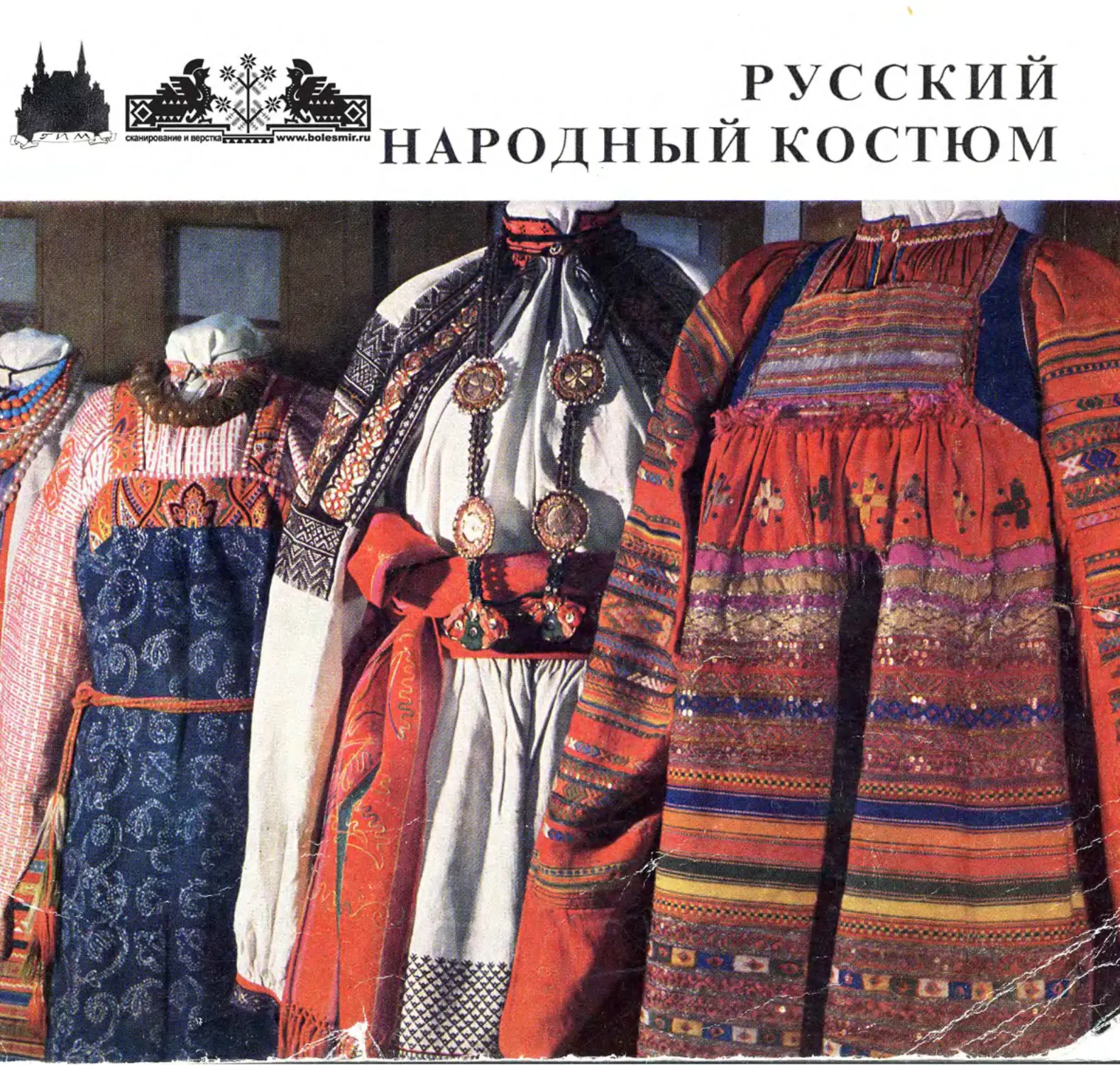
                    РУССКИЙ
сканирование и верстка дд дд Гл www.bolesmi г. г и НАРОДНЫЙ костюм

Сокровища Государственного ордена Ленина Исторического музея
Treasures of the Order of Lenin State History Museum
РУССКИЙ НАРОДНЫЙ костюм
RUSSIAN FOLK COSTUME
Около 4 миллионов экспонатов хранит Госу-
дарственный ордена Ленина Исторический музей
и 300 тысяч из них находятся в отделе тканей.
В этом отделе собраны разнообразные текс-
тильные материалы. Помимо тканей, здесь
хранятся: одежда, военные регалии, знамена -
свидетели боевой и трудовой славы народов
СССР, произведения прикладного искусства
XV-XX вв.
Русская народная одежда - одна из интерес-
нейших коллекций отдела. Разнообразные виды
одежды русского крестьянства представлены
как отдельными предметами, так и полными
костюмами. Здесь собрана праздничная и буд-
ничная одежда, одежда зажиточных и бедных
крестьян различных губерний России XVIII -
начала XX вв.
Коллекция складывалась постепенно на про-
тяжении десятилетий. Первоначально - это был
ряд отдельных наиболее ярких деталей жен-
ского праздничного наряда: головные уборы,
украшения, парчовые сарафаны - веши из част-
ных собраний любителей старины. Они пред-
ставляли определенную художественную цен-
ность, но не имели атрибуций - сведений о месте
и времени бытования, производстве, социальной
принадлежности их владельцев, поэтому они не
.могли быть полностью использованы при изу-
чении был и материальной культуры русской
деревни. В советское время музей начинает ре-
гулярные сборы на местах. С конца 20-х годов
организуются экспедиции на Север, в Поволжье,
в южные черноземные области. Экспедиции
привозят сотни интереснейших материалов по
истории русской деревни, народному искусству
и одежде. Коллекция музея дает возможность
познакомиться с основными формами тради-
ционной народной русской одежды.
В начале XVIII века в русском национальном
костюме происходят резкие изменения. В 1700 г.
Петр I, стремившийся к строгой всесторонней
регламентации русского быта, издает указ об
обязательном ношении всеми костюма запад-
ноевропейского образца. Исключение по указу
составляли духовные лица и крестьянство. С
тех пор правила европейской моды, учрежден-
ные в Париже, становятся обязательными и для
России. Крестьянская одежда, сохраняя само-
бытные черты, выступает с этого времени в ка-
честве важнейшего источника по изучению рус-
ского национального костюма.
При общем сходстве покроя одежды и при-
емов ее украшения народная одежда не едина
для всего русского крестьянства. Население се-
верных районов России носило одежду, сущест-
венно отличную от крестьян южных районов. В
Центральной России носили костюм близкий
по характеру к северному, однако, в некоторых
отдельных местностях можно было увидеть ко-
стюм с чертами южнорусской одежды.
В Историческом музее представлены все
виды одежды, отражающие это многообразие,
но наиболее интересна женская одежда, которая
дает более четкое представление о характерных
особенностях одежды Русского Севера и Юга.
Крестьянки Русского Севера - Архангелы
ской, Вологодской, Новгородской, Тверской
губерний носили в XIX в. костюм, в основном,
состоящий из рубахи, сарафана, пояса, перед-
ника. В отделе хранятся северные рубахи, сши-
тые из холста и щедро украшенные вышивкой
цветными льняными нитями, шелком, золотой
нитью, галуном и блестками. Узор вышивок
разнообразен. Орнаментальные полосы обрам-
ляют ворот и край рукава, сам рукав украшен
мягким рисунком, составленным из розеток,
меандра, косых крестов или стилизованных фи-
гурок птиц. Особенно интересна вышивка подо-
ла: многофигурные композиции включают изо-
бражения птиц, коней, фантастического дерева
и торжественные женские фигуры с воздетыми
вверх руками, неизменно сопровождаемые всад-
никами. Сюжеты этих вышивок относятся к
глубокой древности. Ученые усматривают в них
отражение языческих представлений славян о си-
лах природы, о весеннем оплодотворении земли
солнцем - представлений, которые были тесно
связаны с трудовой деятельностью славян-паха-
рей. Рубахи северного типа шили не только из
гладких льняных тканей, но и из узорного хол-
ста, шелковых и тончайших кисейных тканей.
С берегов Пинеги (Архангельская область) при-
везена в отдел рубаха - „воротушка“, сшитая
из браного холста, затканного красной нитью
по утку; ее так и называли „уточница“. Из шел-
ковых узорных тканей и кисеи сшиты старинные
рубахи XVIII в. с „долгими*4 рукавами. Длин-
ные рукава, значительно превышающие длину
руки, - дань традиции, ведущей свое начало от
древнерусской одежды. Посетители музея мо-
гут познакомиться в залах XVIII века с праз-
дничной одеждой богатой крестьянки. Одежда
состоит из кисейной, вышитой „белым тамбу-
ром44 рубахи с „долгими44 рукавами и шелко-
вого сарафана.
Рубаха носилась с сарафаном. Только в осо-
бых случаях „на покос44 или „первый выгон
скота44, когда собиралась вся деревня, девушки
и „молодицы44 могли выходить в одних подпо-
ясанных рубахах - „покосницах44 с расшитыми
подолами.
Основу комплекса севернорусской одежды
составляют сарафаны. Коллекция сарафанов в
отделе очень обширна. Из разных мест сюда
попали сарафаны XVIII - начала XX вв. различ-
ные по покрою и тканям.
Самые нарядные сарафаны XVIII в. сшиты
из шелковых тканей работы русских фабрик. По
покрою они относятся к косоклинным распаш-
ным сарафанам, которые носили на Севере и в
Центральной полосе. Узоры на тканях нередко
дополнялись золотыми пуговицами и широким
галуном. Такие сарафаны надевали по праздни-
кам зажиточные крестьянки и горожанки, их
берегли и передавали по наследству.
Крестьянки среднего достатка шили празд-
ничные сарафаны из гладкокрашенных домо-
тканных материй. В отделе хранится красный
холщовый сарафан с боковыми клиньями конца
XVIII - начала XIX вв. Он тщательно сшит, це-
ликом положен на жесткую подкладку, чтобы
лучше держалась форма края, украшен узорной
полосой, плетеным шнуром и пуговицами. В те
времена в одежде предпочтение отдавали крас-
ному цвету. С красным связывалось в народе
представление о добром и красивом.
Группа сарафанов второй половины XIX в.
сшита из кубовой набойки: на синем фоне тон-
кими линиями проступает узор в виде неслож-
ных геометрических фигур, растительных побе-
гов, птиц. По желанию заказчика такой узор
дополняли, „оживляли": с помощью трафарета
на готовую набойку масляными красками нано-
сили оранжевые горошины - „рябинки". Ткань
сразу же преображалась, становилась нарядной,
праздничной.
Из кубовой набойки шили сарафаны косо-
клинные и „круглые" - из шести прямых полот-
нищ на лямках, более позднего типа. Их назы-
вали в Архангельской и Вологодской губерниях
„набивниками“,авТверской„наколоточными“-
по способу выполнения узоров на ткани. На
Севере набивные сарафаны сменяются пестря-
динными клетчатыми сарафанами прямого по-
кроя. Домашняя пестрядь - бумажная клетча-
тая или льняная ткань из разноцветных нитей,
широко применяется для изготовления одежды
в конце XIX в. на Северной Двине, из нее шьют
и рубахи. В отделе тканей хранятся также раз-
личные сарафаны Центральной полосы, сшитые
из гладких шелковых, шерстяных и ситцевых
тканей фабричного производства. Сарафаны по
русскому обычаю полагалось подпоясывать. На
Севепе подпоясывались узенькими плетеными
и ткаными поясами. Праздничные сарафаны в
бывшей Тверской губернии подпоясывали зо-
лотым галуном. Пояса завязывали сбоку, а
концы с бахромой, украшенной порой стеклян-
ными бусами, спускались чуть не до подола са-
рафана.
Рубаха и подпоясанный сарафан - основной
наряд крестьянок Русского Севера. В ряде мест-
ностей он дополнялся длинным передником,
который высоко подвязывали на груди. Закры-
вая целиком сарафан спереди, он становился
наиболее заметной деталью костюма, поэтому
крестьянки искусно его украшали. Вологодский
холщевый передник с вышивкой красным льном
привлекает внимание построением узора: плос-
кость расчленена на квадраты, в каждом круп-
ная розетка, в кайме - традиционные женские
фигуры - „куколки" и степенно идущие барсы.
Сила цвета за счет плотности узора нарастает
постепенно: мягкий, легкий верх и тяжелая
кайма книзу.
У богатых крестьянок в праздничный наряд
вместе с парчовым или шелковым сарафаном
входили еще и „епанечки", „коротеньки". Так
по-разному называли сходную по покрою ко-
роткую на лямках одежду, близкую по покрою
к косоклинному сарафану. В развернутом виде
она имеет форму круга. Бархатные епанечки,
густо зашитые золотной нитью и блестками,
собранные на спине в трубчатые складки, от-
носятся к началу XIX века. Другие епанечки,
сшитые из шелковой ткани с цветами и укра-
шенные галуном, относятся к концу XVII в.
Старинный костюм с „коротенькой" сохра-
4
нился в Архангельском крае, на Мезени. Худо-
жественные коллективы этой местности, высту-
пая в наши дни со старинными песнями и хоро-
водами, не обходятся без традиционного наря-
да, сшитого порой из тканей XIX в. В отделе
хранятся душегреи, стеганные на вате. Это
верхняя короткая одежда с длинными рукавами
и воротником. Перехват в талии сзади и труб-
чатые складки очень характерны для душегрей.
Их шили из красного штофа и бархата, что от-
мечается в народных песнях. Их носили зажи-
точные крестьянки и горожанки в XVIII-XIXbb.
Одежда крестьянок Юга представлена кос-
тюмами бывших Тульской, Калужской, Тамбов-
ской, Рязанской, Пензенской, Воронежской гу-
берний.
В каждой губернии и даже уезде носили
свою, отличную от других, одежду, но общим
для всех в традиционном наряде был покрой
рубахи с так называемыми „косыми поликами“
(трапециевидными вставками на плечах), по-
нева, своеобразный глухой передник и наверш-
ник. Рубаху шили из льняного и конопляного
холста, в своем орнаментальном решении она
отличалась от северной. Тканые и вышитые гре-
бенчатые ромбы, шашки, косые кресты компо-
новались поперечными полосами. Вместе с по-
лосками кумачовой ткани, лент и галуна, они
часто сплошь покрывали рукав и плечо рубахи.
Ведущий цвет узора - красный.
Характерной одеждой для юга была понева -
набедренная одежда, сшитая из трех прямых
продольных полотнищ шерстяной домоткани-
ны. Это одна из древнейших одежд восточ-
ных славян; термин „понева“ встречается на
страницах русских летописей, изображение ее
угадывается в одежде женщины, помешенной
на створчатом серебряном браслете XII в., най-
денном археологами в Старой Рязани.
Поневу надевали поверх рубахи и укрепляли
на поясе плетеным шнурком. Шили поневы
преимущественно из клетчатых тканей синего
или черного тона. Они были распашными и глу-
хими. Распашная не сшивалась, и разрез ее при-
ходился посредине или на боку. Края такой по-
невы подтыкали за пояс, в этом случае углы
с изнанки украшались вышивкой шерстью, га-
луном, мишурным кружевом. Из орловской об-
ласти привезены в отдел нарядно украшенные
клетчатые распашные поневы. Необыкновенно
богата, расшита вышивкой и блестками брян-
ская понева начала XIX в. „Глухая“ понева -
это юбка с прошивой в ширину полотнища из
однотонной ткани черного или синего цвета.
Поневы такого типа широко представлены в со-
брании. Крестьянка в своем наряде имела не-
сколько понев, которые она носила по строго
определенным случаям. В дни больших празд-
ников - яркую, со множеством полос узорочья,
в будни - скромно украшенную полосками крас-
ного кумача. В XIX в. поневу носили только
в деревне, в городе она распространения не
имела.
Поверх рубахи и поневы надевали свое-
образный передник прямого покрся. иногда
с рукавами. Как и рукава рубахи, передник
5
щедро украшали, его узор отличался много-
красочностью.
Праздничный наряд был бы неполным без
навершника, старинной туникообразной одеж-
ды, надеваемой поверх рубахи с поневой и пе-
редником. В таком наряде фигура крестьянки
сразу же приобретала торжественность и мо-
нументальность. Подобный костюм привезли
сотрудники музея из Земетчинского района
Пензенской области. Местное своеобразие от-
ражает праздничный костюм воронежской
крестьянки, состоящий из рубахи, поневы, ко-
роткого фартука и широкого тканого пояса.
В декоре здесь господствует не красный, а чер-
ный цвет, что подчеркивает графичность ри-
сунка вышивки рубахи и фартука.
Народные головные уборы - интересней-
шая часть собрания. Многие из них представля-
ют высокохудожественные произведения и да-
тируются XVIII веком. Есть среди них уникаль-
ные: повойник XVII в., украшенный жемчуж-
ным и золотным шитьем.
Разнообразны формы и украшения голов-
ных уборов; в каждой местности их шили по-
своему, но везде различали девичий и женский.
Это определялось древним обычаем. Общим
для всех восточнославянских народов был
обычай, по которому замужняя женщина долж-
на была прятать свои волосы от постороннего
глаза, нельзя было непокрытой выходить из
дома, заниматься домашними делами. Девуш-
ки заплетали волосы в одну косу и могли не по-
крывать их. Отсюда обусловленность формы
головного убора: для замужней женщины - тип
закрытой шапочки, для девушки - легкая повяз-
ка, обруч, оставляющий верх головы откры-
тым. Смена прически и головного убора в рус-
ской свадьбе всегда сопровождалась особыми
обрядами и причитаниями.
В качестве женского головного убора был
широко распространен кокошник. В северных
районах он представлял собой своеобразную
шапочку, расшитую речным жемчугом и золот-
ными нитями, с поднизью в виде густой сетки,
жемчужной или перламутровой, низко спускав-
шейся на лоб. Кокошники центральных райо-
нов были высокими, владимирские и нижегород-
ские - округлые в виде полумесяца, костром-
ские - островерхие. Они также украшались
жемчугом, камнями-самоцветами, зеркальными
стеклами, разноцветной фольгой, тыльная сто-
рона делалась из шелковой ткани или богато
расшивалась по бархату золотом. Жемчужные
кокошники носили преимушественно в городе
богатые мещанки и купчихи, в деревне же они
бытовали как праздничные или свадебные. На
юге также носили кокошники, воронежские и
курские были из золотного галуна и украшались
цветными полосами, но более характерным для
юга был сложный головной убор (до 12 дета-
лей). Поражают причудливой формой рязан-
ские и тамбовские „сороки“ с рогами и длин-
ными „хвостами11 из кумачовых лент.
Девичьи головные уборы также разнообраз-
ны по формам: северные - в виде зубчатых вен-
цов, широких твердых обручей, высоких повя-
6
зок. Сзади они скреплялись двумя широкими
полосами узорной шелковой ткани, или пере-
вязывались широкой лентой, украшенной по
краю золотным кружевом, мишурным галу-
ном. Как и кокошники, они украшались жем-
чугом, перламутровыми плашками, золотной
нитью, фольгой. Южные девичьи головные
уборы чаще всего представляли собой узкий
венец, обтянутый шелковой тканью с украше-
ниями из бисера, стекляруса и бус. Иногда де-
вичий головной убор дополнялся разноцвет-
ными перьями или „пушками" - шариками из
гусиного пуха.
В собрании музея есть девичьи головные
уборы редких форм, например, головной убор
XVIII в., с „подбородным ремнем" в виде по-
лоски шелковой ткани, с нашитыми узорными
металлическими бляшками.
Узорная полоса „ремня" обрамляет лицо и
свободно опускается под подбородком, таким
образом, она служит одновременно как бы ви-
сочным и нагрудным украшением. К празднич-
ным головным уборам относятся тяжелые шел-
ковые платки и косынки, расшитые золотной
нитью. Производством их славился нижегород-
ский край. В Каргополье златошвеи вышивали
платки по белой тонкой кисее. Праздничные го-
ловные уборы высоко ценились, и как и шелко-
вые сарафаны, входили в состав приданого.
В коллекции хранятся ожерелья, цепочки и
другие нагрудные украшения из жемчуга, пер-
ламутровых плашек, бисера, янтаря. Интерес-
ным источником по изучению крестьянского
костюма являются куклы XIX в., наряженные
в островерхие кокошники, в сарафаны с руба-
хами.
В создании женской народной одежды осо-
бенно проявился многосторонний талант рус-
ской женщины, ее творческие способности, ма-
стерство, природный вкус.
Мужская одежда, по сравнению с женской -
единообразная. Рубаху-косоворотку и порты
носили повсеместно. Рубаху шили из домотка-
нины и покупных тканей: хлопчатобумажных,
шелковых, шерстяных. Примечательно, что
туникообразный покрой домотканых рубах в де-
талях совпадает с покроем древнерусской муж-
ской рубахи. Это можно проследить непосред-
ственно на материалах коллекции: здесь хра-
нятся различные мужские рубахи, в том числе
три рубахи XVII в. Одна из них, сшитая из тон-
чайшей белой ткани, украшена по вороту зо-
лотым шитьем. Праздничную мужскую рубаху
(2-я пол. XIX в.) чаще всего шили из фабрич-
ных тканей. Нарядна рубаха-косоворотка мали-
нового кашемира с вышивкой черными нитями.
Рубахи носили навыпуск поверх штанов и под-
поясывали различными узкими и широкими по-
ясами.
Штаны (порты) обычно неширокие, шились
в деревне из холста, пестряди и набойки. Под
влиянием городской моды в конце XIX в. шта-
ны стали носить из фабричной плотной ткани.
В отделе хранится также верхняя мужская и
женская одежда: кафтаны, зипуны, свиты, шубы,
тулупы и обувь - полусапожки, лапти, сапоги.
7
В традиционном народном костюме сохра-
нились древнерусские черты одежды, что про-
является в прямых линиях кроя, длинных рука-
вах, в способе ношения нескольких одежд одно-
временно, в ряде нагрудных украшений. Отзву-
ки Древней Руси слышатся и в названиях празд-
ничных одежд: „ферязь“, „платно11 и др. Одна-
ко, с течением времени народная одежда пре-
терпевает некоторые изменения.
Развитие капиталистических отношений и
городская мода оказывают сильное воздейст-
вие на весь крестьянский быт. Это находит от-
ражение в изготовлении тканей и одежды: хлоп-
чатобумажная пряжа соперничает с льняной и
конопляной, домашний холст меняют на яркие
фабричные ситцы и другие ткани. Под влияни-
ем городской моды 80-90-х годов в деревне
в конце XIX в. возникает и широко распро-
страняется костюм „парочка“ в виде юбки и
кофты, сшитых из одной ткани. Претерпевает
изменения и рубаха - появляется новый тип ру-
бахи на кокетке, верх рубах старого покроя
шьют теперь из коленкора или кумача. Тради-
ционные головные уборы постепенно вытесня-
ются хлопчатобумажными и шерстяными на-
бивными платками. Крестьянки охотно поку-
пают кумачовые платки с красочными цветоч-
ными узорами.
Мужской костюм подвергается еще боль-
шему изменению. Крестьяне носят пиджак и
картуз.
В отделе широко представлены материалы,
отражающие изменения в одежде в конце XIX -
начале XX вв. Разнообразные „парочки11 или
„казачки11, сшитые из ярких шелковых тканей,
привезенные экспедициями из разных областей,
красочные рубахи-покосницы Каргополья - с
кумачевым верхом и станом из хлопчатобумаж-
ной пестряди, затканной разноцветными шерстя-
ми, набивные кумачевые платки, украшенные
самими крестьянками бахромой из цветной
шерсти, кисточками по углам.
Изменения в одежде конца XIX - начала
XX вв. более всего характерны для Централь-
ной промышленной полосы. На юге, где крестья-
не черноземной полосы занимались земледели-
ем, уклад крестьянской жизни был более зам-
кнутым и влияние города менее сильным, тради-
ционные формы одежды сохранились вплоть
до Великой Октябрьской Социалистической ре-
волюции.
НАРОДНАЯ ОДЕЖДА - БОГАТОЕ НА-
СЛЕДИЕ. Она является неиссякаемым источни-
ком разносторонних исследований в области
этнографии, истории, искусствоведения. Ху-
дожники-модельеры открывают в ней интерес-
ные линии и формы и применяют их в решении
современного костюма. Народная одежда ши-
роко представлена в экспозиции музея, где
с ней знакомятся миллионы посетителей.
Автор Л. В. Ефимова
8
1
1. Рубаха мальчика. XVII век
1.	A boy’s shirt. 17th century
2.	Образцы русских тканей
2.	Some specimens of Russian fabrics


9
10
3.	Костюм крестьянки Вологодской области. XIX век
3. А 19th-century peasant woman’s costume from Vologda
region
4.	Передник, украшенный вышивкой льняными нитями.
XIX век. Вологодская область
4.	An apron decorated with embroidered patterns of flaxen
threads. Vologda region. 19th century
5
6
5.	Сарафан из домотканной шерсти, украшенный лентами
и вышивкой. XIX век. Курская область
5.	A home-spun woollen “sarafan” ornamented with ribbons
and embroidery. Kursk region. 19th century
6.	Пояса. XIX век. Русский Север
6.	Belts. Northern Russia. 19th century
11
7.	Женская одежда „епанечка", украшенная вышивками
золотными нитями. Конец XVIII века
7.	Women’s garment “epanechka” ornamented with gold-
embroidered patterns. Late 18th century
12
8.	Душегрея (вид сзади). Украшена вышивкой золот-
ными нитями. Конец XVIII - нач. XIX века
8.	Padded jacket (rear view) ornamented with gold embroi-
dery. Late 18th - early 19th centuries
13
14
9.	Костюм крестьянки Рязанской губернии. XIX век
9.	A peasant woman’s costume from Ryazan province. 19th
century
10.	Вышивка на рукаве женской рубахи. Конец XIX века.
Воронежская губерния. Белгородская область
10.	Embroidered pattern on a woman’s shirt sleeve. Voronezh
province. Belgorod region. Late 19th century
11.	Деталь рубахи с „косым“ поликом. Середина XIX
века. Рязанская губерния
11.	A detail of a shirt with an oblique-gore. Ryazan province.
Mid-19th century
15
12.	Распашная понева с „подтыком“. Конец XIX - нач.
XX века. Орловская область
12.	Opening “poneva” with tucked-in hem. Orel region. Late
19th - early 20th centuries
16
13.	Понева, украшенная сзади вышив-
кой петлями. Конец XIX - нач. XX
века. Воронежская губерния
13.	“Poneva” with a loop-embroidered
pattern on the back. Voronezh prov-
ince. Late 19th - early 20th centuries
13
17
14.	Деталь вышивки
14.	A detail of an embroidered pattern
15.	Навершник. Конец XIX - нам. XX века. Рязанская
область
15.	“Navershnik” (upper garment). Ryazan region. Late
19th - early 20th centuries
16.	Запон - род передника. 2ая половина XIX века. Пен-
зенская область
16.	“Zapon”, a kind of an apron. Penza region. Second half
of 19th century
18
19
20
17.	Девичий головной убор „коруна“. Конец XVIII века
17.	“Koruna” maiden head-dress. Late 18th century
18.	Тыльная часть женского головного убора, шитого зо-
л отними нитями. XVIII век. Горьковская область
18.	The rear part of a woman’s gold-embroidered head-dress.
Gorky region. 18th century
19.	Женский головной убор „кокошник“. Конец XVIII -
нач. XIX века. Центральная Россия
19.	Women’s “kokoshnik” head-dress. Central Russia. Late
18th - early 19th centuries
20.	Тыльная часть женского головного убора, расшитого
золотными нитями. Конец XVIII века. Центральная
Россия
20.	The rear part of a woman’s gold-embroidered head-dress.
Central Russia. Late 18th century
21
22
21.	Женский головной убор „кокошник”. XIX век.
Курская область
21.	Women’s head-dress “kokoshnik”. Kursk region.
19th century
22.	Верхняя часть рубахи из ситца. Конец
XIX века. Воронежская область
22.	The upper part of a cotton-print shirt.
Voronezh region. Late 19th century
23
23.	Ситцевый платок. Вторая половина XIX века
23.	A cotton-print kerchief. Second half of 19th centurj
24
About 4 million exhibits are displayed in the
Order of Lenin State History Museum, 300,000 of
them in the Department of Fabrics. A variety of
textiles are shown here. In addition to fabrics, the
collection contains articles of clothing, military
regalia, banners - witnesses of military and labour
exploits of the peoples of the USSR, works of ap-
plied art of the 15th—20th centuries.
The Russian folk costume is the subject of one of
the most fascinating collections in the department.
The varied types of Russian peasant clothes are
represented here both by individual articles and by
full ensembles. There are clothes for holiday and
everyday wear, garments of well-to-do and poor
peasants of various provinces of Russia of the 18th -
early 20th centuries.
The collection was built up gradually, for de-
cades. Originally, it consisted of a number of indi-
vidual, most vivid details of women’s holiday wear:
head-dress, adornments, brocade “sarafans” (light
frocks) - garments from private collections of
lovers of antiquity. They were of definite artistic
value but lacked such attributes as information
about their locality and period, production, the
social status of their owners; therefore, they could
not be used in full for the study of the customs and
materials, culture of the Russian villagers. In the
Soviet period, the museum undertook regular ex-
peditions to the provinces to collect articles of wear
on the spot. Since the late twenties, expeditions have
been made to the North, the Volga basin, the south-
ern black-earth regions. They made hundreds of
fascinating findings on the history of the Russian
village, folk art and wearing apparel. The museum
collection gives the viewer an idea of the basic forms
of the traditional Russian folk costume.
In the early 18th century, great changes were
made in the Russian national costume. In 1700,
Peter the Great, who introduced strict regimenta-
tion into Russia’s everyday life, issued a decree on
the compulsory wear of the West European costume
by all except the peasants and the clergy. Since then
the rules of European fashion established in Paris
became obligatory for Russia, too. Since that time,
the peasant dress, which retained its original fea-
tures, has been the major object of study for those
interested in the Russian national costume.
Despite the general similarity between clothes
styles and ornamentation, the folk costume was
not the same for all Russian peasants. The popul-
ation of Russia’s northern regions wore clothes
differing substantially from those of peasants in the
southern regions. In central Russia the costume
largely resembled the northern dress, but in certain
localities costumes with features of the southern
Russian dress were not uncommon.
The History Museum contains all types of
wearing apparel illustrating this diversity, but the
greatest interest is deserved by women's clothes,
which give one a clearer idea of the characteristic
style of clothes worn in northern and southern
Russia.
In the 19th century, peasants of northern Rus-
sia - Archangel, Vologda, Novgorod, Tver pro-
vinces - wore a costume consisting in the main of a
shirt, a “sarafan”, a belt and an apron. The col-
lection contains northern linen shirts generously em-
broidered with varicoloured flaxen threads, silk,
golden threads, lace and spangles. The patterns of
embroidery are quite varied. The collar and sleeve
edge are fringed with ornamental bands, the sleeve
itself is decorated with a gentle pattern composed
25
of rosettes, meander, oblique crosses, or stylized
bird figures. Particularly interesting is the embroi-
dery of the skirt: multi-figured compositions in-
corporate images of birds, horses, fantastic trees and
solemn figures of women with upraised arms, in-
variably accompanied by horsemen. The subjects
of these embroidered patterns date from deep anti-
quity. Scientists believe that they reflected the
Slavs’ pagan ideas of the forces of nature, the spring
fertilization of land by the Sun - ideas that were
closely connected with the life of Slav ploughmen.
Northern-style shirts were made not only of plain
linen but also of patterned cloth, silken and very
thin muslin fabrics. A “vorotushka” shirt of select
cloth linen with red threads in weft, for which it was
called “weft shirt”, has been brought here from the
Pinega river basin (Archangel region). Ancient 18th-
century long-sleeved shirts are made of patterned
silken fabrics and muslin. The sleeves much longer
than an arm’s length were a tribute to tradition,
which took its origin from ancient Russian garments.
Visitors to the museum can see the holiday clothes
of a rich peasant woman in the 18th-century halls.
They consist of a muslin shirt embroidered in chain-
stitch with long sleeves and a silken “sarafan”.
A shirt was worn with a “sarafan”. Only on
special occasions - “hay-moving” or “first livestock
pasturing” in which all the villagers took part, girls
and newly-married young women were allowed to
go out dressed only in a belted shirt “pokosnitsa”
with an ornamented skirt.
The northern Russian women’s clothes are
based on the “sarafan”. The collection of “sarafans”
is quite extensive. “Sarafans” dating back to the
18th - early 20th centuries, varying in cut and fabrics
have been brought here from different localities.
The most festive “sarafans” of the 18th century
are made of silken fabrics manufactured by Russian
factories. They belong in style to oblique-gore
“sarafans” opening at the front, which were worn
in the North and in Central Russia. Patterns on
fabric were often supplemented with golden buttons
and a broad galloon. Such “sarafans” were worn
with care on holidays by well-to-do peasant women
and townsfolk and were handed down.
Peasant women of average income households
sewed holiday “sarafans” of plain-dyed home-spun
cloth. The department contains a red linen “sarafan”
with side gores dating back to the late 18th - early
19th centuries. It is carefully sewed, wholly placed
on a rigid lining to keep the edge in shape, decor-
ated with a patterned band, braided cord and but-
tons. In those times, red was preferred in clothes
because this colour was associated with good and
beauty among the people.
A group of “sarafans” of the second half of the
19th century are made of indigo printed cloth; with
a pattern of simple geometrical figures, plant shoots
and birds depicted in delicate lines on a dark-blue
background. At the client’s request, such a pattern
could be “enlivened” by means of stencil applied
to ready printed cloth to paint on it orange “peas”,
which lent the fabric a gay, festive look.
Indigo printed cloth was used for oblique-gore
and “round” “sarafans” of a later type made of
six straight widths of cloth suspended on straps. In
Archangel and Vologda provinces they were known
as “nabivnik” (printed); in Tver province, as “Na-
kolotochniye” (strike-patterned), according to the
method of applying patterns to the fabric. In the
North, straight-cut “sarafans” of chequered motley
cloth were worn rather than those of printed cloth.
26
Home-spun chequered or plain linen of varicolou-
red threads was widely used for making clothes in
the Northern Dvina river basin in the late 19th
century, and also for shirts. The fabrics department
also features various “sarafans” of Central Russia
made of plain silken, woollen and cottonprint
factory-produced fabrics. According to a Russian
custom, “sarafans” were belted at the waist. In the
North narrow braided and woven belts were used
for this purpose. In the former Tver province
“sarafans” for holiday were belted with a golden
lace. The belts were tied at the side, and the fringed
belt ends sometimes decorated with glass beads
reached down almost to the hem of the “sarafan”.
A shirt and a belted “sarafan” are the main garb
of peasant women of northern Russia. In several
localities they were supplemented with a long apron,
girlded below the breast. Covering the whole of the
“sarafan” in the front, it was the most conspicuous
part of the costume; therefore, peasant women
ornamented it thoroughly. The Vologda linen apron
with red flaxen embroidery is remarkable for its
original pattern divided into squares with a large
rosette within each of them and with traditional
female figures - “dolls” and leisurely stepping snow
leopards on the border. The colour intensity is
gradually increased by the growing density of the
pattern: the upper part is mild and light, the edging
below is heavy.
The holiday dress of rich peasant women, in
addition to a brocade or silken “sarafan”, included
a “epanechka” or “korotenka”. These were the
names of short clothes similar in style and worn on
straps and resembling an oblique-gore “sarafan”.
When unfolded, this dress has the form of a circle.
Brocade “epanechkas” thickly stitched with golden
threads and spangles, gathered on the back into
tubular folds, date back to the early 19th century.
Other “epanechkas” made of silken flower-patter-
ned fabric and ornamented with galloons were
common in the late 17th century.
The ancient costume with “korotenka” has
survived in the Mezen district, Archangel province.
Amateur art companies of this locality performing
ancient songs and ring dances in our day wear
traditional apparel sewn sometimes of 19th-century
fabrics. The collection also contains padded jackets.
This is short upper-wear with long sleeves and a
collar. The tightened waist at the back and tubular
folds are characteristic of such jackets. They were
sewn of red damask and velvet, which is mentioned
in folk songs, and were worn by well-to-do peasants
and citizens in the 18th-19th centuries.
Garments of peasant women of the south are
represented by costumes worn in the former Tula,
Kaluga, Tambov, Ryazan. Penza and Voronezh
provinces.
Every province and even district had a distinc-
tive style in clothes, but the dress common for all in
traditional apparel was a shirt with trapeziform
inserts on the shoulders, “poneva”, an original
closed apron, and “navershnik” (upper garment).
The shirt was sewn of flaxen or hemp linen, which
differed in ornamentation from the northern types.
Woven and embroidered comblike rhombi, che-
quers, slanting crosses were combined with trans-
verse bands. Along with strips of red calico, ribbons
and galloon, they often entirely covered the sleeves
and shoulders of the shirt. The basic colour of the
pattern was red.
The typical dress of the South was “poneva” -
a thigh garment made up of the three straight length-
27
wise strips of home-spun woollen cloth. This is one
of the most ancient clothes of the eastern Slavs;
“poneva” is mentioned in Russian chronicles, and
its style can be guessed in the apparel of the woman
depicted on a 12th-century folding silver bracelet
found by archaeologists in old Ryazan.
“Poneva” was worn over the shirt and attached
about the waist with a braided cord. “Ponevas”
were sewn mostly of chequered fabrics of a dark-
blue or black colour. They either opened at the
front or at the side or were of a closed type. The
edges of “poneva” were tucked under the belt, and
in which case the corners on the inside were orna-
mented with embroidery, wool, galloon, tinsel
lacework. Festively ornamented chequered open-
ing “ponevas” have been brought to the depart-
ment from Orel region. The Bryansk “poneva” of
the early 19th century is unusually richly decorated
with embroidery and spangles. “Closed poneva” is
a skirt with a full-width insertion of unicoloured
black or dark-blue fabric. A peasant woman’s
wardrobe consisted of several “ponevas” which she
wore on strictly defined occasions. On great holi-
days she wore gay-coloured dress with multiple
ornamental bands, on weekdays, dress modestly
decorated with strips of red calico. In the 19th
century, “ponevas” were worn only by villagers,
and were uncommon in towns.
An original straight-cut apron, sometimes with
sleeves, was worn over the shirt and “poneva”. Just
as the shirt sleeves, the apron was generously decor-
ated with a many-coloured pattern.
The holiday dress would be incomplete without
“navershnik”, an ancient tunic-like garment worn
over the shirt with “poneva” and apron. In this
garb a peasant woman’s figure became solemn and
monumental. Such a costume has been brought by
museum workers from the Zemetchina district of
Penza region. Local distinctions are to be found in
the holiday dress of Voronezh peasant women,
which consists of a shirt, “poneva”, a short apron
and wide woven belt. The decor here is dominated
not by red but by black which emphasizes the
graphic design of the embroidery on the shirt and
apron.
Folk head-dress is a most fascinating part of
the collection. Many of the exhibits are highly
decorative articles dating back to the 18th century.
Some of them are truly unique, for example,
“povoinik” head-dress of the 17th century decor-
ated with pearl and golden embroidery.
The forms and ornamentation of head-dress are
varied: in every locality they were different, a
strict distinction being invariably observed bet-
ween the head-dress of maidens and married wo-
men. This was dictated by an ancient custom comm-
on for all eastern Slav peoples, according to which
a married woman had to hide her hair from stran-
gers’ eyes, was not allowed to uncover her hair in
public or when doing domestic work. Maidens
made their hair into one plait and could go out
bareheaded. Hence the form of the head-dress: for
a married woman, a kind of a closed cap; for a girl,
a light kerchief, a hoop, leaving the top of the head
open. The change of hairdo and head-dress in
Russian wedding was invariably accompanied by
special rituals and lamentations.
One of the most common types of headgear was
“kokoshnik”. In the northern regions, it was an
original cap embroidered with river pearls and
golden threads, with the underlayer of a thick pearl
or mother-of-pearl meshwork hanging low over the
28
brow. In the central regions, “kokoshniks” were
high; in the Vladimir and Nizhny Novgorod regions,
round, having the form of a crescent; in the Kostro-
ma region, they had a pointed top. They were also
ornamented with pearls, decorative stones, mirror
glass, varicoloured foil, while the rear side was ma-
de of silken fabric or richly embroidered with gold
on a velvet background. Pearl “kokoshniks” were
worn mainly in towns by rich middle-class women
and merchants’ wives, whereas in villages they were
worn on holidays and at wedding parties. In the
South “kokoshniks” were also in vogue; those in
Voronezh and Kursk provinces were made of gol-
den galloon and decorated with coloured bands,
but an intricate head-dress of up to 12 details was
more characteristic of the South. One is surprised
by the fantastic form of Ryazan’s and Tambov’s
“soroka” (magpie) with horns and long “tails” of
red calico.
Maiden’s head-dress is also varied in form:
northern specimens are made as toothed crowns,
wide firm hoops, high bandages. At the nape, they
were kept together by two wide strips of patterned
silken fabric, or tied with a broad fillet edged with
a golden lace, tinsel galloon. Just as “kokoshniks”,
they were decorated with pearls, mother-of-pearl
plaques, golden threads, foil. Southern maiden
head-dress usually was a narrow crown covered
with silken fabric and decorated with beads, bugles
and pellets. A maiden head-dress was sometimes
supplemented with many-coloured feathers or balls
of goose down.
The museum collection contains samples of
maiden head-dress of rare forms, for example, an
18th-century head-dress with a “chin strap” of
silken fabric with sewn-on figured metal plates.
The patterned strap frames the face and loosely
hangs under the chin, serving a decoration for the
temples and the chest simultaneously. Holiday head-
dress also includes heavy silken shawls and kerch-
iefs embroidered with golden threads. The Nizh-
ny Novgorod province was famous for them. Holi-
day head-dress was highly valued and, along with
silken “sarafans”, made a part of the dowry.
The collection contains necklaces, chains and
other chest adornments of pearls, mother-of-pearl
plaques, beads, amber. An interesting object of
study for those interested in the peasant costume is
19th-century dolls dressed in peaked “kokoshniks”
and “sarafans” with shirts.
The designs of women’s folk costume bear
witness to the many-sided talents of Russian wo-
men, their imagination, skill and inborn taste.
Men’s clothes are more uniform as compared
with women’s. Russian shirts with a side fastening
(“kosovorotka”) and trousers were in common use.
The shirts were sewn of home-spun and factory-
made fabrics: cotton, silken, woollen. It is note-
worthy that the tunic-like style of home-made cloth
shirts is similar in details to the cut of ancient Rus-
sian men’s shirts. This is evidenced by exhibits of
the collection containing various men’s shirts, in-
cluding three shirts of the 17th century. One of
them, sewn of delicate white fabric, has a gold-
embroidered collar. Men’s shirts for holiday wear
(2nd half of 19th century) were usually sewn of
factory-made fabrics. A festive impression is pro-
duced by a “kosovorotka”, shirt of crimson cash-
mere with black thread embroidery. Such shirts
were worn over the trousers and belted with various
narrow and wide girdles.
Trousers, usually narrow, were sewn of motley
29
and printed cloth in villages. Under the influence of
urban fashions, trousers of dense factory-made
fabric went into common use in the late 19th cen-
tury.
The collection also features specimens of men’s
and women’s upper wear: caftans, home-spun
coats, fur-coats, sheepskin coats, and footwear -
semi-highboots, bast shoes, highboots.
The traditional folk costume has retained its
ancient Russian features, as manifested by the
straight lines of the cut, long sleeves, the wearing
of several garments one over another, a number of
chest ornaments. An echo of ancient Russia is
heard in the very names of holiday clothes: “fery-
az”, “platno”, etc. In time, however, the folk cos-
tume tended to change.
The development of capitalism and urban fash-
ions produced a strong impact on the entire life of
the peasants. This was expressed in the methods of
manufacturing fabrics and clothes: cotton yarn
competed with flaxen and hemp yarn, home-spun
linen was replaced by bright-coloured factory-made
cotton print and other fabrics. Under the influence
of urban fashions, the “pair” costume of a skirt and
a blouse made of one and the same fabric became
common in villages in the late 19th century. The
shirt also changed in favour of a new type with a
yoke, the upper part of shirts in old style now being
made of calico or red calico. Traditional head-dress
was gradually replaced by cotton and woollen prin-
ted kerchiefs. Peasant women willingly bought red
calico kerchiefs with picturesque flower patterns.
Men’s costume underwent still greater changes.
The peasants began to wear coats and visored caps.
The collection has a wealth of exhibits illu-
strating changes in clothes in the late 19th - early
20th centuries. These are varied “pairs” or “kaza-
choks” (cossack) garments of gay-coloured silken
fabrics brought by expeditions from various re-
gions, picturesque “hay-mowers” shirtsfrom Kargo-
polye with a red calico top and bottom of motley
cotton fabric interwoven with varicoloured woollen
threads, printed red calico kerchiefs which peasant
women themselves decorated with a many-col-
oured woollen fringe, with tassels at the corners.
Changes in clothes of the late 19th - early 20th
centuries were characteristic mostly of the Central
Industrial Belt. In the South, where peasants of the
black-earth zone engaged in farming, their life was
more secluded and the influence of the town less
strong, the traditional style in dress survived until
the Great October Socialist Revolution.
THE FOLK COSTUME IS A RICH HERI-
TAGE. It is an inexhaustible source of information
for varied research into ethnography, history and
art. Fashion designers discover in it interesting lines
and forms which they use in modern costume
designs. Folk clothes are widely represented in the
museum collection and are open to view for mil-
lions of visitors.
30
1.	Chemise de gar^on. XVIIе siecle
2.	Echantillons des tissus russes
3.	Costume de paysanne de la region de Vologda. XIXе siecle
4.	Tablier orne de broderies au til de lin. XIXе siecle. Region
de Vologda
5.	Sarafane en lainage tisse sur metier a bras orne de rubans
et de broderies. XIXе siecle. Region de Koursk
6.	Ceintures du XIXе siecle. Nord de la Russie
7.	«Epanetchka», sorte de corselet sans lacet rehausse de
broderies en fils d’or. Fin du XVIIIе siecle
8.	Veste ample et courte ornee de broderies en fils d’or. Fin
du XVIIIе - debut du XIXе siecle. Vue de dos
9.	Costume de paysanne de la r6gion de Riazan. XIXе siecle
10.	Broderie sur la manche d’une blouse de femme. Fin du
XIXе siecle. Region de Voronej. District de Belgorod
11.	Detail d’une chemise avec empiecement en biais. Region
de Riazan. Milieu du XIXе siecle
12.	Jupe ouverte que 1’on pouvait retrousser. Fin du XIXе -
debut du XXе siecle. Region d’Orel
13.	Jupe ouverte ornee sur la partie posterieure de broderies
en forme de mailles. Fin du XIXе - debut du XXе siecle.
Region de Voronej
14.	Detail de broderie
15.	«Naverchnik», sorte de gilet court. Fin du XIXе - debut
du XXе siecle. Region de Riazan
16.	Sorte de tablier. Deuxieme moitie du XIXе siecle. Region
de Penza
17.	Coiffure de jeune fille genre couronne. Fin du XVIIIе
siecle
18.	Coiffure de femme ornee de fils d’or. Vue de dos. XVIIIе
siecle. Region de Gorki
19.	«Kokochnik», coiffure de femme. Fin du XVIIIе - debut
du XIX1' siecle. Russie centrale
20.	Coiffure de femme brodee de fils d’or. Vue de dos. Fin du
XVIIIе siecle. Russie centrale
21.	«Kokochnik», coiffure de femme. XIXе siecle. Region de
Koursk
22.	Partie superieure d’une chemise en indienne. Fin du XIXе
siecle. Region de Voronej
23.	Foulard d’indienne. Seconde moitie du XIXе siecle
1.	Knabenhemd. XVII. Jh.
2.	Muster der russischen Stoffe
3.	Tracht einer Bauerin aus dem Gebiet VVologda. XIX. Jh.
4.	Schiirze mit Flachsgarnstickerei. XIX. Jh., Gebiet Wo-
logda
5.	Sarafane aus hausgewebter Wolle mit Bandern und Stik-
kereien verziert. XIX. Jh., Gebiet Kursk
6.	Giirtel. XIX. Jh., NordruBland
7.	Frauentracht ,,Jepanetschka“ mit Goldstickerei. Ende
des XVIII. Jh.
8.	Seelenwarmer mit Goldstickerei verziert. Ende des XVIII. -
Anfang des XIX. Jh.
9.	Tracht einer Bauerin aus dem Gouvernement Rjasan.
XIX. Jh.
10.	Armelstickerei an einem Frauenhemd. Ende des XIX. Jh.,
Gouvernement Woronesh (Gebiet Belgorod)
11.	Detail eines Hemdes mit schraggeschnittenem Schulter-
teil, Gouvernement Rjasan. Mitte des XIX. Jh.
12.	Knopf loser Rock mit L'ntergewebe. Ende des XIX. - An-
fang des XX. Jh., Gebiet Orjol
13.	Knopf loser Rock, auf der Riickenseite mit Schleifen-
muster verziert. Ende des XIX. - Anfang des XX. Jh.,
Gouvernement Woronesh (Gebiet Belgorod)
14.	Stickerei. Detail
15.	Weste. Ende des XIX. - Anfang des XX. Jh., Gebiet
Rjasan
16.	Trachtenschiirze ,,Sapon“. Zweite Halfte des XIX. Jh.,
Gebiet Pensa
17.	Madchenkopfbedeckung „Koruna". Ende des XVIII. Jh.
18.	Riickenteii einer weiblichen Kopfbedeckung mit Gold-
stickerei. XVIII. Jh., Gebiet Gorki
19.	Frauenkopfbedeckung „Kokoschnik". Ende des XVIII. -
Anfang des XIX. Jh., ZentralruBland
20.	Riickenteii einer weiblichen Kopfbedeckung mit Gold-
stickerei. Ende des XVIII. Jh., ZentralruBland
21.	Frauenkopfbedeckung „Kokoschnik". XIX. Jh., Gebiet
Kursk
22.	Oberteil eines Kattunhemdes. Ende des XIX. Jh., Gebiet
Woronesh
23.	Kattunkopftuch. Zweite Halfte des XIX. Jh.
31
Внсшторгиздат. Заказ № 10! р
32
1.	Camisa para un nino. Siglo XVII
2.	Modelos de los tejidos rusos
3.	Traje de campesina de la region de Vologda. Siglo XIX
4.	Delantal bordado con hiio de lino. Siglo XIX, region de
Vologda
5.	Sarafan de lana de fabricacion casera adornado con lazos
у bordados. Siglo XIX, region de Kursk
6.	Cinturones. Siglo XIX, Norte Ruso
7.	«Yepaniechaka» (especie de capellina) adornada con
bordados de hilo de oro. Fines del siglo XVIII
8.	«Dushegrieya» vista por detras (especie de chaqueta fo-
rrada), con bordados de hilo de oro. Fines del siglo XVIII
у comienzos del XIX
9.	Vestimenta de campesina de la provincia de Riazan.
Siglo XIX
10.	Bordado en la manga de una camisa de mujer. Fines del
siglo XIX, provincia de Voronezh (region de Bielgorod)
11.	Detalle de una camisa. Mitad del siglo XIX, provincia de
Riazan
12.	«Ponieva», (falda de lana de fabricacion casera). Fines
del siglo XIX у comienzos del XX, region de Oriol
13.	«Ponieva» (falda de lana de fabricacion casera), adornada
por detras con bordados en forma de lazos. Fines del
siglo XIX у comienzos del XX, provincia de Voronezh
(region de Bielgorod)
14.	Detalle de un bordado
15.	«Naviershnik» (especie de chaleco). Fines del siglo XIX у
comienzos del XX, region de Riazan
16.	«Zapon» (especie de delantal). Segunda mitad del siglo .
XIX, region de Pienza
17.	«Koruna», tocato de una muchacha. Fines del siglo
XVIII.
18.	Vista por atras del tocado de mujer, bordado con hilo de
oro. Siglo XVIII, region de Gorki
19.	«Kokoshnik», tocado de mujer. Fines del siglo XVIII у
comienzos del XIX, Rusia Central
20.	Parte superior del tocado de mujer, bordado con hilo de
oro. Fines del siglo XVIII, Rusia Central
21.	«Kokoshnik», tocado de mujer. Siglo XIX, region de
Kursk
22.	Parte superior de una camisa de percal. Fines del siglo
XIX, region de Voronezh
23.	Paiiuelo de percal. Segunda mitad del siglo XIX

RUSSIAN
FOLK COSTUME