/
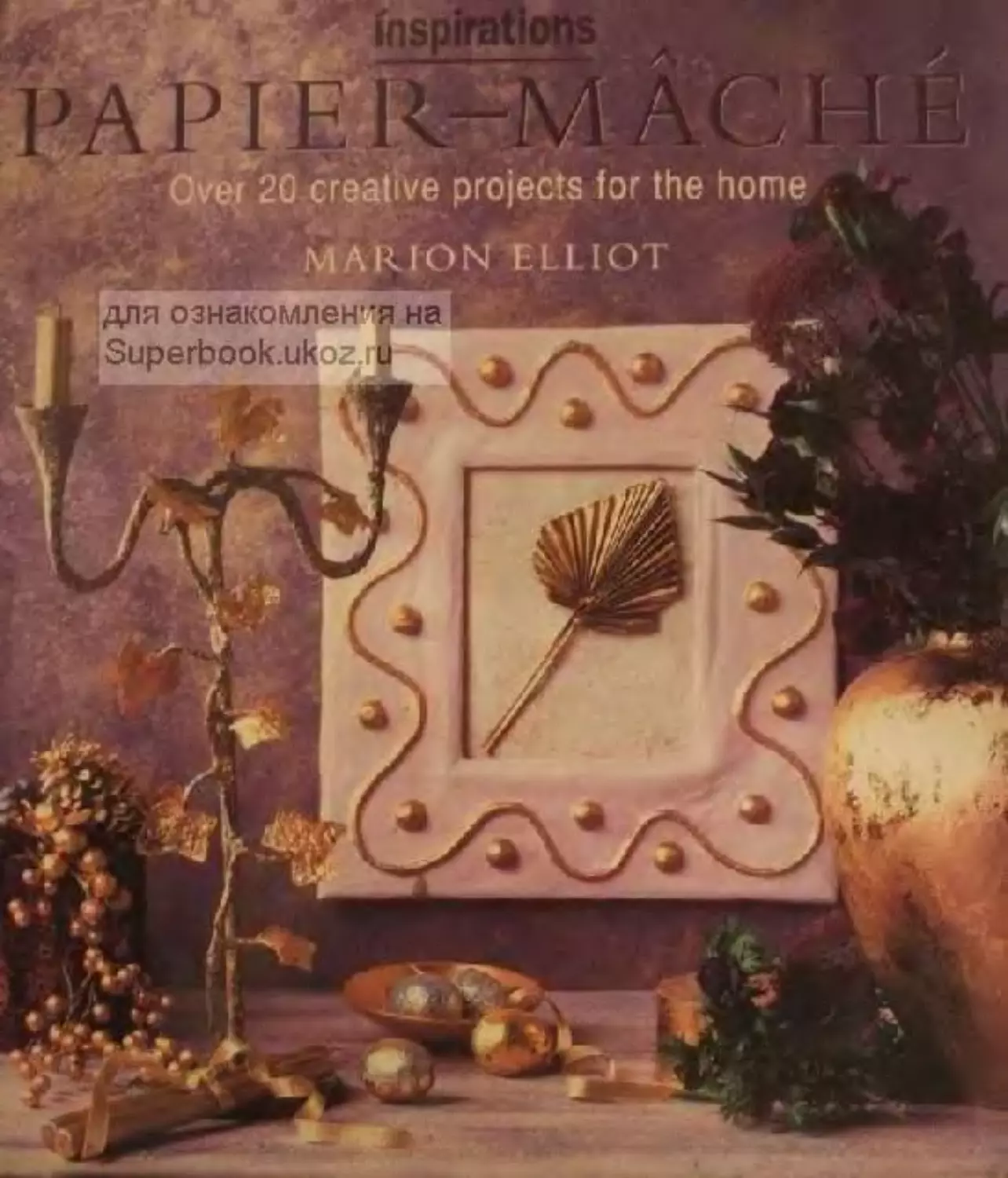


Автор: Elliot M.
Похожие
Текст
                    PA PIER
71 z '	1
/ b : J
fn	.	_
Ovef20 creative projects tor the home
MARION ELLIOT
для ознакомлен’
Superbook.ukoz-


inspirations
papier-мАснё
Over 20 creative projects for the home
MAKI ON ELLIOT
Photography by David Parmiter
LORENZ BOOKS
LONDON • NEW YORK • SYDNEY • BATH
CONTENTS
INTRODUCTION	6
Решил Waii Cloc k	к
Trinket Box	12
Ln ac Picture Frame	IS
Shimmering Mirror	17
Night and Day Mobil f	20
Fish Fridge Magnets	23
Wall Cabinet	26
Classical Greek Vase	30
Harlequin Fabric Bowi	34
Peacock Pf.nc.ii Pot	37
Decoupage Waste Bin	40
Gilded Vase	44
Daisy Napkin Kings	48
Star-studded Magazine Hack	50
Valentine Leiter Kack	54
Nauiicai Wall-store	57
Balloon Fruit Bowl	60
Gilded Star Pi ah	64
Waii Sconc e	67
Nursery Mobile	70
Decorated East i-.k Eggs	72
Gothic Candelabra	76
Lino-prin t Pi a te	80
Materials	84
Equipmen I	86
Techniques	88
Tempi ales	92
Index	96
PAPIER M А С M £
INTRODUCTION
The history of papier-mache stretches across the
centuries and continents. It is one of the simplest and
most inexpensive craft techniques, and with
imagination anything can be created, from delicate
bowls to pieces of furniture.
As a child I can remember messing around with paper
and glue. I have no memory of what 1 made but 1 bet
I ended up with a wobbly bowl created by plastering
newspaper all over a balloon, the most exciting part
being when 1 popped the balloon. Since then I have been constantly amazed by what
can be made from papier-mache. 1 love the tactile nature of bowls made from pulp:
they look so solid, and then you pick them up and they are so light. It just makes me
want to cherish them so much.
In this book we show you, with clear step-by-step photography, how to create
23 papier-mache projects, from a practical magazine rack to a stylish candelabra. I here
is a comprehensive section on all of the basic materials and equipment you will need
for the projects, plus useful techniques to cover every method, with tips on tearing
newspaper, making your own pulp, using moulds and
building your own armatures. Creating an object is
one thing but it is the surface decoration that will turn
it into a stunning piece for your home. We show you
how to paint, gild, adorn with pebbles and even
papier-mache with fabric.
I hope this book inspires you to start collecting scraps
of assorted papers and cardboard and to try out some
of the stunning projects shown here.
6

РАМЕЯ U*CHf
PEBBLE WALL CLOCK
Natural materials on a papicr-nMc base make an understated, stylish dock. A dozen
sea-smoothed pebbles mark the hours: their subtle shades and polished surfaces contrast
beautifully with the textures of grainy recycled paper and rough natural twine.
YOU WILL NEED
pencil
pair of compasses
ruler
heavy corrugated cardboard
craft knife
cutting mat
PVA gfue
newspaper
mixing bowl
paintbrush
fine sandpaper
white emulsion paint
decorative recycled paper
scissors
natural twine
clock movement and hands
strong dear glue
I2pebbtes
picture-hanging eyelet
-j Draw a circle with a diameter of 25 cm/HI in on
1 a piece of heavy corrugated cardboard. Cut it out
using a craft knife and a cutting mat. Brush the circle
with diluted PVA glue to seal it and leave it to dry.
2lcar newspaper into 2.5 cm/1 in wide strip. coat
them with diluted PVA glue and cover the card
board with five layers of papier -mache.
8
3	Leave the clock in a warm
place overnight When it is
completely dry, lightly smooth
the surface of the dock using
fine sandpaper
4	Prune both sides of the dock
with two coats of w hite
emulsion paint, allowing the paint
to dry between coats.
5	Draw a circle with a diameter
of IK cm/7 in on a sheet of
decorative recycled paper, and cut
it out Use PVA glue to fix it m
the centre of the clock face.
6	Apply a thick coat of PVA glue from the outer
edge of the clock to the edge of the paper circle.
Starting next to the paper, coil the twine around the
dock lace until the whole area is covered
7	Using a sharp pencil, nuke a hole ill the • nitre
of ths-1 lock face tor the spindle of the dot к
movement Following the nianiilai turer % instnivriom,
attach the movement and hands to the dock
9
> э с 1 >
0 I
•фор =ф )0 ф»<| лц О|
*jnp 4 г ipmit Kip A-qHnoio р ч эп(Я пр
u.iqzj\ un.nj -541 млалЬ. v. auiMi з.р in •»iini
1|ЧГЛ |Г лц <pl г I|wnr -ЗП|? wap Яилш 3tnip О
р/ (jT?
|пр Зф ю лпоц qcrj р.- uotn^xi aiji aunutui
•п»»Ч *4* *WH	«Ни*.: Ж1 ио зрпи
е >5jtui риг CI а* Ч,1К,| Д’Л’ аФ “,г,1


PAPIER UiCHf
TRINKET BOX
This useful little boxglitters and sparkles with gold decoration, and there are small chunks
oj mirror embedded tn the intricate handle on ns lid. /In armature made from cardboard
provides the basic shape.
YOU WILL NEED
pencil
metal ruler
corrugated cardboard
cralt knife
cutting mat
masking tape
PVA glue
medium and line paintbrushes
4 marbles
newspaper
mixing bowl
epoxy resin glue
small mirror
hammer
chemical metal filler
matchstick
line sandpaper
white acrylic gesso
gouache pa.nts
paint-mixing container
matt and gtoss polyurethane varnish
gold enamel paint
4 Draw and cut out the following shapes from corrugated cardboard
1 an 8 cni/37« in square for the base, four sides 6 x 8 an/3'Л x 57. in,
and a 10 cm/4 in square for the lid. Cut a strip 28 x 1.5 cm/11 x V» in
for the lip under the lid and fold it at 7 cm/2V* in intervals into a square.
To make the handle, draw a free-hand spiral shape with a I cm/'Л in
square tab for attaching the handle to the lid of the box.
2 Assemble the box and the lid using masking tape. Using a craft knife,
cut a slot in the lid of the box into which to push the tab of the
spiral shape. Seal the cardboard and tape with diluted PVA glue. Use
masking tape to cover the four marbles. but do not attach them to the
box yet.
Г П I Я К Е 1 BOX
Tear .1 sheet of newspaper into 2.5 ciri/1 in strips.
^7 then soak the strips in diluted PVA glue. Cover
the box, lid and the four marbles in several layers of
papier-mache. l eave the pieces in a warm place until
they are completely dry.
4 Using epoxy resin glue, stick the marbles on to
the box base as feet. Wrap a mirror in lots of
newspaper and smash it with a hammer. Select pieces
for the handle. Mix up the chemical metal filler,
spread it on to the handle using a matchstick and
embed the pieces of mirror. Leave to dry.
5 Lightly rub down the lid and
box with fine sandpaper. Give
them a coat of PVA glue, then
prime with a coat of white acrylic
gesso, remembering to paint over
the tiller around the mirror pieces.
6 When the base coat is dry.
decorate* the box and lid
inside and out with gouache
paints using a fine paintbrush.
Give the lid and the box sev-
/ era! coals of polyurethane
varnish, using matt and gloss for
a varied finish. Finally, add gold
details using gold enamel paint.
1 4
₽A»IER M * С И f
LILAC PICTURE FRAME
tfyou have a pretty picture languishing in a mean-looking frame, use papier-mAche to transform
it into something stylish and original. Cut the basic shape from cardboard, then cover with
layers of papier-mdche before adding the decoration.
YOU WILL NEED
heavy corrugated cardboard
pencil
meiai ruler
craft knife
cutting mat
wooden picture frame
masking tape
newspaper
wallpaper paste
mixing bowl
cotton pulp balls
marker pen
coarse string
all-purpose glue
white emulsion paint
2 paintbrushes
picture framer’s wax gilt
1 Measure and cut out a piece of heavy corrugated
cardboard 9 cm/37 in larger on all sides than the
wooden picture frame. Cut out the central aperture
using the wooden frame as a guide.
Q lay the wooden frame on top of the cardboard
one and tape it in place all round using the
masking tape.
3Fold a sheet of newspaper into a strip slightly
wider than one side of the cardboard frame. Fold
the excess under the frame and tape it m place Tape
the paper along die front of the frame Repeat on
the other sides.
1 5
I I I А С * I С T U 1 F 1ПАМ1
4	When .ill four sides of the
frame are lined with newspa-
per. tear some newspaper into
strips 7.5 cin/3 in wide and soak
them in wallpaper paste. Lay them
over both edges of rhe frame mini
the whole thing is covered in
papier-mache Leave to dry.
7 Раин the whole frame with
two coats of white emulsion,
allowing the paint to dry between
coats. When the paint is
thoroughly dry. gild the raised
design using picture framer*
wax gilt.
5	Cut the cotton pulp balls in
half using a craft knife. Using
a marker pen, draw a freehand
guide around the frame for fixing
the string and cotton pulp balls.
6	Fix the string and cotton
pulp balls in place using all-
purpose glue. Tear some news-
paper into small pieces and soak
in wallpaper paste. Paper over the
string and cotton pulp balls.
1 6
PAPIER M A С H f
SHIMMERING MIRROR
hi this variation, d small minor is given lots of impact when it is sei in <1 deep square frame
painted in glowing blue and gold. Entwine a length of siring around the outside of the
frame for added interest.
YOU WILL NEED
double corrugated cardboard
pencil
metal ruler
craft knife
cutting mat
20 cm<8 in square mirror
PVA glue
paintbrush
weights
epoxy resin glue
newspaper
wal’paper paste
mixing bowl
coarse string
white emulsion paint
acrylic paints: cobalt blue, deep turquoise
paint-mixing container
sponge
rich gold gouache
gloss spray varnish
window scraper
2 picture-hanging eyelets
picture wire
4 On double corrugated card-
1 board, draw a 4(1 cm/16 in
square for the back of the mirror,
and for the frame draw four strips
40 x 1(1 cm/16 x 4 in and four
strips 20 x 10 cm/8 x 4 in. Gut
them out using a craft knife.
3 Remove the mirror and seal
the cardboard with a coat of
diluted PVA glue. Stick die mirror
in place using epoxy resin glue,
lear newspaper into strips and
soak in wallpaper paste Cover
the front and back of the frame
with four layers of papier-mache,
making a neat edge around the
mirror. Leave to dry.
-'“4 Place the mirror centrally on
the square backing piece and
build up the frame around it in
a double layer of cardboard. Stick
the cardboard in place using PVA
glue. Place weights on top while
the glue is drying.
4Seal the frame with a coat of
diluted PVA glue Dip the
length of string in PVA glue and
coil it around the frame. Glue
a second length of string in the
recess around the mirror. Leave
to dry completely.
1 7
$ Н I v M I
Г" Cover the whole frame, including the string,
О with another layer of papier-mache, using small
strips of newspaper. Allow to dry thoroughly.
7 Paint the whole frame in cobalt blue acrylic
paint, then sponge it lightly using deep turquoise.
Leave to dry.
6 Paint the front and back of the frame with two
coats of white emulsion paint, allowing the paint
to dry between coats.
Using a sponge, highlight the string pattern with
rich gold gouache paint. Leave to dry.
Spray die whole frame with
s gloss varnish. Use as many
coats xs you like to build up a
good finish.
paint and glue off the ,nirrur
-1 1 On the back of the mirror
1 1 screw in two picture-
hanging eyelets and string them
together with picture wire.
1 8


I 3
•Iiqd ui wxnj МП MlV.M ci
«•In Л nipriii Hun i
|u u.'Sld Jt|l «In itiii luuir» <»|
•ad-.p л.р Л-.» »!I”H T
.n nt j. J iku.' i 4K»| V
-Up <»>
uth>t|< j«(i »4v мжк дл.-'г4||В*
pi p>»n. кип u.lr J.v.jii ,0
jj.q |«u.>a.v. mi K*fnp r *
И'о-рэчр*’ #4«
9*Л bljbuiJ M))C
•Ли d uni i.'ripMv! |pua
luec WfrJO p-cC
samw.rz. aeui rtt sw4
ysriqpiwj &Ц
zo>|n)jooqjedns
шешлюлвнЕО tjutf
p r. prn di  у. с Я лм| uio пэщ т
i u pin рдофшэ pijrir'mjnj мц m> wd«i|i p.mp.-ui .-ip цг .-лгщ I-
ЩК.М r<.r CXU 'stuuo
•n*iy» 'йгм :siuied ацэопоб
njB»xa Ojm-iutsd
wed uojinuie eji/i
IStXIUH НПХМП
СЧ5 УЛН
ffl|3 usai beet
CX«I маге я»к |«i>
6J3rf л<1сф,тл
М|»| flllXS^LI
I5OMSM9U
t-JO ISPJ3
гл I* I
рлэсргор:ь€<1я<к1
ЛЧ=М “Ш пси
Wn;ftf Jfjj Ш 1«.ЧЪ .{'.p It Л.»1ПЧ;'Д1/» ’ >r |/л .VfU’tj 1>J ijf lh tn
{^;iii:njinh । j| .a । vnp Si.uiui	ipr.ri ^лч.хъя’3//r ,r«» in> iyjifrui kflfatWIl-
„ЧЩИШ >п/.>..4|'|' Я /) Hi MljlMIH ЛЛ» t',4 I ISI'AIU.» fUOUNI AjM'iHU I'Ut' fill'}
П'11 HOW AVCI CI.XJV I.H9IN
NIOHf ANO OAY MOBILE
4 Screw m the brass hooks in the appropriate
places for hanging the mobile. Use epoxy resin
glue to secure the hooks to the mobile.
5 Coat the shapes with PVA glue and allow to dry
Then prime the shapes with a coat of white
emulsion paint and leave until completely dry.
Z Mix the gouache paints to make a range
VI of colours and decorate the shapes, using a
fine paintbrush. Give each of die shapes several
coats of gloss varnish, picking out some areas in
matt varnish, to contrast Allow to dry.
7 Add det.uk in gold enamel, with a fine paint-
brush. Assemble all the pieces, using the hooks
and jump rings to join them together. Suspend
the mobile from a length of picture wire, threaded
through rhe hook and ring in the topmost shape
22
PAPIER V А С H E
FISH FRIDGE MAGNETS
.Make a shoal of colourful fish to swim across the door of your fridge. You can vary the thickness
of the fish with the amount of papier-mache pulp you use, but bear in mind that the more pulp
applied, the longer it will take to dry.
YOU WILL NEED
pencil
stiff card
scissors
papier-mache pulp
newspaper
PVA gtue
mixing bowl
fine sandpaper
white emulsion paint
paintbrush
water-soiubte coloured pencils
acrylic spray varnish
epoxy resm glue
flat magnets
1 Draw a selection of fish shapes on a piece of stiff
1 card and cut them out using scissors.
Press papicr-m.ich£ pulp, about 1 cni/’/r in thick,
‘>n to the fronts of the ttsh shapes. Leave in .1
•v.nin place to dry completely.
ЗТезг newspaper into 2.5 cm/1 in strips and soak
in diluted PVA glue. Cover the fish on both sides
with two layers of papier-mache. Leave to dry
23
I •'


PAPIER u * С H E
WA L CABINET
Layers of papier;,M,f applied to strong corn,gated cardboard make a substantial cabinet
i„ lMll, display your Urie treasures. Vte terracotta tones used to pain, the cabinet lend
„ Strong earthiness, white the curly frame and glass "globs" strike a whimsical note.
YOU WILL NEED
pencil
metal ruler
double corrugated cardboard
craft knife
culling mat
gummed paper tape
PVA glue
paintbrush
newspaper
wallpaper paste
mixing bowl
fine sandpaper
white emulsion pamt
gouache paints: burnt orange, burnt
sienna, dark btue. while
pamt-mixrng container
sponge
epoxy resin glue
Э'-ass-globs- 13 small and 6 large
acry»c spray varnish
1 Enlarge the templates at the
1 back of the book and cut all
the shapes out of double corrugat-
ed cardboard. Join the sections of
the long strip for the top using
gummed paper tape.
2 Join the base section to the
arched back of the cabinet.
Stick gummed paper tape all the
way along the joint.
Q Add the pieces for the sides
ot the cabinet, with the cut-
out sections to the front and
towards the bottom of the cabinet.
4 Roll up the long strip tor the
top to bend the cardboard
along the corrugations. Unroll the
strip and tape it to the back and
side pieces.
26
WALL CABINET
5	Place the frame over the front and tape in place
all around the sides and along the base.
6	Insert the lower shelf and tape to the base of the
cabinet. Tape the upper shelf in place 15 cm/6 in
up from the lower shelf. Seal the cardboard with a
coat of diluted PVA glue and leave to dry.
7	Tear newspaper into 2.5 cm/1 in strips and coat
with wallpaper paste. Apply four layers of papier-
mache all over the cardboard and leave in a warm
place to dry completely.
8	Rub down lightly using fmv sandpaper and prime
the cabinet with a coat of white emulsion. Allow
to dry. then paint the sides, frame and the edge ot the
shelf in burnt orange gouache.
.Ill с
r \ Utilig a orull and burnt ocnna gouache,
x lightly yoiifrr tin- franc and Mtin of the  abinrt
ЮМ«л blue jnd white Ktiujcht- vtd paint the
back and inner Mde* in pale blue. Uung die
blue paint undiluted, bgbtly tponge rin ic nn the
point* of the frann*
, ’ГИ epay rw,„ MTonhng to the ni3nu.
Л Л Utuirr• mKruaiom «nd «uk rhe gj3W
4f , '* “	’»* ^.r.e, the ежили»»,»,
«.hebMtom. -hd-r.^^0mu4I1|>(Wn
Spray dur whole cabinet with a coat of arrylK
varnnh and leave to dry loinpk-tcly

РА«>1Ей МАСие
CLASSICAL GREEK VASE
'Ihis stately vase demonstrates how papier-ntdche can disguise and breathe new life im aim..st
anything: it is based on a balloon and discarded yogurt pots. lire final layer qf itatumboloufcd
recycled paper gives the vase a stone-like quality, complemented by the twine .i< v num
YOU WILL NEED
balloon
small bo* ।
newspaper
PVA glue
maing bowl
heavy corrugated cardboard
craft knife
cutting mat
paintbrush
thick cotton cord
large and medium-sized yogurt pots
masking tape
scissors
репо;
strong №аг glue
decorative recycled paper
fine sandpaper
natural twine
1 Blow up the balloon and rest
1 it on a small bowl. Tear
newspaper into 2,5 ctn/1 in strips,
coat it in diluted PVA glue and
cover the balloon with five layers
of papier-mache. Leave in a warm
place to dry.
Copy the handle pattern from
< the back of the book and
transfer it twice to the corrugated
cardboard. Cut out the handles
using a craft knife and a cutting
mat. Brush diluted PVA glue over
the handle* to seal them and leave
to dry completely.
3 Cover the handle* with tout
layers of papier-mache, work-
ing the strips neatly over the edges
to keep the slupes sharply defined.
Leave them overnight tn a warm
place to dry.
4 Cut a length of cotton cord
to fit around the top of each
of the yogurt pots. U*c masking
tape to fix rhe coni in place, to
make a prvmment lip on the neck
and foot of the vase.
*• Ut ng njrrosv UTipi of rcw*. paper. apply five
0 layer» of papier-mache ra rlu yogurt рои and
hat uteri overnight in a warm pltce to -fry.
для ознакомления на
_____S up erb о о k jj koz .ru_
"7 I h.r h- rh: arrow ord of
' du- balloon stupe on ttx
'aul, r SoKMfl t,w. (?|жд[1
ul** и W1 I «ни .->! ЛИ1ГЬ tp.f
Ь|яп fnpm pot tl, ths top ot the
u« U1 the Ufnc	jjjJ ,|,c
*•”’ »UMk,
8CcV«T ill tl r gum in rlu Vrtnc
with three lays» ot> p ri
ittiih? LcMC tin *we ever»#’
in д wk n pk<«- ю .hv.
Z < u: die bare* tr.nn the xog.in piiti Bur* the
x ’ billion iu.il pull ii «nit .it ih- -.x^irr-tiji hr
Pinrion '.he larger yogurt pot on top cf the Wider end
of du balloon slhipc Drax. uuund th.- nude of d.i
pit tnd ent o.n the circle m rake if г улс oper.tr g
9 f«r die reeyeieJ р»жг into
unall нлр» «d cimi  in
«III вп: PVA giur (лпт ti c S4U
eonipktel} with one Ityw >*
p*p ci ir.Mi'Itr I Miv to dry
С I A 5 9 I С A I ом VASE
ЮМУЬсп the vase » dry, smooth the surface
slightly using fine sandpaper. Draw guidelines
on die surface of the vase for the twine decoration.
1 -j Hest the va.se on a small bowl Рапп undiluted
1 i I’VA glue m-er each area to be decorated and
apply lengths of natural twine, coding them over the
pencil guidelines.
32
J

М. Д G -И g
HARLEQUIN FABRIC BOWL
K»r the final layer oj tin тчт/ howl, the technique of papier-mdclu- is applied to scraps of
fabric, login a gloudf^ pcuclnvork effect. Trim the edge of the bowl for a smoother finish.
or leave it ragged fin a more textured look.
YOU WILL NEED
ixw
cfea'fiim
newspaper
PVAglue
mixing bow)
scissors
assened lab^c scraps
IUsc the underside of the
bowl as a mould for the
papicr-nwchc: cover it with a
piece of dear film, smoothing it
down well.
Tear newspaper into small
a— square- and dampen them
with water ('over rhe bowl with
one layer of overlapping strips.
«1 spine more newspaper square» in diluted
WA glue and cover the bowl with five layer» ot
I’q’icr-iiwhe Leave rhe bowl in a warm place until
cohipktdy dry.
4cheik that the papicr-nikhc I» dry, then iirrehrl-
ly remove it from the mould and gently |»ecl .»fl‘
tire dear film. Гпш away the uneven edge* at the top
of the bowl with «ciswin.
HARlEOUIN Г А О Я • С А О W 1
5 Макс .1 selection of fabric scraps and cut them
into small pieces m random shapes.
6 Dip the fabric scraps in the diluted PVA glue
and cover the papier-mache with them,
overlapping them slightly Begin on the outside of
the bowl.
*7 When the fabric on the outvie ol the howl к
* quut dis. ,<n<-i t|u.	(l(c MJ|lv
Allow the н-raps to overlap ,|le cagt. n, (he
SI.eave the bowl n> dry thoroughly Ihe run may
either be trimmed with м iwor* or left i« it iv
Р1'А< ( н :к PENCII РОТ
/.•or /Ли »<-•/«/ /><•».// Г/ ...«Л/	„/ (/„. М. 11>п11,мп1 (н)). w /hiil ()r
/«.„ly/oftrta .»- '"//<./ ,,r ..	Ihe /1(ym of popir.-M On lhel)ll„ /((.
nn eivn Mwothnn, Цуои uvuld like your pot to stand upright I
YOU WILL Nt ED
haotaaw
wide cardboard lubmg
mill card
HCISSOin
PVA Qluu
nowopapet
mixmg bowl
lino MfldpapM
wiilli» omulthon paint
paintbrush
waier-sokibte colored pencils
acrylic spray vamtah
4 thing .1 h.n kniw, nit .1 IO ini/'l in \c<-non from >i wide cjrxlboard
I tube. Draw .intun.l the tube on । piece of -nil < .nd iml » m out л
tilde to lot tn the b.nv ol lite poi.
Slid, the Ium- to the hiHintu nt the tithe ruing I’VA glue le.n itcwi
jL рлрег into 2.5 • m I in tfri|H .md юлк m diluent I’VA glu- t \wvt
lb. pot tntide 4П.1 out with W ЦМП “I pep‘*r ".л. Нё I c.tve tn t wjrnt
p|.i> e to dry toiiiplercly
P t Л С О n HFNCIl POT
/1 U hc” U,c decoration n complete, spray the pot
~T imide and out with acrylic varnish to protect the
design, and leave it to dry.
3IUib down lightly with tine sandpaper, then paint
the pot inside and out with two coats of white
emulsion pamr, allowing the paint to dry between
coats Decorate with water-soluble coloured pencils.

Г » Г I I И и А С и f
DECOUPACE WAS ТЕ BIN
H^U'H /мл <7 i₽w/> is used for llu top layer of papiemMic on this sturdy bin dtn/ m.ik, v the
prrfeet Ьм ground for the j[old gifi-ump deeoupt^c deearatioits. lory th( <• v I pattern
oj the dentations to give depth and tin interesting lextun la thi bin.
YOU WILL NEED
pair o( companw
pencil
HM»L|I ДЙГ
tNNWy COHUQ.iKhJ wdxwd
CfflN unit»
cutting rn.il
guinmod papur Up«
spongn
PVA gluo
P4in»fu»h
PM*'
wallpaper paste
mixing txw
brown parcel wrap
gift wrap
acrylic $pmy varnish
1 Using a pair nf compares, draw .1 circle with
1 .1 radius of 13 nri/5 in on heavy corrugated card-
board I >jvidv the cin'undcrvttcc into 6sections using
ths* счипраяод
I \
I
Reduce «hr radiut of «hr -smipastcs to 6.5 СИ1/
Zrf -У in ami iiMik off ux imenccting апл, to that
«hr rmlr n divided n»t«> 12 Join tin- in.i»ks to givr
4 12 uded thupv nwi iin out using ihi- craft kniir
О ( lit nut a sheet ofcoritigatcd i inlboanl 7K X
Jz vs <in/ .vi X I 17, in ( Hie corriifjtniin dipnjd
run settle illy down the sides of thr bin.) Divide К
into 12 seitions, 6 5 <ih/2^’6 in wide uid rule a line
ri 1111/2 tn from the top edge Scurr along ill «hr lines
41 ok u»r (lie 5 CIII/2 III Ittlp
iUT.m dir io)» (» liuike (hff
Ivm.lrt nr'ilir W-МГ 1-И1
z Hint i!p Imic dm «n. in»
I } h • jpr nio.ii li die uiIia :<i
tile Imm1. IlH tl'llfc »h • .il Ц
lie * iiieil lint-»
S< I- piece* v giiHH'W'd
Hjir - t.ipr vui «irk rhrin n
V.uli <i|pc ol li e b и Im».-, tiKUH-
enliifl ih.-i t wilh * duii| *|<inip
*7 ’м- цп шип p4|.w i|>e I.> jo»il th* »i <«•
• d пц|1<-	top *iw ‘I"1’ '
•*•! ill, |,ll( %r|| ...fjlnuij rt,l|| . 4o.|| III
d“'».--l I VA u)!!/.
. , i; л p,ipci iin> urip* mil •••»* l»r «I»*!*-
C> II UMllptp » !•••»  AitM'hii	pjpxl
HUflx I • l'“ bill, lin'd. Uinl * •••. ‘I'll I''»*»' 111 I WIIIII
plate (v dfV
n р С о Ч п A n I
Л * t И в I h
9 Apply J find bycr of papier-rnathc tiwng brown
pared wrap, Allow to dry, To decorate die bin,
tear irrugei from a »hcct of gift-wrap
ЮРаме (hr image* wid< tmtbiurcd P’/A gjue 4»>i
arrange them all tr^er the bin t; you vrnb
th" b»/| 4BC*de* uv< »1
* tptwj 0игг.-,4> Uq^e m Jr

FA Ml H u<Cht
GILDED VASE
Uu- л r<«r/ iw as a mould for this splendid gilded container Once you .................... .	,
finm, you can add a rim and adapt the shape as you wish. II you pm a gh.- i • n .
tuse you will be able to use if to hold fnsh Jlowers.
YOU WILL NEED
vase
petroleum |e«y
newspaper
miring bowl
PVA glue
craft kr*fe
corrugated cardboard
jam jar (optional)
acryfcc spray varnish
gummed paper tape
spongv
SO5SGIS
hanamaoe paper
papier-mache putp
p&ntbrush
fate sandpaper
acrylic gesso
quck drying we
Dutch metal teal m gold txsw
urge soft txush
Dip more newspaper strip hi
*-* diluted PVA glue and build
up between five .md ten layers or
papici riMclic on the vase. Allow
to dry thoroughly
ICoat the vase lightly with
petroleum jelly Tear news-
paper into 2.5 cnv I in strips and
soak them m water. Apply them
to the v.uc m a single layer.
Q Using 4 craft knife. cut thc
vAidet and (he b4W of the pjpCI
tbapc. Kemuvt the vase.
4 Apply j byei о1рарк’Ы1ысЬе
inxule the IiaRi'a nt the vaw
to Mrrngthcii ihciii
Cuta anular piece olctMtugak'd canlboanl to
V » Н
z Vanmh the vaw all over. mode and mu, film и
\ ) essential it the vase 1» to be used to hold water)
2) tn the made base of the vase Alternatively. liud
i pm jar that will fit inside the vase $0 that you can
IW It to hold W.ltei Im llowclv
J •""! tin- lU(, |14|V(> |OgCl|,(.t W|f|( gummvd paper
ид||'’***' *’ У°“	П01 intending the vaw to hold
ih.u* *	'U,*n	l’‘l4’f unkvd in diluted I’VA ghu
“"ail,., join.
Slum the top edge level using <cmm>. №•»*“• 1
nin mini a v’inJe nreaidlHMid .ut to III the top
oi your V** Тэре "	,,u*" byct* ill
paplri -hmJiv ovrt «he юр and edge* leave to tin
о I L О E D VAtte

9 Soak some strips of handmade paper in diluted
PVA glue and apply a layer all over the vase, to
give extra strength, and smooth the surface
Ю Apply a layer of papier-mache pulp and leave
the vase in a warm place to dry completely.
OI quic K-orvmg size, then apply Dutch metal leal m
gold or Silver.


Е Я «Л А с W £
DAIS NAPKIN RINGS
ШшЬ /™. w т. ideal sizcfir пык1пх iiapkjn
be based iron, a local state II p.„ ,lsethinner cardboard tubing (fro,,, the ilbide efa loik, „„
for instance) 'nay need to apply more layers of papier-mdehc.
YOU WILL NEED
hacksaw
cardboard tube
scssors
newspaper
PVAglue
mixing bow!
fine sandpaper
white emulsion pa^nt
paintbrush
wafer-soluble coloured pencils
gold marker pen
acrylic spray vamtsh
•1 Using -i hacksaw. cut .1 5cm/
X 2 in section of tube for each
napkin ring. Trim .mJ tidy the
edges using scissors
Fear .1 sheet of newspaper
L-r into narrow imp', and soak,
in diluted PVA. Cover the nnp
inside arul our in two layct' of
p.tpier-mache Leave to dry
Q »<ub down lightly with tine sandpaper, then paint with two *mi» •»<
"Inn- emulsion, allowing the paint to dry between .oats. I He
Aatetsoluble coIomed pencil», and edge with a gold marker P<"
4 Spray <hc napkin niig* ittwtlr
and out with coat <kJcrylic
\-anmh I caw to dry
PAPtEW МАСНЕ
STAR-STUDDED MAGAZINE RACK
Tidy your magazines and newspapers into this capacious rack, built fam j /nm;- «  udi , nd,
covered with layers of papier-nidche and sponged and stencilled with silver paint a.hunst a deep
bine background to resemble a starry sky.
YOU WILL NEED
репся
metal ruler
double corrugated cardboard
craft knife
cutting mat
plate
gummed paper tape
sponge
PVA glue
pantbrush
newspaper
wallpaper paste
mixing bowl
fine sandpaper
white emulsion paint
gouache paints: Prussian blue, pale gold
and silver
paint-mixmg container
stencil card
acryt-c spray vamtsh
j Cut two rectangles from double corrugated card*
1 board, each measuring 40 x 30 cm/16 x 12 in.
Draw a line 5 cm/2 in from one long edge of each
piece, then divide this area into 5 cm/2 in sections.
Using the edge of a plate, draw curves to join alter-
nate upper and lower points. Cut out.
To make thc supports, cut out two rectangles
15 x 30 cm/6 x 12 m. and divide them into
5 cni/2 in sections. Using the edge of a pbte, draw
concave curves to join the upper and lower points
along each edge Cut out.
3bci tie end» <  t*« tqalUu-ral Uu ijt» wi’h
lidc: «I 15 cm/ti I.» .ird four aiti .tcrl r> n,ijr.
with tide* of i ni/2 ui Place the nsv . гцс ikJe
uni W|H th* upper point» tn the nlA- Repi-л wldi tl«
.itlin широк.
для ознакомления на
I'ualn one on t;ip of tie otlter. IIIC npr >'onfj d г
bottom edge with jjutnmcd paper tape.
3 limit i!w latg» trianitki between the tide» at each
cuj and upc in place tin de and m l. In»«t the
four «mall lri.ic jvc’ between the wiln and he lupptitti
»’ each end and tape Kcnrrly, Seal the urdbt .id unit
»«at of d-kud PVA Rliie
/ Tear । cv.<paper inn: 5 < ni: I ш imp .ird co.it
О xuli njll|hi|.ci p*«c Ct vet il< «chole •• th-
плрги'г r.ck .Hth four aym <>Г jupit. nt.i.'li^ Ute
um I pirCct of paper to .Wrr <1« cdpc» and p nnn
neatly |.e;W« in i winn ।Ur uut I ccunpltfch dr*.
"7 Hui> down i^ltil) тиф fine un l|..ipcr. then
f Inline i)ir fjdc (villi । «mi of wlllir mi iliiuti
i) 1lainf{tntl) dilute Pnr»*-in 4че poianhf timdi
О r> w*’,r ’*ir niir Miiliti 4inl haw I" dr.
paiin ami |елг b, «1г,-
h T л f| 0 I -< (I О Г 6 MAO A 71 1 t " * 11 r
(A U'I»K p.ilv gold goiMthc p.iint, sponge II r.indoni
X design .dl over the r.v k.
1 / \ I '«-IU .1 Mii.ill K.H Hlolll Irci Iniiul tin I pnu
1Л / оГмен. tl < .ini .mil । n( n uni using .i < mH
knife. Sponge Atari .К r.imh'in ovi i the itl;ig>i/niv i.nk
lining .liver gun.ii lie p,iini


•Х2
-
Q Тем игмграрст вни 2 S ал I го strip» and wak
J а> diluted FVA glue. ( x>vct the card base and the
heart ш scsttaJ layers or pap .er-tna. hr Wrap masking
tape around (hr гшгЫег and icncr tn paper-mac he
leave nrntic^ tn а •ли- plate to drv h> the
пыеЫо to the bate jo £cet using epoxy голп t^ur
41 Jghdy rub down the paprr-miche uung fine
sandpaper. (hen coat u with PVA glur f*runr
wid) a cost of white arryuc gew>. punung the wire
arid the feet a» veD » the base and tite heart
/Г APT*V <r.rfaJ с^мл vt 4<л- puJ run* bane каломб.
v7	thc >жхиЛ beiweea c<i*. thru
die drtad to dur Itcarr and Ьа-vr and puta the
•*r and ferr -n gp{a rrcamd pant.
nautical wall 5T0R£
4 Cut the boat shape out of the cardboard using
strong scissors. Sea! the cardboard with л coat of
diluted PVA glue and leave to dry.
5 Using masking tape, attach the papier-mache
bowl section to the cardboard shape.
Z Cover the шЬ and the back of the boat with
layers of papier-mache and add another layer to
the bowl. Leave in a warm place to dry completely.
7 Rub down lightly with fine sandpaper, then
prime with two coats of white emulsion. Allow
to dry. Attach an eyelet to the top of the oust.
Decorate using acrylic paints and spray with varnish.

t> t 9 >t ♦
A t • t
BALLOON FRUIT BOWf
Л balloon make* a satisfying m^uld for a papter-mdAv bond. Remove the h id,  ,t fni
papier-mathi1 и dry by popping it ич/h a pair of sasson An tbyonl foot in Ж pom
of card gives this bond a siahlt hose.
1CH WU ttHi
г««ч^се'
wa*c«^P«e
rvr/IQCO#.
vs&n
&KCSTO
(лга
г.аб*х>дхзс*
«тле
ar<3 fa»
жгук parts
xr^r-vr^'fVWi
4 tsi'" up the ЬЛ<м»г( ruliv u» malur a firm bite fur the pap»er-m*. tc
1 Ic-M nc*jprprr UM.. 2Л cm I m м/фч and ч*эк tn * Jlpjp« t рамс
Cover the bdUxm a 6*c b>'m of jwpirr-mid.r. Icnnog tbc area «round
the Iumm bare

-	»« 1'ли«ю сии »rrn<nc м Iron rhe (Mptcf-mehc
Ымг! tn ttw .irwed height.
Л <Чл ч	К- и	V» 'Л V.S
4# «ЙЙ » fcw 1 SSM 4 *• VAV- Км^ л^К- IMM
* 'S “<’. *xSVA‘ ч**Л wKw W^'-
xV, v\V.< VAV>^ • >. WAX V\v. ... V^v»'
SK AUl *s>' ш»\
4\\X\4t ‘N* Ылх< \Чй ♦*> ЪЧ' *»V »-*144%u»\- K*w
t'Vfc sW\« A ;x .4V*A.<i>h  • «чАЧАнЬ,
<ч***’Лч %>,x ч «3*л Л\Ч"
• 'Watftefcib
< .v. ••.	• -$Ч	йу*.-* |чЧЧ л, *%' JA’
'>•	» sXx


<;н 1)1 I) STAK PI,Al I,
-i Uj/tioh шт M. iltlmtiKlf (mfil m ...................................... p" л
ill'	</,(, .
Wli/IIM iiwill- jiiiI itniill „iiiaw. „I harnlinihlr lui/iri Im ,m Itihiuiii ГЦГ,1
им mi hi i n
iMif/iwiin |itll/
pl««/
/l#Whprtp«l
mifliilj bwl
PVA Qli*
Ими ih«»I
Lttill h/iitu
iiw«tnl iblm
billing nml
gumitiiHl lining i/qro
qx/'Kpi
intii 14 (mh*
him iiu* Hjptymt
wuiyll* yiww/
|H*3UHl It/' l/*l.Jnu
Hfi/.Miy Р/ЦМ4»
mi ami hmtf
INMUMI pil|K*l
«ton* «I o«»l
WM
iin*ni-m,i»n>{| wjuftitow
||лн1'1и«к/ iirtpn
gaM uiii wmp
uii/IW VHHIItli
I^pM'iItl WIIIJ" prlhih Hill Ji ll?
nvi i ihi чнГр •' (/I ц i||ihp<i
pl.ii» I* и li<iW»|M|H'l Hl(»> 7 1' Hl/
I in Hi 11и uni »/‘Л tbfiii In W>i<> >
I ii1? » di»' |ilnli> Willi 'in* luy» i <il
|MpH?i inhhi Nijii^ rtiH/n iiiii»*‘
n> wi|/iij'» i >ni|/<- in ihliifi il I'VA
Hi'l iipply • »' • mill 1»/*'!
Q U »'|I1(IVI' ill! I'lipli'f Н»Л' ||'
to / plrlh h'H" On' ill*Hl)il hl'l
hlHI ill- i/lj" *,M pnt»""*<l
l‘j|i* i <♦(•• "h l"i’h Ini'!• fllhl Ift'lH
in Hl* I ihv ^’"‘Iv mWH’l
ilh pl ih , «>i)H»illr «I' H " ।
Q I "UM <||i |Ju(< Hi । ', niH
iL./ |llll К И7ГПН|(|Н hl lily
/И» Uiwllll" Dill iIm/HI 1л Ul4lluJ*'<
4IIH u| ihlll ! Jl'l I I IllH W/> JII/I
iwhiiIh i Will di'iivtul uh tin
t ill IIHiki' H» ♦' »/) Illi phi» •)
I । /Ц1|р ' pihiil'"*dl. apply
‘ I p ipii । ни- hi' pulp h*
iii/Hi Mid Ini' i mI ihi' phi* ,iii‘l II"
»ян1 (Hiliph^ I ’JV® III й W4HH
p||< • iHHlI tHli'ph'lvIV il'l
о II О Е 0 S ТЛЯ PLATE
5 Smooth the plate using fine sandpaper. Apply a
layer of acrylic gesso and allow to dry. Then sand
the plate once again.
”7 Draw a star motif on a piece of stencil card and
/ cut it out. Use a small sponge to nuke star prints
tn gold paint on small. roughly torn squares of hand-
made paper.
6 Make a tracing of a picture of your choice Rub
heavily over the back of thc tracing with a soft
pencil and transfer thc drawing to tissue paper.
SCut 2.5 cm/1 tn squares from a ihect of gold
gift-wrap. Position thc tracing, star stencils and
gold squares on thc plate ami glue down Varnish
thc whole plate and lease to dry.
w- ... CONCi.
touches of gold glint in th, candlelight on this pretty scm<e Vle prlnled usej
the papier-inache have been / / .• shewing as part of the decoration so. instead of newspaper, use
a few pa^cs from ан old book for the final layer.
YOU WILL NEED
penoi
ruler
heavy corrugated cardboa/d
scissors
masking tape
PVAglue
paintbrush
galvanized wire
pliers
newspaper
wallpaper paste
mixing bowl
old book
while emulsion paint
pamt-rruxing container
gold wax crayon
acrylic spray varneh
n:ght-l.ght m metal container
strong clear glue
small mirror
1 Enlarge the templates at the back of the book and draw them on a
sheet of heavy corrugated cardboard. The back and base of the
sconce arc each made from three layers of cardboard for extra strength.
Cut out with strong scissors.
Using masking tape, stick the layers of the back and base together.
and tape them at right angles to each other. Гарс (he heart shape to
the upper back section, leaving room for the mirror. Seal die cardboard
with a coat of diluted PVA glue.


papier и‘сн£
NURSERY MOBILE
Children will love the primary colours of the sturdy shapes swinging from this mobile.
A length of bright red ribbon helps make this mobile a source of endless fasanati 7/
for young eyes.
YOU WILL NEED
coping saw
60 cm'2 ft x 20 mm/’/, in pine batten
strong dear glue
penal
heavy corrugated cardboard
scissors
11 screw eyelets
masking tape
PVAgtue
paintbrush
newspaper
wallpaper paste
mixing bowl
fine sandpaper
white emulsion pant
acrylic paints
pant-mixing container
acrylic spray vamtsh
green garden twine and red nbbon
d Using j coping saw. cut the
1 wood into two 30 cm/12 m
lengths to make the top of die
mobile. Glue them together in
the centre, positioned at right
angles to each other.
2 Trace the templates at the
back of the book and draw
the shapes on heavy corrugated
cardboard. Cut them out and
attach an eyelet to the top of each
shape using masking tape. Seal the
shapes with an all-over coat of
diluted PVA glue
ЗТсаг newspaper into 2.5 cm/1 in strips and soak
in wallpaper paste. Cover each of the shapes neat
ly with several layers of papier-mache Leave m a
warm place to dry completely. Sand with tine sand-
paper and prime with two coats of white emulsion.
4 Decorate the mobile with acrylic paints and spray
svith acrylic varnish. Screw the remaining eyelets
to the top of the hanger, under the centre and the
end of each arm. Use green garden twine to assemble
the mobile and attach red ribbon for hanging.

г . Г я и 4 С Н I
DECORATED EASTER EGGS
.'/nw hcaniifiu, jtlif/rrii# tjftX <»'« >kavjtioii at C.isier. i At mh;iII , ।
*i’r ’.'ft />.ipler-inGthr ,md	U <fotl ll l.< II, f:> оу.л» hr tlt<-f.ildtlr  м r-
ггаЛф; Ikwated -u dlfirriii unyf, th. tail [f<,i ,,th i/Лг
vcywiil MTD
hM!-jQ*d ugg (< 99<i !ЛДр.М ffxxkl
petrota/nHf/
newspxw
PVA Sue
n.nnj txr*i
CM1 Mic
Wen Jlnpcttcuil
TKTjklTQ Itfii
fine sardpapr
эт/х c«M<j
twain дпа fin» cjnttxuMf
р*л»
liw дик*
ярая
quo-jyrc M(>
Izlch nwal ca( in (p<i
DT-JO CM ЫИЛ
MSfljl САИ.1
алит
CJlft-JJ) I DU
gac Ana wvn шт
□ael-THuflrettan*'
i R’Klv сгеак cKher a rc<l (I .ird-ho kdi c^, nt an сд{ moulc. ««
mrii bent, wi’li prrrcvrimi jd;y
для ознакомления на
Brbook.ukoz.ru
Tn- nru'ipapar Ш0 Ш p» *nd com *itb 1*VA ^.iuc. С«Лж lhe vgji
X_J Ulth pjpict-nui llr AIM1 Irjvr ГО dry in A u**n>i fl*.»
°	‘ 0 f * » Т Е А Е л (J (
Э Using 4 craft knife, < ut around rhe egg to divide
v./ the ppier-macht? shell into two halves. Carefully
remove* them front the egg or mould
4lroW a 30 cm/12 in length of cord in half to
nuke ,i lunging loop and knot the cuds.
Sandwich the knot between the two egg halves and
tape together securely. Cover the entire egg with
another layer of papier-mache and leave to dry
। Smooth the surface of the egg witii line sand-
p4pcr, then apply a coat of acrylic gesso and leave
<o dry Rub down lightly again
brush the egg with PVA glue Put the egg
on a plate and sprinkle it with silver glitter.
Leave to dry
ОНОИШО tASrtR Юв»
7 Alternatively, brush the egg JI over with quick
drying size and, when иску, apply Dutch metal
leaf in gold, using a Urge soft brush.
4 ‘	1	vgg. ucrjcil small gold and silver
J inoctfs on handmade paper md cut them out.
JZ “°* ** p^f

Р А Р । с я м А с н f
GOTHIC CANDELABRA
As if rooted in the base of this graceful candelabra, sinuous ivy entwines its icin and .
The basic structure consists of wire coathangers and some cardboard, coated with wml laycn
of newspaper, and handmade paper to add weight and tensile wenglh
YOU WILL NEED
pfcers
3wire coamangets
jamjar
penal
pair o' compasses
ruler
neavy corrugated cardboard
craft knrfe
cutting mat
thm garden wwe
gummed paper tape
sponge
thin card
newspaper
PVA glue
mixing Dcwf
handmade paper
masking tape
pap^r-m^che pulp
paintbrusnes
fine sardpaper
acry< vanish
acrykpamts
pavn-moong container
Using phen, bend two wire
coarhangrrs to nuke two
curved arms for the candelabra
Bend the wire around a jam jar
to get a smooth shape. Cut the
hooks off the hangers.
e*) Draw a 15 cm/6 in diameter
_• circle on heavy corrugated
cardboard and cut it out Using
phen and a jam jar again, bend
the lower end of each wire arm
into a semicircle to fit around
the edge of the cardboard and
reinforce the base.
3 Assemble the structure, binding the two arms together with dun
garden wire to nuke the stem. Attach the cardboard base to the
wires with gummed paper tape.
6 О ’ Н I С САНОЕ1АПВА
4 То make the с indie-holder?.
cut two 9 cm/Э’/а in dtvlcs
of thin card. Make a slit to the
centre of each and twist them into
cone shapes. Secure with l»pe.
Souk newspaper strips m diluted
PVA glue and cover the cones
with a byer of papier-mache
Push them on co the ends of the
wire arms and secure with tape.
r“ Twist long strips of newspaper and wrap them
around the wire fume Secure the twists with
chin garden wire
7 Bend a tin rd wire coachanger to make the stem
of die ivy. Draw 8-10 ivy leaf shapes on dim
card, cut out and tape each one co a short length of
thin garden wire.
6 Soak scrips of handmade paper in diluted PVA
glue and cover the structure with a layer of
papier-mache.
Use the thin wire stalks to attach the leaves to the
ну stem and secure with masking tape Cover the
ivy stern and stalks with handnude paper strips.
00 1 И I C C»S0Fl»lf>4
(Л Using thin garden wire, attach the ivy stem to the
X main frame. Twist the stem around the candelabra
in an attractive shape and wire it in place.
W Cover the whole candelabra in a layer of
papier-mache pulp. Leave to dry completely
in a warm place.
Use fine sandpaper to smooth the papier-
mache, taking care not to disturb the shape
of the candelabra.
i Spray the candelabra with .1 coat ot acrylic
varnish to seal it. Decorate with gold and
silver gouache paints and varnish again

PAPiffl-vACHf
lino-print plate
This beautiful papier-mache’ plate takes its shape from the dinner plate used as a mould.
It is finished with hand-printed decoupage decoration, made from the lino-printing technique
and is finally embellished unth some free-hand painting
YOU WILL NEED
while cartridge paper
marker pen
tracing paper
hard and soft pencils
bno
iino-cutling tool
acrylic paints, sky blue. ultramarine
paint-mixing container
medium and frne paintbrushes
scissors
dmner plate
ding film
newspaper
wallpaper paste
mixing bowl
fine sandpaper
white emulswn paint
medium ana fine paintbrushes
gluestick
acrylic spray varnish
Work out the fish design on paper, using bold
lines that will suit the lino-cutting techiuque.
ry Trace the design and rub over the back of the
tracing with a soft pencil. Transfer the drawing
to a piece of lino.
3 Using a lino-cutting tool, cut out the Imo of the
fish design Take care not to gouge too deeply
into the lino.
4 Cover the lino with »ky blue acrylic paint, using
broad, hghr brush strokes. Don't overload the
brush or allow the paint to flood into the grooves of
the design.
Г” Lay a sheet o' paper carefully over the design and
О press down evenly. Repeat to nuke as many
prints as you need to decorate your plate.
6 When the paint is. dry, cut out all the fob prints
using scissors and reserve them while you make
the plate
7 Cover a dinner plate with ding film Tear
newspaper into 2.5 cm/1 in strips and soak m
wallpaper paste Cover the pbtc with five layers of
papier-mache and leave ui a warm place unnl dry.
SIlcintAX the pipit» niihKo Ottf-illy writ 'hr
intMik jn4 per! iwiy ilir । Iihh 6ltr.. Irin-. «hr
.-.Ip-, nf «hi phu ai d 111 Mb diem anil dir ЬлЛ л -ally
.vil| *a_»th»t tl/i4 □« tMj'jciHrklir
z'\ Wlt««« :lir pb«E к i imiplruly Jr,, -in ->tl< t i j.
J tun caitlpapct uid ,'Jif • been «id*- 1 1 1
i.oju of * bile etnuhnW I •« to «by «hen .Kir or.
«hrrinfnrn. дня ознакомления на
1'""h . tine bru-h s-id rvb, fuitit щ
ultranuftn* ^kl j tatxbim pmen: of <po!> J
*	«»*» o: thr pU«t
All^w (he pant io div, tlinn фл> the р1»:е on
Iwith »tdr« u th • pi.itrctivc Of i-t>b.
tjrmth and lent kl dr,*

p A P I e R • M A G Н ё
MATERIALS
Corrugated cardboard
Cardboard of "double wall” construction - with two
rows of corrugations — makes a strong base lor papier-
mache. It is especially good for making a permanent
armature for large or complicated structures, as it.
remains inside the finished object, adding strength.
Hot glue gun and glue sticks
Clue guns melt sucks of solid glue: the liquid glue is
then squeezed through a nozzle at the end of the gun.
Glue guns are ideal for holding heavy sheets of card-
board together as the glue dries very quickly to give
a strong joint. Always follow the manufacturers
instructions when using a glue gun.
Newspaper
Many papers can be used to make papier-mache but
the most pliable - and the most readily available - is
newspaper. Newspaper comes in various weights and
qualities: broadsheets are printed on finer paper than
tabloids and are stronger and easier to handle when
wet. Newspaper is available in a range of colours.
Paints
Il decorating your papier-mache with paints, it is a
good idea to apply two coats of non-toxic white paint
first as a primer, to seal the surface and hide the
newspaper text. Use white emulsion, poster or powder
paint to prime the surface of the papier-mache, if you
intend to decorate with poster or gouache paints.
It you wish to use acrylic paints for the decoration,
use white acrylic paint or acrylic gesso as a primer.
Acrylic paint is water-based. It dries to a plastic,
waterproof finish and gives very’ good coverage.
Acrylic paints come in a variety of finishes. Poster
paint is also water-based, к is not waterproof when
dry and will need sealing with varnish to become
permanent Poster paints come in a very wide range
of colours.
Powdered glue
Non-toxic powdered glue granules can be obtained
from craft and hobby shops. The powder is mixed
with water co a fairly stiff consistency. Powdered glue
dries more slowly than PVA glue and makes the
papier-mache more soggy.
PVA GLUE
PVA glue makes strong, quick-drying papier-mache.
Always use a children’s non-toxic variety.
The glue should be diluted with water to the
consistency of single cream.
Recycled papers
There is now a wide range of exciting and beautiful
recycled papers available that art good for adding
a final, decorative surface to an item that is to be left
unpainted As these papers generally have no definite
grain, they arc often difficult to tear into long strips.
Tissue paper
Coloured tissue is very' delicate and tricky to handle
when wet. and is simpler to use in conjunction with
newspaper than on its own. However, beautifully
translucent objects can be made by pressing gluey
tissue paper into greased moulds.
Varn’isei
Varnish is used to seal the papier-mache. It you use
water-based paints such as poster, powder or gouache,
use a polyurethane-based varnish. Only ever use
varnish in well-ventilated conditions.
Clockwise from top centre: newspaper, tissue paper,
corrugated cardboard, powdered glue, Pl A glue, iwitisli,
hot glut gun and glue sticks, recycled papers, emulsion paint,
poster paints, acrylic paints.

м»1ЕЯ -vACiif
EQUIPMENT
B.All.OdNS
Balloon* зге great mould», for nuking round object*
Mich a* vase* and |>1д?У banks A.* with all moulds, the
surface of the balloon should be lightly greased with
petroleum jelly before use so that the papier-mache
c .in be easily removed.
Craft kniff ano curt ing mat
These two items of equipment are verv useful for
cutting heavy materials such as corrugated cardboard.
Always use a metal ruler with a craft knife, as я plastic
ruler will not withstand the pressure from rhe knife
Masking jape
This is a removable paper tape that is very useful for
holding together heavy materials such as cardboard
while glued joints dry nr while papier-mache is
being applied.
Mout ns
All sorts of things can be used as simple moulds for
papier-mache. Old. unwanted china plates, moulds
and dishes are ideal Before the papier-mache is
applied, a thin layer of petroleum jelly should be used
to grease the Surfac c of the mould sp that the paper
may Ise removed once it has dried When selecting a
mould, choose one that has no undercuts; no part of
the mould should be wider than die opening from
which the papier-mache is to be removed. If tins
golden rule is not observed, it will be impossible to
remove the paper shell
I'AlNTBtU tSHEs
Wide decorator*' brushes are good for priming
papier-mache. as they cover a large surface area
quickly. Buy the best quality that you can afford;
very cheap brushes arc a false economy as they
constantly shed hair, making it difficult to obtain
a smooth finish Fine table able-avion ftr nylon
brushes arc goo' for apply nig post- ->nji gouache
paints. while thicker brusho that yvill \Vithstoqd
more washing should be used with дстуЦс punt*.
I’ETRUlJ-UA' IFX1.Y
A thin layer of petroleum jelly should be med to
lightly grease the surface ofmoulds and ‘•former»” so
that the dry papict-mii he shell can be ernty removed.
Pl ASTK.’JNE
Plasticine can be used л-, i "former" to make threc-
dmienMonal stop*-» front papier-mache The surfatc
of the platticme should be Ughtly greased using
petroleum jelly before the papier- madie is applied,
so that die paper shell can be easily removed
SANDPAPER
A fine, grade sandpaper is useful for rubbing down
the surface of unprimed papier-mache to remove
lumps and bumps and gave з good, smooth painting
surface Always wear a protective face mask when
rubbing down paprer-mkhc.
ClodtU'Hf front top unite: cruft knife, tfiaskinj tope,
fine paintbrushes, sandpaper, ptetiont. fcd/Axw,
petroleum jetty, dinner plate mould, thick paintbnnh,
metal mlrr. aitting mat

PAPIER-mACHE
TECHNIQUES
Papier-mache is a delightfully simple craft, and it is possible to leant the basic techniques very
quickly. Once you have mastered a few simple skills, you will be able to tackle projects of some
complexity with confidence, and with pleasing results
Using а plait or bowi as a mould
ICoat the surface of the
. mould lightly using
petroleum jelly, to ensure that the
paper shape can be removed easily
when dry.
Teat newspaper into strips
л—t approximately 2.5 cm/1 in
wide and long enough co stretch
across the mould. Coat each strip
with diluted PVA glue (equal pans
of glue and water) or wallpaper
paste and place it in the mould.
3When the first layer of paper
snips is complete add the
second, laying the strips at right
angles to the previous layer. Add
any further layers in the saine way.
Using a plasticine shape as a mould
IForni the plasticine into your
- desired shape. Lightly grease
die plasticine using petroleum
jelly. Using thin strips of newspa-
per. cover rhe shape with five lay-
ers of papier-mache. Leave it in a
warm place to dry thoroughly.
Draw a cutting-line all the
£4 way around the edge of the
shape. Using a craft knife, cut
slowly and carefully around rhe
shape to divide it m half. Gently
prize the plasticine from each
paper shell.
3Fit die empty paper halves
together, matching the cut
edges exactly. Join them using
strips of mask mg rape, and cover
the join with three layers of
papier-mache using thin strips
of newspaper.
Т.Е С“ * ' G V ₽ Ь
removing вАЛЕя-млаЛ том a м«нл.п and i xe>hing пи -.»>• к
{When the surface of the
paper in the mould is dry.
gently pull back the edge and, if it
seems almost dry underneath.
insert a blunt knife and gently
prize the paper away from the
mould. Leave the paper shell
upside-down to dry completely.
Trim the raw edge from the
k— paper shape using scissors,
following the indent of the edge
of the mould to ensure an accu-
rate curve
3To prevent the layers of paper
from coming apart, bind the
edges of the paper shape using
small, thin snips of newspaper.
Making a cardboard armature
4 Cur the pieces for rite arma-
1 ture from heavy corrugated
cardboard. Tape the main struc-
ture together using masking tape.
Э Seal the armature with a coat
S) of diluted PVA ghic 1 his wall
prevent the cardboard trom warp-
ing when papier-mache ь applied.
'“) Tape the num structure to
rhe base of the armature
Я * Г 1 £ Ч и * С « f
PWFRMUNG FHF SURFAt Ь ОТ ГНЬ RAPIER-МАСНЁ FOR RAIMING
The surface of the papier-mache should be primed before painting to conical '-hi newipnut and u» provide
A good ground for decoration.
fr
r
d Gently smooth the surface
1 of the papier-mache. using
fine sandpaper, before priming
the surface to be painted with
a coat of emulsion
Apply the fma coat of
white emulsion paint.
Leave the papier-mache object
to dry completely in a well-
ventilated area.
О Hub down the dry paint
lightly, using fine sandpaper,
and apply A second coat of paint.
Once this has dried the papier-
mache may be decorated.
PROTECTING YOUR HANDS
Although you should always use
non-toxic. fungicidc-ttec glues
and paste*, more рпкеейоп may
be needed if you have senuns-e
skui. A layer of barrier cream
rubbed into the hands beiorc you
start will help prevent problems,
but if you Wfifar any discomfort
when using the various glues,
wear a pair of surgeon s thin rub-
ber gloves to protcci your skin. It
к a good idea to rub rich mois-
turizer into the hands before )«u
begin, as it makes washing off dir
glue much easier, particularly if
you are using PVA glue
THAKJNG NEWAftlK
Sheen of nrsvsprint .ire kid an.I ...ive .1 detinue grain. usually 1 питие
from the top to the bottom ol the ncsvq-.>a|w-r
Ilf you try to tear a sheet of newspaper against the gram - from side
. to side - it is impossible to control.
li newspaper is torn along the grain it и possible to produce very
regular strips. as wide or narrou a> you need
PAHfiHo/AcHi ЙДГ
’ ini hi bn prepared papier•
ruirhe pulp, bw it's easy. to rrukt
at home. Use it for moulded pn.-
jcctisur.h »s bowk-and for build-
ing up sculpted shapes ju« push tr
mto 'ha pt with your hands or a
stiff paintbrush Allrr.v plenty of
tune lot drying, which may take
several dap.
YOU Will NE£D
5 sheets newspaper
saucepan
Spoon
tfender
piasiebox
5 dessertspoons PVA gMe
2 dessertspoons лaapaper paste
1 dessertspoon pfaster d Pat *s
1 dessertspocn ояе) оЛ
4 Tear the paper into pieces
1 about 2 5 cm/1 m square and
put them tn an old saucepan with
water to cover Simmer for about
Jtl numito.
Spoon die paper and any
remaining water into a
blender and Mend to a pulp. Pour
into a suitable conamer. (l idded
pLbtic boxes arc ideal, became rhe
pulp keeps for several sveeb.;
3Add the f*VA glue, wallpaper
paste, plaster of Pans and
linseed oil Snr vigorously, and
the pofp и ready to use.
для ознакомления на
Superbook.ukoz.ru
Wall Сашлсет
и».-26-в
94

для ознакомления на *
Superbook.ukoz.ru
Mrw «ж! IW* ТмН» R**<
inspirations
PAPIER-MACHE
£D CTVlHtf JXS t&r tM *<•*♦