/




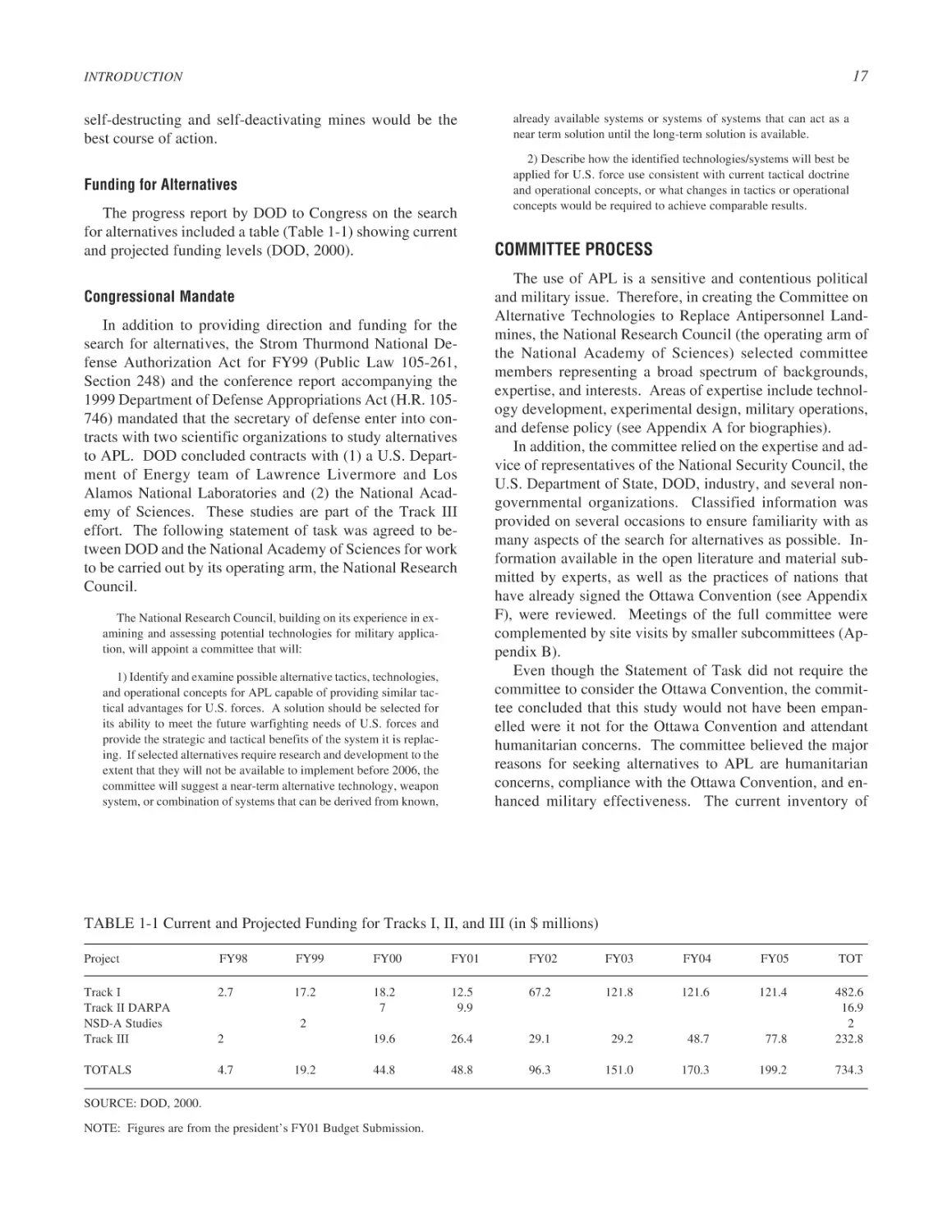
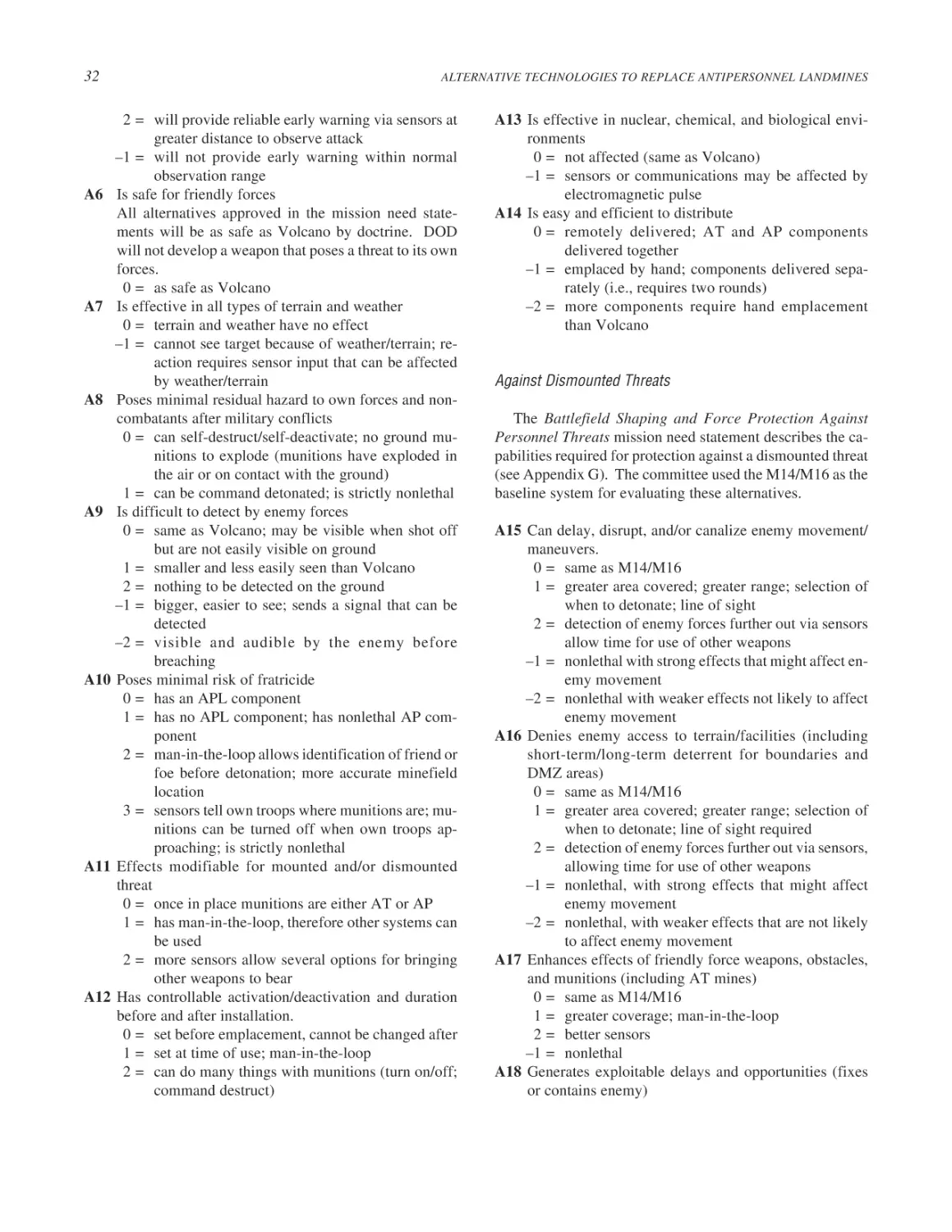
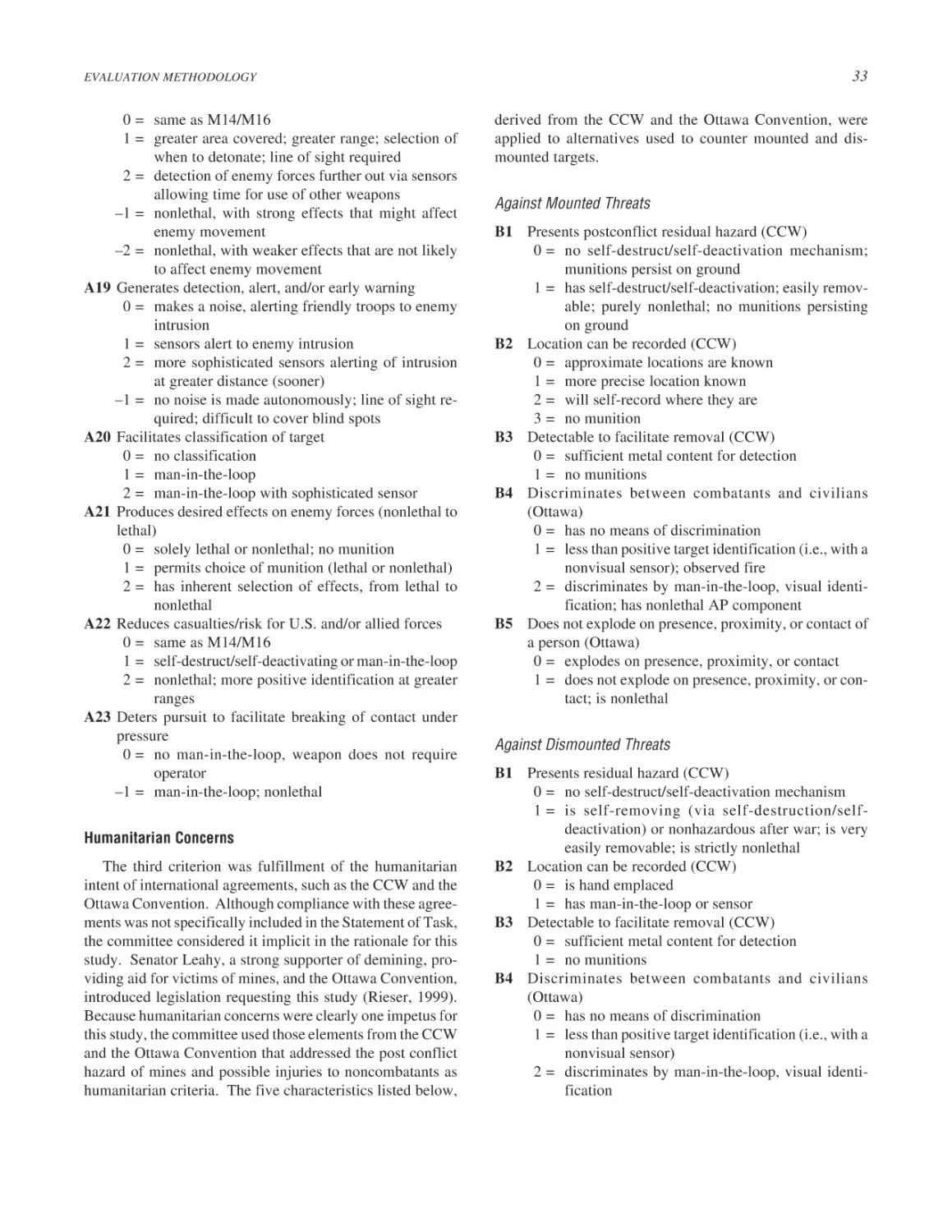
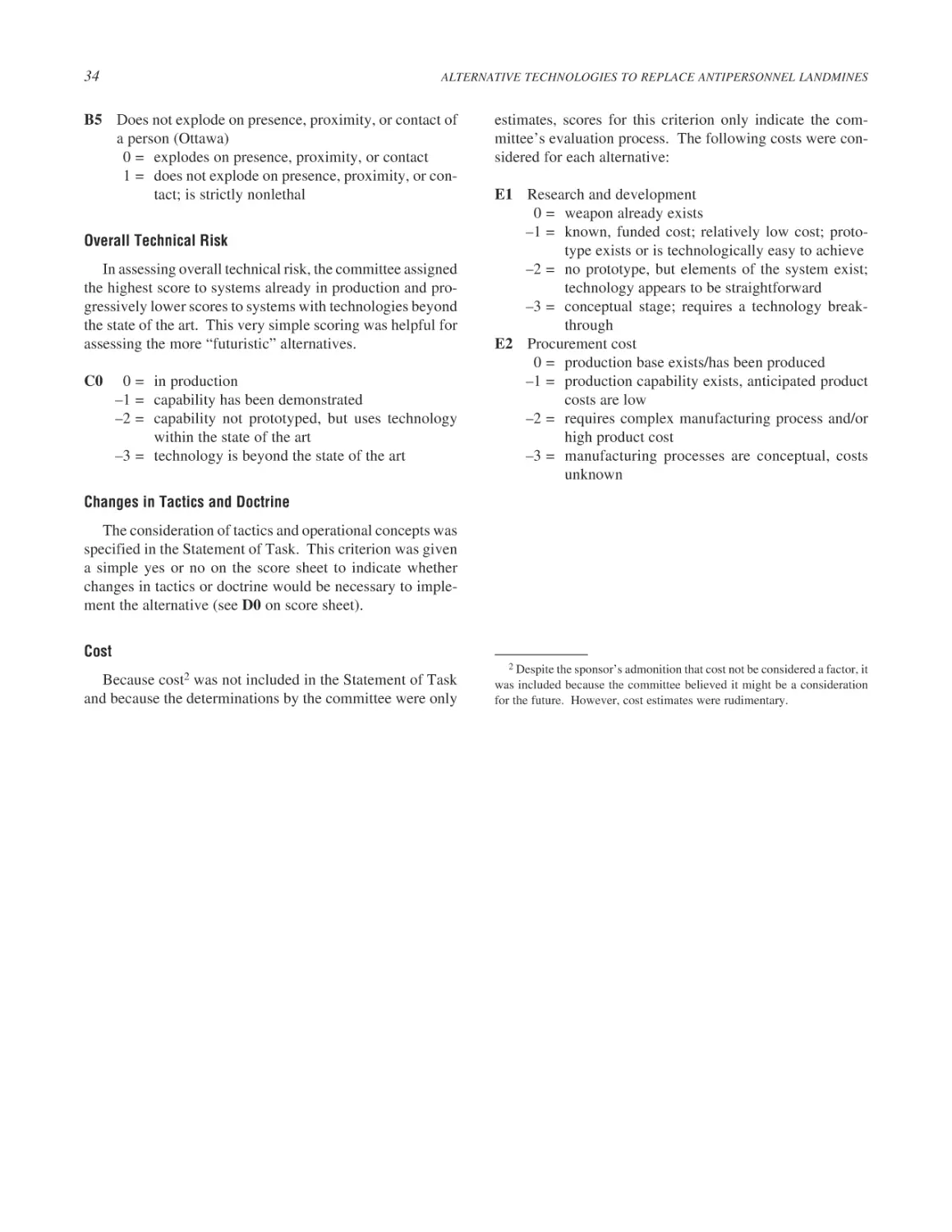
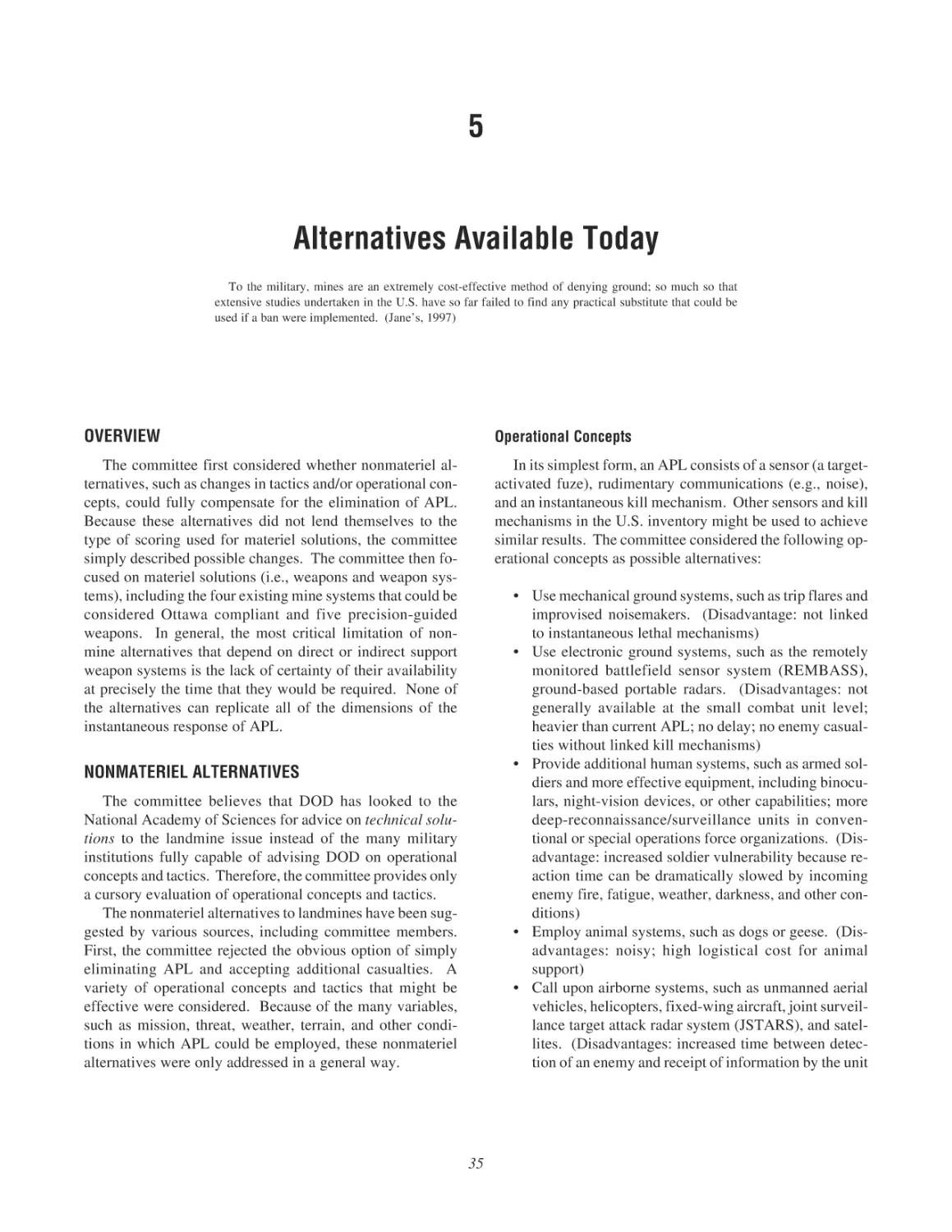

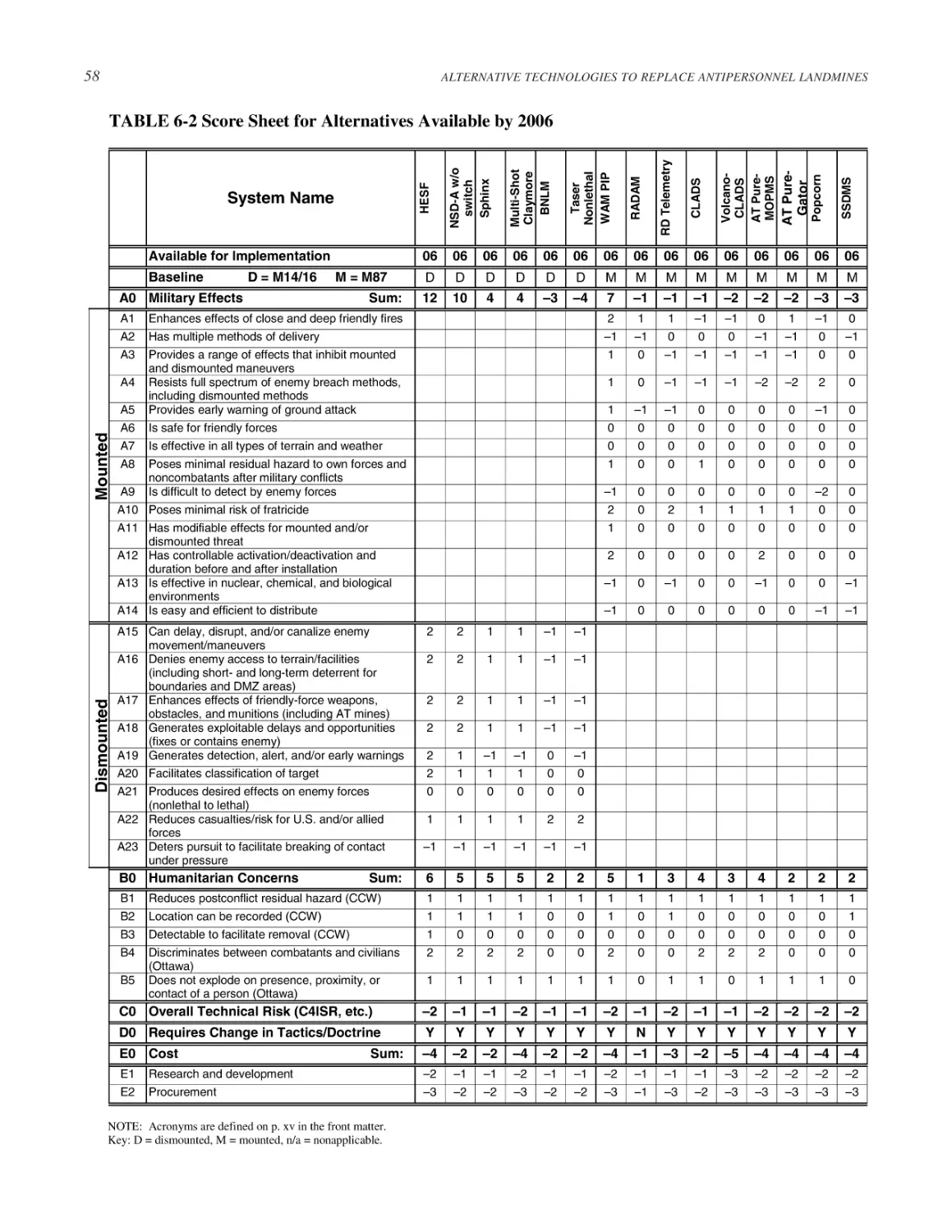
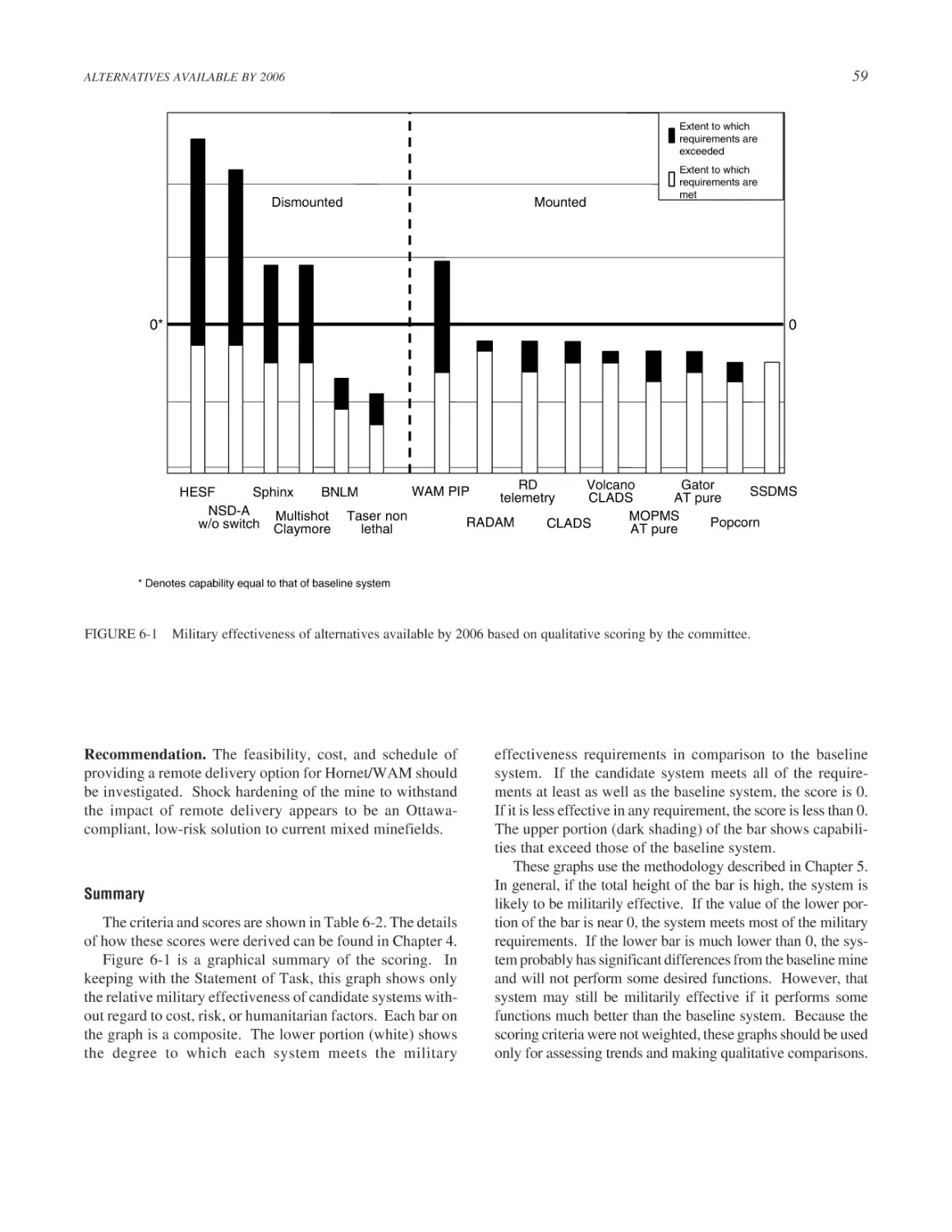
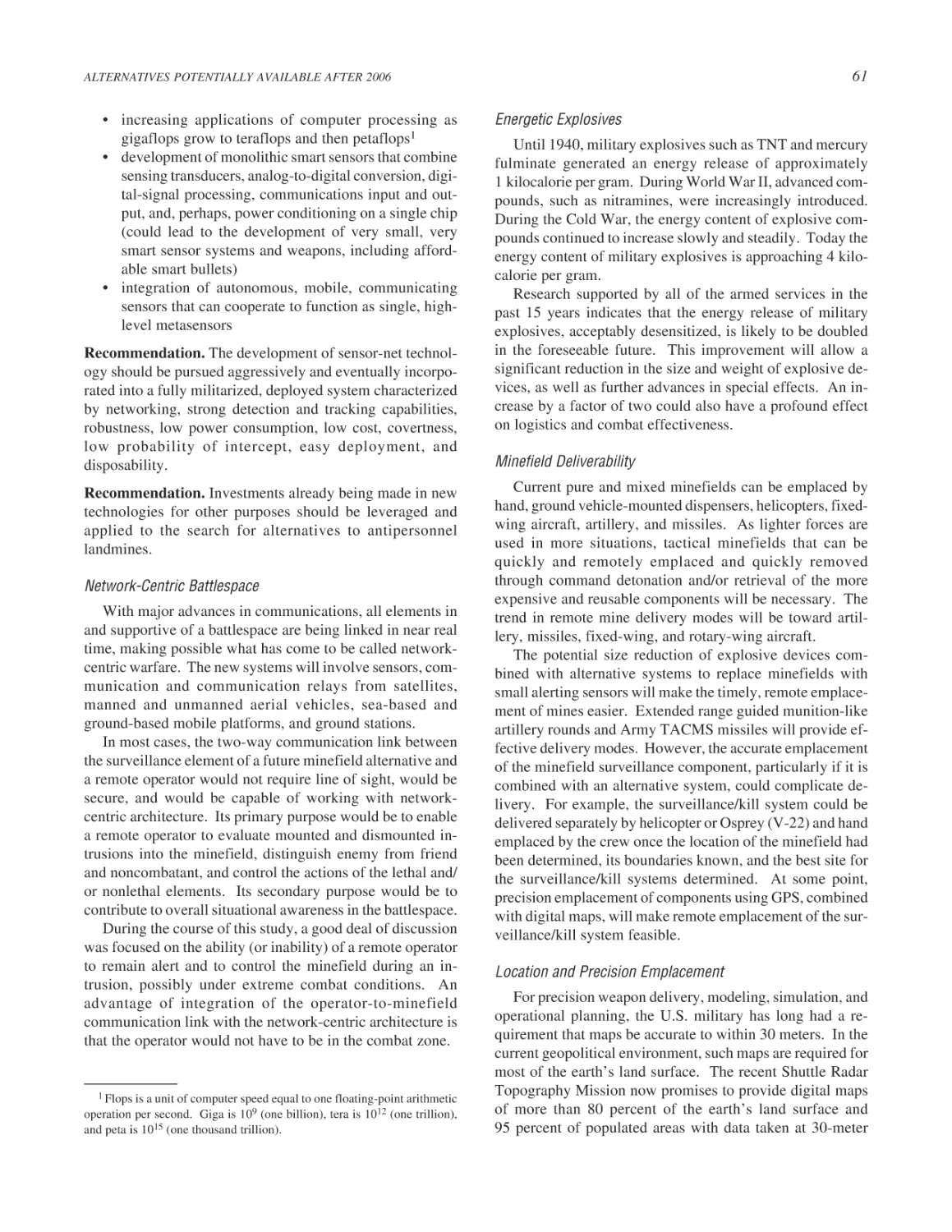
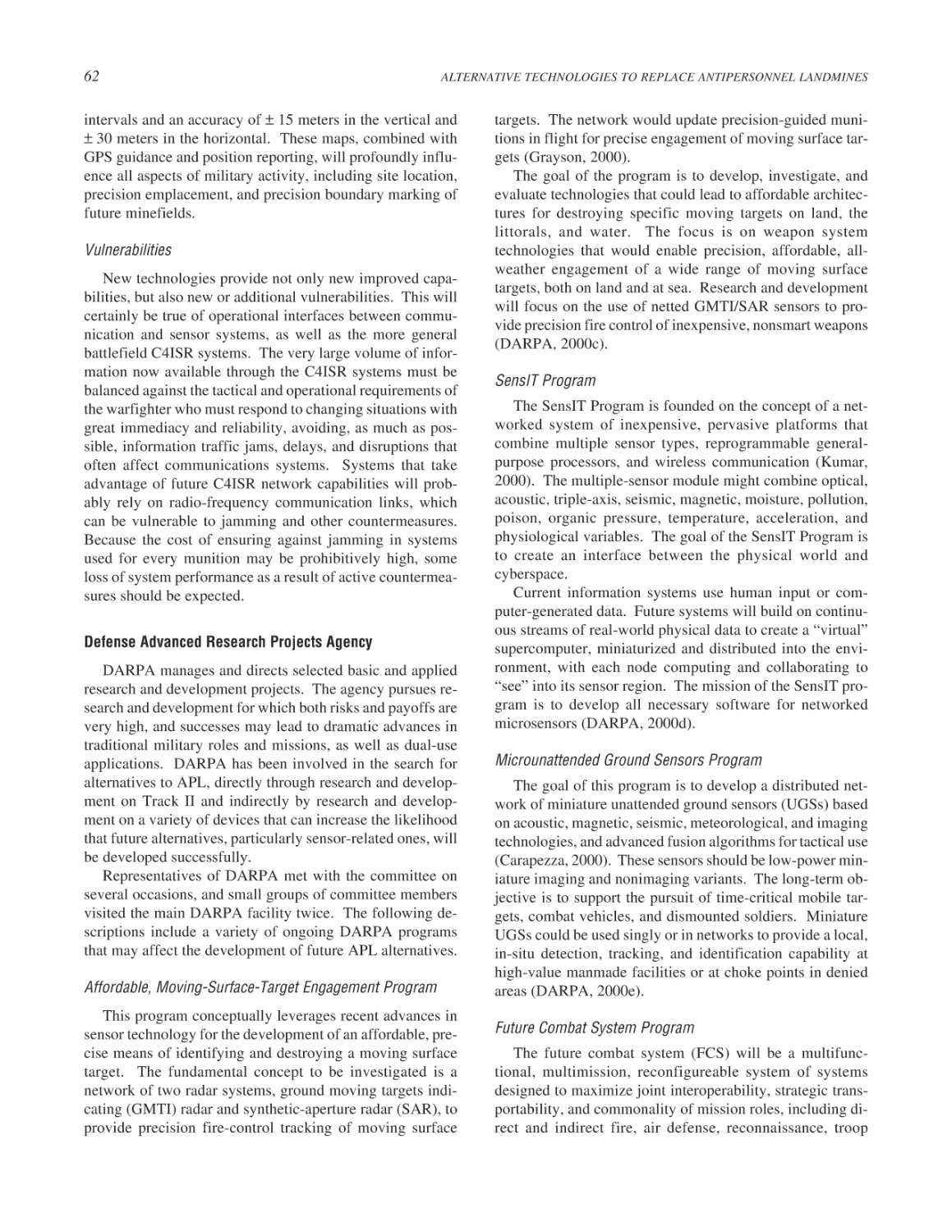
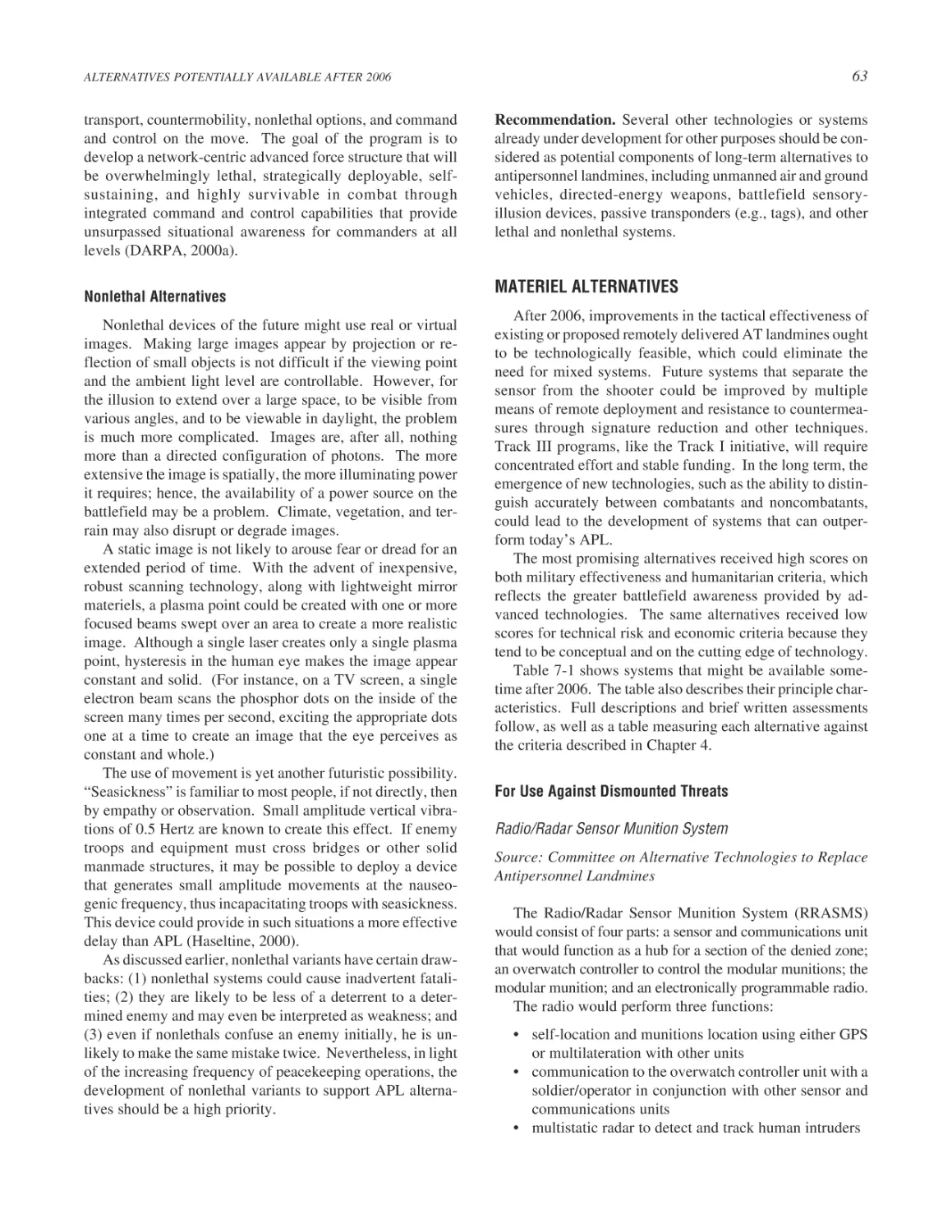
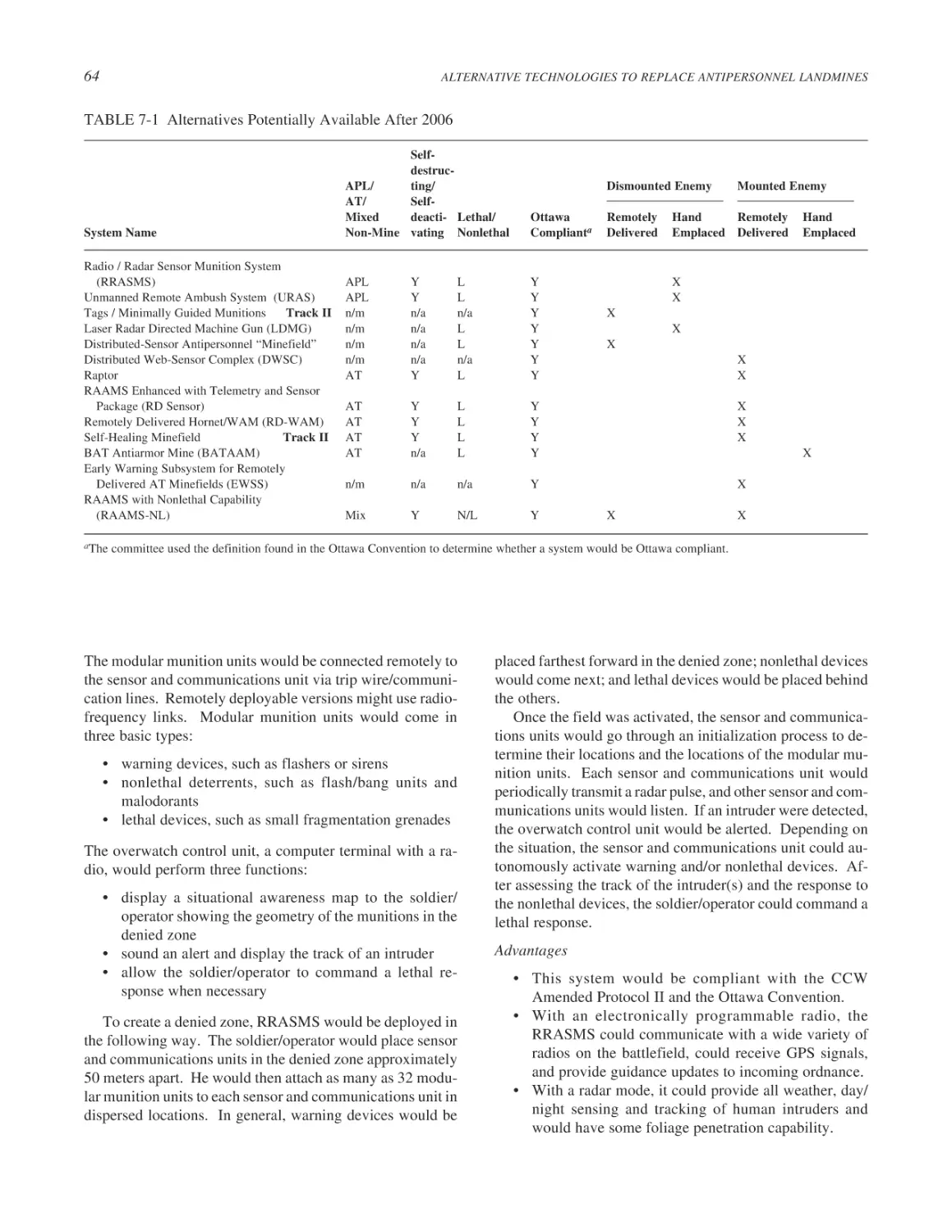


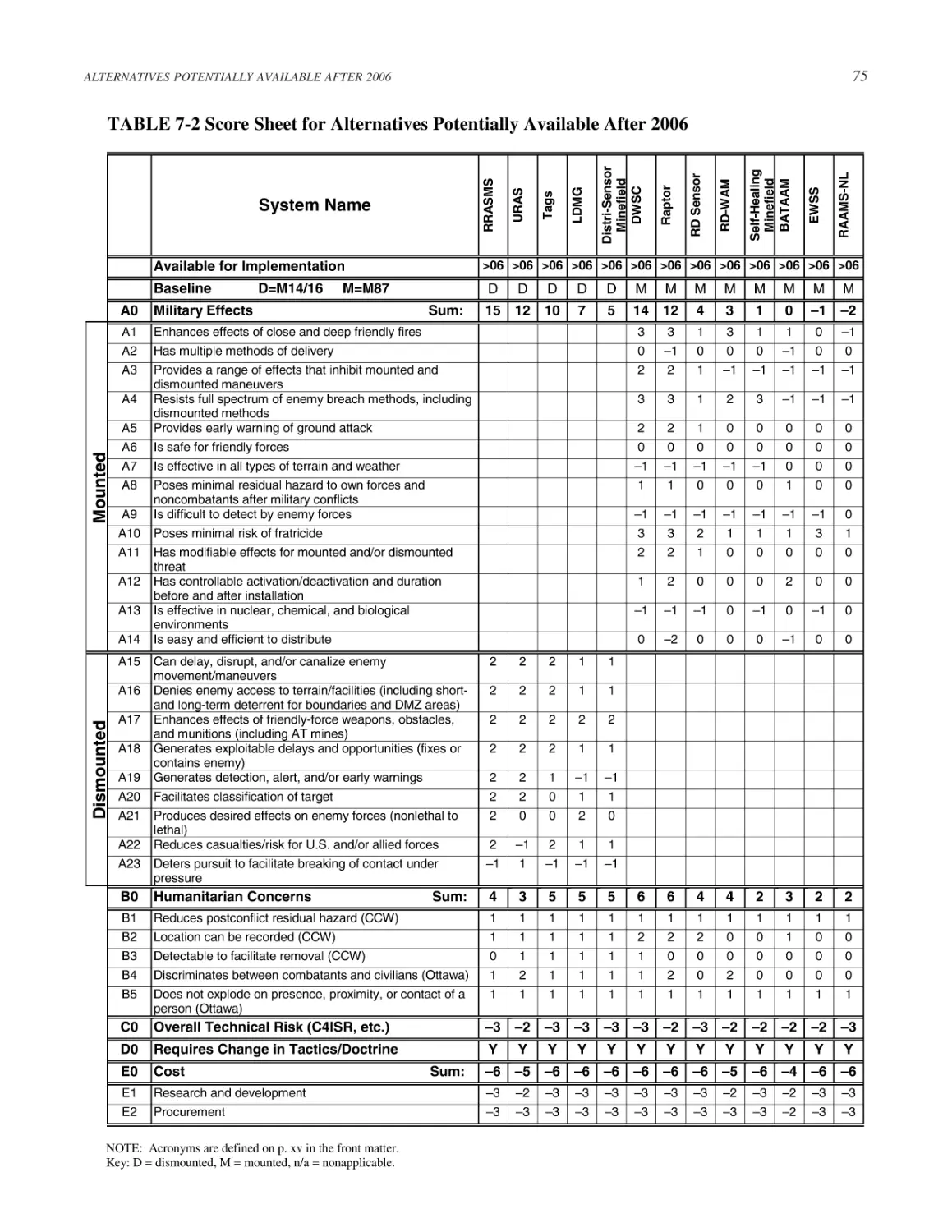
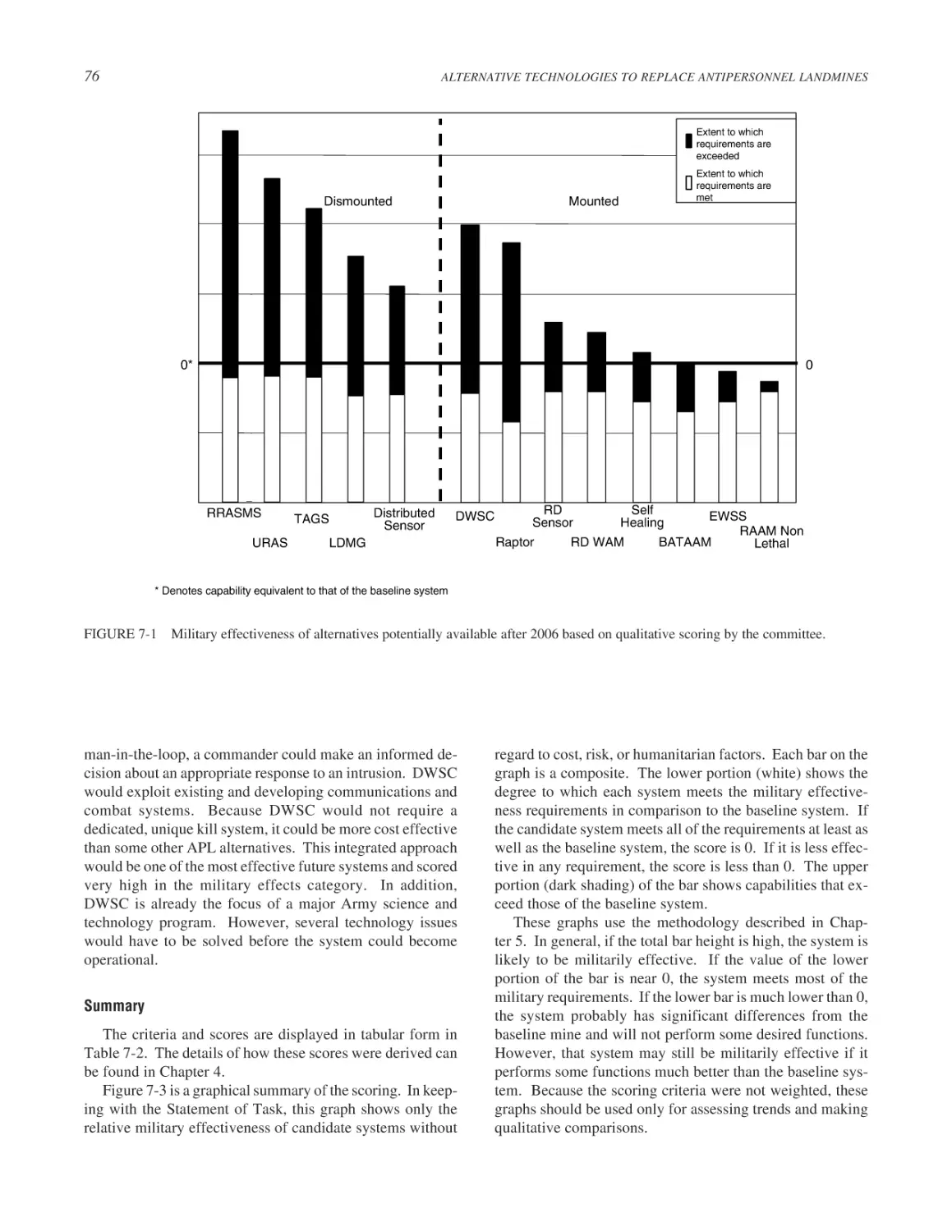

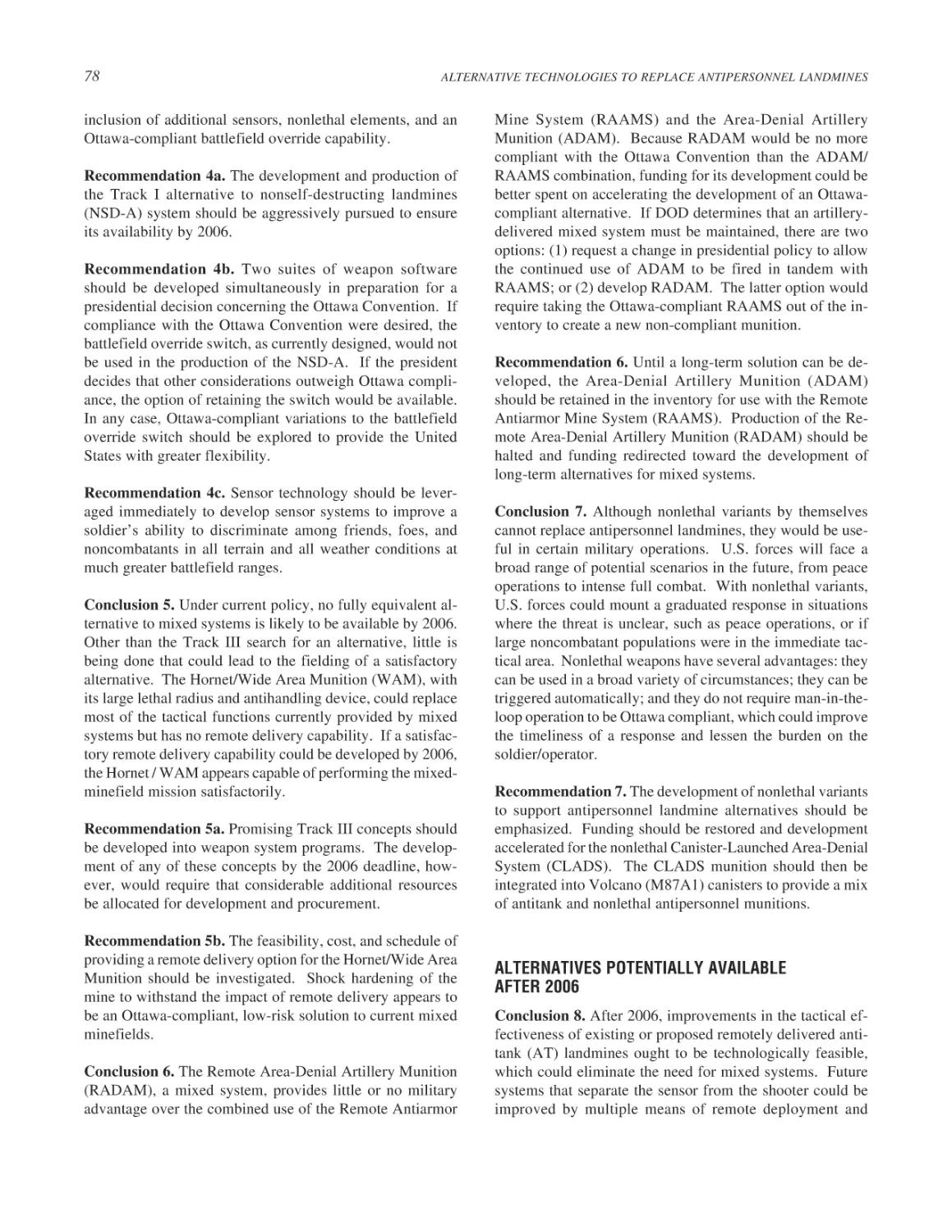
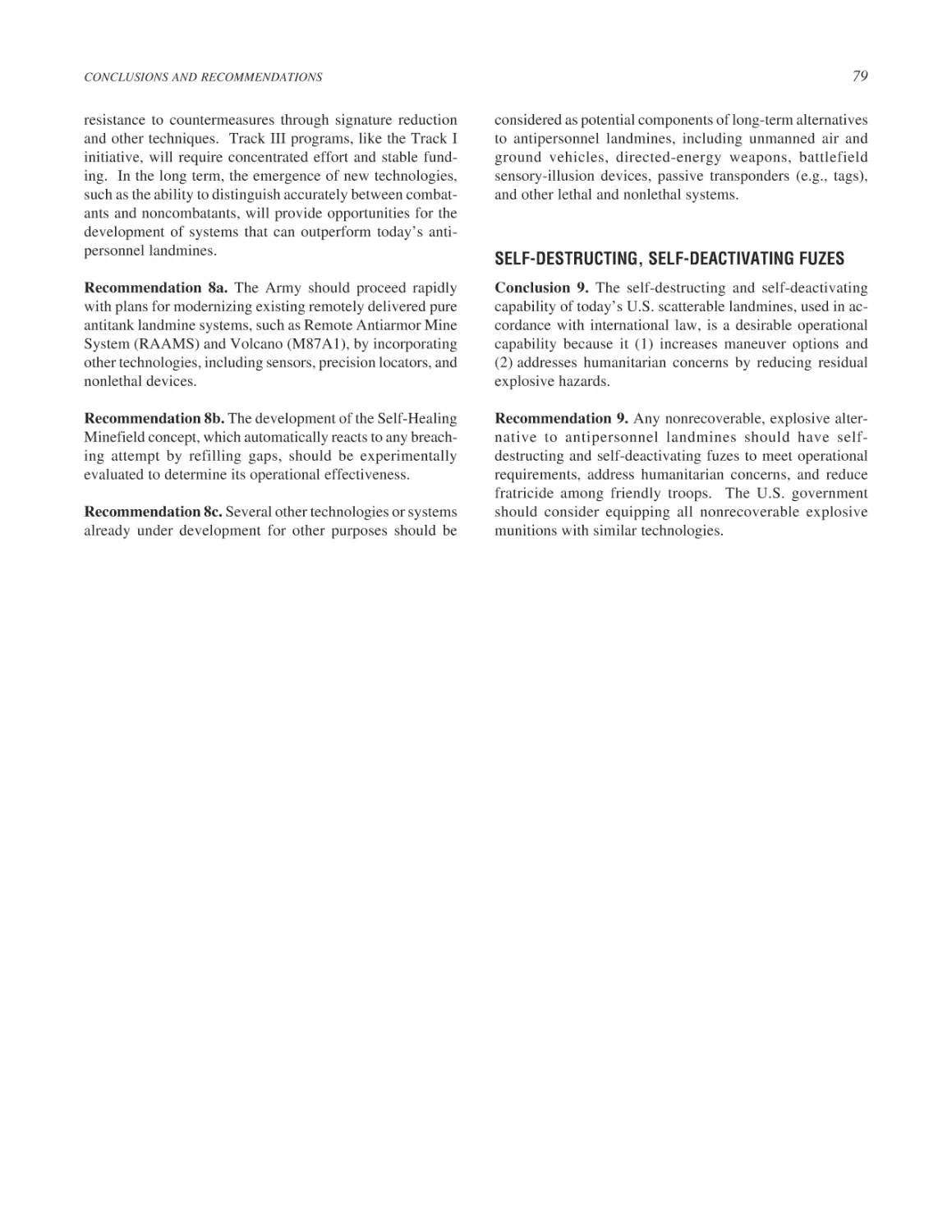












Текст
                    ALTERNATIVE TECHNOLOGIES TO REPLACE
ANTIPERSONNEL LANDMINES

Committee on Alternative Technologies to Replace
Antipersonnel Landmines
Commission on Engineering and Technical Systems
Office of International Affairs
National Research Council

NATIONAL ACADEMY PRESS
Washington, D.C.

NATIONAL ACADEMY PRESS

2101 Constitution Avenue, N.W.

Washington, D.C. 20418

NOTICE: The project that is the subject of this report was approved by the Governing Board of the
National Research Council, whose members are drawn from the councils of the National Academy
of Sciences, the National Academy of Engineering, and the Institute of Medicine. The members of
the committee responsible for the report were chosen for their special competences and with regard
for appropriate balance.
This study was supported by Contract/Grant No. V101(93)P-1637, TO#16 between the National
Academy of Sciences and the Department of Defense. Any opinions, findings, conclusions, or
recommendations expressed in this publication are those of the author(s) and do not necessarily
reflect the views of the organizations or agencies that provided support for the project.
International Standard Book Number: 0-309-07349-9
Library of Congress Catalog Card Number: 2001088182
Limited copies of this report are available from:
Division of Military Science and Technology
National Research Council
2101 Constitution Avenue, N.W.
Washington, D.C. 20418
Additional copies are available from National Academy Press, 2101 Constitution Avenue, N.W.,
Lockbox 285, Washington, D.C. 20055; (800) 624-6242 or (202) 334-3313 (in the Washington
metropolitan area); Internet, http://www.nap.edu
Copyright 2001 by the National Academy of Sciences. All rights reserved.
Printed in the United States of America

National Academy of Sciences
National Academy of Engineering
Institute of Medicine
National Research Council

The National Academy of Sciences is a private, nonprofit, self-perpetuating society of distinguished scholars engaged in scientific and engineering research, dedicated to the furtherance of
science and technology and to their use for the general welfare. Upon the authority of the charter
granted to it by the Congress in 1863, the Academy has a mandate that requires it to advise the
federal government on scientific and technical matters. Dr. Bruce M. Alberts is president of the
National Academy of Sciences.
The National Academy of Engineering was established in 1964, under the charter of the National
Academy of Sciences, as a parallel organization of outstanding engineers. It is autonomous in its
administration and in the selection of its members, sharing with the National Academy of Sciences
the responsibility for advising the federal government. The National Academy of Engineering also
sponsors engineering programs aimed at meeting national needs, encourages education and research, and recognizes the superior achievements of engineers. Dr. William A. Wulf is president of
the National Academy of Engineering.
The Institute of Medicine was established in 1970 by the National Academy of Sciences to secure
the services of eminent members of appropriate professions in the examination of policy matters
pertaining to the health of the public. The Institute acts under the responsibility given to the National
Academy of Sciences by its congressional charter to be an adviser to the federal government and,
upon its own initiative, to identify issues of medical care, research, and education. Dr. Kenneth I.
Shine is president of the Institute of Medicine.
The National Research Council was organized by the National Academy of Sciences in 1916 to
associate the broad community of science and technology with the Academy’s purposes of furthering knowledge and advising the federal government. Functioning in accordance with general policies determined by the Academy, the Council has become the principal operating agency of both the
National Academy of Sciences and the National Academy of Engineering in providing services to
the government, the public, and the scientific and engineering communities. The Council is administered jointly by both Academies and the Institute of Medicine. Dr. Bruce M. Alberts and
Dr. William A. Wulf are chairman and vice chairman, respectively, of the National Research Council.

COMMITTEE ON ALTERNATIVE TECHNOLOGIES TO REPLACE ANTIPERSONNEL LANDMINES
GEORGE BUGLIARELLO (NAE), chair, Polytechnic University, Brooklyn, New York
H. NORMAN ABRAMSON (NAE), Southwest Research Institute, San Antonio, Texas
THOMAS F. HAFER, Science and Technology Associates, Inc., Arlington, Virginia
J. JEROME HOLTON, Defense Group, Inc., Alexandria, Virginia
LEE M. HUNT, Consultant, Alexandria, Virginia
RICHARD H. JOHNSON, U.S. Army (retired), Alexandria, Virginia
K. SHARVAN KUMAR, Brown University, Providence, Rhode Island
RONALD F. LEHMAN II, Lawrence Livermore National Laboratory, Livermore, California
LARRY G. LEHOWICZ, U.S. Army (retired), Quantum Research, International, Arlington, Virginia
ALAN M. LOVELACE (NAE), General Dynamics Corporation (retired), La Jolla, California
HARVEY M. SAPOLSKY, Massachusetts Institute of Technology, Cambridge
DANIEL R. SCHROEDER, U.S. Army (retired), Vass, North Carolina
MARION W. SCOTT, Sandia National Laboratories, Albuquerque, New Mexico
K. ANNE STREET, Riverside Consulting Group, Inc., Alexandria, Virginia
PATRICK H. WINSTON, Massachusetts Institute of Technology, Cambridge
National Research Council Staff
BRUCE A. BRAUN, Director, Division of Military Science and Technology
JO L. HUSBANDS, Senior Staff Officer, Office of International Affairs
MARGARET N. NOVACK, Study Director
LOIS E. PETERSON, Program Officer
WILLIAM E. CAMPBELL, Administrative Coordinator
CHRISTINA B. MAIERS, Program Specialist (until August 2000)
GWEN ROBY, Senior Project Assistant
Liaisons
Board on Army Science and Technology
GEORGE T. SINGLEY III, Hicks and Associates, Inc., McLean, Virginia
Air Force Science and Technology Board
ANTHONY J. BURSHNICK, U.S. Air Force (retired), Consultant, Springfield, Virginia

iv

COMMISSION ON ENGINEERING AND TECHNICAL SYSTEMS
W. DALE COMPTON (NAE) chair, Purdue University, West Lafayette, Indiana
ELEANOR BAUM, Cooper Union for the Advancement of Science and Art, New York, New York
RUTH M. DAVIS (NAE), Pymatuning Group, Inc., Alexandria, Virginia
HENRY J. HATCH (NAE), U.S. Army (retired), Reston, Virginia
STUART L. KNOOP, Oudens and Knoop, Architects, PC, Chevy Chase, Maryland
NANCY G. LEVESON (NAE), Massachusetts Institute of Technology, Cambridge
CORA B. MARRETT, University of Massachusetts, Amherst
ROBERT M. NEREM (NAE), Georgia Institute of Technology, Atlanta
LAWRENCE T. PAPAY (NAE), Science Applications International Corporation, McLean, Virginia
BRADFORD W. PARKINSON (NAE), Stanford University, Stanford, California
BARRY M. TROST (NAS), Stanford University, Stanford, California
JAMES C. WILLIAMS (NAE), GE Aircraft Engines, Cincinnati, Ohio
RONALD W. YATES, U.S. Air Force (retired), Monument, Colorado
Staff
DOUGLAS BAUER, Executive Director
DENNIS CHAMOT, Deputy Executive Director
SYLVIA GILBERT, Administrative Associate
CARLA PAGE, Administrative Assistant
SHARON SEGAL, Financial Officer
CAROL R. ARENBERG, Editor

NOTE: This study was initiated under the auspices of the Commission on Engineering and Technical Systems, which was
subsumed in January 2001 by the newly established Division on Engineering and Physical Sciences.

v

OFFICE OF INTERNATIONAL AFFAIRS
INTERNATIONAL ADVISORY BOARD
F. SHERWOOD ROWLAND (NAS, IOM), chair OIA, co-chair IAB, University of California, Irvine; Foreign Secretary,
National Academy of Sciences
HAROLD K. FORSEN (NAE), co-chair IAB, Bechtel Corporation (retired); Foreign Secretary, National Academy of
Engineering
FRANCISCO J. AYALA (NAS), University of California, Irvine
JOHN D. BALDESCHWIELER (NAS), California Institute of Technology, Pasadena
NICOLE BALL, University of Maryland, College Park
DAVID R. CHALLONER (IOM), University of Florida, Gainesville; Foreign Secretary, Institute of Medicine
ELLEN FROST, Institute for International Economics, Washington, D.C.
JOHN H. GIBBONS (NAE), Consultant, The Plains, Virginia
DAVID A. HAMBURG (NAS, IOM), Carnegie Corporation of New York (emeritus), New York
RICHARD R. HARWOOD, Michigan State University, East Lansing
DONALD A. HENDERSON (NAS, IOM), Johns Hopkins University, Baltimore, Maryland
JULIA MARTON-LEFEVRE, Leadership for Environment and Development International, Inc., London, United Kingdom
LEAL ANNE MERTES, University of California, Santa Barbara
HENRY METZGER (NAS), National Institute of Arthritis and Musculoskeletal and Skin Diseases, Bethesda, Maryland
DIANA S. NATALICIO, University of Texas at El Paso
JAMES W. POIROT (NAE), CH2M Hill, Inc. (retired), Denver, Colorado
ERNEST J. WILSON III, University of Maryland, College Park
Staff
JOHN BORIGHT, Executive Director
CAROL PICARD, Associate Executive Director
JOANNA K. ROSENBERGER, Administrative and Financial Officer
EFFIE BENTSI-ADOTEYE, Administrative Assistant

vi

Preface

This National Research Council (NRC) study, commissioned by the U.S. Department of Defense (DOD) in response to a mandate from Congress, addresses the question
of whether there are alternatives to antipersonnel landmines
(APL)—including technologies, tactics, and operational concepts. The study was conducted at an interesting historical
juncture, when the United States is at peace and, at the same
time, the number of new technologies rich in military possibilities is unprecedented. The convergence of these two factors presents the U.S. Armed Forces with a unique window
of opportunity to develop new systems and concepts to
address future challenges.
This is also a moment of heightened international concern about the thousands of civilian casualties that occur
every year when APL that have been left in the field after a
conflict explode automatically on contact. When military
operations are conducted in the midst of a civilian population, the problem is compounded because today’s mines cannot discriminate between friend and foe, belligerent and civilian. It is important to note, however, that APL fielded by
U.S. forces, except for APL in storage in Korea, are designed
to self-destruct or self-deactivate at a preset time. Therefore,
they do not remain a danger indefinitely.
No simple device today can provide capabilities comparable to those of APL, both as self-standing devices and as a
part of other systems. Devices currently under development
include mine-like devices that do not explode automatically
on contact and nonlethal devices that could complement
lethal devices and systems. Thus, the functions of today’s
APL could be performed by a combination of devices, carefully planned tactics, and appropriate operational procedures.
In some circumstances, however, replacing APL could lead

to higher casualties to our ground forces and/or could reduce
our military capabilities.
The committee believes strongly that the development of
new systems with decoupled sensing, communication, and
explosive functions and the creation of networks of technologically sophisticated tactical sensors would greatly increase the situational awareness and power of war fighters
and help meet the goal of ensuring the information superiority of U.S. forces. These systems would also respond to the
humanitarian principle manifested in the Ottawa Convention of eliminating antipersonnel devices that explode on
contact. Although these new systems are bound to have vulnerabilities different from those of APL, these vulnerabilities could be greatly reduced by the application of appropriate technologies. Therefore, DOD should move rapidly to
support pertinent research and development to create
fieldable systems.
The NRC committee that produced this report worked
diligently in the limited time available to respond to DOD’s
request. The report draws on presentations to the committee
in both public and closed sessions by representatives of government, industry, and nongovernmental organizations, interviews, research by committee members, and their expertise and judgment.
The committee is grateful to everyone who contributed to
the study, particularly Margaret Novack, study director, and
Lois Peterson, program officer, who worked tirelessly to see
the study through to completion.
George Bugliarello, Chair
Committee on Alternative Technologies
to Replace Antipersonnel Landmines

vii

Acknowledgments

Arden L. Bement (NAE), Purdue University
John Christie, Logistics Management Institute
Stephen D. Goose, Human Rights Watch
Jerome H. Granrud, U.S. Army (retired)
Thomas McNaugher, RAND Corporation
Hyla Napadensky (NAE), Napadensky Energetics
Richard I. Neal, U.S. Marine Corps (retired)
Francis B. Paca, VSE Corporation
William C. Schneck, U.S. Army Night Vision and
Electronic Sensors Directorate
Sarah Sewall, Carr Center for Human Rights
John F. Troxell, U.S. Army War College
Gerold Yonas, Sandia National Laboratories

The study was conducted under the codirectorship of two
National Research Council commission-level offices: the
Commission on Engineering and Technical Systems (CETS)
and the Office of International Affairs (OIA). An oversight
group was formed to ensure unity of effort and to provide an
internal review of this report. We wish to thank the following individuals for their participation in the oversight group:
Henry J. Hatch (NAE), chair, U.S. Army (retired)
John Baldeschwieler (NAE), California Institute of
Technology
Nicole Ball, University of Maryland
Ruth M. Davis (NAE), Pymatuning Group, Inc.

Although the reviewers listed above have provided many
constructive comments and suggestions, they were not asked
to endorse the conclusions or recommendations, nor did they
see the final draft of the report before its release. The review
of this report was overseen by Lewis M. Branscomb, NAE,
Harvard University. Appointed by the National Research
Council, he was responsible for making certain that an
independent examination of this report was carried out in
accordance with institutional procedures and that all review
comments were carefully considered. Responsibility for the
final content of this report rests entirely with the authoring
committee and the institution.

This report has been reviewed in draft form by individuals chosen for their diverse perspectives and technical expertise, in accordance with procedures approved by the NRC’s
Report Review Committee. The purpose of this independent
review is to provide candid and critical comments that will
assist the institution in making its published report as sound
as possible and to ensure that the report meets institutional
standards for objectivity, evidence, and responsiveness to
the study charge. The review comments and draft manuscript remain confidential to protect the integrity of the deliberative process. We wish to thank the following individuals for their review of this report:

ix

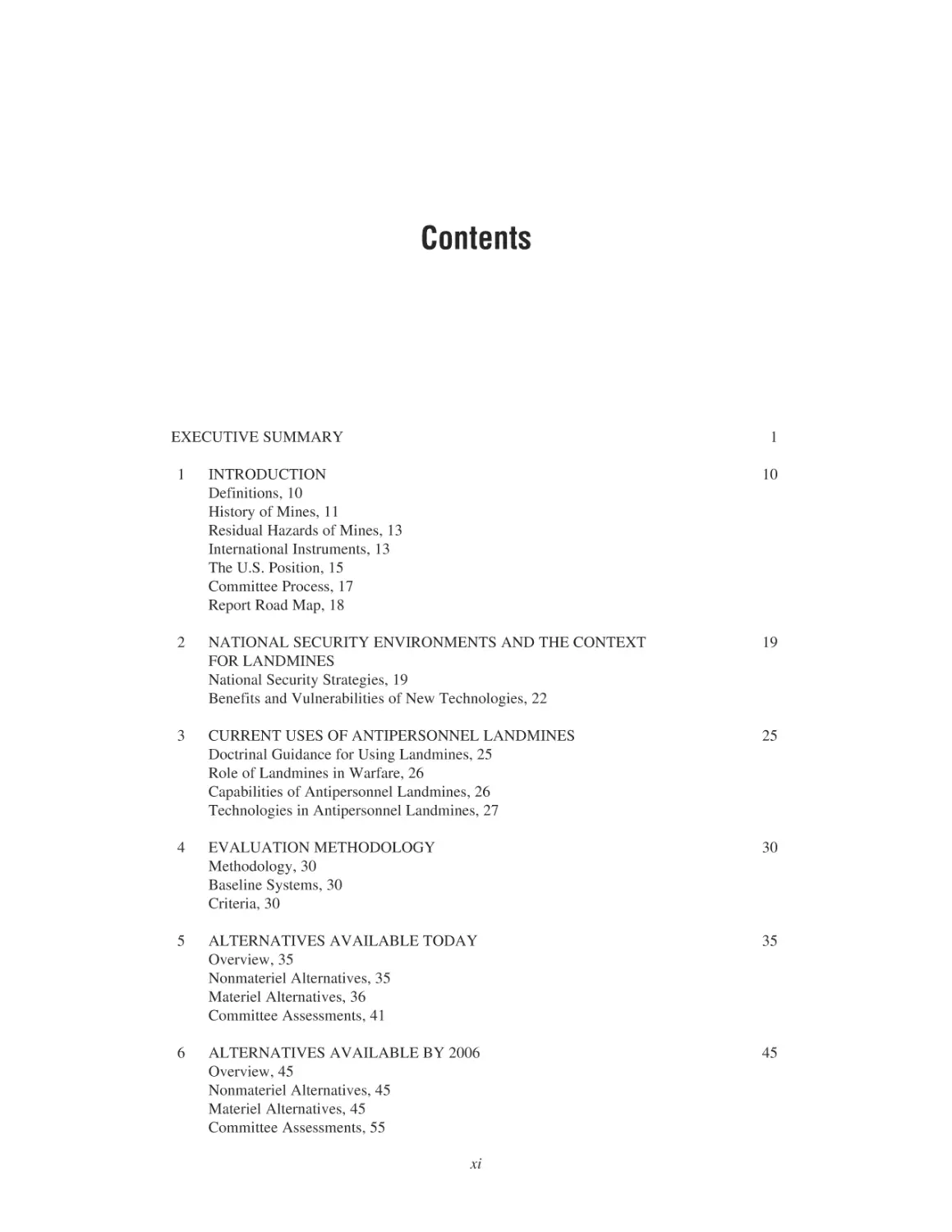
Contents

EXECUTIVE SUMMARY

1

1

INTRODUCTION
Definitions, 10
History of Mines, 11
Residual Hazards of Mines, 13
International Instruments, 13
The U.S. Position, 15
Committee Process, 17
Report Road Map, 18

10

2

NATIONAL SECURITY ENVIRONMENTS AND THE CONTEXT
FOR LANDMINES
National Security Strategies, 19
Benefits and Vulnerabilities of New Technologies, 22

19

3

CURRENT USES OF ANTIPERSONNEL LANDMINES
Doctrinal Guidance for Using Landmines, 25
Role of Landmines in Warfare, 26
Capabilities of Antipersonnel Landmines, 26
Technologies in Antipersonnel Landmines, 27

25

4

EVALUATION METHODOLOGY
Methodology, 30
Baseline Systems, 30
Criteria, 30

30

5

ALTERNATIVES AVAILABLE TODAY
Overview, 35
Nonmateriel Alternatives, 35
Materiel Alternatives, 36
Committee Assessments, 41

35

6

ALTERNATIVES AVAILABLE BY 2006
Overview, 45
Nonmateriel Alternatives, 45
Materiel Alternatives, 45
Committee Assessments, 55

45

xi

xii

CONTENTS

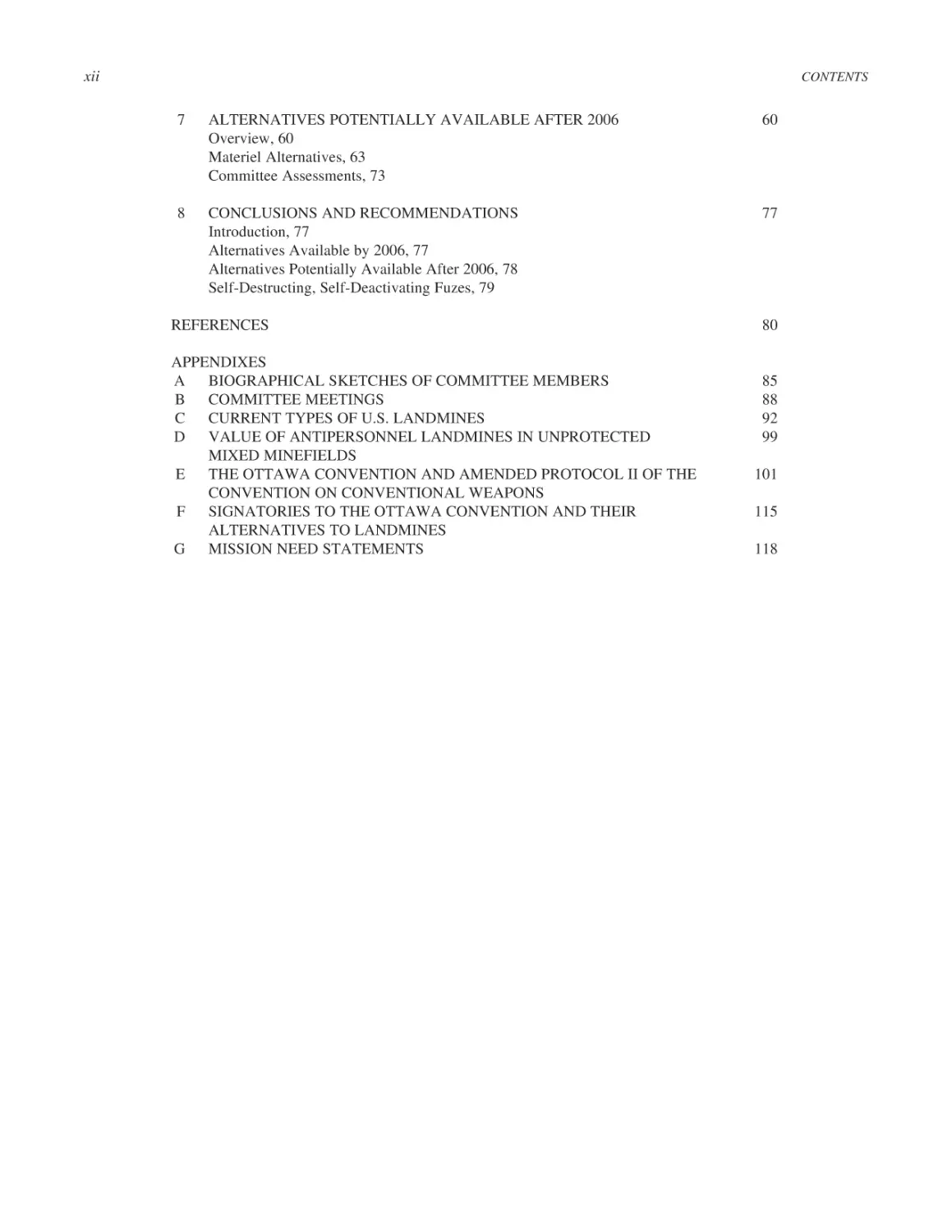
7

ALTERNATIVES POTENTIALLY AVAILABLE AFTER 2006
Overview, 60
Materiel Alternatives, 63
Committee Assessments, 73

60

8

CONCLUSIONS AND RECOMMENDATIONS
Introduction, 77
Alternatives Available by 2006, 77
Alternatives Potentially Available After 2006, 78
Self-Destructing, Self-Deactivating Fuzes, 79

77

REFERENCES
APPENDIXES
A BIOGRAPHICAL SKETCHES OF COMMITTEE MEMBERS
B COMMITTEE MEETINGS
C CURRENT TYPES OF U.S. LANDMINES
D VALUE OF ANTIPERSONNEL LANDMINES IN UNPROTECTED
MIXED MINEFIELDS
E THE OTTAWA CONVENTION AND AMENDED PROTOCOL II OF THE
CONVENTION ON CONVENTIONAL WEAPONS
F SIGNATORIES TO THE OTTAWA CONVENTION AND THEIR
ALTERNATIVES TO LANDMINES
G MISSION NEED STATEMENTS

80

85
88
92
99
101
115
118

Tables, Figures, and Boxes

TABLES
ES-1 Current and Potential Systems Considered in This Report, 4
1-1

Current and Projected Funding for Tracks I, II, and III, 17

5-1
5-2

Alternatives Available Today, 37
Score Sheet for Alternatives Available Today, 42

6-1
6-2

Alternatives Available by 2006, 46
Score Sheet for Alternatives Available by 2006, 58

7-1
7-2

Alternatives Potentially Available After 2006, 64
Score Sheet for Alternatives Potentially Available After 2006, 75

C-1

Current U.S. Mines, 93

FIGURES
3-1

Mine components, 27

5-1

Military effectiveness of currently available alternatives based on qualitative scoring by
the committee, 43

6-1

Military effectiveness of alternatives available by 2006 based on qualitative scoring by the
committee, 59

7-1

Military effectiveness of alternatives potentially available after 2006 based on qualitative
scoring by the committee, 76

C-1
C-2
C-3
C-4
C-5
C-6
C-7
C-8

Landmine systems on the battlefield, 93
M14, 94
M16, 94
Pursuit denial munition, 94
M18 Claymore, 95
ADAM mine projectile, 95
Hornet/WAM, 96
RAAMS projectile, 96
xiii

xiv

TABLES, FIGURES, AND BOXES

C-9
C-10
C-11
C-12

GEMSS system, 97
MOPMS, 97
Gator projectile, 97
Volcano delivery system, 98

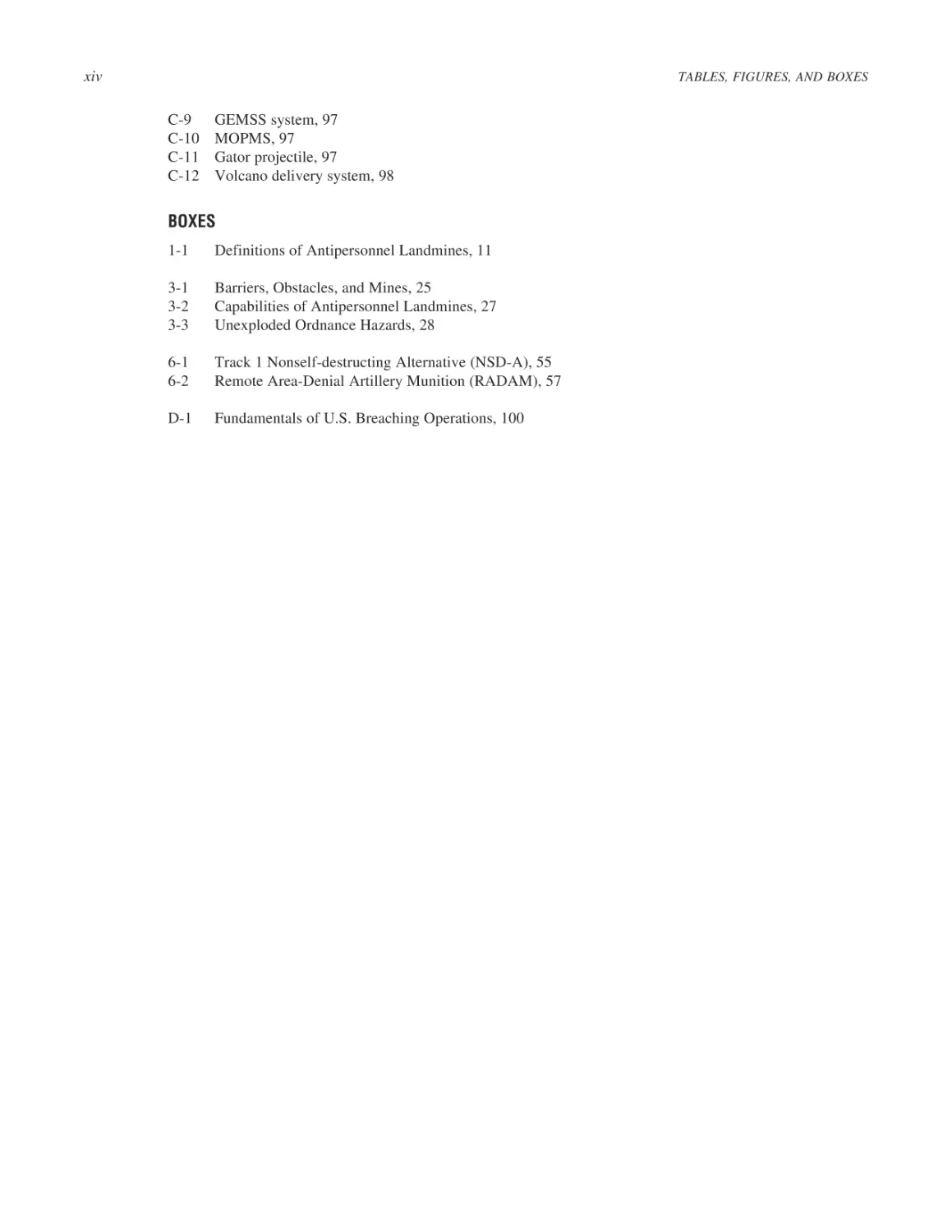
BOXES
1-1

Definitions of Antipersonnel Landmines, 11

3-1
3-2
3-3

Barriers, Obstacles, and Mines, 25
Capabilities of Antipersonnel Landmines, 27
Unexploded Ordnance Hazards, 28

6-1
6-2

Track 1 Nonself-destructing Alternative (NSD-A), 55
Remote Area-Denial Artillery Munition (RADAM), 57

D-1

Fundamentals of U.S. Breaching Operations, 100

Acronyms

LADAR
LDMG

laser radar
LADAR-directed machine gun

MEMS
MLRS
MOPMS
MOSAIC

microelectromechanical system
Multiple-Launch Rocket System
Modular-Pack Mine System
multifunctional, on-the-move, secure,
adaptive, integrated communication

NATO
NSD-A

North Atlantic Treaty Organization
nonself-destructing (antipersonnel
landmine) alternative

ORD

Operational Requirements Document

PIP

Product Improvement Program

RAAMS
RAAMS-NL

DWSC

Defense Advanced Research Projects Agency
U.S. Department of Defense
Dual-Purpose Improved Conventional
Munition
Distributed Web Sensor Complex

EWSS

Early Warning Subsystem

FASCAM
FCS
FM

Family of Scatterable Mines
Future Combat System
field manual

RD-Telemetry
RD-WAM
RRASMS

Remote Antiarmor Mine System
Remote Antiarmor Mine SystemNonlethal
Remote Area-Denial Artillery Munition
RAAMS enhanced with telemetry and
sensor package
RAAMS enhanced with telemetry
Remotely Delivered Wide Area Munition
Radio/Radar Sensor Munition System

GEMSS
GPS

Ground-Emplaced Mine-Scattering System
Global Positioning System

HESF
HMMWV

Hand-Emplaced Sensor Field
High-Mobility Multipurpose Wheeled
Vehicle

ADAM
APL
AT

Area-Denial Artillery Munition
antipersonnel landmines
antitank (mine)

BAT
BATAAM
BNLM

Brilliant Antiarmor Submunition
BAT Antiarmor Munition
Bounding Nonlethal Munition

C4ISR

command, control, communications,
computers, intelligence, surveillance, and
reconnaissance
Convention on Conventional Weapons
Combined Forces Command
Commander in Chief
Chairman of the Joint Chiefs of Staff
Canister-Launched Area-Denial System

CCW
CFC
CINC
CJCS
CLADS
DARPA
DOD
DPICM

JSTARS

RADAM
RD-Sensor

SADARM
SSDMS
SFW
SINCGARS

Joint Surveillance Target Attack Radar
System
xv

TACMS

Sense and Destroy Armor Munition
Small Short-Duration Mine System
Sensor Fuzed Weapon
Single-Channel Ground-to-Air Radio
System
Tactical Missile System

UNC
URAS

United Nations Command
Unmanned Remote Ambush System

WAM

Wide Area Munition

Executive Summary

BACKGROUND

in hastily marked minefields. In addition, if the tide of battle
changes rapidly, U.S. mines previously emplaced during
defensive missions could become an obstacle to the execution of rapid offensive maneuvers.
Over time, landmines used by the United States and other
countries with advanced military forces have become more
complex, more effective, and easier to use. Advances in the
1970s also led to the development of landmines capable of
destroying or deactivating themselves after a given time. All
landmines currently in U.S. stocks, with the exception of
those intended for the defense of Korea, are self-destructing
and/or self-deactivating.
Other nations and nonstate actors, unfortunately, have resorted to less technologically advanced landmines, which
are inexpensive, easily obtainable, and highly effective.
Most of these simple, nonself-destructing mines are deployed with no thought to keeping track of their locations.
As a result, millions of these devices are still strewn across
old battlefields. APL have killed or maimed thousands of
innocent civilians in the last 25 years and impeded the restoration of normal activities after conflicts have ended. Humanitarian groups, international organizations, and many
governments around the world have increasingly identified
these residual hazards as a threat to innocents and demanded
that all APL be eliminated.
Protocol II of the 1980 Convention on Prohibitions or
Restrictions on the Use of Certain Conventional Weapons
Which May Be Deemed to Be Excessively Injurious or to
Have Indiscriminate Effects (otherwise known as the Convention on Conventional Weapons, or CCW) was the first
international treaty to attempt to regulate the use of landmines. A review of the CCW in 1996 led to Amended Protocol II, which, among other things, distinguished between the
use of APL and AT mines and restricted the uses of all APL.
The United States has signed and ratified the CCW, including Amended Protocol II.
Subsequent national and international campaigns demanding a total ban on APL led to the Convention on the

Military forces use landmines or landmine-like devices
because they are capable of autonomously delaying or killing the enemy at a safe distance from friendly forces.
Landmines fall into two broad categories. Antipersonnel
landmines (APL) are intended to kill or disable soldiers on
foot (a dismounted force).1 Antitank landmines (AT mines)
are used against vehicles, such as tanks and armored personnel carriers (a mounted force). Mixed systems, which combine both AT mines and APL in the same munition, are typically used against an enemy force that is mostly mounted but
is accompanied by significant numbers of dismounted soldiers. APL in mixed systems are intended to prevent or discourage foot soldiers from penetrating or breaching an AT
minefield.
Landmines are essentially tactical and operational weapons, although on occasion they also have strategic implications. When used tactically, landmines are usually employed
during battlefield engagements of relatively limited duration
to disrupt an enemy’s progress. There are also long-term
strategic landmine missions, such as border protection, as is
the case in Korea.
Minefields are used to place an enemy in a vulnerable
position that can be exploited by friendly forces, cause the
enemy forces to divide, interfere with enemy command and
control, inflict damage on enemy personnel and equipment,
exploit the capabilities of other weapon systems by delaying
enemy forces in an engagement area, and protect friendly
forces from enemy infiltration. U.S. doctrine requires that
minefields be mapped, marked, and eventually cleared. Despite these precautions and for a variety of reasons, U.S.
landmines also occasionally kill friendly personnel, typically

1 The Convention on Conventional Weapons, Amended Protocol II, defines an APL as “a mine primarily designed to be exploded by the presence,
proximity, or contact of a person and that will incapacitate, injure, or kill
one or more persons” (see Appendix E).

1

2

ALTERNATIVE TECHNOLOGIES TO REPLACE ANTIPERSONNEL LANDMINES

Prohibition of the Use, Stockpiling, Production and Transfer of Anti-Personnel Mines and on Their Destruction (the
Ottawa Convention), which was signed by 122 countries in
Ottawa, Canada, on December 3, 1997, and entered into
force in March 1999. As of September 2000, 139 nations
had signed the Ottawa Convention, including all NATO
member states, except the United States and Turkey, and all
European Union member states, except Finland. The Ottawa
Convention bans the use of all APL,2 whether used alone or
in mixed systems, including those that are self-destructing
and self-deactivating.3 Signatories are prohibited from developing, producing, acquiring, or stockpiling APL, as well
as assisting, encouraging, or inducing anyone else to undertake these actions. All APL currently held by signatories
must be destroyed within four years of the signing.
Despite showing early support for a ban on APL and
taking the lead in efforts to ameliorate residual effects, the
United States did not sign the Ottawa Convention. President
Clinton stated that the United States would consider acceding
to the convention when alternative technologies that provide
capabilities similar to those of APL have been identified and
fielded. He also announced that the United States would
undertake an active research and development program to
find such alternatives. At the same time he established the
presidential policy that after 2003, the United States would
no longer use pure APL4 outside Korea, where landmines
are considered particularly important. If alternatives for
Korea and for mixed systems can be found by 2006, the
president said, the United States will sign the Ottawa Convention. In the meantime, the United States has destroyed
three million nonself-destructing mines.

U.S. SEARCH FOR ALTERNATIVES
In 1997, the U.S. Department of Defense (DOD) began
the task of developing alternatives to APL. DOD initially
adopted a two-track approach. Track I, led by the U.S. Army,
was a search for alternatives to the nonself-destructing
landmines used in Korea. Track II, a Defense Advanced
Research Projects Agency (DARPA) program, was focused
on an assessment of long-term, more technologically advanced alternatives that would effectively prevent access to
an area. In 1999, Congress provided funds to add a third
track. The goal of Track III, which overlaps both Track I
and Track II, is to find existing and new technologies and

2 The convention does not prohibit command-detonated munitions, such
as the Claymore, although they are customarily described as APL.
3 The negotiators did not allow for the inclusion of self-destructing and
self-deactivating APL for several reasons. These mines still fit the definition of APL, and no exceptions were to be made. If an exception had been
made for these mines, primarily in the inventory of only the United States
and a few western European countries, exceptions might have had to be
made for weapon systems of other countries.
4 “Pure” APL are APL used alone and not as part of a mixed system.

operational concepts that can provide an equivalent to the
capabilities of (1) nonself-destructing APL; (2) APL used in
mixed AT mine systems; and (3) current mixed landmine
systems, including AT mines with antihandling devices.
The National Academies
As part of the Track III initiative, DOD contracted with
the National Academy of Sciences to conduct a study of
existing and new technologies that might provide an alternative to APL. In response, the Committee on Alternative
Technologies to Replace Antipersonnel Landmines was
established. The committee was asked to (1) identify and
examine possible tactics, technologies, and operational concepts that could provide tactical advantages similar to those
provided by APL by 2006; (2) suggest a near-term alternative technology, weapon system, or combination of systems
that could be derived from known, available systems or that
could provide a short-term solution if the recommended alternative will not be available by 2006; and (3) describe how
the identified technologies and systems could be used
consistently with current tactical doctrine and operational
concepts or recommend changes in tactics or operational
concepts. This report is the result of that study.
Political Context for the Study
The committee was asked to consider alternatives that
would provide tactical advantages to U.S. forces similar to
those provided by APL. The committee also recognized that
it had an opportunity to recommend alternatives, especially
improved sensors and communications that would be more
militarily effective than current APL. However, considering
the presidential policy and official statements regarding
APL, the committee recognized that one reason for the search
for alternatives was to enable the United States to accede to
the Ottawa Convention. The committee made no judgment
as to whether the United States should accede to the Ottawa
Convention.
Conclusion 1. The major reasons for seeking alternatives to
current antipersonnel landmines (APL) are humanitarian
concerns, compliance with the Ottawa Convention, and enhanced military effectiveness. Indeed, this study would not
have been empanelled were it not for the Ottawa Convention. The current inventory of self-destructing and selfdeactivating U.S. APL is militarily advantageous and safe.
They achieve desired military objectives without endangering U.S. warfighters or noncombatants more than other
weapons of war, but they are not compliant with the Ottawa
Convention. However, humanitarian concerns and Ottawa
compliance are not always synonymous. In fact, some of the
apparently Ottawa-compliant alternatives examined by the
committee may be less humane than present U.S. selfdestructing and self-deactivating landmines.

3

EXECUTIVE SUMMARY

Recommendation 1a. If the decision is made to accede to
the Ottawa Convention, a transition period may be necessary
before implementation to maintain current U.S. military capabilities until suitable alternatives can be made available.
During that transition, existing self-destructing and selfdeactivating antipersonnel landmines should be retained,
both in their stand-alone form and as part of mixed systems.
Recommendation 1b. Of the solutions not compliant with
the Ottawa Convention, simply retaining the current selfdestructing and self-deactivating mines would be the best
course of action.

COMMITTEE ASSESSMENTS
After reviewing the functions performed by landmines,
as well as the context within which these functions might be
needed now and in the future, the committee sought alternative ways of performing the same tasks. The committee reviewed a broad variety of nonmateriel alternatives, including innovative operational concepts and military tactics, and
materiel alternatives, such as weapon systems, nonlethal devices, and improved sensors and communications. The alternatives considered included existing systems, concepts
under consideration or development, and new concepts.
Although a number of these ideas are not fully developed,
they might be a basis for new approaches for the future.
A prominent feature of many alternatives is the “man-inthe-loop,” which ensures a positive identification of an intruder before a response element is activated. The man-inthe-loop concept envisions a soldier/operator positioned in
such a way that he can observe the minefield and determine
whether or not the intruder is a friend, an enemy, or a noncombatant. New technologies, especially improved sensors
and communications, would enable the soldier/operator to
make a faster, more accurate identification, which would be
beneficial for humanitarian purposes and would reduce fratricide. However, a man-in-the-loop also introduces a variety
of new vulnerabilities.
Conclusion 2. The rapid emergence of new technologies
after 2006 will create opportunities for the development of
systems that can outperform today’s antipersonnel landmines
and that would be compliant with Ottawa.
Recommendation 2a. The development of sensor-net technology should be pursued aggressively and eventually incorporated into a fully militarized, deployed system characterized by networking, strong detection and tracking
capabilities, robustness, low power consumption, low cost,
covertness, low probability of intercept, easy deployment,
and disposability.
Recommendation 2b. Investments already being made in
new technologies for other purposes should be leveraged and
applied to the search for alternatives to antipersonnel
landmines.

Evaluation Methodology
Unfortunately, the committee did not have enough time
or resources to use independent modeling or simulations in
evaluating the alternatives. Therefore, the committee developed a score sheet to assess systematically the effectiveness
of alternatives. The resulting analysis is admittedly subjective, and the results are qualitative rather than quantitative.
Guided by the Statement of Task, the committee first
screened alternatives in terms of their availability by or before 2006. Because 2006 is near, especially in terms of the
steps required for fielding an alternative system, and because
remarkable improvements in technology are forecast for the
near future, alternatives that might become available after
2006 were also considered.
Each of the alternatives was considered against a baseline,
depending on whether it was intended to be used against
dismounted or mounted targets. The M14 and M16, current
APL that are nonself-destructing and require hand emplacement, were used as the baseline for alternatives against dismounted targets. The Volcano (M87), a mixed system that
includes self-destructing APL to protect AT mines, was used
as the baseline for alternatives against mounted targets.
The committee used several criteria to judge the alternatives against these baseline systems: military effectiveness;
humanitarian concerns; technical risk; tactics and operational
concepts; and cost. To determine whether an alternative
would meet DOD’s military requirements, the committee
used the two mission need statements developed by DOD
for APL alternatives as a basis for assessing military effectiveness. The humanitarian intent of international agreements such as the Ottawa Convention and the CCW
Amended Protocol II, although not specified in the Statement of Task, was an implicit basis for this study and was
also considered a criterion. The committee also considered
the overall technical risk of an alternative, that is, whether
the technology could feasibly be developed and manufactured. The committee also indicated whether an alternative
would require a change in tactics and operational concepts.
The last criterion was cost. Although the sponsor indicated
that cost should not be a driving factor in the selection of an
alternative, the committee decided a rudimentary consideration of cost was necessary.
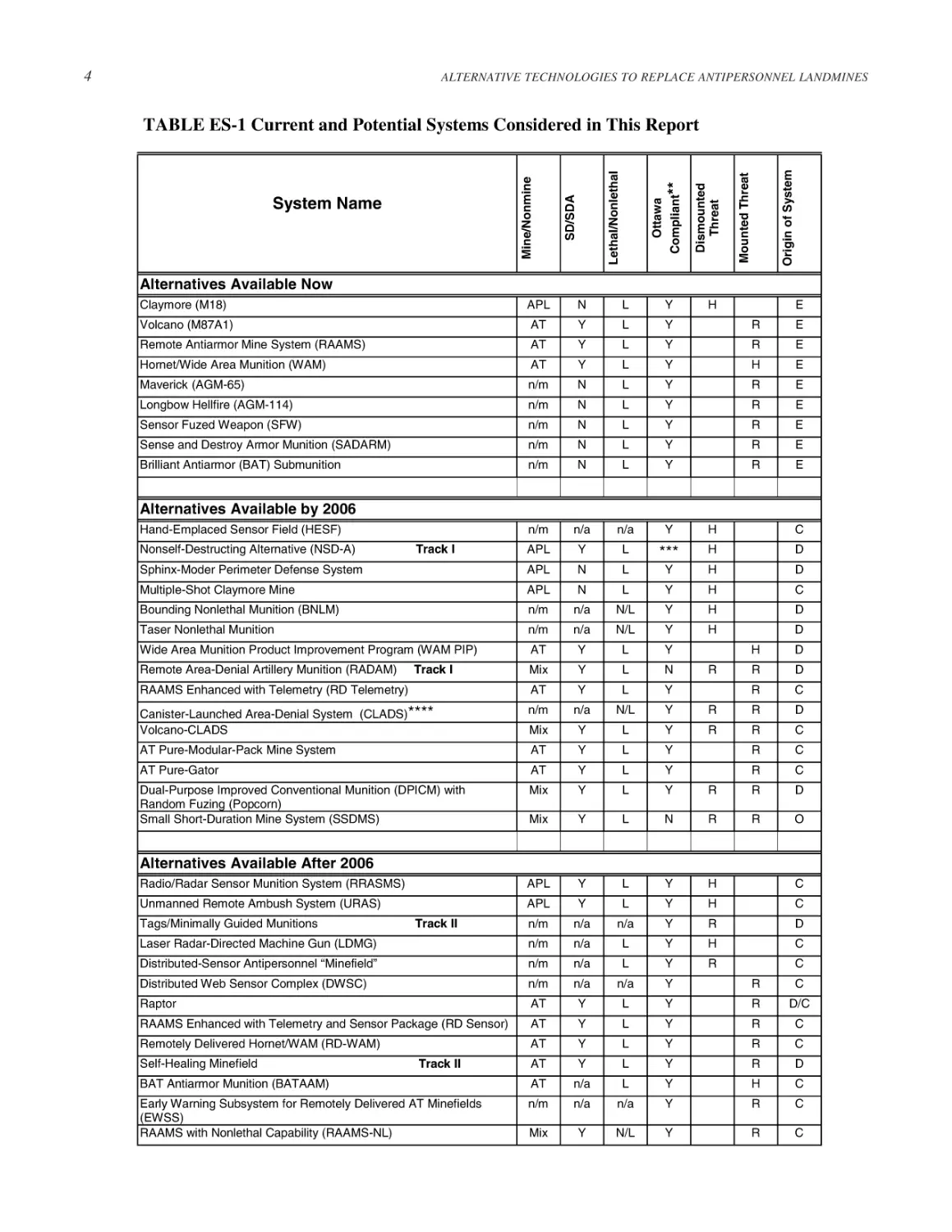
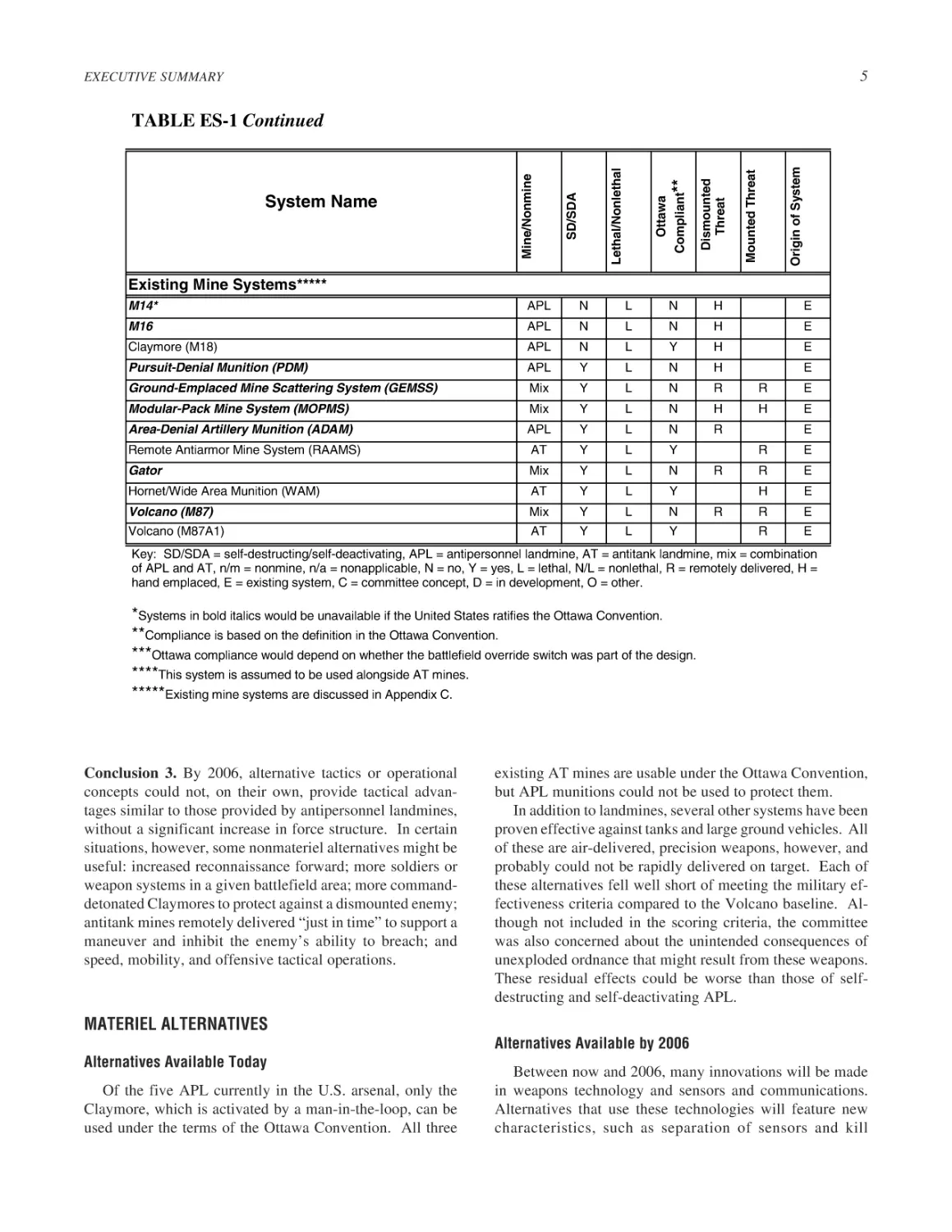
Table ES-1 lists all of the current systems and alternatives considered by the committee. Descriptions can be
found in the body of the report. The alternatives that are
mentioned in the committee’s conclusions and recommendations are described briefly below.

NONMATERIEL ALTERNATIVES
The committee first considered whether nonmateriel alternatives, such as changes in tactics and operational concepts, could fully compensate for the elimination of APL.

4

ALTERNATIVE TECHNOLOGIES TO REPLACE ANTIPERSONNEL LANDMINES

Origin of System

Mounted Threat

Dismounted
Threat

Ottawa
Compliant**

Lethal/Nonlethal

System Name

SD/SDA

Mine/Nonmine

TABLE ES-1 Current and Potential Systems Considered in This Report

Alternatives Available Now
Claymore (M18)

APL

N

L

Y

Volcano (M87A1)

AT

Y

L

Y

H
R

E
E

Remote Antiarmor Mine System (RAAMS)

AT

Y

L

Y

R

E

Hornet/Wide Area Munition (WAM)

AT

Y

L

Y

H

E

Maverick (AGM-65)

n/m

N

L

Y

R

E

Longbow Hellfire (AGM-114)

n/m

N

L

Y

R

E

Sensor Fuzed Weapon (SFW)

n/m

N

L

Y

R

E

Sense and Destroy Armor Munition (SADARM)

n/m

N

L

Y

R

E

Brilliant Antiarmor (BAT) Submunition

n/m

N

L

Y

R

E

Y

H

C

***

H

D

Alternatives Available by 2006
Hand-Emplaced Sensor Field (HESF)

n/m

n/a

n/a

APL

Y

L

Sphinx-Moder Perimeter Defense System

APL

N

L

Y

H

D

Multiple-Shot Claymore Mine

APL

N

L

Y

H

C

Nonself-Destructing Alternative (NSD-A)

Track I

Bounding Nonlethal Munition (BNLM)

n/m

n/a

N/L

Y

H

D

Taser Nonlethal Munition

n/m

n/a

N/L

Y

H

D

Wide Area Munition Product Improvement Program (WAM PIP)

AT

Y

L

Y

Remote Area-Denial Artillery Munition (RADAM)

Mix

Y

L

N

RAAMS Enhanced with Telemetry (RD Telemetry)

AT

Y

L

Y

Canister-Launched Area-Denial System (CLADS)****
Volcano-CLADS

n/m

n/a

N/L

Y

Mix

Y

L

Y

AT Pure-Modular-Pack Mine System

AT

Y

L

AT Pure-Gator

AT

Y

L

Dual-Purpose Improved Conventional Munition (DPICM) with
Random Fuzing (Popcorn)
Small Short-Duration Mine System (SSDMS)

Mix

Y

L

Y

Mix

Y

L

N

Track I

H
R

D

R

D

R

C

R

R

D

R

R

C

Y

R

C

Y

R

C

R

R

D

R

R

O

Alternatives Available After 2006
Radio/Radar Sensor Munition System (RRASMS)

APL

Y

L

Y

H

C

Unmanned Remote Ambush System (URAS)

APL

Y

L

Y

H

C

Tags/Minimally Guided Munitions

Track II

n/m

n/a

n/a

Y

R

D

Laser Radar-Directed Machine Gun (LDMG)

n/m

n/a

L

Y

H

C

Distributed-Sensor Antipersonnel “Minefield”

n/m

n/a

L

Y

R

Distributed Web Sensor Complex (DWSC)

n/m

n/a

n/a

Y

R

C

Raptor

AT

Y

L

Y

R

D/C

C

RAAMS Enhanced with Telemetry and Sensor Package (RD Sensor)

AT

Y

L

Y

R

C

Remotely Delivered Hornet/WAM (RD-WAM)

AT

Y

L

Y

R

C

Self-Healing Minefield

Track II

AT

Y

L

Y

R

D

BAT Antiarmor Munition (BATAAM)

AT

n/a

L

Y

H

C

Early Warning Subsystem for Remotely Delivered AT Minefields
(EWSS)
RAAMS with Nonlethal Capability (RAAMS-NL)

n/m

n/a

n/a

Y

R

C

Mix

Y

N/L

Y

R

C

5

EXECUTIVE SUMMARY

Origin of System

Mounted Threat

Dismounted
Threat

Ottawa
Compliant**

Lethal/Nonlethal

SD/SDA

System Name

Mine/Nonmine

TABLE ES-1 Continued

Existing Mine Systems*****
M14*

APL

N

L

N

H

E

M16

APL

N

L

N

H

E

Claymore (M18)

APL

N

L

Y

H

E

Pursuit-Denial Munition (PDM)

APL

Y

L

N

H

E

Ground-Emplaced Mine Scattering System (GEMSS)

Mix

Y

L

N

R

R

Modular-Pack Mine System (MOPMS)

Mix

Y

L

N

H

H

Area-Denial Artillery Munition (ADAM)

APL

Y

L

N

R

Remote Antiarmor Mine System (RAAMS)

AT

Y

L

Y

Gator

Mix

Y

L

N

Hornet/Wide Area Munition (WAM)

AT

Y

L

Y

Volcano (M87)

Mix

Y

L

N

Volcano (M87A1)

AT

Y

L

Y

R
R

E
E
E

R

E

R

E

H

E

R

E

R

E

Key: SD/SDA = self-destructing/self-deactivating, APL = antipersonnel landmine, AT = antitank landmine, mix = combination
of APL and AT, n/m = nonmine, n/a = nonapplicable, N = no, Y = yes, L = lethal, N/L = nonlethal, R = remotely delivered, H =
hand emplaced, E = existing system, C = committee concept, D = in development, O = other.

*Systems in bold italics would be unavailable if the United States ratifies the Ottawa Convention.
**Compliance is based on the definition in the Ottawa Convention.
***Ottawa compliance would depend on whether the battlefield override switch was part of the design.
****This system is assumed to be used alongside AT mines.
*****Existing mine systems are discussed in Appendix C.

Conclusion 3. By 2006, alternative tactics or operational
concepts could not, on their own, provide tactical advantages similar to those provided by antipersonnel landmines,
without a significant increase in force structure. In certain
situations, however, some nonmateriel alternatives might be
useful: increased reconnaissance forward; more soldiers or
weapon systems in a given battlefield area; more commanddetonated Claymores to protect against a dismounted enemy;
antitank mines remotely delivered “just in time” to support a
maneuver and inhibit the enemy’s ability to breach; and
speed, mobility, and offensive tactical operations.

existing AT mines are usable under the Ottawa Convention,
but APL munitions could not be used to protect them.
In addition to landmines, several other systems have been
proven effective against tanks and large ground vehicles. All
of these are air-delivered, precision weapons, however, and
probably could not be rapidly delivered on target. Each of
these alternatives fell well short of meeting the military effectiveness criteria compared to the Volcano baseline. Although not included in the scoring criteria, the committee
was also concerned about the unintended consequences of
unexploded ordnance that might result from these weapons.
These residual effects could be worse than those of selfdestructing and self-deactivating APL.

MATERIEL ALTERNATIVES
Alternatives Available by 2006
Alternatives Available Today
Of the five APL currently in the U.S. arsenal, only the
Claymore, which is activated by a man-in-the-loop, can be
used under the terms of the Ottawa Convention. All three

Between now and 2006, many innovations will be made
in weapons technology and sensors and communications.
Alternatives that use these technologies will feature new
characteristics, such as separation of sensors and kill

6

ALTERNATIVE TECHNOLOGIES TO REPLACE ANTIPERSONNEL LANDMINES

mechanisms and improved communications between sensors
and soldiers. However, unless DOD gives these new technologies a very high priority, six years will not be long
enough for the weaponization of any innovative technology.

Alternatives for Use Against Dismounted Targets
The committee evaluated six alternative deterrents to dismounted threats, four of which are described below: the
Nonself-Destructing Alternative (NSD-A) Program; the
Hand-Emplaced Sensor Field (HESF); the Bounding Nonlethal Munition (BNLM); and the Taser nonlethal munition.
The DOD Track I concept, NSD-A, whose man-in-theloop design makes the system Ottawa compliant, has a high
potential of providing tactical advantages for U.S. forces
similar to those provided by current M14 and M16 APL. To
be available for implementation by 2006, this system would
require concerted, aggressive development and a streamlined
acquisition process. Enhancements to the NSD-A system,
such as additional sensors and nonlethal elements, could be
added over time.
The DOD must also decide whether or not to include a
capability in the software design of the NSD-A5 to permit
the soldier/operator to put the system in an autonomous
mode. This capability has been referred to as the “battlefield
override switch.” With this feature engaged, the man-in-theloop would no longer be necessary to activate the munition,
which would become a conventional, target-activated, selfdestructing APL. The committee recognized that the NSDA with the switch would provide greater military flexibility
in responding to an intruder. However, the committee concluded that the NSD-A without a battlefield override switch
would have significant tactical advantages over the existing
M14/M16 APL and would reduce the potential for fratricide
and noncombatant casualties.
Conclusion 4. For use against dismounted forces, the Track
I alternative to nonself-destructing landmines (NSD-A)
could provide, by 2006, similar or enhanced tactical advantages for U.S. forces as compared to those provided by
current nonself-destructing antipersonnel landmines. The
battlefield override switch, a software capability that allows
the system to operate autonomously, is highly contentious
because, as presently designed, it would render the NSD-A
non-Ottawa compliant. Even though the timing of a decision
on the switch or other programmatic delays could jeopardize
the timeline, the NSD-A system appears to be technically
mature enough to be available by 2006. This weapon system
could be greatly enhanced in the future by planning for the
inclusion of additional sensors, nonlethal elements, and an
Ottawa-compliant battlefield override capability.

5 A separate study is under way by an office within DOD to assist with
this decision.

Recommendation 4a. The development and production of
the Track I alternative to nonself-destructing landmines
(NSD-A) system should be aggressively pursued to ensure
its availability by 2006.
Recommendation 4b. Two suites of weapon software
should be developed simultaneously in preparation for a
presidential decision concerning the Ottawa Convention. If
compliance with the Ottawa Convention were desired, the
battlefield override switch, as currently designed, would not
be used in the production of the NSD-A. If the president
decides that other considerations outweigh Ottawa compliance, the option of retaining the switch would be available.
In any case, Ottawa-compliant variations to the battlefield
override switch should be explored to provide the United
States with greater flexibility.
The HESF could exploit the effectiveness of current
weapons by providing early warning and enabling man-inthe-loop control. The sensor field would be a combination
of sensor technologies, including existing military systems,
off-the-shelf technologies, and sensors being actively developed by the military science and technology community.
The operator and his chain of command would respond
to confirmed enemy targets with an appropriate kill
mechanism.
Recommendation 4c. Sensor technology should be leveraged immediately to develop sensor systems to improve a
soldier’s ability to discriminate among friends, foes, and
noncombatants in all terrain and all weather conditions at
much greater battlefield ranges.
Two promising nonlethal alternatives, the BNLM and the
Taser nonlethal munition, were also considered as deterrents
to dismounted threats. Both weapons could be developed
eventually as remotely delivered devices to provide protection against dismounted breaches of AT minefields. Nonlethal alternatives are described and assessed later in this
summary.

Alternatives for Use Against Mounted Targets
The committee compared nine alternatives to the Volcano M87 baseline, four of which are discussed below: the
Remote Antiarmor Mine System (RAAMS) enhanced with
telemetry (RD-Telemetry); the Hornet/Wide Area Munition
(WAM) Product Improvement Program (PIP), the WAM
PIP; the Remote Area-Denial Artillery Munition (RADAM);
and the Canister-Launched Area-Denial System (CLADS).
The committee was also provided with descriptions of systems under consideration by DOD as part of the Track III
search for alternatives. None of these systems had been
developed enough to be assessed, although several did
appear to be promising. Because of the need to protect proprietary information, none of them is described here.

EXECUTIVE SUMMARY

One concept developed by the committee was the
RD-Telemetry (RAAMS enhanced with telemetry). This
concept would involve upgrading the existing RAAMS
projectile, which contains AT mines, with a subminiature
telemetry and communications package that could calculate
the precise locations of dispensed mines and send the information back to friendly forces. Although significant research
and development would be necessary, the technology might
be useful not only for RD-Telemetry, but also for other
submunitions.
The system the committee considered the best alternative
against a mounted enemy that might be available by 2006
was the Hornet/WAM PIP. This two-phased, evolutionary
improvement program for the existing Hornet/WAM would
add a man-in-the-loop to control the minefield, better sensors to improve target detection, and an improved dualpurpose warhead. The WAM PIP’s much greater kill-radius
would provide military advantages over the baseline Volcano M87. The disadvantages of this mine are its large size
and that it cannot be remotely delivered.
Conclusion 5. Under current policy, no fully equivalent alternative to mixed systems is likely to be available by 2006.
Other than the Track III search for an alternative, little is
being done that could lead to the fielding of a satisfactory
alternative. The Hornet/Wide Area Munition (WAM), with
its large lethal radius and antihandling device, could replace
most of the tactical functions currently provided by mixed
systems but has no remote delivery capability. If a satisfactory remote delivery capability could be developed by 2006,
the Hornet/WAM appears capable of performing the mixedminefield mission satisfactorily.
Recommendation 5a. Promising Track III concepts should
be developed into weapon system programs. The development of any of these concepts by the 2006 deadline, however, would require that considerable additional resources
be allocated for development and procurement.
Recommendation 5b. The feasibility, cost, and schedule of
providing a remote delivery option for the Hornet/Wide Area
Munition should be investigated. Shock hardening of the
mine to withstand the impact of remote delivery appears to
be an Ottawa-compliant, low-risk solution to current mixed
minefields.
One mixed system considered by the committee was
RADAM (Remote Area-Denial Artillery Munition), a concept under development by the DOD Track I. The RADAM
would combine existing Remote Antiarmor Mine System
(RAAMS) AT mines and the Area-Denial Artillery Munition (ADAM) APL, which are now fired separately, into one
projectile. This would necessarily reduce the number of AT
mines per projectile, so more projectiles might be required
to cover a given area. Although APL in mixed systems are

7
acceptable under current presidential policy, they would not
comply with the Ottawa Convention. Until another alternative is developed, using ADAM and RAAMS together, rather
than developing RADAM, would be a better way to maintain the mixed capability of artillery-delivered scatterable mines.
Conclusion 6. The Remote Area-Denial Artillery Munition
(RADAM), a mixed system, provides little or no military
advantage over the combined use of the Remote Antiarmor
Mine System (RAAMS) and the Area-Denial Artillery Munition (ADAM). Because RADAM would be no more compliant with the Ottawa Convention than the ADAM/RAAMS
combination, funding for its development could be better
spent on accelerating the development of an Ottawa-compliant
alternative. If DOD determines that an artillery-delivered
mixed system must be maintained, there are two options:
(1) request a change in presidential policy to allow the continued use of ADAM to be fired in tandem with RAAMS; or
(2) develop RADAM. The latter option would require taking
the Ottawa-compliant RAAMS out of the inventory to create
a new non-compliant munition.
Recommendation 6. Until a long-term solution can be developed, the Area-Denial Artillery Munition (ADAM)
should be retained in the inventory for use with the Remote
Antiarmor Mine System (RAAMS). Production of the Remote Area-Denial Artillery Munition (RADAM) should be
halted and funding redirected toward the development of
long-term alternatives for mixed systems.
The nonlethal CLADS, a joint Army-Marine Corps nonlethal program currently on hold, was evaluated both as a
weapon launched separately from AT mines and as part of a
mixed system in the same canister as Volcano AT mines.
CLADS emits an audible warning signal and projects rubber
balls when activated by a trip wire. In general, CLADS is a
promising, nonlethal APL alternative that may provide some
protection for AT minefields from dismounted breaches.
Conclusion 7. Although nonlethal variants by themselves
cannot replace antipersonnel landmines, they would be useful in certain military operations. U.S. forces will face a
broad range of potential scenarios in the future, from peace
operations to intense full combat. With nonlethal variants,
U.S. forces could mount a graduated response in situations
where the threat is unclear, such as peace operations, or if
large noncombatant populations were in the immediate tactical area. Nonlethal weapons have several advantages: they
can be used in a broad variety of circumstances; they can be
triggered automatically; and they do not require man-in-theloop operation to be Ottawa compliant, which could improve
the timeliness of a response and lessen the burden on the
soldier/operator.

8

ALTERNATIVE TECHNOLOGIES TO REPLACE ANTIPERSONNEL LANDMINES

Recommendation 7. The development of nonlethal variants
to support antipersonnel landmine alternatives should be
emphasized. Funding should be restored and development
accelerated for the nonlethal Canister-Launched Area-Denial
System (CLADS). The CLADS munition should then be
integrated into Volcano (M87A1) canisters to provide a mix
of antitank and nonlethal antipersonnel munitions.

Alternatives Potentially Available After 2006
Only well after 2006 will accelerated advancements in
technology lead to truly innovative alternatives to APL. As
sensor technologies mature into reliable systems of systems,
multidimensional sensor networks will become available,
which will dramatically improve situational awareness on
the battlefield.
Conclusion 8. After 2006, improvements in the tactical effectiveness of existing or proposed remotely delivered antitank (AT) landmines ought to be technologically feasible,
which could eliminate the need for mixed systems. Future
systems that separate the sensor from the shooter could be
improved by multiple means of remote deployment and resistance to countermeasures through signature reduction and
other techniques. Track III programs, like the Track I initiative, will require concentrated effort and stable funding. In
the long term, the emergence of new technologies, such as
the ability to distinguish accurately between combatants and
noncombatants, will provide opportunities for the development of systems that can outperform today’s antipersonnel
landmines.

Alternatives for Use Against Dismounted Targets
The committee considered five systems that should be
available after 2006 for use against dismounted targets.
When measured against the M14/M16 baseline, they all appeared to meet both the military and humanitarian requirements. All of these systems involved a combination of
sensors, communication to a man-in-the-loop, and kill
mechanisms. Given their preliminary state of development,
the committee did not make any specific recommendations
regarding these systems.

Alternatives for Use Against Mounted Targets
The committee considered eight systems that might be
available after 2006 for use against mounted enemies. The
concepts included enhancing current AT mines by adding
nonlethal devices, such as Tasers, to protect them from being breached, or a telemetry and sensor package that could
provide near real-time knowledge of the location of scattered minefields or of a breach attempt. The committee also
considered the Raptor, a smart, autonomous, AT system

already in development that will improve situational awareness and provide targeting information to other weapons,
such as the Hornet/WAM.
Recommendation 8a. The Army should proceed rapidly
with plans for modernizing existing remotely delivered pure
antitank landmine systems, such as the Remote Antiarmor
Mine System (RAAMS) and Volcano (M87A1), by incorporating other technologies, including sensors, precision locators, and nonlethal devices.
The Self-Healing Minefield concept, a DARPA Track II
program, is an intelligent distributed network of mines with
decentralized control. The individual mines detect breaching attempts through mine-to-mine communications and automatically react by moving to fill gaps in the minefield.
This innovative system is unlikely to be available in less
than 10 years.
Recommendation 8b. The development of the Self-Healing
Minefield concept, which automatically reacts to any breaching attempt by refilling gaps, should be experimentally
evaluated to determine its operational effectiveness.
The Distributed Web Sensor Complex (DWSC), the focus of a U.S. Army science and technology program, is a
sensor network that would exploit future ground-based and
air-based combat systems. The concept envisions delivering, by artillery or air, hundreds, or even thousands, of small,
expendable sensors over a wide area. Because the DWSC
exploits the capabilities of future combat systems and does
not require a dedicated kill mechanism, it appears to be one
of the most effective future systems, and it scores very high
in the military effectiveness category.
Other Considerations
The committee was briefed by representatives of organizations, inside and outside DOD, on concepts and technologies being developed for other purposes, such as non-mine
systems, sensors for other defense purposes, and commercial devices. Any of these technologies could be leveraged
to provide elements of future alternatives to APL.
Recommendation 8c. Several other technologies or systems
already under development for other purposes should be considered as potential components of long-term alternatives to
antipersonnel landmines, including unmanned air and ground
vehicles, directed-energy weapons, battlefield sensoryillusion devices, passive transponders (e.g., tags), and other
lethal and nonlethal systems.
Because U.S. APL, other than some of those used in
Korea, are self-destructing and self-deactivating, they do not
present as great a danger to noncombatants as do other APL.

EXECUTIVE SUMMARY

Nor do they leave battlefield residue that may inhibit postwar reconstruction. For the safety of both U.S. forces and
noncombatants, DOD should consider making other nonrecoverable explosive munitions self-destructing and selfdeactivating.
Conclusion 9. The self-destructing and self-deactivating
capability of today’s U.S. scatterable landmines, used in accordance with international law, is a desirable operational
capability because it (1) increases maneuver options and

9
(2) addresses humanitarian concerns by reducing residual
explosive hazards.
Recommendation 9. Any nonrecoverable, explosive alternative to antipersonnel landmines should have selfdestructing and self-deactivating fuzes to meet operational
requirements, address humanitarian concerns, and reduce
fratricide among friendly troops. The U.S. government
should consider equipping all nonrecoverable explosive
munitions with similar technologies.

1

Introduction
The Union Army of the Potomac was pressuring Confederate forces retreating from Yorktown. . . .
Suddenly a series of shells exploded beneath the hooves of Federal horses. Pandemonium erupted as
many whole Union companies bolted in panic. (Robbins, 1997)

if the recommended alternative will not be available by 2006;
and (3) describing how the identified technologies and
systems could be used consistently with current tactical
doctrine and operational concepts or recommending changes
in tactics or operational concepts.
This chapter provides background information on the development and use of landmines, including their use by the
U.S. military. It then describes the residual hazards
landmines may pose to noncombatants during and after combat and to postwar relief and recovery activities. Various
international agreements relating to the use of APL and the
evolution of U.S. policy are reviewed as a context for brief
descriptions of efforts to identify alternatives. The Statement of Task for this study, a description of the committee
process, and a road map for the report are provided at the end
of the chapter.

Antipersonnel landmines (APL), an often lowtechnology, inexpensive staple of armies around the world,
became the center of international controversy as the twentieth century drew to a close. On one side of the debate were
the military utility of APL and doubts about the feasibility of
controlling their use; on the other side were the tragic
residual humanitarian effects of APL. In December 1997,
122 countries signed the Convention on the Prohibition of
the Use, Stockpiling, Production and Transfer of AntiPersonnel Mines and on Their Destruction, known as the
Ottawa Convention, banning APL (see Appendix E for text).
The Clinton administration announced, “The United States
will sign the Ottawa Convention by 2006 if we succeed in
identifying and fielding suitable alternatives to our antipersonnel landmines and mixed antitank systems by then”
(Berger, 1998). Since then, the United States has destroyed
millions of APL that did not have self-destructing or selfdeactivating devices. In addition, in accordance with Presidential Decision Directive 64, pure APL (i.e., those that are
not part of a mixed APL-antitank [AT] mine system) cannot
be used outside Korea after 2003. In the meantime, the
United States is searching for alternatives. This National
Research Council1 study was part of the U.S. government’s
efforts to determine if and when alternatives will be available.
The Committee on Alternative Technologies to Replace
Antipersonnel Landmines was created for the purpose of
(1) identifying and examining possible tactics, technologies,
and operational concepts that could provide tactical advantages similar to those provided by APL by 2006; (2) suggesting a near-term alternative technology, weapon system, or
combination of systems that could be derived from known,
available systems or that could provide a short-term solution

DEFINITIONS
Several accepted definitions for APL are currently in use,
leading to confusion over whether a specific APL is compliant with the Ottawa Convention or not. The subtleties and
implications of the definitions continue to be the subject of
diplomatic and scholarly debate. The U.S. Army doctrinal
manual on landmines, Field Manual 20-32, Mine/Countermine Operations, uses the following definition:
A landmine is an explosive device that is designed to destroy or
damage equipment or personnel. Equipment targets include ground
vehicles, boats, and aircraft. A mine is detonated by the action of its
target, the passage of time, or controlled means. There are two types
of land-based mines—AT [antitank] and AP [antipersonnel]. (U.S.
Army 1998b)

Definitions in various treaty documents that specifically
address APL are shown in Box 1-1.
For the purposes of this study, the committee used the
definition found in the Convention on Conventional Weapons (CCW), Amended Protocol II, an international convention that has been signed and ratified by the United States

1 The National Research Council is the operating arm of the National
Academy of Sciences, the National Academy of Engineering, and the Institute of Medicine. Together these institutions are known as the National
Academies.

10

11

INTRODUCTION

BOX 1-1
Definitions of Antipersonnel Landmines
Convention on Conventional Weapons (CCW),
Amended Protocol II
Antipersonnel mine means a mine primarily designed to be exploded by the presence, proximity, or contact of a person and that
will incapacitate, injure, or kill one or more persons
Ottawa Convention
Antipersonnel mine means a mine designed to be exploded by the
presence, proximity, or contact of a person and that will incapacitate, injure, or kill one or more persons. Mines designed to be
detonated by the presence, proximity, or contact of a vehicle, as
opposed to a person, that are equipped with antihandling devices
are not considered antipersonnel mines as a result of being so
equipped.

(see Appendix E for text). APL that are part of mixed systems fall under this definition; antihandling devices2 do not.

HISTORY OF MINES
The use of mine-like devices has a long history in military operations,3 but widespread concerns have arisen only
recently, primarily because of the increasing proliferation of
mines. A tenet of military operations is to force the enemy
into a disadvantageous position by controlling terrain and
the situation on the battlefield while conserving combat
power. Ideally, all weapons used in war are designed to
provide friendly forces with maximum flexibility and to inflict maximum damage on the enemy. In recent years, a
concerted effort has been made to reduce the effects of all
weapons on noncombatants—so-called collateral damage.

2 Antihandling devices perform the function of a mine fuze if someone
attempts to tamper with the mine. They are intended to prevent someone
from moving or removing the individual mine, not to prevent reduction of
the minefield by enemy dismounts. An antihandling device usually consists of an explosive charge that is connected to, placed next to, or manufactured in the mine. The device can be attached to the mine body and activated by a wire that is attached to a firing mechanism. U.S. forces can use
antihandling devices only on conventional AT mines (U.S. Army, 1998b).
3 As early as the ninth century B.C., the Assyrian army dug tunnels under
walls and fortifications, creating breaches when the wooden beams supporting the tunnels were set on fire and the ground above them collapsed. The
development of gunpowder by the Chinese in the ninth century and its later
production and use in Europe led to more effective mining (Schneck, 1998).
The term “mines” in reference to an explosive charge in or on the ground is
derived from these tunneling (or mining) activities.

The first landmines in the West (in the sixteenth century)
required high maintenance and were susceptible to dampness. By the nineteenth century, the availability of explosive
shells and the invention of the percussion cap enabled the
development of more water-resistant mines (Schneck, 1998).
APL were first used in the American Civil War by the
Confederate Army during the Peninsula Campaign of 1862.
Developed by Brigadier General Gabriel Rains and known
as land “torpedoes” or as the subterra explosive shell, these
APL would explode when a soldier (or a horse or wagon)
stepped on the fuze. Although they were decried by General
McClellan of the Union Army, similar devices were used by
General Sherman during his March to the Sea. The idea of
marking mines with small flags planted 10 feet in front of
them on the defender’s side was introduced at this time.
Explosive mining tunnels under fortified positions were used
at Vicksburg in 1863 and again at Petersburg in 1864. U.S.
armies did not use mines again for 76 years (Croll, 1998).
Landmines were used between 1865 and 1914 by Prussia
(1870), the British (in numerous colony wars), and Russia
(1904). In response to the introduction of tanks by the British in World War I, the Germans fabricated explosive AT
mines, improvised in the field from artillery projectiles.
Later, mines were mass-produced to improve their efficiency. By the end of the war, both sides had a small inventory of AT mines (Croll, 1998). As early as 1918, the Germans had developed a methodology for laying minefields in
a pattern, marking and recording them, and protecting them
with observation and small-arms fire. Soon thereafter, the
Allies also initiated a doctrinal requirement that minefields
be marked and recorded.
In World War II, landmines were widely used as a
counterforce to the inherent mobility of large armored formations. Concurrently, smaller APL were developed to discourage foot soldiers from disabling the AT mines4 and for
use in terrain where infantry forces predominated.
The Germans, who developed extensive mine warfare
practices based on their antitank operations in World War I,
had refined their methods for laying mines during the interwar period. Mines were typically laid in a uniform pattern;
the friendly side of a minefield was usually marked, as were
lanes and cleared areas; and locations of minefields were
recorded. The minefields were observed and protected with
covering fire from antiarmor weapons, small arms, and
artillery.
Although no new aspects of mine warfare were introduced
in the Korean War, the lessons learned in World War II were
tested and affirmed. Mines were used during the Korean
Conflict to cover withdrawals and to reinforce defenses.
However, United Nations forces did not always mark and
record minefields, which sometimes resulted in casualties to
friendly forces crossing unmarked minefields. In some

4 This

action has come to be called a dismounted breach.

12

ALTERNATIVE TECHNOLOGIES TO REPLACE ANTIPERSONNEL LANDMINES

cases, unguarded minefields were removed and reused by
the enemy against United Nations forces (Roy and Friesen,
1999). Allied forces found that they could not always stop
waves of attackers willing to take the significant casualties
caused by forcing their way through an active minefield.
After the war, the U.S. military called for a light APL that
would guarantee casualties, which led to the development of
the M14 pressure mine and the M18 (Claymore) (Croll,
1998). United Nations forces were confident of the efficacy
of using APL to supplement other, more lethal means of
defense (Roy and Friesen, 1999) and South Korean and
American forces laid extensive minefields on the border
between North and South Korea to deter or delay an invasion. The growing importance of landmines was also evidenced by the emphasis on them in military field manuals
written after the Korean War. Many also believed that mines
could help stop invading Warsaw Pact armies if a war broke
out in Europe.
The developments in mine warfare after World War II
and Korea, especially the use of protective minefields to
guard well defined areas, such as borders, were of little use
to the United States in Vietnam. Vietnamese, U.S., and allied forces operated from base camps or fortified enclaves
throughout the country, but the insurgents, and later the
North Vietnamese, moved throughout the countryside. Depending on the enemy’s objectives, the terrain, and other
factors, he was capable of conducting both standoff attacks
and ambushes.
When U.S. combat units arrived and established base
camps, minefields were emplaced in many locations to provide security perimeters. These minefields were a combination of conventional nonself-destructing APL (i.e., M14s and
M16s), trip flares, and Claymores (M18s). In some cases,
improvised mines were also used. Within a short time, because of the buildup of forces, many base camp perimeters
were expanded, which necessitated the clearance or isolation of previously emplaced APL. U.S. forces also aggressively patrolled outside their base camps, which posed the
problem of crossing defensive minefields. Therefore, early
in the war, the use of APL in large defensive minefields
around U.S. base camps was drastically reduced. Later, during the Vietnamization of the war, when the United States
had become less active offensively, mines were again used
to protect bases and camps.
The APL most used by U.S. and allied forces in Vietnam
was the M18 series Claymore, used extensively around base
camps and to protect positions established in the field, as
well as on ambushes by all combat units. The Claymore was
a basic component of every infantryman’s gear.
Although the United States developed several experimental mines specifically for use in Vietnam, none was permanently adopted. For example, the XM-61, a linear explosive
charge (similar to detonating cord) wrapped at intervals with
a fragmentation sleeve, was developed for use as a command-detonated mine along trails during ambushes. Several

air-delivered mines were also introduced, including the
“Gravel Mine” (XM42 mine dispensing system), the
BLU-42/B APL, BLU-43/B APL, and the BLU-45 (the first
scatterable AT mine). The BLU-43/B, also called the
“Dragontooth,” was filled with liquid explosive and detonated by the application of about 7 kilograms of weight.
Although the BLU 43/B was never adopted as a standard
service item by the United States, it was copied by the Soviets (PFM-1 and PFM-1S, called the Butterfly) and used in
large quantities in Afghanistan.
A major challenge for U.S. forces in Vietnam was
countermine activities to minimize the use of mines by enemy forces. Mines became a constant threat during U.S.
convoy operations to resupply base camps. Commanddetonated mines, either locally fabricated or made from
unexploded ordnance, such as artillery projectiles and aerial
bombs, were buried beneath and alongside roads. Finding
them and removing them was a daily challenge.
The Viet Cong made extensive, effective use of mines
and booby traps to protect their base areas and target paths
and roads. Like the Irish Republican Army later in Northern
Ireland, the Viet Cong used command-detonated and timerdetonated mines in populated areas as terrorist weapons
against military and civilian targets. North Vietnamese
Army units used mines in generally the same way as their
Viet Cong counterparts. By most accounts, this use of mines
and booby traps inflicted a much higher percentage of casualties in Vietnam than it did in World War II or Korea and
had even more significant psychological effects.5
In the limited wars of the 1970s and 1980s, landmines
continued to be used, sometimes effectively and sometimes
not. Guerilla forces in Mozambique, Angola, and Rhodesia
showed that mines could be used effectively for “unconventional” warfare, to instill terror in the population or to force
migrations by making an area uninhabitable. The speed of
operations during the Yom Kippur War (1973) demonstrated
that traditional minefields or mine tactics could sometimes
be a hindrance to one’s own movements. Subsequently,
many countries began working to improve their mines for
use in rapidly paced operations.
In the early 1980s, the first self-neutralizing systems with
a selection of self-destruct times were deployed. The Italians developed helicopter-delivered, scatterable mine systems. Although these were an improvement over manually
placed mines, the helicopters were susceptible to ground fire.
From these early systems, the United States developed the
“family of scatterable mines” (FASCAM), which can be delivered by ground launcher, helicopter, fixed-wing aircraft,
5 According to sources cited by Roy and Friesen (1999), wounds and
deaths in Vietnam from mines and booby traps were 11 percent and
15 percent, respectively, of all casualties in Vietnam, compared with 3 to
4 percent in World War II and Korea. The authors also quote one account
of small unit actions in Vietnam: “The enemy they found hardest to combat
was not the VC; it was mines.”

13

INTRODUCTION

or artillery. FASCAM devices that can be deployed rapidly
and have self-destructing/self-deactivating mechanisms have
been integrated into current U.S. doctrine for fast-paced,
maneuver warfare.
The FASCAM were first deployed during the Gulf War
ahead of and behind Iraqi positions to prevent the movement
of forces. They were also used against airfields and storage
facilities for chemical weapons. The Iraqis, drawing in part
on their experience in the war with Iran in the 1980s, began
laying extensive, traditional minefields of both AT mines
and APL immediately after their occupation of Kuwait. The
coalition forces, in turn, made extensive preparations to deal
with the minefields by eliminating Iraqi overwatching fires
and by thoroughly preparing to conduct countermine operations. The offensive campaign plan was built around countering the Iraqi minefields and effectively neutralized their
impact on coalition forces. As a result, the Iraqis were unable to stop, or even appreciably slow, the ground attack
against them. Success was attributed to many factors, including the coalition’s ability to survey minefields and exploit their weaknesses and the Iraqis’ inability to observe
and defend their barriers.

than 60 countries, mostly in Africa, the Middle East, Southeast Asia, South America, and Latin America. The International Committee of the Red Cross estimates that during the
late 1980s and early 1990s landmines killed or maimed more
than 25,000 people each year (Patierno, 2000a). However,
this figure may include a large number of casualties caused
by unexploded ordnance.
In addition to causing casualties, the presence of landmines can also seriously inhibit relief efforts during conflicts and resettlement and reconstruction after conflicts are
over. Mine-infested land creates refugees and prevents the
resettlement of people who fled during the conflict. Even a
suspicion that fields are mined may render them unusable. If
a country’s infrastructure (roads, bridges, and railroads) has
been mined, economies are much more difficult to rebuild.
The burden of uncleared landmines on war-devastated countries was a major motivation for trying to prevent the emplacement of new mines. For many international organizations, governments, and nongovernmental organizations, the
humanitarian costs of mines outweigh their military
advantages.

INTERNATIONAL INSTRUMENTS
RESIDUAL HAZARDS OF MINES
Nonself-destructing landmines, even when used according to the generally accepted Western doctrine of marking
and recording minefields, can continue to pose hazards after
conflicts have ended. The danger of nonself-destructing
mines is part of the more general problem of unexploded
ordnance, although hazards from landmines are particularly
serious because they are target activated. In 1960, five Civil
War era landmines found in Alabama were determined to be
capable of exploding on contact. Since the 1940s, several
active mines from World War II have been found each year
scattered throughout Western Europe. After the Gulf War,
landmines posed a hazard for both soldiers and civilians.
Unfortunately, until the 1980s, most mines were not selfdeactivating or self-destructing.
The adoption of self-destructing and self-deactivating devices by the United States, which, when used in accordance
with accepted international practice, can largely eliminate
residual hazards, was copied only by its NATO allies and a
few other countries.6 Therefore, the bulk of the mines in use
around the world are still nonself-deactivating or nonselfdestructing APL. Because they are cheap and easy to obtain,
they are especially attractive to regional and nonstate
belligerents.
It is impossible to estimate accurately the number of
landmines around the world today. The Office of Humanitarian Demining Program of the U.S. Department of State
has used the figure of 60 to 70 million landmines in more
6 This has been attributed to their greater complexity and higher production and acquisition costs.

For centuries the international community has attempted
to minimize unnecessary wartime suffering by combatants
and noncombatants alike. Beginning in the mid-1800s, the
increasing destructiveness of weapons made possible by industrialization made the problem more urgent. The 1864
Geneva Convention for the Amelioration of the Condition of
the Wounded in Armies in the Field introduced principles
upheld in later Geneva Conventions that the wounded be
treated humanely regardless of nationality and that medical
personnel and units be regarded as neutral. In 1899, and
again in 1907, the Hague Peace Conferences reaffirmed the
laws and customs governing land warfare. As warfare was
extended to the air, concerns about the treatment of civilians
in enemy territory increased, and in 1949 the international
community addressed the issue of the safety of noncombatants in the Geneva Convention (IV) Relative to the Protection of Civilian Persons in Time of War (ICRC, 1949).
Throughout this report, the committee uses the term humanitarian, which can be construed to have more than one
meaning. The principal meaning is the effort to protect noncombatants from the effects of wartime weapons. As, a corollary, humanitarian also refers to compliance with the international agreements limiting or banning mines. The
humanitarian intent of these instruments was the basis for
the committee’s development of the humanitarian criteria
for alternatives to APL described in Chapter 4.
Convention on Conventional Weapons
From time to time, the international community has attempted to regulate the possession or use of a weapon or

14

ALTERNATIVE TECHNOLOGIES TO REPLACE ANTIPERSONNEL LANDMINES

even to ban it completely. The 1996 Chemical Weapons
Convention and the 1972 Biological and Toxin Weapons
Convention are recent examples of the prohibition of a
weapon. The 1980 Convention on Prohibitions or Restrictions on the Use of Certain Conventional Weapons Which
May Be Deemed to Be Excessively Injurious or to Have
Indiscriminate Effects (CCW) was the first international
treaty to attempt to regulate the use of landmines specifically. The Protocol on Prohibitions or Restrictions on the
Use of Mines, Booby-traps and Other Devices (Protocol II)
proscribed the use of APL against civilians or in areas of
civilian settlement, as well as their indiscriminate use (i.e.,
not directed at a military objective). The CCW required
accurate recording of all mines to facilitate their removal,
and prohibited the use of remotely delivered mines unless
they had neutralizing mechanisms or their locations could be
accurately recorded. The protocol also called for agreements
after the cessation of hostilities, among the parties to the
conflict and with other states and international organizations,
as necessary, to remove all mines or render them ineffective.
Shortcomings of the protocol included: (1) it was not applicable to internal conflicts; (2) it did not provide a probation
period for modifying non-detectable APL, and (3) it did not
cover long-lived APL (Matheson, 1999).
After an extensive review of the CCW, an amended
landmine protocol was issued in May 1996 addressing these
shortcomings (see Appendix E for the text). Amended Protocol II, which entered into force on December 3, 1998, distinguishes between APL and AT mines and further restricts
the use of mines and minefields. All APL must be detectable (i.e., manufactured or modified with a minimum amount
of metal content specified in the Technical Annex to the Protocol). All remotely emplaced APL must be equipped with
self-destructing devices and backup self-deactivating devices. All nonremotely emplaced APL must either be placed
in an area with a marked and monitored perimeter or must be
equipped with self-destructing and self-deactivating devices.
Amended Protocol II also established rules governing the
transfer of landmines and extended the protocol to cover the
use of landmines in internal conflicts. As of June 15, 2000,
50 countries were party to the Amended Protocol II (79 were
party to the CCW).
The CCW, including Amended Protocol II, will be reviewed again in 2001. The United States envisions further
improvements to the protocol with respect to applying the
APL detectability standards to AT mines, the adoption of
increased self-destruction and self-deactivation requirements, and adding a verification and compliance mechanism
(Matheson, 1999).
The Ottawa Convention
At the same time the CCW was undergoing review, nongovernmental organizations began to address the issue of the
use and humanitarian consequences of landmines. In 1992,

six nongovernmental organizations (Handicap International,
Human Rights Watch, Medico International, Mines Advisory Group, Physicians for Human Rights, and Vietnam
Veterans of America Foundation) joined forces to create the
International Campaign to Ban Landmines, which called for
a total ban on the use, production, stockpiling, and transfer
of APL (ICBL, 2000). National campaigns in several countries followed, many nongovernmental organizations worldwide7 joined in the fight, and the International Campaign to
Ban Landmines gradually gained the support of several likeminded governments, most notably Canada.
In October 1996, the Canadian government hosted the
Towards a Global Ban on Landmines: International Strategy Conference, which was attended by representatives of
74 countries. At the conclusion of the meeting, 50 government participants agreed to a statement expressing the need
for a ban on APL and Canada announced it would hold a
treaty-signing conference for a total ban in December 1997.
Preparatory conferences to discuss and develop the text of a
draft treaty, prepared initially by Austria, were held in
Vienna in February 1997, Bonn in April 1997, and Brussels
in June 1997. The treaty was negotiated over a three-week
period in September 1997 in Oslo, Norway. On December 3, 1997, 122 nations signed the Convention on the Prohibition of the Use, Stockpiling, Production and Transfer of
Anti-Personnel Mines and on Their Destruction (called the
Ottawa Convention or Mine Ban Treaty) in Ottawa (see
Appendix E).
The Ottawa Convention bans the use of APL under any
circumstances. The ban includes APL used alone, APL used
in mixed systems, and APL that are self-destructing and selfdeactivating.8 Furthermore, it prohibits the development,
production, or any other means of acquisition, stockpiling,
retention, or transfer of APL to anyone, directly or indirectly.
Governments that sign agree not to assist, encourage, or induce, in any way, anyone to engage in any activity prohibited to a state party under this Convention. Finally, each
signatory must undertake to destroy or ensure the destruction of all APL in accordance with the provisions of the Convention.
By September 1998, 40 countries had ratified the convention, thus bringing it into force as international law on March
1, 1999. As of September 7, 2000, a total of 139 nations had
signed or acceded to the Ottawa Convention, including all
NATO member states, except the United States and Turkey,
and all European Union member states, except Finland. Of
the 139, 107 have ratified the convention (see Appendix F).
7 Currently, there are over 1,100 organizations in over 60 countries that
are part of the campaign network (ICBL, 2000).
8 The negotiators did not allow for the inclusion of self-destructing and
self-deactivating APL for several reasons. These mines still fit the definition of an APL and no exceptions were to be made. If an exception had
been made for these mines, primarily in the inventory of only the United
States and a few western European countries, exceptions might have had to
be made for weapon systems of other countries.

15

INTRODUCTION

A number of major mine producers or nations in regions of
conflict, including Russia, China, Egypt, Israel, India,
Pakistan, and North and South Korea, have not agreed to
the treaty.

THE U.S. POSITION
Although the use of landmines by U.S. forces did not create the current humanitarian crisis, the U.S. government has
taken strong actions toward mitigating the effects of indiscriminate use of APL around the world. These actions include a ban on exports, assistance with clearance of mines
(also called demining), assistance to victims, and a search
for alternatives to APL.
Ban on Exports
As a result of legislation introduced by Senator Patrick
Leahy (D-Vermont), the United States has had a moratorium
on exports of APL since 1992 (Rieser, 1999). The first oneyear moratorium on exports became law on October 23,
1992, as part of the National Defense Authorization Act for
Fiscal Year 1993. The United States thus became the first
country to enact legislation controlling APL. The moratorium was extended to four years in the National Defense
Authorization Act for Fiscal Year 1994 and to five years in
the Foreign Operations, Export Financing, and Related Programs Appropriations Act for Fiscal Year 1996. On January
17, 1997, President Clinton announced that the United States
would permanently ban the export and transfer of APL
(White House, 1997a).
Mine Clearance and Assistance to Victims
Since 1988, the United States has been assisting countries
affected by landmines in several ways: promoting awareness
(educating people about the dangers of landmines and what
to do when they are found); actively searching for mines and
clearing minefields; and providing assistance to victims.
Since 1993, the United States has provided assistance to
more than 35 countries (Patierno, 2000b).
The Humanitarian Demining Program was created in
1993 to establish self-sustaining, indigenous demining
programs, reduce civilian casualties, facilitate the return of
refugees, enhance the stability of affected nations, and encourage international cooperation and participation. The
Interagency Working Group on Humanitarian Demining,
chaired by the U.S. Department of State with the U.S. Department of Defense (DOD) as vice-chair, is responsible for
approving, developing, and coordinating U.S. humanitarian
demining policies and programs (DOS, 2000). Since 1994,
the U.S. military has trained indigenous forces in demining
techniques and assisted in the establishment of in-country
training programs.

Movement Toward a Ban
President Clinton first called for the elimination of APL
in a speech to the United Nations (UN) General Assembly
on September 26, 1994 (White House, 1994). On May 16,
1996, he announced a new policy, including a commitment
to pursue an international ban on APL and to destroy about
three million nonself-destructing APL by the end of 1999,
retaining only those necessary for training and for defense of
the Demilitarized Zone in Korea (White House, 1996). On
December 10, 1996, the UN General Assembly voted
(156-0) in favor of a U.S.-initiated resolution urging states
to pursue an agreement to ban APL.
In the meantime, the United States continued to work toward limiting the use of landmines. On January 7, 1997, the
president transmitted the CCW Amended Protocol II to Congress for ratification; Congress ratified it on May 24, 1999.
The United States had also planned to work toward a worldwide treaty banning APL through the United Nations Conference on Disarmament, which largely deals with nuclear
matters and operates on a consensus rule (White House,
1997a). This initiative did not elicit support from other members of the conference.
The Ottawa Convention
Despite America’s strict limitations on APL and its initial
support for a ban, the United States has not signed the Ottawa Convention. The U.S. government had expressed both
general and specific concerns throughout the negotiations,
but in the end, two primary concerns dominated. As President Clinton explained on September 17, 1997, for the
United States to sign the treaty, two provisions would have
to be included. First, the United States wanted a transition
period during which APL could be phased out to ensure that
enough time would be available to devise alternatives. Second, the United States wanted to preserve its mixed AT mine
systems, which include APL, as additional protection against
dismounted breaching (Clinton, 1997; Witkowsky, 1999).
The decision not to sign the Ottawa Convention was
strongly influenced by security concerns on the Korean Peninsula (Witkowsky, 1999). The U.S. government and the
U.S. military were convinced that APL, including APL without self-deactivation/self-destruction mechanisms and APL
in mixed systems, are essential to the defense of the Demilitarized Zone in Korea. “The security situation in Korea is
unique, requiring the United States to maintain the option of
using [APL] there until alternatives are available or the risk
of aggression has been removed” (White House, 1997b). As
General John H. Tilelli, then Commander in Chief (CINC),
UN Command/Combined Forces Command (UNC/CFC),
and Commander, U.S. Forces Korea, testified before the
House Armed Services Committee:
… these weapons, both the non-self-destructing and selfdeactivating types, are absolutely vital to the success of UNC/CFC’s

16

ALTERNATIVE TECHNOLOGIES TO REPLACE ANTIPERSONNEL LANDMINES
mission to deter North Korea aggression and defend the [Republic
of Korea]. (Tilelli, 1999)

Although the United States would not sign the Ottawa
Convention in 1997, the president announced further refinements to U.S. policy as a demonstration of the U.S. commitment to ending the use of all APL:
… I’m directing the Department of Defense to develop alternatives
to antipersonnel land mines so that by the year 2003 we can end
even the use of self-destruct land mines . . . everywhere but Korea.
As for Korea, my directive calls for alternatives to be ready by 2006,
the time period for which we were negotiating in Oslo. By setting
these deadlines, we will speed the development of new technologies…. In short, this program will eliminate all antipersonnel land
mines from America’s arsenal. (Clinton, 1997)

President Clinton had repeatedly stated that the U.S. goal
is to sign the Ottawa Convention as soon as its concerns
have been met. Assistant to the President for National Security Affairs Samuel Berger reiterated this commitment in a
letter to Senator Leahy stating that the United States would
search for alternatives for Korea and for mixed AT mine
systems, including replacements for APL in mixed systems
or replacements for the mixed systems entirely. If both alternatives (for Korea and for mixed systems) could be found
by 2006, the United States would sign the Ottawa Convention (Berger, 1998). If the United States decides to sign the
Ottawa Convention, all of the APL in the current inventory,
except the command-detonated Claymore, would be banned
and would have to be destroyed within four years of the
signing.
Search for Alternatives
In a memo dated October 21, 1997, the deputy secretary
of defense assigned the Office of the Under Secretary of
Defense (Acquisition, Technology and Logistics) to develop
and oversee a two-track program to find alternatives to APL.
Track I, headed by the secretary of the Army, has two major
components: (1) the search for an alternative to the nonselfdestructing APL designated for use in Korea and (2) the development of Remote Area-Denial Artillery Munition
(RADAM) for use in Korea until 2006 (or when suitable
alternatives are available).9
The purpose of Track II, headed by the Defense Advanced
Research Projects Agency (DARPA), is to develop “alternatives to meet the requirements currently met by APL” and to
“investigate maneuver denial approaches that may be more
innovative and/or take advantage of advanced technologies”
(Altshuler, 1999). DARPA’s current efforts are focused on
9 The Remote Area-Denial Artillery Munition (RADAM) would combine AT mines (the Remote Antiarmor Mine System [RAAMS]) and APL
(the Area-Denial Artillery Munition [ADAM]) into a single projectile to
create a new mixed system. Although RADAM fulfills the requirement set
by President Clinton to eliminate pure APL everywhere but Korea by 2003,
it would not be compliant with the Ottawa Convention because it contains
APL (see Chapters 5 and 6).

the development of a self-healing minefield and tags/minimally guided munitions (for a description and assessment of
each of these, see Chapter 7).
In June 1998, Presidential Decision Directive (PDD) 64
added the requirement that DOD “actively investigate alternatives to the anti-personnel submunitions used in our mixed
anti-tank systems, as well as actively explore possible replacements for all mixed munitions” (DOD, 2000). The candidate alternatives must be militarily advantageous, cost effective, and safe. PDD 64 did not include a schedule.
A memorandum on March 23, 1999, from the deputy secretary of defense created the Track III program under the
leadership of the Office of the Under Secretary of Defense
(Acquisition, Technology and Logistics). The initial purpose of Track III was to address “doctrine, tactics, force
structure options, use of combat systems currently fielded or
under development, Track 1 and 2 alternatives, materiel and
non-materiel alternatives, and alternatives recommended by
the combatant commanders.” The first phase of concept
evaluation was to assess alternatives that could be developed
and fielded for the near term (by 2006), the midterm (2006
to 2012), and the long term (beyond 2012) (DOD, 2000).
Track III guidance was eventually focused on the development of materiel or nonmateriel alternatives to replace all
landmines. Nicknamed RATTLER (rapid tactical terrain
limiter), a number of working groups were formed to carry
out the first phase of the Track III program. An array of 74
refined ideas were gradually reduced to 22 idea categories,
then 17 initial concepts, nine combined concepts, and eventually seven final concepts, three of which are undergoing
concept exploration by industry (and are considered proprietary). RATTLER projects are exploring three principal
concepts: (1) the use of sensors that are not co-located with
the effects (lethal or nonlethal responses) that require “justin-time” delivery or prior placement of the responding weapons; (2) sensors and effects (lethal and nonlethal) that are
co-located; and (3) sensors that are used for situational
awareness and are protected by AT mines (Morelli, 2000).
The identification of alternatives for landmines will require considerable effort. To date, progress on Track I has
been slow and technologies being explored under Track II
will not be available until well after 2006. The concepts
developed under the first phase of Track III are too new for
the committee to judge their potential.
Recommendation. If the decision is made to accede to the
Ottawa Convention, a transition period may be necessary
before implementation to maintain current U.S. military capabilities until suitable alternatives can be made available.
During that transition, existing self-destructing and selfdeactivating antipersonnel landmines should be retained,
both in their stand-alone form and as part of mixed systems.
Recommendation. Of the solutions not compliant with
the Ottawa Convention, simply retaining the current

17

INTRODUCTION

self-destructing and self-deactivating mines would be the
best course of action.

already available systems or systems of systems that can act as a
near term solution until the long-term solution is available.

Funding for Alternatives

2) Describe how the identified technologies/systems will best be
applied for U.S. force use consistent with current tactical doctrine
and operational concepts, or what changes in tactics or operational
concepts would be required to achieve comparable results.

The progress report by DOD to Congress on the search
for alternatives included a table (Table 1-1) showing current
and projected funding levels (DOD, 2000).
Congressional Mandate
In addition to providing direction and funding for the
search for alternatives, the Strom Thurmond National Defense Authorization Act for FY99 (Public Law 105-261,
Section 248) and the conference report accompanying the
1999 Department of Defense Appropriations Act (H.R. 105746) mandated that the secretary of defense enter into contracts with two scientific organizations to study alternatives
to APL. DOD concluded contracts with (1) a U.S. Department of Energy team of Lawrence Livermore and Los
Alamos National Laboratories and (2) the National Academy of Sciences. These studies are part of the Track III
effort. The following statement of task was agreed to between DOD and the National Academy of Sciences for work
to be carried out by its operating arm, the National Research
Council.
The National Research Council, building on its experience in examining and assessing potential technologies for military application, will appoint a committee that will:
1) Identify and examine possible alternative tactics, technologies,
and operational concepts for APL capable of providing similar tactical advantages for U.S. forces. A solution should be selected for
its ability to meet the future warfighting needs of U.S. forces and
provide the strategic and tactical benefits of the system it is replacing. If selected alternatives require research and development to the
extent that they will not be available to implement before 2006, the
committee will suggest a near-term alternative technology, weapon
system, or combination of systems that can be derived from known,

COMMITTEE PROCESS
The use of APL is a sensitive and contentious political
and military issue. Therefore, in creating the Committee on
Alternative Technologies to Replace Antipersonnel Landmines, the National Research Council (the operating arm of
the National Academy of Sciences) selected committee
members representing a broad spectrum of backgrounds,
expertise, and interests. Areas of expertise include technology development, experimental design, military operations,
and defense policy (see Appendix A for biographies).
In addition, the committee relied on the expertise and advice of representatives of the National Security Council, the
U.S. Department of State, DOD, industry, and several nongovernmental organizations. Classified information was
provided on several occasions to ensure familiarity with as
many aspects of the search for alternatives as possible. Information available in the open literature and material submitted by experts, as well as the practices of nations that
have already signed the Ottawa Convention (see Appendix
F), were reviewed. Meetings of the full committee were
complemented by site visits by smaller subcommittees (Appendix B).
Even though the Statement of Task did not require the
committee to consider the Ottawa Convention, the committee concluded that this study would not have been empanelled were it not for the Ottawa Convention and attendant
humanitarian concerns. The committee believed the major
reasons for seeking alternatives to APL are humanitarian
concerns, compliance with the Ottawa Convention, and enhanced military effectiveness. The current inventory of

TABLE 1-1 Current and Projected Funding for Tracks I, II, and III (in $ millions)
Project

FY98

FY99

FY00

FY01

FY02

FY03

FY04

FY05

TOT

Track I
Track II DARPA
NSD-A Studies
Track III

2.7

17.2

18.2
7

12.5
9.9

67.2

121.8

121.6

121.4

2

19.6

26.4

29.1

29.2

48.7

77.8

482.6
16.9
2
232.8

TOTALS

4.7

44.8

48.8

96.3

151.0

170.3

199.2

734.3

2

19.2

SOURCE: DOD, 2000.
NOTE: Figures are from the president’s FY01 Budget Submission.

18

ALTERNATIVE TECHNOLOGIES TO REPLACE ANTIPERSONNEL LANDMINES

self-destructing and self-deactivating U.S. APL is militarily
advantageous and safe (i.e. they achieve desired military objectives without endangering U.S. warfighters or noncombatants more than other weapons of war), but they are not compliant with the Ottawa Convention. However, humanitarian
concerns and Ottawa compliance are not always synonymous. In fact, some of the apparently Ottawa-compliant alternatives examined by the committee may be less humane
than present U.S. self-destructing and self-deactivating
landmines. Therefore, the committee spent a considerable
amount of time clarifying and defining the framework of the
treaty and included complying with the Ottawa Convention
as a criterion for evaluating alternatives.

REPORT ROAD MAP
Chapter 2 characterizes the current and future national
security environments and describes how the functions
served by landmines might change with technological advances in weaponry. Chapter 3 describes the current uses of

landmines. Chapter 4 explains the committee’s selection
criteria and methodology for analyzing alternatives. Chapter 5 analyzes currently available technologies that might
provide the same capabilities as APL. Chapter 6 evaluates
technologies and alternatives that should be available by
2006. Chapter 7 analyzes technologies and proposes alternatives that might be available after 2006. Chapter 8 is a
complete list of conclusions and recommendations. Appendix A contains the biographies of committee members. Appendix B lists meetings of the full committee, site visits, and
meetings of subcommittees. Appendix C gives a description
of current types of landmines. Appendix D provides information about how minefields can be breached and discusses
the value of APL in protecting minefields from breaching.
The texts of the CCW Amended Protocol II and the Ottawa
Convention are reprinted in Appendix E. Appendix F lists
the countries that have signed and/or ratified the Ottawa Convention and any work on alternatives to APL by other countries of which the committee was aware. Appendix G provides copies of DOD’s mission need statements for APL
alternatives.

2
National Security Environments and
the Context for Landmines
…among the most deplorable developments…are (1) extensive use of antipersonnel mines in the
conflicts in Chechnya and Kosovo, especially by Russian and Yugoslav forces, and (2) continued use of
antipersonnel mines by treaty signatory Angola, and likely use of antipersonnel mines by treaty signatories
Burundi and Sudan. (Human Rights Watch, 2000)

Current national security and potential warfighting environments are complex and are expected to become even more
so. Although the United States is nominally at peace, large
numbers of U.S. forces are currently deployed around the
world, either as deterrents to aggression or as peacekeepers.
This chapter describes the international environment through
the lens of planning documents used to prepare for an event
or series of events in which U.S. military power will have to
be used. Even though landmines, which are essentially tactical weapons, are seldom mentioned, a description of these
documents will provide the reader with an idea of situations
in which mines would be used. The chapter begins with
descriptions of current strategies, such as the national security strategy, the defense strategy, and efforts by various
military services to implement these strategies. This is followed by the views of some of the U.S. commanders responsible for protecting U.S. interests abroad. Also described are
the technological opportunities provided by the ongoing
revolution in military affairs. The chapter concludes with a
brief description of the benefits and vulnerabilities of several advanced technology concepts.

bolster America’s economic prosperity, and promote democracy and human rights abroad. The president stated that
“arms control and nonproliferation initiatives are an essential element of our national security strategy,” and the strategy referred specifically to APL:
[The United States is] committed to ending the threat to innocent
civilians from antipersonnel landmines (APL). The United States
has already taken major steps toward this goal while ensuring our
ability to meet international obligations and provide for the safety
and security of our men and women in uniform. President Clinton
has directed the Defense Department to end the use of all APL,
including self-deactivating APL, outside Korea by 2003 and to pursue aggressively the objective of having APL alternatives ready for
Korea by 2006. We will also aggressively pursue alternatives to our
mixed anti-tank systems that contain antipersonnel submunitions.
We have made clear that the United States will sign the Ottawa
Convention by 2006 if by then we have succeeded in identifying and
fielding suitable alternatives to our self-deactivating APL and mixed
anti-tank systems. (White House, 1999)

The national security strategy envisions that the U.S. military will be faced with an array of threats to our interests,
including direct threats to the continental United States,
small-scale contingencies, major theater wars, terrorism,
cyber attack, information operations, and the threat or use of
weapons of mass destruction.

NATIONAL SECURITY STRATEGIES
The strategies described below provide a context for how
APL may be used in the future. The committee reviewed
many strategy documents and was briefed by several military leaders on how future operations might be conducted.
In addition, the committee met with representatives of the
National Security Council and the U.S. Department of State.

U.S. Department of Defense Strategy
In his 1999 Annual Report to the President and the Congress, the secretary of defense affirmed the value of a strong
military, stating that the essence of the U.S. defense strategy
between now and 2015 will be shaping the international
security environment, responding to the full spectrum of
crises, as required, and preparing now for an uncertain future
(DOD, 1999).
Echoing presidential concerns about current instability
and anticipating the advantages that will accrue from U.S.
scientific and technological superiority, the secretary of
defense stated:

A National Security Strategy for a New Century
Every year, as required by law, the president issues a
national security strategy defining the United States’ vital
national interests and how they should be protected. In December 1999, President Clinton issued his annual update, A
National Security Strategy for a New Century, which describes anticipated threats to the United States. The
strategy’s core objectives are to enhance America’s security,

The fundamental challenge confronting the Department of Defense
is simple but daunting. U.S. armed forces must meet the immediate

19

20

ALTERNATIVE TECHNOLOGIES TO REPLACE ANTIPERSONNEL LANDMINES
demands of a dangerous world by shaping and responding throughout the next 15 years, while at the same time transforming U.S.
combat capabilities and support structures to be able to shape and
respond effectively in the face of challenges in the future.
(DOD, 1999)

To carry out its strategy, the DOD will take the following
actions:
• Pursue a focused modernization program to replace
aging systems and incorporate cutting-edge technologies to ensure continued U.S. military superiority.
• Continue to exploit the revolution in military affairs to
improve the U.S. military’s ability to perform nearterm missions and meet future challenges.
• Exploit the revolution in business affairs to reengineer
DOD’s infrastructure and support activities.
• Ensure against unlikely, but significant, future threats
so that risk in a resource-constrained environment can
be managed effectively, and position the military to
respond quickly and effectively to new threats as
they emerge.

Joint Vision 2010 and Joint Vision 2020
Joint Vision 2010, issued by the Chairman of the Joint
Chiefs of Staff (CJCS) in 1996, is consistent with both the
president’s national security strategy and DOD’s strategy.
Joint Vision 2010 provides:
…the conceptual template for how America’s armed forces will
channel the vitality and innovations of our people and leverage our
technological opportunities to achieve new levels of effectiveness in
joint warfighting. (CJCS, 1996)

• Potential adversaries will be able to adapt as U.S. capabilities evolve.
Comments of Regional Commanders-in-Chief
Strong statements in support of the continued use of
landmines were made in the testimonies of two regional
CINCs before the U.S. Congress. General John H. Tilelli,
Jr., then CINC of the United Nations Command, Combined
Forces Command, and U.S. Forces Korea, testified that that
“these weapons…are absolutely vital to the success” of the
U.S. mission in Korea (Tilelli, 1999). During an informal
meeting with the committee, General Tilelli restated this
opinion (Tilelli, 2000). Mines have been used for many years
in Korea to defend the Demilitarized Zone and are anticipated to be used extensively if North Korea again attempts
to cross the 38th parallel.
Several factors are involved in the decision to use APL in
Korea. First, the allies anticipate having to fight with very
little warning and being overwhelmingly outnumbered by an
enemy seeking to enter Seoul, only 50 miles from the border. Therefore, the faster North Korea can be stopped the
better. Second, rugged mountains characterize much of the
topography. In this type of terrain, mines are ideal for
creating obstacles that can slow a military advance
(Troxell, 1999).
General Wesley K. Clark, then CINC of the United States
European Command, stated that:
Self-destructing and self-deactivating APL, and anti-tank (AT)/APL
mixed systems constitute a critical force protection and countermobility asset. Our field commanders count on these systems to
protect the force, influence maneuver, shape the battlespace, and
mass combat power for decisive engagement. The requirement for
such a capability is increasing in light of evolving and future operational concepts that envision our forces conducting dispersed operations over expanded battlespace. (Clark, 1998)

Based on assumptions about emerging information-age technologies, the strategy in Joint Vision 2010 depends on unprecedented cooperation between the Army, Marine Corps,
Navy, and Air Force (Close, 1999).
Joint Vision 2020, issued in June 2000, builds on and extends the conceptual template established by Joint Vision
2010 to guide the continuing transformation of U.S. forces.
The goal of the transformation is the creation of a force that
is dominant across the full spectrum of military operations,
based on the strategic concepts of decisive power, power
projection, overseas presence, and strategic agility. Although considerable emphasis is placed on information operations, “…information superiority neither equates to perfect information, nor does it mean the elimination of the fog
of war” (CJCS, 2000). Joint Vision 2020 is based on the
following assumptions:

The purpose of the Concept for Future Joint Operations,
issued in May 1997 by the CJCS, was to move the military
toward the implementation of Joint Vision 2010. The Concept for Future Joint Operations is expected to be updated,
based on Joint Vision 2020; for the present, however, this
edition remains authoritative. The Concept, which offers a
marketplace of ideas and tools for thinking about future operations, identifies the following military-specific trends
(CJCS, 1997):

• The United States will continue to have global interests and to be engaged with a variety of regional
actors.
• Potential adversaries will have access to the global
commercial industrial base and much of the same technology as the U.S. military.

• The proliferation of ballistic and cruise missiles will
increase the vulnerability of U.S. and allied forces in
theater and jeopardize access to ports and airfields.
• Advanced technology weapons, platforms, and sensors
will significantly increase the capabilities of some
military forces.

Concept for Future Joint Operations

NATIONAL SECURITY ENVIRONMENTS AND THE CONTEXT FOR LANDMINES

• Microtechnology and biotechnology will create new
areas for activity and competition; breakthroughs are
likely in the military application of directed energy;
and information technology will be vital to military
operations.
• Weapons will become more portable and more lethal,
and military forces will become more mobile, which
will complicate U.S. and allied targeting.
• Some states will rely on asymmetric capabilities (e.g.,
man-portable air defenses, advanced space capabilities, information operations, landmines, chemical and
biological weapons, and terrorism) as substitutes for,
or complements to, large conventional forces.

Joint Vision 2010 and the Armed Services
In keeping with their missions and drawing upon their
unique capabilities, the Army, Marine Corps, Navy, and Air
Force have adapted their force structures, strategies, tactics,
people, weapons, and platforms, indeed the way they conduct warfare, to fulfill the broad objectives outlined in Joint
Vision 2010.1 The Army and the Marine Corps, the forces
that must fight ground wars, rely on landmine capabilities in
battlefield environments. The Navy and the Air Force are
responsible for the air delivery of certain landmine systems.
In addition, each service has a variety of weapon systems
capable of destroying enemy tanks and vehicles. If these or
future weapons can destroy enemy tanks and vehicles more
efficiently than landmines, they might obviate the need for
certain landmine systems.
In this section, the strategies developed by each military
service for moving toward 2010 are described. The strategies are simple, high-level blueprints, however, and landmines are not specifically mentioned.

U.S. Army
Army Vision 2010 (U.S. Army, 1997a) anticipates the
Army’s contributions to the operational concepts identified
in Joint Vision 2010. Army Vision 2010 is based on the
assumption that land forces will exercise direct, continuing,
comprehensive control over an area of land, including resources and people, thus solidifying the preliminary advantages achieved by air power. Doctrinally, the Army anticipates being outnumbered and, therefore will depend very
heavily on technological superiority.
The geostrategic environment suggests that the Army
must be prepared for a range of future missions, which can
be categorized into seven general areas: (1) the defense
or liberation of territory; (2) a punitive intrusion; (3) containment of a conflict; (4) leverage; (5) reassurance; (6) core
security; and (7) humanitarian missions (humanitarian
1 Changes based on Joint Vision 2020 are expected but have not been
published.

21

missions that include a range of peace operations are becoming increasingly common) (Rigby, 1999).
The Army is moving toward a combat structure of forces
that can be transported and deployed rapidly in times of crisis. The centerpiece of this structure, a system of systems
called the Future Combat System, consists of several networked functions, vehicles, and subsystems that could collectively provide overwhelming combat power. Current concepts include an infantry carrier vehicle and robotic vehicles
that can provide direct and indirect fire and sensing capabilities. Reconnaissance, surveillance, and target acquisition
and command and control will be part of the network
(DARPA, 2000a). Scientific and technological research for
the Future Combat System may lead to the development of
other alternatives to landmines.

U.S. Marine Corps and U.S. Navy
Much of the tactical environment described for the Army
will also apply to the Marine Corps. Operational Maneuver
from the Sea describes an environment in which some operations may require that bases be established ashore. However, most will involve units operating without interruption
from ships at sea to their inland objectives. Improvements in
the precision of long-range weapons, greater reliance on seabased fire support, possible reductions in the fuel consumption of military vehicles, and more direct, timely delivery of
logistics from sea to users ashore will enhance the Marine
Corps’ operational maneuvers from the sea. This approach
will not be limited to the high end of the spectrum of armed
conflict but will be used in a variety of situations, ranging
from a struggle against a rising peer superpower to humanitarian relief operations (U.S. Marine Corps, 1997).
With the termination of the Cold War, the Navy abandoned its maritime strategy, based on a war at sea with the
Soviet fleet and land-based naval air, and adopted a forwardfrom-the-sea strategy. The new strategy calls for focusing
the power of the fleet and embarked Marines through the
littorals and against land targets in regional conflicts (U.S.
Navy, 1995).

U.S. Air Force
In response to Joint Vision 2010, the Air Force is in the
process of changing from the global-reach, global-power
strategy of the Cold War to a new strategy called Global
Engagement: A Vision for the 21st Century Air Force (U.S.
Air Force, 1998). The change is based on the conviction that
good intelligence, surveillance, and reconnaissance combined with modern aircraft and weaponry will enable the Air
Force to find, fix, track, and target anything that moves on
the surface of the earth. Information superiority, along with
a command and control capability that can coordinate
activities and integrate them smoothly with those of the other
services, will be an important factor in the Air Force’s ability

22

ALTERNATIVE TECHNOLOGIES TO REPLACE ANTIPERSONNEL LANDMINES

to achieve global-engagement capability. The Air Force’s
capabilities can be divided into the following core competencies: air and space superiority; global attack; rapid global
mobility; precision engagement; information superiority; and
agile combat support. As the lead service for space exploration, the Air Force recognizes that space assets will also be
vitally important to its own operations, as well as to the other
services.
Contrasting Opinions
The contentious nature of APL is reflected in diverse
opinions about their use, even within the military. In an
open letter to President Clinton published in the New York
Times, 15 senior, well-respected retired military officers announced their support for a potential ban on APL: “We support such a ban as not only humane, but also militarily responsible” (New York Times, 1996).

BENEFITS AND VULNERABILITIES OF NEW
TECHNOLOGIES
With no threatening peer competitor to plan for and with
the continued rapid emergence of new technologies, particularly information technologies, this would appear to be an
opportune time for the United States to make a concerted
effort to replace (or at least improve) the systems that currently provide APL functionalities. In addition to retaining
the desirable characteristics of APL, new systems should
satisfy new requirements, including the capability of distinguishing among friends, foes, and noncombatants rapidly
and reliably, easy recovery after hostilities, and environmentally benign effects (see Chapter 3).
Like most innovations, new technologies are bound to
have limitations. As weapon systems become more complex, they will also become increasingly vulnerable to breakdowns and to enemy countermeasures. Better C4ISR (command, control, communications, computers, intelligence,
surveillance, and reconnaissance) capabilities will entail increased bandwidth, which will also increase the potential for
unintended interference among friendly electronic emitters.
Improvements in technology should improve U.S. warfighting capabilities; at the same time legacy systems must
be able to absorb these advances.
Revolution in Military Affairs
The U.S. military is experiencing what many experts call
a “revolution in military affairs” (Krepinevich, 1994). In
their classic book War and Anti-War: Survival at the Dawn
of the 21st Century, futurists Alvin and Heidi Toffler observe that “the way we make wealth is the way we make
war—that today’s revolutionary changes in business are
being mirrored in the world’s armies and the future of war
itself” (Toffler and Toffler, 1993). Just as the Agrarian Age

gave us the hoe and sword, and the Industrial Age gave us
mass production and mass destruction, the Information Age
will give us the means to fight smarter and more effectively.
The revolution in military affairs is defined as a major
change in warfare brought about by the innovative application of technologies that, combined with dramatic changes
in military doctrine and operational concepts, will fundamentally alter the character and conduct of operations. Systems, such as the bow and arrow, the rifled gun tube, or
aircraft, that use dramatically new technologies can create a
major break with the past (Krepinevich, 1994). The new
tools invariably affect tactics, operational concepts, and
strategies.
Technology, particularly information technology, now
defines the possible and is pushing old ideas, values, methods, and organizations into obsolescence (Metz, 2000). Although information technology was used for military purposes prior to 1990 in isolated instances, the beginning of
the present revolution in military affairs is usually traced to
the Gulf War, when the U.S. public became aware of “smart
weapons” and other advances (O’Hanlon, 2000). Since then,
the U.S. military has focused more and more on using technology to gain battle space advantages and reduce U.S.
casualties.
Many advances in technology will be essential to alternatives to APL, especially in the areas of munitions, information, and communications. The following examples are
provided as indicators of where these technologies might
take us:
• Killing Devices. High-energy explosives that release
energy very quickly have improved fragmenting munitions and shaped-charge weapons. Munitions that
must penetrate hulls, armor, and other obstructions
before they detonate require insensitive, high-energy
explosives. The major outstanding issue is achieving
a balance between insensitivity and performance
(NRC, 1997).
• Sensors. Infrared imaging systems have clearly demonstrated their value on the battlefield. Affordable,
cooled and uncooled staring focal-plane arrays and
associated components that can operate in the midwave infrared and long-wave infrared bands will
greatly enhance their value. This technology will significantly reduce the costs of operations and provide
warfighters with better performing, smaller, lighter
infrared imaging systems (Samuels and Supola, 2000).
• Miniaturization. Microelectromechanical systems
(MEMS) are a revolutionary enabling technology.
Embedded into weapon systems, MEMS will provide
new levels of situational awareness, information, precision strike capabilities, and new weapons by providing the advantages of small size, low power, low mass,
low cost, and high functionality to integrated electromagnetic systems. The primary goal of the DARPA

NATIONAL SECURITY ENVIRONMENTS AND THE CONTEXT FOR LANDMINES

MEMS program is to develop technology that merges
sensing, actuating, and computing into new systems
that will increase the perception and performance of
weapon systems and the control of battlefield environments (DARPA, 2000b).
• Platforms. Advances in the development of unmanned
aerial vehicles might enable a platoon pinned down by
enemy fire to launch a bird-sized aircraft and use its
video camera to look over the horizon, behind buildings, and beyond the range of average eyesight. These
micro air vehicles might be able to fly miles from their
takeoff point for hours, all the while feeding video
images back to ground stations that can use the information to coordinate ground attacks and air strikes
(Braham, 1999).
• Connectivity. The Army’s multifunctional, on-themove, secure, adaptive, integrated communication
project (MOSAIC) will be an energy-efficient, wireless, mobile communications system that provides
reach-back and secure networked sensor integration.
The open systems architecture will feature increased
survivability (Kern, 1999).
Limitations and Vulnerabilities
The seductive promise of advanced technologies should
not obscure their vulnerabilities. Future conflicts based on
the success of precision engagement, with precision-guided
munitions and information dominance, may be advantageous
if all combatants are technologically advanced. However, it
is somewhat far-fetched if one side relies on less sophisticated small arms and guerrilla tactics. Advanced weapons
and smart weapons may not be effective against an adaptive
enemy (Scales, 2000).
Even advanced technologies must adhere to the laws of
physics. Propulsion systems are generally changing at modest rates. Sensors, however advanced, still have limited abilities to see through many substances. Communications are
vulnerable to a variety of attacks, especially to electromagnetic pulse (O’Hanlon, 2000).
The recent air war in the Balkans is an example of mixed
success by new technologies. According to press reports,
after 78 days and 38,000 combat sorties in Serbia/Kosovo,
NATO investigators could only confirm that a dozen
Yugoslav tanks had been destroyed, along with 18 other armored vehicles and 20 artillery pieces. Compare this to the
original claim that 120 tanks, 220 other armored vehicles,
and 450 mortars and artillery pieces were destroyed (Washington Post, 2000).
Although we currently have a technological advantage
even over our friends and allies, this superiority may not last
because the United States is not the only country interested
in advanced technologies. For example, a recent book by
Chinese military theorists has been described as a Chinese

23

attempt to “explore how technology innovation is setting off
a revolution in military tactics, strategy and organization”
(U.S. Embassy Beijing, 1999). The widespread availability
on the world market of new technologies will certainly
neutralize some of the advantages the U.S. military currently enjoys.
Potential Uses of Mine-like Systems
Despite radical changes in advanced weaponry, the fundamentals of land warfare have changed very little since
World War II. Therefore, the need for traditional AT mines
and APL capabilities is likely to continue. A mine-like system acting as a force multiplier might be very useful to small
units facing a numerically superior foe. The sensing and
alerting functions currently provided by mines could provide valuable real-time inputs to a tactical information system. In addition to the traditional uses of landmines, the
following examples illustrate the potential benefits of minelike capabilities in future operations.

Seizure of an Airfield
A logistically efficient mine-like system that could be
dropped from aircraft and turned on and off using coded
transmissions could be deployed in large numbers over and
around an airfield during or just prior to an air assault. If the
devices could be turned off locally, perhaps within a
50-meter radius of each U.S. soldier, the remainder of the
activated munitions would provide a large tactical advantage to the U.S. force. The munitions would warn of
approaching enemy troops or tanks, inhibit enemy mobility
and reinforcement, and cause some enemy casualties. If the
munition sensors were based on radio signals, they could
identify friends and foes with passive or semiactive electronic devices.

Building Clearance
Once a building or facility has been cleared of personnel,
it would be useful to have a system capable of maintaining
the building’s cleared status without requiring large numbers of troops. Current mines could be used, but the risk of
injury to friendly forces and noncombatants would be high.
Future mine-like devices consisting of communicating sensors and nonlethal munitions would be safe for civilians and
could automatically warn the tactical information system of
intrusions. This mission would require a sensing system
capable of detecting and tracking personnel remotely and
reporting their movements automatically. Commercial motion sensors could be used for this today, but laser-based or
radio-frequency sensors would have longer range and better
tracking and discrimination properties. Radio-frequency
sensors would have the added advantage of working well in
smoke or fog.

24

ALTERNATIVE TECHNOLOGIES TO REPLACE ANTIPERSONNEL LANDMINES

Guarding of Stockpiles and Supplies
Systems that could guard stockpiles and supplies, particularly during peace operations, must reliably deter thieves
and intruders but must not be lethal to anyone except identified foes. This may require munitions that can give a variety
of responses, ranging from warnings (e.g., flashers or sirens)
to painful or distasteful events (e.g., sting balls or malodorants). The option for rapid lethal responses when required would also be useful.

Differential Mobility
A remotely deployable, controllable “munition field”
equipped with an identification of friend-or-foe capability
would allow U.S. soldiers and vehicles to move freely while
impeding all others. With this system, a munition field could
be placed around and in front of a U.S. position allowing
soldiers to withdraw or attack through it, as the situation
dictated. The system could even be deactivated long enough
to allow an enemy to enter the munition field and then

reactivated for an efficient enemy kill. This capability could
make the difference between victory and defeat for an initial-entry force because the first units to land on hostile soil
are certain to be initially outnumbered by enemy forces.

Border Security
Along borders (e.g., the Demilitarized Zone in Korea and,
perhaps, the Kuwaiti-Iraqi border), mines are both deterrents
and alerting devices. They can also inflict casualties in the
event of a full-scale attack. However, once cleared lanes
have been established, current mines become less effective.
Future systems could be capable of remaining effective without giving away their positions or being easily deactivated or
cleared within a zone. Munitions could be equipped with
noncontact sensing and tracking devices and some remote or
area response. Remote response could be provided by rapidresponse rockets, antipersonnel versions of the Wide Area
Munition (WAM), or robotic snipers. Area response could
be provided by large fuel and air munitions, either placed in
the ground or delivered remotely from a short distance away.

3

Current Uses of Antipersonnel Landmines
Landmines are subtle and much misunderstood weapons. Traditionally they are a means of transforming the terrain to the defender’s advantage, rather than providing a definitive barrier. They can inflict
casualties but must be covered by fire. They shape the attacker’s posture, but do not define the outcome
of the battle. They provide economies in defense while imposing attrition on the attacker. They are laid
without relish and contemplated with fear. They are simple to lay but remarkably difficult to remove.
They are not activated unless an attacker advances, but they do not recognize cease-fires. (Croll, 1998)

This chapter provides a general overview of current U.S.
landmine systems, the doctrinal guidance for their use, the
capabilities of U.S. APL, and the technologies of current
APL. Although this study addresses alternatives to APL,
considerable information relating to AT mines is included
because APL are often used together with AT mines or in
mixed systems that include AT mines. Appendix C provides
descriptions of both APL and pertinent AT mines.

relied on blast effects. Today’s mines are triggered not only
by pressure, but also by seismic, magnetic, or other advanced
fuzes. Mines that self-destruct at preset times give commanders control over how long they remain obstacles. The
invention of programmable mines that can recognize and

DOCTRINAL GUIDANCE FOR USING LANDMINES
BOX 3-1
Barriers, Obstacles, and Mines

The Army, as DOD’s executive agent for landmine warfare, is responsible for the doctrine for the use of mines. The
Army is also responsible for coordinating these activities
with the Marine Corps, Navy, and Air Force. According to
doctrine prescribed by the Office of the Joint Chiefs of Staff,
landmines are only one component in the overall strategy for
constructing barriers and complex obstacles (JCS, 1999).
Box 3-1 lists the advantages and disadvantages of using barriers, obstacles, and landmines.
Obstacles can be features of the terrain that impede the
mobility of a force. Some obstacles, such as mountains, rivers, railway embankments, and urban areas, exist before the
onset of military operations. Military forces create other
obstacles to support their operations. Commanders use these
obstacles to support their scheme of maneuver. When integrated with maneuver and weapon fire, obstacles can be decisive on the battlefield. Doctrine for some obstacles that
rely on a physical object to impede vehicles or dismounted
soldiers, such as antitank ditches, wire, road craters, and
many types of roadblocks, has not changed since World War
II. Because these obstacles do not damage or destroy equipment, or injure or kill soldiers, they are considered to be
passive.
Although minefields are also obstacles, they are not
passive, and doctrine for mine warfare has changed
significantly. Today’s mines are different from the mines of
the World War II era, which required physical contact and

Advantages
• Provide the capability of inflicting significant damage to equipment and psychological damage, as well as personnel casualties
• Extend, strengthen, and deepen other defensive and offensive
measures
• Immobilize the enemy until barriers, obstacles, or minefields
can be bypassed, breached, or cleared
• Exploit geographic features
• Free forces for other tasks
• Discern enemy intentions (the commitment of breach assets into
a minefield is a detectable indication of intent)
• Create uncertainty for the enemy commander
Disadvantages
• Creation and removal require significant amounts of time, materiel, equipment, and transportation and are manpower intensive
and hazardous
• Can be bypassed, breached, or cleared
• Can cause casualties to friendly forces and noncombatants, as
well as limit friendly mobility
• Defensive minefields must be rendered safe when they are no
longer needed
Source: JCS, 1999.

25

26

ALTERNATIVE TECHNOLOGIES TO REPLACE ANTIPERSONNEL LANDMINES

attack specific types of vehicles will add another dimension
to the battlefield (U.S. Army, 1994).

ROLE OF LANDMINES IN WARFARE
From a theoretical point of view, several “principles of
war” underpin land combat operations. Landmines could be
considered appropriate weapons in the execution of all of
these principles but figure most often in the following four:
economy of force (using all combat power available as effectively as possible; allocating minimum essential combat
power to secondary efforts); security (never permitting the
enemy to acquire an unexpected advantage); offense (seizing, retaining and exploiting the initiative); and maneuver
(placing the enemy in a position of disadvantage through the
flexible application of combat power). The use of landmines
is scenario dependent and involves trade-offs among the
principles of war (U.S. Army, 1993).
On the one hand, mines can contribute to the U.S.
military’s economy of force and security roles in certain
defensive scenarios, especially in sectors that are less important and have been allocated fewer forces and weapons. No
doubt, given sufficient forces, it would be more advantageous to have no economy of force sectors in a defensive
fight. However, force-multiplier and economy-of-force
capabilities are usually necessary. Economy of force does
not mean that minefields are unobserved, it just means that
the preponderance of combat power is concentrated in
another sector of the battlefield, and the economy-of-force
sector has to make do with less. APL help defenders do
just that.
On the other hand, it is generally accepted that wars are
won by attacking the enemy. Mines can play a significant
role in causing an enemy to move in directions that are advantageous to friendly forces, allowing them to kill the enemy more efficiently. In some offensive operations, however, U.S. mines previously emplaced during defensive
missions that cannot distinguish friend from foe could hinder
the execution of rapid offensive maneuvers.
In this report, the committee adopted a long-term view of
landmines that took into account the principles of war and a
wide range of scenarios, from major theater wars to peace
operations. Although this report is focused on the characteristics of APL, APL are only one part of an integrated set of
battlefield operating systems designed to give U.S. forces a
superior means of fighting and winning an engagement
(Bornhoft, 1999). These battlefield operating systems require constant coordination to ensure synergy among intelligence, maneuver, mobility/survivability, fire support, air
defense, combat service support, and command and control
systems.
The 1998 edition of Field Manual 20-32 (U.S. Army,
1998b) is the principal U.S. doctrinal basis for the use of
minefields; and the 2000 edition of Field Manual 3-34.2
(U.S. Army, 2000) covers combined arms obstacle

integration. Landmines can be used individually to reinforce
nonexplosive obstacles or in groups known as minefields (or
mined areas in the CCW). A minefield can contain a single
type of mine or a combination of types (i.e., APL and AT
mines). According to FM 20-32, minefields are used for the
following purposes:
• Produce a vulnerability on enemy maneuver that can
be exploited by friendly forces.
• Cause the enemy to break up his forces.
• Interfere with enemy command and control.
• Inflict damage on enemy personnel and equipment.
• Exploit the capabilities of other weapon systems by
delaying enemy forces in an engagement area.
• Protect friendly forces from enemy maneuver and infiltration.
There are four basic types of minefields. Protective
minefields are used to protect soldiers, equipment, supplies,
and facilities from enemy attacks or other threats. Tactical
minefields directly limit the enemy’s movements in a way
that gives the defending force a positional advantage. Tactical minefields are designed, sited, and integrated with supporting weapons to produce four tactical effects: disrupting,
diverting, fixing, and blocking an enemy. Nuisance
minefields (another form of tactical minefield) cause enemy
forces to move cautiously, thus disrupting, delaying, and
sometimes weakening or destroying follow-on forces.
Phony minefields are used as decoys to deceive the enemy
about the exact location of real minefields.

CAPABILITIES OF ANTIPERSONNEL LANDMINES
The committee thought it important to describe the specific capabilities APL bring to a battlefield. A complete
treatment of the capabilities, effectiveness, and challenges
of APL is beyond the scope of this report, but this synopsis
will provide a helpful context for the reader trying to understand this complex issue.
Today’s nonself-destructing mines are simple, reliable,
low-cost weapons that can operate in all weather conditions,
provide deterrence through fear, and can physically delay or
kill the enemy. However, they cannot distinguish between
friends, foes, and noncombatants, and if they remain active
long after the end of hostilities, they can and do kill innocent
noncombatants. For these reasons, the U.S. plans to use
mines with self-destructing and self-deactivating capabilities that reduce residual explosive hazards on battlefields.
The capabilities of APL listed in Box 3-2 were described to
the committee during introductory briefings.
Psychological Effects
Among all of the frightening elements on a battlefield,
landmines appear to have a unique ability to inspire fear. In
a unique study, The Psychological Effects of Anti-Personnel

27

CURRENT USES OF ANTIPERSONNEL LANDMINES

BOX 3-2
Capabilities of Antipersonnel Landmines
• Alert the defender of an enemy approach and effectively delay
and/or prevent dismounted attacks.
• Make obstacles and barriers more complex and time consuming
to breach.
• Work together with AT mines to create a synergistic effect.
• Protect AT mines from rapid breaching or tampering by the
enemy.
• Generate surprise and confusion among enemy forces.
• Cause direct casualties and psychological damage to an attacking enemy.
• Provide rear-area protection for combat support and logistics units.
• Act as a force multiplier for small, light forces and earlyentry units.
Source: Biering, 1999.

Landmines: A Standard to Which Alternatives Can Be Compared, Eugenia M. Kolasinski surveyed soldiers who had
encountered or used mines in situations other than training.
Kolasinski found that APL do not always have significant
psychological effects,1 but when they do, the effect is primarily fear. The fear is most likely based on the types of injuries APL can inflict and the certainty of these injuries if a
mine detonates. Three major factors amplify these fears:
(1) loss of control, helplessness, and inability to fight back
against APL; (2) the perception of risk, which varies by individual and is related to the loss of control; and (3) the high
level of uncertainty that continues even after an area appears
to be clear of APL (Kolasinski, 1999).

TECHNOLOGIES IN ANTIPERSONNEL LANDMINES

by the type of launch or employment that, in turn, defines the
shape, body composition, and, to some extent, the configuration of the main charge. Figure 3-1 shows the components
of a mine.
Components
The fuze dictates how and when the mine is detonated.
The general goal is for the fuze to be safe during handling,
storage, transport, and tactical movement; the fuze should be
armed only when the munition is used. For instance, a handemplaced mine will be fully armed only after being placed in
or on the ground, when all safety devices are removed. The
complexity of a fuze is as varied as the ordnance to which it
is attached. In a mine, the fuze can be mechanical (e.g., a
firing pin and a stab detonator), chemical (e.g., acetone that
decomposes a plastic disk), electrical (e.g., a batteryoperated electrical circuit), or a combination of types. Trip
wires or some means of sensing the passage of an individual
are common mine fuzes.
The detonator is normally a primary explosive that initiates the booster, which amplifies the detonation and, in turn,
initiates the main charge. The body of the mine may be
metallic or nonmetallic.
Mine Function
One distinguishing feature of mines is that they lie dormant until a target approaches or contacts them, thus activating the fuze. Another distinguishing characteristic is their
instantaneous reaction. Unlike many weapon systems, there
is no latency period between when the mine is alerted and
when it reacts. In some respects, mines are more precise
than other munitions because the action of the target causes
them to function. Most mines work in all weather and light
conditions. In other weapons, the munition explodes when it
arrives at its destination. The main drawback to mines is
that they cannot discriminate among friends, foes, and noncombatants.

All explosive ordnance contain the same kinds of components: a firing train consisting of a fuze,2 a detonator, and a
main charge. The reaction starts when the fuze activates the
detonator (a very small charge of highly sensitive materiel)
and progresses to the main charge (larger but less sensitive
than the detonator). The type of ordnance is distinguishable

1 The effects of APL on soldiers varied significantly. Some soldiers
could mitigate their fear by focusing strongly on doing their jobs. Soldiers
who had some level of control over where they were going or the types of
tasks they were assigned were sometimes less affected.
2 Fuse and fuze are not interchangeable terms. A fuse is a safety device,
that is, a gunpowder-filled cord. A fuze is a mechanism that activates a
mine or bomb (Croll, 1998).

Fuze
Casing

Booster charge

Main charge

Detonator or igniter

FIGURE 3-1

Mine components.

28

ALTERNATIVE TECHNOLOGIES TO REPLACE ANTIPERSONNEL LANDMINES

The necessity of contact or proximity to the target is another distinguishing feature of mines. APL are directly activated by contact, typically the pull of a trip wire. In AT
mines, the magnetic field generated by an armored vehicle is
sufficient to initiate a fuze designed to fire on magnetic influence. Acoustic signatures can also arm firing circuits.
Infrared can be used to detect the presence of a target within
the mine’s range and fire the main charge. Antihandling
devices can be incorporated to preclude easy removal or neutralization.
A mine does not normally explode unless it has been
armed. To arm some mines, the user must position the fuze
and disengage the safety device (usually by removing a
safety pin). The fuze, the initial component in the firing
chain, dictates how and when the mine functions. APL are
issued with standard fuzes although alternative fuzes may be
available. Once armed, mines can be activated in the following ways:
• Pressure can activate the device when a load is placed
on it (e.g., contact by walking or driving directly over
the mine).
• The release of pressure can set off a mine (e.g., when a
pressure-release antihandling firing device attached to
the underside is lifted).
• Seismic activity can activate the device when a sensor
detects vibrations or movement within the search
range.
• Trip wires or break wires can activate a mine if they
are disturbed. Trip wires may be either taut (which
explode a mine when cut or pulled) or slack (which
explode a mine only when pulled).
• Command-detonated mines are activated by a person
when he/she detects an enemy in the mine’s lethal area.
Radio or hard wire can send the signal to fire.
Two types of kill mechanisms are used in APL, blast
mechanisms and fragment mechanisms.3 Blast warheads,
which achieve their effects as a result of the detonation of
the explosive main charge, can cripple or destroy the foot or
leg of a soldier who steps on the mine or burst the tires of a
wheeled vehicle that passes over it. Fragmentation warheads
disburse metal fragments from the casing or added materials. There are three variations of fragmentation warheads:
• A bounding fragmentation mine projects a canister into
the air; the canister explodes and scatters fragments
through the lethal area.
3 Two other types of mines can be used against personnel although they
are not normally thought of as APL. Chemical mines dispense chemical
agents either by command detonation or vehicle activation (use of these
agents is now prohibited by the 1996 Chemical Weapons Convention.
Flame mines (flame fougasse) can be fabricated in the field using containers filled with an explosive-fuel mixture activated by an explosive charge.
These area weapons are effective against personnel and are normally command detonated.

BOX 3-3
Unexploded Ordnance Hazards
Historically, about 5 percent of explosive ordnance fails to explode on impact. When large quantities of munitions are fired into
an area, unexploded ordnance can pose an obstacle to maneuvers,
particularly for dismounted troops and unarmored vehicles, as well
as for noncombatants after hostilities have ended. At the American
Defense Preparedness Association Munitions Executive Summit in
Fairfax, Virginia, on September 17, 1996, Paul G. Kaminski, then
undersecretary of defense for acquisition and technology, stated the
rationale for using self-destructing fuzes for all submunition warheads. “This new fuze will enhance reliability and also provide a
self-destruct capability for eliminating the problem of unexploded
ordnance on the battlefield” (Kaminski, 1996). This capability will
be similar to the self-destructing fuze on U.S. scatterable mines and
will provide similar operational and humanitarian benefits.

• A directional fragmentation mine uses an explosive
charge to propel high- velocity fragments over a specific, concentrated area.
• A stake fragmentation mine scatters fragments in a circular pattern.
Self-Destructing and Self-Deactivating Features
Self-destructing and self-deactivating fuzes are essential
components of all scatterable mines used by U.S. forces.
Self-destructing and self-deactivating APL, used in accordance with international law, do not create a significant humanitarian hazard. The self-destruct feature is designed to
explode the mine after a set time has elapsed, thereby eliminating residual effects. Self-destruct times may be as short
as four hours or as long as 15 days. The self-deactivating
feature uses a battery in the electrical firing system of the
mine. When the battery (reserve cell) no longer has enough
energy to fire the electrical detonator, the mine becomes inoperable. Self-deactivation normally occurs about 60 days
after the mine is armed; at this point the fuze is inoperable.
Although the main charge explosive remains, it is relatively
insensitive and less hazardous than most other unexploded
ordnance. Self-destructing and self-deactivating mines may
be the most important contribution to addressing humanitarian concerns about mines.
The self-destructing and self-deactivating capability of
today’s U.S. scatterable landmines is a desirable operational
capability for all nonrecoverable, explosive munitions
because they both increase maneuver options and address

CURRENT USES OF ANTIPERSONNEL LANDMINES

humanitarian concerns by reducing residual explosive hazards. However, landmines are not the only ordnance that
can leave residual unexploded devices on the battlefield.
Box 3-3 describes a possible solution to the more widespread
problem of unexploded ordnance.
Recommendation. Any nonrecoverable, explosive alternative to antipersonnel landmines should have self-destructing
and self-deactivating fuzes to meet operational requirements,
address humanitarian concerns, and reduce fratricide among
friendly troops. The U.S. government should consider equipping all nonrecoverable explosive munitions with similar
technologies.
Nonlethal Weapons
Because the world is so politically unstable, small-scale
contingencies and operations other than war may become
more common in the future. This type of warfare is likely to
occur in areas with significant noncombatant populations
where local enemy forces move among noncombatants. Indeed, on occasion, the enemy may use noncombatants as
human shields. The United States and its allies will certainly
take all prudent steps to avoid causing noncombatant
casualties while taking action to eliminate the enemy.
Engagements of this nature require a scaled response, which
nonlethal weapons can provide.

29
The United States is experimenting with several types of
nonlethal weapons (Fenton, 1999). Nonlethal alternatives to
APL would generally replace the fragmentation and blast
effects of APL with other capabilities, such as explosively
propelled rubber balls, rapidly deployable nets, and electrical charges. Although nonlethal variants by themselves cannot replace APL, they would be useful in certain military
operations. With nonlethal variants, U.S. forces could mount
a graduated response in situations where the threat were unclear, such as in peace operations, or if large noncombatant
populations were in the immediate tactical area. Nonlethal
weapons have several advantages: they can be used in a
broad variety of circumstances; they can be triggered automatically; and they do not require man-in-the-loop operation to be Ottawa compliant, which can improve the timeliness of a response and lessen the burden on the soldier/
operator.
The mission need statements (provided in Appendix G)
that describe the military requirements for alternatives to
pure APL include nonlethal capabilities as acceptable alternatives. Although the mission need statements for mixed
systems did not include nonlethal attributes, the committee
decided to include them in the study. Early designs for the
Track I NSD-A entailed some nonlethal options, such as nets.
Although nonlethal variants by themselves cannot replace
APL, for certain military operations they might be useful in
support of APL alternatives.

4

Evaluation Methodology
There is no formula or specific set of criteria on which to base a determination of the point at which the
putative military utility of AP mines is exceeded by the humanitarian costs of their employment. This is
a complex problem involving subjective judgment; for a nation to deny its military the use of a weapon
that could assist in prevailing against opposing forces while reducing friendly casualties, there must be a
compelling case that the weapon is not indispensable to legitimate military operations and that its utility
is clearly outweighed by the resultant killing and wounding of innocent civilians. (Gard, 1999)

The committee considered a large number of potential
alternatives to APL. Some are under development as part of
the U.S. government’s three-track initiative, and some are
being developed by other nations. Still others were suggested by nongovernmental organizations and independent
scientists committed to the elimination of APL. Members of
the committee also suggested several possible alternatives;
some are improvements to existing systems and some totally
new. This chapter describes the methodology, baseline systems, criteria, and performance factors the committee used
to rank potential alternatives.

A subcommittee of technical and military operational experts then met and scored the alternatives against the criteria. The results were presented to the full committee, and
adjustments were made, as necessary. The score sheets resulting from these assessments are provided in Chapters 5, 6,
and 7.
The committee adopted the terminology used in previous
studies by DOD to categorize types of alternatives. Materiel
alternatives are weapon-like systems; nonmateriel alternatives are nonweapon solutions, such as changes in doctrine,
organization, concepts, and training or weapons designed for
another purpose. Only the materiel alternatives were scored.

METHODOLOGY
BASELINE SYSTEMS

Information about the alternatives described in this report
was gathered over a 10-month period. The sponsor, in meetings with the committee, stressed that all types of alternatives should be considered: materiel and nonmateriel, as well
as existing, developmental, conceptual, and notional technologies. Although the committee cast as wide a net as possible, some potential alternatives may have been missed. At
the time the data-gathering phase of the study ended, the
Track III initiative had reduced the number of concepts under consideration to seven finalists. Three of these were
undergoing concept evaluation by industry and were considered competition sensitive; therefore, these were not considered in this study.
Although independent modeling or simulations may have
assisted the committee in its evaluations, this was not feasible within the committee’s constraints of time and budget.
Therefore, the committee developed a score sheet to measure the effectiveness of alternatives. Although the analysis
is admittedly subjective, and the results are qualitative rather
than quantitative, the scoring was helpful for ranking the
alternatives.
The criteria for the score sheet were developed by the
entire committee. Committee members with technical expertise provided detailed write-ups of each of the candidates.

There are many very different types of mines. Mines
used solely against a dismounted enemy are so different from
the mine systems used against mounted targets that the committee divided its alternatives into two categories: those to
be used against a dismounted threat and those to be used
against a mounted threat. It then selected two baseline systems against which candidate systems could be measured for
all criteria: the M14/16 nonself-destructing mines for use
against a dismounted threat and the Volcano system (M87),
a mixed system, for use against a mounted threat.

CRITERIA
The committee developed the criteria as a qualitative
guide for assessing how well alternatives would fulfill the
requirements for APL. These are availability, military effects, humanitarian concerns, overall technical risk, tactics
and doctrine, and economic factors. The first three sets of
criteria were most important to the committee’s overall assessments and recommendations. The committee reiterates
that the scores are qualitative and, therefore, somewhat subjective. They were used to help organize the committee’s
thinking, but not as a basis for pass/fail judgments.
30

31

EVALUATION METHODOLOGY

Availability for Implementation

Against Mounted Threats

The first and most important criterion was the availability
of the system, in keeping with the requirement in the Statement of Task that the committee identify technologies that
would be available by 2006. Although 2006 was the critical
milestone, many emerging technologies that most likely
would not be available until after that date showed considerable promise. Ultimately, the committee divided the potential alternatives into three groups: systems available now (see
Appendix C and Chapter 5 for detailed descriptions); systems currently under development that have a reasonable
likelihood of being available by 2006 (Chapter 6); and
technologies unlikely to be available until after 2006
(Chapter 7).

The Mixed Landmine System Alternatives mission need
statement describes requirements for a mixed system for use
against a mounted threat (see Appendix G). The committee
used the Volcano (M87) as the baseline system against which
alternatives were judged.

Military Effects
The second criterion was whether the alternative system
could fulfill DOD’s requirements (i.e., be militarily effective). The committee’s choice of the criterion was neither
arbitrary nor capricious. After several attempts to design
military criteria for landmines, the committee determined
that the capabilities described in the mission need statements1 were the most complete description available.
A mission need statement is one of the first documents to
describe the requirement for a new piece of military equipment. The mission need statements used in this study were
validated by the Joint Requirements Oversight Council, a
high-level element of the Office of the Joint Chiefs of Staff,
and were considered adequate by DOD for industry to use as
a basis for designing alternatives. Therefore, the committee
considered them to be an accurate reflection of military service requirements. Although the performance standards in
these documents are at a higher level than the requirements
for technologies described in the study’s Statement of Task
(i.e., they would perform better than current APL, not similarly), they provide the most complete description of the
requirements for mine alternatives known to the committee;
an approved operational requirements document was not
available. The standards can be read in their entirety in Appendix G.
The numbering of each criterion coincides with the numbers on the score sheets. A score of zero shows that the
alternative performed at the same level as the baseline system. A positive number indicates that the alternative performed better than the baseline system. A negative number
shows that the alternative did not perform as well as the
baseline system.
1 The two current mission need statements that relate to APL are Battlefield Shaping and Force Protection against Personnel Threats (alternatives
to APL when used alone) and Mixed Landmine Systems Alternatives (alternatives for current mixed systems, combining both APL and AT mines)
(see Appendix G for full text).

A1 Enhance effects of close and deep friendly fires
0 = same as Volcano
1 = greater coverage than Volcano and/or technological improvements
2 = man-in-the-loop or improved sensors
3 = sensors with battlefield awareness
–1 = nonlethal component or easily detectable
–2 = longer sensor-to-shooter cycle
–3 = longer sensor-to-shooter cycle and a small
footprint
–4 = longer shooter-to-sensor cycle, a small footprint,
and may require a cease fire from other weapons
to protect the delivery platform
A2 Has multiple methods of delivery
0 = at least two methods of delivery (as many or more
than Volcano)
–1 = only one method of delivery
A3 Provides a range of effects that inhibit mounted and
dismounted maneuvers
0 = similar to Volcano, has both AT and APL components
1 = sensor that enables use of something other than
an APL mine to counter dismounted targets
2 = multiple sensors/highly sophisticated sensors
–1 = inhibits only personnel or only tanks; nonlethal
against personnel
–2 = nothing in place on ground to stop or slow enemy
movement
A4 Resists full spectrum of enemy breach methods, including dismounted methods
0 = has AP and AT components
1 = has man-in-the-loop to react to visual observation of breach
2 = unbreachable without great risk to troops; very
difficult to breach
3 = multiple sensors, allowing other weapons to be
brought to bear; larger area covered; automatically counters breach attempts
–1 = nonlethal AP components; some AT components
have antihandling devices
–2 = has only AT or only AP
N/A= no minefield to be breached
A5 Provides early warning of ground attack
0 = might provide early warning within normal observation range
1 = will provide early warning because of man-inthe-loop (observes ground attack)

32

ALTERNATIVE TECHNOLOGIES TO REPLACE ANTIPERSONNEL LANDMINES

2 = will provide reliable early warning via sensors at
greater distance to observe attack
–1 = will not provide early warning within normal
observation range
A6 Is safe for friendly forces
All alternatives approved in the mission need statements will be as safe as Volcano by doctrine. DOD
will not develop a weapon that poses a threat to its own
forces.
0 = as safe as Volcano
A7 Is effective in all types of terrain and weather
0 = terrain and weather have no effect
–1 = cannot see target because of weather/terrain; reaction requires sensor input that can be affected
by weather/terrain
A8 Poses minimal residual hazard to own forces and noncombatants after military conflicts
0 = can self-destruct/self-deactivate; no ground munitions to explode (munitions have exploded in
the air or on contact with the ground)
1 = can be command detonated; is strictly nonlethal
A9 Is difficult to detect by enemy forces
0 = same as Volcano; may be visible when shot off
but are not easily visible on ground
1 = smaller and less easily seen than Volcano
2 = nothing to be detected on the ground
–1 = bigger, easier to see; sends a signal that can be
detected
–2 = visible and audible by the enemy before
breaching
A10 Poses minimal risk of fratricide
0 = has an APL component
1 = has no APL component; has nonlethal AP component
2 = man-in-the-loop allows identification of friend or
foe before detonation; more accurate minefield
location
3 = sensors tell own troops where munitions are; munitions can be turned off when own troops approaching; is strictly nonlethal
A11 Effects modifiable for mounted and/or dismounted
threat
0 = once in place munitions are either AT or AP
1 = has man-in-the-loop, therefore other systems can
be used
2 = more sensors allow several options for bringing
other weapons to bear
A12 Has controllable activation/deactivation and duration
before and after installation.
0 = set before emplacement, cannot be changed after
1 = set at time of use; man-in-the-loop
2 = can do many things with munitions (turn on/off;
command destruct)

A13 Is effective in nuclear, chemical, and biological environments
0 = not affected (same as Volcano)
–1 = sensors or communications may be affected by
electromagnetic pulse
A14 Is easy and efficient to distribute
0 = remotely delivered; AT and AP components
delivered together
–1 = emplaced by hand; components delivered separately (i.e., requires two rounds)
–2 = more components require hand emplacement
than Volcano

Against Dismounted Threats
The Battlefield Shaping and Force Protection Against
Personnel Threats mission need statement describes the capabilities required for protection against a dismounted threat
(see Appendix G). The committee used the M14/M16 as the
baseline system for evaluating these alternatives.
A15 Can delay, disrupt, and/or canalize enemy movement/
maneuvers.
0 = same as M14/M16
1 = greater area covered; greater range; selection of
when to detonate; line of sight
2 = detection of enemy forces further out via sensors
allow time for use of other weapons
–1 = nonlethal with strong effects that might affect enemy movement
–2 = nonlethal with weaker effects not likely to affect
enemy movement
A16 Denies enemy access to terrain/facilities (including
short-term/long-term deterrent for boundaries and
DMZ areas)
0 = same as M14/M16
1 = greater area covered; greater range; selection of
when to detonate; line of sight required
2 = detection of enemy forces further out via sensors,
allowing time for use of other weapons
–1 = nonlethal, with strong effects that might affect
enemy movement
–2 = nonlethal, with weaker effects that are not likely
to affect enemy movement
A17 Enhances effects of friendly force weapons, obstacles,
and munitions (including AT mines)
0 = same as M14/M16
1 = greater coverage; man-in-the-loop
2 = better sensors
–1 = nonlethal
A18 Generates exploitable delays and opportunities (fixes
or contains enemy)

33

EVALUATION METHODOLOGY

0 = same as M14/M16
1 = greater area covered; greater range; selection of
when to detonate; line of sight required
2 = detection of enemy forces further out via sensors
allowing time for use of other weapons
–1 = nonlethal, with strong effects that might affect
enemy movement
–2 = nonlethal, with weaker effects that are not likely
to affect enemy movement
A19 Generates detection, alert, and/or early warning
0 = makes a noise, alerting friendly troops to enemy
intrusion
1 = sensors alert to enemy intrusion
2 = more sophisticated sensors alerting of intrusion
at greater distance (sooner)
–1 = no noise is made autonomously; line of sight required; difficult to cover blind spots
A20 Facilitates classification of target
0 = no classification
1 = man-in-the-loop
2 = man-in-the-loop with sophisticated sensor
A21 Produces desired effects on enemy forces (nonlethal to
lethal)
0 = solely lethal or nonlethal; no munition
1 = permits choice of munition (lethal or nonlethal)
2 = has inherent selection of effects, from lethal to
nonlethal
A22 Reduces casualties/risk for U.S. and/or allied forces
0 = same as M14/M16
1 = self-destruct/self-deactivating or man-in-the-loop
2 = nonlethal; more positive identification at greater
ranges
A23 Deters pursuit to facilitate breaking of contact under
pressure
0 = no man-in-the-loop, weapon does not require
operator
–1 = man-in-the-loop; nonlethal
Humanitarian Concerns
The third criterion was fulfillment of the humanitarian
intent of international agreements, such as the CCW and the
Ottawa Convention. Although compliance with these agreements was not specifically included in the Statement of Task,
the committee considered it implicit in the rationale for this
study. Senator Leahy, a strong supporter of demining, providing aid for victims of mines, and the Ottawa Convention,
introduced legislation requesting this study (Rieser, 1999).
Because humanitarian concerns were clearly one impetus for
this study, the committee used those elements from the CCW
and the Ottawa Convention that addressed the post conflict
hazard of mines and possible injuries to noncombatants as
humanitarian criteria. The five characteristics listed below,

derived from the CCW and the Ottawa Convention, were
applied to alternatives used to counter mounted and dismounted targets.

Against Mounted Threats
B1 Presents postconflict residual hazard (CCW)
0 = no self-destruct/self-deactivation mechanism;
munitions persist on ground
1 = has self-destruct/self-deactivation; easily removable; purely nonlethal; no munitions persisting
on ground
B2 Location can be recorded (CCW)
0 = approximate locations are known
1 = more precise location known
2 = will self-record where they are
3 = no munition
B3 Detectable to facilitate removal (CCW)
0 = sufficient metal content for detection
1 = no munitions
B4 Discriminates between combatants and civilians
(Ottawa)
0 = has no means of discrimination
1 = less than positive target identification (i.e., with a
nonvisual sensor); observed fire
2 = discriminates by man-in-the-loop, visual identification; has nonlethal AP component
B5 Does not explode on presence, proximity, or contact of
a person (Ottawa)
0 = explodes on presence, proximity, or contact
1 = does not explode on presence, proximity, or contact; is nonlethal

Against Dismounted Threats
B1 Presents residual hazard (CCW)
0 = no self-destruct/self-deactivation mechanism
1 = is self-removing (via self-destruction/selfdeactivation) or nonhazardous after war; is very
easily removable; is strictly nonlethal
B2 Location can be recorded (CCW)
0 = is hand emplaced
1 = has man-in-the-loop or sensor
B3 Detectable to facilitate removal (CCW)
0 = sufficient metal content for detection
1 = no munitions
B4 Discriminates between combatants and civilians
(Ottawa)
0 = has no means of discrimination
1 = less than positive target identification (i.e., with a
nonvisual sensor)
2 = discriminates by man-in-the-loop, visual identification

34

ALTERNATIVE TECHNOLOGIES TO REPLACE ANTIPERSONNEL LANDMINES

B5 Does not explode on presence, proximity, or contact of
a person (Ottawa)
0 = explodes on presence, proximity, or contact
1 = does not explode on presence, proximity, or contact; is strictly nonlethal
Overall Technical Risk
In assessing overall technical risk, the committee assigned
the highest score to systems already in production and progressively lower scores to systems with technologies beyond
the state of the art. This very simple scoring was helpful for
assessing the more “futuristic” alternatives.
C0

0 = in production
–1 = capability has been demonstrated
–2 = capability not prototyped, but uses technology
within the state of the art
–3 = technology is beyond the state of the art

estimates, scores for this criterion only indicate the committee’s evaluation process. The following costs were considered for each alternative:
E1 Research and development
0 = weapon already exists
–1 = known, funded cost; relatively low cost; prototype exists or is technologically easy to achieve
–2 = no prototype, but elements of the system exist;
technology appears to be straightforward
–3 = conceptual stage; requires a technology breakthrough
E2 Procurement cost
0 = production base exists/has been produced
–1 = production capability exists, anticipated product
costs are low
–2 = requires complex manufacturing process and/or
high product cost
–3 = manufacturing processes are conceptual, costs
unknown

Changes in Tactics and Doctrine
The consideration of tactics and operational concepts was
specified in the Statement of Task. This criterion was given
a simple yes or no on the score sheet to indicate whether
changes in tactics or doctrine would be necessary to implement the alternative (see D0 on score sheet).
Cost
Because cost2 was not included in the Statement of Task
and because the determinations by the committee were only

2 Despite the sponsor’s admonition that cost not be considered a factor, it
was included because the committee believed it might be a consideration
for the future. However, cost estimates were rudimentary.

5

Alternatives Available Today
To the military, mines are an extremely cost-effective method of denying ground; so much so that
extensive studies undertaken in the U.S. have so far failed to find any practical substitute that could be
used if a ban were implemented. (Jane’s, 1997)

OVERVIEW

Operational Concepts

The committee first considered whether nonmateriel alternatives, such as changes in tactics and/or operational concepts, could fully compensate for the elimination of APL.
Because these alternatives did not lend themselves to the
type of scoring used for materiel solutions, the committee
simply described possible changes. The committee then focused on materiel solutions (i.e., weapons and weapon systems), including the four existing mine systems that could be
considered Ottawa compliant and five precision-guided
weapons. In general, the most critical limitation of nonmine alternatives that depend on direct or indirect support
weapon systems is the lack of certainty of their availability
at precisely the time that they would be required. None of
the alternatives can replicate all of the dimensions of the
instantaneous response of APL.

In its simplest form, an APL consists of a sensor (a targetactivated fuze), rudimentary communications (e.g., noise),
and an instantaneous kill mechanism. Other sensors and kill
mechanisms in the U.S. inventory might be used to achieve
similar results. The committee considered the following operational concepts as possible alternatives:
• Use mechanical ground systems, such as trip flares and
improvised noisemakers. (Disadvantage: not linked
to instantaneous lethal mechanisms)
• Use electronic ground systems, such as the remotely
monitored battlefield sensor system (REMBASS),
ground-based portable radars. (Disadvantages: not
generally available at the small combat unit level;
heavier than current APL; no delay; no enemy casualties without linked kill mechanisms)
• Provide additional human systems, such as armed soldiers and more effective equipment, including binoculars, night-vision devices, or other capabilities; more
deep-reconnaissance/surveillance units in conventional or special operations force organizations. (Disadvantage: increased soldier vulnerability because reaction time can be dramatically slowed by incoming
enemy fire, fatigue, weather, darkness, and other conditions)
• Employ animal systems, such as dogs or geese. (Disadvantages: noisy; high logistical cost for animal
support)
• Call upon airborne systems, such as unmanned aerial
vehicles, helicopters, fixed-wing aircraft, joint surveillance target attack radar system (JSTARS), and satellites. (Disadvantages: increased time between detection of an enemy and receipt of information by the unit

NONMATERIEL ALTERNATIVES
The committee believes that DOD has looked to the
National Academy of Sciences for advice on technical solutions to the landmine issue instead of the many military
institutions fully capable of advising DOD on operational
concepts and tactics. Therefore, the committee provides only
a cursory evaluation of operational concepts and tactics.
The nonmateriel alternatives to landmines have been suggested by various sources, including committee members.
First, the committee rejected the obvious option of simply
eliminating APL and accepting additional casualties. A
variety of operational concepts and tactics that might be
effective were considered. Because of the many variables,
such as mission, threat, weather, terrain, and other conditions in which APL could be employed, these nonmateriel
alternatives were only addressed in a general way.

35

36

ALTERNATIVE TECHNOLOGIES TO REPLACE ANTIPERSONNEL LANDMINES

on the ground; are frequently unavailable to
small units).
Tactics
The commander on the ground is responsible for accomplishing the unit mission by ensuring that subordinate units
or troops use all weapons in a way that exploits the unique
conditions of enemy, terrain, weather, and light. A commander might tactically employ soldiers, sensors, weapons,
and units in the following ways to provide similar advantages as APL:
• Use more forward reconnaissance (e.g., additional soldiers, ground sensors, and aerial sensors) to determine
the enemy’s location earlier in the decision cycle so
continuous and sequential destruction can be inflicted
as the enemy comes into the range of each available
indirect-fire system, direct-fire system, and mine-like
device. (Disadvantages: requires additional military
manpower; greater likelihood of high U.S. casualties)
• Use more soldiers, weapons, or units in a given battlefield area to increase firepower advantage on a given
piece of terrain and increase the likelihood of slowing
or defeating the enemy. (Disadvantages: requires additional military manpower; greater likelihood of high
U.S. casualties)
• Provide small, lightweight containers of contingency
sensors and / or weapons that can be moved quickly by
ground or air to the position of a small unit. The items
in the containers would be tailored for local conditions
and could include any combination of night-vision
devices, ground sensors, Claymores, grenade launchers, machine guns, hand-held mortars, ammunition,
and nonlethal munitions. (Disadvantages: uncertainty
that container would be available when needed;
additional training required to teach soldiers to use a
range of sensors and weapons not normally available
to them)
• Employ AT mines “just-in-time” to support maneuver. Conduct a thorough terrain/enemy analysis, make
detailed fire plans, and establish priority of fires so
that AT mines could be delivered just in time (within
minutes rather than hours) to support maneuver. For
example, a dangerous enemy avenue into an advancing friendly force’s flank could be closed with AT
mines delivered remotely just prior to friendly force
arrival. This would minimize the enemy’s ability to
find the scattered minefield, and the passing friendly
forces would be able to cover the minefield with realtime observation, direct fire, and indirect fire. (Disadvantage: uncertainty that a dedicated delivery means,
such as artillery, would be immediately available)
• Employ remotely delivered AT mines in greater numbers, over greater areas, with more rapid reseeding

rates. The larger the minefield the more difficult it
may be for the enemy to bypass it (going around a
minefield is usually the simplest countermeasure but
often leads to a kill zone); a larger minefield is likely
to require more time to breach with mine plows or
more specialized armored breaching vehicles. As
noted in Appendix D, APL are used to slow dismounted breaches of AT minefields. By reseeding
existing AT minefields with additional remotely delivered AT mines, both mounted and dismounted
breach attempts could be slowed as lanes thought to be
passable would have to be recleared. Ideally, reseeding would be accomplished under real-time direction
from a ground observer, a manned aircraft, or an unmanned aerial vehicle sensor. Otherwise, highpriority, remotely delivered minefields could be periodically reseeded as the tactical situation required.
(Disadvantages: requires additional delivery means,
mines, and military personnel)
The effectiveness of any of the tactical approaches listed
above would greatly depend on the mission, the situation,
and the force structure. Furthermore, history has shown that
when one side changes tactics, the other side makes counterchanges. On the battlefield, tactics evolve, sometimes radically. Even though APL are rarely decisive on the battlefield, they do provide a commander with one more capability
to shape the battle space, tailor his tactics, and enhance the
effects of other more decisive systems. Therefore, the tactical approaches listed above might have a delaying effect but,
either singly or in combination, they could not replicate the
instantaneous lethality of APL on a precise point on the
battlefield.

MATERIEL ALTERNATIVES
Materiel alternatives to APL are likely to consist of a
combination of sensor, communication links, and lethal or
nonlethal munitions. The committee carefully evaluated
technologies in each of these categories in terms of the fundamental problem of current mines—they cannot distinguish
between friend and foe. Although significant efforts have
been devoted to existing and future communications and
munition technologies, ground-based sensors cannot discriminate rapidly and accurately between types of soldiers
and /or noncombatants. In the committee’s opinion, the development of long-lasting, accurate, all-weather capable,
low-power ground sensors may be key to the creation of the
most flexible and militarily effective alternatives to APL.
APL have two missions—to kill dismounted targets and
to protect AT mines from being breached; the latter is typically accomplished by mixed systems. An alternative to APL
in these mixed systems could either (1) remove the APL and
use only AT mines equipped with antihandling devices or
(2) use other weapons designed for non-mine missions that

37

ALTERNATIVES AVAILABLE TODAY

can destroy tanks and other heavy vehicles without the risk
of breaching. For this reason, some of the alternatives considered are AT mines or weapons.
Table 5-1 shows existing systems that would be compliant with the Ottawa Convention. The table also describes
their principal characteristics. Following the table are full
descriptions of each alternative. The descriptions are followed by brief assessments and tables measuring alternatives
are measured against the criteria described in Chapter 4.
For Use Against Dismounted Threats

Claymore (M18)
Source: Mine/Countermine Operations, FM 20-32 (U.S.
Army, 1998b)
The M18 series, or Claymore mine, is a nonself-destructing
directional fragmentation mine detonated by 682 grams of
composition C4. The Claymore projects 700 steel balls in a
fan-shaped pattern in a 60 degree arc to a maximum height
of 2 meters. The M18 can be activated in the commanddetonation mode by an electric blasting cap inserted into the
detonator well. The mine body is nonmetallic, and the steel
balls are cast in the same composition as the front part of the
mine. The lethal radius extends to 100 meters forward and
16 meters to the rear. The Claymore mine is issued with an
electric initiation system (hand generator, wire, and electric
blasting cap) and is now doctrinally detonated by command,
although so-called “mechanical ambushes,” using trip-wires,
were common during the Vietnam War. Amended Protocol
II to the CCW imposes some restrictions on the use of trip
wires to detonate the Claymore; the Ottawa Convention
prohibits the use of trip wires with all mines. The
command-detonated Claymore does not use a trip wire and

is, therefore, permitted by both the CCW and the Ottawa
Convention.
For Use Against Mounted Threats

Volcano (M87A1)
Source: Mine/Countermine Operations, FM 20-32 (U.S.
Army, 1998b)
The Volcano system (M87) replaced the older M56
helicopter-delivered AT mine system and the GEMSS/
Flipper system. The M87 is a mixed system, and the M87A1
is a pure AT system. Volcano dispensers can be mounted on
several tracked or wheeled vehicles or on the UH-60
Blackhawk helicopter. The system is made up of the
launcher rack and dispenser-control unit, vehicle-specific
mounting hardware, and mine canisters, each of which holds
six mines. A completely loaded dispenser holds 160 canisters, or 960 mines. The mines are placed in a uniform density of approximately one mine per linear meter over a linear
distance of one kilometer. Self-destruct times of 4 hours,
48 hours, or 15 days are set at launch time. The Volcano
system can be used to emplace protective and tactical
minefields anywhere on the battlefield reachable by the dispensing vehicles.

Remote Antiarmor Mine System (RAAMS)
Source: Mine/Countermine Operations, FM 20-32 (U.S.
Army, 1998b)
The Remote Antiarmor Mine System (RAAMS) consists
of a 155-millimeter (mm) howitzer projectile containing nine
AT mines. RAAMS is usually used with the ADAM

TABLE 5-1 Alternatives Available Today

System Name

SelfdestrucAPL/
ting/
AT/
SelfMixed
deacti- Lethal/
Non-Mine vating Nonlethal

Ottawa
Complianta

Claymore (M18)
Volcano (M87A1)
Remote Antiarmor Mine System (RAAMS)
Hornet/Wide Area Munition (WAM)
Maverick (AGM-65)
Longbow Hellfire (AGM-114)
Sensor Fuzed Weapon (SFW)
Sense and Destroy Armor Munition (SADARM)
Brilliant Antiarmor (BAT) Submunition

APL
AT
AT
AT
n/m
n/m
n/m
n/m
n/m

Y
Y
Y
Y
Y
Y
Y
Y
Y

aThe

N
Y
Y
Y
N
N
N
N
N

L
L
L
L
L
L
L
L
L

Dismounted Enemy
Remotely
Delivered

Mounted Enemy

Hand
Remotely
Emplaced Delivered

Hand
Emplaced

X

committee used the definition found in the Ottawa Convention to determine whether a system would be Ottawa compliant.

X
X
X
X
X
X
X
X

38

ALTERNATIVE TECHNOLOGIES TO REPLACE ANTIPERSONNEL LANDMINES

(Area-Denial Artillery Munition), but can also be used alone.
Each mine in the projectile is a right-circular cylinder,
11.25 centimeters (cm) in diameter and 7.5-cm high,
weighing 1.8 kilograms and containing about 0.78 kilograms
of pressed explosive in the main charge. RAAMS have
factory-set self-destruct times of either 4 or 48 hours. About
20 percent have an antihandling feature that causes them to
explode when tilted at an angle of 17 degrees or more. They
are designed to destroy mounted targets by perforating the
underside of the vehicle. The mines have magnetic-influence
fuzes designed to stop mounted vehicles when they are detonated, as intended, between the tracks; if they are detonated
directly under a track, they may not stop the vehicle.

Hornet/Wide Area Munition (WAM)
Source: Mine/Countermine Operations, FM 20-32 (U.S.
Army, 1998b)
The Hornet/WAM is an autonomous hand-emplaced AT
mine. It weighs about 16 kilograms, is about 36 centimeters
high and about 23 centimeters in diameter. After it is
emplaced and armed, seismic sensors can detect movement
and alert the mine to turn on its acoustic sensors that detect
and classify a target. If an armored target approaches within
100 meters, a small submunition with an infrared sensor is
launched over the target and fires an explosively formed projectile down into the engine compartment. The Hornet/WAM
is designed to operate for 30 days after arming and then to
self-destruct. It has an antihandling feature that causes the
mine to detonate when disturbed. The submunition is similar
to those in the Air Force Sensor Fused Weapon. Originally,
the Hornet/WAM was to be dispensed from a Volcano
launcher and/or from a deep-attack asset, such as a multiple
launch rocket system or a tactical missile system. Subsequent evolutions of requirements and the exigencies of the
development program have precluded these options. For the
foreseeable future, the Hornet/WAM will be hand emplaced,
which sharply limits its utility.

Maverick Air-to-Ground Missile (AGM-65)
Source: Vietnam Veterans of America Foundation
Called to the attention of the committee by the Vietnam
Veterans of America Foundation, the Maverick (AGM-65)
is a tactical guided missile designed for close air support,
interdiction, and defense suppression (Deagle, 2000). Maverick provides stand-off capability and has a high probability of striking a wide range of tactical targets, including armor, air defenses, ships, transportation equipment, and fuel
storage facilities. Because Maverick has a modular design,
different combinations of guidance packages and warheads
can be attached to the rocket motor section to produce different weapons.

Maverick has three different seekers and two different
warheads. The solid-rocket motor propulsion section is
common to all variants. The seeker options are electrooptical imaging, infrared imaging, or a laser guidance package. The warhead, either a 56.7 kilogram shaped charge or a
136.08-kilogram penetrator, is in the missile’s center section. A contact fuze in the nose fires the shaped-charge warhead. The penetrator uses a delayed fuze, allowing the warhead to penetrate the target by kinetic energy before firing,
which is very effective against large, hard targets.
Maverick has a cylindrical body with long-chord delta
wings and tail control surfaces mounted close to the trailing
edge of the wing of the aircraft using it. Mavericks can be
launched from high altitudes to tree top level. The A-10,
F-15E, and F-16 aircraft can carry as many as six Mavericks
allowing the pilot to engage several targets on one mission.
The missile also has “launch-and-leave” capability that enables a pilot to fire it and immediately take evasive action or
attack another target as the missile guides itself to the target.
Tactical employment of Maverick is fully covered in doctrinal manuals. This weapon is in production and requires no
further research and development.
Advantages
• Complies with CCW Amended Protocol II and the Ottawa Convention.
• Can destroy targets from a stand-off platform, which
has a psychological impact on an enemy force.
• Is effective against all land-combat vehicles, including heavy armor.
Disadvantages
• Requires a target acquisition capability to locate engagement areas.
• Requires an expensive, complicated launch platform
(fixed-wing tactical aircraft).
• Resupply requires extensive lift and transportation capability.
• Uncertainty about the launch platform’s ability to support additional tactical missions.
• Because of the delivery system, it is difficult to use
close to friendly troops.
• Provides no protection from dismounted troops.
• Although compliant with Ottawa, Maverick may cause
serious collateral damage.

Longbow Hellfire Air-to-Ground Missile (AGM-114)
Source: Vietnam Veterans of America Foundation
Called to the attention of the committee by the Vietnam
Veterans of America Foundation, the Longbow Hellfire
air-to-ground missile (AGM-114) can engage both moving
and stationary vehicles and provide an adverse-weather,

39

ALTERNATIVES AVAILABLE TODAY

fire-and-forget, heavy-antiarmor capability for attack helicopters (Deagle, 2000). The Longbow program also includes
a fire-control radar system and numerous modifications to
the helicopter. The fire-control radar system can locate, classify, and prioritize targets for the Longbow Hellfire missile.
The first three generations of Hellfire missiles use a laser
seeker. The fourth generation, Longbow Hellfire, is a fireand-forget version that uses an active radio-frequency seeker
operating in the millimeter-wave frequency band and has a
dual tandem warhead designed to defeat reactive armor.
Either the Apache Attack Helicopter’s (AH-64D) firecontrol radar or a laser designator may identify targets. Integration of the Longbow into the entire fleet of Apache attack
helicopters and into one-third of the Comanche reconnaissance helicopter fleet is planned. Tactical employment is
fully covered by doctrinal manuals. Research and development of this program is supported and funded as an Army
missile program.
Advantages
• Complies with CCW Amended Protocol II and the Ottawa Convention.
• Can lock on and destroy targets on the battlefield,
which has a psychological impact on an enemy force.
• Can operate in adverse weather (rain, snow, fog,
smoke, and battlefield obscurants).
• Has good survivability.
• Has fire-and-forget guidance.
• Can be reprogrammed and adapted to changing threats
and mission requirements.
• Has millimeter-wave countermeasures, which allows
the munition to be launched and then remasked, minimizing its exposure to enemy fire.
• Is capable of defeating reactive armor configurations.
Disadvantages
• Requires a target acquisition capability to locate engagement areas.
• Requires an expensive, complicated launch platform
(AH-64).
• Resupply requires extensive lift and transportation capability.
• Additional tactical missions for the system may require
procurement of additional missiles.
• Uncertainty about the launch platform’s ability to support additional tactical missions.
• Provides no protection from dismounted attack.

Sensor Fuzed Weapon (SFW)
Source: Vietnam Veterans of America Foundation and
Textron Systems
Called to the attention of the committee by the Vietnam
Veterans of America Foundation, with system information

from Textron Systems, the Sensor Fuzed Weapon (SFW) is
an unpowered, top-attack, wide-area cluster munition designed to achieve multiple kills per aircraft pass against enemy moving and stationary land-combat vehicles (Deagle,
2000; Gard, 1999; telephone conversation between J.
Johnson, program manager, Textron Defense Systems and
R. Johnson, committee member, April 3, 2000). SFW was
specifically designed to defeat multiple targets with a single
weapon. The SFW’s tactical munition dispenser weighs
454 kilograms and houses 10 submunitions, each of which
has four target-sensing, armor-penetrating warheads (a total
of 40 lethal warheads per weapon).
After deployment, the tactical munition dispenser opens
and dispenses the 10 submunitions that are stabilized with
parachutes. At a preset altitude sensed by a radar altimeter,
a rocket motor fires to spin the submunition and initiate an
ascent. It then releases its four warheads, which are lofted
over the target area. The warhead’s sensor detects a vehicle’s
infrared signature and an explosively formed penetrator fires
at the heat source. If no target is detected after a period of
time, the warheads automatically detonate to limit hazardous residue. The baseline weapon has a time-out, selfdestruct feature that limits the dud rate to one in 40. The
planned improvement of the SFW provides a redundant selfdestruct feature that will essentially eliminate battlefield
duds. One weapon can effectively neutralize moving and
stationary land-combat vehicles within a 15-acre (60,000
square meters or 6 hectares) area.
The SFW can be deployed from operational U.S. or
NATO tactical aircraft, such as the F-16, which can carry
four munitions. The weapon can be delivered in all weather
conditions, day or night. With the 2001 addition of the windcorrected munition dispenser tail kit, the SFW will be much
more accurate.
Tactical use of the SFW is fully covered in doctrinal
manuals. This program is in full rate production and will not
require additional research or development.
Advantages
• Complies with CCW Amended Protocol II and the
Ottawa Convention.
• Autonomously finds and destroys targets on the
battlefield, which has a psychological impact on an
enemy force.
• Certified on all U.S. bombers and fighter aircraft.
• Provides accurate delivery at all altitudes.
• Is effective against all land-combat vehicles, including heavy armor.
• Has multiple kills per weapon and wide area coverage.
Disadvantages
• Requires a target acquisition capability to locate engagement areas.
• Once launched, the employment time window is limited to seconds (the flight time of the submunition).

40

ALTERNATIVE TECHNOLOGIES TO REPLACE ANTIPERSONNEL LANDMINES

• Requires an expensive, complicated launch platform
(fixed-wing tactical aircraft).
• Resupply requires extensive lift and transportation capability.
• Because of the delivery system, it is difficult to use
close to friendly troops.
• May not be the weapon of choice against targets more
than 200 meters apart.
• Not used in conflicts where the rules of engagement
require delivery above 4500 meters, when windcorrected munition dispenser is not available and collateral damage is a concern.
• Although compliant with Ottawa, the SFW could result in increased collateral damage because of the large
kill zone.
• Not considered a stand-off weapon (although use of
wind-corrected munition dispenser from high altitude
can provide horizontal stand-off equal to about
1.5 times the altitude).
• Provides no protection from dismounted attack.

Sense and Destroy Armor Munition (SADARM)
Source: Vietnam Veterans of America Foundation and the
Office of the Project Manager-SADARM
The Sense and Destroy Armor Munition (SADARM) was
brought to the attention of the committee by the Vietnam
Veterans of America Foundation, the system information was
validated by the Office of the Project Manager, SADARM
(Deagle, 2000; Gard, 1999; telephone conversation between
B. Demassi, deputy project director, SADARM, and
R. Johnson, committee member, April 3, 2000). The U.S.
Army’s SADARM was developed to provide an autonomous,
counterbattery capability to indirect-fire artillery units.
SADARM is a fire-and-forget, multisensor, smart munition
designed to detect and destroy armored vehicles. It is fired
principally from self-propelled artillery. SADARM uses three
sensors (active, passive millimeter-wave, and infrared) to
detect armored vehicles in any weather and destroy them from
above. The SADARM submunitions are first delivered to the
target array by artillery projectiles; each projectile contains two
submunitions. Following expulsion from the projectile, the
submunitions are dispensed and decelerate to orient themselves. When the first parachute is deployed, the submunitions
scan and process the data. Concurrently, the millimeter-wave
sensor detects altitude. When the second parachute is
deployed, the warhead is armed. When the target is detected,
the warhead fires and the target is defeated by an explosively
formed penetrator fired into the top of the target. SADARM’s
range is approximately 20 kilometers and it can be fired from
standard 155-mm tube artillery. Tactical employment is fully
covered in doctrinal manuals. Research and development is
supported and funded as an Army artillery program.

Advantages
• Complies with CCW Amended Protocol II and the Ottawa Convention.
• Autonomously finds and destroys targets on the battlefield, which has a psychological impact on an enemy
force.
• Can penetrate all known top armor.
Disadvantages
• Requires a target acquisition capability to locate engagement areas.
• Once launched, the employment time window is limited to seconds (the flight time of the submunition).
• Resupply requires extensive lift and transportation capability.
• Additional tactical missions for the system may require
procurement of additional projectiles (and submunitions).
• Because of the delivery system, it is difficult to use
close to friendly troops.
• Although compliant with Ottawa, SADARM may
cause serious collateral damage.

Brilliant Antiarmor (BAT) Submunition
Source: Vietnam Veterans of America Foundation and Office of the Project Manager, Brilliant Antiarmor Submunition
The Brilliant Antiarmor (BAT) Submunition was brought
to the attention of the committee by the Vietnam Veterans of
America Foundation (Deagle, 2000); system information
was provided by the Office of the Project Manager, Brilliant
Antiarmor Submunition (telephone conversation between D.
Pinkston, Office of the Project Manager, BAT, and R.
Johnson, committee member, April 3, 2000). The BAT
submunition uses passive acoustic and infrared sensors to
find, attack, and destroy moving tanks and other armored
vehicles deep in enemy territory. It is called “brilliant” because it can seek, identify, and destroy armored targets autonomously. An unpowered, aerodynamically stable glider,
BAT can operate day or night and in all weather conditions.
After separation from the launch missile, BAT’s acoustic
sensors, working in combination with a high-speed onboard
computer, steer it toward the sound of the target vehicles.
The infrared sensor then guides the weapon in for the terminal attack phase. BAT destroys enemy targets with a hit-tokill, conventional, shaped-charge warhead.
BAT is 91.44 centimeters long, 13.97 centimeters in diameter with wings folded, and weighs 19.96 kilograms. The
preplanned product improvement BAT retains the same
physical characteristics of BAT and has a new dual-mode
imaging infrared / millimeter wave seeker. This upgraded
terminal seeker adds capability against stationary targets and

41

ALTERNATIVES AVAILABLE TODAY

is more robust in adverse weather and against countermeasures. The target set of the improved BAT includes missiles
and rocket launchers. Because the operational software is
downloaded rather than resident inside BAT, additional targets can be programmed without hardware modifications.
BAT is designed to be carried by the tactical missile system for “many-on-many” attacks against massed moving
armor. It is also designed to be compatible with other delivery vehicles, such as the tactical munition dispenser, which
allows it to be dispensed from a jet aircraft and cruise and
ballistic missiles, such as the Tomahawk and the Multiple
Launch Rocket System (MLRS).
Tactical employment of BAT will be fully covered in doctrinal manuals. Research and development is supported and
funded as an Army artillery program.
Advantages
• Complies with CCW Amended Protocol II and the Ottawa Convention.
• Low collateral damage and stand-off attack capability.
• Future costs are only for maintenance and storage.
• Autonomously finds and destroys targets on the battlefield, which will have a psychological impact on an
enemy force.
Disadvantages
• Requires a target acquisition capability to locate engagement areas.
• Once launched, the time window is limited to seconds
(BAT’s flight time).
• Requires an expensive, complicated, scarce launch vehicle, such as the MLRS combined with the Tactical
Missile System (TACMS).
• Resupply requires extensive lift and transportation capability.
• Additional tactical missions may require procurement
of additional missiles (and submunitions).
• Launch platform may not be able to support additional
tactical missions.
• Because of the delivery system, it is difficult to use
close to friendly troops.
• Provides no protection from dismounted attack.

COMMITTEE ASSESSMENTS
Nonmateriel Solutions
The committee could not identify alternative tactics or
operational concepts that could, on their own, provide tactical advantages to U.S. forces similar to those provided by
APL, without a significant increase in force structure. In
certain situations, some alternatives might be useful: increased reconnaissance forward; more soldiers or weapons

systems in a given battlefield area; more command-detonated
Claymores to protect against a dismounted enemy; AT mines
remotely delivered “just in time” to support a maneuver and
inhibit the enemy’s ability to breach; and speed, mobility,
and offensive tactical operations.
Materiel Alternatives Against Dismounted Targets
Of all the current APL systems, only one is compliant
with the Ottawa convention—the command-detonated Claymore munition. The Claymore scored well on both the military and the humanitarian criteria. However, the commanddetonation feature limits the Claymore’s ability to alert the
force or provide early warning. The required set-up time
makes it less effective than nonself-destructing APL for
breaking contact with the enemy. On the positive side, from
the humanitarian perspective, the Claymore may enable a
soldier to discriminate between combatants and noncombatants before detonating the mine.

Materiel Alternatives Against Mounted Targets
Of the current mine systems designed for use against
mounted targets, two are Ottawa complaint (RAAMS and
Hornet/WAM), and one is Ottawa compliant when used in
the pure AT mode (Volcano M87A1). At issue is whether
any of them can perform as well without the APL that normally protect them.
The Volcano mine is produced in mixed and AT-pure
versions. The mixed-system Volcano (M87) is the baseline
against which alternatives for use against mounted targets
were measured in this study. The AT-pure version (M87A1)
is Ottawa compliant, but without APL, it is less effective.
Although the AT pure Volcano is effective in destroying
tanks and large vehicles, it does not have the militarily desirable characteristics of APL of slowing dismounted enemy
breaches. The RAAMS system not accompanied by the
ADAM would be less effective for the same reasons. Both
the AT-pure Volcano (M87A1) and AT-pure RAAMS
scored better than the baseline system (Volcano M87) according to the humanitarian criteria.
The Hornet/WAM is an AT-pure munition that is effective against its intended targets—heavy vehicles. Hornet/
WAM is a novel weapon because it has a 100-meter lethal
radius, which essentially negates an enemy’s use of armored
plow type breachers. Dismounted enemy forces have to clear
a breach lane more than 200 meters wide in a Hornet/WAM
minefield to allow armored vehicles to pass safely. The time
for a dismounted enemy force to clear a lane this wide is
likely to be similar to the time required for a dismounted
enemy to breach a standard minefield of classic AT mines
protected with APL. The Hornet/WAM is limited by the
requirement that it be placed in position by hand and by its
weight (15.88 kilograms) and high profile (35.6 centimeters).

42

ALTERNATIVE TECHNOLOGIES TO REPLACE ANTIPERSONNEL LANDMINES

Dismounted

Mounted

A0 Military Effects

Sum:

N

N

N

N

D
4

M
–2

M
–2

M
–3

M
–4

M
–4

M
–4

M
–4

M
–4
–3

BAT

N

SADARM

N

SFW

N

Longbow
Hellfire

N

Maverick

N

RAAMS

Volcano
(M87A1)

Available for Implementation
Baseline
D = M14/16 M = M87

Claymore
(M18)

System Name

Hornet/WAM

TABLE 5-2 Score Sheet for Alternatives Available Today

A1 Enhances effects of close and deep friendly fires

0

1

1

–4

–4

–4

–3

A2 Has multiple methods of delivery

0

–1

–1

–1

–1

–1

–1

–1

A3 Provides a range of effects that inhibit mounted and
dismounted maneuvers
A4 Resists full spectrum of enemy breach methods, including
dismounted methods
A5 Provides early warning of ground attack

–1

–1

–1

–2

–2

–2

–2

–2

–2

–1

–1

n/a

n/a

n/a

n/a

n/a

0

–1

0

–1

–1

–1

–1

–1

A6 Is safe for friendly forces

0

0

0

0

0

0

0

0

A7 Is effective in all types of terrain and weather

0

0

0

–1

–1

–1

–1

–1

A8 Poses minimal residual hazard to own forces and
noncombatants after military conflicts
A9 Is difficult to detect by enemy forces

0

0

0

0

0

0

0

0

0

0

–1

2

2

2

2

2

A10 Poses minimal risk of fratricide

1

1

1

2

2

2

2

2

A11 Has modifiable effects for mounted and/or dismounted
threat
A12 Has controllable activation/deactivation and duration
before and after installation
A13 Is effective in nuclear, chemical, and biological
environments
A14 Is easy and efficient to distribute

0

0

0

1

1

1

0

0

0

0

0

1

1

1

1

1

0

0

0

–1

–1

–1

–1

–1

0

0

–1

0

0

0

0

0

A15 Can delay, disrupt, and/or canalize enemy
movement/maneuvers
A16 Denies enemy access to terrain/facilities (including shortand long-term deterrent for boundaries and DMZ areas)
A17 Enhances effects of friendly-force weapons, obstacles, and
munitions (including AT mines)
A18 Generates exploitable delays and opportunities (fixes or
contains enemy)
A19 Generates detection, alert, and/or early warnings

1

–1

A20 Facilitates classification of target

1

A21 Produces desired effects on enemy forces (nonlethal to
lethal)
A22 Reduces casualties/risk for U.S. and/or allied forces

0

1
1
1

1

A23 Deters pursuit to facilitate breaking of contact under
pressure

–1

B0 Humanitarian Concerns

5

2

2

2

4

4

4

3

3

B1 Reduces postconflict residual hazard (CCW)

1

1

1

1

1

1

1

1

1

B2 Location can be recorded (CCW)

1

0

0

0

0

0

0

0

0

B3 Detectable to facilitate removal (CCW)

0

0

0

0

0

0

0

0

0

B4 Discriminates between combatants and civilians (Ottawa)

2

0

0

0

2

2

2

1

1

B5 Does not explode on presence, proximity, or contact of a
person (Ottawa)

1

1

1

1

1

1

1

1

1

Sum:

C0 Overall Technical Risk (C4ISR, etc.)

0

0

0

0

0

0

0

0

0

D0 Requires Change in Tactics/Doctrine
E0 Cost

N
0

N
1

N
1

N
–2

N
–1

N
–1

N
–2

N
–2

N
–2

Sum:

E1 Research and development

0

0

0

0

0

0

0

0

0

E2 Procurement

0

0

0

–2

–2

–2

–2

–2

–2

NOTE: Acronyms are defined on p. xv in the front matter.
Key: N = now, D = dismounted, M = mounted, n/a = nonapplicable.

43

ALTERNATIVES AVAILABLE TODAY

consequences of unexploded ordnance that might result from
these weapons, the residual effects of which could be worse
than the residual effects of the self-destructing and selfdeactivating APL.
A system that was not scored by the committee but that
deserves mention is the Air Force JSTARS (joint surveillance target attack radar system). The E-8C JSTARS is an
airborne battle management and command and control platform that conducts ground surveillance to develop an understanding of the enemy situation and to support attack operations that contribute to the delay, disruption, and destruction
of enemy forces. The primary mission of JSTARS is to provide dedicated support for high-level ground commander’s
(corps or division) intelligence requirements. The E-8C, a
modified Boeing 707/300 series commercial airframe (the
use of which is weather dependent), is a jam-resistant system capable of operating despite heavy electronic countermeasures. This system and its planned upgrades might provide a viable sensor alternative enabling small ground units
to employ weapons to destroy enemy vehicles at a distance,
thus reducing the need for certain types of landmines.

The antihandling device provides some protection against
tampering by a dismounted enemy. The Hornet/WAM fares
quite well on the humanitarian criteria because it is selfdestructing and self-deactivating and because it has no APL.
Five precision-guided weapons (Maverick, LongbowHellfire, SFW, SADARM, and BAT) were assessed as
alternatives to mixed systems. All of them are capable of
destroying armored vehicles and do not need the protection
of APL. These air, missile, and artillery delivered weapons
are well suited for their intended purpose of destroying
massed enemy combat vehicles at significant distances from
the close battle area. However, none would perform as well
as the Volcano baseline. Their inability to distinguish between friendly and enemy armored vehicles precludes their
use close to friendly troops, which limits their ability to enhance friendly-fire effects in close fight situations.
These weapons are all controlled at the brigade or higher
level, which means there is likely to be a significant time
delay between the identification of an enemy target and the
arrival of the attacking munition. Precision munitions also
have fairly limited kill zones. Therefore, to be effective after they are fired, the enemy vehicles must be in a relatively
small elliptical kill area. Otherwise, the munitions fall to the
ground and self-detonate. To prevent this, these weapons
require highly accurate, real-time intelligence for targeting.
Other shortcomings of these weapons include the fact that
they do not have multiple methods of delivery, have limited
launch platforms, and do not provide a range of effects to
inhibit dismounted maneuver. In addition, precision munitions delivered by air might negatively influence the larger
battle space by forcing artillery and other indirect-fire systems to cease fire to ensure a safe air corridor for the delivery aircraft. Also, although not part of the scoring criteria,
considerable concern was expressed about the unintended

Dismounted

Summary
The criteria and scores are displayed in tabular form in
Table 5-2. The details of how these scores were derived can
be found in Chapter 4.
Figure 5-1 is a graphical summary of the scoring. In
keeping with the Statement of Task, this graph shows only
the relative military effectiveness of candidate systems
without regard to cost, risk, or humanitarian factors. Each
bar on the graph is a composite. The lower portion (white)
shows the degree to which each system meets the military
effectiveness requirements in comparison to the baseline

Mounted

Extent to which
Improvements
requirements are
exceeded
Requirements
Extent to which
requirements are
met

0*

Claymore

M87A1 Maverick
Hellfire
Volcano
RAAMS
AT Pure

WAM
SFW

0

BAT
SADARM

* Denotes capability equivalent to that of the baseline system

FIGURE 5-1

Military effectiveness of currently available alternatives based on qualitative scoring by the committee.

44

ALTERNATIVE TECHNOLOGIES TO REPLACE ANTIPERSONNEL LANDMINES

system. If the candidate system meets all of the requirements at least as well as the baseline system, the score is 0.
If it is less effective in any requirement, the score is less than
0. The upper portion (dark shading) of the bar shows capabilities that exceed those of the baseline system.
For example, scores for the Claymore (in Table 5-2),
show that 7 of 9 requirements were met or exceeded (i.e.,
had a score of 0 or higher); the lower (white) portion of the
bar has a value of 7 out of 9, or 78 percent of requirements
met. In addition, 6 of the 9 requirements were exceeded
(i.e., had a score of 1 or more); the upper (black) portion of
the bar has a value of 6 out of 9, or 67 percent.
A second example illustrates some additional factors. The
scores for the Hellfire (again in Table 5-2) range from –4 to
+2, which indicates significant deficiencies in some areas
and significant advantages in others. To account for the
impact of these larger excursions, the scores are adjusted by
the degree of deficiency or improvement. Because a score
of +1 is the lowest score that would be considered an “improvement,” a score of +2 adds one additional point to the

“improvements” score but does not affect the requirements
score. Similarly, a score of –2 subtracts one point from the
“requirements” score, and a score of –3 subtracts 2 points.
In the case of Hellfire, 8 of 14 requirements are met (including the N/A as a “met” requirement), but deficiencies of 4
and 2 result in an adjusted requirements score of 4 out of 14,
or 29 percent. Similarly, 4 of 14 requirements are exceeded,
two by a score of +2, resulting in an adjusted improvements
score of 6 out of 14, or 43 percent.
In general, if the total bar height in Figure 5-1 is high, the
system is likely to be militarily effective. If the value of the
lower portion of the bar is near 0, the system meets most of
the military requirements. If the lower bar is much lower
than 0, the system probably has significant differences from
the baseline mine and will not perform some desired functions. However, that system may still be militarily effective
if it performs some functions much better than the baseline
system. Because the scoring criteria were not weighted,
these graphs should be used only for assessing trends and
making qualitative comparisons.

6

Alternatives Available by 2006
The Information Age will alter modern warfare in the twenty-first century just as the Industrial Age
altered twentieth century battlefields with new forms of integrated mechanization. (Scales, 1999)

OVERVIEW

MATERIEL ALTERNATIVES

A variety of systems could be available for implementation by 2006. Some would be improvements of existing systems; some would be the results of DOD’s early efforts to
identify alternatives; and some would be combinations of
systems that have been under consideration for other missions. However, unless DOD gives these new technologies
a very high priority, six years will not be long enough for the
weaponization of any innovative technology. These new
alternatives will be characterized by the separation of sensors and kill mechanisms and improved communications
between sensors and soldiers. In the near term, a “man-inthe-loop” will still be necessary, but sensors will alert him
much earlier and more subtly than current APL, which only
provide notification by exploding on contact. This chapter
describes nonmateriel and materiel alternatives that could be
available by 2006.

Common Features

Man-in-the-Loop
The man-in-the-loop feature requires that a soldier determine whether a target is friendly or hostile, visually or by
using sensor input, before activating the response element.
Although the man-in-the-loop satisfies humanitarian concerns and would reduce fratricide, it introduces some new
vulnerabilities: (1) if the soldier/operator is disabled or
killed, the minefield becomes inoperable; (2) the requisite
communication links between the soldier/operator and the
mines can be disrupted rendering the minefield ineffective;
(3) a single soldier/operator may have difficulty processing
large amounts of data under stressful, chaotic conditions;
(4) some sensor capabilities, such as video imagery, are subject to degradation by adverse weather conditions or terrain;
(5) sensors and communication systems could be susceptible to electromagnetic pulse.

NONMATERIEL ALTERNATIVES
Some adaptations of tactics and doctrine may provide alternatives to certain aspects of APL, although none would
replace all APL functions. In the near future, it may be possible to develop new tactics and doctrine that incorporate
improvements in sensors and communications and provide
more suitable alternatives than those currently available.
However, the committee could not identify alternative tactics or operational concepts that could, on their own by 2006,
provide tactical advantages similar to those provided
by APL.

Delinked Sensor-Shooter Concept
Separating the sensor from the response element (whether
lethal or nonlethal) would provide a range of responses to an
enemy breach. If the target can be identified prior to firing
on it, the response can be more accurate and more effective.
However, the more complicated the system, the more
vulnerable it is to countermeasures. For example, some sensor capabilities, such as video imagery, are subject to

45

46

ALTERNATIVE TECHNOLOGIES TO REPLACE ANTIPERSONNEL LANDMINES

degradation by certain adverse weather conditions or terrain.
In addition, sensors and communication systems are more
susceptible to electromagnetic pulse and similar phenomena
than mechanical APL. Furthermore, systems in which the
sensor is separated from the response element can not, by
definition, respond instantaneously.
The committee evaluated 15 alternative systems that
should be available by 2006. These are listed, along with
some of their characteristics, in Table 6-1. Six of the alternatives would be used against dismounted threats. These
were compared with the current M14 and M16 mines as a
baseline. The nine alternatives that would be used against
mounted threats were compared with the current M87 Volcano mixed mine system as a baseline. Descriptions of the
alternatives follow as well as brief written assessments and a
table measuring the alternatives against the criteria described
in Chapter 4.

For Use Against Dismounted Threats

Hand-Emplaced Sensor Field
Source: Committee on Alternative Technologies to Replace
Antipersonnel Landmines in discussions with DOD scientists
The Hand-Emplaced Sensor Field (HESF) could provide
an early warning that dismounted intruders were approaching. The sensors could combine acoustic, laser, and infrared
virtual trip wires, infrared imaging, motion, video, biological, seismic, or other technologies. Sensor input could be
communicated back to the operator via either wire/fiber optics or wireless communication using a Single-Channel
Ground-to-Air Radio System (SINCGARS).
The distance between the sensors and the friendly location would depend on the situation. Sensors would be far

TABLE 6-1 Alternatives Available by 2006

System Name
Hand-Emplaced Sensor Field (HESF)
Nonself-Destructing
Alternative (NSD-A)
Track I
Sphinx-Moder Perimeter Defense System
Multiple-Shot Claymore Mine
Bounding Nonlethal Munition (BNLM)
Taser Nonlethal Munition
Wide Area Munition Product Improvement
Program (WAM PIP)
Remote Area-Denial Artillery Munition
(RADAM)
Track I
RAAMS Enhanced with Telemetry
(RD Telemetry)
Canister-Launched Area-Denial System
(CLADS)c
Volcano-CLADS
AT Pure-Modular-Pack Mine System
AT Pure-Gator
Dual-Purpose Improved Conventional
Munition (DPICM) with Random-Delay
Fuzing (Popcorn)
Small Short-Duration Mine System (SSDMS)
aThe

SelfdestrucAPL/
ting/
AT/
SelfMixed
deacti- Lethal/
Non-Mine vating Nonlethal

Ottawa
Complianta

n/m

n/a

n/a

Y

X

APL
APL
APL
n/m
n/m

Y
N
N
n/a
n/a

L
L
L
N/L
N/L

b

Y
Y
Y
Y

X
X
X
X
X

AT

Y

L

Y

Mix

Y

L

N

AT

Y

L

Y

APL
Mix
AT
AT

n/a
Y
Y
Y

N/L
L
L
L

Y
Y
Y
Y

X
X

X
X
X
X

Mix
Mix

Y
Y

L
L

Y
N

X
X

X
X

Dismounted Enemy
Remotely
Delivered

Hand
Remotely
Emplaced Delivered

Hand
Emplaced

X
X

X
X

committee used the definition found in the Ottawa Convention to determine whether a system would be Ottawa compliant.
compliance would depend on whether the battlefield override switch was a part of the design.
cAssumed to be used alongside AT mines.
bOttawa

Mounted Enemy

47

ALTERNATIVES AVAILABLE BY 2006

enough away to give the operator and his leadership time to
assess the situation and take appropriate action. Responses
could include alerting nearby outposts, dispatching a manned
patrol, and sending a more sophisticated sensor array to
gather more information. If enemy activity were confirmed,
the operator would notify the leadership, who could take appropriate action, such as calling for direct or indirect fire.
HESF could reinforce the capabilities of the DOD Track I
alternative (NSD-A) envisioned for use in Korea by giving
soldiers time to react appropriately rather than being forced
to take almost instantaneous action and having to be fully
alert at all times.
With appropriate sponsorship, HESF with the following
existing or emerging components could be ready by 2006:
existing components of the Improved Remotely-Monitored
Battlefield Sensor System, fiber optics, commercial antiintrusion technology, and near state-of-the-art sensors that
are being developed in governmental and developmental
laboratories.
Doctrine and tactics for the HESF would have to be developed. Areas to be addressed would include: maximizing
the use of terrain; reducing the enemy’s ability to defeat the
sensors; establishing patterns of sensor emplacement; and
detailing how sensors would be integrated into the tactical
plan to complement and take full advantage of other tactical
weapons in the battlefield area.
The most difficult challenge is likely to be in hardening
and integrating the various components. The Army has already conducted some experiments on the HESF concept,
and the research community has invested heavily in sensor
technologies in the past several years. However, there is
currently no funded program for developing an HESF.
Advantages
• HESF would be compliant with the CCW Amended
Protocol II and the Ottawa Convention.
• HESF would provide early warning, allowing enough
time for a coordinated tactical response that could
bring in all available weapon systems.
• The system has a man-in-the-loop, which may address
humanitarian concerns.
• The additional reaction time may reduce fratricide and
injuries to noncombatants.
Disadvantages
• Hand emplacement is time consuming.
• HESF would require that new tactics and doctrine be
developed.
• Differentiating among enemy soldiers, noncombatants, friendly forces, and animals could be difficult.
• HESF would have higher research, development, and
procurement costs than other alternatives in this
category.
• No resources for development and production are

currently available.
• HESF could not be used for deep operations because
sensors would have to be close to friendly forces.
• HESF would have to be supported with other weapons
systems.

The Track I Alternative to Nonself-Destructing APL
Source: U.S. Department of Defense/Office of the Project
Manager, Mines, Countermine, and Demolitions, briefings
to Committee on Alternative Technologies to Replace Antipersonnel Landmines (Rosamilia, 2000)
The DOD Track I initiative has begun the development of
an alternative (NSD-A) to nonself-destructing APL, which
uses co-located sensors and kill mechanisms controlled by a
man-in-the-loop. When activated by an intruder, the sensor
sends a signal to the soldier/operator’s control panel (a
repeater may be necessary to relay the signal). Depending
on the rules of engagement, an observer may oversee the
area to ensure positive identification. The kill mechanism is
a munition, much the same size and with much the same
effect as the current M14/M16, but may be augmented or
replaced by a nonlethal weapon.
NSD-A systems are being developed to meet the requirements of the CINC in Korea for protective APL minefields.
One option requested by the CINC is the ability to put the
mines in an autonomous mode (i.e., to remove the man-inthe-loop) in certain tactical situations, such as when the commander anticipates an attack by an overwhelming enemy
force. Technically, this can be accomplished by altering the
software used in the system. Engagement of this so-called
“battlefield override switch” would render the system
noncompliant with the Ottawa Convention (see Box 6-1 on
p. 55). If the switch was engaged, the NSD-A would selfdestruct in four hours.
Doctrine and tactics would have to be revised to address the
NSD-A alternative, and all of the proposed NSD-A systems
would require extensive research, development, testing, and
evaluation programs, which are fully funded at present.
Advantages
• NSD-A would comply with the CCW Amended Protocol II.
• Without the battlefield override switch, NSD-A would
comply with the Ottawa Convention.
• The system has a man-in-the-loop, which should minimize friendly and noncombatant casualties.
• NSD-A could include nonlethal options that may alleviate humanitarian concerns and allow for more military options.
• The self-destruct feature alleviates humanitarian
concerns.
• The early warning provided by the sensor would be at
least equivalent to warnings by most APL.

48

ALTERNATIVE TECHNOLOGIES TO REPLACE ANTIPERSONNEL LANDMINES

Disadvantages
• If the system includes the battlefield override switch,
it would not comply with the Ottawa Convention.
• The time required for system emplacement, as well as
the reaction time of the man-in-the-loop, are unknown.
• Because mines must be hand emplaced, the system
would not be practical for use beyond immediate defensive positions.

Sphinx-Moder Perimeter Defense System
Source: Data from French Embassy (Etienne Lacroix Defense, 1998)
This French system is described as a way to improve the
protection of fixed assets, troop concentrations, and command centers. The control and firing panel, with power supply, is connected to the firing unit by a 150-meter connecting
cable. Three types of ammunition can be used: fragmentation rounds, warning (flash-bang) rounds, and training
rounds. The firing unit is loaded with three canisters, each
containing two fragmentation or warning “spheres,” which
are launched in a 140-degree arc a distance of 50 meters
(fragmentation) or 80 meters (warning). The fragmentation
spheres appear to detonate at ground level indicating either a
time-delay or impact fuze. The warning round is designed to
produce an air burst. A number of devices can be combined
into a comprehensive system with a central control panel to
provide interlocking coverage.
The Sphinx-Moder appears to be a ground adaptation of a
vehicle-mounted system. No sensors are described in the
product literature, so the identification of targets requires a
man-in the-loop as an observer. It appears that the fire command will fire all three dispensers on the launcher, which
can be reloaded, and an unfired unit can be relocated.
In several respects, the principles of operation appear to
be similar to those of the Claymore. The Sphinx is a manportable unit (20 kilograms, 240 millimeters high, 550 millimeters long, 480 millimeters wide) that can be operated on
any type of surface, set up for operation within 10 minutes,
and operated in an urban area or any other area without cover.
U.S. doctrine and tactics would have to be revised to address
this alternative.
French industry is marketing the Sphinx as an available
system, and photographs in the literature indicate that at least
one prototype has been produced. It is not known if additional
research, development, testing, and evaluation would be required before fielding. The ammunition appears to be adapted
from a vehicle application and, therefore, should be available.
Advantages
• Based on the limited information available, the Sphinx
appears to comply with CCW Amended Protocol II
and the Ottawa Convention.

• The Sphinx has a man-in-the-loop, which should minimize friendly and noncombatant casualties.
• The presence of the Sphinx, which can disarm and/or
maim an enemy, should have a psychological impact,
although probably less of an impact than APL.
Disadvantages
• Sphinx would not provide an early warning of enemy
presence.
• Sphinx requires a soldier or a separate sensor package
to provide a warning equivalent to the warnings provided by most APL/APL alternatives.
• The time required for system emplacement, as well as
the reaction time of the man-in-the-loop, are unknown.
• Sphinx would not be appropriate for use in tactical
minefields because the mines must be hand emplaced,
which would be difficult beyond immediate defensive
positions.

Multiple-Shot Claymore Mine
Source: Committee on Alternative Technologies to Replace
Antipersonnel Landmines
The present Claymore mine has two disadvantages: it is a
single-shot munition, and its cone of fire is fixed upon emplacement. The multiple-shot Claymore mine would be a
three-shot version that could be modified in elevation and
azimuth by a small, battery-powered electric motor. The
multiple-shot Claymore mine is dependent on a rocketpropelled projectile rather than an explosive-backed
projectile. The rocket grain would have to be of sufficient
size for the projectile to achieve a velocity adequate to
penetrate body armor. Three Claymores would be positioned
back-to-face in a light aluminum or plastic frame. The setback of the rocket exhausts would release a spring that would
kick the spent mine out of the frame and move the next mine
into firing position.
The multiple-shot assembly would be equipped with an
infrared sensor (plus optical sensor used in daylight) for surveillance of the field of fire. To conserve energy, a forward
placed trip wire would alert the surveillance sensor. The
surveillance scene would be transmitted to a remote observer
who would determine if the breach was by friend or foe and
would give the order to fire for each round, as appropriate.
The deployment of the multiple-shot Claymore mine
would be the same as for the Claymore, but new tactics and
doctrine would have to be developed. All technology is within
the state of the art, although some research and development
on the rocket-propelled projectiles would be necessary. The
multiple-shot Claymore might be available by 2003.
Advantages
• The system does not have the single-shot, fixed field
of fire limitation of the current Claymore.

49

ALTERNATIVES AVAILABLE BY 2006

• The multiple-shot Claymore would comply with the
CCW Amended Protocol II and the Ottawa Convention.
• Human operators would discriminate between friend
and foe.
• Mines could be neutralized by removal for reuse.
Disadvantages
• Together these mines would be heavier and bulkier
than a single-shot Claymore, which would make it
more difficult for a dismounted soldier to carry it into
battle and conceal.
• The multiple-shot Claymore has higher research, development, and procurement costs than other alternatives in this category.

Bounding Nonlethal Munition
Source: Existing Developmental System (Irish, 2000)
The Bounding Nonlethal Munition (BNLM), a joint
Army/Marine Corps nonlethal project, is a hand-emplaced,
low-hazard, low-shrapnel-producing, target-initiated munition. The system is designed to confuse and disorient an
enemy force. BNLM is a recoverable, reusable, aluminumcased munition that comes in three different types designed
to deliver three separate payloads—rubber balls, a kevlar
net, and paint balls. BNLM requires a Canister-Launched
Area-Denial System (CLADS) launcher.
The BNLM is designed for use in military operations
other than war such as countering civil disturbances, protecting the site and area around key facilities, and dealing
with threats before a situation escalates and requires lethal
force. A limited number of BLNM are included in the Army
Nonlethal Capability Set and the Marine Corps Capability
Set for contingency operations.
The BNLM is in the concept exploration phase of development. If munitions with different payloads can be standardized, all of them could be delivered via the CLADS
launcher.
Advantages
• Even though BNLM explode on contact, presence, or
proximity of a person, they should still be acceptable
under the Ottawa Convention because their payloads
are nonlethal.
• BNLM complies with the CCW Amended Protocol II.
• Maintenance and storage costs are expected to be
moderate.
• Nonlethal payloads will alleviate humanitarian concerns and reduce friendly casualties.
Disadvantages
• The effects of nonlethal devices on humans are not
fully known.

• Because BNLM is not lethal, it will have a limited
psychological or physical effect on a determined
enemy.
• Pellets cannot penetrate a shield or body armor.

Taser Nonlethal Munition
Source: Briefings by the Department of Defense/Office of
the Project Manager, Mines, Countermine, and Demolitions
(Persau, 2000)
The conceptual Taser munition would use the same nonlethal “stun” technology currently used by civilian police to
temporarily incapacitate uncooperative subjects. Upon activation, an audible alert would indicate the presence of an
intruder. The sensor would automatically identify the intruder whether standing or prone, day or night, at a range of
up to 5 to 6 meters in its sector of surveillance. Once triggered, the Taser would fire a pair of electrically charged darts
propelled by a rifle round primer. The darts would be
connected to a battery and other electronic circuitry in the
munition by thin 6-meter wires. Once the two pronged darts
attach to skin or clothing, they would deliver an incapacitating electric shock of 50,000 volts in 4 to 6 microsecond
pulses 10 to 20 times per second.
The current power supply can support approximately
10 minutes of continuous operation. However, because the
desired effect is achieved in a few seconds, and because
recovery from the Taser is not immediate, the electric shocks
could be cycled to extend the time of incapacitation to several
hours. With low-power-consumption technologies, the
Taser could operate for extended periods of time. Vital components could be configured with a self-destructing feature.
Testing by the U.S. Army Tank-Automotive and Armaments
Command’s Armament Research, Development, and Engineering Center has shown that even if the dart is affixed to
military clothing, heavy body armor, or a kevlar helmet, the
electrical shock will still be conducted to the target. The
hand-emplaced version of the Taser, which would be lightweight and pocket-sized, would have an on-off capability so
it could be redeployed. Dispensed Tasers are not expected
to be recoverable.
The Taser munition could also be deployed via a launcher
currently used for existing scatterable mines. The handemplaced munition would house one Taser unit triggered by
trip wire; the launched version would house two Taser units
oriented 90 degrees from each other, operating independently, and triggered by a passive infrared sensor. Tasers
could provide nonlethal, APL-like protection for key positions, facilities, or AT mines.
Many of the components required to build the Taser already exist. Depending on user requirements, a moderate
developmental effort could be required to move the munition into the production phase. Current research and development are being done as part of the Fiscal Year 1999 Joint

50

ALTERNATIVE TECHNOLOGIES TO REPLACE ANTIPERSONNEL LANDMINES

Non-Lethal Weapons Directorate Technology investment
proposal led by the Armament Research, Development, and
Engineering Center. The contractor has demonstrated an
initial concept prototype. No funded follow-on effort is
planned, and no user Operational Requirements Document
(ORD) for a formal development or acquisition program has
been developed.
Advantages
• Because electric shocks are considered to be nonlethal, Tasers should be acceptable under the Ottawa
Convention.
• Tasers should also be compliant with the CCW
Amended Protocol II.
• Little or no collateral damage is associated with
the Taser.
• Maintenance and storage costs are expected to be
moderate.
• Existing platforms now used to deliver scatterable
mines could be used to deliver Tasers.
• The hand-emplaced version can be turned off and redeployed.
• Nonlethal effects would alleviate humanitarian concerns and minimize friendly casualties.
Disadvantages
• The effects of nonlethal devices on humans (particularly children) are not fully known. However, the experience of police forces is a rich source of data that
may not be available for other nonlethal technologies.
• Taser munitions are not lethal and, therefore, will have
a limited psychological or physical effect on a determined enemy.
• Intruders could deflect the darts with antiriot shields.
• Hand emplacement is time consuming and manpower
intensive.
• The dispensed version is not redeployable.
For Use Against Mounted Threats

Hornet/Wide Area Munition Product Improvement Program
Source: Briefings by the U.S. Department of Defense/Office
of the Project Manager, Mines, Countermine, and Demolitions (Strano, 2000)
The Hornet/Wide Area Munition product improvement
program (WAM PIP) is a two-phased evolutionary program
to improve the Hornet/WAM hand-emplaced AT mine. Improvements include an on/off capability, man-in-the-loop
overwatch, and improved sensors. The first phase, the A1
version, would place a man-in-the-loop. The A1 would use
the line-of-sight SINCGARS to connect a series of Hornet/
WAMs to an operator-controlled, hand-held, terminal-unit

laptop computer. With the embedded Global Positioning
System (GPS) capability, the operator would be able to view
an electronic map of the field showing the exact location and
status of each mine. The Hornet/WAM minefield and the
hand-held terminal unit could be separated by three to five
kilometers. The operator would be able to turn the Hornet/
WAM on remotely, then off, then on again; while off,
friendly forces or noncombatants could cross a minefield
safely. In the on mode, the mines would operate autonomously.
The operator would also be able to activate the sensors
remotely as sentries or arm, disarm, redeploy, or self-destruct
each munition. In the sentry mode, the sensors would signal
the hand-held terminal unit when heavy or light vehicles
were detected, but the munition would not attack unless
commanded to do so. Each Hornet/WAM could be
redeployed prior to initial arming. Current self-destructing
and antihandling capabilities would be retained in the A1
version, which is currently scheduled to be type classified as
standard in the second quarter of Fiscal Year 2002.
The second phase of the WAM PIP, the A2 version, would
have an improved sensor to improve target detection and an
improved dual-purpose warhead that would perform better
against “soft” targets, as well as heavy armor. Both of these
improvements are being developed by the Air Force SFW
PIP. The A2 is currently scheduled to be type classified as
standard in the fourth quarter of Fiscal Year 2003. The A2
version (like the A1 version) would require hand emplacement.
The Hornet/WAM is currently used against armored
forces in protective and tactical minefields. As improved
versions of the munition are fielded, changes would have to
be made to doctrinal publications. The WAM PIP is a comprehensive, fully funded, research, development, testing, and
evaluation program.
Advantages
• The WAM PIP would comply with the CCW
Amended Protocol II and the Ottawa Convention.
• The system has a man-in-the-loop, which should reduce friendly and noncombatant casualties.
• The WAM PIP has a sensor that would provide detection information to the operator.
• The WAM PIP would have an antihandling device to
inhibit tampering.
• The self-destructing feature and command on-off
should address humanitarian concerns.
Disadvantages
• Hand emplacement would severely limit the utility and
range of the WAM PIP on the battlefield.
• The projected unit cost is high compared to the cost of
standard AT mines.
• Line-of-sight communications would limit the use of
the WAM PIP.

51

ALTERNATIVES AVAILABLE BY 2006

Remote Area-Denial Artillery Munition (RADAM)
Source: Briefing by the U.S. Department of Defense, BRTRC
Technical Research Corporation (Bornhoft, 1999)
The proposed Remote Area-Denial Artillery Munition
(RADAM) would combine the existing RAAMS (AT mines)
and ADAM (APL) into one 155-mm howitzer projectile.
The rationale for this combination is to provide AT mines
with the same protection APL provides against dismounted
breaching attempts and adhere to the presidential policy of
not using pure APL outside of Korea after 2003. Existing
doctrine and tactics should be adequate for RADAM, although adjustments to publications and firing tables would
have to be made. RADAM would require research and
development to adapt existing systems and an extensive
redesign testing program.
Advantages
• RADAM would be an artillery-deliverable mixed system compliant with current presidential policy.
• RADAM would comply with the CCW Amended Protocol II.
• The combined AT / APL projectile would have efficient single-tube delivery and simplified logistics
requirements.
Disadvantages
• RADAM would not comply with the Ottawa Convention.
• A significant number of artillery assets would be required to emplace a large minefield.
• RADAM would have no command-destruct feature,
and the self-destruct times could not be extended by
command.

Remote Antiarmor Mine System Enhanced with Telemetry
Source: Committee on Alternative Technologies to Replace
Antipersonnel Landmines
Remote Antiarmor Mine System (RAAMS) enhanced
with telemetry (RD-Telemetry) would add a subminiature
telemetry and communications package to the existing
RAAMS system. The telemetry would calculate the precise
location of the dispensed mines (e.g., out to approximately
20 kilometers from a firing howitzer and hundreds of meters
above ground) by using the GPS, inertial guidance, or other
methodologies. The data communicated back to friendly
forces by a miniature radio inside the projectile would provide a precise estimate of the ground location of scattered
mines. The information could also be transferred directly to
combat digital command and control systems to update digital maps in the battlefield sector automatically with symbols
showing the locations and self-destruct times of the mines.

RD-Telemetry would have two principal benefits: (1) it
would increase friendly situational awareness and thereby
reduce fratricide caused by friendly soldiers unknowingly
entering one of their own AT minefields; (2) after hostilities,
more accurate locations could be used to plot mined areas
and confirm that all mines have self-destructed.
This technology could be applied as a proof of principle
in the RAAMS and then applied to all mine payloads, including mines dispensed by ground vehicles (Volcano),
mines dispensed by aircraft (Gator and Volcano), and other
submunitions. More complex communications would then
be necessary to relay data from on-the-ground mines to a
data-fusion or command center.
The system would be delivered by existing 155-mm howitzer projectiles and other systems used to remotely deliver
AT mines. With near real-time knowledge of the location of
emplaced minefields, remotely delivered AT minefields
could be used “just in time” to support mobile forces and
other operations. This would reduce the time an enemy has
to locate and clear artillery-delivered AT mines and reduce
the need for integrated APL to protect the AT mines.
Antihandling devices on 20 percent of the munitions would
discourage tampering.
Upgrading the RAAMS projectile and developing the capability of receiving and processing signals from the telemetry device are likely to require at least moderate research
and development. Although most of the components to develop this system exist, integration with existing systems will
require careful planning. Integrating transmitted data into
existing command and control digital systems would also
require moderate research and development.
Advantages
• RD-Telemetry would comply with the CCW Amended
Protocol II and the Ottawa Convention.
• Twenty percent of these mines would have an antihandling device to inhibit tampering.
• The self-destruct feature would help alleviate humanitarian concerns.
• A more precise estimate of the ground location of scattered mines could reduce fratricide caused by friendly
forces inadvertently entering a friendly minefield.
• A more precise estimate of the ground location of remotely delivered mines could be helpful for confirming that mines had (or had not) self-destructed.
• If combat commanders were confident of the location
of scattered mines in a critical area, they might be able
to use remotely delivered AT mines “just in time” thus
decreasing the chance that the enemy could find and
clear the minefield.
Disadvantages
• A significant number of artillery assets would be necessary to emplace a large minefield.

52

ALTERNATIVE TECHNOLOGIES TO REPLACE ANTIPERSONNEL LANDMINES

• The system would not have a command-destruct feature, and self-destruct times could not be extended by
command option.
• Research, development, and acquisition costs are high.
• No existing research and development program could
lead to the technology required for this enhancement.

Canister-Launched Area-Denial System (CLADS)
Source: Briefings by the U.S. Department of Defense/Office
of the Project Manager, Mines, Countermine, and Demolitions (Irish, 2000)
Canister-Launched Area-Denial System (CLADS), a joint
Army/Marine Corps nonlethal program, will be based on the
Volcano multiple-delivery mine system. The launcher rack
will hold 20 canisters, each of which contains four or five
nonlethal munitions that can be used at extended stand-off
ranges. These nonshrapnel-producing munitions will deploy
trip wires upon landing. When activated, they will emit an
audible warning and fire .32-caliber nonlethal rubber balls.
CLADS will have a 360 degree radius of 5 to 15 meters and
will be delivered by High-Mobility Multipurpose Wheeled
Vehicles (HMMWVs) or rotary-wing aircraft. Production
versions are envisioned to self-destruct approximately
48 hours after deployment.
CLADS is expected to be used in upcoming warfighting
experiments. Plans to use this system include military operations other than war, civil disturbances, protection of key
sites and facilities, and dealing with threats before a situation escalates to the point that lethal force must be used.
Although CLADS is in the concepts exploration phase of
research and development, it is currently on hold.
Advantages
• Even though CLADS will be activated by contact,
presence, or proximity of a person, they should be acceptable under the Ottawa Convention because their
payloads are nonlethal.
• CLADS complies with the CCW Amended Protocol II.
• The use of nonlethal payloads will alleviate humanitarian concerns and reduce friendly casualties.
• Employment will be relatively rapid.
• The presence of a self-destruct feature will alleviate
humanitarian concerns.
Disadvantages
• The effects of nonlethal devices on humans are not
fully known.
• Because CLADS is nonlethal at normal engagement
ranges, its psychological and physical impacts will be
limited.
• Research, development, and procurement costs will
be high.

Volcano-CLADS
Source: Committee on Alternative Technologies to Replace
Antipersonnel Landmines
The committee proposes that the Volcano system be
modified to combine one CLADS munition (in place of the
APL) and five standard Volcano AT mines in one canister.
The Volcano-CLADS system would be used in protective
and tactical minefields in all engagement areas on the battlefield. The mines would be laid out in a random distribution
and would self-destruct at a selected time. The AT mines
use a magnetic-influence fuze and a self-forging fragment to
provide full-width coverage beneath armored targets. The
nonshrapnel-producing CLADS munitions would deploy trip
wires upon landing and would emit an audible warning and
.32-caliber nonlethal rubber balls, when activated. Selfdestruct times would be set at launch for 4 hours, 48 hours,
or 15 days. The system would cover a 360-degree radius of
5 to 15 meters.
The dispensers could be mounted on several tracked or
wheeled vehicles or on UH-60 Blackhawk helicopters. The
system would consist of the launcher rack and dispenser control unit, vehicle-specific mounting hardware, and mine canisters. A completely loaded dispenser would hold 160 canisters, or 960 mines. The mines would be placed in a uniform
density, approximately one mine per linear meter over an
area of one square kilometer. The minefields could be
emplaced anywhere on the battlefield reachable by the dispensing vehicles.
The Volcano-CLADS would not be covered in current
doctrinal manuals; the development of tactical employment
options would also be necessary. Development of the
CLADS munition would have to be completed and integrated
into the modified Volcano canister. The Volcano launcher
and the Volcano AT mines are already developed.
Advantages
• Both the AT mines and the nonlethal CLADS would
comply with CCW Amended Protocol II and the Ottawa Convention.
• The presence of a self-destruct feature would help alleviate humanitarian concerns.
• The nonlethal CLADS would alleviate humanitarian
concerns and minimize friendly casualties, although
the AT mines would be lethal.
Disadvantages
• The absence of a lethal APL component could reduce
the time it would take a dismounted force to breach the
AT minefield.
• The effects of nonlethal devices on humans are not
fully known.
• The CLADS would not be lethal at normal engagement

53

ALTERNATIVES AVAILABLE BY 2006

ranges and would, therefore, have a limited psychological or physical impact.
• Research, development, and procurement costs would
be high.

Antitank-Pure Modular-Pack Mine System
Source: Committee on Alternative Technologies to Replace
Antipersonnel Landmines
The Modular-Pack Mine System (MOPMS) is a manportable, 73.6 kg “suitcase” dispenser, normally used to close
gaps in large minefields or to establish point minefields. It is
technologically feasible to remove the APL from a standard
MOPMS to create this variant, although more MOPMS
would be required to create a large tactical minefield than
are normally available to a unit. Each man-portable dispenser in the AT-pure version would contain 21 AT mines
that could be dispensed on command by a signal sent either
by wire or from a special radio transmitter (M71 remote control unit). If the mines were not dispensed, the dispenser
could be relocated and used in another tactical situation. The
mines would have a set self-destruct time of four hours; the
self-destruct time could be extended three times. The mines
could be command detonated if the tactical situation dictated.
Tactical use of the current MOPMS is covered by current
doctrine; some modifications might be necessary to cover
AT-pure MOPMS. The removal of APL and the reconfiguration of MOPMS to an AT-pure configuration
should not require major research and development. However, modernization of the communications in the launcher
and the M71 remote control unit would require research and
development.
Advantages
• AT-pure MOPMS would comply with the CCW
Amended Protocol II and the Ottawa Convention.
• The presence of a self-destruct feature would address
humanitarian concerns.
Disadvantages
• The small number of mines in the total inventory could
limit the overall utility of this system.
• The absence of APL is likely to reduce the time required for a dismounted force to breach a MOPMS
minefield.

Antitank-Pure Gator
Source: Committee on Alternative Technologies to Replace
Antipersonnel Landmines
The current Gator, which is designed for use in tactical
minefields in all engagement areas on the battlefield, can be

used wherever a tactical aircraft can reach. It is technologically feasible to remove the APL from the current mixed
Gator system to create an AT-pure variant. The AT mine
uses a magnetic-influence fuze and a self-forging fragment
to provide full-width coverage beneath armored targets. Air
Force and Navy versions differ only in the number of mines
in the tactical munition dispensers used to deliver the mines.1
Each mine has a square-shaped aeroballistic protective casing designed to aid dispersion. Self-destruct times, set by
the pilot prior to release, are 4 hours, 48 hours, or 15 days.
Although Gator can be used in close combat situations, its
intended use is for deep or interdiction targets.
Tactical use of the current system is covered in current
doctrinal manuals; some modifications may be necessary for
an AT-pure system. The removal of the APL and the
reconfiguration to an AT-pure system should not require
major research and development.
Advantages
• The AT-pure Gator system would comply with the
CCW Amended Protocol II and the Ottawa Convention.
• The system would have an antihandling device to deter
tampering; this device could kill or wound an enemy.
• The self-destruct feature would address humanitarian
concerns.
Disadvantages
• The absence of APL is likely to decrease the time required for a dismounted force to breach the minefield.

Dual-Purpose Improved Conventional Munitions with
Random-Delay Fuzing
Source: U.S. Department of Defense scientists, Vietnam Veterans of America Foundation
The Dual-Purpose Improved Conventional Munitions
(DPICM) with random-delay fuzing (sometimes called “popcorn”) was suggested as an alternative by the Vietnam Veterans of America Foundation (Rossiter, 1999). Each remotely deployed DPICM submunition would be fitted with
a delay fuze set to detonate randomly after dispersal from
the carrier (hence the popcorn effect). Submunitions would
be dispersed over already remotely delivered AT-pure
minefields containing RAAMS, Gator, or Volcano.
Random detonations of the submunitions would deter dismounted breaching attempts during the random-delay period, which could be set to coincide with the self-destruct
time of the AT mines. Casualties would be caused by controlled fragmentation of the case. If an enemy force was

1 The Air Force dispenser, the CBU-89/B, contains a total of 94 AT
mines, whereas the U.S. Navy dispenser, the CBU-78/B, contains 60 AT
mines.

54

ALTERNATIVE TECHNOLOGIES TO REPLACE ANTIPERSONNEL LANDMINES

known to be enroute to the area, the delay fuze could be set
for a shorter time, such as 30 minutes.
Current DPICM can be delivered by the MLRS, which
would deliver 12 rockets, each containing 644 DPICM or by
two 155-mm artillery projectiles, an M483 containing
88 DPICM or an M864 containing 72 DPICM.
Doctrine and tactics would have to be revised for the
popcorn version of the DPICM, and the development of the
random-delay fuze would require a research, development,
testing, and evaluation program.
Advantages
• DPICM/popcorn would comply with the CCW
Amended Protocol II and the Ottawa Convention.
• Because of its random activation, this system would
have a psychological impact on an enemy.
• The random detonation could disrupt normal dismounted breaching methods (e.g., probing, hand grapnel, rifle-fired grapnel, or line charge).
• DPICM/popcorn could be used alone as an area-denial
weapon.
Disadvantages
• DPICM/popcorn would require two launch platforms
if combined with AT mines delivered by Gator or
Volcano.
• DPICM/popcorn would be difficult to use close to
friendly troops because the delivery system is imprecise.
• DPICM/popcorn would have a very small lethal radius
and would, therefore, require a very large expenditure
of ordnance.
• High-density distribution may be necessary to achieve
the desired effect, which could entail diverting artillery assets from higher priority targets.
• If the MLRS were used for delivery, a minimum of six
rockets would have to be loaded with DPICM, thus
reducing the flexibility of the MLRS.
• Because the submunition would be exploded while on
its side (not the designed position), it would be less
effective than a normally deployed DPICM.
• Because the submunition detonates randomly, it is not
as lethal as APL.
• Random detonation of popcorn submunitions could
cause adjacent AT mines to detonate.
• Random detonations could alert the enemy to the location of the minefield.

Small Short-Duration Mine System
Source: Briefing by U.S. Department of State, Arms Control
and Nonproliferation Advisory Board (Garwin and
Sherman, 2000)

The Small Short-Duration Mine System (SSDMS) would
be a hand-emplaced canister containing a combination of
current scatterable APL and AT mines similar or identical to
Gator/Volcano mines. The mines would remain in the canister until a secure radio command was received, at which
time they would be pyrotechnically ejected, emplaced, and
activated. From this point forward, the mines would be activated by the target. If the mines were not triggered within a
preset period of time (30 days maximum after emplacement),
they would self-destruct by exploding. If for some reason
the self-destruct mechanism failed, they would selfdeactivate when the batteries ran down, in 120 days or less.
The SSDMS would consist of three units: the canister, the
mines, and a radio receiver. The canister, about 12 centimeters in diameter, 5 to 6 centimeters high, and weighing
about 16 kilograms, would house six mines and the radio
receiver. The canister is essentially a single Volcano tube
with a radio receiver added. With intermittent duty cycles,
canister battery life could be extended to several years. The
overwatch control unit (the radio) would allow a soldier/
operator to emplace the mines by command. Variants of the
basic design could be optimized for steeply inclined surfaces.
To create a denied zone, the canisters would be installed
upon warning of an imminent attack, as the United States
now plans to do with its hand-emplaced, nonself-destructing
APL in Korea. Installation of SSDMS would be more rapid
than with present mines (because six mines could be installed
at once) but would require more digging. SSDMS could
also be installed in peacetime because, unlike M14 and M16
APL, the SSDMS canister would be harmless until further
action is taken. Because the mines themselves would not be
emplaced, the canisters could remain in their installed positions indefinitely under the terms of the CCW Amended
Protocol II. The security of the canisters could be improved
by burying them, which could probably be done rapidly
using a post-hole digging device.
When required, the mines would be emplaced by firing
the canisters via a remote command from a secure radio signal. The commander would have the option, which he does
not have now with conventional mines, of laying all of the
mines in a field at once or emplacing some and holding the
rest in reserve for emplacement under fire without risking
his own troops.
Unlike today’s persistent mines, SSDMS mines would
present no long-term hazard. When the threat had receded
or the conflict had ended, unfired canisters could either be
left in place for future contingencies or recovered for later
use. For SSDMS to be effective, communications would
have to be secure.
Advantages
• SSDMS would be an all-weather, all-terrain system
that used familiar, existing components.
• SSDMS would comply with the CCW Amended Protocol II.

55

ALTERNATIVES AVAILABLE BY 2006

• Technical risk and costs would be very low.
• Development would require two to three years, most
of which would be spent in testing.
• SSDMS would enable the United States to retire its
entire stock of persistent APL and, perhaps, some of
its persistent AT mines as well.
Disadvantages
• Although SSDMS mines could be remotely emplaced,
the canisters would have to be hand emplaced.
• SSDMS would not comply with the Ottawa Convention.
• Covert emplacement would be time consuming.

COMMITTEE ASSESSMENTS
Materiel Alternatives Against Dismounted Targets

Lethal Alternatives
Three lethal alternatives could be available for use against
dismounted forces: the multiple-shot Claymore, the French
Sphinx-Moder perimeter defense system, and DOD’s Track
I initiative, NSD-A. The first two scored relatively well; the
third is discussed in considerable detail in Box 6-1. Both the
multiple-shot Claymore and the Sphinx-Moder would be
improvements over the current Claymore. For area-denial,
either would be more effective than the M14 and M16; however, neither would provide any early warning.
The Track I alternative NSD-A could provide, by 2006,
similar or enhanced tactical advantages for U.S. forces as
compared to those provided by current M14 and M16 mines.
The battlefield override switch, a software capability that
allows the system to operate autonomously, is highly contentious because, as presently designed, it would render the
NSD-A non-Ottawa compliant. The issues surrounding this
switch are explained in some detail in Box 6-1. Even though
the timing of a decision on the switch or other programmatic
delays could jeopardize the timeline, the NSD-A system appears to be technically mature enough to be available by
2006. This weapon system could be greatly enhanced in the
future by planning for the inclusion of additional sensors,
nonlethal elements, and an Ottawa-compliant battlefield
override capability.
Recommendation. The development and production of the
Track I alternative to nonself-destructing landmines
(NSD-A) system should be aggressively pursued to ensure
its availability by 2006.
Recommendation. Two suites of weapon software should
be developed simultaneously in preparation for a presidential decision concerning the Ottawa Convention. If compliance with the Ottawa Convention were desired, the battlefield override switch, as currently designed, would not be
used in the production of the NSD-A. If the president decides

BOX 6-1
Track I Nonself-destructing Alternative (NSD-A)
The NSD-A was scheduled to enter the engineering and manufacturing development phase in the fall of 2000. However, the design of the NSD-A system has not been finalized pending a decision
on whether or not to include the “battlefield override switch” capability. The battlefield override switch would permit the soldier/
operator to activate software that would place the system in an
autonomous mode. With this feature engaged, the man-in-the-loop
would no longer be required to activate the munition, which would
become a conventional, target-activated APL. Because this is a very
contentious issue, DOD is conducting a separate study as part of its
decision-making process. As of January 2001, this study had not
been completed.
The purpose of the battlefield override switch is to prevent U.S
and friendly casualties. However the inclusion of the switch would
render the NSD-A system non-Ottawa compliant. Several rationales
have been proposed for including it: (1) in some situations an extremely large enemy force might present so many targets that the
NSD-A soldier/operator would be overwhelmed with information and
unable to operate the system effectively; (2) in the event of a withdrawal under fire, placing the mines in an autonomous mode could
extend their utility by inflicting casualties and delaying the enemy
without requiring that the soldier/operator remain in the area; (3) the
autonomous system would protect unobservable AT mines used to
bolster defenses along lightly defended, economy-of-force sectors.
The committee was informed that either version of the NSD-A
software is technologically feasible. Therefore, the issue is really
political, based on how strongly the United States is committed to
complying with the Ottawa Convention. The NSD-A with the battlefield override switch would provide the military with greater flexibility in responding to enemy threats. However, the Ottawa-compliant
version of the NSD-A without the battlefield override switch appears
to have significant tactical advantages over existing M14/M16 APL
and would reduce the potential for fratricide and noncombatant
casualties.

that other considerations outweigh Ottawa compliance, the
option of retaining the switch would be available. In any
case, Ottawa-compliant variations to the battlefield override
switch should be explored to provide the United States with
greater flexibility.

Nonlethal Alternatives
As discussed in Chapter 3, nonlethal variants by themselves cannot replace APL. Although a Joint Staff-level
directorate has been established to explore the feasibility of
nonlethal weapons, few resources have been allocated for

56

ALTERNATIVE TECHNOLOGIES TO REPLACE ANTIPERSONNEL LANDMINES

this purpose. Nonlethal alternatives assessed by the
committee scored lower than APL because they are not likely
to arouse the life-threatening terror characteristic of lethal
munitions or cause the serious disruptions brought about by
casualties. In general, nonlethal weapons are less likely to
deter a determined enemy, although in certain military operations, nonlethal variants may be useful.
Two promising nonlethal alternatives, BNLM and the
Taser nonlethal munition, were considered as hand-emplaced
deterrents to dismounted threats. Both weapons, which
could be developed as remotely delivered devices, would
provide protection against dismounted breaches of AT
minefields by warning of attempted breaches and slowing
the enemy long enough to enable U.S. forces to complete a
maneuver or bring in additional fire. A remote deployment
capability for the BNLM is currently under consideration.

Sensor System
HESF could alert a soldier/operator of an intruder; the
operator could then monitor the situation via the sensors and
activate the kill mechanism when and if necessary. Whereas
APL have a very limited radius of effects, the HESF would
bring available combined arms to bear much earlier.
HESF illustrates the significant added value of sensor systems closely integrated with a communications package and
a kill mechanism for various APL alternatives. Some form
of kill mechanism would have to be used with this system to
make it complete. As sensor technologies are developed
beyond 2006, their value will surely increase.
Recommendation. Sensor technology should be leveraged
immediately to develop sensor systems to improve a
soldier’s ability to discriminate among friends, foes, and
noncombatants in all terrain and all weather conditions at
much greater battlefield ranges.
Materiel Alternatives Against Mounted Targets
The committee considered nine alternatives to current
mixed systems, using the Volcano M87 as a baseline for
comparison. The committee was also provided with descriptions of systems under consideration by DOD as part of the
Track III search for alternatives. None of these systems had
been developed enough to be assessed, although several did
appear to be promising. Because of the need to protect proprietary information, none of them is described here.
Under current policy, no fully equivalent alternative to
mixed systems is likely to be available by 2006. Other than the
Track III search for an alternative, little is being done that could
lead to the fielding of a satisfactory alternative. The Hornet/
WAM, with its large lethal radius and antihandling device,
could replace most of the tactical functions currently provided
in mixed systems but has no remote delivery capability. If a
satisfactory remote delivery capability could be developed by

2006, the Hornet/WAM appears capable of performing the
mixed-minefield mission satisfactorily.
Recommendation. Promising Track III concepts should be
developed into weapon system programs. The development
of any of these concepts by the 2006 deadline, however,
would require that considerable additional resources be allocated for development and procurement.

Protecting Antitank Mines
The DPICM with random-delay fuzing (popcorn) did not
score as well as other alternatives for protection against a
mounted target. Although random detonations might deter a
dismounted enemy, they could also result in friendly casualties and the fratricidal explosion of nearby AT mines, as well
as alert the enemy to the location of the minefield. Random
detonations would not provide an early warning of ground
attack as would a sensor or activated lethal or nonlethal APL
alternative. One advantage of DPICM/popcorn is that it
could be used on its own as an area-denial weapon.

Nonlethal Alternatives in Mixed Systems
CLADS, a joint Army-Marine Corps nonlethal program
currently on hold, is designed to be remotely delivered and
could be deployed with AT mines to protect them. CLADS
was evaluated against the mixed system baseline of the Volcano M87, both as a weapon launched alongside AT mines
and as part of a mixed system. The committee also considered an adaptation of the current Volcano system, which
would include one CLADS nonlethal munition in the same
canister as five Volcano AT mines, creating a mixed system
with a nonlethal APL component. The advantage of this
adaptation over stand-alone CLADS is that the APL alternative would be more uniformly dispersed among the AT
mines. This mixed system concept, however, has not yet
been tested and would require more research and development than the purely nonlethal version. In general, however,
CLADS is a promising alternative that may protect AT
minefields from dismounted breaches.
Recommendation. The development of nonlethal variants
to support antipersonnel landmine alternatives should be
emphasized. Funding should be restored and development
accelerated for the nonlethal Canister-Launched Area-Denial
System (CLADS). The CLADS munition should then be
integrated into Volcano (M87A1) canisters to provide a mix
of antitank and nonlethal antipersonnel munitions.

Antitank Mixed Systems
SSDMS would consist of hand-emplaced canisters containing a combination of APL and AT mines that would
remain in the canister, thus harmless, until a radio command

57

ALTERNATIVES AVAILABLE BY 2006

ejected and activated them. Although this system would be
an improvement over today’s nonself-destructing APL and
AT mines, it would also have some disadvantages. The canisters could not be remotely emplaced, meaning that SSDMS
could not be used in rapid maneuver situations. In addition,
because the system includes APL, it would not be compliant
with the Ottawa Convention.
Another mixed system considered by the committee was
RADAM, a concept under development by DOD that would
combine the existing RAAMS (AT mines) and ADAM
(APL), which are now fired separately, into one projectile.
This is another contentious issue which is more fully described in Box 6-2.
Recommendation. Until a long-term solution can be developed, the Area-Denial Artillery Munition (ADAM) should
be retained in the inventory for use with the Remote
Antiarmor Mine System (RAAMS). Production of the
Remote Area-Denial Artillery Munition (RADAM) should
be halted and funding redirected toward the development of
long-term alternatives for mixed systems.

Antitank-Pure Mine Systems
In the near term, several existing mixed landmine systems will continue to be capable of destroying tanks and
other vehicles without APL components, albeit with an undefined loss of protection from dismounted breaches. Although much testing remains to be done to determine the
amount of protection APL provide to AT minefields (see
Appendix D), the committee considered the removal of the
APL component of two mixed systems, MOPMS and Gator.
Their military effectiveness would then be equivalent to that
of the current Volcano M87A1 and RAAMS, which are also
AT-pure systems. In fact, all four systems were scored similarly, although slightly different military advantages and disadvantages would result from different modes of employment. The AT-pure MOPMS had a higher humanitarian
score because a man-in-the-loop would dispense the mines.
One idea developed by the committee was RAAMS enhanced with telemetry (RD-Telemetry), which would involve upgrading the existing projectile that contains AT
mines with a subminiature telemetry and communications
package that could calculate the precise dispensed locations
of mines and communicate the information back to friendly
forces. The benefits of RD-Telemetry would include reduced fratricide by improving the situational awareness of
friendly soldiers and by more accurate location of the remotely delivered minefields. In addition, if combat commanders were immediately informed of the locations of deployed mines, they could use them just in time and also
reduce the enemy’s ability to find and clear the minefield.
Although much research and development would be necessary to provide more complex communications, the technology might be applied to other submunitions.

BOX 6-2
Remote Area-Denial Artillery Munition
(RADAM)
The use of all pure APL (except the Claymore) has been limited
by presidential policy to Korea after 2003. To maintain an artillerydelivered mixed landmine system, DOD has only two options:
(1) request a change in presidential policy to allow the continued
use of ADAM fired in tandem with RAAMS; or (2) develop RADAM.
ADAM is the only artillery deliverable APL in the U.S. inventory.
Rather than lose this capability, DOD devised a short-term solution
combining ADAM and RAAMS into a single 155-mm projectile to
maintain the mixed capability in artillery-delivered scatterable mines
until another alternative is developed. The combined RADAM projectile would have the benefits of single-tube delivery and simplified
logistics. Otherwise, RADAM would provide no significant military
advantage over the combined use of RAAMS and ADAM. In addition,
RADAM would not be Ottawa compliant.
The committee concluded that the disadvantages of RADAM
outweigh its advantages as an interim solution. The creation of
RADAM would take the Ottawa-compliant RAAMS out of the inventory and create a new noncompliant munition. The funds spent
creating RADAM could be better spent on the development of an
Ottawa-compliant alternative.

The system the committee considered to be the best ATpure alternative against a mounted enemy available by 2006
is the Hornet/WAM PIP. This two-phased, evolutionary improvement to the existing Hornet/WAM, hand-emplaced AT
mine is a comprehensive, fully funded research, development, testing, and evaluation program. The first phase,
scheduled to be type classified (accepted for service) by
fiscal year 2002, would add a man-in-the-loop to monitor
the sensors and partially control the minefield, while the
mines continue to operate autonomously. The second phase,
scheduled for type classification by fiscal year 2003, would
add a more sophisticated sensor, an improved target detection device, and a dual-purpose warhead. In the committee’s
opinion, the Hornet/WAM PIP’s much greater kill radius
would provide military advantages over the baseline Volcano M87, forcing an enemy to clear a passage lane more
than 200 meters wide for tanks, thus, significantly delaying a
dismounted breach.
The disadvantage of the Hornet/WAM PIP is that it is not
remotely deliverable, and the PIP does not include this development. Other allied nations have fielded hardened, Hornet/
WAM-sized AT mines that can be delivered by MLRS.
Hardening the mine and developing a remote delivery capability appears to be an Ottawa compliant, low-risk alternative to current mixed minefields.

58

ALTERNATIVE TECHNOLOGIES TO REPLACE ANTIPERSONNEL LANDMINES

Mounted

CLADS

VolcanoCLADS
AT PureMOPMS

AT PureGator

Popcorn

SSDMS

06

06

06

06

06

06

06

06

06

D

D

M

M

M

M

M

M

M

M

M

–3

–4

7

–1

–1

–1

–2

–2

–2

–3

–3

06

06

06

D

D

D

D

12

10

4

4

06

06

A1

Enhances effects of close and deep friendly fires

2

1

1

–1

–1

0

1

–1

0

A2

Has multiple methods of delivery

–1

–1

0

0

0

–1

–1

0

–1

A3

1

0

–1

–1

–1

–1

–1

0

0

1

0

–1

–1

–1

–2

–2

2

0

A5

Provides a range of effects that inhibit mounted
and dismounted maneuvers
Resists full spectrum of enemy breach methods,
including dismounted methods
Provides early warning of ground attack

1

–1

–1

0

0

0

0

–1

0

A6

Is safe for friendly forces

0

0

0

0

0

0

0

0

0

A7

Is effective in all types of terrain and weather

0

0

0

0

0

0

0

0

0

A8

Poses minimal residual hazard to own forces and
noncombatants after military conflicts
Is difficult to detect by enemy forces

1

0

0

1

0

0

0

0

0

A4

Dismounted

Sum:

RD Telemetry

M = M87

RADAM

D = M14/16

Taser
Nonlethal
WAM PIP

Baseline
A0 Military Effects

06

NSD-A w/o
switch
Sphinx

Available for Implementation

HESF

System Name

Multi-Shot
Claymore
BNLM

TABLE 6-2 Score Sheet for Alternatives Available by 2006

–1

0

0

0

0

0

0

–2

0

A10 Poses minimal risk of fratricide

A9

2

0

2

1

1

1

1

0

0

A11 Has modifiable effects for mounted and/or
dismounted threat
A12 Has controllable activation/deactivation and
duration before and after installation
A13 Is effective in nuclear, chemical, and biological
environments
A14 Is easy and efficient to distribute

1

0

0

0

0

0

0

0

0

2

0

0

0

0

2

0

0

0

–1

0

–1

0

0

–1

0

0

–1

–1

0

0

0

0

0

0

–1

–1

2

A15 Can delay, disrupt, and/or canalize enemy
movement/maneuvers
A16 Denies enemy access to terrain/facilities
(including short- and long-term deterrent for
boundaries and DMZ areas)
A17 Enhances effects of friendly-force weapons,
obstacles, and munitions (including AT mines)
A18 Generates exploitable delays and opportunities
(fixes or contains enemy)
A19 Generates detection, alert, and/or early warnings
A20 Facilitates classification of target
A21 Produces desired effects on enemy forces
(nonlethal to lethal)
A22 Reduces casualties/risk for U.S. and/or allied
forces
A23 Deters pursuit to facilitate breaking of contact
under pressure

B0 Humanitarian Concerns

2

1

1

–1

–1

2

2

1

1

–1

–1

2

2

1

1

–1

–1

2

2

1

1

–1

–1

2

1

–1

–1

0

–1

2

1

1

1

0

0

0

0

0

0

0

0

1

1

1

1

2

2

–1

–1

–1

–1

–1

–1

6

5

5

5

2

2

5

1

3

4

3

4

2

2

B1

Reduces postconflict residual hazard (CCW)

1

1

1

1

1

1

1

1

1

1

1

1

1

1

1

B2

Location can be recorded (CCW)

1

1

1

1

0

0

1

0

1

0

0

0

0

0

1

B3

Detectable to facilitate removal (CCW)

1

0

0

0

0

0

0

0

0

0

0

0

0

0

0

B4

Discriminates between combatants and civilians
(Ottawa)
Does not explode on presence, proximity, or
contact of a person (Ottawa)

2

2

2

2

0

0

2

0

0

2

2

2

0

0

0

1

1

1

1

1

1

1

0

1

1

0

1

1

1

0

C0 Overall Technical Risk (C4ISR, etc.)

–2

–1

–1

–2

–1

–1

–2

–1

–2

–1

–1

–2

–2

–2

–2

D0 Requires Change in Tactics/Doctrine

Y

Y

Y

Y

Y

Y

Y

N

Y

Y

Y

Y

Y

Y

Y

E0 Cost

B5

Sum:

2

–4

–2

–2

–4

–2

–2

–4

–1

–3

–2

–5

–4

–4

–4

–4

E1

Research and development

Sum:

–2

–1

–1

–2

–1

–1

–2

–1

–1

–1

–3

–2

–2

–2

–2

E2

Procurement

–3

–2

–2

–3

–2

–2

–3

–1

–3

–2

–3

–3

–3

–3

–3

NOTE: Acronyms are defined on p. xv in the front matter.
Key: D = dismounted, M = mounted, n/a = nonapplicable.

59

ALTERNATIVES AVAILABLE BY 2006

Extent to which
requirements are
exceeded

Dismounted

Mounted

Extent to which
requirements are
met

0*

0

Volcano
RD
Gator
WAM PIP
SSDMS
HESF
Sphinx
BNLM
telemetry
CLADS
AT pure
NSD-A
Multishot Taser non
MOPMS
Popcorn
RADAM
CLADS
w/o switch Claymore
lethal
AT pure

* Denotes capability equal to that of baseline system

FIGURE 6-1

Military effectiveness of alternatives available by 2006 based on qualitative scoring by the committee.

Recommendation. The feasibility, cost, and schedule of
providing a remote delivery option for Hornet/WAM should
be investigated. Shock hardening of the mine to withstand
the impact of remote delivery appears to be an Ottawacompliant, low-risk solution to current mixed minefields.

Summary
The criteria and scores are shown in Table 6-2. The details
of how these scores were derived can be found in Chapter 4.
Figure 6-1 is a graphical summary of the scoring. In
keeping with the Statement of Task, this graph shows only
the relative military effectiveness of candidate systems without regard to cost, risk, or humanitarian factors. Each bar on
the graph is a composite. The lower portion (white) shows
the degree to which each system meets the military

effectiveness requirements in comparison to the baseline
system. If the candidate system meets all of the requirements at least as well as the baseline system, the score is 0.
If it is less effective in any requirement, the score is less than 0.
The upper portion (dark shading) of the bar shows capabilities that exceed those of the baseline system.
These graphs use the methodology described in Chapter 5.
In general, if the total height of the bar is high, the system is
likely to be militarily effective. If the value of the lower portion of the bar is near 0, the system meets most of the military
requirements. If the lower bar is much lower than 0, the system probably has significant differences from the baseline mine
and will not perform some desired functions. However, that
system may still be militarily effective if it performs some
functions much better than the baseline system. Because the
scoring criteria were not weighted, these graphs should be used
only for assessing trends and making qualitative comparisons.

7

Alternatives Potentially Available After 2006
We can transform today in a time of peace and prosperity. Or we can try to change tomorrow, on the eve
of the next war, when the window has closed, our perspective has narrowed, and our potential is limited
by the press of time and the constraints of resources. (Shinseki, 2000)

OVERVIEW

many descriptions of projects in support of a future digitized
battlefield, including ideas for advanced sensors, signal and
image processing, displays, information distribution, visualization, modeling, simulation, vehicles, armor, and munitions (U.S. Army, 1998a). Publications by laboratories in
other military services include similar scenarios.
In addition to retaining the militarily desirable characteristics of current APL, future systems may satisfy new requirements, including the ability to distinguish among
friends, foe, and neutral parties rapidly and reliably; easy
recovery after hostilities; and having benign effects on the
environment.
Civilian applications are expected to continue to lead the
way in communications and information technology. Indeed, DOD is no longer the driving force behind research
and development and applications of many technologies in
the United States. Therefore, the use of commercial off-theshelf hardware and software for military communications
and information systems seems certain to increase.

The near-term and midterm alternatives described in
Chapters 5 and 6 are purposely conservative, which has little
to do with available technology and much to do with the
time required for DOD’s decision, program development,
procurement, and acceptance procedures for new weapons.
In other words, without fast-track development and procurement procedures, even suggested systems using available
technology and well-known assembly practices may not be
available for service use by 2006. In this chapter, which
describes alternatives that might be available after 2006, the
committee is under no such constraints. Therefore, available and emerging technologies are more liberally considered for use in potential APL alternatives.
Advanced Technologies
Advanced technologies will have a profound effect on the
capabilities of U.S. forces. The rapid emergence of new
technologies will create opportunities after 2006 for the development of future systems that can outperform today’s
APL and be compliant with Ottawa. Alternative systems
that separate the sensor from the shooter will provide powerful new capabilities, particularly in sensing and command
and control, which could not only replace APL, but could
also reinforce the information superiority concept in Joint
Vision 2010 and Joint Vision 2020. Information systems to
manage battlefield operating systems, especially interactive
communication with deployed mines, could be one of the
most significant features of future mine warfare. Future systems could provide precise locations and operational status
reports for all types of mines in near real time. Cost may be
the controlling factor, but the capability seems to satisfy a
key requirement of the CCW.
Elements of technology development expected to be pertinent to APL alternatives include advanced intelligence,
sensors, and reconnaissance capabilities; new weapon systems and munitions; and integration through networking.
The Army Research Laboratory’s Annual Review publishes

Surveillance and Targeting Sensors
The military requirement for comprehensive surveillance
of minefields and the necessity of accurately targeting lethal
or nonlethal components comes at a propitious time in sensor development. With emerging technologies, nearly everything about a battlespace can be known, and anything in
it can be hit. The development of sensor technology is characterized by the following trends (NRC, 1997):
• continuing decreases in size and cost, as MEMS evolve
into nanoelectronic systems limited only by the physics of the interfaces
• migration of the analog-to-digital conversion to the
front end of the sensor, leaving only those analog
elements absolutely necessary for interfacing with the
physical phenomenon to be sensed (e.g., microwave,
low-noise amplification; filters and power amplifiers;
fiber-optic transducers; MEMS transducers, etc.)

60

61

ALTERNATIVES POTENTIALLY AVAILABLE AFTER 2006

• increasing applications of computer processing as
gigaflops grow to teraflops and then petaflops1
• development of monolithic smart sensors that combine
sensing transducers, analog-to-digital conversion, digital-signal processing, communications input and output, and, perhaps, power conditioning on a single chip
(could lead to the development of very small, very
smart sensor systems and weapons, including affordable smart bullets)
• integration of autonomous, mobile, communicating
sensors that can cooperate to function as single, highlevel metasensors
Recommendation. The development of sensor-net technology should be pursued aggressively and eventually incorporated into a fully militarized, deployed system characterized
by networking, strong detection and tracking capabilities,
robustness, low power consumption, low cost, covertness,
low probability of intercept, easy deployment, and
disposability.
Recommendation. Investments already being made in new
technologies for other purposes should be leveraged and
applied to the search for alternatives to antipersonnel
landmines.

Network-Centric Battlespace
With major advances in communications, all elements in
and supportive of a battlespace are being linked in near real
time, making possible what has come to be called networkcentric warfare. The new systems will involve sensors, communication and communication relays from satellites,
manned and unmanned aerial vehicles, sea-based and
ground-based mobile platforms, and ground stations.
In most cases, the two-way communication link between
the surveillance element of a future minefield alternative and
a remote operator would not require line of sight, would be
secure, and would be capable of working with networkcentric architecture. Its primary purpose would be to enable
a remote operator to evaluate mounted and dismounted intrusions into the minefield, distinguish enemy from friend
and noncombatant, and control the actions of the lethal and/
or nonlethal elements. Its secondary purpose would be to
contribute to overall situational awareness in the battlespace.
During the course of this study, a good deal of discussion
was focused on the ability (or inability) of a remote operator
to remain alert and to control the minefield during an intrusion, possibly under extreme combat conditions. An
advantage of integration of the operator-to-minefield
communication link with the network-centric architecture is
that the operator would not have to be in the combat zone.

1 Flops is a unit of computer speed equal to one floating-point arithmetic
operation per second. Giga is 109 (one billion), tera is 1012 (one trillion),
and peta is 1015 (one thousand trillion).

Energetic Explosives
Until 1940, military explosives such as TNT and mercury
fulminate generated an energy release of approximately
1 kilocalorie per gram. During World War II, advanced compounds, such as nitramines, were increasingly introduced.
During the Cold War, the energy content of explosive compounds continued to increase slowly and steadily. Today the
energy content of military explosives is approaching 4 kilocalorie per gram.
Research supported by all of the armed services in the
past 15 years indicates that the energy release of military
explosives, acceptably desensitized, is likely to be doubled
in the foreseeable future. This improvement will allow a
significant reduction in the size and weight of explosive devices, as well as further advances in special effects. An increase by a factor of two could also have a profound effect
on logistics and combat effectiveness.

Minefield Deliverability
Current pure and mixed minefields can be emplaced by
hand, ground vehicle-mounted dispensers, helicopters, fixedwing aircraft, artillery, and missiles. As lighter forces are
used in more situations, tactical minefields that can be
quickly and remotely emplaced and quickly removed
through command detonation and/or retrieval of the more
expensive and reusable components will be necessary. The
trend in remote mine delivery modes will be toward artillery, missiles, fixed-wing, and rotary-wing aircraft.
The potential size reduction of explosive devices combined with alternative systems to replace minefields with
small alerting sensors will make the timely, remote emplacement of mines easier. Extended range guided munition-like
artillery rounds and Army TACMS missiles will provide effective delivery modes. However, the accurate emplacement
of the minefield surveillance component, particularly if it is
combined with an alternative system, could complicate delivery. For example, the surveillance/kill system could be
delivered separately by helicopter or Osprey (V-22) and hand
emplaced by the crew once the location of the minefield had
been determined, its boundaries known, and the best site for
the surveillance/kill systems determined. At some point,
precision emplacement of components using GPS, combined
with digital maps, will make remote emplacement of the surveillance/kill system feasible.

Location and Precision Emplacement
For precision weapon delivery, modeling, simulation, and
operational planning, the U.S. military has long had a requirement that maps be accurate to within 30 meters. In the
current geopolitical environment, such maps are required for
most of the earth’s land surface. The recent Shuttle Radar
Topography Mission now promises to provide digital maps
of more than 80 percent of the earth’s land surface and
95 percent of populated areas with data taken at 30-meter

62

ALTERNATIVE TECHNOLOGIES TO REPLACE ANTIPERSONNEL LANDMINES

intervals and an accuracy of ± 15 meters in the vertical and
± 30 meters in the horizontal. These maps, combined with
GPS guidance and position reporting, will profoundly influence all aspects of military activity, including site location,
precision emplacement, and precision boundary marking of
future minefields.

Vulnerabilities
New technologies provide not only new improved capabilities, but also new or additional vulnerabilities. This will
certainly be true of operational interfaces between communication and sensor systems, as well as the more general
battlefield C4ISR systems. The very large volume of information now available through the C4ISR systems must be
balanced against the tactical and operational requirements of
the warfighter who must respond to changing situations with
great immediacy and reliability, avoiding, as much as possible, information traffic jams, delays, and disruptions that
often affect communications systems. Systems that take
advantage of future C4ISR network capabilities will probably rely on radio-frequency communication links, which
can be vulnerable to jamming and other countermeasures.
Because the cost of ensuring against jamming in systems
used for every munition may be prohibitively high, some
loss of system performance as a result of active countermeasures should be expected.
Defense Advanced Research Projects Agency
DARPA manages and directs selected basic and applied
research and development projects. The agency pursues research and development for which both risks and payoffs are
very high, and successes may lead to dramatic advances in
traditional military roles and missions, as well as dual-use
applications. DARPA has been involved in the search for
alternatives to APL, directly through research and development on Track II and indirectly by research and development on a variety of devices that can increase the likelihood
that future alternatives, particularly sensor-related ones, will
be developed successfully.
Representatives of DARPA met with the committee on
several occasions, and small groups of committee members
visited the main DARPA facility twice. The following descriptions include a variety of ongoing DARPA programs
that may affect the development of future APL alternatives.

Affordable, Moving-Surface-Target Engagement Program
This program conceptually leverages recent advances in
sensor technology for the development of an affordable, precise means of identifying and destroying a moving surface
target. The fundamental concept to be investigated is a
network of two radar systems, ground moving targets indicating (GMTI) radar and synthetic-aperture radar (SAR), to
provide precision fire-control tracking of moving surface

targets. The network would update precision-guided munitions in flight for precise engagement of moving surface targets (Grayson, 2000).
The goal of the program is to develop, investigate, and
evaluate technologies that could lead to affordable architectures for destroying specific moving targets on land, the
littorals, and water. The focus is on weapon system
technologies that would enable precision, affordable, allweather engagement of a wide range of moving surface
targets, both on land and at sea. Research and development
will focus on the use of netted GMTI/SAR sensors to provide precision fire control of inexpensive, nonsmart weapons
(DARPA, 2000c).

SensIT Program
The SensIT Program is founded on the concept of a networked system of inexpensive, pervasive platforms that
combine multiple sensor types, reprogrammable generalpurpose processors, and wireless communication (Kumar,
2000). The multiple-sensor module might combine optical,
acoustic, triple-axis, seismic, magnetic, moisture, pollution,
poison, organic pressure, temperature, acceleration, and
physiological variables. The goal of the SensIT Program is
to create an interface between the physical world and
cyberspace.
Current information systems use human input or computer-generated data. Future systems will build on continuous streams of real-world physical data to create a “virtual”
supercomputer, miniaturized and distributed into the environment, with each node computing and collaborating to
“see” into its sensor region. The mission of the SensIT program is to develop all necessary software for networked
microsensors (DARPA, 2000d).

Microunattended Ground Sensors Program
The goal of this program is to develop a distributed network of miniature unattended ground sensors (UGSs) based
on acoustic, magnetic, seismic, meteorological, and imaging
technologies, and advanced fusion algorithms for tactical use
(Carapezza, 2000). These sensors should be low-power miniature imaging and nonimaging variants. The long-term objective is to support the pursuit of time-critical mobile targets, combat vehicles, and dismounted soldiers. Miniature
UGSs could be used singly or in networks to provide a local,
in-situ detection, tracking, and identification capability at
high-value manmade facilities or at choke points in denied
areas (DARPA, 2000e).

Future Combat System Program
The future combat system (FCS) will be a multifunctional, multimission, reconfigureable system of systems
designed to maximize joint interoperability, strategic transportability, and commonality of mission roles, including direct and indirect fire, air defense, reconnaissance, troop

63

ALTERNATIVES POTENTIALLY AVAILABLE AFTER 2006

transport, countermobility, nonlethal options, and command
and control on the move. The goal of the program is to
develop a network-centric advanced force structure that will
be overwhelmingly lethal, strategically deployable, selfsustaining, and highly survivable in combat through
integrated command and control capabilities that provide
unsurpassed situational awareness for commanders at all
levels (DARPA, 2000a).
Nonlethal Alternatives
Nonlethal devices of the future might use real or virtual
images. Making large images appear by projection or reflection of small objects is not difficult if the viewing point
and the ambient light level are controllable. However, for
the illusion to extend over a large space, to be visible from
various angles, and to be viewable in daylight, the problem
is much more complicated. Images are, after all, nothing
more than a directed configuration of photons. The more
extensive the image is spatially, the more illuminating power
it requires; hence, the availability of a power source on the
battlefield may be a problem. Climate, vegetation, and terrain may also disrupt or degrade images.
A static image is not likely to arouse fear or dread for an
extended period of time. With the advent of inexpensive,
robust scanning technology, along with lightweight mirror
materiels, a plasma point could be created with one or more
focused beams swept over an area to create a more realistic
image. Although a single laser creates only a single plasma
point, hysteresis in the human eye makes the image appear
constant and solid. (For instance, on a TV screen, a single
electron beam scans the phosphor dots on the inside of the
screen many times per second, exciting the appropriate dots
one at a time to create an image that the eye perceives as
constant and whole.)
The use of movement is yet another futuristic possibility.
“Seasickness” is familiar to most people, if not directly, then
by empathy or observation. Small amplitude vertical vibrations of 0.5 Hertz are known to create this effect. If enemy
troops and equipment must cross bridges or other solid
manmade structures, it may be possible to deploy a device
that generates small amplitude movements at the nauseogenic frequency, thus incapacitating troops with seasickness.
This device could provide in such situations a more effective
delay than APL (Haseltine, 2000).
As discussed earlier, nonlethal variants have certain drawbacks: (1) nonlethal systems could cause inadvertent fatalities; (2) they are likely to be less of a deterrent to a determined enemy and may even be interpreted as weakness; and
(3) even if nonlethals confuse an enemy initially, he is unlikely to make the same mistake twice. Nevertheless, in light
of the increasing frequency of peacekeeping operations, the
development of nonlethal variants to support APL alternatives should be a high priority.

Recommendation. Several other technologies or systems
already under development for other purposes should be considered as potential components of long-term alternatives to
antipersonnel landmines, including unmanned air and ground
vehicles, directed-energy weapons, battlefield sensoryillusion devices, passive transponders (e.g., tags), and other
lethal and nonlethal systems.

MATERIEL ALTERNATIVES
After 2006, improvements in the tactical effectiveness of
existing or proposed remotely delivered AT landmines ought
to be technologically feasible, which could eliminate the
need for mixed systems. Future systems that separate the
sensor from the shooter could be improved by multiple
means of remote deployment and resistance to countermeasures through signature reduction and other techniques.
Track III programs, like the Track I initiative, will require
concentrated effort and stable funding. In the long term, the
emergence of new technologies, such as the ability to distinguish accurately between combatants and noncombatants,
could lead to the development of systems that can outperform today’s APL.
The most promising alternatives received high scores on
both military effectiveness and humanitarian criteria, which
reflects the greater battlefield awareness provided by advanced technologies. The same alternatives received low
scores for technical risk and economic criteria because they
tend to be conceptual and on the cutting edge of technology.
Table 7-1 shows systems that might be available sometime after 2006. The table also describes their principle characteristics. Full descriptions and brief written assessments
follow, as well as a table measuring each alternative against
the criteria described in Chapter 4.
For Use Against Dismounted Threats

Radio/Radar Sensor Munition System
Source: Committee on Alternative Technologies to Replace
Antipersonnel Landmines
The Radio/Radar Sensor Munition System (RRASMS)
would consist of four parts: a sensor and communications unit
that would function as a hub for a section of the denied zone;
an overwatch controller to control the modular munitions; the
modular munition; and an electronically programmable radio.
The radio would perform three functions:
• self-location and munitions location using either GPS
or multilateration with other units
• communication to the overwatch controller unit with a
soldier/operator in conjunction with other sensor and
communications units
• multistatic radar to detect and track human intruders

64

ALTERNATIVE TECHNOLOGIES TO REPLACE ANTIPERSONNEL LANDMINES

TABLE 7-1 Alternatives Potentially Available After 2006

System Name
Radio / Radar Sensor Munition System
(RRASMS)
Unmanned Remote Ambush System (URAS)
Tags / Minimally Guided Munitions
Track II
Laser Radar Directed Machine Gun (LDMG)
Distributed-Sensor Antipersonnel “Minefield”
Distributed Web-Sensor Complex (DWSC)
Raptor
RAAMS Enhanced with Telemetry and Sensor
Package (RD Sensor)
Remotely Delivered Hornet/WAM (RD-WAM)
Self-Healing Minefield
Track II
BAT Antiarmor Mine (BATAAM)
Early Warning Subsystem for Remotely
Delivered AT Minefields (EWSS)
RAAMS with Nonlethal Capability
(RAAMS-NL)
aThe

SelfdestrucAPL/
ting/
AT/
SelfMixed
deacti- Lethal/
Non-Mine vating Nonlethal

Ottawa
Complianta

APL
APL
n/m
n/m
n/m
n/m
AT

Y
Y
n/a
n/a
n/a
n/a
Y

L
L
n/a
L
L
n/a
L

Y
Y
Y
Y
Y
Y
Y

AT
AT
AT
AT

Y
Y
Y
n/a

L
L
L
L

Y
Y
Y
Y

X
X
X

n/m

n/a

n/a

Y

X

Mix

Y

N/L

Y

Dismounted Enemy
Remotely
Delivered

Mounted Enemy

Hand
Remotely
Emplaced Delivered

Hand
Emplaced

X
X
X
X
X
X
X

X

X

X

committee used the definition found in the Ottawa Convention to determine whether a system would be Ottawa compliant.

The modular munition units would be connected remotely to
the sensor and communications unit via trip wire/communication lines. Remotely deployable versions might use radiofrequency links. Modular munition units would come in
three basic types:
• warning devices, such as flashers or sirens
• nonlethal deterrents, such as flash/bang units and
malodorants
• lethal devices, such as small fragmentation grenades
The overwatch control unit, a computer terminal with a radio, would perform three functions:
• display a situational awareness map to the soldier/
operator showing the geometry of the munitions in the
denied zone
• sound an alert and display the track of an intruder
• allow the soldier/operator to command a lethal response when necessary
To create a denied zone, RRASMS would be deployed in
the following way. The soldier/operator would place sensor
and communications units in the denied zone approximately
50 meters apart. He would then attach as many as 32 modular munition units to each sensor and communications unit in
dispersed locations. In general, warning devices would be

placed farthest forward in the denied zone; nonlethal devices
would come next; and lethal devices would be placed behind
the others.
Once the field was activated, the sensor and communications units would go through an initialization process to determine their locations and the locations of the modular munition units. Each sensor and communications unit would
periodically transmit a radar pulse, and other sensor and communications units would listen. If an intruder were detected,
the overwatch control unit would be alerted. Depending on
the situation, the sensor and communications unit could autonomously activate warning and/or nonlethal devices. After assessing the track of the intruder(s) and the response to
the nonlethal devices, the soldier/operator could command a
lethal response.
Advantages
• This system would be compliant with the CCW
Amended Protocol II and the Ottawa Convention.
• With an electronically programmable radio, the
RRASMS could communicate with a wide variety of
radios on the battlefield, could receive GPS signals,
and provide guidance updates to incoming ordnance.
• With a radar mode, it could provide all weather, day/
night sensing and tracking of human intruders and
would have some foliage penetration capability.

65

ALTERNATIVES POTENTIALLY AVAILABLE AFTER 2006

• As a backup, the wires connecting the modular munition units to the sensor and communications unit could
also serve as trip wires for sensors.
• The soldier/operator would have the flexibility to
attach any mix of warning, nonlethal, and lethal modular munition units to the system.
• The system would give the operator the time and information necessary to determine if a lethal response
is necessary.
• The system could be enhanced by providing devices to
friendly soldiers that would identify them as friendly
and would disable lethal responses in their vicinity,
thus allowing them free passage through the denied
zone and avoiding fratricide.
• RRASMS could be used in conjunction with covert
tags on enemy soldiers for longer range tracking.
Disadvantages
• RRASMS would have significant technical risk and
development costs and would require successful development of electronically programmable radios,
which would significantly reduce the risk and cost of
adding the radar function.

Unmanned Remote Ambush System
Source: Committee on Alternative Technologies to Replace
Antipersonnel Landmines
The ambush has been an effective tactic throughout the
history of warfare and will continue to be effective in certain
types of future conflicts. With modern technology, ambushes could be operated without on-site personnel.
The mine used in the unmanned remote ambush system
(URAS) concept could be any of a number of current APL
mines. Claymores, modified for timed self-deactivation and
command detonation, would be most appropriate for ambushes and would be CCW and Ottawa compliant.
URAS would require small cameras for discriminating
between friend and foe. The US Army Night Vision and
Electronic Sensors Directorate is working on the development of an uncooled infrared camera (a the forward-looking
infrared radar, microcamera [UL3]) that is about 5 centimeters long and 6.4 centimeters square, weighs 70 grams, and
requires 540 microwatts at 3.5 volts. The UL3 can detect a
walking man at ranges of 250 to 700 meters, day or night,
depending on the angle of view. To conserve power, an
acoustic instant wake-up for the camera is available. Also
available, if required, is an eye-safe laser illuminator for better target identification. DARPA is developing a television
camera of similar size, capable of projecting its image onto
the upper quadrant of a specially equipped pair of glasses or
goggles (if the operator is moving).
The dispersal of Claymores at the ambush site would depend on the nature of the terrain and the anticipated size and

dispersion of the intruding force. The camera and laser illuminator could be colored to blend in with the environment
and attached to a tree, rock, or stake to provide the proper
field of view. The preferred communication link would be
an aircraft or satellite so that distance and terrain would not
matter. A small broadcast terminal and disk antenna would
be required for this communication mode.
In operation, the first transmission from the ambush
would be accompanied by a sound and/or flashing light to
alert the remote operator. Upon identification of the target,
the operator would detonate the Claymores at the proper distance between mines and intruders. The Claymores might
be given different firing codes for staggered firing. Antihandling features might be added, as needed.
URAS is covered by doctrine governing ambushes and
APL minefields. All of the major components of URAS are
available or in an advanced stage of development. The components would have to be merged into a system and a twoway communication package assembled.
Advantages
• URAS would be CCW and Ottawa compliant.
• The concept would not require on-site personnel.
• No friendly lives would be placed at risk during the
ambush.
• The URAS poses little logistics burden and could be
easily and quickly emplaced.
• URAS provides firing versatility for maximum effectiveness.
Disadvantages
• URAS would require a reliable two-way communication link with one-way imagery.
• Aircraft might be necessary for the communication
link. However, the aircraft would probably be used
for multiple purposes.
• Camera performance may be degraded by adverse atmospheric conditions (e.g., heavy rain, fog, etc.).

Tags/Minimally Guided Munitions
Source: DARPA Track II (Altshuler, 1999)
The Tags/Minimally Guided Munitions concept is under
development at DARPA. The agency has already initiated
research and development on required technologies for this
system. Preliminary demonstrations of tag attachment have
met with some success. However, it is extremely unlikely
that the system could be available by 2006.
In this system, small burr-like transmitters would be affixed to the clothing of enemy soldiers as they traverse a
field (called a “tag-field”). The method of attaching the tags
is still under development; a “lawn-dart” and a “brier” are
being considered. The tags, anticipated to be smaller than

66

ALTERNATIVE TECHNOLOGIES TO REPLACE ANTIPERSONNEL LANDMINES

0.5 centimeters in all dimensions, would alert a man-in-theloop with motion sensors or equivalents. Tags would provide one- or two-way communication over a short transmission range of less than 100 meters (longer transmission
would require a relay network). The man-in-the-loop would
launch munitions, which would be target-oriented rather than
area-oriented and would home in on an individual tag or
cluster of tags, making small in-flight course corrections as
necessary. The course correction capability would have to
be greater than the distance the target could move in the
interval. Tag lifetime would range from minutes to hours.
Effective tags will require millimeter-sized transmitters
and antennae. The power source for the lifetime of tags will
also require further work (thick or thin battery technology),
as will delivery of the tags and their adhesion to the target.
Other issues that would have to be addressed include: packaging tags; delivering tags; recognizing and discriminating
targets; reducing vulnerabilities to countermeasures; extending the transmission range; and developing repeaters (a
multitiered communication system) to ensure that communications reach the command center.
Research and development on the munitions will have to
address the following issues: homing technology using a
radio-frequency signal; lowering the cost and increasing the
sensitivity of the receiver; flight control/flight errors (precision strike) and time of flight; and the overall efficiency of
operation.
Integrating tag and munition technologies to ensure reliable operation and include a man-in-the-loop will involve
tactical changes based on studies of the behavior of
individual soldiers and units. An overall cost analysis and
technology implementation routine would also have to be
developed.
Advantages
• This system is envisioned to be compliant with the
CCW Amended Protocol II and the Ottawa Convention.
• The system would improve situational awareness.
• Not many tags would be required for the system to be
effective (modeling shows that only one-third of the
enemy population would have to be tagged).
• Tags would be particularly effective for protecting flank positions and preventing infiltration by
small groups.
• Environmental and post conflict effects would be
minimal.
Disadvantages
• It is not clear how the munition would differentiate
among moving tags and home in on a specific target.
• Communications might be jammed as a consequence
of in-flight confusion.

Laser Radar-Directed Machine Gun
Source: Committee on Alternative Technologies to Replace
Antipersonnel Landmines
The Laser Radar (LADAR)-directed machine gun
(LDMG) would use laser radar (or other means) to maintain
surveillance over a denied zone and for precision aiming of
an automatically aimed machine gun. The machine gun
would fire two types of munitions: nonlethal rubber bullets
and lethal explosive/fragmentation rounds. The gun would
have an antihandling mechanism that would disable it in the
event of enemy capture. An overwatch control unit would
have to be activated before a lethal response was initiated.
The LDMG would consist of four units. The first unit,
the LADAR surveillance sensor and fire control unit, would
use laser radar to create a three-dimensional picture of the
denied zone out to a range of about 500 meters and across an
angle of about 60 degrees. If a change in the background
were detected, the unit would zoom in on that area to identify the intrusion. The unit would also act as a very precise
fire-control system for both nonlethal and lethal responses
from the machine gun. The second unit, a machine gun (the
objective individual combat weapon), would be a low-recoil
system that could shoot both 5.56-mm bullets from its top
barrel and exploding 20-mm projectiles from its bottom barrel. For the LDMG, the top barrel would shoot nonlethal
rubber bullets. An add-on, increased ammunition feed capability would be developed. The third unit, the gun cradle,
would be a tripod with servomotors that could aim the gun
based on inputs from the fire-control system. The fourth
unit, the overwatch control unit, a computer display that
would receive alerts and images via radio from the LADAR,
would allow the soldier/operator to determine if the intrusion required a lethal response.
The LDMG would first be used to create a denied zone in
the following way. First, one or more LDMGs would be set
up behind the denied zone. In general, two or more LDMGs
would be used to obtain crossing fires. The LADAR would
scan the denied zone to establish the background image. The
soldier/operator would then proceed to his post and test radio
connectivity with the LDMG. If an intruder were detected,
the LDMG would send an alert and image to the soldier/
operator and might respond autonomously with nonlethal
rubber bullets from the 5.56-mm barrel. The soldier/operator
would determine if a lethal response were required. A lethal
response fired from the 20-mm barrel would be a projectile
that would explode just above the location of the intruder
based on range information from the LADAR. To prevent
capture, the surveillance/kill system would be equipped with
an antihandling device and rigged for timed self-destruction.
Advantages
• This system would be compliant with the CCW
Amended Protocol II and the Ottawa Convention.

67

ALTERNATIVES POTENTIALLY AVAILABLE AFTER 2006

• The LDMG would be a tireless area-denial sentry with
the flexibility to use either nonlethal or lethal responses.
• This system might have multiple uses.
Disadvantages
• The LDMG would be very bulky and would have high
electrical power requirements.
• The LDMG would be less effective in rugged or foliated terrain, in adverse weather conditions, or in the
presence of smoke.
• The active sensor might reveal its position.
• The surveillance/kill system would have to be hand
emplaced.

Distributed-Sensor Antipersonnel “Minefield”
Source: Committee on Alternative Technologies to Replace
Antipersonnel Landmines

The capability of firing only when the target was centered
might involve pattern recognition technology or the use of
tags now being developed by DARPA for the robot sniper
and Land Warrior programs. To prevent capture, the surveillance/kill system would be equipped with an antihandling
device and rigged for timed self-destruction.
Advantages
• This system would be compliant with the CCW
Amended Protocol II and the Ottawa Convention.
• The most expensive part of the system would be recoverable.
• With recovery of the kill component, no explosives
would be left on the battlefield.
• The system would have a significantly higher probability of being effective against multiple intrusions
than a typical AP minefield.
• The surveillance/kill system would present a very
small target.
Disadvantages

This system, which could be used either against dismounted targets or for protection of an AT minefield, would
have separate sensor and kill components that would not be
co-located. The sensor component, about the size of a tube
of Chapstick, would consist of a dismounted sensor (pressure, seismic, or tremble switch, with pressure preferred) and
a short-range radio-frequency communicator. These small,
rugged, inexpensive sensor packages could be distributed by
air, missile, artillery, or hand. Upon activation by an intruder, the sensor would emit a single radio-frequency pulse
that would alert the kill component. All sensor packages in
a given field would use a unique coded pulse to reduce the
chance of spoofing. However, to allow for reuse, the kill component would be set to respond to any of the allocated codes.
The kill component would be a .30-caliber or .50-caliber
machine gun mounted on a tripod. To ensure stability, concealment, and a clear field of view, the kill component would
be emplaced by hand on the periphery of the sensor field.
The system would consist of both optical and infrared
sensors for day/night surveillance and would be able to transmit its field of view to a remote operator.
Upon receiving a signal from any sensor in the field, the
kill component would be switched on, rise to its surveillance
position, transmit its picture to the remote operator for identification of friend or foe, and await permission to fire. Once
permission was received, the kill system would become autonomous. The gun would fire only when the target was
centered in the cross hairs of the aiming system. The system
would be able to train across the entire sensor field and engage multiple targets in rapid succession. The operator could
interrupt firing at any time.
The sensor package would use state-of-the-art technology and would not require research. The surveillance system
would also use available infrared and optical technologies.

• Removing either the remote operator or the kill component could defeat the system.
• The surveillance/kill system would require research
and development and would be expensive.
• The surveillance/kill system would have to be hand
emplaced.
For Use Against Mounted Threats

Distributed Web Sensor Complex
Source: Committee on Alternative Technologies to Replace
Antipersonnel Landmines
The concept of the Distributed Web Sensor Complex
(DWSC) is based on an Army science and technology program intended to enable a commander to take advantage of
high-tech sensor and communications technology by providing near real-time situational awareness of the extended
battlefield. This approach is intelligence oriented, rather than
minefield oriented. The essential aspect of the DWSC is the
rapid, remote placement of numerous, inexpensive, expendable sensors by artillery or air. Depending on the situation,
emplacement could range from relatively close to friendly
positions (within a few kilometers) to extended ranges. Any
combination of acoustic, magnetic, seismic, motion, infrared
imaging, video, biological or other sensors capable of identifying signals from vehicles and/or humans could be used.
Once sensors had landed on the ground, they would be
activated by an accompanying gateway, which would also
establish communications with and identify the location of
each sensor. The gateway would also establish communication with nearby gateways, thereby creating a large web of
sensors that could cover the entire front of a deployed unit

68

ALTERNATIVE TECHNOLOGIES TO REPLACE ANTIPERSONNEL LANDMINES

(several kilometers). Low-power sensors, such as acoustic
sensors, would begin functioning. Upon recognizing certain
sensory inputs, these low-powered sensors would signal the
gateway to “wake up” the more power-intensive sensors,
such as infrared imaging, that had been in a stand-by, powersaving mode. The gateway could be programmed to sort
through sensor inputs and look for combinations (target templates) to define an intruder. This information would be sent
by communication links back to an operations center where
sensor intelligence could be fused with other intelligence to
give the commander a high level of situational awareness
across the entire front. When an enemy target was confirmed, the commander could call for any direct or indirect
weapon in range, including rifles, machine guns, grenade
launchers, AT weapons, mortars, artillery, and air-delivered
munitions. Because DWSC sensors could be distributed at
significant depth, commanders at all levels could evaluate
sensor input and respond by rapidly changing priorities of
fire or locations of combat systems. This would allow a
sequenced attack against numerous enemy targets by the
most appropriate combat system.
The gateway could be programmed to interface with
hand-emplaced or remotely delivered nonlethal weapons, AT
mines, other sensors, or nearby outposts or patrols. If the
situation indicated a need for remotely delivered AT mines,
the gateway could also be programmed to communicate with
and direct action of friendly AT mines in the vicinity.
Through the gateway, the mines could be activated or deactivated by a man-in-the-loop in the operations center. These
mines could also be part of a network that would communicate locations to each other, assess the situation based on
programmed logic, and detonate according to programmed
logic or human command.
The DWSC would not depend on the use of mines. It
would be a sensor-based intelligence system that could be
used in combination with different systems as the situation
dictated, and would move warfare toward an integrated system of sensors, communications links, and combat systems.
Because DWSC would exploit existing and future combat
system capabilities and would not rely on a dedicated, unique
kill mechanism, it might be more cost effective than some
other mixed-system alternatives to APL. A concept of
operations would have to be articulated throughout the user
community, and doctrine for use would have to be developed prior to fielding. Because this system is still in the
early concept phase, considerable research and development
would be required to develop, produce, and field the DWSC.
Advantages
• Because the DWSC does not include APL, it would be
conceptually compliant with the CCW Amended Protocol II and the Ottawa Convention.
• Rapid emplacement of sensors, gateways, AT mines
(when required), and other systems could be valuable
for protecting early-entry units or other friendly units.

• The man-in-the-loop capability should minimize
friendly and noncombatant casualties out to significant depths on the battlefield.
• The DWSC would increase lethality by improving
commanders’ situational awareness and enabling them
to bring combined arms capabilities to bear, as
necessary.
• The DWSC would support emerging concepts of the
future, nonlinear battlefield peopled by highly mobile,
moderately armed forces.
• The system would provide a measure of security for
AT mines, sensors, and other forward-deployed capabilities.
• The presence of DWSC could impart a psychological
fear of death or injury throughout the battlefield.
• The presence of a self-destruct feature on any remotely
delivered mines would address humanitarian concerns.
• The antihandling device on remotely delivered mines
would have a psychological impact on dismounted
enemy forces.
Disadvantages
• Because the system has no APL or human sensors, the
mines could be very susceptible to clearance by a dismounted enemy, especially at some distance from
friendly forces.
• Costs of development, production, and fielding would
be very high. Given the complexity of the system,
maintenance and logistics costs could also be high.

Raptor
Source: U.S. Department of Defense/Office of the Project
Manager, Mines, Countermine, and Demolitions (Strano,
2000)
Raptor, a system being developed by DARPA, based on
an Army science and technology program, has been described as a smart, autonomous, antiarmor/antivehicle system that provides situational awareness and targeting information to Hornet/WAM and other shooters. The system
consists of an advanced overwatch sensor, deployed at depth,
that can detect, track, and classify individual vehicles and
recognize larger combat formations. The initial or “core”
capability is based on hand-emplaced components delivered
by truck or helicopter up to 25 kilometers from the forward
line of friendly troops.
Vehicle-detection information from the advanced overwatch sensor would be electronically relayed through a gateway to “wake up” nearby Hornet/WAM AT munitions2 in a
stand-by, power-saving state. The gateway would be
2 Raptor could also be implemented with other kill mechanisms, such as
a mine patterned after BAT warhead technology.

69

ALTERNATIVES POTENTIALLY AVAILABLE AFTER 2006

programmed with the commander’s tactics in selectable
tactical “templates” to coordinate automatically the Hornet/
WAM attack based on the threat. The system would be controlled by a Raptor control station located at the brigade
tactical operations center.3 The link between the gateway
and the control station might be through radio line-of-sight
transmission aided at extended ranges by antennas. The
operator would automatically receive the exact location of
the Raptor field components, including munitions, and would
be able to turn the field on or off and select tactics remotely
for the gateway.
A Raptor system could be modified to include a spacebased, near real-time communication link so that joint tactics
would be possible. With this improvement, the sensor target
information would be relayed through the Raptor control station to the army tactical command and control system. The
commander could then initiate additional checks by other
sensors, such as unmanned aerial vehicles, and take action,
such as directing the gateway to attack the threat by activating mines according to an emplacement template, targeting
indirect-fire weapons, and/or alerting nearby combat units.
The fully developed Raptor system could be used for operations as much as 300 kilometers away with satellite and
other communication links; mines deployed by powered
parafoil or airdrop; mines embedded with the ability to discriminate between friend and foe; and sensors capable of
detecting, reporting, and targeting light wheeled vehicles,
low-flying aircraft, and artillery/missile firings. Incremental
upgrades, including links to other Army tactical communications system, and other capabilities, should be ready for
production at various times up to fiscal year 2008.
Raptor could move antivehicular mine warfare toward an
integrated system of sensors, communication links, mines,
and other combat systems. The concept of operations would
be articulated throughout the user community, and doctrine
would have to be developed prior to fielding. Because this
system is still in the early concept phase, considerable resources
would be required to develop, produce, and field Raptor.
Advantages
• Because there are no APL in this system, it appears to
be conceptually compliant with the Ottawa Convention and CCW Amended Protocol II.
• The self-destruct feature would further address humanitarian concerns.
• The man-in-the-loop should minimize friendly and
noncombatant casualties out to significant depths on
the battlefield.
• Raptor would increase lethality by coordinating the
attacks of two or more mines against detected vehicles,
as determined by situation-dependent tactical templates.
3 The committee questioned whether Raptor might be more appropriately controlled at a level lower than the brigade level.

• The system would dynamically integrate AT munitions into a combined joint sensor/killer team.
• The presence of Raptor would impart a fear of death or
injury throughout the depth of the battlefield.
• The Hornet/WAM has an antihandling device to inhibit
tampering, which may have a psychological impact.
Disadvantages
• The hand emplacement of vehicle sensors, gateways,
and Hornet/WAM would dramatically increase manpower requirements and delivery time, especially
when used at depth and across wide fronts. Emplacement by unmanned helicopters (if developed) or
similar means could facilitate the use of Raptor in areas beyond the direct control of friendly forces.
• The absence of APL or human sensors could make
Raptor mines susceptible to clearance by a dismounted
enemy, especially at a distance from friendly forces.
• Development, production, and fielding costs would
be high.
• Given the complexity of the system, maintenance and
logistics costs could also be high.

Remote Antiarmor Mine System Enhanced with Telemetry
and Sensor Package
Source: Committee on Alternative Technologies to Replace
Antipersonnel Landmines
The Remote Antiarmor Mine System (RAAMS) enhanced with telemetry and a sensor package (RD-Sensor)
would have the enhancements proposed in the
RD-Telemetry (RAAMS enhanced with telemetry) concept.
RD-Sensor would also contain a sensor package in addition
to the AT mines. Once delivered, the AT mines and sensor
packages would fall to the ground, deploying one or more
low-power, miniature sensors. At least one of the sensors
should be imaging (infrared, motion detection, video), with
others being acoustic, seismic, or other types. The lowest
power sensor, probably acoustic, would first detect vehicles
or dismounted intruders and then “wake up” the more powerconsuming imaging sensor.
A transmitter would send appropriate imagery information back to a friendly operations center, most likely located
tens of kilometers away. If enemy dismounted forces were
identified, the man-in-the-loop could call for indirect fire to
keep the enemy from clearing the AT mines, reinforce the
minefield with more AT mines, or take other action.
To reduce power and bandwidth requirements, one (or a
limited number) of RD-Sensor projectiles/dispensers could
be added to a minefield consisting of many remotely delivered, but not sensor-equipped, AT mines. RD-Sensor could
also be incorporated into air-delivered or ground-delivered
scatterable minefields.

70

ALTERNATIVE TECHNOLOGIES TO REPLACE ANTIPERSONNEL LANDMINES

Because RD-Sensor would provide near real-time knowledge of the location of remotely delivered minefields, the
system could be used at the last minute against high payoff
targets in support of mobile and other operations. This
would reduce the time enemy forces would have to locate
and clear remotely delivered AT mines. The integrated sensor package could also give the commander remote ears and
eyes so he could call for indirect fire or take other actions to
protect the AT mines from intruders. Near real-time sensor
information would give the commander the option of reinforcing the minefield with additional remotely delivered
mines or cover it with other AT weapons, such as SADARM,
BAT, SFW, attack helicopters, or close air support while
enemy vehicles were delayed by the AT mines. Antihandling devices on 20 percent of the munitions would discourage tampering.
RD-Sensor would require a considerable amount of research and development. To develop and integrate the sensor package into an existing dispenser, a number of technological challenges would have to be overcome: hardening
and militarizing the sensors; developing enabling sensors
that could determine their location and orientation; developing of infrared sensors that could “pop up” above vegetation
and other obstacles; developing a limited, autonomous network of deployed sensors that could communicate with each
other; devising methods of overcoming power and bandwidth challenges to allow nonline-of-sight communication
of infrared imagery and other sensor feedback to friendly
operations centers located many kilometers away.
Advantages
• Because RD-Sensor does not include APL, it would be
conceptually compliant with CCW Amended Protocol
II and the Ottawa Convention.
• The presence of a self-destruct feature and a man-inthe-loop would further address humanitarian concerns.
• Twenty percent of the mines would have antihandling
devices to inhibit tampering.
• A more precise estimate of the ground location of remotely delivered mines might reduce fratricide.
• More certain knowledge of the location of remotely
delivered mines in critical locations would enable
combat commanders to use remotely delivered AT
mines at the last minute, thus reducing an enemy’s
ability to find and clear the minefield.
• With information on an attempted breach of an AT
minefield or certainty that enemy vehicles are being
destroyed, a commander could take action to protect
the AT mines or reinforce this success.
Disadvantages
• A significant number of delivery assets would be required to emplace a large minefield.
• On current mines, self-destruct times can not be reset

from the factory-set times.
• Current mines do not have a command-destruct feature.
• Research, development, and acquisition costs would
be high.

Remotely Delivered Hornet/Wide Area Munition
Source: Committee on Alternative Technologies to Replace
Antipersonnel Landmines
The Hornet/WAM is a hand-emplaced, autonomous AT
mine currently entering inventory. The proposed alternative
(RD-WAM) would add a remote delivery capability, via a
Volcano launcher or from a deep-attack asset, such as MLRS
or TACMS. It might also be possible to emplace the mine
via gravity ordnance (such as Gator). The Hornet/WAM
weighs about 16 kilograms, is about 36 centimeters high,
and about 23 centimeters in diameter. When its seismic sensors detect movement, it alerts the mine to turn on its acoustic sensors, which detect and classify the target. If an armored target approaches within 100 meters, a submunition
with an infrared sensor is launched over the target and fires
an explosively formed projectile into the engine compartment. Hornet/WAM AT mines have an antihandling feature
that causes the mine to detonate when disturbed. The mine
is designed to operate for 30 days and then self-destruct.
The tactical use of a RD-WAM would have to be developed and added to doctrinal manuals. Although a comprehensive and lengthy research and development effort would
be required to harden and otherwise modify the Hornet/
WAM for remote delivery, other nations have developed
hardened mines similar in size to Hornet/WAM. Thus, hardening of Hornet/WAM should be feasible.
Advantages
• RD-WAM would comply with CCW Amended Protocol II and the Ottawa Convention.
• The self-destruct feature would further address
humanitarian concerns.
• The antihandling device would inhibit tampering.
• The RD-WAM provides wide-area coverage and an
off-route capability.
• Remote delivery would increase the utility and range
of use of Hornet/WAM on the battlefield.
Disadvantages
• Development and procurement costs would be high.
• Remote delivery would require the use of high-value
assets.

Self-Healing Minefield
Source: DARPA Track II (Altshuler, 1999)
The self-healing minefield would be a dynamic,

71

ALTERNATIVES POTENTIALLY AVAILABLE AFTER 2006

scatterable AT minefield (the munition would be similar in
size and delivery method to Volcano or Gator mines).
Through mine-to-mine communication and interaction, individual mines would respond to breaching attempts by reorganizing (physically jumping) to fill in open lanes, thereby
establishing a barrier. Because a breach could not be sustained, the enemy would be forced to change tactics from
breaching to clearing the minefield. Thus, this system would
be an alternative to mixed mine systems.
Before this technology can be transferred from DARPA
to the Army, it will have to undergo several stages of testing:
preliminary analysis to determine the validity of the concept; verification of its battlefield utility; development of
enabling technologies; and testing of the technologies.
A preliminary modeling exercise has been completed by
the Institute for Defense Analyses to demonstrate concept
viability. Battlefield utility has been explored at Lawrence
Livermore National Laboratory through a simulation of a
single scenario, which had favorable results. According to
the program manager, Sandia National Laboratories have
demonstrated preliminary physical/mechanical capability (a
12-centimeter diameter, 2.27-kg payload and actuator using
liquid fuel was shown to travel 6 to 7.5 meters in the air).
According to the program manager at DARPA, contracts of
up to three years have been concluded for all aspects of the
program. At the conclusion of these contracts the viability
of the mine and technology for a 50-mine minefield should
have been demonstrated. (Telephone conversation between
Dr. Altshuler, DARPA Program Manager for Antipersonnel
Landmine Alternatives, and Study Director about status of
self-healing minefield progress, August 14, 2000.) The mobility target would include the capability of a mine to perform multiple jumps over hundreds of meters; the durability
would be comparable to Volcano.
The developmental issues that must still be addressed can
be categorized as mechanical issues and communicationsrelated issues. Mechanical issues include mine mobility and
distribution. The ability of a mine to jump distances of a few
meters several times over will have to be convincingly and
repeatedly demonstrated, as will the ability of a mine to jump
in wooded areas, shrubs, and muddy terrain. Predetermined
distribution (geolocation) of mines, particularly scatterable
mines delivered by aircraft (fixed-wing or rotary-wing), will
have to be demonstrated or shown to be unnecessary. The
current DARPA program includes limited use of GPS; therefore system viability during periods when GPS is denied will
have to be demonstrated. The response time to a breach will
have to be ascertained and shown to be tactically significant.
According to the DARPA program manager, mine-tomine communication technology and reliability are not considered major developmental issues because technology that
is almost “off the shelf” can be used. The issue of vulnerability to countermeasures (jamming and spoofing) will have
to be addressed, as well as whether it is possible to develop
an advanced warhead with the same diameter and volume,

but with increased penetration capability. Depending on the
capabilities of the mines, the mine density in a field might
have to be changed, which might require changes in doctrine
or tactics, techniques, and logistics.
Advantages
• Because these are AT mines, they are compliant with
the Ottawa Convention and would be configured to
comply with the CCW Amended Protocol II.
• A self-healing minefield, although a long-term technology, would use advanced technologies and incorporate innovative, out-of-the-box thinking.
Disadvantages
• The projected cost of laying a minefield is anticipated
to be about twice that of laying a Volcano field.
• It is likely to take a long time to bring this item into
production.

BAT Antiarmor Munition
Source: Committee on Alternative Technologies to Replace
Antipersonnel Landmines
During the late 1960s and early 1970s, the Army developed to the prototype stage a distributed-sensor, antiarmor
mine known as HOMINE (for homing mine), which consisted of a sensor field covering an area similar to that of an
AT minefield and a separately located kill system. The BAT
Antiarmor Munition (BATAAM) resurrects the basic
HOMINE concept and broadens its capability by using a
BAT as the kill system with the submunition and a “minefield” surveillance system controlled by a remote operator.
The BAT submunition (described in Chapter 5) was originally designed to be delivered by missile or aircraft, at long
range, for a many-on-many attack against armored columns.
In the BATAAM concept, the same munition would be positioned on the ground and activated by sensors. The BATAAM
concept would lend itself to two deployment options.
Option 1. BATAAM could eventually be a replacement
for WAM PIP, the advantage being its broader kill radius.
Equipped with the WAM PIP detection/localization sensors
(acoustic/seismic), and incorporating a GPS receiver and
antihandling device, the single-weapon BATAAM launch
canisters would be hand emplaced in the centers of the BAT
target acquisition footprint (the spacing between weapons
would be an abutting grid of such footprints). The minefield
surveillance package would consist of infrared/optical sensors, communication equipment, and a GPS receiver linking
the package to both the individual weapons and an operator.
Surveillance-to-operator communications would be line-ofsight, radio-frequency transmissions for short distances (3 to
5 kilometers) and aircraft or satellite-link communications
for longer transmissions. Each BAT sensor would remain
on to alert the surveillance system but could only be fired

72

ALTERNATIVE TECHNOLOGIES TO REPLACE ANTIPERSONNEL LANDMINES

when enabled by the operator (after which it could be activated by its own sensors). In addition, the operator would
have the ability to fire or command detonate each weapon.
A timed, self-deactivation feature and antihandling device
would provide backup in the event the operator were not
able to perform this function.
Option 2. In the second deployment option, the minefield
would have small, hand-strewn or helicopter-deployed magnetic/pressure sensors. The surveillance/communications
package and the multiple-shot BAT kill system could be colocated or separately positioned on the periphery of the
minefield. A radio-frequency signal from a small sensor
would wake up the surveillance system. With the locations
of the surveillance and kill system determined by the GPS,
and using a topographic map, the operator could superimpose
a grid on the minefield if necessary. Individual BAT
weapons, equipped with propulsion to loft them from the
canister to an altitude for target surveillance within the
minefield, would be command-fired by the operator.
As in Option 1, the surveillance and kill system would be
equipped with an antihandling device, but in Option 2, the
weapon could only be fired by the operator, thus allowing
for friendly transit as well as optimum enemy force deployment within the minefield. The operator would have the
option of command detonating the BAT weapons. In both
options, the weapon system would be equipped for selfdeactivation in the event of operator neutralization.
The WAM PIP sensors and the BAT upgrade are under
development. The components of the surveillance package
are available, but would have to be assembled and militarized. Tactical employment of the BATAAM would have to
be added to doctrinal publications as the system is fielded.
Advantages
• This AT mine would comply with the Ottawa Convention and could be made to comply with CCW
Amended Protocol II.
• BATAAM would provide for a less expensive means
of delivering the BAT submunition than the present
missiles.
• Weapon delivery against targets would be more precise.
• An AT minefield could be established for close-in protection (battlefield conditions permitting). In Option 2,
the sensor could be delivered by missile, artillery, or
aircraft.
• BATAAM would allow safe passage by friendly
forces.
• Both deployment options would permit optimum deployment of intruding forces before weapon release.
• Expensive components could be command detonated
or retrieved for reuse.
Disadvantages
• BATAAM must be hand emplaced; in high-visibility
terrain, BAT canisters might require burial.

• The system would be somewhat more expensive than
other alternatives.
• BATAAM would require a man-in-the-loop for optimum effectiveness.

Early-Warning Subsystem for Remotely Delivered Antitank
Minefields
Source: Committee on Alternative Technologies to Replace
Antipersonnel Landmines
The Early-Warning Subsystem (EWSS) for remotely delivered AT minefields would be based on small electronic
components integrated into Volcano, Gator, RAAMS, and
other scatterable AT systems to transmit their location, direction, and relative position. Friendly forces would be
equipped with receivers that could interpret subsystem transmissions to provide real-time information on nearby,
friendly, scattered minefields. With this situational awareness, friendly forces could maneuver around the minefields,
thus reducing the likelihood of fratricide.
With this system, next-generation AT mines might be programmed with additional self-destruct times. Very brief selfdestruct times, perhaps fractions of an hour, would have several advantages. First, a commander would have the option
of using an extremely short-duration, precise minefield that
would support the plan of maneuver and minimize fratricide
and the risk to noncombatants after friendly forces had
passed. Second, it would enable commanders to use
scatterable minefields in high-risk locations in all weather
conditions, just in time, and close to friendly troops. Much
longer self-destruct times of up to 30 days or more could be
used for static situations where there were few noncombatants.
Ideally, transmissions from the subsystem could be received by and displayed on the screens of standard mounted
and dismounted digital command and control devices. As
an interim alternative, a small, single-purpose receiving device could be developed to digitally display warning signals
from scatterable minefields. The receiver could also include
a command-destruct option to allow AT mines to be detonated as the situation warranted.
Tactics, techniques, procedures, and training devices
would have to be developed to teach soldiers to interpret and
react to warning signals emanating from actual or simulated
remotely delivered minefields. Emulators could be routinely
used during field training exercises to increase the
organization-wide understanding of and confidence in using
scatterable AT mines in combat. With the high level of situational awareness, scatterable minefields could be emplaced
at the last possible minute, thereby providing AT mines with
a measure of protection by giving the enemy less time to
react and breach the minefield.
Considerable research and development assets would be
required to develop the transmitter, receiver, and other

73

ALTERNATIVES POTENTIALLY AVAILABLE AFTER 2006

hardware/software necessary to implement this concept.
User documentation would also have to be developed to articulate the battlefield need for an EWSS.
Advantages
• The EWSS would use AT mines that are compliant
with the CCW Amended Protocol II and the Ottawa
Convention.
• An EWSS would improve the situational awareness of
friendly units and reduce the likelihood of fratricide.
• Precise information about the location of scatterable
minefields could lead to shorter self-destruct times for
AT mines.
• A command-destruct option would be viewed
positively by friendly forces and humanitarian organizations.
• The use of early-warning emulators in training could
increase the confidence of commanders and soldiers in
using scatterable minefields in combat.
Disadvantages
• Information provided by EWSS would have to be integrated into digital displays.
• The minefields could be easily breached if the enemy
obtained the information provided to friendly forces.
• Research and development costs could be high.

Remote Antiarmor Mine System with Nonlethal Capability
Source: Committee on Alternative Technologies to Replace
Antipersonnel Landmines
A modification of the RAAMS concept, the Remote Antiarmor Mine System with nonlethal capability (RAAMS-NL)
would include eight current RAAMS AT mines augmented
with Taser nonlethal munitions in a 155-mm howitzer
projectile. The purpose of the Taser nonlethal munitions
would be to provide protection against a dismounted enemy
breaching force. When the infrared sensors detect a human
intruder, the munition would propel small barbed darts out
to 6 meters. When the darts entered an intruder’s skin or
clothing, an incapacitating electric shock of 50,000 volts
would be produced in 4 to 6 microsecond pulses, 10 to 20
times per second. The current Taser nonlethal munition
power supply could support approximately 10 minutes of
continuous operations. However, the electric shocks could
be cycled less frequently to incapacitate an enemy for several hours.
Existing doctrine and tactics should be adequate for this
system, although publications and firing tables would have
to be adjusted. Gun-hardening, modifying, and integrating
the Taser nonlethal munitions into the RAAMS-NL projectile would require significant research and development. Development of a long-term, reliable power supply could
present a major challenge.

Advantages
• The AT mines and Taser nonlethal munitions comply
with the CCW Amended Protocol II.
• Even though the Taser nonlethal munition fires electrically charged darts, the electric shocks are considered to be nonlethal, which should make this system
acceptable under the Ottawa Convention.
• Taser nonlethal munitions would provide the AT
minefields a measure of protection against dismounted
breaching forces.
Disadvantages
• The effects of Taser nonlethal munitions on humans
(particularly children) are not fully known. However,
police forces that use Taser devices have collected
large amounts of data in this area.
• The Taser is not lethal and, therefore, would have limited psychological and physical impacts against a determined enemy.
• Intruders could deflect darts by carrying antiriot
shields.
• Battery/power issues would increase maintenance and
storage costs over the life cycle of the system.

COMMITTEE ASSESSMENTS
Materiel Alternatives Against Dismounted Targets
The committee considered five systems for use against
dismounted targets that should or could be available after
2006. Compared to the M14/M16 baseline system, all of the
systems appear to meet both the military and humanitarian
requirements developed by the committee. Several of the
alternatives would provide graduated responses and could
be used either in pure APL modes or as mixed munitions.
They are presented below beginning with the alternative that
scored highest in military criteria, but the committee believes
all of them warrant consideration.
The RRASMS would use an electronically programmable
radio to facilitate communications and self-locate. The sensor information would be provided to a soldier/operator who
could select a response from a menu of increasingly lethal
modular munitions.
The URAS would use Claymores appropriate to the nature of the terrain and the anticipated size and distribution of
intruding forces. URAS would provide firing versatility for
maximum effectiveness.
A DARPA Track II concept, the Tags/Minimally Guided
Munitions, could detect and locate dismounted enemies
through tags that affix themselves to enemy soldiers. The
tag-cued munition, released after a man-in-the-loop decision,
would make possible post-apogee trajectory changes to focus
on the target (tag) rather than an area.
The LDMG would use laser radar and an automatically

74

ALTERNATIVE TECHNOLOGIES TO REPLACE ANTIPERSONNEL LANDMINES

aimed machine gun. The soldier/operator would decide
whether the response should be lethal or nonlethal.
A distributed-sensor AP minefield could be used as an
area-denial weapon or in mixed mode as protection for an
AT minefield. The kill system would have to be installed by
hand. The system would rely on remote observations by a
man-in-the-loop who had been alerted by optical and infrared sensors.
Materiel Alternatives Against Mounted Targets
After 2006, it will be technologically feasible to improve
the tactical effectiveness of existing or proposed remotely
delivered AT mines by providing multiple means of remote
deployment and additional resistance to countermeasures
through signature reduction and the use of nonlethal techniques. The committee considered eight systems that might
be available after 2006 that could be used against mounted
enemies. Compared to the Volcano baseline system, all of
them appeared to meet the military and humanitarian requirements for an APL alternative (see Table 7-2 for score sheet).

Mixed Antitank/Nonlethal Alternatives
RAAMS-NL would modify the existing RAAMS munition to include a Taser nonlethal device activated in some
manner (e.g., by a trip wire). The Taser would protect the
deployed AT mines from attempts to breach them by subjecting an intruder to high-intensity electric shocks. Although gun-hardening, modifying, and integrating the Taser
munitions into the RAAMS projectile would require significant research and development, the RAAMS system would
be greatly improved by the addition of a nonlethal antipersonnel component.

Pure Antitank Mine Systems
The Raptor, already in development, would be a smart,
autonomous, AT system that would improve situational
awareness and provide targeting information for other weapons, such as Hornet/WAM. The system would be deployed,
initially hand-emplaced, deep in the battlespace to detect,
track, and classify individual intruding vehicles. Soldier/
operators at the brigade tactical operations center would
know the exact locations of the Raptor components/munitions and would be able to operate these components from a
distance. Although Raptor would be very expensive, the
system could be highly effective, especially with remote delivery modifications. Raptor received high scores in the
military-effects category.
RAAMS enhanced with telemetry and sensor package
(RD-Sensor) would add a sensor package to the
RD-Telemetry alternative described in Chapter 6. Following delivery, the AT mines and sensor package would deploy
one or more low-power, miniature sensors to detect vehicles
or dismounted intruders. A transmitter would send

appropriate imagery information back to the soldier/operator
who could determine the appropriate course of action.
Recommendation. The Army should proceed rapidly with
plans for modernizing existing remotely delivered pure antitank landmine systems, such as RAAMS and Volcano
(M87A1), by incorporating other technologies, including
sensors, precision locators, and nonlethal devices.
The remotely delivered RD-WAM would be an enhancement to the current Hornet/WAM, which requires hand
emplacement. A modified, hardened Hornet/WAM could
be remotely delivered using a Volcano launcher, an MLRS,
or a tactical missile system. The remotely delivered Hornet/
WAM received higher combined scores in the areas of technological risk and cost than did other alternatives. The committee believes this alternative has great potential because
the Hornet/WAM is a superior weapon except for its limited
means of delivery.
The Self-Healing Minefield, a DARPA Track II program,
would be an intelligent, distributed network of AT mines
with decentralized control. Unlike many of the other alternatives, the Self-Healing Minefield would not have a manin-the-loop. Individual munitions would detect breaching
attempts through mine-to-mine communications and automatically react by moving to fill gaps in the minefield. This
promising innovative system is unlikely to be available for
at least 10 years.
Recommendation. The development of the Self-Healing
Minefield concept, which automatically reacts to any breaching attempt by refilling gaps, should be experimentally
evaluated to determine its operational effectiveness.
The BATAAM provides a means of using the smart munition BAT in a static minefield situation. Although it provides no increased military effectiveness over current systems, the introduction of the sensor field provides the
commander with greater battlefield flexibility.

Sensor Systems
The EWSS for remotely delivered AT minefields would
integrate small electronic components into scatterable AT
systems to transmit their location to friendly forces equipped
with receivers who would then be able to maneuver around
minefields. EWSS would reduce fratricide and allow more
confident use of the “just-in-time” delivery of AT mines to
discourage breaches and reinforce high-risk locations. The
committee believes that EWSS could leverage emerging information systems technologies.
DWSC would be a sensor network linked to existing combat systems by a communications network. DWSC would
involve delivering, by artillery or air, hundreds, or even thousands, of small, expendable sensors over a wide area that
would communicate data back to a central point. Using a

75

ALTERNATIVES POTENTIALLY AVAILABLE AFTER 2006

Mounted

M=M87

RAAMS-NL

EWSS

Self-Healing
Minefield
BATAAM

RD-WAM

RD Sensor

Raptor

Distri-Sensor
Minefield
DWSC

D

D

D

D

D

M

M

M

M

M

M

M

M

15

12

10

7

5

14

12

4

3

1

0

–1

–2

Enhances effects of close and deep friendly fires

3

3

1

3

1

1

0

–1

A2

Has multiple methods of delivery

0

–1

0

0

0

–1

0

0

A3

2

2

1

–1

–1

–1

–1

–1

3

3

1

2

3

–1

–1

–1

A5

Provides a range of effects that inhibit mounted and
dismounted maneuvers
Resists full spectrum of enemy breach methods, including
dismounted methods
Provides early warning of ground attack

2

2

1

0

0

0

0

0

A6

Is safe for friendly forces

0

0

0

0

0

0

0

0

A7

Is effective in all types of terrain and weather

–1

–1

–1

–1

–1

0

0

0

A8

1

1

0

0

0

1

0

0

A9

Poses minimal residual hazard to own forces and
noncombatants after military conflicts
Is difficult to detect by enemy forces

–1

–1

–1

–1

–1

–1

–1

0

A10

Poses minimal risk of fratricide

3

3

2

1

1

1

3

1

A11

Has modifiable effects for mounted and/or dismounted
threat
Has controllable activation/deactivation and duration
before and after installation
Is effective in nuclear, chemical, and biological
environments
Is easy and efficient to distribute

2

2

1

0

0

0

0

0

1

2

0

0

0

2

0

0

–1

–1

–1

0

–1

0

–1

0

0

–2

0

0

0

–1

0

0

2

2

A0

Military Effects

A1

A4

A12
A13
A14
A15

Sum:

A19

Can delay, disrupt, and/or canalize enemy
movement/maneuvers
Denies enemy access to terrain/facilities (including shortand long-term deterrent for boundaries and DMZ areas)
Enhances effects of friendly-force weapons, obstacles,
and munitions (including AT mines)
Generates exploitable delays and opportunities (fixes or
contains enemy)
Generates detection, alert, and/or early warnings

A20

Facilitates classification of target

A21

Produces desired effects on enemy forces (nonlethal to
lethal)
Reduces casualties/risk for U.S. and/or allied forces

A16

Dismounted

D=M14/16

LDMG

>06 >06 >06 >06 >06 >06 >06 >06 >06 >06 >06 >06 >06

Available for Implementation
Baseline

Tags

System Name

URAS

RRASMS

TABLE 7-2 Score Sheet for Alternatives Potentially Available After 2006

A17
A18

A22

2

2

2

1

1

2

2

2

1

1

2

2

2

2

2

2

2

2

1

1

2

2

1

–1

–1

2

2

0

1

1

2

0

0

2

0

2

–1

2

1

1

A23

Deters pursuit to facilitate breaking of contact under
pressure

–1

1

–1

–1

–1

B0

Humanitarian Concerns

4

3

5

5

5

6

6

4

4

2

3

Sum:

B1

Reduces postconflict residual hazard (CCW)

1

1

1

1

1

1

1

1

1

1

1

1

1

B2

Location can be recorded (CCW)

1

1

1

1

1

2

2

2

0

0

1

0

0

B3

Detectable to facilitate removal (CCW)

0

1

1

1

1

1

0

0

0

0

0

0

0

B4

Discriminates between combatants and civilians (Ottawa)

1

2

1

1

1

1

2

0

2

0

0

0

0

B5

Does not explode on presence, proximity, or contact of a
person (Ottawa)

1

1

1

1

1

1

1

1

1

1

1

1

1

C0

Overall Technical Risk (C4ISR, etc.)

–3

–2

–3

–2

–3

D0

Requires Change in Tactics/Doctrine

E0

Cost

E1

Research and development

E2

Procurement

NOTE: Acronyms are defined on p. xv in the front matter.
Key: D = dismounted, M = mounted, n/a = nonapplicable.

Sum:

–3 –3

–3

–2 –3 –2
Y

Y

–2 –2

Y

Y

Y

Y

Y

Y

Y

Y

Y

Y

–6

–5

–6

–6 –6

–6

–6 –6 –5

–6 –4

Y

–6

–6

–3

–2

–3

–3

–3

–3

–3

–3

–2

–3

–2

–3

–3

–3

–3

–3

–3

–3

–3

–3

–3

–3

–3

–2

–3

–3

76

ALTERNATIVE TECHNOLOGIES TO REPLACE ANTIPERSONNEL LANDMINES

Extent to which
requirements are
exceeded

Dismounted

Extent to which
requirements are
met

Mounted

0*

0

RRASMS
URAS

TAGS

Distributed
Sensor

DWSC

LDMG

RD
Sensor
Raptor

Self
Healing

RD WAM

EWSS
RAAM Non
BATAAM
Lethal

* Denotes capability equivalent to that of the baseline system

FIGURE 7-1 Military effectiveness of alternatives potentially available after 2006 based on qualitative scoring by the committee.

man-in-the-loop, a commander could make an informed decision about an appropriate response to an intrusion. DWSC
would exploit existing and developing communications and
combat systems. Because DWSC would not require a
dedicated, unique kill system, it could be more cost effective
than some other APL alternatives. This integrated approach
would be one of the most effective future systems and scored
very high in the military effects category. In addition,
DWSC is already the focus of a major Army science and
technology program. However, several technology issues
would have to be solved before the system could become
operational.
Summary
The criteria and scores are displayed in tabular form in
Table 7-2. The details of how these scores were derived can
be found in Chapter 4.
Figure 7-3 is a graphical summary of the scoring. In keeping with the Statement of Task, this graph shows only the
relative military effectiveness of candidate systems without

regard to cost, risk, or humanitarian factors. Each bar on the
graph is a composite. The lower portion (white) shows the
degree to which each system meets the military effectiveness requirements in comparison to the baseline system. If
the candidate system meets all of the requirements at least as
well as the baseline system, the score is 0. If it is less effective in any requirement, the score is less than 0. The upper
portion (dark shading) of the bar shows capabilities that exceed those of the baseline system.
These graphs use the methodology described in Chapter 5. In general, if the total bar height is high, the system is
likely to be militarily effective. If the value of the lower
portion of the bar is near 0, the system meets most of the
military requirements. If the lower bar is much lower than 0,
the system probably has significant differences from the
baseline mine and will not perform some desired functions.
However, that system may still be militarily effective if it
performs some functions much better than the baseline system. Because the scoring criteria were not weighted, these
graphs should be used only for assessing trends and making
qualitative comparisons.

8

Conclusions and Recommendations
President John F. Kennedy closed his address to the Centennial Convocation of the National Academy
of Sciences quoting French Marshall Lyautey, who when talking with his gardener said, “Plant a tree
tomorrow.” The gardener replied, “It won’t bear fruit for a hundred years.” “In that case,” said Lyautey,
“plant it this afternoon.” (News Report, 1963)

INTRODUCTION

characterized by networking, strong detection and tracking
capabilities, robustness, low power consumption, low cost,
covertness, low probability of intercept, easy deployment,
and disposability.

Conclusion 1. The major reasons for seeking alternatives to
current antipersonnel landmines (APL) are humanitarian
concerns, compliance with the Ottawa Convention, and enhanced military effectiveness. Indeed, this study would not
have been empanelled were it not for the Ottawa Convention. The current inventory of self-destructing and selfdeactivating U.S. APL is militarily advantageous and safe.
They achieve desired military objectives without endangering U.S. warfighters or noncombatants more than other
weapons of war, but they are not compliant with the Ottawa
Convention. However, humanitarian concerns and Ottawa
compliance are not always synonymous. In fact, some of the
apparently Ottawa-compliant alternatives examined by the
committee may be less humane than present U.S. selfdestructing and self-deactivating landmines.

Recommendation 2b. Investments already being made in
new technologies for other purposes should be leveraged and
applied to the search for alternatives to antipersonnel
landmines.

ALTERNATIVES AVAILABLE BY 2006
Conclusion 3. By 2006, alternative tactics or operational
concepts could not, on their own, provide tactical advantages similar to those provided by antipersonnel landmines,
without a significant increase in force structure. In certain
situations, however, some nonmateriel alternatives might be
useful: increased reconnaissance forward; more soldiers or
weapon systems in a given battlefield area; more commanddetonated Claymores to protect against a dismounted enemy;
antitank mines remotely delivered “just in time” to support a
maneuver and inhibit the enemy’s ability to breach; and
speed, mobility, and offensive tactical operations.

Recommendation 1a. If the decision is made to accede to
the Ottawa Convention, a transition period may be necessary
before implementation to maintain current U.S. military capabilities until suitable alternatives can be made available.
During that transition, existing self-destructing and selfdeactivating antipersonnel landmines should be retained,
both in their stand-alone form and as part of mixed systems.

Conclusion 4. For use against dismounted forces, the Track I
alternative to nonself-destructing landmines (NSD-A) could
provide, by 2006, similar or enhanced tactical advantages
for U.S. forces as compared to those provided by current
nonself-destructing antipersonnel landmines. The battlefield
override switch, a software capability that allows the system
to operate autonomously, is highly contentious because, as
presently designed, it would render the NSD-A non-Ottawa
compliant. Even though the timing of a decision on the
switch or other programmatic delays could jeopardize the
timeline, the NSD-A system appears to be technically mature
enough to be available by 2006. This weapon system could
be greatly enhanced in the future by planning for the

Recommendation 1b. Of the solutions not compliant with
the Ottawa Convention, simply retaining the current selfdestructing and self-deactivating mines would be the best
course of action.
Conclusion 2. The rapid emergence of new technologies
after 2006 will create opportunities for the development of
systems that can outperform today’s antipersonnel landmines
and that would be compliant with Ottawa.
Recommendation 2a. The development of sensor-net technology should be pursued aggressively and eventually incorporated into a fully militarized, deployed system
77

78

ALTERNATIVE TECHNOLOGIES TO REPLACE ANTIPERSONNEL LANDMINES

inclusion of additional sensors, nonlethal elements, and an
Ottawa-compliant battlefield override capability.
Recommendation 4a. The development and production of
the Track I alternative to nonself-destructing landmines
(NSD-A) system should be aggressively pursued to ensure
its availability by 2006.
Recommendation 4b. Two suites of weapon software
should be developed simultaneously in preparation for a
presidential decision concerning the Ottawa Convention. If
compliance with the Ottawa Convention were desired, the
battlefield override switch, as currently designed, would not
be used in the production of the NSD-A. If the president
decides that other considerations outweigh Ottawa compliance, the option of retaining the switch would be available.
In any case, Ottawa-compliant variations to the battlefield
override switch should be explored to provide the United
States with greater flexibility.
Recommendation 4c. Sensor technology should be leveraged immediately to develop sensor systems to improve a
soldier’s ability to discriminate among friends, foes, and
noncombatants in all terrain and all weather conditions at
much greater battlefield ranges.
Conclusion 5. Under current policy, no fully equivalent alternative to mixed systems is likely to be available by 2006.
Other than the Track III search for an alternative, little is
being done that could lead to the fielding of a satisfactory
alternative. The Hornet/Wide Area Munition (WAM), with
its large lethal radius and antihandling device, could replace
most of the tactical functions currently provided by mixed
systems but has no remote delivery capability. If a satisfactory remote delivery capability could be developed by 2006,
the Hornet / WAM appears capable of performing the mixedminefield mission satisfactorily.
Recommendation 5a. Promising Track III concepts should
be developed into weapon system programs. The development of any of these concepts by the 2006 deadline, however, would require that considerable additional resources
be allocated for development and procurement.
Recommendation 5b. The feasibility, cost, and schedule of
providing a remote delivery option for the Hornet/Wide Area
Munition should be investigated. Shock hardening of the
mine to withstand the impact of remote delivery appears to
be an Ottawa-compliant, low-risk solution to current mixed
minefields.
Conclusion 6. The Remote Area-Denial Artillery Munition
(RADAM), a mixed system, provides little or no military
advantage over the combined use of the Remote Antiarmor

Mine System (RAAMS) and the Area-Denial Artillery
Munition (ADAM). Because RADAM would be no more
compliant with the Ottawa Convention than the ADAM/
RAAMS combination, funding for its development could be
better spent on accelerating the development of an Ottawacompliant alternative. If DOD determines that an artillerydelivered mixed system must be maintained, there are two
options: (1) request a change in presidential policy to allow
the continued use of ADAM to be fired in tandem with
RAAMS; or (2) develop RADAM. The latter option would
require taking the Ottawa-compliant RAAMS out of the inventory to create a new non-compliant munition.
Recommendation 6. Until a long-term solution can be developed, the Area-Denial Artillery Munition (ADAM)
should be retained in the inventory for use with the Remote
Antiarmor Mine System (RAAMS). Production of the Remote Area-Denial Artillery Munition (RADAM) should be
halted and funding redirected toward the development of
long-term alternatives for mixed systems.
Conclusion 7. Although nonlethal variants by themselves
cannot replace antipersonnel landmines, they would be useful in certain military operations. U.S. forces will face a
broad range of potential scenarios in the future, from peace
operations to intense full combat. With nonlethal variants,
U.S. forces could mount a graduated response in situations
where the threat is unclear, such as peace operations, or if
large noncombatant populations were in the immediate tactical area. Nonlethal weapons have several advantages: they
can be used in a broad variety of circumstances; they can be
triggered automatically; and they do not require man-in-theloop operation to be Ottawa compliant, which could improve
the timeliness of a response and lessen the burden on the
soldier/operator.
Recommendation 7. The development of nonlethal variants
to support antipersonnel landmine alternatives should be
emphasized. Funding should be restored and development
accelerated for the nonlethal Canister-Launched Area-Denial
System (CLADS). The CLADS munition should then be
integrated into Volcano (M87A1) canisters to provide a mix
of antitank and nonlethal antipersonnel munitions.

ALTERNATIVES POTENTIALLY AVAILABLE
AFTER 2006
Conclusion 8. After 2006, improvements in the tactical effectiveness of existing or proposed remotely delivered antitank (AT) landmines ought to be technologically feasible,
which could eliminate the need for mixed systems. Future
systems that separate the sensor from the shooter could be
improved by multiple means of remote deployment and

79

CONCLUSIONS AND RECOMMENDATIONS

resistance to countermeasures through signature reduction
and other techniques. Track III programs, like the Track I
initiative, will require concentrated effort and stable funding. In the long term, the emergence of new technologies,
such as the ability to distinguish accurately between combatants and noncombatants, will provide opportunities for the
development of systems that can outperform today’s antipersonnel landmines.

considered as potential components of long-term alternatives
to antipersonnel landmines, including unmanned air and
ground vehicles, directed-energy weapons, battlefield
sensory-illusion devices, passive transponders (e.g., tags),
and other lethal and nonlethal systems.

Recommendation 8a. The Army should proceed rapidly
with plans for modernizing existing remotely delivered pure
antitank landmine systems, such as Remote Antiarmor Mine
System (RAAMS) and Volcano (M87A1), by incorporating
other technologies, including sensors, precision locators, and
nonlethal devices.

Conclusion 9. The self-destructing and self-deactivating
capability of today’s U.S. scatterable landmines, used in accordance with international law, is a desirable operational
capability because it (1) increases maneuver options and
(2) addresses humanitarian concerns by reducing residual
explosive hazards.

Recommendation 8b. The development of the Self-Healing
Minefield concept, which automatically reacts to any breaching attempt by refilling gaps, should be experimentally
evaluated to determine its operational effectiveness.

Recommendation 9. Any nonrecoverable, explosive alternative to antipersonnel landmines should have selfdestructing and self-deactivating fuzes to meet operational
requirements, address humanitarian concerns, and reduce
fratricide among friendly troops. The U.S. government
should consider equipping all nonrecoverable explosive
munitions with similar technologies.

Recommendation 8c. Several other technologies or systems
already under development for other purposes should be

SELF-DESTRUCTING, SELF-DEACTIVATING FUZES

References

Anti-Personnel Landmines, National Research Council, Washington,
D.C., December 10, 1999.
Croll, M. 1998. The History of Landmines. Barnsley, U.K.: Leo Cooper.
DARPA (Defense Advanced Research Projects Agency). 2000a. Future
Combat Systems Overview Abstract. DARPA Tactical Technology
Office. Available on line: http://www.darpa.mil/tto/programs/fcs.html.
DARPA. 2000b. Microelectromechanical Systems Overview Abstract.
DARPA Microsystems Technology Office. Available on line: http://
www.darpa.mil/mto/mems/overview.html.
DARPA. 2000c. Affordable Moving Surface Target Engagement Information Overview Abstract. DARPA Special Projects Office. Available on
line: http://www.darpa.mil/spo/Programs/
affordablemovingsurfacetarget.html.
DARPA. 2000d. Sensor Information Technology Information Overview
Abstract. DARPA Information Technology Office. Available on line:
http://www.darpa.mil/ito/personnel/skumar.html.
DARPA. 2000e. Tactical Sensor Program Information Overview Abstract.
DARPA Advanced Technology Office. Available on line: http://
www.darpa.mil/ato/programs/suo/baa98-18.html.
Deagle, E.A. 2000. Military Alternatives to Landmines. Briefing by E.
Deagle, Consultant, Vietnam Veterans of America Foundation, to the
Committee on Alternative Technologies to Replace Anti-Personnel
Landmines, National Research Council, Washington, D.C., May 24, 2000.
DOD (U.S. Department of Defense). 1999. Annual Report to the President
and the Congress. Washington, D.C.: U.S. Department of Defense,
Office of the Secretary of Defense. Available on line: http://
www.dtic.mil/execsec/adr1999.
DOD. 2000. Progress on Landmine Alternatives: Report to Congress.
April 1, 2000. Washington, D.C.: U.S. Department of Defense, Office
of the Under Secretary of Defense (Acquisition, Technology, and
Logistics).
DOS (U.S. Department of State). 2000. U.S. Humanitarian Demining Program Fact Sheet, April 1, 2000. Available on line: http://www.state.gov/
www/global/arms/pm/hdp/fs_000401_demine.html.
Etienne Lacroix Defense. 1998. Sphinx: Perimeter Defence System. Paris,
France: Etienne Lacroix Defense.
Fenton, G. 1999. Joint Non-Lethal Weapons Program. Briefing by G.
Fenton, Director, Joint Non-Lethal Weapons Directorate, to a subcommittee of the Committee on Alternate Technologies to Replace Antipersonnel Landmines, Quantico, Virginia, December 21, 1999.
Gard, R.G. Jr. 1999. Alternatives to Antipersonnel Landmines. Vol. 1.,
no 1, in the VVAF Monograph Series. Washington, D.C.: Vietnam
Veterans of America Foundation.
Garwin, R., and R. Sherman. 2000. Elimination of the Long-term Humanitarian Hazard of Stockpiled Antipersonnel Landmines. Briefing by R.

Altshuler, T.W. 1999. Defense Advanced Research Projects Agency
(DARPA) Track II Antipersonnel Landmine Alternatives. Briefing by
T. Altshuler, DARPA Program Manager for Antipersonnel Landmine
Alternatives, to the Committee on Alternative Technologies to Replace
Antipersonnel Landmines, National Research Council, Washington,
D.C., December 10, 1999.
Berger, S.R. 1998. Letter from S.R. Berger, Assistant to the President for
National Security Affairs, to Sen. Patrick Leahy (D-Vt) May 15, 1998.
Biering, M. 1999. U.S. Military Use of Anti-Personnel Landmines. Briefing by M. Biering, Engineer Team Chief, Office of the Deputy Chief of
Staff for Operations and Plans–Force Development, Headquarters, Department of the Army, to the Committee on Alternative Technologies to
Replace Antipersonnel Landmines, National Research Council, Washington, D.C., December 9, 1999.
Bornhoft, G. 1999. Strategic and Tactical Landmine Usage Overview.
Briefing by G. Bornhoft, BRTRC Technical Research Corporation, to
the Committee on Alternative Technologies to Replace Antipersonnel
Landmines, National Research Council, Washington, D.C., November 15, 1999.
Braham, R. 1999. Technology 1999 Analysis and Forecast: Aerospace and
Military. IEEE Spectrum 36: 73–78.
Carapezza, E. 2000. Tactical Sensor Program. Briefing by E. Carapezza,
Defense Advanced Research Projects Agency (DARPA) Program Manager, Tactical Sensor Program, to a subcommittee of the Committee on
Alternative Technologies to Replace Antipersonnel Landmines, Arlington, Virginia, March 13, 2000.
CJCS (Chairman of the Joint Chiefs of Staff). 1996. Joint Vision 2010.
Washington, D.C.: U.S. Department of Defense, Office of the Chairman of the Joint Chiefs of Staff.
CJCS. 1997. Concept for Future Joint Operations. Washington, D.C.: U.S.
Department of Defense, Office of the Chairman of the Joint Chiefs of
Staff.
CJCS. 2000. Joint Vision 2020. Washington, D.C.: U.S. Department of
Defense, Office of the Chairman of the Joint Chiefs of Staff.
Clark, W.K. 1998. Testimony before the House National Security Committee by W.K. Clark, Commander in Chief, United States European
Command, Congressional Record. 1998 105th Congress. 2nd Sess.
Vol. 144, No. 21. Available on line: http://www.house.gov/hasc/
testimony/10th5congress/3-5-98clark.htm.
Clinton, W.J. 1997. Remarks by President Clinton on Land Mines. Available on line: http://www.whitehouse.gov/WH/New/html/199709178619.html.
Close, G.F. 1999. Joint Vision 2010. Briefing by G. Close, Director for
Operational Plans and Interoperability–J-7, Office of the Joint Chiefs of
Staff, to the Committee on Alternative Technologies to Replace

80

REFERENCES
Garwin and R. Sherman, State Department Arms Control and Nonproliferation Advisory Board, to the Committee on Alternative Technologies to Replace Antipersonnel Landmines, Irvine, California, January 13, 2000.
Grayson, T. 2000. Affordable Moving Surface Target Engagement
(AMSTE) Program. Briefing by T. Grayson, Defense Advanced Research Projects Agency (DARPA) Program Manager, AMSTE, to a subcommittee of the Committee on Alternative Technologies to Replace
Antipersonnel Landmines, Arlington, Virginia, February 17, 2000.
Haseltine, E. 2000. Nonmateriel Alternatives. Briefing by E. Haseltine,
Senior Vice President and Chief Scientist, Research and Development,
Walt Disney Imagineering, to the Committee on Alternative Technologies to Replace Antipersonnel Landmines, Irvine, California, January 13, 2000.
Human Rights Watch. 2000. Landmine Monitor Executive Summary 2000:
Toward a Mine-Free World. Washington D.C.: Human Rights Watch.
ICBL (International Campaign to Ban Landmines). 2000. A Brief History
of the International Campaign to Ban Landmines. Available on line:
http://www:icbl.org.
ICRC (International Committee of the Red Cross). 1949. Convention (iv)
Relative to the Protection of Civilian Persons in the Time of War.
Geneva, Switzerland: International Committee of the Red Cross. Available on line: http://www.icrc.org/ihl.nsf.
Irish, W. 2000. Nonlethal Bounding Munitions and Canister-Launched
Area-Denial System. Briefing by W. Irish, Project Manager, Mines,
Countermine, and Demolitions, to a subcommittee of the Committee on
Alternative Technologies to Replace Antipersonnel Landmines,
Picatinny, New Jersey, February 10, 2000.
Jane’s. 1997. Legislation and the Landmine. Jane’s Intelligence Review
Special Report 16. Surrey, UK: Jane’s Information Group.
JCS (Joint Chiefs of Staff). 1999. Joint Doctrine for Barriers, Tactics, and
Mine Warfare. JCS Pub 3-15, February 24, 1999. Washington, D.C.:
U.S. Department of Defense, Office of the Director, Joint Staff.
Kaminski, P.G. 1996. Presentation by P. Kaminski, Undersecretary of
Defense for Acquisition and Technology, to American Defense Preparedness Association, Munitions Executive Summit in Fairfax, Virginia, September 17, 1996.
Kern, P. 1999. Army Futures. Briefing by P. Kern, Military Deputy,
Office of the Assistant Secretary of the Army (Acquisition, Logistics,
and Technology), to the Board on Army Science and Technology, Washington, D.C., December 2, 1999.
Kolasinski, E.M.1999. The Psychological Effects of Anti-Personnel
Landmines: A Standard to Which Alternatives Can Be Compared. Engineering Psychology Laboratory Report 99-2. West Point, NY: U.S.
Military Academy.
Krepinevich, A. 1994. Cavalry to Computer: The Pattern of Military Readiness. National Interest 37: 31–36.
Kumar, S. 2000. Sensor Information Technology. Briefing by S. Kumar,
Program Manager, Sensor Information Technology Program, Defense
Advanced Research Projects Agency (DARPA), to a subcommittee of
the Committee on Alternatives Technologies to Replace Antipersonnel
Landmines, Arlington, Virginia, March 13, 2000.
Matheson, M. 1999. Ottawa Convention and Convention on Conventional
Weapons (Amended Mines Protocol). Briefing by M. Matheson, Principal Deputy Legal Advisor, U.S. Department of State, to the Committee on Alternatives Technologies to Replace Antipersonnel Landmines,
National Research Council, Washington, D.C., December 9, 1999.
Metz, S. 2000. Armed Conflict in the 21st Century: The Information Revolution and Post-Modern Warfare. Carlisle, Pa.: U.S. Army War College, Strategic Studies Institute.
Morelli, W. 2000. APL-A Track III. Briefing by W. Morelli, Project
Officer, Track III, to a subcommittee of the Committee on Alternative
Technologies to Replace Antipersonnel Landmines, Arlington, Virginia,
October 10, 2000.
New York Times. 1996. An Open Letter to President Clinton. The New
York Times, April 3, 1996, p. A9.

81
News Report. 1963. The Centennial Convocation Address of President
John F. Kennedy. National Academy of Sciences/National Research
Council. News Report 13(6): 81–86.
NRC (National Research Council). 1997. Technology for the United States
Navy and Marine Corps, 2000–2035. Volumes 2 and 5. Naval Studies
Board. Washington, D.C.: National Academy Press.
O’Hanlon, M. 2000. Technological Change and the Future of Warfare.
Washington, D.C.: Brookings Institution Press.
Patierno, P. 2000a. U.S. Humanitarian Demining Program. Remarks by P.
Patierno, Director, Office of Humanitarian Demining Program, Bureau
of Political Military Affairs, U.S. Department of State, April 2, 2000.
Available on line: http://www.state.gov/www/policy_remarks/2000/
000402_patierno_hdp.html.
Patierno, P. 2000b. Landmines: Human Rights and National Security.
Address by P. Patierno, Director, Office of Humanitarian Demining
Program, Bureau of Political Military Affairs, U.S. Department of State
to Landmines: Human Rights and National Security, a forum sponsored
by the National Committee on American Foreign Policy, New York,
May 15, 2000. Available on line: http://www.state.gov/www/policy_
remarks/2000/000515_patierno_nyc.html.
Persau, E. 2000. Nonlethal Mine Alternatives. Briefing by E. Persau, Office
of the Project Manager, Mines, Countermine, and Demolitions, to a subcommittee of the Committee on Alternative Technologies to Replace
Antipersonnel Landmines, Crystal City, Virginia, February 25, 2000.
Rieser, T. 1999. Congressional Perspective. Briefing by T. Reiser, Staff
Member, Office of Senator Patrick Leahy (D-Vt), to the Committee on
Alternative Technologies to Replace Antipersonnel Landmines, National Research Council, Washington, D.C., November 16, 1999.
Rigby, R. 1999. The U.S. Army and Future Warfare. Briefing by R.
Rigby, Deputy Commanding General (Futures), U.S. Army Training
and Doctrine Command, to the Committee on Alternative Technologies
to Replace Antipersonnel Landmines, National Research Council,
Washington, D.C., December 10, 1999.
Robbins, P. 1997. The Bomb Brothers. Civil War Times 36(4): 40–47.
Rosamilia, J. 2000. Nonself-Destruct Antipersonnel Landmine Alternative. Briefing by J. Rosamilia, Office of the Project Manager, Mines,
Countermine, and Demolitions, Picatinny Arsenal, to the Committee on
Alternative Technologies to Antipersonnel Landmines, Irvine, California, January 13, 2000.
Rossiter, C. 1999. Currently Available and Near-Term Alternatives to
Land Mines to Achieve Combined Forces Command Objectives in
Korea. Briefing by C. Rossiter, Vietnam Veterans of America Foundation, to the Committee on Alternative Technologies to Replace Antipersonnel Landmines, National Research Council, Washington, D.C.,
December 10, 1999.
Roy, R.L., and S. Friesen. 1999. Historical Uses of Antipersonnel
Landmines: Impact on Land Force Operations. Research Note 9906.
Kingston, Ontario: Operational Research Division, Canadian Department of National Defence.
Samuels, R.N. and N.D. Supola. 2000. Infrared cooled and uncooled staring sensor MTO. Army RD&A Jan / Feb, pp. 5–7.
Scales, R.H. 1999. Future Warfare Anthology. Carlisle, Pa.: U.S. Army
War College.
Scales, R.H. 2000. Future Warfare. Discussion between MG Robert H.
Scales, U.S. Army War College, and a subcommittee of the Committee
on Alternative Technologies to Replace Antipersonnel Landmines,
National Resesarch Council, Washington, D.C., March 28, 2000.
Schneck W.C. 1998. The Origins of Military Mines: Part I. Engineer (58):
50–52.
Shinseki, E. 2000. The Army transformation: a historic opportunity. Army,
50 (10): 21–30.
Strano, M.A. 2000. Raptor System Overview. Briefing by M. Strano,
Office of the Project Manager, Mines, Countermine, and Demolitions,
to a subcommittee of the Committee on Alternative Technologies to
Replace Antipersonnel Landmines, Picatinny Arsenal, New Jersey, February 10, 2000.

82

ALTERNATIVE TECHNOLOGIES TO REPLACE ANTIPERSONNEL LANDMINES

Tilelli, J. H. 1999. Testimony before the House National Security Committee by J.H. Tillelli, Commander in Chief United Nations Command/
Combined Forces Command and Commander United States Forces
Korea. Congressional Record. 1999 106th Congress. 1st Sess. Vol.
145, No. 33. Available on line: http://www.house.gov/hasc/testimony/
106thcongress/99-03-03tilelli.htm.
Tilelli, J.H. 2000. Requirements for Mines in Korea. Discussion with the
Committee on Alternative Technologies to Replace Antipersonnel
Landmines, National Research Council, Washington D.C., July 13,
2000.
Troxell, J.F. 1999. The Importance of Anti-Personnel Landmines in Korea. Briefing by J. Troxell, Director of National Security Studies, U.S.
Army War College, to the Committee on Alternative Technologies to
Replace Antipersonnel Landmines, National Research Council, Washington, D.C., December 10, 1999.
Toffler, A., and H. Toffler. 1993. War and Anti-War: Survival at the Dawn
of the 21st Century. Boston, Mass.: Little Brown and Company.
U.S. Air Force. 1998. Global Engagement: A Vision for the 21st Century
Air Force. Washington, D.C.: Headquarters Department of the Air
Force. Available on line: http://www.xp.hq.af.mil/xpx/21/nuvis.htm.
U.S. Army. 1993. Operations. Field Manual 100-5. Washington, D.C.:
Headquarters, Department of the Army.
U.S. Army. 1994. Combined Arms Obstacle Integration. Field Manual
90-7. Washington, D.C.: Headquarters, Department of the Army.
U.S. Army. 1997a. Army Vision 2010. Washington, D.C.: Headquarters,
Department of the Army. Also available on line: http://www.army.mil/
2010/introduction.htm.
U.S. Army. 1998a. 1997 Annual Review: Army Research Laboratory.
Adelphi, Md.: Department of the Army, Army Research Laboratory.
U.S. Army. 1998b. Mine/Countermine Operations. Field Manual 20-32.
Washington, D.C.: Headquarters, Department of the Army.

U.S. Army. 2000. Combined Arms Breaching Operations Field Manual
3-34.2. Washington, D.C.: Headquarters, Department of the Army.
U.S. Embassy Beijing. 1999. Analysis of Unrestricted Warfare. Part I, by
People’s Liberation Army (PLA) Colonels. Available on line: http://
www.usembassy-china.org.cn/english/sandt/unresw1.htm.
U.S. Marine Corps. 1997. Operational Maneuver from the Sea: A Concept
for the Projection of Naval Power Ashore. Washington, D.C.: Department of the Navy.
U.S. Navy. 1995. Forward...from the Sea. Washington, D.C.: Headquarters, Department of the Navy.
Washington Post. 2000. Postwar Review Found Far Fewer Serb Weapons
Hit in Kosovo. Washington Post, May 9, 2000, p. 17.
White House. 1994. U.S. Policy on a Landmine Control Regime. Press
release, September 26, 1994. Washington D.C.: Office of the Press
Secretary.
White House. 1996. U.S. Announces Anti-Personnel Landmine Policy. Press
release, May 16, 1996. Washington, D.C.: Office of the Press Secretary.
White House. 1997a. United States Announces Next Steps on Anti-Personnel Landmines. Press release, January 17, 1997. Washington, D.C.:
Office of the Press Secretary.
White House. 1997b. U.S. Requirements for Landmines in Korea. Press
release, September 17, 1997. Washington, D.C.: Office of the Press
Secretary.
White House. 1999. A National Security Strategy for a New Century.
December 1999. Washington, D.C.: White House.
Witkowsky, A. 1999. U.S. Antipersonnel Landmine Policy: Presidential
Decision Directive. Briefing by A. Witkowsky, Director, Defense
Policy and Arms Control, National Security Council Staff, to the Committee on Alternative Technologies to Replace Anti-Personnel
Landmines, National Research Council, Washington, D.C., December 9, 1999.

Appendixes

Appendix A

Biographical Sketches of Committee Members

GEORGE BUGLIARELLO (chair) is chancellor of Polytechnic University, Brooklyn, New York. Dr. Bugliarello,
former president (1973–1994) of Polytechnic, is an engineer
and educator whose background ranges from biomedical
engineering to fluid mechanics, computer languages, sociotechnology, and science policy. A member of the National
Academy of Engineering (NAE) and the Council on Foreign
Relations, and a founding fellow of the American Institute
of Medical and Biological Engineering, he is a past president of Sigma Xi, the Scientific Research Society, and an
honorary lifetime member of the National Association for
Science, Technology and Society. He has served as both
member and chair of several National Research Council
committees and is currently a member of the Committee on
Human Rights of the National Academy of Sciences, NAE,
and the Institute of Medicine. Dr. Bugliarello’s international
experience includes consultant to UNESCO and U.S. member of the Science for Stability Steering Committee and the
Science for Peace Steering Committee of the Scientific
Affairs Division of NATO.

Public Policy; U.S. National Committee on Theoretical and
Applied Mechanics; Committee on Computational Mechanics; Committee on Earthquake Engineering Facilities; Ship
Structure Committee; Research and Technology Coordinating Committee for FHWA; and the Committee on Technology Policy Options in a Global Economy. He has also been
a member of advisory boards to government agencies and a
consultant to several organizations.
THOMAS F. HAFER, senior program manager with Science and Technology Associates, has a long history of involvement in the search for alternatives to antipersonnel
landmines by the U.S. Department of Defense and the U.S.
Army. Mr. Hafer has an M.S. in electrical engineering. For
10 years, he managed programs at the Defense Advanced
Research Projects Agency (DARPA) on the development of
novel types of intelligent mines, communications for intelligent minefields, countermine and demining technologies,
sensors, and situational awareness.
J. JEROME HOLTON, program manager and senior scientist with Defense Group Inc., earned his Ph.D. from Duke
University in experimental physics. He has made a significant contribution to defense through a broad range of research and analyses, both technical and programmatic, related to the integration of spectral sensing technology and
light detection and ranging (LIDAR). He has also worked
on the integration of technologies for automatic target recognition algorithms to supplement other detection and identification systems on the battlefield, primarily for chemical
and biological weapons.

H. NORMAN ABRAMSON retired as the executive vice
president of Southwest Research Institute in 1991 after 35 years
of service in increasingly responsible positions. He has a B.S.
in mechanical engineering and an M.S. in engineering
mechanics from Stanford University and a Ph.D in engineering mechanics from the University of Texas-Austin. He is
internationally known in the field of theoretical and applied
mechanics, particularly for his expertise in the dynamics of
contained liquids in astronautical, nuclear, and marine systems. Dr. Abramson is a past vice president and past governor of the American Society of Mechanical Engineers, a past
director of the American Institute of Aeronautics and Astronautics, and an officer of the National Academy of Engineering (NAE). He was an elected member of the NAE
Council from 1984 to1990. He has also served on a variety
of NAE and National Research Council committees and panels, including the Committee on Science, Engineering, and

LEE M. HUNT, former director of the National Research
Council’s (NRC) Naval Studies Board, has extensive experience with sea and landmine warfare, as well as explosive
ordnance disposal, including sea and landmine countermeasures and explosive ordnance in World War II and the
Korean Conflict. He has conducted more than 70 major
85

86

ALTERNATIVE TECHNOLOGIES TO REPLACE ANTIPERSONNEL LANDMINES

studies in mine warfare, authored numerous papers on the
subject, and worked to reduce the hazard of abandoned explosive ordnance since 1964. He is currently vice president
for academic affairs of the Mine Warfare Association and a
member of the Advisory Council for the College of Engineering, Florida State University.
RICHARD H. JOHNSON, a consultant who lives in
Springfield, Virginia, has extensive experience with mine
warfare. In his last assignment as an Army Colonel, capping
30 years of working on every aspect of ammunition, Mr.
Johnson was the project manager for mines, countermine,
and demolitions. During his career, he was responsible for
managing the development and fielding of approximately 15
separate systems. Prior to his position as project manager,
Mr. Johnson commanded the Fire Support Armaments Center providing full life-cycle engineering support for indirectfire weapons, fire-control systems, mines and demolitions,
and other selected systems, such as precision munitions. He
recently was a member of a Defense Science Board panel
that recommended improvements in unexploded ordnance
remediation technology, and he works part time as a senior
analyst on conventional arms control issues with DynMeridian, Inc., Alexandria, Virginia.
K. SHARVAN KUMAR, professor of engineering, Brown
University, has extensive experience and an international
reputation in materials science, as well as technological expertise in a variety of applications in aerospace systems and
defense-related technologies. Dr. Kumar has investigated
the microstructure and mechanical properties of iron aluminides and their composites for potential use in passive mine
countermeasures and led a team that evaluated the role of
reinforcements in intermetallic and metallic matrices and
identified innovative methods of processing these materials
for specific applications. He has significant experience in
the area of materials processing using combustion synthesis
techniques and has participated in several Navy-funded
projects on using exothermic reactions to produce a variety
of metal-matrix composites. He has also worked on the development of materials using combustion synthesis for ballistic penetration resistance. Dr. Kumar holds several patents, one of which was licensed and used in the fabrication
of the external fuel tank for the space shuttle.
RONALD F. LEHMAN II is director of the Center for Global Security Research at the U.S. Department of Energy’s
Lawrence Livermore National Laboratory. He is also chairman of the Governing Board of the International Science
and Technology Center, an intergovernmental organization
headquartered in Moscow, and a member of the U.S. Department of Defense Threat Reduction Advisory Committee.
In 1995, he was appointed to the five-member President’s
Advisory Board on Arms Proliferation Policy. Ambassador
Lehman was the director of the U.S. Arms Control and

Disarmament Agency from 1989 to 1993. Earlier, he was
Assistant Secretary of Defense for International Security
Policy, chief U.S. negotiator on strategic offensive arms, and
deputy assistant to the President for National Security Affairs. He has also served on the National Security Council
staff as a senior director, on the professional staff of the U.S.
Senate Armed Services Committee, and in Vietnam with the
U.S. Army.
LARRY G. LEHOWICZ, Major General, U.S. Army
(retired), and vice president of Quantum Research-International, is a graduate of the U.S. Army War College. A
decorated combat leader, his current position in the civil sector is enhanced by his expertise in survivability analysis,
developmental and operational testing and evaluation, and
information operations. General Lehowicz’s capstone position prior to the completion of his active military service was
the command of the U.S. Army’s Operational Test and
Evaluation Command, an organization dedicated to ensuring that warfighting systems, information management
systems, and other systems are operationally tested and
evaluated. As the Deputy Chief of Staff for Combat Developments, U.S. Army Training and Doctrine Command, General Lehowicz was responsible for analyzing and recommending the most promising alternative conceptual and
technological approaches for the future battlefield. He
chaired the German, French, United Kingdom, and Israeli
bilateral International Army Staff Talks, the mission of
which was to ensure doctrinal compatibility and system
interoperability on the future combined battlefield.
ALAN M. LOVELACE, a member of the National Academy of Engineering (NAE), is retired senior vice president
of General Dynamics. Dr. Lovelace has had a long and
distinguished career in both government and industry and
has made significant contributions to U.S. preeminence in
aerospace. His long experience with the National Academies
includes a term as chair of the NAE. His areas of expertise
are in aerospace materials, particularly the application
of boron-reinforced and graphite-reinforced epoxies.
Dr. Lovelace has a Ph.D. in chemistry, is a fellow and past
president of the American Institute of Aeronautics and
Astronautics, and is a member of the International Academy
of Astronautics, Sigma Xi, and Phi Beta Kappa.
HARVEY M. SAPOLSKY, professor of public policy and
organization, Political Science Department, Massachusetts
Institute of Technology (MIT) and Director of the Security
Studies Program at the MIT Center for International Studies,
is an educator and advisor to governments. Dr. Sapolsky,
who earned his Ph.D. in political economy and government,
has worked in a number of public policy areas, notably defense, science, and health, examining the effects of technical
change, institutional structure, and bureaucratic politics. He
chaired the 1993 Policy Implications of Nonlethal Warfare

APPENDIX A

Technologies Conference at MIT and served as a member of
both the Nonlethal Weapons Study Group for the Council on
Foreign Relations and the Ethics and Health Policy Panel for
the Hastings Center. He has served as a consultant to the
Commission on Government Procurement, the Office of the
Secretary of Defense, the Naval War College, the Office of
Naval Research, the RAND Corporation, and the Applied
Physics Laboratory at Johns Hopkins University. Dr. Sapolsky
is a member of the Senior Review Group, Army Technology
Seminar, the Assessment Panel for the U.S. Department of
Defense Dual-Use Science and Technology Program and the
Council on Foreign Relations. His most recent activity with
the National Research Council was membership on the Committee on Risk Perception and Communication.
DANIEL R. SCHROEDER, Lieutenant General, U.S.
Army (retired), has had a long and unique career in the military. He received his undergraduate degree in engineering
from the U.S. Naval Academy and an M.S. in systems management from the Air Force Institute of Technology. He is a
graduate of the U.S. Marine Corps Amphibious Warfare
School and the U.S. Army War College. A decorated combat veteran, he counts among his many military assignments
service as Deputy Assistant Chief of Engineers, Commandant of the U.S. Army Engineer School, and Deputy Commander in Chief of the U.S. Army Europe and Seventh
Army. After completing his military service, General
Schroeder was the senior vice president and general manager for modeling, simulation, and training for LORAL Federal Systems, now Lockheed Martin Information Systems.
Since 1998, General Schroeder has been a consultant to several U.S. corporations.
MARION SCOTT is deputy director for sensors and
national security at the Microsystems Science, Technology,
and Components Center, Sandia National Laboratories. He
attended Southern Methodist University where he received
his Ph.D. in electrical engineering. He currently has
programmatic responsibility for the development of sensors

87
for a wide variety of applications, ranging from weapon
state-of-health monitoring to the monitoring of industrial
processes. Several of the sensors in this program area are
being developed for nonproliferation applications. A major
activity within his program area is the development of a miniature chemical analysis system for the detection of chemical warfare agents. Prior to assuming his current position,
Dr. Scott was the manager of the Advanced Geophysical
Technology Department and a staff member in the Optoelectronics Department at Sandia.
K. ANNE STREET is president and chief executive officer
of Riverside Consulting Group, which specializes in the interaction of human factors and technology. In her previous
position as president and chief operating officer of GeoCenters, her projects included a ground-penetrating radar
system capable of detecting landmines. Ms. Street has
worked for several companies in her 27-year career, including
DynCorp, Battelle Memorial Institute, The Parsons Corporation, and Fluor Engineers, Inc. She is a registered professional engineer and has an M.S. in ocean engineering and a
B.S. in metallurgy and materials science. She is a member
of the Board of Trustees of Aerospace Corporation and an
active alumna of the Massachusetts Institute of Technology,
including service as a member of the Visiting Committee for
the Department of Materials Science and Engineering.
PATRICK H. WINSTON, Ford Professor of Artificial Intelligence and Computer Science at the Massachusetts Institute of Technology, earned his Ph.D. in computer science.
He is involved in the study of how vision, language, and
motor faculties account for intelligence and is working on
applications of artificial intelligence enabled by learning,
precedent-based reasoning, and common-sense problem
solving. His new initiatives include the Human Intelligence
Enterprise, which brings together and focuses research from
several fields, including computer science, systems neuroscience, cognitive science, and linguistics. Dr. Winston also
chaired the Naval Research Advisory Committee.

Appendix B

Committee Meetings

FIRST MEETING

strategic contexts for the use of antipersonnel landmines;
consider previous efforts to provide alternative technologies
to antipersonnel landmines; receive update on on-going efforts to provide alternative technologies to antipersonnel
landmines; allow sufficient time for committee deliberations;
discuss project plan and updated draft report outline; consider and approve Report Concept Draft; make writing assignments; determine objectives, location and date for the
next committee meeting.

November 15–16, 1999
Arlington, Virginia
Meeting objectives: introduce National Research Council
procedures; complete administrative actions, including committee introductions and composition/balance/bias discussions for members, committee and report procedures, and
committee administrative support methodology; discuss genesis of the study with congressional staff; discuss Statement
of Task with sponsor; discuss draft report outline; discuss
project plan and report realization; make writing assignments; receive overview briefing on strategic and tactical
uses of antipersonnel landmines; determine objectives, location, and date of next committee meeting.

Presenters
The U.S. Army and Future Warfare
LTG Randall L. Rigby
U.S. Army Training and Doctrine Command
U.S. Antipersonnel Landmine Policy: Presidential
Decision Directive
Anne Witkowsky
National Security Council Staff

Presenters
Strategic & Tactical Landmine Usage Overview
Greg Bornhoft, project manager
BRTRC Technology Research Corporation

Ottawa Convention and the Convention on
Conventional Weapons (Amended Mines Protocol)
Michael J. Matheson
Principal Deputy Legal Advisor
U.S. Department of State

Sponsor Discussion Time
Peter O’Neill, sponsor representative
Office of the Secretary of Defense
Congressional Perspective
Tim Rieser, staff
Office of Senator Patrick Leahy

How and When the US Military Uses Landmines
LTC Michael W. Biering
Engineer Team Chief, ODCSOPS-FDD
Headquarters, Department of the Army

SECOND MEETING

Joint Vision 2010
MG George Close
Director for Operational Plans and Interoperability (J-7)
Office of the Joint Chiefs of Staff

December 9–11, 1999
Arlington, Virginia
Meeting objectives: complete composition/balance/bias discussions for committee members; achieve better understanding of compliance requirements for Ottawa Convention;
achieve better understanding of both current and future

Antipersonnel Landmines Alternative Programs
Tom Altshuler, Program Manager
Defense Advanced Research Projects Agency

88

89

APPENDIX B

The Importance of Antipersonnel Landmines in Korea
COL John F. Troxell
Director of National Security Studies
U.S. Army War College
Currently Available and Near-Term Alternatives to
Landmines to Achieve Combined Forces Command
Objectives in Korea
Caleb Rossiter
Consultant, Vietnam Veterans of America Foundation

FOURTH MEETING
April 4–5, 2000
Washington, D.C.
Meeting objectives: reaffirm understanding of Statement of
Task; discuss project plan and updated draft report outline;
consider and mark up preliminary first full message draft;
make writing assignments; determine objectives, location,
and date of next committee meeting.
Presenter

THIRD MEETING
January 13–15, 2000
Irvine, California
Meeting objectives: complete composition/balance/bias discussions for committee members, reaffirm understanding of
Statement of Task; consider ongoing efforts to identify alternative technologies to antipersonnel landmines; consider
nonmateriel alternatives; allow sufficient time for committee
deliberations; discuss project plan and updated draft report
outline; consider and approve report initial draft; finalize site
visit objectives and locations; make writing assignments;
determine objectives, location, and date of next committee
meeting.
Presenters
LLNL Analysis of Antipersonnel Landmine/Alternative
Utility
Robert J. Greenwalt, Jr., Engineer Analyst
Lawrence Livermore National Laboratory
Track 1–Technology Alternatives
John A. Rosamilia, Chief, Mine Division
Office of Project Manager, Mines, Countermine, and
Demolitions
The Conservative Alternative to Persistent
Antipersonnel Landmines
Richard L. Garwin
Chairman, State Department Arms Control and
Nonproliferation Advisory Board
and
Robert Sherman
U.S. Department of State
U.S. Air Force Alternatives
Lt. Col. Charles Beason
Brooks Medical Center
and
Kirk E. Hackett
Air Force Research Laboratory
Non-Materiel Alternatives
Eric Haseltine, Senior Vice President and Chief Scientist
Walt Disney Imagineering

Sponsor Discussion
Peter O’Neill, sponsor representative
Office of the Secretary of Defense

FIFTH MEETING
May 23–25, 2000
Washington, D.C.
Meeting Objectives: review report realization road map; discuss project plan and status; meet with CETS Editor; consider additional alternative ideas / systems; review / discuss
preliminary concurrence draft; achieve initial consensus on
conclusions and recommendations; make writing assignments, as necessary.
Presenters
U.S. Programs to Develop Alternatives to
Antipersonnel Mines
Mark Hiznay, Senior Military Advisor
Human Rights Watch
Military Alternatives to Landmines
Edwin A. Deagle Jr., Consultant
Vietnam Veterans of American Foundation
Discussion on Editorial Procedures
Carol Arenberg, Editor
Commission on Engineering and Technical Systems
National Research Council

SIXTH MEETING
July 13–14, 2000
Washington, D.C.
Meeting Objectives: review report realization road map; discuss project plan and status; review / discuss concurrence
draft; achieve consensus on conclusions and recommendations; make writing assignments, as necessary.
No presenters

90

ALTERNATIVE TECHNOLOGIES TO REPLACE ANTIPERSONNEL LANDMINES

SITE VISITS
Several site visits were made by subgroups of the committee to observe existing systems and research and development of new systems.

Hornet / WAM
Richard Wagner
U.S. Army Armaments Research,
Development and Engineering Center (ARDEC)

Quantico Marine Base
Quantico, Virginia
December 21, 1999

Logistics Management Institute
McLean, Virginia
February 17, 2000

Participants

Participant

Joint Nonlethal Weapons Program
Col George Fenton, Director
Department of Defense, Joint Non-lethal Weapons
Directorate

Future Requirements for Antipersonnel Landmines
GEN William G. T. Tuttle, Jr., U.S. Army (ret.), President
Logistics Management Institute

Joint Nonlethal Weapons Program
Ken Tiedge, Project Engineer
Department of Defense, Joint Non-lethal Weapons
Directorate
Joint Non-Lethal Weapons Program
Kevin Stull, Project Engineer
Department of Defense, Joint Non-lethal Weapons
Directorate

Vietnam Veterans of America Foundation
Washington, D.C.
February 1, 2000

Participant
Future Requirements for Antipersonnel Landmines
LTG Robert Gard, U.S. Army (ret.)
Consultant

Office of Project Manager for Mines, Countermine, and
Demolitions
Picatinny Arsenal, New Jersey
February 10, 2000

Participants
Nonlethal Bounding Munitions and Canister Launched
Area Denial System
COL Wilfred E. Irish
Project Manager for Mines, Countermines and Demolitions
Raptor System Overview
Marc A. Strano, Project Engineer
U.S. Army Tank-Automotive and Armaments
Command, Armament Research, Development and Engineering Center

Defense Advanced Research Projects Agency
Arlington, Virginia
February 17, 2000

Participant
Affordable Moving Surface Target Engagement
(AMSTE) Program
Timothy P. Grayson
DARPA Special Projects Office

Office of Project Manager for Mines, Countermine, and
Demolitions
Crystal City, Virginia
February 25, 2000

Participant
Nonlethal Mine Alternatives
Edward Persau
Project Officer

Defense Advanced Research Projects Agency
Arlington, Virginia
March 3, 2000

Participants
Sensor Information Technology
Sri Kumar
DARPA, Information Technology Office
Small Unit Operations: Tactical Sensors
Edward Carapezza
DARPA, Advanced Technology Office
Mobile Autonomous Robot Software
COL Mark Swinson
DARPA, Information Technology Office

91

APPENDIX B

Distributed Robotics Program
Ellison (Dick) C. Urban
DARPA, Microsystems Technology Office

Vietnam Veterans of America Foundation
Washington, D.C.
March 8, 2000

Participant
Future Requirements for Antipersonnel Landmines
LTG Robert Gard, U.S. Army (ret.)
Consultant

U.S. Army War College
Washington, D.C.
March 28, 2000

Participant
Future Requirements for Antipersonnel Landmines
MG Robert H. Scales, Jr.
Commandant

U.S. Army Night Vision and Electronic Sensors
Directorate
Fort Belvoir, Virginia
March 31, 2000

Participants
NVESD Simulation Support
Mid Self, Chief, Virtual Experiments
Modeling and Simulation Division
U.S. Army Night Vision and Electronic Sensors Directorate
Potential Applications to Alternate Mine Solutions
William D’Amico
Advanced Munitions Concepts Branch
Weapons and Materials Research
Directorate, U.S. Army Research Laboratory
Uncooled Micro-camera Technology
Don Reago, Director, Science and Technology Division
U.S. Army Night Vision and Electronic Sensors Directorate

Launched Grapnel Hook
Larry Nee, Chief Countermine Division
Office of Project Manager for Mines, Countermine, and
Demolitions
Sensor Applications for Antipersonnel and Landmine
Alternatives and Beyond
Michael Jennings, Deputy
U.S. Army Night Vision and Electronic Sensors Directorate
Warrior Extended Battlespace Sensors
John Eicke
U.S. Army Research Laboratory

U.S. Department of Defense
Washington, D.C.
May 5, 2000

Participant
Future Requirements for Antipersonnel Landmines
Hans Mark
Director of Defense Research and Engineering

Office of Project Manager for Mines, Countermine, and
Demolitions
Pentagon, Virginia
October 10, 2000

Participant
Track III Alternatives
William Morelli
Project Officer

Washington Team Meetings
A small number of committee members in the national
capital region established a subgroup that met many times to
address the evaluation methodology. Members of this group
were Thomas F. Hafer, J. Jerome Holton, Lee M. Hunt,
Richard H. Johnson, Larry Lehowicz, and K. Anne Street.

Appendix C

Current Types of U.S. Landmines

has a preengraved fragmentation warhead and is detonated
by pulling on a thin trip wire. Because scatterable APL can
be delivered remotely, they can be used deep in the
battlespace.
The limitations of the delivery system have a direct bearing on the size and ease of emplacement of a minefield. For
instance, it takes considerable artillery assets to deliver a
large pure AT minefield because each 155-millimeter (mm)
projectile contains only nine mines. High-performance and
rotary-wing aircraft can deliver a relatively large number of
mines but may be vulnerable to enemy fire.
Figure C-1 shows how various landmine systems would
be used across a battlefield. Each system has a particular
mission on the battlefield.

This appendix provides descriptions of currently available antipersonnel landmines (APL) and some antitank (AT)
mines that are part of mixed systems (see Table C-1). If
current presidential policy continues, all of the pure APL
described here, with the exception of the Claymore, will be
unavailable to the U.S. military after 2003, except in Korea.
If Congress ratifies the Ottawa Convention, all APL, including mixed systems will become permanently unavailable to
the U.S. military everywhere. The loss of the Area-Denial
Artillery Munition (ADAM), the only APL that can be delivered by artillery, would create a significant gap in U.S.
military capabilities.1
Several disadvantages of current mines might be eliminated with alternatives. These include an inability to distinguish between combatants and noncombatants; the need for
launch platforms for remotely delivered mines; and fratricide among friendly forces.

Hand-Emplaced Mines
The M14 (Figure C-2) is a nonself-destructing blast mine
with a cylindrical plastic body (56 mm in diameter and
40 mm high) and a minimum metal content of approximately
2.36 grams in the firing pin. The M14 is fired when pressure
(11.5 to 13.5 kilograms [kg]) is applied to the top surface.
The main charge is 28.35 grams of tetryl. The design was
chosen because of logistical considerations; because of their
small size, a soldier can carry several M14 mines. U.S.
forces use the M14 only in Korea, where metal washers have
been added to meet detectability requirements of the Convention on Conventional Weapons (CCW).
The M16 (Figure C-3) is a nonself-destructing, cylindrical, metal-body mine (103 mm in diameter and 199 mm high,
including the fuze) with a bounding fragmentation warhead.
It weighs 3.5 kg and contains 450 grams of TNT. The M16
has a casualty radius of 27 to 30 meters, and the mine is
detonated by a direct force of 3.6 to 9 kg or a pull of 1.4 to
4.5 kg on a trip wire.
Figure C-4 shows a pursuit denial munition, a selfdestructing/self-deactivating APL. It is an adaptation of a
single ADAM mine. The pursuit denial munition is a

FOR USE AGAINST DISMOUNTED THREATS
Dismounted soldiers can be targeted using either handemplaced APL or the family of scatterable mines
(FASCAM). Hand-emplaced APL, which are labor intensive and time consuming to use, can be exploded by direct
pressure, a trip wire, or command. They may be either buried in patterned minefields or laid on the surface randomly
or in a pattern. These mines were designed for use in protective and tactical minefields either by themselves or in conjunction with hand-emplaced AT mines.
Scatterable APL, which are remotely delivered, are designed for use in protective and tactical minefields. These
mines are scattered on the surface in a random distribution
and are programmed to self-destruct or self-deactivate after
a certain period of time following deployment. Each mine
1 To fill this anticipated gap, the U.S. Department of Defense has proposed using the Remote Area-Denial Munition (RADAM) described in
Chapter 6.

92

93

APPENDIX C

TABLE C-1 Current U.S. Mines

System Name
M14
M16
Claymore (M18)
Pursuit-Denial Munition (PDM)
Ground-Emplaced Mine Scattering System
(GEMSS)
Modular-Pack Mine System (MOPMS)
Area-Denial Artillery Munition (ADAM)
Remote Antiarmor Mine System (RAAMS)
Gator
Hornet / Wide Area Munition (WAM)
Volcano (M87)
Volcano (M87A1)

APL/
AT/
Mixed
Non-mine

Selfdestructing/
Selfdeacti- Lethal/
vating Nonlethal

Ottawa
Complianta

APL
APL
APL
APL

N
N
N
Y

L
L
L
L

N
N
Y
N

Mix
Mix
APL
AT
Mix
AT
Mix
AT

Y
Y
Y
Y
Y
Y
Y
Y

L
L
L
L
L
L
L
L

N
N
N
Y
N
Y
N
Y

Dismounted Enemy
Remotely
Delivered

Mounted Enemy

Hand
Remotely
Emplaced Delivered

Hand
Emplaced

X
X
X
X
X

X
X

X

X
X
X

X

X
X

X
X

Note: Systems in italics will not be available outside Korea after 2003 and will not be available anywhere once the Ottawa Convention is ratified.

GATOR
GATOR

GATOR

WAM
ADAM
RAAM
ADAM
RAAM

Volcano-

ADAM
RAAM
ADAM
RAAM

Volcano
Claymore

MOPMS

Claymore

FIGURE C-1

Landmine systems on the battlefield.

94

ALTERNATIVE TECHNOLOGIES TO REPLACE ANTIPERSONNEL LANDMINES

Pull cord

Pressure prongs
Safety clip

Indicating
arrow

Fuze
Release pin
ring

MINE
PERSONNEL AP
00-00-00-0

Carrying cord

FIGURE C-2

M14.

FIGURE C-3

hand-placed mine used by Special Operating Forces to inhibit enemy pursuit during a withdrawal from an operational
area. Conceptually, this munition can be carried and used
similarly to a hand grenade, but it has the capabilities of an
APL. It has a factory-set self-destruct time of four hours.
After placement, it operates exactly like an ADAM mine.
The M18 series, or Claymore mine (Figure C-5), is a nonself-destructing directional fragmentation mine detonated by
682 grams of composition C4. The Claymore projects 700
steel balls in a fan-shaped pattern in a 60-degree arc to a
maximum height of 2 meters. The M18 can be activated in

Arming strap
Safety pin
Armingstrap ring

Safety clip
Trip wires

FIGURE C-4

Pursuit denial munition.

M16.

the command-detonation mode by an electric blasting cap
inserted into the detonator well. The mine body is nonmetallic, and the steel balls are cast in the composition that comprises the front part of the mine. The lethal radius extends to
100 meters forward and 16 meters to the rear. The Claymore
mine is issued with an electric initiation system (hand generator, wire, and electric blasting cap) and is now doctrinally
detonated by command, although so-called “mechanical
ambushes,” using trip-wires, were common during the Vietnam War. Amended Protocol II to the CCW imposes restrictions on the use of trip wires to detonate Claymores; the

95

APPENDIX C
Detonator well
Molded, slit-type
peep sight

Scissor-type,
folding legs
Plastic matrix
containing steel balls

composition A5 explosive. When a force of .9 kg to 1.4 kg
is exerted on the trip wire, the spherical warhead is projected
upwards and explodes 0.6 to 2.4 meters above the ground;
the lethal radius is 6 to 10 meters. ADAM mines have
factory-set self-destruct times of either 4 or 48 hours; all of
the mines in a projectile have the same self-destruct time.
ADAM mines are used in conjunction with AT mines to
delay dismounted breaches. In counterbattery fire, they are
most effective against towed artillery. Because they are
artillery-dispensed submunitions, it is difficult to use them
in protective minefields close to friendly troops. The maximum range of the projectile is approximately 20 kilometers,
and a significant number of artillery assets are required to
create or cover a large minefield.

FOR USE AGAINST MOUNTED THREATS
FIGURE C-5

M18 Claymore.

Ottawa Convention prohibits the use of trip wires with all
mines. The command-detonated Claymore does not use a
trip wire and is, therefore, permitted by both the CCW and
the Ottawa Convention.
Remotely Delivered (Scatterable) Mines
The ADAM system (Figure C-6), a self-destructing/selfdeactivating APL, consists of a 155-mm howitzer projectile
that contains 36 APL. When the projectile time fuze fires at
the scheduled time, the mines are ejected from the base of
the projectile above the target area. Each mine is a 60-degree
wedge with a radius of about 63 mm and a height of about
70 mm; a full cylinder inside the projectile holds six mines.
Once the mines land on the ground, depending on their orientation, three or four 6-meter-long trip wires are deployed
for each mine. The trip wires are thin, olive drab filaments
that are difficult to see. Each mine has a spherical
prefragmented kill mechanism with a charge of 21 grams of

Projectile base

Mine AP

Expulsion charge
Sleeve

M577 fuze
Battery activation
M483
rod
Projectile carrier

FIGURE C-6

The mines intended to destroy tanks or tracked vehicles
are large, sometimes relatively easy to see munitions that
can be countered in a variety of ways. Sometimes APL are
used with AT mines to discourage an enemy from neutralizing the larger mines and breaching the minefield. Opinions
differ about the efficacy of using APL to protect AT mines.
With the exception of the Hornet/Wide Area Munition
(WAM), which must be hand emplaced, all of these mines
are remotely delivered. All AT mines are powered by reserve cells, have an electronic fuze or lens, contain a safeand-arming device to provide environmental sensing, and
are exploded by an electric detonator. AT mines are scattered on the surface and set to self-destruct at a designated
time. They use magnetic-influence fuzes and the MiznayShardin effect (or self-forging fragment) to provide fullwidth coverage under armored targets. Because each artillery projectile contains only nine mines, a considerable
amount of artillery is required to deliver a large AT
minefield. High-performance or rotary-wing aircraft can
deliver a relatively large number of mines but may be vulnerable to enemy fire.
Mixed systems combine APL and AT mines in a single
delivery mode, carried by soldiers, ground vehicles, or aircraft. All of the mines have the same physical properties
(right-circular cylinders, approximately 120 mm in diameter, 80 mm high, and weighing approximately 1.8 kg). The
type of safe-and-arming device and is determined by the
launch environment.

ADAM mine projectile.

Pusher plate

Hand-Emplaced Mines
The Hornet/WAM (Figure C-7) is an autonomous AT
mine currently entering inventory in the hand-emplaced version. It weighs about 16 kg, is about 36 cm high and about
23 cm in diameter. After it is emplaced and armed, its seismic sensors can detect movement, and alert the mine to turn
on its acoustic sensors to detect and classify a target. If an
armored target approaches within 100 meters, a small

96

ALTERNATIVE TECHNOLOGIES TO REPLACE ANTIPERSONNEL LANDMINES

and the exigencies of the development program have precluded these options. Therefore, for the foreseeable future,
Hornet/WAM will be hand emplaced, which sharply limits
its utility.
Remotely Delivered (Scatterable) Mines

FIGURE C-7

Hornet/WAM.

submunition or sublet with an infrared sensor is launched
over the target and fires an explosively formed projectile
down into the engine compartment. The Hornet/WAMs has
an antihandling feature that causes the mine to detonate when
disturbed. The Hornet/WAMS is designed to operate for 30
days after emplacement and to then self-destruct. The sublet
is similar to the sublets in the Air Force Sensor-Fuzed
Weapon. Original plans called for the Hornet/WAM to be
dispensed from a Volcano launcher or a deep-attack asset,
such as the Multiple-Launch Rocket System (MLRS) or the
Tactical Missile System (TACMS), in addition to hand emplacement. However, subsequent evolutions of requirements

The Remote Antiarmor Mine System (RAAMS) (Figure
C-8) consists of a 155-mm howitzer projectile containing
nine AT mines. RAAMS is usually used with the ADAM,
but can be used alone. Each mine in the projectile is a rightcircular cylinder, 11.25 cm in diameter and 7.5 cm high,
weighing 1.8 kg and containing about 0.78 kg of pressed
explosive in the main charge. RAAMS have factory-set selfdestruct times of either 4 or 48 hours. About 20 percent have
an antihandling feature that causes them to explode when
tilted at an angle of 17 degrees or more. RAAMS are
designed to destroy mounted targets by perforating the
underside of the vehicle. The mines have magnetic-influence
fuzes designed to stop mounted vehicles when they are detonated, as intended, between the tracks; if they are detonated
directly under a track, they may not stop the vehicle.
The Ground-Emplaced Mine-Scattering System
(GEMSS/Flipper) was the first scatterable mine system
fielded by the Army (RAAMS/ADAM was the second).
Although GEMSS (Figure C-9) is now obsolete, the mines
are still in the U.S. inventory. The GEMSS dispenser is a
large trailer that can be towed by a variety of wheeled and
tracked vehicles. A relatively large tactical minefield can be
laid in areas controlled by friendly forces. The dispenser
holds 800 mines and can lay mines in 26, 34, or 60-meter
wide strips in five different densities. The mines come in
sleeves of five mines each. The operator sets self-destruct
times at either 5 or 15 days. Because the system is unwieldy
to tow and operators were vulnerable to small arms fire, the
utility of the system was limited. Flipper is a relatively small,

M577 Fuze

M483 Type projectile

Pusher plate

Mine, AT [9/Shell]

Base plug

FIGURE C-8

RAAMS projectile.

97

APPENDIX C

FIGURE C-9

GEMSS system.

FIGURE C-10

MOPMS.

CBU-78/B, contains 45 AT mines and 15 APL. All of the
mines have square-shaped, aeroballistic protective casings
designed to aid dispersion after the dispenser opens above
the target area. Prior to release, the pilot sets self-destruct
times of 4 hours, 48 hours, or 15 days. Although Gator can
be used in close combat situations, it is normally used against
deep or interdiction targets.

manual, auxiliary dispenser system designed to dispense
GEMSS mines. Flipper can be mounted on the rear of a
vehicle and was used mostly to place small point or protective minefields close to friendly troops.
The Modular-Pack Mine System (MOPMS) (Figure C-10)
is normally used to fill in gaps in larger minefields and to
establish point minefields. More systems are required to
construct a large tactical minefield than are normally available to a single unit. Each man-portable dispenser contains
17 AT mines and 4 APL. The mines are dispensed on command by a signal sent either by wire or from a special radio
transmitter. If the mines are not dispensed, the dispenser can
be relocated and used elsewhere. The mines have a set selfdestruct time of 4 hours. Of all currently available scatterable mines, MOPMS is the only system capable of extending the self-destruct time (up to three times). In addition,
MOPMS can be detonated by command if the tactical situation dictates.
Gator mines (Figure C-11) are delivered by highperformance aircraft and can be used anywhere on the battlefield a tactical aircraft can reach. The Air Force and Navy
versions of Gator differ only in the number of mines contained in the tactical munitions dispensers used to deliver
them. The Air Force dispenser, the CBU-89/B, contains
72 AT mines and 22 APL; the Navy dispenser, the

R
O
T
A

G

FIGURE C-11

Gator projectile.

98

FIGURE C-12

ALTERNATIVE TECHNOLOGIES TO REPLACE ANTIPERSONNEL LANDMINES

Volcano delivery system.

The Volcano system (M87) (Figure C-12) replaced the
older M56 helicopter-delivered AT mine system and the
GEMSS/Flipper system. The M87 is a mixed system and
the M87A1 is a pure AT system. Volcano dispensers can be
mounted on several tracked or wheeled vehicles or on the
UH-60 Blackhawk helicopter. The system is made up of the
launcher rack and dispenser-control unit, vehicle-specific
mounting hardware, and mine canisters, each of which holds
six mines. A completely loaded dispenser holds 160 canisters, or 960 mines. The mines are placed in a uniform density of approximately one mine per linear meter over a linear
distance of one kilometer. Self-destruct times of 4 hours,
48 hours, or 15 days are set at launch time. The Volcano
system can be used to emplace protective and tactical
minefields anywhere on the battlefield reachable by the
dispensing vehicles.

Appendix D

Value of Antipersonnel Landmines
in Unprotected Mixed Minefields

As described in Chapter 3, one of the uses for APL is to
protect AT mines from dismounted enemy soldiers who
could manually disable or move the unprotected antitank
mines (i.e., breach the minefield) and allow vehicles to pass
through the minefield. Breaching operations are defined as
operations that allow maneuvers to continue despite the presence of obstacles. Obstacle breaching is the use of a combination of tactics and techniques to advance an attacking force
to the far side of an obstacle that is normally covered by fire.
Obstacle breaching is perhaps the single, most difficult combat task a force must perform.
Breaching is a synchronized combined-arms operation
under the control of a maneuver commander. Breaching operations begin when friendly forces detect an obstacle and
begin to apply breaching fundamentals, and they end when
battle handover has occurred between the follow-on forces
and the unit conducting the breaching operation (U.S. Army,
2000). See Box D-1 for a more complete explanation of
breaching.
Modern, remotely delivered, U.S. AT mines remain on
the ground surface, in most cases, clearly visible, to an approaching enemy. By doctrine, direct-fire and indirect-fire
weapons are the most effective deterrents to enemy breaches,
but tactical minefields are often beyond the range of observers and protective fire, especially in economy-of-force sectors. Under these circumstances, APL are perceived to be
particularly valuable in slowing the advance of dismounted
enemy forces.
This perception was called into question in the course of
this study, and the committee concluded that the data used to
validate the effectiveness of APL in breaching operations
should be updated. Only one document available to the committee, the final report from the Modeling and Analysis
Group, APL Alternatives Study, found in the Examination
of the Battlefield Utility of Antipersonnel Landmines and the
Comparative Value of Proposed Alternatives, contained analytical data (Greenwalt and Magnoli, 1997). That report concluded that the use of APL with trip wires significantly

increases the time required to breach a minefield. Up to 80
minutes was attributed to the trip wires.
However, the committee noted that the report scenario
was based only on the use of hand-thrown grapnel hooks1 to
clear trip wires. The study did not describe or analyze other
possible methods of clearing trip wires, such as the launched
grapnel hook and man-portable projected line charges (e.g.,
the Small Projected Line Charge [SAPLIC]) or the Antipersonnel Obstacle Breaching System [APOBS]).
The U.S. Army’s launched grapnel hook, based on technology available on the commercial market, was tested, type
classified, and fielded in 1995. According to the manufacturer it takes about 30 seconds to put the launched grapnel
hook into operation and fire it (telephone conversation between Mr. Steve Adleman, SAA International, LTD. and
Richard Johnson, member of the Committee on Alternative
Technologies to Replace Antipersonnel Landmines, April
24, 2000). It may take up to two minutes to retrieve the
device, depending on terrain and foliage, and it is desirable
to make at least two passes to ensure that all of the trip wires
are cleared. Thus, it would appear that using a launched
grapnel, a soldier could clear trip wires in about five minutes.
According to Jane’s Mines and Mine Clearance, Fourth
Edition, 1999, man-portable projected line charges are manufactured in many countries and are available on the world
market (Jane’s, 1999). A projected line charge can cut trip
wires, clear a narrow path immediately under the deployed
line charge, and leave a trace on the ground to use as a guide
while the breach lane is cleared. According to the manufacturer2 of the SAPLIC, a one-man-portable projected line

1 Use of the grapnel is the only unique task in breaching an AT minefield
containing APL with trip wires; all other steps in breaching an AT minefield
are identical regardless of its composition.
2 The Ensign-Bickford Company, Simsbury, Connecticut, manufactures
SAPLIC and a larger man-portable line charge, APOBS. Both systems are
capable of cutting trip wires and clearing breach lanes during tactical
assaults.

99

100

ALTERNATIVE TECHNOLOGIES TO REPLACE ANTIPERSONNEL LANDMINES

BOX D-1
Fundamentals of U.S. Breaching Operations
Suppress, obscure, secure, reduce, and assault are the breaching fundamentals that must be applied to ensure success when breaching against a
defending enemy. These fundamentals will always apply, but they may vary based on the specific battle-space situation (mission, enemy, terrain, troops,
time available, and civilian considerations).
Suppress - Suppression is a tactical task used to employ direct or indirect fires or an electronic attack on enemy personnel, weapons, or equipment
to prevent or degrade enemy fires and observation of friendly forces. The purpose of suppression during breaching operations is to protect forces
reducing and maneuvering through an obstacle.
Obscure - Obscuration must be employed to protect forces conducting obstacle reduction and the passage of assault forces. Obscuration hampers
enemy observation and target acquisition and conceals friendly activities and movement. Obscuration smoke deployed on or near the enemy’s position
minimizes its vision. Screening smoke employed between the reduction area and the enemy conceals movement and reduction activities. It also degrades
enemy ground and aerial observations. Obscuration must be carefully planned to provide maximum degradation of enemy observation and fires, but it
must not significantly degrade friendly fires and control.
Secure - Friendly forces secure the reduction area to prevent the enemy from interfering with obstacle reduction and the passage of the assault force
through the lanes created during the reduction. Security must be effective against outposts and fighting positions near the obstacle and against
overwatching units, as necessary. The far side of the obstacle must be secured by fires or be occupied before attempting any effort to reduce the obstacle.
The attacking unit’s higher headquarters has the responsibility to isolate the breach area by fixing adjacent units, attacking enemy reserves in depth, and
providing counter fire support.
Reduce - Reduction is the creation of lanes through or over an obstacle to allow an attacking force to pass. The number and width of lanes created
varies with the enemy situation, the assault force’s size and composition, and the scheme of maneuver. The lanes must allow the assault force to rapidly
pass through the obstacle. The breach force will reduce, proof (if required), mark, and report lane locations and the lane-marking method to higher
headquarters. Follow-on units will further reduce or clear the obstacle when required. Reduction cannot be accomplished until effective suppression and
obscuration are in place, the obstacle has been identified, and the point of breach is secure.
Assault - A breaching operation is not complete until friendly forces have assaulted to destroy the enemy on the far side of the obstacle that is capable
of placing or observing direct and indirect fires on the reduction area and battle handover with follow-on forces has occurred (if desired).
Source: U.S. Army, 2000.

charge capable of clearing a path up to 80 meters long, the
setup and employment time is no more than 60 seconds.
Other devices listed in Jane’s should have similar employment times.
Considering the confusion and other conditions on the
battlefield, the so-called “fog of war,” it would probably take
longer to use a launched grapnel or a man-portable line
charge in a real engagement than in an operational test. To
compensate for the inherent confusion of combat, the committee notionally doubled the times claimed by the manufacturer and concluded that APL would provide, at most, approximately 10 minutes of additional protection for AT
mines, if the enemy forces were properly equipped. In fact,
the greatest time advantage provided by APL would be

during a dismounted breach conducted under fire. In this
situation, however, protective fires would cause a much
greater delay than the APL.

REFERENCES
Greenwalt, B., and D. Magnoli. 1997. Examination of the Battlefield Utility
of Antipersonnel Landmines and the Comparative Value of Proposed
Alternatives. Livermore, Calif.: Lawrence Livermore National Laboratory.
Jane’s. 1999. Mines and Mine Clearance, 4th ed., Surrey, U.K.: Jane’s
Information Group.
U.S. Army. 2000. Combined Arms Breaching Operations Field Manual
3-34.2. Washington, D.C.: Headquarters, Department of the Army.

Appendix E
The Ottawa Convention and
Amended Protocol II of the Convention on Conventional Weapons

CONVENTION ON THE PROHIBITION OF THE USE,
STOCKPILING, PRODUCTION AND TRANSFER OF
ANTI-PERSONNEL MINES AND ON THEIR
DESTRUCTION (OTTAWA CONVENTION)

prohibiting, restricting or suspending the use, stockpiling,
production and transfer of anti-personnel mines,
Stressing the role of public conscience in furthering the
principles of humanity as evidenced by the call for a total
ban of anti-personnel mines and recognizing the efforts to
that end undertaken by the International Red Cross and Red
Crescent Movement, the International Campaign to Ban
Landmines and numerous other non-governmental organizations around the world,
Recalling the Ottawa Declaration of 5 October 1996 and
the Brussels Declaration of 27 June 1997 urging the international community to negotiate an international and legally
binding agreement prohibiting the use, stockpiling, production and transfer of anti-personnel mines,
Emphasizing the desirability of attracting the adherence
of all States to this Convention, and determined to work
strenuously towards the promotion of its universalization in
all relevant fora including, inter alia, the United Nations, the
Conference on Disarmament, regional organizations, and
groupings, and review conferences of the Convention on
Prohibitions or Restrictions on the Use of Certain Conventional Weapons Which May Be Deemed to Be Excessively
Injurious or to Have Indiscriminate Effects,
Basing themselves on the principle of international humanitarian law that the right of the parties to an armed conflict to choose methods or means of warfare is not unlimited,
on the principle that prohibits the employment in armed conflicts of weapons, projectiles and materials and methods of
warfare of a nature to cause superfluous injury or unnecessary suffering and on the principle that a distinction must be
made between civilians and combatants,
Have agreed as follows:

Preamble
The States Parties,
Determined to put an end to the suffering and casualties
caused by anti-personnel mines, that kill or maim hundreds
of people every week, mostly innocent and defenceless civilians and especially children, obstruct economic development and reconstruction, inhibit the repatriation of refugees
and internally displaced persons, and have other severe consequences for years after emplacement,
Believing it necessary to do their utmost to contribute in
an efficient and coordinated manner to face the challenge of
removing anti-personnel mines placed throughout the world,
and to assure their destruction,
Wishing to do their utmost in providing assistance for the
care and rehabilitation, including the social and economic
reintegration of mine victims,
Recognizing that a total ban of anti-personnel mines
would also be an important confidence-building measure,
Welcoming the adoption of the Protocol on Prohibitions
or Restrictions on the Use of Mines, Booby-Traps and Other
Devices, as amended on 3 May 1996, annexed to the Convention on Prohibitions or Restrictions on the Use of Certain
Conventional Weapons Which May Be Deemed to Be Excessively Injurious or to Have Indiscriminate Effects, and
calling for the early ratification of this Protocol by all States
which have not yet done so,
Welcoming also United Nations General Assembly Resolution 51/45 S of 10 December 1996 urging all States to
pursue vigorously an effective, legally-binding international
agreement to ban the use, stockpiling, production and transfer of anti-personnel landmines,
Welcoming furthermore the measures taken over the past
years, both unilaterally and multilaterally, aiming at

Article 1
General obligations
1. Each State Party undertakes never under any circumstances:
a) To use anti-personnel mines;
101

102

ALTERNATIVE TECHNOLOGIES TO REPLACE ANTIPERSONNEL LANDMINES

b) To develop, produce, otherwise acquire, stockpile, retain or transfer to anyone, directly or indirectly, anti-personnel mines;
c) To assist, encourage or induce, in any way, anyone to
engage in any activity prohibited to a State Party under this
Convention.
2. Each State Party undertakes to destroy or ensure the destruction of all anti-personnel mines in accordance with the
provisions of this Convention.
Article 2
Definitions
1. “Anti-personnel mine” means a mine designed to be exploded by the presence, proximity or contact of a person and
that will incapacitate, injure or kill one or more persons.
Mines designed to be detonated by the presence, proximity
or contact of a vehicle as opposed to a person, that are
equipped with anti-handling devices, are not considered antipersonnel mines as a result of being so equipped.
2. “Mine” means a munition designed to be placed under,
on or near the ground or other surface area and to be exploded by the presence, proximity or contact of a person or a
vehicle.
3. “Anti-handling device” means a device intended to protect
a mine and which is part of, linked to, attached to or placed
under the mine and which activates when an attempt is made to
tamper with or otherwise intentionally disturb the mine.
4. “Transfer” involves, in addition to the physical movement
of anti-personnel mines into or from national territory, the
transfer of title to and control over the mines, but does not
involve the transfer of territory containing emplaced antipersonnel mines.
5. “Mined area” means an area which is dangerous due to
the presence or suspected presence of mines.

anti-personnel mines it owns or possesses, or that are under
its jurisdiction or control, as soon as possible but not later
than four years after the entry into force of this Convention
for that State Party.
Article 5
Destruction of anti-personnel mines in mined areas
1. Each State Party undertakes to destroy or ensure the destruction of all anti-personnel mines in mined areas under its
jurisdiction or control, as soon as possible but not later than
ten years after the entry into force of this Convention for that
State Party.
2. Each State Party shall make every effort to identify all
areas under its jurisdiction or control in which anti-personnel
mines are known or suspected to be emplaced and shall
ensure as soon as possible that all anti-personnel mines in
mined areas under its jurisdiction or control are perimetermarked, monitored and protected by fencing or other means,
to ensure the effective exclusion of civilians, until all antipersonnel mines contained therein have been destroyed. The
marking shall at least be to the standards set out in the Protocol on Prohibitions or Restrictions on the Use of Mines,
Booby-Traps and Other Devices, as amended on 3 May
1996, annexed to the Convention on Prohibitions or Restrictions on the Use of Certain Conventional Weapons Which
May Be Deemed to Be Excessively Injurious or to Have Indiscriminate Effects.
3. If a State Party believes that it will be unable to destroy or
ensure the destruction of all anti-personnel mines referred to
in paragraph 1 within that time period, it may submit a request to a Meeting of the States Parties or a Review Conference for an extension of the deadline for completing the destruction of such anti-personnel mines, for a period of up to
ten years.

Article 4
Destruction of stockpiled anti-personnel mines

4. Each request shall contain:
a) The duration of the proposed extension;
b) A detailed explanation of the reasons for the proposed
extension, including:
(i) The preparation and status of work conducted under
national demining programs;
(ii) The financial and technical means available to the
State Party for the destruction of all the anti-personnel mines;
and
(iii) Circumstances which impede the ability of the
State Party to destroy all the anti-personnel mines in mined
areas;
c) The humanitarian, social, economic, and environmental implications of the extension; and
d) Any other information relevant to the request for the
proposed extension.

Except as provided for in Article 3, each State Party undertakes to destroy or ensure the destruction of all stockpiled

5. The Meeting of the States Parties or the Review Conference shall, taking into consideration the factors contained in

Article 3
Exceptions
1. Notwithstanding the general obligations under Article 1,
the retention or transfer of a number of anti-personnel mines
for the development of and training in mine detection, mine
clearance, or mine destruction techniques is permitted. The
amount of such mines shall not exceed the minimum number
absolutely necessary for the above-mentioned purposes.
2. The transfer of anti-personnel mines for the purpose of
destruction is permitted.

103

APPENDIX E

paragraph 4, assess the request and decide by a majority of
votes of States Parties present and voting whether to grant
the request for an extension period.
6. Such an extension may be renewed upon the submission
of a new request in accordance with paragraphs 3, 4 and 5 of
this Article. In requesting a further extension period a State
Party shall submit relevant additional information on what
has been undertaken in the previous extension period pursuant to this Article.

Article 6
International cooperation and assistance
1. In fulfilling its obligations under this Convention each
State Party has the right to seek and receive assistance, where
feasible, from other States Parties to the extent possible.
2. Each State Party undertakes to facilitate and shall have
the right to participate in the fullest possible exchange of
equipment, material and scientific and technological information concerning the implementation of this Convention.
The States Parties shall not impose undue restrictions on the
provision of mine clearance equipment and related technological information for humanitarian purposes.
3. Each State Party in a position to do so shall provide assistance for the care and rehabilitation, and social and economic
reintegration, of mine victims and for mine awareness programs. Such assistance may be provided, inter alia, through
the United Nations system, international, regional or national
organizations or institutions, the International Committee of
the Red Cross, national Red Cross and Red Crescent societies and their International Federation, non-governmental organizations, or on a bilateral basis.
4. Each State Party in a position to do so shall provide assistance for mine clearance and related activities. Such assistance may be provided, inter alia, through the United Nations system, international or regional organizations or
institutions, non-governmental organizations or institutions,
or on a bilateral basis, or by contributing to the United Nations Voluntary Trust Fund for Assistance in Mine Clearance, or other regional funds that deal with demining.
5. Each State Party in a position to do so shall provide assistance for the destruction of stockpiled anti-personnel mines.
6. Each State Party undertakes to provide information to the
database on mine clearance established within the United
Nations system, especially information concerning various
means and technologies of mine clearance, and lists of experts, expert agencies or national points of contact on mine
clearance.
7. States Parties may request the United Nations, regional
organizations, other States Parties or other competent intergovernmental or non-governmental fora to assist its

authorities in the elaboration of a national demining program
to determine, inter alia:
a) The extent and scope of the anti-personnel mine
problem;
b) The financial, technological and human resources that
are required for the implementation of the program;
c) The estimated number of years necessary to destroy all
anti-personnel mines in mined areas under the jurisdiction or
control of the concerned State Party;
d) Mine awareness activities to reduce the incidence of
mine-related injuries or deaths;
e) Assistance to mine victims;
f) The relationship between the Government of the concerned State Party and the relevant governmental, intergovernmental or non-governmental entities that will work in
the implementation of the program.
8. Each State Party giving and receiving assistance under
the provisions of this Article shall cooperate with a view to
ensuring the full and prompt implementation of agreed assistance programs.

Article 7
Transparency measures
1. Each State Party shall report to the Secretary-General of
the United Nations as soon as practicable, and in any event
not later than 180 days after the entry into force of this Convention for that State Party on:
a) The national implementation measures referred to in
Article 9;
b) The total of all stockpiled anti-personnel mines owned
or possessed by it, or under its jurisdiction or control, to
include a breakdown of the type, quantity and, if possible,
lot numbers of each type of anti-personnel mine stockpiled;
c) To the extent possible, the location of all mined areas
that contain, or are suspected to contain, anti-personnel
mines under its jurisdiction or control, to include as much
detail as possible regarding the type and quantity of each
type of anti-personnel mine in each mined area and when
they were emplaced;
d) The types, quantities and, if possible, lot numbers of
all anti-personnel mines retained or transferred for the development of and training in mine detection, mine clearance
or mine destruction techniques, or transferred for the purpose of destruction, as well as the institutions authorized by
a State Party to retain or transfer anti-personnel mines, in
accordance with Article 3;
e) The status of programs for the conversion or decommissioning of anti-personnel mine production facilities;
f) The status of programs for the destruction of antipersonnel mines in accordance with Articles 4 and 5, including details of the methods which will be used in destruction,
the location of all destruction sites and the applicable safety
and environmental standards to be observed;

104

ALTERNATIVE TECHNOLOGIES TO REPLACE ANTIPERSONNEL LANDMINES

g) The types and quantities of all anti-personnel mines
destroyed after the entry into force of this Convention for
that State Party, to include a breakdown of the quantity of
each type of anti-personnel mine destroyed, in accordance
with Articles 4 and 5, respectively, along with, if possible,
the lot numbers of each type of anti-personnel mine in the
case of destruction in accordance with Article 4;
h) The technical characteristics of each type of antipersonnel mine produced, to the extent known, and those
currently owned or possessed by a State Party, giving, where
reasonably possible, such categories of information as may
facilitate identification and clearance of anti-personnel
mines; at a minimum, this information shall include the dimensions, fusing, explosive content, metallic content, colour
photographs and other information which may facilitate mine
clearance; and
i) The measures taken to provide an immediate and effective warning to the population in relation to all areas identified under paragraph 2 of Article 5.
2. The information provided in accordance with this Article
shall be updated by the States Parties annually, covering the
last calendar year, and reported to the Secretary-General of
the United Nations not later than 30 April of each year.
3. The Secretary-General of the United Nations shall transmit all such reports received to the States Parties.
Article 8
Facilitation and clarification of compliance
1. The States Parties agree to consult and cooperate with
each other regarding the implementation of the provisions of
this Convention, and to work together in a spirit of cooperation to facilitate compliance by States Parties with their obligations under this Convention.
2. If one or more States Parties wish to clarify and seek to
resolve questions relating to compliance with the provisions
of this Convention by another State Party, it may submit,
through the Secretary-General of the United Nations, a Request for Clarification of that matter to that State Party. Such
a request shall be accompanied by all appropriate information. Each State Party shall refrain from unfounded Requests
for Clarification, care being taken to avoid abuse. A State
Party that receives a Request for Clarification shall provide,
through the Secretary-General of the United Nations, within
28 days to the requesting State Party all information which
would assist in clarifying this matter.
3. If the requesting State Party does not receive a response
through the Secretary-General of the United Nations within
that time period, or deems the response to the Request for
Clarification to be unsatisfactory, it may submit the matter
through the Secretary-General of the United Nations to the
next Meeting of the States Parties. The Secretary-General of
the United Nations shall transmit the submission,

accompanied by all appropriate information pertaining to the
Request for Clarification, to all States Parties. All such
information shall be presented to the requested State Party
which shall have the right to respond.
4. Pending the convening of any meeting of the States
Parties, any of the States Parties concerned may request the
Secretary-General of the United Nations to exercise his or
her good offices to facilitate the clarification requested.
5. The requesting State Party may propose through the
Secretary-General of the United Nations the convening of a
Special Meeting of the States Parties to consider the matter.
The Secretary-General of the United Nations shall thereupon
communicate this proposal and all information submitted by
the States Parties concerned, to all States Parties with a request that they indicate whether they favour a Special Meeting of the States Parties, for the purpose of considering the
matter. In the event that within 14 days from the date of such
communication, at least one-third of the States Parties
favours such a Special Meeting, the Secretary-General of the
United Nations shall convene this Special Meeting of the
States Parties within a further 14 days. A quorum for this
Meeting shall consist of a majority of States Parties.
6. The Meeting of the States Parties or the Special Meeting
of the States Parties, as the case may be, shall first determine
whether to consider the matter further, taking into account
all information submitted by the States Parties concerned.
The Meeting of the States Parties or the Special Meeting of
the States Parties shall make every effort to reach a decision
by consensus. If despite all efforts to that end no agreement
has been reached, it shall take this decision by a majority of
States Parties present and voting.
7. All States Parties shall cooperate fully with the Meeting
of the States Parties or the Special Meeting of the States
Parties in the fulfilment of its review of the matter, including
any fact-finding missions that are authorized in accordance
with paragraph 8.
8. If further clarification is required, the Meeting of the
States Parties or the Special Meeting of the States Parties
shall authorize a fact-finding mission and decide on its mandate by a majority of States Parties present and voting. At
any time the requested State Party may invite a fact-finding
mission to its territory. Such a mission shall take place without a decision by a Meeting of the States Parties or a Special
Meeting of the States Parties to authorize such a mission.
The mission, consisting of up to 9 experts, designated and
approved in accordance with paragraphs 9 and 10, may collect additional information on the spot or in other places directly related to the alleged compliance issue under the jurisdiction or control of the requested State Party.
9. The Secretary-General of the United Nations shall prepare and update a list of the names, nationalities and other
relevant data of qualified experts provided by States Parties

105

APPENDIX E

and communicate it to all States Parties. Any expert included
on this list shall be regarded as designated for all fact-finding
missions unless a State Party declares its non-acceptance in
writing. In the event of non-acceptance, the expert shall not
participate in fact-finding missions on the territory or any
other place under the jurisdiction or control of the objecting
State Party, if the non-acceptance was declared prior to the
appointment of the expert to such missions.
10. Upon receiving a request from the Meeting of the States
Parties or a Special Meeting of the States Parties, the
Secretary-General of the United Nations shall, after consultations with the requested State Party, appoint the members
of the mission, including its leader. Nationals of States
Parties requesting the fact-finding mission or directly
affected by it shall not be appointed to the mission. The
members of the fact-finding mission shall enjoy privileges
and immunities under Article VI of the Convention on the
Privileges and Immunities of the United Nations, adopted on
13 February 1946.
11. Upon at least 72 hours notice, the members of the factfinding mission shall arrive in the territory of the requested
State Party at the earliest opportunity. The requested State
Party shall take the necessary administrative measures to
receive, transport and accommodate the mission, and shall
be responsible for ensuring the security of the mission to the
maximum extent possible while they are on territory under
its control.
12. Without prejudice to the sovereignty of the requested
State Party, the fact-finding mission may bring into the territory of the requested State Party the necessary equipment
which shall be used exclusively for gathering information on
the alleged compliance issue. Prior to its arrival, the mission
will advise the requested State Party of the equipment that it
intends to utilize in the course of its fact-finding mission.
13. The requested State Party shall make all efforts to ensure that the fact-finding mission is given the opportunity to
speak with all relevant persons who may be able to provide
information related to the alleged compliance issue.
14. The requested State Party shall grant access for the factfinding mission to all areas and installations under its control where facts relevant to the compliance issue could be
expected to be collected. This shall be subject to any arrangements that the requested State Party considers necessary for:
a) The protection of sensitive equipment, information and
areas;
b) The protection of any constitutional obligations the requested State Party may have with regard to proprietary
rights, searches and seizures, or other constitutional rights;
or
c) The physical protection and safety of the members of
the fact-finding mission. In the event that the requested State
Party makes such arrangements, it shall make every reason-

able effort to demonstrate through alternative means its compliance with this Convention.
15. The fact-finding mission may remain in the territory of
the State Party concerned for no more than 14 days, and at
any particular site no more than 7 days, unless otherwise
agreed.
16. All information provided in confidence and not related
to the subject matter of the fact-finding mission shall be
treated on a confidential basis.
17. The fact-finding mission shall report, through the
Secretary-General of the United Nations, to the Meeting of
the States Parties or the Special Meeting of the States Parties
the results of its findings.
18. The Meeting of the States Parties or the Special Meeting of the States Parties shall consider all relevant information, including the report submitted by the fact-finding mission, and may request the requested State Party to take
measures to address the compliance issue within a specified
period of time. The requested State Party shall report on all
measures taken in response to this request.
19. The Meeting of the States Parties or the Special Meeting of the States Parties may suggest to the States Parties
concerned ways and means to further clarify or resolve the
matter under consideration, including the initiation of appropriate procedures in conformity with international law. In
circumstances where the issue at hand is determined to be
due to circumstances beyond the control of the requested
State Party, the Meeting of the States Parties or the Special
Meeting of the States Parties may recommend appropriate
measures, including the use of cooperative measures referred
to in Article 6.
20. The Meeting of the States Parties or the Special Meeting of the States Parties shall make every effort to reach its
decisions referred to in paragraphs 18 and 19 by consensus,
otherwise by a two-thirds majority of States Parties present
and voting.
Article 9
National implementation measures
Each State Party shall take all appropriate legal, administrative and other measures, including the imposition of penal
sanctions, to prevent and suppress any activity prohibited to
a State Party under this Convention undertaken by persons
or on territory under its jurisdiction or control.
Article 10
Settlement of disputes
1. The States Parties shall consult and cooperate with each
other to settle any dispute that may arise with regard to the
application or the interpretation of this Convention. Each

106

ALTERNATIVE TECHNOLOGIES TO REPLACE ANTIPERSONNEL LANDMINES

State Party may bring any such dispute before the Meeting
of the States Parties.
2. The Meeting of the States Parties may contribute to the
settlement of the dispute by whatever means it deems appropriate, including offering its good offices, calling upon the
States parties to a dispute to start the settlement procedure of
their choice and recommending a time-limit for any agreed
procedure.
3. This Article is without prejudice to the provisions of this
Convention on facilitation and clarification of compliance.
Article 11
Meetings of the States Parties
1. The States Parties shall meet regularly in order to consider any matter with regard to the application or implementation of this Convention, including:
a) The operation and status of this Convention;
b) Matters arising from the reports submitted under the
provisions of this Convention;
c) International cooperation and assistance in accordance
with Article 6;
d) The development of technologies to clear antipersonnel mines;
e) Submissions of States Parties under Article 8; and
f) Decisions relating to submissions of States Parties as
provided for in Article 5.
2. The First Meeting of the States Parties shall be convened
by the Secretary-General of the United Nations within one
year after the entry into force of this Convention. The subsequent meetings shall be convened by the Secretary-General
of the United Nations annually until the first Review Conference.
3. Under the conditions set out in Article 8, the SecretaryGeneral of the United Nations shall convene a Special Meeting of the States Parties.
4. States not parties to this Convention, as well as the United
Nations, other relevant international organizations or institutions, regional organizations, the International Committee
of the Red Cross and relevant non-governmental organizations may be invited to attend these meetings as observers in
accordance with the agreed Rules of Procedure.
Article 12
Review Conferences
1. A Review Conference shall be convened by the SecretaryGeneral of the United Nations five years after the entry into
force of this Convention. Further Review Conferences shall
be convened by the Secretary-General of the United Nations
if so requested by one or more States Parties, provided that

the interval between Review Conferences shall in no case be
less than five years. All States Parties to this Convention
shall be invited to each Review Conference.
2. The purpose of the Review Conference shall be:
a) To review the operation and status of this Convention;
b) To consider the need for and the interval between further Meetings of the States Parties referred to in paragraph 2
of Article 11;
c) To take decisions on submissions of States Parties as
provided for in Article 5; and
d) To adopt, if necessary, in its final report conclusions
related to the implementation of this Convention.
3. States not parties to this Convention, as well as the United
Nations, other relevant international organizations or institutions, regional organizations, the International Committee
of the Red Cross and relevant non-governmental organizations may be invited to attend each Review Conference as
observers in accordance with the agreed Rules of Procedure.
Article 13
Amendments
1. At any time after the entry into force of this Convention
any State Party may propose amendments to this Convention. Any proposal for an amendment shall be communicated to the Depositary, who shall circulate it to all States
Parties and shall seek their views on whether an Amendment
Conference should be convened to consider the proposal. If
a majority of the States Parties notify the Depositary no later
than 30 days after its circulation that they support further
consideration of the proposal, the Depositary shall convene
an Amendment Conference to which all States Parties shall
be invited.
2. States not parties to this Convention, as well as the United
Nations, other relevant international organizations or institutions, regional organizations, the International Committee
of the Red Cross and relevant non-governmental organizations may be invited to attend each Amendment Conference
as observers in accordance with the agreed Rules of
Procedure.
3. The Amendment Conference shall be held immediately
following a Meeting of the States Parties or a Review Conference unless a majority of the States Parties request that it
be held earlier.
4. Any amendment to this Convention shall be adopted by a
majority of two-thirds of the States Parties present and voting at the Amendment Conference. The Depositary shall
communicate any amendment so adopted to the States
Parties.
5. An amendment to this Convention shall enter into force
for all States Parties to this Convention which have accepted

107

APPENDIX E

it, upon the deposit with the Depositary of instruments of
acceptance by a majority of States Parties. Thereafter it shall
enter into force for any remaining State Party on the date of
deposit of its instrument of acceptance.
Article 14
Costs
1. The costs of the Meetings of the States Parties, the Special Meetings of the States Parties, the Review Conferences
and the Amendment Conferences shall be borne by the States
Parties and States not parties to this Convention participating therein, in accordance with the United Nations scale of
assessment adjusted appropriately.
2. The costs incurred by the Secretary-General of the United
Nations under Articles 7 and 8 and the costs of any factfinding mission shall be borne by the States Parties in accordance with the United Nations scale of assessment adjusted
appropriately.
Article 15
Signature
This Convention, done at Oslo, Norway, on 18 September
1997, shall be open for signature at Ottawa, Canada, by all
States from 3 December 1997 until 4 December 1997, and at
the United Nations Headquarters in New York from 5 December 1997 until its entry into force.
Article 16
Ratification, acceptance, approval or accession
1. This Convention is subject to ratification, acceptance or
approval of the Signatories.
2. It shall be open for accession by any State which has not
signed the Convention.
3. The instruments of ratification, acceptance, approval or
accession shall be deposited with the Depositary.
Article 17
Entry into force
1. This Convention shall enter into force on the first day of
the sixth month after the month in which the 40th instrument
of ratification, acceptance, approval or accession has been
deposited.
2. For any State which deposits its instrument of ratification, acceptance, approval or accession after the date of the
deposit of the 40th instrument of ratification, acceptance,
approval or accession, this Convention shall enter into force
on the first day of the sixth month after the date on which

that State has deposited its instrument of ratification, acceptance, approval or accession.
Article 18
Provisional application
Any State may at the time of its ratification, acceptance, approval or accession, declare that it will apply provisionally
paragraph 1 of Article 1 of this Convention pending its entry
into force.
Article 19
Reservations
The Articles of this Convention shall not be subject to reservations.
Article 20
Duration and withdrawal
1. This Convention shall be of unlimited duration.
2. Each State Party shall, in exercising its national sovereignty, have the right to withdraw from this Convention. It
shall give notice of such withdrawal to all other States Parties, to the Depositary and to the United Nations Security
Council. Such instrument of withdrawal shall include a full
explanation of the reasons motivating this withdrawal.
3. Such withdrawal shall only take effect six months after
the receipt of the instrument of withdrawal by the Depositary. If, however, on the expiry of that six- month period,
the withdrawing State Party is engaged in an armed conflict,
the withdrawal shall not take effect before the end of the
armed conflict.
4. The withdrawal of a State Party from this Convention
shall not in any way affect the duty of States to continue
fulfilling the obligations assumed under any relevant rules
of international law.
Article 21
Depositary
The Secretary-General of the United Nations is hereby designated as the Depositary of this Convention.
Article 22
Authentic texts
The original of this Convention, of which the Arabic, Chinese, English, French, Russian and Spanish texts are equally
authentic, shall be deposited with the Secretary-General of
the United Nations.

108

ALTERNATIVE TECHNOLOGIES TO REPLACE ANTIPERSONNEL LANDMINES

AMENDED PROTOCOL II OF THE CONVENTION ON
PROHIBITIONS OR RESTRICTIONS ON THE USE OF
CERTAIN CONVENTIONAL WEAPONS WHICH MAY BE
DEEMED TO BE EXCESSIVELY INJURIOUS OR TO
HAVE INDISCRIMINATE EFFECTS (CONVENTION ON
CONVENTIONAL WEAPONS [CCW])

Article I - Scope of application
1. This Protocol relates to the use on land of the mines,
booby-traps and other devices, defined herein, including
mines laid to interdict beaches, waterway crossings or river
crossings, but does not apply to the use of anti-ship mines at
sea or in inland waterways.
2. This Protocol shall apply, in addition to situations referred
to in Article I of this Convention, to situations referred to in
Article 3 common to the Geneva Conventions of 12 August
1949. This Protocol shall not apply to situations of internal
disturbances and tensions, such as riots, isolated and sporadic acts of violence and other acts of a similar nature, as
not being armed conflicts.
3. In case of armed conflicts not of an international character occurring in the territory of one of the High Contracting
Parties, each party to the conflict shall be bound to apply the
prohibitions and restrictions of this Protocol.
4. Nothing in this Protocol shall be invoked for the purpose
of affecting the sovereignty of a State or the responsibility of
the Government, by all legitimate means, to maintain or reestablish law and order in the State or to defend the national
unity and territorial integrity of the State.
5. Nothing in this Protocol shall be invoked as a justification for intervening, directly or indirectly, for any reason
whatever, in the armed conflict or in the internal or external
affairs of the High Contracting Party in the territory of which
that conflict occurs.
6. The application of the provisions of this Protocol to parties to a conflict, which are not High Contracting Parties that
have accepted this Protocol, shall not change their legal status or the legal status of a disputed territory, either explicitly
or implicitly.
Article 2 - Definitions
For the purpose of this Protocol:
1. “Mine” means a munition placed under, on or near the
ground or other surface area and designed to be exploded by
the presence, proximity or contact of a person or vehicle.
2. “Remotely-delivered mine” means a mine not directly
emplaced but delivered by artillery, missile, rocket, mortar,
or similar means, or dropped from an aircraft. Mines delivered from a land-based system from less than 500 metres are

not considered to be “remotely delivered”, provided that they
are used in accordance with Article 5 and other relevant Articles of this Protocol.
3. “Anti-personnel mine” means a mine primarily designed
to be exploded by the presence, proximity or contact of a
person and that will incapacitate, injure or kill one or more
persons.
4. “Booby-trap” means any device or material which is designed, constructed or adapted to kill or injure, and which
functions unexpectedly when a person disturbs or approaches
an apparently harmless object or performs an apparently
safe act.
5. “Other devices” means manually-emplaced munitions and
devices including improvised explosive devices designed to
kill, injure or damage and which are actuated manually, by
remote control or automatically after a lapse of time.
6. “Military objective” means, so far as objects are concerned, any object which by its nature, location, purpose or
use makes an effective contribution to military action and
whose total or partial destruction, capture or neutralization,
in the circumstances ruling at the time, offers a definite military advantage.
7. “Civilian objects” are all objects which are not military
objectives as defined in paragraph 6 of this Article.
8. “Minefield” is a defined area in which mines have been
emplaced and “mined area” is an area which is dangerous
due to the presence of mines. “Phoney minefield” means an
area free of mines that simulates a minefield. The term
“minefield” includes phoney minefields.
9. “Recording” means a physical, administrative and technical operation designed to obtain, for the purpose of registration in official records, all available information facilitating the location of minefields, mined areas, mines,
booby-traps and other devices.
10. “Self-destruction mechanism” means an incorporated
or externally attached automatically-functioning mechanism
which secures the destruction of the munition into which it is
incorporated or to which it is attached.
11. “Self-neutralization mechanism” means an incorporated automatically-functioning mechanism which renders
inoperable the munition into which it is incorporated.
12. “Self-deactivating” means automatically rendering a
munition inoperable by means of the irreversible exhaustion
of a component, for example, a battery, that is essential to
the operation of the munition.
13. “Remote control” means control by commands from a
distance.
14. “Anti-handling device” means a device intended to protect a mine and which is part of, linked to, attached to or

APPENDIX E

placed under the mine and which activates when an attempt
is made to tamper with the mine.
15. “Transfer” involves, in addition to the physical movement of mines into or from national territory, the transfer of
title to and control over the mines, but does not involve the
transfer of territory containing emplaced mines.
Article 3 - General restrictions on the use of mines,
booby-traps and other devices
1. This Article applies to:
(a) mines;
(b) booby-traps; and
(c) other devices.
2. Each High Contracting Party or party to a conflict is, in
accordance with the provisions of this Protocol, responsible
for all mines, booby-traps, and other devices employed by it
and undertakes to clear, remove, destroy or maintain them as
specified in Article 10 of this Protocol.
3. It is prohibited in all circumstances to use any mine,
booby-trap or other device which is designed or of a nature
to cause superfluous injury or unnecessary suffering.
4. Weapons to which this Article applies shall strictly comply with the standards and limitations specified in the Technical Annex with respect to each particular category.
5. It is prohibited to use mines, booby-traps or other devices
which employ a mechanism or device specifically designed
to detonate the munition by the presence of commonly available mine detectors as a result of their magnetic or other
non-contact influence during normal use in detection
operations.
6. It is prohibited to use a self-deactivating mine equipped
with an anti-handling device that is designed in such a manner that the anti-handling device is capable of functioning
after the mine has ceased to be capable of functioning.
7. It is prohibited in all circumstances to direct weapons to
which this Article applies, either in offence, defence or by
way of reprisals, against the civilian population as such or
against individual civilians or civilian objects.
8. The indiscriminate use of weapons to which this Article
applies is prohibited. Indiscriminate use is any placement of
such weapons:
(a) which is not on, or directed against, a military objective. In case of doubt as to whether an object which is normally dedicated to civilian purposes, such as a place of worship, a house or other dwelling or a school, is being used to
make an effective contribution to military action, it shall be
presumed not to be so used; or
(b) which employs a method or means of delivery which
cannot be directed at a specific military objective; or
(c) which may be expected to cause incidental loss of

109
civilian life, injury to civilians, damage to civilian objects,
or a combination thereof, which would be excessive in relation to the concrete and direct military advantage anticipated.
9. Several clearly separated and distinct military objectives
located in a city, town, village or other area containing a
similar concentration of civilians or civilian objects are not
to be treated as a single military objective.
10. All feasible precautions shall be taken to protect civilians from the effects of weapons to which this Article applies. Feasible precautions are those precautions which are
practicable or practically possible taking into account all circumstances ruling at the time, including humanitarian and
military considerations. These circumstances include, but
are not limited to:
(a) the short- and long-term effect of mines upon the local
civilian population for the duration of the minefield;
(b) possible measures to protect civilians (for example,
fencing, signs, warning and monitoring);
(c) the availability and feasibility of using alternatives;
and
(d) the short- and long-term military requirements for a
minefield.
11. Effective advance warning shall be given of any emplacement of mines, booby-traps and other devices which
may affect the civilian population, unless circumstances do
not permit.
Article 4 - Restrictions on the use of anti-personnel mines
It is prohibited to use anti-personnel mines which are not
detectable, as specified in paragraph 2 of the Technical
Annex.
Article 5 - Restrictions on the use of anti-personnel mines
other than remotely-delivered mines
1. This Article applies to anti-personnel mines other than
remotely-delivered mines.
2. It is prohibited to use weapons to which this Article applies which are not in compliance with the provisions on
self-destruction and self-deactivation in the Technical Annex, unless:
(a) such weapons are placed within a perimeter-marked
area which is monitored by military personnel and protected
by fencing or other means, to ensure the effective exclusion
of civilians from the area. The marking must be of a distinct
and durable character and must at least be visible to a person
who is about to enter the perimeter-marked area; and
(b) such weapons are cleared before the area is abandoned, unless the area is turned over to the forces of another
State which accept responsibility for the maintenance of the
protections required by this Article and the subsequent clearance of those weapons.

110

ALTERNATIVE TECHNOLOGIES TO REPLACE ANTIPERSONNEL LANDMINES

3. A party to a conflict is relieved from further compliance
with the provisions of sub-paragraphs 2 (a) and 2 (b) of this
Article only if such compliance is not feasible due to forcible loss of control of the area as a result of enemy military
action, including situations where direct enemy military action makes it impossible to comply. If that party regains
control of the area, it shall resume compliance with the provisions of sub-paragraphs 2 (a) and 2 (b) of this Article.
4. If the forces of a party to a conflict gain control of an area
in which weapons to which this Article applies have been
laid, such forces shall, to the maximum extent feasible, maintain and, if necessary, establish the protections required by
this Article until such weapons have been cleared.
5. All feasible measures shall be taken to prevent the unauthorized removal, defacement, destruction or concealment
of any device, system or material used to establish the perimeter of a perimeter-marked area.
6. Weapons to which this Article applies which propel fragments in a horizontal arc of less than 90 degrees and which
are placed on or above the ground may be used without the
measures provided for in sub-paragraph 2 (a) of this Article
for a maximum period of 72 hours, if:
(a) they are located in immediate proximity to the military unit that emplaced them; and
(b) the area is monitored by military personnel to ensure
the effective exclusion of civilians.
Article 6 - Restrictions on the use of remotely-delivered
mines
1. It is prohibited to use remotely-delivered mines unless
they are recorded in accordance with sub-paragraph I (b) of
the Technical Annex.
2. It is prohibited to use remotely-delivered anti-personnel
mines which are not in compliance with the provisions on
self-destruction and self-deactivation in the Technical
Annex.
3. It is prohibited to use remotely-delivered mines other than
anti-personnel mines, unless, to the extent feasible, they are
equipped with an effective self-destruction or selfneutralization mechanism and have a back-up selfdeactivation feature, which is designed so that the mine will
no longer function as a mine when the mine no longer serves
the military purpose for which it was placed in position.
4. Effective advance warning shall be given of any delivery
or dropping of remotely-delivered mines which may affect
the civilian population, unless circumstances do not permit.
Article 7 - Prohibitions on the use of booby-traps and
other devices
1. Without prejudice to the rules of international law

applicable in armed conflict relating to treachery and perfidy, it is prohibited in all circumstances to use booby-traps
and other devices which are in any way attached to or associated with:
(a) internationally recognized protective emblems, signs
or signals;
(b) sick, wounded or dead persons;
(c) burial or cremation sites or graves;
(d) medical facilities, medical equipment, medical supplies or medical transportation;
(e) children’s toys or other portable objects or products
specially designed for the feeding, health, hygiene, clothing
or education of children;
(f) food or drink;
(g) kitchen utensils or appliances except in military establishments, military locations or military supply depots;
(h) objects clearly of a religious nature;
(i) historic monuments, works of art or places of worship
which constitute the cultural or spiritual heritage of peoples;
or
(j) animals or their carcasses.
2. It is prohibited to use booby-traps or other devices in the
form of apparently harmless portable objects which are specifically designed and constructed to contain explosive
material.
3. Without prejudice to the provisions of Article 3, it is prohibited to use weapons to which this Article applies in any city,
town, village or other area containing a similar concentration
of civilians in which combat between ground forces is not
taking place or does not appear to be imminent, unless either:
(a) they are placed on or in the close vicinity of a military
objective; or
(b) measures are taken to protect civilians from their effects, for example, the posting of warning sentries, the issuing of warnings or the provision of fences.
Article 8 - Transfers
1. In order to promote the purposes of this Protocol, each
High Contracting Party:
(a) undertakes not to transfer any mine the use of which is
prohibited by this Protocol;
(b) undertakes not to transfer any mine to any recipient
other than a State or a State agency authorized to receive
such transfers;
(c) undertakes to exercise restraint in the transfer of any
mine the use of which is restricted by this Protocol. In particular, each High Contracting Party undertakes not to transfer any anti-personnel mines to States which are not bound
by this Protocol, unless the recipient State agrees to apply
this Protocol; and
(d) undertakes to ensure that any transfer in accordance
with this Article takes place in full compliance, by both the
transferring and the recipient State, with the relevant

111

APPENDIX E

provisions of this Protocol and the applicable norms of international humanitarian law.
2. In the event that a High Contracting Party declares that it
will defer compliance with specific provisions on the use of
certain mines, as provided for in the Technical Annex, subparagraph I (a) of this Article shall however apply to such
mines.
3. All High Contracting Parties, pending the entry into force
of this Protocol, will refrain from any actions which would
be inconsistent with sub-paragraph I (a) of this Article.

Article 9 - Recording and use of information on
minefields, mined areas, mines, booby-traps and other
devices
1. All information concerning minefields, mined areas,
mines, booby-traps and other devices shall be recorded in
accordance with the provisions of the Technical Annex.
2. All such records shall be retained by the parties to a conflict, who shall, without delay after the cessation of active
hostilities, take all necessary and appropriate measures, including the use of such information, to protect civilians from
the effects of minefields, mined areas, mines, booby-traps
and other devices in areas under their control. At the same
time, they shall also make available to the other party or
parties to the conflict and to the Secretary-General of the
United Nations all such information in their possession concerning minefields, mined areas, mines, booby-traps and
other devices laid by them in areas no longer under their
control; provided, however, subject to reciprocity, where the
forces of a party to a conflict are in the territory of an adverse
party, either party may withhold such information from the
Secretary-General and the other party, to the extent that security interests require such withholding, until neither party
is in the territory of the other. In the latter case, the information withheld shall be disclosed as soon as those security
interests permit. Wherever possible, the parties to the conflict shall seek, by mutual agreement, to provide for the release of such information at the earliest possible time in a
manner consistent with the security interests of each party.
3. This Article is without prejudice to the provisions of Articles 10 and 12 of this Protocol.

Article 10 - Removal of minefields, mined areas, mines,
booby-traps and other devices and international
cooperation
1. Without delay after the cessation of active hostilities, all
minefields, mined areas, mines, booby-traps and other devices shall be cleared, removed, destroyed or maintained in
accordance with Article 3 and paragraph 2 of Article 5 of
this Protocol.

2. High Contracting Parties and parties to a conflict bear
such responsibility with respect to minefields, mined areas,
mines, booby-traps and other devices in areas under their
control.
3. With respect to minefields, mined areas, mines, boobytraps and other devices laid by a party in areas over which it
no longer exercises control, such party shall provide to the
party in control of the area pursuant to paragraph 2 of this
Article, to the extent permitted by such party, technical and
material assistance necessary to fulfil such responsibility.
4. At all times necessary, the parties shall endeavour to reach
agreement, both among themselves and, where appropriate,
with other States and with international organizations, on
the provision of technical and material assistance, including,
in appropriate circumstances, the undertaking of joint operations necessary to fulfil such responsibilities.
Article 11 - Technological cooperation and assistance
1. Each High Contracting Party undertakes to facilitate and
shall have the right to participate in the fullest possible exchange of equipment, material and scientific and technological information concerning the implementation of this Protocol and means of mine clearance. In particular, High
Contracting Parties shall not impose undue restrictions on
the provision of mine clearance equipment and related technological information for humanitarian purposes.
2. Each High Contracting Party undertakes to provide information to the database on mine clearance established within
the United Nations System, especially information concerning various means and technologies of mine clearance, and
lists of experts, expert agencies or national points of contact
on mine clearance.
3. Each high Contracting Party in a position to do so shall
provide assistance for mine clearance through the United
Nations System, other international bodies or on a bilateral
basis, or contribute to the United Nations Voluntary Trust
Fund for Assistance in Mine Clearance.
4. Requests by High Contracting Parties for assistance, substantiated by relevant information, may be submitted to the
United Nations, to other appropriate bodies or to other States.
These requests may be submitted to the Secretary-General
of the United Nations, who shall transmit them to all High
Contracting Parties and to relevant international organizations.
5. In the case of requests to the United Nations, the
Secretary-General of the United Nations, within the resources available to the Secretary-General of the United
Nations, may take appropriate steps to assess the situation
and, in cooperation with the requesting High Contracting
Party, determine the appropriate provision of assistance in
mine clearance or implementation of the Protocol. The

112

ALTERNATIVE TECHNOLOGIES TO REPLACE ANTIPERSONNEL LANDMINES

Secretary-General may also report to High Contracting
Parties on any such assessment as well as on the type and
scope of assistance required.
6. Without prejudice to their constitutional and other legal
provisions, the High Contracting Parties undertake to cooperate and transfer technology to facilitate the implementation of the relevant prohibitions and restrictions set out in
this Protocol.
7. Each High Contracting Party has the right to seek and
receive technical assistance, where appropriate, from another
High Contracting Party on specific relevant technology,
other than weapons technology, as necessary and feasible,
with a view to reducing any period of deferral for which
provision is made in the Technical Annex.

Article 12 - Protection from the effects of minefields,
mined areas, mines, booby-traps and other devices
1. Application
a) With the exception of the forces and missions referred
to in sub-paragraph 2(a) (i) of this Article, this Article applies only to missions which are performing functions in an
area with the consent of the High Contracting Party on whose
territory the functions are performed.
(b) The application of the provisions of this Article to
parties to a conflict which are not High Contracting Parties
shall not change their legal status or the legal status of a
disputed territory, either explicitly or implicitly.
(c) The provisions of this Article are without prejudice to
existing international humanitarian law, or other international instruments as applicable, or decisions by the Security
Council of the United Nations, which provide for a higher
level of protection to personnel functioning in accordance
with this Article.
2. Peace-keeping and certain other forces and missions
(a) This paragraph applies to:
(i) any United Nations force or mission performing
peace-keeping, observation or similar functions in any area
in accordance with the Charter of the United Nations;
(ii) any mission established pursuant to Chapter VIII of
the Charter of the United Nations and performing its functions in the area of a conflict.
(b) Each High Contracting Party or party to a conflict, if
so requested by the head of a force or mission to which this
paragraph applies, shall:
(i) so far as it is able, take such measures as are necessary to protect the force or mission from the effects of mines,
booby-traps and other devices in any area under its control;
(ii) if necessary in order effectively to protect such personnel, remove or render harmless, so far as it is able, all
mines, booby-traps and other devices in that area; and
(iii) inform the head of the force or mission of the location of all known minefields, mined areas, mines, booby-

traps and other devices in the area in which the force or mission is performing its functions and, so far as is feasible,
make available to the head of the force or mission all information in its possession concerning such minefields, mined
areas, mines, booby-traps and other devices.
3. Humanitarian and fact-finding missions of the United
Nations System
(a) This paragraph applies to any humanitarian or factfinding mission of the United Nations System.
(b) Each High Contracting Party or party to a conflict, if
so requested by the head of a mission to which this paragraph applies, shall:
(i) provide the personnel of the mission with the protections set out in sub-paragraph 2(b) (i) of this Article; and
(ii) if access to or through any place under its control is
necessary for the performance of the mission’s functions and
in order to provide the personnel of the mission with safe
passage to or through that place:
(aa) unless on-going hostilities prevent, inform the
head of the mission of a safe route to that place if such information is available; or
(bb) if information identifying a safe route is not
provided in accordance with sub-paragraph (aa), so far as is
necessary and feasible, clear a lane through minefields.
4. Missions of the International Committee of the Red Cross
(a) This paragraph applies to any mission of the International Committee of the Red Cross performing functions
with the consent of the host State or States as provided for by
the Geneva Conventions of 12 August 1949 and, where applicable, their Additional Protocols.
(b) Each High Contracting Party or party to a conflict, if
so requested by the head of a mission to which this paragraph applies, shall:
(i) provide the personnel of the mission with the protections set out in sub-paragraph 2(b) (i) of this Article; and
(ii) take the measures set out in sub-paragraph 3(b) (ii)
of this Article.
5. Other humanitarian missions and missions of enquiry
(a) Insofar as paragraphs 2, 3 and 4 above do not apply to
them, this paragraph applies to the following missions when
they are performing functions in the area of a conflict or to
assist the victims of a conflict:
(i) any humanitarian mission of a national Red Cross or
Red Crescent Society or of their International Federation;
(ii) any mission of an impartial humanitarian organization, including any impartial humanitarian demining mission; and
(iii) any mission of enquiry established pursuant to the
provisions of the Geneva Conventions of 12 August 1949
and, where applicable, their Additional Protocols.
(b) Each High Contracting Party or party to a conflict, if
so requested by the head of a mission to which this paragraph applies, shall, so far as is feasible:

113

APPENDIX E

(i) provide the personnel of the mission with the protections set out in sub-paragraph 2(b) (i) of this Article, and
(ii) take the measures set out in sub-paragraph 3(b) (ii)
of this Article.
6. Confidentiality. All information provided in confidence
pursuant to this Article shall be treated by the recipient in
strict confidence and shall not be released outside the force
or mission concerned without the express authorization of
the provider of the information.
7. Respect for laws and regulations. Without prejudice to
such privileges and immunities as they may enjoy or to the
requirements of their duties, personnel participating in the
forces and missions referred to in this Article shall:
(a) respect the laws and regulations of the host State; and
(b) refrain from any action or activity incompatible with
the impartial and international nature of their duties.

Article 13 - Consultations of High Contracting Parties
1. The High Contracting Parties undertake to consult and
cooperate with each other on all issues related to the operation of this Protocol. For this purpose, a conference of High
Contracting Parties shall be held annually.
2. Participation in the annual conferences shall be determined by their agreed Rules of Procedure.
3. The work of the conference shall include:
(a) review of the operation and status of this Protocol;
(b) consideration of matters arising from reports by High
Contracting Parties according to paragraph 4 of this Article;
(c) preparation for review conferences; and
(d) consideration of the development of technologies to
protect civilians against indiscriminate effects of mines.
4. The High Contracting Parties shall provide annual reports
to the Depositary, who shall circulate them to all High Contracting Parties in advance of the Conference, on any of the
following matters:
(a) dissemination of information on this Protocol to their
armed forces and to the civilian population;
(b) mine clearance and rehabilitation programmes;
(c) steps taken to meet technical requirements of this Protocol and any other relevant information pertaining thereto;
(d) legislation related to this Protocol;
(e) measures taken on international technical information
exchange, on international cooperation on mine clearance,
and on technical cooperation and assistance; and
(f) other relevant matters.
5. The cost of the Conference of High Contracting Parties
shall be borne by the High Contracting Parties and States not
parties participating in the work of the Conference, in accordance with the United Nations scale of assessment adjusted
appropriately.

Article 14 - Compliance
1. Each High Contracting Party shall take all appropriate
steps, including legislative and other measures, to prevent
and suppress violations of this Protocol by persons or on
territory under its jurisdiction or control.
2. The measures envisaged in paragraph I of this Article include appropriate measures to ensure the imposition of penal
sanctions against persons who, in relation to an armed conflict and contrary to the provisions of this Protocol, wilfully
kill or cause serious injury to civilians and to bring such
persons to justice.
3. Each High Contracting Party shall also require that its
armed forces issue relevant military instructions and operating procedures and that armed forces personnel receive training commensurate with their duties and responsibilities to
comply with the provisions of this Protocol.
4. The High Contracting Parties undertake to consult each
other and to cooperate with each other bilaterally, through
the Secretary-General of the United Nations or through other
appropriate international procedures, to resolve any problems that may arise with regard to the interpretation and application of the provisions of this Protocol.
Technical Annex
1. Recording
(a) Recording of the location of mines other than remotely-delivered mines, minefields, mined areas, boobytraps and other devices shall be carried out in accordance
with the following provisions:
(i) the location of the minefields, mined areas and areas
of booby-traps and other devices shall be specified accurately by relation to the coordinates of at least two reference
points and the estimated dimensions of the area containing
these weapons in relation to those reference points;
(ii) maps, diagrams or other records shall be made in
such a way as to indicate the location of minefields, mined
areas, booby-traps and other devices in relation to reference
points, and these records shall also indicate their perimeters
and extent;
(iii) for purposes of detection and clearance of mines,
booby-traps and other devices, maps, diagrams or other
records shall contain complete information on the type, number, emplacing method, type of fuse and life time, date and
time of laying, anti-handling devices (if any) and other relevant information on all these weapons laid. Whenever feasible the minefield record shall show the exact location of
every mine, except in row minefields where the row location
is sufficient. The precise location and operating mechanism
of each booby-trap laid shall be individually recorded.
(b) The estimated location and area of remotely-delivered
mines shall be specified by coordinates of reference points
(normally corner points) and shall be ascertained and when

114

ALTERNATIVE TECHNOLOGIES TO REPLACE ANTIPERSONNEL LANDMINES

feasible marked on the ground at the earliest opportunity.
The total number and types of mines laid, the date and time
of laying and the self-destruction time periods shall also be
recorded.
(c) Copies of records shall be held at a level of command
sufficient to guarantee their safety as far as possible.
(d) The use of mines produced after the entry into force of
this Protocol is prohibited unless they are marked in English
or in the respective national language or languages with the
following information:
(i) name of the country of origin;
(ii) month and year of production; and
(iii) serial number or lot number.
The marking should be visible, legible, durable and resistant
to environmental effects, as far as possible.
2. Specifications on detectability
(a) With respect to anti-personnel mines produced after 1
January 1997, such mines shall incorporate in their construction a material or device that enables the mine to be detected
by commonly-available technical mine detection equipment
and provides a response signal equivalent to a signal from 8
grammes or more of iron in a single coherent mass.
(b) With respect to anti-personnel mines produced before
1 January 1997, such mines shall either incorporate in their
construction, or have attached prior to their emplacement, in
a manner not easily removable, a material or device that enables the mine to be detected by commonly-available technical mine detection equipment and provides a response signal
equivalent to a signal from 8 grammes or more of iron in a
single coherent mass.
(c) In the event that a High Contracting Party determines
that it cannot immediately comply with sub-paragraph (b), it
may declare at the time of its notification of consent to be
bound by this Protocol that it will defer compliance with
sub-paragraph (b) for a period not to exceed 9 years from the
entry into force of this Protocol. In the meantime it shall, to
the extent feasible, minimize the use of anti-personnel mines
that do not so comply.

3. Specifications on self-destruction and self-deactivation
(a) All remotely-delivered anti-personnel mines shall be
designed and constructed so that no more than 10% of activated mines will fail to self-destruct within 30 days after
emplacement, and each mine shall have a back-up self-deactivation feature designed and constructed so that, in combination with the self-destruction mechanism, no more than
one in one thousand activated mines will function as a mine
120 days after emplacement.
(b) All non-remotely delivered anti-personnel mines, used
outside marked areas, as defined in Article 5 of this Protocol, shall comply with the requirements for self-destruction
and self-deactivation stated in sub-paragraph (a).
(c) In the event that a High Contracting Party determines
that it cannot immediately comply with sub-paragraphs (a)
and/or (b), it may declare at the time of its notification of
consent to be bound by this Protocol, that it will, with respect to mines produced prior to the entry into force of this
Protocol defer compliance with sub-paragraphs (a) and/or
(b) for a period not to exceed 9 years from the entry into
force of this Protocol. During this period of deferral, the
High Contracting Party shall:
(i) undertake to minimize, to the extent feasible, the use
of anti-personnel mines that do not so comply, and
(ii) with respect to remotely-delivered anti-personnel
mines, comply with either the requirements for selfdestruction or the requirements for self-deactivation and,
with respect to other anti-personnel mines comply with at
least the requirements for self-deactivation.
4. International signs for minefields and mined areas. Signs
similar to the example attached [1] and as specified below
shall be utilized in the marking of minefields and mined areas
to ensure their visibility and recognition by the civilian
population:
(a) size and shape: a triangle or square no smaller than 28
centimetres (11 inches) by 20 centimetres (7.9 inches) for a
triangle, and 15 centimetres (6 inches) per side for a square;
(b) colour: red or orange with a yellow reflecting border.

Appendix F

Signatories to the Ottawa Convention
and Their Alternatives to Landmines

CANADA

The Convention on the Prohibition of the Use, Stockpiling, Production and Transfer of Anti-Personnel Mines and
on Their Destruction (known as the Ottawa Convention) was
open for signature from December 3, 1997, until its entry
into force on March 1, 1999, six months after it had been
ratified, accepted, approved, or acceded to by 40 countries.
After that date, no country was allowed to sign it and ratify it
later. Countries could join (become a party to) the treaty,
however, through a one-step procedure known as accession.
As of September 2000, 107 countries had ratified, accepted, approved or acceded to the convention. Although
few of these countries are actively searching for or developing alternatives to landmines, many are monitoring international developments in this area; several countries are participating in a North Atlantic Treaty Organization (NATO)
study on the consequences of the APL ban and possible technological alternatives that do not have the negative effects of
APL. The Committee on Alternative Technologies to Replace Antipersonnel Landmines found a few instances of
countries other than the United States identifying or working
to identify alternatives to APL.

The Canadian Centre for Mine-Action Technologies
(CCMAT), a joint initiative of the Department of National
Defence and Industry Canada, is mandated to “conduct
research and gather information to show that viable and more
humane alternatives [to APL], which do not target civilians,
can be developed.” CCMAT also conducts research on
demining technologies, medical treatment, and the rehabilitation of mine victims (CDND, 1998). CCMAT is exploring
nonlethal alternatives only (ICBL, 2000). It is also conducting a series of studies “to determine the impact of removing
antipersonnel landmines on land force operations and to determine if replacement technologies are necessary” (Roy and
Friesen, 1999). The first volume in this series, a study on the
historical uses of APL, was made available to the Committee on Alternative Technologies to Replace Antipersonnel
Landmines.
According to the Antipersonnel Mine Operational Planning and Policy Guidelines for the Canadian Forces, Canada
would replace its APL with “a mix of sensors, commanddetonated weapons [such as the M-18 Claymore reclassified
as C19s], additional infantry, artillery, armour and airdelivered weapons” (Fredenburg, 1997).

AUSTRALIA
An Australian company, Metal Storm, has developed an
all-electronic firing system that represents a breakthrough in
gun technology, which the company believes could lead to
“the development of an area denial weapons system to replace antipersonnel landmines” (Metal Storm, 2000a). The
Australian Army has approved a three-year program for the
development of a prototype minefield-replacement mortarbox system, utilizing Metal Storm technology (Metal Storm,
2000b). Conceptually, this application would be similar in
operation to the U.S. Claymore and the French SphinxModer. According to the company’s description, a man-inthe-loop, after observing and identifying a target, would fire
a launcher sending a variety of projectiles into the protected area.

FRANCE
The Sphinx-Moder (described in Chapter 6) is designed
to fire wounding, warning, or practice munitions. It is being
produced in series and has been adopted by the French Army
to take the place of antipersonnel mines.

JAPAN
The Japanese Defense Agency is developing an alternative weapon system to APL called the “antipersonnel obstacle system,” which combines sensors and remote control.
115

116

ALTERNATIVE TECHNOLOGIES TO REPLACE ANTIPERSONNEL LANDMINES

The system is detonated manually. Until a new system is
developed, the Defense Agency will use “directionalmultiple-shots” as an alternative weapon (ICBL, 1999).

the Science-Research Machinery Building Institute
(ICBL, 1999).

SWITZERLAND
RUSSIA
Although Russia is not a party to the Ottawa Convention,
it has been focusing its efforts on the research and development of landmine alternatives (ICBL, 2000). Few details are
available, but researchers appear to be improving antipersonnel munitions that would not be considered APL under
the convention, including munitions actuated by an operator
by radio, wire, or automatically after a definite period of
time. Research on alternatives is being conducted by the
State Research and Development Engineer Institute and

Switzerland conducted an investigation of nonlethal APL
alternatives, video monitors, and various technical sensors.
However, the program did not lead to feasible results and
has been terminated (ICBL, 2000).

UNITED KINGDOM
The U.K. Ministry of Defence is investigating possible
nonlethal alternatives, but it is not yet known whether these
will be produced (ICBL, 2000).

The following 107 countries had ratified or acceded to the Ottawa Convention as of September 2000:
Albania
Andorra
Antigua and Barbuda
Argentina
Australia
Austria
Bahamas
Bangladesh
Barbados
Belgium
Belize
Benin
Bolivia
Bosnia and Herzegovina
Botswana
Brazil
Bulgaria
Burkina Faso
Cambodia
Canada
Chad
Colombia
Costa Rica
Côte d’Ivoire
Croatia
Czech Republic
Denmark

Djibouti
Dominica
Dominican Republic
Ecuador
El Salvador
Equatorial Guinea
Fiji
France
Gabon
Germany
Ghana
Grenada
Guatemala
Guinea
Holy See
Honduras
Hungary
Iceland
Ireland
Italy
Jamaica
Japan
Jordan
Kiribati
Lesotho
Liberia
Liechtenstein

Luxembourg
Macedonia, FYR
Madagascar
Maldives
Malaysia
Malawi
Mali
Mauritania
Mauritius
Mexico
Moldova
Monaco
Mozambique
Nauru
Namibia
Netherlands
New Zealand
Nicaragua
Niger
Niue
Norway
Panama
Paraguay
Peru
Philippines
Portugal
Qatar

Between September 2000 and the publication of this report, two countries ratified the convention:
Romania
United Republic of Tanzania

Rwanda
Saint Kitts and Nevis
Saint Lucia
Samoa
San Marino
Senegal
Seychelles
Slovakia
Slovenia
Solomon Islands
South Africa
Spain
Swaziland
Sweden
Switzerland
Tajikistan
Thailand
Togo
Trinidad and Tobago
Tunisia
Turkmenistan
Uganda
United Kingdom
Venezuela
Yemen
Zimbabwe

117

APPENDIX F

The following 30 countries have signed the convention but have not ratified it and, therefore, are not yet parties to the
convention:
Algeria
Angola
Brunei Darussalam
Burundi
Cameroon
Cape Verde

Chile
Cook Islands
Cyprus
Ethiopia
Gambia
Greece

Malta
Marshall Islands
Poland
Saint Vincent and the Grenadines
São Tomé e Principe
Sierra Leone

Guinea-Bissau
Guyana
Haiti
Indonesia
Kenya
Lithuania

Sudan
Suriname
Ukraine
Uruguay
Vanuatu
Zambia

The following countries had not signed the convention as of December 2000:
Afghanistan
Armenia
Azerbaijan
Bahrain
Belarus
Bhutan
Central African Republic
China
Comoros
Congo (Brazzaville)
Cuba

D.R. Congo
Egypt
Eritrea
Estonia
Finland
Georgia
India
Iran
Iraq
Israel
Kazakhstan

Korea, North
Korea, South
Kuwait
Kyrgyzstan
Laos
Latvia
Lebanon
Libya
Micronesia
Mongolia
Morocco

REFERENCES
CDND (Canadian Department of National Defence). 1998. Ministers Announce Creation of Centre for Mine-Action Technologies, News Release, August 25, 1998. Available on line: http://www.dnd.ca/eng/
archive/1998/aug98/centremat_n_e.htm.
Fredenburg, P.W. 1997. The banning of the antipersonnel landmine. Canadian Defence Quarterly 27(2): 5–9.
ICBL (International Campaign to Ban Landmines). 1999. Landmine Monitor Report 1999: Toward a Mine-Free World. Washington, D.C.: Human Rights Watch.

Myanmar (Burma)
Nepal
Nigeria
Oman
Pakistan
Palau
Papua New Guinea
Russia
Saudi Arabia
Singapore
Somalia

Sri Lanka
Syria
Tonga
Turkey
Tuvalu
United Arab Emirates
United States of America
Uzbekistan
Vietnam
Yugoslavia

ICBL. 2000. Landmine Monitor Report 2000: Toward a Mine-Free World.
Washington, D.C.: Human Rights Watch.
Metal Storm. 2000a. Landmine replacement a step closer to reality. Available on
line: http://www.metalstorm-ltd.com/press_releases/july03_00.html.
Metal Storm. 2000b. Metal Storm secures Australian Army support for
minefield replacement development programme. Available on line:
http://www.metalstorm-ltd.com/press_releases/july07_00.html.
Roy, R.L., and S. Friesen. 1999. Historical Uses of Antipersonnel
Landmines: Impact on Land Force Operations. Operational Research
Division, Research Note 9906. Kingston, Ontario: Canadian Department of National Defence.

Appendix G

Mission Need Statements

BATTLEFIELD SHAPING AND FORCE PROTECTION
AGAINST PERSONNEL THREATS1

our service men and women while addressing humanitarian
concerns must be further explored and assessed. Alternatives must address CINC mission needs and be consistent
with US policy and goals. The purpose of the MNS is to
facilitate development of alternatives that address critical
warfighting capabilities of battlefield shaping and force protection against personnel threats in full spectrum operations.

Defense Planning Guidance Element
This requirement responds to the following:
• Defense Planning Guidance for FY99-03, page 84, 2
July 1997 requires the development of a resource plan
addressing implementation of alternatives that meet
the President’s direction on Anti-Personnel Landmines
(APL). Alternatives may be lethal, nonlethal, or a mix
of the two, but will discriminate if they are lethal.
• Emerging Joint and Service Concepts of Operations
(such as: Joint Vision 2010, Marine Corps Master Plan
for the 21st Century, Army After Next, Global Engagement, etc.).
• Presidential Decision Directives 48 and 54, and Public
Law 104-107 pertaining to the restricted use and banning of APL.
• Presidential statement of 17 September 1997 announcing the United States goals to end use of pure selfdestructing APLs outside Korea by 2003. In Korea,
alternatives are to be ready to replace pure APL (both
non-self destructing and self-destructing) by 2006.

Mission and Threat Analyses

Mission
Military forces, operating in all environments and terrain,
across the full spectrum of military operations, require capabilities for battlefield shaping and force protection that enhance operational and tactical flexibility. These capabilities
must contribute to economy of force operations and provide
force multiplier effects. Capabilities will enable deter, delay, and deny effects oriented on identified personnel threats
using lethal and/or non-lethal means. These capabilities will
enable friendly forces to:
• Delay, disrupt, and/or canalize enemy movement/
maneuver
• Deny enemy access to terrain or facilities (including
short and long term deterrent for boundaries and DMZ
areas)
• Enhancement of friendly force weapons, obstacles, and
munitions effects (including Anti-Tank mines)
• Generate exploitable delays and opportunities (fix or
contain enemy)
• Generate detection, alert, classification and/or early
warning
• Produce desired effects on enemy forces (non-lethal to
lethal)
• Reduce casualties/risk for U.S. and/or allied forces
• Deter pursuit to facilitate breaking of contact under
pressure

In response to both domestic and international efforts to
restrict or ban the use of APL, the Department of Defense,
with CINC and Service participation, has conducted assessments of APL utility as well as requirements for APL alternatives. Materiel and non-materiel alternatives to provide
APL-like effects have been studied as part of the Office of
the Secretary of Defense Working Integrated Process Team
effort. Preliminary work showed technological alternatives
that would have significant programmatic and operational
implications over the 99-03 FYDP. Alternatives that protect
1 Landmine Alternatives Track III Broad Agency Announcement
DAAE30-99-BAA-0103

118

119

APPENDIX G

The need exists to minimize risk to non-combatants while
applying these capabilities to protect friendly forces as they
shape the battlefield in a manner that recognizes economy of
force concerns and force multiplier issues.

•
•

Threat Analysis
The DIA validated threat is documented in the: Land
Threat Environment Projection Vol1 & 5, NGIC-1100-64996, Feb 96: Threat to US Ground Maneuver Forces, Vol5:
Special Operations Forces, NGIC-1100-653-97 Vol5, Nov
96. Statements of the threat are also documented in the:
Marine Corps Intelligence Activity Mid-Range Threat Estimate 1997-2007; Army Land Warrior System Threat Assessment (LWSTA) dated 7 August 1994; Section I.C.6. of
Defense Planning Guidance 1997-2001. Operations across
the spectrum of conflict will expose US forces to threats
ranging from highly organized to loosely structured groups
of potentially hostile or adversary forces. Personnel threats
will attempt to breach friendly force obstacles and barriers
designed to deter, delay, or deny hostile forces.
The Threat can vary from large concentrations of infantry
to localized numerically superior hostile personnel to small
units operating covertly across the spectrum of military operations. Asymmetric or symmetric, unconventional or conventional threats, will operate in all terrain types and all environments to include urban areas and mega-cities, heavily
forested/vegetated areas, and mountainous terrain.

•
•
•
•
•
•

systems provide flexible command destruct options
(command and control).
Current APL apply only one level of force when activated (system capability).
Hand emplaced minefields require a significant
amount of logistical support and are manpower intensive; current self destruct APL systems are not recoverable or reusable (responsiveness, logistics).
The obstacle or minefield is vulnerable to breaching
(system effectiveness).
Obstacles or minefields can limit friendly force mobility (control, combat ID) and pose fratricide risks.
No extended-duration lethal obstacle capability exists
to counter dismounted forces worldwide.
Limited remote/autonomous ability for force protection.
Limited ability to complicate and reconstitute obstacles.
Current lethal pursuit deterrent / break in contact capability against personnel will not exist after 2003.

Timing and Priority
• Alternatives to Anti Personnel Landmines are high National priorities.
• An ADAM/RAAM conversion effort will be complete
and in place by FY03.
• An APL-A full operational capability for USFK by
FY 06 is required.
• The need exists for an APL-A outside of Korea.

Current Deficiencies - Shortfalls

Nonmateriel Alternatives

United States APL policy directs the military to find alternatives for several fielded systems which are currently
providing battlefield shaping and force protection capability
against personnel threats. Deficiencies of the existing systems which must be corrected are:

No feasible combinations of changes to doctrine, organization, concepts or training have been identified that satisfy
the needs as constrained and defined in this MNS.
The OSD sponsored study conducted APL analysis at the
tactical and operational levels. At both the Tactical and Operational levels, removal of APL from the combined arms synergy
of combat effects has created an additional burden on the
Tactics, Techniques and Procedures (TTP), organizational and
equipment infrastructure and force structure. At the tactical
level, modeling concluded, in most scenarios, that only significant increases in infantry or artillery can offset the loss of APL
with corresponding increased losses of friendly forces. Additionally, Anti-handling Devices on Anti-Tank mines and
Claymores (M18A1) are important and necessary military
capabilities but are not effective as APL alternatives. Operational level modeling identified force structure alternatives that
had the potential to perform APL functions, but required such
forces (CAS, artillery, cavalry, attack helos, MLRS, etc.) to be
in place and theater specific prior to commencement of hostilities. The loss of APL as a battlefield shaping and force protection asset will present a significant change to force ratios, force
multipliers and tempo of operations.

• Current APL are target activated and are not designed
to discriminate between combatants and non-combatants (no target classification, sensing, combat ID).
• Current non-self destructing APL needed for extended
duration minefields are not designed to self destruct or
self deactivate, therefore posing a residual hazard.
Their target activation cannot be controlled (system
effectiveness, capability, and availability).
Fielded landmine systems impose both finite capability
and operational limitations/shortfalls on the military. Limitations/shortfalls refers to both enhancements to military
value and humanitarian concerns. The following capabilities and limitations/shortfalls should be addressed:
• Current APL do not provide an interrupt capability
between sense, warn and apply effect, nor do APL

120

ALTERNATIVE TECHNOLOGIES TO REPLACE ANTIPERSONNEL LANDMINES

Potential Materiel Alternatives
A variety of systems under development or available as
off-the-shelf technologies and systems provide sensing,
detection, delivery and effects that satisfy only portions of
suitable capability alternatives. However, these alternative
solutions impose force structure implications and are not easily adapted to satisfy all environmental, terrain and operational tempos. Furthermore, no system or simple system-ofsystems has been identified which addresses the missions
and deficiencies described previously. Additional analysis
could occur in:
• C4ISR: Triggered detection devices (e.g., tripwirelike) not activating the munition until an external command to fire is received, this link could also provide
command initiated self-dudding or destruction.
• Munitions: Replacement of current lethal munition
payload with nonlethal or a variable nonlethal-to-lethal
effects element or enhanced lethality munitions.
• Weapons: Joint Services Small Arms Program (Objective Individual Combat Weapon and Objective
Crew Served Weapon, etc.).
Constraints

Overarching Constraints
The defined level of mission capability for all weather
environments and under all terrain conditions across the full
spectrum of conflict must satisfy an around-the-clock duty
cycle. The following general constraints on the capabilities
must be recognized:
• Able to provide target discrimination for lethal weapons systems in accordance with dynamic Rules of Engagement (ROE).
• Enable rapid operational and tactical deployment, employment, and recovery.
• Provide event- as well as time-based initiated actions.
• Possess Joint Technical Architecture (JTA) compliance for C4ISR interoperability.
• Comply with standards with regard to logistics, training, manpower, etc.
• Will not leave any greater residual hazards than non
APL systems.
• Must be developed under aggressive material development timeline consistent with presidential policy.

Logistics
Weapons, munitions, and equipment with the capabilities
to satisfy this MNS must be supportable within the existing
Joint Service sustainment and maintenance concepts. The
capability must possess Joint, Allied and coalition force
interoperability (Joint C4ISR Interoperability Doctrine) and

it must comply with transportation and employment standards with regard to logistics, training, and manpower.

Survivability
Solutions to this MNS will enhance and complement mission performance and will represent neither an operational
encumberment nor a mission detractor. Requirements for
operation, maintenance, or support will not increase fratricide, risk of attack or injury, or adversely impact on physical
and mental fatigue. It is desired that the alternatives have
increased effectiveness against hostile breaching or countermeasures. Components will have the same NBC survivability and decontamination survivability as currently fielded
systems.

Operational Environment
1. Full Spectrum of Conflict; Major Theater War to Peace
Operations.
2. Must include the capability to meet asymmetric threats
where lethal force may not be desired. Scaleable to
the degree of threat and scope of operations. Employment may be a system-of-systems, “layered defense”
approach.
3. Urban and Mega-cities (MOUT).
4. Weather and Terrain. Solutions will operate and be
maintained in all types of climate and terrain where
US forces deploy.
5. Nuclear, Biological, and Chemical (NBC). Hardening
to non-nuclear electromagnetic, radio interference and
blast overpressure is required. Must be functional in
an NBC environment while wearing NBC protective
clothing, mission oriented protective posture IV gear.

MISSION NEED STATEMENT (MNS) FOR MIXED
LANDMINE SYSTEMS ALTERNATIVES
Defense Planning Guidance Element
The purpose of this MNS is to facilitate development of
alternatives to the Anti-Personnel (AP) submunitions in
mixed landmine systems and/or to the entire mixed landmine
system that addresses and responds to critical warfighting
capabilities across the continuum of potential conflict. Alternatives must address both combatant Commanders in
Chief (CINC) needs and be consistent with US policy goals
and objectives. Current systems meet the combatant CINCs’
requirements, and it is a warfighting imperative that gaps in
capabilities not occur. This requirement responds to the following:
• Presidential Decision Directive/NSC-64 (PDD-64) of
23 June 1998. PDD-64 expands upon and strengthens
US APL policy established in PDD-48 and PDD-54.

121

APPENDIX G

The PDD directs the Department of Defense to investigate the use of alternatives to existing Anti-Personnel Landmines (APLs) to replace the anti-personnel
submunitions in mixed anti-tank mine systems and to
actively explore the development of other technologies and/or tactical operational concepts which may
result in a new, innovative approach to barrier systems
that could replace the entire mixed munition; be advantageous militarily, cost effective, and safe; and
eliminate the need for mines entirely.
• Defense Planning Guidance (DPG) for FY99-03 of 2
July 1997. The DPG requires development of a resource plan to implement the President’s direction on
anti-personnel landmines.
• Office of the Under Secretary of Defense for Policy
Report to the Secretary of Defense on the Status of
DOD’s Implementation of the U.S. Policy on AntiPersonnel Landmines of May 1997. The report summarizes DOD direction to seek technological alternatives to APL and to review/modify operational doctrine, tactics and plans to reduce and ultimately eliminate reliance on APL.
Mission and Threat Analyses

Mission
Military forces, operating in all environments and terrain,
across the full spectrum of military operations, require capabilities for battlefield shaping and force protection that enhance operational and tactical flexibility and set conditions
for friendly dominant maneuver. These capabilities must
contribute to economy of force operations and provide force
multiplier effects against mounted and dismounted forces.
They must degrade enemy capabilities and disrupt enemy
maneuvers and operational tempo. Mission essential system
capabilities include the ability to:
• Enhance the effects of close and deep friendly fires.
• Provide multiple methods of delivery.
• Provide a range of effects that inhibit mounted and
dismounted maneuver.
• Resist the full spectrum of enemy breach methods including dismounted means.
• Provide early warning of a ground attack.
Additional warfighting needs include:
• Safety of use to own forces.
• Effectiveness in all types of terrain and weather.
• Minimization of residual hazard to own forces and
non-combatants after military conflicts.
• Difficulty of detection by enemy forces.
• Minimization of fratricide.
• Selectable degree of effects against mounted and/or
dismounted threat.

• Controllable activation/deactivation and duration before and after installation.
• Effectiveness in nuclear, chemical and biological environments.
• Ease and efficiency of distribution.

Threat Analysis
Operations across the spectrum of conflict will expose
US forces to threats ranging from organized, conventional
forces to loosely structured groups who fight symmetrically
and asymmetrically. US forces will potentially be outnumbered and continue to face these threats in all terrain and
environments. Enemy forces will equip themselves with increasingly advanced weapons and sophisticated countermine
equipment. The dismounted soldier will continue to play a
key role both in ground combat and in clearing the way for
mounted forces irrespective of the type of opposing force.
Military operations in areas with large populations of noncombatants (urban areas) are expected to increase in frequency of occurrence. The DIA validated threat is documented in the:
• Land Threat Environment Projection (LTEP) Volume
1: Threat to US Ground Maneuver Forces, NGIC1100-649-96 Feb 96 and Volume 5: Special Operations Forces, NGIC-1100-649-97
• Marine Corps Expeditionary Warfare Threat Environment Projections (EWTEP) Executive Summary,
MCIA-1234-001-98 and Volume 3: Direct Fire and
Maneuver, Fire Support, and Engineering, MCIA1143-001-98
• Marine Corps Intelligence Activity Mid-Range Threat
Estimate 1997-2007
• Director Testimony to Senate Armed Services Committee on Worldwide Threat 1999
• Army Land Warrior System Threat Assessment Report (LWSTAR), 15 June 1998
• Agile Combat Support Threat Environment Description (TED), NAIC-1571-0664-98, July 1998.

Current Deficiencies - Shortfalls
While current systems meet the combatant CINCs’ requirements, there are several system specific deficiencies
that, if corrected, would enhance the warfighting capability.
These deficiencies include:
• Susceptibility to increasingly sophisticated
countermine methods.
• Reliance on pre-determined self destruct.
• Limited effectiveness in restricted and urban terrain.
• Logistically burdensome.
• Does not adequately contribute to situation awareness.
• No selectable target effect options.

122

ALTERNATIVE TECHNOLOGIES TO REPLACE ANTIPERSONNEL LANDMINES

A complete loss of current systems would create a greater
set of deficiencies that would promote significantly higher
levels of risk to US personnel and mission accomplishment.
Regardless of region, nature of conflict or adversary, the capability afforded by our current systems must be retained as
a minimum level of performance or must be enhanced.

Timing and Priority
The development of Mixed Landmine System Alternatives has been identified as a major DOD priority. Timing
goals and objectives for the development of alternatives are
outlined in PDD-64. Militarily advantageous, cost effective
and safe alternatives must be fielded before ending the use
of our current systems.
Nonmateriel Alternatives
No feasible combinations of changes to doctrine, organization, concepts or training have been identified that satisfy
the needs defined in this MNS. OSD-sponsored studies at
the tactical and operational levels show that elimination of
mixed systems significantly increases risk and reduces effectiveness of the force. Tactical level modeling concluded
that even significant increases in maneuver forces and supporting arms result in increased US combat losses and also
cannot fully offset the loss of mixed systems. Additionally,
M18 Claymore mines and anti-handling devices (AHD) on
AT mines are important and necessary military capabilities
but cannot substitute for mixed munitions. Operational level
modeling identified force structure alternatives that had the
potential to perform the battlefield functions of mixed systems but required a broad-spectrum of additional forces (tactical air, artillery, cavalry, attack helicopters, Multiple
Launched Rocket System (MLRS), etc.) to be in place prior
to commencement of hostilities. The loss of mixed system
munitions as a battlefield shaping and force protection asset
will present a significant negative change to force ratios,
force multipliers and tempo of operations. No change in
doctrine alone offsets the loss of mixed systems without associated changes in force structure. Replacement of mixed
system munitions by other types of obstacles is not as effective, mandates an increase and reallocation of men and equipment, and detracts from other missions.
Potential Materiel Alternatives
The variety of systems fielded, under development or
available as off-the-shelf technologies satisfy only portions
of the required capabilities. In addition, these alternative
solutions have force structure implications and are not easily
adapted to satisfy all operational tempos and weather and
terrain conditions. Since no system or system-of-systems
has yet been identified that fully addresses the missions and
deficiencies described previously, additional analysis is

required to determine how critical technologies can be
effectively integrated into a robust system. These critical
technologies include sensors and target recognition, command and control, nonlethal and lethal munitions and effects, and communication/low power networks. Emphasis
should be placed on these system characteristics: tunable
munitions effects, countermeasure resistance, all terrain and
weather operation, target identification and tracking, early
warning, and situational awareness.
Constraints

Key Overarching Constraints
The new system must have the ability to support the full
spectrum (or range) of military operations from peace operations to full military conflict. It should be designed to address dismounted, mounted, or a combination of these two
types of threat maneuver methods. The new system must be
all weather capable during delivery/emplacement and after
activation. It should be able to be deployed and operate in
all types of terrain and vegetation, to include steep gradient
mountains, urban areas and the littorals. The new system
should be effective on hard road surfaces independent of the
delivery method. The new system design should be easily
incorporated into inter-service tactics, techniques, and procedures utilizing current platforms where possible, and
interoperable with other coalition and allied military forces.
Communications and computer equipment should be designed to be compliant with the Defense Information Infrastructure Common Operating Environment (DII COE), Joint
Technical Architecture (JTA) as well as interoperable with
existing U.S. forces inventory [C4ISR], and allied forces.
The new system should address all MANPRINT domains to
enable rapid, safe and reliable deployment of the equipment.
The system should be able to be employed throughout the
theater of operation either by hand or utilizing remote air
delivery methods. The design should allow the system to
operate without degradation in a biological/chemical environment, and should have the same operational survivability
as similar existing systems in a nuclear environment. The
design must allow for the system to be removed or rendered
inoperable once the tactical situation requires that the new
system’s effects be removed from the battlefield. If the system is destroyed, it must minimize residual hazards. The
system or its sub-components must not be controllable or reuseable by belligerents at any time.

Logistics
The maintenance concept for the new design should incorporate common troubleshooting and repair procedures
and should not require new military occupational skills or
additional manpower to operate or maintain the system. The
system should be able to be configured for transportation in

123

APPENDIX G

U.S. and allied countries using common light, medium, and
heavy ground haul assets as well as military air and sea platforms. The total system design should incorporate minimum
packaging materials and be packaged so that the new system
can be stackable, storable, and easily inspected throughout
its shelf life. Packaging for an individual system intended
for hand-emplacement should incorporate MANPRINT
design features focusing on lightweight characteristics.

Survivability
The new system should be capable of airborne and remote delivery conditions in all expected operational environments and conditions. The system should be re-useable
if not fully deployed, and the design should incorporate all
MANPRINT domains to ensure the system is durable. The
new design should make the system resistant to common
battlefield effects, including small arms (up to .50 cal), small
fragmentary (hand grenade), fire, overpressure, and radio

frequency signals. The new system should be recoverable,
corrosion resistant, electro-magnetic pulse hardened, and
remain functional after biological or chemical attack contamination.

Operational Environment
The new system must be insensitive to the wide range of
weather effects where U.S. forces deploy, both during the
delivery/emplacement and after activation of the system, to
include effects from wind, lightning, fog, rain, snow and precipitation in general. Once activated, the system must operate in the residual and time-based effects of weather to include build up of snow, ice, frost, and mud to provide an
around-the-clock duty cycle operational capability. If sensors are incorporated in the new design, they must be able to
operate in extreme hot and cold environments and should be
insensitive to temperature cycles associated with diurnal
temperature variations.