/


















































































Текст
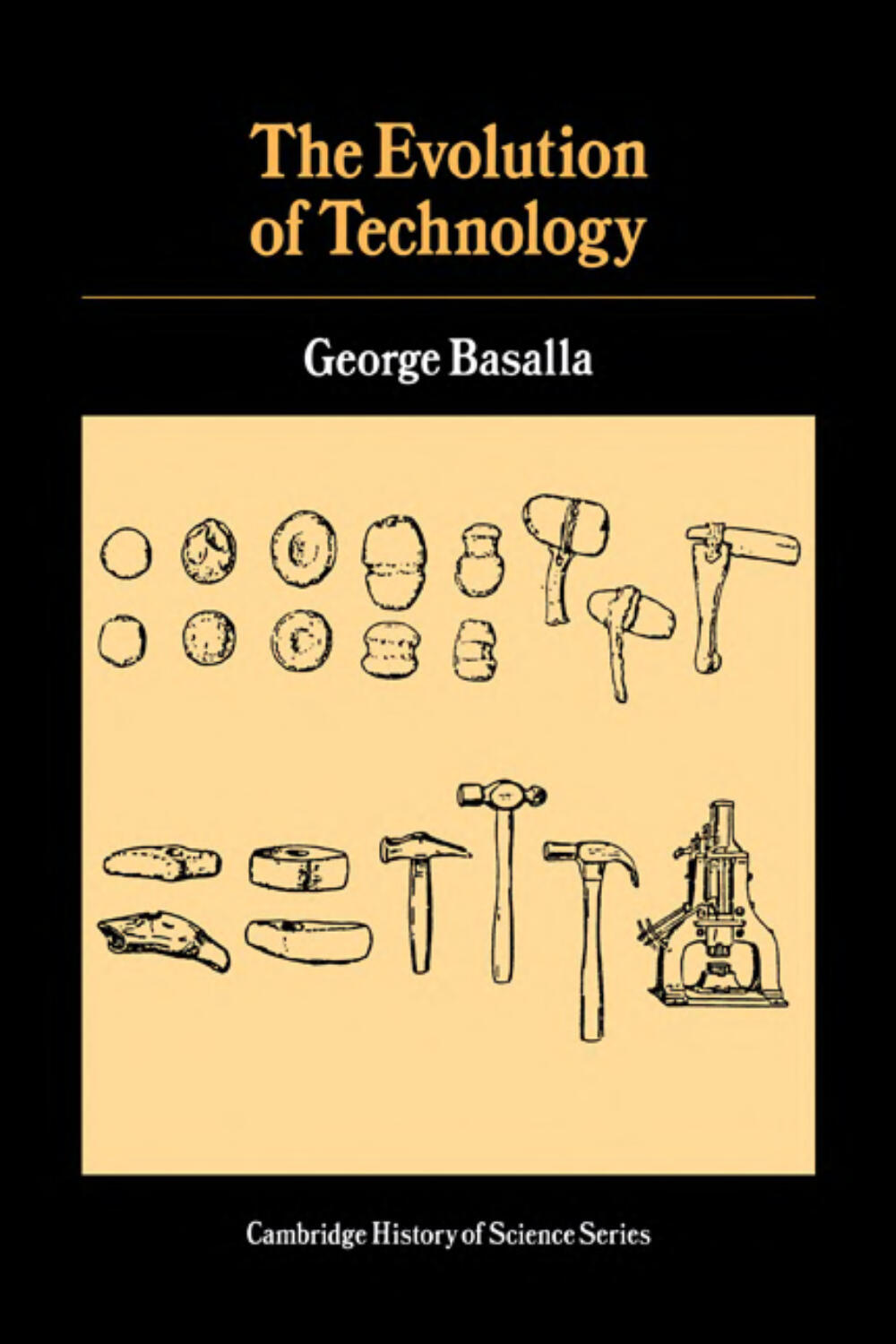
                    The Evolution of Technology

CAMBRIDGE HISTORY OF SCIENCE
Editors
GEORGE BASALLA
University of Delaware
WILLIAM COLEMAN
University of Wisconsin
Physical Science in the Middle Ages
EDWARD GRANT
Man and Nature in the Renaissance
ALLEN G. DEBUS
The Construction of Modern Science:
Mechanisms and Mechanics
RICHARD S. WESTFALL
Science and the Enlightenment
THOMAS L. HANKINS
Biology in the Nineteenth Century:
Problems of Form, Function, and Transformation
WILLIAM COLEMAN
Energy, Force, and Matter: The Conceptual Development of
Nineteenth-Century Physics
P. M. HARMAN
Life Science in the Twentienth Century
GARLAND E. ALLEN
The Evolution of Technology
GEORGE BASALLA

The Evolution
of Technology
GEORGE BASALLA
Department of History, University of Delaware
CAMBRIDGE
UNIVERSITY PRESS

For My Father
CAMBRIDGE UNIVERSITY PRESS
Cambridge, New York, Melbourne, Madrid, Cape Town, Singapore, Sao Paulo, Delhi
Cambridge University Press
The Edinburgh Building, Cambridge CB2 8RU, UK
Published in the United States of America by Cambridge University Press, New York
www. Cambridge. org
Information on this title: www.cambridge.org/9780521228558
© Cambridge University Press 1988
This publication is in copyright. Subject to statutory exception
and to the provisions of relevant collective licensing agreements,
no reproduction of any part may take place without the written
permission of Cambridge University Press.
First published 1988
Reprinted 1989, 1990 (twice), 1993, 1995, 1996, 1997, 1999
A catalogue record for this publication is available from the British Library
ISBN 978-0-521-22855-8 hardback
ISBN 978-0-521-29681-6 paperback
Transferred to digital printing 2009
Cambridge University Press has no responsibility for the persistence or
accuracy of URLs for external or third-party Internet websites referred to in
this publication, and does not guarantee that any content on such websites is,
or will remain, accurate or appropriate. Information regarding prices, travel
timetables and other factual information given in this work are correct at
the time of first printing but Cambridge University Press does not guarantee
the accuracy of such information thereafter.

Contents
I
II
III
IV
V
VI
VII
Preface
Diversity, Necessity, and Evolution
Continuity and Discontinuity
Novelty (1): Psychological and Intellectual Factors
Novelty (2): Socioeconomic and Cultural Factors
Selection (1): Economic and Military Factors
Selection (2): Social and Cultural Factors
Conclusion: Evolution and Progress
Bibliography
Sources of Quotations
Index
page vii
1
26
64
103
135
169
207
219
241
245

Preface
This book presents a theory of technological evolution based on
recent scholarship in the history of technology and relevant material
drawn from economic history and anthropology. The organization
and content of its chapters are determined by the nature of the
evolutionary analogy and not by the need to provide a chronological
account of events in the history of technology. However, because
this study is primarily historical, not an exercise in the philosophy
or sociology of technology, historical examples are used throughout
to elucidate and support the theoretical framework. Major
developments in the history of technology, such as the invention of the
steam engine or the advent of the electrical lighting system, are
introduced simultaneously with the unfolding of an evolutionary
explanation of technological change.
The opening chapter announces three themes that reappear, with
variations, in later sections of the work: diversity — an
acknowledgment of the vast number of different kinds of artifacts, or made
things, that have long been available; necessity — the belief that
humans are driven to invent artifacts to meet basic biological needs;
and technological evolution — an organic analogy that explains both the
appearance and the selection of these novel artifacts. A close
examination of these themes reveals that diversity is a fact of material
culture, necessity is a popular but erroneous explanation of diversity,
and technological evolution is a way of accounting for diversity
without recourse to the idea of biological necessity.
The formal presentation of the theory of technological evolution
begins in the second chapter, where it is established that an artifact
is the fundamental unit for the study of technology, and that
continuity prevails throughout the made world. The existence of
continuity implies that novel artifacts can only arise from antecedent
vn

viii PREFACE
artifacts — that new kinds of made things are never pure creations
of theory, ingenuity, or fancy.
If technology is to evolve, then novelty must appear in the midst
of the continuous. Chapters III and IV survey the varied sources of
novelty — the human imagination, socioeconomic and cultural forces,
the diffusion of technology, the advancement of science — in
primitive cultures as well as in modern industrialized nations. The
conclusion drawn from this survey is that any society, at any time,
commands more potential for technological innovation than it can
ever hope to exploit.
Because only a small fraction of novel technological possibilities
are sufficiently developed to become part of the material life of a
people, selection must be made from among competing novel
artifacts. Ultimately, the selection is made in accordance with the
values and perceived needs of society and in harmony with its current
understanding of "the good life." The selection process, and the
forces that drive it, are covered in chapters V and VI.
In concluding, chapter VII addresses the issue of technological
progress and human betterment. The traditional conception of
progress is found to be internally flawed and incompatible with
technological evolution. However, progress can be redefined so that it no
longer conflicts with an evolutionary perspective.
Because a book of this breadth could not be written without the
rich scholarly resources produced by historians of technology in the
past several decades, I wish to acknowledge my debt to the authors
listed in the bibliography. Specifically, I have made extensive use
of the ideas and insights of George Kubler and Nathan Rosenberg.
I owe a special obligation to two close friends: William Coleman,
my fellow editor for the Cambridge History of Science Series, who
guided me in handling the evolutionary analogy; and Eugene S.
Ferguson, my colleague at the University of Delaware, who
counseled me on every aspect of the book. It is no exaggeration to say
that this volume could not have taken its final form without their
help.
Finally, I want to thank Catherine E. Hutchins of the Winterthur
Portfolio for editing the text, Marie B. Perrone for typing the
manuscript, Kenneth Marchionno for preparing the illustrations, and my
wife and family for their long and consistent support.

CHAPTER I
Diversity, Necessity, and Evolution
Diversity
The rich and bewildering diversity of life forms inhabiting the earth
has intrigued humankind for centuries. Why should living things
appear as paramecia and hummingbirds, as sequoia trees and giraffes?
For many centuries the answer to this question was provided by the
creationists. They claimed that the diversity of life was a result and
expression of God's bountiful nature: In the fullness of his power
and love he chose to create the wonderful variety of living things
we encounter on our planet.
By the middle of the nineteenth century, and especially after the
publication of Charles Darwin's Origin of Species in 1859, the religious
explanation of diversity was challenged by a scientific one. According
to this new interpretation, both the diversification of life at any
given moment and the emergence of novel living forms throughout
time were the result of an evolutionary process. In support of
Darwin's theories, biologists have proceeded to identify and name more
than 1.5 million species of flora and fauna and have accounted for
this diversity by means of reproductive variability and natural
selection.
Another example of diversity of forms on this earth, however,
has been often overlooked or too readily taken for granted — the
diversity of things made by human hands. To this category belongs
"the vast universe of objects used by humankind to cope with the
physical world, to facilitate social intercourse, to delight our fancy,
and to create symbols of meaning."1
Because distinct species cannot be identified with any precision
among items of human manufacture, obtaining an accurate count
of the different kinds of made things is difficult. A very rough
1

2 THE EVOLUTION OF TECHNOLOGY
approximation of that figure can be reached by using the number
of patents granted as an indicator of the diversity of the made world.
In the United States alone more than 4.7 million patents have been
issued since 1790. If each of these patents is counted as the equivalent
of an organic species, then the technological can be said to have a
diversity three times greater than the organic. Although faulty at
several points, this attempt at measuring comparative diversification
suggests that the diversity of the technological realm approaches
that of the organic realm.
The variety of made things is every bit as astonishing as that of
living things. Consider the range that extends from stone tools to
microchips, from waterwheels to spacecraft, from thumbtacks to
skyscrapers. In 1867 Karl Marx was surprised to learn, as well he
might have been, that five hundred different kinds of hammers were
produced in Birmingham, England, each one adapted to a specific
function in industry or the crafts (Figure 1.1). What forces led to
the proliferation of so many variations of this ancient and common
tool? Or more generally, why are there so many different kinds of
things?
Our attempts to understand diversification in the made world,
or even to appreciate its richness, have been hampered by the
assumption that the things we make are merely so many instruments
enabling us to cope with the natural environment and maintain the
necessities of life. Traditional wisdom about the nature of technology
has customarily stressed the importance of necessity and utility.
Again and again we have been told that technologists through the
ages provide humans with the utilitarian objects and structures
necessary for survival.
Because necessity and utility alone cannot account for the variety
and novelty of the artifacts fashioned by humankind, we must seek
other explanations, especially ones that can incorporate the most
general assumptions about the meaning and goals of life. This search
can be facilitated by applying the theory of organic evolution to the
technological world.
The history of technology, a discipline that focuses on the
invention, production, and uses of material artifacts, benefits from
the application of an evolutionary analogy as an explanatory device.
A theory that explains the diversity of the organic realm can help
us account for the variety of made things. This venture does have
its pitfalls, however, as poet e. e. cummings warned, "A world of
made is not a world of born."2
The evolutionary metaphor must be approached with caution
because there are vast differences between the world of the made

DIVERSITY, NECESSITY, AND EVOLUTION 3
and the world of the born. One is the result of purposeful human
activity, the other the outcome of a random natural process. One
produces a sterile physical object, the other a living being capable
of reproducing itself. Emphatically, I do not propose the
establishment of a one-to-one correspondence between these markedly
different domains. In the narrative and analysis that follow, I employ
the evolutionary metaphor or analogy selectively, with the
expectation that this metaphor will give us insights otherwise unavailable
to the history of technology.
The nature of metaphor and its role in this book need additional
clarification. Metaphors are not ornaments arbitrarily superimposed
on discourse for poetic purposes. Metaphors or analogies are at the
heart of all extended analytical and critical thought. Without
metaphors literature would be barren, science and philosophy would
scarcely exist, and history would be reduced to a chronicle of events.
Historians have long relied on metaphors in interpreting the
past, especially organic metaphors invoking birth, growth,
development, maturity, health, disease, senescence, and death. For
the past century or so, those who specialize in the history of
science and technology have routinely drawn upon a powerful
political metaphor, that of revolution, to explain happenings in
those areas. Thus, in suggesting that evolutionary theory be
employed in understanding technological change, I am not
introducing metaphor into a field that had never known the concept
before; however, I am introducing a new metaphor and urging
that its wider implications be considered seriously.
I ask that readers grant me the same indulgence they have
extended to those who write about scientific and industrial revolutions.
Just as historians of science and technology are not held responsible
for all points of similarity between political revolt and radical
scientific, technological, and industrial change, so I should not be
taken to task if I do not draw parallels between every feature of the
made and living worlds.
In one respect my use of metaphor differs from that of most
historians: They utilize metaphors implicitly and often
unconsciously; in this book I make explicit and conscious use of mine.
Although our choice of, and approach to, metaphors may differ, we
share the same aim — to make sense of the past.
Necessity
A well-known Aesop's fable is particularly relevant to the discussion
of technology, diversity, and necessity. Once upon a time, wrote

4 THE EVOLUTION OF TECHNOLOGY
Figure 1.1. Artifactual diversity as reflected in the forms of hammers used by English
country craftsmen. I: A,B,C,D,E, — Stone mason's hammers used to break, cut,
square, and dress stone; F,G - Carpenter's hammer with strengthened head; H -
Curved hammer head, used to protect wood's surface when driving a nail; J -
General woodworking hammer; K - Straight-peen blacksmith's hammer; L - Ball-
peen, a general metalworking hammer; M - Chair-maker's hammer; N - Horse-

DIVERSITY, NECESSITY, AND EVOLUTION 5
shoeing hammer (two views). II: A - Head of claw hammer used to withdraw
nails; B - Slater's pick hammer; C - Lath hatchet; D - Cooper's nailing adze, used
on barrel hoops; E - Butter firkin, used to open and close butter casks; F -
Combination cheese-taster and hammer; G - Saw-sharpening and saw-setting
hammer; H - Upholsterer's or saddler's hammer; J,K - Shoemaker's hammers. Source:
Percy W. Blandford, Country craft tools (Newton Abbot, 1974), pp. 49, 55-

6 THE EVOLUTION OF TECHNOLOGY
Aesop, a crow about to die of thirst came upon a tall pitcher partially
filled with water. He tried again and again to drink from it, stooping
and straining his neck, but his short beak could not reach the surface
of the water. When he failed in an attempt to overturn the heavy
vessel, the bird despaired of ever quenching his thirst. Then he had
a bright idea. Seeing loose pebbles nearby, the crow began dropping
them into the pitcher. As the stones displaced the water, its level
rose. Soon the crow was able to drink his fill. The moral: necessity
is the mother of invention. Modern commentators have elaborated
on this message by praising those individuals who, when placed in
seemingly impossible situations, do not despair but instead use wit
and ingenuity to invent new devices and machines that solve the
dilemma, meet basic biological needs, and contribute to material
progress.
The belief that necessity spurs on inventive effort is one that has
been constantly invoked to account for the greatest part of
technological activity. Humans have a need for water, so they dig wells,
dam rivers and streams, and develop hydraulic technology. They
need shelter and defense, so they build houses, forts, cities, and
military machines. They need food, so they domesticate plants and
animals. They need to move through the environment with ease,
so they invent ships, chariots, carts, carriages, bicycles, automobiles,
airplanes, and spacecraft. In each of these instances humans, like
the crow in Aesop's story, use technology to satisfy a pressing and
immediate need.
If technology exists primarily to supply humanity with its most
basic needs, then we must determine precisely what those needs are
and how complex a technology is required to meet them. Any
complexity that goes beyond the strict fulfillment of needs could be
judged superfluous and must be explained on grounds other than
necessity.
In surveying the needs and techniques essential to human beings
a modern commentator might ask: Do we need automobiles? We
are often told that automobiles are absolutely essential, yet the
automobile is barely a century old. Men and women managed to
live full and happy lives before Nikolaus A. Otto devised his four-
stroke internal combustion engine in 1876.
A search for the origins of the gasoline-engine-powered motorcar
reveals that it was not necessity that inspired its inventors to
complete their task. The automobile was not developed in response to
some grave international horse crisis or horse shortage. National
leaders, influential thinkers, and editorial writers were not calling for
the replacement of the horse, nor were ordinary citizens anxiously

DIVERSITY, NECESSITY, AND EVOLUTION 7
hoping that some inventors would soon fill a serious societal and
personal need for motor transportation. In fact, during the first
decade of existence, 1895—1905, the automobile was a toy, a
plaything for those who could afford to buy one.
The motor truck was accepted even more slowly than the
automobile. The success of military truck transportation during World
War I combined with an intensive lobbying effort by truck
manufacturers and the Army after the war finally resulted in the
displacement of the horse-drawn wagon and, at a later date, the railroad.
But the motor truck was not created to overcome obvious deficiencies
of horse- and steam-powered hauling. As was the case with
automobiles, the need for trucks arose after, not before, they were
invented. In other words, the invention of vehicles powered by
internal combustion engines gave birth to the necessity of motor
transportation.
Because motor cars and trucks appeared at the end of a century
filled with intense technological activity, they might be considered
poor examples on which to base an argument. Perhaps if an earlier
invention was identified, one that did not coincide with widespread,
deliberate technological innovation and its accompanying belief in
material progress, the necessity that brought it forth could be
isolated more easily. The wheel holds promise of being just such an
invention.
The Wheel
Popularly perceived as one of the oldest and most important
inventions in the history of the human race, the wheel is invariably listed
with fire as the greatest technical achievement of the Stone Age. In
comic strips and cartoons, stone wheels and fire are portrayed as
joint creations of prehistoric cave dwellers. This familiar portrayal,
which first appeared in the late nineteenth century, is currently
exemplified by the B.C. comic strip.
Those who have a better knowledge of the early history of human
culture know that the origins of fire and the wheel do not date to
the same time period. Fire has been in use for at least 1.5 million
years, whereas the wheel is more than 5,000 years old. Even at this
level of historical understanding, however, there is a tendency to
pair the two items, placing them in a special category above and
beyond all other human accomplishments. For example, when
distinguished economic historian David S. Landes assessed the
significance of the mechanical clock recently he conceded that it was "not

8 THE EVOLUTION OF TECHNOLOGY
in a class with fire and the wheel" and hence deserved a lower
ranking.
Whatever the degree of historical sophistication, most people
believe that the use of wheeled transportation is a signal of
civilization. The two are thought to be so closely linked that the progress
made by cultures has been judged by measuring the extent to which
they have exploited rotary motion for transportation. By that
standard, to be without the wheel altogether is sufficient to set a culture
apart from the civilized world.
In searching for the origins of this wonderful invention, there is
no need to explore nature's realm. With the exception of a few
microorganisms, no animal propels itself by means of a set of organic
wheels spinning freely on axles. The source of the wheel must be
sought among made things.
Before the coming of the wheel, large heavy objects were moved
on sledges — wooden platforms with or without runners. Cylindrical
rollers (smoothed logs) placed beneath the vehicle were used to
facilitate the movement of the sledges, and it is thought that these
rollers inspired the invention of the wheel.
Whatever the inspiration, wheels made their initial appearance
in the fourth millennium B.C. across a broad area extending from
the Tigris to the Rhine rivers. Current archaeological findings
indicate that wheeled vehicles were invented in Mesopotamia and from
there diffused to northwest Europe within a very short time. The
first wheels were either solid wooden disks cut from a single plank
or tripartite models consisting of three wooden slabs trimmed to
shape and fastened together with cleats.
A strict reading of the archaeological record suggests that the first
wheeled vehicles were used for ritualistic and ceremonial purposes.
The earliest illustrations show them being used to carry effigies of
deities or important persons. The oldest remains of wheeled
conveyances are found in tombs; such vehicles, interred with the
deceased as part of a religious burial ceremony, have been uncovered
at various sites in the Near East and Europe.
Vehicles buried with the dead were often of the type used on the
battlefield. Thus the ritualistic and ceremonial uses of the wheel
were closely related to its employment in war. Military requirements
exerted a powerful influence upon the subsequent development of
wheeled vehicles. For example, pictorial and physical evidence
supports the idea that the four-wheeled "battle wagon" and the two-
wheeled "straddle car" (a chariotlike vehicle) of Mesopotamia were
used early as moving platforms from which javelins could be hurled.
The innovative spoked wheel, which demanded a high level of
craftsmanship, was first utilized on war chariots in the second millennium

DIVERSITY, NECESSITY, AND EVOLUTION 9
B.C. to create light and fast-moving vehicles that could be
maneuvered easily during battle.
In addition to ritualistic and military uses, the wheel was also
used in transporting goods. Although this third function is not
directly recorded in the earliest archaeological evidence, we assume
that wheeled vehicles could be, and were, used for more mundane
purposes at an early date. Documentary evidence of wagons
transporting farm goods such as hay, onions, reeds dates from 2375 to
2000 B.C., about a thousand years after the wheel's initial
appearance. However, this time lag may simply reflect the ritualistic,
ceremonial, and military nature of much of our arachaeological
evidence. Despite the lack of strong proof for the transport function
of wheeled vehicles in earliest times, it can be argued that the
utilitarian aspect of the wheel was primary and that the necessity
of transporting farm goods was the source of the invention of the
wagon and cart.
Our discussion of the wheel and its uses has been confined to a
relatively small geographical area. The story of the wheel in the rest
of the world remains to be told. Wheeled vehicles appeared in India
in the third and in Egypt and China in the second millennium B.C.
As for Southeast Asia, Africa south of the Sahara, Australasia,
Polynesia, and North and South America, people in those vast regions
managed to survive, and in many cases prosper, without the help
of the wheel. Not until modern times was rotary motion for
transportation purposes introduced into these lands.
Especially interesting is the case of Mesoamerica (roughly Mexico
and Central America). Although wheeled transport was unknown
there prior to the arrival of the Spanish, Mesoamericans did make
miniature wheeled objects. From the fourth to the fifteenth centuries
A.D., clay figurines of various animals were fitted with axles and
wheels to make them mobile (Figure 1.2). Whether these figurines
were toys or cult or votive objects is unknown; however, irrespective
of their purpose, they show that the mechanical principle of the
wheel was thoroughly understood and applied by people who never
put it into use for transporting goods.
How are we to explain this failure to exploit an invention
commonly held to be one of the two greatest technical achievements of
all time? If we assume we are dealing with a people whose intellectual
development was so stunted that they were unable to make practical
use of the wheel, how can we account for the fact that they were
capable of independently inventing the wheel in the first place? And
how do we explain the flowering of the Aztec and Maya cultures with
their many accomplishments in the arts and sciences?
The answer to these questions is simple. Mesoamericans did not

10 THE EVOLUTION OF TECHNOLOGY
Figure 1.2. Wheeled clay figurine made by the Aztecs (Mexico). Animal figurines
employing the principle of the wheel and axle are found throughout Mesoamerica.
They date from ca.A.D. 300 to the coming of the Spanish in the sixteenth century,
a period when there was no wheeled transportation in the region. Source: Stuart
Piggott, The earliest wheeled transport {Ithaca, N.Y., 1983), p. 15. Neg. no. 326744;
courtesy Department of Library Services, American Museum of Natural History.
use wheeled vehicles because it was not feasible to do so given the
topographical features of their land and the animal power available
to them. Wheeled transport depends on adequate roads, a difficult
requirement in a region noted for its dense jungles and rugged
landscape. Large draft animals capable of pulling heavy wooden
vehicles, were also needed, but Mesoamericans had no domesticated
animals that could be put to that use. Men and women of Mexico
and Central America traveled along trails and over rough terrain
carrying loads on their backs. It was unnecessary to build roads for
these human carriers of goods.
An even more persuasive case can be made against the universal
superiority and applicability of the wheel by returning to its place
of origin in the Near East. Between the third and seventh centuries
A.D., the civilizations of the Near East and North Africa gave up
wheeled vehicular transportation and adopted a more efficient and
speedier way of moving goods and people: They replaced the wagon
and cart with the camel. This deliberate rejection of the wheel in

DIVERSITY, NECESSITY, AND EVOLUTION 11
the very region of its invention lasted for more than one thousand
years. It came to an end only when major European powers,
advancing their imperialistic schemes for the Near East, reintroduced
the wheel.
The camel as a pack animal was favored over wheeled
transportation for reasons that become evident when the camel is compared
with the typical ox-drawn vehicle. The camel can carry more, move
faster, and travel farther, on less food and water, than an ox. Pack
camels need neither roads nor bridges, they can traverse rough
ground and ford rivers and streams, and their full strength is devoted
to carrying a load and not wasted on dragging a wagon's deadweight.
Once the camel and ox are compared, one wonders why the wheel
was ever adopted in that region in the first place. A large share of
the burden of goods in the Near East was always carried by pack
animals. A bias for the wheel led Western scholars to underrate the
utility of pack animals and overemphasize the contribution made
by wheeled vehicles in the years before the camel replaced the wheel.
The more we learn about the wheel, the clearer it becomes that
its history and influence have been distorted by the extraordinary
attention paid to it in Europe and the United States. The Western
judgment that the wheel is a universal need (as crucial to life as fire)
is of recent origin. Fire, not the wheel, was the precious gift
Prometheus stole from the gods and bestowed upon humanity.
Similarly, fire, and not the wheel, was traditionally portrayed as the
great civilizing agent in the literary and visual arts of Western
culture. Not until the late nineteenth and early twentieth centuries
did popular writers on technology elevate the wheel to the premier
place it holds today.
This history of the wheel began as a search for a significant
technological advancement that was produced in response to a
universal human need. It has ended with the wheel seen as a culture-
bound invention whose meaning and impact have been exaggerated
in the West. Although this review is not meant to detract from the
real importance of the wheel in modern technology, it does raise
serious doubts about using it as a criterion to evaluate other cultures.
By putting wheeled transport into a broader cultural,
historical, and geographical perspective, three important points emerge:
First, wheeled vehicles were not necessarily invented to facilitate the
movement of goods; second, Western civilization is a wheel-
centered civilization that has carried rotary motion in transportation
to a high state of development; and, third, the wheel is not a
unique mechanical contrivance necessary, or useful, to all people
at all times.

12 THE EVOLUTION OF TECHNOLOGY
Fundamental Needs
The pursuit of need and invention has revealed that necessity is a
relative term. A necessity for one people, generation, or social class
may have no utilitarian value or may be a superficial luxury for
another people, generation, or social class. At the same time that
Europeans were energetically advancing wheeled transportation,
Near Easterners were abandoning their experiment with the wheel,
and Mesoamericans were adapting rotary motion to clay figurines.
The story of the comparative reception and use of the wheel could
be repeated for the other so-called necessities of modern life. Far
from fulfilling universal needs, they derive their importance within
a specific cultural context or value system.
This arouses the suspicion that it might be possible to strip away
the false necessities, the trivial ones to which we have merely become
accustomed, to reveal a core of fundamental needs applicable to
humans living in any age and place. These universal needs would
provide a firm ground on which to base an understanding of culture,
including technology.
According to functionalist anthropologists and sociobiologists,
every aspect of culture, material and nonmaterial, can be traced
directly to the satisfaction of a basic need. In their view culture is
nothing more than humanity's response to the fulfillment of its
nutritive, reproductive, defensive, and hygienic needs. Critics of
the biological theory, however, have proposed a number of strong
counterarguments. Some have noted that phenomena central to
culture, such as art, religion, and science, have very tenuous connections
to human survival. Likewise, agriculture and architecture, which
supposedly can be linked to the need for nutrition and shelter,
manifest themselves in ways only remotely explicable by biological
necessity. Modern agribusiness, for example, is motivated by much
more than the concern for providing nourishment to humanity; a
skyscraper is not simply a structure to protect people from the
vagaries of the weather.
Some scholars argue that language is the most important feature
of culture and that language, not biology, determines our definition
of what we consider to be necessary or utilitarian. In their estimation,
necessity is not something imposed by nature upon humanity but
is a conceptual category created by cultural choice. Both sets of
critics acknowledge external material constraints on culture;
however, those constraints are seen as remote and of minor importance
when compared with the immense range of cultural possibilities
open to humankind. Biological necessity operates negatively and at
extreme limits. It decrees what is impossible, not what is possible.

DIVERSITY, NECESSITY, AND EVOLUTION 13
Another critical approach to theories of culture based on
preexisting fundamental needs evaluates the role of technology in the
animal kingdom. Its proponents conclude that no technology
whatsoever is required to meet animal needs. Proof of this assertion is
found by observing the animal realm where the necessities of life
are procured without the intervention of technology. Unlike the
crow in Aesop's fable, birds in real life do not obtain water by
resorting to elaborate technological stratagems. Birds and other
animals do not dig wells or construct canals, aqueducts, and pipelines.
Nature provides water, food, and shelter to them directly without
any intervening made structures. Of course, some animals use sticks,
stones, and leaves as crude tools for gathering food and as weapons
for defending themselves, but animal tool behavior is so rudimentary
and limited that it can scarcely be compared with the technology
of the simplest of human cultures. There are no fire-using animals
nor are there animals that routinely fashion new tools, improve upon
old tool designs, use tools to make other tools, or pass on
accumulated technical knowledge to offspring.
Given these facts, it is misleading to connect animal tool use to
human technology by means of a smooth curve of transition. Even
the earliest and crudest tools produced by humans imply considerable
foresight and a level of mentality that sets them apart from the most
sophisticated tools made by animals. As Karl Marx pointed out, the
worst human architect is superior to the best insect nest or hive
builder because only humans are able to envision structures in their
imagination before erecting them.
Animals exist and thrive without fire or the simplest shaped stone
utensils. Insofar as we are animals, on the zoological plane of
existence, we too could live without them. Of course, without
technology we could neither occupy nor visit many regions of the earth
we now inhabit. Nor could we do most of the things we do in our
everyday lives. But we could survive, and survival is what we have
in mind when we ask how elementary a level of technology is required
to meet our basic needs.
Because technology is not necessary in meeting the animal needs
of humans, philosopher Jose Ortega y Gasset defines technology as
the production of the superfluous. He remarks that technology was
just as superfluous in the remote Stone Age as it is today. Like the
rest of the animal kingdom we, too, could have lived without fire
and tools. For reasons that are obscure, we began to cultivate
technology and in the process created what has come to be known as
human life, the good life, or well-being. The struggle for well-
being certainly entails the idea of needs but those needs are constantly
changing. At one time need prompted the building of pyramids

14 THE EVOLUTION OF TECHNOLOGY
and temples, at another time it inspired movement about the earth's
surface in self-propelled vehicles, journeys to the moon, and the
incineration and irradiation of entire cities.
We cultivate technology to meet our perceived needs, not a set
of universal ones legislated by nature. According to French
philosopher Gaston Bachelard the conquest of the superfluous gives us a
greater spiritual stimulus than the conquest of the necessary because
humans are creations of desire, not need.
A perceived need often coincides with an animal need, like the
requirement for nourishment. Nevertheless, we must not lose sight
of the fact that humans have now chosen an excessively complex,
technological means of satisfying basic necessities. Instead of relying
on nature directly for sustenance, we have devised the wholly
unnecessary techniques of agriculture and cooking. They are
unnecessary because plants and animals are able to grow and even thrive
without human intervention, and because food need not be processed
by fire before it is fit for human consumption. Agriculture and
cooking are not prerequisites for human survival; they only become
necessary when we choose to define our well-being as including
them.
Humans have a different relationship with the natural world than
do animals. Nature simply and directly sustains animal life. For
humans, nature serves as a source of materials and forces that can
be utilized in pursuit of what they choose to call for the moment
their well-being.
Because the resources of nature are varied, and because human
values and tastes differ from culture to culture, from time to time,
and from person to person, we should not be surprised to find a
tremendous diversity in the products of technology. The artifacts
that constitute the made world are not a series of narrow solutions
to problems generated in satisfying basic needs but are material
manifestations of the various ways men and women throughout time
have chosen to define and pursue existence. Seen in this light, the
history of technology is a part of the much broader history of human
aspirations, and the plethora of made things are a product of human
minds replete with fantasies, longings, wants, and desires. The
artifactual world would exhibit far less diversity if it operated
primarily under the constraints imposed by fundamental needs.
Organic—Mechanical Analogies
Explaining artifactual diversity by means of a theory of technological
evolution requires that we compare living organisms and mechanical

DIVERSITY, NECESSITY, AND EVOLUTION 15
devices. Such analogical thinking is a modern phenomenon with
few precedents in antiquity. Aristotle, who wrote extensively on
biological matters, made little use of mechanical analogies in his
explication of the organic world. Not until the Renaissance did
European thinkers begin to draw parallels between the organic and
the mechanical. This association of what had hitherto been thought
to be disparate elements was the result of the appearance of a host
of new technological contrivances and the emergence of modern
science.
Initially the flow of organic—mechanical analogies moved from
technology to biology. Structures and processes in living organisms were
described and explained in mechanical terms. In the middle of the
nineteenth century there occurred a movement of metaphors in the
opposite direction. The counterflow of metaphor was of critical
importance; for the first time the development of technology was
interpreted through organic analogies.
Widespread industrial growth, the geologist's ability to establish
the antiquity of the earth, and the appearance of the Darwinian
theory of evolution facilitated the application of organic analogies
to the technological realm. This new mode of metaphorization had
its most notable and lasting affects upon literature and anthropology.
The literary uses of the organic—mechanical metaphor can be
conveniently studied in the writings of Samuel Butler, the
anthropological in the work of General Augustus Henry Pitt-Rivers (original
surname Lane-Fox). Both of these men lived in mid-Victorian
England and both were deeply influenced by Charles Darwin's Origin of
Species.
In his Utopian novel Erewhon (1872) and essays such as "Darwin
Among the Machines" (1863) Samuel Butler whimsically explored
the idea that machines developed in a fashion remarkably similar to
the evolution of living beings. His ideas inspired the popular
evolutionary fantasy novels of nineteenth- and twentieth-century science
fiction in which rapidly evolving machines surpass and supplant
humans whose own evolutionary development has stagnated.
Butler's influence is also evident in modern speculative essays that predict
either the coming of a new symbiotic relationship between humans
and machines or the supersession of humankind by new forms of
technology that are capable of self-replication, such as robots and
computers.
Victorians proud of their industrial accomplishments were warned
by Butler that it was to their advantage to pause and contemplate
the wider implications of technological change. Machines, he said,
have undergone a series of very rapid transformations from the simple

16 THE EVOLUTION OF TECHNOLOGY
stick wielded by our early ancestors to the steam engine of today.
This development in the direction of greater complexity raises the
possibility of the addition of a mechanical kingdom, comprised of
all forms of mechanical life, to the existing plant and animal
kingdoms.
Identifying machines as a new class of living beings would allow
Victorians to arrange them into genera, species, and varieties,
suggested Butler, and proceed from this classificatory exercise to the
construction of an evolutionary tree illustrating the connections
between the various forms of mechanical life. Darwin's theory,
therefore, is perfectly compatible with the mechanical kingdom. The
history of technology is rilled with examples of machines slowly
changing over time and replacing older models, of vestigial
structures remaining as parts of mechanisms long after they had lost their
original functions, and of machines engaged in a struggle for
survival, albeit with the help of humans. The animal or plant breeder
who practices artificial selection by choosing certain specimens for
propagation is doing precisely what the machine builder and the
industrialist do with mechanical life when they plan a new
technological venture.
To skeptics who objected that machines cannot be said to live
and evolve because they are incapable of reproducing themselves,
Butler responded that in the mechanical kingdom reproduction is
accomplished in a different fashion. The propagation of mechanical
life depends on a group of fertile contrivances, called machine tools,
that are able to produce a wide variety of sterile machines.
A more pressing issue than reproduction, cautioned Butler, is the
nature of the future relationships of humanity and the machine.
Because machines are more powerful, accurate, dependable, and
versatile than humans, and because machines are changing rapidly
before our eyes, humans cannot help but fall back to second place
in a world dominated by technology. Of course, we could try to
put a stop to mechanical evolution but that would mean the
destruction of every machine and tool, every lever and screw, every
piece of shaped material. Because we cannot halt mechanical
progress, we must resign ourselves, advised Butler, to assuming the
status of servants to our superiors.
Butler's evolutionary speculations, presented in a literary tour de
force, enabled him to display his wit and ingenuity, his ambiguous
response to advances in technology and science, and his criticisms
of popular theological and philosophical propositions. Pitt-Rivers,
a career military officer who later devoted his life to ethnology and
archaeology, approached technological evolution in an entirely dif-

DIVERSITY, NECESSITY, AND EVOLUTION 17
ferent manner. His acceptance of the evolutionism of Darwin and
Herbert Spencer grew out of his military experience and a desire to
catalog, classify, and display his personal collection of primitive
weapons and tools.
Assigned to test new rifles for the British army and prepare an
instruction manual for their use in 1852, Pitt-Rivers became
interested in the history of firearms. Through his research, he became
aware of the gradual and progressive modification in firearm design
that had resulted in the creation of ever more powerful and accurate
rifles. At about the same time he began assembling a prehistoric
artifact collection and investigating relics being unearthed in the
British Isles and northern Europe. His contact with these diverse
artifacts prompted him to consider the best way to organize them
for study and eventual display. Should they be arranged
geographically according to their place of origin or was there some more
fruitful scheme of classification?
Natural history offered one mode for a classificatory system — the
Linnaean ordering of the vegetable and animal kingdoms into genera,
species, and varieties. In this system, form was more significant
than geography. Because Darwin had shown that taxonomic studies
could be made to yield great and fundamental truths about the
nature of living things, Pitt-Rivers resolved to ignore the
geographical, temporal, and cultural dimensions of artifacts, follow the lead
of natural history, and arrange his collection in a series of sequences
composed of closely related forms.
Spencer's assertion that the entire history of life was marked by
a development from the simple to the complex, the homogeneous
to the heterogeneous, inspired Pitt-Rivers to make these the guiding
principles in his arrangement of artifacts. He placed them in
sequences that began with the very simplest tool, weapon, or utensil
and progressed step by small step to the most complex one. This
method was more than a convenient way to impose order on the
varied products of material culture. Because every artifact was
thought to have originated as an idea in the mind of its original
maker the sequences bound together the material and intellectual
aspects of life. The progressive, continuous series of related artifacts
served as proof of the evolution of human culture from its primitive
condition to the highest states of civilization.
Pitt-Rivers confined his collecting and classifying labors to pre-
industrial artifacts, and deliberately avoided the difficulty of dealing
with the more complex and sophisticated products of Victorian
technology. His focus on the primitive stemmed from a belief that
the study of the simplest artifacts would reveal the thought processes

18 THE EVOLUTION OF TECHNOLOGY
of prehistoric men and women and clearly demonstrate the
progressive nature of material culture. But, modern critics will interject,
the primitive cannot be equated with the prehistoric: We have no
right to suppose that the culture of modern Australian aborigines
bears any resemblance to Paleolithic culture. Pitt-Rivers and other
nineteenth-century evolutionary anthropologists would reply that at
any time in history the many societies scattered across the earth
reflect the different evolutionary stages through which all human
culture has passed. They believed that each culture followed a single,
broad course of evolutionary change with only minor deviations. If
Australian aborigines used stone tools, then they were at precisely
the same stage of cultural development that Paleolithic man had
reached hundreds of thousands of years earlier.
Given these assumptions about cultural evolution and artifacts,
Pitt-Rivers was not particularly interested in garnering rare or exotic
specimens for his collection. Nor was he concerned with accurately
dating his artifacts and placing them within a specific cultural
context. Instead he searched for forms that filled in the gaps of existing
sequences or that could be used to initiate new sequences (Figure
1.3 and 1.4). The overriding criterion in every case was how well a
specimen fit in between two others in a sequence — that is, how
much it contributed to the establishment of a continuous transition.
In the organic as well as in the technological realms, gaps in a
sequence represented missing links that could be filled eventually.
If it appeared that there were more artifactual than organic missing
links, it was because the collection and classification of plants and
animals had been going on for centuries whereas the organization
and analysis of made things had barely begun.
Pitt-Rivers was careful not to overstate the case for technological
evolution or to draw far-fetched analogies between living organisms
and material objects. For example, he felt it was permissible to
justify his interest in weaponry and the origins of warfare by linking
them to the Darwinian struggle for existence. But humans use
weapons in their struggle; the weapons themselves do not fight for
survival. Nor are weapons or other artifacts capable of reproduction.
Anticipating these objections, Pitt-Rivers introduced the idea of
unconscious selection. Through the ages, without premeditation or
design, humans had selected the artifacts best suited for certain
tasks, rejected those less suited, and gradually modified the surviving
artifacts so that they performed their assigned functions better. As
a result, artifactual change was directed along a progressive path
even though artisans were totally unaware of the long-range
implications of the slight improvements they had introduced. In meeting

DIVERSITY, NECESSITY, AND EVOLUTION 19
Figure 1.3. The evolution of Australian aboriginal weapons. War clubs,
boomerangs, lances, throwing sticks, and shields were arranged by Pitt-Rivers so that
they would appear as evolutionary sequences radiating out from the simple stick
at the center. These are not historical sequences; all of the weapons displayed were
in use in modern times. Pitt-Rivers assumed that the simpler artifacts, those located
closer to the center, were "survivals" of earlier forms. Source: A. Lane-Fox Pitt-
Rivers, The evolution of culture (Oxford, 1906), pi. Ill; reprinted by AMS Press,
Inc., New York.

20 THE EVOLUTION OF TECHNOLOGY
Figure 1.4. The evolutionary history of the hammer, from the first crudely shaped
pounding stone (1) to James Nasmyth's gigantic steam hammer of 1842 (14). This
evolutionary sequence of a familiar hand tool was prepared by the staff of the U.S.
National Museum to "indicate how the mind of man has arrived at certain datum
points which mark epochs in progress." Following the example set by Pitt-Rivers
(Fig. 1.3), the "specimens are arranged in the order of their grade of development
irrespective of race, place, or time." Source: Walter Hough, "Synoptic Series of
Objects in the United States National Museum Illustrating the History of
Inventions," Proceedings of the United States National Museum 60 (Washington, D.C.,
1922), art. 9, p. 2, pi. 16.
an immediate need, they had inadvertently helped to promote
technical progress.
For a modern observer to dismiss Pitt-Rivers's ideas as an over-
enthusiastic and uncritical application of Darwinism to material
culture is all too easy. We must remember that he witnessed at first
hand the immense success of Darwin's theory in biology and that
he was personally acquainted with some of the master's friends. That
he might want to make his contribution to the spread of evolutionary
doctrine is understandable. On the other hand, twentieth-century
anthropologists and historians have rejected the belief that unilinear
technological progress is a hallmark of human culture, and they
have demonstrated the fallacy of supposing that the cultures of
prehistoric and living primitive peoples are virtually identical. These
modern criticisms, which seriously challenge key elements of Pitt-

DIVERSITY, NECESSITY, AND EVOLUTION 21
Rivers's theories, have been widely publicized. Less well known are
the original and enduring aspects of Pitt-Rivers's approach.
At a time when material culture studies were largely descriptive,
if not outright antiquarian, Pitt-Rivers offered a theoretical basis
for the integration of intellectual and technological achievements.
An artifact was more than an inert object hastily fashioned to meet
a need. It was a surviving remnant of the human mind that conceived
it. Contrary to many of his contemporaries, Pitt-Rivers believed
that technological change was not accomplished by a series of great,
unrelated leaps forward by a few heroic inventors. Instead, the form
of a modified artifact was based on that of a preexisting predecessor.
From this followed the insight that every made thing could be placed
within a sequence, which itself was interconnected to other
sequences, and that, if we followed these backward in time, they would
converge, leading us to the traces of the earliest human artifacts.
Cumulative Change
Butler and Pitt-Rivers were by no means representative of the
prevailing view of the nature of technological change. The evolutionary,
or continuous, explanation that they adopted was much less widely
accepted than the revolutionary, or discontinuous, interpretation.
According to the latter, inventions emerge in a fully developed state
from the minds of gifted inventors. In this heroic theory of invention,
small improvements in technology are ignored or discounted and
all emphasis is placed upon the identification of major breakthroughs
by specific individuals — for example, the steam engine by James
Watt, or the cotton gin by Eli Whitney.
Not long after Darwin published Origin of Species, Karl Marx, a
great admirer of the English naturalist, called for a critical history
of technology written along evolutionary lines. He believed such a
history would reveal how little the Industrial Revolution owed to
the work of individual inventors. Invention is a social process, argued
Marx, that rests on the accumulation of many minor improvements,
not the heroic efforts of a few geniuses.
In the first half of the twentieth century, the heroic view of
invention was challenged by three American scholars — William F.
Ogburn, S. C. Gilfillan, and Abbott Payson Usher — who advanced
theories of technological change that drew upon Darwinism.
Ogburn, a sociologist and the most influential of the three, began by
defining invention as combining existing and known elements of
culture in order to form a new element. The outcome of this process

22 THE EVOLUTION OF TECHNOLOGY
is a series of small changes, most of them patentable, but none of
them constituting a sharp break with past material culture.
Ogburn claimed that a fixed percentage of individuals with
superior inventive ability can be found among all peoples. As the
population grows in any country, the number of potential inventors
increases proportionally. If these inventors happen to be born into
a culture that provides technical training and places a premium on
novelty, then inventions are bound to appear in quantity. Initially,
the pace of innovation is slow as a stockpile of inventions is
established. The subsequent accumulation of novelties stimulates
innovation because the number of elements available for combination
has grown. Soon the accumulated novelties reach a critical point
and a chain reaction takes place greatly accelerating the rate of
inventive activity.
Ogburn made no attempt to test his highly abstract theory by
determining if it was in agreement with a sizable body of empirical
evidence. In contrast, his fellow sociologist S. C. Gilfillan, in the
1930s, wrote companion volumes on invention — the first offering
a sociology of invention, the second a detailed study that focused
on the evolution of the ship from its origin as a floating log to the
modern diesel-engine motorship.
Gilfillan was adamantly opposed to any theory of technological
change that assigned inventions to what he called "titular inventors,"
those whose names were enshrined in the popular mythology of
invention. Adhering to the Darwinian model, he wrote of the
"undivided continuum of inventional reality" and blamed language,
custom, and social conventions for breaking down the continuum
into a series of discrete, identifiable inventions.
The test of Gilfillan's theory is found in his second volume.
According to him, the ship began as a hollowed-out log that was
paddled by hand. When the earliest sailors stood up in their dugout
canoes and found that the wind blowing against their garments
increased the speed of their vessels, the sail was invented.
Reconstructing the entire history of sailing ships from that point, using
an evolutionary perspective, is relatively easy. Only the steam-
powered craft seemingly disrupts the continuous flow. Gilfillan
overcame this obstacle by placing the origin of the steamship in the
Byzantine Empire. A war vessel moved by paddle wheels powered
by three pair of oxen appears in an illustration from the early sixth
century A.D. Paddle-wheel boats using ox or horse power thereafter
evolved in a regular fashion. In the eighteenth century Europeans
and Americans substituted steam for animal power to turn the paddle
wheels. The issue was not the steam engine versus the sail, but the

DIVERSITY, NECESSITY, AND EVOLUTION 23
use of a steam engine versus oxen and horses to power a paddle-
wheel boat.
Gilfillan concedes that there may be a dozen or so maritime
inventions that could be termed abrupt in that they had no known
or obvious predecessor. The ancient oxen-driven paddle-wheel boat
is one such anomaly. Given that the development of the ship
necessitated the accumulation of hundreds of thousands of minor
inventions, Gilfillan is not troubled by the few innovations that appear
to contradict his evolutionary stand. He maintains that the anomalies
can be explained if we recognize that the cumulative process did
not always take place in public, with the building of full-scale
vessels. Gradual improvements may have been made in a series of
rough sketches, formal drawings, or models before the results were
tried in a full-size working ship. In this fashion abrupt inventions
in the evolution of the ship can be dispensed with and Gilfillan's
continuous curve of change reinstated.
Economic historian Abbott P. Usher, however, found the theories
of invention put forth by Ogburn and Gilfillan excessively
mechanistic. Inventors were depicted as mere instruments in a rigidly
predetermined historical process. By emphasizing the social character
of invention, and calling attention to the cumulative effects of small
improvements, the two had ignored the importance of the individual
inventor's efforts and insights. They would have us believe, Usher
argued, that when the critical number of novel elements is reached
the invention will appear automatically, with only a little help from
an inventor.
Therefore, Usher proposed the cumulative synthesis approach to
invention, an approach that modified the continuous explanation and
enriched it with the findings of Gestalt psychology. Usher's theory
contained four premises.
1. Perception of the problem - an incomplete or unsatisfactory pattern in need of
resolution is recognized.
2. Setting the stage - data related to the problem is assembled.
3. Act of insight - a solution to the problem is found by a mental act that is not
predetermined. This act goes beyond the act of skill normally expected of a
trained professional.
4. Critical revision — the solution is fully explored and revised (with possible
refinements made because of new acts of insight).
Central to Usher's thesis are the acts of insight that essentially
solve the problem. These acts are as important to major, or strategic,
inventions as they are to minor ones. The cumulative synthesis of
lesser individual inventions eventually produces the strategic
inventions better known to history. Yet the process is neither automatic

24 THE EVOLUTION OF TECHNOLOGY
nor predetermined. Sheer numbers of inventions do not guarantee
that a major technological change will occur. The key is always the
inventor's act of insight by which certain elements are chosen,
combined in innovative ways, and made to yield a solution.
The acts of insight might be probed by psychologists, but they
are, for the most part, inexplicable. They introduce the role of the
mental faculties to the process of invention and by their presence
indicate precisely at what point economic forces can be brought to
bear. When the stage is being set (step 2) and the solution critically
revised (step 4), economic intervention is likely to be effective. The
acts of insight (step 3), on the other hand, are unresponsive to
economic influence. They belong to the psychological, not the
economic, realm.
Even though Usher came to study the inventive process as an
economic historian, his theory transcended a strict economic or social
explanation. By stressing the psychological aspects of invention, he
served notice that the emergence of novelty must be dealt with in
a broader context. Economists and economic historians who currently
study invention do not follow Usher's lead on the importance of the
acts of insight. Many of them do, however, accept his Darwinian-
inspired idea that technical progress is the result of cumulative
change.
A Modern Theory of Technological Evolution
My survey of past attempts to explain technological change by use
of an evolutionary model has laid the groundwork for a consideration
of the theory I will develop in this book. The study of Butler and
Pitt-Rivers revealed that artifacts, like plant- and animal-life forms,
can be arranged in continuous, chronological sequences. However,
a modern theory of technological evolution cannot be built on an
evocation of Darwinism for the purposes of literary and social satire
(Butler), or on hypothetical chains of related primitive weapons (Pitt-
Rivers). It is likewise unsatisfactory to limit the choice of illustrative
examples to a single field of technology (Gilfillan), or to pursue a
highly theoretical approach and ignore the technical details of ar-
tifactual change (Ogburn). Therefore, my theory will be supported
throughout by detailed case studies of artifacts chosen from diverse
technologies, cultures, and historical eras.
Butler, Pitt-Rivers, Gilfillan, Ogburn, and Usher all stressed the
accumulation over time of small variations that finally yielded novel
artifacts. Usher, by introducing "acts of insight" into the inventive
process, drew attention to the role of individual creativity but he

DIVERSITY, NECESSITY, AND EVOLUTION 25
remained convinced that major inventions resulted from the
cumulative synthesis of a series of minor ones. In the cumulative theory
of invention change is slow and inevitable, and there is little room
for the bold innovations of gifted individuals. My theory of
technological evolution recognizes the larger changes, often associated
with name inventors, as well as smaller changes made over a long
duration. Hence, I accept periods of rapid technological change and
times of relative stability.
Anyone advocating the continuous nature of technological change
must acknowledge, and account for, the popularity of the opposing
discontinuous view. There are many people who believe that
technology advances by leaps from one great invention to another as the
genius inventor creates a host of wonderful inventions through sheer
mental effort. I reveal the sources of this belief by examining the
relevant ideas and institutions of Western civilization that fostered
its origin and growth.
Finally, my theory of technological evolution, unlike any of its
predecessors, is rooted in four broad concepts: diversity, continuity,
novelty, and selection. As I have already shown, the made world
contains a far greater variety of things than are required to meet
fundamental human needs. This diversity can be explained as the
result of technological evolution because artifactual continuity exists;
novelty is an integral part of the made world; and a selection process
operates to choose novel artifacts for replication and addition to the
stock of made things. The remainder of this book will be devoted
to a thorough analysis of the theoretical and artifactual ramifications
of these four concepts.

CHAPTER II
Continuity and Discontinuity
Introduction
A large segment of the modern public believes that technological
change is discontinuous and depends on the heroic labors of
individual geniuses, such as Eli Whitney, Thomas A. Edison, Henry
Ford, and Wilbur and Orville Wright, who single-handedly invent
the unique machines and devices that constitute modern technology.
According to this view inventions are the products of superior
persons who owe little or nothing to the past.
The smaller scholarly community that concerns itself with issues
in the history of technology and science rejects this explanation as
simplistic because it reduces complex technological developments
to a series of great inventions that precipitately burst upon the scene.
However, some historians have offered more sophisticated
formulations of the discontinuous explanation that do not rely upon the
contributions of heroic inventors. Such theorists take their cue from
the supposed revolutionary nature of scientific change.
Science, Technology, and Revolution
Recent scholarship in the history and philosophy of science has
tended to favor the discrete character of scientific change. This
outlook derives ultimately from the study of the emergence of
modern science in the sixteenth and seventeenth centuries. Since the
French Revolution, the work of Copernicus, Galileo, Kepler, and
Newton has been described by the term revolution, a political
metaphor that implies a violent break with the past and the
establishment of a new order.
The political metaphor was applied not only to the arrival of a
26

CONTINUITY AND DISCONTINUITY 27
new way of studying nature but also to any substantial change within
a science. Hence, reference is made to the astronomical,
chemical and biological revolutions of the past; to revolutions initiated
byHarvey, Bacon, Darwin, Mendel, or Einstein; or to twentieth-
century revolutions in quantum physics, astrophysics, and molecular
biology.
Scientific revolutions take on a special importance for the study
of technological change when technology is placed in a subordinate
position to science. This situation usually occurs when technology
is erroneously defined as the application of scientific theory to the
solution of practical problems. For, if technology is nothing more
than another name for applied science, and if science changes by
revolutionary means, then technological change too must be
discontinuous.
Of course, science and technology have interacted at many points,
and key modern artifacts could not have been produced without the
theoretical understanding of natural materials and forces provided
by science. Nevertheless, technology is not the servant of science.
Technology is as old as humankind. It existed long before
scientists began gathering the knowledge that could be used in shaping
and controlling nature. Stone-tool manufacture, one of the earliest
known technologies, flourished for over two million years before the
advent of mineralogy or geology. The makers of stone knives and
axes were successful because experience had taught them that certain
materials and techniques yielded acceptable results, whereas others
did not. When a transition was made from stone to metal (the
earliest evidence for metal working has been dated ca. 6000 B.C.),
the early metal workers, in a similar fashion, followed empirically
derived recipes that gave them the copper or bronze they sought.
Not until the late eighteenth century was it possible to explain
simple metallurgical processes in chemical terms, and even now
there remain procedures in modern metal production whose exact
chemical basis is unknown.
In addition to being older than science, technology, unaided by
science, is capable of creating elaborate structures and devices. How
else can we account for the monumental architecture of antiquity
or the cathedrals and mechanical technology (windmills, water-
wheels, clocks) of the Middle Ages? How else can we explain the
many brilliant achievements of ancient Chinese technology?
The arrival of modern science did not put an end to endeavors
that were primarily technological; people continued to produce
technological triumphs that did not draw upon theoretical knowledge.
Many of the machines invented during Great Britain's Industrial

28 THE EVOLUTION OF TECHNOLOGY
Revolution had little to do with the science of the day. The textile
industry, at the heart of eighteenth-century economic growth, was
not the result of the application of scientific theory. The inventions
of John Kay, Richard Arkwright, James Hargreaves, and Samuel
Crompton, which were crucial to increased textile production, owed
more to past craft practices than they did to science.
Only during the latter half of the nineteenth century did science
begin to have a substantial influence on industry. Developments in
organic chemistry made possible the establishment of large-scale
synthetic dye production, and the study of the nature of electricity
and magnetism laid the foundations for the electrical light, power,
and transport industries. The twentieth century witnessed the
further expansion of science-based technologies. Despite the influx of
new scientific theories and data, modern technology involves far
more than the routine application of the discoveries made by
scientists. In modern industry science and technology are equal
partners, each making its unique contributions to the success of the
enterprise in which they are engaged. Even today, however, it is by
no means exceptional for an engineer to devise a technological
solution that defies current scientific understanding or for engineering
activity to open up new avenues for scientific research.
The issue of discontinuous change within technology was revived
by Edward W. Constant in The Origins of the Turbojet Revolution
(1980). Drawing upon Thomas S. Kuhn's The Structure of Scientific
Revolutions (1962), Constant argues that a discontinuity existed
between turbojet engines, the major aircraft power source since World
War II, and the older propeller-piston engines (Figure II. 1). The
turbojet, which has neither piston, nor cylinder, nor propeller, was
not the evolutionary outcome of the continuous improvement of the
propeller-piston engine.
Constant believes that the turbojet revolution deserves its name
because the turbojet is a holistic system that has technological
antecedents but differs from them radically; the design of the turbojet,
and its incorporation into aircraft, called for the application of
advanced scientific theories in aerodynamics; and the turbojet was
created by a small group of men who were not part of the
conventional aeroengine community. Of all of these factors, Constant
stresses the importance of the emergence of a new community of
technological practitioners associated with the turbojet. This new
community was identical with neither the conventional aeroengine
community nor the older community of steam- and water-turbine
technologists. In Constant's terms, technological revolution becomes
"the professional commitment of either a newly emerging
community or redefined community to a new technological tradition."1

CONTINUITY AND DISCONTINUITY 29
Reaction
propulsion
Scientific
study of
heat
+
Thermodynamics
~Jr^'~ \
.^--
>
r
Steam engine
«J Newcomen &
before
1
J Watt engine
T
■1 Steam
Turbine
—>X
r
Internal combustion
gas turbine
*
,*
Hydraulics &
+
Hydrodynamics
/
1
1
1
1
t
-■«—.
Water
wheels
"— T
Aerodynamics
Water
turbine
Turbine
pumps
Figure II. 1. E. W. Constant's diagram illustrating the relationship between artifact
and theory in the lineage of the turbojet engine. The main artifactual stream,
depicted in the center, moves from steam engines, to steam and internal combustion
gas turbines, to the turbojet. On the far right water turbines and turbine pumps
are linked to this main stream, and in the columns immediately adjoining the
center the influence of relevant physical theories is indicated. Remember that these
theoretical contributions manifest themselves in the form of some novel tangible
thing whose antecedents predate the theory. Despite the existence of this artifactual
network, Constant remained convinced that the turbojet was a revolutionary advance
and not an evolutionary one. Source: Edward W. Constant II, The origins of the
turbojet revolution (Baltimore, 1980), p. 4.
Two crucial assumptions underlie Constant's explanation: that
technology is primarily knowledge; and that the community of
technological practitioners is the fundamental unit to be studied
in technological change. These assumptions deserve exploration.
Despite its seemingly revolutionary character the turbojet engine
was not a machine without antecedents. The turbojet belongs to
the two-hundred-year-old tradition of turbine development that
encompasses water turbines, turbine water pumps, steam turbines,
internal combustion gas turbines, piston engine superchargers, and
turbosuperchargers. None of these has pistons and cylinders but they
all have a turbine wheel with fins or buckets that, when acted upon
by water, steam, or hot gases cause the wheel to rotate rapidly.
Therefore, at the level of the artifact, two centuries of continuity
has prevailed in the family of turbines, whatever their varied uses
or energy sources.

30 THE EVOLUTION OF TECHNOLOGY
The artifact — not scientific knowledge, nor the technical
community, nor social and economic factors — is central to technology
and technological change. Although science and technology both
involve cognitive processes, their end results are not the same. The
final product of innovative scientific activity is most likely a written
statement, the scientific paper, announcing an experimental finding
or a new theoretical position. By contrast, the final product of
innovative technological activity is typically an addition to the made
world: a stone hammer, a clock, an electric motor.
Historian Brooke Hindle has claimed that the artifact in
technology occupies a position superior to that held by artifacts in
science, religion, politics, or any of the intellectual or social pursuits.
At every point technology is intimately involved with the physical,
with the material; artifacts are both the means and the ends of
technology. The three-dimensional physical object is as much an
expression of technology as a painting or a piece of sculpture is an
expression of the visual arts. The artifact is a product of the human
intellect and imagination and, as with any work of art, can never
be adequately replaced by a verbal description.
The centrality of the artifact for an understanding of technology
is a key element of the evolutionary theory being developed here.
In this chapter, as well as the rest of the book, the artifact is the
primary unit for study. Artifacts are as important to technological
evolution as plants and animals are to organic evolution.
Case Studies in Continuity
Given the primacy of the artifact in the study of technology, the
continuous nature of technological change can best be established
by using case studies to show precisely how key artifacts — such as
the steam engine, the cotton gin, or the transistor - emerged in an
evolutionary fashion from their antecedents. The following examples
of artifactual change illustrate the evolutionary hypothesis despite
the fact that initially they appear to be excellent candidates for use
in supporting the contrary discontinuous explanation.
Stone Tools
The oldest surviving made things are stone tools. They stand at the
beginning of the interconnected, branching, continuous series of
artifacts shaped by deliberate human effort. Individual branches
of the series may have stopped at cul-de-sacs but the wider stream
of made things has never been broken. The modern technological

CONTINUITY AND DISCONTINUITY 31
world in all of its complexity is merely the latest manifestation of
a continuum that extends back to the dawn of humankind and to
the first shaped artifacts. Stone implements may not offer a crucial
test for the evolutionary thesis, but they provide the best illustration
of continuity operating over an extended period of time.
For at least two million years men and women in all parts of the
earth made stone tools, hundreds of billions of them. These tools
constitute the most ancient, widespread, and numerous artifacts in
existence today. For most of the time tools were made by chipping
and flaking techniques that when carried out by skilled workers,
yielded a serviceable instrument within a relatively short time — a
matter of minutes or hours. Axes, adzes, hammers, knives, and
scrapers of all sorts were produced by these means. The Neolithic
period, which began some eight thousand years ago, witnessed the
introduction of agriculture, domestication of animals, and pottery,
as well as polished stone tools made by the laborious process of
pecking and grinding the stone to the desired shape and finish.
Grinding, especially, required days or weeks of work; however, it
resulted in tools well suited for prolonged hammering and chopping.
Whatever the technique employed, the form of stone tools
changed very slowly over the long period of their use. Since the
mid-nineteenth century, a number of archaeologists have patiently
and ingeniously identified and dated implements that, to untrained
eyes, seemed to be similar in shape, size, and material. Once this
archaeological evidence was reassembled in chronological order, its
most striking feature was the perfect continuity that was maintained
for hundreds of thousands of years as wave after wave of different
human cultures engaged in stone-tool making.
In the study of stone tools we search in vain for discontinuous
jumps to wholly new forms. The long-lasting shapes of these artifacts
even persisted as people made the radical shift from stone to copper
and bronze. Traditionally, stone has been associated with primitiv-
ism, metal with civilization. As a material for making tools, stone
does have weaknesses. Although it is easily obtained and worked,
stone is less durable than metal and less readily shaped. The form
of a stone tool is more closely determined by the nature of its material
than is the form of a metal tool. The latter can be cast into almost
any shape called for by the task at hand. The metal tool is less
brittle, therefore, less likely to break. If it does break or show wear,
it can be melted down and recast.
Someone unfamiliar with the subsequent history of tools might
conclude from this comparison that the appearance of metal ushered
in a new era in tool making. But, on the contrary, continuity

32 THE EVOLUTION OF TECHNOLOGY
prevailed. The earliest metal tools had as their closest antecedents
stone prototypes. Eventually new metal tools did emerge, but the
weight of the tradition of stone technology exerted a long-lasting
influence on the shape of these tools. That influence is evident in the
form of familiar modern tools, such as the axe, hammer, and saw,
and is also apparent in electric and pneumatic tools, which preserve
the principles and movements of early stone implements.
This example of continuity is dramatic yet it is open to criticism.
Someone could argue that these stone tools owe their remarkable
stability to the fact that at an early stage in their evolution they
acquired the best possible form for the function they were to perform
and hence did not change. Even if this were not true, one could
make a case for excluding stone tools from this list of illustrative
case studies on the basis that they represent an anomaly because they
are so ancient and simple. For critics who would take exception to
stone tools, I will present more persuasive tests of continuity in
technology that utilize relatively complex machines, created by
famous inventors in modern times, rather than artifacts fashioned
anonymously in the prehistoric era.
The Cotton Gin
An investigation into the continuous development of a complex
machine can profitably begin with Eli Whitney's cotton gin.
Although many authors have written about Whitney and his
revolutionary invention, far fewer have ventured to place his cotton gin
within a continuous stream of artifacts.
According to the popular histories of invention, Whitney, a young
New Englander with great mechanical talents, first encountered
cotton and its processing problems while on a trip to a Georgia
plantation in 1793. The source of the problems, short staple or
Inland cotton, could be grown in most of the South but its fibers
clung tightly to its green seed making it difficult to clean. A slave
spent at least three hours cleaning one pound of cotton by tedious
hand labor. Shortly after his arrival in Georgia, Whitney began
working on a means to speed up the process. Having observed slaves
manually separating fiber from seed, he visualized a machine that
could duplicate the motions of their hands. Within a few days he
had built a model of the gin that was to change cotton growing in
the South forever.
Only the more scholarly studies of Whitney mention the fact that
mechanical cotton gins were already in wide use in the South at the
time of Whitney's visit. Such engines were capable of cleaning the

CONTINUITY AND DISCONTINUITY 33
long staple, or Sea Island, cotton, a plant with a limited growing
range but with a fiber easily removed from its black seed. Because
of the existence of these gins, it was unnecessary for the inventor
to bridge the great gulf between the organic — fingers tugging to
free stubborn fibers from seed — and the mechanical. That step had
been accomplished much earlier in India where the first cotton cloth
was produced centuries before the Christian era.
The Indian gin or charka, based on the roller principle, was itself
a variant of a still older sugar cane press. The charka consists of a
pair of long wooden cylinders set in a frame, pressed together, and
rotated about the longitudinal axis by a crank. The rotating
cylinders, which are fluted with a series of fine, lengthwise grooves,
separate seed from fiber by squeezing the cotton boll as it passes
between them.
This primitive gin was used wherever long staple cotton was
grown and processed. By the early twelfth century the machine was
known to Italian artisans as the manganello; it appeared in a Chinese
illustration of the fourteenth century; and in the eighteenth century
it was depicted in Diderot's Encyclopedic In 1725 the roller gin was
introduced into the Louisiana region from the Levant and by 1793
it was established in the cotton-growing South where Eli Whitney
met it.
Whitney's challenge was to make a gin that would clean short
staple cotton. His invention consisted of a rotating wooden cylinder
into which were set regularly spaced rows of bent wire teeth whose
shape is similar to the wire teeth used in various wool-carding
devices. The teeth in Whitney's gin passed through a slotted metal
breastwork with openings just wide enough to admit them and
cotton fiber but not the cotton seed. Thus the seeds were trapped
beneath the breastwork while the fibers were pulled upward and
free. The cleaned cotton was then brushed from the teeth by
the second rotating cylinder, which had rows of bristles. Like the
centuries-old roller gin, Whitney's gin relied on a set of rotating
cylinders. Unlike the older gin, Whitney's had a slotted plate
(breastwork) to immobilize the seeds while they were being stripped
of fiber.
This excursion into ancient cotton processing technology is not
meant to prove that inventions are inevitable, or that the modern
cotton gin was first constructed by some Indian artisans, or that Eli
Whitney was less clever than we have been led to suppose. Whitney's
gin cleaned short staple cotton, something the ancient roller gins
could not do. Acknowledging the charka, however, shows that Eli
Whitney's invention had artifactual antecedents whose overall struc-

34 THE EVOLUTION OF TECHNOLOGY
ture and mechanical elements were adapted by the American inventor
to suit his purposes (Figure II.2).
Not everyone who looked at the old roller gins visualized how to
transform them into a machine capable of handling short staple
cotton; some individuals had attempted to adapt the charka to
processing Inland cotton before Whitney traveled South, but none met
with success. Whitney's invention not only succeeded where others
had failed but also served as the point of origin for an entirely new
set of artifacts — a series of modern cotton gins. This new evolutionary
series began almost immediately after Whitney's model was put to
work. The widespread use of the Whitney-inspired gins owed as
much to his inventive genius as it did to environmental, social,
economic, and political conditions that favored the cultivation of
cotton in America and elsewhere.
Several lessons can be drawn from the Whitney story. The obvious
one is that Whitney's invention of the cotton gin was part of the
evolutionary development of technology. Less obvious is the
realization that all variants of an artifact are not of equal importance.
Some are simply inoperable; some are ineffective; and some are
effective but have little technological and social influence. Only a few
variants have the potential to start a new branching series that will
greatly enrich the stream of made things, have an impact on human
life, and become known as "great inventions" or "turning points in
the history of technology."
Recognition of the significance of Whitney's cotton gin depended
on the growing demand at home and abroad for cheap cotton and
the limited availability of slave and paid laborers to process the raw
material manually. In a society dominated by woolen or linen cloth,
or in one in which cheap manual labor was freely available, Whitney's
machine would not have served as the prototype for a spate of more
powerful and effective gins. In either of those alternative societies,
the cotton gin would have been a mechanical curiosity without
social, economic, or technological influence.
Thus, the significance of an invention cannot be determined solely
by its technological parameters — it cannot be evaluated as if it were
a thing unto itself. An invention is classified as "great" only if a
culture chooses to place a high value upon it. Likewise, the
reputation of its inventor is tied to cultural values. In either of the
alternative worlds just described, Whitney would not be honored
as a heroic inventor; he would be ignored or at best be looked upon
as the eccentric builder of a trivial device.

CONTINUITY AND DISCONTINUITY 35
Steam and Internal Combustion Engines
The cotton gin was the most important technological contribution
to the growth of the American South's economy between 1790 and
I860. At about the same time, the steam engine played a somewhat
comparable role in the British economy. Like the cotton gin, it,
too, has been popularly viewed as a contrivance with virtually no
history. In 1842 W. Cooke-Taylor, a commentator on the British
industrial scene remarked: "The steam engine had no precedent. . .
[it] sprang into sudden existence, like Minerva from the brain of
Jupiter."2 Or did it spring from the brain of James Watt?
Popular accounts tell us that young James Watt was inspired to
invent the steam engine as he watched steam rising from the spout
of a tea kettle (Figure II. 3). The fanciful legend is undermined by
the fact that working Newcomen steam engines existed in England
at the very moment Watt was contemplating vapors from the boiling
tea water. Some sixty years separate the appearance of Thomas New-
comen's working atmospheric steam engine in 1712 and the
completion of a successful full-sized steam engine by Watt (1775). To
complicate the matter further, Watt's version of the steam engine
grew out of his dissatisfaction with a small-scale model of a
Newcomen engine he was asked to repair.
The Newcomen engine utilizes the condensation of steam to create
a partial vacuum beneath a piston, which is then forced down by
the greater atmospheric pressure acting on its outer surface. Because
the engine was devised to pump water from mines, it took the form
of a long pivoting beam with pump rod attached to one end and a
piston rod to the other. A large piston (five to six feet in diameter)
was fitted into a cylinder that had inlets for steam and the cold
water used to condense the steam, and with an outlet for the waste
water. After the pressure of the atmosphere had pushed the piston
down to its lowest position, and lifted the pump rod to its maximum
height, the weight of the pump mechanism caused the pump end
of the beam to descend, raising the piston and making it possible
to fill the cylinder with steam again so that the cycle could be
repeated (Figure II.4). Two aspects of this engine deserve
special attention: first, the weight of the atmosphere, not the
expansive power of steam, did the work; and second, the cylinder was
alternately heated and cooled as steam and cold water were injected
into it.
In the winter of 1763/4, when Watt began his repair and study
of a model Newcomen engine, the larger versions were an established
power source in half the world. Despite its widespread use, some

36 THE EVOLUTION OF TECHNOLOGY

CONTINUITY AND DISCONTINUITY 37
of the features of the Newcomen engine troubled Watt and in
attempting to remedy them he produced a machine that supplanted
Newcomen's and prepared the way for the modern steam engine.
Watt realized that the efficiency of Newcomen's engine could be
increased if the cylinder were kept uniformly hot instead of heating
and cooling it during each cycle. This he accomplished by insulating
the cylinder and then condensing the steam in an adjoining container
that was kept constantly cool for just that purpose. In addition he
abandoned the use of atmospheric pressure and moved the piston
first in one direction and then in the opposite direction, by applying
steam first to one side and then to the other side of the piston.
Expanding steam pushing against the piston did work in a Watt
engine. Thus was born the double-acting steam engine with a
separate condenser. It first appeared in 1784 and dominated steam
engine design for the next fifty years.
In exchanging Newcomen for Watt as the inventor of the steam
engine, the issue of continuity has not been resolved; the temporal
focus of the investigation has merely been changed. The question
now becomes: Did the Newcomen engine appear on the scene
without any antecedents? Again, the answer is no. Some of the
mechanical elements that made up the Newcomen engine can be traced
back to early seventeenth-century Europe, others had their origin
in thirteenth-century China, and still others first appeared a century
or two before the birth of Christ.
Because a Newcomen engine is mechanically more complex than
a cotton gin, its antecedents are more difficult to trace in a succinct
fashion. Evacuated chambers, piston pumps, steam displacement
Figure II. 2. A. An Indian charka, or roller gin. The gin consists of two teak wood
rollers that are rotated by turning the handle on the upper left side of the machine.
When uncleaned cotton is fed between the moving rollers, the fibers pass through
to the other side of the gin while the seeds remain behind and fall to the enclosure
at the base. B. Eli Whitney's cotton gin opened for inspection. In operation the
hinged top of the gin is closed, aligning the slotted breastwork of the top portion
with the protruding wire teeth fixed to the large rotating cylinder. Rotation of
the cylinder brings the uncleaned cotton to the breastwork slots, which are too
narrow to permit passage of the seeds. Thus the seeds are torn away from the fiber
and the fiber accumulates on the toothed cylinder. Another rotating cylinder, not
shown here, is covered with bristles that brush the cleaned fiber from the large
cylinder. Both the charka and Whitney's gin rely upon two rotating cylinders
activated by a hand crank. Sources: A. Edward Baines, History of the cotton manufacture
in Great Britain (London, 1835), p. 66. B. Mitchell Wilson, American science and
invention (New York, 1954; copyright renewed © 1982 by Stella Adler, Victoria
Wilson, and Erica Spellman), p. 80.

38 THE EVOLUTION OF TECHNOLOGY
Figure II.3. Allegory on the significance of steam power, ca. 1850. The steam
escaping from the boiling tea kettle inspires James Watt to invent the steam engine
as well as envision its role in the creation of industrial civilization. This drawing
is an excellent representation of the popular view that great inventions are the
result of inspired intuitive leaps made by heroic figures. Source: Wolfgang Schivel-
busch, The railway journey (Oxford, 1980), p. 5; Picture Collection, The Branch
Libraries, The New York Public Library.

CONTINUITY AND DISCONTINUITY 39
Figure II.4. Diagram of a typical Newcomen steam engine, ca. 1715. The steam-
filled cylinder is about to be cooled by the injection of a spray of cold water into
its interior. As a result of this action, the steam in the cylinder condenses, creating
a partial vacuum. The weight of the atmosphere pressing on the piston's outer
surface then forces the piston down for the engine's power stroke. When the piston
reaches the lowest point on its path of travel, steam is injected into the cylinder
equalizing the pressure on either side of the piston. The weight of the mine pump's
mechanism then causes the beam to rotate lifting the piston to the top of the
cylinder. Note that the valves and cocks that control the entry of the steam and
cold water into the cylinder and the exit of the waste water through the eduction
pipe are all hand-operated on this machine. Source: D. B. Barton, The Cornish beam
#*£/'»<? (Bath, 1969), p. 17.

40 THE EVOLUTION OF TECHNOLOGY
devices, and mechanical linkages all have their place in the prehistory
of the steam engine. They form the "long chain of direct genetic
connections" that historian Joseph Needham mapped in an essay
entitled: "The Pre-Natal History of the Steam Engine." After
assessing the contributions made by ancient Chinese artisans,
Hellenistic mechanicians, and European natural philosophers, instrument
makers, and mechanics, Needham concluded: "No single man was
'the father of the steam engine'; no single civilization either. "3 When
scholars Maurice Daumas and Paul Gille investigated the
background of the steam engine, they concluded that the atmospheric
engine would probably have been invented in the first half of the
eighteenth century even if Newcomen had never lived.
Like Whitney's cotton gin, Watt's steam engine was a seminal
invention that spawned a manifold and divergent series of machines.
The hot air and internal combustion engine are two of the most
important power sources that have evolved from the steam engine. As
early as 1759 hot air was proposed as a substitute for steam in an
engine, but the first working model of such a device was not built until
1807. Later in the nineteenth century Robert Stirling, in England,
and John Ericsson, in America, designed hot air engines that were
sold to the public. By 1900 the hot air engine was supplanted by yet
another variant of the steam engine, one that replaced the external
combustion of the steam or hot air engine with an internal
combustion within the cylinder. In 1791 an internal combustion pumping
engine that ran on vaporized turpentine had been patented in
England; however, the world's first production model of an internal
combustion engine was designed by Belgian inventor Jean Joseph
Etienne Lenoir in 1860. The Lenoir engine, fueled by illuminating
gas, was closely patterned after a double-acting horizontal steam
engine. Just as Watt's double-acting engine admitted steam on both
sides of the piston and hence did work in both directions, Lenoir's
engine exploded a gas and air mixture at both ends of the cylinder
driving the piston forward and backward. Later improvements of the gas
engine included Nikolaus Otto's single-acting four-stroke model of
1876, which served as the prototype of the modern automobile
engine. Although the gaseous medium had been changed from steam to
hot air to exploding mixtures of fuel and air, the basic configuration of
cylinder and piston remained a constant.
The Electric Motor
Neither the cotton gin nor the engines we have considered were the
immediate result of a major breakthrough in science. Therefore, one

CONTINUITY AND DISCONTINUITY 41
might ask, does technological change occur in a different fashion
when it draws upon a recent scientific discovery? Perhaps a
revolutionary development in science evokes a similar discontinuity in
technology whenever it is applied in practice? To test this possibility,
consider the discovery of electromagnetism by Hans Christian
Oersted and its application in the earliest electric motors.
Oersted's announcement in 1820 that a current-carrying
conductor produces a magnetic effect in its immediate vicinity created
widespread interest throughout the scientific community. Startling
as Oersted's discovery was to the world of science, its technological
application followed a predictable course. The first electric motors
were modeled after two well-known devices: the magnetic compass
and the steam engine.
The Danish scientist had shown that a piece .of wire carrying an
electric current exerted a force on a compass needle causing it to
deflect. An English physicist, Michael Faraday, having learned of
this, immediately attempted to change the needle's deflection into
continuous rotation. The result was the first electric motor. Granted,
he achieved continuous rotary motion in a simple laboratory
apparatus and not in a device capable of doing useful work; nevertheless,
the principle of the modern electric motor had been elicited and
demonstrated by Faraday. The needle of Faraday's modified compass
spun continuously instead of aligning itself with the earth's magnetic
field.
In 1831, within a decade of Faraday's experiments, American
physicist Joseph Henry built an electric motor that drew upon steam
engine mechanisms. A central feature of the Newcomen and Watt
engines was a long, pivoting beam with piston connected to
one end and pump rod or flywheel to the other, and Henry's new
oscillating-beam electric motor likewise had a pivoting, elongated
electromagnet that seesawed up and down making and breaking
electric contact.
There was no electrical analogue for a cylinder and piston in
Henry's motor, but several other inventors incorporated the cylinder
and piston mechanism into their reciprocating electric motors
(Figure II. 5). Charles G. Page (1838), improving on Henry's design,
used the beam as a mechanical element and converted the
electromagnets into "cylinders" by shaping them as hollow coils of wire
into which iron core "pistons" plunged when the "cylinders" were
energized. A European inventor devised a motor with
electromagnetic "cylinders and piston," beam crank, flywheel, connecting rod,
eccentric valve gear, and slide rod and valves. With all of these
traditional steam engine mechanisms included in the motor, only

42 THE EVOLUTION OF TECHNOLOGY
A
C

CONTINUITY AND DISCONTINUITY 43
a boiler and firebox were needed to be added to make the analogy
complete.
The natural forces that were harnessed to drive the steam engine
and the electric motor were radically different ones. The scientific
theories underlying the operation of these power sources -
thermodynamics and electromagnetic theory - were worlds apart. The
technical communities, from inventors to entrepreneurs, concerned
with the development and manufacture of steam engines and electric
motors were also distinct; steam engine builders did not convert
their plants to electric motor manufacturing establishments. The
practical uses of steam engines and electric motors were often, but
not always, different. The portability of the electric motor could
not be matched by the steam engine; conversely, the steam engine
was far more powerful than was the electric motor. Finally, the
social and economic effects of the steam engine and the electric
motor were dissimilar. Even after admitting all of this, it is
abundantly evident that at the artifactual level continuity prevailed; the
design of the first electric motors owed more to preexisting artifacts
than to scientific theory. Electromagnetic theory may have placed
constraints on motor design but it did not decree that the first
electric motor must operate like a steam engine.
The Transistor
At first glance the transistor, a device said to epitomize the new
electronic age, also appears to be an ideal choice for partisans of the
Figure II.5. A. James Watt's rotative beam engine (1788). B. Joseph Henry's
beam electromagnetic motor (1831). C. A rotative beam electric motor of the early
nineteenth century. These three offer a striking illustration of the continuity that
exists between steam engines and the first electric motors. The key mechanical
element in each instance is a pivoting beam. Newcomen introduced the beam in
his reciprocating atmospheric engine to operate a mine pump (Fig. II.4); Watt
modified the beam mechanism to produce rotary motion in his rotative beam engine.
Joseph Henry's motor, with its beam seesawing as the electromagnets A and B are
alternatively attracted to C and D, recalls the reciprocating motion of the Newcomen
engine while the rotative beam electric motor, like Watt's engine of 1788,
transforms the reciprocating motion of the beam to rotary motion. The rotative beam
electric motor incorporates other elements of the steam engine — pistons, cylinders,
connecting rod, flywheel — making it a virtual electrical analogue of Watt's engine.
Sources: A. H.W. Dickinson, Matthew Boulton (Cambridge, 1937), pi. VII; B.
W. James King, The development of electrical technology in the 19th century: the
electrochemical cell and the electromagnet (Washington, D.C., 1962), p. 260; and C. Harold
I. Sharlin, The making of the electrical age (New York, 1963), p. 174.

44 THE EVOLUTION OF TECHNOLOGY
revolutionary view of technological change. The transistor was first
produced in the prestigious Bell research laboratories, its invention
necessitated original theoretical and experimental work in solid-state
physics, and its creators (John Bardeen, Walter H. Brattain, and
William Shockley) were awarded the Nobel prize in physics (1956).
These facts would suggest that the transistor emerged from path-
breaking scientific research, that it was not part of the stream of
made things.
The case for continuity seems to be further weakened by the
realization that the transistor's closest relative, in terms of its uses,
is the vacuum tube. Beyond the similar functions they serve,
transistors and electronic tubes are far too different to sustain the claim
that the former is a variant of the latter. The transistor has neither
vacuum, glass enclosure, grid, nor heated cathode. Despite this
evidence, one highly regarded history of semiconductor devices
claims that the transistor is one of the links in "a continuous chain
of new electronic devices"4 that dates to the nineteenth century.
The search for continuity in the development of the transistor
begins in the 1870s with the work of Ferdinand Braun, a German
physicist who discovered that certain crystalline substances would
conduct an electric current in one direction only. At the turn of the
century these substances were used in crystal rectifiers to detect
electromagnetic radiation. The crystal rectifiers displaced earlier
detectors of radio waves and made modern radio reception possible.
The crystal radio set, with accompanying ear phones, became the
first reliable and widely available radio receiver. Its main component
was a holder containing a semiconductor (silicon carbide, lead
sulphide, or molybdenum sulphide) and a thin, flexible piece of wire
called the "cat's whisker," both of which were elements introduced
by Braun in his experiments. By moving the cat's whisker carefully
over the crystal in a radio set, the user could locate sensitive spots
that yielded a clear signal. The drawbacks to the system were that
the proper adjustment of the cat's whisker was a matter of trial and
error and the crystal set could not amplify the incoming signal;
nevertheless, the crystal receiver used a semiconductor for
communication purposes.
The invention of the vacuum diode and vacuum triode by John
A. Fleming (1904) and Lee De Forest (1906) made the crystal set
obsolete by the 1920s. The new electronic tube, itself a by-product
of the manufacture of the incandescent filament light bulb, amplified
the incoming radio signal, making it possible to use loud speakers.
While crystal detectors were relegated to amateur radio operators
and to youthful experimenters interested in learning the basics of
radio reception, vacuum tube technology developed rapidly.

CONTINUITY AND DISCONTINUITY 45
Although toy crystal sets disappeared from the market after World
War II, developments in electronics during the years preceding the
war had revived interest in crystal detectors for military purposes.
During the 1930s it had become apparent that short radio wave
lengths eluded vacuum tubes but not crystal detectors. The advent
of radar spurred renewed interest in and research on crystals that
could detect these microwaves. Point-contact rectifiers resulted from
this research, and they were far more sophisticated than the ones
used in the old radio receivers. The crystalline material was either
germanium or silicon, and the cat's whisker probe was made of
tungsten.
The step from germanium microwave detectors to the first
germanium transistor was neither obvious nor easy. It involved the
scientific and technological labors of teams of investigators in
university and industrial laboratories across the United States. The
concentrated efforts of these investigators finally resulted in a
workable transistor in December 1947 at the Bell Laboratories. The
results were described in an announcement the following year: "In
the Transistor, two point contacts of the 'cat's whisker' or detector
type, familiar to radio amateurs, are made to the semiconductor."5
The overall design of the point-contact transistor clearly harked
back to Braun's first crystal detectors as used in radio reception. Of
course, theoretical understanding of the detector's operation had
improved enormously by 1947, as had materials research into the
kinds of crystalline substances calculated to produce a transistor
effect. In addition, the early detectors acted as rectifiers whereas the
transistors acted as amplifiers. Yet after all of these differences are
acknowledged, the continuity of the design of the artifact remains
intact.
An effective transistor could be designed differently; it need not
be of the point-contact type. In fact Shockley subsequently invented
the junction type transistor that soon replaced the original Bell
model and opened the way to modern solid-state electronics. But
the first transistor was of the point-contact variety, which
underscores our basic rule: Any new thing that appears in the made world
is based on some object already in existence.
Although crystal detectors were the main influence on the initial
design of the transistor, other forces, specifically the vacuum tube,
also helped to shape it (Figure II.6). Because the transistor was
perceived as a replacement for a triode in a circuit, and because
vacuum tube manufacturers turned to transistor production, features
peculiar to thermionic tubes were transferred to the transistor.
Consequently, the idea of the integrated circuit developed slowly.
Traditional electronic practice had stressed the wiring together of

46 THE EVOLUTION OF TECHNOLOGY
COLLECTOR
PIN
B
Figure II.6. A. Early twentieth-century crystal detector for use in radio receiver.
The metal "cat's whisker" is mounted so that it can be easily moved to touch any
portion of the surface of the crystal; the crystal is held securely in place by three
set-screws. B. Schematic drawing of a point-contact transistor (1959). In the
transistor the "cat's whisker" has evolved into the "contact wires" that touch the
surface of the germanium wafer, the crystal's equivalent, at two points. Diagram
references to "emitter" and "collector" pins are holdovers from vacuum tube
terminology and inappropriate for transistors. Sources: A. Vivian J. Phillips, Early
radio wave detectors (London, 1980), p. 207; B. John N. Shive, The properties, physics,
and design of semi-conductor devices (New York, 1959), p. 177.
distinct components on a panel, rather than the incorporation of
several components into a single manufactured unit, which is what
the integrated circuit required. Likewise, the example of vacuum
tube technology persuaded transistor manufacturers to treat
semiconductors as if they were miniature, solid-state tubes. Borrowing
from tube nomenclature and operation, the two transistor contact
points and their contiguous electrical connections were respectively
designated emitter and collector, even though neither emitting nor
collecting was taking place. Similar analogical thinking influenced
transistor manufacturers to seal their product hermetically in a glass
capsule or encase it in a metal canister.
Edison's Lighting System
Large technological systems, like the discrete artifacts we have been
considering, also exhibit continuity in change. Of interest here is

CONTINUITY AND DISCONTINUITY 47
Thomas Edison's observation that because all components of a system
must be compatible with one another then a system is like a large
machine. If a steam engine with its many different mechanisms
undergoes evolutionary change, should not a system made up of
integrated components do likewise?
In 1878 when Edison began concentrating on a project to create
an electric lighting system, there already existed two workable but
quite different lighting systems in European and American cities.
One used illuminating gas that was generated at a central gas works.
It was piped beneath the city streets to homes, stores, and hotels,
and at each of these sites tubing carried the gas to individually
controlled lighting fixtures in rooms, hallways, and the like. The
other system used an electric arc for lighting, in which illumination
was produced when two carbon rods connected in electrical circuit
were brought in close proximity. The result, an intense white light
of one thousand candlepower, was useful for lighting public places;
such as streets, factories, ballrooms, theaters, and auditoriums. The
generating plant producing the electricity for the arc lights was
located on the premises and was owned and operated by the consumer
of the light. Individual arc lights were series-connected, which
meant that they must all be switched on or off simultaneously.
Given the public uses of arc lighting, this arrangement was not
necessarily an inconvenience.
Both systems had their drawbacks. Gas lighting burned a
dangerous fuel indoors, polluting the immediate environment with the
products of its combustion, and it yielded a weak yellowish light
of sixteen candlepower (roughly equivalent to a modern twelve-watt
bulb). Arc lights flickered as their carbon rods were consumed in the
intense heat, and they too released noxious fumes. Whereas the gas
light was too weak for many purposes, the arc light was too strong
for the ordinary home or office.
These systems were in place when Edison resolved to create one
based on an electric incandescent lamp, one with a glowing filament,
that would illuminate domestic and commercial interiors. His task,
as he described it, was to subdivide the electric light system so that
it could serve private and semiprivate purposes, not just public ones.
Given his goal, one might assume that Edison would concentrate
on changes in electric arc technology; instead, he decided to produce
an electrical analogue of the gas lighting system.
Edison was well aware of the limited usefulness of arc lights for
interior illumination. In seeking a guide for his new electrical
enterprise, he chose the gas industry, which derived 90 percent of its
revenue from the lighting of interior spaces. This choice led to the

48 THE EVOLUTION OF TECHNOLOGY
establishment of the first commercial electric lighting station,
opened in 1882 by Edison at Pearl Street in New York City, and
to the imposition of a gas lighting system model on electrical
illumination systems throughout the world.
Edison's notebooks contain his earliest thoughts on the subject:
"Object, Edison to effect exact imitation of all done by gas so as to
replace lighting by gas by lighting by electricity . . . not to make a
large light or a blinding light but a small light having the mildness
of gas."6 For Edison the electric light was not simply a new kind
of lamp but a system in which the lamp was a single component to
be integrated with other components: generators, conducting
networks, meters, fixtures, switches, fuses, and lighting accessories.
Analogues of many of these components could be found in the gas
industry's successful domestic lighting system.
The hub of Edison's system was a central station, remote from
the consumers of light, that provided power to dwellings and
commercial establishments in a section of the city. Just as gas flowed
from a central facility in large pipes, or mains, Edison chose to have
electricity flow from a central generating station through copper wires.
Telephone, telegraph, arc light, and fire alarm wires were all strung
onto poles above ground, but Edison put his electric mains
underground, explaining, "Why, you don't lift water pipes and gas pipes
up on stilts."7 Yet to gain the legal right to put his mains beneath
the pavement, Edison was forced to incorporate his Edison Electric
Illuminating Company under the statutes regulating the gas industry
in New York State. Only gas companies were allowed to dig up the
streets of the city.
There were many similarities. In Edison's electric system, as in
the gas lighting system, the lights were wired so that individual
lights could be turned on or off independently of the others. Just
as gas meters were installed at each residence, Edison demanded
residential electric meters for his system. This demand was made
at a time when there was no cheap, reliable means for measuring
the amount of electricity consumed over an extended period of time.
Owner-operated arc light systems were self-contained and had not
been metered. Only gas, and in some locales water, had been metered
previously. Edison also drew comparisons between electrical and gas
pressure as he explained the resistance to flow encountered in wires
and pipes. Initially his electric light bulb was called a burner after
the gas burner, and it was designed to produce sixteen candlepower
as did a single gas burner. Most important, Edison carefully
calculated the costs involved in the construction, operation, and
maintenance of the system so that electric lighting could compete with
gas lighting.

CONTINUITY AND DISCONTINUITY 49
Alternative electric lighting schemes were proposed during the
years Edison was at work on his system, but they never advanced
beyond the theoretical stage. For example, in 1882 a well-known
English electrical engineer offered a plan for domestic lighting based
on the electric arc light model. Each home would generate its own
electricity with a dynamo driven by a gas-powered motor. Another,
more elaborate, scheme called for the installation of storage batteries
in each dwelling. A central generating station would charge the
batteries at high voltage during the day. At night the station would
supply power for street lighting while the household batteries would
provide power at low voltage for domestic illumination. Edison
rejected the battery plan for storing high voltage, likening it to a
gas system, proposed some time earlier, in which gas was pumped
at high pressure through inexpensive, small diameter pipes and
stored in a reservoir in the home where it was used at a lower pressure.
He believed that high voltage posed as many dangers for the private
home as did the storage of gas under high pressure.
Edison operated within the constraints of physical possibility as
he worked out the details of his project; however, scientific laws
alone did not dictate the overall design of his completed system. In
selecting and assembling the components of his system, Edison
constantly kept the technology and economics of gas lighting in
mind.
To modern observers Edison's system appears to be the obvious
way to do the job. The historian knows that this was not always
the case. Edison's solution was certainly not obvious to his
contemporaries who were well versed in the scientific and technical aspects
of electrical lighting. They thought, at best, that he was engaged
in a wrong-headed effort and, at worst, that he was either a fool in
pursuit of the impossible or a fraud.
It is a tribute to Edison's genius that, as he developed his
electrification scheme, he had the boldness and the imagination to draw
analogies between two such disparate technologies as illuminating
gas and electricity. That he should have felt the necessity to seek
such analogies, moreover, is additional evidence supporting the
model of continuous technological change. The Edison lighting
example has shown that each new technological system emerges from
an antecedent system, just as each new discrete artifact emerges from
antecedent artifacts.
Barbed Wire
Granted that every new artifact is based to some degree upon a
related existing artifact, we must next face the question of the origin

50 THE EVOLUTION OF TECHNOLOGY
of the first made thing. On what was it patterned? Although there
were no preexisting artifacts at that time, a host of naturfacts could
serve as models to initiate the process of technological evolution.
There were rocks, stones, pebbles, sticks, twigs, branches, leaves,
shells, bones, horns, and myriad other natural objects whose weight,
structure, texture, form, and material made them suitable as found
tools for the job at hand. This historical reconstruction is, of course,
speculative, but it is supported by evidence unearthed by
archaeologists and prehistorians who study the material culture of our most
remote ancestors. They have found naturally shaped stones that show
signs of wear indicating that they were used as tools by early hom-
inids. Continuity of form between the found tool and the deliberately
shaped tool is so strong that, in many cases, separating an artifact
from a naturfact is difficult. The point to keep in mind is that stone
tools did not appear on the scene abruptly but emerged slowly.
The transition from the first naturfacts to the first artifacts is lost
in the mists of prehistoric times. We can speculate about that process
but not document it in detail. There are, however, more recent
artifacts whose development from a naturfact can be traced. One is
an archetypical nineteenth-century American invention — barbed
wire.
With the exception of stone implements, barbed wire is the
simplest artifact to be discussed in this chapter. It consists of several
long strands of intertwined wire onto which shorter pieces are
wrapped perpendicularly at regular intervals. The exposed ends of
the shorter lengths are clipped at an angle to transform them into
sharp points or barbs. When the wire is strung on posts the barbs
project on both sides of the fence acting as a deterrent to captive
cattle who might want to roam beyond the boundaries of the property
or free-ranging livestock who try to feed on crops protected within
the fence. It is a simple, cheap, and very effective barrier.
The ease with which barbed wire can be made has led historian
of technology D. S. L. Card well to suggest that it could well have
been invented long before the third quarter of the nineteenth
century, perhaps in ancient Greece. We might question the idea of
barbed wire in classical antiquity and move the date forward to the
Renaissance when wiredrawing was first practiced on a large scale,
but even that shift would not invalidate Cardwell's contention that
such a simple artifact, crafted from twisted lengths of wire, could
have been made much earlier than it was. The invention of barbed
wire certainly did not depend on the advancement of scientific
knowledge or on the perfection of some complex and precise
technological process. Why then did it first appear in late nineteenth-
century America? Or more specifically, what were the prevailing

CONTINUITY AND DISCONTINUITY 51
conditions that led three men to invent barbed wire in DeKalb,
Illinois, in 1873?
The first settlers in America brought with them traditional
English and European ideas on how to build a fence for the enclosure
of their agricultural plots. In most cases these fences were constructed
of stone or wood, two materials readily available in the early colonies.
So long as settlement and agriculture were confined to the Atlantic
seaboard, fencing proved to be no problem, but in the nineteenth
century the nation expanded into the western prairies and plains.
Migrating farmers found that wood was scarce and expensive there
and that their crops needed protection from the cattlemen's herds
that ranged freely seeking food. Thus, fencing quickly became the
farmer's primary concern. Between 1870 and 1880 newspapers in
the region devoted more space to fencing matters than to political,
military, or economic issues.
The prohibitive costs of wooden fences slowed the westward
expansion considerably. In 1871 the U.S. Department of Agriculture
calculated that the combined total cost of fences in the country
equaled the national debt, and the annual repair bill for their
maintenance exceeded the sum of all federal, state, and local taxes.
Because of a desperate need for reasonably priced alternative fences,
several new types were tried.
One of the most successful alternatives, well known in Europe
but not widely used heretofore in America, was the hedge row. In
a region where free-ranging cattle threatened crops, the effectiveness
of hedge rows was increased when thorn-bearing plants were used
to form them. Briar, mesquite, cactus, rose, and various locusts
were grown but Osage orange appeared to be the best plant for
fencing purposes.
Osage orange, or bois d'arc as the early French traders called it,
is a rather short tree with pronounced thorns on its branches. It can
be grown as a tall shrub, and if planted close together in double
rows, and pruned to encourage growth on its lower parts, Osage
orange in three or four years becomes a "living fence" that resists
the incursion of cows, horses, and pigs. Because Osage orange was
native to eastern Texas and the southern parts of Arkansas and
Oklahoma, but could be grown in colder climates, its cuttings were
propagated in Texas and Arkansas and its seeds processed there for
shipment northward to the prairie states. During the 1860s and
1870s, Osage orange culture became a thriving, though modest,
industry. In I860 alone 10,000 bushels of seed were sent north.
This was sufficient to produce 300 million plants or about 60,000
miles of hedge.
For a time, a hedge of thorny, impenetrable Osage orange

52 THE EVOLUTION OF TECHNOLOGY
Figure II. 7. Section of a twig of Osage orange, also known as boh d'arc. The thorns
are about one-half inches long and are set about one and one-half inches apart.
Barbs on a strand of modern barbed wire are one-half inches long and are positioned
at five-inch intervals.
was thought to be the solution to the fencing problem. But
hedges, even those as tough and useful as Osage orange,
generated their own sets of difficulties. They were slow to develop,
could not be moved easily, cast shadows on adjoining crops,
usurped valuable growing space, and provided a shelter for
weeds, vermin, and insects.
Whatever its drawbacks the thorny hedge, and especially bois d'arc,
was the naturfact that served as the model for the immensely
successful barbed wire that was soon to fence the West (Figure II.7).
More than a "living fence," Osage orange is "living barbed wire."
The truth of this claim can best be appreciated by observing a branch
of Osage orange closely. The elongated sturdy thorns, all of equal
length, are attached perpendicularly to the branch at regular intervals
and encircle it uniformly in a spiral pattern. Thus, the design and
mechanical regularity of factory-made barbed wire was foreshadowed
in the natural form of a branch of Osage orange.
In addition to hedge rows, smooth wire fencing had been used
in timber-scarce areas of the West. Wire was cheap to purchase,
transport, and install; it produced no shade and harbored no pests;
and it could be easily shifted to new boundary lines. Unfortunately,
it offered little hindrance to cattle who routinely broke through it
even when multiple strands were affixed to the posts. The ultimate
fence, it seemed, would be one that combined the best features of
wire and "living" fences.

CONTINUITY AND DISCONTINUITY 53
Such a combination was apparently what Michael Kelly had in
mind in 1868 when he patented an improved type of fencing (patent
no. 74,379). "My invention," he wrote, "[imparts] to fences of wire
a character approximating to that of a thorn-hedge. I prefer to
designate the fence so produced as a thorny fence."8 Kelly used a
single strand of wire fitted with diamond-shaped, sheet metal
"thorns" at six-inch intervals. The Thorn Wire Hedge Company
was founded in 1876 to manufacture Kelly's invention but by that
time barbed wire from DeKalb, Illinois, had come to dominate the
fencing scene.
Kelly's fence was one of several dozen examples of fences armored
with spikes or barbs that had been invented, and in some cases
patented, between 1840 and 1870. None of these earlier efforts
yielded a commercial product that was used on farms prior to 1873.
Hence the honor of inventing barbed wire is reserved for the three
citizens of DeKalb who devised, produced, and sold the first
substantial quantities of barbed-wire fencing.
DeKalb, Illinois, located at the edge of the prairie, was a likely
place to find men interested in designing new fences. The farmers
and mechanics of DeKalb were well aware of the need for
inexpensive, effective fencing in the broad treeless regions of the West and
were ready to take advantage of any innovation that promised to
meet that need.
At the DeKalb County fair in 1873 Henry M. Rose exhibited a
device that could be attached to existing plain wire fences to deter
cattle from breaking through them. The attachment was a piece of
wood, one inch square and sixteen feet long, into which long brads
were driven so that their sharp points protruded along its surface
(patent no. 138,763). Rose's fence attachment caught the attention
of three men who had come to the fair: Jacob Haish, a German-
born lumberman, Isaac L. Ell wood, a hardware merchant, and Joseph
F. Glidden, a farmer. Each of them left Rose's exhibit convinced
that he could create a superior fence by making the barbs an integral
part of the fence wire. They succeeded in doing so and originated
the large-scale manufacturing of barbed wire with Glidden and
Ellwood joining forces in one factory and Haish founding a rival
establishment (Figure II.8).
In 1874 the infant barbed-wire industry produced 10,000 pounds
of the new fencing. The response to barbed wire was so favorable
that within a few years it was being shipped out of the factories in
railroad-car lots: 600,000 pounds in 1875; 12,863,000 pounds in
1877; and 80,500,000 pounds in 1880.
The DeKalb inventors were all acquainted with hedge fencing

54 THE EVOLUTION OF TECHNOLOGY
Figure II.8. Patent drawings of Joseph F. Glidden's barbed wire (1874) and Michael
Kelly's thorny fence (1868). Kelly's fencing, illustrated at the bottom, consists of
two strands of wire twisted together to form a cable on which are strung flat metal
thorns (Fig. 6). Glidden's wire, one of the most popular barbed-wire types ever
manufactured, features a two-strand twisted wire cable that incorporates coiled
wire barbs at regular intervals (Fig. III). Fig. I. shows Glidden's wire attached to
a key that can be turned to tighten the fence when it sags. Source: Henry D.
McCallum and Frances T. McCallum, The wire that fenced the West (Norman, Okla.,
1965), facing p. 81.
and Haish had a special interest in reusing bois d'arc. In 1881 he
recalled his earlier involvement with that plant:
In the late 60s and early 70s, the planting of willow slips and osage orange seed
was at a fever heat. I had received a consignment of osage orange seed from Texas,
supplying some of my customers with the same at $5.00 per pound. ... It was in
my mind [at one time] to plant osage orange seed and when of suitable growth
cut and weave it into plain wire and board fences, using the thorns as a safeguard
against the encroachment of stock.9

CONTINUITY AND DISCONTINUITY 55
Barbed wire was an extraordinary invention that revolutionized
fencing in America and other parts of the world, facilitated the
westward movement, brought the fruits of the Industrial Revolution to the
farm, and had a profound effect on the farming and cattle industries as
well as on warfare and prisons. Although simple in conception, it
appeared at a late date in the history of made things. It is a modern
example of the process by which a naturfact is transformed into an artifact
and shows that even the simplest of artifacts has an antecedent. Barbed
wire was not created by men who happened to twist and cut wire in a
peculiar fashion. It originated in a deliberate attempt to copy an
organic form that functioned effectively as a deterrent to livestock.
A Book-Writing Machine
If the artifacts of material culture emerge from other artifacts, or in
some special cases from naturfacts, from whence come the imaginary
machines we encounter in the fantastic worlds created by writers
and artists? Are these pure products of the artistic imagination or
can they be placed in the stream of made things we have been
exploring? The final test of the continuity thesis will be an attempt
to answer these questions by taking a close look at a fantastic
machine, one that has not, and probably could not, be fabricated in
the real world.
The heroine of George Orwell's 1984 is a young woman who
works in the Fiction Department of the Ministry of Truth.
Carrying a wrench in her oil-stained hands, she maintains the
novel-writing machines that churn out popular stories for the
masses. Orwell does not describe this wonderful machine in any
detail but Jonathan Swift, from whose Gulliver's Travels (1726)
Orwell borrowed the idea, offered a verbal description of the
mechanism, outlined its operation, and provided readers with a
picture of it.
Captain Lemuel Gulliver's journeys took him to the country of
Lagado, where he was given a tour of its academy of the arts and
sciences. There, in the speculative learning section, he was shown
a large machine capable of writing books on any subject. With little
intelligence, skill, or knowledge, an operator could write books in
philosophy, literature, politics, law, mathematics, and theology.
The machine, in the form of a twenty-foot square, was composed
of wooden cubes (or "dies" as Swift called them) onto whose surfaces
were glued slips of paper. These slips of paper held the entire
vocabulary of the Lagado language, one word to each side of a cube.
The cubes were uniformly attached to one another by wires or rods
in such a way that they displayed a random combination of words

56 THE EVOLUTION OF TECHNOLOGY
whenever they were rotated. Rotation was achieved by means of iron
handles, or cranks, that projected from the edges of the machine's
frame. The illustration that accompanies Swift's text depicts a device
that is mechanically inoperable but one that is a fair approximation
(although with fewer cubes and handles) of what the author had
described.
To write a book, the "author" stationed an assistant at each of
the cranks. At a signal from the "author," the forty assistants
simultaneously rotated the cubes through at least ninety degrees thus
exposing a new set of words on the surface of the machine. Thirty-
six of the assistants then scanned this scrambled assortment of words
searching for any meaningful phrases that might have appeared by
chance. These phrases were copied down by the remaining assistants,
the cranks were turned once again, and the process repeated until
the broken sentences or phrases filled several folios. From these the
author would write a book. The inventor of this device, certain that
the mechanization of the writing of books would enrich humanity,
was seeking public funds with which to build five hundred machines
for use throughout the country.
Swift's discussion of the Lagado machine was clearly satirical. He
was ridiculing the idea that chance or accident governed intellectual
creativity and that machines could duplicate the actions of the human
mind. Still, there remains the unresolved problem of the origins of
Swift's fanciful contrivance.
Some literary historians have linked the book-writing machine to
the mechanical mathematical calculators built in the seventeenth
century. However, these calculators, with their gears, calibrated
dials, and recording hands, are closely related to clockwork
mechanisms and far removed from Swift's cumbersome rotating cubes.
But it is true that some of the early calculators were activated by
small metal cranks. Other scholars have suggested that Swift, bent
on satirizing contemporary attempts to create a universal language,
merely added a set of cranks to the printed tables of words that
commonly appeared in the books written by promoters of a universal
medium of discourse. This second explanation of the origin of Swift's
machine is unconvincing on several counts. The tables were
presented in two, not three, dimensions, and there is no indication
that the words printed in the universal language tables were ever
meant to be separated from one another and affixed to other surfaces,
and rearranged. There are, however, obvious artifactual antecedents
for Swift's machine that have been overlooked — namely, children's
alphabet blocks, which can be manipulated to spell out simple words
(Figure II.9).

CONTINUITY AND DISCONTINUITY 57
Cubical blocks of wood or ivory with different letters of the
alphabet engraved on their faces were used in Elizabethan
England to teach children their ABCs. In the seventeenth century,
these educational toys gained new prominence when philosopher
John Locke recommended that "Dice and play-things with . . .
Letters on them"10 be given to young children so that they
might learn the alphabet while they played. By the eighteenth
century entire words written on pieces of paper, and pasted to
slips of wood or to "dies," were used to teach spelling. These
educational artifacts form the background for Swift's invention of
the book-writing machine.
In his mind's eye, Swift took alphabet blocks, glued words to
their surfaces, and joined them mechanically so that they might
generate phrases randomly. Just as the child arranged letter cubes
to spell words, the machine arranged word cubes to form fragments
of sentences. The alphabet blocks not only provided a suitable
mechanical element for Swift's device, they also contributed to the
satire by underscoring the childishness of the Lagado invention.
Even in this exercise of the literary imagination, Jonathan Swift
was influenced by things that already existed in the material world.
And what was true of the book-writing machine is also true of all
imaginary contrivances, be they creations of science-fiction authors
or the technological dreams of engineers and inventors. Like their
counterparts in the real world, fantastic machines follow the rule of
continuous development.
The Origins of the Discontinuous Argument
Despite evidence to the contrary, there is widespread support for
the idea that inventions are the result of revolutionary upheavals in
technology brought about by individual geniuses. The sources of
this outlook are threefold: the loss or concealment of crucial
antecedents; the emergence of the inventor as hero; and the confusion
of technological and socioeconomic change.
Given the nature of technology and technological change, inventor
and public alike are apt to forget, or at times deliberately suppress,
the debt owed to a key antecedent. Whitney's first gin bore a strong
resemblance to the Indian charka, but that likeness was quickly lost
as the machine evolved into its modern form. Few realize that
important features of the modern automobile's form, structure, and
mode of manufacture were derived from the bicycle, yet the first
automobiles were little more than four-wheeled bicycles - Henry
Ford called his invention a quadracycle — powered by gasoline en-

58 THE EVOLUTION OF TECHNOLOGY
I Plate.V.PartJII. ?y*-J4\
Ljt
Ur
r~"|£
■/i- S
|>r k
K|C
£}f
i*p
c/ K
■n;;L
.^k
-ij-j^
<--
H"s
>, d
*[$
Vr C
Si
7
^r
* j*.
r
jlfc
f te*
r*
ru
**
■'-I**
■p
r
:K
M€-
" r-
I
X..
Lr-
*r
Ur'
e>-
>-
<Zr
r*'
>;•
if:
•X'
*,
-*r|*
CJ.
"1
J
yc
■n*
<fr
-5
c*
i*
\5r
U
.*:
M
5?
3.
c-
-c
it
[
^
<*.
*
.«:
'V
&
-r-:
*W
.■^u
"5--
>>'
c^>
tf-
f*
V
j
f-
~£
X>
'A
V
o
K
o>.
%
c>?
§
*
f-<
y<
y.
*§-
\
<&
<.
<-$'
f>
V
V
X:
S
&
S--
%-.
*
$
*,
c
k
J
*
&
Sr
Er
^
^1
S*
v.
3^
*>
s-
■^
c>
£
i
*v
s
^
«v
Vc
**
%-
a
«£■
k
i-
%
!V.
-
«:
s.
J
_£.
Zss
%:
>.
.£
i*^
i:
<>
c-
"J£
&*
*V"
*
>.
*
K
1
^
«t
K
^
^r
e
Sr.
**
^
^
*-
^
a
V.
ft:
V;
J
<
*:
>
\c;
<v.
C.
^
-£
>.
*^
<K
fe
<^v
r\
5,
d
i
a-
>*
"V
£r
«*■
\r
£*
p
<£
•V
*t
.%>
V
fc
V
c>"
J
%
ir
5o
^
^>
U
'X.
^
v>
,sV
^
V
tA"
»1
fe
|<
k
9;
*.
C*1
<2i
.v
-s
u
V
X
^:
'*£■
g.
\si-
?£
f
1=J
tlJ
1J
fi

CONTINUITY AND DISCONTINUITY 59
gines. Likewise, few are aware that modern electronic digital watches
share with the oldest mechanical clocks a peculiar mode of measuring
time — the division of a temporal interval into equal discrete units
or beats. An escapement performs this function in a mechanical
clock, a vibrating quartz crystal does it in the digital watch.
Although this division into beats is not the only way of telling time,
it was the first successful way of doing so and it has persisted.
Antecedent loss or concealment has occurred throughout history;
the creation of the myth of the heroic inventor, however, is confined
mainly to the past 300 years. Before the eighteenth century,
inventors did not routinely gain especial recognition for their
contributions. The history of earlier technology is largely an anonymous
one with a few prominent names remembered.
The period of vast social and economic changes we call the
Industrial Revolution brought numerous inventors to public notice
and acclaim. They were granted recognition for having conceived
the ingenious machines that fostered current progress in the
economic, social, and cultural realms. Raised to the status of a military
or political leader, the nineteenth-century inventor was presented
as a romantic hero who battled social inertia and confronted powerful
natural forces in order to bestow the gifts of technology upon
humankind.
During this age, Samuel Smiles wrote books celebrating the lives
and endeavors of British engineers thereby establishing a widely
copied literary genre — the popular biography of the inventor. The
first international industrial exhibitions, beginning with the Crystal
Palace exhibition of 1851, put the machine and its products on
display for the instruction and amusement of the general public. A
contemporary writer in the American Christian Examiner (1869)
could state that while all poets, philosophers, and theologians had
a strong tendency to be "mean and little," all inventors were "heroic
and grand."11 Clearly these were not the times to detract from the
singularity of the inventor's feat. Because heroic deeds are most often
Figure II.9. A. The Lagoda book-writing machine. Each square on the illustration
represents a cube whose surfaces are covered with words. A turn of the crank exposes
a new assortment of words that might contain a meaningful phrase or two. Notice
that the cubes are expected to rotate about two axes perpendicular to one another!
Swift offered no explanation for the resolution of this mechanical problem. B.
Children's alphabetic blocks. Widely known in Elizabethan England, they are likely
antecedents for the cubes on the Lagoda machine. Sources: A. Lemuel Gulliver,
[Jonathan Swift} Travels into several remote nations of the world (London, 1726), p.
74; B. Hugh Plat, The jewel house of art and nature (London, 1653), p. 42.

60 THE EVOLUTION OF TECHNOLOGY
linked with revolutions, evolutionary explanations of technological
change did not have a broad appeal.
Nationalism also played a part in maintaining the nineteenth-
century belief that technological development was essentially
discontinuous. The same exhibitions that glorified industrial progress,
and the men who made it possible, were also used to measure the
relative industrial growth of nations through an award system that
honored those countries with the greatest industrial
accomplishments. For the first time in history, technological achievements were
included in the determination of a nation's status in the world.
Technology became a factor in international affairs and rivalries.
Given this amalgamation of technology with national interests
and prestige, patriotic pride dictated the writing of chauvinistic
histories of inventions that attributed the most important ones to
fellow countrymen and passed over the work by individuals in other
countries, no matter how talented or influential these inventors might
be. A bizarre situation thus developed in which the heroic inventors
of one country were scarcely acknowledged in another land. To take
a well-known example, the "inventor" of the incandescent electric
light bulb is Sir Joseph W. Swan in Britain, Thomas A. Edison in
America, and A. N. Lodygin in Russia. Similarly, the Russian
assertion that A. S. Popov invented radiotelegraphy is disputed by
those in the West who designate Guglielmo Marconi as the inventor.
In sum, parochialism limits the acknowledgment of the prior work
done by technologists in other countries, focuses attention upon the
de novo emergence of inventions from the solitary labors of heroic
nationals, and favors a revolutionary approach to technological
change.
The patent system is another modern development that has
contributed to the support and dissemination of the discontinuous
argument. Patents are the legal means by which industrial societies
reward and protect technological innovators. In the process of doing
so, an invention is uniquely identified with its inventor and its
associations with existing artifacts is obscured. All of patent law is
based on the assumption that an invention is a discrete, novel entity
that can be assigned to the individual who is determined by the
courts to be its legitimate creator. Thus, the patent system converts
the continuous stream of made things into a series of distinct entities.
In a capitalistic society, the holder of a patent is in a position to
use the patent for personal financial advantage. Because money, social
status, and ego gratification are all at stake, the contenders in a
patent dispute often fight less than fairly to preserve their claim to
originality. Samuel F. B. Morse, for example, stoutly and falsely

CONTINUITY AND DISCONTINUITY 61
denied that he had ever learned anything crucial to the development
of the electric telegraph from physicist Joseph Henry. Eli Whitney,
in the midst of securing a patent for his cotton gin, asserted that
he had never seen the improved roller gins that had been devised
to attempt to clean short staple cotton. (He did not declare, however,
that he had never encountered the older charka gins that had
undoubtedly influenced him.) Even Thomas A. Edison was not above
making dubious claims when he sought recognition for the invention
of moving-picture apparatus. Such dissimulations are the result of
a system that attempts to impose discontinuity on what is essentially
a continuous phenomenon.
In granting a patent the government does more than give its
originator an exclusive legal right to exploit it. A patent bestows
societal recognition on an inventor and distorts the extent of the
debt owed to the past by encouraging the concealment of the network
of ties that lead from earlier, related artifacts.
The final source of the revolutionary explanation for technological
change is the confusion of technology with its social and economic
ramifications, best exemplified by the title Industrial Revolution.
In the early nineteenth century, it meant a series of crucial inventions
that transformed industry. The revolution was assumed to have
occurred first within technology and then spread to industry. This
meaning persists in modern usage in phrases such as the ''Second
Industrial Revolution" and 'Third Industrial Revolution," referring
to fundamental changes in industry caused by the introduction of
electronics and computers. A second meaning, and one that has a
wider currency, defines the Industrial Revolution as a major
alteration in society brought about by technology. That is how Friedrich
Engels used the term (1845) when he wrote that a revolution had
"changed the entire structure of middle-class society" in England.12
According to the first definition the technological—industrial change
is revolutionary; according to the second it is the social and economic
changes that are so. Because in current practice these two definitions
have been merged, it is not always clear precisely what has undergone
a revolution.
The industrial changes of the late eighteenth and early nineteenth
centuries were truly revolutionary in the ways they affected the lives
and fortunes of the people of Great Britain. Yet the machines, and
the steam engines that powered them, were the outcome of
evolutionary changes within technology. Neither marked an abrupt
break with the past. The economic and social consequences of these
developments, on the other hand, were so far-reaching that they
transformed the social order.

62 THE EVOLUTION OF TECHNOLOGY
Upheavals in the social and economic spheres have all too often
been interpreted wrongly to signify revolutionary changes in
technology. The establishment of the first industrial society in Britain
was a change of such magnitude that it overwhelmed the
technological continuity on which it was based and helped to perpetuate
the view that technology advances by leaps from one great invention
to another.
The confusion between technology and its consequences joined
the myths of the heroic inventors, the ideas of material progress,
nationalism, and the patent system and furthered the discontinuous
explanation of technological change. Only a close study of artifacts
can demonstrate the inadequacies of that outlook and the relevance
of the continuous argument.
Conclusion
In assessing the wider implications of the continuity argument, we
must be careful to avoid the implication that inventions are
inevitable, or that the stream of made things is entirely self-generating
and self-motivating. Given the charka, it was not foreordained that
Whitney's cotton gin would appear on the scene in 1793. The social,
cultural, economic, and technical forces that created the need for a
better way to clean short staple cotton came together in the American
South during the last decade of the eighteenth century. An
alternative environment in which cotton was not a desirable textile or
one in which cheap labor was plentiful would not have encouraged
a search for new ginning techniques. A talented inventor and a likely
antecedent are necessary, but not sufficient, conditions to create an
innovation with wide social and technological repercussions. The
new cotton gin did not necessarily have to be based on the charka.
A gin working on different mechanical principles than those
embodied in Whitney's machine could have been devised. Continuity
requires artifactual antecedent but does not decree that only one
artifact can play the role of antecedent as individuals search for a
solution.
In most instances the antecedent will be one that exists within
the general area of technology in which the innovation is being
sought. Whitney drew upon the charka, and the contrivers of barbed
wire were inspired by thorn-hedge fences; however, the inventors
of the electric motor turned to steam power technology for guidance,
and Edison reached into the field of gas illumination for his model
of an electrical lighting system.
Functional requirements have always had a strong influence on the

CONTINUITY AND DISCONTINUITY 63
choice of an appropriate antecedent and because functionality may
well cut across established technological boundary lines, the
antecedent may not always be the one that appears initially to be the
most obvious one. This was the case with the invention of the
mechanical reaper (1780-1850).
In the earliest, and unsuccessful, mechanical reapers, attempts
were made to duplicate the swinging motion of the scythe as it cut
through the grain or to imitate the clipping action of scissors or
shears. The McCormick reaper, which brought large-scale
mechanical reaping to the farms of America, utilized an oscillating serrated
(toothed) blade to saw through the grain stalks. McCormick's
machine copied the action of the very ancient hand sickle, whose
serrated blade was used in a sawing motion to sever the stalks. In each
of these cases an artifact served as a model for the cutting mechanism:
scythe, scissors, sickle. As it happened, the most obvious of the
choices, the scythe, proved least useful in meeting the functional
requirements of a mechanical reaper and the most primitive of them,
the sickle, opened the way for the mechanization of harvesting.
The evidence for artifactual continuity presented in this chapter
does not negate the fact that a Whitney, Watt, or McCormick was
dissatisfied with existing technological solutions and in search of
new ones. Here the continuous nature of that search has been
stressed; in the next two chapters the psychological, intellectual,
social, economic, and cultural aspects of the technologist's pursuit
of novelty will be explored. If evolutionary change is to occur, then
novelty must find a way to assert itself in the midst of the continuous.

CHAPTER III
Novelty (1): Psychological and
Intellectual Factors
Introduction
The diversity that characterizes the material objects of any culture
is proof that novelty is to be found wherever there are human beings.
If this were not the case, strict imitation would be the rule, and
every newly made thing would be an exact replica of some existing
artifact. In such a world technology would not evolve; the range of
material goods would be limited to the first few naturfacts used by
the earliest men and women.
If we accept the proposition of universal artifactual diversity, we
must acknowledge that a greater variety of artifacts is available in
some cultures than in others. At one extreme there is the United
States that currently issues about seventy thousand patents annually
and at the other extreme are the Australian aborigines or the native
inhabitants of the Amazon basin whose meager stores of tools and
utensils have changed very slowly over many centuries.
How can we account for differences in the rate of production of
new kinds of things? And how can we identify the sources of novelty
in any culture? Answering these questions is no small task. The
study of innovation is filled with confusing and contradictory data,
theories, and speculations. Because there is no consensus on how
novelty emerges in the modern Western world, we cannot expect
to find reliable guidelines to an understanding of innovative activity
in our own past, let alone in the histories of cultures radically
different from ours.
That the process of innovation involves the interplay of
psychological and socioeconomic factors is generally agreed. An
overemphasis on the psychological elements leads to a genius theory of
invention, one in which the contributions of a few gifted individuals
64

novelty: psychological and intellectual 65
are featured. An excess concentration on the social and economic
elements yields a rigidly deterministic explanation that presents an
invention as the inevitable product of its times. Because it is so
much easier to identify socioeconomic influences than it is to delve
into the workings of innovative minds, and because we have yet to
produce a theory capable of fully integrating the psychological, the
social, and the economic in any realm, a satisfying unified
explanation of innovation remains more an ideal than a reality.
In the discussion that follows we shall attempt to maintain a
balance between the internality of the psychological and the
externality of the social and economic. The findings of psychological
research into the wellsprings of creativity are not included, because
that material is not immediately pertinent to the theory of
technological evolution.
Along with a discussion of the psychological factors affecting the
emergence of novelty, this chapter will also consider the role
knowledge plays in technological innovation. The next chapter will focus
on the social, economic, and cultural forces that encourage the search
for novel solutions to technological problems. This division of topics,
made for the purposes of analysis, cannot be rigidly maintained. In
many instances several factors coalesce to influence the emergence of
novelty.
An assumption that permeates the argument of this chapter and
the next is that the potential for invention exists throughout the
human race. Some individuals have greater inventive skills than
others, some cultures are better able to exploit the innovative
potential in their midst, and in some cultures inventiveness strongly
manifests itself in other than novel material objects. But there is no
evidence to support the contention that a particular nation or race
has an extended monopoly on creativity.
When modern Westerners meet a people whose material culture
has much less diversity than their own, they are tempted to make
invidious comparisons between spear and rifle, grass hut and
skyscraper, or bark canoe and airplane, and to attribute the lack of
material progress to the inferiority of the primitive mind. A more
reasonable explanation is that some societies have fashioned a way
of life that simply does not place great value on technological change
and its accompanying artifactual diversity. One such group of people
is the Tikopia, Polynesian islanders who were studied by
anthropologist Raymond Firth in the late 1920s.
The home island of the Tikopia contains no minerals, few stones,
and no clay for building or pottery. Plant fibers, wood, and a little
iron gained by trade are used in making canoes, clothing, and tools.

66 THE EVOLUTION OF TECHNOLOGY
The Tikopia showed a definite lack of concern for technological
change. Firth found that they were not particularly interested in
making new things or in improving traditional techniques for
making old ones. Although they acknowledged the superiority of the
white man's artifacts, they were not envious of foreign technological
success nor did they long to emulate it.
The Tikopia were not prohibited by religion or magic from
accepting Western technology. They traded openly for metal tools,
European cloth and beads, and imported food plants. Nor were they
incapable of adapting alien technology to suit their purposes. They
fitted the steel blades of Western carpenter planes into native adzes,
borrowed a brace and bit to bore holes when constructing their
canoes, and shaped the handles of discarded Western toothbrushes
into earrings. In short, although the Tikopia showed evidence of
inventive potential, they lacked the ambition or interest to pursue
technological novelty with any vigor. Living in a well-integrated
culture that rewarded conformity to established rules and ways, they
had no incentive to seek technical advances. By Western standards,
the Tikopia were technologically stagnant; according to their own
value system, technology was in its proper place and in harmony
with the rest of their culture.
Fantasy, Play, and Technology
In a conventional treatment of the development of technology, the
search for novelty begins with an invocation of homo faber (man the
maker) and the ways in which the quest for the necessities of life
has inevitably led to artifactual diversity. Instead, we shall look to
homo ludens (man the player), who will introduce the topic of novelty,
and then we shall consider how the role of play serves as a source
of technological innovation.
A number of writers on the topic of technological innovation have
acknowledged the significance of play and have commented on the
pleasures derived from the game of invention, apart from any
economic or social gains it might bring. Inventors gain much
satisfaction from solving the puzzles they encounter, overcoming the
challenges set before them, and pitting their intellects against nature
and human competitors to win the game.
An element of make-believe dominates play, so we will emphasize
the role of fantasy; however, fantasy is so broad a topic that we shall
divide our discussion into three parts: technological dreams,
impossible machines, and popular fantasies.

novelty: psychological and intellectual 67
Technological Dreams
Technological dreams are the machines, proposals, and visions
generated by the technical community, whether in the Renaissance or
the present time. They epitomize the technologists' propensity to
go beyond what is technically feasible. Fanciful creations of this
kind provide an entry into the richness of the imagination and into
the sources of the novelty that is at the heart of Western technology.
They also challenge the conventional depiction of the technologist
as a rational, pragmatic, and unemotional person dominated by a
utilitarian outlook.
Technological extrapolations are the first examples of the playful
creations that emanate from technical minds. The majority of these
are relatively conservative ventures well within the bounds of
possibility, perhaps a step or so beyond the current state of technology;
they normally offer no serious challenge to the status quo.
Nevertheless, most of these extrapolations will probably never be
constructed (Figure III. 1). For this reason they might be thought of as
imaginative exercises, or as elegant variations, based upon well-
known technological themes. Because these working devices and
apparatuses exist for the most part as illustrations in books, they
are not only the dreams of the technologists who first created them
but also of all those who have subsequently enjoyed contemplating
and learning from the ingenious solutions they supply.
The contents of the machine books dating from the Renaissance
provide an excellent opportunity to survey the dreams of early
modern technologists. Between 1400 and 1600 a number of elaborately
illustrated books of this sort were published in Germany, France,
and Italy. Some of them were descriptive in nature, accurately
presenting current technological practices and artifacts in fields such
as mining and metallurgy. But another, and very influential, group
of them contained hundreds of pictures of machines that were
extrapolated from existing technology. These volumes were
repositories of novelties that had not yet been built but that were depicted
with such care and authenticity that they might possibly be
constructed in the future. Theatrum machinarum (theater of machines)
was the title given to these books, and rightly so for they presented
technology as a spectacle for the enjoyment and instruction of the
reading audience.
One of the most popular of the theatrum machinarum was Le diverse
et artificiose machine (The Various and Ingenious Machines) by Agostino
Ramelli, a French military engineer. First published in 1588 Ra-
melli's book was reprinted, translated, and portions recopied during

68 THE EVOLUTION OF TECHNOLOGY
Figure III. 1. Hydraulic spinning wheel. The spinning wheel is powered by the
water flowing from channel M into and through the tube wound spirally around
cylinder K. Giovanni Branca, in whose 1629 book this machine appears, assures
us that it can be used to twist, spin, or wind thread. He does not explain why so
much power, and so ingenious an apparatus, are required to turn a spinning wheel
that was normally activated by a single foot pedal. Source: Reprinted with
permission of Macmillan Publishing Company from A theatre of machines by Alex G.
Keller, pp. 32-3- Copyright © 1964 by Alexander G. Keller.
the next four centuries. The devices that Ramelli pictured were
ordinary enough, but they were presented in such variety, and their
mechanisms fashioned with such genius, that his work is far more
than a textbook or manual for aspiring engineers. It is a celebration

novelty: psychological and intellectual 69
of technological possibility. Ramelli presented 110 water pumps
(Figure III.2), 20 grain mills, 14 military screwjacks for use in
breaking down doors and forcing iron grates, 10 cranes — and
everyone of them different. As Eugene S. Ferguson, Ramelli's modern
editor, wrote: "Ramelli was answering questions that had never been
asked, solving problems that nobody but he, or perhaps another
technologist, would have posed."1
Economic necessity certainly was not the motivating force behind
the plethora of technological novelties. They were the products of
a fertile imagination that took delight in itself and in its ability to
operate within the constraints of the possible, if not the useful. Some
of the novel mechanisms pictured in the machine books were later
incorporated into practical devices; others stand unused as proof of
the fertility of the contriving mind.
Patents comprise the second group of technological dreams. Their
inclusion here calls for some explanation because patents are usually
awarded for innovations that have passed the careful scrutiny of
patent office examiners and are not fanciful schemes. Taken as a
whole, however, patents are better representatives of technological
potentiality than they are of technological actuality.
Patented devices exist in some sorts of prototypes that operate as
claimed, but this fact does not mean that they will necessarily reach
the marketplace. In 1869 U.S. Commissioner of Patents Samuel S.
Sparks estimated that 10 percent of all patents had commercial value.
Although nearly a century later economist Jacob Schmookler
estimated the figure was 50 percent, many modern commentators agree
with Sparks. Most patents are never commercialized but remain
unused in the files of the patent office.
The technological potential of Western societies is even greater
than this discussion indicates because there are probably as many
innovators who have not gone to the trouble and expense of seeking
patents for their inventions as there are recognized patent holders.
At the very least, several hundred thousand patented and unpatented
inventions are produced annually in the United States alone.
The mention of untapped innovative potential conjures up images
of great inventions — on the order of the steam engine, telephone,
or transistor — lying idle in the patent office or workshops of
inventors. Unfortunately, this is not the case. Most inventions are of
a modest if not trivial nature. They are hardly the sort to transform
our technological world. In looking through the lists of inventions
patented in the United States, one must search very diligently for
the few familiar and important machines known to history. In most
cases they are overwhelmed by quite ordinary patented novelties.

Figure III.2. A Ramelli water pump. The main pumping mechanism consists of
two large paddles at the bottom right of the well. Turning the crank causes the
paddles enclosed in chamber G to drive the water into pipes F and A and past a
valve, in pipe K, that prevents the fluid from flowing back down into the well. The
result is that water is forced up pipe K until it pours from the dog's mouth into
basin N. Source: Agostino Ramelli, The various and ingenious machines of Agostino
Ramelli (Baltimore, 1976), pi. 68.

novelty: psychological and intellectual 7 1
The argument that economic incentives were the driving force
behind the invention and patenting of a majority of novel artifacts
is not persuasive. Although many inventors were motivated by the
unrealistic belief that their particular gadget would earn them a
fortune, others pursued novelty for the psychic rewards it brought.
In neither instance, however, do we find inventors working to supply
pressing human needs or carefully appraising economic conditions,
calculating precisely what innovations are most likely to bring the
higher financial returns. For this reason, many patent holders belong
in the company of the technological dreamers who repeatedly,
enthusiastically, and ingeniously provide solutions to problems that
are mainly of concern to themselves.
Technological visions, the final category of technological dreams,
are bold and fantastic schemes ranging from the improbable to the
edge of the impossible. They are the means which technologists for
the past five hundred years have used to express the most
extravagantly fanciful aspect of their innovative activity. Yet these visions
should not be confused with science fiction. As creations of the
technological, not the literary or popular, imagination they are
essentially an exaggerated form of the element of play found earlier
in extrapolations and patents (Figure III.3).
The earliest technological visions date to the fifteenth century,
when there first began to appear treatises featuring machines that
were so far beyond the reach of current technology that they could
not be shown in full technical detail. One of the earliest of these
books was Conrad Kyeser's Bellifortis (1405), noted for its many
fantastic war machines. In Bellifortis, as elsewhere in the genre, it
was not expected that the devices pictured were actually to be built.
The most famous collection of Renaissance visionary machines
was not revealed to the public until late in the nineteenth century.
It was hidden away in the unpublished personal notebooks of
Leonardo da Vinci (1452—1519). Leonardo's drawings contain some of
the best examples of fanciful devices ever produced. Among them
are sketches of flying machines (both powered and free flight),
parachutes, armored tanks, gigantic crossbows and catapults, a small
battleship, multibarreled guns, a steam engine, and a steam cannon.
He also offered plans for paddle boats, diving suits, various dredging
vessels, and a self-propelled spring-powered wagon. Many of these
are inoperable as displayed and few, if any, influenced the subsequent
growth of technology; however, they permit a rare insight into the
mind of a great technical genius and into the kind of technological
exuberance that was to become one of the hallmarks of Western
civilization. To the best of our knowledge Leonardo's fantastical

72 THE EVOLUTION OF TECHNOLOGY
Figure III. 3- Self-propelled Renaissance vehicle. One often fantastic carriages, all
human-powered and provided with different, elaborate gearing arrangements,
depicted in a set of woodcuts dedicated to Maximilian I (1526). Source: Hans
Burgkmair, The triumph of Maximilian I (New York, 1964), p. 93.
creations were the first of such scope and inventiveness to be found
in the entire world. His technical achievements, which are often
misrepresented, deserve praise for their true worth — not as a set of
blueprints for new machines, or as accurate prophecies of the shape
of future technology, but as wonderfully imaginative and original
explorations of the potential inherent in the enterprise.
Da Vinci may have been unique in the magnitude of his genius
but not in his predilection for visionary technological schemes.
Schemes continued to proliferate throughout the centuries as
technology developed in complexity and influence and as new power

NOVELTY: PSYCHOLOGICAL AND INTELLECTUAL 73
sources were developed. There is no evidence that the vigor and
popularity of technological visions has diminished. Despite the
failure of technology to bring the Utopian society promised by its
eighteenth- and nineteenth-century promoters, and despite serious
problems closely identified with twentieth-century technology, from
environmental pollution to nuclear warfare, the visions continue to
be produced and to fascinate the public.
The popular press is constantly filled with the promises made by
engineers, scientists, and technicians that computers, robots,
spacecraft, or whatever will make possible enormous technological
advances that will far transcend the layman's expectations. Although
such claims are often used for the purpose of self-promotion and
self-aggrandizement, they also reflect the great pleasure taken in
playing with technological possibility for its own sake.
Impossible Machines
There is always the chance that a future technological breakthrough
will facilitate the transformation of the wilder technological dreams
into reality. However, the existence and operation of impossible
machines can never be altered by future developments in technology
because they violate fundamental scientific laws.
Perpetual-motion devices are probably the best known of the
impossible machines. For more than fifteen hundred years,
mechanicians have offered plans for, and actually built, machines that,
given proper construction, materials, and lubrication were supposed
to operate forever. Such devices were often expected to do useful
work, and to generate more energy than was required merely to
keep them running.
The classic version of a perpetual-motion device is a wheel that
spins continuously upon its axle without the aid of an external power
source. A self-moving wheel is described in the ancient Sanskrit
treatise Siddhanta Ciromani (a.d. 400—50) and a thirteenth-century
illustration of one appears in the sketchbook of Villard d'Honne-
court. In Villard's device an uneven number of mallets hang loosely
from the rim of a vertically mounted wheel. They are spaced so that
the wheel is constantly unbalanced and therefore always moving.
The Renaissance, which first witnessed so many other
manifestations of technological fantasy, was a popular time for the invention
of perpetual-motion devices. Often quite elaborate in conception,
these might utilize water, air, or the force of gravity, and all were
designed as closed cycle operations; for example, the energy
generated by a continuous stream of water flowing over a waterwheel

74 THE EVOLUTION OF TECHNOLOGY
would be used to power the pump that lifted the water up to the
waterwheel, and so on endlessly. Along with unceasing motion,
some inventors also promised the production of excess energy that
could be used to run the machinery in a flour mill or serve some
other useful purpose. The promise of the boon to humankind of
unlimited free power combined with the tremendous challenge of
getting the device to work in the first place made perpetual motion
an exciting venture for many technologists (Figure III.4).
Interest in perpetual motion grew during the eighteenth century
and reached its peak in the nineteenth century as many new
machines, along with the newly discovered forces of electricity and
magnetism, received widespread attention and as the critical role of
steam power in industry and transportation became evident. In
England well over five hundred patents were issued for perpetual-
motion devices between 1855 and 1903; a similar craze swept
through America during those years. Industrialization had brought
a new rationale for the goals of the perpetual motionists: Their
machines would free nations from the need for scarce natural
resources like coal and oil.
It is ironic that precisely at the time when many inventors were
convinced they were on the verge of bringing unlimited energy to
society, physicists were formulating the laws of energy conservation.
Had the perpetual motionists understood these laws, they would
have known that it was impossible for any device to produce an
excess of energy output over input. But the fact that the first and
second laws of thermodynamics implied the impossibility of
perpetual-motion machines did not stop inventors from pursuing
their dreams. Finally, in 1911 the U.S. Patent Office declared that
henceforth all patent applications for perpetual motion machines
must be accompanied by working models. Yet the long and futile
search for perpetual motion continues to this day. For the enthusiast
there is always the hope that some crucial mechanism or circuit can
be devised and a workable impossible machine built. That this hope
is contrary to the laws of physics and the experience of technology
has not discouraged inventors who have long looked upon perpetual
motion as the ultimate challenge to their capabilities.
Popular Fantasies
Fanciful machines generated by the literary or popular imagination
do not originate in the minds of inventors and engineers and,
therefore, intimate that the drive to envision a wide range of possibilities

novelty: psychological and intellectual 75
Figure III.4. Seventeenth-century perpetual-motion machine. Water in the trough
at the top is discharged over the large waterwheel causing it to turn the Archimedean
screw water-pump (Q) that lifts the water perpetually back to the top. The water-
wheel also powers two grindstones at the far right on which cutlery can be sharpened.
Source: Henry Dircks, Perpetuum mobile, 2nd ser. (London, 1861), fig. 151, p. 40.
is not confined exclusively to the denizens of the technical
community.
Popular technological fantasies can be traced back at least to the
thirteenth century when philosopher Roger Bacon prophesied that
large ships, without oars or sails, would navigate rivers and seas;

76 THE EVOLUTION OF TECHNOLOGY
Figure HI.5. A bicycle adapted for stairs. One of the many ordinary objects that
have been "improved" for the modern consumer by Jacques Carelman and illustrated
in his Catalogue of unfindable objects. The catalog contains "improvements" to various
items, including plumbing fixtures, furniture, household goods, and sports
equipment. Source: Jacques Carelman, A catalogue of unfindable objects (London, 1984),
p. 56.
vehicles, without animals to pull them, would move rapidly over
land; flying machines, with wings that beat like a bird's, would glide
through the air; and humans, using diving bells, would explore the
bottom of the ocean. Similar prophecies have long enjoyed popularity
in the Western world. Industrialization in the nineteenth and
twentieth centuries nurtured the predilection for fanciful technological
predictions and institutionalized it in the popular arts. Of these
arts, science fiction became the single most important source of
fantastic machines. Examples include Jules Verne's submarines and
spacecraft, H. G. Wells's time machine, Karel Capek's robots, and
the starships and laser weaponry that dazzle the modern science
fiction moviegoer.
The second element, cartoons featuring fantastic machines,
appears to be a minor topic when compared with science fiction but
deserves attention because of the cartoons' dual purpose. Rube
Goldberg (United States), W. Heath Robinson (England), and Jacques
Carelman (France) are three twentieth-century cartoonists who
have expanded the repertory of technological fantasy with comic
drawings (Figure III.5). Yet a close study of their works discloses that
comedy and fantasy are used to conceal the barb of social
criticism. Hidden in their drawings are serious statements about the
absurdity of an industrial civilization that creates complex ma-

novelty: psychological and intellectual 77
chines to accomplish trivial ends and that naively believes all human
problems can be resolved by technology. The fantasization of
technology is so pervasive in our culture that it can be used to
satirize the technological exuberance that brought it into being.
Scientific/technical journalism, as exemplified by Popular Science,
Science and Mechanics, Mechanix Illustrated, and Popular Mechanics,
completes the genre. Begun at the turn of the century and aimed
at working-class men and boys, these magazines present a strange
mix of home improvement tips, plans for workshop projects,
technological visions, and the promise of Utopia through technology.
In the past decade the Utopian visions were repackaged in slick and
more expensive popular science journals such as Omni, which
combined science fact and fiction and catered to readers with a higher
level of sophistication and education. Yet, no matter what the
intended audience, popular science journalism has continued to be one
of the purveyors of technological fantasies to a wide public.
The foregoing survey of fantasy, play, and technology yields four
general conclusions that contribute to a wider understanding of
technology and change: First, the technological imagination is very
rich. Hardly constrained by biological or economic necessity, it often
exceeds the boundaries of rationality as it contemplates the
improbable and the impossible. The fertile technological imaginations
create a superfluity of novel artifacts from which society makes
selections.
Second, widespread fantasization of technology is primarily a
Western phenomenon. The examples cited here are not the result
of a deliberate and parochial concentration on European and
American sources. It would have been impossible to assemble a comparable
set from the records of any other of the great civilizations. The
reasons for this Western hegemony are by no means clear, but the
process and the results are readily documented. Perhaps the
occurrence of technological fantasies at all levels of Western societies can
be attributed to certain values that gained ascendancy during the
Renaissance: secularism, the idea of progress, and the domination
of nature. More will be said about these in chapter IV.
Third, the fantasization of technology calls for a reappraisal of
the social role, professional stance, education, and personality of the
technologist. Instead of an unimaginative servant duly responding
to society's call for necessities, we find a visionary who is apt to
offer far, far more than society needs or often wants. If society clings
to the former image when the latter is closer to the mark, serious
misunderstandings may occur. To take a recent example, if we
believe the engineering supporters of nuclear power are giving us a

78 THE EVOLUTION OF TECHNOLOGY
realistic, objective assessment of its costs, benefits, and drawbacks
when in fact they are indulging their enthusiasm for a technically
attractive form of energy, we are likely to encounter serious problems
when we follow their advice.
Fourth, the fantasization of technology is a two-edged sword.
Although it contributes to artifactual diversity, it also promotes the
unthinking acceptance of technological change as good in and of
itself, thus perpetuating the erroneous notion that the solution to
most social problems can be found in a set of new technologies.
The understanding that fantasy is a significant element in inventive
activity allows us to shift our focus to one of the more traditional
sources of novelty in technology — knowledge. Knowledge may take
the form of an artifact, or the representation or idea of an artifact,
which is transferred from one region or culture to another, or it may
be embodied in scientific advances that expand possibilities for
making new kinds of things.
Knowledge: Technology Transfer
No society is so isolated or self-sufficient that it has never borrowed
at least some aspects of its technology from an outside source.
Because humans engaged in normal communications are bound to
exchange information about novel techniques or artifacts, general
cultural contacts are the oldest means of transferring knowledge
about technology from one culture to another. These contacts may
be the result of exploration, travel, trade, war, or migration. All of
these ensure that the parties concerned will be exposed to new
technological opportunities. What is traditional practice for one
culture may be an important innovation in a different setting.
In some cases we can date with precision and identify the persons
responsible for the introduction of a novelty. On 25 August 1543,
three Portuguese adventurers became the first Europeans to visit
Japan. They brought with them two matchlocks, muzzle-loading
hand guns first made in early sixteenth-century Europe but unknown
in Japan. The Japanese were so impressed by these primitive firearms
that they purchased them on the spot and set their swordsmiths to
work duplicating them. Within a decade, gunsmiths all over Japan
were turning out firearms in quantity. The warring feudal factions
in Japan, anxious to obtain weapons superior to their swords and
spears, encouraged these developments. By 1560 Japanese
matchlocks were used routinely in the field, and in 1575 they proved
decisive in one of the great military engagements in Japanese history

novelty: psychological and intellectual 79
(the battle of Nagashino). The Japanese may have been latecomers
to the use of firearms, but they pioneered large-scale manufacture
and quickly incorporated guns into their military strategies.
Other technological transfers cannot be dated so accurately, or
the agents of their diffusion identified so precisely. Windmills were
a significant addition to existing power sources in medieval Europe,
yet their origins remain obscure. Vertical-axle windmills may have
been used in Persia from about the seventh century A.D.;
however, the first European windmills (twelfth century a.d.) are of the
horizontal-axle variety. Did diffusion include the tilting of the axle
from the vertical to the horizontal plane? Or, more likely, were the
horizontal-axle mills an independent European invention? Could the
European windmills have been patterned after the widely used
horizontal-axle water wheels? No ready answers are available.
Imperialism
Among the specific kinds of cultural contacts that lead to the
diffusion of technology, imperialism and colonial conquest are of great
importance. Under these conditions the recipient culture has little
choice but to accept the technology being offered by its imperial
masters. This need not always be deleterious. India under British
rule provides one of the best illustrations of how an imperial power,
if it is able and willing to do so, can choose to bring the latest
inventions to its colonies.
During the two hundred years they governed India (1740—1947),
the British introduced virtually every aspect of their material culture
to the subcontinent. The majority of the artifacts were brought for
British civilian and military personnel and their families, but three
of these were key innovations that had a wide and lasting impact
upon Indian life: steamboats, railroads, and electric telegraphy.
None of these would have reached India when they did, and with
the intensity they had, if they had been transmitted by other means.
The age of maritime steam propulsion began in England in 1801
as the steam tugboat Charlotte Dundas successfully navigated the
Forth and Clyde canal. Eighteen years later the first steamboat
traversed Indian waters, a small pleasure craft built by the British for
a local prince. Soon experiments with a steam tugboat began in
Calcutta harbor, and in 1824 river steamers played a decisive role
in defeating the Burmese during the Anglo-Burma war. While some
Anglo-Indians looked forward to the advent of steam ocean-going
ships that would shorten travel time to Britain, others envisioned
a fleet of vessels steaming on the Ganges, carrying passengers and

80 THE EVOLUTION OF TECHNOLOGY
goods along the backbone of the country. Ganges steamers were
built, but the problems encountered in navigating the river proved
formidable. Freight and passenger rates were never low enough to
attract sufficient customers and the service was eventually curtailed;
in the meantime, a few thousand Indians were employed on the
riverboats, although at inferior jobs. But despite these problems,
millions of Indians watched in awe as the steamboats moved
upstream without the aid of oars or sails. As a symbol of superior
British technology the steamboat was soon to be supplanted by the
railroad, an even more potent proof of the ingenuity and technical
resources of the British Raj.
The construction of the Indian railway system is one of the largest
technological projects ever undertaken by a colonial power. It
involved huge investments of time, talent, and money — ninety-five
million pounds sterling between 1845 and 1875 alone — and resulted
in the fourth largest rail system in the world. Twenty-five hundred
miles of track were laid during the first phase of construction ending
in 1863. Work continued until the system totaled forty-three
thousand miles in 1936. Unlike the steamboat, the railroad did fulfill
the goals of providing the Indian people with rapid and low-cost
transportation. Even today it remains a crucial link in the travel
and transportation system.
A large rail network cannot operate safely and efficiently without
an accompanying telegraphic system. Hence, the stringing of the
first telegraphic line, spanning the eight hundred miles from
Calcutta to Agra (1854), coincided with the construction of the railroad.
Work on an Indian telegraphy system had begun just ten years after
Samuel F. B. Morse opened his Washington-to-Baltimore line
(1844). By 1857 forty-five hundred miles of telegraph lines had
been strung across India, and eight years later a series of land and
submarine cables connected the subcontinent to the British Isles.
Although initially conceived as an adjunct to rail travel, telegraphy
soon proved to be even more useful for relaying information.
Altruism did not prompt the British to introduce steamboats,
railroads, and telegraphy into India so soon after they first became
available in Europe and America. Steam transport over land and
water facilitated the movement of British troops and sped the transfer
of raw materials to British factories and of British manufactured
articles to Indian markets. Telegraphy helped to consolidate the rule
of the Anglo-Indian government and to keep it in close touch with
London. Yet after acknowledging the truth of these assertions, we
must recognize that the transfer of Western technology did more
than serve imperialistic ends.

novelty: psychological and intellectual 81
Some of the British who were instrumental in bringing the new
technologies to India predicted that peace, goodwill, and plenty
surely would be the lot of a people who were exposed to the civilizing
effects of modern machinery. Karl Marx, on the other hand, forecast
a different future. Once the railroads were built, Marx predicted
they would be used by the Indians to exploit their natural resources
(coal and iron), to become a modern nation, and to gain the strength
needed to overthrow their British oppressors.
Neither vision was correct; Indian life and the Indian economy
were not radically transformed by these innovations. What did
happen was that the people of India were introduced to Western
technology before other Asian societies. For example, India's railway
was in operation twenty-five years before Japan's and thirty years
before China's. And India opened its first cotton mill in 1851, fifteen
years before the Japanese did likewise.
Although the Indians were not placed in command of these new
technologies, they were permitted to do the minor jobs that at least
brought them within the outer orbit of Western technology. This
experience whetted their appetites for modern machines and
introduced them to the Western ideas of novelty, change, and progress.
When the Indians finally freed themselves from British rule in 1947,
they made every effort to join the ranks of industrial nations.
Migration
A second mode of diffusion relies on transmission of skills and
artifacts by migrating people. The classic illustration of this is the
forced migration of some two-hundred thousand Huguenots (French
Protestants) after Louis XIV revoked the Edict of Nantes in 1685
and ended nearly a century of limited religious toleration. The
Huguenots, many of whom were highly skilled workers in a wide
variety of crafts and trades, took their talents and technical
knowledge to England, Ireland, Holland, Germany, and Switzerland. In
these countries their innovations contributed to changes in the textile
industry, especially for the production of silks, velvets, and laces,
as well as to changes in apparel, specifically, hats, stockings, gloves,
and ribbons; and they improved the manufacture of fine papers and
of blown and cast plate glass.
A migration need not be as large, dramatic, and far-reaching as
it was in the case of the Huguenots. The agents of diffusion may
be but a small number of knowledgeable persons. This was especially
true before the mid-nineteenth century, because published technical
drawings and texts were not then generally available. Given these

82 THE EVOLUTION OF TECHNOLOGY
conditions the best way for an individual to learn about a new
machine was to deal directly with those who built and operated it.
In 1748 no steam engines operated in America, although they
were becoming common in England. When Colonel John Schuyler
of New Jersey wanted to obtain a Newcomen engine to drain water
from his copper mines he contacted the Hornblowers, a well-known
English family of engineers experienced in building steam engines.
The engine parts were gathered together in England and sent to
America along with young Josiah Hornblower who supervised their
assembly at the mines between 1753 and 1755. This English engine
inaugurated the age of steam in America.
The Americans were not unique in requiring the assistance of
English technical help in erecting and operating their first steam
engine. Both Newcomen atmospheric steam engines and Boulton
and Watt steam engines were introduced into other lands by
experienced engine erectors routinely sent out from England to
Germany, France, Holland, Spain, Austria, Sweden, Belgium,
Switzerland, Hungary, Italy, Denmark, Portugal, and Russia.
In some of the more remote and less industrialized countries, these
men found the local populace lacking in the mechanical skills that
were taken for granted at home. In 1805 a Boulton and Watt
employee in Russia warned that the engine he had just completed
there was likely to be harmed through Russian incompetence. The
Italians, one reported in 1789, are an "ignorant sett of piple as ever
I saw — they kno nothing of mushiniry"2 During the next few decades
Europeans came to know a great deal more about "mushiniry," a
direct result of the English mechanics who appeared in their midst
to erect steam engines during the eighteenth and early nineteenth
centuries.
At about the same time English mechanics were erecting Boulton
and Watt engines across Europe, another group of Englishmen,
acting clandestinely for the most part, were transferring British
textile technology to America. By the late eighteenth century, the
British government was aware of the contributions that the
technological innovations in the textile industry had made to national
prosperity. In 1781 a law was enacted that expressly prohibited the
export of any "Machine, Engine, Tool, Press, Paper, Utensil, or
Implement" as well as any "Model or Plan . . . Part or Parts thereof"3
used in textile manufacturing. Meanwhile, across the Atlantic the
Americans, having broken their political ties with the mother
country, were bent on achieving economic independence by creating a
textile industry, and they were not averse to utilizing the forbidden
British technology.

NOVELTY: PSYCHOLOGICAL AND INTELLECTUAL 83
The Americans had an ample supply of wood and of metal ores,
as well as the skilled craftsmen and mechanics needed to transform
those resources into machine components. What they lacked were
designers of textile machinery and workmen who knew how to
adjust, control, and maintain those machines so that yarn and cloth
of an acceptable quality could be produced in quantity from native
wool and cotton. Having the actual machines on hand did not suffice
if there was no one experienced in assembling and using them. This
the Americans learned in 1783 after several key textile machines
were smuggled into Philadelphia from England in a disassembled
state. After four frustrating years, during which no one competent
could be found to assemble them, they were shipped back to
England.
David J. Jeremy, who has studied the transmission of British
textile machinery to the United States, notes that early attempts at
transfer were hampered because before 1812 textile machines were
not described in written texts nor were they even the subject of
illustrations. Two more decades passed before full information about
textile machines was available on the printed page. Under these
circumstances the only recourse for Americans was to entice British
artisans to immigrate, bringing with them machines, parts, plans,
or models, if possible. In some instances a memorized plan sufficed
if the individual had good working knowledge of the machine.
Successful transfer of textile technology was not achieved until
experienced British emigrant artisans were able to put their nonverbal
knowledge to use and produce the machines for the American
manufacturers.
Practical Knowledge
Because all of technology can never be translated into words,
pictures, or mathematical equations, the practitioner with a hands-
on knowledge, be it of eighteenth-century textile machinery or
twentieth-century computers, will always have a role to play in the
dissemination of technical innovations. Although much of modern
technology can be gleaned from the pages of books, articles,
monographs, and patents, the artifacts must be studied at first hand, oral
information gathered from persons conversant with the new
technology, and the innovations adapted to the recipient economy and
culture.
The extent to which technology transfer depends on information
that transcends the printed page can be gained from the eighteenth-
century account of the introduction of Italian silk-throwing machines

84 THE EVOLUTION OF TECHNOLOGY
into England and from the twentieth-century story of the transistor's
journey from America to Japan. The first of these is an example of
industrial espionage, the second of the legitimate purchase of a
patent license.
Silk production in England dates back to the arrival of
emigrant French Huguenot silk weavers in the seventeenth century.
The weaving of silk presented no technical problems for the
French-born founders of the new industry; however, finding
properly thrown silk thread did. Raw silk thrown by hand in
England yielded an inferior thread, and the finer silk thread
imported from Italy was very expensive. If the infant English silk
industry was to flourish, it had to gain access to the
water-powered throwing machines used by the Italians to produce superior
silk thread cheaply. The Italians regarded the workings of these
machines a state secret, and according to the laws of the
Kingdom of Sardinia the disclosure of the operation of silk mills was
punishable by death. Despite the fact that the Italians jealously
guarded the secret of their silk-throwing machines, they
permitted the publication of detailed engravings of one of them
(Figure III.6) in Vittorio Zonca's Teatro nuovo di machine et edificii
(New Theatre of Machines and Buildings) (1607). This volume,
reissued in second (1621) and third (1656) editions, found its
way to English readers in the Bodleian Library at Oxford
University. Even so, the proprietors of English silk mills did not
copy the machine so openly displayed by Zonca. One reason for
this was that all of the relevant information needed to build an
intricate machine could not and, indeed, still cannot be
conveyed in pictorial form. This holds true for seventeenth-century
engravings as well as for the best modern engineering drawings.
The complete interpretation of a depicted machine can only be
made by persons who possess an intimate, practical knowledge
of the construction and operation of the actual machine.
Therefore, Zonca's illustration posed no threat to the secrets held by
Italian silk-thread producers.
After an abortive attempt by Englishman Thomas Crochett to
mechanize silk throwing in 1702, a London textile merchant decided
that information about the machine must be stolen from the Italians.
John Lombe, who came from a family of English textile weavers
and merchants and who had a good head for mechanics, was sent
to Italy in 1715 to do the job. During a two-year stay, Lombe
"found means to see this engine so often that he made himself master
of the whole invention and of all the different parts and motions."4
On his return John's half-brother, Sir Thomas Lombe, constructed
a large mill for the mechanical throwing of silk and used John's
knowledge of the machinery and techniques. The transfer of this

Figure III.6. Vittorio Zonca's engraving of Italian water-powered, silk-throwing
machine. The accompanying caption confirmed some of the more obvious
operations, but not the inner workings. Even after the publication of this engraving the
Italians continued to monopolize the silk-throwing industry for more than a century.
Source: Reprinted with permission of Macmillan Publishing Company from A
theatre of machines by Alex G. Keller, p. 38. Copyright © 1964 by Alexander G.
Keller.

86 THE EVOLUTION OF TECHNOLOGY
key element of silk-processing technology could not then have been
accomplished without the help of an industrial spy who carefully
observed the machine over an extended period of time and
thoroughly acquainted himself with every aspect of its operation.
Industrial espionage is by no means confined to earlier times when
industry was less rationally organized and science was not yet firmly
established as a source of technological innovation. In the modern
chemical and electronics industries, employees are routinely required
to sign restrictive covenants that limit the kinds of technological
and business activities they can engage in after leaving their present
jobs. Apart from any trade secrets these employees may learn, they
are in a position to take with them the special skills, the know-how
gained in working with a particular technology over the years.
A second example of technology diffusion and the limitations of
the printed page is the transistor. An invention of American and
European scientists and technologists in 1947, the transistor was
spectacularly exploited for commercial purposes by the Japanese.
Shortly after World War II several young Japanese engineers
banded together to form Tokyo Telecommunications Engineering
Company, a small electrical products firm. They began by producing
an electric rice cooker and a vacuum tube voltmeter, the latter
attracting far more buyers than the former. In searching for other
marketable electrical appliances the company finally created (1949-
51) a magnetic-tape recorder for use in Japanese schools.
While on a trip to the United States in 1953 Masaru Ibuka, one
of the founders of Tokyo Telecommunications, heard about the
transistor from a friend living in New York City and was informed
that Western Electric was about to release the transistor's patent
rights for sale. Ibuka knew very little about transistors but decided
that it might be the invention his company needed to expand its
consumer product lines and keep its technical staff busy.
When Tokyo Telecommunications bought the transistor license
in 1954, none of the older and much larger Japanese electronic firms
showed the slightest interest. Ibuka sent technicians to America to
collect all available technical publications dealing with
semiconductors. They visited laboratories to observe transistors being made
and talked to the scientists, engineers, and technicians working on
all aspects of transistor production. The Japanese team assimilated
every bit of written and oral information pertaining to semiconductor
technology and then decided to manufacture their own transistors
and use them to make a pocket-sized radio receiver. About the time
their miniature radio was ready to be marketed in 1955, they
changed their corporate name to Sony, which was shorter and
smoother sounding than Tokyo Telecommunications.

novelty: psychological and intellectual 87
The Sony radio was not the first small transistor radio in the world
- the American-made Regency holds that honor - but Sony showed
the electrical giants of all countries what could be done with the
transistor. Having captured the lead in commercially exploiting
semiconductor technology, Sony and other Japanese electronic firms
moved from success to success as they led the world in the production
and invention of consumer electronic products.
While the Japanese were making the transistor popular and
profitable, American scientists and engineers were carrying out the
research that led to the development of new kinds of transistors. The
American semiconductor industry supplied the high-technology
markets opened by the growth of the computer and the needs of
space and military programs. In contrast, the American electronic
consumer product industry, reluctant to manufacture transistor
devices that would compete with their vacuum tube models, only
slowly adopted the new technology. Thus, at a crucial stage in the
history of semiconductors, the Japanese were free to enter, define,
and dominate the consumer market.
War-torn Japan was an unlikely place for the commercial
development of an invention that was the result of the concentrated efforts
of some of the best minds of Western science and technology.
Japanese scientists were remote, geographically and intellectually, from
the latest work in solid-state physics that laid the foundations for
the transistor. The engineer-entrepreneurs of Tokyo
Telecommunications, however, saw an opportunity in semiconductors that was
not perceived by others. Yet before they could seize the initiative
they had to come to understand the transistor. Their understanding
was gained not only by reviewing printed technical information but
also by observing American transistor manufacture and questioning
specialists who were immersed in semiconductor technology. In
sum, these engineers could not have launched the transistor industry
in Japan had they stayed at home and relied solely upon the printed
page for their knowledge of transistor technology.
The transistor case study is of interest to students of technology
transfer for reasons that go beyond those already mentioned.
Semiconductors serve as an example, and by no means an isolated one,
of an innovation that was enhanced and utilized by the borrower in
ways that were not fully imagined by the initiator. They also prove
that the development and commercialization of a product of modern
scientific technology can be successfully undertaken by a society
whose scientific base is more restricted than that of the one that
created the product. In the late 1940s, the Japanese could not have
invented the transistor, yet obviously they were adequately prepared
to make the best commercial use of it.

88 THE EVOLUTION OF TECHNOLOGY
Figure III.7. Axes used in colonial America. The poll on the Anglo-American axe
set it apart from European counterparts and provided additional balance and weight
that were necessary when cutting clearings in the heavily forested New World.
Source: Eric Sloane, A museum of early American tools (New York, 1964), p. 11.
Environmental Influences
One final aspect of technological diffusion remains to be explored
— the ways in which the natural environment can induce changes
in a transferred artifact. A tool or contrivance that has been designed
to function in one natural setting often must be altered if it is to
work properly in a new environment. Three well-known American
artifacts - the axe, steamboat, and locomotive - illustrate the close
relationship that may exist between changes in the physical
environment and variations in the design of made things.
The first settlers in the American colonies brought with them
European-style axes that had served them well in the Old World
(Figure III.7). These tools were suitable for hewing, or shaping,
logs but not for felling the huge stands of virgin timber in America.
The European axe was a light tool without a poll - the extra portion
of metal on the side opposite from the bit, or cutting, edge that
gave the axe weight and balance.
As the settlers moved westward and southward clearing forests
for agriculture and living space, they developed a distinctive Amer-

novelty: psychological and intellectual 89
ican axe for felling large trees. The American axe had a heavy poll
that gave the instrument a better balance and provided more weight
for chopping thick tree trunks. Rudimentary polls first appeared in
the early 1700s; by the 1780s the tool had evolved into a full-fledged
American felling axe. These axes, originally made by local
blacksmiths, were mass-produced in factories in the nineteenth century.
The American axe was not manufactured in a single, standard
pattern or design but was available in a number of models, each
one adapted to the particular forest environment in which it was
intended to be used. In 1863 one manufacturer listed the following
varieties of felling axes: Kentucky, Ohio, Yankee, Maine, Michigan,
Jersey, Georgia, North Carolina, Turpentine, Spanish, Double-
bitted, Fire Engine, and Boy's-handled. Thirty-five years later the
list exceeded a hundred.
The axe was carried from the Old World to the New where it
underwent a transformation. The American steamboat, on the other
hand, was transformed in the short move it made from the east coast
to the rivers of the Mississippi basin. The steamboat, first used on
the rivers along the Atlantic seaboard near the end of the eighteenth
century, reflected its geographical origins in two respects. First, its
form was derived from that of sea-going ships; second, it was
originally designed to travel the waters of the Hudson River and Long
Island Sound. The decision to put it to work on midwestern rivers
required the steamboat manufacturers to make a series of
fundamental design changes.
The hulls of sailing ships were deep, well rounded, and fitted
with a projecting keel on their bottoms. They were heavily planked
and framed with large timbers to withstand the stress of storms at
sea. Cargo holds and cabins for passengers and crew were situated
below the main deck and acted as ballast to offset the top-heavy
masts, sails, and rigging. The low center of gravity and sturdy
construction enabled the sailing ships to withstand the rough
weather and heavy seas. The builders of the first steamboats borrowed
key structural elements from wind-powered vessels.
Structural features that were a necessity for marine craft were
either useless or counterproductive on boats plying western rivers.
These streams were relatively shallow and seldom, if ever, had large
damaging waves. In case of a storm a steamboat was never far from
shore. Sails were not needed on a steam-powered vessel nor could
they have been used effectively within the narrow confines of a river.
Because of the different conditions found on inland waters, the
sea-going model of the eastern steamboat was transformed into the
river steamboat in less than fifty years. By the 1850s the classic

90 THE EVOLUTION OF TECHNOLOGY
steam-powered river boat emerged. It was a relatively light craft
without the planking and additional structural members called for
in sailing ships and incorporated in the earliest steamboats. The
hull, radically different because the keel was unnecessary, was made
broad and flat-bottomed and its overall length was increased. The
additional length and breadth of the boat meant that the area of the
hull resting on the surface of the water was larger, and consequently
the vessel was more buoyant. Hence, the boats drew less water and
could navigate shallow rivers at faster speeds while carrying a full
load of cargo and passengers. The decreased depth of the hull
required that power plant, passengers, and cargo be placed above the
main deck. All of these were housed in a superstructure that gave
river steamboats their characteristic boxy appearance.
Steamboats in the Mississippi Valley reached their peak in the
1850s only to be challenged, and defeated, by the railroad. The
first steam locomotive to operate on American tracks was
imported from England in 1829. Not long afterwards Americans
redesigned the English locomotive to adapt it to meet peculiar
American needs. The divergent designs of English and American
locomotives cannot be explained solely in terms of the physical
environments of the two countries; however, one feature of the
American locomotive, the leading truck, was the direct result of
different environmental conditions.
The first English locomotives used large driving wheels connected
directly to the steam power plant and attached to a rigid frame
beneath the boiler. The driving wheels, which moved the locomotive
and bore the brunt of its weight, operated best on straight sections
of track or those with wide curves. Because they were unable to
pivot they were ineffective on sharp curves. However, relatively
straight and level roads were common in England because of the
nature of the terrain and the willingness of English railway builders
to invest money in tunnels, cuts, and bridges so that the rails could
run directly through or over an obstruction instead of detouring
around it. The English locomotive was well matched to the geometry
of its rail system.
In America, where the terrain was more varied, a different theory
of railroad layout prevailed. In what became known as the "American
method" of railroad construction, railways were built cheaply and
quickly with sharp curves, steep grades, and poor roadbeds. Tunnels
were avoided, and bridges were built only as a last resort and then
of wood.
The English locomotive did not function well on American
roadbeds. Early in the 1830s, John B. Jervis of New York State

NOVELTY: PSYCHOLOGICAL AND INTELLECTUAL 91
proposed the addition of four small independently mounted wheels
at the front of the locomotive to help carry the locomotive's weight
and guide it along the track. These wheels were not connected to
the engine's driving rod but were attached to a truck that pivoted
freely as the locomotive rounded a sharp curve.
Jervis's proposal led to the first fundamental revision in locomotive
design made in America. It enabled locomotives to traverse more
easily the serpentine tracks that were being laid across the American
landscape.
This discussion of the diffusion of the axes, steamboat, and
locomotive has stressed artifactual modifications generated by the natural
setting: forests, rivers, and terrain. Little has been said here about
the larger social, political, economic, and cultural environment and
its influence on these artifacts. A concern for artifact modification
within a more broadly conceived notion of the environment has been
raised by historians James E. Brittain and Thomas P. Hughes. They
studied the variations induced in the electric power generator as it
spread throughout America and western Europe between 1870 and
1920. The design, manufacture, and distribution of absolutely
identical generators proved to be impossible because each country had
a slightly different set of requirements. The machines were
consequently altered to meet nationally expressed wants and desires with
the result that a number of variant generators were built, each model
especially suited to its uses in a specific country.
A brief look at the artifactual world today reveals that
automobiles, telephones, household appliances, and television sets, to name
a few, have undergone changes similar to those of the generator.
Each of these artifacts was altered to conform to changing
circumstances and patterns of usage as they were introduced into different
countries. The automobile, to take an obvious example, was adapted
to national driving customs, road conditions, fuel costs, safety
regulations, and terrains. A comprehensive theory useful in explaining
artifactual variation through adaptation is not yet available.
Knowledge: Science
With the exception of the transistor, the artifacts already discussed
in this chapter were largely untouched by the advancement of
science. In the twentieth century, however, science has come to play
a much larger role in the creation of technological innovations and
hence deserves separate treatment. Proponents of scientific research
have exaggerated the importance of science by claiming it to be the

92 THE EVOLUTION OF TECHNOLOGY
root of virtually all major technological changes. A more realistic
and historically accurate assessment of the influence of science on
technological change is that it is one of several, interacting sources
of novelty.
The invention of the atmospheric steam engine and of radio
communications are two distinct technological events that warrant
detailed study because of what they reveal about the nature of the
interaction of science and technology. Several general conclusions
drawn from that study can be applied to other examples of inventive
activity in which science plays a part. First, the connection between
science and technology is complex and never simply hierarchical.
Second, the scientific knowledge that spurs technical innovation need
not be the latest nor need it appear in its purest form; second- or
third-hand conceptions of scientific advances can and do serve
technology well. Third, science dictates the limits of physical
possibilities of an artifact, but it does not prescribe the final form of the
artifact; Ohm's law did not dictate the shape and details of Edison's
lighting system nor did Maxwell's equations determine the precise
form taken by circuitry in a modern radio receiver.
A search for the origins of the steam engine raises the question
of whether Thomas Newcomen could have invented his atmospheric
engine without the help of science. In the prehistory of the steam
engine technological elements, not scientific theories, predominate,
except for the idea of the vacuum. The study of the vacuum was
not part of the crafts tradition associated with the making of
machinery but grew out of the concerns of early scientists who were
investigating the physics and metaphysics of spaces devoid of matter.
Aristotle's claim that a vacuum could not exist in nature was
challenged in the seventeenth century by Galileo Galilei, Evangelista
Torricelli, Blaise Pascal, Otto von Guericke, and others who
contributed to the development of pneumatics. They proved that the
earth's atmosphere exerts a pressure, built pumps capable of
evacuating the air from small containers, and studied the vacuums they
produced in their laboratories. Whereas some sought to learn
whether a vacuum would support life or transmit light or sound,
others considered its possible utilitarian applications. One of the
latter was Denis Papin (1647-ca. 1712), a French scientist who
conducted some of the earliest experiments with steam, evacuated
cylinders, and pistons.
Papin's first trials, made on the recommendation of the Dutch
scientist Christiaan Huygens, used the explosion from a small charge
of gunpowder to expel the air from an upright cylinder fitted with
a piston and valves. The exploding gunpowder was not meant to

novelty: psychological and intellectual 93
drive the piston but was designed to rid the cylinder of its air so
that the weight of the atmosphere pressing on the piston's upper
surface would cause it to move downward into the partially evacuated
space. The gaseous products left behind by the explosion of
gunpowder made it impossible to create anything close to a perfect
vacuum in Papin's cylinder. Therefore, he next tried steam in his
apparatus.
A small amount of water was poured onto the bottom of the
cylinder, and the piston was forced down by hand until it touched
the fluid's surface. When Papin applied fire directly to the thin-
walled cylinder, the water was heated and converted into steam.
The expansive force of the steam moved the piston upward slowly.
This weak upward thrust of the piston proved the less important
motion. Once the piston had reached the upper limit of its travel,
it was held immobile; the flame was removed, the cylinder cooled,
and the steam condensed. Thus beneath the piston was a vacuum,
and above the piston the weight of the atmosphere. Next the piston
was released. It plunged downward with a powerful force that Papin
was able to measure (Figure III.8). Papin had discovered the key
principle of an atmospheric engine and recognized that, given
cylinders and pistons of appropriate size, it would be possible to do
useful work with them. In the paper he published describing these
experiments, he suggested that the power of the atmosphere be
harnessed to lift water and ores from deep mines, propel bullets,
and move ships without sails.
Denis Papin received a doctorate in medicine, taught mathematics
in a German university, published papers in the leading scientific
periodicals, and was in close touch with the finest scientific minds
of England, France, Germany, and Italy. Although his experiments
with steam had technological implications, they were carried out
within a scientific setting, grew out of inquiries made by scientists
into the nature of the vacuum, and were reported in a scientific
paper. Although Papin was a skilled mechanic who constructed his
own apparatus and showed an interest in practical problems such as
the processing and preservation of food, he was far removed from
the kind of craft and industrial milieu that molded his contemporary
Thomas Newcomen (1663-1729).
Newcomen, a man of little formal education, established himself
as an ironmonger in Dartmouth, England, in 1685. As an
ironmonger he both sold industrial hardware and fashioned iron, brass,
tin, copper, and lead items for his customers. His craft, a highly
specialized one, was a forerunner of modern mechanical engineering.
Newcomen was successful in a trade that brought him into contact

94 THE EVOLUTION OF TECHNOLOGY
Figure III.8. Denis Papin's steam apparatus, 1690. The piston (BB) is held
immobile by a rod (EE) inserted in notch H. The space below the piston is filled
with steam made by heating some water in the cylinder. The next step is to cool
the cylinder and condense the steam, thus creating a partial vacuum. When the
rod (EE) is removed the weight of the atmosphere causes the freed piston to plunge
downward forcefully. Papin realized that this downward stroke could be used to
do useful work. Source: James P. Muirhead, The life of James Watt (New York,
1859), p. 107.
with men who built and used machines of all kinds, especially with
those in the Cornish and Devon mining and quarry industry.
Therefore, he was well suited to take Papin's vague idea of an atmospheric
engine and turn it into a functioning physical device that could be
profitably used to pump water out of mines.
One of the historian's tasks is to determine exactly how the English
ironmonger learned about the French scientist's steam experiments.
A few scholars have claimed that there was no connection between
the two, that Newcomen and Papin independently invented similar
devices. Simultaneous discoveries are by no means uncommon, but
they are usually made when two or more researchers are working
near the frontiers of their shared specialty. There is nothing in the
historical record to indicate that Newcomen shared the intense sci-

novelty: psychological and intellectual 95
entific interest in pneumatics that led Papin to experiment with
gunpowder and steam.
At this point a chronology of events becomes helpful. Newcomen's
first successful engine was erected in the Midlands in 1712, and
contemporaries claimed that he had spent the past ten years
perfecting it. In 1690 Papin published, in Latin, his paper relating
the experiments with steam; a French version followed in 1695.
There was no early English translation of Papin's paper, but a review
of the French one was printed in the March 1697 issue of England's
premier scientific journal, The Philosophical Transactions of the Royal
Society of London.
The English review summarized Papin's paper in a short paragraph
that began: "The fourth [paper] shews a Method of draining Mines"5
and it went on to describe succinctly Papin's steam—atmospheric
pressure experiments and emphasized their practical importance.
We have no definite proof that Newcomen discovered this review,
but it is likely that if he did not, someone else, knowing his interest
in mines and machines, called it to his attention. Unlike Papin who
was a Fellow of the Royal Society and a contributor to its journal,
Newcomen had no formal association with that famous scientific
organization; however, he did have acquaintances who were Fellows
or in some way connected to the society.
Newcomen had neither the education nor inclination to pursue
the disinterested study of the vacuum, and Papin had neither the
interest nor the technical knowledge and imagination to transform
his small-scale laboratory demonstration into a practical engine. The
work of the two men complemented one another nicely: On one
side we find a man of science bending toward the utilitarian; on the
other side a man of practice learning of a scientific experiment and
making from it a machine to pump water from mines.
It would be a mistake to conclude that Papin, in discovering the
principle of the atmospheric engine, showed greater originality and
genius than did Newcomen, who first used it in a fully operating
model. Nor is it correct to assume that Newcomen merely put theory
into practice, that he did what was obvious in following the lead
of Papin's work. The magnitude of Newcomen's achievement is
revealed when the engine he designed is compared with Papin's bare
cylinder and piston. It requires a giant step to move from a piece
of laboratory apparatus to the large, intricate machine erected by
Newcomen. There is very little in Papin's apparatus that could have
served as a guide to the English inventor as he contemplated the
making of an atmospheric steam engine.
After an inventor chooses the mechanisms and decides how they

96 THE EVOLUTION OF TECHNOLOGY
should interact in the completed machine, the historian is able to
reconstruct the paths that led to the invention. However, the
inevitable development of the machine cannot be recounted, because
the particular configuration of mechanisms we know as Newcomen's
engine only became inevitable after Newcomen produced it. Before
that there was no clear path for him to follow; there was no one
right, self-evident, logical, or scientific way to design an atmospheric
engine. Using his knowledge of materials and mechanisms,
Newcomen devised an excellent and long-lived solution to a very real
problem. His engine was successful in pumping water from mines
in Great Britain, Europe, and America, and it survived the
introduction of the more efficient Watt engine and remained in use until
the beginning of the twentieth century.
Although we do not know the exact sequence of events that led
Newcomen to his solution, we can identify the changes he made
and the novelties he introduced as he incorporated Papin's cylinder
and piston into his conception of an engine. To begin, consider the
cooling of the hot, steam-filled cylinder: Papin threw cold water
onto its exterior; Newcomen injected the water into the cylinder's
interior, thereby cooling it more rapidly. Papin heated water in the
cylinder; Newcomen added a separate boiler that could be kept
constantly hot while the cylinder was alternately heated and cooled.
With respect to scale, Papin's cylinder was 2.5 inches in diameter,
whereas Newcomen's first cylinder measured 21 inches across; the
larger size required special care in the production and fitting of
cylinder and piston. Finally, Papin was content to open and shut
valves by hand; Newcomen had to devise valve gear that operated
automatically so that the engine could complete twelve to fourteen
strokes per minute without human intervention.
The piston presented its own problems. Newcomen's walking or
pivoting beam, with one end attached to piston rod and the other
to the pump, had no counterpart in Papin's experimental apparatus.
Steam raised Papin's piston; the weight of the pump forced the beam
to lift the piston to the top of the cylinder in the Newcomen engine.
Some of the elements of the walking beam can be traced to
contemporary machinery, but Newcomen's invention was a synthesis, not
a combination, of them.
What was true of the walking beam was also true of Newcomen's
completed engine. It was a synthesis that wedded mechanical
technology to the new science of pneumatics. The engine that resulted
from this novel alliance initiated an immensely important series of
heat engines, a series that continues to generate new artifacts nearly
three centuries later.

novelty: psychological and intellectual 97
Recent historical scholarship has called attention to a mode of
thinking that is prevalent among those working in technology. In
an influential essay, Eugene S. Ferguson has argued that visual,
nonverbal thought dominates the creative activity of the technologist
— a kind of thinking that is done with images. The visualization
and assembly of the components of the machine first takes place in
the technologist's mind and is refined by numerous sketches and
models. Only then is the technologist ready to describe, write about,
or construct a device in the real world. The process of nonverbal
thinking is central to the work of engineers and technicians but
much less so to scientists, who are more likely to manipulate
concepts, mathematical expressions, or hypothetical entities.The
prehistory of the steam engine includes the conceptual understanding
of the vacuum, an intellectual activity familiar to Papin. The creation
of the atmospheric engine called for a different kind of knowledge
and a different mode of thinking, which was most familiar to New-
comen. Without the scientific study of the vacuum, we would not
have had an atmospheric engine. Without the technologist's ability
to visualize how machines work, how they might be changed, and
how new ones might be designed to do new things there would
have been no atmospheric engine.
Another example that illuminates the interaction between science
and technology is radio communication. Radio communications
ultimately depended on the theory of electromagnetism developed by
James Clerk Maxwell (1831-79). During the twenty-five years
between 1854 and 1879, this Scottish physicist reformulated in
mathematical terms most of what was known in his day about electricity
and magnetism, including Michael Faraday's (1839-55) theories
positing the existence of magnetic and electric fields. As Maxwell
developed mathematically based laws of electromagnetism, he found
that his equations needed a new term to maintain consistency. This
term, demanded by the mathematics and not based on experimental
evidence, he interpreted as a current or wave that flowed through
space. Named a "displacement current," it gave rise to a changing
magnetic field that in turn created a new electrical field. Hence,
there was a sequence of changing magnetic and electrical fields, one
succeeding the other, and one inducing the other. Because all of
this took place in space, the traveling fields could be thought of as
electromagnetic waves propagated through space at the velocity of
light.
Up to this point Maxwell had conducted no experiments, although
his mathematics did rest upon, and was in agreement with, known
electrical and magnetic phenomena. Nor was Maxwell moved to

98 THE EVOLUTION OF TECHNOLOGY
make any effort to verify the existence and determine the velocity
of his hypothesized waves. The rigor with which he had pursued
his mathematical thinking and the close fit between his equations
and the body of knowledge surrounding electricity and magnetism
convinced him that he need not do so.
A man who was bold enough to predict the existence of a radically
new entity and yet saw no need to confirm its reality was certainly
not likely to concern himself with its technological or commercial
possibilities. Maxwell, the theoretician, had very little use for the
application of physical principles. In 1878 when he first encountered
Alexander Graham Bell's new telephone, he disdainfully commented
that his "disappointment arising from its humble appearance was
only partially relieved on finding that it was really able to talk."
To him Bell's instrument consisted of familiar parts that could have
been "put together by an amateur."6
Maxwell's theory of electromagnetic waves may have been a great
intellectual achievement, but it was not an entirely convincing one
as far as some English and continental scientists were concerned.
Then in 1887, twenty-three years after Maxwell's paper on the
subject was first published, German physicist Heinrich Hertz (1857-
94) experimentally verified the existence of electromagnetic waves.
In order to do so, he had devised a radiator (transmitter) of the
waves and a detector (receiver), so that he could prove that they
traveled as claimed, but he used simple electrical equipment that
could have been found in most well-stocked laboratories of the time,
including Maxwell's. Hertz's transmitter was a battery-powered
induction, or spark-coil, similar to the ignition coil in a modern
automobile, with an adjustable spark gap and with two attached flat,
metal plates that acted as a dipole antenna. His detector was a loop
of wire broken by a small gap. The oscillating charge at the
transmitter's gap created electromagnetic waves that were radiated
through space. On reaching the detector they caused stationary
electrons in the wire to move and a spark to appear at the gap in
the loop.
Spark radiotelegraphy was born in Hertz's laboratory. With slight
modifications his apparatus could have been adapted to send coded
messages. But Hertz was not interested in communications
technology; he was a scientist verifying a crucial part of Maxwell's
theoretical work. Popular contemporary accounts of Hertz's
experiments mentioned its possible practical uses, but the German scientist
made no allusion to that aspect of his research.
At about the same time that Hertz was conducting his
experiments with electromagnetic waves, English physicist Sir Oliver

novelty: psychological and intellectual 99
Lodge (1851-1940) was engaged in similar work. Lodge's
subsequent research with Hertzian waves is important because it represents
the first steps, albeit halting ones, in the direction of the
development of wireless telegraphy.
Both Hertz and Lodge built transmitting and receiving apparatus
to demonstrate certain scientific principles; however, Lodge was
more intrigued by technological problems than was his German
counterpart and was willing to try his hand at their solution. His
investigation of electrical waves, for example, grew out of research
aimed at improving lightning rods that offered inadequate protection
during thunderstorms. But despite his practical interests and his
superior knowledge of electromagnetic radiation, Lodge was no early
convert to the idea of wireless telegraphy.
In 1892 another English physicist, Sir William Crookes, wrote
a popular magazine article praising the wonders of the waves recently
discovered by Hertz. In the future, he prophesied, they might allow
us to control the weather, grow better crops, and light homes
without the use of transmission wires; at present they could be used to
create a telegraphic system that needed no wires, posts, cables, or
costly appliances. Historian Hugh G. J. Aitken believes that 1892
marked a watershed in the development of radio communication.
Previously, experimentation with electromagnetic waves was done
to validate Maxwell's theory. After 1892, however, the
experimenters shifted toward signaling systems, the refinement and invention
of apparatus, and commercial developments that called for patent
applications and not scientific papers.
In 1894 Lodge demonstrated his transmitting devices at the
annual meeting of the British Association for the Advancement of
Science. He sent signals in Morse code across a distance of 180 feet
and discussed the possibility of radio telegraphy. At that moment
Lodge was in full command of the best contemporary scientific and
technological knowledge on the subject of wireless transmission.
Moreover, he was at work on an aspect of it that was to have an
enormous influence in the future - selective tuning. This innovation
would confine the senders of radio communications to narrow,
assigned frequencies of operation that would limit or eliminate signal
interference. In 1897 Lodge somewhat reluctantly applied for patents
covering his earlier work, and he even entered into an agreement
with a firm to manufacture radio equipment he had designed. Yet,
after all of this, he remained the physicist that he truly was.
Concerned about the restriction of knowledge through patents, and
intrigued by new areas of physics that were opening up at the end
of the century, Lodge never became the mover behind a commercially

100 THE EVOLUTION OF TECHNOLOGY
feasible wireless operation. He had more than enough scientific and
technological background to do so, but he lacked the ambition, zest
for business involvement, and public presence it demanded.
None of the aforementioned qualities was missing in Guglielmo
Marconi (1874-1937). The son of a wealthy Italian father and an
Irish mother, Marconi had a limited formal education but did study
informally with Augusto Righi, a physicist at the University of
Bologna who experimented with short wavelength Hertzian
radiation. In 1894 the twenty-year-old Marconi, with Righi's help,
assembled an apparatus for electromagnetic wave transmission and by
1895 he had achieved a signaling distance of 1.5 miles. These earliest
trials are characteristic of Marconi's later efforts. First, his approach
was highly empirical. It could hardly have been otherwise because
his knowledge of physics was far inferior to that possessed by a
Hertz, Lodge, or Righi. Second, he was obsessed with extending
the physical range of his apparatus. He focused on sending his signal
over greater and greater distances, and he became convinced a
commercially viable radio communications system was possible.
In 1896 Marconi moved to England, intending to pursue the
commercial exploitation of Hertzian waves. He did so immediately
and dramatically by applying for and receiving a patent on a "method
of transmitting signals by means of electrical impulses."7 This
patent, the first issued anywhere in the world for radio telegraphy,
encompassed virtually the entire technological application of the
scientific work of Maxwell and Hertz. Marconi brought little that
was new or original to the patent, but he was the first to claim
existing methods, equipment, and circuits as property. Under British
law this claim was all that was needed to justify his right to a broad
patent covering electromagnetic signaling. Only after Marconi had
seized the initiative did Lodge belatedly seek patent protection for
his research (1897).
Antenna design was the only area of the patent in which Marconi
could rightly claim to have made original contributions. His early
concentration on distance-signaling prompted him to experiment
with different antennae, especially those of the ground-plane or
grounded-vertical variety. He did not invent this type, although he
was the first to incorporate it in a transmitting system. His
experiments with antennae were conducted on a trial-and-error basis.
Antenna design today is still something of an art, but at the turn
of the century it had a minimal scientific foundation, and Marconi
was pushing beyond current scientific frontiers as he hurried to his
goal of commercial radio communication. He could not afford to
wait for the theoretical justification of a particular antenna
configuration.

novelty: psychological and intellectual 101
With the help of wealthy British relatives, Marconi founded the
Wireless Telegraph and Signal Company in 1897, an action that
once again set him apart from the scientists who were doing research
on electromagnetic waves. The company was well funded and staffed,
but because it was a pioneering business there was some confusion
as to precisely what markets it was to serve. This matter was resolved
by Marconi the entrepreneur, the man who wanted to define, seek
out, and create new markets. Initially Marconi's firm manufactured
radio equipment for sale to others who were expected to set up,
operate, and maintain their own system. Its first customers were
the British army and navy, who could well afford to train staff for
this purpose. But by 1900, because it was evident that the large
maritime industry could use radio for ship-to-shore communication,
the company established a subsidiary to serve this new market. It
trained radio operators who worked at Marconi-owned installations
on shipboard and at shore stations. Accordingly, radio transmission
service, not equipment, became the product offered by the Wireless
Telegraph and Signal Company.
The commercial moves created new technological challenges for
Marconi and the technical staff he hired to increase the range and
effectiveness of the radio signals. In 1900 signaling distance was
limited to 150 miles, but within a year Marconi was attempting to
send wireless messages across the Atlantic Ocean. He succeeded in
doing so by using very large antennae and high power in his spark-
gap transmitter. By sending signals over distances in which the
curvature of the earth assumed a critical importance, Marconi was
once again working at the forefront of science. As the wireless
network grew in size, and more transmitters and receivers came into
use, the need for selective tuning arose, and Marconi was finally
forced to deal with the problem that Lodge had considered in the
1890s.
The early history of the Marconi company is one in which
technology went in advance of, and most often without the help of,
science. Marconi was not applying scientific knowledge to the
solution of technical problems, he was providing technological
solutions for problems not yet comprehended by the scientific
community. It is both ironic and just that Marconi was awarded
the 1909 Nobel prize for physics. He shared it with German
physicist Ferdinand Braun who had designed a sparkless antenna circuit
that appreciably increased the transmission range. In explaining the
basis for the award, the Nobel committee acknowledged the brilliant
theoretical work of Faraday, Maxwell, and Hertz but concluded that
Marconi alone had demonstrated the "ability to shape the whole
thing into a practical, and usable system."8

102 THE EVOLUTION OF TECHNOLOGY
The cases of the atmospheric steam engine and radio
communications are insufficient in themselves to yield a set of general rules
covering the relationship between science and technology. They
should, however, serve as a warning against the easy acceptance of
oversimplified accounts that endow the scientist with all of the
creativity and leave the technologist to implement the knowledge
handed down from above. The intellectual achievements of New-
comen and Marconi were every bit as impressive as those of Papin
and Hertz.
The two cases also reveal the important role played by
intermediaries in the transmission of information. Papin was close to those
scientists doing pneumatic research, yet his wider interests included
at least considering the technological applications of that research.
Therefore, Papin was more accessible to Newcomen than was a
Torricelli. Similar roles in radio were assumed by Hertz, who turned
Maxwell's theory into a laboratory demonstration, and Lodge, who
took the laboratory demonstration and moved it toward the
technology and business of wireless telegraphy. It was left for Marconi
to complete the process by incorporating all of past knowledge with
his own considerable insights into the science and technology of
radio signaling. At each stage of the exchange, there was a two-way
flow of information between the scientific and technological
communities; each had something of value to learn from the other. As
a result, both technology and science were altered by the invention.
The steam engine and radio communications are post-Renaissance
inventions. That is to be expected because modern science, which
helped to make these innovations possible, was a product of
sixteenth- and seventeenth-century European culture. Before the
Renaissance, and for several centuries thereafter, technological advances
were achieved without the help of scientific knowledge. The situation
changed in the late nineteenth century with the foundation of the
science-based chemical and electrical industries. However, this does
not mean that twentieth-century technological and industrial growth
is entirely dependent on scientific research. Key features of the
modern material world continue to be shaped primarily by
technology.

CHAPTER IV
Novelty (2): Socioeconomic and
Cultural Factors
In this chapter, examples from economics, anthropology, and history
illustrate a wholly different set of explanations for the emergence of
technological novelty. Of these new explanations, the ones based on
socioeconomic factors are the best known and the most fully
developed. Their popularity and advanced state of development stem from
their connection with economic theory and the Marxist
interpretation of historical change. Despite the sophisticated theories and
empirical findings that can be marshaled in support of socioeconomic
explanations, their drawbacks become evident under critical
scrutiny. Therefore, in the end we turn to a broad-based interpretation
of innovation that stresses cultural attitudes and values.
Making Things by Hand
"All imitation," writes social anthropologist H. G. Barnett, "must
entail some discrepancy."1 No matter how dedicated a copyist is
faithfully duplicating an original, the copy always differs from its
model. This is true even when the copyist and the original maker
are one and the same person; the mindset, materials, tools, and
working conditions are all slightly different and that makes exact
reproduction impossible. When more people are involved in the
copying process, the number of deviations from the original are even
greater.
The impossibility of imitation without discrepancy also holds true
for mass-produced artifacts. Random variations are admittedly quite
small, but they do exist despite the rigid controls employed by
modern industry. On close examination, supposedly identical
beverage cans can be distinguished by the arbitrary marks left by the
manufacturing process: a rougher or smoother finish on the pull
103

104 THE EVOLUTION OF TECHNOLOGY
tabs; variations in the incised and relief lettering on the can tops;
a misshapen head on the rivet that attaches the pull tab to the top;
differences of ink thickness in the wraparound lithographed label,
especially where the ends overlap; and deviations in label coloring
and lettering. Random variations in mass-produced objects
underline the point that variability is the absolute rule in the made world.
None of the minor variations found in either handcrafted or
machine-made objects is likely to accumulate and lead to an
important innovation; however, human intervention can guide the
variations toward a new artifact. Something of this sort may have
occurred during the long, slow evolution of lithic technology.
Random variations that occurred in the making of stone tools may have
suggested new forms and functions that were exploited later. This
process may account, in part, for the movement from multipurpose
to specialized hand tools.
Some variations that arise during the routine fabrication of things
are within the control of the maker. Occasionally an individual
makes a deliberate attempt to be different, to break the pattern, to
innovate. These routine innovations are more easily studied in
handicraft than in machine production because innovation and
implementation are usually carried out by a single individual or at best
by a few persons.
Anthropologists investigating the making of baskets and pottery
by skilled men and women have helped to clarify the nature of
routine innovation and its reception in traditional societies. The art
of basketry, for example, reached a very high degree of excellence
among the Yurok-Karok Indians of northwestern California. Lila
M. O'Neale, who early in the 1930s observed Yurok-Karok women
weaving baskets, found that virtually all of them were sensitive
judges of what constituted a good or bad basket. They not only
made baskets, they also thought about them as utilitarian and
aesthetic objects. Because material was limited by the natural products
traditionally used (twigs, roots, and grasses), and form was limited
by the utilitarian nature of the containers, designs interwoven to
produce decorative effects offered the clearest opportunity for
innovation. O'Neale had no difficulty in locating innovators, women
who created new styles and themes of ornamentation. They were
admired for their inventiveness, and their designs were incorporated
into baskets made by co-workers, but everyone understood that this
innovation was merely a passing fad. In the long run the novelties
would be forgotten, the older patterns would prevail, and Yurok-
Karok basketry would continue along traditional lines.
Ruth L. Bunzel's studies of Pueblo potters (1920s) and May N.

novelty: socioeconomic and cultural 105
Diaz's work on the Mexican potters of the town of Tonala (1960s)
both stress a conservative outlook that dominates the form and
decoration. Diaz found that because of the premium placed on
copying and imitation, potters resisted the efforts of a local ceramics
museum to encourage the invention of new designs. Yet a few
Tonaltecan potters were held in high esteem as innovators. Similarly,
Bunzel mentions potters Julian and Maria Martinez of San Ildefonso,
New Mexico, who introduced new technical processes, shapes, and
ornamentation. The couple's innovative styles became so popular,
they displaced the older ware and its ornaments.
A socioeconomic theory that predicts the kinds of craftworkers
who are likely to innovate has been formulated by sociologist George
C. Homans. Homans assumes that the craft is pursued to earn a
living and consequently that social and economic factors combine
to impede or accelerate an existing tendency to creativity. For the
sake of analysis, he divides craftworkers into three status categories:
high, middle, and low. Of these groups, the middle rank is the
least likely to introduce an innovation. Those at the bottom of the
hierarchy have little to lose by making novel artifacts; they can only
hope it will help sales and bring attention to themselves. If they
fail they cannot slip to a lower ranking. Workers with the highest
status innovate in order to prove their superior abilities and maintain
their position of leadership. They have the leisure, authority,
experience, and freedom to experiment. Caught between these two
innovating classes, the members of the middle group take a
conservative stance. They have more to lose than those below and do
not feel the pressures to perform of their superiors. Fearing that
innovation might jeopardize their position, they uphold the status
quo in craft practices.
This theory has been corroborated by studies made in Africa and
Latin America. Among the Ashanti of what is now Ghana in West
Africa, wood-carvers situated in the middle group do not innovate.
Rather than waste time and resources on novel ventures, the average
carver turns out replicas of well-known traditional pieces for which
there is a ready market. Innovation, which is left to the high and
the low, takes two radically different forms. The lowest-ranking
carvers, with few skills and a marginal position in the market, strike
out on new paths by mimicking the styles of other African tribes
or producing fantasy objects that cater to a Westerner's notion of
African "primitivism" and have no basis in indigenous art. The
master carvers at the top of their craft innovate within the confines
of Ashanti tribal art. In so doing, they gain respect among
connoisseurs as founders of new aesthetic trends.

106 THE EVOLUTION OF TECHNOLOGY
The studies of Latin Americans illustrate what occurs when the
economic risks of innovation are removed. In some settings
researchers find pottery workshops in which management pays wages
to the potters and assumes all financial risks. Under such conditions
traditional potters in Yucatan, Mexico, regularly produce innovative
pieces on demand for the souvenir-shop proprietors who employ
them. Similarly, Peruvian potters in a sheltered,
government-sponsored artisan school were freed of all economic consequences of
innovation. They responded by developing a number of new forms
and clay-working techniques. Left to the rigors of the marketplace,
neither set of potters would have dared to experiment with novelty
so boldly, unless they belonged to the ranks of the highest or lowest
status groups.
Homans's theory deals with the socioeconomic constraints on
innovation but not with the sources of novelty; and it does not cover
innovative behavior when market forces are not operative, as in
production for immediate domestic consumption or for personal
pleasure. In traditional societies craft education and cultural values
are likely to work against change no matter what the goal of the
producer.
Suppose that traditional potters, basket makers, or wood-carvers
had been given a wholly new kind of material to work with. Would
they have responded to it by creating innovative artifacts? Probably
not. The extent to which innovation is promoted by the introduction
of new materials has been greatly exaggerated. Instead, given a
change of material, the workers are more likely to expend extra effort
to accommodate the new material to the old form. So it was when
metal first became available for use in making hand tools. Tool
shapes and types that had evolved in stone were transferred to copper
and bronze. The new metal tools long bore the impress of their
lithic prototypes.
Each new use of metal recapitulated the process just described.
The first all-iron bridge ever built was erected across the Severn
River at Coalbrookdale, England, in the late 1770s. Although this
famous bridge served as a symbol of the new uses for iron, it was
modeled on and built according to woodworking practices. Its cast-
iron joints were carefully dovetailed as if they had been chiseled
from wood, and its sections were fastened together by iron keys and
screws rather than rivets or nuts and bolts. Within a decade another
iron bridge was constructed near Sunderland, England. In this
structure, cast-iron boxes, roughly the size and shape of masonry blocks,
were assembled as if they were so many pieces of dressed stone.
The regularity with which new materials are handled and worked

novelty: socioeconomic and cultural 107
a
Figure IV. 1. Skeuomorphic structures and designs in Belgian Congo (now Republic
of the Congo) pottery. Pots a and c have traditional cord carrying-handles. Pots b
and d were made with pottery handles based upon the form and design of the cord
prototypes. The pottery handles are skeuomorphs. Source: R. U. Sayce, Primitive
arts and crafts (Cambridge, 1933), p. 90.
in imitation of displaced, older ones has led archaeologists to coin
a word to designate the phenomenon: skeuomorphism. A skeuomorph
is an element of design or structure that serves little or no purpose
in the artifact fashioned from the new material but was essential to
the object made from the original material. Architecture offers some
of the best known examples of skeuomorphism. Many features of
wooden building were repeated in stone by the ancient Greeks when
they began masonry construction. Wooden support columns were
transformed into stone columns, mortise-and-tenon joints were
reproduced in masonry, wood-carved ornamentation was carried over
into stone, and the ends of wooden roof joists protruding under the
eaves became the familiar Greek ornamental dentil - rows of
regularly spaced masonry cubes placed under the eaves of a stone edifice.
Pottery is a craft particularly noted for skeuomorphs (Figure IV. 1).
The painted or incised designs encircling clay pots are often the last
vestiges of basketry structures that were used in the early
development of pottery to support the walls of the vessel prior to firing.
In other cases decorations are remnants of cords or lashing that were
once tied around the pots so that they could be carried more easily.
Skeuomorphism is not a thing of the past nor is it limited to
traditional crafts. It is found today in countless articles being made

108 THE EVOLUTION OF TECHNOLOGY
from plastic for the first time. Plastic, which can be molded into
almost any shape and color, will most often be given a form dictated
by the conventional shape of the artifact. The first plastic water pails
were patterned after their galvanized steel predecessors. The first
plastic baskets appeared in shapes that were originally determined
by the reeds and wood splints from which older baskets were
fashioned. Only somewhat later did plastic pails and baskets assume
forms that were relatively free from the influence of sheet metal and
plant material.
Skeuomorphs, routine innovations, and random variations all
highlight the conservative aspect of handicrafts. According to design
theorist Christopher Alexander, resistance to change is the essence
of the traditional crafts and the source of their strength. Alexander
identifies two general approaches to the design and making of new
artifacts. The first, associated with primitive societies and handmade
things, is an unselfconscious process. Craft skills are passed on by
experienced workers conducting demonstrations and by novices doing
a trial-and-error copying of existing artifacts. Because the knowledge
of such crafts is not summarized in a written text or put into extended
oral form, there are no general theories to be studied. One learns
by doing, and what one learns to do is what has been done in the
craft for many years, perhaps centuries. These crafts have no place
for the individual who hopes to gain attention by personal displays
of inventiveness.
Traditional artifacts made by this process have been subjected to
many small improvements over the years and are thus admirably
suited to their function. Primitive peoples may have few tools or
utensils from which to choose - a canoe, an axe, a clay pot - but
those that are available are very good ones, given the prevailing
level of material culture.
The situation is different in modern societies, where we find the
second approach to the design process - a self-conscious one in which
the novice is presented with a great deal of theoretical knowledge,
surrounded by very complex artifacts, and encouraged to see himself
or herself as an innovator. The result, Alexander concludes, is a
world filled with a bewildering diversity of artifacts, many of which
are ill-suited to do the job expected of them.
Alexander's thesis, which owes much to the views of
anthropologist General Augustus Henry Pitt-Rivers on primitive technology,
is a very engaging one but is not well supported by historical
evidence. The examples customarily cited - proving that change is
slow and small in traditional societies, that innovation is suppressed,
and that their artifacts are functionally superior - have been gathered
by observers over a short span of time. We lack extended histories

novelty: socioeconomic and cultural 109
of technology of primitive societies. Perhaps if we had them, we
would find counterexamples documenting large-scale innovations in
the crafts practiced by primitive peoples.
This is precisely what has been discovered in the development of
technology in the Near East during the last five thousand years of
the prehistoric era (ca. 8000 to 3000 B.C.). Although prehistoric
cultures cannot be equated with modern primitive ones, their
technologies do share certain common features: the extensive use of hand
tools; a limited employment of machines, and then only the simpler
ones; a reliance on human and animal power; and the absence of a
scientific basis. Given these restrictions, what can be accomplished
in the way of technological innovations? It would seem that a great
deal can be done. One can argue that at least as much was achieved
in late prehistoric times as during the past five millennia of recorded
history.
The late prehistoric epoch witnessed an expansion of the materials
inventory available to craftworkers. Older materials such as stone,
wood, and bone were now supplemented by copper, bronze, gold,
silver, tin, brick, and pottery. These additions required the extensive
modification of natural substances (ores and clays) before they were
ready for use. Novel techniques for working them also had to be
devised, such as the casting of metal and the shaping and firing of
clay. These innovations in turn spurred the invention of a whole
panoply of tools needed to transform the materials into goods for
the community.
Power and transport also underwent considerable advancement in
this period. The domestication of animals and the related invention
of various kinds of harnessing made it possible to use animal power
effectively in agriculture, transportation, and food processing.
Innovations in land transport began with the invention of sledges to
haul heavy loads and climaxed with the creation of wheeled vehicles
and the roads they required. Meanwhile, on rivers and streams there
appeared the first rafts, then canoes, and finally boats.
The number of innovations clustered about agriculture and
domestic life is overwhelming. The introduction of agriculture
augmented and stabilized the food supply, aided the growth of larger
settlements, encouraged the development of irrigation systems, and
led to the invention of the plow and tools associated with the
cultivation, harvesting, and storage of crops. The shape of twentieth-
century everyday life owes much to these early agriculturists, who
were the first to live in settled dwellings furnished with cooking
utensils, textiles, baskets, mats, and furniture, and to make paints,
perfumes, soaps, and dyes.
Last in the catalog of late prehistoric accomplishments is writing.

110 THE EVOLUTION OF TECHNOLOGY
This invention, which joined manual skills with intellect in a manner
unique in human history, also required the creation of accompanying
physical implements: clay tablets and styli. Writing marks the close
of an extremely productive and fertile period. The inventions of this
period are significant for two reasons: First, they set the stage for
the subsequent rapid growth of Western material culture and
civilization; and second, they stand as proof that important, large-scale
innovations can occur in a technological setting that would be rated
inferior or primitive by modern standards.
Economic Incentives
The emergence of technological novelty in the relatively simple
economies of traditional societies is of far less interest to economists
and economic historians than is its manifestation in the modern
industrial world. There is a growing body of economic literature,
both theoretical and empirical, dealing with invention since the late
eighteenth century. The contending viewpoints embodied in this
literature have helped to promote a broader understanding of the
economic dimensions of the inventive process.
Although Karl Marx was not the first to offer an economic
explanation of technological change, his work is among the better-
known discussions of the subject. Marx readily acknowledged the
great technological achievements of industrial capitalism. In
subduing nature with the help of steam engines, railways, electric
telegraphy, and machines of all sorts, the industrial class within a
century managed to surpass, he claimed, the accomplishments of
all past civilizations. Egyptian pyramids, Roman aqueducts, and
Gothic cathedrals were no match for the monuments of modern
industrialism. The capitalists were spectacularly successful because
they were members of the first ruling class in history to reject a
static society and identify themselves with a dynamic one driven by
unceasing technological change. As Marx wrote in the Communist
Manifesto, "Constant revolutionizing of production, uninterrupted
disturbance of all social conditions, everlasting uncertainty and
agitation distinguish the bourgeois epoch from all earlier ones."2
The capitalist's frenzied pursuit of change was an effort to increase
profits, enlarge markets for manufactured goods, and maintain
control over the men and women employed in factories. The last reason
was an especially important one. "It would be possible," said Marx
in Capital (1867), "to write quite a history of the inventions, made
since 1830, for the sole purpose of supplying capital with weapons
against the revolts of the working-class."3 He had in mind the

novelty: socioeconomic and cultural 111
technological innovations deliberately made to thwart recalcitrant
or striking workers. Marx's call for a history of the impact of
industrial conflict upon technological change has yet to result in a full-
scale study of the subject; however, a beginning has been made by
Tine Bruland who has linked three key inventions in the nineteenth-
century British textile industry to chronic labor problems.
The first invention is the self-acting, or automatic, spinning mule
(1824). This machine spun cotton thread without the aid of workers,
except for a few who were needed to repair broken threads and to
lubricate and maintain it. Earlier, nonautomatic mules required the
attendance of skilled and highly paid operatives called spinners. The
spinners accounted for 10 percent of the work force in a cotton mill
yet they were absolutely essential to its operation. They used their
crucial position to acquire quasi-managerial powers, dictate working
conditions, and obtain pay raises. Cotton manufacturers, resenting
the control that spinners exercised over production, sought the help
of inventors in the creation of a self-acting mule. Richard Roberts
was the first to complete a successful machine and did so following
a three-month-long strike that had closed the mills at Hyde,
England. Although the automatic mule did not result in the immediate
industrywide dismissal of spinners, its existence diminished their
independence, depressed their wages, and limited their propensity
to strike.
The second of the textile inventions, the cylinder printing
machine, revolutionized the printing of calicoes. Traditionally, printers
used engraved blocks of wood, measuring five by ten inches, to
impress designs on calico cloth. The production rate was slow.
Printing a twenty-eight-yard-long piece of cloth required the
application of the inked block, by hand, 448 times. These skilled
printers were members of an old and well-organized trade union.
After a series of printers' strikes in the late eighteenth century,
mechanical textile printing was introduced. The hand held block
was replaced by a cylindrical metal roller on which the design was
engraved. Cloth fed into the inked roller was printed quickly and
accurately. The hand-block printers lost their power rapidly as more
and more manufacturers adopted the machine.
The mechanization of wool combing is the third of the textile
inventions associated with labor conflict. Before wool could be spun
into thread, its tangled fibers had to be aligned in parallel strands.
This was done by wool combers using heated hand combs, work
that was arduous and required special skills. Wool combers, like
calico printers, were members of an established trade union, and
they were noted for their independence and militancy. In fact, they

112 THE EVOLUTION OF TECHNOLOGY
were so powerful that acts of Parliament were passed early in the
eighteenth century to curb their influence in industry. Because of
technical difficulties, wool-combing machines were slow to be
perfected. The first such machines appeared in 1790 and their further
development was accelerated by strikes of combers in the 1820s and
1830s. By mid-century effective wool-combing machines were being
built and the combers began a battle of resistance that was doomed
to failure.
Although the strength and autonomy of wool combers, calico
printers, and spinners led textile manufacturers and inventors to
devise machines that would replace them, industrial strife is but
one of the many economic factors that have been suggested as spurs
to invention. The claim has been made that periods of heightened
commercial activity are invariably times of increased inventiveness.
At those times excess profits are available to be spent on technological
novelties that were hitherto considered financially risky. A contrary
school of thought argues that during slack periods, when the
economy is in a slump, inventors seek the technological improvements
that might change the situation for the better. If we fail to find
evidence of increased inventiveness during economic depressions, it
is because the innovations fostered then are not exploited until
economic conditions improve. Related to these interpretations are
attempts to correlate increased inventive activity with changes in
long-term business cycles or in the general history of prices. One
economist has argued that any price change acts as a double stimulus
to invention by creating cost difficulties in one field and the
opportunities for profit making in another one. The inventor, aware
of this situation, shapes his innovation to take advantage of existing
constraints and benefits.
The recent awareness of the imminent shortage of crucial raw
materials for industry has drawn attention to the ways such shortages
were dealt with in the past. One response of modern, technologically
versatile societies to material shortages is technological innovation.
Economic historian Nathan Rosenberg has listed several of the
options available to industrial societies when faced with the prospect
of a diminishing supply of a natural resource. One possibility is to
raise, through technological improvements, the unit output of the
critical substance. Coal, for instance, has long served as a fuel for
the generation of steam power. In the twentieth century when coal,
which was increasingly used in the production of electricity, became
more expensive, the efficiency of steam electric-generating plants
was improved to the point that a kilowatt-hour of electricity in I960
required only 0.9 pounds of coal, as compared to 7 pounds in 1900.

novelty: socioeconomic and cultural 113
Another innovative technological solution to a material shortage,
outright substitution, may result in the invention of wholly new
materials, such as synthetic fibers or plastics, or the alteration of
existing technologies to accommodate a substituted natural material.
The substitution of coal for wood in England is a notable example
of the latter. As early as the sixteenth century, laws were passed
protecting English timber as a scarce resource. In preindustrial times
wood was used as a building material, as a fuel, and, in the form
of charcoal, as an essential ingredient in the making of iron. For
more than a century wood was slowly replaced by coal as one industry
after another made the necessary technological changes, drastic ones
in some cases, enabling them to utilize the more plentiful energy
source. Many of the important inventions of the Industrial
Revolution, especially in iron production, resulted from this substitution.
Of all the economic inducements to innovations, two have received
special attention from economists and historians, and have generated
wide discussion: the role of market demand in innovation and the
stimulus to invention provided by labor scarcity.
Market Demand
In his very influential book, Invention and Economic Growth, Jacob
Schmookler claims that inventors draw upon preexisting scientific
and technological knowledge as they shape their inventions to satisfy
some human want or need. Inventions, therefore, are fusions of an
intellectual past with a socioeconomic, functional future. The crucial
question is whether inventions are stimulated by the push of the
growing supply of knowledge or by the pull of the increasing
demands of the marketplace. Schmookler marshals a large amount of
data to support his case that market forces are the most important
ones.
A historian might be satisfied with the relatively few inventions
mentioned in histories of technology, but an economist, seeking
information on numerous inventions over an extended time, must
look elsewhere. Patents serve as indexes of the number of inventions
produced for private industry in different fields and over different
time periods, so Schmookler chose American patent statistics as his
main source of evidence. These data are difficult to interpret, yet
Schmookler was convinced by recent studies that a high proportion
of patented inventions (about 50 percent) found commercial
application and that there was no other comparable source of data on
inventions.
Schmookler first dealt with the supply-side theory of invention,

114 THE EVOLUTION OF TECHNOLOGY
which viewed the growth of scientific and technological knowledge
as the force that drove inventive activity. His study of patents led
him to conclude that the body of scientific knowledge may shape
the overall course of inventive activity, but it is not responsible for
the appearance of individual inventions.
If knowledge is not the causal agent, then it might be that the
chain of inventions is a self-sustaining one with earlier inventions
stimulating later ones. Sociologist William F. Ogburn and others
had long claimed that technology grew exponentially, that the
accumulation of inventions served to inspire more inventiveness, which
led to an even greater stockpile of inventions and hence more
inventive activity. Schmookler looked for confirmation of this theory
in his patent records but failed to find it.
Having exposed the inadequacies of prevailing theories of
invention, Schmookler hypothesized that inventive activity is governed
by the expected value of the solution to technical problems. Inventors
are moved to contrive novel solutions to technical problems when
a financial reward is possible; the higher the likelihood of a reward,
the greater the number of solutions, or inventions, produced.
Schmookler then tested the validity of this hypothesis by subjecting
it to analysis using patent statistics and relevant economic data.
Schmookler chose a select group of inventions for intensive study,
those made in the capital goods sector of the economy. Capital goods,
or goods used in the production of other goods, include machinery,
factory equipment, buildings, locomotives, and trucks. By
establishing a correlation between capital-goods invention and capital-
goods investment, Schmookler essentially confirmed his demand
theory of invention. His reasoning ran as follows. When an industry
invests heavily in capital goods, installing new assembly lines or
replacing old production equipment, inventors are motivated to
produce inventions for that industry knowing that they will be
rewarded for their efforts. Therefore, the pull of a particular capital-
goods market induces inventors to create new machines and devices.
A close inspection of Schmookler's data linking capital-goods
investment and invention presents proof that a causal relationship
exists between the two. In general, inventions peak when
investments peak and decline when investments decline, but the
correlation does not always hold. A time lag exists between the troughs
of the two, with inventions temporarily lagging behind in most
instances. The invention time lag is important for Schmookler's
theory because it tends to support his claim that inventors respond
to variations in investment. Had investment responded to an earlier
spate of invention, then the supply-side explanation of invention
would have triumphed.

novelty: socioeconomic and cultural 115
Although Schmookler's book is a pioneering study based on the
novel and imaginative use of patent statistics, it contains some
major weaknesses. An obvious shortcoming is the restriction of the
demand-pull theory to capital-goods invention. Neither Schmookler
nor any other economist has offered a fully articulated, market-
demand theory of inventions for consumer goods such as
automobiles, home appliances, or prepared foods.
Another, and possibly more serious, flaw exists in Schmookler's
methodological approach, specifically his equation of patent with
invention, his assumption that patents provide a reliable
measurement of inventive activity. By treating patents as if they were so
many equal units of inventiveness, he obscures the real distinctions
that separate them. Some inventions form the basis of entirely new
industries or radically change existing technologies; others provide
small improvements in minor devices; and the remaining, and
largest, group have little or no economic impact.
Schmookler's strong reliance on demand-side explanations and his
rejection of supply-side, knowledge-induced inventions weakened
the structure of his overall argument. By stressing the level of
investment and the number of patents (inventions), he was led to
claim that demand could solve any technical problem as long as it
was profitable to do so. This claim can be refuted by a consideration
of the problems unresolved in our day. The need for cheap and
nonpolluting energy sources, pest-resistant grains and trees, or a
cure for cancer is clearly evident. Inventions that would satisfy these
needs would be highly desirable and profitable. Nevertheless, they
are not being turned out in regular succession.
Labor Scarcity
In the science of economics the proposition that a scarcity of labor
induces a search for labor-saving inventions was first formulated by
John R. Hicks in 1932. Hicks argued that capital goods inventions
"naturally" incline toward a reduction of whatever factor of
production, capital, or labor that shows signs of becoming scarce.
Because capital was more readily available than labor in Europe over
the past several centuries, he concluded that there existed a natural
stimulus to the creation of labor-saving inventions. An earlier version
of Hicks's idea can be found in the writings of mid-nineteenth
century travelers, engineers, and manufacturers who compared
industrial developments in Britain and America. These observers
attributed the preponderance of labor-saving inventions in the United
States to the scarcity of labor there.
"The Great Exhibition of the Works of Industry of all Nations,

116 THE EVOLUTION OF TECHNOLOGY
1851" celebrated England's position as the workshop of the world;
however, in the midst of the many superior British manufactured
goods were some American-made products that caught the public's
attention. These items represented a departure from existing British
and European manufacturing practices and pointed to a new,
American way of making things. This distinctive mode of production,
known as the "American system of manufacturing," made extensive
use of special-purpose, labor-saving machines that were operated
sequentially to shape the components that made up the finished
products.
A century after the Great Exhibition, economic historian H. J.
Habakkuk published a comparative study of labor-saving inventions
used in early nineteenth-century America and Britain. He took a
subject that hitherto had been loosely discussed by commentators
on the economic and social scene and placed it within the context
of modern economic theory.
Habakkuk opened his study by calling attention to the abundance
of fertile and accessible land in the United States during the first
half of the nineteenth century. Agricultural output was high and
profits went directly to the farmers who owned and worked the land.
American industry was thus forced to offer wages that were
competitive with those available in agriculture. An abundance of land
and a shortage of labor drove Americans to produce labor-saving
inventions for agriculture, as well as for industry. The McCormick
reaper is the most famous but by no means the only example of a
machine that made it possible for the American farmer to cultivate
more land with fewer hired hands. Mechanization was a much less
attractive alternative for the agriculturist in Britain where land was
scarce and labor abundant and cheap.
Industrial labor in America was not only dearer than it was in
Britain, its supply was also less elastic - that is, American industry
as a whole found it difficult to get additional labor when it was
needed. The abundance of land, the relative sparsity of the
population, and the high cost of transportation contributed to this
inelasticity. In eighteenth-century Britain, when labor was more dear
and less elastic than a century later, industry had responded by
adopting labor-saving techniques. This response led to the
technological changes we associate with the Industrial Revolution.
America's pursuit of labor-saving inventions in the nineteenth
century repeated the pattern.
Before considering the inducements to mechanization operating
in America, Habakkuk turned to the question of the relative
proportion of skilled to unskilled labor. This matter is critical because

NOVELTY: SOCIOECONOMIC AND CULTURAL 117
skilled workers are machine makers and unskilled the machine
tenders. Without skilled labor there would be no labor-saving machines.
Although skilled workers were dearer than unskilled workers in both
Britain and America, Habakkuk demonstrated that in the United
States the increased demand for labor raised the wages of unskilled
workers more than it did of skilled ones. The supply of skilled labor
was, relatively speaking, more abundant than unskilled labor in
America. Therefore, when the demand for American industrial labor
rose, skilled workers were available at wages that made it possible
to use them to fashion and invent the machines that would replace
the scarce unskilled labor force.
Most nineteenth-century observers agreed that it was the dearness
and the inelasticity of American labor that induced entrepreneurs
to replace labor with machines. In the language of economics,
scarcity of labor led Americans to use techniques that were capital
intensive. In times of economic expansion, when the supply of
unskilled labor was especially low and the supply of capital high,
the relative abundance of skilled labor made it reasonable to seek
capital-intensive, labor-saving methods of production.
The entrepreneurial decision to mechanize posed no threat to
American common laborers who were in short supply. In Britain,
however, the introduction of new labor-saving machines meant that
either employed unskilled workers might be laid off or that the
unemployed would find it more difficult to get a job. Whereas
American workers accepted labor-saving inventions, their British
counterparts resisted them through strikes and the destruction of
the machines that threatened their livelihood.
Habakkuk points out that the tradition of American labor-saving
inventions began impressively in the late eighteenth century. At
that time, machines were patented for the manufacture of nails and
pins and Oliver Evans invented his automatic flour mill. Evans did
not alter the methods by which grain was ground into flour; he
revolutionized the movement of grain within the mill. Instead of
using manual power to lift, load, and move grain, Evans devised
water-powered mechanical conveyances that automatically
transported grain to the appropriate machine or work station without
human intervention. This reduced the work force needed to operate
a mill by 50 percent.
The stream of American labor-saving inventions continued
unchecked into the early decades of the nineteenth century. In 1841 a
witness before a British Parliamentary Committee investigating the
export of machinery was adamant: "The chief part, or a majority, at
all events, of the really new inventions . . . have originated abroad es-

118 THE EVOLUTION OF TECHNOLOGY
Figure IV. 2. The Blanchard lathe (1820), a special-purpose woodworking machine
invented in America. It was capable of reproducing gunstocks, shoe lasts, axe
handles, and other irregularly shaped wooden objects. In this illustration a model
shoe last (T) is being reproduced at U from a rough piece of wood. Source: Edward
W. Byrn, The progress of invention in the nineteenth century (New York, 1900), p.
369
pecially in America. "4 American inventors were even surpassing their
British rivals in improving the textile machines that had earlier
initiated industrialization. Foremost among industrial innovations was
the novel, "American system," way of manufacturing goods, which
relied extensively on machines for the working of metal and wood.
Machine tools - the general-purpose drills, lathes, and planers used in
shaping metal - had been invented by the British, but Americans
adapted them to special-purpose or single-purpose use in their
factories (Figure IV.2). Then they enlarged the scope and versatility of
these tools by inventing the turret lathe and the milling machine.
The high degree of mechanization that marked the American
system powered the drive for the production of standardized,
interchangeable components that U.S. government arms-making es-

novelty: socioeconomic and cultural 119
tablishments used. The result was that a radically new manufacturing
technology emerged in industrial America by the end of the
nineteenth century. Following the early successes in the making of
firearms, it spread to the manufacture of sewing machines, typewriters,
and bicycles before it was transformed into the mass production of
automobiles and household appliances in the twentieth century. The
origins of this novel method of production can ultimately be traced
to the nineteenth-century labor shortages that motivated American
manufacturers to develop and utilize labor-saving machinery.
Habakkuk's influential account of Anglo-American industrial
differences has its supporters as well as a fair number of detractors.
His critics ask why American businessmen, faced with higher costs,
should have focused exclusively on labor-saving inventions for relief
when they could have sought other remedies, including the use of
abundant and cheap natural resources.
Habakkuk's work remains a provocative and controversial attempt
to interpret early American technological history by the application of
economic theory to historical events and data. Whatever Habakkuk's
shortcomings, he shares with Schmookler the distinction of directing
attention to one of the main ways economic forces may generate
technological novelties in modern times. Habakkuk and Schmookler can
be criticized for laying too great a stress upon the economic basis of
innovation. Rather than dismiss their work for this defect, however, it
might be possible to incorporate their insights and conclusions into a
more inclusive theory of technological change.
Patents
During the past four hundred years, Western societies have
developed economic incentives to encourage technological change. They
have used monetary awards as a spur to innovation, passed laws to
protect the inventors' rights to exploit the inventions, and created
special institutions where innovators were employed to work
undisturbed on their projects.
Prizes of money for inventions have the advantage that they can
be directed to a special problem, dramatizing the urgency of its
resolution. They are far less useful for systematically stimulating
technological ingenuity and seldom offer legal protection to the
creator of novelties. These goals call for the intervention of the state
to create institutions such as patent offices and draft legislation to
provide patent laws.
Monopolies by patent from the Crown were first granted in the
late Middle Ages and the early Renaissance. These guaranteed the

120 THE EVOLUTION OF TECHNOLOGY
holder's right to gain a financial advantage through the control of
a consumer product, exploration of new territory, or development
of an invention. Patents bestowed according to the wishes and whims
of a monarch gave way in the eighteenth and nineteenth centuries
to patents shaped by democratic and industrial forces. These modern
patents, often viewed as stimuli to technological progress, granted
limited monopolies to inventors thus enabling them to exploit their
creations for profit.
The American patent system, which drew heavily on English
precedents, was established in 1790. Some of the authors of the
Constitution thought that prizes or premiums would suffice but a
patent board was created and authorized "to grant patents for any
such useful art, manufacture, engine, machine, or device as they
should deem sufficiently useful and important."5 The secretaries of
state and war and the U.S. attorney general, who constituted the
board, evaluated about fifty patents by 1793. In that year the law
was amended so that the courts, and not the patent board,
determined patentability.
Changes in patent law and practice continued into the nineteenth
and twentieth centuries as interested Americans addressed a series
of thorny questions: Who is to judge if an invention is truly novel,
useful, or important? On what grounds should these judgments be
made? Should we accept the inventor's word on originality in
evaluating an invention? Are patents inherently elitist, monopolistic,
and therefore antidemocratic? Are some discoveries - scientific laws,
mathematical theorems — unpatentable?
These questions were broached, if not put to rest, by the patent
office with its files, examiners, and bureaucracy; by extensive
legislation and patent lawyers who provided legal advice to inventors;
and by litigation that grew in intensity as corporation battled
corporation for control of patents that would give them the exclusive
right to lucrative markets.
The patent system in the United States, like that in other Western
countries, inspires some popular and often-articulated notions that
have rarely been subjected to close scrutiny. It is commonly believed
that patents promote technological ingenuity, enrich the economies
of nations, offer a proper measure of the technological and economic
state of a society, and compensate deserving, creative individuals
for their hard work. However, analytical and historical examinations
of patents and their meaning for technology and economic growth
are scarce. Until such studies are made we must be cautious about
accepting at face value the truisms found in the many flattering
assessments of our patent system.

novelty: socioeconomic and cultural 121
Economic analysis does not support the claim that economic
growth and patenting are obviously and closely linked. If, for
example, patent activity is measured in relationship to the growth of
the gross national product (GNP), in the twentieth century one finds
a great discrepancy between the two. Since 1930 the GNP has
maintained a lead far in advance of the increase in patented
inventions. Evidence of this sort supports the conclusion of the
distinguished economist Fritz Machlup in his study of the economic
impact of the patent system: "No economist, on the basis of present
knowledge, could possibly state with certainty that the patent
system, as it now operates, confers a net benefit or a net loss on society. "6
This observation, made in 1958, still holds true today.
One source of difficulty encountered in evaluating the modern
patent system is that ambiguous person, "the inventor." The name
conjures up the image of a struggling, lone figure who deserves
rewards for the effort spent, and the risks taken, in bringing
humanity a new and useful thing. Yet, since the late nineteenth
century, an increasing number of inventors have been working in
industry and not in the confines of their home workshops. Although
patents can only be issued to individuals, not corporations or
institutions, those inventors who work in industry are, as a condition
of employment, routinely required to assign their patents to their
corporate employers.
The radical shift to corporate ownership of patents has had a great
impact on the social welfare and economic life of the American
people. The monopoly that the founding fathers bestowed on a
private individual has passed to large, powerful, and wealthy
corporations who are able to control entire industries through the
purchase and manipulation of patents. The corporate inventor, who
contracted to exchange inventions for job security, made it possible
for the corporation to become, in effect, the inventor and to acquire
unprecedented monopolistic rights.
Originally the seventeen-year monopoly was meant to protect
inventors as they prepared their inventions for market. Once the
corporation gained control of patents, the monopoly was used to
suppress any inventions that might harm its own products or enhance
those of a rival. Furthermore, corporations use their captive inventors
to devise machines and processes that protect and perpetuate their
own patented products and encroach upon those of competitors.
Social benefits are rarely the concerns of those involved in these
maneuvers.
Criticism of the patent system implies that there are better ways
of encouraging inventive activity and ensuring the welfare of in-

122 THE EVOLUTION OF TECHNOLOGY
ventors and society. However, because the patent system and modern
industrialism emerged simultaneously during the Industrial
Revolution, we have had little experience with alternatives to patents.
British economists C. T. Taylor and Z. A. Silberston compensated
for the lack of alternatives by comparing the British patent system
of the 1970s with a hypothetical alternative. What would be the
impact on the British economy, they asked, if the monopoly element
of the patent were removed? In place of the sixteen-year monopoly
granted to British inventors, a patent would be issued with the
requirement that its holder accept any legitimate request for a license
to use the invention. The licensing fee could not be set so high that
it would create a monopolistic situation, and if necessary an official
arbitrator would be called in to fix licensing fees and royalty
payments at a rate agreeable to all parties.
With the compulsory licensing system so denned, Taylor and
Silberston contacted a select number of British industries requesting
them to assess the proposed alternative in the light of current patent
law and practice. The results of their inquiry may come as a surprise
to enthusiastic supporters of the patent system, for they found only
a slight economic advantage in keeping the existing patent system;
the respondents also indicated that patents on the whole offered a
very limited inducement for industrial invention. Research activity
in the drug and pesticide industries would be adversely affected by
the abolishment of the patent system because those industries rely
on monopoly of inventions. Other segments of the chemical industry
(plastics, artificial fibers) as well as mechanical engineering and the
electronics and electrical industry foresaw little or no difficulty with
compulsory licensing. On the other hand, small firms and individual
inventors, both of whom depend on limited monopoly for protection
against large companies, would be harmed by the end of patenting.
Most Western industrial countries instituted national patent
legislation sometime in the nineteenth century and have kept it in
force. The Netherlands and Switzerland were exceptions to this rule.
For long periods both nations were patentless, although their citizens
could patent inventions abroad. The Dutch abolished their
inadequate patent system in 1869 and did not replace it until 1912. The
Swiss were without patents until 1907.
How did these two countries fare during the high tide of European
industrialization without patents to spur inventiveness and ensure
industrial progress? Economist Eric Schiff, in a study of the Dutch
(1869-1912) and Swiss (1850-1907) economies during the patent-
free years, showed that neither were hampered economically by the
absence of domestic patenting. Industrial progress in the Nether-

novelty: socioeconomic and cultural 123
lands was roughly comparable to that of other European nations and
in the case of two Dutch industries, margarine and incandescent
light bulb production, the lack of patents acted as a positive
stimulus. During the patent-free period the Dutch economy was more
dependent on trade than industry but that was the result of
peculiarities in the economic development of the Netherlands that
antedated the mid-nineteenth century. The Swiss example is more
striking. Switzerland experienced vigorous economic growth
between 1850 and 1907. Industry was so successful that it attracted
foreign capitalists who were willing to invest in new ventures despite
the absence of patent protection. Overall the Swiss were more
inventive than the Dutch during the patent-free years they shared.
After 1912 the rate of domestic Dutch inventions did increase
somewhat.
If the Swiss and the Dutch were able to flourish economically
without the burden of administering and financing a national patent
system, why did they bother to adopt one eventually? Primarily,
they were under moral and political pressure from the community
of industrial nations that had banded together in the International
Union for the Protection of the Industrial Property, an organization
dedicated to the mutual protection of the rights of patent and
trademark holders.
A convincing test of the efficacy of patenting might be made if
we knew more about the situation prevailing in the Communist
countries. The exploitation of inventions for profit in those lands
was rejected as capitalistic and the state appropriated the
monopolistic rights to inventions. Some economists have suggested that
the absence of the financial incentives provided by patents accounts
for the lackluster performance of state-controlled pharmaceutical
research behind the Iron Curtain. The Soviet Union, for example,
has contributed no major drugs to the world's pharmacopoeia. Yet
factors other than the lack of a traditional patent system may explain
the Russian failure to innovate.
A patent of sorts is to be found in the USSR. The author's certificate
was introduced immediately after the Revolution (1919) and, in the
words of the Great Soviet Encyclopedia, "confirms the author's claim
to authorship and his right to a reward and other rights and benefits,
and the government's exclusive right to use the invention."7 The
reward, rights, and benefits are not specified. One assumes that the
certificate holder negotiates with the government, or accepts its
evaluation of an invention's worth. Eastern bloc countries have
followed Russia's lead in dropping patents as capitalistic anachronisms,
but they too have replaced them with some other formal legal doc-

124 THE EVOLUTION OF TECHNOLOGY
ument recognizing the contributions made by an inventor. It appears
that whatever the ruling political ideology, the idea of a reward to
the creator of technological novelties has a secure place among
modern nations.
The significance of patents is not that they offer strong and
indisputable incentives for invention. The most that can be said is
that at some times and under certain circumstances patents have
probably been beneficial in promoting economic growth and
inventiveness. In fact, the effectiveness of the patent system is less
important than the fact that every industrialized country in the West
has made patenting a national institution, complete with supporting
bureaucracy, legislation, and state funding. When combined with
the zealous pursuit of patents by industry, the existence of
professional careers in patent law practice, the transformation of the patent
in Communist countries, the popular enthusiasm for the idea of the
patent, and the economist's and historian's interest in probing the
meaning of patents, the result is an obsession with technological
novelty that is without precedent. No other cultures have been as
preoccupied with the cultivation, production, diffusion, and legal
control of new machines, tools, devices, and processes as Western
culture has been since the eighteenth century.
Industrial Research Laboratories
The pursuit of patents is associated with industrial research
laboratories, the first of which was established late in the nineteenth
century. Previously, scientists had worked in industry as consultants
or were scientist—entrepreneurs who founded their own firms. The
opening of research laboratories led to the employment of scientists
as salaried research workers and to the industrialization of invention.
One of the main reasons for the support of scientific research by
industry was the realization that science could be put to work
creating patentable innovations that yielded new and improved
products.
The first industrial research laboratories were organized in the
1870s and 1880s by synthetic dye manufacturers in Germany. The
dye industry, which drew heavily on the advancing research front
of organic chemistry, initially (1860s) obtained new dyes by
purchasing patent rights from the independent chemists who held them.
By the end of the 1870s, producers of dyestuffs saw the advantages
of establishing in-house laboratories and hiring full-time chemists
to staff them. Chemists could aid in the solution of routine problems
encountered in the manufacturing process, but they would be even

novelty: socioeconomic and cultural 125
more valuable in creating new dyes, of"different hues and intensities,
suitable for coloring a variety of textiles.
These developments take on an added significance when one learns
that synthetic dye chemistry did not originate in Germany. The
first synthetic dye, aniline purple, was discovered by young English
chemist William H. Perkin in 1856. Within a few decades of the
discovery of aniline purple, the Germans had not only developed
and monopolized the production of synthetic dyes but had
revolutionized the relationship between science and technology by
employing research scientists to advance industrial goals.
In the United States the electrical industry was the pioneer in
industrial research. Thomas A. Edison's private laboratory at Menlo
Park, New Jersey, established in 1876, served as an early example
of what might be accomplished when organized research was enlisted
in the solution of technical problems. The inventor exaggerated when
he boasted that he could turn out "a minor invention every ten days
and a big thing every six months or so";8 however, his development
of an effective electric incandescent light bulb vindicated the concept
that a team of researchers, each with different talents and specialties,
could concentrate their efforts on a single problem, while isolated
from the distractions of routine production work.
The General Electric Company established the first corporate
research facility in America. The company grew out of Edison's
technical and business interests, but by 1889 the founder was playing
a minor and diminishing role in company affairs and GE was on its
way to becoming a major producer of electrical goods ranging from
light bulbs to dynamos. A decade later GE was somewhat unsure
of its place in the growing electric industry. Key patents that had
sustained its earlier growth had expired, and independent inventors
who were once associated with GE had either died or gone elsewhere.
Determined to maintain its position as a leader in electric lighting
at home and abroad, in 1901 the company decided to establish its
own research laboratory. One GE executive justified the decision
thusly:
Although our engineers have always been liberally supplied with every facility for
the development of new and original designs and improvement of existing standards,
it has been deemed wise during the past year to establish a laboratory to be devoted
exclusively to original research. It is hoped by this means that many profitable
fields may be discovered.9
Shortly after GE opened its research laboratory other well-known
American firms followed suit. In 1902 the Du Pont Company and
the Parke-Davis pharmaceutical company founded research labora-

126 THE EVOLUTION OF TECHNOLOGY
tories; Bell System formally created its research branch in 1911; and
Eastman Kodak established a photographic research laboratory in
1913. The first firms to engage in organized research were those
whose technologies were closely linked to two areas of science that
flourished in the late nineteenth century, chemistry and electricity.
The number of American laboratories employing scientists and
engineers in industrial research has grown rapidly. Within twenty
years after the establishment of the GE laboratory, 526 American
companies had research facilities. By 1983 that number had risen
to 11,000.
Exactly what use does a firm make of its research laboratory?
What does industry expect to gain in return for its investment in
original research? These questions are answered with least ambiguity
in the case of the earliest industrial laboratories. In the beginning
research was undertaken to cope with some pressing technical
problem. The German dye firm of Bayer and Company opened its research
laboratory in the hope of exploiting the newly discovered azo dyes
that promised to dominate technology in the future. General
Electric, whose high-resistance carbon filament incandescent light bulbs
were being threatened by W. Nernst's "glower" lamps and P.
Cooper-Hewitt's mercury vapor lamps, decided to protect itself by
formally sponsoring research in electrical lighting. The Bell System's
laboratory grew out of the need to develop effective long-distance
telephony and to respond to the challenge posed by the ongoing
experiments with wireless (radio) communication.
The publicly stated reason for corporate financing of research
generally has been that new knowledge is almost certain to lead to
new, better, and cheaper products. In a sense money spent on
research can be thought of as an investment in the long-range profit
potential of the firm. This reasoning, which represents the
aggressive, or offensive, business strategy associated with industrial
research, is supported by modern examples of valuable commercial
products that have emerged from corporate research ventures: Nylon
and other synthetic fibers, detergents, antiknock gasoline, improved
automobile engines, the newer plastics, many modern drugs,
television, and transistors.
A defensive strategy for industrial research is equally as important
as the offensive one but not as well known. A successful industrial
research laboratory is a generator of patents, not all of which will
be transformed into commercial products or internal improvements
in manufacturing. Patents may prove to be most profitable when
used as counters in the struggle between corporate rivals.
A case in point is the relationship between patents and research

novelty: socioeconomic and cultural 127
at the Bell laboratory during the first decades of its existence. The
idea of research as a producer of new and useful knowledge was
altered as research administrators and Bell executives learned that
it was in the company's interest to patent every possible minor
variation of a device in order to forestall future encroachment by
competitors. Researching new frontiers of technological knowledge
might be far less productive than, in the words of a Bell president,
occupying a technical field with "a thousand and one little patents
and inventions."10
The prevention of competition was just one of the new uses Bell,
and others, found for patents. Patents also could be acquired to
frustrate a competitor's attempt to secure a strong patent position
through its own research efforts. In obtaining these critical patents,
the first firm often has no intention of competing in the marketplace.
The sole aim is to place impediments in the way of a rival's
domination of a technical field that is central to its economic success.
Finally, patents are often used to provide a strong bargaining chip
that, at the right moment, can be traded to a rival for other patents
or concessions.
Patents obtained for defensive purposes often remain undeveloped.
They exist to provide a shield behind which the corporation can
retreat and protect itself from the potential threat of innovating
competitors. This defensive strategy makes a very conservative use
of industrial research. Instead of serving as a source of innovation,
research becomes part of a business maneuver aimed at preserving
the status quo, or at least assuring that novelties will emerge at a
slowed rate.
In sum, there is a discrepancy between the ideal of industrial
research - science stimulating technological change - and its real uses in
the world of commerce. A research laboratory may be maintained to
bring an aura of science and prestige to a firm, to keep fresh scientific
talent on tap within the corporate structure, or to erect a bulwark
against change. The generation of technological novelties is one of
several functions of the corporate research laboratory but by no means
is it the only reason for its existence.
Given the many nonproductive uses to which patenting is put in
modern industry (nonproductive in the sense of not appreciably
advancing knowledge), the question arises as to how effective the
industrial research laboratory is in stimulating innovation. Caught
between the conflicting goals of science and commerce, organized
research is not nearly as instrumental in creating novel products and
processes as corporate self-advertising would sometimes have us
believe.

128 THE EVOLUTION OF TECHNOLOGY
A firm's size and the nature of its technological base influence its
role as an innovator. Only the larger firms can afford to fund elaborate
in-house research projects. At the same time, these firms are more
reluctant to embark on new paths than are smaller and more
venturesome companies. Apart from size, firms forced to explore new
technological areas - for example, pharmaceuticals or
semiconductors - are apt to be more interested in the latest results of scientific
research than those associated with older technologies such as
automobiles, home appliances, or railroads.
The existence of a large, well-staffed laboratory does not
necessarily mean that a firm is self-sufficient in its research needs. The
Du Pont Company, a recognized leader in industrial research,
maintains extensive laboratories that have been held in high regard by
its top officials. In 1950, Du Pont president Crawford H. Greenwalt
announced: "I can say categorically that our present size and success
have come about through new products and processes that have been
developed in our laboratories."11 Economist W. F. Mueller, who
studied the sources of Du Pont innovations during the thirty-year
period from 1920 to 1950, came to the opposite conclusion. He
found that of twenty-five important new products and processes
introduced by the company in that time only ten were based on
inventions by Du Pont's research staff. These included five of
eighteen new products, and five of seven new processes. The rights to
fifteen innovations produced outside the company were obtained
from various firms and from independent inventors.
The Du Pont Company figures are indicative of an important fact.
The independent inventor was not displaced by the organized
research teams that swept into industry after the turn of the century.
A study of seventy of the most important inventions produced in
the first half of the twentieth century found that more than half of
these emerged from the work of independent inventors. The list of
their contributions is an impressive one and includes the automatic
transmission, Bakelite, the ballpoint pen, Cellophane, the cyclotron,
the gyro-compass, insulin, the jet engine, Kodachrome film,
magnetic recording, power steering, the safety razor, xerography, the
Wankel rotary-piston engine, and the zipper fastener.
Industrial research laboratories are by no means the "invention
factories" their promoters claim them to be. Nevertheless, they have
offered an alternative career path for scientists and research-oriented
engineers, and they have advanced scientific and technological
knowledge in fields allied to the corporate goals of their financial
patrons. Whatever their uses and purposes, industrial research
laboratories continue to enjoy the support of modern business. Like

NOVELTY: SOCIOECONOMIC AND CULTURAL 129
the patent system to which they are closely tied, industrial research
laboratories are proof of the willingness of modern industrial societies
to invest large amounts of time, effort, money, and materials in
order to institutionalize and facilitate the production of novelty.
Novelty and Culture
Discussing economic and institutional incentives to innovation is
much easier than dealing with the connections between cultural
attitudes and values and artifactual change. Although such
connections may appear to be vague and tenuous when compared with the
arguments emanating from the economist's camp, they are more
useful in explaining why entire societies vigorously engage in
technologically innovative activity over long periods of time. The
cultural approach is especially relevant to understanding Western
domination of the production of technological novelties for the past
five hundred years.
As is the case in so many other aspects of modern life, Renaissance
culture appears to mark the turning point in attitudes toward the
technological innovator. Technologists as a group, whether they
were inventors or skilled practitioners, gained greater recognition
in the Renaissance than they had in ancient or medieval times. They
found patrons to support them and their projects, wrote and
published elaborately illustrated books on their technical specialties, and
received praise from influential writers and thinkers for the
contributions they were making to human welfare.
During the Renaissance, books listing the great inventions and
their originators first appeared. Polydore Vergil's De Inventoribus
Rerum {On the Inventors of Things) (1499) was one of the earliest of
these popular compilations that sought to identify and honor the
inventors of such things as gunpowder, glass, metal, wire, silk,
printing, and ships. Sir Francis Bacon took the process one step
further in his Utopian tale, New Atlantis (1627). New Atlantis was
a technological paradise with a state-supported research laboratory
(Solomon's House) dedicated to the advancement of all of the
technical arts. Two large halls in it were set aside to honor the creators
of technological novelties: One contained drawings and samples of
great inventions and the other statues of their inventors, sculpted
from wood, marble, silver, or gold, depending upon the importance
of their work.
The recognition bestowed in the Renaissance grew rapidly in the
following centuries until with the advent of industrialization
inventors became cultural heroes. Books popularizing the lives and

Figure IV.3- One engraving,
dating from the 1580s, by Johannes
Stradanus celebrates nine great
inventions and discoveries of
Renaissance Europe: (I) New
World, (II) magnetic windrose-
compass, (III) gunpowder, (IV)
printing press, (V) clock, (VI)
guaiacum, used in treating
syphilis, (VII) distillation, (VIII)
silkworm, and (IX) stirrup,
which made armed warfare on
horseback possible. Source: The
"new discoveries" of Stradanus (Nor-
walk, Conn., 1953).

novelty: socioeconomic and cultural 131
works of inventors were widely published in the nineteenth century.
Bacon's fictional hall of inventions achieved a degree of realization
in the international industrial exhibits and museums of science and
industry. Statues of inventors were erected in public places along
with those of other famous personages, and the government created
the patent system to nurture, protect, and reward inventive genius.
Twentieth-century society added its own set of honors, including
medals of honor presented by government and industry, and well-
paying posts in universities, businesses, and governmental
institutions.
Recognition and rewards for inventors are now considered to be
an appropriate activity to those of us who live in modern Europe or
America, but there are other cultures that condemn novelty as
strongly as we seek to foster it. In the Muslim tradition, innovation
or novelty is automatically assumed to be evil until it can be proved
otherwise and applies to innovations made by believers in Islam as
well as those imported from other cultures. The Arabic word bid'a
has the double meaning of novelty and heresy. The worst kind of bid'a
is the imitation of the ways of the infidel for as the Prophet warned:
"whoever imitates a people becomes one of them."12
Although the West has never in its history universally condemned
novelty, the conscious quest for novelty dates to recent times.
Historians have traced the origins of the Western craving for novelty to a
series of developments that took place in Renaissance Europe (Figure
IV. 3). Geographical exploration literally discovered new worlds;
astronomical observation confirmed the existence of new stars (novae) in
heavens hitherto thought to be immutable; medieval scholasticism
was replaced by new philosophical systems; and modern science, or
the "New Philosophy" as it was then called, presented a revolutionary
conception of the universe. By the seventeenth century the fascination
with novelty was so great that publishers' book lists were filled with
titles promising a new alchemy, astronomy, botany, chemistry,
geometry, medicine, pharmacopeia, rhetoric, and technology. Of these
the best known are Galileo's Discorso . . . intornoa due nuovescienze (Two
New Sciences) (1638), Johannes Kepler's Astronomia Nova (1609), and
Francis Bacon's Novum Organon (New Logic) (1620). Lynn Thorndike
has concluded that "the new was very much in the consciousness of the
men of the seventeenth century. "13
Closely related to the pursuit of novelty is one of the great and
influential ideas of the Western world - the idea of progress.
According to its tenets human history does not follow either a cyclic
or a declining course; it moves ever onward and upward to a better
future. The golden age, therefore, is not a paradise that was lost in

132 THE EVOLUTION OF TECHNOLOGY
past times but one that will be reached in the future. Those who
go seeking for wisdom from the ancients must be made to realize
that the men and women of the present and future are the true
sages. As for the Greeks and Romans, they lived during the infancy
of Western culture.
The idea of progress drew its strength from the scientific
accomplishments of the seventeenth century that called attention to the
cumulative nature of scientific knowledge. Its proponents believed
that as modern science assembled its stores of facts and theories,
uncovering nature's secrets and gaining control over its resources,
humanity would ascend the ladder of progress. All human activity
would be transformed by the progressive driving spirit of science.
Technology was a favorite source of examples for the proponents
of progress because its implications were thought to be obvious to
all. Everyone would agree that the Greeks and the Romans knew
nothing about gunpowder and the compass. These recent innovations
made by the moderns were a sign of the superiority of the present
age and an indication of still greater technological wonders to come.
Francis Bacon was especially fond of contrasting the sterility of
speculative philosophy, which had remained essentially unchanged
since Aristotle, with the mechanical arts, which had advanced
continuously over the centuries. While the scholastics quibbled over
minor philosophical points, practical men developed new ways of
powering machines, fighting wars, making books, sailing ships, and
constructing buildings. These technical changes were unequivocal
proofs of progress.
In this context an invention was not novelty for novelty's sake
but was one more contribution to the improvement of humankind.
Inventions were evidence that humanity was on the road to a better
society, perhaps even a perfect one. This optimistic and wonderful
vision of the future was severely shaken by the critical arguments
of nineteenth-century philosophers, the realities of the less-than-
utopian life in factories and industrial cities, and more recently by
the horrors of mechanized warfare in worldwide conflicts. Yet that
vision endures today. It resides in the hopes of those who are
convinced that nuclear or solar energy, space colonies, computers,
robots, or biotechnology will surely bring us to the brink of a sublimely
happy age.
The domination of nature joined novelty and progress to form
a triad of ideas that emerged in the culture of Renaissance
Europe and became instrumental in stimulating technological
change. The idea that nature exists solely for human use is first

novelty: socioeconomic and cultural 133
found in the account of the Creation in Genesis. God, having
given Adam and Eve dominion over every plant and animal,
commanded them to subdue the earth and fill it with their
progeny. Unlike the Eastern religions in which nature and
humanity coexisted on equal terms, Judaism and Christianity
established a hierarchy. The creatures made in God's image were
placed in charge of the rest of his creation.
Medieval historian Lynn White, Jr., claims that the spectacular
success of the West in cultivating science and technology is rooted
in the Judeo-Christian belief that the domination of nature was
sanctioned by religion. The persistent, aggressive effort made by
Westerners to exploit every possible natural force and resource
resulted in their becoming the world's leaders in technology. Those
whose religions taught them to take a more benign attitude toward
nature failed to develop technology to its full potential. The Judeo-
Christian viewpoint was augmented and elaborated upon in the
seventeenth century by philosophers and essayists who, in Bacon's
words, held that nature should be made "to serve the business and
conveniences of man."14 Thus, modern science, which provided a
superior means of understanding the natural world, would ensure
that it would be mastered more thoroughly.
That nature was to be made subservient to human needs was a
topic worthy of commentary and discussion in the seventeenth and
eighteenth centuries. By the nineteenth century, the concept was
so widely accepted that it could be reduced to a formula expressed
in the phrase, the conquest of nature. The idea that technology was
to be utilized to its full extent in controlling nature went largely
unchallenged until the second half of the twentieth century. Its
truth was then questioned by the leaders of the environmental
movement who, beginning in the 1960s, argued that in ruthlessly
subduing nature we were not only poisoning our surroundings and
depleting nonrenewable natural resources but were engaged in an
immoral act. What right had we to despoil a realm that predated
human life on earth and had its own integrity and goals?
Whether the environmentalists will have a lasting influence on how
we think about, and act toward, the natural environment is still
uncertain. From the vantage point of the late twentieth century,
however, their impact appears limited. A majority of the people
living in the Western nations, and many dwelling elsewhere,
continue to believe that we should encourage any and all technological
novelty because it contributes to the progress of humanity and allows
us to carry on the struggle to dominate nature.

134 THE EVOLUTION OF TECHNOLOGY
Conclusion
Two general conclusions can be drawn from the material presented
in this and the preceding chapter. First, there is no broad theory
of technological innovation that includes a majority of the factors
influencing the emergence of novelty. There are good reasons for the
absence of such a theory, because it would have to encompass the
irrationality of the playful and fantastic, the rationality of the
scientific, the materialism of the economic, and the diversity of the
social and cultural.
The second conclusion is that the lack of a satisfactory theoretical
approach to novelty does not affect the evolutionary theory presented
in this book. That theory calls for an adequate supply of novel
artifacts, or ideas of novel artifacts, from which a selection can be
made. Chapters III and IV have provided ample evidence for the
existence of rich and varied sources of novelty. They have
demonstrated that novelty is present wherever, whenever, and by whatever
means human beings choose to make things.

CHAPTER V
Selection (1): Economic and
Military Factors
Introduction
Because there is an excess of technological novelty and consequently
not a close fit between invention and wants or needs, a process of
selection must take place in which some innovations are developed
and incorporated into a culture while others are rejected. Those that
are chosen will be replicated, join the stream of made things, and
serve as antecedents for a new generation of variant artifacts. Rejected
novelties have little chance of influencing the future shape of the made
world unless a deliberate effort is made to bring them back into the
stream (Figure V. 1).
If these remarks recall the notion of evolution by natural selection,
they are meant to do so. There are, however, crucial differences
between artifactual and organic evolution that must be mentioned
before any further use is made of the selection analogy.
Central to organic evolution is the variability that arises from
mutation and from the recombination of the parental genes in sexual
reproduction. The resulting variant offspring are subject to natural
selection, which permits some, but not all, of the variants to survive,
reproduce, and pass on their genetic information. The offspring,
which have the potential to move in many different evolutionary
directions, are selected by the totality of conditions - environmental,
biological, social - that prevail at the time of their appearance.
Those that persist have a survival value that is determined by the
circumstances they happen to meet and not by any absolute criterion
of superiority. Therefore, evolution by natural selection has no
preordained goal, purpose, or direction. This is not true for artificial
selection as practiced by animal and plant breeders. Here criteria
are established by the humans who select characteristics they consider
135

136 THE EVOLUTION OF TECHNOLOGY
Figure V. 1. Excess of novelty: American smokestack spark arrestors (1831-57).
The smokestack designs depicted here are fifty-seven of the more than one thousand
that were patented in the nineteenth century. Mechanics, inventors, ordinary
citizens, and cranks joined in the futile search for a smokestack that would eliminate
the escape of sparks and embers from the fireboxes of woodburning locomotives.
Source: John H. White, Jr., American locomotives (Baltimore, 1968), p. 115.
worthy of preservation: fleetness in race horses, high milk production
in dairy cattle, disease resistance in wheat.
Even this abbreviated account reveals important distinctions
between the evolution of artifacts and organic evolution. In many
respects technological evolution has a great deal in common with
artificial selection. Variant artifacts do not arise from the chance
recombination of certain crucial constituent parts but are the result
of a conscious process in which human judgment and taste are
exercised in the pursuit of some biological, technological,
psychological, social, economic, or cultural goal. There are, of course, cases
in which an artifact changes slowly over time through the accretion

selection: economic and military 137
of small, barely recognized variations. Stone-tool development may
be such a case. For the most part, however, artifactual changes are
brought about by men and women using intelligence, imagination,
and power to fashion new kinds of things.
From the vast pool of human-designed variant artifacts, a few are
selected to become part of the material life of society. In nature it
is the ability of the species to survive that counts - the fact that
the organism, and especially its kind, can thrive and reproduce in
the world in which it finds itself. The artifact may also be said to
survive and pass on its form to subsequent generations of made
things. This process requires the intervention of human
intermediaries who select the artifact for replication in workshop or factory.
Because of the complexity and uncertainty of the selection process,
survival value becomes an amorphous concept when applied to
technology.
In organic evolution the factors responsible for the creation of
variants - mutation and recombination - are not the same ones that
determine the survival and perpetuation of the species. Here too,
artifactual and organic evolution diverge, because many of the forces
that encourage the creation of variant artifacts are also influences
during the selection process. Chapter IV revealed that the belief in
the idea of progress stimulates the invention of novel artifacts. That
belief also influences the subsequent selection of the novelty for
development by creating a cultural milieu in which new things are
welcomed as a sign of betterment.
Finally, variant offspring may, given time, develop into
identifiable varieties of existing species or into entirely new and separate
species. A biological species may be roughly defined as a group of
morphologically similar individuals that interbreed under normal
circumstances. The concept of morphological similarity can readily
be transferred to made things. The classification of artifacts into
different types based on their form and structure, and arranged
according to degrees of similarity, presents no insuperable
difficulties. In Chapter I we learned that taxonomic work of this sort was
begun in the nineteenth century by Pitt-Rivers and others. We do
encounter problems, however, when we attempt to apply the notions
of interbreeding and fertility to the made world. Different biological
species usually do not interbreed, and on the rare occasions when
they do their offspring are infertile. Artifactual types, on the other
hand, are routinely combined to produce new and fruitful entities.
Anthropologist Alfred L. Kroeber illustrated this critical
difference between living and made things by sketching two "family
trees": one of organic species, the other of cultural artifacts (Figure

138 THE EVOLUTION OF TECHNOLOGY
Figure V.2. Family trees as depicted by anthropologist Alfred L. Kroeber. On the
left is the tree of organic life; on the right is the tree of cultural artifacts. Source:
Alfred L. Kroeber, Anthropology (New York, 1948), p. 260; copyright 1923, 1948,
by Harcourt Brace Jovanovich, Inc.; renewed 1951 by A. L. Kroeber. Reprinted
by permission of the publisher.
V.2). Kroeber's tree of organic life consists of separate branches that
split to form new species. The branches remain totally isolated from
one another; they never curve and then merge with some other branch
(species) to produce novel life forms. In short, this tree looks very
much like an ordinary tree. By contrast, the artifactual tree is a
bizarre arboreal specimen. Separate types or branches fuse together
to produce new types, which merge once again with still other
branches. For example, the internal combustion engine branch was
joined with that of the bicycle and horse-drawn carriage to create
the automobile branch, which in turn merged with the dray wagon
to produce the motor truck.
The fundamental differences between the two "trees" show that
we must not forcibly extend every element of the biological species
idea into the realm of technology. We may fairly assert that
technological novelties are selected for replication, and we need not
establish which of these new kinds of things are to be designated
as a distinct "species" or "type." I therefore use the evolutionary
analogy because of its metaphorical and heuristic power and caution
against any literal applications, not the least, the process of
speciation.
Although we have emphasized these differences, we must not lose
sight of the benefits to be gained by using a comparative approach.

selection: economic and military 139
On the most general level the evolutionary analogy serves as a useful
organizing principle for studying technological change. Up to this
point it has enabled us to examine closely the parallel worlds of
organisms and artifacts. In doing so we discovered that these two
realms exhibit a rich diversity of types and a continuity based on
antecedent related forms. We also found that organisms and artifacts
share a tendency to produce an excess of novelty, reproduce by means
of copying with variations, and spread their innovations over a wide
geographical area.
In this chapter and the following one the evolutionary analogy
will be used to explore the economic, military, social, and cultural
factors involved in the selection of novel artifacts. During the process
of selection, humankind is constantly denning and redefining itself
and its cultural situation. As it establishes its changing goals,
technological choices are made that may affect the welfare of generations
to come. This selection process is of crucial importance for present
and future human history, yet it does not function in a rational,
systematic, or democratic manner. Trial and error predominates as
a method, and the small number of men and women who participate
in it are subjected to, among other things, economic constraints,
military demands, ideological pressures, political manipulation, and
the power of cultural values, fashions, and fads. A process open to
the influences of such diverse and conflicting forces is not one whose
operation is likely to be readily summarized or neatly reduced to a
theoretical model. It is best examined through representative
examples illustrating how the choice of variant artifacts actually has
been made in the past.
General Considerations
Before we review the leading factors affecting selection, some general
observations are offered on inventions and the process by which they
are chosen and converted into economic and cultural products. These
remarks hold true for most of the cases studied in depth in this and
the next chapter.
First, the potential, as well as the immediate, uses of an invention
are by no means self-evident. Often it is difficult to determine
precisely what is to be done with a new device. This was the problem
Thomas Edison faced after he had invented the phonograph (1877).
The following year he published an article specifying ten ways in
which the invention might prove useful to the public. He suggested
that it be employed to take dictation without the aid of a
stenographer; provide "talking books" for the blind; teach public speaking;

140 THE EVOLUTION OF TECHNOLOGY
reproduce music; preserve important family sayings, reminiscences,
and the last words of the dying; create new sounds for music boxes
and musical toys; produce clocks capable of announcing the time
and a message; preserve the exact pronunciation of foreign languages;
teach spelling and other rote material; and record telephone calls.
This listing is important because it represents Edison's own order
of priority for the potential uses of his talking machine. Music
reproduction is ranked in fourth place because Edison felt that it
was a trivial use of his invention. A decade later when the inventor
entered the phonograph business, he still resisted efforts to market
the phonograph as a musical instrument and concentrated upon
selling it as a dictating machine. Others, who saw the entertainment
possibilities of Edison's invention, modified phonographs to play
popular musical selections automatically on the deposit of a coin.
The coin-operated machines, displayed in public places, soon gained
popularity. In 1891 Edison was unwilling to accept these early
jukeboxes, because he believed they detracted from the legitimate
employment of the phonograph in offices.
The successful commercialization and widespread utilization of
the phonograph occurred only after it was publicly presented as an
instrument for the reproduction of music. By the mid 1890s even
Edison agreed that the primary use of his talking machine was in
the area of amusement. This led to the establishment of the lucrative
phonographic record business that supplied mass audiences around
the world with recorded music and reproducing equipment.
One might suppose that the example of the phonograph served
as a ready guide to the marketing of the tape recorder when it was
first offered to the public shortly after the end of World War II.
But that is not the case. The tape recorder, developed in Germany
during the war, first came to the attention of Japanese engineers in
the late forties. By 1950 Tokyo Telecommunications, the company
later known as Sony, was ready to market its own version of the
machine, a heavy, bulky, and expensive model. The main problem
was to find a use for it that would make it appealing to Japanese
consumers. Initially some sets were sold to the Ministry of Justice
for recording court proceedings and others to scientists who used
them to record data, but sales remained very small until Sony
persuaded Japanese schools, colleges, and universities to purchase the
machines for the teaching of languages. Even then the market was
modest. Not until the 1960s was the tape recorder finally advertised
and sold as a device for recording and playing music, at which point
sales began to soar.
The early histories of the phonograph and tape recorder have not

selection: economic and military 141
been recounted to show, with the benefit of hindsight, how blind
Edison and the Sony management were to the "true" potential of
their machines. More legitimate and relevant points can be made.
Clearly the phonograph and tape recorder were not developed to
meet some identifiable, pervasive, and pressing need or want. When
these machines appeared on the scene, neither the technologists nor
the public knew what to do with them. Of course they both
reproduced sounds, but to have reached that point in an understanding
of them is not to have accomplished much. What sounds were to
be recorded? In what social and cultural contexts? There are many
possible uses for a new machine, even one as simple as a tape recorder.
In fact, as the Sony managers struggled to sell their first models,
they obtained and translated an American pamphlet entitled "999
Uses of the Tape Recorder." This advertisement of the versatility
of the machine was a sign of weakness, not strength, reflecting the
American manufacturers' uncertainty about the product's place in
the market.
When an invention is selected for development, we cannot assume
that the initial choice is a unique and obvious one dictated by the
nature of the artifact. Each invention offers a spectrum of
opportunities, only a few of which will ever be developed during its
lifetime. The first uses are not always the ones for which the invention
will eventually become best known. The earliest steam engines
pumped water from mines, the first commercial use of radio was for
the sending of coded wireless messages between ships at sea and
from ships to shore, and the first electronic digital computer was
designed to calculate firing tables for the guns of the United States
Army.
The second observation to be made with respect to inventions is
that even when there is general agreement about how one is to be
used, we cannot assume that it will operate as promised. Initially
inventions are likely to be very crude models embodying new ideas
in need of further refinement. What decision makers often base a
selection on is not a fully developed steam locomotive or transistor
but the first working prototypes.
Edison's 1877 talking machine, with its tinfoil recording surface
and hand crank, was just barely able to reproduce the nursery rhyme
the inventor shouted into its mouthpiece (Figure V.3). Neither the
business office nor the amusement center could have used a machine
that was able to record less than two minutes worth of material and
did so poorly. In the early 1880s Edison told his assistant Samuel
Insull that the phonograph did not have "any commercial value."1
Meanwhile, Alexander Graham Bell, Charles S. Taintner, and others

142 THE EVOLUTION OF TECHNOLOGY
Figure V. 3. Edison's earliest model of the phonograph (1877) consisted of three main
parts: a mouthpiece (A) for recording the sound; a hand-cranked cylinder (B) covered
with tinfoil on which the sound was recorded; a playback device (D) for replaying the
sound recorded on the foil. This phonograph contained the bare essentials of a sound-
reproducing system. Source: Edward W. Byrn, The progress of invention in the nineteenth
century (New York, 1900), p. 274. Courtesy of Russell & Russell.
were laboring to improve the phonograph. Wax recording cylinders
were introduced as well as a better holder for the recording stylus
and a constant—speed electric motor. A dependable talking machine
was finally made available to the general public in the 1890s.
The story of the unfinished state of the Edison phonograph could
be repeated for many famous technological innovations: The cameras
of the 1840s called for exposure times often to ninety seconds; the
cumbersome and slow typewriters of the mid-nineteenth century
were scarcely an improvement over writing with a pen; the first
commercial internal combustion engine, the vertical Otto and Lan-
gen engine of 1866, stood seven-foot tall and delivered three
horsepower; the Wright brothers' first powered airplane stayed aloft only
fifty-seven seconds; the television receivers of the 1920s displayed
small images (1.5 by 2 inches) that were blurred and flickered badly;

selection: economic and military 143
and the first electronic computer occupied eighteen hundred square
feet of floor space and weighed thirty tons. At first glance none of
these appeared to be likely prospects for the basis of a new industry,
yet all did so.
The selection of novelty involves risk and uncertainty. It rests
upon an act of faith and the judgment that an invention will prove
useful to some segment of the public and that it can be developed
into a reliable device. We tend to hear about the times when that
act was vindicated, when an Edison or Ford brushed aside doubts
and criticisms to bring us the electric light bulb or the Model T.
There are a number of occasions, however, when the public rejected
a new product or when technological obstacles to a product's
development could not be overcome. Limiting the sample to recent
years and to automobile transportation, we find the combined
airplane/automobile (late 1930s); the gas turbine-powered car, truck,
and bus (1950s); the rotary internal combustion (Wankel) engine
(1970s); and the alternative automotive power plants — modified
steam and electrical — proposed as the solution to the energy crisis
(1970s). All of these novelties received serious consideration by at
least one of the major manufacturers; none of them has found a place
in today's automobile.
Questions of crudity and utility aside, there are still many barriers
to be surmounted before an invention becomes part of a people's
economic and cultural life. In modern societies, capital, labor, and
natural resources must be assembled, the working model converted
into an acceptable consumer product, and the item fabricated so
that it can be sold at a profit. Any one of these barriers may entail
formidable problems.
The full account of the transformation of an invention into a
finished technological and commercial product need not detain us,
for as always our concerns are more broadly theoretical. Therefore,
we shall turn to a general examination of some of the major factors
influencing selection and to a discussion of the significance of
alternative choices.
Economic Constraints
According to economic determinists, technological change is
primarily a matter of demand: The market exerts a pull powerful enough
to stimulate the inventor along certain lines of inquiry and then
transform the invention into a finished commercial product. This
explanation appears to be a plausible one, especially when it is
applied to technological change in a modern capitalistic economy.

144 THE EVOLUTION OF TECHNOLOGY
If there is a profit to be made on a given improvement or invention,
some entrepreneur is bound to see its potential and produce it for
the marketplace. In this deterministic view, the selection process is
governed largely by economic forces.
Doubts arise about the cogency of the market-pull explanation
as soon as we ask why certain novelties appear when they do. Are
we to assume that a potential market for them never previously
existed? Economic historian Nathan Rosenberg has noted that there
are a host of deeply felt needs in the world at any time, needs that
create potential markets, and yet only a very small number of these
recurrent demands are ever fulfilled. Can we honestly claim, he asks,
that there was never a potential market for modern high-yield grains,
oral contraceptives, or heart pacemakers prior to the time they first
appeared?
Market pull is certainly a mysterious force if it can exist in a
potential form for decades, even centuries, and then suddenly bring
forth a new product or device that "everyone always wanted." The
power of the marketplace alone can no more account for the operation
of the selection process than it could explain the emergence of
novelty. In both instances it plays a role but by no means is it the
main actor in the drama.
As we explore the selection of several important but diverse
novelties — the waterwheel, steam engine, mechanical reaper, and
supersonic transport — we will find that economic forces interacted with
technological, social, and cultural factors in determining their
selection. The selection of none of these novelties was controlled solely
by economic demands nor was precisely the same collection of factors
at work in each as the variant artifact was chosen and placed in a
wider cultural context.
The Waterwheel and the Steam Engine
If a comparative study were made of the technologies of the great
world civilizations ca. a.d. 1200, a single feature of Western
technology would set it apart from Islamic, Byzantine, Indian, or
Chinese technology. In thirteenth-century Europe, technology was
marked by its extensive reliance upon waterpower. The vertical
waterwheel, then dominating medieval European technology, had
originated in the eastern Mediterranean region 150 to 100 B.C. and
initially was used to power mills in which grain was ground into
flour (Figure V.4).
Grinding flour by hand is a long and laborious task. In modern-
day India a woman preparing enough flour for a single meal will

selection: economic and military 145
Figure V.4. Roman water mill of the fifth century A.D. (shown in partial cross-
section). The direction and speed of the rotary power supplied by the vertical
waterwheel were altered by gears and used to turn the horizontal millstone located
above the wooden platform. Grain to be ground was poured into the hopper above
the stones and flour was collected at the periphery of the stones. Source: Terry S.
Reynolds, Stronger than a hundred men (Baltimore, 1983), p. 39.
spend two hours grinding grain in a hand mill similar to the one
used in antiquity. Mills with larger and heavier grindstones can
process grain more efficiently but require the expenditure of
considerably more power, usually provided by donkeys or horses. Both
methods require constant attention: Donkeys and horses needed to
be fed and supervised, as did the women or slaves.
The water mill would seem to be an attractive alternative to the
hand or animal mills. Although the building of a water mill required
a higher initial investment, once installed there were few additional
costs. Water flowed freely, except in droughts, and the water mill
did not demand regular attention.
Despite these advantages water power was little used after it made
its initial appearance. Not until the fifth or sixth century A.D. did
the waterwheel come into its own. More than five hundred years

146 THE EVOLUTION OF TECHNOLOGY
elapsed between its invention and its widespread use in late Roman
times. Why did a technological advance that was so useful remain
dormant for so long?
Terry S. Reynolds, who has studied the development of early
waterpower technology, offers several reasons for its slow diffusion.
First, in antiquity the state of technical knowledge did not permit
the construction of reliable and efficient wheels. Those built by
Roman engineers were often not designed or constructed to make
good use of the energy of the moving water.
Second, the Greeks and the Romans were restricted by their
attitudes toward nature, labor, and technology. These were people
who believed that nature, ruled by a panoply of gods, was sacred
and not a realm open to casual human intervention and exploitation;
the diversion of rivers and streams for waterpower might be
interpreted as interference with the natural order. In addition, members
of the wealthier and educated classes held manual labor in contempt
and were reluctant to embrace technological innovations as a solution
to their problems.
Third, economic reasons, according to Reynolds, might have
played a crucial role. There was no tradition in antiquity for
investment in technological improvements. Landholders were likely
to hoard their money instead of putting it into a speculative venture
involving an untried technology. Rather than jeopardize their
accumulated wealth in such an investment, people utilized available
labor, which was plentiful and cheap. Hand and animal mills were
less expensive than waterpowered ones to construct and they had
one advantage - in slack times horses, donkeys, or slaves could be
readily sold and the money invested in them recovered. The
argument that an abundant labor supply acted as a deterrent to the
diffusion of waterpower is reinforced by evidence that in the fourth
century a.d. water mills were recommended to Roman estate owners
as a substitute for those run by human labor, because that labor was
then becoming scarce and expensive.
At the time of the collapse of the Roman Empire, waterwheels
were employed in a few places in Italy and southern France. In the
Middle Ages the technology spread from these locales to the rest of
Europe in a spectacular fashion. It had taken well over five hundred
years for waterpower to establish a toehold in the classical world,
yet in the seven centuries that followed the demise of the Roman
Empire in A.D. 476 it was used on streams from Spain to Sweden,
from England to Russia. What is most impressive is that these
waterwheels were not confined to a few isolated sites scattered across
the map. They are to be counted in the thousands, even the tens

selection: economic and military 147
of thousands. The energy available in most large European streams
was put to use in the Middle Ages.
Medieval millwrights and hydraulic engineers improved on the
design of waterwheels and of the power dams and canals needed to
bring water to them. Although this was an impressive development
in itself, of still greater significance were the new uses found for
waterpower in medieval industry. The Romans used waterwheels to
grind their flour and lift water for irrigation purposes. By contrast,
there were few aspects of medieval life that were untouched by
waterpower technology. Wood was sawn, drilled, and turned by
waterpowered tools; grains were ground and olives pressed in water
mills; the tanning of leather, the making of paper, and the finishing
of cloth employed waterpowered equipment; and mining and
metallurgy depended on hammers, lifts, pumps, and bellows driven
by waterpower.
The impact of waterpower technology on medieval society and
economy was so profound that some modern historians claim that
it was one of the major features of the era. The water mill, along
with the windmill and more efficient harnesses for horses, are said
to have constituted a power revolution that set medieval civilization
apart from all earlier ones. For the first time in human history, a
great civilization was built upon nonhuman power. Slaves did not
bear the burden of medieval economic and cultural life because new
power sources were developed to take the place of slave labor.
The widespread, diverse, and intensive use of new power
technologies in the Middle Ages has led some economic historians to
assert that an industrial revolution of sorts occurred in medieval
Europe. Although this assertion may be rejected as an overstatement,
we can still agree that in the Middle Ages the first decisive steps
were taken. Medieval waterpower technology in large part laid the
foundations for late eighteenth-century industrialization.
The question before us is not to uncover the exact relationship
between medieval and modern economy and technology. We want
to know why waterpower was so thoroughly incorporated into
medieval culture when its selection was so steadfastly opposed in Greco-
Roman times. The answer cannot be found in the progress of
waterpower technology. The improvements made in it by medieval
technologists were not crucial to its wide acceptance. The
unimproved ancient waterwheel could have been used to transform the
life and economy of Greece and Rome.
If the medieval period was the age of waterpower, it was also
the age of faith. Any attempt to account for the rapid diffusion
of the waterwheel throughout Europe during the Middle Ages

148 THE EVOLUTION OF TECHNOLOGY
must include in its consideration the influence of Christian tenets
and institutions. Of particular importance was the establishment
and spread of Western monasticism. According to the sixth-
century A.D. Benedictine rules governing early monasteries,
religious houses were to be secluded places where the monks could
work and pray undisturbed. The Christian belief in the dignity
of manual labor, a belief not common in antiquity, was central
to monastic life. The brethren were expected to do most if not
all of the work necessary to provide themselves with food,
shelter, and simple material comforts. Given these circumstances,
water mills served admirably. The use of the waterwheel ensured
that the monastery would be a self-sufficient community with no
need to traffic with the outside world, and left the monks with
more time for their devotions. The monasteries of western
Europe made early and extensive use of waterpower, not only to
grind flour but to make beer, iron, leather, and cloth, among
other things. The spread of the waterwheel technology was
hastened by the building of monasteries in regions where it was
hitherto unknown or little utilized.
Monastic water mills also provided examples for lay landowners
faced with labor shortages and in need of new revenues. The water
that powered monastic mills for the pious could also be put to work
for the feudal aristocracy. The supply of labor, so abundant in
antiquity, began to shrink in the turbulent late Roman era. By the
early Middle Ages, labor scarcity had become a serious problem.
Because much of the demand was in the agricultural sector, water
mills proved useful in replacing a diminishing and more costly labor
force. For that reason economic factors must be given equal weight
with religious ones in explaining the growth of waterpower
technology.
Medieval water mills, especially in some of their more elaborate
manifestations, required the investment of a considerable amount
of money. The feudal aristocracy was willing to make the investment
because waterpower reduced labor costs and because mills could be
made into a source of additional profits. Exercising their rights over
the serfs who worked the land, the feudal lords compelled them to
use the manorial grain mill and pay in kind for its use.
At the end of the Middle Ages, another wealthy social group,
merchants living in urban trading centers, were also in a
position to invest in waterpower. Because this new group could not
rely on a manorial monopoly for income, they used the
waterwheel in pursuit of their commercial interests, thus bringing it
to new industrial and manufacturing applications.

selection: economic and military 149
The diffusion and uses of the waterwheel cannot be explained on
economic grounds alone. Both economic and cultural factors must
be considered together as we try to understand how an innovation
that was ignored by the ancients became the focus of a power
revolution that drastically altered life in medieval and early modern
Europe.
The reign of the waterwheel was ended by the selection of the
stationary steam engine, but the emergence of this new source of
power was not as abrupt as we are sometime led to believe. For
many decades the two coexisted in European and American
industries. The eventual triumph of steam occurred more than a century
after the appearance of Newcomen's engine.
The 250-year period between 1500 and 1750 marks the high
point of the industrial use of the waterwheel. Building on the
achievements of the Middle Ages, the industrial economy of the
sixteenth, seventeenth, and eighteenth centuries advanced rapidly
with waterpower driving it forward. In western Europe and Britain
the number of water mills multiplied, waterwheels were designed
to deliver more power, and the industrial applications of waterpower
grew. All of this was accomplished with wooden waterwheels built
by millwrights who relied on the accumulated knowledge of
centuries of wheel and dam construction.
After 1750, under the dual impact of heightened industrial
growth and competition by the steam engine, the waterwheel was
transformed into a much more efficient and modern power source.
Systematic experimentation with various wheel designs, the
theoretical analysis of the waterwheel in terms of the hydraulic principles
on which it operated, and the substitution of iron for wood in the
construction of the wheels led to a more sophisticated waterpower
technology. The improved waterwheels could easily compete with
the typical early nineteenth-century steam engine.
The first working Newcomen engine was erected in 1712 and
used for a very specific purpose — pumping water from mine pits.
Mining was one industry that could not accommodate itself to the
limitations of waterpower. Textile factories could be sited next to
good waterpower sources but not coal or tin mines. At best canals
might be dug to carry water to the mine's waterwheel or power
generated by a close-by stream could be transmitted by a system of
linked rods (called Stagenkunst) to operate pumps at the mine.
Neither method was completely satisfactory, consequently, the
Newcomen engine, often burning the fuel mined on the spot, first found
a place in mining regions.
Many of the industrial applications of waterpower relied upon the

150 THE EVOLUTION OF TECHNOLOGY
smooth, constant, rotary motion of the waterwheel. The motion
generated by a Newcomen engine was a reciprocating, or back and
forth one, well suited to operating pumps but not factory machinery.
The problem then was to obtain rotary motion from a steam engine.
The immediate and ingenious solution was to use a steam engine
to lift water for the continuous operation of a waterwheel. In this
way, two disparate sources of power were joined to create the rotary
motion needed to turn the machinery in the factories or the
grindstones in flour mills. Steam engine-waterwheel combinations were
quite popular in late eighteenth-century Britain, especially in the
textile industry.
As a result of the inventive work of James Watt between 1780
and 1800, smooth rotary motion could now be obtained from a
dependable and efficient steam engine. These developments
eventually led to the displacement of the vertical waterwheel from its
dominant role as a supplier of industrial power.
Centuries of improvement, however, could not overcome the most
serious liabilities of waterpower. Droughts, floods, and ice all
interfered with the operation of the waterwheel. Geographical location
also had an impact, because waterpower was limited to larger, fast-
moving streams. A final liability involved power production.
Improvements in design had maximized the possible output, yet more
power was needed for the new machines. The unit power output for
waterwheels was roughly equivalent to that of most steam engines
during the first half of the nineteenth century. As the size of the
mills grew and more horsepower was needed to run the machinery,
the steam engine was able to meet the new challenge while the
waterwheel lagged behind.
These drawbacks were of crucial importance yet they could
become irrelevant under special circumstances. In France and the
United States, where there were many new waterpower sites that
could be easily developed, the steam engine was adopted later
than in Britain, a country with few such sites. Generally
speaking waterwheels were cheaper to erect than steam engines, they
required little maintenance, were not as prone to failure as early
steam engines, and were a familiar and well-tested source of
power. For these reasons the waterwheel survived and managed
to offer stiff competition to the Newcomen and the Watt
machines for over a century.
The water vheel, which had provided much of the energy needed
for the industrialisation of Europe and America, could not meet the
power requirements of heavy industry after 1850. Ironically, the

selection: economic and military 15 1
very success of the Industrial Revolution created power demands
that could only be met by the steam engine.
There is a lesson to be learned from the resistance the steam
engine encountered as it sought to replace the waterwheel. A modern
observer caught up in the ideology of technological progress might
well assume that the steam engine should have rapidly displaced
the waterwheel. However, as we have seen, the end of waterpower
was not forestalled by conservative factory owners who kept it alive
beyond its time. On the contrary, the waterwheel was retained for
decades in the nineteenth century because it made good economic
and technological sense to continue using this power source, which
had appeared before the birth of Christ and had been extensively
used since the Middle Ages.
The Mechanical Reaper
In nineteenth-century America the creation, selection, and
development of a technological novelty was often carried out by a single
figure - the inventor-entrepreneur. People like Robert Fulton,
Samuel F. B. Morse, Cyrus H. McCormick, and Thomas A. Edison
were as active in their workshops as in business circles where they
raised the capital needed for the manufacture of their inventions.
Not satisfied to sit idly by while others weighed the merits of their
inventive labors, these men used their talents and energy to hasten
the process of adoption of their innovations by society. A case in
point is Cyrus H. McCormick (1809-84), the inventor of the first
generally successful and widely used mechanical reaper and also one
of the founders of the mechanical harvesting industry.
Until the middle of the nineteenth century, most harvesting was
done by persons who walked into the grain swinging their long-
handled scythes, slicing through the stalks that stood before them.
Each swing of the scythe cut a semicircular swath of grain. The
English were the first to attempt the mechanization of reaping and
tried to duplicate the harvesters' swinging action with machines
equipped with rotating scythe blades (1790s). When those failed,
they built mechanical reapers with scissor-action cutting blades. The
latter had a limited success and, in the 1830s, were soon supplanted
by McCormick's machine whose cutter employed a serrated or
notched blade in a sawing motion.
Having first established the basic design for a workable reaper in
1831, McCormick began improving his machine and laying plans
for its production (Figure V.5). Recognizing that the reaper market
in the eastern United States was limited by the number of small-

152 THE EVOLUTION OF TECHNOLOGY
Figure V.5. The McCormick reaper of 1840. The reaper was drawn through the
crop to be harvested with horses treading on the stubble portion of the fields. The
forward motion of the machine activated the rotation of the large reel, which
pushed the stalks between the projecting teeth of the cutting mechanism (not
shown here). Source: Michael Partridge, Farm tools through the ages (Reading, 1973),
p. 129, by permission of the University of Reading, Institute of Agricultural
History and Museum of English Rural Life.
sized farms located there, he left his native Virginia for the Midwest
and the large wheat fields of the prairie states. The entire McCormick
manufacturing operation, which had begun slowly in the East, was
transferred to Chicago in 1847 once the inventor found the financial
backing he needed to open a shop in which reapers could be produced
in quantity. As his business prospered, McCormick paid less
attention to the technical side of it, leaving such matters to the mechanics
and engineers he hired, and concentrated on legal battles over patents
and the promotion of reaper sales.
McCormick was a pioneer in the creation of new business
techniques. He made good use of field trials that pitted his reapers
against those made by rivals, searched for novel ways to advertise
his product, and offered special financial incentives to purchasers of
his machines. The McCormick Harvesting Company soon became
a dominant force in the agricultural equipment industry. In 1902
it merged with Deering Harvester Company to form the industrial
giant International Harvester, since renamed Navistar International.

selection: economic and military 153
The often-told story of Cyrus McCormick, a success story that
rightly stresses his reaper's impact on grain production, obscures
some of the problems the entrepreneur faced during the early years
of reaper manufacture and marketing. Given that mechanical reaping
replaced inefficient, labor-intensive harvesting with the scythe, one
wonders why McCormick's machines were not bought in large
numbers by farmers before the 1850s. After all, the mechanical reaper
could cut ten to fifteen acres of wheat in one day compared to the
hand-harvester's one to two acres. The McCormick reaper was
patented in 1834 and production began seven years later. Yet few
reapers were sold between 1841 and 1855.
In large part this hiatus can be explained by the troubles the
inventor met as he developed his prototype into a fool-proof
agricultural machine that would function over different terrains and
could be maintained by the ordinary farmer. Economic historian
Paul A. David has suggested that this was not the sole reason for
the slow diffusion of the reaper. He argues that through the early
1850s it was more profitable for farmers with smaller holdings to
use scythes to harvest grain than it was to purchase a mechanical
reaper. According to his calculations a farm of 46.5 acres marked
the threshold size in reaper use. Only those who worked more than
the threshold acreage found it worthwhile to invest in mechanical
reapers; the others continued to rely on human labor. After the mid-
18505 labor costs rose, the size of grain farms increased, and the
price of the reaper remained stable, at which point it became
economical to use mechanical reaping devices.
If the history of the McCormick reaper depicts the activities
and triumphs of a typical nineteenth-century American inventor-
entrepreneur, it also points to his limitations. No matter how
effective and dedicated McCormick was as a promoter of his invention,
its ultimate acceptance depended upon the machine's technological
and economic feasibility.
The reaper appeared on the scene as the cultivation of wheat was
moving westward, spurred by the vast stretches of cheap, fertile
land. These farms were large, relatively flat, and devoid of rocks
making them well suited to mechanical harvesting techniques.
The introduction of the mechanical reaper also coincided with
other technical improvements in agriculture and with the extension
of the rail system. Railroads were crucial to the growth of agriculture
in the Midwest and West. Surplus grain was shipped by rail to the
populated urban centers, and manufactured goods and finished
lumber were transported to the rural areas. From this perspective

154 THE EVOLUTION OF TECHNOLOGY
McCormick's reaper can be understood as an important factor in the
westward expansion of the nation and in the industrialization and
urbanization of late nineteenth-century American society.
The Supersonic Transport (SST)
In the twentieth century the selection of technological innovation
had become much more complex than it had been in the nineteenth
century, as is revealed by the controversy surrounding the proposal
that the United States build commercial aircraft capable of
flying faster than the speed of sound. No strong-willed inventor-
entrepreneur could have gained control of the unwieldy set of
opposing institutions, individuals, and constituencies that clashed over
the supersonic transport (SST).
The SST is not a typical example of how selection operates in the
case of a modern technological development yet it encompasses most
of the elements one finds scattered throughout a number of more
representative samples. The major participants in the SST debate
included the government, industry, and the public. Their
disagreements over technological and economic issues were heightened
by the different views they held regarding the importance of national
prestige, long-term economic growth, the preservation of the
environment, and the quality of life. The final outcome of this lengthy
debate (1959-71) was the decision not to build the SST.
That the selection process includes the rejection, as well as the
retention, of novelty is essential to our understanding of the nature
of technological change. The deliberate rejection of novelty serves
as a corrective to those who think that technology moves smoothly
from one success to another. Making a selection from among
competing technological possibilities necessitates that some of those
possibilities must be excluded from the mainstream of made things.
In the late 1950s few challenged the prediction that American-
built SSTs would soon be transporting passengers around the world.
Ever since the days of the first flights at Kitty Hawk in 1903, aircraft
speeds had increased at a steady incremental rate. Therefore, when
the first serious consideration was given to SST development, people
did not question the idea that by 1970 transport aircraft would be
flying at speeds of Mach 2 or Mach 3. (Mach 1 equals 760 miles per
hour at sea level.)
The American aircraft industry had flourished during World War
II by developing and producing military planes under government
contract. The Russian-American confrontation during the postwar
years helped perpetuate the close collaboration between the military

selection: economic and military 155
and aircraft manufacturers. This collaboration had established the
precedent for government subsidization of the development of
radically new and faster aircraft. Although the supersonic transport was
to be a civilian plane, the aircraft industry assumed from the outset
that the funds for its development would come from the federal
treasury, because new airplane designs had received government
funding in the past.
In the late 1950s, the Boeing, Douglas, and Lockheed aircraft
companies began feasibility studies on the SST. Their expectation
that the government would finance the undertaking was reinforced
by rumors that Great Britain and the Soviet Union had already
embarked upon their own state-supported SST programs. From
among the potential governmental sponsors for the SST project, the
Federal Aviation Agency (FAA) emerged as the body that would
carry the responsibility for SST development.
In the closing months of the Eisenhower administration, it was
generally understood that the FAA would oversee the work on a
stainless steel-titanium aircraft with Mach 3 capabilities that would
surpass anything being planned by rival nations. This technological
marvel, as yet unfunded, was expected to begin carrying commercial
passengers in eight or nine years.
In the new administration of John F. Kennedy, the FAA
continued to promote the American SST. This job was made easier by the
November 1962 announcement that the French and British
governments had agreed to the joint development of the aluminum
Mach 2.2 Concorde. Officials at the FAA predicted that if the
government did not act quickly the nation would lose the potential
international market of 210 to 250 commercial planes, fifty thousand
aviation-related jobs, and its leadership role in world civil aviation.
Despite these dire predictions, there were skeptics who were opposed
to spending large amounts of federal money on what they saw as a
purely commercial enterprise, and a doubtful one at that.
Then in July 1963 Pan American Airlines placed an order for six
Concorde transports. This was a move calculated to force the United
States government to make a financial commitment to an SST
program. Shortly thereafter, President Kennedy declared that the federal
government, Congress willing, would underwrite most of the
development costs of an American-built SST. Of the one billion dollars
needed, 75 percent would come from the federal treasury and the
remainder from private industry. The FAA immediately issued
specifications for SST engine and airframe competitions, announcing
optimistically that commercial flights would begin before June 1970
During the next five years, from 1963 to 1968, the SST program

156 THE EVOLUTION OF TECHNOLOGY
underwent a period of fragmentation. Hidden doubts and
animosities appeared, bureaucrats defending their turfs squabbled with one
another, public confidence waned, and technical problems persisted.
The resolve to build the SST, and do it soon, was lost.
Troubles began with the manufacturers who were not satisfied
with the cost distribution formula of 75 to 25 percent. They wanted,
and eventually got, a funding arrangement of 90 to 10 percent.
After the Kennedy assassination, the new Johnson administration
decided to take a fresh and harder look at the entire SST project.
In the process the FAA lost absolute control over the SST to a
presidential advisory committee. In the advisory committee
questions were immediately raised about the commercial soundness of
the venture. Would customers pay higher SST fares when they might
travel more economically on the jumbo jets that would soon be
available? Economists were not certain they would.
The sonic boom, an explosive sound created by aircraft flying at
supersonic speeds, also became a serious public relations problem
at this time. The FAA sponsored a series of sonic boom tests over
Oklahoma City and were told by 23 percent of the people who
experienced them that they could never learn to live with the noise.
Only the work of enthusiastic SST proponents in Washington, and
the threat of foreign SSTs in American skies, kept the program alive.
The foreign threat gained credibility in December 1968 when the
Soviet Union's supersonic TU-144 made its maiden flight and in
March 1969 when the Concorde did likewise.
Mel Horwitch, historian of the American SST conflict, has labeled
the next stage in the debate (1968-71) quite simply: "Explosion."
At this point, the SST became an issue of intense public concern.
The heated debate finally ended with Congress voting to cut off all
funds for the aircraft's further development. The source of the
explosion was the entrance of well-organized public interest groups
into the question of SST development. The informed criticism of
these groups centered on two elements: the deleterious effects of
sonic booms on the health and property of those living along the
paths of SST travel, and the damage done to the upper atmosphere
by supersonic flights in that region. The already slowed SST
momentum was halted by the intrusion of this new element into the
debate.
In 1968 President Nixon had assumed office, becoming the fourth
president to deal with the SST issue. His initial response was a
request for ninety-six million dollars for two SST prototypes. The
president's action served to intensify wide public criticism of the
SST. In April 1970, a broad-based coalition against the SST was

selection: economic and military 157
established in the nation's capital. Anti-SST public sentiment was
galvanized as respected scientists and government officials testified
in Congress against the allocation of any federal funds for what
appeared to be an economic and environmental disaster. Under this
intense pressure, Congressional friends of the SST wavered and by
a series of close votes, the last one in May 1971, the program to
build a supersonic transport was canceled.
The proponents of the SST were surprised by the intensity and
effectiveness of the public criticism of their pet program. They need
not have been. The late 1960s and early 1970s were marked by
both organized and spontaneous public protests over the war in
Vietnam, civil rights issues, and the destruction of the environment.
The SST symbolized big government acting in behalf of big business
and unbridled technology without regard for the rights and well-
being of ordinary citizens. In their disappointment, the SST
supporters accused their opponents of being Luddites bent on destroying
one of the best hopes of Western technology. This was not true; yet
never in modern times had there been such a clear and concrete
public challenge to the belief that technological change was
progressive and inevitable.
Horwitch lists a number of reasons why the American supersonic
transport was rebuffed. The SST, which was not fuel efficient,
encountered fuel prices that were rising and an economy that was
declining. When confronted with these problems, advocates were
never able to offer good, strong economic reasons for the SST. The
FAA, essentially a regulatory agency, was unprepared to do this job,
and its managers were insensitive to the issues motivating protest
groups at the time. The military made no defense claims for the
construction of the SST, and the airlines, doubtful of the SST as a
profitable commercial enterprise, were reluctant to embrace it
wholeheartedly. If these were not enough to kill the program, there were
also the technical flaws in the aircraft's design and the politically
ominous prospect of the sonic booms riling the populace as the SST
flew overhead.
In reviewing the many reasons for the SST failure, one might
well ask why the friends of supersonic travel were so oblivious to
them. The answer is twofold. First, they were enthusiastic believers
in technological progress. We had always built faster aircraft in the
past and given the chance we would do so again, especially if the
government was footing the bill. Second, they had not considered
that the public, through articulate, concerned activists, would enter
what they supposed would be a restricted debate. According to the
prevailing rules, elites in business, the military, and the government

158 THE EVOLUTION OF TECHNOLOGY
should handle these matters. The process of selecting technological
innovations for further development was not normally thrown open
to public discussion, even when the taxpayers' money and welfare
were involved. If the SST debate did not radically alter that
traditional selection process, it at least exposed its inequities and set the
stage for possible public intervention in similar cases in the future.
The SST is also an excellent example of the way in which economic
factors can become entangled with, and overwhelmed by, other forces
in the selection process. Long before there existed organized
opposition to the SST, doubts were expressed within the government
and the airline industry regarding its profitability. Proponents of
the SST countered by offering rosy economic projections, shifting
the discussion to the progress made in the SST programs of rival
countries, and using bureaucratic and political maneuvers to advance
their project. When the subsidized aircraft manufacturers failed to
show sufficient enthusiasm for supersonic travel, the FAA prodded
them to issue positive evaluations of its worth. During the final
phase of the debate, a distinguished group of American economists
released an influential set of statements critical of the SST effort;
however, the initial decision to develop the SST was not based on
an objective study of its economic worthiness, and the final defeat
was not the result of a preponderance of economic arguments
advanced against it.
The SST was not a lunar lander or some new missile for America's
defense arsenal; it was to be part of the business of transporting
paying passengers to their destinations around the world. That so
blatant a profit-making endeavor could be advanced so far on such
a slim basis of economic promise raises questions about how many
less-commercial technological projects have been selected for
development on yet more shaky economic grounds.
Military Necessity
Commercial viability understandably recedes in importance when
we turn to military technology. A concern for costs and adequate
returns from an investment is overridden by urgent military necessity
during wartime or the need to preserve a nation's security when it
is at peace.
In the modern era, military imperatives have affected the selection
of key technological innovations that eventually found a place in
the civilian world. Therefore, the military and civilian aspects of
modern industry are intimately connected. Historians generally
agree that military technology has evolved rapidly in recent decades,

selection: economic and military 159
but they disagree about its long-term impact on economic growth,
industrialism, and the development of other technologies. For some
historians war is a force that stifles civilian industrial growth. For
others it is an essential element in the establishment of industrial
capitalism. The latter argue that nineteenth-century industry
modeled itself on the military using factories instead of barracks, laborers
instead of soldiers, and corporate planning and strategy instead of
military planning and strategy.
Early proof of the association of the military with advanced
technology is found in the Renaissance machine books, which portrayed
fantastic engines of war. Somewhat later military demand for large
quantities of standardized clothing, foodstuffs, and weaponry did
prefigure, in a sense, the creation of mass markets fed by mass
production. The metal industry was often closely tied to weapon
manufacturing, as was the explosives industry. And wartime profits
did launch many new industrial enterprises. Nevertheless, it cannot
be proved that military necessity of and by itself was responsible for
the origin of modern industry.
In my study of the pressures exerted by the military on the
selection process, I have chosen to skirt the controversies associated
with the broader issue of warfare and industrialism, and concentrate
instead on how two specific innovations were first adopted by the
military and later by civil society — the motor truck and nuclear
energy.
The Motor Truck
The early years of the twentieth century saw the beginnings of the
age of automobility in the United States. Automobile historian
James J. Flink has noted three important dates in that period: 1905,
when the annual New York Automobile Show became the nation's
largest industrial exhibit; 1907, when the car was perceived by
Americans to be a necessity; and 1910, when 485,377 automobiles
were registered in America making it the world leader in car
ownership.
Motor trucks, in America and elsewhere, lagged behind
automobiles. In 1910 when automobile registration was approaching
the half-million mark, truck registration stood at 10,123. In the
first decade of the gasoline age, cars far outstripped motorized
vehicles expressly designed for goods transport.
Experiments with motorized truck transport were carried on
simultaneously with work on the early automobile. Trucks of varying
sizes and body styles, with gasoline, steam, and electric power

160 THE EVOLUTION OF TECHNOLOGY
plants, were built and put to commercial uses in the late 1890s.
As early as 1900 a distinguished professor of engineering at Cornell
University, in a comparative study of the truck and the horse-drawn
wagon, concluded that operating costs for the former were 25 to 40
percent lower. In 1904 the American Express Company released the
results of privately conducted tests that showed that motor-truck
delivery was superior to horse-and-wagon hauling, and in 1909 an
article in Scientific American announced that the truck had become
an economic necessity for businessmen. Although motor-truck sales
rose steadily, overall they remained relatively small; business and
industry continued to rely on the traditional and proven horse-drawn
wagon. This situation obtained until the truck went to war, first
against Pancho Villa and his Mexican rebel army (1916) and then
against the Central Powers (Germany, Austria-Hungary, Turkey)
in World War I.
Military planners had not yet abandoned the horse, or mule, and
wagon when World War I opened. Still, England and France
immediately asked for shipments of cars, trucks, and ambulances, a
request that stimulated American truck manufacturing. In the
meantime President Wilson ordered Brigadier General John J. Pershing
into Mexico to capture Pancho Villa after his attack on American
territory. For the pursuit, and its supply lines, Pershing requested
70 motorized truck trains, with 27 trucks to a train. His order for
1890 trucks came at a time when motor vehicles assigned to all
Army commands totaled 1000. By the end of Pershing's fruitless
Mexican campaign, the Army had 2700 trucks and the U.S. was
preparing to enter the war in Europe. American manufacturers had
already sent 40,000 trucks and ambulances to the Allies when
Pershing, assuming command of the American Expeditionary Force in
1917, called for at least 50,000 additional trucks to transport troops
and supplies from railheads to the from lines.
The battlefields of World War I served as proving grounds for
truck engine, transmission, and body designs; military requirements
helped to bring uniformity and standardization to truck
manufacturing; wartime uses of the truck demonstrated its dependability
and adaptability; and government contracts financed the expansion
of truck production facilities. An editorial writer in a 1918 issue of
Horseless Age, the prime journal of American motoring, declared:
"This war has advertized the motor truck to the world more than
anything else ever could."2 Later, a historian writing about the
beginnings of the trucking industry concluded: "World War I was
the cradle in which the motor truck was nurtured."3
In 1914 America's truck makers produced 24,900 units; four

selection: economic and military 161
years later their production figure was 227,250 units. Armistice
found truck manufacturers geared for capacity wartime production.
Peace meant an end to lucrative government contracts and the
potential that the market at home and abroad would be filled with
war-surplus motor vehicles no longer needed in a smaller peacetime
Army.
Despite enormous problems in the postwar years, American truck
production thereafter never fell below the wartime record set in
1918, except for the economic depression year of 1921. National
defense was invoked in the years immediately following the war to
gain federal money for nationwide highway construction programs.
General Pershing, in testimony before Congress (1921), argued that
the country's defense depended upon a network of good roads, and
a year later the Army produced the "Pershing map" showing the
main arteries that were vital to American security in wartime. These
so-called national defense roads conveniently coincided with the
principal routes already designated by the states for incorporation
in a federal-aid highway system. The War Department assumed that
highways that met the country's industrial and commercial
requirements would also serve its military needs. The Army's endorsement
of postwar federal highway plans aided the nascent motor-truck
industry's attempt to become a major transporter of goods over long
distances, in direct competition with the railroad.
Nuclear Power
Unlike the motor truck that was in existence before the Army made
it popular in World War I, the nuclear power reactor was a direct
outgrowth of the military uses of nuclear energy. America would
not have a nuclear power industry today had the atomic bomb not
been developed during World War II. Indeed, military necessity
has been enormously influential in shaping international nuclear
power production for nearly fifty years.
Hitler's rise to power in Germany during the 1930s forced some
European and American scientists to conclude that the German
dictator might be the first to manufacture an atomic bomb for
military purposes. Accordingly, these men urged their governments
to initiate programs whose aim would be to move atomic energy
from an experimental stage to its practical application in a full-
fledged weapon.
One of the key figures in the promotion of the military aspects
of nuclear energy was the Hungarian physicist Leo Szilard who had
fled Hitler's Germany in 1933. Szilard realized that a self-sustaining

162 THE EVOLUTION OF TECHNOLOGY
nuclear chain reaction was capable of liberating vast amounts of
energy for large scale military and industrial uses. Therefore, in
October 1939 he drafted a letter to President Franklin D. Roosevelt,
to be signed by Albert Einstein, informing the American leader that
recent developments in nuclear physics made it possible to construct
a new type of extremely powerful bomb.
Within three years of the Szilard-Einstein letter, the U.S. Army
was given the responsibility for directing the Manhattan Project to
create an atomic bomb. The project, employing more than a hundred
thousand men and women, spent over two billion dollars and
eventually developed the bombs dropped on Hiroshima and Nagasaki
(in August 1945). Any hope of cheap, abundant nuclear energy for
civilian use vanished as scientists and engineers under the leadership
of General Leslie R. Groves focused all efforts on the making of the
first atomic bomb.
The scientific knowledge and technical expertise that enabled the
Manhattan Project to accomplish its military mission could, to an
extent, be transferred to peacetime nuclear power production. The
isolation of the uranium U-235 isotope, the one best suited for
fission, presented a formidable technical barrier that was overcome
by building very large and costly industrial plants for isotope
separation. Uranium-235, originally employed as an explosive in the
Hiroshima bomb, also served as a reactor fuel in postwar power
plants.
The world's first nuclear reactor, the graphite and uranium pile
erected by Enrico Fermi at the University of Chicago in 1942, was
built under the sponsorship of the Manhattan Project. Larger and
more sophisticated reactors were constructed later by the project for
experimental purposes and for the production of another bomb
material, plutonium. Even though power generation was not the sole
reason for the existence of these reactors, the knowledge gained in
designing, building, and operating them proved useful to the nuclear
power industry.
In the years following the dropping of the atomic bomb on
Hiroshima, popular-science writers wrote longingly about an atomic
paradise free from disease, poverty, and worry. Journalists and
government spokesmen promised that all of this could be achieved if
humanity abandoned the military uses of nuclear energy and
embraced the peaceful atom.
Contrary to popular dreams, the postwar political situation
dictated that the military atom would continue to reign supreme, a
situation paralleled by the beginning of the Cold War. East-West
tensions alone, however, cannot be blamed for the postponement of

selection: economic and military 163
the atomic paradise. Reactors had not yet advanced to the point
where they could safely and effectively produce electrical power.
Furthermore, there was some question as to whether uranium was
available in sufficient quantity to fuel a number of large reactors.
While power reactors languished in their experimental stage,
nuclear weapons technology raced forward in the United States and
the USSR. Faced with an escalating arms race, President Eisenhower
suggested that the two superpowers, in the interest of peace, share
their nuclear technology and materials with the rest of the world.
The plan was never adopted, but the Atoms for Peace program of
late 1953 that grew out of it was an American propaganda triumph.
An important part of Atoms for Peace was the American promise
to help other nations, especially underdeveloped countries, to build
reactors for power production. The truth of the matter was that in
1953 the United States had no power reactors of its own, hence no
models for export. Meanwhile, both the Russians and the British
were said to be close to generating electricity with reactors they had
designed. If Atoms for Peace was to remain viable, and if the United
States was to maintain its leadership in nuclear technology, then it
was necessary to develop a suitable American power reactor quickly.
The solution to this problem came, as it only could come, from an
ongoing military project. In this instance, it was one under the
sponsorship of the U. S. Navy.
Whereas the Army was spending billions of dollars producing
nuclear weapons, the Navy had not been given an opportunity to
enter the atomic age. Once peace was declared, the Navy,
determined not to be bested by rival Army, turned its attention to nuclear
energy as a means of propelling surface and underwater craft. This
required the careful control of nuclear reactions so that the heat
liberated could be used to convert water into steam, which could
then be fed into the ship's conventional propulsion turbines. Given
its aims, the Navy was understandably far more concerned with
reactor technology than it was with the design of nuclear weapons.
In the early postwar years Admiral Hyman G. Rickover was not
the only naval officer intrigued by the idea of a nuclear navy, but
he, more than any other individual, can be credited with making
that idea a reality. Moreover, the engineering decisions Rickover
made as he developed his nuclear propulsion systems, and the
auspices under which he worked, were to have an impact on the
international nuclear power community.
Rickover, an engineering officer who, in 1947, rose to head the
Navy's nuclear submarine program, was called upon to make a

164 THE EVOLUTION OF TECHNOLOGY
critical choice in 1950. He was forced to select the type of reactor
to be used on the world's first nuclear submarine, the USS Nautilus.
This decision was to prove extremely important to the later history
of nuclear power production.
In a power reactor, apart from safety considerations, the main
technical problems are the control and moderation of the nuclear
reaction, the maintenance of an acceptable temperature at the
reactor's core, and the transfer of heat energy away from the core so
that it can do useful work elsewhere. In 1950 one could remove the
heat from a reactor core by using ordinary (or light) water, heavy
water (deuterium oxide), a liquid metal, or a gas in a variety of heat
exchange systems. Each of the systems had its advantages and
disadvantages and none of them had been tested extensively. After all,
reactor technology had been in existence for only eight years.
Rickover, who promised to have a nuclear submarine in the water
by January 1955, could not afford to make a mistake in choosing
its power reactor. After carefully investigating the available options,
he selected a reactor using ordinary water as coolant and moderator.
Responsibility for its construction was given to the Westinghouse
Corporation of Pittsburgh, Pennsylvania. The choice of a so-called
light-water reactor was a conservative one, made by an engineer who
knew that more technical data were available on water than on some
of the more exotic coolants and that the technology for water transfer
already existed for steam boilers, turbines, and the like. Rickover's
decision led to a spectacular success. He was able to put his nuclear
submarine into operation on 17 January 1955. As it sailed around
the globe the USS Nautilus broke all previous records for underwater
travel.
Submarines were but one part of an all-nuclear navy. The nuclear
propulsion of large surface vessels, specifically aircraft carriers, also
became a Navy priority. Impressed by the progress Rickover was
making on his nuclear submarine, the Navy chose a light-water
reactor for its proposed nuclear carrier (Figure V.6). The carrier's
reactor was to be built and tested as a shore-based prototype prior
to its being prepared for shipboard installation.
Before the carrier project had progressed substantially, it was
canceled by the Eisenhower administration in an economy move.
By a series of adroit maneuvers, however, Rickover revived the carrier
reactor in a new form. Now it was to be an entirely civilian
enterprise, the first American reactor to feed power into the national
electrical grid. With the backing of the Atomic Energy Commission,
the agency formed in 1946 and put in charge of all American atomic
energy activities, and with the blessing of the president who needed

selection: economic and military 165
steam line
GRAPHIC BY JOHN HCVMANN
:"=*f-:j
■
steam
condenser
cooling
water
^
reactor
water
water in
secondary
loop
Figure V.6. Schematic diagram of a light-water reactor. In this model, water under
pressure is pumped along a closed (primary) loop carrying the heat generated by
the core to the heat exchange. In the heat exchange water in the secondary loop
is converted into steam, which is used to run the turbine generator. Steam leaves
the turbine generator to be condensed and pumped back to the heat exchange. As
depicted here the steam is used to generate electricity; in a submarine the steam
is used to propel the craft. Source: Stephen Hilgartner, Richard C. Bell, and Rory
O'Connor, Nukespeak (San Francisco, 1982), p. 114.
such a reactor for his Atoms for Peace proposal, Rickover embarked
on another successful crash program. This one laid the foundations
for the American nuclear power industry.
Working with Westinghouse, as the fabricator of the reactor, and
with Duquesne Light Company of Pittsburgh, Rickover drew up
plans for America's first commercial nuclear power reactor. It was
to be built on the Ohio River at Shippingport, Pennsylvania.
Ground-breaking ceremonies took place September 1954 and by
Christmas 1957 the reactor was generating sixty megawatts of
electricity using a modified version of the nuclear-carrier reactor.
The Shippingport generating station was of decisive importance
in shaping the nuclear power industry for decades to come. Its reactor
served as prototype for later ones built and used in the United States
and those sent abroad by American companies. Shippingport utilized
a light-water reactor and so did a majority of plants thereafter. Of

166 THE EVOLUTION OF TECHNOLOGY
the nearly 350 reactors operating in the world, about 70 percent of
them are of the light-water type.
Rickover initially chose water as a coolant-moderator because it
met his immediate needs for submarines and not because a light-
water reactor was the best type to supply power for electrical utility
companies. Indeed, light-water reactors are one of the least efficient
consumers of uranium fuel. The choice of a reactor for Shippingport
was strongly influenced by the United States's determination to get
a show-piece nuclear power plant in as short a time as possible. The
Navy happened to have a working reactor for the propulsion of its
vessels and that one was hastily converted for a far different use.
To understand how different was the use it is necessary to question
the economics of the light-water reactor. Such a query, of course,
has little meaning within a military context. The builders of atomic
bombs and naval propulsion units, although expected to stay within
their ample budgets, need not worry excessively about economic
matters. Military necessity and national security have first priority.
Shippingport, on the other hand, was part of the competitive
business of producing electricity for the marketplace.
How did America's first nuclear power plant fare when compared
with its competitors? In the late 1950s, when a coal-fired steam
plant could produce electricity at a cost of six mills per kilowatt of
generating capacity, at Shippingport the cost was sixty-four mills
per kilowatt. Because the technology was new, costs were expected
to drop as it was refined, and they did. Yet after thirty years coal-
fired plants can still produce power at slightly lower costs than
nuclear ones. The discrepancy is no longer tenfold but neither are
we on the verge of producing electricity that is too cheap to meter,
as the early proponents of nuclear power promised. Some critics have
alleged that the Shippingport example saddled the industry with a
light-water reactor, a model doomed to be forever uneconomical.
That may or may not be the case. What is certain is that when the
original decision was made, the economics of reactor operation was
one of the last aspects to be considered.
Nuclear energy's long military associations exerted other influences
on it as it moved into the civilian sector of the economy. Research
and development of nuclear energy since the advent of the Manhattan
Project had been generously subsidized by the federal government.
Large American corporations have become accustomed to a situation
in which the government took the financial risks when nuclear energy
is involved.
The Shippingport reactor, ostensibly part of a commercial
complex, was owned by the Atomic Energy Commission. The electric

selection: economic and military 167
generating facilities were built at Duquesne's expense. The company
invested its own money hoping to benefit from the publicity
surrounding this pioneering effort and expecting the commission to
underwrite operating costs if the venture turned out to be an
unprofitable one. Duquesne invested in the conventional technology
of Shippingport, the least expensive and safest part of the project.
Reactor research and development was very costly, and private
industry has balked at subsequent government attempts to induce
them into financing new reactors for larger generating plants. The
electrical industry cannot be blamed for its reluctance to invest in
nuclear technology. Existing coal-fired plants were based on a well-
known and thoroughly reliable technology, and there was no
shortage of fuel looming in the near future. The nuclear power industry
was not born out of a desperate need of the electricity producers to
find an alternative to traditional energy sources.
Although it is the American experience that has been recounted
here, the interaction between the military and civilian applications
of nuclear energy is not limited to the United States. As early as
1940, a British report on atomic energy declared that a close
relationship existed between the exploitation of nuclear energy for
military purposes and for power production in peacetime. "The
development of one will," it concluded, "have a considerable effect
on the development of the other."4
At the time that the Shippingport plant was being planned, the
Soviet Union, Great Britain, France, and Canada were developing
reactors for electrical power production. These nations had different
social institutions and political traditions, yet their power reactors
were all closely tied to military programs. The Soviet reactor was
adapted from a naval propulsion unit, the British and French models
were based on reactors originally built to produce plutonium for
bombs, and the Canadian reactor had been indirectly and heavily
subsidized by the American government through its purchase of
Canadian plutonium for the making of weapons.
Without the pressure of military necessity, and its accompanying
largess, there would be no nuclear power industry today. It is
difficult to imagine any set of circumstances, short of war or a disastrous
energy shortage, that would have forced the American government
in 1941 to commit its material resources, manpower, talent, and
money to transform the physicists' chain-reaction experiments into
a working bomb or reactor. We who live on the other side of the
nuclear revolution forget that before it gained its postwar glamour,
nuclear physics was a rather esoteric field of study. It had its
popularizes and promoters, but they could never have persuaded private

168 THE EVOLUTION OF TECHNOLOGY
industry or the federal government to spend two billion dollars on
nuclear energy research over a four-year period.
Even with the war and government money to spur them on, those
who worked for the Manhattan Project were not always certain that
its goals were attainable. In a peacetime setting, with limited funds
and personnel, technical problems that temporarily disheartened
participants in the project would have loomed as insurmountable
barriers.
In the second half of the twentieth century the distinction between
the economic and military factors affecting the selection of
technological novelties has been blurred. Earlier, the military was in
ascendancy as a selecting agency only in wartime and during the
preparation for war. At other times it made few demands on
technology, as exemplified in our discussion of the motor truck.
After World War II came the Cold War, the arms race, the space
race, and the belief that national security required an ever higher
technological level of military preparedness. In the warfare state that
now exists in the more powerful industrialized nations, innovations
are constantly examined for their military potentiality and major
industries are devoted exclusively to serving military markets.
Many of the most exciting new technologies of the late twentieth
century bear the stamp of their military origins. They include jet-
propelled airplanes, spacecraft, radar, computers, numerically
controlled machine tools, and miniaturized electronics.
The extraordinary role played by the military in determining
technological choices makes our age unique in the history of
technology. Never before have so many important innovations arisen
and been developed largely because of their potential use in waging
war. Critics of military-dominated technology claim that it warps
the economy, distorts social values, degrades the environment, and
threatens life on earth. From the perspective of the late twentieth
century, it appears that the military's association with innovative
technology may well be one of the hallmarks of our age and the
single most significant determinant of the immediate future of the
human race.

CHAPTER VI
Selection (2): Social and Cultural Factors
The process by which a novel artifact is selected for replication and
inclusion into the life of a people involves various factors, some more
influential than others. The previous chapter concentrated on
economic and military necessity as selecting agents but in the case of
the waterwheel, nuclear reactor, and supersonic transport other
forces, notably social and cultural ones, were clearly at work. Ancient
and medieval religious beliefs, a bias toward the acceptance of
advanced technology, and Utopian energy myths each played an
ancillary role in the selection of these innovations. In this chapter the
social and cultural factors governing selection will be raised to a
position of central concern and examined with the aid of cross-
cultural comparisons.
Technology and Chinese Culture
The influence of cultural values and attitudes on technological choices
is more readily apparent in examples drawn from remote cultures
than from those that share our Western outlook. Technology is so
intimately identified with the cultural life of a people that it is
difficult for an indigenous observer to gain the objectivity necessary
for critical appraisal. Fortunately, Chinese history contains a wealth
of material on technology and culture, much of which has been
studied by modern Western historians. Therefore, it is of Chinese
civilization that we first ask the question, How may culture affect
the selection and replication of technological novelties?
The three inventions that Sir Francis Bacon identified as the source
of great changes in Renaissance Europe - printing, gunpowder, and
magnetic compass - were products of Chinese, not European,
civilization. According to the English philosopher, this triumvirate
169

170 THE EVOLUTION OF TECHNOLOGY
was responsible for revolutionizing literature, warfare, and
navigation. If these discoveries were of monumental importance in the
making of the modern Western world, why did they not exert a
similar influence in China? There is no wholly satisfactory answer to
this question; and the search for an explanation will take us into an
exploration of the cultural values of the Chinese elite.
Printing
The earliest Chinese printing technique was xylography, invented
in the eighth century A.D. This technique made use of solid wooden
blocks on whose surface the text of an entire page was carved. Each
incised block was then inked so that repeated impressions could be
taken from it on sheets of paper. It was xylography, and not the
Chinese invention of movable type (typography) three centuries later,
that transformed book production and learning during the
intellectual renaissance of the Sung dynasty (960-1279). Through the
widespread use of xylography classical philosophical and literary texts
were reprinted, authors were stimulated to write new works, library
collections grew in size, and generally speaking literacy increased.
Apart from their contents, Sung block books embody a level of art
and workmanship that remains unsurpassed in the history of Chinese
bookmaking.
Paper was first produced in Europe in the twelfth century, one
thousand years after its invention by the Chinese, and typography
made its initial appearance in Europe sometime around 1440. Unlike
paper, the diffusion path of which has been traced accurately from
East to West, the route taken by movable type has not yet been
identified with certainty. However, evidence exists to support the
claim that knowledge of Chinese typography influenced European
experimentation with movable type.
The typographical revolution associated with Johann Gutenberg
in the fifteenth century was based on cast-metal type and the familiar
screw printing press in which the paper was evenly pressed against
the inked surface of the assembled pieces of type. The impact of
these innovations on Western culture has been celebrated and
discussed since the Renaissance. Recent historians have credited
printing with the emergence of modern consciousness, the secularization
and commercialization of printed matter, the Protestant revolt
against the authority of the Roman Catholic Church, the rise of
modern science, and the growth of literacy and education.

selection: social and cultural 171
Gunpowder
Gunpowder, the second of the Baconian heralds of modernity, was
first used for military purposes by the Chinese at the beginning of
the tenth century A.D. Early Chinese experiments with gunpowder
included using it as an incendiary agent and as a rocket propellant
for light missiles. Gunpowder-filled explosive grenades were
produced in 1231, and by the end of the thirteenth century the Chinese
were firing projectiles from guns with barrels made first of reinforced
bamboo and later of iron. In less than a century firearms spread from
their original home in China to Japan, Korea, the Near East, and
finally to Europe.
The earliest drawing of a cannon in Europe dates from ca. 1325.
Shortly thereafter artillery was used in warfare and during the second
half of the fourteenth century European cannon founders strove to
produce large guns capable of hurling heavy projectiles over great
distances.
Large European cannons, initially cast in bronze and then in iron,
were so effective in destroying the walls of castles and cities that
they brought about great changes in the theory and construction of
fortifications. Thus the conduct of seige warfare was changed
radically by the introduction of gunpowder. On the battlefield, at least
prior to the seventeenth century, cannon proved less useful. They
were slow to fire and too heavy to be moved about easily during a
battle. These drawbacks did not preclude the placement of guns
aboard ships. An array of cannon could be mounted on the ship's
decks, and the vessel maneuvered in the water to make the best use
of its firepower.
When early in the sixteenth century Portuguese ships armed with
European-made cannons sailed into Asiatic ports, the defenders
found that their antiquated weapons were far inferior to those of the
belligerent foreigners. Orientals were forced to agree to the demands
for trade and land made by the Europeans, and to weigh the benefits
and liabilities of manufacturing Western-style guns for the defense
of their sovereignty. The Chinese were placed in the particularly
humiliating position of seeking technical help from their intimi-
dators, people whom the Chinese believed were their cultural
inferiors. Knowledge of Western military technology was available at
a price; the East must adopt those values that enabled the Europeans
to manufacture superior guns. But could traditional Eastern societies
be preserved if they followed the Western example of aggressively
promoting technical change and cultivating modern science? This

172 THE EVOLUTION OF TECHNOLOGY
question plagued the Chinese throughout the 450-year period of
Western domination of the Orient, and it continues to trouble the
Chinese government today.
The Magnetic Compass
Bacon's last mentioned key invention, the magnetic compass, was
first applied to navigation by the Chinese in the eleventh century
A.D. In its original manifestation the compass was a divination, or
future-predicting, instrument made of lodestone, which is naturally
magnetic. This protocompass dates to at least the first century A.D.
When the lodestone was replaced by a magnetized needle, about
the seventh or eighth century, the compass began to take its more
familiar form.
Although the magnetic compass probably became a maritime
navigational aid somewhat earlier, we know that by 1080 it was
used aboard seagoing vessels and that the Chinese had discovered
magnetic declination — the failure of the compass needle to point
to true north. Chinese traders were quick to use the compass in
opening up new commercial ventures. Early in the twelfth century
Chinese seagoing junks, navigating with the help of the compass,
carried trade goods to the East Indies, India, and the eastern coast
of Africa. Chinese maritime commerce continued to flourish and
expand under Mongol rule in the thirteenth and fourteenth centuries.
Directivity, the pole-seeking property of a lodestone, had been
known to the Chinese for a millennium before it became the basis
of a navigational compass. In the West there was no such prior
knowledge of directivity before the twelfth century appearance of
the magnetic compass. Although Chinese trading ships regularly
used the compass, we cannot be certain that the knowledge of the
instrument diffused from East to West. It may have been invented
independently in the Mediterranean area.
Whatever its origins, the affect of the magnetic compass in the
West was similar to that experienced in China. It made possible
long sea voyages out of sight of land and facilitated navigation at
night and on cloudy days when the heavenly bodies could not be
observed. The compass was one of the technical advances, along
with nautical charts, improvements in the design of large sailing
vessels, and ship-mounted cannon, that eventually gave European
ships command of the major waterways of the earth for nearly five
centuries.

selection: social and cultural 173
Chinese Cultural Stagnation
Having summarized the origins and uses of Bacon's crucial
inventions in the East and West, we reiterate the question raised earlier:
Why were these discoveries not as influential in changing Chinese
culture and technology as they were in the West? A little thought
will reveal the inappropriateness and ethnocentricity of this query.
First, it is wrong to assume that the selection of a given novel
artifact will have the same meaning and influence in one country as
in another, especially when their cultures are so radically different
as they were in China and Europe. To imagine that the introduction
of printing, to take one example, should generate a precisely similar
set of events East and West is a naive viewpoint.
Second, the claim that the Chinese had the essential technological
knowledge but that they suppressed it or diverted it into trivial uses
is not persuasive. Printing, gunpowder, and the magnetic compass
were put to practical uses by the Chinese early, with enthusiasm,
and in ways that paralleled ones later developed in Europe.
Third, the attempt to evaluate the comparative impact of identical
innovations is grounded in the concerns and values of Western
civilization. In effect we are asking why the Chinese are not like
us, why they did not initiate the twin revolutions in science and
technology that produced our modern world. Or, why did the
Chinese not use gunpowder and navigation to rule the seas of the
world as we did? Questions of this sort reveal more about the
attitudes of the people asking them than they do about the Chinese.
After acknowledging the problems that this line of reasoning
raises, there remains the feeling that in some more restricted sense
the larger concern is legitimate. Even the strongest defenders of the
Chinese as technological innovators admit that there is a great
disparity between technology in China and the West in the nineteenth
and twentieth centuries. In the fifteenth century, China and Europe
were technological equals, granting that Eastern inventions more
often flowed from east to west than in the opposite direction. Then
came the emergence of modern science in the sixteenth and
seventeenth centuries and the establishment of industrial societies in the
eighteenth and nineteenth centuries. These were strictly Western
phenomena; nothing comparable occurred in the Orient. Moreover,
the Eastern civilizations found it very difficult to comprehend, let
alone adopt, the manifold results of these massive changes. The
West soon became the world leader in science and technology, and
the East was left behind.

174 THE EVOLUTION OF TECHNOLOGY
Scholars have offered several different explanations for the
scientific and technological gulf separating East from West. An
ingenious, if not always convincing, economic argument has been put
forth by historian Mark Elvin. According to Elvin, in the eighteenth
century the Chinese economy reached a state that made it incapable
of generating and sustaining internal technological changes.
Traditional technology had been exploited to its highest level to serve
huge markets in China. When there was a local shortage of goods
versatile Chinese merchants acted to alleviate the situation by using
available means, such as cheap transport, instead of seeking and
adopting innovative technological solutions to their problems. In
addition, the Chinese economy was so much larger than those of
any of the European countries that it would have been impossible
to increase it by two- or threefold as was done with the much smaller
Western economies. Small-sized economies, more responsive to
change and capable of great growth, worked to the advantage of
European nations, especially England. China's technological
stagnation, therefore, was due to a high-level equilibrium trap that was
built into its economy.
Sinologist Joseph Needham singles out the structure of Chinese
society and government, and not a static economy, as the source of
the profound differences between Chinese and Western technology
in modern times. In the third century B.C. China's warring states
for the first time were united under a centralized monarchy and the
form of government that was established persisted in its essentials
until the twentieth century - an imperial government that required
large numbers of competent and loyal civil administrators to collect
taxes and carry its rule to the far corners of a vast country. Thus
was born what has been called Asiatic bureaucratism or bureaucratic
feudalism. Entrance to the bureaucracy depended on an extensive
knowledge of literary and philosophical classics, notably those by
Confucius, and competence was determined by a series of state-
sponsored examinations.
According to Needham, the existence of the bureaucratic feudal
system mitigated against the rise of a Chinese mercantile class
powerful enough to affect governmental policies and actions. By contrast
European merchants were in a position to shape social and political
decisions and institutions to suit their needs and thus fostered
scientific and technological progress.
Everything considered, the absence of a powerful merchant class
is a negative argument for a Sinophile to make about Chinese society;
therefore, Needham complements it with a more positive one.
China's long-lived bureaucratic government, he declares, introduced a

selection: social and cultural 175
stability that was unmatched in Western societies, which continued
to be convulsed by recurring social, political, and intellectual
revolutions. Given their "steady-state" society, the Chinese were by no
means technologically stagnant. They made slow and continuous
progress on all scientific and technological fronts for a long period
of time until they were overwhelmed by the upheavals in the West.
If there is any question that needs to be settled, concludes Needham,
it is why Western society and culture was so prone to instability.
Whichever explanation we accept, after the social and economic
components of the Chinese response to Western science and
technology have been studied, we are left facing issues that call for a
consideration of prevailing cultural attitudes and values. Even Need-
ham, who offers a strong defense of the socioeconomic approach,
admits that hitherto unexamined ideological factors may yet prove
to be crucial in explaining China's failure to match the scientific
and technological achievements of the Western nations in modern
times and its reluctance to adopt the results of those achievements.
The steady-state society that Needham praised can be seen from
another perspective as a conservative one bound by traditional
Confucian principles, convinced of its superiority over the rest of the
world, and suspicious of technological innovations, primarily those
coming from the West. In the opinion of some modern historians,
the Chinese scholar-officials were men of letters with little interest
in, or sympathy for, science, commerce, and utility. Furthermore,
the focus on ancient Chinese authors as a field of study was not
conducive to an acceptance of the ideas of novelty and progress that
had come to the forefront in Renaissance Europe. A Jesuit traveler
in the late seventeenth century remarked that educated Chinese were
more attracted to antiquities than they were to modern things. He
observed that the Chinese predilection for the past directly countered
the European's love of novelty for its own sake. Needham's research
has shown that the Chinese did have a conception of technical
progress; however, their definition and application of the concept was
distinctly different from that used by western Europeans.
In addition to being conservative, Chinese society was
xenophobic. It was exceedingly reluctant to adopt foreign technologies lest
they displace an indigenous, superior mode of life. At this point
the interpretation of Chinese behavior and attitudes must be handled
with care. A hasty, and oversimplified, explanation is that the
Chinese, blinded by their sense of cultural superiority, stubbornly
refused to find any merit in the novel artifacts and techniques of
alien cultures. A more subtle analysis is that the highly educated
officials of Confucian China all too clearly recognized the superiority

176 THE EVOLUTION OF TECHNOLOGY
of Western technology, especially in weaponry. They were willing
to risk military defeat by rejecting Western guns and cannon rather
than accept them and thus jeopardize the humanistic culture in
which they were trained and held power, and which had served as
the foundation of Chinese government and ethics for two millennia.
Some Chinese thinkers in the nineteenth century believed that
an accommodation could be reached between Eastern and Western
ways. They suggested that the Chinese deal with Western technology
selectively, carefully separating the artifact itself from those values
and customs they found to be repugnant. Wiser men pointed out
that the artifact and value system were inseparable. If, to take an
example, China adopted European cannon and mechanical clocks,
it must necessarily acquire the Western technological methods that
made them possible as well as the Western ideas of warfare and time
they embodied.
By way of conclusion let us return to Bacon's list of epoch-making
inventions and now ask why typography, gunpowder, and the
magnetic compass were so readily adopted by Westerners even though
the three were products of a remote, foreign land? The answer is
that Western culture was not monolithic; Europeans were eclectic,
open to new ideas, influences, and things. Because novel artifacts
posed no threat to their way of life, Europeans incorporated the
Baconian triumvirate into their culture and soon forgot about the
innovations's alien origins. By the seventeenth century Francis Bacon
could write about these inventions as if they were the results of
European, and not Oriental, ingenuity.
Fads and Fashions
At certain points in the development of technology the selection of
an innovation is motivated not by widely shared cultural values but
by short-lived fads that sweep through a region for a decade or so
and are gone. Some of the same selection impulses that we mentioned
earlier - enthusiasm for a technological solution, or belief in progress
through technology — are operating here too, but where the impulses
are associated with a naivete, fancy, or whimsy, we may conclude
that the choice was made on the basis of a passing fad or fashion.
Because cultural values and fads and fashions are located at the
opposite ends of the continuum of selecting agents, the former have
all too often been dismissed or misinterpreted. Nevertheless, fads
and fashion deserve special notice because they too are indicative of
values and ideologies that contribute to the development of
technology. Furthermore, we must not confuse the strange artifacts that

selection: social and cultural 177
result from a fad moving quickly across the technological scene with
the unique, often bizarre, creations of eccentric inventors or
mechanics. On the contrary, most fads are produced by established
technologists and industries, amply financed by private or
governmental sources, and exhibited to the general public. We will focus
on just two of these: the atmospheric railway and nuclear-powered
vehicles.
Atmospheric Railway
The first steam-powered passenger and freight railroad began
operation on 15 September 1830, initiating the railway age in Britain.
For the first decade or so construction proceeded at a slow and regular
pace as workable roadways and rolling stock were devised, money
was raised for laying track, and new routes were planned. Then
came the railway mania of the mid-1840s during which 2,800 miles
of rails were authorized, more than had been laid in the previous
fifteen years. Speculators promoted rail stocks of dubious value, and
gullible investors were convinced that the railroad boom would make
them rich. Engineer Isambard K. Brunei, himself a builder of
railroads, commented on the state of affairs in 1845: "Everybody around
seems mad - stark staring wildly mad - the only course for a sane
man is to get out of the way and keep quiet."1
Although the technology of the atmospheric railway predates the
railway-mania years, it was during the time of wild enthusiasm for
new rail schemes that the first atmospheric rail companies were
founded. Between 1844 and 1847 atmospheric lines were planned
or built in England, Ireland, Scotland, Wales, France, Belgium,
Austria-Hungary, Italy, and the West Indies.
Atmospheric railway technology is so unlike conventional rail
technology that it calls for a detailed explanation (Figure VI. 1). The
main difference between the two systems is that the atmospheric
railway did not use locomotives to pull its trains. Instead, between
the tracks of the atmospheric line was laid a cast iron cylindrical
tube, fifteen inches or more in diameter, that extended throughout
the entire route. A piston, designed to fit snugly in the tube, was
fastened to the undercarriage of the leading car of the train. This
arrangement required that a continuous, longitudinal slot be cut
along the top of the tube so that the bracket connecting piston to
railroad car could move freely. To seal the tube, a leather valve was
added to keep the slot closed tightly, except when a train was passing
through. Therefore, whereas power was supplied in the steam railway
by a cylinder and piston situated in the locomotive, the atmospheric

Elevation
THE ATM08PHEBIC SYSTEM
A. A. Continuous Pipe fixed between k. Metal Rollers to open the Continuous k. Continuous Airtight Valve hinged
the rails. Valve. at 1.
B. Piston. F. Holler attached to Carriage for clos- L. Composition for sealing Valve.
c.c. Iron Plates connected to the piston. ing the Valve. M. Roller attached to Carriage for open-
D. Plate connecting Apparatus to Car- n. Weather Valve.' ing Weather Valve.1
riage. w. Counterweight to Piston.
Figure VI. 1. The atmospheric railway. The main technical features of the atmospheric railway system are depicted
here. Not shown are the pumping stations that evacuated the air from the continuous cylinder or pipe. Source:
Peter Hay, Brunei: his achievements in the transport revolution (Reading, 1973), p. 86.

selection: social and cultural 179
railway located its cylinder at track level, fixed a piston to the first
car, and did away with the need for a traction engine.
Another distinctive feature of the atmospheric railway was its use
of the pressure of the atmosphere, and not the expansive power of
steam, to force the piston through the cylindrical tube. Steam-driven
air pumps stationed at two- to three-mile intervals along the rail
line were to evacuate air from the cylinder just prior to the arrival
of a train, thus causing the piston, along with the train to which
it was attached, to move in the direction of the lower pressure.
Because the disadvantages of this innovative railway are readily
apparent, let us take notice of a few of its strengths. First, the
atmospheric railway offered clean, quiet, and rapid transit to
passengers who had experienced the noise and dirt of the early steam
railroads. Second, it placed the steam engine, along with its fuel
supply, firmly upon the ground. Steam traction wasted energy
because the heavy locomotive plus its coal and water had to be hauled
over the track continuously. Third, it called for intermittent
operation of the steam-driven air pumps. They were needed for about
five minutes before the coming of a train; at other times the cylinder
need not be emptied of air, which would result in a saving of fuel.
Of the one hundred or so atmospheric railways proposed or built
in Great Britain and on the Continent only four were actually
completed: one in Ireland, two in England, and one in France. In all a
total of 30 miles of atmospheric rail track was laid; the shortest line
measured 1.75 miles, the longest 20 miles. The Irish atmospheric
railway, which began operating in 1844, was the first to open. The
Paris line lasted the longest, opening in 1847 and closing in 1860.
A number of inventors had proposed atmospheric rail schemes in
the decades before the 1840s, and the basic technology was
established in 1844 after one of the best known engineers in Victorian
England, Isambard K. Brunei, became involved. Despite his vow
to remain sane in the midst of the railway mania, and despite the
adverse reports on atmospheric rail transportation produced by
another of the great engineers of the day, Robert Stephenson, Brunei
assumed responsibility for building the South Devon atmospheric
railway, and the "Atmospheric Caper" began.
The South Devon line traversed some hills, and Brunei had
calculated that an atmospheric train, without the extra load of a
locomotive, would work best on this terrain. Furthermore, the line
would be cheaper to build, he reasoned, because the rails and the
roadbed would not have to be strengthened to bear the additional
weight of locomotives. After three years of work, the South Devon
company opened its atmospheric service to the public on 13 Sep-

180 THE EVOLUTION OF TECHNOLOGY
tember 1847. One year later the company abandoned its operations.
The demise of the South Devon atmospheric line was the single
most costly engineering failure of its time and tarnished Brunei's
reputation.
The problems encountered on the South Devon and other
atmospheric railways were numerous, and in some cases so blatantly
obvious that it is hard to understand why first-rate engineering
minds failed to foresee them. The absence of a locomotive meant
that the driver of an atmospheric train had less control over its
movement than did the operator of a pumping station located as
much as three miles away. Once the cylinder was evacuated, the
piston shot forward and the driver was forced to rely upon a none-
too-effective braking system to vary the speed of the throttleless
train. The starting and stopping of atmospheric trains, and shunting
them from one track to another, also posed great difficulties. The
grade crossings at which the traffic of a public road traveled over
an atmospheric line with its protruding cylinder presented still other
problems.
In theory, fuel was conserved by limiting the operation of the
evacuation pumps to a three to five minute period before the arrival
of a train. Railroad telegraphy was not yet perfected so the pumping
stations were forced to operate on a prearranged schedule. The pumps
were in action for much longer than five minutes whenever a train
was late and consequently fuel was wasted. The most aggravating
and persistent mechanical problems arose from the maintenance of
the longitudinal valve on the cylinder. Because speeding trains,
moving at fifty or sixty miles per hour, lifted and closed the valve
so rapidly, it wore out or broke down frequently. In cold weather
the valve froze and refused to close; in hot weather the greasy
compound applied to seal the valve melted. When it rained, water leaked
through the open valve and the cylinder had to be cleared of it
before traffic could move along the line.
To all of this must be added three major flaws in the overall
conception of the atmospheric system, flaws that should have been
recognized at the outset. First, the atmospheric line relied on a chain
of pumping stations. If one of them failed, the entire line was forced
to close down; it was impossible to bypass the inoperative pump.
Second, the line was restricted to one-way travel. The pumping
system could not accommodate travel in two directions
simultaneously, and it would have been very expensive to build a parallel
second line for traffic moving in the opposite direction. Third, there
was no easy way to upgrade the line if traffic on it increased. On a
steam railroad one could add a bigger locomotive to pull more cars.

selection: social and cultural 181
On an atmospheric railroad power was increased only by installing
a cylinder that had a larger diameter, adding more powerful steam
engines, and adding air pumps of greater capacity at the pumping
stations.
How could so many engineers, businessmen, and investors
overlook these drawbacks and press on with their ambitious plans for
new atmospheric lines? The answer, of course, is that we are dealing
with a fad and that those caught up in it were incapable of seeing
its many disadvantages. Brunei and the other promoters of the
atmospheric railway believed that its serious technical problems
would ultimately be resolved. They never were.
Nuclear Propulsion Vehicles
Transportation is a rich field in which to pursue technological fads.
Just as interest in the first railroads fostered the atmospheric railway
so did the first airplanes spur interest in aircraft designed for personal
transportation. During the peak years of America's infatuation with
aviation (1900—50), there was much speculation about a family flying
machine similar in price, safety, and reliability to the family car.
For the suburbanite this would mean an airplane in every garage;
for the city dweller, a helicopter on every apartment roof top.
The dream appeared close to realization in 1926 when Henry Ford
began to manufacture ?.n airplane that some called the "Ford flying
flivver." In the 1930s the Federal Bureau of Air Commerce made its
contribution to the fad by financing the design of prototype aircraft
that it hoped would be mass-produced like automobiles. One of
these, the Plymacoupe, was powered by a Plymouth automobile
engine. World War II put an end to such experimentation but not
to the dream that the air car would be a common feature of postwar
America. Manufacturers promised that the skies would soon be filled
with the Skycar, Airphibian, Convaircar, or Aerocar, all capable of
traveling on highway or skyway.
None of this came to pass. Personal aircraft remains an expensive,
hazardous, and inconvenient means of travel compared with the
automobile. Postwar Americans did take to the skies but not in
privately owned planes. They flew as passengers in large aircraft
piloted and maintained by the professional crews of big corporations.
However futile the search for the poor man's airplane, it was in
no way as wasteful as the fad for nuclear propelled vehicles that
flourished in the decades immediately after World War II in the
United States. Before it had run its course the Federal government

182 THE EVOLUTION OF TECHNOLOGY
spent billions of dollars on nuclear rockets and aircraft and over one
hundred million for a nuclear merchant ship.
It had long been a commonplace of the mythology of atomic
energy that a pea-sized pellet of uranium contained sufficient energy
to lift a freight train to the moon. If that sounded remote and
impractical, there was always the prediction that atomic-powered
vehicles would provide unlimited travel for a minute expenditure
of fuel. Technological developments during World War II appeared
to make these forecasts come true. If jet engine technology could
be merged with atomic weapons technology, through an effort
similar to the Manhattan Project, land, air, and water transportation
would be revolutionized. At least this is what the nuclear propulsion
faddists believed.
During the 1950s and 1960s enthusiasts who were convinced that
the nuclear alternative to conventional technology was always
superior obtained over two billion dollars in federal funds for planning
and constructing nuclear-powered rockets. In effect these rockets
were to be flying reactors in which thrust was produced by air heated
in the reactor and then expelled through a rocket nozzle. Nuclear
rockets would generate more thrust than a chemical rocket of equal
size and could travel over greater distances. The launching of the
Russian space satellite Sputnik in 1958 led the nuclear rocketeers
to claim that the United States could regain its lost prestige by
being the first nation to enter the Nuclear Space Age. Only nuclear
rockets, they argued, would permit the Americans to overcome
Russian chemical rocket superiority. Under code names Project
Pluto, Rover, and Poodle, attempts were made to develop nuclear-
propelled rockets. Finally, in 1972 the Atomic Energy Commission
decided to terminate funding for these projects because there was
no way to neutralize the radioactive exhaust gases.
One need not be a trained engineer to assess the serious problems
created by an open-ended reactor spewing radioactive materials onto
the ground during launch or into the atmosphere during flight. Of
course, this evaluation assumes that the rocket stays aloft once
launched. Were it to crash to the earth during launch, or at any
time later, the ruptured reactor would release catastrophically high
levels of radioactivity.
A far different, but equally hazardous, approach to space
propulsion was offered by atomic weapons designer Theodore Taylor
and physicist Freeman J. Dyson. They devised a plan for a vehicle
capable of moving through space at a hundred thousand miles per
hour. The speed was to be achieved and maintained by the timed
explosion of a series of nuclear bombs at a short distance behind the

selection: social and cultural 183
Figure VI.2. Conceptual design for the Project Orion space vehicle. Small nuclear
"bomblets," with an explosive force equal to ten metric tons of TNT, explode at
regular intervals of one to ten seconds behind the pusher platform. The thrust
produced by the explosions is transmitted to the craft by means of water-cooled
springs. Source: Joint Committee on Atomic Energy, Nuclear energy for space
propulsion and auxiliary power (Washington, D.C., 1961), p. 277.
spacecraft, the energies of which would be directed against a huge
pusher plate attached to the rear of the vehicle. Thus, the exploding
bombs would hurl the spacecraft to the most remote planets in our
solar system.
This mad scheme, designated Project Orion (Figure VI.2), cost
the government a mere ten million dollars over a seven-year period
(1958-65). The Orion design team paid scant attention to the
biological and moral implications of introducing nuclear weapons into
outer space and polluting the earth's atmosphere with poisonous
fallout. Twenty years later in his memoirs (1979) Dyson admitted
that the Orion ship was to have been a "filthy creature" that left a
"radioactive mess" behind it as it traveled through the cosmos.
Another of the atomic gadgets that fascinated the nuclear
propulsion faddists was the nuclear airplane. Shortly after the end of

184 THE EVOLUTION OF TECHNOLOGY
World War II, work was begun on a reactor propulsion unit that
would enable bombers to reach any target on earth and return to
the home base without refueling. When this project was finally
halted in 1961, more than one billion dollars had been spent and
the nuclear airplane was no closer to a final realization than it was
in 1948. Once again the problems were insuperable and obvious
from the start.
A nuclear jet power plant can be designed in two ways. The first
is a direct cycle engine, like the one used in nuclear rockets, in
which the air is heated by direct contact with the reactor's fuel
elements. An alternative approach is the indirect cycle in which an
intermediary material (liquid sodium) transfers the heat from the
fuel elements to the air. The latter type reduces the pollution
substantially but both reactors call for radically new metallic alloys that
can withstand the combined forces of heat and radiation and can
resist corrosion.
Even if the reactor materials problem had been solved, there still
remained the question of proper shielding. Nuclear rockets had no
pilots and hence there was no need to shield the reactor. In a nuclear
airplane, it is necessary to protect the crew from the intense radiation
of its engine. Large quantities of water or lead would provide effective
protection but would add inordinate weight to the plane. What was
to be done? One serious response by the aircraft's sponsors was that
older crew members be assigned to fly nuclear airplanes because they
were less likely to pass on the genetic damage done by radiation to
their children. In any case, neither the shielding nor the reactor
materials problem was ever solved by the researchers, and
consequently the nuclear airplane never left the ground.
The last mode of nuclear transportation subsidized by the U.S.
government, the merchant ship, was not a complete technological
fiasco. This pioneering effort in maritime nuclear propulsion was
conceived as part of President Eisenhower's Atoms for Peace effort.
The project's advisors agreed that there was no better way to
underscore the program's theme than to adapt the nuclear technology
of the submarine for a cargo vessel. With this in mind the President
on 30 July 1956 authorized the construction of the N.S. Savannah.
This ship was to serve as a symbol of the peaceful uses of atomic
energy and as a prototype for a fleet of nuclear-powered merchant
vessels. After a series of building delays and cost overruns, the
Savannah was finally ready to depart on her maiden voyage on 31
January 1963.
For the next decade the Savannah sailed around the world
delivering cargo and passengers. The ship's reactor functioned well, but

selection: social and cultural 185
there were economic difficulties. Originally budgeted at $34.9
million, the Savannah's total costs exceeded $ 100 million. An additional
$3 million was needed annually to cover its losses as a cargo carrier.
On the credit side of the account can be recorded the $ 11 million
the ship earned during its eight years at sea. As was the case with
the Shippingport generating plant, the nuclear alternative proved
to be a very costly one. So costly, in fact, that the promised fleet of
nuclear merchant ships was never built.
Fighting ships that can stay at sea for extended periods of time
without refueling have an advantage over conventional naval craft.
The same does not apply to merchant shipping. Cargo vessels are
supposed to move from port to port. As cargo is being loaded and
unloaded the vessel can be refueled. It makes no sense to build a
cargo ship capable of sailing around the world without ever touching
port.
The Savannah reached its final berth, Galveston, Texas, in
September 1971. There it was decommissioned and permanently moth-
balled. Built as a symbol of the peaceful atom, the Savannah now
serves as a reminder of the nuclear propulsion fad that blossomed
so exotically and expensively in mid-century America.
Concluding that other facets of present-day technology are somehow
immune from the influence of fads would be wrong. At least since
the Renaissance, if not earlier, fads and fashions have served as one
of the means by which selection is made from among competing
novel technological possibilities. Of course it is much easier to
identify the fads of the past than to recognize those we have so
recently foolishly embraced.
By the mid-1980s the home computer boom appeared to be
nothing more than a short-lived and, for some computer
manufacturers, expensive fad. Consumers who were expected to use these
machines to maintain their financial records, educate their children,
and plan for the family's future ended up playing electronic games
on them, an activity that soon lost its novelty, pleasure, and
excitement. As a result a device that was initially heralded as the
forerunner of a new technological era was a spectacular failure that
threatened to bankrupt the firms that had invested billions of dollars
in its development.
Discard and Extinction
The long-standing bias among historians is to examine the origins
of innovation and not their ultimate extinction or discard. Conse-

186 THE EVOLUTION OF TECHNOLOGY
quently, we know much more about the sources of technological
novelty, and the ways novel artifacts are selected, than we do about
the process by which a culture divests itself of artifacts that hitherto
have served it well.
The complexities of culture's divestment process are nicely
illustrated in British anthropologist W. H. R. Rivers's study of the
disappearance of utilitarian objects on a number of islands in
Oceania. The extinct artifacts — the canoe, pottery, and the bow
and arrow — were certainly not occupying marginal niches in
the cultures of these South Sea islands, nor were they displaced
by "superior" Western equivalents such as motor boats, factory-
produced cooking ware, and rifles.
The disappearance of these Oceanic artifacts cannot be explained
by a sudden natural catastrophe that destroyed needed raw materials
or killed key craftworkers. In the case of the canoe, wood was
abundant on the islands, but there is evidence that skilled canoe
makers simply died out without leaving any one to carry on their
craft. Because this craft was closely associated with magical and
religious rites, Rivers suggests that it may well be the perceived
loss of spiritual power, or mana as it was called, and not the
diminution of technical competence that put an end to canoe building.
The disappearance of pottery presents a more difficult case. Not
all of the islands have sufficient quantities of raw materials, but
potter's clay is available in quantity in the area and pots have been
found in ancient grave sites; still contemporary inhabitants do not
use pottery. Social factors apparently offer the best explanation. If
pottery making was restricted to a few tribes and the wares were
traded abroad, then the eradication of these tribes, in wars or through
epidemics, would halt pottery production and distribution. As with
the canoe, the loss of skills cannot be ruled out as a possible
explanation for the extinction of pottery over a wide area.
The bow and arrow never entirely disappeared from Oceania;
however, it was put to debased uses, such as target practice or the
shooting of rats and birds, instead of serving as a prime military
weapon. In warfare the club replaced the bow and arrow, which
indicates that the latter's demise may be related to new battle tactics,
a different view of the goals of war, or changing attitudes toward
death in battle.
From the modern Westerner's perspective, the bow and arrow,
pottery, and the canoe are utilitarian objects absolutely necessary
for the life and well-being of preindustrial peoples. Yet there were
South Pacific islanders who did not share this evaluation. They
allowed these three to become extinct not because they had a better

selection: social and cultural 187
alternative at hand, but apparently because the artifacts were in
conflict with more powerful social and cultural values.
Extinction cannot be studied apart from the emergence of
innovation and its subsequent selection and replication. Invention,
replication, and discard, according to material-culture theorist George
Kubler, are of equal importance in reaching a better understanding
of the made world and how it changes. Invention breaks stale
routine, replication makes the invention widely available, and discard
assures that there will be room for newly invented things in the
future. This interlocking cycle, whose existence is better
documented in industrial societies, operates in preindustrial societies as
well.
The lack of extensive artifact diversity and the absence of the
notion of technical progress in preindustrial societies lead one to
assume that the retention of artifacts there is high and that
consequently their lifespan, or duration, is long. In a culture where a
great deal of effort is expended in making relatively few items, there
is an incentive to retain and repair broken things, make do with
what one has, and generally preserve the status quo. The pursuit of
the untried and the novel is less attractive in these settings in which
a great deal of time and energy must be devoted to producing such
new things. Because it is far better to accept existing artifacts than
it is to innovate, the relative lack of novelty in traditional societies
may be due to an understandable reluctance to part with the old
instead of an inability to create the new.
If long durations characterize the artifacts of traditional societies,
a trend toward shorter duration is what one might expect to find
in modern cultures that promote novelty, endorse the doctrine of
progress, and cultivate and apply science. To these three powerful
factors should be added the techniques of mass production perfected
in the first half of the twentieth century. Mass production encourages
the discard of individual artifacts (creating a throw-away culture),
and the replacement of entire classes of things. This is perpetuated
by the ability of those engaged in mass production to replicate an
innovation quickly and flood the market with its copies, an act that
simultaneously satisfies a craving for novelty, creates a feeling of
satiety, and prepares the way for the next innovation. In many cases
this process operates at the level of fashion, as with annual
automobile model changes, but there are other instances where its
influence is by no means superficial. For example, the semiconductor
industry's ability to create new and more powerful microchips with
regularity is greatly facilitated by its use of the techniques of mass
production.

188 THE EVOLUTION OF TECHNOLOGY
When one class of artifacts replaces another one, the displaced
artifacts do not vanish from the scene. For a time there exist
overlapping generations of different artifacts capable of filling, to a
degree, the same function. So it was in the 1920s and 1930s when
lighter-than-air craft (dirigibles) were being superseded by the
airplane, and so it is with the generations of computers that have
succeeded one another so rapidly in the late twentieth century. Not
every company immediately buys the latest computer, and if it does
the older models are not destroyed but are passed on to other users.
Technological evolution has nothing comparable to the mass
extinctions that are of interest to evolutionary biologists. History does
not record any widespread, cataclysmic extinctions of entire classes
of artifacts, although something similar might occur on a local level
in remote communities or on isolated islands. Only in the
apocalyptic visions of science fiction does one encounter the wholesale
destruction of an entire technological civilization and its forced
retreat to an earlier, usually paleolithic or medieval, stage of
development.
A final feature of artifactual discard that deserves notice is what
Kubler calls intermittent duration. An artifact that has been
discarded is revived and reinstated at a later date. Ignoring the
deliberate revivals of antique technologies by museums for educational
and nostalgic reasons, there are cases of discarded artifacts finding
a new life under different social, economic, and cultural conditions.
Steam locomotives, supplanted in the West by electric and diesel
engines, flourish on mainland China where seven thousand of them
are in use daily and three hundred new ones are manufactured each
year. The revival of the wood stove and solar-heating methods in
the 1970s' energy crisis is another example of discarded artifacts
given a new life at a later date.
A more striking instance of intermittent duration is the gun in
Japan. European firearms were introduced to the Japanese by the
Portuguese in 1543. Guns were quickly selected for use in warfare
and were produced in large quantities by highly skilled Japanese
craftsmen. By the end of the sixteenth century there were more
guns, in absolute numbers, in Japan than anywhere else on the
globe. At what appears to have been the height of their popularity,
however, the Japanese returned to their traditional weapons: the
sword, the spear, and the bow and arrow.
There are several reasons why the Japanese did, and could,
renounce the gun. Japan's elite and influential warrior class, the
samurai, preferred to battle with swords. The Japanese sword possessed
symbolic, artistic, and cultural values that transcended its role as a

selection: social and cultural 189
weapon. It was the embodiment of the warrior's ideas of heroism,
honor, and status and was linked to aesthetic theories specifying the
proper movements of the human body. The gun, on the other hand,
was an alien instrument, devoid of these rich associations. Finally,
Japan's insular position and its reputation as a nation of fighters
made it possible for the country to rely upon the sword at a time
when it was surrounded by gun-using neighbors.
The Japanese never formally abolished firearms; in the seventeenth
century government officials simply restricted their use and
production forcing gunsmiths to return to sword and armor making or
to more mundane metal work. By the eighteenth century those
firearms remaining in Japan were antiquated and largely unused.
Japanese military technology and strategy had reverted to the sword as
its basic weapon.
So matters stood. Then in 1853 the visit of Commodore Matthew
C. Perry led to the opening of Japan to the West and its technology.
Following the resignation of the last Tokugawa ruler in 1876,
resistance to the Western intrusions collapsed. The Japanese revived
the manufacture of firearms and cannon, and the nation was soon
on its way to becoming a modern military and industrial power.
In giving up the gun after they had embraced it so enthusiastically
and mastered its technology so well, the Japanese proved that deep
cultural values can overcome practical considerations. The
subsequent revival of firearms, under Western prodding, showed that it
was possible to bring back a set of artifacts that had been discarded
several centuries earlier. Everything considered, this is an
extraordinary case in the history of technology. It serves as a lesson in the
renunciation of a key military weapon and dramatically illustrates
the processes of intermittent duration and extinction, technological
diffusion, and artifact selection.
Alternative Paths
When the Japanese gave up the sword and returned to the gun they
were, in effect, following an alternative technological path. And a
century later when the United States decided against funding the
supersonic transport they too were choosing an alternative possibility
— the jumbo jets. All too often it is assumed that the development
of technology is rigidly unilinear, that at no point could other choices
have been made. This viewpoint is reflected in popular responses to
any attempt to limit or otherwise criticize current technological
practices. On those occasions we are apt to be told it is impossible
to stop or alter the predetermined course of technological progress.

190 THE EVOLUTION OF TECHNOLOGY
The evolutionary perspective on technological change reveals that
there are a diversity of paths open for technological exploration and
exploitation. Our investigation into the sources of technological
novelty has discovered the many alternatives available, especially in
industrial societies. And the study of artifact selection has made
clear the arbitrary nature of the decisions made. Again and again
neither biological nor economic necessity determined what was
selected. Instead decisions were made on the basis of these two
elements combined with a large measure of ideology, militarism, fad,
and current conceptions of the good life.
In the examples that follow, the branched character of
technological evolution will be emphasized. Despite widespread belief that
the made world could not be otherwise than it is, in the case of the
printing press, railroad, and gasoline engine different choices could
have been made. These choices would not necessarily have resulted
in a better world but they would have created a livable one that
was different to a degree. These three inventions all date from the
post-Renaissance period, and their modernity might lead one to
argue that choice is only possible with moderate- or short-duration
artifacts, that there are few, if any, alternatives in the realm of long-
duration objects. Thus, we shall address this issue first.
Hand Tools
Hand tools have a very long duration and among them exists a
notable instance of an alternative path in the design and use of a
fundamental artifact. Because the hand saw is a tool based on stone
prototypes, it is reasonable to assume that the familiar Western saw
forms are universal and that people everywhere saw wood in the
manner in which it is done in Western Europe and North America.
Western saws have a pistol-grip handle that is grasped with one
hand as the tool is pushed away from the body to make the cut. It
turns out that this method of sawing is rather recent, dating from
the Roman era. Furthermore, far from being the prevailing way of
sawing wood, it is favored solely in the West. In the Orient the
hand saw has a straight wooden handle that can be grasped with
one or both hands. In use the tool is pulled toward the body. The
teeth of Eastern saws are raked or slanted in the direction of the
handle so that the cut is made on the pull stroke.
There is more at issue here than opposing motor-habit patterns.
The tools themselves are different. The handle of the Eastern saw
makes it possible to use both of the edges of the blade for cutting.
Teeth for rip and crosscut can be on a single instrument. Because

selection: social and cultural 191
TIP
1
\
■Cf&zfo CUT
I
5*56,
, HANDLE
TE.ETH_ &£T SttALieftf
its
V
3rtANvc
Kip
Figure VI. 3. A. Ryoba-Nokogiri, standard Japanese carpentry saw used for house
building and woodworking. B. Ryoba-Nokogiri in use. A cut across the grain is
made by using a two-hand grip on the saw's handle. Source: Kip Mesirow and
Ron Herman, The care and use of Japanese woodworking tools (Woburn, Mass., 1975),
pp. 6, 12.
steel under tension (pulling) is stronger than that under compression
(pushing) the blade of the Eastern saw can be quite thin. Blades of
Western saws must be relatively thick in order to prevent buckling,
bending, and breaking as the tool is thrust into the resisting wood.
A thinner blade produces a narrower kerf (or cut) and hence reduces
the wood wasted as sawdust. Finally, the two saws are distinct
enough so that a worker accustomed to using one of them must be
retrained in the operation of the other.
A survey of hand tools around the world reveals that large numbers
of pull tools are employed. For example, in China and Japan the
wood plane is pulled toward the body rather than pushed away
(Figure VI.3). Evidence also suggests that in the recent past even
Europeans and Americans made a greater use of pull tools — for
example, drawknives, spokeshaves, scrapers, adzes, and scorps to
shape chair seats — than they do today.
The conclusion is obvious. If the ancient and simple tools
fashioned to carry out the basic operations of woodworking can be
designed and used so differently, we can expect to find alternatives
for the more complex and adaptable artifacts of industrial cultures.

192 THE EVOLUTION OF TECHNOLOGY
Block Printing: East and West
From Francis Bacon in the seventeenth century to media theorist
Marshall McLuhan in the twentieth century, printing with movable
type has been praised as one of the great forces shaping Western
thought and life. Economic historian David S. Landes hesitated
about putting Gutenberg's invention on the same level as fire and
the wheel but was satisfied that it belonged in a second category,
along with the mechanical clock. Underlying this high regard for
the printing press is the premise that the spread of knowledge in
the West or elsewhere is dependent on typography and that no
alternative printing technology exists.
The history of events leading up to Gutenberg's achievement is
usually presented and interpreted as follows. Before the coming of
cast-metal type that could be rapidly assembled to produce any text,
there were two methods of reproducing the written word, both of
them inadequate. Texts could either be hand copied by scribes, a
long, tedious, and error-prone effort, or the entire page could be
carved on the face of a single block of wood and an inked impression
taken from it. Xylography, or wood-block printing, faithfully
reproduced multiple copies, but its greatest drawback was that each
page had to be painstakingly carved to order. For this reason xy-
lographic books were expensive and took a long time to produce;
they were unsuitable for the diffusion of knowledge to a large
audience. Typography made use of mass-produced, interchangeable
letters that were assembled for a specific text and disassembled when
the printing job was completed. The relationship between
xylography and typography was so close that the first movable type might
have consisted of letters sawed away from a xylographic block. To
conclude this conventional summary of printing history: Xylography
was technologically inferior but prepared the way for movable type,
which was to have wide cultural repercussions.
Indeed, were it not for a very different set of facts that emerge
from the Chinese experience, xylography would appear to be a poor
alternative to typography. In the Orient it was xylography that
sparked a printing and intellectual revolution and typography that
was tried and then dropped because of its shortcomings. Block
printing, a Chinese invention of the eighth century A.D., gained
prominence two hundred years later with the publication in 953 of
the Confucian Classics. This work, consisting of 130 volumes,
established the Confucian corpus and restored it to its central place
in Chinese literature and thought. The dissemination of
Confucianism through the printed page is credited with inspiring a renewed
interest in classical learning comparable with the revival of Greek
and Roman classics in Renaissance Europe.

selection: social and cultural 193
interest in classical learning comparable with the revival of Greek
and Roman classics in Renaissance Europe.
The Chinese printing renaissance was a xylographic one with block
books published on a large scale and in a great variety of titles,
covering both secular and official subjects. Dynastic histories,
commentaries on the classics, dictionaries, encyclopedias, and local
histories were produced in addition to collections of essays and poetry
and technical treatises on medicine, botany, and agriculture. In some
cases gargantuan publishing projects were undertaken. The entire
Buddhist canon, known as the Tripitaka, was printed between 972
and 983 in a set of 5,048 volumes covering 130,000 pages. Each
page was engraved upon a separate wooden block.
The xylographic books printed in the four centuries between 960
and 1368 are unsurpassed examples of Chinese bookmaking skills.
The artistry of the Chinese book had declined somewhat by the
fifteenth century; nonetheless, the number of books published
continued to increase. Modern authorities on Chinese printing claim
that as late as the year 1500 more printed pages existed in China
than in the rest of the world. Others, arguing that this is too
conservative an estimate, suggest that Chinese printing outstripped
the world until 1700 or 1800.
Typographical experiments began in eleventh-century China.
Initially the characters were engraved on pieces of soft clay, which was
then hardened by baking. Wooden type was tried in China during
the thirteenth century, and the Koreans were casting metal type for
printing in 1403. Despite these attempts typography was not widely
adopted in the Orient. When the Europeans arrived in the sixteenth
century, they found xylographic reproduction to be the prevalent
means of printing. In the nineteenth century typography was
reintroduced into the land of its origins by Westerners.
How can we account for the utter rejection of typography in the
Orient? The twofold answer to this question combines the aesthetic
with the practical. As an art form, typographic books never achieved
the excellence of their xylographic competitors. This difference
meant a great deal to a people who cultivated calligraphy as an art
and who were sensitive to the nuances of book design. As a practical
matter, those who espoused typography had to handle at least five
thousand different Chinese characters in printing, a source of various
problems that contributed to the unpopularity of typography in the
East.
There still remains the troublesome problem of the time and
effort needed to engrave xylographic blocks. A modern student of
printing commissioned a contemporary wood engraver to carve a

194 THE EVOLUTION OF TECHNOLOGY
block for a single, small, page measuring five by seven inches. The
engraver took thirty to thirty-five hours to complete the task. Yet,
the sixteenth-century Italian missionary to China, Matteo Ricci,
who was well acquainted with Western printing techniques, noted
that a Chinese artisan could carve an entire page in about the same
time that it took for a European typesetter to set a folio-sized page
with metal type. In support of Ricci's observations, there are the
millions of xylographic books that were distributed throughout the
vast Chinese empire for centuries.
The conventional account of printing, recounted at the opening
of this section, suggested that one of the incentives to the invention
of movable type was the difficulty encountered in preparing the
xylographic blocks. From that we can draw two inferences: that
xylography existed in the West prior to Gutenberg's day, and that
copies of pretypographic block books are extant in European libraries
and museums. However, according to the best available information,
no Western block books predate Gutenberg. The earliest xylographic
books date from 1460, at least two decades after movable type is
said to have been invented. And block books continued to be printed
in Europe for about a century.
In the West xylography remained a vastly underdeveloped
technology. Instead of acting as a disseminator of ideas, it was used to
popularize biblical stories, relate simple moral tales, reprint common
prayers, and summarize the rudiments of grammar. Instead of
serving as the highest artistic model of the art of bookmaking, block
books in the West were cheap, crudely printed and illustrated, and
usually very short. The longest known block book in Europe contains
ninety-two leaves printed on both sides.
The wide discrepancy between Eastern and Western xylography
cannot be explained in terms of the written languages of the two
regions. If Chinese artisans could engrave some five thousand
intricate ideograms for very high-quality books why could not
European craftsmen learn to engrave the twenty-six simple letters of
their alphabet with proficiency and artistry? It is easier to understand
why the Chinese shunned typography than it is to determine why
xylography was of so little consequence in Europe.
The study of xylography in the West is an esoteric subject limited
to a small number of specialists. The general understanding of it
has been hindered by the myths that have surrounded typography
and by Western ignorance of Chinese xylographic accomplishments.
From a technological viewpoint, at least one thing is clear: The
block book could have met the needs of Renaissance Europe just as
it did those of Sung Dynasty China. This is not to say that the

selection: social and cultural 195
West need never have adopted typography but to argue that
xylography was a viable alternative that certainly could have served the
West for several centuries.
Railroads versus Canals
Between 1840 and I960 journalists, economists, and professional
historians agreed that the railroad was the single most influential
determinant of economic growth in nineteenth-century America.
The railroad revolution was credited with the westward advance of
agriculture, the rise and form of the modern corporation, the
development and siting of industry, the establishment of patterns of
urbanization, and the structure of trade between the major regions
of the country. In 1891 Union Pacific railroad president Sidney
Dillon could claim that the welfare of the American people depended
upon the nation's rail system. "No imagination can picture," he
wrote, "the infinite sufferings that would at once result to every
man, woman, and child in the entire country"3 should the railroads
be destroyed. Seventy years later economic historian Robert W.
Fogel dared to do the unthinkable; he removed the railroad from
nineteenth-century America and assessed the consequences. The
absence of the railroads, he concluded, would not have greatly affected
economic growth between 1840 and 1890 because canal and river
boats, with the help of horse-drawn wagons, could have moved
goods normally carried by rail and because the railroad was not of
vital importance to the market for manufactured items or as a
stimulus for technological innovation.
Before recapitulating Fogel's argument, his assumptions and aims
should be clearly understood. A cliometrician, or quantitative
economic historian, Fogel believes that historians should not only be
concerned with past events but also with their alternative
possibilities. To this end he created a model of nineteenth-century America's
economy without railroads and compared this counterfactual model
to the economic reality of the period. His sole criterion for judging
the effects of the railroad was its impact upon economic growth. To
test the common knowledge that railroads were an indispensable
ingredient in the development of the economy, Fogel determined
whether alternative means of transportation might have replaced the
rail system.
One of the main claims of the proponents of the railroad revolution
was that the interregional distribution of agricultural products could
only have been accomplished by long-distance rail transportation.
They argued that the hauling of foodstuffs from farm lands to urban

196 THE EVOLUTION OF TECHNOLOGY
centers not only aided industrialization but encouraged the
settlement of the Midwest. In short, the railroad made large areas of the
country economically accessible and contributed to overall economic
growth.
Fogel noted that the westward movement of the population, in
its initial phases at least, was not dependent upon the railroad. By
1840 about 40 percent of the American people lived west of New
York, Pennsylvania, and the coastal Southern states, yet no railroads
extended from the East into those newly populated regions. Settlers
who made the westward trek relied heavily on natural waterways
and canals. Furthermore, they began large-scale farming even though
there were no railroads to carry their goods to Eastern markets.
Michigan, Ohio, Kentucky, Tennessee, Indiana, Illinois, and
Missouri together produced 50 percent of the national corn crop in
1840, a time when those states had a mere 228 miles of unconnected
railroad track in operation. The corn was shipped by water, as was
cotton from the inland states to the South. In 1860, 90 percent of
all cotton delivered to New Orleans was sent by barge or boat.
Navigable waterways and wagons supplied adequate transport for
people and goods in the early part of the century, but could they
have handled the increased traffic at a later date? After all, the
population continued to grow and land that was more remote was
cultivated. Surely something on the order of the railroad would have
been needed by then.
Fogel's response to these doubts was a careful geographical study
of all commercial farm land with the aim of determining its access
to useful waterways. He found that a large percentage of the land
was located on an average of forty miles, as the crow flies, from a
river or canal and that if five thousand miles of additional canals
had been built in Illinois, Iowa, and Kansas, then 93 percent of the
agricultural land served by railroads would have been within reach
of a canal or river. Had improvements been made on existing public
roads, the accessible acreage would have risen to a higher percentage.
The programs of canal extension and road improvement called for
by Fogel were well within the technological and economic
capabilities of nineteenth-century America.
Even if Fogel's entire analysis is correct, the alternative
technological path he suggests still might have been an expensive one to
follow. In calculating the relative costs of rail and water
transportation, with allowance for the freezing of northern canals in winter,
the slower movement of goods by canal boat, and the need for
frequent transshipment of canal freight, Fogel determined that the
railroad offered a small advantage over the canal in the interregional

selection: social and cultural 197
shipment of agricultural products. However, the difference - less
than 1 percent (0.6 percent) of the gross national product in 1890
- is scarcely sufficient to support a theory of the revolutionary
importance of American railroads in the latter half of the nineteenth
century.
Agricultural land in America was spread out over every state in
the union and yet the greater part of it was, with the help of wagons,
accessible to water transport. Because deposits of iron ore and coal
were not so widely distributed, the railroad might well be needed
in the regions where they were mined. But again Fogel's survey of
the major mining areas convinced him that the railroad was not
indispensable in the hauling of coal and ore because the mines were
located close to waterways.
This summary of Fogel's work does not do justice to the ingenuity
and rigor of his argument or to the vast amounts of data he assembled
to support his case. Also absent are strong negative responses from
his critics. Although many points remain open to debate, Fogel has
seriously challenged those who argue that the invention of the
railroad was inevitable and a major contribution to progress in the
nineteenth century. He appropriately emphasizes canals, which
provided the first inexpensive and efficient means of transportation.
Canal barges offered a 90-percent decrease over the prevailing wagon-
hauling rates and even charged slightly lower rates than did the
railroads. Although the canal would not have remained competitive
with the railroad in all areas forever, the canal clearly provided an
alternative mode of transporting agricultural goods and raw materials
in the nineteenth century.
Steam, Electric, and Gasoline Vehicles
While speculating about the state of transportation technology,
Fogel also hypothesized that in a nonrail America vehicles powered
by internal combustion engines might have been developed earlier
than they were. He thought that some portion of the millions of
dollars invested in railroads could have been diverted to the creation
of an alternative mode of transportation. The time that elapsed
between the understanding of the principles of the internal
combustion engine in the early nineteenth century and its embodiment
in a working model in the 1860s might have been shortened were
there no railways.
Throughout the nineteenth century attempts were made to
produce a supplement, if not exactly an alternative, to the railroad,
including a steam-powered road vehicle. Inventors in England,

198 THE EVOLUTION OF TECHNOLOGY
France, and the United States separately devised self-propelled steam
cars and buses that were large, heavy, difficult to maneuver, and
mechanically unreliable. These steam carriages, built to travel over
the poorly maintained public roads of the day, could not compete
with the railroad whose wheels rolled on smooth, hard metal rails.
By the end of the century the steam vehicle experimenters had
produced lightweight, powerful engines that, along with electric
motors and gasoline engines, were used to power the first generation
of automobiles.
At the turn of the century, it was by no means obvious that the
modern automobile engine - the Otto four-stroke cycle internal
combustion engine — would win out over its competitors (Figure
VI.4). In 1900, 4,192 cars were manufactured in the United States.
Of them, 1,681 were steam, 1,575 electric, and only 936 gasoline.
Shortly thereafter, however, the internal combustion engine began
its climb to prominence. At the New York automobile show in
1901, 58 steam, 23 electric, and 58 gasoline models were put on
display. By 1903 the number of steam and electric models exhibited
had fallen to 34 and 51 respectively, whereas the gasoline cars
numbered 168. At the 1905 exhibit the rout was complete; the 219
gasoline models displayed outnumbered by a ratio of 7 to 1 the
combined total of steam and electric cars. Unfortunately, it is much
easier to document the triumph of the internal combustion engine
than it is to explain its success. In 1905 each of the power plants
had advantages and disadvantages; none had a clear-cut technological
superiority.
The electric car appeared to have all of the good points of the
horse and buggy with none of its drawbacks. It was noiseless,
odorless, and very easy to start and drive. No other motor vehicle could
match its comfort and cleanliness or its simplicity of construction
and ease of maintenance. Its essential elements were an electric
motor, batteries, a control rheostat to regulate speed, and simple
gearing. There was no transmission and, hence, no gears to shift.
The first commercial electric vehicles were produced in 1894.
Within five years of their appearance on city streets, Henry Ford's
boss at the Edison Illuminating Company in Detroit was urging
Ford to stop wasting his time tinkering with gasoline engines.
Electricity, he argued, would provide energy for the car of the future.
Inventors Elmer Sperry and Thomas Edison, who agreed with this
prediction, worked on their own versions of the electric automobile.
If, as many believed, the twentieth century was destined to be the
electrical age, then there was no place in it for the noisy, exhaust-
spewing internal combustion engine.

Figure VI.4. Three American automobiles dating from the late 1890s. These
automobiles are remarkably similar in appearance yet their powerplants differed
radically: A. Baker electric; B. Stanley Mobile steamer powered b> a two-cylinder
steam engine; C. Autocar powered by a two-cylinder internal combustion engine.
Source: Albert L. Lewis and Walter A. Musciano, Automobiles of the world (New
York, 1977), pp. 82, 83, 78. Courtesy The Conde Nast Publications, Inc.

200 THE EVOLUTION OF TECHNOLOGY
The electric car was not without serious faults. It was slow, unable
to climb steep hills, and expensive to own and operate. Above all
else, it had a limited cruising range. Its heavy lead and acid storage
batteries had to be recharged every thirty miles or so. The electric
was not a vehicle in which to tour the countryside or drive to a
distant city. The installation of battery-charging stations in Boston,
Philadelphia, and New York was designed to facilitate urban travel
but did not solve the problem of long-distance driving. That solution
called for lighter and more powerful batteries, a goal that continues
to elude electric car promoters to this day.
Because the electric vehicle's restricted operating range met the
requirements of urban delivery service, electric trucks were built for
the movement of goods within the city. Department stores, bakeries,
and laundries purchased them as did the American Railway Express
Company. Initially, electric trucks proved economical but by the
mid-1920s they were displaced by delivery vehicles powered by
gasoline engines, which were less expensive to purchase.
Steam automobiles enjoyed intense popularity at the beginning
of the century. To understand this phenomenon, we must set them
apart from the cumbersome steam carriages of the previous century.
The power plant in an early twentieth-century Stanley or White
steamer was a trim twenty to thirty horsepower unit, about the size
of a gasoline engine, made of precision-machined steel parts, and
fueled with a petroleum product. The overall appearance of a steamer
was similar to that of a gasoline motor car of the period.
The steam car was not as quiet as the electric but its purchase
price and upkeep were considerably less and a powerful engine
enabled it to handle all road conditions without strain. The first self-
propelled vehicle to reach the summit of Mount Washington, New
Hampshire, was a Stanley Steamer (1899), as was the first car to
travel over two miles a minute (1906). The steamers of the 1900s
could outstrip the electric car but did face competition from the
best of the gasoline engine automobiles.
A look at the engines of the steamer and the gasoline-powered
cars points out significant differences. The steam engine's ability to
deliver maximum power as it revolved at a slow and steady rate was
an important factor in its success. Whereas the reciprocating internal
combustion engine in gasoline-powered cars ran at 900 revolutions
per minute (rpm) when idling and 2700 rpm at maximum efficiency
the engine on the steamer at a speed of sixty miles per hour revolved
at a slow 900 rpm. On internal combustion engines an elaborate
set of gearing (transmission) was necessary to transmit and transform
this rotative power so that it could move the wheels at an acceptable

selection: social and cultural 201
speed, but the steamer had no need for a transmission, clutch, and
gearshift. The timing, cooling, valving, and carburation of the
internal combustion engine all demanded special attention in its
design and added to the number of moving parts; the steam engine
had far fewer moving parts than did the gasoline engine, which
meant less engine wear and easier maintenance. Finally, the use of
proper fuel was critical for the gasoline engine, but low-grade
petroleum distillates could be burned to heat the water of the steamer.
The steamer did have a number of important drawbacks. The
limited cruising range that plagued the electric also proved
troublesome for the steamer. Because steam was exhausted to the
atmosphere, and not condensed for reuse, the steamer needed a water
refill every thirty miles. Another problem was the time it took to
generate steam for the car's first run of the day, although the standard
half-hour wait was eventually reduced to a few minutes with the
introduction of pilot lights and flash boilers. Steam-engine builders,
well aware of these shortcomings, were seeking ways to overcome
them.
Steam-automobile manufacturing lasted through the 1920s and
ever since then there have been periodic rumors of its revival. The
most recent call for the rebirth of steam power was heard in the
1970s, a time of concern over automobile emission pollution and a
petroleum shortage. How reasonable are these calls for a steam car
revival? Could the steam engine have powered America's great
automobile revolution of the twentieth century? Why did the steam
engine fail to meet the challenge of the internal combustion engine?
These questions become more, not less, difficult to answer when
the internal combustion engine of the 1900s is evaluated. Early
gasoline motor cars were rather clumsy and complex machines. To
start their engines, a hand crank and muscle power were necessary;
their successful operation depended on a series of recently fashioned
mechanical systems for ignition, cooling, lubrication, and
transmission of power, and they were noisy and emitted unpleasant
exhaust gases. On the positive side the gasoline motor car did have
an extended cruising range of seventy miles, offered reliable if not
trouble-free transportation, and could climb most hills and travel
at a good speed on the road. Furthermore, technicians were
perfecting the gasoline engine by improving its ratio of horsepower to
weight. Everything considered, steam and gasoline automobiles were
not that radically different in the transportation they provided.
The selection of the gasoline engine was not the result of a rational
appraisal of the merits of the competing power plants. There were
no automotive experts at the turn of the century, only inventors and

202 THE EVOLUTION OF TECHNOLOGY
entrepreneurs following their hunches and enthusiasms and trying
to convince potential car owners to buy their product. Given this
situation, once the gasoline engine gained ascendancy, steamers and
electrics were either forgotten or viewed as missteps along the road
to automotive progress. Thereafter, money, talent, and ideas were
invested in improving the internal combustion engine. Few were
willing to champion the steam engine and fewer still to finance its
improvement.
Steam and gasoline automobiles were the real contenders; the
electrics had the reputation of being a car for the well-to-do and
had a seemingly intractable battery problem. The steam engine
suffered because of its identification with the technology of the
previous century. Steam power called to mind huge locomotives or
stationary engines belching black smoke, burning tons of coal, and
periodically bursting their boilers. Steam scarcely seemed suitable
as a motive power for a new century. In terms of modernity,
electricity would have been the ideal choice, but, if it could not be had,
then the internal combustion engine seemed preferable to an updated
version of the steam engine.
The one hundred or more makers of steamers did little to overcome
the steam engine's negative images and thereby popularize their
vehicle. The Stanley brothers, the most successful of the steam car
builders, lacked the ambition and managerial skills needed to
produce cars in quantity and distribute them across the nation. Nor
were they quick to incorporate existing technical improvements that
would have made their vehicles more attractive to customers.
In 1914 Henry Ford visited the Stanley factory, which was then
turning out 650 cars annually; Ford was manufacturing that many
of his Model Ts in a single day. While skilled craftsmen slowly
built and hand-finished a few Stanley steamers, unskilled workmen
on Ford's innovative assembly lines were mass-producing thousands
of gasoline automobiles. The Stanley Company weathered the
restrictions placed by the government on the American auto industry
during World War I, but it emerged in a weakened condition.
Shortly after the war, the company closed its doors; it had failed to
meet the competition of the inexpensive Detroit motor car.
Some historians have cited geographical factors as the cause of
the rise of the gasoline automobile. Steam and electric cars were
primarily built and sold in the eastern United States. The gasoline
car, on the other hand, was particularly well-suited to the rural
areas of the Midwest. The midwestern predilection for gasoline cars
coincided with the industrial and natural resources of the region.
Its ample supply of hard woods had earlier made the Midwest a

selection: social and cultural 203
center of carriage and wagon production, and its farm power supply
needs had attracted makers of stationary gasoline engines. Therefore,
the Midwest could easily supply the main elements - body and
engine - of the new gasoline automobile when it became a popular
form of transportation.
Is there nothing more to be said about the contest between the
steam and gasoline engine except that some shrewd midwestern
businessmen chose the latter and used their entrepreneurial skills to
make it the basis for the nation's personal transportation system?
Up to this point we have not mentioned the relative efficiencies of
the two engines because it was not isolated as a separate issue at the
time. However, the study of theoretical and actual heat engines
indicates that an Otto cycle engine is superior in thermal efficiency
to a steam engine. Thus, everything else being equal, a gasoline
engine yields more miles per gallon of fuel than a steam engine.
Here, at last, is solid evidence that the promoters of the gasoline
engine were on the right track. Consciously, or intuitively, they
had backed the most efficient engine.
Apart from the fact that the thermal efficiency of the rival power
plants was lost in the plethora of technical and cultural factors that
favored the gasoline engine, there is yet another problem. The same
engineering sources that report the superior thermal efficiency of
the Otto cycle engine also disclose that the diesel engine is far more
efficient than the gasoline engine. Under actual driving conditions,
the average thermal efficiency of the Otto cycle is about 10 percent
and a diesel 18 percent. Therefore, if the early Detroit entrepreneurs
forsook the inefficient steam engine, why did not later, and better
informed, automotive engineers lead the country to more efficient
diesel power? The answer, of course, is that the selection of
automobile engines, whether in the early or late twentieth century, is
made on other than purely technical and economic grounds.
A counterfactual world in which the steam engine powered
automobiles and trucks is every bit as reasonable as one in which canal
boats moved heavy goods cross-country or xylography served as the
basis for a printing revolution. The contest between the steam and
gasoline engines was a much closer one than we have been led to
believe, so close that under different conditions the steam engine
might have won. In America, where petroleum was cheap and
plentiful, transportation could have been powered by external
combustion rather than internal combustion engines.
It is not an accident that two of the three examples of alternative
technologies surveyed here are taken from modern industrial
societies. Nathan Rosenberg has noted that such societies are not utterly

204 THE EVOLUTION OF TECHNOLOGY
dependent on a single innovation because, if necessary, they are
capable of generating substitutes for it. If Rosenberg is correct, and
there is good reason to think he is, then the examples discussed here
are not unique. Alternatives can be found not only for railroads and
gasoline engines but for almost any major modern invention. The
production of novelty is so great that clusters of related innovations,
waiting to be selected, exist to fulfill virtually any of our wants,
needs, or whims. The history of technology would be written far
differently if, instead of concentrating on the "winning" innovations
perpetuated by selection and replication, we were to make a diligent
search for viable alternatives to those innovations.
Conclusion
Implicit in the discussion of the selection process in Chapters V and
VI is the assumption that the selecting agents are active, productive
individuals capable of making the choices and changes needed to
shape the material world as they see fit. The selectors do not represent
all segments of society nor are they necessarily concerned with the
public's welfare. However, they have the freedom to decide which
of the competing novelties will be replicated and incorporated into
cultural life. Some restrictions are placed on this decision-making
activity, but opportunities for change are plentiful.
This voluntaristic approach to technological change, so named
because it assumes that humans have the freedom and will to act
effectively, is opposed by a group of philosophers and social critics
who favor a deterministic explanation of change. In the words of
Langdon Winner, a prominent modern spokesman for the group,
"The idea that civilized life consists of a fully conscious, intelligent,
self-determining populace making informed choices about ends and
means and taking action on that basis is revealed as a pathetic
fallacy."4 The impossibility of self-determination is not the result
of the machinations of a powerful ruling elite but is due to the
nature of twentieth-century technology. The leading question is not
who but what governs society? Winner's answer is "autonomous
technology," technology changing in accordance with its needs and
not the needs, desires, or wants of humankind.
According to Winner the voluntaristic outlook was developed
before the late nineteenth century at a time when hand tools and a
small number of machines were the dominant technological
instruments and when it was still possible to alter the course of technology.
One set of tools could be exchanged for another, or an entire class
of machines replaced by another class better suited to meet society's

selection: social and cultural 205
goals. The selection of the waterwheel, steam engine, and reaper
fall into this category.
The freedom to develop technology primarily to serve human
needs was lost with the spread of industrialization and the growth
of modern megatechnical systems in communications,
transportation, power production, and manufacturing. These gigantic,
complex, interconnected technological systems overwhelm human values
and defy human control. Change is possible in the system only if
it does not conflict with primary technical values such as efficiency
or large-scale integration. Hence, the way we live, work, and play
is structured by the monolithic technological order that rules modern
industrial society.
A specific example might help to clarify Winner's claim that the
megatechnical systems we have created now dominate us. The
electrical system that provides energy for domestic and industrial light,
heat, power, and communications serves the needs of tens of millions
of people. However, the system that produces and distributes
electricity is so large and complex, and we are so dependent upon it,
that our first concern must be its maintenance as a functioning entity.
A power blackout of only a few hours duration paralyzes entire
sections of the country; a prolonged power outage creates social
chaos. Therefore, we cannot undertake any radical changes in our
electrical system for fear of disrupting its technological integrity.
Men and women may sit at the control panels of electric generating
plants and on the governing boards of electric power companies,
but their freedom of action is restricted by the technological master
they serve. The controllers and governors can maintain the status
quo, guard against the system's deterioration and destruction, and
make changes certain to increase the system's operating efficiency,
but they are unable to reorganize it or replace it with a different
system.
Does the idea of autonomous technology as developed by Winner
and others conflict with the selection process discussed here? There
are three reasons for answering negatively. First, the idea of
technology out-of-control has been criticized for not accurately reflecting
the state of large-scale technology. Modern men and women are not
helpless victims of the technological order. Second, even if we accept
the most extreme form of technological determinism, there is still
room for change, albeit change that is in complete harmony with
the technical demands of the system and not with social needs.
Third, a less rigorous formulation of autonomous technology
acknowledges the existence of very powerful megatechnical constraints
but gives the selector some freedom of choice. This modified or

206 THE EVOLUTION OF TECHNOLOGY
attenuated determinism is similar to what was found in the case of
the supersonic transport. The aircraft industry's half-century drive
for increased airspeed was deflected by social, economic, and political
forces; at the last moment, a decision was made that overrode the
purely technical demand. In sum, for the purposes of a theory of
technological evolution, the selecting agents need not enjoy total
freedom of action, with all possible choices equally available. It will
suffice to have a narrower range of choices from competing novelties
and a restricted field of operation for the selector.

CHAPTER VII
Conclusion: Evolution and Progress
Evolution
It is fitting that a book based on an evolutionary model should
conclude, as it began, with reference to the work of Charles Darwin.
Although Darwin never considered applying his evolutionary theory
to technology, a number of Darwin's contemporaries readily drew
analogies between the development of living beings and material
artifacts. The earliest, and perhaps most famous, nineteenth-century
figure to do so was Karl Marx, who published his Capital in 1867,
eight years after the appearance of Darwin's Origin of Species. Marx's
evolutionary analogy includes two stages. In the first stage
technology engages humanity in a direct, active relationship with nature.
Men and women use their labor to shape physical reality, thus
creating the artifactual realm. Once the natural world is transformed
by work, nature becomes a virtual extension of the human body.
Thus, men and women working with natural objects and forces
bring nature within the sphere of human life.
Having minimized the differences between the made and the
living worlds, Marx moves on to the second stage of his argument
and suggests that the Darwinian approach to the "history of Nature's
Technology" be transferred to the "history of the productive organs
of man. "* He argues that evolutionary explanations should be applied
to the organs that plants and animals rely upon for survival and to
the technological means that humans use to sustain life. Given his
assumption that important features of the human body can be
explained in evolutionary terms, then so too can technology, the body's
extension into nature. There are, however, significant differences
between Marxian and Darwinian evolution. In Darwin's theory
biological evolution was self-generating; in the Marxian scheme the
207

208 THE EVOLUTION OF TECHNOLOGY
evolution of technology is not self-generating but is a process
directed by willful, conscious, active people and molded by historical
forces.
Neither Marx nor any of the others who attempted to explain the
development of technology along Darwinian lines in the nineteenth
and twentieth centuries used the available historical data and
scholarship to work out the full implications of the evolutionary analogy.
That enterprise, neglected for so long, is central to this book.
The concept of diversity, which stands at the beginning of
evolutionary thinking, is basic to an understanding of technological
evolution. An appreciation for the rich diversity found in the made
world has been dulled by our familiarity with the products of
technology and hampered by our unquestioning acceptance that those
products are absolutely essential for our survival. Artifacts are
uniquely identified with humanity, - indeed they are a
distinguishing characteristic of human life; nevertheless, we can survive without
them. That is why Jose Ortega y Gasset declared in 1933 that
technology was the production of the superfluous. Fire, the stone axe,
or the wheel are no more items of absolute necessity than are the
trivial gadgets that gain popularity for a season and quickly
disappear. Biological necessity is not the reason that so much thought
and energy are expended on the making of novel artifacts. People
make new kinds of things because they choose to define and pursue
human life in this particular manner. The history of technology is
not a record of the artifacts fashioned in order to ensure our survival.
Instead, it is a testimony to the fertility of the contriving mind and
to the multitudinous ways the peoples of the earth have chosen to
live. Seen in this light, artifactual diversity is one of the highest
expressions of human existence.
If artifactual diversity is to be explained by a theory of
technological evolution, then we must be able to demonstrate that
continuity exists between artifacts, that each kind of made thing is not
unique but is related to what has been made before. Artifactual
diversity has inspired our search for evolutionary explanations, and
continuity is the first prerequisite for explanations of that sort. A
theory of evolution cannot exist without demonstrated connections
between the basic units that constitute its universe of discourse. In
technology those units are artifacts.
The prevalence of artifactual continuity has been obscured by the
myth of the heroic inventive genius, by nationalistic pride, by the
patent system, and by the tendency to equate technological change
with social, scientific, and economic revolutions. However, once we
actively search for continuity, it becomes apparent that every novel

EVOLUTION AND PROGRESS 209
artifact has an antecedent. This claim holds true for the simplest
stone implement and for machines as complex as cotton gins and
steam engines; it applies to inventions dependent upon scientific
research and theory, like the electric motor and the transistor; and
it pertains to large-scale technological systems as well as to the
fantastic machines in works of science fiction. Whenever we
encounter an artifact, no matter what its age or provenance, we can
be certain that it was modeled on one or more preexisting artifacts.
In the early nineteenth century French astronomer Pierre-Simon
de Laplace postulated the existence of a Divine Intelligence who,
knowing the velocities and exact positions of all of the atoms in the
universe at a given moment, would be able to determine the history
of the physical universe and accurately predict its future. Modifying
his proposal somewhat, I could argue that given a similar omniscient
intelligence, one that was capable of knowing the antecedents of all
existing and vanished artifacts, it could reconstruct the grand and
vast network of linked artifacts that constitute the history of material
culture. Such reconstruction would reveal innumerable streams of
related artifacts converging on that remote point in time when the
first object was shaped by protohuman hands. In tracing the artifact
streams back in time, problems arise only when we try to determine
the sources of novelty and account for the differential rate of the
appearance of novelty among past and present inhabitants of the
earth.
History and the social or psychological sciences provide inadequate
explanations for the appearance of novel artifacts within the made
world. Therefore, in this book I have explored a number of the
major sources of novelty without formulating a comprehensive theory
to explain its emergence. The importance of play and fantasy in the
creation of technological innovation has been stressed here because
their significance has been overlooked by scholars who believe
necessity is the sole spur to invention. Knowledge, either as scientific
research or in the form of artifacts and technical understanding
transferred from one culture to another, has long been recognized
as a source of novelty. Despite the importance of technological
knowledge, its precise role in technological diffusion and its
relationship with scientific theory has only begun to be studied by
historians.
Socioeconomic and cultural factors that stimulate innovation
certainly deserve our attention. The supporting scholarship for the
economic interpretation of innovation is notable for the amount of
data it has amassed and the ingenious reasoning it has advanced.
Yet, in the final analysis, the arguments put forth on behalf of the

210 THE EVOLUTION OF TECHNOLOGY
economic interpretation are unconvincing, and we are obliged to
seek out those cultural factors that fuel the drive for novelty.
As unsatisfactory as any of these concepts may be, it is important
to remember that because novelty is a fact of material culture, the
evolutionary theory developed here remains intact despite our
inability to account fully for the emergence of novel artifacts. Modern
theorists of technological evolution indeed face the same dilemma
that confronted the Darwinists in 1859- The latter could point to
reproductive variability as a fact of nature but were unable to explain
precisely how and why variants arose because they did not possess
a knowledge of modern genetics. We who postulate theories of
technological evolution likewise have our Darwins but not our
Mendels.
The process by which novel artifacts are selected from among
competitors for incorporation into the culture of a people is an aspect
of technological evolution that interests both historians and social
critics. Technological alternatives have been evaluated and selected
throughout history by a process that continues to operate, despite
rising pressures to restrict the freedom of technological choice.
Economic and military necessity, social and cultural attitudes, and the
pursuit of technological fads have all influenced the selection of novel
artifacts. Understanding the nature of those influences may help us
to make better-informed decisions in the future. At times
socioeconomic and cultural restrictions have limited the search for
technological alternatives, and we should clearly recognize the source of
the limitations. All too often we have been told that technical
constraints impose restrictions on our freedom of selectivity when
the fault lies with powerful sociocultural attitudes or institutions.
It is extraordinarily difficult for us to imagine an alternative
technological world, especially one strikingly different from our own
and yet not inferior to it. European and American proponents of
progress have long taught that existing Western technology is
superior to all others and that it can only be improved by technological
advances made in the West at some future time. Yet the historical
analysis of printing, of canals and railroads, and of competing power
plants for automobiles raises serious questions about the validity of
this outlook. We need instead to take a close look at the relationship
between technological and human progress.
Technological Progress
The concept of technological progress, which has shaped thinking
about the nature and influence of technology since the Renaissance,

EVOLUTION AND PROGRESS 211
is based on six assumptions. First, technological innovation
invariably brings about a marked improvement in the artifact undergoing
change; second, advancements in technology directly contribute to
the betterment of our material, social, cultural, and spiritual lives,
thereby accelerating the growth of civilization; third, the progress
made in technology, and hence in civilization, can be unambiguously
gauged by reference to speed, efficiency, power, or some other
quantitative measure; fourth, the origins, direction, and influence of
technological change are under complete human control; fifth,
technology has conquered nature and forced it to serve human goals;
and sixth, technology and civilization reached their highest forms
in the Western industrialized nations. These assumptions are
encapsulated in the well-known example of the advent of steam power.
In the nineteenth century cultural commentators claimed that the
inventors of the steam engine gained control of powerful natural
forces, raised the amount of energy available per capita, and enabled
their fellow citizens to reach a new stage in civilization based on
increased energy consumption.
Opposition to the idea of progress appeared as early as the
seventeenth century, but not until the mid-twentieth century did all
six assumptions come under strong critical attack on a variety of
issues. Modern warfare proved that death and destruction were un-
disputable fruits of technological advancement and that the increase
in available energy made possible by the splitting of an atom's
nucleus not only failed to create an advanced form of civilization
but threatened existing social and cultural attainments, if not all
life on earth. The growing awareness of the deleterious ecological
by-products of technological expansion revealed that human
subjugation of nature was far from secure and that it was gained at the
expense of severely polluting the environment. Finally, the long-
held belief in the inherent superiority of Western technology was
challenged by those who cogently argued that some non-Western
technologies better served human needs without disrupting the
natural world.
As proponents of progress found it increasingly difficult to present
the control of nature or the betterment of human life as the goal of
technological advance, they redoubled their efforts to use physical
quantities as indicators of technological progress. Thus they argue,
even if we cannot prove that modern men and women have been
more successful than their ancestors in taming nature or creating a
better life, we can at least agree that proof of progress can be found
in the fact that modern land vehicles move more rapidly than ancient
models or that modern agricultural methods produce larger crop

212 THE EVOLUTION OF TECHNOLOGY
yields than earlier ones. At first glance these claims appear to be
self-evident, but under careful scrutiny such "objective" measures
of progress can be shown to be as vulnerable to criticism as the
subjective ones.
For example, the increase in speed of land vehicles throughout
history has been repeatedly offered as incontrovertible evidence of
the progress of transportation technology. At one extreme (ca. 5000
B.C.) is the sledge, moving over the ground on wooden runners at
speeds of 1 or 2 miles per hour, and at the other the 1983 Rolls-
Royce jet-engine racing car capable of traveling more than 630 miles
per hour. Between these extremes are animal-drawn carts, carriages
of various kinds, and vehicles powered by steam, electric, and
internal combustion engines. These conveyances can be arranged
hierarchically according to their maximum velocities, and from the
assembled data we can draw an ascending curve by plotting vehicle
speed and historical time. Such a curve, which has been used to
demonstrate the reality of technological progress, assumes that land
transportation is a fixed human need that exists outside of any
cultural context. Prehistorian V. Gordon Childe responded to this
evidence with a critical question: "Did a reindeer hunter in 30,000
B.C., or an Ancient Egyptian in 3000 [B.C.], or an Ancient Briton
in 30 [B.C.], really need or want to travel a couple of hundred miles
at 60 m.p.h.?"2 Childe's points are well taken: Human needs are
constantly changing, and the speeds of land travel appropriate to
one time and culture are not necessarily appropriate to another. For
the twentieth-century historian to place the ox-cart and the motor
truck side by side on a modern highway and measure their respective
maximum speeds as evidence of technological progress simply will
not do. Modes of land transportation, like any other technology,
must be evaluated in terms of the cultures in which they were
conceived and used. Cross-cultural comparisons, or those made
within a given culture over extended periods of time, are very poor
sources of data on which to rely for establishing the advancement
of technology.
Some critics might argue that our example is too extreme and
that land transportation needs change over time and from culture
to culture, whereas the need for food remains relatively stable.
Therefore, let us select two cultures that grow and consume grain - one
using primitive agricultural methods and the other modern ones -
and resume the search for signs of progress. Grain yield per acre
comes to mind as a meaningful way to assess the relative efficiencies
of the two methods of food production. The modern farmer, as
might be expected, clearly emerges as the winner in this contest.

EVOLUTION AND PROGRESS 213
If we compare Mexican cut/ burn (also known as slash/burn)
agriculture, in which axe and hoe are used to clear and work the land,
with contemporary American agriculture, in which machines and
chemicals are used to clear and work the land, the yield of corn by
weight is 2.8 times greater on the American farm. But this does
not reflect the energy expended in each of the two methods and
introduces a bias; high crop yields of the American farm depend on
large quantities of energy expended in the forms of agricultural
chemicals, fuel, and machinery. By contrast the Mexican farm crop
is raised with not much more energy than is supplied by the men
and women actually working the land. When the energy output of
the crops is compared with the energy input of the farming practice,
the result is startlingly different. On the Mexican farm the energy
output/input ratio for corn is 11:1 and on the American farm it is
3:1. The lesson to be drawn here is not that the cut/burn method
is superior and should be adopted by American farmers but that
grain yield is a deceptive measure and that agricultural practices
must be evaluated in terms of specific cultural attitudes and needs,
rather than by some supposedly neutral quantitative test.
Given the problems raised by the subjective and objective
measures of technological progress, is it still possible to think of
technology as advancing toward a fixed goal? V. Gordon Childe believed
so. In a series of books written in the midst of economic depression
and war (1936-1944), he sought to justify the idea of human
progress through technological advances. Admitting that the national
and international crises of the day forced one to be pessimistic about
the progress of humanity, he argued that the historian who takes a
long view will find good reasons to be optimistic.
Guide's outlook was based on the material evidence of prehistoric
archaeology and the theories of evolutionary biology. He believed
that conventional history, limited in evidence, scope, and time,
must be replaced by a historical understanding that joined prehistory
to recorded history and recognized the importance of the material
culture of preliterate peoples. From his perspective the periods of
stagnancy and degeneracy that characterize recent history are minor
anomalies in the forward thrust of humankind. The retarding effects
of war, poverty, famine, and the like are more than compensated
for by humanity's positive accomplishments: the manufacture of
stone implements, the creation of agriculture, the building of the
first urban centers, the working of metals, and the invention of
writing. To Childe archaeological evidence of these achievements
constituted tangible proof of human progress.
By expanding the modern historical vision to incorporate prehis-

214 THE EVOLUTION OF TECHNOLOGY
tory, Childe brought the study of history closer to archaeology and
to zoology, paleontology, and geology. His investigation into the
technical accomplishments of the earliest human beings raised
questions about the human evolutionary path and the relationship
between biology and culture. According to Childe the biological record
provided evidence of the development of apelike creatures into the
first humans and the archaeological record revealed the continuous
improvement made by humanity since its initial appearance on earth.
Using an explicit evolutionary analogy, he likened changes in human
culture to the modifications and mutations that gave rise to new
species of animals; he suggested that what the historian called progress
was known to the zoologist as evolution.
Biology gave Childe what he called "the final test of progress,"3
a numerical test that was scientific and devoid of the value-laden
metaphysical outlook that had dominated discussions about human
progress for centuries. The evolutionary principle of the survival and
propagation of plant and animal species implied that a species' fitness
or success could be accurately measured by counting the total number
of members of a species that survived from generation to generation.
If that number was increasing, Childe judged the species was fit or
successful; if not, he listed it as a failure. Given this approach, the
human animal was an integral part of the evolutionary process, and
its fitness, or ability to progress, could be determined by the same
test of population growth that had been applied to all other
organisms. When cultural and technological changes led to increases in
the human population, Childe said that the changes were progressive
and that humankind had advanced.
Childe believed that he had found unassailable proof of a
correlation between technological change and population increase in the
events associated with England's Industrial Revolution. Between
1750 and 1800 the curve describing England's population growth
turned sharply upward, a development that Childe explained by
reference -to the sweeping technological, economic, and social
changes that historians have termed the Industrial Revolution.
According to Childe, historical debate about the benefits and horrors
of industrialization could finally be resolved by recourse to his
objective criterion. He concluded that the Industrial Revolution was
a progressive event in history because it facilitated the survival and
multiplication of the species it affected most - homo sapiens.
Having settled arguments over the impact of the Industrial
Revolution to his satisfaction, Childe turned to his primary concern,
prehistory. Because he had demonstrated that the Industrial
Revolution had accelerated human progress, he would also be able to

EVOLUTION AND PROGRESS 215
demonstrate that a number of great prehistoric revolutions led to
an increase in population. The revolutions that gave humankind
agriculture, metals, cities, and writing each resulted in the
proliferation of the human species. Therefore, the Industrial Revolution
was not a unique event; it was merely the latest in a series of
technological revolutions that had hastened humankind's progress
through the ages.
Childe believed that the population test liberated the idea of
progress from "sentimentalists and mystics"4 and placed it squarely
in the camp of the scientist. Yet his measure of progress is not above
criticism. It was a brilliant stroke to enlarge the scope of the
discussion of human progress to include prehistoric times. Local
disturbances that loom large in conventional historical accounts recede
as the historian studies the entire record of humanity. Nonetheless,
prehistory has its own set of problems. Historical evidence for the
prehistorian is limited to the material remains that have survived
the accidents of time. Hence, little is known about prehistoric
technologies other than lithic and ceramic ones and virtually nothing
about the lives and thoughts of prehistoric people. From this skewed
and scanty record, entire human cultures must be reconstructed, a
project bound to yield a vague and highly conjectural picture of the
past. How can one claim that prehistoric societies progressed when
so little is known about them? Childe's answer is that we at least
know whether their populations increased or decreased and that is
sufficient information for the determination of progress.
The connections Childe made between progress in prehistoric and
modern times depended on his assertion that England's population
grew dramatically between 1750 and 1800 and that the growth was
to be explained by technological advances. This assertion is no longer
acceptable to modern demographers. Some argue that the increase
in population occurred before 1750 and should be listed as but one
of the causes of the Industrial Revolution. Others accept a later
upturn in population growth, which they attribute to the vagaries
of weather or disease rather than to industrialization. Because
historians disagree about the compilation and interpretation of late
eighteenth- and early nineteenth-century demographic data, it is
not surprising that they also disagree about the effects of a series of
events that supposedly took place at a remote time when no written
records were kept. Even if we had reliable information on population
changes in the prehistoric period, it would still be necessary to prove
that any population increase noted was the result of technological
advancement.
Other flaws plague Childe's population test and deserve to be

216 THE EVOLUTION OF TECHNOLOGY
mentioned, if only in passing. Two are critically important. First,
if proliferation is a sign of progress then humans, with a world
population of 5 X 10⁹, trail behind several more prolific organisms.
For example, some species of insects are said to number more than
1016 individuals, and Euphausia superba, the small krill eaten by
whales, has a population greater than 1020. Second, in the 1930s
Childe equated population growth with success; yet less than a half-
century later human proliferation has raised fears that overpopulation
will strain our living space, environment, food supply, and natural
resources. Population increase is not counted as an unqualified good
in a world in which the inhabitants of overpopulated regions
experience the lowest standard of living.
Our rejection of Childe's population test necessitates a return to
the highly polarized debate over the impact of technology on society.
At one pole are enthusiasts who praise the wonders of technology
and science and urge that the pace of technological change be
hastened so that civilization can be advanced more rapidly. At the
opposite pole are environmentalists and social critics who stress the
ill effects of technological growth and argue for restraints. These
conflicting viewpoints, which are vigorously defended by their
respective supporters, defy easy resolution. Nevertheless, we can
formulate a modified concept of technological progress that is
compatible with the opposing positions and with an evolutionary
theory of technological change.
A modification of the idea of technological progress requires that
two fundamental alterations be made in the traditional view. First,
progress in technology must be determined within very restricted
technological, temporal, and cultural boundaries and according to
a narrowly specified goal. Second, the advancement of technology
must be disengaged from social, economic, or cultural progress. As
an illustration of my approach, let us return to the case of radio
wave transmission discussed in Chapter III. Between 1887 and the
early 1900s several researchers worked to increase the distance over
which electromagnetic radiation could be transmitted. German
physicist Heinrich Hertz, who was primarily concerned with
establishing the existence of James Clerk Maxwell's hypothetical
radiation, was satisfied to transmit across the limited fifteen-meter space
of his laboratory. In 1894 Oliver Lodge demonstrated transmissions
of fifty-four meters at the Oxford meeting of the British Association
for the Advancement of Science. Then Guglielmo Marconi arrived
in England, determined to make radio telegraphy a reality by
sending signals over much greater distances. In 1894-95 he began with
transmissions of a few hundred meters; by 1899 he was able to

EVOLUTION AND PROGRESS 217
communicate by radio across the English Channel; and in 1901 he
achieved the first transatlantic radio communication.
This series of steady increases in the transmission distance of
electromagnetic radiation constitutes technological progress. The
events took place within a limited time span, less than twenty years,
and within a relatively homogeneous cultural setting, England and
Germany. The goal was simply the transmission of a radio signal
over ever greater distances. From Hertz to Marconi, the basic
transmitting technology remained constant - the generation of radio
signals by means of intermittent sparks created by an induction coil
or a bank of capacitors. Because the intermittent spark transmission
of Morse code was replaced by the continuous wave transmission of
the human voice in the 1920s, my determination of progress has
been confined to the period well before 1920. Finally, no reference
has been made to radio transmission and the advancement of
civilization. The governing assumption has been that if a group of people
find it desirable to transmit coded radio signals, then increases in
transmission distance can be seen as signs of progress for that
particular technological undertaking.
Similar examples of technological progress can easily be found in
the history of technology: increasing the power of the atmospheric
steam engine prior to its redesign by Watt; reducing the exposure
time for the photographic plate used in the first daguerreotype
cameras; maintaining the Wright brothers' biplane aloft for longer
periods of time than the fifty-seven seconds of the initial flight at
Kitty Hawk; or keeping Thomas Edison's carbon filament
incandescent light bulb glowing brightly for an extended time. These
examples, all drawn from the early stages of inventions, can be
supplemented by evidence provided by mature, modern technologies
such as reducing automobile engine knock in the 1920s; improving
the image transmitted via television between 1930 and 1939; or
miniaturizing a specific transistor in the late 1950s.
The reformulation of technological progress should be acceptable
to the opponents in the technology-versus-society debate and still
satisfy the condition that evidence for progress not be gathered across
technological and cultural boundaries and over long periods of time.
But most important, all of these examples accord with the
evolutionary analogy that is central to this book. Organic evolutionists
since Darwin have been reluctant to accept the idea of life evolving
toward some predetermined goal. Mention of direction, purpose, or
progress in connection with organic evolution is avoided because it
is thought to introduce metaphysical speculation into scientific
discourse. In similar fashion I have resisted the tendency to make the

218 THE EVOLUTION OF TECHNOLOGY
advancement of humanity or biological necessity the end toward
which all technological change is directed. Instead, I explain arti-
factual diversity as the material manifestation of the various ways
men and women throughout history have chosen to define and pursue
existence. Although choices are consciously made to fulfill
immediate goals, such as flight in a heavier-than-air craft or increased fuel
efficiency for an automobile engine, the sum total of those choices
does not constitute human progress.
A workable theory of technological evolution requires there be
no technological progress in the traditional sense of the term but
accepts the possibility of limited progress toward a carefully selected
goal within a restricted framework. Neither the historical record
nor our understanding of the current role of technology in society
justifies a return to the idea that a causal connection exists between
advances in technology and the overall betterment of the human
race. Therefore, the popular but illusory concept of technological
progress should be discarded. In its place we should cultivate an
appreciation for the diversity of the made world, for the fertility of
the technological imagination, and for the grandeur and antiquity
of the network of related artifacts.

Bibliography
The items listed here are keyed to specific chapter sections so that
the reader can quickly determine which books and articles are
relevant to the topic being discussed. There are, however, a number
of general histories of technology that deserve special mention. These
books will satisfy the reader's need for a traditional account of the
development of technology. Multivolumed histories of technology
include Charles Singer, et al., eds., A history of technology, 7 vols.
(Oxford, 1954-78); Maurice Daumas, ed. A history of technology and
invention, 3 vols., trans. E. B. Hennessy (New York, 1969—79);
Melvin Kranzberg and Carroll W. Pursell, Jr., eds., Technology in
Western civilization, 2 vols. (New York, 1967). For single-volume
treatments of the subject see T. K. Derry and Trevor I. Williams,
A short history of technology from the earliest times to A.D. 1900 (New
York, 1961); Trevor I. Williams, A short history of twentieth-century
technology c. 1900-c. 1950 (New York, 1982); D. S. L. Cardwell,
Turning points in Western technology (New York, 1972); Arnold Pacey,
The maze of ingenuity (New York, 1975); Abbott Payson Usher, A
history of mechanical invention (Cambridge, Mass., 1954).
I. DIVERSITY, NECESSITY, AND EVOLUTION
Diversity
Ernst Mayr, Evolution and the diversity of life (Cambridge, 1976);
Thomas J. Schlereth, Material culture studies in America (Nashville,
1982); Karl Marx, Capital, ed. F. Engels, trans. S. Moore and E.
Aveling, vol. 1 (New York, 1972); e. e. cummings, "pity this busy
monster, manunkind," in Poems, 1923—1954 (New York, 1954);
219

220 BIBLIOGRAPHY
David S. Miall, ed., Metaphor, problems and perspectives (Sussex, 1982);
Earl R. MacCormac, A cognitive theory of metaphor (Cambridge, 1985).
Necessity
Aesop, Aesop's fables: a new edition with proverbs and applications
(London, 1908); James J. Flink, The car culture (Cambridge, Mass.,
1975); Robert F. Karolevitz, This was trucking (Seattle, 1966).
The Wheel
David S. Landes, Revolution in time: clocks and the making of the modern
world (Cambridge, Mass., 1983); Wilfred Owen, Ezra Bowen, and
the Editors of Life, Wheels (New York, 1967); Stephen Jay Gould,
"Kingdom without wheels," in Hen's teeth and horse's toes (New York,
1983); Stuart Piggott, The earliest wheeled transport (Ithaca, N. Y.,
1983); M. A. Littauer and J. H. Crouwel, Wheeled vehicles and ridden
animals in the ancient Near East (Leiden, 1979); Lazlo Tarr, The history
of the carriage, trans. E. Hoch (New York, 1969); Gordon F. Ek-
holm, "Wheeled toys in Mexico," American Antiquity 11 (1946),
222—8; Richard W. Bulliet, The camel and the wheel (Cambridge,
Mass., 1975).
Fundamental Needs
Bronislaw Malinowski, A scientific theory of culture (New York, I960);
Philip Steadman, The evolution of designs (Cambridge, 1979);
Benjamin B. Beck, Animal tool behavior: the use and manufacture of tools
by animals (New York, 1980); Jose Ortega y Gasset, "Man the
technician," in History as a system (New York, 1961); Gaston Bach-
elard, The psychoanalysis of fire, trans. Alan C. M. Ross (Boston,
1964).
Organic-Mechanical Analogies
L. J. Rather, "On the source and development of metaphorical
tanguage^in the history of Western medicine," in A celebration of
medical history, ed. Lloyd G. Stevenson (Baltimore, 1982); Charles
Webster, "William Harvey's conception of the heart as a pump,"
Bulletin of the History of Medicine 39 (1965), 508-17; Rene Descartes,
Treatise of man, trans. Thomas S. Hall (Cambridge, Mass., 1972);
Samuel Butler, Erewhon or over the range, ed. Hans-Peter Breuer and
Daniel F. Howard (Newark, 1980); Samuel Butler, "Darwin on the

BIBLIOGRAPHY 22 1
origin of species," "Darwin among the machines," "Lucubratio
Ebria," and "The mechanical creation," in The works of Samuel Butler:
Canterbury Settlement (New York, 1968); Hans-Peter Breuer,
"Samuel Butler's 'The Book of the Machines' and the argument from
design," The Journal of Modern Philology 72 (1975), 365—83; Patricia
S. Warrick, The cybernetic imagination in science fiction (Cambridge,
1980); Geoff L. Simons, The biology of computer life (Boston, 1985);
A. Lane-Fox Pitt-Rivers, The evolution of culture and other essays
(Oxford, 1906); M. W. Thompson, General Pitt-Rivers: evolution and
archaeology in the nineteenth century (Bradford-on-Avon, 1977).
Cumulative Change
Karl Marx, Capital, vol. 1, trans. Samuel Moore and Edward Aveling
(New York, 1967), p. 372; William Fielding Ogburn, Social change
(New York, 1922); William Fielding Ogburn, On culture and social
change: selected papers, ed. Otis D. Duncan (Chicago, 1964); S. C.
Gilfillan, Inventing the ship (Chicago, 1935); S. C. Gilfillan, The
sociology of invention (1935; repr. Cambridge, Mass., 1970); Abbott
Payson Usher, A history of mechanical inventions (Cambridge, Mass.,
1954); Vernon W. Ruttan, "Usher and Schumpeter on invention,
innovation, and technological change," Quarterly Journal of Economics
73 (1959), 596-606.
II. CONTINUITY AND DISCONTINUITY
Introduction
H. G. Barnett, Innovation: the basis of cultural change (New York,
1953), pp. 227—30, 242—3; Brooke Hindle, Emulation and invention
(New York, 1981); Devendra Sahal, Patterns of technological innovation
(Reading, Mass., 1981).
Science, Technology, and Revolution
Thomas S. Kuhn, The structure of scientific revolutions (Chicago, 1970);
Gary Gutting, ed., Paradigms and revolutions: appraisals and
applications of Thomas Kuhn's philosophy ofscience (Notre Dame, Ind., 1980);
Imre Lakatos and Alan Musgraves, eds., Criticism and the growth of
knowledge (Cambridge, 1970); Karl R. Popper, Objective knowledge
(London, 1972), pp. 256—84; Everett Mendelsohn, "The continuous
and the discrete in the history of science," in Constancy and change
in human development, ed. Orville G. Brim, Jr. and Jerome Kagan

222 BIBLIOGRAPHY
(Cambridge, Mass., 1980), pp. 75-112; John Krige, Science,
revolution, and discontinuity (Sussex, 1980); Robert J. Richards, "Natural
selection and other models in the historiography of science," in
Scientific inquiry and the social sciences, ed. Marilynn B. Brewer and
Barry E. Collins (San Francisco, 1981), pp. 37—76; I. Bernard
Cohen, Revolution in science (Cambridge, Mass., 1985); I. Bernard
Cohen, The Newtonian Revolution (Cambridge, Mass., 1980), pp. 3—
51; I. Bernard Cohen, "The eighteenth-century origins of the
concept of scientific revolution," Journal ofthe History of Ideas 37 (1976),
257—88; Don Ihde, "The historical—ontological priority of
technology over science," in Existential Technics (Albany, N.Y., 1983);
Martin Heidegger, The question concerning technology and other essays,
trans. William Lovitt (New York, 1977); Theodore A. Wertime,
"Man's first encounter with metallurgy," Science 146 (1964), 1257—
67; D. S. L. Cardwell, "Science, technology and industry," in The
ferment of knowledge, ed. G. S. Rousseau and Roy Porter (Cambridge,
1980), pp. 480-1; Edward W. Constant II, The origins of the turbojet
revolution (Baltimore, 1980), pp. 1—32; Derek J. De Solla Price, "Is
technology historically independent of science? A study in statistical
historiography," Technology and Culture 6 (1965), 553—68; Edwin
T. Layton, "Mirror-image twins: the communities of science and
technology in 19th century America," Technology and Culture 12
(1971), 562—80; Brooke Hindle, Technology in early America (Chapel
Hill, N.C., 1966).
Case Studies in Continuity
Stone Tools
Andre Leroi-Gourhan, "Primitive societies," in A history of technology
and invention, vol. 1, ed. Maurice Daumas, trans, by E. B. Hennessy
(New York, 1969), pp. 18-58; Jacques Bordaz, Tools of the Old and
New Stone Age (New York, 1970); H. H. Coghlan, "Metal
implements and weapons," in A history of technology, ed. Charles J. Singer,
et al. (Oxford, 1954), pp. 600-22; Robert F. G. Spier, From the
hand of man: primitive and preindustrial technologies (Boston, 1970),
pp. 21-39.
The Cotton Gin
Anthony Feldman and Peter Ford, Scientists and inventors (London,
1979), pp. 92-93; John W. Oliver, History of American technology
(New York, 1956), pp. 132—3; Mitchell Wilson, American science
and invention (New York, 1954), pp. 78—81; Jeannette Mirsky and

BIBLIOGRAPHY 223
Allan Nevins, The world of Eli Whitney (New York, 1952), pp. 66-
7; Constance M. Green, Eli Whitney and the birth of American technology
(Boston, 1956), pp. 45—9; Charles A. Bennett, Roller cotton ginning
developments (Dallas, 1959); Charles S. Aiken, "The evolution of
cotton ginning in the southeastern United States," Geographical
Review 63 (1973), 196—224; Andre Haudricourt and Maurice Daumas,
"The first stages in the utilization of natural power," in A history
of technology and invention, vol. 1, ed. Maurice Daumas, trans. E. B.
Hennessy (New York, 1969), pp. 103—4; Maureen F. Mazzaoui,
The Italian cotton industry in the later Middle Ages, 1100—1600
(Cambridge, 1981), p. 74; Joseph Needham, Science and civilization in
China, vol. 4, pt. 2 (London, 1965), pp. 122-4; Kang Chao, The
development of cotton textile production in China (Cambridge, Mass.,
1977), pp. 76-80; Charles C. Gillispie, ed., A Diderot pictorial
encyclopedia of trades and industry, vol. 1 (New York, 1959), pi. 34;
Daniel H. Thomas, "Pre-Whitney cotton gins in French Louisiana,"
The Journal of Southern History 31 (1965), 135-48; Grace L. Rogers,
"The Scholfield wool-carding machines" in Contributions from the
Museum of History and Technology, Papers 1 to 11 (Washington, D.C.,
1959), pp. 2—14; Charles A. Bennett, Saw and toothed ginning
developments (Dallas, I960); Douglas C. North, The economic growth of
the United States: 1790-1860 (New York, 1966), p. 8; Robert
Brooke Zevin, "The growth of cotton textile production after 1815,"
in The reinterpretation of American economic history, ed. Robert W.
Fogel and Stanley L. Engerman (New York, 1971), pp. 122—47;
George Kubler, The shape of time: remarks on the history of things (New
Haven, Conn., 1962).
Steam and Internal Combustion Engines
E. P. Thompson, The making of the English working class (New York,
1966), p. 190; L. T. C. Rolt, Thomas Newcomen (London, 1963);
H. W. Dickinson, A short history of the steam engine (London, 1963);
Joseph Needham, Clerks and craftsmen in China and the West
(Cambridge, 1970), pp. 136—202; Maurice Daumas and Paul Gille, "The
steam engine," in A history of technology & invention, vol. 3, ed.
Maurice Daumas (New York, 1979), p. 45; C. Lyle Cummins, Jr.,
Internal fire (Lake Oswego, N.Y., 1976), pp. 1-182; Aubrey F.
Burstall, A history ofmechanical engineering (Cambridge, Mass., 1965),
pp. 332-9.
The Electric Motor
L. Pearce Williams, Michael Faraday (New York, 1965), pp. 151-
8; W. James King, The development of electrical technology in the 19th

224 BIBLIOGRAPHY
Century: the electrochemical cell and the electromagnet, U. S. National
Museum, Bulletin 228 (Washington, D.C., 1962), pp. 260-71;
Robert C. Post, Physics, patents, and politics (New York, 1976), pp.
74—83; Malcolm MacLaren, The rise of the electrical industry during
the nineteenth century (Princeton, 1943), pp. 87-8; Howard I. Sharlin,
The making of the electrical age (New York, 1963), pp. 173-5.
The Transistor
Friedrich Kurylo and Charles Susskind, Ferdinand Braun
(Cambridge, Mass., 1981), pp. 27-9; D. G. Tucker, "Electrical
communications," in A history of technology, vol. 7, pt. 2, ed. Trevor I.
Williams (Oxford, 1978), pp. 1230-48; Ernest Braun and Stuart
Macdonald, Revolution in miniature (Cambridge, 1978); Charles Wei-
ner, "How the transistor emerged," IEEE Spectrum 10, no. 1 (1973),
24-33; G. L. Pearson and W. H. Brattain, "History of
semiconductor research," Proceedings of the IRE 43, no. 12 (1955), 1794-
806; "The transistor," Bell Laboratories Record 26, no. 8 (1948):
321—4; Stuart Macdonald and Ernest Braun, "The transistor and
attitude to change," American Journal of Physics 45 (1977), 1061-
5.
Edison's Lighting System
Thomas P. Hughes, Networks of power: electrification in Western society:
1880-1930 (Baltimore, 1983), pp. 27-9; Harold C. Passer, The
electrical manufacturers: 1875-1900 (Cambridge, Mass., 1953);
Harold C. Passer, "The electric light and the gas light: innovation and
continuity in economic history," Explorations in Entrepreneurial
History 1 (1949), 1-9; Matthew Josephson, Edison (New York, 1959),
pp. 175-267; Robert E. Conot, A streak of luck (New York, 1979),
pp. 117-201; Christopher S. Derganc, "Thomas Edison and his
electric lighting system," IEEE Spectrum 16, no. 2 (1979), 50-9;
Brian Bowers, A history of electric light & power (London, 1982), pp.
141-4.
Barbed Wire
Frank Hole and Robert F. Heizer, An introduction to prehistoric
archeology (New York, 1973), pp. 220-1; D. S. L. Cardwell, "The
academic study of the history of technology," in History of science,
ed. A. C. Crombie and M. A. Hoskins, 7 (1968): 114; J. Bucknell
Smith, A treatise upon wire; its manufacture and uses (New York, 1891),

BIBLIOGRAPHY 225
pp. 1-98, 312-35; Walter P. Webb, The Great Plains (Boston,
1931), pp. 270—318; John J. Winberry, "The Osage orange: a
botanical artifact," Pioneer America, The Journal of Historic American
Material Culture 11 (1979), 131-41; Jesse S. James, Early United
States barbed wire patents (Maywood, 111., 1966); Robert T. Clifton,
Barbs, prongs, points, prickers, & stickers: a complete and illustrated
catalogue of antique barbed'wire (Norman, Okla., 1970); Earl W. Hayter,
"Barbed wire fencing — a prairie invention," Agricultural History 13
(1939), 189-217; C. Boone McClure, "History of the manufacture
of barbed wire," Panhandle-Plains Historical Review 23 (1958), 1—
114; Henry D. McCallum and Frances T. McCallum, The wire that
fenced the West (Norman, Okla., 1965).
A Book-Writing Machine
Lemuel Gulliver [Jonathan Swift], Travels into several remote nations
of the world, vol. 1 (London, 1726), pp. 71-5; Ann Cline Kelly,
"After Eden: Gulliver's (linguistic) travels," English Literary History
45 (1978), 33-54; Irvin Ehrenpreis, "Four of Swift's sources,"
Modern Language Notes 70 (1955), 98-100; Hugh Plat, The jewel house
of art and nature (London, 165 3), pp. 42—3; John Locke, Some thoughts
concerning education, 4th ed. (London, 1699), pp. 272—3; A new
English dictionary on historical principles, (Oxford, 1888—1933), s.v.
"Die."
The Origins of the Discontinuous Argument
Paolo Rossi, Philosophy, technology and the arts in the early modern era,
trans. Salvator Attanasio (New York, 1970); Edgar Zilsel, "The
genesis of the concept of scientific progress," Journal of the History
of Ideas 6 (1945), 325-49; Louis C. Hunter, "The heroic theory of
invention," in Technology and social change in America, ed. Edwin T.
Layton, Jr. (New York, 1973), pp. 25-46; David A. Hounshell,
"The inventor as hero in America," unpublished ms. (1980); Hugo
A. Meier, "Technology and democracy, 1800—1860," Mississippi
Valley Historical Review 43 (1957), 618-40; Asa Briggs, The age of
improvement (London, 1959); L. Sprague De Camp, The heroic age of
American invention (New York, 1961); J. B. Bury, The idea of progress
(New York, 1932), pp. 324—33; John F. Kasson, Civilizing the
machine (New York, 1976), pp. 152—3; Samuel Smiles, Lives of the
engineers, 5 vols. (London, 1874-99); Eugene S. Ferguson,
"Technical museums and international exhibitions," Technology and Culture
6 (1965), 30-46; Matthew Josephson, Edison (New York, 1959),

226 BIBLIOGRAPHY
p. 222; Charles Susskind, Popov and the beginnings of radiotelegraphy
(San Francisco, 1962); V. M. Skobelev, "Incandescent lamp," Great
Soviet encyclopedia, vol. 14, pp. 92—3; Carleton Mabee, The American
Leonardo: a life of Samuel F. B. Morse (New York, 1943), pp. 309-
11; Gordon Hendricks, "The Edison motion picture myth," in
Origins ofthe American film (New York, 1972), pp. vii—xvii, 1—216;
Raymond William*, Keywords (New York, 1976), pp. 137-8; Fried-
rich Engels, The condition of the working class in England, trans. W.
O. Henderson and W. H. Chaloner (Oxford, 1971).
Conclusion
Michael Partridge, Farm tools through the ages (Reading, 1973);
Merrill Denison, Harvest triumphant: the story of Massey-Harris
(New York, 1949), p. 121; L. J. Jones, "The early history of
mechanical harvesting," in History of technology, vol. 4, ed. A. Rupert
Hall and Norman Smith (London, 1979), pp. 101-48; Siegfried
Giedion, Mechanization takes command (New York, 1969), pp. 146—
62.
III. NOVELTY (1): PSYCHOLOGICAL AND INTELLECTUAL
FACTORS
Introduction
H. G. Barnett, Innovation: the basis of cultural change (New York,
1953); John Jewkes, David Sawers, and Richard Stillerman, The
sources of invention, 2nd ed. (London, 1969); Arnold Pacey, The culture
of technology (Cambridge, Mass., 1983); Abbott Payson Usher, A
history of mechanical inventions (Cambridge, Mass., 1954); Encyclopedia
Britannica, 14th ed., s.v. "Material culture" by H. S. Harrison; S.
C. Gilfillan, The sociology of invention (Cambridge, Mass., 1970);
William F. Ogburn, On culture and social change, ed. O. D. Duncan
(Chicago, 1964); Hugh G. J. Aitken, Syntony and spark — the origins
of radio (New York, 1976); Raymond Firth, Primitive Polynesian
economy (New York, 1950).
Fantasy, Play, and Technology
Johan Huizinga, Homo ludens: a study of the play element in culture
(New York, 1970); Jacques Ehrmann, ed., Game, play, literature
(Boston, 1968); H. Stafford Hatfield, The inventor and his world
(New York, 1948).

BIBLIOGRAPHY 227
Technological Dreams
Technological Extrapolations
A. G. Keller, A theatre of machines (New York, 1964); Bert S. Hall,
"Der Meister sol auch kennen schreiben und lesen: writings about
technology ca. 1400—ca. 1600 A.D. and their cultural
implications," in Early technologies, ed. Denise Schmandt-Besserat (Malibu,
Calif., 1979); Agostino Ramelli, The various and ingenious machines
of Agostino Ramelli (1588), trans. M. T. Gnudi, ed. E. S. Ferguson
(Baltimore, 1976); Eugene S. Ferguson, "The mind's eye: nonverbal
thought in technology," Science 197 (1977), 827-36.
Patents
Stacy V. Jones, The patent office (New York, 1971); IEEE, Patents
and patenting (New York, 1982); William Ray and Marlys Ray, The
art of invention: patent models and their makers (Princeton, 1974); Stacy
V. Jones, Inventions necessity is not the mother of (New York, 1973);
A. E. Brown and H. A. Jeffcott, Absolutely mad inventions (New
York, 1970).
Technological Visions
Gotz Quarg, ed. and trans., Conrad Kyeser aus Eichstatt, Bellifortis,
2 vols. (Dusseldorf, 1967); Ladislo Reti, The unknown Leonardo (New
York, 1974); Charles H. Gibbs-Smith, The inventions of Leonardo da
Vinci (Oxford, 1978); Martin Kemp, Leonardo da Vinci (Cambridge,
1981); Willy Ley, Engineers' dreams (New York, 1954); Robert W.
Marks, The dymaxion world of Buckminster Fuller (New York, I960);
Robert Snyder, ed., Buckminster Fuller (New York, 1980); R.
Buckminster Fuller, Operating manual for spaceship earth (Carbondale, 111.,
1969); Alison Sky and Michelle Stone, Unbuilt America (New York,
1976); Frank P. Davidson, L. J. Giacoletto, and Robert Salkeld,
eds., Macro-engineering and the infrastructure of tomorrow (Boulder,
Colo., 1978); Gerard K. O'Neill, The high frontier: human colonies in
space (New York, 1977); Gerard K. O'Neill, 2081: a hopeful view
ofthe human future (New York, 1981); T. A. Heppenheimer, Toward
distant suns (Harrisburg, Penn., 1979); Frank P. Davidson, Macro:
a clear vision of how science and technology will shape our future (New
York, 1983).

228 BIBLIOGRAPHY
Impossible Machines
Arthur W. J. G. Ord-Hume, Perpetual motion: the history of an obsession
(New York, 1977); Henry Dircks, Perpetuum mobile, 1st ser.
(London, 1861), 2nd ser. (London, 1870); Theodore Bowie, ed., The
sketchbook ofVillard de Honnecourt (Bloomington, Ind., 1959); Stacey
V. Jones, "Motor run solely by magnets," New York Times, April
28, 1979, 32; Eliot Marshall, "Newman's impossible motor," Science
223 (1984), 571-2.
Popular Fantasies
Lynn Thorndike, A history of magic and experimental science, vol. 2
(New York, 1929), pp. 654-5; Thomas P. Dunn and Richard D.
Erlich, eds., The mechanical god, machines in science fiction (Westport,
Conn., 1982); Harry Harrison, Mechanismo (Danbury, Conn.,
1978); Peter C. Marzio, Rube Goldberg: his life and work (New York,
1973); William Heath Robinson, Inventions, (London, 1973);
William Heath Robinson, Absurdities, (London, 1975); John Lewis,
Heath Robinson (New York, 1973); Jacques Carelman, Catalog of
fantastic things (New York, 1971); Tim Onosko, Wasn't the future
wonderful? (New York, 1979); Edward L. Throm, ed., Fifty years
of Popular Mechanics, 1902-1952 (New York, 1952); Ernest V.
Heyn, Fire of genius, inventors of the past century (based on the files of
Popular Science Monthly) (New York, 1976); George Basalla, "Some
persistent energy myths," in Energy and transport: historical perspectives
on policy issues, ed. George H. Daniels and Mark H. Rose (Beverly
Hills, Calif., 1982).
Knowledge: Technology Transfer
Imperialism
Noel Perrin, Giving up the gun: Japan's reversion to the sword, 1543—
1879 (Boston, 1979); Lynn White, Jr., Medieval technology and social
change (New York, 1962); Thomas Francis Carter, The invention of
printing in China and its spread westward, rev. L. Carrington Goodrich,
2nd ed. (New York, 1955); Daniel R. Headrick, The tools of empire
(New York, 1981); Percival Spear, The Oxford history of modern India:
1740-1975, 2nd ed. (Delhi, 1978); Henry T. Bernstein, Steamboats
on the Ganges (Bombay, I960); Michael Satow and Ray Desmond,
Railways of the raj (New York, 1980).

BIBLIOGRAPHY 229
Migration
Warren C. Scoville, "The Huguenots and the diffusion of
technology," The Journal of Political Economy 60 (1952), 294-311, 392-
411; Carroll W. Pursell, Jr., Early stationary steam engines in America
(Washington, D.C., 1969); Peter Mathias, "Skills and the diffusion
of innovations from Britain in the eighteenth century," Transactions
of the Royal Historical Society, 5th ser., 25 (1975), 93-113; Eric
Robinson, "The early diffusion of steam power," The Journal of
Economic History 34 (1974), 91-107; Eric Robinson, "The
transference of British technology to Russia, 1760-1820: a preliminary
enquiry," in Great Britain and her world, 1750—1914, ed. Barrie M.
Ratcliffe (Manchester, 1975), pp. 1-26; Jennifer Tann and M. J.
Breckin, "The international diffusion of the Watt engine, 1775—
1825," The Economic History Review, 2nd ser., 31 (1978), 541-64;
David J. Jeremy, Transatlantic industrial revolution: the diffusion of
textile technologies between Britain and America, 1790—1830s
(Cambridge, Mass., 1981); David J. Jeremy, "British textile technology
transmission to the United States: the Philadelphia region
experiment, 1770-1820," Business History Review 47 (1973), 24-52.
Practical Knowledge
W. H. Chaloner, "Sir Thomas Lombe (1685-1739) and the British
silk industry," in People and industries (London, 1963); Carlo M.
Cipolla, "The diffusion of innovations in early modern Europe,"
Comparative Studies in Society and History 14 (1972), 46—52; Paul
Mantoux, The Industrial Revolution in the eighteenth century, rev. ed.
(New York, 1961); Norman R. Bottom, Jr., and Robert R. J.
Gallati, Industrial espionage (Boston, 1984); Nick Lyons, The Sony
vision (New York, 1976); Daniel I. Okimoto, Takuo Sugano, and
Franklin B. Weinstein, eds., Competitive edge: the semiconductor industry
in the U.S. and Japan (Stanford, 1984).
Environmental Influences
Henry J. Kauffman, American axes (Brattleboro, Vt., 1972); R. A.
Salaman, Dictionary of tools (London, 1975); Louis C. Hunter,
Steamboats on western rivers: an economic and technological history (Cambridge,
Mass., 1949); John H. White, Jr., American locomotives: an engineering
history, 1830-1880 (Baltimore, 1968); John F. Stover, The life and
decline of the American railroad (New York, 1970); Klaus Peter
Harder, Environmental factors of early railroads (New York, 1981);

230 BIBLIOGRAPHY
James E. Brittain, "The international diffusion of electrical power
technology, 1870—1920" (with comments by Thomas P. Hughes),
Journal of Economic History 34 (1974), 108-28; Thomas P. Hughes,
Networks of power: electrification in Western society: 1810-1930
(Baltimore, 1983).
Knowledge: Science
Hugh G. J. Aitken, The continuous wave: technology and American radio
1900-1932 (Princeton, 1985); A. E. Musson and Eric Robinson,
Science and technology in the Industrial Revolution (Manchester, 1969);
H. W. Dickinson, A short history of the steam engine, introd. A. E.
Musson (London, 1963); L. T. C. Rolt, Thomas Newcomen (London,
1963); James Patrick Muirhead, The life of James Watt (New York,
1859); Eugene S. Ferguson, "The origins of the steam engine,"
Scientific American 210, no. 1 (1964), 98-107; D. S. L. Cardwell,
Steam power in the eighteenth century (London, 1963); Eugene S.
Ferguson, "The mind's eye: nonverbal thought in technology," Science
197 (1977), 827-36; Hugh G. J. Aitken, Syntony and spark - the
origins of radio (New York, 1976); Morris Kline, Mathematics and
the physical world (New York, 1959); James Clerk Maxwell, The
scientific papers of James Clerk Maxwell, ed. W. D. Niven, vol. 2
(Cambridge, 1890); W. J. Jolly, Sir Oliver Lodge (Rutherford, 1974).
IV. NOVELTY (2): SOCIOECONOMIC AND CULTURAL
FACTORS
Making Things by Hand
H. G. Barnett, Innovation: the basis of cultural change (New York,
1953); Robert S. Merrill, "Routine Innovation" (Ph.D. diss., The
University of Chicago, 1959); David Pye, The nature and art of
workmanship (Cambridge, 1968); Lila M. O'Neale, Yurok-Karok
basket weavers (Berkeley, Calif., 1932); Ruth L. Bunzel, The Pueblo
potter: a study of creative imagination in primitive art (New York, 1929);
May N. Diaz, Tonald; conservatism, responsibility and authority in a
Mexican town (Berkeley, Calif., 1966); George Caspar Homans,
Social behavior: its elementary forms (New York, 1974); Dean E. Arnold,
Ceramic theory and cultural process (Cambridge, 1985); Harry R. Silver,
"Calculating risks: the socioeconomic foundations of aesthetic
innovation in an Ashanti carving community," Ethnology 20 (1981),
101—14; Neil Cossons and Barrie Trinder, The iron bridge (Bradford-
on-Avon, 1979); Eric S. de Mare, The bridges of Britain (London,

BIBLIOGRAPHY 231
1954); R. U. Sayce, Primitive arts and crafts (Cambridge, 1933);
Philip Steadman, The evolution of designs (Cambridge, 1979); D. S.
Robertson, Greek & Roman architecture (Cambridge, Mass., 1969);
Christopher Alexander, Notes on the synthesis of form (Cambridge,
1964); Theodore Wertime, "Pyrotechnology: man's fire-using
crafts" in Early technologies, ed. Denise Schmandt-Besserat (Malibu,
1979).
Economic Incentives
Nathan Rosenberg, Perspectives on technology (Cambridge, 1976);
Nathan Rosenberg, Inside the black box: technology and economics
(Cambridge, 1982); Nathan Rosenberg, ed., The economics of technological
change (Harmondsworth, 1971); Karl Marx, "Manifesto of the
Communist Party," in On revolution, ed. Saul K. Padover, vol. 1 (New
York, 1972), pp. 79-107; Karl Marx, Capital, vol. 1, trans. Samuel
Moore and Edward Aveling (New York, 1967); Tine Bruland,
"Industrial conflict as a source of technical innovation: three cases,"
Economy and Society 11 (1982), 91—121; G. N. Clark, Science and
social welfare in the age of Newton (London, 1937).
Market Demand
Joseph A. Schumpeter, Business cycles, vol. 1 (New York, 1939);
Jacob Schmookler, Invention and Economic Growth (Cambridge, Mass.,
1966).
Labor Scarcity
Nathan Rosenberg, ed., The American system of manufactures
(Edinburgh, 1969); H. J. Habakkuk, American and British technology in
the nineteenth century: the search for labour-saving inventions (Cambridge,
1962); S. B. Saul, ed., Technological change: the United States and
Britain in the nineteenth century (London, 1970); Eugene S. Ferguson,
Oliver Evans: inventive genius of the American Industrial Revolution
(Greenville, 1980); Merritt Roe Smith, Harper's Perry armory and the
new technology (Ithaca, 1977); David A. Hounshell, Prom the American
system to mass production, 1800—1932 (Baltimore, 1984); David A.
Hounshell, "The system: theory and practice," in Yankee enterprise:
the rise of the American system of manufactures, ed. Otto Mayr and
Robert C. Post (Washington, D.C., 1981), pp. 127-52; Paul
Uselding, "Studies of technology in economic history," in Recent
developments in the study of business and economic history: essays in memory
of Herman E. Krooss, ed. Robert E. Gallman (Greenwich, Conn.,
1977), pp. 159-219.

232 BIBLIOGRAPHY
of Herman E. Krooss, ed. Robert E. Gallman (Greenwich, Conn.,
1977), pp. 159-219.
Patents
Rupert T. Gould, The marine chronometer (London, I960); Humphrey
Quill, John Harrison: the man who found longitude (New York, 1966);
Derek Hudson and Kenneth W. Luckhurst, The Royal Society of Arts,
1754-1954 (London, 1954); Edgar Burke Inlow, The patent grant
(Baltimore, 1950); Bruce Willis Bugbee, Genesis of American patent
and copyright law (Washington, D.C., 1967); Morgan Sherwood,
"The origins and development of the American patent system,"
American Scientist 71 (1983), 500—6; Nathan Rosenberg, Technology
and American economic growth (New York, 1972); Gerhard Rosegger,
The economics of production and innovation (Oxford, 1980); H. I. Dut-
ton, The patent system and inventive activity during the Industrial
Revolution: 1750-1852 (Manchester, 1984); Fritz Machlup, "Patents
and inventive effort," Science 133 (1961), 1463—6; David F. Noble,
America by design: science, technology and the rise of corporate capitalism
(New York, 1977); C. T. Taylor and Z. A. Silberston, The economic
impact of the patent system: a study of the British experience (Cambridge,
1973); Eric Schiff, Industrialization without national patents
(Princeton, 1971); Great Soviet encyclopedia, 3rd ed., s.v. "Author's
certificate," by I. A. Gringol.
Industrial Research Laboratories
J. D. Bernal, Science and industry in the nineteenth century (Blooming-
ton, Ind., 1970); Georg Meyer-Thurow, "The industrialization of
invention: a case study from the German chemical industry," ISIS
73 (1982), 363—81; John Joseph Beer, The emergence of the German
dye industry (Urbana, 111., 1959); Kendall A. Birr, "Science in
American industry," in Science and society in the United States, ed. David
D. Van Tassel and Michael G. Hall (Homewood, 111., 1966);
Kendall Birr, Pioneering in industrial research: the story of the General Electric
Research Laboratory (Washington, D. C, 1957); George Wise, "A
new role for professional scientists in industry: industrial research
at General Electric, 1900-1916," Technology and Culture 21 (1980),
408-29; Lillian Hoddeson, "The Emergence of Basic Research in
the Bell Telephone System, 1875—1915," Technology and Culture 22
(1981), 512-44; Leonard S. Reich, The making of American industrial
research (New York, 1985); Leonard S. Reich, "Irving Langmuir
and the pursuit of science and technology in the corporate environ-

BIBLIOGRAPHY 233
ment," Technology and Culture 24 (1983), 199-221; Leonard S.
Reich, "Science," in Encyclopedia of American economic history, vol. 1,
ed. Glenn Porter (New York, 1980); Leonard S. Reich, "Industrial
research and the pursuit of corporate security: the early years of Bell
Labs," Business History Review 54 (1980), 504-29; Leonard S. Reich,
"Research, patents, and the struggle to control radio: a study of the
uses of industrial research," Business History Review 51 (1977), 208—
35; Willard F. Mueller, "The origins of the basic inventions
underlying Du Pont's major product and process innovations, 1920—
1950," in National Bureau of Economic Research, The rate and
direction of inventive activity: economic and social factors (Princeton,
1962); John Jewkes, David Sawers, Richard Stillerman, The sources
of invention, 2nd ed. (London, 1969).
Novelty and Culture
G. N. Clark, Science and social welfare in the age of Newton (London,
1949); Denys Hay, Polydore Vergil (London, 1952); Francis Bacon,
The great instauration and new Atlantis, ed. J. Weinberger (Arlington
Heights, 111., 1980); Paolo Rossi, Francis Bacon: from magic to science
(London, 1968); Benjamin Farrington, Francis Bacon, philosopher of
industrial science (New York, 1949); J. G. Crowther, Francis Bacon
(London, I960); Bernard Lewis, The Muslim discovery of Europe (New
York, 1982); Lynn Thorndike, "Newness and craving for novelty
in seventeenth-century science and medicine," The Journal of the
History of Ideas 12 (1951), 584-98; J. B. Bury, The idea of progress
(New York, 1932); Leslie Sklair, The sociology of progress (London,
1970); Paolo Rossi, Philosophy, technology and the arts in the early
modern era (New York, 1970); Richard F. Jones, Ancients and moderns:
a study of the rise of the scientific movement in seventeenth-century England
(St. Louis, 1961); Clarence J. Glacken, Traces on the Rhodian shore:
nature and culture in Western thought (Berkeley, Calif., 1967); William
Leiss, The domination of nature (New York, 1972); Lynn White, Jr.,
"The historical roots of our ecologic crisis," Science 155 (1967),
1203-7.
V. SELECTION (1): ECONOMIC AND MILITARY FACTORS
Introduction
Philip Steadman, The evolution of designs (London, 1979); Alfred L.
Kroeber, Anthropology (New York, 1948).

234 BIBLIOGRAPHY
General Considerations
Roland Gelatt, The fabulous phonograph, 1877-1977, 2nd ed. (New
York, 1977); Robert E. Conot, A streak of luck (New York, 1979);
Nick Lyons, The Sony vision, (New York, 1976).
Economic Constraints
Nathan Rosenberg, "The influence of market demand upon
innovation," in Inside the black box: technology and economics (London, 1982).
The Waterwheel and the Steam Engine
Terry S. Reynolds, Stronger than a hundred men: a history of the vertical
water wheel (Baltimore, 1983); L. A. Moritz, Grain-mills and flour in
classical antiquity (Oxford, 1958); Robert H. J. Sellin, "The large
Roman water mill at Barbegal France," in History of technology —
eighth annual volume, 1983 ed. Norman Smith (London, 1983); Lynn
White Jr., Medieval technology and social change (London, 1962); Jean
Gimpel, The medieval machine: the Industrial Revolution in the Middle
Ages (New York, 1976); Marc Bloch, "The advent and triumph of
the watermill," in Land and work in the Medieval Europe (London,
1967); Louis C. Hunter, A history of industrial power in the United
States, 1780—1930, vol. 1: waterpower in the century of the steam engine
(Charlottesville, N.C., 1979); Louis C. Hunter, "The living past
in the Appalachias of Europe: water-mills in southern Europe,"
Technology and Culture 8 (1967), 446—66; G. N. von Tunzelman,
Steam power and British industrialization to I860 (London, 1978).
The Mechanical Reaper
Michael Partridge, Farm tools through the ages (Reading, 1973);
William T. Hutchinson, Cyrus Hall McCormick: seed-time, 1809—
1856, vol. 1 (New York, 1930); Cyrus McCormick, The century
of the reaper (Boston, 1931); C. H. Wendel, 150 years of
International Harvester (Sarasota, Fla., 1981); Siegfried Giedion,
Mechanization takes command (New York, 1969), pp. 146—62; Paul A.
David, "The mechanization of reaping in the ante-bellum
Midwest," in Technical choice, innovation, and economic growth, ed. Paul
A. David (London, 1975), pp. 195-232; L. J. Jones, "The
early history of mechanical harvesting," in History of Technology,
vol. 4, ed. A. Rupert Hall and Norman Smith (London, 1979),
pp. 101—48; Merrill Denison, Harvest triumphant: the story of
Massey-Harris (New York, 1949), p. 12.

BIBLIOGRAPHY 235
Merrill Denison, Harvest triumphant: the story of Massey-Harris (New
York, 1949), p. 12.
The Supersonic Transport
Mel Horwitch, Clipped wings: the American SST conflict (Cambridge,
Mass., 1982)
Military Necessity
Merritt Roe Smith, ed., Military enterprise and technological change
(Cambridge, Mass., 1985); William H. McNeill, The pursuit of
power: technology, armed force, and society since A.D. 1000 (Chicago,
1982); John U. Nef, War and human progress: an essay on the rise of
industrial civilization (Cambridge, 1950); J. M. Winter, ed., War
and economic development (Cambridge, 1975); Michael S. Sherry,
Preparing for the next war: American plans for postwar defense, 1941-45
(New Haven, Conn., 1977).
The Motor Truck
James J. Flink, America adopts the automobile, 1895-1910
(Cambridge, Mass., 1970); James J. Flink, The car culture (Cambridge,
Mass., 1975); Robert F. Karolevitz, This was trucking: a pictorial
history of the first quarter century of commercial motor vehicles (Seattle,
1966); James A. Wren and Genevieve J. Wren, Motor trucks of
America (Ann Arbor, 1979); James A. Huston, The sinews of war:
army logistics, 1775-1953 (Washington, D.C., 1966); U.S.
Department of Transportation, America's highways: 1776-1976
(Washington, D.C., 1977).
Nuclear Power
Frederick Soddy, The interpretation of radium (New York, 1912);
Thaddeus J. Trenn, The self-splitting atom: the history of the Rutherford—
Soddy collaboration (London, 1977); H. G. Wells, The world set free,
repr. ed. (London, 1956); Stephen Hilgartner, Richard C. Bell, and
Rory O'Connor, Nukespeak: nuclear language, visions, and mindset (San
Francisco, 1982); Spencer R. Weart and Gertrud W. Szilard, eds.,
Leo Szilard: his versions of the facts (Cambridge, Mass., 1978); Hans
G. Graetzer and David L. Anderson, The discovery of nuclear fission:
a documentary history (New York, 1971); Richard G. Hewlett and
Oscar E. Anderson, Jr., The new world, 1939/1946, Vol. I: a history

236 BIBLIOGRAPHY
of The United States Atomic Energy Commission (University Park, Penn.,
1962); Gerard H. Clarfield and William M. Wiecek, Nuclear
America: military and civilian nuclear power in the United States, 1940—1980
(New York, 1984); Peter Pringle and James Spigelman, The nuclear
barons (New York, 1981); Richard G. Hewlett and Francis Duncan,
Nuclear navy, 1946—1962 (Chicago, 1974); Irvin C. Bupp and Jean-
Claude Derian, Light water: how the dream dissolved (New York,
1978); Walter C. Patterson, Nuclear power, 2nded. (London, 1983);
Robert Perry et al., Development and commercialization of the light water
reactor, 1946-1976 (R-2180-NSF), Rand Corporation (Santa
Monica, Calif., 1977); Wendy Allen, Nuclear reactors for generating
electricity: U.S. development from 1946 to 1963 (R-2116-NSF), Rand
Corporation (Santa Monica, Calif., 1977); Daniel J. Kevles, The
physicists: the history of a scientific community in modern America (New
York, 1978).
VI. SELECTION (2): SOCIAL AND CULTURAL FACTORS
Technology and Chinese Culture
Joseph Needham, with Wang Ling, Science and civilization in China,
6 vols. (Cambridge, 1954—84); Joseph Needham, The grand titration,
science and society in East and West (Toronto, 1969); Joseph Needham,
Science in traditional China (Cambridge, 1981).
Printing
Tsuen-hsuin Tsien, Written on bamboo and silk: the beginnings of Chinese
books and inscriptions (Chicago, 1962); Thomas Francis Carter, The
invention of printing in China and its spread westward, 2nd ed. rev. by
L. Carrington Goodrich (New York, 1955); Colin Clair, A history
of European printing (London, 1976); S. H. Steinberg, Five hundred
years ofprinting (London, 1959); Elizabeth L. Eisenstein, The printing
press as an agent of change, 2 vols. (Cambridge, 1979); A. Stevenson,
"The quincentennial of Netherlandish block books," The British
Museum Quarterly 31 (1965), 85-9.
Gunpowder
Nathan Sivin, ed., Science and technology in East Asia (New York,
1977); Carlo M. Cipolla, Guns, sails, and empires (New York, 1965);
William H. McNeill, The pursuit of power (Chicago, 1982); Carlo
M. Cipolla, Clocks and culture, 1300-1700 (New York, 1967).

BIBLIOGRAPHY 237
The Magnetic Compass
E. G. R. Taylor, The haven-finding art (New York, 1971); J. H.
Parry, The age of reconnaissance (Berkeley, Calif., 1981).
Chinese Cultural Stagnation
Nathan Sivin and Shigeru Nakayama, eds., Chinese science
(Cambridge, Mass., 1973); Nathan Sivin, "Why the scientific revolution
did not take place in China — or didn't it?" in Transformation and
tradition in the sciences, ed. Everett Mendelsohn (Cambridge, 1984);
Mark Elvin, The pattern of the Chinese past (Stanford, Calif., 1973);
Joseph R. Levenson, Confucian China and its modern fate (Berkeley,
Calif., 1958).
Fads and Fashions
Atmospheric Railway
Hamilton Ellis, British railway history (1830-1876) (London, 1954);
Charles Hadfield, Atmospheric railways: a Victorian venture in silent
speed (New York, 1968); L. T. C. Rolt, Isambard Kingdom Brunei:
a biography (London, 1959); Peter R. Hay, Brunei: his achievements
in the transport revolution (Reading, 1973); Sir Alfred Pugsley, ed.,
The works of Isambard Kingdom Brunei (London, 1976); Derrick
Beckett, Brunei's Britain (Newton Abbot, 1980).
Nuclear Propulsion Vehicles
Joseph J. Corn, The winged gospel: America's romance with aviation,
1900-1950 (New York, 1983); Peter Pringle and James Spigelman,
The nuclear barons (New York, 1981); H. Peter Metzger, The atomic
establishment (New York, 1972); Stephen Hilgartner, Richard C.
Bell, and Rory O'Connor, Nukespeak (San Francisco, 1982); Freeman
J. Dyson, "Death of a project," Science 149 (1965), 141—4; Freeman
J. Dyson, Disturbing the universe (New York, 1979); Herbert York,
Race to oblivion (New York, 1970); W. Henry Lambright, Shooting
down the nuclear plane (Syracuse, N.Y., 1967); Walter C. Patterson,
Nuclear power (Harmondsworth, 1983); A. W. Kramer, Nuclear
propulsion for merchant ships (Washington, D.C., 1962); David
Kuechle, The story of the Savannah (Cambridge, Mass., 1971);
"Whatever happened to America's atom-powered merchant ship,"
U.S. News and World Report, August 16, 1971, 49; David E. Sanger,
"The expected boom in home computers fails to materialize," New
York Times, June 4, 1984, p. 1.

238 BIBLIOGRAPHY
"The expected boom in home computers fails to materialize," New
York Times, June 4, 1984, p. 1.
Discard and Extinction
W. H. R. Rivers, "The disappearance of useful arts," in Psychology
and ethnology (New York, 1926); George Kubler, The shape of time:
remarks on the history of things (New Haven, Conn., 1962); Matthew
H. Nitecki, ed., Extinctions (Chicago, 1984); Christopher S. Wren,
"In China, the steam engine is still king of the rails," New York
Times, October 10, 1984, p. 2; Noel Perrin, Giving up the gun:
Japan's reversion to the sword, 1543-1879 (Boston, 1979).
Alternative Paths
Hand Tools
PaulB. Kebabian, American woodworking tools (Boston, 1978); Robert
F. G. Spier, From the hand of man (Boston, 1970); Toshio Odate,
Japanese woodworking tools (Newtown, 1984).
Block Printing: East and West
Marshall McLuhan, The Gutenberg galaxy (Toronto, 1962); David S.
Landes, Revolution in time: clocks and the making of the modern world
(Cambridge, Mass., 1983); D. S. L. Cardwell, Turning points in
Western technology (New York, 1972); Thomas Francis Carter, The
invention of printing in China and its spread westward, 2nd ed., rev.
by L. Carrington Goodrich (New York, 1955); Tsuen-hsuin Tsien,
Written on bamboo and silk: the beginnings of Chinese books and inscriptions
(Chicago, 1962); Maurice Audin, "Printing," in A history of technology
and invention, vol. 2, ed. Maurice Daumas (New York, 1969);
Jonathan D. Spence, The memory palace ofMatteo Ricci (New York, 1984);
Hendrik D. L. Vervliet, The book through five thousand years (London,
1972); Colin Clair, A history of European printing (London, 1976);
Joseph Needham, Science and civilization in China, vol. 5, pt. 1: Paper
and printing (Cambridge, 1985); A. Stevenson, "The quincentennial
of Netherlandish block books," The British Museum Quarterly 31
(1965), 85-9.
Railroads versus Canals
Robert William Fogel, Railroads and American economic growth
(Baltimore, 1964); Robert William Fogel, "Railroads as an analogy to

BIBLIOGRAPHY 239
the space effort: some economic aspects," in The railroad and the space
program, ed. Bruce Mazlish (Cambridge, Mass., 1965); Robert
William Fogel, "Notes on the social saving controversy," The Journal
of Economic History 39 (1979), 1-54; Peter D. McClelland,
"Transportation," in Encyclopedia of American economic history, vol. 1, ed.
Glenn Porter (New York, 1980), 309-34; Francis T. Evans, "Roads,
railways, and canals: technical choices in 19th-century Britain,"
Technology and Culture 22 (1981), 1-34.
Steam, Electric, and Gasoline Vehicles
James J. Flink, America adopts the automobile: 1895-1910
(Cambridge, Mass., 1970); James J. Flink, The car culture (Cambridge,
Mass., 1975); John B. Rae, The American automobile: a brief history
(Chicago, 1965); Richard H. Schallenberg, Bottled energy: electrical
engineering and the evolution of chemical energy storage (Philadelphia,
1982); Allan Nevins, Ford: the times, the man, the company, vol. 1
(New York, 1954); Robert F. Karolevits, This was trucking (Seattle,
Wash., 1966); Edward E. La Schum, The electric motor truck (New
York, 1924); Charles C. McLaughlin, "The Stanley Steamer: a study
in unsuccessful innovation," Explorations in Entrepreneurial History 7
(1954), 37—47; John B. Rae, "The engineer—entrepreneur in the
American automobile industry," Explorations in Entrepreneurial
History 8 (1955), 1-11; John Bentley, Oldtime steam cars (New York,
1969); Andrew Jamison, The steam-powered automobile: an answer to
air pollution (Bloomington, Ind., 1970); Society of Automotive
Engineers, Energy and the automobile (New York, 1973); Stuart W.
Leslie, Boss Kettering (New York, 1983); Nathan Rosenberg, Inside
the black box: technology and economics (Cambridge, 1982).
Conclusion
Langdon Winner, Autonomous technology (Cambridge, Mass., 1977).
VII. CONCLUSION: EVOLUTION AND PROGRESS
Evolution
Langdon Winner, Autonomous technology (Cambridge, Mass., 1977);
Karl Marx, Capital, vol. 1, trans. Samuel Moore and Edward Aveling
(New York, 1967).

240 BIBLIOGRAPHY
Technological Progress
J. B. Bury, The idea of progress (New York, 1932); Robert Nisbet,
History of the idea of progress (New York, 1980); Leslie Sklair, The
sociology of progress (London, 1970); Gabriel A. Almond, Marvin
Chodorow, and Roy H. Pearce, eds., Progress and its discontents
(Berkeley, 1982); DonellaH. Meadows, Dennis L. Meadows, J0rgen
Randers, and William W. Behrens III, The limits to growth (New
York, 1972); John Maddox, The doomsday syndrome (New York,
1972); David Pimentel and Marcia Pimentel, Food, energy and society
(New York, 1979); Sally Green, Prehistorian: a biography ofV. Gordon
Childe (Bradford-on-Avon, 1981); V. Gordon Childe, Man makes
himself (New York, 1951); V. Gordon Childe, What happened in
history (Baltimore, 1952); V. Gordon Childe, Progress and archaeology
(London, 1944); V. Gordon Childe, Social evolution (New York,
1951); V. Gordon Childe, Society and knowledge (London, 1956);
Phyllis Deane, The first industrial revolution (Cambridge, 1979).

Sources of Quotations
I. DIVERSITY, NECESSITY, EVOLUTION
1 Thomas J. Schlereth, Material culture studies in America (Nashville, 1982),
p. 2.
2 e. e. cummings, "pity this busy monster manunkind," in Poems, 1923-1954
(New York, 1954), p. 397.
3 David S. Landes, Revolution in time: clocks and the making of the modern world
(Cambridge, Mass., 1983), p. 6.
4 S. C. Gilfillan, The sociology of invention (1935; repr. Cambridge, Mass., 1970),
p. 24.
II. CONTINUITY AND DISCONTINUITY
1 Edward W. Constant, The origins of the turbojet revolution (Baltimore, 1980),
p. 19.
2 Cooke-Taylor, quoted in E. P. Thompson, The making of the English working
class (New York, I960), p. 190.
3 Joseph Needham, Clerks and craftsmen in China and the West (Cambridge, 1970),
p. 202.
4 Ernest Braun & Stuart Macdonald, Revolution in miniature (Cambridge, 1982),
p. 1.
5 "The transistor," Bell Laboratories Record 26 (1948), 322.
6 Thomas A. Edison, quoted in Harold C. Passer, "The electric light and gas
light: innovation and continuity in economic history," Explorations in
Entrepreneurial History 1 (1949), 2.
7 Ibid., p. 3.
8 Jesse S. James, Early United States barbed wire patents (Maywood, 111., 1966),
P- 3.
9 Henry D. and Frances T. McCallum, The wire that fenced the West (Norman,
Okla., 1965), p. 23.
10 John Locke, Some thoughts concerning education (London, 1699), pp. 272-3.
11 John C. Kimball, quoted in John F. Kasson, Civilizing the machine (New York,
1976), p. 153.
241

242 SOURCES OF QUOTATIONS
12 Friedrich Engels, The condition of the working class in England, trans. W. O.
Henderson and W. H. Chaloner (Oxford, 1971), p. 9.
III. NOVELTY (1): PSYCHOLOGICAL AND INTELLECTUAL FACTORS
1 Eugene S. Ferguson, "The mind's eye: nonverbal thought in technology," Science
197 (1977), 829.
2 Jennifer Tann and M. J. Breckin, "The international diffusion of the Watt
engine," The Economic History Review 31 (1978), 557.
3 David J. Jeremy, "British textile technology transmission to the United States:
the Philadelphia region experience, 1770-1820," Business History Review 47
(1973), 26.
4 Carlo M. Cipolla, "The diffusion of innovations in early modern Europe,"
Comparative Studies in Society and History 14 (1972), 47.
5 "Recueil de diverses pieces touchant quelques nouvelles machines, par M. D.
Papin," Philosophical Transactions of the Royal Society of London 19 (1697), 482.
6 James Clerk Maxwell, The scientific papers of James Clerk Maxwell', ed. W. D.
Niven, vol. 2 (Cambridge, 1890), p. 742.
7 Hugh G. J. Aitken, Syntony and spark — the origins of radio (New York, 1976),
pp. 204-5.
8 Friedrich Kurylo and Charles Susskind, Ferdinand Braun (Cambridge, Mass.,
1981), p. 226.
IV. NOVELTY (2): SOCIOECONOMIC AND CULTURAL FACTORS
1 H. G. Barnett, Innovation: the basis of cultural change (New York, 1953), p. 49.
2 Karl Marx, "Manifesto of the Communist Party," in On revolution, ed. Saul K.
Padover, vol. 1 (New York, 1972), p. 83.
3 Karl Marx, Capital, vol. 1, trans. Samuel Moore and Edward Aveling (New
York, 1967), p. 436.
4 H. J. Habakkuk, American and British technology in the nineteenth century
(Cambridge, 1967), p. 99.
5 Morgan Sherwood, "The origins and development of the American patent
system," American Scientist 71 (1983), 501.
6 Fritz Machlup, quoted in Gerhard Rosegger, The economics of production and
innovation (Oxford, 1980), p. 190.
7 Great Soviet encyclopedia, 3rd. ed., s.v. "Author's certificate," by I. A. Gringol.
8 Matthew Josephson, Edison (New York, 1959), pp. 133-4.
9 E. W. Rice, quoted in Kendall Birr, Pioneering in industrial research
(Washington, D.C., 1957), p. 31.
10 Leonard S. Reich, "Research, patents, and the struggle to control radio,"
Business History Review 51 (1977), 231.
11 Willard F. Mueller, "The origins of the basic inventions underlying Du Pont's
major product and process innovations, 1920—1950," in National Bureau of
Economic Research, The rate and direction of inventive activity: economic and social
factors (Princeton, 1962), p. 323.
12 Bernard Lewis, The Muslim discovery of Europe (New York, 1982), p. 224.

SOURCES OF QUOTATIONS 243
13 Lynn Thorndike, "Newness and craving for novelty in seventeenth-century
science and medicine," Journal of the History of Ideas 12 (1951), 598.
14 Francis Bacon, Novum organum, book 2, aphorism 31.
V. SELECTION (1): ECONOMIC AND MILITARY FACTORS
1 Robert Conot, A streak of luck (New York, 1979), p. 245.
2 Robert F. Karolevitz, This was trucking (Seattle, 1966), p. 65.
3 Ibid.
4 Gerard H. Clarfield and William M. Wiecek, Nuclear America (New York,
1984), p. 22.
VI. SELECTION (2): SOCIAL AND CULTURAL FACTORS
1 Charles Hadfield, Atmospheric railways (New York, 1968), p. 73-
2 Freeman Dyson, Disturbing the universe (New York, 1979), p. 115.
3 Robert Fogel, Railroads and American economic growth (Baltimore, 1964), p. 8.
4 Langdon Winner, Autonomous technology (Cambridge, Mass., 1977), p. 296.
vii. conclusion: evolution and progress
1 Karl Marx, Capital\ vol. 1, trans. Samuel Moore and Edward Aveling (New
York, 1967), p. 372.
2 V. Gordon Childe, Social evolution (New York, 1951), p. 9.
3 V. Gordon Childe, Man makes himself (New York, 1951), p. 186.
4 Ibid., p. 19.

Index
Aesop, 3, 6, 13
agriculture, 14, 116; modern, 212-13;
primitive, 212-13
airplane, 142, 181-2, 217
Aitken, Hugh G. J., 99
Alexander, Christopher, 108
alphabet blocks, 57
alternative paths, 189-204
American system of manufacturing, 116, 118—
19
analogies, organic-mechanical, 14-21
animal kingdom, 13, 14
animal tool use, 13
Aristotle, 15
Arkwright, Richard, 28
artifact, 30; hand-crafted, 103-10;
mass-produced, 103-4
Atoms for Peace, 163, 165, 184
Australian aborigines, 18, 64
automobile, 6, 7, 91, 138, 143, 159, 212;
electric, 198-200, 201, 202; gasoline,
198, 200, 201-3; steam, 197, 198,
200-2, 203
axe, 88-9, 108
Bachelard, Gaston, 14
Bacon, Francis, 129, 130, 132, 133, 169,
172, 176, 192
Bacon, Roger, 75-6
Bardeen, John, 44
Barnett, H. G., 103
baskets, 104, 106
Bell, Alexander Graham, 98, 141
Bell laboratories, 44, 45, 126, 127
beverage can, 103-4
bicycle, 57
book-writing machine, 55-7
Boulton, Matthew, 82
bow and arrow, 186
Brattain, Walter H., 44
Braun, Ferdinand, 44, 101
Brittain, James E., 91
Bruland, Tine, 111
Brunei, Isambard K., 177, 179-80, 181
Bunzel, Ruth L., 104-5
Butler, Samuel, 15, 16, 24
calculators, mechanical, 56
camel, 10, 11
camera, 142, 217
canals, 195, 196, 197, 203
canoe, 108, 186
Capek, Karel, 76
Cardwell, D. S. L., 50
Carelman, Jacques, 76
change, cumulative, 21—4
chemistry, organic, 28, 124-5
Childe, V. Gordon, 212, 213-16
classification, 16, 17, 137
clock, mechanical, 7, 56, 59
Coalbrookdale, England, 106
compass, magnetic, 41, 169, 172, 173, 176
computer, 141, 143, 185
Constant, Edward W., 28-9
continuity (case studies): barbed wire, 49-55;
book-writing machine, 55-7; cotton gin,
32-4; Edison's lighting system, 46-9;
electric motor, 40-3; steam and internal
combustion engines, 35-40; stone tools,
30-2; transistor, 43-6
continuity, concept of, 21, 26, 208-9
Cooke-Taylor, W., 35
cooking, 14
cotton gin: Whitney, 32-4, 35, 62; charka,
33-4, 57, 62
Crochett, Thomas, 84
245

246 INDEX
Crompton, Samuel, 28
Crookes, Sir William, 99
cummings, e. e., 2
Darwin, Charles, 1, 21, 207-8, 217
Daumas, Maurice, 40
David, Paul A., 153
De Forest, Lee, 44
design process, 108
detector, crystal, 44, 45
Diaz, May N., 104-5
Diderot, Denis, 33
Dillon, Sidney, 195
dirigibles, 188
discard, 185-8
discontinuity, 21, 26, 57-62
diversity, 1, 2, 64, 108, 187, 208
dreams, technological, 67-73
Du Pont Company, 125, 128
duration, 187, 189; intermittent, 188,
189
Dyson, Freeman J., 182-3
Eastman Kodak, 126
Edison, Thomas A., 46-9, 60, 61, 125,
139-40, 141-2, 143, 217
Einstein, Albert, 162
Eisenhower, Dwight D., 163, 164
electricity, 28, 125
electromagnetic waves, 97-102, 216-17
electromagnetism, discovery of, 41
Ellwood, Isaac L., 53
Engels, Friedrich, 61
Ericsson, John, 40
Evans, Oliver, 117
evolution: organic, 1, 2, 3, 15, 16, 20, 135-
9, 207, 213-14, 217-18; technological,
1, 2, 3, 15, 16, 30, 61, 135-9, 207-
10, 213-15, 217-18
extinction, 185-7, 188, 189
extrapolations, technological, 67-9
fantasies, popular technological, 74-7
Faraday, Michael, 41, 97, 101
Federal Aviation Agency (FAA), 155, 156,
157, 158
fence: barbed wire, 50-5; hedge row, 51-4;
smooth wire, 52; stone or wood, 51
Ferguson, Eugene S., 69, 97
Fermi, Enrico, 162
fire, 7, 11, 13
firearms: in Japan, 78-9, 188-9
Firth, Raymond, 65-6
Fleming, John A., 44
Flink, James J., 159
flour mill, autcmatic, 117
Fogel, Robert W., 195-7
Ford, Henry, 57, 143, 181, 198
Fulton, Robert, 151
Galilei, Galileo, 92, 130
General Electric Company, 125-6
generator, electric power, 91, 112, 165, 166,
167
Gilfillan, S. C, 21-3, 24
Gille, Paul, 40
Glidden, Joseph F., 53
Goldberg, Rube, 76
grain mills, 144-6, 147, 148
Great Exhibition of 1851, 59, 115-16
Greenwalt, Crawford H., 128
Groves, General Leslie R., 162
Guericke, Otto von, 92
gunpowder, 169, 171-2, 173, 176
Gutenberg, Johann, 192, 194
Habakkuk, H. J., 116-19
Haish, Jacob, 53, 54
hammers, 2
Hargreaves, James, 28
Henry, Joseph, 41, 61
Hertz, Heinrich, 98-9, 100, 101, 102,216,
217
Hicks, John R., 115
Hindle, Brooke, 30
Homans, George C, 105
homo faber, 66
homo ludens, 66
Hornblower, Josiah, 82
Horwitch, Mel, 156
hot air engine, 40
Hughes, Thomas P., 91
Huguenots, 81, 84
Huygens, Christiaan, 92
industrial espionage, 86
industrial research laboratories, 124—7
Industrial Revolution, 27-8, 59, 61-2, 113,
122, 214, 215
innovation, routine, 104, 108
Insull, Samuel, 141
integrated circuit, 45-6
internal combustion engine, 40, 142, 197,
198, 200-3, 217
invention: cumulative synthesis approach to,
23; heroic theory of, 21, 26, 59-60;
potential for, 65, 134; psychological
aspects of, 24, 64-5, 66; as social process,
21, 103
inventions: capital goods, 114, 115; labor-
saving, 115-19; and play, 66, 67;
selection of, 139-43
inventor: corporate, 121; as entrepreneur,
151; heroic, 26, 34, 59-60;
independent, 128; modern, 130; Renaissance,
129; inU.S.S.R., 123-4
Jeremy, David J., 83
Jervis, John B., 90-1

INDEX 247
Johnson, Lyndon B., 156
journalism, scientific/technical, 77
Kay, John, 28
Kelly, Michael, 53
Kennedy, John F., 155
Kepler, Johannes, 130
knowledge: scientific, 91-102; technological,
78-91
Kroeber, Alfred L., 137-8
Kubler, George, 187, 188
Kuhn, Thomas S., 28
Kyeser, Conrad, 71
Landes, David S., 7, 192
language, 12
Laplace, Pierre-Simon de, 209
Lenoir, Jean Joseph Etienne, 40
Leonardo da Vinci, 71-2
light bulb, incandescent, 48, 217
lighting systems, 46-9
Locke, John, 57
locomotive, steam, 90-1, 188
Lodge, Sir Oliver, 98-9, 100, 101, 102,
216
Lodygin, A. N., 60
Lombe, John, 84
Lombe, Sir Thomas, 84
McCormick, Cyrus H., 63, 116, 151-4
machine tools, 16, 118
machines: imaginary, 55; impossible, 73-4;
fantastic, 57; perpetual motion, 73-4
McLuhan, Marshall, 192
Marconi, Guglielmo, 60, 100-2, 216-17
Martinez, Julian and Maria, 105
Marx, Karl, 2, 13, 21, 81, 110, 207-8
materials, new, 106
Maxwell, James Clerk, 97-8, 99, 100, 101,
102, 216
Mesopotamia, 8, 9
metaphor, 2, 3
Morse, Samuel F. B., 60-1, 80, 151
motor, electric, 40-3
motor truck, 7, 159-61
Mueller, W. F., 128
nature, 4; conquest of, 132-3
naturfact, 50, 55
necessity, 2, 3-7, 208, 218
Needham, Joseph, 40, 174-5
needs: fundamental, 12-14, 66, 218;
perceived, 14, 218
Neolithic, 31
Newcomen, Thomas, 35, 37, 40, 92, 93-7,
102
Nixon, Richard M., 56
novelty, 25, 63, 134, 209-10; artifactual
diversity, 64, 65; culture, 64, 65, 129-
33; economic incentives, 110-19; excess
of, 135; fantasy, 66-78; hand-crafted
artifact, 103-10; industrial conflict, 110—
12; industrial research laboratories, 124—
9; Islam, 130; knowledge, 65, 78-102;
labor scarcity, 115-19; market demand,
113-15; patents, 69-71, 113, 115,
119-124; play, 66-78; psychological
factors, 64-5; rejection of, 130, 154;
resource scarcity, 112—13; socioeconomic
factors, 65, 103, 129
nuclear airplane, 183-4
nuclear energy, 161-8; Manhattan project,
162, 168; reactors, 161, 162, 163, 164,
165, 166, 167; Shippingport generating
station, 164-7
nuclear merchant ship, 184—5
nuclear rocket, 182-3
nuclear submarine, 163-4, 166
Oersted, Hans Christian, 41
Ogburn, William F., 21-2, 23, 24, 114
O'Neale, LilaM., 104
Ortega y Gasset, Jose, 13, 208
Orwell, George, 55
Osage orange (bois d'arc), 51-4
Otto, Nikolaus A., 6, 40, 198, 203
Page, Charles G., 41
Paleolithic culture, 18
paper, 170
Papin, Denis, 92-7
Parke-Davis, 125
Pascal, Blaise, 92
patent system, 60-1, 69, 71, 120-4
patents, 64, 69, 71, 113, 114, 115;
diversity, 2, 64, 119-20, 124; Great Britain,
120, 122; inventor, 60-1, 71, 121;
Netherlands, 122-3; Switzerland, 122—
3; U.S.A., 69, 74, 120-1; U.S.S.R.,
123-4
Perkin, William H., 125
Perry, Commodore Matthew C., 189
Pershing, General John J., 160-1
phonograph, 139-40, 141-2
Pitt-Rivers, General Augustus Henry, 15,
16-21, 24, 108
plastics, 108
play and technology, 66—78
pneumatics, 92, 95, 96, 102
Popov, A.S., 60
pottery, 104-5, 106, 107, 108, 186
prehistory, 213-14, 215
printing, 169, 170, 173, 176, 192;
typography, 170, 192-5; xylography (block
printing), 170, 192-5, 203
progress: organic evolution, 217-18;
technological, 20, 130-2, 210-18
Prometheus, 11

248 INDEX
radio telegraphy, 99-101, 141, 216-17
railroad, 90-1, 153, 190, 195-7, 203;
atmospheric, 177-81; India, 80-1
Ramelli, Agostino, 67-9
reaper, mechanical, 63, 151-4
reaping, hand, 63, 151, 153
recorder, magnetic-tape, 86, 140-1
revolution: scientific, 26-7; technological,
26-8, 61
Reynolds, Terry S., 146
Ricci, Matteo, 194
Rickover, Admiral Hyman G., 163-6
rifles, 17
Righi, Augusto, 100
Rivers, W. H. R., 186
Robinson, W. Heath, 76
Roosevelt, Franklin D., 162
Rose, Henry M., 53
Rosenberg, Nathan, 112, 144, 203-4
saw, Japanese hand, 190-1
Schiff, Eric, 122
Schmookler, Jacob, 69, 113-15, 119
Schuyler, Colonel John, 82
science fiction, 15, 57
scythe, 151, 153
selection, 135, 204-6, 210; artifactual and
natural compared, 135-9; in Chinese
culture, 169-176; economic constraints,
143-158; fads and fashidns, 176-185;
military necessity, 158-68; unconscious,
18
semiconductor, 44
ship, 22-3
Shockley, William, 44
Silberston, Z. A., 122
silk production, 83-6
skeuomorph, 106-8
sledge, 8, 212
Smiles, Samuel, 59
Sony, 86-7, 140-1
Sparks, Samuel S., 69
species: organic, 1, 138; technological, 2,
137-9
Spencer, Herbert, 17
spinning mule, 111
Stagenkunst, 149
Stanley steamers, 202
steamboat: American, 89-90; in India, 79-80
steam engine, 35-40, 41, 43, 141, 217;
diffusion of, 82; Newcomen (atmospheric),
35, 37, 40, 92-7, 149-50; Watt, 35,
37, 40, 41, 96, 150
Stirling, Robert, 40
supersonic transport (SST), 154-8
Swan, Sir Joseph W., 60
Swift, Jonathan, 55-7
Szilard, Leo, 161-2
Taintner, Charles S., 141
Taylor, C. T., 122
Taylor, Theodore, 182
technology: autonomous, 204-6; Chinese, 169-
76; military, 158-9; prehistoric, 109-10
technology transfer, 78-91; environmental
influences, 88-91; imperialism, 79-81;
India, 79-81; migration, 81-3; textile
technology, 82-3
telegraphy, India, 80
television, 142, 217
textile machinery, 28, 82-3, 110-12
Theatrum machinarum, 67
Thorndike, Lynn, 130
Tikopia, 65-6
tools: hand, 190-1; metal, 31-2; stone, 13,
27, 30-2, 50, 104, 137
Torricelli, Evangelista, 92, 102
transistor, 43-6, 86-7, 217; Japan, 86-7;
junction type, 45; point-contact type,
45; radio, 86
turbojet engine, 28-9
typewriter, 142
Usher, Abbott P., 21, 23-4
utility, 2
vacuum tube, 44, 45, 46
variations, random, 103-4
Vergil, Polydore, 129
Verne, Jules, 76
Villa, Pancho, 160
Villard d'Honnecourt, 73
visions, technological, 71-3
watch, digital, 59
waterwheel, 144-51; Antiquity, 145-6;
Middle Ages, 147-9; post-Renaissance, 149,
150
Watt, James, 35, 37,40, 63, 82, 150, 217
Wells, H. G., 76
Western Electric, 86
wheel, 7-11, 12
White Jr., Lynn, 133
Whitney, Eli, 32-4, 57, 61, 62, 63
windmill, 79
Winner, Langdon, 204-5
wireless telegraphy, 98-102, 217
wood-carvers, African, 105, 106
wool-combing, 111—12
World War I, 7, 160, 161
World War II, 161, 162, 168
Wright, Orville and Wilbur, 142, 217
Yurok-Karok Indians, 104
Zonca, Vittorio, 84