/






Текст
26 S e n s a t i o n a l NEW SAILBOATS
N E W - B OAT S H O W C A S E 2 0 2 3 - 2 4
Make Your Winch
Work for You
HANDS-ON SAILOR
PA G E 3 6
PA G E 8 3
Yo u r P a s s p o r t t o A d v e n t u r e a t S e a
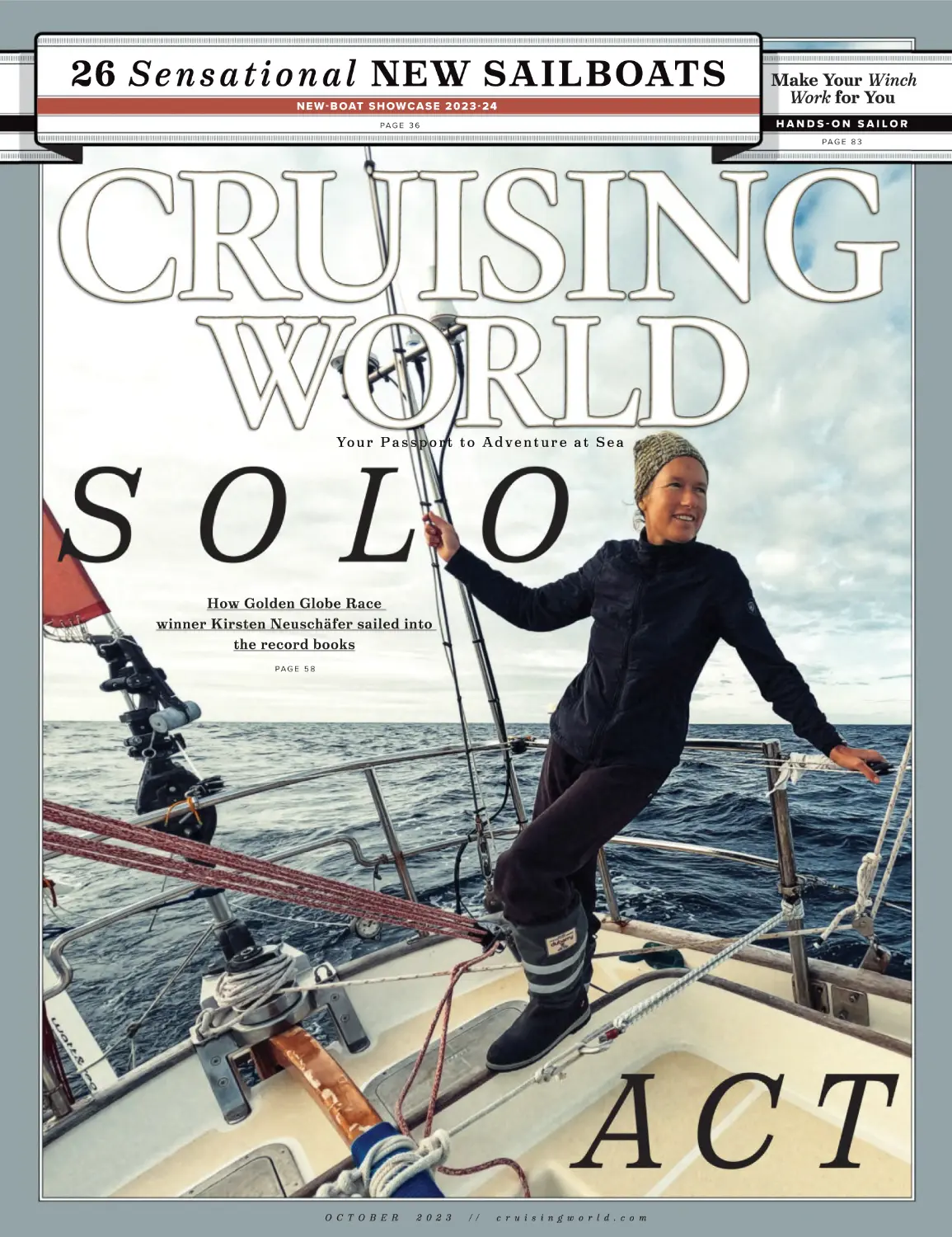
How Golden Globe Race
winner Kirsten Neuschäfer sailed into
the record books
PA G E 5 8
O C T O B E R
2 0 2 3
/ /
c r u i s i n g w o r l d . c o m
sea perfefction
w w w. l e o p a r d c a t a m a r a n s . c o m | i n f o @ l e o p a r d c a t a m a r a n s . c o m
SAIL
POWER
42 | 45 | 50
40 PC | 46 PC | 53 PC
A n n a p o l i s S a i l b o at
Show
October 12th - 15th, 2023
Leopard 42, Leopard 45, Leopard 50
hylasyachts.com | info@hylasyachts.com | 954.866.0750
Contents
F E AT U RE S
58 A NE W DAY
Kirsten Neuschäfer’s life of adventure leads to victory in the Golden Globe
solo round-the-world race.
Dreamy sunset
seascapes are aplenty
in the Adriatic
Sea, as sailor Jim
Eisenhart found while
commuter cruising.
Story on page 74
By T heresa Nicholson
62 A SINGULAR PASSION
Women sailing solo around the world are few and far between, but these three
sailors share a common spirit of ambition, endurance and adventure.
B y G race Buon o
C O LU M NS
8
Editor’s Log
88
68 L ES S O NS L EARNE D
When it comes to home-schooling the kids while cruising, these parents learned
that flexibility, and sometimes changing course, is key.
B y Jennifer B rett
114
Off Watch
UNDERWAY
14
Boat Life
74 HAVI NG IT A LL
18
6
When I was 60, I decided to embrace a lifestyle of commuter cruising. Fifteen years
later, it’s still one of the best decisions I’ve ever made.
24
october 2023
B y Jim Eisenh art
Gear
Destinations
30
Sailor & Galley
32
On Watch
NEW TO
THE FLEET
36
New-Boat
Showcase
56
Tenders
HANDS-ON
SAILOR
83
On-Deck Systems
86
Boathandling
87
Monthly
Maintenance
COVER
2022-23 Golden Globe
Race winner Kirsten
Neuschäfer.
Photo courtesy
Kirsten Neuschäfer
LUENGO_UA/STOCK.ADOBE.COM
cruisingworld.com
Charter Life
Editor’s Log
Exciting new boats and impressive new feats of sailing are all around
as we head into autumn.
B Y
A N D R E W
P A R K I N S O N
Into the GREAT WIDE OPEN
october 2023
8
?LROQAPVCCOӟ
cruisingworld.com
T
here’s a cherished bond
in one word: intense. If there’s
between mariners and their
anyone who deserves a Level 3
vessels. It’s a simple fact of
Painkiller at Pusser’s after that
boating, a connection that occurs
boat show, it’s our judges. (This
naturally over years of shared expeyear, I’m treating, fellas.)
riences, challenges and triumphs.
Results will be posted in our
A seasoned deck, a weathered hull,
January/February issue, which
the familiar creaks and groans
hits newsstands and mailboxes in
of planks down below: Such are
mid-December. In the meantime,
the individualities that our boats
I invite you to peruse this year’s
acquire over time, telling tales
Boat of the Year nominees and
of journeys taken and memories
other noteworthy new models in
made. Like relatives, our older
our New Boat Showcase, starting
boats carry the echoes of yesteron page 36.
year, evoking a sense of nostalgia
And speaking of modern
that can’t be replicated.
marvels on the water, Kirsten
Still, this time each year, as
Neuschäfer sailed into the record
summer relinquishes its sweaty hold
books back in April when she
on much of the United States and
won the 2022-23 Golden Globe
cooler sailing days welcome the fall
Race on the 1988 Cape George
boat-show season, my love affair
36 Minnehaha, which she refitted
with time-honored vessels takes
prior to the race. Neuschäfer
a brief hiatus. As the newest boat
is a South African sailor who
models make their grand entrances,
specializes in high-latitude and
I join countless cruising enthusihigh-adventure sailing. She was
Kirsten Neuschäfer notched a lot of firsts in her 2022-23
asts, young and old, in the thrill of
the first woman to complete the
cutting-edge technology, innovative Golden Globe Race victory. They won’t soon be forgotten.
Golden Globe Race, the first womdesign, and masterful boatbuilding.
an to win it, and the only woman
To me, the attraction of new boats extends beyond the glossy
skipper who participated this year. She’s also the first South
brochures and silky exteriors. It’s a celebration of progress, and a
African sailor to win a nonstop, unassisted round-the-world
reminder that, even as we navigate the waters of the past, the future event, and the first woman to win any round-the-world race, inholds plenty of uncharted territories yet to be explored.
cluding solo and fully crewed races, nonstop or with stops. During
At the Annapolis Sailboat Show in October, Cruising World
the Golden Globe Race, she rescued a fellow racer, Tapio Lehtinen,
will hold its annual search for the Boat of the Year. Throughout
after his boat sank and he spent more than 24 hours adrift in a life
the boat show, and in the weeks to follow, three impartial
raft in the Southern Ocean. Neuschäfer was awarded the 2022 Rod
industry experts and venerable sailors in their own right—former Stephens Seamanship Trophy by the Cruising Club of America, as
CW Editors-in-Chief Herb McCormick and Mark Pillsbury,
well as the Ocean Cruising Club’s Seamanship Award, for her role
and American Boat and Yacht Council veteran Ed Sherman—
in the rescue. Well deserved. You can catch her story by our senior
will break out the kneepads to examine every square inch of
editor, Theresa Nicholson, on page 58.
2024’s competing new-boat models. They will then sail them on
As our world of boating continues to thrive on the interplay
Chesapeake Bay in rigorous sea trials to determine which ones
between tradition and innovation, perhaps you’ll fi nd yourself
receive top honors in their classes and overall.
captivated by the blend of heritage and heroism as you turn the
But that’s only part of the equation. Prior to all of that, the
pages of this October issue. One thing is certain: The sport of
judges sift through stacks of paperwork supplied by every nominee, from design briefs and construction plans to stability data
and performance curves. Having witnessed the judging, testing
and deliberations myself last year, I can sum up the process
There’s something special in the BVI
Explore the islands.
Feel the LOVE.
breeze. It’s an energy that is picked up
by the wind and carried throughout
each of our 60 islands, islets, and
atolls. Once you feel it for yourself,
you’ll understand what makes every
day here so extraordinary.
BVITourism.com | 1-800-835-8530
Tortola | Virgin Gorda | Jost Van Dyke | Anegada | Cooper Island | Guana Island
Little Thatch | Necker Island | Norman Island | Peter Island | Saba Rock | Scrub Island
Yo u r Pa s s p o r t t o A d v e n t u r e a t S e a
ANDREW PARKINSON EDITOR-IN-CHIEF
andrew.parkinson@bonniercorp.com
THERESA NICHOLSON SENIOR EDITOR KAYLA JENSEN MANAGING EDITOR
DAVE WEAVER ART DIRECTOR CINDY MARTIN COPY EDITOR KIM KAVIN CONSULTING EDITOR
STEVE D’ANTONIO TECHNICAL EDITOR MARK PILLSBURY GEAR AND ELECTRONICS EDITOR
EDITORS-AT-LARGE
BERNADETTE BERNON, JENNIFER BRETT, CAP'N FATTY GOODLANDER, GARY JOBSON,
ELAINE LEMBO, HERB MCCORMICK, TIM MURPHY, ANGUS PHILLIPS, MARK PILLSBURY, ED SHERMAN
CONTRIBUTORS
Grace Buono, Jim Carrier, Lynda Morris Childress, James Eisenhart, Behan Gifford, Roger Hughes, Tor Johnson,
John Kretschmer, Damian LaPlaca, Robert Mullen, Alvah Simon, Ronnie Simpson
EDITORIAL OPERATIONS
SHAWN BEAN EXECUTIVE VICE PRESIDENT, CREATIVE PATRICK SCIACCA EDITORIAL DIRECTOR, CRUISING WORLD, SAILING WORLD, YACHTING
DAVE WEAVER CREATIVE DIRECTOR MEGAN STANCHINA EDITORIAL OPERATIONS MANAGER CINDY MARTIN COPY CHIEF
JEFF WILLIAMS DIGITAL PRODUCER KELLY WEEKLEY PRODUCTION DIRECTOR SHARI SMITH PRODUCTION MANAGER PETE COFFIN PRODUCTION ARTIST
DAVID CARR MANAGING DIRECTOR, YACHTING AND SAILING GROUP
david.carr@bonniercorp.com
SALLY HELME PUBLISHER EMERITUS sally.helme@bonniercorp.com
PARKER STAIR ASSOCIATE PUBLISHER parker.stair@bonniercorp.com
GREG WYCKOFF BROKERAGE, MID-ATLANTIC AND NORTHEAST SALES greg.wyckoff@bonniercorp.com
RON MARTIN SOUTHEAST, WEST COAST AND ASIA SALES ron.martin@bonniercorp.com
TERRY JACOME EUROPEAN AND NEW ENGLAND SALES terry.jacome@bonniercorp.com
BRIAN LUKE CLASSIFIED AND MARKETPLACE SALES brian.luke@bonniercorp.com
MIKE STALEY DIGITAL STRATEGY DIRECTOR mike.staley@bonniercorp.com
JENNA HARBOUR MARKETING MANAGER jenna.harbour@bonniercorp.com
MISSIE PRICHARD SALES ASSISTANT missie.prichard@bonniercorp.com
DR. JENS MUEFFELMANN EXECUTIVE CHAIRMAN
DAVID RITCHIE CHIEF EXECUTIVE OFFICER
JONATHAN MOORE EXECUTIVE VICE PRESIDENT, MOTORSPORTS AND OUTDOOR DIVISION GLENN SANDRIDGE EXECUTIVE VICE PRESIDENT, MARINE DIVISION
SHAWN BEAN EXECUTIVE VICE PRESIDENT, CREATIVE DAVID BUTLER EXECUTIVE VICE PRESIDENT, DIGITAL OPERATIONS
TARA BISCIELLO SENIOR VICE PRESIDENT, FINANCE SHAWN MACEY VICE PRESIDENT, ENTERPRISE SOLUTIONS
ALISON KLEIN DIRECTOR, PEOPLE AND CULTURE JEREMY THOMPSON GENERAL COUNSEL
CRUISING WORLD MAGAZINE
P.O. Box 8500, Winter Park, FL 32790 / cruisingworld.com
FOR CUSTOMER SERVICE AND SUBSCRIPTION QUESTIONS: Call toll-free 866-436-2461, go to cruisingworld.com/cs, or email CRWcustserv@cdsfulfillment.com.
You can also write to Cruising World, P.O. Box 6364, Harlan, IA 51593. Retail single copy sales: PWX Solutions, Tony DiBisceglie.
CONTRIBUTORS: Address all editorial correspondence to editor@cruisingworld.com. All letters sent to Bonnier LLC will be treated as unconditionally assigned for
publication and copyright purposes, and are subject to editing. Bonnier LLC does not necessarily endorse authors’ views. Entire contents copyright 2023 by Bonnier LLC.
May not be reproduced in any form without the express written permission of Bonnier LLC.
Photos by Onne van der Wal
LOA 45.5’ LWL 41.2’ Beam 13.9’ Draft 7.6’ DSPL 22,900 lbs SA 1303 ft 2
EFFORTLESS SPEED AND COMFORT IN 45’
The NEW J/45 raises the bar on cruising comfort and performance like no J/Boat before it.
Enjoy double-digit speeds with fingertip control while relaxing in the spacious cockpit. J/45’s
advanced composite construction and easily driven hull shape provide an exceptionally
smooth ride, one that will inspire you to go places. And when you do, the luxurious comfort
of Isabelle Racoupeau’s beautifully designed and styled interior awaits. Discover how quickly
your bucket list expands once you sail a J/45.
O C TO B E R
2 0 2 3
U N D E RWAY
BLUEORANGE STUDIO/STOCK.ADOBE.COM
EXPLORING the BEST of the CRUISING LIFESTYLE
1 4 B OAT L I F E
18 GEAR
2 4 D E S T I N AT I O N S
30 SAILOR & GALLEY
3 2 O N WATC H
Ode to
Naming a Boat
Warm Duds for
Cooler Temps
Cruising the
Southeastern Bahamas
Tropical Paradise
in a Jar
Cap’n Fatty’s
Tender Feelings
Because the Bahamas island chain is shallow, the water it occupies in the Atlantic Ocean is that much lighter and,
frankly, more beautiful than the Caribbean Sea. You can sail for miles in 10 to 15 feet of the lightest hues of blues
and turquoise, suddenly plunge into thousands of feet of dark-blue ocean, and return to shallow turquoise toward
the edge of the next island. The shelf acts and feels like a large V. —Damian LaPlaca
Story on page 24
Among Rob Mullen’s favorite works is a depiction of his beloved Artful Otter (above), with canoe tender Leaflet in tow. A blustery moment
overlooking Canada’s Kogaluk River (top) influenced his second boat naming. Opposite: The Aries 32 ketch Skidbladnir in Nova Scotia.
U N D E R WA Y
TO Name a BOAT
In order to envision our next cruising adventure, we had to
look to the past.
I M A G E R Y
ibbor and Knarf’s parents were kidnapped by Frost
Giants. The boys desperately needed help. Scooter
Squirrel raced to Winston Woodchuck, who dived into
his burrow, frantically digging until he reached the tunnels of
the Dwarves. They summoned Frey, who came with his longship,
Skidbladnir, and took the boys to Asgard to plead their case to
Odin. Skidbladnir was enchanted so that, among other magical
traits, it always had fair winds and got where it needed to go.
Such were the bedtime stories Dad told my brother, Frank,
and me more than 60 years ago in the wild hills of West Bolton,
Vermont, overlooking Lake
Champlain. Despite the US
Navy being born on Lake
Champlain and the famous
Capt. Phillips living a few miles
from our house, Vermont is
the only landlocked state in
New England, so it might not
seem an apt setting for nautical
lore and traditions. However, a
few years after my grandfather
returned from World War II,
he and my then-preteen father
built a 16-foot Moth and
ignited an obsession in Dad for
sailboats. He found plans for a
26-foot ketch that became his
lifelong white whale. I grew up with those plans and, under Dad’s
tutelage, learned almost every rig that had sailed for the past
thousand years by copying illustrations in The Book of Old Ships
by Henry B. Culver and Gordon Grant.
My initial 20 or so were canoes. I bought my first canoe with
my paper-route money at age 11 and got a Gunter-rig sailing kit.
That Grumman canoe still hangs in the barn in the winter, but in
55 years, it has never had a name. My first experience with naming a boat was as a teenager, when a 16-foot Rocket-class sloop
that had been in a chicken coop for 25 years was donated to our
Explorer post. We restored her and sailed the chickens—I mean
the dickens—out of her on Lake Champlain. Our best adolescent
workmanship notwithstanding, her seams could work the caulking in a chop, and we named her Kon Liki. It was 39 years before
I named a second boat.
On the cusp of October 2009, another artist, Cole Johnson, and
I stood at the lip of the 1,200-foot canyon of Canada’s Kogaluk
River (“Little River” in Inuktitut) with our canoe in the howling
B Y
R O B
M U L L E N
wilderness of the Labrador Barrenlands. A river we’d been on
nine days earlier had wandered into a boulder garden and had
not come out, so we struck out overland, north to the Kogaluk,
hoping that it would have water. As we stood, buffeted by the
gale winds of the Barrens, it was a profound relief and joy to look
down to the sparkling river far below. At that moment, a feeling
welled up to name our silent companion, the stalwart canoe that
would, days later, on the Labrador Sea, save our lives. The name
came to me instantly, Bonnie, my then girlfriend, now wife (it
was also, by chance, Cole’s mother’s name), steadfast and true no
matter the challenge. That was
one of only two canoes I have
ever named.
After COVID struck and
closed Canada, I was stuck
in Vermont, so I hiked the
273-mile Long Trail end to end
as a painting trip. The paintings
from the hike sold out so, in
2021, I decided to do the same
thing on Lake Champlain. But
I needed a bigger boat. I found a
wooden, double-ended, 20-foot
pocket cruiser (appropriately
for my transition back to sail,
a “canoe yawl”) at the Lake
Champlain Maritime Museum.
It was essentially a nice trailer with a free boat on it. Bonnie and
I spent two months restoring that boat. I’d planned to spend at
least six weeks aboard, so the boat needed a name. We bandied
several about as we sanded the boat to bare wood, sealed the hull,
and built accommodations in the cabin. Years ago, I had toured
on the national art show circuit in a 15-passenger Dodge van
dubbed the Artful Dodger. This boat was cute and a bit plump, but
well-rounded with lovely lines. As a sleek creature of the water and
my nascent floating studio, it almost named itself the Artful Otter.
The voyage of the Artful Otter was a wonderful experience
during which I named my second canoe, a tubby 11-foot brightgreen cutie that Bonnie had owned since childhood. That was the
canoe that helped bring us together (another story), and I used it
as Artful Otter’s tender. With the tiny green boat trailing lightly
behind on the waves, its name became obvious: Leaflet.
The voyage raised funds for charities and made the artists
some money. Expanding from the idea of the Long Trail trip, I
involved other artists who all wanted to continue the project, so
cruisingworld.com
E
A N D
15
october 2023
S T O R Y
MAGIC PERHAPS.
MYSTERIOUS?
NOT.
The easiest way to understand what’s
behind all that black magic is to open up a
Black Magic® block. When we do that, notice
that you CAN do that. These blocks can
be serviced. Parts can be replaced and
performance can be renewed for years.
6061-T6 aluminum:
®
Torlon Rollers:
Hidden Balls:
we needed a yet bigger boat. I cruised the
yacht websites looking for an affordable,
artistic vessel. That turned out to be a tall
order. Brother Frank, now a retired US
Coast Guard captain, steered me away
from a couple of old wooden beauties that
appealed to the artist in me but would
have probably sunk—my plans, anyway.
Then, I found it: a wooden, 1962 Aries
32 ketch in Chester, Nova Scotia. A
double-ender like Artful Otter, this boat
underwent a marine survey that impressed
even sea dog Frank. And I could afford it
by selling Artful Otter. That was a painful
thought. Nonetheless, I brought the printout of the listing down to dinner, the one
meal that Dad, Bonnie and
I share every day.
Dad is an old-time
Vermonter with Yankee
frugality deeply ingrained,
so I never saw his reaction
coming. He had gotten
his teenage ketch plans
out while Bonnie and I
restored Artful Otter, but
presumably the enormity
of the project hit, and
he had not proceeded
beyond that. Looking at
the photos of this ketch
at dinner, though, he set
his jaw and quietly said,
“That’s my boat.”
“Huh?” I started to
explain the plan when he
cut me off.
“Don’t sell the Otter. I’ll
buy this boat,” he said.
And that was that. I
suspect that, at age 90, he
was realizing that lifelong
dreams needed to come
to reality ASAP, and he
would not discuss it.
Chester, Nova Scotia, is
at least a 1,200-mile sail
back to Vermont. After
dinner, Bonnie upped the ante with the
idea of Frank and me taking Dad on a
bucket-list trip of a lifetime by sailing
home with him in the ketch. He will be
91 when we get underway in July, but
his mind is sound, and he is healthy and
strong. Frank jumped aboard immediately, and I’ve never seen Dad so enthused.
Rub-a-dub-dub, three old men in a…
well, the boat needed a name. Yet apart
from a brief inspection in a heavy snowstorm, I had no physical connection with
the boat. My names for other boats had
been bestowed organically, but this time,
it seemed, we might need to dream up one
out of thin air.
Artful Otter II, the working name
during the search, was jettisoned
instantly, closely followed by my overlong
fixation with plays on art and ketches
such as Sketchy Otter, Art S’Ketch,
Sketch-A-Ketch, CanUS’Ketch (Bonnie is
Canadian) and other such ideas. Sea dog
Frank thought my Bonnie Pearl was a
wonderfully nautical play on Captain Jack
Sparrow’s Black Pearl and Bonnie. Dad
was politely nonplussed.
Then, it hit me. The three of us setting
off on an adventure: Eibbor and Knarf
stories, Scooter Squirrel, the Dwarves, the
Norse gods, and a magic longship, like a
double-ender ketch.
As is true of many Germanic-language
names, it is not pretty to an American (or
Canadian) ear, but it resonates with the
three of us 60 years later: Skidbladnir.
Hailing from Lake Champlain, wildlife
artist, naturalist, and outdoorsman Rob
Mullen operates out of his floating studio,
the canoe-yawl Artful Otter. Lately, his
sailing and painting grounds have grown
to include the 1962 wooden Aries 32 ketch
Skidbladnir.
Top: Rob, in his element, sketches the view from the north shore of Lake Superior.
Above: A foretelling snapshot from long ago captures Rob (playing with the toy ship) and
his brother, Frank (future US Coast Guard captain), in their pre-boating years.
TIME FOR A
WATCH A REFRESHER ON
MAINTAINING BLACK MAGIC BLOCKS
L I TTLE
BLACK MAGIC
U N D E R WA Y
Gear
Long after the big boat is put away for the season, the right clothes get you out on the
water in a variety of small craft.
B Y
M A R K
P I L L S B U R Y
cruisingworld.com
GEAR Up for COLD WEATHER
october 2023
18
When we tested Gill’s Aqua Parka, we found it perfect for cold nights in the cockpit—and for a quick change into dry clothes ashore.
W
ith the cold season approaching in many parts of the
country, it’s time to take a look
at gear that will let you enjoy time on the
water with toys such as kayaks, rowing
and sailing dinghies, paddleboards, and
the like.
Samples of cooler-weather kit were
provided by the manufacturers and by
Team One Newport in Rhode Island,
which sells brands such as Helly Hansen,
Musto and Patagonia. The hands-on
testing was rather informal.
Living outside Boston, where big boats
often get put away by mid-October, I was
launching my inflatable for dinghy rides
and my paddleboard late into the fall
thanks to Mustang Survival’s Taku dry
bib and Taku dry top. The chest-high
overalls and socks are watertight and
rugged, with room to wear heavy socks
and a pair of jeans or long underwear
underneath. Made from waterproof
fabric, the bib’s seat, knees and socks
are reinforced with Cordura to resist
abrasion, and the overall-style outerwear
comes in designs for men and women.
All carbon performance.
All cruising comfort.
360º TOUR
U N D E R WA Y
cruisingworld.com
DAIQUIRI
Ingredients:
• 2 oz Mount Gay Black Barrel
• 1 oz fresh squeezed lime juice
• 1 oz simple syrup
Add ingredients to shaker.
Add ice, shake and strain into
a chilled coupe glass. Garnish
with lime wheel or peel.
The men’s version includes a waterproof
Aquaseal relief zipper, and the men’s and
women’s bibs have an adjustable neoprene waistband.
Wearing the dry bibs and my trusty
Crocs for footwear over the rocks, I was
able to wade into some pretty chilly water
and go as deep as I needed to mount a
motor on the back of an inflatable or land
a paddleboard without grounding out
its fin. On windy days, spray was not an
issue, nor was rain, especially with the
dry top on.
The dry top, made from the same
waterproof, breathable fabric, has an
extended skirt for kayaking, and has
trimmable latex neck and wrist seals to
keep water out. The top’s neoprene waist
has hook-and-loop flaps on either side, so
it’s adjustable too.
For paddleboarding in the dead of
winter in icy water, a drysuit would
probably be more advisable, but in late fall
and spring, I found that if I tightened the
waist straps built into the bib and top, not
a lot of water came in when I went for an
unintended dip. As a bonus, air trapped in
the clothing added buoyancy.
Prices for the top and bib varied online,
but expect to pay $400 to $450 for each.
Gill offers its own cool-weather
protection for active watersports such as
paddling, windsurfing and kayaking with
its ThermoShield top, available in sizes
small to extra-large. On paddling and boat
rides, I found it warm and comfortable
for extended periods. The ThermoShield
is made from a nonabsorbent laminated
fabric, and a fleece lining keeps in the
heat. I really liked the fleece-lined collar,
which can be drawn tight or left loose. The
top’s neoprene waistband seals tight with
hook-and-loop flaps.
I paired the ThermoShield Top with
Mustang’s Taku bib. The combo worked
quite well and kept me mostly dry, even
with an occasional dunking so long as I
didn’t go under all the way. You can find
the ThermoShield top for $165 online.
Gill has a few other neat things to
consider when the mercury dips and
the water beckons. The Fisher fleece is a
heavy-pullover wind-resistant top that’s
comfortable to wear around the yard or on
the boat. Its large kangaroo-style pocket is
a good place to warm up your hands on a
cold day. It sells for about $130.
And for cold, raw nights in the
cockpit—or to change into dry clothes
on the beach or in the parking lot—Gill’s
Aqua parka has you covered. Literally.
The parka is a big coat, with a waterproof
shell, welded seams, a soft high-loft
thermal lining, a big hood, and large
zippered pockets. The one I tested fell
well past my knees, had tons of room if I
wanted to pull my arms inside to juggle
shorts, and kept me warm as toast. Top
it off with a Seafarer beanie, and you’re
ready to chill. The coat is available in
three color schemes and in sizes from extra-small to large. Expect to pay around
Gill’s Fisher fleece (top); Helly Hansen’s
Pier 3.0 sailing jacket (above); Mustang
Survival’s Taku dry top (left)
© 2021 Mount Gay Distilleries Ltd., Mount Gay® Rum, 40-43% Alc./Vol.,
Imported by Rémy Cointreau USA, Inc.,
.EW9ORK .9%CLIPSE$ESIGN¸"E#ONlDENT$RINK2ESPONSIBLY
U N D E R WA Y
cruisingworld.com
my normal size, and found it a bit tight.
The coat is priced at just under $150.
I have a daughter who likes sailing and
fishing, and on a blustery day this past
fall, she found that Helly Hansen’s Pier
3.0 sailing jacket and bib would be fine
for either activity. The bibs were easy to
adjust and move around in, and she liked
the elastic cinch around the waist, which
Gill’s Thermoshield top (above); Gill’s
Seafarer beanie (right)
Wearing the dry bibs
and my trusty Crocs for
footwear over the rocks, I
was able to wade into some
pretty chilly water and go
as deep as I needed to.
$200 for the parka and less than $30 for
the hat.
For three-season inflatable rides and
dinghy sailing, Musto’s ESS Softshell
jacket is lightweight, comfortable and
warm. The coat has a water-repellent
coating and stretch cuffs for a close fit. The
ESS is available in black, navy and platinum, and in sizes ranging from small to
extra-extra-large. I tried on an extra-large,
she said made the pants snug and warm.
The Pier 3.0 jacket is designed for
coastal and inshore sailing. It’s fully
waterproof, windproof, and breathable,
with adjustable cuff seals, a high collar,
and fleece-lined hand-warmer pockets.
Expect to pay around $200 for each piece
of kit.
For a midlayer, HH’s Verglas tops for
men and women are comfortable and
warm. The ones I tried out fit well and
weren’t in the way when I moved about.
They come in a variety of styles, including
half-zipper and hoodie. Prices range from
$30 to $60.
Another good layering top was
Patagonia’s Capilene Cool Daily hoodie.
The sample I tried was thin, but it was
warm and fit well. The top is available in
sizes extra-small to triple-extra-large and
runs right around $60.
The above is just a sampling of the
smart clothes available these days to help
you handle the elements. With winter
coming and the holidays approaching, hit
the fall boat shows and keep an eye out for
deals on duds that can withstand whatever
Mother Nature has in store.
WHEN IT COMES TO
LIGHTWEIGHT, WE’VE GOT
YOUR TENDER.
MORE OPTIONS FOR THE PERFECT TENDER FIT.
We have your tender. Highfield now has 3 lines and 12 different options ranging from 9’6
to 12’6. For those looking for more space, the FCT Console. Looking for luxury features? The
new Sport line is for you. And the brand new GT Console is the best of both worlds. With fully
rigged wet weights starting at 350lbs we’ve made it easier to carry a console RIB.
HIGHFIELDNORTHAMERICA.COM
<hf^l^^Zeema^g^pAb`aÛ^e]fh]^elZmma^:ggZiheblLZbe[hZmLahp%[hhmaEZg]*/(++
340 FCT7
420lbs*
340 GT
465lbs*
Sport 330
620lbs*
*Wet Weight includes engine, rigging and fuel with Yamaha 25hp
GO ANYWHERE
Explore places other yachts simply cannot reach on the Oyster 595CB
centreboard variant, featuring a remarkable shallow-draft of 1.79m/5’10.
Discover Oyster’s range of 50 to 90 foot shallow-draft bluewater cruisers.
495
565
5 9 5 675 745 885
W W W.OYST E RYAC H TS.C O M
O Y S T E R YA C H T S .
THE WORL D IS YOURS.
U N D E R WA Y
Destinations
This archipelago is off the beaten path, so it can feel like you have the place all to yourself.
B Y
D A M I A N
L
A
P L A C A
cruisingworld.com
C
october 2023
24
ruisers often bypass
the small and lesserknown southeastern
Bahamian islands on their
windward passage through the
Exumas on their way south
to the Caribbean. But they
shouldn’t. Take the advice of
Bruce Van Sant, legendary
sailor and author of The
Gentleman’s Guide to Passages
South: “Don’t rush through
the islands; they are too
perfect.” So, Google up a map,
friends, and follow along.
Because the Bahamas are
shallow, the water they occupy
in the North Atlantic Ocean
is that much lighter, and,
frankly, more beautiful than
the Caribbean Sea. You can
sail for miles in 10 to 15 feet of
the lightest hues of blues and
turquoise, suddenly plunge
into thousands of feet of dark
blue ocean, and return to shallow turquoise toward the edge
of the next island. The shelf
acts and feels like a large V.
Conception Island is
possibly the most beautiful
of all the Bahamian islands
and is only 45 nautical miles
northeast of popular George
Town on Great Exuma Island.
As Van Sant suggests, to reach
Conception Island, anchor
the night before just south
of George Town at Fowl Cay,
an uninhabited island with
a small swimming beach.
Th is will save you 4 miles of
motoring to exit Great Exuma.
Raise your mainsail at first
light, and a southwestern wind
will give you one long, straight
starboard tack to Conception
Island. Uninhabited and
pristine, the beach has water
so clear, you’ll swear you can
drink it. The whole island is
less than 3 miles at its widest,
and it’s low-lying like all the
small Bahamian islands,
making it almost unnoticeable
on electronic or paper charts.
The Bahamas National
dinghy into mangrove flats to
see turtles, sharks, conch and
other marine life.
To relax, simply walk the
deserted white sandy beach
and let your mind wander in
your escape to this stunningly
beautiful anchorage. Or,
from the deck of your boat,
simply stare at the magnificent
Sunsets are legendary in the southern Bahamas (above). Its untouched beaches and serene surroundings make Conception Island
(opposite) an ideal spot for nature lovers seeking a tranquil escape.
Trust has designated
Conception Island a national
park, which protects conch,
fish and lobsters. The coral
heads and reefs that surround
the island make for great
snorkeling and diving. At high
tide, an entrance to a creek
two-thirds of the way down
the western side allows you to
crescent-shaped beach, and
imagine why no more than
five sailboats and catamarans
are anchored outside the
island on any given day.
Like this solo sailor, you
might chance upon the only
other sailors on the beach who
happen to know the Bahamas
like the backs of their hands.
If you are fortunate, like me,
they will buddy-sail with you
35 nautical miles northeast to
San Salvador. There, anchor
in deep white sand just east of
the only town on the island,
and your new friends will
take you to their favorite
coral head, where they will
spear two huge spiny lobsters and share their spoils
in a tasty dinner on their
catamaran. For thanks, buy
them cocktails the next day
at one of the only open bars
overlooking the beach.
Sparsely populated and
somewhat larger than
Conception, San Salvador
Island hosts a handful of small
resorts and, surprisingly, an
airport that brings in daily
fl ights from Florida. Still,
it maintains the feel of a
quiet and secluded Caribbean
island. You can walk the
traffic-free main road, and
a friendly local might drive
you to one of the two small
grocery stores on the island.
Much controversy surrounds
the claim that Columbus made
his fi rst landfall in the New
World at San Salvador Island,
though a plaque on a building
in the middle of town states
that he landed there October
12, 1492.
From San Salvador
Island, you can sail 30 miles
southwest to Rum Cay in
prevailing east winds. (An
island with the word rum
in it must be good.) Find
yourself wind-protected on
the absurdly beautiful, quiet
and pristine Flamingo Bay on
@=JF=KI=MI=?=ҺFPELLQBLOQEACO=JPQL?HҶ=@L>AҶ?LJҧOFCEQҨ
CRUISING the SOUTHEASTERN
BAHAMIAN Islands
cruisingworld.com
october 2023
26
the western edge of the island.
Your charts will show a submerged wreck, giving you fair
warning to watch the depth
and weave the coral heads
using eyeball navigation. You
can sleep soundly under a
clear sky and shining stars in
tranquil water. Among life’s
fi ner experiences, one should
enjoy a morning cup of coffee
on the bow of a gently swaying sailboat in a warm, clear
bay that is yours and yours
alone. Dinghy to the deserted
shore to create the only tracks
on the white-powder beach.
On a rising sun, sail out
of Flamingo Bay against an
east wind to seek civilization
around the corner to Port
Nelson, the only inhabited
town on the island, with
reportedly fewer than 100
residents. With a handful of
tacks, you will turn a 6-mile
sail into 15 glorious sailing
miles where you will see small
flying fish burst out of the
water to escape predators. At
30 miles in total area but still
tiny in size, Rum Cay dwarfs
Conception Island.
Port Nelson consists of a
welcome sign and a government dock that accepts a mail
boat three times a month.
Near the dock, you might fi nd
yourself at The Last Chance,
a ramshackle bar with sand
floors, a pool table and a book
rack. Kaye Wilson, the proprietor, will sell you a Bahamian
beer for $3, a dozen eggs for $8
or a bag of frozen green beans
for $6. She also will make you
the tastiest burger for $12 and
serve it in a foil wrap rather
than on a plate.
The water in the Exumas is renowned for its exceptional clarity, with visibility of up to 100 feet, depending on weather and location. You may have many anchorages all to yourself, or sparsely populated.
San Salvador
Conception
Island
Flamingo Bay
Rum Cay
Port Nelson
N O R T H
A T L A N T I C
O C E A N
Long Island
Crooked Island
Marina
West Plana Cay
Crooked Island
Mayaguana
Abraham’s
Bay
Southeastern
Point
Turks and Caicos
You might chat up the only
other patrons, two Bahamian
police officers also enjoying
a lunchtime burger. Even
though the island is crime-free
and all residents know one
another, the officers are on
daily foot patrol. One might
be wearing a polo shirt, while
the uniform of the other is a
ball cap and T-shirt that say
“police.”
Don’t shy away from
requesting a police escort
to the only other open eatery,
the Ocean View Restaurant,
an establishment with wood
floors that’s been proudly
owned for 45 years by Ruby
Bain. Her son will serve you a
Guinness in a bottle delivered
to the island on a mailboat. I
watched in awe as she affectionately taught one of the
officers a local song. After
you share a beverage with the
police and they insist that you
stay on the otherwise sleepy
Rum Cay for a weekend festival, you know that you have
met some of the friendliest
people on Earth.
DAMIAN LAPLACA; MAP: STEVE SANFORD
cruisingworld.com
U N D E R WA Y
U N D E R WA Y
cruisingworld.com
To seek protection from an
oncoming stiff and persistent
eastern blow, depart Rum
Cay at 4 a.m. and motorsail
30 degrees off an east wind
to reach the western side of
Crooked Island in daylight,
some 60 miles southeast. You
might fi nd several sailboats
and catamarans already there
seeking shelter.
At Crooked Island, it
is impossible not to make
new sailing friends, either
on the beach or at Gibson’s
Restaurant, where they seat
customers, mostly sailors,
cafeteria-style on a long
october 2023
28
Take the advice of
legendary sailor
and author Bruce
Van Sant: “Don’t
rush through the
islands; they are
too perfect.”
table. They serve everyone
the same delicious fare of
locally caught fish, meat and
vegetables.
At Crooked Island, you
also might be lucky, like me,
to fi nd a stainless-steel spear
pole washed up on the beach
that you can use to spear
your own lobsters. If you
need diesel and water, motor
a few miles to the Crooked
Island Lodge and Marina, the
only marina on the island.
You might as well spend one
night there instead of rolling
on anchor in the big blow.
The marina’s knowledgeable
general manager will show
you the nearby coral heads
to hunt lobsters. (Using
the newfound pole spear,
this novice fisherman came
up empty-handed, but the
marina’s chef prepared a
lobster dinner for me, the
restaurant’s only customer
for the night.)
Sailors can do major
provisioning at the marina for
Bahamian beer, wine, local
fish, vegetables, frozen hamburgers and delicious rolls.
And what the marina does
not have, the general manager
will drive you 4 miles to fi nd
at the small grocery store. The
marina is undergoing big renovations, including new hotel
rooms, small cabana-like
lodges, a new restaurant and
a pool. It is also enlarging
its jetty, so boats will enjoy a
swell-free dock experience.
So far, you will have had
days of pain-free windward
sailing. That might end as
you sail east toward the
lightly populated Mayaguana
Island, a staging ground
for a southeast run to
Turks and Caicos. If you
have no time to wait for
a favorable wind north of
east, you might experience
moderate bow-bashing and
wave-crashing sailing to the
small and uninhabited West
Plana Cay, a good stop-off
43 miles toward Mayaguana.
After you pass Acklins Island
off your starboard and you
steer 30 or so degrees south,
the waves begin to behave, and
you will reach West Plana Cay
in calm conditions.
Again, you will have all to
yourself another beautiful
turquoise-blue bay protected
by an east wind, and you will
ask why you are not spending
long days there reading,
beachcombing, fishing,
sleeping, and just enjoying
your escape from civilization.
Last, the 37-mile east sail
from West Plana Cay to
Abraham’s Bay on Mayaguana
will likely be similarly
uncomfortable. Protected by
a barely visible long stretch of
coral reef, Abraham’s Bay will
feel like you are anchoring
in 15 feet of open ocean, but
the overnight roll will be
moderate and easy to handle.
The next day, sail east
in 14 miles of pain-free
tacking across a small bay to
Southeastern Point, where
Van Sant suggests that you
stage your departure to
Turks and Caicos. From this
point, you will have a better
southward angle to sail a
reach to Sapodilla Bay on the
Caicos banks.
Damian LaPlaca is currently
in Puerto Rico aboard his
Jeanneau Sun Odyssey 39i
Performance, Beckon.
Jeanneau
Yachts
55 NEW
60
65 NEW
Experience the refined
world of cruising without
limits, with a broad range
of functionality and in
absolute comfort.
Our Jeanneau Yachts
expand all your horizons.
Jeanneau,
Pure experience
DISCOVER IN
ANNAPOLIS DURING
THE UNITED STATES
SAILBOAT SHOW
OCTOBER 12-15, 2023
U N D E R WA Y
Sailor & Galley
The tropical f lavor of this nutritious, make-ahead breakfast will transport
you straight to paradise.
E D I T E D
B Y
L Y N D A
M O R R I S
C H I L D R E S S
cruisingworld.com
W
october 2023
30
e had departed
Santa Catalina
Island, California,
at midnight aboard our
Peterson 46, Esprit. It was
October, and we were making
the 60-plus-nautical-mile
passage at night because of
a favorable wind forecast.
Our destination, Ventura,
lay upwind. Winds would be
fairly light but enough to avoid
motoring the entire way.
My husband, Mitchell, and
I are both originally from a
landlocked mountain town:
Park City, Utah, which we still
call our official home port.
We bought Esprit in Panama
in 2018, then sailed back to
San Francisco Bay, where
we could operate charters
to earn money for extended
cruising. When the pandemic
hit, charters were no longer
an option, so we relocated to
Southern California to live
aboard and work. We chose
Ventura because we had
friends there and could easily
get into the boat-repair and
management business. This
industry thrived during the
pandemic—a great way to
stock the cruising kitty.
Dawn is my favorite watch
time on passage. As the sky
began to brighten, I updated
the ship’s log, scanned the
horizon once more, and
popped down below. My
mission: Brew hot coffee and
extract a Mason jar from
the fridge. In the jar was my
“instant” breakfast: a luscious
mix of coconut milk, rolled
oats, honey, and spice, topped
with nuts and fresh fruit.
(I often alternate this quick
onboard breakfast with an
equally delicious “pudding”
made with chia seeds.)
With my mission complete,
I settled into the cockpit,
enjoyed each bite as the sky
turned tangerine, and watched
seabirds hunting for their own
breakfasts.
Something big splashed in
the distance. Dolphins? I had
no one to ask because my crew,
consisting of my husband
and our cat, were snoozing
peacefully down below. Soon,
Anacapa Island came into
view off the port bow. It’s one
of eight islands that make up
the Channel Islands archipelago. Five of them, including
Anacapa, are national parkland. They are all rugged and
pristine, and provide us with
challenging and epic cruising
grounds.
In just a few more hours,
we’d be back in Ventura
Harbor, our temporary home
port, before we sailed south to
Mexico and beyond.
When it comes to passageplanning, one of my favorite
tasks is figuring out what to
eat. We are foodies, and my
studies and work background
are in nutrition, so there are always fresh, made-from-scratch
Quincey and her husband,
Mitchell, sail their Peterson
46 Esprit near their
temporary home port of
Ventura, California.
meals and snacks aboard
Esprit. Overnight oats and chia
pudding are two of my favorite
make-ahead boat breakfasts,
and I almost always make a
batch or two for passages. Oats
have the benefit of being more
readily available in markets;
they don’t provide quite as
much protein as chia seeds, but
they’re a great source of fi lling
fiber and quality carbohydrates. (Just add more nuts or
seeds to boost protein.)
There are countless ways to
vary each recipe, depending
on what you have on hand and
what sounds delicious to you.
The base is dry rolled oats or
chia seeds soaked overnight
in coconut milk. (You can use
any milk, but I love the tropical taste of the coconut.) You
can even combine the chia and
oats (see Cook’s Notes). Dress
it up with a variety of seasonal
fruit, nuts, or seeds for a satisfying, fi lling breakfast that’s
high in protein, fiber, healthy
fats, and antioxidants; that’s
sure to provide long-lasting
fuel for your adventures by sea
or land.
Both recipes will last for
several days in the fridge.
Consider making a few batches, divided into single-serve
containers. This convenient,
pre-made breakfast also makes
a great snack during passages,
or it can be a pretty addition to
brunch at anchor with friends.
Better yet, take time to enjoy
a slow morning as I did with
this easy, tropical pudding,
and transport yourself to
paradise, if you’re not already
there. —Quincey Cummings
COURTESY QUINCEY CUMMINGS
Paradise IN A JAR
cruisingworld.com
U N D E R WA Y
october 2023
31
TROPICAL BREAKFAST “PUDDING”
LYNDA MORRIS CHILDRESS
For oats:
1
⁄2 cup dry rolled oats
1
⁄2 cup (or to taste) coconut or any
other milk
For chia seeds:
4 Tbsp. chia seeds
1 cup coconut or any other milk
1
⁄4 tsp. cardamom (optional)
1 Tbsp. honey or maple syrup
1 very ripe mango, pureed; or fresh
berries, peach or any fruit, diced
2 Tbsp. chopped pistachios,
pumpkin seeds, chopped walnuts
or slivered almonds
serves
Combine oats or chia seeds, milk, cardamom, and honey or maple syrup in a small
bowl. If using nonhomogenized coconut
milk, you first might need to warm it in a
saucepan to get rid of clumps.
other fruit, add it to the pudding once
it’s firm, or just before eating.
Top with nuts, and savor.
Once combined, divide equally into
2 small Mason jars or other containers.
Leave room at the top for fruit.
PREP TIME
10 MINUTES, PLUS 4 TO 8 HOURS
TO CHILL
Cover and refrigerate overnight, or a
minimum of 4 hours, to thicken pudding
consistency.
CAN BE MADE
AT A N C H O R O R U N D E R WAY
If using mango, slice and scoop out the
flesh. Use a blender or food processor,
and blend until smooth. Store in a container in the fridge, and spoon over the
mixture once it’s firmed up. If using
D I F F I C U LT Y
EASY
COOK’S NOTES:
As a topping, pureed peach is also divine,
or a blueberry compote. A good-quality jam
is a great substitute if fresh provisions are
l o w. A d d a s p r i n k l i n g o f c r u s h e d , f r e e z e dried raspberries or pineapples for extra
zing. For oats, a dollop of plain Greek
yogurt before adding the fruit is also
delicious.
U N D E R WA Y
On Watch
Choosing the right dinghy is just the start. Keeping it clean, not getting it stolen, and
protecting it from punctures can involve a lifetime of learning.
B Y
C A P ’ N
F A T T Y
G O O D L A N D E R
cruisingworld.com
Y
october 2023
32
our choice of which
dinghy to carry aboard
is pivotal to successful
cruising. This is especially true
if your cruising kitty is small.
A good dinghy is a requirement for frugal cruising.
Notice that I wrote carry
aboard. I never tow a dinghy
that I don’t want to lose. Why?
Basic seamanship. Squalls
approach fast. A swamped or
flipped dinghy is a major problem offshore—for you and the
environment. Painters can end
up in the prop. Personal watercraft run over the tow lines.
Towed dinghies get caught on
navigational buoys, lobster
pots and bridge fenders.
Towing a tender is fraught
with complications. Even a
skillful boathandler can get
into trouble approaching a
slip while towing a dinghy.
And being forced into your
gyrating dinghy while at
sea exposes you to extreme
risk. Many a sailor has met
Davy Jones just after pulling
in their dinghy, casually
hopping aboard, ambling
aft , and leaning toward their
outboard—just as the painter
sharply takes up and catapults
them over the outboard and
into the water.
I’ve known three sailors who
have ended up overboard this
way. One was in the Lesser
Antilles, without anyone in
the crew even noticing. There’s
one thing that every offshore
sailor dreads: watching the
transom recede as their vessel
sails away.
Yes, innocent choices can
have severe consequences. And
we haven’t even talked about
the evil dinghies themselves.
Offshore, dinghies can
seem demoniacally possessed,
especially while running
downwind in heavy weather.
They can hole your boat or
wipe off its rudder or twist
up the self-steering gear.
I’ve even had dinghies pass
me—then stop immediately
ahead. Having a rigid-tender
submarine zigzagging 50 feet
beneath the surface like a
berserk shark is no fun.
One more tip: Never tow
kids you love astern in the
dinghy without an assigned
watcher. Do this only with
someone else’s bilge brats.
But seriously, the first
question to think about when
Fatty, with daughter Roma Orion and granddaughter Soku Orion,
found that a sailing dinghy can be a learning-intensive experience
for the family, as well as a social experience for sailing with friends.
choosing a dinghy is: rigid or
inflatable?
I love to row, so we carried
a Lawton-designed, fiberglass
Graves tender for 15 years
aboard Carlotta, our 36-foot
Endurance ketch. Rowing is
great exercise and a wonderful way to meet your fellow
cruisers. It’s quiet and nonpolluting—two nice qualities
if you reside on a warming
planet like I do.
If well-constructed,
these dinghies are almost
indestructible. At worst, you
might injure one cosmetically,
but it is almost impossible to
destroy a Tortola-style dinghy,
even in boisterous trade winds
amid sharp reefs.
Unfortunately, everything
is a compromise. Wellconstructed also means heavy.
Of course, these heavy, rigid
dinghies do more damage than
the lighter, softer ones. So, I
always tell my passengers to
“keep your hands inside the
dinghy.” They always comply
until, suddenly, they don’t,
and jam their hands between
the surging dinghy and the
immovable dock.
If you row a rigid tender,
always remove the oar horns
before coming alongside
a vessel—especially if the
graceful vessel has long
overhangs. Dinghies yanked
under a counter (or multihull
wing) can do major damage
in an instant during an
unexpected wake.
Ash oars are best. Oar
leathers aren’t just about style;
copper blade tips will greatly
extend the oar’s life. Yes, the
COURTESY FATTY GOODLANDER
TENDER Feelings
cruisingworld.com
sailor and the length of the
oar are related for best results.
Of course, you should learn
to feather your oars, and stow
them in such a manner that
they can’t be yanked into the
water by the painter or float
away if the dinghy is swamped.
(Consider an oar lock through
the thwart as well.)
Here’s a sad fact: If a dinghy
rows well, it powers poorly.
And vice versa.
Stowage is another factor.
Davits are cool on monohulls
if you sail in, say, a swimming
pool. It is best to stow a dinghy
upside down on the foredeck
while offshore in monohulls
smaller than 70 feet long. We
think of our foredeck dinghy
as our backup life raft. And
we put extra water and bulkier
survival gear under it—in
suitably tied-in watertight
containers.
Part of seamanship is to,
again and again, prepare for
the worst while expecting
(and, hopefully, experiencing)
the best. We’ve never used
TECH
TIPS
SPONSORED
our dinghy as a life raft (or
our life raft as a life raft, for
that matter), which is exactly
why we prepare it so diligently
before each offshore passage.
Just in case.
In blue water, I carry a knife
with me at all times (even
sleeping), and I have dive
knives made of 316 stainless
steel in my cockpit and on my
foredeck. Think about having
to launch your dinghy while
sinking, at night, naked and
disoriented, after being hit by
freighter. Those knives just
might come in handy.
Currently, we have a
10.5-foot Caribe RIB for a
tender, as we have for the
past couple of circumnavigations. With a Tohatsu
9.8-horsepower outboard
(lighter than most and super
dependable), the Caribe planes
with both of us aboard, along
with a case of beer and a full
gas tank. This dinghy is small
enough to hoist easily into our
davits while coastal cruising
in light-air venues such as
Southeast Asia, or to bring
on deck if we venture offshore.
While initially expensive,
the Caribes generally give us
12 years or two circumnavigations. This makes them quite
affordable. How do we get
twice the longevity that the
average cruiser experiences?
We always keep our tender
protected by a Sunbrella cover,
and we are careful where and
for how long we leave it.
The Achilles’ heel of modern
inflatables isn’t abrasion; it’s
puncture. Keep the tender
away from sharp objects. I’ve
poked a small hole from a nail
sticking out of a dock, and my
wife, Carolyn, barely touched
a piling with a sole oyster that
made a 6-foot slit in a dinghy’s
starboard pontoon (that
took three laborious attempts
to fix).
Sadly, some popular
anchorages are regularly
visited by organized dinghy
thieves. An older guy, in his
20s, piles a bunch of local kids
into his boat, gives them each
a knife, and drops them all
into the water. The kids cut
the dinghy painters as they
swim through the anchorage at
3 a.m. The older guy eventually collects all the drifting
dinghies and swimming kids.
We had our dinghy out of
the water in South America
when this happened in one
anchorage, and were the
only anchored cruisers with a
dinghy left come morning.
Now, about folding dinghies:
They fold well. At least that’s
what the guy with all the
dripping cameras around his
neck told me after I fished him
out of the water off St. Barts.
And while I love T-tops,
center-consoles and fast boats,
I keep my own dinghy as
simple and light as possible.
Sadly, too heavy and too light
are both problems. When I had
a lightweight 2-horsepower
outboard on my inflatable,
it would flip so often that I
painted the outboard with
antifouling inside the case. (To
avoid this problem, pull the
Fiberglass Boat Repair Kit
The WEST SYSTEM Fiberglass Boat Repair Kit has everything to you need to repair
cracks and scrapes, gelcoat blisters, loose hardware, delaminated decks and panels,
damaged keels and holes up to 1” diameter in solid laminates up to ¼” thick, and smaller
holes in thicker laminates. Each Fiberglass Boat Repair Kit contains eight packets of
WEST SYSTEM 105 Resin and 205 Fast Hardener, fiberglass fabric, adhesive filler, fairing
filler, glue brushes, mixing pots, a reusable mixing stick, an application syringe, three pairs
of protective gloves and illustrated instructions for completing a variety of common fiberglass
repairs. All components are contained in a sturdy, resealable
package that can be easily stowed aboard your boat.
Six10® Thickened Epoxy Adhesive
Six10® Thickened Epoxy Adhesive combines the strength and reliability and excellent
physical properties of a two-part WEST SYSTEM Epoxy with point-and-shoot convenience.
The self-metering coaxial cartridge dispenses a gap-filling structural epoxy that bonds
tenaciously to wood, metals, fiberglass and concrete. The tube comes with a static mixer
that lets you lay down a bead of thickened epoxy with any standard caulking gun. Six10’s
shear thinning properties make it “thinner” as it’s worked. It can be easily tooled into
a non-sagging fillet or used to wet out light to moderate reinforcing fabrics like
fiberglass. The hardener provides a long open time but has fast thru-cure. Six10
stays workable in the static mixer for 42 minutes, making it practical for long
or complicated assemblies. Each tube of Six10 comes equipped with a static
mixing wand. Additional static mixing wands are available in sets of two or twelve.
It’s great to be able
to sail a couple of
miles to the inlet,
catch a hundred
pounds of grouper
and snapper, and
sail back again without raising a sweat.
need them. (We also have good
ground tackle, a stout companionway locking system, and a
loud burglar-alarm system on
the main boat.)
Sailing tenders are another
option, especially if you spend
four months in deserted
Chagos, as we did. It’s great
to be able to sail a couple of
miles to the inlet, catch a
hundred pounds of grouper
and snapper to share with the
entire anchorage, and sail back
again without raising a sweat.
Or making noise. Or polluting
in a pristine paradise.
Alas, everything is a
compromise. Rigs, a rudder,
sails, and centerboards all
take up room and cost money.
I love sailing tenders dearly,
but the confusion and weight
of the gear doesn’t help you
while passagemaking. Having
clean, clear decks is a safety
advantage offshore, especially
in a breeze.
On the plus side, there’s
no denying how romantic
sailing tenders are. If we have
long-term guests aboard, we
often disappear for an hour
or two because (we tell them)
the wind dropped on the other
side of the island.
One more thing: If you
haul out your dinghy each
evening, as we do, it probably
will never be stolen or acquire
too much growth. However,
it you leave it in the water, the
clingy barnacles will certainly
discover it. Sure, you can paint
it with antifouling, but then,
on passage, you, your sails and
your sheets will gradually turn
blue (as happened to us).
If you don’t paint it, you’ll
have to take it to the beach
regularly, empty it, remove the
outboard, and flip the dinghy
over to scrape it. That’s not the
bad part; the bad part is that
it is easy to damage the RIB’s
fabric while cleaning it. We’ve
learned this the expensive way.
Thus, we hoist at sundown,
a nightly ritual in my life for
63 years now.
The bottom line is that a
proper tender, properly tended
to, will save you money and
time as it brings you joy.
Seamanship is important. The
wrong tender in the wrong
sea at the wrong time at the
wrong end of a tow rope can
cost a life.
The choice is yours.
cruisingworld.com
hot, so we almost never tie
up. However, the anchorage
closest to a marina is often
also crowded. Our lightweight
dinghy and its powerful engine
allow us to anchor amid nature
a couple of miles away, and
yet have all the benefits of
civilization when we want and
35
october 2023
transom plug at anchor during
a sudden squall. The inflatable
dinghy won’t sink and will
never flip, even in a gale.)
Another bonus of inflatables
is that other yachties don’t
cringe like they do if you
approach their boat in a rigid
tender, especially one lacking a
soft rub rail.
I was amazed in Western
Samoa to have a fellow Virgin
Islander come up and railcling while his heavy wooden
tender banged repeatedly into
my delicate gelcoat. When I
said something like, “Careful,
don’t allow your dinghy to hit
my boat,” he just grinned, took
another swig of his bottle of
rum, and replied: “Don’t worry, Fatty. My rail is air-dried
oak and through-bolted. Not
a problem.”
Sure, for him.
One of the reasons we love
our inflatable so much is because it saves us money while
providing us with so much
peace and tranquility. Marinas
can be expensive, noisy and
OCTOBER 2023
NEW TO THE
FLEET
SEA TRIAL REPORTS and EXPERT
INSIGHT for CRUISING ENTHUSIASTS
NE W BOAT S h o w ca s e 2 0 2 3 - 2 4
cruisingworld.com
Eyes on the HORIZON
october 2023
36
As we cruise deeper into the throes of fall boat-show season, these new models are more
than just fancy pieces of cloth and fiberglass. They are testaments to human ingenuity and
the indomitable spirit of exploration.
B Y
T H E
C R U I S I N G
W O R L D
E D I T O R I A L
T E A M
I
n the maritime world, an
enduring bond is forged
between boaters and their
trusted vessels, steeped in
shared stories and cherished
memories. Yet, amid this reverence for tradition, the arrival
of new-boat models ignites
an undeniable thrill. While
older boats embody history,
new builds bring the allure
of innovation, cutting-edge
technology and visionary
design, beckoning enthusiasts
to dream anew.
The following pages offer a
preview of significant launches
you’re likely to stumble across
on the docks this fall and in
the coming year. Several of
these vessels are scheduled to
be included in the judging for
Cruising World’s 2024 Boat of
the Year. You can follow the
URLs for a deeper dive into
boats that pique your interest,
and inspect them in person at
a show near you or at private
showings arranged by dealers.
Bali Catsmart 38
@]mb`h]\ZsMbXnihVX[an@]mb`hҹna]?XnmgXlniƂ]lm[ig^ilnXh\l]eXrXnbihqbnaXmjX[biom`Xee]sҹXh
]l`ihigb[[aXlnnXZe]ҹXh\jXhilXgb[m]Xpb]qm^ligXq]eeӝebnҹij]hmjX[]ҶQabmӝ^iin]lgXbhnXbhmna]
ZlXh\ӑmmb`hXnol]^]Xnol]mҹmo[aXmna]>Xeb\iilXh\na]lb`b\\][di^na]^ilqXl\[i[djbnҶQa]l]Xl]nqbh
a]egmnXnbihm^il]XmsmXbebh`gXh]op]lmҹXh\na]eXsionbmq]eeӝmobn]\^ile]bmol]mXbebh`Xh\^Xgbesnbg]Xn
Xh[ailҶ=mna]mgXee]mngi\]ebhna]>Xeb[XnXgXlXhmlXh`]ҹbnbh[iljilXn]mna]ZlXh\ӑmeXn]mnbhhipXnbihmҸQa]
?XnmgXlnaXmX^ilqXl\[i[djbnqbnaeioh`bh`Xh\mohZXnabh`Xl]XmҹXjeXn^ilg[ihh][nbh`na]nlXhmigmqbna
m]Xnbh`Xh\mniqX`]ҹXjlX[nb[Xe\Xpbnmsmn]gҹXh\meb\bh`mb\]qbh\iqmnaXnij]hni[l]Xn]Xh]hn]lnXbhbh`
mjX[]naXnmjXhmna]`Xee]sҹmXeihҹXh\[i[djbnҶbali-catamarans.com
NEW
ASTRÉA 42
AVAILABLE IN
Isla
Annapolis
Sailboat Show
October 12-15 2023
40
Astréa
42
Elba
45
Tanna
47
Aura
51
Samana
59
SHARE YOUR EMOTIONS
catamarans-fountaine-pajot.com
Alégria
67
New
80
NEW TO THE FLEET
Contest 49CS/50CS
After a pandemic pause, Contest
Yachts has reemerged with two
new models, both drawn by
judel/vrolijk & co. The Contest 49CS and 50CS are both
50-foot sailboats but with quite
\bƂ]l]hneXsionmҶQa]?P
(left) has spacious twin staterooms aft, a rarity in this size
sailboat, while the center-cockpit
50CS replaces its predecessor,
emphasizing boathandling and
stowage. Both models balance
topside height and beam aft
for standing headroom while
integrating natural lighting and
inventive features such as the
50CS’s transom window with
a molded stairway for tender
X[[]mmҶ>inagi\]emXemiiƂ]lX
choice of all-electric propulsion
with a Torqeedo or BMW-based
system for true bluewater range.
contestyachts.com
cruisingworld.com
Dufour 41
The Dufour 41 (bottom) introduces
a fresh perspective on outdoor
living with its spacious cockpit
and proven design that’s fast and
responsive to sail. This 41-footӝbh[a[lobm]liƂ]lmXm]hm]
of space comparable to larger
vessels. Sailing performance is
courtesy of the shipyard’s relationship with designer Umberto Felci.
The Dufour 41 blends modernity
and light while keeping the
Dufour brand’s DNA intact. The
design’s attention to space and
ƇiqXeeiqm]Ƃilne]mmgip]g]hn
on board, while its robust build
promises agility on the ocean. The
iƂ]lmijnbihm^ilebpbh`Xl]XmҸ
The three-stateroom version has
an expansive owner’s space, and
each stateroom has a bathroom.
In the four-stateroom model,
which can host up to 10 guests,
the Dufour 41 has two forward
mnXn]liigmqbnamioh\jliiƄh`Ҷ
Both versions have long-term
stowage and a large galley.
dufour-yachts.com
october 2023
38
2023
NEW TO THE FLEET
cruisingworld.com
2023
october 2023
40
Elan Impression 43
The Elan Impression 43 (top) is
the epitome of a modern family
cruiser. Designed by Humphreys
Yacht Design and styled in
[ieeXZilXnbihqbnaMbhbh^XlbhXҹ
this yacht has a wide-beam hull
that maximizes interior space.
Its 3D VAIL composite technology is used to create superior
mXbebh`[aXlX[n]lbmnb[mҹqabe]na]
twin-rudder design maximizes
[ihnlieXh\mnXZbebnsҹl]\o[bh`
broaching tendencies. The
spacious cockpit has seating
and a modular table that can
be transformed into sun beds
for relaxation. Inside are a
well-appointed salon and a galley.
With options for three or four
mnXn]liigmҹna]Fgjl]mmbihbm
versatile enough to accommodate
families or groups. elan-yachts.com
Fountaine-Pajot 80
Qa]BiohnXbh]ӝMXcinmXbeZiXn
(middle) combines function and
sophistication. Its forward and
X^n[i[djbnm[ihh][nnina]mXeihҹ
providing expansive relaxation ar]XmҶQa]mnXn]liigmҹl]m]gZebh`
l]Ƅh]\mobn]mҹ^]Xnol]e]Xna]l
upholstery and wood accents.
Qa]a]X\mҹbh[eo\bh`XainnoZbh
na]iqh]lӑm[XZbhҹiƂ]lXmjXӝebd]
experience. The salon has open
[bl[oeXnbihҹeXl`]`eXmmqbh\iqmҹ
Xeioh`]ҹXZXlXh\X[aXlnnXZe]Ҷ
Additional features include side
[i[djbnmqbnaij]hbh`qbh`mҹX
m]Xӝpb]qZ]X[a[eoZҹXh\nis
stowage. The glazed coachroof
and windows provide broad
pb]qmҹqabe]na]ƇsZlb\`]iƂ]lm
dedicated relaxation and navigation zones. Twin helm stations
and strategic winch placement
separate crew areas from leisure
spaces. fountaine-pajot.com
Grand Soleil 65 LC, 72 LC
?Xhnb]l]\]eMXl\iӑmClXh\
Soleil 65 Long Cruise (bottom)
]gZi\b]mj]l^ilgXh[]ҹmnse]Xh\
innovation. Designed by Franco
?ilXuuXҹXm]Xmih]\lX[]lҹbnm
epoxy-based vacuum vinylester
l]mbhaoee[igZbh]mZbXrbXeƄZ]lӝ
glass and unidirectional carbon
fabrics for lightness and strength.
The Long Cruise version places
na]mXeih[eim]lnina][i[djbnҹ
]haXh[bh`pb]qmXh\Z]XgҹXh\
prioritizing cruising while maintaining performance. The Italian
design and subtle interiors exude
elegance. The salon splits into
l]eXrXnbihXh\\bhbh`mjX[]mҹqbna
a stateroom area aft and an open
galley amidships. Also launched
nabms]Xlҹna]ƇX`mabjClXh\Pie]be
72 Long Cruise has a deckhouse
qbnaXqb\]h]\ҹmailn]h]\Xh\
lXbm]\ӝ\]`l]]qbh\iq
[igjXl]\qbnana]M]l^ilgXh[]
model. grandsoleil.net
Luxury Reimagined
Walking a beach where the only footprints in the sand, are your own. Enjoying a refreshing drink from an
island bar only accessible by boat. Waking up each morning with the flexibility to sail anywhere you wish. These
experiences redefine luxury -- and are the hallmark of any yacht charter vacation.
This year, we invite you to discover unbridled freedom and authentic travel experiences with The Moorings.
Unforgettable moments await.
MOORINGS.COM | 800.669.6529
NEW TO THE FLEET
omnigbuXZe]`o]mnmnXn]liigmҹ
?
]hmobn]ZXnaliigmXh\m]jXӝ
lXn][l]qkoXln]lmXl]XpXbeXZe]Ҷ
Peb\bh`\iilm[ihh][nna][i[djbn
nina]mXeihҹ[l]Xnbh`Xh]rjXhӝ
mbp]ij]hmjX[]ҶTbnanqia]eg
mnXnbihmXh\na]jin]hnbXe^ilX
^ilqXl\hX[]ee]a]egҹna]ZiXn
Ze]h\mjlX[nb[XebnsXh\p]lmXnbebnsҶ
=hina]lCohZiXnҹm]nnimXbeXm
X^Xgbesӝ[lobmbh`gi\]eҹbmoh\]l
[ihmnlo[nbih^ilXmogg]l
\]ZonҶgunboat.com
Hallberg-Rassy HR 40C, HR 57
Qa]EXeeZ]l`ӝOXmms?ҥZinnigҦ
^ieeiqmna]EXeeZ]l`ӝOXmmsӑm
e]`X[sҶAgZi\sbh`[ig^ilnҹ
j]l^ilgXh[]Xh\X]mna]nb[mҹbn
l]jeb[Xn]mXnnlbZon]mbhna]mXeihҹ
`Xee]sXh\X^nmnXn]liigҶQa]
[i[djbngbllilmna]ӑm\bg]hӝ
mbihm^il]r[]jnbihXemXbebh`Ҷ
Qqi`Xee]s[aib[]mXl]iƂ]l]\ҹ
ih]qbna]rjXh\]\qildmjX[]
Xh\mniqX`]ҹXh\qbnaliig^il
X\bmaqXma]lXh\gb[liqXp]Ҷ
=^nӝmnXn]liigijnbihmbh[eo\]nqbh
Z]lnamilX[]hn]lebh]Z]lnaqbna
Xm]nn]]Xh\gXd]ojnXZe]ҶQa]
bhn]lbil^]Xnol]m=^lb[XhdaXsX
gXai`XhsilAolij]XhiXdҹ
qbnaXgje]p]hnbeXnbihҶArn]lbil
\]mb`hbhn]`lXn]mgi\]lhbnsqbna
aXeegXld^]Xnol]mҶ=om]lӝ^lb]h\es
lb`Xh\ijnbihXeaXl\nij\i\`]l
]haXh[]na]mXbebh`]rj]lb]h[]Ҷ
Qa]gi\]eiƂ]lmmgXeeil^ie\ion
mqbgjeXn^ilgmXh\X[ih[]Xe]\
]e][nlb[qbh\eXmmҶQa]EOҹ\]ӝ
mb`h]\ZsC]lgķhBl]lmҹqbeeXemi
\]Zonbhna]Rhbn]\PnXn]mnabm
^XeeqbnaXmnl]Xgebh]\mXbejeXhҶ
hallberg-rassy.com
cruisingworld.com
Gunboat 80
Qa]CohZiXnҥnijҦZobe\m
ihna]ӑm\]mb`hҹqbnaX
lX[bh`ӝ^i[om]\eXsionXh\eorӝ
olbiom^]Xnol]mҶPjilnbh`eXl`]ҹ
Xmsgg]nlb[XeZiXl\mXh\Qӝ^ibe
lo\\]lmҹbnmeb`anq]b`anҹӝnih
Zobe\]gjaXmbu]mj]l^ilgXh[]Ҷ
Qa]ZiXn[Xhl]X[anidhinm
bhgi\]lXn]qbh\mҹXh\h]Xles
dhinmbhmnlih`Zl]]u]mҶ@]mb`h]\
ZsSMIMqbna?a]\Xe=h`eXs
@]mb`hӑmgbhbgXebmnmnse]ҹna]
sX[anaXmXhiqh]lӑmmnXn]liig
qbnaXjlbpXn][igjXhbihqXsҶ
2023
IR@LSF?BOR?E=R@ҧ>LQQLJҨ
october 2023
42
$W7DUWDQZHDUHnjHUFHO\GULYHQE\RXUSDVVLRQWRFUHDWHWKHXOWLPDWHERDWIRURXUFOLHQWV
:HEOHQGWLPHOHVVGHVLJQVDQGKLJKWHFKPDWHULDOVWRFUHDWHDIDVWVHDNLQGO\SHUIRUPDQFHFUXLVHU
2QFH\RXH[SHULHQFHDQHZ7DUWDQ\RXZLOOXQGHUVWDQGWKHGLNjHUHQFH
T A R T A N YA C H T S . C O M
NEW TO THE FLEET
2023
october 2023
44
2023
HH44
The HH44 (middle) is a catamaran
qbna]e][nlbƄ[XnbihXh\[XlZih
l]bh^il[]g]hn^iln][aӝmXpps
sailors, cruisers, and racers.
Qa]EEӝL?bmbhn]h\]\^il
family bluewater cruising with an
aluminum mast and mini keels,
qabe]na]mjilnb]lEEӝP?aXm
carbon daggerboards, a carbon
lb`ҹXh\mieXljXh]em^illX[]ӝe]p]e
performance. Designed for hybrid
propulsion and solar power, it
iƂ]lm]gbmmbihmӝ^l]]ginilbh`Ҷ
Folding transoms enhance safety
Xh\ebpbh`mjX[]Ҷ?e]Xh\][dmҹ
an enclosed cockpit, and hidden
lines ensure security. An angular
[XZbh\]mb`hҹ^ilqXl\ӝ^X[bh`
qbh\iqmҹXh\AS=ӝ^iXg\][dbh`
X\\[ig^ilnҶP]e^ӝnX[dbh`mnXsmXbem
and adaptable helm positions
Xl]ina]lhinXZe]^]Xnol]mҶ
hhcatamarans.com
Jeanneau 55
The Jeanneau 55 (bottom)—a
collaboration between Philippe
>lbXh\VX[an@]mb`hҹTbh[a
@]mb`hXh\G]Xhh]XoӣƄh\m
inspiration in catamarans
for space optimization. At
ҹjioh\mqbnaX@I
of 125.5 and a 26 percent
ZXeeXmnӝniӝ\bmjeX[]g]hnlXnbiҹbn
extends its beam throughout,
emphasizing a topside chine for
bhn]lbilpieog]Ҷ@TIg]Xmol]m
^]]nҹbh[a]mҺip]lXeee]h`na
reaches 52 feet, 11 inches
with minimal overhang. Twin
rudders align with draft choices
i^^]]nҹbh[a]mXh\^]]nҹ
bh[a]mҶQa]eXsionbh[eo\]m
three staterooms and an unusual
`Xee]sӝmXeihm]nojҶQa][i[djbn
aXmƇXhdbh`m]nn]]mX^ni^na]nqbh
a]egmҶ=hijnbihXeҹl]nlX[nXZe]
hardtop arch covers the cockpit.
Versatile rig options accompany
the yacht’s elegant blend of
performance, comfort and style,
[Xn]lbh`ni`eiZ]ӝnlinnbh`mXbeilmҶ
jeanneau.com
CFIIAPJ=OQFKӟO=CAQҧ>LQQLJҨ
cruisingworld.com
2023
Hanse 510
The Hanse 510 (top) is a
[ieeXZilXnbihqbna>]ll]nӝ
Racoupeau’s designers. This
yacht introduces a hull design
with bow and aft chines for
bgjlip]\qXn]lebh]]Ɖ
[b]h[sXh\
j]l^ilgXh[]ҶQa]p]mm]eiƂ]lm
notable interior space and has
a garage capable of holding an
bhƇXn]\\bh`asgil]naXh^]]n
long, with the Hanse Smart Tender
System for launching. The options
list varies from a washing machine
bhna]onbebnsliigniƇXnӝm[l]]h
TVs in the master stateroom and
salon. The builder’s Flagship
MX[dX`]bh[eo\]mƄh]^XZlb[m
Xh\gXn]lbXemҹXmq]eeXmXab\\]h
bar behind a folding backrest.
hanseyachts.com
Go on a power trip with
GET LOST.
Because wherever you choose
to explore, we have the power
to get you there & back.
TZT16F 16" Mu
ltiTouch
TZT12F 12" Hy
TZT9F 9" Hyb
brid Touch IP
rid Touch IPS
S Display
Display
TZT19F 19" M
ultiTouch IPS
Display
IPS Display
Challenge your horizons with confidence & the power of Furuno, guiding you each step of the way.
Lightning fast
Multi Touch MFDs
NXT Radar Target Analyzer™
Alerts You To Hazardous Targets
Free Worldwide
Weather Forecasts
Home Planning with
TZ Cloud Ecosystem
Instrument Data Pages
Wind/Temp/Speed*
*Requires external sensor
Get the whole story at NavNet.com
cruisingworld.com
NEW TO THE FLEET
october 2023
46
2023
Knysna 550
Crafted by Du Toit Yacht Design
and Knysna Yacht Company, the
Knysna 550 (top) is a 55-foot sailing catamaran that merges luxury
and performance. Evolving from
the Knysna 440, 480 and 500, it
balances opulence and capability.
TbnaXƇsZlb\`]^il]haXh[]\
visibility and diverse layouts, the
model elevates high-performance
sailing while ensuring comfort.
Fhnobnbp]ƇsZlb\`]a]eg[ihnlie
complements its sporty design.
The Knysna 550 also has customizable interiors with premium
Ƅhbma]mҶknysnayachtco.com
Beneteau Oceanis 37.1
The Oceanis 37.1 (bottom), the
pinnacle of the seventh Oceanis
Cruiser generation, retains
the line’s hallmark traits while
prioritizing eco-friendly sailing.
Resembling the Oceanis 30.1 and
34.1, it has an open, backstay-free
deck with double spreaders for
improved performance. Aft winches enable easier shorthanded
handling, accompanied by instruments including a 7-inch plotter at
the starboard helm. Stability and
power are enhanced through the
ƇXl]\ӝaoee\]mb`hqbnabhn]`lXnӝ
ed ribs, without compromising
volume. The interior has a roomy
mXeihiƂm]nnijilnXh\X^ilqXl\
stateroom with large portholes.
The Oceanis 37.1 comes in cruising and performance versions,
and an eco-conscious approach is
highlighted by electric propulsion,
as well as Iroko wood decks
suitable for serene inland waters
and open seas. beneteau.com
DUFOUR 41
#Instinctive
Sailing
#Dufour41
US PREMIERE
Annapolis Boat Show
October 12-15 2023
32 | 37 | 390 | 41 | 430 | 470 | 530 | 61
NEW
DUFOUR41 WORLD PREMIERES | CANNES - LA ROCHELLE - SOUTHAMPTON - GENOA - ANNAPOLIS - BARCELONA
NEW TO THE FLEET
cruisingworld.com
2023
october 2023
48
2023
Italia 12.98, 14.98
Italia Yachts’ 12.98 and 14.98
hulls are designed for cruising
and racing enthusiasts. The IY
12.98 (top) is a sleek design built
for speed. Its ergonomic deck
layout and balanced hull combine
comfort and performance. Notable
hydrodynamic features include
variable aft waterline sections
for dynamic length, and reduced
wetted surfaces for improved
light-wind performance. The interior is ecology-driven with wicker,
cotton and linen, emphasizing
habitability and comfort. The IY
14.98 targets extended cruising
but retains a racing DNA, merging
it with a family-oriented exterior
that includes multiple heads and
X`ii\Xgiohni^mniqX`]Ҷ
italiayachtsinternational.com
Seawind 1170, 1370
The Seawind 1170 (bottom) blends
classic Seawind features into a
contemporary design that’s suited
^il[iXmnXe[lobmbh`Xh\iƂmail]
sailing. Its spacious layout, trifold
doors and enclosed twin helms
\]Ƅh]na]ZiXnӑm]mm]h[]ҶQa]
base model includes inboard
aj\b]m]e]h`bh]mҹgbhbd]]emҹ
and spade rudders. Notable
features include an extended
solar-panel-friendly cockpit roof,
added headroom, a longeron
with an optional bowsprit, and an
aft-facing portlight for improved
cabin ventilation. Rainwater
collection, helm-seat stowage and
a telescopic transom ladder enhance functionality. Also debuting
this year, the Seawind 1370 is a
cruising catamaran with panoramic windows, a forward-facing
nav station, a large galley and
a sheltered cockpit. With solar
panels and twin helm stations,
it’s a boat intended to allow for
m]e^ӝmoƉ
[b]h[sҶseawindcats.com
WESTMINSTER TEAK
L U X U R Y
T E A K
F U R N I T U R E
At home, on deck,
or the great outdoors.
Odyssey Folding Chair
LONG AFTER TRENDS ARE FORGOTTEN
DEALER OPPORTUNITIES AVAILABLE
877.942.0011
www.teakfurniture.com
BUILT TO CONTRACT SPECIFICATIONS WITH PREMIUM QUALITY TEAK FROM RENEWABLE PLANTATIONS
Use Promo Code CW2023 for additional 5% savings
VISIT OUR FLAGSHIP SHOWROOM IN ANAHEIM, CA
NEW TO THE FLEET
cruisingworld.com
2023
october 2023
50
Solaris 44
The Solaris 44 (top) is all about
fast cruising or racing with
a reduced crew. For easier
handling, all lines lead to
accessible winches. The boat
also has a recessed mainsail
traveler and coaming winches for
asymmetrical spinnaker deployg]hnҶ=h]Ɖ
[b]hnX^nZ]Xgqbna
twin rudders enhances performance. Spacious sail and cockpit
lockers, separate life raft stowage,
and a nearly 14-foot beam characterize the deck layout. Twin
berths are in the stern stateroom,
which highlights the simplicity of
design by Javier Soto Acebal and
the Solaris design team. An oak
interior with three staterooms,
nqia]X\mҹXh\Xm]jXlXn]maiq]l
is standard, with deck options
including hydraulic systems
Xh\pXlbiommXbe[ihƄ`olXnbihmҶ
solarisyachts.com
X-Yachts Xc 47
The X-Yachts Xc 47 (bottom)
expands the builder’s XCruising
ebh]i^iƂmail]ӝ[lobmbh`sX[anmҶ
With a length just shy of 50 feet
and a beam of nearly 15 feet, the
boat is intended for long-distance
cruising with a smaller crew.
The cockpit layout prioritizes
helmsman maneuvers, positioning winches forward of steering
wheels and routing sheet lines
below the deck. A repositioned
mainsheet track and a deep, secure cockpit enhance comfort and
maneuverability. The aft deck has
full-width seating and a sun deck.
The semideck salon design of the
superstructure maximizes views
and natural light, and allows for
a multilevel layout with improved
stowage. The hull has slim forward sections, ample rocker, and
a modern stern for stability. Built
using vacuum-infused epoxy and
ƄZ]l`eXmmmXh\qb[a[ihmnlo[nbih
qbna[XlZihӝƄZ]ll]bh^il[]g]hnҹ
the XC 47 is scheduled to launch
in early 2024. x-yachts.com
Hanse Yachts US
Newburyport MA | Douglas Brophy
Ph: 1- 978 239 6568 | dbrophy@hanseyachtsag.com
Alameda CA | Anacortes WA | Annapolis MD
Chicago IL | Dartmouth MA | Huntington NY
Huron OH | Manchester MA | Mamaroneck NY
Newport RI | The BVI | San Diego CA | Seattle WA
Toronto ON | Vancouver BC
315 348 388
410 460
new
510 548 588
new
EXPERIENCE THE NEW
HANSE 510 NOW
hanseyachts.com
NEW TO THE FLEET
cruisingworld.com
Outremer 52
The Outremer 52 catamaran
ҥnijҦӣƄee]\qbna\]nXbemZXm]\ih
iqh]lbhmb`anmӣjlbilbnbu]mj]l^ilӝ
gXh[]ҹmX^]nsҹhXpb`Xnbih]Xm]ҹ
Xh\koXebnsi^eb^]ҶQabmZeo]qXn]l
[lobm]lbhn]`lXn]mCohZiXnӑmn][aӝ
hiei`snil]\o[]q]b`anqabe]
gXbhnXbhbh`mnl]h`naҹ]hXZebh`
gil]`eXmmmol^X[]mXh\pbmbZbebnsҶ
F\]Xe^ili[]Xh[limmbh`mil[iXmnӝ
XemXbebh`ҹnabmZiXnXemiZilliqm
^ligna]Lonl]g]lӑmoj`lX\]mҹ
bh[eo\bh`^imn]lbh`[iggohb[Xnbih
Z]nq]]hbhn]lbilXh\]rn]lbil
mjX[]m^ilZ]nn]lqXn[aӝd]]jbh`Ҷ
KXnolXeeb`anƄeemna]p]mm]eҹ
Xh\[iggohXeXl]Xm]haXh[]
[bl[oeXnbihXh\[ihpbpbXebnsҶQa]
gi\oeXlJsBl]]PjX[]^ilqXl\
Xh\nijilniƂ]lmp]lmXnbebnsҶ
catamaran-outremer.com
october 2023
52
2023
Vision 444
Qa]SbmbihҥZinnigҦ[igӝ
Zbh]m\]mb`hXh\^oh[nbihXebns
^ilmXbeilmҶI]p]eҹoh[eonn]l]\
\][dmҹ[XebZlXn]\lo\\]lmXh\
mgXln[i[djbnX[[]mm]haXh[]
j]l^ilgXh[]Ҷ=\]\b[Xn]\ei[d]l
msmn]ggXd]m^il]Xmsnalio`aӝ
aoeeX[[]mmҹqabe]]h`bh]liigm
Xh\hXpb`XnbihmnXnbihmXl]eXb\
ion^il[ihp]hb]h[]Ҷ?i[djbn
ei[d]lmXeeiq^il]rnlXmniqX`]Ҷ
Arn]lbil^]Xnol]mbh[eo\]X
qbh\ӝjlin][n]\mohZXnabh`Xl]XҶ
T]b`anӝ\bmnlbZon]\]h`bh]jeX[]ӝ
g]hnXh\Xӝpien@?]e][nlb[Xe
msmn]gXl]jXlni^na]jX[dX`]ҹ
qbnaijnbihXeL[]Xhpien]e][nlb[
jlijoembihXpXbeXZe]ҶTbnaX\ӝ
pXh[]\l]mbhӝbh^ombihXh\`]e[iXn
n][ahiei`sҹna]sX[anaXmmnlihӝ
`]lҹeb`an]laoeemXh\mnl]Xgebh]\
jli\o[nbihҹXeeiqbh`^ilkob[d]l
\]ebp]lsnbg]mqabe]gXbhnXbhbh`
koXebnsҶvisionyachts.com
GET ON
BOARD
The freedom of a sailing vacation
remains unparalleled, and Sunsail
is here to help you make the
most of every moment on the
water. Comprised of passionate
sailors from all over the world,
our team of charter experts can
help craft the perfect sailing
getaway for you, your friends,
and your family.
Select your charter destination
from our extensive list of worldfamous cruising grounds, choose
the ideal yacht for your crew, and
let us help take care of all the
details that make a yacht charter
among the most unique, and
memorable vacation experiences
available today.
See the World, Differently.
sunsail.com | 800.437.7880
NEW TO THE FLEET
cruisingworld.com
Island Spirit 525
The Island Spirit 525 (top)
incorporates a slew of client
preferences with a walk-through
salon, trampoline-equipped
forward seating, a spacious
ƇsZlb\`]ҹ[iggohXeX^nm]Xnbh`ҹ
XmbuXZe]`Xee]sҹX\bhbh`Xl]XX^nҹ
Xh\]hӝmobn]ӝmnXn]liigeXsionmҹ
including crew quarters. Its sail
plan complements the light
\bmjeX[]g]hn^illiZomnmXbebh`
j]l^ilgXh[]ҶQa]ZiXnXemiaXm
Xh]e][nlb[\lbp]msmn]gqbnaX
october 2023
54
dTalXh`]]rn]h\]lҹdT
\lbp]ginilmҹdTaAӝ\lbp]
mnilX`]ҹXh\ojniҶdTi^mieXl
supplemental charging. (The
\]mb`hl]kobl]mihesdTni
X[ab]p]dhinmҶҦBe]rbZe][ihƄ`oӝ
lXnbihm^ilnal]]nimbrmnXn]liigm
and optional forepeak staterooms
include en suite facilities and
ko]]hӝmbu]Z]lnamqbnamniqX`]Ҷ
navigare-yachting.com
Pegasus 50
Qa]M]`XmomҥZinnigҦbmX
mailnaXh\]\Zeo]qXn]lӝmXbebh`
sX[annaXn[igZbh]mmX^]nsҹmj]]\ҹ
ease of handling, and comfort.
M]hh]\ZsJXlbh]@]mb`hmҹna]
p]mm]eaXmliZomn[ihmnlo[nbih
and advanced technologies. The
ӝ\]`l]]ӝqbh\iq\]mb`hƇii\m
na]mXeihҹ`Xee]sXh\hXpmnXnbih
with light. That space connects
pbXXmeb\bh`mX^]nsӝ`eXmm\iil
nina][i[djbnҶ=\\bnbihXemX^]ns
features include a windshield,
Xmieb\lii^ҹmnol\slXbebh`mҹXh\
q]eeӝjeX[]\aXh\aie\mҶJi\]lh
hull lines, twin rudders, a tandem
keel, an optimized sail plan, and
lightweight, strong construction
should allow for swift sailing for
racing enthusiasts and cruisers
Xebd]ҶFhmb\]ҹX`bgZXe]\\bh]nn]ҹ
^ilqXl\ӝ^X[bh`hXpmnXnbihҹ`Xee]sҹ
nal]]Z]lnamҹXh\nqia]X\m
qbnamaiq]lm]haXh[]ihZiXl\
comfort. pegasus-yachts.com
“I had an amazing time! In one week,
I went from knowing
very little to feeling confident
at the helm. The BVI was the best place to have this adventure.
Our instructor was excellent! Very knowledgeable. Very experienced.”
Ashley Bolton, Fort Myers, FL
Fast Track® to Catamaran Live Aboard Cruising Course
British Virgin Islands
The Greatest Classroom in the World®
with Over 160,000 Graduates
Since 1964, providing freedom on the water through courses with
the most skilled and professional instructors on the horizon
British Virgin Islands Florida
OffshoreSailing.com 888.454.7016
NEW TO THE FLEET
THE Other BOAT
These four dinghies have features and options that can add safety and
fun to any mothership.
B Y
cruisingworld.com
A
october 2023
56
board our 31-foot
Hunter, Ragtime,
our dinghy was the
unsung hero of our cruising
escapades. It was always the
first thing we deployed upon
arrival to a destination, and it
was the last thing we packed
away before we departed.
It was our family Ford, our
Honda for the harbor, our
Miata of the marina (I’ll see
myself out…).
To the untrained eye, a
dinghy might appear to be no
more than a floating dock cart
to tote provisions, pets and
people. But as cruisers well
know, it’s so much more.
A dinghy is an all-access
pass to exploring new coves
and reaching short-water fishing spots. It’s a recon vessel for
scouting surrounding depth,
seafloor terrain and on-shore
amenities. And, of course, it’s
an escape pod should all hell
break loose. A dinghy also provides endless amounts of fun,
and even some boathandling
education, for the kiddos.
Ragtime’s dinghy was a
9-foot-6-inch Achilles with a
4 hp Mercury outboard. For
13-year-old me, it allowed a real
taste of freedom. We named
it Cascade (after Scott Joplin’s
jubilant rag “The Cascades”). I
can still feel the elation of hopping in the dink after dropping
the hook in a new port of call
and then roaming around the
harbor, checking out neighboring boats, scouring the shallows
for marine life. When there
were no other boats around and
the no-wake zones approved
of it, I’d tear off on plane in a
puff of sea spray to an imagined
finish line across the bay.
Our Cascade was state-ofthe-art back in the ’90s, but
it’s a dinosaur compared with
offerings from the modern-day
dinghy domain. Today, hybrid
A N D R E W
designs rule, combining the
benefits of inflatable and rigidhull boats. Lighter-weight
materials have enhanced
portability and improved fuel
efficiency. Some manufacturers offer sail-conversion
kits for multipurpose use.
(Really, who doesn’t miss
dinghy sailing?) Inflation
systems have been enhanced;
modular options for seating
and stowage are often available; and electric propulsion
has staked a serious claim in
the power department (catch
Mark Pillsbury’s “Electric
Our Cascade was
state-of-the-art
back in the ’90s,
but it’s a dinosaur
compared with
offerings from
the modern-day
dinghy domain.
Power Play” report in our
June/July issue).
When the time comes to
replace your dinghy or buy
your first one, these four
standouts in the market are
fit to serve any mothership
between 25 and 45 feet.
L A M M I N A A L 9. 5
AB Inflatables
If strength and durability are
atop your checklist, then the
AB Lammina AL 9.5 is worth a
look. AB’s line of marine-grade
aluminum-hull inflatables
comes with AWS certification,
Orca 820 Hypalon fabric, and
marine-grade aluminum and
Axalta powder coating. The
Superlight models, available at
lengths of 9.5 feet and smaller,
have a 0.09-inch-thick aluminum hull and are intended for
P A R K I N S O N
boats with lighter-capacity davits. The hulls can resist abrasions from rocky shores, coral
and sandy beaches, and the
design cuts through wakes and
chop with minimal pounding,
resulting in a dry, stable ride.
Check out the well-conceived
bow locker and its capacity for
a 6-gallon portable fuel tank.
CA DET SE R I E S
Zodiac
Compact and easy to stow in a
cockpit locker, Zodiac’s Cadet
series tenders hold their own
against larger models. The
progressive-diameter buoyancy
tube design provides marked
stability. Cadets have a longer
life span and a high safety
level because of a welded float
closure and a glued overlap.
Owners can choose among
several versions. The Aero line,
with an inflatable-air sole, is
the lightest. The high-performance Aluminum line, with
an aluminum sole, has an
inflatable keel for quick planing
and improved maneuverability.
Fitting the slatted sole in the
Roll Up line involves inflating
buoyancy tubes. Stowage is a
cinch; this tender folds up into
a carrying bag, with no need to
remove the slats.
C L A S S IC (C L) 310
Highfield Boats
In 10 years of manufacturing
tenders, the 310 has carved
out its niche as Highfield’s
bestselling tender size—ideal
for as many as five people
and up to a 20 hp engine.
The standard bow on the
CL 310 can stow a 6.5-gallon
fuel tank or other equipment.
Construction includes 2.5 mm
thick, powder-coated marinegrade aluminum, coupled with
tubes made of 1100-dtex coated
fabric and a full-length keel
guard. The optional FCT helm
console forward gives the line a
pickup-truck quality for longrange cruisers looking to haul
gear and groceries. Total weight
with the console and a 20 hp
motor is about 400 pounds wet,
which makes the 310 a solid,
stable ride and puts it on a lot of
davits. Highfield also makes an
Ultralite line for cruisers who
need a lighter platform that’s
simpler to manage on deck.
P ORT L A N D PU D G Y
Portland Pudgy Inc.
If lifesaving situations are
high on your mind, then
consider the Portland Pudgy.
With or without the inflatable
lifeboat canopy, the Pudgy is
a dynamic lifeboat. It can’t
deflate, and it can be sailed,
rowed, or motored to safety.
The Pudgy is constructed with
rotation-molded, high-density
compounded polyethylene
(the same material used
for top-quality whitewater
kayaks). It’s stable, difficult
to capsize, and easy to right.
Closed-cell foam under the
sole makes it “unsinkable,”
according to the manufacturer. As for recreational use,
the Pudgy is a fun family
tender, a safe and sea-friendly
sailing dinghy, and a great
all-around rowboat/motorboat. Under sail, it can take
surprisingly rough seas and
heavy winds. Choose between
a gaff or square-top Marconi
sail. Every piece of equipment
designed for the Pudgy can be
stowed in the interior stowage
chambers via five hatches. The
Pudgy is US Coast Guardapproved as a dinghy for four
people with a 2 hp or 3 hp
motor.
Opposite, from top: AB
Inflatables Lammina AL
9.5; Highfield Classic 310;
Portland Pudgy
october 2023
57
cruisingworld.com
Kirsten
Neuschäfer’s life
of adventure leads
to victory in the
Golden Globe solo
round-the-world race.
WHEN
Kirsten
Neuschäfer decided to compete in the 2022-23 Golden
Globe Race, she searched for a
fast, safe and stable boat. She
studied designs with a good
ballast-to-weight ratio, and
sought out a hull and rig that
could withstand a hard beat
to windward.
She found Minnehaha in
Newfoundland and knew
that the tough, sturdy Cape
George 36 was the one. The
quick cutter with a generous
sail plan met all of the official
requirements—a production
boat with a full keel, less than
36 feet long, designed before
1988—and a few requirements
she had set for herself.
“I wanted a super-secure
boat for the Southern Ocean,
which was fast as well,”
Neuschäfer says. “Minnehaha
suffers a little in light airs, but
I knew I had a good chance of
surviving. It was clear to me
that the GGR was a bit of a
race of attrition.”
Her instincts, along with
detailed preparation, hard
work and a bit of luck, served
her well. Eight months after
16 skippers set out from the
west coast of France to race
solo 30,000 miles eastbound
around a Southern Ocean
course, Neuschäfer and
Minnehaha caught one last
whisper of wind off Les Sables
d’Olonne, ghosted over the
line, and sailed into history.
“I didn’t actually know that
I’d won until the boats came
out to meet me,” the South
African sailor said of her
historic finish. “I knew I was
very close to Abhilash, so I was
pushing hard. I knew we were
very close.”
Indian skipper Abhilash
Tomy battled the same light
airs that Neuschäfer faced near
the end of the race and arrived
Race Start & Finish
Les Sables d’Olonne
Cape Town
Punta del Este
Cape Leeuwin
Cape of Good Hope
Storm Bay
Cape Horn
After 235 days at sea, Neuschäfer crossed the line in Les Sables d’Olonne, becoming the first woman to win a round-the-world race.
CCOAQFAKKAJAPPFHLJJAOҧLMMLPFQAҨҺPQASAP=KBLO@ҧJ=MҨ
october 2023
cruisingworld.com
By Theresa Nicholson
cruisingworld.com
place. Austrian Michael
Guggenberger finished third,
as the final skipper to complete
the race in the racing class.
The Golden Globe Race is a
nonstop, solo, unassisted roundthe-world race with the start
and finish line in Les Sables
d’Olonne. Competitors are required to sail small boats using
paper charts, VHF radio, sextants and celestial navigation.
No modern weather-routing
software is allowed, nor satellite
communication, electronic
instruments and autopilots.
The route takes the sailors
south through the Atlantic
before heading east to Cape
Town, South Africa, and
around the Cape of Good
Hope. After crossing the Indian
Ocean and keeping Tasmania
to port, sailors traverse the
storm-plagued Southern
Ocean and round Cape Horn.
The final stretch leads north
through the Atlantic and back
to Les Sables d’Olonne.
Of the 16 skippers who
started the 2022-23 race, 11
retired and two others made a
single stop, moving them out
of competition and into the
Chichester Class. Neuschäfer’s
victory made her one of only
three people to win the race—
and the first woman ever to
win a solo circumnavigation
yacht race.
The race is based on the
1968-69 Sunday Times Golden
Neuschäfer and a grateful
Lehtinen share a glass of
rum after the rescue (right).
Minnehaha checks in at
Cape Town (opposite).
Globe Race, won by Sir Robin
Knox-Johnston aboard his
32-foot Bermudan ketch,
Suhaili. Knox-Johnston was
the only skipper to fi nish; in
doing so, he became the first
person to solo-circumnavigate
the globe nonstop. Nine others
retired, one was dismasted,
and one committed suicide.
The race was run once more
in 2018, on the 50th anniversary of the original race.
Eighteen sailors set out, and
five finished. French sailor
Jean-Luc Van Den Heede won
the 2018 edition.
More people have gone into
space than have sailed singlehanded around the world. The
small nature of the club means
that the sailors, while competing, still look out for one
another’s health and safety.
During the first dash south
down the Atlantic in the
2022-23 race, Neuschäfer
relayed to the race committee
the VHF-radio mayday call
of fellow sailor Guy DeBoer,
who’d hit rocks near the
Canary Islands. After a night
spent grinding over the rocks,
DeBoer abandoned his boat
the next morning with the help
of a local rescue team.
Two months later, 450 miles
southeast of Port Elizabeth,
South Africa, Tapio Lehtinen’s
Gaia 36, Asteria, flooded after
taking on water from astern, and
sank in less than 20 minutes.
Lehtinen had just enough time
to activate his EPIRB, put on his
survival suit, and swim to his
drifting life raft. “I gave Asteria
a last standing salute as she went
down,” the Finnish skipper said.
Neuschäfer, the closet sailor to
his position, altered course and
hand-steered through the night
to assist in his rescue.
“The emergency handheld
GPS showed Tapio’s coordinates,” Neuschäfer says. “I
followed the track, but it was
very difficult to spot a small,
orange life raft. I was able to
reach him on the VHF, but
the early morning light was
behind him, and I couldn’t see
him. He fired off a flare, and
I approached him on a beam
reach. He’d been waiting 24
hours and was ready. He threw
me a line, and I caught it on
the first try, pulled him in,
tied the life raft to Minnehaha,
and helped him aboard.”
The two sailors shared
a glass of rum. An hour
later, Neuschäfer managed
Lehtinen’s dangerous transfer
from Minnehaha to bulk carrier Darya Gayatri, a freighter
that had responded to the
emergency call as well. “When
I saw he was on board, I was
just relieved for him,” she says.
Neuschäfer’s own heavyweather plan focused on
mitigating risks and staying
true to strategies she’d set.
When a low-pressure system
approached on her way south
to Cape Horn, she set a warp
off her stern and held on for 12
hours until the storm blew over.
In strong winds north of the
Falklands, she hove-to, knowing that beating to windward in
the extreme conditions risked
QFJ>FPELMCCOMMIҧQLMIABQҨҺHFOPQAKKARP?EÄBAOCCOҧ>LQQLJIABQҨҺL?A=KBOLKQFAOPLCOCCOҧOFCEQҨ
october 2023
cruisingworld.com
“Minnehaha
suffers in
light airs,
but I knew I
had a good
chance of
surviving.
The GGR
is a race of
attrition.”
for Skip Novak on his Pelagic
Expeditions exposed her to
the wind and weather systems
of the Antarctic Peninsula,
Patagonia and the Falklands,
and built her familiarity with
the Southern Ocean.
“You need a great deal of
self-sufficiency on these expeditions,” she says. “You need to
know which tools and spares
to bring. You need to be able to
do all kinds of troubleshooting, refit the boats, change out
a propeller, or fix a rig under
difficult weather conditions.”
Neuschäfer had also
done several long-distance
deliveries, including taking
a Leopard catamaran from
the South Africa factory to
Australia, and completing a
singlehanded delivery from
Portugal to South Africa on
what she calls a labor-intensive
boat. “This, that and the next
thing needed to be done, and
I discovered that I can solve
problems out at sea,” she says.
As she followed the 2018
Golden Globe Race, she liked
its spirit of adventure. “There
are a lot of reasons to decide
not to do something,” she
says. “Having succeeded and
followed my heart in other
decisions, I knew that the GGR
was something I should do.”
Her plans were nearly
derailed early when she left
her boat in Newfoundland and
flew to South Africa, and then
COVID-19 restrictions kept
her from returning to Canada.
She was eventually able to get
back to Newfoundland and
sail to Prince Edward Island,
where she spent a year preparing for the race. She fell in
love with the people there and
made lifelong friends. Several
were present at the Golden
Globe Race finish line in Les
Sables d’Olonne.
For her part, Neuschäfer
makes light of the fact that
the race dubbed a “Voyage
for Madmen” was won by a
woman. “I entered as a sailor,”
she says. “I competed as a
sailor and won as a sailor.
On the same token, it’s a
male-dominated race. If what
I did inspires someone, then
good will come of it, and I’m
happy for that.”
Neuschäfer clearly has
inspired the sailing world. On
the final night of her race, as
Minnehaha made its way up
Les Sables d’Olonne channel,
thousands of supporters lined
the harbor walls, cheering and
waving flares. Neuschäfer’s
smile lit up the night. When
she reached the dock, a friend
handed her a bottle of champagne, which she sprayed into
the air. Dressed in her sailing
bibs and bare feet, she stepped
off her boat and onto dry land
for the first time in 235 days,
and hugged her mother.
Theresa Nicholson is CW’s
senior editor.
61
october 2023
damage to her boat.
By this time in her life, she
was no stranger to adventure.
Neuschäfer’s early years had led
her from South Africa to a set
of jobs in Europe, followed by
a solo trans-Africa biking trip,
where she pedaled the continent north to south in her 20s.
Her later experience working
cruisingworld.com
A N E W DAY
COURTESY OLIVIA WYATT/TODD HANSEN
Women sailing solo around the world are few and far between, but these three sailors
share a common spirit of ambition, endurance and adventure. By Grace Buono
A Singular
Passion
cruisingworld.com
october 2023
57°38’07.3”n, 18°16’41.9”e
port of visby, gotland, sweden
september 2022
21°17’05.7”n, 157°57’35.4”w
mamala bay, oahu, hawaii
april 2020
Sidse Birk Johannsen had just settled
into an 18-hour journey across the
Baltic Sea when her sailboat’s autopilot
malfunctioned. Her sails were flapping.
The waves were choppy. It was the
middle of the night, and, to put it mildly,
she was very cold and very alone.
By all accounts, Johannsen’s fi rst
solo sea crossing had gone awry. With a
sleepless night ahead, a pot of coffee was
in order.
If you’re looking for an activity
where everything sticks to the plan,
stop now and cross sailing off your
list. Sails tangle. Water leaks where it
shouldn’t. Storms appear out of nowhere.
Generators break. Engines fritz.
Th ings go wrong. A lot.
“Sometimes there’s a huge potential
in being naive and not knowing what
you’re walking into,” Johannsen says.
“Because if you knew all the hassle
beforehand, you would not do it.”
Five years ago, this 33-year-old Danish
sailor’s life took a turn. Working in
Greenland as a high school teacher,
Johannsen broke up with her boyfriend
of seven years. She had nowhere to live,
no job. And a pandemic had shuttered
the world.
“When life hurts, I run,” Johannsen
says. “I go somewhere else. And that
wasn’t really possible because of COVID.”
When Johannsen received an offer to
work on a boat in Tahiti, she said yes.
After a year of working on deck, she
wanted more. Johannsen returned to
Denmark, where, rather than sign a
lease on an apartment, she bought
Anori, a 1976, 31-foot, Swedishdesigned B31. The name in the
Greenlandic language means “the
spirit of the wind that will bring you
home safely.”
Johannsen and the community of
sailors she would discover fit within a
broader story of travel and adventure
in our post-pandemic world. But for
women like Johannsen, many of whom
are new to sailing, their launch out to
sea meant joining a male-dominated
community—one that frequently calls
into question these women’s identities
as captains.
On the morning of April 17, 2020, Olivia
Wyatt woke up anchored off the coast of
Oahu. She had recently relaunched her
34-foot Ta Shing Panda, Juniper, after a
series of maintenance issues required time
in a shipyard. At home in the harbor once
again, she was eager to explore the islands
by sail.
But that same morning, David Ige,
then-governor of Hawaii, issued an emergency pandemic proclamation. It included
a ban on more than two people inhabiting a single recreational boat in Hawaii
waters, and a requirement that each boat
remain at least 20 feet from the next.
“Maybe I’ll just make loops around this
island until I’m dizzy,” Wyatt wrote on
social media.
Wyatt had arrived in Hawaii eight
months earlier, having sailed Juniper 2,269
nautical miles over the course of 23 days
from San Diego. Both places were a far cry
from Wyatt’s landlocked hometown in
Little Rock, Arkansas. Wyatt had learned
to sail in her 20s, when she was working
as a multimedia journalist in New York
City. She received sailing lessons for her
birthday from a boyfriend. It was the first
time she’d stepped foot on a sailboat.
“I just fell in love with it,” Wyatt says.
“It’s kind of like a game of chess. It’s
unpredictable.”
Wyatt wanted a strapping man to take
care of the mechanical work while she
braided sailor’s knots and danced on deck.
After a string of boyfriends, Wyatt was
living in Los Angeles, 37 years old and
boatless. “I made a list of all the bluewater
boats I liked and began searching for ones
that were for sale,” she says. “I narrowed it
down to a boat in Mexico, one in Hawaii,
and one in San Diego. In the end, Juniper
was the one I fell in love with. It was just
by chance that it was the closest to me.”
She bought the boat in San Diego and
sailed it up to Los Angeles. Six months
later, with $5 in her bank account, she
sailed back to San Diego for work.
“It was there that I met my friend
Elana, who had already sailed solo across
the Pacific,” she says. “I was considering
sailing to Hawaii, and she encouraged me
to do it.”
Wyatt spent a year learning her way
Explorers Olivia Wyatt (top left, bottom
right), Sidse Berke Johannsen (middle right,
bottom left) and Holly Martin (middle left)
face the same challenges as other cruisers in
their pursuit of adventure, whether they’re
sailing into Moorea at sunrise, crossing the
Baltic Sea on a storm-ridden passage or
climbing a coconut tree for provisions.
around Juniper, sailing in Los Angeles
and San Diego, and soon realized that she
couldn’t fi x and do everything herself.
Between repairs, she’d sail out each
morning, testing Juniper’s limits and
quirks, and discovering her own.
In the 23 days it took Wyatt to sail
from San Diego to Hawaii, she found
that writing kept her grounded. She
experienced frequent auditory hallucinations, hearing questions in the air. Once,
she started clapping to the beat of a funk
song bouncing off the waves.
“I try to recall the voices of my family
now,” Wyatt wrote in a blog post in August
2019. “I want to hold onto those voices and
take them with me, and I’m crying uncontrollably because I can’t. Because things
like this can fade. Everything can fade and
wilt on the vine of time. I can speak out
here through satellites. When my ears are
thirsty for a human voice, I call my mom,
but our connection is distorted by the
dance it does through space.”
8°26’18.9”n, 78°59’40.2”w
pearl islands, panama
march 2020
Holly Martin forgot to buy eggs.
Normally, she would wait until the next
grocery run, but she was starting her
Pacific crossing from Panama toward
Polynesia the next day.
By the time Martin had returned to
Panama City to get the eggs, the urban
center was under lockdown. Guards
were outside the grocery store, forcing
customers to enter one at a time.
Sitting in a small boat full of fresh
food just off the shore of a city with
1.5 million people, Martin felt uneasy.
With her Pacific crossing now off the
table due to COVID, Martin had to stay
put, so she and a group of 30 or so sailors
sailed instead to the Pearl Islands, about
45 nautical miles away.
After two months there, Martin heard
rumors that Polynesia would open its
If you’re looking for an activity where everything
sticks to the plan, cross sailing off your list.
october 2023
cruisingworld.com
?IL?HTFPABOLJQLMIABQҸLIFSF=TV=QQҧҨҺPF@PA>FOHGLE=KKPAKҺ?LROQAPVLIFSF=TV=QQGLPEJRKLWҺ?LROQAPVPF@PA>FOHGLE=KKPAK=IFKABOFA@IFҺ?LROQAPVELIIVJ=OQFK
A S I N G U L A R PA S S I O N
65
cruisingworld.com
CLOCKWISE, TOP LEFT: COURTESY OLIVIA WYATT/CHRIS GLUBKA; COURTESY HOLLY MARTIN; COURTESY OLIVIA WYATT/TESS FRASER; COURTESY OLIVIA WYATT; COURTESY SIDSE BIRK JOHANNSEN/KEVIN PENDERSEN; COURTESY SIDSE BIRK JOHANNSEN
october 2023
A S I N G U L A R PA S S I O N
“The out-at-sea alone part,” Martin says, “it’s quite
irrelevant that I’m a woman.”
Wyatt, Martin and Johannsen connect
on social media and advise one another on
their latest boat malfunctions. The sailing
world, they say, is about finding a balance
between taking care of things on your own
and asking for outside help when there’s an
issue you don’t understand.
38°54’19.6”n, 77°04’06.7”w
washington, d.c.
march 2023
It’s 5 p.m. on Wednesday, March 15, when
Wyatt calls me by video. I’m sitting in a
basement in Washington, D.C., wearing a
wool sweater. She is tan, in a bright-purple
tank top, on a boat in Fiji at 9 a.m.
We chat about Johannsen and Martin,
the only other solo female sailors Wyatt
knows in the South Pacific. If you’re
thinking, Small world, you’re right. But
the world of solo female sailors is also
tightknit, despite these women sailing
hundreds, even thousands, of miles apart.
Wyatt, Martin and Johannsen connect
on social media and ask questions about
their latest boat malfunctions. When
Martin was in New Zealand preparing for
an Atlantic crossing and needed a sewing
machine, she posted a request online.
Turns out, someone at the Richmond
Yacht Club in Auckland had exactly what
she needed.
Wyatt and Johannsen have similar
stories. The sailing world, Johannsen
says, is about finding a balance between
trying to take care of things yourself and
admitting when there is something you
do not know.
Back in the spring, Johannsen walked
down the dock in Egå Marina, in Aarhus,
Denmark, and approached a neighboring
boat where a group of men chatted. They’d
spent the past 40 years sailing.
“Having this kind of connection is a
huge value for me because it means I can
FOLLOW THESE SOLO
SAILORS ONLINE
Sidse Birk Johannsen: @sidsebirk on
Instagram
Olivia Wyatt: wildernessofwaves.com,
@wildernessofwaves on Instagram
Holly Martin: @windhippiesailing on
YouTube, @boatlizard on Instagram
call them and they can tell me what it
means to buy a kind of boat,” she says. But,
other times, Johannsen adds, “I want to be
the one with the tools in my hands.” And
if she doesn’t know what she’s doing, her
followers online usually have the answer.
If Johannsen’s female sailing followers
have anything in common, it’s their
camaraderie about broken engines, ripped
sails, delayed starts, bad weather and
mansplaining. Wyatt too: “All of the women who I’ve met along the way, we’re so
similar,” she says. “It’s hard because you’re
making all these decisions by yourself,
and something is always breaking. It’s a
financial burden. It’s a mental burden.
It’s a weight.”
Martin says that they feel like sisters:
“It’s just this unique community of people
going through it all together. We have the
same struggles.”
57°24’04.6”n, 21°32’27.3”e
ventspils, courland, latvia
september 2022
Out in the dark water of the Baltic Sea,
Johannsen really had only one option. One
way or another, she had to get her boat
across the remaining 87 nautical miles
between her and the Latvian coast. Her
engine was broken. She had to hand-steer.
When Johannsen docked Anori in
Ventspils, a deepwater seaport, she knew
that she’d have no problem falling asleep.
After 18 hours of focus, she could allow
herself to feel everything she had kept at
bay for those long, cold hours. There is
no room for fear, she says, in moments
of discomfort or danger. But allowing
yourself to feel those emotions after the
fact, on land, is essential to staying sane.
“You need to take those feelings seriously, because otherwise, they will build
up in your body,” she says. “Your body
will remember to be scared or very, very
cold. It can turn your brain into oatmeal.”
And, alone on a boat only 34 feet long,
extra baggage simply doesn’t fit.
cruisingworld.com
After six years of working with a crew,
she wanted to learn how to make mistakes
on her own. Until a year ago, she avoided
inviting friends and family on Gecko. “I’ve
spent a lot of weeks on passage thinking
about my life and myself and digging in
deep,” Martin says. “I feel like I’ve dug
enough by myself now that I’m ready to
start inviting other people into my world.”
Though not quite as long as her to-dos,
Martin also has a list of things she’s
learned about herself while sailing alone.
For one, she’s given up small talk. Often,
silence is better. Martin has also realized
that the stresses and burdens that exist on
land can vanish at sea.
“The out-at-sea-alone part,” Martin
says, “it’s quite irrelevant that I’m a
woman.”
67
october 2023
ports. That August, she set sail for the
Marquesas Islands. The winds were calm
when she left Panama City. On her second
day of what would be 41 days alone at sea,
a little gray bird landed on her bow.
“The buildup, it’s like a buildup of a
storm,” Martin says in an online video.
“And then once you leave, it just breaks,
and suddenly, I’m sailing.”
The only communication device Martin
had was a satellite tracker capable of
receiving 40 texts with 140 characters
each month. So, for 41 days, the only news
Martin received was weather updates
from her mother.
“When I arrived in Polynesia, anything
could have happened,” she says. “It could
be gone. It could be worse—half the
population could be dead, there could be
nuclear war.”
She describes her Pacific passage as
being like “a very long meditation.” By
the second week, she and her boat, Gecko,
a 27-foot Danish Grinde, had become a
single, mellow entity. Things still went
wrong. But when Martin found herself
free-climbing her mast in the middle of
the night during a squall, she just did it.
Sailing alone, Martin says, means no
one is waiting for you to unravel. And
when there’s no one to hold your hand,
fear dissipates. Still, Martin says that she
also has the space—an entire ocean of it—
to air her emotions as they come.
“I’m more likely to cry at a beautiful
sunset at sea,” she says. “I think when
we don’t have to protect ourselves from
the people around us, we can allow our
emotions to lie wherever they want to.”
For Martin, sailing wasn’t an unknown
when she started her circumnavigation
in 2018. In fact, Martin sailed before she
could walk. Her parents sailed the world
with their three young children for nearly
a decade before landing in Round Pond,
Maine. When Martin graduated from
college in Maine with a degree in marine
biology, she took a job on a vessel in
Antarctica, working as a research support
technician.
COURTESY BEHAN GIFFORD
october 2023
68
cruisingworld.com
By Jennifer Brett
From learning how to calculate
position to figuring wind and
current, home-schooling can look
quite different for cruising kids.
69
october 2023
When it comes to
home-schooling
the kids while
cruising, these
parents learned
that flexibility,
and sometimes
changing course,
is key.
cruisingworld.com
Lessons
Learned
october 2023
70
Warm, dappled morning light streaming
in through the open companionway, my
daughters working on journal entries. Me
making coffee while gathering items for our
morning science lesson, which would, of
course, tie into that day’s reading assignment. My husband, Green, working on
route-planning and navigation exercises
over breakfast. After a snorkeling break
(with fish and coral identification, naturally), the girls would do math without
complaining, and then we’d hunt for shells,
which we would somehow turn into an art
project. Visits to town would be prefaced by
a study of the area’s history.
There would be lesson plans. We would
be organized. Our curriculum would be
exciting and relevant, and meet all of the
standards from back home. The kids would
be engaged and eager to learn.
This was, obviously, a fantasy.
When an old friend reached out recently with questions about home-schooling
while cruising, I hesitated to answer—
even after a couple of winters sailing south
with the kids to the Bahamas.
Why did I go silent? Because, while
some of our days had included some of the
elements I’d envisioned, most days saw
the kids begrudgingly sitting at the salon
table doing some pages in workbooks,
with me imploring them to “get school
done” so we could go ashore. If we were
underway, forget about it. School took a
backseat. I was not quite the teacher I had
hoped to be—nor was I terribly creative
or organized. I worried that they’d be
behind their peers, and that I was failing
to embrace the opportunities around us.
Looking for advice that I could pass
on to my friend, I reached out to a few
veteran cruisers who had many years of
“boat-schooling” in their wake. What I
discovered was surprising and comforting: What they envisioned wasn’t always
what ended up working either, and doubts
were common.
What Worked, What Didn’t
When Behan Gifford and her husband,
Jamie, set out cruising with their three
kids—who were entering preschool,
first and fourth grades—they knew they
wanted to “de-school.” This is a length
of time with less, if any, focus on formal
schoolwork. It’s sort of an ease in to
home-schooling where you learn what the
kids’ natural areas of interest are.
“The idea of de-schooling is that we,
parents and kids alike, need time to reset
on how learning will happen on board,”
Behan Gifford says. “Home-schooling on
board doesn’t have to include the stress,
the approach or many other aspects of
mainstream school.”
It’s one of several approaches that
I considered for our girls, Caitlin and
Juliana, who were in sixth and first grades
when we set out aboard Lyra, our family’s
Reliance 44 ketch. Our approach ended up
being eclectic. I sort of based our materials on where they had left off with their
classes, with the thought that we would fill
in with lessons that I made up, related to
our surroundings.
Other options could have been a
“school-in-a-box” approach where you
order a complete grade-level curriculum,
and oftentimes have remote support from
a teacher or adviser; an online school
where kids log in and do activities each
day; or unschooling, which lets the kids
follow what interests them.
The Gifford family, after de-schooling
with their kids, went with a sort of
unschooling approach. “Natural learning
felt like a natural fit,” Gifford says. “We
stuffed the boat with primary resources,
from field guides to an encyclopedia set to
books about the places we’d be exploring
together, and let it flow. There were also
standard-issue grade-level workbooks,
because if a kid wanted to do that, well,
then, that’s what they did. Opportunities
to learn were everywhere.”
Erin Carey and her family also had a
pretty laid-back approach at the beginning. The family left to go cruising in
February 2018 when the kids were 3, 7 and
8, and they cruised the Caribbean for two
years before crossing the Atlantic.
“While we thought school was
important, we were pretty relaxed and
open to finding new ways for the kids to
learn,” Carey says. “I decided we didn’t
want the school-in-a-box approach
because we didn’t want to have to send
results home or order books via [snail
mail]. We also didn’t want to have to rely
on the internet. Our approach completely
changed after a couple of years.”
The Eccles family, whose daughters
were 10 and 12 when they set out on the
Oyster World Rally in September 2021,
began with a more structured approach.
“When we first left Monaco, we planned
for the girls to use a full curriculum from
Laurel Springs,” Kate Eccles says. “They
offered us a more traditional textbook option rather than online schooling because
we knew that Wi-Fi and data would be a
When life is more or less a big field trip,
opportunities to learn are everywhere.
Juliana and Caitlin Brett (left) explore tide
pools on Eleuthera, Bahamas, and the
Gifford kids (opposite) observe seabirds.
JENNIFER BRETT
cruisingworld.com
In the early
days, when
I thought
about what it
might be like
cruising and
home-schooling, the vision
went something like this:
COURTESY BEHAN GIFFORD
october 2023
cruisingworld.com
LESSONS LEARNED
71
october 2023
72
The pandemic changed many aspects of daily life, especially school.
“Home-schooling has blossomed,” said
Melissa Robb, home-school advocate
for ENRICHri, a Rhode Island homeschool support group. “It was already
on the rise, steadily, across the country,
really, across the world, but throw in
a pandemic along with a plethora of
social issues, and it skyrocketed. With
the higher numbers comes more resources in the marketplace and locally
via libraries, businesses and museums.”
This availability of resources has
been a game-changer for cruising
families, but the options can be overwhelming. Before committing to a full
curriculum, ask if your kids can try a
few lessons to make sure it’s a good
fit. Also keep in mind that many of the
online-learning options require a robust internet connection (and unlimited
data), and some courses have a set class
schedule. This could all work well if
you’re at a dock with great Wi-Fi, but
challenge, particularly when on passage
for weeks at a time. Unfortunately, what
we didn’t realize until the girls actually
started the schooling was that at the end
of every lesson, they were required to do
an online test, which of course they were
unable to do.”
The Reality
Carey says that she needed to adjust her
schooling to reality: “I realized that I
was not really creative enough or patient
enough to make up lessons each day. I also
hated wondering if I was doing enough.”
After a cruising pause during the
pandemic, the family continued on to
the Mediterranean, where they cruised
for almost two years. “For the second
time around, we went with the complete
less so if you’re actively cruising.
Resources include the Kids4Sail
Facebook group, made up of cruising
families around the world. It has
a frequently updated spreadsheet
with common curricula that cruising
families are using.
World Book (worldbook.com) has
textbooks and workbooks in all subject
areas, as well as digital resources.
Outschool (outschool.com) can help
with everything from a one-time drawing
class to weekly Spanish lessons. Because
these classes are over video, Outschool
requires high-speed internet access.
Voyaging With Kids by Behan
Gifford, Sara Dawn Johnson and
Michael Robertson (available in print
and e-book) is a treasure trove of
information for any family considering
going cruising.
Lesson Plans Afloat by Nadine
Slavinski, third edition (available in
print and e-book) covers a variety of
subjects and can be adapted for kids
ages 4 through 12. —JB
opposite kind of curriculum,” Carey
says. “We signed up to an online school
called Acellus. The kids simply had to
open their computers and log in, then
watch videos and answer questions based
on those videos. In theory, it sounded
amazing. It took all of the teaching out of
the equation for us, and we never had to
worry if they were working at the right
grade level.”
This went OK for about six to eight
months, and then, the younger kids got
bored. The oldest son continued with
Acellus, and the family added writing
assignments because they felt that the
program lacked in that area. They moved
the two younger kids into a program
called My Homeschool, a curriculum that
emphasizes high-quality literature.
Aboard Lyra, our girls kept up with
their workbooks, and I kept my fingers
crossed that they would fit in with their
classmates once we returned to land. A
difference in our situation compared with
the other families is that our timeline was
much shorter. Our girls wouldn’t get too
far off course, but we never really were
able to settle into a good rhythm with
home-schooling.
Eccles’ family came to a similar
conclusion. “A huge part of the Oyster
World Rally for us as parents was that we
would expose our children to alternative
forms of learning,” she says. “The bulk of
our days included learning to sail, to log
coordinates on charts, and participate in
SSB calls.”
Her kids also learned to prepare meals,
organize provisions, and live in a confined
space. Patience and hard work were
emphasized, and they developed a sense
of responsibility by being on time for their
watches.
“They experienced firsthand learning
about wildlife, not only in the oceans, but
also on land all around the world, from
the Galapagos to the Gili islands, and were
exposed to an array of different cultures
and religions,” she says. “Sure, we knew
that the girls possibly might return to
regular life weaker in certain areas of the
curriculum, however, we felt that the rally
GAKKFBAO>OAQQҧIABQҨ
cruisingworld.com
THINGS TO CONSIDER
cruisingworld.com
LESSONS LEARNED
october 2023
73
?LROQAPV>AE=KCFBBLO@ҧ=>LSAҨ
really was an education in itself and an
experience of a lifetime.”
Lessons Learned
There is no “best” way to home-school
on board. What will work for your family
might look completely different from the
family down the dock, and you will likely
go through times when you doubt yourself.
“Know that the first steps into
home-schooling will be uncomfortable,
and the approach you take probably won’t
work out quite the way you imagined it,”
Gifford says. “That’s OK. Reset, and try
again. You can always stop, breathe, and
reset from the place you find yourself.
Most cruising families do this—sometimes a few times—to different degrees.
It’s a lot of pressure felt by parents. It’s
often not pretty to navigate the delicate
roles of parent and teacher or learning
facilitator, but we have yet to see dismal
failures as long as parents are keeping
minds and hearts open to continue trying
until they land on the right balance for
their kids and themselves.”
Eccles agrees: “Get the kids reading
as much as possible. If you can, get them
A truth about home-schooling while
cruising? Most of the learning takes place
off the boat. Mairen Gifford (above) learns
how to weave a pandanus mat in Fiji.
used to using e-readers because this will
save a lot of time trying to find bookstores
as you go around the world.”
Also try to see everything that
you’re doing as a learning or teaching
opportunity, she says, and enjoy the
adventure.
Jennifer Brett is a CW editor-at-large.
october 2023
74
HAVING IT
When I was 60, I
decided to embrace
a lifestyle of commuter cruising.
Fifteen years later,
it’s still one of the
best decisions I’ve
ever made.
By Jim Eisenhart
XBRCHX/STOCK.ADOBE.COM
cruisingworld.com
Situated on the eastern shore of the Adriatic
Sea, Split, Croatia, is an idyllic destination
for commuter cruisers, offering a stunning
waterfront, ancient architecture and a
vibrant culture.
october 2023
75
cruisingworld.com
october 2023
76
SAILING
south from Lefkas in the Greek Ionian Sea,
I found a calm anchorage in a deserted
cove on the east side of the hilly, wooded
island of Ithaca. This was the home of
Homer’s hero Odysseus, who was seeking
to return home to his wife, Penelope. I, on
the other hand, was seeking to get away
from home and find a secure anchorage
for the night. In deference to Odysseus,
I kept the sails up in a desultory 10-knot
breeze. I was always a sucker for the
appearance of inauthentic antiquity. My
Hanse 415 Adagio’s refrigeration, however,
remained on with the Greek beer chilled.
Odysseus would have been thrilled; the
god Poseidon, probably not.
The next morning, I sat down in the
cockpit to enjoy a freshly brewed cup of
coffee. No sooner had I settled down than
I heard the raucous noise of a high-speed
powerboat.
The only vessels that traveled that fast
in the Mediterranean, apart from Italian
speedboat cowboys, were the coast guard.
Sure enough, the Hellenic Coast Guard
roared into the bay and, slowing only a
little, executed a tight U-turn around my
boat. Their wake rocked Adagio violently.
Annoyed, I nevertheless waved with
what I hoped might be taken as a friendly
but not overly familiar gesture. With no
acknowledgment, and seemingly assured
that there were no illegal migrants or
unsanctioned toga parties aboard my
Italian-flagged vessel, they sped off into the
horizon. Paradise, or the illusion thereof,
is invariably a fleeting phenomenon.
With no agenda or itinerary other
than to get Adagio out of the water and
fly home to Southern California in early
November, I returned to my coffee and
pondered the day. Avoid expectations, be
open to what shows up, and let the day
unfold, I reminded myself. The thought
of calling my office or clients in the States
did not even occur to me.
Conventional-cruising narratives had
always told me that to genuinely experience a cruising lifestyle in locations
such as the Mediterranean, I needed to
fully drop out from my domesticated
GFJAFPAKE=OQҧҨҺGLKTEFQQIAҧ>LQQLJIABQҨ
cruisingworld.com
Adagio (right) enjoys a close reach in the
Gulf of Patras off of Greece. The author,
in his element (bottom left), has savored
many a sunset in solitude during his
commuter-cruising years (below).
77
october 2023
land life. This would include abandoning
my business and the work I enjoyed,
my friends, skiing, my home, and my
physical-fitness routine. For me, however, this posed what I initially saw as an
insoluble conundrum: Did I really want to
be that liberated?
As much as I was passionate about cruising, I also loved my lifestyle in Ventura,
California, and, yes, my joint-custody dog,
Murphy, from a recent divorce.
In 2008, at age 60, I came to the stark
realization that my biggest enemy in life
was time. This awareness led me to the
conclusion that if I were going to live
the balance of my life to its fullest, then
I needed to start doing it now. I did not
want to have any regrets, and I dreaded
finding myself in a conversation with my
orthopedist that began: “Well, Jim, you
know you are at an age where you need to
start slowing down. Have you considered
taking up miniature golf?”
In the fall of that year, I chose to do
the Baja Ha-Ha—the fun cruise from San
Diego to Cabo San Lucas, Mexico—with
a friend. For the balance of the fall, winter
and early spring, I mostly solo-sailed my
41-foot Wauquiez in the amazing Sea of
Cortez.
I discovered that I thrived in solitude
with total self-reliance, and I loved the
ability to get away from it all, if only for
two to three weeks at a time. Moving
around the sea, I would berth my vessel in
a secure marina for several weeks, and fly
home to resume my work and land life in
Ventura.
By fall 2015, I had spent two seasons
in the Pacific Northwest, two seasons in
Mexico, and eight months in the Hawaiian
Islands following the Transpac race.
Commuter cruising, as I came to call it,
had become a chosen and well-trodden—
albeit still adventuresome—lifestyle. I had
become comfortable, if not confident, in
my ability to schedule and meld my work,
my team, and my cruising life. This skill
allowed me to spend at least three to four
cruisingworld.com
H AV I N G I T A L L
october 2023
78
months a year on the water.
In winter 2015-16, I looked for new
commuter-cruising grounds. Cruising to
the South Pacific did not appeal to me;
where could I park the boat and return
home? Nor did I relish long, solitary
ocean passages. My limited bareboat
experience in the Caribbean had left
me with the impression—superficial,
to be sure—that there was a repetitive
sameness to these admittedly beautiful
islands. The Mediterranean, on the other
hand, held the allure of a rich history,
varied cultures, big cities, quaint villages, and a friendly and engaging people.
It also offered an established cruising
infrastructure and secure marinas. I
rationalized that if I continued working,
I could afford to purchase a better boat in
the Mediterranean.
I bought the three-year-old Adagio in
spring 2016 just outside Genoa, Italy, and
began the first of four seasons, each one
around five months, in the Mediterranean.
My initial goal was to cruise the entire
Med in two years. I subsequently modified
that to a more realistic four years.
Adapting my flexible itinerary to
such constraints as the pesky 90-day
EU visa and the reality that there is, at
best, a Mediterranean cruising season
of six to seven months, I soon developed
a lifestyle that had me in the Med in
early April and out of the water in early
November. I’d return to California in
July and August for a five- to six-week
working hiatus. My time afloat in the
Med became more like two- to threemonth mini sabbaticals, and my working
life adapted accordingly.
July and August in the Mediterranean
were hot, crowded and expensive. Did I
really want to be seen in trendy marinas
in that heat while paying more than $400
a night for a mooring, if I could even get
one? Cruising in the shoulder seasons,
however, came with the challenge of
more-variable weather. The sailor’s adage
that the wind blows either too much or not
HARIS PHOTOGRAPHY/STOCK.ADOBE.COM
cruisingworld.com
A deserted cove on the wooded island of
Ithaca, Greece. Having a flexible itinerary
has allowed Eisenhart to sail to places that
might not have been possible under a more
conventional cruising narrative.
october 2023
cruisingworld.com
H AV I N G I T A L L
79
cruisingworld.com
areas, such as most of North Africa and
the Middle East. And there is the ongoing
illegal migrant crisis.
And then there is the challenge of Med
mooring singlehanded—especially in
Greek and Turkish waters, where I needed
to drop the anchor and back down, all
while steering to hit my slot on the quay.
It’s a good case for having three hands,
or four if you have a bow thruster, which
Adagio did not have. As with much of
cruising, you adapt, though I would still
embarrass myself from time to time.
The Mediterranean also offered an
unexpected bonus: the opportunity to
engage with a friendly, culturally diverse
cruising community at anchor and in
the marinas. Singlehanded cruisers are
a bit of a rarity in the Med (I met only
one other) and a curiosity. I got used to
predictable questions of “How do you
do it?” and “Don’t you get lonely?” Yes,
I would think, that’s why I initiated this
conversation with you. Some would speak
of having met other solo sailors, invariably prefaced with the word “crazy,” as in,
“He was a crazy Swede.” Perhaps I earned
the moniker of “that crazy old American
who ran and had a rowing machine on
his boat.”
My advice to aspiring commuter cruisers is to start with a smaller boat and go
for shorter durations. Learn, adapt and, in
some cases, endure.
Most of us have multiple passions in
life. For me, these became particularly
hard to let go of the older I became.
Is there a way for each of us to craft a
cruising lifestyle that allows us to pursue
all of these? I believe there is. Leap, as
nature essayist John Burroughs put it, and
the net will appear.
october 2023
80
at all in the Med I found to be especially
affirmed in the spring and fall.
One of the pluses of cruising the Med
is that it rarely required me as a solo
cruiser to do any overnight sailing. And
I was almost always within cellular range.
Now, with devices such as Starlink and
videoconferencing, conducting business
afloat in the Mediterranean is no more
difficult than doing it remotely in the US,
aside from the time difference.
Like any cruising area, the
Mediterranean does have its drawbacks
and risks. There are some definite no-go
Jim Eisenhart is the author of the
forthcoming book Nomad Sailor:
Adventures Commuter Cruising the
Mediterranean. He currently owns a
Moody DS41 and has been commutercruising the US East Coast and Bahamas.
=K@OA=PҧIABQҨҹBLQLBOFQWҧQLMҨPQL?HҶ=@L>AҶ?LJ
Eisenhart has found an old sailor’s adage to
be true: The wind blows either too much or
not at all in the Med (below). Rich culture
on the historical island of Ithaca, Greece, is
always on display (right).
MORE BOATS. MORE DESTINATIONS. MORE PROGRAMS.
More choices
for owning a yacht
AN OFFICIAL
DEALER FOR
At Dream Yacht we have immediate availability for a wide range of
ƪáþĥƃźɫĞŴőŇɫƃĥĉɫƤőŴŀĄźɫŀĉáĄĩňğɫŇáňƉĞáþƃƉŴĉŴźɫáňĄɫǚɫljɫĉƩĩýŀĉɫőƤňĉŴźĥĩűɫűŴőğŴáŇźɫ
főɫőňĉɫþáňɫŇáƃþĥɫőƉŴɫŴáňğĉɫőĞɫőƤňĉŴźĥĩűɫźőŀƉƃĩőňźɫƤĥĩþĥɫŀĉƃɫƪőƉɫĉƩűĉŴĩĉňþĉɫƃĥĉɫƤőŴŀĄɫ
in a way that few ever will. Sail away, your way. Are you ready?
Visit us at the
Annapolis Sailboat Show
October 12 to 15, 2023
¡őƈŴƂĥĉ
]IǕ ǙáňĄ
]I
áƂźűáþĉáƂőƈŴýőőƂĥ$őþĽEőŴƢĩźĩƂőƈŴƂĉáŇáƂƂĥĉőDž
þĩáŀ
]IźƂáňĄ$őþĽ
f*ÂɫÈ
E¡ɫÁI]
]*ɫ>oɫǔǒǔǕɫ$*]IÁ*Èɫɚɫ
of¡
¡ɫ§ɫ¡o$È
(855) 208-6882
contact@dreamyachtsales.com
DreamYachtSales.com
View our
yacht models
G
RLD •
H
A
N
N
WO
ON-DECK SYSTEMS
A
ROGER HUGHES
self-tailing electric
winch makes it nice
and easy to wind the
winch on a sailboat. There was
a time when electric winches imposed high electrical
surges on batteries and quickly
drained them, but this is less
of an issue now, with highcapacity batteries, powerful
alternators, and portable
generators to replace any loss.
However, the major obstacle
remains: the high cost of
electric winches. I have six
Lewmar manual two-speed
self-tailing winches in the
cockpit of my schooner,
Britannia. To replace them
with electric versions, the cost
would be $3,000 to $3,500
each. Even converting them
to electric would be about
$2,500 each, depending on
the suppliers.
Instead, with a cordless,
battery-powered winchwinding machine, I made
all the winches on my
boat “electrified.”
An unusual application for a
winch-winding device, perhaps,
but it’s nice to know that my
Ewincher 2 works if Britannia’s
windlass battery ever goes flat
or if the windlass simply fails.
I made a simple
winch-winder years ago on
a previous boat, using an
electric drill with a rightangle adapter and a special
eight-point socket in the
chuck, which then fit into the
top of the winch. It worked,
but holding the drill with one
hand while tailing the line
with the other was difficult.
Also, the drill’s battery
quickly lost power, and, if the
load was particularly heavy,
the drill wouldn’t turn at all.
There are now some powerful, one-piece, right-angled
cordless drills available, such
as the Milwaukee Tool M28
(about $470 with one battery),
but they are designed for
construction work. They’re
big and heavy. My wife, Kati,
simply couldn’t handle one,
and even for me, using one
two-handed on a self-tailing
winch took some holding if
the full torque was applied, so
we moved on.
Enter the WinchRite, an
electric winch-winding device
with a high-capacity lithium
battery and a two-speed
83
october 2023
Tired of breaking my biceps on manual winches, I’ve employed some great tools that help—and that also do
a whole lot more on the boat. BY ROGER HUGHES
cruisingworld.com
ELECTRIFYING WINCHES
cruisingworld.com
reversible motor. I bought one
at the Annapolis boat show
in 2011 for $550, and it is still
working aboard Britannia. (A
new one costs about $900.)
It does have a few design
limitations. The battery
is internal and cannot be
changed when it runs down—
always when in use, of course.
Recharging takes about an
hour from a 120-volt source.
Also, the eight-point winch
socket slides into the winder
(like a regular socket in a
wrench), and it would occasionally slip out, so I tapped a
machine screw into the socket
to fasten it to the wincher. The
socket also does not lock into
the winch like a regular winch
handle, so it is not secure
when using a horizontal
winch, especially if you have
to tail the line yourself.
Oh well, nothing is perfect.
We like using it on our vertical
cockpit winches.
I since have added an
electric winch-winder, aptly
named the Ewincher 2. It is
made in France, whose innovative minds also created the
Facnor mainsail furling system
and winding drum I use on
Britannia’s large square sail, to
furl and unfurl from the safety
of the cockpit.
The fi rst thing that struck
Kati and me as we opened the
Ewincher’s packaging was
the device’s small size and
weight. It is only 5 pounds,
compared with 6.2 pounds
for the WinchRite and nearly
9 pounds for the Milwaukee.
At only 10 inches long, the
Ewincher has the same turning circle as a normal winch
handle, so it doesn’t interfere
with anything in our cockpit.
The WinchRite is 15 inches
long, and the M28 was 18
inches. They both interfered
with our Bimini struts, while
the Ewincher did not.
The Ewincher 2 comes with
a carrying bag, battery chargers for 120/240 and 12 volts,
and a storage pouch.
To operate the Ewincher,
you press the button that
locks the star-shaped socket
into the winch and powers
the Ewincher. It took a bit of
getting used to when I first
used it, because if too much
power was applied, the handle
was pulled out of my grip.
Rotation speed is controlled
by pressing a button on the
vertical handle. The harder
you press, the faster it turns.
Rotation reverses if you press
another button on the handle,
bringing in the higher gearing
of a two-speed winch.
Ewincher and WinchRite
will each turn a winch at up to
100 rpm, which is much faster
than anyone can continuously
turn a winch by hand. Most
electric winches lack proportional control, and it is easy
to overload a line and damage
something if you’re not careful. I once pulled the clew out
of a sail using one.
Ewincher can also be wound
by hand like a regular handle,
and it ratchets. Neither the
WinchRite nor the M28
is designed to be wound
Join or renew your US Sailing membership
to be a part of our community of cruisers!
US Sailing membership provides you with training opportunities,
education materials for cruising and bareboat sailing, connections for
charters, discounts on everything from gear to boat insurance and an
entire family of organizations around the country.
Join or renew today: www.ussailing.org/membership/
manually. If the Ewincher
battery is low, or the load
is exceptionally heavy, the
machine can be helped by
hand-cranking. The handle is
long enough to be gripped with
two hands. This acts a bit like
power-assisted steering on a
car, which makes turning the
wheel so much easier.
Without a doubt, a major
benefit is the detachable
25-volt lithium-ion battery.
According to the manufacturer, running time on one
battery is approximately one
day of navigation for boats up
to 45 feet. For sailboats larger
than 45 feet, the manufacturer
recommends carrying a spare
battery. Reefing a roller furling
sail is not the time to discover
that the battery is about to
die. With a removable battery,
you can quickly slide in a
fully charged one—without
even removing the wincher
from the winch. The depleted
battery can then be charged in
about an hour and a half, from
a 120/240- or 12-volt source.
HANDS-ON SAILOR
The torque of the
Ewincher can be
adjusted from an
iPhone app. This
feature can save
battery life, and the
state of charge can
also be monitored.
in the chain faster than the
windlass, and then effortlessly
swung the big anchor over the
bow roller onto its bed with
a resounding, “What do you
think of that, then?”
The next test was to find out
if the Ewincher would wind
me up my 56-foot mainmast
in the bosun’s chair. We had
never used other electrical
devices because the mast
winch is horizontal, and the
devices were difficult to hold.
Also, there was no way Kati
could ever physically wind
me up, so I fitted mast steps
on both masts. All she had to
do was tension the line as I
climbed up, then belay the line
to a cleat.
This time, she locked the
Ewincher to the winch. With a
helper tailing the line, I sailed
up the mast. I had to shout
as I neared the top: “Slower!”
The Ewincher promotional
material says that the machine
will haul a 242-pound man
up a tall mast, whereas the
WinchRite instructions
specifically state that it is not
to be used for this purpose.
I wanted to make another
heavy-load test. Britannia’s
fore-course yard and square
sail weigh 130 pounds. In the
marina berth, I usually lower
the yard to reduce windage, but
winding it back up the mast
with its single block on a horizontal winch is hard work. The
Ewincher, however, effortlessly
hauled the assembly 40 feet up
the mast in a few minutes.
The Ewincher offers a
two-year warranty, and it can
be returned to the US dealer
or sent back to France at the
maker’s cost.
As far as I am concerned,
the Ewincher has many pros
and only one con: the cost. At
around $2,000, plus $250 for
an extra battery, the Ewincher
is expensive, although not remotely as much as converting
every winch to electric. Still,
I’m pleased to have mine. The
ol’ biceps are not what they
used to be.
North Carolina-based
contributor Roger Hughes is
a professional captain, sailing
instructor, restorer and happy
imbiber. He recently completed
a full restoration and extensive
modification of a well-aged
50-foot ketch.
cruisingworld.com
a winch, but instead on the
Maxwell windlass, hauling in
100 feet of three-eighths chain
with a 65-pound CQR anchor
on the end.
I plugged the Ewincher
into the hand-cranking
socket on the windlass. To
my surprise, this baby hauled
85
october 2023
A series of colored lights shows
the battery’s state of charge,
both on the winder and when
being charged. Batteries come
in black and yellow.
Another important feature
(for us, anyway) is that the
Ewincher can be locked
into the winch like a regular
handle. This makes using it in
horizontal mast winches much
safer, without fear of it falling
out of the drum.
Amazingly, the torque of the
Ewincher can be adjusted from
an app on an iPhone. This
feature can save battery life,
and the state of charge can be
seen on the phone, along with
the remaining run time.
I put the Ewincher to
good use on a short cruise
in Pamlico Sound, North
Carolina, where it wound the
sails in and out effortlessly.
When we were ready to weigh
anchor in the morning at our
first overnight anchorage, I decided to give it what I thought
would be the ultimate test on
my 22-ton schooner: not on
HANDS-ON SAILOR
JIBING 101
BOATHANDLING
cruisingworld.com
T
october 2023
86
he most important
word when jibing is
control. The helmsperson, sail trimmers and entire
crew need to be diligent. The
mainsail boom will swing
across the boat with great
force if important steps are not
taken. There are many cases
of serious injuries to unsuspecting crew who were hit in
the head by the boom, or who
tumbled overboard with the
rapid change of course.
By contrast, completing a
successful jibe provides great
satisfaction when executed
with precision.
The best time to jibe is when
a boat is sailing at full speed.
The force of the apparent wind
on a sail is less when sailing
swift ly, which makes steering
easy. The reason to jibe is to
head on a more direct course
toward a desired destination,
or to take advantage of a shift
in wind.
In advance of a jibe, one
person, who is usually steering, should hail the crew about
the intention to jibe. This is the
proper time to assign specific
duties to each crewmember
so that everyone is clear about
their role during the jibe.
Once in proper position,
the crew should stand by for a
countdown to the maneuver.
The helmsperson should turn
the boat slowly, leaving no one
caught off guard. Verbally state
the new course, and visually
look at any references, such as
objects on shore or other boats,
to know where the boat will be
heading after the jibe.
The sail trimmer should trim
in the sails as the boat makes
the turn. This is particularly
important with the mainsail.
Keep the sail under control so
that the boom doesn’t swing
The entire crew must work in tandem when jibing a spinnaker.
wildly across the deck. Trim in
the mainsail as the boat turns,
and let it out rapidly as the sails
fill on the new course. Just before the mainsail swings over,
the helmsperson should hail,
“Heads!” This will alert the
crew to keep their heads low.
In heavy wind, the
helmsperson can execute
5 KEYS TO
SAFE JIBING
1. Give the crew ample
warning that a jibe is about
to take place.
2. Assign each crewmember
a specific job.
3. Keep the mainsail under
control; don’t let the boom
fly across the boat.
4. Look for a reference point
on land to head for on the
new course.
5. Do not turn the boat
too quickly.
an S-course jibe. Just as the
mainsail is swinging across,
the helmsperson turns the
boat briefly in the direction
the mainsail is heading. This
action depowers the wind’s
force on the mainsail. Once
the boat is on the new course,
the mainsail can be eased out
to its most efficient position.
The course that is steered is the
shape of the letter S.
In winds less than 10 knots,
most boats will jibe through
70 to 90 degrees. In stronger
winds, a boat will jibe through
60 degrees or less. In a good
blow, I suggest easing off the
boom vang and securing
the traveler in one place before
jibing. This will depower the
pressure on the sails and the rig.
The jibing process is
more complicated when a
spinnaker is being flown. If
the spinnaker is symmetrical
with a spinnaker pole, then the
helmsperson should be particularly careful when steering.
The foredeck crew needs to
exert downward and forward
pressure on the spinnaker pole
to keep it under control as it is
being rehooked to the mast.
Avoid rapid turns. Give
your crew adequate time to
shift the spinnaker pole. The
sail trimmer in the cockpit is
positioned to keep the sail full.
Good teamwork is the key.
In recent years, the asymmetrical spinnaker has become
a popular sail. I find that
inside jibes are generally more
efficient. This is when the sail
passes inside the fore-triangle.
The sail trimmer eases out the
old sheet so that there is plenty
of line to trim on the new jibe.
The turn of the boat is usually
a little faster than when jibing
with a symmetrical sail, but it
should not be any faster than
the sail trimmer can move the
sail from one side of the boat to
the other. Continue changing
course smoothly and constantly
when jibing with an asymmetrical spinnaker. A pause can
cause the sail to wrap.
I find it interesting how
many modern yachts resort to
roller furling systems to handle forward sails. This applies
to headsails and staysails. The
sail is simply rolled up before
jibing and rolled back out
after the jibing maneuver is
complete.
I suppose I could add a
technique or two for schooners
and other multimast boats.
For example, schooners set
a gollywobbler between the
masts. On some schooners,
it is best to have two of these
quadrilateral sails ready to set
on either jibe. When it is time
to change course and jibe, take
down one and hoist up the
other on the new jibe. You just
need two sails. But that is a
story for another day.
Hall of Fame sailor Gary
Jobson is a CW editor-at-large.
GIOVANNI RINALDI/STOCK.ADOBE.COM
Jibing can be a thing of beauty or a dangerous disaster. Here’s how to make sure you and your crew
are up to the task. BY GARY JOBSON
HANDS-ON SAILOR
BE SMART ABOUT THINKING DIRTY
MONTHLY MAINTENANCE
I
’ve learned during my
35-year marine career that
it’s easy to break the ice
with boat owners by bringing
up one of two subjects: anchor
selection or fuel fi ltration.
Here, I’ll discuss the latter.
Diesel engines require only
a few elements to start and
operate reliably: air, cooling
water, compression and clean
fuel.
Air is rarely a problem.
first as it travels from the tank
to the engine—is the most
critical line of defense against
contamination.
Fouling can take many
forms, from water and the
bacteria it supports to asphaltene, which is diesel fuel’s
natural “dirt.” Primary fuel
fi lters come in several forms;
the one you choose should
embody a few key features,
including ease of maintenance,
a large and see-through bowl,
the ability to drain water
often easier to service, with
a removable top lid, making
them more desirable for
virtually any installation.
Most primary fi lters let
you select the micron rating
of the element. Here’s where
controversy often ensues.
Engine and fi lter manufacturers are virtually universal
in their guidance that the
smallest fi lter-element rating,
usually 2 microns, should
be reserved for secondary
fi ltration (the second fi lter
contamination by size. While
clean 2 and 30 micron elements
offer the exact same resistance
to fuel flow (virtually none),
the 2-micron element will clog
faster as the primary filter.
Primary-fi lter elements
should be replaced when
the fi lter’s vacuum gauge
reaches about 5 inches of
Hg (mercury), or annually,
whichever comes first.
S E C O N DA RY F I LT E R S
Secondary fi lters are located
cruisingworld.com
Choosing the right fuel filters can go a long way toward stopping contamination problems in your diesel engines.
BY STEVE D’ANTONIO
october 2023
87
?LROQAPVPQASA@ӑ=KQLKFLҧҨ
Secondary filters are mounted on the engine (left). Their micron rating is almost always fixed by the engine manufacturer. It is impossible to
know just how much restriction is being created by “dirt” that’s been captured by the primary filter (center) without a vacuum gauge (right).
Air fi lters, if they’re present
on marine diesels, rarely
clog because there’s little
dust at sea. Cooling water
can be problematic, strainers
might clog, and impellers do
fail—but all of those are easily
serviced. Compression can be
controlled, to some degree,
by ensuring that valve adjustments occur at scheduled
intervals, to check piston-ring
condition and wear.
Fuel cleanliness, on the other
hand, is almost entirely within
the boat owner’s control, with
proper filtration.
PR I M A RY F I LT E R S
The primary fuel fi lter—the
one that the fuel encounters
quickly and easily, and readily
available replacement fi lter
elements.
The fi lter must be sized to
handle the engine’s fuel-flow
rate, which is different from
fuel consumption. Most
diesel engines pump more fuel
than they use, returning the
excess to the tank, with the
return serving as an injector
cooling method. However,
there’s nothing to prevent
you from using a fi lter with a
higher rating. In fact, there are
advantages.
Larger fi lters can hold more
water, and their fi lter elements
can retain more debris before
becoming clogged. Equally as
important: Larger fi lters are
encountered by the fuel as it
passes from tank to engine).
Primary-fi lter elements are
typically 10 or 30 microns.
Some people suggest using
a 2-micron primary-fi lter
element, believing that it will
catch all fuel-born debris.
These people also think that
they’ll have to service only the
more easily replaced primary
fi lter, leaving the secondary
element in reserve.
In fact, this approach halves
the effective filter-element
surface area, making clogs
more likely. Using the correct
approach—a larger-micron
element in the primary, and
a smaller element in the
secondary—lets you segregate
after the lift pump. They’re
nearly always mounted on the
engine, are metallic with no
plastic or clear-sight bowls,
and are typically of the spinon variety, although some use
a sandwich design.
Secondary fi lter elements
are available from engine
manufacturers and aftermarket suppliers. If you opt for the
latter, make sure the fi lter is
of the same micron rating as
the original version, and of the
highest-possible quality.
Steve D’Antonio offers
services for boat owners
and buyers through Steve
D’Antonio Marine Consulting
(stevedmarineconsulting.com).
O C T O B E R
2 0 2 3
C H A RT E R Li fe
cruisingworld.com
YO U R U LT I M AT E C RU I S I N G VACAT I O N S TA RT S H E R E
Greece’s Cyclades and Ionian island chains provide a treasure trove of memories for bareboat charterers. Navigate the crystalline waters,
indulge in authentic Greek flavors, and immerse yourself in history on the mainland with day trips to famous archaeological sites such as
Olympia, birthplace of the Olympic Games, and the iconic Parthenon in Athens. Both chains enjoy a long sailing season stretching from
April through October, with warm, sunshine-filled days pretty much guaranteed from May through September. July and August are the
hottest and busiest months of the year, and also when the Meltemi winds affecting the Cyclades in the Aegean Sea are at their most powerful—less-experienced sailors take note. Calmer cruising can regularly be had in the Ionian Sea, where anchorage gems such as Paxos Island
(pictured here) await. Days melt away as you explore underwater caves and secluded coves, and dine on meals of moussaka, souvlaki, fresh
seafood and Greek salads. Gaios, Paxos’ village harbor, invites exploration of its quaint streets and interaction with its friendly locals. Revel
in a breathtaking sunset in the evening before the gentle lull of waves cradles you to sleep under the stars, dreaming about the next day’s
adventures.
DELL/STOCK.ADOBE.COM
october 2023
88
C O M PA N I E S
ADVERTISING
THIS MONTH
C H A RT E R C O M PA N I E S
Barefoot Yacht Charters
784-456-9526
p. 94
Bitter End Yacht Club
800-872-2392
p. 90
Conch Charters
800-521-8939
p. 96
Cruise Abaco
321-830-9412
p. 94
Dream Yacht Charters
855-208-7567
p. 91
Horizon Yacht Charters
877-877-1888
p. 96
The Moorings
800-669-6529
p. 41
Sunsail
800-437-7880
p. 53
Tortola Marine
Management Ltd.
800-633-0155
p. 81
Waypoints
443-225-4355
p. 93
BROKERS
Ed Hamilton & Co.
800-621-7855
p. 95
SAILING SCHOOLS
American Sailing
310-822-7171
p. 92, 95
Blue Water Sailing School
800-255-1840
p. 97
Offshore Sailing School
360-671-4300
p. 55
=SYV,SQI4SVX
MRXLI'EVMFFIER
Explore the world
with us
AN · BAHAMAS · MEDITERRANEAN
S · CARIBBE
· PACIFI
A
C
I
R
C OCE
AME
AN
· IND
IA
N OC
EAN
· AS
IA
· SC
AND
INA
VI A
Soothing salt air, the whisper of waves against the hull, the vast sky
above your head. There’s no better way to reconnect with all that matters most.
Wherever you want to go, and whatever type of escape you’re looking for, we have your dream
sailing vacation. With 50+ destinations around the globe and over 900 yachts, no one else can take
you farther.
ANNAPOLIS
SAILBOAT
SHOW 2023
October 12-15
Visit us at
Dock H
Start thinking about your Mediterranean summer sailing adventure now and reserve your yacht in one of our idyllic
destinations in Croatia, France, Greece, Italy, Montenegro, Spain, or Turkey. You can discover ancient worlds, volcanic islands,
ųƉáĩňƃɫƣĩŀŀáğĉźɫőŴɫŀőňğɫźƃŴĉƃþĥĉźɫőĞɫğőŀĄĉňɫźáňĄɫáňĄɫĉň
őƪɫźőŇĉɫőĞɫƃĥĉɫLjňĉźƃɫĄĩňĩňğɫĩňɫƃĥĉɫƤőŴŀĄɫ¡ĥĉɫźĉáɫáɫŀáňĄɫƃőɫĄĩźþőƣĉŴ
BOOK WITH CONFIDENCE WITH OUR FLEXIBLE TERMS
(833) 450-4211
infoNA@dreamyacht.com
DreamYacht.com
Learn
more
LEARNING TO SAIL
IS JUST THE BEGINNING
THIS PAGE IS SUPPORTED BY THESE PARTICIPATING ASA SAILING SCHOOLS
SOUTH COAST SAILING ADVENTURES
• ASA 101-108, 111, 114, 117, 118, 119
• Bareboat Charters
• Charter Brokerage
• Yacht Brokerage
• Conveniently located near Houston
on Galveston Bay
• International Flotillas
Windward Sailing School
Amelia Island, FL
&HUWLÀFDWLRQ&RXUVHV
%DVLFWKURXJK$GYDQFHG
3ULYDWH/HVVRQVDQG&KDUWHUV
Award Winning School
Classes Available Year Round
'LVFRXQWV$YDLODEOH
For Combination Courses
and Couples
CALL TODAY! Mention “Cruising”
for a 5% discount off all charters!
(425) 832-9077
www.windwardsailing.com
ASA is America’s sail education authority.
They are the largest sail training system in
WKHZRUOGZLWKRYHUVHYHQWKRXVDQGFHUWLƮHG
LQVWUXFWRUVDQGWKUHHKXQGUHGDQGƮIW\
schools in the US and around the world.
ASA SCHOOLS HAVE TAUGHT
OVER 500,000 PEOPLE
TO SAIL
For More Information About Advertising Your School Here,
Contact brian.luke@bonniercorp.com
ANNAPOLIS
BVI
FLORIDA
USVI
At a time when sound advice is priceless... Ours is free.
Boats look new and crews seem friendly online, but a picture never
tells the whole story, so why risk your vacation on the unknown?
For over 30 years, Ed Hamilton & Co. has used their first-hand
knowledge and well respected industry reputation to arrange
Bareboat and Crewed Yacht Charters Worldwide.
We will help you navigate the many choices in
boats, companies and destinations.
The Best Part About Memories…
...Is Making Them.
www.ed-hamilton.com
800-621-7855
&Co.
Ed Hamilton
Yacht Charter Agents
Join the largest
sailing crew
in the world.
Apparel
Gear & Equipment
Boat Insurance
Marine Retailers
Online Education
asa.com/membership
565,000 sailors can’t be wrong.
Take sailing classes from one of our 400 schools worldwide.
35 CHARTER SEASON
th
Bareboat / Skippered
Catamaran 39’ - 48’
Monohulls 38’ - 50’
Crewed Yacht Division
BEST YACHT
MANAGEMENT PROGRAM
For Incredible deals visit our website:
www.conchcharters.com or email us: sailing@conchcharters.com
www.conchcharters.com
SEE US AT
ANNAPOLIS
BOAT SHOW
OCT. 12-15
elax, ZPVŦSFXJUIIPSJ[PO
Bareboat Charter • Sailing School • Luxury Crewed Charter • Charter Ownership • Private Ownership
BVI | ST VINCENT & THE GRENADINES | USVI | CROATIA | BAHAMAS
BVI & Global Charters:
St Vincent Charters:
Yacht Ownership:
1.877.494.8787
1. 904.638.2373
1.844.494.8787
res@horizonyachtcharters.com
horizonyachtcharters.com
info@horizonstvincent.com
yachtsales@horizonyachtcharters.com
horizon-yacht-sales.com
Serious training for cruising sailors, and those who want to be
F O R T L A U D E R D A L E , F L • S A I N T T H O M A S , U . S . V I R G I N I S L A N D S • N E W P O R T, R I
Learn to Sail & Cruise!
cruisingworld.com
Liveaboard cruising courses,
3 days to 3 weeks.
Earn ASA Certifications in:
• Basic Sailing
• Coastal Cruising
• Bareboat Chartering
• Cruising Catamaran
• Coastal Navigation
• Advanced Coastal Cruising
• Celestial Navigation
• Offshore Passagemaking
Also Available:
• Private & Own Boat Instruction
888.492.5973 / 954.763.8464
www.bwss.com
october 2023
97
ONLINE
SAILOR
Need a sailing fix on the
go? Cruising World has
you covered. Check us out
at cruisingworld.com,
sign up for our free weekly
eNewsletter, and find
us on social media @
CruisingWorldMag on
Instagram and
CruisingWorld on
Facebook.
/CruisingWorld
@CruisingWorldMag
@CruisingWorld
/CruisingWorldMag
cruisingworld.com
cruisingworld.com/email
CRUISING WORLD’S
B R O K E R AG E
cruisingworld.com
W H E R E YO U ’ L L F I N D t h e B E S T U S E D B OAT S o n t h e M A R K E T
october 2023
98
2018 Passport Vista 545 Center Cockpit
First Light is a spectacular example of the award-winning Passport 545 Vista series. In addition to the breathtaking design and construction,
she is designed to be easily and safely single-handled. The ICW compatible Solent rig has two head sails, a Code 0 and a self-tacking jib, and
is tended by two electric primary winches. All sails are designed to be set, retrieved, and trimmed easily by one person. All instruments, charts,
radar and autopilot are conveniently located in the cockpit as are all exterior lights and engine controls.
Below deck there are two large private staterooms each with its own head and separate shower. The main salon is large and airy with loads
of natural light. The galley is a true delight; plenty of counter space, lots of drawers and lockers, two pantries, a double sink and a built-in stove
and microwave. The forward-facing nav station has plenty of room for today’s electronics. The engine room has four access doors
with everything labeled for easy service.
First Light has been maintained in “like new” condition. If you are looking for a world class yacht of the highest quality and design,
First Light should be at the top of your list! Asking $890,000.00
P L E A S E S E E O U R A D O N PA G E S 1 0 2 - 1 0 3
Passport Yachts/Wagner Stevens Yachts | 410-263-0008 | www.passportyachts.com
326 First Street, Suite 404 | Annapolis, Maryland 21403
your yacht Your ay
• 25 years of knowledge and integrity
• New and pre-owned yacht sales
• Private or charter ownership
New Lagoon 46 (4/4 +1)
October 2023 delivery
• Tax-free purchase in the Caribbean
• Impeccable maintenance
• “Try Before You Buy” on all new yachts
New 2024 Lagoon 40 (3/2)
October 2023 delivery
BVI | GRENADA
ST VINCENT & THE GRENADINES
New 2024 Jeanneau 440
(3/2 & 2/2 available)
New Jeanneau 410 (3/2)
October 2023 delivery
Visit us at the Cannes Yachting Festival September 12-17
and the Annapolis Sailboat show October 12-15.
Appointments are necessary for all yacht tours.
yachtsales@horizonyachtcharters.com
New 2024 Jeanneau 380
(3/2 & 2/2 available)
New Jeanneau 349
September 2023 delivery
Nautitech 46 Fly, 2022
Blue Water Nomad - $829,000
NEW YACHTS
Robin Hodges
1.410.858.4239
Jeanneau Sun Odyssey 490, 2020
Cosette II - $445,000
PREVIOUSLY OWNED YACHTS
Giles Starkey
1.284.340.5013
2019 Nautitech Open 40, 2020
Nauti by Nature - $519,000
yachtsales@horizonyachtcharters.com
TOLL FREE: 1.844.494.8787
6
*
3"
1 "
*
%
V
OW
OUR EXTENSIVE REACH & MARKETING HELPS FIND TOP BUYERS
WE SELL MANY BOATS - CONTACT S&J YACHTS TO SELL YOURS!
5 Offices, 10 Locations Strategically located from Maine to Florida
O
SC O
Y
07
SO
S 2010
ʍ
G
CU
SO
IS
C
UIS
U
)0
#
&
0(
•
5 +
0'
•
08
9:
O
$
0' •
C
0 /
'
!
9$
•
1 "% 1&
/,67<285
%2$7
63(&,$/,676
,148$/,7<
&58,6,1*<$&+76
6-<$&+76
S
SO
Y
ISCO V
I
Y, IS
C
O
IC
WE HAVE AN EXTENSIVE REACH TO FIND THE RIGHT BOAT FOR YOU
CONTACT S&J YACHTS TO TALK WITH ONE OF OUR EXPERIENCED BROKERS!
5 Offices, 10 Locations Strategically located from Maine to Florida
O
IS
C
08
C
G
G
O
05
I
OW-
IS
C
03
IS
C
-C
C
C IC S C
9:
•
6 )/
)0
#
&
6&
•
)/ , ,
)/
0 /
•
3
)/
•
1
)/
410-263-0008
www.passportyachts.com
2018 PASSPORT
VISTA 545 CENTER
COCKPIT
Solitude is an exceptionally
equipped and maintained
Passport Vista 545 center
cockpit. Some highlights
include; a complete
complement of Raymarine
navigation equipment, black
Awlgrip hull, stainless steel arch aft with dinghy davit, Northern Lights 6kw generator,
electric primary winches, electric utility winches, Bow thruster, shoal draft, ICW friendly
rig, SSB, and solar panel. The Passport Vista 545 center cockpit was named “Boat of the
Year” by the Cruising World when first introduced in 2012. Asking $890,000.
2008 PASSPORT
VISTA 515 CENTER
COCKPIT
This gorgeous yacht has
been pointed in Awlgrip
“Claret Red” and features
a large, raised salon with
plenty of natural light.
Rubycon is fully equipped
with electric furling genoa,
electric furling working jib,
bow thruster, teak decks, autopilot, generator, inverter/charger, heat and air conditioning,
refrigeration, three-color radar/chart plotters, electric winches, self-tending jib, LED lighting,
Spectra water maker, and many custom interior touches. She has been continually upgraded
since 2020 with a stainless-steel arch with davits, Solara solar panels, an Eclectric Energy
D400 wind generator, an Asymmetrical spinnaker and a new 130% genoa, to name a few of
too many items to list. Asking $664,500.
For more information on these and other previously owned yachts, please contact us:
ANNAPOLIS: Yacht Haven, 326 First Street, Ste. 404, Annapolis, MD 21403
2004 P470 PASSPORT 470 CC
Beautiful example of a Robert Perry designed Passport 470. Asking $425,000.
2008 PASSPORT 515 CENTER COCKPIT
A gorgeous yacht that has been painted in Awlgrip
Claret Red and features a large raised saloon with
plenty of natural light and many upgrades since 2020.
Asking $679,500.
2004 PASSPORT 470 CC
Bow thruster, generator, air, wind generator, watermaker
and lots of recent upgrades. Asking $425,000.
1990 MASON 44 AC
Known for their exceptional build quality,
craftsmanship, and beautiful lines makes it an excellent
pick for long-distance sailing and cruising. She has had
excellent care and upgrades. Asking $135,000.
2002 GOZZARD 41 AC
Custom Gozzard 41 is built to last and a proven long-range
cruiser. Outfitted with top-notch features such as solar panels,
wind generator, bow thruster, watermaker, electric headsail
furler, and electric primary winches. Asking $375,000.
1985 PASSPORT 47 CC
A comfortable home for adventure cruising or elegant weekend
sailing. Continually upgraded including…new Raymarine Axiom Pro,
generator, water maker, anchor windlass, refrigeration, canvas,
SSB, autopilot and custom arch with davit. Asking $219,000.
1995 MORGAN 45 CC
A comfortable cruising boat and a good liveaboard, it can
easily be sailed by two. The center cockpit helps open up the
interior design to provide two private staterooms forward
and aft with a centerline berth aft. Asking $94,500.00.
1988 PASSPORT 41 AC
Updated iconic Passport 40 with no teak decks,
swim platform, MaxProp, watermaker, SSB, liferaft.
Ready to cruise. In great condition. Asking $168,900.
1999 GOZZARD 37 AC
Being sold by original owner lightly used in Maine and
Canada during summers dinghy with OB and davits.
chart plotter, radar, autopilot, electric windlass, selftending staysail, fully battened main. Asking $215,000.
1989 GOZZARD 36 AC
A lovely blue water sailing yacht with open concept interior
that can be transformed into three separate cabins.
Asking $130,000.
For more information on these and other previously owned yachts, please contact us:
ANNAPOLIS: Yacht Haven, 326 First Street, Ste. 404, Annapolis, MD 21403
410-263-0008
www.passportyachts.com
LIVE THE ADVENTURE
SEA BEYOND
IN-STOCK & ARRIVING TARTAN YACHTS:
IN-STOCK IN ANACORTES, WA: Tartan 365
ARRIVING SOON EAST COAST: Tartan 365 & 395
844.692.2487 SEATTLEYACHTS.COM
WASHINGTON
CALIFORNIA
FLORIDA
MARYLAND
CANADA
PHILIPPINES
WASHINGTON • CALIFORNIA • FLORIDA • MARYL AND • CANADA • PHILIPPINES
2021 CNB 66 $2,550,000
2006 Tayana 58 $494,500
Mike Titgemeyer 410.703.7986
Bill Semanek 951 .704.4790
Seattle Yachts
844.692.2487
2024 Tartan 455
Seattle Yachts
ARR. FALL 2023
2024 Tartan 395
Seattle Yachts
844.692.2487
2023 Tartan 365
844.692.2487
844.692.2487
IN-STOCK
2023 Hanse 418
Seattle Yachts
IN-STOCK
2023 Hanse 388
Seattle Yachts
844.692.2487
IN-STOCK
IN-STOCK
Seattle Yachts
360.603.0809
IN BUILD
IN-STOCK
2023 Hanse 460
2007 Hylas 49 $549,990
Greg Farah
2022 Excess 11
Seattle Yachts
844.692.2487
844.692.2487
IN-STOCK
2023 Dehler 38SQ
Seattle Yachts
844.692.2487
SELL YOUR
BOAT!
LIST WITH US!
Seattle Yachts
844.692.2487
ϭ /ƐůĂŶĚWĂĐŬĞƚϰϬΨϭϰϬϬ./ŶŽŽŵ&ƵƌůŝŶŐtŝŶĚ'ĞŶĞƌĂƚŽƌ
>ŝƐƚǁŝƚŚ
z^
tĞŚĂǀĞĐůŝĞŶƚƐůŽŽŬŝŶŐĨŽƌ
/ĨLJŽƵǁĂŶƚLJŽƵƌďŽĂƚ^K>
ĂƐƚĞƌŶzĂĐŚƚ^ĂůĞƐ
WƌŽĨĞƐƐŝŽŶĂůƐ
tŝůů'Ğƚ/ƚŽŶĞ
ϮϯĚŵŝƌĂůƐdĞŶĚĞƌϮ
^ƉĞĐŝĂůŝnjŝŶŐŝŶ^ĂŝůďŽĂƚƐdƌĂǁůĞƌƐŽǁŶ
ĂƐƚWŽǁĞƌĂŶĚĞŶƚĞƌŽŶƐŽůĞƐ$YƵĂůŝƚLJƌŽŬĞƌĂŐĞ>ŝƐƟŶŐƐ
tŚĞƚŚĞƌLJŽƵĂƌĞďƵLJŝŶŐŽƌƐĞůůŝŶŐ
z^ĐĂŶŚĞůƉŵĂŬĞLJŽƵƌďŽĂƟŶŐĚƌĞĂŵƐĐŽŵĞƚƌƵĞ$
,ŝŶŐŚĂŵD
ϳ ϭ-ϳϰ- ϲϬϬ
ϱϬ -ϲϯ- ϬϬ
^ĐŝƚƵĂƚĞD
ϯϯ$Ϯϯϲ$ϮϱϬ
EĞǁ>ŽŶĚŽŶd
ϰϬϭ-ϲ ϯ-ϮϮϬϬ
ϲϬ$ϳϳϮ$Ϭ ϬϬ
QUALITY YACHTS FROM SWIFTSUREYACHTS.COM
Graceful under sail, comSula • 1997
Hinckley Sou’wester 59 fortable, safe and easy
to handle, the McCurdy
$595,000
and Rhodes designed
Sou’wester 59 is another in a long line of fine yachts
built by the Hinckley Company of Southwest Harbor, Maine. From her gleaming Awlgripped topsides
with signature gold leaf cove stripe to her masterfully constructed cherry interior with solid teak
and holly sole, Sula is a showpiece of high-quality
construction. But she’s not just a beautiful yacht,
having proven herself as a capable offshore cruiser
with a passage to New Zealand in her wake. Sula’s
protected center cockpit, well-conceived three
stateroom interior, systems access, and ample storage space above and below decks add to her allure
as a long-distance cruiser. Push button mainsail
and genoa furling and powered winches allow easy
shorthanded sailing. A powerful bow thruster aids
in maneuvering in small spaces, truly making her
a vessel that may be handled by a cruising couple
without extra crew.
Valiant 42 • 2008 • $299,000
Outbound 46 • 2018 • $820,000
Bavaria 49 • 2003 • $225,000
Allures 45.9 • 2017 • $595,000
Hanse 455 • 2016 • $379,000
Hylas 49 • 2000 • $475,000
Valiant 37 • 1980 • $120,000
Beneteau 473 • 2005 • $235,000
Wylie 70 • 1993 • $279,000
56 Coastal Craft
52 Santa Cruz
48 Monk
48 Saga
46 Ker
45 Freedom
42 Passport
40 Passport
41 Sceptre
2012
2001
1964
2003
2006
1989
1980
1987
1989
$1,850,000
$399,000
$149,000
$325,000
$229,000
Inquire
$101,900
$129,000
$159,000
40 Saga 409
38 Sabre
38 Sunnfjord
36 Sabre 362
36 CS 36 Merlin
35 Duffy
32 Beneteau 323
31 Ross 930
28 Cutwater
2006
2014
2011
1997
1987
1998
2006
1984
2013
$179,000
$579,000
$339,000
$150,000
$49,500
$185,000
$72,000
$37,000
$159,000
NEW YACHTS FOR WORLD CRUISING
SWIF TSURE LOC ATIONS
SwiftsureYachts
www.swiftsureyachts.com
206.378.1110 | info@swiftsureyachts.com
2540 Westlake Ave. N., Ste. A
Seattle, WA 98109
facebook.com/swiftsureyachts
Seattle
& Pacific Northwest
San Francisco Bay
Rhode Island
With brokers on both west
and east coasts, Swiftsure
Yachts is dedicated to
providing premium service
to sailors buying or selling
quality yachts.
NEW ITALIA 12.98 [44’] 2024
High Quality Racer/Cruiser
Contact David Walters Yachts for
customization options and pricing on the
award winning Italia Yachts 12.98.
(954) 527-0664
sales@davidwaltersyachts.com
INDEPENDENCE
HYLAS H70 2015
$1,395,000 | Fort Lauderdale, Florida
4 Staterooms + 4 Heads
Extensively equipped and always captain maintained, the
ijöƆöŤūGƬƥéŰĕīūǂŤĕČijĕƞêÎijūƅÎīŰöċļŞƬƥǞƌÎêĒūǂ
SOOLAIMON
CUSTOM ANTIGUA 60
$599,000 | Annapolis, Maryland
3 Staterooms + 2 Heads
The craftsmanship and quality of this yacht is simply incredible. One of the best Bahamas cruisers we’ve seen!
RITMO
LAGOON 46 2021
RAGNAR
HYLAS H70 2015
$1,700,000 | Newport, Rhode Island
4 Staterooms + 4 Heads
Full cockpit hardtop with solar panels, new Lithium battery
system and new sails. Over $400k in recent improvements!
LADY HAWK
JEANNEAU 54 DECK SALON 2008
$385,000 | Fort Lauderdale, Florida
3+1 Staterooms + 3 Heads
öêöijūīƌŞöƞūƆĕūĒIJÎijƌðöĕŤŞöÎéīöŰśðÎūöŤǂ]ÎðƌGÎƆĨ
ĒÎŤéöijöƞūöðċŞļIJūĒöêÎŞöļċÎƅöŞƌÎūūöijūĕƅöļƆijöŞǂ
CALLAHAN
TASWELL 44 ALL SEASON 2000
BONNEFOOI
HALLBERG RASSY 62 2008
$995,000 | Saint Martin
4 Staterooms + 2 Heads
A true world-cruiser, easily managed by two people with
push-button sail handling. Very clean and ready to cruise.
PEGASUS
CAMBRIA 46 1985
$130,000 | Bristol, Rhode Island
2 Staterooms + 2 Heads
Centerboard design providing a desireable shoal draft
without compromise to performance. Excellent condition!
HERO
PACIFIC SEACRAFT 37 1992
$895,000 | Saint George, Grenada
4 Staterooms + 4 Heads
Highly customized 4 Cabin owners edition, never chartered
and lightly used. The best Lagoon 46 on the market today!
$309,000 | Port Canaveral, Florida
2 Staterooms + 2 Heads
One of the best designs in the mid-40’ semi-custom class.
Designed by Bill Dixon, this is an absolute must see boat.
:ơƲ/ƢƬƭ<ƨƮƫ
<ƚƜơƭưƢƭơ':<Ƙ
ƀſ/ƨƜƚƭƢƨƧƬƢƧƭơƞ86Ż&ƚƫƢƛƛƞƚƧ
ƥƨƜƚƥƩƫƞƬƞƧƜƞưƢƭơƠƥƨƛƚƥƫƞƚƜơ
6FDQWKH45&RGHRUYLVLW
ZZZGDYLGZDOWHUV\DFKWVFRP
0DLQ2IƓFH
$125,000 | Annapolis, Maryland
2 Staterooms + 1 Head
Designed by Bill Crealock, the PS37 is one of the most
capable boats under 40’. This one is ready to go!
)RUW/DXGHUGDOH)/>0DLQ2IƓFH@0LDPL)/3DOP%HDFK)/
1DSOHV)/)RUW0H\HUV)/$QQDSROLV0'1HZSRUW5,
3RUWVPRXWK0(0DULQD'HO5H\&$6LQW0DDUWHQ&DULEEHDQ
The Moorings Yacht Brokerage has the world’s largest selection of pre-owned charter yachts.
2017 JEANNEAU 419
Ghalazio III - 3 cabin / 2 head
Located in BVI
Asking $135,000
2014 LEOPARD 48
2017 BENETEAU 45
NoWorries - 3 cabin / 3 head
Located in St. Lucia
Asking $190,000
2017 LEOPARD 45
2017 BENETEAU 48
Meant To Be - 4 cabin / 4 head
Located in St. Lucia
Asking $196,000
2018 JEANNEAU 389
STOCK IMAGE
Some Beach - 4 cabin / 5 head
Located in BVI
Asking $439,000
White Pearl - 4 cabin / 4 head
Located in St. Martin
Asking $529,000
Shamayim II - 2 cabin / 1 head
Located in St. Lucia
Asking $155,000
2017 LEOPARD 40
2018 LEOPARD 45
2019 LEOPARD 40
Mau Bisa II - 4 cabin / 2 head
Located in St. Martin
Asking $345,000
Cattyshack - 4 cabin / 4 head
Located in St. Lucia
Asking $495,000
Siempre Sol - 3 cabin / 2 head
Located in BVI
Asking $419,000
www.mooringsbrokerage.com | 800-850-4081 | info@mooringsbrokerage.com
The Multihull Company
Is Proud To Introduce
The New Dolphin 380
Broker
Spotlight
More Featured Brokerage Listings
$5,500,000
2022 Neel 51
$1,395,000
2017 Xquisite X5
$1,250,000
2024 Voyage 590
$2,199,000
2011 Moxie 61
$1,475,000
2016 FP Saba 50
$899,000
2021 Bali 5.4
$1,525,000
2020 Aquila 44
$1,049,000
2019 Nautitech 47 PC
2018 Lagoon 42
$590,000
2007 Morelli & Melvin 50
2020 Two Oceans 850E
Andrew Hodgdon
St. Augustine, FL
+1-910-477-2508
Andrew Hodgdon grew up sailing his father’s Hobie Cat and
transitioned that into a long
career as a USCG licensed captain in the yachting industry. He
has now settled down with his
family in St Augustine, Florida.
As a broker with The Multihull Company, Andrew hopes
to help pair sailors of all types
and skill levels with the perfect
boat for their needs. Andrew is
D &HUWL¿HG 0HPEHU RI ,<%$
which promotes professionalism and cooperation amongst
its members and is a specialist in performance catamarans.
$865,000
$649,000
2016 Catana 42
$530,000
w w w. m u l t i h u l l c o m p a n y. c o m
AmHodgdon@Multihullcompany.com
Need Assistance? Have Questions? Contact us!
2 1 5 -5 0 8 -2 7 0 4
CRUISING WORLD’S
M A R K E T P L AC E
E V E RY T H I N G YO U N E E D t o M A K E y o u r O N -T H E -WAT E R D R E A M A R E A L I T Y
SELF-STEERING GEAR
SAILS
MORE GEAR
www.hydrovane.com
FEEL THE FREEDOM
Independent Self
Steering Windvane
Emergency Rudder
Install off center
Catamarans too!
Hydrogenerator
STEERING THE DREAM
NAUTICAL GIFTS
Like us today!
c Knotw
sti
an
H
ts
k
or
My
112
october 2023
www.facebook.com/
cruisingworld
dm
no
cruisingworld.com
)
:
%
3
0
7
"
/
&
a d e S a il o r
K
MysticKnotwork.com
cruisingworld.com
Marketplace Rates & Info Contact:
Facebook is a registered trademark of Facebook, Inc.
Brian Luke
407-619-5120 • brian.luke@bonniercorp.com
cruisingworld.com
B ESTM AR I NEELECTR O NI CS . CO M
IT ’S TI ME FO R
AN U PGR AD E
Your online resource for new product reviews,
first looks, how-to advice and news on emerging technology
from the editors of your favorite marine titles
october 2023
113
Off Watch
The technical details of the boat’s construction are compelling, but as a grander yarn, the
creation of At Last is a tale of family, collaboration and friendship.
cruisingworld.com
I
october 2023
114
t was an unsettled early
evening in the picturesque
Rhode Island seaside town
of Little Compton, and the
question wasn’t if the skies
would soon open to torrential downpours, but when.
Happily, at least at the outset,
the rain held off long enough
for the growing crowd to have
a good look at the focal point
of the gathering, the belle of
this cheerful little celebratory
ball, sitting in the driveway
just steps away from the big
barn from which she’d finally
emerged. Jud Chase’s homebuilt cruising boat was immaculate. The attention to detail
was stunning. The compact
30-footer, At Last, was nothing
short of a work of nautical art.
The technical details of At
Last’s construction make for
a cool, compelling story. But
the boat itself is only a small
slice of a grander yarn. In fact,
the creation of At Last is a tale
of family, perseverance and
collaboration. It’s also about
friendship. Oh, and the rather
inescapable fact that it took the
better part of 40 years to build.
At Last, indeed.
It all began in the mid-1960s,
when Chase and the boat’s
designer, naval architect Danny
Greene, were classmates and
best buds at Durfee High
School in nearby Fall River,
Massachusetts. (Danny and
Lifelong pals Danny Greene,
the designer, and Jud Chase, the
builder, celebrate at the launch
party of At Last.
H E R B
M
C
C O R M I C K
AT Long LAST
I later became pals and colleagues on the editorial staff of
this magazine in its early years.)
After graduation, they lost track
of each other for a spell—while
Chase refurbished a catboat,
Greene earned his design and
engineering degree from Webb
Institute—and then reconnected in the early 1980s quite by
chance. Or was it kismet?
“I told him I was thinking
about building a boat, and he
said, ‘Oh, I could design something that would be just what
you want,’” Chase recalled.
“I was looking for something
comfortable, safe, lively, and
responsive that I could cruise
on Narragansett Bay and the
cape and islands.”
With that, the pair began
noodling over the lines for a
design Greene would ultimately dub “Cloud Nine”: a nod to
both the boat’s 9-foot beam
and roughly 9-meter (about
30-foot) length overall.
Fortuitously, and not coincidentally, Chase had begun
working for cutting-edge
boatbuilder Eric Goetz, which
was basically a master class in
laminating strong, fast, light
hulls. “I had access to some of
the best people in the industry
building high-end boats,” he
said. “The engineers and naval
architects who helped me were
huge in the project.”
At Last benefited greatly
from the shared knowledge
and input. Displacing 7,500
pounds with a 5-foot draft,
the hull is strip-planked South
American cedar—a halfinch-thick by seven-eighths
wide—scarfed together the
length of the boat and topped
by two layers of red Meranti
veneer, with additional
layers of fiberglass inside and
out (the interior glasswork
and tabbed bulkheads were
vacuum-bagged).
Chase’s son, Peter, an infant
when work began, grew up to
be a talented metalworker who
fabricated the 315 stainless-steel
pulpit (“No rust spots on this
boat”), and bronze forestay
fitting and rudder gudgeons.
For the rig, Chase found, refurbished and stepped an old J/30
spar on a tabernacle. The engine
is a 10 hp Yamaha outboard
with a long shaft mounted in a
cockpit well. The lead keel came
off one of Goetz’s personal
boats that Chase cut to shape
with a chainsaw. It seems that
every part of the boat has its
own story.
Which, of course, leads
to the name itself. Over the
decades, the project proceeded
in fits and starts, with the usual
constraints of time and money.
But when it was finally time
to launch, Chase didn’t have a
name. A family friend, cresting
her 100th birthday, asked about
it and came up with the answer.
For perhaps obvious reasons, At
Last is pretty fitting, but the real
inspiration was an old tune of
the same title by the great Etta
James (the lettering on the hull
is in the same font as that on
her original release of the song).
“I found a dream that I
could speak to,” she sang, “a
dream I can call my own.”
Now, At Last has transitioned
from Chase’s dream to reality.
It’s time to go sailing.
POSTAL INFORMATION: CRUISING WORLD, Volume 49 Number 7 (ISSN 0098-3519, USPS No. 510-310) is published nine times per year (MAR, APR, MAY, J/J, AUG, SEPT, OCT, N/D, J/F) by Bonnier
LLC, 517 N. Virginia Avenue, Winter Park, FL 32789. Copyright 2023 by Bonnier LLC. All rights reserved. Reprinting in whole or part is forbidden except by permission of the publisher. The title
Cruising World is a registered trademark. Editorial contributions should be accompanied by a self-addressed, stamped envelope. Editorial offices are at 517 N. Virginia Avenue, Winter Park, FL
32789. Manuscripts, art and photographs are handled with care, but no liability is accepted. Periodicals postage paid at Winter Park, Florida, and additional mailing offices. POSTMASTER: Send
address changes to P.O. Box 6364, Harlan, IA, 51593-1864. Publications Mail Agreement No. 40612608. Canada Return Mail: IMEX Global Solutions, P.O. Box 25542, London, ON N6C 6B2 Canada.
COURTESY HERB MCCORMICK
B Y
UPCOMING
SAFETY AT SEA courses
US SAILING SANCTIONED
INTERNATIONAL SAFETY AT SEA
HANDS-ON TRAINING ONLY
(1-DAY)
US SAILING SANCTIONED
OFFSHORE SAILING
SAFETY AT SEA COURSE
(1 DAY)
US SAILING SANCTIONED
INTERNATIONAL OFFSHORE
SAFETY AT SEA COURSE WITH
HANDS-ON TRAINING (2-DAY)
October 6, 2023
October 7, 8, 2023
October 7-8, 2023
Gibson Island Yacht Squadron
California Yacht Club
California Yacht Club
Gibson Island, MD Contact: Christopher Burnham
Ph: (410) 255-7632
•
Marina Del Rey, CA Contact: John Miller
Ph: (760) 650-6901
Marina Del Rey, CA • Contact: John Miller
Ph: (760) 650-6901
October 8, 2023
February 3, 2024
February 3-4, 2024
•
California Yacht Club
San Diego Yacht Club
San Diego Yacht Club
Marina Del Rey, CA • Contact: John Miller
Ph: (760) 650-6901
San Diego, CA • Contact: John Miller
Ph: (760) 650-6901
San Diego, CA • Contact: John Miller
Ph: (760) 650-6901
January 13, 2024
April 20, 2024
February 17-18, 2024
Kaneohe Yacht Club
Jackson Park Yacht Club
Long Beach Yacht Club
Kaneohe, HI • Contact: Kim Ickler
Ph: (808) 753-1431
Chicago, IL • Contact: Dennis Hansen
Ph: (773) 551-4540
Long Beach, CA • Contact: Cameron MacLaren
Ph: (562) 294-5161
February 4, 2024
May 18, 2024
April 20-21, 2024
San Diego Yacht Club
SUNY Maritime
Jackson Park Yacht Club
San Diego, CA • Contact: John Miller
Ph: (760) 650-6901
Bronx, NY • Contact: Whitney Simon
Ph: (917) 450-7547
Chicago, IL • Contact: Dennis Hansen
Ph: (773) 551-4540
March 2, 2024
June 8, 2024
June 8-9, 2024
Mariners' Museum and Park
Southwestern Yacht Club
Southwestern Yacht Club
Newport News, VA Contact: MaryAnn Steinmiller
Ph: (757) 591-7731
San Diego, CA Contact: John Miller
Ph: (760) 650-6901
San Diego, CA • Contact: John Miller
Ph: (760) 650-6901
•
March 23, 24, 25, 26, 2024
•
April 21, 2024
US SAILING SANCTIONED
INTERNATIONAL OFFSHORE
SAFETY AT SEA
REFRESHER COURSE (1-DAY)
Jackson Park Yacht Club
October 9, 2023
Pensacola Yacht Club
Pensacola, FL • Contact: Sean Hickey
Ph: (251) 802-8688
Chicago, IL • Contact: Dennis Hansen
Ph: (773) 551-4540
California Yacht Club
May 18, 2024
Marina Del Rey, CA • Contact: John Miller
Ph: (760) 650-6901
SUNY Maritime
February 4, 2024
Bronx, NY • Contact: Whitney Simon
Ph: (917) 450-7547
San Diego Yacht Club
June 9, 2024
San Diego, CA • Contact: John Miller
Ph: (760) 650-6901
Southwestern Yacht Club
April 21, 2024
San Diego, CA Contact: John Miller
Ph: (760) 650-6901
Jackson Park Yacht Club
•
Chicago, IL • Contact: Dennis Hansen
Ph: (773) 551-4540
May 18, 2024
SUNY Maritime
Bronx, NY • Contact: Whitney Simon
Ph: (917) 450-7547
June 9, 2024
Southwestern Yacht Club
San Diego, CA • Contact: John Miller
Ph: (760) 650-6901
Visit our online calendar for the most up-to-date list:
JVVRU
YYYWUUCKNKPIQTIGFWECVKQPCFWNVUCHGV[CVUGCEQWTUGUƂPFCEQWTUGPGCT[QW
For information on organizing your own seminar contact US Sailing: Phone: 401-342-7900 • E-mail: safetyatsea@ussailing.org
OFFICIAL SPONSORS:
CONFIDENCE AND COMFORT IN CRUISING
The Rumors are True.
If you have followed us over the past few years,
you have seen our evolution towards innovation.
The Island Packet Motor Sailor 42 is true to our
past AND true to the future of boating.
The upper level is full of light and comfort, perfect
for cruising and entertaining. The galley and salon
become one so no one feels left out of the party!
Down below are the cabins and heads that create
your sanctuary, with many custom configurations
available. The engine room access is impressive
as is the storage throughout the boat.
Hull #1 is headed to the Pacific Northwest in the
Spring. Special pricing available for hulls 2-5.
Call or email for more information on how to
secure your build slot.
ipy.com | 727.535.6431 | info@ipy.com
FREE
BUILDING, RESTORATION & REPAIR with EPOXY
Number 57
Fall 2023
epoxyworks.com
EPOXYWORKS®
In This Issue
Auxiliary Rear Station Build
1
After realizing that quick changes in speed and direction are
often required when retrieving a hooked fish, Alvin took matters
into his own hands by sacrificing the bait well on his Trophy
2359’s fishing deck and built a new rear station in its place.
Calculating Epoxy Use When Using Accessories
4
It’s easy to estimate coating coverage with neat epoxy, but
what about when you’re doing a fillet or laying down a bead
of epoxy? Terry provides some data to help you develop a
better idea of just how far your epoxy will go.
Making a Hard Top for H336 Sailboat
6
Kevin has done some minor fiberglass work before, but
nothing as extensive as this. See how he upgraded his Hunter
336 sailboat by replacing the original Dodger with a hard top.
WEST SYSTEM Fiberglass Fabrics
8
WEST SYSTEM offers several fiberglass fabrics but knowing
which one to use may be confusing. This article discusses the
characteristics of our fiberglass products.
Dormer Window Repair
10
Years ago, Michael noticed that an area of the double-hung
window in his office dormer had begun to rot. Knowing it
would be difficult to find a matching replacement, he decided
to repair it with WEST SYSTEM Epoxy and fiberglass.
RC Model Sailboat Builds
12
With over 20 years of experience using WEST SYSTEM Epoxy,
Mark took on a project where he built two functional RC scale
models—the 1993 America’s Cup winner Black Magic and the
Multi70 trimaran, Maserati. See how he did it!
DN Ice Boat Building
14
17
21
If your project requires you to use strength data from a Technical
Datasheet to determine your laminate thickness or bond line
surface area, be sure to use the appropriate safety factor.
Tips for More Successful Epoxy Projects
Through her experiences, and hours hanging around our GBI
Technical Advisors and their projects, Jenessa Hilger learned a few
approaches to help make things go smoother. Hopefully, some of
the knowledge she has gained can help you on your next project.
Email
info@epoxyworks.com
Epoxyworks is published twice a year by
Gougeon Brothers, Inc., Bay City, MI, USA.
Epoxyworks is a registered trademark of Gougeon Brothers, Inc.
WEST SYSTEM, 105 Epoxy Resin, 205 Fast Hardener, 206 Slow
Hardener, 410 Microlight, G/5, G/flex and Six10 are registered
trademarks of Gougeon Brothers, Inc. 207 Special Clear Hardener,
209 Extra Slow Hardener, 422 Barrier Coat Additive and Episize are
trademarks of Gougeon Brothers, Inc.
19
After being asked for help in choosing adhesives for a large
spar-building project, Russell Brown decided to call up our
WEST SYSTEM Technical Advisors to have a thought-provoking
and in-depth conversation about their options. Read on to see
how they made their explanation-worthy decisions.
Safety Factor (Sf)
Mailing Address
Epoxyworks
P.O. Box 908
Bay City, MI 48707-0908
©
2023 by Gougeon Brothers, Inc. Reproduction in any form, in
whole or in part, is expressly forbidden without the written consent
of the publisher.
Red Seal Journeyman Cabinetmaker by day and vehicle
restorer by night, Neil decided to combine these two loves
into one by building this running/driving 1928 Ford Roadster
out of cherry wood strips.
Choosing Glue!
Subscriptions, US and Canada
Epoxyworks subscriptions are FREE to US and
Canadian addresses. Subscriptions do not expire.
To start or stop a subscription, change address
or subscribe for a friend, complete and return the
tear-out mailer or call 866-937-8797 toll free. You
may also subscribe by filling out the subscription
form at epoxyworks.com. Our mailing list is strictly
confidential and will not be sold.
Epoxyworks Online
Visit epoxyworks.com to browse back issues, look
for specific topics, or share articles on social media.
“After two years of testing our prototype, it was time to begin
production.” Says David, who had discovered the thrill of these
FAST iceboats in the winter of ’87. He and his friend built four
brand-new DN iceboats together to compete.
Cherry Wood Strip 1928 Ford Roadster Pickup
Managing Editor Jenessa Hilger
Designer Derick Barkley
Contact/Subscriptions Mari Verhalen
Contributors Alvin Gall, Terry Monville, Kevin
Lennon, Jeff Wright, Michael Huffman, Mark Borg,
David Fortier, Neil Musgrave, Russell Brown,
Jenessa Hilger, Jim Brown, George Abrams, Mark
Johnson, Gary Barg, Jon Bauer, Chuck Mack,
Robert Crowell, and Bob Garrison
23
Contribute to
Epoxyworks
If you have completed
an interesting project, or
developed a useful technique
or found a practical or unusual
use for epoxy, tell us and your
fellow epoxy users about it.
Visit our website for submission guidelines.
Auxiliary Rear Station Build
By Alvin Gall
From past fishing
experiences, I’ve learned
that quick changes in
speed and direction are
often required when
retrieving a hooked fish.
Having a control station
on the fishing deck of
our Trophy 2359 would
make for a more enjoyable
fishing experience. Since
we've been underutilizing
our bait well, we chose to
sacrifice it and built a new
rear station in its place.
In our new rear station,
we needed to have controls
for our primary motor,
hydraulic steering and
20 hp auxiliary motor.
Our primary motor shifter
and throttle up front in
the cabin are electronically
controlled, so adding a
second set of controls nearer
the stern was just a matter
of ordering a few parts and
connecting them. The same
for the hydraulic steering.
The 20 hp auxiliary motor,
however, is primarily used
for trolling, so we decided
its only set of controls could
be at the rear station.
Not having undertaken
a project like this
before, there was a lot of
information to ramp up
on. I read related sections
of The Gougeon Brothers
on Boat Construction, I
read through projects in
Epoxyworks, searched the
internet for similar projects,
and watched online videos.
The completed rear station installed where the underutilized bait well used to be.
Issue 57, Fall 2023 | 1
Building a Plug
01
02
Armed with my knowledge, I sketched plans and revised
again, and again. In my fabrication facility (aka, my
garage), I made a mock-up of the dash out of scraps of
wood to ensure the wheel, throttle, and shift levers were
spaced appropriately. Using an oscillating saw, I cut the
live bait well out of the boat about 4" above the deck to
allow for a toe kick and 2" from the rear bulkhead to
leave a flange for attaching the rear station to the hull.
I cut corrugated cardboard templates to follow the curved
contours of the inside of the hull, the inside edge of the
gunwale, and the back of the cabin bulkhead. Once I had
a perfect fit, I used these templates to cut a plug out of ¾"
MDF. I assembled the plug, test fit, and adjusted it until
the plug fit perfectly in place.
Rear deck before demolition.
04
Rear station sketch.
05
The cracks and joinery gaps in the plug were filled
with WEST SYSTEM® 105 Epoxy Resin® and 206 Slow
Hardener® thickened with 410 Microlight® Fairing
Filler. I chose 410 Microlight® Fairing Filler so that the
fairing compound could be easily sanded with a finer grit
sandpaper. This way I would be less likely to abrade the
soft MDF plug. Then I applied multiple layers of wax to
the plug.
Fully assembled plug.
Test fit of the plug.
Laminating the Molds
06
08
With the plug finished and prepped, it was time to
laminate the mold of the plug. The mold was made
in four pieces, one at a time. I made sure to mold
registration keys into the parting molds using putty.
This ensured they would “lock” together in the correct
place once they came off the plug. I applied the epoxy
compatible in-mold coating to the plug following the
manufacturer,s instruction. I applied layers of 6 oz.
fiberglass cloth saturated with WEST SYSTEM 105
Epoxy Resin and 206 Slow Hardener.
The edges of the molds, and the larger flat areas of the
mold, were stiffened with scraps of plywood placed
on edge 90 degrees to the surface. They were attached
with the same 105/206 epoxy, then I added a fillet of
epoxy thickened with WEST SYSTEM 403 Microfiber
Filler for additional strength.
Application of the in-mold coating.
10
Pre-cut fiberglass.
11
After the four pieces were finished, and taken off the
plug, I noticed a few tiny bubbles in the mold surface.
I assume these were from my brushing technique or
irregular gelcoat thickness. I filled those with epoxy
thickened with 410 Microlight Fairing Filler and
sanded them smooth. Then I waxed, and waxed,
and waxed the inside of the mold.
The rear station with all blemishes properly patched.
2 | Epoxyworks
Fitting the controls.
03
Casting the Parts
In preparation for laminating the rear station, I precut
6 oz. biaxial cloth and 24 oz. roving into shapes that
fit the inside areas of the mold and some pieces of ½"
marine grade plywood. The plywood I used for stiffening
the larger flat panels and for reinforcing the areas where
hardware and attachments were planned. I laid them out
in the order of use.
Rear station mock-up using scraps of plywood.
06
Prepping to laminate the second of the three mold parts.
I brushed on the in-mold coating. Then I laid in the
overlapping layers of 6 oz. cloth saturated with WEST
SYSTEM 105 Epoxy Resin and 206 Slow Hardener. I
rolled out the bubbles and let the epoxy get tacky. Then I
laid in the slightly heavier layer of fiberglass cloth saturated
with epoxy and rolled out the bubbles. While the second
layer was still wet, I wet one side of the ½" plywood
stiffeners with WEST SYSTEM 105 Epoxy Resin and 206
Slow Hardener slightly thickened with 403 Microfiber
Filler. I placed the wet sides in the hardware attachment
areas of the mold. Then I coated the exposed side of the
marine plywood with unthickened 105 and 206. Once
that was tacky, I added a fillet to the edges of the plywood
using epoxy heavily thickened with WEST SYSTEM
403 Microfiber Filler. Again, I waited for it to get tacky.
The final two layers of epoxy-saturated 6 oz. fiberglass
cloth were laid over the entire tacky interior area and left
to cure.
09
Filleting the back side of the plywood stiffeners.
12
When I removed the part from the mold, I found that
small areas of the gelcoat stuck to the mold on two of
the round outside corners. I patched those blemishes
and sanded smooth. Then I polished and waxed the
final product. Measuring twice, I cut holes for beverage
containers, drilled holes for the steering wheel, for the
screws and cables of the control levers, and for the switches
for both the primary and “kicker” motors. I made doors for
the battery switch and the cabinet from an epoxy laminate.
To connect the steering station to the boat I used bolts
and screws through the bulkhead, and protruding parts
of the original bait well. Any holes that cut through my
reinforcing plywood got a coat of neat epoxy to seal the
wood. Then I applied a caulk fillet at the joints.
I learned a lot, and I am happy with how my project
turned out from both the functional and aesthetic
aspects. Research, planning, courage, determination,
attention to detail, and the platform of WEST SYSTEM
products are all you need to create pretty much anything.
Fitting the doors for the battery switch and cabinet.
Download the Gougeon Brothers
on Boat Construction and learn
the time-tested methods that
shaped the world of boatbuilding.
Issue 57, Fall 2023 | 3
Calculating Epoxy Use When
®
Using WEST SYSTEM Accessories
By Terry Monville – GBI Technical Advisor
Taking the time to do quick, rough calculations at the beginning
of a project can help you save on money and frustration in the long
run. This can be especially helpful if you’re new to working with
epoxy and haven’t quite developed the intuition yet for how far
your epoxy will go. Here are some numbers we’ve collected over
the years for estimating epoxy coverage when working with our
WEST SYSTEM® Accessories.
Spreading Epoxy with a 809 Notched
Spreader
The WEST SYSTEM 809 Notched Spreader is a great tool to know
how thick you are applying epoxy.
Fillets with 804 Reusable Mixing Stick
It is common practice to create a thickened epoxy fillet in corners
so fiberglass can make a smooth transition between surfaces. You
can use the round end of our 804 Reusable Mixing Sticks to create
a nice ⅜" radius for just that purpose.
Hold the stick 90° to the corner to create a nice ⅜" radius fillet.
This is a good fillet shape for preventing air bubbles in a corner
when applying lightweight fiberglass fabric. If you’re holding
the stick at 45°, the radius will fatten up and give a more gradual
transition for medium-weight fabrics.
Curious how far your epoxy will go? Check out these data points:
I use the 809 Notched Spreader for spreading neat epoxy on
tabletops for an even film thickness or for spreading thickened
epoxy when bonding and fairing.
Six10
With neat (unthickened epoxy), the peaks will flow out, leaving an
even film coverage. Using the ¼" notch side to spread 105 Epoxy
Resin® mixed with 207 Special Clear Hardener® on a waxed glass
surface, results in about 3.2 oz. of epoxy per square foot, with a
film thickness of 35 mils. When coating wood or other porous
surfaces, the epoxy would soak in and have a thinner finish unless
the surface is sealed with epoxy before doing the flood coat.
Epoxy
Amount
by volume
3⁄8" Radius
fillet length
Fat 3⁄8" Radius
The 809 Notched Spreader is also helpful for working with
thickened 105/20X and our specialty epoxy systems. G/flex® 655
Thickened Epoxy Adhesive and Six10® Thickened Epoxy Adhesive
are pre-thickened. When using the 809 Notched Spreader, it
will leave behind V shape ridges in the thickened epoxy. This
works great for bonding because it creates a consistent thickness
bond line and the grooves will allow air to escape when the parts
are assembled.
809 Notched
Spreader
655-8
Coverage
Six10
Coverage
notch pattern used
per 8 oz. kit
per 6.4 fl.oz. tube
¼" notches
2.5 ft2
2.0 ft2
1⁄8" notches
3.7 ft2
2.8 ft2
1⁄16" notches
6.7 ft2
5.0 ft2
4 | Epoxyworks
fillet length
¾" Radius
fillet length
1 Tube or
6.4 fl.oz.
105/20X with
404, 405 or 406
105/20X
with 407
peanut butter consistency
peanut butter consistency
5 Pumps Each
105/20X
3 Pumps Each
105/20X
25'
20'
6.7'
There are three things in particular I would like to draw your
attention to from the table:
1.
When you double the radius of the fillet (⅜" to ¾"), you use
more than twice as much volume of epoxy.
2.
Fillets can be done with 407 Low-Density Filler, but it will
have about half the strength as they would if using one of our
higher density fillers (404, 405, or 406).
3.
When using the higher density fillers, the filler does not have
much impact on the overall volume of the final mixed epoxy
and filler. When using 407 Low-Density Filler to thicken
your epoxy, the final mixed volume will increase in size.
To thicken 3 fl.oz. of epoxy with 407 Low-Density Filler to
a peanut butter consistency, the resulting mixture will be
about 6 fl.oz.
Cartridges and Fillable Caulking Tubes
Laying a consistent bead of epoxy is easiest done with a caulk tube.
Six10 conveniently comes packaged in a unique, two-part caulking
tube that can be dispensed with a standard caulk gun. You can cut
the tip for a ¼" bead opening and, if you can lay down a perfect
¼" diameter bead, you will get 16' of epoxy. Though most of us
are not skilled enough to lay down a perfect bead, 16' is good
enough for estimating.
If you want the caulk tube application experience, but Six10 is not
quite the epoxy you need, we do offer our 810 Fillable Caulking
Tubes. Simply fill the tube with your thickened epoxy of choice,
and you can lay down a ¼" bead as easily as you would with Six10.
These tubes hold about 10 fl.oz. (as opposed to Six10’s nearly 6.5
fl.oz.), so the expert bead layer should be able to get almost 25' out
of a ¼" bead using the 810 Fillable Caulking Tubes.
How To Apply
A Fillet
1
Joint coated with epoxy
and temporarily held
with staples.
2
With either of these tubes, do not use a rodless pneumatic caulk
gun. These are not compatible and can cause the epoxy to squeeze
out the back. With the Six10 tubes, it can also cause the epoxy to
be dispensed at the incorrect ratio. If using a powered caulk gun,
you need to use one with a physical plunger.
When working with accessories, there’s always going to be a fair
amount of fluctuation in epoxy use amount due to the individual
who’s using the accesories. Estimating off the cuff how much is
just enough epoxy, without running short, takes years of practice
and a bit of luck. However, having some hard numbers to reference
will help you build your intuition more quickly, and make you
a more efficient epoxy user. Taking a little extra time to do your
calculations will pay dividends in the end.
Coat and join
the parts.
Apply and
shape the fillet.
Use the rounded end of
the 804 Mixing Stick to
shape the fillet.
3
Clean away
excess epoxy
outside of the fillet.
Tangent point of mixing stick
produces a clean margin area
that aids in the cleanup of
excess epoxy mixture.
WEST SYSTEM® Epoxy User
Manual & Product Guide
The WEST SYSTEM Epoxy User Manual &
Product Guide is the definitive guide to using
epoxy safely and effectively. This fully illustrated
manual is available for free download in
multiple languages.
Issue 57, Fall 2023 | 5
Making a Hard Top
for an H336 Sailboat
By Kevin Lennon
I started by bringing the bows from the
dodger home and setting them up in
my shop. Because I didn’t want the hard
top permanently attached to the bows, I
wrapped them with masking tape to protect
them from the epoxy. Next I attached the
foam board core to the bows with copper
wire. This would hold the foam in the
correct shape, so it contoured perfectly to
the bows. Once both sides were laminated,
the copper wire would be cut. With the
foam board attached, I cut it to size, and
shaped it with a sander. The foam cut easily.
Now it was time to apply the fiberglass. I
took safety precautions at all steps of this
build, but rubber gloves were a must when
working with the epoxy. I also wore eye
protection and a good dust mask.
I applied two layers of 6 oz. fiberglass all
the way around the edge of the foam core
using WEST SYSTEM’s 105 Epoxy Resin®
and 206 Slow Hardener®. The fiberglass
extended about 4" onto the top and bottom
of the foam to ensure a good overlap. After
the edges cured, I gave them a light sand
and applied two layers of the same 6 oz.
fiberglass to the top, and again allowed it to
cure. Time to move on to the bottom side.
There are little customizations we do to our
boats that set them apart from all the others
out there like it. For my Hunter 336, it was
replacing the original dodger with a hard
top. The dodger was from 1996, and it had
so many repairs that it was starting to look
shabby. It was the perfect time to upgrade the
dodger to a hardtop.
I had done some minor fiberglass work before,
but nothing as extensive as this project. Since
I was going to tackle this project indoors over
the winter, WEST SYSTEM® Epoxy was the
best choice for its superior quality, low odor,
and ease of measuring. At one pump to one
pump with the 300 Mini Pumps, even I can
figure that ratio out.
6 | Epoxyworks
ABOVE:
Kevin showing off his
finished hard top and
custom canvas.
At this point, the bows still needed to
remain attached to the foam to maintain
its shape. I cut a wide strip of fiberglass
to laminate all the way across the center
bottom of the foam, between the two
bows. Once this cured, the foam was stable
enough to hold its shape, and the bows
could be removed. The final two layers of
fiberglass could then be applied over the
whole bottom surface.
In retrospect, the only thing I would change
up to this point in the process would be to
apply three layers of fiberglass instead of
two. The overall cost is not that much more
and it would give some added strength for a
safety factor.
With the fiberglassing complete, it was
time to do some sanding. I sanded the hard
top to remove all the high spots and start
smoothing out the finish. Once the surface
was reasonably smooth, it was time to use
the WEST SYSTEM 410 Microlight® Fairing
Filler. This filler, when mixed with the
epoxy, filled in the low spots, giving me a
more fair surface. I was getting closer to that
finished look, but it took a few rounds of
filling and sanding before I was happy.
Because the epoxy is not UV stable, my
thought was to do a two-part epoxy paint
for the final coat. However, a friend who
owns an auto body shop told me I could
have any color I wanted, so long as it’s white.
That made my decision easy. White it is!
The critique from my friend was that there
were some pinholes still left in the surface. A
normal person would not see them, but my
friend is kind of a perfectionist. Those darn
auto body guys. I did one more coat of filler
to solve the problem so he could spray away.
Now that it was done, we needed a way
to attach the hard top to the bows. I used
stainless pad eyes with stainless steel bolts,
through-bolted. I used a rubber washer on
the top side. I’m sure there are other options
I could have used to mount it, but this
seemed to work for me.
Foam core was attached to the bows with
copper wire to help maintain its shape.
Two layers of 6 oz. fiberglass were
applied to the foam core.
The hard top was sanded to remove all
the high spots and start smoothing out
the finish.
Stainless pad eyes with stainless steel
bolts were used to mount the hard top.
The last piece of the puzzle—building the
new canvas for the hard top. I have been
playing around with canvas work for a
numbers of years, so I kind of knew what I
was doing. Even still, I found the canvas work
to be more difficult than the hard top itself.
Now, my H336 has a beautiful hard top,
and I’ve gained a few skills along the way. As
someone with little fiberglassing experience,
who wanted to tackle a large project such as
this, what did I learn?
•
Gather as much information as you
can. Pinterest, Google Images, etc. it
all helps.
•
Though intimidating at the outset,
somebody with basic woodworking
skills could do this type of project.
•
WEST SYSTEM products make it easy!
The finished hard top.
Scan the QR Code to download the WEST SYSTEM Fiberglass Boat Repair &
Maintenance Manual and learn how to repair cracks, holes, damaged skins, cores,
keels, rudders, and gelcoat, as well as how to install hardware and teak veneer decks.
Issue 57, Fall 2023 | 7
®
WEST SYSTEM Fiberglass Fabrics
By Jeff Wright – GBI VP of Technical Services
When someone says “fiberglass”, people may envision a shiny boat hull
or even pink insulation, but a composite repair professional pictures a
pure white fabric that could be woven in multiple ways and is available
in multiple thicknesses. Specifically, fiberglass is the reinforcing fiber
used in most marine composites. When epoxy encapsulates fiberglass,
it becomes a Fiber Reinforced Plastic (FRP) material. Since you
are reading this article in Epoxyworks—and are hopefully enjoying
it—let's assume that the plastic component of FRP materials will
be WEST SYSTEM® Epoxy. This article will focus on the different
fiberglass fabrics we offer to use with WEST SYSTEM Epoxy.
The fabrics we offer are similar in strength (per unit thickness), but
their differences are important to understand so that you can select
the most appropriate fabric. Selecting the appropriate fabric can
ensure you achieve your desired thickness, weight, and ability to
conform to the surfaces to which the fabric is applied.
As I said earlier, they have similar strengths, but that should not
be confused with the absolute strength of the entire laminate. I am
referring to the “specific strength” of the fiberglass or the stress it can
withstand per unit of cross-sectional area. For most applications, using
two different fabric styles to achieve the same thickness will result in
very similar properties. The fabric style will have more influence on
the ability to conform, ease of wet out, and surface finish. To help
decide which fabric to use I will discuss the characteristics of WEST
SYSTEM fiberglass fabrics.
complex surfaces. If a substantial thickness
is required, such as the repair on a solid hull
side laminate, a significant number of layers
will be required.
742
Woven E-Glass
Woven Fabrics
These fabrics are manufactured, just as
the description implies, by weaving small
individual yarns of fiberglass over and under
one another in a tight 0-degree/90-degree
pattern called a plain weave pattern. This
should not be confused with woven roving
which is a fabric where a larger diameter
yarn called roving is woven in a similar
way but resulting in a much heavier and
coarser pattern.
Woven roving is commonly used by
manufacturers for hull lamination because
it enables them to build thick laminates in
areas with a minimal number of layers. The
coarse weave does not optimize resin content
which is not a significant concern for most
production builders. WEST SYSTEM does not
offer woven roving because it is not suited for
many of our customers’ applications.
8 | Epoxyworks
The lightweight woven cloth fabrics are
ideal for many types of small wooden
boatbuilding projects as well as lightweight
FRP applications. The tight weave results
in a smooth texture that can easily be filled
in by applying one to two additional coats
of epoxy. WEST SYSTEM Epoxy offers the
following woven cloth products.
740
This is a 4 oz. woven cloth, to be specific
it is 4 oz./yd2. It is the lowest-weight fabric
we offer and if you refer to our thickness
per layer chart, it is the thinnest per layer.
It is light enough that when properly wet
out it will be transparent, which is an
important attribute for strip plank canoes
or other bright finished wooden boats
that require a layer of fiberglass over their
surface. The low weight and thickness also
enable this product to easily conform to
At 6 oz./yd2, this fabric will still provide
a transparent laminate with 50% more
thickness (and weight) than WEST SYSTEM
740. It is still highly conformable, and is
well-suited for strip plank construction
where a little more thickness and the
resulting strength are required.
745
This is a very common fabric in the boatbuilding world and it is sometimes just
called “boat cloth”. The 10 oz./yd2 weight
still enables it to wet out easily and has
relatively good drapability, but it will not
provide a transparent layer. If it is used as
sheathing on a wooden boat, you should
consider a painted final finish.
A common use of this fabric in production
boatbuilding is as a final layer. After a thick
laminate is wet out, one layer of 10 oz./yd2
fabric is simply laid on the laminate without
adding resin. This final layer of woven
cloth will be wet out by the excess resin
and provide a much smoother finish than a
coarse woven roving fabric.
Tape
Knitted Biaxial Glass
Knitted Biaxial Fabrics
A knitted fabric is a fabric where the yarns
are not woven under and over one another,
instead they are simply laid on top of one
another, then a polyester thread is used to
stitch them together. This manufacturing
process enables the yarns to be oriented in
multiple directions. Orienting two layers
of yarns at +45 degrees and -45 degrees to
the edge of the fabric makes a very versatile
fabric that is referred to as +/-45 biaxial
fabric or biaxial for short in the industry. The
non-woven nature avoids the crimps where
the yarns have to bend over and under one
another. This increases strength when the
fabric is in tension by eliminating the stress
concentrations at each crimp. It also improves
drapability, reduces areas where resin can
collect (which improves the fiber-to-resin
ratio), and provides a smoother finish than a
woven roving fabric. WEST SYSTEM offers
two biaxial fabrics:
737
This is a fabric that weighs 17 oz./yd2 and
the fibers are oriented at +/-45 degrees to
the edge of the fabric. Orienting the fibers
in these directions gives the fabric good
conformability, but it is heavier in weight
resulting in greater thickness per layer than a
lightweight woven cloth.
This fabric is well-suited for new FRP
construction and the repair of common
marine laminates. The surface finish is
not as smooth as a woven cloth, which is
not an issue for most composite repairs
because fairing compound will probably be
required. Keep in mind that one feature of
FRP construction is the ability to mix and
match fabrics. For example, it is acceptable
to laminate three layers of 737 17 oz. Biaxial
Fiberglass to build up the needed thickness
and a final layer of 745 10 oz./yd2 cloth for a
smoother finish before fairing.
Tape describes a fabric cut into
a narrow width between 3" and
12". This narrow width is good
for applications such as tabbing
structuring into a hull, where the
tabbing laminate forms an almost
90-degree angle between the hull shell
and bulkhead or stringer. Although
you can simply cut a full-width fabric
to the desired width, the methods used
by fiberglass manufacturers to cut to a
specific width result in a very accurate
and clean-cut edge.
729, 731, 732, 733
738
WEST SYSTEM 738 fabric is a good example
of how fabrics used in FRP structures can
be a combination of different fabric types. It
consists of the same 17 oz./yd2 that makes up
our 737 fabric and has a ¾ oz./ft2 chopped
strand mat (CSM) stitched to one side. The
purpose of the chopped strand mat is to
increase the thickness per layer resulting in
fewer layers needed to achieve the desired
thickness. Since the CSM is stitched, there
is no issue with binders that are used to hold
some CSM fabrics together which may not
be compatible with epoxy resins.
The chopped strand on the mat changes
the properties of this fabric when compared
to 737. Since the CSM layer does not have
continuous fibers, it is not as strong as the
17 oz./yd2 component. This fabric will be
slightly weaker per unit thickness than 737.
It is also important to note the difference in
how the weights are measured.
Using English units of measure, the
continuous fiber portion of the fabric is
measured in oz./yd2 while the CSM portion
is measured in oz./ft2. This is then described
with a 4-digit number such as 1815, 1208,
1708 and many others. The first two digits
are the weight of the biaxial portion, the
third and fourth digits are the weight of the
CSM portion. As expected with our English
units of measure it gets even more confusing,
0.75 oz/yd2 is a 3-digit number, so it becomes
“08”. So, for those that have heard of “1708”
fabric, 738 would be considered a 1708 type
fabric, 17 oz/yd2 biaxial with 0.8 oz./ft2 of
chopped strand mat.
These tapes are 9 oz./yd2 woven cloth
in widths ranging from 2" to 6". The
benefit of these tapes is that they are
finished on the edge so they will not
unravel. Attempting to cut narrow
strips from a wide roll of woven cloth
can result in frayed edges and yarns
coming loose and making lamination
more difficult.
727 Biaxial Tape
This 17 oz./yd2 biaxial tape is 4" wide.
An important feature of this tape is
the polyester stitching that is used
to hold the +/- 45 degree fiberglass
yarns together. This stitching runs the
length of the tape. Keep in mind that
if narrow strips of biaxial tape are cut
(perpendicular to this stitching), the
tape will not maintain its width, and it
will quickly be pulled out of shape.
The fabrics that WEST SYSTEM
offers are versatile and cover many
applications, but there are other fabrics
available that can also be used with
WEST SYSTEM Epoxy. It should also
be noted that specific fiber direction
in advanced composites can be critical
and require unidirectional or tri-axial
fabrics that we do not offer. As always,
feel free to call our Technical Service
staff to discuss your application. I hope
this information, and the descriptions
in our User Manual & Product Guide,
make it easier to select the best
fiberglass for your next project.
Issue 57, Fall 2023 | 9
Dormer
Window
Repair
By Michael Huffman
01
The bottom member before
beginning the repair.
03
02
The rotted wood has been removed.
04
A couple of years ago, I noticed that the bottom
member of the double-hung window in my office
dormer had begun to rot.
Knowing it would be difficult to buy a matching
replacement, I decided to repair the window using
WEST SYSTEM® Epoxy and fiberglass. I removed
the sash from the frame and took it to my shop. The
first step was to remove the rotted wood. It turned
out the damage was extensive, affecting the wood all
the way through the bottom member and into the
vertical member.
Although the outside surface of the bottom member
was flat, the inside surface incorporated a groove about
a half-inch wide. Using thin aluminum sheet metal,
I fashioned a mold that duplicated the shape of the
groove and the bottom surface of the bottom member.
After applying mold release, I attached the mold
pieces with some sheet metal screws to the good wood
outside of the damaged area, then sealed the edges
with masking tape.
I then proceeded to wet precut pieces of fiberglass
cloth, leftover from another project, with WEST
SYSTEM 105 Epoxy Resin® and 206 Slow Hardener®.
I laid them into the damaged area. This ultimately
filled up the mold completely. I then screwed and
clamped the final mold piece in place.
After the epoxy had cured, I removed the mold pieces
and found the repair had been successful, accurately
duplicating the shape of the repaired area.
I did a small of amount of handwork with a rotary
tool to recut the seal groove in the bottom of the
window. Then I sanded the repaired areas and applied
latex primer and finish paint before reinstalling the
hardware. The window looks good as new.
Editors Note: When working in warm weather, you may want to use
209 Extra Slow Hardener® for filling large voids to prevent excessive
exotherm.
10 | Epoxyworks
The mold piece was screwed and
clamped in place.
05
An exterior view of the taped mold
piece.
07
The epoxy cured and the mold was
removed. Exterior view.
09
The repaired areas, were sanded,
primed, and painted. The hardware
was reinstalled.
The interior view of the taped mold
piece.
06
Wet-out pieces of fiberglass cloth
were placed into the damaged area.
08
The epoxy cured and the mold was
removed. Interior view.
10
Reinstalled exterior view.
READERS’ PROJECTS | INSPIRATIONAL PROJECTS FROM THE COMMUNITY
Jim Brown built this strip canoe in his
New Hampshire garage. He used
mostly cedar strips with some white
pine and IPE on the gunnals. Using
WEST SYSTEM® 105/207, he applied two
layers of 6 oz. fiberglass to the bottom
of his canoe and one layer to the inside.
After selling his Core Sound 17,
George Abrams switched to art. He
mostly does his art for fun, coming up
with some creative projects including
this ice cream cone sculpture. These
sculptures were built out of carbon
fiber and fiberglass using WEST
SYSTEM® 105/205 and 105/207.
Gary Barg has a 2000 Tiara Express 40
boat that had a power uplift table that
stored in the engine hatch tub. It was
high maintenance. It collected enormous
amounts of dirt and bugs. Keeping it clean
was always an issue. One fall, he and his
wife had it. They pulled out all the
mechanisms, stainless steel scissor lifts,
hydraulic motors, lead screws, etc. They
unfastened the engine hatch and loaded it
into their pick-up with the aid of their
dock neighbors.
The project moved to their home basement
for the winter. They cut the fiberglass tub
bottom out and left just enough lip to float
the table top flush with the boat deck. They
also fabricated a bottom to support the new
deck. They used extruded aluminum angle,
¾" plywood and Six10® Thickened Epoxy
Adhesive. They attached four jack screws to
the bottom of each panel to level them to
the existing top deck.
As a shipwright for 52 years, Mark
Johnson has built many boats using
WEST SYSTEM® Epoxy. One of which
is this Pygmy Osprey standard kit
kayak. He used stitch and glue
construction. It is about 15 years old,
and up until a year ago, it has lived
it’s whole life outside. Because of this
exposure, he used AwlGrip® paint
instead of varnish for UV protection.
The bottom has WEST SYSTEM barrier
coats followed by Bar Rust® epoxy,
for a tough bottom. “She paddles like
a dream, but tracks very straight,
which is why I added the rudder.”
With the advice of the WEST SYSTEM®
Technical Advisors, They did three pours of
105 Epoxy Resin® with 206 Slow Hardener®.
For the first pour they weighed the four
panels down with paint cans to prevent the
panels from floating up. For the last pour the
Technical Advisors suggested to add filler
for softness if any sanding would be
required. There was no sanding required.
The final pour flowed beautifully. In total,
they poured about three gallons of epoxy.
After the gelcoat was complete, the hatch
looked like it came straight from the factory.
They added insulation on the underside.
With the above changes, They added about
10 inches of head room in the engine room.
Want to share?
Write to us at westsystem.
com/contact/marketingrequests-submissions
Issue 57, Fall 2023 | 11
RC Model
Sailboat
Builds
By Mark Borg
I have been using WEST SYSTEM® Epoxy for over
20 years. Over that time my projects have included
building carbon fiber bikes and an amphibious robot
to test my autonomous navigation software for my
PhD in Robotics. Most recently, however, I built RC
scale models of the 1995 America’s Cup winner
Black Magic and the Multi70 trimaran, Maserati.
Black Magic Build
In 1995 the New Zealand boat NZL 32 Black
Magic won the America’s Cup with a game
changing design. The win turned yacht racing
on its ear and cemented itself in my memory. 28
years later, I recreated Black Magic using foam,
fiberglass, and WEST SYSTEM Epoxy.
I cut and shaped the hull from a block of pink
insulation foam and covered it with 6 oz.
fiberglass. Since this model was built in the warm
weather, I used WEST SYSTEM 105 Epoxy Resin®
and 206 Slow Hardener®. I reinforced the bow
and stern areas with Kevlar® and the same epoxy
to withstand bumps with docks. The model is 48"
(122 cm) long and 96" (244 cm) high.
To balance the sails, the model has a 10 lb (4.5
kg) poured lead keel. I made the keel by shaping a
piece of foam, making a plaster-of-Paris mold, and
then pouring the molten lead into it. This is akin to
a lost wax mold. Two threaded rods were cast into
the lead keel to connect the keel to the hull. Foam
pieces were fitted around the threaded rods and
shaped to a wing foil profile. Over the foam, I used
carbon fiber fabric to support the weight of the keel
while the boat is heeling. The carbon fiber was wet
out in place with WEST SYSTEM Epoxy and then
vacuum bagged to remove any air bubbles.
Maserati Build
My second boat is a scale reproduction of the
Multi70 trimaran, Maserati. The model is 53"
(135 cm) long, 37" (94 cm) wide, 96" (244 cm)
high and only has 3 lbs (1.4 kg) of lead.
12 | Epoxyworks
ABOVE:
Black Magic and
Maserati RC model
sailboats.
Similar to the monohull, the multihull is
hand shaped out of pink insulation. To match
the shape of the original boat, I used photos
to get the proportion and ratios correct. To
shape the foam, I used a hot wire foam cutter,
utility knife, automotive style body file, and
sandpaper in that order. Wire cutting gave
the best finish with the least amount of mess.
Unfortunately, almost every surface on the
hulls involves a compound curve that required
filing and sanding—the messiest ways to shape
foam. Filing leaves a less-than-desirable finish
since sometimes the file digs in unexpectedly
and removes a chunk of foam.
In places where filling of the foam was needed,
I used Bondo® Spot Putty or lightweight
drywall compound. I used these fillers as
opposed to thickened WEST S YSTEM Epoxy
since the primary goal for the filler material
was to be easier to sand than the base foam and
strength was not a concern. This easy-to-sand
filler minimized any distortion in the overall
shape of the hulls from my sanding.
01
Once the correct shape was achieved, the hulls
were covered with two layers of 4 oz. fiberglass.
I used 4 oz. fiberglass and WEST S YSTEM
Epoxy on the trimaran as opposed to the 6
oz. fiberglass that I used on the monohull,
due to the improved draping capabilities
that I required on the sharper hull form of
the multihull.
The pink insulation foam prior to being shaped.
02
03
For the cross beams, I used four layers of
unidirectional carbon fiber with WEST
S YSTEM 105 Epoxy Resin and 205 Fast
Hardener®. The top and bottom layers of
carbon fiber run longitudinally, and the middle
two layers run on opposite 45-degree angles. I
used the 205 Fast Hardener because I was using
a vacuum bag to consolidate the laminate and I
wanted the layup to set quickly. This increased
strength was required to provide the support
needed for the model to “f ly” on one hull.
Additional Details
The foam was cut and shaped to
form the hull.
The foam was covered with carbon
fiber to form the cross beams.
04
The sails for both boats are made from nylon
spinnaker material (ripstop). The masts utilize
¾" (19 mm) diameter aluminum extrusion.
The standing rigging is made from f ly-fishing
line, and fishing barrel swivel snaps are used
to quickly attach all the rigging to the boat.
To set the rig taunt, small, homemade guy
line tensioners (like ones used on a tent) allow
for the rig to be tensioned. The logos were
designed with CAD software and cut out of
colored vinyl. The logos with multiple colors
required perfect alignment so register marks
were used.
The rudder and sails for Black Magic are RC
servo controlled. The trimaran still needs to
be kitted out with remote control servos for
the rudder and sail plan. In the future I have
plans to add a manually retractable skeg and
two, manually adjustable, carbon fiber, “C”
shaped hydrofoils.
The shaped foam was covered with two layers of 4 oz. fiberglass.
Issue 57, Fall 2023 | 13
DN
Iceboat
Building
By David Fortier
The first DN that I constructed was in 1988.
My brother, Wayne, gave me the International
DN Ice Yacht Racing Association (IDNIYR A)
official plans and a gallon kit of W EST
S YSTEM ® Epoxy to get started. The official
plans I believe were the Gougeon® “wedge”
design. I was a soft water sailor, racing
catamarans in the summer, but the winter
of ‘87, we had discovered these FAST winter
sailboats. I would say that it changed my
life, this boat and the epoxy. I had used some
epoxies previously, but this was my first large
epoxy project using WEST S YSTEM Epoxy.
As I said the DN is a racing class. We explored
to find ice to race on, and in doing so, stuff
happens—pressure ridges, open water, etc.
I broke my DN many times but was able to
repair it good as new thanks to WEST S YSTEM
Epoxy. As far as I know, it is still together,
although I know not where.
Prototype Build
In 2004 it was time to build a new DN iceboat. I
decided to build a prototype fi rst, and if all went
well, I would build more using the same mold.
Th is type of build would require a two-sided
mold—one side a strongback, one side a mold for
the fuselage sides.
I built the mold from quality ½" plywood, and
of course, WEST S YSTEM Epoxy. I covered the
strongback/mold with 6 oz. fiberglass and epoxy.
Once it had cured, I fi lled the weave with WEST
S YSTEM Epoxy thickened with fairing fi ller. Th is
gave me a smooth surface. I painted the epoxy
with Awlgrip®, so when polished, the vacuum
bagged parts would pop off easily. I followed this
same process for both sides of the mold.
14 | Epoxyworks
01
02
Cutting the 5⁄8" balsa core for the
side panels of the fuselage.
TOP:
The completed
DNs on their first ice.
Plymouth Pond, in
Plymouth, Maine.
Cutting the +/-45 biaxial fiberglass
fabric.
I was having difficulty finding good, clear spruce
to use for the side panels. I decided to use ⅝"
end grain balsa with fiberglass for reinforcement.
Now that I had my mold built, and my materials
selected, I could begin the build process.
I tackled building the fuselage sides first. Having
a two-dimensional mold to vacuum bag the end
grain balsa to worked well. The ⅝" balsa followed
the contours well, and any grain that split filled
with epoxy. Then I could flip the mold over and
use the strong back to assemble the fuselage.
My prototype fuselage was sailed several times in
substantial wind, and sometimes I even forgot to
install the bobstay post. I believe, if the side panels
would have been made of sitka spruce, they would
03
04
not have survived this oversight. This reaffirmed the
balsa wood with fiberglass reinforcement worked.
This prototype fuselage is being used today as a wheel
boat. After almost twenty years, it’s still going strong.
Production Hulls… x4
Unidirectional s-glass tape was
used on the perimeter of the panels.
+/-45 biaxial fiberglass was used on
the inner and outer surface of the
side panels. 6 oz. fiberglass fabric
was used on the mold for a smooth,
paintable surface.
The layup of balsa, biaxial, and
unidirectional fiberglass fabric was
vacuumed to the mold. The blocks at
the bow and stern were for exact length.
2x2 polystyrene foam on the side panel
created angled fiberglass edges.
05
Stem blocks were installed to allow for the assembly of bulkheads,
decks, etc. at a future time.
06
One of the bulkheads bonded
in place.
07
Good view of the lower angled
fiberglass edge.
After two years of testing our 2004 prototype, it was
time to begin production. My friend and I wanted to
build four new boats. We were both avid competitors
in the DN class, and wanted to compete here at
home, and in Europe. The fuselage and mast are the
most difficult parts to ship to Europe, so we both
wanted to build two new fuselages each. This way
we could keep one in Europe to avoid that hassle of
shipping. Having determined that my construction
method was sound, we were able to start on
constructing our four semi-identical hulls.
Because of the experience I had with the prototype,
I was very comfortable with the strength of this
method and the materials. Our goal was to build
a fuselage that would be as close to the minimum
weight as possible (46 lbs.). We were building four,
so we fine-tuned the layup schedules before ordering
the fiberglass to be used. Our exact layup schedules
have been lost, but I know that we used a few inches
wide of unidirectional s-glass on the top and bottom
edges of the side panels, +/-45 biaxial fiberglass on
both sides of the side panels, and 6 oz. fabric on the
mold side for a uniform, smooth paintable surface.
We adjusted the design layout of the fuselage/
cockpit also. We retained the full length, height,
and width of the cockpit for strength and racing
reasons. Full height allows for a stiffer hull. The
full length and width allow the skipper to remain
in the cockpit for less windage.
08
We’re still as happy with our iceboats today, as the
day we made them.
It was not necessary to fully assemble the fuselage on the strongback.
Bonding the stem and stern blocks to the side panels while on the
strongback made the fuselage dimensionally stable. This allowed
the fuselage to be moved off the strongback and allowed the start
of another set of panels. The stem blocks, mast step structure, and
bulkheads only weighed 19.5 lbs.
"I broke my DN many
times but was able
to repair it good as
new thanks to WEST
SYSTEM Epoxy."
09
The bottom deck (1⁄8" okoume plywood)
was coated with epoxy and placed on
the strongback. Thickened 105/206 was
applied to the angled fiberglass edge of the
fuselage. The fuselage was bonded to the
deck, followed by 5⁄8" balsa core reinforcing
the cockpit area, and Baltic birch plywood in
the plank attachment area. All layers were
coated with thickened 105/206 on both sides
using an 809 Notched Spreader.
12
The stiffeners were epoxied in place with
105/206/403.
15
Epoxy thickened with 403 Microfiber
was used to bond the epoxy coated
okoume deck to the fuselage.
10
11
Okoume plywood was placed over top of
the balsa core to finish off the cockpit floor.
The fuselage side panels were weighed
down with runner boxes, and sandbags
were used to compress the cockpit floor
laminate while the epoxy cured. Pipe
clamps and a temporary spacer kept the
sides plumb.
13
These are the cockpit stiffeners. They
added strength and flotation. They
were built 4"x4" out of 5⁄8" balsa epoxied
together. The blocks were ripped
diagonally then pushed sideways through
a sharp 10" table saw blade to create the
curved shape. The opposite corner was
ripped off for ease of placing the stiffeners.
14
To fair the curves, 105/206/410 was spread as
smoothly as possible with a plastic spreader.
The seat back and bulkhead were
epoxied in place.
17
16
The rails are biased toward the inside of the
cockpit, supported by the angled fiberglass
edge of the side panels and the balsa core
epoxied underneath. This was shaped, and
ultimately covered with 6 oz. fiberglass.
Here are all four hulls together
awaiting various finishing touches.
The DNs at speed on
Damariscotta Lake, in
Jefferson, Maine.
Cherry Wood Strip
1928 Ford Roadster
By Neil Musgrave
I’m a Red Seal Journeyman Cabinetmaker
with many hobbies, including restoring
old vehicles. I combined both the love
of my craft and my hobbies to build a
running/driving, cherry strip, 1928 Ford®
Roadster Pickup.
To begin my wood truck project, I
purchased a 1928 Ford Roadster pickup
truck. My first task was to disassemble it,
so I could reuse the chassis, motor, and
transmission as the base for the wood
truck. With the help of my friends, we
rebuilt the motor, and rewired the truck, so
that it runs and drives just as well as when
it came off the assembly line.
The rest of the truck body became
templates to recreate the fenders, box, and
cab in cherry wood strips. With the help of
my CNC programmer friend, we created
forms for the fenders. This process involved
ABOVE:
Multiple angles of the
finished 1928 Ford
Roadster pickup truck.
taking many photos and measurements due
to the complex curves. Once satisfied, I cut
out the forms on my CNC router. I also
used my CNC to cut the form for the hood.
The Ford logo on the tailgate was
programmed by the same friend that
helped with the fenders. It was cut out of
solid walnut using ⅛" round over bit and
took over two hours to cut on the CNC.
Watch the video
See Neil build
the 1928 Ford
Roadster out
of cherry
strip wood.
The process of steaming, bending,
clamping and gluing the strips was time
consuming. I would put a piece of wood
in to steam, build some cabinets or make a
countertop, then take the strip out to bend
and glue on the form. Then I would add
another piece in to steam and repeat.
Building with these forms gave me final
fenders and a hood that are identical to the
metal originals. I only ended up making
Issue 57, Fall 2023 | 17
LEFT:
The cherry wood strips have been glued
together on the form for the rear fenders.
Now it is time to apply the fiberglass.
BELOW:
The runner boards were also made from
cherry wood strips and were fiberglassed.
one extra fender, as I was not happy
with my first attempt. The hood fits the
chromed radiator and fan shroud just as
good as the original metal one.
Build Stats
The straight part, like the box and the
tailgate, were easier and faster to do. I built
the cab as one piece then cut the doors
out after so the grain match stayed intact.
I also used the same process to match the
grain on the hood. The dash is a solid
piece of cherry that has been sanded and
formed for the windshield supports and the
instrument cluster.
•
After all the pieces were removed from
the forms, I sanded the cherry with my
random orbital sander to prepare for the
fiberglassing process. I knew, in order to
have the structural integrity I needed to
be able to drive this truck around, that
fiberglass and epoxy were the answer.
Before beginning my build, I had visited a
kayak store in Edmonton that used WEST
SYSTEM® Epoxy, and I was impressed with
their final product. I chose WEST SYSTEM
for my project because of the quality they
were able to achieve with their kayaks, and
because it was straightforward to use.
I cut the fiberglass to the size and shape
needed, then laid it out in place. I saturated
the fiberglass with the WEST SYSTEM 105
Epoxy Resin® mixed with WEST SYSTEM
18 | Epoxyworks
Over 4 gallons (15 m)
of WEST SYSTEM
105 Epoxy Resin
•
16 yards (15 m)
of fiberglass
•
2 gallons (8 L) of
polyurethane
•
.8 gallons (3 L) of
wood glue
•
3,960 linear feet of cherry
•
Approximately 2,500
hours (over the course of
three and a half years)
207 Special Clear Hardener®. After it cured,
I gave it a light sand to scuff the surface,
then I applied another layer of fiberglass
and epoxy. Both sides of the Roadster
panels were fiberglassed, sanded, and
sprayed with a protective coat of satin sheen
polyurethane, to an ultra-smooth finish.
The pieces not made of cherry were sent
away for chroming or purchased through a
store that specializes in Model A Ford parts.
I upholstered the interior, the door panels,
and wrap around the cab myself. Plus, I
sewed the seat cover after making the seat
out of plywood and glued foam to it.
It took three and a half years, but I finally
got it done. It’s been one of the most
challenging things I’ve ever done, but it’s
very satisfying seeing the finished project.
Neil Musgrave is the owner of Musgrave Millwork &
Cabinetry Ltd. located in Two Hills, Alberta, CA.
Scan to see more of Neil's work
or visit musgravemillwork.ca
Choosing
Glue!
By Russell Brown
I was recently asked for help in choosing adhesives for a large spar-building project.
This led to much thought and discussion with the wonderful WEST SYSTEM®
Technical Advisors.
The choices we made won’t surprise anyone, but the reasons we made those choices are
worth explanation.
The Materials
The staves, once scarfed to length,
were epoxied together in very clever jigs.
(These guys have done this before!) They
started with just two staves, then added
two more the following day to make one
half of the mast.
We chose WEST SYSTEM 105 Epoxy Resin® with 205 Fast Hardener® (and 206 Slow
Hardener® when we needed a little extra working time). We chose this route over prethickened adhesives for two important reasons:
•
The first was the ability to “prime”, or saturate the gluing surfaces with unthickened
epoxy before applying the thickened epoxy. (It was the same epoxy combination,
but fillers were added to create a thickened version.)
•
The second was the ability to make the thickened epoxy relatively thin (lightly
thickened). With our limited clamping pressure, it was important to be sure the
parts weren’t held too far apart by the thickness of the epoxy.
The spars (a 53' mast, 30' top mast, 34" boom, and a 26" gaff) are all built from Sitka
spruce and are all built from eight staves (eight sided) before being shaped round. The
individual staves for the mast needed scarf joints to make them long enough.
A test scarf joint. We encouraged it to
soak up as much unthickened epoxy as
possible before applying thickened epoxy.
The scarf joints are critical to the strength of the mast. Doing them right can be
somewhat challenging because the end grain of a scarf joint can draw epoxy into the
wood after the joint has been clamped. This leaves a dry, or starved joint, with a high
filler to epoxy ratio. While fillers are essential for bonding wood, Gougeon Brothers’
lab testing shows that a casting of epoxy with fillers is not as strong as a casting of
neat epoxy.
Before selecting our fillers, we determined our approach to make the scarf joints as
strong as possible:
1.
We used WEST SYSTEM 205 Fast Hardener. The epoxying was done in winter so
the shop stayed around 60°F. With proper preparation, we had ample time to epoxy
the individual joints. Our schedule required the joined parts to be moved the next
day, which puts considerable stress on the joints. 205 Fast Hardener cured quickly
enough to allow us to do so without any complications. The other benefit of using
the 205 Fast Hardener is that the shorter cure time reduced the possibility of epoxy
being drawn into the end grain, leaving a dry joint.
The thickened epoxy was poured onto
the staves and then metered to an even
quantity using an 809 Notched Spreader.
Issue 57, Fall 2023 | 19
2.
We pre-warmed the joints before priming them with unthickened epoxy. In the
same way that warming wood will blow bubbles, cooling wood draws epoxy into
the grain. We were encouraging penetration of unthickened, priming epoxy to fill
up the grain before applying the thickened epoxy.
The fillers we chose were the 406 Colloidal Silica and 403 Microfibers. The 406
Colloidal Silica is an excellent thixotrope, meaning that it takes less filler to reach your
desired consistency than using one of the other WEST SYSTEM Fillers. The wood was
primed with unthickened epoxy immediately before applying the thickened epoxy. This
allowed the epoxy to penetrate further into the end grain, without drawing it out of the
thickened epoxy. The Microfibers were used because the thickness of the fibers helps
keep all of the epoxy from being squeezed out of the joint when clamping, also helping
to prevent a dry joint.
The Build Process
Speed was essential while epoxying the staves together. We had multiple joints that were
very long, and clamping was quite complicated, making the process time-consuming.
We started by liberally priming the staves with unthickened epoxy. Once the epoxy was
fully mixed, we worked quickly to get the epoxy out of the roller pan and onto the staves
with a 3" long foam roller. Once it was spread out, we returned to even out the coating.
Epoxy left in mass cures much more quickly than when it’s in a thin film. By spreading
out the epoxy, it gave us more time to work.
Squeeze-out everywhere means
enough epoxy was used.
For the thickened epoxy, we mixed less than a quart at a time. The mixed epoxy was
poured onto a stave in a long bead before being spread with a 809 Notched Spreader.
This type of spreader allowed us to meter the epoxy so we had a consistent thickness
coverage over the whole bonding surface. Because of the limited clamping pressure, we
were generous with our thickened epoxy. Our ample squeeze-out told us that we had
sufficient epoxy in our bond lines.
These spars are for a century-old cutter named Tally Ho, which won the Fastnet Race in
1927. The rebuilding of Tally Ho is being documented with a fantastic series of videos,
which you can find at the Sampson Boat Co. channel on YouTube. Future videos will
surely show these spars in action!
The mast had solid blocking at
both ends. Conduits for wires were
installed before the two halves were
glued together.
Ample epoxy was
used to ensure a
secure bond, when
bringing the two halves
of the spar together.
Photo by Leo Goolding
Watch the video
See Russell build
the Tally Ho mast.
Safety Factor (Sf)
By Jeff Wright – GBI VP of Technical Services
At Gougeon Brothers, Inc. we are always measuring the
ultimate strength of our epoxy products, their adhesive strength,
and the strength of the resulting composite laminates (The
values measured are often impressive, and the numbers for
real-world applications may seem unbelievable). For example,
the tensile strength on our Technical Datasheet (TDS) for
105 Epoxy Resin® and 205 Fast Hardener® is 7,900 psi. This
means I could easily hang my Chevrolet® Silverado with a full
payload using a 1" x 1" casting of epoxy! This is true in a perfect
application, but our common sense tells us that it is risky. That
common sense may be because we understand the need for a
safety factor (Sf ) in our calculations.
When using strength data available on WEST SYSTEM®
products, keep in mind that the properties listed are the
ultimate strength as measured in a testing environment.
Although the testing process may not reflect the conditions the
epoxy will be exposed to in service, it is important to remember
that materials need to be tested in a controlled environment
so the results are comparable to tests performed elsewhere. A
test lab on the other side of the world can load the sample at
the same temperature, load rate, and sample size to compare
the results. The data on a TDS is valuable and accurate,
just remember it is more than likely the highest strength
value achievable.
A safety factor is the ratio of the strength of the material to the
actual load it will be subjected to in use. An example of a safety
factor is comparing the tensile strength of rope to what is often
stated as the working load. The rope manufacturer states that
when the rope is used in different environments and has aged,
it is only safe to use at 20% of the tested breaking strength.
In most cases, the rope user values the margin of safety, but it
comes at a cost. For example, in sailboat rigging, it is added
weight and of course, dollar cost.
If your project involves making calculations that may use the
strength properties listed on the TDS, or from other test data,
the safety factor used should take into consideration some of
the potential variables that can affect when an assembly fails:
Continuing with the rope example, the safety factor for lines
used on a racing sailboat in coastal waters with support boats
nearby may be much lower than a cruising sailboat used to
explore Antarctica. The consequences of failure are part of
determining a safety factor. In my experience, the calculations
used for a recreational planing powerboat hull bottom may have
a safety factor of 4 to accommodate the loss of stiffness from
fatigue. The deck may only be 2.5 because a cracked bottom is
obviously a bigger problem than a cracked deck.
•
How accurately can the epoxy be metered and mixed?
WEST SYSTEM can tolerate common variances when the
resin and hardener are measured at the correct ratio, but
remember that the TDS lists properties of test samples that
were mixed at the exact target ratio.
•
Will a full cure be achieved before the part is put
into service? Partially cured epoxy will have much lower
properties than those achieved after two weeks at 72°F
(22°C).
•
For applications dependent on adhesion, how well
can you prepare the surface? Is it difficult to clean or
abrade? The adhesion values that we publish are always on
properly prepared surfaces.
Issue 57, Fall 2023 | 21
•
Are you depending on a specific fiber orientation?
With fabrics such as a unidirectional fabric, it is
important to appreciate the effect of an alignment error.
Even a 5° error can have a measurable effect on the
strength and stiffness of a unidirectional laminate.
•
Could there be an unanticipated off-axis load in an
assembly? In some cases, assuming the load is only placing
a load that is 100% in tension on a bonding bracket may
cause a failure when the load is slightly off-axis. The
difference in the direction of the load could result in a peel
load which may cause an unexpected failure.
•
What deflection is there in the assembled parts?
Deflection of the assembled parts can generate the peel
loads. An example of this would be on a powerboat with
very thin hull sides (many of us have tested this by using
a closed fist to thump on the hull side to see how much
it deflects). When this boat is underway, and the sides
deflect outward when the bottom deflects upward, the
tabbing on the stiff bulkhead may peel away.
•
What kind of fatigue is expected? If a structure will be
subjected to high stresses repeatedly, the effect of fatigue on
the strength should be accommodated. This is why older
boats often feel “soft”. Excessive deflection has created
microcracking resulting in loss of stiffness and strength.
Experienced boat builders have developed strong intuition
that enables them to anticipate these types of issues that may
result in an unexpected failure. Much of this intuition is
based on evaluating the stiffness of a laminate or assembly.
In many cases with composite boats, the excessive deflection
will provide a warning sign of insufficient strength. If a swim
platform is intended to support a Personal Watercraft, it
should not have noticeable deflection when a person stands
on it, or when standing on a sterndrive the transom should
not deflect. If the stiffness is not sufficient, more than likely
the structure is not strong enough to withstand the long-term
effects of fatigue.
The consequence of failure and variables that are not clearly
known should influence the safety factor. For example, if new
chainplates are being bonded to a bulkhead, and the loads
cannot be accurately determined, the safety factor used to
calculate the bonding area should be conservative because
the failure consequence is a broken mast. Be sure to use a
sufficient safety factor, or work with an expert, to review your
plan. A small increase in weight and cost can provide a nice
safety factor, which will give you peace of mind when you find
yourself in an unplanned situation during use or construction.
Teardrop
Camper
Trailer
This 5'x10' teardrop camper
was designed and built by
Bill Lawson. He wanted a
camper that could transport
his ILCA dinghy to regattas
and would be comfortable to
stay in for the duration of the
event. This year alone, he’s
taken it to regattas all the
way from Florida to Nova
Scotia. The trailer was built
with Okume plywood, WEST
SYSTEM® 6 oz. fiberglass
cloth, and 105/207. The
interior cabinetry is cherry
and birch. The roof racks are
Ipe. He has enough battery
to go off grid for four days
and takes four hours to
recharge while towing.
The teardrop camper transporting Bill's ILCA dinghy.
Close-up of the interior cabinetry.
Hatch for the kitchen and extra storage.
Tips for More Successful
Epoxy Projects
that have nothing to do with epoxy
mixing or application techniques
By Jenessa Hilger – GBI Marketing
As a beginner to intermediate epoxy user, we focus a lot of effort on learning techniques for mixing and applying epoxy. While these
skills are important, there are other aspects to epoxy success that most of us only learn through experience. Luckily, or unluckily,
depending on how you want to look at it, I’ve learned a lot about what not to do from working on my own projects. Through my
experiences, and hours hanging around our GBI Technical Advisors and their projects, I’ve learned a few approaches to help make
things go smoother. Hopefully, some of the knowledge I’ve gained can help you on your next project.
Have a Well Developed Plan
Prepare, Prepare, Prepare
It’s easy to think to yourself, “This will be easy. I’ll just slap a little
fiberglass on here, a little epoxy on there, and bam! Good to go.”
It’s important to walk through each individual step. How much
epoxy am I going to mix? Am I going to mix it in one batch, or
in stages to prolong pot life? Are all my materials cut to size and
dry fit? Should I wet out my fabric in place or on a flat table? Will
it cause problems if the fiberglass stiffness changes once wet out?
How am I going to clamp? Etc. Basically, you want to do a dry
run of the whole repair before mixing a drop of epoxy.
This is one I consistently struggle with. I’ve got my
glass cut, my mixing cup and stick, and I’m ready to
dive into epoxying. It’s only when I’m elbow deep in
epoxy (while wearing our 838 Protective Sleeves of
course), that I realize I need a knife, or I ran out of
epoxy, or there was something else I missed.
A few years ago, I was reinforcing the bottom of the drawers in
my Ikea® wardrobe with some fiberglass, so they could support
our heavy winter boots. The external temperature was around
80°F degrees, but the inside temperature of my garage where I
was working felt much cooler. I grabbed my WEST SYSTEM®
105 Epoxy Resin®/206 Slow Hardener®, and mixed my epoxy. I
trimmed my fiberglass as I went, since it was such a simple shape.
First drawer, no problem. Second drawer, no problem. Halfway
through the third drawer (of seven) the batch kicked off in the
pot before it even touched the fiberglass.
For my rudder support article (“Bond Girl's New
Custom Rudder Support” in Epoxyworks 56 ), I didn’t
even consider how much packing tape I would need
for clamping to secure the laminate to the rudder.
I’m pretty sure that by end of our layup, there were
three or four different kinds of tape on it. We just kept
grabbing the first thing we could find every time we
ran out.
Lesson Learned: Collect all the materials and tools
you think you might need ahead of time. Have them
at your fingertips so you don’t run around like a
chicken with its head cut off trying to find more tape.
Lesson Learned: Develop a thorough plan. Be honest with
yourself about how long each step will take… unless your project
is to make a pot of smoking epoxy like I did.
Issue 57, Fall 2023 | 23
Work Cleanly
Know Accidents Will Happen
Cured epoxy is vastly more difficult to remove than preventing the epoxy
from getting where it shouldn’t be in the first place. We’ve all been lazy—
unintentionally spreading epoxy from dirty gloves, or sloppily applying
excess epoxy because we’re in a hurry. It happens. However, we end up
spending so much more time and effort removing the cured epoxy slop
than if we had taken a little more time to start with.
Yes, that’s right. It’s not a matter of if, but when. The
experienced epoxy user approaches a job with this in
mind, so they are prepared to handle most issues on
the fly.
The first step to working cleanly is to prevent unintended epoxy slop.
Mask off more area than you need to—epoxy gets everywhere. I’ve
even found it in my hair on occasion. Change your gloves often. Once
your hands get hot and sweaty it’s a real pain to put a new pair on,
but trust me. It is much easier to change your gloves than deal with
the mess.
The second step is to clean off excess material from the project, and the
surrounding surfaces, before the epoxy cures. It’s easy to wipe off when
wet, but it’s time to break out the grinder when the epoxy is cured.
Early in my career here, I heard a story about the windmill blade
building days of GBI. The workers were applying too much epoxy,
which meant they were spending a lot of time every day sanding
or grinding it off. To remedy this, a “policy” was instituted. “You
epoxied it. You sand it.” True or not, my husband and I have
implemented this “policy” within our family. I must say, it makes
working on projects together much more enjoyable.
One spring, my husband learned this the hard way. He
was spending the afternoon working on our boat at
the yacht club rebuilding winches and relocating some
hardware. While he was below digging out a syringe to
fill the hardware holes, a gust of wind caught the drop
cloth he was working on and dumped a pot of mixed
epoxy all over the aggressive nonskid in the cockpit. He
hadn’t planned on doing a major project, just filling a
few hardware holes, so he had only packed some paper
towels. He wiped up as much as he could but still needed
to quickly remove any remaining residue before it cured.
Luckily, he kept his cool, contacted a friend who lived
about a mile down the road, and borrowed acetone from
him (which was faster than running to the store). Now,
whenever we plan on epoxying, we make sure we have
sufficient products for a proper clean up.
The third step is to have the proper clean up materials at hand—a
full roll of paper towels, acetone for your project, and a bottle of
waterless hand cleaner, like GoJo®, for your skin. Even for small
projects, proper cleanup is important.
When an accident does happen, keep your cool and try
to pinpoint the issue. Then ask yourself these questions:
Is this fixable before the epoxy cures? Should I finish part
of the application and allow it to cure, then regroup? Is it
better to remove everything before it cures and start over?
The most disheartening thing is to keep trying to fix it,
only to realize once it’s cured that you made things worse
than when you started.
Lesson Learned: A little extra care in applying the epoxy is actually
a short cut, and, in my experience, makes for a happier marriage.
Lesson Learned: Don’t panic. Think it through. Always
pack your solvent just in case.
Take your Time
As with all things, good work takes time. Build in time to get your project exactly how you
want it before the epoxy cures. Be realistic with your abilities and time estimates. Whenever
possible, plan in extra time before the epoxy cures or have an additional person available to
assist if you run into problems. I am often volunteering to do this in our tech shop. It gives
me great insight into their thought processes, and they get an additional set of hands to mix
batches of epoxy, grab materials, or act as a temporary clamp. Win-win.
Lesson Learned: Make friends with other people who love epoxy too.
It takes time to make these tips second nature in your epoxy project routine. I’m definitely
guilty of ignoring my own advice from time to time. However, incorporating these tips
into your next epoxy project will help minimize surprises and maximize results.
24 | Epoxyworks
WEST SYSTEM® offers a range of detailed publications that can help you get started
on your building or repair projects. These publications are available at your local WEST
SYSTEM dealer or as free downloadable PDFs at westsystem.com.
WEST SYSTEM User Manual
& Product Guide
Fiberglass Boat Repair
& Maintenance
Wooden Boat Restoration
& Repair
The Gougeon Brothers
on Boat Construction
Detailed guide to all the
WEST SYSTEM products.
Includes an epoxy selection
guide, basic use instructions,
handling information, and
common errors problem solver.
Essential for WEST SYSTEM
Epoxy beginners.
Illustrated guide to repair
fiberglass boats with WEST
SYSTEM Epoxy. Procedures
for structural reinforcement,
deck and hull repair, hardware
installation, keel repair, teak
deck installation, gelcoat
blisters, final fairing,
and finishing.
Illustrated guide to structural
restoration, reducing
maintenance, and prolonging
the life of wooden boats with
WEST SYSTEM Epoxy. Includes
dry rot repair, structural
framework repair, hull and deck
planking repair, and hardware
installation with epoxy.
A must for anyone building
a wooden boat with WEST
SYSTEM Epoxy. Fully
illustrated composite
construction techniques,
materials, lofting, safety,
and tools. 5th Edition,
revised 2005.
Completed a project?
We’d love to hear about it!
We couldn’t produce Epoxyworks without
the submissions from passionate individuals
like you. Share your projects with us and
you might be featured in an
upcoming issue of Epoxyworks.
For more details, visit our new
submission page, or contact
us at info@epoxyworks.com.
Contacts by Region
North and South America,
China, Japan and Korea
Europe, Russia, Africa,
the Middle East and India
Australia and
Southeast Asia
New Zealand and
Southeast Asia
WEST SYSTEM
Wessex Resins &
Adhesives Ltd.
Atl Composites
Pty. Ltd.
Adhesive
Technologies Ltd.
wessex-resins.com
atlcomposites.com
adhesivetechnologies.co.nz
P.O. Box 665
Bay City, MI 48707
westsystem.com
P: 866-937-8797
Issue 57, Fall 2023 | 25
EPOXYWORKS® | Readers’ Projects
One of Bob Garrisons past build projects
was a trebuchet. An integral part of the
design was that the trebuchet could be
moved by three people, a pickup truck,
and a tractor. This way it could be
assembled for the main entertainment at
his big annual cookout in September.
The trebuchet was built using mostly 2x6
lumber and WEST SYSTEM® 105 Epoxy
Resin® with 206 Slow Hardener®. The
round counter weight and the four anchor
blocks were made of poured concrete.
Machinery was needed to move these.
It took about a day to get it assembled or
disassembled for storage.
15 years ago, Robert Crowell built a
cedar kite-flying man sculpture for Kitty
Hawk Kites, on the Outer Banks of
North Carolina. Twelve boards were
laminated together with WEST SYSTEM®
Epoxy to form the sculpture. It was
finished with epoxy and topped with
coats of Captain’s Varnish.
After visiting recently, he was pleased
to see what good shape it was in, since
the weather there can be very harsh.
“As expected, after 15 years, the finish
is practically gone but the laminated
boards are holding well. A true test of
your product!”
This sculpture was initially featured as
a reader project in Epoxyworks 25
back in the summer of 2007.
Diana & Hound is an interpretation of Diana
the Huntress from Greek Mythology. The
sculpture was coated with WEST SYSTEM®
Epoxy for short-term outdoor exhibiting. The
sculpture has been exhibited in many locations
throughout Michigan—Art Prize in Grand
Rapids, Art Rapids in Elk Rapids, and currently
in Traverse City. To view more of Chuck Mack's
work, visit chuckmackdesign.com.
Jon Bauer built two boats with WEST
SYSTEM® Epoxy. He says, “I found this
product very easy to use and it resulted
in a professional finish.”
First up is his stunning lapstrake craft
12' canoe, which was completed back in
2016. In 2022 he completed his last boat,
a 13' kayak.
Share your work and fuel your creativity