/






Текст
OCTOBER 2023
Supersail World
82
Smart time: Y9
Bella on test
92
Tight racing at the
Superyacht Cup
Palma
104 New superyachts
AT A GLANCE
Galaxiid/Alamy
ON THE WIND
24
10
America’s Cup teams set for
first competitive showdown
12
Big breezes make for a tough
series at Cowes Week
16
Cruisers hook an unexploded
World War II bomb in Croatia
WHERE TO SAIL
Now could be the best time
to sail round the world, says
cruising doyen Jimmy Cornell
NEW GEAR AND YACHTS
46
John Guillote
Kurt Arrigo/Rolex
36
CALL OF THE WILD
The 50th edition of the Rolex Fastnet
Race was the biggest offshore of all time.
Helen Fretter has the inside story
Nikki Henderson braves grizzly bears,
whales, whirlpools and ferocious winds
to compete in the unique Race to Alaska
62
Max Campbell
54
PURSUING THE PACIFIC DREAM
RAISE YOUR SPIRIT
For half a circumnavigation Max Campbell
has been chasing the Pacific dream, and
finds French Polynesia doesn’t disappoint
A stunning multi-purpose design to lift
the soul: Toby Hodges sails the fabulous
modern classic Spirit 72DH
Scow bow designs find their
way onto cruising yachts
114
Tested: head torches. Which
of them really shines?
PRACTICAL
120 Special report The booming
Young Cruisers Association
124 Navigation briefing Weather
monitoring while on passage
128 Masterclass Rachael Sprot on
manoeuvring under power
132 5 Expert tips Racing hard
downwind under spinnaker
Waterline Media/Spirit Yachts
THE GREATEST RACE
72
REGULARS
06
20
22
111
134
140
142
From the editor
Matthew Sheahan
Nikki Henderson
Great Seamanship
Yachts for sale
Classified advertisements
World’s coolest yachts
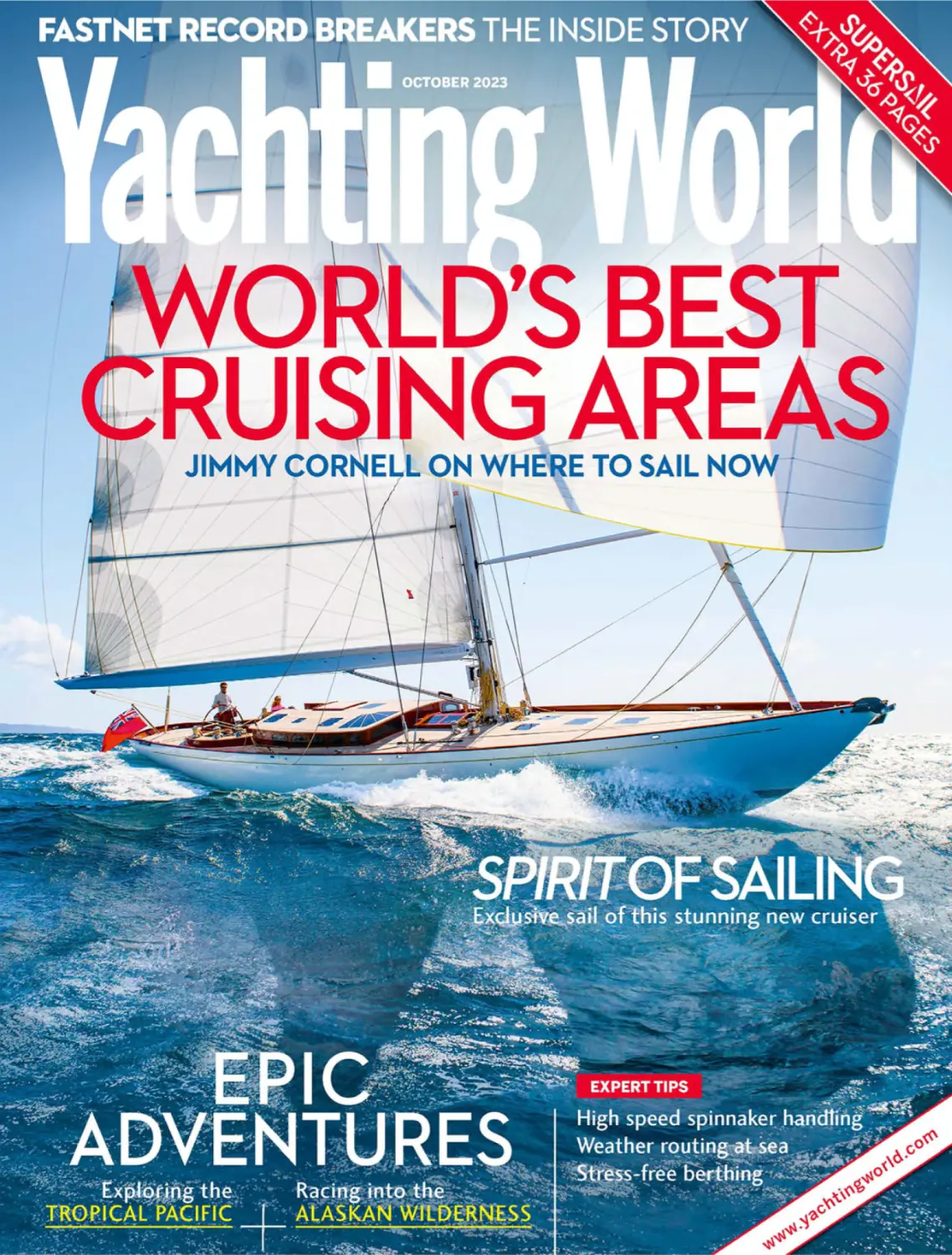
COVER PICTURE
The Spirit 72DH Gwenyfar II
trialled in this issue.
Photo by Waterline Media/
Published monthly on the second Thursday of the month by Future Publishing Limited, Quay House,
The Ambury, Bath BA1 1UA ©Future Publishing, 2023 ISSN 0043-9991
Spirit Yachts
YouTube
Yachting World
Facebook
@yachtingworld
twitter
@yachtingworldmagazine
Eric Pinel/Alamy
Online
www.yachtingworld.com
The splendid isolation of a small island at Rangiroa atoll, Tuamotu
GLORIOUS ISOLATION?
Does your ideal anchorage have anyone else in
it? In this issue cruising doyen Jimmy Cornell
revisits his incredibly authoritative survey of
world cruising destinations, in which he tracks
where boats are cruising today (see page 24).
It’s no surprise the pandemic and shift to
remote working has had a big impact, with
some areas seeing far fewer cruising yachts in
recent years, but is that a good thing? We pick
out some of the most incredible places to sail
now – many of them remote and little-visited by
other sailors, increasing the chances of having
the whole bay to yourself.
Yet making connections along the way is what
can make cruising life sustainable for many
– particularly more sociable souls or those
sailing with young families. On page 120 we
find out more about the Young Cruisers
Association (YCA), which has seen exponential
growth, rising to 10,000 members in five years.
It’s not so many years ago that you met fellow
cruisers by rowing over to say hello, and hoping
they were vaguely pleasant. Now, thanks to
platforms like the YCA and the many social
media groups that help connect cruisers, you
can identify points in common before even
dropping the hook. Finding like-minded souls
to share the experience, to offer companionship
or a helping hand, can make a voyage for some.
For others, the best moments are in glorious
isolation. Hopefully Jimmy’s survey will help
you find your ideal place to sail in the world.
JOIN US AND GET YOUR SAILING FIX
SUBSCRIBE to Yachting World and save 25% off the regular price,
or save 48% off a print + digital subscription with our exclusive
Southampton Boat Show offer. See page 118 for details
Helen Fretter
Editor
SCAN CODE
to receive our
YW newsletter &
exclusive offers
*Big savings and best price guarantee * Never miss an issue * Treat family or friends
6
PICTURE THIS
A speck among the icebergs,
59º North’s Farr 65 Falken is
transiting the Prince Christian
Sound in southern Greenland.
The 70-mile fjord system winds
through staggering mountainous
terrain, offering a spectacular
short cut to the passage around
Cape Farewell. Photo by Andy
Schell, taken with a Phantom
4 Pro drone, hovering at max
altitude (1,640ft) looking east
towards their final 30-mile
stretch towards the ocean.
8
9
ON THE WIND
Adam Mustill/America’s Cup
NEWS AND VIEWS FROM THE WORLD OF YACHTING
Cup teams set for first showdown
The six competing teams in the 37th America’s
Cup are set to get their first chance to line up
competitively against one another at the first
America’s Cup Preliminary Regatta, from 14-17
September 2023.
The event, which sees the America’s Cup
teams move 50km up the coast to Vilanova i La
Geltrú from the main event base in Barcelona,
includes four days of racing in the AC40 onedesign foiling monohull.
Racing begins with official practise on
Thursday 14 September, followed by three fleet
races on 15 and 16 September, and then two
further fleet races on the Sunday before a single
match race final. Coverage will be live-streamed
10
via americascup.com as well on YouTube.
As it is held in the supplied AC40s, rather than
the America’s Cup final designs of the AC75, the
Preliminary Regatta will have little direct bearing
on the Cup match proper, which takes place 11
months later. However, it is a good opportunity
for the teams to bank some foiling race practice,
and perhaps glean some indications of whose
preparation schedules have been the most
fruitful so far.
The teams have taken different approaches to
their training and testing schedules. American
Magic and Emirates Team New Zealand have
been running two-boat testing in their AC40s,
which can be sailed one-design as well as
modified to use in LEQ12 mode, as a test-bed for
different foils and control systems. This has the
advantage of giving eight sailors simultaneous
training time, as well as the option to trial
multiple gear combinations at once. Some LEQ12
yachts have reported high speeds – Luna Rossa
Prada Pirelli is among those rumoured to have hit
over 50 knots (see Matt Sheahan page 20).
Two-boat testing has been outlawed over
recent cycles of the America’s Cup, in an effort
to control costs, but while the teams are not
permitted to build more than one AC75 they are
permitted to purchase two AC40s (Luna Rossa
Prada Pirelli went to arbitration to dispute how
the AC40 build slots were allocated, but lost and
Sailing Energy/The Ocean Race
‘SiFi’ honoured
British navigator Simon Fisher has been awarded the prestigious
Magnus Olsson Prize by The Ocean Race, for an individual who has
made an impactful contribution to sailing. Fisher, known to all as
‘SiFi’, has competed in The Ocean Race six consecutive times and
won twice, including the last edition with 11th Hour Racing Team.
Ugo Fonollá/America’s Cup
decisions. Some boats are running asymmetric
set-ups to test two different foils as well as other
elements such as hull ‘bustles’ and sail control
systems ahead of final decisions for the AC75.
was ordered to pay €10,000). Other teams have
been two-boat testing using one AC40 against
the team’s own custom designed LEQ12 yacht.
Teams with ‘legacy’ AC75s are also permitted
to sail them, with Emirates Team New Zealand
shipping theirs to Barcelona.
“The rule that you can only build one AC75
this campaign is to save cost, but it’s a big
change from the America’s Cup that I grew up
with, in the old IACC class monohulls,” explained
Jeff Causey, INEOS Britannia’s boat operations
manager. “Back then, it was all about two-boat
testing. Every team that could afford to designed
and built two boats, and then lined them up
against each other for countless hours of sideby-side tuning out on the water. We don’t have
that available to us this time.”
Instead, in this Cup cycle the teams are shortcutting their training time by banking hours in
the onshore simulator, and using the AC40 and
LEQ12 boats to develop and validate their design
Above: The AC40s
lined up to test the
tech ahead of the
Preliminary Regatta,
but are yet to race
Left: Emirates Team
New Zealand flying
one of its two AC40s
in modified LEQ12
mode as a test-bed
for the team’s next
AC75 design
CREW MATCH
As with any one-design fleet, the AC40s will put
a premium on boat handling, so the one thing the
Preliminary Regatta will give some indication of
is clues to the sailing teams’ preparation level.
Causey added: “All the teams are looking
forward to lining up in the AC40 against other
teams because it’ll give us a good read and a
good yardstick on just how our sailors are doing
in terms of their technique and the sharpness
of their racing skills. It’ll also give us some good
feedback on some of the things that we think are
fast about the way you sail an AC40; everything
from bustle clearance to sail trim. We’ll get a
chance to measure those things when AC40s
line up against other AC40s.”
Jimmy Spithill explained that even within the
one-design there will be variations in set up:
“The hardware is exactly the same as the others,
and it really comes down to the teams using the
controls: cant, ride height, the trim of the boat.
Obviously sails and technique, there’s a lot of
little things there.”
However, INEOS Britannia’s Leigh McMillan
cautioned: “We’re certainly going to put some
more time in the AC40s. But the Cup itself,
and designing and having a fast boat for the
America’s Cup, has got to be our absolute goal.
It’s not all about the AC40 for now!”
Alinghi Red Bull
Racing (SUI)
Vilanova Preliminary
Regatta will be the
first time Ernesto
Bertarelli’s famous
Swiss team takes part
in an America’s Cup
race since 2010, now
skippered by HansPeter Steinacher.
American Magic
(USA). Australian
Tom Slingsby and
Brit Paul Goodison
are among the sailing
squad headliners. The
US team has secured
some of the highest
number of hours in
the AC40s thanks to a
two-boat programme.
Martin Keruzore/OERT
Ivo Rovira/America’s Cup
Paul Todd/America’s Cup
Alex Carabi/America’s Cup
INEOS Britannia
(GBR, Challenger of
Record). The British
squad moved from
their winter training
base in Palma, and
have been trialing a T6
test boat and AC40.
Giles Scott is sailing
team manager for
skipper Ben Ainslie.
Ugo Fonollá/America’s Cup
Emirates Team New
Zealand (NZL)
The Defenders moved
their team from New
Zealand to Barcelona
this July. Nathan
Outteridge and Pete
Burling have been
taking the dual helms
of their AC75 and two
AC40s.
Job Vermeulen/America’s Cup
AC40 COMPETING TEAMS
Luna Rossa Prada
Pirelli (ITA). Jimmy
Spithill and Francesco
Bruni return on the
twin wheels of the
Italian AC40, though
Spithill cautioned they
have had less time
racing against other
boats than some
other teams.
Orient Express Team
(FRA). The newest
team on the block, the
French squad were
flying on their first
AC40 test sail after
launching mid-August,
skipper Quentin
Delapierre crediting
the time they put in on
the simulator.
11
ON THE WIND
New stakeholders for Grand Soleil
Martin Allen Photography
Grand Soleil
Italian fashion house Calzedonia Group has acquired
a majority stake in Cantiere del Pardo (CDP), builders
of Grand Soleil yachts as well as the Pardo Yachts
and VanDutch brands. The Calzedonia Group has
bought Wise Equity Fund’s 60% ownership.
Big breezes for Cowes Week
The 194th running of Cowes Week, the UK’s
biggest annual regatta, was dominated by strong
breeze conditions. With two days of racing lost,
and gusty conditions of over 20 knots for much
of the event, it turned into a no-discard series
with the overall winners decided on a testing final
day of much lighter winds and strong spring tides
in the Solent.
While numbers were down on previous
years, particularly in the bigger boat fleets, the
24-strong Cape 31 class delivered a show for
spectators and photographers, enjoying some
full-power asymmetric reaching. At the other
end of the performance scale, a new Weekend
Warriors Cup was created for the Club Cruiser
Division, for boats that are true cruiser-racers.
Winners of White Group overall as top
keelboat were Mark Downer and family sailing
12
the Redwing Enigma. Their superb series, with
a scoreline that included four 1sts and one 2nd
place, also saw them deemed overall winners of
Cowes Week 2023.
The victory was hard earned for Downer, who’s
been racing at Cowes Week for 24 years and
this year was competing with his wife Jo and son
Alex: “We have been competing for 24 years and
have never even won our class. It feels as though
we have been the bridesmaid for so long and
now, we finally get to wear white!” he said.
“We’ve been competing in the Redwing for
three years starting with 3rd place then 2nd and
now finally 1st place. It feels absolutely amazing.
“It has been a tricky week and losing two days
of sailing was especially hard, but we knew that
it was make or break today and we just feel so
happy that it’s finally our time.”
The Black Group overall win went to local
talent Jo Richards and his experienced team
of David Rickard, Duncan De Boltz and Sophie
Warren on Woof, a unique modified H-Boat built
in 1972. They took the group win by a narrow
margin from Per Roman’s JPK 1180 Garm.
This is Richards’ third Black Group win at
Cowes Week. He said: “We are absolutely
delighted to win Black Group again. It was,
however, a tough week and exceptionally tiring
with the big winds throughout. We were actually
rather grateful for the odd day off this week.
“Today was tricky and we had a bit of a battle
on, so had to be ultra conservative at the start
given the fact there were no discards. The key
was to keep in the pressure and be on the right
tacks because it was very shifty, and it was easy
to lose out by being in the wrong place.”
ON THE WIND
Panama process simplified
Behan Gifford
The Panama Canal Authority has launched a new online portal
designed to make the process of transiting the canal easier
for small vessels, with virtual inspections to replace physical
measurements. Skippers will be able to upload photos of anchor
housing, davits, solar panels etc. See asem.pancanal.com
Planing and
broaching... a large
contingent of 24
Cape 31s competed
Paul Wyeth
at Cowes Week
Left: strong wind
conditions put a
premium on
spinnaker handling.
Right: the Ker 39
Paul Wyeth
There were several youth trophies up for
grabs, including a popular win for triplets
Charlie, Thomas and Harry White who won the
Montgomery Estate Planning Under 25 Trophy
for the second year running,
sailing their Squib Kestrel.
Kai Hockley won the Musto
Young Skipper’s Trophy for
his performance helming the
Etchells Palava, while a new prize
to recognise commitment and
achievement, the Cowes Week
Youth Trophy, was awarded to
Christopher-Joel Frederick (18)
for his involvement with Greig
City Academy’s Scaramouche
Youth Sailing Project.
Helm Ruby Sunderland, who turned 16 during
the event, also delivered a fantastic youth
performance with a crew that included school
mates to win the Sonar Class, and take the Sonar
National Championship.
Paul Wyeth
La Réponse in IRC 2
Left: the Downer
family and their
Redwing Enigma
were Cowes Week
overall winners
The best female helm award for the Ariel
Trophy went to Grace Cecil-Wright, sailing in the
Performance Cruiser Division.
This year marked the last one for Cowes Week
director, Laurence Mead, who is stepping down
after six years running the event. He summed up
the week: “I think everybody had a classic week
of Cowes Week regatta racing. It is not a world
championship, it is nearly 500 boats enjoying
a great week of competitive boat racing on the
Solent, racing against respected competitors in a
ferocious, but friendly way!
“I will miss being part of the regatta team.
My huge thanks to everybody who is part of
that team. It couldn’t happen without a mass of
volunteers and lots of knowledgeable, passionate
supporters. Thanks to the competitors for
turning up every year for what is, I think, one of
the greatest regattas in the world.”
13
ON THE WIND
Global Solo Challenge
Solo round the world ‘pursuit’
The first competitor in the Global Solo Challenge 2023-24, a solo,
non-stop race around the world race for 32-55ft yachts with an
IRC rating below 1.370, has set off. The race’s pursuit-style starts
run over 11 weeks from A Coruña, Spain, with the first boat back
deemed the winner. Dafydd Hughes was first to go, on his S&S 34.
Chris Cameron/Alamy
The 12 Metre (above) and J Class yachts
will be sailing off Barcelona in 2024
Pierre Bouras/DPPI
ManonLeGuen/Coconuts Sail Team
While the America’s Cup returns to Europe for
its 37th running next year in Barcelona, two
venerable former Cup classes will also be holding
major events at the Spanish city in 2024.
The 12 Metres, in which the America’s Cup
was contested from 1958-1987, will be taking
part in the Regata Puig Vela Clàssica, from
1-10 September 2024, while the America’s
Cup Challenger Series is also taking place. All
divisions of 12 Metres are welcome, with up to
25 yachts expected in Barcelona. The 12 Metre
class saw some of the most iconic Cup entries,
including the radical winged-keel yacht Australia
II and Dennis Conner’s Stars & Stripes.
The J-Class is also heading to Barcelona for
its World Championships in 2024, from 7-11
October. The J-Class, which was used for the
America’s Cup from 1930 to 1937, produced an
impressive sight during the 35th America’s Cup
when a record fleet seven of raced in Bermuda
alongside the Cup final in 2017. The 2024 World
Championships are likely to prove equally
popular with owners of these incredible yachts.
SallyAnne Santos/Windlass Creative
J-Class and 12 Metres add to Cup spectacle
Jay Thompson
and his record
breaking Mini
6.50
Atlantic record in 21ft Mini
American sailor Jay Thompson has set a new
benchmark record for a west-to-east North
Atlantic crossing in a Mini 6.50.
Although the Mini class yachts are designed
to race on the traditional transatlantic tradewind
route from the Canaries in the biennial Mini
Transat, skippers usually ship their 21ft yachts
back to Europe. Thompson made the crossing
in 17 days, 9 hours, 57 minutes and 43 seconds,
from Ambrose Light, New York to Lizard Point off
14
Cornwall aboard his Mini 6.50 Speedy Gonzales.
Thompson had to abandon a previous attempt
last year, but says he was pleased with the time
set. “At the beginning, I was hoping to complete
the crossing in 16 to 20 days and I knew that 16
days would be really exceptional, so I am very
happy with 17 days.”
However, he conceded that the stress of
solo sailing such a small boat eastwards across
the Atlantic had taken its toll. “I haven’t really
experienced that on any other passage or race,
because you really feel that you’re very alone and
you do feel that the boat is small and also fragile.
You’re always tense and have to keep telling
yourself to relax.”
Speedy Gonzales is a foiling Guillaume Verdier
Proto design, which Thompson built himself. He
works for Sam Davies’s Initiatives-Cœur IMOCA
60 team as a préparateur, and had to call on
his maintenance skills after Speedy Gonzales
incurred damage after a low pressure system
swept over him shortly after the start of the
attempt.
“The rudder developed some play. I had
40 knots of wind, and we were slamming into
the waves which would really shunt the boat
sideways; this put a lot of load on the rudder.
“I just had one moment when I was able to
detach the top bearing of the rudder and then I
was able to put some glue in it and put it back,
holding it in place with some washers and a bowl.
Once the glue dried, it was fixed. I knew there
would be strong winds at the end of the crossing,
so I had to make sure that I was able to arrive
with a good rudder system.”
ON THE WIND
Innovation Yachts/
Christophe Favreau
Fifth time unlucky for Sedlacek
On 6 August, Austrian skipper Norbert Sedlacek set out on his fifth
attempt at becoming the first to sail around the world single-handed,
non-stop on a ‘double loop’ through all five oceans using only renewable
energy on his sustainably built Open60. Just five days in, however, he
had to abandon after discovering problems with his canting keel.
Daniel Steenstra
Spectators on
the course
Competitors at last month’s Airlie
Beach Race Week in the Whitsundays,
Australia, were joined by a local as a
whale popped up for a closer look at
the IRC 1 fleet. The event, which runs
from 10-17 August, has classes for
everything from IRC, ORC and PHS
handicap fleets to F18 and
Extreme 40 catamarans.
Andrea Francolini/ABRW
Cruisers hook
unexploded bomb
ESTEPONA
SPAIN
GIBRALTAR
GT Orcasn/Google
TARIFA
CEUTA
16
Orca interactions
move to the Med
The first incidents between orcas
and yachts have been reported in the
Mediterranean east of Gibraltar. Up to now
all have been reported in Atlantic waters.
One incident off Ceuta involved extensive
damage, with another south of Marbella.
The incidents have been reported via the
GT Orcas app (see screenshot left) and the
Cruising Association. It’s not yet known
which orcas are involved.
According to GT Orca scientists, orcas
are known to head as far east as Almería,
though sightings are rare. Meanwhile, there
have been continuing incidents reported in
waters stretching from Gibraltar to Brittany,
with sightings as far north as Brest.
The orcas tend to move north throughout
summer to follow tuna migration patterns.
A Dutch cruising couple were forced to
abandon their brand new anchor and chain
off the port of Pula, northern Croatia, after
they discovered they were entangled with an
unexploded bomb.
Experienced cruisers Daniel Steenstra and
his wife employed a diver to find out why they
were unable to weigh anchor after a night
in North Harbour, Pula. The diver reported
seeing a large cylindrical object rising from
the seabed, approximately 2m in diameter,
which the authorities then confirmed to be
an unexploded Allied bomb that had been
dropped during World War II.
Pula Harbour was a German submarine
base during World War II and was attacked
heavily as a result, but it is now a busy sailing
hub with hundreds of charter yachts based
at multiple marinas in the area. Steenstra
is concerned there was little action by the
authorities once the discovery was made.
“We feel very lucky,” he reported. “We lost
a brand new anchor but if that bomb had
gone off, we might not be around to tell the
tale. The gravity of the situation extended
beyond personal loss, as the presence of the
bomb endangered other sailors in the area.
Despite reporting the hazardous discovery to
local police and military forces, no action was
taken. Disturbingly, local authorities failed to
issue any warnings through channels such as
VHF Radio Rijeka.”
Authorities all over Europe respond to
unexploded ordnance on a regular basis;
according to a BBC report the British Ministry
of Defence is called upon to deal with 60 World
War II bombs on land each year. They have
also been discovered in the sea: in December
2020 a 15m crab fishing vessel in the North
Sea disturbed a German bomb, which
exploded injuring all five crew on board.
N E XT MON T H
ESTABLISHED 1894 • VOLUME 174 • ISSUE NO 3382
Future PLC Quay House, The Ambury, Bath BA1 1UA
ON S A L E 12 O C T OB E R
Editorial enquiries
Email editorial yachtingworld@futurenet.com
Editor Helen Fretter
helen.fretter@futurenet.com
Test Editor Toby Hodges
toby.hodges@futurenet.com
Art Editor Robert Owen
robert.owen@futurenet.com
Production Editor Julian Peckham
Deputy Art Editor Daniel Franklin
Group Art Director, Marine Neil Singleton
Head of Design Sport Kevin Eason
Andy Schell/59° North Sailing
Contributors
Jon Bilger, Elaine Bunting, Max Campbell, Jimmy Cornell,
Tom Cunliffe, Nikki Henderson, Rupert Holmes, Andy Rice,
Rachael Sprot, Matthew Sheahan
SPECIAL: high latitu de a d ventures
Photography
All copyrights and trademarks are recognised and respected
Advertising
Media packs are available on request
Advertising Director Amanda Burns 0330 390 6036
amanda.burns@futurenet.com
Account Director Tanya Ely 07517 561313
tanya.ely@futurenet.com
Account Manager Jagdeep Mann
07581 014347 jagdeep.mann@futurenet.com
Graduate Advertising Executive Stefan Lothgren
0330 390 6600 stefan.lothgren@futurenet.com
Ad Production Coordinator Peter Burton 07531 46623
peter.burton@futurenet.com
International editions
Yachting WorldǣɀƏɮƏǣǼƏƫǼƺǔȒȸǼǣƬƺȇɀǣȇǕƏȇƳɀɵȇƳǣƬƏɎǣȒȇِÁȒˡȇƳ
out more contact us at licensing@futurenet.com or view our
available content at www.futurecontenthub.com
Head of Print Licensing Rachel Shaw
Subscriptions
Email enquiries help@magazinesdirect.com
UK orderline & enquiries 330 333 1113
Overseas order line and enquiries +44 (0)330 333 1113
Online orders & enquiries www.myfavouritemagazines.co.uk
Inspiration and expert tips on one of the most exciting growth areas in adventurous
cruising. Andy Schell has essential advice for anyone dreaming of a high lats
expedition; Skip Novak sails to Zavodoski, the most remote of the South Sandwich
Islands; plus how one couple spent three years sailing the Southern Oceans
Subscription delays Disruption remains within UK and
International delivery networks. Please allow up to 7 days
before contacting us about a late delivery to
help@magazinesdirect.com
Tr y b efore you b u y
Circulation
Head of Newstrade Tim Mathers
Ever fancied taking your dream yacht for a cruise before you commit?
Will Bruton reports on new ‘try before you buy’ charter options
Production
Global Head of Design Rodney Dive
Group Head of Production Mark Constance
Senior Ad Production Manager Jo Crosby
Digital Editions Manager Jason Hudson
Senior Production Manager Matthew Eglinton
Production Manager Frances Twentyman
Win the Middle Sea Race
The Mediterranean classic 600-mile offshore is renowned for dealing competitors
a mix of extreme weather conditions. Top navigator Tom Cheney walks the course
Publishing
Managing Director, Sports Dave Clutterbuck
Brand Director Kirsty Setchell
Commercial Director Clare Dove
Printed by Walstead UK Limited
Hit ting the turb o but ton!
Pip Hare reveals how she’s turbo-charged her IMOCA 60 Medallia, and what it’s like
to fly on the massive foils dominating this solo offshore class, as she prepares for the
Vendée Globe next year and this autumn’s key race, the Transat Jacques Vabre
Distributed by Marketforce, 121-141 Westbourne Terrace, London
W2 6JR. For enquiries, please email
mfcommunications@futurenet.com
We are committed to only using magazine paper which is derived from
ȸƺɀȵȒȇɀǣƫǼɵȅƏȇƏǕƺƳًƬƺȸɎǣˡƺƳǔȒȸƺɀɎȸɵƏȇƳƬǝǼȒȸǣȇƺٮǔȸƺƺȅƏȇɖǔƏƬɎɖȸƺِÁǝƺȵƏȵƺȸ
in this magazine was sourced and produced from sustainable managed forests,
conforming to strict environmental and socioeconomic standards.
Lloyd Images/Pip Hare Ocean Racing
All contents © 2023 Future Publishing Limited or published under licence.
All rights reserved. No part of this magazine may be used, stored, transmitted
or reproduced in any way without the prior written permission of the publisher.
Future Publishing Limited (company number 2008885) is registered in England
ƏȇƳáƏǼƺɀِ«ƺǕǣɀɎƺȸƺƳȒǔˡƬƺيªɖƏɵRȒɖɀƺًÁǝƺȅƫɖȸɵً ƏɎǝ ÈِǼǼ
information contained in this publication is for information only and is, as far as
we are aware, correct at the time of going to press. Future cannot accept any
responsibility for errors or inaccuracies in such information. You are advised to
contact manufacturers and retailers directly with regard to the price of products/
services referred to in this publication. Apps and websites mentioned in this
publication are not under our control. We are not responsible for their contents
or any other changes or updates to them. This magazine is fully independent and
ȇȒɎƏǔˡǼǣƏɎƺƳǣȇƏȇɵɯƏɵɯǣɎǝɎǝƺƬȒȅȵƏȇǣƺɀȅƺȇɎǣȒȇƺƳǝƺȸƺǣȇِ
18
Yachting World (ISSN 0043-9991 USPS 694860) is published monthly by Future
Publishing, Quay House, The Ambury, Bath BA1 1UA, UK. Airfreight and mailing
in the USA by agent named World Container INC 150-15, 183rd St, Jamaica, NY
11413, USA. Periodicals Postage Paid at Brooklyn, NY 11256ِȳ¨ ³Áx³Á0«يɀƺȇƳ
address changes to Yachting World, Air Business Ltd, c/o World Container INC
150-15, 183rd St, Jamaica, NY 11413, USA.
Subscription records are maintained at Future
Publishing, c/o Air Business Subscriptions,
Rockwood House, Perrymount Road, Haywards
Heath, West Sussex RH16 3DH, UK
Future plc is a public
company quoted on the
London Stock Exchange
٢ɀɵȅƫȒǼيIÈÁ«٣
www.futureplc.com
!ǝǣƺǔ0ɴƺƬɖɎǣɮƺ ǔˡƬƺȸ Jon Steinberg
Non-Executive Chairman Richard Huntingford
!ǝǣƺǔIǣȇƏȇƬǣƏǼƏȇƳ³ɎȸƏɎƺǕɵ ǔˡƬƺȸ Penny Ladkin-Brand
Tel +44 (0)1225 442 244
COMMENT
M ATT H E W
SHEAHAN
SERIOUS C HALLENGES AR E ON THE HOR IZ ON FOR THE
WORLD’S SA ILING SPEED RECOR D
S
peed comes naturally to some. For the current
world sailing speed record holder, Paul Larsen,
it was all he thought about for years as he and
his small team developed a radical machine to
set a new outright sailing speed record.
Despite some major setbacks – including a serious
hospitalisation and a suite of maxed out credit cards – in
2012 Team Larsen left the bar at a staggering height, with
the record of 65.45 knots over 500m. It was an incredible
achievement and one that has deserved every day of their
11 years in the spotlight.
But now that speed record, which once seemed out of
reach, is coming under threat and from a number of
different angles. On the face of it the obvious two
challenges are from equally
radical looking speed
machines. Both use kites, but
each takes a different approach
when it comes to the water.
The SP80 campaign uses a
semi-foiling trimaran-style
structure for the business end
of the machine. Their surface skimming machine has been
in development and build for some time and hit the water
this summer in the south of France. Their stated goal is 80
knots, a bold step up from the current record.
The second campaign, Syroco, is led by Alex Caizergues,
a multiple record-breaking kite foiling sailor. While this
also uses a kite for its power source, the crew cockpit is
suspended on the line between the kite in the air and the
foil in the water. They too have 80 knots as their target.
But now it looks like there may be some inadvertent
challenges to the record. In the America’s Cup world the
‘training’ boats, the AC40s that all the teams are required
to buy and race for at least two preliminary events,
are proving to be pretty potent. As teams push
them harder during training they’re clocking
up some pretty impressive speeds – a
rumoured 57 knots in one case.
I know it’s not 65 knots and the problems
grow exponentially as you climb the speed
curve, but that’s still getting surprisingly
close for a boat that was designed for fleet
racing on a windward leeward course. And
what does this also say for the 75ft Cup
boats proper when they’re launched?
SailGP is also climbing the speed
curve with its one-design F50 cats. Last year the techies
were busy developing higher performance foils for the
rudders to deal with the speed limiting cavitation and,
while we’ve yet to see the full results in a breeze, it feels like
this could be another area where speeds that are already in
the 50s at their top end could be nudging up towards that
record breaking pace.
Meanwhile, down in New Zealand there’s news that one
of the top talents in the modern America’s Cup is looking
to walk away from sailing’s most prestigious trophy and
embark on a campaign to be the fastest person under sail
on water. As the fastest ‘sailor on land’, Glenn Ashby starts
from a good place having broken the sailing land speed
record earlier this year with the Emirates Team New
Zealand land yacht Horonuku’s
incredible performance.
In the media lull between
the last Cup and the next one,
Ashby & Co made the best of it
by smashing the sailing land
speed record.
Learning how to handle a
wing-powered carbon tubular missile at 225.58kph
doesn’t come with a handbook. Instead, you need a
thorough technical understanding, a feel for the unknown
and, to put no finer point on it, balls. Ashby has all of these
in spades and demonstrated it from the first trial runs
where the team was starting to push.
“I’d love to do a water speed sailing project. Spring
boarding what we have done with this land speed record, I
think we are in a great position to do it,” he told Stuff.co.nz
earlier in the year.
So, what does the world’s fastest man think of all this?
“Once we see a team like Team New Zealand put their
efforts into going really fast and pushing the limits
then it’ll be interesting to see what they do – but it
will take until after the next Cup cycle,” Larsen
commented.
“I’ve always said I’d wait until I see who comes
for the record before we see what Sailrocket can
do. I also keep reminding people that our
record reached the minimum performance
threshold for what that boat was designed for.
It’s structured for 80 knots and we don’t have to
modify much to do 80 knots apart from
getting more performance out of the foil.”
Pure speed seems back in vogue.
‘One AC40 clocked a
rumoured 57 knots’
20
COMMENT
NIKKI
HENDERSON
TH E BEST SKIPPERS NEED TO B E AWARE OF THEIR B OUNDARIES – BECAUSE
CH ALLENG ES CAN COME FROM UNEX PECTED C ORNERS
R
ecently a friend confided in me about a
difficult leadership dilemma they’d faced.
After skippering a qualifier for the Fastnet
Race, they were preparing to berth in the
marina. On approach to the dock, the first
mate started instructing them on how to drive. In
response, my friend said: “I’ve got this, thank you.”
Panicking, the first mate grabbed the wheel and tried to
take over. Again, my friend repeated: “Please stand back.
I’ve got this,” took back the wheel and parked the boat
safely alongside.
I was lost for words. I’m amazed that my friend retained
composure despite such a direct and public challenge to
their authority. I was also shocked that someone had the –
I’m not sure what word to use...
arrogance? Conviction? Lack
of situational awareness? – to
take the wheel uninvited from
a skipper right in the middle of
a close quarters manoeuvre.
Clearly they lacked an
understanding or empathy for
the level of responsibility on a skipper’s shoulders when
parking up. Two people trying to drive the boat at the
same time would have merely confused the rest of the
crew, left the boat without anyone fully in command, and
most likely resulted in a worse situation – which the
skipper would still have legally been liable for.
Sensing my horror, my friend added: “Well, to be fair to
them, it wasn’t my prettiest park.”
I shook my head. To me, the mate’s actions were
unforgivable. I wouldn’t have felt comfortable going to sea
with them again. But that’s easy to say as an observer.
I’ve been in a similar position before and know
all too well the self-doubt that can follow a
situation like that.
So we discussed this: is there ever an
excuse for undermining authority?
Ultimately, the skipper is responsible for
the vessel and the crew. But if, as a
crewmember, you feel the lives of the
people on board or the wellbeing of the
vessel are at stake, is it your prerogative to
step in and take over command? Even if
you are not liable yourself?
Ultimately, yes. There should be
grounds to challenge authority.
I’m sure many would disagree and argue there’s no place
for democracy on board. But I find this belief dangerous.
A culture of ‘speaking up’ is a safe culture.
However, there is a difference between challenging
authority vocally and physically taking over. In this
example, this is where the line was crossed.
Being aware of where our hard lines lie is a critical part
of effective leadership. The best skippers are both selfaware and experienced enough to be clear on what their
boundaries are, and are also able to effectively communicate
them to their crew. When crew come from different
backgrounds, cultures, and generations, they may bring
with them different assumptions of what is right and wrong.
To me the first mate’s actions were inappropriate. But
this example proves assumptions
are dangerous. Clearly the mate
disagreed. Removing any
ambiguity in what is OK and not
OK is key to building a wellfunctioning, safe team.
Black and white lines need to
be generic enough that they can
be adapted to different scenarios. Spelling out do’s and
don’ts for all the possible eventualities would take days
and result in an oppressive culture on board. Instead, a
handful of the most important rights and wrongs can keep
things in check.
So, in this case, a relevant hard line could have been:
‘On this boat, no one takes over a job from someone else
without communicating they are going to do so, or asking
permission’. Or even more generic: ‘On this boat we
assume the best in one another’. Both, if abided by, would
have saved this scenario from happening or given
clear grounds for disciplinary action afterwards.
But the latter is particularly challenging to
enforce if it comes after a dip in confidence that
comes after a failure of your own, or a challenge
to your authority.
I’m happy to say that my friend’s Fastnet
campaign went on to be a success. They’d built
enough rapport with the crew that the first mate’s
actions did not undermine their authority.
But it was a reminder that it can sometimes be
really tough to find the self-assurance to
enforce and uphold our values. Leaving
things unsaid on board rarely leads to
good outcomes.
‘Is there an excuse for
undermining authority?’
22
w h e r e
to
o
s a i lr
u n
d
JIM MY COR NELL ,
DOY EN OF WORLD CRUI SI NG ,
FIN DS T HER E HAV E BE EN SO ME
d
PAT T ERN S . NOW COULD BE
T HE BEST T IM E TO G O, HE SAYS .
l
w o r
24
e
BUT WHERE ?
t h
BI G S HIF TS IN GLOBA L C RUISI N G
1
COOK ISLANDS
Located between French Polynesia and
American Samoa. Rarotonga is the clearing
in port, but the 15 different islands are
scattered across almost half a million
square miles of the Pacific. The northern
group of the islands, with turquoise sea and
sand fringed coral atolls, are the ones to
head to if possible, and include the
hideaway of Suwarrow (pictured here, see
V
I have been tracking the global movement of cruising
boats since 1987, when I published the results of my
first survey on this subject. In the intervening 35 years
I’ve conducted follow-up surveys every five years.
Since the last in 2016, the world has experienced two
major phenomena that have seriously affected
offshore cruising: the Covid pandemic; and the
climate crisis, the effects of which are already felt – and
its consequences are expected to get worse.
The pandemic had an immediate impact on the
international cruising community and caused havoc
among sailors on a long voyage. As many popular
destinations closed their borders, those who were
caught out had to either postpone their plans, or leave
their boats unattended and return home. The prolonged
interruption resulted in some abandoning their voyage.
As a result, international cruising traffic came to a
standstill. Since then, statistics from cruising hubs such
25
Galaxiid/Alamy
Galaxiid/Alamy
also page 27).
CRUISING
as Panama, Bermuda, Las Palmas, Tahiti and
Noumea show that whereas some places fared
better, others saw an unprecedented reduction in
the number of visiting boats.
2
G O I N G T R A N S AT L A N T I C
The port of Las Palmas in the Canary Islands boasts a
larger concentration of boats preparing for an ocean
passage than any other place in the world, with the
Jane Sweeney/Alamy
Michael Greenfelder/Alamy
B I G FA L L I N N U M B E R S
In 2021, Las Palmas in the Canary Islands
recorded its highest ever influx of 1,256 visiting
CUBA
boats. As the starting point for the annual ARC
transatlantic rally, as well as an important transit
Cruising in Cuba and its off-islands has
hub, it proved its lasting popularity thanks to the
restrictions on where you can sail, but
tolerant attitude of local authorities faced with
there are marinas to base at or you can
such an unexpected crisis. A similar situation
head off and find some wonderful remote
was experienced in the Azores, the favourite
anchorages with absolute peace and
landfall at the end of a transatlantic from the
quiet. There are many places with no
Caribbean. Horta Marina recorded 1,102 arrivals
settlements ashore, just you, coral, white
compared to 465 in 2020 and 1,132 in 2019.
sand beaches and mangroves. Go before
But the figures obtained from these Atlantic
it opens up to large numbers of boats.
hubs aren’t reflected by the statistics from other
parts of the world. A most drastic fall occurred in
countries where Covid restrictions continued into 2021,
such as Tonga, New Caledonia, New Zealand, Australia,
which recorded no arrivals, while in Tahiti, South Africa
and the Panama Canal numbers were considerably lower
than in previous years (Panama Canal transits went
down to 806 in 2021 from 1,122 in 2020). During 2022,
most countries began to lift temporary restrictions. As
the situation was slowly returning to normal, I contacted
officials in all locations featured in my previous survey
requesting statistical data on the number of foreign
flagged yachts that had passed through in 2022.
majority setting off from there across the
Atlantic to the Caribbean.
Approximately 75% of the boats that
called at Las Palmas were bound for the
Caribbean, either directly or via the Cape
Verdes. An increasingly popular
intermediate point for a transatlantic
passage is Mindelo Marina, on São
PITCAIRN ISLANDS
Vicente Island, which recorded a total of
1,120 arrivals in 2022, the highest ever
A group of islands of the British Overseas
number of visiting yachts. Located in the
Territory including Henderson, Ducie and
north-east trade wind belt, this is now
Oeno, Pitcairn is tiny – only two miles long
considered to be a better starting point for
– and has around 50 inhabitants, almost
an Atlantic passage to the Caribbean than
all descended from the mutineers of the
the direct route from the Canaries, as the
Bounty and their Tahitian companions.
chance of consistent favourable winds is
A fascinating place, and known for the
higher, and the distance shorter.
warm welcome of one of the most
Most of the European boats that sail to
isolated communities in the world.
the Caribbean usually cross the Atlantic
after the middle of November or early
December, and complete their Atlantic circuit by sailing
to the Azores the following April or May. Horta, on the
island of Faial, continues to be the preferred landfall at
the end of an eastbound transatlantic passage. The data
from here confirmed that the majority of boats on
passage from the Caribbean to Europe now sail directly to
3
26
the Azores, rather than via a detour to Bermuda.
While Horta has overtaken Bermuda in overall
number of visiting yachts, Bermuda continues to be an
important transit point for North American boats sailing
between the mainland and the Caribbean or Europe, as
well as for boats returning from the Caribbean to the US
or Canada. A steady decline since 2000 is mainly due to
the large number of American boats that bypass
Bermuda and sail directly to the Eastern Caribbean. The
situation is reversed in May, when more boats returning
to the US mainland call at Bermuda.
4
S U WA R ROW
The tiny atoll is a national park, part of
Uwe Moser Moser/Alamy
V
C A R I B B E A N : O N LY F O R A S E A S O N ?
Over half the boats that arrive in the Caribbean from either
Europe or America used to spend at least one full season
there, but many now limit themselves to a one year circuit.
Those who decide to stay longer in the Caribbean usually
have their boats stored on land in a secure place during the
hurricane season. Trinidad has several boatyards for this
purpose, and 478 boats spent the summer there in 2022,
a significant reduction from 2,664 in 2000 and 1,367 in
2010. According to Donald Stollmeyer, former president
of the Yacht Services Association of Trinidad and
Tobago: “The explanation is the gradual decline in the
number of sailors who are prepared to keep their boats
in the tropics during the hurricane season.”
the Cook Islands, and, you have to apply
to visit well in advance. It was once home
to New Zealander Tom Neale, who lived a
hermit-like lone existence, and is now
looked after by caretakers and opened up
for visits from June to November. There’s
a unique feel to this hideaway.
27
5
CAPE VERDE
A fascinating volcanic archipelago and a
melting pot of Portuguese and African
culture, cuisine and music, Mindelo on
An even more significant reason is the
fact that many insurance companies are
no longer prepared to provide cover to
those who plan to spend the critical
season in the tropics.
The total number of boats that spend
the winter season cruising in the
Caribbean has remained relatively stable
in recent years. However, one country
which was expected to see an increase is
Cuba, and its eight marinas recorded in
2022 a total of 284 foreign flagged yachts.
Sao Vicente is the usual stop; there is a
T H E S O U T H AT L A N T I C
From Puerto Williams and Ushuaia most
won’t regret a visit and a typical
cruising yachts heading for the South
transatlantic is shorter and easier from
Atlantic call at Port Stanley in the
here.
Falklands, which saw 12 yachts in 2022,
compared to 29 in 2015. From there, the
routes diverge and either follow the contour
of the South American mainland, or continue nonstop
to St Helena or Cape Town.
Both of these have seen an increase in the number of
visiting yachts, initially as a result of the risk of piracy in
the North Indian Ocean, and more recently by the safety
concerns caused by the political uncertainty in some of
the countries bordering the Red Sea.
marina there, very basic maintenance
Jenny Bailey/Alamy
but diesel supplies and provisions. You
6
MARQUESAS ISLANDS
For most trans-Pacific sailors, this is the
first stop in Polynesia after the 3,000-mile
passage from the Galapagos, and without
doubt the most special. The islands of
Nuku Hiva and Hiva Oa are the usual
stops, deep water anchorages beneath
high, rugged green mountains and fringed
by palms – the Pacific dream. The garden
island of Fatu Hiva might be one of the
most beautiful you ever visit.
28
CRUISING
As a result, the majority of yachts on a world voyage are
sailing the Cape of Good Hope route. With the exception
of a few boats that sailed directly from Cape Town to
Argentina or Brazil, most boats headed north and
stopped at St Helena.
N O R T H PA C I F I C
While the South Pacific continues to attract most
of the yachts undertaking a world voyage, there’s
been a considerable decline in the number of
7
NEW ZEALAND
A favourite place to drop out of a round
the world voyage for a complete season
visiting boats in the
before picking up again, the country
Western North Pacific.
offers every type of scenery and
This is the first area in the
experience you could wish with a culture
world to suffer the
that feels comfortably familiar and yet
consequences of climate
distinctly unique. A first stop in the Bay
change on a large scale,
of Islands is a gentle introduction after
with weather conditions
the passage from Tonga and Fiji.
being noticeably affected
by the warming of the
oceans. The worst
affected are the Philippines, with tropical cyclones now
occurring in every month of the year.
In spite of the uncertain weather, the Philippines
continues to attract visiting boats, but most limit
themselves to areas rarely affected by tropical storms.
On the Asian mainland, the expected boom in visiting
cruising boats has failed to materialise, and even the
figures from Hong Kong show a considerable decline
compared to previous surveys.
There’s not been not much more movement in China
either, where formalities for visiting yachts continue to
be both complicated and expensive.
A small number of cruising boats make it as far as Japan
every year with an estimated 12 foreign yachts passing
through Osaka in 2022. Most of them continued east, with
some stopping at Dutch Harbor on their way to Canada or
the US west coast. This busy fishing port at the eastern
edge of the Aleutian Islands has excellent provisioning
and repair facilities, making it a good base to prepare for
an eastbound transit of the Northwest Passage.
Foreign-flagged yachts are still a rare sight in Hawaii.
It does attract many [article continues on page 38]
V
Zoonar/Alamy
THE ‘COCONUT MILK RUN’
Sailing west across the Pacific from Tahiti, there are
several detours that can be made from the main trunk
route, such as to Suwarrow, an uninhabited atoll in the
Northern Cook Islands. A caretaker is based there
during the peak arrivals time.
Another popular place, also in the Cook Islands,
is Palmerston Atoll, which was visited by only three
boats in 2022, with none the previous year because
of the Covid restrictions. Neighbouring Tonga was
closed to visitors during the pandemic and only
lifted restrictions in early 2022. The northern
island group of Vava’u, a long time-favourite
among sailors roaming the South Seas, welcomed
only 14 arrivals, compared to an all-time peak 424
as reported in the previous survey.
The above places are close enough to the main
transpacific route not to entail much of a detour,
and this may explain the fact that only four boats
called at Tuvalu. This small Polynesian community
is threatened to be the first victim of the rising sea
levels caused by climate change.
Fiji is an important cruising hub in the South
Pacific and its capital Suva welcomed 83 yachts in
2022. By the time they’ve reached that point, most
cruising boats leave the tropics before the start of
the cyclone season and sail to New Zealand or
Australia. The decision of both countries to close
their borders to all visitors at the start of the
pandemic, caused mayhem among sailors planning
to spend the cyclone season there. The restrictions
were only lifted in 2022 when 324 boats were
welcomed in New Zealand and 330 in Australia.
After nil arrivals in 2021, New Caledonia was
visited in 2022 by 241 boats, a hopeful indication
that the situation is gradually returning to normal.
doughoughton/Alamy
R O U T E S A C R O S S T H E PA C I F I C
The Panama Canal is the most valuable indicator of yacht
movement both between the Atlantic and Pacific oceans,
and on a global level. The latest figures show that the
steady increase in the number of transits by pleasure craft
seems to have peaked in 2010 when 1,177 yachts
transited the Panama Canal compared to 919 in 2022, of
which 725 were Pacific-bound and 354 Atlantic-bound.
What has remained unchanged are the Pacific
destinations after the transit, with one third of the boats
turning north, towards the west coast of Central and
North America, and the rest heading for the South Pacific.
The Galapagos Islands used to be a favourite stopover
en route to French Polynesia, but the restrictions
imposed on visiting yachts, and complex formalities, and
the expenses associated with them, now deter most
sailors from stopping there.
29
Worldwide cruising yacht
visitor numbers compared
NORTHWEST
PASSAGE
2010
2015
2020
2022
6
11
1
8
NUUK
TOP TRANSATLANTIC VOYAGERS
DUTCH HARBOR
2015
2022
France
Germany
United Kingdom
Netherlands
Sweden
Switzerland
Denmark
Norway
USA
Belgium
Poland
Finland
New Zealand
Spain
Australia
Italy
Russia
Czechia
23
6
HAWAII
2000 39
2010 30
2015 32
2022 20
266
194
83
49
42,
38
27
24
19
17
16
14
13
12
11
9
8
7
2015 32
2022 8
GIBRALTAR
BERMUDA
TOTAL NUMBERS
CROSSING THE
ATLANTIC FROM
LAS PALMAS
IN 2022
2000
2010
2015
2022
2000
2010
2015
790
1177
1079
919
2000
2010
2015
2022
PITCAIRN
2015
2022
MADEIRA
2015
518
LAS PALMAS
2000
2010
2015
2022
993
1495
903
1120
TRINIDAD
MINDELO
1990
2000
2010
2015
2010 673
2015 750
2022 1120
1500
2664
1367
1015
CABEDELO
GALAPAGOS
TAHITI
2015 209
22444
18467
1600
PANAMA CANAL
2010 826
2022 404
COOK Islands
1144
1098
1232
1123
BAHAMAS
2015 500
2015 284
2022 284
marquesas
442
826
556
404
2000
2010
2015
2022
1160
905
732
838
CUBA
2000
2010
2015
2022
2000
2010
2015
2022
2000 4643
2010 3222
2015 2472
2022 1135
HORTA
2015
81
180
395
280
66
ST HELENA
EASTER ISLAND
2000
2010
2015
2022
2000 22
2010 44
2015 49
2022
7
184
169
196
95
14
11
Tristan
da Cunha
PUERTO
WILLIAMS
Shut to arrivals during the pandemic, the
French Polynesian islands of Marquesas and
2010 505
2015 283
2022 77
FALKLANDS
2000 22
2010 37
2015 29
2022 12
2000 22
2010 37
2019
7
2022
1
Tahiti are still not back up to pre-2020 levels of
visitors. Many sailors prefer to sail a different
USHUAIA
route to French Polynesia.
2000 105
2015 64
2022 38
OCEAN ROUTES
75
%
of boats leaving the Canary
Islands are bound for the
Caribbean
PANAMA CANAL
30
%
of boats head north to
Central and North
America
ANTARCTICA
2000
2010
2015
2022
31
32
18
27
PACIFIC
70
%
of boats continue to
South Pacific
SPITSBERGEN
2000 10
2015 65
2020 40
2022 52
8
N O R T H W E S T PA S S A G E
ST PETERSBURG
2010
2015
2022
Not a destination you can just set out on,
55
60
2
and on any given year the route is not
guaranteed to be open as the eastern
and western ends can get blocked by
sea ice. Global warming has had a big
impact, though, and transits are more
likely. One of the last great feats of
Jimmy Cornell
ocean exploration, possible with a
suitable boat and detailed planning.
SUEZ CANAL
2010 171
2022 36
HONG KONG
OSAKA
2000 20
2010 40
2015 30
2022 0
2015
2022
2000
2010
2015
2022
100
200
340
250
2015 750
2022 8
SINGAPORE
2000 230
2010 182
2022 201
2000 116
2015 48
2022 6
2000
2010
2015
2022
27
37
14
TUVALU
TOKELAU
2015
2022
2015
6
3
3
SUVA
COCOS
KEELING
chagos
2010 82
2015 108
2022 96
2010
2015
2022
2000 133
2010 79
2015 98
2022 23
NOSY BE
DURBAN
MARSHALL
ISlands
2015 200
PHUKET
16
33
11
GALLE
CAPE TOWN
PHILIPPINES
COCHIN
2015
2020
2022
20
12
2000
2010
2015
2022
INDONESIA
2000 116
2015 99
2022 31
2000 250
2016 236
2022 46
142
350
300
83
DARWIN
MAURITIUS
AUSTRALIA
2000 196
2015 281
2022 242
2010 459
2015 361
2022 330
2000 239
2010 139
2015 72
2022 23
VAVA’U
2015 424
2022 14
NOUMEA
2000 605
2015 328
2022 241
SUEZ CANAL OR CAPE OF GOOD HOPE?
120
150
358
126
The risk of piracy in the North
undertaken in relatively small
• Ship from south-east Asia to
Indian Ocean and Red Sea has
numbers: 14 northbound and
the Mediterranean with
largely been replaced by
10 southbound in 2021 and
Sevenstar or Peters & May.
political volatility in the Middle
around 36 total last year.
• Continue into the South
East, from Yemen through the
However, Yemen is in civil war
Atlantic via the Cape of Good
Red Sea to the Suez Canal.
and should be avoided, and
Hope. The majority of cruisers
Any sailor on a westbound
convoys are now thought to be
choose this route, which is not
voyage has three options:
too visible to be a good idea.
usually problematic with
• Through the Red Sea. Still
Support is also very scarce.
careful planning.
HOW ARC YACHTS ARE CHANGING
27
%
The size of boats taking part in the ARC has been
steadily increasing and in this latest edition 31
monohulls were over 50ft and 22 multihulls over 60ft
AVERAGE YACHT SIZE
AVERAGE NUMBER OF CREW
MONOHULL LAS PALMAS
42ft 7in
SAINT HELENA
3.2
+
MULTIHULLS LAS PALMAS
CAPE TOWN
+
MULTIHULL PANAMA CANAL
TAHITI
45ft 2in
49ft 10in
MONOHULL PANAMA
49ft 1in
2.9
2.8
+
NEW ZEALAND
1987
2000
2010
2015
2022
250
567
697
669
324
HOW FAR ARE YOU GOING?*
12%
ON WORLD VOYAGE
92%
ROUND THE ATLANTIC
86%
ROUND THE PACIFIC
V
mainland boats, both cruising and racing, and some sail
from there to French Polynesia and a few continue west
towards Micronesia and the Asian mainland.
Greg Balfour Evans/Alamy
ACROSS THE INDIAN OCEAN
In recent years the number of foreign flagged boats has
shown a steady decrease in the North Indian Ocean,
with most boats on a world voyage sailing the Cape of
Good Hope route to reach the Atlantic Ocean, rather
than the Red Sea and Suez Canal alternative.
For those who are not deterred by the uncertainty in
some of the countries bordering on the Red Sea, and
continue west across the North Indian Ocean, a
convenient port is Galle, on the south coast of Sri Lanka,
or a further detour to Cochin in South India.
Djibouti continues to be the only safe haven to prepare
for the arduous transit of the Red Sea, and 29 boats stopped
here before heading north. All made it safely to Suez.
It’s estimated that roughly 250 yachts transit the Torres
Strait every year, of which about half continue west into
the South Indian Ocean and the others take the
opportunity to explore the Indonesian archipelago. The
complex formalities of the past have been discontinued
in an attempt to attract more visitors to one of the most
interesting and diverse cruising grounds in the world.
Even so, only 46 foreign vessels obtained the required
cruising permit issued by the Indonesian Ministry of
Foreign Affairs in 2022, compared to 236 in 2016.
There was also significant reduction in the boats
heading directly for the South Indian Ocean that
stopped at Darwin in Northern Australia, which saw 23
arrivals in 2022, compared to 72 in the previous survey.
The popular Australian outpost of Cocos Keeling was
also affected by the Covid pandemic, with only 31
arrivals in 2022 compared to 99 in 2015. From Cocos
Keeling the westbound route splits into a southern
branch to Rodrigues and Mauritius and a northern
branch bound for Chagos (British Indian Ocean
Territory). The British authorities now limit the issue of
the compulsory permit to those who can justify the need
for a stop in those islands, rather than those who regard
them as an attractive cruising interlude. The most
popular stop along the southern route is Port Louis in
Mauritius, proof of the predominance
of the Cape of Good Hope route among
boats on a world voyage.
Madagascar was once expected to
become the major cruising attraction in
the South Indian Ocean, but the lack of
facilities and cumbersome bureaucracy
has put paid to those hopes. Few world
voyagers bother to make the lengthy
SOUTH AFRICA
detour from Mauritius or La Réunion.
On the eve of the cyclone season, all
Now the ‘summit’ of the return stages of a
boats make their way south. In 2022,
circumnavigation, given how few cruisers
Richards Bay was the favourite South
contemplate the Red Sea route. Crossing
African landfall. Thanks to the efforts of
the Agulhas Current is the hard part,
the Ocean Sailing Association of South
requiring careful planning and timing from
Africa, this was one of the very few
the island of Réunion to avoid the march
countries in the world that didn’t close
of lows. From Richard’s Bay, the timings
its borders to visiting yachts during the
are easier to predict, so coast-hop to
Covid pandemic.
Cape Town and the Cape winelands.
9
32
CRUISING
10
S VA L BA R D
Certainly the most accessible polar
sailing destination, with over 120
potential anchorages and harbours,
sights that include polar bears, abundant
bird life and true remoteness. You need to
apply for a permit and, like any high
latitudes destination, it demands the
right type of yacht and preparation, but it
Alexey Seafarer/Alamy
is unforgettable.
YA C H T S A N D C R E W S C H A N G I N G
Besides the drastic reduction in the number of cruising
boats on a world voyage, this survey has highlighted three
interesting factors: the small size of crew on long voyages,
with many couples sailing on their own; the number of
couples with young children setting off on a sabbatical
leave; and the steadily increasing proportion of multihulls.
More efficient and better-equipped boats, with reliable
automatic pilots, electric winches, furling gears and
countless other accessories have resulted in an overall
reduction in the size of crew. This was evident from the
crews of the boats that called at Cape Town having an
average of 2.9 people, while in St Helena it was 3.2, in
Cocos Keeling 2.5 and in Tahiti 2.8. In the latter two cases,
more than half the boats were crewed by just a couple.
Another interesting trend highlighted by the survey
was the change in the predominant flags of the boats on a
world voyage. Whereas in all the previous surveys
USA-flagged yachts were usually in the lead, they’re now
superseded by the French tricolour.
There are various reasons for this, but they all seem
related to safety concerns. As the consequences of climate
change are now visibly affecting offshore weather
conditions, sailors are concerned about how those changes
will affect their future plans.
The Covid pandemic has undoubtedly had a significant
negative impact, but it will be interesting to see whether
more sailors will decide to leave now rather than wait until
it may be too late. This seems to be already happening, as
boatbuilders are reporting full order books, with waiting
times of up to three years, and the used market is enjoying
an unprecedented boom. Carpe diem!
Jimmy Cornell can safely be described
as the father of modern ocean
cruising. He founded the ARC rally in
1986, ran the first circumnavigation
rally and has himself sailed over
G O N O W. . . O R W A I T ?
Since my first global survey in 1987, the cruising scene
has seen important changes and overall statistics seem to
indicate that the popularity of long distance voyages may
have peaked in 2010.
200,000 miles on three round the
world voyages. He is author of the
bestselling World Cruising Routes, and
the latest edition of Cornell’s Ocean
Atlas is out now.
33
the
g r e at e s t
race
T HE 2023 RO L EX FA STN E T RAC E WAS THE BIGG EST
O F FSH OR E RACE OF F A LL T IME – AN D T HIS Y EA R’S
50 T H E DIT IO N WAS A T RUE T EST OF EVERY
C OM PE T ITOR . HE LEN F RET T ER REPORT S
36
Rolex/Kurt Arrigo
RORC vice-commodore Eric De Turckheim’s NMYD 54
Teasing Machine rounding the Fastnet Rock
37
RACING
Paul Wyeth
The pagers started bleeping soon after lunch for the
volunteer crews of the Solent lifeboat stations on
Saturday 22 August. The team at Yarmouth RNLI barely
had time to peel off their oilskins and yellow wellies
between ‘shouts’ that afternoon, as call after call came
in for Fastnet competitors requesting assistance.
An incredible 430 yachts had taken the start from the
Royal Yacht Squadron line just an hour or two earlier,
making the 2023 Rolex Fastnet Race the largest offshore
race in history. Even more had entered, but several dozen
skippers considered the forecast and chose not to take
part. They included the Maxi 72 Notorious, with Volvo
Ocean Race-winning skipper Ian Walker among the
experienced crew, so challenging were conditions.
‘Gnarly’ was how RORC race director Steve Cole had
described the forecast at the preceding day’s skipper’s
briefing, with weather models showing up to 30-35 knots,
gusting 40. While windspeeds at the start were closer to
20-25 knots, barring a few gusty squalls that swept
through the fleet, those winds built as the fleet headed
west. Meanwhile, by the time the bulk of the fleet were
passing Hurst Narrows the Solent was in full ebb, which
kicked up a vicious wind against tide sea state.
Reports of damage swiftly began to pour in, the
coastguard responding to 28 incidents involving yachts in
the race. Lifeboats and coastal rescue teams from
Yarmouth, Poole, Weymouth, Swanage, Portland and Wyke
were all deployed repeatedly, with the Yarmouth RNLI
crews in the western Solent being called out six times alone.
Among the most dramatic was the sinking of the
38
Sunfast 3600 Vari, a French double-handed entry. A
search and rescue helicopter and two lifeboats were
deployed after reports that Vari was taking on water in her
engine compartment, but the yacht went down within 20
minutes. By the time rescue services arrived at the yacht’s
position south-west of the Needles, crewmembers Yann
Jestin and Romain Baggio were already in the liferaft.
Both were safely recovered and taken ashore to Yarmouth.
The Swanage all-weather lifeboat was tasked to assist a
yacht where a crewmember had been knocked on the
head and fallen overboard. Thanks to their tether the
crewmember was recovered by his team mates, but
remained semi-unconscious. With the coastguard
helicopter unable to lower a paramedic, the yacht headed
inshore for calmer waters where the casualty was
transferred via lifeboat.
Other incidents included yachts that suffered
dismastings (including Golden Globe Race skipper Tapio
Lehtinen on his 1970 Swan 55 Galiana, which is going on
to take part in the Ocean Globe Race), steering failure,
running aground while attempting to seek respite at
anchor, and structural deck failures.
Paul Wyeth
‘Over the first night, conditions deteriorated’
Above: challenging start
for the 2023 Rolex Fastnet.
Left: Jérôme Desvaux’s
crew working hard to
control their Reflex 38
Puma in rough conditions.
Below: dramatic shot of
Rolex/Kurt Arrigo
Niklas Zennstrom’s Rán
LOWS ON THE HORIZON
Within 24 hours of racing, more than 100 yachts had
retired. The question ‘Should they have started?’ was being
asked. The Fastnet Race has only been postponed once, in
2007, but some followers and commentators queried
whether it should have been postponed this year.
“We had to look at the race as a whole,” race director
Cole explained. “There were two other low pressure
systems solidly forming out to the west that were likely,
and did, come into the race area during the course. And
the main driver for not postponing really was to make
sure that we didn’t end up with a lot of boats in the Celtic
Sea when the second low pressure system hit.
“We also knew that a 24-hour postponement wasn’t just
24 hours – with light winds coming in, it would be an
extra 30-odd hours on the course for some boats.”
This is the second Fastnet Race in a row to see the fleet
thinned in the first day. Also as in 2021, many of the
qualifying races had been held in lighter conditions,
thanks to several weekends of unseasonal easterlies for
much of May and June in the south of England. “We had
much the same as we had in 2021: we had a reasonably
benign, light year of other races,” explains Cole.
“But at some point over a five or six day race for most of
the boats, you are likely to meet some wind
V
R U N N I N G F O R S H E LT E R
Over the first night, conditions deteriorated yet further
with winds gusting over 40 knots, and the Force 9 gale
driving a sharp sea of over 4m, with waves peaking at
nearly 7m. “A pretty terrifying night,” is how Ellie Driver,
who was racing double-handed with her father on the Sun
Fast 3300 Chilli Pepper, reported conditions on their team
Facebook page. Among the tactics they used to manage
the situation was to drop all headsails to reduce the
flogging and risk of damage to their mainsail. Other boats
ran for shelter, with the tracker soon showing boats dotted
all over the south coast, even tucked into the small natural
harbour of Newtown Creek on the Isle of Wight at anchor.
Husband and wife double-handed team Chris and
Justin Wolfe on their Sun Fast 3300 Red Ruby were among
those that kept sailing but tried to seek some respite by
heading inshore on the first night. On their race updates,
Chris reported that she had suspected broken ribs after
slamming into a cockpit seat, but continued racing: “The
breeze finally started easing just slightly after getting by
Portland Bill, and we opted to go further north into Lyme
Bay hoping for even more tidal relief and calmer seas.
“Both of us were not feeling super – I was in real pain
with my ribs, and Justin’s normal stomach of steel was
failing him. We needed a bit of a reprieve to just take a
breather, find ibuprofen, eat/drink, and reset. We got
across Lyme Bay and then resumed our westerly trek – our
foray a little north for tidal relief probably didn’t pay as well,
but we were feeling marginally better, at least. Our J4 finally
came down, and we shook out the reefs in the main, as we
transitioned to a more powered up mode for the boat.”
39
Rolex/Kurt Arrigo
James Neville’s Carkeek 45 Ino Noir rounds the Rock
filmed by the race media helicopter
‘At the front of the fleet, records were starting to tumble’
conditions of that wind strength.
“Boats, when they’re doing their preparation, should at
least practise sailing in heavy weather or be aware of what
may happen to the boat in heavy weather.”
In total 166 boats retired from this year’s race,
approximately 39% of the fleet (compared to 45% in 2021
and 76% in 2007).“The numbers look high because the
entry levels are high. It’s not an ideal situation to have so
many retirements, but at the time we felt it was the right
decision. We’re obviously doing internal reviews of the
race, as we do with every race we run, and if there are
lessons to be learned moving forward, then we’ll certainly
take them on board,” explains Cole.
RECORD-BREAKERS
Meanwhile at the front of the fleet, records were starting
to tumble. First boat home was François Gabart and Tom
Laperche on the Ultime SVR-Lazartigue, which set a new
course record of 1d 8h 38m 27s over the 695-mile course.
Despite being moved to first in the start sequence for
safety, it was still a challenging exit from the Solent for the
40
100ft trimarans. “These boats, they’re amazing, but it’s not
an easy boat to do coastal racing and to be close to the
shore,” Gabart said at the finish.
“There was not a good angle to go out of the Solent. It
was just tack, tack, tack. And it was strong winds and
gusty, so clearly not easy and not safe to sail out of the
Solent in these conditions and with other boats around.”
Two foiling Ultimes took part this year, with Armel le
Cléac’h’s Banque Populaire X splitting away from SVRLazartigue at the Casquets TSS, heading due south of it on
the outbound leg while Gabart stayed north. After blasting
across the Channel in less time than it took much of the
fleet to exit the Solent, a screen protecting the helm station
on Banque Populaire X was shattered by a huge wave just
off the Cotentin peninsula of Normandy, and skipper Le
Cléac’h suffered a head injury.
“There was a lot of blood so we slowed the boat for 20 or
30 minutes because we didn’t know how serious it was,”
recounted Le Cléac’h. “I had a big bandage [around my
head] – like an egg! After that the bleeding stopped and we
decided to continue the race, but it was difficult to steer
Rick Tomlinson/RORC
RACING
because we had no protection on the port side. We used
the pilot but it wasn’t as good in the big waves.” Even two
members of Le Cléac’h’s highly experienced ocean racing
crew succumbed to seasickness in the extreme conditions.
Gabart reported that the top windspeed he saw was
34-36 knots. “What was more [challenging] was the
waves, because we were still sailing at 28, 30 knots
upwind. And when you arrive at 30 knots in front of such
big waves, it’s not easy.”
V
Above left: Pip Hare’s Medallia
suffered furler and sail damage.
Below: first boat home was
Ultime SVR-Lazartigue skippered
by François Gabart (right)
Rolex/Kurt Arrigo
RORC/Nicolas Touzé
I M O C A I N D I C AT I O N S
The monohull course record also fell – but not from the
scratch IRC boat in the fleet. Ahead of the race Andrew
Cape, navigator on Bryon Ehrhart’s Lucky, ex-Rambler 88,
had been bullish about his team’s chances of smashing the
course record. However, it was the foiling IMOCAs that
took monohull honours, Charlie Dalin completing
back-to-back race wins by being first across the line in his
brand new IMOCA 60 Macif. Sailing with Pascal
Bidégorry, the duo shaved over an hour off the race record
set by the ClubSwan 125 Skorpios.
Twenty-nine IMOCAs lined up for this year’s Fastnet,
and the race offered a fascinating indication of early form
ahead of this autumn’s Transat Jacques Vabre in the build
up to next year’s Vendée Globe. The latest generation
designs quickly stamped their authority on the race, with
Dalin’s Macif – launched less than a month earlier – first
out of the Solent. Other early leaders included Thomas
Ruyant, also with a brand new boat, the Koch/FinotConq-designed For People. Ruyant joined the long list of
retirees on Saturday night after incurring damage, but
closely matching Ruyant was his British team mate Sam
Goodchild sailing For the Planet, and Yoann Richomme
with his new Paprec Arkéa.
“It was 30, 35 knots upwind, so not very comfortable,
but I was thinking more of all the smaller boats and all the
people hiking on the rail compared to us, who have got a
big roof on their cockpit to keep us warm and dry,”
reflected Goodchild on the first day’s racing.
At the Fastnet Rock Paprec Arkéa was first round, while
the run back from the Rock saw the foiling designs
posting blistering boat speeds to overhaul the 88-footer
Lucky. “We had a crazy leg from the Fastnet to the Scillies,
we reached 30 or 40 knots several times – the boat was just
flying,” said Dalin.
The Casquets TSS was again one of the key deciding
points in the race and, despite boat speeds slowed to just a
5-knot crawl at times, Macif took a more southerly line,
overtaking Paprec Arkéa for the final 30 miles of the race,
the two boats separated by less than two minutes.
“It was a crazy battle in the end with Yoann
41
Rolex/Carlo Borlenghi
Rolex/Carlo Borlenghi
[Richomme] and Yann [Elies],” reported Dalin. “We
caught them, they took off again, we caught again,
managed to overtake and just at the end we had a 2 mile
lead and we got some seaweed in the keel! We tried
everything to shake it off but couldn’t. So we were pretty
relieved when we got rid of that and managed to extend
again to the finish.”
Third IMOCA home was Sam Goodchild with For the
Planet, who described the result as ‘a dream come true’,
while Clarisse Crémer was equally delighted to finish 6th
with Alan Roberts in her first race in her newly relaunched
L’Occitane en Provence, formerly Dalin’s Apivia. Sadly Pip
Hare, sailing with Nick Bubb on the newly refitted
Medallia, suffered furler and sail damage shortly after the
start which put them out of contention.
Above: all the way
from Sydney,
Australia, Paddy
Broughton’s 73ft
S&S yawl Kialoa II.
Left: the
Humphreys 39
Ginkgo skippered
Rolex/Kurt Arrigo
by Dirk Clasen
42
S T RO N G W I N D S C YC L E
Meanwhile for the rest of the fleet the race was becoming a
relentless cycle of strong winds followed by a few hours of
respite, even frustratingly light winds, as fronts crossed the
fleet. After Day 2 winds dropped to 10-15 knots, many
boats in Classes 2 and 3 experienced 30 knots as they
passed Land’s End, and then once again before the finish. .
Early on Tuesday morning Max Klink’s Botin 52 Caro
crossed the finish line to take a class win in IRC Zero, while
their corrected time was never overtaken on the
leaderboard, securing them the overall IRC prize.
Launched in 2021, Caro came to the Fastnet on strong
form, having finished top of a strong contingent of
52-footers in the 2022 Rolex Sydney Hobart Race. The
Caro team brought tactician Adrian Stead on board, who
has won the Rolex Fastnet Race twice before with Rán.
Caro started with confidence after a thorough training
RACING
T H E B I RT H O F O F F S H O R E R AC I N G
“It is without question the very finest sport that a man can
possibly engage in, for to play this game at all it is necessary
to possess in the very highest degree those hallmarks of a
Paul Wyeth
true sportsman: skill, courage and endurance.”
So wrote Weston Martyr, an English yachting journalist
based in New York to our sister title Yachting Monthly after
taking part in the Bermuda Race back in 1924.
Martyr’s enthusiasm was for the new-fangled sport of
Left: overall IRC prize for the
offshore racing, after the first editions of the Transpac from
2023 Rolex Fastnet Race went
Los Angeles to Hawaii and what would later become the
to Max Klink’s Botin 52 Caro,
Newport-Bermuda Race were held in 1906.
Martyr, Yachting Monthly editor Malden Heckstall-Smith,
with master tactician Adrian
Stead (above) on board.
Lt Commander EG Martin (Rear Commodore of the Royal
Below: flying past the Rock,
Western Yacht Club) and other sailing luminaries met to
Yoann Richomme’s IMOCA 60
discuss how the new concept could be adopted on this side
Paprec Arkéa
of the Atlantic. The result was the drawing up of a 600-mile
course, from the Solent to the Fastnet Rock, finishing in
Plymouth. The race, then known simply as ‘The Ocean Race’,
would be open to ‘any fully decked yacht of any rig with a
waterline length of 30-50ft’, which must be in cruising trim
and carry a lifeboat. Following the Bermuda Race’s example,
professionals were limited to those that could ‘normally be
accommodated in the fo’c’sle’.
On Saturday, 15 August 1925 the start gun was fired from
the Royal Victoria Yacht Club in Fishbourne, on the Isle of
Wight. Of 16 entries just seven started, the fleet exiting the
Solent eastwards. The winner, Jolie Brise, completed the
course in 6 days 2 hours and 45 minutes (the first of her three
Rolex/Carlo Borlenghi
victories). The modern Fastnet race concept had been born.
OFFSHORE DEVELOPMENT
Over its 50 runnings the Fastnet Race has reflected many
major developments in offshore racing. The start moved to
Cowes for the race’s second running in 1926, and it became
a biennial event in 1931. It showcased the first purposedesigned offshore racing yachts, such as the ground-breaking
Sparkman & Stephens Dorade, which won back to back races
in 1931 and 1933, and Stormy Weather, which won in 1935.
session in race conditions.“We’d actually practised the
start and [sailed] all the way out to the Fairway Buoy on
the Wednesday before, with similar current and luckily we
had 25 knots for that so we were acclimatised to what we
were going to see, where we wanted to place the boat and
where we wanted to be on the startline,” explained Stead.
“We’d identified that the first 8 hours were going to be
survival mode and the goal was to get to Lyme Bay in good
shape. I have to say the Portland Race was horrendous. We
had two reefs and the No4 jib there,” Stead explained.
“Conditions were still pretty extreme to the west of
Portland and we found ourselves all sitting in the cockpit
and sailing at 5-6 knots just to get through.”
Despite meticulous planning, Caro was not immune to
damage and lost their wind indicator while passing
Portland, so were forced to sail the majority of the race
with a significant disadvantage. “It was hard work sailing
at night with no instruments, no wind angle, but it keeps
you honest!” Stead commented.
“This is a legendary group of sailors who I have been
fortunate to sail with for a few years now,” said Swiss owner
Klink, “but when we set out on this race I never expected
that we could win.
“It’s a dream come true, and all the more special that this
is the 50th edition of such an iconic race.”
In 1957 the first Admiral’s Cup was held, culminating in
the Fastnet Race, an association that would continue over
four decades.
In 1967 entries hit over 200, the race won by star skipper
Éric Tabarly on Pen Duick III, while the participation of British
Prime Minister Ted Heath with his S&S 43 Morning Cloud II
in 1969 gave the event even more publicity.
The fleet continued to grow, until a record number of 303
starters set off in 1979. The most famous storm ever to
sweep across a yacht race devastated the fleet, with 112
boats – almost half the fleet – experiencing knockdowns and
77 suffering full capsizes. Ultimately 21 people lost their lives.
The subsequent inquiry resulted in wide ranging safety
measures being introduced, including improved construction
specifications for yachts (particularly of rudders, and the
redesign of washboards); making trysails mandatory;
compulsory sea survival courses; qualifying race miles, and
improved onboard comms and boat identification/tracking.
The Fastnet was back in the headlines following the keel
loss and capsize of rock star Simon Le Bon’s Drum in 1985,
but also attracted star sailors such as Peter Blake, who won
line honours on Steinlager 2 in 1989.
In 2005 an IRC Two-Handed division was introduced, and
in 2013 Pascal and Alexis Loisin became the first doublehanded team to win the race overall.
43
John Guillote
Nikki Henderson changing headsails on Gray Wolf
46
call
of
the
wild
N IK KI HE N DE RS ON BRAV ES G RIZ Z LY
B EA RS, W HALE S, WH IRLPOOL S AN D
F EROCI OUS WI NDS TO TAKE PART I N
T HE UNIQUE RACE TO A LAS KA
V
All Canada Photos/Alamy
Grizzly bear standing
in the morning mist
in
British Columbia: the
Race 2 Alaska passes
remote areas of deep
forest
“Nikki, give up the tiller for a second. You gotta see this.”
Ev Goussev, co-owner of the yacht Gray Wolf, shoved the
binoculars in my hand.
“Just there. That beach. That’s bear territory, for sure.”
A shady stretch of sand lay a quarter of a mile to our
starboard. Looking through the lenses, I could see the tide
gently rippling past the remains of old logs and bracken
washed up on the shore.
Scanning left and right to see if there was any life
out there, I almost got lost among the trees. So many
trees, so thick, so old – so untouched by humankind.
For sure, this place was inaccessible by land.
Beyond it were hundreds of miles of dense forest,
grizzly bears and uncharted wilderness. I guess some
people might view this a desolate wasteland. I’d
describe it as an untainted paradise. I wondered how
many people had even seen this beach.
Meanwhile, with a dying wind, we were struggling to
make headway against the 2-knot ebb. From recumbent
bike seats at the transom, crewmembers Maisie and
Andy were toiling on pedal drives connected to
propellers at the stern of Gray Wolf, a replacement for
the removed Beta engine.
Gray Wolf is Jeanne and Ev Goussev’s family boat, a
40ft monohull built in 1995 from cold moulded cedar by
Lyman-Morse in Maine. She has an unstayed rig we
affectionately referred to as ‘the tree trunk’, a tapering,
hollow stick of hand-laid carbon that bends in the wind
like a branch so that she depowers her square-topped
47
Joe Cline/R2AK
John Guillote
Clockwise from top left:
bustling quaysides in
Victoria at the start;
Monkey Fist crew using
pedal auxiliary power;
everything from kayaks to
paddleboards take part in
the adventure; on board
John Guillote
Joe Cline/R2AK
Gray Wolf at a busy start
main independently, increasing twist and spilling air on
each puff. Just over a tonne of water ballast adds a little
extra when it starts blowing.
We were in the Race to Alaska. The R2AK, as it is
known, is a 750-mile adventure race that takes place
annually in early June. Jake Beattie, executive director of
the Northwest Maritime Centre, and some pals came up
with the idea late one night during the Wooden Boat
Festival in Port Townsend, Washington. “Imagine if we
challenged people to a race from here to Alaska,” he
mused. “And Rule Number 1: no engines.”
Like many good ideas, its absurdity made it irresistible.
In 2015 he launched the first edition. Expecting only a
couple of people crazy enough to sign up, Jake planned
the opening party at his house in the woods. He lit the
bonfire, put on a pot of chilli, and waited for a handful of
people to show up. But something about the race inspired
people. That first year 39 teams entered.
Jeanne Goussev called me to say she was doing the
R2AK again. “Come with us,” she added.
48
Jeanne and I met in Seattle back in 2018, having just sailed
in from China with the Clipper Round the World Race. We
became friends and the following year I joined her R2AK
Team ‘Sail Like a Girl’. In Jeanne’s words: “People do this
race because they are running away from something or
running towards something.”
After the intense responsibility of skippering a team in
the Clipper Race, I was looking for a less regulated, more
light-hearted adventure. That year, we finished 4th on her
Melges 32, Maks to the Moon.
Y E A R N I N G FO R A DV E N T U R E
Now I was back again, and mainly because of the
community atmosphere. R2AK attracts people who have a
lightness of spirit and a yearning for adventure.
The team for the 2023 R2AK were Jeanne and Ev
Goussev, local racers Lindsay Lind and Remy Lang,
liveaboard cruiser John Guillote, R2AK veteran Maisie
Bryant, windsurfer Andy Kleitch, and me.
Knowing it could be anything from five days of fast
A DV E N T U R E
CRAZY RACE, CRAZY RULES
0
50
100
ALASKA
nautical miles
ALASKA
Ketchiken
N
Gulf of
Alaska
CANADA
Seattle
San
Francisco
Pacific
Ocean
HAIDA
GWAII
Hecate
Strait
Bella Bella
BRITISH
COLUMBIA
Joe Cline/R2AK
Queen
Charlotte
Sound
Cape
Caution
The Race to Alaska
starts at Port Townsend,
Johnstone
Straits
Discovery
Passage
Seymour
Narrows
Vancouver
Campbell
River
British Columbia, and runs
VANCOUVER
ISLAND
750 miles to Ketchikan, Alaska.
There are no size or crew number
Victoria
restrictions, but you can’t switch crew
lamy
HP Canada/A
USA
Los Angeles
Port
Townsend
Puget
Sound
(or boats).
To enter, you have to submit an
‘adventure resumé’ and pitch for your place.
This year, 32 craft did the full race, ranging
from SUPs and kayaks to Corsair trimarans and
production cruisers. You can stop and use any services
available to all other competitors.
No engines are allowed. You can portage your vessel,
but you have to do it under human or wind power.
A sweeper boat, the Grim Sweeper, follows the fleet
doing roughly 75 miles a day and if it passes you, you
are ‘tapped out’ of the race. There is a $10,000 prize for
1st place nailed to a log
– ‘but first you have to
figure out how to get it
sailing to 15 days of pedalling if winds were light, Jeanne
and Ev put together the team carefully. We had enough
racing and offshore experience to navigate the course
safely and competitively, but also have a laugh.
2nd prize is a set of
steak knives. Other
prizes include Most in
Need of a Stiff Drink.
fellow competitors in a fleet that included kayakers, rowing
boats, monohulls skippered by solo sailors, trimarans and a
wing foiler. Ev and Jeanne were bickering (co-skippering
with your spouse is hard) about whether to stay left or
right of the exclusion zone in the middle of Puget Sound.
The tension was broken as we very nearly ran aground
the wrong side of a red buoy, but we arrived in Victoria
before lunch, less than an hour ahead of a solo kayaker.
The start of Stage 2 is from Victoria, British Columbia,
to Ketchikan, Alaska. There is just one waypoint: the tiny
and remote town of Bella Bella in Northern BC. Any
teams that traverse the 40 miles north of the ‘Proving
Ground’ course, from Washington to Canada, within the
allotted 36 hours without getting rescued go on to qualify
for this stage.
Competitors must rely solely on wind or human power
for propulsion. Disabling your motor is not an option;
even inboard engines must be removed. No exclusive
support is permitted, but anything that would be available
to all competitors is fair game, so if you get hungry and
V
T W O - S TA G E R A C E
The race is split into two stages. The first is known as ‘The
Proving Ground’ and is a qualifying leg designed to filter
out ahead of the 750-mile main event any vessels and
crews that aren’t seaworthy.
At 0501 on Monday 5 June the starting cannon fired for
the first 40-mile stage. It was hard to hear over the Red
Army Choir’s rousing rendition of the old Soviet National
Anthem blasting through the speakers (apparently that’s
still funny in formerly Russian Alaska).
To starboard, the sun was rising over the Cascade
Mountain Range, and to port the full moon was still visible,
setting above Port Townsend. The aroma of bacon and eggs
(my British contribution) wafted up from down below.
Immediately, we were playing a game of chess with our
off the wood’.
John Guillote
and
off Vancouver Isl
Humpback whale
49
John Guillote
Above: Gray Wolf is a 40ft
one-off design built by
Lyman-Morse that was
modified for the event
including removing the
engine.
Left: author Nikki
Right: the rare spectacle of
a pod of humpback whales
bubble feeding
fancy going ashore for a Big Mac or a craft beer, it’s OK.
You can borrow a can of bear spray from a hunter in the
forest, or make friends with the guy down the dock with a
welding shop in his garage (yes, these people exist up
there and can fix up your steering quadrant as you go) but
you can’t have a support crew standing by on shore.
Disqualification is the penalty for poor sportsmanship. If
a lawyer needs to be consulted for any reason, you’re
automatically disqualified.
The race is somewhat anarchic, but R2AK manages to
retain just the right balance of wit, responsibility and
humility to be taken seriously. And rightly so. Fellow
R2AK veterans, among them world record holders,
Vendée Globe sailors and athletes, can all agree that
navigating this route in late spring is no joke.
Some years, northerlies blow straight down from Alaska’s
glaciers. These icy winds funnel through the mountains,
accelerate off every headland and churn up the shallow
waters of Hecate Straits into an almost impassable short,
sharp chop. This forces the fleet inshore to endure relentless
tacking marathons to snake up the inland waterways,
most of which are barely more than a mile wide.
50
On other years, a Pacific depression might pass north
and bring with it warm southerlies and powerful fronts.
Thick sea fog can cloak the entire course as the warm
southerly air flow meets these waters, still cold from
winter. Competitors then have to blind-navigate the rocky
shores, dodging partially submerged logs (a by-product of
the logging industry), turbulent rapids, and currents
exceeding double digits without actually being able to see
much beyond the bow of their boat.
DON’T BREAK THE LAW
To make Gray Wolf race-ready, Ev had removed her Beta
engine and wired up an EFOY fuel cell, which uses
ethanol. He built a frame on the transom, added two
recumbent bike seats and connected pedal drives to a
couple of three-blade baby bronze propellers. They’d be
more efficient than oars, and we’d use them when the boat
speed dropped below 3 knots. Faster than that, they’d
create more drag than propulsion.
For our team name we chose ‘We Brake for Whales’, an
environmental message with a nod to the TV comedy
Braking for Whales.
John Guillote
John Guillote
Henderson on the bow.
A DV E N T U R E
Left: Vancouver Island’s
inside passage. Right:
funnelling winds down the
mountains of northern
British Columbia made for
a wet ride. Below: Ev and
Nikki deliberate how to
holz/Alamy
Andreas Karn
John Guillote
John Guillote
approach to Ketchikan
John Guillote
navigate light winds on the
Alaska
nting for fish in
A bald eagle hu
Stage 2 began on the pavement above the Victoria Inner
Harbour Docks, a Le Mans-style start just before noon on
8 June. We were reminded of the main rule: “Don’t break
the law”, and given a few final words of guidance: “Watch
out for bears. Avoid the logs.”
Then, after a “3, 2, 1 Go!” everyone rushed down the
steps to their boats and set off in a competitive frenzy.
Hoisting sails is forbidden in Victoria Harbour, so after
the sprint starts there was half an hour of chaos as 25ft
monohulls with 20ft of oars vied for water with trimarans,
our 40ft yacht, local ferries and even float planes.
Strategically, the race is fascinating. There’s just one
compulsory waypoint among the myriad islands, so the
route options are endless. Heavy tides create frequent
opportunities for the fleet to restart. It’s a nailbiter all the
way to the finish.
V
INSIDE OR OUTSIDE?
The first big decision is whether to go outside or inside
Vancouver Island. You have to weigh up whether to turn
right out of Victoria and head for the consistent winds
offshore, or turn left and risk light air, rapids, and logs in
search of flat seas and better wind angles. This remained a
theme for the entire course: weave through narrow
waterways or brave open water.
Our priorities were safety, fun, fast sailing, and the spirit
of R2AK – in that order. So we opted to sail inside
Vancouver Island. We applied the same logic throughout
the whole race, ducking inside when the wind was heavy
and poking our noses outside when it dropped off.
The most notorious divider of the fleet falls 180 miles
after start. Seymour Narrows is a three-mile section of
Discovery Passage, cutting between the mountains of
Vancouver Island and mainland of British Columbia. The
tidal streams here can exceed 15 knots.
Some 36 hours into the race, we were gybing up Campbell
River, 10 miles south of Seymour Narrows looking for the
safest way to wait out the tide. Do we anchor or hook a
mooring buoy? Do we dock alongside a pontoon? Middiscussion, the Navionics track showed us sailing a reciprocal
COG. With no real plan or preparation, we slipped towards
the nearest shore and threw the anchor over the side.
51
Kelsey Brenner/R2AK
A DV E N T U R E
Above: Nikki and
Team ‘We Brake
for Whales’
celebrating their
winning arrival in
Ketchikan, Alaska.
Right: transomJohn Guillote
mounted pedal
drives on
Gray Wolf
Before I did the race, I’d read reports of the ‘crazy’ tidal
waters and put it down to hyperbole. How wrong I was. As
we sipped bourbon waiting for darkness to fall, a
whirlpool appeared just 50m away, and its centre was at
least a metre lower than the surrounding water.
The entire length of the course is bordered by rugged
mountains, which plunge underwater as steeply as they
soar into the sky. The submarine cliffs and fast tidal flows
paint mesmeric patterns of swirling lines on the surface of
the water, and fork out tributaries that run like rivers.
Sailing these waterways is like running along a highway
on the wrong side of the road, but the oncoming traffic is
in the form of logs. A head-on collision with some of these
would end your race, if not sink the boat. “Keep watch at
all times” is a rule respected even by crazy adventurers.
A R U G G E D PA S S A G E
In the middle of this turbulence, we lifted anchor then
cycled 15 miles on an inshore eddy to sneak through
Seymour Narrows in the dead of night.
The moment we poked our noses out of the lee of the
cliffs, the prevailing 25 knot winds hit us head on and
smacked us sideways. Johnstone Straits is the race’s next
challenge: a 100-mile long intestine of water that
competitors must navigate in order to round Cape
Caution and make it back to open water. Seymour
Narrows divides the fleet, but the Straits can destroy it.
Ferocious winds funnelled down the mountains and
decimated our competitors. The short head sea was
particularly punishing for the multihulls. Many of the
lightweight tris suffered structural damage. Exhausted
short-handed crews were forced to stop and rest at anchor.
A couple of boats hit rocks. After 24 hours and 63 tacks,
we made it through battered, bruised but in one piece.
The latter 350 miles of the R2AK is more of a rugged
voyage. The course widens and boats disappear from
sight of one another as you sail into the wilderness. You
are out there in bear territory.
By day four, we were resting up in anticipation of a gale
that was forecast to blow in by dinner time.
52
Suddenly someone shouted: “Whales. Everyone
wake-up!” I scrabbled on deck to see a pod of humpbacks
bubble-feeding nearby. Perhaps 10 of them, together with
their babies, were blowing air up and swimming around
in circles.
We huddled on deck to watch. The whales dived, the
water settled, then they reared out of the water, mouths
open wide as they fed in unison.
As is often the case, the further you get from civilisation,
the closer you draw to the people around you. There’s a
richness of memories in the smaller moments as well as
the grand experiences.
Our race ended by ringing the winners’ bell together in
Ketchikan, damp, and slightly bruised. Opening the cast
iron wood burning stove of Ketchikan’s local fish house,
race director Jesse Wiegal pulled out the winner’s prize,
$10,000 nailed to a log (there is only one other prize, a set
of steak knives for 2nd place). Before handing it over, he
asked us to describe the Race to Alaska.
Ev, not often a man of brevity, answered with just one
word: “Adventure.”
For some the R2AK adventure begins with building a
boat in their backyard. Yet others see the challenge as an
individual physical test, perhaps to completing 750 miles
on a paddleboard, pitching camp every night and keeping
watch for grizzly bears.
We hadn’t defined our adventure before we set out. And
maybe that’s the key: to embark on a journey without
really knowing what you’ll find.
Nikki Henderson is a professional
skipper. At the age of 25, she became the
youngest ever skipper to lead a crew in
the Clipper Round the World Yacht Race,
has taken part in the ARC rally three
times, and competed in the RORC
Caribbean 600 and Rolex Fastnet Race
pursuing the
FOR HA LF A CI RC UM NAVI GATION , M AX CA M PBELL WA S CHA SING HIS PAC I F I C DRE AM .
N
0
200
400 600 800 1000
nautical miles
FR
WESTERN
SAMOA
SUWARROW
P
BORA BORA
LY
TAHITI
TUAMOTU
& GAMBIER
ISLANDS
54
A
AUSTRALES
ISLANDS
SI
SOCIETY
ISLANDS
NE
VAVA’U
TONGA
CH
O
COOK
ISLANDS
EN
MARQUESAS
ISLANDS
pac i f i c d r e a m
Nick Pearson
A ND N OW F R EN CH P OLYN ES IA IS EVERY THIN G HE HOPED I T WOULD BE
55
Nick Pearson
Beside the quiet, sun-bleached Mexican town of La
Cruz de Huanacaxtle lies a busy anchorage on the
north side of Bahía de Banderas. Humpback whales
cruise nonchalantly through the bay, unconcerned
about the nearby boats. The combination of good
shelter, cheap restaurants, and marine stores has led to
a large community of cruising sailors.
Throughout March and April, the eager group of
‘puddle jumpers’ gather in the town’s sail loft. Amid dusty
spinnakers and used paper charts, they chat about weather
windows. Over beers and tacos they share knowledge about
the 2,800-mile passage from Mexico to French Polynesia.
The crossing is similar to a transatlantic in distance, but
without the three-week promise of tradewinds. We’re
taught the right approach: wait for a low to push a few days
of consistent northerlies down the west coast of North
America. This allows a yacht to sail away from the usually
benign Mexican coastline. A little over 500 miles offshore
lies the island of Clarion, where we’ll find the north-east
tradewinds.
From Clarion, it’s all downhill to the equator and the
Intertropical Convergence Zone (ITCZ). Here, we can
expect a few hundred miles of light, variable winds.
Finally, we’ll pick up the south-east trades before making
landfall in the Marquesas.
Above left: drone
shot of Elixir under
spinnaker.
Above: Hanavave,
or the Bay of
Virgins, on the west
coast of Fatu Hiva.
From top: Elixir crew Alex Thompson, Chloë Peglau and
Max Campbell in the Pacific; musical interlude from Alex
on the guitar; making landfall after a Pacific crossing as
the island of Fatu Hiva hoves into view
56
SAILING FREE
In the second week of April, we leave Puerto Vallarta on a
close reach, slicing through the brisk downflow from
California and the Sea of Cortez. On board, I have two
friends, Alex Thompson and Chloë Peglau. With two reefs
in the main, we follow our instructions and cut our way
through the short, steep sea towards Isla Clarion.
During the moonless nights, Elixir’s bow pierces
through jet-black waves. The inky water cascades over
everything, igniting the phosphorescent plankton and
peppering the deck with bright-green sparkles.
For two days, solid water flows over the deck like a river.
It surges past the cockpit coamings before pooling around
the scuppers on the leeward guardrail. Small flying fish
and squid land on the deck gasping. The lucky ones wash
overboard with the next foaming crest, while the rest
remain to be peeled from the deck.
Despite the wet conditions, a boobie manages to land on
the pulpit, where it stays most of the night. Occasional
Below: a booby
hitches a ride on
the pulpit
CRUISING
‘This is an unbelievable place to make a landfall’
squawks reach us from the bow. I can make out its round
form clinging to the rail as the bow plunges into the grey sea.
Each day we crack the sheets a little more. We pass the
island of Clarion and, for the first time, the wind falls
behind the beam. For the next few days, the wind remains
between 10-15 knots. We set Elixir’s stripy symmetrical
spinnaker, and sit beneath our improvised bimini staring
up at the bulging sail. The brilliance of the shimmering sea
around us is almost too much.
Occasionally, the blue sky is broken by light, fluffy
clouds, and there’s no doubt that we’ve reached the
tradewinds. After catching a yellowfin tuna, we establish a
routine of three-hour watches, reading, and creating
meals from our dwindling provisions.
V
S E T T L I N G I N TO A RO U T I N E
On night watch, we sit beneath a gleaming haul of stars.
I’ve forgotten the sense of connectedness that comes with
offshore passages. Away from the artificial distractions of
modern life, the rhythmic passing of days at sea allows a
deep part of human nature to come forward. The perfect
silence allows for deep thought and long conversations.
We discuss our dreams, secrets and silly stories. They all
seemed as if they have leaked from some abstract world,
and our lives on land feel very far away.
After a succession of peaceful days, running with the
spinnaker and relishing the light tradewinds, a cluster of
grey clouds appears on the horizon. Then the first rain
we’ve had since the end of the wet season in Mexico over
six months ago.
We’re nearing the convergence zone, and expect the
tradewinds to dwindle. We manage to drop the spinnaker
and reef the main before the first coarse gusts come
whistling over the sea surface. The torrential rain washes
away our leisurely morning and, as the wind continues to
build, we decide to drop the main.
An hour later a steep sea has built up and everything is
shrieking. One particularly violent wave throws Elixir
onto her beam, damaging the wind vane. We’re forced to
hand steer until conditions calm enough for us to repair it.
The blow lasts for a few hours, but by sunset we’re back
to full sail and a lumpy sea. We creep within a few hundred
miles of the equator. We must be in the convergence zone
now, surely?
57
M A K I N G L A N D FA L L
On the untamed windward shore, impossible volcanic
formations stand defiantly against the prevailing winds.
How can this alluring place exist in the middle of the
Pacific? The island reaches into the sky, crowned by a
Above: the
Tuamotus are made
up of a chain of
atolls, sometimes
stretching up to 30
miles
Nick Pearson
Instead of glassy seas, a steady wind fills in from the
east. For a few days, we tear south beneath a clear sky. The
doldrums are non-existent and we feel like the luckiest
sailors in the world. We fly across the equator with one
reef in the main. Dressed up and listening to dance music,
we offer up a collection of gifts to Neptune and fling them
over the guardrail. Elixir is in her element, and it seems as
if she’s as excited about the southern hemisphere as we are.
Polaris disappears into the horizon behind us, and I
wonder when I’ll see it next. The Southern Cross rises
ahead of us. We are in a whole new hemisphere.
With 1,000 miles to go, an obnoxious cloud puts a
gloomy end to our streak of sunshine. A succession of
squalls lasts for four days. Each grey cloud brings bouts of
wind, rain and lightning. Sometimes the suffocating
rainfall lasts for hours.
Maintaining a conversation in Elixir’s exposed cockpit
is a struggle. After the torrent ceases, we wipe a veneer of
mould from inside the cabin and seize the chance to air
out our wet weather gear.
In that final week, we follow a ruler-straight line across
the chart, under a constant, steady tradewind. After 23
days we spot Fatu Hiva. The distant island is delicately
etched into the seascape. The endless run of empty
horizons has finally broken. We spend the morning
fixated on the foreign land, emerging from the haze.
collection of clouds that obscure its highest peaks.
As we round the northern tip, floral-scented gusts come
down from the dense, forested hills. On the leeward side,
the steep cliffs fall into the ocean. We switch the engine on,
and motor the final two miles through the wind shadow,
before dropping the anchor in the Bay of Virgins. Finally,
everything is silent.
The scenery is otherworldly. This is an unbelievable
place to make landfall. We’re surrounded by giant palm
trees and steep, volcanic pillars. It appears that the ground
is so fertile that even the rock itself has started to grow.
We’re elated to be here and, for a moment, all we can do is
smile, dance and hug each other.
The valley of Hanavave cuts a slit through the centre of
the island and ends in a small bay, providing a tight
anchorage for a handful of yachts. We step ashore,
From left: ancient carved stone tiki created by the Polynesians; Alex enjoys a rope swing in the Tuamotus; Nick Pearson joined the crew in the Marquesas
58
CRUISING
Above: at anchor in
the Marquesas.
Left: Elixir sets sail
from Nuku Hiva
bound for the
Tuamotus
‘It’s easy to see how some boats spend years here’
awestruck by the beauty of everything. A friendly local at
the dock invites us back to his house and gives us as much
fresh fruit as we can carry. Others do the same and, within
a few days, we have more bananas, oranges, limes and
grapefruit than we know what to do with.
There’s a distinct Polynesian flavour to everything
around us. After 23 days of salty air, we fill our lungs with
the floral aroma of land. Manta rays, sharks, and dolphins
pass through the anchorage. They seem unfazed by the
fleet of foreign yachts and their noisy little tenders.
We sail on from Fatu Hiva to Hiva Oa, Tahuata and then
Nuku Hiva. Each island is as spectacular as the next. We
cruise past impossible rock formations rising above lush
hills, never losing the scent of the iconic tiaré flower.
A M O N G T H E ATO L L S
Unlike the steep, volcanic islands of the Marquesas, the
Tuamotus are a chain of atolls. The largest stretch up to 30
miles, a fragile ring of coral and sand that protects a
turquoise lagoon from the Pacific swell. Some atolls are
completely closed off to the surrounding ocean. Others
have one or more navigable passes, allowing sailing yachts
to enter the sheltered lagoons.
Although we relish the shelter of the atolls, navigating
through the islands proves more complex than expected.
Often, the entire atoll empties through a single small
channel. Despite having a tidal range of less than a
V
MARQUESAN LIFE
Each day we learn more about the fascinating Marquesan
culture. Polynesia has a strong history of voyaging and
navigation. The first inhabitants of these islands arrived on
voyaging canoes, using purely empirical navigation
techniques. I’m in awe of them.
I’ve often felt uneasy, as a European, arriving in remote
exotic places on a yacht. Yet the Marquesans are some of
the most welcoming people we’ve met. It seems everyone
has a complex, geometric tattoo, often covering their
whole body. Each tattoo is unique, incorporating a variety
of patterns that are symbolic of aspects of Marquesan life.
We visit a site of ancient stone tikis. These mythical
figures of Polynesian culture represent a half-human,
half-god entity and are believed to be the creators of
human beings. The stocky statues appear everywhere. The
enlarged heads, bulging eyes and expressive faces of the
tikis appear to always be watching.
When checking into French Polynesia, we receive a
90-day visa. Our aim is to spend a month in the
Marquesas, a month in the Tuamotus and a month in the
Society Islands. French Polynesia consists of more than
100 islands and atolls, spread out over an area
approximately the size of Europe. As a result, overnight
and multi-day passages have become the norm.
With barely a taste of the richness and enchantment of
the Marquesas, we reluctantly lifted the anchor and set off
on the 450-mile passage to the Tuamotus.
59
CRUISING
Left: anchored in
the turquoise
waters of a
Tuamotus lagoon.
Below: living the
dream – sunset in
Nick Pearson
the Marquesas
metre, the tidal flows regularly exceed six knots in the
passes. This flow accelerates with a large swell, as even
more water is pushed inside the lagoon by the breakers.
Once inside the atoll, navigation requires careful
weaving through uncharted coral heads or bombies. We
discover the best way to navigate is with the sun overhead,
and a crewmate sat on the spreaders. Thankfully, the
shimmering yellow patches of coral make a distinct
contrast to the deep blue inside the atoll, and we arrive
safely at our first anchorage.
The land hardly rises above sea level and is decorated
with a thin line of coconut palms. While at anchor, we feel
every gust of wind that comes in from the Pacific. The
sandy bottom is punctuated with an assortment of coral
heads. After even the slightest shift of wind, we swim
down to find the anchor chain has made a round turn and
two half hitches around the nearest bombie.
To overcome this problem, cruisers tie fenders at
intervals along their anchor chain. These floats hold the
chain off the seabed, allowing the yacht to swing free of
the coral heads and, as long as the wind stays light, it’s
surprisingly effective.
B E L O W T H E S U R FA C E
A greedy low pressure rolls by to the south of us,
consuming all the wind within a thousand miles. As a
result, conditions become glassy for a few days.
I’ve never seen water so clear. It feels as if we are
somehow levitating above the seabed. Below us, a diverse
assortment of reef fish go about their daily business. Reef
sharks circle Elixir, and it takes a moment for me to push
past my fear of sharks and feel comfortable in the water. In
the Marquesas, the islands’ beauty is to be found in the
landscapes. In the Tuamotus, it’s underwater.
While anchored in our third atoll of the island chain,
the wind strengthens and swings around to the north. As a
result, a choppy sea builds up over the 30 miles of fetch.
We struggle to free up the anchor chain as the pesky little
waves cause chaos within the anchorage. In the Tuamotus,
we felt like we had found the perfect Pacific anchorage 10
times over. Yet with almost no protection from the wind,
faith in our ground tackle has been essential.
After a two-day passage from the Tuamotus, we arrive
60
in Tahiti, the biggest island in French Polynesia and the
beginning of the Society Islands. The morphology of these
islands is a combination of both the Marquesas and the
Tuamotus, with both striking volcanic scenery and a
barrier reef.
We anchor inside the lagoon, close to the capital of
Papeete. We’re in civilisation after three months of ocean
passages and remote, tropical islands. We celebrate our
arrival with an espresso, a frozen yoghurt and a haircut,
before moving to the neighbouring island of Moorea.
We sail to the northern side of the island where two
deep bays lie side by side. The steep sides offer protection
from almost every wind angle. Several scenic hikes weave
between dramatic hills and pineapple fields. Moorea offers
a compromise between the busyness and amenities of
Tahiti and the remote beauty of the outer islands.
SAILING WEST
As well as the dwindling days on our visa, the looming
cyclone season encourages us to look west towards the
Cook Islands, Tonga and New Zealand. Three months has
given us a taste of cruising in French Polynesia. It’s easy to
see how some boats spend years here.
Its location, in the middle of the world’s biggest ocean,
has a big part to play in its unique cultural identity, marine
ecosystems and powerful landscapes.
Like many sailors, my bucket list has always had French
Polynesia on it. It’s a revered destination, yet you don’t
have to sail far from the well-trodden path to find an
empty anchorage. After almost half a circumnavigation
I’ve found my Pacific dream in French Polynesia and, as
our time comes to an end, a big part of me wants to stay.
Max Campbell was just 21 when he
sailed his 22ft Folkboat Flying Cloud
single-handed across the Atlantic and
back. He followed that by returning to
Falmouth and restoring the Sparkman &
Stephens Swan 37, Elixir, to sail around
the world with friends
F I R S T S A I L / / S P I R I T 72 D H
A M ULT IPURPOS E DESI GN , A DUAL
P UR P OSE YACHT. TOBY HO DG E S SA ILS
SP IR IT YACHT S’ L ATEST ST UN NE R
AN D FI NDS A N EW B EN CHM AR K IN
V
Clear the headland three miles south of Guernsey’s
St Peter Port and the depth and conditions can change
abruptly, as you transition from sailing around tidal banks
into the English Channel proper and realise there’s
suddenly nothing between you and 2,000 miles of North
Atlantic swell. This became quickly apparent as we headed
out on a reach, the Spirit 72DH Gwenyfar II in full stride
at double figures, and I noted the rapidity with which the
waves were building.
These soon became 3-4m ocean rollers, as thick as they
were tall but with a goodly period between each crest. The
Spirit took it effortlessly, the motion kind enough to become
quite addictive. Heeled over at full waterline, her spoon bow
cut through the swell and speed remained steady. When we
then tacked and had the swell on our quarters she remained
well behaved, just more sporty, the lightweight side of her
modern spirit of tradition build coming into play.
It was a performance as graceful and intoxicating as her
bewitching looks.
While it was the performance and handling which really
transformed this yacht in my eyes, it’s no doubt the aesthetic
attributes that will put the majority under a Spirit’s spell. A
Spirit’s looks have long been their talking point – you don’t
twice get to be a Bond yacht based merely on practical merits.
The Ipswich yard has since found a sweet spot in this larger
size range, in particular this 72DH design, for which it is
currently building its third hull. While it still allows for
62
Photos: Waterline Media/Spirit Yachts
MODERN CLA SS IC QUALI T Y
63
plenty of flexibility with interiors, having the design and
engineering in place creates a known base, a yacht which
the yard knows it can reproduce to the highest standards.
The 72DH is also designed to appeal to a broad
spectrum of experience and sailing preferences, with
systems and layout options that allow for a paid hand. The
deck layout is deliberately uncluttered, while intuitive
push-button hydraulics and a tidy winch layout help make
it manageable with a small number of crew.
The first example, Spirit of Anima, launched a year ago,
is used for Med family cruising and charter and has a
bright, modern interior with separate crew cabin. This
second is more classic Spirit in style inside and lets the
craftsmanship reign. It’s a dual-purpose boat, designed to
be competitive with a full race rig and sails, yet be capable
of both comfortable local cruising and an Atlantic circuit.
And the third is a cross between the two layouts but
reportedly with a starkly different interior finish.
V
ALL IN THE EYE
Despite their different visions, the proud owners of both
the first two 72s have talked of how their yachts share an
inherent ability to relax them when on board.
In fact, as we made our way down to St
Peter Port, it quickly became clear the owner
of Gwenyfar II is infatuated with his yacht,
despite having owned a Spirit before (a
63DH). He’d already moved the boat out to a
neighbouring anchorage that morning,
perhaps because we may have struggled with
the depth over the marina sill. But maybe, I
wondered, because first impressions and the
ability to see a yacht’s lines really count,
particularly when the sheer – the line it all
started with for this owner – is so important.
I have rarely met someone so passionate
about his yacht. We sat together in the
whisky drinking armchairs in the saloon, as
he pointed out the details and features, the
fixtures and finishes, even the movement,
smell and noise which brings this timber
creation to life. It appeals to all the senses.
In particular, he wanted the finish to be
kept minimal to expose and highlight the
woodwork artistry. The hull’s sipo
ringframes and yellow cedar planking are
displayed wherever possible. So this yacht is
very much in line with the original Spirit ethos, with an
oyster white hull, gleaming mahogany brightwork and
this uncluttered architectural interior. Or is it? While the
majority of Spirit owners have raced as well as cruised
over the yard’s past 30 years, Gwenyfar II’s owner wanted
to turn the dial up on the yacht’s competitive ability.
Five years ago his Spirit 63DH stole the show at its
Southampton debut, a yawl which was commissioned
purely for cruising. Having owned a handful of
thoroughbred cruising yachts until that point, he the got
the taste for racing.
The first Gwenyfar (meaning ‘white spirit’ in Welsh) was
not set up for that nor easily modified, so a longer,
comparatively lighter and faster Spirit beckoned.
‘GII’, as she became affectionately dubbed, needed to be
a dual purpose boat. “She is built around the capacity to
race, look good and go fast, and then transform to
cruising,” the owner explains.
64
The 72DH at full pace,
upwind and under
symmetric spinnaker,
where she proved
engaging to sail at a
variety of angles and
sea conditions
Signature styling: low,
curved deckhouse
with integrated fan
windows on top helps
provide light and
space inside.
Douglas fir decks and
gleaming brightwork
make for an elegant
deck
FIRST SAIL
‘This yacht is very much in line
with the original Spirit ethos’
65
Above: the wheel is
crafted from sipo, as
is the binnacle, which
has instruments flush
mounted. Note the
traveller track and
mainsheet controls
each side, plus the
displays set into the
deckhouse windows
The rig is pivotal to achieving this. The high modulus
carbon Hall Spars mast is super clean, with just one VHF
antenna and the mast wand permitted, and sports a Park
Avenue boom and EC Six carbon rigging. And then there
are the sails – stacks of them – all built by OneSails. She
carries a set of white heavy duty radial cut HydraNet sails
for cruising (which we sailed with) or a full wardrobe of
black 4T Forte composite race sails. In the words of
skipper Simon Hughes, “we were allowed to go to town
with the rig and sails”.
A carbon spinnaker pole helps allow for a range of
symmetric spinnakers, plus there’s a remotely controlled
high speed padeye for a Code 0. A removable inner
forestay rigs to a padeye on the forward watertight
bulkhead, and provides the option for a soft hanked
staysail to help reduce the sailplan centrally in the most
efficient manner. “The staysail makes a big difference,”
says the owner, adding: “We had a storm jib up for 10 days
on our return trip across the north Atlantic on GI.”
Another neat feature is the extra track which extends into
the mainsail track to allow a storm trysail to be rigged.
Hughes helped skipper the previous 63DH, particularly
on long passages, and was instrumental in the commission
of the 72DH with regards to the rig, systems and
electronics. He also helped put together a friendly race
crew, some of whom joined us for our sail.
With full main set and genoa unfurled in 15-19 knots
66
FIRST SAIL
‘To be as rewarding to sail in both directions is rare’
north-westerly we set out at pace in the flat water between
Guernsey and Herm. Reaching off to the south we were
soon into that impressive ocean swell, making 9.5-10
knots at 110º to the apparent wind, with waves heading
across our starboard bows.
V
PLEASURE SAILING
There were nine of us in the cockpit and I wondered why
so many were aboard. But it was during that first leg as we
hit open water and I caught their collective expressions of
unmasked joy that it dawned on me – they were coming
out for the sheer pleasure of sailing this yacht (granted, it
also gave us the option of flying a spinnaker).
This deep cockpit provides security. The Spirit has the
length and shape to handle those conditions with ease and
carries her way through the waves, putting you at ease. I
imagine it would have felt distinctly different out there on
a smaller, flightier yacht with modern full bow sections.
While the 72DH’s cockpit benches are really wide and
may be better suited for sun lounging than sitting
comfortably, the vertical coamings allow you to sit up high
and from here or the helm there is good visibility forward
over the low deckhouse.
As we tacked to reach off back towards Sark, I appreciated
the ability to control the main easily from the wheel. The
speedo, which had varied between 8.5-9.5 knots depending
on the tide when fetching, rose to double figures when
broad reaching and hit 11.5 knots with wave assistance.
The 72DH boasts good balance and communication.
While I’ve enjoyed sailing many Spirits on the breeze, it’s
rare to find a design that’s as rewarding to sail in both
directions. The large mahogany wheel, sunken into a well
in the cockpit sole, is directly linked to the carbon blade
and stock via chain and wire. I preferred to sit to
windward at heel, straddling the wheel with a foot braced
on the pedestal, as it’s a bit of a stretch to see the telltales
from within the cockpit to leeward.
The aft winches are dedicated to the mainsheet, the
central winches for the spinnaker and the forward ones
for the jib or guys, with the latter kept manual to avoid
over tensioning. The hydraulic Cunningham, vang,
backstay and outhaul are all controlled on a pushbutton
panel by the mainsheet trimmer/winch or on a remote
control. A hydraulic cylinder under the cockpit bench
moves the traveller, and the helmsman can easily reach the
controls for this and the mainsheet winch. The central
67
winches also have foot switches so the kite trimmer can
stand and trim. Halyards, meanwhile, all exit at the mast
base on to two powered winches each side on GII,
including a high speed three-speed model.
We plugged in the masthead spinnaker in the Little
Russel channel and squared the pole back so the big white
kite could pull us along at graceful 9 knots (up to 11 knots
SOG) in 16 knots, running at 160°apparent. It felt like a
timeless classic yacht scene, yet it was also clear to see how
such a sail could be handy when racing in these
notoriously tidal waters, as it allows you to run so much
deeper. But it does need many hands to get it up and down!
We dropped the kite through the companionway as it
started to get lumpy in the larger swell, with Hughes
proving an expert influence, calmly directing proceedings.
Decks are kept particularly clean with the aid of
removable padeyes. In its continued search for a teak
replacement, Spirit has tried Lignia decks and is currently
using Douglas fir, traditionally favoured for its straight
grain, which looked like a commendable alternative on GII.
The guardrails are also removable for classic style
racing. Handrails had yet to be fitted on the coachroof but
were due to be added before the Southampton Boat Show
debut. Even so, the side decks are narrow by the
deckhouse and have a camber to them which makes it a
little unnerving moving forward.
A retractable bow thruster is offset to port and uses a
neat 48V pancake motor Lewmar adapted to fit the boat’s
sail locker. The starboard side of this locker is large
enough for the trysail, staysail and spinnaker. Meanwhile,
two lazarette lockers under the aft decks form the bulk of
the deck stowage. There’s enough space for a couple of
spinnakers on one side and a F-Rib tender to the other,
while both feature useful outboard trays for spare lines.
TRANQUIL EXPERIENCE
The fun of sailing this yacht is arguably matched by the
pleasure of just being aboard. Whether gathering for
drinks in the cockpit, socialising around the galley or
soaking up the peace in the saloon, it is a boat you are
happy to linger on.
‘Tranquil and simple’ was the brief for the interior.
Gwenyfar II is designed to be at anchor in this part of the
world. The owner has no interest in Med sailing – he
might do a Baltic and Caribbean season, but otherwise it’s
for local cruising and racing.
Other than the aesthetics, it’s the layout, particularly in
the deckhouse, and the attention to detail that stand out.
Typically a deckhouse may accommodate a pilot berth or
raised navstation. Here it forms the social heart of the
boat, a galley area around which people can congregate as
68
Huge, deeply fiddled
central work surface
of the galley forms a
social heart, with a
practical chart table
to starboard.
The lower saloon is
the place to marvel
at the joinery from
the armchairs
they would in a modern home, and still provides a proper
chart table with views.
The signature fan windows built into the deckhouse
pour natural light over the galley, the traditional butterfly
deck hatch does the same for the saloon, adding ventilation
at anchor too. And the lighting, including indirect and
subtle uplighting, helps celebrate the planking.
Obviously there are compensations that need to be
made with a classic shape with long overhangs. So they
haven’t tried to pack in the accommodation; instead, the
three cabins are inviting and well appointed. The question
for prospective owners concerns how much they want to
sail with a paid hand and whether to accommodate them
in these cabins or in a separate crew cabin and thereby lose
some valuable deck stowage.
The overhangs also restrict mechanical space. So the
engine is contained under the galley unit as its shaft exits
the hull in front of the companionway steps. This helps
centralise weight, while the layout around this engine bay
and the tanks each side of it has been done intelligently. A
day tank gravity feeds the engine, while the fuel filter and
manifolds are easy to access quickly.
FIRST SAIL
Right: the identical aft cabins both have
generous ensuites with separate showers.
Below: the spectacular forward master
V
Smart details are numerous, while behind the
scenes and in the bilges everything is sealed and
finished properly, down to wooden trays below the
fuel filters to prevent any diesel drips fouling the
locker. A surprising niggle then is the lack of soft
closing mechanisms on drawers and lockers.
The items that can be removed, such as crockery
and cutlery, have all been designed to lift out easily
in one unit. When racing, the companionway doors
fold away flush, the galley taps are removable and
the whole area is protected by custom covers, allowing the
crew to pull spinnakers down through the companionway
without fear of damaging the woodwork.
GII has the larger galley option. To stand looking out at
a horizon view through the deckhouse windows while
making a brew or preparing food is special. Watch our full
video to see all the details and features such as the
customised knife drawer, the marinised Miele induction
cooker and a bespoke tea tray for kettle and mugs which
fits neatly into a locker.
Directors’ chairs can join the saloon table to help seat 10,
with stowage for them in a locker below the bulkhead
69
FIRST SAIL
The ‘row away factor’
of the Spirit 72DH is
S P E C I F I C AT I O N S
significant
LOA 22.1m 72ft 6in
LWL 15.90m 52ft 2in
Beam (max) 4.80m 15ft 9in
Draught 3.10m 10ft 2in
Disp (lightship) 28,000kg 61,729lb
Ballast 9,900kg 21,826lb
Sail area (100% foretriangle) 208.1m2 2,240ft2
Berths 6/8
Engine Yanmar 110hp shaft drive
Water 600lt 132gal
Fuel 800lt 176gal
Sail area/displacement ratio 22.9
Disp/LWL ratio 194
Price (ex VAT) £3.75m for a sailaway spec
Design Sean McMillan
cabinet. The two comfortable leather armchairs, separated
by a lift-top cabinet for the single malts, are the choice place
to sit and admire the structures. Spirit used carbon fibre to
help support the highly loaded areas, which helped shave
1,200kg in stainless steel around the ringframes.
Another two reading chairs in the forward master cabin
offer privacy, and there is also a writing desk with fold out
mirror to help it double as a vanity table. The owner points
out the marquetry and neat pen stowage built within:
“I didn’t ask for it but Spirit takes it upon themselves to go
the extra mile.”
At 6ft 3in he has full standing headroom up to a double
berth, which can be separated by lee cloths when
cohabiting with other crew. Otherwise furniture was
deliberately kept to a minimum. No full wardrobes for
example, just half height lockers and deep drawers. The
ensuite is a good size, with rainfall shower, low wattage
towel rail, and a bevel-edged mirror neatly set into the
front face of the locker.
The excellent navstation has good visibility of the sails
and a nice mix of modern and traditional systems. There
is touchscreen control for the C-Zone digital switching
plus a manual switch panel for primary systems. GII also
has a full B&G H5000 racing system, the 12in Zeus
touchscreen for which can double as the house computer.
Power management is based around Victron’s Quatro
smart inverter charger, which specialises in distributing
power when and where needed, says Hughes, in this case
from the 1,000Ah lithium battery bank (below the
forward saloon berth). It also helped enable the choice of a
70
more compact genset below the companionway.
GII’s traditional fossil fuel based system seems
noticeably at odds with Spirit’s recent launches and drive
for renewable power. The yard has recently produced a
foiling electric motorboat, the extraordinary 111 Geist
with electric drive, and a 65 and 68 with hybrid drives.
“We probably wouldn’t even do a 44 or 52 now with a
diesel drive,” says marketing director Helen Porter.
However, those doing ocean cruising still tend to choose
more traditional power systems.
S P I R I T UA L WO R L D
The Spirit 72DH is the definitive modern classic. It has
gorgeous traditional lines mixed with modern materials
and appendages to make it relevant, fun and practical
today, and crucially the layout and systems to make it
repeatable. GII is also used just as the classic gentleman’s
cruiser once was, when owners raced with friends or crew
who valued the experience of sailing such a yacht, then
cruised with family or friends.
The true spirit of this Spirit design is all about how it
affects you personally. For me the 72DH shone from
behind the wheel at sea. From past experience a Spirit revels
in flat water, but going through, across and with an
Atlantic swell showed this yacht has special qualities. For
Gwenyfar II’s owner it’s all about how it made him feel.
That’s what the beauty of wood and Spirit’s master
craftsmen and women bring: lines you’ll never tire of,
joinery that calms you and that added quality that gives
the yacht a soul.
N E W YAC H T S
RU PE RT H O L M E S O N SCOW B OW D E R I V E D C RU I S I N G YAC H T S
Those who followed the early stages of this
year’s Rolex Fastnet Race will surely have been
intrigued by how well the front runners in the
Class 40 fleet appeared to handle the brutal wind
against tide conditions that caused problems
for a lot of other boats. Conventional wisdom
has it that a slim, narrow hull is ideal for sailing
upwind in a blow. Yet the recent Class 40s carry
their immense beam well forward of the mast,
with a bow that’s closer to a square shape than a
conventional point.
However, when heeled these boats present a
relatively narrow immersed section that doesn’t
slam into a head sea with the intensity that the flat
saucer-like hull might suggest. At the same time
they have enormous righting moment, which gives
power to punch over big waves and reduces the
total time spent sailing to windward. This stability
is also an important factor in the boats’ behaviour
in strong gusts: an increase of wind that would
have many of the rest of us scrabbling for another
reef is often handled simply by depowering the
top of the mainsail with a bit more twist.
Although this hull form has only been in
existence for little more than a decade, since
David Raison won the 2011 Mini Transat in a boat
of his own design, it has quickly gained traction
across the Mini 6.50, Class 40 and IMOCA 60
fleets. It’s now increasingly appearing in designs
for cruising yachts, which also have potential to
offer considerably more internal volume than
other vessels of a similar length.
Skaw Paradise is
a cruising yacht
that’s based
on racing scow
designs
Skaw Paradise
LOA 12.9m 42ft 4in Hull length 11.3m 37ft 1in
Beam 4.89m 16ft 0in Draught 1.3m-3.2m 4ft 3in-10ft 6in
Displacement 4,500kg 12,800kg skawsailing.com
The Skaw Paradise is a very beamy 11.3m foiling
scow bow cruiser with its roots firmly in the
racing scene, but with the concepts reworked
to produce an ultimate cruiser. Skaw CEO and
founder Benoit Marie is also technical director,
coach and co-skipper (when racing doublehanded) for Caroline Boule, who’s notched up
a string of impressive results in the Mini 6.50
class this season in her full flying Sam Manuarddesigned Nicomatic.
Marie co-designed the Skaw Paradise with
naval architect Clément Bercault of Berco
72
Design. “We could not find any boat on the
market suiting our needs, so we started
designing our own perfect boat,” he says.
“It’s one to take our friends and family around
the world to unseen places, in the safest, easiest
and fastest manner.”
The Skaw Paradise differs to Nicomatic in that
it has fully retractable C-foils that are intended
to act like motion dampeners, giving a smoother
ride, while also increasing both stability and
speed. While much is borrowed from the racing
world, this boat has been simplified as much as
possible, so it’s not complicated to sail. Yet it has
a similar power to weight ratio to a Class 40 and
planing at speeds above 20 knots is a realistic
proposition when cruising.
Below decks the arrangement ahead of the
two double aft cabins is very open plan, with
galley to starboard, huge navstation to port and
a large saloon right forward with seating for up to
12 people. This can be converted to twin modular
double cabins for use at night.
A big doghouse covers the companionway,
with the roof extending well aft, giving the kind
of protection we now see on the latest designs in
the Class 40 and IMOCA 60 fleets, or indeed on
many cruising multihulls.
A guide price of €1.3m ex VAT will certainly
make jaws drop, but that is for a fully equipped
boat, “ready to sail across the ocean at 20
knots”. And bear in mind Marie’s concept: “The
idea is to benefit from the space of a wide 50ft
SailScow 37
LOA 10.80m 35 ft 5in Draught 1.9m 6ft 3in
Price POA sailscow.com
Open plan saloon
arrangement with galley
to starboard and large
navstation to port also
seats up to 12
73
V
cruising monohull or 42ft catamaran, in a more
compact boat of the size of a Class 40, displaying
the performances of a Gunboat 60. The aim is
cruising in full comfort at 15 knots average with
no heel thanks to the lift of the foils.”
The first Skaw Paradise is scheduled to be
launched in 2024.
Much of the drive towards scow bow cruising yachts is driven by
top level racing sailors. Armel Tripon, who raced the then radical
Sam Manuard-designed IMOCA 60 L’Occitane de Provence
in the 2020 Vendée Globe, has lent his name to the SailScow
brand that’s working on a range of four designs from 28-42ft.
“The hull I was able to test racing around the globe delighted
me,” says Tripon. “I can easily imagine myself cruising on a
scow to take full advantage of the sailing performance, the
ease of passage through the sea and the incredible comfort at
anchor – I can't wait to try it out.”
The first SailScow model is a 37ft cruiser designed by Gildas
Plessis, a strong advocate of this hull shape. It’s primarily of
marine ply and epoxy and offers a step change in internal space
compared to other yachts of this length. Options include a four
cabin layout, with two doubles forward, both with rectangular
beds, while aft there’s a further double, plus a twin cabin with
bunk beds. Alternatively there’s space for a giant owner’s cabin
forward, plus one aft double port and a generous technical and
stowage area to starboard.
As with other scow bow derived
cruisers there’s a massive amount of
space on deck – plenty of room for
sun bathing and to stow a tender
without deflating it.
The SailScow 40 offers
significantly more accommodation
space than the 37, yet light
displacement is only 5,600kg.
The SailScow 42 is intended
as an expedition boat with
a protected doghouse and
spacious three cabin/three
head interior.
All models are offered as
either a turn-key finished
boat in the Optimum
range, or as the Explorer
range of ready-toassemble CNC-cut
plywood kits.
N E W YA C H T S
RM 1080
VPLP Fast Cruising Scow
Hull length 10.80m 35ft 5in Beam
4.00m 13ft 1in Draught (twin keels)
1.72m 5ft 7in (single keel) 2.04m 6ft 8in
Price €250,000 ex VAT
rm-yachts.com
LOA 12.18m 39ft 11in Beam 3.95m 12ft 11in
Draught 2.2-3.0m 7ft 3in to 9ft 10in Upwind sail area 110m2 1,180ft2 vplp.fr
VPLP’s carbon Fast Cruising Scow is a 40ft
concept that aims to maximise both performance
and comfort. It has a covered and glazed
saloon/cockpit area like those found on cruising
catamarans. On the same level as the working
areas of the cockpit, it provides shelter from sun
and water both when used as a dining area and as
a watch keeping zone on passage.
Air draught a fraction over 20m (67ft) helps
provide a big rig that will produce plenty of power,
while retractable foils will reduce heel angles
thanks to the righting moment they generate, at
the same time as cushioning the passage of the
boat through waves.
We already know from motorboats equipped
with foils that, as well as increasing performance
and reducing fuel costs, they can provide a
smoother ride. Smaller waves pass smoothly
under the hull without slamming, leaving only
larger waves to negotiate.
If this idea can successfully be translated for
use on a cruising yacht, including operating on
autopilot for long periods, it promises to be a
game changer.
Mojito 30
bed forward. There's also plenty of stowage and
all that’s lacking compared to many significantly
larger craft is standing headroom and a separate
heads compartment. A smaller and simplified rig
compared to that of the Maxi 650 makes this an
easy boat to sail and a lot less tweaky than the
original, yet it’s still one that will happily plane at
speeds well into double digits and hold its own
upwind against boats 10ft longer.
IDB Marine’s next model will be a 30-footer
in a similar vein, thanks to demand for a larger
boat based on the same principles. Unlike early
Mojitos, which were pure cruisers, albeit with
more than a hint of high end daysailer attributes,
the new design will be a dual purpose boat able
to hold its own on the racecourse and appeal to
those planning long distance events such as the
Transquadra transatlantic race.
The Mojito 30 is a David Raison/Pierre Delion
design that will include a lifting keel with optional
beaching legs. The hull shape should provide high
performance, while allowing for what the
yard calls “an innovative living space.”
When YW went to press only
preliminary details were available,
ahead of an official announcement
scheduled for the La Rochelle boat
show in late September.
LOA 9.0m 29ft 6in Beam 3.45m 11ft 4in
Price TBA idbmarine.com
Breton yard IDB Marine was one of the
forerunners in producing a cruising boat based
on a scow bow design. The Mojito 650 uses the
same extreme scow bow hull as the phenomenally
successful David Raison-designed Maxi 650 that
won the series division of the last Mini Transat
race, taking five of the top nine places.
The Mojito 650 is a detuned boat with a new
coachroof that gives a panoramic view, plus a sixberth interior with a full-size rectangular double
74
La Rochelle-based RM Yachts has
been forging a different path to
mainstream yards for more than 30
years with its range of distinctive fast
plywood/epoxy performance cruisers.
The latest model – a sixth generation
RM designed by Marc Lombard,
is directly influenced by today’s
raceboats, with the aim of producing
a spacious, fast and dry 36-footer
that can cover long distances at fast
average speeds.
“It offers greater safety, more
interior and exterior space and
greater ease of movement,” says
lead designer Eric Levet. “The hull
is powerful and voluminous but not
excessively so at the bow, for a good
passage through the waves.”
The first example is scheduled to
start construction in January next
year and is expected to be afloat in
July 2024.
FINE
LINES
I S S U E 0 55
Baltic Yachts
Sailing Energy/The Superyacht Cup
YYachts
SUPERSAIL
C L O C K W I S E F R O M T O P L E F T: sailing the YYachts Y9 Bella on page 82; the new Baltic 111 Raven previewed on page 104;
all the action from the Superyacht Cup Palma on page 92
FORWARD THINKING
Go on, pull the other one…!
In an era of computer generated graphics and
Artificial Intelligence you could be forgiven for
thinking the picture above right is just a
rendering of a concept, the fanciful digital
illustration from a creative brain, or even a bot.
But the 111ft foiler Raven is perhaps the most
mind-bending, advanced and ballsy superyacht
ever. And it’s real, it’s already launched and is
undergoing sail trials as you read this (see more
on page 104). What a project to have kept so
tightly under wraps!
It needs both whacky projects and visionary
owners with deep pockets to keep the yachting
industry moving forward. Some will push
technology, whether to explore materials and
renewables, or to win silverware or even set
records perhaps, and their resultant builds will
often have a vital trickle down effect.
Not all of us have the desire or means to sail
with multiple crew, for example. Veteran sailor
and boatbuilder, Michael Schmidt, has tirelessly
sought to make large yachts easy to handle –
proof is in our sail of his largest build yet, the
90ft Y9 Bella on page 82.
His latest brainchild, YYacht’s new YBreeze
75ft daysailer, is the epitome of this concept,
exactly the sort of innovative, outside-the-box
thinking which helped build Wally Yachts into a
cult name.
If there’s a motto forming from the latest
superyacht designs, it’s be bold, be rad.
Toby Hodges
77
82
t i m e
Photos: YYachts
T HE ABIL IT Y TO G ET SAI LI NG QUICK LY, EA SILY A ND
EN JOYABLY IS WHAT MAK ES T HE Y9 S O A PPEA LIN G,
SAYS TOBY HODG ES A FT E R SAI LI NG BELLA
83
V
Time. You may not be able to buy it, but some may be
fortunate enough to buy the things that let you use it
most efficiently.
It was mid afternoon on a sweltering day in late June,
Mallorca. I’d just come ashore from the Superyacht Cup
Palma. With the rush hour traffic looming, roadworks
stifling the city centre and the oppressive heat, there was
surely no chance of any meaningful sail on the new Y9 that
day, as it was located in Port Adriano, 25km along the coast.
Hitching a ride on Ulli’s (YYachts’s Hans-Ulrich
Heisler) unnervingly powerful moped, we weaved
through the city, avoided the motorway standstill and
tailback and arrived at the Philippe Starck-designed
marina within half an hour to be welcomed by Bella’s
crew, ready to depart.
Just 15 minutes later we were out of the marina and
hoisting full sail via push buttons in a perfect Force 4
evening breeze. Bella heeled onto her wide powerful lines
and we were straight into double figures, sailing at 10
knots in 13.
I was slightly dazzled by it all, and certainly impressed.
This is no 25ft daysailer, rather a contemporary
superyacht and yet the speed and ease with which we
could get sailing with minimal fuss yet maximum
pleasure is quite something.
However, this should perhaps come as no surprise to
anyone familiar with Michael Schmidt’s background. A
veteran racing sailor, his esteemed boatbuilding career is
latterly built on making large yachts fun but crucially
manageable to sail short-handed.
He saw a gap in the market to create premium yachts in
the 70-100ft sector, built in series production to help offer
value. His YYachts yard build light and fast carbon
sandwich yachts with a ‘keep it simple’ philosophy. They
are the creation of top designers, who are tasked with
ensuring they look good, sail well, and are easily handled.
The Y9 has a 90ft Bill Tripp-designed modern hull
shape with the volume of a 100-footer, and is also
84
Above: sailing can be a one person affair with the self-tacking jib.
Below: a furling padeye for a code sail and bowsprit for a 780m2
gennaker provide options to further increase sail power
SUPERSAIL
‘We could get sailing with minimal fuss yet maximum pleasure’
Left: wide aft sections
provide power and
volume. A generous sail
plan allows for
enjoyable sailing in
single figure winds, but
the Y9 also felt stiff and
stable in breeze.
The push-button
mainsheet is kept clear,
led from the bimini arch
through the boom
85
SUPERSAIL
available as a Pilot House and a Custom version (which
we saw last year in the stunning Prevail with its prominent
squared deck house).
Bella launched in time for the Cannes Boat Show last
autumn, and as I soon discovered when skipper Iloy Van
Berk offered me the wheel, it boasts credible sailing
merits: performance, handling and tangible enjoyment on
the helm. Yes, this is a comparatively lightweight (55
tonne lightship) performance design for enjoyable, fast
sailing, with a lofty mast and formidable sail area. But it’s
also a luxury cruising yacht with voluminous tanks,
stowage, comfort systems and twin engines.
Not that I could detect drag during our sail. The twin
rudders gave assured control, with direct connection to
the wheel, and the yacht felt stiff and nicely balanced.
Van Berk and his partner Elvira Estrany run a slick ship
and keep Bella ready to go on short notice. Having worked
for these owners for seven years, they know what they like
and how to be prepared for them. While the Y9 is
designed to accommodate four crew, Bella runs with
three, which the skipper puts down to Elvira, ‘a superstar’
who cooks, cleans and sails/does deckhand work. “The
boat design also allows us to handle it with three people,”
he continues. “With the magic trim I can work the sheets.
Plenty of power
and a direct feel on
the wheel provides
a compelling
86
S E C R E T S TO S I M P L I C I T Y
While we’ve talked about sail handling being key to the
Y9’s ease of use, there is also the ease of manoeuvring,
which we’ll come to, and the hull stability which help make
it inviting for a broad spectrum of sailing experience.
The decks may be wide and flat, but the heel angle
remained moderate. “The flared topsides allow for great
deck spaces and added stability, a win-win that leads to a
better boat,” Tripp explained. “Hull shape is optimised for
15° of heel, which is the most typical when globe-trotting.”
Bella’s shakedown sail was a delivery trip from the
Greifswald yard to Mallorca – in 12 days. That’s an average
of over 9 knots or 288 mile days, and includes two stops
for swell/supplies/rest! Sustained speeds in the low
V
experience for Toby
And the gennaker is on a furler – it has to be at 800m2!”
His point was proven when we went to tack... and
no-one needed to do anything. It’s a one person affair. I
brought the main in a little at the push of a button and the
self-tacking jib sorted itself out. The combination of this
headsail, a staysail option and a bowsprit that can take a
hydraulic furling code sail, helps make such a large yacht
easy to handle.
According to designer Bill Tripp, it aids the Y9 to “sail
well in blue water in the worst conditions and have light
air performance to attract the keenest of sailors.”
When we cracked sheets to a beam reach, our average
speed increased to 11.5-12 knots, and we clocked 12.5 in
16-18. Not bad figures for white sails cruising! And then
the dolphins joined us to dance with and surf our bow
waves. It was that kind of evening: gold standard sailing.
S P E C I F I C AT I O N S
Length overall 29.71m 97ft 6in
Length waterline 26.04 m 85ft 5in
Beam 6.80m 22ft 4in
Draught (telescopic keel)
3.20-4.80m 10ft 6in-15ft 9in
Displacement 55 tonnes
Ballast 18.9 tonnes
Fuel 3,000lt 660gal
Water 2,000lt 440gal
Engine 2 x Volvo D4
Mainsail 272m2 2,928ft2
Gennaker 780m2 8,396ft2
Design Tripp Design/
Norm Architects/Design Unlimited
87
‘Renewables help allow for a silent ship at night’
double figures are what this long powerful shape and
generous sail area brings.
So there is pace on tap but it needs to be measured.
When the wind reached 15 knots or more, I noted how
Van Berk eased the mainsheet. Although Bella has
clocked 25 knots before, the skipper says he prefers to
keep it below 12 knots otherwise the loads shoot up.
PERFORMANCE CRUISING
While the Y9 has a performance hull shape and build, and
could well suit superyacht regatta racing, Bella is very much
set up for cruising, with the corresponding payload and
gear aboard. The twin engines, genset, dual watermakers
etc, (as well as solar and hydro renewable energy) gives
the yacht multiple power sources and redundancy.
The renewables help allow for a silent ship at night. The
twin drives and joystick-controlled thrusters also help offer
better manoeuvrability in port and promote motorsailing
efficiency. In light breeze Van Berk runs the leeward engine
at 1,800rpm (for just one litre of diesel per hour), which
creates enough apparent wind to sail at over 9 knots.
The power set up and ease of manoeuvrability all help
make for an easy to use yacht.
“Our thought is to also attract new people to the sport
88
and to tug people out of powerboats into something far
more interesting,” said Tripp.
Bella’s owner is a case in point as he previously had a
Sunseeker 75 motorboat. Wanting to get into sailing he
bought the first Y7 in build (also called Bella, which we
sailed in 2019), on the understanding YYachts would
build him a 90-footer as it scaled up. Despite he and his
family having made so many happy memories on the
Sunseeker, after just two weeks sailing the Y7 he confided
to his skipper that he couldn’t believe he had ever had a
powerboat. The owner now particularly likes long
daysails, typically 100-200 miles from port to port.
This helps explain the fixed bimini and the shelter that
provides to the vast cockpit. It also supports 5kW of solar
panels on the roof. The bimini concept came from Van
Berk after a scare on the previous Y7 when the skipper was
struck in the head and knocked flat by the mainsheet
while sailing off Corsica. Hence he lobbied for an arch for
the mainsheet on the Y9. “Once we had that, it made sense
to go for a hard bimini and the solar panels,” he explained.
“It’s super comfortable, I love it.”
The captive mainsheet is led from a single point on the
bimini through a Cariboni hydraulic cylinder system in
the Park Avenue boom, which not only keeps the
SUPERSAIL
‘Soft minimalism’ under
sail, where YYachts’
trademark sliding hand
rails come in handy in the
wide saloon. The raised
sole helps allow space for
a near beam-wide engine
room for the twin drives
The dark veneers and Scandi
styled interior is finished to
a premium quality
V
mainsheet out of the cockpit and harm’s way, but allows
for instant push-button control of the substantial mainsail
from either pedestal.
Elsewhere Bella is kept relatively simple on deck with
rod rigging for the carbon rig and halyards run neatly
through the coachroof to two winches by either wheel.
So what are the downsides? Some may not like the fixed
bimini look – but that’s obviously an option, which I
consider to be a highly practical one. Solar field apart,
sailing in upwards of 30ºC soon makes you seek shelter,
while a sprayhood can also connect to the bimini.
Then there are the flat wide decks, which aren’t easy to
negotiate in a pitching sea. As mentioned on previous
YYachts designs, the expansive aft deck has its merits but
it does present a long distance between the wheels or
those aft winches that can be unnerving at heel. The
majority of the aft deck hinges open to reveal the tender
garage, so it would be difficult to install fixed structures
89
SUPERSAIL
Above: Bella gives the option
for that quick, spirited sail.
Left: YTender is an electric
cat designed for the Y garage
on the deck, although there are handles on the pedestal
and surrounding the crew companionway.
This YTender, which we have featured before, deserves
another mention as Bella is the first yacht to carry one.
The 4.35m carbon composite catamaran weighs just
230kg with a retractable electric drive to allow for
beaching. It’s spacious, stable and designed to be the
maximum size to fit in a large yacht garage. The YTender’s
air tubes can be emptied or filled in just 45 seconds,
reducing its beam by 30cm.
PLENTY OF CHOICE
We’ve also featured the interior of Bella following a tour at
its boat show debut, but when I reluctantly passed the
helm over I had the chance to revisit below decks at heel
where YYachts’ trademark sliding leather handrails came
into good use to cross the saloon. It also felt noticeably
calm. The yard uses an epoxy layer on the outer skin
which it says helps with noise insulation.
It also uses a semi-custom production process where
the parts are finished outside of the hull, the furniture
subcontracted. This helps allow for a variety of layout
choices yet a high standard of finish for the price. There
are five different layout options for the Y9 including the
opposite to Bella’s, with a full beam master suite aft and
crew area and galley forward.
90
Owners can specify their own interior designers and in
Bella’s case, Norm Architects from Copenhagen were
again the choice. The dark and smoked oak styling might
seem a little urban to some but is designed to create a
retreat, described as soft minimalism. It has the feel of the
owner’s previous Y7, while his forward cabin features
suede-covered wardrobes and leather panels. Practical
features include the rounded fiddles, spacious machinery
area and good crew accommodation with private access.
A QUESTION OF TIME
Most owners are not typically going to use a superyacht
for evening daysails (although YYachts new YBreeze
concept is designed around such a mentality), however,
our sail showed how achievable that is on the Y9. In an
increasingly time-poor world, that could prove invaluable.
As we enjoyed a lovely fetch back towards the marina,
still making easy speeds of 9.5-10 knots, I discussed the
future cruising plans for Bella with her skipper. They aim
to cross the Atlantic this autumn for a Caribbean season,
before possibly going through Panama to Galapagos and
then on up to Vancouver. The prospect of that latter leg
instantly recalled one of my most memorable sails: the
same passage on the same size boat by the same designer
20 years ago, when delivering the remarkable carbon
ocean cruiser Shaman.
You have to hand it to Mr Tripp, he has a gift for
drawing large yachts which are rewarding to sail and
devour the miles with ease. Couple that with Schmidt’s
boatbuilding knowledge, innovation and the ease of
handling that he demands of such craft, and it’s clear to see
why ‘Y’ represents the new sweet spot of superyachting.
A small army of crew is needed to race a J Class yacht. This is an aerial view of Svea’s
92
al
l
da
in
A
PA
AN
AL
SM
LM
D
A
TI
AL
PR
GH
LP
HO
TO
LE
R
OD
T
FL
UC
RA
EE
T
ED
CI
NG
st
AT
SO
TH
ME
IS
YE
AR
e
n
p
’S
EL
SU
.E
L- M
PE
LA
RY
IN
AT
S
AC
E
SA
C
H
ILI
BU
HT
E
NG
D
NT
CU
EN
P
IN
AI
ER
P
GY
R
G
IN
/T
R
HE
GS
EP
SU
OR
PE
RY
TS
AC
W
HT
CU
c
in
g
P
93
SUPERSAIL
Malcolm McKeon designs Ribelle and Pattoo raced with
an eye on each other. A pair of older 36m Dubois
designs, Miss Silver and Lady M, which have enjoyed a
career of cruising, mustered crews of friends and
experienced pros for another amicable clash. A match
also developed between the 24m Farr-designed Wally
Rose (formerly Tango) versus Swan 100 Onyx and Swan
80 Umiko.
G E T T I N G T H E A D V A N TA G E
Setting courses for such a diverse fleet is a testing
exercise. The mighty J Class yachts are in their element
on windward-leeward courses. Beamy, lighter designs
such as the Swans and McKeon designs are powered-up
reaching machines. Everyone is looking for a course that
gives them a fair crack.
Together with the Real Club Náutico de Palma’s race
management, the organisers have a way of giving every
crew a first taste of advantage: a staggered start order
each day. “On day one, the start order is based on racing
A stern chase for Class A in the Bay of Palma
94
V
Lying beneath the limestone mountains of Mallorca,
the Bay of Palma draws in a sea breeze almost every
afternoon in summer. It builds lazily through the
morning and peters away in the late afternoon. But it
has its idiosyncrasies, as any racing tactician or a race
organiser will know. Sometimes it can be patchy across
the course, or streaky, or have dead zones, or even be
very breezy.
What it will do is give a sailing crew a quiet morning
ashore followed by a sporting afternoon’s racing – with
a dash of uncertainty. Palma is always a favourite venue
for sailing.
Nevertheless, the Superyacht Cup Palma, the longest
running big boat regatta in Europe and now in its 27th
year, was a slimmed down event in June. With just nine
entries it was still feeling the pandemic’s disruptive
effects. So this year’s fleet was split into two classes, which
lent themselves to a subdivision of rivalries that
organiser Kate Branagh called ‘dance partners’.
Comparable yachts such as the two 33m Vitters-built
Right: a skilled
job at the sharp
end of Svea.
Below: foredeck
crew grapple with a
headsail on Rose.
Bottom: a full
house on the J
Class Velsheda
95
Top left: the
beautiful 33m
carbon composite
Pattoo on a
reaching leg.
Above: Lady M in
full flight.
Left: helicopter
view of the Swan
100 Onyx
96
SUPERSAIL
V
handicap, and each boat’s start is followed by a two-minute
gap, so the slower boats benefit from clear air. On day two,
we take the results and reverse the order so the first is last,
and vice versa,” explains Kate Branagh. “That way
everyone has a go at having the advantage and can sail to
their best performance.”
Aboard the Wally 80 Rose, tactician Jesper Radich was
among many who found the opening day taxing.
Conditions made it, he said, “hard to decide on the right
call. It was shifty and really challenging. You had to make
the right decisions on every leg.”
For the owner of Rose, an experienced and lifelong
sailor, and captain Ben Potter, the Superyacht Cup was to
be a proving ground. The Farr-designed yacht, launched as
Tango in 2006, had originally been aggressively and
successfully raced, but lay dormant before being sold a few
years ago.
Rose is based in Palma and her first regatta under new
ownership was the Superyacht Cup last year. A propulsion
issue on day one led to a DNS they could not recover from.
This time, they wanted to show what a comparatively older
boat could do with some upgrades and well-practised
crew work.
Their win over Swan 100 Onyx, whose afterguard
included match racing champion and America’s Cup sailor
Gavin Brady, amounted to only five seconds in the final
race after two hours of racing, and gave them an
unblemished score.
They finished with three 1sts, after some very tight
racing. “It was amazing: windy, sunny and shifty – really
challenging,” commented tactician Jesper Radich.
Rose’s captain Ben Potter said: “There were some lighter
breezes, which suit the boat. We can sail into the dying
breeze in the afternoon to the finish. And we made the
right decision about the sails.”
Regatta rules say each yacht is allowed to register two
spinnakers in advance and will take a percentage penalty
for each additional flying sail they carry; Rose’s crew opted
for the minimum.
Ribelle, the 33m Malcolm McKeon design, gliding along under A-sail
97
V
A BRACE OF JS
The supermodels of the event are the magnificent J Class
yachts. Their immense power and adversarial style of
racing are heart-thumping. Just as in their 1930s heyday,
the Js are owned by captains of industry, raced by the
best sailors in the world, and minutely prepared with no
expense spared.
With only two, Velsheda and Svea, racing this year, it
was not possible to have a separate J Class, so they were
placed in Class A with Ribelle and Pattoo.
JS1, Svea, has new syndicate owners from Sweden who
have deep racing experience; particularly Niklas
Zennström. The Skype founder has sailed since
childhood and made his mark in Mini Maxis and TP52s
– he is a double Maxi World Champion. “If I get into
something, I get drawn into it and get pretty addicted,”
he has said.
In opposition, Velsheda, JK7, recently emerged from
an eight-and-a-half month refit, “a full cosmetic refit of
the boat, a new deck, paintwork, a topsides and rig paint,
full varnish re-do, and a lot of things to juggle,” says
skipper Barney Henshaw-Depledge.
In preparation for their world championships in
Barcelona next year, most of the J Class teams have been
looking at how to play with their ratings. A focus has
been put on reducing waterline length. Velsheda’s keel
and hull have been re-faired and some 2.6 tonnes of
ballast removed. According to the rumour mill, even
more has been stripped from Svea, making her much
quicker downwind.
But it doesn’t always work out.
Main photo: Svea has new experienced Swedish owners, but the same
captain, Paul Kelly, and a band of regular top racing crew
98
SUPERSAIL
Above: Velsheda is one of the most keenly raced Js, with a longstanding and experienced crew
Left: the 24m Wally
Rose had a close
battle with (above)
Swan 100 Onyx in
Class B
99
SUPERSAIL
Revelling in victory.
Far left: trophy held
aloft by the crew of
Rose, the first Wally
to win the Superyacht
Cup overall.
Left: Velsheda crew
claimed two race wins
and J Class victory
T H E S P E C TA C U L A R J S
In the rarefied world of the J Class, a little more speed costs a
huge amount of money and demands the highest degree of
“With the two minute gaps in starts, sometimes you
were sailing in a completely different breeze,” says Svea’s
captain, Paul Kelly. “We were up against Ribelle and
Pattoo and at a couple of marks we were getting rolled.
Ribelle was sailing higher and faster. They can sit on top
of you and go over you going 2-3 knots faster.
“From a racing point of view that can be very
frustrating but from a perspective of training and crew
work and owners’ driving, it was time on the water,
which counts for everything. You need to be minimising
mistakes so it was invaluable.”
Velsheda claimed victory with two race wins, finishing
a point ahead of 2nd placed Svea and the McKeon
designs Ribelle and Pattoo.
Owners like to return to the Superyacht Cup because
the racing is in earnest but the vibe is friendly, and the
city has every yachting facility one could want, at hand.
“In other places of the world you might have one or
two days when you are not racing, with either no wind
or too much breeze, whereas here you have guaranteed
racing,” says Bouwe Bekking. “The level of racing on
some boats is really high end with a lot of professionals
aboard, then there are cruiser-racers with owners who
want to compete. You can sail against similar types of
boats and if you do a good job you can win.”
“It is the first time I’ve done one of these types of
events,” comments Gavin Brady. “It’s very neat. It’s not
often that we all get together – there isn’t often a chance
to mingle in events like the TP52s. This is competitive
but it’s also very social.”
THE LURE OF THE CUP
Next year’s Superyacht Cup may be back to full strength
as yachts that have been off cruising or stayed close to
their home base migrate to the Med and the gatherings
planned around the 37th America’s Cup in October.
“Next year is looking really big again. Many yachts
have been in the Pacific or the US, and are coming for
the Cup,” comments organiser Branagh. “Already 17
have expressed an interest – we have never had this
number so far out. The new Nilaya [a 47m Reichel/Pugh
design launched this winter from Royal Huisman] is
keen and there are several other new builds, and others
that are going to be out of big refits.
“I think people are back to planning long term and it
could be a bumper year.”
100
expertise. Almost 100 years on from their origin, the Js still
extract near America’s Cup levels of development, and huge
refit programmes are undertaken to gain fractions of speed.
Sails are a perennial area of development. The class favour
North 3Di sails, but strict firewalls keep individual build details
a closely guarded secret. “Sail development is very, very
expensive, so we certainly keep our cards close to our chest; we
are in it to win it,” says Paul Kelly, captain of Svea.
Deck chutes have been in development since Bouwe Bekking
introduced the idea to Lionheart a few years ago. He is now
tactician on Svea, which was using one at the Superyacht Cup
for the first time. Chute retrieves have slashed the time it takes
to douse the gargantuan spinnakers by as much as a minute.
“You can pretty much carry them right to the mark,” says Steve
Branagh of RSB Rigging, who was crewing on Velsheda.
“You also haven’t got 15 people on the foredeck
doing it, which presents its own problems as you
round the mark and is extra weight,” adds Svea’s
Paul Kelly. “When it all goes to plan it’s amazing
how quick it is. But you do also have to be aware it
mightn’t go to plan and you could hear the dreaded
words ‘Manual drop!’”
Power and hydraulic systems are critical for
driving winches with ultra-rapid line speeds. “For a
heavy air gybe-set we have everything going. If we
have hydraulic failure it is race ending; tophandling winches is over,” says Kelly.
Deck chutes
Every spectator and every cameraman loves the sporting
have slashed
action of the racing Js, the foredeck crew in helmets being
kite retrievals
doused by bow waves. Each yacht races with over 30 people –
on the J Class
34 on Svea, including owners. “We have seven or eight on the
foredeck, four on the winches at mast base, four on pit. People
can’t believe 34 people have a job but it is a fact,” says Kelly.
“You still need six guys to move the spinnaker pole because it’s
100kg and 16m long.”
This year is effectively a work-up to the peak of racing
activity, the J Class World Championships held during the
America’s Cup in Barcelona in 2024. Besides Velsheda and
Svea, the soon to-be-relaunched Rainbow should be there, plus
Topaz and Shamrock, currently being refitted in the UK.
The coolest thing about the Js, though, are what they can do
when you don’t see them. After racing they may go off low-key
cruising with their owners. Following the Superyacht Cup, Svea
was converted to cruising mode and set sail for Naples. With a
comfortable interior that can sleep 11, she, like her rivals, is far
more bluewater capable than you might imagine.
N EW SU PE RYACHT S
J U ST L AU N CH E D: BA LLI ST I C BA LT I C S , A H Y B R I D SO U T H E R N W I N D A N D M A X I SWA N
Baltic 111 Raven
LOA 34.0m 111ft 6in LWL 33.1m 108ft 7in Beam 7.40m 24ft 3in
Draught 4.80m 15ft 9in Light displacement 55,000kg 121,000lb Ballast 9,300kg 20,500lb
balticyachts.fi
WOW … !
This foil-assisted, ultra-lightweight superyacht
breaks new ground in many respects and Baltic
says it is “one of the most extreme yachts” the
yard has built in its 50-year history. Raven is
designed to sail partly on her leeward chine,
with giant T-foils providing the bulk of stability,
plus some vertical lift, while a 9.3-tonne bulb at
the end of a precision engineered 5m-deep fixed
fin keel provides additional righting moment.
There have, of course, been many standout
superyachts over the past few years, yet it's still
extraordinarily rare to come across a yacht like
104
Raven. This 34m foiling beast blends virtually
unprecedented performance potential with light
displacement and a level of luxury that’s rarely
encountered on such fast yachts.
The T-foils are mounted on hydraulically
operated arms capable of supporting a sizeable
proportion of the boat’s displacement, while
fore and aft trim is controlled by vertical trim
tabs at the transom. In addition, water ballast
tanks in each aft quarter provide a further boost
to righting moment when necessary.
Raven’s speed potential is such that sailing her
will have more of the feel of a giant performance
multihull than a conventional monohull. The
apparent wind will be so far forward, even when
the true wind is well aft of the beam, that the
mainsail is expected to be permanently sheeted
home, with minor trim adjustments made using
the traveller in exactly the same fashion as
MOD70 and Ultime trimarans.
Beyond that, the sail plan and rig is relatively
conventional, with a Southern Spars carbon
mast and North Sails 3Di headsails using
Helix structured luff technology, plus a full
complement of Code and asymmetric sails set
from an 8m bowsprit. The yacht is primarily
sailed from a cockpit right aft that has shelter
from the elements at the forward end, as well as
access to the accommodation.
SHAVING SAVINGS
Even in this part of the market the unavoidable
hotel systems on board add a considerable
amount of extra weight. Naval architects Botin
Partners, structural engineers Pure Design and
SUPERSAIL
Giant T-foils
provide most of
the stability for
Raven, a cruising
yacht that’s likely
to break speed
records
V
the builders have gone to extreme lengths to
keep light displacement down to only 55 tonnes,
a considerable saving on the typical figure of
75-100 tonnes for an all-carbon performance
superyacht of this size.
Achieving such a light displacement required
far more than simply the carefully engineered
and executed carbon/Nomex construction. A
forensic approach was taken to minimise the
weight of all systems and components, right
down to every pipe clip, nut and bolt. This
included shaving 100g off every carbon pipe
bracket, switching steel hydraulic pipework
for lighter hoses, which alone saved 160kg,
and reducing the weight of shower doors from
13.5kg/m2 to only 2.3kg/m2.
Despite the cost implications, carbon moulds
were used for the hull and deck as they’re
less susceptible to distortion due to changes
in temperature. This means less fairing was
required than usual, with savings in both the
weight of filler and paint. Equally, in-house
105
Exposed carbon
and rattan
deckhead and
bulkhead finishes
below help
contribute to a
lightweight yacht
3D printing was used to optimise custom items,
including the complex titanium head of the
retractable hybrid propulsion system.
Finnish concept designer Jarkko Jämsén
developed Raven with her owner and is
responsible for the yacht’s styling, including
exposing elements of the carbon structure to
create a unique interior aesthetic. Raven is
finished to a an uncompromised level of luxury,
with an interior fitted out to a far higher degree
than is common for ultra-high performance
yachts of this size. “Although weight has been
scrutinised and massively optimised, Raven
still fully supports a superyacht level of systems
and comfort," Baltic’s executive vice-president,
Henry Hawkins, told us.
element in attracting top talent.
The unusual rattan deckhead and bulkhead
finishes are extremely lightweight, while the
exposed carbon adds visual interest and further
reduces the amount of filler and paint required.
Equally, the distinctive furniture framework is
made of hollow carbon piping, while structural
bulkheads have a Nomex core.
There are saloons fore and aft of the big
central guest cockpit area, with the forward one
incorporating galley and dining areas, while the
aft section incorporates the owner’s sleeping
accommodation. Aft of this the hull is largely
empty, but forward there’s accommodation for
four guests in two cabins, plus extensive crew
accommodation. The latter is an important
B A LT I C Y A C H T S : 5 0 Y E A R S O F G R O U N D - B R E A K I N G Y A C H T S
MIDNIGHT SUN
Baltic’s first yacht at Maxi size to race under
the IOR rule was the one that made its name
for innovation and performance. Midnight
Sun was designed by Doug Peterson and
launched in 1982 for a Swedish owner
who wanted to move on from successful
Admiral’s Cup campaigns and go up against
the most prestigious race yachts of the
time, the likes of Kialoa IV, Condor, Helisara,
Nirvana and Windward Passage.
She was one of the first glassfibre
composite yachts ever built, using foam
sandwich over aircraft grade balsa core.
Unusually, she had a titanium rudder.
Midnight Sun’s high point was the 1983
Southern Ocean SORC series. She’s still
active today, operating as a charter yacht.
106
H E TA I R O S
Baltic Yachts
Baltic Yachts
VISIONE
Launched in 2002 for Hasso Plattner, the
German co-founder of software company SAP.
Plattner has a long history in grand prix yacht
racing dating back to the IOR era, through a
series of Maxis named Morning Glory, and he
wanted a fast cruising yacht that he could win
with in superyacht regattas.
The highly technically advanced Baltic 147
was the result, a design by Reichel/Pugh.
Baltic’s engineering and build expertise
created a super lightweight but comfortable
yacht, half of whose all-up weight is in the
keel ballast, and so capable of planing speeds
in excess of 30 knots. Continually updated
with every applicable innovation Visione is
still the one to beat, while her smooth lines,
subtle sheer and tapering stern are absolutely
satisfying to the eye.
Some say the gorgeous green machine from
2011 is one of the most beautiful sailing
superyachts ever built. The 66m ketch was
conceived by Dykstra Naval Architects (with
a hull shape fine-tuned by Reichel/Pugh) and
mixes elements of a classic tradition – a plumb
stem, sweeping counter, deckhouse and deep
bulwarks – with cutting edge construction in
carbon composite.
Hetairos’s powerful sailplan is made up
with a mizzen nearly as large as her mainsail,
and for a reason. The Panamax yacht was
designed around the maximum mast height
that can pass through the Panama Canal (the
air draught of the Bridge of the Americas is
62m). To facilitate world cruising, the keel lifts
through a complex pre-preg carbon keel trunk
from 9m to 6m. The rudder can also be lifted.
SUPERSAIL
Baltic Yachts
RECORD BREAKER?
Initial sea trials took place in early August,
without foils, then the boat was hauled out the
day before we spoke to the team for the foils to
be added, ahead of a second phase of trials that
will take place as this issue hits the newsstands.
Given the complexity of this yacht and the
scale of the project, it’s no surprise that the posthandover development phase is expected to take
roughly 12-18 months, significantly longer than
the 8-12 months typically needed for smaller
foiling raceboats such as IMOCA 60s.
“A significant sail and considered
performance testing programme is planned,”
confirms Baltic Yachts project manager Sam
Evans. “This will include the boat's core crew,
plus a hugely experienced larger sailing team,
which has experience across the board including
the America's Cup, The Ocean Race and SailGP."
Raven’s potential performance data is subject
to a confidentiality agreement, but it’s clear
this yacht is one that has potential to break
many records, including the 24-hour monohull
distance record of 641.13 miles (subject to
ratification) set by Team Malizia in the last
edition of The Ocean Race.
“This project undoubtedly represents one
of the biggest challenges Baltic Yachts has ever
embraced,” adds Hawkins. “But that is what we
do – we have a long history of bringing leading
edge innovation to the fore.”
Baltic 110 Zemi
LOA 33.50m 109ft 11in LWL 31.20m 102ft 4in
Beam 7.60m 24ft 11in
Draught 3.80m/5.80m 12ft 6in/19ft 0in
Displacement 95,000kg 209,500lb
balticyachts.fi
Carlo Borlenghi/Baltic Yachts
Raven’s owner also understands that sailing
the yacht at high speeds will be noisy, so the
absence of the usual sound-deadening materials
fitted to superyachts represents another large
weight saving.
The yacht will be used primarily for day
sailing, but will also undertake high-speed,
long-distance passages. On deck the unique
‘bird’s nest’ cockpit well is intended as a twoway observation dome – crew on deck can see
the yacht’s stunning interior, while those below
can see the action outside. Extensive Perspex
glazing is sealed using foam to minimise
weight, while the carbon mullions are hand
painted to resemble timber.
Interiors of largely flush-decked yachts can
be disappointedly dark by today’s standards.
To further alleviate this Baltic has resorted
to a traditional approach: deck prisms that
illuminate spaces more efficiently than simple
glazed panels of the same size. The yard brought
this concept fully up to date using carbon and
Perspex instead of bronze and solid glass, saving
a considerable amount of weight in the process.
“The boat is primarily for pure enjoyment
and the owner likes the challenge of doing
something that hasn’t been done before,” says
the owner’s project manager, Garth Brewer. “He
really understands the technical elements and
this will be a development project which will
require a measured approach.”
MY SONG
Built for lifelong sailor Pier Luigi Loro Piana,
this 39m custom Baltic 130 cruiser racer was
also designed by Reichel/Pugh, in combination
with Nauta, and launched in 2016. Although
first and foremost a cruising yacht, My Song
was made with high performance in mind.
An extremely demanding build process
carried out in a carbon composite
construction brought the yacht in at a
displacement marginally over 105 tonnes fully
loaded – around half that of many similarly
sized superyachts. When power reaching
at full pelt, My Song could touch 30 knots
and went on to win line honours in the RORC
Transatlantic Race in 2018. Tragically she
fell from the deck of a cargo ship while being
shipped in the Mediterranean the following
year, and was badly damaged and written off.
V
Carlo Borlenghi
C A N OVA
Canova was a showstopper when she emerged
from the Baltic yard in 2019. The Baltic 142
was the first superyacht ever to sport foils and
was emblematic of Baltic’s willingness to apply
the latest concepts at an ambitious scale.
Canova was designed by Farr Yacht Design
to incorporate a Dynamic Stability System
(DSS) curved, sliding foil, set athwartships
in a cassette. When deployed to leeward,
the carbon foil provides additional lift, while
reducing heel angle and pitching motion.
She was fitted with an electric propulsion
motor, plus a rotating propeller leg for full
manoeuvrability and the means to regenerate
power under way. The deck saloon and
covered cockpit add to a high level of fast
global cruising luxury.
This Malcolm McKeon all-carbon luxurious
performance yacht is optimised to take the
owner’s family and friends on a breathtaking itinerary of cruising and racing. After
sea trials this summer she was scheduled
to head first to Svalbard, then an Atlantic
crossing via the Canary Islands, before
competing in the St Barths Bucket, ahead
of a Pacific crossing in 2024.
Zemi has a multitude of headsail
options including a fixed furling J1 and
J2, a detachable storm jib stay, a furling
Code sail tacked forward of the J1 and a
variety of A sails set off the fixed bowsprit,
which is integral to the hull moulding. This
arrangement enables a fast ‘change of gear’
to suit weather conditions.
The largely minimalist interior design
is by Swedish architect Andreas MartinLöf, with walnut used as the predominant
timber, much of which is veneered over
ultra lightweight honeycomb structures.
This is also another yacht with a transom
design that opens part of the aft deck to
massively increase the bathing platform
area. In this case it also has McKeon’s
trademark wrap-over teak decking that
continues onto the transom.
Electric propulsion is an increasingly
popular option for this type of yacht and
Zemi has a massively powerful 247kW
Danfoss motor with a direct drive to a
four-blade folding propeller. The lack
of gearbox and associated hydraulics
represents a significant weight saving, while
hydrogeneration during sailing can develop
a large amount of power.
Twin 129kW gensets provide a reliable
backup and eliminate the range anxiety
that might otherwise be associated with
electric propulsion.
107
SUPERSAIL
Hybrid Southern Wind 108
Hull length 32.87m 107ft 10in LWL 29.78m 94ft 5in Beam 7.51m 24ft 7in
Draught 4.00-6.20m 13ft 1in-20ft 4in
Displacement 78,900kg 174,000lb
sws-yachts.com
Gelliceaux, the first example of this new
performance series designed by Farr Yacht
Design, with interior and exterior styling by Nauta
Design, has been launched in South Africa. It’s
the yard’s first model conceived from the outset
as a diesel-electric hybrid yacht. Her owners are
keen sailors and the vessel has been configured
for long-distance passagemaking with their
family on board.
The deck design was created to specifically
meet the owners’ requirements, including stand
out arrangements for the transom beach area
Swan 108
and tender garage. A twin-fold transom design
provides a 10m2 swim platform, while the garage
will house a 5m jet tender.
A downside of the hybrid propulsion system
specified by Gelliceaux’s owners is that it adds
weight and some propeller drag. In order to
maintain the desired sailing performance,
including 12 knots of boat speed in 8 knots of
breeze, rising to more than 20 knots downwind in
a stronger blow, the boat has 7% more sail area
than the original drawings show, along with 16%
more righting moment thanks to a deeper lifting
Hull length 33.0m 108ft 3in
Beam 7.55m 24ft 9in
Nautor’s latest model – billed as being the first
in the yard’s new Maxi Swan era – was launched
in June this year and underwent sea trials in
Finland’s Gulf of Ostrobothnia, ahead of the
Monaco Yacht Show (September 27-30).
The yacht is the result of a collaboration
between naval architect German Frers, interior
designer Misa Poggi, and Lucio Micheletti who
was responsible for exterior styling. The first
images emphasise stunning sleek lines and a
powerful twin-rudder hull shape, with a wide
transom and soft chines aft.
Hull and deck are of full carbon, while the
four spreader rig sets a near 350m2 (6,977ft2)
of upwind sail area. Yet the high form stability
hull is designed to limit heel angles to under 20º,
even when close-hauled, for comfort at sea. Two
principle keel options are offered: a fixed 4.9m
(16ft 1in) draught fin, or a telescopic keel with
3.4m draught when raised and 5.2m lowered.
Hull No2 is already under construction.
108
Draught (std keel) 4.90m 16ft 1in
Displacement 83,000kg 184,900lb
nautorswan.com
keel that lowers the centre of gravity by 40cm.
It’s intended that the SW108 will be series built,
but using the yard’s Smart Custom concept. This
will allow owners of future boats to customise
their vessel to the same extent as the owners of
the first boat.
G R E AT S E A M A N S H I P
EDGE OF
CONTROL
A TERR IFYING NIGH T IN THE CLIPPER ROUND THE WOR LD RACE FOR MED
LIFELONG BON DS FOR IA N DICKENS A ND HIS FELLOW CREW
Ian Dickens
W
V
hen a person is hit by the call of the sea
– a wild call which, as Masefield
observed, cannot be denied – today’s
world offers many options. Varied they
may be, but the one thing they all have in
common is that to break free of a safe life ashore demands
total commitment. The obstacles can seem
insurmountable, but for the few who make the break under
sail, the rewards transcend those garnered by gazing on
the wonders of nature from the security of a cruise ship.
One route that has come available through the vision of
Sir Robin Knox-Johnston is the biennial Clipper Race,
which gives amateur crews the chance to race around the
world using the prevailing currents and conditions under
the leadership of a professional skipper. When it came to
View from the cockpit in heavy seas aboard London Clipper
commitment, Ian Dickens was very much a case in point
when he signed on to the yacht London for the 2000 event. body weight hanging off the wheel, forcing the bow back on
A successful marketing executive with a fine home and
to its trimmed course and after half an hour shoulders,
what he describes as ‘a flash car’ in the drive, he pulled up
arms, wrists and fingers all ached from the exertion.
stumps and, with his family’s backing and no job prospects
There was way too much sail for the conditions and while
for his return, went to sea on what can only be described
the foredeck team prepared for a drop, I struggled on as the
as a wing and a prayer. His frankly written book Sea
wind grew in strength. The bow was getting whipped
Change sums up the ethos of the event perfectly.
around and there was nothing I could do to stop it. For
We join Ian and his skipper Stuart Gibson
several agonising seconds the boat was driving
on the final night of a frowsy run into Cape
me, rather than the other way round, and as sails
Town on the old sailing ship route from the
flapped, sheets flogged and the spinnaker pole
far east. It’s a grand tale in the true spirit of
rattled itself silly, I feared for the safety of my
the spar-cracking exploits of the tea clippers
colleagues up at the bow. If the pole snapped–
themselves, but the beating heart of the
perfectly possible given the punishment I was
passage lies in his reflections when it’s all
unintentionally giving it – then it would scythe
over. The sea can teach us far more than how
over the deck and take out the crew like skittles
INTRODUCED BY
to steer a yacht.
in a bowling alley.
TOM CUNLIFFE
Time and again I fought the wild ride, and
time and again it beat me. And then into the
equation came a large container ship, right on
our starboard bow. I could see from the steaming
lights that it was coming our way and the 20°-30°
of course variation that my out-of-control
For the first time, I was frightened
steering was giving, put us first one side of it and
silly. As the Cape of Good Hope
then the other. Stuart was shouting back to me to
crept ever closer on our last night
Sea Change: the
ensure it passed us down the starboard side, but
at sea, the wind started to get up
true story of what
such finesse was easier said than done. As I
and the sea grew in size. There was no moon
happened when
frantically fought to keep London on a more even
to light the way and a thick bank of cloud
the great-greatcourse, I looked up and saw both the red and
meant we were screaming along at 15 knots in
grandson of
green navigation lights of the giant ship, which
complete darkness.
Charles Dickens
meant that it was heading straight for us.
With no horizon to position the boat
ran away to sea
I could hear its engine above the scream of the
against, helming in the wild seas became a
for a year, by
wind and the thrashing sails. Its bow wave, lit by
real challenge and with 30 knots of wind
Ian Dickens.
bright sodium deck lights, revealed the
filling the kite (10 more than its limit) not
John Blake
tormented sea spuming over its bow. It remained
getting driven up into wind was proving a real
Publishing, £7.99
pointing straight at us and I fought the wheel
challenge. Time after time I had my entire
111
G R E AT S E A M A N S H I P
with a new-found frenzied energy. Stuart continued to shout
from the foredeck, the sails continued to thrash and the bow
bucked and reared like an untamed stallion. With a distance
of less than half a mile now separating the two boats, I was
finally able to get things on more of an even keel and we
watched as the giant steel bow sliced past through the waves.
It had never varied from its course and I wondered if we had
even been noticed by the bored watch keeper, half asleep in
his warm, dry bridge. It had been horribly close and for the
first time in eight months I had experienced one of those
moments when the sea proves it is way mightier and way
stronger than man’s feeble efforts to tame it.
Despite Stuart’s reassurances that I had done a decent job
in the conditions, I sat exhausted and dejected at the end of
the watch. The crew at the bow had come under risk, we
had narrowly avoided a collision and the boat had driven
me for several out-of-control moments. Sleep, when it came
to me in my sopping-wet
sleeping bag, was confused
and unpleasant, and when
we woke and prepared to
do battle with the three
oceans that swirl together
off the Cape of Good Hope
just three damp, tossing
and turning hours later, I felt unprepared and lacking in
confidence for the task ahead.
Astern of London, the giant surfs picked up our hull and
set us off on a crazy ride. As the huge wave picked up the
stern, the bow pointed down at an ever steeper angle. The
hull teetered on the brink of the precipice, like a roller
coaster at the top of its slow climb, and then started a
suicidal plunge downwards. Thirty tons of boat weight
helped the acceleration, as did the hard-blowing wind in
the sails. The trick on the helm was to pick up the wave and
surf it. As soon as the boat was being carried, the driver
concentrated on keeping the balance straight and then
hung on to enjoy the wild ride.
As the boat speed increased, the hull started to hum and
vibrate madly as London began to tramp through the water.
Astern, it looked like we were in a Formula 1 powerboat
and as 20 knots came and went the ride seemed destined to
end in disaster. Finally, though, the wave moved on, but
before the helm could gather his thoughts another towering
monster was tapping at
our stern and the whole
crazy process started all
over again.
It was hairy, scary but
huge fun and the
confidence-denting
insecurities of the night
were soon replaced by an intense elation, fuelled by the
energy all around us. Stuart and I took turns at the wheel
and we were romping towards the finish, going around one
of the most dangerous points on earth. This was our Everest
and we were doing it on the sort of day that could never be
described as ‘easy’ or ‘lucky’.
I should have known better. We gybed in the wild seas
and as the mainsail slammed on to the other tack, a thick
steel U-bolt that held the main sheet block in place snapped
clean in two. It meant the sail and the boom were now being
kept in check by just one fragile line. Because of that, it was
impossible to sheet the sail in to sort out the problem, but
with the boom potentially out of control, the problem had
to be fixed, and fixed fast.
The only solution was to keep everything exactly as it was
and take the risk of sending someone out along the thick
aluminium spar in order to attach a jury rig to its end.
‘Astern, it looked like we were
in a Formula 1 powerboat’
OCEANS CONVERGING
The Southern Ocean kicked up from Antarctica and
smashed into the South Atlantic driving in from the west,
which in turn entwined itself around the Indian Ocean
driving smartly in from the east. With the dawn came a
grey, dank light as a heavy sea spray of mist concealed both
the sun and the fabled headland. The ocean surface was
alive with streaming, breaking, spume-filled wave crests
that rode in on top of a giant swell and a wind in excess of
40 knots howled its way through the rigging. The spinnaker
had been replaced with a much more controllable poledout headsail. Despite the breeze, we selected the biggest one
in our wardrobe and hung on as it hurled us ever closer to
the African coast.
Below: wet work on the foredeck of London Clipper.
Left: Sir Robin Knox-
Below right: the fleet restarts in Hong Kong to San Fernando, Philippines,
Johnston, founder
during The Times Clipper 2000 race
and then chairman
Kong, halfway point
Ian Dickens
of the 2000 race
112
PA Images/Alamy
with London in Hong
PA Images/Alamy
of Clipper Ventures,
London flying her symmetric spinnaker
Ian Dickens
Ian Dickens
Above: the Clipper Race pits amateur sailors against the elements. Right: the Clipper 60
In the rolling sea, the boom was constantly dipping deep
wide eyes met, he gave a simple thumbs up of thanks. I have
into the waves and having someone on the end of it was a
to confess that I was glad to be wearing dark glasses. My
huge risk. The predicament, when it came down to it, was
eyes stung with sharp pin pricks as the barely concealed
not really a predicament at all. Quite simply, the precarious
emotion showed signs of bursting forth. I managed a single
high-wire act was our only solution.
nod in return to the thumb and was humbled for the second
Stuart was adamant that he should attempt the hazardous time in a few hours.
job, although, typically, Anna was quick to volunteer.
The levels of trust and faith demonstrated an exceptional
Preparing himself by the mast, he asked me to take the
bond. All of the lives on board were well and truly in the
wheel, adding that there could be no repeat of the previous
hands of our crewmates, time after time.
night’s loss of control. Allowing the boat to roll to the point
And so we roared on. The brooding mist lifted a little and
where the boom dipped deep meant he’d be plucked off and there, in the gloom was the fabled Cape. What a moment of
swept away into the wild, foaming surface. Although he had intense achievement, and as Africa drew closer and the sun
a safety line, getting him back on board would be hazardous started to break through, we left the intensity of our
and very probably damaging. And that was assuming the
experience just beyond the horizon and prepared to be part
safety line held in the fast-flowing waters roaring past.
of a shore-based life once more.
Our skipper gave the thumbs up and began the cautious
An hour later, as Table Mountain soared above us, we
crawl away from the safety of the hull, as he edged out along could hear police sirens, were able to look into homes along
the broad Clipper Ventures-branded spar, set 90° to the
Camp’s Bay, could identify cars driving along the coast road
mast. Once he’d started the journey, I whispered urgent
and watched as the high-rises of Cape Town grew in size.
words to Ali and Alan and had them standing by the
The secret world back at the wave-strewn Cape was ours
emergency dan buoy and the man-overboard button, just in and while we waved at the crowds and got dressed in our
case the worst happened. I decided not to tell Stuart of my
Clipper uniform to play the corporate game, we were all still
plans as I reckoned he had quite enough on his plate already. lost in an intense 24 hours of raw sailing adventure that will
For the next 10 minutes my mind, heart and soul focused live with each of us forever.
on every nuance, every shift, every little kick and spin of the
Surrounded by the warm hospitality of the Royal Cape
ocean as I concentrated like never before
Yacht Club, the crew could not settle.
to give the smoothest possible ride. Out
Despite our being on dry land with a beer
of the corner of my eye, I could see Stu
and a plate of good food, our thoughts were
attaching the Spectra cords that would
still out in the wildness of the previous
give us control over the mainsail, and I
night. At some point after 0100 I sat on the
could sense the uneasy shifting from Ali
carpeted floor, my back resting on the
as his fingers closed around the dan-buoy.
flower-patterned wall next to Stuart. He
And all the while, the vast waves rolled
told me that his trip out to the end of the
in from behind and again and again the
boom had relied implicitly on the helm
roller coaster hurled itself over the
keeping things balanced and the fact that
precipice and the boat speed rocketed up
we were in Cape Town, safe and secure,
into the 20s, irrespective of the fragile
confirmed his extraordinary level of trust.
repair taking place.
Without being melodramatic, he had
Eventually the job was done and Stuart
literally handed over his life to my care for
eased himself back along the boom and
10 precious minutes. The
down to the relative safety of the deck. He
emotional bond that it created
looked back down the boat and as our
The author at the nav station
was profound.
113
GEAR REVIEW
TESTED:
HEAD TORCHES
HEAD TORCHES CAN BE A SAILOR’S BEST FRIEND AT NIGHT.
WE TESTED SIX OF THE BEST TO FIND OUT WHICH REALLY
SHONE OUT AND WHY. FOX MORGAN REPORTS
hat makes the best head torch for
sailing? The red light facility, the
ability to dim the white light, or
having an ultra bright light that will help you
pick out mooring buoys in the gloom? And
does it really need to be waterproof?
To answer these questions we tested a
Tor Johnson
W
114
selection of the latest head torches on the
market. They all have multiple modes of
lighting – from narrowly focussed spot lights
to an array of red and boost power flood
lighting – and have their own specialities.
It’s a diverse range, suitable for all
budgets and practical uses, from a
little under £20 and up to £125. All are
rechargeable, have at least one red light
function, and provide more than one white
light setting. Waterproof ratings vary.
We compared each of the head torches
for its style of illumination, its duration,
its waterproofing, its ease of use and,
something that is becoming increasingly
important these days, its eco credentials
(recyclable packaging and ability to replace
the head strap).
• Turn the page to read the full reviews and
test ratings
MODEL
MODE
POWER
DURATION
Petzl Tikka
White
300 lumens
2 hours
White
100 lumens
9 hours
Red
2 lumens
60 hours
White
6 lumens
120 hours
Red strobe
Low level
400 hours
Battery life and recharging time +++++ Full beam illumination +++++ Low level
light for reading +++++ Red light +++++ Waterproofing +++++ Eco (recyclable
packaging and ability to replace head strap) +++++ Weight and comfort +++++
Ledlenser MH5
White
400 lumens
4 hours
White
20 lumens
35 hours
Red
Low level
>35 hours
Battery life and recharging time +++++ Full beam illumination +++++ Low level
light for reading +++++ Red light +++++ Waterproofing +++++ Eco (recyclable
packaging and ability to replace head strap) +++++ Weight and comfort +++++
Exposure Lights Raw Pro
White
200 lumens
1 hour
Red
50 lumens
1 hour
White
50 lumens
3 hours
White strobe
200 lumens
5 hours
Red
15 lumens
6 hours
White
15 lumens
10 hours
Red
2 lumens
25 hours
Battery life and recharging time +++++ Full beam illumination +++++ Low level
light for reading +++++ Red light +++++ Waterproofing +++++ Eco (recyclable
packaging and ability to replace head strap) +++++ Weight and comfort +++++
Nebo Einstein 1500 Flex
Turbo
1,500 lumens
30 secs
High
750 lumens
2 hours
Medium
250 lumens
6 hours
Red COB
5 lumens
12 hours
Low
10 lumens
18 hours
Battery life and recharging time +++++ Full beam illumination +++++ Low level
light for reading +++++ Red light +++++ Waterproofing +++++ Eco (recyclable
packaging and ability to replace head strap) +++++ Weight and comfort +++++
Forclaz HL900
White
400 lumen
10 mins
White
200 lumen
3 hours
White
80 lumen
8 hours
White
30 lumen
20 hours
Red
3 lumen
24 hours
White strobe
400 lumen
28 hours
Battery life and recharging time +++++ Full beam illumination +++++ Low level
light for reading +++++ Red light +++++ Waterproofing +++++ Eco (recyclable
packaging and ability to replace head strap) +++++ Weight and comfort +++++
Forclaz HL500
White
200 lumen
3 hours
White
80 lumen
8 hours
White strobe
200 lumen
20 hours
White
20 lumen
30 hours
Red
4 lumen
40 hours
115
V
Battery life and recharging time +++++ Full beam illumination +++++ Low level
light for reading +++++ Red light +++++ Waterproofing +++++ Eco (recyclable
packaging and ability to replace head strap) +++++ Weight and comfort +++++
NEBO EINSTEIN 1500 FLEX
Pros: Powerful boost light, slim profile,
rechargeable
Cons: Non-user replaceable head strap, fiddly
recharging, easy to be blinded by bright white
light accidentally between modes
Rating:
Price: £54.99. nebotools.co.uk
+++++
The high lumen rating of this head torch is a
definite selling point. It has a 750 lumen main
beam with a 1,500 lumen boost. However, the
beam isn’t particularly focussed, offering more
of an all over flood light, which is great for seeing
the general area near you very brightly, but not
for seeing very far with. So it will be beneficial
for maintenance jobs, such as illuminating a
dark and pokey engine room, rather than while
actually sailing.
The Nebo Einstein 1500 FLEX has a powerful
beam, but eco credentials are not so great
The settings start with its brightest light,
then dim down with each press until you reach
red, then off. You can access red directly with a
slightly longer single press from off. However,
if you hold down the button while on red it goes
straight to the white 1,500 lumen boost mode,
so beware of momentarily blinding yourself
while using it. The large battery gives it a decent
battery life, although charging it is a bit awkward.
While it’s relatively comfortable to wear, the
overriding downside is that the head strap is not
user replaceable because the cable from the
battery pack is sewn in. Do they really expect you
to throw this away after a season or two simply
because the elastic has gone saggy?
LEDLENSER MH5
Pros: Easy magnetic attached charger,
detachable lamp with belt clip, bright spot beam
Cons: Beam focus ring is fiddly, not many
brightness options (dim light isn’t very dim)
Rating:
Price: £64.95. ledlenser.co.uk
+++++
A very practical solution for lighting on a boat,
with a white beam consisting of two power
modes: low power 20 lumen and high power 400
lumen. Its powerful LED is illuminated through
a lens that amplifies and focuses the light. A
rotating ring at the front of the torch moves
the lens closer or further away from the LED,
changing its focus from a broad flood light to a
much narrower beam. This helped to light up a
target much further away than any of the other
PETZL TIKKA
Pros: Lightweight, lamp housing glows in dark,
easy to replace head strap
Cons: Not fully waterproof, uses disposable
batteries as standard
Rating:
Price: circa £25.00. petzl.com
++++
A lightweight yet powerful head torch, this easily
illuminated a small target set on a pontoon at a
distance of 25m with the beam providing a good
flood shape which lit the general wider area.
Its three power settings in white mode allow
for a reading lamp, a medium brightness and a
maximum brightness. The red mode, meanwhile,
is set at low power for night vision, but it can be
used in strobe mode as well.
It proved very comfortable and is specially
contoured to remain in place for long periods.
116
Weight: 165g Power: 1 x Li-ion 3.7V battery or 2 x
CR123A batteries Waterproofing: IPX4 (protects
from splashing water from any direction)
A good all-rounder but lacking a little bit in its
options for very low white light
400 lumen torches in the test – so although a
narrower beam, this could be a good option for
sweeping the area ahead of you as you enter a
trot of moorings in the dark.
The simplicity of this head torch’s light
modes is a real plus, and it can be
BEST FOR
unmounted from the head strap and
spot light
clipped onto clothing, a bag or webbing.
The head strap is easy to swap out when
it expires, and the magnetic charger is a nice
touch making it really easy to charge with no
fiddling about at all. However, you will need to use
Weight: 92g Power: 1 x 14500 Li-ion
the supplied charger cable and not a universal
rechargeable 3.7V battery
USB-C. Or, you could simply swap in a standard
Waterproofing: IP54 (protection against water
disposable AA battery. Overall, a great all round
projected in powerful spray)
torch with excellent far reaching white spot beam.
Its shape and light weight make the Petzl Tikka
comfortable to wear and it has a powerful beam
– but it’s not waterproof
There is no padding, but it uses the strap
against the skin instead, to avoid slippage and
perspiration. The Petzl Tikka is not actually a
waterproof head torch, but in my experience
torches of this type are able to take on a good bit
of weather before you’ll need to stop what you’re
doing to dry out the battery compartment.
The compartment contains 3 x AAA batteries,
which could be swapped out for a ‘Petzl core’ – a
USB rechargeable power cell that doesn’t come
as standard with this budget range Tikka (those
labelled ‘core’ come with the power cell).
Overall, I liked the Tikka very much for its
shape, weight and functionality. The glowing
housing was a real plus point, as well, making it
easier to find in the dark.
Weight: 82g Power: 3 x AAA/LR03 batteries
Waterproofing: IPX4 (protects from splashing
water from any direction)
GEAR REVIEW
EXPOSURE LIGHTS RAW PRO
Pros: Red light optimised, USB rechargeable,
robust and very waterproof
Cons: White beam not very powerful, fiddly
recharging, easy to lose when unclipped
Rating:
Price: £125. exposure-use.com
+++++
A premium product that costs more than twice
as much as the other head torches on test, but
does offer some unique features. The red light
function is prioritised and outstanding, with
three levels of brightness that will let you read in
a darkened cabin or light up the rigging and trim
the sails without ruining the night vision of other
crewmembers.
Conversely, its white mode is quite mediocre,
on par with a budget 200 lumen head torch. You
Red light function and waterproofing is
outstanding, but the Raw Pro is expensive
wouldn’t use it to find a buoy in a dark mooring
area, for example, as it simply doesn’t have the
required range. And charging it is a faff. The unit
is also very small and slippery. I dropped it twice
in the calm and comfort of my own yacht saloon
while I was trying to set it up, and while I
was warm and dry without any gloves on.
The charge status is easy to see on
BEST FOR
red light
the end button as it will momentarily
functions
glow green, amber or red to let you
know its remaining power level.
The head band has usefully reflective
lettering, although the size adjustment and
Velcro fastening is limited.
Weight: 76g Power: 700 mAh Li-Ion battery
Waterproofing: IPX8 (protects when
immersed in water over 3ft/90cm)
FORCLAZ HL900
Great all-round performance, fully waterproof
Pros: Fully waterproof, good range of beams
and power. Excellent value for money
Cons: For the price – none
Rating:
Price: £34.99. forclaz.co.uk decathlon.co.uk
HL900 a winner
and excellent value for money make the Forclaz
+++++
Great value for money, the HL900 offers features
usually only found on more expensive models,
especially its waterproofing which means it’s
fully submersible.
BEST
Of its six modes of lighting from three
overall
lamps, including solid red for night vision,
the full beam white light was very bright
and well-focused, easily lighting up the small
Weight: 102g Power: 3 x AAA or optional
target we set up on the pontoon 25m away.
rechargeable power cell Waterproofing: IPX7
It’s also easy to lock it to prevent its accidental
(protects in water up to 3ft/90cm)
activation.
FORCLAZ HL500
Pros: Good waterproofing, easy USB charging,
great value for money
Cons: Lacks sophistication of more powerful
head torches
Rating:
Price: £26.99. forclaz.co.uk
++++
Budget-friendly, remarkably robust and simple
to use, this has an easy to navigate light cycle
starting with red first, followed by low level white,
then a brighter white, and then one more level up
to 200 lumens before a final flash mode.
There is a lock function to prevent accidental
activation and charging is easy through a micro
USB plug into the lamp body – the other end of
the cable is the more universal USB-C plug.
The charging socket is covered with a rubber
And I did accidentally drop it in the water while
climbing back onto my boat so can verify its
waterproofing credentials. It was buoyant enough
with air trapped in the strap for me to grab it as it
drifted below the surface, and it was reassuring
to know I could just rinse it under the tap and
continue using it.
An additional battery tray that takes the
required 3 x AAA batteries comes with the
HL900, making it suitable for a grab bag or
for when you simply don’t have access to USB
charging. It also comes with a small mesh carry
bag which is handy for travel and packing.
This came out best overall in the head torches
test for its all-round usability and functionality.
With good water protection and a low price, the
Forclaz HL500 lacks sophistication but is a good
all-rounder nonetheless
cover which is a bit fiddly to use, however.
A coloured LED lights up momentarily when
switching the light on to show battery status.
The lamp positioning has positive clickable
notches, taking it from horizontal all the way to
vertical in nine neat moves.
Not only is the HL500 one of the cheapest
head torches tested, it’s clearly good value for
money and offers some waterproofing.
The back of the torch body has a small foam
pad which I found to be quite comfortable while
helping to grip the forehead to stay in place.
The head strap, while very simple and nothing
particularly flash, would be easy to replace when
it loses its elasticity.
Weight: 89g
Power: micro USB rechargeable built-in battery
Waterproofing: IPX5 (protects from water jets
from any direction)
117
BO SO EX
AT UT CL
SH HA US
OWMP IVE
O TO
FF N
ER
SUBSCRIBE TO
FROM JUST
£32.25*
SAVE
48%
INSTANT ACCESS FROM
WHEREVER YOU MAY
BE IN THE WORLD
118
SUBSCRIBE TO
BENEFITS OF SUBSCRIBING
• SAVE money on shop price • FREE DELIVERY direct to your door
• NEVER MISS another issue • YOU'RE IN CONTROL manage
your subscription easily on our website
C H O O S E Y O U R PAC K AG E
PRINT ONLY
£24.75
every 6 months
PRINT and DIGITAL
ACCESS
£32.25
every 6 months
INSTANT ACCESS
anytime, anywhere
S AV E
S AV E
48%
PRINT + DIGITAL
PACKAGE
25%
PRINT ONLY
PACKAGE
To order online visit
www.magazinesdirect.com/C43D
or call us on 0330 3331113
AND QUOTE CODE C43D
LINES ARE OPEN MONDAY-FRIDAY 8:30AM-7PM, SATURDAY 10AM-3PM UK TIME
Terms and conditions Offer closes 12th OCTOBER 2023. Direct Debit offer open to new subscribers only. Offer is available to UK subscribers only.
*£24.75 (print) and £32.25 (print and digital) payable by 6-monthly Direct Debit/credit card. This price is guaranteed for the first 12 months and we
will notify you in advance of any price changes. Please allow up to six weeks for delivery of your first subscription issue (up to eight weeks overseas).
The full subscription rate is for 12 months (12 issues) and includes postage and packaging. Payment is non-refundable after the 14-day cancellation
period, unless exceptional circumstances apply.
For full terms and conditions, visit www.magazinesdirect.com/terms. For enquiries, please call +44 (0) 330 333 1113. Lines are open Monday-Friday
8:30am-7pm, Saturday 10am-3pm UK Time (excluding Bank Holidays), or email help@magazinesdirect.com. Calls to 0330 numbers will be charged
at no more than a national landline call, and may be included in your phone provider’s call bundle.
119
PRACTICAL
WEATHER MONITORING • MANOEUVRING UNDER POWER • RACING HARD DOWNWIND
‘Floatchella’ raft up
parties are among the
events the YCA and
its members organise
YCA
around the world
120
{ {
Around 2,000
YCA members do
not have a social
media account
SPECIAL REPORT
HELEN FRETTER ON THE YOUNG CRUISERS ASSOCIATION
he Young Cruisers Association is not
your average yacht club. In fact, it might
be the largest cruising association
you’ve never heard of. Its ethos is very different
to any other major yachting organisation, and
its recent explosive growth reflects some of the
biggest shifts in cruising trends.
Officially set up in 2018, the Young Cruisers
Association (YCA) now boasts over 10,000
members worldwide. A quick scan of the YCA
social media pages shows sailors from the
US, Australia, Canada and Britain, along with
Sweden, Argentina, Estonia, Ireland, and pretty
much everywhere in between. But what defines a
‘young cruiser’ and what has seen the YCA grow
so rapidly?
Logan Rowell, one of the founders, explains:
“From the very beginning, the YCA was built
because when my wife and I had started cruising,
there were very few pre-retirement cruisers. We
had one random season where we ran across
three other boats of young cruisers and it was the
best winter ever. It totally changed everything.
“The next winter, we were all excited but we
didn’t run across any other young cruising boats,
and we thought ‘This has to change, we know
they’re out here.’
“You could miss each other by
literally one day, if you pull
into the anchorage in the
There is no upper age
afternoon and another boat
limit to join the YCA
pulls out that morning.
with some YCA members
You’ll never know they
in their 70s. The only
had kids the same age as
guide is not to wait until
your kids and it could have
retirement!
changed your entire cruising
season trajectory.”
The YCA was formed. At its
hub is a website (youngcruisers.
org) which invites sailors to ‘Join
the Stoke’ and ‘Live the Dream’
by signing up. Once a member,
you can find other YCA members
in the directory.
Entry is entirely open, and
free. Whenever he’s pressed on
YCA
Sundowners on the foredeck; all
The YCA burgee helps connect members in real
life as well as the website, and soon a new app
what makes a ‘young’ cruiser, Rowell says he
defines it as pre-retirement. But YCA members
can be of any age, and although they submit a
biography with their application, nobody gets
rejected.
Being a ‘young’ cruiser is a state of mind;
retirees and older cruisers are well represented
by the existing traditional yacht clubs and
associations so the YCA aims to represent
younger sailors, or – and Rowell is wary of the
cliché here – the young at heart. The majority of
members are young couples, families with kids,
and solo sailors.
The YCA has grown rapidly, in no small part
thanks to social media. Unsurprisingly, many
members are prolific social media users, and the
YCA Instagram account features envy-inducing
galleries of photogenic families and couples in
beautiful locations on their yachts.
However, Rowell has always been very clear
that the association is not just for cruising content
makers. “We’re trying desperately to stay away
from being an online community. The internet and
Instagram is a great way to reach people, but the
absolute goal is that people will host events. We’re
a platform for everybody to create something as
simple as a happy hour, or a beach clean.
“Obviously a lot of cruisers in general are
soloists. They enjoy peace and quiet and
V
the family welcome
YCA
T
121
{ {
Members can buy
a YCA burgee and
beer-can ‘koozies’
for sundowners
TO U C H O F A B U T TO N
INTERNET WILD WEST
Max Campbell (see page 54 for his latest travels
on S&S Swan 37 Elixir) is also a YCA member
“The feedback we get from a terribly clunky
and hard-to-use directory on our website is so
positive: ‘Hey, you guys changed our cruising
season. We had no idea there were this many
people like us out here, and we all ended up
getting together’. Or even people that met
because of YCA and are now married.
“But I think the most exciting thing for the app
is people will actually use it more.”
The app, which will be called Sea People, has
attracted the attention of some serious talent
from the technology and ecommerce spheres
and, after a major round of fundraising, is
currently being rebuilt to extend beyond YCA
members. It is something of a crossover point
for the association, from its current volunteer-led
home-grown community towards becoming a
serious piece of sailing infrastructure.
“This app is going to be for all boaters, but
among other functions it will make something
YCA
The YCA does organise some events, including an
annual ‘Floatchella’ raft-up party in the Exumas,
and similar meet-ups around Europe. But its
primary goal is to facilitate cruisers making their
own connections, and the next stage is to launch
a new app which, Rowell says, will hopefully make
it significantly easier to find and connect with
like-minded cruisers.
like YCA become this instantaneous, seamless
directory where you can hit a quick filter, see
where other YCA members are, or other cruising
association members are, so you can find your
niche, find your people, and build your own
friends group.”
Above: kids welcome:
the YCA membership
includes many families
on a pre-retirement
adventure.
Left: beach barbecues
YCA
are a mainstay of YCA
meetups
122
Another innovation coming to YCA members
is a discount programme that will offer hefty
savings on everything from clothing to hardware
like watemakers and winches, to accessories
like stand-up paddleboards. The discounts will
be based on deliverables – a tag in an Instagram
post for example, though Rowell is again keen
to stress the discounts aren’t only available to
sailors with popular social media accounts.
“The companies that are working with us are
dedicated to supporting the entire community. So
there’s no stipulation. You don’t get the discount
only if you have a certain amount of followers.”
However, Rowell is aware that the relationship
between the sailing industry and cruising content
creators is currently “kind of the Wild West”
and that they are well placed to help members
and companies navigate this new commercial
space (Elayna Carausu and Riley Whitelum of the
huge YouTube channel Sailing La Vagabonde are
investors in the YCA).
“Obviously we do have lots of content creating
people and we do serve as a good central hub
for connecting these creators with companies,
and protecting our members in making sure that
everything is equitable and also protecting our
company partners and making sure what they’re
getting out of this.
“It’s an incredible amount of work to put out a
YouTube episode once a week, or to stay on top
of an Instagram account or TikTok, all these ways
people are putting content out which feed the
industry. And I’m not sure the industry has truly
caught on to how many boats are being sold, new
or used, because of these people putting this
content out.”
The association is also starting to use its size
to advocate and negotiate for its members – it’s
previously campaigned on anchoring bans in
Florida and ocean conservation issues.
“The biggest ones we’re still trying to tackle
for our community are insurance, health
insurance and boat insurance,” explains Rowell.
“That’s the biggest hurdle for a young cruiser. A
pre-retirement cruiser is not necessarily having
the boating history and background of sailing
for 30 years to make insurance easier. I think
Max Campbell
getting out on their own. And a lot of young
cruisers are not even on any social media
platform. We’re truly there for those people that
are out there for the love of sailing.”
The YCA burgees are an important part of the
association’s identity – a tangible signal to other
cruisers in the same anchorage or marina and
part of what makes it a real-life rather than virtual
community.
Having zero barrier to entry is important to
Rowell and his team, as it helps reach sailors who
wouldn’t get any value out of joining a traditional
cruising association.
“We had seven YCA New Year’s Eve parties
going on around the world. The one that I
attended was really cool because there were
people there that didn’t say a word. They’re
solo sailors or they’re a couple where either the
husband or wife is the quiet one, and they came
and they were able to be around people. If we had
a $100 a year dues, I don’t think that would have
happened. They’d have never joined, they’d never
have known about the event and they might have
just spent that night on their boat.”
PRACTICAL
The YCA opened
GUIDING HAND
world for firsttime cruisers
Gabby and Ian
with a fellow YCA member who was living
aboard a yacht in San Diego. “She assured
us it was doable and there was a whole
community out there for support. We had
no one else to talk to about the idea, so we
were really grateful. It definitely gave us
confidence to commit from then on. Fast
forward, we bought a boat and we sailed off
we’re finally getting to the size where insurance
companies are listening.”
As the membership has grown over the years,
Rowell has seen changes in its pre-retirement
demographic that reflect wider cruising trends.
“What’s changed, just in five years, is early
on it was monohulls, typically under 40ft, and
that started to shift into nicer boats, then people
started getting catamarans. And now, especially
because of Starlink and better communications,
the number of very successful people working
from their vessels is what’s really changed.
Phil Johnson SV Sonder
CRUISERS AWARD
MISCONCEPTIONS
“I would say maybe less than 5% of YCA
members are trying to or actually make a living
on social media. That’s the first misconception,
is that all these people are trying to be
YouTubers, they’re trying to be Instagrammers,
and that can’t be farther from the truth.”
“Over 80% of our members work remotely
from their boats, or at least one person on the
boat does. That doesn’t mean they’re selfemployed. Post-Covid half the world got a hall
pass to work from home. And now with Starlink,
things have changed again. The Bahamas is a
good example: you had a lot of people that were
able to work remotely, they’d get to the Bahamas
and post up somewhere with a good BTC signal
from the local cell phone towers. They could get
a hotspot, they could work from their boat, they
could work from the bar with wifi, but they didn’t
really want to go all the way to the Dominican
Republic and then jump down to Panama,
because there’s a lot of areas with no connectivity.
Starlink has blown that out of the water.”
With success and popularity has come
criticism. Rowell says he has received some
to the Bahamas where we immediately
ran into other YCA members out there.
They actually spotted our burgee, and we
became great friends with other young
cruisers right away. And that same story
pretty much repeats everywhere.”
The couple are now into their second
season aboard their 40ft Fountaine Pajot
SV Isla, and having sailed south to Grenada
are now planning a Pacific crossing for
2024. Among their crew will include YCA
members they met on their first venture to
the Bahamas.
This year the YCA will host their second
annual Cruisers’ Awards at Annapolis
Sail Boat Show (12-15 October). The
awards are open to all cruisers, both
YCA members and non-members, with
categories including ‘Remote Adventure
of the Year’ and ‘Inspirational Cruiser of
the Year’ as well as ‘Emerging YouTube’
and ‘Best TikTok’. Anyone can vote on
the nominees (independent judges make
the final call), with the prize ceremony
set to be live-streamed from Annapolis.
See youngcruisers.org/awards
Phil and Roxy Johnson’s stunning photos from
SV Sonder earned them a 2022 Cruisers Award
THE YCA CHARTER
extraordinary diatribes from older sailors. “We
get hate emails from other people in the cruising
community that despise young cruisers. People
literally send four pages about how they worked
their whole life, they saved for retirement, they
had a full career and raised children in a school
system and why being on a sailboat – and
essentially being a bum – when you’re young is
totally wrong!”
“What people don’t realise is that a lot of these
younger cruisers are working from their boats.
They’re not rich kids who don’t have a career.”
But above all, the YCA is all about attitude. An
attitude that’s a bit sweary, likes a beer or two,
non-curmudgeonly. “Age matters none. If you fit
the typical cruiser profile then fine. If you don’t
then there’s a good chance that you’ll find your
people in the YCA.”
1
2
3
4
5
6
This is life, not retirement. Live the
dream every day.
Always be ready and willing to
lend a hand, especially to a fellow
YCA member. Support each other:
shoreside, en route, at anchor, in life.
Always have a beverage or a cockpit
seat ready to share with the dinghy
headed your way.
Go deep to help others get underway
for the first time.
Leave every beach, every town, every
village, every ocean cleaner and
happier than when you got there.
Spread. The. Stoke.
123
SV Isla
Ian and Gabby had been living in San
Diego, California, working as mechanical
engineers in the biotech industry, when
lockdown inspired them to start looking
for a bigger adventure.
“We started dreaming of an ultimate
vacation. For us that meant island
hopping, fishing, snorkelling, surfing,
exploring new cultures. So we kind of just
had this crazy dream of buying a boat and
sailing to islands like the remote South
Pacific. But the problem was we had no
boating experience, we didn’t know how to
sail, and we didn’t even know anyone who
had done anything like that before. So
when we started researching everything,
we kind of stumbled upon the Young
Cruisers Association.”
The couple signed up, and connected
up a whole new
PRACTICAL
Joshua McCormack
N AVI GAT I O N B R I E F I N G
JON BILGER ON MONITORING WEATHER WHILE ON PASSAGE
Get into a routine
of monitoring longand short-range
Sophie Dingwall
weather at sea
hile it’s essential to monitor the
conditions when choosing the best
weather window for departure, equally
important is being well-versed in obtaining
and interpreting weather data while offshore
– keeping up with the latest evolving weather
movements enables you to position yourself to
take advantage of favourable winds and avoid
dangerous conditions.
Getting weather data while on passage can
be done via SSB radio or satellite systems like
Iridium, Inmarsat, and Starlink. The crucial
aspect is the device’s ability to transfer
meaningful data, particularly weather files in
GRIB format and weather routing files. Certain
satellite devices, such as Inreach, Zoleo, and
Spot, cannot transfer weather data files. These
SBD (short burst data) devices have limited
functionality despite their popularity, and cannot
handle voice communications either.
Reliability is paramount, especially in adverse
conditions when weather updates become most
critical. The connection should be available at
any time, ensuring you never rely on outdated
data: twice-daily weather data retrievals are
sensible. Timing your analysis and planning with
weather model updates will further enhance your
decision-making process.
DIFFERENT SCENARIOS
S P E C I A L I S T S O F T WA R E
Offshore weather demands specialised software
so you don’t have to be constantly connected
to the web. The software should be capable of
saving data offline, reading, and compressing
124
Tor Johnson
W
GRIB format files while efficiently managing your
downloads based on your connection type’s
speed and bandwidth.
The PredictWind Offshore App allows you
to select weather models, GRIB resolution,
time step, and the number of days for each
GRIB. You can customise parameters such
as wind, pressure, rain, CAPE (Convective
Available Potential Energy), wave heights, gusts,
temperature, and cloud cover. Ocean and tidal
currents can also be added, but their large file
sizes require careful management.
These GRIBs form the foundational data for
offshore weather, but to truly harness their
potential, additional tools and datasets are
crucial. Weather routing, wave routing, ocean
data, AIS, graphical GMDSS, and associated
warnings significantly enhance the interpretation
of this data. You can also include parameters
such as observations, satellite imagery, and
tracking data.
Weather routing is at the core of weather
monitoring while on passage. This gives you
the information to allow you to plan and adapt
your strategy. A weather routing algorithm
calculates your route to your destination using
the performance of your boat in any wind speed
or angle.
A smart weather routing tool will also use
currents, along with wind waves and swell. The
PredictWind weather routing tool has these
features, and routes are calculated in the
PredictWind cloud. This saves the user time and
a massive amount of data. In the cloud, the route
calculation involves billions of computations,
exploring every conceivable scenario to provide
you with the most optimal route based on six
weather models, three wave models, and three
ocean current models.
This wealth of data is derived from the latest
model run, ensuring the highest resolution at all
times. In contrast, attempting to download and
process this vast amount of data onto the boat
might consume over an hour, and still the results
may not match the efficiency achieved using the
cloud-based system.
S H O R T- A N D L O N G -T E R M
A N A LY S I S
There are two main types of analysis you can
conduct from the data you receive during
offshore sailing. The short-term focus involves
examining the weather conditions for the next
6-12 hours, 12-24 hours, and up to three days
{
Compare models
for consensus –
a divergent route
will also indicate
where models
don’t all align
most weather models provide a higher level of
forecast certainty, while divergence requires
further investigation on the maps.
Next, quickly check the average wind speed to
ensure it falls within your comfort level, taking
into account the true wind angle you’re sailing.
Afterwards, focus on the wave data, examining
metrics such as roll, vertical acceleration, and
boat slamming. Ideally, you’d want the roll to
of the data – 20kb – to transfer the route, as
opposed to 100mb or more of data required
for performing the calculations manually
}
stay below 4°, vertical acceleration below 0.2g,
and no boat slamming, as 50% slamming could
damage your boat.
With this initial information in mind, you can
now make informed decisions. If any levels
exceed your comfort zone, consider how best
to mitigate them. You might want to think about
alternative courses to avoid adverse conditions,
slowing down to wait for weather changes, or
prepare the boat and crew for the
conditions ahead.
To assess the conditions along
your route, refer to the wind tab,
which provides a comprehensive
view of each model’s conditions for
your routes. Pay particular attention
to warnings such as thunderstorms,
lightning, gusts, wind against
current, vertical acceleration, roll,
slamming, and wind chill. The table
displays the parameters responsible
for these warnings and their timing.
For a broader perspective of the
entire route, a quick look at the
summary tab can be beneficial,
especially for longer-term planning.
Moving on to the wave tab, you’ll
find a more detailed breakdown of
the data observed in the graphs.
This section offers a clearer understanding
of elevated levels of roll, vertical acceleration,
and slamming. The wave heights and primary,
secondary, and tertiary swell states provide
additional insight into different directions, sizes,
and wave periods.
In cases where you don’t have a GRIB file
for currents, you can use the tables to access
current speed and direction at any time.
V
in detail, covering a smaller area. This analysis
is done every 12 hours to keep track of the
immediate conditions.
For a longer-term outlook you focus on the
next 3-10 day range covering a wider area. This
provides insights into the weather trends you
might encounter during this extended period.
For short-term routing, you should look for key
waypoints: identify crucial points on the route,
taking note of wind direction changes and trends.
Add these waypoints to your plotter or navigation
software for reference.
Then download weather routes for all six
models (always download them all). Choose
the specific GRIB files and parameters you
need for analysis. To manage file size, decrease
the resolution to 50km or 100km and select a
smaller area for downloading. The minimum
GRIB parameters include wind, pressure, rain,
and 3-5 days of data. If file size permits, you can
also add CAPE, gust, and possibly wave features.
Besides weather routes, you should also
download GMDSS text and graphical data,
along with AIS data to view shipping and fishing
vessels within 330 miles of your position. Once
the download is complete, analyse the data
by quickly checking the graphs to get a rapid
overview of the current situation.
Using cloud-based routing requires a fraction
Routing display shows
parameters that are
available to download
for PC, tablet
and mobile
devices
ROUTE CONDITIONS
When assessing route conditions, first observe
whether the trend in wind speed is increasing
or decreasing and whether the wind direction
is veering or backing. Consistent trends across
125
PRACTICAL
{
Jon Bilger is an Olympian, a two-time America’s
}
Cup winner, and New Zealand National Champion
in multiple classes. He is founding director of
PredictWind, which has over a million users
Alternatively, you can tap on specific points on
the weather routing map to view current details
at those locations.
Diving into observations
will give you a more
comprehensive picture
of actual conditions
MODEL CONSENSUS?
When evaluating the map view with the overlaid
routes, it’s crucial to look for consensus across
the models. You can easily spot this by examining
the tracks of the different routes over the next 12
hours. If there’s an outlier – when a model shows
a different route – investigate the reason.
This often occurs in light winds or when a
front or weather feature crosses your route. For
instance, a rain band associated with a wind
direction change might indicate a passing front,
causing variations in routes. In such cases,
choose the route that closely matches your
current conditions and timing.
Additionally, keep an eye on the CAPE
parameter because elevated CAPE levels
suggest an intense event. That should prompt
you to brief the crew to prepare for reducing sail,
and consider any other safety precautions.
If you’re looking at the timing of a change,
then look closely at the wind, gust and rain
parameters across the models. If you saw
warnings in the tables, the PredictWind router
shows these on the maps at the corresponding
time along the routes.
HANDLING LARGE FILES
Handling large current GRIB files can be a
challenge via offshore connections. However,
there’s a strategy to mitigate this issue.
Download the currents GRIBs before you leave,
as they don’t change as rapidly as atmospheric
conditions. Even if you’re using slightly older data
for visualising the currents overlaid with weather
routes, they can still provide valuable insights.
In the map view, focus on identifying instances
when wind is against the current. Weather routing
warnings typically pick up on this, but the map
view allows you to visualise the timings when you
might enter current zones. By flicking through
different current models like Mercator, Hycom,
and RTOFS, you can identify any differences in
positioning and strength between the models.
THE LONGER TERM VIEW
Typically, the longer-term view only requires
attention every 24 to 36 hours, unless specific
weather features are forming and warrant closer
monitoring. For this planning, start by enlarging
your GRIB area well beyond your passage
length and consider which side of your route
the weather is approaching from. Choose a
100km resolution and download just one model
– ECMWF is my recommended choice for longerterm analysis.
Next, narrow down the parameters to wind and
pressure only, while obtaining more days of data.
Ensure the download also includes GMDSS text
and graphical data.
Weather routes are still important, as they
allow you to track any low-pressure systems or
extreme weather events that might develop over
time. This broader view provides insight into the
bigger picture of weather patterns forming.
To identify potential weather events more
accurately, refer to the GMDSS graph, which
indicates everything from troughs and fronts to
gale areas and hurricanes.
For a more in-depth analysis, interpret the
GMDSS text, which has been professionally
crafted by a meteorologist, to investigate any
specific events of interest.
This longer term analysis will help you make
better informed decisions for a more efficient
and more comfortable passage, and either avoid
or prepare for heavy weather.
Just bear in mind that this isn’t an exhaustive
methodology and there are various ways to
utilise this weather data. With practice, you’ll
likely develop your own methods and processes
over time.
U N D E R S TA N D I N G T E R M S
Roll
• RMS, or root-mean-square, is the roll
amplitude in degrees and, on a sailing boat, the
change in heel angle due to the waves. When roll
motions are large performing tasks becomes
difficult and things not strapped down are likely
to move. A roll RMS limit of 4° is often used for
safely moving around the boat.
• Vertical acceleration is the root-mean-square
vertical acceleration in ‘g’s (1.0g = Earth’s gravity,
defined as 9.81m/sec2). Vertical acceleration is
126
Vertical Acceleration
a good indicator of the potential for the crew to
get seasick. The algorithm takes into account the
primary, secondary and tertiary swells to calculate
the overall vertical acceleration for the boat. A
vertical acceleration limit of 0.2g is often used for
safely performing tasks and avoiding seasickness.
• Slamming incidence is the likelihood of
experiencing at least one slamming event per
minute. For monohulls, slamming is measured
near the bow (10% LWL from the forward extent
Slamming
of the waterline). When this part of the boat
emerges clear of the water, then impacts the
water with a high relative vertical velocity, it is
called a slamming event. For sailing catamarans,
slamming is measured at the cross-deck
structure (bridgedeck), and again is based on
relative vertical velocity. For either monohulls
or catamarans, a slamming incidence of 50%
is considered excessive, and may lead to hull
damage or crew injuries.
PRACTICAL
masterclass
EXPERT TIPS
RACHAEL SPROT ON MANOEUVRING UNDER POWER
In the second of this
two-part series, Rachael
Sprot explains her
All photos Paul Wyeth unless specified
golden rules
Dream scenario: a sparsely filled
marina in totally calm conditions
with negligible tide and a wellfendered berth. What a shame
life is not often like that...
When you see someone handling a boat
crisply under power it’s an undeniably
impressive skill. After I became an
instructor, I realised this black art could be
broken down into a few key concepts, and
I called them ‘The 10 Golden Rules of Boat
Handling’.
In the first part of this series last month,
I looked at the importance of five factors:
maintaining steerage, going ahead and
astern, the effects of prop walk (and how
to use it to best effect), and using a boat’s
pivot point. To read the first five tips visit
yachtingworld.com
As we all know, manoeuvres don’t
happen in a vacuum so we need to be able
to consider environmental variations, and
turn them to our advantage. In this feature,
we look at five rules that address external
factors which affect our manoeuvres, such
as wind, tide and line handling by crew.
Yacht design has moved on considerably
since I first drafted my rules, and to
update them I experimented last winter
on Varvassi, a Hanse 418 kindly lent to
me by Flexisail. Here I also look at how to
apply or adapt them for different yacht
characteristics and behaviours.
128
Left: high topsides,
furling sails, deck
saloons and biminis
can all add to
windage and will
greatly affect how
your boat handles
and how quickly the
bow blows off
RULE 1: THINK ABOUT WINDAGE
Yachts are generally lighter in the bow than
the stern, have less underwater profile there
to provide grip and are more affected by the
windage of the rig. The result is that the bow is
disproportionately affected by the wind and will
tend to blow off. Keeping the bow up in strong
winds requires power, even in heavy yachts.
You’re most vulnerable to this when slowing
down, changing from ahead to astern or stopping.
If you’re likely to be blown off, you need a steeper
approach angle and to hold onto the angle for
longer so you don’t lose the bow as you slow.
I put plenty of fenders forwards and aim for
a bit of positive contact between the shoulder
of the boat and the pontoon. The crew need to
secure the boat smartly as there’s nothing you
can do from the helm to stay put.
When being blown on, I try to keep the bows
off for as long as possible by making contact on
the quarter first and attach the stern line as a
priority to prevent the bows from blowing on.
Place yourself on the windward side of a
confined space to anticipate your drift as you
slow down and angle the bow to windward before
changing from ahead to astern or vice versa.
In extreme conditions, to avoid becoming a
sitting duck while you wait for steerage, don’t
change gear in a tight space.
SAFETY TIPS FOR
LINE HANDLING
Left: use any tide
to your benefit by
manoeuvring into
it. Just note when
entering or exiting
a marina that
there can be large
disparities in the
water flow within it
Below: a bow
thruster is a real
boon if you find
yourself having to
make a tight turn, or
are being blown on
RULE 2: TIDE, TIDE, TIDE
Like prop walk, the tide is an asset when well
understood. Stemming a 2-knot stream gives
excellent steerage because it creates water flow
over the rudder while keeping speed over ground
to a minimum.
Parking downtide, however, is like reversing
downwind: good for marina entertainment, bad
for your morale. You need to be travelling faster
than the current to maintain steerage, and then
your speed over ground will be high. It’s not for
the faint-hearted. The Solent instructor’s mantra
is: ‘Aways manoeuvre into the tide’.
There can be large disparities in the water flow
within marinas and it’s important to have a feel
for what this powerful element is doing. I often
walk to the end of a hammerhead to inspect the
main channel before slipping and committing.
Bow thruster or no bow thruster, there are many
berths in the tidal harbours of the UK which
cannot be accessed when the tide is running hard.
RULE 3: USE ASTERN
A small burst ahead stops Varvassi’s astern
progress quickly. If this was a boat with a shaft
drive, prop walk could be a help or hindrance
orientation for the boat in astern, and it’s a good
way to hold station. On some boats with bulky
aft sections or fitted with davits and biminis,
you might need a bit more way on to overcome a
tendency to sit more beam on to the wind.
More challenging is reversing across the wind.
It can be a constant battle to keep the bow up.
Stay well to windward and think of it as ferry
gliding across the wind as you would with the tide.
Most challenging of all is reversing downwind.
The wind inevitably catches the bow and you
need lots of rudder to correct for it.
Varvassi was a dream in astern. In the benign
conditions it took her less than a boatlength to
gain steerage and she turned beautifully on her
deep keel and spade rudder.
V
here depending on the direction of kick
Windage and pivot points combine to make
reverse gear harder to master than going
ahead, but there are some real advantages.
One that applies especially to larger yachts
is that in astern the helm position is at the
action end. There’s no need for loud, and
increasingly high-pitched, countdowns of
distance off. Going astern gives the skipper
greater visibility of the first point of contact
on the quarter. Furthermore, with the pivot
point so far aft, turning into short finger
berths is easier than going in ahead.
The easiest way to reverse is with the stern
into wind. Sometimes called ‘feathering’ the
wind, or weathercocking, it’s the most natural
When line handling, good technique is
essential, especially on large yachts
where the lines are longer and heavier
and the loads involved are daunting.
Novice crew need clear instructions to
keep them safe: demonstrate how to
use a cleat so that hands remain clear.
Even a roving fender can cause a nasty
injury if improperly handled. Snubbing
rather than surging a line could damage
deck fittings and needs demonstrating
before attempting it in anger.
Avoid locking turns on cleats when
manoeuvring; one in a hundred times
a slip line snags just as you’re pulling
away and the only solution is to let go
of the boat end. If you’ve put a spliced
eye or bowline on board it’s impossible
to remove in a hurry.
With the high topsides of modern
yachts it is harder for crew to get off
and surge a line, so learning to lasso a
cleat is an important skill.
129
PRACTICAL
Rachael Sprot is a Yachtmaster
Instructor and founding director of
Rubicon 3 Adventure, taking amateur
sailors on voyages to far-flung places
from the Arctic to Tahiti
The stern quarter needs to be well
protected with fenders before
springing out
A stern spring on a slip can be used to
angle the bow out, but make sure the slip
line is free to run when you come ahead
RULE 4: USE YOUR WARPS
Getting the right ropes on and off in the right
order makes it poetry in motion. As my mother
(the skipper) always says: “It’s all about the
springs.” (Although my father retorts: “It’s all
about the fenders!”)
Springs are our launching and landing
equipment. They help us claw our way to the
pontoon when the wind has blown us off, or prise
us away when we’re pinned on. A stern or bow
spring creates a static pivot point at whichever
end of the boat it’s set from, allowing us to swing
the opposite end out. A midships spring keeps
the pivot point in the middle of the boat, helping
to bring the boat alongside. On a large yacht
where you can’t use a push and shove technique
to leave the dock you need to use your warps.
I used a stern spring to exit Varvassi’s home
berth in the first manoeuvre, leading it as far aft
as possible for the full effect. It doesn’t need to
be overly long on shore: as long as it reaches a
cleat forwards of the rudder post it will work.
The partner line to a stern spring is the bow
line. With the engine in astern and these two lines
set to slip, we can remove all the other lines and
wait until we’re completely ready to leave.
I also tried springing the stern out into the
flood tide by driving ahead against a bow spring.
Here it pays to use a longer lever as a short bow
RULE 5: MAKING A PLAN
The final rule of boat handling is to always have
plan A, B and Z.
Plan A is what you want to happen. Think
through approach angles, gear changes and
which lines you want to use first. Plan B is your
exit strategy: what could go wrong and how
would you get out of it?
Plan Z happens when the exit strategy fails.
There’s always another option, even if it’s drifting
onto another boat with a couple of fenders out
or settling in the wrong berth. Plan Z is your
defence against panic revs.
On a large yacht it takes much longer to
communicate and execute a plan. The distance
to the bow is greater which can scramble
messages. Lines and fenders are heavier, slowing
down the response time to changes of plan. Bake
plenty of extra time into the process.
130
spring isn’t as effective. With a
single rudder the prop wash in forward
gives directional control, so turning the
helm towards the pontoon helps maximise
the angle.
When coming alongside short-handed,
especially on large yachts, use a midships line
led back to a primary winch. Make your approach
as slowly as possible and ask a crewmember
to lasso a cleat aft of the midships point. Pull in
the slack around the winch, gently slowing the
motion. Drive forward against the line with the
helm turned away from the pontoon to keep the
stern alongside while you set other lines. The
topsides need plenty of protection up forward
because the shoulder inevitably pushes in.
On a twin rudder boat the midships spring
isn’t as effective – you can’t steer the bow
away from the pontoon because the prop isn’t
throwing water over the rudder, so steerage is
reduced. Instead, try driving forwards on a stern
line led aft.
Just remember that squared off sterns and
plumb bows will make springing a bit more
difficult. On a boat with a broad transom, sail
drive or twin rudders, reversing off from a bow
spring will be more effective if you are being
blown on, and easier still with a little help from a
bow thruster.
BENDING THE RULES
Think through what you want to happen, make
sure everyone is briefed and in place, but allow
plenty of time and have a Plan B... and Plan Z
Modern hull shapes such as the Hanse
418 have impressive handling capabilities.
But while evolutions in yacht design have
solved some age-old problems, they’ve
created new ones too. Most of my rules
haven’t changed significantly, but their
order of priority has shifted.
Gear changes and going astern are less
problematic but tight turns are more so.
In certain conditions, windage may be a
bigger factor than tide.
Everyone gets it wrong sometimes. My
father has his own version of the rules.
Rule 11 is that you can never have too
many fenders. They’ll help keep your
topsides intact, even if your pride isn’t.
PRACTICAL
5 expert tips
J EL ME R VAN B EE K ON RACI NG H ARD D OWNWIN D
Sailing downwind in big breeze is
what keeps many racing sailors
coming back for more, but how hard
can you push? And how can you stay
in control? Pro skipper Jelmer van
Beek shares top tips with Andy Rice
ushing a boat close to
the edge downwind is
exhilarating and sometimes
exhausting. Sailing hard downwind
in waves requires 100% focus from
the helmsman and trimmers, not to
mention the grinders and other key
members of the crew. One mistake
and the gennaker can flap or, even
worse, you end up broaching.
So how do you keep pushing the
boat up to the edge without reaching
the point of no return? As the person
with direct control and feedback
from the rudder, the helmsman has
ultimate responsibility. But seeing
as the rudder is only one part of the
equation in achieving a fast, balanced
boat, it’s also up to the helmsman to
communicate what he’s feeling to the
rest of the crew.
Here are Jelmer van Beek’s five
best tips for pushing a boat hard, fast
and to the edge downwind.
James Tomlinson
P
Getting the crew weight out
and aft improves rudder
control. Cape 31 crew get wet!
132
1
CREW WEIGHT
Have the crew as far outboard and
as far aft as possible. It gives you
more control over the rudder and
helps keep the bow out of the water.
It makes a big difference to the
helmsman’s control over the boat.
If a job needs doing to leeward or
forward, try to make sure it’s only one
person getting off the rail. If you’ve
still got 20 minutes of sailing before
the next manoeuvre, it doesn’t make
sense to have everyone running
around doing their own jobs.
Dedicate one person to tidying
the sheets for the trimmer, or going
down below to fetch something
that another team member needs.
Maximum righting moment is superimportant, even on a big boat where
it might feel like you’re not making
that much difference.
2
WORK THE VANG!
3
CURL THE GENNAKER
4
WORK THE NUMBERS
5
STAY IN SAIL RANGE
6
BROACH RECOVERY
One person should be watching to
windward all the time, calling in the
gusts and the lulls so the rest of the
crew can adjust the power. This might
be the tactician, but it’s sometimes
a good job for the pit to do. You also
need one person on the vang all the
time. It’s really good to have someone
pull on the vang and tighten the leech
in the lulls, and it’s really, really good
to have them dump the vang when a
big gust hits to help keep the boat on
its feet and avoid a broach.
Aim to keep some curl in the gennaker
luff, or whichever downwind headsail
you’re using. Oversheeting the kite
makes it harder for the helmsman to
steer the boat. When you curl the luff,
the boat feels less sticky and easier
to steer around the waves.
But of course some trimmers don’t
like to curl the luff because it’s closer
to collapsing the kite altogether,
which you really don’t want to do.
To be a good trimmer you need to
have a good grinder backing you up,
who’s ready to help you trim on just
when you need it. So the teamwork
between those two is critical.
Pedro Martinez/
Sailing Energy
Aged 28, Jelmer van Beek is making a name for himself in the offshore
scene. From racing Optimists and Lasers, he moved into keelboats,
earning top 10 finishes in top match racing events and winning the Swan
45 World Championships as a mainsail trimmer. This year he skippered
Team Jajo to 2nd place in The Ocean Race VO65 Sprint Cup.
As a helmsman, feel is your primary
instinct for knowing what the boat
wants. But it’s also good to use the
numbers on the instruments.
Apparent wind angle is good to
work to for power reaching, because
whether accelerating down a wave
or slowing down in a luff, the target
apparent wind angle remains pretty
constant – useful for the helmsman
and trimmers to work to. Tell the crew
what your target angle is, so there’s
no confusion.
It’s the same with heel angle. Work
out what the right heel angle is for
your boat in different conditions.
Every downwind sail has its designed
window of use for a range of wind
angles and strengths. Don’t use any
sail too far out of range. I learned this
the hard way on the VO65 when we
were pushing hard with our A4 on
a tight reach. It wasn’t designed for
this, it’s a VMG downwind sail, and
I regretted it the moment the sail
broke – a €35,000 mistake.
Don’t try to sail slowly in a straight
line. Instead, do a dog leg. Bear away
until the kite is working within range,
stay in that direction until you think
it’s time to drop the kite and sail back
up towards the mark on a jib reach.
That’s better than the boat leaning on
its ear, the kite flapping, trying to push
when the boat doesn’t want to go.
All these tips are designed to help you
push to the edge without going past
it, but occasionally you’ll broach. If
you haven’t already released the vang
and the mainsheet, let them go! And
really smoke the kite halyard – I’m
talking releasing it by approximately
half the mast height. Turn the boat
downwind and, as the pressure comes
off the gennaker and it starts to
float behind the wind shadow of the
mainsail, rehoist it as fast as possible.
Gradually wind everything in again
and work your way back up to your
desired direction and speed again.
133
WORLD’S
C O O L E S T YAC H T S
WE ASK TOP SAILORS AND MARINE INDUSTRY GURUS TO CHOOSE
THE COOLEST AND MOST INNOVATIVE YACHTS OF OUR TIMES
TimHampto.uk
‘This was the boat that
really cultivated my
passion for sailing’
VITAL STATISTICS
“I’ve been lucky enough to sail on a good selection of
the ‘coolest’ yachts and I remember the excitement
of the first time sailing each of them as I’m
something of a fan boy when it comes to cool boats.
The MOD70, VO70, Comanche or a foiling IMOCA
already rightfully hold a place on this list, as do the
TP52, IACC class and J-Class.
“So I’m going to the other end of the spectrum
and nominating a junior class that gave me so
much joy growing up. The International Cadet isn’t
fast by modern standards or very technologically
advanced but it was the boat that really cultivated
my passion for sailing, whether racing at the
weekends or tinkering with it on the driveway after
school. It’s cool to see many boats from my era are
still competitive today. Due to the Cadet’s small size,
as you got bigger you needed a smaller and smaller
crew, which meant older kids sailed with younger
kids resulting in a mentorship that was quite special
and doesn’t exist in many other junior classes.
“I got a rush of nostalgia seeing them sailing at my
home club a few weeks ago.”
FS Industries
SIMON FISHER NOMINATES THE CADET DINGHY
TOP SPEED
LOA
9 knots
3.22m/10.5ft
LAUNCHED
Pedro Martinez/
Sailing Energy
BERTHS
142
Simon Fisher has won two Ocean Races,
He admits to agonising over his Coolest Yacht
having taken part in six. He’s also competed
choice, saying: “I’m notoriously bad at picking
on the TP52 circuit, America’s Cup, and Maxi
favourites, especially as I’m a big believer in
events as one of the world’s top navigators.
the fact that variety is the spice of life!”
PRICE
ADRENALIN FACTOR
1947
0
£7,800
40%
9000
9001